
Software project management
|
|
|
- Tracy Garrison
- 10 years ago
- Views:
Transcription
1 Sri Vidya College of Engineering and Technology Virudhunagar Department of Computer Science and Engineering Class: Subject Code: Subject: Prepared by IV IT, VII Semester IT2403 Software project management J.Marimuthu UNIT II PROJECT EVALUATION Strategic Assessment Technical Assessment Cost Benefit Analysis Cash Flow Forecasting Cost Benefit Evaluation Techniques Risk Evaluation. Textbook: Bob Hughes, Mikecotterell, Software Project Management, Third Edition, Tata McGraw Hill, Lesson Plan 1 Lesson Plan 2 Lesson Plan 3 Lesson Plan 4 Lesson Plan 5 Lesson Plan 6 Lesson Plan 7 Lesson Plan 8 Strategic Assessment Technical Assessment Cost Benefit Analysis Cash Flow Forecasting Cost Benefit Evaluation Techniques Net present value and internal rate of return Risk Evaluation Programme management Staff in-charge HOD-CSE 1 IT 2403 Software Project Management UNIT II 1


2 Sri Vidya College of Engineering and Technology Department of Computer Science & Engineering Class IV CSE Subject Code IT2403 Subject SOFTWARE PROJECT MANAGEMENT Prepared By Mr.J.Marimuthu Lesson Plan for Strategic Assessment Time: 50 Minutes Lesson. No 1/8 1. Topics to be Covered: Strategic Assessment 2. Skills Addressed: Listening 3. Objectives of this Lesson Plan: To enable students to understand the need of project evaluation and strategic assessment. 4. Outcome (s): At the end of this session, the students will be able to: Define the importance of project evaluation. Explain strategic assessment. Understand the typical issues to be considered during strategic assessment. 5 Link Sheet: What is project? What are the steps in project planning? 6 Evocation: (5 Minutes) 2 IT 2403 Software Project Management UNIT II 2

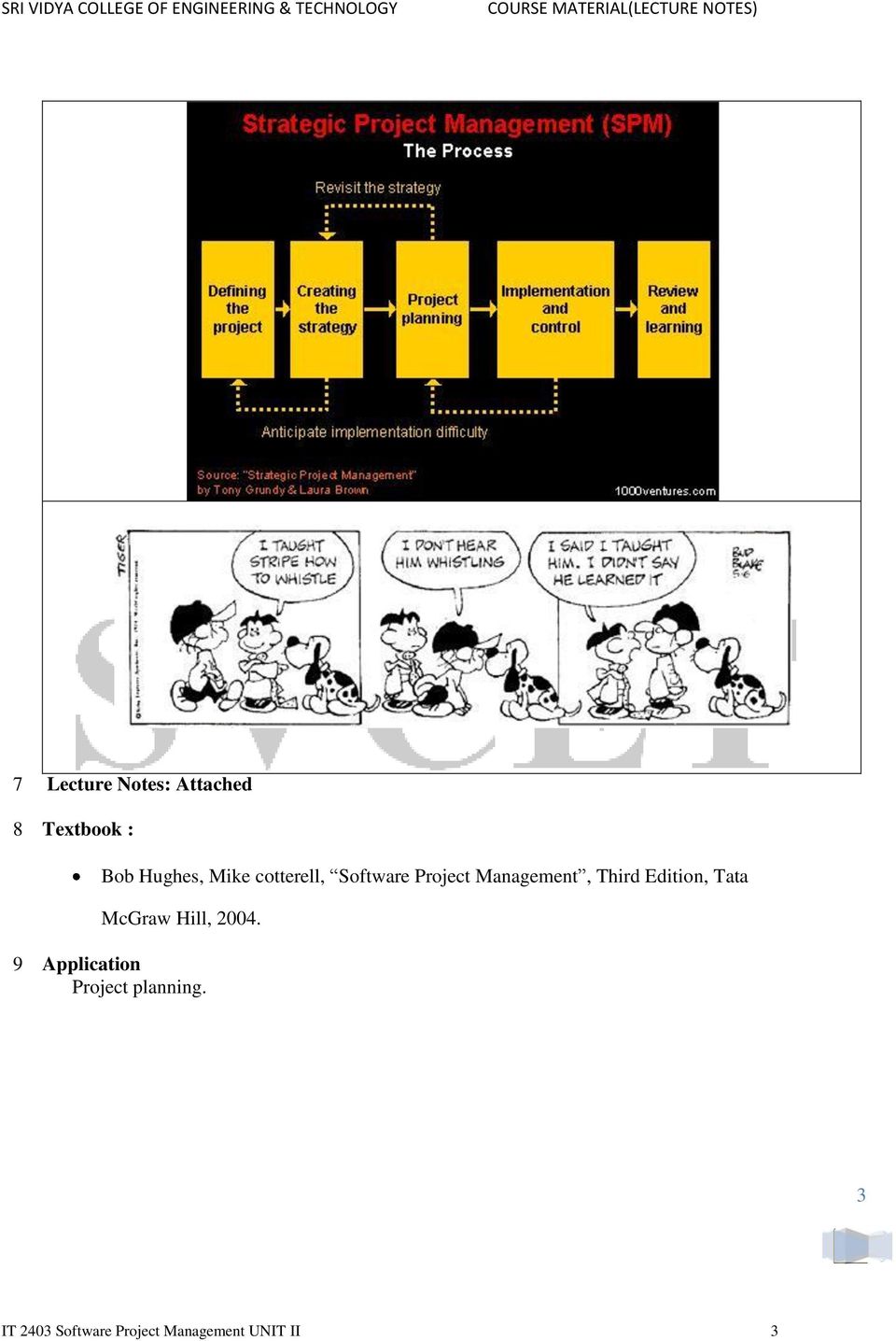
3 7 Lecture Notes: Attached 8 Textbook : Bob Hughes, Mike cotterell, Software Project Management, Third Edition, Tata McGraw Hill, Application Project planning. 3 IT 2403 Software Project Management UNIT II 3
4 2.1 Strategic assessment Project evaluation is a systematic method for collecting, analyzing, and using information to answer questions about projects, policies and programs, particularly about their effectiveness and efficiency. Project evaluation is a high level assessment of the project to see whether it is worthwhile to proceed with the project to see whether the project will fit in the strategic planning of the whole organization Project evaluation is normally carried out in step 0 of stepwise Project evaluation is a step by step process of collecting, recording and organizing information about Project results short - term outputs (immediate results of activities or project deliverables) Long term outputs (changes in behaviour, practice or policy resulting from the result. Why is project evaluation important: Project evaluation is important for answering the following questions- - what progress has been made? - were the desired outcomes achieved? Why? - whether the project can be refined to achieve better outcomes? - do the project results justify the project inputs? Project evaluation is used to Want to decide whether a project can proceed before it is too late Want to decide which of the several alternative projects has a better success rate, a higher turnover, a higher... Is it desirable to carry out the development and operation of the software system? Project evaluation is done by Senior management Project manager/coordinator Team leader Project evaluation Strategic assessment Technical assessment Economic assessment STRATEGIC PLANNING 4 Strategic planning is defined as an organization s process of defining its strategy, or direction and making decisions on allocating its resources to pursue this strategy, including its capital and people IT 2403 Software Project Management UNIT II 4

5 it deals with: - what do we do? - for whom do we do it? - how do we excel? STRATEGIC ASSESSMENT Strategic assessment is the first criteria for project evaluation For evaluating and managing the projects, the individual projects should be seen as components of a programme. Hence need to do programme management. Programme management: D.C. Ferns defined a programme as a group of projects that are managed in a coordinated way to gain benefits that would not be possible were the projects to be managed independently. A programme in this context is a collection of projects that all contribute to the same overall organization goals. Effective programme management requires that there is a well defined programme goal and that all the organization s projects are selected and tuned to contribure to this goal Evaluating of project is depends on: How it contributes to programme goal. It is viability [capability of developing or useful]. Timing. Resourcing. For successful strategic assessment, there should be a strategic plan which defines: Organization s objectives. Provides context for defining programme. Provides context for defining programme goals. Provide context for accessing individual project. In large organization, programme management is taken care by programme director and programme executive, rather than, project manager, who will be responsible for the strategic assessment of project. Any potential software system will form part of the user organization s overall information system and must be evaluated within the context of existing information system and the organization s information strategy. If a well defined information system does not exist then the system development and the assessment of project proposals will be based on a more piece meal approach. Piece meal approach is one in which each project being individually early in its life cycle. Typical issues and questions to be considered during strategic assessment 5 Issue 1: objectives: IT 2403 Software Project Management UNIT II 5

6 How will the proposed system contribute to the organization s stated objectives? How, for example, might it contribute to an increase in market share? Issue 2: is plan How does the proposed system fit in to the IS plan? Which existing system (s) will it replace/interface with? How will it interact with systems proposed for the later development? Issue 3: organization structure: What effect will the new system have on the existing departmental and organization structure? For example, a new sales order processing system overlap existing sales and stock control functions? Issue 4: MIS: What information will the system provide and at what levels in the organization? In what ways will it complement or enhance existing management information system? Issue 5: personnel: In what way will the system proposed system affect manning levels and the existing employee skill base? What are the implications for the organization s overall policy on staff development. Issue 6: image: What, if any, will be the effect on customer s attitudes towards the organization? Will the adoption of, say, automated system conflict with the objectives of providing a friendly service? Portfolio management Project Portfolio management provides an overview of all the projects that an organization is undertaking or is considering. It prioritizes the allocation of resources to projects and decides which projects should be accepted and which existing ones should be dropped. The concerns of Project Portfolio management include: Identifying which project proposals are worth implementation; Assessing the amount of risk of failure that a potential project has; Deciding how to share limited resources, including staff time and finance, between projects; Being aware of the dependencies between projects; Ensuring that projects do not duplicate benefits; Ensuring that necessary developments have been inadvertently been missed. The three key aspects of Project Portfolio management are: 6 1. Portfolio definition 2. Portfolio management 3. Portfolio optimization IT 2403 Software Project Management UNIT II 6

7 Sri Vidya College of Engineering and Technology Department of Computer Science & Engineering Class IV CSE Subject Code IT2403 Subject SOFTWARE PROJECT MANAGEMENT Prepared By Mr.J.Marimuthu Lesson Plan for Technical Assessment Time: 50 Minutes Lesson. No 2/8 1. Topics to be Covered: Technical Assessment 2. Skills Addressed: Listening 3. Objectives of this Lesson Plan: To enable students to understand the Technical Assessment in software project management. 4. Outcome (s): At the end of this session, the students will be able to: Define technical assessment. List the types of assessment. Discuss about portfolio management. 5 Link Sheet: What is the need of assessment? What is manegement? 6 Evocation: (5 Minutes) 7 Lecture Notes: Attached 8 Textbook : Bob Hughes, Mike cotterell, Software Project Management, Third Edition, Tata 7 McGraw Hill, Reference: 9 Application : Project evaluation IT 2403 Software Project Management UNIT II 7

8 2.2 Technical Assessment Technical assessment is the second criteria for evaluating the project.technical assessment of a proposed system evaluates functionality against available: Hardware Software Limitations Nature of solutions produced by strategic information systems plan Cost of solution. Hence undergoes cost-benefit analysis. It is also referred as Technology Evaluation. The Technology Assessment is a write up on the technical aspects of the project sector and planned technical purchases. Technology is defined broadly here to include: equipment, tools, products, processes, raw materials, skills, and ways of organizing production. Assessing Technology Planning: - Analyze Technology Needs - Planning for Change and Technology - Assessing a Technology Plan Before and After Implementation Why it is important: It s a tool to Identify the Problem At the core of any project is a series of big and small problems that need to be addressed (ex: not enough production capacity, staff lacks required skills, overly expensive transportation, etc.) Reviewing the production process including the systems and equipment in place provides transparency into what some of the constraints are. Some will be obvious, but others may be hidden until you take a closer look. Not all constraints will be technical, so this is just one investigative tool needed. It s a tool to Identify the Best Solution o Once you know what the technical problems are, you can start to look for solutions. o The Technology Assessment provides the opportunity to explore potential solutions (ex: new equipment choices, new crop varieties, new fertilizers, changes in process, etc.) o The grantee often has a solution in mind when they propose the project, but further analysis can lead to more creative, better fitting, and more cost effective solutions. o The grant budget is limited, so looking at the options in a systematic way helps the 8 grantee understand the tradeoffs with implementing one technical solution or another. Knowing this, they can make more informed decisions about using scarce budget resources. IT 2403 Software Project Management UNIT II 8

9 It s a tool for Communication o The write-up documents the background work and thinking on technical issues that has gone into the project design and budget. (1) The more people understand the logic of the proposal, the more they can help brainstorm on solutions or help catch problems that might not have been fully addressed. (2) A clear presentation will reduce questions from ADFW on the project proposal and will help them better understand the design choices despite not being present for all of the partner discussions with the grantee. o It serves as a record and resource for the grantee in case they need to go back and reconsider the options at a later date. Purpose: - Technology assessment provides an organization with information about the profitability of current technology as well as the benefits of implementing new technology. - Ineffective technology needs to be upgraded or replaced for businesses to produce quality products or services. Types of Assessments: Technology assessment can happen on several levels: flexibility, longevity and upgrade and scale-assessments. To assure that an organization can remain competitive, every aspect of its technology system must be in excellent operating condition. Assessment on all four levels improves the chances of this happening. - Flexibility/Longevity Flexibility assessment examines how technology will adapt to new levels of applications and other technology systems. last. Longevity assessment provides information on how long the technology will - Upgrade/Scale Assessments An upgrade assessment determines the ability of the technology to function with the addition of new, advanced features and equipment. Scale assessment considers how well the technology can operate in a larger, ever-growing network of systems. The growth of an organization means developing a larger technology system. New technology must be able to be incorporated into new, expanding networks. 9 IT 2403 Software Project Management UNIT II 9

10 Evaluate the technology options on the following factors: Fixed capital costs Source of equipment Operation, maintenance, and replacement costs Scale of production and expected capacity use rate Reliability Labor intensiveness (labor costs, productivity, and employment generation) Types and amounts of inputs required Raw material availability, sustainability, and cost Effects on product quality, cost and marketability Foreign exchange requirements and availability Natural resource requirements and sustainability Compatibility with existing technology in use Human resource requirement (training and technical assistance costs, management and supervision costs, etc) 10 IT 2403 Software Project Management UNIT II 10

11 Sri Vidya College of Engineering and Technology Department of Computer Science & Engineering Class IV CSE Subject Code IT2403 Subject SOFTWARE PROJECT MANAGEMENT Prepared By Mr.J.Marimuthu Lesson Plan for Cost Benefit Analysis Time: 50 Minutes Lesson. No 3/8 1. Topics to be Covered: Cost Benefit Analysis 2. Skills Addressed: Listening 3. Objectives of this Lesson Plan: To enable students to understand the concept of Cost Benefit Analysis. 4. Outcome (s): At the end of this session, the students will be able to: Define economic assessment. Know the types of costs. Discuss about Cost Benefit Analysis. 5 Link Sheet: Can you list the expected cost of software development? What is technology assessment? 6 Evocation: (5 Minutes) 11 IT 2403 Software Project Management UNIT II 11

12 7 Lecture Notes: Attached 8 Textbook : Bob Hughes, Mike cotterell, Software Project Management, Third Edition, Tata McGraw Hill, Application : Project evaluation 12 IT 2403 Software Project Management UNIT II 12

13 2.3 Cost Benefit Analysis Economic Assessment: Consider whether the project is the best among other options Prioritise the projects so that the resources can be allocated effectively if several projects are underway The economic assessment can be done by the following ways: Cost-benefit analysis Cash flow forecasting Various cost-benefit evaluation techniques Cost benefit analysis: It is one of the important and common way of carrying economic assessment of a proposed information system. This is done by comparing the expected costs of development and operation of the system with its benefits. Any project aiming at return on investment must provide a greater benefit than putting that investment in a bank. So it takes an account: Expected cost of development of system Expected cost of operation of system Benefits obtained Assessment is based on: Whether the estimated costs are executed by the estimated income. And by other benefits For achieving benefit where there is a scarce resource, projects will be prioritized and resources are allocated effectively. The standard way of evaluating economic benefits of any project is done by cost benefit analysis Cost benefit analysis comprises of two steps: Step-1: identifying and estimating all of the costs and benefits of carrying out the project. Step-2: expressing these costs and benefits in common units. Step-1: It includes Development cost of system. Operating cost of system. Benefits obtained by system. When new system is developed by the proposed system, then new system should reflect the above three as same as proposed system. Example: sales order processing system which gives benefit due to use of new system. Step-2: Calculates net benefit. Net benefit = total benefit = total cost. cost should be expressed in monetary terms. 13 IT 2403 Software Project Management UNIT II 13

14 Three types of cost 1. Development costs: includes salary and other employment cost of staff involved. 2. Setup costs: includes the cost of implementation of system such as hardware, and also file conversion, recruitment and staff training. 3. Operational cost: cost require to operate system, after it is installed. Three categories of benefits: 1. Direct benefits: directly obtained benefit by making use of/operating the system. Example: reduction of salary bills, through the introduction of a new, computerized system. 2. Assessable indirect benefits: these benefits are obtained due to updation / upgrading the performance of current system. It is also referred as secondary benefits. Example: use of user friendly screen, which promotes reduction in errors, thus increases the benefit 3. Intangible benefits: these benefits are longer term, difficult to quantify. It is also referred as indirect benefits. Example: enhanced job interest leads reduction of staff turnover, inturn leads lower recruitment costs. Benefits management: Benefit management encompasses the identification, optimization and tracking of the expected benefits from a business change in order to ensure that they are actually achieved. To do this, we must: Define the expected benefits from the programme; Analyze the balance between costs and benefits; Plan how the benefits will be achieved and measured; Allocate responsibilities for the successful delivery of the benefits; Monitor the realization of the of the benefits. Benefits can be of many different types, including Mandatory compliance Quality of service Productivity More motivated work force Internal management benefits Risk reduction Economy Revenue enhancement/acceleration Strategic fit A change could have more than one of these types of benefit. In fact, benefits are often inter- liked. An example of this is an insurance company which introduced a facility whereby when settling claims for damage to property, they directly arranged for constructors to carry out the remedial work. This improved quality of service for customers as it saved them the trouble of locating a reputable contractor, reduced costs to the insurance company because they could take 14 IT 2403 Software Project Management UNIT II 14

15 advantage of the bulk purchase of services and improved staff morale because of the goodwill generated between the insurance company s front-line staff and the customer. Quantifying benefits We have already seen that benefits can be: o Quantified and valued that is, a direct financial benefit is experienced o Quantified but not valued for example, a decrease in the number of customer complaints o Identified but not easily quantified for example, public approval of the organization in the locality where it is based. A particular activity might also have disbenefits. For example, increased sales might mean that more money has to be spent on expensive overtime working. The need for benefit profiles is that estimate when and how benefits will be experienced. Specific staff have to be allocated responsibility for ensuring that the planned benefits actually materialize. Benefit cannot normally be monitored in a purely project environment because the project will almost certainly have been officially closed before the benefits start to filter through. Benefit management brings to the fore the powerful idea that developers and users are jointly responsible for ensuring the delivery of the benefits of projects. 15 IT 2403 Software Project Management UNIT II 15

16 Sri Vidya College of Engineering and Technology Department of Computer Science & Engineering Class IV CSE Subject Code IT2403 Subject SOFTWARE PROJECT MANAGEMENT Prepared By Mr.J.Marimuthu Lesson Plan for Cash Flow Forecasting Time: 50 M inutes Lesson. No 4/8. Topics to be Covered: Cash Flow Forecasting. Skills Addressed: Listening. Objectives of this Lesson P lan: To enable students t o understand Cash Flow Forecasting. Outcome (s):. At the end of this session, th e students will be able to: Name the different t ypes of cash flow. Describe Cash Flow Forecasting. 5 Link Sheet: what is economi c assessment? What is the need of assessment? 6 Evocation: (5 Minutes) 7 Lecture Notes: Attached 8 Textbook : Bob Hughes, Mike cotterell, Software Project Management, Third Edition, Tata 16 McGraw Hill, Application : Project evaluation IT 2403 Software Project Management UNIT II 16

17 2.4 Cash Flow Forecasting Economic Assessment: Consider whether the project is the best among other options Prioritise the projects so that the resources can be allocated effectively if several projects are underway The economic assessment can be done by the following ways: Cost-benefit analysis Cash flow forecasting Various cost-benefit evaluation techniques We have already discusse d about the cost benefit analysis. In this sessi on, we are going to discuss about the Cash flo w forecasting. Cash flow forecasting As important as estimatin g the overall costs and benefits of a project is producing a cash flow f orecast which indicates when ex penditure and income will take place. It estim ate overall cost and b enefits of a product with respect to time. Negative cash flow during development stage. Positive cash flow during operating life. During development stage Staff wages Borrowing money from b ank Paying interest to bank Payment of salaries Amount spent for installat ion, buying hardware and software ncome is expected by 2 ways. Payment on completion Stage payment The difficulty and importance of cash flow forecasting is evide nced by the number of companies that suffer ban kruptcy because, although they are developin g profitable products or services, they cannot su stain an unplanned negative cash flow. 17 IT 2403 Software Project Management UNIT II 17

18 When estimating future cash flows, it is usual to ignore the effects of inflation. Forecasts of inflation rates tend to be uncertain. Moreover, if expenditure is increased due to inflation it is likely that income will increase proportionately. Example: The following table illustrates cash flow forecasts for three projects. In each case it is assumed that that the cash flows take place at the end of each year. Here negative values represent expenditure and positive values represent income. Year Project1 Project2 project ,000, ,000 2, , ,000 2, , ,000 2, , ,000 2, , , ,000 Cash flow forecasting or cash flow management is a key aspect of financial management of a business, planning its future cash requirements to avoid a crisis of liquidity. Cash flow forecasting is important because if a business runs out of cash and is not able to obtain new finance, it will become insolvent. It is no excuse for management to claim that they didn't see a cash flow crisis coming. So in business, "cash is king". Cash flow is the life-blood of all businesses particularly start-ups and small enterprises. As a result, it is essential that management forecast (predict) what is going to happen to cash flow to make sure the business has enough to survive. How often management should forecast cash flow is dependent on the financial security of the business. If the business is struggling, or is keeping a watchful eye on its finances, the business owner should be forecasting and revising his or her cash flow on a daily basis. However, if the finances of the business are more stable and 'safe', then forecasting and revising cash flow weekly or monthly is enough. Here are the key reasons why a cash flow forecast is so important: Identify potential shortfalls in cash balances in advance think of the cash flow forecast as an "early warning system". This is, by far, the most important reason for a cash flow forecast. Make sure that the business can afford to pay suppliers and employees. Suppliers who don't get paid will soon stop supplying the business; it is even worse if employees are not paid on time. 18 Spot problems with customer payments preparing the forecast encourages the business to look at how quickly customers are paying their debts. Note this is not really a problem for businesses (like retailers) that take most of their sales in cash/credit cards at the point of sale. IT 2403 Software Project Management UNIT II 18

19 As an important discipline of financial planning the cash flow forecast is an important management process, similar to preparing business budgets. External stakeholders such as banks may require a regular forecast. Certainly, if the business has a bank loan, the bank will want to look at the cash flow forecast at regular intervals. Components that Should be Considered when Developing a Cash Flow Forecast Development of Cash Forecasting Procedures Cash forecasting procedures should be developed so that the most current information (such as accounts payable and accounts receivable) is reflected in the forecasts and that the forecasts are as accurate as possible. One component that should be considered is a cheque-clearing system that can derive statistics from the accounts payable system, and the bank clearing data. Computerized Forecasting System Information systems should be in place to ensure the current information can be gathered and updated promptly for accurate cash forecasts. Cash management systems and procedures should make use of appropriate and modern administrative practices. Staff involved in these positions should have the ability to work and maintain these systems. Long-Term Cash Flows Both short and long-term cash forecasts should be prepared to support short and long term investment decisions. It is important for those purchasing and selling investments to know when to match the maturity dates with the dates of cash requirements or surpluses. The cash forecasting system should provide at least a one-year rolling cash forecast that should be constantly updated for changes. The annual cash flow forecast will be changed to include all cash inflows in addition to outflows. Variance Reporting of Cash Forecasts Significant variances between actual and forecasted cash flows should be measured, monitored, and reported on an on-going basis to management. The performance indicators should be included in the appropriate program overview. The variances should be recorded and explained what caused the variance to happen, along with solutions if required to correct the variance, and establish actions to avoid a recurrence if required. Steps to Preparing a Cash Flow Forecast 1. Examine previous years monthly financial data For an accurate prediction, previous monthly financial data should be examined when forecasting the succeeding year s potential receipts and disbursements. 2. Design a cash flow work sheet Helps organize cash flows through projected receipts and accounts receivable. 3. Consider cash flow receipts 19 For new operations (i.e. programs), the average monthly revenues of a similar size municipality or operation in Nova Scotia can be compared as a benchmark. IT 2403 Software Project Management UNIT II 19

20 For existing operations, receipts from the same month in a previous year, adjusting for any current circumstances for that month in the succeeding year. Cash receipts can be predicted by taking into consideration tax bill due dates, tax sale dates, and expected payment dates of transfers from other governments. 4. Consider cash flow disbursements Municipalities should only show the cash you expect to pay out each month. o Cash disbursements can be predicted by using past year s payroll information and pay dates for the coming year, information on transfers to other governments and their due dates, and information on other contractual payments (for example: debt charges or rental charges). For example, if the municipality is paying the supplier in 30 days, the cash payouts for January s purchases will be shown in February. If you can obtain trade credit for longer terms, then cash outlays will appear two or even three months after the purchase has been received and invoiced. 5. Reconciliation of the cash receipts to cash disbursements 6. Cash flow maintenance The reconciliation section of the cash flow worksheet begins by showing the balance carried over from the previous months operations. The total of the current months receipts are added and the total of the current month s disbursements are subtracted. This adjusted balance will be carried forward to the next months disbursements. This adjusted balance will be carried forward to the first line of the reconciliation portion of the next month to become the base where the next month s cash flow activity will be added and/or subtracted. Cash flows should be managed to maintain minimum balance requirements. Cash flow forecasts should be revised on an ongoing basis and should be constantly modified to current circumstances and new conditions. At the end of each month, actual cash flow figures should be compared to the planned figures to determine if there is a great discrepancy between the two sets of figures. If significant variances exist, they should be analyzed, and assumptions should be adjusted to reflect the actual figures more closely. 20 IT 2403 Software Project Management UNIT II 20

21 Sri Vidya College of Engineering and Technology Department of Computer Science & Engineering Class IV CSE Subject Code IT2403 Subject SOFTWARE PROJECT MANAGEMENT Prepared By Mr.J.Marimuthu Lesson Plan for cost-benefit evaluation techniques Time: 50 Minutes Lesson. No 5/8 1. Topics to be Covered: cost-benefit evaluation techniques 2. Skills Addressed: Listening 3. Objectives of this Lesson Plan: To enable students to understand the various cost-benefit evaluation techniques. 4. Outcome (s): At the end of this session, the students will be able to: List cost-benefit evaluation techniques. Define payback period. Discuss about return on investment (ROI). 5 Link Sheet: what is cost-benefit analysis? what are the types of costs? Define profit. 6 Evocation: (5 Minutes) 21 IT 2403 Software Project Management UNIT II 21
22 7 Lecture Notes: Attached 8 Textbook : Bob Hughes, Mike cotterell, Software Project Management, Third Edition, Tata McGraw Hill, Application : Project evaluation 22 IT 2403 Software Project Management UNIT II 22
23 2.5 cost-benefit evaluation techniques Economic Assessment: Consider whether the project is the best among other options Prioritise the projects so that the resources can be allocated effectively if several projects are underway The economic assessment can be done by the following ways: Cost-benefit analysis Cash flow forecasting Various cost-benefit evaluation techniques We have already discussed about the cost benefit analysis and Cash flow forecasting. In this session, we are going to discuss about the various cost-benefit evaluation techniques. Cost-benefit evaluation techniques: It consider the timing of the costs and benefits the benefits relative to the size of the investment Common method for comparing projects on the basic of their cash flow forecasting. 1) Net profit 2) Payback Period 3) Return on investment 4) Net present Value 5) Internal rate of return Net profit Net profit is calculated by subtracting a company's total expenses from total income. Showing what the company has earned (or lost) in a given period of time (usually one year). also called net income or net earnings. Net profit= total incomes - total costs Example: The following table illustrates cash flow forecasts for three projects. In each case it is assumed that that the cash flows take place at the end of each year. Here negative values represent expenditure and positive values represent income. Year Project1 Project2 project ,000, ,000 2, , ,000 2, ,000 IT 2403 Software Project Management UNIT II 23
24 3 10,000 2, , ,000 2, , , ,000 Calculate net profit.(-ive total cost or total investment) Net profit= total incomes - total costs For project1, total income = 10,000+10,000+10,000+20,000+1,00000=1,50000 Total cost = 1,00000 Net profit = 1, ,00000=Rs For project2, total income = 2, , , , ,00000=1,100,000 Total cost = 1,000,000 Net profit = 1,100,000-1,000,000=Rs For project2, total income = 30,000+30,000+30,000+30,000+30,000+75,000=1,95000 Total cost = 1,20000 Net profit = 1, ,20000=Rs.75,000 Year Project1 Project2 project ,000, ,000 2, , ,000 2, , ,000 2, , ,000 2, , , ,000 Net profit 50,000 1,00,000 75,000 Payback Period The payback period is the time taken to recover the initial investment or it is the length of time required for cumulative incoming returns to equal the cumulative costs of an investment Advantages simple and easy to calculate. It is also a seriously flawed method of evaluating investments Disadvantages It attaches no value to cash flows after the end of the payback period. It makes no adjustments for risk. 24 IT 2403 Software Project Management UNIT II 24
25 It is not directly related to wealth maximisation as NPV is. It ignores the time value of money. The "cut off" period is arbitrary. Example: The following table illustrates cash flow forecasts for three projects. In each case it is assumed that that the cash flows take place at the end of each year. Here negative values represent expenditure and positive values represent income. Year Project1 Project2 project ,000, ,000 2, , ,000 2, , ,000 2, , ,000 2, , , ,000 Calculate Payback Period Project1 =10,000+10,000+10,000+20,000+1,00,000=1,50,000 Project 2= 2,00,000+2,00,000+2,00,000+2,00,000+3,00,000=11,000,00 Project 3= 30,000+30,000+30,000+30, ,000 =1,95,000 It ignores any benefits that occur after the payback period and, therefore, does not measure profitability. And it ignores the time value of money. RETURN ON INVESTMENT or ACCOUNTING RATE OF RETURN It provides a way of comparing the net profitability to the investment required. Or A performance measure used to evaluate the efficiency of an investment or to compare the efficiency of a number of different investments Disadvantages It takes no account of the timing of the cash flows. Rate of returns bears no relationship to the interest rates offered or changed by bank. ROI = average annual profit * 100 total investment 25 IT 2403 Software Project Management UNIT II 25
26 Example: Average annual profit = net profit total no. of years The following table illustrates cash flow forecasts for three projects. In each case it is assumed that that the cash flows take place at the end of each year. Here negative values represent expenditure and positive values represent income. Year Project1 Project2 project ,000, ,000 2, , ,000 2, , ,000 2, , ,000 2, , , ,000 Calculate ROI for project 1. Total investment =1,00,000 Net profit = 50,000 Total no. of year = 5 Average annual profit=50,000/5=10,000rs ROI= (10,000/1,00,000) *100 = 10% Calculate ROI for project 2. Total investment =1,000,000 Net profit = 1,00,000 Total no. of year = 5 Average annual profit=1,00,000/5=20,000rs ROI= (20,000/1,000,000) *100 = 2% Calculate ROI for project 3. Total investment =1,20,000 Net profit = 75,000 Total no. of year = 5 Average annual profit=75,000/5=15,000rs ROI= (15,000/1,20,000) *100 = 12.5% 26 IT 2403 Software Project Management UNIT II 26
27 Sri Vidya College of Engineering and Technology Department of Computer Science & Engineering Class IV CSE Subject Code IT2403 Subject SOFTWARE PROJECT MANAGEMENT Prepared By Mr.J.Marimuthu Lesson Plan for Net present value and internal rate of return Time: 50 Minutes Lesson. No 6/8 1. Topics to be Covered: Net present value and internal rate of return 2. Skills Addressed: Listening 3. Objectives of this Lesson Plan: To enable students to evaluate the project using Net present value and internal rate of return. 4. Outcome (s): At the end of this session, the students will be able to: Evaluate the project using Net present value. Evaluate the project using internal rate of return. Analyze and compare NPV and IRR. 5 Link Sheet: what is discount rate? What is net profit? 6 Evocation: (5 Minutes) 27 IT 2403 Software Project Management UNIT II 27
28 7 Lecture Notes: Attached 8 Textbook : Bob Hughes, Mike cotterell, Software Project Management, Third Edition, Tata McGraw Hill, Application : Software Project evaluation. 28 IT 2403 Software Project Management UNIT II 28
29 2.6 Net present value and internal rate of return Cost-benefit evaluation techniques: It consider the timing of the costs and benefits the benefits relative to the size of the investment Common method for comparing projects on the basic of their cash flow forecasting. 1) Net profit 2) Payback Period 3) Return on investment 4) Net present Value 5) Internal rate of return Net present value (NPV) It is the sum of the present values of all future amounts. Present value is the value which a future amount is worth at present It takes into account the profitability of a project and the timing of the cash flows Discounted Cash Flow (DCF) is a cash flow summary adjusted to reflect the time value of money. DCF can be an important factor when evaluating or 29 comparing investments, proposed actions, or purchases. Other things being equal, the action or investment with the larger DCF is the better decision. IT 2403 Software Project Management UNIT II 29
30 When discounted cash flow events in a cash flow stream are added together, the result is called the Net Present Value (NPV). When the analysis concerns a series of cash inflows or outflows coming at different future times, the series is called a cash flow stream. Each future cash flow has its own value today (its own present value). The sum of these present values is the Net Present Value for the cash flow stream. The size of the discounting effect depends on two things: the amount of time between now and each future payment (the number of discounting periods) and an interest rate called the Discount Rate. Discount rate is the annual rate by which we discount future earning The example shows that: As the number of discounting periods between now and the cash arrival increases, the present value decreases. As the discount rate (interest rate) in the present value calculations increases, the present value decreases. 30 IT 2403 Software Project Management UNIT II 30
31 Issues in NPV Choosing an appropriate discount rate is difficult Ensuring that the rankings of projects are not sensitive to small changes in discount rate Guidelines: Use the standard rate prescribed by the organization Use interest rate + premium rate Use a target rate of return Rank the projects using various discount rates Applying discount factors NPV is the sum of the discounted cash flows for all the years of the project (note that in NPV terms the lifetime of the completed application is included in the project ) The figure of RM618 means that RM618 more would be made than if the money were simply invested at 10%. An NPV of RM0 would be the same amount of profit would be generated as investing at 10%. Year Cash-flow Discount factor(discount rate 10%) Discounted cash flow , ,000 IT 2403 Software Project Management UNIT II 31
32 1 10, , , , , , , , , ,090 NPV 618 The figure of RM618 means that RM618 more would be made than if the money were simply invested at 10%. An NPV of RM0 would be the same amount of profit would be generated as investing at 10%. Example: Comparing Competing Investments with NPV. Consider two competing investments in computer equipment. Each calls for an initial cash outlay of $100, and each returns a total a $200 over the next 5 years making net gain of $100. But the timing of the returns is different, as shown in the table below (Case A and Case B), and therefore the present value of each years return is different. The sum of each investments present values is called the Discounted Cash flow (DCF) or Net Present Value (NPV). Using a 10% discount rate Timing Discount Rate(10%) Net Cash Flow CASE A Present Value Net Cash Flow CASE B Present Value Now 0 1 $ $ $ $ Year $60.00 $54.54 $20.00 $18.18 Year $60.00 $49.59 $20.00 $16.52 Year $40.00 $30.05 $40.00 $30.05 Year $20.00 $13.70 $60.00 $41.10 Year $20.00 $12.42 $60.00 $37.27 Total Net CF A = $ NPV A = $60.30 Net CF B = $ NPV B = $ Disadvantage May not be directly comparable with earnings from other investments or the costs of borrowing capital IT 2403 Software Project Management UNIT II 32
33 Internal Rate of Return (IRR) The percentage discount rate that would produce a NPV of zero A relative measure. Use Excel to demonstrate the calculation of NPV and IRR The IRR being a relative measure does not indicate the absolute size of the return. The IRR compare s returns to costs by asking: "What is th e discount rate that would give the cash flow stream a net present value of 0?" CASE A Discount Timing Rate(10%) Net Cash Flow Value Present CASE B Net Cash Flow Value Present Now 0 1 $ $ $ Year $ $54.54 $20.00 Year $ $49.59 $20.00 Year $ $30.05 $40.00 Year $ $13.70 $60.00 Year $ $12.42 $60.00 $ $18.18 $16.52 $30.05 $41.10 $37.27 Total Net CF A = $ $60.30 NPV A = Net CF B = $ NPV B = $43.12 IRR asks a different question of the same two cash flow streams. Instead of proposing a discount rate and finding the NPV of each stream (as with NPV), IRR starts with the net cash flow streams and finds the interest rate (discount rate) that produces an NPV of zero for each. The easiest way to see how this solution is found is with a graphical summary: 33 IT 2403 Software Project Management UNIT II 33
34 These curves are based on the Case A and Case B cash flow figures in the table above. Here, however, we have used nine different interest rates, including 0.0 and 0.10, on up through As you would expect, as the interest rate used for calculating NPV of the cash flow stream increases, the resulting NPV decreases. For Case A, an interest rate of 0.38 produces NPV = 0, whereas Case B NPV arrives at 0 with an interest rate of Case A therefore has an IRR of 38%, Case B an IRR of 22%. IRR as the decision criterion, the one with the higher IRR is the better choice. Sri Vidya College of Engineering and Technology Department of Computer Science & Engineering Class IV CSE Subject Code IT2403 Subject SOFTWARE PROJECT MANAGEMENT Prepared By Mr.J.Marimuthu Lesson Plan for Risk Evaluation Time: 50 Minutes Lesson. No 7/8 34 IT 2403 Software Project Management UNIT II 34
35 1. Topics to be Covered: Risk Evaluation 2. Skills Addressed: Listening 3. Objectives of this Lesson Plan: To enable students to study about the Risk Evaluation. Outcome (s): 4. At the end of this session, the students will be able to: Define risk. List the types of risks. Discuss about Risk E valuation. 5 Link Sheet: what is risk? Give some exam ples for risk. 6 Evocation: (5 Minutes) 7 Lecture Notes: Attached 8 Textbook : Bob Hughes, Mike co tterell, Software Project Management, Thir d Edition, Tata McGraw Hill, Application : Software Proje ct evaluation 2.7 Risk Evaluation Every project involves ris k. Risk is an uncertain event or condition that, if it occurs has a positive or negative effect on a project objectives, include transferring the risk to another party, avoiding the risk, reducing the negative effect of the risk, and accepting some or all of the consequences of a particular risk.there are two types of risks. 1. Project risk which prevent the project from being completed successfully. 2. Business risk delivered products are not profitable. 35 Risk evaluation is meant to decide whether to proceed with the project or not, and whether the project is meeting its objectives. IT 2403 Software Project Management UNIT II 35
36 Risk Occurs: When the project exceed its original specification Deviations from achieving it objectives and so on. Risk evaluation describe the following 1. Risk Identification and ranking 2. Risk and Net Present Value 3. Cost benefit Analysis 4. Risk profile analysis 5. Decision trees Risk Identification and ranking Identify the risk and give priority. Could draw up draw a project risk matrix for each project to assess risks Project risk matrix used to identify and rank the risk of the project Example of a project risk matrix In the table Importance relates to the cost of the damage if the risk were to materialize and likelihood to the probability that the risk will actual occur. H indicates High, M indicates medium and L indicates low. The issues of risk analysis are explored in much more depth in lecture/chapter 7. Risk and Net Present Value For riskier projects could use higher discount rates Ex: Can add 2% for a Safe project or 5 % for a fairly risky one. Cost benefit Analysis It is one of the important and common way of carrying economic assessment of a proposed information system. This is done by comparing the expected costs of development and operation of the system with its benefits. Risk profile analysis This make use of risk profiles using sensitivity analysis. It compares the sensitivity of each factor of project profiles by varying parameters which affect the project cost benefits. Eg: 36 IT 2403 Software Project Management UNIT II 36
37 Vary the original estimates of risk plus or minus 5% and re-calculate the expected cost benefits. P1 depart far from p2,have large variation P3 have much profitable than expected All three projects have the same expected profit Compare to p2, p1 is less risky. Decision trees Identify over risky projects Choose best from risk Take suitable course of action Decision tree of analysis risks helps us to 1. Extend the existing system increase sales improve the management information 2. Replace the existing system Not replacing system leads in loss Replace it immediately will be expensive. 37 IT 2403 Software Project Management UNIT II 37
38 The expected value of Extending system= (0.8*75,000)-(0.2*100,000)=40,000 Rs. The expected value of Replacing system= (0.2*250,000)-(0.8*50,000)=10,000 Rs. Therefore, organization should choose the option of extending the existing system. The diagram here is figure 3.8 in the text. This illustrates a scenario relating to the IOE case study. Amanda is responsible for extending the invoicing system. An alternative would be to replace the whole of the system. The decision is influenced by the likelihood of IOE expanding their market. There is a strong rumour that they could benefit from their main competitor going out of business: in this case they could pick up a huge amount of new business, but the invoicing system could not cope. However replacing the system immediately would mean other important projects would have to be delayed. The NPV of extending the invoicing system is assessed as 75,000 if there is no sudden expansion. If there were a sudden expansion then there would be a loss of 100,000. If the whole system were replaced and there was a large expansion there would be a NPV of 250,000 due to the benefits of being able to handle increased sales. If sales did not increase then the NPV would be - 50,000. The decision tree shows these possible outcomes and also shows the estimated probability of each outcome. The value of each outcome is the NPV multiplied by the probability of its occurring. The value of a path that springs from a particular decision is the sum of the values of the possible outcomes from that decision. If it is decided to extend the system the sum of the values of the 38 outcomes is 40,000 (75,000 x ,000 x 0.2) while for replacement it would be 10,000 (250,000 x ,000 x 0.80). Extending the system therefore seems to be the best bet. IT 2403 Software Project Management UNIT II 38
39 Sri Vidya College of Engineering and Technology Department of Computer Science & Engineering Class IV CSE Subject Code IT2403 Subject SOFTWARE PROJECT MANAGEMENT Prepared By Mr.J.Marimuthu Lesson Plan for Programme management Time: 50 Minutes Lesson. No 8/8 1. Topics to be Covered: Programme management 2. Skills Addressed: Listening 3. Objectives of this Lesson Plan: To enable students to understand the Programme management. 4. Outcome (s): At the end of this session, the students will be able to: Define program. Discuss about Programme management. 5 Link Sheet: what are the types of projects? What is blueprint? 6 Evocation: (5 Minutes) 7 Lecture Notes: Attached 8 Textbook : Bob Hughes, Mike cotterell, Software Project Management, Third Edition, Tata 39 McGraw Hill, Application : Software Project planning IT 2403 Software Project Management UNIT II 39
40 2.8 Programme management Definitions: D.C. Ferns defined a programme as a group of projects that are managed in a coordinated way to gain benefits that would not be possible were the projects to be managed independently. A programme in this context is a collection of projects that all contribute to the same overall organization goals. Effective programme management requires that there is a well defined programme goal and that all the organization s projects are selected and tuned to contribure to this goal Program management or programme management is the process of managing several related projects, often with the intention of improving an organization's performance. In practice and in its aims it is often closely related to systems engineering and industrial engineering. The Program Manager has oversight of the purpose and status of all projects in a Program and can use this oversight to support project-level activity to ensure the overall program goals are likely to be met, possibly by providing a decision-making capacity that cannot be achieved at project level or by providing the Project Manager with a program perspective when required, or as a sounding board for ideas and approaches to solving project issues that have program impacts. Typically in a program there is a need to identify and manage cross-project dependencies and often the PMO (Program or Project Management Office) may not have sufficient insight of the risk, issues, requirements, design or solution to be able to usefully manage these. The Program manager may be well placed to provide this insight by actively seeking out such information from the Project Managers although in large and/or complex projects, a specific role may be required. However this insight arises, the Program Manager needs this in order to be comfortable that the overall program goals are achievable. There are two different views of how programmes differ from projects. On one view, projects deliver outputs, discrete parcels or "chunks" of change; programs create outcomes. On this view, a project might deliver a new factory, hospital or IT system. By combining these projects with other deliverables and changes, their programs might deliver increased income from a new product, shorter waiting lists at the hospital or reduced operating costs due to improved technology. The other view is that a program is nothing more than either a large project or a set (or portfolio) of projects. On this second view, the point of having a program is to exploit economies of scale and to reduce coordination costs and risks. The project manager's job is to ensure that their project succeeds. The program manager, on the other hand, may not care about individual projects, but is concerned with the aggregate result or end-state. For example, in a financial institution a program may include one project that is designed to take advantage of a rising market, and another to protect against the downside of a falling market. These projects are opposites with respect to their success conditions, but they fit together in the same program. 40 IT 2403 Software Project Management UNIT II 40
41 According to the view that programs deliver outcomes but projects deliver outputs, program management is concerned with doing the right projects. The program manager has been described as 'playing chess' and keeping the overview in mind, with the pieces to be used or sacrificed being the projects. In contrast, project management is about doing projects right. And also according to this view, successful projects deliver on time, to budget and to specification, whereas successful programs deliver long term improvements to an organization. Improvements are usually identified through benefits. An organization should select the group of programs that most take it towards its strategic aims while remaining within its capacity to deliver the changes. On the other hand, the view that programs are simply large projects or a set of projects allows that a program may need to deliver tangible benefits quickly. Consider the following set of projects: design of the new product - this delivers a design specification, modifications to the production line or factory - delivers a manufacturing capability, marketing - delivers advertisements, brochures and pamphlets, staff training - delivers staff trained to sell and support the new product. One view has it that these are different projects within a program. But in practice they can just as well be managed as sub-projects within a single project. Which approach to choose? Program and project management are both practical disciplines, and the answer to such a question must be "whatever works." What works depends very much on the nature of the organization in which the project or program is run. Typically a program is broken down into projects that reflect the organization's structure. The design project will be run by the design team, the factory will manage the modifications to the production line, and so on. Organizational structure and organizational culture are key factors in how to structure a program. The distinction between the terms "outcome" and "output" is far from clear, except in a trivial sense. Each of the projects listed in the example above is designed to deliver some 'thing', known as a 'deliverable' or an 'output', and together they improve the organization. Where one draws the line between the complete single benefit that causes the improvement and its component parts is partly a matter of preference and partly a matter of the culture and structure of the organization. Either way, benefits will normally be enjoyed long after the end of the program and all of its component projects. The point is that to achieve maximum benefits, there must be an integration of parts into a whole. Whether this integration is managed in something that is called a project or a program is of secondary importance to understanding the benefits and managing the process of integration well. Many programs are concerned with delivering a capability to change. Only when that capability is transferred to the line management and utilized by the host organization will the benefits actually be delivered. On this view, a program team cannot, on their own, deliver benefits. Benefits can only be delivered through the utilization of a new capability. Programs are normally designed to deliver the organization's strategy, such as an ambition to be the 41 fourth biggest supermarket in a region by 2015 or reduce wastage by 5% in two year's time. According to Project Management Institute (PMI), The Standard for Program Management, 2nd Ed., "A Program is a group of related projects managed in a coordinated manner to obtain IT 2403 Software Project Management UNIT II 41
42 benefits and control NOT available from managing them individually. Programs may include elements of related work outside of the scope of the discreet projects in the program... Some projects within a program can deliver useful incremental benefits to the organization before the program itself has completed." Program management also emphasizes the coordinating and prioritizing of resources across projects, managing links between the projects and the overall costs and risks of the program. Program management may provide a layer above the management of projects and focuses on selecting the best group of projects, defining them in terms of their objectives and providing an environment where projects can be run successfully. Program managers should not micromanage, but should leave project management to the project managers. In public sector work in Europe, the term normally refers to multiple change projects: projects that are designed to deliver benefits to the host organization. For example, the Office of Government Commerce for the UK government. An alternative to the Office of Government Commerce's methodology for program management is that of the private sector Project Management Institute. Many organizations only run one program at a time, a program containing all their projects. In Project Management Institute terminology, this is more likely to be a project portfolio than a program. Some larger organizations may have multiple programs each designed to deliver a range of improvements. Some organizations use the concept of Systems Engineering where others use program management. 42 IT 2403 Software Project Management UNIT II 42
Financial Forecasting: Budget Preparation & Cash Flow Forecasting
 Financial Forecasting: Budget Preparation & Cash Flow Forecasting In 2013, the Financial Management Best Practice Committee (FMCBC) was reconvened to identify core financial best practices for municipalities
2. Financial management:
 2. Financial management: Meaning, scope and role, a brief study of functional areas of financial management. Introduction to various FM tools: ratio analysis, fund flow statement, cash flow statement.
Cash Flow. Summary. Cash Flow. Louise Söderberg, 2010-10-15
 Cash Flow Louise Söderberg, 2010-10-15 Summary The statement of cash flow reports the cash generated and used during the time interval specified in its headings. A cash flow analysis is a method of checking
How To Calculate Discounted Cash Flow
 Chapter 1 The Overall Process Capital Expenditures Whenever we make an expenditure that generates a cash flow benefit for more than one year, this is a capital expenditure. Examples include the purchase
Project Evolution & Estimation :cash flow forecasting, cost benefit evolution techniques, risk evolution, Cost benefit analysis
 Project Evolution & Estimation :cash flow forecasting, cost benefit evolution techniques, risk evolution, Cost benefit analysis EA Cost-benefit Analysis A standard way to assess the economic benefits Two
Course 3: Capital Budgeting Analysis
 Excellence in Financial Management Course 3: Capital Budgeting Analysis Prepared by: Matt H. Evans, CPA, CMA, CFM This course provides a concise overview of capital budgeting analysis. This course is recommended
WORKING CAPITAL MANAGEMENT
 CHAPTER 9 WORKING CAPITAL MANAGEMENT Working capital is the long term fund required to run the day to day operations of the business. The company starts with cash. It buys raw materials, employs staff
Introduction to Discounted Cash Flow and Project Appraisal. Charles Ward
 Introduction to Discounted Cash Flow and Project Appraisal Charles Ward Company investment decisions How firms makes investment decisions about real projects (not necessarily property) How to decide which
CHAPTER 6 PROJECT CASH FLOW
 CHAPTER 6 PROJECT CASH FLOW In the previous chapters, techniques for project planning, scheduling, resources management, and timecost trade off have been introduced. This chapter will deal with project
Chapter 11 Building Information Systems and and Managing Projects
 1 Chapter 11 Building Information Systems and and Managing Projects LEARNING TRACK 1: CAPITAL BUDGETING METHODS FOR INFORMATION SYSTEM INVESTMENTS Traditional Capital Budgeting Models Capital budgeting
CARNEGIE MELLON UNIVERSITY CIO INSTITUTE
 CARNEGIE MELLON UNIVERSITY CIO INSTITUTE CAPITAL BUDGETING BASICS Contact Information: Lynne Pastor Email: [email protected] RELATED LEARNGING OBJECTIVES 7.2 LO 3: Compare and contrast the implications
CE Entrepreneurship. Investment decision making
 CE Entrepreneurship Investment decision making Cash Flow For projects where there is a need to spend money to develop a product or establish a service which results in cash coming into the business in
Managing The Firm s Assets
 CHAPTER OUTLINE Spotlight: The United Companies (http://www.uniteddc.com) 1 The Working-Capital Cycle Describe the working-capital cycle of a small business. Working-capital management Define working capital
6. FINANCIAL MANAGEMENT
 6. FINANCIAL MANAGEMENT Syllabus Financial Management: Investment-need, Appraisal and criteria, Financial analysis techniques-simple pay back period, Return on investment, Net present value, Internal rate
Paper F9. Financial Management. Fundamentals Pilot Paper Skills module. The Association of Chartered Certified Accountants
 Fundamentals Pilot Paper Skills module Financial Management Time allowed Reading and planning: Writing: 15 minutes 3 hours ALL FOUR questions are compulsory and MUST be attempted. Do NOT open this paper
Paper P1 Performance Operations Post Exam Guide March 2011 Exam. General Comments
 General Comments Performance overall in March 2011 was comparable to the September 2010 diet. While the pass rate was acceptable, it could have been significantly improved if candidates had worked through
Investment Appraisal
 W J E C B U S I N E S S S T U D I E S A L E V E L R E S O U R C E S. Investment Appraisal 2008 Spec. Issue 2 Sept. 2012 Page 1 Specification requirement Payback, average rate of return (ARR) and discounted
Project Evaluation Guidelines
 Project Evaluation Guidelines Queensland Treasury February 1997 For further information, please contact: Budget Division Queensland Treasury Executive Building 100 George Street Brisbane Qld 4000 or telephone
Paper P1 Performance Operations Post Exam Guide September 2011 Exam. General Comments
 General Comments Performance on this paper was better than in previous sittings mainly as a result of improved performance in Sections A and B. Candidates scored better on average in the multiple choice
tutor2u Cash Management How and Why Businesses Need to Manage their Cash AS & A2 Business Studies PowerPoint Presentations 2005
 Cash Management How and Why Businesses Need to Manage their Cash AS & A2 Business Studies PowerPoint Presentations 2005 Importance of Cash (1) A business can exist for a while without making profits but
Assessing cashflow. Overheads (creditors) Sale of fixed assets. Cost of goods sold Investment income
 Managing cash flow Simply put, cash flow is the money coming into, and going out of, your business. You need to take into account not just the amounts of money coming in and going out, but when movements
Financial and Cash Flow Analysis Methods. www.project-finance.com
 Financial and Cash Flow Analysis Methods Financial analysis Historic analysis (BS, ratios, CF analysis, management strategy) Current position (environment, industry, products, management) Future (competitiveness,
Understanding Financial Management: A Practical Guide Guideline Answers to the Concept Check Questions
 Understanding Financial Management: A Practical Guide Guideline Answers to the Concept Check Questions Chapter 8 Capital Budgeting Concept Check 8.1 1. What is the difference between independent and mutually
ABOUT FINANCIAL RATIO ANALYSIS
 ABOUT FINANCIAL RATIO ANALYSIS Over the years, a great many financial analysis techniques have developed. They illustrate the relationship between values drawn from the balance sheet and income statement
Guide from Raymond Benn & Co. Limited
 Guide from Raymond Benn & Co. Limited Tel: 01892 545021/549754 Fax: 01892 548956 Email: [email protected] Website: www.raymondbenn.co.uk 0BBudgeting No business can know exactly what the future holds.
Working Capital Management
 Working Capital Management Gitman and Hennessey, Chapter 14 Spring 2004 14.1 Net Working Capital Fundamentals In 2002, current assets accounted for 31.7% of non-financial Canadian corporations total assets.
Working Capital Management
 Working Capital Management Gitman and Hennessey, Chapter 14 Spring 2004 14.1 Net Working Capital Fundamentals In 2002, current assets accounted for 31.7% of non-financial Canadian corporations total assets.
9. Short-Term Liquidity Analysis. Operating Cash Conversion Cycle
 9. Short-Term Liquidity Analysis. Operating Cash Conversion Cycle 9.1 Current Assets and 9.1.1 Cash A firm should maintain as little cash as possible, because cash is a nonproductive asset. It earns no
e C P M 1 0 5 : P o r t f o l i o M a n a g e m e n t f o r P r i m a v e r a P 6 W e b A c c e s s
 e C P M 1 5 : P o r t f o l i o M a n a g e m e n t f o r P r i m a v e r a P 6 W e b A c c e s s Capital Budgeting C o l l a b o r a t i v e P r o j e c t M a n a g e m e n t e C P M 1 5 C a p i t a l
1 (a) Calculation of net present value (NPV) Year 1 2 3 4 5 6 $000 $000 $000 $000 $000 $000 Sales revenue 1,600 1,600 1,600 1,600 1,600
 Answers Fundamentals Level Skills Module, Paper F9 Financial Management December 2011 Answers 1 (a) Calculation of net present value (NPV) Year 1 2 3 4 5 6 $000 $000 $000 $000 $000 $000 Sales revenue 1,600
Short Term Finance and Planning. Sources and Uses of Cash
 Short Term Finance and Planning (Text reference: Chapter 27) Topics sources and uses of cash operating cycle and cash cycle short term financial policy cash budgeting short term financial planning AFM
Why Use Net Present Value? The Payback Period Method The Discounted Payback Period Method The Average Accounting Return Method The Internal Rate of
 1 Why Use Net Present Value? The Payback Period Method The Discounted Payback Period Method The Average Accounting Return Method The Internal Rate of Return Problems with the IRR Approach The Profitability
PROJECT RISK MANAGEMENT
 PROJECT RISK MANAGEMENT DEFINITION OF A RISK OR RISK EVENT: A discrete occurrence that may affect the project for good or bad. DEFINITION OF A PROBLEM OR UNCERTAINTY: An uncommon state of nature, characterized
ADVANCED INVESTMENT APPRAISAL
 RELEVANT TO ACCA QUALIFICATION PAPER F9 Studying Paper F9? Performance objectives 15 and 16 are relevant to this exam Investment appraisal is one of the eight core topics within Paper F9, Financial Management
Project Management Seminars. Financial Management of Projects
 Project Management Seminars Financial Management of Projects.inproject managementandsystems engineering, is a deliverable-oriented decomposition of a project into smaller components. (source: Wikipedia)
Contribution 787 1,368 1,813 983. Taxable cash flow 682 1,253 1,688 858 Tax liabilities (205) (376) (506) (257)
 Answers Fundamentals Level Skills Module, Paper F9 Financial Management June 2012 Answers 1 (a) Calculation of net present value (NPV) As nominal after-tax cash flows are to be discounted, the nominal
Questions 1, 3 and 4 gained reasonable average marks, whereas Question 2 was poorly answered, especially parts (b),(c) and (f).
 General Comments This sitting produced a reasonable pass rate for a resit paper although there was a large variation in pass rates between centres. It was clear that well-prepared candidates did not have
MCQ on Financial Management
 MCQ on Financial Management 1. "Shareholder wealth" in a firm is represented by: a) the number of people employed in the firm. b) the book value of the firm's assets less the book value of its liabilities
Investment Appraisal INTRODUCTION
 8 Investment Appraisal INTRODUCTION After reading the chapter, you should: understand what is meant by the time value of money; be able to carry out a discounted cash flow analysis to assess the viability
Managing Cash Flow. A guide to help you broaden your understanding of how to manage cash flow in a small business
 Managing Cash Flow A guide to help you broaden your understanding of how to manage cash flow in a small business This guide looks at the key elements of cash flow and working capital and how its management
How to Prepare a Cash Flow Forecast
 The Orangeville & Area Small Business Enterprise Centre (SBEC) 87 Broadway, Orangeville ON L9W 1K1 519-941-0440 Ext. 2286 or 2291 [email protected] www.orangevillebusiness.ca Supported by its Partners:
Paper 7 Management Accounting
 Technician Level Paper 7 Management Accounting Extended Syllabus INTRODUCTION Extended Syllabuses are part of a comprehensive package of support materials offered by SIAT. This package includes past question
How to Assess Your Financial Planning and Loan Proposals By BizMove Management Training Institute
 How to Assess Your Financial Planning and Loan Proposals By BizMove Management Training Institute Other free books by BizMove that may interest you: Free starting a business books Free management skills
This is How Are Operating Budgets Created?, chapter 9 from the book Accounting for Managers (index.html) (v. 1.0).
 This is How Are Operating Budgets Created?, chapter 9 from the book Accounting for Managers (index.html) (v. 1.0). This book is licensed under a Creative Commons by-nc-sa 3.0 (http://creativecommons.org/licenses/by-nc-sa/
NATIONAL 5 Accounting
 MADRAS COLLEGE FACULTY OF TECHNOLOGIES DEPARTMENT OF BUSINESS AND COMPUTING NATIONAL 5 Accounting Course Information ACCOUNTING NATIONAL 5 COURSE AIMS AND STRUCTURE The course aims to enable learners to:
Cashflow Management. What is cashflow
 Cashflow Management This Fact File Information Sheet looks at the key elements of cashflow, and how effective cashflow management will help protect the financial security of a business. It outlines the
Chapter. Working capital
 Chapter 10 Working capital 1 10.1 Working capital Working capital is the capital available for conducting the day-to-day operations of the business and consists of current assets and current liabilities.
Part 7. Capital Budgeting
 Part 7. Capital Budgeting What is Capital Budgeting? Nancy Garcia and Digital Solutions Digital Solutions, a software development house, is considering a number of new projects, including a joint venture
Fundamentals Level Skills Module, Paper F9
 Answers Fundamentals Level Skills Module, Paper F9 Financial Management June 2008 Answers 1 (a) Calculation of weighted average cost of capital (WACC) Cost of equity Cost of equity using capital asset
Fundamentals Level Skills Module, Paper F9
 Answers Fundamentals Level Skills Module, Paper F9 Financial Management June 2009 Answers 1 (a) Weighted average cost of capital (WACC) calculation Cost of equity of KFP Co = 4 0 + (1 2 x (10 5 4 0)) =
Risk and Return in the Canadian Bond Market
 Risk and Return in the Canadian Bond Market Beyond yield and duration. Ronald N. Kahn and Deepak Gulrajani (Reprinted with permission from The Journal of Portfolio Management ) RONALD N. KAHN is Director
WHAT IS CAPITAL BUDGETING?
 WHAT IS CAPITAL BUDGETING? Capital budgeting is a required managerial tool. One duty of a financial manager is to choose investments with satisfactory cash flows and rates of return. Therefore, a financial
A guide to business cash flow management
 A guide to business cash flow management Contents 01. Cash flow management 01 02. Practical steps to managing cash flow 04 03. Improving everyday cash flow 06 04. How to manage cash flow surpluses and
Business Plan Helpsheet
 NORTHERN IRELAND Business Plan Helpsheet Published by Chartered Accountants Ulster Society with content from CCAB-I and the Irish Banking Federation Business Plan Helpsheet 01 Contents This helpsheet has
- centred on human factors (ie. ergonomics, desire to have a new computer system) - Are there unused computer terminals in the company now?
 Feasibility and Cost-Benefit Analysis Feasibility Operational Feasibility - centred on human factors (ie. ergonomics, desire to have a new computer system) - Is the problem worth solving? - How do the
Financing a New Venture
 Financing a New Venture A Canadian Innovation Centre How-To Guide 1 Financing a new venture New ventures require financing to fund growth Forms of financing include equity (personal, family & friends,
Cash Flow Forecasting & Break-Even Analysis
 Cash Flow Forecasting & Break-Even Analysis 1. Cash Flow Cash Flow Projections What is cash flow? Cash flow is an estimate of the timing of when the cash associated with sales will be received and when
Helpsheet Business Plan Guidance
 Helpsheet Business Plan Guidance Published jointly by CCAB-I and the Irish Banking Federation This helpsheet has been prepared by the Consultative Committee of Accountancy Bodies - Ireland (CCAB-I) and
CASH FLOW STATEMENT (AND FINANCIAL STATEMENT)
 CASH FLOW STATEMENT (AND FINANCIAL STATEMENT) - At the most fundamental level, firms do two different things: (i) They generate cash (ii) They spend it. Cash is generated by selling a product, an asset
LEADing Practice Financial Scorecard Measurements
 LEADing Practice Financial Scorecard Measurements Scorecard Area Finance & Accounting Scorecard Group Accounting ratios Balance sheet Scorecard Performance Measurement Deferred revenue as % of total revenue
Building a financial perspective into an engineering program
 Building a financial perspective into an engineering program P.J.Gregory Department of Mechanical Engineering, Monash University, Clayton Campus, Victoria, Australia ([email protected]) Abstract
Cost Benefits analysis
 Cost Benefits analysis One of the key items in any business case is an analysis of the costs of a project that includes some consideration of both the cost and the payback (be it in monetary or other terms).
CAPITAL PLANNING GUIDELINES
 CAPITAL PLANNING GUIDELINES 1. INTRODUCTION... 2 2. EXTENSION OF EXISTING INFRASTRUCTURE PROJECTS... 2 3. NEW CAPITAL PROJECTS... 2 4. MINIMUM INFORMATION REQUIRED... 3 5. PREPARATORY WORK... 3 5.1 NEEDS
Financial Management
 Different forms business organization Financial Management Sole proprietorship Partnership Cooperative society Company Private limited Vs Public limited company Private co min- two and max fifty, Pub Ltd
Accounting for Microfinance Organizations
 The Russia Microfinance Project Document No.54 A U.S. Department of State/NISCUP Funded Partnership among the University of Washington-Evans School of Public Affairs, The Siberian Academy of Public Administration,
UNIVERSITY OF WAH Department of Management Sciences
 BBA-330: FINANCIAL MANAGEMENT UNIVERSITY OF WAH COURSE DESCRIPTION/OBJECTIVES The module aims at building competence in corporate finance further by extending the coverage in Business Finance module to
Construction Economics & Finance. Module 6. Lecture-1
 Construction Economics & Finance Module 6 Lecture-1 Financial management: Financial management involves planning, allocation and control of financial resources of a company. Financial management is essential
A Guide to Investing in Property Using a Self Managed Super Fund
 A Guide to Investing in Property Using a Self Managed Super Fund Why would I consider a SMSF? I already have a super fund. Self Managed Superannuation Funds (SMSF s) are the fastest growing sector of the
Current liabilities - Obligations that are due within one year. Obligations due beyond that period of time are classified as long-term liabilities.
 Accounting Fundamentals Lesson 8 8.0 Liabilities Current liabilities - Obligations that are due within one year. Obligations due beyond that period of time are classified as long-term liabilities. Current
CHAPTER 29. Capital Budgeting
 CHAPTER 9 Capital Budgeting Meaning The term Capital Budgeting refers to the long-term planning for proposed capital outlays or expenditure for the purpose of maximizing return on investments. The capital
You have learnt about the financial statements
 Analysis of Financial Statements 4 You have learnt about the financial statements (Income Statement and Balance Sheet) of companies. Basically, these are summarised financial reports which provide the
Lecture 13 Working Capital Management and Credit Issues
 Lecture 13 - Working Capital Management Gross working capital: Net working capital: BASIC DEFINITIONS Total current assets. Net operating working capital (NOWC): Operating CA Operating CL = Current assets
Winkler, D. T. "The Cost of Trade Credit: A Net Present Value Perspective." Journal of Business and Economic Studies, vol. 3, no. 1, 1996, pp. 53-63.
 The Cost of Trade Credit: A Net Present Value Perspective By: Daniel T Winkler Winkler, D. T. "The Cost of Trade Credit: A Net Present Value Perspective." Journal of Business and Economic Studies, vol.
Chapter 11 Cash Flow Estimation and Risk Analysis ANSWERS TO SELECTED END-OF-CHAPTER QUESTIONS
 Chapter 11 Cash Flow Estimation and Risk Analysis ANSWERS TO SELECTED END-OF-CHAPTER QUESTIONS 11-1 a. Cash flow, which is the relevant financial variable, represents the actual flow of cash. Accounting
CHAPTER 9 PROJECT FINANCE AND CONTRACT PRICING
 CHAPTER 9 PROJECT FINANCE AND CONTRACT PRICING In the previous chapters, techniques for project planning, scheduling, resources management, and timecost trade off have been introduced. This chapter will
INSTITUTE OF ACTUARIES OF INDIA. CT2 Finance and Financial Reporting MAY 2009 EXAMINATION INDICATIVE SOLUTION
 INSTITUTE OF ACTUARIES OF INDIA CT2 Finance and Financial Reporting MAY 2009 EXAMINATION INDICATIVE SOLUTION General guidelines to markers: The solutions provided here are indicative ones. Please award
CHAPTER 8 CAPITAL BUDGETING DECISIONS
 CHAPTER 8 CAPITAL BUDGETING DECISIONS Q1. What is capital budgeting? Why is it significant for a firm? A1 A capital budgeting decision may be defined as the firm s decision to invest its current funds
IGCSE Business Studies revision notes Finance [email protected]
 IGCSE FINANCE REVISION NOTES Table of contents Table of contents... 2 SOURCES OF FINANCE... 3 CASH FLOW... 5 HOW TO CALCULATE THE CASH BALANCE... 5 HOW TO WORK OUT THE CASH AVAILABLE TO THE BUSINESS...
Auditing Capital Projects and Project Controls. March 2013
 Auditing Capital Projects and Project Controls March 2013 Internal Audit Perspective Oversight Insight Foresight Is the process operating as planned? Are controls, resources, and performance measures adequate
GVEP Workshop Finance 101
 GVEP Workshop Finance 101 Nairobi, January 2013 Agenda Introducing business finance Understanding financial statements Understanding cash flow LUNCH Reading and interpreting financial statements Evaluating
Multiple Choice Questions (45%)
 Multiple Choice Questions (45%) Choose the Correct Answer 1. The following information was taken from XYZ Company s accounting records for the year ended December 31, 2014: Increase in raw materials inventory
Guide to Financial Ratios Analysis A Step by Step Guide to Balance Sheet and Profit and Loss Statement Analysis
 Guide to Financial Ratios Analysis A Step by Step Guide to Balance Sheet and Profit and Loss Statement Analysis By BizMove Management Training Institute Other free books by BizMove that may interest you:
MODULE 2. Capital Budgeting
 MODULE 2 Capital Budgeting Capital Budgeting is a project selection exercise performed by the business enterprise. Capital budgeting uses the concept of present value to select the projects. Capital budgeting
Preparing a Successful Financial Plan
 Topic 9 Preparing a Successful Financial Plan LEARNING OUTCOMES By the end of this topic, you should be able to: 1. Describe the overview of accounting methods; 2. Prepare the three major financial statements
Fundamentals Level Skills Module, Paper F9. Section A. Monetary value of return = $3 10 x 1 197 = $3 71 Current share price = $3 71 $0 21 = $3 50
 Answers Fundamentals Level Skills Module, Paper F9 Financial Management December 2014 Answers Section A 1 A Monetary value of return = $3 10 x 1 197 = $3 71 Current share price = $3 71 $0 21 = $3 50 2
t = 1 2 3 1. Calculate the implied interest rates and graph the term structure of interest rates. t = 1 2 3 X t = 100 100 100 t = 1 2 3
 MØA 155 PROBLEM SET: Summarizing Exercise 1. Present Value [3] You are given the following prices P t today for receiving risk free payments t periods from now. t = 1 2 3 P t = 0.95 0.9 0.85 1. Calculate
Foundations in Financial Management (FFM) September 2016 to June 2017
 Foundations in Financial Management (FFM) September 2016 to June 2017 This syllabus and study guide is designed to help with teaching and learning and is intended to provide detailed information on what
Company Financial Plan
 Financial Modeling Templates http://spreadsheetml.com/finance/companyfinancialplan.shtml Copyright (c) 2009-2014, ConnectCode All Rights Reserved. ConnectCode accepts no responsibility for any adverse
Fundamentals Level Skills Module, Paper F9
 Answers Fundamentals Level Skills Module, Paper F9 Financial Management December 2008 Answers 1 (a) Rights issue price = 2 5 x 0 8 = $2 00 per share Theoretical ex rights price = ((2 50 x 4) + (1 x 2 00)/5=$2
Change In the Working Capital Requirements: In the Textile Industry
 Change In the Working Capital Requirements: In the Textile Industry RAMANJOT KAUR 1, Research Scholar School of management studies Punjabi University, Patiala Dr. KUSUM GUPTA 2 Assistant Professor D.A.V.
CASH FLOWS, PROFITS AND
 1 CASH FLOWS, PROFITS AND FINANCIAL STATEMENTS 1.1 INTRODUCTION Strategic cost management requires an understanding of not only profits and financial statements, but also of engineering economics and the
Chapter 12 Forecasting and Short- Term Financial Planning
 Chapter 12 Forecasting and Short- Term Financial Planning LEARNING OBJECTIVES 1. Understand the sources and uses of cash in building a cash budget. 2. Explain how companies use sales forecasts to predict
How to Use the Cash Flow Template
 How to Use the Cash Flow Template When you fill in your cash flow you are trying to predict the timing of cash in and out of your bank account to show the affect and timing for each transaction when it
The Nature, Elements and Importance of Working Capital
 C. WORKING CAPITAL MANAGEMENT 1. The nature, elements and importance of working capital 2. Management of inventories, accounts receivable, accounts payable and cash 3. Determining working capital needs
KB 2 Business Management Accounting Suggested Answers and Marking Guide
 KB 2 Business Management Accounting Suggested Answers and 1 SECTION 1 Question 01 Relevant learning outcome/s: 1.1.1 Assess the key features of the absorption costing method and the ABC method. 1.1.2 Demonstrate
Examiner s report F9 Financial Management June 2013
 Examiner s report F9 Financial Management June 2013 General Comments The examination consisted of four compulsory questions, each worth 25 marks. Most candidates attempted all four questions and there
CHAPTER 21. Working Capital Management
 CHAPTER 21 Working Capital Management 1 Topics in Chapter Alternative working capital policies Cash, inventory, and A/R management Accounts payable management Short-term financing policies Bank debt and
MBA Data Analysis Pad John Beasley
 1 Marketing Analysis Pad - 1985 Critical Issue: Identify / Define the Problem: Objectives: (Profitability Sales Growth Market Share Risk Diversification Innovation) Company Mission: (Source & Focus for
PAYBACK PERIOD. Calculated as: Payback Period = Cost of Project / Annual Cash Inflows
 PAYBACK PERIOD CHRISTINE NYANDAT, 19 Nov, 2013 Definition: Payback period is the length of time required to recover the cost of an investment. The payback period of a given investment or project is an
Communicating the Value of Energy Efficiency Projects to Financial Decision Makers in Not-For-Profit Markets
 Communicating the Value of Energy Efficiency Projects to Financial Decision Makers in Not-For-Profit Markets By: W. Brewster Earle President, Comfort Systems USA Energy Services & John P. Hennessey President,