
GUIDELINGS FOR PSYCHOLOGY STUDENT RESEARCH PARTICIPATION
|
|
|
- Isabella Spencer
- 10 years ago
- Views:
Transcription
1 GUIDELINGS FOR PSYCHOLOGY STUDENT RESEARCH PARTICIPATION George Mason University Psychology Department Table of Contents I. Introduction..1 II. Researchers Responsibilities..2 III. Course Instructors Responsibilities...7 IV. Students Responsibilities 9 V. Research Alternative Guidelines...12 VI. Research Participation Website (Sona Systems) Forms...15 I. Introduction Psychology as a science is based upon careful observation of behavior and systematic collection of data relevant to issues in the field. Consistent with one of the major goals proposed by the George Mason University (GMU) Social Sciences Assessment Committee, the GMU Psychology Department believes that it is important f or students to have a greater understanding of psychological research and its methods. One valuable method for increasing students understanding is through direct participation in psychology experimental studies. Such participation will provide students with first-hand knowledge of the basic processes by which psychology, as a science, operates. Additionally, information provided by the researchers who conduct the experiments can facilitate comprehension of material students learn in class by providing concrete examples for the students. The following sections describe the rules, procedures, and responsibilities of researchers, course instructors, and the students themselves regarding the participation of psychology students in research at George Mason University. Any researchers, course instructors, students, or concerned individuals who have questions about the following guidelines and procedures are invited to contact the Psychology Department Research Coordinator, Simone Erchov, at [email protected]. 1

2 II. Researchers Responsibilities General Guidelines and Procedures Institutional Review Board Researchers must obtain approval for their experiments from GMU s Institutional Review Board (IRB) run by the Office of Research Integrity & Assurance (ORIA). This panel grants permission to use human subjects in research conducted at GMU. Information regarding the IRB can be found at: Before submitting their paperwork to the IRB, researchers must have the forms approved and signed by the Psychology Department Chair. Ethical Guidelines Researchers must adhere to the ethical guidelines for research with human participants provided by the American Psychological Association and The Belmont Report. Guidelines regarding the Psychology Department s research participation website (i.e., Sona Systems) Researchers who wish to recruit GMU under graduate students as research subjects in exchange for course credit are required to use the Psychology Department s research participation website. Researchers who wish to use any form of monetary compensation for research subjects or require research subjects beyond the demographics of GMU s undergraduate population will need to use other methods of recruiting research subjects. Researchers must receive approval by the GMU psychology department s research coordinator (RC) in order to recruit students through the psychology department s research participation website. Instructions and necessary forms for receiving approval from the RC are contained in Section V of this document. All researchers (including faculty, graduate research assistants, and undergraduate research assistants) who use the research participation website and/or work with research subjects must follow the subject recruitment procedures and guidelines described in this section. Failure to follow these procedures and guidelines may result in the loss of recruitment privileges through the research participation website. Note: The terms research participant and research subject as used in this document are inter-changeable and refer to any individual who provides data for an experiment. 2

3 Compliance with the Active Recruitment Policy Researchers may not actively recruit students as research participants when students are to receive psychology course credit for their participation. Active recruitment includes offering money, event tickets, or any other incentives for participation beyond course credit. Active recruitment also includes attending undergraduate courses and soliciting participation from students. Active recruitment activities promote a competitive atmosphere among researchers such that active recruitment activities by one researcher interfere with the ability of other researchers who cannot offer similar incentives to student participants. Follow appointment etiquette Researchers should meet all research participants who have scheduled an experiment at the appropriate time and place. Researchers who must cancel appointments should contact students by as soon as possible before the schedule time. It is not acceptable for researchers to cancel appointments by leaving notes at the designated meeting place. If researchers must cancel an appointment, they must be present or arrange for a representative to be present to meet with the scheduled students to inform them of the situation. Researchers who cancel an appointment within 24 hours of the scheduled time must give the student credit as if the student participated in the experiment. The researcher may reschedule the student to participate at another time if the student agrees, in which case the student would receive additional credit for completing the rescheduled appointment. When deciding on days and times to schedule appointments, researchers are urged to consider the needs of students who work full-time by offering some evening and/or weekend sessions. Note: Researchers who schedule evening sessions should end these by 10 P.M. unless specific circumstances exist and a request for a later completion time has been presented to and approved by the RC. This is simply to promote safety among the students on campus. Obtain informed consent Researchers must utilize an approved consent form briefly describing the study and its risks, the voluntary nature of participation, etc. as specified by the GMU IRB. Student participants must read and sign the consent form before participating in an experiment. Student participants who are under 18 years old must provide a signed copy of the Parental Consent Form (which can be obtained from the RC) when they arrive to participate. Experiments which allow students under the age of 18 to participate should notify students they will need to have this form at the time of the appointment or else they will be unable to 3

4 participate. This will ensure that students have ample opportunity to obtain the necessary signatures before arriving to scheduled appointments. Allow participants to withdraw from the experiment Student participants are allowed to withdraw from an experiment at any time without penalty. If a participant chooses to withdraw, they should receive participation credit for the time they spent in the experiment (minimum of 0.5 hour worth of credit). Debrief student participants Researchers must provide thorough debriefing following student participation as specified by the GMU IRB. One reason for debriefing is it enhance the student participants educational experience and allows them to put their participation into a larger context of psychology research. Also, in experiments involving deceptive procedures, investigators are ethically bound to explain the nature and purpose of any such deception and attempt to correct misconceptions students may have generated during the study. Debriefings should cover the following: a) Describe the specific purpose of the study and the research question(s) being investigated b) Explain the study design and methods as well as the rationale for the selection of those methods c) Describe the potential significance of the study results, particularly as they might relate to some larger body of literature that the students may have covered in their psychology course work d) Invite the student participant to ask questions and discuss the study e) Provide an opportunity for student participants to receive a written summary of the study s results when the study is completed f) Provide the name and phone number of the researcher(s) to contact should the student have future questions Use Research Participation Reaction Forms After completing an experiment, researchers will provide students with a copy of a Research Participation Reaction Form (included in Section V). This form allows students to give anonymous feedback to the researcher regarding the experiment. The form also acts as proof that students participated in specific experiments in situations where the students credits is not awarded properly on the website. 4

5 NEW POLICY Alternative to research participation The intent of the research participation requirement is to provide students first-hand experience with human psychological research. The goal is to provide a better understanding of several current areas of research, the methods the researchers, and the potential contribution of each particular study to our understanding of psychology. However, some of these goals are achievable by reading reports of human research projects in psychological journals. As an alternative to serving in studies, students may review research articles as listed in the guidelines page 12. If researchers want to provide a lecture alternative to students, you may do so, but it is no longer a requirement unless the department deems necessary. Award credit to students for participation in experiments Researchers will credit students for participation in experiments through the Psychology Department s research participation website. For every 30 minutes that a student participates in an experiment, students will receive 0.5 research credits. For example, an experiment that takes one and a half hours to complete should issue students a total of 1.5 credits for completing the experiment. Note: In accordance with the Active Recruitment Policy, researchers should not advertise on the research participation website that students will receive more credit for less time. This gives some experiments an unfair advantage over others that require students to participate for full hour time spans. Researchers MUST award students their earned credit within 1 week after completion of the appointment. In the last week of classes during the semester, researchers should award students credit as soon as possible in order for the credit to be reflected in the students course grades. Researchers should award credit in accordance with the following possible appointment scenarios. a) Student withdrawal from an experiment: The student declines participation or withdraws from an experiment at any time after arriving to the appointment. In this case, the student is credited with at least 0.5 credit or the amount of time they actually participated (if it is greater). b) Student cancellation of a multi-session experiment: The student signs-up for all sessions of a multiple-session study and completes one or more sessions of the experiment but chooses to not complete the remaining sessions and notifies the researcher or contact person at least 24 hours in advance. In this case, the student receives credit for the hours completed. In the case where the student does not notify the researcher or contact person 5

6 at least 24 hours in advance, the student will receive credit for the sessions complete, but will receive an Unexcused No-Show for breaking the commitment for the remaining sessions. c) Cancellation by the researcher within 24 hours of an appointment: The researcher cancels or does not show-up for the scheduled appointment. In this case, the amount of credit awarded is equal to the maximum credit given to students who would complete the same session. 6

7 III. Course Instructors Responsibilities Psychology 100 courses All students in Psychology 100 courses are required to participate in 7 hours of research. Research participation includes acting as a research subject in psychology experiments or completing an alternative written assignment. Psychology 100 students who complete the 7 hour requirement will receive a course grade according to the grading policy established by the course instructor. Students who do NOT complete the 7 hour requirement will be penalized 2 percentage-grade points for each hour of research not completed (up to a total of a 10% penalty toward their final grade). Note: Instructors may work out, on a case-by-case basis, alternatives to meet this requirement for students with special needs. Psychology 100 instructors MUST include in their course syllabus a summary of the Guidelines for Students Research Participation and should review these guidelines with their class. Psychology 300 and 301 courses Students in these courses are required to participate in 3 hours of research as part of their final grade. The above guidelines for PSYC 100 courses also apply to PSYC 300 and 301 courses. Extra credit option for psychology courses other than Psychology 100, 300, and 301 Research participation is NOT required in courses other than Psychology 100, 300, and 301. However, instructors may award extra-credit to encourage student involvement in research. Instructors and students are expected to follow the research guidelines established in this document. Students who are given an extra-credit option will receive 1% credit for each hour of research participation, up to a maximum set by the course instructor. However, the total extra credit for research participation may not exceed 5% of students final grades. Grade cut-offs will be established independently of extra-credit such that final-grade ranges will be determined on the bases of the required course work. Extra-credit points should be added after the finalgrade ranges have been established. Instructors who intend to award extra credit for research participation must notify the Research Coordinator (RC) by in order to add their course to the research participation website. Research Participation Reaction Forms Instructors will request, receive, and review Part A of the Research Participation Reaction Form from their students on a regular basis throughout the term. Part A provides the ability for 7

8 students to reflect on their research participation experiences. Specifically, Part A asks students to describe the research questions being investigated and the methodology of the experiments in which they participated. Review of this form will be valuable for students in integrating their research participation with their course information. The form also provides a means to monitor the level of student participation. Tracking students research participation Course instructors will have access to the research participation credits of their students through the GMU research participation website at under the Course Reports section of the website. A website login is require in order to access student credit reports. Instructors will be assigned a website login after they notify the RC of their intention to offer research participation credit to students in their course. Instructors should notify the RC at [email protected] and should include the following information: a) The course instructor s name b) The course number (i.e., PSYC ) c) The course title The Research Participation Reaction Form also acts as a means of tracking student participation. In cases in which a student s research credit is not recorded on the website, course instructors may accept a Research Participation Reaction Form as proof a student participated in a particular experiment. 8

9 IV. Students Responsibilities Familiarity with research guidelines All students participating in research for course credit are to be familiar with the research participation requirements and guidelines contained in this document and as described by their course instructor. Using the research participation website Student research participation is coordinated through the GMU Psychology Research Participation website Sona Systems at Each semester, students will need to register with the website in order to receive a login and password to access the website s contents. Accounts ARE NOT automatically created for students. Students will be able to schedule appointments for research experiments, track participation credits, and assign which credits they want to allot to the courses in which they are enrolled. NOTE: It is important for students to check the research participation website regularly, beginning early in the semester, because most experiments are conducted for only part of the semester. Students are strongly encouraged NOT to wait until the end of the semester as opportunities may not be available at that time. NEW POLICY Research alternatives Students who do not wish to participate in experiments or are under the age of 18 can earn research credit by reviewing research according to the guidelines on page 12. You may read one article on human research and write a summary for each hour of your subject pool requirement. Students may combine participation in experiments and written alternatives to meet the research participation requirements. Attending research appointments and canceling appointments Students are required to attend the experiments for which they schedule on the website. Students are responsible for keeping their own record of the title, contact person, date, time, and location of the appointment. This information will be posted prior to the day of the appointment. Unexcused No-Shows Students who fail to attend experiment appointments and do not contact the researcher will receive an Unexcused No-Show on their record. Two or more unexcused no-shows will result in a lock on your account. If your account is locked, you must contact the Research Coordinator ([email protected]) to verify you understand the guidelines of participation. 9

10 Note: If a student is unable to make an appointment, (s)he must notify the researcher or contact person at least 24 hours in advance to avoid the penalty except in the case of documented emergencies. The student must ALWAYS contact the researcher if (s)he misses an appointment. Arriving on time to appointments Research participation for students arriving late for their appointment is up to the discretion of the researcher. Researchers may choose to continue with the appointment or cancel the appointment. Researchers are not obligated to reschedule the appointment if a student is late. Voluntary participation Participation in a given research experiment is completely voluntary. If after arriving for an experiment or after beginning the experiment a student decides that (s)he does not wish to continue (s)he may withdraw without penalty. The student is entitled to a minimum of.5 credits or the number of actual participation hours prior to discontinuation. Completing Research Participation Reaction Forms Students are responsible for completing a Research Participation Reaction Form for each experiment in which they participate. Instructions for completing the form are included on the form itself. If a researcher does not provide this form during an appointment, students should contact the Research Coordinator (RC) for a copy. Receiving Research Participation Credit Research participation credit will be awarded by the individual researchers after students complete their appointments. The research credits will usually be posted on the research participation website within 1 week after a completed appointment. If credit is not awarded, students should contact the researcher directly about the credit(s). If the matter is not resolved after contacting their researcher, the student should then contact the RC at [email protected]. Research participation credit will be awarded only for participation by the student himself/herself. Volunteering and participation of family members without direct involvement of the student is not appropriate for course credit. Students Under the Age of 18 Students under the age of 18 have two options: (1) You may participate in research if they allow students under the age of 18 to sign up. In this case, you must obtain written permission form a parent/guardian before participating 10

11 in any research experiments. You can obtain a parental consent form from by ing the RC at psychlab@gmu. Experiments allowing students under 18 to participate will require a copy of the signed parental consent form at the time of participation. (2) Students under the age of 18 may participate in the written research alternative without parent/guardian permission. Students with Disabilities Students with disabilities should discuss their situation with their instructor and/or with the RC to assess their options regarding the best way to meet the research participation requirement. Comments, Complaints, Questions Students will be treated with all due consideration and courtesy by the researchers and the RC. Any comments, complaints, or questions that arise in the course of participating in research should be directed to the RC at [email protected]. 11

12 V. Research Alternative Guidelines PSYCHOLOGY DEPARTMENT SUBJECT POOL ALTERNATIVE WRITTEN ASSIGNMENT The intent of the research participation requirement is to provide you with first-hand experience with human psychological research. From this, we hope you will get a better understanding of several current areas of research, the methods the researchers select (and the reasons why), as well as the potential contribution of each particular study to our understanding of psychology. However, you can achieve some of these goals by reading reports of human research projects in psychological journals. As an alternative to serving in studies, you may read one article on human research and write a summary as detailed below for each hour of your subject pool requirement. The research article should be from journals published by the American Psychological Association (this list can be narrowed or expanded by the instructor): Behavioral Neuroscience Journal of Abnormal Psychology Journal of Applied Psychology Journal of Comparative Psychology Journal of Consulting and Clinical Psychology Journal of Counseling Psychology Developmental Psychology Journal of Educational Psychology Journal of Experimental Psychology: General Journal of Experimental Psychology: Learning, Memory & Cognition Journal of Experimental Psychology: Perception and Performance Journal of Personality and Social Psychology Professional Psychology: Research and Practice Psychology and Aging Human Factors Journal of Personality and Social Psychology NOTE: Your instructor also has the option of assigning articles. These journals are all available online through the GMU library ( Find an article published in the last 6 months that looks interesting; the abstract at the beginning of each article will help you make a choice. This is the first publication date, not the necessarily the online date. Be sure it is a research article: it must report new data collected on some issue (if it does not have a section headed "Methods," it probably is not a research article). Read the article and pay special attention to: the introductory section, which describes the issue and surveys previous studies, the section headed Methods, which describes how this particular study was carried out, Results and Discussion/Limitations. Type a summary of the article. It should include: 12

13 1. Your name, name, student ID number, course and discussion section number, and Research Alternative Written Assignment for your heading. 2. The title of the article you read, followed by the authors' names and a full reference to the journal (this usually appears at the top left of the first page of the article), and include journal title, year, volume number, issue number, and pages. 3. Describe the issue being studied and the reasons. What was the authors hypothesis? 4. Summarize the methods used to conduct the research. a. What subjects were used, how many, how were they selected. b. What is the study design? (e.g., correlational, cross-sectional, longitudinal) c. What apparatus or materials were used, and procedures (describe how the research was conducted). d. How could the chosen methods test the issues being studied? 5. Summarize the results. 6. Discuss Implications. a. Research limitations (What limited the research findings? Ex: time constraints, sample number, resources, etc.) b. Are the conclusions justified by the results? c. Suggestions for future research An adequate summary should be words of content, double spaced, 12pt, Times New Roman, one inch margins. Turn in your written assignments by to your instructor as a Microsoft Word document in the form of an attachment. Subject line should be: last name, first name. (Example: Doe, John) Your instructor will then send you an that serves as a receipt verifying that we have received your assignments and an will also be sent once your requirement has been met. Please keep these s until you have seen your grade posted correctly on Patriot Web. 13

14 VI. Research Participation Website (Sona Systems) Forms The following forms are required in order to obtain access to the GMU Psychology Department s research participation website (i.e., Sona Systems at When the forms of the posting packet are completely filled out, place them together in the Research Coordinator (RC) mailbox in David King Hall. The mailbox is located next to the Psychology Graduate Office. Once all of the forms are reviewed and approved by the RC, you will be given research participation website accounts in order to post your experiment information. BE SURE TO INCLUDE A COPY OF YOUR GMU INSTITUTIONAL REVIEW BOARD (IRB) APPROVAL LETTER. Make sure that your IRB approval does not expire after your experiment has been posted. Experiments that do not have current IRB approval will be removed from the research participation website. You may use the following checklist to make sure you have completed all of the required forms before turning them in to the RC. Copy of current IRB Approval Researcher s Acknowledgments of Guidelines and Procedures for all researchers Experiment Information Form Note: The Research Participation Reaction Form is to be given to each student after participation in an experiment session. 14

15 RESEARCHERS ACKNOWLEDGMENT OF DEPARTMENTAL GUIDELINES AND PROCEDURES FOR STUDENT RESEARCH PARTICIPATION I have read and understand the Department s Procedures and Rules for Student Research Participation, and I have obtained the necessary approval from the University s Institutional Review Board. I also agree to schedule alternative lecture sessions, if deemed necessary by the department, as indicated in the official guidelines each semester I use the subject pool to recruit participants. Researcher s Name (please print): Researcher s Signature: Researcher s Name (please print): Researcher s Signature: Principal Investigator/Faculty Advisor s Name: Principal Investigator/Faculty Advisor s Signature: Date: 15

16 EXPERIMENT INFORMATION FORM Semester/Year: / 1) Title of experiment: 2) Short description of experiment: 3) GMU Institutional Review Board Approval: a) Protocol Clearance #: b) Expiration Date: 4) Number of Students Requested: a) Credit Hours for Participation: b) Total Hours Requested: (multiply # of students by credit hours) 5) Type of Research (mark all that apply): General Research Ph.D. Dissertation Sponsored Faculty Master s Thesis Non-sponsored Faculty Undergraduate Senior Thesis 6) Principal Investigator/Faculty Advisor (print name): Phone Number: 7) Additional Researcher (if any): Phone Number: Additional Researcher (if any): Phone Number: 8) Principal Investigator/Faculty Advisor s Signature: 16

17 RESEARCH PARTICIPATION REACTION FORM PART A TO BE GIVEN TO YOUR COURSE INSTRUCTOR Name: GMU G#: Name of Study: Date: Credits: 1. Briefly describe what you did in the experiment: 2. How does this experience reflect what you have learned about research in Psychology? PART B TO BE RETURNED TO THE BROWN BOX NEXT TO THE UNDERGRADUATE PSYCHOLOGY OFFICE (ROOM 2086) IN DAVID KING HALL Title of Experiment: Name of Researcher: 1. Did your course instructor distribute information at the beginning of the semester explaining research participation guidelines and written alternatives? Yes No (If no, please explain) 2. Did the researcher follow the research participation guidelines? Yes No (If no, please explain) 3. Did the researcher provide you with a clear description of the research project and its purposes following your participation? Yes No (If no, please explain) 4. Were you treated with respect and courtesy? Yes No (If no, please explain) (Please use the back of this form for additional comments) 17

Handbook for Psychology Undergraduate Research Experience (PURE) 2015 Spring Edition. Sona Administrators. Department of Psychology
 Handbook for Psychology Undergraduate Research Experience (PURE) 2015 Spring Edition Sona Administrators Department of Psychology Western Illinois University PURE Handbook 2 Introduction Welcome! In general
The easiest way to think about subject hours is as credits. 1 subject pool credit granted = 1 subject hour used. 4) How do I get subject hours?
 Frequently Asked Questions for Conducting Research Using the Psychology Course Credit Subject Pool 1) Who can use the Psychology Course Credit Subject Pool? Faculty, post-docs, graduate students and honors
COURSE INSTRUCTORS RESPONSIBILITIES
 COURSE INSTRUCTORS RESPONSIBILITIES Psychology Undergraduate Research Experience (PURE) All students in PSY 100, 221, 250, and 251 courses are required to participate in six (6) credits of research. Research
UAB Psychology Department Participant Pool Guide for Researchers 1 GUIDE FOR RESEARCHERS CONDUCTING RESEARCH WITH INTRODUCTORY PSYCHOLOGY STUDENTS
 UAB Psychology Department Participant Pool Guide for Researchers 1 GUIDE FOR RESEARCHERS CONDUCTING RESEARCH WITH INTRODUCTORY PSYCHOLOGY STUDENTS Introduction It is important that all students taking
CLINICAL PSYCHOLOGY HANDBOOK
 College of Humanities and Social Sciences Department of Psychology CLINICAL PSYCHOLOGY HANDBOOK 1 Table of Contents Introduction... 3 Training Objectives and Evaluation Tools... 3 General Rules and Guidelines...
Instructions for Participating in the Psychology Course Credit Subject Pool Summer 2016
 Instructions for Participating in the Psychology Course Credit Subject Pool Summer 2016 Below are instructions about participating in the Psychology Department s Course Credit Subject Pool. Please read
Hendrix College Psychology Department Sona Systems Guide for Researchers
 Hendrix College Psychology Department Sona Systems Guide for Researchers https://hendrix.sona-systems.com This document will describe your responsibilities as a researcher and the policies and procedures
Course Syllabus HUDE 0111 Transition to College Success 8 Week Session
 Department Chair: Tobin Quereau Office: RGC-Attache 202 Phone: 223-3391 Fax: 223-3392 Email: [email protected] Course Syllabus HUDE 0111 Transition to College Success 8 Week Session Instructor: Christie
University of Missouri Department of Psychological Sciences Psychology 1000-04 General Psychology Fall 2015
 1 University of Missouri Department of Psychological Sciences Psychology 1000-04 General Psychology Fall 2015 The instructor reserves the right to amend this document at any time. If this document is amended
JOMC 279: Advertising and Public Relations Research Methods Fall 2015 Class Time: 8:00am to 9:15am, Tuesdays and Thursdays Room: Carroll Hall 33
 JOMC 279: Advertising and Public Relations Research Methods Fall 2015 Class Time: 8:00am to 9:15am, Tuesdays and Thursdays Room: Carroll Hall 33 Instructor: Joseph Cabosky, J.D., Ph.D. Office Hours: 9:30am
GENERAL PSYCHOLOGY, PSC 1, Section 2
 Instructors GENERAL PSYCHOLOGY, PSC 1, Section 2 Spring Quarter 2014 MTWTh 3:10 4:00 pm, 100 Hunt Hall This is a course that is team-taught by four advanced psychology graduate students, in the following
Guidelines for Master's Thesis (Research Option for MS in Statistical Science Degree)
 Guidelines for Master's Thesis (Research Option for MS in Statistical Science Degree) April 2015 Note: These guidelines are a supplement to the Mason catalog, which is the official guideline for all students.
Institutional Review Board for the Use of Human Subjects in Research GUIDELINES FOR A PROPOSAL NARRATIVE
 Institutional Review Board for the Use of Human Subjects in Research GUIDELINES FOR A PROPOSAL NARRATIVE In your narrative, address each of the topics outlined below. Every application for IRB review must
DEPARTMENT OF PSYCHOLOGY RESEARCH PARTICIPATION POLICIES AND PROCEDURES
 DEPARTMENT OF PSYCHOLOGY RESEARCH PARTICIPATION POLICIES AND PROCEDURES The Department of Psychology provides opportunities for students to become familiar with the nature of psychological research through
Summer Semester, First Year SOPSY 660, Contemporary Social Psychology, is frequently offered during the summer.
 Sequence of Academic Activities Social Psychology* * Students completing a Double Major in Counseling and Social Psychology should also consult the Resources for Counseling Students Fall Semester, First
Program Planning Guide. Counseling Psychology Program Department of Psychology Southern Illinois University. Revised Spring, 2014.
 1 Program Planning Guide Counseling Psychology Program Department of Psychology Southern Illinois University Revised Spring, 2014 This program planning guide is designed for use by students and their faculty
RULES, PROCEDURES, AND POLICIES GOVERNING THE DEPARTMENT OF PSYCHOLOGY SUBJECT POOL
 RULES, PROCEDURES, AND POLICIES GOVERNING THE DEPARTMENT OF PSYCHOLOGY SUBJECT POOL This document describes the rules, procedures, and policies governing the Department of Psychology Subject Pool. Part
Abnormal Child Psychology PSYC 4620.001 - Spring 2015 Wednesday 6:00-8:50pm, LANG 310 University of North Texas
 Abnormal Child Psychology PSYC 4620.001 - Spring 2015 Wednesday 6:00-8:50pm, LANG 310 University of North Texas Instructor: Daniel Steinberg, M.A. Teaching Assistant: Vivian Lam Email: [email protected]
General Psychology PSY 1103 12:30 pm 1:45 pm, TR, ED 214 SYLLABUS, SPRING 2015
 General Psychology PSY 1103 12:30 pm 1:45 pm, TR, ED 214 SYLLABUS, SPRING 2015 Instructor: Caleb W. Lack, Ph.D. Office: Education 307F Office Hours: TR 11:30 am 12:30 pm, R 3:30 pm 4:30 pm, F 11:00 am
University of Waterloo Department of Psychology Psychology 101, Sec. 02 Introduction to Psychology Winter 2014 8:30 9:50 M3 1006
 Instructor and T.A. Information Instructor: Stephanie Denison Office: PAS 4020 Office Phone: 519-888- 4567 ext. 33409 Office Hours: Thursdays 10-11 University of Waterloo Department of Psychology Psychology
PSY 201 General Psychology Social & Behavioral Sciences Department
 PSY 201 General Psychology Social & Behavioral Sciences Department Catalog Course Description: This course includes the following topics and concepts in the science of behavior: scientific method, biological
TOWSON UNIVERSITY EXPERIMENTAL PSYCHOLOGY PROGRAM STUDENT GUIDE FOR COMPLETING A THESIS Last updated: October 22, 2012
 TOWSON UNIVERSITY EXPERIMENTAL PSYCHOLOGY PROGRAM STUDENT GUIDE FOR COMPLETING A THESIS Last updated: October 22, 2012 Purpose This guide is intended to supplement, but not replace, the Towson University
Psychology PSYC 4825 Senior Thesis Guidelines
 PSYCHOLOGY PSYC 4825 Senior Thesis Guidelines Webster Vienna Private University Psychology Department Psychology PSYC 4825 Senior Thesis Guidelines The psychology department supports psychology majors
Introduction to Psychology (PSY 120)
 Introduction to Psychology (PSY 120) Who is my professor? Dr. Joshua Foster (Ph.D., Social Psychology, University of Georgia, 2005) Office/contact: LSCB 368; [email protected]; 460 6548 (email is best
Brazosport College Syllabus for PSYC 2301 General Psychology
 Brazosport College Syllabus for PSYC 2301 General Psychology Instructor: Cassandra D. Gonzalez Office Hours: Monday-Thursday 1:00-2:00 pm Office Phone: 979.230.3667 Other times by appointment Office Location:
RESEARCH PARTICIPANT INFORMED CONSENT AND PRIVACY AUTHORIZATION FORM
 Patient I.D. Plate RESEARCH PARTICIPANT INFORMED CONSENT AND PRIVACY AUTHORIZATION FORM Protocol Title: Application No.: Sponsor: The National Simulation Study: Evaluating Simulated Clinical Experiences
Class: BBA 440 Human Resource Management; 3 credit hours
 Class: BBA 440 Human Resource Management; 3 credit hours Semester: Spring 2015 Day: Monday Time: 10:45am 12:15pm Dates: Jan 12 th May 4 th Location: PVCC M106 Class #: 1151-7545 Instructor: Brenda Forde
El Paso Community College. Rio Grande Campus. Faculty are required to provide the Division Office with the following information:
 El Paso Community College Arts, Communications, Career & Technical Education, Social Sciences Division Rio Grande Campus FACULTY HANDBOOK Faculty Information Faculty are required to provide the Division
I. Master s Degree Requirements: A. Completion of appropriate course work as defined by the student s area (Behavioral Neuroscience, Clinical, or
 I. Master s Degree Requirements: A. Completion of appropriate course work as defined by the student s area (Behavioral Neuroscience, Clinical, or Cognitive). Students are to fill out the area course check-list
Psychology 314L (52510): Research Methods
 Psychology 314L (52510): Research Methods Spring 2012 Lecture Location: Kaprielian Hall, Room 145 Days and Time: Tuesday & Thursday, 11:00 a.m. to 12:20 p.m. Lab Location: King Hall, Room 208 Lab Times:
Requirements for Master s Degrees
 To receive the master s degree at San Diego State University, the candidate must complete the following general requirements as well as the more specific requirements listed in the appropriate sections
Guidelines for Thesis
 MA Program in Psychology Webster University Leiden Behavioral & Social Sciences (BSS) Department Course Description Guidelines for Thesis The master s thesis consists of an individual research project
Bishop State Community College Distance Education Policy
 Bishop State Community College Distance Education Policy Purpose of Distance Education The goal of distance education at Bishop State Community College (BSCC or the College) is to provide students with
AEC 3073 INTERCULTURAL COMMUNICATION Ms. Mary Rodriguez
 Spring 2015 AEC 3073 - Section 2D38 General Education Categories: Social & Behavioral Sciences (S) and International (N) or S and Diversity (D) Three (3) Credit Hours Tuesday (5 th and 6 th period) 11:45-1:40pm
Guidelines for Thesis PSYC 6100
 1 Guidelines for Thesis PSYC 6100 MA Program in Psychology Webster Vienna Private University Psychology Department 2 Course Description The master s thesis consists of an individual research project designed
DOCTORAL DISSERTATION PROCEDURAL HANDBOOK
 DOCTORAL DISSERTATION PROCEDURAL HANDBOOK Rev. 12/16/15 Doctoral Dissertation Procedural Handbook Contents Overview of Dissertation Process and Requirements. 3 Oral Defense and Graduation Deadlines. 5
CMJ 256 - CRIME SCENE INVESTIGATION Spring Syllabus 2015
 INSTRUCTOR INFORMATION Associate Professor David Striegel Guerrieri Hall, Room 202D Office Phone: 410-572-8755 Office Hours: CMJ 256 - CRIME SCENE INVESTIGATION Spring Syllabus 2015 Monday 10:45 11:45
Psychology 4978: Clinical Psychology Capstone (Section 1) Fall 2015
 Psychology 4978: Clinical Psychology Capstone (Section 1) Fall 2015 Instructor: Julianne Gray Ludlam, Ph.D. Class Location: McAlester 101 Class Time: T/Th, 9:30 AM 10:45 AM CST Office Location: McAlester
Research Methods in Advertising and Public Relations COMM 420 Spring 2012 120 Earth & Eng. Sci. W/F 12:20 PM to 2:15 PM
 Research Methods in Advertising and Public Relations COMM 420 Spring 2012 120 Earth & Eng. Sci. W/F 12:20 PM to 2:15 PM The Pennsylvania State University Department of Advertising and Public Relations
PART FOUR. Requirements for Master s Degrees Requirements for Doctoral Degrees
 PART FOUR Requirements for Master s Degrees Requirements for Doctoral Degrees Requirements for Master s Degrees To receive the master s degree at San Diego State University, the candidate must complete
Required Text Schacter, Daniel L. Introducing Psychology with Updates on DSM-5 (2nd ed.). Worth Publishers. (2014).
 1 General Psychology PSY 1010-52H CRN 26527 Spring 2015 Instructor & Contact Information Colin Metzger, M.S. Phone: 435.256.7869 Email: [email protected] Lecture: Thursdays 6:00 pm to 8:30 pm, Dixie State
Cognitive Psychology Graduate Training Program August 1, 2015 MA/PhD Program Requirements
 Cognitive Psychology Graduate Training Program August 1, 2015 MA/PhD Program Requirements The Training Area in Cognitive Psychology is a program of graduate study leading to the degree of Doctor of Philosophy
How To Become A Doctor Of Philosophy (Clinical Psychology)
 Doctor of Philosophy (Clinical Psychology) Working Rules THE AUSTRALIAN NATIONAL UNIVERSITY COLLEGE OF MEDICINE, BIOLOGY & ENVIRONMENT DOCTOR OF PHILOSOPHY (CLINICAL PSYCHOLOGY) Definitions WORKING RULES
Psychology 125- Psychology of Aging ONLINE Saddleback College Fall 2011. Course Description and Objectives
 Professor Michelle Worley, M. A. Email: [email protected] Psychology 125- Psychology of Aging ONLINE Saddleback College Fall 2011 Course Description and Objectives This is a lower division developmental
COURSE SYLLABUS MGMT 3313 HUMAN RESOURCE MANAGEMENT Spring 2015
 COURSE SYLLABUS MGMT 3313 HUMAN RESOURCE MANAGEMENT Spring 2015 INSTRUCTOR: R. Evan Davis, Ph.D. OFFICE: 010 Classroom Building TELEPHONE: (405) 744-3011 E-MAIL: [email protected] OFFICE HOURS:
SUMMER SEMESTER 2016. REGISTRATION myuttyler my.uttyler.edu
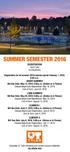 SUMMER SEMESTER 2016 REGISTRATION myuttyler my.uttyler.edu Registration for all summer 2016 sessions opens February 1, 2016; 8:30 a.m. SHORT SUMMER Bill Due Date: May 13, 2016; 5:00 p.m. (Online or in
SM 496: Sport Management Internship Spring 2014
 Husson University College of Business School of Hospitality, Sport, & Tourism Management A. Course Information Course Number & Title: SM 496: Sport Management Internship Number of Credits: 3 Day and Time
CMJ 152 LAW ENFORCEMENT & THE COMMUNITY Spring Syllabus 2015
 CMJ 152 LAW ENFORCEMENT & THE COMMUNITY Spring Syllabus 2015 INSTRUCTOR INFORMATION Associate Professor David Striegel Guerrieri Hall, Room 202D Office Phone: 410-572-8755 Office Hours: Monday 10:45 11:45
TEACHING OF INDEPENDENT STUDY CLASSES: RESULTS FROM THE FACULTY SENATE SURVEY
 Findings for All Colleges TEACHING OF INDEPENDENT STUDY CLASSES: RESULTS FROM THE FACULTY SENATE SURVEY A large minority of respondents (39.82%) report teaching independent study classes. A large majority
Denver Public Schools - East High School
 Denver Public Schools - East High School Return this page to the Technology Department in room 230 Electronic Web Access Agreement for Viewing Student Information via DPS Infinite Campus Parent/Student
STUDENT LEARNING OUTCOMES (common course SLOs): Upon completion of this course, students will be able to:
 CRJ 301: Research Methods in Criminal Justice Course Times: *** Professor: Melanie Taylor Office Hours: *** Email: [email protected] SAMPLE SYLLABUS COURSE DESCRIPTION: This course will provide an
Math Center Services and Organization
 STUDENT AFFAIRS FORUM Math Center Services and Organization Custom Research Brief Research Associate Amanda Michael Research Manager Nalika Vasudevan October 2012 2 of 12 3 of 12 Table of Contents I. Research
PSYCHOLOGY 1115. Fall Semester 2010 - Section M02 CRN #30377. Fundamentals of Psychology I. Tuesdays and Thursdays, 12:30-13:20 A130 (Newberry Hall)
 Instructor: Office: PSYCHOLOGY 1115 Fall Semester 2010 - Section M02 CRN #30377 Fundamentals of Psychology I Tuesdays and Thursdays, 12:30-13:20 A130 (Newberry Hall) ***You are responsible for all of the
Doctoral Dissertation Procedure
 Doctoral Dissertation Procedure The responsibility for a well organized presentation of personal research rests entirely upon the candidate and is in no sense a part of the instructional responsibility
Rutgers University, Department of Psychology Developmental Psychology Winter 2015. Office Hours Office Phone Email
 Developmental Psychology Winter 2015 1 Rutgers University, Department of Psychology Developmental Psychology Winter 2015 PROFESSOR Kaleigh Matthews Office Hours Office Phone Email Available by Smith 973-353-
PARTICIPANTS GUIDE TO SCHOOL OF PSYCHOLOGY (SOP) PLYMOUTH PSYLAB PAID SYSTEM
 PARTICIPANTS GUIDE TO SCHOOL OF PSYCHOLOGY (SOP) PLYMOUTH PSYLAB PAID SYSTEM Contents: Signing up to the database Page 2 Logging in Page 3 Complete the questionnaire Page 5 Change your password Page 6
The BA/MA Program Proposal Rutgers-Newark, Psychology
 The BA/MA Program 1 11/13/2015 The BA/MA Program Proposal Rutgers-Newark, Psychology Written and compiled by Master's Committee on 10/26/2015: Liz Bonawitz Will Graves Steve Hanson Barry Komisaruk Revised
Psychological Tests and Measurements PSYC 421-001 Summer 2016
 Psychological Tests and Measurements PSYC 421-001 Summer 2016 Professor: Gregory E. Everett, PhD Class Location: Alumni Hall, Room 0401 Office: Alumni Hall, Room 0142 Class Time: Tuesdays & Thursdays Phone:
Guide to Completing a Graduate Degree
 Guide to Completing a Graduate Degree Version 1 Fall 2013 Prepared by the Office of Research and Graduate Studies Version 1, Fall 2013 1 Table of Contents Completing a Graduate Degree at Pacific...2 Before
TERMS AND CONDITIONS OF USE OF WARWICK UNIVERSITY S SONA SYSTEM AND WARWICK EXPERIMENTAL LABORATORIES
 TERMS AND CONDITIONS OF USE OF WARWICK UNIVERSITY S SONA SYSTEM AND WARWICK EXPERIMENTAL LABORATORIES In order to be granted access to Warwick s SONA System (https://warwick.sona-systems.com/) for managing
Course Title: General Psychology CRN: Course Prefix: PSYC Course No.: 1113 Section No.:
 Course Title: General Psychology CRN: Course Prefix: PSYC Course No.: 1113 Section No.: Department of Psychology College of Juvenile Justice and Psychology Instructor Name: Office Location: Psychology
New Weekend College Application, Payment and Online Registration Process
 New Weekend College Application, Payment and Online Registration Process Please follow steps in the order listed 1. Prior to registering for courses, students must complete a Teacher Licensure Program-
1 of 18 2/14/2014 11:33 AM
 1 of 18 2/14/2014 11:33 AM ATHABASCA UNIVERSITY. CANADA'S OPEN UNIVERSITY. Welcome, You have 1 incomplete application. Please click on the one that you want to edit. Then open the "Welcome" message for
PY345 ABNORMAL PSYCHOLOGY COURSE SYLLABUS FALL, 2013 MWF 12:00-12:50
 PY345 ABNORMAL PSYCHOLOGY COURSE SYLLABUS FALL, 2013 MWF 12:00-12:50 Instructor: Jared Bartels, Ph.D. Office: Baity Hall 108a Email: [email protected] Phone: 660-831-4127 Office Hours: MWF 10:00-11:30;
Master of Public Affairs Graduate Policy Manual
 Master of Public Affairs Graduate Policy Manual Established August 27, 2012 Page 1 Mission Statement The mission of the School of Public & Environmental Affairs Program is to sustain a diverse, collaborative
GRADUATE PROGRAM, DEPARTMENT OF GEOLOGY AND PLANETARY SCIENCE UNIVERSITY OF PITTSBURGH
 DOCTOR OF PHILOSOPHY DEGREE Consult the latest Bulletin of the Graduate Programs of the Faculty of Arts and Sciences (http://www.pitt.edu/~graduate/) for general regulations. The material presented here
Graduate Programs in Psychology
 SAN FRANCISCO STATE UNIVERSITY Graduate Programs in Psychology The Psychology Department presently offers six master s degree programs. Three lead to the Master of Arts in Psychology with concentrations
GUIDELINES FOR DOCTORAL STUDENT PARTICIPATION IN GRADUATION CEREMONY AND PROGRESS TO DEGREE AWARD
 2015 Frostburg State University Office of Graduate Services GUIDELINES FOR DOCTORAL STUDENT PARTICIPATION IN GRADUATION CEREMONY AND PROGRESS TO DEGREE AWARD 1 REV 1 30 15 Table of Contents Expectations
Academic Policies and Procedures
 Academic Policies and Procedures Academic policies can be changed at any time by the University of North Texas Health Science Center School of Public Health (UNTHSC-SPH). Students should review the Student
COURSE OBJECTIVES AND STUDENT LEARNING OUTCOMES:
 Psychology 2301: General Psychology Blinn College, Spring 2011 Course Syllabus Section N4 Instructor: Barbara Corbisier, M.A., M.S. Office Hours: A238 T/TH 10-noon or by appt. Office Phone: 209-7314 email:
School of Psychology On-line Subject Pool
 School of Psychology On-line Subject Pool General information about the Subject Pool It is a core requirement for entry into PSY441 Psychology Project (BPsych) and PSY4039 Honours Thesis that students
Department of Geography, University of Florida. Fall 2014
 Department of Geography, University of Florida Fall 2014 Dr. Michael Binford, Chair Dr. Corene Matyas, Graduate Coordinator Ms. Desiree Price, Graduate Secretary 3141 Turlington Hall P.O. Box 117315 Gainesville
Lebanese American University
 Lebanese American University School of Arts and Sciences Graduate Student Guide October 2, 2015 1. Preamble This guide highlights major issues and questions that students may face during their graduate
Guidelines for Note Takers
 Services for Students with Disabilities Guidelines for Note Takers August, 2009 (Revised) Table of Contents Introduction..3 Documentation of Disability...3 Qualifications for Note Takers.. 4 Obtaining
Psychology 261, Fall 2012 Physiological Psychology
 Last Updated: September 9 th, 2012 1 Psychology 261, Fall 2012 Physiological Psychology Class Time: Tuesdays & Thursdays, 11:30 12:50 Location: AL 113 Instructor: Candice Jensen Office: PAS 2248 Office
Psychology Graduate Guidelines
 Psychology Graduate Guidelines 2015 Psychology Graduate Guidelines Table of Contents General Guidelines & Rules... 3 Graduate School Information... 5 Core Courses... 5 First Year Project... 6 Thesis/Master
Criminal Justice Internship Handbook CRJU 3398
 Criminal Justice Internship Handbook CRJU 3398 Department of Sociology and Criminal Justice Contact: Prof. Peter Fenton Office Phone 470 578-2292 [email protected] PREPARING FOR YOUR INTERNSHIP Read
Department of Psychology Policies and Procedures Revised by Faculty Vote February 8, 2012
 Department of Psychology Policies and Procedures Revised by Faculty Vote February 8, 2012 PsychByLaws_gm_04292012.doc This document describes the policies and procedures by which the Department of Psychology
GRADUATE DEGREE REGULATIONS
 Graduate Regulations-Spring 2014 1 GRADUATE DEGREE REGULATIONS DEPARTMENT OF PSYCHOLOGY UNIVERSITY OF FLORIDA GRADUATE DEGREE REGULATIONS 1 I. GENERAL INFORMATION 2 A. Graduate Advisor/Supervisory Committee.
BACHELOR S ESSAY GUIDELINES Adopted by vote of the department faculty: March 28, 2006
 BACHELOR S ESSAY GUIDELINES Adopted by vote of the department faculty: March 28, 2006 Introduction The following guidelines have been adopted by the Department of Communication to provide guidance to students
2015-2016 Program Guidebook. Ph.D. Applied Behavior Analysis (Post-Master s)
 2015-2016 Program Guidebook Ph.D. Applied Behavior Analysis (Post-Master s) NOTE: 1) This guidebook is subject to change. If it does, students will be notified via email and will be provided with the revised
2015-2016. HESA M.A. Handbook. Student Personnel Assistantship Program Higher Education and Student Affairs 2015-2016
 Student Personnel Assistantship Program Higher Education and Student Affairs 2015-2016 HESA M.A. Handbook 2015-2016 This handbook is intended to be a resource for Master of Arts students in the Higher
Graduate Program Policies and Procedures
 The University of British Columbia Department of Physics & Astronomy Graduate Program Policies and Procedures Sept 2011 Table of Contents 1. Introduction!... 4 2. Programs!... 4 3. Admissions!... 4 3.1.
Psych 211: Developmental Psychology WINTER 2013. Course Location : Arts Lecture Hall 116 Meeting Times: Mondays & Wednesdays, 4:30pm to 5:50pm
 Psych 211: al Psychology WINTER 2013 Course Location : Arts Lecture Hall 116 Meeting Times: Mondays & Wednesdays, 4:30pm to 5:50pm Instructor: Mathieu Le Corre Office Number: PAS 4010 Office Hours: By