
2015 PQRS Requirements: What Eligible Professionals Need to Know to Avoid the PQRS Penalty in 2017
|
|
|
- Alexia Garrison
- 10 years ago
- Views:
Transcription
1 2015 PQRS Requirements: What Eligible Professionals Need to Know to Avoid the PQRS Penalty in 2017 Presented by: Camille Bonta, MHS Summit Health Care Consulting

2 Physician Quality Reporting System What is PQRS? Quality reporting program that effects Medicare payments made to eligible professionals based on whether they satisfactorily report data on quality measures for covered professional services furnished during a specified reporting period. Program is required by law. Initially authorized by Congress in Affordable Care Act extended incentives through 2014 and required a penalty beginning in 2015.
3 Physician Quality Reporting System Why Participate in PQRS? -2% payment penalty in 2017 and beyond. PQRS reporting forms the basis for Physician Compare. Value-based modifier tied to PQRS participation. Commercial payers are paying attention.

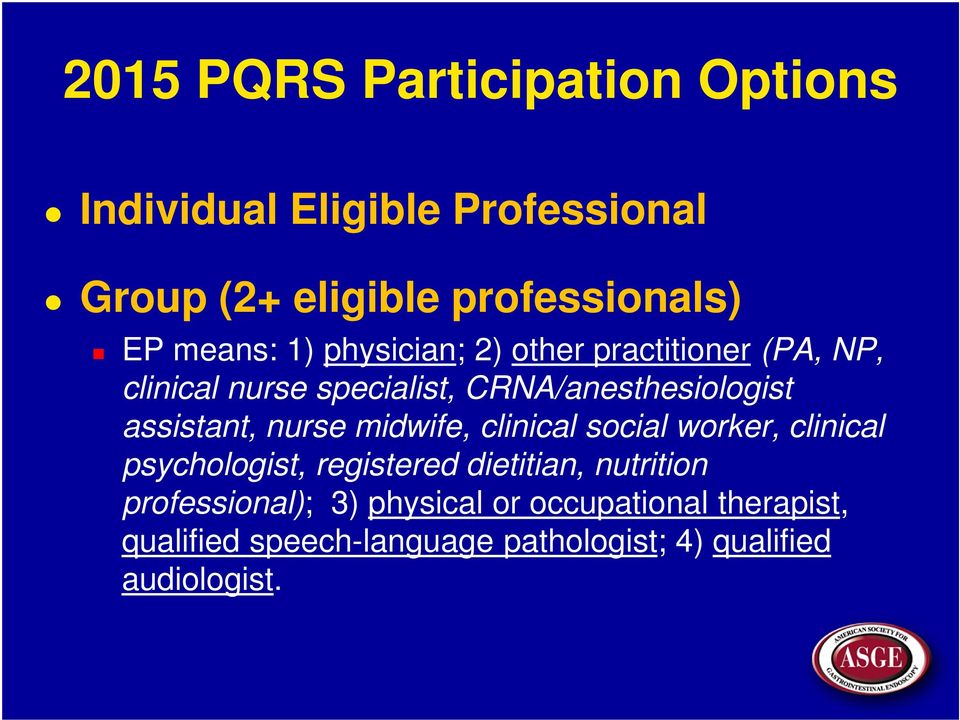
4 2015 PQRS Participation Options Individual Eligible Professional Group (2+ eligible professionals) EP means: 1) physician; 2) other practitioner (PA, NP, clinical nurse specialist, CRNA/anesthesiologist assistant, nurse midwife, clinical social worker, clinical psychologist, registered dietitian, nutrition professional); 3) physical or occupational therapist, qualified speech-language pathologist; 4) qualified audiologist.
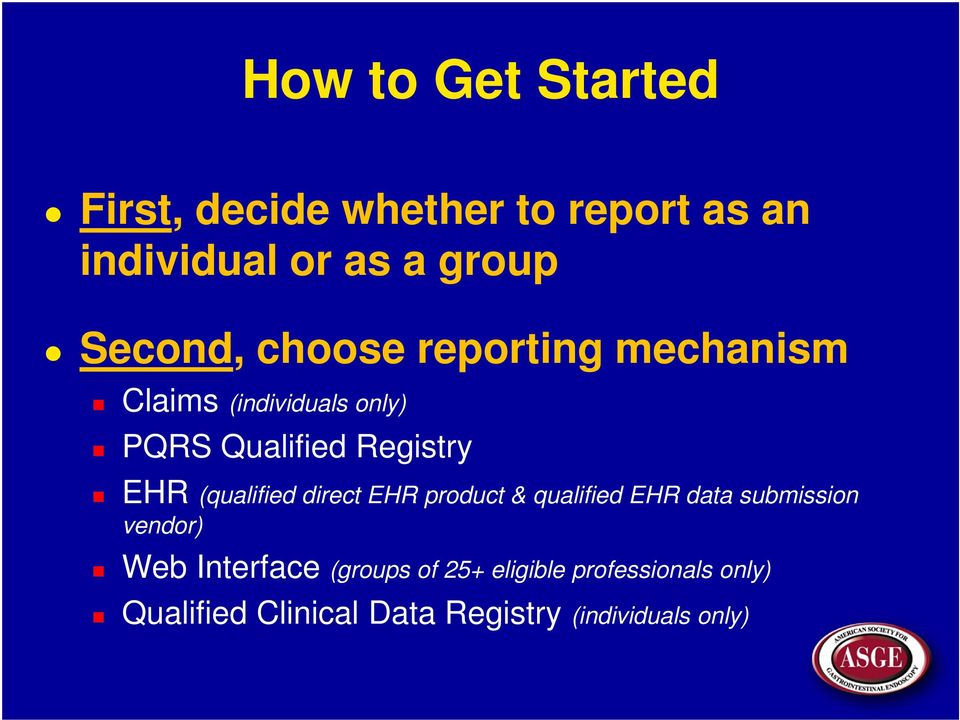
5 How to Get Started First, decide whether to report as an individual or as a group Second, choose reporting mechanism Claims (individuals only) PQRS Qualified Registry EHR (qualified direct EHR product & qualified EHR data submission vendor) Web Interface (groups of 25+ eligible professionals only) Qualified Clinical Data Registry (individuals only)
6 How to Get Started Third, choose measures If PQRS qualified registry option is chosen, decide to report individual measures or measures group. Fourth, report No need to register for PQRS for individual reporting, groups must register.

7 How to Avoid 2015 Penalty: Individual EP Qualified Clinical Data Registry Report at least 9 measures covering at least 3 NQS domains for 50% of applicable patients. Of the 9 measures, at least 2 must be outcome measures. If 2 outcomes measures are not available, the eligible professional can report on at least 1 outcome measure and at least 1 of the following types of measures: resource, patient experience of care, efficiency/appropriate use, or patient safety.

8 GIQuIC: An ASGE-ACG Benchmarking Program Improve outcomes through better documentation. Set the stage for improved reimbursements. Metrics from participating physicians, ASCs, offices and hospitals will be shared to:...identify gaps in care...develop quality indicators...provide benchmarking reports Click Practice Management at ASGE online. 8

9 How to Avoid 2015 Penalty: Medicare Claims: Individual EP Report at least 9 measures covering at least 3 National Quality Strategy (NQS) domains and report each measure for at least 50% of Medicare Part B FFS patients seen during the reporting period to which the measure applies (Jan. 1-Dec. 31, 2015). One measure must be a cross-cutting measure. Qualified Registry: Report at least 9 measures for 50% of applicable Medicare FFS patients covering at least 3 NQS domains. One measure must be a cross-cutting measure. or Report at least 1 measures group and report each measures group for at least 20 patients, a majority (11) of whom must be Medicare Part B FFS patients.

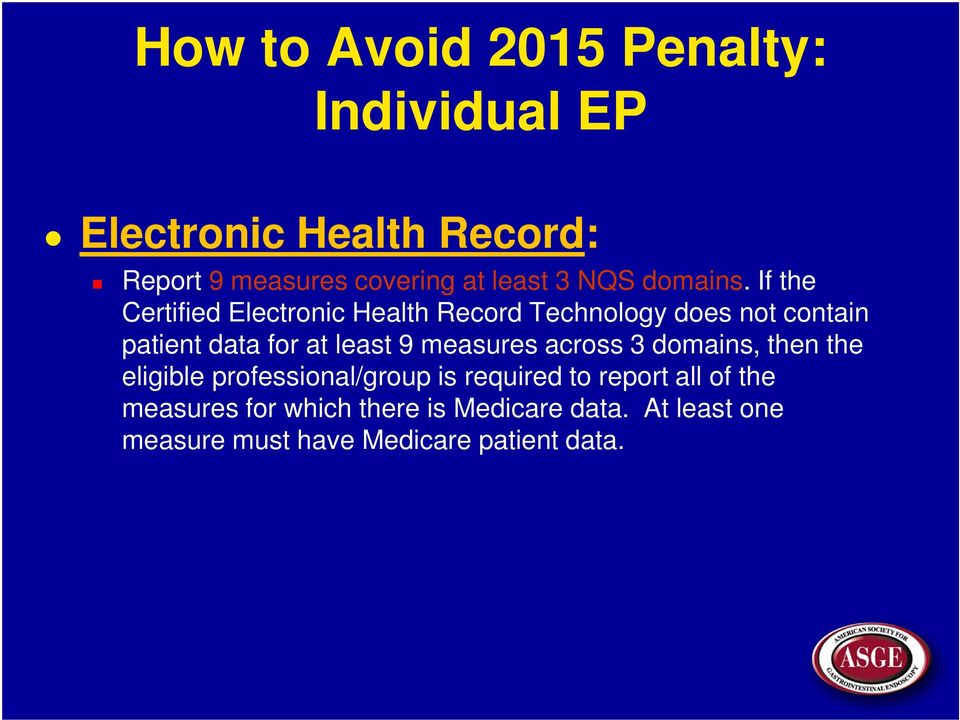
10 How to Avoid 2015 Penalty: Individual EP Electronic Health Record: Report 9 measures covering at least 3 NQS domains. If the Certified Electronic Health Record Technology does not contain patient data for at least 9 measures across 3 domains, then the eligible professional/group is required to report all of the measures for which there is Medicare data. At least one measure must have Medicare patient data.
11 Group Practice Reporting What is the benefit of the Group Practice Reporting Option (GPRO)? Billing and reporting staff may report one set of quality measures data on behalf of all EPs within a group practice, reducing the need to keep track of EPs reporting efforts separately. Those EPs who have difficulty meeting the reporting requirements for individual EPs may benefit from group reporting.

12 How to Report as a Group Practice First, meet group criteria Defined as: a single Tax Identification Number (TIN), with 2 or more individual EPs (as identified by individual NPIs) who have reassigned their billing rights to the TIN. The size of the group practice must be established by the time the group is selected to participate in the GPRO. If the practice changes its TIN after being selected, it cannot continue to participate in PQRS through the GPRO.

13 How to Report as a Group Practice Second, self-nominate for GPRO A group practice must self-nominate via the Web to participate in the PQRS Group Practice Reporting Option (GPRO). The group must register to participate in the GPRO by June 30 of the reporting period (June 30, 2015).
14 How to Avoid 2015 Penalty: Group Qualified Registry: Report at least 9 measures for 50% of applicable Medicare FFS patients covering at least 3 NQS domains. One measure must be a cross-cutting measure. Electronic Health Record: Report 9 measures covering at least 3 NQS domains. If the Certified Electronic Health Record Technology does not contain patient data for at least 9 measures across 3 domains, then the eligible professional/group is required to report all of the measures for which there is Medicare data. At least one measure must have Medicare patient data.

15 How to Avoid 2015 Penalty: Group CMS-Certified Survey Vendor: CMS gives the option for group practices of 25 or more eligible professionals to report the CG-CAHPS measures via a Certified Survey Vendor. (CG-CAHPS = Clinicians & Groups Consumer Assessment of Healthcare Providers and Systems Survey) CMS requires group practices with 100 or more eligible professionals that participate in the PQRS GPRO to report the CG- CAHPS measures. Group practices that report the CG-CAHPS measures must also report on additional PQRS measures using a registry, EHR or GPRO Web Interface.

16 Claims vs. Registry Reporting In 2012, ~25% of EPs who submitted measures via claims did not earn an incentive payment. The most common claims-based submission error was reporting a measure-specific Quality Data Code (QDC) on a claim that did not also have the required procedure code. Highest success rates with GPRO Web Interface (100%), EHR (94%), Registry (85%).

17 PQRS Measures 2015 PQRS Measures List with Specifications When choosing measures, pay attention to: Can your measure be reported via your selected mechanism? (Range of reporting mechanisms not available for all measures.) Do your measures cover 3 quality domains? Do you have patients for which the measures will be applicable? (Measures with zero performance will not be counted.) For claims and registry, have you chosen a cross-cutting measure (See Table 52 of Final Rule.)
18 PQRS Measures PQRS Measures for 2015 Endoscopy and Polyp Surveillance: #320 Appropriate Follow-Up Interval for Normal Colonoscopy in Average Risk Patients (claims, registry) #185 Colonoscopy Interval for Patients with a History of Adenomatous Polyps Avoidance of Inappropriate Use (claims, registry) Screening Colonoscopy: Adenoma Detection Rate Measure - #343 (registry) Colorectal Cancer Screening - #113 (claims, registry, EHR, GPRO Web-Interface, Measures Group)

19 PQRS Measures What happens if an EP doesn t have 9 applicable measures? CMS will use the measure application validation (MAV) process to determine whether an eligible professional should have reported quality data codes for additional measures. MAV process will also be used for the cross-cutting measure requirement. When choosing measures, consider the Value-based Payment Modifier (VBM). Your performance on PQRS measures will be benchmarked against other EPs that report that measure (regardless of specialty).

20 Value-Based Payment Modifier What is the Value-Based Payment Modifier? Affordable Care Act requires Medicare to phase in a value-based payment modifier (VBM) that applies to Medicare physician FFS payments starting in 2015, with the VBM applying to all physicians by The VBM assesses both quality of care and the cost of the care delivered.

21 Value-Based Payment Modifier Application of the VBM for the 2017 payment year VBM will be applied to physician payment for all groups of 2+ eligible professionals and solo practitioners. Performance year for the 2017 VBM is Application of the VBM is tied to successful PQRS participation.
22 Value-Based Payment Modifier Two VBM Categories: Category 1: PQRS reporters Category 2: Non-PQRS reporters (automatic penalty) Two ways to get placed in Category 1: #1 Self-nominate for GPRO and successfully report (avoid 2017 PQRS penalty). #2 At least 50% of EPs in the group practice successfully report (avoid 2017 PQRS penalty) in PQRS as individuals.
23 Value-Based Payment Modifier What Happens to Groups in Category 1? Mandatory quality tiering to calculate performance on clinical quality and cost measures. Groups 2-9 EPs and solo practitioners are held harmless from any downward adjustments in Groups 10+ EPs can receive upward, neutral or downward adjustment (capped at -4%).
24 Value-Based Payment Modifier Application of the Value-Based Payment Modifier in 2017
25 Value-Based Payment Modifier Application of the Value-Based Payment Modifier in 2017 (x) = the upward payment adjustment factor which will be established after the performance period has ended. Because the VBP modifier is budget neutral, (x) is based on the aggregate amount of downward payment adjustments.
26 PQRS Resources QualityNet Help Desk: Program and measure-specific questions (866) CMS: How to get started, measure specifications, reporting mechanisms/criteria
27 Additional Questions Regulatory Compliance Lakitia Mayo ASGE Director of Health Policy and Quality (630) ASGE Quality Improvement / GIQuIC Eden Essex ASGE Assistant Director of Quality and Health Policy [email protected] (630)
28 QUESTIONS
29 2015 PQRS Requirements: What Eligible Professionals Need to Know to Avoid the PQRS Penalty in 2017 Presented by: Camille Bonta, MHS Summit Health Care Consulting
30 Physician Quality Reporting System What is PQRS? Quality reporting program that effects Medicare payments made to eligible professionals based on whether they satisfactorily report data on quality measures for covered professional services furnished during a specified reporting period. Program is required by law. Initially authorized by Congress in Affordable Care Act extended incentives through 2014 and required a penalty beginning in 2015.
31 Physician Quality Reporting System Why Participate in PQRS? -2% payment penalty in 2017 and beyond. PQRS reporting forms the basis for Physician Compare. Value-based modifier tied to PQRS participation. Commercial payers are paying attention.
32 2015 PQRS Participation Options Individual Eligible Professional Group (2+ eligible professionals) EP means: 1) physician; 2) other practitioner (PA, NP, clinical nurse specialist, CRNA/anesthesiologist assistant, nurse midwife, clinical social worker, clinical psychologist, registered dietitian, nutrition professional); 3) physical or occupational therapist, qualified speech-language pathologist; 4) qualified audiologist.
33 How to Get Started First, decide whether to report as an individual or as a group Second, choose reporting mechanism Claims (individuals only) PQRS Qualified Registry EHR (qualified direct EHR product & qualified EHR data submission vendor) Web Interface (groups of 25+ eligible professionals only) Qualified Clinical Data Registry (individuals only)
34 How to Get Started Third, choose measures If PQRS qualified registry option is chosen, decide to report individual measures or measures group. Fourth, report No need to register for PQRS for individual reporting, groups must register.
35 How to Avoid 2015 Penalty: Individual EP Qualified Clinical Data Registry Report at least 9 measures covering at least 3 NQS domains for 50% of applicable patients. Of the 9 measures, at least 2 must be outcome measures. If 2 outcomes measures are not available, the eligible professional can report on at least 1 outcome measure and at least 1 of the following types of measures: resource, patient experience of care, efficiency/appropriate use, or patient safety.
36 GIQuIC: An ASGE-ACG Benchmarking Program Improve outcomes through better documentation. Set the stage for improved reimbursements. Metrics from participating physicians, ASCs, offices and hospitals will be shared to:...identify gaps in care...develop quality indicators...provide benchmarking reports Click Practice Management at ASGE online. 8
37 How to Avoid 2015 Penalty: Medicare Claims: Individual EP Report at least 9 measures covering at least 3 National Quality Strategy (NQS) domains and report each measure for at least 50% of Medicare Part B FFS patients seen during the reporting period to which the measure applies (Jan. 1-Dec. 31, 2015). One measure must be a cross-cutting measure. Qualified Registry: Report at least 9 measures for 50% of applicable Medicare FFS patients covering at least 3 NQS domains. One measure must be a cross-cutting measure. or Report at least 1 measures group and report each measures group for at least 20 patients, a majority (11) of whom must be Medicare Part B FFS patients.
38 How to Avoid 2015 Penalty: Individual EP Electronic Health Record: Report 9 measures covering at least 3 NQS domains. If the Certified Electronic Health Record Technology does not contain patient data for at least 9 measures across 3 domains, then the eligible professional/group is required to report all of the measures for which there is Medicare data. At least one measure must have Medicare patient data.
39 Group Practice Reporting What is the benefit of the Group Practice Reporting Option (GPRO)? Billing and reporting staff may report one set of quality measures data on behalf of all EPs within a group practice, reducing the need to keep track of EPs reporting efforts separately. Those EPs who have difficulty meeting the reporting requirements for individual EPs may benefit from group reporting.
40 How to Report as a Group Practice First, meet group criteria Defined as: a single Tax Identification Number (TIN), with 2 or more individual EPs (as identified by individual NPIs) who have reassigned their billing rights to the TIN. The size of the group practice must be established by the time the group is selected to participate in the GPRO. If the practice changes its TIN after being selected, it cannot continue to participate in PQRS through the GPRO.
41 How to Report as a Group Practice Second, self-nominate for GPRO A group practice must self-nominate via the Web to participate in the PQRS Group Practice Reporting Option (GPRO). The group must register to participate in the GPRO by June 30 of the reporting period (June 30, 2015).
42 How to Avoid 2015 Penalty: Group Qualified Registry: Report at least 9 measures for 50% of applicable Medicare FFS patients covering at least 3 NQS domains. One measure must be a cross-cutting measure. Electronic Health Record: Report 9 measures covering at least 3 NQS domains. If the Certified Electronic Health Record Technology does not contain patient data for at least 9 measures across 3 domains, then the eligible professional/group is required to report all of the measures for which there is Medicare data. At least one measure must have Medicare patient data.
43 How to Avoid 2015 Penalty: Group CMS-Certified Survey Vendor: CMS gives the option for group practices of 25 or more eligible professionals to report the CG-CAHPS measures via a Certified Survey Vendor. (CG-CAHPS = Clinicians & Groups Consumer Assessment of Healthcare Providers and Systems Survey) CMS requires group practices with 100 or more eligible professionals that participate in the PQRS GPRO to report the CG- CAHPS measures. Group practices that report the CG-CAHPS measures must also report on additional PQRS measures using a registry, EHR or GPRO Web Interface.
44 Claims vs. Registry Reporting In 2012, ~25% of EPs who submitted measures via claims did not earn an incentive payment. The most common claims-based submission error was reporting a measure-specific Quality Data Code (QDC) on a claim that did not also have the required procedure code. Highest success rates with GPRO Web Interface (100%), EHR (94%), Registry (85%).
45 PQRS Measures 2015 PQRS Measures List with Specifications When choosing measures, pay attention to: Can your measure be reported via your selected mechanism? (Range of reporting mechanisms not available for all measures.) Do your measures cover 3 quality domains? Do you have patients for which the measures will be applicable? (Measures with zero performance will not be counted.) For claims and registry, have you chosen a cross-cutting measure (See Table 52 of Final Rule.)
46 PQRS Measures PQRS Measures for 2015 Endoscopy and Polyp Surveillance: #320 Appropriate Follow-Up Interval for Normal Colonoscopy in Average Risk Patients (claims, registry) #185 Colonoscopy Interval for Patients with a History of Adenomatous Polyps Avoidance of Inappropriate Use (claims, registry) Screening Colonoscopy: Adenoma Detection Rate Measure - #343 (registry) Colorectal Cancer Screening - #113 (claims, registry, EHR, GPRO Web-Interface, Measures Group)
47 PQRS Measures What happens if an EP doesn t have 9 applicable measures? CMS will use the measure application validation (MAV) process to determine whether an eligible professional should have reported quality data codes for additional measures. MAV process will also be used for the cross-cutting measure requirement. When choosing measures, consider the Value-based Payment Modifier (VBM). Your performance on PQRS measures will be benchmarked against other EPs that report that measure (regardless of specialty).
48 Value-Based Payment Modifier What is the Value-Based Payment Modifier? Affordable Care Act requires Medicare to phase in a value-based payment modifier (VBM) that applies to Medicare physician FFS payments starting in 2015, with the VBM applying to all physicians by The VBM assesses both quality of care and the cost of the care delivered.
49 Value-Based Payment Modifier Application of the VBM for the 2017 payment year VBM will be applied to physician payment for all groups of 2+ eligible professionals and solo practitioners. Performance year for the 2017 VBM is Application of the VBM is tied to successful PQRS participation.
50 Value-Based Payment Modifier Two VBM Categories: Category 1: PQRS reporters Category 2: Non-PQRS reporters (automatic penalty) Two ways to get placed in Category 1: #1 Self-nominate for GPRO and successfully report (avoid 2017 PQRS penalty). #2 At least 50% of EPs in the group practice successfully report (avoid 2017 PQRS penalty) in PQRS as individuals.
51 Value-Based Payment Modifier What Happens to Groups in Category 1? Mandatory quality tiering to calculate performance on clinical quality and cost measures. Groups 2-9 EPs and solo practitioners are held harmless from any downward adjustments in Groups 10+ EPs can receive upward, neutral or downward adjustment (capped at -4%).
52 Value-Based Payment Modifier Application of the Value-Based Payment Modifier in 2017
53 Value-Based Payment Modifier Application of the Value-Based Payment Modifier in 2017 (x) = the upward payment adjustment factor which will be established after the performance period has ended. Because the VBP modifier is budget neutral, (x) is based on the aggregate amount of downward payment adjustments.
54 PQRS Resources QualityNet Help Desk: Program and measure-specific questions (866) CMS: How to get started, measure specifications, reporting mechanisms/criteria
55 Additional Questions Regulatory Compliance Lakitia Mayo ASGE Director of Health Policy and Quality (630) ASGE Quality Improvement / GIQuIC Eden Essex ASGE Assistant Director of Quality and Health Policy [email protected] (630)
56 QUESTIONS
Physician Quality Reporting System (PQRS) And VBM (Value Based Modifier) A Primer on Present and Future Requirements
 Physician Quality Reporting System (PQRS) And VBM (Value Based Modifier) A Primer on Present and Future Requirements Brett Bernstein, MD, AGAF Chief Quality Officer, Beth Israel Ambulatory Endoscopy Services
Major Changes in CY2015 MPFS Quality Provisions. Physician Compare
 Major Changes in CY2015 MPFS Quality Provisions Physician Compare In addition to previously finalized Physician Quality Reporting System (PQRS) quality measure data to be publicly reported beginning in
12/5/2014. What is PQRS? Performance Measurement Committee Practical Theater. Historical concerns with the program (continued)
 What is PQRS? Navigating CMS Quality Initiatives: How to Successfully Report and Avoid Payment Adjustments Performance Measurement Committee Practical Theater A federally mandated Medicare Part B quality
QUALITY BEGINNER. PQRS Training Module: QUALITY MEASUREMENT 101. Last Updated: August 2014
 QUALITY 01 BEGINNER PQRS Training Module: QUALITY MEASUREMENT 101 Last Updated: August 2014 TRAINING MODULE OBJECTIVES Quality Measurement 101 is a training module for providers who are interested in learning
Physician Quality Reporting System (PQRS)
 Physician Quality Reporting System (PQRS) Presenter: Alexandra Mugge 4 PQRS Overview CY2018 payment adjustments, based on PY2016 reporting: -2.0% MPFS Changes to PQRS Definition of eligible professional
How to Avoid 2016 Negative Payment Adjustments for CMS Medicare Quality Reporting Programs. September 17, 2014
 How to Avoid 2016 Negative Payment Adjustments for CMS Medicare Quality Reporting Programs September 17, 2014 The Medicare Learning Network This MLN Connects National Provider Call (MLN Connects Call)
CMS s framework for Value Modifier
 CMS s framework for Value Modifier Relationship between quality of care, cost composites and the Value Modifier Clinical Care Patient Experience Population/ Community Health Patient Safety Care Coordination
Clinical Quality Measures Physician Quality Reporting System 2014
 Clinical Quality Measures Physician Quality Reporting System 2014 Marcela Reyes, CHTS- CP Sevocity Product Manager 877-777-2298!! www.sevocity.com! 2014 CQMs CQMs are no longer a core objective of the
Physician Quality Reporting System (PQRS)
 Physician Quality Reporting System (PQRS) and the Value-Based Payment Modifier Implementation guide for registry-based reporting for the Hepatitis C (HCV) Measures Group 2015 1 Overview of PQRS 1,2 What
CMS is requesting information to aid in the planning and implementation of the MIPS in the following areas:
 Summary of Medicare s Request for Information on the Provisions in MACRA which Allow for Implementation of Alternative Payment Models and a Merit-Based Incentive Payment System On September 28, 2015, the
Physician Quality Reporting System (PQRS) Qualified Clinical Data Registry (QCDR) QCDR Reporting Overview. Program Year 2014
 Physician Quality Reporting System (PQRS) Qualified Clinical Data Registry (QCDR) QCDR Reporting Overview Program Year 2014 Disclaimers This presentation was current at the time it was published or uploaded
Overview of the Development and Implementation of CAHPS for ACOs and PQRS. Sandra Adams, RN, BSN Lauren Fuentes, MPH.
 CAHPS for ACOs and PQRS Overview of the Development and Implementation of CAHPS for ACOs and PQRS Sandra Adams, RN, BSN Lauren Fuentes, MPH July 10-11, 2014 Agenda Overview of the Medicare Shared Savings
CMS PQRS and VBPM Incentive/Penalty Programs. Devin Detwiler Manager Quality Improvement Telligen
 CMS PQRS and VBPM Incentive/Penalty Programs Devin Detwiler Manager Quality Improvement Telligen Free Resource to you Join our Network Engage providers and stakeholders in improvement initiatives through
Transforming Healthcare through Data-Driven Solutions. Pay for Performance Solutions
 Transforming Healthcare through Data-Driven Solutions Pay for Performance Solutions Medicare Access and CHIP Reauthorization Act of 2015 MACRA Enacted April 15, 2015 10/14/2015 Copyright Mingle Analytics
Clinical Quality Measures (CQMs) What are CQMs?
 Clinical Quality Measures (CQMs) What are CQMs? What are CQMs? Clinical quality measures, or CQMs, are tools that help eligible providers (EPs) measure and track the quality of health care services provided
2015 Physician Quality Reporting System (PQRS): Implementation Guide
 2015 Physician Quality Reporting System (PQRS): Implementation Guide 1/15/2015; Revised Table of Contents Introduction... 3 PQRS Measure Selection Considerations... 6 Satisfactorily Report Measures...
2016 Physician Quality Reporting System (PQRS) Measure Specification and Measure Flow Guide for Claims and Registry Reporting of Individual Measures
 2016 Physician Quality Reporting System (PQRS) Measure Specification and Measure Flow Guide for Claims and Registry Reporting of Individual Measures Utilized by Individual Eligible Professionals for Claims
Allscripts CQS Planning for 2014 Webinar: FAQs
 Allscripts CQS Planning for 2014 Webinar: FAQs Listed below are questions asked by attendees based on the CQS Planning for 2014 Webinars, held on May 8, May 28, and May 30, 2014. Answers are provided below.
Welcome The AAMC, UHC and FPSC Web Conference on 2014 PQRS Proposed Changes will begin shortly.
 Welcome The AAMC, UHC and FPSC Web Conference on 2014 PQRS Proposed Changes will begin shortly. Please do not place your phones on hold. If you need to leave the event, hang up and dial back into the conference.
The Medicare Quality Reporting Programs: What Eligible Professionals Need to Know in 2016
 The Medicare Quality Reporting Programs: What Eligible Professionals Need to Know in 2016 Modules Module 1: Medicare Access and CHIP Reauthorization Act (MACRA) Preview Module 2: 2016 Incentive Payments
Navigating CMS Incentive Programs for Eligible Professionals Why It Matters and What You Need to Know. Dr. Paul Mulhausen, CMO
 Navigating CMS Incentive Programs for Eligible Professionals Why It Matters and What You Need to Know Dr. Paul Mulhausen, CMO Objectives Better understand CMS Incentive Programs and payment adjustments
Accountable Care Organizations (ACO) Proposed Rule Summary March 31, 2011
 Accountable Care Organizations (ACO) Proposed Rule Summary March 31, 2011 On March 31, 2011, the Centers for Medicare & Medicaid Services (CMS) released the longawaited proposed rule on Accountable Care
Auditing PQRS & Meaningful Use To Maintain Compliance. Standard Disclaimer. Learning Objectives 12/2/2014
 2014 NAMAS Conference Asheville, NC December 9, 2014 Auditing PQRS & Meaningful Use To Maintain Compliance Presented by David J. Zetter, PHR, CHCC, CPCO, CPC, CPC-H, PCS, FCS, CHBC, CMUP Standard Disclaimer
2014 Physician Quality Reporting System (PQRS): Implementation Guide 12/13/2013
 2014 Physician Quality Reporting System (PQRS): Implementation Guide 12/13/2013 CPT only copyright 2013 American Medical Association. All rights reserved. Page 1 of 41 Table of Contents Page Introduction
Purdue Research Foundation
 PQRS: Leveraging Technology to Improve Quality and Ease Reporting Burdens Tara Hatfield RN, BSN, CHTS-CP Managing Advisor MU/PQRS Purdue Healthcare Advisors Objectives Understand the impact of the PQRS
Surgeon s Guide to Understanding the Physician Quality Reporting System
 P a g e 1 Surgeon s Guide to Understanding the Physician Quality Reporting System Table of Content What is PQRS?... 2 Table 1. PQRS payment penalties... 2 What are my 2016 PQRS reporting options?... 2
The Medicare Access and CHIP Reauthorization Act of 2015 (MACRA) Summary of SGR Repeal and Replacement Provisions
 ACOG Government Affairs May 2015 The Medicare Access and CHIP Reauthorization Act of 2015 (MACRA) Summary of SGR Repeal and Replacement Provisions This landmark bipartisan legislation, signed into law
Medicare Physician Reporting: Beyond PQRS. Mary Patton Wheatley Senior Specialist, AAMC August 17, 2011
 Medicare Physician Reporting: Beyond PQRS Mary Patton Wheatley Senior Specialist, AAMC August 17, 2011 Who is the AAMC? The Association of American Medical Colleges (AAMC) serves and leads the academic
CMS Quality Measurement and Value Based Purchasing Programs Kate Goodrich, MD MHS Director, Quality Measurement and Health Assessment Group, CMS
 CMS Quality Measurement and Value Based Purchasing Programs Kate Goodrich, MD MHS Director, Quality Measurement and Health Assessment Group, CMS American Urological Association Quality Improvement Summit
CMS QCDR (Qualified Clinical Data Registry) and Other Ways PPRNet Can Help with Value-Based Payment
 CMS QCDR (Qualified Clinical Data Registry) and Other Ways PPRNet Can Help with Value-Based Payment Cara Litvin MD, MS Assistant Professor MUSC Department of Medicine Agenda Provide an update of the current
Sustainable Growth Rate (SGR) Repeal and Replace: Comparison of 2014 and 2015 Legislation
 Sustainable Growth Rate (SGR) Repeal and Replace: Comparison of 2014 and 2015 Legislation Proposal 113 th Congress - - H.R.4015/S.2000 114 th Congress - - H.R.1470 SGR Repeal and Annual Updates General
Summary of the Key Provisions in the Medicare Final Rule on the 2015 Physician Fee Schedule
 Summary of the Key Provisions in the Medicare Final Rule on the 2015 Physician Fee Schedule Sustainable Growth Rate (SGR) Formula and 2015 Medicare Conversion Factor Congressional intervention to avert
CMS Initiatives Involving Patient Experience Surveying FAQs
 CMS Initiatives Involving Patient Experience Surveying FAQs Updated October 2013 Prepared by: DSS Research CAHPS is a registered trademark of the Agency for Healthcare Research and Quality (AHRQ). The
Physician Compare Virtual Office Hour Questions and Answers
 Physician Compare Virtual Office Hour Questions and Answers The Physician Compare Virtual Office Hour session was held on January 22, 2015 via WebEx. The purpose of the session was to allow the Centers
What GI Practices Need to Know About the Electronic Health Record Incentive Program. Joel V. Brill, MD, AGAF Lawrence R. Kosinski, MD, MBA, AGAF
 What GI Practices Need to Know About the Electronic Health Record Incentive Program Joel V. Brill, MD, AGAF Lawrence R. Kosinski, MD, MBA, AGAF Disclosures Joel V. Brill, MD AGAF AGA Registry Executive
Accountable Care Organizations: Importance to Physicians in Value Based Payment June 19, 2014 12:00-1:00pm EST
 Accountable Care Organizations: Importance to Physicians in Value Based Payment June 19, 2014 12:00-1:00pm EST Ahmed Haque, Director of Care Transformation Health IT U.S. Department of Health & Human Services
Daniel F. Gottlieb, Esq., Partner, McDermott Will & Emery, Chicago Scott A. Weinstein, Esq., Associate, McDermott Will & Emery, Washington, D.C.
 Presenting a live 90-minute webinar with interactive Q&A Medicare Value-Based Payment and Quality Reporting for Physician Services: Navigating Recent Changes Leveraging Incentive Payment Opportunities,
Medicare Shared Savings Program Quality Measure Benchmarks for the 2015 Reporting Year
 Medicare Shared Savings Program Quality Measure Benchmarks for the 2015 Reporting Year Release Notes/Summary of Changes (February 2015): Issued correction of 2015 benchmarks for ACO-9 and ACO-10 quality
2015 Data Validation Strategy
 2015 Data Validation Strategy This data validation strategy details how the American College of Emergency Physicians (ACEP), a medical specialty society representing more than 33,000 emergency physicians,
Medicare EHR Incentive Program, Physician Quality Reporting System and e-prescribing Comparison
 Program, Physician Quality Reporting System and e-prescribing Comparison This tip sheet identifies opportunities for certain providers to receive incentive payments for participating in important initiatives.
Aligning Meaningful Use CQM and PQRS Reporting for 2015
 Aligning Meaningful Use CQM and PQRS Reporting for 2015 August 19, 2015 Introductions Marni Anderson Project Specialist, MetaStar [email protected] 608-441-8253 Laura Sawyer Clinical Application Coordinator,
Tuesday, May 6, 2014 12:00 Noon EDT Dial In: 1-877-267-1577 Meeting ID: 997 828 367 No audio available through Webinar
 Aligning PQRS with Meaningful Use CQMs in 2014 Tuesday, May 6, 2014 12:00 Noon EDT Dial In: 1-877-267-1577 Meeting ID: 997 828 367 No audio available through Webinar 2 Objectives Discuss benefits of aligning
5/19/2016 MIPS AND MACRA: MAKING SENSE OF THE NEW REGULATIONS AND PAYMENT SYSTEMS. No Disclosures AMERICAN ASSOCIATION OF CLINICAL ENDOCRINOLOGISTS
 MIPS AND MACRA: MAKING SENSE OF THE NEW REGULATIONS AND PAYMENT SYSTEMS 1 No Disclosures 2 1 To Better Understand the Future.. We must remember the past regarding physician payment. 3 THE SGR SGR=Sustainable
Regulations Overview
 Meaningful Use - Stage 2 Regulations Overview Brought to you by Presented by: Travis Broome, MPH, MBA September 18, 2012 Objectives Specific regulatory changes and requirements based on the CMS Stage 2
Health Care Financing: ACC/ ACO s, beyond the hype hope. Brian Seppi, MD, President, Washington State Medical Assn.
 : ACC/ ACO s, beyond the hype hope Brian Seppi, MD, President, Washington State Medical Assn. Washington State Medical Association Health Care Financing Our vision Make Washington the best place to practice
Entities eligible for ACO participation
 On Oct. 20, 2011, the Centers for Medicare & Medicaid Services (CMS) finalized new rules under the Medicare Shared Savings Program (MSSP) to help doctors, hospitals, and other health care providers better
CY 2016 Medicare Physician Fee Schedule Proposed Rule July 23, 2015
 CY 2016 Medicare Physician Fee Schedule Proposed Rule July 23, 2015 2015, AAMC-UHC-FPSC Page 1 Audio: Housekeeping You will hear the audio through your computer speakers. Please make sure your computer