
Chapter 6: Break-Even & CVP Analysis
|
|
|
- Gyles Hutchinson
- 10 years ago
- Views:
Transcription
1 HOSP 1107 (Business Math) Learning Centre Chapter 6: Break-Even & CVP Analysis One of the main concerns in running a business is achieving a desired level of profitability. Cost-volume profit analysis and break-even analysis are used to evaluate the potential effects of decisions on profitability. You would know if you sold 5 shirts and each shirt cost $10, that you had received $50 worth of sales revenue. Total Revenue (TR) is found by multiplying the quantity (Q) of units sold by the selling price per unit (P). We write the equation as shown below: TR = P Q If as a business you pay $200 a month in rent, and you sold 5 shirts that cost you $8 each to produce in one month, your total costs for the month would be $200 + ($8/unit 5 units) = $240. Total Cost (TC) is made up of fixed costs and variable costs. Fixed costs (FC) are things like rent or utilities bills: these costs remain constant for all levels of production. Variable costs are things like material costs: they increase or decrease with the number of units produced. We find the total variable costs by multiplying the variable cost per unit (VC) times quantity (Q). TC = FC + VC Q You can use a break-even analysis to find the break-even point in terms of quantity of items or in dollars. Think about the everyday use of just breaking even the money you make just covers your expenses: your total revenue from sales just covers your total costs (no profit and no loss). In other words, your revenue equals your costs. TR = TC P Q = FC + VC Q Example 1: A market survey for a new gizmo indicates that the product can be sold at $40 per unit. The fixed costs per period are $8430, and the variable selling expense is $25 per unit. Production capacity per period is 850 units. Perform a break-even analysis and find: (i) the equations for total revenue and total cost, (ii) the break-even point in units and (iii) the break-even point in dollars. (i) Total Revenue = Price Quantity Price is $40 per unit, so: TR = 40 Q (this tells us how to find TR at any quantity) Total Cost = FC + VC Q Fixed costs are given at $8430 and the variable cost per unit is $25, so: TC = Q (this tells us how to find TC at any quantity) Student review only. May not be reproduced for classes. Authored by Emily Simpson

2 (ii) At the break-even point, TR = TC, so we set the two equations equal to each other and solve for Q: 40 Q = Q 15Q = 8430 Q = 562 units (iii) Now that we know the number of units at the break-even point, we can substitute into EITHER the TR or TC equation and find the break-even point in dollars: TR = = $22,480 TC = = $22,480 In some cases you may be given a question in total sales dollars rather than unit prices. In this case we assume that our output is sold in $1 increments and proceed. Total revenue (or sales) will be given as $1 Q, or simply Q. Fixed costs will remain the same. Variable costs are directly related to sales volume (both depend on quantity), so if we take Total Variable Costs Total Sales, this will give us the fraction of every dollar of sales that goes to variable costs or the variable cost per unit. Example 2: The following information is found in the accounting records of Acme Co. Fixed costs per period are $7200. Sales volume for the last period was $29,040 and variable costs were $17,424. Capacity per period is a sales volume of $35,000. Find the break-even point in dollars and as percent-capacity. Total Revenue = Q Total Cost = FC + (TVC/Sales) Q TC = (17424/29040) Q TC = Q (Variable costs are 60% of sales dollars) TVC/Sales is called the Per Dollar Variable Cost or Per Dollar Variable Factor. The break-even point is found by setting Total Revenue = Total Cost Q = Q 0.40Q = 7200 Q = In dollars the break-even point is $18, When you have to find the break-even point as a percent of capacity, the capacity (whether in dollars or quantity) is given in the question. Choose the break-even point in units that match the capacity units and divide. BE (in quantity or dollars) BE % capacity = Capacity (in quantity or dollars) 100 The breakeven point as a percent capacity is $18000/$35000 = =51.4% Student review only. May not be reproduced for classes. 2

3 Contribution margin and contribution rate The contribution margin is the difference between the selling price and the variable cost (whether they are given as per unit prices or total dollars). But what does the contribution margin mean? It s how much money is left over after variable costs are paid to CONTRIBUTE toward fixed costs and profit. CM = P VC For a problem with unit prices given, find the contribution margin per unit. In the case where the problem gives you total sales dollars and total variable cost, the contribution margin is given as: CM = 1 (TVC)/Sales Note this equation tells you what fraction of every dollar contributes towards fixed costs and profit. The contribution rate is the contribution margin expressed as a percentage of selling price. For problems with per unit prices given, CR = CM/P 100% For problems with total sales dollars, the contribution rate is: CR = CM 100 (because the CM is already expressed as a fraction of the sales). Example 3: A games dealer has the following data in her operating budget. Sales were $1,020,000 with fixed costs for the period of $160,000. The total variable cost was $581,400. Find the contribution margin, contribution rate, and break-even point in sales dollars. This is a total sales dollar problem, so recalling that price per unit is assumed to be $1, and that variable costs are expressed as (TVC/Sales), CM = 1 (TVC/Sales) CM = 1 (581,400/1,020,000) = 0.43 The contribution rate is the contribution margin as a percentage of selling price: CR = = 43% The break-even sales dollars is: BE = FC/CM = $160,000/0.43 = $372, Using Graphs for Break-Even Analysis The relationship between quantity and revenue and quantity and costs can be represented graphically by plotting the equations discussed above. The intersection of the two lines (total costs and total revenue) represents the break-even point. The horizontal axis shows volume of output (Q) and the vertical axis shows sales in $. The checkered area shows where profit is obtained; the striped area shows loss is incurred (as total cost is greater than total revenue). Student review only. May not be reproduced for classes. 3
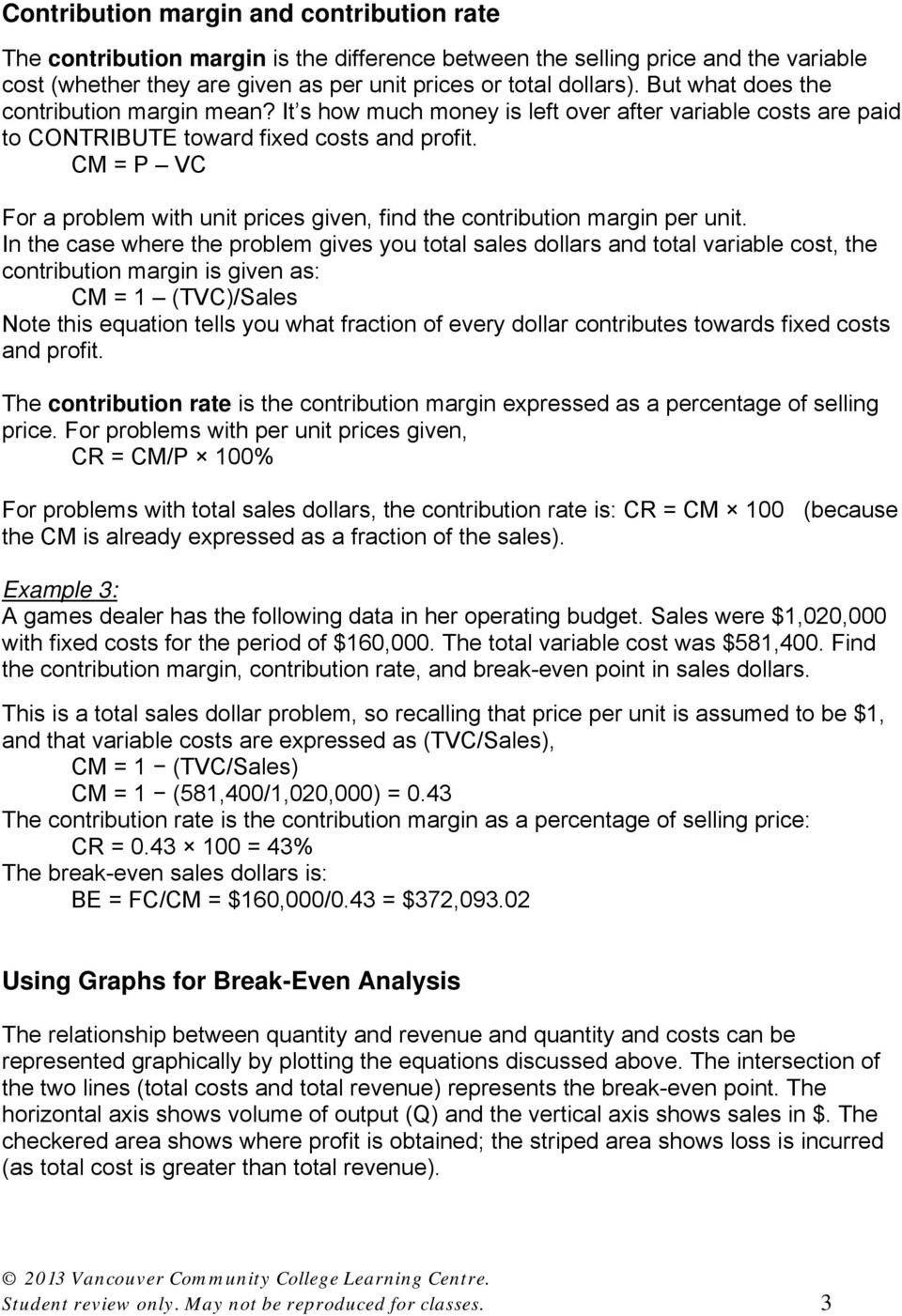
4 Total Revenue (TR) Break-even point Total Cost (TC) Sales $ Variable Costs (VC) Fixed Costs (FC) Volume of output (units or percent capacity) Analysis of Changes to Cost-Volume-Profit Relationship If fixed costs or variable costs or selling price of an item changes, this will obviously affect the relationship between TR and TC. For instance, in the break-even analysis (TR = TC) if the fixed costs increase, the number of products sold to break even must also increase. If the selling price of an item decreases, the break-even quantity will also decrease. To determine a profit or loss other than 0, we re-arrange the equation to: TR TC = profit (loss) We can continue to analyze how changes in the selling price, fixed costs or variable costs will affect the profit (loss) for the business. Student review only. May not be reproduced for classes. 4

5 EXERCISES 1. The Astronomical Telescope shop plans to introduce a new model based on the following information: Rent and utilities per period are $4144; variable cost per unit is $176; selling price per unit is $213; and capacity per period is 180 units. (a) Determine the (i) contribution margin; (ii) contribution rate. (b) Compute the break-even point (i) in units; (ii) in dollars and (ii) as a percent of capacity. (c) Draw a detailed break-even chart. (d) For each of the following independent situations, determine the break-even point in units if (i) rent and utilities are increased to $5069; (ii) variable costs are reduced to $157. (e) For each of the following independent situations, determine (i) how many units must be sold to make a profit of $2000; (ii) the new selling price if selling 110 units yields a profit of $ The operating budget of the HoneyBee company is given below. Sales $ Fixed costs $ Variable costs $ Total costs $ Net Income $53000 Sales dollars at capacity: $531,250. (a) Determine the (i) contribution margin; (ii) contribution rate (b) Calculate the break-even point (i) in dollars; (ii) as a percent of capacity (c) Determine the break-even point in dollars if the fixed costs are reduced by $12,100 while variables costs are changed to 68% of sales. 3. Speedy s graphic design store plans to sell 62 jobs next week, at an average cost of $325 each. Their weekly expenses are $ a. How much must they charge for each job to break even? b. If they want to make a profit of $1240, what price do they have to charge? c. If they sell 75 jobs during a week, how much profit will they realize? (using the price from part b) d. If they sell 100 jobs through a special promotion what is the minimum price they could charge to break even? Student review only. May not be reproduced for classes. 5

6 SOLUTIONS 1. (a) (i) $37.00 (ii) 17.37% (b) (i) 112 units (ii) $23,856 (iii) 62.22% (c) Total Revenue (TR) Total Cost (TC) 23,856 Profit Sales $ 4144 Variable Costs (VC) Fixed Costs (FC) 112 Volume of output (units or percent capacity) (d) (i) 137 units (ii) 74 units (e) (i) 167 units ( units, round up) (ii) $ (a) (i) 0.40 (ii) 40.00% (b) (i) $305,000 (ii) 57.41% (c) $343, (a) $410 (b) $430 (c) $2605 (d) $ Student review only. May not be reproduced for classes. 6

Exhibit 7.5: Graph of Total Costs vs. Quantity Produced and Total Revenue vs. Quantity Sold
 244 13. 7.5 Graphical Approach to CVP Analysis (Break-Even Chart) A break-even chart is a graphical representation of the following on the same axes: 1. Fixed costs 2. Total costs at various levels of
Break-even analysis. On page 256 of It s the Business textbook, the authors refer to an alternative approach to drawing a break-even chart.
 Break-even analysis On page 256 of It s the Business textbook, the authors refer to an alternative approach to drawing a break-even chart. In order to survive businesses must at least break even, which
Chapter 6 Cost-Volume-Profit Relationships
 Chapter 6 Cost-Volume-Profit Relationships Solutions to Questions 6-1 The contribution margin (CM) ratio is the ratio of the total contribution margin to total sales revenue. It can be used in a variety
volume-profit relationships
 Slide 1.3.1 1. Accounting for decision making 1.3 Cost-volume volume-profit relationships Slide 1.3.2 Introduction This chapter examines one of the most basic planning tools available to managers: cost
Accounting Building Business Skills. Learning Objectives: Learning Objectives: Paul D. Kimmel. Chapter Fourteen: Cost-volume-profit Relationships
 Accounting Building Business Skills Paul D. Kimmel Chapter Fourteen: Cost-volume-profit Relationships PowerPoint presentation by Kate Wynn-Williams University of Otago, Dunedin 2003 John Wiley & Sons Australia,
Assumptions of CVP Analysis. Objective 1: Contribution Margin Income Statement. Assumptions of CVP Analysis. Contribution Margin Example
 Assumptions of CVP Analysis Cost-Volume-Profit Analysis Expenses can be classified as either variable or fixed. CVP relationships are linear over a wide range of production and sales. Sales prices, unit
01 In any business, or, indeed, in life in general, hindsight is a beautiful thing. If only we could look into a
 01 technical cost-volumeprofit relevant to acca qualification paper F5 In any business, or, indeed, in life in general, hindsight is a beautiful thing. If only we could look into a crystal ball and find
C 6 - ACRONYMS notesc6.doc Instructor s Supplemental Information Written by Professor Gregory M. Burbage, MBA, CPA, CMA, CFM
 C 6 - ACRONYMS notesc6.doc Instructor s Supplemental Information ACRONYMS (ABBREVIATIONS) FOR USE WITH MANAGERIAL ACCOUNTING RELATING TO COST-VOLUME-PROFIT ANALYSIS. CM Contribution Margin in total dollars
Math 1314 Lesson 8 Business Applications: Break Even Analysis, Equilibrium Quantity/Price
 Math 1314 Lesson 8 Business Applications: Break Even Analysis, Equilibrium Quantity/Price Three functions of importance in business are cost functions, revenue functions and profit functions. Cost functions
Costing and Break-Even Analysis
 W J E C B U S I N E S S S T U D I E S A L E V E L R E S O U R C E S. 28 Spec. Issue 2 Sept 212 Page 1 Costing and Break-Even Analysis Specification Requirements- Classify costs: fixed, variable and semi-variable.
Cost-Volume-Profit Analysis
 Cost-Volume-Profit Analysis Cost-Volume-Profit Assumptions and Terminology 1 Changes in the level of revenues and costs arise only because of changes in the number of product (or service) units produced
In this chapter, you will learn to use cost-volume-profit analysis.
 2.0 Chapter Introduction In this chapter, you will learn to use cost-volume-profit analysis. Assumptions. When you acquire supplies or services, you normally expect to pay a smaller price per unit as the
INCORPORATION OF LEARNING CURVES IN BREAK-EVEN POINT ANALYSIS
 Delhi Business Review Vol. 2, No. 1, January - June, 2001 INCORPORATION OF LEARNING CURVES IN BREAK-EVEN POINT ANALYSIS Krishan Rana Suneel Maheshwari Ramchandra Akkihal T HIS study illustrates that a
Helena Company reports the following total costs at two levels of production.
 Chapter 22 Helena Company reports the following total costs at two levels of production. 10,000 Units 20,000 Units Direct materials $20,000 $40,000 Maintenance 8,000 10,000 Direct labor 17,000 34,000 Indirect
Break-Even Point and Cost-Volume-Profit Analysis
 9 Break-Even Point and Cost-Volume-Profit Analysis Objectives After completing this chapter, you should be able to answer the following questions: LO.1 LO.2 LO.3 LO.4 LO.5 LO.6 What is the break-even point
Chapter 19 (4) Cost Behavior and Cost-Volume-Profit Analysis Study Guide Solutions Fill-in-the-Blank Equations
 Chapter 19 (4) Cost Behavior and Cost-Volume-Profit Analysis Study Guide Solutions Fill-in-the-Blank Equations 1. Variable cost per unit 2. Fixed cost 3. Variable costs 4. Contribution margin 5. Change
Microeconomics and mathematics (with answers) 5 Cost, revenue and profit
 Microeconomics and mathematics (with answers) 5 Cost, revenue and profit Remarks: = uantity Costs TC = Total cost (= AC * ) AC = Average cost (= TC ) MC = Marginal cost [= (TC)'] FC = Fixed cost VC = (Total)
Chapter. Break-even analysis (CVP analysis)
 Chapter 5 Break-even analysis (CVP analysis) 1 5.1 Introduction Cost-volume-profit (CVP) analysis looks at how profit changes when there are changes in variable costs, sales price, fixed costs and quantity.
Management Accounting Fundamentals
 Management Accounting Fundamentals Module 4 Cost behaviour and cost-volume-profit analysis Lectures and handouts by: Shirley Mauger, HB Comm, CGA Part 1 2 3 Module 4 - Table of Contents Content 4.1 Variable
Accounting 610 2C Cost-Volume-Profit Relationships Page 1
 Accounting 610 2C Cost-Volume-Profit Relationships Page 1 I. OVERVIEW A. The managerial accountant uses analytical tools to advise line managers in decision making functions. C-V-P (CVP) analysis provides
Variable Costs. Breakeven Analysis. Examples of Variable Costs. Variable Costs. Mixed
 Breakeven Analysis Variable Vary directly in proportion to activity: Example: if sales increase by 5%, then the Variable will increase by 5% Remain the same, regardless of the activity level Mixed Combines
Managerial Accounting Prof. Dr. Vardaraj Bapat Department of School of Management Indian Institute of Technology, Bombay
 Managerial Accounting Prof. Dr. Vardaraj Bapat Department of School of Management Indian Institute of Technology, Bombay Lecture - 26 Cost Volume Profit Analysis Dear participations in our early session,
3. Solve the equation containing only one variable for that variable.
 Question : How do you solve a system of linear equations? There are two basic strategies for solving a system of two linear equations and two variables. In each strategy, one of the variables is eliminated
Your Guide to Profit Guard
 Dear Profit Master, Congratulations for taking the next step in improving the profitability and efficiency of your company! Profit Guard will provide you with comparative statistical and graphical measurements
Part II Management Accounting Decision-Making Tools
 Part II Management Accounting Decision-Making Tools Chapter 7 Chapter 8 Chapter 9 Cost-Volume-Profit Analysis Comprehensive Business Budgeting Incremental Analysis and Decision-making Costs Chapter 10
CHAPTER LEARNING OBJECTIVES. Identify common cost behavior patterns.
 c04.qxd 6/2/06 2:53 PM Page 124 CHAPTER 4 LEARNING OBJECTIVES 1 2 3 4 5 6 Identify common cost behavior patterns. Estimate the relation between cost and activity using account analysis and the high-low
Cost-Volume-Profit Analysis
 Chapter 6 Notes Page 1 Cost-Volume-Profit Analysis Understanding the relationship between a firm s costs, profits and its volume levels is very important for strategic planning. When you are considering
11.3 BREAK-EVEN ANALYSIS. Fixed and Variable Costs
 385 356 PART FOUR Capital Budgeting a large number of NPV estimates that we summarize by calculating the average value and some measure of how spread out the different possibilities are. For example, it
Section 1.5 Linear Models
 Section 1.5 Linear Models Some real-life problems can be modeled using linear equations. Now that we know how to find the slope of a line, the equation of a line, and the point of intersection of two lines,
Math-in-CTE Lesson Plan: Marketing
 Math-in-CTE Lesson Plan: Marketing Lesson Title: Break-Even Point Lesson 01 Occupational Area: Marketing Ed./Accounting CTE Concept(s): Math Concepts: Lesson Objective: Fixed Costs, Variable Costs, Total
MANAGEMENT ACCOUNTING Cost-Volume-Profit Analysis
 MANAGEMENT ACCOUNTING Cost-Volume-Profit Analysis Zofia Krokosz-Krynke, Ph.D., MBA [email protected] Wroclaw University of Technology, Building B4 Room 521 http://www.ioz.pwr.edu.pl/pracownicy/krokosz/
Graphing Linear Equations in Two Variables
 Math 123 Section 3.2 - Graphing Linear Equations Using Intercepts - Page 1 Graphing Linear Equations in Two Variables I. Graphing Lines A. The graph of a line is just the set of solution points of the
Chapter 03.00F Physical Problem for Nonlinear Equations Industrial Engineering
 Chapter 3.F Physical Problem for Nonlinear Equations Industrial Engineering Problem Statement You have been recently employed by a start-up computer assembly company called the MOM AND POP COMPUTER SHOP.
You and your friends head out to a favorite restaurant
 19 Cost-Volume-Profit Analysis Learning Objectives 1 Identify how changes in volume affect costs 2 Use CVP analysis to compute breakeven points 3 Use CVP analysis for profit planning, and graph the CVP
chapter Behind the Supply Curve: >> Inputs and Costs Section 2: Two Key Concepts: Marginal Cost and Average Cost
 chapter 8 Behind the Supply Curve: >> Inputs and Costs Section 2: Two Key Concepts: Marginal Cost and Average Cost We ve just seen how to derive a firm s total cost curve from its production function.
BAFS Elective Part Accounting Module Cost Accounting
 Accounting Module Cost Accounting : Cost-Volume-Profit Analysis Technology Education Section Curriculum Development Institute Education Bureau, HKSARG April 2009 Lesson One Cost-Volume-Profit Analysis
Profit maximization in different market structures
 Profit maximization in different market structures In the cappuccino problem as well in your team project, demand is clearly downward sloping if the store wants to sell more drink, it has to lower the
Money Math for Teens. Break-Even Point
 Money Math for Teens Break-Even Point This Money Math for Teens lesson is part of a series created by Generation Money, a multimedia financial literacy initiative of the FINRA Investor Education Foundation,
House Published on www.jps-dir.com
 I. Cost - Volume - Profit (Break - Even) Analysis A. Definitions 1. Cost - Volume - Profit (CVP) Analysis: is a means of predicting the relationships among revenues, variable costs, and fixed costs at
Session 07. Cost-Volume-Profit Analysis
 Session 07 Cost-Volume-Profit Analysis Programme : Executive Diploma in Business & Accounting (EDBA 2014) Course : Cost Analysis in Business Lecturer : Mr. Asanka Ranasinghe BBA (Finance), ACMA, CGMA Contact
Financial Analysis, Modeling, and Forecasting Techniques
 Financial Analysis, Modeling, and Forecasting Techniques Course #5710A/QAS-5710A Course Material Financial Analysis, Modeling, and Forecasting Techniques (Course #5710A/QAS-5710A) Table of Contents PART
Solutions to Homework Problems for Basic Cost Behavior by David Albrecht
 Solutions to Homework Problems for Basic Cost Behavior by David Albrecht Solution to Problem #11 This problem focuses on being able to work with both total cost and average per unit cost. As a brief review,
Chapter 10 Revenue, costs and break-even analysis
 Chapter 10, costs and break-even analysis, costs and break-even analysis is the money a business makes from sales. In other words, it is the value of the sales and is also referred to as turnover. The
Chapter 25 Cost-Volume-Profit Analysis Questions
 Chapter 25 Cost-Volume-Profit Analysis Questions 1. Cost-volume-profit analysis is used to accomplish the first step in the planning phase for a business, which involves predicting the volume of activity,
3.3 Applications of Linear Functions
 3.3 Applications of Linear Functions A function f is a linear function if The graph of a linear function is a line with slope m and y-intercept b. The rate of change of a linear function is the slope m.
Section 12.1 Financial Ratios Section 12.2 Break-Even Analysis
 Section 12.1 Financial Ratios Section 12.2 Break-Even Analysis OBJECTIVES Explain what a financial ratio is Describe how income statements are used for financial analysis Compare operating ratios and return-on-sales
Answers to Text Questions and Problems. Chapter 22. Answers to Review Questions
 Answers to Text Questions and Problems Chapter 22 Answers to Review Questions 3. In general, producers of durable goods are affected most by recessions while producers of nondurables (like food) and services
Break-even Analysis. Thus, if we assume that price and AVC are constant, (1) can be rewritten as follows TFC AVC
 Break-even Analysis An enterprise, whether or not a profit maximizer, often finds it useful to know what price (or output level) must be for total revenue just equal total cost. This can be done with a
Summary. Chapter Five. Cost Volume Relations & Break Even Analysis
 Summary Chapter Five Cost Volume Relations & Break Even Analysis 1. Introduction : The main aim of an undertaking is to earn profit. The cost volume profit (CVP) analysis helps management in finding out
Answers to Text Questions and Problems in Chapter 8
 Answers to Text Questions and Problems in Chapter 8 Answers to Review Questions 1. The key assumption is that, in the short run, firms meet demand at pre-set prices. The fact that firms produce to meet
Revenue Structure, Objectives of a Firm and. Break-Even Analysis.
 Revenue :The income receipt by way of sale proceeds is the revenue of the firm. As with costs, we need to study concepts of total, average and marginal revenues. Each unit of output sold in the market
Functions. MATH 160, Precalculus. J. Robert Buchanan. Fall 2011. Department of Mathematics. J. Robert Buchanan Functions
 Functions MATH 160, Precalculus J. Robert Buchanan Department of Mathematics Fall 2011 Objectives In this lesson we will learn to: determine whether relations between variables are functions, use function
An Income Statement Teaching Approach for Cost-Volume-Profit (CVP) Analysis by Using a Company s CVP Model
 An Statement Teaching Approach for Cost-Volume-Profit (CVP) Analysis by Using a Company s CVP Model Freddie Choo San Francisco State University Kim B. Tan California State University Stanislaus This paper
2. Cost-Volume-Profit Analysis
 Cost-Volume-Profit Analysis Page 1 2. Cost-Volume-Profit Analysis Now that we have discussed a company s cost function, learned how to identify its fixed and variable costs. We will now discuss a manner
The Cost of Production
 The Cost of Production 1. Opportunity Costs 2. Economic Costs versus Accounting Costs 3. All Sorts of Different Kinds of Costs 4. Cost in the Short Run 5. Cost in the Long Run 6. Cost Minimization 7. The
Math 113 Review for Exam I
 Math 113 Review for Exam I Section 1.1 Cartesian Coordinate System, Slope, & Equation of a Line (1.) Rectangular or Cartesian Coordinate System You should be able to label the quadrants in the rectangular
The term used for the relative proportion in which a company's products are sold is:
 The term used for the relative proportion in which a company's products are sold is: profit ~ Your answer is correct. break-even sales price The correct answer Is shown. In order to convert the margin
Cost VOLUME RELATIONS & BREAK EVEN ANALYSIS
 1. Introduction The cost volume profit (CVP) analysis helps management in finding out the relationship of costs and revenues to profit. Cost depends on various factors like Volume of production Product
Solutions to Homework Problems for CVP! Cost Volume Profit by David Albrecht
 Solutions to Homework Problems for CVP! Cost Volume Profit by David Albrecht Solution to Problem #26 CVP analysis using CM per unit. The controller of Stardust Furniture Company has determined the following
Pre-Test Chapter 8 ed17
 Pre-Test Chapter 8 ed17 Multiple Choice Questions 1. The APC can be defined as the fraction of a: A. change in income that is not spent. B. change in income that is spent. C. specific level of total income
Review of Production and Cost Concepts
 Sloan School of Management 15.010/15.011 Massachusetts Institute of Technology RECITATION NOTES #3 Review of Production and Cost Concepts Thursday - September 23, 2004 OUTLINE OF TODAY S RECITATION 1.
Examples on Monopoly and Third Degree Price Discrimination
 1 Examples on Monopoly and Third Degree Price Discrimination This hand out contains two different parts. In the first, there are examples concerning the profit maximizing strategy for a firm with market
Production and Inventory Management
 Production and Inventory Management Production and Inventory Management Understand Cost Relationships Economic efficiency (profits) Understanding of relationships helps managers Effective production decisions
COST & BREAKEVEN ANALYSIS
 COST & BREAKEVEN ANALYSIS http://www.tutorialspoint.com/managerial_economics/cost_and_breakeven_analysis.htm Copyright tutorialspoint.com In managerial economics another area which is of great importance
Lesson 4: Solving and Graphing Linear Equations
 Lesson 4: Solving and Graphing Linear Equations Selected Content Standards Benchmarks Addressed: A-2-M Modeling and developing methods for solving equations and inequalities (e.g., using charts, graphs,
It is important to know the following assumptions in CVP analysis before we can use it effectively.
 Cost-Volume-Profit analysis (Relevant to AAT Examination Paper 3 Management Accounting) Li Tak Ming, Andy, Deputy Head, Department of Business Administration, Hong Kong Institute of Vocational Education
Economics 201 Fall 2010 Introduction to Economic Analysis
 Economics 201 Fall 2010 Introduction to Economic Analysis Jeffrey Parker Problem Set #5 Solutions Instructions: This problem set is due in class on Wednesday, October 13. If you get stuck, you are encouraged
Principles of Economics: Micro: Exam #2: Chapters 1-10 Page 1 of 9
 Principles of Economics: Micro: Exam #2: Chapters 1-10 Page 1 of 9 print name on the line above as your signature INSTRUCTIONS: 1. This Exam #2 must be completed within the allocated time (i.e., between
Homework 1 1. Calculus. Homework 1 Due Date: September 26 (Wednesday) 60 1.75x 220 270 160 x 280. R = 115.95x. C = 95x + 750.
 Homework 1 1 Calculus Homework 1 Due Date: September 26 (Wednesday) 1. A doughnut shop sells a dozen doughnuts for $4.50. Beyond the fixed cost of $220 per day, it costs $2.75 for enough materials and
Graphing Equations. with Color Activity
 Graphing Equations with Color Activity Students must re-write equations into slope intercept form and then graph them on a coordinate plane. 2011 Lindsay Perro Name Date Between The Lines Re-write each
a. What is the total revenue Joe can earn in a year? b. What are the explicit costs Joe incurs while producing ten boats?
 Chapter 13 1. Joe runs a small boat factory. He can make ten boats per year and sell them for 25,000 each. It costs Joe 150,000 for the raw materials (fibreglass, wood, paint, and so on) to build the ten
Tutorial 3a Cost-Volume-Profit Analysis
 Tutorial 3a Cost-Volume-Profit Analysis J. E. Cairnes School of Business and Economics NUI Galway Cost-Volume-Profit (CVP) Analysis This is a method used to examine the relationship between changes in
Breakeven, Leverage, and Elasticity
 Breakeven, Leverage, and Elasticity Dallas Brozik, Marshall University Breakeven Analysis Breakeven analysis is what management is all about. The idea is to compare where you are now to where you might
University of Southern California Marshall Information Services
 University of Southern California Marshall Information Services Determine Breakeven Price Using Excel - Using Goal Seek, Data Tables, Vlookup & Charts This guide covers how to determine breakeven price
WHETHER OPERATING as nonprofit organizations or as
 i a CHAPTER BREAK-EVEN ANALYSIS WHETHER OPERATING as nonprofit organizations or as investor-owned facilities, health care organizations must generate revenue to pay for the costs of providing services.
Cost of Production : An Example
 University of California, Berkeley Spring 008 ECON 00A Section 0, Cost of Production : An Example What you should get out of this example: Understand the technical derivation of optimal inputs in Cost
Practice Questions Week 6 Day 1
 Practice Questions Week 6 Day 1 Multiple Choice Identify the choice that best completes the statement or answers the question. 1. Economists assume that the goal of the firm is to a. maximize total revenue
Chapter 22: Cost-Volume-Profit
 Chapter 22: Cost-Volume-Profit DO IT! 1 Types of Costs Helena Company reports the following total costs at two levels of production. 10,000 Units 20,000 Units Direct materials $20,000 $40,000 Maintenance
1.4 Linear Models. Cost, Revenue, and Profit Functions. Example 1 Linear Cost Function
 16314_02_ch1_p033-112.qxd 7/17/06 4:10 PM Page 66 66 Chapter 1 Functions and Linear Models 77. If y and x are related by the linear expression y = mx + b, how will y change as x changes if m is positive?
CHAPTER 10 MARKET POWER: MONOPOLY AND MONOPSONY
 CHAPTER 10 MARKET POWER: MONOPOLY AND MONOPSONY EXERCISES 3. A monopolist firm faces a demand with constant elasticity of -.0. It has a constant marginal cost of $0 per unit and sets a price to maximize
Chapter 27: Taxation. 27.1: Introduction. 27.2: The Two Prices with a Tax. 27.2: The Pre-Tax Position
 Chapter 27: Taxation 27.1: Introduction We consider the effect of taxation on some good on the market for that good. We ask the questions: who pays the tax? what effect does it have on the equilibrium
PART A: For each worker, determine that worker's marginal product of labor.
 ECON 3310 Homework #4 - Solutions 1: Suppose the following indicates how many units of output y you can produce per hour with different levels of labor input (given your current factory capacity): PART
Proving the Price is Right
 #3 B R E A K - E V E N A N A L Y S I S Proving the Price is Right CPA... Imagine the possibilities! Intro Learning Activity Learning Objectives 1. Understand the meaning of variable costs and fixed costs,
GETTING READY FOR THE MBA. A common question we get asked is Is there anything I can do to get myself ready for what lies ahead?
 GETTING READY FOR THE MBA A common question we get asked is Is there anything I can do to get myself ready for what lies ahead? Your professors for Finance and Modelling Business Decisions, Mary Kelly
c. Given your answer in part (b), what do you anticipate will happen in this market in the long-run?
 Perfect Competition Questions Question 1 Suppose there is a perfectly competitive industry where all the firms are identical with identical cost curves. Furthermore, suppose that a representative firm
5 Systems of Equations
 Systems of Equations Concepts: Solutions to Systems of Equations-Graphically and Algebraically Solving Systems - Substitution Method Solving Systems - Elimination Method Using -Dimensional Graphs to Approximate
Chapter 5 Revenue & Cost Analysis
 Chapter 5 Revenue & Cost Analysis 1. General Cost data are subject to great misunderstanding than are value data. The main reason: although the various categories of costs have precise meaning to the accountant,
Marginal Cost. Example 1: Suppose the total cost in dollars per week by ABC Corporation for 2
 Math 114 Marginal Functions in Economics Marginal Cost Suppose a business owner is operating a plant that manufactures a certain product at a known level. Sometimes the business owner will want to know
Applying the Lessons to Practice. Jayaraman Vijayakumar Associate Professor of Accounting Virginia Commonwealth University. and
 Applying the Lessons to Practice Jayaraman Vijayakumar Associate Professor of Accounting Virginia Commonwealth University and Benson Wier Associate Professor of Accounting Virginia Commonwealth University
Example 1: Suppose the demand function is p = 50 2q, and the supply function is p = 10 + 3q. a) Find the equilibrium point b) Sketch a graph
 The Effect of Taxes on Equilibrium Example 1: Suppose the demand function is p = 50 2q, and the supply function is p = 10 + 3q. a) Find the equilibrium point b) Sketch a graph Solution to part a: Set the
Make sure you look at the reminders or examples before each set of problems to jog your memory! Solve
 Name Date Make sure you look at the reminders or examples before each set of problems to jog your memory! I. Solving Linear Equations 1. Eliminate parentheses. Combine like terms 3. Eliminate terms by
BREAK-EVEN ANALYSIS. In your business planning, have you asked questions like these?
 BREAK-EVEN ANALYSIS In your business planning, have you asked questions like these? How much do I have to sell to reach my profit goal? How will a change in my fixed costs affect net income? How much do
CHAPTER 8 PROFIT MAXIMIZATION AND COMPETITIVE SUPPLY
 CHAPTER 8 PROFIT MAXIMIZATION AND COMPETITIVE SUPPLY TEACHING NOTES This chapter begins by explaining what we mean by a competitive market and why it makes sense to assume that firms try to maximize profit.
In following this handout, sketch appropriate graphs in the space provided.
 Dr. McGahagan Graphs and microeconomics You will see a remarkable number of graphs on the blackboard and in the text in this course. You will see a fair number on examinations as well, and many exam questions,
Part Three. Cost Behavior Analysis
 Part Three Cost Behavior Analysis Cost Behavior Cost behavior is the manner in which a cost changes as some related activity changes An understanding of cost behavior is necessary to plan and control costs
Cost-Volume-Profit. Managerial Accounting Fifth Edition Weygandt Kimmel Kieso. Page 5-2
 5-1 Cost-Volume-Profit Managerial Accounting Fifth Edition Weygandt Kimmel Kieso 5-2 study objectives 1. Distinguish between variable and fixed costs. 2. Explain the significance of the relevant range.
Break-Even and Leverage Analysis
 CHAPTER 6 Break-Even and Leverage Analysis After studying this chapter, you should be able to: 1. Differentiate between fixed and variable costs. 2. Calculate operating and cash break-even points, and
MULTIPLE CHOICE. Choose the one alternative that best completes the statement or answers the question.
 MBA 640 Survey of Microeconomics Fall 2006, Quiz 6 Name MULTIPLE CHOICE. Choose the one alternative that best completes the statement or answers the question. 1) A monopoly is best defined as a firm that
The Point-Slope Form
 7. The Point-Slope Form 7. OBJECTIVES 1. Given a point and a slope, find the graph of a line. Given a point and the slope, find the equation of a line. Given two points, find the equation of a line y Slope
Section 1.1 Linear Equations: Slope and Equations of Lines
 Section. Linear Equations: Slope and Equations of Lines Slope The measure of the steepness of a line is called the slope of the line. It is the amount of change in y, the rise, divided by the amount of