
DEAN H. SEKI COMPTROLLER
|
|
|
- Brooke Morris
- 10 years ago
- Views:
Transcription
1 COMPREHENSIVE ANNUAL FINANCIAL REPORT FOR THE FISCAL YEAR ENDED JUNE 30, 2013 DEAN H. SEKI COMPTROLLER

2 HAWAII COMPREHENSIVE ANNUAL FINANCIAL REPORT FOR THE FISCAL YEAR ENDED JUNE 30, 2013 Prepared by Accounting Division Department of Accounting and General Services Independent Audit Contracted and Administered by Office of the State Auditor DEAN H. SEKI COMPTROLLER

3 Comprehensive Annual Financial Report Table of Contents June 30, 2013 PART I: INTRODUCTORY SECTION Page Principal Officials for Finance-Related Functions 1 State of Hawaii Organizational Chart 2 Letter of Transmittal 3 Government Finance Officers Association ( GFOA ) Certificate 8 PART II: FINANCIAL SECTION Independent Auditors Report 11 Management s Discussion and Analysis (Unaudited) 14 Basic Financial Statements: Government-Wide Financial Statements: Statement of Net Position 32 Statement of Activities 34 Fund Financial Statements: Balance Sheet Governmental Funds 36 Reconciliation of the Governmental Funds Balance Sheet to the Statement of Net Position 37 Statement of Revenues, Expenditures, and Changes in Fund Balances Governmental Funds 38 Reconciliation of the Governmental Funds Statement of Revenues, Expenditures, and Changes in Fund Balances to the Statement of Activities 39

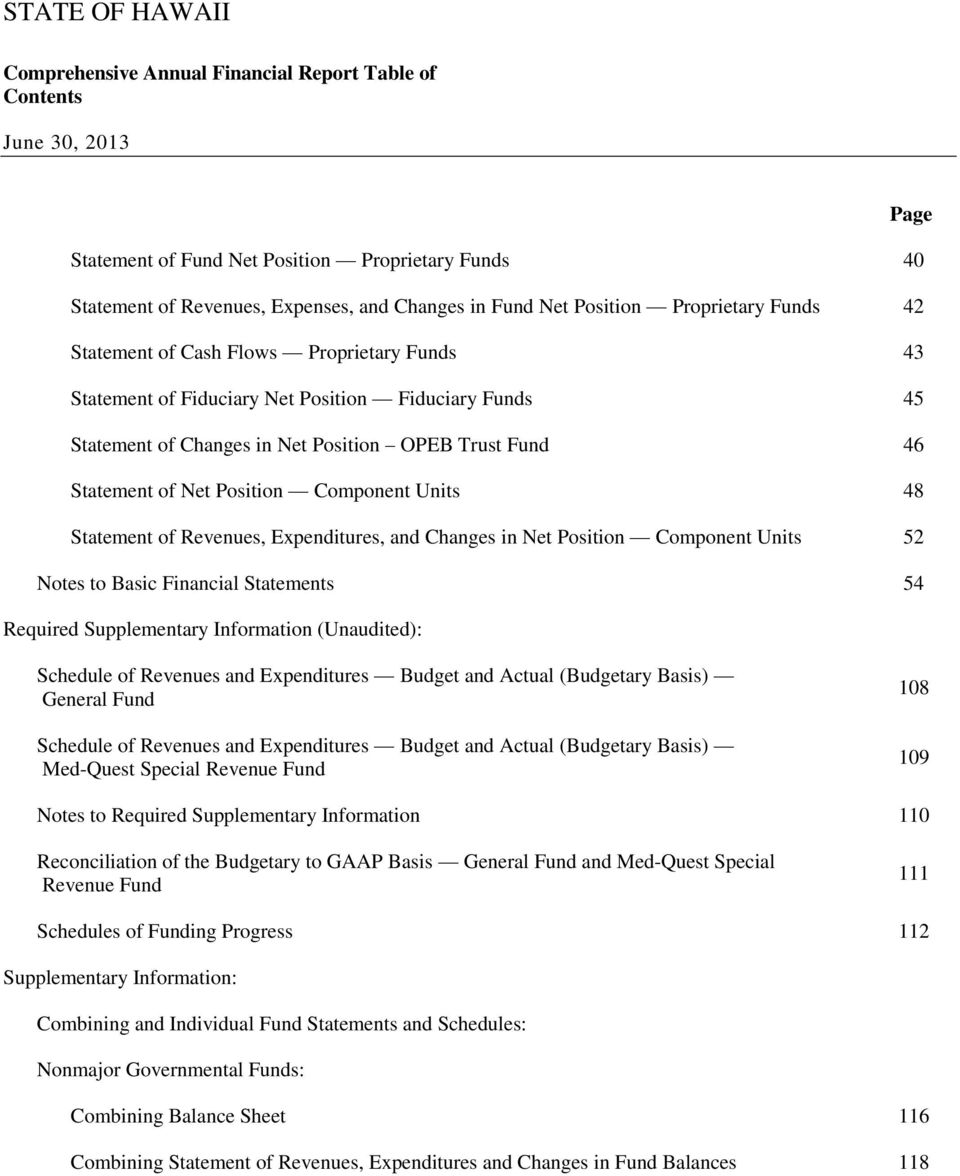
4 Comprehensive Annual Financial Report Table of Contents June 30, 2013 Page Statement of Fund Net Position Proprietary Funds 40 Statement of Revenues, Expenses, and Changes in Fund Net Position Proprietary Funds 42 Statement of Cash Flows Proprietary Funds 43 Statement of Fiduciary Net Position Fiduciary Funds 45 Statement of Changes in Net Position OPEB Trust Fund 46 Statement of Net Position Component Units 48 Statement of Revenues, Expenditures, and Changes in Net Position Component Units 52 Notes to Basic Financial Statements 54 Required Supplementary Information (Unaudited): Schedule of Revenues and Expenditures Budget and Actual (Budgetary Basis) General Fund Schedule of Revenues and Expenditures Budget and Actual (Budgetary Basis) Med-Quest Special Revenue Fund Notes to Required Supplementary Information 110 Reconciliation of the Budgetary to GAAP Basis General Fund and Med-Quest Special Revenue Fund 111 Schedules of Funding Progress 112 Supplementary Information: Combining and Individual Fund Statements and Schedules: Nonmajor Governmental Funds: Combining Balance Sheet 116 Combining Statement of Revenues, Expenditures and Changes in Fund Balances 118
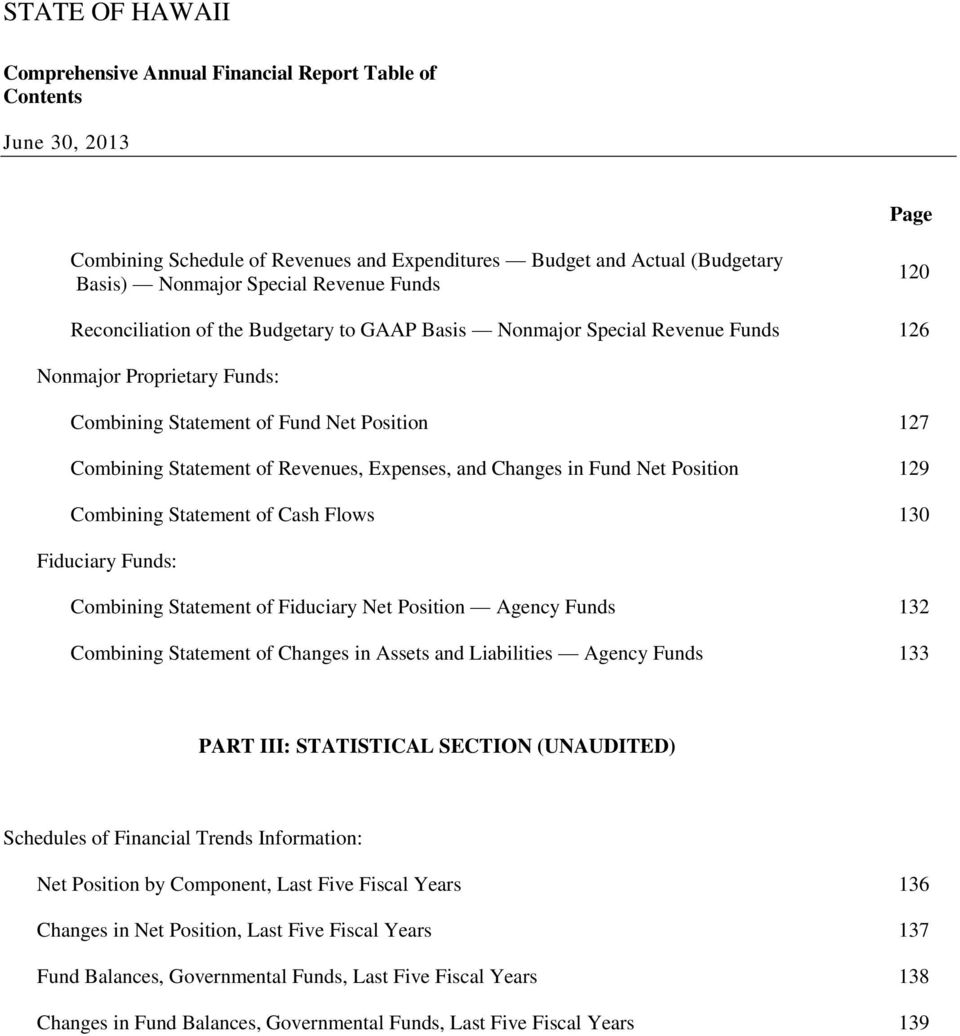
5 Comprehensive Annual Financial Report Table of Contents June 30, 2013 Page Combining Schedule of Revenues and Expenditures Budget and Actual (Budgetary Basis) Nonmajor Special Revenue Funds 120 Reconciliation of the Budgetary to GAAP Basis Nonmajor Special Revenue Funds 126 Nonmajor Proprietary Funds: Combining Statement of Fund Net Position 127 Combining Statement of Revenues, Expenses, and Changes in Fund Net Position 129 Combining Statement of Cash Flows 130 Fiduciary Funds: Combining Statement of Fiduciary Net Position Agency Funds 132 Combining Statement of Changes in Assets and Liabilities Agency Funds 133 PART III: STATISTICAL SECTION (UNAUDITED) Schedules of Financial Trends Information: Net Position by Component, Last Five Fiscal Years 136 Changes in Net Position, Last Five Fiscal Years 137 Fund Balances, Governmental Funds, Last Five Fiscal Years 138 Changes in Fund Balances, Governmental Funds, Last Five Fiscal Years 139
6 Comprehensive Annual Financial Report Table of Contents June 30, 2013 Page Schedules of Revenue Capacity Information: Personal Income by Industry, Last Ten Fiscal Years 140 Personal Income Tax Rates, Last Six Calendar Years 141 Taxable Sales by Industry, Last Five Fiscal Years 142 Sales Tax Revenue Payers by Industry, Last Five Fiscal Years 143 Schedules of Debt Capacity Information: Ratios of Outstanding Debt by Type, Last Five Fiscal Years 144 Ratios of Net General Bonded Debt Outstanding, Last Five Fiscal Years 145 Legal Debt Margin Information, Last Five Fiscal Years 146 Pledge Revenue Coverage, Last Five Fiscal Years 147 Schedules of Demographic and Economic Information: Demographic and Economic Statistics, Last Ten Fiscal Years 148 Ten Largest Private Sector Employers, 2013 and State Employees by Function, Last Five Fiscal Years 150 Schedules of Operating Information: Operating Indicators by Function, Last Five Fiscal Years 151 Capital Assets Statistics by Function, Last Three Fiscal Years 153

7 PART I: INTRODUCTORY SECTION

8 Principal Officials for Finance-Related Functions June 30, 2013 Dean H. Seki Comptroller Maria E. Zielinski Deputy Comptroller Governor Director of Finance Director of Taxation Comptroller Deputy Comptroller Neil Abercrombie Kalbert K. Young Frederick D. Pablo Dean H. Seki Maria E. Zielinski Notes: The Director of Finance is also department head of the Department of Budget and Finance. The Comptroller is also department head of the Department of Accounting and General Services. An organizational chart including those and other departments and agencies of the State of Hawaii government is presented on the following page

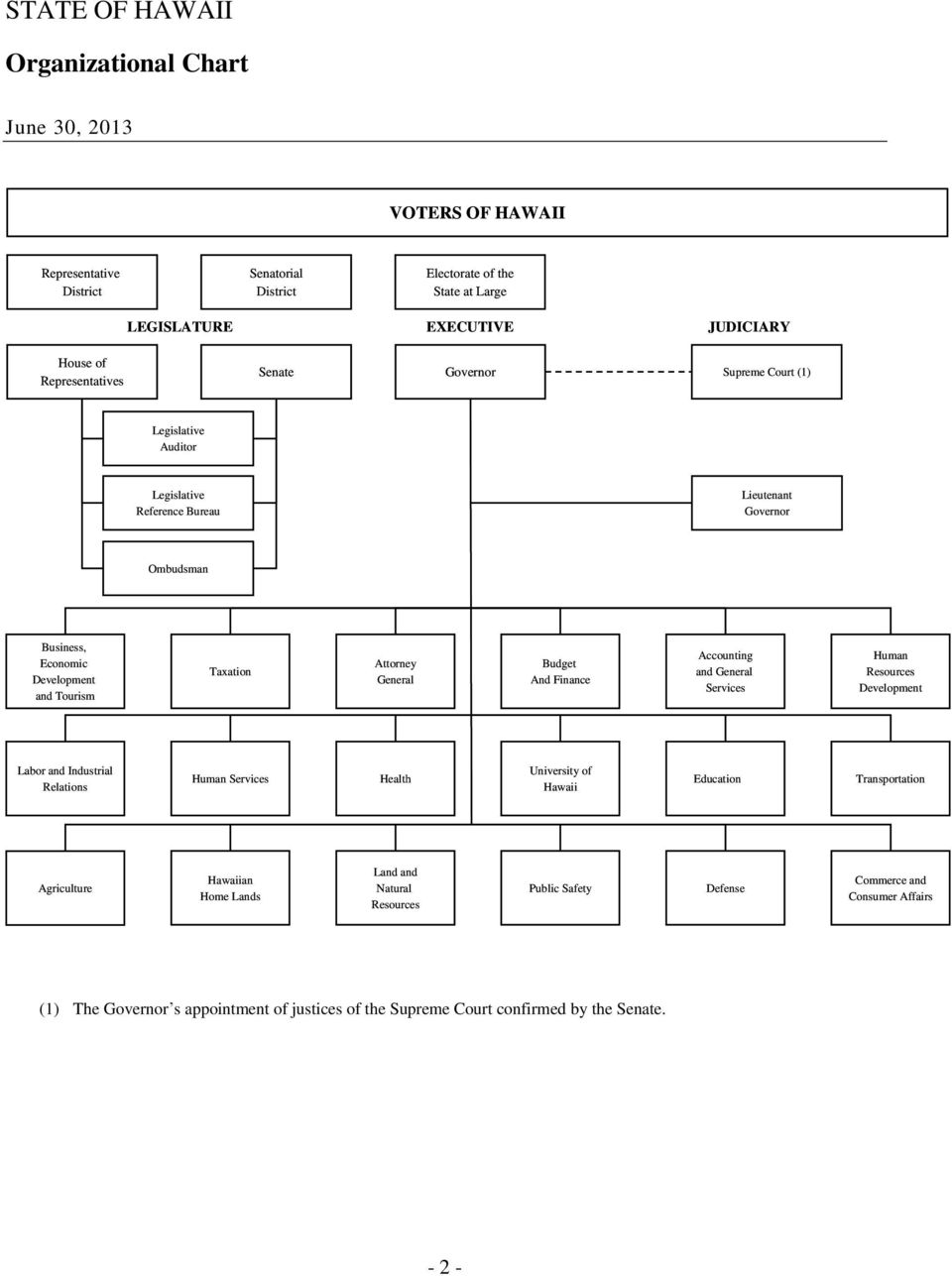
9 Organizational Chart June 30, 2013 VOTERS OF HAWAII Representative District Senatorial District Electorate of the State at Large LEGISLATURE EXECUTIVE JUDICIARY House of Representatives Senate Governor Supreme Court (1) Legislative Auditor Legislative Reference Bureau Lieutenant Governor Ombudsman Business, Economic Development and Tourism Taxation Attorney General Budget And Finance Accounting and General Services Human Resources Development Labor and Industrial Relations Human Services Health University of Hawaii Education (2) Transportation Agriculture Hawaiian Home Lands Land and Natural Resources Public Safety Defense Commerce and Consumer Affairs (1) The Governor s appointment of justices of the Supreme Court confirmed by the Senate
10 NEIL ABERCROMBIE GOVERNOR Dean H. Seki Comptroller Maria E. Zielinski Deputy Comptroller STATE OF HAWAII DEPARTMENT OF ACCOUNTING AND GENERAL SERVICES P.O. BOX 119 HONOLULU, HAWAII January 27, 2014 To the Honorable Governor of the State of Hawaii To the Honorable Members of the Twenty-Eighth State Legislature of the State of Hawaii: In accordance with the provisions of Section 40-5 of the Hawaii Revised Statutes, it is our privilege to present to you the Comprehensive Annual Financial Report (CAFR) of the State of Hawaii (State) for the fiscal year ended June 30, The State s Department of Accounting and General Services has prepared this report. Responsibility for both the accuracy of the presented data and the completeness and fairness of the presentation, including all disclosures, rests with the State. We believe the information, as presented, is fairly stated in all material aspects; that it is presented in a manner designed to fairly set forth the financial position and results of operations of the State as measured by the financial activity of its various funds; and that all the information necessary to enable the reader to gain the maximum understanding of the State s financial affairs has been included. The report is presented in three sections: introductory, financial, and statistical. The introductory section includes this transmittal letter, the State s organizational chart, and a list of principal officials. The financial section includes the independent auditors report, management s discussion and analysis (MD&A), basic financial statements, notes to basic financial statements, and supplementary information. The statistical section includes selected financial and demographic information. Governmental Accounting Standards Board (GASB) Statement No. 34, Basic Financial Statements and Management s Discussion and Analysis for State and Local Governments, requires that management provide a narrative introduction, overview, and analysis to accompany the basic financial statements in the form of an MD&A. This letter of transmittal is designed to complement the MD&A and should be read in conjunction with it. The State s MD&A is included in Part II of this report. THE REPORTING ENTITY AND ITS SERVICES With Hawaii s highly centralized state government, the State provides a full range of services as mandated by statute. These services include, but are not limited to, education (lower and higher), welfare, transportation (highways, airports, and harbors), health, hospitals, public safety, housing, culture and recreation, economic development, and conservation of natural resources
11 This report includes the various funds comprising the State, including all entities that are accountable to the State. The Employees Retirement System of the State of Hawaii, which is administered on behalf of public employees for both the state and county governments, and the Office of Hawaiian Affairs, which exists for the betterment of the conditions of native Hawaiians, are not included in the State s basic financial statements because those agencies, based on their fiscal independence and/or separate legal entity status, are not accountable to the State. FACTORS AFFECTING FINANCIAL CONDITION The information presented in the basic financial statements is perhaps best understood when considered from the broader perspective of the specific environment within which the State operates. State of the Economy Overview During the first nine months of 2013, Hawaii s economic indicators for the tourism industry, tax revenues, the construction industry, and unemployment were all positive. The civilian labor force and the total non-agricultural wage and salary jobs increased. Labor After ten consecutive quarterly decreases in jobs from the second quarter of 2008 to the second quarter of 2010, Hawaii s jobs increased for the twelfth consecutive quarter. During the first nine months of 2013, Hawaii s total civilian employment averaged 616,300 persons, an increase of 3,750 persons or 0.6% over the same period in The number of wage and salary jobs was up 8,000 to 616,300 for an increase of 1.3%. Job increases were most notable in natural resources, mining, & construction (2,850); other services (1,600); food services & drinking places (1,450); and health care & social assistance (1,150). A few sectors experienced declines including government (1,500), retail trade (400), and educational services (350). Hawaii s civilian unemployment rate (not seasonally adjusted) averaged 4.8% for the first nine months of 2013, compared to 6.1% for the same period in Taxes Tax revenues distributed to the State s General Fund increased $174.3 million, or 4.4%, during the first nine months of 2013 compared to the same period in All components reflected an increase during this same period. Individual net income tax collections increased $103.3 million or 8.5%, general excise and use tax (GET) collections increased $59.7 million, or 2.8%, and transient accommodations tax (TAT) collections were up $32.2 million, or 12.1%. Personal Income Total nominal personal income, not adjusted for inflation, increased $4.8 billion, or 4.0% in the first half of 2013 compared to the same period in Among its components, the fastest growth was seen in dividends, interest & rent of 13.5%, proprietors income of 9.1%, and wages and salary disbursements of 3.6%. Contributions for government social insurance, which are subtracted from personal income, decreased by 18.4%
12 Prices Honolulu s consumer price index (CPI) increased 1.8% for the first half of 2013 compared to the same period in 2012, higher than the 1.5% United States (U.S.) average CPI-U increase. The Honolulu increase was primarily due to increases in food and beverage (3.9%), medical care (2.8%), recreation (2.6%), and housing (2.0%). The prices also increased for education and communication (1.8%) and other goods and services (1.4%). Prices decreased for apparel (2.3%) and transportation (0.2%). Recent Developments in Hawaii s Major Industries Visitor Industry In the first nine months of 2013, total visitor arrivals by air increased 225,171 or 4.3% compared to the same period of Domestic arrivals (visitors on flights originating inside of the U.S.) increased 2.8% while international arrivals increased 7.7%. Similarly, total visitor days (visitor arrivals multiplied by average length of stay) were up 2.6% in the first nine months of 2013 compared to the same period of 2012 and total visitor spending increased $433.0 million or 4.1% over the same period. Statewide hotel occupancy rate averaged 77.6% in the first nine months of 2013, 1.4% lower than the average rate during the same period of Construction Hawaii s construction industry was one of the major contributors to job growth during the years. Since the second quarter of 2008 to the second quarter of 2012, the quarter-over-quarter growth rate has been negative. However, in the third quarter of 2013, the construction sector gained 3,200 jobs or 10.8% compared with the same quarter of During the first nine months of 2013, construction jobs increased by 2,850 or 9.8% compared to the same period of The total value of new private building authorizations increased $140.9 million or 7.5% for the first nine months of 2013 compared to the same period of Outlook for Hawaii s Economy The latest Department of Business, Economic Development and Tourism (DBEDT) forecast for Hawaii s economy is continued positive growth for the rest of 2013 and into Hawaii s economy depends significantly on conditions in the U.S. economy and key international economies. International conditions or prospects that affect Hawaii s economy such as the European debt crisis, China domestic demands and natural disaster recoveries in the Philippines. The November 2013 Blue Chip Economic Consensus Forecasts expected real GDP growth in 2014 to increase 2.5% for the U.S. and 1.8% for Japan. In 2014, visitor arrivals, visitor days, and visitor expenditures are predicted to increase 2.7%, 2.8%, and 4.2%, respectively. DBEDT projects total non-agricultural wage and salary jobs to increase 1.8% in Real Personal Income is expected to increase 3.3% in 2014 with real GDP projected to increase 2.8% in DBEDT projects Hawaii s inflation, as measured in terms of changes in the Honolulu CPI, to increase 2.1% in The State GDP deflator is expected to grow 2.0% in

13 ACCOUNTING SYSTEM AND BUDGETARY CONTROL In developing and maintaining the State s accounting system, consideration is given to the effectiveness of internal control, which is designed to accomplish certain objectives of management, including: 1. Transactions are executed in accordance with management s general and specific authorization. 2. Transactions are recorded as necessary to permit preparation of financial statements in conformity with accounting principles generally accepted in the United States of America (GAAP) and to maintain accountability for assets. 3. Access to assets is permitted only in accordance with management s authorization. Internal controls are designed to provide reasonable, but not absolute, assurance that the above objectives were accomplished. The concept of reasonable assurance recognizes that the cost of a control should not exceed the benefits likely to be derived from that control. The evaluation of costs and benefits requires estimates and judgments by management. We believe that the State s internal controls are effective in accomplishing management s objectives. By statutory provision, the State prepares a biennial budget for its programs. Budgeted expenditures are derived primarily from the General Appropriations Act of 2013 and from other authorizations contained in the State Constitution, the Hawaii Revised Statutes, and other specific appropriations acts in various Session Laws of Hawaii. Revenue estimates are provided to the State Legislature at the time of budget consideration and are revised and updated periodically during the fiscal year. An allotment system and encumbrance accounting are utilized by the State for budgetary control purposes. Obligations in the form of purchase orders or contracts are recorded as encumbrances at the time purchase orders or contracts are awarded and executed. To the extent not expended or encumbered, General Fund and Special Revenue Fund appropriations subject to budgetary control generally lapse at the end of the fiscal year for which the appropriations were made. The State Legislature specifies the lapse date and any other particular conditions relating to terminating the authorizations for other appropriations. EMPLOYEE UNION CONTRACTS The State Constitution grants public employees in Hawaii the right to organize for the purpose of collective bargaining as provided by law. In 2013 the Legislature created a new bargaining unit. This bargaining unit will be composed of State and county employees, relocating individuals from two existing collective bargaining units into the new Bargaining Unit 14. It is unknown at this time when terms for a collective bargaining agreement for this new unit will become effective. Of the other 13 collective bargaining units, twelve include State employees. Two collective bargaining agreements expired June 30, 2013 and those bargaining units remain engaged in the collective bargaining process with the employer. Five units have collective bargaining agreements in effect through June 30, Five units have collective bargaining agreements that will be in effect through June 30, INDEPENDENT AUDIT Although the State statutes do not require an annual audit of the State s financial statements, the State engaged a firm of independent certified public accountants to audit the State s basic financial statements - 6 -
14

15
16 PART II: FINANCIAL SECTION

17 This page intentionally left blank

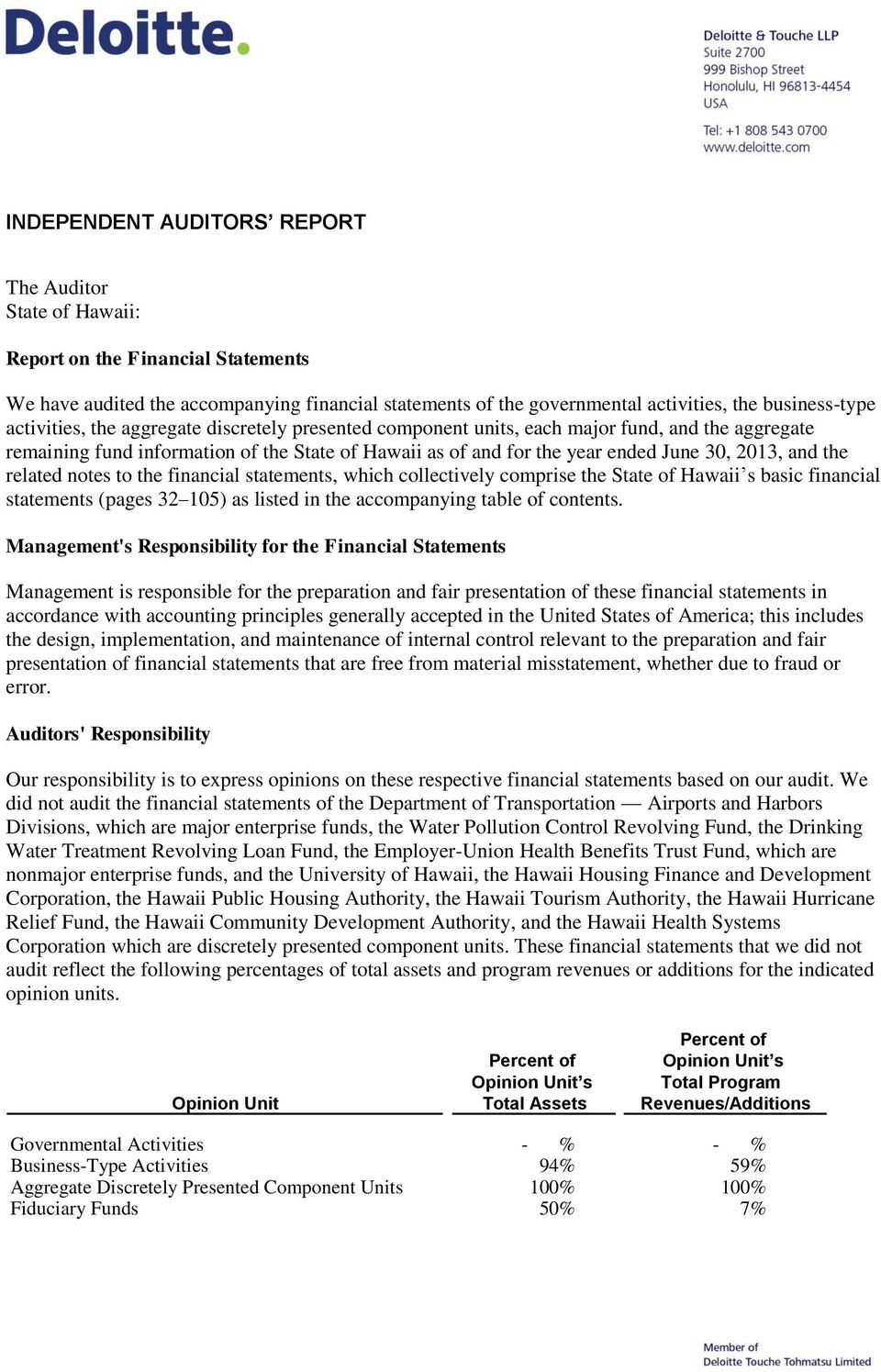
18 INDEPENDENT AUDITORS REPORT The Auditor State of Hawaii: Report on the Financial Statements We have audited the accompanying financial statements of the governmental activities, the business-type activities, the aggregate discretely presented component units, each major fund, and the aggregate remaining fund information of the State of Hawaii as of and for the year ended June 30, 2013, and the related notes to the financial statements, which collectively comprise the State of Hawaii s basic financial statements (pages ) as listed in the accompanying table of contents. Management's Responsibility for the Financial Statements Management is responsible for the preparation and fair presentation of these financial statements in accordance with accounting principles generally accepted in the United States of America; this includes the design, implementation, and maintenance of internal control relevant to the preparation and fair presentation of financial statements that are free from material misstatement, whether due to fraud or error. Auditors' Responsibility Our responsibility is to express opinions on these respective financial statements based on our audit. We did not audit the financial statements of the Department of Transportation Airports and Harbors Divisions, which are major enterprise funds, the Water Pollution Control Revolving Fund, the Drinking Water Treatment Revolving Loan Fund, the Employer-Union Health Benefits Trust Fund, which are nonmajor enterprise funds, and the University of Hawaii, the Hawaii Housing Finance and Development Corporation, the Hawaii Public Housing Authority, the Hawaii Tourism Authority, the Hawaii Hurricane Relief Fund, the Hawaii Community Development Authority, and the Hawaii Health Systems Corporation which are discretely presented component units. These financial statements that we did not audit reflect the following percentages of total assets and program revenues or additions for the indicated opinion units. Percent of Percent of Opinion Unit s Opinion Unit s Total Program Opinion Unit Total Assets Revenues/Additions Governmental Activities - % - % Business-Type Activities 94% 59% Aggregate Discretely Presented Component Units 100% 100% Fiduciary Funds 50% 7%
19 Those financial statements listed above were audited by other auditors whose reports thereon have been furnished to us, and our opinion, insofar as it relates to the amounts included for the Department of Transportation Airports and Harbors Divisions, the Water Pollution Control Revolving Fund, the Drinking Water Treatment Revolving Loan Fund, the Employer-Union Health Benefits Trust Fund, the University of Hawaii, the Hawaii Housing Finance and Development Corporation, the Hawaii Public Housing Authority, the Hawaii Tourism Authority, the Hawaii Hurricane Relief Fund, the Hawaii Community Development Authority, and the Hawaii Health Systems Corporation, is based solely on the reports of the other auditors. We conducted our audit in accordance with auditing standards generally accepted in the United States of America. Those standards require that we plan and perform the audit to obtain reasonable assurance about whether the respective financial statements are free of material misstatement. An audit involves performing procedures to obtain audit evidence about the amounts and disclosures in the financial statements. The procedures selected depend on the auditor's judgment, including the assessment of the risks of material misstatement of the financial statements, whether due to fraud or error. In making those risk assessments, the auditor considers internal control relevant to the State of Hawaii s preparation and fair presentation of the financial statements in order to design audit procedures that are appropriate in the circumstances, but not for the purpose of expressing an opinion on the effectiveness of the Company's internal control. Accordingly, we express no such opinion. An audit also includes evaluating the appropriateness of accounting policies used and the reasonableness of significant accounting estimates made by management, as well as evaluating the overall presentation of the financial statements. We believe that the audit evidence we have obtained is sufficient and appropriate to provide a basis for our audit opinions. Opinions In our opinion, based on our audit and the reports of other auditors, the financial statements referred to above present fairly, in all material respects, the respective net position or financial position of the governmental activities, business-type activities, discretely presented component units, each major fund, and the aggregate remaining fund information of the State of Hawaii, as of June 30, 2013, and the respective changes in financial position, and, where applicable, cash flows thereof for the year then ended in conformity with accounting principles generally accepted in the United States of America. Other Matters Required Supplementary Information Accounting principles generally accepted in the United States of America require that the management s discussion and analysis (pages 14-30), Schedule of Revenue and Expenditures Budget and Actual (pages and ), and Schedules of Funding Progress (page 112) be presented to supplement the basic financial statements. Such information, although not a part of the basic financial statements, is required by the Governmental Accounting Standards Board who considers it to be an essential part of financial reporting for placing the basic financial statements in an appropriate operational, economic, or historical context. We and other auditors have applied certain limited procedures to the required supplementary information in accordance with auditing standards generally accepted in the United States of America, which consisted of inquiries of management about the methods of preparing the information and comparing the information for consistency with management s responses to our inquiries, the basic financial statements, and other knowledge we obtained during our audit of the basic financial statements

20 We do not express an opinion or provide any assurance on the information because the limited procedures do not provide us with sufficient evidence to express an opinion or provide any assurance. Other Information Our audit was conducted for the purpose of forming an opinion on the respective financial statements that collectively comprise the State of Hawaii s basic financial statements. The combining and individual fund statements and schedules (pages and ), introductory section (pages 1-7) and statistical section (pages ) are presented for purposes of additional analysis and are not a required part of the basic financial statements. The combining and individual fund statements and schedules are the responsibility of the State of Hawaii s management and were derived from and relates directly to the underlying accounting and other records used to prepare the financial statements. Such information has been subjected to the auditing procedures applied in the audit of the basic financial statements and certain additional procedures, including compiling and reconciling such information directly to the underlying accounting and other records used to prepare the financial statements or to the basic financial statements themselves, and other additional procedures in accordance with auditing standards generally accepted in the United States of America by us and other auditors. In our opinion, based on our audit, the procedures performed as described above, and the reports of the other auditors, the combining and individual fund statements and schedules are fairly stated in all material respects in relation to the basic financial statements as a whole. The introductory section and statistical section have not been subjected to the auditing procedures applied in the audit of the basic financial statements and accordingly, we do not express an opinion or provide any assurance on them. Honolulu, HI January 27,

21 Management s Discussion and Analysis ( Unaudited ) June 30, 2013 As management of the State of Hawaii (the State ), we offer readers of the State s basic financial statements this narrative overview and analysis of the financial activities of the State for the fiscal year ended June 30, We encourage readers to consider the information presented here in conjunction with additional information that has been furnished in our letter of transmittal, which can be found on pages 3 7 of this report. Financial Highlights Government-Wide Highlights The assets of the State exceeded its liabilities at June 30, 2013 by $4.8 billion (net position). Unrestricted net position which may be used to meet the State s ongoing obligations to citizens and creditors was a negative $1.8 billion, an increase of $24.4 million from the previous year. Net position of governmental activities and business-type activities decreased by $84.4 million and increased by $391.5 million, respectively. The combined increase to the State was $307.1 million from the prior fiscal year. Fund Highlights At June 30, 2013, the State s Governmental Funds reported combined ending fund balances of $1.9 billion, an increase of $485.2 million from the prior fiscal year. Of this amount, $1.4 billion, or 73.7%, of total fund balances was in the General Fund, and the remaining $509.8 million represent amounts in other funds designated for specific purposes. The Proprietary Funds reported net fund position at June 30, 2013, of $3.6 billion, an increase of $391.5 million during the fiscal year. Liabilities The State s liabilities increased during the current fiscal year to $13.0 billion, an increase of $807.1 million. During fiscal 2013, the State issued General Obligation bonds in the amount of $397.0 million to advance refund $435.1 million of previously issued outstanding General Obligation bonds. In addition, the State issued $444.0 million in General Obligation bonds and $26.0 million in taxable General Obligation bonds for the purpose of financing or reimbursing the State of Hawaii for the Hawaiian Home Lands Settlement and for financing capital projects. The State did not issue Revenue Bonds during fiscal In accordance with GASB No. 45, Accounting and Financial Reporting by Employers for Postemployment Benefits Other than Pensions, the State increased the liability for Postemployment Benefits Other Than Pension, to $3.1 billion, an increase of $556.3 million for the fiscal year ended June 30, Overview of the Basic Financial Statements This discussion and analysis is intended to serve as an introduction to the State s basic financial statements. The State s basic financial statements are comprised of three components: (1) Government- Wide financial statements, (2) fund financial statements, and (3) notes to basic financial statements. This report also contains other supplementary information in addition to the basic financial statements themselves
22 Management s Discussion and Analysis ( Unaudited ) June 30, 2013 Government-Wide Financial Statements The Government-Wide financial statements are designed to provide readers with a broad overview of the State s finances, in a manner similar to a private sector business. The statement of net position presents information on all of the State s assets and liabilities, with the difference between the two reported as net position. Over time, increases or decreases in net position may serve as a useful indicator of whether the financial position of the State is improving or deteriorating. The statement of activities presents information showing how the State s net position changed during the most recent fiscal year. All changes in net position are reported as soon as the underlying event giving rise to the change occurs, regardless of the timing of related cash flows. Thus, revenues and expenses are reported in this statement for some items that will only result in cash flows in future fiscal periods (e.g., uncollected taxes and unused vacation leave). Both of the Government-Wide financial statements distinguish functions of the State that are principally supported by taxes and intergovernmental revenues ( governmental activities ) from other functions that are intended to recover all or a significant portion of their costs through user fees and charges ( businesstype activities ). The governmental activities of the State include general government, public safety, conservation of natural resources, highways, health, welfare, education, culture and recreation, urban redevelopment and housing, economic development and assistance, and interest on long-term debt. The business-type activities of the State include the Department of Transportation Airports Division ( Airports ), Department of Transportation Harbors Division ( Harbors ), and the Unemployment Compensation Fund, which are considered to be major funds, while the remaining business-type activities are combined into a single aggregate presentation. The Government-Wide financial statements include not only the State itself (known as the Primary Government ), but also the activities of seven legally separate Component Units: the Hawaii Community Development Authority, the Hawaii Health Systems Corporation, the Hawaii Housing Finance and Development Corporation, the Hawaii Hurricane Relief Fund, the Hawaii Public Housing Authority, the Hawaii Tourism Authority, and the University of Hawaii, comprised of the State s public institutions of higher education, for which the State is financially accountable. Financial information for these Component Units is reported separately from the financial information presented for the Primary Government itself. The Component Units issue separate financial statements containing management s discussion and analysis. The Government-Wide financial statements can be found on pages of this report. Fund Financial Statements A fund is a grouping of related accounts that is used to maintain control over resources that have been segregated for specific activities or objectives. The State, like other state and local governments, uses fund accounting to ensure and demonstrate compliance with finance-related legal requirements. All of the funds of the State can be divided into three categories: (1) Governmental Funds, (2) Proprietary Funds, and (3) Fiduciary Funds
23 Management s Discussion and Analysis ( Unaudited ) June 30, 2013 Governmental Funds Governmental Funds are used to account for essentially the same functions reported as governmental activities in the Government-Wide financial statements. However, unlike the Government-Wide financial statements, Governmental Funds financial statements focus on nearterm inflows and outflows of spendable resources, as well as on the balances of spendable resources available at the end of the fiscal year. Such information may be useful in evaluating the State s near-term financing requirements. Because the focus of Governmental Funds is narrower than that of the Government-Wide financial statements, it is useful to compare the information presented for Governmental Funds with similar information presented for governmental activities in the Government-Wide financial statements. By doing so, readers may better understand the long-term impact of the State s nearterm financing decisions. Both the Governmental Funds balance sheet and the Governmental Funds statement of revenues, expenditures, and changes in fund balances provide a reconciliation to facilitate this comparison between Governmental Funds and governmental activities in the Government-Wide financial statements. Information is presented separately in the Governmental Funds balance sheet and in the Governmental Funds Statement of Revenues, Expenditures, and Changes in Fund Balances for the General Fund, Capital Projects Fund, and Med-Quest Special Revenue Fund, each of which is considered to be a major fund. Data from the other Governmental Funds are combined into a single, aggregated presentation. Individual fund data for each of these nonmajor Governmental Funds is provided in the form of combining financial statements in the supplementary information section of this report. The State adopts an annual appropriated budget for its General Fund and Special Revenue Funds. A budgetary comparison schedule has been provided for the General Fund and each Special Revenue Fund to demonstrate compliance with this budget. The budgetary comparison schedule for the General Fund is located in the required supplementary information and the budgetary comparison statements for each of the Special Revenue Funds are located in the supplementary information section of this report. The basic Governmental Funds financial statements can be found on pages of this report. Proprietary Funds Proprietary Funds are used to show activities that operate more like those of commercial enterprises. They are known as Enterprise Funds because they charge fees for services provided to outsiders. They are used to report the same functions presented as business-type activities in the Government-Wide financial statements. The State uses Enterprise Funds to account for the operations of Airports, Harbors, the Unemployment Compensation Fund, and its other businesstype activities
24 Management s Discussion and Analysis ( Unaudited ) June 30, 2013 Proprietary Funds provide the same type of information as the Government-Wide financial statements, only in more detail. The Proprietary Funds financial statements provide separate information for Airports, Harbors, and the Unemployment Compensation Fund, each of which are considered to be major funds of the State. Conversely, the other business-type activities are combined into a single, aggregate presentation in the Proprietary Funds financial statements. The basic Proprietary Funds financial statements can be found on pages of this report. Fiduciary Funds Fiduciary Funds are used to account for resources held for the benefit of parties outside the State. Fiduciary Funds are not reflected in the Government-Wide financial statements because the resources of those funds are not available to support the State s own programs. The accounting used for Fiduciary Funds is much like that used for Proprietary Funds. The basic Fiduciary Funds financial statements can be found on page of this report. Notes to Basic Financial Statements The notes to basic financial statements provide additional information that is essential to a full understanding of the data provided in the Government-Wide and fund financial statements. The notes to basic financial statements can be found on pages of this report. Other Supplementary Information In addition to the basic financial statements and accompanying notes, this report presents the combining financial statements referred to earlier in connection with nonmajor Governmental and Fiduciary Funds. These statements are presented immediately following the notes to basic financial statements. The total columns of these combining financial statements carry to the applicable fund financial statements. Government-Wide Financial Analysis The following financial analysis focuses on the Primary Government (governmental and business-type activities of the State). Separate financial statements for each of the State s Component Units, including their respective management s discussion and analysis, can be obtained from the Department of Accounting and General Services. Net position is a useful indicator of a government s financial position. For the State, total assets exceed liabilities by $4.8 billion as of June 30, 2013, and net position increased $307.1 million, or 6.8%, over the course of this fiscal year s operations. The net position of the governmental activities decreased by $84.4 million, or 6.3%, and business-type activities had an increase of $391.5 million, or 12.3%. The following table was derived from the Government-Wide Statement of Net Position
25 Management s Discussion and Analysis ( Unaudited ) June 30, 2013 Summary Schedule of Net Position June 30, 2013 and 2012 (Amounts in thousands) Primary Government Governmental Activities Business-Type Activities Total Assets: Current and other assets $ 3,664,426 $ 3,001,480 $ 2,664,900 $ 2,369,460 $ 6,329,326 $ 5,370,940 Capital assets, net 8,929,329 8,833,349 2,533,079 2,473,197 11,462,408 11,306,546 Total assets 12,593,755 11,834,829 5,197,979 4,842,657 17,791,734 16,677,486 Liabilities: Long-term liabilities 9,508,549 8,952,869 1,486,514 1,518,782 10,995,063 10,471,651 Other liabilities 1,839,670 1,552, , ,983 1,983,766 1,700,042 Total liabilities 11,348,219 10,504,928 1,630,610 1,666,765 12,978,829 12,171,693 Net position: Net investment in capital assets 2,863,379 2,794,481 1,599,483 1,560,267 4,462,862 4,354,748 Restricted 1,051, ,294 1,068, ,042 2,119,694 1,896,336 Unrestricted (2,669,391) (2,394,874) 899, ,583 (1,769,651) (1,745,291) Total net position $ 1,245,536 $ 1,329,901 $ 3,567,369 $ 3,175,892 $ 4,812,905 $ 4,505,793 Analysis of Net Position By far, the largest portion of the State s net position ($4.5 billion or 92.7%) reflects its investment in capital assets (e.g., land, infrastructure, buildings, and equipment); less any related debt used to acquire those assets that is still outstanding. The State uses these capital assets to provide services to citizens; consequently, these assets are not available for future spending. Although the State s investment in its capital assets is reported net of related debt, it should be noted that the resources needed to repay this debt must be provided from other sources, since the capital assets themselves cannot be used to liquidate these liabilities. An additional portion of the State s net position ($2.1 billion or 44.0%) represents resources that are subject to external restrictions or enabling legislation on how they may be used. The remaining balance of negative $1.8 billion or negative 36.8% represents unrestricted net position. At June 30, 2013, the State is able to report positive balances in two of the categories of net position for governmental activities and all three categories for business-type activities. The negative balance of unrestricted net position for governmental activities is primarily attributed to the State s other postemployment benefit liability of $3.1 billion. Changes in Net Position The State s net position increased by $307.1 million, or 6.8%, during the fiscal year ended June 30, Approximately 56.5% of the State s total revenues came from taxes, while 26.8% resulted from grants and contributions (including federal aid). Charges for various goods and
26 Management s Discussion and Analysis ( Unaudited ) June 30, 2013 services provided 16.1% of the total revenues. The State s expenses cover a range of services. The largest expenses were for higher and lower education, welfare, health, general government, and highways. The following financial information was derived from the Government-Wide Statement of Activities and reflects how the State s net position changed during the fiscal year. Summary Schedule of Changes in Net Position For the Fiscal Years Ended June 30, 2013 and 2012 (Amounts in thousands) Primary Government Governmental Activities Business-Type Activities Total Revenues: Program revenues: Charges for services $ 494,647 $ 421,145 $ 1,154,047 $ 1,149,559 $ 1,648,694 $ 1,570,704 Operating grants and contributions 2,589,537 2,370, ,589,537 2,370,437 Capital grants and contributions 96,184 97,322 64,313 85, , ,221 General revenues: Taxes 5,796,549 5,358, ,796,549 5,358,622 Investment income and other 25,502 5,347 33,633 4,164 59,135 9,511 Total revenues 9,002,419 8,252,873 1,251,993 1,239,622 10,254,412 9,492,495 Expenses: General government 531, , , ,788 Public safety 451, , , ,002 Highways 490, , , ,924 Conservation of natural resources 52,208 96, ,208 96,349 Health 813, , , ,288 Welfare 2,798,053 2,464, ,798,053 2,464,582 Lower education 2,592,125 2,598, ,592,125 2,598,444 Higher education 654, , , ,716 Other education 20,086 16, ,086 16,753 Culture and recreation 94, , , ,628 Urban redevelopment and housing 173,677 23, ,677 23,888 Economic development and assistance 172, , , ,460 Interest expense 241, , , ,938 Airports , , , ,541 Harbors ,548 84,826 90,548 84,826 Unemployment compensation , , , ,610 Nonmajor proprietary fund , ,166 66, ,166 Total expenses 9,086,784 8,782, ,516 1,076,143 9,947,300 9,858,903 Change in net position (84,365) (529,887) 391, , ,112 (366,408) Net position beginning of year 1,329,901 1,859,788 3,175,892 3,012,413 4,505,793 4,872,201 Net position end of year $ 1,245,536 $ 1,329,901 $ 3,567,369 $ 3,175,892 $ 4,812,905 $ 4,505,

27 Management s Discussion and Analysis ( Unaudited ) June 30, 2013 The following charts depict revenues of the governmental activities for the fiscal year: Program Revenues by Source Governmental Activities Fiscal Year Ended June 30, 2013 Capital grants and contributions 3% Charges for services 16% Operating grants and contributions 81% Tax Revenues by Source Governmental Activities Fiscal Year Ended June 30, 2013 Others 17% Net Income 31% General Excise 52%
28 Management s Discussion and Analysis ( Unaudited ) June 30, 2013 Analysis of Changes in Net Position The State s net position increased by $307.1 million during the current fiscal year. This is explained in the governmental and business-type activities discussion, and is primarily due to decrease in net position of governmental activities of $84.4 million offset by increases in net position of Unemployment Compensation Fund of $173.1 million, Airports of $122.1 million, Harbors of $27.6 million, and Nonmajor Proprietary Funds of $68.7 million. Governmental Activities Governmental activities decreased the State s net position by $84.4 million. The elements of this decrease are reflected below: Governmental Activities (Amounts in thousands) General revenues: Taxes $ 5,796,549 $ 5,358,622 Interest and investment income and other 25,502 5,347 Total general revenues 5,822,051 5,363,969 Expenses, net of program revenues: General government 18,757 38,688 Public safety 407, ,945 Highways 313, ,757 Conservation of natural resources (16,969) 36,699 Health 582, ,125 Welfare 1,097,537 1,003,240 Lower education 2,203,050 2,216,887 Higher education 654, ,716 Other education 20,086 16,753 Culture and recreation 91, ,859 Urban redevelopment and housing 141,583 (9,402) Economic development and assistance 151, ,651 Interest expense 241, ,938 Total governmental activities expenses, net of program revenues 5,906,416 5,893,856 Decrease in governmental activities net position $ (84,365) $ (529,887) Tax revenues increased by $437.9 million, or 8.2%, from the previous fiscal year. The increase was primarily due to increases in general excise taxes of $217.2 million, in individual and corporate income taxes of $162.6 million, and in transient accommodations taxes of $47.8 million
29 Management s Discussion and Analysis ( Unaudited ) June 30, 2013 Interest and investment income increased by $20.2 million from the previous year. The increase is primarily due to the increase in the fair market value of the student loan auction rate securities, which increased $12.6 million in fiscal year 2013, compared to decreasing $4.7 million in fiscal year Urban redevelopment and housing net expenses increased $151.0 million or 1606% from the previous year. The increase is primarily attributed to $93 million of General Obligation bond proceeds that were released to the Hawaii Public Housing Authority in fiscal year Welfare net expenses increased $94.3 million or 9.4%. This change is primarily due to increased general fund expenses for the State s share of medical assistance programs
30 (in thousands) STATE OF HAWAII Management s Discussion and Analysis ( Unaudited ) June 30, 2013 A comparison of the cost of services by function of the State s governmental activities is shown below, along with the revenues used to cover the net expenses of the governmental activities. This format identifies the extent to which each governmental function is self-financing through fees and intergovernmental aid or draws from the general revenues of the State: Expenses and Program Revenues Governmental Activities Fiscal Year Ended June 30, 2013 $3,000 $2,500 $2,000 $1,500 $1,000 $500 $0 General Government Highways Health Welfare Lower Education Higher Education Others Expenses Program Revenues
31 (In Millions) STATE OF HAWAII Management s Discussion and Analysis ( Unaudited ) June 30, 2013 Business-Type Activities The following charts depict revenues and expenses of the business-type activities for the fiscal year: Program Revenues by Source Business-Type Activities Fiscal Year Ended June 30, 2013 Capital grants and contributions 5% Charges for services 95% Expenses and Program Revenues Business-Type Activities Fiscal Year Ended June 30, 2013 Expense Airports Harbors Unemployment Compensation Program revenues Nonmajor Proprietary Fund
32 Management s Discussion and Analysis ( Unaudited ) June 30, 2013 Business-type activities increased the State s net position by $391.5 million in fiscal 2013, compared to an increase of $163.5 million in fiscal Key elements of this increase are as follows: Airport s net position increased $122.1 million compared to an increase of $41.6 million in the prior fiscal year. Charges for current services increased by $88.4 million primarily due to the reinstatement of the rental car customer facility charges which amounted to an increase of $55.5 million. Also contributing to the increase was a $19.0 million business interruption insurance settlement relating to events of the September 11 th. Operating and capital grants and contributions decreased $18.8 million mainly due to a decrease in federal capital and federal stimulus grants. Harbor s net position increased $27.6 million in fiscal 2013 compared to an increase of $38.8 million in fiscal Charges for current services increased by $8.2 million offset by a decrease in capital contributions of $15.2 million and an increase in expenses of $5.7 million. The Unemployment Compensation Fund s net position increased $173.1 million compared to an increase of $66.0 million in the prior fiscal year. The change was primarily due to a decrease in unemployment benefits paid of $131.7 million offset by a decrease in unemployment tax revenues of $26.9 million. Nonmajor Proprietary Fund s net position increased $68.7 million in fiscal 2013 compared to an increase of $17.0 million in fiscal The change was primarily due to the operations of the Employer-Union Health Benefits Trust Fund (EUTF). EUTF s expenses for self-funded plans decreased $103.8 million while charges for current services decreased by $64.7 million. Also contributing to the increase was an increase in capital contribution of $13.3 million in the Water Pollution Control Revolving Fund. Key elements of the State s business-type activities for the fiscal years ended June 30, 2013 and 2012 are as follows: Business-Type Activities (Amounts in thousands) Program Revenues Operating/Capital Program Revenues Charges for Services Grants and Contributions Total Expenses Net of Expenses Airports $ 431,708 $ 343,279 $ 30,619 $ 49,375 $ 462,327 $ 392,654 $ 366,918 $ 353,541 $ 95,409 $ 39,113 Harbors 112, ,876 4,115 19, , ,233 90,548 84,826 25,627 38,407 Unemployment Compensation 507, , , , , , ,165 65,353 Nonmajor Proprietary Funds 103, ,441 29,579 17, , ,608 66, ,166 66,643 16,442 Total $ 1,154,047 $ 1,149,559 $ 64,313 $ 85,899 $ 1,218,360 $ 1,235,458 $ 860,516 $ 1,076,143 $ 357,844 $ 159,
33 Management s Discussion and Analysis ( Unaudited ) June 30, 2013 Financial Analysis of the State s Individual Funds As noted earlier, the State uses fund accounting to ensure and demonstrate compliance with financerelated legal requirements. Governmental Funds The focus of the State s Governmental Funds is to provide information on near-term inflows, outflows, and balances of spendable resources. Such information is useful in assessing the State s financing requirements. In fiscal 2011, the State implemented GASB Statement No. 54, Fund Balance Reporting and Governmental Fund Type Definitions. This statement which applies to governmental funds, provides new fund balance classifications that comprise a hierarchy based primarily on the extent the State is bound to honor constraints on the specific purpose for which amounts can be spent. The previous reserved and unreserved classifications have been replaced with restricted, committed, and unassigned. Additional information on fund balance classifications is found in Note 1. At the end of the fiscal year, the State s Governmental Funds reported combined ending fund balances of $1.9 billion. Of this amount, $21.9 million is restricted for specific programs by external constraints, constitutional provisions or contractual obligations. An additional $486.2 million has been committed to specific purposes. An additional $883.8 million has been assigned to specific purposes by management. The unassigned fund balance was $543.2 million at fiscal year end. This amount includes a deficit of a negative unrestricted fund balance of $563.5 million in the Capital Projects Fund, which indicates that the fund spent or committed more than what was expendable. The General Fund is the chief operating fund of the State. At the end of the fiscal year, the total fund balance of the General Fund was $1.4 billion compared to $807.4 million in fiscal This increase is mainly attributed to the increase in tax revenues. The fund balance of the State s Capital Projects Fund decreased $176.5 million during the fiscal year. This deficit is the result of the State s policy of recording expenditures upon the allotment of general obligation bond appropriations expended by component units and incurring general obligation bond expenditures in excess of cash available. The deficit caused by the recording of expenditures when funds are allotted is $512.7 million and is reflected on the balance sheet as Due to Component Units. The fund balance of the Med-Quest Special Fund and other Nonmajor Governmental Funds decreased $2.6 million and increased $46.5 million, respectively. Proprietary Funds The State s Proprietary Funds provide the same type of information found in the Government- Wide financial statements, but in more detail. At the end of the current fiscal year, Airports had an increase in net position of $122.1 million, Harbors had an increase in net position of $27.6 million, the Unemployment Compensation Fund had an increase in net position of $173.1 million, and the Nonmajor Proprietary Funds had an increase in net position of $68.7 million. Other factors concerning the finances of Airports, Harbors, the Unemployment Compensation Fund, and the Nonmajor Proprietary Funds have already been addressed in the discussion of the State s business-type activities
34 Management s Discussion and Analysis ( Unaudited ) June 30, 2013 General Fund Budgetary Highlights The General Fund revenues were $267.4 million, or 4.5%, more than the final budget. The increase was attributed to higher tax revenues of $161.5 million, which was comprised of increases in corporate and individual net income tax of $167.8 million, tax on premium of insurance companies of $9.9 million, and public service companies taxes of $8.2 million, offset by lower general excise taxes of $18.0 million and tobacco taxes of $8.9 million. Other revenues increased $110.9 million, mainly attributed to drug rebate collections by the Medquest program of $62.9 million. The difference between the final budget and actual expenditures on a budgetary basis was $224.3 million. The large positive variance in general government of $124.9 million was mostly due to $81.8 million savings in health premium and retirement payments. Retirement savings was the result of reduced employer contributions paid in fiscal 2013 because of overpayments made in prior years. Savings in health premiums were due to lower premium rates and lower than projected enrollments. Also contributing to the positive variance in general government was $14.8 million of appropriations made to the State Legislature that was carried over to the next fiscal year. Positive variances in health and welfare resulted from spending restrictions. As in previous fiscal years, the positive variance in lower education resulted when the Department of Education carried over $28.4 million of unencumbered appropriations into the next fiscal year. The Department of Education is allowed by statute to carry up to 5% of its unencumbered appropriations. Also contributing to the positive variance in lower education was $12.2 million appropriated to the Department of Education that lapsed because of imposed spending restrictions. The positive variance of $15.5 million in other is attributed to the appropriation made for the payment of legislative claims that was carried over to the next fiscal year. Capital Asset and Debt Administration The State s capital assets for its governmental and business-type activities as of June 30, 2013, amounted to $11.5 billion (net of accumulated depreciation of $9.8 billion), an increase of $155.9 million from fiscal The increase is due to an increase in governmental activities assets of $477.3 million and in business-type assets of $170.9 million offset by increases in primary governmental activities and business-type activities accumulated depreciation of $381.3 million and $111.1 million, respectively. Major capital improvement projects, which received funding in the fiscal year ended June 30, 2013, included the following: $236.0 million for various capital improvement projects and repairs and maintenance of public school facilities throughout the State. $40.0 million for the design and construction of the new Kapolei II Elementary School. $40.7 million for airfield improvements at airfields, statewide. $48.4 million for various capital improvement projects at the Honolulu International Airport
35 Management s Discussion and Analysis ( Unaudited ) June 30, 2013 $96.6 million for construction of a new access road, land acquisition, and various construction projects at Kahului Airport. $50.2 million for improvements to rental car facilities, statewide. $25.2 million for improvements to Kalaeloa Barbers Point Harbor. $42.5 million for Kapalama Military Reservation improvements at Honolulu Harbor. $51.0 million for the expansion of the interisland cargo terminal at Hilo Harbor. $141.9 million for various construction, maintenance, and renovation projects at various University of Hawaii campuses. $32.2 million for various health and safety renovation projects at state community hospitals. $91.3 million for renovations and improvements to federal and state low income housing projects. Additional information on the State s capital assets can be found in Note 3 to the basic financial statements. Debt Administration At the end of the current fiscal year, the State had total bonded debt outstanding of $7.3 billion. Of this amount, $5.6 billion comprises debt backed by the full faith and credit of the State and $1.8 billion (i.e., revenue bonds), is revenue bonded debt that is payable from and secured solely by the specified revenue sources. A breakdown of the State s total bonded debt is shown below: Long-Term Debt June 30, 2013 and 2012 (Amounts in thousands) Governmental Activities Business-Type Activities Total June 30, June 30, June 30, June 30, June 30, June 30, General obligation bonds $ 5,534,921 $ 5,475,348 $ 32,934 $ 34,611 $ 5,567,855 $ 5,509,959 Revenue bonds 441, ,180 1,326,112 1,370,314 1,767,262 1,838,494 Total $ 5,976,071 $ 5,943,528 $ 1,359,046 $ 1,404,925 $ 7,335,117 $ 7,348,
36 Management s Discussion and Analysis ( Unaudited ) June 30, 2013 The State s total long-term debt decreased by $13.3 million, or 0.2%, during the current fiscal year. The decrease resulted from declining principal balances in revenue bonds of the State s business-type activities, and partially offset by issuances of general obligation bonds (see Notes 4 and 5 to the basic financial statements). As of June 30, 2013, the State s underlying general obligation bond ratings were Moody s Investors Service (Aa2), Standard and Poor s Corporation (AA) and Fitch Ratings (AA) based on the credit of the State. The State Constitution limits the amount of general obligation bonds that may be issued. As required by law, the Director of Finance has confirmed that the State was within its legal debt limit. The legal debt margin at June 30, 2013 was $353.4 million. Additional information on the State s long-term debt can be found in Notes 4, 5 and 6 to the basic financial statements. Other Post-Employment Benefits (OPEB) The State implemented provisions of GASB No. 45 for fiscal year ended June 30, The latest actuarial valuation studies were completed as of July 1, 2011 for the Employer-Union Health Benefits Trust Fund (EUTF) and the University of Hawaii. These studies determined the State s combined unfunded actuarial accrued liability to be approximately $13.7 billion. The State s combined annual OPEB cost for fiscal 2013 was $1.0 billion and its OPEB contributions were $277.9 million, resulting in an increase in the net OPEB obligation of $732.3 million. The total net OPEB obligation balance at fiscal year end increased to $3.9 billion. In July 2013, Act 268 was signed into law which established the Hawaii EUTF Trust Fund Task Force to examine further steps to address the unfunded liability. The law also requires the State beginning in fiscal 2015 to pay additional amounts towards reducing the unfunded liability until fiscal 2019 when 100% of the annual required contribution must be paid. Commencing fiscal year 2019, general excise tax revenues will be used to fund any difference between the annual required contribution and the payment made by the State. Economic Factors and Next Year s Budget The statewide seasonally adjusted unemployment rate for November 2013 was 4.4% while the seasonally adjusted national unemployment rates was 7.0%. One year ago, the State s seasonally adjusted unemployment rate stood at 5.3% while the seasonally adjusted national unemployment rate was 7.8%. In January 2014, the Council of Revenues revised the State s General Fund tax revenue growth rate for fiscal year 2014 from 4.1% to 3.3% and kept the revenue growth rate for fiscal year 2015 unchanged at 7.4%. Cumulative general fund tax revenues for the first six months of fiscal 2014 were $2.6 billion, a decrease of $18.6 million from the same period last fiscal year. General excise and use tax collections, which are the largest source of revenue and a good measure of economic growth, decreased 2.6%
37 Management s Discussion and Analysis ( Unaudited ) June 30, 2013 The State is optimistic about the recovery of Hawaii s economy but remains cautious about its sustainability in the face of numerous uncertainties. Therefore, the Governor has imposed a 5% spending restriction on discretionary operating expenses of General Funds for all departments and agencies of the Executive Branch for fiscal year Requests for Information Questions concerning any of the information provided in this report or requests for additional financial information should be addressed to the Comptroller, Department of Accounting and General Services, P.O. Box 119, Honolulu, Hawaii General information about the State can be found at the State s website,
38 BASIC FINANCIAL STATEMENTS
39 STATEMENT OF NET POSITION JUNE 30, 2013 (Amounts in thousands) ASSETS Primary Government Governmental Business-Type Component Activities Activities Total Units CASH AND CASH EQUIVALENTS $ 194,578 $ 1,124,534 $ 1,319,112 $ 391,280 RECEIVABLES: Taxes 461, , ,031 - Accounts and accrued interest net - 26,620 26, ,063 Notes, loans, mortgages, and contributions net 75,743 30, ,311 89,095 Federal government 119,794 10, ,088 2,507 Premium - 67,896 67,896 - Other net 36,363 5,604 41,967 39,024 Total receivables 693, , , ,689 INTERNAL BALANCES 1,597 (1,597) - - DUE FROM COMPONENT UNITS 305, ,442 - DUE FROM PRIMARY GOVERNMENT ,420 INVESTMENTS 2,324,388-2,324, ,021 INVENTORIES: Developments in progress and dwelling units ,174 Materials and supplies ,938 Total inventories ,112 RESTRICTED ASSETS - 912, , ,456 OTHER ASSETS: Prepaid expenses 5,523 6,198 11,721 26,652 Bond issue costs net 138,220 7, ,549 1,396 Note receivable - 336, , ,131 Investments ,263 Other ,439 22,371 25,456 Total other assets 144, , ,910 1,044,898 CAPITAL ASSETS: Land and land improvements 2,232,588 1,794,368 4,026, ,971 Infrastructure 9,046,606-9,046, ,414 Construction in progress 864, ,562 1,280, ,429 Buildings, improvements, and equipment 4,469,612 2,445,452 6,915,064 4,056,199 Accumulated depreciation (7,684,193) (2,122,303) (9,806,496) (2,077,391) Total capital assets net 8,929,329 2,533,079 11,462,408 3,138,622 TOTAL ASSETS $ 12,593,755 $ 5,197,979 $ 17,791,734 $ 6,010,498 (continued)
40 STATEMENT OF NET POSITION JUNE 30, 2013 (Amounts in thousands) LIABILITIES Primary Government Governmental Business-Type Component Activities Activities Total Units LIABILITIES: Vouchers and contracts payable $ 312,579 $ 33,633 $ 346,212 $ 205,405 Other accrued liabilities 398,236 68, , ,878 Due to Component Units 524, ,420 - Due to Primary Government ,442 Due to federal government 37,145-37,145 - Unearned revenue - 6,671 6,671 61,901 Estimated future costs of land sold ,347 Unamortized bond premium 496, ,302 - Premiums payable - 35,771 35,771 - Other 70,988-70,988 17,233 Long-term liabilities: Due within one year: Payable from restricted assets revenue bonds payable net - 53,798 53,798 - Prepaid airport use charge fund - 2,865 2,865 - General obligation (GO) bonds payable 430,556 1, ,314 - Notes, mortgages, and installment contracts payable ,652 Accrued vacation and retirement benefits payable 63,290 3,753 67,043 43,573 Revenue bonds payable net 28,425-28,425 83,281 Reserve for losses and loss adjustment costs 39,493 1,003 40,496 8,736 Capital lease obligations 6,092-6,092 8,512 Due in more than one year: Prepaid airport use charge fund - 37,932 37,932 - GO bonds payable 5,104,365 31,176 5,135,541 - Notes, mortgages, and installment contracts payable ,365 Accrued vacation and retirement benefits payable 157,483 8, ,209 68,494 Revenue bonds payable net 412,725 1,272,314 1,685, ,037 Reserve for losses and loss adjustment costs 115,645 3, ,457 19,701 Capital lease obligations 83,787-83,787 18,013 Premium on bonds payable ,703 Other postemployment benefit liability 3,066,452 68,424 3,134, ,342 Other ,189 67,767 TOTAL LIABILITIES 11,348,219 1,630,610 12,978,829 2,826,382 NET POSITION NET INVESTMENT IN CAPITAL ASSETS 2,863,379 1,599,483 4,462,862 2,250,671 RESTRICTED FOR: Capital maintenance projects 133, ,835 - Health and welfare 124, ,621 - Natural resources 114, ,675 - Hawaiian programs 277, ,015 - Other purposes 401, ,339 - Bond requirements and other 63 1,068,146 1,068, ,129 UNRESTRICTED (2,669,391) 899,740 (1,769,651) 17,316 TOTAL NET POSITION $ 1,245,536 $ 3,567,369 $ 4,812,905 $ 3,184,116 See accompanying notes to basic financial statements. (concluded)
41 STATEMENT OF ACTIVITIES FOR THE FISCAL YEAR ENDED JUNE 30, 2013 (Amounts in thousands) FUNCTIONS/PROGRAMS Program Revenues Net (Expense) Revenue and Changes in Net Assets Operating Capital Primary Government Charges Grants and Grants and Governmental Business-Type Component Expenses for Services Contributions Contributions Activities Activities Total Units PRIMARY GOVERNMENT: Governmental activities: General government $ 531,839 $ 267,081 $ 246,001 $ - $ (18,757) $ - $ (18,757) Public safety 451,946 40,090 4,673 - (407,183) - (407,183) Highways 490,091 7,856 72,525 96,184 (313,526) - (313,526) Conservation of natural resources 52,208 29,411 39,766-16,969-16,969 Health 813,190 56, ,951 - (582,276) - (582,276) Welfare 2,798,053 40,670 1,659,846 - (1,097,537) - (1,097,537) Lower education 2,592,125 42, ,469 - (2,203,050) - (2,203,050) Higher education 654, (654,611) - (654,611) Other education 20, (20,086) - (20,086) Culture and recreation 94,679-3,249 - (91,430) - (91,430) Urban redevelopment and housing 173,677 4,559 27,535 - (141,583) - (141,583) Economic development and assistance 172,602 5,411 15,522 - (151,669) - (151,669) Interest expense 241, (241,677) - (241,677) Total governmental activities 9,086, ,647 2,589,537 96,184 (5,906,416) - (5,906,416) Business-type activities: Airports 366, ,708-30,619-95,409 95,409 Harbors 90, ,060-4,115-25,627 25,627 Unemployment compensation 336, , , ,165 Nonmajor proprietary funds 66, ,183-29,579-66,643 66,643 Total business-type activities 860,516 1,154,047-64, , ,844 TOTAL PRIMARY GOVERNMENT $ 9,947,300 $ 1,648,694 $ 2,589,537 $ 160,497 (5,906,416) 357,844 (5,548,572) COMPONENT UNITS: University of Hawaii $ 1,648,158 $ 384,387 $ 482,619 $ - $ (781,152) Hawaii Housing Finance and Development Corporation 52,770 49,985 12,570 9,785 Hawaii Public Housing Authority 125,850 18,014 72,422 12,466 (22,948) Hawaii Health Systems Corporation 713, ,004 3,055 31,498 (129,367) Hawaii Tourism Authority 105,672 9, (96,210) Hawaii Community Development Authority 32,272 3, (28,903) Hawaii Hurricane Relief Fund (5) Total component units $ 2,678,651 $ 1,015,221 $ 570,666 $ 43,964 (1,048,800) GENERAL REVENUES: Taxes: General excise tax 2,991,792-2,991,792 - Net income tax corporations and individuals 1,795,683-1,795,683 - Public service companies tax 163, ,930 - Transient accommodations tax 186, , ,000 Tobacco and liquor taxes 161, ,066 - Liquid fuel tax 87,645-87,645 - Tax on premiums of insurance companies 133, ,585 - Vehicle weight and registration tax 121, ,605 - Rental motor/tour vehicle surcharge tax 52,112-52,112 - Franchise tax 22,673-22,673 - Other tax 80,081-80,081 - Interest and investment income 25,502 14,633 40,135 34,154 Payments from the State net ,541 Other - 19,000 19,000 39,421 Total general revenues 5,822,051 33,633 5,855,684 1,052,116 CHANGE IN NET POSITION (84,365) 391, ,112 3,316 NET POSITION Beginning of year 1,329,901 3,175,892 4,505,793 3,180,800 NET POSITION End of year $ 1,245,536 $ 3,567,369 $ 4,812,905 $ 3,184,116 See accompanying notes to basic financial statements
42 This page intentionally left blank
43 GOVERNMENTAL FUNDS BALANCE SHEET JUNE 30, 2013 (Amounts in thousands) ASSETS Med-Quest Capital Special Other Total General Projects Revenue Governmental Governmental Fund Fund Fund Funds Funds CASH AND CASH EQUIVALENTS $ 76,050 $ 7,595 $ 1,427 $ 109,506 $ 194,578 RECEIVABLES: Taxes 461, ,846 Notes and loans net 1, ,303 75,743 Federal government ,094 16, ,794 Other 8, ,763 DUE FROM OTHER FUNDS 120, ,811 DUE FROM PROPRIETARY FUNDS - 1, ,597 DUE FROM COMPONENT UNITS 23, ,800 INVESTMENTS 1,102, ,657 22,353 1,059,699 2,324,388 OTHER ASSETS TOTAL ASSETS $ 1,796,258 $ 148,849 $ 126,874 $ 1,260,271 $ 3,332,252 LIABILITIES AND FUND BALANCES LIABILITIES: Vouchers and contracts payable $ 105,252 $ 97,368 $ 16,300 $ 93,659 $ 312,579 Other accrued liabilities 250,459 12,430 99,194 36, ,572 Due to federal government ,145 37,145 Due to other funds 63 89,900 10,500 20, ,811 Due to Component Units 1, , ,268 Unearned revenue 13, ,610 Payable from restricted assets matured bonds and interest payable Total liabilities 370, , , ,876 1,397,220 FUND BALANCES: Restricted ,854 21,854 Committed , ,240 Assigned 271, , ,782 Unassigned 1,154,253 (563,516) - (47,581) 543,156 Total fund balances 1,425,273 (563,516) 880 1,072,395 1,935,032 TOTAL $ 1,796,258 $ 148,849 $ 126,874 $ 1,260,271 $ 3,332,252 See accompanying notes to basic financial statements
44 RECONCILIATION OF THE GOVERNMENTAL FUNDS BALANCE SHEET TO THE STATEMENT OF NET POSITION JUNE 30, 2013 (Amounts in thousands) TOTAL FUND BALANCE Governmental Funds $ 1,935,032 Amounts reported for governmental activities in the Statement of Net Position are different because: Capital assets used in governmental activities are not financial resources and therefore are not reported in the funds. Those assets consist of: Land and land improvements 2,232,588 Infrastructure 9,046,606 Construction in progress 864,716 Buildings, improvements, and equipment 4,469,612 Accumulated depreciation (7,684,193) 8,929,329 Accrued interest and other payables are not recognized in Governmental Funds (564,033) Other assets are not available to pay for current-period expenditures and are not recognized in governmental funds, such as unearned revenue and settlement receivables 463,673 Some liabilities are not due and payable in the current period and therefore are not reported in the funds. Those liabilities consist of: General obligation bonds payable (5,534,921) Accrued vacation payable (220,773) Revenue bonds payable (441,150) Reserve for losses and loss adjustment costs (155,138) Other postemployment benefit liability (3,066,452) Long-term transactions with Component Units (10,152) Capital lease obligations (89,879) (9,518,465) NET POSITION OF GOVERNMENTAL ACTIVITIES $ 1,245,536 See accompanying notes to basic financial statements
45 GOVERNMENTAL FUNDS STATEMENT OF REVENUES, EXPENDITURES, AND CHANGES IN FUND BALANCES FOR THE FISCAL YEAR ENDED JUNE 30, 2013 (Amounts in thousands) Med-Quest Capital Special Other Total General Projects Revenue Governmental Governmental Fund Fund Fund Funds Funds REVENUES: Taxes: General excise tax $ 2,991,792 $ - $ - $ - $ 2,991,792 Net income tax corporations and individuals 1,804, ,804,409 Public service companies tax 163, ,930 Transient accommodations tax 185, , ,377 Tobacco and liquor taxes 143, , ,066 Liquid fuel tax ,645 87,645 Tax on premiums of insurance companies 131, , ,585 Vehicle weight and registration tax , ,605 Rental motor/tour vehicle surcharge tax 4, ,593 52,112 Franchise tax 20, ,000 22,673 Other 51, ,508 80,079 Total taxes 5,497, ,955 5,805,273 Interest and investment income 12, ,078 25,502 Charges for current services 122, , ,269 Intergovernmental 13, ,647 1,444,125 2,372,480 Rentals ,357 28,633 Fines, forfeitures, and penalties 22, ,459 36,802 Licenses and fees 6, ,374 46,839 Revenues from private sources 2,423-40,501 61, ,670 Other 106,795-69,320 59, ,516 Total revenues 5,784,004-1,024,468 2,216,512 9,024,984 EXPENDITURES: Current: General government 322,464 29,260-56, ,538 Public safety 291,855 10, , ,024 Highways - 170, , ,991 Conservation of natural resources 28,260 4,522-59,819 92,601 Health 521,592 50, , ,755 Welfare 1,102,912 1,415 1,003, ,298 2,773,241 Lower education 1,741, , ,554 2,358,763 Higher education 518, , ,611 Other education 5, ,349 20,086 Culture and recreation 38,979 24,491-44, ,940 Urban redevelopment and housing 294 3,038-62,911 66,243 Economic development and assistance 25,876 39,459-92, ,468 Housing 19,378 93, ,614 Other 23, ,473 32,716 Debt service , ,649 Total expenditures 4,640, ,430 1,003,616 2,714,916 9,103,240 EXCESS (DEFICIENCY) OF REVENUES OVER (UNDER) EXPENDITURES 1,143,726 (744,430) 20,852 (498,404) (78,256) OTHER FINANCING SOURCES (USES): Issuance of GO and refunding GO bonds - par - 470, , ,990 Issuance of of GO and refunding GO bonds - premium 93, , ,858 Payment to refunded bond escrow agent (503,372) (503,372) Transfers in 77, ,953 8, ,157 1,033,917 Transfers out (696,818) (32,049) (31,761) (273,289) (1,033,917) Total other financing (uses) sources (525,891) 567,904 (23,405) 544, ,476 NET CHANGE IN FUND BALANCES 617,835 (176,526) (2,553) 46, ,220 FUND BALANCES Beginning of year 807,438 (386,990) 3,433 1,025,931 1,449,812 FUND BALANCES End of year $ 1,425,273 $ (563,516) $ 880 $ 1,072,395 $ 1,935,032 See accompanying notes to basic financial statements
46 RECONCILIATION OF THE GOVERNMENTAL FUNDS STATEMENT OF REVENUES, EXPENDITURES, AND CHANGES IN FUND BALANCES TO THE STATEMENT OF ACTIVITIES FOR THE FISCAL YEAR ENDED JUNE 30, 2013 (Amounts in thousands) TOTAL NET CHANGE IN FUND BALANCES Governmental Funds $ 485,220 AMOUNTS REPORTED FOR GOVERNMENTAL ACTIVITIES IN THE STATEMENT OF ACTIVITIES ARE DIFFERENT BECAUSE: Capital outlays are reported as expenditures in Governmental Funds; however, in the statement of activities, the cost of capital assets is allocated over their estimated useful lives as depreciation expense. In the current period, these amounts are: Capital outlay net of disposals 477,260 Depreciation expense (388,707) Excess of capital outlay over depreciation expense 88,553 Debt proceeds provide current financial resources to Governmental Funds; however, issuing debt increases long-term liabilities in the statement of net position. In the current period, this is the amount of proceeds received from general obligation bonds issued. (1,066,848) Repayment of long-term debt is reported as an expenditure in Governmental Funds, but the repayment reduces long-term liabilities in the statement of net position. In the current year, these amounts consist of: Bond principal retirement 834,447 Capital lease payments 5,461 Total long-term debt repayment 839,908 Revenue timing differences result in greater revenue in the Government-Wide financial statements. (18,111) Bond issue costs in Governmental Funds - reported in the statement of net position - net of amortization. 110,525 Some expenses reported in the statement of activities do not require the use of current financial resources and, therefore, are not reported as expenditures in the Governmental Funds: Change in postemployment liability (535,482) Change in accrued vacation payable (7,990) Change in HHFDC long-term liability 5,098 Change in reserve for losses and loss adjustment costs 14,762 Total (523,612) CHANGE IN NET POSITION OF GOVERNMENTAL ACTIVITIES $ (84,365) See accompanying notes to basic financial statements
47 PROPRIETARY FUNDS STATEMENT OF FUND NET POSITION JUNE 30, 2013 (Amounts in thousands) ASSETS Nonmajor Total Unemployment Proprietary Proprietary Airports Harbors Compensation Funds Funds CURRENT ASSETS: Cash and cash equivalents $ 571,172 $ 133,218 $ 193,707 $ 226,437 $ 1,124,534 Restricted assets cash and short-term investments 68,757 33, ,416 Receivables: Taxes , ,185 Accounts and accrued interest (net of allowance for doubtful accounts of $4,914) 16,571 9, ,620 Promissory note receivable (net of allowance for doubtful accounts of $4,287) ,563 30,568 Federal government 8, ,294 Premiums ,896 67,896 Other 1, ,759 5,604 Materials and supplies inventory Prepaid expenses and other assets ,355 6,198 Total current assets 667, , , ,351 1,491,543 NONCURRENT ASSETS: Capital assets: Land and land improvements 1,263, , ,794,368 Construction in progress 377,086 38, ,562 Buildings and improvements 1,697, , ,132,532 Equipment 279,874 21,775-11, ,920 3,618,106 1,026,005-11,271 4,655,382 Less accumulated depreciation (1,829,500) (286,551) - (6,252) (2,122,303) Net capital assets 1,788, ,454-5,019 2,533,079 Bond issue costs net 3,926 3, ,329 Promissory note receivable , ,269 Restricted assets net direct financing leases 30, ,302 Restricted assets cash and cash equivalents 454, , ,722 Restricted assets investments 96, ,893 Other 8, ,198 21,439 Total noncurrent assets 2,383, , ,486 3,708,033 TOTAL ASSETS $ 3,050,402 $ 1,149,801 $ 310,536 $ 688,837 $ 5,199,576 (Continued)
48 PROPRIETARY FUNDS STATEMENT OF FUND NET POSITION JUNE 30, 2013 (Amounts in thousands) LIABILITIES Nonmajor Total Unemployment Proprietary Proprietary Airports Harbors Compensation Funds Funds CURRENT LIABILITIES: Vouchers and contracts payable $ 23,546 $ 9,197 $ 272 $ 618 $ 33,633 Payable from restricted assets contracts payable, accrued interest, and other 39,910 17, ,162 Other accrued liabilities 6, ,811 8,194 Due to Primary Government - 1, ,597 Benefit claims payable ,665 2,665 Prepaid airport use charge fund 2, ,865 Unearned revenue 6, ,671 General obligation bonds payable, current portion - 1, ,758 Reserve for losses and loss adjustment costs ,003 Accrued vacation, current portion 2, ,753 Payable from restricted assets revenue bonds payable 41,275 12, ,798 Premiums payable ,771 35,771 Total current liabilities 124,505 43, , ,870 NONCURRENT LIABILITIES: General obligation bonds payable - 31, ,176 Accrued vacation 6,604 1, ,726 Revenue bonds payable (net of unamortized bond premium, bond discount, and loss on refunding) 924, , ,272,314 Reserve for losses and loss adjustment costs 3, ,812 Other postemployment benefit liability 54,344 10,990-3,090 68,424 Prepaid airport use charge fund 37, ,932 Other Total long-term liabilities 1,027, ,412-3,641 1,423,337 TOTAL LIABILITIES 1,151, , ,656 1,632,207 NET POSITION NET INVESTMENT IN CAPITAL ASSETS 1,077, ,419-5,019 1,599,483 RESTRICTED FOR BOND REQUIREMENTS AND OTHER 381,987 93, ,534 1,068,146 UNRESTRICTED 439, , ,264 46, ,740 NET POSITION $ 1,898,613 $ 714,311 $ 310,264 $ 644,181 $ 3,567,369 See accompanying notes to basic financial statements. (Concluded)
49 PROPRIETARY FUNDS STATEMENT OF REVENUES, EXPENSES, AND CHANGES IN FUND NET POSITION FOR THE FISCAL YEAR ENDED JUNE 30, 2013 (Amounts in thousands) Nonmajor Total Unemployment Proprietary Proprietary Airports Harbors Compensation Funds Funds OPERATING REVENUES: Concession fees $ 151,391 $ - $ - $ - $ 151,391 Unemployment compensation , ,096 Aviation fuel tax 4, ,674 Airport use charges 59, ,874 Rentals 117,600 27, ,522 Services and others 1 82, ,623 Administrative fees ,887 9,887 Premium revenue self insurance ,843 50,843 Increase in premium reserves ,540 39,540 Other 5,047 2,127-2,913 10,087 Total operating revenues 338, , , ,183 1,061,537 OPERATING EXPENSES: Personnel services 136,591 16,158-5, ,286 Depreciation and amortization 92,231 22,751-1, ,451 Repairs and maintenance 32,288 2, ,829 Airports operations 57, ,217 Harbors operations - 18, ,192 Fireboat operations - 1, ,492 General administration 17,919 8,896-3,948 30,763 Unemployment compensation , ,931 Claims ,819 46,819 Other Total operating expenses 336,536 69, ,931 57, ,323 Business interruption insurance recovery 19, ,000 Operating income 21,051 42, ,165 45, ,214 NONOPERATING REVENUES (EXPENSES): Interest and investment income 7,661 1,969 2,949 2,054 14,633 Interest expense (30,382) (20,592) - - (50,974) Federal grants 5, ,039 Loss on disposal of capital assets - (5) - - (5) Passenger facility charges 35, ,333 Other 57,788 (611) - (8,214) 48,963 Total nonoperating revenues (expenses) 75,439 (19,239) 2,949 (6,160) 52,989 INCOME BEFORE CAPITAL CONTRIBUTIONS 96,490 23, ,114 39, ,203 CAPITAL CONTRIBUTIONS 25,580 4,115-29,579 59,274 CHANGE IN NET POSITION 122,070 27, ,114 68, ,477 NET POSITION - Beginning of year 1,776, , , ,484 3,175,892 NET POSITION End of year $ 1,898,613 $ 714,311 $ 310,264 $ 644,181 $ 3,567,369 See accompanying notes to basic financial statements
50 PROPRIETARY FUNDS STATEMENT OF CASH FLOWS FOR THE FISCAL YEAR ENDED JUNE 30, 2013 (Amounts in thousands) Nonmajor Total Unemployment Proprietary Proprietary Airports Harbors Compensation Funds Funds CASH FLOWS FROM OPERATING ACTIVITIES: Cash received from customers $ 354,191 $ 112,321 $ - $ - $ 466,512 Cash received from taxes , ,943 Cash received from employer and employees for premiums and benefits , ,681 Cash paid to suppliers (160,057) (27,386) - (4,258) (191,701) Cash paid to employees (70,486) (13,725) - (4,611) (88,822) Cash paid for unemployment compensation - - (337,164) - (337,164) Cash paid for premiums and benefits payable (486,285) (486,285) Reserves returned by insurance carriers ,914 15,914 Interest income from notes receivable ,892 2,892 Administrative loan fees ,245 4,245 Principal repayments on notes receivable ,655 61,655 Disbursement of note receivable proceeds (31,852) (31,852) Other cash receipts , ,493 Net cash provided by operating activities 123,648 71, ,272 45, ,511 CASH FLOWS FROM NONCAPITAL FINANCING ACTIVITIES: State capital contributions ,872 5,872 Proceeds from federal operating grants 4, ,353 27,992 Disbursements of federal operating grants (2,949) (2,949) Other - (610) - - (610) Net cash provided by (used in) noncapital financing activities 4,639 (610) - 26,276 30,305 CASH FLOWS FROM CAPITAL AND RELATED FINANCING ACTIVITIES: Acquisition and construction of capital assets (72,175) (50,952) - (123,127) Repayment of general obligation and revenue bonds principal (27,545) (13,718) - - (41,263) Interest paid on bonds (45,072) (21,171) - - (66,243) Proceeds from passenger facility charges program 35, ,579 Proceeds from rental car customer facility charges program 50, ,495 Payments from rental car customer facility charges program (17,718) (17,718) Payments from passenger facility charges program (16,702) (16,702) Proceeds from federal, state, and capital grants 22,618 9, ,166 Net cash used in capital and related financing activities (70,520) (76,293) - - (146,813) CASH FLOWS FROM INVESTING ACTIVITIES: Purchase of investments (193,786) (193,786) Proceeds from sales and maturities of investments 193, ,786 Interest from and change in fair value of investments 6,695 1,972 2,949 1,988 13,604 Net cash provided by investing activities 6,695 1,972 2,949 1,988 13,604 NET INCREASE IN CASH AND CASH EQUIVALENTS 64,462 (3,721) 146,221 73, ,607 CASH AND SHORT-TERM INVESTMENTS Including restricted amounts beginning of the year 1,029, ,817 47, ,792 1,629,065 CASH AND SHORT-TERM INVESTMENTS Including restricted amounts end of year $ 1,094,432 $ 395,096 $ 193,707 $ 226,437 $ 1,909,672 See accompanying notes to basic financial statements
51 PROPRIETARY FUNDS STATEMENT OF CASH FLOWS FOR THE FISCAL YEAR ENDED JUNE 30, 2013 (Amounts in thousands) Nonmajor Total Unemployment Proprietary Proprietary Airports Harbors Compensation Funds Funds RECONCILIATION OF OPERATING INCOME TO NET CASH PROVIDED BY OPERATING ACTIVITIES: Operating income $ 21,051 $ 42,720 $ 170,165 $ 45,278 $ 279,214 Adjustments to reconcile operating income to net cash provided by operating activities: Provision for uncollectible accounts Depreciation 92,231 22,614-1, ,314 Other amortization Bad debt expense Overpayment of airport use charge to be transferred to the prepaid airport use charge fund Premium reserves held by insurance companies (36,405) (36,405) Principal forgiveness of loans (1,000) (1,000) Decrease (increase) in assets: Receivables 1,178 (530) (26,660) 31,720 5,708 Inventory of materials and supplies Deposits ,456 11,456 Prepaid expenses (101) (101) Increase (decrease) in liabilities: Vouchers and contracts payable 543 3,281 (233) (73) 3,518 Other accrued liabilities 14,178 2,700 - (2,142) 14,736 Prepaid airport use charge fund (7,445) (7,445) Unearned revenue 1, ,159 Benefit Claims Payable (4,821) (4,821) Net cash provided by operating activities $ 123,648 $ 71,210 $ 143,272 $ 45,381 $ 383,511 Supplemental Information NONCASH INVESTING, CAPITAL, AND FINANCING ACTIVITIES: Amortization of bond discount, bond issue costs, bond premium, and loss on refunding $ (3,354) $ (342) $ - $ - $ (3,696) Interest payments relating to special facility revenue bonds 1, ,872 Payments to refund airport system revenue bonds See accompanying notes to basic financial statements
52 FIDUCIARY FUNDS STATEMENT OF FIDUCIARY NET POSITION JUNE 30, 2013 (Amounts in thousands) ASSETS Agency Funds OPEB Trust Fund CASH AND CASH EQUIVALENTS $ 216,683 $ 314,778 RECEIVABLES taxes 39,078 - INVESTMENTS 395,971 - OTHER ASSETS primarily due from individuals, businesses, and counties 31,653 - TOTAL $ 683,385 $ 314,778 LIABILITIES AND NET ASSETS LIABILITIES VOUCHERS PAYABLE $ 9,714 $ - DUE TO INDIVIDUALS, BUSINESSES, AND COUNTIES 673,671 - OTHER ACCRUED LIABILITIES - 14 TOTAL LIABILITIES 683, NET POSITION $ - $ 314,764 See accompanying notes to basic financial statements
53 FIDUCIARY FUNDS STATEMENT OF CHANGES IN NET POSITION - OPEB TRUST FUND JUNE 30, 2013 (Amounts in thousands) OPEB TRUST FUND ADDITIONS Employer pre-funding contributions and related net investment earnings $ 314,764 Net increase in net assets 314,764 Beginning fiduciary net position - Ending fiduciary net position $ 314,764 See accompanying notes to basic financial statements
54 This page intentionally left blank.
55 COMPONENT UNITS STATEMENT OF NET POSITION JUNE 30, 2013 (Amounts in thousands) ASSETS Hawaii Housing Hawaii Hawaii Finance and Public Health University Development Housing Systems of Hawaii Corporation Authority Corporation CASH AND CASH EQUIVALENTS $ 78,704 $ 179,849 $ 65,342 $ 34,308 RECEIVABLES: Accounts and accrued interest (net of allowance for doubtful accounts of $39,798) 96,789 16, ,029 Notes, loans, mortgages, and contributions allowance for doubtful accounts) 15,266 73, Federal government - - 2,507 - Other (net of allowance for doubtful accounts of $2) - 2, ,744 DUE FROM PRIMARY GOVERNMENT 329 7,000 97,990 63,397 INVESTMENTS 298,841 1,024-7,071 INVENTORIES: Developments in progress and dwelling units - 24, Materials and supplies 12, ,677 PREPAID EXPENSES AND OTHER ASSETS 24, , , , , ,226 RESTRICTED ASSETS: Cash and cash equivalents - 68,492-3,191 Investments - 111, Deposits, funded reserves, and other Total restricted assets - 180,456-3,191 CAPITAL ASSETS: Land and land improvements 137,052 43,290 25,340 6,535 Infrastructure 149, Construction in progress 397,825-27,423 56,418 Buildings, improvements, and equipment 2,489, , , ,273 Less accumulated depreciation (1,146,842) (110,073) (332,999) (315,935) Total capital assets net 2,027,120 91, , ,291 OTHER ASSETS: Notes, loans, mortgages, and contributions (net of allowance for doubtful accounts $7,786) 24, ,363 8,131 - Due from Primary Government 337,674 10, Investments 468,120 6, Other assets 23,591 1,396-1,483 Total other assets 854, ,620 8,131 1,483 TOTAL ASSETS $ 3,407,372 $ 1,030,872 $ 477,086 $ 584,
56 Hawaii Hawaii Community Hawaii Total Tourism Development Hurricane Component Authority Authority Relief Fund Units $ 12,610 $ 20,023 $ 444 $ 391, , , ,507 1,110 2,649-39,024-7, ,594 4,499-20, , , , ,652 18,326 31,054 21,113 1,311,348 10, , , , , , , ,971-44, ,414 2,114 3, , ,813 19,757-4,056,199 (118,924) (52,618) - (2,077,391) 230, ,359-3,138,622-17, , ,826 31, , ,852 31,434 17,382-1,366,072 $ 291,069 $ 198,795 $ 21,113 $ 6,010,498 (Continued)
57 COMPONENT UNITS STATEMENT OF NET POSITION JUNE 30, 2013 (Amounts in thousands) LIABILITIES Hawaii Housing Hawaii Hawaii Finance and Public Health University Development Housing Systems of Hawaii Corporation Authority Corporation CURRENT LIABILITIES: Vouchers and contracts payable $ 76,431 $ 901 $ 5,809 $ 115,723 Other accrued liabilities 90,037 10,817 3,775 - Due to Primary Government 6, ,000 Unearned revenue 38,497 22, Estimated future costs of land sold - 35, Notes, mortgages, and installment contracts payable ,589 Accrued vacation and retirement benefits payable 27, ,143 Revenue bonds payable net 14,740 68, Reserve for losses and loss adjustment costs 5, ,315 Capital lease obligations ,512 Other liabilities 11,420 1, ,750 Total current liabilities 269, ,449 10, ,032 NONCURRENT LIABILITIES: Notes, mortgages, and installment contracts payable 16,500 5,517-33,348 Accrued vacation and retirement benefits payable 43, ,199 Revenue bonds payable net 593, , Reserve for losses and loss adjustment costs 9, ,424 Premium on bonds payable 4, Capital lease obligations ,013 Due to Primary Government ,800 Other postemployment benefit liability 514,364 3,231 12, ,115 Other liabilities 17, ,509 23,229 Total noncurrent liabilities 1,199, ,146 13, ,128 TOTAL 1,469, ,595 24, ,160 NET POSITION NET INVESTMENT IN CAPITAL ASSETS 1,492,599 25, , ,829 RESTRICTED 733, ,714 3, UNRESTRICTED (DEFICIT) (288,796) 370, ,757 (245,147) TOTAL NET POSITION $ 1,937,725 $ 559,277 $ 452,218 $ 43,031 See accompanying notes to basic financial statements
58 Hawaii Hawaii Hawaii Community Hurricane Total Tourism Development Relief Component Authority Authority Fund Units $ 4,662 $ 1,560 $ 319 $ 205, ,878 19, , , , , , , , ,512-1,274-17,233 24,673 3, , , , , , , , , ,660 1,824 1, ,342-25,724-67, ,477 27,514-2,228, ,150 30, ,826,382 (3,760) 150,358-2,250,671 6,679 7, ,129-10,180 20,794 17,316 $ 2,919 $ 168,152 $ 20,794 $ 3,184,116 (Concluded)
59 COMPONENT UNITS STATEMENT OF REVENUES, EXPENDITURES, AND CHANGES IN NET POSITION FOR THE FISCAL YEAR ENDED JUNE 30, 2013 (Amounts in thousands) Hawaii Housing Hawaii Hawaii Finance and Public Health University Development Housing Systems of Hawaii Corporation Authority Corporation EXPENSES $ 1,648,158 $ 52,770 $ 125,850 $ 713,924 PROGRAM REVENUES: Charges for services 384,387 49,985 18, ,004 Operating grants and contributions 482,619 12,570 72,422 3,055 Capital grants and contributions ,466 31,498 Total program revenues 867,006 62, , ,557 Net program revenues (expenses) (781,152) 9,785 (22,948) (129,367) GENERAL REVENUES (EXPENSES): Interest and investment income (loss) 32,206 1, Transient accommodations tax Payments from (to) the State 675,155 5, ,824 86,027 Other 39,393-2,311 (2,283) Net general revenues (expenses) 746,754 6, ,135 84,053 Change in net assets (34,398) 15,985 80,187 (45,314) NET POSITION Beginning of year 1,972, , ,031 88,345 NET POSITION End of year $ 1,937,725 $ 559,277 $ 452,218 $ 43,031 See accompanying notes to basic financial statements
60 Hawaii Hawaii Community Hawaii Total Tourism Development Hurricane Component Authority Authority Relief Fund Units $ 105,672 $ 32,272 $ 5 $ 2,678,651 9,462 3,369-1,015, , ,964 9,462 3,369-1,629,851 (96,210) (28,903) (5) (1,048,800) (276) , , ,000 (1,000) 8,854 (319) 874, , ,724 9,530 (280) 1,052,116 6,514 (19,373) (285) 3,316 (3,595) 187,525 21,079 3,180,800 $ 2,919 $ 168,152 $ 20,794 $ 3,184,
61 NOTES TO BASIC FINANCIAL STATEMENTS FOR THE YEAR ENDED JUNE 30, SUMMARY OF SIGNIFICANT ACCOUNTING POLICIES The basic financial statements of the State of Hawaii (the State ) have been prepared in conformity with accounting principles generally accepted in the United States of America (GAAP). The Governmental Accounting Standards Board (GASB) is the accepted standard-setting body for establishing governmental accounting and financial reporting principles. The State s significant accounting policies are described below. Reporting Entity The accompanying basic financial statements present the financial activity of the State ( Primary Government ) and its Component Units, entities for which the Primary Government is considered to be financially accountable. Discretely presented Component Units are legally separate organizations for which the Primary Government is financially accountable or for which the nature and significance of their relationship to the Primary Government are such that exclusion would cause the State s reporting entity to be misleading or incomplete. Primary Government The following branches and departments are included in the State s reporting entity because of the significance of their operational or financial relationships with the State. Executive: Accounting and General Services Agriculture Attorney General Budget and Finance Business, Economic Development and Tourism Commerce and Consumer Affairs Defense Education Hawaiian Home Lands Health Human Resources Development Human Services Labor and Industrial Relations Land and Natural Resources Public Safety Taxation Transportation Judicial Legislative
62 NOTES TO BASIC FINANCIAL STATEMENTS FOR THE YEAR ENDED JUNE 30, 2013 Discretely Presented Component Units The Component Units column in the basic financial statements includes the financial data of the State s discretely presented Component Units. They are reported in a separate column to emphasize that they are legally separate from the State. The governing bodies of these discretely presented Component Units are appointed by the Governor of the State ( Governor ). The discretely presented Component Units are as follows: University of Hawaii The University of Hawaii ( UH or the University ) is Hawaii s sole public higher education system and is governed by a Board of Regents consisting of fifteen members appointed by the Governor. The University system is comprised of ten campuses with approximately 60,000 students and 10,000 faculty and staff. The University provides a broad range of 385 degree programs from baccalaureate to post-doctoral level, through a framework of sixteen colleges and nine professional schools. Through its seven community colleges on Oahu, Hawaii, Maui, and Kauai, UH offers more than 279 certificate and associate degree programs and in certain areas, baccalaureate degrees. In addition to organized research institutes and administrative service and distance learning centers, the UH system houses more than a hundred centers with research and service activities at hundreds of Hawaii schools, hospitals and community sites, and carries out these activities across the Pacific Islands and in foreign countries. Hawaii Revised Statutes (HRS) Chapter 304 governs the activities of UH. Hawaii Housing Finance and Development Corporation Hawaii Housing Finance and Development Corporation (HHFDC) is a corporate body placed within the Department of Business, Economic Development and Tourism (DBEDT) for administrative purposes. Act 196, Session Laws of Hawaii (SLH) of 2005, as amended by Act 180, SLH of 2006, created the HHFDC. The HHFDC is tasked with developing and financing low and moderate income housing projects and administering home-ownership programs. HRS 201H states that the HHFDC shall be a public body and a body corporate and politic and be headed by a board of directors comprised of nine voting members. The nine members consist of the following: Six shall be public members appointed by the Governor: - At least four of the public members shall have knowledge and expertise in public or private financing and development of affordable housing. - Public members shall be appointed from each of the counties of Honolulu, Hawaii, Maui, and Kauai. - At least one public member shall represent community advocates for low-income housing, affiliated with private nonprofit organizations that serve the residents of low-income housing. - The public members of the board of directors shall serve four-year staggered terms; provided that the initial appointments shall be as follows: o o o Two members to be appointed for four years; Two members to be appointed for three years; and Two members to be appointed for two years. The Director of DBEDT or a designated representative, The Director of Finance or a designated representative, and A representative of the Governor s office
63 NOTES TO BASIC FINANCIAL STATEMENTS FOR THE YEAR ENDED JUNE 30, 2013 Hawaii Public Housing Authority Act 196, SLH of 2005, as amended by Act 180, SLH of 2006, created the Hawaii Public Housing Authority ( HPHA or the Authority ). The Authority is administratively attached to the Department of Human Services. Its mission is to provide safe, decent and sanitary dwelling for low and moderate income residents of Hawaii and to operate its housing program in accordance with federal and State laws and regulations. HRS Chapter 356D states that the HPHA shall be a public body and a body corporate and politic and be headed by a board of directors comprised of 11 members. The 11 members consist of the following: Nine public members appointed by the Governor (four appointed from each of the counties of Honolulu, Hawaii, Maui, and Kauai, and five appointed at large); The Director of Human Services, as an Ex Officio voting member; and The Representative of the Governor s Office, as an Ex Officio voting member. Hawaii Health Systems Corporation The Hawaii Health Systems Corporation (HHSC) is a public body corporate and politic and an instrumentally and agency of the State. HHSC is managed by a chief executive officer under the control of a 13-member board of directors. Act 262, SLH of 1996, which became effective in fiscal year 1997, transferred all facilities under the administration of the Department of Health Division of Community Hospitals to HHSC. HHSC operates the following facilities: East Hawaii Region: Maui Region: Hilo Medical Center Maui Memorial Medical Center Hale Ho ola Hamakua Kula Hospital Ka u Hospital Lanai Community Hospital Yukio Okutsu Veterans Care Home West Hawaii Region: Oahu Region: Kona Community Hospital Leahi Hospital Kohala Hospital Maluhia Kauai Region: Kauai Veterans Memorial Hospital Samuel Mahelona Memorial Hospital Kahuku Medical Center Act 262 also amended a previous act to exempt all facilities from the obligation to pay previously allocated central service and departmental administration expenses by the State. HHSC is considered to be administratively attached to the Department of Health of the State and is a component unit of the State. Hawaii Health Systems Foundation (HHSF) and Alii Community Care, Inc. (Alii) are nonprofit organizations of which HHSC is the sole member. The purpose of HHSF is to raise funds and obtain gifts and grants on behalf of HHSC. The purpose of Alii is to own, manage, and operate assisted living and other healthcare facilities in the State
64 NOTES TO BASIC FINANCIAL STATEMENTS FOR THE YEAR ENDED JUNE 30, 2013 Act 290, SLH of 2007, which became effective July 1, 2007, required the establishment of a seven to 15 member regional system board of directors for each of the five regions of the HHSC system. Each regional board was given custodial control and responsibility for management of the facilities and other assets in their respective regions. This Act also restructured the 13-member HHSC board of directors to 15 members, comprised of 10 members appointed by the governor from nominees submitted by legislative leadership, two at-large members at the governor s discretion, two physician members selected by the HHSC board, and the State Director of Health. Act 290 also exempted the regions from the requirements of the State procurement code and other exemptions from State agency laws, such as tax clearance certificate requirements, the concession law, and the sunshine law. Act 182, SLH of 2009, effective July 1, 2009, allowed the individual facilities or regions of HHSC to transition into a new legal entity in any form recognized under the laws of the State of Hawaii, including but not limited to a nonprofit corporation, a for-profit corporation, a municipal facility, a public benefit corporation, or a combination of the above. The act also amended the requirement for maintenance of services to outline a process that must be followed in order for a facility to substantially reduce or eliminate a direct patient care service. Further, the Act reconstituted the HHSC board of directors to a 12-member board of directors which includes the five regional chief executive officers, one representative each appointed by the East Hawaii, West Hawaii, Kauai, and Oahu regional boards, two members appointed by the Maui regional board, and the Director of the Department of Health as an ex-officio non-voting member. Act 126, SLH of 2011, effective July 1, 2011, reconstituted the HHSC board of directors to a 13-member board of directors by adding an at-large voting member appointed by the governor of the State of Hawaii and changing the voting status of the Director of the Department of Health from non-voting to voting member. In June 2013, the Legislature passed Act 278, H.B. 1130, effective July 2013, which reconstituted the HHSC board of directors by adding five regional members appointed by the governor and making the five regional chief executive officers ex-officio, nonvoting members. Hawaii Tourism Authority The Hawaii Tourism Authority (HTA) was established on January 1, 1999, by Act 156, SLH of 1998 and was placed within DBEDT for administrative purposes. The HTA is responsible for developing a strategic tourism marketing plan and developing measures of effectiveness to assess the overall benefits and effectiveness of the marketing plan as it relates to the State s tourism industry, employment, taxes, and lesser known and underutilized destinations. In addition, effective July 1, 2000, control and management of the Hawaii Convention Center (the Center ) was transferred to the HTA from the Convention Center Authority (CCA) by Executive Order No Effective July 1, 2002, the Center, by statute, became the responsibility of the HTA. The Center, which opened to the general public in June 1998, is used for a variety of events including conventions and trade shows, public shows, and spectator events. The Center offers approximately 350,000 square feet of rentable space including 51 meeting rooms. The HTA is governed by a board of directors comprised of 12 voting members. The governor appoints the 12 voting members. Hawaii Community Development Authority The Hawaii Community Development Authority (HCDA) was established as a body corporate and a public instrumentality of the State of Hawaii which is attached to DBEDT for administrative purposes. The HCDA was established to supplement traditional community
65 NOTES TO BASIC FINANCIAL STATEMENTS FOR THE YEAR ENDED JUNE 30, 2013 renewal methods by promoting and coordinating public and private sector community development. The HCDA has redevelopment responsibility for the Kakaʻako, Kalaeloa, and Heʻeia Community Development Districts. The HCDA was established by HRS Chapter 206E, to join the strengths of private enterprise, public development and regulation into a form capable of long-term planning and implementation of improved community development in urban areas in the State. The HCDA is comprised of 16 (five regular members, one member who votes only on Kalaeloa matters, one member who votes only on Kaka`ako and He`eia matters, three members who vote only on Kaka`ako matters, three members who vote only on Kalaeloa matters, and three members who vote only on He`eia matters) voting members who, as a body, oversee the HCDA s operations and establish policies to implement its legislative objectives. The board is required to report annually to the State Legislature and the Governor. The 16 member board is comprised of the following: Five members that vote on issued related to Kaka`ako, Kalaeloa and He`eia: The Director of Budget and Finance, as an Ex Officio voting member, The Director of DBEDT, as an Ex Officio voting member, The Comptroller of the Department of Accounting and General Services, as an Ex Officio voting member, The Director of Transportation, as an Ex Officio voting member, and One member who is a cultural expert. The Chairperson of the Hawaiian Homes Commission who votes only on issues related Kalaeloa. One member appointed by the Governor that votes only on issues related to Kaka`ako and He`eia. Three members appointed by the Governor that vote only on issues related to Kaka`ako: All three members are selected by the Governor from a list of names submitted by the Honolulu City Council. Three members appointed by the Governor that vote only on issues related to Kalaeloa: All three members are selected by the Governor from a list of names submitted by the Honolulu City Council. Three members appointed by the Governor that vote only on issued related to He`eia: All three members shall be residents of the He`eia community development district or the Koolaupoko district
66 NOTES TO BASIC FINANCIAL STATEMENTS FOR THE YEAR ENDED JUNE 30, 2013 Hawaii Hurricane Relief Fund The Hawaii Hurricane Relief Fund (HHRF) was organized pursuant to, and operates in accordance with, HRS Chapter 431P. The HHRF, which began its operations on July 1, 1993, was established as a public body and a body corporate and politic to be placed within the Department of Commerce and Consumer Affairs for administrative purposes. The HHRF was primarily organized to provide hurricane property insurance policies in Hawaii in the event the private insurance market does not make such policies readily available to consumers in Hawaii. Due to the increase in the availability of hurricane property insurance coverage from the private sector, the HHRF ceased writing hurricane property insurance policies effective December 1, Although the HHRF no longer functions in its capacity to provide hurricane property insurance coverage subsequent to November 2001, it has been determined at this time that the HHRF should not be dissolved in the event it may need to reenter the insurance market. The HHRF is administered and operated by a board of directors. The board of directors consists of the following seven members: The Insurance Commissioner, as an Ex Officio voting member, appointed by the Governor; and Six members appointed by the Governor with the advice and consent of the Senate: - Two members appointed by the Governor; - Two members appointed by the Governor from a list of nominations submitted by the President of the Senate; and - Two members appointed by the Governor from a list of nominations submitted by the Speaker of the House of Representatives. Information for obtaining financial statements for the discretely presented Component Units may be obtained from the Department of Accounting and General Services (DAGS), 1151 Punchbowl Street, Room 400, Honolulu, Hawaii The Employees Retirement System of the State of Hawaii (ERS), which is administered on behalf of public employees for both the State and county governments, and the Office of Hawaiian Affairs (OHA), which exists for the betterment of the conditions of native Hawaiians, are excluded from the State s reporting entity because those agencies, based on the fiscal independence and/or separate legal entity status, are not accountable to the State. Government-Wide and Fund Financial Statements The Government-Wide financial statements (the Statement of Net Position and the Statement of Activities) report information of all of the nonfiduciary activities of the Primary Government and its Component Units. For the most part, the effect of interfund activity has been removed from these Government-Wide financial statements. Governmental activities, which normally are supported by taxes and intergovernmental revenues, are reported separately from business-type activities, which rely to a significant extent on fees and charges for support. Likewise, the Primary Government is reported separately from the legally separate Component Units for which the Primary Government is financially accountable
67 NOTES TO BASIC FINANCIAL STATEMENTS FOR THE YEAR ENDED JUNE 30, 2013 The statement of activities demonstrates the degree to which the direct expenses of a given function, segment, or component unit are offset by program revenues. Direct expenses are those that are clearly identifiable with a specific function, segment, or component unit. Program revenues include charges to customers who purchase, use, or directly benefit from goods or services provided by a given function, segment, or component unit. Program revenues also include grants and contributions that are restricted to meeting the operational or capital requirements of a particular function, segment, or component unit. Taxes and other items not properly included among program revenues are reported instead as general revenues. Resources that are dedicated internally are reported as general revenues rather than as program revenues. The State does not allocate general government (indirect) expenses to other functions. Net position is restricted when legally enforceable enabling legislation places restrictions or when restrictions are externally imposed by citizens and/or public interest groups. Additionally, restricted net position is reevaluated if any of the resources raised by the enabling legislation are used for a purpose not specified by the enabling legislation or if the government has other cause for reconsideration. Internally imposed designations of resources are not presented as restricted net position. When both restricted and unrestricted resources are available for use, generally it is the State s policy to use restricted resources first, then unrestricted resources as they are needed. Separate financial statements are provided for Governmental Funds, Proprietary Funds, Fiduciary Funds, and major Component Units. However, the Fiduciary Funds are not included in the Government-Wide financial statements. Major individual Governmental Funds and major individual Proprietary Funds are reported as separate columns in the fund financial statements. Measurement Focus, Basis of Accounting, and Financial Statement Presentation Government-Wide Financial Statements The Government-Wide financial statements are reported using the economic resources measurement focus and the accrual basis of accounting. Revenues are recorded when earned and expenses are recorded when a liability is incurred, regardless of the timing of related cash flows. Grants and similar items are recognized as revenue as soon as all eligibility requirements have been met. Governmental Funds Financial Statements The Governmental Funds financial statements are reported using the current financial resources measurement focus and the modified-accrual basis of accounting. Revenues are recognized as soon as they are both measurable and available. Revenues are considered to be available when they are collectible within the current period or soon enough thereafter to pay liabilities of the current period. For this purpose, the State considers revenues other than federal grants and assistance awards to be available if they are collected within 60 days of the end of the current fiscal year. Revenues susceptible to accrual include taxpayer-assessed tax revenues. Taxpayer-assessed tax revenues primarily consist of income and general excise taxes. Other revenues which are not considered susceptible to accrual, and therefore, are not accrued include fines, forfeitures and penalties, licenses, permits, and franchises. Federal grants and assistance awards made on the basis of entitlement periods are recorded as revenue when available and entitlement occurs which is generally within 12 months of the end of the current fiscal year. All other federal reimbursement-type grants are recorded as intergovernmental receivables and revenues when the related expenditures or expenses are incurred as of fiscal year-end and funds are available
68 NOTES TO BASIC FINANCIAL STATEMENTS FOR THE YEAR ENDED JUNE 30, 2013 Expenditures are generally recorded when a liability is incurred, as under accrual accounting. However, debt service expenditures, as well as expenditures related to compensated absences and claims and judgments, are recorded only when payment is due. Proprietary Funds, Fiduciary Funds, and Component Units Financial Statements The financial statements of the Proprietary Funds, Fiduciary Funds, and Component Units are reported using the economic resources measurement focus and the accrual basis of accounting, similar to the Government-Wide financial statements described above. Agency Funds do not have a measurement focus and report only assets and liabilities. Proprietary Funds distinguish operating revenues and expenses from nonoperating items. Operating revenues and expenses generally result from providing services and producing and delivering goods in connection with a Proprietary Fund s principal ongoing operations. Revenues and expenses not meeting this definition are reported as nonoperating revenues and expenses. Fund Accounting The financial activities of the State are recorded in individual funds, each of which is deemed to be a separate accounting entity. The State uses fund accounting to report on its financial position and results of operations. Fund accounting is designed to demonstrate legal compliance and to aid financial management by segregating transactions related to certain government functions or activities. A fund is a separate accounting entity with a self-balancing set of accounts. The financial activities of the State that are reported in the accompanying fund financial statements have been classified into the following major and nonmajor Governmental and Proprietary Funds. In addition, a description of the Fiduciary Funds and Component Units are as follows: Governmental Fund Types The State reports the following major Governmental Funds: General Fund This fund is the State s primary operating fund. It accounts for all financial resources of the general government, except those required to be accounted for in another fund. Capital Projects Fund This fund accounts for substantially all of the financial resources obtained and used for the acquisition or construction of the State s capital assets and facilities. Such resources are derived principally from proceeds of general obligation and revenue bond issues, federal grants, and transfers from the Special Revenue Funds. Med-Quest Special Revenue Fund This fund accounts for the State s Medicaid program through which healthcare is provided to the low-income population. The Medicaid program is jointly financed by the State and the federal government. The nonmajor Governmental Funds are comprised of the following: Special Revenue Funds These funds account for the financial resources obtained from specific revenue sources and used for restricted purposes. Debt Service Fund This fund accounts for the financial resources obtained and used for the payment of principal and interest on general and revenue long-term bond obligations. This fund also accounts for financial resources obtained and used to refund existing debt
69 NOTES TO BASIC FINANCIAL STATEMENTS FOR THE YEAR ENDED JUNE 30, 2013 Proprietary Fund Type Enterprise Funds The major Enterprise Funds are comprised of the following: Department of Transportation Airports Division ( Airports ) Airports operates the State s airports and air navigation facilities and is responsible for general supervision of aeronautics within the State. Department of Transportation Harbors Division ( Harbors ) Harbors maintains and operates the State s commercial harbors system. Unemployment Compensation Fund This fund accounts for the unemployment compensation benefits to qualified recipients. The nonmajor Enterprise Funds are comprised of the Hawaii Employer-Union Health Benefits Trust Fund (EUTF), the Water Pollution Control Revolving Fund (WPCF), and the Drinking Water Treatment Revolving Loan Fund (DWTLF). The EUTF accounts for the benefits relating to active employees and beneficiaries, which includes medical, dental, and life insurance coverage. The WPCF accounts for loans to county agencies for the construction of wastewater treatment facilities. The DWTLF accounts for loans to county agencies for the construction of drinking water treatment facilities. Fiduciary Fund Types Agency Funds Agency Funds account for retiree healthcare benefits, which includes medical, dental, and life insurance coverage as well as, various taxes, deposits, and property held by the State, pending distribution to other governments and individuals. Other Post-Employment Benefit ( OPEB ) Trust Fund - Accounts for plan assets and related expenses from the pre-funding contributions made by the State and counties. The OPEB Trust Fund meets the criteria for plans that are administered as trusts, or equivalent arrangements. Component Units Component Units are comprised of (1) the UH, which is comprised of the State s public institutions of higher education; (2) the HHFDC, which finances housing programs for residents of the State; (3) the HPHA, which manages state housing programs; (4) the HHSC, which was established to provide quality health care for all of the people of the State; (5) the HTA, which manages the State s convention center as well as markets the State s visitor industry; (6) the HCDA, which coordinates private and public community development for residents of the State; and (7) the HHRF, which funds, assesses, and provides, when necessary, hurricane property insurance to residents of the State. Cash and Cash Equivalents Cash and cash equivalents include all cash, repurchase agreements, and U.S. government securities with original maturities of three months or less, and time certificates of deposit. For purposes of the statement of cash flows, the State has defined cash equivalents to be all highly liquid investments (including restricted assets) with a maturity of three months or less when purchased. Receivables and Payables Activities between funds that are representative of lending/borrowing arrangements outstanding at the end of the fiscal year are referred to as interfund receivables/interfund payables. Any residual balances outstanding between the governmental activities and the business-type activities are reported in the Government-Wide financial statements as internal balances. All tax and other receivables are shown net of an allowance for uncollectible accounts and estimated refunds due
70 NOTES TO BASIC FINANCIAL STATEMENTS FOR THE YEAR ENDED JUNE 30, 2013 Investments Investments in U.S. government securities and time certificates of deposit are carried at fair value based on quoted market prices. Investments in repurchase agreements are carried at cost. Inventories Inventories of developments in progress and units available for sale are stated at the lower of cost or estimated net realizable value, with cost being determined by the specific-identification method. All estimated carrying costs to the anticipated date of disposition are considered in the determination of estimated net realizable value. Units available for sale include constructed units, developed lots, and repurchased units available for sale. Developments in progress include construction in progress and land held for future development. Materials and supplies inventories are stated at the lower of cost or market, with cost being determined principally using the first-in, first-out method. Restricted Assets Revenue bond indentures authorize the State s trustees to invest monies in time certificates of deposit, money market funds, and investment securities, including U.S. government or agency obligations, certain municipal bonds, and repurchase agreements. Uninsured time certificates of deposit are required to be collateralized by investment securities of an equal or greater market value. The underlying securities for repurchase agreements are required to be U.S. government or agency obligations of an equal or greater market value held by the State s agent in the State s name. Capital Assets Capital assets, which include land and land improvements, infrastructure assets (e.g., roads, bridges, sidewalks, and similar items), buildings and improvements, and equipment, are reported in the applicable governmental and business-type activities columns, as well as the Component Units column, in the Government-Wide financial statements. Capital assets are recorded at historical cost or estimated historical cost if purchased or constructed. Donated capital assets are recorded at their estimated fair market value at the date of donation. Major outlays for capital assets and improvements are capitalized as projects are constructed to the extent the State s capitalization thresholds are met. Interest incurred during the construction phase of the capital assets of business-type activities is reflected in the capitalized value of the asset constructed, net of interest earned, on the invested proceeds over the same period. The State s capitalization thresholds are $5,000 for equipment, and $100,000 for land and land improvements, infrastructure, and buildings and improvements. Maintenance and repairs are charged to operations when incurred. Betterments and major improvements which significantly increase values, change capacities, or extend useful lives are capitalized. Upon sale or retirement of capital assets, the cost and the related accumulated depreciation, as applicable, are removed from the respective accounts, and any resulting gain or loss is recognized in the statement of activities. Capital assets of the Primary Government, as well as the Component Units, are depreciated or amortized using the straight-line method over the following estimated useful lives: Infrastructure Buildings and improvements Equipment years years 5 7 years Works of art and historical treasures held for public exhibition, education, or research in furtherance of public service, rather than financial gain, are capitalized. These items are protected, kept encumbered,
71 NOTES TO BASIC FINANCIAL STATEMENTS FOR THE YEAR ENDED JUNE 30, 2013 conserved, and preserved by the State. It is the State s policy to utilize proceeds from the sale of these items for the acquisition of other items for collection and display. Compensated Absences It is the State s policy to permit employees to accumulate earned but unused vacation and sick leave benefits. There is no liability for unpaid accumulated sick leave since sick leave is not convertible to pay upon termination of employment. All vacation pay is accrued when incurred in the Government-Wide, Proprietary Funds, and Component Units financial statements. A liability for these amounts is reported in the Governmental Funds only if they have matured, for example, as a result of employee resignations and retirements. Long-Term Obligations In the Government-Wide financial statements, Proprietary Fund financial statements, and Component Unit financial statements, long-term debt and other long-term obligations are reported as liabilities in the applicable governmental activities, business-type activities, Proprietary Fund, or Component Units statement of net position. Initial-issue bond premiums and discounts, as well as issuance costs, are deferred and amortized over the life of the bonds using the effective-interest method. The difference between the reacquisition price of refunding bonds and the net carrying amount of refunded debt (deferred amount on refunding) is amortized over the shorter of the life of the refunding debt or the remaining life of the refunded debt. Bond issuance costs, including underwriters discount, are reported as deferred bond issuance costs. Amortization of bond premiums or discounts, issuance costs, and deferred amounts on refunding is included in interest expense. In the fund financial statements, Governmental Funds recognize bond premiums, discounts, and issuance costs during the period issued. The face amount of debt issued is reported as other financing sources. Premiums received are reported as other financing sources, while discounts are reported as other financing uses. Issuance costs, whether or not withheld from the actual debt proceeds received, are reported as debt service expenditures. Net Position and Fund Balance In the Government-Wide financial statements and Proprietary Funds and Component Units financial statements, net position is reported in three categories: net position invested in capital assets, net of related debt; restricted net position; and unrestricted net position. Restricted net position represents net position restricted by parties outside of the State (such as citizens, public interest groups, or the judiciary), or imposed by law through enabling legislation, and include unspent proceeds of bonds issued to acquire or construct capital assets. In the fund financial statements, Governmental Funds report reservations of fund balance for amounts that are not available for appropriation or are legally restricted by outside parties for use for a specific purpose. Designations of fund balance represent tentative management plans that are subject to change. The State classifies fund balance based primarily on the extent to which a government is bound to follow constraints on how resources can be spent in accordance with GASB Statement No. 54 ( GASB 54 ), Fund Balance Reporting and Governmental Fund Type Definitions. Classifications include: Restricted Balances that are restricted for specific purposes by external parties such as creditors, grantors or other governments. Committed Balances that can only be used for specific purposes pursuant to constraints imposed by formal action of the State s Legislature, the highest level of decision-making authority. Committed
72 NOTES TO BASIC FINANCIAL STATEMENTS FOR THE YEAR ENDED JUNE 30, 2013 amounts cannot be used for other than the specified purposes unless the Legislature changes the specified purpose. Assigned Balances that are constrained by management to be used for specific purposes, but are neither restricted nor committed. In contrast to the restricted and committed balances, the authority for making an assignment is not required to be made by the State s Legislature. Unassigned Residual balances that are not contained in the other classifications. Nonexchange Transactions The Enterprise Funds and Component Units recognize contributed capital as nonoperating revenues. Medicare and Medicaid Reimbursements Revenues from services reimbursed under Medicare and Medicaid programs are recorded at the estimated reimbursable amounts. Final determination of the amounts earned is subject to review by the fiscal intermediary or a peer review organization. The State has the opinion that adequate provision has been made for any adjustments that may result from such reviews. Risk Management The State is exposed to various risks of loss related to torts; theft of, damage to, or destruction of assets; errors or omissions; and workers compensation. The State generally retains the first $1,000,000 per occurrence of property losses, the first $4,000,000 with respect to general liability claims, and the first $500,000 of losses due to crime. Losses in excess of those retention amounts are insured with commercial insurance carriers. The limit per occurrence for property losses is $225,000,000, except for flood and earthquake, which individually is a $225,000,000 aggregate loss, and terrorism, which is $50,000,000 per occurrence. The annual aggregate limit for general liability losses is $15,000,000 per occurrence and for crime losses, the limit per occurrence is $10,000,000 with no aggregate limit. The State also has an insurance policy to cover medical malpractice risk in the amount of $35,000,000 per occurrence and $39,000,000 in the aggregate. The State is generally self-insured for workers compensation and automoobile claims. The estimated reserve for losses and loss adjustment costs includes the accumulation of estimates for losses and claims reported prior to fiscal year-end, nonincremental estimates (based on projections of historical developments) of claims incurred but not reported, and nonincremental estimates of costs for investigating and adjusting all incurred and unadjusted claims. Amounts reported are subject to the impact of future changes in economic and social conditions. The State believes that, given the inherent variability in any such estimates, the reserves are within a reasonable and acceptable range of adequacy. Reserves are continually monitored and reviewed, and as settlements are made and reserves adjusted, the differences are reported in current operations. A liability for a claim is established if information indicates that it is probable that a liability has been incurred at the date of the basic financial statements and the amount of the loss is reasonably estimable. Deferred Compensation Plan The State offers its employees a deferred compensation plan created in accordance with Internal Revenue Code Section 457. The plan, available to all State employees, permits employees to defer a portion of their salary until future years. The deferred compensation is not available to employees until termination, retirement, death, or unforeseeable emergency. All plan assets are held in a trust fund to protect them from claims of general creditors. The State has no responsibility for loss due to the investment or failure of investment of funds and assets in the plan, but does have the duty of due care that would be required of an ordinary prudent investor. Accordingly, the assets and
73 NOTES TO BASIC FINANCIAL STATEMENTS FOR THE YEAR ENDED JUNE 30, 2013 liabilities of the State s deferred compensation plan are not reported in the accompanying basic financial statements. Use of Estimates The preparation of basic financial statements in conformity with GAAP requires management to make estimates and assumptions that affect the amounts reported in the basic financial statements and accompanying notes. Actual results may differ from those estimates. Newly Issued Accounting Pronouncements GASB Statement No. 60 The GASB issued Statement No. 60, Accounting and Financial Reporting for Service Concession Arrangements, which became effective for fiscal years beginning after December 15, This Statement improves financial reporting by addressing issues related to service concession arrangements. This Statement did not have a material effect on the State s financial statements. GASB Statement No. 61 The GASB issued Statement No. 61, The Financial Reporting Entity: Omnibus an amendment of GASB Statements No. 14 and No. 34, which became effective for fiscal years beginning after June 15, This Statement modifies certain requirements for inclusion of Component Units in the financial reporting entity. This Statement did not have a material effect on the State s financial statements. GASB Statement No. 62 The GASB issued Statement No. 62, Codification of Accounting and Financial Reporting Guidance Contained in Pre-November 30, 1989 FASB and AICPA Pronouncements, which became effective for reporting periods beginning after December 15, The objective of this Statement is to enhance the usefulness of the Codification of Governmental Accounting and Financial Reporting Standards by incorporating guidance that previously could only be found in certain Financial Accounting Standards Board ( FASB ) and American Institute of Certified Public Accountants ( AICPA ) pronouncements. This Statement did not have a material effect on the State s financial statements. GASB Statement No. 63 The GASB issued Statement No. 63, Financial Reporting of Deferred Outflows of Resources, Deferred Inflows of Resources, and Net Position, which became effective for financial statements for periods beginning after December 15, GASB Statement No. 63 provides financial statement presentation guidance for these elements; however, it does not identify any additional items that should be recognized within these element classifications. GASB Statement No. 63 only will apply to items that have been specifically identified by the GASB as deferred outflows of resources or deferred inflows of resources. This Statement did not have a material effect on the State s financial statements. GASB Statement No. 65 The GASB issued Statement No. 65, Items Previously Reported as Assets and Liabilities, which will become effective for financial statements for periods beginning after December 15, This Statement specifies the items that were previously reported as assets and liabilities that should now be reported as deferred outflows of resources, deferred inflows of resources, outflows of resources or inflows of resources. The State is currently evaluating the impact that this statement will have on its financial statements. GASB Statement No. 66 The GASB issued Statement No. 66, Technical Corrections 2012 an Amendment of GASB Statements No. 10 and No. 62, which will become effective for financial statements for periods beginning after December 15, The objective of this Statement is to resolve conflicting accounting and financial reporting guidance between previously issued statements. The State does not expect that this Statement will have a material effect on its financial statements
74 NOTES TO BASIC FINANCIAL STATEMENTS FOR THE YEAR ENDED JUNE 30, 2013 GASB Statement No. 67 The GASB issued Statement No Financial Reporting for Pension plans; an Amendment of GASB Statement No. 25, which will become effective for financial periods beginning after June 15, This statement replaces the requirements of Statements No. 25 and No. 50 related to pension plans that are administered through trusts or equivalent arrangements. The requirements of Statements No. 25 and No. 50 remain applicable to pension plans that are not administered through trust or equivalent arrangements. The ERS, which is administered on behalf of public employees for both the State and county governments, is excluded from the State s reporting entity; therefore, the State does not expect that this Statement will have a material effect on its financial statements. GASB Statement No. 68 GASB issued Statement No. 68, Accounting and Financial Reporting for Pensions an amendment of GASB Statement No. 27, which will become effective for financial statements for fiscal years beginning after June 15, This Statement establishes standards of accounting and financial reporting for defined benefit pensions and defined contribution pensions provided to the employees of state and local governmental employers through pension plans that are administered through trusts or equivalent arrangements in which: Contributions from employers and nonemployer contributing entities to the pension plan and earnings on those contributions are irrevocable. Pension plan assets are dedicated to providing pensions to plan members in accordance with the benefit terms. Pension plan assets are legally protected from the creditors of employers, nonemployer contributing entities, and the pension plan administrator. If the plan is a defined benefit pension plan, plan assets also are legally protected from creditors of the plan members. This Statement replaces the requirements of GASB No. 27, Accounting for Pensions by State and Local Governmental Employers, as well as the requirements of GASB No. 50, Pension Disclosures, as they relate to pensions that are provided through pension plans administered as trusts or equivalent arrangements that meet certain criteria. The requirements of GASB No. 27 and GASB No. 50 remain applicable for pensions that are not covered by the scope of this Statement. The State is currently evaluating the impact that GASB No. 68 will have on its financial statements. GASB Statement No. 69 The GASB issued Statement No. 69, Government Combinations and Disposals of Government Operations, which will become effective for financial statements for periods beginning after December 15, This Statement establishes accounting and financial reporting standards related to government combinations and disposals of government operations. The State does not expect that this Statement will have a material effect on its financial statements. GASB Statement No. 70 The GASB issued Statement No. 70, Accounting and Financial Reporting for Nonexchange Financial Guarantees, which will become effective for reporting periods beginning after June 15, This Statement establishes accounting and financial reporting standards for financial guarantees that are nonexchange transactions (nonexchange financial guarantees). The State does not expect that this Statement will have a material effect on its financial statements. GASB Statement No. 71 The GASB issued Statement No. 71, Pension Transition for Contributions Made Subsequent to the Measurement Date, an Amendment of GASB Statement No. 68, which should be applied
75 NOTES TO BASIC FINANCIAL STATEMENTS FOR THE YEAR ENDED JUNE 30, 2013 simultaneously with the provisions of GASB No. 68. GASB No. 71 amends the requirement related to certain pension contributions made to defined benefit pension plans prior to implementation of GASB No. 68 by employers and nonemployer contributing entities. The State is currently evaluating the impact that this statement will have on its financial statements. 2. CASH AND INVESTMENTS The Director of Finance is responsible for the safekeeping of all monies paid into the State Treasury. The Director of Finance pools and invests any monies of the State, which in the Director of Finance s judgment, are in excess of the amounts necessary for meeting the specific requirements of the State. Investment earnings are allocated to the Primary Government based on its equity interest in the pooled monies. Legally authorized investments include obligations of or guaranteed by the U.S. government, obligations of the State, federally-insured savings and checking accounts, time certificates of deposit, auction rate securities, and repurchase agreements with federally-insured financial institutions. Cash The State maintains approximately 20 bank accounts for various purposes at locations throughout the State and the nation. Bank deposits are under the custody of the Director of Finance. For financial statement reporting purposes, cash and cash equivalents consist of cash, time certificates of deposit, and money market accounts. Cash and cash equivalents also include repurchase agreements and U.S. government securities with original maturities of three months or less. The carrying amount of the State s unrestricted and restricted deposits (cash, time certificates of deposit, and money market accounts) as of June 30, 2013, was $1,319,112,000 and $912,333,000, respectively, for the Primary Government and unrestricted cash for the Fiduciary Funds as of June 30, 2013, was $531,461,000. Information relating to the bank balance, insurance, and collateral of cash deposits is determined on a statewide basis and not for individual departments or divisions. Total bank balances of deposits for the Primary Government and Fiduciary Funds amounted to approximately $2,233,878,000 at June 30, Of that amount, approximately $2,223,778,000 represents bank balances covered by federal deposit insurance or by collateral held either by the State Treasury or by the State s fiscal agents in the name of the State. Bank balances of $193,257,000 represent deposits with the U.S. Department of the Treasury for the State s Unemployment Trust Fund, which were uncollateralized and the Special Revenue Funds and Proprietary Funds cash in bank, which was uninsured and uncollateralized. The Special Revenue Funds and Proprietary Funds cash balances were held by fiscal agents in the State s name for the purpose of satisfying outstanding bond obligations. Accordingly, these deposits were exposed to custodial credit risk. Custodial credit risk is the risk that in the event of a bank failure, the State s deposits may not be returned to it. For demand or checking accounts and time certificates of deposit, the State requires that the depository banks pledge collateral based on the daily available bank balances to limit its exposure to custodial credit risk. The use of daily available bank balances to determine collateral requirements results in the available balances being under-collateralized at various times during the fiscal year. All securities pledged as collateral are held either by the State Treasury or by the State s fiscal agents in the name of the State. The State also requires that no more than 60% of the State s total funds available for deposit and on deposit in the State Treasury may be deposited in any one financial institution. Investments The State holds investments both for its own benefit and as an agent for other parties. Further, the State pools all excess funds into an investment pool that is administered by the State Department of Budget and Finance. The pool s investment options are limited to investments listed in the Hawaii
76 NOTES TO BASIC FINANCIAL STATEMENTS FOR THE YEAR ENDED JUNE 30, 2013 Revised Statutes. As of June 30, 2013, the State had material investments in repurchase agreements. According to the Department of Budget and Finance, the repurchase agreement investment contracts are valued on the cost basis. At the end of each year the Department of Budget and Finance ( Budget and Finance ) allocates the investment pool amount to each of the participants including those participants who are part of the Proprietary Fund and Fiduciary Fund. The allocation is based on the average monthly investment balance of each participant in the investment pool. The following tables present the State s investments and maturities at June 30, 2013 (amounts expressed in thousands). Maturity (in Years) Fair Value Less than >5 Investments Primary Government: Certificates of deposit $ 976,243 $ 878,619 $ 97,624 $ - U.S. government securities 1,092, , , ,941 Repurchase agreements 255, ,887 35,796 - $ 2,324,388 $ 1,666,360 $ 454,087 $ 203,941 Investments Fiduciary Funds: Certificates of deposit $ 166,308 $ 149,677 $ 16,631 $ - U.S. government securities 186,106 99,614 50,716 35,776 Repurchase agreements 43,557 37,459 6,098 - $ 395,971 $ 286,750 $ 73,445 $ 35,776 Interest Rate Risk As a means of limiting its exposure to fair value losses arising from rising interest rates, the State s investment policy generally limits maturities on investments to not more than five years from the date of investment. Credit Risk The State s investment policy limits investments in state and U.S. Treasury securities, time certificates of deposit, U.S. government or agency obligations, repurchase agreements, commercial paper, bankers acceptances, and money market funds maintaining a Triple-A rating. Custodial Risk For an investment, custodial risk is the risk that, in the event of the failure of the counterparty, the State will not be able to recover the value of its investments or collateral securities that are in the possession of an outside party. The State s investments are held at broker/dealer firms, which are protected by the Securities Investor Protection Corporation (SIPC) up to a maximum amount. In addition, excess-sipc coverage is provided by the firms insurance policies. In addition, the State requires the institutions to set aside in safekeeping, certain types of securities to collateralize repurchase agreements. The State monitors the market value of these securities and obtains additional collateral when appropriate. Concentration of Credit Risk The State s policy provides guidelines for portfolio diversification by placing limits on the amount the State may invest in any one issuer, types of investment instruments, and position limits per issue of an investment instrument
77 NOTES TO BASIC FINANCIAL STATEMENTS FOR THE YEAR ENDED JUNE 30, CAPITAL ASSETS For the fiscal year ended June 30, 2013, capital assets activity for the Primary Government (governmental activities and business-type activities) was as follows (amounts expressed in thousands): Governmental Activities Balance Balance July 1, 2012 Additions Deductions June 30, 2013 Capital assets not being depreciated: Land and land improvements $ 2,207,145 $ 25,443 $ - $ 2,232,588 Construction in progress 707, ,038 (229,205) 864,716 Total capital assets not being depreciated 2,915, ,481 (229,205) 3,097,304 Capital assets being depreciated: Infrastructure 8,915, ,673-9,046,606 Buildings and improvements 3,919, ,886 (274) 4,064,946 Equipment 385,967 29,019 (10,320) 404,666 Total capital assets being depreciated 13,221, ,578 (10,594) 13,516,218 Less accumulated depreciation: Infrastructure (4,918,285) (225,882) - (5,144,167) Buildings and improvements (2,071,343) (140,626) - (2,211,969) Equipment (313,285) (22,199) 7,427 (328,057) Total accumulated depreciation (7,302,913) (388,707) 7,427 (7,684,193) Total capital assets $ 8,833,349 $ 328,352 $ (232,372) $ 8,929,329 Business-Type Activities Balance Balance July 1, 2012 Additions Deductions June 30, 2013 Capital assets not being depreciated: Land and land improvements $ 585,215 $ 20,700 $ - $ 605,915 Construction in progress 394, ,106 (128,667) 415,562 Total capital assets not being depreciated 979, ,806 (128,667) 1,021,477 Capital assets being depreciated: Land and improvements 1,175,429 13,024-1,188,453 Buildings and improvements 2,074,723 57,819 (10) 2,132,532 Equipment 254,958 59,358 (1,396) 312,920 Total capital assets being depreciated 3,505, ,201 (1,406) 3,633,905 Less accumulated depreciation: Land and improvements (749,174) (33,982) - (783,156) Buildings and improvements (1,082,382) (56,905) - (1,139,287) Equipment (179,695) (25,427) 5,262 (199,860) Total accumulated depreciation (2,011,251) (116,314) 5,262 (2,122,303) Total capital assets $ 2,473,197 $ 184,693 $ (124,811) $ 2,533,
78 NOTES TO BASIC FINANCIAL STATEMENTS FOR THE YEAR ENDED JUNE 30, 2013 Depreciation expense for the fiscal year ended June 30, 2013, was charged to functions/programs of the Primary Government as follows (amounts expressed in thousands): Governmental activities: Highways $ 209,650 Lower education 69,893 General government 33,223 Urban redevelopment and housing 22,620 Public safety 19,503 Conservation of natural resources 10,170 Health 7,907 Economic development and assistance 4,446 Welfare 2,369 Culture and recreation 8,926 Total depreciation expense governmental activities $ 388,707 Business-type activities: Airports $ 92,231 Harbors 22,614 EUTF 1,375 DWTLF 10 WPCF 84 Total depreciation expense business-type activities $ 116, GENERAL OBLIGATION BONDS PAYABLE The State issues general obligation bonds primarily to provide for the acquisition and construction of major capital facilities. Although certain general obligation debt are being retired from the resources of the Proprietary Funds Airports and Harbors and are recorded in those funds, all general obligation bonds are backed solely by the full faith and credit of the State. All issues, except Series CH, issued November 1, 1993; Series CM, issued December 1, 1996; Series CY, issued February 15, 2002; Series DL and DM, issued May 20, 2008; Series DO and DP, issued December 16, 2008; Series DR, issued June 23, 2009; Series DT and DW, issued November 24, 2009, Series DY, issued February 18, 2010, and Series EC and ED, issued December 7, 2011, contain call provisions. Stated interest rates range from 0.2% to 6.5%. On December 4, 2012, the State issued $444,000,000 of general obligation bonds, $396,990,000 of general obligation refunding bonds, and $26,000,000 of taxable general obligation bonds of 2012, Series EE, EF, and EG, respectively. The bonds were issued at a premium, which will be amortized over the life of the bonds using the effective interest rate method. Within the newly issued Series EE, EF, and EG, the bonds that mature on or after November 1, 2023 are subject to optional redemption. Refunding Series EF has an interest rate of 5.0% and was used to advance refund $435,065,000 of certain general obligation bonds previously issued. The net proceeds of $502,244,000 (including a premium of $106,382,000 and after payment of $1,128,000 in underwriting fees and other issuance costs) related to the issuance of Series EF were used to purchase U.S. government securities. Those securities were deposited in an irrevocable trust with an escrow agent to provide for all future debt service payments on the previously
79 NOTES TO BASIC FINANCIAL STATEMENTS FOR THE YEAR ENDED JUNE 30, 2013 issued outstanding general obligation bonds series DD, DE, DF, DI, DJ, DK, and DQ. As a result, these bonds are considered to be defeased, and the liability for these bonds has been removed from the Government-Wide financial statements. Due to the advanced refunding, the State decreased its total debt service payments over the next 12 years by $54,861,000 and obtained an economic gain (difference between the present values of the debt service payments on the old and new debt) of $58,967,000. The State defeased general obligation bonds by placing the proceeds of new bonds in an irrevocable trust, to provide for all future debt service payments on the refunding bonds. Accordingly, the trust accounts and the refunded bonds are not included in the State s basic financial statements. At June 30, 2013, $828,420,000 of bonds outstanding is considered defeased. At June 30, 2013, the general obligation bonds consisted of the following (amounts expressed in thousands): Callable $ 4,566,320 Noncallable 1,001,535 Total general obligation bonds outstanding 5,567,855 Less amount recorded as a liability of Proprietary Funds Harbors (32,934) Amount recorded in the governmental activities of the Primary Government $ 5,534,
80 NOTES TO BASIC FINANCIAL STATEMENTS FOR THE YEAR ENDED JUNE 30, 2013 A summary of general obligation bonds outstanding by series as of June 30, 2013, is as follows (amounts expressed in thousands): Original Amount Series Date of Issue Interest Rates Maturity Dates Amount Outstanding CH November 1, % November 1, 2013 $ 250,000 $ 13,885 CM December 1, % December 1, ,000 33,320 CW August 1, % August 1, ,750 1,220 CY February 15, % February 1, ,290 84,685 CZ November 26, % July 1, ,000 1,945 DA September 16, % 5.250% September 1, ,000 89,580 DB September 16, % 5.250% September 1, ,650 85,765 DD May 13, % 5.250% May 1, ,000 30,635 DE November 10, % 5.000% October 1, ,000 36,350 DF June 15, % 5.000% July 1, ,000 71,115 DG June 15, % July 1, , ,085 DI March 23, % 5.000% March 1, ,000 90,340 DJ April 12, % 5.000% April 1, , ,370 DK May 20, % 5.000% May 1, , ,570 DL May 20, % 5.000% May 1, ,010 21,405 DM May 20, % May 1, ,000 4,590 DN December 16, % 5.500% August 1, ,000 96,115 DO December 16, % 5.000% August 1, ,825 79,420 DP December 16, % 5.680% August 1, ,000 18,155 DQ June 23, % 5.000% June 1, , ,785 DR June 23, % 5.000% June 1, , ,910 DS November 5, % 1.450% September 15, ,000 32,000 DT November 24, % 5.000% November 1, , ,140 DW November 24, % 5.000% November 1, ,425 36,425 DX February 18, % 5.530% February 1, , ,000 DY February 18, % 5.000% February 1, , ,625 DZ December 7, % 5.000% December 1, , ,000 EA December 7, % % December 1, , ,455 EC December 7, % % December 1, ,225 56,225 ED December 7, % % December 1, ,750 23,750 EE December 4, % % November 1, , ,000 EF December 4, % November 1, , ,990 EG December 4, % % November 1, ,000 26,000 $ 5,567,855 The general obligation bonds outstanding financed the Hawaiian Homes Lands Trust settlement and the acquisition, construction, extension, or improvement of various public improvement projects, including public buildings and facilities, public schools, community college and university facilities, public libraries and parks, and for other public purposes
81 NOTES TO BASIC FINANCIAL STATEMENTS FOR THE YEAR ENDED JUNE 30, 2013 A summary of the bond premium activities for fiscal year 2013 is as follows (amounts expressed in thousands): Balance July 1, 2012 $ 344,857 GO Bond Series EE, EF, and EG 199,858 Defeased Bond Series DD, DE, DF, DI, DJ, DK, and DQ (17,196) Current-year amortization (49,234) Balance June 30, 2013 $ 478,285 A summary of debt service requirements to maturity on the governmental activities general obligation bonds is as follows (amounts expressed in thousands): Fiscal Year Principal Interest Total 2014 $ 430,556 $ 259,654 $ 690, , , , , , , , , , , , , ,592, ,856 2,245, ,274, ,166 1,577, ,971 54, ,412 $ 5,534,921 $ 2,112,847 $ 7,647,768 A summary of debt service requirements to maturity on the business-type activities general obligation bonds are as follows (amounts expressed in thousands): Fiscal Year Principal Interest Total 2014 $ 1,758 $ 1,623 $ 3, ,844 1,537 3, ,932 1,449 3, ,023 1,358 3, ,122 1,258 3, ,289 4,615 16, ,966 1,350 12,316 $ 32,934 $ 13,190 $ 46,124 The State Constitution limits the amount of general obligation bonds, which may be issued. As required by law, the Director of Finance has confirmed that the State was within its legal debt limit on the aforementioned issues. The legal debt margin at June 30, 2013, was $353,351,000. At June 30, 2013, general obligation bonds authorized but unissued were approximately $1,903,968,
82 NOTES TO BASIC FINANCIAL STATEMENTS FOR THE YEAR ENDED JUNE 30, REVENUE BONDS PAYABLE Governmental Activities Revenue Bonds are payable from and collateralized by the Department s revenues generated from certain capital improvement projects. On December 15, 2011, Highways issued $112,270,000 in State of Hawaii Highway Revenue Bonds of 2011, Series A, with interest rates ranging from 1.0% to 5.0% to finance certain highway capital improvement projects and related projects. The bonds are payable annually January 1 through On December 15, 2011, Highways issued $5,095,000 in State of Hawaii Highway Revenue Bonds of 2011, Series B, with an interest rate of 4.0% to advance refund $5,400,000 of certain outstanding highway revenue bonds previously issued. The bond is payable on January 1, On April 2, 2009, the State of Hawaii Department of Hawaiian Homelands (DHHL) issued $42,500,000 in Revenue Bonds, Series 2009, with interest rates ranging from 4% to 6% to finance the construction of certain DHHL capital improvement projects. The bonds are payable annually on April 1 through On December 17, 2008, Highways issued $125,175,000 in State of Hawaii Highway Revenue Bonds, Series 2008, with interest rates ranging from 4.75% to 6.00% to finance certain highway capital improvement projects and related projects. The bonds are payable annually on January 1 through On March 15, 2005, Highways issued $60,000,000 in State of Hawaii Highway Revenue Bonds of 2005, Series A, with interest rates ranging from 3.5% to 5.0% to finance certain highway capital improvement projects and related projects. The bonds are payable annually on July 1 through On March 15, 2005, Highways issued $123,915,000 of State of Hawaii Highway Revenue Bonds of 2005, Series B, with interest rates ranging from 3.50% to 5.25% to advance refund $128,705,000 of certain outstanding highway revenue bonds previously issued. The bonds are payable annually on July 1 through On April 15, 2003, Highways issued $44,940,000 in State of Hawaii Highway Revenue Bonds, Series of 2003, with interest rates ranging from 4.00% to 5.25% to advance refund $45,350,000 of outstanding State of Hawaii Highway Revenue Bonds, Series of 1993, with an average interest rate of 4.42%. The State made its last bond payment for this series on July 1, On July 1, 1998, Highways issued State of Hawaii Highway Revenue Bonds, Series of 1998, in the principal amount of $94,920,000. Bond proceeds related to this issue amounted to $97,542,000, of which $71,921,000 was used to finance certain highway improvements and other related projects for the state highways system, and $25,621,000 was used to advance refund certain outstanding highway revenue bonds. The difference in the principal amount and proceeds relates to bond premium and accrued interest. The bonds bear interest at rates of 5.5% and mature on July 1, 2017 and July 1, The bonds are payable solely from and collateralized by the revenues, consisting primarily of highway fuel taxes, vehicle registration fees, vehicle weight taxes, and rental motor vehicle and tour vehicle surcharge taxes. In addition to the proceeds from the State of Hawaii Highway Revenue Bonds of 2005, Series B; the proceeds of the State of Hawaii Highway Revenue Bond of 2011, Series B, State of Hawaii Highway Revenue Bonds, Series of 2003; and a portion of the proceeds of the State of Hawaii Highway Revenue
83 NOTES TO BASIC FINANCIAL STATEMENTS FOR THE YEAR ENDED JUNE 30, 2013 Bonds, Series of 1998 (see above); were placed in irrevocable trusts and used to purchase securities of the U.S. government to meet the debt service requirements of the refunded bonds. The liabilities for the refunded bond issues and the related securities and trust accounts are not included in the accompanying basic financial statements, as DHHL and Highways defeased their obligations for payment of those bonds upon completion of those refunding transactions. The following is a summary of Highways and DHHL revenue bonds issued and outstanding at June 30, 2013 (amounts expressed in thousands): Interest Maturity Original Amount Outstanding Series Date of Issue Rates Dates of Issue Amount Highways: 1998 July 1, % July 1, 2017 July 1, 2018 $ 94,920 $ 27, April 15, % 5.25% July 1, ,940 5, A March 15, % 5.00% July 1, ,000 44, B March 15, % 5.25% July 1, , , December 17, % 6.00% January 1, , , A December 15, %-5.00% January 1, , , B December 15, % January 1, ,095 5,095 DHHL: 2009 April 2, % 6.00% April 1, ,500 39,815 $ 441,150 A summary of the revenue bond premium activities for fiscal year 2013 is as follows (amounts expressed in thousands): Revenue Bonds Balance July 1, 2012 $ 20,770 Current-year additions - Current-year amortization (2,753) Balance June 30, 2013 $ 18,
84 NOTES TO BASIC FINANCIAL STATEMENTS FOR THE YEAR ENDED JUNE 30, 2013 Debt service requirements to maturity on revenue bonds are aggregated below (amounts expressed in thousands): Fiscal Year Principal Interest Total 2014 $ 28,425 $ 21,928 $ 50, ,945 20,609 50, ,390 19,148 50, ,925 17,593 50, ,530 15,922 50, ,095 58, , ,440 32, , ,590 10,831 62, ,970 3,087 15, , ,010 $ 441,150 $ 200,172 $ 641,322 Business-Type Activities Revenue bonds are backed by a pledge of resources derived from users of the related facilities and are not supported by the full faith and credit of the State. Airports System Revenue Bonds The Airports system revenue bonds are payable solely from and collateralized by airport revenues, which include all aviation fuel taxes levied. The Airports system revenue bonds are subject to redemption at the option of the Department of Transportation (DOT) and the State during specific years at prices ranging from 102% to 100% of principal. The following is a summary of the Airports system revenue bonds issued and outstanding at June 30, 2013 (amounts expressed in thousands): Final Original Interest Maturity Amount of Outstanding Series Rates Date (July 1) Issue Amount 2010A, refunding 2.00% 5.25% 2039 $ 478,980 $ 478, B, refunding 3.00% 5.00% , , , refunding 2.00%-5.00% , ,885 $ 945, ,030 Add unamortized premium 23,672 Less: Deferred loss on refunding (6,207) Current portion (40,305) Noncurrent portion $ 895,190 Airports Special Facility Revenue Bonds Airports entered into three special facility lease agreements with Continental Airlines, Inc. ( Continental ) in November 1997 and July 2000, and Caterair International
85 NOTES TO BASIC FINANCIAL STATEMENTS FOR THE YEAR ENDED JUNE 30, 2013 Corporation in December 1990, which was subsequently assigned to Sky Chefs, Inc. ( Sky Chefs ) effective January The construction of the related facilities was financed by special facility revenue bonds issued by Airports in the amounts of $25,255,000, $16,600,000, and $6,600,000, respectively. Those bonds are payable solely from and collateralized solely by certain rentals and other monies derived from the special facilities. These bonds are payable solely from and collateralized solely by certain rentals and other monies derived from the special facilities and aggregated to $30,100 at June 30, The following is a summary of pertinent information on the Airports special facility revenue bonds at June 30, $25,255,000 Issue The bonds bear interest at 5.625% and are subject to redemption at the option of Airports, upon the request of Continental, at prices ranging from 101% to 100%, depending on the dates of redemption, or at 100%, plus interest if the facilities are destroyed or damaged extensively. Interest-only payments are due semiannually on May 15 and November 15 of each year until the bonds mature on November 15, 2027, at which time the entire principal amount is due. $16,600,000 Issue On July 15, 2000, Airports issued $16,600,000 of term special facility bonds (Continental), Refunding Series of 2000, with an interest rate of 7.00%, due June 1, 2020, to, in part; refund $18,225,000 of its outstanding Series of 1990 bonds (Continental). The bonds are subject to redemption on or after June 1, 2010, at the option of Airports, upon the request of Continental or, if the facilities are destroyed or damaged extensively, at 100% of principal, plus interest. Special facility revenue bonds payable at June 30, 2013, consisted of the following (amounts expressed in thousands): Continental Total Current portion $ 970 $ - $ 970 Noncurrent portion 7,405 21,725 29,130 $ 8,375 $ 21,725 $ 30,100 The special facility leases are accounted for and recorded as direct financing leases. The remaining lease payments to be paid by the lessees (including debt service requirements on the special facility revenue bonds) are recorded as a restricted asset, and the special facility revenue bonds outstanding are recorded as a liability in the accompanying basic financial statements. Harbors Revenue Bonds The Harbors revenue bonds are collateralized by a charge and lien on the gross revenues of the commercial harbors system and upon all improvements and betterments thereto, and all funds and securities created in whole or in part from revenues or from the proceeds of any bonds issued. The Harbors revenue bonds are subject to redemption at the option of the DOT and the State during specific years at prices at 100% of face value
86 NOTES TO BASIC FINANCIAL STATEMENTS FOR THE YEAR ENDED JUNE 30, 2013 The following is a summary of the Harbors revenue bonds as of June 30, 2013 (amounts expressed in thousands): Current Principal Year Final Original Due Due of Redemption Interest Amount of July 1, January 1, Issue Date Rates Issue Total Noncurrent 2000 July 1, % $ 79,405 $ - $ - $ - $ 14, July 1, % 5.50% 24, , January 1, % 6.00% 52,030-1,430 1,430 19, January 1, % 5.25% 96,570-2,780 2,780 77, July 1, % 5.50% 51,645 4,475-4,475 37, July 1, % 5.75% 201,390 3,360-3, ,935 $ 505,460 8,445 4,210 12, ,240 Add: unamortized premium ,022 Less: Unamortized discount (14) Unamortized deferred loss on refunding (4,254) $ 8,445 $ 4,210 $ 12,655 $ 347,994 On August 2, 2013, the Harbors Division issued 23,614,000 Series A of 2013 revenue refunding bonds through a private placement transaction with Capital One Public Funding LLC. These bonds refunded the Series A of 2000 and Series B of 2002 revenue bonds. This bond refunding provided net present value savings of approximately $3,940,000 million as measured from the closing date at a fixed coupon rate of 3.25%. Debt service requirements to maturity on the business-type activities revenue bonds for fiscal years ending June 30 are aggregated below (amounts expressed in thousands): Fiscal Year Principal Interest Total 2014 $ 47,835 $ 63,716 $ 111, ,045 61, , ,360 59, , ,780 56, , ,450 54, , , , , , , , ,255 96, , ,150 49, , ,585 4,591 73,176 $ 1,271,720 $ 820,852 $ 2,092,572 The above debt service requirements are set forth based upon funding requirements. Principal and interest payments are required to be funded in the 12- and 6-month periods, respectively, preceding the date on which the payments are due. Accordingly, the above debt service requirements do not present principal payments due on July 1, 2013 and January 1, 2014 of $52,960,000 and interest payments due on July 1, 2013 of $31,843,
87 NOTES TO BASIC FINANCIAL STATEMENTS FOR THE YEAR ENDED JUNE 30, 2013 Revenue Bonds Authorized, but Unissued At June 30, 2013, revenue bonds authorized, but unissued were approximately $4,933,099,000. Special Purpose Revenue Bonds HRS Chapter 39A authorizes the State (with legislative approval) to issue special purpose revenue bonds. Proceeds from those bonds are loaned to certain enterprises for projects deemed to be in the public interest. The bonds are not general obligations of the State and are payable solely from monies received by the State under project agreements with the recipients of the bond proceeds. Accordingly, the State has not included those bonds in its basic financial statements. Bonds outstanding at June 30, 2013, amounted to approximately $1,328,058,000. At June 30, 2013, special purpose revenue bonds of $1,236,750,000 were authorized, but unissued. Improvement District Bonds The HCDA is authorized to issue improvement district bonds under HRS Chapter 206E. Proceeds from the bond issues are utilized to finance the redevelopment of districts designated by the State Legislature. The bonds are not general obligations of the State and are payable solely by assessment liens on the real property of the designated district. Accordingly, the State has not included those bonds in its basic financial statements. There were no bonds outstanding as of June 30, CHANGES IN LONG-TERM LIABILITIES Changes in the long-term liabilities for the Primary Government (governmental activities and business-type activities) were as follows (amounts expressed in thousands): Governmental Activities Balance Balance Due Within July 1, 2012 Additions Deductions June 30, 2013 One Year General obligation bonds payable net $ 5,475,348 $ 866,990 $ (807,417) $ 5,534,921 $ 430,556 Accrued vacation payable 212,783 91,495 (83,505) 220,773 63,290 Revenue bonds payable 468,180 - (27,030) 441,150 28,425 Reserve for losses and loss adjustment costs 169,900 25,111 (39,873) 155,138 39,493 Other postemployment benefits liability 2,530, ,968 (201,486) 3,066,452 - Capital lease obligations 95,340 - (5,461) 89,879 6,092 Total $ 8,952,521 $ 1,720,564 $ (1,164,772) $ 9,508,313 $ 567,856 Business-Type Activities Balance Balance Due Within July 1, 2012 Additions Deductions June 30, 2013 One Year General obligation bonds payable net $ 34,611 $ - $ (1,677) $ 32,934 $ 1,758 Accrued vacation and retirement benefits payable 12,316 5,588 (5,425) 12,479 3,753 Revenue bonds payable 1,370,314 1,350 (45,552) 1,326,112 53,798 Reserve for losses and loss adjustment costs 4,903 1,114 (1,202) 4,815 1,003 Other postemployment benefits liability 47,568 23,709 (2,853) 68,424 - Prepaid airport use charge fund 48, (7,446) 40,797 2,865 $ 1,517,829 $ 31,887 $ (64,155) $ 1,485,561 $ 63,177 The accrued vacation liability attributable to the governmental activities will be liquidated by the State s Governmental Funds. Approximately 79%, 20%, and 1% of the accrued vacation liability has been paid by the General Fund, Special Revenue Funds, and Capital Projects Fund, respectively, during the fiscal year ended June 30,
88 NOTES TO BASIC FINANCIAL STATEMENTS FOR THE YEAR ENDED JUNE 30, INTERFUND RECEIVABLES AND PAYABLES Interfund receivables and payables consisted of the following at June 30, 2013 (amounts expressed in thousands): Due From Due To Governmental Funds: General Fund: Special Revenue Funds $ 20,348 $ - Capital Projects Fund 89,900 - Med-Quest Special Revenue Fund 10,500 - Debt Service Fund , Capital Projects Fund: General Fund - 89,900 Special Revenue Funds - - Proprietary Fund 1,597-1,597 89,900 Med-Quest Special Revenue Fund General Fund - 10,500 Nonmajor Governmental Funds: General Fund 63 20,348 Capital Projects Fund ,348 Proprietary Fund Harbors - 1,597 $ 122,408 $ 122,408 The due from Capital Projects Fund in the General Fund consists primarily of funds transferred prior to the issuance of bonds. Remaining interfund balances result from the time lag between the dates that interfund goods and services are provided or reimbursable expenditures occur, transactions are recorded, and payment between funds are made
89 NOTES TO BASIC FINANCIAL STATEMENTS FOR THE YEAR ENDED JUNE 30, TRANSFERS Transfers between funds occur when a fund receiving revenues, transfers resources to a fund where the resources are to be expended, or when nonrecurring or nonroutine transfers between funds occur. For the fiscal year ended June 30, 2013, transfers by fund were as follows (amounts expressed in thousands): Transfers In Transfers Out Governmental Funds: General Fund Nonmajor Governmental Funds $ 77,451 $ 696,818 Capital Projects Fund Nonmajor Governmental Funds 129,953 32,049 Med-Quest Special Revenue Fund General Fund 3,556 28,396 Nonmajor Governmental Funds 4,800 3,365 8,356 31,761 Nonmajor Governmental Funds: General Fund 694,056 49,849 Capital Projects Fund 32, ,953 Medquest Fund 3,365 4,800 Other Nonmajor Governmental Funds 88,687 88, , ,289 $ 1,033,917 $ 1,033,917 The General Fund transferred approximately $631,224,000 to the Nonmajor Governmental Funds for debt service payments and approximately $62,832,000 to subsidize various Special Revenue Funds programs. Approximately $129,953,000 of Highways receipts were transferred from the Nonmajor Governmental Funds to the Capital Projects Fund to finance capital projects
90 NOTES TO BASIC FINANCIAL STATEMENTS FOR THE YEAR ENDED JUNE 30, LEASES Lease Commitments Governmental Activities The State leases office facilities and equipment under various operating leases expiring through fiscal year Future minimum lease commitments for noncancelable operating leases as of June 30, 2013, were as follows (amounts expressed in thousands): Fiscal Year 2014 $ 15, , , , , , , , ,757 Total future minimum lease payments $ 62,599 Rent expenditures for operating leases for the fiscal year ended June 30, 2013, amounted to approximately $36,302,000. On April 14, 2011, an equipment lease purchase agreement between the Department of Public Safety of the State of Hawaii and Capital One Public Funding, LLC was entered into, to fund the acquisition and installation of energy conservation equipment at the Halawa Correctional Facility and Oahu Community Correctional Center. An escrow agent to provide for future vendor payments as requested by the State deposited the proceeds of $25,512,000 in an escrow fund. Payments commenced on May 1, 2012 and continue through November 1, 2030 at an interest rate of 5.021%. An equipment lease purchase agreement between the Department of Accounting and General Services of the State of Hawaii and Capital One Public Funding, LLC was entered into on September 3, 2009, to fund the acquisition and installation of energy conservation equipment at various State buildings in the downtown Honolulu district. The proceeds of $12,377,000 were deposited in an escrow fund by an escrow agent to provide for future vendor payments as requested by the State. Payments commenced on June 1, 2010 and continue through June 1, 2026 at an interest rate of 5.389%. The State issued $41,120,000 in Certificates of Participation ( COPS or Certificates ) 2009 Series A, on November 5, 2009, to fully refund $47,185,000 of the 1998 Series A Certificates and the 2000 Series A Certificates which proceeds were used to purchase the Kapolei State Office Building and the Capitol District Building. The net proceeds of $43,490,000 (including a premium of $2,876,000 and after payment of $503,000 in underwriting fees) were deposited to the Depository Trust Company in an irrevocable trust with an escrow agent to provide for all future debt service payments on the previously issued outstanding COPs. As a result, these bonds are considered to be defeased, and the liability for these bonds has been removed from the Government-Wide financial statements. Due to the advance refunding, the State reduced its total
91 NOTES TO BASIC FINANCIAL STATEMENTS FOR THE YEAR ENDED JUNE 30, 2013 debt service payments over the next 10 years by $7,487,000 and obtained an economic gain (difference between the present values of the debt service payments on the old and new debt) of $7,061,000. Payments commence on May 1, 2010, and continue through May 1, 2020 with interest rates ranging from 2.0% 5.0%. The 2009 Series A Certificates are subject to prepayment prior to their maturity dates in the event of a casualty loss or governmental taking of all or a portion of the premises subject to the Leases, but are not otherwise subject to prepayment prior to maturity. In November 2006, the State issued $24,500,000 in COPS to finance the construction of the Kapolei Office and Conference Facility. The proceeds of the COPS were remitted to a trustee, who will then remit the amounts to the developer as construction progresses. The holders of the COPS are the current owners of the Kapolei Office and Conference Facility. Accordingly, the State s rental payments for the use of the Kapolei Office and Conference Facility are paid to a trustee, who then remits those amounts to the holders of the COPS. Payments commenced on May 1, 2007, and continue through November 1, 2031, with interest rates ranging from 3.63% to 5.00%. Title to the Kapolei Office and Conference Facility will transfer to the State upon the payment of all required rents. Future minimum lease payments for these capital leases are as follows (amounts expressed in thousands): Fiscal Year 2014 $ 10, , , , , , , ,770 Total future minimum lease payments 127,722 Less amount representing interest (37,843) Present value of net minimum lease payments 89,879 Less current portion (6,092) Noncurrent portion $ 83,787 Capital assets acquired under these capital lease are as follows (amounts expressed in thousands): Asset type: Buildings and improvements $ 64,385 Equipment 37,889 Total assets $ 102,
92 NOTES TO BASIC FINANCIAL STATEMENTS FOR THE YEAR ENDED JUNE 30, 2013 Lease Rentals Airports Airport-Airline Lease Agreement Airports and the airline companies serving the Airports system ( signatory airlines ) operated pursuant to an airport-airline lease agreement that was originally set to expire on July 31, Under the lease agreement, the signatory airlines each have the nonexclusive right to use the facilities, equipment, improvements, and services of the Airports system and to occupy certain premises and facilities thereon. The lease agreement was extended under a series of five subsequent agreements, the last of which was executed in June 1994, and extended the expiration date to June 30, 1997 (hereafter the lease agreement and the five subsequent agreements are collectively referred to as the lease extension agreement ). The lease extension agreement contains a provision under which the expiration date is automatically extended on a quarterly basis after June 30, 1997, unless terminated by either party upon at least 60 days prior written notice. In October 2007, the DOT and a majority of the signatory airlines executed the first amended lease extension agreement effective January 1, Under the first amended lease extension agreement, the Airports system rates and charges are calculated using a rate-making methodology that recovers costs of specific airport system facilities from the signatory airlines that directly use them. The Airports system rates and charges consist of the following: (1) exclusiveuse terminal charges based on a cost center residual rate-setting methodology and recovered on a per-squarefoot basis, (2) joint-use premises charges (for nonexclusive use of terminal space, except for commuter terminal space) based on a cost center residual rate-setting methodology and recovered on a per enplaning or deplaning passenger basis, (3) commuter terminal charges based on appraisal and recovered on a per enplaning passenger basis, (4) international arrivals building charges based on a cost center residual ratesetting methodology and recovered on a per deplaning international passenger basis, (5) landing fees based on a cost center residual rate-setting methodology and recovered on a revenue landing landed weight basis (per 1,000-pound units), and (6) system support charges based on an Airports system residual rate-setting methodology and recovered on a revenue landing landed weight basis (per 1,000-pound units). Airports Prepaid Airport Use Charge Fund The DOT and the signatory airlines entered into an agreement in August 1995 to extend the prepaid airport use charge fund (PAUCF). Net excess payments for fiscal years 1996 through 2012 have been transferred to the PAUCF. Airports Aviation Fuel Tax In May 1996, the Department of Taxation issued a tax information release, which stated that effective July 1, 1996, the Hawaii fuel tax will not apply to the sale of bonded aviation/jet fuel to air carriers departing for foreign ports or arriving from foreign ports on stopovers before continuing on to their final destination. The aviation fuel tax amounted to approximately $4,674,000 for fiscal year Airports System Rates and Charges Signatory and nonsignatory airlines were assessed the following rates and charges: Landing fees amounted to approximately $63,800,000 for fiscal year Airport landing fees are shown net of aviation fuel tax credits of $3,926,000 for fiscal year 2013, on the statement of revenues,
93 NOTES TO BASIC FINANCIAL STATEMENTS FOR THE YEAR ENDED JUNE 30, 2013 expenses, and changes in net position, which resulted in net airport landing fees of $59,874,000 for fiscal year Airport landing fees are based on a computed rate per 1,000-pound units of approved maximum landing weight for each aircraft used in revenue landings. The Airports interisland landing fees for signatory airlines are set at 41.0% of the Airports landing fees for overseas flights for 2013 and are scheduled to increase 1.0% annually until it reaches 100%. Nonexclusive joint-use premise charges for terminal rentals amounted to approximately $54,838,000 for fiscal year Overseas and interisland joint-use premise charges were established to recover Airports system costs allocable to the overseas and interisland terminals joint-use space based on terminal rental rates, and are recovered based on a computed rate per revenue passenger landing. Exclusive use premise charges amounted to approximately $48,521,000 for fiscal year 2013, and were computed using a fixed rate per square footage. Exclusive use premise charges for terminal rentals amounted to approximately $29,323,000 for fiscal year Airports system support charges amounted to approximately $1,000 for fiscal year The charges were established to recover residual costs of the Airports system and are based on a computed rate per 1,000-pound units of approved maximum landing weight for each aircraft used in revenue landings. The Airports system interisland support charges for nonsignatory airlines are set at 32% of the Airports system support charges for overseas flights. Airports Other Operating Leases Airports leases building spaces and improvements to concessionaires, airline carriers, and other airport users. The terms of those leases range from 4 to 15 years for concessionaires and up to 65 years for other airport users. Concessionaire lease rentals are generally based on the greater of a percentage of sales or a basic minimum rent. Percentage rent included in concession fees revenues for the fiscal year ended June 30, 2013, was approximately $47,312,000. In fiscal years 2006 and 2013, Airports converted certain past-due amounts from two lessees and a lessee, respectively, into promissory notes. The notes bear interest at rates ranging from 0.0% to 5.0%, and are due over periods ranging from zero to nine years. The balance of $206,000 at June 30, 2013, is due as follows: $128,000 in 2014, $37,000 in 2015, $32,000 in 2016, and $9,000 thereafter. Concession fees revenues from the DFS Group L.P. (DFS), which operates the in-bond (duty free) concession, the Honolulu International Airport retail concession, and the Kahului retail concession, accounted for approximately 27% of total concession fees revenues for the fiscal year ended June 30, DFS was awarded a 10-year lease agreement for the in-bond concessions with the term commencing on June 1, 2007, and terminating on May 31, On August 31, 2010, the lease was amended under provisions of Act 33, 2009, Hawaii Session Laws 883. The amended lease contract provides for a minimum annual guarantee rent, as well as percentage rent on annual gross receipts exceeding certain levels. For the period from June 1, 2007 to May 31, 2011, the minimum annual guarantee rent is $38 million and the percentage rent is as follows: (1) for total concession receipts greater than $155 million, but less than $195 million, 22.5% for on-airport sales, and 18.5% for off-airport sales; (2) for total concession receipts greater than $195 million, but less than $235 million, 30.0% for on-airport sales and 22.5% off-airport sales; (3) for total concession receipts greater than $235 million, but less than $275 million, 30.0% for on-airport sales, and 26.5% for off-airport sales; and (4) for total concession receipts greater than $275 million 30.0% for on
94 NOTES TO BASIC FINANCIAL STATEMENTS FOR THE YEAR ENDED JUNE 30, 2013 airport sales and off-airport sales. For the period from June 1, 2011 to May 31, 2017, the minimum annual guarantee rent is equal to 85% of the total rent paid for the fourth year of the lease term. Percentage rent during this period is calculated the same as during the first four years of the lease term. In March 2009, DFS was awarded a five-year lease agreement for the retail concession at the Honolulu International Airport, with the term commencing on April 1, 2009, and terminating on March 14, Rents were computed as the higher of (1) percentage rent of 20% of gross receipts and (2) minimum annual guarantee rent (85% of the actual annual fee paid for the preceding year). Harbors Aloha Tower Complex Development The Aloha Tower Development Corporation (ATDC) is a state agency established under HRS Chapter 206J, primarily to redevelop the Aloha Tower complex. The complex encompasses Piers 5 to 23 of Honolulu Harbor. In September 1993, Harbors entered into a lease with the ATDC transferring portions of the Aloha Tower complex to the ATDC. The ATDC is required annually to reimburse Harbors for any losses in revenues during the term of the lease caused by any action of the ATDC or the developer, and to provide replacement facilities for maritime activities at no cost to Harbors. In September 1993, the ATDC subleased lands surrounded by Piers 8 and 9 and a portion of land surrounded by Pier 10 to a developer, and the developer and Harbors entered into a capital improvements, maintenance, operations, and securities agreement ( Operations Agreement ). The Operations Agreement allows Harbors to operate the harbor facilities at Piers 8, 9, and 10. The lease between the ATDC and the developer requires the developer to construct, at the developer s cost, various facilities, including a marketplace. The developer later went into bankruptcy. The subsequent operator of the marketplace assumed the obligations of the sublease and the Operations Agreement in March This replacement operator has also gone through a bankruptcy proceeding and there is a new operator who has assumed the same obligations. Although the marketplace construction was substantially completed, several items on Harbors construction punch list have yet to be completed and are being pursued with the new operator. A settlement has been reached with the new operator to satisfy the punchlist obligations which have a total value of $3.5 million, depending upon when actual payments are made by the operator within a six-year timeframe. An amendment of the lease executed in fiscal year 2006 altered the obligations of the ATDC to reimburse Harbors on an annual basis. For the fiscal year commencing July 1, 2004, the amendment provides that the ATDC shall pay $225,000 as a minimum annual base payment. The amendment further provides that for the fiscal year commencing July 1, 2005, onward, for any year in which the ATDC shall pay for all or any portion of the cost of personnel and other expenses relating to the Hawaii Harbors Project, the parties agree that the minimum annual base payment shall be commensurately reduced by such payments. In addition to the minimum annual base payment, the ATDC shall also pay an amount equal to 50% of the difference between the total revenues received by the ATDC for such fiscal year and the operating expenses of the ATDC for such fiscal year (equity participation payment) to reduce the amount owed to Harbors for losses in revenues by the ATDC prior to July 1, The amendment provides for an increase in the equity participation payment as the ATDC s revenues increase. The balance owed to the Harbors Division by ATDC as of June 30, 2013 was approximately $4,148,000. At its meeting on July 13, 2011, the ATDC Board approved the transfer of the leasehold interest for the Aloha Tower Marketplace to a private operator
95 NOTES TO BASIC FINANCIAL STATEMENTS FOR THE YEAR ENDED JUNE 30, 2013 Harbors Leasing Operations Harbors leases land, wharf, and building spaces under month-to-month revocable permits and long-term leases. The long-term leases expire during various years through September Those leases generally call for rental increases every 5 to 10 years based on a step-up or independent appraisals of the fair rental value of the leased property. Revenues for the fiscal year ended June 30, 2013, amounted to $27,922,000 and have been included in rental revenues. The following schedule presents the approximate future minimum lease rentals under noncancelable operating leases of the Proprietary Funds as of June 30, 2013 (amounts expressed in thousands): Proprietary Funds Fiscal Year Airports Harbors Total 2014 $ 116,025 $ 9,425 $ 125, ,622 8,068 73, ,048 7,829 60, ,149 6,407 53, ,519 6,119 20, ,514 27,906 66, ,282 25,886 38, ,414 22,159 25, ,661 15,129 16, ,061 11, ,050 6, ,617 2, ,388 2, $ 352,931 $ 151,131 $ 504,062 Net Investment in Direct Financing Leases Certain leases of state-owned special facilities to parties engaged in airline operations are accounted for as direct financing leases. At June 30, 2013, net direct financing leases of Airports consisted of the following (amounts expressed in thousands): Total minimum lease payments receivable $ 46,898 Less amount representing interest (20,001) 26,897 Cash with trustee and other 3,405 $ 30,
96 NOTES TO BASIC FINANCIAL STATEMENTS FOR THE YEAR ENDED JUNE 30, 2013 Minimum future rentals to be received under direct financing leases of Airports as of June 30, 2013, consisted of the following (amounts expressed in thousands): Fiscal Year 2014 $ 2, , , , , , , SIGNIFICANT TRANSACTIONS WITH COMPONENT UNITS Hawaii Housing Finance and Development Corporation $ 50,321 Amounts payable from the State to the HHFDC include approximately $505,000 of miscellaneous advances previously made to other departments and approximately $11,991,000 of amounts due from DHHL related to a previous agreement to transfer certain land and development rights to the State. Pursuant to this agreement, the State was required to commence 15 annual payments of $2.2 million to the HHFDC in December Effective at that time, the HHFDC recorded the sale of the land and development rights and the net present value of the estimated future cash flows from the State using an imputed interest rate. Hawaii Health Systems Corporation In fiscal year 2003, HHSC received a $14,000,000 advance from the State to relieve its cash flow shortfall. At June 30, 2013, the full amount was not yet repaid to the State. HHSC also received $4,500,000 in advances from the State. $2,000,000 of the $4,500,000 in advances are to be repaid to the State in fiscal year Hawaii Tourism Authority During the period from October 1992 through April 1998, the State issued a series of general obligation bonds whose proceeds were used to fund the construction of the Center. These bonds are obligations of the State and are secured by the State s full faith and credit. The debt service for the general obligation bonds is to be primarily funded by an allocated portion of the State s transient accommodations tax revenue and revenue generated from the operation of the Center. Through June 30, 2000 and from July 1, 2000 to June 30, 2002, these funds were collected and accounted for by the CCA and Budget and Finance, respectively. Effective July 1, 2002, the Convention Center Fund was established by Act 253, SLH of In accordance with Act 253, the Convention Center Fund was placed within HTA and was created to receive all revenues generated from the Center s operations and an allocated portion of the revenues received from the State s Transient Accommodations Taxes (TAT). Act 253 further states that all funds collected by the
97 NOTES TO BASIC FINANCIAL STATEMENTS FOR THE YEAR ENDED JUNE 30, 2013 Convention Center Fund are to be used to pay all expenses arising from the use and operation of the Center and to pay any and all debt service relating to the Center. However, responsibility for debt service payments to the bondholders on the general obligation bonds referred to above remains with the State through Budget and Finance. The creation of the Convention Center Fund provided HTA the ability to reimburse Budget and Finance for debt service payments in accordance with a predetermined payment plan, which had been assigned to HTA by the CCA. The terms of the payment plan require HTA to reimburse Budget and Finance for principal and interest payments at an imputed interest rate of 6.0% through January 1, HTA s ability to meet its obligations in accordance with the payment plan is dependent upon the funds received by the Convention Center Fund. At June 30, 2013, the outstanding principal and aggregate interest amounts required to be reimbursed by HTA were $234,260,000 and $135,746,000, respectively. The scheduled payments to maturity for each of the next five years and thereafter in five-year increments are as follows (amounts expressed in thousands): Fiscal Year Principal Interest Total 2014 $ 13,135 $ 13,294 $ 26, ,920 12,506 26, ,755 11,671 26, ,645 10,786 26, ,580 9,847 26, ,080 33, , ,145 44, ,724 Hawaii Hurricane Relief Fund $ 234,260 $ 135,746 $ 370,006 On June 25, 2002, Act 179, SLH of 2002, was signed into law by the Governor. The law provides that all interest earned from the principal in the Hurricane Relief Fund be transferred and deposited into the State General Fund each year that the Hurricane Relief Fund remains in existence, beginning with fiscal year For the year ended June 30, 2013, interest earned and transferred into the State General Fund amounted to $319,000. On May 26, 2011, Act 62, SLH of 2011, was signed into law by the Governor. This law appropriated $42 million from the HHRF into the General Fund to help balance the State s fiscal year 2011 budget. The law authorizes the Governor to appropriate additional monies from the Fund, as necessary, to balance the fiscal year 2011 State Budget. In that regard, the Fund pledged to transfer an additional $69 million to the General Fund as of June 30, 2011 and made the transfer in July The transfers to the General Fund had reduced the balance of the Fund to levels below what would be adequate to buy reinsurance in the event of a hurricane. However, Act 62 established a mechanism to replenish the Fund from fiscal years 2014 and 2015 general excise tax revenues and authorizes the Fund to issue $75 million in revenue bonds through June 30, The Fund has not issued any revenue bonds as of June 30,
98 NOTES TO BASIC FINANCIAL STATEMENTS FOR THE YEAR ENDED JUNE 30, 2013 On July 3, 2013, Act 266, SLH of 2013, was signed into law by the Governor. This law appropriated $55.5 million from general excise tax revenues for fiscal years 2014 and 2015 to be deposited into the Fund. The fiscal year 2014 transfer was made in September Act 266 proposed to further accelerate recapitalization of fiscal reserves, by transferring an additional $50 million to the fund in fiscal year RETIREMENT BENEFITS Employees Retirement System Plan Description All eligible employees of the State and counties are required by HRS Chapter 88 to become members of the ERS, a cost-sharing multiple-employer defined benefit public employee retirement plan. The ERS provides retirement benefits, as well as death and disability benefits. The ERS is governed by a Board of Trustees. All contributions, benefits, and eligibility requirements are established by HRS Chapter 88 and can be amended by legislative action. The ERS issues a comprehensive annual financial report that is available to the public. That report may be obtained by writing to the ERS at 201 Merchant Street, Suite 1400, Honolulu, Hawaii Prior to June 30, 1984, the plan consisted of only a contributory plan. In 1984, legislation was enacted to add a new noncontributory plan for members of the ERS who are also covered under Social Security. Police officers, firefighters, judges, elected officials, and persons employed in positions not covered by Social Security are precluded from the noncontributory plan. The noncontributory plan provides for reduced benefits and covers most eligible employees hired after June 30, Employees hired before that date were allowed to continue under the contributory plan or to elect the new noncontributory plan and receive a refund of employee contributions. All benefits vest after five and ten years of credited service under the contributory and noncontributory plans, respectively. Both plans provide a monthly retirement allowance based on the employee s age, years of credited service, and average final compensation (AFC). The AFC is the average salary earned during the five highest paid years of service, including the vacation payment, if the employee became a member prior to January 1, The AFC for members hired on or after that date is based on the three highest paid years of service, excluding the vacation payment. On July 1, 2006, a new hybrid contributory plan became effective pursuant to Act 179, SLH of Members in the hybrid plan are eligible for retirement at age 62 with 5 years of credited service or age 55 and 30 years of credited service. Members receive a benefit multiplier of 2.0% for each year of credited service in the hybrid plan. The benefit payment options are similar to the current contributory plan. Almost 58,000 current members, all members of the noncontributory plan and certain members of the contributory plan were eligible to join the new hybrid plan. Most of the new employees hired from July 1, 2006, were required to join the hybrid plan
99 NOTES TO BASIC FINANCIAL STATEMENTS FOR THE YEAR ENDED JUNE 30, 2013 Funding Policy Most covered employees of the contributory plan are required to contribute 7.8% of their salary. Police officers, firefighters, investigators of the departments of the County Prosecuting Attorney and the Attorney General, narcotics enforcement investigators, and public safety investigators are required to contribute 12.2% of their salary. Most covered employees of the hybrid plan are required to contribute 6.0% of their salary. The funding method used to calculate the total employer contribution requirement is the Entry Age Normal Actuarial Cost Method. Effective July 1, 2005, employer contribution rates are a fixed percentage of compensation, including the normal cost plus amounts required to pay for the unfunded actuarial accrued liability. The State s contribution requirements as of June 30, 2013, 2012, and 2011, were approximately $418,415,000, $396,380,000, and $388,242,000, respectively. The State contributed 84.7%, 108.6%, and 105.3% of its required contribution for those years, respectively. Covered payroll for the fiscal year ended June 30, 2013, was approximately $2,694,852,000. Post-Retirement Health Care and Life Insurance Benefits Plan Descriptions The State provides certain health care and life insurance benefits to all qualified employees. Pursuant to Act 88, SLH of 2001, the State contributes to the EUTF, an agent multiple-employer defined benefit plan that replaced the Hawaii Public Employees Health Fund effective July 1, The EUTF was established to provide a single delivery system of health benefits for state and county workers, retirees, and their dependents. The EUTF issues an annual financial report that is available to the public. That report may be obtained by writing to the EUTF at 201 Merchant Street, Suite 1520, Honolulu, Hawaii For employees hired before July 1, 1996, the State pays the entire base monthly contribution for employees retiring with 10 years or more of credited service, and 50% of the base monthly contribution for employees retiring with fewer than 10 years of credited service. A retiree can elect a family plan to cover dependents. For employees hired after June 30, 1996 but before July 1, 2001, and who retire with less than 10 years of service, the State makes no contributions. For those retiring with at least 10 years but fewer than 15 years of service, the State pays 50% of the base monthly contribution. For those retiring with at least 15 years but fewer than 25 years of service, the State pays 75% of the base monthly contribution. For those employees retiring with at least 25 years of service, the State pays 100% of the base monthly contribution. Retirees in this category can elect a family plan to cover dependents. For employees hired on or after July 1, 2001, and who retire with less than 10 years of service, the State makes no contributions. For those retiring with at least 10 years but fewer than 15 years of service, the State pays 50% of the base monthly contribution. For those retiring with at least 15 years but fewer than 25 years of service, the State pays 75% of the base monthly contribution. For those employees retiring with at least 25 years of service, the State pays 100% of the base monthly contribution. Only single plan coverage is provided for retirees in this category. Retirees can elect family coverage but must pay the difference
100 NOTES TO BASIC FINANCIAL STATEMENTS FOR THE YEAR ENDED JUNE 30, 2013 Funding Policy and Annual OPEB Cost Effective July 1, 2006, the State implemented GASB Statement No. 43 ( GASB 43 ), Financial Reporting for Postemployment Benefit Plans Other Than Pensions. GASB 43 establishes accounting and financial reporting standards for plans that provide other postemployment benefits (OPEB) other than pensions. GASB 43 requires defined benefit OPEB plans that are administered as trust or equivalent arrangements to prepare a statement of plan assets and a statement of changes in plan assets. The reporting of active and retiree (including their respective beneficiaries) healthcare benefits provided through the same plan should separate those benefits for accounting purposes between active and retiree healthcare benefits. Accordingly, the State reports the retiree healthcare benefits as OPEB in conformity with GASB 43 and the active employee healthcare benefits as risk financing in conformity with GASB Statement No. 10, Accounting and Financial Reporting for Risk Financing and Related Insurance Issues, as amended. Effective July 1, 2007, the State implemented GASB Statement No. 45 ( GASB 45 ), Accounting and Financial Reporting by Employers for Postemployment Benefits Other Than Pensions, which requires reporting the OPEB liability on an accrual basis. Because the Statement was implemented on a prospective basis, the OPEB liability at transition was zero. The State is required by GASB 45 to obtain an actuarial valuation every other year. An actuarial valuation was performed as of July 1, The State s base contribution levels to EUTF are established by statutes and the retiree is responsible to pay the difference if the base contribution is less than the cost of the monthly premium
101 NOTES TO BASIC FINANCIAL STATEMENTS FOR THE YEAR ENDED JUNE 30, 2013 The State s base contribution levels are currently tied to the pay-as-you-go amount necessary to provide current benefits to retirees. The State s annual OPEB cost for each plan is calculated based on the annual required contribution of the employer (ARC), an amount actuarially determined in accordance with the parameters in GASB 45. The ARC represents a level of funding that, if paid on an ongoing basis, is projected to cover normal cost each year and to amortize any unfunded actuarial liabilities over a period not to exceed 30 years. The following table presents the annual OPEB cost, contributions made, the net OPEB liability, and the funding status for the EUTF and UH for each of the plans for the fiscal year ended June 30, 2013 (amounts expressed in thousands): EUTF UH Annual required contribution $ 853,794 $ 141,099 Interest on net OPEB obligation 111,586 16,538 Adjustment to annual required contribution (97,813) (15,035) Annual OPEB cost 867, ,602 Contributions made (236,200) (41,700) Increase in net OPEB obligation 631, ,902 Net OPEB obligation beginning of year 2,789, ,462 Net OPEB obligation end of year $ 3,420,854 $ 514,364 Actuarial accrued liability (AAL) July 1, 2011 $ 11,706,157 $ 1,965,769 Funded OPEB plan assets - - Unfunded actuarial accrued liability (UAAL) July 1, 2011 $ 11,706,157 $ 1,965,769 Funded ratio - % - % Covered payroll $ 2,176,996 $ 517,856 UAAL as percentage of covered payroll % % The State s annual OPEB cost, the percentage of annual OPEB cost contributed to the plan, and the net OPEB obligation for fiscal year 2013 and the two preceding years were as follows: Percentage of Annual Annual OPEB Cost NET OPEB Fiscal Year Ended OPEB Cost Contributed Obligation EUTF June 30, 2013 $ 867, % $ 3,420,854 June 30, , % 2,789,487 June 30, , % 2,155,055 UH June 30, 2013 $ 142, % $ 514,364 June 30, , % 413,462 June 30, , % 318,
102 NOTES TO BASIC FINANCIAL STATEMENTS FOR THE YEAR ENDED JUNE 30, 2013 Actuarial valuations of an ongoing plan involve estimates of the value of reported amounts and assumptions about the probability of occurrence of events far into the future. Examples include assumptions about future employment, mortality, and the healthcare cost trend. Actuarially determined amounts are subject to continual revisions as actual results are compared with past expectations and new estimates are made about the future. The schedule of funding progress, presented as required supplementary information following the notes to the financial statements, is designed to present multiyear trend information that shows whether the actuarial value of plan assets is increasing or decreasing over time relative to the actuarial accrued liabilities for benefits. On July 3, 2013, the Governor signed into law Act 268, SLH of Act 268 requires the EUTF to establish and administer separate trust accounts for each public employer for the purpose of receiving irrevocable employer contributions to prefund post-employment health and other benefit costs for retirees and their beneficiaries. It establishes the Hawaii EUTF Trust Fund Task Force to examine further steps to address the unfunded liability and requires all public employers to make annual required public employer contributions effective fiscal year Commencing fiscal year 2019, the annual public employer contribution shall be equal to the annual required contribution, as determined by an actuary retained by the EUTF board. In any fiscal year, should an employer's contribution be less than the annual required public employer contribution, the difference shall be transferred to the appropriate trust account from a portion of all general excise tax revenues, for the State, or transient accommodations tax revenues, for the counties. The State has determined that this law did not affect the OPEB liability as of June 30, Actuarial Methods and Assumptions Projections of benefits for financial reporting purposes are based on the plan and include the types of benefits provided at the time of each valuation and the historical pattern of sharing of benefit costs between the employer and plan members to that point. The actuarial methods and assumptions used include techniques that are designed to reduce the effects of short-term volatility in actuarial accrued liabilities and the actuarial value of assets, consistent with the long-term perspective of the calculations. Significant methods and assumptions were as follows: EUTF and UH Actuarial valuation date July 1, 2011 Actuarial cost method Entry age normal Amortization method Level percentage of payroll Remaining amortization period 30 years (Open) Asset valuation method Fair value of assets, plus accrued contributions Actuarial assumptions: Investment rate of return 4.0 % Projected salary increases 3.5 % Healthcare inflation rates: Medical & Rx Pre-65 (HMSA) 7.5% initial, 5.0% ultimate reached in 2020 Medical & Rx Pre-65 (HMSA & Kaiser-HSTA) 8.0% initial, 5.0% ultimate reached in 2020 Medical & Rx Post-65 (HMSA) 8.0% initial, 5.0% ultimate reached in 2020 Medical & Rx Post-65 (Kaiser) 12.0% initial, 5.0% ultimate reached in 2020 Dental 4.0% initial and ultimate Vision 3.0% initial and ultimate Medicare Part B 5.0% initial and ultimate
103 NOTES TO BASIC FINANCIAL STATEMENTS FOR THE YEAR ENDED JUNE 30, 2013 Effective July 1, 2013, the active contracts for medical, prescription drug, dental, vision, supplemental medical drug and life insurance were extended through June 30, The 2013 legislature passed Act 226, SLH of 2013 that among other things, prohibited mandatory mail order. The EUTF voluntarily implemented Act 226 on October 1, 2013 for active employees and will implement Act 226 on January 1, 2014 for retirees. 12. COMMITMENTS AND CONTINGENCIES Commitments General Obligation Bonds The State has issued general obligation bonds in which repayments, including interest, are reimbursed from specific revenue sources of the Special Revenue Funds with terms corresponding to that of the related general obligation bonds (see Note 4). At June 30, 2013, outstanding commitments to repay general obligation bonds consisted of the following (amounts expressed in thousands): Special Revenue Funds: Highways $ 12,511 Agriculture 6,632 Natural Resources 2,687 All Other 196 $ 22,026 Accumulated Sick Leave Sick leave accumulates at the rate of one and three-quarters working days for each month of service without limit, but may be taken only in the event of illness and is not convertible to pay upon termination of employment. However, a State employee who retires or leaves government service in good standing with 60 days or more of unused sick leave is entitled to additional service credit in the ERS. At June 30, 2013, accumulated sick leave was approximately $1,052,971,000. Intergovernmental Expenditures In accordance with Act 250, SLH of 2002, 45% of revenues generated by the transient accommodations tax are to be distributed to the counties. Guarantees of Indebtedness The State is authorized to guarantee indebtedness of others at a maximum amount of approximately $233,500,000 for aquaculture/agriculture loans, Hawaiian Home Lands loans, various projects involving mortgage loans for rental homes made by private nonprofit corporations or governmental corporations, mortgage loans for housing projects, and rental assistance obligations of Component Units HHFDC and HPHA. The State has not paid, nor does it expect to pay, any amounts as a result of such guarantees as of June 30, Proprietary Fund Type Enterprise Funds Construction and Service Contracts At June 30, 2013, the Enterprise Funds had commitments of approximately $362,847,000 for construction and service contracts
104 NOTES TO BASIC FINANCIAL STATEMENTS FOR THE YEAR ENDED JUNE 30, 2013 Contingencies The State has been named as defendant in numerous lawsuits and claims arising in the normal course of operations. To the extent that the outcome of such litigation has been determined to result in probable financial loss to the State, such loss has been accrued in the basic financial statements. Of the remaining claims, a number of claims may possibly result in adverse judgments against the State. However, such claim amounts cannot be reasonably estimated at this time. The litigation payments relating to the fiscal years ended June 30, 2013, 2012, and 2011, approximated $17,790,000, $3,668,000, and $4,130,000, respectively. Tobacco Settlement In November 1998, the State settled its tobacco lawsuit as part of a nationwide settlement involving 46 other states and various tobacco industry defendants. Under the settlement, those tobacco companies that have joined in the Master Settlement Agreement will pay the State approximately $1.3 billion over a 25-year period. The State is to receive proceeds from this settlement in January and April of the subsequent year through 2004 and thereafter on April 15 of each subsequent year. The State has received approximately $48,579,000 during the fiscal year ended June 30, As of June 30, 2013, the State expects to receive $27,600,000 for the first six months of fiscal Office of Hawaiian Affairs and Ceded Lands In 1898, the former Republic of Hawaii transferred certain lands to the United States. Upon Hawaii s admission to the Union in 1959, the United States reconveyed title to those lands (collectively, the Ceded Lands ) to the State to be held as a public trust for five purposes: (1) public education; (2) betterment of the conditions of native Hawaiians; (3) development of farm and home ownership; (4) making public improvements; and (5) provision of land for public use. On November 7, 1978, the State Constitution was amended expressly to provide that the Ceded Lands, excluding any available lands as defined in the Hawaiian Homes Commission Act of 1920, as amended, were to be held as a public trust for native Hawaiians and the general public, and to establish OHA to administer and manage the proceeds and income derived from a pro rata portion of the Ceded Lands as provided by law, to better the conditions of native Hawaiians. In 1979, the Legislature adopted HRS Chapter 10 ( Chapter 10 ), which, as amended in 1980, specified, among other things, that OHA expend 20% of the funds derived by the State from the Ceded Lands for the betterment of native Hawaiians. Since then, the State s management of the Ceded Lands and its disposition of the proceeds and income from the Ceded Lands have been challenged by OHA, and individual native Hawaiians, Hawaiians and non-hawaiians. Claims have been made under Article XII, Sections 4 and 6 of the Hawaii Constitution to the effect that the State has breached the public trust, and OHA has not received from the Ceded Lands all of the income and proceeds that it should be receiving. Except for the claims pending in the OHA v. HHA case discussed below, the Legislature, the State and federal courts, and the governor have acted to address the concerns raised. However, there can be no assurance that in the future there will not be new claims asserted against the State made under Article XII, Sections 4 and 6 of the Hawaii Constitution that the State has breached the public trust, or that OHA is not receiving from the Ceded Lands all of the income and proceeds that it should be receiving. In OHA v. HHA, OHA filed suit on July 27, 1995 (OHA v. HHA, et al., Civil No (1 st Cir.)) against the Hawaii Housing Authority (the HHA, since succeeded by the Hawaii Public Housing Authority, as described below), the executive director of the HHA, the board members of the HHA and the Director of Finance to secure additional compensation and an itemized accounting of the sums previously paid to OHA for five specifically identified parcels of Ceded Lands which were transferred to the HHA for
105 NOTES TO BASIC FINANCIAL STATEMENTS FOR THE YEAR ENDED JUNE 30, 2013 its use to develop, construct and manage additional affordable public rental housing units under HRS Chapter 201G. On January 11, 2000, all proceedings in this suit were stayed pending the Hawaii Supreme Court s decision in OHA, et al. v. State of Hawaii, et al., Civil No (1 st Cir.). The September 12, 2001 decision of the Hawaii Supreme Court (OHA v. State of Hawaii, 96 Haw. 399 (2001)) includes elements, with which OHA disagrees, that would require dismissal of OHA s claims in OHA v. HHA, and the case remains pending. The Housing Finance and Develoment Corporation and the HHA were merged into the Housing and Community Development Corporation of Hawaii, after the above-described suits against them were filed. This corporation subsequently was bifurcated into the HHFDC and the HPHA. The State intends to defend vigorously against OHA s claim in OHA v. HHA. Department of Hawaiian Home Lands In 1991, the Legislature enacted HRS Chapter 674, entitled Individual Claims Resolution Under the Hawaiian Home Lands Trust, which established a process for individual beneficiaries of the Hawaiian Homes Commission Act of 1920 (the HHCA ) to file claims to recover actual economic damages they believed they suffered from a breach of trust caused by an act or omission of an official of the State between August 21, 1959, when Hawaii became a state, and June 30, Claims were required to be filed no later than August 31, There were 4,327 claims filed by 2,753 individuals. The process was a three step process which: (1) began with informal proceedings presided over by the Hawaiian Home Lands Trust Individual Claims Review Panel (the Panel ) to provide the Legislature with non-binding findings and advisory opinions for each claim; (2) provided for the Legislature s review and consideration of the Panel s findings and advisory opinions, and appropriations of funds to pay the actual economic damages the Legislature deemed appropriate; and (3) allowed claimants to bring de novo civil actions by December 31, 1999 if they were not satisfied with the Panel s findings and advisory opinions, or the Legislature s response to the Panel s recommendations. In 1997, the Legislature declared its intent to postpone acting upon the Panel s recommendations until all claims had been reviewed and forwarded to it. Legislation to allow the Panel and the Legislature until September 30, 2000 to act on all claims, and postpone the deadline for unsatisfied claimants to file suit until December 31, 2000, was adopted by the Legislature, but vetoed by the Governor in the 1999 regular session, and the Panel sunsetted on December 31, On December 29, 1999, three claimants filed a class action lawsuit in the state circuit court for declaratory and injunctive relief and for general, special and punitive damages for breach of trust or fiduciary duty under HRS Chapters 673 and 674, violation of the due process, equal protection and native rights clauses of the State Constitution, and breach of contract under HRS Chapter 661. Kalima et al. v. State of Hawaii et al., Civil No VSM (1 st Cir.) ( Kalima I ) - Five other claimants filed similar individual claims actions for themselves on or before December 31, The plaintiffs in these other actions stipulated to stay all proceedings in their actions pending the resolution of all questions of law in Kalima I that are common to the questions of law presented in their suits. Following the dismissal without prejudice of the actions of four of the five claimants, only one lawsuit, Aguiar v. State of Hawaii, et al., Civil No (3 rd Cir.) ( Aguiar ), is pending and stayed
106 NOTES TO BASIC FINANCIAL STATEMENTS FOR THE YEAR ENDED JUNE 30, 2013 On March 30, 2000, the three named plaintiffs in Kalima I filed a second class action lawsuit in the state circuit court for declaratory and injunctive relief, and for damages under HRS Chapter 673, for the Panel s and Legislature s alleged failure to remedy their breach of trust claims under HRS Chapter 674. Kalima et al. v. State of Hawaii, et al., Civil No (1 st Cir.) ( Kalima II ) - All proceedings in this action were stayed by stipulation, pending the resolution of those questions of law in Kalima I that are common to both Kalima I and Kalima II. Kalima I, Kalima II and Aguiar are collectively referred to under this caption as the Individual Claims Cases. The plaintiffs in Kalima I filed a motion for partial summary judgment and asked the circuit court to declare that they were entitled to sue for breach of trust and recover damages under HRS Chapter 674. The State moved to dismiss the complaint and all claims in Kalima I for lack of subject matter jurisdiction. The circuit court granted the plaintiffs motion and denied the State s motion. The State was permitted to take an interlocutory appeal. In an opinion issued June 30, 2006, the Hawaii Supreme Court affirmed the circuit court s determination that the plaintiffs were entitled to pursue their claims under HRS Chapter 674, but did not have a right to sue under HRS Chapter 661, and remanded the case back to the trial court for further proceedings. The plaintiffs in Kalima I have since filed first and second amended complaints to add 11 plaintiffs, and to divide the class into nine subclasses to include those with claims for damages for injuries allegedly suffered by (1) allegedly waiting too long to receive a homestead, (2) being barred from or delayed in receiving a homestead by allegedly ultra vires rules, (3) receiving allegedly uninhabitable homesteads, (4) allegedly lost applications, (5) allegedly defectively constructed homes or infrastructure, (6) allegedly being prevented from or delayed in succeeding to a parent s or spouse s homestead, (7) the manner in which the loans were administered, (8) the manner in which the leases were administered and (9) other allegedly wrongful conduct. The court granted the plaintiffs motion to try the waiting list subclass claims separately and first, and after a six week bifurcated trial to determine liability only, the circuit judge for Kalima II ruled on November 3, 2009 that the State committed three breaches of trust between 1959 and 1988, and further proceedings were necessary to determine the amount of out-of-pocket damages the waiting list subclass members sustained, if any, as a result of those breaches. By orders entered on November 24, 2009 and June 6, 2011, respectively, the Waiting List Liability Subclass certified for purposes of determining liability was recertified for the purpose of establishing causation and the fact of damages (over the State s objection), and again as the Waiting List Damages Model Subclass for the purpose of devising a model for use on a class-wide basis to determine the amount of damages subclass members may be awarded. Notice to the putative members of the Waiting List Damages Model Subclass of the right to opt-out of the Waiting List Damages Model Subclass was mailed to all members of the Waiting List Liability Subclass on May 22, 2012, and published on the DHHL website, and in the DHHL and OHA newsletters. Multiple motions to establish a damages model were filed and heard between March 2011 and August 31, Orders were entered on January 24, 2012, and February 4 and 14, A three day trial to establish fair market land rents to use in lieu of testimony or documents to establish each claimant s out of pocket loss, if any, for each year the claimant waited to be awarded or offered a residential homestead on Oahu was completed on October 3, However, to date, no proceeding or procedures have been scheduled or devised to apply the damages model to determine whether and how much each claimant would be awarded in damages. On January 13 and 14, 2014, the parties were scheduled to participate in a private mediation on
107 NOTES TO BASIC FINANCIAL STATEMENTS FOR THE YEAR ENDED JUNE 30, 2013 the matters in controversy in the case, pursuant to the circuit court s order approving the parties Stipulation in Participate in Private Mediation, etc., filed on September 13, Nelson - In the First Amended Complaint filed on October 19, 2007 in Nelson et al., v. Hawaiian Homes Commission, et al., Civil No BIA (1 st Cir.) ( Nelson ), the plaintiffs allege all defendants breached their duties under Article XII, Sections 1 and 2 of the Hawaii Constitution by not providing sufficient funds to DHHL to place as many beneficiaries on residential, agricultural and pastoral homesteads within a reasonable period of time, and provide a fully functioning farm, ranch and aquaculture support program to maximize utilization of the homestead lands. They also allege that the Hawaiian Homes Commission and its members are in breach of the Hawaiian Home Lands trust for failing to obtain sufficient funds from the Legislature, and otherwise enforcing the provisions of Article XII, Sections 1 and 2 of the Hawaii Constitution, including filing suit against the State. Further, they allege that DHHL and the Hawaiian Homes Commission and its members have violated the Hawaiian Homes Commission Act (the HHC Act ) by leasing Hawaiian home lands solely to generate revenue and for commercial developments that are unrelated to actual homesteading programs, and without adhering to the requirements of Section 207(a) of the HHC Act. As beneficiaries of the Hawaiian Home Lands trust and the HHC Act, the Nelson plaintiffs asked the court to issue a mandatory injunction requiring DHHL and the Hawaiian Homes Commission and its members to seek, and the State to provide, sufficient funds for DHHL to place as many beneficiaries on the land within a reasonable period of time. On January 21, 2009, the court granted the defendants motion for entry of summary judgment rejecting all claims that are based on the theory that the Hawaii State Legislature, the State of Hawaii, or any State agency or employee, is required to appropriate, request, or otherwise provide or secure particular amounts of money for DHHL and its programs now and in the future. The court concluded that the political question doctrine barred it from deciding those claims because initial policy determinations that the court lacked authority to make were needed to resolve the parties dispute over the definition and determination of sufficient sums as that term is used in Article XII, Section 1 of the Hawaii Constitution. A final judgment in favor of the State was filed on September 23, 2009, and the plaintiffs appealed. On January 12, 2011, the Intermediate Court of Appeals concluded that the political question doctrine did not preclude the courts from deciding the plaintiffs claims, and vacated the judgment and remanded the case to the circuit court for further proceedings. The State and Director of Finance filed an application for writ of certiorari in the Hawaii Supreme Court to reverse the Intermediate Court of Appeals judgment on appeal, and affirm the circuit court s final judgment, on May 4, In the Hawaii Supreme Court, the DHHL, and the Hawaiian Homes Commission and its members changed their position, and no longer supported the political question doctrine defense. On May 9, 2012, the Hawaii Supreme Court concluded that there are no judicially manageable standards for determining sufficient sums for purposes of (1) developing lots, (2) loans, and (3) rehabilitation projects, which are the first three items listed in Article XII, Section 1. The Hawaii Supreme Court thus held that plaintiffs claims with respect to those items should have been rejected on political question grounds, and the Intermediate Court of Appeals erred in not so concluding. The Hawaii Supreme Court did, however, uphold the Intermediate Court of Appeals as to item (4) of Article XII, Section 1, concluding that there are judicially manageable standards to determine what constitutes sufficient sums for administrative and operating expenses. Determination of this amount awaits further litigation in the circuit court on remand. Pursuant to the Judgment on Appeal issued on July 25, 2013, the case has been remanded to the circuit court for further proceedings
108 NOTES TO BASIC FINANCIAL STATEMENTS FOR THE YEAR ENDED JUNE 30, 2013 The State intends to defend vigorously against the claims against the State in all of the remaining Individual Claims Cases and in Nelson. The State is currently unable to predict with reasonable certainty the magnitude of its potential liability, if any, for such claims. Resolution of the plaintiffs claims in the Individual Claims Cases, and some of the plaintiffs claims in Nelson, in the respective plaintiffs favor, could have a material adverse effect on the State s financial condition. Employees Retirement System In Kaho ohanohano, et al. v. State of Hawaii, Civil No (GWBC) (1 st Cir.), the plaintiffs challenged certain legislation enacted by the State Legislature in 1999 ( Act 100 ). Act 100 authorized the State to apply the ERS actuarial investment earnings in excess of 10% for fiscal years 1997 and 1998 toward the State and county employees annual contributions to the pension accumulation of the ERS fund. The plaintiffs asked the court to declare Act 100 unconstitutional, to enjoin the State from taking future actions inconsistent with Article XVI, Section 2 of the Hawaii Constitution, and to require the State to pay damages to the ERS in the amount of $346.9 million plus lost earnings and pre- and post-judgment interest, costs, and attorneys fees. The plaintiffs were allowed to amend their complaint to add two state civil service employees as plaintiffs, and their motion to certify a class, consisting of all current and former public employees other than members of the legislature, judges and attorneys in the Department of the Attorney General, was granted. Motions made by the trustees of the ERS to intervene as plaintiffs and by the City and County of Honolulu to intervene as a defendant were granted. The Court made the counties of Hawaii, Maui, and Kauai intervenor defendants. The plaintiffs filed two motions for partial summary judgment (as to liability only), and the State filed a motion to dismiss and a motion for summary judgment against the claims of the plaintiffs as well as the ERS trustees. The State s motion to dismiss was denied in an order filed on May 16, An order granting summary judgment in favor of the State and against all of the claims of the plaintiffs and ERS trustees, and denying the plaintiffs two motions, and a final judgment were entered on June 24, The county intervenor defendants filed a motion to alter or amend the order and judgment on June 27, By court rule, the motion was deemed denied on September 25, 2003, and notices of appeal from the June 24, 2003 order and judgment were filed by the plaintiffs and the ERS trustees on October 27, The State cross appealed the order denying its motion to dismiss on November 7, On December 10, 2003, the circuit court entered an order granting the county intervenor defendants motion to alter or amend the June 24, 2003 order and judgment, and filed an amended summary judgment order and an amended final judgment. The plaintiffs and the ERS trustees filed notices of appeal from the amended order and amended judgment on December 23, The appeals from the amended order and amended judgment were dismissed on April 30, In a 3-2 decision filed on July 23, 2007, the Hawaii Supreme Court vacated the June 24, 2003 order and judgment, and remanded the case to the circuit court with instructions to (1) enter an order dismissing the plaintiffs claims for lack of jurisdiction, (2) enter summary judgment against the State and in favor of the ERS trustees on the trustees declaratory judgment claim that Act 100 violated Article XVI, Section 2 of the Hawaii Constitution, and (3) dispose of the ERS trustees other claims for declaratory relief appropriately. In concluding that Act 100 was unconstitutional, the majority held that necessarily implied in Article XVI, Section 2 [of the Hawaii Constitution] prohibiting impairment of accrued benefits is the protection of the sources of those benefits; Act 100 retroactively divested the ERS of $346.9 million of employer
109 NOTES TO BASIC FINANCIAL STATEMENTS FOR THE YEAR ENDED JUNE 30, 2013 contributions for 1997, 1998, and 1999, thereby eliminating the sources used to fund constitutionally protected accrued benefits ; and Act 100 undermined the retirement systems continuing security and integrity. [U]nder the circumstances of th[e] case, the court declined to issue the prospective injunction the ERS trustees sought. (In their prayer for relief, the ERS trustees asked that the State and its officers and agents [be enjoined] from any further skimming the ERS investment earnings and from taking any other or further action that (a) will diminish, impair or otherwise obligate the ERS actuarial investment earnings; or (b) will reduce the Employers periodic contributions as determined by the Board s actuary in accordance with the Chapter 88 and sound actuarial practice; or (c) otherwise will impair the contractual rights of the members. ) The case is again before the circuit court to fashion the order the Supreme Court directed the circuit court to enter, and, if necessary, to address the ERS trustees remaining declaratory judgment claims. Hawaii Employer-Union Health Benefits Trust Fund In June 2006, certain retired public employees ( Plaintiffs ) filed a class action lawsuit in the First Circuit Court, State of Hawaii, against the State, all of the counties of the State, the EUTF, and the EUTF Board of Trustees (collectively, the Defendants ). See Marion Everson, et al. v. State of Hawaii, et al., Civil No , First Circuit Court, State of Hawaii. In relevant part, Plaintiffs claimed that Defendants violated their constitutional, contractual and statutory rights under Article XVI, Section 2 of the Hawaii Constitution and HRS Chapters 87 and 87A by not providing health care benefits to retirees and their dependents that are equivalent to those provided to active employees and their dependents. Following a related proceeding that commenced in 2007, the Hawaii Supreme Court held that health benefits for retired state and county employees constitute accrued benefits pursuant to Article XVI, Section 2 of the Hawaii Constitution, but that HRS Chapter 87A (particularly HRS Section 87A-23) did not require that retiree health benefits reasonably approximate those provided to active employees. See Everson v. State, 122 Hawai i 401, P.3d 282 (2010). The Hawaii Supreme Court did not decide when retiree health benefits accrued so as to be protected under Article XVI, Section 2 of the Hawaii Constitution nor did it decide whether the enactment of any part of HRS Chapter 87A violated Article XVI, Section 2 of the Hawaii Constitution. In December 2010, Plaintiffs filed a Second Amended Complaint in Civil No (nka James Dannenberg, et al. v. State of Hawaii, et al.) claiming that Defendants have violated their constitutional, contractual and statutory rights under Article XVI, Section 2 of the Hawaii Constitution and HRS Chapter 87 by failing to provide them and other State and county retirees with: (a) health care benefits that are equivalent to those provided to State and county active employees; and/or (b) health care benefits that are equivalent to benefits provided to other employee-beneficiaries and dependent-beneficiaries, regardless of age. The Second Amended Complaint also claims that State and county employees who retired prior to July 1, 2001, are contractually entitled to have their employers pay for all their health plan premiums despite the contribution caps in Sections 87A-33 through 87A-36, HRS. The Second Amended Complaint also claims that the EUTF was negligent in failing to properly interpret constitutional, statutory, and contractual requirements when it created retiree health plans. Plaintiffs seek declaratory and injunctive relief and monetary damages. The monetary damages sought are: (1) the amount that retirees and their dependents have had to personally pay for health care because Defendants refused or failed to provide them with the health benefits that they were constitutionally or contractually entitled to; (2) damages for health care that retirees and their dependents have foregone because Defendants refused or failed to provide them with the health benefits that they were constitutionally or contractually entitled to; and (3) damages for pain and suffering. On August 29, 2013, the First Circuit Court entered an Order Granting Plaintiffs Motion for
110 NOTES TO BASIC FINANCIAL STATEMENTS FOR THE YEAR ENDED JUNE 30, 2013 Class Action Certification. The class certified is all employees (and their dependent-beneficiaries) who began working for the Territory of Hawaii, State of Hawaii, or any political subdivision thereof, before July 1, 2003, and who have accrued or will accrue a right to post-retirement health benefits as a retiree or dependent-beneficiary of such a retiree. This includes: (a) those who have not yet received any post-retirement health benefits from Defendants as a retiree or dependent-beneficiary of such a retiree; and (b) those who have received any post-retirement benefits from Defendants since July 1, 2003 as a retiree or dependent-beneficiary of such a retiree. For purposes of damages only, if any, the class shall also include the estates and heirs of any deceased retiree or deceased dependent-beneficiary of a retiree who is or was a member of the class. On December 10, 2012, Plaintiff filed Plaintiffs Motion for Partial Summary Judgment seeking judgment in their favor and against Defendants on the liability issues in the lawsuit, i.e., that Plaintiffs be granted their requested declaratory and injunctive relief, and that Defendants be found liable for monetary damages in an amount to be determined later. On July 25, 2013, State Defendants filed State Defendants Motion for Partial Summary Judgment seeking judgment in their favor and against Plaintiffs on all of Plaintiffs claims that are based on the allegations that: (1) State Defendants have violated the constitutional, contractual, and statutory rights of Plaintiffs by not providing health care benefits for retirees and their dependents that are equivalent to those provided to active employees and their dependents; (2) State Defendants have violated the constitutional and contractual rights of Plaintiffs by not providing health care benefits to retirees and their dependents that are equivalent to those provided to other employee-beneficiaries and dependent-beneficiaries, regardless of age; and (3) State Defendants were negligent in providing health benefits to retirees and their dependents. Both motions were scheduled to be heard by the First Circuit Court on October 30, The Court advised the parties that it would issue a decision after further review of the parties memoranda, declarations, and exhibits. The parties are currently waiting for the Court s decision on the motions. Department of Education Consolidated class action cases have been brought against the State Department of Education (DOE) on behalf of substitute teachers alleging that the DOE has failed to pay substitute teachers in accordance with the rate provided in the Hawaii Revised Statutes from July 1, 1996 June 30, An adverse ruling against the State was made by the First Circuit Court on a motion for summary judgment regarding liability issues. The adverse ruling was the subject of an interlocutory appeal to the Intermediate Court of Appeals, which issued its ruling on October 30, 2009, affirming the adverse ruling. The Supreme Court denied certiorari on August 16, 2010 and the case was remanded to the Circuit Court for a determination of damages. In November 2013, a partial settlement agreement was reached whereby the State agreed to pay $14,031,000 to resolve the claims for backpay (mandatory fringe benefits). The claims for pre-judgment interest and attorneys fees remain to be determined. The partial settlement agreement amount was appropriated by the 2013 Legislature
111 NOTES TO BASIC FINANCIAL STATEMENTS FOR THE YEAR ENDED JUNE 30, RISK MANAGEMENT The State records a liability for risk financing and insurance related losses if it is determined that a loss has been incurred and the amount can be reasonably estimated. The State retains various risks and insures certain excess layers with commercial insurance companies. The excess layers insured with commercial insurance companies are consistent with the prior fiscal year. Settled claims have not exceeded the coverage provided by commercial insurance companies in any of the past three fiscal years. A summary of the State s underwriting risks is as follows: Property Insurance The State has an insurance policy with a variety of insurers in a variety of layers for property coverage. The deductible for coverage is 3.0% of loss subject to a $1,000,000 per occurrence minimum. This policy includes windstorm, earthquake, flood damage, terrorism, and boiler and machinery coverage. The limit of loss per occurrence is $225,000,000, except for flood and earthquake, which individually is a $225,000,000 aggregate loss and terrorism, which is $50,000,000 per occurrence and a $25,000 deductible. The State also has a crime insurance policy for various types of coverages with a limit of loss of $10,000,000 per occurrence with a $500,000 deductible per occurrence, except for claims expense coverage, which has a $100,000 limit per occurrence and a $1,000 deductible. Losses not covered by insurance are paid from legislative appropriations of the State s General Fund. General Liability (Including Torts) Claims under $10,000 are handled by the DAGS risk management office. All other claims are handled by the Department of the Attorney General. The State has personal injury and property damage liability, including automobile and public errors and omissions, insurance policy in force with a $4,000,000 selfinsured retention per occurrence. The annual aggregate per occurrence is $15,000,000 and for crime loss, $10,000,000 with no aggregate limit. Losses under the deductible amount or over the aggregate limit are paid from legislative appropriations of the State s General Fund. Medical Insurance The State s community hospitals included in the HHSC are insured by a comprehensive hospital professional liability policy. The policy covers losses from personal injury, professional liability, patient property damage, and employee benefits. This policy covers losses up to a limit of $35,000,000 per occurrence and $39,000,000 in aggregate. Self-Insured Risks The State generally self-insures its automobile no-fault and workers compensation losses. Automobile losses are administered by third-party administrators. The State administers its workers compensation losses. Reserve for Losses and Loss Adjustment Costs A liability for workers compensation and general liability claims is established if information indicates that a loss has been incurred as of June 30, 2013, and the amount of the loss can be reasonably estimated. The liability also includes an estimate for amounts incurred but not reported. The amount of the estimated loss is
112 NOTES TO BASIC FINANCIAL STATEMENTS FOR THE YEAR ENDED JUNE 30, 2013 recorded in the accompanying statement of net position, as those losses will be liquidated with future expendable resources. The estimated losses will be paid from legislative appropriations of the State s General Fund. The following table represents changes in the amount of the estimated losses and the loss adjustment costs at June 30, 2013 (amounts expressed in thousands): Unpaid losses and loss adjustment costs beginning of the fiscal year $ 169,900 $ 153,520 Incurred losses and loss adjustment costs: Provision for insured events of current fiscal year 26,270 43,517 Decrease in provision for insured events of prior fiscal years (1,159) (487) Total incurred losses and loss adjustment costs 25,111 43,030 Payments: Losses and loss adjustment costs attributable to insured events of current fiscal year (19,954) (7,770) Losses and loss adjustment costs attributable to insured events of prior fiscal years (19,919) (18,880) Total payments (39,873) (26,650) Unpaid losses and loss adjustment costs end of the fiscal year $ 155,138 $ 169, BUSINESS INTERRUPTION INSURANCE RECOVERY During the year ended June 30, 2013, the Airports Division received a business interruption insurance recovery relating to the events of September 11, 2001, amounting to $19,000,000. This amount is reflected on a separate line item between the caption total operating expenses and operating income in the accompanying Proprietary Fund statements of revenues, expenses, and changes in fund net position. 15. SUBSEQUENT EVENTS General Obligation Bonds On November 21, 2013, the State issued $171,060,000 million in Tax-Exempt Refunding Bonds of 2013 Series EI, EJ, EK and EL; $29,795,000 million in Taxable General Obligation Qualified School Construction Bonds of 2013 Series EN; and $660,000,000 million in Tax-Exempt General Obligation Bonds of 2013 Series EM and EH. Series EH, EM, and EN were issued for the purpose of financing, or reimbursing the State of Hawaii for, the Hawaiian Home Lands Settlement, and the costs of acquisition, construction, extension or improvement of various public improvement projects, among which are public buildings and facilities, elementary and secondary schools, community college and university facilities, senior housing facilities, public libraries and parks and for other public purposes. The Refunding Bond proceeds were used to advance refund outstanding General Obligation Bonds previously issued. ******
113 REQUIRED SUPPLEMENTARY INFORMATION OTHER THAN MANAGEMENT S DISCUSSION AND ANALYSIS
114 REQUIRED SUPPLEMENTARY INFORMATION OTHER THAN MANAGEMENT S DISCUSSION AND ANALYSIS (UNAUDITED) General Fund Schedule of Revenues and Expenditures Budget and Actual (Budgetary Basis) Med-Quest Special Revenue Fund Schedule of Revenues and Expenditures Budget and Actual (Budgetary Basis) Notes to Required Supplementary Information Budgetary Control Schedules of Funding Progress EUTF Schedules of Funding Progress HSTA VEBA Schedules of Funding Progress UH
115 GENERAL FUND SCHEDULE OF REVENUES AND EXPENDITURES BUDGET AND ACTUAL (BUDGETARY BASIS) FOR THE FISCAL YEAR ENDED JUNE 30, 2013 (Amounts in thousands) Actual Variance With Original Final (Budgetary Final Budget Budget Budget Basis) Positive (Negative) REVENUES: Taxes: General excise tax $ 2,878,453 $ 2,962,446 $ 2,944,487 $ (17,959) Net income tax: Corporations 56,362 56, ,988 44,341 Individuals 1,540,136 1,612,070 1,735, ,450 Inheritance and estate tax 19,600 14,421 14, Liquor permits and tax 49,558 50,219 48,962 (1,257) Public service companies tax 126, , ,930 8,190 Tobacco tax 124, ,034 94,180 (8,854) Tax on premiums of insurance companies 115, , ,906 9,906 Franchise tax (banks and other financial institutions) 29,788 27,848 20,673 (7,175) Transient accommodations tax 131, , ,556 3,593 Other taxes, primarily conveyances tax 37,089 34,449 41,206 6,757 Total taxes 5,108,220 5,306,837 5,468, ,457 Non-taxes: Interest and investment income 10,262 10,403 5,873 (4,530) Charges for current services 251, , , Intergovernmental 4,577 12,918 13, Rentals (153) Fines, forfeitures, and penalties 24,293 23,556 22,343 (1,213) Licenses and fees 5,820 6,012 6, Revenues from private sources 27,647 3,304 2,423 (881) Debt service requirements 35,546 35,546 35, Other 177, , , ,835 Total non-taxes 537, , , ,907 Total revenues 5,646,139 5,921,927 6,189, ,364 EXPENDITURES: General government 2,063,763 2,109,101 1,984, ,897 Public safety 238, , ,689 2,626 Conservation of natural resources 26,238 26,995 22,358 4,637 Health 396, , ,196 13,399 Hospitals 82,140 88,181 84,565 3,616 Welfare 1,050,638 1,052,251 1,038,220 14,031 Lower education 1,414,215 1,416,683 1,374,663 42,020 Higher education 377, , ,132 3,253 Other education 5,509 5,509 5, Culture and recreation 37,490 37,654 35,519 2,135 Economic development and assistance 19,200 25,883 29,031 (3,148) Housing 15,461 15,748 14, Other ,097 14,613 15,484 Total expenditures 5,727,930 5,842,397 5,618, ,297 EXCESS (DEFICIENCY) OF REVENUES OVER (UNDER) EXPENDITURES (81,791) 79, , ,661 OTHER FINANCING SOURCES Transfers in 17,004 41,825 45,149 3,324 EXCESS (DEFICIENCY) OF REVENUES AND OTHER SOURCES OVER (UNDER) EXPENDITURES $ (64,787) $ 121,355 $ 616,340 $ 494,
116 MED-QUEST SPECIAL REVENUE FUND SCHEDULE OF REVENUES AND EXPENDITURES BUDGET AND ACTUAL (BUDGETARY BASIS) FOR THE FISCAL YEAR ENDED JUNE 30, 2013 (Amounts in thousands) Actual Variance With Original Final (Budgetary Final Budget Budget Budget Basis) Positive (Negative) REVENUES: Taxes: Liquid fuel tax: Highways $ - $ - $ - $ - Boating Airports Vehicle registration fee tax State vehicle weight tax Rental/tour vehicle surcharge tax Employment and training fund assessment General excise tax Tobacco tax Conveyances tax Environmental response tax Hospital and nursing facility tax Transient accommodations tax Franchise tax Tax on premiums of insurance companies Total taxes Non-taxes: Interest and investment income Charges for current services Intergovernmental 965,180 1,018, ,751 (149,439) Rentals Fines, forfeitures, and penalties Licenses and fees Revenues from private sources ,501 40,501 Other 32,000 50,005 77,459 27,454 Total non-taxes 997,180 1,068, ,711 (81,484) Total revenues 997,180 1,068, ,711 (81,484) EXPENDITURES: General government Public safety Highways Conservation of natural resources Health Hospitals Welfare 995, , ,573 1,661 Lower education Higher education Other education Culture and recreation Urban redevelopment and housing Economic development and assistance Airports Water transportation and terminals Housing Other Total expenditures 995, , ,573 1,661 (DEFICIENCY) EXCESS OF REVENUES (UNDER) OVER EXPENDITURES $ 1,946 $ 72,961 $ (6,862) $ (79,823)
117 NOTES TO REQUIRED SUPPLEMENTARY INFORMATION BUDGETARY CONTROL FOR THE YEAR ENDED JUNE 30, 2013 The budget of the State is a detailed operating plan identifying estimated costs and results in relation to estimated revenues. The budget includes (1) the programs, services, and activities to be provided during the fiscal year; (2) the estimated revenues available to finance the operating plan; and (3) the estimated spending requirements of the operating plan. The budget represents a process through which policy decisions are made, implemented, and controlled. Revenue estimates are provided to the State Legislature at the time of budget consideration and are revised and updated periodically during the fiscal year. Amounts reflected as budgeted revenues in the General Fund Schedule of Revenues and Expenditures Budget and Actual (Budgetary Basis) are those estimates as compiled by the Council on Revenues and the Director of Finance. Budgeted expenditures are derived primarily from the General Appropriations Act of 2013 and from other authorizations contained in the State Constitution, the HRS, and other specific appropriations acts in various SLH. All expenditures of appropriated funds have been made pursuant to the appropriations in the fiscal biennial budget. The General Fund and Special Revenue Funds have legally appropriated annual budgets. The Capital Projects Fund s appropriated budgets are for projects that may extend over several fiscal years. The final legally adopted budget in the accompanying General Fund Schedule of Revenues and Expenditures Budget and Actual (Budgetary Basis) represents the original appropriations, transfers, and other legally authorized legislative and executive changes. The legal level of budgetary control is maintained at the appropriation line item level by department, program, and source of funds as established in the appropriations acts. The Governor is authorized to transfer appropriations between programs within the same department and source of funds; however, transfers of appropriations between departments generally require legislative authorization. Records and reports reflecting the detail level of control are maintained by and are available at DAGS. During the fiscal year ended June 30, 2013, there were no expenditures in excess of appropriations in the individual funds. To the extent not expended or encumbered, the General Fund s appropriations generally lapse at the end of the fiscal year for which the appropriations are made. The State Legislature specifies the lapse dates and any other contingencies which may terminate the authorizations for other appropriations. Budgets adopted by the State Legislature for the General Fund are presented in the General Fund Statement of Revenues and Expenditures Budget and Actual (Budgetary Basis). The State s annual budget is prepared on the cash basis of accounting except for the encumbrance of purchase order and contract obligations (basis difference), which is a departure from GAAP
118 GENERAL FUND AND MED-QUEST SPECIAL REVENUE FUND RECONCILIATION OF THE BUDGETARY TO GAAP BASIS JUNE 30, 2013 (Amounts in thousands) A reconciliation of the budgetary to GAAP basis operating results for the fiscal year ended June 30, 2013, follows (amounts expressed in thousands): General Fund Med-Quest Special Revenue Fund Excess of revenues and other sources over expenditures actual (budgetary basis) $ 616,340 $ (6,862) Transfers - (3,147) Excess of revenues and over expenditures actual (budgetary basis) 616,340 (10,009) Reserve for encumbrances at fiscal year end * 321,949 69,682 Expenditures for liquidation of prior fiscal year encumbrances (318,281) (51,225) Revenues and expenditures for unbudgeted programs and capital projects accounts net (1,273) - Tax refunds payable (31,387) - Accrued liabilities (36,481) (116,197) Accrued revenues 66, ,196 Net change in fund balance GAAP basis $ 617,835 $ (2,553) * Amount reflects the encumbrance balances (included in continuing appropriations) for budgeted programs only
119 SCHEDULES OF FUNDING PROGRESS (Amounts in millions) PRIMARY GOVERNMENT: EUTF Unfunded Actuarial Actuarial UAAL as a Actuarial Actuarial Accrued Accrued Annual Percentage Valuation Value of Liability Liability Funded Covered of Covered Date Assets (AAL) (UAAL) Ratio Payroll Payroll July 1, 2007 $ - $ 7,192 $ 7,192 - % $ 1, % July 1, ,523 11,523-1, July 1, ,706 11,706-2, HSTA-VEBA Unfunded Actuarial Actuarial UAAL as a Actuarial Actuarial Accrued Accrued Annual Percentage Valuation Value of Liability Liability Funded Covered of Covered Date Assets (AAL) (UAAL) Ratio Payroll Payroll July 1, 2007 $ - $ 1,579 $ 1,579 - % $ % July 1, ,484 2, UH Unfunded Actuarial Actuarial UAAL as a Actuarial Actuarial Accrued Accrued Annual Percentage Valuation Value of Liability Liability Funded Covered of Covered Date Assets (AAL) (UAAL) Ratio Payroll Payroll July 1, 2007 $ - $ 1,136 $ 1,136 - % $ % July 1, ,850 1, July 1, ,861 1,
120 This page intentionally left blank
121 SUPPLEMENTARY INFORMATION
122 NONMAJOR GOVERNMENTAL FUNDS Special Revenue Funds The Special Revenue Funds are used to account for the proceeds of specific revenue sources that are legally restricted for specific purposes. Certain Special Revenue Funds are presented separately in the accompanying combining financial statements, with the remainder grouped as a single entity. The Special Revenue Funds are as follows: Highways Accounts for programs related to maintaining and operating land transportation facilities. Natural Resources Accounts for programs related to the conservation, development, and utilization of agriculture, aquaculture, water, land, and other natural resources of the State. Health Accounts for programs related to mental health, nutrition services, communicable disease, and for other public health services. Human Services Accounts for social service programs, which include public welfare, eligibility and disability determination, and housing assistance. Education Accounts for programs related to instructional education, school food services, and student driver education. Economic Development Accounts for programs related to the development and promotion of industry and international commerce, energy development and management, economic research and analysis, and the utilization of resources. Employment Accounts for programs related to employment and training, disability compensation, placement services, and occupational safety and health. Regulatory Accounts for programs related to consumer protection, business registration, and cable television regulation. Hawaiian Programs Accounts for programs related to the betterment of the conditions of native Hawaiians. Administrative Support Accounts for programs of certain administrative agencies. All Other Accounts for programs related to water recreation, inmate stores, and driver training and education. Debt Service Fund The Debt Service Fund is used to account for the accumulation of resources for, and the payment of, general obligation bonds serviced by the General Fund and general obligation bonds and revenue bonds serviced by the Special Revenue Funds
123 NONMAJOR GOVERNMENTAL FUNDS COMBINING BALANCE SHEET JUNE 30, 2013 (Amounts in thousands) ASSETS Special Revenue Funds Natural Human Economic Highways Resources Health Services Education Development Employment CASH AND CASH EQUIVALENTS $ 9,118 $ 6,521 $ 8,856 $ 2,483 $ 40,932 $ 1,280 $ 1,950 RECEIVABLES: Notes and loans net - 17, ,973 - Other , DUE FROM OTHER FUNDS INVESTMENTS 161, , ,742 38, ,474 20,046 30,555 TOTAL $ 170,459 $ 126,517 $ 147,598 $ 58,088 $ 205,406 $ 23,299 $ 32,505 LIABILITIES AND FUND BALANCES LIABILITIES: Vouchers and contracts payable $ 31,945 $ 7,322 $ 11,592 $ 9,171 $ 13,281 $ 1,784 $ 4,674 Other accrued liabilities 4,679 2,369 6, , ,165 Due to federal government , Due to other funds - 2,152-16, Payable from restricted assets matured bonds and interest payable Total liabilities 36,624 11,843 18,537 63,407 25,313 2,489 6,839 FUND BALANCES: Restricted , Committed - 88, , ,637 17,300 Assigned 133,835 26, ,093 4,173 8,366 Unassigned - - (19,623) (27,958) Total fund balances 133, , ,061 (5,319) 180,093 20,810 25,666 TOTAL $ 170,459 $ 126,517 $ 147,598 $ 58,088 $ 205,406 $ 23,299 $ 32,505 See accompanying notes to the basic financial statements
124 Total Debt Nonmajor Hawaiian Administrative All Service Governmental Regulatory Programs Support Other Total Fund Funds $ 3,141 $ 16,785 $ 15,407 $ 2,798 $ 109,271 $ 235 $ 109,506-54, ,303-74, ,700-16, , ,479 94,927 43,856 1,059,699-1,059,699 $ 52,347 $ 286,766 $ 110,334 $ 46,654 $ 1,259,973 $ 298 $ 1,260,271 $ 641 $ 9,298 $ 2,774 $ 1,177 $ 93,659 $ - $ 93,659 1, ,610 2,635 36,489-36, ,145-37, ,496 20,348-20, ,145 9,752 5,384 5, , , , ,854 39, ,585 54, , ,240 10, ,429 50,666 41, , , (47,581) - (47,581) 50, , ,950 41,346 1,072, ,072,395 $ 52,347 $ 286,766 $ 110,334 $ 46,654 $ 1,259,973 $ 298 $ 1,260,271 (concluded)
125 NONMAJOR GOVERNMENTAL FUNDS COMBINING STATEMENT OF REVENUES, EXPENDITURES, AND CHANGES IN FUND BALANCES FOR THE FISCAL YEAR ENDED JUNE 30, 2013 (Amounts in thousands) Special Revenue Funds Natural Human Economic Highways Resources Health Services Education Development Employment REVENUES: Taxes: Franchise tax $ - $ - $ - $ - $ - $ - $ - Other tax revenue - 23,029 1, , Transient accommodations tax - 1, Tobacco and liquor taxes , Liquid fuel tax 85, Tax on premiums of insurance companies Vehicle weight and registration tax 116,194-5, Rental motor/tour vehicle surcharge tax 47, Total taxes 249,562 24,279 22, , Interest and investment income 2,043 1,495 1, Charges for current services 3,163 28,802 53, ,911 5,411 15,958 Intergovernmental 159,257 22, , , ,482 13,930 47,012 Rentals 613 9, ,361 - Fines, forfeitures, and penalties 2, , ,231 Licenses and fees 2, , Revenues from private sources , , Other 9,451 7, , ,831 Total revenues 428,136 94, , , ,342 25,061 67,576 EXPENDITURES: Current: General government - 4, Public safety - 5, ,913 Conservation of natural resources - 59, Health , Welfare , Lower education , Other education , Culture and recreation - 11, , Urban redevelopment and housing , Economic development and assistance - 2, ,339 62,974 Other - 3, Highways 245, Debt service Total expenditures 245,863 87, , , ,990 26,339 64,887 EXCESS (DEFICIENCY) OF REVENUES OVER EXPENDITURES 182,273 7,814 47,375 2,206 (48,648) (1,278) 2,689 OTHER FINANCING SOURCES (USES): Issuance of GO and refunding GO bonds - par Issuance of GO and refunding GO bonds - premium Payment to refunded bond escrow agent Transfers in 14,963 2, ,743 60,212 2, Transfers out (202,162) (1,243) (26,348) (16,259) - - (328) Total other financing (uses) sources (187,199) 843 (26,289) (12,516) 60,212 2,020 (271) NET CHANGE IN FUND BALANCES (4,926) 8,657 21,086 (10,310) 11, ,418 FUND BALANCES Beginning of year 138, , ,975 4, ,529 20,068 23,248 FUND BALANCES End of year $ 133,835 $ 114,674 $ 129,061 $ (5,319) $ 180,093 $ 20,810 $ 25,
126 Total Special Revenue Funds Debt Nonmajor Hawaiian Administrative All Service Governmental Regulatory Programs Support Other Total Fund Funds $ 2,000 $ - $ - $ - 2,000 $ - $ 2, ,508-28, ,000-1, ,148-17,925-17, ,620 87,645-87,645 1, ,679-1, , , ,593-47,593 3,679-2,148 1, , , , ,078-13,078 18,503 4,559 52,339 21, , ,017 4,605 3,218 19,645 54,462 1,444,125-1,444,125-12, ,249 28,357-28,357 6, ,469 14,459-14,459 15,237-20, ,374-40, ,000 1, ,746-61, ,611 2,991 4,271 59,401 59,401 48,854 41, ,803 88,584 2,216,512-2,216, ,426 11,845 56,814-56,814 41,182-21,984 58, , , ,819-59, , , , , , , , , ,349-14, ,355 19,457 44,470-44,470-55, ,911-62, ,133-92, , ,473-9,473-2, , , , ,649 41,215 58,390 92,089 91,413 2,027, ,649 2,714,916 7,639 (16,710) 8,714 (2,829) 189,245 (687,649) (498,404) , , , , (503,372) (503,372) 2,701 30,000 5,390 9, , , ,157 (2,900) (3,063) (18,545) (2,441) (273,289) - (273,289) (199) 26,937 (13,155) 6,837 (142,780) 687, ,868 7,440 10,227 (4,441) 4,008 46,465 (1) 46,464 42, , ,391 37,338 1,025, ,025,931 $ 50,202 $ 277,014 $ 104,950 $ 41,346 $ 1,072,332 $ 63 $ 1,072,
127 NONMAJOR SPECIAL REVENUE FUNDS COMBINING SCHEDULE OF REVENUES AND EXPENDITURES BUDGET AND ACTUAL (BUDGETARY BASIS) FOR THE FISCAL YEAR ENDED JUNE 30, 2013 (Amounts in thousands) Highways Natural Resources Actual Variance With Actual Variance With (Budgetary Final Budget (Budgetary Final Budget Budget Basis) Positive (Negative) Budget Basis) Positive (Negative) REVENUES: Taxes: Unemployment compensation tax $ - $ - $ - $ - $ - $ - Liquid fuel tax: Highways 91,371 85,775 (5,596) Boating Vehicle registration fee tax 41,683 42, State vehicle weight tax 66,846 73,902 7, Rental/tour vehicle surcharge tax 45,632 47,593 1, Employment and training fund assessment Tobacco tax Conveyances tax ,775 19,144 4,369 Environmental response tax ,400 3, Transient accommodations tax ,000 1,000 - Franchise tax Tax on premiums of insurance companies Total taxes 245, ,561 4,029 19,405 24,278 4,873 Non-taxes: Interest and investment income 5, (4,866) 1, (208) Charges for current services 79,506 3,163 (76,343) 24,974 28,730 3,756 Intergovernmental 30,893 63,074 32,181 12,773 22,898 10,125 Rentals ,876 9,108 6,232 Fines, forfeitures, and penalties 1,725 2, Licenses and fees 1,935 2, Revenues from private sources Other 37 50,672 50,635 3,208 7,093 3,885 Total non-taxes 119, ,703 2,607 45,421 69,336 23,915 Total revenues 364, ,264 6,636 64,826 93,614 28,788 EXPENDITURES: General government ,523 4, Public safety ,864 2,306 5,558 Highways 336, ,345 63, Conservation of natural resources ,351 64,140 37,211 Health Welfare Lower education Other education Culture and recreation ,520 11,245 3,275 Urban redevelopment and housing Economic development and assistance ,789 2,799 3,990 Other 1,725 1, Total expenditures 338, ,408 64, ,047 84,677 50,370 EXCESS (DEFICIENCY) OF REVENUES OVER (UNDER) EXPENDITURES $ 25,929 $ 96,856 $ 70,927 $ (70,221) $ 8,937 $ 79,
128 Health Human Services Actual Variance With Actual Variance With (Budgetary Final Budget (Budgetary Final Budget Budget Basis) Positive (Negative) Budget Basis) Positive (Negative) $ - $ - $ - $ - $ - $ ,144 5, ,587 15,777 (1,810) ,340 1,295 (45) ,071 22,483 (1,588) (150) ,962 80,494 (2,468) , ,377 2, , ,965 (49,189) ,142 2, ,192 1,070 (1,122) (237) 28,354 48,263 19, , , ,534 20, , ,591 (47,969) 249, ,017 18, , ,591 (47,969) , ,387 66, , , , ,953 14,053 8, ,201 4, , ,572 66, , , ,445 $ (100,345) $ (15,555) $ 84,790 $ (61,502) $ 2,974 $ 64,476 (Continued)
129 NONMAJOR SPECIAL REVENUE FUNDS COMBINING SCHEDULE OF REVENUES AND EXPENDITURES BUDGET AND ACTUAL (BUDGETARY BASIS) FOR THE FISCAL YEAR ENDED JUNE 30, 2013 (Amounts in thousands) Education Economic Development Actual Variance With Actual Variance With (Budgetary Final Budget (Budgetary Final Budget Budget Basis) Positive (Negative) Budget Basis) Positive (Negative) REVENUES: Taxes: Unemployment compensation tax $ - $ - $ - $ - $ - $ - Liquid fuel tax: Highways Boating Vehicle registration fee tax State vehicle weight tax Rental/tour vehicle surcharge tax Employment and training fund assessment Tobacco tax Conveyances tax Environmental response tax ,526 3, Transient accommodations tax Franchise tax Tax on premiums of insurance companies Total taxes ,526 3, Non-taxes: Interest and investment income (151) (70) Charges for current services 39,145 39, ,271 5,411 (3,860) Intergovernmental 224, ,181 68,798 23,047 13,930 (9,117) Rentals ,610 1,361 (1,249) Fines, forfeitures, and penalties Licenses and fees 1, (1,023) Revenues from private sources (183) (250) Other 51,860 16,042 (35,818) 4 2,251 2,247 Total non-taxes 317, ,087 32,354 35,304 23,005 (12,299) Total revenues 317, ,087 32,354 38,830 26,889 (11,941) EXPENDITURES: General government Public safety ,100-1,100 Highways Conservation of natural resources Health Welfare Lower education 570, , , Other education Culture and recreation 5,044 3,429 1, Urban redevelopment and housing Economic development and assistance ,402 27,198 54,204 Other Total expenditures 575, , ,322 82,502 27,198 55,304 (DEFICIENCY) EXCESS OF REVENUES (UNDER) OVER EXPENDITURES $ (257,903) $ 11,773 $ 269,676 $ (43,672) $ (309) $ 43,
130 Employment Regulatory Actual Variance With Actual Variance With (Budgetary Final Budget (Budgetary Final Budget Budget Basis) Positive (Negative) Budget Basis) Positive (Negative) $ - $ - $ - $ - $ - $ ,000 2, ,500 1, ,500 3, (89) (414) 18,500 15,958 (2,542) 18,856 18,503 (353) 40,392 47,013 6,621 10,000 4,606 (5,394) ,231 1,031-6,351 6, ,766 15,237 (529) ,474 3,468 3,004 2,769 (235) 59,258 67,747 8,489 48,164 47,590 (574) 59,258 68,047 8,789 51,664 51,269 (395) ,472 1,913 2,559 73,366 44,143 29, ,298 63,195 67, ,770 65,108 69,662 73,425 44,176 29,249 $ (75,512) $ 2,939 $ 78,451 $ (21,761) $ 7,093 $ 28,854 (Continued)
131 NONMAJOR SPECIAL REVENUE FUNDS COMBINING SCHEDULE OF REVENUES AND EXPENDITURES BUDGET AND ACTUAL (BUDGETARY BASIS) FOR THE FISCAL YEAR ENDED JUNE 30, 2013 (Amounts in thousands) Hawaiian Programs Administrative Support Actual Variance With Actual Variance With (Budgetary Final Budget (Budgetary Final Budget Budget Basis) Positive (Negative) Budget Basis) Positive (Negative) REVENUES: Taxes: Unemployment compensation tax $ - $ - $ - $ - $ - $ - Liquid fuel tax: Highways Boating Vehicle registration fee tax State vehicle weight tax Rental/tour vehicle surcharge tax Employment and training fund assessment Tobacco tax ,752 2, Conveyances tax Environmental response tax Transient accommodations tax Franchise tax Tax on premiums of insurance companies Total taxes ,752 2, Non-taxes: Interest and investment income (400) (719) Charges for current services ,399 54,904 8,505 Intergovernmental 8,000 3,218 (4,782) 20,878 19,645 (1,233) Rentals 9,537 12,350 2,813 6,235 6, Fines, forfeitures, and penalties (28) Licenses and fees ,296 20,197 2,901 Revenues from private sources - 3,000 3,000 1,940 1,757 (183) Other 4,660 6,551 1,891 5,864 4,720 (1,144) Total non-taxes 22,908 25,502 2,594 99, ,005 8,324 Total revenues 22,908 25,502 2, , ,153 8,720 EXPENDITURES: General government ,710 52,090 34,620 Public safety ,532 18,990 6,542 Highways Conservation of natural resources Health Welfare ,463 11,238 4,225 Lower education ,500 1, Other education Culture and recreation ,473 11,055 3,418 Urban redevelopment and housing 43,532 21,787 21, Economic development and assistance Other ,507 5,785 16,722 Total expenditures 43,532 21,787 21, , ,084 66,050 (DEFICIENCY) EXCESS OF REVENUES (UNDER) OVER EXPENDITURES $ (20,624) $ 3,715 $ 24,339 $ (65,701) $ 9,069 $ 74,
132 All Other Total Special Revenue Funds Actual Variance With Actual Variance With (Budgetary Final Budget (Budgetary Final Budget Budget Basis) Positive (Negative) Budget Basis) Positive (Negative) $ - $ - $ - $ - $ - $ ,601 86,025 (5,576) 1,600 1, ,600 1, ,827 47, ,846 73,902 7, ,632 47,593 1, ,339 17,925 (1,414) ,775 19,144 4, ,266 9, ,000 1, ,000 2, ,500 1, ,600 1, , ,954 8, (281) 9,303 1,958 (7,345) 18,718 21,878 3, , ,260 (69,072) 31,376 54,461 23, , ,368 73,237 2,000 3,249 1,249 23,298 33,500 10,202 2,628 2,470 (158) 5,993 14,460 8, (89) 40,320 40, ,944 53,324 22,380 7,833 12,809 4,976 76, ,243 31,513 63,442 95,388 31,946 1,272,051 1,341,488 69,437 65,042 97,009 31,967 1,571,437 1,649,442 78,005 18,486 14,661 3, ,907 71,123 38, ,130 66,793 49, , ,145 94, , ,900 63, ,687 64,159 37, , ,387 66, , , , , , , ,953 14,053 8,900 19,135 13,841 5,294 53,172 39,570 13, ,733 25,864 21, ,629 93, , ,232 6,848 17, ,301 95,844 58,457 2,352,008 1,520, ,223 $ (89,259) $ 1,165 $ 90,424 $ (780,571) $ 128,657 $ 909,228 (Concluded)
133 NONMAJOR SPECIAL REVENUE FUNDS RECONCILIATION OF THE BUDGETARY TO GAAP BASIS JUNE 30, 2013 (Amounts in thousands) EXCESS OF REVENUES OVER EXPENDITURES Actual (budgetary basis) $ 128,657 RESERVE FOR ENCUMBRANCES AT YEAR-END* 287,081 EXPENDITURES FOR LIQUIDATION OF PRIOR FISCAL YEAR ENCUMBRANCES (372,032) EXPENDITURES FOR UNBUDGETED PROGRAMS, PRINCIPALLY EXPENDITURES FOR CAPITAL PROJECTS ACCOUNTS AND REVOLVING FUNDS (46,440) EXPENDITURES FOR DEBT SERVICE PAID OUT OF OTHER GOVERNMENTAL FUNDS (687,649) TRANSFERS 170,418 ACCRUED LIABILITIES (498,835) ACCRUED REVENUES 520,396 DEFICIENCY OF REVENUES UNDER EXPENDITURES GAAP basis $ (498,404) * Amount reflects the encumbrance balances (included in continuing appropriations) for budgeted programs only
134 NONMAJOR PROPRIETARY FUNDS COMBINING STATEMENT OF FUND NET POSITION JUNE 30, 2013 (Amounts in thousands) ASSETS Employer- Water Pollution Drinking Water Total Nonmajor Union Control Treatment Proprietary Trust Fund Revolving Fund Revolving Fund Funds CURRENT ASSETS: Cash and cash equivalents $ 12,669 $ 148,844 $ 64,924 $ 226,437 Receivables: Accounts and accrued interest (net of allowance for doubtful accounts of $0) Promissory note receivable (net of allowance for doubtful accounts of $0) - 26,199 4,364 30,563 Federal government Premiums 67, ,896 Other 2, ,759 Prepaid expenses and other assets 5, ,355 Total current assets 88, ,025 70, ,351 CAPITAL ASSETS - Equipment 9, ,237 11,271 9, ,237 11,271 Less accumulated depreciation (5,149) (51) (1,052) (6,252) Net capital assets 4, ,019 Promissory note receivable - 279,296 56, ,269 Other - 12,198-12,198 Total noncurrent assets 4, ,521 57, ,486 TOTAL ASSETS $ 93,620 $ 467,546 $ 127,671 $ 688,837 (Continued)
135 NONMAJOR PROPRIETARY FUNDS COMBINING STATEMENT OF FUND NET POSITION JUNE 30, 2013 (Amounts in thousands) LIABILITIES Employer- Water Pollution Drinking Water Total Nonmajor Union Control Treatment Proprietary Trust Fund Revolving Fund Revolving Fund Funds CURRENT LIABILITIES: Vouchers and contracts payable $ 191 $ 102 $ 325 $ 618 Other accrued liabilities 1, ,811 Accrued vacation, current portion Benefits claims payable 2, ,665 Premiums payable 35, ,771 Total current liabilities 40, ,015 NONCURRENT LIABILITIES: Accrued vacation Other postemployment benefit liability 1,476 1, ,090 TOTAL 42,185 1, ,656 NET POSITION NET INVESTMENT IN CAPITAL ASSETS 4, ,019 RESTRICTED FOR BOND REQUIREMENTS AND OTHER - 466, , ,534 UNRESTRICTED 46, ,628 TOTAL NET POSITION $ 51,435 $ 466,047 $ 126,699 $ 644,181 See accompanying notes to the basic financial statements (Concluded)
136 NONMAJOR PROPRIETARY FUNDS COMBINING STATEMENT OF REVENUES, EXPENSES, AND CHANGES IN FUND NET POSITION FOR THE FISCAL YEAR ENDED JUNE 30, 2013 (Amounts in thousands) Water Pollution Drinking Water Total Nonmajor Employer Union Control Treatment Proprietary Trust Fund Revolving Fund Revolving Fund Funds OPERATING REVENUES: Administrative fees $ 5,821 $ 1,838 $ 2,228 $ 9,887 Premium revenue self insurance 50, ,843 Increase in premium reserves 39, ,540 Other 208 2, ,913 Total operating revenues 96,412 4,317 2, ,183 OPERATING EXPENSES: Personnel services 2,741 1,743 1,053 5,537 Depreciation 1, ,469 Repairs and maintenance General administration 2, ,384 3,948 Claims 46, ,819 Other Total operating expenses 53,371 1,924 2,610 57,905 Operating income (loss) 43,041 2,393 (156) 45,278 NONOPERATING REVENUES (EXPENSE): Interest and investment income 409 1, ,054 Other - (1,000) (7,214) (8,214) Total nonoperating revenues (expenses) (6,915) (6,160) INCOME (LOSS) BEFORE CAPITAL CONTRIBUTIONS 43,450 2,739 (7,071) 39,118 CAPITAL CONTRIBUTIONS: - 22,114 7,465 29,579 CHANGE IN NET POSITION 43,450 24, ,697 NET POSITION Beginning of year 7, , , ,484 NET POSITION End of year $ 51,435 $ 466,047 $ 126,699 $ 644,181 See accompanying notes to the basic financial statements
137 NONMAJOR PROPRIETARY FUNDS COMBINING STATEMENT OF CASH FLOWS FOR THE FISCAL YEAR ENDED JUNE 30, 2013 (Amounts in thousands) Water Pollution Drinking Water Total Nonmajor Employer Union Control Treatment Proprietary Trust Fund Revolving Fund Revolving Fund Funds CASH FLOWS FROM OPERATING ACTIVITIES: Cash received from employer and employee for premium and benefit payments $ 487,681 $ - $ - $ 487,681 Cash paid to suppliers (2,757) (149) (1,352) (4,258) Cash paid to employees (2,282) (1,466) (863) (4,611) Cash paid for premiums and benefit payments (486,285) - - (486,285) Reserves returned by insurance carriers 15, ,914 Interest income from notes receivable - 2, ,892 Administrative loan fees - 1,962 2,283 4,245 Principal repayments on notes receivable - 46,523 15,132 61,655 Disbursement of notes receivable proceeds - (28,536) (3,316) (31,852) Net cash provided by operating activities 12,271 20,996 12,114 45,381 CASH FLOWS FROM NONCAPITAL FINANCING ACTIVITIES: State capital contributions - 3,157 2,715 5,872 Proceeds from federal operating grants - 18,856 4,497 23,353 Disbursement of federal operating grants - (2,581) (368) (2,949) Net cash provided by noncapital financing activities - 19,432 6,844 26,276 CASH FLOWS FROM INVESTING ACTIVITIES Interest from and change in fair value of investments 398 1, ,988 NET INCREASE IN CASH AND CASH EQUIVALENTS 12,669 41,736 19,240 73,645 CASH AND CASH EQUIVALENTS Including restricted amounts beginning of year - 107,108 45, ,792 CASH AND CASH EQUIVALENTS Including restricted amounts end of year $ 12,669 $ 148,844 $ 64,924 $ 226,437 (Continued)
138 COMBINING STATEMENT OF CASH FLOWS FOR THE FISCAL YEAR ENDED JUNE 30, 2013 (Amounts in thousands) Water Pollution Drinking Water Total Nonmajor Employer Union Control Treatment Proprietary Trust Fund Revolving Fund Revolving Fund Funds RECONCILIATION OF OPERATING INCOME TO NET CASH PROVIDED BY (USED IN) OPERATING ACTIVITIES: Operating income $ 43,041 $ 2,393 $ (156) $ 45,278 Adjustments to reconcile operating income to net cash provided by (used in) operating activities: Depreciation 1, ,469 Premium reserves held by insurance companies (36,405) - - (36,405) Principal forgiveness of loan - (1,000) - (1,000) Decrease (increase) in assets: Receivables ,294 11,876 31,720 Deposits 11, ,456 Prepaid expenses and other assets (101) - - (101) Increase in liabilities: Vouchers and contracts payable (240) (73) Other accrued liabilities (2,584) (2,142) Benefits claim payable (4,821) - - (4,821) Net cash provided by operating activities $ 12,271 $ 20,996 $ 12,114 $ 45,381 (Concluded)
139 FIDUCIARY FUNDS COMBINING STATEMENT OF FIDUCIARY NET POSITION AGENCY FUNDS JUNE 30, 2013 (Amounts in thousands) ASSETS Agency Funds Total Tax Agency Collections Custodial Other Funds CASH AND CASH EQUIVALENTS $ 2,137 $ 208,917 $ 5,629 $ 216,683 RECEIVABLES taxes ,078 39,078 INVESTMENTS 33, ,636 82, ,971 OTHER ASSETS primarily due from individuals, businesses, and counties (26,506) 58,159-31,653 TOTAL ASSETS $ 9,110 $ 546,712 $ 127,563 $ 683,385 LIABILITIES VOUCHERS PAYABLE $ 9,110 $ 7 $ 597 $ 9,714 DUE TO INDIVIDUALS, BUSINESSES, AND COUNTIES - 546, , ,671 TOTAL LIABILITIES $ 9,110 $ 546,712 $ 127,563 $ 683,
140 FIDUCIARY FUNDS COMBINING STATEMENT OF CHANGES IN ASSETS AND LIABILITIES AGENCY FUNDS FOR THE FISCAL YEAR ENDED JUNE 30, 2013 (Amounts in thousands) Balance Balance July 1, 2012 Additions Deductions June 30, 2013 TAX COLLECTIONS: Assets: Cash and cash equivalents $ 5,541 $ 7,551,805 $ (7,555,209) $ 2,137 Due from individuals, businesses, and counties 46,169 7,479,130 (7,551,805) (26,506) Investments 6,772 33,479 (6,772) 33,479 Total assets $ 58,482 $ 15,064,414 $ (15,113,786) $ 9,110 Liabilities: Vouchers payable $ 58,482 $ 9,110 $ (58,482) $ 9,110 Due to individuals, businesses, and counties Total liabilities $ 58,482 $ 9,110 $ (58,482) $ 9,110 CUSTODIAL: Assets: Cash and cash equivalents $ 443,341 $ 4,622,936 $ (4,857,360) $ 208,917 Due from individuals, businesses, and counties 48, ,867 (456,086) 58,159 Investments 42, ,636 (42,660) 279,636 Total assets $ 534,379 $ 5,368,439 $ (5,356,106) $ 546,712 Liabilities: Vouchers payable $ 74 $ 7 $ (74) $ 7 Due to individuals, businesses, and counties 534,305 4,385,782 (4,373,382) 546,705 Total liabilities $ 534,379 $ 4,385,789 $ (4,373,456) $ 546,712 OTHER: Assets: Cash and cash equivalents $ 29,582 $ 42,516 $ (66,469) $ 5,629 Receivables 33,444 39,078 (33,444) 39,078 Investments 43,100 82,856 (43,100) 82,856 Total assets $ 106,126 $ 164,450 $ (143,013) $ 127,563 Liabilities: Vouchers payable $ 65 $ 597 $ (65) $ 597 Due to individuals, businesses, and counties 106,061 48,150 (27,245) 126,966 Total liabilities $ 106,126 $ 48,747 $ (27,310) $ 127,563 TOTAL All agency funds: Assets: Cash and cash equivalents $ 478,464 $ 12,217,257 $ (12,479,038) $ 216,683 Receivables 33,444 39,078 (33,444) 39,078 Due from individuals, businesses, and counties 94,547 7,944,997 (8,007,891) 31,653 Investments 92, ,971 (92,532) 395,971 Total assets $ 698,987 $ 20,597,303 $ (20,612,905) $ 683,385 Liabilities: Vouchers payable $ 58,621 $ 9,714 $ (58,621) $ 9,714 Due to individuals, businesses, and counties 640,366 4,433,932 (4,400,627) 673,671 Total liabilities $ 698,987 $ 4,443,646 $ (4,459,248) $ 683,
141 PART III: STATISTICAL SECTION
142 STATISTICAL SECTION ( UNAUDITED ) This Part of the State s comprehensive annual financial report presents detailed information as a context for understanding the information in the basic financial statements, note disclosures, and required supplementary information on the State s overall financial health. Contents Page Financial Trends: These schedules contain trend information to help the reader understand how the State s financial performance and well-being have changed over time. 136 Revenue Capacity: These schedules contain information to help the reader assess the State s most significant local revenue sources, the general excise tax, and net income tax. 140 Debt Capacity: These schedules present information to help the reader assess the affordability of the State s current levels of outstanding debt and the State s ability to issue additional debt in the future. Demographic and Economic Information: These schedules offer demographic and economic indicators to help the reader understand the environment within which the State s financial activities take place. Operating Information: These schedules contain service and infrastructure data to help the reader understand how the information in the State s financial report relates to the services provided and the activities performed by the State Sources: Unless otherwise noted, the information in these schedules is derived from the comprehensive annual financial reports for the relevant year. The State implemented GASB Statement No. 34 in 2002; schedules presenting Government-Wide information include information beginning in that year
143 NET POSITION BY COMPONENT (ACCRUAL BASIS OF ACCOUNTING) LAST FIVE FISCAL YEARS (Amounts in thousands) For the Fiscal Year Ended June 30, Governmental Activities: Net investment in capital assets $ 2,863,379 $ 2,794,481 $ 3,326,245 $ 3,118,606 $ 3,298,144 Restricted 1,051, , , , ,031 Unrestricted (2,669,391) (2,394,874) (2,384,187) (1,306,716) (471,543) Total governmental activities net assets $ 1,245,536 $ 1,329,901 $ 1,859,788 $ 2,467,128 $ 3,467,632 Business-Type Activities: Net investment in capital assets $ 1,599,483 $ 1,560,267 $ 1,476,136 $ 1,469,676 $ 1,527,018 Restricted 1,068, , , , ,569 Unrestricted 899, , , , ,624 Total business-type activities net assets $ 3,567,369 $ 3,175,892 $ 3,012,413 $ 2,885,685 $ 2,907,211 Primary Government: Net investment in capital assets $ 4,462,862 $ 4,354,748 $ 4,802,381 $ 4,588,282 $ 4,825,162 Restricted 2,119,694 1,896,336 1,874,624 1,578,084 1,423,600 Unrestricted (1,769,651) (1,745,291) (1,804,804) (813,553) 126,081 Total primary government net position $ 4,812,905 $ 4,505,793 $ 4,872,201 $ 5,352,813 $ 6,374,
144 CHANGES IN NET POSITION (ACCRUAL BASIS OF ACCOUNTING) LAST FIVE FISCAL YEARS (Amounts in thousands) For the Fiscal Year Ended June 30, Expenses: Governmental activities: General government $ 531,839 $ 552,788 $ 535,434 $ 421,327 $ 564,356 Public safety 451, , , , ,897 Highways 490, , , , ,391 Conservation of natural resources 52,208 96,349 89,021 81, ,705 Health 813, , , , ,826 Welfare 2,798,053 2,464,582 2,553,829 2,348,190 2,140,202 Lower education 2,592,125 2,598,444 2,545,980 2,616,768 2,656,592 Higher education 654, , , , ,126 Other education 20,086 16,753 14,018 14,034 29,935 Culture and recreation 94, , , , ,583 Urban redevelopment and housing 173,677 23,888 66, , ,710 Economic development and assistance 172, , , , ,808 Interest expense 241, , , , ,576 Total governmental activities expenses 9,086,784 8,782,760 8,837,187 8,674,729 8,723,707 Business-type activities: Airports 366, , , , ,089 Harbors 90,548 84,826 80,355 68, ,611 Unemployment compensation 336, , , , ,553 Nonmajor proprietary fund 66, , , ,205 38,672 Total business-type activities expenses 860,516 1,076,143 1,246,617 1,346, ,925 Total Primary Government Expenses $ 9,947,300 $ 9,858,903 $ 10,083,804 $ 10,021,493 $ 9,671,632 Program Revenues: Governmental activities Charges for services: General government $ 267,081 $ 266,878 $ 270,078 $ 231,629 $ 206,431 Health 56,963 32,339 46,215 98,547 99,788 Other 170, , , , ,126 Operating grants and contributions 2,589,537 2,370,437 2,837,464 2,598,141 2,260,551 Capital grants and contributions 96,184 97, , , ,771 Total governmental activities program revenues 3,180,368 2,888,904 3,399,061 3,184,057 2,831,667 Business-type activities Charges for services: Airports 431, , , , ,464 Unemployment Compensation 507, , , , ,976 Others 215, , , ,889 84,692 Capital grants and contributions 64,313 85,899 75,324 98, ,195 Total business-type activities program revenues 1,218,360 1,235,458 1,339,758 1,254, ,327 Total Primary Government Program Revenues $ 4,398,728 $ 4,124,362 $ 4,738,819 $ 4,438,098 $ 3,479,994 Net (Expense) Revenue: Governmental activities $ (5,906,416) $ (5,893,856) $ (5,438,126) $ (5,490,672) $ (5,892,040) Business-type activities 357, ,315 93,141 (92,723) (299,598) Total Primary Government Net Expenses $ (5,548,572) $ (5,734,541) $ (5,344,985) $ (5,583,395) $ (6,191,638) General Revenues and Other Changes in Net Position: Governmental activities Taxes: General excise tax $ 2,991,792 $ 2,774,636 $ 2,507,980 $ 2,279,310 $ 2,410,756 Net income tax corporations and individuals 1,795,683 1,633,085 1,477,624 1,408,965 1,366,576 Public service companies tax 163, , , , ,069 Transient accommodations tax 186, ,529 60,839 32,635 14,408 Tobacco and liquor taxes 161, , , , ,388 Liquid fuel tax 87,645 88,842 91,265 82,780 88,006 Tax on premiums of insurance companies 133, , , ,848 95,181 Vehicle weight and registration tax 121,605 98,187 59,476 58,659 59,392 Rental motor/tour vehicle surcharge tax 52, ,417 43,892 40,401 39,751 Franchise tax 22,673 7,229 33,682 20,666 28,075 Others 80,081 70,873 67,799 32,165 19,215 Interest and investment income 25,502 5,347 55, ,516 (42,051) Other (3,034) 305 Total governmental activities 5,822,051 5,363,969 4,830,786 4,490,168 4,341,071 Business-type activities: Interest and investment income 14,633 4,164 33,587 68,950 4,639 Other 19, Total business-type activities 33,633 4,164 33,587 68,950 4,639 Total Primary Government $ 5,855,684 $ 5,368,133 $ 4,864,373 $ 4,559,118 $ 4,345,710 Changes in Net Position: Governmental activities $ (84,365) $ (529,887) $ (607,340) $ (1,000,504) $ (1,550,969) Business-type activities 391, , ,728 (23,773) (294,959) Total Primary Government $ 307,112 $ (366,408) $ (480,612) $ (1,024,277) $ (1,845,928)
145 FUND BALANCES, GOVERNMENTAL FUNDS (MODIFIED ACCRUAL BASIS OF ACCOUNTING) LAST FIVE FISCAL YEARS (Amounts in thousands) For the Fiscal Year Ended June 30, General Fund: Reserved N/A N/A N/A $ 243,485 $ 272,557 Unreserved N/A N/A N/A (210,551) (87,537) Total General Fund N/A N/A N/A $ 32,934 $ 185,020 All Other Governmental Funds: Reserved N/A N/A N/A $ 2,275,968 $ 2,801,012 Unreserved, reported in: Capital Projects Fund N/A N/A N/A (1,651,855) (2,019,696) Special Revenue Funds N/A N/A N/A 293, ,844 Total All Other Governmental Funds N/A N/A N/A $ 917,738 $ 1,037,160 General Fund (Under GASB 54): Assigned Fund Balance $ 271,020 $ 236,779 $ 210,164 N/A N/A Unassigned Fund Balance 1,154, , ,882 N/A N/A Total General Fund $ 1,425,273 $ 807,438 $ 557,046 N/A N/A All Other Governmental Funds (Under GASB 54): Restricted Fund Balance $ 21,854 $ 109 $ 21,582 N/A N/A Committed Fund Balance 486, , ,125 N/A N/A Assigned Fund Balance 612, , ,337 N/A N/A Unassigned Fund Balance $ (611,097) (408,575) (766,665) N/A N/A Total All Other Governmental Funds $ 509,759 $ 642,374 $ 194,379 N/A N/A Note: Beginning fiscal year 2011, the fund balance categories were reclassified as a result of implementing GASB Statement 54. Fund balance has not been restated for prior years
146 CHANGES IN FUND BALANCES, GOVERNMENTAL FUNDS (MODIFIED ACCRUAL BASIS OF ACCOUNTING) LAST FIVE FISCAL YEARS (Amounts in thousands) For the Fiscal Year Ended June 30, Revenues: Taxes: General excise tax $ 2,991,792 $ 2,774,636 $ 2,507,980 $ 2,279,310 $ 2,410,756 Net income tax corporations and individuals 1,804,409 1,633,412 1,473,188 1,408,965 1,373,893 Public service companies tax 163, , , , ,069 Transient accommodations tax 186, ,529 60,839 32,635 14,408 Tobacco and liquor taxes 161, , , , ,388 Liquid fuel tax 87,645 88,842 91,265 82,780 88,006 Tax on premiums of insurance companies 133, , , ,848 95,181 Vehicle weight and registration tax 121,605 98,187 59,476 58,659 59,392 Rental motor/tour vehicle surcharge tax 52, ,417 43,892 40,401 39,751 Franchise tax 22,673 7,229 33,682 20,666 28,075 Other 80,079 70,873 67,799 32,165 19,215 Total taxes 5,805,273 5,358,949 4,770,498 4,368,686 4,390,134 Interest and investment income (loss) 25,502 5,347 55, ,518 (42,051) Charges for current services 369, , , , ,078 Intergovernmental 2,372,480 2,238,639 2,567,266 2,432,369 2,090,058 Rentals 28,633 25,421 23,319 19,712 21,107 Fines, forfeitures, and penalties 36,802 35,083 34,712 35,982 33,888 Licenses and fees 46,839 46,390 41,557 36,641 33,324 Revenues from private sources 104,670 65,085 54,857 57,850 63,401 Other 235, , , , ,369 Total revenues 9,024,984 8,264,770 8,239,489 7,623,018 7,193,308 Expenditures: Current: General government 408, , , , ,210 Public safety 432, , , , ,414 Highways 418, , , , ,421 Conservation of natural resources 92,601 98,428 93,600 88, ,693 Health 779, , , , ,026 Welfare 2,773,241 2,443,936 2,526,743 2,315,726 2,119,481 Lower education 2,358,763 2,330,130 2,208,303 2,325,066 2,454,668 Higher education 654, , , , ,127 Other education 20,086 16,753 14,018 14,033 29,912 Culture and recreation 107, , , , ,302 Urban redevelopment and housing 66,243 48,484 73, , ,819 Economic development and assistance 157, , , , ,547 Housing 112,614 46,133 61,352 24,153 1,909 Other 32,716 12,108 12,223 4,460 1,175 Debt service Principal 399, , , , ,604 Interest and others 288, , , , ,118 Total Expenditures 9,103,240 8,600,890 8,476,625 8,429,715 8,737,426 Deficiency of Revenues Over Expenditures (78,256) (336,120) (237,136) (806,697) (1,544,118) Other Financing Sources (Uses): Proceeds from borrowing and refunding 1,066,848 1,600,308-1,150,482 1,174,768 Payments to escrow agent (503,372) (565,801) - (619,708) (349,697) Transfers in 1,033, , , , ,393 Transfers out (1,033,917) (950,717) (921,433) (721,810) (761,393) Other ,889 4,415 - Total Other Financing Sources 563,476 1,034,507 37, , ,071 Net Change in Fund Balances $ 485,220 $ 698,387 $ (199,247) $ (271,508) $ (719,047)
147 PERSONAL INCOME BY INDUSTRY LAST TEN FISCAL YEARS (Amounts in millions) For the Fiscal Year Ended June 30, Farm Earnings $ 243 $ 288 $ 288 $ 250 $ 232 $ 220 $ 213 $ 210 $ 213 $ 221 Nonfarm Wage and Salary Workers: Goods-producing industries: Forestry, fishing-related activities, and other Mining Construction 3,236 3,046 2,843 2,598 2,714 3,271 3,188 3,004 2,736 2,231 Manufacturing durable and nondurable goods ,003 1, Subtotal Goods-Producing Industries 4,139 3,908 3,686 3,460 3,601 4,237 4,288 4,110 3,756 3,219 Service-producing industries Transportation, communication, and utilities 2,178 1,889 1,783 1,718 1,714 1,826 1,926 1,831 1,760 1,631 Trade 3,929 3,768 3,666 3,651 3,636 3,817 3,654 3,540 3,366 3,151 Information Finance, insurance, and real estate 2,752 2,329 2,081 2,014 2,044 2,126 2,311 2,367 2,308 2,155 Service 16,423 15,438 15,075 14,901 14,514 14,723 13,611 13,013 12,226 11,592 State and local government 5,873 5,425 5,327 5,609 5,609 5,372 5,023 4,747 4,443 4,101 Federal government 8,507 10,094 9,531 9,252 9,077 8,258 7,745 7,249 6,751 6,280 Subtotal Service-Producing Industries 40,354 39,588 38,174 37,877 37,251 36,833 35,029 33,505 31,544 29,604 Total Nonfarm Wage and Salary Workers 44,493 43,496 41,860 41,337 40,852 41,070 39,317 37,615 35,300 32,823 Other(1) 18,473 16,144 15,981 14,661 13,329 12,891 10,601 9,514 8,598 7,984 Total Personal Income $ 63,209 $ 59,928 $ 58,129 $ 56,248 $ 54,413 $ 54,181 $ 50,131 $ 47,339 $ 44,111 $ 41,028 Total direct income tax rate(2) N/A N/A N/A N/A N/A N/A N/A N/A N/A N/A (1) Includes dividends, interest, rental income, residence adjustment, government transfers to individuals, and deductions for social insurance. (2) The total direct rate for personal income is not available. Source: State of Hawaii Department of Business, Economic Development and Tourism Data Book and Quarterly Statistical and Economic Report (QSER) N/A Not available
148 PERSONAL INCOME TAX RATES LAST SIX CALENDAR YEARS Top Income Tax Rate is Applied to Taxable Income in Excess of Married Top Top Filing Top Head of Year Rate Single Rate Jointly Rate Household % + $16,379 $ 200, % + $32,757 $ 400, % + $24,568 $ 300, % + $16, , % + $32, , % + $24, , % + $16, , % + $32, , % + $24, , % + $16, , % + $32, , % + $24, , % + $16, , % + $32, , % + $24, , % + $3,214 48, % + $6,427 96, % + $4,820 72,000 Source: State of Hawaii, Department of Taxation
149 TAXABLE SALES BY INDUSTRY LAST FIVE FISCAL YEARS (Amounts in millions) For the Fiscal Year Ended June 30, Taxable Sales by Activities: Retailing $ 29,636 $ 29,095 $ 25,887 $ 23,919 $ 24,318 Services 12,985 12,696 11,944 11,154 11,059 Contracting 7,547 6,253 5,687 5,864 7,631 Hotel rentals 3,871 3,431 3,024 2,606 2,812 All other rentals 6,377 6,154 5,999 5,778 6,094 All other (4%) 5,337 5,160 4,825 4,360 4,375 Subtotal 65,753 62,789 57,366 53,681 56,289 Producing Manufacturing Wholesaling 14,430 14,442 13,121 12,207 12,502 Use (0.5%) 8,867 8,005 6,669 6,430 6,883 Services (Intermediary) Insurance solicitors Subtotal 25,427 24,659 21,915 20,755 21,745 Total All Activities $ 91,180 $ 87,448 $ 79,281 $ 74,436 $ 78,034 General excise and use tax is imposed on the gross income received by the business as follows: 4% of sales of tangible personal tangible property, services, contracting, theater amusement and broadcasting, commissions, transient accommodations rentals, other rentals, interest, and other business activities; 0.5% of sales from wholesaling, manufacturing, producing, wholesale services, and imports for resale; 0.15% on insurance producer commissions. Source: State of Hawaii, Department of Taxation Monthly Tax Collection Reports
150 SALES TAX REVENUE PAYERS BY INDUSTRY LAST FIVE FISCAL YEARS (Amounts in thousands) Tax Percentage Tax Percentage Tax Percentage Tax Percentage Tax Percentage Liability of Total Liability of Total Liability of Total Liability of Total Liability of Total Retailing $ 1,185, % $ 1,163, % $ 1,035, % $ 956, % $ 972, % Services 519, % 507, % 477, % 446, % 442, % Contracting 301, % 250, % 227, % 234, % 305, % Theater, amusement, etc. 15, % 15, % 14, % 13, % 13, % Interest % 4 - % 74 - % % % Commissions 42, % 38, % 36, % 33, % 35, % Hotel rentals 154, % 137, % 120, % 104, % 112, % All other rentals 255, % 246, % 239, % 231, % 243, % Use (4%) 41, % 41, % 37, % 34, % 34, % All other (4%) 114, % 109, % 104, % 93, % 91, % Pineapple canning - % - - % - - % - - % - - % Producing 1, % 2, % 1, % 1, % 2, % Manufacturing 3, % 3, % 3, % 3, % 4, % Wholesaling 72, % 72, % 65, % 61, % 62, % Use (1/2%) 44, % 40, % 33, % 32, % 34, % Services (Intermediary) 3, % 3, % 2, % 2, % 3, % Insurance solicitors % % % % Unallocated collections 188, % 64, % 93, % 67, % 61, % Total $ 2,944, % $ 2,697, % $ 2,495, % $ 2,316, % $ 2,420, % Source: State of Hawaii, Department of Taxation Monthly tax collection reports Note: Information for number of filers is not available
151 RATIOS OF OUTSTANDING DEBT BY TYPE LAST FIVE FISCAL YEARS (Amounts in thousands) For the Fiscal Year Ended June 30, Governmental Activities: General obligation bonds $ 5,534,921 $ 5,475,348 $ 4,987,544 $ 5,157,198 $ 4,779,666 Revenue bonds 441, , , , ,605 Capital leases 89,879 95, ,520 64,385 71,685 Total Governmental Activities 6,065,950 6,038,868 5,466,689 5,621,798 5,271,956 Business-Type Activities: General obligation bonds 32,934 34,611 36,221 37,362 38,329 Revenue bonds 1,326,112 1,370,314 1,410,624 1,248, ,423 Total Business-Type Activities 1,359,046 1,404,925 1,446,845 1,286, ,752 Total Primary Government $ 7,424,996 $ 7,443,793 $ 6,913,534 $ 6,907,840 $ 6,171,708 Hawaii Total Personal Income $ 63,209,000 $ 59,928,000 $ 58,129,000 $ 56,248,000 $ 54,413,000 Debt as a Percentage of Personal Income 11.7 % 12.4 % 11.9 % 12.3 % 11.3 % Hawaii Population 1,404 1,392 1,375 1,300 1,295 Amount of Debt Per Capita $ 5,288 $ 5,348 $ 5,028 $ 5,314 $ 4,766 Source: State of Hawaii Comprehensive Annual Financial Reports. State of Hawaii, Department of Business, Economic Development and Tourism Data Book, Census Data and Quarterly Statistic and Economic Reports (QSER). Note: Details regarding the State s outstanding debt can be found in the notes to the basic financial statements
152 RATIOS OF NET GENERAL BONDED DEBT OUTSTANDING LAST FIVE FISCAL YEARS (Amounts in thousands except ratio data) General Net General Obligation Less Debt Net General Obligation Taxable Bonded Service Monies Obligation Percentage of Bonded Debt Fiscal Year Sales (1) Population (2) Debt (3)(4) Available (3) Bonded Debt Taxable Sales Per Capita 2013 $ 91,181,000 1,404 $ 5,534,921 $ 63 5,534, % $ 3, ,448,000 1,392 5,475, ,475, , ,281,000 1,375 4,987, ,987, , ,436,000 1,300 5,157, ,157, , ,034,000 1,295 4,779, ,779, ,691 (1) Source: State of Hawaii, Department of Taxation. (2) Source: State of Hawaii, Department of Business, Economic Development and Tourism - Census Data. (3) Source: State of Hawaii, Department of Accounting and General Services, Accounting Division. (4) Excludes Enterprise Funds and Component Unit UH general obligation bonds
153 LEGAL DEBT MARGIN INFORMATION LAST FIVE FISCAL YEARS (Amounts in thousands) For the Fiscal Year Ended June 30, Average General Fund revenues of the three preceding fiscal years $ 5,659,152 $ 5,197,547 $ 4,992,943 $ 5,032,973 $ 5,126,782 Constitutional debt limit percentage 18.5 % 18.5 % 18.5 % 18.5 % 18.5 % Constitutional debt limit for total principal and interest payable in a current or future year 1,046, , , , ,455 Less total principal and interest payable on outstanding general obligation bonds in highest debt service year (fiscal year ended June 30, 2012) (693,592) (667,041) (618,711) (610,255) (563,266) Legal debt margin $ 353,351 $ 294,505 $ 304,983 $ 320,845 $ 385,189 Legal debt margin as a percentage of the debt limit 33.8 % 30.6 % 33.0 % 34.5 % 40.6 % The formula for the legal debt limit is contained in Article VII, Section 13 of the State Constitution
154 PLEDGE REVENUE COVERAGE LAST FIVE FISCAL YEARS (Amounts in thousands) Revenue Bonds Airports Gross revenue(1) $ 385,841 $ 319,542 $ 322,639 $ 295,087 $ 288,583 Less: Operating expenses(2) 244, , , , ,896 Net available revenue 141,513 89, ,349 80,879 54,687 Debt service requirements: Principal(3) 40,305 30,579 25,370 23,615 22,310 Interest(4) 40,705 34,440 35,319 21,300 17,453 Total Debt Service 81,010 65,019 60,689 44,915 39,763 Coverage(5) 175 % 137 % 172 % 180 % 138 % Revenue Bonds Harbors: Gross revenue(6) $ 114,640 $ 104,678 $ 88,018 $ 74,155 $ 80,896 Less: Operating expenses(7) 44,048 41,202 37,650 36,930 47,814 Net available revenue 70,592 63,476 50,368 37,225 33,082 Debt service requirements 31,531 27,770 27,965 23,226 23,167 Coverage(8) 224 % 229 % 180 % 160 % 143 % Revenue Bonds Highways: Revenue $ 428,136 $ 232,543 $ 197,142 $ 184,852 $ 189,498 Less: Operating expenses 245, , , , ,987 Net available revenue 182,273 58,732 31,285 5,452 (489) Debt service: Principal 26,320 22,465 21,570 20,535 16,150 Interest 21,047 18,906 17,195 18,028 15,823 Total Debt Service 47,367 41,371 38,765 38,563 31,973 Coverage(9) 385 % 142 % 81 % 14 % 2 % Revenue Bonds DHHL: Revenue $ 12,585 $ 12,078 $ 12,036 $ 11,939 $ - Less: Operating expenses Net available revenue 12,585 12,078 12,036 11,939 - Debt service: Principal Interest 2,301 2,328 2,254 2,370 - Total Debt Service 3,011 3,008 2,909 3,010 - Coverage(10) 418 % 402 % 414 % 397 % - % (1) Total operating revenues plus interest income and federal operating grants, exclusive of interest earned on investment in financing leases. (2) Total operating expenses other than depreciation less (plus) excess of actual disbursements over (under) required reserve for major maintenance, renewal, and replacement plus amounts required to be paid into the General Fund for general obligation bond requirements. (3) On January 5, 2005, Airports disbursed $69,300 for the Airport Revenue Fund to the paying agent to redeem the outstanding balance of the Airports System Revenue Bonds, Refunding Series of 2003 in its entirety (4) For purposes of calculating the debt service requirement, interest payments for airports system revenue bonds exclude the amortization of the deferred loss on refunding and original issue discount and premium, which are reported as interest expense for financial statement reporting purposes. For fiscal year 2005, Airports deposited $20,000,000 of available funds into the Airport Revenue Fund for credit to the interest account in the current year to reduce the amount required pursuant to the provisions of Section 6.01 to be paid or credited during fiscal 2005 to the interest account as required in the "Certificate of the Director of Transportation Providing for the Issuance of State of Hawaii Airports System Revenue Bonds. For fiscal 2008, Airports deposited $10,000 of available funds into the Airports Revenue Fund for credit to the interest account in the current year to reduce the amount required pursuant to the provisions of Section 6.01 to be paid or credited during fiscal 2008 to the interest account as required in the "Certificate of the Director of Transportation Providing for the Issuance of State of Hawaii Airports System Revenue Bonds." (5) Airports revenue bond indentures require a minimum debt service coverage percentage of 125%. (6) Total operating and nonoperating revenues exclusive of interest income on investment in financing leases and special facility construction fund and revenue fund investments. (7) Total operating expenses other than depreciation, less State of Hawaii surcharge for central service expenses. (8) Harbors revenue bond indentures require a minimum debt service coverage percentage of 125%. (9) Highways revenue bond indentures require a minimum debt service coverage percentage of 100% during a routine year, 200% during the year bonds are issued, and 135% is required for any year Highways' funds are transferred out (i.e., General Fund). (10) DHHL revenue bond indentures require a minimum debt service coverage percentage of 125%. Coverage equals net available revenue divided by debt services. For the Fiscal Year Ended June 30, Source: Airports Audited Financial Statements and Schedules of the State of Hawaii, Department of Transportation, Airports Division Harbors Financial Statements and Schedules of the State of Hawaii, Department of Transportation, Harbors Division Highways Financial Statements and Schedules of the State of Hawaii, Department of Transportation, Highways Division
155 DEMOGRAPHIC AND ECONOMIC STATISTICS LAST TEN FISCAL YEARS For the Fiscal Year Ended June 30, Source Population (in thousands): State 1,404 1,392 1,375 1,300 1,298 1,292 1,299 1,285 1,266 1,253 Percentage change 0.86 % 1.24% 5.77 % 0.15 % 0.46 % 0.54 % 1.09 % 1.50 % 1.04 % 1.13 % National 316, , , , , , , , , ,046 Percentage change 0.71 % 0.75 % 0.92 % 0.57 % 0.86 % 0.93 % 1.00 % 0.96 % 0.92 % 0.94 % Total Personal Income (in millions): State 63,209 59,928 58,129 56,248 54,413 54,181 50,131 47,339 44,111 41,028 Percentage change 5.47 % 3.09 % 3.34 % 3.37 % 0.43 % 8.08 % 5.90 % 7.32 % 7.51 % 8.44 % National 13,904,502 13,150,560 12,691,347 12,530,101 12,015,535 12,225,589 11,879,836 11,256,516 10,476,669 9,928,790 Percentage change 5.73 % 3.62 % 1.29 % 4.28 % (1.72)% 2.91 % 5.54 % 7.44 % 5.52 % 5.97 % Per Capita Personal Income (in thousands): State 45,021 43,052 42,276 43,268 42,018 42,099 39,073 37,013 34,788 32,718 Percentage change 4.57 % 1.84 % (2.29)% 2.97 % (0.19)% 7.74 % 5.57 % 6.40 % 6.33 % 7.23 % National 43,984 41,892 40,731 40,584 39,138 40,166 39,392 37,698 35,424 33,881 Percentage change 5.00 % 2.85 % 0.36 % 3.69 % (2.56)% 1.96 % 4.49 % 6.42 % 4.45 % 4.99 % Resident Civilian Labor Force and Employment: Civilian labor force employed 615, , , , , , , , , ,200 Unemployed 33,913 43,321 39,941 41,600 43,250 26,000 17,000 15,800 17,250 19,950 Unemployment rate 5.22 % 6.58 % 6.33 % 6.61 % 6.78 % 4.02 % 2.66 % 2.48 % 2.75 % 3.25 % Source: State of Hawaii, Department of Business, Economic Development and Tourism - Census, Data Book and Quarterly Statistical Economic Report (QSER). Bureau of Economic Analysis - Regional Economic Accounts State of Hawaii, Department of Labor and Industrial Relations - Hawaii Workforce Infonet (HIWI) Note The Per Capita Personal Income amount is computed by dividing Personal Income by Population, multiplied by 1,
156 TEN LARGEST PRIVATE SECTOR EMPLOYERS 2013 AND Percentage Percentage of Total of Total State State Employer Employees Employment Employer Employees Employment Bank of Hawaii Corp 2, % Aloha Airgroup Inc. 3, % Hawaii Pacific Health 5, % Bank of Hawaii Corp 2, % Hawaiian Airlines Inc. 4, % Hawaii Pacific Health 5, % Hawaiian Electric Industries, Inc. 3, % Hawaiian Electric Industries, Inc. 3, % Kaiser Permanente Hawaii 4, % Hawaiian Airlines, Inc. 3, % Kamehameha Schools 2, % Kaiser Permanente Hawaii 3, % Kyo-ya Company LLC 3, % Kyo-ya Co. Ltd 3, % L&L Drive-Inn and L&L Hawaiian Barbecue 2, % Marriott International 5, % Securitas Security Services USA, Inc. 2, % McDonald's Restaurants of Hawaii 3, % The Queen's Health Systems 5, % The Queen's Health Systems 3, % Source: Hawaii Business, Annual August Issue State of Hawaii, Department of Labor and Industrial Relations - Hawaii Workforce Infonet - Labor (Total State Employment) Notes: Total Annual Average Employment for Hawaii for fiscal year ,000 and for fiscal year ,000 Listed alphabetically
157 STATE EMPLOYEES BY FUNCTION LAST FIVE FISCAL YEARS For the Fiscal Year Ended June 30, General government 4,419 4,394 4,381 4,381 4,752 Public safety 2,981 2,903 2,864 2,880 3,089 Transportation 2,275 2,202 2,160 2,158 2,290 Conservation of natural resources ,146 Health 7,136 6,919 6,876 6,863 7,266 Welfare 1,940 1,800 1,788 1,848 2,404 Lower education 21,976 22,065 21,917 22,090 22,675 Higher education 8,978 8,795 8,687 8,732 9,066 Other education Urban redevelopment and housing Economic development and assistance ,141 Total 51,574 51,403 51,033 51,398 54,499 Source: State of Hawaii, Department of Human Resources Development
158 OPERATING INDICATORS BY FUNCTION LAST FIVE FISCAL YEARS For the Fiscal Year Ended June 30, General Government Tax Commission: Total individual net income returns 612, , , , ,178 Number of individual net income returns filed electronically 397, , , , ,366 Percentage of individual net income returns transmitted electronically % % % % % Public Safety Inmate population: In-state facilities 4,438 4,396 4,423 4,047 3,928 Out-of-state facilities 1,415 1,677 1,667 1,940 2,077 Total 5,853 6,073 6,090 5,987 6,005 Conservation of Natural Resources Department of Parks and Recreation: Number of state-owned parks Health Environmental health: Air quality sites monitored Water quality stations Mental health: Adult consumers served 10,728 11,062 11,194 14,633 15,772 Individuals with developmental disabilities served 2,599 2,558 2,438 2,661 2,879 Revolving loan funds Welfare Temporary assistance to needy families recipients/temporary assistance to other needy families recipients (TANF/TAONF): Families per-month average 10,075 10,300 10,014 9,448 8,661 Average time on assistance Monthly benefits paid for the month of July (in millions) $ 5.47 $ 6.42 $ 6.17 $ 5.29 $ 3.46 General assistance: Individuals per month 5,687 5,633 5,298 5,068 5,014 Food stamp program: Number of persons participating 187, , , , ,268 Number of households participating 94,649 86,418 77,133 66,885 54,925 Benefits issued (in millions) $ $ $ $ $ Medicaid programs: MedQuest enrollment (in thousands) 292, , , , ,203 Lower Education Number of schools Number of students 183, , , , ,871 Staff: Classroom teachers 11,632 11,458 11,046 11,262 11,294 Librarians Counselors Administrators Other support staff 8,987 8,975 8,408 8,607 8,654 Total 22,263 22,065 21,010 21,468 21,
159 OPERATING INDICATORS BY FUNCTION (CONT D) LAST FIVE FISCAL YEARS For the Fiscal Year Ended June 30, Higher Education Enrollment: Number of credit students 58,941 60,295 60,330 60,090 57,945 Degrees earned: Certificates/Associate Degrees/Advanced 4,097 3,638 3,324 3,025 2,785 Professional Certificates Bachelor s degrees 4,236 4,055 3,796 3,593 3,705 Master s degrees/professional Diploma 1,095 1,287 1,269 1,216 1,185 Doctor s degrees/first Professional Other Total 10,001 9,628 8,988 8,291 8,084 Degrees by campus/college: University of Hawaii at Manoa 4,737 4,767 4,675 4,414 4,496 University of Hawaii at Hilo University of Hawaii at West Oahu Hawaii Community College Honolulu Community College Kapiolani Community College 1, Kauai Community College Leeward Community College Maui College Windward Community College Total 10,001 9,628 8,988 8,291 8,084 Notes: Migration to new registration system at the UH Community Colleges in Fall 2006 and at UH at Manoa, UH at Hilo, and UH at West Oahu in Fall Source: General Government State of Hawaii, Department of Taxation. Public Safety State of Hawaii, Department of Public Safety. Conservation of Natural Resources State of Hawaii, Department of Land and Natural Resources. Health State of Hawaii, Department of Health. Welfare State of Hawaii, Department of Human Services. Lower Education State of Hawaii, Department of Education. Higher Education University of Hawaii. See accompanying independent auditors report
160 CAPITAL ASSETS STATISTICS BY FUNCTION LAST THREE FISCAL YEARS For the Fiscal Year For the Fiscal Year Ended June 30, Ended June 30, General Government Health Department of Accounting and Department of Health: General Services: Buildings Buildings Vehicles Vehicles Welfare Department of the Attorney Department of Human Services: General: Buildings Buildings Vehicles Vehicles The Judiciary: Lower Education Buildings Department of Education: Vehicles Buildings Other Departments: Other Education Buildings Department of Education Libraries: Vehicles Buildings Vehicles Public Safety Department of Public Safety: Urban Redevelopment and Housing Buildings and Correction Department of Hawaiian Home Facilities Lands: Vehicles Buildings Vehicles Department of Defense: Buildings Economic Development and Assistance Vehicles Department of Business, Economic Development, and Tourism: Department of Commerce and Buildings Consumer Affairs: Vehicles Buildings Vehicles Department of Labor and Industrial Relations: Highways Buildings Department of Transportation: Vehicles Buildings Vehicles Conservation of Natural Resources Department of Land and Natural Resources: Land area (in square miles) 6,423 6,423 6,423 Buildings Vehicles Department of Agriculture: Buildings Vehicles Source: Buildings and Vehicles State of Hawaii, Department of Accounting and General Services. Lane Miles and Bridges State of Hawaii, Department of Transportation. Land Area State of Hawaii, Data Book
161 This page intentionally left blank.
CITY OF ARCADIA, FLORIDA ANNUAL FINANCIAL REPORT. For the Fiscal Year Ended September 30, 2015
 ANNUAL FINANCIAL REPORT For the Fiscal Year Ended September 30, 2015 ANNUAL FINANCIAL REPORT FOR THE FISCAL YEAR ENDED SEPTEMBER 30, 2015 TABLE OF CONTENTS Page INDEPENDENT AUDITOR'S REPORT... 1 MANAGEMENT'S
AUDIT REPORT of DUBOIS AREA SCHOOL DISTRICT. DuBois, Pennsylvania A.U.N. 1-06-17-200-3. For The Year Ended June 30, 2013
 AUDIT REPORT of DUBOIS AREA SCHOOL DISTRICT DuBois, Pennsylvania A.U.N. 1-06-17-200-3 For The Year Ended June 30, 2013-1 - TABLE OF CONTENTS Page Number Independent Auditor's Report 4 Management's Discussion
City of Villa Rica. The Mill Amphitheater in Villa Rica, GA Photo Credit: Michael Valentine
 City of Villa Rica The Mill Amphitheater in Villa Rica, GA Photo Credit: Michael Valentine CITY OF VILLA RICA, GEORGIA ANNUAL FINANCIAL REPORT For the Year Ended December 31, 2015 CITY OF VILLA RICA, GEORGIA
TOWN OF MANCHESTER, MARYLAND. FINANCIAL STATEMENTS June 30, 2015
 FINANCIAL STATEMENTS TABLE OF CONTENTS PAGE INDEPENDENT AUDITORS REPORT... 1 MANAGEMENT S DISCUSSION AND ANALYSIS... 3 FINANCIAL STATEMENTS... 13 Government wide Financial Statements Statement of Net Position...14
CITY OF COLEMAN, TEXAS FINANCIAL STATEMENTS AND INDEPENDENT AUDITOR'S REPORT SEPTEMBER 30, 2014
 CITY OF COLEMAN, TEXAS FINANCIAL STATEMENTS AND INDEPENDENT AUDITOR'S REPORT SEPTEMBER 30, 2014 Becky Roberts, CPA 104 Pine Street, Suite 610 Abilene, Texas 79601 325-665-5239 [email protected]
GREENUP COUNTY SCHOOL DISTRICT FINANCIAL STATEMENTS AND SUPPLEMENTAL INFORMATION
 FINANCIAL STATEMENTS AND SUPPLEMENTAL INFORMATION TABLE OF CONTENTS Page Independent Auditors' Report 1 Management s Discussion and Analysis 4 Basic Financial Statements: Statement of Net Position 8 Statement
The following document was not prepared by the Office of the State Auditor, but was prepared by and submitted to the Office of the State Auditor by a
 The following document was not prepared by the Office of the State Auditor, but was prepared by and submitted to the Office of the State Auditor by a private CPA firm. The document was placed on this web
The following document was not prepared by the Office of the State Auditor, but was prepared by and submitted to the Office of the State Auditor by a
 The following document was not prepared by the Office of the State Auditor, but was prepared by and submitted to the Office of the State Auditor by a private CPA firm. The document was placed on this web
How To Account For Money In The European System Of Accounting
 80.20.10 80.20 Generally Accepted Accounting Principles 80.20.10 July 1, 2001 This state adopts Generally Accepted Accounting Principles (GAAP) Generally accepted accounting principles (GAAP) are uniform
WHITE CLOUD AREA FIRE DEPARTMENT JOINT BUILDING AUTHORITY NEWAYGO COUNTY, MICHIGAN ANNUAL FINANCIAL REPORT YEAR ENDED DECEMBER 31, 2013
 WHITE CLOUD AREA FIRE DEPARTMENT JOINT BUILDING AUTHORITY NEWAYGO COUNTY, MICHIGAN ANNUAL FINANCIAL REPORT YEAR ENDED DECEMBER 31, 2013 TABLE OF CONTENTS INDEPENDENT AUDITOR'S REPORT 1 MANAGEMENT S DISCUSSION
Publication No. 140 Revised July 2015. Sample Financial Statements. for a Charter School. in North Carolina
 Publication No. 140 Revised July 2015 Sample Financial Statements for a Charter School in North Carolina State and Local Government Finance Division North Carolina Department of State Treasurer 35-H-1
State of Georgia Comprehensive Annual Financial Report Fiscal Year Ended December 31, 2015
 State of Georgia Comprehensive Annual Financial Report Fiscal Year Ended December 31, 2015 City of Thomasville State of Georgia Comprehensive Annual Financial Report Fiscal Year Ended December 31, 2015
EASTLAND FAIRFIELD CAREER & TECHNICAL SCHOOLS FRANKLIN COUNTY SINGLE AUDIT
 EASTLAND FAIRFIELD CAREER & TECHNICAL SCHOOLS FRANKLIN COUNTY SINGLE AUDIT FOR THE YEAR ENDED JUNE 30, 2014 EASTLAND-FAIRFIELD CAREER AND TECHNICAL SCHOOLS FRANKLIN COUNTY TABLE OF CONTENTS TITLE PAGE
JACKSON-MADISON COUNTY COMMUNITY ECONOMIC DEVELOPMENT COMMISSION (Jackson Convention & Visitors Bureau) FINANCIAL STATEMENTS.
 COMMUNITY ECONOMIC DEVELOPMENT COMMISSION (Jackson Convention & Visitors Bureau) FINANCIAL STATEMENTS June 30, 2015 COMMUNITY ECONOMIC DEVELOPMENT COMMISSION TABLE OF CONTENTS June 30, 2015 Page Roster
COMMONWEALTH OF PUERTO RICO. Basic Financial Statements and Required Supplementary Information. June 30, 2014
 Basic Financial Statements and Required Supplementary Information BASIC FINANCIAL STATEMENTS AND REQUIRED SUPPLEMENTARY INFORMATION Fiscal Year Ended Commonwealth of Puerto Rico Honorable Alejandro García
TOPIC ACCOUNTING PRINCIPLES SUB-SECTION 03.00.00 SUB-SECTION INDEX REVISION NUMBER 99-004
 Page 1 of 1 TOPIC ACCOUNTING PRINCIPLES SUB-SECTION 03.00.00 SECTION ISSUANCE DATE JUNE 30, 1999 SUB-SECTION INDEX REVISION NUMBER 99-004 03 Accounting Principles 10 Organization Structure of State Government
Keystone Central School District
 Financial Statements and Supplementary Information Table of Contents Page Independent Auditors' Report Management's Discussion and Analysis 1 3 Basic Financial Statements Government-Wide Financial Statements
FORT MYERS BEACH MOSQUITO CONTROL DISTRICT. September 30, 2014 BASIC FINANCIAL STATEMENTS, TOGETHER WITH REPORTS OF INDEPENDENT AUDITORS
 FORT MYERS BEACH MOSQUITO CONTROL DISTRICT September 30, 2014 BASIC FINANCIAL STATEMENTS, TOGETHER WITH REPORTS OF INDEPENDENT AUDITORS TABLE OF CONTENTS Report of the Independent Auditors 1-2 Management's
BOARD OF EDUCATION OF THE TOWNSHIP OF BERLIN SCHOOL DISTRICT BERLIN, NEW JERSEY
 BOARD OF EDUCATION OF THE TOWNSHIP OF BERLIN SCHOOL DISTRICT BERLIN, NEW JERSEY COMPREHENSIVE ANNUAL FINANCIAL REPORT FOR THE FISCAL YEAR ENDED JUNE 30, 2015 22550 Table of Contents INTRODUCTORY SECTION
TOWNSHIP OF ROLLAND ISABELLA COUNTY, MICHIGAN AUDITED FINANCIAL STATEMENTS. Fiscal Year Ended March 31, 2010
 ISABELLA COUNTY, MICHIGAN AUDITED FINANCIAL STATEMENTS Fiscal Year Ended TABLE OF CONTENTS Independent Auditor s Report.. 1 FINANCIAL STATEMENTS Government Wide Statement of Net Assets. 2 Government Wide
WAYNE COUNTY, GEORGIA ANNUAL FINANCIAL REPORT
 WAYNE COUNTY, GEORGIA ANNUAL FINANCIAL REPORT FOR THE YEAR ENDED DECEMBER 31, 2015 WAYNE COUNTY, GEORGIA TABLE OF CONTENTS FOR THE YEAR ENDED DECEMBER 31, 2015 FINANCIAL SECTION Exhibit INDEPENDENT AUDITORS'
DESOTO COUNTY DISTRICT SCHOOL BOARD. Financial, Operational, and Federal Single Audit. For the Fiscal Year Ended June 30, 2012
 REPORT NO. 2013-158 MARCH 2013 Financial, Operational, and Federal Single Audit For the Fiscal Year Ended June 30, 2012 Real Version BOARD MEMBERS AND SUPERINTENDENT Board members and the Superintendent
To provide you with an introduction to governmental financial statements:
 March 2016 Center for Local Government Excellence Learning Objectives To provide you with an introduction to governmental financial statements: Identify the different types of financial statements Understand
ASPIRE CHARTER ACADEMY, INC. A Charter School and Component Unit of the District School Board of Orange County, Florida
 Financial Statements with Independent Auditors Reports Thereon June 30, 2015 CONTENTS Page Management s Discussion and Analysis 1 6 Report of Independent Auditors on Basic Financial Statements and Supplementary
How To Understand The Financial Position Of The County Of Hillsborough, New Hampshire
 COUNTY OF HILLSBOROUGH, NEW HAMPSHIRE Financial Statements and Independent Auditor's Report COUNTY OF HILLSBOROUGH, NEW HAMPSHIRE FINANCIAL STATEMENTS TABLE OF CONTENTS INDEPENDENT AUDITOR'S REPORT MANAGEMENT'S
Warren Consolidated Schools. Financial Report with Supplemental Information June 30, 2014
 Financial Report with Supplemental Information Contents Independent Auditor's Report 1-3 Management's Discussion and Analysis 4-12 Basic Financial Statements Government-wide Financial Statements: Statement
Actual Nonmajor Special Revenue Funds --------------------------------------------------------- 34
 CONTENTS: FLORIDA DEPARTMENT OF EDUCATION SUPERINTENDENT S ANNUAL FINANCIAL REPORT (ESE 145) DISTRICT SCHOOL BOARD OF SUMTER COUNTY For the Fiscal Year Ended June 30, 2015 Return completed form to: Florida
State of Arkansas Construction Assistance Revolving Loan Fund Program
 Independent Auditor s Report and Financial Statements Contents Independent Auditor s Report... 1 Management s Discussion and Analysis... 4 Financial Statements Statements of Net Position... 9 Statements
CITY OF ST. CLOUD, FLORIDA COMPREHENSIVE ANNUAL FINANCIAL REPORT
 CITY OF ST. CLOUD, FLORIDA COMPREHENSIVE ANNUAL FINANCIAL REPORT FISCAL YEAR ENDED SEPTEMBER 30, 2015 Celebrating Small Tm\ n Life COMPREHENSIVE ANNUAL FINANCIAL REPORT OF THE CITY OF ST. CLOUD, FLORIDA
SOUTH CAROLINA APPALACHIAN COUNCIL OF GOVERNMENTS AUDITED FINANCIAL STATEMENTS YEAR ENDED JUNE 30, 2012
 SOUTH CAROLINA APPALACHIAN COUNCIL OF GOVERNMENTS AUDITED FINANCIAL STATEMENTS YEAR ENDED JUNE 30, 2012 SOUTH CAROLINA APPALACHIAN COUNCIL OF GOVERNMENTS AUDITED FINANCIAL STATEMENTS YEAR ENDED JUNE 30,
Borough of Baldwin. Primary Government Financial Statements and Required Supplementary Information
 Borough of Baldwin Primary Government Financial Statements and Required Supplementary Information Year Ended December 31, 2015 with Independent Auditor s Report TABLE OF CONTENTS Independent Auditor's
NORTHERN MICHIGAN LAW ENFORCEMENT TRAINING GROUP AUDITED FINANCIAL STATEMENTS YEAR ENDED DECEMBER 31, 2009
 NORTHERN MICHIGAN LAW ENFORCEMENT TRAINING GROUP AUDITED FINANCIAL STATEMENTS YEAR ENDED DECEMBER 31, 2009 NORTHERN MICHIGAN LAW ENFORCEMENT TRAINING GROUP TABLE OF CONTENTS Independent Auditor s Report...
CITY OF BEAUFORT, SOUTH CAROLINA
 COMPREHENSIVE ANNUAL FINANCIAL REPORT JUNE 30, 2015 THIS PAGE INTENTIONALLY LEFT BLANK COMPREHENSIVE ANNUAL FINANCIAL REPORT CITY OF BEAUFORT, SOUTH CAROLINA FOR THE YEAR ENDED JUNE 30, 2015 CITY OF BEAUFORT,
FLORIDA HIGH SCHOOL FOR ACCELERATED LEARNING - WEST PALM BEACH CAMPUS, INC. d/b/a QUANTUM HIGH SCHOOL
 LEARNING - WEST PALM BEACH CAMPUS, INC. Financial Statements with Independent Auditors Reports Thereon June 30, 2015 CONTENTS Page Management s Discussion and Analysis 1 6 Report of Independent Auditors
CITY OF SCOTTSDALE MUNICIPAL PROPERTY CORPORATION (A COMPONENT UNIT OF THE CITY OF SCOTTSDALE, ARIZONA) ANNUAL FINANCIAL REPORT
 CITY OF SCOTTSDALE MUNICIPAL PROPERTY CORPORATION (A COMPONENT UNIT OF THE CITY OF SCOTTSDALE, ARIZONA) ANNUAL FINANCIAL REPORT FISCAL YEAR ENDED JUNE 30, 2015 CITY OF SCOTTSDALE MUNICIPAL PROPERTY CORPORATION
Town of Black Mountain, North Carolina
 Town of Black Mountain, North Carolina Comprehensive Annual Financial Report June 30, 2012 Town of Black Mountain, North Carolina Comprehensive Annual Financial Report Fiscal Year Ended June 30, 2012 Town
DUCHESNE COUNTY SCHOOL DISTRICT
 DUCHESNE COUNTY SCHOOL DISTRICT 50 East 100 South PO Box 446 Duchesne, Utah 84021 (435)7381240 Financial Statements Year Ended June 30, 2006 Prepared by Dee E. Miles, CPA Business Administrator FINANCIAL
Charter Township of Fenton. Financial Report with Supplemental Information December 31, 2013
 Financial Report with Supplemental Information December 31, 2013 Contents Report Letter 1-2 Management's Discussion and Analysis 3-7 Basic Financial Statements Government-wide Financial Statements: Statement
TOWN OF HARRISBURG NORTH CAROLINA TABLE OF CONTENTS June 30, 2006. Independent Auditor's Report 1-2. Management s Discussion and Analysis 3-12
 TOWN OF HARRISBURG NORTH CAROLINA TABLE OF CONTENTS June 30, 2006 Exhibit Page FINANCIAL SECTION: Independent Auditor's Report 1-2 Management s Discussion and Analysis 3-12 Basis Financial Statements:
COUNCIL ON REVENUES. September 10, 2013
 NEIL ABERCROMBIE GOVERNOR SHAN TSUTSUI LT. GOVERNOR KURT KAWAFUCHI CHAIR MARILYN M. NIWAO VICE-CHAIR COUNCIL ON REVENUES MEMBERS: Carl S. Bonham Christopher Grandy Elizabeth P. Cambra Jack P. Suyderhoud
TOWN OF WEARE, NEW HAMPSHIRE Financial Statements December 31, 2014 and Independent Auditor's Report
 TOWN OF WEARE, NEW HAMPSHIRE Financial Statements and Independent Auditor's Report TOWN OF WEARE, NEW HAMPSHIRE FINANCIAL STATEMENTS TABLE OF CONTENTS INDEPENDENT AUDITOR'S REPORT MANAGEMENT'S DISCUSSION
CITY OF QUINCY, FLORIDA ANNUAL FINANCIAL REPORT FOR THE FISCAL YEAR ENDED SEPTEMBER 30, 2015
 ANNUAL FINANCIAL REPORT FOR THE FISCAL YEAR ENDED SEPTEMBER 30, 2015 ANNUAL FINANCIAL REPORT AND COMPLIANCE REPORTS OF THE CITY OF QUINCY, FLORIDA FOR THE FISCAL YEAR ENDED SEPTEMBER 30, 2015 ANNUAL FINANCIAL
Statewide Accounting Policy & Procedure
 Statewide Accounting Policy & Procedure Accounting Manual Reference: Section: Revenues & Receivables Sub-section: Revenues, Receivables, Unearned Revenues and Unavailable Revenues - General Effective Date:
CHICO PUBLIC FINANCING AUTHORITY. Chico, California. Component Unit Financial Report
 Chico, California Component Unit Financial Report Independent Auditors' Report, Financial Statements and Required Supplementary Information Table of Contents Page(s) Independent Auditors' Report... 1 Management
Delaware Health Information Network. Financial Statements and Independent Auditors Report. June 30, 2015 and 2014
 Financial Statements and Independent Auditors Report June 30, 2015 and 2014 Issue Date: November 4, 2015 Table of Contents June 30, 2015 and 2014 Page No. Independent Auditors Report 1 Management s Discussion
Westchester County Health Care Corporation Basic Financial Statements and Supplementary Schedules (With Management s Discussion and Analysis)
 Westchester County Health Care Corporation Basic Financial Statements and Supplementary Schedules (With Management s Discussion and Analysis) (With Report of Independent Certified Public Accountants) Table
FLORIDA INTERNATIONAL ELEMENTARY ACADEMY
 FLORIDA INTERNATIONAL ELEMENTARY ACADEMY (A COMPONENT UNIT OF THE PUBLIC SCHOOL BOARD OF MIAMI-DADE COUNTY, FLORIDA) BASIC FINANCIAL STATEMENTS AND ADDITIONAL INFORMATION BASIC FINANCIAL STATEMENTS AND
LASALLE COUNTY EMERGENCY TELEPHONE SYSTEM BOARD OTTAWA, ILLINOIS
 OTTAWA, ILLINOIS Financial Report CONTENTS Page Number Independent Auditor's Report Management's Discussion and Analysis (Unaudited) Statement of Net Assets - Business-Type Activities Statement of Revenues,
Montgomery County Nursing Home
 County Nursing Home A Component Unit of County, Arkansas Accountants Report and Financial Statements County Nursing Home A Component Unit of County, Arkansas Contents Independent Accountants Report on
CALIFORNIA STATE UNIVERSITY, SAN MARCOS. Financial Statements. June 30, 2005 and 2004. (With Independent Auditors Report Thereon)
 Financial Statements (With Independent Auditors Report Thereon) Table of Contents Page Independent Auditors Report 1 Management s Discussion and Analysis 3 Financial Statements: Statements of Net Assets
FORT MYERS PREPARATORY AND FITNESS ACADEMY, INC. A CHARTER SCHOOL AND COMPONENT UNIT OF THE DISTRICT SCHOOL BOARD OF LEE COUNTY, FLORIDA
 THE DISTRICT SCHOOL BOARD OF LEE COUNTY, FLORIDA FINANCIAL STATEMENTS WITH INDEPENDENT AUDITOR S REPORTS THEREON JUNE 30, 2013 CONTENTS Page Management s Discussion and Analysis 1-7 Report of Independent
TOWN OF EUREKA LINCOLN COUNTY, MONTANA. Fiscal Year Ended June 30, 2014 AUDIT REPORT. Denning, Downey & Associates, P.C. CERTIFIED PUBLIC ACCOUNTANTS
 Fiscal Year Ended June 30, 2014 AUDIT REPORT Denning, Downey & Associates, P.C. CERTIFIED PUBLIC ACCOUNTANTS Fiscal Year Ended June 30, 2014 TABLE OF CONTENTS Organization 1 Management Discussion and Analysis
Illustrative Comprehensive Annual Financial Report
 Appendix D Illustrative Comprehensive Annual Financial Report RELATIONSHIP OF APPENDICES The first four appendices illustrate the preparation of a comprehensive annual financial report (CAFR) prepared
STACEY E. PICKERING STATE AUDITOR
 , MISSISSIPPI Audited Financial Statements and Special Reports For the Year Ended September 30, 2013 STACEY E. PICKERING STATE AUDITOR William R. Doss, CPA Director, Financial and Compliance Audit Division
5:31-7 LOCAL AUTHORITIES - ACCOUNTING AND AUDITING
 5:31-7 LOCAL AUTHORITIES - ACCOUNTING AND AUDITING 5:31-7.1 Accounting and financial reporting systems (a) The accounting system consists of the methods and records established to identify, assemble, analyze,
MARYLAND ECONOMIC ADJUSTMENT FUND (MEAF) (AN ENTERPRISE FUND OF THE STATE OF MARYLAND) Financial Statements Together with Report of Independent
 (AN ENTERPRISE FUND OF THE STATE OF MARYLAND) Financial Statements Together with Report of Independent Public Accountants For the Years Ended JUNE 30, 2013 AND 2012 CONTENTS REPORT OF INDEPENDENT PUBLIC
PARKING AUTHORITY OF RIVER CITY, INC. A COMPONENT UNIT OF LOUISVILLE-JEFFERSON COUNTY METRO GOVERNMENT Louisville, Kentucky
 A COMPONENT UNIT OF LOUISVILLE-JEFFERSON COUNTY METRO GOVERNMENT Louisville, Kentucky COMPREHENSIVE ANNUAL FINANCIAL REPORT A COMPONENT UNIT OF LOUISVILLE-JEFFERSON COUNTY METRO GOVERNMENT Louisville,
Tuscaloosa County Commission
 Report on the Commission, Alabama October 1, 2012 through September 30, 2013 Filed: January 30, 2015 Department of Examiners of Public Accounts 50 North Ripley Street, Room 3201 P.O. Box 302251 Montgomery,
By STEPHEN J. GAUTHIER. The New Blue Book
 By STEPHEN J. GAUTHIER The New Blue Book This spring, the Government Finance Officers Association (GFOA) released a new edition of its classic Blue Book, Governmental Accounting, Auditing, and Financial
Principles of Accounting and Financial Reporting for State and Local Governments
 Chapter 2 Principles of Accounting and Financial Reporting for State and Local Governments McGraw-Hill/Irwin Copyright 2010 by The McGraw-Hill Companies, Inc. All rights reserved. 2-2 Learning Objectives
WITH REPORTS OF INDEPENDENT AUDITORS
 As of and for the Years Ended JUNE 30, 2013 AND JUNE 30, 2014 Financial Statements and Schedule of Expenditures of Federal Awards WITH REPORTS OF INDEPENDENT AUDITORS AUDITED FINANCIAL STATEMENTS Independent
AUDIT REPORT OF THE LEARNING COMMUNITY OF DOUGLAS AND SARPY COUNTIES SEPTEMBER 1, 2013 THROUGH AUGUST 31, 2014
 AUDIT REPORT OF THE LEARNING COMMUNITY OF DOUGLAS AND SARPY COUNTIES SEPTEMBER 1, 2013 THROUGH AUGUST 31, 2014 This document is an official public record of the State of Nebraska, issued by the Auditor
Lee County Mosquito Control District
 BASIC FINANCIAL STATEMENTS Year Ended September 30, 2014 Table of Contents September 30, 2014 TAB: REPORT Independent Auditors Report 1 Management Discussion and Analysis 4 TAB: BASIC FINANCIAL STATEMENTS
AUDITOR GENERAL WILLIAM O. MONROE, CPA
 MARCH 2004 REPORT NO. 2004-138 AUDITOR GENERAL WILLIAM O. MONROE, CPA A Financial, Operational, and Federal Single Audit Report For the Fiscal Year Ended June 30, 2003 MARCH 2004 REPORT NO. 2004-138 Indian
Updated April 2011 (Originally Issued November 2010) Division of Local Government and School Accountability
 THOMAS P. DiNAPOLI STATE COMPTROLLER STATE OF NEW YORK OFFICE OF THE STATE COMPTROLLER 110 STATE STREET ALBANY, NEW YORK 12236 STEVEN HANCOX DEPUTY COMPTROLLER DIVISION OF LOCAL GOVERNMENT AND SCHOOL ACCOUNTABILITY