
TOPIC NO TOPIC Court-Ordered Withholdings Table of Contents
|
|
|
- Corey Whitehead
- 10 years ago
- Views:
Transcription
1 Table of Contents Overview... 3 Introduction... 3 Disclaimer... 3 Definitions... 4 Applicable Laws... 5 Honoring the Garnishment... 6 Garnishments on Work Study Payments... 7 Garnishment Fee... 7 Deduction Processing Features... 7 Remittances... 7 Before You Begin... 8 Identify Withholding Requirements... 8 Prioritize Multiple Orders... 8 Prioritization Examples... 9 Special Considerations Garnishment Deductions Deduction Number 001 DCSE-SUP Deduction Number 002 SUPPORT Deduction Numbers 003 GARNISH1, 004 GARNISH2, and 005 GARNISH Deduction Numbers 005 GARNISH3, and 006 GARNISH Deduction Number 008 GARNISH Garnishment Processing Examples Establishing Third Party Payee Names H Example A: Child Support Orders Example B: Flat Dollar Amounts Limited to a Percentage of Disposable Earnings Example C: Single Standard Percentage Garnishment Example D: Child Support Order with a Percentage Garnishment Example E: Multiple Garnishments Example F: Federal Tax Levy Example G1: Education Loan Garnishment (Administrative Wage Garnishment) Example G2: Education Loan Garnishment and Standard Court Ordered Garnishment Example G1 and G2 Education Loan Garnishment and Standard Court Ordered Garnishment Garnishment YTD Processing Procedures Terminating Third Party Deductions Calendar Year End Processing Fee for Garnishments, Support Orders and Tax Lien Deductions Background Guidelines Multiple Orders Court Orders Served But Not Processed Out-of-State Support Orders Fee Exemptions Garnishment Fee Procedures Office of the Comptroller 1 Commonwealth of Virginia
2 Example A: Establishing the Child Support Collection Fee Example B: Establishing a One-Time Garnishment Fee Example C: Garnishment Fees with an existing Child Support Fee Example D: Collecting Additional Fees Due when there are Insufficient Funds to Collect the Child Support Fee Report 907, Missing Child Support Fees Internal Control Agency Responsibility Record Retention Time Period Contacts Contacts Subject Cross References References Office of the Comptroller 2 Commonwealth of Virginia
3 Overview Introduction This topic provides detailed information for establishing deductions for courtordered third party payments for: Child Support Federal Administrative Withholding Orders Court-ordered Garnishments Federal Tax Levies State Tax Liens Bankruptcy Child support laws, the availability of "easy credit," and economic growth in general are factors contributing to the rise in the volume and complexity of wage attachments. Garnishment administration is a specialized area requiring substantial knowledge of applicable Federal and State laws, coupled with the ability to interpret and apply those legal requirements under specific and often unique conditions. There may be no other functional area in payroll that subjects the Agency and its representatives to as much risk for financial penalties, as well as criminal prosecution, for noncompliance and/or negligence as garnishment administration. Disclaimer This topic provides basic guidelines, references, and CIPPS processing procedures related to deducting and remitting third party payments for common withholding orders. It does not provide guidance or instruction for all cases. Agencies are responsible for conducting their own research and/or seeking legal advice and opinions where situations warrant. A withholding order is a legal document (writ) requiring the employer (Agency) to comply with certain tasks, terms, and conditions. Therefore, it is the Agency that bears the ultimate responsibility and accountability for compliance. Seek guidance from your agency legal counsel for any writ (legal document) in question. Office of the Comptroller 3 Commonwealth of Virginia
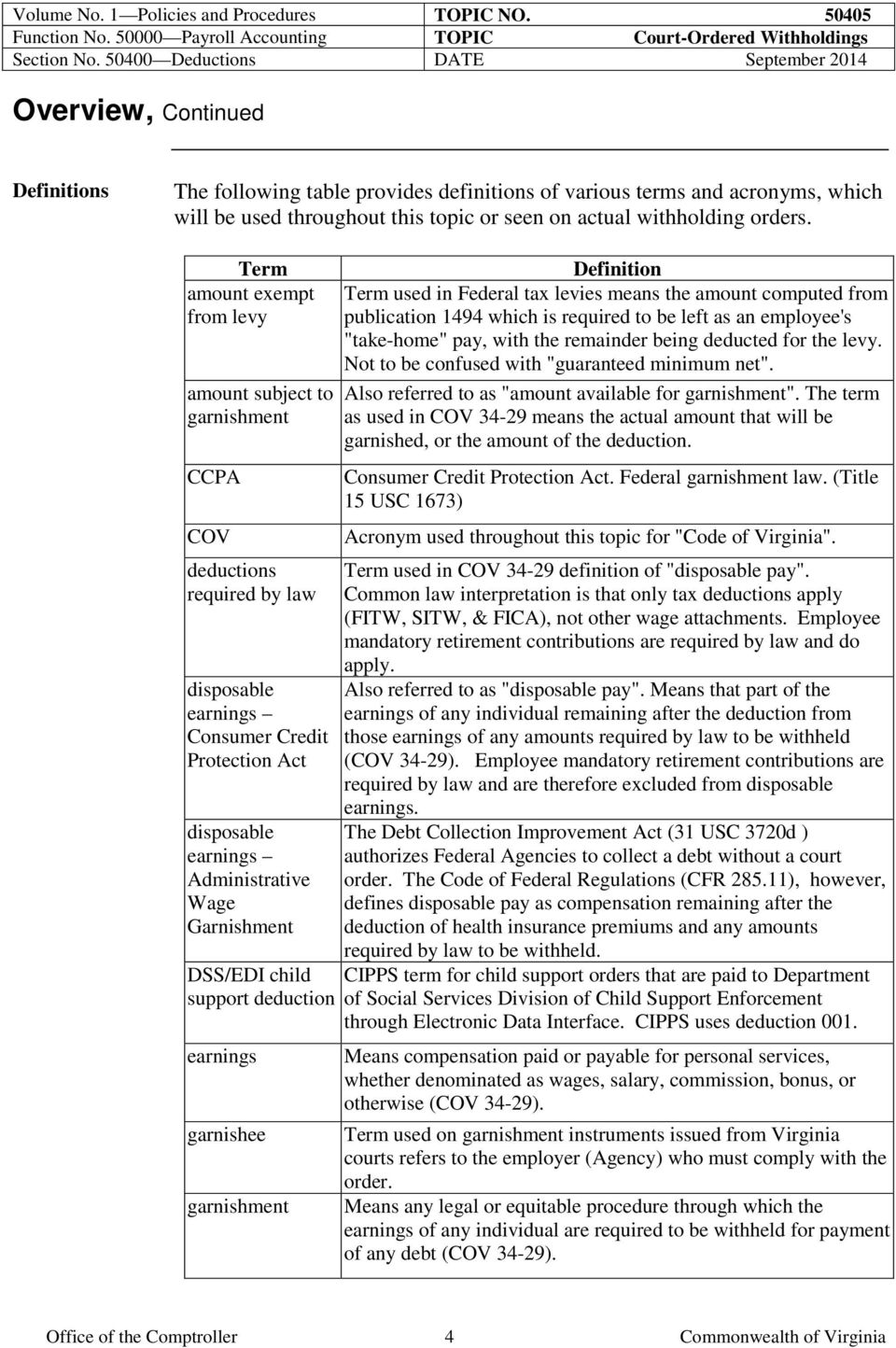
4 Overview, Continued Definitions The following table provides definitions of various terms and acronyms, which will be used throughout this topic or seen on actual withholding orders. Term amount exempt from levy amount subject to garnishment CCPA COV deductions required by law disposable earnings Consumer Credit Protection Act disposable earnings Administrative Wage Garnishment DSS/EDI child support deduction earnings garnishee garnishment Definition Term used in Federal tax levies means the amount computed from publication 1494 which is required to be left as an employee's "take-home" pay, with the remainder being deducted for the levy. Not to be confused with "guaranteed minimum net". Also referred to as "amount available for garnishment". The term as used in COV means the actual amount that will be garnished, or the amount of the deduction. Consumer Credit Protection Act. Federal garnishment law. (Title 15 USC 1673) Acronym used throughout this topic for "Code of Virginia". Term used in COV definition of "disposable pay". Common law interpretation is that only tax deductions apply (FITW, SITW, & FICA), not other wage attachments. Employee mandatory retirement contributions are required by law and do apply. Also referred to as "disposable pay". Means that part of the earnings of any individual remaining after the deduction from those earnings of any amounts required by law to be withheld (COV 34-29). Employee mandatory retirement contributions are required by law and are therefore excluded from disposable earnings. The Debt Collection Improvement Act (31 USC 3720d ) authorizes Federal Agencies to collect a debt without a court order. The Code of Federal Regulations (CFR ), however, defines disposable pay as compensation remaining after the deduction of health insurance premiums and any amounts required by law to be withheld. CIPPS term for child support orders that are paid to Department of Social Services Division of Child Support Enforcement through Electronic Data Interface. CIPPS uses deduction 001. Means compensation paid or payable for personal services, whether denominated as wages, salary, commission, bonus, or otherwise (COV 34-29). Term used on garnishment instruments issued from Virginia courts refers to the employer (Agency) who must comply with the order. Means any legal or equitable procedure through which the earnings of any individual are required to be withheld for payment of any debt (COV 34-29). Office of the Comptroller 4 Commonwealth of Virginia
5 Overview, Continued Term guaranteed minimum net Definition As defined in the CCPA and COV 34-29, creditor garnishments cannot reduce an employee's disposable pay for any given workweek below 40 times the current Federal minimum hourly wage. This term should not be confused with "amount exempt from levy." judgment creditor Term used on garnishment instruments issued from Virginia courts refers to the creditor or plaintiff who files the garnishment. Such plaintiff must have obtained a judgment in a previous case. judgment debtor Term used on garnishment instruments issued from Virginia courts refers to the individual (employee) whose pay will be garnished. return date Term used on garnishment instruments issued from Virginia courts refers to the date that the garnishment must be paid or answer filed with the court. Normally is 90 days from the date the garnishment is filed. support deduction CIPPS term for child support orders that are paid directly to a custodial parent or out-of-state agency by means of a third party check. CIPPS uses deduction 002. take-home pay Term used for computation of Federal Tax Levies refers to what is normally considered "net" pay. Gross pay minus all taxes and deductions in effect when the levy is received. tax levy Term used to describe an involuntary withholding order for payment of delinquent Federal Taxes. tax liens Term used to describe involuntary withholding orders for payment of delinquent State or local taxes. wage assignment A voluntary third party withholding agreement. wage attachment Legal instrument which requires the involuntary withholding of an individual's pay for payment of any debt or support requirement. Also see "garnishment. writ of fieri facias Legal term for the garnishment suggestion (instrument). Applicable Laws The Consumer Credit Protection Act (CCPA), codified under the United States Code 15 USC 1673, protects consumers from unfair or harsh debt collection practices. Although not all forms of wage attachments are covered under the CCPA, deductions for non-ccpa wage attachments must still be considered in computing amounts available for garnishment (29 CFR ). The following table provides basic code references for the common forms of wage attachments. It is not all-inclusive: Office of the Comptroller 5 Commonwealth of Virginia

6 Overview, Continued Wage Attachment Child Support Orders Creditor Garnishments Defaulted Student Loan Withholding Orders Federal Administrative Wage Federal Law 15 USC 1673 (CCPA) 29 CFR USC USC 1673 (CCPA) 29 CFR USC 1095a and 31 USC 3720d and CFR USC 3720d and CFR Garnishment Federal Tax Levies IRC 6331 IRC 6332 IRC 6334 IRC 6343 State Law COV COV COV COV COV Not Applicable Not Applicable Not Applicable COV COV COV COV State Tax Liens 15 USC 1673 (b)(c) COV (Income Tax) COV (Local Taxes) Bankruptcy 11 USC Chapters 7 & USC 1673 (b)(b) Not Applicable Honoring the Garnishment If an agency receives a notice of garnishment or levy prior to the distribution of an employee s paycheck or earnings notice, the agency must process the garnishment or levy in the current pay period regardless of whether the employee s paycheck or notice has already been prepared or certified. All orders must be answered regardless of whether they are deducted. The agency can be held liable for the full judgment amount if the authority issuing the garnishment is not notified. The Commonwealth, as an employer, is not obliged to honor wage assignments that come directly from payday lenders (those not authorized by the court) regardless of the agreement between the employee and the vendor. Additionally, it is strongly suggested that such assignment requests not be honored by agencies even if the employee confirms intent for such payroll deductions to occur. Office of the Comptroller 6 Commonwealth of Virginia

7 Overview, Continued Garnishments on Work Study Payments As mandated in 20 USC 1095a (Higher Education Act), work-study payments are not subject to garnishment or attachment in order to satisfy a debt owed by the student awarded such assistance other than a debt owed to the Secretary of Education. Garnishment Fee A fee may be associated with the collection of certain third party payments. The amount and the number of times to be withheld may vary, depending on the type of deduction. Refer to the Fee for Garnishments, Support Orders and Tax Liens Deduction section within this topic. Deduction Processing Features CIPPS allows you the flexibility to set up the garnishment deduction to: Take a percentage of net pay or Take a flat amount and ensure that the dollar amount does not exceed a specified percentage of disposable earnings. Decrease the goal amount by each deduction to show balance due Enter a dollar amount in the goal field to stop the deduction Enter a date in the Deduction End Date field to stop the deduction; and Ensure the employee retains the guaranteed minimum net Link multiple garnishment deductions and ensure the maximum percentage is not exceeded over multiple garnishments. Remittances The CIPPS deduction number determines the remittance method, as described below: Department of Social Services (DSS)/EDI Deduction 001 Third Party Checks Deductions Deduction 001 provides a means to expedite the remittance of child support payments to the Virginia Department of Social Services. The deduction allows the remittance to occur through Electronic Data Exchange. H0901 is not established for Deduction 001. Deductions 002 through 008 generate a third party check payable to the recipient on H0901. The checks are returned to the agency along with other payroll checks and reports. H0901 must be established for deductions in order for the deduction to be accepted on H0ZDC. Office of the Comptroller 7 Commonwealth of Virginia

8 Before You Begin Identify Withholding Requirements Thoroughly read each withholding order in its entirety. Although standard forms are used, the information contained in the order is unique to the particular case. Each type of wage attachment has its own requirements in determining the calculation method, basis of calculation, limits, remittance requirements, information requirements, due dates, and means by which it can be satisfied or stopped. The payroll administrator should be able to answer the following questions concerning the wage attachment: What type of wage attachment is it? i.e., court-ordered creditor garnishment, child support order, Tax Levy, etc. What laws or regulations govern the requirements of the wage attachment? See "Applicable Laws" section previously provided in this topic. Based on the answers to the above questions, will the deduction be computed on a percentage basis, flat amount, or other method such as an exemption amount or guaranteed net? If a percentage deduction is required, what is the basis of the percentage? i.e., "gross pay", "net pay", "disposable pay", "take-home pay", or other unique method. What is the frequency of the payments (remittance)? i.e. each payday, monthly, lump sum on return date, etc. If the deduction cannot be taken, who do I need to respond to? When? When do I start taking the deduction? When do I stop taking the deduction? Once you have determined the withholding requirements for the order in question, you can use the examples in the Garnishment Processing Procedures section to view the recommended setup for specific garnishment requirements. If you do not find a specific example to meet the requirements of the order, refer to the Garnishment Deduction section to view the specific functionality of the deductions available to customize a solution that best fits the requirements of the order. Prioritize Multiple Orders State laws govern the priority of withholdings when an employee is served with multiple orders. The Dept. of Labor and Industry provides guidance for determining the order of priority on their website at: The priority guidelines are as follows: Office of the Comptroller 8 Commonwealth of Virginia
9 Before You Begin, Continued Withholding Type Child Support Bankruptcy Garnishment Federal Tax Levies State Tax Liens (Commonwealth of Virginia) Guideline Takes priority over any bankruptcy, garnishment or deductions under state law. Title 11 Chapter 13 orders take priority over any other claim against the employee s wages other than child support. Priority is based on the garnishment received first. Notify, in writing, the clerk of the court from which the second garnishment was issued if the employee is at the maximum amount on a prior garnishment. Normally allow amounts for all current deductions (including wage attachments) which are in effect when the levy is received to continue. The tax levy takes priority over all wage attachments and voluntary deductions (including changes) which are received after the levy, including child support. Note: Contact the IRS office issuing the levy in the event a child support order is received after the levy is in effect. Follows the same handling priority as garnishments issued under state law. However, in some instances up to 100% of disposable pay may be taken in addition to the current wage attachment. Prioritization Examples Once the priority is determined you must determine whether the second order can be taken at all, held until the priority order is satisfied, or taken at a reduced amount. Title 29 CFR provides examples that are helpful in making this decision. Some common situations include: Garnishment A" is currently being deducted with a return date of August 15 th, Garnishment "B" is received with a return date of September 30 th. Garnishment "B" should be held until Garnishment "A" is satisfied on August 15 th, and then deducted until the return date of September 30 th. Office of the Comptroller 9 Commonwealth of Virginia

10 Before You Begin, Continued Prioritization Examples, continued A child support order is currently in effect until September 30 at the amount of $500.00, which is 50% of the obligor's disposable pay. Garnishment "C" is received with a return date of August 15. Garnishment "C" cannot be taken because more than 25% of the employee's pay is already being withheld for the child support. Garnishment "C" must be answered with an explanation that the garnishment cannot be withheld due to COV limits being exceeded by a priority withholding order. A child support order is currently in effect until September 30. The child support amount is $200.00, which is only 15% of the obligor's disposable pay. Garnishment "D" is received with a return date of August 15. Continue to deduct the full child support amount plus 10% for Garnishment "D", so long as the combined orders do not exceed 25% of disposable pay. Garnishment "D" must be answered by August 15 th with the remittance and an explanation that the reduced amount was due to an existing priority withholding order. Note: All orders must be answered regardless of whether they are deducted. The agency can be held liable for the full judgment amount if the authority issuing the second garnishment is not notified. However, the Commonwealth, as an employer, is not obliged to honor wage assignments that come directly from payday lenders (those not authorized by the court) regardless of the agreement between the employee and the vendor. Additionally, it is strongly suggested that such assignment requests not be honored by agencies even if the employee confirms intent for such payroll deductions to occur. Office of the Comptroller 10 Commonwealth of Virginia

11 Before You Begin, Continued Special Considerations Out-of-State Child Support Orders. The Uniform Interstate Family Support Act (UIFSA) requires employers to honor out-of-state child support orders. The act also provides that while the order controls the amount deducted and the person or agency designated to receive the payments, the administrative process (i.e., administrative fees, timing and frequency of deduction, and maximum limits) is controlled by the obligor's work state (Virginia). Out-of-State Creditor Garnishments. Due to the specific requirements placed on creditor garnishments by the Code of Virginia, garnishments issued by courts not having jurisdiction within Virginia are generally not honored. Out-of-state garnishments should be answered with the suggestion that the withholding order be domesticated in a Virginia court. Seek a qualified legal opinion if in doubt. Note: this does not apply to Child Support Orders or any withholding order issued by a Federal court or agency. Bankruptcy Orders. Bankruptcy is unique in that simply filing a petition for relief under Chapter 13 invokes a stay of involuntary collection actions under 11 USC When an employee produces evidence of filing Chapter 13, cease withholding of all wage attachments (except federal tax levies) and notify the issuing authorities (including IRS, if applicable) and the Bankruptcy Court. It is recommended that funds collected prior to filing the bankruptcy petition be held until instructions are provided from the Clerk of the Bankruptcy Court, Trustee, or Court that issued the garnishment. Once the Chapter 13 withholding order is issued, follow the terms and instructions contained in the order. Federal Tax Levies. Once a Notice of Levy is issued it must be withheld until a Release of Levy (Form 668-D) is received. Agencies should be aware that employee disputes and fear of employee litigation are not good cause for failing to honor the levy. Carefully follow the instructions on the levy, paying particular attention to the instructions for figuring the amount exempt from levy found on the reverse of form 668-W(C)(DO). Office of the Comptroller 11 Commonwealth of Virginia

12 Before You Begin, Continued State Tax Liens (Commonwealth of Virginia): COV (local taxes): These orders are entitled to 100% of net without regard to CCPA limits. In the event an order is received that exceeds 100% of net for a single pay period, it is recommended that the locality that issued the order be contacted to see if a more lenient payment schedule will be acceptable. The locality may insist on a 100% of net deduction. COV (income tax): These orders are also entitled to up to 100% of net however the law does provide for an "exempt from lien" amount. Unlike the Federal levy process, the exemption is not automatic. The employee must complete form CS-7 and it must be approved by the Department of Taxation prior to reducing the amount withheld. Office of the Comptroller 12 Commonwealth of Virginia

13 Garnishment Deductions Deduction Number 001 DCSE-SUP This deduction number is used to collect withholdings for Child Support Orders for the Commonwealth of Virginia. The money is sent via EDI to the Department of Social Services. Refer to garnishment processing Examples A and D for specific instructions on how to establish this deduction. Deduction Utility Field Functions: Utility Field Position 1 Value of 0 indicates that a flat dollar amount was entered in the Amt/PCT field. Value of 2 indicates that a percentage was entered in the Amt/PCT field and the percentage entered will be applied towards the employee s current net pay. Utility Field Position 5 Value of 1 indicates that disposable earnings are equal to the employee s gross pay minus taxes withheld minus mandatory employee retirement withheld. This is the recommended setting for the field. Utility Field Position 6 Value of 0 instructs CIPPS to take the full dollar amount in the Amt/PCT field. Value of 1 instructs CIPPS to limit the combined dollar amount withheld of deductions that have a 1 in the 6 th position to the percentage of disposable earnings entered in positions Utility Field Positions 7-10 Users may enter a two decimal place maximum percentage limit of disposable earnings. Example 55% is Office of the Comptroller 13 Commonwealth of Virginia

14 Garnishment Deductions, Continued Deduction Number 002 SUPPORT2 This deduction number is used to collect withholdings for Child Support Orders for states other than Virginia. An H0901 record must be established and a third party check will be generated to the payee for the computed amount. Refer to garnishment processing Examples A and D for specific instructions on how to establish this deduction. Deduction Utility Field Functions: Utility Field Position 1 Value of 0 indicates that a flat dollar amount was entered in the Amt/PCT field. Value of 2 indicates that a percentage was entered in the Amt/PCT field and the percentage entered will be applied towards the employee s net pay. Utility Field Position 5 Value of 1 indicates that disposable earnings are equal to the employee s gross pay minus taxes withheld minus mandatory employee retirement withheld. This is the recommended setting for the field. Utility Field Position 6 Value of 0 instructs CIPPS to take the full dollar amount in the Amt/PCT field. Value of 1 instructs CIPPS to limit the combined dollar amount withheld of deductions that have a 1 in the 6 th position to the percentage of disposable earnings entered in positions Utility Field Positions 7-10 Users may enter a two decimal place maximum percentage limit of disposable earnings. Example 55% is Utility Field Position 17 - the name number on H0901 for payee Deduction Numbers 003 GARNISH1, 004 GARNISH2, and 005 GARNISH3 These deduction numbers can be used for multiple purposes and provide the most functionality to ensure CIPPS automatically calculates the proper amount to withhold. An H0901 record must be established and a third party check will be generated to the payee for the computed amount. Processing Examples B, C, D, E, F and G shown in the following section will give specific instructions on how to use the functionality of these deductions for the best results. Office of the Comptroller 14 Commonwealth of Virginia

15 Garnishment Deductions, Continued Deduction Utility Field Functions: Utility Field Position 1 Value of 0 indicates that a flat dollar amount was entered in the Amt/PCT field. Value of 2 indicates that a percentage was entered in the Amt/PCT field and the percentage entered will be applied towards the employee s net pay. Utility Field Position 5 Value of 1 indicates that disposable earnings are equal to the employee s gross pay minus taxes withheld minus mandatory employee retirement withheld. This is the recommended setting for the field. Utility Field Position 6 Value of 0 instructs CIPPS to take the full dollar amount in the Amt/PCT field. Value of 1 instructs CIPPS to limit the combined dollar amount withheld of deductions and deduction 019 that have a 1 in the 6 th position to the percentage of disposable earnings entered in positions Utility Field Positions 7-10 Users may enter a two decimal place maximum percentage limit of disposable earnings. Example 55% is Utility Field Positions Enter the whole dollar protected amount of levy or guaranteed minimum net amount for the pay frequency. Regardless of whether an amount or percent is entered, CIPPS will ensure that this amount is left to the employee after the garnishment deduction is taken. Based on the current minimum wage at the time of this CAPP update and frequency shown in the chart below, the guaranteed minimum net is: Frequency Guaranteed Minimum Net Semi-Monthly Bi-Weekly Weekly Monthly Utility Field Position 17 - the name number on H0901 that should be used on the face of the garnishment check Utility Field Position 18 Value of 1 indicates that the goal amount should be decremented each time an amount is deducted. The garnishment will stop automatically when the goal amount becomes zero. Office of the Comptroller 15 Commonwealth of Virginia
16 Garnishment Deductions, Continued Deduction Numbers 005 GARNISH3, and 006 GARNISH4 These deductions have limited functionality and are recommended only in cases where you want to withhold a flat dollar amount and that deduction does not need to be protected by a guaranteed minimum net or a certain percentage. These deductions should be used primarily for bankruptcies and local or state tax liens that do not have a protected amount. These deductions are not recommended for use when a percentage is involved because the disposable earnings used (gross minus all pretax deductions minus taxes) does not meet the CCPA or Code of Virginia guidelines. Deduction Utility Field Functions: Utility Field Position 1 Value of 0 indicates that a flat dollar amount was entered in the Amt/PCT field. Utility Field Position 8 Value of 1 indicates that the goal amount should be decremented each time an amount is deducted. The garnishment will stop automatically when the goal amount becomes zero. Utility Field Position 17 - the name number on H0901 that should be used on the face of the garnishment check Office of the Comptroller 16 Commonwealth of Virginia
17 Garnishment Deductions, Continued Deduction Number 008 GARNISH6 This deduction has some value in that it will calculate the guaranteed minimum net as provided for in the Code of Virginia based on the employee s pay frequency. However, the guaranteed minimum net amount calculated cannot be considered in conjunction with other garnishment or child support amounts as is the case with deduction numbers If you have multiple garnishments for an employee or a child support is involved, you should select deduction numbers as shown in the garnishment processing examples in the next section. This deduction automatically decrements the goal amount. Therefore, a goal amount is required in order for this deduction to work properly. Deduction Utility Field Functions: Utility Field Position 1 Value of 0 indicates that a flat dollar amount was entered in the Amt/PCT field. Value of 2 indicates that a percentage was entered in the Amt/PCT field and the percentage entered will be applied towards the employee s net pay. Utility Field Position 6 Value of 0 instructs CIPPS to take the full dollar amount in the Amt/PCT field. Value of 1 instructs CIPPS to limit the combined dollar amount withheld of deductions and deduction 019 that have a 1 in the 6 th position to the percentage of disposable earnings entered in Positions Utility Field Positions 7-10 Users may enter a two decimal place maximum percentage limit of disposable earnings. Example 55% is Utility Field Position 9-10 Value of 47 instructs CIPPS to calculate the guaranteed minimum net provided for by the Code of Virginia Utility Field Position 17 the name number on H0901 that should be used on the face of the garnishment check Office of the Comptroller 17 Commonwealth of Virginia

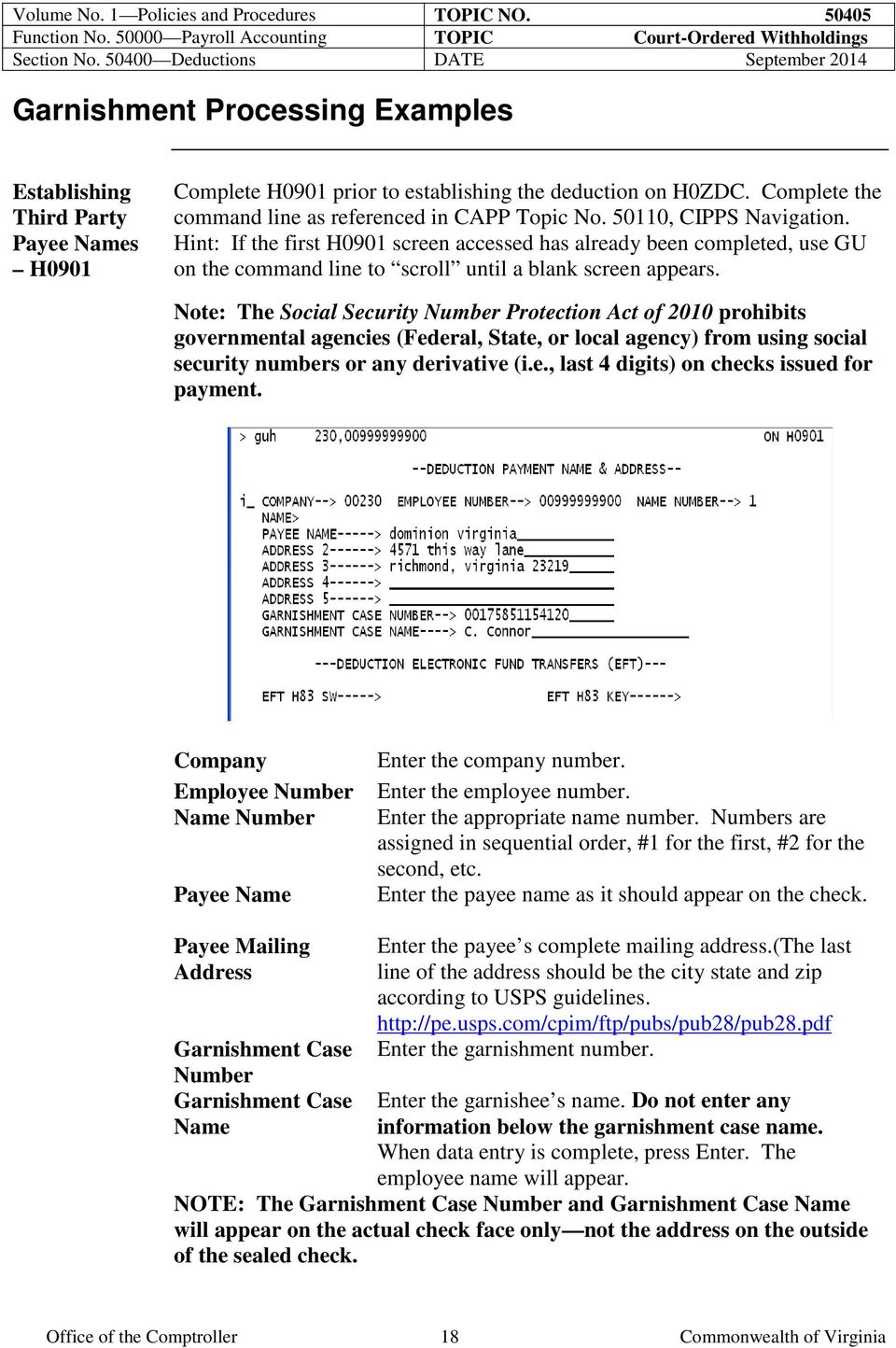
18 Garnishment Processing Examples Establishing Third Party Payee Names H0901 Complete H0901 prior to establishing the deduction on H0ZDC. Complete the command line as referenced in CAPP Topic No , CIPPS Navigation. Hint: If the first H0901 screen accessed has already been completed, use GU on the command line to scroll until a blank screen appears. Note: The Social Security Number Protection Act of 2010 prohibits governmental agencies (Federal, State, or local agency) from using social security numbers or any derivative (i.e., last 4 digits) on checks issued for payment. Company Employee Number Name Number Payee Name Enter the company number. Enter the employee number. Enter the appropriate name number. Numbers are assigned in sequential order, #1 for the first, #2 for the second, etc. Enter the payee name as it should appear on the check. Payee Mailing Address Garnishment Case Number Garnishment Case Name Enter the payee s complete mailing address.(the last line of the address should be the city state and zip according to USPS guidelines. Enter the garnishment number. Enter the garnishee s name. Do not enter any information below the garnishment case name. When data entry is complete, press Enter. The employee name will appear. NOTE: The Garnishment Case Number and Garnishment Case Name will appear on the actual check face only not the address on the outside of the sealed check. Office of the Comptroller 18 Commonwealth of Virginia
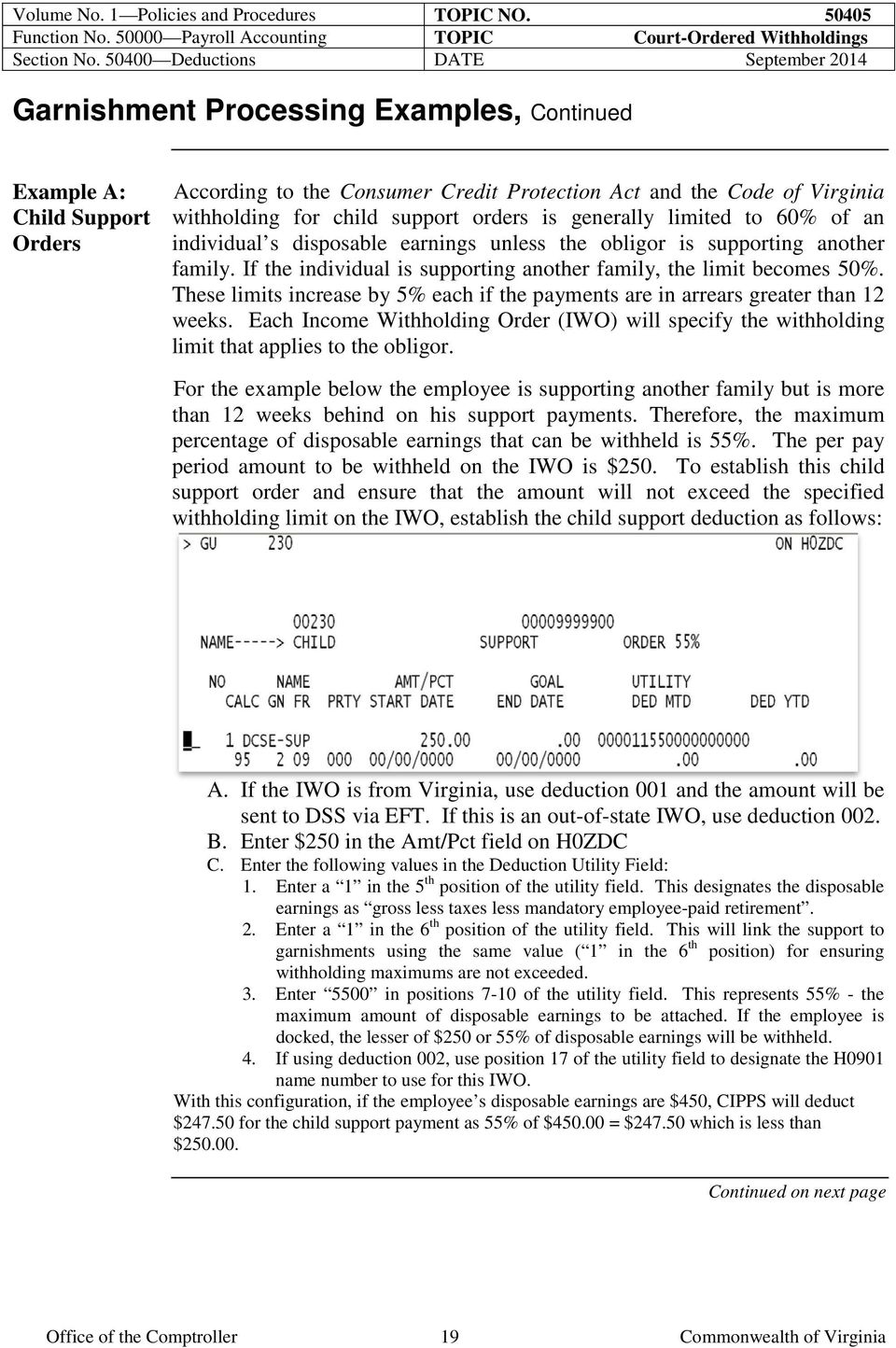
19 Garnishment Processing Examples, Continued Example A: Child Support Orders According to the Consumer Credit Protection Act and the Code of Virginia withholding for child support orders is generally limited to 60% of an individual s disposable earnings unless the obligor is supporting another family. If the individual is supporting another family, the limit becomes 50%. These limits increase by 5% each if the payments are in arrears greater than 12 weeks. Each Income Withholding Order (IWO) will specify the withholding limit that applies to the obligor. For the example below the employee is supporting another family but is more than 12 weeks behind on his support payments. Therefore, the maximum percentage of disposable earnings that can be withheld is 55%. The per pay period amount to be withheld on the IWO is $250. To establish this child support order and ensure that the amount will not exceed the specified withholding limit on the IWO, establish the child support deduction as follows: A. If the IWO is from Virginia, use deduction 001 and the amount will be sent to DSS via EFT. If this is an out-of-state IWO, use deduction 002. B. Enter $250 in the Amt/Pct field on H0ZDC C. Enter the following values in the Deduction Utility Field: 1. Enter a 1 in the 5 th position of the utility field. This designates the disposable earnings as gross less taxes less mandatory employee-paid retirement. 2. Enter a 1 in the 6 th position of the utility field. This will link the support to garnishments using the same value ( 1 in the 6 th position) for ensuring withholding maximums are not exceeded. 3. Enter 5500 in positions 7-10 of the utility field. This represents 55% - the maximum amount of disposable earnings to be attached. If the employee is docked, the lesser of $250 or 55% of disposable earnings will be withheld. 4. If using deduction 002, use position 17 of the utility field to designate the H0901 name number to use for this IWO. With this configuration, if the employee s disposable earnings are $450, CIPPS will deduct $ for the child support payment as 55% of $ = $ which is less than $ Office of the Comptroller 19 Commonwealth of Virginia
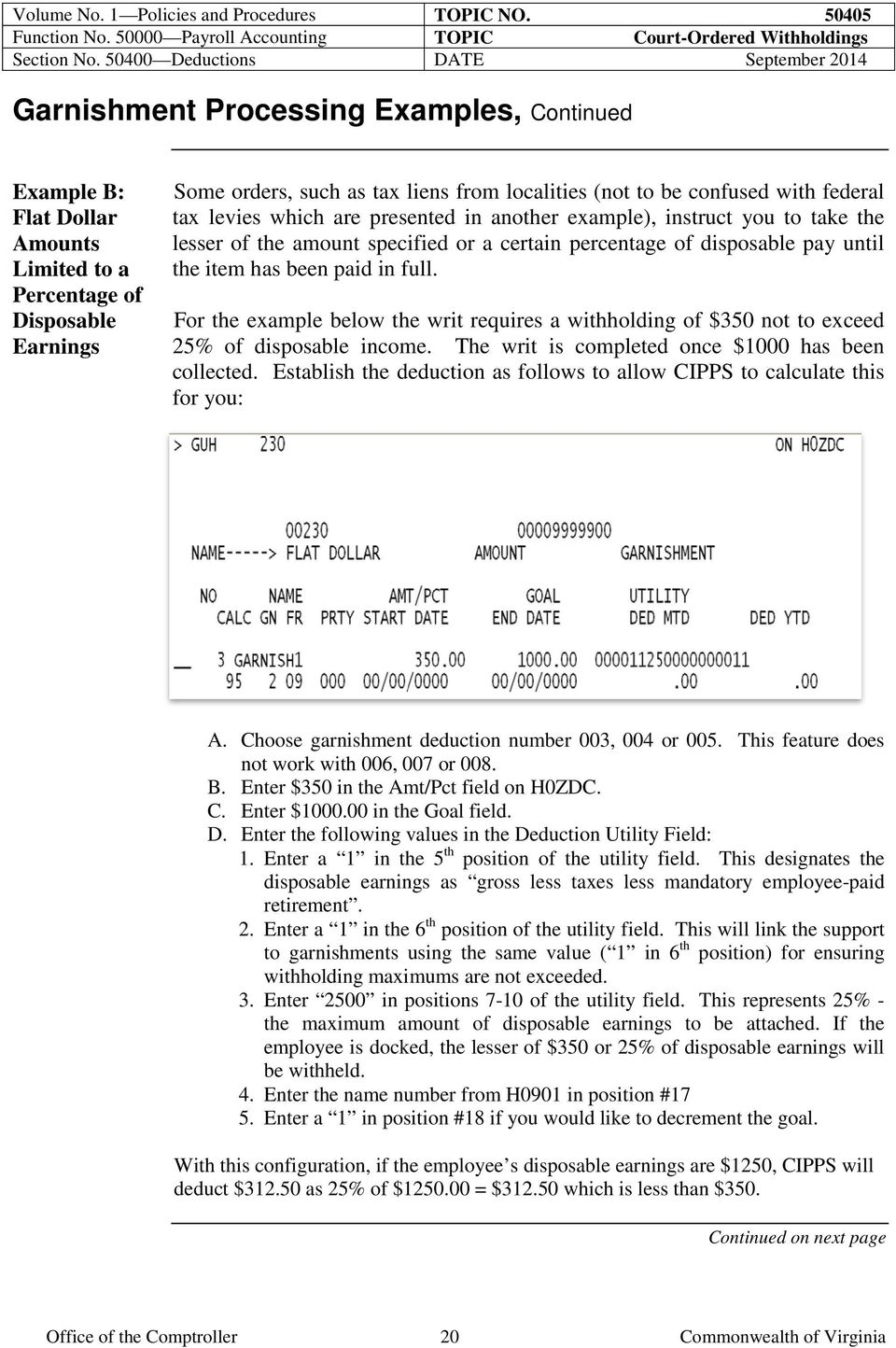
20 Garnishment Processing Examples, Continued Example B: Flat Dollar Amounts Limited to a Percentage of Disposable Earnings Some orders, such as tax liens from localities (not to be confused with federal tax levies which are presented in another example), instruct you to take the lesser of the amount specified or a certain percentage of disposable pay until the item has been paid in full. For the example below the writ requires a withholding of $350 not to exceed 25% of disposable income. The writ is completed once $1000 has been collected. Establish the deduction as follows to allow CIPPS to calculate this for you: A. Choose garnishment deduction number 003, 004 or 005. This feature does not work with 006, 007 or 008. B. Enter $350 in the Amt/Pct field on H0ZDC. C. Enter $ in the Goal field. D. Enter the following values in the Deduction Utility Field: 1. Enter a 1 in the 5 th position of the utility field. This designates the disposable earnings as gross less taxes less mandatory employee-paid retirement. 2. Enter a 1 in the 6 th position of the utility field. This will link the support to garnishments using the same value ( 1 in 6 th position) for ensuring withholding maximums are not exceeded. 3. Enter 2500 in positions 7-10 of the utility field. This represents 25% - the maximum amount of disposable earnings to be attached. If the employee is docked, the lesser of $350 or 25% of disposable earnings will be withheld. 4. Enter the name number from H0901 in position #17 5. Enter a 1 in position #18 if you would like to decrement the goal. With this configuration, if the employee s disposable earnings are $1250, CIPPS will deduct $ as 25% of $ = $ which is less than $350. Office of the Comptroller 20 Commonwealth of Virginia
21 Garnishment Processing Examples, Continued Example C: Single Standard Percentage Garnishment When you have a standard court-ordered withholding summons the usual case scenario is to withhold 25% of disposable earnings until either the complete balance is paid or the return date of the summons has been reached. In addition, Virginia code mandates that employees be provided a guaranteed net pay amount that equates to 40 times the current minimum wage rate as prorated for the number of pays the employee receives in a year. For the example below the writ requires a withholding of 25% of disposable income until $1000 has been collected. Establish the deduction as follows to ensure that CIPPS will withhold the proper amount as required by law: A. Choose garnishment deduction number 003, 004 or 005. This feature does not work with 006, 007 or 008. B. Enter (representing 25%) in the AMT/PCT field. C. Enter $ in the Goal field. D. Enter the following values in the Deduction Utility field: 1. Enter a 2 in the first position to specify that the AMT/PCT field contains a percentage. 2. Enter a 1 in the 5 th position of the utility field. This designates the disposable earnings as gross less taxes less mandatory employee-paid retirement. 3. Enter a 1 in the 6 th position of the utility field. This will link the support to garnishments using the same value ( 1 in 6 th position) for ensuring withholding maximums are not exceeded. 4. Enter 2500 in positions 7-10 of the utility field. This represents 25% - the maximum amount of disposable earnings to be attached. 5. Enter a whole dollar guaranteed minimum net in positions for this employee according to the pay frequency. Amounts for a minimum wage rate of $7.25 are Semi-Monthly , Bi-Weekly , Weekly and Monthly Enter the name number from H0901 in position #17 7. Enter a 1 in position #18 if you would like to decrement the goal. With this configuration, if the disposable earnings are $800, CIPPS would try to take $200 ($800 X 25%) but since the guaranteed minimum net is $629, CIPPS will only take $171 ($800 - $629). Office of the Comptroller 21 Commonwealth of Virginia
22 Garnishment Processing Examples, Continued Example D: Child Support Order with a Percentage Garnishment Child support orders take priority under Virginia law over any other legal process against the same income. As mentioned in Example A child support orders can represent up to as much as 65% of the employees disposable earnings. However, court-ordered garnishments are generally limited to 25% of disposable earnings. If the amount of the child support payment is less than 25% of disposable earnings, the remainder of the 25% should go towards the garnishment. Assuming that the child support order described in Example A is in effect and a court ordered garnishment for 25% of disposable earnings up to a total of $780 is received, establish the garnishment deduction as follows to withhold the item as required by law: A. Select either deduction 003, 004 or 005 for the garnishment. These features are not available for deduction 006, 007 or 008. B. Enter (representing 25%) in the AMT/PCT field. C. Enter $ in the Goal field. D. Enter the following values in the Deduction Utility Field of the garnishment: 1. Enter a 2 in the first position to specify that the AMT/PCT field contains a percentage. 2. Enter a 1 in the 5 th position of the utility field. This designates the disposable earnings as gross less taxes less mandatory employee-paid retirement. 3. Enter a 1 in the 6 th position of the utility field. This will link the support to garnishments using the same value ( 1 in 6 th position) for ensuring withholding maximums are not exceeded. 4. Enter 2500 in positions 7-10 of the utility field. This represents 25% - the maximum amount of disposable earnings to be attached. 5. Enter a whole dollar guaranteed minimum net in positions for this employee according to the pay frequency. Amounts for a minimum wage rate of $7.25 are Semi-Monthly , Bi-Weekly , Weekly and Monthly Enter the name number from H0901 in position #17 7. Enter a 1 in position #18 if you would like to decrement the goal. Office of the Comptroller 22 Commonwealth of Virginia
23 Garnishment Processing Examples, Continued For an employee with a semi-monthly salary/rate of $1500, taxes totaling $250 and employee retirement $75, CIPPS will process the amounts as follows: $1500 gross minus $250 taxes minus $75 employee retirement equals disposable earnings of $1175. $1175 X 55% = $646.25; the child support amount of $250 will be taken $1175 X 25% = $293.75; this is the maximum amount that can be taken for the child support payment and the garnishment. $ $ = $881.25; this amount is greater than the guaranteed minimum net of $629 so CIPPS will process the garnishment. $ minus $250 taken for the child support equals $43.75, which is the amount available for garnishment. $1,500.0 Gross 0 Less Taxes $ Less Employee-Paid Retirement $75.00 Disposable Earnings $1, Disposable Earnings $1, Percentage to Determine Max Amount of Disposable Earnings Attachable 0.25 Guaranteed net $ Total Disposable Earnings Available for court-ordered withholdings $ Amount Available for court-ordered withholdings $ Less Child Support $ Less Child Support $ Amount Available for Garnishment $43.75 Remaining Net $ CIPPS WILL TAKE THE LESSER OF THE TWO Office of the Comptroller 23 Commonwealth of Virginia
24 Garnishment Processing Examples, Continued Example E: Multiple Garnishments When multiple garnishments are in place simultaneously the combined total cannot exceed 25% of the employee s disposable earnings. In the example below there are two writs, both requiring a withholding of 25% of disposable income. One has a maximum collection amount of $300 and the other $1000. Establish the deductions as follows to ensure that CIPPS will withhold the proper amount as required by law: A. Select deductions 003, 004 or 005 for the garnishments. These features are not available for deduction 006, 007 or 008. Make sure that the first garnishment received is given the lowest deduction number since it has the greater priority. B. For each deduction enter (representing 25%) in the AMT/PCT field. C. Enter the total balance due in the Goal field of each. In this example $ on the first garnishment and $ on the second. D. For each deduction enter the following values in the Deduction Utility field of each garnishment: 1. Enter a 2 in the first position to specify that the AMT/PCT field contains a percentage. 2. Enter a 1 in the 5 th position of the utility field. This designates the disposable earnings as gross less taxes less mandatory employee-paid retirement. 3. Enter a 1 in the 6 th position of the utility field. This will link the garnishments using the same value ( 1 in 6 th position) to ensure that the total withholding maximum is not exceeded. 4. Enter 2500 in positions 7-10 of the utility field. This represents 25% - the maximum amount of disposable earnings to be attached. 5. Enter a whole dollar guaranteed minimum net in positions for this employee according to the pay frequency. Amounts for a minimum wage rate of $7.25 are Semi-Monthly , Bi-Weekly , Weekly and Monthly Enter the applicable name number from H0901 in position #17 7. Enter a 1 in position #18 if you would like to decrement the goal Office of the Comptroller 24 Commonwealth of Virginia
25 Garnishment Processing Examples, Continued E. For an employee with disposable earnings of $1500, the maximum amount of both garnishments would be limited to $ ($ * 25%). 1. Deduction 003 (highest priority) is evaluated first. The lesser of 25% of disposable income or the total to be collected (the goal) is $300. Therefore $300 will be withheld for this garnishment deduction. 2. Since the maximum amount available for garnishment is $375, only $75 remains available for the next garnishment (deduction 004). 3. Available net pay at this point is $1200 ($ $300) which is greater than the required guaranteed net of $629. There is still $571 available for garnishment attachment. 4. Deduction 004 is then evaluated. The lesser of 25% of disposable income ($375) or the amount remaining available for garnishment ($75) will be withheld. So $75 dollars will be withheld for the second garnishment deduction. Disposable Earnings $1, Disposable Earnings $1, Percentage to Determine Max Amount of Disposable Earnings Attachable 0.25 Guaranteed net $ Total Disposable Earnings Available for court-ordered withholdings $ Amount Available for court-ordered withholdings $ Garnishment 003 $ Garnishment 003 $ Amount Available for Amount Available for Garnishment 004 $75.00 Garnishment 004 $ CIPPS WILL TAKE THE LESSER OF THE TWO Office of the Comptroller 25 Commonwealth of Virginia
26 Garnishment Processing Examples, Continued Example F: Federal Tax Levy Federal tax levies have a different set of rules than standard garnishments. Employees are generally allowed a protected amount according to the chart in IRS Publication In addition, the IRS usually exempts all deduction amounts already being taken at the time the levy is received. For the example below the total of the Federal tax levy is $10,500. Establish the deduction as follows to ensure that CIPPS will withhold the proper amount as required by law: A. Select either deduction 003, 004 or 005 for the levy. These features are not available for deduction 006, 007 or 008. B. Enter the TOTAL amount of the levy in the AMT/PCT field of the deduction. ALL of the employee s pay is subject to the levy with the exception of the protected amount. C. It is suggested you do not enter a goal amount for a Federal tax levy. Unlike other levies, a levy on a taxpayer s wages and salary has a continuous effect. It attaches to future payments, until the levy is released. D. Enter the following values in the Deduction Utility Field. 1. Enter a 1 in the 5 th position of the utility field. This designates the disposable earnings as gross less taxes less mandatory employee-paid retirement. 2. Enter the whole dollar amount to be protected in positions based on the calculation found in the steps below. For this example the value would be a. Use the filing status and number of exemptions from the taxpayer s certification, Part 3 of the levy, to determine the amount exempt from levy according to IRS Publication For this example, the exempt amount is $ b. Determine other deductions in effect prior to the levy which will also be exempt. Do not include taxes withheld or the mandatory employee-paid retirement deduction as these will already be exempt from the levy. Do not include direct deposit deductions as these are methods of payment. For this example, the total deductions are $ c. Add the amounts from step a and b above and round to the nearest whole dollar to determine the protected amount. ($ plus $ equals $ rounded to the nearest whole dollar equals $730) 3. Enter the name number from H0901 in position 17. Office of the Comptroller 26 Commonwealth of Virginia
27 Garnishment Processing Examples, Continued NOTE: Regardless of pay fluctuations that may occur from dockings or overtime, CIPPS will deduct all of the employee s disposable earnings and leave them with the protected amount and enough to take deductions that were in place at the time the levy was received. If done correctly, the net pay should equal the amount specified in IRS Publication Example G1: Education Loan Garnishment (Administrati ve Wage Garnishment) Federal Education Loan (FEL) garnishments are subject to no more than 15% of disposable earnings. However, as defined on page 4 of this topic, disposable pay is different for the FEL (which is an Administrative Wage Garnishment). Current system limitations prevent the exclusion of health insurance premiums from disposable pay as required for the FEL. Therefore, users must calculate the amount for the FEL garnishment manually using the Administrative Wage Garnishment Spreadsheet found on our website. This amount will need to be recalculated each time there is a fluctuation in the amount of income received for the employee. NOTE: State Payroll Operations does not endorse the use of SF-329C, Wage Garnishment Worksheet, because it does not calculate the disposable earnings as defined by the CCPA when calculating the maximum combined amount that can be withheld between the FEL and state-issued court-ordered withholdings. In this example the employee has a FEL garnishment for a total of $10,780 and the amount computed on the Administrative Wage Garnishment Spreadsheet is $ A. Select deduction 003, 004 or 005 for the garnishment. These features are not available for deduction 006, 007 or Enter in the AMT/PCT field to deduct the manually calculated amount. 2. Enter the total amount due for the education loan garnishment in the Goal field. Office of the Comptroller 27 Commonwealth of Virginia
28 Garnishment Processing Examples, Continued 3. In the Deduction Utility Field: a. Enter a 1 in the 5th position of the utility field. Should an additional garnishment come through, this designates the disposable earnings as gross less taxes less mandatory employee-paid retirement for the combined orders. b. Enter a 1 in the 6th position of the utility field. This will link future additional garnishments using the same value ( 1 in 6th position). c. Enter 2500 in positions 7-10 of the utility field. The 15% is manually calculated but if a future garnishment is presented this will ensure that the combined amounts do not exceed 25% of CCPA disposable pay. d. Enter a whole dollar guaranteed minimum net in positions for this employee according to the pay frequency. Amounts for a minimum wage rate of $7.25 are Semi-Monthly , Bi- Weekly , Weekly and Monthly e. Enter the name number from H0901 in position #17. Enter a 1 in position #18 to decrement the goal. Example G2: Education Loan Garnishment and Standard Court Ordered Garnishment Follow the instructions below to add an additional Court-ordered garnishment to the FEL shown in Example G1: 1. Select deduction 003, 004 or 005 for the garnishment. These features are not available for deduction 006, 007 or 008. (Deduction 005 in this example.) 2. Enter in the AMT/PCT field to deduct 25% of the employee s disposable earnings. 3. Enter the total amount due for the court-ordered garnishment in the Goal field. 4. In the Deduction Utility Field: a. Enter a 2 in the first position to specify that the AMT/PCT field contains a percentage. b. Enter a 1 in the 5 th position of the utility field. This designates the disposable earnings as gross less taxes less mandatory employee-paid retirement. Office of the Comptroller 28 Commonwealth of Virginia
29 Garnishment Processing Examples, Continued c. Enter a 1 in the 6 th position of the utility field. This will link the garnishments using the same value ( 1 in 6 th position) to ensure that the total withholding maximum is not exceeded. d. Enter 2500 in positions 7-10 of the utility field. This represents 25% - the maximum amount of disposable earnings to be attached. e. Enter a whole dollar guaranteed minimum net in positions for this employee according to the pay frequency. Amounts for a minimum wage rate of $7.25 are Semi-Monthly , Bi- Weekly , Weekly and Monthly f. Enter the name number from H0901 in position #17. g. Enter a 1 in position #18 to decrement the goal. Office of the Comptroller 29 Commonwealth of Virginia
30 Garnishment Processing Examples, Continued Example G1 and G2 Education Loan Garnishment and Standard Court Ordered Garnishment For an employee with disposable earnings of $1000: 1. The maximum amount of attachable earnings is 25% of disposable earnings or $250 ($1000 *.25) 2. Deduction 004 (highest priority) is evaluated first. The full dollar amount $ Available net pay at this point is $ ($ $125.89) which is greater than the required guaranteed net of $629. There is still $ available for garnishment attachment. 4. Deduction 005 is then evaluated. The lesser of 25% of disposable income ($124.11) or the amount remaining available for garnishment ($241.11) will be withheld. So $ will be withheld for the second garnishment Disposable Earnings $1, Disposable Earnings $1, Percentage to Determine Max Amount of Disposable Earnings Attachable 0.25 Guaranteed net $ Total Disposable Earnings Available for court-ordered withholdings $ Amount Available for courtordered withholdings $ Garnishment 004 $ Garnishment 004 $ Amount Available for Amount Available for Garnishment 005 $ Garnishment 004 $ CIPPS WILL TAKE THE LESSER OF THE TWO Office of the Comptroller 30 Commonwealth of Virginia
31 Garnishment YTD Processing Procedures Terminating Third Party Deductions If a goal is entered on H0ZDC, the deduction will not be taken once the deduction year-to-date amount equals the goal amount, or if decrementing the goal, once the goal amount has been reduced to zero. If a date was entered in the goal field, the deduction will stop when the goal date is reached. To stop a deduction at any time, change the deduction frequency to 00. Calendar Year End Processing Before processing the first payroll of each calendar year, it is important to review each deduction that has been established with a goal if the option to decrement the goal was not selected during setup. Since these deductions stop when the YTD is reset to 0 at the end of each calendar year, these deductions may reactivate and withhold more than is required. If the deduction is to continue, not to continue, Then decrease the goal amount by the previous calendar year s withholdings. change the frequency to 00 to deactivate it. Office of the Comptroller 31 Commonwealth of Virginia
32 Fee for Garnishments, Support Orders and Tax Lien Deductions Background The Code of Virginia provides for the assessment of fees to be paid by both full time and part-time employees for the costs of collection of garnishments, tax liens and child support orders. Executive Branch agencies must collect these fees as follows: Code of Virginia Collection Fee Frequency Garnishment $10.00 once per summons Child Support $ 5.00 per remittance/per order Tax Lien $20.00 once per tax lien Guidelines Fees are imposed on the employee s disposable income (gross wages less deductions required by law) after the court-ordered deduction but before any voluntary deductions (i.e., health care or flexible spending accounts). Note: The combined child support amount and fee may not exceed the maximum limit applied to disposable earnings as established by Code of Virginia ( 34-29) and the Federal Consumer Credit Protection Act (CCPA) (15 U.S.C. 1673(b)). If the employee s disposable income is not sufficient to deduct the fee during the pay period the court order is initiated, then: support order fees are waived, fees for garnishments and tax liens must be collected when funds become available. Multiple Orders In the event you have a child support order in combination with a garnishment or tax lien you may do a tax and deduction override to add the appropriate fee to the regularly collected support order fee. Court Orders Served But Not Processed If an agency is served with a court ordered withholding for a garnishment or tax lien which is subsequently resolved prior to payroll processing, the agency is still obligated to assess the garnishment fee. Out-of-State Support Orders Out-of-state support orders with an administrative (garnishment) fee different from Virginia do not override the required assessment. Fee Exemptions Fees should not be collected on the following court ordered withholdings; bankruptcy, IRS federal tax levies, local and county tax liens. Office of the Comptroller 32 Commonwealth of Virginia
33 Fee for Garnishments, Support Orders and Tax Lien Deductions, Continued Deduction Number 019 GARN FEE This deduction is used to collect the garnishment fees as mandated above. This deduction has the functionality to use goal amounts when one time garnishment fees are necessary. Garnishment fees for child support deductions are taken every pay and by law should be considered along with the amount of the child support deduction when computing the maximum percentage of disposable earnings that can be withheld. See the garnishment fee processing examples in the next section for specific instructions on how to establish a garnishment fee in CIPPS. Deduction Utility Field Functions: Utility Field Position 5 Value of 1 indicates that the disposable earnings should be gross minus taxes minus mandatory employee retirement (particularly important when establishing a child support garnishment fee). Utility Field Position 6 Value of 0 instructs CIPPS to take the full dollar amount in the Amt/PCT field. Value of 1 instructs CIPPS to limit the combined dollar amount withheld for deductions and deduction 019 that have a 1 in the 6 th position to the percentage of disposable earnings entered in positions 7-10 (particularly important when establishing a child support garnishment fee). Utility Field Positions 7-10 Users may enter a two decimal place maximum percentage limit of disposable earnings. Example 55% is (particularly important when establishing a child support garnishment fee) Utility Field Position 18 Value of 1 indicates that the goal amount should be decremented each time an amount is deducted. The garnishment will stop automatically when the goal amount becomes zero. Garnishment fees for child support deductions should be taken each time the child support deduction comes out. If the garnishment fee is for a child support deduction, the value of this field should be 0 and there should not be a goal amount. Office of the Comptroller 33 Commonwealth of Virginia
34 Garnishment Fee Procedures Example A: Establishing the Child Support Collection Fee To ensure that the garnishment fee is included in determining the maximum withholding allowed for the support payment: 1. Establish the child support payment (deduction 001 or deduction 002) on H0ZDC as shown in Example A of Garnishment Processing Examples section. 2. Establish the $5 garnishment fee (deduction 019) on H0ZDC. Do not enter a goal since the fee should be deducted each pay period. In the Utility Field enter a 1 in position 5 and a 1 in position 6. Enter the same maximum percentage that was used for the child support payment (deduction 001 or deduction 002) in positions 7-10 of the Utility Field. The combination of the child support payment and the $5 garnishment fee will not exceed the specified percentage (e.g., 55%) of the employee s disposable earnings. If the employee s disposable earnings are not sufficient to cover the garnishment fee, the fee is waived for that pay period and should not be collected in a future period. Using the method described above will also eliminate the garnishment fee from recycling when it cannot be withheld thereby eliminating any required batch file maintenance to remove a transaction from pending. Office of the Comptroller 34 Commonwealth of Virginia
35 Garnishment Fee Procedures, Continued Example B: Establishing a One-Time Garnishment Fee To ensure that the garnishment fee is only taken one time for a garnishment or tax lien: 1. Establish the garnishment (deduction 003, 004, or 005) on H0ZDC as shown in Example B or C (whichever applies) of Garnishment Processing Examples section. 2. Establish the garnishment fee (deduction 019) on H0ZDC. Because this fee is deducted one time, enter a goal amount. In the Utility Field, enter a 1 in position 18 to decrement the goal amount entered. Note: It is optional to decrement the goal, but establishing the deduction this way ensures that the garnishment fee will only be deducted once. Note: Do not enter the percentage in positions 7-10 of the utility as the fee related to collection of garnishments or tax liens is NOT to be taken into account in determining the maximum withholding amount. If the employee s disposable earnings are not sufficient to cover the garnishment fee related to a garnishment or tax lien, the fee should be collected as soon as the funds become available. If you establish your deductions as shown, CIPPS will recycle the garnishment fee so that it is taken from a future payment. Office of the Comptroller 35 Commonwealth of Virginia
36 Garnishment Fee Procedures, Continued Example C: Garnishment Fees with an existing Child Support Fee Collection of a garnishment fee that includes both a fee for child support and a fee for a garnishment must be handled using a deduction override: 1. Ensure that the child support deduction (001 or 002) and the garnishment deduction (003, 004 or 005) are established on H0ZDC as shown in Example D of Garnishment Processing Examples section. 2. Ensure that the garnishment fee (deduction 019) on H0ZDC is already established as shown in Example A above. The $5 per pay period garnishment fee for child support should already be established. 3. Key a deduction override for garnishment fee 019 on HUD01 as shown below. Key the amount of the one-time fee that is due with a + sign in the adjustment indicator. On the following day review the edit Report 10 for this employee. The garnishment fee deduction has been established in a way that will prevent the uncollected fee from recycling. The deduction override to collect the additional fee amount related to the garnishment will not process nor will it be recycled should the maximum limit of disposable earnings be exceeded when the support payment and the five dollar fee are combined. Example D below provides a method to collect the garnishment related fee in such instances. Office of the Comptroller 36 Commonwealth of Virginia
37 Garnishment Fee Procedures, Continued Example D: Collecting Additional Fees Due when there are Insufficient Funds to Collect the Child Support Fee Deduction 010, DUE AGENCY, should be used to collect the fee amount when a garnishment fee related to a garnishment cannot be withheld due to a concurrent fee for child support that exceeds the maximum limit of disposable earnings. The third party check that is created should then be sent to State Payroll Operations for deposit to the appropriate general ledger account. 1. Deduction 019 (Garnishment Fee) should be established as shown in Example A so that the $5 per period child support fee will resume in the next pay period. 2. On screen H0901 establish a name number record as shown below: 3. Establish deduction 010 (Due Agency) as shown below. Enter a 1 in position #8 of the Utility Field to decrement the goal. Enter the applicable name number used on H0901 in position #17 of the Utility Field (In this example, we used name number 1 ). Garnishment Reports Office of the Comptroller 37 Commonwealth of Virginia
38 Report 907, Missing Child Support Fees Child support collection fees are due with every remittance of a child support payment. Therefore, when there is an active deduction 001, DCSE- SUPPORT, or deduction 002, SUPPORT 2, there should always be an active deduction 019, Garnishment Fee, present. Report 907, Missing Child Support Fees can be requested during your edit processing on screen HSRUT to help ensure that the $5 fee is withheld each time a child support payment is made. The report will print an exception when an employee has an active deduction 001, DCSE-SUPPORT, or deduction 002, SUPPORT 2, and there is no active deduction 019, Garnishment Fee. In addition, it is inappropriate to establish or decrement a goal for child support fees which are payable with each remittance. Report 907 will print an exception if a 1 is present in position #18 and deduction 001,DCSE- SUPPORT, or deduction 002, SUPPORT 2, is active. Please remove the 1 in those cases to allow the collection fee to process. Office of the Comptroller 38 Commonwealth of Virginia
39 Internal Control Agency Responsibility It is the responsibility of the employing agency to ensure that third-party payments are deducted in accordance with the court order or levy, and that payments are forwarded to the creditor by the due date. Record Retention Time Period Payroll records and documentation should be retained for 5 years or until audited, whichever is later. Contacts Contacts Director, State Payroll Operations Voice: (804) [email protected] Payroll Business Analyst/Trainer Voice: (804) or (804) [email protected] Subject Cross References References CAPP Topic No , CIPPS Navigation Office of the Comptroller 39 Commonwealth of Virginia
Texas Payroll Conference
 Texas Payroll Conference Garnishments All Others Taunya Fritzsching, CPP Agenda Involuntary Deductions Garnishment Overview Federal Tax Levy State Tax Levy Student Loans Creditor Garnishments Bankruptcy
Garnishments BEYOND Child Support
 Garnishments BEYOND Child Support Agenda Involuntary nta Deductions Federal Tax Levy State Tax Levy Student Loan Creditor Garnishment Bankruptcy 1 Involuntary Deductions Involuntary deductions Neither
GARNISHMENTS WHAT ARE THEY AND HOW DO SCHOOL DISTRICTS HANDLE THEM
 GARNISHMENTS WHAT ARE THEY AND HOW DO SCHOOL DISTRICTS HANDLE THEM GARNISHMENT A proceeding whereby a plaintiff creditor, called the garnishor, seeks to subject to his or her claim the property of money
WAGE WITHHOLDING FOR DEFAULTED STUDENT LOANS A HANDBOOK FOR EMPLOYERS
 WAGE WITHHOLDING FOR DEFAULTED STUDENT LOANS A HANDBOOK FOR EMPLOYERS TABLE of CONTENTS A Letter to Employers.3 The Student Loan Program...4 Collection Authority...4 The Basic Steps Employers Follow for
Other Deductions from Pay Section 9
 Other Deductions from Pay Section 9 Table of Contents INTRODUCTION... 2 FYI - TOPICS FROM CONTENT OUTLINE... 2 INVOLUNTARY DEDUCTIONS... 2 Tax Levies... 2 Child Support Withholding Orders... 4 Creditor
The attached instructions are for employers who have employees that are subject to wage garnishment in connection with the Federal Student Loan
 The attached instructions are for employers who have employees that are subject to wage garnishment in connection with the Federal Student Loan Program. 1 THE STUDENT LOAN PROGRAM PROGRAM OVERVIEW The
Tax Levies and Creditor Garnishments: Proper Handling and Compliance
 Tax Levies and Creditor Garnishments: Proper Handling and Compliance Sponsored by About the Speaker Vicki M. Lambert, CPP, is President and Academic Director of Vicki M. Lambert, LLC, a firm specializing
Basic Income-Withholding Order Guidelines on Allocation for Multiple Orders for Private Employers
 Basic Income-Withholding Order Guidelines on Allocation for Multiple Orders for Private Employers Updated November 2005 Table of Contents BASIC INCOME-WITHHOLDING ORDER GUIDELINES FOR PRIVATE EMPLOYERS
Administrative Wage Garnishment. Employer Handbook
 Administrative Wage Garnishment Employer Handbook March 2011 Dear Employer, This page provides a brief summary of the Administrative Wage Garnishment (AWG) process utilized by Collection Technology, Inc.,
U.S. Department of Education Employer s Garnishment Handbook Revised February 10, 2009
 U.S. Department of Education Employer s Garnishment Handbook Revised February 10, 2009 Table of Content Introduction Overview... 3 Legislative Authority... 4 Under This Authority:... 4 Sec. 34.19 Amounts
Garnishments. William Dunn Director, Government Relations American Payroll Association
 Garnishments William Dunn Director, Government Relations American Payroll Association 1 Garnishments in General Involuntary Deductions: Employer nor employee has control Must deduct and remit to satisfy
Voluntary Wage Assignments Union Dues Credit Union Deductions US Savings Bonds Charitable Contributions
 Involuntary Deductions in General Tax Levies Child Support Creditor Garnishments Bankruptcy Other Federal Involuntary Deductions Federal Wage-Hour Law Restrictions 1 Voluntary Wage Assignments Union Dues
Chapter 25 - Payroll. 25.60 Garnishments and Wage Assignments
 Chapter 25 - Payroll 25.60 Garnishments and Wage Assignments 25.60.10 Garnishments and levies March 18, 2005 25.60.20 Child Support March 18, 2005 25.60.30 Wage Assignments March 18, 2005 25.60.40 Other
CIRCUIT COURT OF ILLINOIS. Sixth Judicial Circuit Champaign County
 Sixth Judicial Circuit Champaign County How to do a Wage Deduction Proceeding If you already have a money judgment against someone, you are the Petitioner. The other party, who owes you the money, is the
American Payroll Association
 Government Relations Washington, DC December 23, 2011 National Conference of Commissioners on Uniform State Laws Committee on Scope and Program Project Proposal Uniform Wage Garnishment Act On behalf of
Garnishments Learning Guide
 SEMA4 HR/Payroll MN-PS370S Garnishments Learning Guide State of Minnesota Minnesota Management & Budget Statewide Payroll Services 658 Cedar St Ste 400 Saint Paul MN 55155 Contents Section 1 - Getting
ADMINISTRATIVE WAGE GARNISHMENT EMPLOYER HANDBOOK
 ADMINISTRATIVE WAGE GARNISHMENT EMPLOYER HANDBOOK This page provides a brief summary of the Administrative Wage Garnishment (AWG) process. The following pages provide details and instructions that will
IN THE DISTRICT COURT OF SEBASTIAN COUNTY WRIT OF GARNISHMENT SMALL CLAIMS CIVIL DIVISION PLAINTIFF: DEFENDANT: GARNISHEE:
 GARNISHMENT CASE NUMBER STATE OF ARKSANSAS Sebastian County Greenwood Division IN THE DISTRICT COURT OF SEBASTIAN COUNTY GREENWOOD DIVISION WRIT OF GARNISHMENT SMALL CLAIMS CIVIL DIVISION PLAINTIFF: DEFENDANT:
Garnishment & Other Withholding Documents: Processing Procedures
 Garnishment & Other Withholding Documents: Processing Procedures Handout #1: Training Presentation and Terms/Definitions TRAINING PRESENTED BY THE OFFICE OF THE ATTORNEY GENERAL UPDATED NOVEMBER 2003 OFFICE
Tax Levies and Creditor Garnishments: What Payroll Must Know to Stay in Compliance
 Tax Levies and Creditor Garnishments: What Payroll Must Know to Stay in Compliance FEATURED FACULTY: Vicki M. Lambert, CPP, The Payroll Advisor (702)-408-2750 [email protected] Vicki M. Lambert,
CHAPTER 32-09.1 GARNISHMENT
 CHAPTER 32-09.1 GARNISHMENT 32-09.1-01. Definitions. In this chapter, unless the context or subject matter otherwise requires: 1. "Defendant" means every judgment debtor. 2. "Disposable earnings" means
WAGE WITHHOLDING FOR DEFAULTED STUDENT LOANS A HANDBOOK FOR EMPLOYERS. Revised June 18, 2008
 WAGE WITHHOLDING FOR DEFAULTED STUDENT LOANS A HANDBOOK FOR EMPLOYERS Revised June 18, 2008 TABLE of CONTENTS A Letter to Employers..3 The Student Loan Program.4-5 The Basic Steps Employers Follow for
GARNISHMENT & OTHER WITHHOLDING DOCUMENTS: PROCESSING PROCEDURES MANUAL
 GARNISHMENT & OTHER WITHHOLDING DOCUMENTS: PROCESSING PROCEDURES MANUAL OFFICE OF THE ATTORNEY GENERAL APRIL 2013 Garnishments & Other Withholding Documents NOTICE: This manual, published by the Office
TOPIC NO. 50425 TOPIC GROUP and OPTIONAL LIFE INSURANCE Table of Contents
 Table of Contents Table of Contents... 1 Overview... 2 Group Life... 2 Optional Life... 2 Premium Updates... 3 Audit Reports... 3 Salary Base... 3 Deduction Processing... 3 Establishing Group Life Deductions...
WAGE WITHHOLDING FOR DEFAULTED FORGIVABLE LOANS A HANDBOOK FOR EMPLOYERS
 IOWA COLLEGE STUDENT AID COMMISSION 430 E GRAND AVE 3 RD FL Des Moines, IA 50309 Telephone: (877) 272-4456 FAX: (515) 725-3401 E-Mail: [email protected] WAGE WITHHOLDING FOR DEFAULTED FORGIVABLE
NASA Financial Management Requirements Volume 11, Chapter 7 Effective: September 2008 Expiration: September 2013
 CHAPTER 7. WITHHOLDING DEDUCTIONS FROM GROSS PAY TABLE OF CONTENTS 7.1 POLICY....7-1 7.2 AUTHORIZATION...7-1 7.3 TYPES OF DEDUCTIONS...7-1 7.4 ORDER OF WITHHOLDING PREFERENCE FOR DEDUCTIONS...7-2 7.5 OTHER
Payroll Deductions BUSINESS OFFICE 202 STEPHANIE PIT TMAN BREMEN PUBLIC SCHOOLS
 Payroll Deductions BUSINESS OFFICE 202 STEPHANIE PITTMAN BREMEN PUBLIC SCHOOLS Mandatory Deductions Social Security (OASDI) Employee deduction - 6.2% Wage Base Limit 2014 - $117,000 Employer Matching Social
Wage Garnishments, Levies, And Child Support Withholding
 Page 1 Wage Garnishments, Levies, And Child Support Withholding All Wage Garnishments, Levies, and Child Support Withholding Orders are processed by University Payroll Services. Do not accept any Withholding
MANAGEMENT DIRECTIVE. Commonwealth of Pennsylvania GOVERNOR S OFFICE. June 28, 1991. udqet
 MANAGEMENT DIRECTIVE Commonwealth of Pennsylvania GOVERNOR S OFFICE 52517 Amended Number Subject: Internal Revenue Service Levies on Wages, Salary, and Other Income or Payments By Direction of: Michael
INFORMATION SHEET ON WAGE GARNISHMENTS AND BANK ATTACHMENTS WAGE GARNISHMENTS
 INFORMATION SHEET ON WAGE GARNISHMENTS AND BANK ATTACHMENTS THE PROCESS Step 1. What will I receive? WAGE GARNISHMENTS The employer, or garnishee, will be served, in the same manner as with a summons,
Garnishment Administration Best Practices. Carolinas Payroll Conference Amorette Nelson Bryant (Amy) November, 2014
 Garnishment Administration Best Practices Carolinas Payroll Conference Amorette Nelson Bryant (Amy) November, 2014 Focus End to end process for handling wage attachments Identify receipt location Tracking
Child Support Directors Association of California. Employer s Handbook
 Child Support Directors Association of California Employer s Handbook Supporting Family Self Su fficiency Contents Introduction... 2 State Disbursement Unit (SDU)... 3 Employer Checklist for Child Support
Frequently Asked Questions (FAQ s) Why is the change being made and why does the employee care?
 Frequently Asked Questions (FAQ s) Why is the change being made and why does the employee care? The change will improve departmental efficiency and be more productive to the departmental core businesses.
Payroll Services. Payroll Services Installation Kit. Explanation of Contents:
 Payroll Services Installation Kit Payroll Services Installation Kit Payroll Services Explanation of Contents: Please find items that need to be completed in order to setup your payroll program with Dyatech:
UNITED STATES DEPARTMENT OF EDUCATION 830 First Street, NE Union Center Plaza Washington, D.C. 20202
 UNITED STATES DEPARTMENT OF EDUCATION 830 First Street, NE Union Center Plaza Washington, D.C. 20202 The following organizations have agreements with the U.S. Department of Education to participate in
1 INSTRUCTION SHEET FOR GARNISHMENTS. Garnishment and Execution Documents
 1 INSTRUCTION SHEET FOR GARNISHMENTS Garnishment and Execution Documents Revised June 2015 2 INSTRUCTION SHEET FOR GARNISHMENTS Garnishment and executions are governed by state law. See Federal Rules of
Collection Activity Administrative Judgments April 2, 2015
 Collection Activity Administrative Judgments April 2, 2015 Proposal Administrative judgments would allow the Department of Taxes to garnish wages or levy a bank account (asset attachment) for a delinquent
Instructions and Attachments...13
 ED Approved Organizations... ii Letter to Employer... iii The Student Loan Programs...1 The Basic Steps Employers Follow for Withholding...2 Employer Notification...2 Amount of Withholding...3 How to Remit
Garnishments A-Z: An In-depth Look at Federal and Illinois Garnishment Law
 Garnishments A-Z: An In-depth Look at Federal and Illinois Garnishment Law Chicago Chapter of American Payroll Association June 14, 2013 Presented By: Robert McCabe James D. Rock Ancel, Glink, Diamond,
TOP THINGS TO REMEMBER ABOUT THE TRUSTEE S OFFICE AND YOUR CHAPTER 13 CASE
 TOP THINGS TO REMEMBER ABOUT THE TRUSTEE S OFFICE AND YOUR CHAPTER 13 CASE 1. Know your case number. 2. Make your payments. Send your payments in time for the payments to reach the Trustee s office by
An Employer s Guide to Income Withholding for Child and Medical Support
 An Employer s Guide to Income Withholding for Child and Medical Support Kentucky Cabinet for Health and Family Services Department for Community Based Services Division of Child Support chfs.ky.gov Table
SUPERIOR COURT OF CALIFORNIA COUNTY OF ORANGE SELF-HELP CENTER www.occourts.org WAGE GARNISHMENT. Self Help Center Loca ons:
 SUPERIOR COURT OF CALIFORNIA COUNTY OF ORANGE SELF-HELP CENTER www.occourts.org WAGE GARNISHMENT All documents must be typed or printed neatly. Please use black ink. Self Help Center Loca ons: Lamoreaux
U.S. SMALL BUSINESS ADMINISTRATION COMMERCIAL LOAN SERVICING CENTER
 U.S. SMALL BUSINESS ADMINISTRATION COMMERCIAL LOAN SERVICING CENTER 2120 RIVERFRONT DRIVE, SUITE 100 LITTLE ROCK, AR 72202-1794 (501) 324-5871 FAX (202) 481-2231 FREQUENTLY ASKED QUESTIONS About Administrative
WAGE ATTACHMENT. Set-up and Examples
 WAGE ATTACHMENT Set-up and Examples Establishing Wage Attachments in Set-Up From the Payroll Application, select Set-Up and then open Deductions. Click on the + button to add a wage attachment. The following
Appendix to CGI s A proven path to improving government debt collection issue paper
 Appendix to CGI s A proven path to improving government debt collection issue paper SAMPLE COLLECTION STATUTES This appendix contains the following sample collection statutes: Kentucky Financial Institution
IRS Form 668-W Part 1
 IRS Form 668-W Part 1 REPLY THIS ISN'T A BILL FOR TAXES YOU OWE. THIS IS A NOTICE OF LEVY TO COLLECT MONEY OWED BY THE TAXPAYER NAMED ABOVE. The Internal Revenue Code provides that there is a lien for
AN ACT RELATING TO LABOR AND EMPLOYMENT; AMENDING THE MINIMUM WAGE ACT TO CREATE A PREFERENCE FOR CIVIL ACTIONS AND APPEALS
 AN ACT RELATING TO LABOR AND EMPLOYMENT; AMENDING THE MINIMUM WAGE ACT TO CREATE A PREFERENCE FOR CIVIL ACTIONS AND APPEALS BROUGHT TO COLLECT UNPAID OR UNDERPAID WAGES TO BE HEARD BY THE COURT TO THE
DoD Financial Management Regulation Volume 7B, Chapter 28 + September 1999 CHAPTER 28 COLLECTION OF DEBTS
 2801 GENERAL CHAPTER 28 COLLECTION OF DEBTS A debt may be due to an overpayment or erroneous payment not legally due a member, or an amount due to the U. S. Government but unpaid by a member. A debt may
Child Support Garnishments: Payroll Processing and Withholding Procedures
 Child Support Garnishments: Payroll Processing and Withholding Procedures FEATURED FACULTY: Vicki M. Lambert, CPP, The Payroll Advisor (702)-408-2750 [email protected] Vicki M. Lambert, CPP,
INCOME WITHHOLDING FOR SUPPORT - Instructions
 INCOME WITHHOLDING FOR SUPPORT - Instructions The Income Withholding for Support (IWO) is the OMB-approved form used for income withholding in tribal, intrastate, and interstate cases as well as all child
Untangle Payroll Jargon
 401K - This type of plan was named for section 401(k) of the Internal Revenue Code, which permits employees of qualifying companies to set aside tax-deferred funds to be used after retirement. 401K deductions
Q. Why do I need to withhold child support from an employee s paycheck?
 Section 1: Income Withholding Q. Why do I need to withhold child support from an employee s paycheck? A. In New Mexico, all child support orders are required to be issued with a provision for income withholding.
Greenshades Garnishments
 Greenshades Garnishments Product Guide and FAQ Greenshades Software Support Team [email protected] 1-888-255-3815 1 Table of Contents Table of Contents... 2 General Overview... 3 About this Guide...
Payroll NATIONAL CROSS-REFERENCE
 NATIONAL Payroll SUMMARY Federal and state wage and hour laws regulate the method of payment of wages, the payment of wages upon termination of employment, allowable deductions from employee paychecks,
ATTENTION: NEW NC-4 WITHHOLDING FORMS ENCLOSED
 North Carolina Department of Revenue ATTENTION: NEW NC-4 WITHHOLDING FORMS ENCLOSED IMMEDIATE ACTION REQUIRED North Carolina Department of Revenue TO: IMPORTANT NOTICE: NEW NC-4 REQUIRED FOR PAYMENTS BEGINNING
Chapter 25 - Payroll. 25.50 Payroll Deductions and Reductions
 Chapter 25 - Payroll 25.50 Payroll Deductions and Reductions 25.50.10 Payroll Deduction Administration March 18, 2005 25.50.20 Mandatory (standard) deductions March 18, 2005 25.50.30 Voluntary deductions
Chapter 12 is a reorganization for family farmers and fishing families, which is similar to Chapter 13.
 GENERAL INFORMATION ABOUT THE BANKRUPTCY SYSTEM INCLUDING THE RIGHTS AND DUTIES OF CHAPTER 13 DEBTORS (and other information necessary to assist a debtor in completion of the chapter 13 plan) WHAT IS BANKRUPTCY?
Child Support Garnishments: Withholding Best Practices and Compliance Procedures
 Child Support Garnishments: Withholding Best Practices and Compliance Procedures FEATURED FACULTY: Vicki M. Lambert, CPP, Certified Payroll Manager is President and Academic Director of Vicki M. Lambert,
DEBT: GARNISHMENT & EXECUTION
 DEBT: GARNISHMENT & EXECUTION How Does a Creditor Collect a Debt? Sometimes, the person or company to whom you owe money will go to court. They will ask for a court order to make you pay your debt. For
MAGISTRATE COURT OF FULTON COUNTY, GA Garnishment # SUMMONS FOR REGULAR GARNISHMENT DO NOT WRITE IN THIS SPACE
 MAGISTRATE COURT OF FULTON COUNTY, GA Garnishment # SUMMONS FOR REGULAR GARNISHMENT DO NOT WRITE IN THIS SPACE PLAINTIFF S NAME v. XXX-XX- last 4 digits only DEFENDANT S SOCIAL SECURITY NUMBER DEFENDANT
WHAT YOU SHOULD KNOW ABOUT YOUR CHAPTER 13 BANKRUPTCY. Your Trustee is: Locke D. Barkley 601-355-6661. www.barkley13.com. Your Case Number is:
 WHAT YOU SHOULD KNOW ABOUT YOUR CHAPTER 13 BANKRUPTCY This booklet contains some basic, general information about your Chapter 13 bankruptcy. Read this pamphlet completely to understand your obligations
Chapter 213. Enforcement of Texas Unemployment Compensation Act... 2 Subchapter A. General Enforcement Provisions... 2 Sec. 213.001.
 Chapter 213. Enforcement of Texas Unemployment Compensation Act... 2 Subchapter A. General Enforcement Provisions... 2 Sec. 213.001. Representation in Court... 2 Sec. 213.002. Prosecution of Criminal Actions...
WHAT YOU SHOULD KNOW ABOUT YOUR CHAPTER 13 CASE
 WHAT YOU SHOULD KNOW ABOUT YOUR CHAPTER 13 CASE This pamphlet answers most of the questions that will arise during your Chapter 13 plan. Read this completely to understand your obligations and responsibilities,
Title 35 Mississippi State Tax Commission. Part I Administrative
 1 Title 35 Mississippi State Tax Commission Formatted Part I Administrative Chapter 05: Collection Procedures for Levy of Monies 100 Purpose This regulation is promulgated to established a uniform method
Withholding Certificate for Pension or Annuity Payments
 NC-4P Web 11-13! Withholding Certificate for Pension or Annuity Payments North Carolina Department of Revenue Important: You must complete a new Form NC-4P for tax year 2014. As a result of recent law
A. We will automatically withhold the following taxes from these supplemental payments:
 Frequently Asked Questions on Pay-Related Aspects of Your Voluntary Separation incentive Payment (VSIP/Buyout) Prepared by the GSA National Payroll Center, Kansas City, MO. Q-1. The Human Resources Office
OKLAHOMA CHILD SUPPORT SERVICES EMPLOYER HANDBOOK
 OKLAHOMA CHILD SUPPORT SERVICES EMPLOYER HANDBOOK CHAPTER 1 INTRODUCTION TABLE OF CONTENTS CHAPTER 1. Introduction 2. Quick Guides 3. New Hire Reporting 4. Income Withholding Orders 5. Health Insurance
Governmental 457(b) Application For Distribution
 #1303-PS (5/14/2008) Governmental 457(b) Application For Distribution GENERAL INFORMATION Name of Plan Name of Employer Address City State Zip Name of Participant Date of Birth Complete the following section
Compensation and Salary Administration
 Compensation and Salary Administration 1 Ori Murdock, SPHR HR Manager of G&A Partners Provides HR assistance and support to over 250 companies through out Texas and various other states. Over 15 years
IL Child Support & Garnishment Updates
 IL Child Support & Garnishment Updates Maurice Franklin- Operations Manager Maritza Diaz- Compliance Lead Latonia Jennings- National Medical Support Notice Lead Contact Us: (800)447-4278 Income Withholding
This procedure is used to create a garnishment for federal garnishments that are not tax related, student loans.
 HRMS Garnishments Create Garnishment Student Loans This procedure is used to create a garnishment for federal garnishments that are not tax related, student loans. 1. Enter transaction code PA30 and click
8/4/2014. Payroll Management. Payroll 201. Fringe Benefits Taxation AGENDA. What are Fringe Benefits?
 Payroll 201 More than the Basics Presented by: Brenda JM Sabin, CBP, SPHR Director of HR Compliance & Payroll Solutions Hickok & Boardman HR Intelligence Building a Smarter Workforce Payroll 101 Payroll
LOYOLA MARYMOUNT UNIVERSITY POLICIES & PROCEDURES. SUBJECT: PAYROLL SERVICES Page 1 of 14
 LOYOLA MARYMOUNT UNIVERSITY POLICIES & PROCEDURES DEPARTMENT: CONTROLLER S OFFICE SUBJECT: PAYROLL SERVICES Page 1 of 14 Policy Number: Effective Date: January 2011 Supersedes: N/A Previous Issued: N/A
How To Know The Laws In Connecticut
 Connecticut Employers Child Support Guide to Income Withholding and New Hire Reporting DEPARTMENT OF SOCIAL SERVICES 23 To Connecticut Employers: F ederal and state government continue to recognize the
What you need to know about your Chapter 13 Case.
 What you need to know about your Chapter 13 Case. This booklet contains answers to most of the questions in your Chapter 13 case. READ IT COMPLETELY. See page 28 for Frequently Asked Questions. Start making
BACK CHILD SUPPORT. The following is an explanation of how child support is ordered, and what happens if it isn t paid.
 BACK CHILD SUPPORT Once it has been ordered and has not been paid on time, unpaid child support becomes a judgment by operation of law. The amount of child support that has not been paid on time is called
Each payday, all employees receive one
 Understanding Your Pay Information This brochure contains important information! Each payday, all employees receive one of the following: Pay statement for those who receive paper paychecks Access to epaystub
Sage HRMS Garnishment Manager Installation, Setup and User Guide. July 2014
 Installation, Setup and User Guide July 2014 This is a publication Delphia Consulting, LLC. Delphia Consulting, LLC has made every effort to ensure this documentation is correct and accurate but reserves
WHAT YOU SHOULD KNOW ABOUT YOUR CHAPTER 13
 WHAT YOU SHOULD KNOW ABOUT YOUR CHAPTER 13 (Revised January, 2002) This booklet was prepared to help you understand how your Chapter 13 case works and answer most questions that arise during your Chapter
IU 457(b) Retirement Plan
 IU 457(b) Retirement Plan July 2013 January 2015 Contents IU 457(b) Retirement Plan Highlights... iv Section A: General Information...1 Section B: Participation and Service...2 Section C: Contributions...3
Small Business Seminar Offer in Compromise. Felicia Branch August 15, 2015
 Small Business Seminar Offer in Compromise Felicia Branch August 15, 2015 Collection Power of the IRS What can they do? For how long? What alternatives does the taxpayer have? Can the taxpayer appeal a
Attachment S - Payroll End-to-End Processing Requirements
 Instructions: Complete the spreadsheet by indicating how your proposed solution meets the requirements listed below by placing an "X" in the appropriate column. Include comments or alternatives that may
Analyzing and Journalizing Payroll
 CHAPTER 6 Analyzing and Journalizing Payroll L E A R N IN G O BJ E C T IV E S After studying this chapter, you should be able to: 1 2 3 4 5 6 Record payrolls in payroll registers and post to employees
CHAPTER 28-21 EXECUTION OF THE JUDGMENT
 CHAPTER 28-21 EXECUTION OF THE JUDGMENT 28-21-01. Execution at any time within ten years. A judgment creditor or the party's duly appointed personal representatives at any time within ten years after the
Department of Accounts - Payroll Service Bureau Business Process Overview Manual for the Delineation of Procedural Responsibilities as of July 1, 2010
 Introduction In 1996, the Department of Accounts Payroll Service Bureau (the Bureau) was formed to achieve economies of scale through the centralization of certain administrative functions, including payroll,
IRS FULL SERVICE COLLECTION
 4DM 585 1 of 7 IRS FULL SERVICE COLLECTION REGULATION Definition Enforcement Tool Request IRS Full Service Collection is a method of collection which uses the full powers of the Internal Revenue Service
Withholding Certificate for Pension or Annuity Payments
 Web 12-14 NC-4P Withholding Certificate for Pension or Annuity Payments PURPOSE. Form NC-4P is for North Carolina residents who are recipients of income from pensions, annuities, and certain other deferred
Garnishments and Involuntary Allotments
 Authoritative Sources: Department of Defense 7000.14-R, Vol. 3, Chapter 3 Department of Defense 7000.14-R, Vol. 7A, Chapter 40 Department of Defense 7000.14-R, Vol. 7A, Chapter 44 Department of Defense
Garnishment of Accounts Containing Federal Benefit Payments (31 CFR 212)
 Garnishment of Accounts Containing Federal Benefit Payments (31 CFR 212) Background and Overview Many consumers receive federal benefit payments that are protected under federal law from being accessed
Reporting Requirements & Deadlines for Payroll. Discussions: 9/9/2014. New Hire Reporting. Presented by: Carrie Johnson & Duane Tarrant
 Reporting Requirements & Deadlines for Payroll Presented by: Carrie Johnson & Duane Tarrant Discussions: New Hire Reporting Levies & Garnishments Standard Deductions & Voluntary Deductions Direct Deposit
UNITED STATES BANKRUPTCY COURT FOR THE WESTERN DISTRICT OF MICHIGAN ORIGINAL CHAPTER 13 PLAN
 UNITED STATES BANKRUPTCY COURT FOR THE WESTERN DISTRICT OF MICHIGAN In Re: Debtor(s), / Case #: Chapter 13 Hon. Filed: ORIGINAL CHAPTER 13 PLAN Check this box if this plan deviates in any way from the
Multi-State Employers Payroll Issues
 Multi-State Employers Payroll Issues Terry Meggitt, CPP HealthPartners Northstar Chapter APA June 16, 2011 Agenda Regulations on Paying Employees Wage and Hour Issues Income Tax Withholding Requirements
Voluntary and Involuntary Debt Collections
 Authoritative Sources: Department of Defense 7000.14-R, Vol. 5, Chapter 8 Department of Defense 7000.14-R, Vol. 5, Chapter 24 Department of Defense 7000.14-R, Vol. 4, Chapter 3 Department of Defense 7000.14-R,
SOUTH DAKOTA BOARD OF REGENTS. Policy Manual
 SUBJECT: NUMBER: SOUTH DAKOTA BOARD OF REGENTS Policy Manual The following policy will govern the pay practices for the institutions within the Board of Regents. 1. Paycheck Distribution South Dakota Board