
Key sources of information about this programme and its development can be found in the following
|
|
|
- Amber Gray
- 10 years ago
- Views:
Transcription
1 Specification BSc(Hons) Nursing/Registered Nurse: Adult Nursing Children s Nursing Learning Disabilities Nursing Mental Health Nursing This specification provides a concise summary of the main features of the programme and the learning outcomes that a typical student might reasonably be expected to achieve and demonstrate if s/he takes full advantage of the learning opportunities that are provided. More detailed information on the learning outcomes, content and teaching, learning and assessment methods can be found in the programme and module handbooks. This document is reviewed by the University and may be checked by the QAA. QAA Subject benchmark statements: Nursing benchmarks referred to by the QAA are based on the Nursing and Midwifery Council Standards of Proficiency (NMC 2004) and have not been amended as per the NMC Standards (2010) therefore the most relevant subject benchmarks are those provided below. Key sources of information about this programme and its development can be found in the following NMC Standards for Pre-Registration Nursing Education (includes advice on Essential Skills Clusters and APL) QAA Standards for work-based and placement learning arning.pdf NMC Standards to support learning and assessment in practice df NMC Standards for Medicines Management NMC The code: Standards of conduct, performance and ethics for nurses and midwives Guidance on Professional Conduct for Nursing and Midwifery Students NMC Guidance on Good Health and Good Character HealthAndGoodCharacterGuidanceForApprovedEducationInstitutions.PDF NMC Guidance for the care of older people All rights including copyright in the content of this programme are owned or controlled by the University of Cumbria. Except as otherwise expressly permitted under copyright law or by the University of Cumbria, the content of the programme may not be copied, duplicated, reproduced, republished, posted, distributed or broadcast in any way without the written permission of the University of Cumbria.

2 NMC Record keeping : guidance for nurses and midwives df NMC Advice and supporting information for implementation of the standards PDF NMC Fitness to Practise: NHS Knowledge and skills framework nce/dh_ European Community (EC) Second Nursing Directive 77/453/EEC (updated by 89/595/EEC) Brief Descriptive Summary Final Award and Title Exit Award(s) and Title(s) Pathway Framework Professional Qualifications Accredited by JACS code code (CRS) The BSc(Hons) Nursing/RN programme is offered with field specific pathways in adult; children s; learning disabilities and mental health nursing. Successful students are eligible to apply for registration with the Nursing and Midwifery Council. Students spend 50% of the programme in clinical practice being supervised and assessed by clinical staff. The theoretical input is delivered by expert teaching staff and is based on latest evidence and research, using modern teaching methods and technology. We offer excellent student support systems to help students through their studies. BSc(Hons) Nursing/Registered Nurse Adult Nursing BSc(Hons) Nursing/Registered Nurse Children s Nursing BSc(Hons) Nursing/Registered Nurse Learning Disabilities Nursing BSc(Hons) Nursing/Registered Nurse Mental Health Nursing BSc Health Care Studies Dip HE Health Care Studies Cert HE Health Care Studies Adult Nursing Children s Nursing Learning Disabilities Nursing Mental Health Nursing Registered Nurse Nursing and Midwifery Council B740 Adult Nursing B730 Children s Nursing B761 Learning Disabilities Nursing B760 Mental Health Nursing UB-NRSADU UB-NRSCHI UB-NRSLDS UB-NRSMHL 2

3 UCAS code Quality Group Faculty Teaching Institution Work Based Learning Date of last engagement with external bodies (eg QAA, Ofsted, etc) Relevant Qualification Benchmarks B700 Adult Nursing B730 Children s Nursing B763 Learning Disabilities Nursing B760 Mental Health Nursing Nursing Quality Group Faculty of Health and Wellbeing University of Cumbria 50% of the programme is undertaken and assessed in clinical practice (residential settings, hospitals and community) and includes simulation of clinical skills in the University setting; NMC Standards for Competence and Education (2010) must be achieved to be eligible for professional registration NMC annual monitoring undertaken by Mott Macdonald in January and October 2011 NHS NW Annual Contract Monitoring November 2011 QAA Institutional Audit 2011 QAA Subject benchmark statements: Nursing benchmarks referred to by the QAA are based on the Nursing and Midwifery Council Standards of Proficiency (NMC 2004) and have not been amended as per the NMC Standards (2010) therefore the most relevant subject benchmarks are those provided below. Standards for Pre-Registration Nursing Education (includes advice on Essential Skills Clusters and APL) NMC Standards to support learning and assessment in practice ssessmentinpractice.pdf QAA Standards for work-based and placement learning ents/cop9placementlearning.pdf NMC The code: Standards of conduct, performance and ethics for nurses and midwives NMC Standards for Medicines Management ntbooklet.pdf Modes of Study Full-time; Part-time (by prior agreement with NHS North West) 3

4 Delivery Sites Length Date of (i) Specification written Validated period of programme Carlisle and Lancaster; some modules can be accessed via one of our Gateway Sites at Barrow Full-time: Normally 3 years (max 5 years) Part-time: Normally 5 years (max 7 years) January Years (September 2012 to July 2017) 4

5 The overall aims of the programme are to: 1. ensure that by the end of the programme, our qualifying nurses are fit for the profession and safe practitioners of nursing, wherever that may be in the UK. 2. produce autonomous practitioners, nurses who will provide essential care to a very high standard and provide complex care using the best available evidence and technology where appropriate (NMC 2010). Specifically our aim is to prepare students for eligibility to be admitted to the NMC register through: Achievement of all theoretical and practice learning outcomes Achievement of the NMC standards and competences for pre-registration education, Demonstration of good health and good character 1. Educational Aims of the For each Field of Practice (i.e. Adult/Children s/learning Disabilities/Mental Health nursing), the programme aims to develop the student s general professional and specialist interest in, knowledge and understanding of, and competence of the NMC domains in: professional values communication and interpersonal skills nursing practice and decision-making leadership, management and team working. At the point of qualification, graduate nurses are able to: 1. Practise competently according to NMC Standards 2. Critically evaluate the quality of the evidence-base and articulate difficulties related to its implementation in complex clinical situations 3. Demonstrate clear leadership and management abilities through appropriate decision-making, resource allocation and delegation of staff 4. Develop appropriate management of change strategies for clinical practice settings, demonstrating a thorough critical evaluation of the underpinning literature 5. Plan and be prepared to undertake research in practice 2. Outcomes This programme provides opportunities for students to develop and demonstrate: 2(i) Knowledge and understanding The programme is aligned to the requirements of the NMC (2010) Standards for Pre-Registration Nursing Education which requires that there is one single approach to programme development, and that this demonstrates overall 5

6 consistency, flexibility and opportunities for shared learning. The requirement is for the development of a single programme with field specific nursing pathways (adult/children s/learning disabilities/mental health) The programme is underpinned by generic and field specific competences, which is blended throughout the programme. There will be more breadth of knowledge, understanding and skills across the different fields of nursing in years one and two with an increasing development of more field specific depth of knowledge and understanding of more complex needs at the point of registration on completion of year three. Standards for Pre-Registration Nursing Education (NMC 2010) competences are mapped below to the programme outcomes The referred competences are organised under the four NMC domains: Professional values (P) Communication and interpersonal skills (C) Nursing practice and decision making (N) Leadership, management and team working (L). The programme aims to develop the student s general competence, professional and specialist knowledge and understanding of: 1. The delivery and evaluation of high quality, essential person-centred nursing care in diverse care settings within the professional practice of nursing in the context of, society, modern healthcare and inter-professional working (P3; P6; P8; C4; C7; N1; N3; N4; N7; N8; N9; N10; L2; L7) 2. The scientific underpinnings of nursing practice for service users in terms of anatomy, physiology, pathophysiology and pharmacology, epidemiology, immunology and natural life sciences informing delivery of essential care to all and complex care to service users in their field of practice (P8; C6; N1; N2; N4; N5; N6; N7; N10) 3. The social, cultural, psychological and political basis to anti-discriminatory nursing practice impacting on behaviour of service users, acting to safeguard service users, the public, and be responsible and accountable for culturally sensitive, safe, person centred, practice (P1; P2; P3 C2; C4; C8; N2; N3; N5; N9; L2) 4. The application of professional, and legal principles and frameworks to practice, including the concepts of accountability, advocacy and patient/client autonomy; record keeping and confidentiality to practise in a compassionate, respectful way, maintaining dignity and wellbeing and communicating effectively (P1; P2; P3; P4; P8; C1; C2; C3; C4; C5; C7; C8; N9; L1; L6; L7) 5. The concepts relating to how people s lifestyles, environments, public health matters and the location of care delivery influence their health and wellbeing across the lifespan and how to optimise every opportunity to promote health and prevent illness (P3; P4; P5; C3; C4; C6; N1; N2; N3; N4; N5; N8; L1) 6. The centrality of inter-personal skills (and underpinning knowledge) and reflective self-awareness as the basis for forming professional relationships with patients/clients, their families working in partnership with other health and social care professionals and agencies, service users, carers and families ensuring that decisions about care are shared (P3; P4; P6; C1; C2; C3; C4; C8; N3; N8; N10; L2; L4; L7) 6

7 7. The importance of using an evidence base for safe, current and future practice with evaluation of technologies and analysis of the quality of the evidencebase and the difficulties related to its interpretation, generation and implementation in complex clinical situations (P5; P7; P8; P9; N1; N5; N6; L1; L2) 8. Appropriate resource and change management service improvement, leadership and management strategies and techniques, based on thorough critical evaluation to be able to work alongside, supervise and manage others (P6; P7; P8; C7; N1; N6; L1; L2; L3; L4; L6; L7) 9. see section 2(ii) below Learning/Teaching Methods and Strategies A variety of teaching and learning methods are used throughout the programme. These are designed to match the learning outcomes and to provide each student with some experience of methods best suited to their own learning style, supporting the move to an independent and mature learner. Service user and carer perspectives are explicitly incorporated into teaching and learning materials. Teaching and learning methods will include: discourse, discussion, debate, small group work, seminar presentations, reflection-on and in-practice, context-based learning (also referred to as problem-based learning), and flexible, distributed learning (FDL) using Blackboard. Each module will facilitate the further development of literacy and I.T. skills, as well as the development of other key lifelong learning skills, and both tutors and students will monitor and evaluate this development via a Personal and Professional Development Profile (PPDP) encouraging the use of Pebblepad. Types/Methods of Assessment A full range of assessment methods has been selected in order to enhance student learning and to help students to demonstrate the extent to which they have achieved all of the module learning outcomes, and, overall, the programme aims. Each module s learning outcomes relate to the module assessment item(s). Group seminars and presentations; essays; interpersonal skills analysis; portfolio of evidence (achievement of clinical competences and written evidence); examination (context-based scenarios); map of patient/client experience; reflective essay; community health profile; learning statement; reflective incident recording; resource package; poster presentation; dissertation 2(ii) Qualities, Skills and other attributes The programme aims to develop the student s general competence, professional and specialist knowledge and understanding in order to: 9. Meet the requirements of the NMC (2010) progression points at the end of years one and two and the criteria for entry to the appropriate part of the Register through the acquisition of a range of generic and field competences and essential skills, and the demonstration of personal and professional qualities/attitudes related to professional values, communication and interpersonal skills, nursing practice and decision-making, leadership, management and team working. (NMC Domains P1-9; C1-8; N1-10; L1-7) 7

8 Learning/Teaching Methods and Strategies Teaching and learning methods will include: discourse, discussion, debate, small group work, seminar presentations, reflection-on and in-practice, context-based learning (also referred to as problem-based learning), and directed study using Blackboard. Service user narratives and experiences will be used throughout each module will facilitate the further development of literacy and I.T. skills, as well as the development of other key lifelong learning skills, and both tutors and students will monitor and evaluate this development via the Personal and Professional Development Profile (PPDP) as an electronic portfolio. Types/Methods of Assessment In addition to the methods in 2(i), practice competence will be assessed using simulation of skills; direct observation and supervision; clinical practice placement with formative and summative assessment of knowledge, skills and attitudes, presentations; portfolio of evidence / patchwork text. 3. Learning Teaching and Assessment Strategy A variety of teaching and learning methods are used throughout the programme. These are designed to match the learning outcomes and to provide every student with some experience of methods best suited to their own learning style, supporting the move to an independent and mature learner. They are designed to: be student-centred, flexible and modern whilst being challenging and stimulating; support different learners needs at different stages of development; be fully supported by, and integrated with, technological approaches such as the Blackboard virtual learning environment (VLE)and electronic portfolio; actively ensure the linkage of theory with practice; explicitly consider, value and incorporate service user and carer perspectives, involving service users and carers directly, as per the Faculty strategy; impart academic rigour to the teaching and learning processes; develop the student as independent and self-directed, inculcating the ethos of lifelong and reflective learning; develop the student s abilities to learn effectively and progress academically, performing academically at level 6 in terms of achieving the programme aims and outcomes through a variety of assessments, including an in-depth evidence based literature review (dissertation) as well as leadership and change management. Modules use formative and summative assessment so that students progress through a module in a structured and constructive way and build knowledge for practice in a coherent and logical way. Formative assessments are designed so that feedback on the individual student s performance is provided prior to the submission of the final, summative assessment though this does not contribute to the final module mark or the credit awarded. The wordage or equivalent for both formative and summative assessments is counted towards the whole module assessment wordage. Development of NMC Standards for Competence and Essential Skills Clusters through simulation This normally takes place within a designated skills laboratory, facilitated by specifically trained staff, using specialist equipment. Simulation provides safe learning opportunities 8

9 in basic as well as potentially complex situations and also helps students acquire important skills before going into a placement environment. Simulation will also be facilitated using role play, workshops and the Stillwell Community VLE. NMC Standards for Competence in Clinical Practice There is a longitudinal practice module each year taking place over two placements per year. The second placement of each year must normally be passed to progress on the programme. A failed placement will be allowed one further attempt to recoup the fail. Failure of a second attempt at practice assessment will normally mean discontinuation from the programme. Qualified mentors assess students acquisition of skills and achievement of the NMC competences in clinical practice. In addition to this, only mentors who have satisfied additional criteria are able to make the final sign off assessment of a student s practice and confirm that the required competences for entry to the register have been achieved. Students professionalism, attitudes, good health and character are vital aspects of this assessment. University Link Lecturers and Placement Education Facilitators support both students and mentors in the placements. The majority of theoretical work is linked to practice in some way and mentors will explore students underpinning knowledge, and also how their personal and professional characteristics impact on their performance. Our learning and teaching strategy is based on the philosophy that nurses occupy a privileged position within society. Patients, clients and members of the public have the right to expect the highest standards of professional behaviour; nursing lecturers are gatekeepers for the profession and safeguard entry to it. Training to be a nurse, whilst working and studying for this highly-valued qualification is a challenging and stimulating process, on both personal and professional levels. The programme is designed to ensure that theory and practice are clearly linked throughout in order to enhance patient care. This includes the requirement for students to demonstrate the appropriate professional attitudes, values and character throughout their written work, their time on placement, and conduct on the programme. Service user and carer involvement is viewed as an integral part of the programme and we are actively continuing to develop their involvement in curriculum development and delivery. Practice mentors involve service users, seeking their opinions when assessing students on placement contributing to the overall decision regarding competence. 4. Level Descriptors At HE Level 4: (Year 1 undergraduate), students will be able to demonstrate that they have the ability: to apply a systematic approach to the acquisition of knowledge, underpinning concepts and principles and deploy a range of subject specific, cognitive and transferable skills; evaluate the appropriateness of different approaches to solving well defined problems and communicate outcomes in a structured and clear manner; identify and discuss the relationship between personal and work place experience and findings from books and journals and other data drawn from the field of study. At HE Level 5: (Year 2 undergraduate), students will be able to demonstrate that they have the ability: to apply and evaluate key concepts and theories within and outside the context in which they were first studied; select appropriately from and deploy a range of subject-specific, cognitive and transferable skills and problem solving strategies to problems in the field of study and in the generation of ideas effectively communicate information and arguments in a variety of forms; accept responsibility for determining and achieving personal outcomes; reflect on personal and work place experience in the light of recent scholarship and current statutory regulations. At HE Level 6: (Year 3 undergraduate), students will be able to demonstrate that 9

10 they have the ability: to critically review, consolidate and extend a systematic and coherent body of knowledge; critically evaluate concepts and evidence from a range of resources; transfer and apply subject-specific, cognitive and transferable skills and problem solving strategies to a range of situations and to solve complex problems; communicate solutions, arguments and ideas clearly and in a variety of forms; exercise considerable judgement in a range of situations; accept accountability for determining and achieving personal and group outcomes; reflect critically and analytically on personal and work place experience in the light of recent scholarship and current statutory regulations. 5. Features and Requirements Students who qualify from this programme are sought after by employers in the NHS and social care and independent care settings because they are fit for purpose and make excellent future employees. The Nursing and Midwifery Council (NMC) s preparing students for the profession of nursing are subject to statutory regulation provided by the NMC The NMC specifies standards of education which must be achieved and maintained by Higher Education Institutions (HEIs), their associated clinical practice environments and the standards for competence which students must achieve to be eligible for NMC registration. Theory and practice time An NMC requirement is that the programme takes place over 4600 hours (over 3 7 years, depending on whether full-or part-time). These hours are split so that students spend a minimum of 2300 hours studying the relevant theory and a minimum of 2300 hours in clinical practice. Sickness and absence The University expects 100% attendance for theory and clinical practice. However, we understand that some students may not achieve this. The University monitors attendance and all sickness and absence very carefully to ensure that students have undertaken the sufficient number of hours. Full details of the sickness and absence policy, and the monitoring details, are contained with the and Placement Handbooks. Students who have not achieved all of the necessary hours by the end of the programme are required to complete these hours, under the supervision of a mentor, before they are eligible to apply for registration. There is a period of time available towards the end of each academic year in the summer term for retrieval of some practice hours but only as directed by the Placement Learning Unit and programme leader. Good health and good character; The NMC Code of Student Conduct The public has a right to expect the highest possible standards of behaviour and professionalism from all of its nurses, and that qualifying nurses are fit to practise. This also relates to recruitment of students (see section 10), as well as conduct during the programme. All students are expected to comply with the NMC Guidance on Professional Conduct for Nursing and Midwifery Students and the University of Cumbria Student Code of Conduct 10

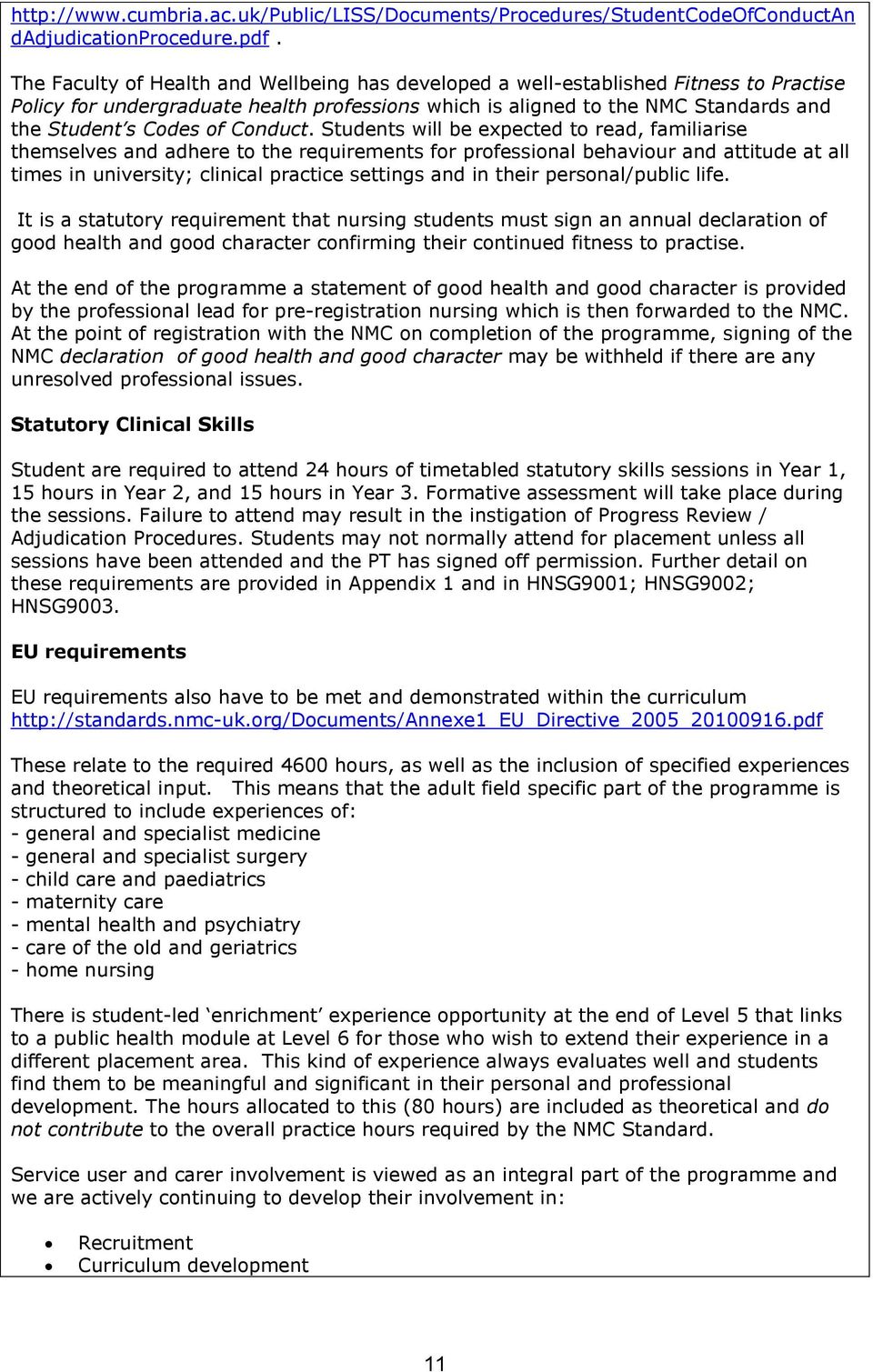
11 dadjudicationprocedure.pdf. The Faculty of Health and Wellbeing has developed a well-established Fitness to Practise Policy for undergraduate health professions which is aligned to the NMC Standards and the Student s Codes of Conduct. Students will be expected to read, familiarise themselves and adhere to the requirements for professional behaviour and attitude at all times in university; clinical practice settings and in their personal/public life. It is a statutory requirement that nursing students must sign an annual declaration of good health and good character confirming their continued fitness to practise. At the end of the programme a statement of good health and good character is provided by the professional lead for pre-registration nursing which is then forwarded to the NMC. At the point of registration with the NMC on completion of the programme, signing of the NMC declaration of good health and good character may be withheld if there are any unresolved professional issues. Statutory Clinical Skills Student are required to attend 24 hours of timetabled statutory skills sessions in Year 1, 15 hours in Year 2, and 15 hours in Year 3. Formative assessment will take place during the sessions. Failure to attend may result in the instigation of Progress Review / Adjudication Procedures. Students may not normally attend for placement unless all sessions have been attended and the PT has signed off permission. Further detail on these requirements are provided in Appendix 1 and in HNSG9001; HNSG9002; HNSG9003. EU requirements EU requirements also have to be met and demonstrated within the curriculum These relate to the required 4600 hours, as well as the inclusion of specified experiences and theoretical input. This means that the adult field specific part of the programme is structured to include experiences of: - general and specialist medicine - general and specialist surgery - child care and paediatrics - maternity care - mental health and psychiatry - care of the old and geriatrics - home nursing There is student-led enrichment experience opportunity at the end of Level 5 that links to a public health module at Level 6 for those who wish to extend their experience in a different placement area. This kind of experience always evaluates well and students find them to be meaningful and significant in their personal and professional development. The hours allocated to this (80 hours) are included as theoretical and do not contribute to the overall practice hours required by the NMC Standard. Service user and carer involvement is viewed as an integral part of the programme and we are actively continuing to develop their involvement in: Recruitment Curriculum development 11
12 Curriculum delivery Assessment Evaluation and quality enhancement As a Faculty, we were part of the 3 rd wave of the NHS Institute for Innovation and Improvement s project on developing and supporting innovation in clinical practice through pre-registration programmes. This was an extremely important project we worked with the NHS (the Institute and local partners) so that students could identify and implement potential service developments. Although the project is completed, service innovation and improvement remains a feature in this programme as part of an interprofessional learning strategy. Our local Trust partners are very supportive of this as it clearly links organisational development and leadership behaviours in an integrated and effective way. As part of this project approach we have also developed practicebased projects working with clinical staff whereby students undertake organisational raids and interview patients and clients about their experiences of care. 12

13 6. Curriculum Map Level Module Code JACS Code (a) Structure Adult Nursing Pathway Module Title and Aim 4 HWTN4001 B700 Fundamentals of Professional Practice To enable students to develop an understanding of the foundations for professional practice by exploring their own value base in order to inform their emerging professional identity 4 HWTN4002 B700 Developing Professional Graduate Skills for Health and Social Care Practitioners To enable the student to develop the skills required to become an independent lifelong learner and to prepare students for learning alongside other professionals 4 HNSG4010 B700 Introduction to Health and Wellbeing To examine the determinants of public health and health promotion across the life span from a bio- psycho- social and cultural perspective 4 HNSG4020 B700 Fundamental Approaches in Nursing To enable students to demonstrate an understanding of the nature of nursing 4 HNSA4030 B740 Principles of Adult Nursing Practice To explore the fundamental principles of adult nursing practice 4 HNSG4070 B740 Year 1 Practice Assessment The aim is to enable students to achieve the relevant NMC competence standards and Essential Skills Clusters at the end of year one. 13 Credit Points Core/ Compulsory/ Optional/ Qualificatory * Notes (eg pre/corequisites, etc) 20 Core Faculty 20 Core Faculty 20 Core Nursing 20 Core Nursing 20 Core Field Specific 20 Core Nursing Students exiting at this point with 120 credits at Level 4 would receive a Cert HE Health Care Studies 5 HWTA5001 B740 Using Evidence to Support Practice The aim of this module is to develop the student s ability to critically analyse published research and other types of evidence and relate it to practice 20 Core Faculty 5 HWTA5002 B740 Working with Others To enable students to develop their professional value base and their understanding of collaborative practices in working with service users, carers and others 20 Core Faculty 5 HNSA5010 B740 Challenges in Health and Behaviour 20 Core Nursing

14 To develop a broad knowledge of deviations in the health and wellbeing of individuals 5 HNSA5020 B740 Developing Therapeutic Approaches and Practice 20 Core /Field To develop a student's understanding of the role of therapeutic approaches in nursing practice 5 HNSA5030 B740 Acute Care in Adult Nursing Practice 20 Core Field Specific To introduce, apply and integrate the principles that inform the care of adults within the acute care setting 5 HNSA5070 B740 Year 2 Practice Assessment 20 Core /Field The aim is to enable students to achieve the relevant NMC competence standards and Essential Skills Clusters at the end of Year Two Students exiting at this point with 120 credits at Level 4 and 120 at Level 5 would receive a Dip HE Health Care Studies 6 HWTA6001 B740 Using Evidence to Evaluate Practice To consolidate students' knowledge in relation to evidence based practice, including their ability to critique this concept. To promote the synthesis of knowledge and values culminating in the ability to influence practice in a multi-disciplinary context. 20 Core Faculty 6 HWTA6002 B740 Professional Practice in Context To prepare students for working as a professional within an organisation, enabling them to work autonomously and collaboratively within a changing environment 6 HNSA6010 B740 Promoting Health and Wellbeing for Groups and Communities To further develop knowledge and understanding of the broad determinants of health in order to equip students with the ability to ascertain and respond to the health needs and priorities of groups and communities while contributing to their empowerment 6 HNSA6020 B740 Transition to Graduate Practice To enable students to critically reflect on personal and professional implications of practising as a Registered Nurse 6 HNSA6030 B740 Continuing, Palliative and End of Life Care The aim of this module is to prepare students to care for patients, families and carers coping with long term and palliative care conditions 6 HNSA6070 B740 Year 3 Practice Assessment The aim is to enable students to achieve the relevant NMC competence standards and Essential Skills Clusters at the end of the programme Core Faculty 20 Core /Field 20 Core /Field 20 Core Field Specific 20 Core Field Specific Students successfully achieving 120 credits at Level 4, 120 at Level 5 and 120 at Level 6 would receive a BSc(Hons) Nursing/RN Adult

15 Nursing Students exiting at this point with 120 credits at Level 4, 120 at Level 5 and 60 at Level 6 would receive a BSc Health Care Studies Progression / Award requirements Module pass mark: 40% (Undergraduate) All modules must be passed to be eligible to apply for NMC registration (*) Note: Core Modules must be taken and successfully passed. Compulsory Modules must be taken but can be carried as fails (if the award permits). Optional Modules students would be required to take an appropriate number of optional modules Qualificatory Unit of study Non-credit bearing pass/fail components that are used to satisfy relevant professional, statutory or regulatory bodies (professional components that are not credit bearing and are pass/fail). 15

16 Level Module Code JACS Code (b) Structure Children s Nursing Pathway Module Title and Aim Credit Points 4 HWTN4001 B700 Fundamentals of Professional Practice To enable students to develop an understanding of the foundations for professional practice by exploring their own value base in order to inform their emerging professional identity 4 HWTN4002 B700 Developing Professional Graduate Skills for Health and Social Care Practitioners To enable the student to develop the skills required to become an independent lifelong learner and to prepare students for learning alongside other professionals 4 HNSG4010 B700 Introduction to Health and Wellbeing To examine the determinants of public health and health promotion across the life span from a bio- psycho- social and cultural perspective 4 HNSG4020 B700 Fundamental Approaches in Nursing To enable students to demonstrate an understanding of the nature of nursing 4 HNSC4040 B730 Introduction to Children's Nursing To enable students to demonstrate an understanding of the nature of nursing children 4 HNSG4070 B730 Year 1 Practice Assessment The aim is to enable students to achieve the relevant NMC competence standards and Essential Skills Clusters at the end of year one. 16 Core/ Compulsory/ Optional/ Qualificatory * Notes (eg pre/corequisites, etc) 20 Core Faculty 20 Core Faculty 20 Core Nursing 20 Core Nursing 20 Core Field Specific 20 Core Nursing Students exiting at this point with 120 credits at Level 4 would receive a Cert HE Health Care Studies 5 HWTC5001 B730 Using Evidence to Support Practice The aim of this module is to develop the student s ability to critically analyse published research and other types of evidence and relate it to practice 20 Core Faculty 5 HWTC5002 B730 Working with Others To enable students to develop their professional value base and their understanding of collaborative practices in working with service users, carers and others 20 Core Faculty 5 HNSC5010 B730 Challenges in Health and Behaviour 20 Core Nursing

17 To develop a broad knowledge of deviations in the health and wellbeing of individuals 5 HNSC5020 B730 Developing Therapeutic Approaches and Practice 20 Core /Field To develop a student's understanding of the role of therapeutic approaches in nursing practice 5 HNSC5040 B730 Developing Children's Nursing 20 Core Field Specific To develop the student's knowledge and understanding to support their developing role as a children's nurse 5 HNSC5070 B730 Year 2 Practice Assessment 20 Core /Field The aim is to enable students to achieve the relevant NMC competence standards and Essential Skills Clusters at the end of Year Two Students exiting at this point with 120 credits at Level 4 and 120 at Level 5 would receive a Dip HE Health Care Studies 6 HWTC6001 B730 Using Evidence to Evaluate Practice To consolidate students' knowledge in relation to evidence based practice, including their ability to critique this concept. To promote the synthesis of knowledge and values culminating in the ability to influence practice in a multi-disciplinary context. 20 Core Faculty 6 HWTC6002 B730 Professional Practice in Context To prepare students for working as a professional within an organisation, enabling them to work autonomously and collaboratively within a changing environment 6 HNSC6010 B730 Promoting Health and Wellbeing for Groups and Communities To further develop knowledge and understanding of the broad determinants of health in order to equip students with the ability to ascertain and respond to the health needs and priorities of groups and communities while contributing to their empowerment 6 HNSC6020 B730 Transition to Graduate Practice To enable students to critically reflect on personal and professional implications of practising as a Registered Nurse 6 HNSC6040 B730 Consolidating Children's Nursing The aim is to enable student to consolidate their Children's Nursing knowledge in order to manage the care of children with complex needs and their families 6 HNSC6080 B730 Year 3 Practice Assessment The aim is to enable students to achieve the relevant NMC competence standards and Essential Skills Clusters to be eligible to register with the NMC Core Faculty 20 Core /Field 20 Core /Field 20 Core Field Specific 20 Core Field Specific Students successfully achieving 120 credits at Level 4, 120 at Level 5 and 120 at Level 6 would receive a BSc(Hons) Nursing/RN

18 Children s Nursing Students exiting at this point with 120 credits at Level 4, 120 at Level 5 and 60 at Level 6 would receive a BSc Health Care Studies Progression / Award requirements Module pass mark: 40% (Undergraduate) All modules must be passed to be eligible to apply for NMC registration (*) Note: Core Modules must be taken and successfully passed. Compulsory Modules must be taken but can be carried as fails (if the award permits). Optional Modules students would be required to take an appropriate number of optional modules Qualificatory Unit of study Non-credit bearing pass/fail components that are used to satisfy relevant professional, statutory or regulatory bodies (professional components that are not credit bearing and are pass/fail). 18

19 Level Module Code JACS Code (c) Structure Learning Disabilities Nursing Pathway Module Title and Aim Credit Points 4 HWTN4001 B700 Fundamentals of Professional Practice To enable students to develop an understanding of the foundations for professional practice by exploring their own value base in order to inform their emerging professional identity 4 HWTN4002 B700 Developing Professional Graduate Skills for Health and Social Care Practitioners To enable the student to develop the skills required to become an independent lifelong learner and to prepare students for learning alongside other professionals 4 HNSG4010 B700 Introduction to Health and Wellbeing To examine the determinants of public health and health promotion across the life span from a bio- psycho- social and cultural perspective 4 HNSG4020 B700 Fundamental Approaches in Nursing To enable students to demonstrate an understanding of the nature of nursing 4 HNSL4050 B761 Fundamentals of Learning Disability Nursing To enable students to explore key concepts in learning disability nursing 4 HNSG4070 B761 Year 1 Practice Assessment The aim is to enable students to achieve the relevant NMC competence standards and Essential Skills Clusters at the end of year one. 19 Core/ Compulsory/ Optional/ Qualificatory * Notes (eg pre/corequisites, etc) 20 Core Faculty 20 Core Faculty 20 Core Nursing 20 Core Nursing 20 Core Field Specific 20 Core Nursing Students exiting at this point with 120 credits at Level 4 would receive a Cert HE Health Care Studies 5 HWTL5001 B761 Using Evidence to Support Practice The aim of this module is to develop the student s ability to critically analyse published research and other types of evidence and relate it to practice 20 Core Faculty 5 HWTL5002 B761 Working with Others To enable students to develop their professional value base and their understanding of collaborative practices in working with service users, carers and others 20 Core Faculty 5 HNSL5010 B761 Challenges in Health and Behaviour 20 Core Nursing
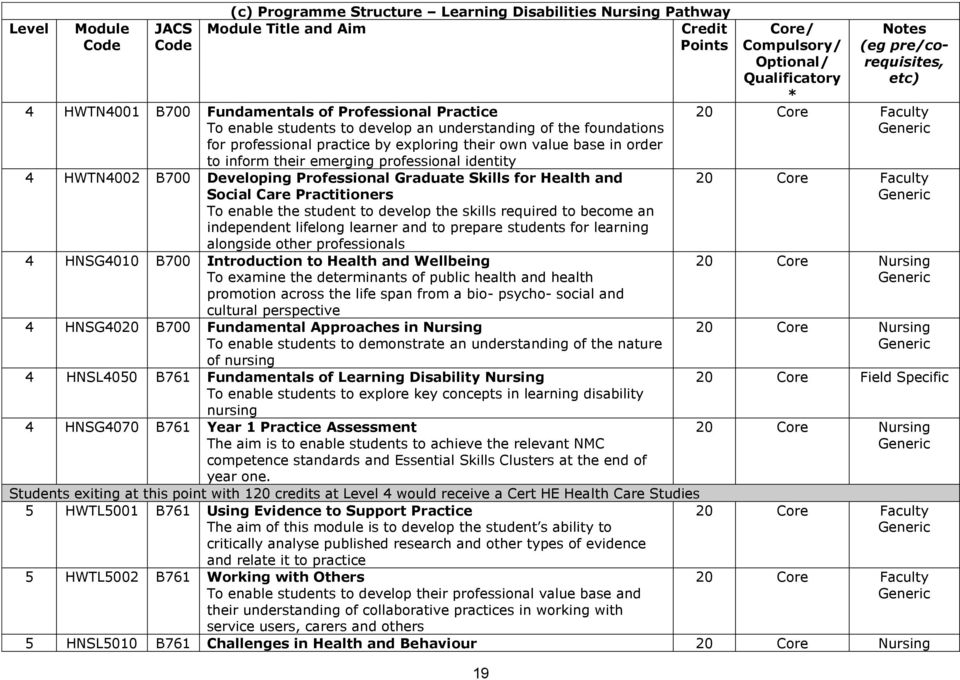
20 To develop a broad knowledge of deviations in the health and wellbeing of individuals 5 HNSL5020 B761 Developing Therapeutic Approaches and Practice 20 Core /Field To develop a student's understanding of the role of therapeutic approaches in nursing practice 5 HNSL5050 B761 Focus upon Learning Disability Nursing Practice 20 Core Field Specific Understand the role of the learning disability nurse when delivering and facilitating therapeutic interventions in a variety of complex client presentations 5 HNSL5070 B761 Year 2 Practice Assessment 20 Core /Field The aim is to enable students to achieve the relevant NMC competence standards and Essential Skills Clusters at the end of Year Two Students exiting at this point with 120 credits at Level 4 and 120 at Level 5 would receive a Dip HE Health Care Studies 6 HWTL6001 B761 Using Evidence to Evaluate Practice To consolidate students' knowledge in relation to evidence based practice, including their ability to critique this concept. To promote the synthesis of knowledge and values culminating in the ability to influence practice in a multi-disciplinary context. 20 Core Faculty 6 HWTL6002 B761 Professional Practice in Context To prepare students for working as a professional within an organisation, enabling them to work autonomously and collaboratively within a changing environment 6 HNSL6010 B761 Promoting Health and Wellbeing for Groups and Communities To further develop knowledge and understanding of the broad determinants of health in order to equip students with the ability to ascertain and respond to the health needs and priorities of groups and communities while contributing to their empowerment 6 HNSL6020 B761 Transition to Graduate Practice To enable students to critically reflect on personal and professional implications of practising as a Registered Nurse 6 HNSL6050 B761 Preparing for Learning Disability Practice To empower the student to review specific areas of contemporary learning disability practice 6 HNSL6090 B761 Year 3 Practice Assessment The aim is to enable students to achieve the relevant NMC proficiency standards and Essential Skills Clusters at the end of the programme Core Faculty 20 Core /Field 20 Core /Field 20 Core Field Specific 20 Core Field Specific Students successfully achieving 120 credits at Level 4, 120 at Level 5 and 120 at Level 6 would receive a BSc(Hons)Nursing/RN Learning

21 Disabilities Nursing Students exiting at this point with 120 credits at Level 4, 120 at Level 5 and 60 at Level 6 would receive a BSc Health Care Studies Progression / Award requirements Module pass mark: 40% (Undergraduate) All modules must be passed to be eligible to apply for NMC registration (*) Note: Core Modules must be taken and successfully passed. Compulsory Modules must be taken but can be carried as fails (if the award permits). Optional Modules students would be required to take an appropriate number of optional modules Qualificatory Unit of study Non-credit bearing pass/fail components that are used to satisfy relevant professional, statutory or regulatory bodies (professional components that are not credit bearing and are pass/fail). 21
22 Level Module Code JACS Code (d) Structure Mental Health Nursing Pathway Module Title and Aim Credit Points 4 HWTN4001 B700 Fundamentals of Professional Practice To enable students to develop an understanding of the foundations for professional practice by exploring their own value base in order to inform their emerging professional identity 4 HWTN4002 B700 Developing Professional Graduate Skills for Health and Social Care Practitioners To enable the student to develop the skills required to become an independent lifelong learner and to prepare students for learning alongside other professionals 4 HNSG4010 B700 Introduction to Health and Wellbeing To examine the determinants of public health and health promotion across the life span from a bio- psycho- social and cultural perspective 4 HNSG4020 B700 Fundamental Approaches in Nursing To enable students to demonstrate an understanding of the nature of nursing 4 HNSM4060 B760 Fundamental Principles of Mental Health Nursing To enable students to embrace key principles and knowledge that underpins mental health nursing practice 4 HNSG4070 B760 Year 1 Practice Assessment The aim is to enable students to achieve the relevant NMC competence standards and Essential Skills Clusters at the end of year one. 22 Core/ Compulsory/ Optional/ Qualificatory * Notes (eg pre/corequisites, etc) 20 Core Faculty 20 Core Faculty 20 Core Nursing 20 Core Nursing 20 Core Field Specific 20 Core Nursing Students exiting at this point with 120 credits at Level 4 would receive a Cert HE Health Care Studies 5 HWTM5001 B760 Using Evidence to Support Practice The aim of this module is to develop the student s ability to critically analyse published research and other types of evidence and relate it to practice 20 Core Faculty 5 HWTM5002 B760 Working with Others To enable students to develop their professional value base and their understanding of collaborative practices in working with service users, carers and others 20 Core Faculty 5 HNSM5010 B760 Challenges in Health and Behaviour 20 Core Nursing
23 To develop a broad knowledge of deviations in the health and wellbeing of individuals 5 HNSM5020 B760 Developing Therapeutic Approaches and Practice 20 Core /Field To develop a student's understanding of the role of therapeutic approaches in nursing practice 5 HNSM5060 B760 Clinical Practice in Mental Health Nursing 20 Core Field Specific For students to gain a practical understanding of key mental health nursing skills and pharmacology 5 HNSM5070 B760 Year 2 Practice Assessment 20 Core /Field The aim is to enable students to achieve the relevant NMC competence standards and Essential Skills Clusters at the end of Year Two Students exiting at this point with 120 credits at Level 4 and 120 at Level 5 would receive a Dip HE Health Care Studies 6 HWTM6001 B760 Using Evidence to Evaluate Practice To consolidate students' knowledge in relation to evidence based practice, including their ability to critique this concept. To promote the synthesis of knowledge and values culminating in the ability to influence practice in a multi-disciplinary context. 20 Core Faculty 6 HWTM6002 B760 Professional Practice in Context To prepare students for working as a professional within an organisation, enabling them to work autonomously and collaboratively within a changing environment 6 HNSM6010 B760 Promoting Health and Wellbeing for Groups and Communities To further develop knowledge and understanding of the broad determinants of health in order to equip students with the ability to ascertain and respond to the health needs and priorities of groups and communities while contributing to their empowerment 6 HNSM6020 B760 Transition to Graduate Practice To enable students to critically reflect on personal and professional implications of practising as a Registered Nurse 6 HNSM6060 B760 Contemporary Interventions in Mental Health Nursing Practice To enable students to critically analyse a range of contemporary therapeutic interventions employed within mental health nursing practice 6 HNSM6100 B760 Year 3 Practice Assessment The aim is to enable students to achieve the relevant NMC competence standards and Essential Skills Clusters at the end of the programme Core Faculty 20 Core /Field 20 Core /Field 20 Core Field Specific 20 Core Field Specific
24 Students successfully achieving 120 credits at Level 4, 120 at Level 5 and 120 at Level 6 would receive a BSc(Hons) Nursing/RN Mental Health Nursing Students exiting at this point with 120 credits at Level 4, 120 at Level 5 and 60 at Level 6 would receive a BSc Health Care Studies Progression / Award requirements Module pass mark: 40% (Undergraduate) All modules must be passed to be eligible to apply for NMC registration (*) Note: Core Modules must be taken and successfully passed. Compulsory Modules must be taken but can be carried as fails (if the award permits). Optional Modules students would be required to take an appropriate number of optional modules Qualificatory Unit of study Non-credit bearing pass/fail components that are used to satisfy relevant professional, statutory or regulatory bodies (professional components that are not credit bearing and are pass/fail). 24
25 Level Module Code (e) Structure Independent Study / Negotiated Learning Opportunities Only for students transferring/intercalating/apl JACS Module Title and Aim Code 4 HNSG4001 B700 Independent Study To enable students to select a choice of subject for study which will further develop individual knowledge and/or skills at Level 4 4 HNSG4002 B700 Negotiated Learning To enable students to select a choice of subject for study which will further develop individual knowledge and/or skills Credi t Point s Core/ Compulsory/ Optional/ Qualificatory * Notes (eg pre/corequisites, etc) Optional Optional Only for students transferring/in tercalating/ap L 5 HNSG5001 B700 Independent Study To enable students to select a choice of subject for study which will further develop individual knowledge and/or skills at Level 5 5 HNSG5002 B700 Negotiated Learning To enable students to select a choice of subject for study which will further develop individual knowledge and/or skills at Level 5 6 HNSG6001 B700 Independent Study To enable students to select a choice of subject for study which will further develop individual knowledge and/or skills at Level 6 6 HNSG6002 B700 Negotiated Learning To enable students to select a choice of subject for study which will further develop individual knowledge and/or skills at Level Optional Optional Only for students transferring/in tercalating/ap L Optional Optional Only for students transferring/in tercalating/ap L 25
26 Level Module Code JACS Code (f) Structure Qualificatory Practice (non-credit bearing) Module Title and Aim Credit Core/ Points Compulsory/ Optional/ Qualificatory * n/a HNSG9001 n/a Statutory Clinical Skills Year 1 The aim of this QPU is to prepare students for their first placement in terms of health and safety of themselves and others, and the people in their care n/a HNSG9002 n/a Statutory Clinical Skills Year 2 The aim of this QPU is to provide an annual update of the statutory skills covered in year 1, preparing the students for practice at an increasingly autonomous level n/a HNSG9003 n/a Statutory Clinical Skills Year 3 The aim of this QPU is to provide an annual update of the statutory skills covered years 1 and 2, preparing the students for practice at a competent level Notes (eg pre/corequisites, etc) n/a n/a Qualificatory Qualificatory These units of practice are required by placement providers and education commissioners. n/a Qualificatory Progression / Award requirements Module pass mark: 40% (Undergraduate) All modules must be passed to be eligible to apply for NMC registration (*) Note: Core Modules must be taken and successfully passed. Compulsory Modules must be taken but can be carried as fails (if the award permits). Optional Modules students would be required to take an appropriate number of optional modules Qualificatory Unit of study Non-credit bearing pass/fail components that are used to satisfy relevant professional, statutory or regulatory bodies (professional components that are not credit bearing and are pass/fail). 26
27 outcome 9 outcome 8 outcome 7 outcome 6 outcome 5 outcome 4 outcome 3 outcome 2 outcome 1 7. Assessment Map This map charts the assessment of the programme outcomes across the different modules. It is designed to ensure that assessment tasks are focused on demonstrating achievement of the programme outcomes including knowledge, understanding, academic and vocational skills, and other qualities. The following letters to denote the contribution of each module: D = programme outcome is developed in this module F = programme outcome, or aspects of the programme outcome, are formatively assessed on this module S = programme outcome, or aspects of the programme outcome, are summatively assessed on this module Module Code Module Name or placement HWTN4001 Fundamentals of Professional Practice DS DS DS D HWTN4002 Developing Professional Graduate Skills for Health and D DFS D Social Care Practitioners HNSG4010 Introduction to Health and Wellbeing D D DFS D HNSG4020 Fundamental Approaches in Nursing DFS DF DF D D HNSA4030 Principles of Adult Nursing Practice DFS DFS D D D HNSC4040 Introduction to Children's Nursing DFS DF DFS DFS DF DFS DF D HNSL4050 Fundamentals of Learning Disability Nursing DFS D DFS D D DFS HNSM4060 Fundamental Principles of Mental Health Nursing DFS DFS DFS D HNSG4070 Year 1 Practice Assessment DF DF DF DF DF DFS HWTA5001 Using Evidence to Support Practice D DFS D D HWTC5001 HWTL5001 HWTM5001 HWTA5002 Working with Others DFS DF DF DFS DF D HWTC5002 HWTL5002 HWTM5002 HNSA5010 Challenges in Health and Behaviour DFS DFS D D D D D HNSC5010 HNSL5010 HNSM5010 HNSA5020 Developing Therapeutic Approaches and Practice D DFS DFS DFS D 27
28 outcome 9 outcome 8 outcome 7 outcome 6 outcome 5 outcome 4 outcome 3 outcome 2 outcome 1 7. Assessment Map This map charts the assessment of the programme outcomes across the different modules. It is designed to ensure that assessment tasks are focused on demonstrating achievement of the programme outcomes including knowledge, understanding, academic and vocational skills, and other qualities. The following letters to denote the contribution of each module: D = programme outcome is developed in this module F = programme outcome, or aspects of the programme outcome, are formatively assessed on this module S = programme outcome, or aspects of the programme outcome, are summatively assessed on this module Module Code Module Name or placement HNSC5020 HNSL5020 HNSM5020 HNSA5030 Acute Care in Adult Nursing Practice DFS DFS DS D D DFS D D HNSC5040 Developing Children's Nursing DFS DFS DF DF DF DFS DFS D DF HNSL5050 Focus upon Learning Disability Nursing Practice DFS DFS DFS D DFS DFS D D DFS HNSM5060 Clinical Practice in Mental Health Nursing DFS DFS D D DFS D DS D HNSA5070 Year 2 Practice Assessment DF DF DF DF DF D DFS HNSC5070 HNSL5070 HNSM5070 HWTA6001 Using Evidence to Evaluate Practice D DFS D D HWTC6001 HWTL6001 HWTM6001 HWTA6002 Professional Practice in Context D D D DFS DFS D HWTC6002 HWTL6002 HWTM6002 HNSA6010 Promoting Health and Wellbeing for Groups and D DFS DFS DFS D DFS D D HNSC6010 HNSL6010 HNSM6010 HNSA6020 Communities Transition to Graduate Practice D D D D D D D D DFS 28
29 outcome 9 outcome 8 outcome 7 outcome 6 outcome 5 outcome 4 outcome 3 outcome 2 outcome 1 7. Assessment Map This map charts the assessment of the programme outcomes across the different modules. It is designed to ensure that assessment tasks are focused on demonstrating achievement of the programme outcomes including knowledge, understanding, academic and vocational skills, and other qualities. The following letters to denote the contribution of each module: D = programme outcome is developed in this module F = programme outcome, or aspects of the programme outcome, are formatively assessed on this module S = programme outcome, or aspects of the programme outcome, are summatively assessed on this module Module Code Module Name or placement HNSC6020 HNSL6020 HNSM6020 HNSA6030 Continuing, Palliative and End of Life Care DS DS DS D DS D D D HNSC6040 Consolidating Children's Nursing DFS DFS DFS DFS D DFS DFS D DF HNSL6050 Preparing for Learning Disability Practice DFS D D D DFS D D D DFS HNSM6060 Contemporary Interventions in Mental Health Nursing DS DS D DS D DS DS D D Practice HNSA6070 Year 3 Practice Assessment (Adult) DF DF DF DF D DF D DF DFS HNSC6080 Year 3 Practice Assessment (Children) DF DF DF DF D DF D DF DFS HNSL6090 Year 3 Practice Assessment (Learning Disabilities) DF DF DF DF D DF D DF DFS HNSM6100 Year 3 Practice Assessment (Mental Health) DF DF DF DF D DF D DF DFS 29
30 8. Indicative Assessment Calendar Module Code HWTN4001 HWTN4002 Module Title Fundamentals of Professional Practice Developing Professional Graduate Skills for Health and Social Care Practitioners (a) Assessment Calendar Adult Nursing Pathway Formative Assessment Tutor and peer feedback will be integrated progressively into the summative written assignment Self-awareness activities, such as online sector resources, results of which will be integrated into the summative written assignment Peer assessment HNSG4010 Introduction to Health and Wellbeing HNSG4020 Fundamental Approaches in Nursing Medicine Management assessment Summative Assessment (3500 words) Essay (2500 words) Portfolio Oral assessment or presentation (20 mins) (3500 words) Weighting Approx assessment deadline (eg mid semester) 100% Mid semester 1 100% Mid semester 2 100% Mid semester 1 100% End Semester 2 HNSA4030 Principles of Adult Nursing Practice On-line multiple choice questionnaire HNSG4070 Year 1 Practice Assessment Numeracy Assessment linked to NMC progression point 1 Case Study Written Examination. Some seen preparatory elements. (2hrs) (1500 words) Reflective Essay Summative Clinical Practice Assessment and Essential skills for progression point 1 100% End semester 2 100% Mid semester 2 P/F Qualificatory End semester 2 30
31 HWTA5001 Using Evidence to Support Practice 20 min peer presentation relating to selected published research findings - peer feedback and self-evaluation will be integrated into the summative written assignment HWTA5002 Working with Others Tutor and peer feedback will be integrated progressively into the summative written assignment (3500 words) Research Critique (3500 words) 100% End semester 1 100% Mid semester 2 HNSA5010 Challenges in Health and Behaviour On line discussion Presentation (15 mins) 100% End semester 1 HNSA5020 Developing Therapeutic Approaches and Practice None (4000 words) 100% End semester 2 HNSA5030 Acute Care in Adult Nursing Practice 1 hour seminar via discussion board HNSA5070 Year 2 Practice Assessment Numeracy Assessment linked to NMC progression point 2 HWTA6001 Using Evidence to Evaluate Practice 20 min presentation to peers - Peer review and self assessment of presentation will be integrated into the summative written assignment 31 Comparative Studies Written examination (2 hours) (1500 words) Reflective Essay Summative Clinical Practice Assessment and Essential skills for progression point 1 (4000 words) Extended Literature Review 100% End semester 2 100% Mid semester 2 P/F Qualificatory End semester 2 100% End semester 1
32 HWTA6002 Professional Practice in Context Small group student led seminar enabling tutor and peer feedback that will be integrated into the summative written assignment HNSA6010 Promoting Health and Wellbeing for Groups and Communities HNSA6020 Transition to Graduate Practice On line discussion/wiki/blog Set exercise (3500 words) Individual poster with supporting critique None Set exercise (4000 words) Community health needs analysis with field specific suggestions for intervention Professional Portfolio (3500 words) 100% Mid semester 2 100% End semester 1 100% End semester 2 HNSA6030 Continuing, Palliative and End of Life Care None (4000 words) 100% End semester 2 Case Study HNSA6070 Year 3 Practice Assessment None (1500 words) 100% Mid semester 2 Reflective Essay Numeracy assessment for administration of medicines for entry to the Register 100% pass mark required Summative Clinical Practice Assessment and Essential skills for progression to NMC Registration P/F Qualificatory P/F Qualificatory By completion of programme and before entry to the professional Register End semester 2 32
33 Module Code Module Title (b) Assessment Calendar Children s Nursing Pathway Formative Assessment HWTN4001 Fundamentals of Professional Practice Tutor and peer feedback will be integrated progressively into the summative written assignment HWTN4002 Developing Professional Graduate Skills for Health and Social Care Practitioners Self-awareness activities, such as on-line sector resources, results of which will be integrated into the summative written assignment Summative Assessment (3500 words) Essay (2500 words) Portfolio HNSG4010 Introduction to Health and Wellbeing Peer assessment Oral assessment or presentation (20 mins) HNSG4020 Fundamental Approaches in Nursing Medicine Management assessment HNSC4040 Introduction to Children's Nursing Online group discussion HNSG4070 Year 1 Practice Assessment Numeracy Assessment linked to NMC progression point 1 (3500 words) Case Study Written examination (2 hours) (1500 words) Reflective Essay Summative Clinical Practice Assessment and Essential skills for progression point 1 Weighting Approx assessment deadline (eg mid semester) 100% Mid semester 1 100% Mid semester 2 100% Mid semester 1 100% End Semester 2 100% End semester 2 100% Mid semester 2 P/F Qualificatory End semester 2 33
34 HWTC5001 Using Evidence to Support Practice 20 min peer presentation relating to selected published research findings - peer feedback and selfevaluation will be integrated into the summative written assignment HWTC5002 Working with Others Tutor and peer feedback will be integrated progressively into the summative written assignment (3500 words) Research Critique (3500 words) HNSC5010 Challenges in Health and Behaviour On line discussion Presentation (15 mins) 100% End semester 1 100% Mid semester 2 100% End semester 1 HNSC5020 Developing Therapeutic Approaches and Practice None (4000 words) 100% End semester 2 Comparative Studies HNSC5040 Developing Children's Nursing Online activities (3500 words) 100% End semester 2 HNSC5070 Year 2 Practice Assessment Numeracy Assessment linked to NMC progression point 2 (1500 words) Reflective Essay Summative Clinical Practice Assessment and Essential skills for progression point 1 100% Mid semester 2 P/F Qualificatory End semester 2 34
35 HWTC6001 Using Evidence to Evaluate Practice 20 min presentation to peers - Peer review and self assessment of presentation will be integrated into the summative written assignment HWTC6002 Professional Practice in Context Small group student led seminar enabling tutor and peer feedback that will be integrated into the summative written assignment HNSC6010 Promoting Health and Wellbeing for Groups and Communities HNSC6020 Transition to Graduate Practice On line discussion/wiki/blog (4000 words) Extended Literature Review Set exercise (3500 words) Individual poster with supporting critique None Set exercise (4000 words) Community health needs analysis with field specific suggestions for intervention Professional Portfolio (3500 words) 100% End semester 1 100% Mid semester 2 100% End semester 1 100% End semester 2 HNSC6040 Consolidating Children's Nursing Online discussion Report (3000 words) 100% End semester 2 HNSC6080 Year 3 Practice Assessment None 100% Mid semester 2 (1500 words) Numeracy assessment for administration of medicines for entry to the Register P/F Qualificatory By completion of programme and before entry to the professional Register 100% pass mark required 35
36 Summative Clinical Practice Assessment and Essential skills for progression to NMC Registration P/F Qualificatory End semester 2 36
37 Module Code Module Title (c) Assessment Calendar Learning Disabilities Nursing Pathway Formative Assessment HWTN4001 Fundamentals of Professional Practice Tutor and peer feedback will be integrated progressively into the summative written assignment HWTN4002 Developing Professional Graduate Skills for Health and Social Care Practitioners Self-awareness activities, such as on-line sector resources, results of which will be integrated into the summative written assignment Summative Assessment (3500 words) Essay (2500 words) Portfolio HNSG4010 Introduction to Health and Wellbeing Peer assessment Oral assessment or presentation (20 mins) HNSG4020 Fundamental Approaches in Nursing Medicine Management assessment HNSL4050 Fundamentals of Learning Disability Nursing Practice exam (1 hour) HNSG4070 Year 1 Practice Assessment Numeracy Assessment linked to NMC progression point 1 (3500 words) Case Study Written examination (2 hours) (1500 words) Reflective Essay Summative Clinical Practice Assessment and Essential skills for progression point 1 Weighting Approx assessment deadline (eg mid semester) 100% Mid semester 1 100% Mid semester 2 100% Mid semester 1 100% End Semester 2 100% End semester 2 100% Mid semester 2 P/F Qualificatory End semester 2 37
38 HWTL5001 Using Evidence to Support Practice 20 min peer presentation relating to selected published research findings - peer feedback and selfevaluation will be integrated into the summative written assignment HWTL5002 Working with Others Tutor and peer feedback will be integrated progressively into the summative written assignment (3500 words) Research Critique (3500 words) HNSL5010 Challenges in Health and Behaviour On line discussion Presentation (15 mins) 100% End semester 1 100% Mid semester 2 100% End semester 1 HNSL5020 Developing Therapeutic Approaches and Practice None (4000 words) 100% End semester 2 HNSL5050 HNSL5070 Focus upon Learning Disability Nursing Practice Year 2 Practice Assessment Facilitated Discussion Numeracy Assessment linked to NMC progression point 2 Comparative Studies (3000 words) (1500 words) Reflective Essay Summative Clinical Practice Assessment and Essential skills for progression point 1 100% End semester 2 100% Mid semester 2 P/F Qualificatory End semester 2 38
39 HWTL6001 Using Evidence to Evaluate Practice 20 min presentation to peers - Peer review and self assessment of presentation will be integrated into the summative written assignment HWTL6002 Professional Practice in Context Small group student led seminar enabling tutor and peer feedback that will be integrated into the summative written assignment HNSL6010 Promoting Health and Wellbeing for Groups and Communities HNSL6020 Transition to Graduate Practice On line discussion/wiki/blog (4000 words) Extended Literature Review Set exercise (3500 words) Individual poster with supporting critique None Set exercise (4000 words) Community health needs analysis with field specific suggestions for intervention Professional Portfolio (3500 words) 100% End semester 1 100% Mid semester 2 100% End semester 1 100% End semester 2 HNSL6050 Preparing for Learning Disability Practice 15 min presentation Oral assessment or presentation (15 mins) Project work (3000 words) HNSL6090 Year 3 Practice Assessment None (1500 words) 20% Mid semester 2 80% End semester 2 100% Mid semester 2 39
40 Numeracy assessment for administration of medicines for entry to the Register 100% pass mark required Summative Clinical Practice Assessment and Essential skills for progression to NMC Registration P/F Qualificatory P/F Qualificatory By completion of programme and before entry to the professional Register End semester 2 40
41 Module Code Module Title (d) Assessment Calendar Mental Health Nursing Pathway Formative Assessment HWTN4001 Fundamentals of Professional Practice Tutor and peer feedback will be integrated progressively into the summative written assignment HWTN4002 Developing Professional Graduate Skills for Health and Social Care Practitioners Self-awareness activities, such as on-line sector resources, results of which will be integrated into the summative written assignment Summative Assessment (3500 words) Essay (2500 words) Portfolio HNSG4010 Introduction to Health and Wellbeing Peer assessment Oral assessment or presentation (20 mins) HNSG4020 Fundamental Approaches in Nursing Medicine Management assessment HNSM4060 Fundamental Principles of Mental Health Nursing On-line multiple choice questionnaire HNSG4070 Year 1 Practice Assessment Numeracy Assessment linked to NMC progression point 1 (3500 words) Case Study Written examination (2 hours) (1500 words) Reflective Essay Summative Clinical Practice Assessment and Essential skills for progression point 1 Weighting Approx assessment deadline (eg mid semester) 100% Mid semester 1 100% Mid semester 2 100% Mid semester 1 100% End Semester 2 100% End semester 2 100% Mid semester 2 P/F Qualificatory End semester 2 41
42 HWTM5001 Using Evidence to Support Practice 20 min peer presentation relating to selected published research findings - peer feedback and selfevaluation will be integrated into the summative written assignment HWTM5002 Working with Others Tutor and peer feedback will be integrated progressively into the summative written assignment (3500 words) Research Critique (3500 words) HNSM5010 Challenges in Health and Behaviour On line discussion Presentation (15 mins) 100% End semester 1 100% Mid semester 2 100% End semester 1 HNSM5020 Developing Therapeutic Approaches and Practice None (4000 words) 100% End semester 2 HNSM5060 Clinical Practice in Mental Health Nursing On-line assessment Comparative Studies (3500 words) 100% End semester 2 HNSM5070 Year 2 Practice Assessment Numeracy Assessment linked to NMC progression point 2 Case Study (1500 words) Reflective Essay Summative Clinical Practice Assessment and Essential skills for progression point 1 100% Mid semester 2 P/F Qualificatory End semester 2 42
43 HWTM6001 Using Evidence to Evaluate Practice 20 min presentation to peers - Peer review and self assessment of presentation will be integrated into the summative written assignment HWTM6002 Professional Practice in Context Small group student led seminar enabling tutor and peer feedback that will be integrated into the summative written assignment HNSM6010 Promoting Health and Wellbeing for Groups and Communities HNSM6020 Transition to Graduate Practice On line discussion/wiki/blog (4000 words) Extended Literature Review Set exercise (3500 words) Individual poster with supporting critique None Set exercise (4000 words) Community health needs analysis with field specific suggestions for intervention Professional Portfolio (3500 words) 100% End semester 1 100% Mid semester 2 100% End semester 1 100% End semester 2 HNSM6060 Contemporary Interventions in Mental Health Nursing Practice None (3500 words) HNSM6100 Year 3 Practice Assessment None (1500 words) Numeracy assessment for administration of medicines for entry to the Register 100% End semester 2 100% Mid semester 2 P/F Qualificatory By completion of programme and before entry to the professional Register 100% pass mark required 43
44 9. Support for Students and their Learning All students are allocated a Personal Tutor (PT) at the beginning of their programme. The role of the PT is to give pastoral support and to monitor academic, professional and personal progress; this means that PTs also mark some assignments. Tutorials are held at regular intervals. Evaluation of the student s progress is supported by the use of a record of personal, academic and professional development which builds into an end of programme profile. Part-time students have guidance provided by the part-time route programme leader. in liaison with the field pathway leader Contact with the PT may be via a variety of means, including , telephone or faceto-face tutorial (group and / or individual) to a total of 2 hours total per student per year of study. More contact may be required during Year 1 and less as the student progresses. The part-time route programme leader will meet with students individually at the start of the programme to map the individual s University and placement pattern, hours of work and length of placement (see below for placement support from the University Link Lecturer. A range of facilities are available to support students with special needs and/or disabilities. Students are supported on an individual basis. In order to ensure that all students have reasonable access to all the learning opportunities on offer and ensure fair assessment, adjustments may be made to the curriculum, teaching styles and assessment practices. Year one also specifically develops core learning skills from the outset. Library, IT facilities and clinical skills labs are available on all campuses. In addition, the University has a range of support mechanisms for students, eg: Chaplaincy, accommodation, occupational health, careers advice, confidential counselling service, student welfare officer, Student Union. Students are advised to access Learning Information and Student Services (LISS see below) where appropriate for additional support and advice; additional literacy and numeracy support from learning support specialists is available. Students on clinical practice placements are supported by University Link Lecturer visits/contact (depending on the type of assessment and whether formative or summative). Our students have consistently rated the University Link Lecturer system of support very highly. University Link Lecturers may be contacted at any time during the placement by the student. Practice Education Facilitators (PEFs) are also available to support students on placements. Participants have full access to all University Learning, Information and Student Services (LISS) facilities; careers and employability, financial help, counselling, health and wellbeing, support for disabled students and those with specific learning requirements and taught sessions to develop a high level of information fluency, digital skills and academic skills. Participants will have embedded skills interventions from LISS as part of their induction experience and beyond. Typically the interventions have taken the form of workshops but equivalent online input could be chosen through liaison. Embedded induction input will cover IT network passwords, basic introduction to Blackboard and webmail, library services and electronic resources (ebooks, ejournals, image collections etc). Later input will cover more advanced (including level 7) information fluency and critical reading and writing skills. Participants can access individual support from LISS via guidance and by face to face advice throughout their student journey. Further LISS learning and skills development workshops may be requested by tutors or directly by participants. These sessions focus on a range of skills including; using smartboards, planning for dissertations and introducing the requirements of academic research. 44
45 In addition, participants will have access to online tutorials and the support area on Blackboard and on the LISS website: Module leaders will collaborate with LISS learning advisers to ensure reading lists are current and that ebooks and electronic journal titles have been considered. Reading lists will be made available to LISS Learning advisers who will transform them into interactive electronic lists using the Talislist tool. The finished lists will be made available on an open access basis (for prospective participants) from the LISS website (and other appropriate platforms). 10. Criteria for Admission The pre-registration recruitment policy specifies a number of requirements, and essential and desirable characteristics in the person specification; the recruitment policy is compliant with NMC requirements to provide evidence of literacy, numeracy, good health and character, and recent study. Selection Criteria Adult and Children s Fields of Nursing Practice: 240 UCAS tariff points, to include 80 points in a Science or Social Science subject. Learning Disability and Mental Health Fields of Nursing Practice: 240 UCAS tariff points. ADDITIONALLY for all fields: GCSE minimum grade C in English Language AND a science or social science subject, also GCSE Grade C in Mathematics or an acceptable equivalent PLUS evidence of successful recent study at GCSE level or higher within the past five years. Alternate qualifications accepted for entry include: Access to H.E. Diploma (as long as all subject specific elements are met, ie Level 2 English/science or social science for all fields, and Level 3 science/social science for Adult and Children s Fields of Nursing Practice. Merits must be achieved in all Level 3 subjects). Applicants must additionally provide evidence of successful recent study at GCSE level or higher within the past five years. NVQ 3 in Health and Social Care, PLUS GCSE English Language and science/social science at grade C or above, PLUS a minimum of two years health care experience. Applicants must additionally provide evidence of successful recent study at GCSE level or higher within the past five years. UK Honours degree in any subject, PLUS GCSE science/social science at grade C or above. Equivalent qualifications other than those listed above may be accepted. Grade levels are reviewed annually and are subject to change. Before you apply for nursing you should consider carefully which field of nursing is right for you. You will need to demonstrate commitment to your chosen field in your application, which means that your application will not be considered if you have applied to us for more than one field (or for additional professional programmes other than nursing). In your personal statement you should demonstrate your motivation for choosing that field of nursing practice, and reflect upon any practical experience you have gained. Experience in a setting that encompasses caring and/or interpersonal skills in either a formal or an informal context is essential. 45
46 All applicants are required to sit a formal numeracy assessment prior to admission to assess ability. This assessment needs to demonstrate numerical competency and a poor result may result in a failed application. A preview paper is available, Places are offered to high scoring applicants after a successful interview and satisfactory numeracy test score. Offers are subject to academic entry requirements, satisfactory Criminal Records Bureau Check, medical clearance and eligibility for NHS tuition fees to be paid. Entry to the part-time programme is subject to approval from the strategic health authority. Applicants are also required to be interviewed as per the pre-registration programmes recruitment policy (see below for additional information). Motivation and commitment Interpersonal communication skills Life / clinical / work experience and knowledge Application forms are scored; highest scoring candidates who achieve the minimum threshold score (demonstrating the above) will be invited to interview. Candidates should note that this is a competitive process. Interviews are held jointly with UoC and NHS staff ; where possible, there may be service user involvement. Interviews are scored against the person specification and highest scoring candidates are offered a place. Applicants will be advised of the outcome of their interview once a number of interview days have been held or, for some of the competitive pathways, once all interview days have been held. Enhanced CRB and Occupational Health Clearance All students must have enhanced CRB and occupational health clearance before being able to attend for placement. The process is administered by specialist staff in Admissions, and the Occupational Health Dept. Students will be advised of the process and procedures when a provisional offer of a place is made. Prompt completion of online processes and return of forms and ID documents is crucial and compliance is carefully monitored by staff throughout the programme to ensure fitness to practice as required by the NMC. NMC Reference As part of the Nursing and Midwifery Council s fitness to practice requirements ( information on a candidate s good character is sought in cases where the original UCAS reference does not satisfy this requirement. This reference must be from a current or most recent employer or a programme tutor if an employer is not available. Candidates should generally apply through UCAS: Applicants under the age of 18 years The University has nominated Safeguarding Officers in all appropriate areas, including the Faculty; they monitor implementation of policy and procedures for students under 18 years of age, implement and develop policies and procedures and are available for advice. Applicants under the age of 18 years, who will be under 18 years old at the commencement of the programme must demonstrate that they have: 46
47 Completed 10 years of full-time education In addition, successful applicants will be required to: Participate in the risk assessment process for both University and each placement, in liaison with the Faculty Safeguarding Officer, the Occupational Health Dept, Admissions and the Field specific Pathway Leader. International Students A small number of international students may be accepted, only with approval from the strategic health authority (NHS NorthWest). Admission criteria are the same as outlined above. In addition, applicants must complete and provide evidence of the International English Language Test (IELTS) before submitting their application. You must complete the academic version of the IELTS test and achieve: At least 7.0 in the listening and reading sections At least 7.0 in the writing and speaking sections At least 7.0 (out of a possible 9) overall We will not accept applicants who score lower than this standard. Transfers in Students may request (in writing) a transfer to another Field (as an internal candidate): this request will involve an interview by the accepting field programme leader, and is subject to approval by the Strategic Health Authority. Students may also request (in writing) for a transfer from another Higher Education Institution (HEI) via APL process (see below). These claims are considered by a competitive selection process and the transfers are approved by the SHA. Successful applicants must be interviewed as per pre-registration recruitment policy and acceptance is subject to satisfactory references, academic and practice hour s transcript, EU requirements, occupational health and enhanced CRB clearance. APL claims will be considered on an individual competitive basis, subject to a satisfactory mapping of module outcomes and NMC progression points; Bridging work may be required. Nurses who already possess a registerable qualification may also apply to study for an additional registerable qualification (possibility of a part-time basis). The NMC allow consideration of unlimited APL for first and second level nurses registered with the NMC entering programmes that lead to qualification in the same or another field of practice, provided that all requirements are met in full. Registered Midwives may also apply to study for an additional registerable qualification. The NMC allow consideration of a maximum of 50 percent of the programme for NMC registered midwives entering preregistration nursing programmes, provided that all requirements are met in full. All previous learning will be fully mapped on an individual basis to ensure that all programme outcomes and required progression criteria have been met in full by the end of the programme. However, students wishing to gain an additional qualification MUST be supported by an NHS employer and SHA approval prior to formal application if funding is required. Candidates may be able to undertake the programme on a part-time basis, subject to individual application and discussion, and SHA funding. 47
48 Accreditation of Prior Learning (APL) The University s academic regulations specify the scope and operation of APL procedures. This section of the University s regulations describes the processes which apply to all programmes, including the pre-registration programmes. Principles: All APL claims are considered and confirmed by the APL Officer and the relevant field pathway leader. Transfers across Fields are considered and confirmed by the field pathway leader. APL and transfer claims are considered on an individual basis as part of the admissions process. Examples: Internal and external transfer applications i.e. existing students from UoC or other HEIs wanting to change programme including: Current or former UoC students who have completed the Foundation Degree Caring for Patients in Healthcare Settings (120 level 4 credits and 120 level 5 credits). Applications from people wishing to undertake an additional pre-registration qualification e.g. enrolled nurses wishing to undertake conversion to level 1 or those wishing to change Field to gain entry to a different part of the NMC register. Applications from people who have previously undertaken a part of their pre-reg. programme but did not complete but who now wish to re-commence their studies (assuming that sufficient time remains on their NMC registration) Applications from people who have significant relevant work experience and who may seek accreditation of prior experiential learning via AEPL portfolio for module exemption. Applications from people who have undertaken prior certificated learning at an appropriate academic level in a relevant subject (eg counselling) may seek module exemption. Applications for internal or external transfer MUST be considered by the field pathway leader and the APL Officer (for a decision re conditional acceptance onto a UoC programme). Specific APL processes must be completed at the point of application. APL claims must be substantiated by: Academic transcripts/certificated learning, and /or Portfolio/bridging work as required Transcripts detailing exact clinical hourages. Evidence of EU Directive 2005/36/EC Annex V.2 (5.2.1) (adult nursing) APL claims for pre-registration programmes can only be made for: All of a module (levels 4 and 5) (can include bridging work as per APL policy) Up to a maximum of 50% of the programme Students transferring from another nursing programme can only transfer credit to the maximum levels stipulated with the UoC Academic Regulations. PROCESS APL claims are assessed against explicit criteria in the curriculum map which shows where and how theoretical and clinical outcomes have been achieved, and how many theoretical and clinical hours have been completed. Applicants must complete the 48
49 appropriate paperwork for consideration, and provide the appropriate supporting evidence, as and when requested: Internal applicants: transfer request form, with all required signatures (PT, outgoing and receiving Field leaders) External applicants: application form, academic transcript + certificates, practice hours transcript, references (academic and employer), evidence of EU Directive 2005/36/EC Annex V.2 (5.2.1) (adult nursing), module learning outcomes. Once the field specific leader has indicated potential suitability of the applicant, the receiving field leader contacts the internal applicants to arrange for an interview (following the undergraduate recruitment policy). The APL Officer contacts the external applicant to arrange for an interview (following the undergraduate recruitment policy); an integral part of this recruitment process is the mapping of the extent of the APL claim against module learning outcomes and, if necessary, assessing the need for bridging work. Field specific leaders consider the number of practice hours undertaken by the applicant and check that these meet NMC requirements for the competency level reached. If an applicant is required to submit an APEL portfolio, this will be done in liaison with the APL rep. for the Faculty of Health and Wellbeing and the APL Officer. Successful claims for APEL are then presented to the appropriate module assessment board. 11. Methods for Evaluating and Improving the Quality and Standards of Learning and Teaching Mechanisms for review and evaluation Module evaluation forms (staff and of LTA, the curriculum and outcome students) standards Annual evaluatory reports Curriculum management meetings External examiner reports National Student Survey Staff-Student Liaison meetings NHS NW Contract review NMC annual monitoring Committees with responsibility for monitoring and evaluating quality and standards Mechanisms for gaining student feedback on the quality of teaching and their learning experience Staff development priorities for staff teaching this programme Quality Committees Faculty Learning and Teaching Quality Enhancement Committee (FLTQEC) University LTQEC Academic Board Module and Faculty Assessment Boards Faculty Executive Team Module and programme evaluations Staff-Student liaison National Student Survey Mentor updates Post-graduate study in relevant specialist subject and / or education / pedagogy Clinical skills/simulation updating Staff development in relation to new teaching, learning and assessment technologies PREP Professional updating in specialist area e.g. 49
50 conference attendance 12. Examples of Employment Opportunities available to students upon completion of the programme. The programme produces registered nurses that are fit for practice and purpose, with students obtaining employment as qualified nurses on completion of the programmes both locally and nationally. Examples from recent graduates include hospitals and specialist units such as critical care/surgery/medicine; accident and emergency; renal unit, cardiothoracic care; community nursing; paediatric intensive care, neonatal intensive care; regional specialist children s hospital: community children s nursing; children s wards; neonatal cardiac unit. Mental health in-patient units, community mental health teams, Specialist teams such as and adolescent mental health, drug and alcohol Services, forensic mental health in both the NHS, Private and Voluntary Sectors; Learning disabilities (LD) community teams. LD forensic services; school nursing for children with learning disabilities; Children s hospice; independent mental capacity advocate. 13. Additional Information Finance: Home students on the BSc (Hons) Nursing/RN programme have their tuition fees paid and receive a non-means-tested bursary from the Students Grants Unit. They may also apply for means tested support dependent on their individual circumstances. Further financial assistance may be available from the University Hardship Fund should the need arise. Some travel expenses to and from placement areas may be payable (via the Student Grants Unit). EU Students on the BSc (Hons) Nursing/RN programme have their tuition fees paid by the NHS. Further financial assistance from the University Hardship Fund may be available should the need arise. Some travel expenses to and from placement areas may be payable (via the Student Grants Unit). International students / those assessed as overseas for fees purposes on the BSc (Hons) Nursing/RN programme are responsible for their own tuition fees and living costs. Further financial assistance from the University Hardship Fund may be available should the need arise. Sickness and absence from University and placement is closely monitored. Students may be required to make time up at the end of the programme before completion / eligibility to register with the NMC. Theory-practice time: the curriculum is split 50:50 between theoretical input and placement time. Placements/Learning in Practice: when on placement, students are expected to work a normal NHS working week of 37.5 hours (pro-rata for part-time students) and to experience the shift pattern (early start e.g 7am, late finish e.g 10pm and some night duty) and some weekend working, though this may be negotiable with some placement areas. Students may not request specific placement areas. Students must notify the Placement Learning Unit if there are any circumstances which may affect placement attendance. Uniforms: the University provides uniforms for students where appropriate. Students are responsible for their own laundry and must provide their own suitable footwear. A 50
51 plain navy or black three quarter or full length coat will be need to be purchased by the student for those wearing uniform on community placements. Reasonable adjustments: should these be required they can be discussed with the Leader and PT in the first instance. The University is committed to ensuring that reasonable adjustments are made wherever possible and will support all students in their studies. For placements, there is a Dyslexia in the Workplace assessment and support document that can be discussed with practice mentors. The University of Cumbria is registered under the Data Protection Act 1998 to collect and process your personal data. The University may be required to disclose student data, but will only do so within the terms of this Act. Please see the University of Cumbria website for more information. 51
52 Appendix 1 Statutory Clinical Skills Sessions (See HNSG9001; HNSG9002; HNSG9003) Indicative Content: Record-keeping, observation skills, interpersonal relationships, team working, individualised care, legal and ethical considerations, health and safety issues, communication skills, first aid, COSHH, personal safety, fire, basic life support, food hygiene, infection control. Students will attend for timetabled sessions. Formative assessment will take place during the sessions. Failure to attend may result in the instigation of Progress Review / Adjudication Procedures Students may not normally attend for placement unless all sessions have been attended and the PT has signed off permission. YEAR 1 Statutory Clinical Skills 1 1) Aims: The aim is to prepare students for their first placement in terms of health and safety of themselves and others, and the people in their care 2) Intended Learning Outcomes: The student will be able to: 1) Demonstrate awareness of, and compliance with, the principles of health and safety as they relate to placement areas with regard to: Fire Food hygiene Control of substances hazardous to health (COSHH) Basic life support Control of infection Moving and handling Personal safety 2) Demonstrate knowledge and skills through participation in timetabled sessions. 3) Identify their own future learning needs and devise action plans to meet those needs. 4) Consider how the practice of these skills may vary in relation to children, adults, clients with mental health problems and clients with learning disabilities. 3) Indicative Workload: 24 hours in field specialism YEAR 2 Statutory Clinical Skills 2 1) Aims: The aim is to provide an annual update of the statutory skills covered in Year 1, preparing the students for practice at an increasingly autonomous level. 2) Intended Learning Outcomes: The student will be able to: 1) to 4) as above, and 5) Consider how their own participation has changed in relation to becoming a more autonomous student. 3) Indicative Workload: 15 hours in field specialism YEAR 3 Statutory Clinical Skills 3 1) Aims: The aim is to provide an annual update of the statutory skills covered Years 1 and 2, preparing the students for practice at a competent level. 2) Intended Learning Outcomes: The student will be able to: 52
53 1) to 4) as above, and 6) Consider how their own participation has changed in relation to achieving a more competent status. 3) Indicative Workload: 15 hours in field specialism 53
Programme Specification BSc (Hons) Nursing (Adult)
 Programme Specification BSc (Hons) Nursing (Adult) NOTE: This specification provides a concise summary of the main features of the course and the learning outcomes that a typical student might reasonably
Programme Specification
 Specification Final Award and Title Exit Award(s) and Title(s) Name of Route / Pathway / Framework Professional Qualifications Accreditation Modes of Study Delivery Sites Length Work Based Learning Graduate
Programme Specification. MSc Children s Nursing (Pre-Registration) Valid from: September 2014 Faculty of Health and Life Sciences
 Programme Specification MSc Children s (Pre-Registration) Valid from: September 2014 Faculty of Health and Life Sciences SECTION 1: GENERAL INFORMATION Awarding body: Teaching institution and location:
Programme Specification
 Programme Specification Programme Title and Name of Award Professional Qualifications / Accreditation BA (Hons) Early Years Education and Development with EYTS [UY- ERLEDV] BA (Hons) Early Years Education
Standards for pre-registration nursing education
 Standards for pre-registration nursing education Contents Standards for pre-registration nursing education... 1 Contents... 2 Section 1: Introduction... 4 Background and context... 4 Standards for competence...
De Montfort University. Course Template
 De Montfort University Course Template 1. Basic information Course Name: PG Cert Practice Education Course Code: PN079T Level (UG, PG): Postgraduate Taught Academic Period: 2015 Faculty: HLS - Faculty
UNIVERSITY OF YORK UNDERGRADUATE PROGRAMME REGULATIONS
 UNIVERSITY OF YORK UNDERGRADUATE PROGRAMME REGULATIONS This document applies to students who commence the programme(s) in: Awarding institution University of York October 2012 Teaching institution University
Approved by the Health and Care Professions Council
 PROGRAMME SPECIFICATION Master of Arts in Social Work Awarding institution Teaching institution UCAS Code JACS Code Programme Duration Language of Programme Liverpool John Moores University LIVERPOOL JOHN
Programme Specification
 Programme Specification Title: Finance Final Award: Master of Business Administration (MBA) With Exit Awards at: Master of Business Administration (MBA) Postgraduate Diploma (PG Dip) Postgraduate Certificate
Programme Specification
 Programme Specification Title: Master of Business Final Award: Master of Business Administration (MBA) With Exit Awards at: Postgraduate Certificate in Management (CMS) Postgraduate Diploma (PG Dip) Master
Programme Specification
 Programme Specification Programme Title and Name of Award Professional Qualifications / Accreditation MSc Applied Forensic Psychology Accredited by the British Psychological Society (BPS), on successful
SCHOOL OF NURSING. FdSc in Healthcare Practice. Programme Specification. December 2011
 FACULTY OF HEALTH, SOCIAL CARE AND EDUCATION SCHOOL OF NURSING FdSc in Healthcare Practice Programme Specification December 2011 Updated 24.10.2014 Foundation Degree Healthcare Practice - Programme Spec
Programme Specification 1
 Programme Specification 1 1. Programmes: Programme Title UCAS GU Code Code BN Degree / BN Degree with Honours B700 M33B700 2.1 SCQF Level: 10 2.2 Credits: 460 3. Awarding Institution: University of Glasgow
PgCert/PgDip/MSc Contemporary Healthcare
 Plymouth University Faculty of Health and Human Sciences School of Nursing and Midwifery Programme Specification PgCert/PgDip/MSc Contemporary Healthcare Advancing Practice / Health Genetics / Midwifery
Programme Specification for MSc Applied Sports Performance Analysis
 PROGRAMME SPECIFICATION Postgraduate Courses Programme Specification for MSc Applied 1. Awarding institution/body University of Worcester 2. Teaching institution University of Worcester 3. Programme accredited
Graduate Profile. DipHE Mental Health Nursing
 Graduate Profile DipHE Mental Health Nursing The following information, in conjunction with the graduate's individual practice portfolio and C.V., constitutes the graduate profile for the named award.
Programme Specification
 Programme Specification Title: Master of Business Final Award: Master of Business Administration (MBA) With Exit Awards at: Postgraduate Certificate in Management (CMS) Diploma in Management Studies (DMS)
Programme Specification and Curriculum Map for BSc (Hons) Midwifery with Professional Registration (Shortened Programme for Registered Adult Nurses)
 Programme Specification and Curriculum Map for BSc (Hons) Midwifery with Professional Registration (Shortened Programme for Registered Adult Nurses) 1. Programme title Midwifery with Professional Registration
PROGRAMME SPECIFICATION POSTGRADUATE PROGRAMMES
 PROGRAMME SPECIFICATION POSTGRADUATE PROGRAMMES KEY FACTS Programme name Public Health (Health Visiting, School Nursing or District Nursing) Award Postgraduate Diploma/MSc School School of Health Sciences
Programme name Advanced Practice in Health and Social Care (Advanced Nurse Practitioner- Neonatal/Child/Adult)
 PROGRAMME SPECIFICATION KEY FACTS Programme name Advanced Practice in Health and Social Care (Advanced Nurse Practitioner- Neonatal/Child/Adult) Award MSc School School of Health Sciences Department Division
Faculty of Education, Health and Sciences. PROGRAMME SPECIFICATION MSc Integrative Counselling and Psychotherapy (BACP Accredited)
 Faculty of Education, Health and Sciences PROGRAMME SPECIFICATION MSc Integrative Counselling and Psychotherapy (BACP Accredited) Valid from September 2012 Contents Section One: General Information 2 Programme
PROGRAMME SPECIFICATION POSTGRADUATE PROGRAMMES. School of Health Sciences Division of Applied Biological, Diagnostics and Therapeutic Sciences
 PROGRAMME SPECIFICATION POSTGRADUATE PROGRAMMES KEY FACTS Programme name Award School Department or equivalent Programme code Type of study Full Time Part Time Total UK credits 180 Total ECTS 90 PROGRAMME
Mode of Study The MPH course will be delivered full-time and part-time on campus at the Kedleston Road site
 PROGRAMME SPECIFICATION DOCUMENT SECTION ONE: GENERAL INFORMATION Programme Title/ Subject Title: Master of Public Health Award title and Interim awards: Postgraduate Certificate in Public Health Postgraduate
PROGRAMME SPECIFICATION POSTGRADUATE PROGRAMMES
 PROGRAMME SPECIFICATION POSTGRADUATE PROGRAMMES KEY FACTS Programme name Public Health (Health Visiting, School Nursing or District Nursing) Award Postgraduate Diploma/MSc School School of Health Sciences
Faculty of Education. School of Educational Partnership and Enterprise. Programme Specification. For. Masters in Teaching and Learning
 Faculty of Education School of Educational Partnership and Enterprise Programme Specification For Masters in Teaching and Learning Definitive Course Document: Stage Two Approval Date: December 2009 1 Programme
PROGRAMME SPECIFICATION
 Programme Specification Section 1: Basic Data Awarding institution/body Teaching institution Faculty responsible for programme University of the West of England University of the West of England Faculty
COLlege of nursing, midwifery and healthcare
 COLlege of nursing, midwifery and healthcare College of Nursing, Midwifery and Healthcare We are a leading institution for professional healthcare education, working in close collaboration with healthcare
Programme Specification and Curriculum Map
 Programme Specification and Curriculum Map 1. Programme title Graduate Diploma Specialist Social Work Award Adults Code: 189L502 2. Awarding institution Middlesex University 3. Teaching institution Middlesex
UNDERGRADUATE PROGRAMME SPECIFICATION
 UNDERGRADUATE PROGRAMME SPECIFICATION Programme Title: Awarding Body: Teaching Institution: Final Awards: BSc(Hons) Aeronautical Technology Staffordshire University Staffordshire University BSc(Hons) Aeronautical
Programme Specification. Graduate Diploma in Professional and Clinical Veterinary Nursing
 Programme Specification Graduate Diploma in Professional and Clinical Veterinary Nursing 17 1. Awarding institution The Royal Veterinary College 2. Teaching institution The Royal Veterinary College (University
Programme Specification PG Cert/ PG Dip/ MA Integrative Counselling
 Programme Specification PG Cert/ PG Dip/ MA Integrative Counselling 1. Awarding institution/body University of Worcester 2. Teaching institution The Iron Mill Institute, Exeter PCI College, Dublin 3. Programme
Canterbury Christ Church University. Faculty of Health & Wellbeing
 Canterbury Christ Church University Faculty of Health & Wellbeing DipHE / BSc (Hons) / BA (Hons) PRE-REGISTRATION INTERPROFESSIONAL LEARNING PROGRAMME ADULT NURSING PATHWAY DipHE / BSc (Hons) Adult Nursing
How To Be A Successful Business Owner
 PROGRAMME SPECIFICATION Awarding body/institution Teaching institution Details of accreditation by a professional, statutory or regulatory body Glyndŵr University Glyndŵr University Successful completion
BSc/PGDip Public Health Nursing
 MSc/PGDip Public Health Nursing For students entering in 2006 Awarding Institution Teaching Institution Faculty Programme length Programme Directors: Board of Studies Accreditation: The University of Reading
Standards of proficiency for pre-registration nursing education
 NURSING & MIDWIFERY COUNCIL Standards of proficiency for pre-registration nursing education Protecting the public through professional standards NURSING & MIDWIFERY COUNCIL Standards of proficiency for
The educational aims provide the over-arching structure to the course, together with also establishing its key philosophical underpinnings.
 PROGRAMME SPECIFICATION MSc Applied Sport Science 1 Awarding institution/body University of Worcester 2 Teaching institution University of Worcester 3 Programme accredited by N/A 4 Final award MSc 5 Programme
All LJMU programmes are delivered and assessed in English. Psychology
 PROGRAMME SPECIFICATION Bachelor of Science with Honours in Applied Sport Psychology Awarding institution Teaching institution UCAS Code JACS Code Programme Duration Language of Programme Subject benchmark
6. Research mindedness and evidence-based practice. 7. Leadership and organisational theory, professional authority and boundary-setting.
 Programme Specification and Curriculum Map for MA Social Work Programme 1. Programme title MA Social Work 2. Awarding institution Middlesex University 3. Teaching institution Middlesex University 4. Programme
PROGRAMME SPECIFICATION
 PROGRAMME SPECIFICATION KEY FACTS Programme name Master of Public Health Award Master of Public Health (MPH) School Health Sciences Department or equivalent Health Services Research and Management Programme
PROGRAMME SPECIFICATION
 PROGRAMME SPECIFICATION 1 Awarding Institution Newcastle University 2 Teaching Institution Newcastle University 3 Final Award Pg Diploma or MSc 4 Programme Title Healthcare Management 5 Programme Code
NMC Standards of Competence required by all Nurses to work in the UK
 NMC Standards of Competence required by all Nurses to work in the UK NMC Standards of Competence Required by all Nurses to work in the UK The Nursing and Midwifery Council (NMC) is the nursing and midwifery
PGCert/PG Dip/MSc Higher Professional Education
 Programme Specification PGCert/PG Dip/MSc Higher Professional Education Incorporating NMC standards to support learning and assessment in practice (2008) practice teacher and teacher Valid from: September
PROGRAMME SPECIFICATION Postgraduate Diploma / Master of Science Psychology
 Faculty of Education, Health and Sciences PROGRAMME SPECIFICATION Postgraduate Diploma / Master of Science Psychology Valid from September 2012 www.derby.ac.uk/ehs 1 CONTENTS SECTION ONE: GENERAL INFORMATION...
PGCert/PGDip/MA Education PGDip/Masters in Teaching and Learning (MTL) Programme Specifications
 PGCert/PGDip/MA Education PGDip/Masters in Teaching and Learning (MTL) Programme Specifications Faculty of Education, Law and Social Sciences School of Education December 2011 Programme Specification PG
Undergraduate Diploma in Nursing/Bsc (Hons) In Nursing
 Undergraduate Diploma in Nursing/Bsc (Hons) In Nursing Introduction The length of the course is three years. Year One: The Common Foundation Programme (CFP) serves as a foundation year which introduces
How To Become A Nurse
 Standards of proficiency for pre-registration nursing education Protecting the public through professional standards Introduction This booklet has been developed from Requirements for pre-registration
A. Programme Specification and Curriculum Map for Integrated Masters in Complementary Medicine Ayurvedic Medicine
 A. Programme Specification and Curriculum Map for Integrated Masters in Complementary Medicine Ayurvedic Medicine 1. Programme title Integrated Masters in Complementary Medicine Ayurvedic Medicine 2. Awarding
BA (Hons) Children s Care Learning and Development (Progression year)
 University Campus Suffolk Programme Specification Course Title: BA (Hons) Children s Care Learning and Development (Progression year) A joint award of the University of East Anglia and the University of
Course Specification. BSC (Hons) Adult Nursing 2015-16 (BSANR) www.leedsbeckett.ac.uk LEEDS BECKETT UNIVERSITY
 LEEDS BECKETT UNIVERSIT Course Specification BSC (Hons) Adult Nursing 2015-16 (BSANR) Our courses undergo a process of review periodically, in addition to annual review and enhancement. Course Specifications
Validated Programme Specification
 Validated Programme Specification 1. Awarding Institution/Body Teesside University [TU] 2. Teaching Institution Dearne Valley College 3. Delivery Location(s) [if different from TU] Dearne Valley College,
Honours Degree (top-up) Computing Abbreviated Programme Specification Containing Both Core + Supplementary Information
 Honours Degree (top-up) Computing Abbreviated Programme Specification Containing Both Core + Supplementary Information 1 Awarding Institution / body: Lancaster University 2a Teaching institution: University
Standards to support learning and assessment in practice. NMC standards for mentors, practice teachers and teachers
 Standards to support learning and assessment in practice NMC standards for mentors, practice teachers and teachers Front cover, from left to right: Julie Dalphinis, Clinical Learning Environment Lead (West)
A HANDBOOK FOR MENTORS School of Nursing, Midwifery & Social Work The University of Manchester
 A HANDBOOK FOR MENTORS School of Nursing, Midwifery & Social Work The University of Manchester School of Nursing, Midwifery & Social Work The University of Salford Faculty of Health, Psychology and Social
Nottingham Trent University Nottingham Business School
 Nottingham Trent University Nottingham Business School MSc in Higher Education Administration, Management & Leadership Postgraduate Diploma in Higher Education Administration, Management & Leadership Postgraduate
Programme Specification and Curriculum Map for MA Global Governance and Public Policy
 Programme Specification and Curriculum Map for MA Global Governance and Public Policy 1. Programme title MA / PGDip / PG Cert Global Governance and Public Policy: International Development 2. Awarding
Preface STANDARDS FOR NURSING EDUCATION. POST-REGISTRATION: Advanced/Specialist Diploma, Degree and Master Degree (Nursing)
 Preface The Nurses and Midwives Act (Chapter 209) [May 2000] empowers Singapore Nursing Board (SNB) to make regulations for matters relating to the accreditation of educational programmes in nursing and
Course Specification MSc Accounting 2016-17 (MSACT)
 LEEDS BECKETT UNIVERSITY Course Specification MSc Accounting 2016-17 (MSACT) Our courses undergo a process of review periodically, in addition to annual review and enhancement. Course Specifications are
Standards to support learning and assessment in practice
 NURSING & MIDWIFERY COUNCIL Standards to support learning and assessment in practice NMC standards for mentors, practice teachers and teachers Protecting the public through professional standards NURSING
UNIVERSITY OF YORK UNDERGRADUATE PROGRAMME SPECIFICATION
 UNIVERSITY OF YORK UNDERGRADUATE PROGRAMME SPECIFICATION This document applies to students who commenced the programme(s) in: Awarding institution University of York Department(s) SPSW Award(s) and programme
PROGRAMME SPECIFICATION
 PROGRAMME SPECIFICATION 1. Programme Title BA (Hons) Counselling 2. Name of final Award (s) 3. Awarding body/institution 4. Teaching institution 5. Mode (s) of Delivery GENERAL INFORMATION BA (Hons) Counselling
Nursing Programs and Skills - Tutorials
 Course Information Form (CIF) Section 1 - General Course Information Course Title Qualification Intermediate Qualification(s) Specialist Community Public Health Nursing (School Nursing) Postgraduate Diploma
community health continuing professional education flexible undergraduate and postgraduate courses
 community health continuing professional education flexible undergraduate and postgraduate courses Continuing Professional Education The continuing professional education (CPE) division of the School of
Honours Degree (top-up) Business Abbreviated Programme Specification Containing Both Core + Supplementary Information
 Honours Degree (top-up) Business Abbreviated Programme Specification Containing Both Core + Supplementary Information 1 Awarding Institution / body: Lancaster University 2a Teaching institution: University
Foundation Degree (Arts) Early Years Care and Education
 Foundation Degree (Arts) Early Years Care and Education Programme Specification Primary Purpose: Course management, monitoring and quality assurance. Secondary Purpose: Detailed information for students,
PROGRAMME SPECIFICATION
 PROGRAMME SPECIFICATION 1 Awarding Institution Newcastle University 2 Teaching Institution Newcastle University 3 Final Award Doctor of Clinical Psychology 4 Programme Title Doctorate in Clinical Psychology
CIF2015/16 FOR USE IN RELATION TO NMC COURSES (WHERE REQUIRED) UNTIL THE NEXT REVIEW POINT. Nursing with Registered Nurse Mental Health
 Course Information Form (CIF) CIF2015/16 FOR USE IN RELATION TO NMC COURSES (WHERE REQUIRED) UNTIL THE NEXT REVIEW POINT SECTION 1 - General Course Information Qualification (award type) BSc (Hons) Course
Post Graduate Diploma in Ayurvedic Medicine / MSc in Ayurvedic Medicine
 Programme Specification and Curriculum Map Post Graduate Diploma in Ayurvedic Medicine / MSc in Ayurvedic Medicine 1. Programme Title PGDip/MSc in Ayurvedic Medicine 2. Awarding Institution Middlesex University
Programme Specification. MSc Health Psychology (On Campus) Valid from: September 2015 Programme Code: MC8AA
 Programme Specification MSc Health Psychology (On Campus) Valid from: September 2015 Programme Code: MC8AA CONTENTS SECTION ONE: GENERAL INFORMATION... 1 SECTION TWO: OVERVIEW AND PROGRAMME AIMS... 3 SECTION
National Approach to Mentor Preparation for Nurses and Midwives
 National Approach to Mentor Preparation for Nurses and Midwives Core Curriculum Framework (Second Edition) Incorporating Guidance for: identification and selection of mentors supervising mentor role continuing
Postgraduate Master of Science in Nursing: Graduate Entry Nursing (GEN)
 School of Health Sciences Postgraduate Master of Science in Nursing: Graduate Entry Nursing (GEN) NMC Ongoing Achievement Record Achievement of Standards for for Entry to NMC Professional Register: Adult
Programme Specification
 School of Life and Medical Sciences Title of Programme: MSc Research in Clinical Psychology MSc Clinical Psychology Practice Programme Code: HHMCLP Programme Specification This programme specification
The advanced study of organisations, their management and the changing external context in which they operate.
 PROGRAMME SPECIFICATION 1 Awarding Institution Newcastle University 2 Teaching Institution Newcastle University 3 Final Award Master of Business Administration 4 Programme Title Master of Business Administration
Programme Specification
 Programme Specification MA Education Professional Practice with named Pathways including: Programme Title and Name of Award Professional Qualifications / Accreditation N/A Teaching and Learning Educational
Postgraduate Diploma in Practice Education (Social Work) For students entering in 2008
 Postgraduate Diploma in Practice Education (Social Work) For students entering in 08 Awarding Institution: University of Reading Teaching Institution: University Of Reading Faculty of Social Sciences Relevant
MENTOR PREPARATION FOR NURSING EDUCATION IN NORTHERN IRELAND
 MENTOR PREPARATION FOR NURSING EDUCATION IN NORTHERN IRELAND QUEEN S UNIVERSITY BELFAST UNIVERSITY OF ULSTER OPEN UNIVERSITY and BELFAST HEALTH AND SOCIAL CARE TRUST NORTHERN HEALTH AND SOCIAL CARE TRUST
Faculty of Education, Health and Sciences. PROGRAMME SPECIFICATION BA Applied Social Work. Valid from September 2012. www.derby.ac.
 Faculty of Education, Health and Sciences PROGRAMME SPECIFICATION BA Applied Social Work Valid from September 2012 www.derby.ac.uk/ehs CONTENTS SECTION ONE: GENERAL INFORMATION... 1 SECTION TWO: OVERVIEW
Programme Specification: MA Education: Leadership, Management and Change
 Programme Specification and Curriculum Map Programme Specification: MA Education: Leadership, Management and Change 1. Awarding institution Middlesex University 2. Teaching institution Middlesex University
Competencies for entry to the register: Adult Nursing
 for entry to the register: Adult Nursing Domain 1: Professional values All nurses must act first and foremost to care for and safeguard the public. They must practise autonomously and be responsible and
PROGRAMME SPECIFICATION POSTGRADUATE PROGRAMMES
 PROGRAMME SPECIFICATION POSTGRADUATE PROGRAMMES KEY FACTS Programme name Speech and Language Therapy Award Postgraduate Diploma/ MSc School School of Health Sciences Department or equivalent Division of
BIRMINGHAM CITY UNIVERSITY. MA Criminology. Programme Specification
 BIRMINGHAM CITY UNIVERSITY MA Criminology Programme Specification Faculty of Education, Law and Social Sciences March 2011 Programme Specification: MA Criminology NOTE: This specification provides a concise
Programme Specification. BA Education Studies. Valid from: Sept 2015 Programme Code: X300
 Programme Specification BA Education Studies Valid from: Sept 2015 Programme Code: X300 1 SECTION ONE: GENERAL INFORMATION Programme Title/Joint Honours Subject Title Bachelor of Arts (Honours) in Education
BA (Hons) Applied Nursing and Social Work (Learning Disability) GENERIC SOCIAL WORK PLACEMENT
 BA (Hons) Applied Nursing and Social Work (Learning Disability) GENERIC SOCIAL WORK PLACEMENT Additional evidence for achievement of NMC Standards of Proficiency. Student Name: Student Number: Cohort:
The Nursing and Midwifery Council
 MSc/PGDip Public Health Nursing For students entering in 2008 Awarding Institution: Teaching Institution: Faculty: Programme length: Date of specification: Programme Director: Board of Studies Accreditation:
Programme Specification Postgraduate Programmes
 Programme Specification Postgraduate Programmes Awarding Body/Institution Teaching Institution University of London Goldsmiths, University of London Name of Final Award and Programme Title MA Counselling
Programme Specification
 Programme Specification Title: Sustainable Architectural Design Final Award: Master of Science (MSc) With Exit Awards at: Postgraduate Certificate (PG Cert) Postgraduate Diploma (PG Dip) Master of Science