
Monmouth University. School Counseling, Student Affairs & College Counseling Programs Manual
|
|
|
- Suzan Haynes
- 10 years ago
- Views:
Transcription
1 Monmouth University Department of Speech Pathology, Educational Counseling and Leadership School Counseling, Student Affairs & College Counseling Programs Manual McAllan Hall 400 Cedar Avenue West Long Branch, New Jersey (732)
2 Dear Students: Welcome to our graduate programs in professional school counseling and student affairs/college counseling. Your academic coursework, clinical skills, and counselor disposition will prepare you for the culminating fieldwork experiences as an intern at a K- 12 school, community college and/or university. The academic curriculum is systematically designed to teach you the required competencies in school counseling, ethics, diversity and social justice, crisis intervention, and career planning. Currently, the school counseling program meets the requirements and is fully accredited by the Council for Accreditation of Counseling and Related Educational Programs (CACREP, 2009) until The Student Affairs and College Counseling program is also fully accredited by CACREP accreditation. One of the main purposes of this manual is to acclimate you to the Counseling program s policies, guidelines and procedures of the program. It is a requirement to read and refer to this manual for information and resources along with semester progress meetings with your assigned faculty advisor. It is your responsibility to coordinate semester meetings with your faculty advisor to discuss program requirements, courses, and graduation. This manual provides information on the necessary preparation needed for receiving endorsement and certification as either a School Counselor, Substance Awareness Coordinator, or Director of School Counseling Services in the state of New Jersey. In addition, this manual also focuses on the M.S.Ed. in Student Affairs and College Counseling. I strongly encourage you to utilize the resources within the program to best facilitate academic program planning and professional growth. As faculty, we are here to assist you with information, guidance, and advising pertinent to your progress in the program. Sincerely, Dr. Jose M. Maldonado José M. Maldonado, PhD, LPC, NCC Program Coordinator School Counseling, Student Affairs, & College Counseling Programs (732) [email protected]

3 Table of Contents EDUCATIONAL COUNSELING PROGRAMS OVERVIEW... 2 Statement of Philosophy... 2 About Counseling Programs... 2 Accreditation (CACREP & NCATE)... 3 Recruitment of Diverse Students... 4 ENTRY-LEVEL PROGRAM INFORMATION... 4 Overview of Programs... 4 Mission Statement... 5 ADMISSION POLICIES FOR COUNSELING PROGRAMS... 6 PROGRAM CURRICULUM CHARTS DUAL TRACK OPTION SUGGESTED PLANS OF STUDY TRADITIONAL COURSE CYCLE PLAN OF STUDY SHEETS COUNSELOR LISCENSURE & CERTIFICATION National Counselor Exam Licensed Professional Counselor (LPC) STUDENT DISPOSITION REVIEW PROCESS ACADEMIC AND ADMISSION APPEAL POLICY FOLIOTEK PROCEDURES PROFESSIONALISM & STUDENT INVOLVEMENT Professional Disposition Professional Organizations COMPREHENSIVE EXAMINATION (CPCE) APA WRITING STYLE COUNSELOR EDUCATION FACULTY ( ) FIELD EXPERIENCE COURSES PLACEMENT PROFESSIONAL DISPOSITION FIELD PLACEMENT OFFICE-STATE CERTIFICATION (School Counseling Only) ON-SITE SUPERVISION LIABILITY INSURANCE COURSE PRE-REQUISITES PRACTICUM & INTERNSHIPS REQUIREMENT CHECKLIST Counseling Programs Manual Page 1
4 EDUCATIONAL COUNSELING PROGRAMS OVERVIEW Statement of Philosophy Professional counseling and advising in school and universities are presented to address the unique challenges and developmental stages individuals encounter on a daily basis. School counselors and student affairs professionals assist students using therapeutic techniques and skills that are designed to help them reach their career goals and maximize their potential for self-actualization. The goals of the Counseling Programs at Monmouth University are to foster the growth and development of students who aspire to be professional school counselors, student affairs professionals, or college counselors. The components of the program goals incorporate a knowledge base of theoretical counseling applied to school and university students from diverse backgrounds. Program faculty are competent in using innovative teaching approaches that integrate current research studies in professional counseling and student affairs. The counseling program is committed to providing a thorough understanding of human behavior and emotional well-being as it relates to optimal functioning for students in K-1 and university environments. The overarching philosophy of the program is studentcentered, implementing an approach that addresses the individual goals of our students related to their professional aspirations. About Counseling Programs The Monmouth University School Counseling program is fully endorsed and certified by the New Jersey Department of Education and the Council for Accreditation of Counseling and Related Educational Programs (CACREP, 2009). The Student Affairs and College Counseling program is currently establishing a self-study to be completed and submitted by summer, Program faculty convey a strong identity as competent professionals focusing on students' increased self-awareness, personal and professional development, as well as continuous learning. Concurrently, program faculty provide learning experiences that are intentional and therapeutically constructed to integrate ethical decision-making models, career counseling, and crisis intervention techniques. These learning experiences are utilized to meet the standards and objectives for school counseling and student affairs. To that end, the school counselor specialization prepares students to become skilled counselors ready to deliver comprehensive, developmental school counseling programs to all students. The Student Affairs and College Counseling specialization prepares students to become proficient in the implementation of student affairs services or college counseling. Educational Counseling Programs Manual Page 2
5 Accreditation (CACREP & NCATE) Accreditation of universities and university programs is voluntary. Universities and programs choose to seek accreditation to ensure that their academic programs meet the highest standards that have been set by academics, professionals, and professional associations throughout the United States. In addition to the general prestige of graduating from a program recognized as having met national standards, there are some very concrete advantages of having graduated from a CACREP-accredited graduate program in counseling. These advantages include being able to take the National Counselor Examination (NCE) and apply for and become a National Certified Counselor (NCC) upon graduation from the master s degree programs without having to complete two years of post-graduation supervised experience (as is required for those who graduate from master s degree programs that are not CACREP accredited). Many job announcements list preferences for candidates who have graduated from CACREP accredited graduate programs, who are NCCs, and who are licensed as professional counselors. All of these preferences can be realized more easily by having graduated from a CACREP accredited program in counseling. The Council for Accreditation of Counseling and Related Educational Programs (CACREP, 2009) provides leadership and promotes excellence in professional counseling programs across the United States. As an accrediting body, CACREP (2009) is committed to the development of standards and procedures that reflect a culturally diverse society. The Council for Accreditation of Counseling and Related Educational Programs is dedicated to promoting the development and improvement of counselor preparation programs. This preparation is designed to provide counseling services consistent with optimal human development (CACREP, 2009). Our school counseling program is accredited through Each component of the CACREP standards is integrated thoroughly throughout program courses, policies, and procedures. Our Student Affairs and College Counseling program is currently accredited through 2017 as well. All degree programs in the Monmouth University School of Education are accredited by the National Council for Accreditation of Teacher Education (NCATE). Some states offer special consideration to graduates of NCATE accredited programs when they apply for state licensure or certification as school counselors. Monmouth University is accredited by the regional accrediting agency, the Middle States Association of Colleges and Schools. All state counseling licensure boards and school counselor certification agencies require that students hold graduate degrees from universities that are regionally accredited. In addition, most jobs require that graduate degrees be granted from accredited universities. Counseling Programs Manual Page 3
6 Recruitment of Diverse Students Monmouth University s commitment to diversity is evident in its Mission Statement and Strategic Plan. The mission statement reads as follows: Monmouth University is an independent, comprehensive institution of higher education committed to excellence and integrity in teaching, scholarship, and service. Through its offerings in liberal arts, science, and professional programs, Monmouth University educates and prepares students to realize their potential as leaders and to become engaged citizens in a diverse and increasingly interdependent world. Housed within the School of Education, the Counseling program s faculty continuously strives to recruit a more diverse student body. Below are the guidelines: 1. The program faculty assisted in recruiting diverse speakers such as Lee Mun Wah, who presented the keynote address on cultural diversity at Monmouth University School of Education in Spring, This information is included in our Educational Counseling Programs brochure and distributed to college advising centers, Schools of Education, and undergraduate Psychology programs throughout the State of New Jersey. 2. The program faculty offer incoming undergraduate students the option of combining their undergraduate program (in Psychology) with a Master s in School Counseling or Student Affairs and College Counseling. 3. The program faculty share program information with school counselors and student affairs professionals in the local area to recruit diverse students. 4. The program faculty support diversity initiatives and awareness efforts of program faculty by including highlights of their national and local presentations at national conferences. These presentations are included in the current graduate brochure. Additionally, this brochure is shared with Graduate Admissions, which is included in the recruitment package. ENTRY-LEVEL PROGRAM INFORMATION Overview of Programs The entry-level program in school counseling is a 48-credit curriculum that focuses on the preparation of professional school counselors and student affairs professionals. The New Jersey Department of Education has endorsed Monmouth University School of Education as an administrative liaison for the certification of students pursuing school counseling certification. School counseling students successfully completing the program will receive a New Jersey Department of Education Certificate for School Counseling. Educational Counseling Programs Manual Page 4

7 The entry-level program in student affairs and college counseling is a 48-credit curriculum that focuses on the preparation of professional student affairs and college counselors. Students who successfully complete the program will be able to apply for positions at the college and university levels. Currently, there is no certification or licensure that exists for student affairs professionals. The Substance Awareness Coordinator Endorsement program is intended for candidates who want to be certified as Substance Awareness Coordinators. After completion of the program, these candidates will meet the New Jersey requirements for certification as a SAC Coordinator. In addition, we offer a Director of School Counseling endorsement, which is designed for students interested in becoming a student services administrator (K-12). These students will meet the New Jersey requirements for certification once the program and three years of successful service as a School Counselor have been completed. Mission Statement The mission statement for the Counseling Programs at Monmouth University is as follows: Within the Monmouth University School of Education, our Master s Degree program in Educational Counseling at Monmouth University focuses on a comprehensive, integrative approach that is designed to prepare students with practical counseling skills used in a school environment. Our mission statement is aligned and collaboratively implemented within the paradigm of the Conceptual Framework and Mission Statement of the School of Education at Monmouth University. Our students come from a wide range of backgrounds solidifying the commitment to a diverse student population. The courses are specifically designed to enhance multicultural competency, clinical knowledge, and based in a research oriented approach. The program is dedicated to providing an individualized program of study that can influence the development of our students to become effective with client populations that range from all cultural, racial, socioeconomic and ethnic backgrounds. Statement of Objectives for Counseling Programs To ensure comprehensive implementation and sustenance of accreditation of CACREP, NCATE, and the New Jersey Department of Education. To develop counselor competencies and skill development in students to develop programming at the elementary, intermediate, secondary, and college level. To teach students to demonstrate the ability to use ethical and legal judgment as professional counselors in an educational setting. To incorporate and develop counseling plans and goals that incorporate the life span development of individuals in a multicultural society. To facilitate the knowledge of at-risk populations and application of resiliency utilizing a developmental perspective. Counseling Programs Manual Page 5

8 To implement counseling theory into personal counseling style supported by the current research trends in professional counseling. To implement group counseling facilitation skills, psycho-educational comprehension, group activities, and techniques of group counseling. To help students understand the influence of family systems, consultation, and prevention programs for parents and families. To impart knowledge of self with exploration into culture, diversity, and multiculturalism. To develop an understanding of test interpretation, assessment procedures, and standardized tests in schools. To teach the implementation of core and advanced skills in practicum and internship courses, including the design of peer and supervisor feedback as well as supervision. To develop a sense of openness and positive regard for students as a model for the therapeutic relationship. To assist students with self-awareness, professional counseling disposition, and receptiveness to constructive criticism. ADMISSION POLICIES FOR COUNSELING PROGRAMS The program s admission criteria and policies are developed by full time, adjunct, and affiliate program faculty. The admission criteria are available for review by prospective students on the Admission for Graduate Students website and in the Graduate Catalog. Program faculty review the criteria for admission every two years. The retention policy in the Counseling programs reflects satisfactory student performance as stated by Monmouth University. Candidates must maintain a grade point average of 3.0 in all courses in the program. If a candidate fails to maintain of 3.0 or better, or accumulates as many as three credits of B-, C, C-, or F, the Graduate School's Academic Standards and Review Committee reviews his/her academic record. The Graduate School has established a warning system for students. A warning is issued if a student attains one B-, C+, C- and the GPA is below 3.0 and/or two grades of B-, C+, C- and the GPA is above 3.0. A probationary status is given to candidates who attain B-, C+, or C- in two courses and have a GPA below 3.0. Candidates also receive probationary status if they have three grades of B-, C+, or C- and a GPA above 3.0. A candidate is dismissed if he/she attains three grades of B-, C+, or C- and has a GPA below 3.0 or a fourth grade of B- or below with any GPA. In addition, if a candidate receives a grade of F, the Graduate School gives probationary status. One grade of below B after the F warrants dismissal. Dismissed candidates can appeal their dismissal through the Graduate School s Academic Standards and Review Committee. In addition, questions regarding specifics of the program admissions process are directed to Dr. Tina Paone, Chairperson of the department. Dr. Lynn Romeo, Dean of the School of Education. The program coordinator of Counseling programs meets with every new student to discuss the general requirements and dispositions needed to become a counselor or student affairs professional. The program faculty implements a careful examination of the application, personal statement, and reasons why the applicant wishes to become a school counselor, student affairs Educational Counseling Programs Manual Page 6

9 professional, or college counselor. All applicants must include letters of recommendation which convey their interpersonal skills and potential for the program. Potential student aptitude is determined through their undergraduate work or other Master s work performance, as well as personal statements. Monmouth University does not require students to take the Graduate Recorded Examination (GRE) as part of the admission requirements. Potential students provide technological understanding by their ability to complete and submit the online application form. Program faculty rate and determine how each prospective student would fit with the goals and objectives of the Counseling programs. In addition, potential students contact faculty members regarding the program. During these conversations, faculty members are able to ascertain whether students are best suited for a Counseling program or should be referred to a related program to best fit their strengths. This is an important component for program faculty, because it determines whether students will strive to be the best counselors they can be. Monmouth University offers rolling admissions each semester for our Counseling programs. Each application is submitted to the Graduate School and forwarded to the Department Chair, Dr. Tina Paone, for admission decisions. Program faculty members discuss the relative merits of the applicants to determine acceptance into the Counseling program. The School of Education (SOE) was established in 1995 to broaden and increase support for Monmouth University s education endorsement programs. The mission of the School is to provide highly effective programs to prepare practitioners who can help all students to learn in diverse school and university settings. The School seeks to foster collaboration and partnerships among University faculty, students, staff, school practitioners, and community representatives to improve student achievement. Endorsement programs are rooted in the belief that all students can learn and are guided by four key themes: (1) the importance of both pedagogical and content knowledge and a commitment to lifelong learning, (2) an emphasis on collaboration and partnerships with schools and local communities, (3) the important role played by cultural diversity and individual differences in the teaching/learning process, and (4) the need to develop educational leadership skills consistent with professional ethics. The Department of Educational Leadership, School Counseling, and Special Education offers a Master of Science in Education degree and graduate endorsements in Substance Awareness Coordinator and Director of School Counseling Services. The SOE endorsement programs have been revised to emphasize state and national curriculum standards and research-based best practice designed to improve student learning. Programs are designed to improve candidate s critical thinking, communication, and problem-solving skills as these apply to K-12 and college student learning. The School s education programs also integrate state-of-the-art computer technologies that can be applied in K-12 classrooms, school administration, and higher education. The School has its own computer lab and offers courses that are both online and web-enhanced. The School s graduate faculty members are experienced practitioner scholars whose teaching reflects the most recent theory research that candidates can apply as best practices in diverse school and university settings. All programs incorporate integrated field internship experiences to enable candidates to work with students in school and university settings. Counseling Programs Manual Page 7

10 Once students are offered initial acceptance, they are contacted to set up a meeting with the program coordinator to discuss the general requirements of the program. Basic information is distributed to all new students during our semester orientation. To illustrate, each student receives the School Counseling, Student Affairs & College Counseling Programs Manual during the orientation session held each semester. All program faculty deliver presentations at the orientation to the students regarding requirements of the Counseling Program. The requirements are: MASTER OF SCIENCE IN EDUCATION (M.S.Ed.) [School Counseling or Student Affairs & College Counseling] Admission requirements are as follows: Possession of a baccalaureate degree with a minimum 2.75 overall GPA and a 3.0 GPA in the undergraduate major. Two letters of recommendation related to the applicant s competence for this graduate program and professional work. Essay (500 words or more) explaining why the applicant wishes to pursue this graduate program. SUBSTANCE AWARENESS COORDINATOR ENDORSEMENT (SAC) Admission requirements for the Graduate Endorsement: Substance Awareness Coordinator are: 1. Possession of a baccalaureate degree in a field leading to teacher licensure, health services, psychology, or social work from an accredited institution. 2. Essay (500 words or more) explaining why the applicant wishes to pursue this graduate program. DIRECTOR OF SCHOOL COUNSELING SERVICES (DSC) The Director of School Counseling Services is a program designed for practicing school counselors that would like to become program administrators in school counseling departments. Supervisor (Post-Master s) 1. Possession of a Master s degree. 2. See M.S.Ed. requirements. Note: The state code requires that an applicant for the Supervisor certification must hold a standard New Jersey instructional or Educational Counseling Programs Manual Page 8
11 educational services certificate or its out-of-state equivalent and complete three years of successful, full-time teaching and/or educational services experience. Teaching and/or educational services experience completed in a New Jersey public school must have been under an appropriate New Jersey certificate. 3. Possession of a baccalaureate degree with a minimum 2.5 overall GPA and a minimum 3.0 GPA in the undergraduate major. 4. Two letters of recommendation for graduate study. 5. Written statement that describes the historical areas the candidate wishes to study and details how graduate study will contribute to the candidate s professional and academic goals. Counseling Programs Manual Page 9

12 PROGRAM CURRICULUM CHARTS Educational Counseling Programs Manual Page 10

13 Master of Science in Education: Student Affairs and College Counseling REQUIREMENTS: 48 Credits Credits EDC505: Counseling and Ethical Practice 3.0 EDC510: Human Growth & Development 3.0 EDC540: Group Counseling 3.0 EDC530: Counseling Theory and Practice 3.0 EDC520: The Group Experience 3.0 EDC545: Career Development and Counseling 3.0 EDC535: Diversity and Social Justice 3.0 EDC525: Assessment for Counseling 3.0 EDC600: Practicum in Counseling 3.0 EDC601B: Internship in Counseling I: SACC 3.0 EDC602B: Internship in Counseling II: SACC 3.0 EDC-CPE: Counseling Preparatory Comprehensive Exam 0.0 EDC580: Behavioral Issues in Counseling 3.0 EDL601: Research Methodology and Applications I 3.0 EDC501: Intro to College Student Development & Student Affairs 3.0 EDC500: Introduction to Professional Counseling 3.0 EDL541: Leadership & Administration of Campus Environments 3.0 TOTAL CREDITS FOR MASTER OF SCIENCE IN EDUCATION: STUDENT AFFAIRS AND COLLEGE COUNSELING = 48.0 NOTE: Completion of this program does not qualify student for LPC Certification or K-12 School Counselor Certification. Educational Counseling Programs Manual Page 11

14 REQUIREMENTS: 21 Credits Substance Awareness Coordinator Endorsement PC 540 Introduction to Alcohol and Drug Abuse 3.0 PC 515 Life Span Development or EDC 510 Human Growth and Development 3.0 or SW 509 Human Behavior in the Social Environment PC 546 Substance Awareness in the Schools or 3.0 SW 628 School Social Work PC 542 Treatment of Alcohol and Substance Abuse 3.0 or EDC/SW 604 Clinical Practice in Addiction PC 510 Community Mental Health 3.0 or SW 518 Global Community Practice EDC 555 School Counseling Program Planning and Practice 3.0 PC 680 Clinical Internship or EDC 610 SAC Internship 3.0 or SW 630 Field Practicum III TOTAL CREDITS: Substance Awareness Coordinator Endorsement = 21.0 No Monmouth University Certificate will be issued. TOTAL: 21.0 Educational Counseling Programs Manual Page 12

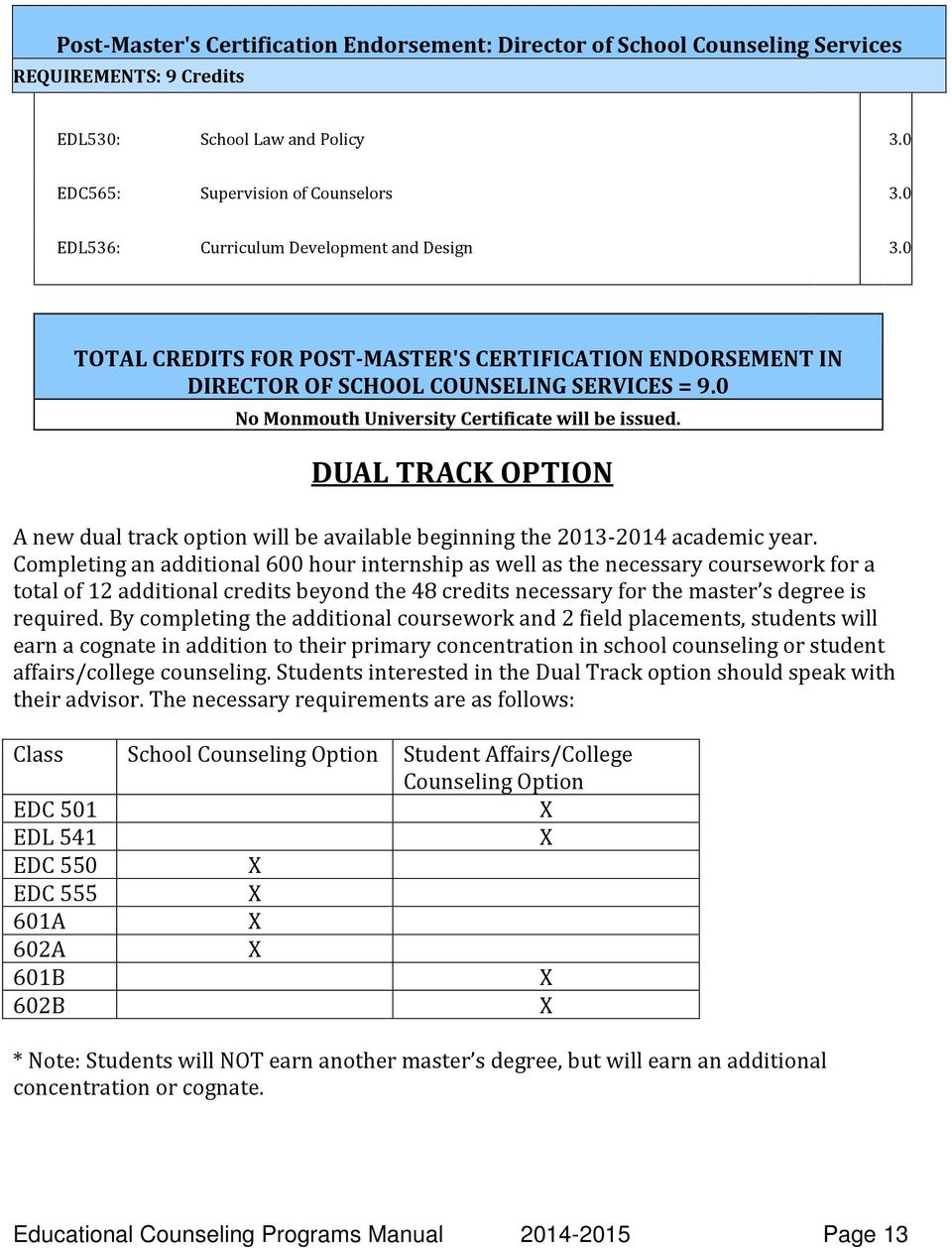
15 Post-Master's Certification Endorsement: Director of School Counseling Services REQUIREMENTS: 9 Credits EDL530: School Law and Policy 3.0 EDC565: Supervision of Counselors 3.0 EDL536: Curriculum Development and Design 3.0 TOTAL CREDITS FOR POST-MASTER'S CERTIFICATION ENDORSEMENT IN DIRECTOR OF SCHOOL COUNSELING SERVICES = 9.0 No Monmouth University Certificate will be issued. DUAL TRACK OPTION A new dual track option will be available beginning the academic year. Completing an additional 600 hour internship as well as the necessary coursework for a total of 12 additional credits beyond the 48 credits necessary for the master s degree is required. By completing the additional coursework and 2 field placements, students will earn a cognate in addition to their primary concentration in school counseling or student affairs/college counseling. Students interested in the Dual Track option should speak with their advisor. The necessary requirements are as follows: Class School Counseling Option Student Affairs/College Counseling Option EDC 501 X EDL 541 X EDC 550 X EDC 555 X 601A X 602A X 601B X 602B X * Note: Students will NOT earn another master s degree, but will earn an additional concentration or cognate. Educational Counseling Programs Manual Page 13
16 SUGGESTED PLANS OF STUDY Full-Time Study Traditional Course Sequence-School Counseling Year 1 Year 2 Year 3 Courses Spring Summer Fall Spring Summer Fall Spring Summer Fall Full-Time-Spring Start 1 EDC 500 EDC 510 EDC 555 EDC 550 EDC 545 EDC 602A EDC 530 EDC 540 EDC 535 EDL 601 EDC 525 EDC EDC 505 EDC EDC 520 Full-Time- Summer Start 1 EDC 500 EDC 525 EDC 520 EDC 540 EDC 510 EDC EDC 530 EDC 535 EDC 545 EDC 555 EDC 601A 1 2 EDC 602A EDC 505 EDL 601 EDC 600A 2 EDC 580 Full-Time-Fall Start 1 EDC 500 EDC 520 EDC 540 EDC 555 EDC 601A 1 2 EDC 545 EDC 602A EDC 530 EDC 535 EDC 525 EDC 510 EDC 550 EDC EDC 505 EDL 601 EDC 600A 2 Total Credits 48 1 Exams: Take with EDC-CPE or NCE 2 Field Placement Courses: EDC 600B (100 Hours), EDC 601B & 602B (300 Hours) Perquisites: EDC 600B (12 Credits: EDC 500, 505, 530, + 1 More Courses) EDC (24 Credits: EDC 500, 505, 530, 535, 540, 600, + 2 Other Courses) EDC 520 (12 Credits: EDC 500, 505, 530 & EDC 535) Educational Counseling Programs Manual Page 14

17 Full-Time-Traditional Course Sequence- Student Affairs/College Counseling Year 1 Year 2 Year 3 Courses Spring Summer Fall Spring Summer Fall Spring Summer Fall Full-Time-Spring Start 1 EDC 500 EDC 540 EDC 501 EDL 541 EDC 601B 1 2 EDC 602B EDC 505 EDC 525 EDC 520 EDC 545 EDC EDL EDC 530 EDC 535 EDC 600 EDC 580 Full-Time- Summer Start 1 EDC 500 EDC 501 EDC 520 EDC 540 EDL 601 EDC 602B EDC 505 EDC 525 EDC 600 EDC EDC 580 EDL EDC 530 EDC 535 EDC 601B 1 2 EDC 545 Full-Time-Fall Start 1 EDC 501 EDC 530 EDC 600 EDC 540 EDC 601B 1 2 EDC 602B EDC 505 EDL 541 EDC EDC 520 EDC 580 EDC EDC 500 EDC 535 EDL 601 EDC 525 Total Credits 48 1 Exams: Take with EDC-CPE or NCE 2 Field Placement Courses: EDC 600B (100 Hours), EDC 601B & 602B (300 Hours) 3 SACC Students should take EDC 510 online concurrent with EDC 600 or EDC 601B if they are considering an EOF, NODA, or ACUHO-I Internship Perquisites: EDC 600B (12 Credits: EDC 500, 505, 530, + 1 More Courses) EDC (24 Credits: EDC 500, 505, 530, 535, 540, 600, + 2 Other Courses) EDC 520 (12 Credits: EDC 500, 505, 530 & EDC 535) Educational Counseling Programs Manual Page 15

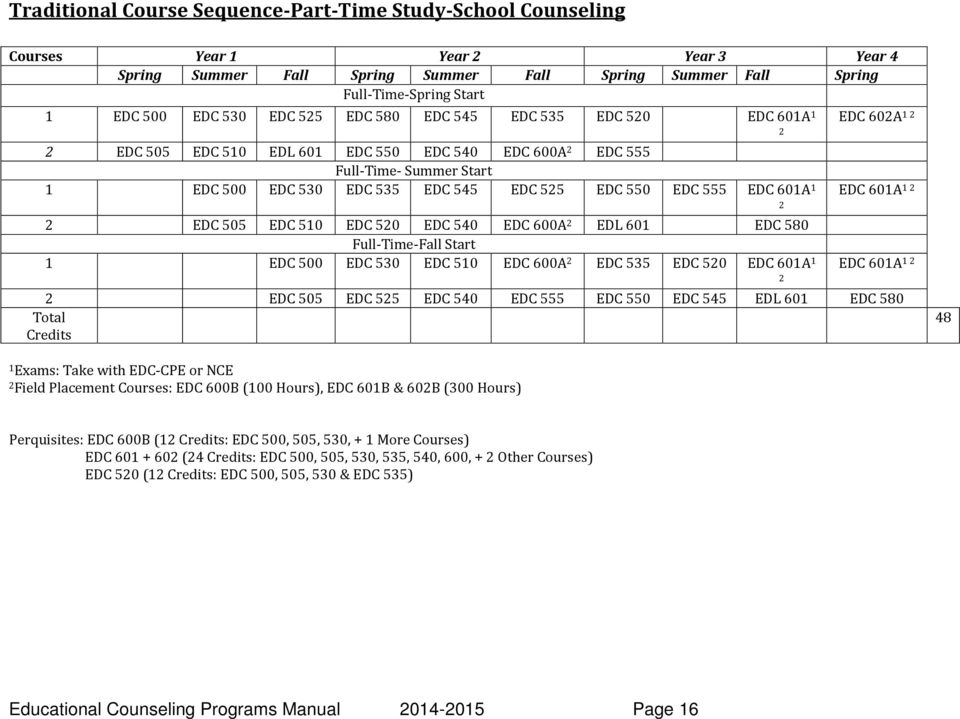
18 Traditional Course Sequence-Part-Time Study-School Counseling Courses Year 1 Year 2 Year 3 Year 4 Spring Summer Fall Spring Summer Fall Spring Summer Fall Spring Full-Time-Spring Start 1 EDC 500 EDC 530 EDC 525 EDC 580 EDC 545 EDC 535 EDC 520 EDC 601A 1 EDC 602A EDC 505 EDC 510 EDL 601 EDC 550 EDC 540 EDC 600A 2 EDC 555 Full-Time- Summer Start 1 EDC 500 EDC 530 EDC 535 EDC 545 EDC 525 EDC 550 EDC 555 EDC 601A 1 2 EDC 505 EDC 510 EDC 520 EDC 540 EDC 600A 2 EDL 601 EDC 580 Full-Time-Fall Start 1 EDC 500 EDC 530 EDC 510 EDC 600A 2 EDC 535 EDC 520 EDC 601A EDC 601A 1 2 EDC 601A EDC 505 EDC 525 EDC 540 EDC 555 EDC 550 EDC 545 EDL 601 EDC 580 Total Credits 48 1 Exams: Take with EDC-CPE or NCE 2 Field Placement Courses: EDC 600B (100 Hours), EDC 601B & 602B (300 Hours) Perquisites: EDC 600B (12 Credits: EDC 500, 505, 530, + 1 More Courses) EDC (24 Credits: EDC 500, 505, 530, 535, 540, 600, + 2 Other Courses) EDC 520 (12 Credits: EDC 500, 505, 530 & EDC 535) Educational Counseling Programs Manual Page 16
19 Traditional Course Sequence- -Part-Time Study-Student Affairs & College Counseling Courses Year 1 Year 2 Year 3 Year 4 Spring Summer Fall Spring Summer Fall Spring Summer Fall Spring Part-Time-Spring Start 1 EDC 500 EDC530 EDC 501 EDL 601 EDC 600B 2 EDC 520 EDC EDC B EDC 505 EDC 510 EDC 525 EDC 535 EDC 540 EDC 580 EDL 541 EDC 602B 1 2 Part-Time- Summer Start 1 EDC 500 EDC 501 EDC 530 EDC 600B 2 EDL 601 EDL 541 EDC 601B 1 2 EDC 602B EDC 510 EDC 505 EDC 525 EDC 540 EDC 520 EDC 535 EDC 545 EDC 580 Part-Time-Fall Start 1 EDC 501 EDC 530 EDC 540 EDC 525 EDC 520 EDC 600B 2 EDC 601B 1 2 EDC 602B EDC 500 EDC 505 EDC 510 EDC 535 EDL 541 EDC 545 EDL 601 EDC 580 Total Credits 48 1 Exams: Take with EDC-CPE or NCE 2 Field Placement Courses: EDC 600B (100 Hours), EDC 601B & 602B (300 Hours) 3 SACC Students should take EDC 510 online concurrent with EDC 600 or EDC 601B if they are considering an EOF, NODA, or ACUHO-I Internship Perquisites: EDC 600B (12 Credits: EDC 500, 505, 530, + 1 More Courses) EDC (24 Credits: EDC 500, 505, 530, 535, 540, 600, + 2 Other Courses) EDC 520 (12 Credits: EDC 500, 505, 530 & EDC 535) Educational Counseling Programs Manual Page 17

20 Dual Track Option- School Counseling & Student Affairs/College Counseling SACC with School Counseling Dual Track Option Year 1 Year 2 Year 3 Courses Spring Summer Fall Spring Summer Fall Spring Summer Fall Spring Full-Time-Spring Start 1 EDC 500 EDC 540 EDC 501 EDC 601B 1 2 EDC 602B 2 EDC 601A 1 EDC 602A 2 EDC 530 EDC 545 EDC 535 EDC 520 EDC 510 EDC 555 EDC EDC 505 EDC 525 EDC 600B EDL 541 EDC 580 EDL 601 Full-Time- Summer Start 1 EDC 500 EDC 501 EDC 520 EDC 540 EDC 601B 1 2 EDC 602B A 602B 2 EDC 505 EDC 525 EDC 535 EDC 510 EDC 580 EDC 545 EDC 555 EDC EDC 530 EDL 601 EDC 600B EDL 541 Full-Time-Fall Start 1 EDC 501 EDC 530 EDC 600B EDC 601B 1 2 EDC 602B 1 2 EDC A 602A 2 EDC 505 EDL 541 EDC 510 EDC 580 EDC 535 EDC 555 EDC EDC 500 EDC 525 EDL 601 Total Credits 60 1 Exams: Take with EDC-CPE or NCE 2 Field Placement Courses: EDC 600B (100 Hours), EDC 601B & 602B (300 Hours) 3 SACC Students should take EDC 510 online concurrent with EDC 600 or EDC 601B if they are considering an EOF, NODA, or ACUHO-I Internship Perquisites: EDC 600B (12 Credits: EDC 500, 505, 530, + 1 More Courses) EDC (24 Credits: EDC 500, 505, 530, 535, 540, 600, + 2 Other Courses) EDC 520 (12 Credits: EDC 500, 505, 530 & EDC 535) Educational Counseling Programs Manual Page 18

21 Dual Track Option- School Counseling & Student Affairs/College Counseling School Counseling With SACC Dual Track Option Courses Spring Summer Fall Spring Summer Fall Spring Summer Fall Spring Full-Time-Spring Start 1 EDC 500 EDC 540 EDC 501 EDC 601B 1 2 EDC 602B 2 EDC 601A 1 EDC 602A 2 EDC 530 EDC 545 EDC 535 EDC 520 EDC 510 EDC 555 EDC EDC 505 EDC 525 EDC 600B EDL 541 EDC 580 EDL 601 Full-Time- Summer Start 1 EDC 500 EDC 501 EDC 520 EDC 600 EDC 601B 1 2 EDC 602B A 602B 2 EDC 505 EDC 525 EDC 535 EDC 510 EDC 580 EDC 545 EDC 555 EDC EDC 530 EDL 601 EDL 541 EDC 540 Full-Time-Fall Start 1 EDC 501 EDC 530 EDC 600 EDC 601B 1 2 EDC 602B A 602A 2 EDC 505 EDL 541 EDC 510 EDC 520 EDC 580 EDC 555 EDC EDC 500 EDL 601 EDC 525 EDC 535 EDC 545 Total Credits 60 1 Exams: Take with EDC-CPE or NCE 2 Field Placement Courses: EDC 600B (100 Hours), EDC 601B & 602B (300 Hours) 3 SACC Students should take EDC 510 online concurrent with EDC 600 or EDC 601B if they are considering an EOF, NODA, or ACUHO-I Internship Perquisites: EDC 600B (12 Credits: EDC 500, 505, 530, + 1 More Courses) EDC (24 Credits: EDC 500, 505, 530, 535, 540, 600, + 2 Other Courses)) EDC 520 (12 Credits: EDC 500, 505, 530 & EDC 535) Educational Counseling Programs Manual Page 19
22 5 Year School Counseling With SACC Dual Track Option Dual Track Option- School Counseling & Student Affairs/College Counseling Traditional Course Sequence Year 1 Year 2 Year 3 Courses Summer Fall Spring Summer Fall Spring Summer Fall Full-Time-Spring Start 1 EDC 500 Undergraduate Undergraduate EDC 545 EDC 550 EDC 602A 1 2 EDC 601B EDC 501 Class Class 2 Undergraduate Undergraduate Undergraduate EDC 555 EDC 580 EDC 520 EDC Class 3 Undergraduate Class Total Credits Class Class EDC 510 EDC 600A 2 EDC 601A 1 2 EDC 535 EDC 505 EDC 525 EDL 601 EDL 541 EDC 530 EDC B 60 1 Exams: Take with EDC-CPE or NCE 2 Field Placement Courses: EDC 600B (100 Hours), EDC 601B & 602B (300 Hours) Perquisites: EDC 600B (12 Credits: EDC 500, 505, 530, + 1 More Courses) EDC (24 Credits: EDC 500, 505, 530, 535, 540, 600, + 2 Other Courses) EDC 520 (12 Credits: EDC 500, 505, 530 & EDC 535) Educational Counseling Programs Manual Page 20
23 TRADITIONAL COURSE CYCLE Course Fall Spring Summer EDC 500 X X X EDC 501 X EDC 505 X X X EDC 510 X X X EDC 525 X X EDC 520 X X EDC 530 X X X EDC 540 X X EDL 541 X EDC 545 X X EDC 550 X X EDC 555 X X EDC 580 X X EDC 600 (SACC) X X EDC 600 (School) X X EDL 601 X X EDC 601A (School) X X EDC 601A (School) X X EDC 601B (SACC) X X X EDC 602B (SACC) X X X EDC CPE X X X Note: The above course cycle is subject to change with advanced notice. The faculty and university do not guarantee the course cycle, and reserve the right to make changes based on academic needs and personnel decisions. Educational Counseling Programs Manual Page 21
24 MSEd School Counseling PLAN OF STUDY SHEETS Program Criteria 48 Credits Credits Semester Year AREA I. Foundational Studies (18 credits) EDC 500 Introduction to Professional Counseling (Summer, Fall, Spring) 3 EDC 505 Counseling and Ethical Practice (Summer, Fall, Spring) 3 EDC 530 Counseling Theory and Practice (Summer, Fall, Spring) 3 EDC 540 Group Counseling (Summer, Fall) 3 EDC 545 Career Development and Counseling (Summer, Spring) 3 EDC 580 Behavioral Issues in Counseling (Fall, Spring) 3 AREA II. Professional Studies (9 credits) EDC 550 Counseling At-Risk Children and Families (Fall, Spring) 3 EDC 555 School Counseling Program Planning and Consultation 3 (Summer, Spring) EDC 510 Human Growth and Development (Summer, Fall, Spring) 3 AREA III. Assessment, Evaluation & Research (6 credits) EDC 525 Assessment for Counseling (Summer, Fall) 3 EDL 601 Research Methodology and Applications (Fall, Spring) 3 AREA IV. Social Justice & Diversity (6 credits) EDC 520 The Group Experience (Fall, Spring) 3 EDC 535 Diversity and Social Justice (Fall, Spring) 3 AREA V. Supervised Practice (9 credits) EDC 600 Practicum in School Counseling (Summer, Fall, Spring) 3 EDC 601B Internship in Counseling I: School Counseling (Fall Spring) 3 EDC 602B Internship in Counseling II: School Counseling (Fall, Spring) 3 Additional Requirements EDC CPE (Fall, Spring) 0 Transfer Credits Dual Track Option (12 Credits) EDC 501 College Student Development Theory and Student Affairs (Fall) 3 EDL 541 Leadership & Administration of Campus Environments (Spring) 3 EDC 601B Internship in Counseling I: SACC (Summer, Fall Spring) 3 EDC 602B Internship in Counseling II: SACC (Summer, Fall, Spring) 3 Educational Counseling Programs Manual Page 22
25 MSEd Student Affairs & College Counseling Program Criteria 48 Credits Credits Semester Year AREA I. Foundational Studies (18 credits) EDC 500 Introduction to Professional Counseling (Summer, Fall, Spring) 3 EDC 505 Counseling and Ethical Practice (Summer, Fall, Spring) 3 EDC 530 Counseling Theory and Practice (Summer, Fall, Spring) 3 EDC 540 Group Counseling 3 EDC 545 Career Development and Counseling (Summer, Spring) 3 EDC 580 Behavioral Issues in Counseling (Fall, Spring) 3 AREA II. Professional Studies (9 credits) EDC 501 College Student Development Theory and Student Affairs (Fall) 3 EDL 541 Leadership & Administration of Campus Environments (Spring) 3 EDC 510 Human Growth and Development (Summer, Fall, Spring) 3 AREA III. Assessment, Evaluation & Research (6 credits) EDC 525 Assessment for Counseling (Summer, Fall) 3 EDL 601 Research Methodology and Applications (Fall, Spring) 3 AREA IV. Social Justice & Diversity (6 credits) EDC 520 The Group Experience (Fall, Spring) 3 EDC 535 Diversity and Social Justice (Fall, Spring) 3 AREA V. Supervised Practice (9 credits) EDC 600 Practicum in Student Affairs (Summer, Fall, Spring) 3 EDC 601B Internship in Counseling I: SACC (Summer, Fall Spring) 3 EDC 602B Internship in Counseling II: SACC (Summer, Fall, Spring) 3 Additional Requirements EDC CPE (Summer SACC Only, Fall, Spring) 0 Transfer Credits Dual Track Option (12 Credits) EDC 550 Counseling At-Risk Children and Families (Fall, Spring) 3 EDC 555 School Counseling Program Planning and Consultation 3 (Summer, Spring) EDC 601B Internship in Counseling I: School Counseling (Fall Spring) 3 EDC 602B Internship in Counseling II: School Counseling (Fall, Spring) 3 Educational Counseling Programs Manual Page 23
26 COUNSELOR LISCENSURE & CERTIFICATION National Counselor Exam To earn the NCC (National Certified Counselor) designation, all students are encouraged to concurrently take the CPCE with the NCE. The NCE is offered with the Department of Psychological Counseling each October and April. National certification can be a continuing source of career enhancement and pride for counseling professionals. It demonstrates to clients and employers that a professional counselor has met national standards. Information about the NCE is distributed to all students during the annual semester orientation and via announcements to all students. Licensed Professional Counselor (LPC) Regulations governing licensure as a counselor in the State of New Jersey may change each year, individuals who plan on applying for licensure should carefully consult the Professional Counselor Laws and Professional Counselor Regulations prior to applying for licensure ( In order to become a Licensed Professional Counselor (LPC) in New Jersey, an applicant must meet both educational and experience requirements. As of October 5, 2009, The Licensed Associate Counselor (LAC) must be obtained prior to accruing qualifying postmaster s counseling experience. 1. Educational Requirements: 60 graduate semester hours which includes a master s degree or doctorate in counseling (beginning October 5, 2012, this degree must be from a CACREP-approved program in counseling); 45 of the 60 hours must be distributed in 8 out of 9 core areas according to New Jersey which are: Counseling Theory & Practice, The Helping Relationship, Human Growth & Behavior & Maladaptive Behavior, Lifestyle & Career Development, Group Dynamics, Processing, Counseling, & Consulting, Appraisal of Individuals, Social & Cultural Foundations, Research & Evaluations, and The Counseling Profession. Students should consider the Post-Master s Certificate in Professional Counseling offered at Monmouth University which offers the credits necessary to complete requirements towards the LPC. Please speak to any of the program faculty for more information. 2. Experience Requirements: The LAC does not require prior supervised counseling experience. However, once an applicant becomes an LAC, the following experience requirements must be met in order to apply for the LPC: Educational Counseling Programs Manual Page 24
27 (a).three years (4500 hours) of supervised professional counseling experience acceptable to the Professional Counselor Examiners Committee (1 year of which may be accumulated prior to the granting of the master s degree). N.J.A.C. 13: (a) 1 Three calendar years of supervised professional counseling experience in a professional counseling setting, only one calendar year of which may be obtained prior to the granting of the master s degree. Hours of supervised professional counseling experience obtained during college or university graduate level practicums or internships may be counted toward satisfying a portion of the supervised counseling experience requirement provided the courses labeled practicums or internships are not also used to satisfy the educational requirements for licensure as set forth in N.J.A.C.13: Since the LPC Board may accept up to 1 year of supervised counseling experience prior to receiving the master s degree, we recommend that you save a copy of your practicum/internship logs and submit them as part of your documented counseling experience. Note: Two years of supervised professional counseling experience is required for an applicant who has completed an additional 30 graduate semester hours acceptable to the Professional Counselor Examiners Committee beyond the master s degree (See N.J.A.C. 13: (a) 2). (b). Post-master s supervised clinical experience must be done under the supervision of a qualified supervisor who meets the following requirements: Must hold a clinical license to provide mental health counseling services for a minimum of 2 years in the state provided Beginning October 5, 2011 must hold an approved clinical supervisor credential from the Center for Credentialing and Education (CCE) of the NBCC, or American Association of Marriage and Family Therapy or an equivalent credential recognized by the individual s licensing board or 3 graduate credits in supervision. (c) Supervisors must submit a written supervision plan (form available on the LPC web site) before the LAC begins counseling that outlines the work setting, job description, duties, and supervisor s responsibilities and qualifications. (d) LACs must have at least 50 hours of face-to-face supervision one (1) hour each week whether they are full or part-time. LACs may accrue a maximum of 30 hours per week and 125 hours per month and have up to six years to complete their supervised counseling hours. (e). LACs licensed for 2 or more biennial renewal periods must complete 40 CEUS for the biennial period beginning December 1, Examination Requirements: Pass the National Counselor Examination (NCE) School Counseling Students Students who plan to work as school counselors should become licensed as school counselors by the State of New Jersey or become certified or licensed as school counselors by the state Educational Counseling Programs Manual Page 25
28 department of education in the jurisdiction in which they plan to live and work. All School Counseling students are certified in New Jersey through the School of Education in Internship II (602). Student Affairs & College Counseling While no licensure exists within the profession of student affairs, students can pursue an LPC and a college counseling endorsement to their degree. Those students interesting in College Counseling should complete their internships in a college counseling office along with the Post-Masters Certificate in Professional Counseling. Educational Counseling Programs Manual Page 26
29 STUDENT DISPOSITION REVIEW PROCESS As reflected in the Council of Accredited Counseling and Related Programs (CACREP, 2009), the accreditation process and the Monmouth University School of Education policy are consistent in that all students are reviewed and evaluated to determine progress and professional disposition using a disposition form survey. All students are evaluated on a monthly basis and faculty members identify students demonstrating concerns at the biweekly program meeting. Program faculty documents these concerns and gathers information to create an appropriate plan of action collaboratively. Once a concern has been identified, a plan will be set into action. The following procedures may be implemented in Fall, Spring or Summer semesters. The steps will be implemented until final resolution. Step Process Action 1 Students are reviewed using the program's Disposition Form (Program Faculty Only) Identification and Disposition Form 2 Program Faculty Meeting: Program faculty identifies the areas of student concerns. These concerns can include academic, interpersonal, and/or behavioral issues taking place in class, practicum/internship, or the program Program Faculty initiates process for review of Disposition Form at meeting; Educational Counseling Programs Manual Page 27
30 Step Process Action 3 Student Notification: from program faculty Program faculty schedules to student via student a mandatory meeting for address student to discuss concern(s). 4 Program Faculty Meeting with Student: Program faculty discuss concerns and options regarding a plan of action. Advising E-Form complete with plan of action Plan of action may include but is not limited to: personal psychotherapy, additional coursework, probation, or termination from the program. Recommendations by the program faculty will be included in the plan of action with appropriate follow-up. Educational Counseling Programs Manual Page 28
31 ACADEMIC AND ADMISSION APPEAL POLICY Graduate students (or potential graduate students) may appeal any of the following: 1. Admission decision 2. Course grade 3. Alleged unfair practice, discrimination or bias Process: This process is sequential and must be completed in this order. Failure to comply will result in return to Step #1. 1. Provide a Written Appeal to Instructor The student must contact the Graduate Coordinator with appeals related to admissions, alleged unfair practice, discrimination or bias. The student must initiate contact with the Instructor to discuss his/her reasons for appealing an academic grade. If the student is dissatisfied with the result, s/he may appeal to the Department Chair. 2. Provide a Written Appeal to Department Chair The student must submit a written statement of appeal to the Department Chair. It is the student s responsibility to provide a clear and concisely written statement of the appeal and to provide all relevant documentation. If the student is dissatisfied with the result, s/he may appeal to the Dean of the School of Education. 3. Provide a Written Appeal to Dean of the School of Education The student must contact the Dean s office for policies and procedures related to the appeal process. 4. Provide a Written Appeal to Graduate College The student must initiate a written appeal within 60 calendar days of the last day of the semester when appeal process was initiated. Educational Counseling Programs Manual Page 29
32 FOLIOTEK PROCEDURES Foliotek is the School of Education s electronic portfolio system, which was adopted beginning in Fall All students are required to purchase and use the portfolio system. Students upload their core program assessments into Foliotek, and faculty determines whether a candidate has met, not met, or reached target on the identified elements/standards. Any student who needs assistance should contact our Foliotek administrator at [email protected]. M.S.ED. School Counseling: ASSESSMENT COURSE Assessment 1 Research Paper EDC 505 Assessment 2 ASCA Model Project EDC 555 Assessment 3 Immersion Project EDC 535 Assessment 4 Midterm Examination EDC 540 Assessment 5 Career Development Paper EDC 545 Assessment 6 Thesis EDL 601 Assessment 7 Anti-Bullying Unit EDC 555 Assessment 8 Research Paper EDC 530 M.S.ED. Student Affairs/College Coun ASSESSMENT COURSE Assessment 1 Research Paper EDC 505 Assessment 2 Midterm Examination EDC 501 Assessment 3 Immersion Project EDC 535 Assessment 4 Midterm Examination EDC 540 Assessment 5 Career Development Paper EDC 545 Assessment 6 Thesis EDL 601 Assessment 7 Legal & Issue Analysis EDC 541 Assessment 8 Research Paper EDC 530 Educational Counseling Programs Manual Page 30
33 PROFESSIONALISM & STUDENT INVOLVEMENT Professional Disposition Students are required to carefully read and periodically review this manual in order to adhere to the mandatory steps for completion. An advising appointment is required with the assigned faculty advisor to discuss the program of study, internship, and appropriate advising. Professional conduct is expected from our students in their classes, at their field placement, as well as the university. This includes professional attire, attitude, demeanor and performance. It is the student s responsibility to uphold the principles of professional conduct established by our profession and Monmouth University. Professional Organizations During the semester student orientation meeting, faculty presents information regarding professional development opportunities and associations for professional counseling. The introduction to professional organizations and associations are also presented in EDC-500, Introduction to Professional Counseling, which all students are required to take in their first semester. Additionally, faculty members encourage students to become active in the professional organizations surrounding the counseling field. All students are required to join the American Counseling Association (ACA) as a part of their practicum and internship experience. In addition, it is highly encouraged that students join other national associations. Students are also invited to apply to Chi Sigma Iota, the international honor society for students, professional counselors, and counselor educators. Chi Sigma Iota Chi Sigma Iota is an international honor society for counseling. Students are eligible to become members when they have completed at least one semester of full-time study (9 credit hours) and have a grade point average of 3.5 or above. Monmouth University s chapter of Chi Sigma Iota is Mu Upsilon Omega. It is a shared chapter with the psychological counseling programs. The faculty coordinator for the Educational Counseling program is Dr. Nicole Pulliam. Inductions are each fall only. Students must join by spring and summer. Information is provided to students during the semester orientation and in EDC 500. To join, or for more information about CSI, please visit the CSI Web site at Educational Counseling Student Association All graduate students enrolled in the Educational Counseling (School Counseling and Student Affairs/College Counseling) programs at Monmouth University are members of the Educational Counseling Students Association (ECSA). As an organized student association representing the students of the Educational Counseling program enrolled in the school Educational Counseling Programs Manual Page 31
34 counseling and student affairs/college counseling programs, the ECSA serves as a student group supporting the academic program, promoting the career field, advocating for its student body, the University, and community at large. This group allows Educational Counseling Graduate Students, faculty, alumni, and other interested associates of the University to officially organize, raise funds, and support the noted parties as necessary according to the standards, rules, and regulations of Monmouth University Student Activities. Specific events and ideas include are to include 4 events each semester. There will be two business-casual networking events, a student orientation each semester for those new to the major of Educational Counseling as well as educational trips, participation in professional or academic conferences, volunteer opportunities for university or community service, and fundraisers such as the sale of t-shirts. The ECSA will support our unique career field through service to or collaboration with local school districts or universities, faculty, and professional organizations such as the Monmouth County School Counselor s Association and other related organizations. Please Dr. Pietro Sasso with any questions about how to get involved! Chi Sigma Alpha Student Affairs Honor Society All graduate students enrolled in the Educational Counseling (School Counseling and Student Affairs/College Counseling) programs at Monmouth University with an interest in higher education, postsecondary education, student affairs, or college counseling may be eligible for membership in this honor society. Chi Sigma Alpha was founded in 2002 at Virginia Polytechnic Institute and State University in Blacksburg, Virginia. The motto of Chi Sigma Alpha is Ut Provocem Et Adiuvem, which means That I May Challenge and Support. Please Dr. Pietro Sasso with any questions about how to get involved! The American Counseling Association The American Counseling Association is a not-for-profit, professional, and educational organization that is dedicated to the growth and enhancement of the counseling profession. Founded in 1952, ACA is the world s largest association exclusively representing professional counselors in various practice settings. The website for the American Counseling Association is All students are required to join ACA for practicum and for their internships for professional development and liability insurance. Other Professional Organizations Other students are encouraged to join their degree-specific professional organizations. These are: Educational Counseling Programs Manual Page 32
35 School Counseling students should join the American School Counseling Association as well as the local, NJ county-wide school counseling association to include Ocean, Monmouth, and Middlesex. Student Affairs/College Counseling students should join the American College Personnel Association (ACPA) or National Association of Student Personnel Administrators (NASPA) as well as one of the major specific functional area professional association which include the Association of Fraternity/Sorority Advisors (AFA), National Academic Advising Association (NACADA), National Association of Career Educators (NACE), National Association of Campus Activities (NACA), and National Orientation Directors Association (NODA), or Association of College & University Housing Officers-International (ACUHO-I). Educational Counseling Programs Manual Page 33
36 COMPREHENSIVE EXAMINATION (CPCE) Students in the MSEd Educational Counseling programs in school counseling or student affairs/college counseling programs must pass the Counseling Preparatory Certification Examination (CPCE) in order to be able to graduate. The CPCE was developed by the National Board for Certified Counselors (NBCC) and is used by the Educational Counseling programs as an exit requirement and a comprehensive examination for students to obtain their degree. The CPCE examines the same eight content areas as the National Counselor Exam (NCE), the CPCE also serves to prepare students for the NCE. The CPCE has 160 questions, with 20 questions in each of the eight content areas. A passing score is the average score plus one standard deviation. The CPCE is administered each October, March, and July from 10:00 AM to 2:00 on a Weekday. At minimum, to take the CPCE, students will need to register for EDC CPE concurrently with EDC 601A/B (Internship I). It is also recommended that the examination be taken at least one semester before a student s planned graduation date, ensuring enough time to take the CPCE again if a passing grade is not attained. The course is pass/fail depending upon your score. Additionally, a student may not take the exam more than 3 times. If a student fails the CPCE more than 3 times academic dismissal may occur or remediation maybe necessary in accordance with faculty guidance. An 8 hour review workshop is offered on the second Saturday after classes start every Fall semester in cooperation with the Psychological Counseling program. Students are encouraged to attend the preparation workshop as well as use Howard Rosenthal s Encyclopedia of Counseling or Andrew Hellwig s Study Guide for the NCE and CPCE in preparing. APA WRITING STYLE The Educational Counseling Department requires the use of the Publications Manual of the American Psychological Association (APA) 6th Edition (2010) as the guide for all written assignments during the duration of their program. Students in the program should be familiar with this style guide prior to completing and handing in any papers for graduate courses. The APA manual may not be a required text for many of the graduate courses taken; however, students are expected to refer to it for guidance for all written assignments in Educational Counseling courses taken at Monmouth University. A tutorial is provided in EDC 500 and students seeking additional clarification should reference the APA 6 manual or the Purdue Owl at Educational Counseling Programs Manual Page 34
37 COUNSELOR EDUCATION FACULTY ( ) Jason Barr, Ph.D. Professor & Associate Dean McAllan Hall, Office Dr. Barr teaches courses in human development, risk and resiliency, and research and statistical methods. His experiences focus on evaluation of school programs that attempt to promote positive developmental outcomes in children and adolescents. He has been involved as a member of a research team investigating the effectiveness of a multi-level intervention in public schools that dealt with children at risk for behavior problems and promoted resiliency against future behavior problems. He has also managed a nation-wide evaluation of a character education program and its effects on positive academic and developmental outcomes in children and adolescents. He was a research associate for the Police Athletic League of New York City, where he helped develop and evaluate programming for inner-city children and adolescents. Dr. Barr is a developmental psychologist. He is a member of AERA, NERA, and AME. Jose M. Maldonado, PhD, LPC School Counseling, Student Affairs & College Counseling Programs Program Coordinator Associate Professor McAllan Hall, Office [email protected] Dr. Maldonado teaches courses in counseling theories, multicultural counseling, counseling at-risk children and families, practicum and internship. He has training and experience across the core CACREP areas. For example, Dr. Maldonado's professional experiences include counseling individuals, groups, and families from diverse cultural backgrounds. His research areas include clinical supervision, multicultural counseling, and ethnic identity. He has presented at the state, region, and national levels on topics related to multicultural counseling as well as school counseling. Dr. Maldonado has valid licenses and endorsements as a Nationally Certified Counselor (NCC), a certified School Counselor (K- 12) in New Jersey and Pennsylvania, and a certified Director of School Counseling Services (K-12) in New Jersey. In addition, he is a Licensed Professional Counselor in the state of New Jersey. He is a member of the ACA, ACES, AMCD, ASCA, NJCA, and NJSCA. Page 35 Counseling Programs Manual
38 Tina Paone, Ph.D., LPC Accreditation Coordinator Associate Professor & Department Chair McAllan Hall, Office Dr. Paone teaches courses in Group counseling, group experience, and internship. She has training and experiences across the CACREP core areas. Dr. Paone's professional experience includes counseling individuals, groups, and families from diverse cultural backgrounds. She has counseled children, adolescents, and adults in a variety of settings including K-12 schools, community agencies, and private practice. Her research areas include play therapy, group counseling, and multicultural counseling. She has presented at state, regional, and national levels on topics related to school counseling, play therapy, and multicultural counseling. Dr. Paone is a Licensed Professional Counselor (LPC) and a certified school counselor (K-12) in Pennsylvania as well as a Nationally Certified Counselor (NCC), a Nationally Certified School Counselor (NCSC), and a Registered Play Therapist Supervisor (RPT-S) and an Approved Clinical Supervisor (ACS). She is a member of the ACA, ACES, APT, ASCA, NJCA, NJSCA, and PAPT. Pietro Sasso, Ph.D., MAC Assistant Professor McAllan Hall, Office [email protected] Dr. Sasso teaches courses in student affairs and college counseling, and internship. Dr. Sasso has significant professional and teaching experience in postsecondary education. As an administrator, his experience is exceptionally diverse, spanning several educational administrative functional areas. As an educator, he is an emerging research-scholar with significant experiences in student affairs as an alcohol educator, academic advisor, and academic success instructor to both undergraduate and graduate students. His research interests include identity construction of traditional undergraduates (college student development), alcohol misuse in higher education (student health outcomes), the impact of the college fraternity experience, and masculinity in higher education. He is currently authoring several articles addressing alcohol misuse and masculinity issues among undergraduate college students to appear in national, peer-reviewed journals as well as a textbook to be entitled Today s College Student: A Reader. Dr. Sasso is also a certified college instructor, alcohol educator (ASTP, TIPS), and academic advisor (Master Advisor Certification). He is a member of ACA, NACADA, NASPA, ACPA, and AFA. Educational Counseling Programs Manual Page 36
39 Cynthia O Connell, M.Ed. Specialist Professor Clinical Coordinator of Field Placement McAllan Hall, Office [email protected] Professor Cynthia O'Connell teaches Practicum, School Counseling Program Planning and Practice, and Career Development and Counseling for the School Environment. She also supervises school counseling interns at their sites and is the Field Placement Coordinator. Professor O'Connell has worked as a teacher in health and physical education, as a school counselor in New Jersey, and as a Director of Guidance in New Jersey. She holds an M. Ed, Masters in Education, The College of New Jersey, and SAC certification. She is a member of ASCA, ACA, NJSCA, and NJPSA. Nicole Pulliam, Ph.D. Assistant Professor CPCE Coordinator McAllan Hall Office [email protected] Dr. Pulliam is a counselor educator with specializations in career counseling, higher education, and student development. She has taught graduate courses and has been appointed to several counseling and university positions in advising and teaching. Dr. Pulliam s research involves college student development, social justice counseling, and career development theories. Page 37 Counseling Programs Manual
40 Counseling Programs Field Experience Section McAllan Hall400 Cedar Avenue West Long Branch, NJ (732) Educational Counseling Programs Manual Page 38
41 Dear Students: Welcome to your field experience within the graduate program in professional school counseling, student affairs, or college counseling. Your educational courses, practical counseling skills, and the techniques that you have learned will prepare you for the culminating Practicum and Internship experiences that are now upon you. Acclimating you to the policies of our field experience component of the program and providing useful information is the purpose of this portion of the handbook. Your Practicum and Internship experiences are intended to be the application of the research, practice, and counseling skills necessary to successfully complete the counseling program. Sincerely, Cindy O Connell Cindy O Connell, M.Ed. Clinical Placement Coordinator Counseling Programs Monmouth University School of Education [email protected] Page 39 Counseling Programs Manual
42 FIELD EXPERIENCE COURSES PRACTICUM EDC 600 Practicum in Counseling (3 credits) is an intensive supervised 100-hour, mid-program field experience providing an orientation to the school counselor, student affairs professional, or college counselor s role within a comprehensive counseling program. It provides supervised opportunities to practice individual and group counseling skills among various activities. Individual and group supervision through audiotapes and/or videotapes student sessions are required as well as consultative practices. INTERNSHIP I EDC 601 Clinical Internship I in Counseling (3 credits) is a supervised field based experience, which allows students who have completed the practicum to participate in a range of professional experiences expected of a school counselor or student affairs/college counselor according to CACREP (2009) standards. This is the culminating activity of the counselor program in which students will apply what they have learned to a school or university setting. The internship includes a requirement for 300 hours of documented supervised work as a student school counselor or student affairs/college counselor under the supervision of a practicing school counselor or student affairs professional and intensive individual and group supervision in the university seminar through audiotape and videotape sessions. INTERNSHIP II EDC 602 Clinical Internship II in Counseling (3 credits) is a supervised field based experience following Internship I 601, which allows students who have completed the practicum and first internship experience to participate in a range of professional experiences expected of a school counselor or student affairs/college counseling according to CACREP standards. This is the culminating activity of the counselor program in which students will apply what they have learned to a school or university setting. The internship includes a requirement for 300 hours of documented supervised work as a student school counselor or student affairs professional under the supervision of a practicing school counselor or student affairs professional and intensive individual and group supervision in the university seminar through audiotape and videotape sessions. SAC INTERNSHIP EDC 610 Substance Awareness Coordinator Internship (3 credits) is a 300-hour, field based, supervised experience in the school, which allows students to intern as a substance awareness coordinator. This is the culminating activity of the substance awareness Educational Counseling Programs Manual Page 40
43 coordinator program in which students will apply what they have learned in a school setting. FIELD PLACEMENT APPLICATION PROCEDURES In order to apply for practicum or internship, all students must use the Practicum/Internship Application form link that will be ed. This online form must be completed entirely and submitted by the application deadline. This on-line form requires a password, and you will receive the password via your student account each semester. Application deadlines are: Summer Internship Fall Internship February 15 Spring Internship September 15 December15 (Student Affairs/College Counseling ONLY) There will be NO EXCEPTIONS to these due dates. The electronic application system will shut down at midnight on the designated due date, so plan accordingly. Please be advised there will be no acceptance of paper applications all applications must be submitted electronically. There are NO summer field experience placements for school counseling students; fall and spring ONLY. There are summer placements for student affairs/college counseling students. You must apply for field placement for each semester you intend to participate, even if you have been placed for a future semester. Once the deadline has passed, you will be required to meet with program faculty, if this is your first field experience, to discuss your readiness for field experience within the upcoming semester. You will be notified of meeting times and dates and are required to schedule an interview during this time. Failure to attend your scheduled meeting will result in your application for field placement will NOT being processed. You are not permitted to make any contact with schools, universities, counselors, superintendents, districts, principals, etc., without thorough consultation with Professor O Connell beforehand. She will advise you as to whether your contact with these individuals is needed. Field placement is a process, and often additional information is needed. Please be sure you are checking your student for updates or requests for additional information. Once you are placed, you will receive an from the field placement coordinator with two attachments. One is an eight-page contract and the other is a site supervisor form. Both forms must be filled out and returned in their entirety to Professor O Connell. This can be done only via with a scanned file. Your lack of responsiveness can result in a delayed placement. Educational Counseling Programs Manual Page 41
44 Since you are required as a student to join ACA, you should be aware that ACA membership includes free liability insurance. ACA provides free liability insurance to student members. We will need a copy of your ACA membership card and policy is required. You are also required to furnish a copy of your liability insurance certificate to Professor O Connell each semester you participate in a field placement. Additionally, you can obtain your HPSO liability insurance through if you choose to use something other than ACA. PLACEMENT Professor O Connell will collaborate in every way to secure a placement for your fieldwork experience. We cannot guarantee that the placement will be where you would like and you must be flexible. If you are a school counseling student, we would prefer that you try to experience field placement in each of the three levels (elementary, middle, and high school). The reasoning for this is that in the state of New Jersey, you are certificated as a K- 12 school counselor regardless of whether you complete your placement at one level or at various levels; however, if you leave the state of New Jersey to pursue employment, you will run into some issues (even in our neighboring states). Taking field experience at each of the three levels will eliminate this issue. If you are a student affairs and college counseling student, we would prefer you do your field placements in three different areas of focus. This will allow you more marketability when you graduate. Field placements are done by county (Monmouth, Ocean, and Middlesex) only. If you are a teacher or work in a college/university and plan to complete your field placement at your workplace, arrangements can be made to aid in the process. Clinical Field Experiences Effective January 2009, students will register for practicum and internship classes on WebAdvisor during the registration period. If you register for a practicum or internship course and do not complete an application by the above deadlines, you will be removed from the course. PROFESSIONAL DISPOSITION A professional disposition is expected from our students at their practicum/internship sites as well as the university. This includes professional attire, attitude, demeanor and performance. It is the student s responsibility to uphold the principles of excellence established by our profession and Monmouth University. These professional dispositions are discussed at length during the fieldwork orientations with Professor O'Connell and are as follows. Educational Counseling Programs Manual Page 42
45 Demonstrate professional counseling knowledge, skills, and dispositions including warmth, genuineness, respect, unconditional positive regard, and empathy in interactions with clients, classmates, staff, and faculty. Demonstrate the ability to accept and integrate feedback, and to express feelings effectively and appropriately. Be aware of your impact on others and accept personal responsibility for your knowledge, behavior, and attitudes. Demonstrate knowledge of and compliance with the ACA Code of Ethics and other relevant ethical codes, regulations, and standards of conduct and continuously monitor your own performances accordingly. Consult immediately with both your on-site supervisor and instructor if you have an ethical dilemma on-site. Report any serious or potentially serious issue (e.g. suicide ideation, threat, neglect, abuse) immediately to your site supervisor/designee, instructor, and/or director of the program. Know and follow institutional policy. Behave at all times as a professional counselor a representative of Monmouth University and a volunteer worker and guest at the field site. Comply with the decisions of your instructor, clinical director, and/or field supervisor. Your progress in the program may be interrupted for failure to comply with academic standards, or if your interpersonal or emotional status interferes with being able to provide ethical and professional counseling services to clients. *You will be dismissed immediately if you demonstrate inappropriate, immature, disruptive, unprofessional, or offensive behavior during class or field site experience, and not return until successful remediation has been completed and approved by the instructor and review committee. FIELD PLACEMENT OFFICE-STATE CERTIFICATION (School Counseling Only) The School of Education Certification Office, located in McAllan Hall Room 110, administers the School Counseling Program's endorsement. This process requires the student to successfully complete all required courses and field work placement according to the standards set forth by the educational counseling faculty and the standards for the Council of Accredited Counseling and Related Programs (CACREP, 2009). Each student is to contact Educational Counseling Programs Manual Page 43
46 the certification office to submit appropriate paperwork for state certification as a School Counselor, SAC or DSC. If you are in the school counseling program, this will take place during your Internship II class. PRACTICUM AND CLINICAL INTERNSHIP A minimum of twelve credit hours completed is required for the Practicum at Monmouth University. The counseling student s field experience is a coordinated placement where he or she can participate in many of the activities that are a fundamental part of school counseling services, student affairs, or college counseling services. A comprehensive site provides the guidance and knowledge to facilitate a counseling student s growth and competency. During the practicum/internship experience, the on-site supervisor must have a minimum of a Masters Degree in school counseling or Master s degree related to student affairs/college counseling in order to supervise the internship student. Additionally, the onsite supervisor must have a minimum of two years of professional school counseling or college-level experience. The on-site supervisor is authorized and responsible for providing opportunities for the internship students. These opportunities are designed to engage the internship student in a variety of counseling activities. The Student Assistance Counselor (SAC) supervisor must have a SAC certification and two years experience as a SAC. All of the counseling activities including the videotape/audio taping of counseling sessions are used in the evaluation of the internship student s performance. The components of the practicum and internship courses will include lectures, demonstrations, tapes, readings, presentations and group supervision to develop effective assessment, counseling, consultation, referral, and termination skills commonly used in the practice of professional counseling. The group supervision process is designed to orient the internship students with procedures of clinical supervision. University supervisors are required to administer group supervision sessions of at least 1.5 hours each per week. EDC 600 Practicum Course Students and the on- site supervisor will develop a plan to complete required experiences in direct and indirect service activities. Clinical experiences should provide opportunities for students to counsel clients who represent the ethnic and demographic diversity of their communities. The student s practicum includes all of the following: 100 Total Hour Requirement 40 Direct Contact Hours 60 Indirect Contact Hours 2 Videotapes of counseling sessions Weekly supervision session with on-site supervisor Group supervision sessions with university faculty supervisor EDC 601 & 602 Internship Courses Educational Counseling Programs Manual Page 44
47 Students and the on-site supervisor will develop a plan to complete required experiences in direct and indirect service activities. Clinical experiences should provide opportunities for students to counsel clients who represent the ethnic and demographic diversity of their communities. The student s internship includes all of the following: 600 Total Hour Requirement 240 Direct Contact Hours 360 Indirect Contact Hours 4 Videotapes of counseling sessions Weekly supervision session with on-site supervisor Group supervision sessions with university supervisor The description of contact hours are: Direct Contact Hours include: individual, family, crisis, group, advising, and career, counseling and assessment under appropriate on-site supervision. Indirect Contact Hours include: (a) in- service training, (b) consultation services, (c) staff meetings, (d) individual and group supervision, (e) transition and referrals, (f) psycho-educational sessions, (g) case conferences, (h) report writing/record keeping, (i) review of professional literature, (j) training of paraprofessional counseling staff, (k) professional development/training, (l) national and regional conferences (m) familiarization of self-help resources (e.g., books, videos), (n) support groups (face-to-face and online), (o) community outreach, and (p) other approved indirect services. Consult with your professor regarding approval. Taping Requirement All of the field experience courses require video (or audio) taping of counseling (for school counseling students) or advising (for student affairs/college counseling students) sessions. The preferred method of taping is video; however, in a few districts/colleges audio is the only option. Please make every effort to provide video-taped recordings. The purpose of video-taping counseling (SC)/advising (SACC) sessions is to not only allow your university supervisor an opportunity to go over your counseling (SC)/advising (SACC) skills with you, but your colleagues to provide feedback and tools for more effective counseling (SC)/advising (SACC). ON-SITE SUPERVISION The on-site supervisor provides internship students with a minimum supervisory contact of one hour per week. Supervisory contact involves a thorough examination of the internship student's counseling (SC)/advising (SACC) skills using video tapes, observation, and live supervision. According to the American Counseling Association Code of Ethics Educational Counseling Programs Manual Page 45
48 (2005) and the Counseling Programs at Monmouth University, the practicum and internship students must abide by the guidelines for professional conduct. Practicum and Internship students can be removed from their placement if violations are reported. The university supervisor closely monitors the student s performance and compliance with the contract and expectations of the practicum or internship. In collaboration, the on-site and faculty supervisor oversee the total practicum or internship experience for the counseling student. The faculty supervisor is responsible for the individual and group supervision, which is conducted and implemented as a course at the university. The site visit coordinator will have contact with the on-site supervisor in order to schedule an on-site visit to the placement. In addition, faculty supervisor will be available for consultation and clinical supervision for the counseling student as needed. The site supervisor provides written evaluation to the student based on criteria established by the Counseling Programs at Monmouth University. LIABILITY INSURANCE Prior to placement, each student is required to obtain and maintain liability insurance. Each semester that students are involved in field placement, they will be required to submit a copy of their insurance certificate to the clinical coordinator. Failure to do so will delay or stop the start of the practicum/internship. Students can access liability insurance through or through student memberships with ACA. COURSE PRE-REQUISITES All students are required to complete all course pre-requisites in order to apply for the Practicum and Internship experiences. A student is eligible for practicum (EDC 600) at the successful completion of twelve graduate credits. These credits must include the following courses: EDC 500 Introduction to Professional Counseling EDC 505 Counseling and Ethical Practice EDC 530 Counseling Theory and Practice Introduction to the counseling profession. An intensive introduction to counseling skills and ethical principles. An exploration of the major counseling theories and related therapeutic techniques. 3 credits 3 credits 3 credits Educational Counseling Programs Manual Page 46
49 A student is eligible for Internship I (EDC 601) after the successful completion of twenty four credits. These credits must include the following courses: EDC-500 Introduction to Professional School Counseling EDC-505 Counseling And Ethical Practice In School And Community EDC-525 Appraisal and Assessment for School Settings EDC-530 Counseling Theory And Practice In School And Community EDC 540- Group Counseling for Schools & Community EDC 600 Practicum in School Counseling Introduction to the counseling profession with an emphasis on the school counseling specialty. An intensive introduction to counseling skills and ethical principles. Understanding of the use of appraisal in the school setting. An exploration of the major counseling theories and related therapeutic techniques. An exploration into the understanding of the dynamics of group counseling. Clinical Experience 3 credits 3 credits 3 credits 3 credits 3 credits 3 credits Educational Counseling Programs Manual Page 47
50 PRACTICUM & INTERNSHIPS REQUIREMENT CHECKLIST (Submitted at the end of the semester) For all practicum & internships, you will be required to turn your materials in via flash drive. You will need one for each semester you participate in one of these field experiences. It is your responsibility to ensure that the flash drive you choose will accommodate the materials you are required to submit. When you turn in your flash drive, be sure you label the outside with your name, course number, and semester/year. You will place the flash drive in a sealed envelope. The envelope will be labeled with your name, course number, and semester/year. Flash Drive Set-Up Students will rename the drive with their name Once in the drive create a folder. The folder name will be Student name, course number, semester/year (ex. Jane Doe, EDC 601, Fall 2009) Within this folder, you will create two folders. One will be named Documentation and the other Videos. Documentation Folder: Record of Supervised Counseling Experiences- all hours are calculated automatically (excel document, saved as either.xls or.xlsx file) Summary of Counseling Experiences- signed by student & site supervisor (scanned and saved as.pdf,.jpg, or.tif file) Educational Counseling Programs Manual Page 48
51 Required Field Experiences- signed by student and site supervisor (scanned and saved as.pdf,.jpg, or.tif file) Documentation of student membership to ACA (scanned and saved as a.pdf,.jpg, or.tif file) Two (Practicum) Four (Internships) case study papers (word document, saved as either.doc or.docx file) Practicum/Internship Self-Evaluation (typed and saved as either a.doc or.docx. OR printed and scanned, saved as a.pdf,.jpg, or.tif file). Video Folder: Video #1 & Consent form #1- video tape, consent form (must be scanned and saved as a.pdf file). All students should include video #1. Video #2 & Consent form #2- video tape, consent form (must be scanned and saved as a.pdf file). All students should include video #2. Video #3 & Consent form #3- video tape, consent form (must be scanned and saved as a.pdf file). All internship & SAC internship students should include a video #3. Video #4 & Consent form #4- video tape, consent form (must be scanned and saved as a.pdf file). All internship & SAC internship students should include a video #4. Educational Counseling Programs Manual Page 49
52 If you are scanning consent forms for a group, they should all appear as one document (with several pages). There are very few sites that have placements in which video are unacceptable. In that case, you must record and covert your audio tape to an.mp3 file. This will be saved above as Audio #1, etc It is your responsibility as a graduate student to ensure all information is included and correctly saved. If you do not have access to a personal scanner, you may use the one in the Monmouth University library. Failure to include all information in their proper format will result in a delay of placement for the following semester. If you are in your final internship, failure to include all information will result in a delay of your graduation. **Flash drives will NOT be returned to you **Do NOT include additional information. Educational Counseling Programs Manual Page 50
53 Parental Release Form School Counseling Program School of Education Monmouth University The School Counseling Program at Monmouth University has school counseling practicum/internship students at your child s school. Counseling Practicum and Internship are advanced level courses in counseling and a requirement of all graduate students in the School Counseling Program. Clinical supervision for practicum/internship courses require video taping of counseling sessions for the purpose of training. All tapes will be stored for three years following the completion of practicum/internship in a locked cabinet in the Clinical Counseling Coordinators office and then destroyed. Counseling sessions will remain confidential in terms of the information that is revealed during the process of supervision. In certain cases, confidentiality is not allowed due to certain legal restrictions. That includes a) any form of child abuse, b) danger to one s self (suicide), c) danger to others (homicide). I, (print parent/guardian name) hereby allow (print child name) to be counseled and recorded by the graduate practicum/internship student. It is my understanding that in giving my permission information obtained is solely for training purposes. This information will not be released to anyone without prior written consent from me. I certify that I have read and understand the above conditions Parent/Guardian s signature: Date: Student s signature: Date: Age: Practicum/Internship Student Signature: Date: Educational Counseling Programs Manual Page 51
54 MONMOUTH UNIVERSITY West Long Branch, New Jersey CONSENT AND RELEASE FORM I,, do hereby give Monmouth University the right to record and use in perpetuity my name, likeness, voice and statements/quotations in connection with my participation in a counseling session and/or interview conducted by Monmouth University student, as part of his/her educational studies in a counseling program at Monmouth University. I understand and agree that this release includes, without limitation, the right to view and discuss such images and information in Monmouth University classes and/or sessions for training/educational purposes related to the above-referenced studies. Such images and information may appear in any of the wide variety of formats and media now available and that may be available in the future, including but not limited to print, broadcast, videotape, CD-ROM and electronic/online media. I understand and agree that all such recordings, in whatever medium, shall remain the property of Monmouth University. I understand and agree that I shall not be entitled to any compensation of any nature, monetary or otherwise, from Monmouth University or those acting pursuant to its authority in return for allowing this use. I understand and agree that, in certain cases, including but not limited to actual/threatened/suspected child abuse or actual/threatened/suspected harm to one s self or others, confidentiality cannot be guaranteed due to various laws, regulations, guidelines, policies and procedures, and that such child abuse or harm may be reported to appropriate authorities. I release Monmouth University and its officers, directors, agents, employees and students, and those acting pursuant to their authority, from liability for any violation of any personal or proprietary right I may have in connection with such use. I have read and fully understand the terms of this release. Signature: Printed Name: Date: Signature of Parent/Guardian: (if Participant is under 18 years of age) Educational Counseling Programs Manual Page 52
55 Monmouth University Practicum & Internship Required Field Experiences (School Counseling) SAMPLE Date Experience Child Study Team Meeting (CST) Discipline Meeting Observation Parent Meeting- Grades/Report Card Conference Crisis Intervention Team Meeting School Opening Day/Closing/Moving Up/Orientation Peer Leadership/Peer Mentoring Session or Training Enrollment/Registration Meeting Classroom Guidance Observation Individual Counseling Observation Intervention & Referral Services (I & RS) Meeting Individualized Educational Plan (IEP) Meeting Classroom Observations (including resource/self-contained, and ESL) Student Scheduling (MS/HS Only) Vocational Technical/Alternative/Out of district School Visit Counseling Department Meeting Evening Parent Program 504 Meeting College Fair (HS Only) Standardized Test Administration Team Meeting (ES/MS Only) Faculty or Board of Education Meeting Other: The instructor and on-site supervisor may increase/decrease required experiences according to the candidate s prior experience, grade level, and skills and the school s needs. Candidates with minimal school experience must complete additional observations and experiences. Student Signature: Site Supervisor Signature: Educational Counseling Programs Manual Page 53
56 Monmouth University Practicum & Internship Required Field Experiences (Student Affairs/College Counseling) SAMPLE Date Experience Transfer Student Meeting Career Day/Fair Parent Fair Majors Fair New Student Orientation Career Services Observation Disability Services Observation Study Abroad Advisement Session Department Meeting Student Advisement Judicial Affairs Observation Mediation Meeting Observation College Fair (off-campus) Potential Student/Parent Meeting Observation Counseling Department Meeting Residential Life Program Meeting Other: The instructor and on-site supervisor may increase/decrease required experiences according to the candidate s prior experience, grade level, and skills and the school s needs. Candidates with minimal college/university experience must complete additional observations and experiences. Student Signature: Site Supervisor Signature: Educational Counseling Programs Manual Page 54
Graduate Catalog School Counseling
 Page 1 of 6 Graduate Catalog School Counseling Introduction Professional school counselors support teachers, other professional personnel, and parents in addressing the needs of students related to academic
GRADUATE PROGRAM CURRICULUM
 GRADUATE PROGRAM CURRICULUM COLLEGE OF EDUCATION & HUMAN SERVICES Dr. Hank Weddington, Dean Dr. Neal Grey, Chair SCHOOL OF COUNSELING & HUMAN SERVICES MASTER OF ARTS IN COUNSELING OFFERED IN HICKORY, ASHEVILLE
How To Become A Clinical Mental Health Counselor
 CMHC Student Handbook 1 APPALACHIAN STATE UNIVERSITY REICH COLLEGE OF EDUCATION DEPARTMENT OF HUMAN DEVELOPMENT AND PSYCHOLOGICAL COUNSELING (HPC) CLINICAL MENTAL HEALTH COUNSELING STUDENT HANDBOOK Revised
M.A. Counseling Psychology 2015 2016 Program Guidebook
 M.A. Counseling Psychology 2015 2016 Program Guidebook NOTE: 1) This guidebook is subject to change. If it does, students will be notified via email and will be provided with the revised version. 2) Policies
Master of Science in Education Counseling
 Program Director Matthew Paylo 3312 Beeghly Hall (330) 941-3264 [email protected] Program Description Master of Science in Education Counseling The counseling program prepares individuals as professional
Virginia Tech Counselor Education Program ADVISING MANUAL
 Virginia Tech Counselor Education Program ADVISING MANUAL Revised April, 2014 1 Table of Contents VISION AND MISSION STATEMENT 5 DEGREE AUTHORIZATION 10 ADMISSION POLICIES 11 Master s Degree Admission
Counseling (MA) Degrees. Program Description. Learning Outcomes. Counseling (MA)
 This program offered by College of Arts & Sciences Program Description The mission of the Webster University graduate professional counseling degree program is to provide high-quality learning experiences
Georgia Regents University M.Ed. Counselor Education Program
 Georgia Regents University M.Ed. Counselor Education Program Information for Prospective Students The Counselor Education Master of Education (M.Ed.) degree graduate program at Georgia Regents University
M.Ed. COUNSELING AND GUIDANCE School Counseling and Community Counseling
 College of Education M.Ed. COUNSELING AND GUIDANCE School Counseling and Community Counseling The Counseling and Guidance Program prepares qualified counselors who can work with diverse populations and
Augusta University Counselor Education Program. Information for Prospective Student (M.Ed.)
 Augusta University Counselor Education Program Information for Prospective Student (M.Ed.) The Counselor Education Master of Education (M.Ed.) degree graduate program at Augusta University prepares students
CHADRON STATE COLLEGE. Department of Counseling, Psychology, and Social Work. Counseling Program. Graduate Student Handbook
 CHADRON STATE COLLEGE Department of Counseling, Psychology, and Social Work Counseling Program Graduate Student Handbook Revised 2008 1 INTRODUCTION The Chadron State College Department of Counseling,
PhD in Counselor Education & Supervision Handbook 2012-2014
 PhD in Counselor Education & Supervision Handbook 2012-2014 WELCOME TO THE UNIVERSITY OF WYOMING COUNSELOR EDUCATION & SUPERVISION DOCTORAL PROGRAM Students, faculty and staff join me in welcoming you
Stephen F. Austin State University
 Stephen F. Austin State University Department of Human Services School Counselor Education Program Information Packet Revised January 2016 1 THE DEPARTMENT OF HUMAN SERVICES Stephen F. Austin State University,
Graduate Programs in Education and Human Development
 Graduate Programs in Education and Human Development Department of Curriculum and Instruction Two master s degree options and a doctorate degree are offered in Curriculum and Instruction. The Master of
Counselor Education Program
 Counselor Education Program Graduate Student Handbook Department of Educational & Clinical Studies 7th Edition UNLV Counselor Education Program Graduate Student Handbook 2 This handbook contains information
Stephen F. Austin State University Department of Human Services. Clinical Mental Health Counselor Education Program
 Stephen F. Austin State University Department of Human Services Clinical Mental Health Counselor Education Program Information Packet Revised January 2016 THE DEPARTMENT OF HUMAN SERVICES Stephen F. Austin
M.A. Clinical Mental Health Counseling 2014-2015 Program Guidebook
 M.A. Clinical Mental Health Counseling 2014-2015 Program Guidebook NOTE: 1) This guidebook is subject to change. If it does, students will be notified via email and will be provided with the revised version.
Education and Counseling (M.A.Ed.)
 III: Influencing Literacy Instruction and Leadership RDG 5320 Diversity and Multicultural Education RDG 5330 Leadership in Reading RDG 5610 Diagnosis, Assessment, Instruction, and Practicum in Reading
Practicum and Internship Manual
 "One of America s Great Metropolitan Research Universities" DEPARTMENT OF COUNSELING, EDUCATIONAL PSYCHOLOGY AND RESEARCH The College of Education The University of Memphis Memphis, TN 38152 (901) 678-2841
1. List proposed program changes related to merging, splitting, renaming or modifying a program. Community Counseling and School Counseling.
 Proposal to Modify the MA in School Counseling Department of Counseling Prepared and Submitted by Department of Counseling DATE: November, 2013 SEHS COI Approved: December 3, 2013 1. List proposed program
MASTER S DEGREE IN PROFESSIONAL COUNSELING 2009-2010 http://pc.ed.utah.edu/
 MASTER S DEGREE IN PROFESSIONAL COUNSELING 2009-2010 http://pc.ed.utah.edu/ UPDATED: JUNE 1, 2009 Professional mental health counselors facilitate the growth and development of individuals, families, and
Graduate Student HANDBOOK. Rehabilitation Counseling Program
 Graduate Student HANDBOOK Rehabilitation Counseling Program 2014-2015 Dear Rehabilitation Counseling Students, On behalf of the Rehabilitation Counseling faculty, staff, and second year students, I would
Master of Science in Counseling Psychology
 Emphasis Options Addictions Counseling Psychology Child and Family Counseling Psychology Providing training in professional psychology at the graduate level, the program is designed for those pursuing
Ph.D. Counselor Education and Supervision 2014 2015 Program Guidebook
 Ph.D. Counselor Education and Supervision 2014 2015 Program Guidebook NOTE: 1) This guidebook is subject to change. If it does, students will be notified via email and will be provided with the revised
UTAH STATE UNIVERSITY. Professional School Guidance Counselor Education Program Mapping
 UTAH STATE UNIVERSITY Professional School Guidance Counselor Education Program Mapping Course Key: PSY 6130 Evidence-Based Practice: School Intervention PSY 6240 Comprehensive School Counseling Programs
STUDENT LEARNING ASSESSMENT REPORT
 STUDENT LEARNING ASSESSMENT REPORT SUBMITTED BY: DR. MICHELE GAROFALO, ASSISTANT CHAIR, DEPARTMENT OF COUNSELING DATE: SEPTEMBER 30, 2014 BRIEFLY DESCRIBE WHERE AND HOW ARE DATA AND DOCUMENTS USED TO GENERATE
PreK 12 Practicum and Internship. School Counseling. Overview
 PreK 12 Practicum and Internship School Counseling Overview Counseling and Development Program Mission Statement The Counseling and Development program is committed to prepare counselors who promote the
Master's Degree Programs in Clinical Mental Health Counseling and School Counseling Program Student Learning Assessment Plan
 Master's Degree Programs in Clinical Mental Health Counseling and School Counseling Program Student Learning Assessment Plan Program Learning Outcomes Performance Indicators Assessment Measures Assessment
Marquette University Learning Assessment Plan
 Marquette University Learning Assessment Plan Counseling and Educational Psychology Program: Clinical Mental Health Counseling Degree: M.A. Date Submitted: May 2013 Program Learning Outcomes Students will
1. PROFESSIONAL SCHOOL COUNSELOR IDENTITY:
 Utah State University Professional School Counselor Education Program Learning Objectives (Adapted from the Standards for Utah School Counselor Education Programs and the Council for Accreditation of Counseling
The University of Mississippi School of Education
 The University of Mississippi School of Education Master s Degree in Literacy Education Department of Teacher Education Educators as Reflective Professionals Graduate Handbook Revised Fall 2012 1 Table
2015-2016. University of Houston Victoria. Counseling Psychology Graduate Student Handbook D E P A R T M E N T O F A R T S & S C I E N C E S
 2015-2016 University of Houston Victoria Counseling Psychology Graduate Student Handbook D E P A R T M E N T O F A R T S & S C I E N C E S Welcome and Overview Welcome to the UHV Masters Program in Counseling
ASSESSMENT OF STUDENT LEARNING COUNSELING MA PROGRAM DEPARTMENT OF COUNSELING PSYCHOLOGY AND COMMUNITY SERVICES
 2012 ASSESSMENT OF STUDENT LEARNING COUNSELING MA PROGRAM DEPARTMENT OF COUNSELING PSYCHOLOGY AND COMMUNITY SERVICES We are currently seeking accreditation from the Masters in Psychology and Counseling
2014-15 Spring 2015. Master of Arts in counseling degree programs Handbook. And Certificates of Graduate Study
 2014-15 Spring 2015 Master of Arts in counseling degree programs Handbook And Certificates of Graduate Study School of Psychology & Counseling 1000 Regent University Drive Virginia Beach, VA 23464 regent.edu/acad/schcou
2014-15 Revised September 2014
 2014-15 Revised September 2014 Master of Arts in Counseling Degree Program Handbook And Certificates of Graduate Study School of Psychology & Counseling 1000 Regent University Drive Virginia Beach, VA
THE UNIVERSITY OF TEXAS AT TYLER. Department of Psychology and Counseling STRATEGIC PLAN 2013-2018
 THE UNIVERSITY OF TEXAS AT TYLER Department of Psychology and Counseling STRATEGIC PLAN 2013-2018 Department of Psychology and Counseling Purpose and Values Core Purpose: Our core purpose is to prepare
Masters of Science in Clinical Psychology: MFT & LPCC Program Information Packet
 Masters of Science in Clinical Psychology: MFT & LPCC Program Information Packet Department of Psychology One Washington Square San Jose CA 95192-0120 psych.sjsu.edu/grad/clinical Dear Prospective Student,
Wichita State University School Psychologist, Narrative Describing the Operation of the Program Assessment Plan Approved 11-15-05
 School Psychologist, Narrative Describing the Operation of the Program Assessment Plan Approved 11-15-05 Program evaluation in the Program occurs both (a) to make decisions about individual candidates
OKLAHOMA STATE UNIVERSITY. School of Applied Health and Educational Psychology
 OKLAHOMA STATE UNIVERSITY School of Applied Health and Educational Psychology Doctorate in Educational Psychology Option: Counseling Psychology Overview The Counseling Psychology Program leading to the
COPPIN STATE COLLEGE REHABILITATION COUNSELING PROGRAM STUDENT HANDBOOK
 COPPIN STATE COLLEGE REHABILITATION COUNSELING PROGRAM STUDENT HANDBOOK Available in Alternative Formats 2500 West North Avenue, Baltimore, Maryland 21216-9978 (410) 951-3510 (Voice/TTY) * (410) 951-3511
School Psychologist Graduate Program: Frequently Asked Questions by Applicants
 Brooklyn College of the City University of New York Department of School Psychology, Counseling and Leadership School Psychologist Graduate Program Room 1107 James Hall 2900 Bedford Avenue Brooklyn, New
Counselor Education COLLEGE OF EDUCATION AND HUMAN SERVICES. Master of Science in Education. 136 / Graduate Catalog 2015-2016 Chapter 2
 136 / Graduate Catalog 2015-2016 Chapter 2 Counselor Education http://epse.ehs.siu.edu/ COLLEGE OF EDUCATION AND HUMAN SERVICES Graduate Faculty: Asner-Self, Kimberly K., Associate Professor, Ed.D., George
This program is offered entirely ONLINE throughout the United States and in approved international locations.
 West Virginia University 1 Special Education Degrees Offered Master of Arts in Special Education Doctor of Education with a major in Special Education MASTER OF ARTS IN SPECIAL EDUCATION OVERVIEW The graduate
American International College PSYCHOLOGY. Doctor of Education in Educational
 American International College 1 PSYCHOLOGY Doctor of Education in Educational cognition Doctor of Education in Educational Psychology The Doctor of Education in Educational Psychology (EdD) program provides
Counseling. PRACTICUM and INTERNSHIP. Manual
 Counseling Internship Manual 1 Montclair State University Counselor Education Program Counseling PRACTICUM and INTERNSHIP Manual 2015 2016 Updated August 2015 Counseling Internship Manual 2 TABLE OF CONTENTS
Master of Science in Counseling Psychology
 Certificates Addictions Counseling Psychology Child and Family Counseling Psychology Providing training in professional psychology at the graduate level, the program is designed for those pursuing further
SCHOOL COUNSELING PROGRAM Counseling and Human Services Department University of Scranton
 SCHOOL COUNSELING PROGRAM Counseling and Human Services Department University of Scranton Julie A. Cerrito, Ph.D., NCC, NCSC Kevin Wilkerson, Ph.D., NCC, ACS Co-Director, School Counseling Program Co-Director,
Counseling Student Handbook
 Counseling Student Handbook Auburn Montgomery School of Education Department of Counselor, Leadership and Special Education September 16, 2014 TABLE OF CONTENTS Area Description... 3 Master of Education
Supervisor Handbook for School Counseling Practicum/Internships
 Virginia State University Professional Educational Programs Unit (College of Education, projected October 2012) Department of School and Community Counseling Supervisor Handbook for School Counseling Practicum/Internships
Winston-Salem State University RSA Scholars Program
 Winston-Salem State University RSA Scholars Program School of Education and Human Performance Department of Educational Leadership, Counseling, and Professional Studies Rehabilitation Counseling Program
DEPARTMENT OF EDUCATIONAL LEADERSHIP, COUNSELING, AND POSTSECONDARY EDUCATION STUDENT OUTCOMES, COMPETENCIES, AND METHODS OF ASSESSMENT
 DEPARTMENT OF EDUCATIONAL LEADERSHIP, COUNSELING, AND POSTSECONDARY EDUCATION STUDENT OUTCOMES, COMPETENCIES, AND METHODS OF ASSESSMENT SCHOOL AND MENTAL HEALTH COUNSELING I. Departmental Philosophy The
Master of Arts in Higher Education (both concentrations)
 Higher Education Dickinson Hall, Room 419 (501) 569-3267 Master of Arts and Doctor of Education The Master of Arts in Higher Education is designed for those individuals who are interested in entering or
First-Time Licensure. SECONDARY EDUCATION Master s Degree Program M.Ed.
 SECONDARY EDUCATION Master s Degree Program M.Ed. First-Time Licensure College of Education Secondary Ed. Program University of Nevada, Reno 1664 N. Virginia St. Mailstop 280 Reno, NV 89557 The M.Ed. program
August 2014. Doctor of Philosophy Counselor Education and Supervision
 August 2014 Doctor of Philosophy Counselor Education and Supervision Doctor of Philosophy in Counselor Education and Supervision Kansas State University College of Education The official title of this
STUDENT HANDBOOK Department of Counselor Education 2014-2015
 STUDENT HANDBOOK Department of Counselor Education 2014-2015 STUDENT HANDBOOK Department of Counselor Education Northeastern Illinois University 2014-2015 Table of Contents Mission Statement 1 Accreditation
STUDENT HANDBOOK. Counselor Education Program
 STUDENT HANDBOOK Counselor Education Program PURPOSE OF Handbook Welcome to the CACREP accredited Counselor Education Program in the Department of Human Studies at the University of Alabama at Birmingham.
The Department of Counselor Education Virginia Commonwealth University. Graduate Student Handbook
 The Department of Counselor Education Virginia Commonwealth University Graduate Student Handbook Table of Contents I. Overview...4 Mission Statement Accreditation Program Objectives II. General Graduate
TENNESSEE TECHNOLOGICAL UNIVERSITY. Department Of Counseling and Psychology. School Counseling Handbook
 TENNESSEE TECHNOLOGICAL UNIVERSITY Department Of Counseling and Psychology School Counseling Handbook Revised May, 2009 1 TABLE OF CONTENTS CONCEPTUAL FRAMEWORK... 2 PURPOSE OF THIS HANDBOOK... 3 PURPOSE
Master of Science and Master of Arts Degree in Counseling with a concentration in Clinical Mental Health Counseling
 Master of Science and Master of Arts Degree in Counseling with a concentration in Clinical Mental Health Counseling Courses and Credit Hours The list of courses and credit hours needed for the M.S. in
Professional Education Unit
 NORTHERN ARIZONA UNIVERSITY Professional Education Unit ASSESSMENT SYSTEM HANDBOOK 2011/2012 PROFESSIONAL EDUCATION UNIT ASSESSMENT SYSTEM HANDBOOK Table of Contents The Unit Assessment System Overview...
STUDENT MANUAL FOR THE REHABILITATION COUNSELING PROGRAM. (M.S. Degree)
 STUDENT MANUAL FOR THE REHABILITATION COUNSELING PROGRAM (M.S. Degree) Department of Counselor Education Emporia State University Emporia, Kansas 66801 620-341-5220 http://www.emporia.edu/ce/rehabilitation-counseling/
Vision, Mission, and Process
 The Counselor Education and School Psychology Department regularly and systematically evaluates its programs for the purposes of ensuring student success, alignment with licensure and certification standards,
2015 2016 Forensic Psychology Handbook
 University of Houston Victoria College of Arts & Sciences Competence Theory Justice 2015 2016 Forensic Psychology Handbook Knowledge Skill Welcome and Overview Welcome to the UHV Masters Program in Forensic
Our Program. Counselor Education 10/24/14. This Overview Will: An Overview of the CACREP-Accredited Programs The University of Alabama
 10/24/14 Counselor Education An Overview of the CACREP-Accredited Programs The University of Alabama Graduate Programs in Counselor Education Welcome and thank you for your interest in our program. Counselor
Program Evaluation. Gannon University. Clinical Mental Health Counseling Program. Program Evaluation. Revised 1/29/13
 1 Gannon University Clinical Mental Health Counseling Program 2012 Program Evaluation 2 Clinical Mental Health Counseling Program Evaluation Review of Current Program Goals Counselor Knowledge Counselor
COUNSELING PRACTICUM HANDBOOK
 COUNSELING PRACTICUM HANDBOOK Educational Leadership and Counseling Whitlowe R. Green College of Education Prairie View A&M University P.O. Box 519; MS 2430 Prairie View, TX 77446-0519 936-261- 3645 936-261-
National Standards. Council for Standards in Human Service Education. http://www.cshse.org 2013 (2010, 1980, 2005, 2009)
 Council for Standards in Human Service Education National Standards ASSOCIATE DEGREE IN HUMAN SERVICES http://www.cshse.org 2013 (2010, 1980, 2005, 2009) I. GENERAL PROGRAM CHARACTERISTICS A. Institutional
COUNSELING Ph.D. PROGRAM HANDBOOK 2015-2016. Our Lady of Holy Cross College 4123 Woodland Drive New Orleans, LA 70131 www.olhcc.
 COUNSELING Ph.D. PROGRAM HANDBOOK 2015-2016 Our Lady of Holy Cross College 4123 Woodland Drive New Orleans, LA 70131 www.olhcc.edu Revised August 24, 2015 TABLE OF CONTENTS Ph.D. Program Description...
GRADUATE and POST-GRADUATE SCHOOL COUNSELING PROGRAMS
 GRADUATE and POST-GRADUATE SCHOOL COUNSELING PROGRAMS Department Chair & Professor: Nancy G. Calleja, Ph.D., LPC Office: 234 Reno Hall Telephone: (313) 578-0436 Email: [email protected] Assistant Professor
Why The College of New Jersey (TCNJ) for advanced study in counseling?
 THE COLLEGE OF NEW JERSEY Graduate Programs in Counselor Education Why The College of New Jersey (TCNJ) for advanced study in counseling? "The coursework required to obtain a Masters of Counseling at TCNJ
Department of Counselor Education. M.S.Ed. in Counseling School Counseling Option
 CNED Annual Assessment Report for Teacher Education Programs 1 Department of Counselor Education M.S.Ed. in Counseling School Counseling Option Annual Assessment Report of Student Progress for Teacher
Master of Science. MENTAL HEALTH COUNSELING Master of Arts PSYCHOLOGICAL COUNSELING. Graduate PROGRAMS
 Master of Science MENTAL HEALTH COUNSELING Master of Arts PSYCHOLOGICAL COUNSELING Graduate PROGRAMS The Master of Science in Mental Health Counseling is accredited by the Council for Accreditation of
FITNESS FOR THE PROFESSION OF COUNSELING
 FITNESS FOR THE PROFESSION OF COUNSELING A Policy Statement from the Faculty and Staff of the Department of Counseling and Human Services, College of Professional Studies, University of Scranton. PROFESSIONAL
STANDARDS FOR GUIDANCE COUNSELING PROGRAMS
 STANDARDS FOR GUIDANCE COUNSELING PROGRAMS These standards were approved January 2005 by the Kentucky Education Professional Standards Board. The Kentucky Standards for Guidance Counselor Programs are
MASTER S IN SCHOOL COUNSELING 2008-2009
 MASTER S IN SCHOOL COUNSELING 2008-2009 PROFESSIONAL SCHOOL COUNSELOR The professional school counselor is a licensed educator who assists students, teachers, parents, and administrators in helping students
National Standards. Council for Standards in Human Service Education. http://www.cshse.org 2013 (2010, 1980, 2005, 2009)
 Council for Standards in Human Service Education National Standards BACCALAUREATE DEGREE IN HUMAN SERVICES http://www.cshse.org 2013 (2010, 1980, 2005, 2009) I. GENERAL PROGRAM CHARACTERISTICS A. Institutional
COUNSELOR EDUCATION (COU) M.S. in Counselor Education Director: Debra L. Ponec
 CTS 795 Directed Independent Study (2-3) In this course, each scholar will be supervised by faculty members; will pursue in-depth reading and discussions on current research topics of interest to faculty
Clinical Mental Health Counseling
 Summer I Semester - All courses are three credits 700 Professional Identity & Ethics 788 Social & Cultural Foundations Become acquainted with faculty members, Paula Geier, and the graduate assistants in
Master of Arts in Counseling and Educational Psychology with emphasis in: Marital, Couple, and Family Counseling/Therapy
 Master of Arts in Counseling and Educational Psychology with emphasis in: Marital, Couple, and Family Counseling/Therapy College of Education University of Nevada, Reno Mailstop 0281 Reno, NV 89557-0280
The University of Alabama Rehabilitation Counselor Education. Information for Prospective Students
 The University of Alabama Rehabilitation Counselor Education Information for Prospective Students Thank you for your interest in the Rehabilitation Counselor Education (RCE) program at The University of
JACKSON STATE UNIVERSITY DEPARTMENT OF SCHOOL, COMMUNITY AND REHABILITATION REHABILITATION COUNSELING PROGRAM
 JACKSON STATE UNIVERSITY DEPARTMENT OF SCHOOL, COMMUNITY AND REHABILITATION REHABILITATION COUNSELING PROGRAM NATURE AND SCOPE Jackson State University in cooperation with the U.S. Department of Education,
Master of Library and Information Science (MLIS)
 St. Catherine University 1 Master of Library and Information Science (MLIS) Mission The Master of Library and Information Science (MLIS) program at St. Catherine educates students in the principles, practices
College. Of Education
 College Of Education Contact Us 00971-2-5993111 (Abu Dhabi) 00971-4-4021111 (Dubai) 00971-2- 5993783 (College of Education) @Zayed_U www.facebook.com/zayeduniversity www.zu.ac.ae Introduction and Mission
HAWAII PACIFIC UNIVERSITY
 HAWAII PACIFIC UNIVERSITY PROGRAM OVERVIEW DEPARTMENT OF PSYCHOLOGY MASTER OF ARTS IN CLINICAL MENTAL HEALTH COUNSELING The Clinical Mental Health Counseling Master s Degree Program (CMHC-MA) is a post-baccalaureate
2009-2010 ANNUAL PROGRAM REVIEW MS IN COUNSELING SCHOOL COUNSELING CONCENTRATION
 2009-2010 ANNUAL PROGRAM REVIEW MS IN COUNSELING SCHOOL COUNSELING CONCENTRATION I. School Counseling Graduate Program The Counseling and Psychology faculty discuss course content and offer suggestions
Master of Science in Mental Health Counseling Advanced Certificate in Mental Health Counseling
 Advanced Certificate in Mental Health Counseling Program Overview The program at St. John Fisher College educates students to provide therapeutic mental health interventions in the community. This program
Master of Science in. EDUCATION (MSEd) and ENDORSEMENT PROGRAMS. Graduate PROGRAMS
 Master of Science in EDUCATION (MSEd) and ENDORSEMENT PROGRAMS Graduate PROGRAMS LEARNING INITIATIVES THAT MATTER T he Master of Science in Education (MSEd) program at Monmouth University supports a wide