
Avista Utilities. Washington / Idaho 2013 Electric Demand-Side Management Business Plan
|
|
|
- Eugene Ramsey
- 10 years ago
- Views:
Transcription

1 Avista Utilities Washington / Idaho 2013 Electric Demand-Side Management Business Plan November 1, 2012

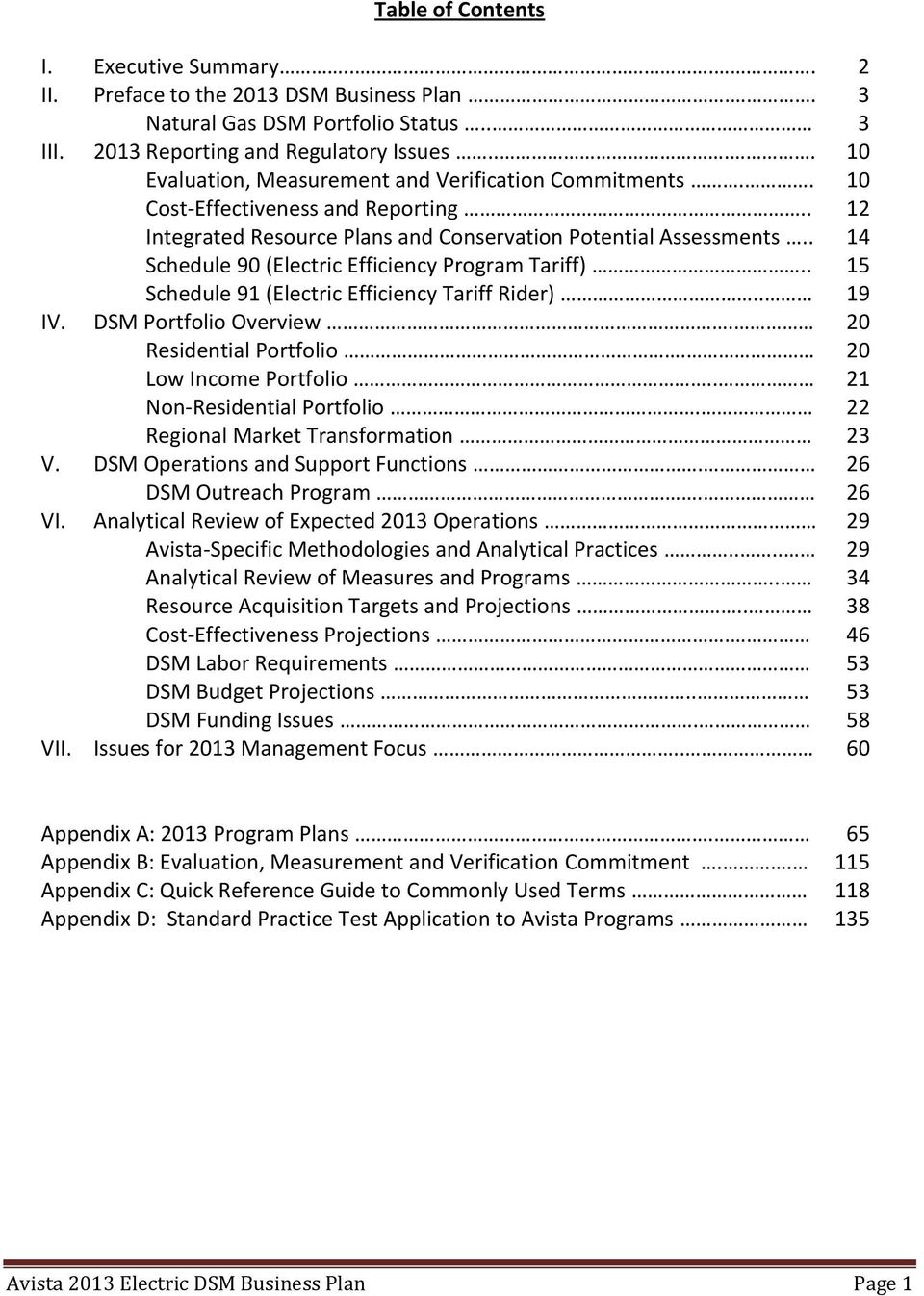
2 Table of Contents I. Executive Summary II. Preface to the 2013 DSM Business Plan.. 3 Natural Gas DSM Portfolio Status.. 3 III Reporting and Regulatory Issues Evaluation, Measurement and Verification Commitments.. 10 Cost-Effectiveness and Reporting.. 12 Integrated Resource Plans and Conservation Potential Assessments.. 14 Schedule 90 (Electric Efficiency Program Tariff).. 15 Schedule 91 (Electric Efficiency Tariff Rider).. 19 IV. DSM Portfolio Overview. 20 Residential Portfolio. 20 Low Income Portfolio.. 21 Non-Residential Portfolio. 22 Regional Market Transformation 23 V. DSM Operations and Support Functions. 26 DSM Outreach Program. 26 VI. Analytical Review of Expected 2013 Operations 29 Avista-Specific Methodologies and Analytical Practices Analytical Review of Measures and Programs.. 34 Resource Acquisition Targets and Projections.. 38 Cost-Effectiveness Projections. 46 DSM Labor Requirements 53 DSM Budget Projections.. 53 DSM Funding Issues. 58 VII. Issues for 2013 Management Focus.. 60 Appendix A: 2013 Program Plans. 65 Appendix B: Evaluation, Measurement and Verification Commitment Appendix C: Quick Reference Guide to Commonly Used Terms 118 Appendix D: Standard Practice Test Application to Avista Programs 135 Avista 2013 Electric DSM Business Plan Page 1
3 I. Executive Summary Avista Utilities 2013 Demand Side Management (DSM) Business Plan describes the Company s planning process and planned expenses as well as the projected energy savings for the implementation of its energy efficiency programs for the 2013 calendar year. This Business Plan describes how Avista s programs are structured and delivered to customers. It provides a bottom-up analysis built by measure and/or program. This Plan is intended to be responsive to RCW and WAC , the Washington Utilities and Transportation Commission s (UTC) related Order No. 01, Docket No. UE , approving Avista s Biennial Conservation Plan with conditions, and the Idaho Public Utilities Commission (IPUC) Staff DSM Memorandum of Understanding (MOU). Appended to the plan is the Company s 2013 Evaluation, Measurement & Verification Annual Plan. The term conservation will be used interchangeably with energy efficiency and demand-side management throughout this document. Avista has continually been providing energy efficiency programs, uninterrupted, since November 1, The Company s planning process builds on previous years experiences and addresses a number of challenges in regard to achieving energy acquisition targets, meeting cost-effectiveness criteria, and satisfying regulatory reporting requirements. Avista provides financial incentives to over 262 prescriptive measures as modeled in the Company s Integrated Resource Planning (IRP) process. This Business Plan shows these are packaged for ease of customer delivery into 24 programs. In turn, these programs are targeted to five customer segments: 1) Residential; 2) Low-Income; 3) Non-residential; 4) Regional (i.e., the Northwest Energy Efficiency Alliance (NEEA)); and 5) Codes and Standards. In addition, Avista may offer pilots and other delivery mechanisms to gauge market demand and program delivery effectiveness. In 2013, 75 million kwhs are projected to be acquired through the implementation of this Business Plan at a cost of $20.2 million with an estimated costeffectiveness benefit-to-cost ratio of 1.33 per the Total Resource Cost (TRC) test. The kwh savings will be evaluated pursuant to Avista s Evaluation, Measurement and Verification (EM&V) Framework and annual EM&V plans. The Company appreciates the involvement of stakeholders through its regularly scheduled Advisory Group and Technical Committee meetings. This Plan focuses on a number of other elements of DSM operations that are required to deliver upon the core mission of providing value to Avista s customers. The Company anticipates that the key challenges to be addressed in 2013 involve: Incorporating the suspension of the natural gas DSM portfolio into the DSM strategy -- As of the date of this business plan, the natural gas DSM portfolio has been suspended in Idaho and a filing to suspend the portfolio has been made in Washington. It remains Avista 2013 Electric DSM Business Plan Page 2
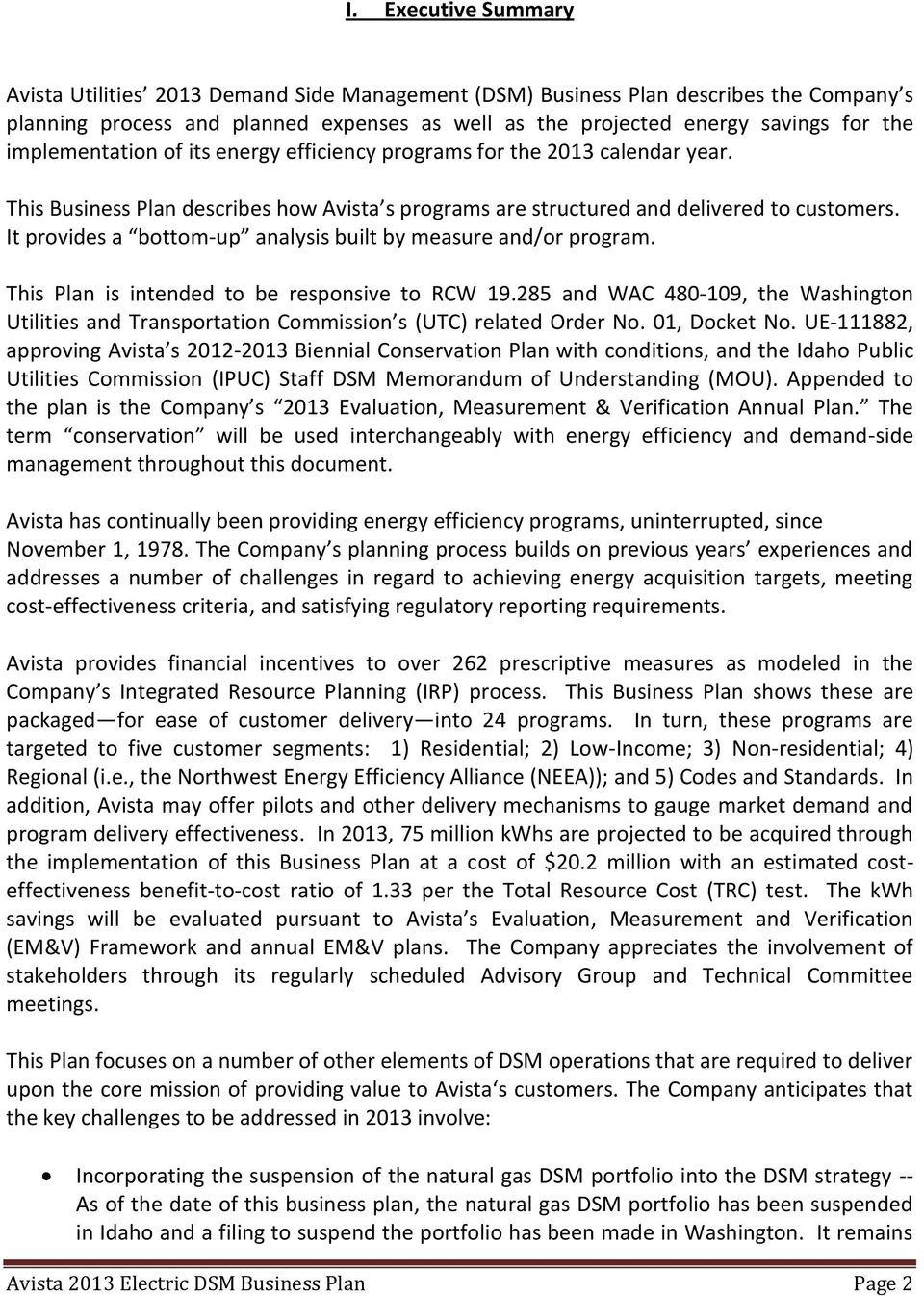
4 uncertain if the UTC will approve the request for suspension or establish new metrics under which the natural gas portfolio would be managed. As indicated in this business plan, the planning process has proceeded with the assumption that both jurisdictions approve the suspension. In the event that this is not the case in Washington, a separate business planning process based upon a new metric will be pursued. The Low-Income Portfolio -- The Company has engaged in separate discussions of the Idaho and Washington low-income portfolios. The regulatory expectations and metrics for each jurisdiction have diverged to a significant degree and merit separate treatment in identifying the future path. Within Idaho, the Company is reviewing the metrics used for measurement of the portfolio in greater detail and has committed to several modifications to the program and measurement. In regards to Avista s Washington lowincome portfolio, the Company has convened a team of internal and external parties into a Washington Low-Income Working Group with the intention to (a) reach a consensus on the objectives of the low-income portfolio and (b) establish metrics consistent with that intent. Distribution Efficiency Initiative (DEI) measurement -- Re-activating the evaluation of NEEA s DEI market transformation venture to meet Avista s need for independent thirdparty measurement of the Company s SmartCircuits and SmartGrid Demonstration projects was initiated in This work is expected to lead to a 2013 Request for Proposal (RFP) for evaluation services. Avista is working closely with NEEA to assist in the development of the RFP. Given that Avista is relying upon this measure for a high proportion of the I-937 target, it is clear that a thorough evaluation should remain one of the highest EM&V priorities for the year. Tariff revisions -- The Company initiates the annual business planning process with the understanding that there are no regulatory constraints assumed in the planning process. Based upon this business planning process, the Company has determined that the current Schedule 90 provisions do not provide the incentives necessary to fully realize cost-effective resource opportunities within the residential fuel-efficiency measure category. The Company is developing a proposal to address these issues. This business planning document is intended as a description of a continuous planning process at a particular point in time. To maintain, and enhance, the degree of meaningful external involvement within this process over the course of the following year, revisions and updates to the plans for 2013 are to be expected as part of the task of actively managing the DSM portfolio. Avista 2013 Electric DSM Business Plan Page 3

5 II. Preface to the 2013 DSM Business Plan Avista performs a comprehensive business planning process on an annual basis. This planning process begins as a blank slate and proceeds to develop a plan that meets all DSM portfolio objectives for the subsequent calendar year. The process is generally initiated in the late summer of the previous year and culminates in a final business plan document. This document is required to be filed with the UTC by November 1 st and is also submitted to the IPUC. During this planning exercise, Avista discards the constraints of existing tariffs and traditional operations and permits the program planning staff the opportunity to optimize the DSM portfolio for the expected environment and objectives of the following year. If and when these unconstrained planning efforts lead to the need for revisions to existing regulatory or operational functions the Company identifies the necessary changes and initiates action leading to modifications. Of great significance within this business planning cycle is the substantial reduction in natural gas avoided cost. This contingency was anticipated in the 2012 DSM Business Plan (filed on November 1 st, 2011) and planning for a low avoided cost scenario was initiated. A more detailed summarization of these events, analyses, consequences and actions are contained below. Related to the substantial reduction in natural gas avoided cost, the Company has identified electric to natural gas conversions (fuel-efficiency) as a promising measure with enhanced longterm cost-effectiveness. The unconstrained program planning effort for this program has led to the evaluation of proposed revisions in Schedule 90 to enhance throughput in the future years. Natural Gas Demand-Side Management Portfolio Analysis and Planning Overview The timing of the review of the natural gas DSM portfolio and the development of the 2013 DSM Business Plan has created the need to make certain assumptions regarding the eventual status of the natural gas programs. For purposes of this planning effort, Avista s filing to suspend the natural gas DSM portfolio is assumed to be accepted in both Washington and Idaho jurisdictions. The Company believed it was necessary to take action based upon the most up-to-date information regarding natural gas avoided cost in a timely and responsible manner rather than delay those decisions several months for the full portfolio business planning process. Avista 2013 Electric DSM Business Plan Page 4
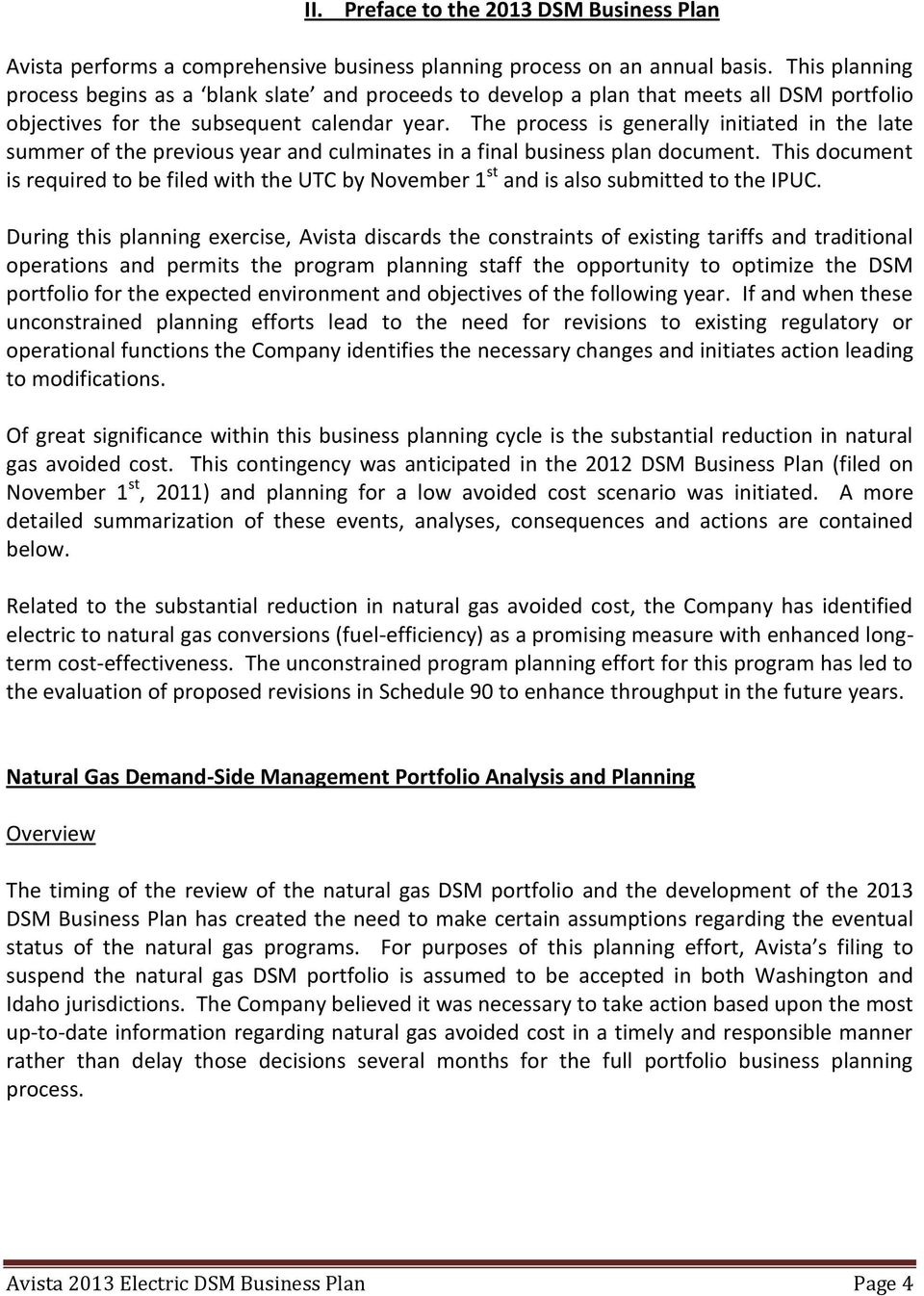
6 History Avista s 2012 DSM Business Plan (filed on November 1 st, 2011) concluded the natural gas DSM portfolio was expected to fail the Total Resource Cost (TRC) cost-effectiveness test for the upcoming year. However, the regulated deadline for that business plan in Washington didn t permit the Company sufficient time to fully optimize the performance of the portfolio. Consequently, the Company completed a revised plan ( Review of Prospects and Strategies for the 2012 Avista Regular-Income Natural Gas DSM Portfolio otherwise known as the Re- Optimization Report) based upon further optimization efforts. That plan, filed February 29, 2012, projected that a modified portfolio could be cost-effective at the then-current avoided costs. The Re-Optimization Report also performed an analysis for a low avoided cost scenario based upon the expectation that the completion of the 2012 natural gas Integrated Resource Plan (IRP) would identify an avoided cost significantly below the previous avoided cost stream. The low avoided cost scenario was defined as a 25% reduction in the previously identified avoided cost. Based upon that assumption the modified natural gas portfolio would be very marginally cost-effective under favorable assumptions regarding the realization rate and other factors. In May 2012, the preliminary avoided cost projections became available. Those avoided cost were projected to be a 50% decrease in the natural gas avoided cost. The Company prepared for an immediate evaluation and review of the natural gas efficiency portfolio given the awareness that the new avoided cost would have a significant impact on decisions regarding the portfolio status. When more definitive avoided cost streams became available in June 2012, the evaluation indicated the portfolio would not be cost-effective under even the most favorable assumptions. The Company subsequently filed to suspend the natural gas DSM portfolio indefinitely due to the cost-ineffective nature of that effort. As of the date that this business planning process was concluded that filing has been approved in Idaho and remains pending in Washington. Analytical Methodology and Findings Avista has consistently communicated that the natural gas DSM portfolio is much more challenging to offer in a cost-effective manner than the electric portfolio. Natural gas appliances are more passive in nature, the technological progress has been less rapid and the participant economics are less attractive. Under those circumstances, meeting Avista s commitment to offer only TRC cost-effective measures and programs is and always has been difficult to achieve. The evaluation of the prospective natural gas DSM portfolio included (1) a comparison of the levelized portfolio TRC cost against the levelized cost of the avoided cost stream at the portfolio weighted average measure life, (2) a calculation of the recently completed 2011 actual results of the natural gas DSM portfolio at the new avoided cost projections, and (3) program-by- Avista 2013 Electric DSM Business Plan Page 5
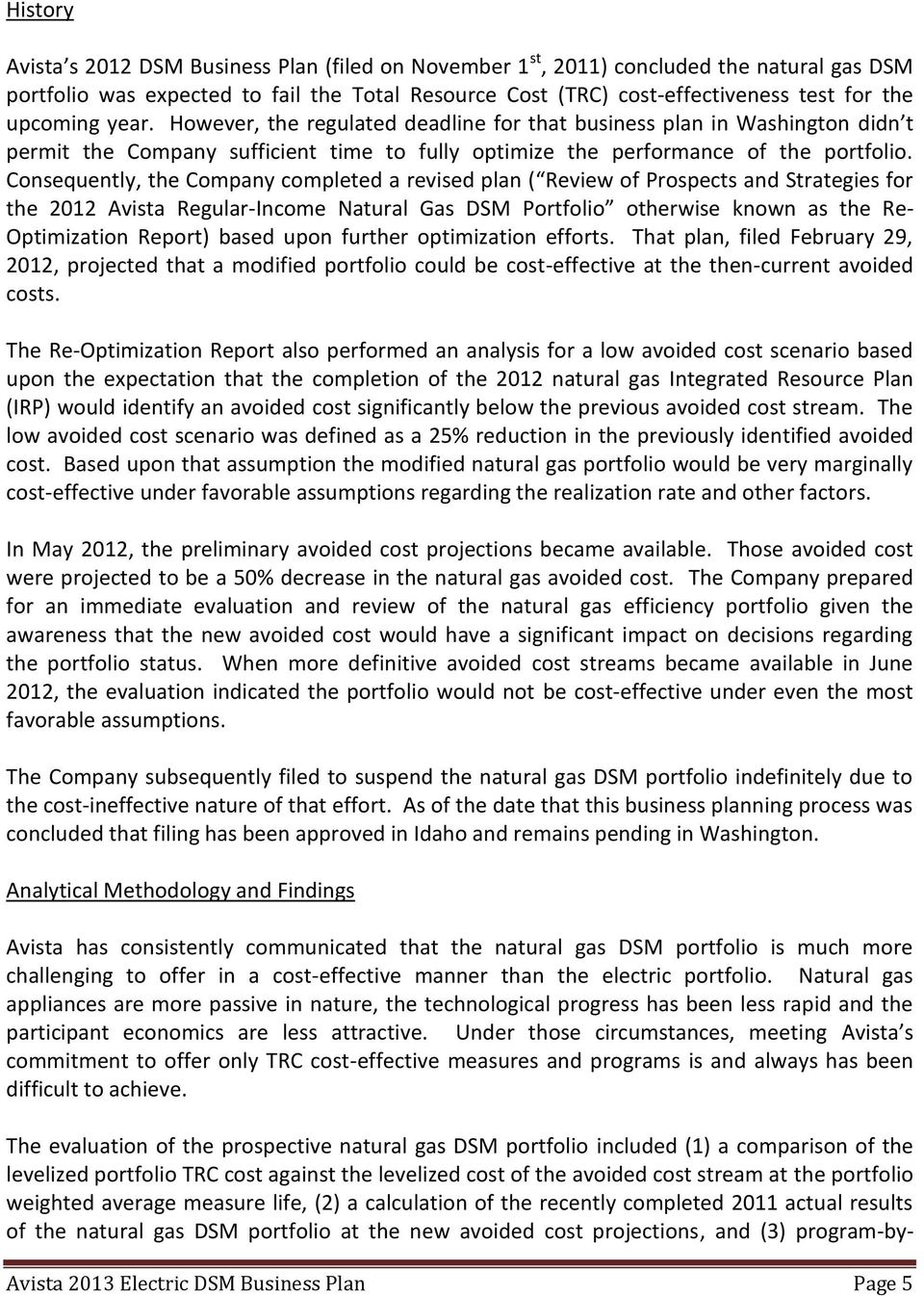
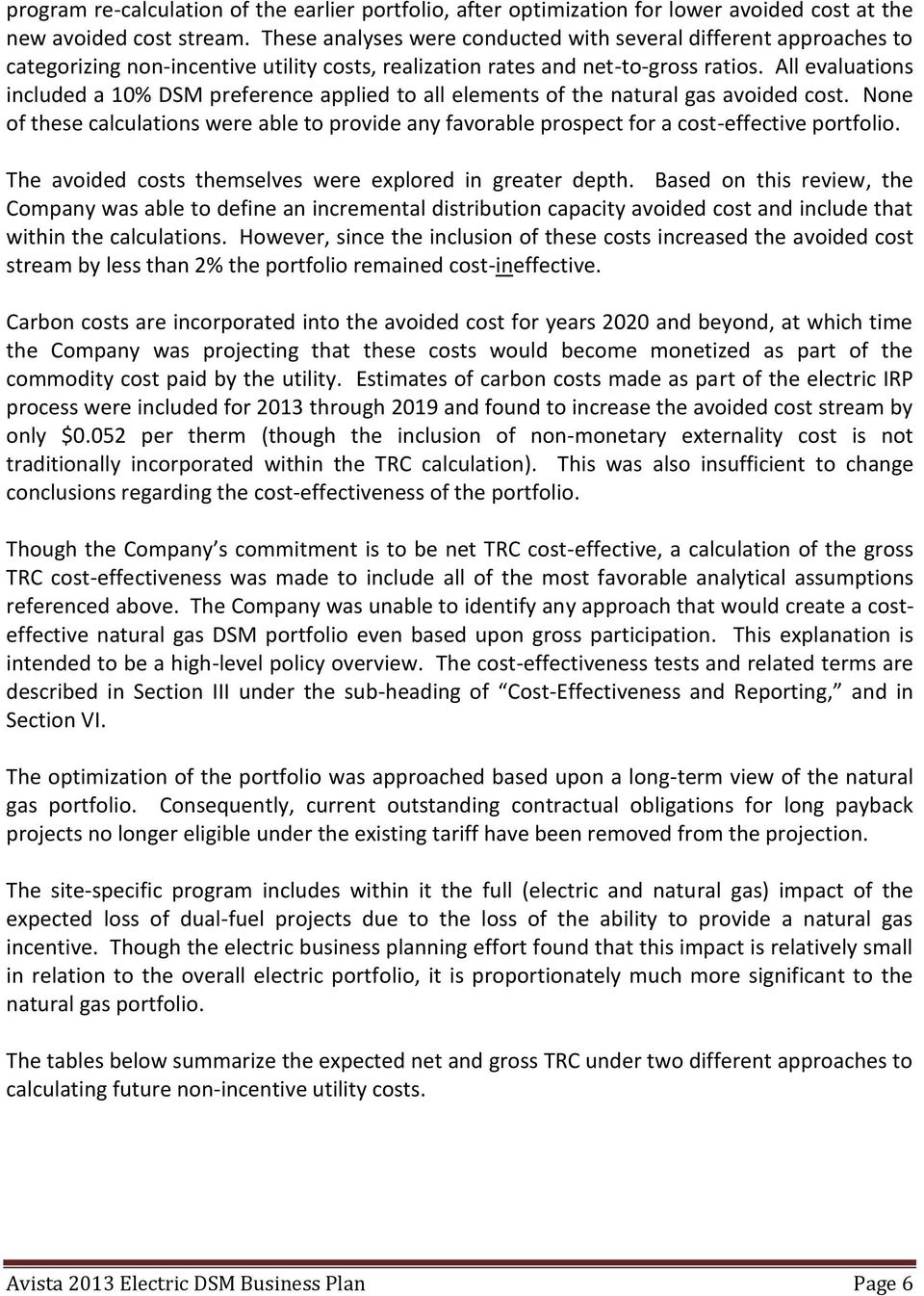
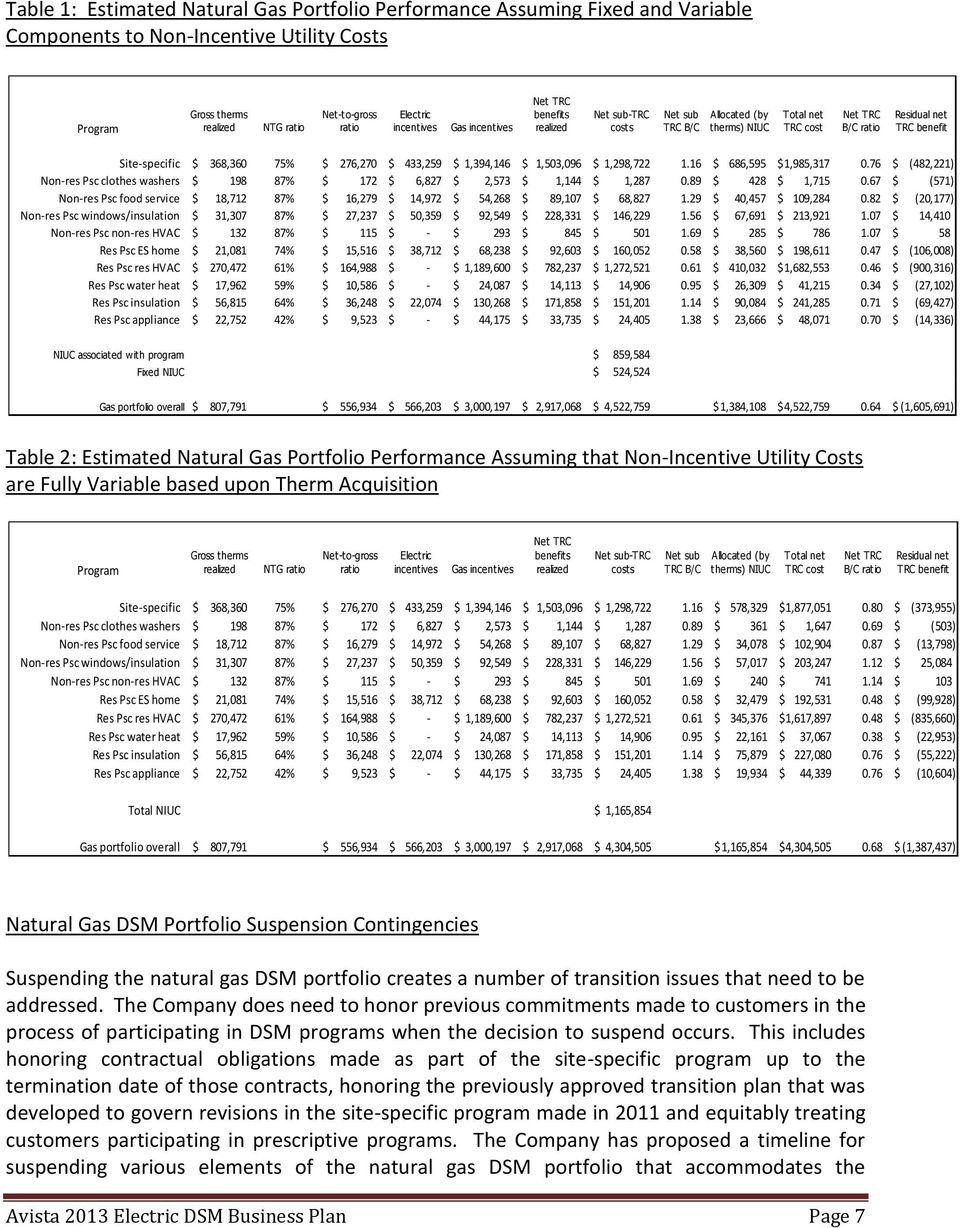
7 program re-calculation of the earlier portfolio, after optimization for lower avoided cost at the new avoided cost stream. These analyses were conducted with several different approaches to categorizing non-incentive utility costs, realization rates and net-to-gross ratios. All evaluations included a 10% DSM preference applied to all elements of the natural gas avoided cost. None of these calculations were able to provide any favorable prospect for a cost-effective portfolio. The avoided costs themselves were explored in greater depth. Based on this review, the Company was able to define an incremental distribution capacity avoided cost and include that within the calculations. However, since the inclusion of these costs increased the avoided cost stream by less than 2% the portfolio remained cost-ineffective. Carbon costs are incorporated into the avoided cost for years 2020 and beyond, at which time the Company was projecting that these costs would become monetized as part of the commodity cost paid by the utility. Estimates of carbon costs made as part of the electric IRP process were included for 2013 through 2019 and found to increase the avoided cost stream by only $0.052 per therm (though the inclusion of non-monetary externality cost is not traditionally incorporated within the TRC calculation). This was also insufficient to change conclusions regarding the cost-effectiveness of the portfolio. Though the Company s commitment is to be net TRC cost-effective, a calculation of the gross TRC cost-effectiveness was made to include all of the most favorable analytical assumptions referenced above. The Company was unable to identify any approach that would create a costeffective natural gas DSM portfolio even based upon gross participation. This explanation is intended to be a high-level policy overview. The cost-effectiveness tests and related terms are described in Section III under the sub-heading of Cost-Effectiveness and Reporting, and in Section VI. The optimization of the portfolio was approached based upon a long-term view of the natural gas portfolio. Consequently, current outstanding contractual obligations for long payback projects no longer eligible under the existing tariff have been removed from the projection. The site-specific program includes within it the full (electric and natural gas) impact of the expected loss of dual-fuel projects due to the loss of the ability to provide a natural gas incentive. Though the electric business planning effort found that this impact is relatively small in relation to the overall electric portfolio, it is proportionately much more significant to the natural gas portfolio. The tables below summarize the expected net and gross TRC under two different approaches to calculating future non-incentive utility costs. Avista 2013 Electric DSM Business Plan Page 6
8 Table 1: Estimated Natural Gas Portfolio Performance Assuming Fixed and Variable Components to Non-Incentive Utility Costs Program Gross therms realized NTG ratio Net-to-gross ratio Electric incentives Gas incentives Net TRC benefits realized Net sub-trc costs Net sub TRC B/C Allocated (by therms) NIUC Total net TRC cost Net TRC B/C ratio Residual net TRC benefit Site-specific $ 368,360 75% $ 276,270 $ 433,259 $ 1,394,146 $ 1,503,096 $ 1,298, $ 686,595 $ 1,985, $ (482,221) Non-res Psc clothes washers $ % $ 172 $ 6,827 $ 2,573 $ 1,144 $ 1, $ 428 $ 1, $ (571) Non-res Psc food service $ 18,712 87% $ 16,279 $ 14,972 $ 54,268 $ 89,107 $ 68, $ 40,457 $ 109, $ (20,177) Non-res Psc windows/insulation $ 31,307 87% $ 27,237 $ 50,359 $ 92,549 $ 228,331 $ 146, $ 67,691 $ 213, $ 14,410 Non-res Psc non-res HVAC $ % $ 115 $ - $ 293 $ 845 $ $ 285 $ $ 58 Res Psc ES home $ 21,081 74% $ 15,516 $ 38,712 $ 68,238 $ 92,603 $ 160, $ 38,560 $ 198, $ (106,008) Res Psc res HVAC $ 270,472 61% $ 164,988 $ - $ 1,189,600 $ 782,237 $ 1,272, $ 410,032 $ 1,682, $ (900,316) Res Psc water heat $ 17,962 59% $ 10,586 $ - $ 24,087 $ 14,113 $ 14, $ 26,309 $ 41, $ (27,102) Res Psc insulation $ 56,815 64% $ 36,248 $ 22,074 $ 130,268 $ 171,858 $ 151, $ 90,084 $ 241, $ (69,427) Res Psc appliance $ 22,752 42% $ 9,523 $ - $ 44,175 $ 33,735 $ 24, $ 23,666 $ 48, $ (14,336) NIUC associated with program $ 859,584 Fixed NIUC $ 524,524 Gas portfolio overall $ 807,791 $ 556,934 $ 566,203 $ 3,000,197 $ 2,917,068 $ 4,522,759 $ 1,384,108 $ 4,522, $ (1,605,691) Table 2: Estimated Natural Gas Portfolio Performance Assuming that Non-Incentive Utility Costs are Fully Variable based upon Therm Acquisition Program Gross therms realized NTG ratio Net-to-gross ratio Electric incentives Gas incentives Net TRC benefits realized Net sub-trc costs Net sub TRC B/C Allocated (by therms) NIUC Total net TRC cost Net TRC B/C ratio Residual net TRC benefit Site-specific $ 368,360 75% $ 276,270 $ 433,259 $ 1,394,146 $ 1,503,096 $ 1,298, $ 578,329 $ 1,877, $ (373,955) Non-res Psc clothes washers $ % $ 172 $ 6,827 $ 2,573 $ 1,144 $ 1, $ 361 $ 1, $ (503) Non-res Psc food service $ 18,712 87% $ 16,279 $ 14,972 $ 54,268 $ 89,107 $ 68, $ 34,078 $ 102, $ (13,798) Non-res Psc windows/insulation $ 31,307 87% $ 27,237 $ 50,359 $ 92,549 $ 228,331 $ 146, $ 57,017 $ 203, $ 25,084 Non-res Psc non-res HVAC $ % $ 115 $ - $ 293 $ 845 $ $ 240 $ $ 103 Res Psc ES home $ 21,081 74% $ 15,516 $ 38,712 $ 68,238 $ 92,603 $ 160, $ 32,479 $ 192, $ (99,928) Res Psc res HVAC $ 270,472 61% $ 164,988 $ - $ 1,189,600 $ 782,237 $ 1,272, $ 345,376 $ 1,617, $ (835,660) Res Psc water heat $ 17,962 59% $ 10,586 $ - $ 24,087 $ 14,113 $ 14, $ 22,161 $ 37, $ (22,953) Res Psc insulation $ 56,815 64% $ 36,248 $ 22,074 $ 130,268 $ 171,858 $ 151, $ 75,879 $ 227, $ (55,222) Res Psc appliance $ 22,752 42% $ 9,523 $ - $ 44,175 $ 33,735 $ 24, $ 19,934 $ 44, $ (10,604) Total NIUC $ 1,165,854 Gas portfolio overall $ 807,791 $ 556,934 $ 566,203 $ 3,000,197 $ 2,917,068 $ 4,304,505 $ 1,165,854 $ 4,304, $ (1,387,437) Natural Gas DSM Portfolio Suspension Contingencies Suspending the natural gas DSM portfolio creates a number of transition issues that need to be addressed. The Company does need to honor previous commitments made to customers in the process of participating in DSM programs when the decision to suspend occurs. This includes honoring contractual obligations made as part of the site-specific program up to the termination date of those contracts, honoring the previously approved transition plan that was developed to govern revisions in the site-specific program made in 2011 and equitably treating customers participating in prescriptive programs. The Company has proposed a timeline for suspending various elements of the natural gas DSM portfolio that accommodates the Avista 2013 Electric DSM Business Plan Page 7
9 necessary customer care elements of the process while terminating programs as expeditiously as possible under those circumstances. The Company will also be actively working with trade allies during this time to minimize the potential for miscommunications and to maintain good working relationships with the contractor infrastructure. The Company recognizes the potential exists to harm working relationships that are critical to the success of Avista s electric DSM portfolio (which often relies upon the same trade allies). Enhanced fuel conversion incentives are one means of continuing a strong natural gas trade ally relationship for the benefit of Avista s customers. Furthermore the Company can quickly and effectively field a new natural gas DSM portfolio should the economics of the portfolio change in the future. This is a complicated endeavor involving a number of different trade allies participating in the natural gas portfolio of widely varying sizes and specialties. Reconciling the Conservation Potential Assessment and the Business Plan Analysis Avista committed to performing an independent external Conservation Potential Assessment (CPA) for both its electric and natural gas IRP process as well as for use in establishing the Washington required electric resource portfolio standards (RPS or I-937) targets. EnerNoc, formerly Global Energy Partners, performed the most recent electric and natural gas CPA evaluations. To complete this task they utilized their LoadMap model, which is consistent with Northwest Power and Conservation Council (NPCC) power plan assumptions, indexed to Avista s service territory. This process included indexing state, service and rate schedule usage to their model, performing adjustments for end-use inventory knowledge specific to Avista and adjusting for known differences in housing stock and commercial floor space etc. as well as appropriate climate adjustments. The customization of the model did not include specifying measure or programs in a manner consistent with how Avista offers those programs through Avista s portfolio. Due to timing issues, a one-to-one comparison (or crosswalk ) between the CPA and Avista s programs as delivered or to the Avista Technical Reference Manual (TRM) was not readily possible. For example, in the case of the natural gas DSM portfolio the CPA has identified many very specific measure applications as being cost-effective in circumstances where Avista is unable to offer that measure application independent of other non-cost-effective measure applications. Therefore the cost-effective resource acquisition potential identified in the CPA is often unable to be realistically achieved through utility programs. Had the cost-effectiveness of the natural gas portfolio not been so marginal then this difference may not have been significant; but under the current circumstances the difference was much more notable. Given that the Company s operational analysis is much more highly correlated to how our programs will be delivered and evaluated for portfolio cost-effectiveness than the CPA methodology, and since Avista has a long history of the operational analysis closely matching actual observed results, the Company has opted to rely primarily upon this analysis in its review of the future prospects of the natural gas portfolio. Avista 2013 Electric DSM Business Plan Page 8

10 Avista s Core Commitment to Pursuing Cost-Effective Resources Evaluation of the natural gas DSM portfolio to date indicates a cost-effective portfolio cannot be fielded under current economics. However, the Company will monitor and evaluate opportunities to reinstate the portfolio based on changes in natural gas costs, efficiency technologies or implementation opportunities. Evaluations need not wait to be incorporated into biennial IRP processes or annual DSM business planning processes; they will be performed on a real-time basis as the environment changes or as opportunities occur. The weighted average cost of gas (WACOG) may be used as a proxy for the avoided cost, under some circumstances and as necessary, between IRP cycles. The Company does have a history of successfully returning a suspended natural gas DSM portfolio to the field. The 1997 suspension of the natural gas DSM portfolio was made with the same commitments noted above, and the portfolio was returned to the field in 2001 without significant loss to Avista s capability to acquire cost-effective resources. The ongoing maintenance of the much larger electric DSM portfolio, for the most part working with many of the same customers and trade allies, provides Avista with the ability to maintain expertise, infrastructure and customer contact. The care currently being taken in bringing the portfolio to a well-planned suspension will preserve the option to bring that portfolio back, if justified, in the future. Similar to the previous suspension period for the natural gas DSM portfolio, the Company will continue to be responsive to customers requesting information regarding natural gas efficiency when it imposes little or no incremental cost to the ongoing electric DSM portfolio. Avista 2013 Electric DSM Business Plan Page 9
11 III Reporting and Regulatory Issues Within this section the Company s plans to meet the regulatory reporting requirements associated with EM&V, cost-effectiveness, and related reporting of operations. The Washington jurisdiction is the source of most of these regulatory requirements. The jurisdictional allocation of these costs is based upon the source of the requirements, as well as, the relative benefit. Evaluation, Measurement and Verification Commitments Within its DSM portfolio, Avista incorporates Evaluation, Measurement and Verification (EM&V) activities as a key process to validate and report energy savings related to its measures and programs. EM&V protocols serve to represent the comprehensive analyses and assessments necessary to supply salient information to stakeholders that adequately establishes the energy efficiency acquisition attributable to Avista s DSM Programs. EM&V includes Impact, Process, and Market analyses, and taken as a whole are analogous with other industry standard terms such as Portfolio Evaluation or Program Evaluation. A primary responsibility of Avista s EM&V resources within its Policy, Planning & Analysis team is to support the ongoing activities of the independent third-party EM&V consultants and evaluators performing the various analyses required to substantiate the conservation acquisition. The 2013 EM&V budget provides for independent, third-party EM&V services that provide an evaluation of key portions of the 2012 program year portfolio. EM&V procedures are intended to verify the level at which claimed energy savings have occurred, evaluate the existing internal processes, and suggest improvements to the program and ongoing EM&V processes. These findings are reported in the Demand Side Management Annual Report on Conservation Acquisition and include analysis of both program and process impacts for the specific programs reviewed. In addition to the external evaluations, Avista EM&V resources support internal evaluations of specific measures and programs, including pilots and other supplemental program activities. The results of these activities are used to inform program management decisions, evaluate program effectiveness and establish program metrics. To support planning and reporting requirements, several EM&V documents are maintained and published. This includes the Avista EM&V Framework, an annual EM&V Plan, and EM&V chapters and portions within other DSM and company publications. Program-specific EM&V plans are created as required. These documents are reviewed and updated as necessary, serving to improve the processes and protocols for energy efficiency measurement, evaluation and verification. In addition, the ongoing update and maintenance of the Technical Reference Avista 2013 Electric DSM Business Plan Page 10

12 Manual (TRM) will be managed as a principal planning and reporting mechanism relative to individual prescriptive measures and their respective unit energy savings (UES) values. As a function of new measure development, an EM&V plan will be developed for each new program and will periodically be updated as informed by Avista evaluation or other relevant findings. Additional EM&V efforts will be applied to evaluating emerging technologies and applications in consideration of potential inclusion in the Company s energy efficiency portfolio. Avista may spend up to 10 percent of its conservation budget on programs whose savings impact have not yet been measured, if the overall portfolio of conservation passes the Total Resource Cost test as modified by the Northwest Power and Conservation Council (NPCC). These programs may include educational, behavior change, and other types of investigatory projects. Specific activities can include product and application document reviews, development of formal evaluation plans, field studies, data collection, statistical analysis, and solicitation of user feedback. Avista and its customers benefit from regional activities and resources in the energy efficiency and conservation domain. To engage with and contribute to the regional efforts, Avista EM&V staff has voting membership on the Regional Technical Forum (RTF) that serves as an advisory committee to the NPCC. The RTF is a primary source of information relating to the standardization of energy savings and measurement processes for electric applications in the Pacific Northwest. This knowledge base provides energy efficiency data, metrics, and references that are suitable for inclusion in Avista s TRM relating to acquisition planning and reporting. Additional regional activities include engagement with other northwest utilities and the Northwest Energy Efficiency Alliance (NEEA) in various pilot projects or subcommittee evaluations. A portion of the energy efficiency savings acquired within the region through NEEA s efforts are attributed to Avista s portfolio. Plans for 2013 include continued participation in NEEA s Regional Building Stock Assessment with coordinated data collection activities. Avista s commitment to the critical role of EM&V is supported by the Company s continued focus on the development of best practices for its processes and reporting. Application of the principles of the International Performance Measurement & Verification Protocol (IPMVP) serves as the guidelines for measurement and verification plans applied to Avista programs. The verification of a statistically significant number of projects using IPMVP techniques is often extrapolated to verify and perform impact analysis on complete portfolios within reasonable standards of rigor and a reasonable degree of conservatism. This will serve to insure that Avista will manage the DSM portfolio in a manner consistent with utility and public interests. To best serve its customers and other stakeholders, Avista will leverage credible sources of quantifiable UES values for energy efficiency measures in consideration of the best and most applicable information available. This encompasses consideration of all data and informational sources that are deemed pertinent to Avista s programs as delivered including the RTF, NEEA, Avista 2013 Electric DSM Business Plan Page 11
13 consultant libraries, ENERGY STAR, Sixth Power Plan, California s Database for Energy Efficient Resources (DEER), Avista-specific impact analyses and other public sources. The collection of UES values included in the TRM and the results from custom project evaluations will be subject to rigorous impact evaluations performed by a third-party evaluator and available to the Avista DSM Advisory Group for review. Within Avista s DSM Advisory Group, a Technical Committee subgroup serves primarily within the scope of EM&V applications and currently assists Avista with the development of EM&V protocols and related conservation program analysis considerations. These activities include providing recommendations and guidance on functional aspects of program implementation along with fundamental evaluation policies and methods. Principal interaction with Avista includes meetings, webinars and direct interchanges. In addition, Avista provides opportunities for the Technical Committee to review the evaluation, measurement and verification protocols and results. Cost-Effectiveness and Reporting Avista performs cost-effectiveness calculations on a forward looking basis (as part of the Business Plan) and a retrospective basis (as part of the DSM Annual Report). The Annual Report includes a calculation of the four basic cost-effectiveness tests on actual operational results. The report on actual 2013 DSM operations will be completed by June 1 st, 2014 and will incorporate the results of the independent third-party evaluation. The following section provides a summary of the four cost-effectiveness tests utilized by Avista and how they are applied. Total Resource Cost (TRC) test The TRC test is a measure of the benefits and costs accruing to the total ratepayer population. This is not a true Societal Test in that externalities are not quantified, however, importations of funding to the customer base (e.g. federal or state tax credits) are considered as offsets to the customer incremental cost. Avista has provided an additional calculation of the TRC Test without offsets to the incremental cost upon request. Avista s avoided cost does incorporate monetized carbon costs that are expected to lead to a payable utility cost in the future. Avista provides the TRC calculation on both a gross (total participation) and net basis (including only customer participation inspired by the program) in recognition of varying regulatory requirements, Advisory Group members interest as well as for comparison with other utilities. The cost-benefit analysis of the TRC Test provides a comparison of the present value of energy and non-energy benefits versus the customer incremental cost and utility non- Avista 2013 Electric DSM Business Plan Page 12
14 incentive program cost. Incentive costs are considered to be a transfer within the ratepayer population and are neither a cost nor benefit. Program Administrator Cost Test (PACT), also known as the Utility Cost Test (UCT) This is a measure of whether the utility cost of serving all customers increases or decreases as a result of the program. The PACT compares the reduction in the avoided cost of providing energy to the customer with the total cost (incentive and non-incentive) of operating the DSM program. The PACT generally yields a higher residual benefit than TRC since the impact of the customer incremental cost and non-energy impacts (excluded from the PACT) is greater than the utility incentive (which is excluded from the TRC). Participant Test The Participant Test provides cost-effectiveness from the perspective of the participating customer. This includes the retail value of the energy savings and non-energy benefits from the project versus the customer project costs net of incentive received. This is a useful measure of potential program adoption levels in that it provides insight into the traction that a measure or program may have with prospective participants. The Participant Test is thus formally and informally incorporated into the business planning process, and in particular in the estimates of future programmatic throughput. Rate Impact Measure (RIM) or Non-Participant Test The RIM Test is an indication of the programs impact upon retail rates. This test provides a comparison between lost retail revenue and sunk program cost versus the incremental reduction in utility avoided energy cost. If retail rates exceed the avoided cost of energy (inclusive of demand and other impacts), any DSM program is mathematically guaranteed to fail this test. Programs that target underpriced energy products (e.g. system load coincident energy usage) may conceivably pass the RIM Test. The RIM Test does not consider the impact of upon the customer billing determinants (energy usage), and is thus only applicable to program non-participants. For business planning purposes, the primary focus is upon the TRC Test and variations upon that calculation to include net-to-gross and tax credit treatment as well as the sub-trc Test methodology described elsewhere within this document. This focus is largely due to the realization that, in nearly all cases, the TRC Test will be a more difficult test to pass relative to the PACT given Avista s limitation of incentives to 50% of customer incremental cost absent exemptions recognized within the Company s Schedule 90 tariff. It is Avista s general costeffectiveness objective to maximize the net TRC benefits of the DSM portfolio, and managing towards this objective will generally lead to the appropriate management for the remaining three standard practice tests, and in particular the PACT. Avista 2013 Electric DSM Business Plan Page 13
15 Specifics of the cost and benefit components accruing to each one of these tests and the methodologies employed by Avista relating to the quantification of these values are described in Appendix D. Integrated Resource Plan (IRP) and the Conservation Potential Assessment (CPA) Avista is currently in the process of preparing its 2013 electric IRP to be filed August This is a 20-year projection of resources, inclusive of conservation and demand response resources, in order to project potential shortfalls and the need to build incremental plant. Per Avista s Washington I-937 ten conditions in Docket No. UE , the Company is required to complete an independent electric CPA every two years. EnerNOC has been retained to update this study for Avista s Washington and Idaho electric service territory. This study will be used to inform the Company s 2013 electric IRP. On November 7, 2012, the proposed methodology for evaluating energy efficiency and demand response (DR) will be presented to the Company s IRP Technical Advisory Committee (TAC). EnerNOC will present methodology specific to energy efficiency while Avista s demandresponse program manager will present proposed methodology specific to demand response. The methodology proposed to be utilized by EnerNOC will make use of the existing LoadMAP model and customer segmentation scheme as develop for Avista for its previous CPA. For this particular update, EnerNOC will update the base-year market profiles by incorporating information from the most recent Residential Energy Consumption Survey (RECS) survey as well as the Residential Building Stock Assessment (RBSA) and other survey efforts. EnerNOC will also use the U. S. Energy Information Administration s Commercial Buildings Energy Consumption Survey (CBECS) and Manufacturing Energy Consumption Survey (MECS). These aforementioned surveys will inform the current saturation of energy efficiency measures and trends in electricity consumption. Next, EnerNOC will update measure data using Avista s existing Technical Reference Manual, the most recent Regional Technical Forum measure and UES list as well as the Northwest Power and Conservation Council s Sixth Power Plan (Plan). EnerNOC will demonstrate their approach by using some of the Council s measures to illustrate to Stakeholders the continuity between the TRM and CPA. This step will most likely occur via a Stakeholder webinar. At this point, another Total Resource Cost cost-effectiveness screening will be conducted using Avista s most recent avoided costs. This screening will occur at the measure level across customer segments in order to ensure alignment between the TRM measure-level data consistent with program delivery and the CPA analysis at the segment level. In addition to incorporating Avista s most recent avoided costs, EnerNOC will update key assumptions such as retail electricity prices and customer growth. Avista 2013 Electric DSM Business Plan Page 14

16 Finally, EnerNOC s study will use the Council s ramp rates as a starting point for this particular study but will adjust them to reflect Avista s program history as well as estimates of the remaining market potential for the energy efficiency measures. Again, EnerNOC will provide an illustration to Stakeholders of how the preliminary ramp rates compare with the Council s ramp rates. Ramp rates will be finalized based on feedback from Stakeholders with particular attention to the Technical Committee. The CPA and DR modeling results, complete with Technical, Economic and Achievable Potential by state, is scheduled to be presented at the March 20, 2013 TAC meeting. Energy efficiency will be modeled by EnerNOC using Avista s avoided costs while DR will be modeled within PRISM (Avista s Power Supply Model). The final IRP document will be filed in August 2013 with the accompanying CPA study as discussed above. The IRP s energy efficiency section will discuss historical impact from DSM, the methodology for CPA and demand response modeling, potential programs and annual targets for the 2014 and 2015 (until the next IRP). Schedule 90 Electric Efficiency Program Tariff The authority for Avista to operate electric DSM programs is based upon Schedule 90 in both Washington and Idaho. Schedule 90 has been designed to allow the Company sufficient flexibility to be responsive to market opportunities, modify prescriptive programs and to respond to individual custom projects without the need for frequent regulatory approval. As a consequence of this flexibility the need for tariff modification is infrequent. Nevertheless each year the business planning process begins with a blank slate presuming no regulatory constraints. If the Avista DSM Implementation staff develops an optimal approach to program design that is outside of compliance with the existing Schedule 90 provisions, the Company actively considers the need for a revision to the tariff. The existing formulaic Schedule 90 incentive provisions are in the form of a series of tiered incentives for different categories of electric DSM measure. The three categories defined within the current tariff are: 1. Electric efficiency for non-lighting measures 2. Electric efficiency for lighting measures 3. Fuel efficiency (electric to natural gas conversions) Lighting and non-lighting measures are separated due to significant differences in measure life. The formulaic incentive tiers apply to all measures with a life of ten years or greater, but lighting measure life is typically only slightly longer than the ten year minimum, while most non-lighting measures have a significantly longer life. The differences in the present value of the energy savings (and therefore project cost-effectiveness) associated with these two different categories is great enough to warrant a distinction. Avista 2013 Electric DSM Business Plan Page 15
17 Fuel efficiency projects are incented based upon the entire reduction of electric load, subject to a minimum relative BTU efficiency between the electric and natural gas end-use. Since the incentive is based upon the usage of the entire end-use and not merely the increase in efficiency, and since these projects have strong participant economics, a different and smaller incentive was considered to be sufficient in the past. The existing tariff defines incentives, based upon the cents per first-year kwh, for each of these three categories of electric DSM. The incentive amount for each category is dependent upon the customer energy simple payback of the project. The incentives are defined based on a cents per first-year kwh basis and increase as the energy simple payback increases up to a point where projects become generally cost-ineffective. This approach targets Avista s incentive dollars for projects where they are most likely to make a difference in the customer s decision to pursue cost-effective energy efficiency. This has been an effective approach to managing the net-to-gross ratio of the Company s portfolio in the past. Incentives drop to zero at the energy simple payback where the project is unlikely to be TRC cost-effective (a 13 year energy simple payback for non-lighting projects and eight years for lighting projects). Very short payback projects (under 12 months) are encouraged through technical support and incorporated into the Avista DSM portfolio, but incentives are considered generally unnecessary to move these projects forward. The figure below graphically illustrates Avista s current incentive tiers for each of the three categories of electric DSM based upon customer energy simple payback. Avista 2013 Electric DSM Business Plan Page 16

18 Figure 1: Summary of Avista s Schedule 90 Incentive Tier Formula $0.25 C e n t s / 1 s t y r $0.20 $0.15 $0.10 All electric efficiency Non-lighting electric efficiency Lighting electric efficiency Fuel-efficiency k W h $0.05 $ Non-lighting electric efficiency and fuel efficiency Months of Simple Payback Incentives are also capped at 50% of the customer incremental cost to maintain a significant customer investment in the project. The Schedule 90 incentive formula is applied in a rigid manner to non-residential site-specific (custom) projects. The Company has developed a model and accompanying written policy to improve the efficiency and consistency of these calculations (the Dual-Fuel Incentive Calculator, or DFIC). The Company also pursues many efficiency measures based upon a prescriptive approach. A prescriptive approach provides the same incentive for all measures eligible within a program. Prescriptive programs also do not require the customer to contract with Avista prior to purchasing the measure to enhance their marketability. The prescriptive approach represents a compromise in the accuracy of the incentive calculation and is only applied when the increased marketability and administrative efficiency offset the loss of the accuracy of the individual incentive calculation. Therefore prescriptive programs are typically only applied to relatively inexpensive and homogenous measures. The Schedule 90 incentive formula is applied to the typical application of such a measure, with adjustment for program specific considerations permitted. Incentives are capped at 50% of the typical customer incremental cost for that measure and no customer is granted an incentive of greater than 100% of their individual cost. Avista 2013 Electric DSM Business Plan Page 17

19 Proposed revisions to Schedule 90 One of the key issues discussed within the development of the 2013 Business Plan was the uneconomic penetration of heat pumps in the natural gas service territory. The Company s recent ( ) EM&V process indicated an increase in heat pump installations in residential applications where natural gas was available and the installation of heat pumps backed up by natural gas furnaces. Typically the application of a heat pump under these circumstances is both TRC and participant cost-ineffective. Much of this increase in penetration may be explained by the unintended spill-over of regional (NEEA) market transformation efforts into the natural gas service territory and by 2009 and 2010 federal tax credits for the installation of heat pumps. Coupled with the increase of heat pump penetration in previously uneconomic markets is the recent substantial reduction in natural gas avoided cost. This event makes the applications of heat pumps in the natural gas service territory even less cost-effective, but at the same time it has rendered Avista s natural gas DSM programs cost-ineffective and led to their suspension (in Idaho) and proposed suspension (in Washington). Lacking any natural gas incentives it is likely that trade allies will recommend the installation of heat pumps to a greater degree, especially since it is more lucrative to the trade ally than a natural gas furnace. Water heating requirements generally follow very closely to the fuel chosen for space heat. If heat pumps are selected for space heat it is common for the water heating to also be electrically fueled. Program managers concluded that in the absence of a strong effort to offset these trends we may well see an unintended and unfavorable market transformation towards heat pumps and electric water heating within the natural gas service territory. A review of the options to address this issue included target marketing using recently developed GIS and other information, a focused outreach campaign and/or increased customer incentives. The program plan developed for the residential fuel-efficiency program (contained in Appendix A) relies upon all three of these approaches, recognizing that the proposed increase in incentives is outside of the current tariff and would require a revision to Schedule 90. The proposal developed is to eliminate fuel-efficiency as a separate category, thus incorporating it into the non-lighting electric efficiency category for purposes of the incentive calculation. A change in the cap is also proposed on incentives from 50% of customer incremental cost to a 75% cap based upon typical installations (and at 100% for individual applications, per the Company s existing policy for prescriptive programs). Based upon these conclusions and the program plan for the residential fuel-efficiency measure, the Company expects to file revisions to Schedule 90 with sufficient time to allow for a launch of the program in the spring of 2013 (before or shortly after the ground is no longer frozen). The filing is expected to be made at roughly the same time in both the Idaho and Washington jurisdictions in hopes of obtaining the same effective date in both jurisdictions. Avista 2013 Electric DSM Business Plan Page 18
20 Schedule 91 Electric Efficiency Tariff Rider Although Schedule 90 governs the operations of the electric DSM programs, it does not provide the funding for those programs. The electric DSM portfolio is funded through a non-bypassable system benefits surcharge levied upon all retail electric use and incorporated into the Company s Schedule 91 tariff. The surcharge is expressed as a separate energy charge for each retail electric rate. The amount of the surcharge is initially designed to be an equal percentage of the retail rate, with recognition to the fact that changes to these retail rates may cause these percentages to drift apart over time. The quantity of revenues and expenses naturally never precisely match. The difference between the revenues and expenses lead to a running balance (termed the DSM tariff rider balance). The balance for Idaho and Washington electric efficiency programs are distinctly separate. The Company has and continues to pursue cost-effective efficiency measures without regard to the DSM tariff rider balance with the reasonable expectation that future tariff rider levels will be adjusted to allow for the timely recovery of prudent DSM expenditures. Adjustments to the tariff rider occur periodically; annually for Washington, per regulatory requirement, and as necessary in Idaho. Each adjustment is based upon a calculation to provide for adequate revenues to fund cost-effective DSM programs and to eliminate any tariff rider balance over a specified period (usually one year). These calculations are based upon the expected balance, expected revenue generated by the surcharge, and the expected DSM expenditures over that time. The current Schedule 91 surcharge is approximately 2.03% for Washington and 1.65% for Idaho. The Washington tariff rider was recently revised to put the Company on the path towards a zero tariff rider balance in June of As of the end of September, 2012 the electric tariff rider balance is $1,740,000 (customer owes shareholder) for Washington and $980,000 (customer owes shareholder) for Idaho. These balances are both less than two average months of estimated 2012 revenue. Avista 2013 Electric DSM Business Plan Page 19

21 IV. DSM Portfolio Overview Residential Portfolio Overview The Company s residential portfolio is composed of several approaches to engage and encourage customers to consider energy efficiency improvements in their home. Prescriptive rebate programs are the main component to the portfolio, but are complemented by a variety of other activities and programs. These include: upstream buy-down of low-cost lighting and water saving measures, select distribution of low-cost lighting and weatherization materials, appliance recycling program, low-interest loan programs, direct-install programs and a multifaceted, multichannel outreach and customer engagement effort. Prescriptive rebate programs encourage customers with cash incentives to complete the installation of qualifying energy efficiency measures. They must complete installation and apply for rebate, submitting proper proof of purchase, installation and/or other documentation to Avista, typically within 90 days from project completion. The customer can submit this form in hard copy or on-line through Residential prescriptive programs typically cover single family homes up to a 4-plex. For multifamily situations (5-plex or larger), owners/developers may choose to treat the entire complex with an efficiency improvement. In these unique cases, the projects are treated as a commercial project and are evaluated site-specifically. Avista offers other programs that contribute to the residential portfolio and are delivered through third-party contractors. These include: refrigerator and freezer recycling and a regional manufacturer buy-downs for small devices such as compact fluorescent lamps. The measure-by-measure sub-total resource cost (TRC) analysis provides guidance regarding available measures for TRCs will be evaluated as external and internal impact analysis, updated TRM inputs and other factors affect estimated costs and benefits. The results of this analysis will include whether or not the measure continues, if an adjustment in amount of rebate is warranted, or if the measure should be discontinued. If the end result is for the measure to end, there is a timing issue in order to accommodate customer and trade-ally notification as well as revision of tariff changes if applicable. Typically to ensure that affected customers in the pipeline have an option to complete contemplated measures while minimizing too many new customers, a 90-day notice is provided for program changes and cancellations. Residential programs will continue to be subjected to EM&V in 2013 and will be included in impact analysis as well as ongoing process tracking and process evaluations. Residential programs have a strong presence and coordination with regional efforts, such as those offered by the Northwest Energy Efficiency Alliance (NEEA). There is a separate section in the Business Plan for NEEA but programmatically speaking there are regional efforts underway for Energy Star Homes, Consumer Electronics, Ductless Heat Pumps, and standard Avista 2013 Electric DSM Business Plan Page 20
22 improvements for new heat pump water heating technologies. Avista has offered local rebates in support of some of NEEA efforts and cost-effective opportunities will continue to be pursued and evaluated for The primary approach for customer engagement and awareness for residential customers has been through the EveryLittleBit campaign. While EveryLittleBit builds awareness to both residential and non-residential segments, there is a robust effort and call to action that encourages customers to take advantage of energy saving programs from Avista. Outreach efforts have included broad media, online, print and participation at several events. Efforts to provide program information to trade allies will continue and may take the form of vendor meetings, webinars, electronic and print communication. EveryLittleBit is covered in more detail in its own business plan section. The residential market is expected to acquire 15% of electric savings through Avista s local programs during Low-Income Portfolio Overview Avista contracts with local Community Action Partnership agencies (CAP) to deliver the Company s residential, low-income portfolio. This implementation method is predominately a site-specific approach that includes a combination of: client screening for income determination and eligibility, home visit with conservation education information, home audit for efficiency improvement identification, and if applicable, the installation of the energy efficiency measure opportunities. The agencies primarily identify potential program participants through referrals from the energy assistance programs. Participants may also be identified through other income qualified services that are available through the agency, through agency or Avista outreach activities, Avista CAREs reps, or other community partners. The program delivery approach allows the agency to leverage existing infrastructure in place for income qualification, customer intake and other screening protocol necessary to provide various agency services that include but are not limited to: state and/or federal weatherization assistance programs, energy assistance, home repairs, etc... The efficiency measures offered in the low-income portfolio are similar to those offered under the traditional residential prescriptive programs due to cost-effectiveness guidelines. Additional measures, like infiltration improvements have not been included in the residential programs but are well-suited to this holistic, audited evaluation of a home. A list of approved measures with a high predictability of adequate cost-effectiveness is provided to the CAP agencies; some of which are also found on their state/federal measure priority list. The agencies may also submit other measures to Avista for consideration if costeffectiveness is in question. This pre- approval process is supported by tracking cost- Avista 2013 Electric DSM Business Plan Page 21
23 effectiveness in a near real-time basis. The historical mix of measures available to CAP agencies remains basically unchanged. In the summer of 2012, Avista filed to suspend natural gas programs in Washington and Idaho and notified CAP agencies that if approved, natural gas measures would not be eligible in The filing was approved in Idaho so natural gas measures will not be eligible in Idaho. The issue has not been resolved in Washington. At the time of this business plan writing it is unclear whether natural gas measures will be allowed for all or part of The agency in Idaho is working on strategies to focus on electrically heated homes. Agencies in Washington are pursuing similar plans but may be also be able to retain natural gas depending on state workshops and commission guidance. In Idaho, and possibly in Washington, too, this will result in an edit to the list of approved measures that the agency can install and use to prioritize as well as to the eligible measures that may be proposed for pre-approval before installation. The Avista program allows the CAP agencies to complete the installation of the efficiency measures at no cost to the qualified customer. Administrative fees are paid to the CAP agencies for delivery of this program. Health and human safety measures that are deemed necessary to ensure the habitability of the home in order for residents to benefit from energy saving investments are also allowed as part of this program. The comprehensive and broad reaching EveryLittleBit energy efficiency awareness campaign provides benefits to all residential customers including low income. While the messaging drives participation in regular programs, it also promotes low-cost and no-cost tips for all customers. Low income customers are also specifically encouraged to attend special events such as Avista hosted Energy Fairs. These fairs are led by Avista s Consumer Affairs department in conjunction with DSM to build awareness of low-cost/no-cost weatherization opportunities along with other local community programs and services that may assist this population during the winter months. The low-income portfolio is expected to acquire 3% of electric savings achieved as part of Avista s local programs in Non-Residential Portfolio The tariffs authorizing Avista s DSM programs for non-residential customers allow qualifying energy efficiency projects with a simple payback of greater than one year and less than thirteen years for non lighting technologies and eight years for lighting measures. Within the non-residential portfolio, programs are offered through a combination of sitespecific and prescriptive paths. Site-specific is the custom project approach and offers the potential for a variety of cost-effective and potentially unique projects to be evaluated. Sitespecific measures require contact from the customer prior to the start of the project. Typically this entails the customer or their contractor providing details regarding scope of work to the Avista 2013 Electric DSM Business Plan Page 22
24 Account Executive team. Avista engineers evaluate the project. The analysis will identify the estimated savings opportunity, measure cost and the estimated incentive payout. If a project qualifies and the customer decides to proceed, an energy efficiency agreement (contract) is issued. Incentives are paid upon installation and verification of the energy efficiency measure. Prescriptive programs are geared towards measures with relatively common and uniform customers, applications and energy savings. Avista has sought to use prescriptive programs to both market and communicate a simplified process for customers and trade allies to increase throughput, as well as, reduce implementation and evaluation expense. Though the general intent is to use prescriptive programs for measures with significant throughput, the cost of fielding and implementing a prescriptive program is very minimal relative to serving the same customer demand through the site-specific program. The prescriptive programs that are providing little throughput and/or prove to have greater savings variance are evaluated annually to decide if they should be continued to be offered prescriptively or would be more appropriately handled on a site-specific basis. A total of 81% of electric local (excluding NEEA) portfolio acquisition are expected to come from the non-residential segment. Regional Market Transformation Avista s local portfolio consists of programs and supporting infrastructure designed to enhance and accelerate the penetration of energy efficiency measures through a combination of financial incentives, technical assistance, program outreach and education. It is generally not feasible for Avista, or any individual utility, to independently have a meaningful impact upon regional or national markets. Attempts to do so usually fail as a result of the lack of economies of scale and the leakage of benefits to other utility service territories. Consequently utilities within the Pacific Northwest have cooperatively worked together to develop the Northwest Energy Efficiency Alliance (NEEA) to address those opportunities that are beyond the ability of individual utilities to capitalize upon. Avista has been a participating and funding member of NEEA since the 1997 founding of the organization. NEEA is presently operating in the fourth funding cycle (2010 to 2014 inclusive) of the organization. The current funding cycle has seen a doubling of the contractual funding from $20 million regionally to $40 million with actual expenditures subject to approval by the NEEA Board of Directors. This funding cycle has also seen Avista s share of NEEA funding increase from 4.0% to 5.4% due to shifts in the distribution of regional retail end-use load. Avista s criteria for funding NEEA s electric market transformation portfolio calls for the portfolio to deliver incrementally cost-effective resources beyond what could be achieved through the Company s local portfolio alone. The Company believes that these criteria will continue to be met in the foreseeable future. Avista 2013 Electric DSM Business Plan Page 23
25 The future of NEEA is not without challenges. Many of the benefits derived from the successful transformation of the residential lighting market are past. Though there is some arguable additional market transformation value to be derived from this market, the maturity of the compact fluorescent lamp measure will certainly leave a large void in the regional market transformation potential. There are several prospective market transformation opportunities that may, in aggregate, offset the reduced energy savings from residential lighting, but to deliver on this potential is both difficult and problematic. In order to provide NEEA with the additional flexibility to deliver a high-value portfolio, Avista has taken the position that sector equity (across residential, commercial, industrial and agricultural markets) should not play a significant role in our evaluation of the regional portfolio. Historically NEEA s success has most frequently been in large markets composed of individually small customers (predominately the residential market). Avista believes that those local utilities that value sector equity are responsible for implementing local programs that, when aggregated with the regional portfolio, meet their desired equity objectives. Avista has a strong non-residential local program founded upon an account executive marketing structure that meets our needs for sector equity should NEEA adopt a strategy of disproportionately pursuing residential markets. It is Avista s intent to continue to speak in favor of this flexibility as a means to improving NEEA s value to Avista and other regional utilities. The Company has continued to explicitly communicate to NEEA that the delivery of costeffectiveness resources to our service territory is our primary criteria for success. This does demand a strong consideration for the geographic equity in the distribution of NEEA benefits throughout the region. This position also indicates a need for NEEA to focus upon acquisition and not infrastructure for the sake of infrastructure. This has been a primary focus of Avista since the founding of NEEA and will remain so in NEEA continues to work towards improvements in its ability to quantify the distribution of energy savings throughout the region. Avista intends to use the best available methodology for determining the benefits that accrue to Avista customers for purposes of monitoring geographic equity and Avista cost-effectiveness as well as for Washington I-937 acquisition claims and measurement against electric IRP targets within Idaho. For purposes of the 2012 DSM Business Plan, Avista has assumed that NEEA will quantify 2.0 amw of energy savings (21% of the total 2013 Avista system electric DSM acquisition and 19% of the 2013 Washington I-937 acquisition) within the Avista service territory. The jurisdictional distribution of energy savings and expense was estimated to 70% Washington and 30% Idaho. Avista has budgeted $2.16 million for the electric market transformation portfolio, consistent with the full expenditure of $40 million regional equally over the five year contract period and a 5.4% Avista share. Avista s NEEA expenses are almost entirely the contractual dues for participating in the organization, with a small amount of labor expense to manage that participation. Avista 2013 Electric DSM Business Plan Page 24
26 It is important in 2013 and beyond for Avista to continue to play an active role in the organizational oversight of NEEA. This is critical to ensure that geographic equity, costeffectiveness and resource acquisition continue to be the primary foci. Avista 2013 Electric DSM Business Plan Page 25
27 V. DSM Operations and Support Functions DSM Outreach Program In September of 2007, Avista increased its promotion of energy efficiency through the every little bit campaign. Prior to launching the campaign, market research was conducted in an attempt to gauge customer awareness and willingness to participate. Through this research, perceptual barriers were identified which supported the creation of the outreach effort. It is believed that the overall campaign outreach has contributed significantly to residential program participation. Key Market Research Findings The every little bit campaign was built on a foundation of broad reach, multi-media outreach designed to inform customers about general energy efficiency program availability while providing educational energy efficiency messages with the intent of driving increased participation. The genesis of this campaign came from market research in which customers indicated their concerns about energy efficiency practices were generally: it costs too much, I ve done all I can, It doesn t make much difference. Since the inception of this campaign, there has been research done regionally that suggest the same issues and perceptions are present and that customers need to have a reason to participate based on values they have about waste. While the Company has driven increased participation in programs as well as general awareness of our programs the continued effort is needed in helping the customer understand where waste may be occurring. With eight out of ten of our customers saying they are familiar with Avista s energy efficiency programs the next step is to motivate them towards taking action. Driving Customers to Program Participation through General Awareness Building Built as a broad reach, multi-media campaign, the EveryLittleBit outreach effort has used multiple channels, including website, web banners, print and broadcast outreach (radio and television), print material (brochures, signage, etc.), outdoor billboards, social media, participation in community events and other methods to reach customers. The intent is to educate and encourage customers to install energy efficient measures and practice energyconserving behaviors with the call to action being a visit to the Company s website ( to get more information or download a rebate form. Including Targeted Program Participation in General Awareness During the second and subsequent years the program was designed to become progressively more specific. Decisions regarding target programs are based partly upon the measure and Avista 2013 Electric DSM Business Plan Page 26
28 program cost effectiveness calculations as well as the ability to drive additional participation through outreach investments. Social Media Channels Avista continues to use Facebook as both a viable and cost effective advertising channel. The latest awareness research conducted at the end of 2010 shows awareness of energy efficiency and Avista s programs high among audiences aged 45+, while the audience remains difficult to reach, giving social media opportunities. With this in mind Avista continues to use Facebook to house energy efficiency promotions and activities, like the programmable thermostat, and weekly messages on low-cost no-cost ways to be more efficient. The Every Little Bit Facebook page has 3,137 Likes. When the Company sent the t-stat eblast out to the fans, 34% of recipients opened the and 17% of the 34 clicked on the link to access the t- stat. Commercial and Industrial Outreach Since 2009, Avista has offered the webpage Efficiency Avenue, an online tool which guides business customers to its commercial and industrial rebate programs. The website also maintains a number of low-cost / no-cost efficiency measures that customers can implement to manage their energy use, as well as the ability to sign up for Avista s online energy efficiency business newsletter, called Energy Solutions for non-residential customers. Since its launch, the Company has had more than 150 inquiries from customers through the online contact form. For 2011, the Company developed a comprehensive print campaign designed to educate business customers about the many prescriptive and site-specific programs available. The focus of the campaign profiles business customers within Avista s service territory and features the measures they have implemented and the savings they have achieved. This campaign targets the business community and shares the value of energy efficiency and Avista s energy efficiency incentives from a customer perspective. This campaign launched in late 2011 and continued into The advertising schedule delivered over 1,300,000 gross impressions. As well as generated multiple calls from customers requesting Avista s assistance in helping them become more energy efficient. And the Web traffic also increased significantly with the visits up 20% over last year Rebate Processing and Automation Avista launched the automated rebate processing on the web and promoted directly to customers through bill inserts and web page banners, and will continue to encourage customer participation. Avista 2013 Electric DSM Business Plan Page 27
29 Aclara Upgrade and Launch Avista launched the updated home energy advisor product for our customers to use. This product has been promoted through Connections, the customer newsletter and the website to drive traffic towards the programs contained within the 2013 portfolio. Media Partnerships The Company continued with a third year of partnership with KREM TV and Toyota to increase awareness of Avista s energy conservation measures and rebate programs. This program drove a 312% increase year over year to the ELB website. The goal of this program is to promote a general awareness of efficiency and Avista programs, to increase traffic to and to increase traffic and Likes to the Every Little Bit Facebook Page. Success in achieving these goals is expected to yield a significant increase in program participation. TV and WEB-Pre-Roll Avista will continue to use shorter 0:15 second spots in key programming that has high reach in the target areas the Company is trying to reach. Multi-Department Collaboration The outreach effort is coordinated with ongoing updates to sub-trc analysis by Avista s Policy, Planning and Analysis team. It is integrated into and directly supports the long-term program management planning process. Efficiency messages that are not associated with individual programs come out of an internal collaborative process incorporating input from DSM engineering staff, program managers, program outreach specialists and the PPA team. The intent is to maintain a fresh and informative appeal to the overall outreach effort. The additional throughput that can be obtained from our outreach investments also takes into consideration the opportunity to leverage the growing efficiency messaging in the general media and partnerships with utility and non-utility organizations. The Every Little Bit campaign is also integrated into earned media opportunities through Avista s Corporate Communications Department. Energy Efficiency messaging will continue into 2013 as a primary means to reach customers with low-cost/no-cost opportunities for saving energy, to increase customer participation in our energy efficiency programs and to underscore the value of saving energy. Broad reach media will be evaluated and adjusted as more directly targeted campaigns are developed. Avista 2013 Electric DSM Business Plan Page 28
30 VI. Analytical Review of Expected 2013 Operations This section outlines the methodologies employed and the results of the business plan analysis to include the derivation of estimated 2013 energy savings, cost-effectiveness, labor requirements and budgets. Though portions of the analytical methodologies have changed over time, most of the core fundamentals of Avista s approach to business planning have been fairly constant over time. Avista-Specific Methodologies and Analytical Practices Several unique characteristics of Avista s DSM portfolio and regulation require that the Company augment industry-standard analytical methodologies and practices to address our specific management needs and regulatory requirements. A high-level overview of these methodologies is necessary for to understand the analytical results and management interpretations of this business plan. Defining the Appropriate Cost-Effectiveness Metric Though the DSM portfolio has many objectives, first and foremost the Company seeks to improve our customers welfare through cost-effective electric efficiency. The Company also believes that responsibly achieving this requires a long-term perspective and should incorporate all aspects of current and future customer costs and benefits (including non-energy benefits). The cost-effectiveness metric most closely aligned with the objectives above is what Avista terms the residual net TRC benefit calculation. The industry standard calculation of the TRC Test incorporates: Benefits of: o Avoided cost benefits over the full life of the measure (electric as well as any natural gas impact) o Incidental impact upon non-avista fuels o Quantifiable non-energy impacts Costs of: o The customers incremental cost of the energy efficiency measure o Any non-incentive utility cost associated with the DSM portfolio Incentives are considered to be a transfer of wealth with the customer population and are not, for purposes of calculating the TRC Test, a cost. Avista s calculation of incentives is limited to direct monetary payments and the utility cost of providing physical products (e.g. CFL s) to the customer. Avista 2013 Electric DSM Business Plan Page 29
31 All costs and benefits are measured against the same baseline. The baseline is generally the code minimum, industry standard or lowest first-cost option (whichever is higher). The Company performs this calculation based upon those customers who were inspired to adopt the measure as a consequence of the utility program. To the extent that some customers participating in the program would have adopted the measure even in the absence of the program, this adjustment (known as a net-to-gross adjustment based upon a net-togross ratio ) eliminates both the benefits and costs for the proportion of customers who are determined to be free-riders (those who participated in the program but would have adopted the measure in the absence of the program). It is worthwhile to note that the industry term free-riders should not be construed so as to indicate that these customers do not contribute to the cost of the DSM portfolio; only those customers who contribute to the portfolio are eligible for DSM services. Since the Company s primary goal is to maximize the total value to the customer population we focus on residual benefits (benefits less cost) rather than a benefit to cost ratio. The above approach creates the residual (benefits less costs) net (based only upon those who adopted a measure because of as a consequence of the program) TRC benefit calculation. The Company performs both a forward-looking business planning effort (summarized within this document) and a backward-looking assessment of the acquisition and cost-effectiveness of the actual results in the prior year (the Annual Report). Within the business planning process the residual net TRC benefit is the primary driver of business planning decisions. Other cost-effectiveness metrics, to include the Program Administrator Cost Test (PACT) and the Participant Test are applied as necessary. The PACT Test is used primarily to summarize the Company s efficiency in generating acquisition (and avoided cost savings) with utility dollars. The deficiency of this measure is that it does not value the large customer investment in efficiency measures. The Participant Test is employed primarily to assess the traction that a measure or program is likely to have with the customer population based upon the participant perspective of cost-effectiveness. These aforementioned standard practice tests, as well as the Non-Participant Test (also known as the Rate Impact Measure), are calculated and reported as part of the Annual Report. A brief summary of the components of each of these tests are contained in Appendix D. Sub-Measures, Measures, Programs and Portfolios The terminology of the various levels of aggregation of Avista s DSM portfolio is critical to understanding the approach that has been taken to the business planning and portfolio optimization process. This is of additional importance in recognition of the Company s commitment to offer only those measures that are cost-effective at the most granular level Avista 2013 Electric DSM Business Plan Page 30
32 possible. This understanding has been memorialized within the IPUC Staff DSM Memorandum of Understanding and similar verbal commitments to Washington stakeholders. The Company has established the following definitions: Sub-Measure: A sub-measure is a component of a measure that cannot be coherently offered without aggregating it with other sub-measures. An example would be the difficulty that would occur in offering two-pan fryers and four-pan fryers without also offering three-pan fryers. Avista may offer sub-measures that fail cost-effectiveness criteria if the overall measure is cost-effective. This is the only area where Avista normally permits the bundling of technologies, and there are few identified submeasures meeting the criteria specified above within the portfolio. Measure: Measures are stand-alone energy efficiency options. Consequently measures are expected to pass cost-effectiveness requirements barring justifiable exceptions. Exceptions include, but are not necessarily limited to, measures with market transformation value not valued within the assessment of the individual measure, significant non-energy benefits that cannot be quantified with reasonable rigor and cooperative participation in larger regional programs. Programs: Programs consist of one or more related measures. The relation among the measures may be based upon technology (e.g. an aggregation of efficient lighting technologies) or market segment (e.g. aggregation of efficient food service measures). The aggregation is generally performed to improve the marketability or management of the component measures. Portfolio: Portfolios are composed of aggregations of programs. The aggregating factor will vary based upon the definition of the portfolio. The following portfolios are frequently defined in the course of Avista s DSM reporting and management: Market segment portfolio: An aggregation of programs within a market segment (e.g. low-income, residential, non-residential). Fuel portfolio: Aggregating of electric or natural gas DSM programs. Regular vs. low income portfolios: Separating the income qualified elements of the portfolio from those elements of the portfolio that are not income qualified. Jurisdictional portfolio: Aggregating programs within either the Washington or Idaho jurisdiction. Local or Regional portfolio: Aggregating all elements of the local DSM portfolio vs. the regional market transformation portfolio. Avista 2013 Electric DSM Business Plan Page 31
33 Fuel/Jurisdictional portfolio: Aggregating all programs within a given fuel and jurisdiction (Washington electric, Washington natural gas, Idaho electric, Idaho natural gas). Overall portfolio: Aggregating all aspects of the Washington and Idaho, electric and natural gas DSM portfolio. The focus of this business planning process is upon the local electric-efficiency portfolio, though for budgeting purposes the expenses associated with participation in regional market transformation have been included. Methodology for Allocation of DSM Costs The Avista methodology for cost-allocation builds from the measure or sub-measure analysis to the program and ultimately portfolio analysis. At each level of aggregation those costs that are incremental at that stage of aggregation are incorporated into the cost-effectiveness analysis. Incremental customer cost (typically between 70% and 80% of total TRC cost) and benefits are fully incorporated into measure-level analysis. Utility costs (both labor and non-labor) may be recognized at the measure, program or portfolio level of aggregation depending on what stage of aggregation those costs are determined to be incremental. Though all costs are ultimately incorporated into the cost-effectiveness at the portfolio level, whether the costs are recognized at the measure or program is dependent upon occasionally subjective determinations of the incremental nature of the cost. The guiding principle remains whether the measure or program creates an additional cost that would have been incurred in the absence of that component within the business planning period. Labor costs may be partially allocated at the program or portfolio level, other costs are generally assigned entirely at a single level of aggregation. The level at which these costs are realized have important consequences in building a portfolio that maximizes residual net TRC value. It is possible that measures that improve the portfolio value could be inappropriately excluded if they are forced to bear an assigned share of fixed cost. By carefully structuring the level of aggregation that these costs are realized it is possible to include measures (or programs) that favorably contribute to the overall portfolio even if those programs are not sufficiently cost-effective to offset allocated fixed costs. Net-to-Gross Adjustments Avista reports cost-effectiveness based both upon both net and gross participation. It is our objective to offer measures that are cost-effective from a net sub-trc test perspective, although for many purposes (including Washington I-937 compliance) we report only gross acquisition. Avista 2013 Electric DSM Business Plan Page 32
34 To modify the TRC calculations from a gross to a net basis, the Company excludes the cost and benefit impact of all non-net participants (those who would have adopted the measure in the absence of the program). Non-incentive utility costs are not adjusted for the net-to-gross ratio since they occurred regardless of the net or non-net status of the participant. Using this approach to the calculation of net and gross cost-effectiveness, the presence of utility costs drives a wedge between the two calculations. Fundamentally, the net calculations allow utility costs to be distributed only across those who were motivated to adopt the measure by the program instead of all program participants. As a consequence of the increased utility cost and the consequential increase in the wedge between net and gross cost-effectiveness calculations there is a greater need to actively manage the netto-gross ratio of the DSM portfolio. In recognition of this increasing need to manage the net-to-gross ratio the Company engaged Cadmus to perform a net-to-gross study in 2011, with a small follow-up in 2012, to assess the net-to-gross ratio of eight categories of the non-low-income DSM portfolio. It is these results that have been applied to the calculations within this business plan. The low-income portfolio has been deemed to be 100% net. Treatment of State and Federal Tax Credits Each of the different industry standard practice cost-effectiveness tests takes different perspective in their analysis. That perspective may be that of society as a whole or restricted to the ratepayers of a specific utility, the utility itself, participants only or non-participants only. The perspective of the TRC Test is the all-ratepayers perspective. Only those costs and benefits ultimately accruing to the ratepayer population of a specific utility are taken into consideration within the TRC Test. For purposes of the TRC Test, funding from outside the Avista ratepayer population (e.g. derived from state or federal funding sources) are importations of funds that can be used to offset other costs. Until 2009 this has not been a significant issue in Avista s cost-effectiveness calculations given the relative rarity of such imported funding. However, the American Recovery and Reinvestment Act (ARRA, or the stimulus ) have spawned a variety of state and federal funding for energy-efficiency. Generally this funding is in the form of tax credits or co-funding for measure installations, often through third-party programs. To the extent that Avista can reasonably quantify these amounts the imported funds become offsets to the customer incremental cost. During 2013 there is only one measure where such a TRC cost offset is expected. It is anticipated that the Company will participate in a third-party implementation of a duct sealing program for manufactured homes. Of the $500 cost for this program, $200 is being offset by a state grant (which is in turn indirectly federally funded). For purposes of calculating the TRC Avista 2013 Electric DSM Business Plan Page 33
35 cost-effectiveness, the $200 importation of funds to Avista s ratepayer population is not considered to be a TRC cost. Sub-TRC and Sub-PACT Cost-Effectiveness Tests Given that the Company is performing cost-effectiveness calculations on components of the portfolio that do not include their full allocation of fixed infrastructure cost, the Company has developed a terminology to avoid misunderstandings of these calculations. The term sub-trc (or sub-pact) calculation is applied to calculations that are made on individual portfolio components that do not include allocated fixed infrastructure costs. It is the key metric for determining if that component should be included in the portfolio or not. The sub-trc calculation can be expressed as a residual benefit (benefits minus costs) or as a benefit-to-cost ratio. It can also be applied on either a net or gross basis. Analytical Review of 2013 Avista Measures and Programs A description of the analytical approach to determining the expected acquisition, costeffectiveness and budget for Avista s 2013 local portfolio has been split into three categorizations; (1) prescriptive programs, (2) the site-specific program and (3) a proposed generic behavioral program. The approaches used for each of these three categories are as discussed below. Prescriptive Program Analysis The analysis of prescriptive programs begins at the lowest possible aggregation (measure or sub-measure). Each measure or sub-measure is characterized based upon the following key inputs: Electric savings and, where applicable, natural gas savings or usage per unit Non-energy impacts (including any impacts upon non-avista energy usage) per unit Customer incremental cost per unit Incremental non-incentive cost per unit Measure life The measure characterization leads to a calculation of an incentive that is based upon a strict application of the Company s Schedule 90 tariff. Program managers use this incentive level as guidance to developing the incentive to be offered to customers. It is regarded as acceptable to round incentive amounts, adjust them to fit within a continuum of other measures (e.g. the incentives for efficient motors of different horsepower classifications), maintain consistency with regionally offered programs and other marketability considerations. Program managers are encouraged to be within 25% of the strictly calculated incentive amount, which generally is Avista 2013 Electric DSM Business Plan Page 34
36 ample room to incorporate practical considerations surrounding the implementation of a prescriptive program. In 2013, as in 2012, estimates of unit energy savings were based upon the Company s Technical Reference Manual (TRM). The TRM represented the best science available regarding the energy impact of each individual measure. This was frequently drawn from the Regional Technical Forum (RTF) library of peer-reviewed data collected from northwest and national experience. As part of the WUTC review of Avista s I-937 compliance filing for the biennium it became clear that there is a strong Washington regulatory preference for using RTF values wherever they are available. The question of how closely Avista s program must match the RTF-defined implementation approach and eligibility requirements remains an open question due to a lack of regular one-to-one comparisons of RTF UES with utility program. This question will be posed to the Avista Technical Advisory Committee in an anticipated December 2012 meeting or webinar. The assumptions within this business plan are based upon the expectation that the TRM s reliance upon RTF unit energy savings values will be strong but not absolute. Incremental cost data is generally based upon reference to current equipment pricing catalogs, recent program experience and/or local market surveys. Equipment cost can vary significantly based upon locality (particularly urban vs. rural markets), project scale and other product characteristics. To the extent possible Avista values only the incremental cost associated with energy efficiency holding all other features constant. The incremental cost chosen for use in the analysis is based upon the expected typical cost for the participants in the prescriptive program. Capturing and quantifying measure non-energy impacts are frequently a difficult task. Avista s tradition is to incorporate only those non-energy impacts that are quantifiable and defensible to a reasonable but critical audience. An example of non-energy impacts incorporated into Avista s prescriptive programs includes water and detergent savings for clothes washers. Within the low income program the Company defines a non-energy benefit for health & human safety measures equal to the dollar amount expended on those investments. The payment of the full measure cost (rather than just the incremental cost) for certain measures offered through the low-income program is offset with the non-energy benefit equal to the cost of the baseline (standard efficiency) equipment. Few Avista measures or programs have a defined non-incentive utility cost per unit. These circumstances are generally restricted to per unit administrative costs associated with thirdparty contracts. This measure characterization serves as the foundation to calculate the sub-trc value for each measure, which is in turn used as a guide to the program managers as they build their program and portfolio. Absent the exercise of defined exemptions (market transformation, nonquantified non-energy benefits, low-income applications, and regional cooperative programs) it is the expectation that all measures offered will deliver favorable net benefits to the portfolio. Avista 2013 Electric DSM Business Plan Page 35
37 Additional costs incremental at the program level but not the measure level are incorporated when measures are aggregated into programs. Thus the program must not only be costeffective based upon the aggregation of all of its component measures, but it must also be sufficiently cost-effective to offset any additional incremental cost that is assigned to the program. The last phase of the discussion between analytical and program management staff revolves around various optimizations to the program and ultimately, once the program is sufficiently mature in its proposed design for 2013, an estimate of the unit throughput is made for each measure. A total of 15 different residential programs (14 prescriptive programs and a proposed behavioral program) were evaluated for the business plan. Some measures within these programs were re-defined and re-packaged across programs. Nine of these 15 programs were adopted into the final portfolio. Eight low income programs were evaluated, but all of these were eventually aggregated into a single program covering two jurisdictions for purposes of program planning due to the nature of Avista s contractual arrangements with CAP agencies for implementation. Fifteen non-residential programs (14 prescriptive programs plus the sitespecific program) were considered with eleven of these were adopted. Analytical Review of the Site-Specific Program The site-specific program has long been a centerpiece of Avista s non-residential portfolio. Any energy-efficiency measure in a non-residential application and not otherwise incorporated into a prescriptive program are eligible for the site-specific program. Multifamily residential applications are also eligible under certain circumstances. Incentive availability is subject to energy simple payback criteria established within Schedule 90. Unlike the prescriptive programs, the site-specific program requires a contract prior to purchase of the equipment and each project is individually evaluated. Since the site-specific program is generally characterized by a wide diversity of projects, the best means of estimating future performance of this program is to use the most recent twelve months of history of actual program operations with adjustments for the impact of known or expected changes to the program. The challenges associated with estimating 2013 program performance is closely related to incorporating two recent events; (1) the remaining impact of legacy contracts, those contractual obligations expected to complete in 2013 based upon agreements executed prior to the modification to the Schedule 90 tariff excluding long-payback projects and (2) the impact of the suspension of the natural gas DSM portfolio in Idaho and the proposed suspension of that portfolio in Washington upon the dual-fuel site-specific projects. Beginning in 2011 the incentive tiers defined within Schedule 90 were revised so as to eliminate the eligibility of projects with customer energy simple paybacks of over 13 years (for nonlighting measures) or eight years (for lighting measures). Those projects completing in the prior Avista 2013 Electric DSM Business Plan Page 36
38 twelve months that that did not meet the current Schedule 90 eligibility requirements for energy simple payback were screened out to provide a better picture of prospective 2013 program performance. Those outstanding legacy contracts that were subjectively expected to complete during 2013 manually added to the expected portfolio. Legacy projects are expected to represent 3% of the projects and 7% of the acquisition of the 2013 portfolio. It is anticipated that all remaining electric legacy projects will complete in One of the uncertainties concerning the analytical staff prior to the electric business planning process was the uncertainty surrounding the impact of the suspension of the natural gas portfolio in Idaho and the proposed suspension in Washington. Earlier analysis of the natural gas DSM site-specific program indicated that the electric avoided cost from dual-fuel sitespecific projects (site-specific measures that inherently generated both electric and natural gas savings simultaneously, and not merely through interactive impacts) was a significant element of the cost-effectiveness of the natural gas portfolio. Since it is uncertain if these dual-fuel projects would be completed in the absence of the additional natural gas incentive it was expected that this would lead to significant uncertainty around participation in the electric DSM program. As the compilation of site-specific projects progressed it became apparent that the impact of the dual-fuel projects on the electric site-specific program was significantly less in proportion to the entire overall portfolio than what was observed in the natural gas portfolio. Though previously contracted projects with natural gas incentives would be permitted to complete, it was assumed that the best approach to representing the 2013 dual-fuel project component would be to eliminate from the expected portfolio all of those projects with more than half of their incentive award coming from the natural gas program on the presumption that these customers would not be pursued with the lower incentive. Applying this assumption only 1.2% of the total electric acquisition is assumed to be lost as a result of the suspension of the natural gas DSM portfolio. A total of 3.6% of all electric acquisition is derived from dual-fuel projects. Though these assumptions are admittedly subjective, it is clear that the impact of the natural gas portfolio suspension upon the electric site-specific program will not be significant. With these adjustments, the population of over 420 site-specific projects completed in the prior twelve months was modified to form the basis for 2013 site-specific program performance. The Behavioral Program The details regarding the tentatively planned behavioral program are contained within Appendix A. For purposes of the business planning analysis the program has several similarities to other forms of program outreach with the exception that it is possible to obtain an estimate of the impact of the program through use of a randomly selected control group. Estimates of energy savings attributable to the program are based upon comparative billing analysis between the treated and control groups. The overlap between the behavioral program and other utility programs can be adjusted to avoid the double-counting of these savings. The assignment of the benefits and costs of any incremental program participation resulting from Avista 2013 Electric DSM Business Plan Page 37
39 the behavioral program are incorporated into the expected program cost-effectiveness. It may be necessary to estimate the cost and non-energy impacts of actions taken by the customer to develop an estimate of program cost-effectiveness, but these will not impact the program acquisition calculation. Electric savings from the program are expected to be 1.4% in the first year and 1.8% in subsequent years based upon past results of similar programs modified for application to Avista s service territory. Since the program is assumed to be a mid-year launch and recognizing the ramping in the energy savings of the program, it was assumed that 40% of the first-year of energy savings will occur during the six months of 2013 program operation. Based upon the proportion of electric customers within the targeted population who may also have natural gas and the assumption that they will reduce usage by 1.0% in the first year of the program, a total of 3.2% of the avoided cost savings are expected to be derived from natural gas. In contrast to the ramping anticipated for the energy savings, the program cost is frontloaded. It is assumed that 100% of the set-up cost and 50% of the annual utility cost will occur during The program savings are expected to be predominantly derived from behavioral measures. Nevertheless it is assumed that part of the program impact is the consequence of increased adoption of utility programs relative to the control population. For purposes of this analysis it was assumed that 2% of the savings would come from enhanced participation in utility programs. This incremental participation in utility programs comes with an assumed cost presuming a 1.5 sub-trc benefit-to-cost ratio and 12 year measure life for electric programs and a 1.2 sub-trc benefit-to-cost and a 15 year measure life for natural gas programs. The remaining 98% of the savings are derived from behavioral with a measure life of one year. In recognition that some of the behavioral measures will likely have an adverse impact on comfort (e.g. re-setting the thermostat to reduce usage) we also added in a non-energy impact (cost) equal to 5% of the avoided cost savings. It is unlikely that this non-energy impact will be quantifiable for purposes of cost-effectiveness reporting, but it was considered necessary to incorporate all considerations into the decision to adopt or reject this measure. There is a growing body of evidence there is some persistence to behavioral programs beyond their immediate impact. Extending the measure life from one year to three years improves the sub-trc cost-effectiveness of the program from 1.25 to 1.55 over a prospective three-year life and from 3.12 to 3.88 during calendar year Resource Acquisition Projection Estimates of energy savings for local programs follow from the previously described analytical process in a fairly straightforwardly manner. Avista 2013 Electric DSM Business Plan Page 38
40 For prescriptive programs, energy savings are the product of the estimated per unit energy savings and the estimate of program throughput made by the program manager at the planned incentive and based upon the 2013 program plan. Estimated energy savings are based upon the Avista Technical Reference Manual (TRM) which is in turn highly reliant upon RTF unit energy saving values. Details of the nature of each of the programs selected for the final portfolio are contained in Appendix A. The site-specific program energy savings projections are derived from the prior twelve month history of completed projects modified for known or expected events causing CY 2013 to deviate from the prior year. Projected energy savings for the behavioral program were based upon an assumption of 60,000 participating customers (1/3 rd in Idaho, 2/3 rd in Washington) with a minimum of 16,000 kwh s usage per year and an average consumption of 20,000 kwh s per year. The average annual natural gas consumption of the treated population (who are presumed to be predominantly allelectric customers) was assumed to be 150 therms. Portfolio Summary The table below summarizes the results of each program evaluated for 2013, including those evaluated but not selected for the final portfolio. To some extent measures from selected programs were redefined and assigned to other programs as part of a revision in the categorization of the portfolio for In final form, 38 programs were evaluated and 24 of these programs contained one or more measures selected for inclusion into the final portfolio. Avista 2013 Electric DSM Business Plan Page 39
41 Table 3: Summarization of 2013 Acquisition by Program Portfolio and Program Washington kwhs Idaho kwh's System kwh's Local I-937 kwh's Residential prescriptive programs Appliances Appliance recycling 1,824, ,898 2,606,325 1,824,428 Energy Star Home 37,422 16,038 53,460 37,422 Fuel-efficiency 4,774,387 2,046,166 6,820,553 - HVAC 626, ,794 1,130, ,593 Lighting 6,550,931 2,776,153 9,327,084 6,550,931 Shell 124,145 53, , ,145 Water heat Energy Star Appliance Rooftop dampers Shade tree Home Improvement Multi-family fuel-efficiency 340, , ,958 - Manufactured home duct sealing 2,406,732-2,406,732 2,406,732 Residential total 16,685,508 6,323,340 23,008,849 11,570,250 Low income program measures Appliances 51,353 16,355 67,709 51,353 Energy Star Home Fuel-efficiency 919, ,792 1,212,113 - HVAC 9,612 3,659 13,271 9,612 Lighting Shell 625, , , ,867 Water heat Health & Human Services Low income total 1,606, ,589 2,119, ,833 Non-Residential prescriptive programs Non-residential Prescriptive lighting 7,996,245 3,426,962 11,423,206 7,996,245 Non-residential LED Traffic Signals Non-residential Compressed air Non-residential Refrigerated warehouse Non-residential Prescriptive shell 32,508 13,932 46,440 32,508 Non-residential Vending Machine Controller Non-residential Food Service Equipment 284, , , ,356 Non-residential Power Management for Personal Computers 94,500 40, ,000 94,500 Non-residential Standby Generator Engine Block Heater 212,800 91, , ,800 Non-residential Commercial Clothes Washer 8,728 3,740 12,468 8,728 Non-residential Green motors 47,594 20,398 67,992 47,594 Non-residential Premium Efficient Motors 37,580 16,106 53,686 37,580 Non-residential Motors Controls HVAC 308, , , ,413 Non-residential EnergySmart Grocer 3,500,000 1,500,000 5,000,000 3,500,000 Non-residential prescriptive total 12,522,724 5,366,882 17,889,606 12,522,724 Non-prescriptive program Non-residential Site-specific 18,178,838 6,681,440 24,860,278 17,564,339 Behavioral program 4,448,000 2,224,000 6,672,000 4,448,000 Non-prescriptive total 22,626,838 8,905,440 31,532,278 22,012,339 53,441,224 21,109,251 74,550,475 46,792,146 Avista 2013 Electric DSM Business Plan Page 40
42 Resource Acquisition Projection Relative to Acquisition Targets As previously stated, Avista s primary objective is to maximize the residual net TRC benefits of the DSM portfolio. The first iteration of the business planning effort does not include consideration of a need to meet any particular resource acquisition target. As the costeffectiveness optimized portfolio is rolled up it is compared to the Washington I-937 acquisition target and the Idaho IRP acquisition target to ascertain if these targets will be achieved. Generally optimizing around the cost-effectiveness objective leads to a projected acquisition that is sufficient to meet both of these resource acquisition targets. Nevertheless in prior years the uncertainty surrounding resource acquisition has been identified as an issue. The uncertainty in those years was attributed primarily to two factors: Realization rate uncertainty: The evaluation of the electric portfolio will not be known until the second quarter of The uncertainty regarding the electric portfolio realization rate is heightened by the relatively short history of independent third-party evaluation. Regional market transformation (NEEA) savings uncertainty: Though rough estimates may be available over the course of the year, the nature of market transformation make such predictions subject to considerable error. The final NEEA report is not anticipated until the March following the completion of an I-937 biennium. In both of the case of both of these uncertainties, the Company has little ability to develop better estimates of acquisition until after all opportunities for midpoint operations adjustments to address deficiencies have elapsed. This is of particular concern for purposes of the Washington I-937 requirements due to the significant financial penalties associated with failure to achieve the target. Both of these uncertainties remain an issue for 2013 business planning, though the experience has led to improved knowledge regarding the likely electric DSM portfolio realization rate. Additionally, and even more importantly, the quantity of projected acquisition exceeds both Washington and Idaho resource acquisition targets by an amount that is likely to be sufficient to avoid the need to exercise any mid-course corrections during the year. The Idaho IRP Acquisition Target The 2013 Idaho target contained within the 2011 IRP was 30,923 MWh s. Work performed after the completion of the IRP to develop an estimate of acquisition that excluded naturally occurring conservation from the baseline reduced this target to 17,764 MWh s. (Natural adoption consists of conservation achieved within Avista s service territory but not through Avista s DSM programs or captured within Avista s claimed DSM acquisition). This adjustment results in targets consistent with the Council s methodology and the reporting of gross acquisition towards the resulting target. Avista 2013 Electric DSM Business Plan Page 41
43 With the exception of markets with active NEEA market transformation evaluation ventures and the proposed residential behavioral program, the Company is unable to quantify nonprogrammatic conservation acquisition. These two components sum to only 28% of the total expected 2013 Idaho acquisition. Table 4 below summarizes the Idaho acquisition relative to these targets noted above. Based upon the nature of Avista s portfolio the most comparable acquisition target would be the lower (excluding naturally occurring) level. The Company is expecting to exceed this target by 48%. Table 4: Expected 2013 Idaho Resource Acquisition Relative to the 2013 IRP Target Estimated 2013 Idaho local programmatic acquisition 21,109,251 Estimated 2013 NEEA acquisition 5,256,000 Total Idaho acquisition 26,365, Idaho IRP target including naturally occurring 30,923,000 Revised 2013 target excluding naturally occurring 17,764,000 Idaho acquisition as a % of target 85% with naturally occurring Idaho acquisition as a % of target 148% without naturally occurring The individual components building towards the 2013 Idaho acquisition are illustrated in Figure 2 below. Avista 2013 Electric DSM Business Plan Page 42
44 Figure 2: Idaho 2013 Expected Acquisition Idaho electric sitespecific 25% 2013 NEEA 20% Idaho behavioral 9% Idaho electric prescriptive 46% The Washington I-937 Acquisition Target The Company s other major resource acquisition goal is achieving the Washington I-937 target. This target is based upon a two-year compliance period, with 2013 being the closing year of the compliance period. The UTC Order No. 1 in Docket No. UE specifies a target of 108,589 MWh s for all qualifying I-937 conservation to include 76,202 MWh of DSM acquisition with the remainder being the expectations for the Company s distribution efficiency acquisition. The DSM and distribution efficiency acquisition are perfectly substitutable for purposes of achieving the overall acquisition target. Both the DSM target and the acquisition claimable towards that target exclude fuel-efficiency measures (electric to natural gas conversions). Assessing the Company s expected performance relative to the I-937 target involves projecting the qualifying 2012 acquisition as well as the projected 2013 portfolio acquisition. With nine months of unevaluated 2012 local program performance available it is possible to extrapolate the likely performance for 2012 overall (subject to some uncertainty regarding the 4 th quarter performance and the overall realization rate). With the addition of the acquisition of qualifying 2013 local portfolio an estimate of the total local portfolio can be completed. Estimating the proportion of NEEA s regional acquisition which will be credited to Avista s Washington jurisdiction is always an uncertain matter. In the Company achieved Avista 2013 Electric DSM Business Plan Page 43
45 47,129 MWh s in Washington from NEEA, an amount that included several one-time adjustments that are not anticipated for the biennium. For the period the Company is assuming an annual impact of 17,520 MWh s for the combined Washington and Idaho system with 70% of that (12,264 MWh s) occurring in our Washington jurisdiction. The table below summarizes the contribution of 2012 and 2013 expected acquisition towards the I-937 target. The local portfolio realization rate necessary to minimally achieve the acquisition target is also calculated. Table 5: Expected Washington I-937 DSM Resource Acquisition and Targets Unevaluated actual Sept YTD acquisition 29,473,631 Estimated 4th quarter 2012 acquisition 9,824,544 Estimated 2013 acquisition 46,792,146 Total local acqusition 86,090,321 Estimated NEEA acquisition 24,528, ,618, I-937 DSM target 76,202, overall conservation target 108,589,000 Expected acquisition vs. DSM target 145% Min. realization rate on local programs to hit DSM tgt 60% The disaggregation of the DSM acquisition claimable towards the I-937 target is illustrated in Figure 3 below. Avista 2013 Electric DSM Business Plan Page 44
46 Figure 3: Disaggregation of I-937 DSM acquisition 2013 behavioral program 4% 2013 site-specific program 16% NEEA 22% 2013 prescriptive programs 22% 2012 local programs 36% Notably the Company s electric local portfolio realization rate was 89%, significantly in excess of what would be required to achieve the DSM target established by I-937 for the time period. Distribution Efficiency Acquisition and Measurement Achievement of the 32 GWh s of distribution efficiency resource acquisition incorporated within Avista s biennium is primarily the responsibility of operational departments within Avista and outside of the scope of this business plan. However there are notable interrelationships between the DSM acquisition target and the distribution engineering target that have become part of Avista s 2013 deliverables for DSM operations. NEEA initiated a Distribution Efficiency Initiative (DEI) in 2004 seeking to demonstrate the feasibility and cost-effectiveness of improving the efficiency of energizing customer end-uses through improved voltage control. A wide variety of actions contribute to the ability to improve voltage control, and the most cost-effective means of achieving this objective is recognized as being widely variable based upon the utility system and the customer loads being served. Avista 2013 Electric DSM Business Plan Page 45
47 NEEA s market transformation strategy was based upon a series of pilots throughout the region, including an Avista pilot, to measure and demonstrate the effectiveness of various approaches to improving voltage control. Since the completion of that pilot Avista has launched two major efforts designed to improve the efficiency and reliability of the distribution system. During the biennium the Spokane SmartCircuit project and the Pullman SmartGrid Demonstration project have generated considerable efficiency improvements. UTC Order No. 1, in Docket No. UE requires the Company perform measurement consistent with RTF protocols through an independent third-party to support any I-937 distribution efficiency acquisition claim. This analysis would have been performed as part of NEEA s ongoing analysis had the DEI venture not been placed into an inactive evaluation status. Avista is working with NEEA to fund the reactivation of the DEI venture to fulfill the evaluation requirements specified by the UTC. For 2013 Avista has incorporated $150,000 into the EM&V budget as a placeholder for this effort. NEEA is in the process of developing an RFP for the evaluation of Avista s DEI projects suitable for substantiating an I-937 claim for the biennium. For purposes of this business plan it is assumed that the verified acquisition will meet the portion of the I-937 target derived from this efficiency category. However it is fully recognized that the acquisition from the demand-side management acquisition and that from distribution efficiency improvements share a common target and are fully substitutable for each other. Cost-Effectiveness Projections The Company performs and uses several cost-effectiveness metrics for different purposes. As previously explained, the primary portfolio objective has been defined as maximizing the residual net TRC benefit of the overall portfolio. This is achieved through screening individual measures for their sub-net TRC performance and, absent justifiable exemptions, screening out those that would not favorably contribute to the portfolio. This in itself is insufficient to guarantee that a program (consisting of an aggregation of measures) will meet sub-net TRC requirements since additional costs are recognized as being incremental at each successive stage of aggregation. All TRC costs that were not deemed to be incremental at the measure or program level are recognized at the portfolio level, creating the potential for an aggregation of cost-effective programs leading to a non-cost-effective portfolio. The graphic below represents the level of aggregation that various aspects of the TRC cost are recognized as being incremental. Avista 2013 Electric DSM Business Plan Page 46
48 Figure 4: Level of Aggregation at which TRC Cost has been Assigned Assigned at program level 7% Assigned at portfolio level 15% Assigned at measure level 78% Of the total TRC cost incurred by the overall portfolio, 78% is assigned at the measure level. This is primarily composed of customer incremental measure cost. Additional labor considered to be incremental at the program level leads to an additional 7% of TRC cost being recognized at that level of aggregation. The remaining 15% of TRC cost recognized at the portfolio level is composed of labor and a variety of non-labor / non-incentive expenses. Expenses that are not associated with local 2013 programs are excluded from the calculation of the TRC performance of the 2013 portfolio. This is limited to (1) payments for resources acquired in previous years resulting from the selection of the Washington Department of General Administration (WAGA) and Quantum Engineering in a 2002 DSM resource RFP selection and (2) NEEA payments for resources not included in the local program portfolio. The majority of 2013 TRC cost is from customer incremental cost (75% of the total) with the remaining amount roughly evenly split between labor cost (14%) and non-labor/non-incentive (12%, primarily EM&V and outreach) as graphically represented below: Avista 2013 Electric DSM Business Plan Page 47
49 Figure 5: System TRC Cost by Type Labor cost, 14% NL/NI cost, 12% Customer incremental cost, 75% Customer incremental cost NL/NI cost Labor cost One of the metrics that Avista persistently tracks is the proportion of utility expenses that are returned to ratepayers in the form of direct incentives. These direct incentives are predominantly financial (rebate checks for participation in utility programs) but may include the utility cost associated with the distribution of physical products to customers. Excluding payments for the previously incurred WAGA and Quantum Engineering contracts and NEEA expenses, it is expected that in 2013 a total of 59% of the system utility expenses will be returned to the customer in this manner. The remaining amount consists of labor (22%) and non-labor/non-incentive expenses (19%) as represented in the illustration below. Avista 2013 Electric DSM Business Plan Page 48
50 Figure 6: Categorization of 2013 DSM Budget Non-incentive/Nonlabor 19% Labor 22% Incentives 59% One of the major reasons to track the proportion of non-incentive funding is to gauge the wedge that these expenditures drive between net and gross cost-effectiveness. The greater these expenses are as a percentage of total utility expenses, the larger the difference between net and gross cost-effectiveness. Over recent years Avista has increased its reliance upon outreach and technical assistance as a means to improve program throughput. Though this has been a successful strategy for increasing throughput over this time, it does create two important risks that need to be managed: 1. The fixed nature of the investments in outreach and technical assistance infrastructure create a higher risk of poor cost-effectiveness if the acquisition is not achieved or if the measure is less cost-effective than anticipated. This demands a greater degree of due diligence and planning in comparison to programs that are driven primarily by incentives. Incentives are variable with throughput and do not impose the same risk as fixed investments. 2. The increasing wedge between the net and gross TRC calculation require additional attention to the management of the net-to-gross relationship. Historically the Company has relied heavily upon the formulaic tiered incentive incorporated into the Schedule 90 tariff to target utility dollars for where they are likely to have their greatest impact. Reconsideration of these incentive tiers and caps on incentives (as a percent of customer incremental cost) is being actively discussed as a means to improve the net-togross incentive. With the exception of changes proposed for the fuel-efficiency programs, these discussions are not sufficiently mature to incorporate into the 2013 Avista 2013 Electric DSM Business Plan Page 49
51 business plan. Other discussions of target marketing and outreach may also lead to improvements in the net-to-gross ratio. Based upon this approach to managing and evaluating the portfolio cost-effectiveness the following program-by-program and summary portfolio cost-effectiveness results have been estimated. Avista 2013 Electric DSM Business Plan Page 50
52 Table 7: Residual Net TRC Benefits and Net TRC Benefit-to-Cost Ratio by Program and Portfolio Program Residual Net TRC benefit System Washington Idaho Net TRC B/C Residual Net TRC benefit Net TRC B/C Residual Net TRC benefit Net TRC B/C Residential Appliances $ - $ - $ - Residential Appliance recycling $ 365, $ 103, $ 261, Residential ES Home $ (35,907) 0.65 $ (10,893) 0.65 $ (25,013) 0.65 Residential Fuel efficiency $ 1,565, $ 454, $ 1,111, Residential HVAC $ 111, $ 59, $ 51, Residential Lighting $ 686, $ 183, $ 502, Residential Shell $ 28, $ 8, $ 20, Residential Water heat $ - $ - $ - Residential energy Star appliance $ - $ - $ - Residential Roof top dampers $ - $ - $ - Residential Shade Tree $ - $ - $ - Residential Home Improvement $ - $ - $ - Residential MFH FE MT $ 99, $ 28, $ 70, Residential MFH duct sealing $ 1,139, $ - $ 1,139, Low income Appliances $ (14,254) 0.88 $ (3,168) 0.89 $ (11,086) 0.88 Low income ES Home $ - $ - $ - Low income Fuel efficiency $ (72,251) 0.89 $ (20,321) 0.87 $ (51,930) 0.89 Low income HVAC $ (47,413) 0.39 $ (15,796) 0.38 $ (31,617) 0.39 Low income Lighting $ - $ - $ - Low income Shell $ 67, $ 4, $ 62, Low income Water heat $ - $ - $ - Low income H&HS $ $ $ Non-residential Prescriptive lighting $ 323, $ 70, $ 252, Non-residential LED Traffic Signals $ - $ - $ - Non-residential Compressed air $ - $ - $ - Non-residential Refrigerated warehouse $ - $ - $ - Non-residential Prescriptive shell $ 28, $ 8, $ 20, Non-residential Vending Machine Controller $ - $ - $ - Non-residential Food Service Equipment $ 162, $ 47, $ 114, Non-res Power Management for PC's $ 15, $ 4, $ 11, Non-res Standby Generator Engine Block Heater $ (72,662) 0.61 $ (22,489) 0.60 $ (50,173) 0.61 Non-residential Commercial Clothes Washer $ 3, $ $ 2, Non-residential Green motors $ 10, $ 3, $ 7, Non-residential Premium Efficient Motors $ $ $ Non-residential Motors Controls HVAC $ 156, $ 46, $ 110, Non-residential EnergySmart Grocer $ 2,048, $ 603, $ 1,445, Non-residential Site-specific $ 534, $ 726, $ (192,298) 0.98 Behavioral program $ (470,300) 0.48 $ (172,809) 0.46 $ (297,490) 0.50 Overall portfolio $ 6,633, $ 2,108, $ 4,524, Non-low-income portfolio $ 6,699, $ 2,143, $ 4,556, Low-income portfolio $ (66,680) 0.98 $ (34,909) 0.95 $ (31,771) 0.98 These results indicate that the Company will deliver $6.6 in residual net TRC value to its customers during 2013, with the benefits exceeding the costs by 25%. Though this calculation is the end result of a number of intermediate calculations and assumptions based upon imperfect data and estimation, it is sufficiently in excess of 1.00 so as to lead to a high Avista 2013 Electric DSM Business Plan Page 51
53 probability that the portfolio will be cost-effective. Thus the programs in aggregate satisfy the objective of improving our customer s welfare. Though the low-income portfolio narrowly fails to achieve TRC cost-effectiveness in isolation, it is expected to do so by such an insignificant margin that it is indistinguishable from a benefit-tocost ratio of 1.0 in both the Washington and Idaho jurisdictions. The low-income program plan (contained in Appendix A) identifies those steps taken to improve program performance. Notably there are three individual programs that fail to meet the expected sub-net TRC criteria for inclusion within the portfolio. Program managers have described the following reasons for pursuing these programs despite their apparent 2013 cost-effectiveness: The residential EnergyStar Home program is a market transformation effort that is being pursued in conjunction with regional and national efforts to lead to changes in home construction with benefits beyond the individual participants within this program. The 0.65 sub-net TRC indicates that if one home were influenced to adopt the package of measures for every two homes directly participating within the program the program would be cost-effective. Though the analysis of regional and national market transformation impacts is beyond the scope of this business plan, this seems to be a plausible outcome based upon the generally successful history of residential energyefficiency market transformation efforts. The standby generator engine block heater program is a developing technology under ongoing investigation to determine the market potential and cost-effectiveness. The results of the effort to date are planned for presentation to the RTF in the near future and, based upon that discussion and the potential for wider adoption (and possible cost reductions) the technology will be re-evaluated during The behavioral program has a sub-net TRC benefit to cost ratio of only This falls to 0.48 once fixed non-incentive utility costs are allocated to it based upon the program energy acquisition. (Using energy acquisition to allocate these fixed non-incentive utility cost could be said to be unfairly burdensome to a program with a measure life assumed to be only one year within this analysis). The unfavorable sub-net TRC is the result of an assumed mid-2013 program launch, front-loaded cost and accelerating ramping to the energy savings. Over the first twelve months of the program the sub-net TRC is expected to be 1.25 and over the first 36 months of the program this is expected to grow to Increasing the measure life above the conservative one year assumption dramatically increases the cost-effectiveness. The recent decision to suspend the Idaho natural gas DSM program and the ongoing discussions regarding the proposal to do the same within Washington have, for purposes of this business plan, led to what is likely to be a pessimistic view of the TRC cost-effectiveness. Those resources that have been freed from the natural gas portfolio have not been fully incorporated into productivity within the 2013 electric portfolio during the transitional period, especially given the uncertainty of the final status of the Washington natural gas portfolio. Avista 2013 Electric DSM Business Plan Page 52
54 As of the time of completion of this business plan, the status of the Company s proposal to suspend the Washington natural gas portfolio remains undecided. DSM Labor Requirements The anticipated labor complement for performing Avista s DSM tasks has remained steady at 28.5 full-time equivalent individuals spread across 42 employees expected to charge to DSM during The cross-tabulation of functional area and labor classification is as indicated in the table below. Table 8: System DSM Labor (in FTE) by Functional Area and Labor Classification Director Manager Analyst Engineer Tech PgmMgr PgmCoord AE Marketer intern Total General Management Program Management Technical Services Outreach Policy, Planning & Analysis, Regulatory This illustrates the continuing increase in labor allocation towards those functions supporting the Company s growing regulatory obligations. In 2013, it is expected that 19% of the FTE dedicated to DSM will be charged by individuals whose primary function is supporting regulatory and policy functions. This is an underestimate to the extent that operational staff members also face increasing demands on their time to support these efforts. The increasing complexity of the nature of the DSM task falling to utilities, largely the result of the increasing policy and regulatory requirements, is also driving a movement towards the need for more costly labor categories. Though the labor FTE is essentially stable (a decrease of 1%), the loaded labor cost has increased by 20%. This is the product of a 7% increase in labor loadings and an 18% increase in the unloaded cost of labor per FTE. DSM Budget Projections One of the required functions of the DSM business planning process is the development of an annual budget for the following year. The budget is used for corporate financial planning as well as the management of the DSM task and the future projection of tariff rider revenue requirements. Avista categorizes utility expenditures into three categories: Avista 2013 Electric DSM Business Plan Page 53
55 1. Incentives: The direct financial incentives and the utility cost of physical product provided to customers. 2. Labor: The fully loaded labor of all individuals charging to the DSM task. 3. Non-incentive/Non-labor: All utility expenditures not otherwise captured above to include the non-labor cost of EM&V, program outreach expenses, memberships, etc. The expected budget, including $2.16 million to support Avista s share of NEEA and $920,000 for previous contractual obligations for resource acquisition RFP s, is $20.2 million. This is an increase of 19% in the electric budget in comparison to the $17.0 million budget of 2012 but a decrease of 14% in the total DSM budget ($23.2 million in 2012 for both electric and natural gas DSM portfolios). A high level overview of the electric DSM budget by jurisdiction is represented below. Table 9: Overview of the 2013 Electric DSM Budget Incentives Labor Nonincentive/Nonlabor Total Washington $ 7,586,440 $ 2,636,068 $ 4,490,210 $ 14,712,717 Idaho $ 2,580,797 $ 1,083,371 $ 1,826,926 $ 5,491,094 System $ 10,167,237 $ 3,719,439 $ 6,317,136 $ 20,203,812 The three following tables (Tables 10, 11 and 12) show the budget expectations to a higher level of detail. Avista 2013 Electric DSM Business Plan Page 54
56 Table 10: Washington Budget Detail Washington budget Program Incentives Labor NL NI Total Residential Appliances $ - $ - $ - $ - Residential Appliance recycling $ 52,500 $ 34,959 $ 203,000 $ 290,459 Residential ES Home $ 18,900 $ 610 $ - $ 19,510 Residential Fuel efficiency $ 532,000 $ 77,878 $ - $ 609,878 Residential HVAC $ 109,800 $ 12,907 $ - $ 122,707 Residential Lighting $ 269,300 $ 106,497 $ 89,064 $ 464,861 Residential Shell $ 33,250 $ 2,025 $ - $ 35,275 Residential Water heat $ - $ - $ - $ - Residential energy Star appliance $ - $ - $ - $ - Residential Roof top dampers $ - $ - $ - $ - Residential Shade Tree $ - $ - $ - $ - Residential Home Improvement $ - $ - $ - $ - Residential MFH FE MT $ 103,810 $ 5,560 $ - $ 109,370 Residential MFH duct sealing $ 399,900 $ 115,544 $ - $ 515,444 Low income Appliances $ 88,580 $ 311 $ - $ 88,892 Low income ES Home $ - $ - $ - $ - Low income Fuel efficiency $ 435,152 $ 5,575 $ - $ 440,727 Low income HVAC $ 51,614 $ 61 $ - $ 51,675 Low income Lighting $ - $ - $ - $ - Low income Shell $ 781,128 $ 3,802 $ - $ 784,929 Low income Water heat $ - $ - $ - $ - Low income H&HS $ 643,526 $ - $ - $ 643,526 Non-residential Prescriptive lighting $ 993,493 $ 121,141 $ - $ 1,114,634 Non-residential LED Traffic Signals $ - $ - $ - $ - Non-residential Compressed air $ - $ - $ - $ - Non-residential Refrigerated warehouse $ - $ - $ - $ - Non-residential Prescriptive shell $ 8,288 $ 240 $ - $ 8,528 Non-residential Vending Machine Controller $ - $ - $ - $ - Non-residential Food Service Equipment $ 21,462 $ 2,099 $ - $ 23,561 Non-res Power Management for Personal Computers $ 7,000 $ 698 $ - $ 7,698 Non-res Standby Generator Engine Block Heater $ 44,800 $ 1,571 $ - $ 46,371 Non-residential Commercial Clothes Washer $ 1,400 $ 64 $ - $ 1,464 Non-residential Green motors $ 5,614 $ 351 $ - $ 5,965 Non-residential Premium Efficient Motors $ 6,094 $ 277 $ - $ 6,371 Non-residential Motors Controls HVAC $ 20,195 $ 2,277 $ - $ 22,472 Non-residential EnergySmart Grocer $ 315,000 $ 25,836 $ - $ 340,836 Non-residential Site-specific $ 2,643,635 $ 917,503 $ - $ 3,561,138 Behavioral program $ - $ 44,054 $ 288,694 $ 332,747 Labor allocated to overall DSM portfolio $ - $ 1,154,227 $ - $ 1,154,227 EM&V $ - $ - $ 741,000 $ 741,000 Memberships $ - $ - $ 138,702 $ 138,702 Outreach $ - $ - $ 525,000 $ 525,000 Training/travel $ - $ - $ 35,000 $ 35,000 Regulatory $ - $ - $ 14,000 $ 14,000 CFL $ - $ - $ 4,200 $ 4,200 SLIP $ - $ - $ 22,500 $ 22,500 Resource pymts $ - $ - $ 822,550 $ 822,550 CPA $ - $ - $ 94,500 $ 94,500 R&D $ - $ - $ - $ - NEEA $ - $ - $ 1,512,000 $ 1,512,000 TOTAL $ 7,586,440 $ 2,636,068 $ 4,490,210 $ 14,712,717 % of total 52% 18% 31% 100% % of total w/o NEEA, WAGA, Quantum 61% 21% 17% 100% Avista 2013 Electric DSM Business Plan Page 55
57 Table 11: Idaho Budget Detail Idaho budget Program Incentives Labor NL NI Total Residential Appliances $ - $ - $ - $ - Residential Appliance recycling $ 22,500 $ 14,982 $ 87,000 $ 124,482 Residential ES Home $ 8,100 $ 262 $ - $ 8,362 Residential Fuel efficiency $ 228,000 $ 33,376 $ - $ 261,376 Residential HVAC $ 79,200 $ 5,532 $ - $ 84,732 Residential Lighting $ 111,595 $ 45,642 $ 38,170 $ 195,407 Residential Shell $ 14,250 $ 868 $ - $ 15,118 Residential Water heat $ - $ - $ - $ - Residential energy Star appliance $ - $ - $ - $ - Residential Roof top dampers $ - $ - $ - $ - Residential Shade Tree $ - $ - $ - $ - Residential Home Improvement $ - $ - $ - $ - Residential MFH FE MT $ 44,490 $ 2,383 $ - $ 46,873 Residential MFH duct sealing $ - $ - $ - $ - Low income Appliances $ 28,212 $ 133 $ - $ 28,345 Low income ES Home $ - $ - $ - $ - Low income Fuel efficiency $ 138,591 $ 2,389 $ - $ 140,980 Low income HVAC $ 25,252 $ 26 $ - $ 25,278 Low income Lighting $ - $ - $ - $ - Low income Shell $ 340,566 $ 1,629 $ - $ 342,196 Low income Water heat $ - $ - $ - $ - Low income H&HS $ 167,380 $ - $ - $ 167,380 Non-residential Prescriptive lighting $ 425,783 $ 51,918 $ - $ 477,700 Non-residential LED Traffic Signals $ - $ - $ - $ - Non-residential Compressed air $ - $ - $ - $ - Non-residential Refrigerated warehouse $ - $ - $ - $ - Non-residential Prescriptive shell $ 3,552 $ 103 $ - $ 3,655 Non-residential Vending Machine Controller $ - $ - $ - $ - Non-residential Food Service Equipment $ 9,198 $ 900 $ - $ 10,098 Non-res Power Management for Personal Computers $ 3,000 $ 299 $ - $ 3,299 Non-res Standby Generator Engine Block Heater $ 19,200 $ 673 $ - $ 19,873 Non-residential Commercial Clothes Washer $ 600 $ 28 $ - $ 628 Non-residential Green motors $ 2,406 $ 151 $ - $ 2,557 Non-residential Premium Efficient Motors $ 2,612 $ 119 $ - $ 2,730 Non-residential Motors Controls HVAC $ 8,655 $ 976 $ - $ 9,631 Non-residential EnergySmart Grocer $ 135,000 $ 11,073 $ - $ 146,073 Non-residential Site-specific $ 762,657 $ 393,216 $ - $ 1,155,873 Behavioral program $ - $ 22,027 $ 144,347 $ 166,374 Labor allocated to overall DSM portfolio $ - $ 494,669 $ - $ 494,669 EM&V $ - $ - $ 114,000 $ 114,000 Memberships $ - $ - $ 59,444 $ 59,444 Outreach $ - $ - $ 275,000 $ 275,000 Training/travel $ - $ - $ 15,000 $ 15,000 Regulatory $ - $ - $ 6,000 $ 6,000 CFL $ - $ - $ 1,800 $ 1,800 SLIP $ - $ - $ - $ - Resource pymts $ - $ - $ 97,666 $ 97,666 CPA $ - $ - $ 40,500 $ 40,500 R&D $ - $ - $ 300,000 $ 300,000 NEEA $ - $ - $ 648,000 $ 648,000 TOTAL $ 2,580,797 $ 1,083,371 $ 1,826,926 $ 5,491,094 % of total 47% 20% 33% 100% % of total w/o NEEA, WAGA, Quantum 54% 23% 23% 100% Avista 2013 Electric DSM Business Plan Page 56
58 Table 12: System Budget Detail System budget Program Incentives Labor NL NI Total Residential Appliances $ - $ - $ - $ - Residential Appliance recycling $ 75,000 $ 49,941 $ 290,000 $ 414,941 Residential ES Home $ 27,000 $ 872 $ - $ 27,872 Residential Fuel efficiency $ 760,000 $ 111,254 $ - $ 871,254 Residential HVAC $ 189,000 $ 18,438 $ - $ 207,438 Residential Lighting $ 380,895 $ 152,139 $ 127,235 $ 660,268 Residential Shell $ 47,500 $ 2,893 $ - $ 50,393 Residential Water heat $ - $ - $ - $ - Residential energy Star appliance $ - $ - $ - $ - Residential Roof top dampers $ - $ - $ - $ - Residential Shade Tree $ - $ - $ - $ - Residential Home Improvement $ - $ - $ - $ - Residential MFH FE MT $ 148,300 $ 7,943 $ - $ 156,243 Residential MFH duct sealing $ 399,900 $ 115,544 $ - $ 515,444 Low income Appliances $ 116,792 $ 445 $ - $ 117,237 Low income ES Home $ - $ - $ - $ - Low income Fuel efficiency $ 573,743 $ 7,964 $ - $ 581,707 Low income HVAC $ 76,865 $ 87 $ - $ 76,952 Low income Lighting $ - $ - $ - $ - Low income Shell $ 1,121,694 $ 5,431 $ - $ 1,127,125 Low income Water heat $ - $ - $ - $ - Low income H&HS $ 810,906 $ - $ - $ 810,906 Non-residential Prescriptive lighting $ 1,419,275 $ 173,059 $ - $ 1,592,334 Non-residential LED Traffic Signals $ - $ - $ - $ - Non-residential Compressed air $ - $ - $ - $ - Non-residential Refrigerated warehouse $ - $ - $ - $ - Non-residential Prescriptive shell $ 11,840 $ 343 $ - $ 12,183 Non-residential Vending Machine Controller $ - $ - $ - $ - Non-residential Food Service Equipment $ 30,660 $ 2,999 $ - $ 33,659 Non-res Power Management for Personal Computers $ 10,000 $ 997 $ - $ 10,997 Non-res Standby Generator Engine Block Heater $ 64,000 $ 2,244 $ - $ 66,244 Non-residential Commercial Clothes Washer $ 2,000 $ 92 $ - $ 2,092 Non-residential Green motors $ 8,020 $ 502 $ - $ 8,522 Non-residential Premium Efficient Motors $ 8,705 $ 396 $ - $ 9,101 Non-residential Motors Controls HVAC $ 28,850 $ 3,252 $ - $ 32,102 Non-residential EnergySmart Grocer $ 450,000 $ 36,909 $ - $ 486,909 Non-residential Site-specific $ 3,406,292 $ 1,310,719 $ - $ 4,717,011 Behavioral program $ - $ 66,081 $ 433,040 $ 499,121 Labor allocated to overall DSM portfolio $ - $ 1,648,895 $ - $ 1,648,895 EM&V $ - $ - $ 855,000 $ 855,000 Memberships $ - $ - $ 198,145 $ 198,145 Outreach $ - $ - $ 800,000 $ 800,000 Training/travel $ - $ - $ 50,000 $ 50,000 Regulatory $ - $ - $ 20,000 $ 20,000 CFL $ - $ - $ 6,000 $ 6,000 SLIP $ - $ - $ 22,500 $ 22,500 Resource pymts $ - $ - $ 920,216 $ 920,216 CPA $ - $ - $ 135,000 $ 135,000 R&D $ - $ - $ 300,000 $ 300,000 NEEA $ - $ - $ 2,160,000 $ 2,160,000 TOTAL $ 10,167,237 $ 3,719,439 $ 6,317,136 $ 20,203,812 % of total 50% 18% 31% 100% % of total w/o NEEA, WAGA, Quantum 59% 22% 19% 100% Avista 2013 Electric DSM Business Plan Page 57
59 The significant reduction in 2013 EM&V expense from the prior year (from $1,215,000 to $855,000, a 37% reduction) is largely the result of the ability to build upon previous EM&V work as well as being at a low-point in the biennial EM&V expense cycle. A significant amount of the EM&V effort occurs in the year following biennial The cost associated with past resource acquisition contracts made as part of the 2002 DSM resource RFP has begun a very slight decline in 2013 as these ten-year payments begin to terminate. Larger reductions will occur in 2014 and beyond. The total payments to the Washington Department of General Administration and Quantum Engineering for 2013 will be $920,000. DSM Funding Issues Avista funds DSM operations through a non-bypassable system benefits charge levied through Schedule 91 in both Washington and Idaho. On an annual basis the Washington tariff rider is adjusted to deliver adequate funds for DSM operations including the amortization of any tariff rider surcharge balance. The Idaho tariff rider adjustment is performed as necessary without a specific regulatory timeline. Avista does make a 10% interest payment on all over-collections of revenue ( shareholder owes customer balances), but does not receive any interest on under-collections. The current electric DSM tariff rider balances are very modestly in an overfunded (customer owes shareholder) position. The balance of both jurisdictions is less than two months of expected annual revenue. As of the close of September 2012 the electric tariff rider balances for the Washington and Idaho are as follows: Table 13: September 30 th, 2012 Electric DSM Tariff Rider Balances Washington electric tariff rider balance (Sept 30, 2012) (1,739,570) customer owes shareholder 2012 forecasted Washington electric revenues 17,789,492 Balance in terms of revenue months 1.2 Idaho electric tariff rider balance (Sept 30, 2012) (980,338) customer owes shareholder 2012 forecasted Idaho electric revenues 7,761,218 Balance in terms of revenue months 1.5 There is no indication that there will be any difficulty obtaining sufficient funding to support the delivery of cost-effective DSM programs in 2013 or beyond. Avista 2013 Electric DSM Business Plan Page 58
60 Projections of future tariff rider surcharges will be performed as part of the periodic Schedule 91 filings based upon the information available at the time. Avista 2013 Electric DSM Business Plan Page 59
61 VII. Issues for 2013 Management Focus Each year there are issues that emerge from the business planning process that clearly require special attention and focus in the upcoming year. Some of these issues were well-recognized prior to the business plan, while some of the issues rise to significance only after the comprehensive analytical review and planning process. In 2013, the Company has identified four issues that are worthy of special focus and discussion in the following year. Those issues are outlined below. Incorporating the suspension of the natural gas DSM portfolio into the DSM strategy As of the date of this business plan, the natural gas DSM portfolio has been suspended in Idaho and a filing to suspend the portfolio has been made in Washington. It remains uncertain if the UTC will approve the request for suspension or establish new metrics under which the natural gas portfolio would be managed. As indicated earlier in this business plan, the planning process has proceeded with the assumption that both jurisdictions approve the suspension. In the event that this is not the case in Washington, a separate business planning process based upon a new metric will be pursued. Avista has experience with suspending the natural gas DSM portfolio in the past (1997) while the core electric DSM program continued. While there are some lessons that can be derived from that experience, the nature of both the electric and natural gas portfolios 15 years ago is significantly different than today. The size of the portfolios and the infrastructure costs borne by the natural gas portfolio at that time was less than the current circumstance. The impact of a suspension of the natural gas programs (in full or partially) impacts the electric DSM portfolio in two ways; (1) interaction between the electric and natural gas portfolios and (2) allocating DSM infrastructure costs over a smaller base. Based on earlier analysis of the natural gas portfolio and the electric business planning process it has been found that these factors are proportionately more important to the natural gas portfolio than they are to the electric portfolio, but that is not to say that they are small enough to not demand management attention during this transition period. The greatest interaction between the electric and natural gas portfolio is in regards to dualfuel projects. These are projects that inherently deliver both electric and natural gas energy savings, such as a shell measure that reduces natural gas space heating and electric space cooling. Previously these projects have received both an electric and natural gas DSM incentive that would almost always be larger than an electric incentive alone. (Projects that cap at 50% of the customer incremental cost for the electric incentive would not receive a larger incentive even if the natural gas incentive was removed, although the incentive cost would no longer be partially allocated to the natural gas DSM portfolio). This business plan takes into consideration the adverse impact of these reduced incentives by assuming that site-specific projects with more than 50% of the incentive coming from the Avista 2013 Electric DSM Business Plan Page 60
62 natural gas portfolio would not be adopted by the customer. Anticipated prescriptive project throughput has been modified based on the assumption that natural gas incentives would not be available. In both cases the adverse impact upon the electric portfolio was small and the electric portfolio has been optimized to minimize the consequences. This issue should be monitored over the course of the transition period though it is unlikely that significant management action will be necessary. The allocation of DSM infrastructure cost over a narrower base with the suspension of the natural gas DSM portfolio is an issue that may demand ongoing management attention during The 2012 DSM Business Plan anticipated that 20% of non-incentive budget (excluding EM&V) and 37% of labor utility cost would be borne by the natural gas portfolio. (EM&V costs are excluded since the portion of the gas avoided cost would be eliminated with the suspension of that portfolio). This creates the need to re-optimize the DSM portfolio to eliminate those costs that are unnecessary with the suspension of the natural gas portfolio and to maximize the use of the increased resources available to the electric portfolio. The 2013 DSM business planning process identified the increased fuel-efficiency costeffectiveness (a direct consequence of the reduction in the natural gas avoided cost) as a potential highly cost-effective use of labor and non-labor resources as they become available. Additionally the Company remains concerned regarding the inadvertent market transformation that seems to have occurred leading to the installation of heat pumps in cost-ineffective applications within the natural gas service territory. Proposals to substantially ramp-up the residential fuel-efficiency portfolio, and the tariff revisions necessary to support that effort, have been defined within this business plan. Future consideration of incentives to promote customers retaining natural gas service (thus avoiding the typically cost-ineffective replacement of natural gas space heat with heat pumps) has been discussed and may be further developed in the future but is not incorporated into this plan for The Company should remain alert to opportunities for the cost-effective application of resources formerly deployed to natural gas DSM requirements as these resources become available. The Low-Income Portfolio The Company has engaged in separate discussions of the Idaho and Washington low-income portfolios. The regulatory expectations and metrics for each jurisdiction have diverged to a significant degree and merit separate treatment in identifying the future path. Within Idaho, the Company is reviewing the metrics used for measurement of the portfolio in greater detail and has committed to the following modifications to the program and measurement: Investigate the possibility of obtaining data on the non-utility, non-energy investments in homes treated with utility funding. Based on the presumption that the non-utility Avista 2013 Electric DSM Business Plan Page 61
63 funding was leveraged into the service territory as a consequence of the utility program, the non-utility funding would be claimed as a benefit to the utility program. Since the impact evaluation is based upon whole-house billing analysis, the impact of non-utility funding upon energy-efficiency is being captured within the impact analysis. However, the impact of non-energy investments is not being valued. Avista would value these non-energy investments in the same manner that utility health and human safety expenditures are currently valued essentially maintaining the assumption that every dollar expended yields one dollar in non-energy benefits. The Company would perform sensitivity analysis of the impact on the TRC costeffectiveness based upon alternative discount rates in addition to the traditional calculation using the weighted average cost of capital. Based on the analysis completed as part of this business plan, the expected TRC benefit-to-cost ratio for the Idaho low-income portfolio is Despite the expectation that the program will essentially be cost-effective in Idaho this is always subject to a higher level of uncertainty due to the flexibility that Avista provides the Community Action Partner (CAP) agencies as part of their contract. If CAP agency priorities or opportunities change over the course of the year a different mix of measures may result. Even Avista s guidelines limiting measure eligibility to cost-effective measures will not preclude the CAP agencies from pursuing mildly cost-effective measures rather than those measures with more robust cost-effectiveness that may have been incorporated into planning assumptions. Since the CAP agency prioritization is not purely energy-efficiency based, such a scenario is an inevitable possibility. In regards to Avista s Washington low-income portfolio, the Company has convened a team of internal and external parties into a Washington Low-Income Working Group with the intention to (a) reach a consensus on the objectives of the low-income portfolio and (b) establish metrics consistent with that intent. The expectation is that the portfolio mission would include costeffectiveness as a key objective, but that this objective would be augmented by a number of other deliverables desired by Avista, external parties and regulatory staff. Based on a presumably broader portfolio objective the Company would work with all parties to establish metrics to measure the Company s degree of success in managing the portfolio. The progress made by the Washington Low-Income Working Group has been slowed by the need to rapidly address issues such as the substantial reduction in natural gas avoided cost and the discussion surrounding the future of the natural gas portfolio. The business planning process is too broad of a task to efficiently incorporate such a discussion, and given the regulated deadline for the filing of a final business plan document the discussion of these lowincome program issues has been delayed. The Company does intend to revitalize the discussion of Washington low-income portfolio issues in November and December of Avista 2013 Electric DSM Business Plan Page 62
64 Distribution Efficiency Initiative (DEI) measurement Re-activating the evaluation of NEEA s DEI market transformation venture to meet Avista s need for independent third-party measurement of the Company s SmartCircuits and SmartGrid Demonstration projects initiated in This work is expected to lead to a 2013 RFP for evaluation services. Avista is working closely with NEEA to assist in the development of the RFP. Distribution efficiency accounts for 30% of the Company s total I-937 target. Protocols for measurement of distribution efficiency savings have been established based on the NEEA DEI venture and RTF review, but the technology and measurement of the impacts are inherently difficult to quantify. Given that Avista is relying upon this measure for a high proportion of the I-937 target it is clear that a thorough evaluation should remain one of the highest EM&V priorities for the year. Considerable discussion has occurred across departmental boundaries within Avista as well as with NEEA evaluation staff. To date this approach for meeting regulatory expectations established in UTC Order No. 1, Docket No. UE are on track for successful completion. Tariff revisions The Company always initiates the annual business planning process with the understanding that there are to be no regulatory constraints assumed in the planning process. To the extent that existing regulation needs to be addressed for optimal program design it is incumbent upon the utility (and regulators) to take steps to address these issues. Based upon this business planning process the Company has determined that the current Schedule 90 provisions do not provide the incentives necessary to fully realize cost-effective resource opportunities within the residential fuel-efficiency measure category. The following recent events have driven the need to focus additional effort and resources into this program: The substantial reduction in natural gas avoided cost has made the direct-use of natural gas even more compelling. It is recognized that the lower natural gas cost is also likely to lead to a reduction in the electric avoided cost (thus diminishing cost-effectiveness in the future) but incremental operations and maintenance and renewable resource acquisition requirements are expected to lead to an increasing long-term natural gas advantage. Federal tax credits and regional market transformation ventures have contributed to an unintended increase of cost-ineffective penetration of heat pumps within the natural gas service territory. Trade allies seeking to maximize sales of their highest margin products have increased their heat pump marketing efforts. Avista s recent evaluations have led to a strong indication of a significant increase in these cost-ineffective heat pump applications. There is concern that, absent steps taken to correct this trend, we Avista 2013 Electric DSM Business Plan Page 63
65 could see the market transform in a manner that is not beneficial to either the individual customer or the ratepayer population as a whole. As a consequence of these observations the Company is developing a proposal to eliminate the fuel-efficiency incentive tiers within Schedule 90 and apply the higher electric-efficiency incentive tier to all fuel-efficiency projects. It is also proposed that the cap on fuel-efficiency incentives be increased from 50% of customer incremental cost to 75% of customer incremental cost for typical projects pursued through a prescriptive program and for sitespecific projects. No individual projects completed under the prescriptive program will be permitted to exceed 100% of the customers documented incremental cost. These revisions will give the program managers the tools they need to drive additional throughput of this highly cost-effective program and to address the trend towards the costineffective installation of heat pumps in the natural gas service territory. Proposals for small incentives for the retention of natural gas space and water heat were eliminated from consideration for the 2013 business plan. Other discussions regarding a general increase in the electric-efficiency incentives and incentive caps applicable to all projects and targeted for the most cost-effective projects remain underway. It is important to the Company s short and long-term energy-efficiency objectives to meet be successful in obtaining these tariff revisions. Avista 2013 Electric DSM Business Plan Page 64
66 Appendix A: 2013 Program Plans Each year the designated manager of each program that is expected to acquire energy savings within the portfolio develops a plan for that program. The program plans attached within this appendix are not necessarily how the programs are referred to in customer-facing materials or outreach efforts, which may be modified for marketability purposes, but they do represent how the program is planned and managed. Contained below, and in the order specified below, are nine residential program plans (including the proposed behavioral program), a single program plan covering all low-income programs and eleven non-residential program plans. Residential programs: Residential Appliance Recycling Program Residential EnergyStar Homes Program Residential Fuel-Efficiency Program Residential HVAC Program Residential Lighting Program Residential Shell program Multifamily Fuel-Efficiency Market Transformation Program Manufactured Home Duct Sealing Program Residential Behavioral Program Low Income Portfolio: All programs Non-Residential: Non-Residential Prescriptive Lighting Program Non-Residential Prescriptive Shell Program Non-Residential Prescriptive Food Service Equipment Program Non-Residential Prescriptive Power Management for Personal Computers Program Non-Residential Prescriptive Standby Generator Block Heater Program Non-Residential Prescriptive Commercial Clothes Washers Program Non-Residential Prescriptive Green Motors Program Non-Residential Prescriptive Premium Efficiency Motors Program Non-Residential Prescriptive Motor Controls for HVAC Program Non-Residential Prescriptive EnergySmart Grocer Program Non-Residential Site-Specific Program All evaluation, measurement and verification needs, whether specifically identified within the program plans or to be determined at a later date, will be incorporated into the EM&V commitments and plans that the Company has proposed for the overall DSM portfolio. Avista 2013 Electric DSM Business Plan Page 65
67 Measures Incorporated within the Program: 2013 Residential Appliance Recycling Residential Washington/Idaho Portfolio Measure # of Units kwhs Incentive Recycled Freezer ,000 $ 12,000 Recycled Freezer- 2 nd unit ,500 $ 3,000 Recycled Refrigerator ,600 $ 54,000 Recycled Refrigerator-2 nd unit ,400 $ 6,000 Key Avista Staff: Camille Martin is designated as the current Program Manager. The program contractor is JACO Environmental, Inc. (JACO) who manages the turn-key program that includes marketing, customer call center (customer unit pick-up requests & scheduling and complaints) haul-away, unit dismantling & recycling, administration of program and rebate processing as well as serving as primary contact for internal and external inquiries. Technical Support: Tom Lienhard Marketing Support: Mary Tyrie Primary Contractor Contact: Bob Nicholas (JACO s- Second Refrigerator & Freezer Recycling Program) Program Eligibility and Incentives: Any residential (Schedule 1) Avista electric customer is eligible for this program. Measure incentives are as follows: Recycled Refrigerator- $30 Incentive Recycled Freezer- $30 Incentive Program Overview: This program is intended to prompt the customer to decrease their energy used on inefficient second refrigerators or freezers by recycling and receive financial incentives. JACO Environmental Inc. (JACO) picks up to two Refrigerators and/or Freezers (units) from a customer s home when they request a pick-up. The pick-up service is free to the customer. A $30 rebate is provided for each operational refrigerator and/or freezer, up to two per household. The pre-1995 refrigerator(s) or freezer(s) are picked up and delivered to a recycling facility operated by JACO. JACO recycles nearly 95 percent of each refrigerator, and safely Avista 2013 Electric DSM Business Plan Page 66
68 dispose of the toxins and ozone-destroying chlorofluorocarbon gases from foam insulation. JACO works with local businesses to recycle glass, plastic and metal. This program is applicable to residential electric or electric/gas combo customers seeking to recycle energy inefficient refrigerators or freezers, in Washington and Idaho. Key external stakeholders include JACO, homeowners, renters and landlords. Key internal stakeholders include contact center, accounts payable, marketing and corporate communications. Implementation Plan: The key drivers to delivering on the objectives of this program are the direct-incentives to fuel customer interest, and marketing efforts to drive customers to using the program. The Second Refrigerator Recycling Program is an integral consideration in the ongoing every little bit campaign. The campaign builds broad awareness for energy efficiency as well as specific programmatic highlights. Key to success is clear communication to customers on unit pick-up services, recycling and rebate requirements. Utility websites are also channels to communicate program requirements and highlight opportunities for customers. Avista 2013 Electric DSM Business Plan Page 67
69 Measures Incorporated within the Program: 2013 Residential Energy Star Homes Program Residential Washington/Idaho Portfolio Measure definitions: Energy Star Home certified with Avista electric (or both Avista electric and natural gas) to provide savings beyond code from space heating, water heating, shell, lighting and appliances in the home. This rebate may not be combined with other individual measure offers (e.g.: high efficiency heat pump rebate). Projected 2013 Measure Impacts: Program units kwhs therms $ incentives Energy Star Homes all electric 15 37,650 0 $13,500 Energy Star Homes electric/gas 15 15,810 3,045 $13,500 Key Avista Staff: Overall Program management responsibilities: Renee Coelho Program delivery support: Roxanne Williams & Rachelle Humphrey Technical support: Energy Solutions Engineering (Avista) Outreach support: Services Development & Marketing (Avista) Analytical support: Policy, Planning and Analysis (Avista) Program Eligibility and Incentives Any residential electric customer (Schedule 1) with a certified Energy Star Home that utilizes Avista and is all electric or is Avista electric for lights and appliances and natural gas for space and water heating is eligible for the program. Rebates are as follows: Energy Star Homes all electric $650 Energy Star Homes electric/gas $650 Program Overview: The Energy Star Home program leverages the regional and national effort surrounding Department of Energy and Environmental Protection Agency s Energy Star label. Avista and partnering member utilities of the Northwest Energy Efficiency Alliance (NEEA) have committed significant resources to develop and implement a program that sets standards, trains contractors and provides 3 rd party verification of qualifying homes. NEEA in effect administers the program and Avista pays the rebate for homes that successfully make it through the process and are labeled Energy Star. Additionally, after the launch of NEEA s regional effort, Avista 2013 Electric DSM Business Plan Page 68
70 the manufactured homes industry established manufacturing standards and a labeling program to obtain Energy Star certified manufactured homes. While the two approaches are unique, they both offer 15-25% savings versus the baseline and offer comparable savings. Implementation Plan: The Energy Star Home program promotes to builders and home owners a sustainable, low operating cost, environmentally friendly structure as an alternative to traditional home construction. As a duel fuel utility, Avista offers both electric and natural gas and as a result has structured the program to account for homes where either a single fuel or both fuels are utilized for space and water heating needs. The Energy Star Homes program is considered over a 10 year measure life and falls out of rebate consideration per the tariff language. In support of this regional program with a focus around sustainable building practices, the rebate may be reduced to better align with other calculated rebates in the plan. Any changes should have advance notice for customers in the form of 90 days to submit under old requirements. This usually includes at a minimum direct mail communication to trade allies as well as internal employees, program application forms and website updates. Key to success is clear communication to customers, realtors and developers on rebate requirement information on the form, through the website and in other outreach activities. At this time, no additional evaluation, measurement or verification is proposed for the Energy Star Home program in Avista 2013 Electric DSM Business Plan Page 69
71 Measures Incorporated within the Program: 2013 Residential Fuel-Efficiency Program Residential Washington/Idaho Portfolio Measure definitions: Electric to natural gas furnace only (note: one customer-facing measure, two evaluated measures in the Business Plan) o Existing gas service o No existing gas service Electric to natural gas water heat only (note: one customer-facing measure, two evaluated measures in the Business Plan) o Existing gas service o No existing gas service Electric to natural gas furnace & water heat no existing gas service Projected 2013 Measure Impacts: Program units kwhs therms $ incentives Furnace only 100 1,201,242 (49,770) $100,000 Water heater only ,234 (43,102) $60,000 Combination furnace/water heater 300 4,813,077 (213,963) $600,000 Key Avista Staff: Overall Program management responsibilities: Renee Coelho Program delivery support: Roxanne Williams and Rachelle Humphrey Technical support: Energy Solutions Engineers (Avista) Outreach support: Services Development & Marketing (Avista) Analytical support: Policy, Planning and Analysis (Avista) Program Eligibility and Incentives Any residential electric (Schedule 1) Avista customer is eligible for this program regardless of what utility provides natural gas service. Customers with existing natural gas service are eligible if billing records indicate that they did not have natural gas service for that end-use prior to the date of installation. High-efficiency natural gas appliances are not required to be eligible for the program. Measure incentives are as follows: Electric to natural gas conversion furnace only $1,000 Electric to natural gas conversion water heat only $300 Electric to natural gas conversion furnace and water heater $2,000 Avista 2013 Electric DSM Business Plan Page 70
72 Program Overview: The program is to encourage customers to consider converting their electric space and water heat to natural gas. Avista has offered a natural gas fuel conversion program as far back as the early 1990 s. While the majority of the service territory may have benefitted from this type of program and variations of it in recent years; there may be customers who have just received natural gas to their neighborhood or who may be a new resident in a home that was never converted to gas. The direct use of natural gas continues to be the most efficient fuel choice when available, and over time offers the most economic value in the operating costs of the equipment. While natural gas prices may be falling, the cost of infrastructure continues to rise, both for the utility and for the customer s installation cost. The 2013 electric to gas conversion program is considering an increase to the rebate to help offset the costs to bring natural gas and related equipment to the customer s home. Implementation Plan: This is a prescriptive rebate that is paid upon installation and submittal of all relevant documentation. Any residential electric (Schedule 1) customers who heat their homes and water with Avista electricity are eligible to apply. Avista will review energy usage as part of the program eligibility requirement for replacement of electric straight resistance heat with natural gas. The customer must demonstrate a winter heating season electricity usage of 4,000 kwh in order to be eligible. At this time, there is no additional evaluation, measurement and verification being considered for the program that has not already been addressed in Appendix B. Avista 2013 Electric DSM Business Plan Page 71
73 Measures Incorporated within the Program: 2013 Residential HVAC Home Improvement Program Residential Washington/Idaho Portfolio Measure definitions: Eligible measures include: electric straight resistance heat to heat pump conversion; high efficiency air source heat pump (8.5 HSPF; 14 SEER); variable speed motor; high efficiency electric water heater (.93 EF) Projected 2013 Measure Impacts: Program units kwhs therms $ incentives Electric straight resistance to heat pump ,900 0 $75,000 High efficiency air source heat pump ,800 0 $30,000 Variable speed motor ,500 0 $75,000 High efficiency electric water heater ,700 0 $9,000 Key Avista Staff: Overall Program management responsibilities: Renee Coelho Program delivery support: Roxanne Williams & Rachelle Humphrey Technical support: Energy Solutions Engineering (Avista) Outreach support: Services Development & Marketing (Avista) Analytical support: Policy, Planning and Analysis (Avista) Program Eligibility and Incentives Any residential electric customers (Schedule 1) who heat their homes and water with Avista electricity are eligible to apply when considering the installation of high efficiency heating, ventilation and air conditioning equipment along with high efficiency water heaters. Proposed Rebates for 2013: Electric straight resistance to heat pump conversion$750 High efficiency air source heat pump $100 Variable speed motor $100 High efficiency electric water heater $30 Program Overview: The residential HVAC program is delivered under the Home Improvement Rebate form. This encourages the residential customer to select a high efficiency solution when making energy upgrades to their home. This prescriptive rebate approach issues payment to the customer after measure has been installed. Eligibility guidelines for participation include but may not be limited to: confirmation of electric heating usage, invoices, and AHRI certification. Vendors Avista 2013 Electric DSM Business Plan Page 72
74 generate a large amount of participants to the program as they use the rebate as a sales tool for their services. Utility website promotion, vendor training and presentations at various customer events throughout the year are some of the communication methods that encourage program participation. Implementation Plan: Program revisions for 2013 include: the suspension of all natural gas rebates due to the low wholesale cost of the fuel and not meeting total resource cost effectiveness guidelines (TRC); ductless heat pump rebates are no longer available due to not passing TRC; rebate amounts for air source heat pumps and water heaters may be reduced. Key to success for program implementation is clear communication to customers, vendors and property managers about rebate requirements. Information about the program can be found on the application form, through the website and through other outreach events. The launch of an online rebate portal allows customers and/or their vendor to submit a rebate request in a timely fashion and includes program eligibility information. Social media channels, partnerships with local media groups and various other print media opportunities provide many energy efficiency tips, opportunities for improvements and a call to action to participate in these programs. Program changes for 2013 will have advance notice to customers in the form of 90 days to submit paperwork under old requirements. This usually includes at a minimum direct mail communication to trade allies affected by the program as well as internal employee communication, and updates to program application forms and other communication channels. Program updates may also include outreach events, vendor trainings and webinars. It is likely that information regarding these changes may be communicated in late 2012, with customer participation still occurring through the end of Q Avista 2013 Electric DSM Business Plan Page 73
75 Measures Incorporated within the Program: 2013 Residential Lighting Program Residential Washington/Idaho Portfolio Simple Steps, Smart Savings: Measures Measures continued Twists: 12,20,26 watt 3-Way 9W Spiral CFL 33W 3-Way 13W Spiral CFL 12,23,29 watt 3-Way 14W Spiral CFL 12, 23, 34 watt 3-Way 15W Spiral CFL 11W R20 Reflector 18W Spiral CFL 14W Reflector 20W Spiral CFL 15W R30 Reflector 23W Spiral CFL 23W R38 Reflector 30W Spiral CFL 26W R38 Reflector 40W Spiral CFL 26W R40 Reflector 13W Daylight 23W Outdoor Reflector 23W Daylight 26W Outdoor Reflector 9W A-lamp 23W R38 High Heat Reflector 15 W A-lamp 7W Candelabra 14W A19 9W Candelabra Specialty CFLs: 13W Candelabra 14W Candle Base BW 12W Globe 16W R30 Flood 15W Globe 23W R40 Flood LEDs-variety of wattage-tbd Product Description Projected Sales kwh Savings Incentive Admin Fee Total General Purpose CFL 292,953 4,980,201 $146, $102, $249, Specialty CFL 91,774 1,881,367 $171, $22, $194, LED 4, ,128 $49, $1, $50, Lighting Controls n/a n/a n/a n/a n/a Power Strips n/a n/a n/a n/a n/a GRAND TOTAL 389,649 6,979,696 $367, $127, $494, CFL Recycling Program: CFL Recycling program has no energy efficiency measures. CFL recycling locations are being provided to customers as a convenience, throughout Avista s service territory, while Avista is promoting the use of CFLs. Key Avista Staff: Program Management: Camille Martin- Program management responsibilities include ongoing process evaluations, performing outreach to retailers, ensuring that the proper program tracking is in place and coordinating all implementation aspects of the program. Technical Resource: Mike Dillon Avista 2013 Electric DSM Business Plan Page 74
76 Contracted Services: Fluid Market Strategies (Fluid)- Key contacts are Ryan Crews and Megan McCabe. Fluid provides program management responsibilities include coordinating program marketing efforts, performing outreach to retailers, ensuring that the proper program tracking is in place and coordinating all implementation aspects of the program. Analytical and evaluation support is coordinated through Avista Policy, Planning and Analysis Team. Program Eligibility and incentives: This is applicable to existing residential customers with electric service provided by Avista with rate schedule 1. This is applicable to residential electric customers, in Washington and Idaho. Key external stakeholders include homeowners, landlords (and renters), retailers and trade allies. Key internal stakeholders include contact center, accounts payable, marketing and corporate communications. Manufacturer buy-down residential lighting incentives- Twists- $0.50 per CFL Specialty CFL- $2.00 per CFL LEDs- $10 per LED Program Overview: This program is intended to prompt the residential customer to increase the energy-efficiency of their lighting equipment through direct financial incentives. It indirectly supports the infrastructure and inventory necessary to ensure that the installation of high-efficiency lamps is a viable option for the customer. There is significant opportunity for efficient lighting improvements in customer residences. Energy savings claimed are based on Regional Technical Forum (RTF) deemed savings. Incentives also encourage customers to increase efficiency before burn-out of the existing lighting. If each of Avista s 352,000 electric customers changed out one CFL light bulb, it would save almost 12 megawatts of electricity and avoid 3.6 million tons of CO2 emissions based on Avista s renewable resource mix. That s the equivalent of removing the greenhouse gas emissions of 611 passenger vehicles. In addition to using up to 75 percent less energy than incandescent light bulbs, CFLs also last up to seven times longer than standard lighting. Conservative estimates show a $30 savings over the life of a CFL. The Simple Steps, Smart Savings program makes it easy for customers to participate in the program. The BPA Simple Steps, Smart Savings regional promotion has built on the success of the Change a Light CFL promotion by extending the current activities. Simple Steps Smart Savings provides Avista and its customers with a simple delivery mechanism of using CFL Avista 2013 Electric DSM Business Plan Page 75
77 markdown promotions. This program is intended to prompt the customer to increase the energy-efficiency of their lighting through indirect financial incentives through retail buy-down at most big box in the region. It also indirectly supports the infrastructure and inventory necessary to ensure that the installation of high-efficiency lightings a viable option for the customer through local retailers. Implementation Plan: The key drivers to delivering on the objectives of this program are the direct-incentives to fuel customer interest, and marketing efforts to drive customers to using the program. The BPA Simple Steps, Smart Savings team launched the promotion in Simple Steps Smart Savings provides Avista Utilities with a retail markdown program. Products included for incentives in the Promotion: Twist CFLs: Regular and Daylight Twists Specialty CFLs: Reflectors, Globes, Candelabras, Torpedoes, Outdoor Lighting, and A-lamps LEDs: TBD The key to success of this program is clear communication to customers through Fluid website on the program and highlight opportunities for customers. Avista 2013 Electric DSM Business Plan Page 76
78 Measures Incorporated within the Program: 2013 Residential HVAC Home Improvement Program Residential Washington/Idaho Portfolio Measure definitions: Eligible measures include: electric straight resistance heat to heat pump conversion; high efficiency air source heat pump (8.5 HSPF; 14 SEER); variable speed motor; high efficiency electric water heater (.93 EF) Projected 2013 Measure Impacts: Program units kwhs therms $ incentives Electric straight resistance to heat pump ,900 0 $75,000 High efficiency air source heat pump ,800 0 $30,000 Variable speed motor ,500 0 $75,000 High efficiency electric water heater ,700 0 $9,000 Key Avista Staff: Overall Program management responsibilities: Renee Coelho Program delivery support: Roxanne Williams & Rachelle Humphrey Technical support: Energy Solutions Engineering (Avista) Outreach support: Services Development & Marketing (Avista) Analytical support: Policy, Planning and Analysis (Avista) Program Eligibility and Incentives Any residential electric customers (Schedule 1) who heat their homes and water with Avista electricity are eligible to apply when considering the installation of high efficiency heating, ventilation and air conditioning equipment along with high efficiency water heaters. Proposed Rebates for 2013: Electric straight resistance to heat pump conversion$750 High efficiency air source heat pump $100 Variable speed motor $100 High efficiency electric water heater $30 Program Overview: The residential HVAC program is delivered under the Home Improvement Rebate form. This encourages the residential customer to select a high efficiency solution when making energy upgrades to their home. This prescriptive rebate approach issues payment to the customer after measure has been installed. Eligibility guidelines for participation include but may not be Avista 2013 Electric DSM Business Plan Page 77
79 limited to: confirmation of electric heating usage, invoices, and AHRI certification. Vendors generate a large amount of participants to the program as they use the rebate as a sales tool for their services. Utility website promotion, vendor training and presentations at various customer events throughout the year are some of the communication methods that encourage program participation. Implementation Plan: Program revisions for 2013 include: the suspension of all natural gas rebates due to the low wholesale cost of the fuel and not meeting total resource cost effectiveness guidelines (TRC); ductless heat pump rebates are no longer available due to not passing TRC; rebate amounts for air source heat pumps and water heaters may be reduced. Key to success for program implementation is clear communication to customers, vendors and property managers about rebate requirements. Information about the program can be found on the application form, through the website and through other outreach events. The launch of an online rebate portal allows customers and/or their vendor to submit a rebate request in a timely fashion and includes program eligibility information. Social media channels, partnerships with local media groups and various other print media opportunities provide many energy efficiency tips, opportunities for improvements and a call to action to participate in these programs. Program changes for 2013 will have advance notice to customers in the form of 90 days to submit paperwork under old requirements. This usually includes at a minimum direct mail communication to trade allies affected by the program as well as internal employee communication, and updates to program application forms and other communication channels. Program updates may also include outreach events, vendor trainings and webinars. It is likely that information regarding these changes may be communicated in late 2012, with customer participation still occurring through the end of Q Avista 2013 Electric DSM Business Plan Page 78
80 2013 Multi-Family Fuel-Efficiency Market Transformation Program Residential Washington/Idaho Portfolio Measures Incorporated within the Program: Measure definitions: The installation of natural gas space and/or water heating equipment in new construction, multi-family buildings that are larger than a 5-plex. Projected 2013 Measure Impacts: Program units kwhs therms $ incentives Electric to natural gas water heat 1 4,031 (215) $300 Electric to natural gas space heat ,840 (6,640) $68,000 Electric to natural gas space & water heat ,080 (14,280) $80,000 Key Avista Staff: Overall Program management responsibilities: Renee Coelho Program delivery support: Sue Baldwin and Lorri Kirstein Technical support: Energy Solutions Engineering (Avista) Outreach support: Services Development & Marketing (Avista) Analytical support: Policy, Planning and Analysis (Avista) Program Eligibility and Incentives Available for builders and developers of new construction, multi-family projects, that are a 5-plex or larger, that may normally have electric space and water heating equipment installed. Retrofits on existing complexes can be considered for program eligibility. Proposed Rebates for 2013: Electric to natural gas water heat Electric to natural gas space heat Electric to natural gas space & water heat Program Overview: $300 per unit $1,700 per unit $2,000 per unit Developed in 2008, the program is intended to prompt building owners and developers to consider natural gas as the fuel of choice when constructing multi-family housing. Often these buildings are constructed with little consideration given to tenants needs to have an energy efficient home, and along with it, a manageable energy bill. Frequently tenants in these types of scenarios are young families, single adults, or seniors with fixed incomes. With the direct use of natural gas as the most efficient way to heat along with a low number Avista 2013 Electric DSM Business Plan Page 79
81 of natural gas heated multifamily complexes in the Avista service area, this program was developed with the intention of transforming the market. New construction single family homes are normally built with natural gas or in most cases have an opportunity to convert. That is not the case for multifamily housing. By ensuring that sufficient demand exists for this type of living situation, the program is trying to spur the increase of inventory of natural gas rental units. Lacking this inventory the customer will often not have any choice but to live in complex that is all electric. The incentive associated with the program is to assist builders in bridging the cost variance between installing electric, packaged terminal, air conditioner (PTAC) units or baseboard heat to a natural gas source for space and water heating needs. Implementation Plan: Avista Account Executive Sue Baldwin is the primary contact person for the program. Her work with area developers, contractors, architects and other building professionals allows a one-on-one opportunity to identify new projects that may benefit from this program. Collateral pieces with local case studies have been assembled for distribution at targeted events. With the country s recent recession, this program has not had an opportunity to fully develop. The program will be evaluated for future modifications in At this time, there is no additional evaluation, measurement and verification being considered for that has not already been addressed in Appendix B. Avista 2013 Electric DSM Business Plan Page 80
82 Measures Incorporated within the Program: 2013 Manufactured Home Duct Sealing Program Residential Washington Portfolio This program will be conducted for approximately nine months over two different calendar years; three months is 2012 and 6 months in The primary measures included in this program will be the testing, repair and sealing of the ductwork on electrically heated homes served by Avista Utilities in the following Washington Counties: counties: Adams, Asotin, Ferry, Franklin, Garfield, Lincoln, Spokane, Stevens and Whitman. These measures may be as simple as sealing small holes and gaps in the ductwork to repair and/or replacement of the cross-over ducts in double-wide manufactured home. (see attached for a full explanation of measures and procedures). All work will be completed by third-party contractor UCONS. No ductwork system can be completely sealed so a certain amount of leakage is expected and acceptable. In cases where the ductwork in the MH meets current leakage standards before any work is completed direct install measures will be installed so that the customer and Avista at least realize some energy savings. Measure definitions: Duct testing to determine current condition Plenum sealing Duct sealing Boot sealing Register sealing Cross-over duct repaired/replaced Direct Install Measures (DIM): Compact fluorescent lamps Furnace filters Low flow shower heads Projected 2013 Measure Impacts Program Measure units kwhs therms Avista funding WSU funding to UCONS to UCONS Duct Testing /Sealing w/ DIM ,283,604 n/a $387,000 $258,000 DIM only ,924 n/a $8,852 $5901 Key Avista Staff: Overall Program management responsibilities: Joe Brabeck Avista 2013 Electric DSM Business Plan Page 81
83 Program delivery support: Third party contractor UCONS is responsible for the majority of marketing and promoting and all of the implementing the program. Technical support: Bryce Eschenbacher, Carlos Limon, Matt Iris Outreach support: Mary Tyrie (Avista Marketing) Analytical support: Avista Policy, Planning and Analysis ( PPA) team Program Eligibility and Incentives Any residential (Schedule 1) Avista electric customer in the state of Washington who primarily heats their respective manufactured or mobile home with electricity is eligible for this program. This program is offered free of charge to the customer with 60% of the funding coming from Avista s DSM funds and 40% being provide through the WSU Community Energy Efficiency Program (CEEP). Program Overview: This is a summary of the big picture for this program. Include (a) the program objectives, (b) recent or contemplated (or even rejected) revisions to the program This program is designed to assist Avista electric customers living in manufactured and mobile homes (MH) who primarily heat their homes with electricity in testing and sealing the ductwork connected to the forced air heating and/or cooling systems in their homes. The ductwork in MH is located outside of the living space on the underbelly of the MH. Any air leaks in the supply side of this duct system will allow conditioned air to escape to the outside. Any leaks on the return side of the duct system will allow unconditioned air to enter the system causing the HVAC to work harder and longer than it otherwise would have. Leaks on the return side can also bring in moisture from the crawl space as well as allow mold and mildew spores to be pulled into the system. And depending on the condition of the crawl space could allow insects and vermin to get into the duct systems along with the diseases and other issues associated with such vermin. Depending on the amount of leakage this can significantly affect the amount of electricity require to heat ( or cool as the case might be) the home. During 2013 the Company will, using the duct testing and sealing services and DIM installations provided by sub-contractor UCONS will assist approximately 1290 customers test and/or seal their homes. Additionally direct installed measures ( CFLs, low-flow showerheads, furnace filters) will be placed in approximately 126 MH. Avista 2013 Electric DSM Business Plan Page 82
84 Implementation Plan: Avista will out-source most of the components of this program to UCONS. UCONS will with the assistance of program manager will identify, contact and recruit potential participants. UCONS will market and promote the program to appropriate target market and perform all testing, duct sealing and the installation of all direct install measures. UCONS will also provide all materials for the program. UCONS will train any and all sub-contractors working in this program. UCONS is also responsible for all reporting associated with the program. It will also provide quality assurance by frequently inspecting the work of the subcontractors ( a minimum of 20% of the jobs). In addition, UCONS will employ the services of Energy Services Group as an independent third-party quality control team to inspect the services provided and work performed. And finally Avista will inspect a small, representative sample of the homes to further ensure that UCONS and its sub-contractor are performing their work appropriately and correctly. Avista 2013 Electric DSM Business Plan Page 83
85 Measures Incorporated within the Program: 2013 Residential Behavioral Program Residential Washington/Idaho Portfolio Avista is planning on implementing a 3-year Peer-Comparison Report Program (Program) in While the Program will increase the usage of residential rebates, the primary purpose of the Program is to supply kwh and residual therm savings through behavior changes the customer makes to reduce their energy bill. Currently the planned focus of the Program will be all electric customers in Washington/Idaho beginning in 2013 and continuing through the end of Natural Gas customers in Washington State may be considered for inclusion in this program depending upon the outcome of the WUTC ruling regarding Avista s filing to suspend Natural Gas DSM programs. The Program is new to Avista and will be incorporated into the Residential Program Portfolio. Possible Measures performed by Avista customers within the Residential Portfolio as a result of the Program include: High Efficiency Equipment Rebates Ceiling/Wall/Floor insulation Customer Behavior Modification: Primarily the energy savings as a result of this Program come by way of customer behavior changes. Measure definitions: A random control group will exist by which to compare the treatment group. Rebates in both the control and treatment groups will be measured in order to determine the differential to be attributed to the behavioral program. Behavior savings will also be measured by comparing the treatment group to the control group. Projected 2013 Measure Impacts: Program Customers kwhs therms $ incentives Treatment Group 70, % 0 Treatment Group 28, % *about 40% of the treatment electric treatment group has natural gas. Key Avista Staff: Overall Program management responsibilities: Leona Doege Program delivery support: Peer Comparison Report Vendor Avista 2013 Electric DSM Business Plan Page 84
86 Technical support: Peer Comparison Report Vendor, Avista Enterprise Technology team Outreach support: Mary Tyrie (Avista Marketing) Analytical support: Avista Policy, Planning and Analysis team Program Eligibility and Incentives: Residential (Schedule 1) Avista electric customers in Idaho and Washington are eligible for this Program regardless of what utility provides natural gas service. There will be a minimum annual usage requirement in order to capture adequate Program savings (as a percentage of the total electric usage). This threshold will be determined as the Program is further developed. There will be no incentives provided under this Program. Program Overview: Avista has been researching other Peer-Comparison Report programs for several years which have yielded energy savings based on behavior changes. Preliminary analysis by Avista has indicated that the average annual usage of the Program treatment group must be 20,000 kwhs or greater for the Program to be cost-effective. Some of Avista customers who have usage at this level also have natural gas service from Avista, however, the targeted group will be based on annual electric usage. Peer-comparison reports uses applied behavior science to motivate customers to reduce energy usage. Avista s goal is to obtain between 1.39% to 1.80% or greater average kwh savings and residual gas savings of 1.04%. This is done in part to mailing energy reports to customers comparing their usage to that of their peers (similar homes within the same geographic area), once per quarter in the first year and then every 4 to 5 months thereafter. The Program would be deployed in 2013 and conclude in 2015, thus spanning three years. Over 70,000 customers meet the minimum usage requirements to be included in this Program. A control group consisting between 200 and 600 customers will be selected at random. Behavior changes between the balance (treatment group) and the control group will determine kwh and therm savings as well as any increase in uptake of Avista s energy efficiency rebates. Implementation Plan: Avista is in the process of performing its due diligence in selecting a partner vendor to implement this Program. Anticipating this process along with contracting will continue through the end of 2012, Avista believes that the following design and integration timing will allow the Program to roll out spring of Customer privacy and data security are the number one priority with the integration process. Avista 2013 Electric DSM Business Plan Page 85
87 The initial introductory letter in the spring of 2013 will be followed by a second letter within three months, followed then by a third letter three months thereafter. Within 2013, three reports in total will be mailed to customers. Customers can view their progress of any changes they may have made with reports following the initial letter. For these reports to have the Avista brand look and feel, they will include Avista s logo, color pallet, and contact information. An evaluation plan will be incorporated into the Program design. Avista 2013 Electric DSM Business Plan Page 86
88 Measures Incorporated within the Program: 2013 Residential Low Income Program Residential Washington/Idaho Portfolio Measure definitions: The Community Action Partnership Agency will identify and install the following energy efficiency improvement opportunities for electrically heated homes as applicable: ceiling, wall, and floor insulation; duct insulation; air infiltration; electric to natural gas space heat conversions; electric to natural gas water heat conversions; electric water heaters; Energy Star refrigerators; Energy Star windows, and Energy Star doors. Projected 2013 Measure Impacts: Washington/Idaho Electric Program units kwhs therms $ incentives Floor insulation ,981 0 $162,590 Wall Insulation 10 26,096 0 $30,838 Attic insulation 50 75,601 0 $88,708 Duct insulation $1,875 Air infiltration $6 Electric to gas space heat ,691 (17,016) $161,000 Electric to gas water heat ,553 (10,775) $128,800 Energy Star Refrigerator (ROB) 40 1,760 0 $29,496 Energy Star Refrigerator (RBB) 40 32,440 0 $29,496 Energy Star Window 50 2,487 0 $199,653 Energy Star Door 80 19,857 0 $61,811 Key Avista Staff: Overall Program management responsibilities: Renee Coelho Program delivery support: Rachelle Humphrey Technical support: Energy Solutions Engineering (Avista) Outreach support: Services Development & Marketing (Avista) Analytical support: Policy, Planning and Analysis (Avista) Program Eligibility and Incentives: Avista contracts with six Community Action Partnership (CAP) agencies in the Washington/Idaho service territory to deliver energy efficiency measures to income qualified homes. The Company s program leverages the current state and federal weatherization programs to utilize the agency s existing infrastructure for the utility program implementation. Avista covers 100% of the installation cost of the energy efficiency upgrades and provides a 15% Avista 2013 Electric DSM Business Plan Page 87
89 administration fee for the work performed. The program also allows the agency to spend 15% of their annual funding on health and safety improvements that will maintain the integrity of the efficiency improvements installed in the home. Program Overview: The CAP agencies complete a home energy audit to identify opportunities for energy efficiency improvements. Measures include: insulation of wall, floor and attic; air infiltration improvements, duct insulation as well as electric to natural gas conversion of space and water heating equipment. The program also replaces refrigerators with Energy Star models as well as Energy Star windows and Energy Star doors if that equipment is in a compromised state. A customer may qualify for a natural gas conversion if the home demonstrates an electric heat signature during the past winter season. A minimum R-number of 4,000 kwh makes a home eligible to convert to natural gas. Costs for the conversion measure include necessary piping and venting as well as the addition of duct-work. Implementation Plan: The CAP agencies have the infrastructure in place to income qualify potential participants as well as provide the home audit and installation of the identified measures. All agencies receive federal Department of Energy funding through their respective states and follow the rules and regulations associated with the distribution and implementation of that funding. Avista s program is set up to leverage the state/federal guidelines with few exceptions. These include: allowing flexibility in the energy efficiency measures the agency chooses to fund; projects may be electric or natural gas improvements; electric to natural gas conversion measures for both space and water heat applications are eligible. Program revisions for 2013 include the suspension of all natural gas improvements due to the low wholesale cost of the fuel and not meeting total resource cost effectiveness guidelines (TRC). Cost effectiveness for the low income program continues to be a topic of discussion in both states and will likely continue. During the business planning process, all measures are evaluated individually to identify those that are demonstrated to be the most cost-effective. Since Avista s low income program currently follows the state/federal program; measures that are cost-effective from a utility perspective will be cross-referenced with the state/federal measure priority list in order to identify potential similarities of implementation strategy. During this evaluation, Avista will continue to request a pre-approval process for those measures that do not pass TRC, yet may be a valuable improvement to a low income residence. The approved and pre-approved lists may be updated to reflect changes to a measure s TRC within the portfolio. Analytical review of the low income portfolio will continue to ensure the accuracy of capturing the appropriate quantification of projects costs, non-energy benefits and other related improvements that may be more evident in a low-income household than in a regular-income household. Avista 2013 Electric DSM Business Plan Page 88
90 Avista is in regular communication with the agencies throughout the year to field various program implementation questions, process paperwork, attend home audits and inspections and other general information. A proposed 2013 evaluation, measurement and verification task will include a process evaluation for the Idaho low income program, to be conducted internally by Avista. Avista 2013 Electric DSM Business Plan Page 89
91 Measures Incorporated within the Program: 2013 Non-Residential Prescriptive Lighting Program Commercial Washington/Idaho Portfolio Measure Units kwhs $ Incentives $ Incentive/Unit 250 watt HID Fixture to 4-Lamp T8 Fixture ,450 $ 8250 $ 55 HO or 2-Lamp T5HO 5-foot Fixture 400watt HID Fixture to 6-Lamp T8 Fixture ,315 $81,250 $ 105 (4-Foot Lamps) 400 watt HID Fixture to 4-Lamp T5 High ,748,000 $ 315,000 $ 85 Output Fixture 400 watt HID Fixture to 8-Lamp T8 Fixture 25 24,154 $ 3125 $ 125 (4-Foot Lamps) Over 100 Watt to 200 watt Incandescent ,448 $ 28,000 $ 125 to Compact Fluorescent Lamp or Fixture (40-55 watt) Over 200 watt Incandescent to Compact ,537 $ 5000 $ 35 Fluorescent Lamp or Fixture (55-65 watt) 60 watt or greater Incandescent to ,243 $ 7,000 $ 50 Dimmable LED, CFL or Cold Cathode** 100 watt or greater incandescent flood to ,005 $ 1,500 $ 10 Ceramic Metal Halide (25 watt) 150 watt or greater incandescent to New ,860 $ 20,000 $40 Linear T8 Fluorescent Fixture 90 watt or greater incandescent to 15 watt ,208 $ 30,000 $ 75 or less LED 120 watt or greater incandescent to ,498 $ 3,400 $ 34 watt or less LED watt Incandescent to LED or Low ,365 $ 1,000 $10 Wattage Equivalent watt Incandescent to Cold Cathode 100 9,202 $ 1,000 $10 Incandescent Exit Sign to New LED Exit 1, ,200 $ 20,000 $20 Signs Fixture with no occupancy sensor to built ,677 $ 3,500 $ 35 in or multi-fixture occupancy sensor Exterior-1000 watt HID to watt ,634,500 $ 450,000 $ 300 DHD MH Exterior-400 watt HID to 250 watt DHD ,087,500 $187,500 $125 MH Exterior- 250 watt HID to watt LED ,500 $ 62,500 $ 125 Exterior-250 watt HID to watt LED ,000 $ 75,000 $150 Exterior-175 watt HID to 40 watt induction 50 37,550 $ 3,750 $100 Exterior-175 watt HID to watt LED 1, ,000 $ 100,000 $100 Exterior-100 watt HID to watt LED 50 22,750 $3,750 $75 Exterior watt HID to watt LED ,300 $7,500 $75 Key Avista Staff: Camille Martin is designated as the current Program Manager. Program management responsibilities include ongoing process evaluations, coordinating program marketing efforts, working with key trade allies, performing outreach to commercial and industrial customers, ensuring that the proper program tracking is in place and coordinating all implementation aspects of the program. The program coordinators are Lorri Kirstein and Sandra Hoye for this program. Technical support: Tom Lienhard is the primary technical resource for the program. Outreach support: Mary Tyrie (Avista Marketing) Analytical support: Avista Policy, Planning and Analysis team Avista 2013 Electric DSM Business Plan Page 90
92 Program Eligibility: This program is applicable to existing commercial or industrial facilities with electric service provided by Avista with rate schedules 11 or above. Program Overview: There is significant opportunity for lighting improvements in commercial facilities. Avista has been offering site specific incentives for qualified lighting projects for many years. In an effort to streamline the process and make it easier for customers and vendors to participate in the program we developed a prescriptive approach, which began in This program provides for many common retrofits to receive a pre-determined incentive amount. Incentive amounts were calculated using a baseline average for existing wattages and replacement wattages. Energy savings claimed are calculated based on actual customer run times using the averages as calculated for incentive amounts. The prescriptive lighting program makes it easier for customers, especially smaller customers and vendors to participate in the program. We have seen a substantial increase in the number of projects that have been completed since this approach was instituted. A total of 23 individual measures are included in the Prescriptive Lighting Program. These include HIDs and incandescent retrofits to more energy efficient light sources including, T8, T5, induction, LED, cold cathode and compact fluorescent lamps. Implementation Plan: The key drivers to delivering on the objectives of this program are the direct-incentives to fuel customer interest, marketing efforts to drive customers to the program and ongoing work with trade allies to ensure that customer demand can be met. The Prescriptive Lighting Program is an integral consideration in the ongoing every little bit campaign, specifically Efficiency Avenue. The campaign builds broad awareness for energy efficiency as well as specific programmatic highlights. Key to success is clear communication to lighting supply houses, distributors, electricians and customers on incentive requirements and forms. Utility websites are also channels to communicate program requirements and highlight opportunities for customers. Avista s regional based Account Executives (AEs) are a key part of delivering the Prescriptive Lighting Program to commercial and industrial customers. Any changes should have advance notice for customers in the form of 90 days to submit under old requirements. This usually includes at a minimum direct mail communication to trade allies as well as internal, forms and website updates. Avista 2013 Electric DSM Business Plan Page 91
93 EM & V Evaluation: In 2013, an evaluation needs to be completed to determine if an Online LED manufacturer buydown program is feasible. Avista 2013 Electric DSM Business Plan Page 92
94 Measures Incorporated within the Program: 2013 Non-Residential Prescriptive Shell Program Non-Res Washington/Idaho Portfolio The Commercial Windows and Insulation program offers incentives to non residential customers who install additional insulation to an existing premise that has an electric primary heat source provided by Avista Utilities with the installation based on the criteria below. It also offers incentives to non residential customers who have an electric primary heat source provided by Avista Utilities who install windows in a newly constructed building or replace windows in an existing building based on the criteria below. Measure definitions: Less than R4 Wall Insulation to R-11-R18 Retrofit Less than R4 Wall Insulation to R19 or above Retrofit Less than R11 Attic Insulation to R30-R44 Retrofit Less than R11 Attic Insulation to R45 or above Retrofit Less than R11 Roof Insulation to R30 or above Retrofit Windows U-Factor of.35 or less and SHGC.35 or Less New Construction Windows U-Factor of.35 or less and SHGC.35 or Less Retrofit Projected 2013 Measure Impacts: Program Units kwh Less than R4 Wall Insulation to R-11-R18 Retrofit Less than R4 Wall Insulation to R19 or above Retrofit Less than R11 Attic Insulation to R30-R44 Retrofit Less than R11 Attic Insulation to R45 or above Retrofit Less than R11 Roof Insulation to R30 or above Retrofit Windows U-Factor of.35 or less and SHGC.35 or Less NC Windows U-Factor of.35 or less and SHGC.35 or Less Retrofit Key Avista Staff: Overall Program management responsibilities: Greta Zink Program delivery support: Rebate processing is performed by Greta Zink Technical support: Mike Dillon Outreach support: Mary Tyrie, Account Executives and Trade Allies Analytical support: Avista Policy, Planning and Analysis team Program Eligibility and Incentives: Any commercial (Schedule 11, 21, 25) Avista electric customer is eligible for this program. Measure and Incentives are as follows: Avista 2013 Electric DSM Business Plan Page 93
95 Less than R4 Wall Insulation to R-11-R18 Retrofit.30 per square foot Less than R4 Wall Insulation to R19 or above Retrofit.35 per square foot Less than R11 Attic Insulation to R30-R44 Retrofit.28 per square foot Less than R11 Attic Insulation to R45 or above Retrofit.35 per square foot Less than R11 Roof Insulation to R30 or above Retrofit.28 per square foot Windows U-Factor of.35 or less and SHGC.35 or Less New Construction 1.00 per square foot Windows U-Factor of.35 or less and SHGC.35 or Less Retrofit 3.50 per square foot Program Overview: Replacing windows and adding insulation can make a business more energy efficient and comfortable. This program offers customer incentives for increasing the efficiency of the building envelope. This program is intended to prompt the customer to increase the energy efficiency of their builds shell through direct financial incentives. Implementation Plan: All customer-facing aspects of this program are prescriptively based. Customers must return to Avista a completed rebate form within 90 days after the installation has been completed. Avista will send an incentive check to the customer (or their designee) generally within six to eight weeks. Rebates will not exceed the total amount on the customer invoice. Each rebate will be qualified and processed with the current commercial windows and insulation calculator to determine the savings and incentive. The key drivers to delivering on the objectives of the program are the direct incentives to fuel customer interest, marketing efforts and account executives to drive customers to the program, and ongoing work with trade allies to ensure that customer demand can be met. The Avista Website is also used to communicate program requirements, incentives and forms. Avista 2013 Electric DSM Business Plan Page 94
96 2013 Non-Residential Prescriptive Food Service Equipment Program Non-Res Washington/Idaho Portfolio Measures Incorporated within the Program: Measure definitions: The following Commercial Food Service Equipment is available for Avista Utilities nonresidential electric customers who are installing new or replacing the commercial food service equipment below: Projected 2013 Measure Impacts: Program unit kwhs $ incentives Energy Star Electric Fryer $150 Energy Star 3 Pan Electric Steam Cooker $450 Energy Star 4 Pan Electric Steam Cooker $570 Energy Star 5 Pan Electric Steam Cooker $640 Energy Star 6 Pan Electric Steam Cooker $720 Energy Star Hot Food Holding Cabinet >18 cu ft $500 Energy Star Hot Food Holding Cabinet <12 cu ft $300 Energy Star Hot Food Holding Cabinet cu ft $400 Vent Hood VSC, Electric Space Heat(Per kcfm) $650 Vent Hood Dedicated MAU, VSC(Per HP) $130 Energy Star Electric Convection Oven $400 Energy Star Electric Comination Oven $1000 Energy Star Ice Machines $125 - $380 Super Efficient Ice Machines $200 - $500 Energy Star Electric Griddle $250 Energy Star Dishwasher $250 - $2000 Energy Star Refrigerator $ Energy Star Freezer $70 - $140 Key Avista Staff: Overall Program management responsibilities: Greta Zink Program delivery support: Rebate processing is performed by Greta Zink Technical support: Andy Paul Outreach support: Mary Tyrie, Account Executives and Trade Allies Analytical support: Avista Policy, Planning and Analysis team Program Eligibility and Incentives: Any commercial (Schedule 11, 21, 25) Avista electric customer is eligible for this program. Please see above for incentives. Avista 2013 Electric DSM Business Plan Page 95
97 Program Overview: This program offers incentives for commercial customers who purchase or replace food service equipment with Energy Star or higher equipment. This equipment helps them save money on energy costs. Implementation Plan: All customer-facing aspects of this program are prescriptively based. Customers must return to Avista a completed rebate form within 90 days after the installation has been completed. Avista will send an incentive check to the customer (or their designee) generally within six to eight weeks. Rebates will not exceed the total amount on the customer invoice. Each rebate will be qualified and processed with the current commercial food service equipment calculator to determine the savings and incentive. The key drivers to delivering on the objectives of the program are the direct incentives to fuel customer interest, marketing efforts and account executives to drive customers to the program, and ongoing work with trade allies to ensure that customer demand can be met. The Avista Website is also used to communicate program requirements, incentives and forms. Avista 2013 Electric DSM Business Plan Page 96
98 2013 Non-Residential Prescriptive Power Management for Personal Computers Program Non-Res Washington/Idaho Portfolio Measures Incorporated within the Program: Measure definitions: $10 incentive per controlled PC by Power Management Software Projected 2013 Measure Impacts: Program units kwhs Power Management for PC Networks ,000 Key Avista Staff: Overall Program management responsibilities: Greta Zink Program delivery support: Rebate processing is performed by Greta Zink Technical support: Tom Lienhard Outreach support: Mary Tyrie, Account Executives and Trade Allies Analytical support: Avista Policy, Planning and Analysis team Program Eligibility and Incentives: Any commercial (Schedule 11, 21, 25) Avista electric customer is eligible for this program. Measure incentives are as follows: Power Management for PC Networks $10 per controlled PC Program Overview: Despite the fact that most personal computers (PC s) have the capability to shift to a lowpower operating state after a specified period of inactivity, only a small fraction of those PC s actually do. For companies that have numerous PC s, the wasted energy from computers that remain I the full-power on state even when they are idle can be significant. Software products that can simplify the process of implementing power management in large numbers of networked PC s are now available. This program is designed to encourage implemation of power management software to obtain energy efficiency. Implementation Plan: All customer-facing aspects of this program are prescriptively based. Customers must return to Avista a completed rebate form within 90 days after the installation has been completed. Avista will send an incentive check to the customer (or their designee) generally within six to eight weeks. Rebates will not exceed the total amount on the customer invoice. Each rebate will be qualified and processed with the current power management Avista 2013 Electric DSM Business Plan Page 97
99 for PC Networks calculator to determine the savings and incentive. The key drivers to delivering on the objectives of the program are the direct incentives to fuel customer interest, marketing efforts and account executives to drive customers to the program, and ongoing work with trade allies to ensure that customer demand can be met. The Avista Website is also used to communicate program requirements, incentives and forms. Avista 2013 Electric DSM Business Plan Page 98
100 2013 Prescriptive Standby Generator Block Heater Program Non-Res Washington/Idaho Portfolio Measures Incorporated within the Program: Measure definitions: The Standby Generator Block Heater Program offers an incentive for a retrofit from a thermosiphon circulating block heater to a pump driven circulating block heater that operates continuously. Projected 2013 Measure Impacts: Program Units(In Liters) kwhs Standby Generator Block Heater ,000 Key Avista Staff: Overall Program management responsibilities: Greta Zink Program delivery support: Rebate processing is performed by Greta Zink and others as necessary Technical support: Levi Westra Outreach support: Mary Tyrie, Account Executives and Trade Allies Analytical support: Avista Policy, Planning and Analysis team Program Eligibility and Incentives: Any commercial (Schedule 11, 21, 25) Avista electric customer is eligible for this program. Measure incentives are as follows: Standby Generator Block Heater $400 Incentive Program Overview: Most block heating technology employs natural convection within the engines block s system to drive circulation, more commonly known as thermosiphon. This program promotes the replacement of thermosiphon style engine block heaters with pump driven circulation units which reduce overall block temperature. Because it also decreases the heat transfer rate from the block to the environment, it can reduce overall block heater energy consumption. Implementation Plan: All customer-facing aspects of this program are prescriptively based. Customers must return to Avista a completed rebate form within 90 days after the installation has been Avista 2013 Electric DSM Business Plan Page 99
101 completed. Avista will send an incentive check to the customer (or their designee) generally within six to eight weeks. Rebates will not exceed the total amount on the customer invoice. Each rebate will be qualified and processed with the current standby generator block heater calculator as well as the current DFIC to determine the savings and incentive. The key drivers to delivering on the objectives of the program are the direct incentives to fuel customer interest, marketing efforts and account executives to drive customers to the program, and ongoing work with trade allies to ensure that customer demand can be met. The Avista Website is also used to communicate program requirements, incentives and forms. Avista 2013 Electric DSM Business Plan Page 100
102 2013 Non-Residential Prescriptive Commercial Clothes Washer Program Non-Res Washington/Idaho Portfolio Measures Incorporated within the Program: Measure definitions: Commercial Clothes Washers for new or existing customers Projected 2013 Measure Impacts: Program Units kwhs Energy Star Clothes Washer E HW & Dryer CEE Tier 1 Clothes Washer E HW & Dryer CEE Tier 2 Clothes Washer E HW & Dryer Cee Tier 3 Clothes Washer E HW & Dryer Key Avista Staff: Overall Program management responsibilities: Greta Zink Program delivery support: Rebate processing is performed by Greta Zink Technical support: Tom Lienhard Outreach support: Mary Tyrie, Account Executives, Trade Allies Analytical support: Avista Policy, Planning and Analysis team Program Eligibility and Incentives: Any commercial (Schedule 11, 21, 25) Avista electric customer is eligible for this program. Measure incentives are as follows: Energy Star Clothes Washer E HW & Dryer $200 CEE Tier 1 Clothes Washer E HW & Dryer $200 CEE Tier 2 Clothes Washer E HW & Dryer $200 Cee Tier 3 Clothes Washer E HW & Dryer $200 Program Overview: High efficiency commercial washers can save up to 50 percent of energy costs and use about 30 percent less water. They also extract more moisture from clothes during the spin cycle which reduces drying time and wear and tear on clothing. This program is intended to prompt the customer to increase the energy efficiency of their clothes washing equipment through direct financial incentives. Avista 2013 Electric DSM Business Plan Page 101
103 Implementation Plan: All customer-facing aspects of this program are prescriptively based. Customers must return to Avista a completed rebate form within 90 days after the installation has been completed. Avista will send an incentive check to the customer (or their designee) generally within six to eight weeks. Rebates will not exceed the total amount on the customer invoice. Each rebate will be qualified and processed with the current commercial clothes washer calculator to determine the savings and incentive. The key drivers to delivering on the objectives of the program are the direct incentives to fuel customer interest, marketing efforts and account executives to drive customers to the program, and ongoing work with trade allies to ensure that customer demand can be met. The Avista Website is also used to communicate program requirements, incentives and forms. Avista 2013 Electric DSM Business Plan Page 102
104 2013 Non-Residential Prescriptive Green Motors Program Non Res Washington/Idaho Portfolio Measures Incorporated within the Program: 15 thru 500 HP Green Motor Rewinds. Projected 2013 Measure Impacts Program units kwhs $ incentives 15 HP $ HP $ HP $ HP $60 40 HP $80 50 HP $ HP $ HP $ HP $ HP $ HP $ HP $ HP $ HP $ HP $ HP $ HP $ HP $1000 Key Avista Staff: Overall Program management responsibilities: Greta Zink Program delivery support: Rebate processing is performed by Greta Zink Technical support: Levi Westra Outreach support: Mary Tyrie, Green Motors Practices Group, Account Executives Analytical support: Avista Policy, Planning and Analysis team Program Eligibility and Incentives: Any commercial (Schedule 11, 21, 25, 31) Avista electric customer is eligible for this program. Please see above table for measures and incentive. Program Overview: The Green Motors Initiative is to organize, identify, educate, and promote member motor service centers to commit to energy saving shop rewind practices, continuous energy Avista 2013 Electric DSM Business Plan Page 103
105 improvement, and motor driven system efficiency. Green Motors Program Group launched the Green Motors Initiative in 2009 to work with northwest regional utilities and other sponsoring organizations to provide incentives, through GMPG's member motor centers, for qualifying motors meeting the GMPG's standards. Avista joined this effort in 2008 offering the program to electric customers who participate in the green rewind program from 15 hp to 500 hp motors. This program provides an opportunity for Avista customers to participate in a regional effort. Without this program, this market is difficult for us to reach as a local utility. Implementation Plan: The Green Motors Initiative is a third party program that handles the measures from inception to rebate payment. There is an admin fee based on the kwh savings for Green Motors Partners and the incentive is split between the service center and the customer receives the their incentive as an immediate discount off their bill. The DSM Program Management team oversees the contract, monitors the program and does input for savings and incentive information. Avista 2013 Electric DSM Business Plan Page 104
106 2013 Non-Residential Premium Efficient Motors Program Non-Res Washington/Idaho Portfolio Measures Incorporated within the Program: Measure definitions: New motors that are in continuous operation, are premium efficient and between 1 and 200 HP. Projected 2013 Measure Impacts: Program units kwhs ODP Incentive TEFC incentives 1 HP $50 $ HP $25 2 HP $20 3 HP 1 25 $25 5 HP $ HP $ HP $80 15 HP $105 $ HP $150 $ HP $180 $ HP $200 $ HP $250 $ HP $ HP $250 $ HP $400 $ HP $575 $ HP $640 $ HP $875 $ HP $750 Key Avista Staff: Overall Program management responsibilities: Greta Zink Program delivery support: Rebate processing is performed by Greta Zink Technical support: Levi Westra Outreach support: Mary Tyrie, Account Executives and Trade Allies Analytical support: Avista Policy, Planning and Analysis team Program Eligibility and Incentives: Any commercial (Schedule 11, 21, 25) Avista electric customer is eligible for this program. Please see above chart for incentives. Avista 2013 Electric DSM Business Plan Page 105
107 Program Overview: This program is intended to prompt the customer to increase the energy efficiency of their motors by choosing to install premium efficient equipment through direct financial incentives. Implementation Plan: All customer-facing aspects of this program are prescriptively based. Customers must return to Avista a completed rebate form within 90 days after the installation has been completed. Avista will send an incentive check to the customer (or their designee) generally within six to eight weeks. Rebates will not exceed the total amount on the customer invoice. Each rebate will be qualified and processed with the current premium efficient motors calculator to determine the savings and incentive. The key drivers to delivering on the objectives of the program are the direct incentives to fuel customer interest, marketing efforts and account executives to drive customers to the program, and ongoing work with trade allies to ensure that customer demand can be met. The Avista Website is also used to communicate program requirements, incentives and forms. Avista 2013 Electric DSM Business Plan Page 106
108 2013 Non-Residential Prescriptive Motor Controls for HVAC Program Non-Res Washington/Idaho Portfolio Measures Incorporated within the Program: These measures are available for Avista Utilites electric customers who are doing a retrofit of their variable frequency drives. Measure definitions: VFD Fans VFD Cooling Pump Only VFD Heat Pump only or Combined Heating & Cooling Pump Projected 2013 Measure Impacts: Program units kwhs $ incentives VFD Fans $80 VFD Cooling Pump Only $85 VFD Heat Pump only or Combined $100 Key Avista Staff: Overall Program management responsibilities: Greta Zink Program delivery support: Rebate processing is performed by Greta Zink Technical support: Mike Dillon Outreach support: Mary Tyrie, Account Executives and Trade Allies Analytical support: Avista Policy, Planning and Analysis team Program Eligibility and Incentives: Any commercial (Schedule 11, 21, 25) Avista electric customer is eligible for this program. Please see above for incentives. Program Overview: This program is intended to prompt the customer to increase the energy efficiency of their fan or pump applications with variable frequency drives through direct financial incentives. Implementation Plan: All customer-facing aspects of this program are prescriptively based. Customers must return to Avista a completed rebate form within 90 days after the installation has been completed. Avista will send an incentive check to the customer (or their designee) generally within six to eight weeks. Rebates will not exceed the total amount on the customer Avista 2013 Electric DSM Business Plan Page 107
109 invoice. Each rebate will be qualified and processed with the current commercial HVAC Variable Frequency Drive Retrofit calculator to determine the savings and incentive. The key drivers to delivering on the objectives of the program are the direct incentives to fuel customer interest, marketing efforts and account executives to drive customers to the program, and ongoing work with trade allies to ensure that customer demand can be met. The Avista Website is also used to communicate program requirements, incentives and forms. Avista 2013 Electric DSM Business Plan Page 108
110 Measures Incorporated within the Program: 2013 Non-Residential EnergySmart Grocer Program Non-Res Washington/Idaho Portfolio There are 79 measures for the EnergySmart program. The measure list is not part of the contract language and by mutual consent the measure list is a fluid document that is adjusted as needed. Measures Include: Open Case Lighting Ret, T12 to High Power LED Open Case Lighting Ret, T12 to Low Power LED Case Lighting T10/12 Magnetic to Electronic Ballast 5 ft Case Lighting T10/12 Magnetic to Electronic Ballast 6 ft Case Lighting - T12 to LED <4W/FT, Retrofit w/o M.S. Case Lighting - T-12 to LED 4W/FT<LED<7.5W/FT, Retrofit w/o M.S. Case Lighting - T8 to LED <4W/FT, New w/o M.S. Case Lighting - T8 to LED <4W/FT, Retrofit w/o M.S. Case Lighting - T-8 to LED 4W/FT<LED<7.5W/FT, New w/o M.S. Case Lighting - T-8 to LED 4W/FT<LED<7.5W/FT, Retrofit w/o M.S. Case lighting T-10/12 to T8, 4 ft Case lighting T-10/12 to T8, 5 ft Case lighting T-10/12 to T8, 6 ft LED w/ Motion Sensor <4W/FT LED w/ Motion Sensor 4W/FT<LED<7.5W/FT Cases - Low Temp Coffin to High Efficiency Reach-in Cases - Low Temp Open to Reach-in Cases - Low Temp Reach-in to High Efficiency Reach-in Cases - Medium Temp Open Case to New High Efficiency Open Case Cases - Medium Temp Open Case to New Reach In Special Doors with Low/No ASH for Low Temperature Reach-in Efficient Compressors - Low Temperature Floating Head Pressure Control - Air Cooled Floating Head Pressure Control - Evap Cooled Floating Head Pressure Control w/ VFD- Air Cooled Floating Head Pressure for Single Compressor Systems, LT Condensing Unit Floating Head Pressure for Single Compressor Systems, LT Remote Condenser Floating Head Pressure for Single Compressor Systems, MT Condensing Unit Floating Head Pressure for Single Compressor Systems, MT Remote Condenser Multiplex - Controls - Floating suction pressure - air cooled condenser Multiplex - Controls - Floating suction pressure - evaporative condenser Multiplex - Efficient/oversized Air-cooled Condenser for Multiplex Multiplex - Efficient/oversized water-cooled Condenser for Multiplex Beverage Merchandising Controls Controls - Anti Sweat heat - Dedicated ASHC Device - Low Temp Avista 2013 Electric DSM Business Plan Page 109
111 Controls - Anti Sweat heat - Dedicated ASHC Device - Med Temp Controls - Anti-Sweat Heat - Energy Management System - Low Temp Controls - Anti-Sweat Heat - Energy Management System - Med Temp Controls - Visi Cooler, Direct Install Evaporated Fan - Walk-In ECM Controller - Low Temp - 1/10-1/20 HP Evaporated Fan - Walk-In ECM Controller - Medium Temp - 1/10-1/20 HP Avista - New Construction - Custom - Efficient Refrigerated Cases Avista - New Construction - Custom - EMS Control for Store Lighting Avista - New Construction - Custom - Exterior Lighting Avista - New Construction - Custom FSPC Avista - New Construction - Custom - Heat Recovery Avista - New Construction - Custom - Lighting Power Density Avista - New Construction - Custom Skylights Avista - New Construction - Custom - Stage Refrigeration Condenser Fans for Capacity Control Avista - New Construction - Custom - Unloaders on Refrigeration Compressors Avista - New Construction - Custom - Walk-In ECM fan motors Avista New Construction - Custom - High Efficiency AC Units Auto-Closers for Glass Reach-in Doors -- Coolers Auto-Closers for Glass Reach-in Doors Freezers Auto-Closers for Walk-in Coolers Auto-Closers for Walk-in Freezers Gaskets Reach In Low Temp Gaskets Reach In Medium Temp Gaskets Walk In Low Temp Gaskets Walk In Medium Temp Strip Curtains for Convenience Store Walk-in Freezers Strip Curtains for Convenience Store Walk-in Freezers Strip Curtains for Restaurant Walk-in Freezers Strip Curtains for Restaurant Walk-in Freezers Strip Curtains for Supermarket Walk-in Coolers Strip Curtains for Supermarket Walk-in Coolers Strip Curtains for Supermarket Walk-in Freezers Strip Curtains for Supermarket Walk-in Freezers Lighting - 27 W CFL lamps in Walk-in, Direct install ECMs for Compressor Head Fans Evap motors shaded pole to PSC in walk-ins Evap motors: shaded pole to ECM/SSC in Display Case Motors: Shaded Pole to PSC in display cases Walk-in Evap motors: shaded pole to ECM/SSC Cases - Night covers - horizontal display case Cases - Night covers - vertical display case Suction Line Insulation VFD - Condenser Fan Motors - Air Cooled Avista 2013 Electric DSM Business Plan Page 110
112 VFD - Condenser Fan Motors - Evap Cooled Projected 2013 Measure Impacts: Key Avista Staff: Program units kwhs $ incentives EnergySmart Grocer ,000,000 $1 - $250 Overall Program management responsibilities: Greta Zink Program delivery support: Rebate processing is performed by Greta Zink Technical support: Mike Dillon Outreach support: Mary Tyrie, Account Executives and PECI Analytical support: Avista Policy, Planning and Analysis team Program Eligibility and Incentives: Any commercial (Schedule 11, 21, 25) Avista electric customer is eligible for this program. Please see above for incentives. Program Overview: This program is intended to prompt the customer to increase the energy efficiency of their refrigerated cases and related grocery equipment through direct financial incentives. The EnergySmart Program was selected as the preferred bid through the 2006/2007 commercial refrigeration RFI/RFP process. The program was launched in late 2007 and is facilitated through PECI. A Field Energy Analyst with expertise in commercial refrigeration provides customers with a no cost audit of the refrigeration in their facility. The customer receives a detailed energy savings report regarding potential savings and is guided through the process from inception through the payment of incentives for qualifying equipment. PECI utilizes a modeling program called Grocer Smart to determine savings. In addition to the potential savings that will be achieved through the measures implemented, customers receive technical assistance and comprehensive audits at no charge. Refrigeration often represents the primary electricity expense in a grocery store or supermarket. Although the potential for savings is high, it is often overlooked because of the technical aspect of the equipment. This program provides a concentrated effort to assist customers through the technical aspects of their refrigeration systems while providing a clear view of what savings can be achieved. Measures are continually looked at to make sure they are cost effective and new measures are considered as they become available. Implementation Plan: PECI is handling the outreach effort through industry contacts, cold calling and contractor relationships. The account executives are also providing customer referrals with permission Avista 2013 Electric DSM Business Plan Page 111
113 from the customers. This program is available to all non-residential retail electric customers with refrigeration facilities. Incentives are offered as a result of the facility audit report for potential savings. PECI guides this process from inception through the payment of the incentives. The DSM Program Management team monitors the contract, program, evaluates new and existing measures, inputs the monthly results and runs analysis on program measures. Avista 2013 Electric DSM Business Plan Page 112
114 Measures Incorporated within the Program: 2013 Non-Residential Site Specific Program Non-Res Washington/Idaho Portfolio Electric measures, not covered by prescriptive offerings, will be evaluated under the site specific program. Measures are eligible for incentives in accordance with Schedule 90 such as measures that show an energy efficiency savings of over a one year payback and under an eight year payback for lighting and over a one year payback and under a thirteen year payback for other measures. Projected 2013 Measure Impacts: Key Avista Staff: Program units kwhs $ incentives Site Specific Projects ,860,278 $3,406,292 Overall Program management responsibilities: Greta Zink Program delivery support: Contract administration is performed by Lorri Kirstein Technical support: Energy Efficiency Engineering Group Account (efficiency project) Management: Account Executives Outreach support: Mary Tyrie, Account Executives and Trade Allies Analytical support: Avista Policy, Planning and Analysis team Program Eligibility and Incentives: Non-residential Avista retail electric customers are eligible for this program. Please see above for incentives. Program Overview: The site specific program is a major component in our commercial/industrial portfolio. Customers receive technical assistance and incentives in accordance with Schedule 90. Our program approach allows us to have a flexible response to any energy efficiency project that has demonstrable kwh savings. The majority of site specific kwh savings are comprised of appliances, compressed air, HVAC, industrial process, motors (non-prescriptive), shell measures and some custom lighting projects that don t fit the prescriptive path. This program is available to all non-residential retail electric customers. The site specific program brings in the largest portion of savings to the overall energy efficiency portfolio. Avista 2013 Electric DSM Business Plan Page 113
115 Implementation Plan: This program will offer an incentive for any qualifying energy saving measure that has over a one year and under an eight year payback for lighting and over a one year and under a thirteen year payback for other measures. The incentive is capped at fifty percent of the customer incremental cost of the efficiency investment. The key drivers to delivering on the objectives of the program are the direct incentives to fuel customer interest, marketing efforts and account executives to drive customers to the program, and ongoing work with trade allies to ensure that customer demand can be met. The Avista Website is also used to communicate program requirements, incentives and forms. The Every Little Bit Campaign will continue to be broad-based to include commercial customers in order to build and sustain awareness for energy efficiency in the business segment. Avista 2013 Electric DSM Business Plan Page 114
116 Appendix B: Evaluation, Measurement and Verification Commitment Within its DSM portfolio, Avista incorporates Evaluation, Measurement and Verification (EM&V) activities as a key process to validate and report energy savings related to its measures and programs. EM&V protocols serve to represent the comprehensive analyses and assessments necessary to supply salient information to stakeholders that adequately establishes the energy efficiency acquisition attributable to Avista s DSM Programs. EM&V includes Impact, Process, and Market analyses, and taken as a whole are analogous with other industry standard terms such as Portfolio Evaluation or Program Evaluation. A primary responsibility of Avista s EM&V resources within its Policy, Planning & Analysis team is to support the ongoing activities of the independent third-party EM&V consultants and evaluators performing the various analyses required to substantiate the conservation acquisition. The 2013 EM&V budget provides for independent, third-party EM&V services that provide an evaluation of key portions of the 2012 program year portfolio. EM&V procedures are intended to verify the level at which claimed energy savings have occurred, evaluate the existing internal processes, and suggest improvements to the program and ongoing EM&V processes. These findings are reported in the Demand Side Management Annual Report on Conservation Acquisition and include analysis of both program and process impacts for the specific programs reviewed. In addition to the external evaluations, Avista EM&V resources support internal evaluations of specific measures and programs, including pilots and other supplemental program activities. The results of these activities are used to inform program management decisions, evaluate program effectiveness and establish program metrics. To support planning and reporting requirements, several EM&V documents are maintained and published. This includes the Avista EM&V Framework, an annual EM&V Plan, and EM&V chapters and portions within other DSM and company publications. The ongoing update and maintenance of the Technical Reference Manual (TRM) will be managed as a principal planning and reporting mechanism relative to individual prescriptive measures and their respective unit energy savings (UES) values. As a function of new measure development, an EM&V plan will be developed for each new program and will periodically be updated as informed by Avista evaluation or other relevant findings. Additional EM&V efforts will be applied to evaluating emerging technologies and applications in consideration of potential inclusion in the Company s energy efficiency portfolio. Avista may spend up to 10 percent of its conservation budget on programs whose savings impact have not yet been measured, if the overall conservation portfolio passes the Total Resource Cost Test as modified by the Northwest Power and Conservation Council (NPCC). These programs may include educational, behavior change, and other types of investigatory projects. Specific activities can include product and application document reviews, Avista 2013 Electric DSM Business Plan Page 115
117 development of formal evaluation plans, field studies, data collection, statistical analysis, and solicitation of user feedback. Avista and its customers benefit from regional activities and resources in the energy efficiency and conservation domain. To engage with and contribute to the regional efforts, Avista EM&V staff has voting membership on the Regional Technical Forum (RTF) that serves as an advisory committee to the NPCC. The RTF is a primary source of information relating to the standardization of energy savings and measurement processes for electric applications in the northwest. This knowledge base provides energy efficiency data, metrics, and references that may be suitable for inclusion in Avista s TRM relating to acquisition planning and reporting. Additional regional activities include engagement with other northwest utilities and the Northwest Energy Efficiency Alliance (NEEA) in various pilot projects, market transformation or subcommittee evaluations. A portion of the energy efficiency savings acquired within the region through NEEA s efforts are attributed to Avista s portfolio. Plans for 2013 include continued participation in NEEA s Residential Building Stock Assessment with coordinated data collection activities. Avista s commitment to the critical role of EM&V is supported by the Company s continued focus on the development of best practices for its processes and reporting. Application of the principles of the International Performance Measurement & Verification Protocol (IPMVP) serves as the guidelines for measurement and verification plans applied to Avista programs. The verification of a statistically significant number of projects using IPMVP techniques is often extrapolated to verify and perform impact analysis on complete portfolios within reasonable standards of rigor and a reasonable degree of conservatism. This will serve to insure that Avista will manage the DSM portfolio in a manner consistent with utility and public interests. To best serve its customers and other stakeholders, Avista will leverage credible sources of quantifiable UES values for energy efficiency measures in consideration of the best and most applicable information available. This encompasses consideration of all data and informational sources that are deemed pertinent to Avista s programs as delivered including the RTF, NEEA, consultant libraries, ENERGY STAR, Sixth Power Plan, California s Database for Energy Efficient Resources (DEER), Avista-specific impact analyses and other public sources. The collection of UES values included in the TRM and the results from custom project evaluations will be subject to rigorous impact evaluations performed by a third-party evaluator and available to the Avista DSM Advisory Group for review. Within Avista s DSM Advisory Group, a Technical Committee subgroup, comprised of technical experts from throughout the region, serves primarily within the scope of EM&V applications and currently assists Avista with the development of EM&V protocols and related conservation program analysis considerations. These activities include providing recommendations and guidance on functional aspects of program implementation along with fundamental evaluation policies and methods. Principal interaction with Avista includes meetings, webinars and direct Avista 2013 Electric DSM Business Plan Page 116
118 interchanges. In addition, Avista provides opportunities for the Technical Committee to review the evaluation, measurement and verification protocols and results. Avista 2013 Electric DSM Business Plan Page 117
119 Appendix C: Quick Reference Guide to Commonly Used Terms The following common terms are used frequently throughout the business planning and external advisory oversight processes. Though not all terms are applied within the 2012 Business Plan, this guide is intended to provide the reader and the members of Avista s oversight groups with efficiently referencing definitions. Quick Reference Guide to Commonly Used Terms The following common terms are used frequently within Avista s business planning and portfolio management process. The definitions are presented here to provide greater clarity and more constructive discussion throughout the review of the business plan and for the external oversight of Avista s DSM portfolio in general. Advisory Group (formerly known as the Triple E Board) Avista s group of external stakeholders who comment about the Company s DSM activities. Avoided Cost Theoretical costs that the Company would not incur by selecting an alternative path or option. Avoided costs, as defined by the Public Utility Regulatory Policies Act (PURPA), are incremental energy or capacity or both which but for the purchase from qualifying facilities the utility would either generate itself or purchase from another source. AFUE (Annual Fuel Utilization Efficiency) The measure of seasonal or annual efficiency of a furnace or boiler. It takes into account the cyclic on/off operation and associated energy losses of the heating unit as it responds to changes in the load, which in turn is affected by changes in weather and occupant controls. AMI (Advanced Metering Infrastructure) Systems that measure, collect and analyze energy usage, from advanced devices such as electricity meters, gas meters and/or water meters through various communication media on request or on a pre-determined schedule. AMR (Automated Meter Reading) The technology of automatically collecting data from energy metering devices and transferring that data to a central database for billing and/or analyzing. amw The amount of energy that would be generated by one megawatt of capacity operating continuously for one full year. Equals 8,760 MWhs of energy. ANSI (American National Standards Institute) Avista 2013 Electric DSM Business Plan Page 118
120 A source for information on national, regional, international standards and conformity assessment issues. ASHRAE (American Society of Heating, Refrigeration and Air-Conditioning Engineers To advance technology to serve humanity and promote a sustainable world. Membership is open to any person associated with the field. Base Load Generation Electric generating facilities that are operated to the greatest extent possible to maximize system mechanical and thermal efficiency and minimize system operating costs. BCP Biennial Conservation Plan Referring only to state of Washington; a result of RCW , Energy Independence Act (also known as Initiative Measure No. 937 or I-937 ) mandate that utility companies obtain fifteen percent of their electricity from new renewable resources such as solar or wind by 2020 and to undertake all cost-effective energy conservation. The Washington State Utilities and Transportation Commission adopted WAC , Acquisition of Minimum Quantities of Conservation and Renewable Energy to effectuate RCW The BCP is responsive to the energy efficiency requirements of WAC and describes the savings targets, the programs that will achieve the targets and how those energy savings targets will be measured and presented. Black Scholes Model An option-pricing model derived in 1973 for securities options. It was later refined in 1976 for options on futures (commonly referred to as the Black 76 or simply Black model ). The Black model is widely used in the commodity arena to value commodity options. The model can also be used to distinguish between underlying certain equivalent value of an asset and the risk premium associated with price volatility. Btu (British Thermal Unit) The amount of heat required to raise the temperature of one pound of water by one degree Fahrenheit. It is used to compare the heat producing value of different fuels. Natural gas futures and forward contracts typically are traded in mmbtu s (million of Btu s). CAP (Community Action Partnership) General term for Community Action Programs, Community Action Agencies, and Community Action Centers that through federal and state and other funding sources (e.g. utility constitutions) provide services such as low-income weatherization. Capacity Electricity: The rated load-carrying capability of a power generating unit or transmission line, typically expressed in megawatts. Some forward power contracts will specify the amount of capacity available that the purchaser pays a demand charge on the right to call on this amount of Avista 2013 Electric DSM Business Plan Page 119
121 energy when needed. Many capacity contracts are analogous to a call option. Also, the maximum generation capability of an electric generating plant in any given hour. Natural Gas: The rated transportation volume of natural gas pipelines, typically expressed in mmbtu s. Also, the maximum amount of Dth that can pass through a pipeline in any given day. Capacity Charge In natural gas or electricity markets, a price set based on reserved capacity or measured demand and irrespective of energy delivered. Also know as a demand charge. CEE (Consortium for Energy Efficiency) Consortium of efficiency program administrators from across the U.S. and Canada who work together on common approaches to advancing efficiency. Through joining forces, the individual efficiency programs of CEE are able to partner not only with each other, but with other industries, trade associations, and government agencies. By working together at CEE, administrators leverage the effect of their funding dollars, exchange information on effective practices and, by doing so, achieve greater energy efficiency for the public good. CFL (Compact Florescent Lamps) CFLs use between one fifth and one third of the power of equivalent incandescent lamps. While the purchase price of an integrated CFL is typically 3 to 10 times greater than that of an equivalent incandescent lamp, the extended lifetime and lower energy use will compensate for the higher initial cost. CNG (Compressed Natural Gas) The compression of natural gas in storage vessels to pressures of 2,400 to 3,600 pounds per square inch, generally for use as a vehicle fuel. COB (California Oregon Border) Area where utilities in the Northwest connect to those in California and a very common trading hub or pricing point for forward electricity contracts. Coincidence Factor The ratio of the maximum simultaneous total demand of a group of customers to the sum of the maximum power demands of the individual customers comprising the group (in percent). CPA (Conservation Potential Assessment) An analysis of the amount of conservation available in a defined area. Provides savings amounts associated with energy efficiency measures to input into the Company s Integrated Resource Planning (IRP) process. COP (Coefficient of Performance) Avista 2013 Electric DSM Business Plan Page 120
122 The coefficient of performance of a heat pump is the ratio of the output of heat to the supplied work or COP = Q/W ; where Q is the useful heat supplied by the condenser and W is the work consumed by the compressor. Cost of Service The actual costs of providing service to individual customers, groups of customers, or an entire customer base. In the energy industry, cost-of-service analyses are performed at all stages of the supply chain from generation through billing. Utilities use these studies to determine how to spread the rate increase to customer classes such as residential, commercial, industrial, and irrigation end-users. Council See the NWPCC (Northwest Power and Conservation Council). Critical Energy The average energy produced under coordinated operation during the critical or highest-use period. Customer/Customer Classes A category(ies) of customer(s) defined by provisions found in tariff(s) published by the entity providing service, approved by the PUC. Examples of customer classes are residential, commercial, industrial, agricultural, local distribution company, core and non-core. DCU (Digital Control Unit) Load control switch usually associated near end-use equipment (e.g. on an exterior wall of a home to control a hot water tank). Decoupling In conventional utility regulation, utilities make money based on how much energy they sell. A utility s rates are set based largely on an estimation of costs of providing service over a certain set time period, with an allowed profit margin, divided by a forecasted amount of unit sales over the same time period. If the actual sales turn out to be as forecasted, the utility will recover all of its fixed costs and its set profit margin. If the actual sales exceed the forecast, the utility will earn extra profit. DEER (Database for Energy Efficient Resources) A California Energy Commission and California Public Utilities Commission (CPUC) sponsored database designed to provide well-documented estimates of energy and peak demand savings values, measure costs, and effective useful life (EUL) all with one data source. The Company and its third party evaluators may reference this resource as they compile Technical Resource Manuals or Conservation Potential Assestments. Degree-Day Avista 2013 Electric DSM Business Plan Page 121
123 A measure of the variation of one day s temperature against a standard reference temperature. There are both cooling degree-days (CDDs) and heating degree-days (HDDs). Utilities typically use degree days as a common measure of the trend amount of electric power to be consumed based on the heating or cooling demand. The difference between the mean daily temperature and 65 degrees Fahrenheit. A general measure of the need for heating (negative) or cooling (positive). Demand The load that is drawn from the source of supply over a specified interval of time (in kilowatts, kilovolt-amperes, or amperes). Also, the rate at which natural gas is delivered to or by a system, part of a system or piece of equipment, expressed in cubic feet, therms, BTUs or multiples thereof, for a designated period of time such as during a 24-hour day. Demand Factor The ratio of the maximum demand to the total connected load for a defined part of the electric system (in percent). DG (Distributed Generation) Electricity that is generated from many small energy sources usually at the end-use or customer site. Distribution The portion of the utility system from the transformer in the substation to the Point of Delivery for the customer. The Distribution System is the last stage in providing service to the customer. It is typically the (lower voltage) circuits that are rated for 13.8 kv in Avista s system. These are the lines behind your house and can be underground as well as overhead. DR (Demand Response) Mechanisms to manage the demand from customers in response to supply condition; for example, having electricity customers reduce their consumption at critical times or in response to market prices. Passive DR is employed to customers via pricing signals, such as inverted tier rates, time of use (TOU) or critical peak pricing (CPP). DREE Project (Distribution Reliability and Energy Efficiency Project) DREEP is Avista s Living Lab for Smart Grid testing that analyzes many aspects of the distribution system in order to evaluate how the system can become more efficient. It includes 12 measures; one being Demand Response. DSM (Demand Side Management) The process of helping customers use energy more efficiently. Used interchangeably with Energy Efficiency and Conservation although conservation technically means using less while DSM and energy efficiency means using less while still having the same useful output of function. Dth (Decatherm) Avista 2013 Electric DSM Business Plan Page 122
124 A measure of gas volume equal to one million mmbtu s. EF (Energy Factor) The measure of overall efficiency for a variety of appliances. For water heaters, the energy factor is based on three items: 1) the recovery efficiency, or how efficiently the heat from the energy source is transferred to the water; 2) stand-by losses, or the percentage of heat lost per hour from the stored water compared to the content of the water: and 3) cycling losses. Electric PCA, ERM The Purchase Cost Adjustment (PCA) and Energy Recovery Mechanism (ERM) are regulatory accounting mechanisms designed to recover/rebate deferred power supply costs associated with such things as abnormal stream flow conditions and changes in the wholesale market prices. Electric Trading Time Frames 1) Heavy Load or Peak: Standard time frame for purchase/sale of electricity, 16 hours per day, Monday through Saturday, hours 0700 through ) Light load or Off-Peak: Standard time frame for purchase/sale or electricity, Monday through Saturday, hours 0100 through 0600, 2300 and 2400, and all 24 hours on Sunday. All Hours of Flat - 24 hours, every day of the time period. Forward electric transactions Trade in standard time frames of balance of the month, forward individual months, calendar quarters January- March, April - June, July - August and October November, and calendar years. All forward transactions can be peak, off-peak or flat. 3) Real -Time or Hourly: Electricity is purchased and sold every hour. 4) Pre-Schedule - Electricity Heat Rate Swap: Selling gas and purchasing electricity or purchasing gas and selling electricity in proportions to roughly equate if generating at a specific plant with an estimated heat rate. Transaction is made to take economic advantage of changing relationship between electric and gas prices. EM&V (Evaluation Measurement & Verification) This is composes of impact analysis (the measurement of the impact of the installation of an efficiency measure), process analysis (the evaluation of a process with the intent of developing superior approaches through obtaining a better understanding of the process itself), market analysis (evaluating the interaction between the market and measure to include the estimation of net-to-gross ratios, technical, economic and acquirable potentials) and cost analysis (the estimation of the cost characteristics of a measure with particular attention to incremental cost and the influence that a program may have upon those cost characteristics). EPA (United States Environmental Protection Agency) EPA leads the nation s environmental science, research, education and assessment efforts. The mission of the Environmental Protection Agency is to protect human health and the environment. Avista 2013 Electric DSM Business Plan Page 123
125 ERM See Electric PCA, ERM ERV (Energy Recovery Ventilator) An energy recovery ventilator saves energy and helps to keep indoor humidity within a healthy range. It transfers heat and moisture between the incoming and outgoing air. everylittlebit Avista s Energy Efficiency Campaign. When it comes to energy efficiency, every little bit adds up. FERC Federal Energy Regulatory Commission Firm Power Power or power-producing capacity intended to be available at all times during the period covered by a commitment, even under adverse conditions. Firm Service Natural gas or electricity service offered to customers that anticipates no planned interruption. Firm Transportation Natural gas transportation services for which facilities have been designed, installed and dedicated to a certified volume. Firm transportation services takes priority over interruptible service. Fixed Costs Costs that the Company/customers will incur over various levels of activities. GAMA (Gas Appliance Manufacturer s Association) Represents manufacturers of appliances, components and products used in connection with space heating, water heating and commercial food service. Heat Rate The quantity (expressed as a ratio) of fuel necessary to generate one kwh of electricity, stated in British thermal units (Btu). A measure of how efficiently an electric generator converts thermal energy into electricity (i.e. the lower the heat rate, the higher the conversion efficiency). HRV (Heat Recovery Ventilator) A ventilation system that recovers the heat energy in the exhaust air, and transfers it to fresh air as it enters the building. HRV provides fresh air and improved climate control, while also saving energy by reducing the heating (or cooling) requirements. HSPF (Heating Seasonal Performance Factor) Avista 2013 Electric DSM Business Plan Page 124
126 The measure of the heating efficiency of a heat pump. The HSPF is a heat pump s estimated seasonal heating output in Btu s divided by the amount of energy that it consumers in watt-hours. HVAC (Heating, Ventilation, and Air Conditioning) Sometimes referred to as climate control, the HVAC is particularly important in the design of medium to large industrial and office buildings where humidity and temperature must all be closely regulated whilst maintaining safe and healthy conditions within. I-937 Initiative Measure No. 937 in state of Washington mandate that utility companies obtain fifteen percent of their electricity from new renewable resources such as solar or wind by 2020 and to undertake all cost-effective energy conservation. IAQ (Indoor Air Quality) IAQ is a measure of the content of interior air that could affect health and comfort of building occupants. IHD (In Home Display) A device used to provide energy usage feedback to a customer on a real or near-real time basis. IOU (Investor-Owned Utility) A utility whose stock is publically traded and owned by private shareholders. IPUC (Idaho Public Utilities Commission) The IPUC regulates investor-owned utilities within the state of Idaho. IRP (Integrated Resource Plan) An IRP is a comprehensive evaluation of future electric or natural gas resource plans. The IRP must evaluate the full range of resource alternatives to provide adequate and reliable service to a customer s needs at the lowest possible risk-adjusted system cost. These plans are filed with the state public utility commissions on a periodic basis. IRP TAC (Technical Advisory Committee) Internal and external advisory committee for the IRP process. Interruptible Service Natural gas or electricity sales that are subject to interruption for a specified number of days or hours during times of peak demand or in the event of system emergencies. In exchange for interruptibility, buyers pay lower prices. Also for natural gas transportation or sales service which is subject to interruption at the option of any of the involved parties (seller, pipeline, LDC, buyer) because of energy shortages, capacity constraints, or economic considerations. Kilowatt (kw) Avista 2013 Electric DSM Business Plan Page 125
127 One thousand watts. A watt is 1/746 horsepower (kw = 1.34 horsepower) or the power produced by a current of one ampere across a potential difference of one volt. Kilowatt-Hour (kwh) One thousand watts operating for one hour. Energy over time becomes work or 1.34 horsepower operating for one hour. LDC (Local Distribution Company) A natural gas utility providing service to customers. Line Losses The amount of electricity lost or assumed lost when transmitting over transmission or distribution lines. This is the difference between the quantity of electricity generated and the quantity delivered at some point in the electric system. LIHEAP (Low Income Home Energy Assistance Program) Federal energy assistance program, available to qualifying households based on income, usually distributed by community action agencies or partnerships. LIRAP (Low Income Rate Assistance Program) LIRAP provides funding (collected from Avista s tariff rider) to CAP agencies for distribution to Avista customers who are least able to afford their utility bill. LMS (Load Management System) LMS is used by Avista to send load control signals to Demand Response equipment to cycle and/or curtail customer appliances. LNG (Liquefied Natural Gas) Natural gas that has been liquefied by reducing its temperature to minus 260 degrees Fahrenheit at atmospheric pressure. It remains a liquid at minus 116 degrees Fahrenheit and 673 psig. In volume, it occupies 1/600 of that of the vapor. Load The amount of power carried by a utility system at a specified time. Load is also referred to as demand. Load Factor The ratio between average and peak usage for electricity and gas customers. The higher the load factor, the smaller the difference between average and peak demand. The average load of a customer, or group of customers, or entire system, divided by the maximum load can be calculated over any time period. For example, assuming 3650 therms of natural gas usage over a year, the average daily load is 3650/365 or 10 therms. If the peak day load or maximum load was 20 therms, the load factor was 50 percent. Avista 2013 Electric DSM Business Plan Page 126
128 Load Growth This is the change, +/-, in the total therms (natural gas) and kwh (electric) that is consumed by retail customers from year to year. The amount the peak load or average load in an area increases over time (usually reported as an annual load growth in some percentage). MAP (Maximum Acquisition Potential) The maximum amount of energy savings the Company could achieve under the Biennial Conservation Plan. MDM/MDMS (Meter Data Management System) Used to organize meter interval data from an automated meter reading system. Measure A measure is a energy-efficiency product or service that can be offered relatively independently of other similar products or services. MEF (Modified Energy Factor) A new equation that replaced Energy Factor as a way to compare the relative efficiency of different units of clothes washers. The higher the Modified Energy Factor, the more efficient the clothes washer. Megawatt (MW) One million watts, or one thousand kilowatts. Forward power contracts are normally traded in megawatts. Megawatt-hour (MWh) One million watts operating for one hour, energy over time becomes work or 1,340 horsepower operating for one hour. A MWh is an average megawatt produced or consumed for one hour. MERV (Minimum Efficiency Reporting Value) MERV ratings are used to rate the ability of an air conditioning filter to remove dust fro, the air as it passes through the filter. MERV is a standard used to measure the overall efficiency of a filter. Mid-Columbia (Mid-C) Electricity transacting hub or point, and point-of-connection to the transmission lines of the Columbia River hydro-generation facilities. The most common and liquid electricity trading point in the Northwest. mmbtu A unit of heat equal to one million British thermal units. Natural Gas contracts are typically traded in mmbtu s. One futures contract is 10,000 mmbtu s/day. NARUC Avista 2013 Electric DSM Business Plan Page 127
129 National Association of Regulatory Utility Commissioners is an association representing the State public service commissioners who regulate essential utility services, such as electricity, gas, telecommunications, water, and transportation, throughout the country. As regulators, their members are charged with protecting the public and ensuring that rates charged by regulated utilities are fair, just, and reasonable. Native Load The retail customer load in which Avista has responsibility to plan and provide electric supply (includes scheduled losses incurred by Avista s systems; and does not include scheduled losses incurred by other parties wheeling of power on Avista's system). Natural Gas A naturally occurring mixture of hydrocarbon and non-hydro carbon gases found in porous geologic formations beneath the earth s surface, often in association with petroleum. The principal constituent is methane. NEB (Non-Energy Benefits) Benefits (or costs) resulting from the installation of an efficiency measure that are unrelated to the energy resource. This may any value or cost but is most commonly the impact of changes in water usage, sewage cost, reduced maintenance cost, etc. Values or costs which cannot be reasonably quantified (such as security, safety, productivity) are not included in Avista s measurement of non-energy benefits NEEA The Northwest Energy Efficiency Alliance is a non-profit organization working to encourage the development and adoption of energy-efficient products and services. NEEA is supported by the region s electric utilities, public benefits administrators, state governments, public interest groups and efficiency industry representatives. This unique partnership has helped make the Northwest region a national leader in energy efficiency. NEEA operates programs in Idaho, Montana, Oregon and Washington. It is funded by leading Northwest electric utilities as well as Energy Trust of Oregon and the Bonneville Power Administration, which pays on behalf of its electric utility customers. This money is pooled and used to fund projects approved by our Board of Directors. NEET Northwest Energy Efficiency Taskforce was formed to bring together a group of high-level leaders to focus and improve the efficiency of electricity use throughout the Pacific Northwest. The taskforce will work to pull together innovative ideas from successful energy efficiency programs and explore how, through regional collaboration, energy efficiency can be delivered more efficiently. Part of the Northwest Power and Conservation Council. NERC North American Electricity Reliability Council Their mission is to ensure the reliability of the bulk power system in North America by developing and enforcing reliability standards; assess reliability annually via 10-year and seasonal forecasts; monitor the bulk power system; evaluate users, owners, Avista 2013 Electric DSM Business Plan Page 128
130 and operators for preparedness; and educate, train, and certify industry personnel. NERC is a selfregulatory organization, subject to oversight by the U.S. Federal Energy Regulatory Commission and governmental authorities in Canada. NPCC (Northwest Power and Conservation Council) The Council was established by the Northwest Power Act in 1980 to provide the electric customers of Washington, Idaho, Oregon and Montana with regional electric power planning coordination. Off Peak Times of low energy demand, typically nights and weekends. Off-peak hours in the Western U.S. are typified as the time from 10 p.m. to 8 a.m. Monday through Saturday, and all day Sunday. Forward contracts typically trade as on-peak, off peak, or flat (24 hours). On Peak Times of high-energy demand when it is at its peak. On-peak varies by region. In the Western United States, it is typically 6 a.m. to 10 p.m. Monday through Saturday Monday through Saturday, excluding NERC holidays. OPUC (Public Utility Commission of Oregon) The agency that regulates investor-owned utilities in Oregon. Participant Test One of four standard practice tests developed in California as a means to evaluate the costeffectiveness of demand side management programs from the perspectives of different participants. The Participant Test shows the cost-effectiveness for the participating customer. It includes the value of the energy savings among other things from the project vs. the customer project cost. PCA See Electric PCA, ERM PCT (Programmable Communicating Thermostat ) A load controlling thermostat that can communicate with a utility s load management system by internet protocol or radio frequency (RF). Peak Load Maximum demand, Peak demand. The greatest of all demands that have occurred during a given period. Peaking Capability Generating capacity normally designed for use only during maximum load period of a designated interval. Avista 2013 Electric DSM Business Plan Page 129
131 PGA (Purchase Gas Adjustment) The Purchase Gas Adjustment is a mechanism that is periodically filed with the Utility Commissions and designed to recover or rebate the deferred changes in the cost of natural gas purchased to service customer loads. Photovoltanic (PV) Technology and research related to the application of solar cells for energy by converting sunlight directly into electricity. Power Plan The Northwest Power and Conservation Council is required to complete a regional Power Plan every five years. The Plan includes both supply-side (generation) and conservation resources. (Per the definition of conservation in the Northwest Power Act, electric-to-natural gas conversions are not considered to be conservation within the Plan). The Sixth Power Plan is currently nearing approval by the Council. PPA (Power Purchase Agreement ) A legal contract between an electricity generator and a purchaser of energy or capacity. Prescriptive A prescriptive program is a standard offer for incentives for the installation of an energy efficiency measure. Prescriptive programs are generally applied when the measures are relatively low cost and are employed in relatively similar applications. Program A program is an aggregation of one or more energy-efficiency measures into a package that can be marketed to customers. PUC (Public Utility Commission) State agencies that regulate the tariffs (pricing) of investor-owned utility companies. PUD (Public Utility District) A political subdivision with territorial boundaries greater than a municipality and sometimes larger than a county for the purpose of generating, transmitting and distributing electric energy and/or other utility commodities. RAP (Realistic Acquisition Potential) The amount of energy savings the Company could realistically achieve under the Biennial Conservation Plan. Rate Base The capital investment (plant assets on the balance sheet) that regulatory commissions deem to be prudent and, therefore, allow to be recovered from customers. Further, it is the only Avista 2013 Electric DSM Business Plan Page 130
132 utility cost that is allowed to have a profit component (return on equity) imputed upon it. All other costs are only returned dollar for dollar at the time of a rate case. Rate Design The manner in which retail prices are structured to recover the cost of service from each customer class. Rate design includes pricing components such as basic charges, demand charges and energy charges. Ratepayer Impact This concept is applied to analyses of projects to determine if the project will increase, decrease or be neutral to existing rates that customers currently are charged. This impact can be interpreted in total over the life of the project or year-by-year during the project s duration. RGI (Renewable Generation Incentive) Avista s distributed renewable incentive in Washington. RIM (Rate Impact Measure Test) One of four standard practice tests developed in California as a means to evaluate the costeffectiveness of demand side management programs from the perspectives of different participants. The RIM Test (aka the non-participant Test ) indicates if the program will result in a rate increase or decrease. The non-participating customer bears the cost of the rate increase without obtaining any program benefits. RTF (Regional Technical Forum) An advisory committee established in 1999 to develop standards to verify and evaluate conservation savings. Members are appointed by the Council and include individuals experienced in conservation program planning, implementation and evaluation. The RTF is also responsible for developing a conservation and renewable rate discount (C&RD) for the Bonneville Power Administration. The C&RD program awards rate discounts to customers who have implemented effective energy conservation measures. Part of the Northwest Power and Conservation Council. R-Value A measure of thermal resistance used in the building and construction industry. The bigger the number, the better the building insulation s effectiveness. R value is the reciprocal of U factor. Schedules 90 and 190 These tariffs authorize Avista to operate electric-efficiency (Schedule 90) and natural gas efficiency (Schedule 190) programs within Washington and Idaho. Electric to natural gas conversions are considered electric-efficiency programs, subject to achieving a specified net BTU efficiency. Avista 2013 Electric DSM Business Plan Page 131
133 Schedules 91 and 191 These tariffs establish a surcharge levied upon retail electric (Schedule 91) and natural gas (Schedule 191) sales to fund electric and natural gas-efficiency portfolios respectively. Seasonality The seasonal cycle or pattern refers to the tendency of market prices to move in a given direction at certain times of the year. Generally, seasonality refers to the changing supply and demand over various times of the year. SEER (Seasonal Energy Efficiency Factor) Performance Rating of Air-Conditioning and Air-Source Heat Pump Equipment. The higher the SEER rating of a unit, the more energy efficient it is. The SEER rating is the Btu of cooling output during a typical cooling-season divided by the total electric energy input in watt-hours during the same period. Site Specific A non-residential program offering individualized calculations for incentives upon any electric or natural gas-efficiency measure not incorporated into a prescriptive program. SNAP (Spokane Neighborhood Action Program) A Spokane organization that provides financial, housing, and human services assistance to lowincome customers. Societal Test The Societal Test is one of four standard practice tests developed in California as a means to evaluate the cost-effectiveness of demand-side management programs from the perspectives of different participants. This is a true societal cost-benefit test in that all transfer payments are excluded and externalities are fully incorporated into the calculations. T-5 Usually most efficient Tubular Type, 5/8 inch diameter fluorescent lighting. T-8 More efficiency Tubular Type, 1 inch diameter fluorescent lighting. T-12 Tubular Type, 12/8 inch diameter fluorescent lighting. Tariff Rider The surcharge on retail electric and natural gas sales that provides the funding for Avista s DSM programs. This surcharge is authorized under Schedule 91 (for electric programs) and Schedule 191 (for natural gas programs). Avista 2013 Electric DSM Business Plan Page 132
134 T&D (Transmission and Distribution) Transmission is the portion of the utility plant used to transmit electric energy in bulk to other principal parts of the system. Distribution is the portion of the utility system from the transformer in the substation to the Point of Delivery for the customer. These are the lines behind your house and can be underground as well as overhead. Technical Advisory Group Avista s group of external stakeholders who comment about the company s approach to the measures and measurements associated with DSM activities. Therm A measure of the heat content of gas equal to 100,000 Btu. Throughput Related to natural gas load change, but usually referenced to the energy use per customer/premises/meter from year to year. TRC (Total Resource Cost Test) One of the four standard practice tests commonly used to evaluate the cost-effectiveness of DSM programs. The TRC Test evaluates the cost-effectiveness from the viewpoint of all customers on the utility system. The primary benefits include the avoided cost of energy and non-energy benefits in comparison to the customer incremental cost and non-incentive utility expenditures. The California standard practice allows for tax credits to be considered offsets to the customer incremental cost (though Avista calculates the TRC Test with and without this offset). TRM (Technical Resource Manual) A central document that provides a list energy efficiency measures and their associated savings values. Useful with regards to program management and evaluation, measurement and verification activities. Triple-E (External Energy Efficiency Board see Advisory Group) Avista s group of external stakeholders who comment about the company s DSM activities. U-Factor U-Factor measures the heat transfer through a window, door, or skylight and tells you how well the product insulates. The lower the U-Factor, the greater resistance to heat flow (in and out) and the better its insulation value. (1/U = R-Value) UCT (Utility Cost Test) One of the four standard practice tests commonly used to evaluate the cost-effectiveness of DSM programs. The UCT evaluates the cost-effectiveness based upon a programs ability to Avista 2013 Electric DSM Business Plan Page 133
135 minimize overall utility costs. The primary benefits are the avoided cost of energy in comparison to the incentive and non-incentive utility costs. UES (Unit Energy Savings) The amount of energy saved per unit of specific conservation measure; referenced in the Technical Resource Manual, Conservation Potential Assessment or Regional Technical Forum documentation WACOG (Weighted Average Cost of Gas) The price paid for natural gas delivered to an LDC s city gate, purchased from various entities, such as pipelines, producers or brokers, based on the individual volumes of gas that make up the total quantity of supplies to a certain region. Weather Normalized This is an adjustment that is made to actual energy usage, stream-flows, etc., which would have happened if normal weather conditions would have taken place. WUTC (Washington Utilities and Transportation Commission) The agency that regulates investor-owned utilities in Washington Total number of hours in a year. Avista 2013 Electric DSM Business Plan Page 134
136 Appendix D: Summarization of Cost-Effectiveness Calculations The following matrix summarizes Avista s approach to calculating the four basic costeffectiveness tests. The categorization and nomenclature have been worded so as to provide the clarity regarding each cost and benefit component. Each of the four different tests summarized below represent cost-effectiveness from a different perspective. Those perspectives are as follows: Total Resource Cost (TRC) Test: Based upon the perspective of all ratepayers of a specific utility and seeking to minimize the cost to the customer (including both customer and utility costs) of delivering end-use services. Program Administrator Cost Test (PACT), also known as the Utility Cost Test (UCT): Based on the perspective of the utility and seeking to minimize the utility-only cost of serving customers. Participant Test: Based upon the perspective of an individual participant in the utility program and seeking to maximize all values accruing to the participant. Non-Participant Test, also known as the Rate Impact Measure (RIM): Based on the perspective of the non-participant transmitted through changes in the retail rate to the non-participating customer as a result of the adoption of a measure or the utility offering a program. The Non-Participant or RIM Test is also termed the No Losers Test. The Company does not perform a Societal Test. This test includes the valuation of all externalities, including those that have not been otherwise monetized and for which there is no definable market price. Due to the difficulties associated with the valuation of these externalities the Company does not perform this test. Following the matrix is a description of how Avista approaches each of these components. TRC PACT/UCT Participant Non-Part./RIM Benefit components Avoided cost of utility energy $ $ $ Value of non-utility energy $ $ Non-energy impacts $ $ Reduced retail cost of energy $ Cost components Customer incremental cost $ $ Utility incentive cost $ -$ $ Utility non-incentive cost $ $ $ Imported funds (tax credits etc) -$ -$ Reduced retail revenues $ Avista 2013 Electric DSM Business Plan Page 135
137 Customer incremental cost: This represents the additional cost of an efficient measure or behavior above the baseline alternative. To the maximum extent possible the determination of customer incremental cost is based upon alternatives that are identical in all aspects other than efficiency. When a clear apples-to-apples comparisons isn t possible an individualized adjustment is made to the extent possible. Applicable sales tax and permitting fees are included in the incremental cost. Utility incentive cost: This represents the cost of direct financial payments to customers for the adoption of a measure or the utility cost of physical products disseminated to customers. Avista does not consider utility-provided services (e.g. audits or technical reports) to be an incentive. Utility non-incentive cost: These costs consist of all utility costs that are outside of the definition of the incentive cost above. It typically consists of labor, EM&V, training, memberships and so on. Imported funds: Avista includes the value of imported funds (generally tax credits or governmental co-funding of programs) to be a reduction in the customer incremental cost of the measure for purposes of calculating the TRC Test and the Participant Test. These funds are derived from customers outside the ratepayer population or the individual participant. The alternative approach to treating imported funds as an offset to the customer incremental cost is to consider these funds to be a benefit. For purposes of Avista s costeffectiveness objective (maximize residual net TRC benefit) there would be no mathematical difference between these two approaches. Reduced retail revenues: For purposes of the Participant and Non-Participant Test the change in retail revenues is relevant to the cost and benefit perspective. The retail revenue impact takes the place of the avoided cost calculations in the TRC Test and the PACT. Avoided cost of utility energy: The avoided cost of those forms of energy provided by the utility (electric and natural gas) based upon the results of the most recent Integrated Resource Plan and augmented for avoided costs that are unique to energy-efficiency (e.g. distribution and transmission capacity, distribution losses, the monetary cost of carbon etc.). Externality values that are not expected to be monetized and payable by the utility are not included in this test. To provide consistency with the accepted Council methodology, the Company increases the avoided cost calculation by 10% to incorporate an explicit preference for DSM resources. The avoided cost of energy includes any increase in energy usage due to fuel conversions. Avista 2013 Electric DSM Business Plan Page 136
138 Value of non-utility energy: For forms of energy not provided by the utility, such as wood fuel, and for which there is no Integrated Resource Plan valuation of the avoided cost, all savings are valued based upon the customers retail cost of energy. Non-energy impacts: Savings or value that are not related to energy itself are incorporated into the appropriate standard practice tests to the extent that they can be reasonably quantified and externally represented to a rational but critical audience. Savings most typically quantified are related to reductions in lighting maintenance and water and sewer cost savings. Additionally when the Company pays the full cost of a measure within the lowincome portfolio, and includes that full cost as a customer incremental cost, the value of the baseline measure are included as a non-energy benefit as these represent the value of the end-use service absent any energy-efficiency. There are a number of non-energy impacts that are persistently difficult to quantify, and are thus not included within the cost-effectiveness calculations. These include improvements in comfort, security, productivity, safety and similar values. Though the Company is occasionally able to determine a floor value to these impacts based upon a revealed preference methodology, generally these impacts cannot be valued. The Company applies the same policies to both non-energy benefits and non-energy costs. In 2013 the Company has included a non-energy cost placeholder value for behavioral programs for purposes of program planning that are unlikely to be quantifiable within the Annual Report. Reduced retail cost of energy: From the participant perspective the value of the savings derived from an energy-efficiency measure isn t the reduction in the utility avoided cost of energy, it s the reduced retail cost of energy. The Company applies the weighted average cost of capital as the discount rate for all future costs and benefits. For purposes of the 2013 DSM business planning process the discount rate was 6.8%. The Company has committed to being prepared to perform sensitivity analysis on alternative discount rates upon request, and in particular in regards to the Idaho low-income portfolio. Avista 2013 Electric DSM Business Plan Page 137
Whose Perspective? The Impact of the Utility Cost Test
 Whose Perspective? The Impact of the Utility Cost Test Elizabeth Daykin, The Cadmus Group, Portland, Oregon Jessica Aiona, The Cadmus Group, Portland, Oregon Brian Hedman, Hedman Consulting, Portland,
Ontario Gas Demand Side Management 2016-2020 Plan Review
 Ontario Gas Demand Side Management 2016-2020 Plan Review Prepared for Ontario Energy Board Staff July 27, 2015 AUTHORS Tim Woolf Kenji Takahashi Erin Malone Alice Napoleon Jenn Kallay 485 Massachusetts
CHAPTER 25. SUBSTANTIVE RULES APPLICABLE TO ELECTRIC SERVICE PROVIDERS. ENERGY EFFICIENCY AND CUSTOMER-OWNED RESOURCES.
 25.181. Energy Efficiency Goal. (a) (b) (c) Purpose. The purpose of this section is to ensure that: (1) electric utilities administer energy efficiency incentive programs in a market-neutral, nondiscriminatory
Achievable Demand Side Management Potential Study
 Entergy New Orleans, Inc. Achievable Demand Side Management Potential Study Final Report October 30, 2012 Prepared for Entergy Services, Inc. Prepared by ICF International 9300 Lee Highway Fairfax, VA
ELECTRIC ENERGY EFFICIENCY POTENTIAL FOR PENNSYLVANIA
 GDS Associates, Inc. Engineers and Consultants ELECTRIC ENERGY EFFICIENCY POTENTIAL FOR PENNSYLVANIA Final Report Prepared for: PENNSYLVANIA PUBLIC UTILITY COMMISSION May 10, 2012 Prepared by GDS Associates
Cooling Efficiency Summary of 60-Day Notice - First Steps
 Cooling Efficiency Summary of 60-Day Notice Public Service Company of Colorado ( Public Service or The Company ) is providing 60-Day Notice for a change to the Cooling Efficiency product offered to commercial
Managing Portfolios of DSM Resources and Reducing Regulatory Risks: A Case Study of Nevada
 Managing Portfolios of DSM Resources and Reducing Regulatory Risks: A Case Study of Nevada Hossein Haeri, Lauren Miller Gage, and Amy Green, Quantec, LLC Larry Holmes, Nevada Power Company/Sierra Pacific
SAVING ENERGY AND MONEY: HOW TO START, EXPAND, OR REFINE MOU PROGRAMS
 SAVING ENERGY AND MONEY: HOW TO START, EXPAND, OR REFINE MOU PROGRAMS A Guide to Best Practices for Energy Efficiency in Locally Governed Electric Services Areas in the State February 21, 2012 AGENDA Project
Natural Gas Market Transformation Business Plan 2015-2019
 Natural Gas Market Transformation Business Plan 2015-2019 Northwest Energy Efficiency Alliance neea.org [email protected] 2015 2019 Natural Gas Market Transformation Business Plan Table of Contents Executive
Understanding Cost-Effectiveness of Energy Efficiency Programs: Best Practices, Technical Methods, and Emerging Issues for Policy-Makers
 Understanding Cost-Effectiveness of Energy Efficiency Programs: Best Practices, Technical Methods, and Emerging Issues for Policy-Makers A RESOURCE OF THE NATIONAL ACTION PLAN FOR ENERGY EFFICIENCY NOVEMBER
EM&V: Energy Efficiency Program Evaluation, Measurement, & Verification Jonathon Jackson [email protected]
 EM&V: Energy Efficiency Program Evaluation, Measurement, & Verification Jonathon Jackson [email protected] 05.07.14 Agenda Why are Energy Efficiency Programs Evaluated? What does an Evaluation Consist
Energy Efficiency and Automated Demand Response Program Integration: Time for a Paradigm Shift
 Energy Efficiency and Automated Demand Response Program Integration: Time for a Paradigm Shift Christine Riker and Kitty Wang, Energy Solutions Fred Yoo, Pacific Gas and Electric Company ABSTRACT The practice
Massachusetts Saving Electricity:
 Commonwealth of Massachusetts Massachusetts Saving Electricity: A Summary of the Performance of Electric Efficiency Programs Funded by Ratepayers Between 2003 and 2005 Executive Office of Energy and Environmental
Green Power Accounting Workshop: Concept Note For discussion during Green Power Accounting Workshop in Mexico City, May 13th 2011
 Introduction As more companies and government organizations prepare greenhouse gas (GHG) inventories that reflect the emissions directly and indirectly associated with their operations, they increasingly
MARKET EFFECTS AND MARKET TRANSFORMATION: THEIR ROLE IN ENERGY EFFICIENCY PROGRAM DESIGN AND EVALUATION
 MARKET EFFECTS AND MARKET TRANSFORMATION: THEIR ROLE IN ENERGY EFFICIENCY PROGRAM DESIGN AND EVALUATION Prepared by Mitchell Rosenberg KEMA, Inc. Lynn Hoefgen Nexus Market Research Prepared for CIEE Market
Process and Impact Evaluation of Roseville Electric s Residential New Construction, HVAC Retrofit and Commercial Custom Rebate Programs: FY2007/08
 Process and Impact Evaluation of Roseville Electric s Residential New Construction, HVAC Retrofit and Commercial Custom Rebate Programs: FY2007/08 Submitted to: Roseville Electric February 27, 2009 Final
Economic and Rate Impact Analysis of Clean Energy Development in North Carolina 2015 Update
 February 2015 Economic and Rate Impact Analysis of Clean Energy Development in North Carolina 2015 Update Prepared for North Carolina Sustainable Energy Association 4800 Six Forks Rd Suite 300 Raleigh,
Illinois Electric and Gas 3 Year Planning. Policy Issues and Perspectives
 Illinois Electric and Gas 3 Year Planning Policy Issues and Perspectives February 5, 2013 Phil Mosenthal, AG Chris Neme, NRDC Geoff Crandall, ELPC Optimal Energy 14 School Street Bristol, VT 05443 (V)
Piedmont Natural Gas Company, Inc. Tennessee Index of Tariff & Service Regulations
 Tennessee Index of Tariff & Service Regulations Rate Schedule 301 Rate Schedule 302 Rate Schedule 303 Rate Schedule 304 Rate Schedule 306 Rate Schedule 307 Rate Schedule 309 Rate Schedule 310 Rate Schedule
R8-67 RENEWABLE ENERGY AND ENERGY EFFICIENCY PORTFOLIO STANDARD (REPS) (a) Definitions. (1) The following terms shall be defined as provided in G.S.
 R8-67 RENEWABLE ENERGY AND ENERGY EFFICIENCY PORTFOLIO STANDARD (REPS) (a) Definitions. (1) The following terms shall be defined as provided in G.S. 62-133.8: "Combined heat and power system"; "demand-side
Using Less Energy: Nova Scotia s Electricity Efficiency and Conservation Plan
 Using Less Energy: Nova Scotia s Electricity Efficiency and Conservation Plan April 2014 Contents Summary...1 Introduction...2 Objectives of the Plan...3 Plan of Action...5 The Benefits of Energy Efficiency...
STATE OF INDIANA INDIANA UTILITY REGULATORY COMMISSION
 STATE OF INDIANA INDIANA UTILITY REGULATORY COMMISSION PETITION OF NORTHERN INDIANA PUBLIC SERVICE COMPANY FOR APPROVAL OF ELECTRIC ENERGY EFFICIENCY PROGRAMS TO BE EFFECTIVE FOR THE PERIOD JANUARY, 06
Nicor Gas Business Custom Incentive Program GPY3 Evaluation Report
 Nicor Gas Business Custom Incentive Program GPY3 Evaluation Report Final Energy Efficiency Plan: Gas Plan Year 3 (6/1/2013-5/31/2014) Presented to Nicor Gas Company July 28, 2015 Prepared by: Lorraine
The California Solar Initiative
 The California Solar Initiative The California Solar Initiative (CSI) has a goal to create 3,000 MW of distributed solar generation in California while creating a self-sustaining solar industry free from
Investor- Public Federal Coop- Total
 12. VERMONT (1999 Utility Statistics from www.eia.doe.gov) Population: 613,090 Net Summer Capability (MW) 992 Electricity Consumption (MWh) 5,637,619 Investor- Public Federal Coop- Total Owned erative
PACIFIC GAS AND ELECTRIC COMPANY 2013-2014 ENERGY EFFICIENCY PORTFOLIO LOCAL PROGRAM IMPLEMENTATION PLAN INNOVATIVE DESIGNS FOR ENERGY EFFICIENCY
 PACIFIC GAS AND ELECTRIC COMPANY 2013-2014 ENERGY EFFICIENCY PORTFOLIO LOCAL PROGRAM IMPLEMENTATION PLAN INNOVATIVE DESIGNS FOR ENERGY EFFICIENCY APPROACHES (IDEEA365) THIRD PARTY PROGRAM DATA CENTERS
TAMPA ELECTRIC COMPANY UNDOCKETED: SOLAR ENERGY IN FLORIDA STAFF S REQUEST FOR COMMENTS INTRODUCTION PAGE 1 OF 1 FILED: JUNE 23, 2015.
 INTRODUCTION PAGE 1 OF 1 Introduction Solar power is an important part of Florida s energy future and can provide a number of benefits to Florida and its citizens by generating power without emissions
SENATE BILL No. 695. Introduced by Senator Kehoe (Coauthor: Senator Wright) February 27, 2009
 AMENDED IN ASSEMBLY AUGUST, 00 AMENDED IN ASSEMBLY JUNE, 00 AMENDED IN SENATE MAY, 00 AMENDED IN SENATE APRIL, 00 AMENDED IN SENATE APRIL, 00 SENATE BILL No. Introduced by Senator Kehoe (Coauthor: Senator
SEC. 1301. STATEMENT OF POLICY ON MODERNIZATION OF ELECTRICITY GRID.
 TITLE XIII--SMART GRID SEC. 1301. STATEMENT OF POLICY ON MODERNIZATION OF ELECTRICITY GRID. It is the policy of the United States to support the modernization of the Nation's electricity transmission and
Appendix 4. Energy Smart Program Description
 Energy Smart Description Page 1 of 41 Objective Description Target Market(s) Residential Solutions The objective of the Residential Solutions program is to improve the energy efficiency of homes in New
Establishing the Scope for The Business Case Structure to Evaluate Advanced Metering
 Establishing the Scope for The Business Case Structure to Evaluate Advanced Metering What factors should be considered when determining whether to invest in an advanced metering system? How can a business
Colorado Energy and Cost Savings
 BUILDING TECHNOLOGIES PROGRAM Colorado Energy and Cost Savings for New Single and Multifamily Homes: 2009 and 2012 IECC as Compared to the 2006 IECC 1 2009 AND 2012 IECC AS COMPARED TO THE 2006 IECC Colorado
ENERGY STAR Portfolio Manager and Utility Benchmarking Programs: Effectiveness as a Conduit to Utility Energy Efficiency Programs
 ENERGY STAR Portfolio Manager and Utility Benchmarking Programs: Effectiveness as a Conduit to Utility Energy Efficiency Programs ABSTRACT Rohit Vaidya, Nexus Market Research Arlis Reynolds, National Grid
Report on 2012 Energy Efficiency Utility Program Revenues and Expenditures Pursuant to 30 V.S.A. 209
 Report on 2012 Energy Efficiency Utility Program Revenues and Expenditures Pursuant to 30 V.S.A. 209 by the Vermont Public Service Board April 14, 2014 In accordance with 30 V.S.A. 209, the Public Service
Facts About Energy Trust of Oregon, Inc.
 Energy Trust of Oregon 851 SW Sixth Avenue, Suite 1200 Portland, Oregon 97204 Telephone 1.866.368.7878 Facsimile 503.546.6862 energytrust.org Facts About Energy Trust of Oregon, Inc. Energy Trust was created
ONTARIO ENERGY BOARD AFFIDAVIT OF TODD WILLIAMS
 File No. EB-2005-0523 ONTARIO ENERGY BOARD IN THE MATTER OF the Ontario Energy Board Act, 1988, S.O. 1998, C.15, Schedule B. AND IN THE MATTER OF a proceeding initiated by the Ontario Energy Board to make
Tennessee. Energy and Cost Savings. for New Single and Multifamily Homes: 2009 and 2012 IECC as Compared to the 2006 IECC
 BUILDING TECHNOLOGIES PROGRAM Tennessee Energy and Cost Savings for New Single and Multifamily Homes: 2009 and 2012 IECC as Compared to the 2006 IECC 1 2009 AND 2012 IECC AS COMPARED TO THE 2006 IECC Tennessee
Mississippi. Energy and Cost Savings. for New Single and Multifamily Homes: 2009 and 2012 IECC as Compared to the 2006 IECC
 BUILDING TECHNOLOGIES PROGRAM Mississippi Energy and Cost Savings for New Single and Multifamily Homes: 2009 and 2012 IECC as Compared to the 2006 IECC 1 2009 AND 2012 IECC AS COMPARED TO THE 2006 IECC
Total Resource Cost Test 1
 California Standard Practice Manual: Economic Analysis Of Demand-Side Programs And Projects, chapter 4 (October 2001), at http://www.cpuc.ca.gov/static/energy/electric/energy+efficiency/rulemaking/03eeproposa
Indiana Energy and Cost Savings
 BUILDING TECHNOLOGIES PROGRAM Indiana Energy and Cost Savings for New Single and Multifamily Homes: 2012 IECC as Compared to the 2009 IECC 1 2012 IECC AS COMPARED TO THE 2009 IECC Indiana Energy and Cost
Small Business Economic Impact Statement Chapter 173-441 WAC Reporting of Emission of Greenhouse Gases
 Small Business Economic Impact Statement Chapter 173-441 WAC Reporting of Emission of Greenhouse Gases September 2010 Publication no. 10-02-024 Publication and Contact Information This report is available
Roadmap to Energy Efficiency. for. Water and Wastewater Utilities
 Roadmap to Energy Efficiency for Water and Wastewater Utilities Prepared by: Howard Steiman, P.E. ([email protected]) and Paul Doran, P.E. ([email protected]) R. W. Beck, Inc. 550 Cochituate Road Meditech
Data Communications Company (DCC) price control guidance: process and procedures
 Guidance document Contact: Tricia Quinn, Senior Economist Publication date: 27 July 2015 Team: Smarter Metering Email: [email protected] Overview: The Data and Communications Company (DCC) is required
A New Model for development: USAId MANAgeMeNt & process reform JUNe 2014
 A New Model for Development: USAID Management & Process Reform June 2014 Four years ago, President Obama elevated development alongside diplomacy and defense as a core pillar of America s national security
Natural Gas End-use Report
 San Diego County Greenhouse Gas Inventory An Analysis of Regional Emissions and Strategies to Achieve AB 32 Targets Natural Gas End-use Report Scott J. Anders Director, Energy Policy Initiatives Center
South Hunterdon Renewable Energy Cooperative Community Energy Aggregation
 Lambertville and West Amwell, leaders in Service and Efficiency South Hunterdon Renewable Energy Cooperative Community Energy Aggregation The South Hunterdon Renewable Energy Cooperative (SHREC) was formed
Renewable Energy Credit (REC) Price Forecast (Preliminary Results)
 Renewable Energy Credit (REC) Price Forecast (Preliminary Results) OVERVIEW What is a REC price forecast and why is it needed? Interest in renewable energy has increased worldwide in response to concerns
Greenhouse Gas Offsets and Renewable Energy Certificates: Distinct Commodities in an Evolving Market The Climate Trust
 Greenhouse Gas Offsets and Renewable Energy Certificates: Distinct Commodities in an Evolving Market The Climate Trust Introduction The framework for future climate policy is emerging in the United States
Technical Guidance for Offset Verifiers Verification of Offset Project Data Reports:
 Technical Guidance for Offset Verifiers Verification of Offset Project Data Reports: California Air Resources Board Stationary Source Division Climate Change Program Evaluation Branch October 2013 Page
Evaluating Results for LEED Buildings in an Energy Efficiency Program
 Evaluating Results for LEED Buildings in an Energy Efficiency Program Jeff Cropp and Allen Lee, Cadmus Sarah Castor, Energy Trust of Oregon ABSTRACT The U.S. Green Building Council s (USGBC) Leadership
STATE OF NEW YORK PUBLIC SERVICE COMMISSION
 STATE OF NEW YORK PUBLIC SERVICE COMMISSION At a session of the Public Service Commission held in the City of Albany on November 27, 2012 COMMISSIONERS PRESENT: Garry A. Brown, Chairman Patricia L. Acampora
June 2008 Report No. 08-038. An Audit Report on The Department of Information Resources and the Consolidation of the State s Data Centers
 John Keel, CPA State Auditor An Audit Report on The Department of Information Resources and the Consolidation of the State s Data Centers Report No. 08-038 An Audit Report on The Department of Information
Public Utilities - Proposed Cost Effectiveness Programs For 2012
 STATE OF CALIFORNIA PUBLIC UTILITIES COMMISSION SAN FRANCISCO, CA 94102-3298 Edmund G. Brown Jr., Governor June 19, 2013 Advice Letter 2751-E Akbar Jazayeri Vice President, Regulatory Operations Southern
Integrating Demand Response in Third Party Implemented Energy Efficiency Programs
 Integrating Demand Response in Third Party Implemented Energy Efficiency Programs Cody Coeckelenbergh, Solaris Technical Kimberly Rodriguez, Southern California Edison Douglas White, Trane Ingersoll Rand
Austin Energy Resource, Generation and Climate Protection Plan to 2025: An Update of the 2020 Plan
 Austin Energy Resource, Generation and Climate Protection Plan to 2025: An Update of the 2020 Plan INTRODUCTION The Austin City Council adopted the Austin Climate Protection Plan (ACPP) in 2007 to build
Criteria 1.7 - Performance Data Review INTRODUCTION
 Criteria 1.7 - Performance Data Review INTRODUCTION Advanced Buildings Core Performance requires under Design Process Strategies Criteria 1.7 Performance Data Review that building energy use data be collected
September 2015. IFAC Member Compliance Program Strategy, 2016 2018
 September 2015 IFAC Member Compliance Program Strategy, 2016 2018 This Strategy is issued by the International Federation of Accountants (IFAC ) with the advice and oversight of the Compliance Advisory
Summary of 60-Day Notice: Data Center Efficiency
 Notification Date: February 15, 2016 Summary of 60-Day Notice: Data Center Efficiency Public Service Company of Colorado ( the Company ) posts this 60-Day Notice to add a new construction measure to its