
10.2 Measuring Temperature
|
|
|
- Edwin Richards
- 10 years ago
- Views:
Transcription
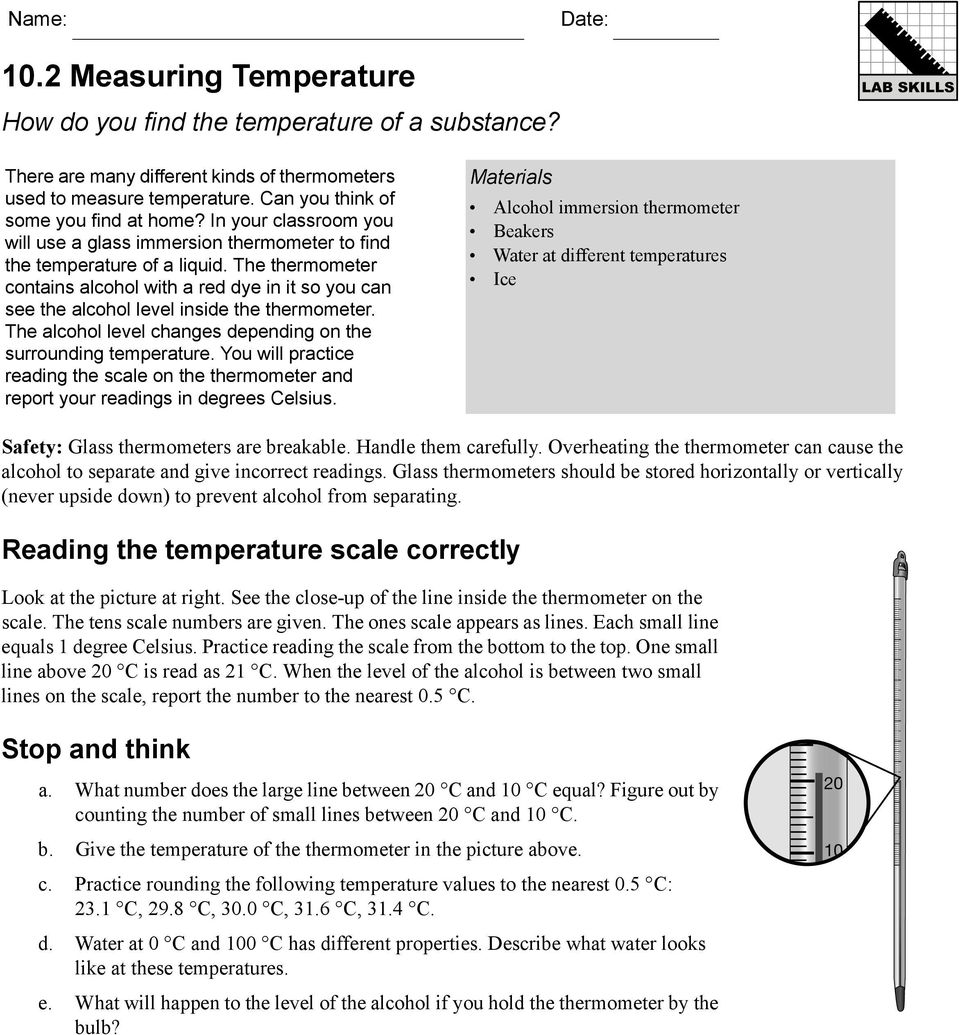
1 10.2 Measuring Temperature How do you find the temperature of a substance? There are many different kinds of thermometers used to measure temperature. Can you think of some you find at home? In your classroom you will use a glass immersion thermometer to find the temperature of a liquid. The thermometer contains alcohol with a red dye in it so you can see the alcohol level inside the thermometer. The alcohol level changes depending on the surrounding temperature. You will practice reading the scale on the thermometer and report your readings in degrees Celsius. Materials Alcohol immersion thermometer Beakers Water at different temperatures Ice Safety: Glass thermometers are breakable. Handle them carefully. Overheating the thermometer can cause the alcohol to separate and give incorrect readings. Glass thermometers should be stored horizontally or vertically (never upside down) to prevent alcohol from separating. Reading the temperature scale correctly Look at the picture at right. See the close-up of the line inside the thermometer on the scale. The tens scale numbers are given. The ones scale appears as lines. Each small line equals 1 degree Celsius. Practice reading the scale from the bottom to the top. One small line above 20 C is read as 21 C. When the level of the alcohol is between two small lines on the scale, report the number to the nearest 0.5 C. Stop and think a. What number does the large line between 20 C and 10 C equal? Figure out by counting the number of small lines between 20 C and 10 C. b. Give the temperature of the thermometer in the picture above. c. Practice rounding the following temperature values to the nearest 0.5 C: 23.1 C, 29.8 C, 30.0 C, 31.6 C, 31.4 C. d. Water at 0 C and 100 C has different properties. Describe what water looks like at these temperatures. e. What will happen to the level of the alcohol if you hold the thermometer by the bulb?
2 Page 2 of 2 Reading the temperature of water in a beaker An immersion thermometer must be placed in liquid up to the solid line on the thermometer (at least 2 and one half inches of liquid). Wait about 3 minutes for the temperature of the thermometer to equal the temperature of the liquid. Record the temperature to the nearest 0.5 C when the level stops moving. 1. Place the thermometer in the beaker. Check to make sure that the water level is above the solid line on the thermometer. 2. Wait until the alcohol level stops moving (about three minutes). Record the temperature to the nearest 0.5 C. Reading the temperature of warm water in a beaker A warm liquid will cool to room temperature. For a warm liquid, record the warmest temperature you observe before the temperature begins to decrease. 1. Repeat the procedure above with a beaker of warm (not boiling) water. 2. Take temperature readings every 30 seconds. Record the warmest temperature you observe. Reading the temperature of ice water in a beaker When a large amount of ice is added to water, the temperature of the water will drop until the ice and water are the same temperature. After the ice has melted, the cold water will warm to room temperature. 1. Repeat the procedure above with a beaker of ice and water. 2. Take temperature readings every 30 seconds. Record the coldest temperature you observe.

3 10.2 Temperature Scales 10.2 The Fahrenheit and Celsius temperature scales are commonly used scales for reporting temperature values. Scientists use the Celsius scale almost exclusively, as do many countries of the world. The United States relies on the Fahrenheit scale for reporting temperature information. You can convert information reported in degrees Celsius to degrees Fahrenheit or vice versa using conversion formulas. Fahrenheit ( F) to Celsius ( C) conversion formula: 5 C = F-32 9 o o ( ) Celsius ( C) to Fahrenheit ( F) conversion formula: 9 5 o o F = C + 32 What is the Celsius value for 65 Fahrenheit? Solution: 5 o C = ( 65 F-32) 9 5 C = ( 33 ) = ( 5 33 ) 9 9 C = C is the same temperature as what value on the Fahrenheit scale? Solution: o o o o C = F = ( 200 C) F = [ C 5] + 32 ( ) F = [1800 5] + 32 F = F = 392

4 Page 2 of 4 1. For each of the problems below, show your calculations. Follow the steps from the examples on the previous page. a. What is the Celsius value for 212 F? b. What is the Celsius value for 98.6 F? c. What is the Celsius value for 40 F? d. What is the Celsius value for 10 F? e. What is the Fahrenheit value for 0 C? f. What is the Fahrenheit value for 25 C? g. What is the Fahrenheit value for 75 C? The weatherman reports that today will reach a high of 45 F. Your friend from Sweden asks what the temperature will be in degrees Celsius. What value would you report to your friend? 3. Your parents order an oven from England. The temperature dial on the new oven is calibrated in degrees Celsius. If you need to bake a cake at 350 F in the new oven, at what temperature should you set the dial? 4. A German automobile s engine temperature gauge reads in Celsius, not Fahrenheit. The engine temperature should not rise above about 225 F. What is the corresponding Celsius temperature on this car s gauge? 5. Your grandmother in Ireland sends you her favorite cookie recipe. Her instructions say to bake the cookies at 190 C. To what Fahrenheit temperature would you set the oven to bake the cookies? 6. A scientist wishes to generate a chemical reaction in his laboratory. The temperature values in his laboratory manual are given in degrees Celsius. However, his lab thermometers are calibrated in degrees Fahrenheit. If he needs to heat his reactants to 232 C, what temperature will he need to monitor on his lab thermometers? 7. You call a friend in Europe during the winter holidays and say that the temperature in Boston is 15 degrees. He replies that you must enjoy the warm weather. Explain his comment using your knowledge of the Fahrenheit and Celsius scales. To help you get started, fill in this table. What is 15 F on the Celsius scale? What is 15 C on the Fahrenheit scale? F C 15 F = = 15 C 8. Challenge questions: a. A gas has a boiling point of 175 C. At what Fahrenheit temperature would this gas boil? b. A chemist notices some silvery liquid on the floor in her lab. She wonders if someone accidentally broke a mercury thermometer, but did not thoroughly clean up the mess. She decides to find out if the silver stuff is really mercury. From her tests with the substance, she finds out that the melting point for the liquid is 35 F. A reference book says that the melting point for mercury is C. Is this substance mercury? Explain your answer and show all relevant calculations.

5 Page 3 of 4 Extension: the Kelvin temperature scale 10.2 For some scientific applications, a third temperature scale is used: the Kelvin scale. The Kelvin scale is calibrated so that raising the temperature one degree Kelvin raises it by the same amount as one degree Celsius. The difference between the scales is that 0 C is the freezing point of water, while 0 K is much, much colder. On the Kelvin scale, 0K (degree symbols are not used for Kelvin values) represents absolute zero. Absolute zero is the temperature when the average kinetic energy of a perfect gas is zero the molecules display no energy of motion. Absolute zero is equal to 273 C, or 459 F. When scientists are conducting research, they often obtain or report their temperature values in Celsius, and other scientists must convert these values into Kelvin for their own use, or vice versa. To convert Celsius values to their Kelvin equivalents, use the formula: K = C Water boils at a temperature of 100 C. What would be the corresponding temperature for the Kelvin scale? K = C K = 100 C K = 373 To convert Kelvin values to Celsius, you perform the opposite operation; subtract 273 from the Kelvin value to find the Celsius equivalent. A substance has a melting point of 625 K. At what Celsius temperature would this substance melt? C = K 273 C = 625 K 273 C = 352 Although we rarely need to convert between Kelvin and Fahrenheit, use the following formulas to do so: 9 F = -- K K = -- ( F + 460) 9

6 Page 4 of Surface temperatures on the planet Mars range from 89 C to 31 C. Express this temperature range in Kelvin. 2. The average surface temperature on Jupiter is about 165K. Express this temperature in degrees Celsius. 3. The average surface temperature on Saturn is 134K. Express this temperature in degrees Celsius. 4. The average surface temperature on the dwarf planet Pluto is 50K. Express this temperature in degrees Celsius. 5. The Sun has several regions. The apparent surface that we can see from a distance is called the photosphere. Temperatures of the photosphere range from 5,000 C to 8,000 C. Express this temperature range in Kelvin. 6. The chromosphere is a hot layer of plasma just above the photosphere. Chromosphere temperatures can reach 10,000 C. Express this temperature in Kelvin. 7. The outermost layer of the Sun s atmosphere is called the corona. Its temperatures can reach over 1,000,000 C. Express this temperature in Kelvin. 8. Nuclear fusion takes place in the center, or core, of the Sun. Temperatures there can reach 15,000,000 C. Express this temperature in Kelvin. 9. Challenge! Surface temperatures on Mercury can reach 660 F. Express this temperature in Kelvin. 10. Challenge! Surface temperatures on Venus, the hottest planet in our solar system, can reach 755K. Express this temperature in degrees Fahrenheit.

7 10.3 Reading a Heating/Cooling Curve 10.3 A heating curve shows how the temperature of a substance changes as heat is added at a constant rate. The heating curve at right shows what happens when heat is added at a constant rate to a beaker of ice. The flat spot on the graph, at zero degrees, shows that although heat was being added, the temperature did not rise while the solid ice was changing to liquid water. The heat energy was used to break the intermolecular forces between water molecules. Once all the ice changed to water, the temperature began to rise again. In this skill sheet, you will practice reading heating and cooling curves. The heating curve at right shows the temperature change in a sample of iron as heat is added at a constant rate. The sample starts out as a solid and ends as a gas. Describe the phase change that occurred between points B and C on the graph. Solution: Between points B and C, the sample changed from solid to liquid. 1. In the heating curve for iron, describe the phase change that occurred between points D and E on the graph. 2. Explain why the temperature stayed constant between points D and E. 3. What is the melting temperature of iron? 4. What is the freezing temperature of iron? How do you know? 5. What is the boiling temperature of iron? 6. Compare the boiling temperatures of iron and water (water boils at 100 C). Which substance has stronger intermolecular forces? How do you know?

8 Page 2 of 2 The graph below shows a cooling curve for stearic acid. Stearic acid is a waxy solid at room temperature. It is derived from animal and vegetable fats and oils. It is used as an ingredient in soap, 10.3 candles, and cosmetics. In this activity, a sample of stearic acid was placed in a heat-resistant test tube and heated to 95 C, at which point the stearic acid was completely liquefied. The test tube was placed in a beaker of ice water, and the temperature monitored until it reached 40 C. Answer the following questions about the cooling curve: 7. Between which two points on the graph did freezing occur? 8. What is the freezing temperature of stearic acid? What is its melting temperature? 9. Compare the melting temperature of stearic acid with the melting temperature of water. Which substance has stronger intermolecular forces? How do you know? 10. Can a substance be cooled to a temperature below its freezing point? Use evidence from any of the graphs in this skill sheet to defend your answer.

9 11.1 Specific Heat 11.1 Specific heat is the amount of thermal energy needed to raise the temperature of 1 gram of a substance 1 C. The higher the specific heat, the more energy is required to cause a change in temperature. Substances with higher specific heats must lose more thermal energy to lower their temperature than substances with a low specific heat. Some sample specific heat values are presented in the table below: Material Specific Heat (J/kg C) water (pure) 4,184 aluminum 897 silver 235 oil 1,900 concrete 880 gold 129 wood 1,700 Water has the highest specific heat of the listed types of matter. This means that water is slower to heat but is also slower to lose heat. Using the table above, solve the following heat problems. 1. If 100 joules of energy were applied to all of the substances listed in the table at the same time, which would have the greatest temperature change? Explain your answer. 2. Which of the substances listed in the table would you choose as the best thermal insulator? A thermal insulator is a substance that requires a lot of heat energy to change its temperature. Explain your answer. 3. Which substance wood or silver is the better thermal conductor? A thermal conductor is a material that requires very little heat energy to change its temperature. Explain your answer. 4. Which has more thermal energy, 1 kg of aluminum at 20 C or 1 kg of gold at 20 C? 5. How much heat in joules would you need to raise the temperature of 1 kg of water by 5 C? 6. How does the thermal energy of a large container of water compare to a small container of water at the same temperature?

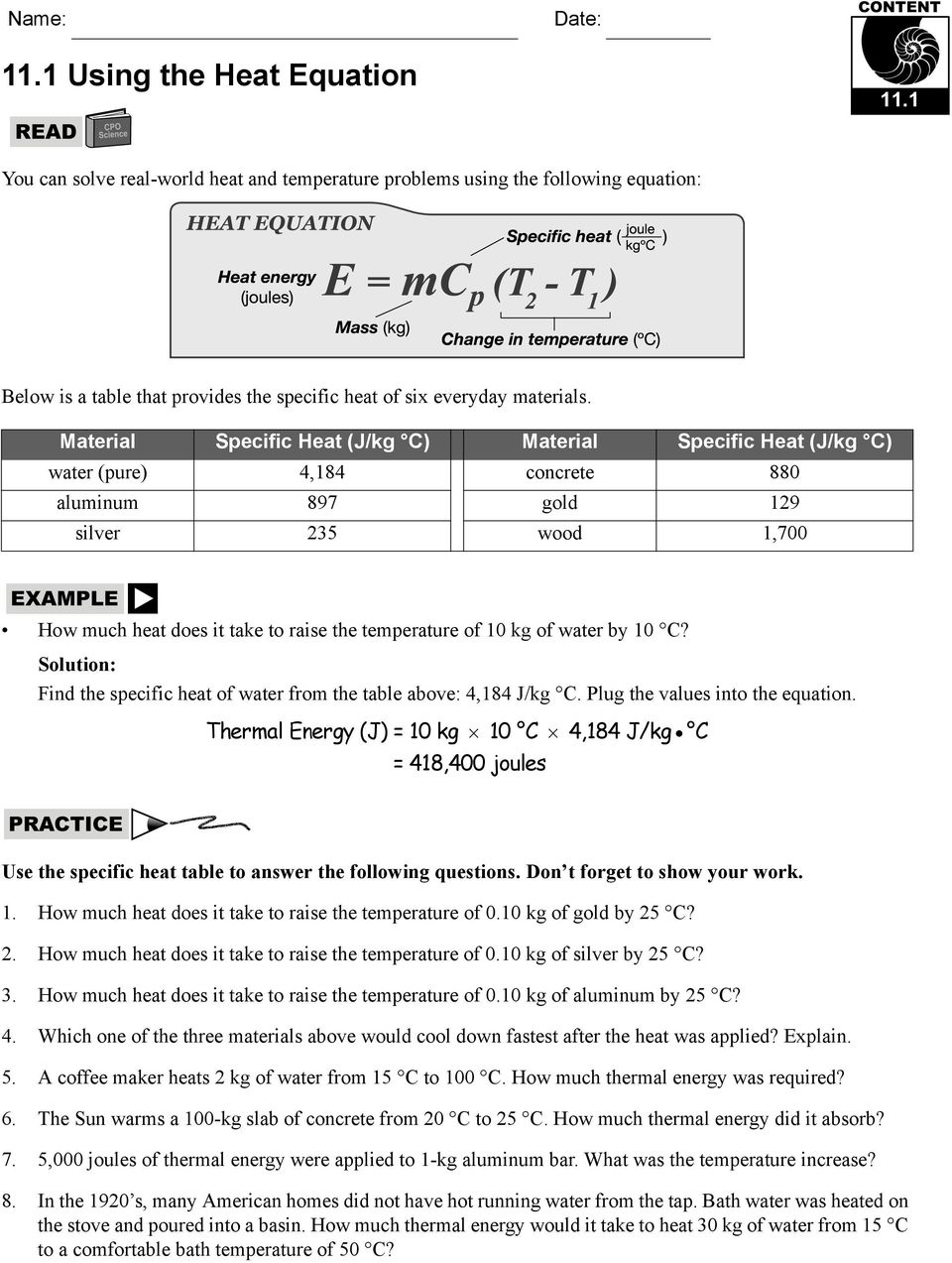
10 11.1 Using the Heat Equation 11.1 You can solve real-world heat and temperature problems using the following equation: Below is a table that provides the specific heat of six everyday materials. Material Specific Heat (J/kg C) Material Specific Heat (J/kg C) water (pure) 4,184 concrete 880 aluminum 897 gold 129 silver 235 wood 1,700 How much heat does it take to raise the temperature of 10 kg of water by 10 C? Solution: Find the specific heat of water from the table above: 4,184 J/kg C. Plug the values into the equation. Thermal Energy (J) = 10 kg 10 C 4,184 J/kg C = 418,400 joules Use the specific heat table to answer the following questions. Don t forget to show your work. 1. How much heat does it take to raise the temperature of 0.10 kg of gold by 25 C? 2. How much heat does it take to raise the temperature of 0.10 kg of silver by 25 C? 3. How much heat does it take to raise the temperature of 0.10 kg of aluminum by 25 C? 4. Which one of the three materials above would cool down fastest after the heat was applied? Explain. 5. A coffee maker heats 2 kg of water from 15 C to 100 C. How much thermal energy was required? 6. The Sun warms a 100-kg slab of concrete from 20 C to 25 C. How much thermal energy did it absorb? 7. 5,000 joules of thermal energy were applied to 1-kg aluminum bar. What was the temperature increase? 8. In the 1920 s, many American homes did not have hot running water from the tap. Bath water was heated on the stove and poured into a basin. How much thermal energy would it take to heat 30 kg of water from 15 C to a comfortable bath temperature of 50 C?
11 12.2 Pressure in Fluids 12.2 Have you ever wondered how a 1,500-kilogram car is raised off the ground in a mechanic s shop? A hydraulic lift does the trick. All hydraulic machines operate on the basis of Pascal s principle, which states that the pressure applied to an incompressible fluid in a closed container is transmitted equally in all parts of the fluid. In the diagram above, a piston at the top of the small tube pushes down on the fluid. This input force generates a certain amount of pressure, which can be calculated using the formula: Pressure Force Area That pressure stays the same throughout the fluid, so it remains the same in the large cylinder. Since the large cylinder has more area, the output force generated by the large cylinder is greater. The output force exerted by the piston at the top of the large cylinder can be calculated using the formula: Force = Pressure Area You can see that the small input force created a large output force. But there s a price: The small piston must be pushed a greater distance than the large piston moves. Work output (output force output distance) can never be greater than work input (input force input distance). = A 50.-newton force is applied to a small piston with an area of m 2. What pressure, in pascals, will be transmitted in the hydraulic system? Solution: Pressure = Force Area N m 2 = Pa The area of the large cylinder s piston in this hydraulic system is 2.5 m 2. What is the output force? = Solution: Force = Pressure Area = Pa 2.5 m 2 = N

12 Page 2 of 2 1. In a hydraulic system, a 100.-newton force is applied to a small piston with an area of m 2. What pressure, in pascals, will be transmitted in the hydraulic system? The area of the large cylinder s piston in this hydraulic system is 3.14 m 2. What is the output force? 3. An engineer wishes to design a hydraulic system that will transmit a pressure of 10,000 pascals using a force of 15 newtons. How large an area should the input piston have? 4. This hydraulic system should produce an output force of 50,000 newtons. How large an area should the output piston have? 5. Another engineer is running a series of experiments with hydraulic systems. If she doubles the area of the input piston, what happens to the amount of pressure transmitted by the system? 6. If all other variables remain unchanged, what happens to the output force when the area of the input piston is doubled? 7. If the small piston in the hydraulic system described in problems 1 and 2 is moved a distance of 2 meters, will the large piston also move 2 meters? Explain why or why not. 8. A 540-newton woman can make dents in a hardwood floor wearing high-heeled shoes, yet if she wears snowshoes, she can step effortlessly over soft snow without sinking in. Explain why, using what you know about pressure, force, and area.

13 12.3 Buoyancy 12.3 When an object is placed in a fluid (liquid or gas), the fluid exerts an upward force upon the object. This force is called a buoyant force. At the same time, there is an attractive force between the object and Earth the force of gravity. It acts as a downward force. You can compare the two forces to determine whether the object floats or sinks in the fluid. Buoyant force > Gravitational force Object floats Buoyant force < Gravitational force Object sinks Example 1: A 13-N object is placed in a container of fluid. If the fluid exerts a 60-N buoyant (upward) force on the object, will the object float or sink? Answer: Float. The upward buoyant force (60 N) is greater than the weight of the object (13 N). Example 2: The rock weighs 2.25 N when suspended in air. In water, it appears to weigh only 1.8 N. Why? Answer: The water exerts a buoyant force on the rock. This buoyant force equals the difference between the rock s weight in air and its apparent weight in water N 1.8 N = 0.45 N The water exerts a buoyant force of 0.45 newtons on the rock. 1. A 4.5-N object is placed in a tank of water. If the water exerts a force of 4.0 N on the object, will the object sink or float? 2. The same 4.5-N object is placed in a tank of glycerin. If the glycerin exerts a force of 5.0 N on the object, will the object sink or float? 3. You suspend a brass ring from a spring scale. Its weight is 0.83 N while it is suspended in air. Next, you immerse the ring in a container of light corn syrup. The ring appears to weigh 0.71 N. What is the buoyant force acting on the ring in the light corn syrup? 4. You wash the brass ring (from question 3) and then suspend it in a container of vegetable oil. The ring appears to weigh 0.73 N. What is the buoyant force acting on the ring? 5. Which has greater buoyant force, light corn syrup or the vegetable oil? Why do you think this is so? 6. A cube of gold weighs 1.89 N when suspended in air from a spring scale. When suspended in molasses, it appears to weigh 1.76 N. What is the buoyant force acting on the cube? 7. Do you think the buoyant force would be greater or smaller if the gold cube were suspended in water? Explain your answer.

14 12.3 Archimedes 12.3 Archimedes was a Greek mathematician who specialized in geometry. He figured out the value of pi and the volume of a sphere, and has been called the father of integral calculus. During his lifetime, he was famous for using compound pulleys and levers to invent war machines that successfully held off an attack on his city for three years. Today he is best known for Archimedes principle, which was the first explanation of how buoyancy works. Archimedes screw Archimedes was born in Syracuse, on Sicily (then an independent Greek city-state), in 287 B.C. His letters suggest he studied in Alexandria, Egypt, as a young man. Historians believe it was there that he invented a device for raising water by means of a rotating screw or spirally bent tube within an inclined hollow cylinder. The device known as Archimedes screw is still used in many parts of the world. Eureka! A famous Greek legend says that King Hieron II of Syracuse asked Archimedes to figure out if his new crown was pure gold or if the craftsman had mixed some less expensive silver into it. Archimedes had to determine the answer without destroying the crown. He thought about it for days and then, as he lowered himself into a bath, the method for figuring it out struck him. The legend says Archimedes ran through the streets, shouting Eureka! meaning I have found it. A massive problem Archimedes realized that if he had equal masses of gold and silver, the denser gold would have a smaller volume. Therefore, the gold would displace less water than the silver when submerged. Archimedes found the mass of the crown and then made a bar of pure gold with the same mass. He submerged the gold bar and measured the volume of water it displaced. Next, he submerged the crown. He found the crown displaced more water than the gold bar had and, therefore, could not be pure gold. The gold had been mixed with a less dense material. Archimedes had confirmed the king s doubts. Why do things float? Archimedes wrote a treatise titled On Floating Bodies, further exploring density and buoyancy. He explained that an object immersed in a fluid is pushed upward by a force equal to the weight of the fluid displaced by the object. Therefore, if an object weighs more than the fluid it displaces, it will sink. If it weighs less than the fluid it displaces, it will float. This statement is known as Archimedes principle. Although we commonly assume the fluid is water, the statement holds true for any fluid, whether liquid or gas. A helium balloon floats because the air it displaces weighs more than the balloon filled with lightweight gas. Cylinders, circles, and exponents Archimedes wrote several other treatises, including On the Sphere and the Cylinder, On the Measurement of the Circle, On Spirals, and The Sand Reckoner. In this last treatise, he devised a system of exponents that allowed him to represent large numbers on paper up to in modern scientific notation. This was large enough, he said, to count the grains of sand that would be needed to fill the universe. This paper is even more remarkable for its astronomical calculations than for its new mathematics. Archimedes first had to figure out the size of the universe in order to estimate the amount of sand needed to fill it. He based his size calculations on the writings of three astronomers (one of them was his father). While his estimate is considered too small by today s standard, it was much, much larger than anyone had previously suggested. Archimedes was the first to think on an astronomical scale. Archimedes was killed by a Roman soldier during an invasion of Syracuse in 212 B.C.

15 Page 2 of 2 Reading reflection 1. The boldface words in the article are defined in the glossary of your textbook. Look them up and then explain the meaning of each in your own words Imagine you are Archimedes and have to write your resume for a job. Describe yourself in a brief paragraph. Be sure to include in the paragraph your skills and the jobs you are capable of doing. 3. What was Archimedes treatise The Sand Reckoner about? 4. Why does a balloon filled with helium float in air, but a balloon filled with air from your lungs sink? 5. Research one of Archimedes inventions and create a poster that shows how the device worked.

16 12.3 Narcís Monturiol 12.3 Monturiol, a visionary and peaceful revolutionary, wanted to improve the social and economic lives of his countrymen. Moved by the suffering of coral divers due to their extremely dangerous working conditions, Monturiol built a submarine to transport the divers to the reefs. He hoped that in time, his invention would also help people understand the ocean world. Birth of a Spanish inventor Narcís Monturiol was born on September 28, 1819, in Figueres, Catalonia, a region of northeastern Spain. Monturiol s father was a cooper which means that he handcrafted wooden barrels that held wine, oil, and milk. Narcís was one of five children. At an early age he showed an interest in design and invention. When he was ten, he created a realistic model of a wooden clock. His mother wanted Narcís to become a priest, but he earned a law degree instead. He never practiced law, however. Instead, he became a self-taught engineer. Monturiol was active politically. He supported socialism, communism, and the ideal of a utopia where everyone lived together in harmony. He turned to science with the hope of creating that utopia. The perils of coral diving Monturiol was concerned about the danger involved in the work of Spanish coral fishermen. A diver, holding his breath for several minutes, dove nearly 20 meters beneath the ocean surface to retrieve valuable pieces of coral. The divers risked drowning, injuries from rocks and coral, and possible shark attacks. In 1857, Monturiol formed a company to design and build a submarine. His goal was to develop a vessel to help coral divers with their physical work and to lessen the risk involved. Monturiol was not the first to build a submarine. Historical records show that Aristotle, Renaissance period inventors, and others had attempted to build submarines. These models were often created for warfare. Most early submarines were unsuccessful and dangerous. Ictineo I Monturiol s first submarine, Ictineo I, made its first dive in The name Ictineo is derived from Greek, and is translated fish ship. During its initial dive, Ictineo I hit underwater pilings. Repairing what he could, Monturiol sent Ictineo I on its second dive within a few hours. Monturiol s seven-meter submarine had a spherical inner hull built to withstand water pressure, and an elliptical (egg-shaped) outer hull for ease of movement. Between the two hulls were tanks that stored and released water to control the submarine s depth. Oxygen tanks were also stored in this space. The submarine was powered by four men turning the propeller by hand. Ictineo I was equipped with a ventilator, two sets of propellers, and several portholes. The submarine had the ability to retrieve objects and was equipped with a back-up system to raise it to the surface in an emergency. Ictineo I made nearly 20 dives that first year, to a depth of 20 meters. The submarine eventually stayed underwater for nearly two hours. Ictineo II Monturiol created a second and improved model called Ictineo II. Rather than relying on manpower, the Ictineo II had a steam engine. These engines were traditionally powered by an open flame. Monturiol created a submarine-safe alternative to power the engine using a chemical reaction. The open flame would have removed oxygen, but the chemical reaction added oxygen to the cabin instead. The Ictineo II was 17 meters long, had two engines, dove to depths of nearly 30 meters, had many portholes, and remained underwater for almost seven hours. Unfortunately, Monturiol ran out of funds and was forced to sell his submarine for scrap. Although he didn t receive much credit for his inventions during his lifetime, he is now recognized as an important contributor to submarine development. Monturiol died in 1885.

17 Page 2 of 2 Reading reflection 1. What moved Monturiol to create a submarine? Identify key features of the Ictineo I and II. 3. Research: Where are model replicas of Ictineo I and II located? 4. Research: What happed to Monturiol s Ictineo I? 5. Research: Name three things Monturiol invented in addition to the submarine. 6. Research: How did Spain honor Monturiol in 1987? 7. Research: What is the Narcís Monturiol medal?

18 12.3 Archimedes Principle 12.3 More than 2,000 years ago, Archimedes discovered the relationship between buoyant force and how much fluid is displaced by an object. Archimedes principle states: The buoyant force acting on an object in a fluid is equal to the weight of the fluid displaced by the object. We can practice figuring out the buoyant force using a beach ball and a big tub of water. Our beach ball has a volume of 14,130 cm 3. The weight of the beach ball in air is 1.5 N. If you put the beach ball into the water and don t push down on it, you ll see that the beach ball floats on top of the water by itself. Only a small part of the beach ball is underwater. Measuring the volume of the beach ball that is under water, we find it is 153 cm 3. Knowing that 1 cm 3 of water has a mass of 1 g, you can calculate the weight of the water displaced by the beach ball. 153 cm 3 of water = 153 grams = kg weight = mass force of gravity per kg = (0.153 kg) 9.8 N/kg = 1.5 N According to Archimedes principle, the buoyant force acting on the beach ball equals the weight of the water displaced by the beach ball. Since the beach ball is floating in equilibrium, the weight of the ball pushing down must equal the buoyant force pushing up on the ball. We just showed this to be true for our beach ball. Have you ever tried to hold a beach ball underwater? It takes a lot of effort! That is because as you submerge more of the beach ball, the more the buoyant force acting on the ball pushes it up. Let s calculate the buoyant force on our beach ball if we push it all the way under the water. Completely submerged, the beach ball displaces 14,130 cm 3 of water. Archimedes principle tells us that the buoyant force on the ball is equal to the weight of that water: 14,130 cm 3 of water = 14,130 grams = kg weight = mass force of gravity per kg = (14.13 kg) 9.8 N/kg = 138 N If the buoyant force is pushing up with 138 N, and the weight of the ball is only 1.5 N, your hand pushing down on the ball supplies the rest of the force, N. A 10-cm 3 block of lead weighs 1.1 N. The lead is placed in a tank of water. One cm 3 of water weighs N. What is the buoyant force on the block of lead? Solution: The lead displaces 10 cm 3 of water. buoyant force = weight of water displaced 10 cm 3 of water N/cm 3 = N

19 Page 2 of 2 1. A block of gold and a block of wood both have the same volume. If they are both submerged in water, which has the greater buoyant force acting on it? A 100-cm 3 block of lead that weighs 11 N is carefully submerged in water. One cm 3 of water weighs N. a. What volume of water does the lead displace? b. How much does that volume of water weigh? c. What is the buoyant force on the lead? d. Will the lead block sink or float in the water? 3. The same 100-cm 3 lead block is carefully submerged in a container of mercury. One cm 3 of mercury weighs 0.13 N. a. What volume of mercury is displaced? b. How much does that volume of mercury weigh? c. What is the buoyant force on the lead? d. Will the lead block sink or float in the mercury? 4. According to problems 2 and 3, does an object s density have anything to do with whether or not it will float in a particular liquid? Justify your answer. 5. Based on the table of densities, explain whether the object would float or sink in the following situations: a. A block of solid paraffin (wax) in molasses. b. A bar of gold in mercury. c. A piece of platinum in gasoline. d. A block of paraffin in gasoline. material density (g/ cm 3 ) gasoline 0.7 gold 19.3 lead 11.3 mercury 13.6 molasses 1.37 paraffin 0.87 platinum 21.4

20 13.2 Boyle s Law 13.2 The relationship between the volume of a gas and the pressure of a gas, at a constant temperature, is known as Boyle s law. The equation for Boyle s law is shown at right. Units for pressure include: atmospheres (atm), pascals (Pa), or kilopascals (kpa). Units for volume include: cubic centimeters (cm 3 ), cubic meters (m 3 ), or liters. A kit used to fix flat tires consists of an aerosol can containing compressed air and a patch to seal the hole in the tire. Suppose 10.0 L of air at atmospheric pressure (101.3 kilopascals, or kpa) is compressed into a 1.0-L aerosol can. What is the pressure of the compressed air in the can? Looking for Pressure of compressed air in a can (P 2 ) Given P 1 = kpa; V 1 = 10.0 liters; V 2 = 1.0 liters Relationship Use Boyle s Law to solve for P 2. Divide each side by V 2 to isolate P 2 on one side of the equation. P V P = V 2 Solution P kpa 10.0 L 2 = = 1,013 kpa 1.0 L The pressure inside the aerosol can is 1,013 kpa. 1. The air inside a tire pump occupies a volume of 130. cm 3 at a pressure of one atmosphere. If the volume decreases to 40.0 cm 3, what is the pressure, in atmospheres, inside the pump? 2. A gas occupies a volume of 20. m 3 at 9,000. Pa. If the pressure is lowered to 5,000. Pa, what volume will the gas occupy? 3. You pump 25.0 L of air at atmospheric pressure (101.3 kpa) into a soccer ball that has a volume of 4.50 L. What is the pressure inside the soccer ball if the temperature does not change? 4. Hyperbaric oxygen chambers (HBO) are used to treat divers with decompression sickness. As pressure increases inside the HBO, more oxygen is forced into the bloodstream of the patient inside the chamber. To work properly, the pressure inside the chamber should be three times greater than atmospheric pressure (101.3 kpa). What volume of oxygen, held at atmospheric pressure, will need to be pumped into a 190.-L HBO chamber to make the pressure inside three times greater than atmospheric pressure? 5. A 12.5-liter scuba tank holds of oxygen at a pressure of kpa. What is the original volume of oxygen at kpa that is required to fill the scuba tank?

21 13.2 Gay-Lussac Law 13.2 The pressure-temperature relationship shows a direct relationship between the pressure of a gas and its temperature when the temperature is given in the Kelvin scale. Another name for this relationship is the Gay-Lussac Law. The pressuretemperature equation is below. Converting from degrees Celsius to Kelvin is easy you add 273 to the Celsius temperature. To convert from Kelvins to degrees Celsius, you subtract 273 from the Kelvin temperature. A constant volume of gas is heated from 25.0 C to 100 C. If the gas pressure starts at 1.00 atmosphere, what is the final pressure of this gas? Looking for The new pressure of the gas (P 2 ) Given T 1 = 25 C; P 1 = 1 atm; T 2 = 100 C Relationships Use pressure-temperature relation to solve for P 2. Multiply each side by T 2 to isolate P 2 on one side of the equation. P 1 T 2 P 2 = T 1 Convert temperature values in Celsius degrees to Kelvin: T Kelvin = T Celsius Solution T 1 = 25 C = 298 T 2 = 100 C = 313 P 1 atm = = 1.25 atm 298 The new pressure of the volume of gas is 1.25 atmospheres. 1. At 400. K, a volume of gas has a pressure of 0.40 atmospheres. What is the pressure of this gas at 273 K? 2. What is the temperature of the volume of gas (starting at 400. K with a pressure of 0.4 atmospheres), when the pressure increases to 1 atmosphere? 3. Use the pressure-temperature relationship to fill in the following table with the correct values. Pay attention to the temperature units. P 1 T 1 P 2 T 2 a atm 100 C 500 C b atm 25.0 C 18.0 atm c atm 3.00 atm 293 K
22 13.2 Charles Law 13.2 Charles law shows a direct relationship between the volume of a gas and the temperature of a gas when the temperature is given in the Kelvin scale. The Charles law equation is below. Converting from degrees Celsius to Kelvin is easy you add 273 to the Celsius temperature. To convert from Kelvins to degrees Celsius, you subtract 273 from the Kelvin temperature. A truck tire holds 25.0 liters of air at 25 C. If the temperature drops to 0 C, and the pressure remains constant, what will be the new volume of the tire? Looking for The new volume of the tire (V 2 ) Given V 1 = 25.0 liters; T 1 = 25 C; T 2 = 0 C Relationships Use Charles Law to solve for V 2. Multiply each side by T 2 to isolate V 2 on one side of the equation. V T V = T 1 Convert temperature values in Celsius degrees to Kelvin: T Kelvin = T Celsius Solution T 1 = 25 C = 298 T 2 = 0 C = 273 V 25.0 L = = 23.0 L 298 The new volume inside the tire is 23.0 liters. 1. If a truck tire holds 25.0 liters of air at 25.0 C, what is the new volume of air in the tire if the temperature increases to 30.0 C? 2. A balloon holds 20.0 liters of helium at 10.0 C. If the temperature increases to 50.0 C, and the pressure does not change, what is the new volume of the balloon? 3. Use Charles Law to fill in the following table with the correct values. Pay attention to the temperature units. V 1 T 1 V 2 T 2 a. 840 K 1,070 ml 147 K b ml 475 C 50 C c. 10 L 15 L 50 C
1. Fahrenheit and Celsius. 2. Converting Fahrenheit values into Celsius. Name:
 Name: Skill Sheet 25.2 Temperature Scales Temperature, a measure of the average kinetic energy of the molecules of a substance, has an important role in our daily lives. Whether we are cooking dinner,
Grade 8 Science Chapter 9 Notes
 Grade 8 Science Chapter 9 Notes Force Force - Anything that causes a change in the motion of an object. - usually a push or a pull. - the unit for force is the Newton (N). Balanced Forces - forces that
Name Class Date. F 2 2269 N A 1 88.12 cm 2 A 2 1221 cm 2 Unknown: Step 2: Write the equations for Pascal s principle and pressure, force, and area.
 Skills Worksheet Math Skills Pascal s Principle After you study each sample problem and solution, work out the practice problems on a separate sheet of paper. Write your answers in the spaces provided.
TEMPERATURE 2008, 2004, 1990 by David A. Katz. All rights reserved.
 TEMPERATURE 2008, 2004, 10 by David A. Katz. All rights reserved. A BRIEF HISTORY OF TEMPERATURE MEASUREMENT Ancient people were physically aware of hot and cold and probably related temperature by the
Test Bank - Chapter 3 Multiple Choice
 Test Bank - Chapter 3 The questions in the test bank cover the concepts from the lessons in Chapter 3. Select questions from any of the categories that match the content you covered with students. The
Lesson 2 The Buoyant Force
 Lesson 2 Student Labs and Activities Page Launch Lab 26 Content Vocabulary 27 Lesson Outline 28 MiniLab 30 Content Practice A 31 Content Practice B 32 School to Home 33 Key Concept Builders 34 Enrichment
Chapter 3 Student Reading
 Chapter 3 Student Reading If you hold a solid piece of lead or iron in your hand, it feels heavy for its size. If you hold the same size piece of balsa wood or plastic, it feels light for its size. The
Chapter 18 Temperature, Heat, and the First Law of Thermodynamics. Problems: 8, 11, 13, 17, 21, 27, 29, 37, 39, 41, 47, 51, 57
 Chapter 18 Temperature, Heat, and the First Law of Thermodynamics Problems: 8, 11, 13, 17, 21, 27, 29, 37, 39, 41, 47, 51, 57 Thermodynamics study and application of thermal energy temperature quantity
Density. Density is how concentrated or compact matter is.
 Density Density is how concentrated or compact matter is. Packing snow into snowballs increases its density. You are squeezing large amounts of matter into small volumes of space. Equation for Density
Gas Laws. vacuum. 760 mm. air pressure. mercury
 Gas Laws Some chemical reactions take place in the gas phase and others produce products that are gases. We need a way to measure the quantity of compounds in a given volume of gas and relate that to moles.
Chapter 10 Temperature and Heat
 Chapter 10 Temperature and Heat What are temperature and heat? Are they the same? What causes heat? What Is Temperature? How do we measure temperature? What are we actually measuring? Temperature and Its
Chapter 10: Temperature and Heat
 Chapter 10: Temperature and Heat 1. The temperature of a substance is A. proportional to the average kinetic energy of the molecules in a substance. B. equal to the kinetic energy of the fastest moving
Name: Class: Date: 10. Some substances, when exposed to visible light, absorb more energy as heat than other substances absorb.
 Name: Class: Date: ID: A PS Chapter 13 Review Modified True/False Indicate whether the statement is true or false. If false, change the identified word or phrase to make the statement true. 1. In all cooling
Write True or False in the space provided.
 CP Physics -- Exam #7 Practice Name: _ Class: Date: Write True or False in the space provided. 1) Pressure at the bottom of a lake depends on the weight density of the lake water and on the volume of the
Chapter 4: Transfer of Thermal Energy
 Chapter 4: Transfer of Thermal Energy Goals of Period 4 Section 4.1: To define temperature and thermal energy Section 4.2: To discuss three methods of thermal energy transfer. Section 4.3: To describe
CHAPTER 3: FORCES AND PRESSURE
 CHAPTER 3: FORCES AND PRESSURE 3.1 UNDERSTANDING PRESSURE 1. The pressure acting on a surface is defined as.. force per unit. area on the surface. 2. Pressure, P = F A 3. Unit for pressure is. Nm -2 or
Solids, Liquids, and Gases
 Glencoe Science Chapter Resources Solids, Liquids, and Gases Includes: Reproducible Student Pages ASSESSMENT Chapter Tests Chapter Review HANDS-ON ACTIVITIES Lab Worksheets for each Student Edition Activity
Buoyant Force and Archimedes Principle
 Buoyant Force and Archimedes Principle Predict the behavior of fluids as a result of properties including viscosity and density Demonstrate why objects sink or float Apply Archimedes Principle by measuring
Concept Questions Archimedes Principle. 8.01t Nov 24, 2004
 Concept Questions Archimedes Principle 8.01t Nov 24, 2004 Pascal s Law Pressure applied to an enclosed fluid is transmitted undiminished to every portion of the fluid and the walls of the containing vessel
Physics 181- Summer 2011 - Experiment #8 1 Experiment #8, Measurement of Density and Archimedes' Principle
 Physics 181- Summer 2011 - Experiment #8 1 Experiment #8, Measurement of Density and Archimedes' Principle 1 Purpose 1. To determine the density of a fluid, such as water, by measurement of its mass when
Forces. Definition Friction Falling Objects Projectiles Newton s Laws of Motion Momentum Universal Forces Fluid Pressure Hydraulics Buoyancy
 Forces Definition Friction Falling Objects Projectiles Newton s Laws of Motion Momentum Universal Forces Fluid Pressure Hydraulics Buoyancy Definition of Force Force = a push or pull that causes a change
Review Chapter 10, 12, 13, 14, 15, 16. Conceptual Physics, 10e (Hewitt) Chapter 10
 Review Chapter 10, 12, 13, 14, 15, 16 Conceptual Physics, 10e (Hewitt) Chapter 10 23) What prevents satellites such as a space shuttle from falling? A) gravity B) the absence of air drag C) Nothing; they're
Introduction to the Ideal Gas Law
 Course PHYSICS260 Assignment 5 Consider ten grams of nitrogen gas at an initial pressure of 6.0 atm and at room temperature. It undergoes an isobaric expansion resulting in a quadrupling of its volume.
10 g 5 g? 10 g 5 g. 10 g 5 g. scale
 The International System of Units, or the SI Units Vs. Honors Chem 1 LENGTH In the SI, the base unit of length is the Meter. Prefixes identify additional units of length, based on the meter. Smaller than
Chapter 13 - Solutions
 = Chapter 13 - Solutions Description: Find the weight of a cylindrical iron rod given its area and length and the density of iron. Part A On a part-time job you are asked to bring a cylindrical iron rod
4S Archimedes Test for Density
 4S Archimedes Test for Density Density, or specific gravity of minerals is important in separating them. It is important to have a test for the density of mineral samples found at Snailbeach. Galena is
Buoyancy and Archimedes Principle. Buoyancy and Archimedes Principle Assume block is in equilibrium.
 Assume block is in equilibrium. Then upward forces must equal downward forces. Upward force: pressure from fluid Downward force: atmospheric pressure plus weight Therefore In this case, the object is less
9460218_CH06_p069-080.qxd 1/20/10 9:44 PM Page 69 GAS PROPERTIES PURPOSE
 9460218_CH06_p069-080.qxd 1/20/10 9:44 PM Page 69 6 GAS PROPERTIES PURPOSE The purpose of this lab is to investigate how properties of gases pressure, temperature, and volume are related. Also, you will
Topic Page Contents Page
 Heat energy (11-16) Contents Topic Page Contents Page Heat energy and temperature 3 Latent heat energy 15 Interesting temperatures 4 Conduction of heat energy 16 A cooling curve 5 Convection 17 Expansion
What is Energy? What is the relationship between energy and work?
 What is Energy? What is the relationship between energy and work? Compare kinetic and potential energy What are the different types of energy? What is energy? Energy is the ability to do work. Great, but
TEACHER BACKGROUND INFORMATION THERMAL ENERGY
 TEACHER BACKGROUND INFORMATION THERMAL ENERGY In general, when an object performs work on another object, it does not transfer all of its energy to that object. Some of the energy is lost as heat due to
Three Methods for Calculating the Buoyant Force Gleue: Physics
 Three Methods for Calculating the Buoyant Force Gleue: Physics Name Hr. The Buoyant Force (F b ) is the apparent loss of weight for an object submerged in a fluid. For example if you have an object immersed
Energy Matters Heat. Changes of State
 Energy Matters Heat Changes of State Fusion If we supply heat to a lid, such as a piece of copper, the energy supplied is given to the molecules. These start to vibrate more rapidly and with larger vibrations
Heat and Temperature: Front End Evaluation Report. Joshua Gutwill. October 1999
 Heat and Temperature: Front End Evaluation Report Joshua Gutwill October 1999 Keywords: 1 Heat and Temperature Front End Evaluation Report October 28, 1999 Goal:
Temperature. Temperature
 Chapter 8 Temperature Temperature a number that corresponds to the warmth or coldness of an object measured by a thermometer is a per-particle property no upper limit definite limit on lower end Temperature
Gas Laws. The kinetic theory of matter states that particles which make up all types of matter are in constant motion.
 Name Period Gas Laws Kinetic energy is the energy of motion of molecules. Gas state of matter made up of tiny particles (atoms or molecules). Each atom or molecule is very far from other atoms or molecules.
Chapter 10 Temperature and Heat
 Chapter 10 Temperature and Heat GOALS When you have mastered the contents of this chapter, you will be able to achieve the following goals: Definitions Define each of the following terms, and use it an
The Sun and Solar Energy
 I The Sun and Solar Energy One of the most important forces behind global change on Earth is over 90 million miles distant from the planet. The Sun is the ultimate, original source of the energy that drives
EXPERIMENT 15: Ideal Gas Law: Molecular Weight of a Vapor
 EXPERIMENT 15: Ideal Gas Law: Molecular Weight of a Vapor Purpose: In this experiment you will use the ideal gas law to calculate the molecular weight of a volatile liquid compound by measuring the mass,
Physics 1114: Unit 6 Homework: Answers
 Physics 1114: Unit 6 Homework: Answers Problem set 1 1. A rod 4.2 m long and 0.50 cm 2 in cross-sectional area is stretched 0.20 cm under a tension of 12,000 N. a) The stress is the Force (1.2 10 4 N)
(Walter Glogowski, Chaz Shapiro & Reid Sherman) INTRODUCTION
 Convection (Walter Glogowski, Chaz Shapiro & Reid Sherman) INTRODUCTION You know from common experience that when there's a difference in temperature between two places close to each other, the temperatures
Density Lab. If you get stuck or are uncertain, please ask questions and/or refer to the hints at the end of the lab. Name: Section: Due Date:
 Name: Section: Due Date: Lab 01B-1 If you get stuck or are uncertain, please ask questions and/or refer to the hints at the end of the lab. Density Lab Density is an important concept in oceanography,
Fluids I. Level : Conceptual Physics/Physics I. Q1) Order the following materials from lowest to greatest according to their densities.
 Fluids I Level : Conceptual Physics/Physics I Teacher : Kim 1. Density One of the properties of any substances (solids, liquids and gases) is the measure of how tightly the material is packed together.
THE SOLAR SYSTEM - EXERCISES 1
 THE SOLAR SYSTEM - EXERCISES 1 THE SUN AND THE SOLAR SYSTEM Name the planets in their order from the sun. 1 2 3 4 5 6 7 8 The asteroid belt is between and Which planet has the most moons? About how many?
Name Class Date. true
 Exercises 131 The Falling Apple (page 233) 1 Describe the legend of Newton s discovery that gravity extends throughout the universe According to legend, Newton saw an apple fall from a tree and realized
MULTIPLE CHOICE. Choose the one alternative that best completes the statement or answers the question.
 Exam Name MULTIPLE CHOICE. Choose the one alternative that best completes the statement or answers the question. 1) Tidal forces in general are the result of A) unequal forces acting on different parts
There is no such thing as heat energy
 There is no such thing as heat energy We have used heat only for the energy transferred between the objects at different temperatures, and thermal energy to describe the energy content of the objects.
Quick Peek. H Students will learn about. H Students will design and. Students will learn about density, buoyancy, and how submarines dive.
 Quick Peek sink, float, Hover design a submarine! Students will learn about density, buoyancy, and how submarines dive. Suggested Grade Levels: 4 8 Illinois State Learning Goals science 11.A, 11.B, 12.D,
Density and Archimedes Principle
 Density and Archimedes Principle Objectives: To understand the concept of density and its relationship to various materials. To understand and use Archimedes Principle. Equipment: Dial calipers, Graduated
Buoyancy Problem Set
 Buoyancy Problem Set 1) A stone weighs 105 lb in air. When submerged in water, it weighs 67.0 lb. Find the volume and specific gravity of the stone. (Specific gravity of an object: ratio object density
5. Which temperature is equal to +20 K? 1) 253ºC 2) 293ºC 3) 253 C 4) 293 C
 1. The average kinetic energy of water molecules increases when 1) H 2 O(s) changes to H 2 O( ) at 0ºC 3) H 2 O( ) at 10ºC changes to H 2 O( ) at 20ºC 2) H 2 O( ) changes to H 2 O(s) at 0ºC 4) H 2 O( )
Eighth Grade, Density To Float or Not to Float? 2004 Colorado Unit Writing Project 1
 Density To Float or Not to Float? That is the Question! Grade Level or Special Area: Eighth Grade Science Written by: Aida Peterson, Clear Lake Middle School, Denver, Colorado Length of Unit: Twelve lessons
EXERCISE # 1.Metric Measurement & Scientific Notation
 EXERCISE # 1.Metric Measurement & Scientific Notation Student Learning Outcomes At the completion of this exercise, students will be able to learn: 1. How to use scientific notation 2. Discuss the importance
Hot Leaks. See how the temperature of liquids changes the way they flow.
 P h y s i c s Q u e s t A c t i v i t i e s Activity 2 1 Hot Leaks See how the temperature of liquids changes the way they flow. Safety: This experiment requires using the hot water tap and straight pins.
THE KINETIC THEORY OF GASES
 Chapter 19: THE KINETIC THEORY OF GASES 1. Evidence that a gas consists mostly of empty space is the fact that: A. the density of a gas becomes much greater when it is liquefied B. gases exert pressure
Archimedes Principle. Biological Systems
 Archimedes Principle Introduction Many of the substances we encounter in our every day lives do not have rigid structure or form. Such substances are called fluids and can be divided into two categories:
1. At which temperature would a source radiate the least amount of electromagnetic energy? 1) 273 K 3) 32 K 2) 212 K 4) 5 K
 1. At which temperature would a source radiate the least amount of electromagnetic energy? 1) 273 K 3) 32 K 2) 212 K 4) 5 K 2. How does the amount of heat energy reflected by a smooth, dark-colored concrete
EXAMPLE EXERCISE 4.1 Change of Physical State
 EXAMPLE EXERCISE 4.1 Change of Physical State State the term that applies to each of the following changes of physical state: (a) Snow changes from a solid to a liquid. (b) Gasoline changes from a liquid
LAB #3: MEASURING SPECIFIC GRAVITY AND DENSITY. Set-up and Materials for Experiment
 Set-up and Materials for Experiment 1 OVERVIEW The mass density of a substance is a measure of the mass that that substance contains in a given volume. Mathematically is written: ρ = m V ( Density = Volume
EXAMPLE EXERCISE 3.1 Metric Basic Units and Prefixes
 EXAMPLE EXERCISE 3.1 Metric Basic Units and Prefixes Give the symbol for each of the following metric units and state the quantity measured by each unit: (a) gigameter (b) kilogram (c) centiliter (d) microsecond
RETURN TO THE MOON. Lesson Plan
 RETURN TO THE MOON Lesson Plan INSTRUCTIONS FOR TEACHERS Grade Level: 9-12 Curriculum Links: Earth and Space (SNC 1D: D2.1, D2.2, D2.3, D2.4) Group Size: Groups of 2-4 students Preparation time: 1 hour
Chapter 3. Flotation. ELEMENTARY HYDRAULICS National Certificate in Technology (Civil Engineering) Buoyancy
 ELEMENTARY HYDRAULICS National Certificate in Technology (Civil Engineering) Chapter 3 Flotation Buoyancy Buoyancy arises from the fact that fluid pressure increases with depth and from the fact that the
Kinetic Theory of Gases. 6.1 Properties of Gases 6.2 Gas Pressure. Properties That Describe a Gas. Gas Pressure. Learning Check.
 Chapter 6 Gases Kinetic Theory of Gases 6.1 Properties of Gases 6.2 Gas Pressure A gas consists of small particles that move rapidly in straight lines. have essentially no attractive (or repulsive) forces.
Chapter 27 Static Fluids
 Chapter 27 Static Fluids 27.1 Introduction... 1 27.2 Density... 1 27.3 Pressure in a Fluid... 2 27.4 Pascal s Law: Pressure as a Function of Depth in a Fluid of Uniform Density in a Uniform Gravitational
Practical Applications of Freezing by Boiling Process
 Practical Applications of Freezing by Boiling Process Kenny Gotlieb, Sasha Mitchell and Daniel Walsh Physics Department, Harvard-Westlake School 37 Coldwater Canyon, N. Hollywood, CA 9164 Introduction
The Earth, Sun, and Moon
 reflect The Sun and Moon are Earth s constant companions. We bask in the Sun s heat and light. It provides Earth s energy, and life could not exist without it. We rely on the Moon to light dark nights.
1.4.6-1.4.8 Gas Laws. Heat and Temperature
 1.4.6-1.4.8 Gas Laws Heat and Temperature Often the concepts of heat and temperature are thought to be the same, but they are not. Perhaps the reason the two are incorrectly thought to be the same is because
Balloon Inside a Bottle
 Balloon Inside a Bottle What is Needed * One small party balloon * One small bottle. A 16 ounce pop bottle works well. What to Do Put approximately 1 tablespoon of water into the empty pop bottle. Then
Chapter 15. FLUIDS. 15.1. What volume does 0.4 kg of alcohol occupy? What is the weight of this volume? m m 0.4 kg. ρ = = ; ρ = 5.
 Chapter 15. FLUIDS Density 15.1. What volume does 0.4 kg of alcohol occupy? What is the weight of this volume? m m 0.4 kg ρ = ; = = ; = 5.06 x 10⁻⁴ m ρ 790 kg/m W = D = ρg = 790 kg/m )(9.8 m/s )(5.06 x
Name Class Date. You do twice as much work. b. You lift two identical books one meter above the ground.
 Exercises 9.1 Work (pages 145 146) 1. Circle the letter next to the correct mathematical equation for work. work = force distance work = distance force c. work = force distance d. work = force distance
4 Gravity: A Force of Attraction
 CHAPTER 1 SECTION Matter in Motion 4 Gravity: A Force of Attraction BEFORE YOU READ After you read this section, you should be able to answer these questions: What is gravity? How are weight and mass different?
NASA Explorer Schools Pre-Algebra Unit Lesson 2 Student Workbook. Solar System Math. Comparing Mass, Gravity, Composition, & Density
 National Aeronautics and Space Administration NASA Explorer Schools Pre-Algebra Unit Lesson 2 Student Workbook Solar System Math Comparing Mass, Gravity, Composition, & Density What interval of values
Practice Test. 4) The planet Earth loses heat mainly by A) conduction. B) convection. C) radiation. D) all of these Answer: C
 Practice Test 1) Increase the pressure in a container of oxygen gas while keeping the temperature constant and you increase the A) molecular speed. B) molecular kinetic energy. C) Choice A and choice B
Unit 3: States of Matter Practice Exam
 Page 1 Unit 3: States of Matter Practice Exam Multiple Choice. Identify the choice that best completes the statement or answers the question. 1. Two gases with unequal masses are injected into opposite
The Solar System. Source http://starchild.gsfc.nasa.gov/docs/starchild/solar_system_level1/solar_system.html
 The Solar System What is the solar system? It is our Sun and everything that travels around it. Our solar system is elliptical in shape. That means it is shaped like an egg. Earth s orbit is nearly circular.
STUDY GUIDE: Earth Sun Moon
 The Universe is thought to consist of trillions of galaxies. Our galaxy, the Milky Way, has billions of stars. One of those stars is our Sun. Our solar system consists of the Sun at the center, and all
TEMPERATURE QUESTIONS TEACHERS NOTES
 TEMPERATURE QUESTIONS TEACHERS NOTES If you think of Additional questions, Ways in which these answers could be improved, Anything else you want to tell me, then Please contact me. Michael de Podesta [email protected]
1. The Kinetic Theory of Matter states that all matter is composed of atoms and molecules that are in a constant state of constant random motion
 Physical Science Period: Name: ANSWER KEY Date: Practice Test for Unit 3: Ch. 3, and some of 15 and 16: Kinetic Theory of Matter, States of matter, and and thermodynamics, and gas laws. 1. The Kinetic
Indiana's Academic Standards 2010 ICP Indiana's Academic Standards 2016 ICP. map) that describe the relationship acceleration, velocity and distance.
 .1.1 Measure the motion of objects to understand.1.1 Develop graphical, the relationships among distance, velocity and mathematical, and pictorial acceleration. Develop deeper understanding through representations
Ponce de Leon Middle School Physical Science 2016 Summer Instructional Packet
 Ponce de Leon Middle School Physical Science 2016 Summer Instructional Packet DIRECTIONS: 1. You are required to complete the Summer Instructional Packet. 2. Turn in your completed package to your teacher,
Buoyancy. Program Description. Louisiana GLEs: Grades: 3 rd - 5 th grades Program Duration: 60 Minutes Program Type: Demonstration
 Buoyancy Grades: 3 rd - 5 th grades Program Duration: 60 Minutes Program Type: Demonstration Program Description In this program students will investigate Archimedes Principle by using pan balances and
Test 5 Review questions. 1. As ice cools from 273 K to 263 K, the average kinetic energy of its molecules will
 Name: Thursday, December 13, 2007 Test 5 Review questions 1. As ice cools from 273 K to 263 K, the average kinetic energy of its molecules will 1. decrease 2. increase 3. remain the same 2. The graph below
Chapter 2 Measurement and Problem Solving
 Introductory Chemistry, 3 rd Edition Nivaldo Tro Measurement and Problem Solving Graph of global Temperature rise in 20 th Century. Cover page Opposite page 11. Roy Kennedy Massachusetts Bay Community
Chapter 3. Thermal Energy
 Chapter 3 Thermal Energy In order to apply energy conservation to a falling ball or a roller coaster in the previous chapter, we had to assume that friction (with the air or the track) was negligible.
Mechanical Systems. Grade 8 Unit 4 Test. 1. A wheelbarrow is an example of what simple machine? Class 1 lever. Class 2 lever.
 Mechanical Systems Grade 8 Unit 4 Test Student Class 1. A wheelbarrow is an example of what simple machine? D Wheel and Axle 2. A hockey stick is an example of what simple machine? D Inclined plane 3.
Science Department Mark Erlenwein, Assistant Principal
 Staten Island Technical High School Vincent A. Maniscalco, Principal The Physical Setting: CHEMISTRY Science Department Mark Erlenwein, Assistant Principal - Unit 1 - Matter and Energy Lessons 9-14 Heat,
Heat Transfer: Conduction, Convection, and Radiation
 Heat Transfer: Conduction, Convection, and Radiation Introduction We have learned that heat is the energy that makes molecules move. Molecules with more heat energy move faster, and molecules with less
Oxygen Give and Take. Correlation to National Science Education Standards
 Chemistry and Environmental Sciences Oxygen Give and Take Summary This is a series of three activities followed by a worksheet. The concepts taught include gas production (O 2 and CO 2 ), chemical reactions,
UNIT 6a TEST REVIEW. 1. A weather instrument is shown below.
 UNIT 6a TEST REVIEW 1. A weather instrument is shown below. Which weather variable is measured by this instrument? 1) wind speed 3) cloud cover 2) precipitation 4) air pressure 2. Which weather station
The Gas Laws. Our Atmosphere. Pressure = Units of Pressure. Barometer. Chapter 10
 Our Atmosphere The Gas Laws 99% N 2 and O 2 78% N 2 80 70 Nitrogen Chapter 10 21% O 2 1% CO 2 and the Noble Gases 60 50 40 Oxygen 30 20 10 0 Gas Carbon dioxide and Noble Gases Pressure Pressure = Force
SURFACE TENSION. Definition
 SURFACE TENSION Definition In the fall a fisherman s boat is often surrounded by fallen leaves that are lying on the water. The boat floats, because it is partially immersed in the water and the resulting
Density and Archimedes Principle
 Density and Archimedes Principle Objectives: To understand the concept of density and its relationship to various materials. To understand and use Archimedes Principle. Equipment: Dial calipers, Graduated
F output. F input. F = Force in Newtons ( N ) d output. d = distance ( m )
 Mechanical Advantage, Speed Ratio, Work and Efficiency Machines Make Work Easier Machines help people do things that they normally couldn t do on their own. Mechanical Advantage A machine makes work easier
2. Room temperature: C. Kelvin. 2. Room temperature:
 Temperature I. Temperature is the quantity that tells how hot or cold something is compared with a standard A. Temperature is directly proportional to the average kinetic energy of molecular translational
ES 106 Laboratory # 2 HEAT AND TEMPERATURE
 ES 106 Laboratory # 2 HEAT AND TEMPERATURE Introduction Heat transfer is the movement of heat energy from one place to another. Heat energy can be transferred by three different mechanisms: convection,
Why do objects float or sink?
 Why do objects float or sink? Summary Students will use models to gain an understanding of the principles of buoyancy and how they apply to technologies used to explore the ocean Learning Objectives Students
13.1 The Nature of Gases. What is Kinetic Theory? Kinetic Theory and a Model for Gases. Chapter 13: States of Matter. Principles of Kinetic Theory
 Chapter 13: States of Matter The Nature of Gases The Nature of Gases kinetic molecular theory (KMT), gas pressure (pascal, atmosphere, mm Hg), kinetic energy The Nature of Liquids vaporization, evaporation,
Name: Earth 110 Exploration of the Solar System Assignment 1: Celestial Motions and Forces Due in class Tuesday, Jan. 20, 2015
 Name: Earth 110 Exploration of the Solar System Assignment 1: Celestial Motions and Forces Due in class Tuesday, Jan. 20, 2015 Why are celestial motions and forces important? They explain the world around
Floating and sinking
 Floating and sinking Introduction Floating and sinking is a common activity in early years classrooms. Students ideas about floating and sinking are intriguing. The strategies for developing their understandings