
Analysis and Design Techniques for Service-Oriented Development and Integration
|
|
|
- Louise Hall
- 10 years ago
- Views:
Transcription
1 Analysis and Design Techniques for Service-Oriented Development and Integration Olaf Zimmermann, Niklas Schlimm, Günter Waller, Marc Pestel IBM Deutschland Pascalstrasse 100 Stuttgart, Germany {ozimmer, schlimmn, pestel, Abstract: Service-Oriented Architectures (SOAs) have been established as an IT strategy to support the on demand goal of business agility. Web services standards and their implementations are key enablement technologies for SOA which are maturing rapidly. There is a growing body of successful implementations of these technologies. However, experience of solving the wider business and architectural issues involved in designing a high-quality SOA for a particular enterprise still stands at an early stage. In this paper, we motivate the need for service modeling methodologies as means of tackling the external design of a business-focused SOA, identify some of the available candidate assets, and discuss how existing artefacts such as UML analysis diagrams can be leveraged for service modeling. 1 Motivation and Rationale for SOA In a 2004 interview for Info World, Grady Booch stated that the fundamentals of engineering like good abstractions, good separation of concerns never go out of style, but he also pointed out that there are real opportunities to raise the level of abstraction again [Bo04]. We believe that when designing large-scale enterprise applications, the abstraction level has to be raised up to the business domains a company deals with, taking the entire enterprise IT landscape into account. Business-aligned software services organized into an enterprise-scale SOA reside on such an increased level of abstraction. While the SOA approach strongly reinforces well-established, general software architecture principles such as information hiding, modularization, and separation of concerns, it adds several themes pertaining to Enterprise Application Development and Integration (EADI). Service composition (also called choreography or orchestration), service repositories (broker role), and the Enterprise Service Bus (ESB) middleware pattern, are some of the major ones the industry has already identified. It is worth noting that SOA does not equal Web services SOA meets the definition of an architectural style from [BCK98], and Web services are a highly attractive (but not the only) implementation alternative for SOA. The values provided by SOA include an increase of flexibility, agility, and better responsiveness to constantly changing business environments.

2 For example, in an SOA, service provider implementations can be replaced without impact on the service consumer service interfaces declarations and ESB messaging decouple provider and consumer, and implementation details are encapsulated on the provider side. Process flows can be reassembled without coding effort on the atomic service layer flow composition is isolated from computations and data management [Ar04]. In anticipation of the discovery of new business opportunities or threats, SOA as an architectural style aims to provide modular enterprise business solutions that can extend or change on demand. SOA solutions are composed of reusable services, with welldefined, open and published interfaces. Hence, SOA provides a mechanism for integrating existing legacy applications regardless of their platform or language. 2 From Business Models to SOAs via Service Modeling At this point, we have identified the input and output of the service modeling process but how about the steps between? A prescriptive modeling algorithm or at least detailed guidance is required that helps answer the following question: How do we derive good service abstractions from high-level business requirements and business process models? As a corollary, additional questions arise: what are good services, for example, what is the right service granularity, and what does business alignment mean from a modeling standpoint? How can an existing IT landscape be transformed into a services ecosystem? When trying to answer these questions, a non-trivial EADI project often has to start from only vaguely articulated requirements, documented as high-level business process and/or use case models created by business analysts or consultants. In many cases, these models are defined only informally or semi-formally. However, formal service descriptions have to be defined eventually, as well as one or more realizations for each of them running in some IT infrastructure such as an application server or transaction monitor. From a modeling standpoint, the resulting challenge is how well-designed, meaningful service abstractions can be characterized and constructed systematically: How are services in a SOA identified and described? What is the process for developing a SOA and services? How are business processes realized in terms of a SOA and services? Which development approaches are relevant to a SOA and service assets? How can legacy systems and packaged applications be adapted as services? The related issues, which we jointly refer to as service modeling or service-oriented analysis and design [ZKG04], [Za05], currently are among the most frequently discussed ones in the industry and academia; we have not participated in a single SOA effort yet in which such service modeling aspects have not been a major issue, giving fuel for numerous debates. Elements from several methodologies and techniques served us well when encountering these issues on projects [Zi04], [Zi05].
![Process flows can be reassembled without coding effort on the atomic service layer flow composition is isolated from computations and data management [Ar04].](/docs-images/52/13165414/images/page_2.jpg "In anticipation of the discovery of new business opportunities or threats, SOA as an architectural style aims to provide modular enterprise business solutions that can extend or change on demand.")
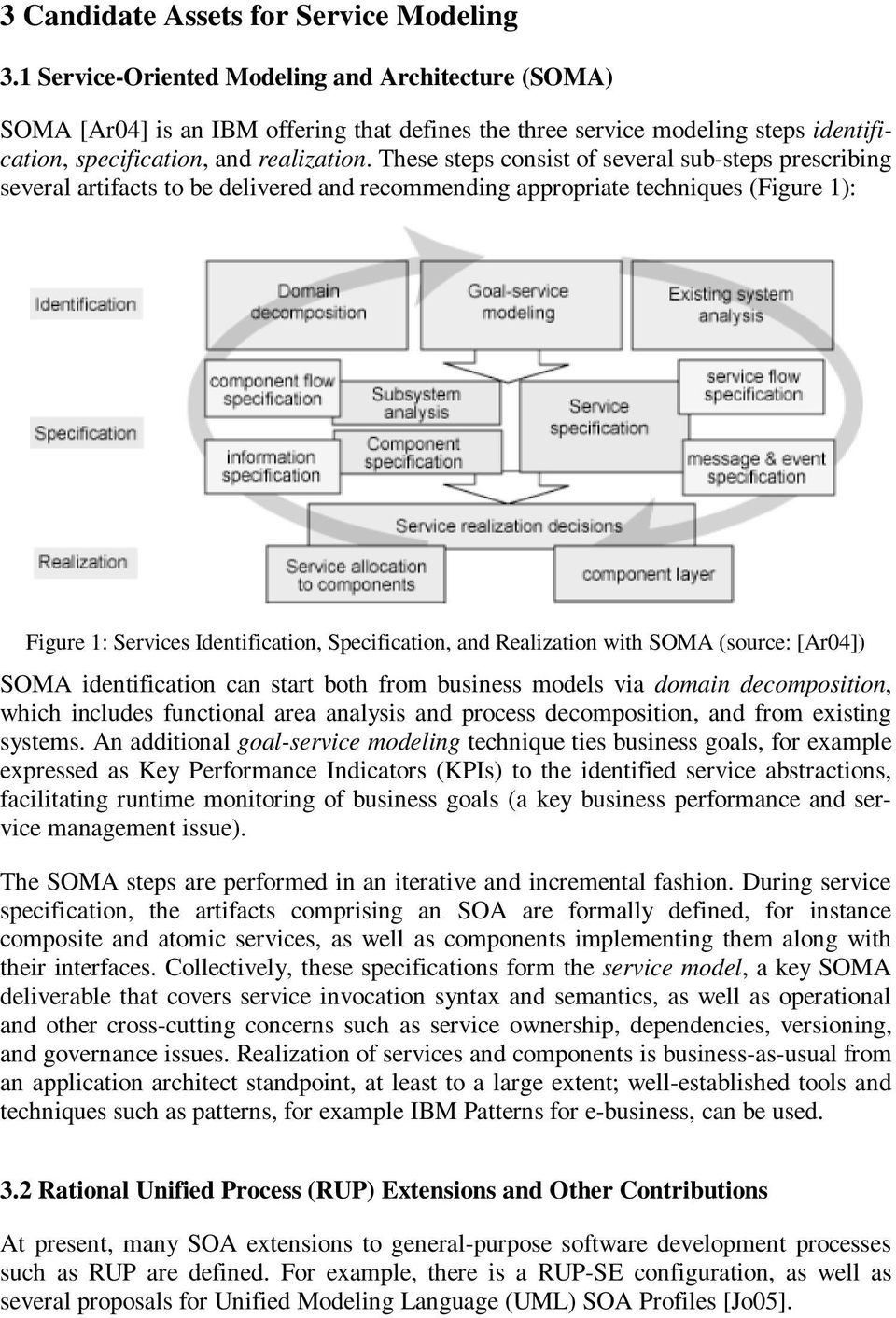
3 3 Candidate Assets for Service Modeling 3.1 Service-Oriented Modeling and Architecture (SOMA) SOMA [Ar04] is an IBM offering that defines the three service modeling steps identification, specification, and realization. These steps consist of several sub-steps prescribing several artifacts to be delivered and recommending appropriate techniques (Figure 1): Figure 1: Services Identification, Specification, and Realization with SOMA (source: [Ar04]) SOMA identification can start both from business models via domain decomposition, which includes functional area analysis and process decomposition, and from existing systems. An additional goal-service modeling technique ties business goals, for example expressed as Key Performance Indicators (KPIs) to the identified service abstractions, facilitating runtime monitoring of business goals (a key business performance and service management issue). The SOMA steps are performed in an iterative and incremental fashion. During service specification, the artifacts comprising an SOA are formally defined, for instance composite and atomic services, as well as components implementing them along with their interfaces. Collectively, these specifications form the service model, a key SOMA deliverable that covers service invocation syntax and semantics, as well as operational and other cross-cutting concerns such as service ownership, dependencies, versioning, and governance issues. Realization of services and components is business-as-usual from an application architect standpoint, at least to a large extent; well-established tools and techniques such as patterns, for example IBM Patterns for e-business, can be used. 3.2 Rational Unified Process (RUP) Extensions and Other Contributions At present, many SOA extensions to general-purpose software development processes such as RUP are defined. For example, there is a RUP-SE configuration, as well as several proposals for Unified Modeling Language (UML) SOA Profiles [Jo05].
4 The CBDI Forum has recently published a proposal for a SOA methodology as well [Sp05]. An additional option would be to leverage Web services specifications such as Web Services Description Language (WSDL) and WS-Policy as core service model. It is worth noting that best-of-breed or pick-and-choose adoption strategies are perfectly valid in our opinion service-oriented analysis and design should be viewed as a refinement and enhancement of existing general-purpose methodologies and techniques for the particular problem domain of crafting SOAs of quality, for example Business Process Modeling (BPM), Object-Oriented Analysis and Design (OOAD), and Enterprise Architecture (EA) frameworks. Consequently, a custom adoption of several or all of the above mentioned assets is likely to be chosen on projects, depending on factors such as project scope, existing modeling artefacts, and methods and techniques already in use. According to our experience, such a custom mix of BPM, OOAD, and EA covers large parts, but not all, of what is required for service-oriented analysis and design, which reemphasizes the need for methodologies like SOMA and complementary techniques such as a UML-centric service identification approach, one of which we outline next. 4 Identifying Candidate Services in UML Analysis Models One of the key aspects of SOA modeling is a layering of services [Ar04]. For instance, the objective of the SOMA identification step is to establish candidate services residing on these layers. Several complementary techniques can be employed to accomplish this. 4.1 Service Types on the Business Level Different viewpoints on services exist on the business and on the technical level. On the business level of abstraction, a SOA service is a business feature that is made available to customers, business partners or other interested parties of the organisation. This view of a service is completely decoupled from any technical aspects. Based on the value chain model [Po85] and the structure of business information systems [FS01], [Si99], different types of services can be identified. The various types of services differ with respect to the value they provide to the business. For instance, services offered on a value chain level provide higher value then services on the business process level. Value chain level services typically are coarser grained than services offered by lower level business processes. Coarse grained services tend to have a rather low reuse potential, which means that reuse potential and business value correlate negatively. 4.2 A UML Meta-Model to Identify Service Types Many businesses describe their business processes using UML [BRJ99] as modelling language. Today it is safe to say that UML has become an industry standard notation for software specification. Consequently, there is a need to describe precisely the procedure on how to identify candidate services within a given UML analysis model.
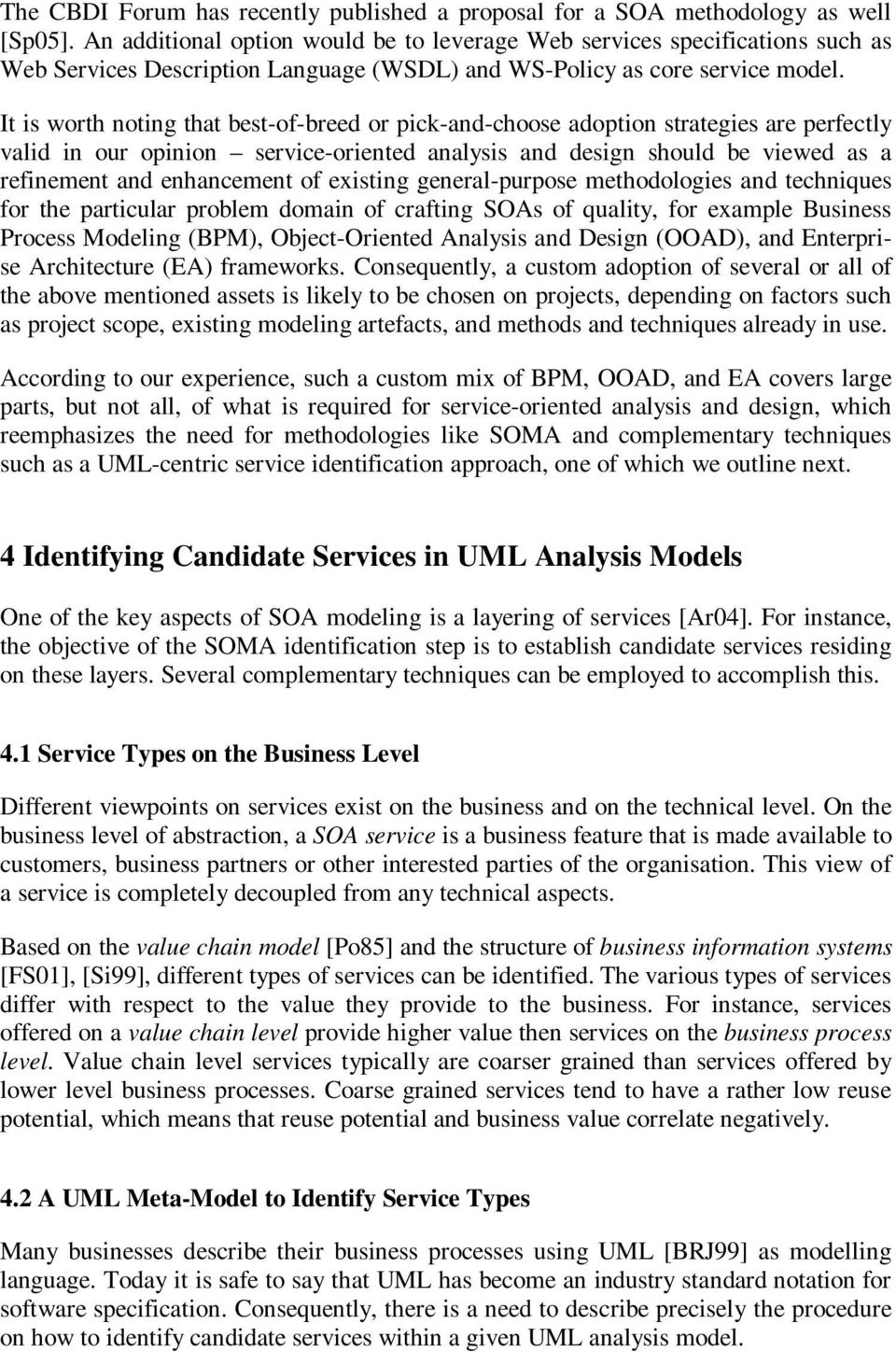
5 UML analysis models must adhere to a specific meta-model so that SOA services of different types can be identified. If they are in line with this meta-model, it is possible to derive the service model from the business process model and the use case model. Figure 2 illustrates these relationships and the central role of the integrated meta-model: Figure 2: Role of Meta-Model in Service Oriented Analysis Service-oriented analysis is the process that models business domains with the objective to create a SOA. On this level, the integrated meta-model describes the modeling rules within the three model views use case model, business process model and service model. The first two are UML-based models whereas the service model is a new artefact within SOMA (as outlined in Section 3). It is important that the meta-model integrates these different views, as concepts from the business process model and use case model have to be mapped against concepts in the service model. This integrated analysis-level meta-model can be used in EADI engagements during the SOMA identification step. For example, it can facilitate top-down domain decomposition. It can also be used to derive service candidates from any existing UML analysis model, for example during SOMA existing system analysis. In the latter case, this implies that the existing UML model must meet specific requirements. 5 Lessons Learned and Conclusions In summary, successful service modeling is as not as easy as it might appear at first glance; much more than simple drill-down from business-level process flow to IT realization is required, and many SOA-specific architectural decisions have to be taken. Almost all but the most trivial cases require a meet-in-the-middle modeling approach as opposed to a top-down process, because existing system reality constrains modeling choices, for example software packages used for Enterprise Resource Planning (ERP).

6 Related tools and techniques are under construction at present, and corresponding best practices are emerging. Methodologies such as SOMA and SOA-specific patterns can and should be leveraged to ensure repeatability, and support quality assurance and risk mitigation strategies. Due to space constraints, we could only give a brief overview of one SOA-specific modeling methodology and a related analysis technique; we refer the reader to [Ar04] for more information. Service modelling activities always have to be adapted to client and project environment; combining elements from several methodologies and techniques is a valid option. UML models and other architectural artefacts such as system context and component interaction diagrams can play a key role during analysis and early design. As an example, in this paper we outlined how a candidate service model can be derived from existing UML analysis artefacts such as use case and business process models. References [Ar04] Arsanjani, A.: Service-Oriented Modelling and Architecture (SOMA), IBM developer- Works 2004, [BCK98] Bass, L.; Clements, P.; Kazman, R.: Software Architecture in Practice, Addison Wesley, [Bo04] Booch, G.: InfoWorld interview 2004, [BRJ99] Booch, G.; Rumbaugh, J.; Jacobson, I.: The Unified Modeling Language User Guide, 1999 [FS01] Ferstl, O. K.; Sinz, E. J.: Grundlagen der Wirtschaftsinformatik, 2001 [Jo05] Johnston, S.: UML 2.0 Profile for Software Services, IBM developerworks 2005, [Po85] Porter, M.: Competitive Advantage, 1985 [Si99] Sinz, E. J.: Konstruktion von Informationssystemen. Bamberger Beiträge zur Wirtschaftsinformatik Nr. 53, Oktober 1999 [Sp05] Sprott, D.: On SOA Methodology, Editorial March 2005 CBDI Journal, [Za05] Zacharias, R.: Serviceorientierung: Der OO-König ist tot, es lebe der SOA-König!, OBJEKTSpektrum 02/2005 (in German) [Zi04] Zimmermann, O.; Milinski, M.; Craes, M.; Oellermann, F.: Second Generation Web Services-Oriented Architecture in Production in the Finance Industry, OOPSLA Conference Companion, 2004 [Zi05] Zimmermann, O.; Doubrovski, V.; Grundler, J.; Hogg, K.: Service-Oriented Architecture and Business Process Choreography in an Order Management Scenario, OOPSLA Conference Companion, 2005 [ZKG04] Zimmermann, O.; Krogdahl, P.; Gee, C.: Elements of Service-Oriented Analysis and Design, IBM developerworks 2004,
![Due to space constraints, we could only give a brief overview of one SOA-specific modeling methodology and a related analysis technique; we refer the reader to [Ar04] for more information.](/docs-images/52/13165414/images/page_6.jpg "Service modelling activities always have to be adapted to client and project environment; combining elements from several methodologies and techniques is a valid option.")
SOMA, RUP and RMC: the right combination for Service Oriented Architecture
 SOMA, RUP and RMC: the right combination for Service Oriented Architecture WebSphere User Group, Bedfont, 4th March, 2008 Keith Mantell Senior Solution Architect IBM Rational [email protected] March
A Comparison of SOA Methodologies Analysis & Design Phases
 202 A Comparison of SOA Methodologies Analysis & Design Phases Sandra SVANIDZAITĖ Institute of Mathematics and Informatics, Vilnius University Abstract. Service oriented computing is a new software engineering
Service-Oriented Architecture: Analysis, the Keys to Success!
 Service-Oriented Architecture: Analysis, the Keys to Success! Presented by: William F. Nazzaro CTO, Inc. [email protected] www.iconatg.com Introduction Service-Oriented Architecture is hot, but we seem
SOA: The missing link between Enterprise Architecture and Solution Architecture
 SOA: The missing link between Enterprise Architecture and Solution Architecture Jaidip Banerjee and Sohel Aziz Enterprise Architecture (EA) is increasingly being acknowledged as the way to maximize existing
Developing SOA solutions using IBM SOA Foundation
 Developing SOA solutions using IBM SOA Foundation Course materials may not be reproduced in whole or in part without the prior written permission of IBM. 4.0.3 4.0.3 Unit objectives After completing this
Applying SOA to OSS. for Telecommunications. IBM Software Group
 IBM Software Group Applying SOA to OSS for Telecommunications Kevin Twardus Manager of Industry Architecture and Standards IBM Software Group Communications Sector IBM Corporation The Details of SOA depends
Chapter 15. Web services development lifecycle
 Slide 15.1 nology Chapter 15 Web Services Development Lifecycle Web Service es: Princip ples & Tech Mike P. Papazoglou [email protected] Slide 15.2 Topics Web services development Properties of service development
Federal Enterprise Architecture and Service-Oriented Architecture
 Federal Enterprise Architecture and Service-Oriented Architecture Concepts and Synergies Melvin Greer Chief Strategist, SOA / Cloud Computing Certified Enterprise Architect Copyright August 19, 2010 2010
Sadržaj seminara: SOA Architecture. - SOA Business Challenges. - 1990s: Billion Dollar Lock-In. - Integration Tools. - Point-to-Point Approach
 Sadržaj seminara: SOA Architecture - SOA Business Challenges - 1990s: Billion Dollar Lock-In - Integration Tools - Point-to-Point Approach - New $200B Lock-In: Big Apps - Frozen Enterprise Asset Concept
Extend the value of your core business systems.
 Legacy systems renovation to SOA September 2006 Extend the value of your core business systems. Transforming legacy applications into an SOA framework Page 2 Contents 2 Unshackling your core business systems
Service Oriented Architecture Design and Development Method. Name: René van Donselaar. Universiteit Utrecht
 Service Oriented Architecture Design and Development Method René van Donselaar Universiteit Utrecht Notice of Originality I declare that this paper is my own work and that information derived from published
Service Oriented Architecture 1 COMPILED BY BJ
 Service Oriented Architecture 1 COMPILED BY BJ CHAPTER 9 Service Oriented architecture(soa) Defining SOA. Business value of SOA SOA characteristics. Concept of a service, Enterprise Service Bus (ESB) SOA
Business Process Management Enabled by SOA
 Business Process Management Enabled by SOA Jyväskylä 8.5.2007 Kimmo Kaskikallio IT Architect IBM Software Brands Five middleware product lines designed to work together Service-Oriented Architecture (SOA)
Government's Adoption of SOA and SOA Examples
 Government's Adoption of SOA and SOA Examples Presented by : Ajay Budhraja, Chief of Enterprise Services ME (Engg), MS (Management), PMP, CICM, CSM, ECM (Master) AIIM, ITIL-F Copyright 2008 Ajay Budhraja
Service Oriented Architecture (SOA) An Introduction
 Oriented Architecture (SOA) An Introduction Application Evolution Time Oriented Applications Monolithic Applications Mainframe Client / Server Distributed Applications DCE/RPC CORBA DCOM EJB s Messages
Introduction to Service Oriented Architectures (SOA)
 Introduction to Service Oriented Architectures (SOA) Responsible Institutions: ETHZ (Concept) ETHZ (Overall) ETHZ (Revision) http://www.eu-orchestra.org - Version from: 26.10.2007 1 Content 1. Introduction
Business-Driven Software Engineering Lecture 3 Foundations of Processes
 Business-Driven Software Engineering Lecture 3 Foundations of Processes Jochen Küster [email protected] Agenda Introduction and Background Process Modeling Foundations Activities and Process Models Summary
Designing an Enterprise Application Framework for Service-Oriented Architecture 1
 Designing an Enterprise Application Framework for Service-Oriented Architecture 1 Shyam Kumar Doddavula, Sandeep Karamongikar Abstract This article is an attempt to present an approach for transforming
Approach to Service Management
 Approach to Service Management In SOA Space Gopala Krishna Behara & Srikanth Inaganti Abstract SOA Management covers the Management and Monitoring of applications, services, processes, middleware, infrastructure,
A Software Development Platform for SOA
 A Software Development Platform for SOA Peter Eeles Executive IT Architect Rational Brand Architect for UK, Ireland and South Africa [email protected] 2004 IBM Corporation Agenda IBM Software Group
Service-Oriented Architecture and Software Engineering
 -Oriented Architecture and Software Engineering T-86.5165 Seminar on Enterprise Information Systems (2008) 1.4.2008 Characteristics of SOA The software resources in a SOA are represented as services based
SOA IN THE TELCO SECTOR
 SOA IN THE TELCO SECTOR In order to optimize costs and improve IT management, companies look with greater interest at business process management and optimization issues. The present reference model for
Software Development in the Large!
 Software Development in the Large! Peter Eeles Executive IT Architect, IBM [email protected] IBM Rational Software Development Conference 2007 2007 IBM Corporation Agenda IBM Rational Software Development
Requirement Management with the Rational Unified Process RUP practices to support Business Analyst s activities and links with BABoK
 IBM Software Group Requirement Management with the Rational Unified Process RUP practices to support Business Analyst s activities and links with BABoK Jean-Louis Maréchaux Software IT Specialist IBM Rational
Classical Software Life Cycle Models
 Classical Software Life Cycle Models SWEN 301 Trimester 1, 2015 Lecturer: Dr Hui Ma Engineering and Computer Science Lecture slides make use of material provided on the textbook's companion website Motivation
Five best practices for deploying a successful service-oriented architecture
 IBM Global Services April 2008 Five best practices for deploying a successful service-oriented architecture Leveraging lessons learned from the IBM Academy of Technology Executive Summary Today s innovative
2 (18) - SOFTWARE ARCHITECTURE Service Oriented Architecture - Sven Arne Andreasson - Computer Science and Engineering.
 Service Oriented Architecture Definition (1) Definitions Services Organizational Impact SOA principles Web services A service-oriented architecture is essentially a collection of services. These services
Guiding Principles for Modeling and Designing Reusable Services
 Guiding Principles for Modeling and Designing Reusable Services Max Dolgicer Managing Director International Systems Group, Inc. [email protected] http://www.isg-inc.com Agenda The changing notion
SOPLE-DE: An Approach to Design Service-Oriented Product Line Architectures
 SOPLE-DE: An Approach to Design -Oriented Product Line Architectures Flávio M. Medeiros, Eduardo S. de Almeida 2, and Silvio R.L. Meira Federal University of Pernambuco (UFPE) 2 Federal University of Bahia
CT30A8901 Chapter 10 SOA Delivery Strategies
 CT30A8901 Chapter 10 SOA Delivery Strategies Prof. Jari Porras Communications Software Laboratory Contents 10.1 SOA Delivery lifecycle phases 10.2 The top-down strategy 10.3 The bottom-up strategy 10.4
Architectural Decision Models as Micro-Methodology for Service-Oriented Analysis and Design
 Architectural Decision Models as Micro-Methodology for Service-Oriented Analysis and Design Olaf Zimmermann 1 Jana Koehler 1 Frank Leymann 2 1 IBM Research GmbH Zurich Research Laboratory, Säumerstrasse
The following is intended to outline our general product direction. It is intended for information purposes only, and may not be incorporated into
 The following is intended to outline our general product direction. It is intended for information purposes only, and may not be incorporated into any contract. It is not a commitment to deliver any material,
Prerequisites for Successful SOA Adoption
 George Feuerlicht University of Technology, Sydney [email protected] 1. INTRODUCTION The adoption of SOA (Service Oriented Architecture) has gained momentum in the past two years, and the predictions
Getting Started with Service- Oriented Architecture (SOA) Terminology
 Getting Started with - Oriented Architecture (SOA) Terminology Grace Lewis September 2010 -Oriented Architecture (SOA) is a way of designing, developing, deploying, and managing systems it is neither a
Open Source egovernment Reference Architecture Osera.modeldriven.org. Copyright 2006 Data Access Technologies, Inc. Slide 1
 Open Source egovernment Reference Architecture Osera.modeldriven.org Slide 1 Caveat OsEra and the Semantic Core is work in progress, not a ready to use capability Slide 2 OsEra What we will cover OsEra
Service Oriented Enterprise Architecture
 Service Oriented Enterprise Architecture Danny Greefhorst With the e-business explosion of the past few years corporations were, and still are, faced with the challenge of time to market more than ever
The IBM Rational Software Development Platform..Role focused tools help simplification via Separation of Concerns
 The IBM Rational Software Development Platform..Role focused tools help simplification via Separation of Concerns Analyst Architect Developer Tester Model the business & identify the business services
Agile Modeling and Design of Service-Oriented Component Architecture
 Agile Modeling and Design of Service-Oriented Component Architecture Zoran Stojanovic, Ajantha Dahanayake, Henk Sol Systems Engineering Group, Faculty of Technology, Policy and Management, Delft University
Service Oriented Architecture (SOA) Architecture, Governance, Standards and Technologies
 Service Oriented Architecture (SOA) Architecture, Governance, Standards and Technologies 3-day seminar Give Your Business the Competitive Edge SOA has rapidly seized the momentum and center stage because
SOA Myth or Reality??
 IBM TRAINING S04 SOA Myth or Reality Jaqui Lynch IBM Corporation 2007 SOA Myth or Reality?? Jaqui Lynch Mainline Information Systems Email [email protected] Session S04 http://www.circle4.com/papers/s04soa.pdf
10 Years of Hype Cycles - Do We Forget Knowledge?
 10 Years of Hype Cycles - Do We Forget Knowledge? Aaron McConnell Research Scientist IU-ATC School of Computing and Information Engineering University of Ulster at Coleraine Northern Ireland Aaron McConnell
Service-Oriented Architectures
 Architectures Computing & 2009-11-06 Architectures Computing & SERVICE-ORIENTED COMPUTING (SOC) A new computing paradigm revolving around the concept of software as a service Assumes that entire systems
Background: Business Value of Enterprise Architecture TOGAF Architectures and the Business Services Architecture
 Business Business Services Services and Enterprise and Enterprise This Workshop Two parts Background: Business Value of Enterprise TOGAF s and the Business Services We will use the key steps, methods and
Service Oriented Architectures Using DoDAF1
 1 Service Oriented Architectures Using DoDAF1 Huei-Wan Ang, Fatma Dandashi, Michael McFarren The Mitre Corporation The MITRE Corp. 7515 Colshire Dr. McLean, VA 22102 hwang(at)mitre.org, dandashi(at)mitre.org,
Business Process Management Tampereen Teknillinen Yliopisto
 Business Process Management Tampereen Teknillinen Yliopisto 31.10.2007 Kimmo Kaskikallio IT Architect IBM Software Group IBM SOA 25.10.2007 Kimmo Kaskikallio IT Architect IBM Software Group Service Oriented
Introduction to Service-Oriented Architecture for Business Analysts
 Introduction to Service-Oriented Architecture for Business Analysts This course will provide each participant with a high-level comprehensive overview of the Service- Oriented Architecture (SOA), emphasizing
Enhanced Funding Requirements: Seven Conditions and Standards
 Department of Health and Human Services Centers for Medicare & Medicaid Services Enhanced Funding Requirements: Seven Conditions and Standards Medicaid IT Supplement (MITS-11-01-v1.0) Version 1.0 April
IBM Information Management
 IBM Information Management January 2008 IBM Information Management software Enterprise Information Management, Enterprise Content Management, Master Data Management How Do They Fit Together An IBM Whitepaper
SOA Governance and the Service Lifecycle
 IBM SOA SOA Governance and the Service Lifecycle Naveen Sachdeva [email protected] IBM Software Group 2007 IBM Corporation IBM SOA Agenda What is SOA Governance? Why SOA Governance? Importance of SOA
Myths About Service-Oriented Architecture Demystifying SOA. producers can coexist, and still have no dependence on each other.
 WSJ: SOA Myths About Service-Oriented Architecture Demystifying SOA Service-oriented architecture (SOA) refers to an architectural solution that creates an environment in which services, service consumers,
A SYSTEMATIC APPROACH FOR COMPONENT-BASED SOFTWARE DEVELOPMENT
 A SYSTEMATIC APPROACH FOR COMPONENT-BASED SOFTWARE DEVELOPMENT Cléver Ricardo Guareis de Farias, Marten van Sinderen and Luís Ferreira Pires Centre for Telematics and Information Technology (CTIT) PO Box
Methods for the specification and verification of business processes MPB (6 cfu, 295AA)
 Methods for the specification and verification of business processes MPB (6 cfu, 295AA) Roberto Bruni http://www.di.unipi.it/~bruni 05 - Evolution 1 Object Overview of the evolution of (Information Systems
Business Modeling with UML
 Business Modeling with UML Hans-Erik Eriksson and Magnus Penker, Open Training Hans-Erik In order to keep up and be competitive, all companies Ericsson is and enterprises must assess the quality of their
Enterprise Application Designs In Relation to ERP and SOA
 Enterprise Application Designs In Relation to ERP and SOA DESIGNING ENTERPRICE APPLICATIONS HASITH D. YAGGAHAVITA 20 th MAY 2009 Table of Content 1 Introduction... 3 2 Patterns for Service Integration...
An Oracle White Paper October 2013. Maximize the Benefits of Oracle SOA Suite 11g with Oracle Service Bus
 An Oracle White Paper October 2013 Maximize the Benefits of Oracle SOA Suite 11g with Oracle Service Bus Maximize the Benefits of Oracle SOA Suite 11g with Oracle Service Bus Table of Contents Introduction...
SERVICE-ORIENTED MODELING FRAMEWORK (SOMF ) SERVICE-ORIENTED SOFTWARE ARCHITECTURE MODEL LANGUAGE SPECIFICATIONS
 SERVICE-ORIENTED MODELING FRAMEWORK (SOMF ) VERSION 2.1 SERVICE-ORIENTED SOFTWARE ARCHITECTURE MODEL LANGUAGE SPECIFICATIONS 1 TABLE OF CONTENTS INTRODUCTION... 3 About The Service-Oriented Modeling Framework
SOA and Cloud in practice - An Example Case Study
 SOA and Cloud in practice - An Example Case Study 2 nd RECOCAPE Event "Emerging Software Technologies: Trends & Challenges Nov. 14 th 2012 ITIDA, Smart Village, Giza, Egypt Agenda What is SOA? What is
Chap 1. Introduction to Software Architecture
 Chap 1. Introduction to Software Architecture 1. Introduction 2. IEEE Recommended Practice for Architecture Modeling 3. Architecture Description Language: the UML 4. The Rational Unified Process (RUP)
A UML 2 Profile for Business Process Modelling *
 A UML 2 Profile for Business Process Modelling * Beate List and Birgit Korherr Women s Postgraduate College for Internet Technologies Institute of Software Technology and Interactive Systems Vienna University
How to Model Aspect-Oriented Web Services
 How to Model Aspect-Oriented Web Services Guadalupe Ortiz Juan Hernández [email protected] [email protected] Quercus Software Engineering Group University of Extremadura Computer Science Department Pedro
Principles and Foundations of Web Services: An Holistic View (Technologies, Business Drivers, Models, Architectures and Standards)
 Principles and Foundations of Web Services: An Holistic View (Technologies, Business Drivers, Models, Architectures and Standards) Michael P. Papazoglou (INFOLAB/CRISM, Tilburg University, The Netherlands)
Enterprise SOA Strategy, Planning and Operations with Agile Techniques, Virtualization and Cloud Computing
 Enterprise SOA Strategy, Planning and Operations with Agile Techniques, Virtualization and Cloud Computing Presented by : Ajay Budhraja, Chief, Enterprise Services ME (Engg), MS (Mgmt), PMP, CICM, CSM,
TOGAF usage in outsourcing of software development
 Acta Informatica Pragensia 2(2), 2013, 68 76, DOI: 10.18267/j.aip.25 Section: Online: aip.vse.cz Peer-reviewed papers TOGAF usage in outsourcing of software development Aziz Ahmad Rais 1, Rudolf Pecinovsky
Service-Oriented Architecture and its Implications for Software Life Cycle Activities
 Service-Oriented Architecture and its Implications for Software Life Cycle Activities Grace A. Lewis Software Engineering Institute Integration of Software-Intensive Systems (ISIS) Initiative Agenda SOA:
Basic Unified Process: A Process for Small and Agile Projects
 Basic Unified Process: A Process for Small and Agile Projects Ricardo Balduino - Rational Unified Process Content Developer, IBM Introduction Small projects have different process needs than larger projects.
Realizing business flexibility through integrated SOA policy management.
 SOA policy management White paper April 2009 Realizing business flexibility through integrated How integrated management supports business flexibility, consistency and accountability John Falkl, distinguished
Patterns for Business Object Model Integration in Process-Driven and Service-Oriented Architectures
 Patterns for Business Object Model Integration in Process-Driven and Service-Oriented Architectures Carsten Hentrich IBM Business Consulting Services, SerCon GmbH c/o IBM Deutschland GmbH Hechtsheimer
OMG SOA Workshop - Burlingame Oct 16-19, 2006 Integrating BPM and SOA Using MDA A Case Study
 OMG SOA Workshop - Burlingame Oct 16-19, 2006 Integrating BPM and SOA Using MDA A Case Study Michael Guttman CTO, The Voyant Group [email protected] Overview of Voyant H.Q. West Chester, PA Business
Service Oriented Architecture Based Integration. Mike Rosen CTO, AZORA Technologies, Inc. [email protected]
 Service Oriented Architecture Based Integration Mike Rosen CTO, AZORA Technologies, Inc. [email protected] Mike Rosen ACCESS TO THE EXPERTS Consultant Chief Enterprise Architect for service and
Systematization of Requirements Definition for Software Development Processes with a Business Modeling Architecture
 Systematization of Requirements Definition for Software Development Processes with a Business Modeling Architecture Delmir de Azevedo Junior 1 and Renato de Campos 2 1 Petrobras University, Republican
Moving from EAI to SOA An Infosys Perspective
 Moving from EAI to SOA An Infosys Perspective Manas Kumar Sarkar Over years traditional Enterprise Application Integration (EAI) has provided its benefits in terms of solution re-use, application decoupling
Model Driven and Service Oriented Enterprise Integration---The Method, Framework and Platform
 Driven and Oriented Integration---The Method, Framework and Platform Shuangxi Huang, Yushun Fan Department of Automation, Tsinghua University, 100084 Beijing, P.R. China {huangsx, fanyus}@tsinghua.edu.cn
How to bridge the gap between business, IT and networks
 ericsson White paper Uen 284 23-3272 October 2015 How to bridge the gap between business, IT and networks APPLYING ENTERPRISE ARCHITECTURE PRINCIPLES TO ICT TRANSFORMATION A digital telco approach can
Generating Aspect Code from UML Models
 Generating Aspect Code from UML Models Iris Groher Siemens AG, CT SE 2 Otto-Hahn-Ring 6 81739 Munich, Germany [email protected] Stefan Schulze Siemens AG, CT SE 2 Otto-Hahn-Ring 6 81739 Munich,
Unlocking the Power of SOA with Business Process Modeling
 White Paper Unlocking the Power of SOA with Business Process Modeling Business solutions through information technology TM Entire contents 2006 by CGI Group Inc. All rights reserved. Reproduction of this
An Integrated Quality Assurance Framework for Specifying Business Information Systems
 An Integrated Quality Assurance Framework for Specifying Business Information Systems Frank Salger 1, Stefan Sauer 2, Gregor Engels 1,2 1 Capgemini sd&m AG, Carl-Wery-Str. 42, D-81739 München, Germany
SOA : To Do or Not to Do
 Abstract SOA : To Do or Not to Do Gopala Krishna Behara and K.T.R.B Sarma As business moves from Web services to SOA, adoption and successful implementations of SOA become more evident. The goal of SOA