
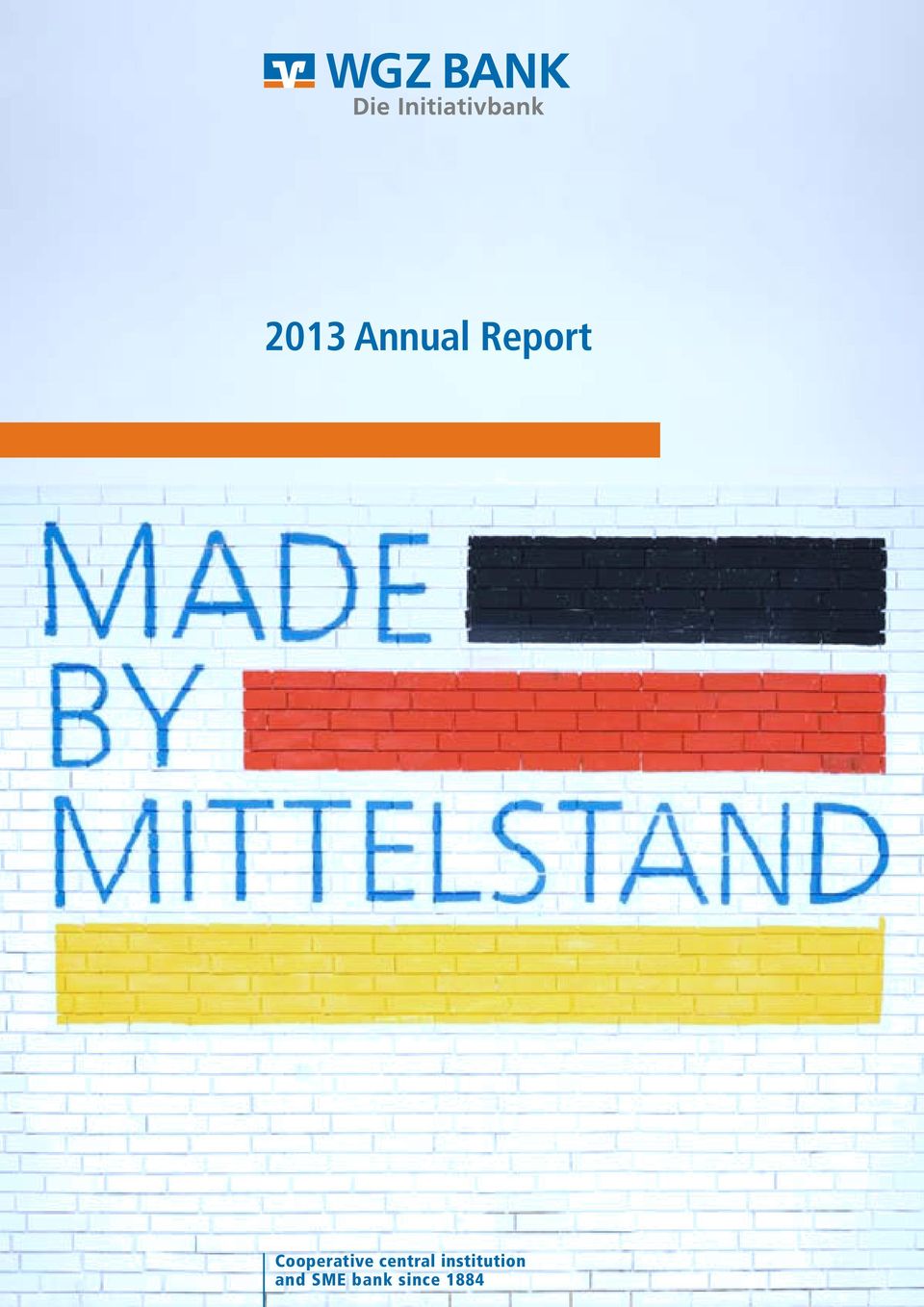
2013 Annual Report Cooperative central institution and SME bank since 1884
|
|
|
- Frederick Bradford
- 10 years ago
- Views:
Transcription
1 2013 Annual Report Cooperative central institution and SME bank since 1884
2 WGZ BANK Die Initiativbank WGZ BANK has been the central institution to what are now 192 local cooperative banks in Germany s Rhineland and Westphalia regions since In addition to its traditional functions as a central institution, it proactively complements the services of its member banks in domestic and international transactions. Beyond its role as a central institution, WGZ BANK has a tradition of working in collaboration with small and medium-sized enterprises (SMEs) in the Rhineland and Westphalia regions and acts as a reliable financial partner for businesses in this sector. As a modern corporate bank, it offers its clients a broad range of suitable products and services tailored to their specific needs. As a trading bank, WGZ BANK takes an active part in global trading of cash deposits, foreign currencies, and derivatives, buying and selling products available on the capital markets and in the business of issuing securities and undertaking syndicated transactions. It also offers customized products to partners on the capital markets (banks, institutions, and major corporate customers). In addition, WGZ BANK acts as a bridge to the international markets for its local cooperative banks, working with over 3,000 correspondent banks in every continent and thereby ensuring that foreign transactions are processed quickly and smoothly. WGZ BANK complements its innovative financial services offering via a range of subsidiary businesses, equity interests, and the cooperative financial network.

3 Key figures for WGZ BANK Dec. 31, Change million (HGB) (HGB) % 3) Assets Loans and advances to affiliated banks 15,231 15, other banks 5,852 6, customers 8,347 8, Securities 8,071 8, Trading securities 11,186 9,620-1, Long-term equity investments and shares in affiliated companies 2,608 2, Other assets Equity and liabilities Deposits from/amounts owed to affiliated banks 10,039 10, other banks 16,236 16, customers 4,551 6,148 1, Debt certificates including bonds 8,318 8, Trading securities 8,586 6,063-2,523-29,4 Subordinated liabilities Profit-sharing rights Fund for general banking risks Subscribed capital Reserves 1,411 1, Distributable profit Other liabilities Total assets / total equity and liabilities 51,635 51, Contingent liabilities 3,602 3, Volume of business 55,237 54, Derivatives notional amount 143, ,976-5, Tier 1 capital 2,907 2, Liable capital 2,394 2, Total capital ratio (%) Results of operations Net interest income Net fee and commission income Net trading income Other net operating income >100.0 Administrative expenses Operating profit before allowances for losses on loans and advances Net income from other business 1) <-100 Allowances for losses on loans and advances 2) Addition to fund for general banking risks Tax expense Net income for the year Cost/income ratio (%) ) Incl. gains on long-term equity investments and losses assumed under profit and loss transfer agreements. 2) Incl. change in hidden reserves. 3) Percentage discrepancies due to unrounded figures.

4 Key figures for the WGZ BANK Group Dec. 31, Change million (IFRS) (IFRS) % 3) Assets Loans and advances to affiliated banks 15,615 16, other banks 8,707 6,598-2, customers 37,483 37, Financial assets held for trading 9,960 8,199-1, Long-term equity investments portfolio and securities portfolio 21,969 20,615-1, Companies accounted for using the equity method 1, Other assets 1,338 1, Equity and liabilities Deposits from/amounts owed to affiliated banks 10,411 10, other banks 27,744 25,585-2, customers 20,128 21,911 1, Debt certificates including bonds 25,333 22,790-2, Financial liabilities held for trading 6,592 4,871-1, Subordinated capital Subscribed capital Reserves 2,348 2, Non-controlling interests Distributable profit attributable to the group Other liabilities 2,100 1, Total assets / total equity and liabilities 96,082 90,926-5, Contingent liabilities Volume of business 96,919 91,828-5, Derivatives notional amount 182, ,851 1, Tier 1 capital 2,970 3, Liable capital 2,387 2, Total capital ratio (%) Financial performance Net interest income Allowances for losses on loans and advances >100.0 Net fee and commission income Gains and losses arising on hedging transactions >100.0 Gains and losses on trading activities Gains and losses on investments >100.0 Profit/loss from companies accounted for using the equity method Administrative expenses Other net operating income Operating profit Tax expense Net profit for the year Cost/income ratio (%)

5 2013 Annual Report

6

7 3 Contents 2013 Annual Report Supervisory Board, Board of Managing Directors 4 Advisory Council 6 SME Initiative Group 10 Introduction by the Board of Managing Directors 12 Deutschland made by Mittelstand 17 Forward-looking HR activities 54 Sustainability at WGZ BANK: Thinking about tomorrow today 60 WGZ BANK Group management report of WGZ BANK and the WGZ BANK Group 80 Report of the Supervisory Board 142 WGZ BANK annual financial statements for Audit opinion (translation) 170 Responsibility statement 171 WGZ BANK consolidated financial statements for 2013 in accordance with International Financial Reporting Standards 173 Audit opinion (translation) 252 Responsibility statement 253 Allocation of responsibilities 254 Contact addresses 256

8 Supervisory Board Dieter Philipp Chairman Honorary President of the German Association of Skilled Trades, President of the Aachen Chamber of Skilled Trades Ludger Hünteler WGZ BANK Düsseldorf Manfred Jorris WGZ BANK Düsseldorf Franz Lipsmeier Deputy Chairman Bank Director, Chief Executive Officer of Volksbank Delbrück-Hövelhof eg Hövelhof Johannes Berens Bank Director (ret.) Lohmar Peter Bersch Bank Director, Chief Executive Officer of Volksbank Bitburg eg Bitburg Werner Böhnke (from June 18, 2013) Bank Director (ret.) Düsseldorf Hannelore Kurre (until June 18, 2013) WGZ BANK Düsseldorf Ina Maßmann (from June 18, 2013) WGZ BANK Düsseldorf Franz-Josef Möllers (until June 18, 2013) President of the Westphalia-Lippe Agricultural Association (ret.) Hörstel Manfred Wortmann (until June 18, 2013) Bank Director (ret.) Soest Martin Eul (from June 18, 2013) Bank Director, Chief Executive Officer of Dortmunder Volksbank eg Dortmund

9 Board of Managing Directors Hans-Bernd Wolberg (from June 18, 2013) Chief Executive Officer Werner Böhnke (until June 18, 2013) Chief Executive Officer Uwe Berghaus Dr. Christian Brauckmann Karl-Heinz Moll Michael Speth

10 Advisory Council Dieter Philipp Chairman Honorary President of the German Association of Skilled Trades, President of the Aachen Chamber of Skilled Trades Franz Lipsmeier Deputy Chairman Bank Director, Chief Executive Officer of Volksbank Delbrück-Hövelhof eg Hövelhof Markus Bäumler Bank Director, Member of the Board of Managing Directors of VR-Bank Hunsrück-Mosel eg Morbach Ralf W. Barkey Association Director, Chief Executive Officer of the Rhineland-Westphalia Cooperative Association Münster Christoph Bickmann Bank Director, Chief Executive Officer of Darlehnskasse Münster eg Münster Dr. Ulrich Bittihn Bank Director, Chief Executive Officer of Volksbank Paderborn-Höxter-Detmold eg Paderborn Leo Blum President of the Rhineland-Nassau Farmers and Wine-Growers Association Koblenz Konrad Breul Bank Director, Member of the Board of Managing Directors of Raiffeisenbank Neustadt eg Neustadt Gerhard Bröcker Bank Director, Member of the Board of Managing Directors of Vereinigte Volksbank eg Telgte Friedhelm Decker President of the Rhineland Agricultural Association Bonn Rolf Domikowsky Bank Director (ret.) Münster Rainer Eggert Bank Director, Chief Executive Officer of Volksbank Versmold eg Versmold Ulrich Ernsting Bank Director, Member of the Board of Managing Directors of Volksbank Mindener Land eg Minden

11 Christian Eschbach Bank Director, Member of the Board of Managing Directors of Volksbank Sauerland eg Arnsberg Franz-Josef Heidermann Bank Director, Member of the Board of Managing Directors of Volksbank Bocholt eg Bocholt Martin Eul (until June 18, 2013) Bank Director, Chief Executive Officer of Dortmunder Volksbank eg Dortmund Johannes Gastreich Bank Director, Chief Executive Officer of Raiffeisen-Bank Eschweiler eg Eschweiler Uwe Goldstein Bank Director, Spokesman of the Board of Managing Directors of Raiffeisenbank Frechen-Hürth eg Hürth Carsten Graaf Bank Director, Chief Executive Officer of Volksbank Meerbusch eg Meerbusch Dr. Clemens Große Frie Chief Executive Officer of AGRAVIS Raiffeisen AG Münster Andreas Hartmann (from June 18, 2013) Bank Director, Member of the Board of Managing Directors of Volksbank Greven eg Greven Ernst Henzl (until June 18, 2013) Bank Director (ret.) Datteln Hans-Josef Hilgers Chief Executive Officer of Raiffeisen Waren-Zentrale Rhein-Main eg Cologne Günter Hippchen Bank Director, Chief Executive Officer of Volksbank Beckum-Lippstadt eg Lippstadt Walter Hoff Bank Director, Member of the Board of Managing Directors of Raiffeisenbank Zeller Land eg Zell (Moselle) Rainer Jenniches Bank Director, Chief Executive Officer of VR-Bank Bonn eg Bonn Dr. Klaus Kalefeld Bank Director, Member of the Board of Managing Directors of Dortmunder Volksbank eg Dortmund

12 Advisory Council Norbert Kaufmann Bank Director, Spokesman of the Board of Managing Directors of Volksbank Siegerland eg Siegen Hans-Jürgen Lembicz Bank Director, Member of the Board of Managing Directors of Volksbank Euskirchen eg Euskirchen Gisela Krauss Bank Director, Member of the Board of Managing Directors of Raiffeisenbank Junkersdorf eg Cologne Roland Krebs Bank Director, Member of the Board of Managing Directors of Volksbank im Märkischen Kreis eg Lüdenscheid Birger Kriwet Bank Director, Member of the Board of Managing Directors of Vereinigte Volksbank eg Brakel Gerhard Kuhlemann Bank Director (ret.) Kalletal Heinrich Lages Bank Director, Chief Executive Officer of Volksbank Selm-Bork eg Selm Anno Lederer Director, Chief Executive Officer of GAD eg Münster Dr. Veit Luxem Bank Director, Chief Executive Officer of Volksbank Erkelenz eg Erkelenz Manfred Oeing (until June 18, 2013) Bank Director (ret.) Steinfurt Herbert Pfennig (from November 8, 2013) Bank Director, Spokesman of the Board of Managing Directors of Deutsche Apotheker- und Ärztebank eg Düsseldorf Jürgen Pütz Bank Director, Chief Executive Officer of Volksbank Bonn Rhein-Sieg eg Bonn Michael Radau Vice President of the NRW Retail Association, Chief Executive Officer of SuperBioMarkt AG Münster Paul Regenhardt Bank Director, Chief Executive Officer of Volksbank Elsen-Wewer-Borchen eg Paderborn

13 Jürgen Schmidt Bank Director, Member of the Board of Managing Directors of Volksbank Hunsrück-Nahe eg Simmern Dr. Ekkehard Thiesler Bank Director, Chief Executive Officer of Bank für Kirche und Diakonie eg KD-Bank Dortmund Elmar Schmitz Bank Director, Chief Executive Officer of Volksbank RheinAhrEifel eg Bad Neuenahr-Ahrweiler Carsten Schruck Member of the Board of Managing Directors of WESTFLEISCH eg Münster Jürgen Thurau (until June 18, 2013) Bank Director (ret.) Düsseldorf Helmut Vilmar Bank Director, Member of the Board of Managing Directors of Volksbank Wipperfürth-Lindlar eg Wipperfürth Manfred Stevermann (from June 18, 2013) Bank Director, Chief Executive Officer of Sparda-Bank West eg Düsseldorf Josef Stieger Bank Director, Chief Executive Officer of Volksbank Kempen-Grefrath eg Kempen Ludger Suttmeyer (from June 18, 2013) Bank Director, Member of the Board of Managing Directors of Volksbank eg Waltrop Holger Zitter Bank Director, Member of the Board of Managing Directors of Volksbank Emmerich-Rees eg Emmerich Peter Zurheide Bank Director, Member of the Board of Managing Directors of Bielefelder Volksbank eg Bielefeld

14 SME Initiative Group The long-standing partnership between WGZ BANK and its small and mediumsized corporate clients has given the bank an insight into the large number of similar challenges in which a common solution could benefit both clients and bank. For this reason, WGZ BANK has set up the SME Initiative Group with the aim of maintaining a regular dialog with selected, experienced high-profile businesspeople and academics from across the territory in which the bank operates. The SME Initiative Group currently has 16 members, who meet in a creative working environment to discuss practical issues and visionary ideas, share their experiences, and develop common positions. The latest suggestions and findings from both academic studies and day-to-day operations are always a feature of these discussions. These meetings are intended to have an outcome that can be used to make SMEs more aware of current challenges and help them to overcome the hurdles, thereby having a lasting impact.

15 Jürgen Abromeit Chief Executive Officer, INDUS Holding AG Dr. Matthias Becker Managing Director, Hüls AG & Co. KG Professor Dr. Wolfgang Berens Chair of business administration focusing on financial control, University of Münster Albert ten Brinke Managing Director, Ten Brinke Group Andreas Busacker Finance & Operations Director, Mondi Consumer Packaging International AG Klaus-Dieter Hölz Managing Director, Vulkan Grundstücksgesellschaft mbh & Co. KG Peter van Hüllen Chief Executive Officer, Georgsmarienhütte Holding GmbH Philipp Koecke Chief Financial Officer, SolarWorld AG Patrick Ludwig Deputy Chairman of the Board of Managing Directors, Rheinisch-Bergische Verlagsgesellschaft mbh Roland Mauss Chief Financial Officer, KMR Stainless AG and KMR Group Hans-Ewald Reinert Managing Director, H. & E. Reinert Westfälische Privat-Fleischerei GmbH Heinz-Peter Schlüter Chairman of the Supervisory Board, TRIMET ALUMINIUM SE and owner of the TRIMET Group Professor Dr. Günther Schuh Professor at RWTH Aachen University Ulrich Schümer Chief Executive Officer, Schmitz Cargobull AG Jürgen Tönsmeier Chairman of the Supervisory Board, Tönsmeier Dienstleistung GmbH & Co. KG Dr. Carsten Wilken Member of the Board of Managing Directors, Westfalen AG

16 12 Introduction by the Board of Managing Directors Dear reader, The past financial year, 2013, held a few surprises in store for banks some of them encouraging, a small number less so. Starting with the bright spots, economic conditions improved steadily over the course of the year, with the German economy demonstrating its resilience. The European sovereign debt crisis also gradually eased during the year. However, the structural problems at the root of this crisis have not yet been resolved; unfortunately, the unavoidable fiscal consolidation in Europe is still a long time coming. Trends in interest rates were anything but encouraging. Even at the start of 2013, interest rates had been at a historically low level, but they then fell even further during the year. The environment of low interest rates represents a huge challenge, particularly for banks closely linked to the real economy, and also because it is barely possible to achieve the margins necessary to mitigate risk over the long term. Equally challenging are the moves toward a further tightening of the regulatory framework, although these developments are not altogether surprising. It goes without saying that there can be no argument against an effective regulatory regime that aims to prevent the abuses that occurred in the past. What we still have to deal with, however, is a tide of regulation with no differentiation and no end in sight. Even though these developments were significant factors that shaped WGZ BANK s business environment in 2013, we did not let the adverse effects catch us on the wrong foot. We were once again able to achieve excellent results overall, notching up very creditable successes, particularly in our core businesses. We continued to consolidate the operating business involving member banks, corporate customers, capital market partners, and real estate customers. Generally, we significantly exceeded our 2013 budget figures, which had been based on the challenging conditions, without deviating from our riskconscious business policy.

17 Introduction by the Board of Managing Directors 13 We continue to focus first and foremost on our business with the local cooperative banks. The persistently low interest rates are an enormous challenge for them too. Against this background, we expanded our support to help our member banks manage their ownaccount investing activities so that they could make best use of the available investment options. We are also in the process of expanding our securities business services with a view to relieving the member banks of the growing burden of regulation. The switch to the standardized European payments processing system known as the Single Euro Payments Area (SEPA) on February 1, 2014 ran smoothly and on schedule at WGZ BANK. We had worked closely over a number of years with our direct customers and the customers of the local cooperative banks (in collaboration with the local cooperative banks themselves) to prepare for this change. We were relaxed about the EU Commission s last-minute decision to postpone the official date for the switch to August 1, 2014; the postponement did not compromise our careful preparatory work in any way. In the year under review, we continued to act as a reliable partner for our SME customers. The results from the latest customer survey reveal a high degree of satisfaction among our corporate customers with the services and expertise provided by WGZ BANK. The figures for corporate banking activities confirm these findings: In 2013, the bank attracted around 160 new corporate customers. The total volume of corporate lending rose by 250 million to the current level of 7.8 billion. The main areas of continued expansion were the provision of finance in the renewable energies segment and export finance activities. Development lending was another area of further growth; we worked together with our member banks to maintain our outstanding position in this market. The local cooperative banks in the Rhineland and Westphalia regions remain the undisputed leaders in the market for commercial development programs offered by Germany s KfW development bank. The total volume of development loans in which we acted as an intermediary went up by 4 percent to just under 13.5 billion.

18 14 Introduction by the Board of Managing Directors Our capital market partners were also again impressed by our capabilities. We continue to be among the top five banks involved in syndicated business with the German federal states. As far as custody business is concerned, we are widely regarded as a well-established player and partner for prestigious asset management companies. We are one of the few banks in Germany offering custodian banks services for both open-ended and closed-end real estate funds. In the future, we will continue to systematically exploit the potential business available to us as a custodian bank. In 2014, we will again be required to make considerable efforts to meet the demands of regulation. The agenda in 2014 will be dominated by the comprehensive assessment being conducted by the European Central Bank (ECB), a procedure that we must undergo along with other systemically important banks and banking groups in Europe. Later in the year, we of course aim to pass the stress tests carried out by the European Banking Authority (EBA) without difficulty. The responsibility for supervising WGZ Bank is provisionally scheduled to be handed over by the German banking regulator to the ECB in the autumn. It is not just the regulatory requirements on the horizon, but also the increasingly demanding market conditions that mean we must continuously improve our organization and IT infrastructure, and also our management tools. Without a highly motivated, capable workforce, we would not be able to meet the challenges we face. Even that is not enough. It is in our interests to continue to strengthen our capital base too, so that we are well prepared for any conceivable additional burdens even if no specific risk is immediately apparent. After starting 2014 with a Tier 1 capital ratio of 9.2 percent (based on the new standards), we will build up this ratio to more than 12 percent by the midpoint in the year. This will also be achieved with the help of the capital increase announced in 2013 and implemented at the beginning of The volume of this capital increase amounted to approximately 292 million and was placed in full within just a few weeks.

19 Introduction by the Board of Managing Directors 15 We owe our shareholders a particular debt of gratitude for this magnificent demonstration of confidence in the bank and for their backing throughout the whole of We would also like to thank the members of our Supervisory Board and our Advisory Council for their constructive cooperation and expert advice. In addition, our thanks go to our customers, who continued to place their trust in us in Not least, we would like to express our gratitude and appreciation to our employees. Their diligence, commitment, and creativity have been significant contributing factors in the success enjoyed by the entire group. To date, the cooperative financial network has come through the financial crisis practically unscathed. It has achieved this success on the basis of its proven business model, which is highly valued by its customers. However, we must not and will not rest on our laurels. A tighter regulatory regime, persistent cost pressures, and growing competition demand our complete attention. Our member banks and customers expect us to continue to impress them in the future based on performance, reliability, and trustworthiness. In 2014, it will again be our pleasure to pursue these aims with dedication and great energy. The Board of Managing Directors Hans-Bernd Wolberg Chief Executive Officer Uwe Berghaus Dr. Christian Brauckmann Karl-Heinz Moll Michael Speth

20

21
22 THE PICTURE IS CLEAR FROM THE FIGURES: MORE THAN 99 PERCENT OF ALL THE APPROX. 3.7 MILLION BUSINESSES IN GERMANY ARE SMALL OR MEDIUM-SIZED. FOUR OUT OF FIVE TRAINEES LEARN FOR LIFE IN SMALL AND MEDIUM-SIZED ENTERPRISES. SMALL AND MEDIUM- SIZED ENTERPRISES ACCOUNT FOR AROUND 60 PERCENT OF ALL GERMAN EMPLOYEES MORE THAN 15 MILLION PEOPLE. IN GERMANY, EVERY SECOND EURO IS GENERATED BY SMALL AND MEDIUM-SIZED ENTERPRISES. IN SHORT: GERMANY WOULD NOT BE GERMANY WITHOUT ITS STRONG MITTELSTAND. It is therefore at this point that we must offer our wholehearted thanks. The Deutschland made by Mittelstand campaign launched by the Volksbanken Raiffeisenbanken cooperative financial network at the beginning of 2013 and continued intensively in 2014 forms a major feature of this annual report. The Volksbanken Raiffeisenbanken cooperative financial network has been very closely associated with the small and medium-sized enterprise sector since the local cooperative banks were originally established. The German Mittelstand drives our business, we drive the Mittelstand and the Mittelstand also drives Germany. Good enough reason to express due gratitude to the businesspeople who take our country forward day after day and who, together with their firms and families, are often committed not only to managing their businesses but also to corporate social responsibility. The following pages present seven businesses and the people behind them in more detail. In all cases, the people are impressive individuals and have been valued clients of WGZ BANK for years or even decades. All of them are models in the way that they support jobs, uphold tradition, think innovatively and out of the box, demonstrate entrepreneurial spirit, stand up for values, and exploit the opportunities presented by a globalized world. For this, we say thank you!
23 * * JOB CREATION GLOBAL SUSTAINABILITY TRADITION INNOVATION COURAGE CUSTOMER PROXIMITY
24 The Board of Managing Directors of WGZ BANK says THANK YOU... From left to right: Karl-Heinz Moll Uwe Berghaus Hans-Bernd Wolberg Chief Executive Offi cer Michael Speth Dr. Christian Brauckmann
25
26 M ilk makes you strong Established in 1932 by a small group of farmers in Germany s Hunsrück hills, the Hochwald Group has grown to become one of the largest milk processors in Germany. Hochwald s success has been built on the back of well-known brands such as hochwald and Bärenmarke, an audacious strategy of internationalization, and with the energy of some 5,750 cooperative members and approximately 1,700 employees.
27 Axel Mueller, Head of Department, Mittelstand Corporate Customers, Rhineland-Palatinate, WGZ BANK Detlef Latka, Chief Financial Officer, Hochwald Foods GmbH (From left to right)
28 Would you like a bet? It is odds on that, if you open your refrigerator right now, you are bound to come across a product from Hochwald Foods GmbH. The name of the company from Thalfang am Erbeskopf in the Hunsrück region, a climatic health resort in the Rhineland-Palatinate district of Bernkastel-Wittlich, may only mean something to those in the know, but its products are literally on everyone s lips. Hochwald Foods is the company behind high-profile brands such as hochwald, Bärenmarke, Lünebest, and Glücksklee, and also operates private label business on behalf of supermarket chains and discounters. International activities represent a further significant cornerstone of the business. Hochwald Foods generates around 40 percent of its revenue outside Germany. REGIONAL MILK, GLOBAL SALES Milk has always been Hochwald s primary product. Several thousand farmers in various regions throughout Germany supply raw milk from the cow to milk processing plants located at the Thalfang head office, Hungen and Hünfeld in the state of Hessen, Erftstadt in the Rhineland, Kaiserslautern, Lüneburg, Weiding in Bavaria, and Bolsward in the Netherlands. Hochwald Foods then processes the huge quantity of milk involved more than two billion kilograms a year into dairy products such as UHT milk, condensed milk, aerosol whipped cream, dessert products, powdered milk for babies, spreads, and cheese. In addition, the sale of sausage and canned sausage meat products accounted for 8 percent of the revenue of 1.5 billion (including collaborative partnerships) in Hochwald Foods operates a meat processing facility in Meppen. However, the most notable feature of the business is not its brands or the vast production volumes, it is quite simply its cooperative structure, which remains unchanged to this day. The operating unit, Hochwald Foods GmbH, is a wholly-owned subsidiary of the cooperative Hochwald Milch eg, which has approximately 5,750 members almost all of them farmers. Practically every milk supplier is also a member of the cooperative.
29 Hochwald has a cooperative structure and its role is to process and market the raw milk supplied by the milk producers, adding the greatest possible value so that it is able to pay a competitive, aboveaverage farmgate milk price, says Detlef Latka, Chief Financial Officer of Hochwald Foods GmbH. The success of Hochwald Foods therefore creates jobs in dairies and for decades has also been safeguarding the incomes of thousands of independent farmers. THREE DECADES OF PARTNERSHIP Hochwald Foods is also protecting the incomes of German farmers with a policy of internationalization, which it has been pursuing determinedly for a number of years. The company now sells its products including products under brands such as Bonny, which are well-known outside Germany in what is now more than 100 countries around the globe. As Latka explains, Our subsidiary Hochwald Nederland B.V. in Bolsward means that we are well positioned internationally in terms of both marketing and production. Hochwald also has its own sales company in Dubai. Consumers in Arab countries have a particular taste for sweetened condensed milk a nourishing, long-lasting, and affordable indulgence. German consumers find it less palatable. Expansion, especially abroad, requires a great deal of capital. WGZ BANK has been our principal bank, and has supported us loyally, for more than 30 years, reports Latka. We process all payments, provide support in terms of guarantees, and are a key partner for finance requirements, explains his counterpart at the bank, Axel Mueller. He is a head of department and corporate customer relationship manager responsible for Hochwald Foods GmbH at the Koblenz branch of WGZ BANK. However, even in Germany, this highly proactive business is far from being content with its achievements so far. Evidence of this is the sum of around 60 million that the company has invested, with the support of WGZ BANK, in new facilities for demineralizing and drying whey at the Hünfeld site. In the future, it is planned to process the whey from the extended cheese processing plant internally. The ground-breaking ceremony for one of the largest capital investment projects in the history of the company took place in mid-december Hochwald Group in Þgures The Hochwald Group grew out of the Erbeskopf eg cooperative founded in 1932 in Thalfang, Rhineland- Palatinate. Consumers in more than 100 countries now appreciate the group s dairy and sausage products. In 2013, Hochwald took in more than 2.2 billion kilograms of raw milk supplied by almost 5,300 farmers across the group and turned it into milk and other dairy products. Annual revenue for the most recent year amounted to 1.5 billion, including collaborative partnerships. Hochwald Foods employed an average of around 1,700 employees in 2013.
30 Jörg Puzio, Corporate Customer Relationship Manager, WGZ BANK Andreas Möse, Member of the Management Board, ifm electronic gmbh Michael Marhofer, Chief Executive Officer, ifm electronic gmbh Thorsten Winkelsett, Head of Department, Mittelstand Corporate Customers, South Westphalia, WGZ BANK LO Made in Germany (From left to right) for the world
31 BAL When two German inventors joined forces at the end of the 1960s, they would never have guessed that 45 years later their creation would have turned into a leading global measurement technology manufacturer with some 4,800 employees, 115,000 customers around the world, and an unremitting passion for research and development. Today, the destiny of ifm electronic gmbh is in the hands of the founders sons.
32 Electronic components can nowadays only be produced at reasonable cost in the Far East or so the myth would have us believe. The reality is somewhat different: To date, ifm electronic gmbh has been producing nine out of ten of its products at its four plants in Germany two in Tettnang, one in Kressbronn, and one in Wasserburg, all four sites being close to Lake Constance. However, the company s engineering and industrial customers, who number around 115,000 in total, now come from more than 70 countries around the globe. The company, which is based in the completely renovated Glückaufhaus building in Essen and in Tettnang on Lake Constance, is a typical Mittelstand success story in Germany. When the two founders Robert Buck and Gerd Marhofer joined forces in 1969, they possessed little more than paper and pencil, a heap of good ideas, and a couple of prototypes that they had built themselves. also in apparently simple everyday equipment such as coffee machines. The key capital in the business is represented by the employees and their insatiable appetite for progress, emphasizes Michael Marhofer, Chief Executive Officer. The 45-year-old son of one of the founders now heads the company and is responsible for finance and sales. At the end of 2013, Marhofer was chosen as Entrepreneur of the Year in the capital goods industry category of awards presented by auditing and consulting firm Ernst & Young. It is one of the world s most prestigious awards for outstanding business performance. At his side and how could it be otherwise in this story of the Buck and Marhofer families is Martin Buck, born in 1970; together they form the second generation of ifm entrepreneurs. Martin Buck is primarily responsible for production and development. FROM ELEVATORS TO COFFEE MACHINES The very first product, known as efector, an inductive proximity switch, was a resounding success in Germany. Today, ifm (an abbreviation of Ingenieurs-gesellschaft für Messtechnik, measurement technology engineering company) is one of the major global players when it comes to precision measurement, control, or regulation in industrial or engineering applications. The sensors, systems, and control units produced by ifm are used in elevators, surveillance cameras, industrial robots, and CLOSE TO THE CUSTOMER For decades, ifm has succeeded in remaining well ahead of the competition based on a commitment to extensive R&D activities. More than 650 employees apply their brains to new ideas day in day out on behalf of the company. This commitment is reflected in the huge number of active patents, of which there are currently well over 600. ifm has also formed many partnerships with universities and research institutes. At least as important in order to be successful in fiercely competitive global markets is the sales team: ifm electronic proudly
33 WGZ BANK has been offering close support to ifm since the end of The collaboration began with a short-term line of credit but has now been stepped up considerably. What impresses us is ifm s entirely organic growth, its global reach, and its determination to take a chance on something new, says Jörg Puzio, corporate customer relationship manager with responsibility for ifm in the South Westphalia team at WGZ BANK. Today, WGZ BANK is supporting innovation-focused ifm with a long-term loan, finance for operating resources, and foreign exchange management services. The expertise and absolute dependability of WGZ BANK are impressive, according to Andreas Möse, a member of the Management Board at ifm and the first point of contact for the bank team. In just a few years of collaboration, the confidence has become so great that we are asked for our opinion even in regard to far-reaching strategic issues. We are delighted but at the same time it is a challenge for us, reports Puzio. In this case, two partners made for each other appear to have found each other. presents its capabilities year after year with one of the largest stands at the world s biggest industrial trade fair, the Hannover Messe. It has also been able to demonstrate its products to prominent political figures, such as the German chancellor and the Russian president in Around 1,150 ifm sales employees are on hand to offer help and advice to customers worldwide. Local experts are best acquainted with regional circumstances and ensure that customers are managed in a relationship that is both customized and based on trust. They put into practice the company s tagline: ifm electronic close to you. ifm electronic in Þgures ifm electronic gmbh was established in The company now has approximately 4,800 employees (including the head offi ce in Essen), of which around 1,800 are employed in the GmbH limited company itself. Worldwide, ifm supplies just under 115,000 customers in more than 70 countries with sensors, electronics systems, and control units. In 2012, ifm electronic generated gross revenue for the year of 617 million, and in million. The company has more than 600 active patents and, while operating as an international company, manufactures almost 90 percent of its high-tech products in Germany.
34 Improving life NACHHALTIG For more than 60 years, the INTERBODEN Group has been constructing residential and commercial real estate primarily in North Rhine-Westphalia with more than simply an economic purpose in mind. The Ratingen-based group headed by architect Dr. Reiner Götzen, which specializes in urban quarter development, at the same time feels that it has a long-term obligation to satisfy social and environmental objectives and acts accordingly. According to Dr. Reiner Götzen, who studied architecture at university, social cohesion is demonstrated very specifically by where and how people live. We have no wish to see segmentation among people or in towns or cities, and we deliberately avoid tailoring our range of residential properties precisely to the needs of just one target group, he says, explaining a core objective of the INTERBODEN Group. Götzen, a father of three, adds that no one wants to live just among his or her own kind. Since 1995, Götzen (who was born in 1951) has headed up the company founded by his father Heinrich in 1950.
35 Dr. Rainer Götzen, Managing Director, INTERBODEN Group Jörg Liersch, Real Estate Customer Relationship Manager, WGZ BANK (From left to right)
36 Most of the crucial advances that Reiner Götzen has brought about at INTERBODEN have been in the period since the turn of the millennium. In the last few years, the Ratingen-based real estate group has carried out pioneering projects, particularly in connection with residential construction including, for example, the conversion of the former St. Raphael convent in Aachen- Laurensberg into apartments, a supremely sublime combination of protected historical architecture and cutting-edge design incorporating energy efficiency. facelift. On three sites, it constructed 26 individual residential buildings comprising approximately 430 rented and owner-occupied units with a total of over 38,000 square meters of living space. Each individual ensemble is unique with its own architecture, materials, colors, and design, as you would normally find in structures that have evolved naturally. According to Götzen, whose hobbies include skiing and listening to live classical music, This development picks up on the colorful, creative, and diverse aspects of Düsseldorf- Pempelfort s inner-city location and transfers them to individual living spaces for urban lifestyle groups. Each facade reflects the variety of apartment layouts rolled into one from the traditional three-room apartment and maisonette to a loft-type open-plan design. In the urban developments constructed by the INTERBODEN Group, young families therefore feel just as much at home as affluent singles or older people delighted with the accessibility features in the houses and apartments. NO LIVING SPACE COMES OFF THE PEG In the case of Quartis Les Halles, INTERBODEN also gave one of the districts in the neighboring city of Düsseldorf a complete
37 RESIDENTS HAVE THEIR OWN APP The main idea, which was to use different types of construction and living space to attract a diverse range of occupiers from various age groups, has worked out well, sums up Götzen, six years after completion of the state-of-the-art neighborhood on the site of an old rail freight depot in the heart of Düsseldorf. Reiner Götzen s approach to managing the development also includes encouraging the residents to network among themselves. A key facility in Quartis Les Halles is the service point the main point of contact for all residents, offering a broad range of services. It is the hub of the neighborhood. Another service known as Animus, a kind of mini Facebook, has also been available for about two years now to owners and tenants in the buildings. They can use computers, tablets, or smartphones to access the service point and reserve cycles for a weekend excursion, report a minor fault in the underground parking doors, or even arrange to go out with the nice neighbors for an evening at the Italian round the corner. Putting themselves out and looking after others appears to be part of the Götzen family DNA. Even Reiner Götzen s wife, Helene, an Austrian by birth and a former aid worker, is involved. In 2006, together with her husband, she set up a charitable foundation with the name SORRISO, which means smile in Portuguese. The charity provides support for street children in Brazil. One of the factors that has always motivated Reiner Götzen, with all due regard to his own economic interests, has been the desire to embolden people and create Lebenswelten, living environments. That is why he set up the Institut für Lebenswelten in This research and development think tank designs building blocks for planning and marketing neighborhoods worth living in. COMMON VALUES Fair, honest, and peoplefocused this is Reiner Götzen s approach, and the approach he also expects from his business partners. WGZ BANK has supported the INTERBODEN Group since 1989 as the group has pursued its vision of creating new living environments. We share the same values. Quite simply, the chemistry at a personal level is right too, according to real estate expert Jörg Liersch, who for ten years has been the relationship manager with responsibility for INTERBODEN, a company in which all the staff, from secretary to boss, are on first-name terms. Liersch is also pleased to note that the third generation of Götzen managing directors is already warming up in preparation. Thomas Götzen, who is 32 years old and studied economics, specializing in real estate, has already been working in the family business for a number of months. INTERBODEN in Þgures In post-war Germany, where there was a huge need for new housing, Heinrich Götzen established his architectural practice of the same name in In 1966, the Þ rm became the real estate development company INTERBODEN. Today, the company is based in Ratingen and employs around 100 people. There are six pillars to the business: the architectural practice, a unit for project development and the sale of housing construction, project development for work, retail and themed environments, real estate management, customer services, and the Institut für Lebenswelten research institute. Revenue for the year in 2013 amounted to approximately 50 million.
38 Whether sachertorte, Yes cakes, stollen, or baumkuchen, the delights produced by Kuchenmeister GmbH have been enjoyed by generations of customers since the company was founded in 1884 the year in which WGZ BANK was also established. Despite all the changes in the world in the meantime, the family-managed business from Soest has always remained true to itself and that is precisely why it has been successful.
39 There are good customer appointments. There are very good customer appointments. And there are mouth-watering customer appointments. Corporate customer relationship manager Christoph Kuhlmann from the Münster branch of WGZ BANK always especially looks forward to his regular visits to Kuchenmeister GmbH in Soest. Visitors are always offered sweet tasty nibbles such as milk rolls, Yes cakes, slices of stollen, waffles, or pieces of baumkuchen, reports Kuhlmann, who has still managed to keep in shape despite his visits to main plant at Soest over many years. The business relationship with WGZ BANK s Münster branch goes back to Christoph Kuhlmann is only the second corporate customer relationship manager at WGZ BANK to have responsibility for Kuchenmeister demonstrating once again the high degree of continuity in the personnel responsible for advising small and mediumsized enterprises. Kuchenmeister also receives support from the local cooperative bank, Volksbank Hellweg eg, which takes care of the payments processing for the business. In addition, experts at VR Corporate Finance GmbH advise Kuchenmeister on strategic issues. THE WORLD S NUMBER ONE STOLLEN PRODUCER Kuchenmeister has long been a bakery empire, currently employing around 1,000 people at three sites in Germany. In 2013, it produced 90,000 tonnes of cake and pastry products and invested more than 28 million in new production buildings, plant, and machinery. Among other things, the company is the world s leading producer of stollen. Besides its own branded products, Kuchenmeister s output also includes private label products for leading discounters and supermarkets as well as products on behalf of major multinationals such as Dr. Oetker. It requires the best available machinery to produce ten thousand tonnes of cakes and pastries each year while meeting the strictest quality standards. WGZ BANK in collaboration with the company s principal bank, Volksbank Hellweg eg, stands ready to provide support for all expansion and replacement investment decisions. However, despite the advanced technology used in the plants and multi-shift operations, Kuchenmeister has to date avoided becoming an anonymous production line. Many master bakers and confectioners work in the plants. And the lettering sacher really is still added by hand to each of our cakes at the end of the production process, explains Managing Director and master industrial production manager Hans-Günter Trockels, who has led the family business since 1995, the fourth generation at the helm. He is supported by his brothers: Thomas, a graduate in business administration who is responsible for finance and financial planning & control, and Uwe, a skilled master confectioner responsible for purchasing the raw materials.
40 TRADI The three Trockels brothers have very different interests at a personal level one of them collects art, another prefers fast cars, and the third skiing downhill at breathtaking speed. Kuchenmeister in Þgures The small bakery from 1884 is now one of the leading international producers of cakes and pastries based in Germany, employing more than 1,000 people. The annual production of 90,000 tonnes of cakes and pastries requires several million eggs alone each day. The product range comprises more than 50 groups of items consisting of over 500 individual products. ONE FAMILY, ONE OBJECTIVE Nevertheless, they still share the common objective of ensuring that the business founded by their great-grandfather Julius Trockels as a small bakery in 1884 continues on its growth trajectory. Occasionally, their father Günter Trockels still comes by to the head office. His three sons are expecting great things in the future from the frozen cakes business and international markets. The company has been expanding abroad since the middle of the 1970s and holds equity investments in production companies outside Germany. Kuchenmeister is also a well-known brand far beyond Germany s borders. Ten years ago however, Kuchenmeister discovered that growth can sometimes be too fast. At that point, the business was growing at a rapid rate and its acquisitions included a number of production companies from Südzucker AG. Even in this difficult period, WGZ BANK remained firmly at our side. We won't forget that, emphasizes Thomas Trockels.
41 TION Thomas Trockels, Finance, Financial Planning and Control, Kuchenmeister GmbH Christoph Kuhlmann, Corporate Customer Relationship Manager, WGZ BANK Hans-Günter Trockels, Managing Director, Kuchenmeister GmbH (From left to right)
42
43 Small and medium-sized enterprises can become successful market leaders only if they have a Þ rm belief in themselves and in their own innovative strength. This is exactly the situation in the case of Mr. Wash Autoservice AG, which for the last 50 years has been applying advanced technology as well as blood, sweat, and tears to looking after that object of German devotion: the motor or car. Andreas Greiwe, Corporate Customer Relationship Manager, WGZ BANK Richard Enning, Chief Executive Officer, Mr. Wash Autoservice AG (From left to right)
44 INNO The most valuable item that Dr. Joseph Enning brought back home to Germany at the beginning of the 1960s following a number of years spent in the USA did not fit in his suitcase. It was the vision of a fully automated car wash. At that time, this required a fair amount of audacity and foresight. Germany was in the midst of the economic miracle and it was almost obligatory for the head of any German family to wash his own car himself, Saturday after Saturday, in his own parking space, on the street, or even nowadays a complete environmental no-no on the banks of a river. True to Say s law, a principle of classical economics according to which the creation and sale of any product itself generates demand for other products, Joseph Enning put his idea into practice. In 1964, he opened one of Germany s first automated car washes in Düsseldorf. When the young business took over three further car washes in Hamburg a few months later, this paved the way for today s Mr. Wash Autoservice AG, which centrally manages car wash facilities located throughout Germany. Arterial road is the favored location Currently, the company operates at more than 30 sites in prime locations throughout the country, mainly though in northern and western Germany. Its head office is situated in Essen. Although the AG in the business name may indicate a stock corporation, Mr. Wash has so far remained a family business. Half a century after it was founded, the company s destiny is now in the hands of the second generation, namely Chief Executive Officer Richard Enning. The corporate tagline is Good clean car good mood. The high-tech car washes with the yellow lettering on a red background are located on major arterial roads. Enning explains this choice of prime sites: If you want to wash cars, you must go where the cars are. You cannot expect them to come to you. Coffee for customers Other than being able to access sites quickly, Enning believes there are two further factors critical to the success of the business: top quality and rapid service. This applies not only to the traditional car wash part of the business, but also to
45 VATIV the interior valeting service that Mr. Wash offers its customers at major sites. Interior valeting on the conveyor always takes exactly twelve minutes. At the different activity points along the conveyor, Mr. Wash employees clean the windows, seats, and fittings, and smarten up the carpet. In the meantime, the driver can sit back and have a coffee. At most of the sites, the company also has its own discount filling station (tagline: No shop no wait! ) and offers a full oil change under the mac oil brand. Regular capital investment in new car washes, valeting facilities and filling stations, not to mention the refurbishment of existing sites, makes significant demands on funds. The capital requirements are a significant feature of our balance sheet and funding structure, in the words of Richard Enning. WGZ BANK has been supporting Mr. Wash since We have been extremely impressed by the company s successful business model, innovative capabilities, and the high-quality full-service offering at the car wash facilities, which are all in good locations. We are very happy to support the company in its well-thought-out expansion strategy, says Andreas Greiwe, corporate customer Mr. Wash AG in Þgures Established in 1964 and based in Essen, Mr. Wash now owns more than 30 car wash facilities throughout Germany. In the most recent figures, annual revenue amounted to just under 300 million, generated by around 800 employees. In purely statistical terms, at least one in every seven passenger cars registered in Germany passes through a car wash operated by Mr. Wash AG. That equates to more than six million vehicles a year. relationship manager with responsibility for Mr. Wash. Chief Executive Officer Enning appreciates both the regional proximity and the personal relationship offered by the bank. This also applies to his partners at VR Equitypartner GmbH, which is jointly owned by WGZ BANK and DZ BANK. Silent shareholding since 2011 WGZ BANK arranged the contact with VR Equitypartner when Mr. Wash needed followup financing at the end of 2011 to replace a previous standard mezzanine facility with another provider. Enning quickly decided in favor of the specially tailored silent shareholding offered by VR Equitypartner.
46 Wolfgang Callies, Managing Director, SWB Holding GmbH Bruno Mayer, Managing Director, Stahlwerke Bochum GmbH Michael Fiege, Corporate Customer Relationship Manager, South Westphalia team, WGZ BANK Stephan O. Mayer, Managing Director, SWB Holding GmbH (From left to right)
47 Not ready for the scrap heap
48 For Bruno Mayer, life as an entrepreneur only really began in earnest at the age of 65. In mid-2006, he plucked up courage and, together with Wolfgang Callies, took over Stahlwerke Bochum GmbH in a management buyout (MBO). Today, the business has established itself in a lucrative niche market. It supplies customers in more than 40 countries around the globe. Based on its specialized steel products, the company has bucked the trend in every crisis in the industry. Mayer s son Stephan has also been on board for some time now ensuring that the business will remain under family control in the future. Dynamic, tough and hard-wearing. The qualities that describe the product from Stahlwerke Bochum GmbH (SWB) could also be said to apply to the Managing Director: Bruno Mayer is an extremely engaging, extremely likeable, and also extremely persistent businessman. When he acquired all the SWB shares in July 2006 with business partner and financial expert Wolfgang Callies he was already 65 years old. At that age, other executives have long been planning their retirement or have already been on the golf course for a number of years. Not Bruno Mayer. He is now 72 and it was, in his own words, a matter close to my heart to get started again with the company that I had already led without interruption from the launch in 1988 as a salaried executive of ThyssenKrupp. GIVE ME MY PLANT BACK Otherwise, Mayer and Callies, now 49, would have had to stand on the sidelines and watch their company be sold and possibly steered into a very unsettled future. This is because the private equity firm that had come in during the autumn of 2004 following the sale by
49 ThyssenKrupp quickly decided in 2006 that it wanted to offload its 85.5 percent shareholding again. Callies and Mayer decided to gamble on assuming the full risk and opted for a second, all-encompassing management buyout. In 2004, they had only become semi-independent by acquiring 14.5 percent of the shares, but two years later they acquired a majority holding in their company. A short time later, Give me my plant back appeared as a headline in the brand eins business magazine, which was impressed by the persistence and perseverance of the two executives. In the 2006 bidding war, in which Callies and Mayer had to compete against numerous other prospective financial investors, other parties perhaps had more capital but the two executives at the head of the company had the benefit of the more personal and thus best case. Ultimately, they knew the business, each individual employee, and the customers back to front. To date, art and culture aficionado Mayer has been the strategist and the sales-oriented foreign minister for the company. In this limited industry sector comprising just a few hundred potential customers, contacts are everything. Mayer knows them all and they all know him. Far earlier than many of the competitors, Mayer and his partner Callies recognized just how lucrative the global business in recycled base materials would become. SWB has managed to escape from cyclical industry trends since 1988, the business has never been in the red. SWB develops and produces extremely robust perishable steel tools for use in reprocessing, crushing/ shredding, and recycling machinery. The blow bars produced in Bochum crush natural stone and building rubble, whereas the hammers, anvils, grills, and caps are used in automotive shredders with up to 10,000 bhp. All the tools have extreme crushing or shredding capability and a high degree of abrasion resistance. WGZ BANK, PARTNER FROM THE VERY BEGINNING Tough and resilient are the defining characteristics of SWB s steel products, mirroring the nature of the collaboration with WGZ BANK, which has evolved on the basis of trust. Since the first MBO in 2004 and above all since the huge gamble two years later, WGZ BANK has been SWB s loyal partner and principal bank. WGZ BANK financed both transactions and was the source of the company s borrowings amounting to millions of euros. VR Equitypartner GmbH also provided SWB with mezzanine capital amounting to 3 million. From the very first day, Bruno Mayer and Wolfgang Callies impressed us with their drive and their straightforward businesslike approach, says Michael Fiege, WGZ BANK s corporate customer relationship manager responsible for SWB from the beginning. The senior managers at the company meet with the bank s experts at least twice a year. A new participant in the meetings is Mayer s son Stephan, who is now also a shareholder. Stephan Mayer, who is in his mid- 40s and has inherited his father s entrepreneurial genes, joined the company five years ago and is responsible for the operating business. The company has been owned entirely by Mayer, Mayer, and Callies since June 30, 2013 the date on which they repaid the last installments relating to the borrowings and mezzanine capital. Nonetheless, we will remain loyal to our reliable bank, emphasizes Callies. As Mayer underlines, The collaboration is exemplary. WGZ BANK has supported SWB with finance for capital investment projects and operating resources, and has helped the company with a major land purchase; it also manages SWB s foreign payments and enters into interest-rate and currency hedging arrangements. SWB in Þgures Stahlwerke Bochum (SWB) was established in The company originally formed part of ThyssenKrupp but since 2006 has been owned entirely by the managing directors. In the past year, this German Mittelstand business with approximately 140 employees generated revenue of more than 30 million. The cast tools and components, manufactured from the hardest grade of steel and highly resistant to wear, are supplied to customers in more than 40 countries. Direct exports account for some 70 percent of output.
50 Everything under control Probably the most important task of any cooperative bank is to make lending available to small and medium-sized enterprises. However, in order to ensure that this does not give rise to any hidden risks that a local bank would be unable to bear, Volksbank Wipperfürth-Lindlar eg relies on the expertise and the special analysis and risk management services provided by WGZ BANK. In the Oberberg region, your word is still your word. And deals are still sealed with a handshake. Nowhere more so than in Wipperfürth. The town has a population of 23,000 and lies to the north-east of Cologne, half an hour away by car. Since March 19, 2012, the town has been granted the privilege of including the designation Hansestadt in its name belated acknowledgement of the centuries-old Hanseatic tradition of trade and commerce in the town, which lies on the river Wupper. However, the economic structure of Wipperfürth has seen considerable changes since the days of the old Hanseatic Conventions. Nowadays, the business environment comprises mainly small and medium-sized enterprises and businesses involved in skilled trades. Dominant industries are engineering, automotive supply, and plastics in addition to a buoyant local agricultural economy. Overall, there is a balanced mix of industries, according to Franz-Günter Fehling. Together with his fellow member of the Board of Managing Directors Helmut Vilmar, he heads up Volksbank Wipperfürth-Lindlar eg and also knows most of the local small and medium-sized businesses as customers of the bank. The bank s total assets at the end of 2013 amounted to 430 million. With 105 employees, four standard and five self-service branches, Volksbank Wipperfürth-Lindlar eg has a significant presence in the Oberberg region.
51 RISKY CONCENTRATIONS However, the lending business is not immune from risk, even in the Oberberg region, particularly in the case of loans to businesses in which the numbers quickly turn out to be higher than expected. The greatest risk in this case arises from any portion of the loan that is not covered by collateral. Then there is concentration risk, which arises when too much credit risk is concentrated in a small number of businesses or companies in a particular industry. Up to 2006, the members of the Board of Managing Directors of Volksbank Wipperfürth-Lindlar and their in-house experts managed the credit risk in their corporate banking business themselves as best they could using their own resources. Fehling and Vilmar immediately seized the opportunity when they heard about WGZ BANK s offer to support member banks with the management of credit risk. The recognition and management of credit risk is becoming increasingly important, especially for regionally-based banks, so that these banks do not take on risk beyond their risk-bearing capacity. Furthermore, there is considerably greater competition than there was ten or 15 years ago and the margins are correspondingly lower. Loans must be precisely costed and priced in line with the risk involved, says Vilmar. Currently, Volksbank Wipperfürth-Lindlar looks after approximately 1,400 corporate customers; it also has around 15,300 retail customers. MAJOR ASSISTANCE WHETHER SMALL OR LARGE In 2006, Volksbank Wipperfürth-Lindlar was one of the first member banks to opt for WGZ BANK s credit risk management tool. There are now around 35 banks that regularly arrange to have a credit risk report. Some local cooperative banks in the territory covered by WGZ BANK are increasingly using a customized credit portfolio analysis on a temporary basis for example, following a growth phase or a merger to optimize strategic bank management or to integrate the results into their overall strategic planning. Our analysis tool helps all banks to obtain a comprehensive overview of the key risk drivers and focus on managing the risk, explains Thomas Heyer, a senior manager responsible for advising on strategic bank management in the Member Banks division at WGZ BANK. Franz-Günter Fehling is full of praise for the tool: We would not have been able to do this with our limited in-house resources. There has been a significant improvement in the quality of credit reporting since Every three months, the senior managers at Volksbank Wipperfürth-Lindlar receive a 35-page report with detailed tables and charts showing all the trends and key figures from the bank s lending business, including a comparison with other local cooperative banks. Fehling and Vilmar say that the aspect of the reports providing the greatest degree of immediate insight is the credit value-at-risk: It enables them to identify the most significant risk drivers in the credit portfolio at a glance and can thus provide them with information that they can use in future lending and in the lending terms and conditions that they might then apply. SPARRING WITH EXTERNAL EXPERTS This service costs just 2,000 per quarter. It saves Volksbank Wipperfürth-Lindlar a huge amount of time and, what is more, provides the bank with risk reports compliant with the German Minimum Requirements for Risk Management (MaRisk) that can also be used for reporting to the Supervisory Board. The icing on the cake is that external experts at WGZ BANK can act as sparring partners for the bank. When we, as external experts, obtain an overview, it helps to make the analysis of a member bank s overall portfolio much more objective, according to Katja Jäger, an expert in strategic bank management analysis in the Member Banks division at WGZ BANK. Nevertheless, this service only ever involves an opinion, never an attempt to influence. The local bank alone is responsible for specifying the risk strategy.
52
53 Thomas Heyer, Strategic Bank Planning and Risk Management Advisor, WGZ BANK Frank Enneper, Head of Corporate Management, Volksbank Wipperfürth-Lindlar eg Franz-Günter Fehling, Member of the Board of Managing Directors, Volksbank Wipperfürth-Lindlar eg Helmut Vilmar, Member of the Board of Managing Directors, Volksbank Wipperfürth-Lindlar eg Katja Jäger, Strategic Bank Management Analyst, WGZ BANK (From left to right)
54 In addition to using the credit risk reports service, Volksbank Wipperfürth-Lindlar has for a number of years also relied on WGZ BANK expertise and tools to help it manage interest-rate risk and optimize its own portfolio. We also participate in almost every new tranche issued as part of the VR Circle risk-sharing arrangements, adds Fehling. The local cooperative banks can use VR Circle to achieve further reductions in credit concentration risk. The local cooperative banks each transfer a concentration of lending into a shared pot and then invest in this well-diversified pool of lending exposures to small and medium-sized enterprises. This relieves the pressure on the bank s own lines it reinforces the function as a principal bank and enables the bank to grant new corporate loans. However, the arrangements in this case simply amount to an artificial transfer of risk. They do not in any way constitute a sale of loans and advances. The original lending relationship remains unaffected and is still between the customer and the local cooperative bank concerned, offers WGZ BANK expert Heyer by way of clarification. Does better analysis of a bank s own lending policy combined with VR Circle lead to more loans for small and medium-sized enterprises? There is no doubt that this is true in the case of Volksbank Wipperfürth-Lindlar. Since 2006, the volume of lending granted by the bank has grown by 40 percent without any overall increase in the proportion of unsecured lending. Moreover, the number of loan defaults since 2006 has declined markedly, adds Helmut Vilmar delightedly. The success of Volksbank Wipperfürth-Lindlar based on smart software and astute transfer of loans and advances could lead to an assumption that, in lending business too, computers are turning out to be far superior to Franz-Günter Fehling, Member of the Board of Managing Directors, Volksbank Wipperfürth-Lindlar eg Herbert Kemmerich, Managing Director, Jokey Plastik Wipperfürth GmbH Helmut Vilmar, Member of the Board of Managing Directors, Volksbank Wipperfürth-Lindlar eg (From left to right) humans. Helmut Vilmar plays down any such thoughts: Over the next 20 to 30 years, people will continue to be a significant factor in the lending business; the smart tools will just be there to help in the decision-making. He believes that the key factors in lending decisions will continue to be both the figures and the people, specifically the personality and vision of the businesspeople involved. There is of course good reason why a key component of the mission statement at Volksbank Wipperfürth-Lindlar is focusing on people (Menschen im Mittelpunkt). Volksbank Wipperfürth- Lindlar eg in Þgures Total assets: 430 million in 2013 Employees: 105 Branches: 4 Self-service branches: 5 Corporate customers: 1,400 Retail customers: 15,300 Loans to these businesspeople at the focus of the bank s attention are contributing to the flourishing businesses of many of the successful small and mediumsized enterprises in the Oberberg region. One such enterprise is Jokey Plastik Wipperfürth GmbH, a family business that has been producing plastic packaging, primarily tubs and buckets, for the filling industry for more than 40 years. Jokey has more than 1,700 employees, 14 production facilities, and annual revenue of 420 million and is one of the global market leaders but has nevertheless always remained faithful to its roots in the Oberberg region. This is also reflected in its close connections with Volksbank Wipperfürth- Lindlar. Herbert Kemmerich, Chief Executive Officer in the senior management team of three, is full of praise: The thing about our principal bank that we especially appreciate is the bank s detailed understanding of our concerns, which forms part of the support that the bank provides.
55
56
57
58 54 Forward-looking HR activities The year under review proved to be a very challenging year for HR activities at WGZ BANK. We were faced with the task of satisfying the requirements arising from the remuneration regulations and coping with the enormous pressures caused by the limited implementation time available to design HR policies and processes. In addition, we have to continue the process of adjusting to more intensive control mechanisms and checks, and to more extensive reporting and notification requirements. their professional lives. We make use of the latest professional development and career options, and tailor types of work and working time models to the different stages of an employee s life. Specialist career path Following the completion of a successful piloting phase, we introduced a specialist career path in the bank from July 2013 onwards as an alternative to the management career path option. At the same time, we still had to fulfill our original HR division responsibilities, namely to organize the targeted professional development of employees, inspire them to carry out their duties, and continue to attract highly qualified specialists from the market to join WGZ BANK. We need employees with commitment, specialist skills, and qualifications we can count on. In this regard, expert knowledge is taking on increasing importance. For this reason, we specifically nurture high-potential employees in house and offer all employees the opportunity to expand and develop their knowledge during every stage of In 2012, we had focused particularly on managers and their professional development (basic skills and qualifications for group leaders, 270 degree feedback process for managers), whereas in the year under review we concentrated on the development of specialists without management responsibilities. The introduction of the specialist career path means that we can offer our employees a different path that they can follow in their professional and personal further development. In a management career path, the focus is on developing leadership and management skills, but the emphasis in the specialist career path is on
59 Human Resources Report 55 building up and consolidating specialist knowledge and methodological skills. The core objective is to offer our skilled employees an attractive alternative to a management career path and to work together with them for as long and as successfully as possible. Our hope is that this will give the bank a long-term advantage in the marketplace in terms of skills. The introduction of the specialist career path will be staggered over the individual departments, with completion scheduled for the end of degree feedback Leadership and management skills are a key factor in successful business performance. Executive management development is therefore a mainstay of our HR activities. One example of this is the 270 degree feedback system introduced in A total of 56 managers with approximately 470 employees for whom the managers were responsible passed through the system in 2012 and Following a manager self-assessment and third-party appraisal based on a comprehensive, structured questionnaire, the results are discussed in a joint team workshop with an external facilitator. The open, constructive dialog between the managers and their teams is a further step in our feedback culture and has been found to be extremely valuable by the participants to date. A further 105 managers and approximately 540 employees will take part in this feedback process in 2014 and Future challenges for HR development New regulatory conditions mean that HR activities need to be flexible. To meet the enhanced requirements, the main changes made by the bank are that HR development has been reorganized and the associated strategy refined. Even greater focus is now being placed on issues such as talent management, succession planning, and needs-based HR development for special target groups such as trainees, women, and older employees. Management tools such as employee appraisals are also becoming more important because they will take much more of a central role in the regulatory requirements for remuneration arrangements in the future.
60 56 Human Resources Report Investment in continuing professional development HR activities geared to stage of life Employees deliver first-rate performance when their tasks are compatible with their capabilities and they are given the opportunity to undertake professional development. In the year under review, a great number of employees once again took part in a variety of continuous professional development activities. We regularly offer training sessions in methodology and social skills. We organize specialist seminars in collaboration with particular departments, as required. Language courses and e-learning opportunities in various subjects complete the range of available options. The total expense on skills training in 2013 amounted to 885,000 (2012: 1,106,000). This decline was attributable to a drop in the use of expensive management training courses and greater emphasis on inhouse seminars. The average training expense per employee in 2013 therefore amounted to 695 (2012: 888). Employee needs change continuously depending on the stage that the employee has reached in his or her life and professional career. Employees bringing up small children or looking after a relative dependent on care have particular requirements for flexibility in their professional lives. An important aspect of this is a more flexible approach to working hours. The two sides company and employee must be accommodating with each other with regard to the desired working conditions, responsibilities, and development targets. Flexible working hours In the year under review, 190 employees equating to 15 percent of the workforce had part-time contracts. Remote working was an option used by 164 employees to enable them to accommodate professional and personal obligations; the number of employees in this category is rising. At the end of the year, 33 employees were on parental leave; the proportion accounted
61 Human Resources Report 57 for by fathers taking parental leave is increasing steadily. Based on detailed discussions prior to the birth and regular contact thereafter, we have been able to welcome the vast majority of new parents back to work within two years. Age management by the seminars include health, change, and relationship management. Our managers can also attend a Managing in a generational mix seminar to learn more about generation-related differences in people management and team behavior. Demographic change is already having a substantial impact on some of our HR activities. At the end of 2013, 378 of our 1,268 employees were 50 or older. This equates to 30 percent of the workforce. These experienced employees need to be motivated over the long term and offered specific professional development. It is also becoming increasingly important to design customized programs for the transition to retirement. As part of our age management approach, we offer our experienced key personnel aged 50 or above the opportunity to participate in special seminars known as PePe operated by the Rhineland- Westphalia Cooperative Academy (RWGA) to help the participants maintain and develop the skills they have acquired through experience. Key areas covered Once employees reach the age of 60 they are generally entitled to reduce their working hours to 80 percent, thereby freeing up an extra day in which they can pursue their personal interests. Longstanding employees in this age group are also for the first time given an opportunity, if they so wish, to devote four working days a month to a voluntary or charitable activity. From an employer s perspective, this gives us the opportunity to start succession planning as early as possible, thereby safeguarding the transfer of knowledge. Support for voluntary activities is also consistent with the spirit of our policy on sustainability and corporate social responsibility.
62 58 Human Resources Report Recruiting new employees Another of the challenges faced by our HR activities is to keep attention focused on young talent. Even though WGZ BANK is classified as a significant bank under the German Regulation Governing Remuneration at Institutions (InstitutsVergV), its profile as a specialized institution among the younger potential applicants in the jobs market could certainly be improved. In order to better position the bank as an employer of choice for the target groups of university graduates and school-leavers, it is critical to select the right approach channels and take into account the different motivations of these groups and their expectations of potential employers. More than ever before, the new generation of employees attaches great importance to personal development and a work-life balance. The bank has produced four new employee video presentations in which younger employees and a member of the Board of Managing Directors describe the different ways of joining WGZ BANK and the career paths on offer. The videos provide authentic insights into the working environment at the bank and offer a sense of what it means to be part of the WGZ BANK team. University marketing and trainee programs With a view to attracting the brightest minds, our marketing to universities has focused on specific activities at the universities in the territory covered by our business. For example, we took part in Absolventenkongress in Cologne (one of Germany s biggest graduate job fairs) and also in the recruitment fairs at universities in Düsseldorf, Münster, and Dortmund. The objective is not only to recruit graduates with appropriate skills and qualifications, but also to attract and retain suitable students at an early stage by offering internships or positions as temporary student assistants. In 2013, we recruited a total of 13 new general trainees. Eight general trainees came to the end of their training programs and were transferred to full employment contracts. In the case of the specialist trainee program, we were able to offer full employment contracts to five specialist trainees following completion of their on-the-job training; two new specialist trainees joined the bank.
63 Human Resources Report 59 Vocational training In 2013, eleven out of 1,170 applicants were given the chance to begin their vocational careers at WGZ BANK when they were offered a training place at the bank following the successful completion of their final school examinations. The 2013 training year group included six banking professionals, four students on our integrated study and work experience program, i.e. trainees who are simultaneously undertaking studies at the FOM University of Economics & Management in Düsseldorf and undergoing Chamber of Industry and Commerce banking training, and one IT specialist. Following a one-week familiarization phase, the trainees then pass through their mandatory and optional areas of activity. They receive optimum preparation for examinations with additional seminars at the Rhineland-Westphalia Cooperative Association (RWGV), RWGV Genokolleg (RWGV s cooperative business college), and at local chambers of industry and commerce. They also attend inhouse classes during the entire period of the training. Four years ago we set up a trainee mentoring system with the objective of building a relationship with future trainees before they even begin their training at WGZ BANK. Trainees in their second year make contact with the new trainees and organize initial familiarization meetings. Recruitment events for school-leavers From schoolroom to WGZ BANK: Once again in 2013, WGZ BANK presented itself as a potential employer to a large number of young people close to school-leaving age. In 2013, we jointly hosted a careers advice fair with Berufsnavigator GmbH at two Düsseldorf schools. Some 100 seniors from the Friedrich-Rückert-Gymnasium and the Theodor-Fliedner-Gymnasium made the most of the opportunity to obtain advice from experts on career options. WGZ BANK also had its own stand at the EINSTIEG fair in Cologne, the Parentum fair in Düsseldorf, and the Vocatium fair in Münster and Düsseldorf. Change in the number of employees The number of positions available to be filled at WGZ BANK fell from 100 in 2012 to 79 in This decrease was largely attributable to a decline in staff turnover. At the end of 2013, WGZ BANK had 1,078 full-time employees (end of 2012: 1,061) and 190 part-time employees (end of 2012: 182), including 32 trainees (end of 2012: 30). The total number of employees in the team was therefore 1,268.
64 60 Sustainability at WGZ BANK: Thinking about tomorrow today Sustainability has probably been one of the most frequently used terms over the last few years. This alone demonstrates the extent to which this issue has become socially relevant. No entity is in a better position or has greater justification for claiming that its activities are sustainable than German cooperatives, especially the local cooperative banks. From the very beginning, sustainability has also formed part of the cooperative DNA at WGZ BANK. In offering our advisory and financial services, we focus on the notion of shared, long-term success and sustainable relationships with our customers based on partnership and at the same time take into account social and environmental wellbeing as well as the particular interests of the people and businesses in the region concerned. For us, sustainability is a guiding force in all our activities and this was the case long before the concept assumed its present general social relevance. The corporate culture at WGZ BANK has been shaped by traditional principles of conduct. Principles such as fairness, transparency, personal responsibility, and helping people to help themselves never become outdated at all and, particularly as a consequence of the experiences over the last few years, have now enjoyed a renaissance among shareholders, customers, business partners, employees, potential job applicants, and the general public. We have always aimed to act in accordance with these sustainable principles. And we will continue to do so in the future. It is a requirement that we impose on every employee from the Chief Executive Officer to the trainee. We firmly believe that it is only possible to be successful and maintain a position in the market over the long term if all actions are honest and undertaken with the best of intentions in the interests of the customer. A position in which day-to-day banking practice is at all times both sustainable and irreproachable from an ethical perspective represents a noble aim and highly valued principle and at the same time a challenge that must be repeatedly faced afresh. In 2013, with a view to even greater transparency internally and vis-à-vis third parties, WGZ BANK therefore developed an ethics policy for all employees. The comprehensive code of ethics and conduct issued by WGZ BANK at the same time emphasizes the importance of the ten principles in the United Nations Global Compact covering human rights, labor standards, the environment, and the fight against corruption. As long ago as 2008, we became an active member of this
65 Sustainability 61 program, which is the world s foremost voluntary initiative in the area of corporate social responsibility. In the annual progress report required by the UN Global Compact, WGZ BANK provides information on its sustainability activities. Sustainability is not a static condition that, once achieved, is in place forevermore. Rather, we see it as a perpetual task. Particularly in the case of a long-established traditional bank like WGZ BANK, sustainability is not about headline-grabbing short-term effects, but about high-value processes of change conceived with a view to the long term. In addition, WGZ BANK increasingly treats sustainability as an integral component of its active management of reputational risk. For a systemically important bank like WGZ BANK, the bank s reputation is taking on an increasingly significant role in the dialog with shareholders, customers, business partners, the general public, and the staff. At the same time, as a bank s emphasis on the sustainability of its activities grows, so does the potential fall from grace. At WGZ BANK, reputation is an important intangible asset that must be specially protected, preserved, and gradually enhanced to safeguard ongoing profitability and thereby the continued existence of the group as a going concern. Sustainability policies and action plans help to protect the reputation of the bank.
66 62 Sustainability Sustainability is not an end in itself. This is demonstrated not least by trends in the market for sustainable investments, which has seen steady growth in interest from institutional and retail investors. Indicators used in decision-making by investors focusing on sustainability include various sustainability ratings. For some years now, the three independent sustainability rating agencies oekom research, Sustainalytics, and imug have been regularly assessing the sustainability performance of WGZ BANK. The WGZ BANK Group has been awarded prime status by oekom research, certifying that the bank has been adjudged to be above average in terms of environmental and corporate social responsibility. Sustainability ratings for WGZ BANK Independent sustainability rating agencies assess the extent to which the economic activities of businesses are sustainable. Three prestigious sustainability rating agencies oekom research, Sustainalytics, and imug regularly assess WGZ BANK and have judged the bank to have above-average social and environmental performance. Oekom corporate rating for the WGZ BANK Group: Prime investment status grade C Sustainalytics rating for WGZ BANK: Score of 72 imug rating for WGZ BANK : Mortgage Pfandbriefe: Positive Unsecured bonds: Neutral
67 Sustainability 63 The sections below explain the key areas of sustainability management at WGZ BANK in more detail. Sustainability-related financing and services It is especially in the design of its own products and services that WGZ BANK has the opportunity to act sustainably. For WGZ BANK, the key to sustainable activities lies in its core business, the provision of finance. Lending business For some time now, WGZ BANK has been following sustainability guidelines when making lending decisions. The sustainability guidelines were most recently updated in In accordance with these principles, we only extend loans when, in our view, there is a good balance between environmental, social, and financial factors. When we receive loan applications, our experts therefore check not only the long-term financial stability of the business model, the integrity of the shareholders or partners, and the management of the business, but also the possible environmental and socio-economic implications of the project concerned. In the year under review, the sustainability guidelines originally drawn up for the lending business were extended to cover investment business: since then, the standards set out in the sustainability guidelines have also been applied when reviewing all existing investments and when planning new exposures in ownaccount trading operations. Based on the ten principles in the UN Global Compact, we only invest if equal weight is given to the environmental, social, and financial factors in the potential investment. A project was initiated during the summer of 2013 to add further details to the sustainability guidelines for both the lending business and the investment business and to extend the scope of application for the guidelines. Finance for renewable energies In 2013, WGZ BANK continued the rapid expansion of its renewable energies business line. The value of the bank s overall energy business portfolio is heading toward 1 billion. WGZ BANK and its member banks are therefore a key funding provider for the switch to renewable energy sources in Germany. Despite political debate surrounding further development of the switch to
68 64 Sustainability renewable energy sources and, more specifically, reform of the German Renewable Energy Sources Act (EEG), WGZ BANK and its member banks in the region once again generated a significant volume of new business in this segment. In 2013, new finance commitments for renewable energies projects amounted to about 300 million, up by approximately 50 percent year on year. The majority of the new business involved wind farms. In the year under review, WGZ BANK financed 77 wind farms with a total capacity of 177 MW, compared with 38 wind farms in In the future, the 77 installations will supply around 88,000 households with electricity. As for photovoltaics, WGZ BANK provided funding for 27 new projects in 2013 with a total power output of 40.5 MW, equating to the electricity needs of just under 9,400 households. However, since the drop in the feed-in tariff in Germany at the end of 2012, this segment has become significantly less attractive to investors. The experience of the bank in 2013 in relation to the provision of project finance for renewable energies was universally good. There was not one single default and none is anticipated. The bank s customers also include proliferating energy cooperatives and we are helping the energy cooperatives in our territory, which number more than 100, by offering financial advice. Most of these cooperatives involve local people, thereby making a significant contribution to the implementation of Germany s switch to renewable energies at a local level. It is not only the number of renewable energies projects that has been rising significantly over the last few years, the size of the individual projects has been growing from year to year too. In this scenario, small individual cooperative financial institutions sometimes come up against their limits. In 2013, WGZ BANK therefore significantly stepped up its collaboration with the member banks to provide syndicated finance led by WGZ BANK. It is one of our key principles that local projects should continue to be financed in the future from local sources as far as possible. Syndicated finance is therefore put together not only within the Volksbanken Raiffeisenbanken cooperative financial network, but also with the involvement of other local banking groups at the project location concerned. This is an ideal way of incorporating the regional policy interests of local authorities and project initiators. We expect to see the strong demand for renewable energies funding continue in 2014, primarily for wind energy projects. Generally speaking, the business outlook
69 Sustainability 65 for the wind energy sector, and therefore also for the funding providers, looks very good for the next few years. Almost all local authorities in Germany s Rhineland and Westphalia regions are working on designating new sites. In our opinion, the key points of an EEG reform agreed by the German cabinet in January 2014 will not lead to a disproportionate contraction in demand. Increased demand for development loans to support energy efficiency The number of development loans brokered by WGZ BANK once again increased in 2013, driven primarily by the volume of energy efficiency and environmental projects. Besides companies planning to restructure their production processes to conserve resources and enhance energy efficiency, private individuals are now also increasingly tapping into development programs. Their aim is to renovate housing or owneroccupied apartments to incorporate energy efficiency or to plan new builds so that they are as energy-efficient as possible from the very beginning. The performance of WGZ BANK s development finance business in conjunction with the housing construction programs run by Germany s KfW development bank (the two programs focusing on energy-efficient renovation of buildings and construction of new buildings to the German Effizienzhaus or Passivhaus sustainability standards) was significantly better than in 2012 with the total number of applications reaching 9,870 (up by 11.4 percent) and total volume climbing to million (up by 19.2 percent). There was also a further year-on-year increase in the bank s business involving the two KfW environmental programs for companies (KfW-Umwelt (environment) and KfW-Energieeffizienz (energy efficiency): Total applications reached 337 (up by 7.7 percent) with a total volume of 54.1 million (up by 39.1 percent). Businesses use these loans to finance projects aimed at significantly improving the environmental position for example, by saving on materials or avoiding waste water or at substantially enhancing energy efficiency, for example by using better compressed air and pumping technology. The gradual reduction in the feed-in tariff for renewable energies resulted in a considerable drop in the demand for development products related to the financing of photovoltaic installations (KfW-Erneuerbare Energien Standard and Premium (renewable energies standard and premium). The 1,773 development loans
70 66 Sustainability brokered in the photovoltaics business equated to a contraction of 50 percent. The total volume of development lending in this segment declined by 22.4 percent to million. Nevertheless, in 2013, the cooperative banks in North Rhine-Westphalia were still able to maintain their position as leaders in the market for KfW s largest development programs for companies in terms of units: KfW-Unternehmerkredite (company loans) and KfW-Programme Erneuerbare Energien (funding for renewable energies). As at December 31, 2013, the share of the market for the KfW-Erneuerbare Energien programs was 48 percent. In the case of the KfW environmental development programs for businesses KfW-Umwelt and KfW-Energieeffizienz the cooperative financial network accounted for the highest share of the market in North Rhine- Westphalia at 63 percent and 47 percent respectively. The local cooperative banks also held a dominant 68 percent share of the market in North Rhine-Westphalia in KfW-Unternehmerkredite development programs, which support general capital investment by SMEs. These significant market shares are testimony to the expertise that the cooperative financial network is able to place at the disposal of its customers in this important area of business. Favorable financing terms through low interest rates on development loans Beyond the development loans for environmental projects, development programs run by the federal and state governments in Germany continue to prove highly attractive to investors. Investors are offered the option of fixing the current very low interest rates for extended periods. In this case, WGZ BANK and its member banks actively help businesspeople and retail borrowers select suitable development loan opportunities and process the relevant customer applications. Overall, WGZ BANK once again exceeded the excellent figures it had achieved for development loan applications in the previous year. The volume of applications for public-sector loans brokered and processed by the local cooperative banks in conjunction with WGZ BANK rose by 4.0 percent to almost 3.1 billion. The number of applications processed by WGZ BANK remained very high at 26,835, although this figure was slightly down year on year by 1.4 percent. The total volume of the development lending portfolio rose by 3.9 percent to 13.5 billion, a new record level. The bulk of this portfolio comprises loans for customers of our member banks; there are also development loans for
71 Sustainability 67 direct corporate customers of WGZ BANK. The trends in applications in 2013 can be broken down by commercial, agriculture, and housebuilding segments. The number of applications for commercial finance declined by 3.8 percent to 5,253 although the volume rose marginally by 0.7 percent to 1.59 billion. A significant proportion of these applications albeit with a downward trend continued to be accounted for by development subsidies related to renewable energies (photovoltaics, wind power, biomass, heat grids) and other environmentally-related capital investment. There was a sharp increase in the demand for development programs aimed at business start-ups. Specifically, the bank processed 1,651 applications for business start-up and consolidation support in 2013, a rise of 4.7 per cent on The volume amounted to million, up by 11.6 percent. A significant proportion was accounted for by the programs run by the regional banks NRW.BANK and Investment and Economic Development Bank of Rheinland-Pfalz (ISB). The fall in the use of development program subsidies from Landwirtschaftliche Rentenbank was largely attributable to the receding willingness to invest in renewable energies projects. Following sharp growth in the brokered development programs from Landwirtschaftliche Rentenbank in previous years, 2013 saw the number of applications fall by 17.5 percent to 2,846 and the total volume decrease by 2.4 percent to million. In contrast, the performance of the housebuilding development finance business with retail customers exceeded the level achieved in Although there was a significant fall in demand from retail customers for development subsidies for photovoltaic installations, this was more than offset by a sharp rise in the number of applications in the housing programs for energy-efficiency projects and in the KfW-Wohneigentumsprogramm (home ownership). The development programs for retail customers are particularly attractive because of their extremely low interest rates fixed over long periods. The cooperative banks in our territory brokered a total of 18,736 house-building development subsidy applications in 2013, equating to year-onyear growth of 2.4 percent. The total volume of these development programs rose by 12.4 percent to 1.07 billion. The objective of WGZ BANK is to sustain, and ideally continue to consolidate, the market-leading position and substantial degree of expertise held by the Volksbanken Raiffeisenbanken cooperative financial network in the key finance business of renewable energies. This is why WGZ BANK
72 68 Sustainability advises, trains, and provides information for its member banks. It also assists with the work carried out locally by the cooperative banks by supplying appropriate information material that can be used by advisors discussing development subsidies with businesses and retail customers. Three years ago, WGZ BANK also started to confer a development subsidy award known as the No. 1 VR Development Bank of the Year prize. This award is intended to recognize particularly successful activities in the development subsidy business. The prize is awarded to the three member banks (in their respective size categories) that have placed the most development subsidy business through WGZ BANK with the development banks. The winners of the development award in 2013 were Raiffeisenbank Kehrig eg, Volksbank Lüdinghausen-Olfen eg, and VR-Bank Kreis Steinfurt eg. This prize emphasizes the key role of the local cooperative banks as the first port of call for customers seeking tailored, affordable capital investment finance in all segments. Finance for social-purpose real estate The provision of finance for social-purpose real estate also forms part of the sustainable economic and social development activities of WGZ BANK. The huge demand in Germany for state-of-the-art retirement and care homes designed with the needs of the residents in mind, for assisted living facilities, for schools, universities, and childcare centers, and for hospitals, medical centers, and practices continues unabated. At the end of December 2013, WGZ BANK had made loan commitments with a total value of 558 million in support of the development of social-purpose real estate, a slight year-on-year decrease of 8 million or 1 percent. However, compared with the figure as at the end of December 2011, this still represented growth of 160 million or 40 percent.
73 Sustainability 69 Corporate environmental protection Further significant reduction in electricity consumption Environmental management within the bank also makes an active contribution to environmental protection to complement the approach taken in the finance business. In 2013, the aggregate outcome of many different individual measures implemented to save energy was a further significant reduction in electricity consumption the fourth year in a row this has been achieved. Consumption was cut by 1,084,986 kwh, which equates to a reduction of 14.0 percent. The bank was only able to attain this excellent outcome by ensuring that the planned measures were consistently implemented. The greatest savings were attributable to a number of intelligent building technology solutions. These included the replacement of existing water pumps by more efficient, electronically controlled pumps and the use of automated heating and ventilation control when windows are open. The cut in electricity consumption combined with the increased proportion of renewable energies in the energy mix used by the local utility company led to a reduction in CO 2 emissions of 15.4 percent or 575,116kg. Following the slight rise in the consumption of district heating in 2012, we were able to decrease consumption in 2013 by 55,000 kwh or 1.0 percent. As the weather has a significant impact on the consumption of district heating, a weather-based adjustment was applied. Following this adjustment, the year-on-year reduction amounted to 413,900 kwh or 7.6 percent. Water consumption in 2013 rose by 3,221m 3 or 7.5 percent compared with This increase was attributable to a number of factors including a greater cooling requirement in 2013 in connection with air conditioning systems. Some systems required fresh water for after-cooling requirements. To achieve a significant improvement in this regard, the circulating air cooling units and heat exchangers in Data-processing Center 2 will be replaced by more efficient components that use fewer resources in The air conditioning systems are a major source of water consumption but cannot be the sole cause of the rise in consumption. Further options for cutting water consumption are being drawn up based on an analysis of possible causes. As in the case of electricity consumption, paper consumption was also reduced for the fourth year in succession. In 2013, consumption was down by 196kg or 0.4 percent.
74 70 Sustainability In the year under review, WGZ BANK in collaboration with its energy supplier organized a free information event for employees on the subject of saving energy at home. The exceedingly positive feedback illustrates the extent of the need for information in this regard. At the same time, we were therefore able to help motivate employees to save energy both within the bank and at home. Positive impact from waste management The waste management system introduced in 2011 has resulted in a long-term reduction in the quantity of waste. An inspection of the business was carried out prior to the introduction of the system in order to highlight any weak points. This was followed by an analysis of the waste logistics system and a review of waste segregation arrangements. Various improvement ideas were drawn up and implemented in collaboration with external cleaning service providers. The volume of recyclable waste was cut for the third year in a row, the reduction in 2013 amounting to 3,120kg or 1.4 percent. Regular checks on the actual fill levels of non-recyclable waste containers helped to bring about a further year-on-year reduction of 36,398kg, a decrease of 25 percent. Other action planned WGZ BANK will continue to press ahead with optimizing the bank s internal environmental management system in the future. In 2014, we will be aiming to obtain recertification by ECOPROFIT. ECOPROFIT is a Germany-wide project to promote environmental management in companies and municipal establishments. WGZ BANK has been an active member of the City of Düsseldorf s ECOPROFIT Club since The purpose of the forum is to encourage businesses to share information. The objective is to accumulate and forward knowledge, and to develop ideas, particularly for cutting CO 2 emissions. Information relating to energy savings is also shared in external training sessions that have been regularly attended by the inhouse technicians at WGZ BANK since Further action plans to reduce energy consumption will be implemented in These include continuing to replace lamps with LED technology and using automated heating and ventilation control when windows are opened. One particularly fruitful course of action will be to replace circulating air cooling units and heat exchangers with more efficient components that use fewer resources. This will enable us to cut water consumption and electricity consumption at the same time.
75 Sustainability 71 Environmental data Unit Electricity consumption kwh 6,654,755 7,739,741 8,020,728 per employee kwh 5,588 6,499 6,678 District heating consumption kwh 5,260,500 5,315,500 4,918,000 per employee kwh 4,417 4,463 4,095 Water consumption m 3 46,392 43,171 37,723 per employee m Paper consumption kg 52,724 52,920 60,190 per employee kg Recyclable waste* kg 215, , ,255 per employee* kg Non-recyclable waste kg 109, , ,990 per employee kg CO2 emissions kg 3,147,699 3,722,815 3,857,970 per employee kg 2, , ,212.3 * The figure for recyclable waste in 2012 for the first time included the specific weight of the different waste components. The figures for prior years have been restated accordingly in the interests of improving the comparison.
76 72 Sustainability Corporate citizenship For many years, WGZ BANK has not only supported its home region economically, it has also been heavily involved in social projects and the arts as a source of sponsorship and donations. The bank made a total of 1.1 million available for corporate social responsibility activities in WGZ BANK also renewed its sponsorship of the Ruhr Piano Festival, which it has been supporting since Around 65 concerts are staged in the period from the beginning of May to the end of July each year, featuring the talents of top international pianists. Art The section below describes selected examples illustrating the diversity of WGZ BANK s corporate citizenship. Music The partnership with Deutsche Oper am Rhein, which has bases in both Düsseldorf and Duisburg, is an illustration of WGZ BANK s corporate philosophy of combining economic growth with good corporate citizenship. WGZ BANK has been a sponsor of Deutsche Oper am Rhein s opera company since the 2010/2011 season. In the 2012/2013 season, the bank doubled its support and extended it to cover Martin Schläpfer s Ballett am Rhein ballet company. At the end of 2013, the successful partnership was renewed with guaranteed sponsorship for a further three seasons up to For 29 years now, WGZ BANK has been building up a significant collection of contemporary art with particular links to its home region. The management of the collection, which is professionally organized and takes a long-term approach, focuses on nurturing young artists from colleges and academies of fine art in North Rhine-Westphalia. The strategic concept underlying WGZ BANK s art collection is to provide employees, the general public and, not least, future generations with an insight into contemporary art, especially the evolution of modern art since In the autumn of 2013, WGZ BANK hosted a sponsored exhibition with the title Aus freiem Sinn (Spontaneity), the bank s fifth such exhibition to date in the Contemporary Art series, which was launched in The exhibition, held in the convention hall at WGZ BANK in Düsseldorf, comprised a total of 100 works produced by 15 talented young artists
77 Sustainability 73 from the Academy of Fine Arts Münster. A comprehensive catalog was also available. For the first time, the exhibition featured two installations directly integrated into the exhibition location itself. The general public was given free access to the exhibition. WGZ BANK s sponsored exhibition of works from young artists is an annual event. Details about art at WGZ BANK are actively communicated both internally and outside the bank. The bank publishes a comprehensive book about its collection, issues catalogs, conducts guided tours, and organizes discussions about art. All publications and events are offered not only to the bank s employees but also to any guests and visitors interested in art. As in previous years, employees at WGZ BANK were offered the opportunity to attend a preview of the Aus freiem Sinn exhibition. On the day prior to the opening proper, employees were given exclusive access to the exhibition, with artists and curators in attendance. An accompanying program of events included further tours, special guided visits, and discussions. The exhibition also formed part of a master s degree course for students at the Center for International Arts Management (CIAM) in Cologne. The permanent collection at WGZ BANK is open to the public, although visitors must take a guided tour. A number of curator-led tours through the collection were held in 2013 for art lovers among our guests and visitors. WGZ BANK together with its art collection also supports exhibitions at well-established museums or organized by other supporters of the arts. One example is the Ludwig Museum in Cologne. The Ludwig Museum is compiling a catalog of paintings and other works by the artist Bernard Schultze, who died in Cologne in The art collection at WGZ BANK, which contains important paintings by Schultze, is being used as part of the comprehensive research work for the catalog, which the museum plans to publish in In the 1990s, the artist had personally hung his works at WGZ BANK in Münster and Düsseldorf. NRW initiative prize WGZ BANK and the North Rhine-Westphalia newspapers in the Funke media group (Westdeutsche Allgemeine Zeitung (WAZ), Neue Ruhr / Neue Rhein-Zeitung (NRZ), Westfälische Rundschau (WR), Westfalenpost (WP)) awarded the NRW initiative prize for the sixth time in With total prize money of 30,000, this award is aimed at predominantly family-run small and medium-sized enterprises in North Rhine-
78 74 Sustainability Westphalia. It is awarded in recognition of special achievements in three fields: renewable energies and environmental protection, creation of new jobs in North Rhine-Westphalia, and corporate citizenship in North Rhine-Westphalia. LED Linear GmbH, located in Neukirchen- Vluyn, took first place for creating numerous jobs in North Rhine-Westphalia. The business has grown rapidly in the last five years. The number of employees in Germany (subject to full social security contributions) has risen from two to 62; 25 new jobs were created in 2013 alone. New employees are always selected on the basis of potential and character. As a consequence, older and long-term unemployed applicants have also been offered permanent positions with the company. Second prize went to Gelsenkirchenbased Norres Schlauchtechnik GmbH for its exceptional level of corporate social responsibility. The Managing Director, Burkhard Mollen, actively promotes partnership between people with disabilities and able-bodied people. Norres employs over 200 people, including ten people with physical and mental disabilities who are employed in the production department. They are fully integrated into the production process and are able to work for the most part without assistance. Hagen-based KB Schmiedetechnik GmbH was awarded third prize, likewise for its outstanding corporate citizenship in North Rhine-Westphalia. The company s own day center for both disabled and ablebodied children and the adjacent therapy center look after the physiological and intellectual development of the children of the company s own employees and of employees at neighboring businesses. In addition, KB Schmiedetechnik employees themselves use the healthcare services offered by the therapy practice. Both the day center and the therapy center are also open to the public. Ruhr Initiative Group One of the objectives of the Ruhr Initiative Group is to improve economic and financial literacy among young people in the region. As an active member of the group, WGZ BANK has been promoting this initiative for a number of years. Once again in 2013, WGZ BANK supported the annual Dialog mit der Jugend events for schoolchildren with both financial assistance and the direct involvement of bank staff. In January 2013, around 60 young people from three high schools Gymnasium Märkische Schule Wattenscheid in Bochum, Carl-Humann Gymnasium in Essen, and Gesamtschule Fröndenberg met in Düsseldorf to participate in a discussion
79 Sustainability 75 of current economic and financial issues with members of the WGZ BANK Board of Managing Directors Dr. Christian Brauckmann and Michael Speth. project. The number of projects is now well in excess of 1,000. WGZ BANK Foundation sozialgenial In 2013, WGZ BANK extended its sponsorship agreement with the Aktive Bürgerschaft association for a further five years. This competence center for civic engagement is itself the sponsor of the initiative known as sozialgenial schoolchildren get involved. In this project, young people learn while still at school that social responsibility, personal initiative, and shared responsibility pay off. The initiative, which was launched in 2009, also promotes education and work opportunities for young people a major asset in an age when there is an increasing shortage of skilled labor in Germany. Underlying sozialgenial is the principle of service learning, which gives schoolchildren the opportunity to combine traditional studies with social responsibility. The sozialgenial initiative is now available in almost 15 percent of all schools in North Rhine-Westphalia for children in year five and above. Between the launch in 2009 and the end of 2013, around 30,000 schoolchildren at 500 schools in North Rhine-Westphalia were involved in the Since it was established in 2009, the WGZ BANK Foundation has set itself the objective of improving the economic, socio-political, and vocational education of young people as well as supporting training and professional development in economic sciences. In 2013, the WGZ BANK Foundation continued to focus on two specific areas of activity: the summer academies in the Rhineland and Westphalia regions and the award of the Foundation s own sponsorship prize. The summer academies held in the Warendorf and Neuwied districts in each case offer individual personal help to around 30 schoolchildren in need of special support. The help covers both school work and personal development. The aim of helping the children to help themselves is for them to pass their final school examinations and secure a place on a training or apprenticeship scheme. The noticeable feature of this initiative is the commitment of the young people involved and their willingness to give up three weeks of their summer holidays for the summer camp. Each participant then receives followup educational support for a period of one
80 76 Sustainability year. The WGZ BANK Foundation works in close partnership with Leuphana University in Lüneburg, government employment agencies in the region, and individual local member banks to deliver the project. The progress achieved in subjects such as mathematics and reading, and the personal commitment of the young people involved, is acknowledged with the award of personal certificates on completion of the academy. Based on the excellent level of collaboration between the project partners and on the successes achieved, the WGZ BANK Foundation will again support two summer academies in the Rhineland and Westphalia regions in In 2015, it is planned to switch the geographical location to continue to enhance the awareness of this successful strategy and to allow schoolchildren in other regions to enjoy the benefits of this outstanding program. In 2013, the WGZ BANK Foundation awarded its sponsorship prize for the third time, recognizing initiatives and ideas for projects to improve sociopolitical, economic, or vocational education and training. The prize was awarded in June 2013, and first place went to the Youth and Politics Association in Bielefeld for its Local politics and school initiative. The project was nominated by Bielefelder Volksbank eg. The association aims to get schoolchildren interested in local politics. The Focus on careers through school-based enterprises initiative from the high school Gemeinschaftshauptschule Lohmarer Strasse in Troisdorf was proposed by VR- Bank Rhein-Sieg eg and awarded second prize. Since 2006, the school has been developing a systematic concept based around a business run by schoolchildren and has incorporated this as a fixed component of the curriculum. Third place went to a project nominated by Volksbank Kleverland eg: The school magazine published by the Karl Kisters Realschule in Kleve-Kellen. A special prize was also awarded for the first time in This went to Collegium Augustinianum Gaesdonck in Goch for its initiative Schoolchildren for schoolchildren Gaesdonck school company. This project, which was proposed by Volksbank an der Niers eg, was particularly impressive because it successfully combined the design of a firm run by young people and a high degree of social responsibility. In awarding the sponsorship prize, the WGZ BANK Foundation aims not only to provide financial support but also to give a much higher public profile to the winning
81 Sustainability 77 initiatives and to the personal dedication of those involved in the projects. Raiffeisen Association Following the founding of the German Friedrich Wilhelm Raiffeisen Association in 2012, supported to a large degree by WGZ BANK, the association commenced operations during the year under review. Werner Böhnke, until mid-2013 chief executive officer of WGZ BANK, acts as chairman of the association, the objective of which is to safeguard the intellectual legacy of Friedrich Wilhelm Raiffeisen, promote the cooperative principle, and interpret the principle for the modern age. In a ceremony in May 2013 at Montabaur Castle marking the 125th anniversary of the death of the social reformer, the association paid tribute to Raiffeisen s achievements, the impact of which can still be seen today. The keynote address before 200 guests from the cooperative world, politics, academia, and business was given by Bundestag President Professor Norbert Lammert. In a subsequent panel discussion, the highly distinguished members of the panel chaired by Professor Theresia Theurl, Director of the Cooperative Movement Institute (IfG) at the University of Münster, discussed the importance of Raiffeisen s ideas in today s world. At the end of 2013, the Raiffeisen Association and the German Hermann Schulze-Delitzsch Association submitted a joint application in Rhineland-Palatinate (but on a cross-state basis) requesting that the cooperative principle be recognized by UNESCO as intangible cultural heritage. Former Bundestag President and German minister Professor Rita Süssmuth is sponsoring the application. Outlook WGZ BANK underlines its commitment to the model of sustainable development, which combines economic prosperity with social justice and the conservation of natural resources for the benefit of future generations. Sustainable development is only possible if economic entrepreneurship is combined with social and environmental responsibility. As a cooperative bank, we have from the very beginning taken into account the impact of our banking activities on the environment and society. In the future, we will continue to monitor our products, services, and underlying processes to assess their social and environmental implications and to introduce improvement measures if required. Furthermore, in our role as an active corporate citizen, we will also continue to offer support for society in our region.
82 WGZ BANK Group WGZ BANK has been the central institution to what are now 192 local cooperative banks in Germany s Rhineland and Westphalia regions since It also has a tradition as a partner to small and medium-sized enterprises in the Rhineland and Westphalia regions and offers tailored financial services to its corporate customers. For capital market partners (banks, institutional customers, major corporate customers), WGZ BANK is a service provider in the trading of cash deposits, foreign exchange, and derivatives, and also takes an active part in the business of issuing securities and undertaking syndicated transactions. In addition, WGZ BANK acts as a bridge to the international markets for its local cooperative banks. Branches WGZ BANK WGZ BANK WGZ BANK Düsseldorf Koblenz Münster WL BANK AG Westfälische Landschaft Bodenkreditbank is the largest subsidiary of WGZ BANK. As a highly competitive mortgage bank, it acts as a proactive partner to the local cooperative banks, the housing sector, and commercial investors, offering a comprehensive range of products for these customer groups. WL BANK is also the center of expertise for public-sector customers within the WGZ BANK Group. WGZ Immobilien + Treuhand GmbH is a whollyowned subsidiary of WGZ BANK. Its real estate services encompass advice and operational support for local authorities, the private sector, and companies in the cooperative financial network in the areas of site development, surveying, and the management and marketing of real estate. WGZ BANK Group business volume in 2013: 91.8 billion WGZ BANK Ireland plc, headquartered in Dublin, is a wholly-owned subsidiary of WGZ BANK. It is predominantly involved in international capital markets business. Member banks 2013 combined total assets: billion Number of members in 2013: 3.0 million
83 Domestic long-term equity investments Foreign long-term equity investments Cooperation partners Bausparkasse Schwäbisch Hall AG Börse Düsseldorf AG CardProcess GmbH Deutscher Genossenschafts-Verlag eg DZ BANK AG Deutsche Zentral-Genossenschaftsbank GAD eg Münchener Hypothekenbank eg R+V Versicherung AG Service-Direkt Telemarketing Verwaltungsgesellschaft mbh Union Investment Group VR-BankenService GmbH VR Corporate Finance GmbH VR Equitypartner GmbH VR ImmoConsult GmbH VR-LEASING AG VR Mittelstandskapital Unternehmensbeteiligungs AG VR-NetWorld GmbH VR VertriebsService GmbH DZ PRIVATBANK S.A. Strassen, Luxembourg Banco Espírito Santo S.A. Lisbon, Portugal Banco Popular Español Madrid, Spain Natixis Banques Populaires Caisses d Epargne Paris, France Fédération des caisses Desjardins du Québec Montreal, Canada Rabobank Nederland Utrecht, Netherlands Raiffeisen Bank International AG* Vienna, Austria * Strategic partnership with the RBI Group and its subsidiaries in central and eastern Europe
84 management report 2013 management report of WGZ BANK and the WGZ BANK Group I. Introduction Besides WGZ BANK AG Westdeutsche Genossenschafts-Zentralbank, Düsseldorf, the WGZ BANK Group consists of WL BANK AG Westfälische Landschaft Bodenkreditbank, Münster, and WGZ BANK Ireland plc, Dublin, plus two further subsidiaries. The main operating segments in which the WGZ BANK Group offers products and services are member banks, corporate customers, capital market partners & trading, and real estate customers. The parent company WGZ BANK and the member banks constitute the regional cooperative financial network. The member banks are the 192 local cooperative banks in North Rhine-Westphalia, Koblenz, and Trier. One of the main strategic objectives of WGZ BANK is promoting and increasing the competitiveness of the member banks, which are both its customers and its shareholders. WGZ BANK has branches at its Düsseldorf headquarters and in Koblenz and Münster, from where it serves the member banks and other customers. banks and to assist WGZ BANK in fulfilling its duties as set out in its Articles of Association. WGZ BANK s share capital remains unchanged at million. The shareholder structure of WGZ BANK as at December 31, 2013 was as follows: Member banks in the regional cooperative financial network % WGZ Beteiligungs GmbH & Co. KG 88.05% 9.70% Other shareholders 2.25% WGZ BANK AG Westdeutsche Genossenschafts- Zentralbank For the most part, the affiliated member banks have pooled their shareholdings in WGZ BANK in WGZ Beteiligungs GmbH & Co. KG, Düsseldorf. This equity investment company s sole purpose is the management and acquisition of WGZ BANK shares for the member banks. It is obliged to promote the commercial interests of its shareholders the member
85 2013 management report 81 II. Business activities WGZ BANK As an initiative-led institution, WGZ BANK sees itself through the prism of its cooperative banking remit to provide development finance as a driving force in the development of innovative products, services, and technological processes. WGZ BANK acts as the central institution for its affiliated local cooperative banks, providing traditional central institution functions in funding business, investment business, payments processing, corporate banking, securities business with customers, and the arrangement of public-sector development loans in its role as a decentralized partner. As before, the sustained phase of low interest rates along with further growth in regulatory requirements were the main challenges faced by the institutions associated with WGZ BANK in This was reflected in the business that they did together. Low interest rates resulted in a reduction in fixed-term deposits and funding deposits. However, the take-up of advisory services from WGZ BANK within the framework of strategic bank management increased significantly one of the reasons being the growth in regulatory requirements. The focus was on advice on optimized asset allocation and comprehensive advice on own-account investing. Besides the support provided with strategic bank management, there was also close cooperation in areas relevant to customer business, particularly in connection with the switch to the new European payments processing standard, the Single Euro Payments Area (SEPA). Handling 1.34 billion transactions in 2013, WGZ BANK is one of the largest providers of payments processing services in Germany. WGZ BANK gives member banks and corporate customers comprehensive, largely automated support based on optimized processes for the latest German, European, and global payments processing products. This product portfolio is complemented by a broad range of debit and credit cards and by documentary business. In 2012, WGZ BANK began to have its processes externally certified, with considerable success. This procedure was extended to cover other payments processing services in Demand remains strong for the service modules developed in recent years, which offer the local cooperative banks additional assistance with their front-office and back-office activities. Product innovations, such as electronic support for payment inquiries and enhanced functions for embargo and sanction monitoring, make it easier for the local cooperative banks to run their day-to-day business and comply with legal requirements. One of the challenges faced by the member banks is that the bank transfer and direct debit products used in Germany for payments processing must be fully
86 management report migrated to SEPA products by February 1, 2014 (with a transitional period until August 1, 2014). WGZ BANK is actively helping the member banks with the marketing of this migration by providing extensive communications materials. Representatives from WGZ BANK spoke at approximately 400 customer events and employee training courses, receiving extremely positive feedback thanks to their professional presentations geared to the individual target group. The IT systems for processing SEPA transactions, which were developed in close cooperation with GAD, successfully went live a few years ago. WGZ BANK is also involved in a pilot project to trial the use of cellphones to pay for goods in stores (mpayment) in collaboration with a large local cooperative bank and DG VERLAG. The project is helping us to pinpoint the parameters that are the key to success in this highly promising market. This information will benefit all local cooperative banks in the future. As far as the corporate customer business is concerned, companies in Germany are continuing to maintain the good business performance they have delivered in recent years thanks to increasing demand from abroad, a thriving domestic economy and, consequently, generally stable utilization of production capacity. They have made further improvements to their profitability and balance sheets. Nevertheless, they are still reluctant to invest in expanding their business. The main areas of capital expenditure are measures to improve the use of resources, such as rationalization of production and energy management. Spending on research and development remains at a high level, as does investment in continuing professional development for staff. There was a decline in demand for funding particularly for funding from banks during the reporting year. However, WGZ BANK and its member banks together managed to increase their volume of business and market share again. The positive trend in the development lending business over recent years continued in The volume of applications for publicsector loans brokered and processed by the local cooperative banks in conjunction with WGZ BANK rose by 4.0 percent to just short of 3.1 billion. The number of applications remained at a high level (26,835 processed applications in WGZ BANK s territory), although this represented a small yearon-year decrease of 1.4 percent. The lion s share of the loans arranged were taken out for the purpose of energy efficiency and environmental measures by companies but also by private individuals in relation to house building. Investors made use of the extremely favorable interest rates offered by development programs not only those related to the environment in order to secure good terms over a longer period.
87 2013 management report 83 WGZ BANK actively helps its member banks with advising on and processing applications for government-funded financial assistance in order to identify the best products for investors from among the development loans available. The strong levels of market share underline how frequently development loan products are discussed with customers and are included in the finance for capital expenditure projects. The Volksbanken Raiffeisenbanken cooperative financial network is, for example, the market leader in North Rhine-Westphalia in KfW s largest development programs for companies in terms of units: KfW-Unternehmerkredite (company loans) and KfW-Programme Erneuerbare Energien (funding for renewable energies). WGZ BANK s development lending volume grew by 3.9 percent to 13.5 billion in There were no major changes to development programs at the start of the year. However, the new German government will adopt radical measures this year in connection with the revision of the German Renewable Energy Sources Act (EEG) that are highly likely to impact on development programs in the banking sector. Issues relating to the switch to renewable energy sources are expected to remain a focus of public-sector development loans in the future. Very low rates of return in the bond markets meant that equity segments did particularly well. There was a noticeable upturn in equity trading activity. This was mainly due to the strong performance of the DAX 30 index, which gained approximately 23 percent last year. The trading activities of WGZ BANK were again successful in all relevant markets in WGZ BANK investment certificates, which offer adequate returns with a manageable level of risk, did very well as an alternative to investing in bonds or investing directly in equities and were up by 70 percent compared with Across Germany as a whole, WGZ BANK s issues of express investment certificates were ranked second. On currency markets, the euro proved more stable than most other currencies in 2013 owing to increasingly optimistic economic forecasts. WGZ BANK was also very active in this area, acting as a reliable partner to its customers and member banks in the currency markets. The volatility of the interest-rate market decreased last year. Given the interest-rate situation, the volume of new bond issues only remained stable in the corporate segment. There was a decline in new issues of both bank bonds and covered bonds.
88 management report WGZ BANK provided ongoing support to the cooperative banks in their securities business with customers, helping them with their competitive positioning. The focus was on ensuring a mixture of sales channels, taking into account customers need for advice but also online interaction with customers at home and, increasingly, interaction via mobile devices. companies. In mid-2013, WGZ BANK began offering a new service as a custodian bank for closed-end investment funds. There were no transactions with related parties on a non-arm s-length basis in In 2013, WGZ BANK again staged investor conferences as a platform for dialog between issuers and investors. Finally, we also held more in-depth presentations for our institutional clients. WGZ BANK offers extensive custody services and custodian bank services to banks and institutional clients. Besides managing direct customers custody accounts, WGZ BANK also performs a custodian bank function for securities funds and real estate funds in accordance with the German Capital Investment Code (KAGB). Highly specialist add-on services, such as preparing customized asset reports based on various risk calculations and key figures, round off the portfolio that WGZ BANK offers as a professional provider of custody services and custodian bank services. As at the end of 2013, WGZ BANK was the custodian bank for investment fund assets totaling 22.4 billion in 13 mutual and 62 special funds. Overall, WGZ BANK looked after 115 managed units from eight different fund management
89 2013 management report 85 Companies in the WGZ BANK Group The largest subsidiary in the WGZ BANK Group is WL BANK, which has four sites. It is a partner to the local cooperative banks, above all in the long-term real estate loans business. The mainstay of this real estate finance business is residential property. In line with the WGZ BANK Group s firm focus on the customer, WL BANK is the main account manager for public-sector customers. It predominantly looks after local authority loans business but also publicprivate partnership projects. WL BANK has access to favorable funding options thanks to its maximum AAA rating from credit rating agency Standard & Poor s for its mortgage Pfandbriefe and public-sector Pfandbriefe. Real estate activities in the key areas of site development, structural engineering, surveying, and facility management are carried out by companies in the WGZ Immobilien + Treuhand Group. Phoenix Beteiligungsgesellschaft mbh, Düsseldorf, holds long-term equity investments of WGZ BANK. WGZ BANK uses its network of other subsidiaries to provide its different customer groups with the services they need. WGZ BANK Ireland plc operates the international capital markets business and offers funding to the local cooperative banks in the regional cooperative financial network. VR Unternehmerberatung GmbH, Düsseldorf, a joint venture with DZ BANK AG Deutsche Zentral-Genossenschaftsbank AG (DZ BANK), Frankfurt am Main, provides additional services for small and medium-sized corporate customers, including advice on mergers and acquisitions, structuring, and acquisition finance plus help with finding investors.
90 management report III. Business performance of WGZ BANK Economic conditions improved throughout However, austerity measures introduced in crisis-hit countries of the eurozone continued to hold back the German economy with the result that gross domestic product (GDP) achieved only moderate growth of 0.4 percent. Although the number of unemployed people (3.0 million) and the unemployment rate (6.9 percent) rose slightly year on year, both figures continue to be at a historically low level. Despite the European Central Bank (ECB) continuing to pursue an expansionary monetary policy, the rate of inflation in Germany remained at a low 1.5 percent owing to falling energy prices. Companies therefore enjoyed largely stable economic conditions in Germany in The sovereign debt crisis eased considerably in 2013, not least thanks to the ECB president s promise that the ECB would do everything in its powers to save the euro, but also due to the subsequent establishment of the OMT bond buying program. Although this has not eliminated the causes of the crisis, it has provided time in which to implement reforms. Provided that the crisis-affected countries use this time that they have been granted to rigorously implement reforms aimed at fiscal consolidation, it will be possible to achieve a viable solution to the sovereign debt crisis. The efforts to reform in Portugal, Spain, Ireland, and Greece are already showing signs of success. However, the hesitant implementation of planned reforms in Italy is regarded as problematic. Reforms are also starting to fall by the wayside in France, a central pillar of the eurozone. As a result, the risk of a worsening of the sovereign debt crisis has not gone away. Against this background, the financial services sector faced increasing regulatory requirements. Preparing for the rules of Basel III, which came into force on January 1, 2014, was again one of this sector s main challenges in In addition, extensive new data requirements were introduced at the end of last year in preparation for the transfer of responsibility for European banking supervision to the ECB. WGZ BANK nevertheless performed well, despite this extremely difficult and volatile background. It succeeded in consolidating its market position and continued to strengthen its close collaborative relations with customers. As expected, it was unable to repeat the exceptionally strong level of operating profit generated in 2012, which had primarily been driven by positive developments in financial markets during the second half of the year. Nevertheless, the operating profit achieved in 2013 was satisfactory and much better than forecast.
91 2013 management report 87 Results of operations and appropriation of profits WGZ BANK s net operating income in 2013 was satisfactory overall and much higher than forecast, particularly in light of the challenging economic conditions. At 47.7 percent, the cost/income ratio remained below the strategic target of 50 percent. Net interest income fell by 6.7 million to million, above all due to lower earlyredemption penalties compared with the previous year. However, income from profit transfers increased significantly, climbing by 13.1 million to 22.3 million. Income from shares and other variable-income securities and income from long-term equity investments and shares in affiliated companies were virtually unchanged year on year at 84.1 million. A tax sharing agreement was concluded with WL BANK in The intercompany allocation of profit to WGZ BANK made on the basis of this agreement amounted to 15.4 million in the year under review and was reported under profit transfers. Net fee and commission income came to million, a year-on-year rise of 6.6 million. The increase primarily resulted from growth in payments processing and in derivatives and guarantee business. Net trading income amounted to 80.0 million, which was down by 51.4 million compared with Gains and losses on trading activities returned to normal levels in the reporting year, having been exceptionally positive in the previous year due, in particular, to benign trends in the capital markets during the second half of Administrative expenses rose by a moderate 2.6 percent to million in This rise was attributable to an increase in wages and salaries as a result of hiring new employees and, in particular, to salary increases under collective bargaining agreements, but also to higher social security contributions and retirement provision expenses. Consultancy costs also went up, mainly in connection with meeting regulatory requirements under Basel III, the German Minimum Requirements for the Design of Recovery Plans (MaSan), and other standards. The average number of employees in 2013 was slightly higher year on year at 1,226 employees. Depreciation expense on property, plant, and equipment and amortization expense on intangible assets amounted to 9.5 million, which was down slightly compared with Including the other net operating income of 0.4 million (2012: expense of 6.5 million), WGZ BANK s operating profit before allowances for losses on loans and advances declined by 37.5 million to million. This decrease was predominantly attributable to the level of net trading income.
92 management report The level of net allowances for losses on loans and advances deteriorated by 13.9 million year on year to 36.9 million. Although the net amount of fair value gains and losses on loans and advances improved, market conditions adversely affected the fair value gains and losses on securities in the liquidity reserve. of 76.7 million be appropriated to pay a standard dividend of 5.00 per share plus a bonus dividend of 1.00 per share. Taking into account the fully dividend-bearing new shares issued in connection with the 2014 capital increase, the total dividend payout will be 42.9 million if all the new shares are placed. WGZ BANK generated a net loss from other business of 41.1 million. This essentially consisted of a net loss from long-term equity investments (primarily due to the restatement of the value of the long-term equity investment in VR Equitypartner GmbH, Düsseldorf) and the transfer of losses in relation to the write-down of the carrying amount of Phoenix Beteiligungsgesellschaft mbh s investment in VBI Beteiligungsgesellschaft. By contrast, fair value gains and losses on securities in the banking book amounted to a net gain. As at the balance sheet date, WGZ BANK s total capital ratio pursuant to the Solvency Regulation (SolvV) was 15.7 percent (December 31, 2012: 13.9 percent) and its Tier 1 capital ratio was 14.1 percent (December 31, 2012: 12.6 percent). Taking account of both the appropriation of profits already implemented and the proposed appropriation, WGZ BANK s regulatory capital amounted to 2.5 billion. This resulted in a total capital ratio for WGZ BANK pursuant to SolvV of 16.6 percent and a Tier 1 capital ratio of 14.9 percent. After taking into account a tax expense of 63.0 million (including the expense resulting from the allocation of tax from WL BANK), net income fell by 21.9 million year on year to million. From net income, the Board of Managing Directors and the Supervisory Board have added 22.1 million to the reserves provided for by the Articles of Association and 11.8 million to other revenue reserves. In addition, the Board of Managing Directors and the Supervisory Board propose to the Annual General Meeting that WGZ BANK s reported distributable profit The operating profit reported in 2013 is proof positive of the success of WGZ BANK s business model even in an exceptionally difficult market environment. The forecasts made in 2012 are compared with actual business performance in the Outlook section.
93 2013 management report 89 Balance sheet The total assets of WGZ BANK fell to 51.4 billion, a decrease of 0.3 billion compared with December 31, Loans and advances to affiliated banks rose by 0.6 billion to 15.8 billion. This increase was mainly attributable to receivables repayable on demand and to maturities of between one year and five years. Loans and advances to other banks also went up, rising by a total of 0.2 billion to 6.0 billion. The decline in receivables repayable on demand was more than offset by the increase in receivables repayable within three months. Loans and advances to customers were at roughly the same level as December 31, 2012 at 8.3 billion. The securities line item advanced by 0.4 billion to 8.5 billion. Financial assets held for trading went down by 1.6 billion to 9.6 billion, primarily due to a decrease in derivatives in the trading book. The carrying amount of long-term equity investments and paid-up shares in cooperatives plus shares in affiliated companies was virtually unchanged year on year. to an increase in deposits repayable on demand and to deposits repayable after three months to one year. By contrast, there was a decline in deposits repayable within three months. Amounts owed to other depositors advanced by 1.6 billion to 6.1 billion compared with December 31, There were particularly significant increases in liabilities repayable on demand and those repayable within three months. Debt certificates including bonds declined by 0.1 billion to 8.2 billion. Financial liabilities held for trading were down by 2.5 billion to 6.1 billion as at December 31, The greatest year-onyear decreases were registered by repo transactions reported under this line item and by derivative financial liabilities held for trading. As in the previous year, WGZ BANK s liquidity remained at a comfortable level throughout the reporting period. In interbank business, deposits from other banks grew by 0.5 billion to 16.8 billion. The main reason for this was an increase in liabilities repayable within one year to five years and liabilities repayable after more than five years. Deposits from member banks rose by 0.2 billion to 10.2 billion in This gain was due, in particular,
94 management report IV. Business performance in the WGZ BANK Group WGZ BANK s consolidated financial statements were prepared in accordance with International Financial Reporting Standards (IFRS) as adopted by the European Union (EU). The group s business performance is influenced significantly by WGZ BANK and WL BANK, which together make up more than 95 percent of the group s total unconsolidated assets. Individual companies are reported on an unconsolidated basis. Financial performance of the group As expected, the WGZ BANK Group s operating profit fell considerably in the year under review but was higher than forecast. The exceptionally good level of operating profit in the previous year had been, above all, the result of the positive performance in the capital markets during the second half of 2012 and was therefore not expected to be as high in The group reported a profit after taxes of million in 2013, compared with million in Given the challenging market conditions that prevailed, we are satisfied with this result on the whole. The WGZ BANK Group s net interest income including current income from shares and other variable-yield securities and income from long-term equity investments went down by 17.9 million to million. Of this decrease, 16.4 million was attributable to current income. This was mainly the result of the dividend to be collected twice in 2012 on the basis of the profit-and-loss transfer agreement concluded between DZ BANK AG and R+V Versicherung AG. Including current income, net interest income at WGZ BANK advanced by 18.7 million and at WL BANK by 10.3 million. WGZ BANK Ireland plc reported a decrease in net interest income of 11.7 million. Expenses for allowances for losses on loans and advances in the WGZ BANK Group amounted to 8.1 million, compared with 1.6 million in Whereas allowances for losses on loans and advances contracted by an encouraging 9.1 million year on year at WL BANK, they were up by 14.4 million at WGZ BANK. The net fee and commission income earned by the WGZ BANK Group came to 67.4 million, which was an improvement of 8.4 million compared with This positive trend was due, in particular, to the increase in net fee and commission income at WGZ BANK, which was primarily attributable to higher fees and commissions from payments processing. Under IFRS, gains and losses on trading activities in the WGZ BANK Group which also comprise the marking-to-market of derivatives plus financial instruments voluntarily recognized at fair value equated to a gain of million, a considerable year-on-year decrease of million. The WGZ BANK Group s
95 2013 management report 91 exceptionally good level of operating profit in the previous year had been caused, above all, by an easing of the sovereign debt crisis and the positive performance in the financial markets in As expected, it was therefore not possible to repeat this result in The following table provides an overview of the WGZ BANK Group s exposure to securities of sovereign and subsovereign issuers in Portugal, Ireland, Italy, Greece, and Spain: DEC. 31, 2013 Notional Cost Carrying Fair Impairment MILLION amount amount (IFRS) 2) value At amortized cost Greece Ireland Italy Portugal Spain Total Available for sale Greece Ireland Italy Portugal Spain Total Fair value option Greece Ireland Italy 1, , , ,146.3 Portugal Spain Total 1, , , ,989.3 Total Greece Ireland Italy 1, , , , Portugal Spain 1, , , , Total 2, , , , ) Carrying amounts and fair values incl. accrued interest.
96 management report DEC. 31, 2012 Notional Cost Carrying Fair Impairment MILLION amount amount (IFRS) 2) value At amortized cost Greece Ireland Italy Portugal Spain Total Available for sale Greece Ireland Italy Portugal Spain Total Fair value option 1) Greece Ireland Italy 1, , , ,113.0 Portugal Spain Total 2, , , ,918.0 Total Greece Ireland Italy 1, , , , Portugal Spain 1, , , , Total 3, , , , ) The notional amount includes CDSs (net position) of 11.2 million (Ireland), 85 million (Italy), and 27.0 million (Spain). 2) Carrying amounts and fair values incl. accrued interest. Gains and losses arising on hedging transactions, which mainly related to portfolio hedge accounting used by WL BANK, amounted to a loss of 35.9 million (2012: loss of 16.9 million). This increase was due to the larger volume of derivatives in portfolio hedges compared with the previous year. Gains and losses on investments deteriorated from a loss of 19.1 million to a loss of 86.6 million. This change was mainly attributable to impairment losses of 63.0 million recognized for VR Equitypartner. Gains and losses on investments at WGZ BANK equated to a gain of 1.9 million, an improvement
97 2013 management report 93 of 52.8 million. In 2012, this item had included expenses arising from an income subsidy to VR Leasing. WL BANK achieved an improvement of 12.8 million, resulting in a loss of 15.2 million. Gains from the sale of securities, in particular promissory notes, were offset by continued high losses caused by repurchased liabilities. WGZ BANK Ireland plc contributed to net profit with a yearon-year improvement of 14.6 million in gains and losses on investments to a net gain of 2.4 million. The WGZ BANK Group s administrative expenses were up slightly year on year, rising by 5.4 million to million. This change was largely attributable to a higher level of other administrative expenses at all group companies, but also to increased staff expenses at WL BANK. The average number of employees in the group increased from 1,561 to 1,571. Including other net operating income of 16.8 million (2012: 36.1 million), the WGZ BANK Group reported an operating profit before taxes of million (2012: million). The year-on-year fall in operating profit meant that the income tax expense went down by 91.3 million to 78.8 million. After taxes, the net profit for the year was million (2012: million). The forecasts made in 2012 are compared with actual business performance in the Outlook section. Consolidated balance sheet As at the end of 2013, the WGZ BANK Group s total assets stood at 90.9 billion, a year-on-year drop of 5.2 billion. The volume of business, which comprises total assets and contingent liabilities, fell by 5.1 billion to 91.8 billion. The group s loans and advances to banks were down by 1.4 billion to 23.0 billion as at December 31, The bulk of the decrease ( 1.0 billion) was attributable to WL BANK and was mainly due to maturities and sales in the public-sector banks segment. Loans and advances to customers declined by 0.5 billion to 37.0 billion due, in almost equal measure, to decreases at WGZ BANK and WL BANK. The portfolio of financial assets held for trading contracted by 1.8 billion to 8.2 billion, partly owing to interest-rate trends. Both WGZ BANK and WL BANK reported decreases in financial assets held for trading, of 1.2 billion and 0.8 billion respectively. The long-term equity investments and securities portfolio item, which mainly consists of the securities portfolio, reduced by 1.4 billion to 20.6 billion. Small increases at WGZ BANK and WGZ BANK Ireland plc of 0.2 billion and 0.1 billion respectively were more than offset by a decrease of 1.7 billion at WL BANK. The contraction of WL BANK s securities portfolio was caused by the reduction of
98 management report the sovereign portfolio and, in particular, by the scaling back of the portfolio of subsovereign issuers. Deposits from banks decreased by 2.2 billion to 36.0 billion mainly due to the fall in sale and repurchase agreements, whereas amounts owed to other depositors advanced by 1.8 billion to 21.9 billion. This increase largely resulted from the growth of amounts owed to other depositors at WGZ BANK, which were up by 1.6 billion owing, in particular, to a rise in fixed-term accounts and notice accounts. Debt certificates including bonds fell by 2.5 billion to 22.8 billion as at December 31, The decline was essentially attributable to a decrease of 2.4 billion at WL BANK that mainly affected the publicsector Pfandbrief segment. The group s equity increased by 0.2 billion to 3.3 billion. This rise was primarily due to the net profit reported for the year plus the reversal of impairment losses in the revaluation reserve. Net non-operating income totaled 26 million. As at the balance sheet date, the WGZ BANK Group s total capital ratio pursuant to SolvV was 13.6 percent (December 31, 2012: 11.4 percent) and its Tier 1 capital ratio was 12.2 percent (December 31, 2012: 10.4 percent). Taking account of both the appropriation of profits already implemented and the proposed appropriation, the WGZ BANK Group s regulatory capital amounted to 2.6 billion. This resulted in a total capital ratio for the WGZ BANK Group pursuant to SolvV of 14.8 percent and a Tier 1 capital ratio of 13.1 percent. The portfolio of financial liabilities held for trading contracted by 1.7 billion to 4.9 billion as at the reporting date. This was attributable in almost equal measure to WGZ BANK (decrease of 1.0 billion) and WL BANK (decrease of 0.9 billion) and was mainly the result of interest-rate-related reductions in interest-rate derivatives. Subordinated capital fell by 0.1 billion year on year to 0.6 billion because subordinated liabilities that became due at WGZ BANK and WL BANK in 2013 were not replaced with new placements. Moreover, no new subordinated capital was raised in the reporting year. The group s contingent liabilities grew from million to million. The increase was predominantly attributable to a rise in contingent liabilities arising from guarantees and indemnity agreements.
99 2013 management report 95 Financial position The liquidity situation of WGZ BANK and the WGZ BANK Group is stable and remains comfortable. This is reflected in, among other things, the liquidity ratio pursuant to the German Liquidity Regulation (LiqV), which stood at 2.53 (regulatory minimum: 1.0) as at December 31, The average for the year was This key figure expresses the ratio of cash to payment obligations. A large volume of unencumbered collateral eligible for funding was available at all times as a liquidity buffer for the group s shortterm liquidity requirements. WGZ BANK did not borrow any funds from the ECB in 2013; the subsidiaries did to a limited extent, but only with short-term maturities. The WGZ BANK Group was able to meet its long-term funding requirements at all times by issuing unsecured bonds and promissory notes and, in the case of WL BANK, by issuing Pfandbriefe. Total sales in 2013 were considerably in excess of amounts maturing in this period. 649,400,000 by up to 64,940,000 to up to 714,340,000 by issuing up to 649,400 new registered no-par-value shares subject to transfer restrictions ( New Shares ), each with an imputed share of the capital of WGZ BANK amounting to a nominal in return for cash contributions. The statutory subscription right was granted in the ratio 10:1. On February 18, 2014, the Supervisory Board approved this increase in the share capital, which used part of the authorized capital of 200,000,000. Dividends are payable on the New Shares from January 1, The subscription deadline had not expired as at the preparation date of the annual financial statements, which means that the precise number of shares for which a dividend will be distributed is not yet known. As a result, the amounts relating to the appropriation of profits may vary. Events after the balance sheet date As permitted by the authorization from the Annual General Meeting granted on June 22, 2010 and in accordance with article 6 of the Articles of Association of WGZ BANK, the Board of Managing Directors of WGZ BANK decided on February 11, 2014 to increase the share capital of
100 management report There were no further events of particular significance after the balance sheet date. WGZ BANK s net assets were largely unchanged year on year. The total assets of the WGZ BANK Group contracted owing to the scaling back of WL BANK s assets. This reduction was deliberate and mainly affected local authority loans and foreign Pfandbriefe. The liquidity situation of WGZ BANK and the WGZ BANK Group remained comfortable during the reporting period. We regard the operating performance of WGZ BANK and the WGZ BANK Group in 2013 as satisfactory overall, especially when all the different aspects and influences are taken into account. As expected, it was not possible to repeat the level of operating profit seen in 2012, which had been boosted by positive non-recurrent items. Nevertheless, the operating profit achieved was well above the budgeted figure. This business performance means WGZ BANK is able to distribute a generous dividend to its shareholders for 2013.
101 2013 management report 97 V. Risk report Risk can arise in the form of credit risk, market risk, liquidity risk, operational risk, and other risk. To control this risk, the WGZ BANK Group has established a comprehensive risk management system as an integral element of strategic bank management and of management of the group as a whole. Risk management system of the WGZ BANK Group The Board of Managing Directors of WGZ BANK bears overall responsibility for the risk strategies and the risk management system of the WGZ BANK Group. Below this level is the group risk committee (GRC), which consists of members of the Board of Managing Directors and divisional managers at WGZ BANK plus the senior management of the subsidiaries. While the group companies are responsible for their own risk management, the GRC coordinates and monitors the group s risk management activities and the advancement of risk management concepts and processes at group level. The main overarching elements of risk management in the group are therefore the group s risk strategy, the groupwide GRC, and regular risk reporting at group level on the risk-bearing capacity and changes in risk in respect of the main risk types. In December 2013, WGZ BANK and WL BANK announced that they would apply the waiver pursuant to section 2a (1) of the German Banking Act (KWG) to WL BANK. This means that, as a domestic group company, WL BANK does not apply the requirements set out in sections 10, 13, and 25a (1) sentence 3 no. 1 KWG. Despite using the exempting provisions under the waiver, WL BANK will as a mortgage bank continue to comply with the regulatory capital requirements in its internal management and operate its own risk management system aligned with the groupwide risk management methods of WGZ BANK. The risk management systems of the companies in the WGZ BANK Group are tightly integrated with the risk management system at group level. The decentralized units receive centralized support in the form of methods and tools. These units compliance with groupwide standards is also monitored centrally. Responsibility for day-to-day risk management is decentralized but subject to the stipulations of the parent company and lies with the group units in which the risk arises. Pursuant to section 25a (1a) KWG in conjunction with AT 4.5 of the Minimum Requirements for Risk Management (MaRisk), WL BANK is fully and consistently integrated into the risk management system particularly strategic, planning, and risk-bearing-capacity processes and the internal control system at group level. The structures, methods, and processes
102 management report in the other subsidiaries are closely aligned with the parent company s risk management system and are reconciled with it. That is why risk management at WGZ BANK is the focus of this risk report. Within the risk management system of the WGZ BANK Group and the individual group companies, risk management in other words, actively influencing risk is kept separate from other functions (back office and risk control). This separation of functions applies up to Board of Managing Directors level. Board of Managing Directors GRC Risk CreCo ALCo management Processing Control Customer divisions Credit back office Treasury Capital market partners & trading Financial markets operations Internal audit Monitoring Financial control Below the Board of Managing Directors and alongside the GRC, there are two committees with central responsibility for managing the main risk categories at WGZ BANK. Both committees consist of members of the Board of Managing Directors and divisional managers. The asset liability committee (ALCo) is in charge of managing market risk and liquidity risk, while the credit committee (CreCo) is responsible for the centralized management of credit risk. The decentralized units that assume and can influence risk are responsible for dayto-day management. At WGZ BANK, the treasury and capital market partners & trading divisions are responsible for market risk. Credit risk is the responsibility of the credit back-office division and the following customer divisions: member banks, corporate customers, and capital market partners & trading. The credit backoffice division is responsible for analyzing and monitoring credit risk from the lending
103 2013 management report 99 business at individual transaction level and from long-term equity investments at WGZ BANK. If there are only long-term equity investments, the usual monitoring required in the lending business is carried out by the long-term equity investment management and client portfolio support department in the central services division. Within the treasury division, the active credit portfolio management (ACPM) unit holds management responsibility and P&L responsibility for the centralized and proactive management of credit risk in WGZ BANK s portfolio. To this end, ACPM has assumed the material risk from the traditional customer lending business of the corporate customers and capital market partners & trading divisions. In addition, ACPM has its own exposures in the money markets and capital markets. ACPM is responsible for implementing the management standards laid down by CreCo at overall bank level. CreCo has defined parameters for ACPM that set the limits for the risk content of ACPM s overall portfolio and of particular asset classes. The treasury division also manages liquidity risk. All of the decentralized units are responsible for managing their own operational and other risk. However, certain subrisks in these categories are primarily managed by central divisions, such as human resources, organization and operations, central services, and legal affairs. The risk control function pursuant to AT MaRisk is carried out by WGZ BANK s financial control and planning division. This function is headed up by the divisional manager for financial control and planning, who is also an executive vice president of WGZ BANK. As part of its risk control function, the financial control and planning division independently quantifies, monitors, and communicates risk and refines the methods used for these tasks. It also monitors credit risk in the WGZ BANK Group s portfolio. The various decision makers and the Board of Managing Directors are kept abreast of the risk position via daily, monthly, and quarterly reports. The internal audit division, which forms part of the bank s internal control function, monitors the propriety and integrity of risk management on behalf of the Board of Managing Directors. Based on an audit plan focusing on the different risk aspects, internal audit regularly audits risk management, reports on its findings to the Board of Managing Directors, and tracks the elimination of any weaknesses identified. In addition to the various centralized and decentralized organizational guidelines, a group risk manual sets out the responsibilities, processes, and methods for risk management in the WGZ BANK Group. Employees can access the handbook via the intranet. Risk management in the WGZ BANK Group and the individual group companies is subject to an ongoing process of refinement.
104 management report In 2013, the focus was on fulfilling the requirements of the 2012 amendment of MaRisk. As with earlier amendments to MaRisk, WGZ BANK implemented the new requirements as part of a project. It set up the MaRisk compliance and risk control functions on the basis of existing structures. The bulk of the work to implement the new version of MaRisk related to technical concepts for the liquidity transfer pricing system. In line with regulatory expectations, further activities to implement these requirements are planned for In addition, the capital planning process is being expanded to meet the requirements in the 2012 amendment of MaRisk and a bank-wide process is being set up to analyze the impact of changes to organizational processes and structures. In 2013, a new asset class was defined for the WGZ BANK Group in order to improve how it manages credit risk. The asset class serves as the primary criterion used to break down the WGZ BANK Group s credit portfolio into homogeneous subsegments. It therefore provides an important basis for managing, monitoring, and limiting credit risk at portfolio level. The refinements made mainly relate to a more granular breakdown of the main asset classes into asset subclasses and differentiation levels. Nine subsegments have been introduced for the new real estate asset class. They are oriented to the main customer groups in the real estate lending business. The setting of portfolio-based limits has also been expanded, building on the new asset class concept. Guidelines for each asset class have been introduced for the WGZ BANK Group as a whole and for the three individual institutions, WGZ BANK, WL BANK, and WGZ BANK Ireland plc. They are used to manage the overall structure of the WGZ BANK Group s credit portfolio and serve as a starting point for the refinement of the management guidelines in the three group companies. The main enhancements to the methods used to quantify credit risk in 2013 related to the implementation of two new loss-given-default (LGD) models for the banks and countries segments which is now used consistently throughout the WGZ BANK Group to help assess riskbearing capacity and the introduction of a new rating system for open-ended real estate funds, for which we have requested IRBA approval. With regard to market risk, preparations were made for the Capital Requirements Regulation (CRR I) in 2013, above all to enable the WGZ BANK Group to meet the enhanced quality requirements placed on internal models and their validation. So that WL BANK can make use of the exemptions provided by the waiver pursuant to section 2a KWG, strategic and operational planning processes were integrated even more tightly throughout the group. In addition, WGZ BANK s right to issue instructions to and monitor WL BANK was extended. The framework within
105 2013 management report 101 which WL BANK can assume risk was also narrowed by introducing additional limits set by the group s Board of Managing Directors and the GRC, e.g. at subportfolio level and in respect of certain aspects of individual risk types. The scope and frequency of reporting on WL BANK s risk situation to the group s Board of Managing Directors was extended. Since mid-2013, WGZ BANK has focused on conceptual issues of reputational risk management so that it can satisfy external requirements. The aim is to establish standardized groupwide methods and processes for measuring and managing reputational risk. Risk strategy As the Board of Managing Directors for the group as a whole, the Board of Managing Directors of WGZ BANK defines a groupwide risk strategy that is binding on all group companies. The risk strategy describes the fundamental strategic approach to dealing with risk in the WGZ BANK Group. The subsidiaries flesh out the group strategy with their own strategies that are derived from, and consistent with, the group strategy. risk as material risks for WGZ BANK and the WGZ BANK Group. A comprehensive annual risk inventory check is conducted to identify the material risks. Responsibility for formally defining the material risks for WGZ BANK and the WGZ BANK Group lies with the Board of Managing Directors. To contain and monitor risk and the associated concentrations of risk, the WGZ BANK Group has defined risk tolerances for all material risk types at all relevant management levels. These are decided upon by WGZ BANK s Board of Managing Directors for the group and the group companies. If necessary, they are specified in more detail by the group companies senior management or committees or officers appointed for this role. The risk tolerances, which are both quantitative and qualitative, document the extent to which the senior management is willing to assume risk. A quantitative risk tolerance is any measurable value that is limited by a particular threshold. By contrast, qualitative limits tend to be based on content-related or structural requirements. The material risks in the WGZ BANK Group are the risk types specified in MaRisk: counterparty risk (credit risk), market risk, liquidity risk, and operational risk. In addition, the Board of Managing Directors has defined equity risk and reputational
106 management report The utmost priority for risk management in the WGZ BANK Group is not exceeding the group s risk-bearing capacity, i.e. its ability to deal with risks that materialize using its own financial resources. Credit risk is deliberately assumed in the WGZ BANK Group in order to generate income. The extent of credit risk is contained by imposing not only specific limits but also structural requirements, subportfolio limits, and overall portfolio limits. Structural requirements and subportfolio limits also help to limit concentrations of risk. Besides quantitative limits, minimum quality requirements (e.g. minimum ratings) also apply as an expression of risk tolerance. These requirements must be observed when assuming credit risk. Examples of limits are credit policies, country limits, a rulesbased system for determining bank limits, and a framework for transactions of the ACPM unit. Moreover, the WGZ BANK Group has defined strategies for scaling back some portfolios, predominantly those containing government bonds of European periphery countries and those containing securitizations. The credit risk of a group company must remain within the risk limit defined by the group company s senior management in the context of its risk-bearing-capacity analysis. The limit set by the group company s senior management is capped by a sublimit that was defined by the WGZ BANK Board of Managing Directors for the group companies on the basis of the credit risk limit for the group. This limit applies to both default risk and migration risk. Besides these limits based on the value at risk (VaR), mandatory country limits are defined for each country at group level and for the individual group companies. In 2013, asset-class-specific limits were introduced on the basis of the expected shortfall with a confidence level of 95 percent for the WGZ BANK Group and the individual institutions within the group. The purpose of this was to extend credit risk management at portfolio level in the WGZ BANK Group to complement the credit value-at-risk limits resulting from risk-bearing capacity. The GRC has the authority to adjust the limits. WGZ BANK s asset-class-specific limits are broken down by subportfolio and form part of the credit risk strategy. WL BANK also has subportfolio limits for default risk. Within the framework created by the VaR limit and the country limits, and depending on their individual business strategy, the group companies further contain their credit risk and thus the related concentrations of risk by imposing structural requirements regarding the relevant regions, counterparty categories, and credit ratings.
107 2013 management report 103 Market risk is also deliberately assumed in the WGZ BANK Group in order to generate income. This risk is contained using VaR limits at group level and associated sublimits at individual institution level, some of which are also broken down by subportfolio and/ or individual risk category. Market risk is also contained by restricting the possible risk types, markets, and products in the risk strategies of the group and the group companies. These steps also help to limit concentrations of risk. The most important categories of market risk for the WGZ BANK Group are general interest-rate risk and spread risk. All banks in the group deliberately assume maturity transformation risk within the set limits in order to generate additional income. Compared with other years, however, the WGZ BANK Group s open interest-rate positions were only on a small scale in 2013 owing to uncertainty about future interest rate trends. Another material type of market risk is credit spread risk arising from trading securities and the treasury portfolio. In addition, WGZ BANK and, to a lesser extent, WGZ BANK Ireland plc assume currency risk. Equity price risk is essentially only assumed by WGZ BANK. The WGZ BANK Group divides its liquidity risk into short-term operational liquidity risk (ensuring it can meet its payment obligations at all times), long-term structural liquidity risk (ensuring longterm funding), and market liquidity risk (risk of not being able to reverse or close out transactions, or only being able to do so at a loss, due to insufficient market depth or due to market disruption). These types of liquidity risk primarily result from day-to-day banking activities. The first two types, however, can be assumed or accepted deliberately, for example to minimize the cost of obtaining liquidity or to generate additional income from liquidity maturity transformation. The aim of day-to-day liquidity management in the individual group companies is to ensure they can meet their payment obligations at all times (in order to contain operational liquidity risk). In doing so, they have to comply with regulatory requirements. The parent company and group companies may also set additional internal limits that are stricter than the regulatory requirements. A liquidity buffer consisting of liquid securities, some of which must be eligible as collateral with central banks, also helps to ensure payment obligations can be met at all times. The aim of managing structural liquidity risk is to ensure the funding of mediumand long-term assets, to continuously optimize funding costs, and to permanently safeguard funding sources. Analysis of funding sources also helps to limit concentrations of risk.
108 management report Operational risk is implicitly assumed with every banking-related activity. The WGZ BANK Group s risk strategy here is aimed exclusively at containing, minimizing, and transferring risk. Operational risk is not assumed deliberately in order to generate income. The group companies contain and minimize operational risk primarily by defining responsibilities (taking separation of functions requirements into consideration) and processes in organizational handbooks. There are also emergency plans for certain events that are particularly risk-relevant. All of the group companies keep a close eye on IT security and, where relevant, activities that they have outsourced. To transfer risk, the group companies have taken out insurance policies for certain aspects of operational risk. covered by other risk types (e.g. credit or liquidity risk). The analysis of whether strategic risk is immaterial is validated annually. Risk-bearing capacity The framework for risk management throughout the group is provided by regular risk reporting at group level showing the group s risk-bearing capacity and changes in risk in respect of the individual risk types. This risk reporting is based on monthly reports from the subsidiaries about their risk-bearing capacity and any changes in risk, which they submit to WGZ BANK s financial control and planning division. The risk-bearing capacity analysis for the WGZ BANK Group covers WGZ BANK, WL BANK, WGZ BANK Ireland plc, and WGZ Immobilien + Treuhand. The WGZ BANK Group considers other risk to consist primarily of equity risk and reputational risk. Its approach for handling these two types of risk is to define responsibilities and processes. These processes ensure such risks can be identified and assessed and enable prompt mitigating action to be taken. Following the 2013 risk inventory check, the Board of Managing Directors of WGZ BANK found that strategic risk was not a material type of risk for the WGZ BANK Group because the aspects of strategic risk that were analyzed were either insignificant in terms of the amount of loss or already Risk-bearing capacity is understood as the group s and its individual group companies ability to deal with risks that materialize using its own financial resources. As part of the groupwide risk-bearing capacity concept, the aggregate risk cover is determined in the group companies and risk limits are defined at group level. These risk limits are then used to set sublimits for the group companies that are regularly compared against the risk potential. The capacity to assume risk must be ensured at group level and at individual institution level.
109 2013 management report 105 Under its risk-bearing capacity concept, the WGZ BANK Group analyzes two different risk exposure scenarios: a going concern scenario and a maximum exposure scenario. The going concern scenario describes the situation in a negative normal year in which risks materialize beyond the extent that would constitute a normal year but do not jeopardize the company s ability to continue as a going concern. The potential risks to be analyzed are shown as VaR with a confidence level of 95 percent. In contrast, the maximum exposure scenario describes a situation in which the risks that materialize are so extreme that they jeopardize the company s ability to continue as a going concern. In this scenario, the risks are shown with a confidence level of 99.9 percent. The confidence level is derived from WGZ BANK s external rating. It also reflects the risk tolerance of the Board of Managing Directors. A holding period of one year applies in both exposure scenarios. The risk potential for operational risk is determined using the Basic Indicator Approach pursuant to the Solvency Regulation (SolvV). Aggregate risk cover 1, which is assigned to the going concern scenario, comprises only funds that, if used up, would not jeopardize the ability to continue as a going concern. Such funds are primarily hidden reserves. A particular focus here is to maintain a minimum level of regulatory capital. The more broadly defined aggregate risk cover 2, which is assigned to the maximum exposure scenario, comprises all funds that, if used up, would not jeopardize the fulfillment of the claims of non-subordinated lenders. It therefore includes the bulk of liable capital (including Tier 1 capital). Besides the recognition of hidden reserves, aggregate risk cover 2 also includes hidden liabilities. Based on its attitude to risk, the Board of Managing Directors derives individual risk limits for credit risk, market risk, liquidity risk, and operational risk from each aggregate risk cover. These limits provide the framework for a comprehensive system of more differentiated risk limits for credit risk, market risk, and liquidity risk that are defined by the responsible functions and committees at regular intervals, taking market trends into consideration. The financial control and planning division submits a monthly report on risk-bearing capacity, the risk limits, and their current utilization to the WGZ BANK Group s Board of Managing Directors for each of the material group companies and for the group as a whole. The reports also indicate whether the limits have been exceeded so that the Board of Managing Directors can make management decisions as necessary. There were no limit overruns at group level in At individual institution level, the group s Board of Managing Directors approved four temporary limit overruns. These were mainly due to the recovery of prices for securities from Europe s periphery and the associated rise in marketvalue-based default risk. In the maximum
110 management report exposure scenario, WL BANK suffered a risk coverage shortfall at individual institution level. There was no shortfall in the capacity to assume risk at group level. The Supervisory Board receives a condensed report on the group s risk-bearing capacity at all of its meetings. In 2013, analysis of the ability to assume risk was enhanced in relation to the inclusion of risk potential. The basis for LGD estimates in the banks and countries segments used to quantify counterparty risk was redesigned. In addition, a new process was introduced as of December 31, 2013 to determine the risk in relation to borrowers in default from fluctuations in LGD or in proceeds from the recovery of collateral. In the process to quantify market risk, the credit spread risk from the cover assets of WL BANK in the maximum exposure scenario was previously determined by calculating a credit spread increase of 100 basis points. During the reporting year, the risk measurement method was switched to a VaR metric from WGZ BANK s internal market risk model. The aggregate risk cover, risk limits, and potential risks for the WGZ BANK Group were as follows as at December 31, 2013:
111 2013 management report 107 Going concern scenario million Dec. 31, 2013 Highest value 2013 Lowest value 2013 subord.: Dec. 31, 2012 Aggregate risk cover Risk limits Credit risk Market risk Liquidity risk Operational risk Risk potential Credit risk Market risk Liquidity risk Operational risk Risk-bearing capacity of the WGZ BANK Group in a going concern scenario as at Dec. 31, In the going concern scenario, there was an increase in aggregate risk cover 1 on December 31, 2013 compared with the same date a year earlier The decrease in risk potential over the course of the year was predominantly million attributable to credit risk. The reasons for this were the impact of the amended method for LGD estimates in the banks and countries segments (as described above) and, in particular, a significant 200 reduction in credit risk. As far as market risk was concerned, however, there was 100 a small drop in interest-rate risk and spread risk. Liquidity risk also declined, 0 Aggregate risk cover Risk limits Risk potential while there was a small rise in the value measured for operational risk.
112 management report Maximum exposure scenario million Dec. 31, 2013 Highest value 2013 Lowest value 2013 subord.: Dec. 31, 2012 Aggregate risk cover 2 5, , , ,203.4 Risk limits 3, , Credit risk 1, , , , Market risk 1, , , , Liquidity risk Operational risk Risk potential 2, , Credit risk 1, , , , Market risk 1, , Liquidity risk Operational risk Risk-bearing capacity of the WGZ BANK Group in a maximum exposure scenario as at Dec. 31, 2013 million 6,000 5,000 4,000 3,000 2,000 1, ,340 Aggregate risk cover 3,873 Risk limits 2,537 Risk potential Overall, the WGZ BANK Group s aggregate risk cover 2 increased in 2013, mainly because of the increases in accrued profit and hidden reserves. There was an improvement in hidden liabilities owing to the reversal of impairment losses on securities. The increase in risk potential over the course of the year was almost exclusively attributable to the aforementioned change of method for quantifying WL BANK s credit spread risk (market risk). By contrast, there were decreases in the WGZ BANK Group s credit risk and liquidity risk. The value measured for operational risk rose slightly.
113 2013 management report 109 Stress tests Credit risk Stress testing is an integral element of risk management in the WGZ BANK Group. Along with numerous stress tests for specific types of risk, the WGZ BANK Group has a groupwide stress testing program for all types of risk. The program includes historical and hypothetical scenarios as well as reverse stress tests. Stress testing assesses exceptional yet plausible events that could occur (e.g. a severe economic downturn) and therefore supplements risk measurement in the risk-bearing capacity analysis. The impact on financial performance, capacity to assume risk, and the regulatory Tier 1 capital ratio and total capital ratio is ascertained for the defined scenarios. The results of stress testing are critically examined, including from the perspective of the WGZ BANK Group s ability to sustain risk. The Board of Managing Directors receives reports on the results of the stress tests every quarter. In 2013, the scenarios with the most severe impact on the WGZ BANK Group were those that assumed a substantial deterioration in the sovereign debt crisis, a repeat of the Lehman Brothers crisis, and a major Europe-wide recession. Credit risk is the most significant risk category. It comprises counterparty and migration risk from the lending business, counterparty and issuer risk from trading activities, and country risk. The WGZ BANK Group s risk management in respect of credit risk is based on the credit risk strategy approved by the Board of Managing Directors and credit policies for the customer and product segments. The GRC coordinates the management and monitoring of all credit risk across the group. At WGZ BANK, these functions are performed at a detailed level by the CreCo. Adhering to the defined guidelines and with support from the credit back-office division, the market divisions bear primary responsibility for managing their own subportfolios and monitoring individual transactions within these portfolios. At overall bank level, responsibility for managing the material subportfolios lies with ACPM, the active credit portfolio management unit. Lending and credit control are governed by rules set out in the organizational handbooks, with strict separation of front- and back-office functions. Credit risk from the lending business Credit risk management at specific exposure level is based on a credit approval process that includes a rating-based assessment of the creditworthiness of each customer and an assessment of the credit
114 management report structure, sectoral risk, and country risk. The approval process for group companies and other single borrowers looks at the creditworthiness and the total exposure of the single borrower unit. Lending decisions in the risk-relevant lending business are reached on the basis of two votes (cast by the relevant customer division and the credit back-office division) as defined by the authorization rules, which are based on ratings and volume. Standardized processes and binding rules are applied to ensure that the carrying amounts of collateral are consistently measured and constantly reviewed. All loans are subject to a process of continuous monitoring. A credit control check is conducted at least once a year and includes a review of the borrower s financial circumstances, an up-to-date evaluation of other information relevant to the lending decision, and updating of the borrower s credit rating. Permanent credit control is concerned with adherence to credit agreements, activities to identify risks at an early stage, and daily, IT-based monitoring of compliance with credit limits. The main tools for early detection of lending exposures with a possibly heightened credit risk are the watch list plus other criteria that identify intensive exposures at an early stage. An important element of this process is the prompt involvement of the restructuring department in dealing with intensive loans that may become non-performing loans later on in the event that the credit rating worsens further. The aim is to efficiently manage intensive and non-performing loans by taking rapid corrective action in order to preserve value and minimize losses. The market-independent restructuring department checks whether an allowance needs to be recognized for losses on the lending exposure identified as having a heightened risk. Counterparty and issuer risk from trading activities Daily monitoring of credit risk from trading activities at WGZ BANK, including IT-supported monitoring of limits, is the responsibility of the credit risk control department, part of the financial control and planning division. The credit risk from these activities is contained by limiting the exposures of each counterparty by product category, residual maturity, and risk type. The limits are imposed as part of the regular credit approval process to ensure that the total lending exposure of each single borrower is processed and monitored consistently by combining these limits with the other credit risks of the bank in the credit back-office division on a borrowerspecific basis. The responsible members of the Board of Managing Directors and other decisionmakers receive daily reports on the entire
115 2013 management report 111 portfolio of credit risk from trading activities and on compliance with the limits. A monthly report provides a comprehensive presentation and analysis of credit risk from trading activities. throughout the cooperative financial network to determine the probability of default and have been approved by the regulators for the internal ratings-based approach (IRBA). The introduction of clearing through central counterparties (CCPs) and the conclusion of further bilateral netting and collateral agreements led to a fall in WGZ BANK s counterparty risk arising on over-the-counter (OTC) derivatives in The effect of bilateral netting and collateral agreements on counterparty risk had also been taken into account in the measurement of credit risk in previous years. The rating systems that have been approved for the IRBA are: VR rating for banks, VR rating for countries, VR rating for SMEs, VR rating for large and medium-sized companies, In addition, separate monitoring of banking book portfolios and trading book portfolios was introduced in 2013 in the context of limiting issuer risk from trading activities at WGZ BANK. Credit rating The basis for the approval, monitoring, and management process for credit risk is the customer s individual credit rating and the corresponding lending exposure. As a rule, this involves analyzing different indicators of the customer s creditworthiness annually and on an ad-hoc basis to create a credit rating statement. To this end, the WGZ BANK Group s fundamental credit-rating analysis is supported by mathematical/statistical rating systems that are used as standard VR rating for major corporate customers, VR rating for commercial real estate finance investors, building contractors, project developers, and house-building companies, VR rating for retail-customer building loans, Rating for local and regional government (LRG), Rating for business customers, freelancers, and investors (WL BANK s GFI rating).
116 management report WL BANK s GFI rating system received IRBA approval in December provide the main basis for analysis and management of the credit portfolio. Since 2013, WGZ BANK has assessed the credit risk attaching to open-ended real estate funds (OIF), which are subject to the requirements of the German Investment Act (InvG) and the Austrian Real Estate Investment Fund Act (ImmoInvFG), using a special rating system based on probability of default (PD). This system, known as the OIF rating, was developed collaboratively by the cooperative financial network. WGZ BANK applied for IRBA approval for it in WGZ BANK has obtained approval to use the IRBA simple risk weighting (slotting approach) for specialized financial services (project, equipment and cash-flow finance). The rating systems, which were developed in line with SolvV requirements, use a standardized procedure to process data from annual financial statements and creditworthiness information (some of which is qualitative), supplemented by a qualified analysis process run by credit and sector experts. VR master scale: Rating Average Default rate range class default rate (%) (%) 0A 0.01 ] ] 0B 0.02 ] ] 0C 0.03 ] ] 0D 0.04 ] ] 0E 0.05 ] ] 1A 0.07 ] ] 1B 0.10 ] ] 1C 0.15 ] ] 1D 0.23 ] ] 1E 0.35 ] ] 2A 0.50 ] ] 2B 0.75 ] ] 2C 1.10 ] ] 2D 1.70 ] ] 2E 2.60 ] ] 3A 4.00 ] ] 3B 6.00 ] ] 3C 9.00 ] ] 3D ] ] 3E ] [ The credit rating process results in the customer being assigned an individual probability of default (PD), which determines the rating class on the VR master scale. This individual default probability is then reflected in, among other things, the risk-adequate pricing of the loan. In addition, the default probabilities
117 2013 management report 113 Besides the PD rating, another important factor in quantifying the credit risk is the loss given default (LGD). The loss rates specified by SolvV and CRR I are generally used to calculate risk-weighted assets in the reporting system. WL BANK uses the LGD grading process for borrowers such as customers who are assessed using the VR rating systems for commercial real estate finance and retail-customer building loans for the purposes of retail business and using WL BANK s GFI rating. The LGD grades of customers assigned to the IRBA asset class for retail business are also included in the IRBA-based calculation of capital requirements. However, for the purposes of internal risk management, in particular in the credit portfolio model, internal LGD estimates are used for the different asset classes and product groups. These estimates are largely derived from internal or external loss data using statistical models. In 2013, two new models for estimating customers' individual loss rates were introduced for the banks and countries segments. These models had been developed in 2012 and 2013 as part of a groupwide LGD project. Further reports on portfolios and subportfolios are produced that analyze any portfolios that currently require observation and also contain in-depth information about special concentrations of risk. These reports, which appear at regular intervals or on an ad-hoc basis, are aimed at the Board of Managing Directors, the Supervisory Board s risk committee, and the divisional managers responsible for managing the portfolios. Management decisions are made by the GRC or CreCo. One of the ways in which concentrations of counterparty risk are quantified is using the credit portfolio model. Concentrations are also shown using other statistical measurements, e.g. the Herfindahl- Hirschman Index. They are sometimes analyzed in more detail using stress scenarios. The analyses contained in the reports and any recommendations for action ensure that portfolio risk is identified at an early stage, enabling measures to be initiated in a prompt and targeted manner. Credit portfolio risk Credit risk management at portfolio level is predominantly based on the quarterly credit risk report for the WGZ BANK Group prepared by the financial control and planning division s credit risk control department. The report contains an overall view of credit risk broken down by relevant risk characteristics and concentrations of risk.
118 management report In the following tables relating to the WGZ BANK Group s credit portfolio, the allocation to a portfolio segment is based on the distinguishing features of the individual counterparty (legally independent borrower). Geographical segmentation is based on the home country of the borrower, unless the credit risk is attributable to a different country from a business perspective. Overview of the composition of counterparty risk in the WGZ BANK Group, broken down by rating class, as at December 31, 2013: Credit rating Range Overall portfolio of default Dec. 31, 2013 Dec. 31, 2012 probability Exposures + Proportion Exposures + Propor- open open tion Year-on- commitments (%) commitments (%) year change 0A-0E 0.00%-0.06% 51, , ,480 1A-2A 0.06%-0.63% 34, , ,719 2B-2E 0.63%-3.19% 5, , A-3E 3.19% % , A-4E % Unrated Total 93, % 99, % -6,604 Exposures + open commitments ( million) The table shows that the rating structure for counterparty risk in the WGZ BANK Group remains very good overall. Investment-grade rating classes (0A-0E and 1A-2A) now account for 93 percent of the portfolio a slight improvement on December 31, The decrease in the overall exposure (including open commitments) is due, in particular, to the revised presentation of trading activities. The exposure definition used in credit risk reporting now reflects all hedging instruments and collateral items. This provides a more accurate view of financially relevant credit risk exposure and replaces the previous definition, which was based on the regulatory view. As a result of this change, there were decreases in the exposures in the derivative, repo, and securities lending and borrowing businesses. Furthermore, CDS protection buyer exposures are fully taken into consideration. The WGZ BANK Group s portfolio was broken down into the following main asset classes as at December 31, 2013:
119 2013 management report 115 Credit rating Range Asset classes, as at Dec. 31, 2013 of default probability Sovereigns Specialized service providers in the cooperative sector Real estate finance Corporates Financials ABSs Total 0A-0E 0.00%-0.06% 23,650 22, ,055 4, ,768 1A-2A 0.06%-0.63% 3, ,973 7,111 5, ,378 2B-2E 0.63%-3.18% 1, ,246 2, ,707 3A-3E 3.19% % A-4E % Unrated Total 28,513 22,298 20,274 11,439 9, ,146 Exposures + open commitments ( million) The salient features of the portfolio are explained in greater detail below from a concentration of risk perspective: Sovereigns: This asset class mainly reflects WL BANK s public-sector finance and local-authority business. It also includes the WGZ BANK Group s total exposure arising from public-sector bonds of European periphery countries (Portugal, Ireland, Italy, Greece, and Spain), which amounts to 2.8 billion and is held almost entirely by WL BANK. A table showing a breakdown of this exposure is provided in the management report under Business performance. In line with the strategy to scale back this exposure, the notional amount of the portfolio decreased by around 200 million in Over the past three years, the exposure has therefore decreased by approximately 1.2 billion in total. Specialized service providers in the cooperative financial network: Credit exposure to member banks and other specialized service providers in the cooperative financial network is particularly significant to WGZ BANK due to its cash-pooling function as the central institution and the integration between the entities in the network. Real estate finance: The focus of the WGZ BANK Group s business means it is also heavily involved in real estate finance. This exposure increased again in the year under review. Customers in this segment are predominantly served by WL BANK (exposure of approximately 16.6 billion), while a smaller proportion is attributable to WGZ BANK (exposure of approximately 3.7 billion). The overall exposure relates almost exclusively to domestic business and is spread
120 management report throughout Germany, although the largest proportion is accounted for by North Rhine-Westphalia. In terms of the type of property, more than two thirds of the portfolio is residential real estate, with most of the remainder being used for commercial purposes. The conservative standards applied in lending decisions are reflected in the portfolio s good credit rating structure, with more than 90 percent being investment grade. Another key criterion for assessing the quality of the portfolio is the loan-tomortgage value, which is the ratio of the loan amount to the mortgage lending value. The average exposure-weighted loan-to-mortgage value is just over 60 percent for the portfolio as a whole, which underlines the good collateralization situation. The proportion of loans with a loan-to-mortgage value of more than 80 percent was less than 20 percent. The following table shows the breakdown of the WGZ BANK Group s Corporates asset class by sector: Sector As at Dec. 31, 2013 Exposures + open Proportion commitments (%) Energy supply 1, Wholesale 1, Metal production and processing Food and animal feed manufacturing Vehicle and engine manufacturing Engineering Information and communications Banking and insurance Retail Chemicals manufacturing Pharmaceuticals manufacturing Provision of services Transport and warehousing Construction Other 2, Total 11, % Exposures + open commitments ( million)
121 2013 management report 117 Credit portfolio model WGZ BANK uses its proprietary credit portfolio model to measure and manage counterparty risk at portfolio level. This simulation-based model is based on the CreditMetrics TM method and looks at all default risk from the lending business and from trading activities. In the credit portfolio model, defaults are simulated on the basis of risk units (obligors). The term obligor essentially corresponds to a regulatory single borrower unit within the meaning of section 19 (2) KWG but is sometimes extended to include individual borrowers in accordance with WGZ BANK s internal regulations. be calculated for various confidence levels (95 percent and 99.9 percent) with a oneyear risk horizon. The lower the cluster risks or correlations are between borrowers, the higher the diversification effects are that are taken into account in the model. ESF enables the overall risk to be broken down by individual borrower and can be aggregated in order to analyze the risk in subportfolios. This means that the figures generated by the portfolio model provide a solid foundation for portfolio-based analysis of concentration risk, which is carried out, in particular, as part of quarterly risk reporting. The findings of the credit portfolio model are used in the risk-bearing capacity analysis at group level and individual institution level and in the setting of limits for counterparty risk at subportfolio level. The credit portfolio model provides information about the statistical loss distribution of the portfolio, from which the key risk indicators Credit Value-at-Risk (CVaR) and Expected Shortfall (ESF) can The key figures Expected Loss and CVaR for the WGZ BANK Group were as follows as at December 31, 2013: million Expected loss 1) Credit value-at-risk 95% 2) Asset classes Dec. 31, 2013 (%) Dec. 31, 2013 (%) Corporates Real estate finance Financials Sovereigns Specialized service providers in the cooperative sector ABSs WGZ BANK Group of which WGZ BANK ) In accordance with calculation method for internal risk management. 2) Distribution of credit value-at-risk weighted by expected shortfall amount.
122 management report Internal risk measurement carried out by the credit portfolio model does not cover German local authorities, German development banks, loans and advances with a German guarantee obligation, certain supranational borrowers, and loans that are already in default. Stress tests Credit risk stress tests are an integral element of the WGZ BANK Group s crossrisk stress testing and are carried out in addition to the various scenarios covered by the cross-risk stress tests. They relate to the Financials asset class and, based on the crisis in Iceland, analyze the impact of the simultaneous default of multiple banks in one country, assuming no government bailout is made. For each scenario, the potential impairment losses are calculated and compared with the relevant aggregate risk cover. Country risk The WGZ BANK Group s system for measuring risk and for documenting, assessing, and managing country risk covers all countries except the Federal Republic of Germany. Based on a system of country limits, all countries are now categorized as target countries, non-target countries, offshore countries, or excluded countries (negative list). Taking account of the risk-bearing capacity of the WGZ BANK Group, the credit back-office division calculates a riskoriented guideline figure for each target country using the individually calculated default probability (based on the VR rating system for countries) and certain key economic figures. This guidance figure is compared with the consolidated limit requirement of the market divisions and subsidiaries, providing the basis for discussion in the cross-divisional country limits working group, in which WL BANK and WGZ BANK Ireland plc are also represented. The country limits working group draws up a proposal for the country limit, taking into account other quantitative and qualitative criteria examined by the credit back-office division as part of its country analysis. This proposal may not exceed the guidance figure by more than 25 percent; there is no lower limit for the proposal. A ceiling has been defined for non-target countries, with the maximum individual limit for each country being measured using only the rating class. Moreover, concentration risk is avoided by setting structure limits. Guided by the credit back-office division, the country limits working group regularly reviews the country limits for target and non-target countries and presents its findings to the GRC so that it can reach a decision.
123 2013 management report 119 The financial control and planning division reports regularly on changes in country risk and on compliance with country limits. The following table shows the regional distribution of counterparty risk as at December 31, 2013: Region Overall portfolio Dec. 31, 2013 Dec. 31, 2012 Exposures + Propor- Exposures + Propor- open tion open tion Year-oncommitments (%) commitments (%) year change Germany 79, , ,381 Eurozone 8, , ,984 EU excl. eurozone 1, , ,162 Rest of Europe 1, , Rest of world 2, , Total 93, % 99, % -6,604 Exposures + open commitments ( million) Allowances for losses on loans and advances Allowances for losses on loans and advances are recognized in line with expectations regarding likely defaults in the credit portfolio. Specific loan loss allowances are recognized for all loans for which there are measurable indications of impairment, making it likely that the bank will probably suffer a material default. The credit backoffice division holds primary responsibility for recognizing specific loan loss allowances and coordinating processes. Regular, systematic credit checks are carried out to calculate the allowances required on an ongoing basis. Specific loan loss allowances are recognized for defaults, while provisions are recognized for off-balance-sheet obligations. Active risk management keeps allowances for losses on loans and advances in check. Above all, intensive restructuring support is provided in order to minimize default in the credit portfolio. General loan loss allowances are an estimate of the inherent losses in the credit portfolio owing to imponderables and uncertainties in calculating defaults. The estimates exclude those lending exposures for which specific loan loss allowances have already been recognized. General loan loss allowances for latent credit risk (in accordance with HGB) in respect of loans
124 management report and advances were previously measured using average actual past defaults. In the year under review, this method was replaced with a forward-looking process based on credit structure data (expected loss). Under IFRS however, portfolio loan loss allowances in the consolidated financial statements continue to be based on the loss identification period (LIP), the loss given default (LGD), and the probability of default (PD). Country risk loan loss allowances are recognized for lending exposures in countries whose financial or political situation owing to transfer risk or currency conversion risk give rise to serious doubt that borrowers there will be able to meet their contractual repayment obligations. General loan loss allowances and provisions are recognized in respect of country risk. The calculation is based on the individual exposure and adjusted for various defined influencing factors (including maturity, collateral, and rating class). This ultimately results in the basis of measurement for the country risk loan loss allowances. Until the legal requirements have been finalized, WGZ BANK will be guided by the ranges for general loan loss allowances for country risk published annually by the National Association of German Cooperative Banks (BVR). In 2013, WGZ BANK again adhered to the strict standards in its risk provisioning policy and fully covered all acute and latent risk. Allowances for losses on loans and advances reported in the separate financial statements amounted to 12.4 million as at December 31, They mainly consisted of all changes to specific loan loss allowances affecting the income statement, allowances for losses on loans and advances for general loan loss allowances, and country risk loan loss allowances. At group level, allowances for losses on loans and advances came to a net figure of 8.1 million and included changes to specific and portfolio loan loss allowances affecting the income statement plus provisions for off-balance-sheet lending business. For details of the changes in allowances for losses on loans and advances in 2013, please refer to the information and breakdown provided in the notes. Market risk As the divisions responsible for its day-today management, market risk may only be assumed by the capital market partners & trading division (trading book) and treasury division (banking book) at WGZ BANK. Within the scope of its management responsibility, the asset liability committee (ALCo) of WGZ BANK uses the risk limit for market risk defined by the Board of Managing Directors to specify differentiated risk limits for the trading book and banking book. These limits are mandatory for the operational managing units. The divisional manager for capital market partners & trading splits the limit for the trading book between the interest rates currency, equities, and derivatives departments.
125 2013 management report 121 ALCo splits the limit for the banking book between general interest-rate, spread, currency, and equity price risk. In addition, the Board of Managing Directors defines a warning limit in respect of market risk for scenario analyses and stress tests for extreme market changes, both for the trading book and for the portfolio as a whole, which comprises the trading book and the banking book. Examples of such stress tests, which are calculated on either a daily or a monthly basis, are hypothetical scenarios such as a sharp rise in yield curves and credit spreads or historical scenarios such as the collapse of Lehman Brothers in Ongoing monitoring is performed by the financial control and planning division s market risk control department. Daily reports on the market risk situation are prepared for decision-makers that also contain statements on limit/warning limit utilization and, in the event of limits being exceeded, form part of the escalation process. A summarized overview plus detailed analysis of the risk and earnings situation are provided in the monthly reports submitted to the bank s decisionmakers and Board of Managing Directors. The daily and monthly reports also help to identify risks at an early stage. Trading book exposures of WGZ BANK are marked to market or marked to model each day based on independent data sources. Measurement adjustments are calculated each month in accordance with circular 13/2011. Market risk in the trading book is calculated daily from the individual end-of-day positions using the parametric variance-covariance model developed by WGZ BANK on the basis of the value-at-risk method. A confidence level of 95 percent and a holding period of one day are used for internal management purposes. The regulators have approved WGZ BANK s risk measurement model as an internal model as defined by SolvV for calculating the capital requirements for general interest-rate risk (including the sector/rating approach for credit spread risk), general and specific equity price risk, currency risk, volatility risk, theta risk, and commodity risk. This approval also extends to calculating the risk amount for potential crises. The additional factor for determining the capital charges for the capital requirements pursuant to section 314 (3) sentence 2 SolvV was set to zero by the German Federal Financial Supervisory Authority (BaFin) at the end of Market risk in the trading book WGZ BANK is the only entity in the WGZ BANK Group with a trading book. The internal model and its parameters are continually adjusted to changes in the market and business performance. The model s parameters are calculated recursively using exponential weighting, which enables lengthy historical periods
126 management report to be analyzed for risk factors. Weighting was chosen that is based on an effective historical observation period of at least one year, as required by SolvV. The parameters for the risk amount for potential crises are calculated from an uninterrupted twelvemonth period with equal weighting, also in line with SolvV requirements. The period selected is reviewed regularly and, if required, on an ad-hoc basis. The average potential risk amount (VaR) with a confidence level of 99 percent and a holding period of ten days for the year was minus 4.95 million with a minimum value of minus 2.52 million and a maximum value of minus 7.13 million. As at December 31, 2013, the risk amount stood at minus 5.04 million. The average risk amount for potential crises (stressed VaR) with a confidence level of 99 percent and a holding period of ten days for the year was minus 6.07 million with a minimum value of minus 3.53 million and a maximum value of minus million. As at December 31, 2013, the risk amount for crises stood at minus 5.42 million. Backtesting is carried out daily to review the forecasting quality of the calculated value-at-risk for market risk. This involves comparing hypothetical changes in fair value (clean backtesting) and actual changes in fair value (dirty backtesting) against the calculated potential risk amount (VaR with a confidence level of 99 percent and a holding period of one day). Regulatory backtesting did not reveal any instances of the forecast risk value being exceeded in Besides daily backtesting, statistical tests and analysis are conducted at least once a year to verify the adequacy of the internal model. For internal management purposes, risk in the trading book is also shown as VaR with a confidence level of 95 percent and a holding period of one day, broken down into interest-rate risk, spread risk, equity price risk, currency risk, and volatility risk. The values-at-risk were as follows in 2013: VaR 95 percent, 1 day Minimum value Maximum value Mean value Value as at million Dec. 31, 2012 Interest-rate risk Spread risk Equity price risk Currency risk Volatility risk
127 2013 management report 123 Scenario analyses for extreme market changes (crisis scenarios/stress tests) are conducted every day. The stress tests include both historical and hypothetical stress tests and are calculated for the entire trading book and for selected subportfolios. The stress test warning limit remained at 63.5 million throughout 2013 and was not exceeded on any day during the year. Maximum utilization was 97 percent. Stress tests help to identify concentrations of risk. These occur when a small number of risk factors can potentially produce large losses. The stress test warning limit is therefore a means of containing concentrations of risk. Furthermore, the monthly reports include extensive qualitative descriptions that enable concentrations of risk to be identified. Market risk in the banking book Among the market risks in the banking book, the most significant ones are general interest-rate risk (risk resulting from a change in the swap/bund interest-rate curve) and spread risk (risk resulting from the change in issuer-specific interest-rate curves). The treasury portfolio contains high-risk assets and liabilities resulting from customer business on the one hand and treasury s own portfolio on the other. Depending on its assessment of the opportunities and risks, ALCo specifies target ranges for the treasury committee each month in respect of the risks to be assumed within the banking book s market risk limits. The treasury committee s shorterterm strategic decisions must be within these ranges. Day-to-day management is the responsibility of the treasury division. Risk is measured daily using WGZ BANK s internal model and in accordance with the value-at-risk method. Correlations within the banking book and between the banking and trading books are taken into account. In addition, various crisis scenarios/stress tests are calculated for all types of market risk each day. The impact of an ad-hoc interest-rate increase of one percentage point, the effects of a twist/shift of the swap and Bund interest-rate curves, and the impact of the interest-rate shocks defined by the regulators (plus or minus 200 basis points) are also calculated daily for interest-rate risk in the banking book. Simulation calculations are also produced for ALCo meetings that show the effects of various interest-rate scenarios on gains or losses under the markto-market/mark-to-model methods and on the income statement.
128 management report The values at risk for general interest-rate risk and spread risk (excluding the banking book) were as follows at WGZ BANK during the course of 2013: VaR 95 percent, 1 day Minimum value Maximum value Mean value Value as at million Dec. 31, 2013 General interest-rate risk Spread risk Owing to uncertainties surrounding interest rates, interest-rate risk exposure remained cautious throughout The VaR for general interest-rate risk was well below the VaR limit of 4.5 million at all times; the VaR for spread risk (excluding the banking book), which is relevant to risk-bearing capacity, was well below the VaR limit of 6.0 million at all times. As at December 31, 2013, the spread risk in the banking book came to 1.96 million (VaR 95 percent, one day). It is not taken into consideration in operational management although it is in the maximum exposure scenario for the risk-bearing-capacity analysis. Currency risk and equity price risk were of minor significance during The average utilization of the equities VaR limit of 1 million over the year was 0.17 million (maximum: 0.50 million; minimum: 0.00 million). The average utilization of the currency VaR limit of 0.5 million over the year was 0.06 million (maximum: 0.14 million; minimum: 0.00 million). Treasury s overall VaR limit of 12 million was exceeded on four days in 2013 owing to high levels of market volatility. The defined stress tests (hypothetical and historical scenarios) are applied to the trading portfolio and the overall portfolio. Each day, a total of eight market risk stress tests (not including the cross-risk stress tests) are applied to the overall trading and treasury portfolio. During 2013, the scenario involving a hypothetical, significant widening of credit spreads generally gave the worst result. The warning limit of 200 million defined for the overall portfolio was exceeded on 17 days in 2013, each time by less than 1 percent. The exposures were then reduced and brought back within the limit. The results for the interest rate shocks defined by the regulators (plus or minus 200 basis points) were also far below the specified threshold of 20 percent of liable capital on each working day.
129 2013 management report 125 Market risk in the WGZ BANK Group All banks in the WGZ BANK Group assume market risk and take responsibility for doing so. The subsidiaries risk measurement and management methods are closely based on those of the parent company. In addition to monthly reporting on risk-bearing capacity, WGZ BANK s financial control and planning division reports to the WGZ BANK Board of Managing Directors each quarter on the market risk of the individual companies and of the group as a whole. It also provides daily and monthly reports in respect of WL BANK. The values at risk for general interestrate risk and spread risk were as follows at WL BANK and WGZ BANK Ireland plc during the course of 2013: WL BANK: VaR 95 percent, 1 day Minimum value Maximum value Mean value Value as at million Dec. 31, 2013 General interest-rate risk Spread risk WGZ BANK Ireland plc: VaR 95 percent, 1 day Minimum value Maximum value Mean value Value as at million Dec. 31, 2013 General interest-rate risk Spread risk
130 management report Liquidity risk Liquidity risk is the risk of not being able to fully meet current or future payment obligations at the time they fall due (operational liquidity risk), not being able to obtain sufficient liquidity at the expected conditions (structural liquidity risk), or not being able to reverse or close out transactions, or only being able to do so at a loss, due to insufficient market depth or due to market disruption (market liquidity risk). Market liquidity risk is monitored using the tools for managing market risk, in particular scenario calculations for unusual fluctuations in market prices and for the default of a large market participant. The management of market liquidity risk falls within the remit of those responsible for managing the relevant portfolios. At WGZ BANK, the treasury division is responsible for the day-to-day management of operational and structural liquidity risk. The general parameters and medium- to long-term positioning are decided upon by the higher-level ALCo. day. The financial control and planning division assists the liquidity management/ funding department by providing detailed daily analysis of the current liquidity position. The analyses showed that WGZ BANK always had ample liquidity over 2013 as a whole. A substantially larger liquidity buffer than the anticipated outflows of liquidity on the following day was made available at all times. Liquidity gaps and excesses of liquidity are always offset by means of appropriate arrangements by the liquidity management/ funding department, in particular to avoid unwanted accumulation of negative daily liquidity balances. Negative daily liquidity balances are contained and monitored on a daily basis using graduated warning limits. Adjustment of the warning limits is linked to the amount of funding available through central banks. The warning limits for managing operational liquidity were not exceeded in The treasury division s liquidity management/funding department ensures operational liquidity (shortterm liquidity), i.e. ensures that payment obligations can be met from day to day. It analyzes the inflows and outflows of liquidity expected over the course of the
131 2013 management report 127 Changes in the daily liquidity balance in 2013 million Minimum value Maximum value Mean value Value as at Dec. 31, 2013 Daily liquidity balance -1,419 2, ,701 Warning limit 1-3,776-4,389-4,053-4,076 Warning limit 2-4,721-5,487-5,066-5,096 Warning limit 3-5,665-6,584-6,079-6,115 An extensive stress test is used to monitor operational liquidity risk over the next seven and 30 days. A bank-related stress scenario, a scenario caused by the market, and a scenario combining both causes are used to stress-test the inflows and outflows of liquidity. These are limited using a liquidity buffer conforming to MaRisk, the scope of which is also based on various stress scenarios. The liquidity buffer remaining after application of each scenario is presented to the Board of Managing Directors as part of group risk reporting. Throughout 2013, the stress-tested liquidity buffer was significantly larger than the stress-tested net outflow of liquidity over the subsequent seven and 30 days. The equity and liabilities on WGZ BANK s balance sheet are mainly euro-denominated deposits from member banks in the form of overnight deposits, time deposits, and promissory notes as well as WGZ BANK bearer bonds predominantly held by member banks. Moreover, the deposits from banks reported under equity and liabilities are dominated by development loans borrowed from development banks and passed on to member banks. The main sources of funding at WL BANK are bearer bonds and Pfandbriefe. WGZ BANK Ireland plc predominantly obtains its funding by raising time deposits and entering into sale and repurchase agreements, primarily with the parent company. Structural liquidity (medium- and longterm liquidity) is managed on the basis of the funding matrices that are available each day and that are supplemented with liquidity outflows modeled from global limits. With global limits, a notional customer-specific maturity date is assumed that exceeds the future regulatory requirements on run-off factors for the liquidity coverage ratio (LCR). Future cash flows are computed for swaps using forward curves; floaters in the lending business are recalculated each time the conditions are adjusted. The maturity structure derived from the cash flows serves as the basis for differentiated liquidity gap analyses.
132 management report Structural liquidity risk is calculated on the basis of maturity-related spread premiums (liquidity spreads) on the interest-rate curve, which simulate an increase in current funding costs. A potential rise in liquidity spreads is calculated both idiosyncratically and using market-driven factors. In the idiosyncratic scenario, it is assumed that the funding costs go up by 50 and 67 basis points while the interest rate for liquidity falls by 3.5 basis points. The additional funding costs are then discounted to net present value and, using a warning limit, are contained and monitored on a daily basis. WGZ BANK uses risk measurement based on market data to calculate liquidity value-at-risk (LVaR). This computes a potential spread increase between WGZ BANK s rating-based funding curve and the euro swap curve with a confidence level of 95 percent and a holding period of one day. This increase is compared against WGZ BANK s current funding requirements, and the potential additional interest rate cost is calculated. If a future liquidity gap appears to be emerging, WGZ BANK eliminates the shortfall by placing its own issues and/ or raising the internal transfer prices for liquidity. At WGZ BANK and WL BANK, the LVaR with a confidence level of 95 percent and a holding period of one day remained at zero throughout 2013, which meant there was no structural liquidity risk. At WGZ BANK Ireland plc, the LVaR with a confidence level of 95 percent and a holding period of one day ranged between 0.1 million and 0.26 million, amounting to 0.12 million as at December 31, To ensure a liquidity buffer, WGZ BANK holds securities and bonds eligible as collateral with central banks in its treasury and trading portfolios. Besides these securities, public-sector loans that are eligible as collateral with central banks (credit claims submission procedure) are also taken into consideration. Changes in the liquidity buffer in 2013 million Minimum value Maximum value Mean value Value as at Dec. 31, 2013 Liquidity obtainable from central banks ( liquidity buffer ) 8,628 10,585 9,491 9,877
133 2013 management report 129 The banks in the WGZ BANK Group have a large portfolio of unencumbered securities eligible as collateral with central banks. The portfolio of WGZ BANK, which is shown in the table above, ranged between 8,628 million and 10,585 million in During the same period, WL BANK s portfolio eligible as collateral with the ECB exclusive of cover funds ranged between 146 million and 517 million, while the portfolio at WGZ BANK Ireland plc ranged between 981 million and 2,042 million. For the purposes of managing liquidity risk attaching to foreign currency exposures, WGZ BANK assumes that all of the foreign currencies being analyzed can be converted without restriction. There is no issuing activity in foreign currencies. Instead, the currency risk is eliminated using currency swaps. A report on the key risk indicators for structural and operational liquidity is prepared daily, enabling unscheduled changes to be identified as soon as possible and incorporated into management activities quickly. The special process to be followed in the event of the warning limits being exceeded is defined in writing in escalation procedures. The results of all scenario calculations were significantly below the defined warning limits in Monthly reports provide the liquidity management/funding department with information about stress scenarios and other facts relevant to liquidity, including the amount of liquidity buffer and the diversification of funding and liquidity use (avoidance of concentrations of risk). The Board of Managing Directors is notified of the WGZ BANK Group s liquidity situation on a quarterly basis as part of group risk reporting. Further information about WGZ BANK s liquidity situation is also provided by the liquidity ratio pursuant to the Liquidity Regulation (LiqV). In 2013, this ratio ranged from 2.32 to 2.81 and was therefore well above the regulatory minimum of 1.0 at all times. The corresponding figure for WL BANK was between 1.5 and 4.69 in WGZ BANK has business continuity plans in place for liquidity crises that were drawn up by the treasury division and have been agreed with the financial control and planning division. The plans distinguish between bank-specific crises and systemic crises. A bank-specific crisis is a crisis at WGZ BANK or one of its direct business partners while the market as a whole continues to operate normally. A systemic crisis is a liquidity crisis that affects all the providers and recipients of liquidity in the market. It is generally assumed that, in the event of a crisis, WGZ BANK would have better funding options than other banks owing to its role as a cooperative central institution.
134 management report The subsidiaries WL BANK and WGZ BANK Ireland plc are responsible for managing their own liquidity risk within the limits set by the WGZ BANK Board of Managing Directors, with overall coordination being performed by the GRC (liquidity risk is insignificant in the other subsidiaries). The method they use for structural liquidity risk is the same as that of the parent company. To support liquidity management in the WGZ BANK Group, WGZ BANK s financial control and planning division submits quarterly reports on liquidity risk to the WGZ BANK Board of Managing Directors, the GRC, and WGZ BANK s treasury division. Operational risk The WGZ BANK Group understands operational risk to be potential future events with a negative impact on the group resulting from the inadequacy or failure of internal processes, people, or systems or as a consequence of external events. This definition extends to legal risk but not strategic risk or reputational risk. Management of operational risk in the WGZ BANK Group has been decentralized at group company level and within the individual divisions of WGZ BANK. At WGZ BANK, the following divisions with central responsibility use their specialist knowledge to provide assistance with the management of the different types of operational risk: human resources (HR risk), legal affairs (legal risk), and organization and operations (risk related to buildings, technology, and IT systems). The subsidiaries can also call on these divisions if required. Responsibilities are set out in guidelines applicable to the overall bank and in the divisions task distribution plans. WGZ BANK has an emergencies handbook with division-specific emergency plans and associated business continuity plans for particular business-critical events (e.g. attack, building fire, failure of mission-critical IT systems, loss of key service providers). A written set of procedural rules helps to limit operational risk in business processes. These rules contain authorization guidelines, process descriptions, and task allocation plans for all material business lines and processes, including the related internal control system. Management of personnel-related operational risk includes regular planning so that the divisions have the necessary number and quality of staff available. The quality of staff is ensured using careful recruitment processes and by providing employees with ongoing skills training tailored to their tasks and individual needs. All activities are closely coordinated between the various divisions and human resources. Key HR figures are determined regularly, e.g. staff turnover, to identify adverse trends at an early stage so that prompt action can be taken.
135 2013 management report 131 The organization and operations division is in charge of managing IT-related operational risk at WGZ BANK. A comprehensive set of rules governs the procurement of hardware & software and the development and implementation of software. The rules are based on the IT strategy and focus on compliance with defined security standards. The running of the material IT applications has been outsourced to the GAD cooperative data center in Münster, which has the necessary backup systems, disaster recovery plans, and business continuity plans. A number of IT applications run in WGZ BANK s secure computer rooms. Physically separate backup systems are located in a dedicated, fully equipped alternative data center in a separate area of the building. Alternative workstations have also been set up in a separate area of the building that can be used temporarily for trading and trading back-office processes. Business continuity plans are in place for all critical processes in case they fail. To contain risk associated with the outsourcing of material activities and processes, guidelines applicable to the overall bank define a standardized framework for dealing with existing and planned outsourcing. The core aspects of minimizing risk related to the outsourcing of material activities and processes are a detailed risk analysis and the preparation of contingency plans. Besides the emergency handbook and division-specific business continuity plans, WGZ BANK has set up special crisis teams to contain risk resulting from external events. These teams are called up and take the necessary action in accordance with a defined procedure. The bank has taken out typical insurance policies as protection against any financial consequences of external events. WGZ BANK primarily safeguards against legal risk by using standardized, legally validated contracts and forms that are updated on an ongoing basis in accordance with developments in the legal system. In all other cases, WGZ BANK s legal affairs division formulates or checks the drafting of contracts. This division also represents WGZ BANK in the event of unavoidable legal disputes. Coordinated by the financial control and planning division, WGZ BANK conducts a bank-wide, structured self-assessment each year to identify and assess existing operational risk. It was extended to include WL BANK in Once the self-assessment is complete, the Board of Managing Directors of WGZ BANK receives a report on the results. There were no particular abnormalities in the risk situation last year. A central loss database documents any loss resulting from operational risk. The Board of Managing Directors of WGZ BANK is notified of the situation regarding loss from operational risk on a quarterly basis
136 management report as part of group risk reporting. It receives ad-hoc reports in the event of special occurrences of loss. The aforementioned arrangements for containing operational risk similarly apply in the group companies. For some aspects of their IT operations, they use external service providers. They obtain assistance from central functions of WGZ BANK mainly the legal affairs and human resources divisions in respect of other risk types. The group companies report regularly to WGZ BANK s financial control and planning division on loss that occurs in connection with operational risk. This information is also included in the groupwide risk reporting to WGZ BANK s Board of Managing Directors. Equity risk At WGZ BANK, equity risk is considered to be the risk arising from its long-term equity investments, e.g. no dividend payment, a drop in the enterprise value of the long-term equity investments, or write-downs to the carrying amount of an investment. WGZ BANK s long-term equity investments are essentially focused on companies in the cooperative financial network in order to foster and consolidate cooperation within the network. The long-term equity investments held by the other group companies are insignificant owing to their small carrying amounts. Risk in the portfolio of long-term equity investments is managed by the long-term equity investment management & client portfolio support department in the central services division at WGZ BANK. A thorough process of credit control and creditworthiness checks on the investee company is conducted before entering into long-term equity investments. The credit rating of existing long-term equity investments is reviewed regularly. The limits for long-term equity investments are incorporated into the limits for the overall lending relationship with the individual company or individual group. Reputational risk The WGZ BANK Group regards its reputation as a significant intangible asset that must be protected, maintained, and successively improved in order to ensure sustained profitability and thus the group s ability to continue as a going concern. Reputational risk refers to the risk of a loss of reputation i.e. a deterioration in how stakeholders perceive the bank owing to negative occurrences relating to the bank s reputation in connection with the WGZ BANK Group s general business activities. A decline in the bank s reputation may also lead to a consequential risk in other types of risk. For example, a poorer reputation may have an impact in the form of higher liquidity costs and thus would affect structural liquidity risk. Protecting the WGZ BANK Group s external image
137 2013 management report 133 is one of the main management tasks of the central services division at WGZ BANK, which coordinates decentralized reputational risk management. The WGZ BANK Group takes a variety of steps to proactively manage its reputation. Comprehensive sets of rules governing sustainability, environmental protection within the company, complaints management, recognition of and compliance with human rights, equal treatment of male and female employees, and fair working conditions plus ethical principles and codes of conduct are designed to avoid damage to the bank s reputation, among other objectives. The steps taken to prevent fraud also help to avoid reputational risk.
138 management report VI. Main features of the internal control and risk management system in the accounting process WGZ BANK s operational and organizational structure is thoroughly documented in the OrgPortal, which is updated on an ongoing basis. The new OrgPortal replaced the existing electronic organizational handbook (eohb) last year. It contains organization charts, task allocation plans, authorization guidelines, and procedural guidelines (process descriptions, process diagrams, other rules). Applying the principle of separation of functions, the overall bank s organizational structure is split into customer divisions, product divisions, back-office divisions, and central services and operational divisions. The compliance, money-laundering prevention, and data protection functions report directly to the Board of Managing Directors. Clear authorization rules and job descriptions define responsibilities and accountability. Besides measures related to the organizational structure, procedural measures also help to ensure an effective internal control system. The finance division carries out its day-to-day accounting work and prepares internal monthly accounts as well as the quarterly, half-year, and annual financial statements in accordance with HGB based on the cooperative financial network s accounting policies. The key features of the internal control system are the double-checking principle and prompt validation of figures thanks to close cooperation between the finance division and financial control and planning, the involvement of the relevant divisions, and continuous reconciliation of the general ledger and subledgers. Period-end closing work is documented transparently and the statutory record retention periods are observed. The finance division is involved in the new product process pursuant to MaRisk, ensuring the process is shown correctly in the accounts. The bank uses the RWB product (accounting system for banks) for its accounting processes. Data from the operational business lines in the ZIS software package is transferred to RWB directly. Business data from the upstream trading/processing systems and other feeder systems is transferred to RWB via the NIV product (standardization and integration process). Production operations take place in the data center of our network partner GAD. Standard software is also used alongside proprietary software, some of which was developed on the basis of Microsoft Office applications. The proprietary software, which is subject to a regulated software development process, is documented in detail and categorized by risk relevance.
139 2013 management report 135 Rules for accessing ZIS and the other applications have been clearly defined in accordance with employees authorization levels. Consolidated financial reporting process WGZ BANK s finance division is responsible for preparing the consolidated financial statements including the combined management report. However, the segment information is compiled by WGZ BANK s financial control and planning division. The reports are prepared on the basis of data taken from the separate financial statements of the individual subsidiaries included in the consolidated financial statements in accordance with the standardized group accounting guidelines. This data is captured using a groupwide reporting tool and is sent to WGZ BANK s finance division after being audited by the subsidiary s auditor. The material subsidiaries separate financial statements and IFRS reconciliations are based on an internal control system comparable to that of the parent company. Within the finance division, the data is imported into and processed in IDL WinKons, the standard software used by the group. After determining and carrying out the necessary consolidation steps, the division prepares the consolidated financial statements. The processes and individual process steps as well as the checks to be performed are set out in process descriptions and the bank s OrgPortal. These checks ensure that the descriptions and information provided in the financial statements follow International Financial Reporting Standards. In particular, they include checks for accuracy and completeness, IT-supported checks, and a variety of validation analyses and investigations carried out throughout the preparation phase by the responsible staff and managers. The finance division requests the data and information it requires from the consolidated subsidiaries to prepare the combined management report for WGZ BANK and the WGZ BANK Group. It then compiles the reports after validating the data and information. Internal audit The internal audit division at WGZ BANK conducts regular and topic-specific audits from a risk perspective, particularly in relation to the integrity, effectiveness, and adequacy of risk management in general and of the internal control system specifically. It reports directly to the Board of Managing Directors. Internal audit is responsible for auditing and evaluating all processes and activities of the bank and its branches. As it also acts as the group s internal audit function, it performs the same tasks for the subsidiaries of WGZ BANK.
140 management report VII. Outlook The global economy rallied during The increasing pace of growth over the year was primarily due to the economic recovery in industrialized countries, which was fuelled in no small part by the central banks expansionary monetary policies. Moreover, uncertainty in Europe surrounding the continuation of the eurozone dissipated, leading to a decrease in spreads on bonds from crisis-hit countries (Portugal, Ireland, Italy, Greece, and Spain). Nevertheless, the impact of the austerity measures taken by the crisis-stricken countries put the brake on economic growth in the eurozone. The German economy was affected too, generating moderate growth of just 0.4 percent as a result of the ongoing recession in a number of crisis-hit eurozone countries in There was a small year-on-year rise in the number of people unemployed in Germany, which increased to 3.0 million in The unemployment rate was 6.9 percent, up by 0.1 of a percentage point compared with Overall, however, unemployment in Germany remained at a historically low level. Furthermore, German inflation contracted to 1.5 percent on the back of falling energy prices and only moderate economic growth compared with the previous year. The year-on-year decrease in inflation in the eurozone, which was caused by a subdued economic performance and high unemployment in Europe, was even sharper. Inflation stood at 0.8 percent in 2013, which was well below the ECB s target of 2.0 percent. So there was still no sign of the rise in inflation expected in light of the ECB s policy of low interest rates in Further improvements in the global economy are expected in The World Bank forecasts that the world s economy will expand by 3.2 percent this year, thereby continuing to pick up pace. Besides the emerging markets, the developed industrialized countries will also provide strong growth stimulus in 2014 and will start making a greater contribution to global economic growth again, having focused on cost-cutting programs in recent years. Economic output in the eurozone will also return to growth, following the contraction seen over the last few years. The ifo Institute of Economic Research predicts that the eurozone s gross domestic product (GDP) will go up by 0.7 percent in 2014, with momentum primarily coming from the expected faster growth of the German economy. The improved situation in the labor market, sharp rises in earnings, and low interest rates will fuel German economic growth, which Deutsche Bundesbank estimates at 1.7 percent for As before, the expected upturn depends on the sovereign debt crisis not flaring up again in the eurozone.
141 2013 management report 137 In 2014, the banking sector will continue to feel the effects of national and international regulatory measures introduced in response to the sovereign debt crisis. One major change is the planned transfer of responsibility for European banking supervision to the ECB at the end of the year. Before assuming the role of European banking regulator, the ECB intends to request data from the banks. This, along with on-site asset quality reviews of systemically important banks and the subsequent stress test, will create particular challenges for the banking industry. Moreover, the new requirements arising from the implementation of Basel III particularly stipulations regarding capital adequacy will also keep banks occupied in The significant tightening of banking regulation in Europe will also impact on WGZ BANK in The ever-increasing amount of regulatory requirements will tie up significant resources at WGZ BANK, too. Nonetheless, we are confident that we can successfully rise to the challenge of the new requirements. Although the general parameters are challenging overall, we must not lose sight of the reason for our business serving our members and customers. WGZ BANK will maintain its successful course and continue to focus on providing transparent and fair banking. Despite all the imponderables and risks in the current environment, we are confident about 2014, to which this outlook relates. The following presentation of segment performance refers to the WGZ BANK Group as a whole. WGZ BANK registered a sharp rise in demand for support services from member banks in 2013, one of the main reasons being the growth in regulatory requirements. However, there was a reduction in fixed-term deposits and funding deposits in this customer segment over the year as a whole. We will continue with the many different activities in this segment this year and will remain a complete solution provider for our member banks, in respect of both endcustomer business and own-account investing. To this end, we will offer new products and advisory services to support the member banks. Two examples are the mobile payment pilot project and the expansion of IT platforms for handling development lending business. Customer satisfaction will always be our priority, however. We aim to improve on our already very high level of customer satisfaction in 2014.
142 management report At 19.0 million, operating profit in the member banks customer segment in 2013 was on a par with As expected, this was below the 2012 level, which had been boosted by positive non-recurrent items. We anticipate operating profit for 2014 at roughly the same level as 2013 given that administrative expenses are predicted to rise at a slightly above-average rate. The segment s operating profit for 2013 of 91.7 million was slightly below the level of the previous year but higher than we had forecast. This was mainly due to allowances for losses on loans and advances being much lower than estimated. We expect this segment s operating profit to decline significantly in 2014 as risk costs return to normal. We believe the pace of growth in the corporate customer segment will remain weak in 2014, even though we and our member banks together achieved a further increase in the volume of business and market share last year against a backdrop of challenging market conditions. Companies face uncertainties in the form of strong volatility in the supply of commodities, rising wages and energy costs, and fragile financial and export markets. In addition, we anticipate muted demand for borrowing in view of companies good levels of internal finance and the growing significance of alternative forms of funding. Competition is likely to intensify again, especially in respect of SME business. To tackle these challenges, we want to continue to step up our joint credit business with the member banks and remain a reliable partner for our direct customers. Improving customer satisfaction will be our top priority here. Although the international capital markets entered a period of minor correction at the start of 2014, we assume that the easing of the sovereign debt crisis and the expansionary monetary policies of the central banks will continue to provide a stable environment for the capital markets this year. However, the challenges for the capital market partners & trading segment in 2014 will again be the historically low interest rates, rising regulatory requirements (including EMIR and FATCA), and increased competition particularly as a result of shadow banking. The capital markets ability to function continues to be restricted by the sovereign debt crisis. Moreover, a lack of trust among market participants means the interbank market is still not fully functional.
143 2013 management report 139 Particularly in light of past experience, we know that it is difficult to forecast what will happen in this segment in the future. That is why we take a cautious approach in our planning for this segment. As expected, operating profit returned to normal at 53.3 million in 2013, having been at a very good level in Based on our conservative approach to planning, we expect this segment s operating profit to again fall sharply in Conditions in the real estate segment are favorable at the moment. Overall, real estate prices are rising. This is particularly true for properties in major urban centers, leading to an increasing divide between real estate prices in different regions. We expect this trend to continue in The ongoing phase of low interest rates is also having a positive impact on the real estate market: Firstly, low interest rates make real estate finance attractive and. Secondly, real estate is gaining in importance as an investment because it offers protection against inflation. Overall, muted to moderate growth is predicted for this market, which will remain fiercely competitive. The segment s operating profit for 2013 of 51.3 million was slightly above the level of the previous year and far higher than our forecast. This highly encouraging trend is attributable to various one-off items, particularly during the second half of last year. We generated more new business and with better margins than anticipated. Non-recurrent items, such as early redemption fees, commitment interest, and default interest also had a positive impact on segment performance. The level of net allowances for losses on loans and advances in 2013 was also much more positive than expected. In light of the many one-off items in 2013, the segment s operating profit is likely to fall sharply in 2014 and thereby return to normal levels. Our overall forecast for 2014 for the treasury and investment segments is essentially a constant or slightly higher level of operating profit (excluding the effect of remeasurements of long-term equity investments). Given the very strong level of operating profit achieved in 2012, the subsequent return to normal levels in 2013, and our cautious assessment of the markets, our 2014 planning for the WGZ BANK Group assumes that earnings performance will decline slightly in 2014.
144 management report The analysis of the individual segments essentially also applies to the performance of WGZ BANK. However, the real estate segment relates only to WL BANK. In view of the performance of the segments as described above, we are cautiously optimistic about WGZ BANK s future business performance overall. Owing, above all, to the extraordinarily high net gains on trading activities in 2012, our conservative planning for 2014 anticipates that WGZ BANK s performance will continue to normalize as it did in Many economic research institutes are predicting a further upturn in the economy in We have reflected this in our forecasts for WGZ BANK s business performance. However, increasing competition especially in corporate banking will adversely affect WGZ BANK s operating profit, as described above. In addition, the sovereign debt crisis in parts of the eurozone will continue to be a cause for concern for the banking industry and thus WGZ BANK in Our planning is based on the assumption that the sovereign debt crisis will continue to ease this year.
145 2013 management report 141 Düsseldorf, April 4, 2014 WGZ BANK AG Westdeutsche Genossenschafts-Zentralbank Hans-Bernd Wolberg Chief Executive Officer Uwe Berghaus Dr. Christian Brauckmann Karl-Heinz Moll Michael Speth
146 142 Report of the Supervisory Board Report of the Supervisory Board In the year under review, the Supervisory Board carried out the tasks required of it by law and the Articles of Association and continuously monitored WGZ BANK s management team. It was always able to ascertain the bank s current situation from the reports and explanations provided by the Board of Managing Directors at their joint meetings. In addition, the Supervisory Board and the Board of Managing Directors held in-depth discussions on particularly important projects and the strategy of WGZ BANK. The Board of Managing Directors provided the Supervisory Board with regular, timely, and comprehensive reports both written and verbal on business performance and material transactions. Following the audit committee s preliminary audit, on which the committee s chairman provided a report, the Supervisory Board itself reviewed the 2013 annual financial statements and management report of WGZ BANK and the WGZ BANK Group as well as the proposal for the appropriation of profit. There were no grounds for complaint. PricewaterhouseCoopers Aktiengesellschaft Wirtschaftsprüfungsgesellschaft, Frankfurt am Main, which was elected as the auditor by the Annual General Meeting on June 18, 2013, audited the annual financial statements of WGZ BANK and the WGZ BANK Group, including the bookkeeping system, and issued an unqualified opinion. At the Supervisory Board s six regular meetings, the Board of Managing Directors presented detailed information about the progress of business at WGZ BANK and in the WGZ BANK Group as well as about significant loan and investment exposures, planning, the risks assumed, risk management, and major projects. During the year under review, the committees established by the Supervisory Board regularly held meetings at which they discussed and adopted resolutions. Each committee chairman reported on the committees work during the regular Supervisory Board meetings. Representatives of the auditors attended both the Supervisory Board meeting held on May 7, 2014 to adopt the financial statements and the preparatory meeting on April 24, 2014 to report in detail on their findings to the Supervisory Board. It approved the annual financial statements of WGZ BANK and the WGZ BANK Group on this basis. The financial statements have therefore been adopted.
147 Report of the Supervisory Board 143 The Supervisory Board also approved and agreed to the Board of Managing Directors proposal for the appropriation of profit. The Supervisory Board would like to thank the members of the Board of Managing Directors and the employees of WGZ BANK for their hard work and achievements last year. Düsseldorf, May 7, 2014 The Supervisory Board Dieter Philipp Chairman of the Supervisory Board
148
149 WGZ BANK annual financial statements for WGZ BANK annual financial statements for 2013
150 146 WGZ BANK balance sheet as at December 31, 2013 ASSETS million million million Dec. 31, 2012 million 1. Cash and cash equivalents a) Cash on hand b) Balances with central banks of which: with Deutsche Bundesbank Loans and advances to banks a) Repayable on demand 2, ,711.6 b) Other loans and advances 19, , , ,082.9 of which: to affiliated banks 15, , Loans and advances to customers 8, ,347.4 of which: secured by mortgages on real estate 2, ,880.9 local authority loans , Bonds and other fixed-income securities a) Money market instruments aa) from public-sector issuers - - of which: eligible as collateral at Deutsche Bundesbank - - ab) from other issuers of which: eligible as collateral at Deutsche Bundesbank b) Bonds ba) from public-sector issuers 3, ,106.5 of which: eligible as collateral at Deutsche Bundesbank 3, ,095.7 bb) from other issuers 4, , , ,045.9 of which: eligible as collateral at Deutsche Bundesbank 3, ,609.0 c) Own bonds 0.8 8, ,060.9 Par value Shares and other variable-yield securities Carried forward: 38, ,556.2
151 147 EQUITY AND LIABILITIES million million million Dec. 31, 2012 million 1. Deposits from banks a) Repayable on demand 6, ,635.1 b) With agreed maturity or notice period 20, , , ,274.9 of which: from affiliated banks 10, , Amounts owed to other depositors a) Savings deposits - - b) Other amounts owed to other depositors ba) Repayable on demand 2, ,495.9 bb) With agreed maturity or notice period 3, , , , , , Debt certificates including bonds a) Bonds issued 8, ,317.6 b) Other debt certificates - 8, ,317.6 of which: commercial paper - - own acceptances and promissory notes outstanding - - 3a. Trading securities 6, , Trust liabilities of which: trust loans Other payables Deferred income and accrued expenses Provisions a) Provisions for pensions and other post-employment benefits b) Provisions for taxes c) Other provisions Subordinated liabilities Profit-sharing rights - - of which: maturing within two years Fund for general banking risks of which: fund under section 340e (4) HGB Carried forward: 49, ,492.0
152 148 WGZ BANK balance sheet as at December 31, 2013 ASSETS million million million Dec. 31, 2012 million Brought forward: 38, , a. Trading securities 9, , Long-term equity investments and paid-up shares in cooperatives a) Long-term equity investments 1, ,815.9 of which: in banks in financial services institutions b) Paid-up shares in cooperatives 3.0 1, ,818.9 of which: in local cooperative banks in financial services institutions Shares in affiliated companies of which: in banks in financial services institutions Trust assets of which: trust loans Intangible assets Property, plant and equipment Other assets Prepaid expenses and accrued income Total assets 51, ,634.7
153 149 EQUITY AND LIABILITIES million million million Dec. 31, 2012 million Brought forward: 49, , Equity a) Subscribed capital b) Capital reserves c) Revenue reserves ca) Statutory reserve cb) Reserves provided for by the articles of association cc) Other revenue reserves , ,041.1 d) Distributable profit , ,142.7 Total equity and liabilities 51, , Contingent liabilities a) Contingent liabilities arising from rediscounted bills - - b) Liabilities under guarantees and indemnity agreements 3, , , , Other obligations Irrevocable loan commitments 4, ,713.0
154 150 WGZ BANK income statement for the period January 1 to December 31, 2013 EXPENSES million million million 2012 million 1. Interest expense Fee and commission expenses General and administrative expenses a) Staff expenses aa) Wages and salaries ab) Social security, post-employment and other employee benefit expenses of which: post-employment benefit expenses b) Other administrative expenses Amortization and write-downs on intangible assets, and depreciation and write-downs on property, plant and equipment Other operating expenses Allowances for and write-downs on losses on loans and advances and certain securities, and additions to provisions for losses on loans and advances Addition to fund for general banking risks Write-downs on long-term equity investments, shares in affiliated companies, and securities treated as fixed assets Expenses from the transfer of losses Extraordinary expenses Income taxes Other taxes not included under item Net income for the year Total expenses 1, ,556.3
155 151 INCOME million million million 2012 million 1. Interest income from a) Lending and money market business b) Fixed-income securities and book-entry securities , Current income from a) Shares and other variable-yield securities b) Long-term equity investments and paid-up shares in cooperatives c) Shares in affiliated companies Income from profit-pooling, profit-transfer and partial profit-transfer agreements Fee and commission income Net trading income Income from the reversal of write-downs on losses on loans and advances and certain securities, and from the reversal of provisions for losses on loans and advances Income from the reversal of write-downs on long-term equity investments, shares in affiliated companies, and securities treated as fixed assets Other operating income Extraordinary income Total income 1, , Net income for the year Profit brought forward from Additions to revenue reserves a) To statutory reserve - - b) To reserves provided for by the articles of association c) To other revenue reserves Distributable profit
156 152 WGZ BANK notes to the financial statements for the year ended December 31, 2013 I. Basis of preparation The annual financial statements of WGZ BANK AG Westdeutsche Genossenschafts-Zentralbank, Düsseldorf, (WGZ BANK) have been prepared in accordance with the requirements of the German Commercial Code (HGB) and the Statutory Order on the Accounts of Banks and Financial Services Institutions (RechKredV). The annual financial statements also comply with the provisions of the German Stock Corporation Act (AktG) and the articles of association of WGZ BANK. WGZ BANK has made use of available options to include disclosures in the notes to the financial statements rather than on the balance sheet and income statement. II. Accounting policies The accounting policies applied in 2013 were essentially the same as those used in General loan loss allowances for latent credit risk in respect of loans and advances were previously measured using average actual past defaults. In the year under review, this method was replaced with a forward-looking process based on credit structure data (expected loss). As in WGZ BANK s internal management accounting system, internal interest-rate derivative transactions between the trading and non-trading portfolios are recognized and measured in the same way as external transactions, but are reported on a net basis under the relevant balance sheet items. Expenses arising in connection with investments are offset against the corresponding investment income; likewise, fair value gains and losses on the measurement of loans and advances and the securities in the liquidity reserve, including repurchased own issues, are reported as a net figure. Liabilities and contingent liabilities are only recognized on the balance sheet if a review of the relevant risk situation shows that the occurrence of a loss will be highly probable. The risk that a liability will crystallize is assessed in the same way as the assessment of credit risk on loans and advances. In order to cover specific risks arising from guarantees, indemnity agreements, and irrevocable loan commitments, the bank recognizes provisions of an appropriate amount and reduces the liabilities shown on the balance sheet by a corresponding sum. The balance sheet is prepared with the inclusion of a partial appropriation of the net income for the year.
157 153 Fixed assets Assets used to support business operations over the long term are measured in accordance with the rules applicable to fixed assets. Intangible assets are carried at cost and, where applicable, reduced by amortization based on estimated useful life. Similarly, property, plant and equipment is measured at cost and, if depreciable, reduced by depreciation based on the estimated useful life of the asset concerned. Shares in affiliated companies, other long-term equity investments, and paid-up shares in cooperatives are carried at the lower of cost and fair value. Bonds and other fixed-income securities intended to be held to maturity are recognized at the lower of cost and nominal amount. Within these portfolios, securities with a total carrying amount of million (excluding pro rata interest) are not recognized at the lower fair value of million because WGZ BANK does not expect the impairment to be permanent given the excellent credit ratings of the securities concerned and the information available to the bank at the present time. Current assets Cash and cash equivalents are stated at their nominal amounts; loans and advances to banks and customers, other loans and advances, and other non-trading assets are carried at their principal amounts. Differences between the principal amount and the amount disbursed are recognized under prepaid expenses or deferred income (depending on the nature of the difference) and apportioned pro rata over the term of the loan. As dictated by prudent business practice, adequate allowances are recognized for losses on loans and advances to banks and customers that could arise in connection with all identifiable individual and country risks. Latent credit risk in respect of these loans and advances is taken into account in the form of general loan loss allowances. WGZ BANK also recognizes non-tax-deductible allowances for general banking risks as permitted by section 340f HGB. Securities in the liquidity reserve, which do not form part of trading securities, are recognized and measured strictly at the lower of cost and fair value. Fair values are determined by reference to current market prices or by using valuation methods based on the latest data for market parameters, such as yield curves, spreads, and volatility. Securities with a nominal value of 83.1 million within the overall securities portfolio and a portion of credit derivatives (in which WGZ BANK is the protection seller) with a nominal value of million are recognized together with credit derivatives in which WGZ BANK is the protection buyer as micro-hedges in order to hedge issuer default risk. Hedge effectiveness is achieved by closely matching hedged items and hedging instruments in terms of credit risk and maturity. In application of section 254 HGB, gains and losses on measurement of specific hedged items and hedging instruments are initially recognized in accordance with the HGB imparity principle, i.e. unrealized losses are recognized, but any unrealized gains are not recognized. Fair value gains and losses on hedges are recognized on the balance sheet under other assets up to a maximum amount of the gains and losses on hedged items, the amount recognized as at December 31, 2013 being 1.8 million. Non-trading credit derivatives in which WGZ BANK is the protection buyer and for which hedge accounting is not applied are measured individually and in accordance with the imparity principle.
158 154 WGZ BANK notes to the financial statements for the year ended December 31, 2013 Liabilities Liabilities are recognized at the settlement amount. Differences between notional amounts and amounts disbursed are recognized under prepaid expenses or deferred income (depending on the nature of the difference) and apportioned pro rata over the term of the liability. Capital-related bonds, in which interest payments or repayments of principal are not solely subject to interest-rate risk, are recognized at their nominal amounts, with any related options being recognized and measured separately. Provisions Provisions are recognized at the settlement amount. Provisions for pensions and other post-employment benefits include future changes in wages, salaries, and pension benefit payments; other provisions include future changes in prices and costs. Pension provisions are calculated using the projected unit credit method based on actuarial principles, the key parameters being a discount rate of 4.91 percent, annual growth in wages and salaries of 3.0 percent, an annual increase in pension benefits of 2.0 percent, and an annual employee turnover rate of 5.0 percent. The calculations use the 2005 G mortality tables published by Professor Klaus Heubeck. Based on the requirements of the Institut der Wirtschaftsprüfer in Deutschland e.v. (IDW) [Institute of Public Auditors in Germany] set out in its accounting principle IDW AcP HFA 30, no. 65, the discount rate of 4.91 percent is the discount rate published by Deutsche Bundesbank on September 30, In accordance with section 253 (2) sentence 2 HGB, this discount rate equates to the average market interest rate for the past seven years published by Deutsche Bundesbank for an assumed residual maturity of 15 years. No requirement to recognize a provision arises from the measurement of interest-linked contracts in the banking book (non-trading) at present value taking into account closure costs, administrative expenses, and risk costs within the meaning of IDW AcP BFA 3. All on-balance-sheet and off-balance-sheet interest-linked financial instruments that are not trading securities are measured on the basis of the bank classification documented in internal risk management. Transactions without fixed repayment agreements are included in the calculation using modeled fictional maturity dates. Suitable money market and capital market rates are used to calculate the closure costs of surplus amounts with different maturity dates. Administrative expenses are determined using contribution margins relating to individual transactions and using cost-center accounting. Risk costs are included on the basis of the future losses expected for the residual maturities. Other provisions that are recognized for more than one year are discounted using the average market interest rate over the preceding seven years for matching maturities as specified by section 253 (2) sentence 1 HGB. Other provisions are recognized at an adequate level and factor in contingent liabilities and anticipated losses. Deferred taxes As permitted by section 274 (1) sentence 2 HGB, WGZ BANK elects not to recognize excess deferred tax assets (largely resulting from the non-tax-deductible allowances for general banking risks in accordance with section 340f HGB) after offsetting against deferred tax liabilities. If the excess deferred tax assets were to be recognized, they would be measured on the basis of a tax rate of 31.4 percent.
159 155 Trading securities Trading securities comprise bonds and other fixed-income securities, shares and other variable-yield securities, promissory notes, registered bonds, fixed-term foreign currency deposits (placed and accepted), bonds issued (largely investment certificates), and derivatives such as interest-rate, currency, credit, and equity derivatives including internal interest-rate derivatives arranged between trading securities and the banking book. The internal criteria for the classification of financial instruments as trading securities are unchanged on those applied in Financial instruments held as trading securities are measured at fair value in accordance with section 340e (3) HGB. Fair value gains and losses are reduced by a value-at-risk adjustment of 7.0 million (based on a confidence level of 99 percent, a holding period of 10 days, with volatilities and correlations computed recursively over an observation period of more than 250 days). The value-at-risk adjustment, which is determined with the help of mathematical models, describes the potential loss from a risk exposure and is based on regulatory requirements specified in the German Solvency Regulation (SolvV). The fair values of the financial instruments are determined by reference to current market prices or by using generally accepted valuation models and methods based on the latest data for market parameters, such as yield curves, spreads, and volatility. Unsecured, positive fair values are adjusted on the basis of probabilities of default for the counterparties involved. The computation of fair values is consistent with the valuation models used in the internal risk management system. Currency translation Transactions denominated in foreign currency are translated in accordance with section 256a HGB in conjunction with section 340h HGB. Fixed assets denominated in foreign currency are translated into euros at the rate prevailing on the date of purchase. Receivables and payables denominated in foreign currency, together with any anticipated spot transactions, are translated at the reference rates specified by the European Central Bank (ECB) or the open market middle rates on the balance sheet date or the last trading day. Currency risk arising in connection with banking book on-balance-sheet transactions denominated in foreign currency is passed on to trading securities by means of internal transactions, regardless of the residual maturity of the underlying transaction. The foreign currency positions are treated and managed as independent trading securities irrespective of their origin (trading book or banking book). Given these arrangements, all banking book on-balance-sheet transactions denominated in foreign currency are classified as specifically covered within the meaning of section 340h HGB and the gains and losses from currency translation are recognized in net trading income in accordance with section 340e (3) HGB. Currency forwards are measured at the forward rates prevailing on the balance sheet date. Anticipated currency option transactions are measured using generally accepted, standardized option pricing models (mainly Garman-Kohlhagen). In addition to realized gains and losses and fair value gains and losses, the net trading income includes fee and commission income, net interest income, and dividend income in connection with trading assets and trading liabilities adjusted for imputed funding and investment interest together with gains and losses arising from currency translation. Section 340e (4) HGB includes a requirement for an annual addition to the fund for general banking risks pursuant to section 340g HGB, the current level of this addition being specified as at least 10 percent of net trading income. This addition is included in the figure reported for net trading income.
160 156 WGZ BANK notes to the financial statements for the year ended December 31, 2013 III. Balance sheet disclosures assets Dec. 31, 2012 million million Dec. 31, 2012 million million Loans and advances to banks Breakdown by residual maturity: Repayable on demand 2, ,711.6 Up to three months 3, ,774.8 Between three months and one year 1, ,353.9 Between one year and five years 5, ,545.0 More than five years 8, ,697.6 Total 21, ,082.9 of which attributable to: Affiliated banks 15, ,231.1 DZ BANK AG Deutsche Zentral-Genossenschaftsbank Affiliated companies 3, ,388.8 Other long-term investees and investors Loans and advances to customers Breakdown by residual maturity: Up to three months 1, ,164.5 Between three months and one year Between one year and five years 3, ,158.8 More than five years 2, ,462.2 No fixed maturity Total 8, ,347.4 of which attributable to: Affiliated companies Other long-term investees and investors Bonds and other fixed-income securities Listed on a stock exchange 7, ,137.5 Not listed on a stock exchange Marketable 8, ,060.9 of which attributable to: Securities maturing in subsequent year 1, ,073.4 Affiliated companies Other long-term investees and investors Securities subject to sale and repurchase agreements (repos) ,561.7 Shares and other variable-yield securities fixed-income securities of which: Listed on a stock exchange Not listed on a stock exchange Marketable Trading securities Derivatives 2, ,824.0 Receivables 2, ,608.2 Bonds and other fixed-income securities 4, ,753.2 Shares and other variable-yield securities fixed-income securities Value-at-risk adjustment Total 9, ,185.9 of which attributable to: Affiliated companies ,621.0 Other long-term investees and investors Foreign currencies 1, ,350.5 Securities pledged as collateral Long-term equity investments and paid-up shares in cooperatives of which: Listed on a stock exchange - - Not listed on a stock exchange Marketable Shares in affiliated companies of which: Listed on a stock exchange - - Not listed on a stock exchange - - Marketable - - Trust assets Loans and advances to banks Loans and advances to customers
161 157 Dec. 31, 2012 million million Dec. 31, 2012 million million Intangible assets Purchased concessions, industrial and similar rights and assets, including licenses for such rights and assets Payments in advance Total Subordinated assets are included in: Other loans and advances to banks of which attributable to affiliated companies Bonds and other fixed-income securities Trading securities Property, plant and equipment Land and buildings used for own operations Office furniture and equipment Total Assets denominated in foreign currency with a value equivalent to 1, ,817.0 Other assets Entitlements from long-term equity investments and affiliated companies Premiums on other option purchases Tax assets of which relating to corporation tax credits Adjustment relating to hedge accounting Other Total Prepaid expenses and accrued income of which attributable to: Premiums on loans and advances Discounts on liabilities Upfront payments on interest-rate derivatives
162 158 WGZ BANK notes to the financial statements for the year ended December 31, 2013 IV. Balance sheet disclosures equity and liabilities Dec. 31, 2012 million million Dec. 31, 2012 million million Deposits from banks Breakdown by residual maturity: Repayable on demand 6, ,635.1 Up to three months 1, ,374.7 Between three months and one year 2, ,113.9 Between one year and five years 7, ,205.5 More than five years 9, ,945.7 Total 26, ,274.9 of which attributable to: Affiliated banks 10, ,038.8 DZ BANK AG Deutsche Zentral-Genossenschaftsbank Affiliated companies Other long-term investees and investors Amounts owed to other depositors Breakdown by residual maturity: Repayable on demand 2, ,495.9 Up to three months 2, ,597.3 Between three months and one year Between one year and five years More than five years Total 6, ,550.6 of which attributable to: Affiliated companies Other long-term investees and investors Debt certificates including bonds a) Bonds issued 8, ,317.6 b) Other debt certificates Breakdown by residual maturity: Up to three months - - Between three months and one year - - Between one year and five years - - More than five years - - Total 8, ,317.6 of which attributable to: Bonds issued maturing in subsequent year 1, ,108.2 Affiliated companies - - A disproportionate amount of time, effort, and expense would be required to determine disclosures on debt certificates including bonds in respect of other long-term investees and investors. For this reason, no such disclosures have been made. Trading securities Derivatives 2, ,782.9 Liabilities 2, ,802.6 Debt certificates including bonds ,000.5 Total 6, ,586.0 of which attributable to: Affiliated companies Other long-term investees and investors Foreign currencies 1, ,382.5 Trust liabilities Deposits from banks Other payables Transfer of losses from affiliated companies Accrued interest for subordinated liabilities Variation margin Premiums on other option sales Other Total Deferred income and accrued expenses Premium on bonds issued Discounts on loans and advances Other Total Other provisions Staff-related For losses on loans and advances For anticipated losses in connection with derivatives Other Total
163 159 Dec. 31, 2012 million million Dec. 31, 2012 million million Subordinated liabilities of which attributable to: Affiliated companies - - Other long-term investees and investors Expenses incurred in connection with subordinated liabilities Expenses As at December 31, 2013, the subordinated liabilities comprised 54 registered promissory notes and three bearer bonds. WGZ BANK did not take on any subordinated liabilities in the year under review. In the event of insolvency, the capital will only be repaid after all amounts due to non-subordinated creditors have first been settled. There are no agreements and no plans to convert these liabilities to equity; there is no early redemption obligation. The total amount of subordinated liabilities includes one bond, the value of which exceeds 10 percent of the total amount. This bond is a subordinated bearer bond with a value of 72.4 million and a coupon of 6.5 percent, and will mature in The remaining subordinated liabilities have original maturities of between 10 and 20 years with an average coupon of 5.94 percent. Equity Subscribed capital Balance as at January 1, Additions - - Balance as at December 31, Capital reserves Balance as at January 1, Additions - - Balance as at December 31, Revenue reserves Statutory reserve Reserves provided for by the articles of association of which: addition from net income for the year Other revenue reserves 600.3*) of which: addition from distributable profit for prior year of which: addition from net income for the year , ,041.1 Profit-sharing rights - - Distributable profit of which: from profit brought forward - - WGZ BANK did not issue any new profit-sharing rights in the year under review. Total 2, ,142.7 *) Before the addition from the net income for 2013 in accordance with the proposed appropriation of profits. WGZ BANK s subscribed capital comprises share capital of 649,400, It is divided into 6,494,000 registered nopar-value shares (subject to transfer restrictions), each with an imputed share of the capital amounting to The articles of association authorize the Board of Managing Directors, subject to the approval of the Supervisory Board, to increase the share capital of WGZ BANK over a period of five years from June 22, 2010 on one or more occasions by a total of up to 200,000, by issuing new shares in return for capital contributions.
164 160 WGZ BANK notes to the financial statements for the year ended December 31, 2013 Dec. 31, 2012 million million Liabilities denominated in foreign currency with a value equivalent to 3, ,328.4 Assets transferred as collateral In connection with deposits from banks: Receivables assigned to cover liabilities related to funds designated for special purposes 13, ,964.4 In connection with amounts owed to other depositors: Pledged as collateral for open-market operations, exchange-traded forward transactions, and in relation to collateral agreements as part of OTC trading business 2, ,915.8 Contingent liabilities Arising from guarantees and indemnity agreements 3, ,601.5 Other obligations Irrevocable loan commitments to banks 2, ,325.2 Irrevocable loan commitments to customers 2, ,387.8 After reviewing the risk situation in connection with guarantees and indemnity agreements, WGZ BANK is not currently expecting any of these contingent liabilities to crystallize. Provisions in an appropriate amount have been recognized for specific risks associated with liabilities reported below the line on the balance sheet, and the items below the line have been reduced accordingly.
165 161 V. Income statement disclosures Income from profit-pooling, profit-transfer and partial profit-transfer agreements For the first time, this line item contains corporation tax and trade tax gains allocated to the tax groups amounting to 15.4 million. A corresponding amount is recognized as a tax expense. Write-downs on long-term equity investments, shares in affiliated companies, and securities treated as fixed assets This line item included 35.0 million arising from the writedown on the long-term equity investment in VR Equitypartner GmbH. Other net operating income Other net operating income included a negative amount of 5.9 million arising from discounting and the unwinding of the discount in connection with the measurement of provisions. Net extraordinary income Extraordinary income amounting to 7.5 million related to an income subsidy paid to VR-LEASING AG in the previous year. Expenses from the transfer of losses Expenses from the transfer of losses related solely to Phoenix Beteiligungsgesellschaft mbh. VI. Other financial obligations and letters of comfort Other financial obligations WGZ BANK is a member of the protection scheme operated by the Bundesverband der Deutschen Volksbanken und Raiffeisenbanken e.v. (BVR) [National Association of German Cooperative Banks]. This scheme comprises a guarantee fund and a guarantee network. As a participant in the guarantee network, WGZ BANK has entered into a guarantee obligation, the value of which is ten times the basic contribution to the guarantee fund ( 41.8 million). Other contingencies and commitments that do not appear on the balance sheet are not material to any assessment of the financial position of WGZ BANK. Such contingencies and commitments relate to balancing arrangements in collateral pooling agreements, liability obligations under articles of association, and liability up to a certain level in connection with shares in cooperatives. Letters of comfort Subject to the exclusion of political risk, WGZ BANK has given undertakings that it will ensure WL BANK AG Westfälische Landschaft Bodenkreditbank and WGZ BANK Ireland plc will be able to meet their obligations, such undertakings being in proportion to WGZ BANK s direct holdings in these entities.
166 162 WGZ BANK notes to the financial statements for the year ended December 31, 2013 VII. Derivatives COUNTERPARTY STRUCTURE Positive fair values million OECD central governments and stock exchanges OECD banks 2,036.9 OECD financial services institutions 43.7 Other companies, private individuals Non-OECD central governments - Non-OECD banks 0.2 Non-OECD financial services institutions - Total 2,402.3 The positive fair values reflect the maximum counterparty risk as at the balance sheet date. They are the total of all positive contract fair values and exclude any offsetting of negative contract fair values, deduction of collateral, or weighting based on credit rating. As at the balance sheet date, the loan equivalent exposure (LEQ) calculated in accordance with the SolvV regulatory provisions and relevant to counterparty risk amounted to 2,520 million. After factoring in credit rating weightings, this represents less than 3 percent of the positions subject to capital charges as defined by SolvV. WGZ BANK has entered into the transactions listed in the following table for the most part in order to hedge fluctuations in interest rates, exchange rates or other types of changes in market prices as part of its trading activities. The listed transactions also include some of the transactions used to hedge interest-rate and exchange-rate fluctuations in connection with general banking business.
167 163 PRODUCT STRUCTURE Nominal amount by time to maturity Fair value AND NOMINAL AMOUNT Up to 1 year 1-5 years > 5 years Total Negative Positive million million million million million million Interest-linked contracts 11, , , , , ,850.3 of which attributable to: OTC products Interest-rate swaps (same currency) 10, , , , , ,800.8 Interest-rate options call , Interest-rate options put , , , Exchange-traded products Interest-rate futures Currency-linked contracts 54, , , of which attributable to: OTC products Forward forex transactions 53, , Forex options call Forex options put Share-/index-linked contracts , of which attributable to: OTC products Share/index swaps Share/index options call Share/index options put Exchange-traded products Share/index futures Share/index options call Share/index options put Other contracts 1, , , of which attributable to: OTC products Cross-currency swaps , Credit default swaps protection buyer , Credit default swaps protection seller , , Exchange-traded products Precious metal futures Total for all contracts 67, , , , , ,402.3 of which attributable to: OTC products 66, , , , , ,399.4 Exchange-traded products Contingency risks assumed in connection with credit default swaps , ,
168 164 WGZ BANK notes to the financial statements for the year ended December 31, 2013 The following table shows a list of derivatives not recognized at fair value where such derivatives are not subject to hedge accounting in accordance with section 254 HGB. The derivatives in this case are assigned to the banking book and are measured strictly at the lower of cost and market. PRODUCT STRUCTURE Nominal amount by time to maturity Fair value AND NOMINAL AMOUNT Up to 1 year 1-5 years > 5 years Total Negative Positive million million million million million million Interest-linked contracts of which attributable to: OTC products Interest-rate swaps (same currency) Exchange-traded products Interest-rate futures Other contracts , , of which attributable to: OTC products Credit default swaps protection buyer Credit default swaps protection seller , , Exchange-traded products Share/index futures Total for all contracts , , of which attributable to: OTC products , , Exchange-traded products
169 165 VIII. Statement of changes in fixed assets INTANGIBLE ASSETS Intangible Land Office furniture AND PROPERTY, PLANT AND EQUIPMENT assets and buildings and equipment million million million Cost Additions Reclassifications Disposals Cumulative amortization/depreciation Carrying amounts as at the balance sheet date Amortization/depreciation expense in the year under review INVESTMENTS Long-term Long-term equity- Shares in affiliated securities investments and paid-up companies shares in cooperatives million million million Cost 1, , Changes (net) Carrying amounts as at the balance sheet date 1, , The changes in the carrying amount of investments are reported on a net basis in accordance with section 34 (3) sentence 2 RechKredV.
170 166 WGZ BANK notes to the financial statements for the year ended December 31, 2013 IX. List of shareholdings NAME AND REGISTERED OFFICE Shareholding Equity Net profit/loss in the most recent year for which figures are available (%) million million a) Affiliated companies 1. WL BANK AG Westfälische Landschaft Bodenkreditbank, Münster *1) *2) 2. WGZ BANK Ireland plc, Dublin, Ireland *1) WGZ Immobilien + Treuhand GmbH, Münster *2) 4. WGZ Immobilien + Management GmbH, Münster *2) 5. Phoenix Beteiligungsgesellschaft mbh, Düsseldorf *7) *2) 6. IMPETUS Bietergesellschaft mbh, Frankfurt am Main *8) *2) 7. GENO-Beteiligungsgesellschaft mbh, Düsseldorf b) Other companies 1. DZ Holding GmbH & Co. KG, Neu-Isenburg *3) , Bausparkasse Schwäbisch Hall AG, Schwäbisch Hall *1) ,812.3 *4) 3. R+V Versicherung AG, Wiesbaden *1) ,911.7 *4) 4. Union Asset Management Holding AG, Frankfurt am Main *1) Union Investment Real Estate GmbH, Hamburg *1) VR-LEASING AG, Eschborn *1) VR Unternehmerberatung GmbH, Düsseldorf VR Equitypartner GmbH, Frankfurt am Main *4) 9. VR Mittelstandskapital Unternehmensbeteiligungs AG, Düsseldorf DZ PRIVATBANK S.A., Strassen, Luxembourg *1) Volksbank Romania S.A., Bucharest, Romania *1) *5) Service-Direkt Telemarketing Verwaltungsgesellschaft mbh, Stuttgart GGB-Beratungsgruppe GmbH, Stuttgart CardProcess GmbH, Karlsruhe *1) Heinsberger Volksbank Aktiengesellschaft, Heinsberg Treuhand- und Finanzierungsgesellschaft für Wohnungs- und Bauwirtschaft mbh -Treufinanz-, Düsseldorf Kapitalbeteiligungsgesellschaft für die mittelständische Wirtschaft in Nordrhein-Westfalen mbh -KBG-, Neuss GAF Active Life 1 Renditebeteiligungs-GmbH & Co. KG, Nidderau *6) GAF Active Life 2 Renditebeteiligungs-GmbH & Co. KG, Nidderau *6) GMS Management und Service GmbH, Nidderau *6) *1) Long-term equity investments in large corporations and publicly listed companies where the investment equates to more than 5 percent of voting rights. *2) The net profit/loss has been transferred to WGZ BANK. *3) The company has a shareholding of 6.64 percent in DZ BANK AG held on behalf of WGZ BANK. *4) Profit transfer agreement with DZ BANK AG. *5) Indirect investment via VBI Beteiligungs GmbH, Vienna, Austria. *6) Indirect investment via IMPETUS Bietergesellschaft mbh. *7) The company has a shareholding in VBI Beteiligungs GmbH held on behalf of WGZ BANK. *8) The company holds shares in GAF 1 and 2 and GMS on behalf of WGZ BANK.
171 167 X. Other disclosures Disclosure pursuant to section 20 AktG In accordance with section 20 (4) AktG, WGZ Beteiligungs GmbH & Co. KG, Düsseldorf, submitted notification in a letter dated October 5, 2005 that it held a direct controlling interest in WGZ BANK. Members of the Supervisory Board and the Board of Managing Directors Supervisory Board Dieter Philipp, Chairman Honorary President of the German Association of Skilled Trades; President of the Aachen Chamber of Skilled Trades Franz Lipsmeier, Deputy Chairman Full-time member of the Board of Managing Directors of Volksbank Delbrück-Hövelhof eg Johannes Berens Bank Director (ret.) Peter Bersch Full-time member of the Board of Managing Directors of Volksbank Bitburg eg Werner Böhnke Bank Director (ret.) (from June 18, 2013) Martin Eul Full-time member of the Board of Managing Directors of Dortmunder Volksbank eg (from June 18, 2013) Ludger Hünteler Employee of WGZ BANK Manfred Jorris Employee of WGZ BANK Hannelore Kurre Employee of WGZ BANK (until June 18, 2013) Ina Maßmann Employee of WGZ BANK (from June 18, 2013) Franz-Josef Möllers Honorary President of the Westphalia-Lippe Agricultural Association (until June 18, 2013) Manfred Wortmann Full-time member of the Board of Managing Directors of Volksbank Hellweg eg (until June 18, 2013) Board of Managing Directors Hans-Bernd Wolberg, Chief Executive Officer (from June 18, 2013) Uwe Berghaus Werner Böhnke, Chief Executive Officer (until June 18, 2013) Dr. Christian Brauckmann Karl-Heinz Moll Michael Speth Full-time member of the Board of Managing Directors Full-time member of the Board of Managing Directors Full-time member of the Board of Managing Directors (until June 18, 2013) Full-time member of the Board of Managing Directors Full-time member of the Board of Managing Directors Full-time member of the Board of Managing Directors
172 168 WGZ BANK notes to the financial statements for the year ended December 31, 2013 Mandates held by the members of the Board of Managing Directors and employees on the statutory supervisory bodies of major corporations Board of Managing Directors of WGZ BANK Hans-Bernd Wolberg Group companies: WL BANK AG Westfälische Landschaft Bodenkreditbank, Münster Other major corporations: BAG Bankaktiengesellschaft, Hamm VR-LEASING AG, Eschborn Chairman of the Supervisory Board Member of the Supervisory Board Deputy Chairman of the Supervisory Board Dr. Christian Brauckmann Other major corporations: Deutsche WertpapierService Bank AG, Frankfurt am Main Member of the Supervisory Board Karl-Heinz Moll Group companies: WGZ BANK Ireland plc, Dublin, Ireland Other major corporations: DZ PRIVATBANK (Schweiz) AG, Zurich, Switzerland DZ PRIVATBANK S.A., Strassen, Luxembourg Union Asset Management Holding AG, Frankfurt am Main R+V Versicherung AG, Wiesbaden Chairman of the Board of Directors Deputy Chairman of the Board of Directors Deputy Chairman of the Supervisory Board Deputy Chairman of the Supervisory Board Member of the Supervisory Board Michael Speth Group companies: WL BANK AG Westfälische Landschaft Bodenkreditbank, Münster Member of the Supervisory Board Employees of WGZ BANK Rolf Hermes Group companies: WGZ BANK Ireland plc, Dublin, Ireland Member of the Board of Directors Klaus Wellner Other major corporations: Volksbank Romania S.A., Bucharest, Romania Member of the Supervisory Board
173 169 Total remuneration paid to the members of decision-making bodies A total amount of 111 thousand was paid to the members of the Supervisory Board in the form of remuneration and attendance fees. The equivalent amount paid to the members of the Advisory Council was 227 thousand. The total remuneration paid to the members of the Board of Managing Directors in the year under review in return for the fulfillment of their responsibilities was million. The amount of cash remuneration is set out in the 2013 disclosure report pursuant to section 7 of the German Regulation Governing Remuneration at Institutions (InstitutsVergV). A sum of million was paid to former members of the Board of Managing Directors and their surviving dependants. The provision for pensions and post-employment benefits in respect of this group of persons amounts to million, which covers all the associated obligations in full. Average number of employees Auditor fees Female Male Total Düsseldorf ,127 Koblenz Münster ,226 Staff in vocational training and management trainees The total fees invoiced by the independent auditor, PricewaterhouseCoopers AG Wirtschaftsprüfungsgesellschaft, have not been disclosed as permitted by section 285 no. 17 HGB. Please refer to the disclosures in the consolidated financial statements of WGZ BANK for the relevant information. Loans and advances to members of decisionmaking bodies No loans or advances had been made to members of decisionmaking bodies as at the balance sheet date. Düsseldorf, March 25, 2014 WGZ BANK AG Westdeutsche Genossenschafts-Zentralbank Hans-Bernd Wolberg Chief Executive Officer Uwe Berghaus Dr. Christian Brauckmann Karl-Heinz Moll Michael Speth
174 170 Audit opinion (translation) Audit opinion (translation) We have audited the annual financial statements, comprising the balance sheet, the income statement, and the notes to the financial statements, together with the bookkeeping system and the management report of WGZ BANK AG Westdeutsche Genossenschafts-Zentralbank, Düsseldorf, for the financial year from January 1 to December 31, 2013 (the management report having been combined with the group management report). The maintenance of the books and records and the preparation of the annual financial statements and the combined management report in accordance with German commercial law and the supplementary provisions of the articles of association are the responsibility of the Company s Board of Managing Directors. Our responsibility is to express an opinion on the annual financial statements, together with the bookkeeping system, and the combined management report based on our audit. We conducted our audit of the annual financial statements in accordance with section 317 German Commercial Code (HGB) and the generally accepted standards for the audit of financial statements promulgated by the Institut der Wirtschaftsprüfer (Institute of Public Auditors in Germany) (IDW). Those standards require that we plan and perform the audit such that misstatements materially affecting the presentation of the net assets, financial position, and results of operations in the annual financial statements in accordance with German principles of proper accounting and in the combined management report are detected with reasonable assurance. Knowledge of the business activities and the economic and legal environment of the Company and expectations as to possible misstatements are taken into account in the determination of audit procedures. The effectiveness of the accounting-related internal control system and the evidence supporting the disclosures in the books and records, the annual financial statements, and combined management report are examined primarily on a test basis within the framework of the audit. The audit includes assessing the accounting principles used and significant estimates made by the Board of Managing Directors, as well as evaluating the overall presentation of the annual financial statements and combined management report. We believe that our audit provides a reasonable basis for our opinion. Our audit has not led to any reservations. In our opinion, based on the findings of our audit, the annual financial statements comply with the legal requirements and supplementary provisions of the articles of association and give a true and fair view of the net assets, financial position, and results of operations of the Company in accordance with German principles of proper accounting. The combined management report is consistent with the annual financial statements and as a whole provides a suitable view of the Company s position and suitably presents the opportunities and risks of future development. Düsseldorf, April 7, 2014 PricewaterhouseCoopers Aktiengesellschaft Wirtschaftsprüfungsgesellschaft Mark Maternus Wirtschaftsprüfer (German Public Auditor) pp Marc Lilienthal Wirtschaftsprüfer (German Public Auditor)
175 Responsibility statement 171 Responsibility statement To the best of our knowledge, and in accordance with the applicable reporting principles, the annual financial statements give a true and fair view of the assets, liabilities, financial position, and profit or loss of WGZ BANK AG Westdeutsche Genossenschafts-Zentralbank, and the management report, which is combined with the group management report, includes a fair review of the development and performance of the business and the position of WGZ BANK AG, together with a description of the principal opportunities and risks associated with the expected development of WGZ BANK AG. Düsseldorf, March 25, 2014 WGZ BANK AG Westdeutsche Genossenschafts-Zentralbank Hans-Bernd Wolberg Chief Executive Officer Uwe Berghaus Dr. Christian Brauckmann Karl-Heinz Moll Michael Speth
176
177 WGZ BANK consolidated financial statements for WGZ BANK consolidated financial statements for 2013 in accordance with International Financial Reporting Standards
178 174 WGZ BANK consolidated financial statements for 2013 I. Consolidated balance sheet 176 II. Consolidated income statement 177 III. Statement of comprehensive income 178 IV. Statement of changes in equity 179 V. Statement of cash flows 180 VI. Notes 181 Basis of preparation 181 Key sources of estimation uncertainty 181 Changes to accounting policies (IAS 8) 181 (1) Basic principles 181 (2) International Financial Reporting Standards applied 182 (3) Scope of consolidation 185 (4) Procedures of consolidation 185 (5) Classification of financial instruments 186 (6) Recognition and measurement of financial instruments 187 (7) Cash and cash equivalents 190 (8) Loans and advances to banks and customers, deposits from banks, amounts owed to other depositors 190 (9) Allowances for losses on loans and advances 190 (10) Financial assets/financial liabilities held for trading 190 (11) Long-term equity investments and securities portfolio 190 (12) Companies accounted for using the equity method 191 (13) Securities lending, sale and repurchase agreements (repos) 191 (14) Non-financial assets 191 (15) Income tax assets and liabilities 191 (16) Other assets/liabilities 192 (17) Debt certificates including bonds 192 (18) Provisions for pensions and other post-employment benefits 192 (19) Other provisions 192 (20) Subordinated capital 192 (21) Trust activities 192 (22) Equity 193 (23) Currency translation 193 (24) Non-current assets and disposal groups classified as held for sale 193 Financial instruments disclosures 194 (25) Analysis of financial assets and liabilities 194 (26) Reclassification of financial instruments 196 (27) Income statement analysis 197 (28) Fair value of financial instruments 198 Nature and scope of risks arising from financial instruments 209 (29) Maximum credit risk and credit quality 209 (30) Market risk 211 (31) Liquidity risk 212 Balance sheet disclosures ASSETS 213 (32) Cash and cash equivalents 213 (33) Loans and advances 213 (34) Allowances for losses on loans and advances 214 (35) Fair value changes of the hedged items in portfolio hedges of interest-rate risk 215 (36) Derivatives used for hedging (positive fair values) 215
179 175 (37) Financial assets held for trading 215 (38) Long-term equity investments and securities portfolio 216 (39) Companies accounted for using the equity method 217 (40) Intangible assets, property, plant and equipment, and investment property 219 (41) Income tax assets 219 (42) Other assets 220 Balance sheet disclosures EQUITY AND LIABILITIES 221 (43) Deposits from banks, amounts owed to other depositors, debt instruments including bonds 221 (44) Fair value changes of the hedged items in portfolio hedges of interest-rate risk 222 (45) Derivatives used for hedging (negative fair values) 222 (46) Financial liabilities held for trading 222 (47) Provisions 223 (48) Tax liabilities 228 (49) Other liabilities 229 (50) Subordinated capital 229 (51) Equity 230 Income statement disclosures 230 (52) Net interest income 230 (53) Allowances for losses on loans and advances 231 (54) Net fee and commission income 231 (55) Gains and losses arising on hedging transactions 231 (56) Gains and losses on trading activities 232 (57) Gains and losses on investments 232 (58) Profit/loss from companies accounted for using the equity method 233 (59) Administrative expenses 233 (60) Other net operating income 233 (61) Taxes 234 Statement of cash flows disclosures 236 Segment information 236 (62) Segment disclosures 236 (63) Segment information by business segment 238 (64) Segment information by region 239 Other disclosures 240 (65) Sale and repurchase agreements (repos) 240 (66) Offsetting and netting arrangements 241 (67) Collateral 242 (68) Contingent liabilities and other obligations 242 (69) Counterparty and product structure for derivatives 243 (70) Equity management 245 (71) Auditors of the consolidated financial statements 246 (72) Members of the Supervisory Board and the Board of Managing Directors 247 (73) Total remuneration paid to the members of the parent company s decision-making bodies 247 (74) Related party disclosures 248 (75) Loans and advances to members of decision-making bodies 249 (76) Average number of employees 249 (77) Mandates held by members of the Board of Managing Directors and employees on statutory supervisory bodies of major corporations 249 (78) List of shareholdings 250 (79) Events after the balance sheet date 251
180 176 WGZ BANK consolidated financial statements for 2013 I. Consolidated balance sheet ASSETS Note Dec. 31, 2013 million Dec. 31, 2012 million Change (%) 1. Cash and cash equivalents 7, > Loans and advances to banks 8, 33 22, , Loans and advances to customers 8, 33 37, , Allowances for losses on loans and advances 9, Fair value changes of the hedged items in portfolio hedges of interest-rate risk 6, Derivatives used for hedging (positive fair values) 6, Financial assets held for trading 10, 37 8, , Long-term equity investments and securities portfolio 11, 38 20, , Companies accounted for using the equity method 12, , Intangible assets 14, Property, plant and equipment 14, Investment property 14, Tax assets 15, Deferred tax assets 15, Other assets 16, Total assets 90, , LIABILITIES Note Dec. 31, 2013 million Dec. 31, 2012 million Change (%) 1. Deposits from banks 8, 43 35, , Amounts owed to other depositors 8, 43 21, , Debt certificates including bonds 17, 43 22, , Fair value changes of the hedged items in portfolio hedges of interest-rate risk 6, Derivatives used for hedging (negative fair values) 6, , Financial liabilities held for trading 10, 46 4, , Provisions 18, 19, Tax liabilities 15, Deferred tax liabilities 15, Other liabilities 16, Subordinated capital 20, Equity 22, 51 3, , Subscribed capital Capital reserves Retained earnings 2, , Revaluation reserve Other reserves recognized via other comprehensive income Distributable profit attributable to the group Non-controlling interests Total equity and liabilities 90, ,
181 177 II. Consolidated income statement Note million 2012 million Change (%) 1. Interest income 52 2, , Interest expense 52 1, , Net interest income Allowances for losses on loans and advances > Net interest income after allowances for losses on loans and advances Fee and commission income Fee and commission expenses Net fee and commission income Gains and losses arising on hedging transactions > Gains and losses on trading activities Gains and losses on investments > Profit/loss from companies accounted for using the equity method Administrative expenses Other net operating income Operating profit/loss Income taxes Other taxes Net profit/loss Net profit/loss attributable to non-controlling interests Net profit/loss after net profit/loss attributable to non-controlling interests Change in retained earnings Distributable profit attributable to the group
182 178 WGZ BANK consolidated financial statements for 2013 III. Statement of comprehensive income 2013 million 2012 million Net profit/loss Balance of income and expenses recognized in other comprehensive income Amounts not reclassified to the income statement Change in retained earnings Remeasurements of the net liability in connection with defined benefit plans Deferred taxes Change in other reserves recognized via other comprehensive income Income and expenses with associates recognized in other comprehensive income Deferred taxes Amounts reclassified to the income statement Change in revaluation reserve Unrealized gains and losses on available-for-sale financial instruments Deferred taxes Gains and losses reclassified to the income statement following the sale of available-for-sale financial instruments Deferred taxes Reclassification to the income statement of gains and losses arising from impairment losses/reversals of impairment losses on available-for-sale financial instruments Deferred taxes Change in other reserves recognized via other comprehensive income Income and expenses with associates recognized in other comprehensive income Deferred taxes Total comprehensive income/loss Attributable to: Shareholders of WGZ BANK Non-controlling interests The total comprehensive income/loss for the WGZ BANK Group comprises the income and expenses recognized in both the income statement and other comprehensive income. The tax effects relating to the individual components of income and expenses recognized in other comprehensive income are shown in note 61.
183 179 IV. Statement of changes in equity 2012 Note Subscribed million capital Capital reserves Retained earnings Revaluation reserve for available-forsale financial instruments Other reserves recognized via other comprehensive income 1) Distributable profit attributable to the group Equity before noncontrolling interests Noncontrolling interests Total equity Balance as at Jan. 1, , , ,675.1 Net profit/loss Other comprehensive income/loss Total comprehensive income/loss 1, Appropriation to retained earnings Dividends paid Changes in scope of consolidation Balance as at Dec. 31, , , , Note Subscribed million capital Capital reserves Retained earnings Revaluation reserve for available-forsale financial instruments Other reserves recognized via other comprehensive income 1) Distributable profit attributable to the group Equity before noncontrolling interests Noncontrolling interests Total equity Balance as at Jan. 1, , , ,053.1 Net profit/loss Other comprehensive income/loss Total comprehensive income/loss Appropriation to retained earnings Dividends paid Changes in scope of consolidation Balance as at Dec. 31, , , , ) Relates to differences from currency translation and changes in equity (recognized in other comprehensive income) in connection with investments accounted for using the equity method. Further disclosures can be found in notes 22 and 51. From an economic perspective, the subordinated capital of million (December 31, 2012: million) should be included as part of equity.
184 180 WGZ BANK consolidated financial statements for 2013 V. Statement of cash flows Note million 2012 million Net profit/loss Non-cash items included in net profit/loss and reconciliation to cash flows from operating activities Allowances and reversal of allowances for losses on loans and advances, impairment losses and reversal of impairment losses on loans and advances, additions and reversals on provisions for losses on loans and advances 34, Amortization/depreciation, impairment losses, and reversal of impairment losses on property, plant and equipment, intangible assets and investments 40, Gains and losses on the disposal of property, plant and equipment, intangible assets and investments 27, Changes in other non-cash items Other adjustments (net) 17, 41, ,518.4 Subtotal ,050.6 Changes in assets and liabilities from operating activities after adjustment for non-cash transactions Loans and advances to banks 8, 33 1, Loans and advances to customers 8, Financial assets held for trading 10, 37 1, , , 6, 9, 14, 16, Other assets from operating activities 25, 35, 36, 40, Deposits from banks 8, 43-2, Amounts owed to other depositors 8, 43 1, Financial liabilities held for trading 10, 46-1, Debt certificates including bonds 17, 43-2, , 6, 16, 19, 20, 25, 44, Other liabilities from operating activities 45, 47, Interest and dividends received 52 2, ,696.4 of which dividends from companies accounted for using the equity method 12, 39, Interest paid 52-1, ,210.2 Income taxes paid 15, 41, 48, Cash flows from operating activities ,031.0 Proceeds from the sale of investments 11, 38, 57 4, ,020.1 Proceeds from the sale of property, plant and equipment 13, Payments for the purchase of investments 11, 38, 57-4, ,835.5 Payments for the purchase of property, plant and equipment 13, Proceeds from the sale of consolidated entities Payments for the acquisition of consolidated entities Cash flows from investing activities ,185.9 Dividends paid Changes in subordinated capital 20, Cash flows from financing activities Cash and cash equivalents as at December 31, Cash flows from operating activities ,031.0 Cash flows from investing activities ,185.9 Cash flows from financing activities Effects from changes in exchange rates, scope of consolidation, and measurement Cash and cash equivalents as at December 31,
185 181 VI. Notes Basis of preparation WGZ BANK AG Westdeutsche Genossenschafts-Zentralbank, Ludwig-Erhard-Allee 20, Düsseldorf, Germany, has prepared its consolidated financial statements in accordance with the provisions of the International Financial Reporting Standards (IFRS), as adopted by the European Union (EU). The consolidated financial statements meet the requirements of all the standards and interpretations subject to mandatory application in 2013 and are based on Regulation (EC) 1606/2002 of the European Parliament and of the Council of July 19, 2002, and on the regulations implementing IFRS in EU law. The consolidated financial statements also comply with the interpretations of the Standing Interpretations Committee (SIC) and the International Financial Reporting Interpretations Committee (IFRIC) valid on the date that the consolidated financial statements were prepared. In addition, national regulations as determined by section 315a (1) HGB have been applied. The figures in WGZ BANK s consolidated financial statements are stated in millions of euros. The financial statements form an integral part of the annual financial report within the meaning of section 37v of the German Transparency Directive Implementing Act (TUG) in conjunction with section 37y no. 1 German Securities Trading Act (WpHG). The consolidated financial statements comprise the consolidated balance sheet, the consolidated income statement, the statement of comprehensive income, the statement of changes in equity, the statement of cash flows, the notes, and, as an integral component, segment information. The group management report, which is additionally required pursuant to section 315a HGB in conjunction with section 315 HGB, also includes the report on the opportunities and risks of future development (risk report) and complies with the German accounting standard GAS 20. Key sources of estimation uncertainty Application of the accounting policies specified under IFRS and IFRIC provisions requires the accounting entity to make a large number of estimates and assumptions that are forwardlooking and that, by their very nature, may differ from the circumstances that actually materialize at a later point. Assumptions and estimates are necessary mainly in calculating pension and other provisions (note 47; particularly long-term trends in the levels of salaries and pension benefit payments, changes in average life expectancy), measuring allowances for losses on loans and advances (note 34; particularly both sector-specific and macroeconomic trends), determining fair values for derivatives (notes 36, 37, 44, and 45; particularly as regards changes in volatility and other parameters), applying valuation models for financial instruments that are not listed in an active market (note 28; particularly in relation to changes in credit ratings and interest rates), and budgeting in relation to the recoverability of deferred tax assets. All estimates and assumptions are regularly reviewed. They are based on historical experience and/or forecasts regarding the occurrence of future events that appear to be reasonable from the perspective of prudent business practice, given the prevailing circumstances. Changes to accounting policies (IAS 8) The separate financial statements of the entities included in the consolidated financial statements have been prepared using uniform accounting policies applicable to the entire WGZ BANK Group and are based on the same reporting date as that used by the parent company. IFRS 13 was applied for the first time. This standard defines the term fair value and stipulates a standardized framework and standardized methods for measuring fair value. The main impact was the standard s requirement for enhanced disclosures in the notes to the financial statements. It also impacted, to a small extent, on the re-evaluation of the levels to which loans are assigned (note 28). Within net interest income, the fair values of derivatives used as hedges that are designated as portfolio hedges are amortized from the date of designation. The amortization amounts were insignificant, both in the reporting period and in prior periods. When euro-denominated interest-rate derivatives are discounted, the discount factors are no longer derived from the 6-month swap curve and are instead derived from the Eonia curve. This switch resulted in a 9 million reduction in net gains on trading activities for the group. In the reporting year, more detail was added to the statement of comprehensive income about the income and expenses with associates recognized in other comprehensive income. (1) Basic principles Financial reporting in the WGZ BANK Group is based on the principle that the business will continue in existence as a going concern. Income and expenses are recognized under the accrual method, i.e. they are recognized in the period to which they relate from a financial perspective. Dividends are recognized when they are received. An asset is only recognized if it is probable that the future economic benefits will accrue to the company and if the cost of the asset can be reliably measured. A liability is
186 182 WGZ BANK consolidated financial statements for 2013 recognized on the balance sheet if it is probable that there will be an outflow of resources in order to meet a present obligation and the settlement amount can be reliably measured. Fee and commission income and expenses are recognized when the service is performed. Fees and commissions related to trading activities are reported under gains and losses on trading activities. (2) International Financial Reporting Standards applied All standards and interpretations subject to mandatory application in the year under review have been applied, provided that they are relevant to WGZ BANK. Relevant standards and interpretations The consolidated financial statements of WGZ BANK for the year ended December 31, 2013 are based on the IASB framework and on the following IAS/IFRS standards and SIC/ IFRIC interpretations: IAS 1 IAS 2 IAS 7 IAS 8 IAS 10 IAS 12 IAS 16 IAS 17 IAS 18 IAS 19 IAS 21 IAS 23 IAS 24 IAS 28 IAS 31 IAS 32 IAS 36 IAS 37 IAS 38 IAS 39 IFRS 3 IFRS 7 IFRS 8 IFRS 13 IFRIC 2 IFRIC 14 IFRIC 9 IFRIC 10 SIC 12 Presentation of Financial Statements Inventories Statement of Cash Flows Accounting Policies, Changes in Accounting Estimates and Errors Events after the Reporting Period Income Taxes Property, Plant and Equipment Leases Revenue Employee Benefits The Effects of Changes in Foreign Exchange Rates Borrowing Costs Related Party Disclosures Investments in Associates Interests in Joint Ventures Financial Instruments: Presentation Impairment of Assets Provisions, Contingent Liabilities and Contingent Assets Intangible Assets Financial Instruments: Recognition and Measurement Business Combinations Financial Instruments: Disclosures Operating Segments Fair Value Measurement Members Shares in Co-operative Entities and Similar Instruments IAS 19 The Limit on a Defined Benefit Asset, Minimum Funding Requirements and their Interaction Reassessment of Embedded Derivatives Interim Financial Reporting and Impairment Consolidation Special Purpose Entities
187 183 Irrelevant standards and interpretations The following standards and interpretations are not relevant: IAS 11, 20, 26, 27, 29, 33, 34, 40, and 41; IFRS 1, 2, 4, 5, and 6; SIC 7, 10, 13, 15, 21, 25, 27, 29, 31, and 32; IFRIC 1, 4, 5, 6, 7, 12, 13, 15, 16, 17, 18, 19, and 20. Initial application of standards and interpretations The following new accounting standards and interpretations have been decided upon by the IASB, adopted by the EU, and were required to be applied for the first time in the year under review: - IFRS 13: Fair Value Measurement - IFRIC 20 Stripping Costs in the Production Phase of a Surface Mine. The IASB published IFRS 13 in May This standard was adopted by the EU in December 2012 and was required to be applied for the first time for the 2013 financial year. It defines the term fair value and stipulates a standardized framework and standardized methods for measuring fair value. The standard includes a three-level hierarchy based on the type of measurement parameters used. WGZ BANK has applied the requirements of the standard, in particular by increasing the disclosures in note 28. IFRIC 20 is not relevant to WGZ BANK. The following amendments to accounting standards have been decided upon by the IASB, adopted by the EU, and were required to be applied for the first time in the year under review: Amendments to IFRS 1: Government Loans Amendments to IFRS 1: Severe Hyperinflation and Removal of Fixed Dates for First-time Adopters Amendments to IFRS 7: Offsetting Financial Assets and Financial Liabilities Amendments to IAS 1: Presentation of Items of Other Comprehensive Income Amendments to IAS 12: Income Taxes Deferred Tax: Recovery of Underlying Assets Amendments to IAS 19: Employee Benefits Improvements to IFRSs (May 2012). In December 2011, the IASB published amendments to IFRS 7 relating to offsetting financial assets and financial liabilities. The EU adopted these amendments in December Because there are still considerable discrepancies between the offsetting criteria under IFRS and US GAAP, the amendments to IFRS 7 include comprehensive disclosure requirements relating to rights of set-off that do not lead to offsetting under IFRS. WGZ BANK has met these disclosure requirements in note 66. WGZ BANK had adopted the amendments to IAS 1 concerning the presentation of items of other comprehensive income and the amendments to IAS 19 regarding employee benefits in its 2012 consolidated financial statements ahead of the mandatory application date. The Improvements to IFRSs published in May 2012 had to be applied for the first time for the 2013 financial year. Of the standards relevant to the consolidated financial statements of WGZ BANK, the following were affected by these improvements: IAS 1, IAS 16, IAS 32, and IAS 34. This has not had any material impact on the consolidated financial statements of WGZ BANK. The other amendments are not relevant to WGZ BANK s consolidated financial statements. Standards and interpretations adopted by the EU but not yet applied The following accounting standards and interpretations have been published or amended by the IASB and adopted by the EU, but were not yet required to be applied in the year under review: IFRS 10: Consolidated Financial Statements IFRS 11: Joint Arrangements IFRS 12: Disclosure of Interests in Other Entities Amendments to IFRS 10, 11, and 12: Transitional Provisions Amendments to IFRS 10, 12, and IAS 27: Investment Entities Amendments to IAS 27: Separate Financial Statements Amendments to IAS 28: Investments in Associates and Joint Ventures Amendments to IAS 32: Financial Instruments: Presentation Offsetting Financial Assets and Financial Liabilities
188 184 WGZ BANK consolidated financial statements for 2013 Amendments to IAS 36: Impairment of Assets Recoverable Amount Disclosures for Non-Financial Assets Amendments to IAS 39: Novation of Derivatives and Continuation of Hedge Accounting. In May 2011, the IASB published three new standards (IFRS 10, 11, and 12), which were adopted by the EU in December The standards specify adoption from However, following a recommendation from the Accounting Regulatory Committee (ARC), they came into force with a different firsttime adoption date. They are therefore not required to be adopted until the 2014 financial year. IFRS 10 includes a new definition of control. According to IFRS 10, there are three prerequisites for control: power, rights to variable returns, and the ability to use power to affect the amount of variable returns. SIC 12 will cease to apply once IFRS 10 comes into force. In the future, IAS 27 will only contain the unchanged provisions relating to the accounting treatment of investments in subsidiaries, joint ventures, and associates in separate financial statements in accordance with IFRS. This is not expected to have any material impact on the consolidated financial statements of WGZ BANK. IFRS 11 comprises provisions for the future on the accounting treatment of joint ventures and joint operations. The existing pro-rata consolidation option will be removed as a result. In the future, joint ventures will have to be accounted for using the equity method in accordance with IAS 28, the scope of which has been extended accordingly. This is not expected to have any material impact on the consolidated financial statements of WGZ BANK. VR Unternehmerberatung GmbH, Düsseldorf, a joint venture with DZ BANK AG since August 2010, is accounted for using the equity method. IFRS 12 brings together and extends the existing disclosure requirements relating to subsidiaries, joint ventures, associates, and non-consolidated special-purpose entities. This will require additional disclosures to be made in the notes to WGZ BANK s consolidated financial statements. In June 2012, the IASB published amendments to IFRS 10, 11, and 12 relating to transitional provisions for the initial application of the standards adopted by the EU in April According to IFRS 10, the consolidation decision must be made at the start of the reporting period in which the standard is adopted for the first time. All three standards include exemptions for comparative disclosures relating to previous periods. Adoption of the amendments is required from the 2014 financial year. The amendments to IAS 32 published in December 2011 and adopted by the EU in December 2012 contain additional application guidelines that set out specific requirements regarding how to present the offsetting of financial assets and financial liabilities. They are required to be applied from the 2014 financial year. The amendment to IAS 36 published by the IASB in May 2013 and adopted by the EU in December 2013 clarifies that the recoverable amount for an asset based on fair value less costs of disposal must only be disclosed if it is impaired. Adoption of the amendments is required from the 2014 financial year. In June 2013, the IASB published amendments to IAS 39 relating to the continuation of hedge accounting in the event of novation. The EU adopted these amendments in December As a result, it is possible to continue hedge accounting even if the hedge is novated to a central counterparty, provided that certain criteria are met. Adoption of the amendments is required from the 2014 financial year. The other amendments are not relevant to WGZ BANK s consolidated financial statements. Standards and interpretations not yet adopted by the EU and not yet applied The following standards published or amended by the IASB have not yet been adopted by the EU and therefore do not yet need to be applied: IAS 19: Defined Benefit Plans: Employee Contributions IFRS 9: Financial Instruments IFRS 14: Regulatory Deferral Accounts IFRIC 21: Levies Annual Improvements to IFRSs: Cycle Annual Improvements to IFRSs: Cycle.
189 185 In November 2009, the IASB published IFRS 9 Financial Instruments (phase 1: classification and measurement) and added further provisions in October 2010 covering the accounting treatment of financial liabilities. Rules on hedge accounting were published in November The initial application date has now been postponed until It is still impossible to predict the impact of IFRS 9 on the WGZ BANK Group because of the outstanding final provisions, agreement on which forms part of the IASB project to revise IAS 39. In May 2013, the IASB published IFRIC 21, which deals with the recognition of levies imposed by a government that are not income taxes, and when they must be recognized. It is anticipated that IFRIC 21 will have to be applied for the first time for the 2014 financial year, provided it is incorporated into EU law. (3) Scope of consolidation As at December 31, 2013, the following four (December 31, 2012: seven) companies were included in the consolidated financial statements in addition to WGZ BANK AG Westdeutsche Genossenschafts-Zentralbank: Shareholding (%) WL BANK AG Westfälische Landschaft Bodenkreditbank, Münster WGZ BANK Ireland plc, Dublin, Ireland IMPETUS Bietergesellschaft mbh, Frankfurt am Main Phoenix Beteiligungsgesellschaft mbh, Düsseldorf Entities in which WGZ BANK directly or indirectly holds more than 50 percent of voting rights or is otherwise able to exercise control are fully consolidated. All transactions with related parties have been entered into on an arm s-length basis. There was a change in the scope of consolidation compared with December 31, 2012 in that WGZ Immobilien + Treuhand GmbH, Münster, WGZ Immobilien + Management GmbH, Münster, and GENO-Beteiligungsgesellschaft mbh, Düsseldorf, which had previously been fully consolidated, were deconsolidated because these companies are not material to the consolidated financial statements of WGZ BANK. As a result of this deconsolidation, the scope of consolidation now correlates with the companies consolidated for regulatory purposes. The reporting date for all fully consolidated entities is December 31. (4) Procedures of consolidation The acquisition of subsidiaries is accounted for using the acquisition method from the point at which control is obtained. At this point, the assets and liabilities are remeasured. Any difference between the cost of the investment and the value of the remeasured proportion of equity attributable to the acquirer must either be recognized as goodwill under intangible assets or, if the difference is a negative amount, recognized directly in profit or loss. Goodwill must be tested for impairment once a year. Currently, no goodwill is reported on WGZ BANK s consolidated balance sheet because, as permitted by the rules, the bank has retained the netting of goodwill and reserves
190 186 WGZ BANK consolidated financial statements for 2013 relating to acquisitions before the transition to IFRS. As part of the consolidation process, any holdings in group companies attributable to third parties are reported separately within equity as non-controlling interests. Subsidiaries sold during the course of a year are recognized in the consolidated income statement until the date of disposal. A joint venture is a contractual agreement between two or more partners for the joint operation of an economic activity. Joint ventures are accounted for using the equity method (unless they are not material) and reported under companies accounted for using the equity method. As in the case of acquisitions of subsidiaries, any goodwill is also determined on the acquisition date of joint ventures. The goodwill included in the carrying amount of an investment is tested for impairment if there is any cause to suspect impairment. An associate is an entity over which the group can exercise significant influence, but that is neither a subsidiary nor a joint venture. Associates are accounted for using the equity method (unless they are not material) and reported under companies accounted for using the equity method. Again, as in the case of acquisitions of subsidiaries, any goodwill is determined on the acquisition date of an associate. The goodwill included in the carrying amount of an investment is tested for impairment if there is any cause to suspect impairment. Loans, advances, other receivables, deposits, other liabilities, contingent liabilities, intercompany gains and losses, income and expenses between the entities included in the consolidation are eliminated. If required, deferred taxes at country-specific tax rates are recognized for remeasurement and consolidation adjustments recognized in profit or loss. (5) Classification of financial instruments Under IAS 39, all financial instruments must be recognized on the balance sheet and measured according to their classification. The following describes the classifications selected in the WGZ BANK Group: Loans and receivables This category comprises non-derivative financial assets with fixed or determinable payments for which there is no active market. These assets are measured at amortized cost. Premiums and discounts are recognized in profit or loss under net interest income over the term of the loan using the effective interest method. Held-for-trading financial assets and financial liabilities In addition to primary instruments held for trading purposes in pursuit of short-term gain (such as interest-bearing securities, shares, and promissory notes), this category also includes derivatives that are not categorized as hedging instruments. These instruments are measured at fair value through profit or loss. Fair value gains and losses are reported under gains and losses on trading activities. Interest and dividends related to held-for-trading financial instruments are also recognized under gains and losses on trading activities. Held-to-maturity financial assets This category consists of non-derivative financial assets with fixed or determinable payments and fixed maturity that an entity has the positive intention and ability to hold to maturity and for which there is an active market. Assets in this category are measured at amortized cost using the effective interest method in which premiums and discounts are allocated over the life of the financial asset concerned and recognized in profit or loss under net interest income. Available-for-sale financial assets This category comprises a portfolio of equities, several individually designated portfolios held by the parent company and WGZ BANK Ireland (comprising assetbacked securities (ABSs) and bank bonds), a portfolio of bonds held by WL BANK, and all non-derivative financial assets that have not been allocated to any of the other aforementioned categories. In particular, this category includes unlisted long-term equity investments in addition to interest-bearing securities, shares, and promissory notes. These financial instruments are measured at fair value, both on acquisition and subsequently. Exceptions are unlisted equity instruments for which a fair value cannot be reliably determined. These equity instruments are measured on acquisition, and subsequently, at cost net of any necessary impairment losses. Fair value gains and losses are recognized in other comprehensive income under the change in revaluation reserve after taking into account deferred taxes. Interest and dividends related to available-for-sale financial assets are recognized in net interest income.
191 187 Other financial liabilities This category includes all other financial liabilities that are not held for trading or voluntarily measured at fair value. They are measured at amortized cost. Premiums and discounts are recognized in profit or loss under net interest income over the term of the liability using the effective interest method. Exercising the fair value option Under IAS 39, a financial instrument can be voluntarily measured at fair value and any changes in fair value recognized in profit or loss in order to avoid or significantly reduce an accounting mismatch. Accordingly, the WGZ BANK Group exercises this fair value option for loans, money market transactions (particularly those denominated in foreign currency), and debt certificates including bonds that would otherwise be measured at amortized cost. If this approach were not taken, an accounting mismatch would arise from these transactions in conjunction with derivatives and securities that have to be measured at fair value in accordance with IAS 39. Voluntary measurement at fair value in profit or loss is also possible if there is a documented strategy for the management and measurement of changes in the value of a portfolio of financial instruments based on fair value and information determined on this basis is forwarded directly to the Board of Managing Directors. This involves specific portfolios of securities that do not form part of financial assets held for trading, that are managed on the basis of fair value, and whose performance is regularly reported to the decision-making bodies. Thirdly, fair value measurement can be used if the financial instrument includes one or more embedded derivatives requiring bifurcation. The fair value option has therefore been applied to promissory notes and registered securities that do not form part of financial assets held for trading, debt certificates including bonds, and issued promissory notes and registered securities that represent structured products, provided that the embedded derivatives require bifurcation. The financial instrument concerned continues to be reported under its original item. Fair value gains and losses are reported under gains and losses on trading activities. Interest income, dividend income, and interest expense in connection with financial instruments voluntarily measured at fair value are reported in net interest income. Reclassifications As a result of the amendments to IAS 39 and IFRS 7 issued in October 2008 and then adopted by the EU, financial instruments (with the exception of derivatives) that are designated as at fair value through profit or loss and that are no longer intended to be sold or repurchased in the near future may in rare circumstances be reclassified. The sovereign debt crisis, which led to the disappearance of active markets in individual segments and to a substantial widening of credit spreads, was considered to be one such circumstance. Financial assets originally held for trading may be reclassified to availablefor-sale financial assets, held-to-maturity financial assets, or to loans and receivables, provided that the assets satisfy the criteria for the category concerned. Financial instruments in the category available-for-sale financial assets that currently could already be reclassified to held-to-maturity financial assets if there were a corresponding intention to retain the asset concerned can now also be reclassified to loans and receivables if there is a positive intention and ability to hold the financial instruments for the foreseeable future or to maturity and the criteria for the loans and receivables category are satisfied on the date of reclassification. Financial instruments for which the fair value option has been exercised may not be reclassified. Information on financial instruments reclassified in WGZ BANK s consolidated financial statements can be found in note 26. (6) Recognition and measurement of financial instruments A financial instrument is recognized on the balance sheet when a group company becomes a party to the contractual arrangements for the financial instrument concerned. In the WGZ BANK Group, financial instruments are recognized on the settlement date. This does not include derivatives, which are all recognized on the trade date. On initial recognition, a financial instrument is measured at its fair value. The fair value is defined as the price that would be received to sell an asset or paid to transfer a liability in an orderly transaction between market participants on the measurement date. Subsequent measurement of financial instruments recognized at fair value in the WGZ BANK Group is based on the existing three-level hierarchy specified in IAS In this hierarchy, the best evidence of the fair value of the financial instrument is deemed to be the quoted price in an active market. If no transactions took place on the balance sheet date, the last available price prior to the balance sheet date should be used subject to possible adjustments if there have been changes in general parameters. If there is no active market for the financial
192 188 WGZ BANK consolidated financial statements for 2013 instrument, the fair value should be derived using valuation methods based on the most recent transactions involving one and the same financial instrument between knowledgeable, willing parties in arm s-length transactions or otherwise based on a comparison with the latest fair value for another, largely identical financial instrument. If this is not possible either, the fair value is determined by using generally accepted industrystandard valuation models. As far as possible, these models use observable market data as the basis for the valuation. In the WGZ BANK Group, the fair value of financial instruments is based first and foremost on market prices (Level 1 input as defined by IFRS 13.72). In the case of financial instruments that are not listed or that are not traded in liquid markets, the present value method or other suitable valuation model is used for subsequent measurement of the instrument. The fair value of interest-rate swaps is determined on the basis of present values of cash flows discounted using up-to-date swap curves. Options are measured with variants of generally accepted option pricing models, depending on the underlying instrument involved (the main models being Black-Scholes, Garman-Kohlhagen). The fair value of credit derivatives is measured using the probability of default for reference assets based on credit spreads. Financial instruments that are repayable on demand, i.e. cash on hand and current-account balances, are recognized at their nominal amounts. The lack of market liquidity in many product areas as a consequence of the sovereign debt crisis has created a situation in which quoted prices for these financial instruments do not represent appropriate evidence of fair value and therefore cannot be used. In such cases therefore, the WGZ BANK Group makes use of alternative business management valuation models. Bonds in inactive markets of this type are valued by means of a present-value model (DCF method) that relies exclusively on observable market parameters (Level 2 input). The criteria used for determining whether a market is inactive include, in particular, a substantial widening of the bid/offer spread, unusual price movements and low trading volumes, or low-frequency price updates. The discount rates used in the DCF method are based on the riskfree yield curve on the balance sheet date and a risk-adjusted premium that gives a weighting to the spread for the country concerned and to the rating-related CDS spread depending on the extent to which market liquidity has disappeared. Certain structured products for which there was no active market on the balance sheet date have also been valued using DCF methods provided by external valuation agencies (Moody s Wall Street Analytics, ABSnet). Decisions as to whether markets are inactive are made on the basis of analyses and assessments by units familiar with the markets and then verified and confirmed by senior management. These analyses and assessments show that there have been inactive markets since 2007 or 2008 for collateralized debt obligations (CDOs), residential mortgage-backed securities (RMBSs), and assetbacked securities (ABSs) held by the WGZ BANK Group, and these financial instruments have in the meantime been valued using appropriate models. The methods used for the valuation are described in valuation guidelines. The structured products held as at December 31, 2013 are largely valued on the basis of non-observable parameters (Level 3 input as defined by IFRS 13.72). The input parameters used to estimate the future cash flows (adjusted for defaults) include liquidity spreads, redemption forecasts, and assumptions about the probability and financial impact of defaults. Fair values determined in this way are verified via internal control structures and validated by comparing the instruments against products with similar terms. A sensitivity analysis is also conducted based on the discount rates used. The present-value method (DCF method) and all other valuation models applied in the WGZ BANK Group that largely rely on input factors directly or indirectly observable in the market are classified as Level 2 inputs as defined by IFRS 13.72; otherwise, methods are classified as Level 3. Quantitative disclosures on valuations in accordance with the three-level fair value measurement hierarchy are presented in note 28. Impairment of financial assets WGZ BANK accounts for identifiable credit risks in respect of loans and advances by recognizing specific and portfolio loan loss allowances in an appropriate amount. Provisions are recognized to cover the credit risk arising in connection with off-balancesheet transactions (loan commitments and guarantees). At every balance sheet date, tests are conducted on the basis of uniform groupwide standards to establish whether there is objective evidence indicating any impairment of financial assets. Objective evidence of impairment is deemed to include situations in which a debtor is facing significant financial difficulties, a debtor s equity has been used up, a debtor s solvency is clearly in jeopardy, a debtor s debt service capacity is under strain or inadequate, or a debtor s profits are likely to be insufficient or non-existent now and/or in the future. Allowances for losses on loans and advances are recognized as a separate line item on the assets side of the consolidated balance sheet and are clearly shown to be deducted from the loans and advances to banks and customers. The allowances for losses on loans and advances and the provisions recognized in the year in question are reported on the consolidated income statement under allowances for losses on loans and advances. Irrecoverable loans and advances are written off immediately
193 189 in profit or loss. Any receipts relating to loans and advances previously impaired are also recognized in profit or loss. If an allowance for losses on loans and advances has already been recognized, this allowance is utilized if a loan or advance cannot be recovered. In the case of loans recognized at amortized cost, the amount of the specific loan loss allowance to be recognized in profit or loss is derived from the difference between the carrying amount and the present value of the estimated future cash flows calculated using the original effective interest rate. Cash flows from the recovery of any collateral that has been furnished are also included. In the case of receivables with similar credit risk characteristics, the allowances are estimated on the basis of historical experience of default rates. Changes to the estimated recoverable amount based on new circumstances result in the recognition of an adjustment in profit or loss to the allowances for losses on loans and advances. The amortized cost must not be exceeded as a consequence of any such adjustments. If an allowance has been recognized for a loan or advance, interest income is no longer recognized on the basis of the contractual terms and conditions or the amounts received; instead, interest income is determined and recognized on the basis of the present value of the asset by unwinding the discount at the next balance sheet date. Portfolio loan loss allowances are recognized for impairment of loans and advances identified at the balance sheet date where such impairment cannot be individually identified and allocated owing to a number of imponderables. Country risk relating to lending exposures in regions with serious transfer risks or currency conversion risks is factored into the allowances for losses on loans and advances at both specific and portfolio levels. In the case of debt instruments classified as available-for-sale financial assets, the objective evidence sought by impairment tests is the same as that for loans and advances. If such evidence of impairment exists, the cumulative unrealized loss recognized in other comprehensive income is reclassified to profit or loss. If the impairment ceases to exist in subsequent periods as a result of a change in circumstances, the impairment loss recognized in profit or loss is reversed. Impairment losses are recognized for securities classified as heldto-maturity financial instruments and for securities reclassified to loans and receivables under the IAS 39 exemptions issued by the IASB in October 2008 provided that there is appropriate objective evidence of impairment on the balance sheet date. A loss equivalent to the difference between the carrying amount of the asset and the present value of the estimated future cash flows is recognized in the income statement under gains and losses on investments. Equity instruments classified as available-for-sale financial assets are assumed to be permanently impaired if there has been a significant deterioration in the financial and legal circumstances of the entity concerned. Any increase in the fair value of such equity instruments following the recognition of an impairment loss must be recognized in other comprehensive income rather than in profit or loss. Increases in the fair value of equity instruments following recognition of an impairment loss are not recovered where the equity instruments are measured at cost because their fair value can no longer be reliably determined. Hedge accounting To complement the use of the fair value option, the WGZ BANK Group applies fair value hedge accounting to hedge the exposure to changes in fair value associated with assets and liabilities reported on the balance sheet. Hedging activities focus on the hedging of interest-rate risk using interest-rate swaps as the hedging instrument. For each individual hedge, IAS 39 requires evidence demonstrating whether the hedge is suitable, both retrospectively and prospectively, for eliminating a substantial proportion of the risk inherent in the hedged item (assessment of hedge effectiveness). WGZ BANK only applies micro-hedge accounting. The measurement of a hedged item reflects changes in fair value attributable to the hedged risk. These changes in fair value are recognized in profit or loss under gains and losses arising on hedging transactions in the same way as the changes in fair value for the derivatives. The adjustment of the hedged item s carrying amount that this entails (hedge adjustment) is amortized over time through net interest income. The interest-rate swaps used for hedging are measured at fair value and reported as a separate item on the balance sheet under derivatives used for hedging, either on the assets side or liabilities side depending on whether the fair values are positive or negative. Hedged items comprise loans and advances, promissory notes, or issued bearer bonds measured at amortized cost.
194 190 WGZ BANK consolidated financial statements for 2013 Portfolio hedge accounting is also used for a portfolio at WL BANK to hedge interest-rate risk. The changes in fair value for the hedged items attributable to the hedged risk and the changes in fair value for the hedges relating to this portfolio are recognized in the income statement under gains and losses arising on hedging transactions. On the balance sheet, the fair values of the derivatives used for hedging and the adjustment of the carrying amounts for the hedged items in portfolio hedges attributable to the hedged risk are reported under separate items, either on the assets side or liabilities side as appropriate. The adjustments to carrying amounts are amortized through net interest income. The portfolio consists of Pfandbriefe, local authority loans, mortgage loans, and securities as hedged items, together with hedging instruments, which comprise solely interest-rate swaps. Financial guarantee contracts In accordance with IAS 39, a financial guarantee contract is defined as a contract that requires the issuer to make specified payments to reimburse the holder for a loss it incurs because a specified debtor fails to make a payment when due under the applicable terms of a debt instrument. The obligation is initially recognized at fair value on the date the offer of the financial guarantee contract is accepted. At the inception of the contract, this fair value is often nil if the obligation is balanced out by the premium; subsequent measurement may result in the recognition of a provision, where appropriate. Embedded derivatives Under IAS 39, derivatives embedded in financial instruments must be bifurcated from the host contract and accounted for separately, in particular, if the economic risks of the embedded derivative are not closely related to those of the host contract. On the other hand, bifurcation is not permitted if there are close economic links. If various risk factors mean that bifurcation is necessary, the derivative must then be recognized at fair value. No bifurcation is necessary if the entire instrument has already been accounted for at fair value. The WGZ BANK Group regularly applies the fair value option for these types of financial instruments with embedded derivatives. The entire, non-bifurcated instrument is therefore recognized as a financial asset or financial liability at fair value through profit or loss. (7) Cash and cash equivalents Cash and cash equivalents comprise cash on hand and balances with central banks. Balances must be recognized at amortized cost. (8) Loans and advances to banks and customers, deposits from banks, amounts owed to other depositors Loans and advances to banks and customers, deposits from banks, and amounts owed to other depositors must be recognized at amortized cost unless they are hedged items in a fair value hedge or the fair value option has been exercised. These items are reported on a net basis if this is supported by an enforceable right to offsetting. (9) Allowances for losses on loans and advances Allowances for losses on loans and advances, comprising both specific and portfolio loan loss allowances, are reported as a separate line item on the assets side of the consolidated balance sheet and as a deduction from the loans and advances to banks and loans and advances to customers. (10) Financial assets/financial liabilities held for trading Financial assets held for trading and financial liabilities held for trading include all derivatives that meet the definition set out in IAS 39 unless the derivatives form part of a portfolio hedge or a fair value hedge. Financial assets held for trading also include financial instruments classified as such, i.e. mainly fixed-income securities and promissory notes. All these assets and liabilities are recognized at fair value. (11) Long-term equity investments and securities portfolio All non-trading bonds and other fixed-income securities, shares and other variable-yield securities, long-term equity investments, and shares in subsidiaries that are not consolidated because they are of minor significance are reported under the long-term equity investments and securities portfolio item. However, material investments in associates and joint ventures are reported under companies accounted for using the equity method. Assets not listed on a stock exchange and whose fair value cannot be reliably determined are recognized at cost net of any necessary impairment losses. The latter assets comprise, in particular, investments in entities in the cooperative financial network. Securities classified as held-to-maturity financial instruments and securities reclassified to loans and receivables under the IAS 39 exemptions issued by the IASB in October
195 are also recognized at amortized cost. The other financial assets reported under this item are recognized at fair value. Changes in fair value are recognized (after taking into account deferred taxes) under changes in the revaluation reserve in other comprehensive income unless the financial instruments form part of a hedge or the fair value option has been exercised. (12) Companies accounted for using the equity method Material associates are accounted for using the equity method. If there are indications of impairment as specified by IAS 39, the impairment loss requirement is determined in accordance with IAS 36. (13) Securities lending, sale and repurchase agreements (repos) In the case of securities lending, the lender continues to bear the market risk because the borrower is under an obligation to return the same type, quality, and quantity of securities to the lender. The lender continues to enjoy the current income and any pre-emptive rights during the period of lending. As the lender therefore continues to retain substantially all the risks and rewards, the securities are deemed not to have been derecognized. Conversely, borrowed securities are not recognized on the balance sheet. The sale and repurchase agreements (repos) entered into by entities in the WGZ BANK Group are exclusively genuine repos. In genuine repos, the securities are not derecognized because the buyer is under an obligation to sell back the securities and the seller is under an obligation to buy them, rather than there simply being an entitlement on either side. The original seller continues to enjoy the current income and any pre-emptive rights during the period of the transaction. The risks and rewards therefore remain with the original seller. Cash collateral received or furnished as part of these transactions is reported as a deposit or loan/advance (including interest). The securities continue to be measured on the basis of their classification in accordance with IAS 39. (14) Non-financial assets Intangible assets include internally generated software, recognized in an amount equivalent to the directly assignable development costs, purchased software and, in particular, works of art. These assets are measured at amortized cost. Software is amortized over three years on a straight-line basis. Works of art are generally not amortized or depreciated because they are assumed to have an indefinite useful life. Property, plant and equipment includes land and buildings that are largely used by WGZ BANK itself (in contrast to investment property) and office furniture and equipment. Property, plant and equipment as well as investment property is measured at amortized cost. Investment property is real estate held for the purposes of generating rental income and/or capital appreciation. Buildings are depreciated on a straight-line basis over a useful life of 25 to 50 years; office furniture and equipment is depreciated over a useful life of 3 to 10 years, again on a straight-line basis. Depreciation and amortization expenses are reported under administrative expenses on the income statement. If there are any indications of impairment, impairment losses are recognized to reduce the carrying amount to the recoverable amount. The recoverable amount is the higher of fair value less costs to sell and value in use. Gains or losses on disposal are recognized under other net operating income. (15) Income tax assets and liabilities Current and deferred income tax assets and liabilities are each reported separately under assets or liabilities as appropriate. Tax assets and liabilities are netted if there is an enforceable legal right to offsetting in such cases and the assets and liabilities relate to the same tax authority. Current income tax assets and liabilities are determined at the prevailing tax rates that apply to the payment to be made to the tax authorities or the refund to be received. The changes in these items relating to the income statement are reported under the income taxes line item. Deferred taxes are recognized using the balance sheet liability method as specified by IAS 12. This method focuses on the appropriate reporting of the amount of future tax assets and liabilities. Measurement differences between the tax base and carrying amounts under IFRS are multiplied by the income tax rate that is expected to be in force when the differences reverse in the future. Deferred taxes are measured on the basis of tax regulations in force or enacted as at the balance sheet date. If there are changes to the tax rate, existing deferred taxes are restated with a one-time adjustment. As specified by IAS 12, deferred taxes are not discounted. Adjustment amounts are posted to either the income statement or other comprehensive income, depending on how the deferred taxes concerned were originally posted. Deferred tax assets are recognized in respect of loss carryforwards if it is sufficiently probable that the group company in question will generate enough taxable income in subsequent periods to allow the loss carryforwards to be utilized.
196 192 WGZ BANK consolidated financial statements for 2013 Deferred tax assets are reviewed at every balance sheet date to establish whether they should be written down. This review requires management assumptions about the level of future taxable profit as well as other positive and negative variables. The actual utilization of deferred tax assets depends on whether there are opportunities to generate taxable profit in the future at levels that would enable the entity concerned to utilize tax loss carryforwards or temporary differences. There could be a requirement to reduce the total amount recognized in respect of deferred tax assets if future taxable income and profits turn out to be lower than forecast or are reduced as part of group planning or if changes in tax legislation limit the use of tax loss carryforwards or tax reliefs in terms of either timing or amount. Conversely, the total amount recognized for deferred tax assets may need to be increased if future taxable income and profits prove to be greater than expected. (16) Other assets/liabilities Other assets/liabilities relate, in particular, to trade receivables and payables, receivables and payables relating to taxes other than income tax, prepaid expenses/accrued income, and deferred income/accrued expenses. Other liabilities also include interest liabilities in connection with subordinated capital and deductions from salaries to be paid over to the relevant authorities. All these items are recognized at amortized cost. (17) Debt certificates including bonds The debt certificates including bonds item comprises bonds issued and other transferable liabilities, provided that these liabilities are not subordinated. These financial instruments are measured at amortized cost or, if the fair value option has been exercised, at fair value. (18) Provisions for pensions and other post-employment benefits The pension provisions relate to defined benefit commitments within the meaning of IAS 19. The present value of the obligations in connection with these commitments is determined by independent actuaries in accordance with IAS 19 using the projected unit credit method, factoring in future increases in salaries and pension benefit payments, and taking into account forecasts regarding staff turnover. Generally accepted biometric data is used as the basis for estimating average life expectancy. The discount rate used to discount future payment obligations is the market interest rate for risk-free long-term bonds with a maturity equivalent to that of the defined benefit obligations. Actuarial gains and losses are recognized directly in consolidated equity under retained earnings. The return on plan assets is assumed to correspond to the interest rate used for the accounting of the obligations and is offset against the interest cost on the obligations in profit or loss. (19) Other provisions Other provisions are recognized for present legal and constructive obligations in the amount of the obligation that is expected to crystallize, provided that the payment requirement is probable and will lead to an outflow of resources. The timing or amount of the obligation is uncertain. The scope of the obligations can be estimated reliably. Provisions are only recognized in respect of obligations outside the group. Noncurrent provisions are discounted. (20) Subordinated capital Subordinated liabilities and profit-sharing rights issued by the WGZ BANK Group are reported under subordinated capital. Following initial recognition at cost, these items are recognized at amortized cost unless the fair value option is voluntarily selected. Accordingly, premiums and discounts are recognized in profit or loss under net interest income using the effective interest method. (21) Trust activities Trust activities in connection with the management or placement of assets for the account of third parties are not reported on the balance sheet. Fees and commissions relating to trust activities are recognized under net fee and commission income.
197 193 (22) Equity Subscribed capital comprises the share capital of WGZ BANK. The premium achieved on the issuance of shares, i.e. the amount received in excess of the par value, is reported as capital reserves. Retained earnings comprise the statutory reserve, reserves provided for by the articles of association, and other reserves recognized from net profit. Actuarial gains and losses arising on defined benefit obligations are also reported under retained earnings. Revaluation reserves relate to the fair value gains and losses on available-for-sale financial assets (net of deferred taxes). Other reserves recognized via other comprehensive income comprise changes reported in other comprehensive income and currency translation relating to companies accounted for using the equity method. Non-controlling interests consist of shares in the equity of subsidiaries held by third parties. lower amount, updated in accordance with the relevant IFRSs (although this does not include depreciation/amortization, which is not permitted). These assets and disposal groups are reported as separate items on the balance sheet. There were no assets or disposal group in this category on the consolidated balance sheet of the WGZ BANK Group as at December 31, 2012 or as at December 31, (23) Currency translation Monetary assets and liabilities denominated in foreign currency are translated into euros at the balance sheet date in accordance with IAS 21 and any differences recognized in profit or loss. Carrying amounts are translated using the reference rate published by the European Central Bank on the balance sheet date. Gains and losses are recognized under gains and losses on trading activities. Long-term equity investments, property, plant and equipment, and intangible assets acquired in foreign currency are translated into euros on the date of acquisition. Income and expenses denominated in foreign currency are translated at the relevant transaction rates. Unsettled forward transactions are measured at the forward rate on the balance sheet date. Currently, the WGZ BANK Group only consolidates annual financial statements of companies in which the functional currency is the euro. (24) Non-current assets and disposal groups classified as held for sale A non-current asset or disposal group is classified as held for sale if it is available for immediate sale in its present condition and there is a very high probability of a sale. IFRS 5 sets out a number of criteria in this regard that must be satisfied including that appropriate management decisions must have been made and completion of a sale must be expected within one year from the date on which the asset or disposed group is classified in this category. Non-current assets and disposal groups classified as held for sale are generally measured at the lower of carrying amount and fair value less costs to sell, whereby the carrying amounts of the assets and liabilities included in disposal groups are, except in the assessment of this
198 194 WGZ BANK consolidated financial statements for 2013 Financial instruments disclosures (25) Analysis of financial assets and liabilities ASSETS AS AT DEC. 31, 2013 million Measurement category Amortized cost Fair value Hedging instruments Financial instruments outside IFRS 7 Total Classification category Loans and receivables Available-forsale financial instruments 1) Held-tomaturity financial instruments Financial instruments held for trading Availableforsale financial instruments Fair value option Cash and cash equivalents Loans and advances to banks 20, , ,966.5 Loans and advances to customers 29, , ,006.9 Financial assets held for trading 8, ,198.5 Long-term equity investments and securities portfolio , , ,615.1 Companies accounted for using the equity method Other financial instruments Financial instruments total 51, , , , ,637.0 Other assets Total assets 90,925.7 LIABILITIES AS AT DEC. 31, 2013 million Measurement category Amortized cost Fair value Hedging instruments Financial instruments outside IFRS 7 Total Classification category Other financial liabilities Financial instruments held for trading Fair value option Deposits from banks 30, , ,973.2 Amounts owed to other depositors 15, , ,911.4 Debt certificates including bonds 12, , ,789.9 Financial liabilities held for trading 4, ,870.6 Subordinated capital Other financial instruments ,312.0 Financial instruments total 58, , , ,503.4 Other liabilities Equity 3,273.1 Total equity and liabilities 90, ) Equity instruments for which a fair value cannot be reliably determined.
199 195 ASSETS AS AT DEC. 31, 2012 million Measurement category Amortized cost Fair value Hedging instruments Financial instruments outside IFRS 7 Total Classification category Loans and receivables Available-forsale financial instruments 1) Held-tomaturity financial instruments Financial instruments held for trading Availableforsale financial instruments Fair value option Cash and cash equivalents Loans and advances to banks 22, , ,321.7 Loans and advances to customers 29, , ,482.9 Financial assets held for trading 9, ,960.2 Long-term equity investments and securities portfolio , , , , ,968.9 Companies accounted for using the equity method 1, ,009.6 Other financial instruments Financial instruments total 52, , , , , , , ,691.3 Other assets Total assets 96,082.1 LIABILITIES AS AT DEC. 31, 2012 million Measurement category Amortized cost Fair value Hedging instruments Financial instruments outside IFRS 7 Total Classification category Other financial liabilities Financial instruments held for trading Fair value option Deposits from banks 31, , ,155.6 Amounts owed to other depositors 13, , ,127.6 Debt certificates including bonds 13, , ,333.2 Financial liabilities held for trading 6, ,592.2 Subordinated capital Other financial instruments , ,951.5 Financial instruments total 60, , , , ,881.5 Other liabilities Equity 3,053.1 Total equity and liabilities 96, ) Equity instruments for which a fair value cannot be reliably determined. The difference between the carrying amount of financial liabilities that were voluntarily classified as at fair value through profit or loss (and included interest components) and the amount that the WGZ BANK Group had to pay when due was 1,013.2 million (December 31, 2012: 1,461.6 million).
200 196 WGZ BANK consolidated financial statements for 2013 (26) Reclassification of financial instruments Dec. 31, 2012 million million Financial assets reclassified from held for trading to loans and receivables : Amount of assets reclassified in the reporting period Carrying amount of assets reclassified in the reporting period Carrying amount of reclassified assets (cumulative) Fair value of assets reclassified in the reporting period Fair value of all reclassified assets (cumulative) For assets reclassified in the reporting period: Fair value gains and losses recognized in the income statement For assets reclassified in the reporting period: Fair value gains and losses recognized in the income statement (previous year) For reclassified assets: Notional fair value gains and losses For reclassified assets: Gains and losses actually recognized in the income statement ) If no reclassification had taken place. The reclassifications were carried out in 2008 as a result of the financial crisis. The reclassification of financial instruments held for trading enabled WGZ BANK to avoid the recognition of changes in the fair value of these financial instruments under gains and losses on trading activities that would otherwise have been necessary since that time.
201 197 (27) Income statement analysis CLASSIFICATION CATEGORY Fair value option Financial instruments held for trading Available-for-sale financial instruments Held-to-maturity financial instruments Loans and receivables Other financial liabilities million million million million million million Net gains/losses Net gains/losses, The net gains and losses comprise fair value gains and losses and gains and losses on disposals for the assets and liabilities in each classification category together with interest and dividends related to held-for-trading financial assets and financial liabilities. Of the net gains and losses in connection with the fair value option, assets accounted for losses of million (2012: gains of 1,073.1 million), and liabilities for gains of million (2012: losses of million). In the available-for-sale financial instruments category, gains of 50.4 million (2012: gains of 51.1 million) were recognized in other comprehensive income, whereas gains of 4.3 million (2012: losses of 20.0 million) were recognized under gains and losses on investments in profit or loss. Net gains and losses for the loans and receivables category are recognized in allowances for losses on loans and advances. If securities are assigned to this category, they are reported under gains and losses on investments. Net gains and losses for financial instruments classified as held to maturity are also recognized under gains and losses on investments. The amounts reported as net interest income and net fee and commission income are not included in the net gains and losses. Financial assets measured at amortized cost were subject to impairment losses of 44.8 million (2012: 49.2 million). These impairment losses were related to loans and advances. However, no impairment was identified for held-to-maturity financial instruments. No loss allowances were recognized for securities in the loans and receivables category in the reporting period (2012: 1.9 million). Loss allowances of 5.6 million (2012: 19.8 million) and reversals of impairment losses to the value of 6.1 million (2012: 0.0 million) were also recognized in the year under review for available-for-sale financial assets measured at fair value. In addition, the loss allowances specified in the statement of changes in non-current assets under long-term equity investments must be taken into account in both years. Net interest income and net fee and commission income generated in connection with financial assets and financial liabilities not measured at fair value through profit or loss is shown in the following table: 2012 million million Financial assets Interest income 1, ,786.6 Fee and commission expenses Financial liabilities Interest expense 1, ,589.4 Fee and commission income Fee and commission income of 0.1 million (2012: 0.2 million) and fee and commission expenses of 0.1 million (2012: 0.1 million) were recognized as part of trust activities.
202 198 WGZ BANK consolidated financial statements for 2013 (28) Fair value of financial instruments The following table shows a comparison between carrying amounts and fair values of financial instruments. ASSETS million Dec. 31, 2012 million Carrying amount Fair Carrying amount Fair value value Cash and cash equivalents Loans and advances to banks 22, , , ,330.2 Loans and advances to customers 37, , , ,533.2 Derivatives used for hedging (positive fair values) Financial assets held for trading 8, , , ,960.2 Long-term equity investments and securities portfolio 20, , , ,046.5 Companies accounted for using the equity method , ,009.6 Other financial instruments Financial instruments total 90, , , ,827.7 LIABILITIES Deposits from banks 35, , , ,318.2 Amounts owed to other depositors 21, , , ,293.5 Debt certificates including bonds 22, , , ,105.7 Derivatives used for hedging (negative fair values) , ,480.6 Financial liabilities held for trading 4, , , ,592.2 Subordinated capital Other financial instruments Financial instruments total 87, , , ,029.4
203 199 The following table lists financial instruments for which a fair value cannot be reliably determined. The instruments concerned are largely investments within the cooperative financial network (not listed on a stock exchange). The only way a fair value could be established for these investments would be through specific sale negotiations. WGZ BANK has no intention of disposing of them. The instruments are measured at cost less any necessary impairment losses. As had been the case in 2012, there were no gains and loss on the sale of long-term equity investments in the reporting year. CARRYING AMOUNT 2012 million million Shares in unlisted corporations 1, ,532.9 Interests in partnerships Paid-up shares in cooperatives Total 1, ,014.8
204 200 WGZ BANK consolidated financial statements for 2013 The following summary shows the valuation methods used in the WGZ BANK Group for financial instruments measured at fair value: FINANCIAL ASSETS AT FAIR VALUE Quoted Valuation Valuation AS AT DEC. 31, 2013 market prices methods, methods, nonin an active observable mar- observable marmarket ket parameters ket parameters Total million (Level 1) (Level 2) (Level 3) Loans and advances to banks 0.0 2, ,047.0 Loans and advances to customers 0.0 7, ,352.6 Derivatives used for hedging (positive fair values) Financial assets held for trading 2, , ,198.5 Long-term equity investments and securities portfolio 13, , ,470.8 Total financial assets measured at fair value 15, , ,563.4 FINANCIAL ASSETS AT AMORTIZED COST Quoted Valuation Valuation AS AT DEC. 31, 2013 market prices methods, methods, nonin an active observable mar- observable marmarket ket parameters ket parameters Total million (Level 1) (Level 2) (Level 3) Loans and advances to banks , ,270.5 Loans and advances to customers , ,395.6 Long-term equity investments and securities portfolio 2, , ,209.4 Total financial assets measured at amortized cost 2, , ,875.5 Total financial assets 18, , , ,438.9 INVESTMENT PROPERTY AT AMORTIZED COST Quoted Valuation Valuation AS AT DEC. 31, 2013 market prices methods, methods, nonin an active observable mar- observable marmarket ket parameters ket parameters Total million (Level 1) (Level 2) (Level 3) Investment property
205 201 FINANCIAL LIABILITIES AT FAIR VALUE Quoted Valuation Valuation AS AT DEC. 31, 2013 market prices methods, methods, nonin an active observable mar- observable marmarket ket parameters ket parameters Total million (Level 1) (Level 2) (Level 3) Deposits from banks 0.0 5, ,929.4 Amounts owed to other depositors 0.0 6, ,520.9 Debt certificates including bonds 2, , ,504.0 Derivatives used for hedging (negative fair values) Financial liabilities held for trading , ,870.6 Subordinated capital Total financial liabilities measured at fair value 2, , ,073.4 FINANCIAL LIABILITIES AT AMORTIZED COST Quoted Valuation Valuation AS AT DEC. 31, 2013 market prices methods, methods, nonin an active observable mar- observable marmarket ket parameters ket parameters Total million (Level 1) (Level 2) (Level 3) Deposits from banks , ,537.1 Amounts owed to other depositors , ,925.5 Debt certificates including bonds , ,683.8 Subordinated capital Total financial liabilities measured at amortized cost , ,492.0 Total financial liabilities 2, , ,565.4
206 202 WGZ BANK consolidated financial statements for 2013 FINANCIAL ASSETS AT FAIR VALUE Quoted Valuation Valuation AS AT DEC. 31, 2012 market prices methods, methods, nonin an active observable mar- observable marmarket ket parameters ket parameters Total million (Level 1) (Level 2) (Level 3) Loans and advances to banks 0.0 2, ,189.3 Loans and advances to customers 0.0 7, ,653.9 Derivatives used for hedging (positive fair values) Financial assets held for trading 2, , ,960.2 Long-term equity investments and securities portfolio 13, , ,110.1 Total financial assets measured at fair value 15, , , ) Prior-year figures restated.
207 203 FINANCIAL LIABILITIES AT FAIR VALUE Quoted Valuation Valuation AS AT DEC. 31, 2012 market prices methods, methods, nonin an active observable mar- observable marmarket ket parameters ket parameters Total million (Level 1) (Level 2) (Level 3) Deposits from banks 0.0 6, ,199.4 Amounts owed to other depositors 0.0 6, ,403.4 Debt certificates including bonds , ,594.3 Derivatives used for hedging (negative fair values) 0.0 1, ,480.6 Financial liabilities held for trading , ,592.2 Subordinated capital Total financial liabilities measured at fair value , ,611.7
208 204 WGZ BANK consolidated financial statements for 2013 During the course of the year under review, there were changes within the valuation methods in accordance with the three-level hierarchy. These changes are shown in the following overview together with their impact on net profit/loss: ASSETS RECONCILIATION Loans and Loans and Derivatives Financial Long-term Total AS AT DEC. 31, 2013 advances advances to used for assets equity to banks customers hedging held for investments (positive fair trading and securities million values) portfolio Level , , ,915.3 of which still in Level 2 as at Dec. 31, of which still in Level 3 as at Dec. 31, Level 2 2, , , , ,982.5 of which still in Level 1 as at Dec. 31, of which still in Level 3 as at Dec. 31, Level 3 Fair value at start of period Acquisition fair value on acquisition Switch to Level 3 fair value on addition Fair value on derecognition (disposal) Fair value on derecognition (maturity/redemption) Fair value on derecognition (switch to Level 1) Fair value on derecognition (switch to Level 2) Total gains/losses for financial instruments in Level of which held as at the balance sheet date Change in fair value/payment against net interest income of which held as at the balance sheet date Change in fair value/payment against gains and losses on trading activities of which held as at the balance sheet date Change in fair value/payment against gains and losses on investments of which held as at the balance sheet date Change in fair value against revaluation reserve of which held as at the balance sheet date Fair value at period end Total fair values for financial assets 35,563.4
209 205 ASSETS RECONCILIATION Loans and Loans and Derivatives Financial Long-term Total AS AT DEC. 31, 2012 advances advances to used for assets equity to banks customers hedging held for investments (positive fair trading and securities million values) portfolio Level , , ,905.0 of which still in Level 2 as at Dec. 31, , ,480.6 of which still in Level 3 as at Dec. 31, Level 2 2, , , , ,722.1 of which still in Level 1 as at Dec. 31, of which still in Level 3 as at Dec. 31, Level 3 Fair value at start of period , ,084.7 Acquisition fair value on acquisition Switch to Level 3 fair value on addition Fair value on derecognition (disposal) Fair value on derecognition (maturity/redemption) Fair value on derecognition (switch to Level 1) Fair value on derecognition (switch to Level 2) Total gains/losses for financial instruments in Level of which held as at the balance sheet date Change in fair value/payment against net interest income of which held as at the balance sheet date Change in fair value/payment against gains and losses on trading activities of which held as at the balance sheet date Change in fair value/payment against gains and losses on investments of which held as at the balance sheet date Change in fair value against revaluation reserve of which held as at the balance sheet date Fair value at period end Total fair values for financial assets 39, ) Prior-year figures restated. Given the predominantly positive changes in the market liquidity for different types of bonds, a volume of approximately 1.0 billion was switched from Level 2 input to Level 1 input, and roughly 32 million from Level 1 input to Level 2 input, during the year under review. The securities held by the WGZ BANK Group that are not traded in an active market and that are valued with a valuation method not solely based on observable market parameters (Level 3 inputs) are almost exclusively structured securities. The total volume subject to Level 3 input was reduced overall, mainly as a result of maturing instruments. Total fair value gains of 17.2 million (2012: losses of 14.5 million) were recognized in profit or loss for securities valued with Level 3 inputs.
210 206 WGZ BANK consolidated financial statements for 2013 There are no obvious reasonable alternative valuation methods for these securities that would produce significantly different results. LIABILITIES RECONCILIATION Deposits Amounts Debt Derivatives Financial Subordi- Total AS AT DEC. 31, 2013 from owed to certificates used for liabilities nated banks other including hedging held for capital depositors bonds (negative trading million fair values) Level , ,593.8 of which still in Level 2 as at Dec. 31, of which still in Level 3 as at Dec. 31, Level 2 5, , , , ,369.7 of which still in Level 1 as at Dec. 31, of which still in Level 3 as at Dec. 31, Level 3 Fair value at start of period Issuance fair value on acquisition Switch to Level 3 fair value on addition Fair value on derecognition (maturity/redemption) Fair value on derecognition (switch to Level 1) Fair value on derecognition (switch to Level 2) Total gains/losses for financial instruments in Level of which held as at the balance sheet date Change in fair value/payment against net interest income of which held as at the balance sheet date Change in fair value/payment against gains and losses on trading activities of which held as at the balance sheet date Change in fair value/payment against gains and losses on investments of which held as at the balance sheet date Change in fair value against revaluation reserve of which held as at the balance sheet date Fair value at period end Total fair values for financial liabilities 29,073.3
211 207 LIABILITIES RECONCILIATION Deposits Amounts Debt Derivatives Financial Subordi- Total AS AT DEC. 31, 2012 from owed certificates used for liabilities nated banks to other including hedging held for capital depositors bonds (negative trading million fair values) Level of which still in Level 2 as at Dec. 31, of which still in Level 3 as at Dec. 31, Level 2 6, , , , , ,464.0 of which still in Level 1 as at Dec. 31, of which still in Level 3 as at Dec. 31, Level 3 Fair value at start of period Issuance fair value on acquisition Switch to Level 3 fair value on addition Fair value on derecognition (maturity/redemption) Fair value on derecognition (switch to Level 1) Fair value on derecognition (switch to Level 2) Total gains/losses for financial instruments in Level of which held as at the balance sheet date Change in fair value/payment against net interest income of which held as at the balance sheet date Change in fair value/payment against gains and losses on trading activities of which held as at the balance sheet date Change in fair value/payment against gains and losses on investments of which held as at the balance sheet date Change in fair value against revaluation reserve of which held as at the balance sheet date Fair value at period end Total fair values for financial liabilities 32,611.7 The market data on which the measurements are based is taken from the relevant primary markets to which WGZ BANK has access. The relevant market for the equities traded by WGZ BANK is the Xetra exchange or, in exceptional cases, the local regional stock exchange. Exchange-traded derivatives are measured at their market price or on the basis of their market price. The interbank market is the primary market for all other products. Measurement is based on interbank prices or typical, transparent market data from the interbank market. Mid-market pricing is used for the measurement on the basis of typical mid-market rates.
212 208 WGZ BANK consolidated financial statements for 2013 The following table contains a sensitivity analysis that was carried out for all securities measured at fair value where measurement was not based on observable measurement parameters (Level 3 input as defined by IFRS 13.72). Within the WGZ BANK Group, these were exclusively ABSs and, to a minor extent, loans and advances to customers. Current market conditions make it difficult to forecast changes in credit spreads. The table therefore shows the impact of a widening of the credit spread for ABSs both by 50 basis points and by 100 basis points as well as the impact of a 50 percent reduction in early repayments. However, in the case of an ABS, the measurement of which reflects an expected recovery rate, the impact of a 50 percent reduction in this recovery rate is shown. Fair value Fair value Fair value Early Recovery with spread with spread repayment rate + 50bp + 100bp decline of decline of 50% 50% DEC. 31, 2013 million million million million million ABSs (excluding expected recovery rate) ABSs (including expected recovery rate) 0.0 Total DEC. 31, 2012 ABSs (excluding expected recovery rate) ABSs (including expected recovery rate) Total The market value of the loans and advances measured at fair value that are assigned to Level 3 would decrease by 0.2 million if the spread widened by 50bp. The bandwidth of the credit spreads on which the measurement of Level 3 assets was based was 19 to 1,065 basis points.
213 209 Nature and scope of risks arising from financial instruments The following disclosures cover the risks arising in connection with financial instruments, the origin of such risks, existing risk exposures, the objectives, strategies, and methods involved in the management of these risks, and the measurement of these risks. Please also refer to the risk report within the management report. (29) Maximum credit risk and credit quality MAXIMUM CREDIT RISK Maximum Risk- Maximum Riskmitigating AND COLLATERAL credit risk mitigating credit risk collateral Dec. 31, 2012 collateral Dec. 31, 2012 million (%) million (%) million (%) million (%) Loans and advances to 59, , , , banks 22, , customers 37, , , , Financial assets held for trading 8, , Bonds and other fixed-income securities 4, , Shares and other variable-yield securities Promissory notes Money market placements denominated in foreign currency Derivatives 2, , Hedging instruments Fair value changes of the hedged items in portfolio hedges of interest-rate risk Long-term equity investments and securities portfolio 20, , Bonds and other fixed-income securities 19, , Shares not qualifying as long-term equity investments Investment fund units Long-term equity investments , Companies accounted for using the equity method , Contingent liabilities Less assigned credit derivatives that mitigate the credit risk Loan commitments 5, , Allowances for losses on loans and advances Total 96, , , , WGZ BANK holds collateral in the form of mortgages on real estate, pledged loans and advances, assigned receivables, guarantees, together with pledged custody accounts and other accounts as security for financial assets. Collateral for loans and advances may only be recovered in the event of default. As at the balance sheet date, WGZ BANK had not recognized any assets acquired within the reporting period in connection with the recovery of collateral. This had also been the case at the end of 2012.
214 210 WGZ BANK consolidated financial statements for 2013 The quality of loans and advances is determined on the basis of internal rating systems. These systems comprise 20 rating categories (0A to 3E) for loans and advances not in default and five default categories (4A to 4E). The credit quality of bonds is sometimes derived from external ratings if no internal rating is available for the borrower. The following table shows a summary of the loans and advances and bonds classified to each of the rating categories: Dec. 31, 2012 Dec. 31, 2012 Dec. 31, 2012 Probability of Loans and Loans and Bonds Loans and Loans and Bonds default (%) or advances to advances advances to advances classification criterion banks to customers banks to customers for loans and advances million million million million million million Not impaired Rating 0A to 0E , , , , , ,602.7 Rating 1A to 1E , , , , , ,259.3 Rating 2A to 2E , , , ,090.6 Rating 3A to 3E Rating 4A More than 90 days overdue Unrated Carrying amount 22, , , , , ,334.0 Impaired Carrying amount before specific loan loss allowance of which rating 4B Restructuring exposure of which rating 4C Exemption from interest of which rating 4D Insolvency of which rating 4E Compulsory winding-up Unrated Specific loan loss allowance Carrying amount after specific loan loss allowance Total 22, , , , , ,375.4 Of the non-impaired loans and advances to customers measured at amortized cost, 11.2 million was up to 90 days past due as at the balance sheet date (December 31, 2012: 7.0 million).
215 211 (30) Market risk TOTAL POTENTIAL MARKET RISK Dec. 31, 2012 million million Interest-rate risk Equity price risk Spread risk Other market risk Total The potential market risk disclosed above is calculated with a parametric variance-covariance model on the basis of the value-at-risk method. This model has been approved by the regulators as an internal model. Taking into account historical price fluctuations and correlations, value-at-risk quantifies the maximum potential loss from future market fluctuations within a specified holding period and for a given probability (confidence level). The values presented in the above table are based on a confidence level of 95 percent and a holding period of one day. Other market risks primarily comprise volatility risk and currency risk.
216 212 WGZ BANK consolidated financial statements for 2013 (31) Liquidity risk million Gross outflows (not discounted) Carrying Total < 3 months 3 to 12 months > 12 months amount Deposits from banks 35, , , , ,668.1 Amounts owed to other depositors 21, , , ,244.2 Debt certificates including bonds 22, , , , ,071.6 Derivatives used for hedging (negative fair values) Financial liabilities held for trading 4, , , ,263.2 of which derivatives 3, , ,244.9 Subordinated capital Other financial liabilities Loan commitments 0.0 5, , Total 87, , , , ,711.8 Dec. 31, 2012 Carrying Gross outflows (not discounted) million amount Total < 3 months 3 to 12 months > 12 months Deposits from banks 38, , , , ,891.2 Amounts owed to other depositors 20, , , ,291.2 Debt certificates including bonds 25, , , , ,878.7 Derivatives used for hedging (negative fair values) 1, , ,456.8 Financial liabilities held for trading 6, , , ,164.7 of which derivatives 5, , ,164.7 Subordinated capital Other financial liabilities ,0 Loan commitments 0.0 5, , Total 92, , , , ,284.4 The figures are based on contractually agreed cash flows. The WGZ BANK Group enjoyed ample long-term liquidity at all times in Further information can be found in the risk report within the management report.
217 213 Balance sheet disclosures ASSETS (32) Cash and cash equivalents Dec. 31, 2012 million million Cash on hand Balances with central banks Total (33) Loans and advances Dec. 31, 2012 million million Loans and advances to banks Breakdown by residual maturity: Repayable on demand 3, ,681.5 Up to three months 1, ,329.3 Between three months and one year 2, ,941.7 Between one year and five years 6, ,497.8 More than five years 8, ,871.4 Total 22, ,321.7 of which attributable to: Affiliated banks 16, ,615.1 DZ BANK AG Other long-term investees and investors Associates of which money market placements denominated in foreign currency Loans and advances to customers Breakdown by residual maturity: Up to three months 2, ,655.5 Between three months and one year 2, ,335.5 Between one year and five years 9, ,558.6 More than five years 22, ,859.2 No fixed maturity Total 37, ,482.9 of which attributable to: Other long-term investees and investors Associates Joint ventures Subsidiaries of which money market placements denominated in foreign currency
218 214 WGZ BANK consolidated financial statements for 2013 (34) Allowances for losses on loans and advances Allowances for losses on loans and advances comprise specific loan loss allowances for loans and advances in the category loans and receivables and portfolio loan loss allowances these allowances being reported separately on the assets side of the balance sheet as well as provisions for losses on loans and advances. Dec. 31, 2012 million million Specific loan loss allowances Loans and advances to banks Loans and advances to customers Portfolio loan loss allowances Total allowances for losses on loans and advances Provisions for losses on loans and advances Total The changes in the specific and portfolio loan loss allowances in the year under review and in 2012 were as follows: Specific loan Portfolio loan Total loss allowances loss allowances million million million Balance as at January 1, Utilizations Reversals Unwinding of discount Additions Balance as at December 31, 2012/January 1, Utilizations Reversals Unwinding of discount Additions Balance as at December 31,
219 215 (35) Fair value changes of the hedged items in portfolio hedges of interest-rate risk Fair value changes of the (asset) hedged items in portfolio hedges of interest-rate risk amounted to 87.7 million (December 31, 2012: million). These changes resulted from changes in interest rates. (36) Derivatives used for hedging (positive fair values) Dec. 31, 2012 million million Positive fair values from micro fair value hedges Positive fair values from portfolio fair value hedges Total (37) Financial assets held for trading Dec. 31, 2012 million million Derivatives (positive fair values) Currency-linked contracts Interest-linked contracts 2, ,880.1 Share-/index-linked contracts Other contracts , ,493.1 Bonds and other fixed-income securities Money market instruments from public-sector issuers Money market instruments from other issuers Bonds from public-sector issuers 1, ,895.4 Bonds from other issuers 2, , , ,422.7 Shares and other variable-yield securities Money market placements denominated in foreign currency Promissory notes Total 8, ,960.2
220 216 WGZ BANK consolidated financial statements for 2013 (38) Long-term equity investments and securities portfolio Dec. 31, 2012 million million Bonds and other fixed-income securities 19, ,952.7 of which due after more than one year 16, ,106.6 Shares and other variable-yield securities Investments ,001.5 Paid-up shares in cooperatives Investments in subsidiaries Total 20, ,968.9 The following table shows the change in long-term equity investments and paid-up shares in cooperatives: Long-term equity investments and paid-up shares in cooperatives million Cost Balance as at Jan. 1, ,017.4 Additions 26.7 Disposals -2.4 Balance as at Dec. 31, ,041.7 Additions 12.0 Disposals -0.5 Balance as at Dec. 31, ,053.2 Impairment losses Balance as at Jan. 1, Additions 24.2 Balance as at Dec. 31, Additions 21.5 Disposals -0.5 Balance as at Dec. 31, Carrying amount as at Dec. 31, ,004.8 Carrying amount as at Dec. 31,
221 217 (39) Companies accounted for using the equity method As at the balance sheet date, the consolidated financial statements included investments in 14 (December 31, 2012: 14) associates in which significant influence could be exercised based on the voting rights held. Of these associates, six (December 31, 2012: six) were accounted for using the equity method. WGZ BANK s holding in DZ PRIVATBANK S.A., Luxembourg, is percent. As a result of the arrangement agreed between the shareholders that consent should be required for all key corporate decisions, WGZ BANK can exercise significant influence over DZ PRIVATBANK S.A. With the exception of DZ Holding GmbH & Co. KG, which has a reporting date of August 31, all the other companies accounted for using the equity method have a reporting date of December 31. No interim financial statements for the period to December 31 were required for DZ Holding GmbH & Co. KG because there were no material transactions in the last four months of The other associates are reported at amortized cost because together they are not material. As at the balance sheet date, the consolidated financial statements also included two (December 31, 2012: two) joint ventures, one of which was accounted for using the equity method, as had also been the case in The other joint venture is reported at amortized cost because it is not material. The following aggregated amounts were attributable to the WGZ Group based on the shareholdings in these associates and joint ventures: Associates of which not equityaccounted Associates of which not equityaccounted Dec. 31, ) Dec. 31, ) Dec. 31, 2012 Dec. 31, 2012 million million million million Assets 3, , Liabilities 2, , Income Profit/loss for the period Joint ventures of which not Joint ventures of which not equity- equityaccounted accounted Dec. 31, ) Dec. 31, ) Dec. 31, 2012 Dec. 31, 2012 million million million million Current assets Non-current assets Current liabilities Non-current liabilities Income Expenses ) 2013 annual financial statements or latest available annual financial statements.
222 218 WGZ BANK consolidated financial statements for 2013 The changes in investments in companies accounted for using the equity method were as follows: Companies accounted for using the equity method million Cost Balance as at Jan. 1, Additions Disposals Balance as at Dec. 31, ,009.6 Additions 7.1 Disposals -4.8 Balance as at Dec. 31, ,011.9 Impairment losses Balance as at Jan. 1, Additions 0.0 Disposals 0.0 Balance as at Dec. 31, Additions 63.0 Disposals 0.0 Balance as at Dec. 31, Carrying amount as at Dec. 31, ,009.6 Carrying amount as at Dec. 31,
223 219 (40) Intangible assets, property, plant and equipment, and investment property Purchased Internally gener- Land Office furniture Investment intangible ated intangible and buildings and property assets assets equipment million million million million million Cost Balance as at Jan. 1, Additions Disposals Balance as at Dec. 31, Additions Disposals Balance as at Dec. 31, Amortization, depreciation, and impairment losses Balance as at Jan. 1, Additions Disposals Balance as at Dec. 31, Additions Disposals Balance as at Dec. 31, Carrying amount as at Dec. 31, Carrying amount as at Dec. 31, The carrying amount of intangible assets with an indefinite useful life amounted to 1.1 million (December 31, 2012: 1.1 million). Rent income from investment property had totaled 0.3 million in the previous year, whereas operating expenses had amounted to 0.0 million. (41) Income tax assets Dec. 31, 2012 million million Current income tax assets Deferred tax assets of which relating to temporary differences of which relating to tax loss carryforwards Total
224 220 WGZ BANK consolidated financial statements for 2013 Following an impairment test conducted on deferred tax assets, the full amount of deferred tax assets that would otherwise be recognized in respect of temporary differences ( million) was reduced by an amount of 42.0 million (December 31, 2012: 49.3 million). As at the balance sheet date, the carrying amount of deferred tax assets recognized in other comprehensive income amounted to 49.6 million (December 31, 2012: 59.3 million). Deferred tax assets were recognized in connection with temporary differences in the following balance sheet items and in respect of as yet unused tax loss carryforwards: Dec. 31, 2012 million million Loans and advances to banks and customers Derivatives used for hedging (fair values) Financial assets and financial liabilities held for trading Deposits from banks and amounts owed to other depositors Debt certificates including bonds Provisions Other balance sheet items ,503.6 Tax loss carryforwards Adjustment of deferred tax assets carrying amount Offsetting with deferred tax liabilities ,146.8 Total (42) Other assets Dec. 31, 2012 million million Inventories Trade receivables Entitlements to reinsurance cover for pension schemes Checks, bonds due, coupons, dividend certificates, and other collection papers received Other Total The reason for the decline in inventories was the deconsolidation of the two real estate companies. As at December 31, 2012, inventories had included capitalized borrowing costs (at actual funding rates) of 0.2 million. Other assets are largely current, i.e. of a short-term nature.
225 221 Balance sheet disclosures EQUITY AND LIABILITIES (43) Deposits from banks, amounts owed to other depositors, debt instruments including bonds Dec. 31, 2012 million million Deposits from banks Breakdown by residual maturity: Repayable on demand 5, ,789.9 Up to three months 5, ,560.7 Between three months and one year 4, ,335.5 Between one year and five years 8, ,553.7 More than five years 11, ,915.8 Total 35, ,155.6 of which attributable to: Affiliated banks 10, ,411.2 DZ BANK AG Other long-term investees and investors Associates of which money market deposits denominated in foreign currency Amounts owed to other depositors Breakdown by residual maturity: Repayable on demand 2, ,532.8 Up to three months 3, ,801.7 Between three months and one year Between one year and five years 3, ,883.3 More than five years 12, ,413.6 Total 21, ,127.6 of which attributable to: Other long-term investees and investors Associates Joint ventures Subsidiaries of which money market deposits denominated in foreign currency Debt certificates including bonds a) Bonds issued 22, ,333.2 of which due after more than one year 17, ,067.0 b) Other debt certificates of which due after more than one year Total 22, ,333.2
226 222 WGZ BANK consolidated financial statements for 2013 (44) Fair value changes of the hedged items in portfolio hedges of interest-rate risk Fair value changes of the (liability) hedged items in portfolio hedges of interest-rate risk amounted to million (December 31, 2012: million). These changes resulted from changes in interest rates. (45) Derivatives used for hedging (negative fair values) Dec. 31, 2012 million million Negative fair values from micro fair value hedges Negative fair values from portfolio fair value hedges ,431.9 Total ,480.6 (46) Financial liabilities held for trading Dec. 31, 2012 million million Derivatives (negative fair values) Currency-linked contracts Interest-linked contracts 3, ,197.3 Share-/index-linked contracts Other contracts , ,731.7 Delivery commitments arising from short sales of securities Money market deposits denominated in foreign currency 1, Total 4, ,592.2
227 223 (47) Provisions DEC. 31, 2012 MILLION Opening Utiliza- Deconso- Unwinding Closing balance tions Reversals lidation Additions of discounts balance Provisions for pensions and other postemployment benefits Other provisions Other personnel provisions Provisions for real estate development Provisions for losses on loans and advances Provisions for the costs of litigation and legal redress Residual provisions Total DEC. 31, 2013 MILLION Opening Utiliza- Deconsol- Unwinding Closing balance tions Reversals idation Additions of discounts balance Provisions for pensions and other post-employment benefits Other provisions Other personnel provisions Provisions for real estate development Provisions for losses on loans and advances Provisions for the costs of litigation and legal redress Residual provisions Total ) Expenses of 11.6 million were recognized in other comprehensive income (2013: 43.0 million). The provisions for pensions and other post-employment benefits primarily comprise provisions to cover the defined benefit obligation in connection with the payment of occupational retirement pensions based on direct pension commitments. The nature and amount of the retirement pension to be paid to the beneficiaries is determined by the relevant pension rules (derived from a number of sources, including company agreement, pension provision regulations). These rules largely depend on the start date of the employment contract. The amount of pension benefits paid to employees is based on remuneration over the entire period of service.
228 224 WGZ BANK consolidated financial statements for 2013 Collectivist schemes Legal framework The entitlements of WGZ BANK Group employees to an occupational pension have been granted on the basis of a collectivist scheme set forth in company agreements. Some of the entitlements are direct pension entitlements and some are relief fund entitlements. The obligation in respect of the direct pension entitlements amounted to million (2012: million) and the obligation in respect of the relief fund amounted to 58.6 million (2012: 53.7 million). Schemes open to newcomers Under the employer-funded scheme (BV2002), which is currently open to newcomers, WGZ BANK makes capitalformation payments to its employees. The entitlement is structured as a defined contribution entitlement with accessory reinsurance. The amount of the benefit is therefore defined on the basis of life insurance contracts. This type of scheme with defined contributions and accessory reinsurance also allows employees to fund their pension provision by way of deferral of compensation. The resulting obligation amounted to 12.8 million (2012: 11.0 million). Closed schemes There are various older pension schemes in existence that, as far as currently active employees are concerned, have been fully harmonized with a defined contribution scheme. The entitlements of active employees consist of defined contribution entitlements (cash balance plan) with final-salarylinked capital components from the harmonization of earlier final-salary-dependent pension entitlements. The benefit is paid out in the form of a lump sum but can also be paid in installments or in the form of a lifelong pension. Besides the cash balance plan, some of the people with vested pension entitlements who have left the bank still have vested entitlements to a lifelong pension. Most of these beneficiaries draw a lifelong pension, which, according to section 16 (1) German Occupational Pensions Act (BetrAVG), must be checked to ascertain whether it requires adjustment. In the past, this effectively meant that pensions increased in line with consumer prices. Former employees who are entitled to capital-formation benefits draw these benefits, partly in the form of a lump sum or installments that rise by 6 percent per year, and partly in the form of a lifelong pension. Funding The obligations in respect of BV2002 are funded by means of reinsurance policies, into which WGZ BANK pays the contribution entitlements. The pension benefits in respect of legacy entitlements are funded partly internally and partly through WGZ BANK s relief fund. Whereas the relief fund has now taken over the bulk of beneficiaries retirement pension entitlements, WGZ BANK funds the benefits paid in respect of death and invalidity directly. Risk aspects WGZ BANK believes it has largely eliminated funding risk, accounting risk, adjustment risk, and longevity risk in the BV2002 by paying the contribution entitlements into reinsurance policies. As far as legacy entitlements are concerned, the bank bears the adjustment risk arising on the lifelong benefits and on the salary-linked components of the vested entitlements to capital-formation benefits. Moreover, there are longevity risks arising on lifelong benefits, although these only arise for the vested entitlements to capital-formation benefits which the bank pays in the form of lifelong pensions. WGZ BANK has reduced the accounting risk and funding risk through its contributions to the relief fund and the resulting cover funds held in the relief fund. Where benefits are direct pension entitlements or the relief fund has a cover shortfall, the obligations are covered by provisions. Individual entitlements The members of the Board of Managing Directors have finalsalary-related individual entitlements to lifelong benefits, which are funded through a pension fund and a reinsured support fund. The members of the Board of Managing Directors appointed most recently were granted defined contribution cash balance plan entitlements governed by individual agreements. The former members of the Board of Managing Directors either are already receiving lifelong benefits or have vested entitlements to such pensions. The defined benefit obligation is determined annually by independent actuaries using the projected unit credit method.
229 225 The following actuarial assumptions were used in the calculation of the obligation: Dec. 31, 2013 Dec. 31, 2012 (%) (%) Discount rate (%) Expected increase in pensionable remuneration (%) Expected increase in pensions (%) The imputed retirement age, which is 65 in most cases, is factored into the calculation individually for each obligation. The valuation of defined benefit obligations uses the 2005 G mortality tables published by Professor Klaus Heubeck. The interest rate for discounting is determined in accordance with the RATE: Link methodology. The data basis for the approach is the AA-rated corporate bond universe for the eurozone from Bloomberg. After standardization by means of the par bond approach, the individual yields to maturity are grouped together in nine clusters. A cubic spline is then given as the best smooth approximation based on these nine clusters. An interest-rate curve is then derived from the yield curve using the bootstrapping method, on the basis of which the discount rate can be determined for a sample cash flow. The sample cash flow corresponds to a typical volume of defined benefit obligations, the duration of which is the same as the duration of the measured volume. By contrast with market performance, there was a slight decrease in the discount rate year on year because a more specific duration was taken into account. The fall in the discount rate resulted in an increase in defined benefit obligations of approximately 6.4 million. Changes to actuarial assumptions affected the volume of defined benefit obligations in the WGZ BANK Group as follows: DEFINED BENEFIT OBLIGATIONS Dec. 31, 2013 Change (%) Change (%) ( million) Change (%) Discount rate Discount rate Expected increase in pensionable remuneration Expected increase in pensionable remuneration Expected increase in pensions Expected increase in pensions Increase in life expectancy Reduction in life expectancy Increase in the age of retirement by 1 year Decrease in the age of retirement by 1 year ) Simulation with a 1-year change in the age of all beneficiaries. In terms of sensitivity, a change in the retirement age results in countervailing effects for individual plans that largely offset one another.
230 226 WGZ BANK consolidated financial statements for 2013 As at the balance sheet date, the present value of the defined benefit obligation, the fair value of the plan assets, and experience adjustments relating to the plan assets and liabilities were as follows: million million million million million Present value of the funded defined benefit obligation Fair value of plan assets Deficit (+)/surplus (-) Present value of the unfunded defined benefit obligation Experience adjustments relating to plan liabilities The following table shows the change in plan assets over the year under review and the breakdown of these assets as at the balance sheet date: CHANGES IN PLAN ASSETS Dec. 31, 2012 AT FAIR VALUE million million Brought forward at January Return on plan assets Loss recognized in other comprehensive income Employer contributions Pensions paid Total Breakdown of plan assets 1 WGZ BANK Unterstützungskasse e.v. Public-sector bonds Bearer bonds and Pfandbriefe issued by the WGZ BANK Group Short-term loans and advances to WGZ BANK R+V Pensionsfonds AG mathematical reserve Versorgungskasse genossenschaftlich orientierter Unternehmen e.v (VGU) mathematical reserve Total ) Transactions with entities in the group are on an arm s-length basis. 2) Traded in an active market. Employer contributions of 1.3 million are budgeted for 2014.
231 227 CHANGE IN PRESENT VALUE Dec. 31, 2012 OF THE DEFINED BENEFIT OBLIGATION million million Brought forward at January Current service cost Interest cost Actuarial losses of which resulting from experience adjustments of which resulting from changes to financial assumptions Pensions paid Disposal due to deconsolidation Balance as at December Given the level of plan assets, the pension provisions recognized on the balance sheet are lower than the present value of the defined benefit obligation: FUNDING POSITION Dec. 31, 2012 million million Present value of the unfunded defined benefit obligation Present value of the funded defined benefit obligation External plan assets Total The following table shows the change in the upper limit for plan assets specified in IAS (b): Dec. 31, 2012 million million Upper limit for plan assets as at January Interest-related change Impact from the changed upper limit Upper limit for plan assets as at December
232 228 WGZ BANK consolidated financial statements for 2013 The expense reported in the income statement arising from the funding of the pension provision and the income and expenses recognized in other comprehensive income can be broken down as follows: Dec. 31, 2012 million million Expenses recognized on the income statement Current service cost Interest cost Income and expenses recognized in other comprehensive income Impact from the upper limit for plan assets Return on plan assets (excluding interest income) Actuarial losses Total The current service cost is recognized as pension and other post-employment benefit expenses within administrative expenses and the interest expense is recognized within net interest income. Actuarial gains and losses and the expense related to the limitation of the plan assets are reported within retained earnings, taking account of deferred taxes, as remeasurements of the net liability in connection with defined benefit plans. The weighted average duration of pension obligations in the WGZ BANK Group is 11.6 years. The expected future pension payments amount to 9.1 million for 2014 and 9.3 million for Of the other provisions, an amount of 43.9 million (December 31, 2012: 37.1 million) had a maturity of less than one year. (48) Tax liabilities Dec. 31, 2012 million million Current income tax liabilities Deferred tax liabilities Total
233 229 Deferred tax liabilities were recognized in connection with the following balance sheet items: Dec. 31, 2012 million million Loans and advances to banks and customers Financial assets and financial liabilities held for trading Long-term equity investments and securities portfolio Deposits from banks and amounts owed to other depositors Other balance sheet items ,146.9 Offsetting with deferred tax assets ,146.9 Total (49) Other liabilities The other liabilities of 39.9 million (December 31, 2012: 46.7 million) comprised interest liabilities in connection with subordinated capital, obligations related to invoices not yet received, deductions from salaries to be paid over to the relevant authorities, and accrued expenses. Other liabilities are largely current, i.e. of a short-term nature. (50) Subordinated capital Dec. 31, 2012 million million Subordinated liabilities of which due after more than one year Profit-sharing rights of which due after more than one year Total As at December 31, 2013, the subordinated liabilities comprised 74 registered promissory notes and three bearer bonds. No promissory notes or bearer bonds were issued during the year under review. The total amount of subordinated liabilities includes one bond, the value of which exceeds 10 percent of the total amount. This bond is a subordinated bearer bond with a value of 72.4 million and a coupon of 6.5 percent, and will mature in Subordinated capital is only repaid after amounts due to all other creditors have first been settled. Lender rights to terminate the loans are excluded. As at December 31, 2012, the profit-sharing rights comprised two registered profit-participation certificates. WGZ BANK did not issue any new profit-sharing rights in the year under review.
234 230 WGZ BANK consolidated financial statements for 2013 (51) Equity As at December 31, 2013, WGZ BANK s subscribed capital comprised share capital of 649,400,000.00, as was also the case as at December 31, The fully paid-up share capital is divided into 6,494,000 registered no-par-value shares (subject to transfer restrictions), each with an imputed share of the capital amounting to Disclosures on shareholder structure can be found in the management report. The articles of association authorize the Board of Managing Directors, subject to the approval of the Supervisory Board, to increase the share capital of WGZ BANK over a period of five years from June 22, 2010 on one or more occasions by a total of up to 200,000, by issuing new shares in return for capital contributions. Please refer to note 79 about the current capital increase. In the year under review, WGZ BANK paid from its reported distributable profit a standard dividend of 5.00 per share in respect of all 6,494,000 shares. This amounted to a total distribution of 32,470, The total distribution in 2012 was 37,340, (standard dividend of 5.00 plus a bonus dividend of 0.75). For the 2013 financial year, the Board of Managing Directors and the Supervisory Board propose to the Annual General Meeting that, of WGZ BANK s reported distributable profit, 42,860, be appropriated to pay a standard dividend of 5.00 and a bonus dividend of 1.00 for each of the 6,494,000 old no-par-value shares and each of the 649,400 new shares. Income statement disclosures (52) Net interest income 2012 million million Interest income from lending and money market business 1, ,047.5 fixed-income securities and bonds unwinding of discount on provisions/allowances for losses on loans and advances , ,612.4 Current income from shares and other variable-yield securities long-term equity investments and paid-up shares in cooperatives Total interest income 2, ,696.4 Total interest expense 1, ,210.2 Total
235 231 (53) Allowances for losses on loans and advances 2012 million million Additions to specific loan loss allowances Reversals of specific loan loss allowances Additions to portfolio loan loss allowances Reversals of portfolio loan loss allowances Additions to provisions for losses on loans and advances Reversals of provisions for losses on loans and advances Direct impairment losses on loans and advances Receipts from loans and advances previously impaired Total (54) Net fee and commission income 2012 million million Net fee and commission income from securities business Net fee and commission income from payments processing Net fee and commission income from loans and advances Other net fee and commission income Total (55) Gains and losses arising on hedging transactions 2012 million million Change in the fair value of hedging instruments in micro hedges hedged items in micro hedges hedging instruments in portfolio hedges hedged items in portfolio hedges Total
236 232 WGZ BANK consolidated financial statements for 2013 (56) Gains and losses on trading activities 2012 million million Gains and losses on trading activities in derivatives Gains and losses on trading activities in bonds and other fixed-income securities Gains and losses on trading activities in shares and other variable-yield securities Gains and losses on trading activities in promissory notes Gains and losses on exchange differences Money market business denominated in foreign currency Fair value gains and losses on financial instruments voluntarily measured at fair value Total Of the fair value gains and losses on financial instruments voluntarily measured at fair value, gains of 48.2 million (2012: losses of 98.2 million) and cumulative losses of 53.0 million (2012: losses of million) were attributable to the change in the credit risk associated with loans and receivables, and losses of million (2012: losses of 96.1 million) and cumulative losses of million (2012: gains of 53.0 million) were attributable to the change in credit risk in connection with financial liabilities. In the case of loans and receivables voluntarily measured at fair value, there was a total credit risk of 9,399.6 million (2012: 9,843.2 million) not mitigated by credit derivatives. The change in the credit risk for loans and receivables was derived from the amount allocated to each individual rating class as at the balance sheet date. The change in the credit risk for financial liabilities was calculated on the basis of the rating-related changes in spreads that occurred during the period under review. The calculation method was standardized for all products in the year under review. The change in respect of Pfandbrief issues was determined directly from the WGZ BANK Group s own funding curve, whereas it had been derived from the curves of the Association of German Pfandbrief Banks (vdp) for public-sector Pfandbriefe and mortgage Pfandbriefe in The prior-year amount has been restated accordingly. It is not possible to determine the extent to which the estimate has changed. (57) Gains and losses on investments 2012 million million Fair value gains and losses on long-term equity investments Gains and losses on the disposal of long-term equity investments and investments in subsidiaries Fair value gains and losses on associates Gains and losses on the disposal of associates Fair value gains and losses on investment property Fair value gains and losses on non-current assets and disposal groups classified as held for sale Gains and losses on the disposal of available-for-sale securities Fair value gains and losses on available-for-sale securities Other gains and losses on investments Total Other gains and losses on investments included expenses resulting from the repurchase of liabilities of 37.1 million (2012: 32.1 million). The sale of promissory notes and securities held as assets generated income of 31.8 million (2012: 0.0 million). An income subsidy paid to VR-LEASING AG of 40.1 million had been included in the previous year.
237 233 (58) Profit/loss from companies accounted for using the equity method Profit/loss from companies accounted for using the equity method comprises the pro rata net profit/loss from such investments, which in 2013 amounted to 16.5 million (2012: 14.6 million). (59) Administrative expenses 2012 million million Staff expenses of which wages and salaries of which social security, post-employment, and other employee benefit expenses Other administrative expenses Depreciation and amortization expense of which depreciation expense on property, plant and equipment of which amortization expense on intangible assets Total (60) Other net operating income 2012 million million Income Revenue from non-banking subsidiaries Reversal of provisions Other income Expenses Acquisition of land and development costs Inventory write-downs Other expenses Total
238 234 WGZ BANK consolidated financial statements for 2013 (61) Taxes 2012 million million Current income tax of which relating to prior years Deferred taxes Income taxes Current taxes for the year under review include corporation tax, the solidarity surcharge, trade tax, and income tax incurred outside Germany. The tax rate in Ireland was unchanged year on year at percent. Deferred taxes were recognized in 2013 in connection with a number of items, as follows: deferred tax asset of 19.2 million (2012: deferred tax asset of 56.0 million) for temporary differences or the reversal thereof in relation to the carrying amounts of assets and liabilities, deferred tax asset of 3.9 million (2012: deferred tax asset of 39.2 million) in relation to tax loss carryforwards, deferred tax asset of 0.0 million (2012: deferred tax liability of 0.1 million) as a result of changes in tax rates, and a deferred tax asset adjustment of minus 7.3 million (2012: 30.9 million). The tax rate of percent (2012: percent) applied in the calculation of deferred taxes in the year under review comprised a corporation tax rate of percent (the rate that will apply when the temporary differences reverse), the solidarity surcharge of 5.5 percent of the corporation tax, and the average trade tax rate of percent. The tax rates were the same as those that were applied in The current tax rate for the year was percent (2012: percent).
239 235 A net deferred tax asset of 9.8 million was recognized in other comprehensive income (2012: net deferred tax asset of 8.5 million). The tax effects relate to the following components: million million Tax Tax Amount expense/ Amount Amount expense/ Amount before taxes income after taxes before taxes income after taxes Remeasurement of the net liability in connection with defined benefit plans Available-for-sale financial instruments Proportion accounted for by income and expenses with associates recognized in other comprehensive income Other comprehensive income/loss for the year ) Prior-year figures restated. TAX RECONCILIATION 2012 Change million million (%) Profit/loss before taxes Tax rate (%) Expected income taxes Reasons for difference: Impact from tax-exempt income Tax effects from prior years > Use of loss carried forward Changes in tax rates Distribution-related tax effects ****** Different tax rates outside Germany Non-deductible expenses Impact from permanent differences > Adjustment of deferred tax assets carrying amount > Other differences > Income taxes Income tax payments of 6.3 million were made to German tax authorities. As in 2012, no income taxes were paid in Ireland. The other taxes of 0.0 million (2012: 0.8 million) arose largely in connection with value added tax, payroll tax, and land tax.
240 236 WGZ BANK consolidated financial statements for 2013 Statement of cash flows disclosures This statement of cash flows satisfies the requirements of IAS 7. It shows the breakdown and changes in cash and cash equivalents for the year under review, the items being classified into operating activities, investing activities, and financing activities. Cash flows from operating activities comprise cash inflows and outflows in connection with loans and advances to banks and customers as well as those related to securities and other assets unless they form part of investing activities. In addition, inflows and outflows in connection with deposits from banks, amounts owed to other depositors, debt certificates including bonds, and other liabilities form part of cash flows from operating activities. Interest, dividends received, and income tax payments also fall within this category. Cash flows from investing activities show the cash transactions in connection with property, plant and equipment and investments. Any changes in the scope of consolidation with an impact on cash are also reported in this category. Cash flows from financing activities comprise the proceeds from capital increases and any receipts or payments arising from changes in subordinated capital. Cash outflows resulting from dividend payments are also shown in this category. The reported balance of cash and cash equivalents reflects the cash and cash equivalents balance sheet item, comprising cash on hand and balances with central banks. Segment information (62) Segment disclosures The segment information meets the requirements of IFRS 8. It is taken from the internal management information system, which forms the basis for strategic management of the bank and group. The segments are based on the WGZ BANK Group s corporate strategy, which targets the following groups of customers: member banks, corporate customers, capital market partners, and real estate customers, the latter being a particular focus of WL BANK. The segment breakdown is also determined by the products and services offered to each of the customer groups. The operating segments in the segment information are defined as follows: The member banks segment comprises the entire business with member banks, loans to customers of the member banks with guarantees from these banks, and business with high-net-worth private clients brokered by the member banks. The corporate customer segment comprises business with SME corporate customers acquired either directly or via the member banks and also includes the commercial real estate business. The capital market partners & trading segment includes the interbank business, business with institutional customers and corporate customers with access to the capital markets, and also includes the results of own-account trading. The real estate customer segment covers WL BANK s real estate loans business, together with the real estate services provided by WGZ Immobilien + Treuhand GmbH and WGZ Immobilien + Management GmbH. The treasury segment consists of the results of the treasury activities conducted by the individual group companies. They result from strategic transactions entered into by central planning, but not from customer business.
241 237 The investment segment comprises the income from the investment of free capital not allocated to the other segments, together with the interest-free liabilities. Income and funding costs from long-term equity investments are also reported under this segment. The consolidation/reconciliation column contains items relating to the reconciliation from the internal reporting system to the annual financial statements required for external financial reporting purposes. These items result from differences between the valuation methods used in internal management reporting and those required by IFRS, especially with regard to portfolio loan loss allowances and pension provisions, as well as differences in the classification of income statement components. This column also includes all the effects from consolidation transactions in the group. In the regional segment information, the components of profit or loss are broken down into Germany and other European countries. The allocation of items to these two segments is based on the location of the registered offices of the group companies. There is no material cross-segment revenue in either of the two segment breakdowns. Net interest income, which also includes current income, is allocated among the segments using the market interest method and forms the basis for decisions made by senior management. In order to ensure that the segments can be compared with economically independent units, the segments are also assigned the imputed interest income arising from the investment of the capital allocated to the segment concerned; a risk-free long-term capital market interest rate is used for this purpose. The gains and losses on trading activities reported for member banks and corporate customers are the components of securities and currency trading transactions related to trading on customer account. Allowances for losses on loans and advances include portfolio loan loss allowances in addition to net new specific loan loss allowances. The capital allocated to the individual segments is derived from the regulatory Tier 1 capital. Segment risk exposures are backed by capital at a rate of 5 percent in total. Similarly to internal capital management, this equates to the minimum Tier 1 capital requirement of 4 percent required by regulators plus an internal loading of 1 percentage point. System-related variances compared with the consolidated equity in accordance with HGB average share capital for the year plus reserves at the beginning of the year are allocated to the consolidation segment as reconciliation items. The return on equity for each segment is the ratio of operating profit/loss to allocated capital. The nature of the system means that the return shown for the individual segments is heavily influenced by the calculation of the capital requirement, which in turn is closely linked to the regulatory requirements. In particular, the allocated capital in the case of the member banks segment is low compared with business volume. To a large degree this is caused by the fact that loans and advances to member banks only have to be backed by capital in the foreign subsidiaries. Furthermore, the activities in this segment are significantly focused on liabilities-side business and on services that do not tie up capital but are resource-intensive. The high level of allocated capital in the investment segment reflects the investments in banks and financial institutions in the cooperative financial network held locally for the member banks. Regulatory requirements specify that these investments must be backed in full by liable capital. The cost/income ratio is the ratio of administrative expense to the sum of net interest income, net fee and commission income, gains and losses on trading activities (including gains and losses arising on hedging transactions), gains and losses on investments, and other net operating income. The administrative expenses allocated to the segments include both the direct costs of the segments and also a share of the overhead costs of the central services and operational divisions allocated on the basis of specific usage or an appropriate key.
242 238 WGZ BANK consolidated financial statements for 2013 (63) Segment information by business segment million Member Corpo- Capital Real Treasury Invest- Consoli- Group banks rate market estate ment dation/ custo- partners/ reconcilimers trading ation Net interest income Allowances for losses on loans and advances Net fee and commission income Gains and losses on trading activities and gains and losses arising on hedging transactions Gains and losses on investments Profit/loss from companies accounted for using the equity method Administrative expenses Other net operating income Operating profit/loss Allocated capital , , , ,806.6 Cost/income ratio (%) **** **** 33.5 Return on equity (%) 2013 **** ****
243 239 (64) Segment information by region million Germany Other Europe Consolidation / Group reconciliation Net interest income Allowances for losses on loans and advances Net fee and commission income Gains and losses on trading activities and gains and losses arising on hedging transactions Gains and losses on investments Profit/loss from companies accounted for using the equity method Administrative expenses Other net operating income Operating profit/loss Allocated capital , , , ,806.6 Cost/income ratio (%) Return on equity (%)
244 240 WGZ BANK consolidated financial statements for 2013 Other disclosures (65) Sale and repurchase agreements (repos) The WGZ BANK Group acts as both a protection buyer and a protection seller in sale and repurchase agreements (repos) and securities lending transactions. The relevant transactions were carried out on an arm s-length basis. The following tables show repos in which the WGZ BANK Group was the seller and buyer respectively, together with the related financial instruments for which derecognition/recognition was not permitted and the associated receivables and payables. In the case of financial instruments that are not derecognized, the market risk and rewards remain with the WGZ BANK Group in full. million 2012 million SELLER Carrying amount of Carrying amount of Carrying amount of Carrying amount of the transferred the transferred the transferred the transferred financial assets financial liabilities financial assets financial liabilities Type of transaction Sale and repurchase agreements (repos) 4, , , ,583.9 Securities lending Total 4, , , ,583.9 million 2012 million BUYER Transferred Carrying amount of Transferred Carrying amount of financial the associated financial the associated assets receivables assets receivables Type of transaction Sale and repurchase agreements (repos) Securities lending Total 1, ,
245 241 (66) Offsetting and netting arrangements Financial assets and financial liabilities must generally be presented on a gross basis, i.e. they should not be offset against each other. However, they must be netted if there is a legal right as at the reporting date to offset the amounts and there is the intention to settle on a net basis. As a rule, these requirements are not met if the financial assets and financial liabilities are only subject to the same legally enforceable global netting agreement. Nonetheless, this type of agreement reduces the risk arising from the aggregate exposure of financial instruments underlying any individual agreement. The same applies to agreements for the provision of collateral. Sale and repurchase Derivatives Other financial agreements (repos) instruments million million million ASSETS Gross amount of financial assets before offsetting , Gross amount of financial liabilities to be offset Financial instruments Cash collateral Recognized net amount of financial assets , Gross amounts not offset against financial assets , Financial instruments , Financial collateral , Remaining net assets LIABILITIES Gross amount of financial liabilities before offsetting 3, , Gross amount of financial assets to be offset Financial instruments Cash collateral Recognized net amount of financial liabilities 3, , Gross amounts not offset against financial liabilities -3, , Financial instruments -3, , Financial collateral , Remaining net liabilities
246 242 WGZ BANK consolidated financial statements for 2013 (67) Collateral The following overview shows a list of furnished collateral by balance sheet item and carrying amount. The items include collateral that may be sold or pledged by the recipient. The collateral has been furnished on an arm slength basis in connection with securities lending. It also involves receivables assigned to cover liabilities related to funds designated for special purposes, mortgage Pfandbriefe passed to the lender to secure loans taken out in connection with the mortgage lending business, public-sector registered Pfandbriefe, and assigned loan receivables. Collateral has also been pledged for openmarket operations, exchange-traded forward transactions, and in relation to collateral agreements as part of OTC trading business. Dec. 31, 2012 million million Loans and advances to banks 14, ,540.0 Loans and advances to customers 1, ,138.5 Financial assets held for trading Long-term equity investments and securities portfolio 5, ,683.0 Other Total 22, ,137.9 (68) Contingent liabilities and other obligations WGZ BANK is a member of the protection scheme operated by the Bundesverband der Deutschen Volksbanken und Raiffeisenbanken e.v. (BVR) [National Association of German Cooperative Banks]. This scheme comprises a guarantee fund and a guarantee network. As a participant in the guarantee network, WGZ BANK has entered into a guarantee obligation, the value of which is ten times the basic contribution to the guarantee fund ( 41.8 million). Other contingencies and commitments that do not appear on the balance sheet are not material to any assessment of the financial position of WGZ BANK. Such contingencies and commitments relate to balancing arrangements in collateral pooling agreements, liability obligations under articles of association, and liability up to a certain level in connection with shares in cooperatives. For reasons of practicability, it is not possible to include disclosures relating to estimated financial impact, the probability that such liabilities will crystallize, or the extent of possible reimbursement payments. The loan commitments are agreements forming part of standard banking business with customers. Dec. 31, 2012 million million Contingent liabilities Arising from guarantees and indemnity agreements Other contingent liabilities Total Other obligations Irrevocable loan commitments to banks 1, ,621.7 Irrevocable loan commitments to customers 3, ,260.5 Total 5, ,882.2
247 243 (69) Counterparty and product structure for derivatives POSITIVE FAIR VALUES Dec. 31, 2012 million million OECD central government and stock exchanges OECD banks 2, ,458.4 OECD financial services institutions Other companies, private individuals Non-OECD central governments Non-OECD banks Non-OECD financial services institutions Total 3, ,060.9 The positive fair values reflect the maximum credit risk as at the balance sheet date. They are the total of all positive contract fair values and exclude any offsetting of negative contract fair values, deduction of collateral, or weighting based on credit rating. WGZ BANK has entered into the transactions listed in the following table for the most part in order to hedge fluctuations in interest rates, exchange rates or other types of changes in market prices as part of its trading activities. Some of the transactions also relate to hedging of interest-rate and exchange-rate fluctuations in connection with general banking business.
248 244 WGZ BANK consolidated financial statements for 2013 The product structure and nominal amounts (including brokerage business) as at December 31, 2013 were as follows: Nominal amount by time to maturity Fair value Up to 1 year 1-5 years More than Total Negative Positive 5 years Interest-linked contracts 25,230,897 42,617,600 48,555, ,404,103 4,174,051 2,748,303 of which attributable to: OTC products 16,918,401 40,200,776 48,555, ,674,783 4,173,599 2,747,872 Forward rate agreements Interest-rate swaps (same currency) 16,482,697 38,248,270 46,740, ,471,242 4,055,757 2,699,044 Interest-rate options call 30, , ,000 1,307,844 47,551 Interest-rate options put 345,627 1,424,739 1,040,331 2,810, ,842 Other interest-rate contracts 60,000 25, , ,277 Exchange-traded products 8,312,496 2,416, ,729, Interest-rate futures 3,125,496 2,264, ,390, Interest-rate options 5,187, , ,339, Currency-linked contracts 54,226,062 1,070,312 25,574 55,321, , ,711 of which attributable to: OTC products 54,132,004 1,070,312 25,574 55,227, , ,711 Forward forex transactions 53,713, ,076 25,574 54,735, , ,046 Forex options call 176,590 36, ,208 4,665 Forex options put 242,269 36, ,887 4,633 Other forex contracts Exchange-traded products 94, , Forex futures 94, , Forex options Share-/index-linked contracts 5,113, ,909 52,650 6,110,858 51,679 90,140 of which attributable to: OTC products 226, ,578 52,650 1,149,258 19,366 57,911 Share/index swaps 7, ,650 52, ,300 3,081 31,210 Share/index options call 67,983 82, ,322 26,701 Share/index options put 151, , ,636 16,285 Other share/index contracts Exchange-traded products 4,887,269 74, ,961,600 32,313 32,229 Share/index futures 3,303, ,303, Share/index options 1,583,545 74, ,657,702 32,313 32,229 Other contracts 1,370,421 3,527,196 1,116,678 6,014,295 67, ,294 of which attributable to: OTC products 1,355,476 3,527,196 1,116,678 5,999,350 67, ,294 Cross-currency swaps 86, , ,678 1,483,260 43,245 57,379 Credit default swaps 1,268,632 3,102, ,000 4,516,090 24,603 48,915 Exchange-traded products 14, , Precious metal futures 14, , Total for all contracts 85,940,679 48,160,017 49,750, ,851,204 4,774,981 3,369,448 of which attributable to: OTC products 72,631,911 45,668,862 49,750, ,051,281 4,742,216 3,336,788 Exchange-traded products 13,308,768 2,491, ,799,923 32,765 32,660
249 245 (70) Equity management The objective of equity management in the WGZ BANK Group is to ensure that adequate capital is in place to support the corporate strategy determined by the Board of Managing Directors, that regulatory capital adequacy requirements are satisfied, and that the group has sufficient risk-bearing capacity. Risk-bearing capacity is quantified in terms of the WGZ BANK Group s aggregate risk cover. For more detailed information on risk-bearing capacity, please also refer to the risk report within the management report. The WGZ BANK Group s regulatory capital is determined in accordance with the provisions of the German Banking Act (KWG). The following table shows the breakdown of the WGZ BANK Group s equity after appropriation of profits: Dec. 31, 2012 million million Subscribed capital Reserves 1 1,585 1,490 Fund for general banking risks Deduction pursuant to section 10 (2a) KWG Total Tier 1 capital 3,074 2,970 Subordinated liabilities Profit-sharing rights 0 2 Other components Total Tier 2 capital 1,114 1,119 Deduction pursuant to section 10 (6) KWG -1,460-1,498 Deduction pursuant to section 10 (6a) KWG Liable capital 2,552 2,387 Tier 3 capital 0 0 Capital 2,552 2,387 1) After deduction of Tier 1 capital provided internally. Under section 10 KWG, banks and banking groups must ensure that they have adequate capital. The more detailed provisions for assessing capital adequacy are set out in the German Solvency Regulation (SolvV). Under SolvV, capital adequacy requirements are satisfied if the capital requirements for counterparty-risk and market-risk exposures as well as for operational risk do not exceed the modified available capital on a day-to-day basis. The total capital ratio (the ratio of modified available capital to the total of the capital requirements for counterparty risk exposure, market risk exposure, and operational risk multiplied by 12.5) must therefore be at least 8 percent. Both the bank and the banking group complied with the solvency requirements in the year under review. The capital adequacy requirements for the WGZ BANK Group financial conglomerate as specified by section 10b KWG were also satisfied in 2013.
250 246 WGZ BANK consolidated financial statements for 2013 As at the balance sheet date, the relevant figures for the banking group (taking into account the appropriation of profits in equity) were as follows: CAPITAL ADEQUACY REQUIREMENT FOR Dec. 31, 2012 million million Counterparty risk 1,175 1,219 Market risk Operational risk Total capital adequacy requirement 1,378 1,408 Total capital ratio (%) As at the balance sheet date, the key capital adequacy figures for WGZ BANK (including appropriation of profits) were Tier 1 capital of 2,987 million (December 31, 2012: 2,911 million), liability capital of 2,508 million (December 31, 2012: 2,398 million), and a total capital ratio of 16.6 percent (December 31, 2012: 16.1 percent). (71) Auditors of the consolidated financial statements The auditors of the consolidated financial statements are PricewaterhouseCoopers Wirtschaftsprüfungsgesellschaft, Moskauer Strasse 19, Düsseldorf, Germany. DISCLOSURES PURSUANT TO SECTION 314 (1) NO. 9 HGB 000 Expenses recognized in the year under review for the following services provided by the auditors: Financial statements auditing services 1,409 Other attestation services 461 Tax consultancy services 76 Other services 2,052 Total 3,998
251 247 (72) Members of the Supervisory Board and the Board of Managing Directors Supervisory Board Dieter Philipp, Chairman Honorary President of the German Association of Skilled Trades; President of the Aachen Chamber of Skilled Trades Franz Lipsmeier, Deputy Chairman Full-time member of the Board of Managing Directors of Volksbank Delbrück-Hövelhof eg Johannes Berens Bank Director (ret.) Peter Bersch Full-time member of the Board of Managing Directors of Volksbank Bitburg eg Werner Böhnke Bank Director (ret.) (from June 18, 2013) Martin Eul Full-time member of the Board of Managing Directors of Dortmunder Volksbank eg (from June 18, 2013) Ludger Hünteler Employee of WGZ BANK Manfred Jorris Employee of WGZ BANK Hannelore Kurre Employee of WGZ BANK (until June 18, 2013) Ina Maßmann Employee of WGZ BANK (from June 18, 2013) Franz-Josef Möllers Honorary President of the Westphalia-Lippe Agricultural Association (until June 18, 2013) Manfred Wortmann Full-time member of the Board of Managing Directors of Volksbank Hellweg eg (until June 18, 2013) Board of Managing Directors Hans-Bernd Wolberg, Chief Executive Officer (from June 18, 2013) Uwe Berghaus Werner Böhnke, Chief Executive Officer (until June 18, 2013) Dr. Christian Brauckmann Karl-Heinz Moll Michael Speth Full-time member of the Board of Managing Directors Full-time member of the Board of Managing Directors Full-time member of the Board of Managing Directors (until June 18, 2013) Full-time member of the Board of Managing Directors Full-time member of the Board of Managing Directors Full-time member of the Board of Managing Directors (73) Total remuneration paid to the members of the parent company s decision-making bodies Remuneration of 127 thousand (2012: 129 thousand) was paid to the members of the Supervisory Board, and 227 thousand (2012: 224 thousand) to the members of the Advisory Council, all such remuneration being due for payment in the short term. The employee representatives on the Supervisory Board also continued to receive remuneration for their primary activities in the company at standard industry rates. The remuneration (due for payment in the short term) paid to the members of the Board of Managing Directors in the year under review in return for the fulfillment of their responsibilities in the parent company and the subsidiaries was million (2012: million). The amount of cash remuneration is set out in the 2013 disclosure report pursuant to section 7 InstitutsVergV. A service cost of million (2012: 350 thousand) was also incurred in the year under review in respect of pension benefits for current members of the Board of Managing Directors. The total remuneration for the members of the Board of Managing Directors in the year under review was therefore million (2012: million). A sum of million (2012: million) was paid to former members of the Board of Managing Directors and their surviving dependants. The existing provision for pensions and post-employment benefits in respect of this group of persons amounts to million (December 31, 2012: million).
252 248 WGZ BANK consolidated financial statements for 2013 (74) Related party disclosures Related party disclosures are required in accordance with IAS 24. Given its close integration in the Volksbanken Raiffeisenbanken cooperative financial network, the WGZ BANK Group maintains a wide variety of business relationships with related entities. The related entities of the WGZ BANK Group as defined by IAS 24 include, in particular, joint ventures, direct and indirect associates, and entities controlled by related parties. Individuals among the related parties of the WGZ BANK Group include the members of the Board of Managing Directors and the Supervisory Board, divisional managers at WGZ BANK, the managing directors of WGZ Verwaltungs GmbH, and their family members. Transactions with related parties were conducted as part of normal business activities and always on an arm s-length basis, including with regard to collateral. The following table shows the balances in relevant balance sheet items as at December 31, 2013 attributable to transactions with related parties. Loans and advances to banks related to the WGZ BANK Group in connection with development loan business are not included because these are offset by corresponding liabilities to non-related development banks and are thus deemed in substance to be transactions via a suspense account. Income and expenses arising on transactions with related parties were not significant. Allowances Financial Deposits Amounts Financial Loans and Loans and for losses assets from owed to liabilities advances to advances to on loans held for banks other held for banks customers and advances trading depositors trading million million million million million million million Parent company Subsidiaries Joint ventures Associates Key management personnel Other related parties Total
253 249 (75) Loans and advances to members of decision-making bodies Dec. 31, Supervisory Board Advisory Council 1, Board of Managing Directors These are normal loans and advances with interest at market rates. (76) Average number of employees Female Male Total WGZ BANK ,226 Subsidiaries ,571 (77) Mandates held by members of the Board of Managing Directors and employees on statutory supervisory bodies of major corporations Board of Managing Directors of WGZ BANK Hans-Bernd Wolberg (Chief Executive Officer) BAG Bankaktiengesellschaft, Hamm VR-LEASING AG, Eschborn Member of the Supervisory Board Deputy Chairman of the Supervisory Board Dr. Christian Brauckmann Deutsche WertpapierService Bank AG, Frankfurt am Main Member of the Supervisory Board Karl-Heinz Moll DZ PRIVATBANK (Schweiz) AG, Zurich, Switzerland DZ PRIVATBANK S.A., Strassen, Luxembourg Union Asset Management Holding AG, Frankfurt am Main R+V Versicherung AG, Wiesbaden Deputy Chairman of the Board of Directors Deputy Chairman of the Supervisory Board Deputy Chairman of the Supervisory Board Member of the Supervisory Board
254 250 WGZ BANK consolidated financial statements for 2013 (78) List of shareholdings NAME AND REGISTERED OFFICE Equity Net profit/loss Shareholding in the most recent year for which figures are available (%) million million Bausparkasse Schwäbisch Hall AG, Schwäbisch Hall *1) ,812.3 *1) DZ Holding GmbH & Co. KG, Neu-Isenburg *2), *3) , DZ PRIVATBANK S.A., Strassen/Luxembourg *3) GAF Active Life 1 Renditebeteiligungs-GmbH & Co. KG, Nidderau *3) GAF Active Life 2 Renditebeteiligungs-GmbH & Co. KG, Nidderau *3) Heinsberger Volksbank AG, Heinsberg *3) R+V Versicherung AG, Wiesbaden *1) ,911.7 *1) Union Asset Management Holding AG, Frankfurt am Main Union Investment Real Estate AG, Hamburg Volksbank Romania S.A., Bucharest VR-LEASING AG, Eschborn *1) VR Equitypartner GmbH, Frankfurt am Main *1) *3) *1) VR Unternehmerberatung GmbH, Düsseldorf *4) *1) Profit-and-loss transfer agreement with DZ BANK AG. *2) The company has a shareholding of 6.64 percent in DZ BANK AG held on behalf of WGZ BANK. *3) Associate accounted for using the equity method. *4) Joint venture accounted for using the equity method. Disclosures on further shareholdings have not been included because they are not material for the presentation of a true and fair view of the assets, liabilities, financial position and profit or loss of the group.
255 251 (79) Events after the balance sheet date As permitted by the authorization from the Annual General Meeting granted on June 22, 2010 and in accordance with article 6 of the Articles of Association of WGZ BANK, the Board of Managing Directors of WGZ BANK decided on February 11, 2014 to increase the share capital of 649,400,000 by up to 64,940,000 to up to 714,340,000 by issuing up to 649,400 new registered no-par-value shares subject to transfer restrictions ( New Shares ), each with an imputed share of the capital of WGZ BANK amounting to a nominal in return for cash contributions. The statutory subscription right was granted in the ratio 10:1. On February 18, 2014, the Supervisory Board approved this increase in the share capital, which used part of the authorized capital of 200,000,000. Dividends are payable on the New Shares from January 1, The subscription deadline had not expired as at the date of the annual financial statements, which means that the precise number of shares for which a dividend will be distributed is not yet known. As a result, the amounts relating to the appropriation of profits may vary from those stated. There were no further events of particular significance after the balance sheet date. Düsseldorf, April 4, 2014 WGZ BANK AG Westdeutsche Genossenschafts-Zentralbank Hans-Bernd Wolberg Chief Executive Officer Uwe Berghaus Dr. Christian Brauckmann Karl-Heinz Moll Michael Speth
256 252 Audit opinion (translation) Audit opinion (translation) We have audited the consolidated financial statements, comprising the balance sheet, the separate income statement and statement of comprehensive income, the statement of changes in equity, the statement of cash flows, and the notes to the financial statements, together with the group management report of WGZ BANK AG Westdeutsche Genossenschafts- Zentralbank, Düsseldorf, for the financial year from January 1, 2013 to December 31, 2013 (the group management report having been combined with the management report of the parent company). The preparation of the consolidated financial statements and the combined management report in accordance with International Financial Reporting Standards (IFRS) as adopted by the EU, the additional requirements of German commercial law pursuant to section 315a (1) of the German Commercial Code (HGB), and the supplementary provisions of the articles of association is the responsibility of the Board of Managing Directors of the company. Our responsibility is to express an opinion on the consolidated financial statements and the combined management report based on our audit. We conducted our audit of the consolidated financial statements in accordance with section 317 HGB and the generally accepted standards for the audit of financial statements promulgated by the Institut der Wirtschaftsprüfer (German Institute of Public Auditors) (IDW). Those standards require that we plan and perform the audit such that misstatements materially affecting the presentation of the net assets, financial position, and results of operations in the consolidated financial statements in accordance with the applicable financial reporting framework and in the combined management report are detected with reasonable assurance. Knowledge of the business activities and the economic and legal environment of the group and expectations as to possible misstatements are taken into account in the determination of audit procedures. The effectiveness of the accounting-related internal control system and the evidence supporting the disclosures in the consolidated financial statements and the combined management report are examined primarily on a test basis within the framework of the audit. The audit includes assessing the annual financial statements of the companies included in the consolidated financial statements, the determination of the companies to be included in the consolidated financial statements, the accounting and consolidation principles used and significant estimates made by the Board of Managing Directors, as well as evaluating the overall presentation of the consolidated financial statements and the combined management report. We believe that our audit provides a reasonable basis for our opinion. Our audit has not led to any reservations. In our opinion, based on the findings of our audit, the consolidated financial statements comply with IFRS as adopted by the EU and the additional requirements of German commercial law pursuant to section 315a (1) HGB as well as the supplementary provisions of the articles of association and give a true and fair view of the net assets, financial position, and results of operations of the group in accordance with these requirements. The combined management report is consistent with the consolidated financial statements and as a whole provides a suitable view of the group s position and suitably presents the opportunities and risks of future development. Düsseldorf, April 7, 2014 PricewaterhouseCoopers Aktiengesellschaft Wirtschaftsprüfungsgesellschaft Mark Maternus Wirtschaftsprüfer (German Public Auditor) pp Marc Lilienthal Wirtschaftsprüfer (German Public Auditor)
257 Responsibility statement 253 Responsibility statement To the best of our knowledge, and in accordance with the applicable reporting principles, the consolidated financial statements give a true and fair view of the assets, liabilities, financial position, and profit or loss of the group, and the group management report, which is combined with the management report of WGZ BANK AG Westdeutsche Genossenschafts- Zentralbank, includes a fair review of the development and performance of the business and the position of the group, together with a description of the principal opportunities and risks associated with the expected development of the group. Düsseldorf, April 4, 2014 WGZ BANK AG Westdeutsche Genossenschafts-Zentralbank Hans-Bernd Wolberg Chief Executive Officer Uwe Berghaus Dr. Christian Brauckmann Karl-Heinz Moll Michael Speth
258 Allocation of responsibilities Hans-Bernd Wolberg Chief Executive Officer Uwe Berghaus Member of the Board of Managing Directors Dr. Christian Brauckmann Member of the Board of Managing Directors Central services Corporate customers Financial markets operations Human resources Investment subsidies Organization and operations Internal audit Legal affairs Payments processing Member banks Compliance
259 Karl-Heinz Moll Member of the Board of Managing Directors Michael Speth Member of the Board of Managing Directors Capital market partners & trading Finance Treasury Credit back office Financial control and planning
260 256 Contact addresses Contact addresses WGZ BANK Fax: +49 (0) S.W.I.F.T. GENO DE DD Reuters Dealing: WGZD Offices Ludwig-Erhard-Allee Düsseldorf Tel. +49 (0) Sentmaringer Weg Münster Tel. +49 (0) Roonstraße Koblenz Tel. +49 (0) WL BANK Sentmaringer Weg Münster Tel. +49 (0) [email protected] WGZ Immobilien + Treuhand-Gruppe Sentmaringer Weg Münster Tel. +49 (0) [email protected] WGZ BANK Ireland plc International House 3 Harbourmaster Place IFSC, Dublin 1 Tel [email protected] VR Corporate Finance GmbH Bleichstraße Düsseldorf Tel. +49 (0) [email protected] VR Equitypartner GmbH Sentmaringer Weg Münster Tel. +49 (0) [email protected] Editorial information Layout: M.L.&S. Werbeagentur, Düsseldorf Photography: Frank Schemannn, Düsseldorf Hochwald Foods GmbH (p. 24 bear, p. 25 production hall) Christoph Pforr, Wachtberg (p. 33 Quartis Les Halles, p. 33 Île loft, p. 33 Le Flair Quartiersplatz) Marcus Schwier, Düsseldorf (p. 33 Quartis Les Halles) Peter Rees, Cologne (p. 34 baumkuchen) Mathias Lehmann, Soest (p. 35 stollen) Vogelsänger Studios GmbH & Co. KG, Oerlinghausen (p. 35 sachertorte) SLUB Dresden/Deutsche Fotothek, Archiv Stoedner (p. 36 bicycle) Matthias Sandmann, Cologne (p. 44 SWB stele) Volker Wiciok, Bochum (p. 45 steelworker) Lithography: Publication Partners, Willich Production: Das Druckhaus Beineke Dickmanns, Korschenbroich
261
2014 Annual Report Cooperative central institution and SME bank since 1884
 2014 Annual Report Cooperative central institution and SME bank since 1884 WGZ BANK Die Initiativbank WGZ BANK has been the central institution to what are now 187 local cooperative banks in Germany s
WGZ BANK copes with fallout from sovereign debt crisis
 Press release WGZ BANK copes with fallout from sovereign debt crisis WGZ BANK's 2011 operating profit is second highest in its history Negative impact of European sovereign debt crisis is completely absorbed
Facts & Figures 09/2015
 1 Facts & Figures 09/2015 Agenda Regional Coverage Success in a still Challenging Time Highlights at 3 rd Quarter 2015 Financial Strength Business Model & Success Factors Your Benefits Your Contacts 2
Postbank Group Interim Management Statement as of September 30, 2013
 Postbank Group Interim Management Statement as of September 30, 2013 Preliminary Remarks Macroeconomic Development Business Performance Preliminary Remarks This document is an interim management statement
Travel24.com AG. Quarterly Report Q1 2015
 Travel24.com AG Quarterly Report Q1 2015 2 Selected Key Group Data January 1 - March 31 Change In thousands of euro 2015 2014 % Revenue 4,494 7,810-42 % EBIT 806 1,231-35 % Net profit 66 518-87 % Earnings
9-MONTHS REPORT. Stable development of business in Q3 Lila Logistik confirms full-year forecast
 /08 9-MONTHS REPORT Stable development of business in Q3 Lila Logistik confirms full-year forecast Key figures for the first three quarters of 2008 in accordance with IFRS 01.01. 01.01. Change in Change
Real Estate Clients. For more information on HSH Nordbank Hypo s business, please refer to pages 58 and 59.
 31 Real Estate Clients HSH Nordbank is one of the most sought-after providers of finance on the German real estate market. Backed by our extensive specialist skills in financial services for all aspects
Bank of America Merrill Lynch Banking & Insurance CEO Conference Bob Diamond
 4 October 2011 Bank of America Merrill Lynch Banking & Insurance CEO Conference Bob Diamond Thank you and good morning. It s a pleasure to be here and I d like to thank our hosts for the opportunity to
Annual General Meeting. Fresenius Medical Care AG & Co. KGaA
 Annual General Meeting Fresenius Medical Care AG & Co. KGaA Speech to the shareholders by Rice Powell May 12, 2016 The spoken word shall prevail. 1 Fellow shareholders, shareholder representatives, ladies
Leasing, banking, factoring: Spotlight on mid-sized companies
 Leasing, banking, factoring: Spotlight on mid-sized companies Visit us online: www.grenke-group.com Wolfgang Wolfgang Grenke Grenke Founder Founder and and Chairman Chairman of of the the Board Board of
TO OUR SHAREHOLDERS PROFITABLE GROWTH COURSE INTERNATIONALIZATION FURTHER EXTENDED US MARKET IN FOCUS
 QUARTERLY STATEMENT AS OF MARCH 31, 2015 TO OUR SHAREHOLDERS Patrik Heider, Spokesman of the Executive Board and CFOO The Nemetschek Group has made a dynamic start in the 2015 financial year and continues
INTERIM REPORT ON FIRST QUARTER OF 2015 201fehlungBild austauschen) Q1
 Interim Report Q1 2015 INTERIM REPORT ON FIRST QUARTER OF 2015 201fehlungBild austauschen) Q1 1 Interim Report Q1 2015 2 Letter from the Management Board Dear Shareholders, Ladies and Gentlemen, These
CONSOLIDATED INTERIM FINANCIAL STATEMENTS
 CONSOLIDATED INTERIM FINANCIAL STATEMENTS AND GROUP INTERIM MANAGEMENT REPORT SECOND QUARTER OF 2008 JUNE 30, 2008 FRANCONOFURT AG FRANKFURT AM MAIN FRANCONOFURT AG, FRANKFURT AM MAIN CONSOLIDATED INTERIM
Company profile ACCOUNTING + AUDIT + PAYROLL + TAX MEMBER OF HLB INTERNATIONAL
 Company profile ACCOUNTING + AUDIT + PAYROLL + TAX MEMBER OF HLB INTERNATIONAL : what can we do for your business today? CONTENTS: 3 Foreword 5 Our business card 7 Services 12 Team. Mission & Values. 14
Deutscher Sparkassenund Giroverband. Financial data Facts & Figures 2013
 Deutscher Sparkassenund Giroverband Financial data Facts & Figures 2013 2 Savings Banks Finance Group Savings Banks (Sparkassen) 417 Landesbank Groups 7 DekaBank 1 Landesbausparkassen (Regional Building
Check against delivery. Hans Dieter Pötsch Speech at the Annual Media Conference and Investor Conference on March 13, 2014.
 Check against delivery Hans Dieter Pötsch Speech at the Annual Media Conference and Investor Conference on March 13, 2014 Part II Good morning, Ladies and Gentlemen, I, too, would like to wish you a very
POSTBANK GROUP INTERIM MANAGEMENT STATEMENT AS OF MARCH 31, 2015
 POSTBANK GROUP INTERIM MANAGEMENT STATEMENT AS OF MARCH 31, 2015 PRELIMINARY REMARKS MACROECONOMIC DEVELOPMENT BUSINESS PERFORMANCE PRELIMINARY REMARKS This document is an interim management statement
Unaudited Financial Report
 RECRUITING SERVICES Amadeus FiRe AG Unaudited Financial Report Quarter I - 2015 Temporary Staffing. Permanent Placement Interim Management. Training www.amadeus-fire.de Unaudited Amadeus FiRe Group Financial
Sales and profit expectations for 2014 fulfilled Distribution proposed Share buy-back agreed
 Press release Sales and profit expectations for 2014 fulfilled Distribution proposed Share buy-back agreed Sales up 4 percent on previous year Gross and EBIT margins reduced by temporary start-up costs
Logwin AG. Interim Financial Report as of 31 March 2015
 Logwin AG Interim Financial Report as of 31 March 2015 Key Figures 1 January 31 March 2015 Earnings position In thousand EUR 2015 2014 Revenues Group 274,433 278,533 Change on 2014-1.5% Solutions 101,821
REPORT OF THE SUPERVISORY BOARD ON OPERATION IN 2013 AND ORIENTATION FOR 2014
 JSC BANK FOR FOREIGN TRADE OF VIET NAM Address: 198 Tran Quang Khai St, Ha No Business Registration No. 0100112437 (8 th revision dated 1 st August, 2013) SOCIALIST REPUBLIC OF VIETNAM Independence - Freedom
More advice. Less tax.
 More advice. Less tax. Auditors Tax Consultants Lawyers More advice. Less tax. KBHT has been named Top Tax Consultant in the Large Firm category for the fifth time in a row by German business magazine
Further Developments of Hong Kong s Offshore RMB Market: Opportunities and Challenges
 Further Developments of Hong Kong s Offshore RMB Market: Opportunities and Challenges Zhang Ying, Senior Economist In recent years, as the internationalization of the RMB has been steadily carrying out,
Vision for the future: Are you ready for Industry 4.0?
 Expense Reduction Analyst Survey on SMEs Vision for the future: Are you ready for Industry 4.0? Finding sources of funding and securing new business opportunities Content 02 Content and imprint 0 Foreword
Arla Foods amba Aarhus, Denmark INVESTOR ANNOUNCEMENT 17-02-2016. Arla Foods Annual Results 2015
 Arla Foods amba Aarhus, Denmark INVESTOR ANNOUNCEMENT 17-02-2016 Arla Foods Annual Results 2015 Arla delivered a robust performance against difficult conditions in 2015, which was a tough year for the
Ahlers AG, Herford. ISIN DE0005009708 and DE0005009732 INTERIM REPORT
 Ahlers AG, Herford ISIN DE0005009708 and DE0005009732 on the first nine months of fiscal 2005/06 (December 1, 2005, to August 31, 2006) BUSINESS DEVELOPMENT IN THE FIRST NINE MONTHS OF FISCAL 2005/06 According
PROJECT BUSINESS DRIVES GROWTH AT RÖDL & PARTNER / SUBSTANTIAL INCREASE IN M&A-ADVISORY WORLDWIDE
 Press Release PROJECT BUSINESS DRIVES GROWTH AT RÖDL & PARTNER / SUBSTANTIAL INCREASE IN M&A-ADVISORY WORLDWIDE» Total turnover increases by almost 5% to 246.4 million euros» Profitable growth in all business
ERP Goes China Management Summary. Dr. Eric Scherer, Frank Naujoks, Philipp Drack i2s research, Zürich
 ERP Goes China Management Summary Dr. Eric Scherer, Frank Naujoks, Philipp Drack i2s research, Zürich Content 1. License agreement and copyright 2. Overview 3. Reasons to move to China 4. Consequences
Press Release Corporate News Vienna, 18 March 2015
 Press Release Corporate News Vienna, 18 March 2015 IMMOFINANZ with stable operating performance in the first three quarters, Net profit reduced New share buyback program resolved KEY FIGURES (in MEUR)
CeMAT. 31 May 3 June 2016 Hannover Germany. cemat.com. World leading trade fair for intralogistics & supply chain management
 CeMAT 31 May 3 June 2016 Hannover Germany cemat.com World leading trade fair for intralogistics & supply chain management Shaping the future of intralogistics CeMAT 2016 Smart Supply Chain Solutions is
The first quarter was highlighted by:
 Mercantile Bank Corporation Reports Strong First Quarter 2013 Results Diluted earnings per share increased 79 percent Continued asset quality improvement and outlook remains positive GRAND RAPIDS, Mich.,
German Mittelstand: Engine of the German economy
 German Mittelstand: Engine of the German economy Facts and figures about small and medium-sized German firms www.bmwi.de Introduction Economy Exports Employment R&D Financing SME policy Sources Germany
Group 9-month report Bastei Lübbe AG 1 Apr - 31 Dec 2015
 Group 9-month report Bastei Lübbe AG 1 Apr - 31 Dec 2015 At a Glance Key figures (IFRS) 01/04/2015-2015 01/04/- Change in % Business development in million Group turnover 79.4 86.8-8.5 % EBITDA 14.0 11.5
CPI PROPERTY GROUP continues in successful business operations, expansion plans and refinancing of existing projects
 CPI PROPERTY GROUP continues in successful business operations, expansion plans and refinancing of existing projects Corporate highlights Annual General Meeting of 28 May 2015 The Annual General Meeting
German bank lending: Market share developments in individual sectors
 Manufacturing, total Chemicals Metals Mechanical engineering/automotive Electrical engineering Food Utilities/Mining Construction Retail & wholesale trade Agriculture Transport Services, total Housing
PRESS RELEASE. Ana Botín: Santander is well positioned to face the challenges. We will lead change GENERAL SHAREHOLDERS MEETING
 PRESS RELEASE GENERAL SHAREHOLDERS MEETING Ana Botín: Santander is well positioned to face the challenges. We will lead change Banco Santander has room for growth within our customer base and in our ten
Commerzbank: Strategy successful net profit of over 1 billion euros and dividend
 IR release 12 February 2016 Commerzbank: Strategy successful net profit of over 1 billion euros and dividend Operating profit in 2015 more than doubled to EUR 1,909 m (2014: EUR 689 m) Operating profit
TO OUR SHAREHOLDERS DYNAMIC FIRST HALF YEAR
 HALF YEAR REPORT AS OF JUNE 30, 2015 TO OUR SHAREHOLDERS Patrik Heider, Spokesman of the Executive Board and CFOO The Nemetschek Group maintained its dynamic development from the first quarter of 2015
Bond Street Capital London
 Bond Street Capital London Management and Solutions for International Expansion WHO we ARE Bond Street Capital London is an alternative professional services firm, specifically formulated to capitalise
First Quarterly Report 2005.
 First Quarterly Report 2005. FIRST QUARTER AT A GLANCE. Business Development of Kf W Bankengruppe: First quarter operations went according to plan. First quarter 2005 commitments of KfW Bankengruppe totalled
Deutsche Post DHL Group to foster global growth through pioneering innovation approach
 Deutsche Post DHL Group to foster global growth through pioneering innovation approach DHL Innovation Center redesigned to speed development of game-changing new services and collaboration with customers
Overview of the key figures for the first half of the year
 Half-Year Report 2015 Q2 Revenues increase in the first half of the year by 23% EBIT increased by 1.5 million euros compared to the previous year Order book is growing Overall annual forecast remains unchanged
Ströer continuing on its profitable course of digital growth in Q3 and significantly raising its guidance for both 2015 and 2016
 PRESS RELEASE Ströer continuing on its profitable course of digital growth in Q3 and significantly raising its guidance for both 2015 and 2016 Ströer anticipating consolidated revenue of between EUR 1.1b
Makita Corporation. Consolidated Financial Results for the nine months ended December 31, 2007 (U.S. GAAP Financial Information)
 Makita Corporation Consolidated Financial Results for the nine months ended (U.S. GAAP Financial Information) (English translation of "ZAIMU/GYOSEKI NO GAIKYO" originally issued in Japanese language) CONSOLIDATED
Leasing, banking, factoring: Spotlight on mid-sized companies
 Leasing, banking, factoring: Spotlight on mid-sized companies Wolfgang Grenke Founder and Chairman of the Board of Directors of GRENKELEASING AG Founder and Chairman When I founded GRENKE as a sole proprietorship
Small-Medium Enterprises in Hong Kong: Recent Developments and Policy Issues. Y. C Richard Wong The University of Hong Kong
 8/7/13 Small-Medium Enterprises in Hong Kong: Recent Developments and Policy Issues Y. C Richard Wong The University of Hong Kong We review the recent developments of small and medium enterprises (SMEs)
Secure Trust Bank PLC. 2015 INTERIM RESULTS 21st July 2015
 Secure Trust Bank PLC 2015 INTERIM RESULTS 21st July 2015 Introduction & business review PAUL LYNAM Chief Executive Officer Strategy continues to deliver Maximise shareholder value: To maximise shareholder
Ralph Lauren. Shelby Gray Group #2 BUS 440.02 11:30
 Ralph Lauren Shelby Gray Group #2 BUS 440.02 11:30 0 COMPANY OVERVIEW Polo Ralph Lauren is a company specializing in the production of lifestyle products. Ralph Lauren began forty years ago with simply
CANON REPORTS RESULTS FOR FISCAL 1999
 February 14, 2000 CANON REPORTS RESULTS FOR FISCAL 1999 1. CONSOLIDATED RESULTS Millions of yen (except per share amounts) Actual Projected 1999 1998 Change(%) 2000 Change(%) Net sales 2,622,265 2,826,269-7.2
Quarterly Financial Report
 3/2012 Quarterly Financial Report Sales up by over 27 % to more than 35 million EBIT improved by 20 % to 3.4 million Quarterly Financial Report 3/2012 Dear shareholders, employees, partners and friends
Ahlers AG, Herford. ISIN DE0005009708 and DE0005009732 INTERIM REPORT
 Ahlers AG, Herford ISIN DE0005009708 and DE0005009732 I N T E R I M R E P O R T for the first six months of the 2006/07 financial year (December 1, 2006 to May 31, 2007) BUSINESS DEVELOPMENT IN THE FIRST
Consolidated Settlement of Accounts for the First 3 Quarters Ended December 31, 2011 [Japanese Standards]
![Consolidated Settlement of Accounts for the First 3 Quarters Ended December 31, 2011 [Japanese Standards]](/thumbs/37/17704792.jpg "Consolidated Settlement of Accounts for the First 3 Quarters Ended December 31, 2011 [Japanese Standards]") The figures for these Financial Statements are prepared in accordance with the accounting principles based on Japanese law. Accordingly, they do not necessarily match the figures in the Annual Report issued
The figures for these Financial Statements are prepared in accordance with the accounting principles based on Japanese law. Accordingly, they do not necessarily match the figures in the Annual Report issued
Earnings Release Q1 FY 2016 October 1 to December 31, 2015
 Munich, Germany, January 25, 2016 Earnings Release FY 2016 October 1 to December 31, 2015 Strong start into the fiscal year earnings outlook raised»we delivered a strong quarter and are well underway in
Written by: Richard P. Biggs, CEO Atlantric LLC Portland, OR, USA 1 678 231 9195 ~ www.atlantric.com
 10 Reasons to go International The international marketplace offers a world of business opportunities for American companies seeking to sell or source products worldwide. Not only can you tap into a world
Summary of Consolidated Financial Statements for the Second Quarter of Fiscal Year Ending March 31, 2012 (Japanese GAAP)
 This document is a translation of the Japanese financial statements and is not in conformity with accounting principles of the United States. Summary of Consolidated Financial Statements for the Second
Willis makes firm offer to buy Gras Savoye at year-end 2015, to expand its fully integrated multinational offering to clients
 News Release Contact: Media: Investors: Paul Platt (Willis) +44 20 3124 7659 [email protected] Céline Meslier (Gras Savoye) +33 (0)1 41 3 55 02 [email protected] Peter Poillon +1 212 915
Secure Trust Bank PLC. 2014 YEAR END RESULTS 19th March 2015
 Secure Trust Bank PLC 2014 YEAR END RESULTS 19th March 2015 Introduction PAUL LYNAM Chief Executive Officer Strategy Continues to Deliver Maximise shareholder value by: To maximise shareholder value through
HALF YEAR REPORT AS OF JUNE 30
 2 0 1 4 HALF YEAR REPORT AS OF JUNE 30 T O O U R S H A R E H O L D E R S Dear shareholders, ladies and gentlemen, The Nemetschek Group continued its successful development in the second quarter of 2014
Overview of the key figures for the first nine months
 Continued revenue growth: up 12% on previous year Results impacted by revenue structure and one-off effects High volume of orders: outlook remains optimistic Q3 Overview of the key figures for the first
Deutsche Bank UK Banks Conference 07 April 2011 Chris Lucas, Group Finance Director
 Deutsche Bank UK Banks Conference 07 April 2011 Chris Lucas, Group Finance Director Slide: Name Slide Thanks very much, it s a great pleasure to be here today and I d like to thank our hosts Deutsche Bank
Introduction to mbank Group The most successful organic growth story in Poland
 Introduction to mbank Group The most successful organic growth story in Poland August 2015 mbank Group in a snapshot General description Key financial data (PLN M) Set up in 1986, mbank (originally BRE
Investor Presentation The Helaba Group. Frankfurt / Main, November 2015
 Investor Presentation The Helaba Group Frankfurt / Main, November 2015 Agenda 2 1 Helaba Profile 2 S Group Strategy 3 Business Development & Asset Quality 4 Funding Helaba: Universal bank with strong regional
Total Assets 603,905 521,125. Subscribed Capital 47,599 47,599. Reserves 18,003 18,003. Capital (tier 1) before deductions 65,602 65,602
 2003 Annual Report Key Figures 2003 2003 2002 BALANCE SHEET (in TEUR) Total Assets 603,905 521,125 Subscribed Capital 47,599 47,599 Reserves 18,003 18,003 Capital (tier 1) before deductions 65,602 65,602
Diluted net income per share (Yen) 90.03 129.05. Net assets per share assets. Equity
 Summary of Consolidated Financial Results for the Nine months Ended December 31, 2008 February 3, 2009 Listed company name : Sysmex Corporation Code : 6869 Listed stock exchanges : Tokyo Stock Exchange
Investment Market Overview. Germany I 2 nd quarter of 2014 Published in July 2014
 Investment Market Overview Germany I 2 nd quarter of 2014 Published in July 2014 JLL Investment Market Overview July 2014 2 Strong momentum on the German investment market The German investment market
Third Eye Management Company Profile
 Company Profile turning good little businesses into great businesses ABOUT THIRD EYE MANAGEMENT Third Eye Management Third Eye Management works with business owners to achieve their dream by helping them
Media Contact: Mike Conway Director, Corporate Communications Sherwin-Williams Direct: 216.515.4393 Pager: 216.422.3751 mike.conway@sherwin.
 The Sherwin-Williams Company Reports First Quarter 2012 Financial Results Consolidated net sales increased 15.1% to a record $2.14 billion Diluted net income per common share increased 50.8% to a record
21st Century Hungary as Regional Financial Centre
 21st Century Hungary as Regional Financial Centre Focus The new Hungarian government is firmly determined to make Hungary the 21st century financial services centre of Central Europe by the recently released,
FRANKLIN ELECTRIC REPORTS RECORD SECOND QUARTER 2013 SALES AND EARNINGS
 For Immediate Release For Further Information Refer to: John J. Haines 260-824-2900 FRANKLIN ELECTRIC REPORTS RECORD SECOND QUARTER 2013 SALES AND EARNINGS Bluffton, Indiana July 30, 2013 - Franklin Electric
SAP Debt Investor Presentation First Quarter 2014 Update Call Walldorf, Germany April 28, 2014
 SAP Debt Investor Presentation First Quarter 2014 Update Call Walldorf, Germany April 28, 2014 Safe Harbor Statement Any statements contained in this document that are not historical facts are forward-looking
Sydbank s preliminary announcement of 2006 annual results
 Copenhagen Stock Exchange London Stock Exchange Bourse de Luxembourg Other stakeholders Stock Exchange Announcement No 01/07 Group Executive Management Peberlyk 4 PO Box 1038 DK-6200 Aabenraa Tel +45 74
Trig Social Media AB (publ) Corporate Identity Number: 556788-2807. Three Months Report. January 1 March 31, 2015
 EN Trig Social Media AB (publ) Corporate Identity Number: 556788-2807 Three Months Report January 1 March 31, 2015 First Quarter, January - March 2015 Net sales amounted to 26 337 Euro Operating loss amounted
Financial Results for the Nine-Month Period Ended March 31, 2013
 Financial Results for the Nine-Month Period Ended March 31, 2013 May 14, 2013 Company name: ZERO CO., LTD. Code No: 9028 Tokyo Stock Exchange (Second Section) (URL http://www.zero-group.co.jp/) Representative:
Management s Discussion and Analysis
 Management s Discussion and Analysis 6 Financial Policy Sysmex regards increasing its market capitalization to maximize corporate value an important management objective and pays careful attention to stable
Facts About keybank. Who We Are
 Facts About keybank Who We Are Cleveland-based KeyCorp is one of the nation's largest bank-based financial services companies, with assets of approximately $89 billion. Key companies provide investment
Pioneer Announces Business Results for Fiscal 2014
 For Immediate Release May 12, 2014 Pioneer Announces Business Results for Fiscal 2014 Pioneer Corporation today announced its consolidated business results for fiscal 2014, the year ended March 31, 2014.
Board of Directors Report. Corporate Profile
 Board of Directors Report Corporate Profile Board of Directors Report In 1999, OOO Raiffeisenbank Austria performed impressively in the challenging Russian financial environment. As the Russian economy
Financial Report 9M 2014
 Financial Report 9M 2014 1 von 10 12.11.14 13:19 1. Financial Summary Income (in TEUR) 9M 2014 9M 2013 Revenues 9,485 9,992 Software & Subscriptions 8,668 8,127 Services 817 1,865 EBIT 2,926 1,051 as a
Frankfurt am Main 27 April 2010. Deutsche Bank reports first quarter 2010 net income of EUR 1.8 billion
 Release Frankfurt am Main 27 April 2010 Deutsche Bank reports first quarter 2010 net income of EUR 1.8 billion Net revenues of EUR 9.0 billion, up 24% Second best quarterly income before income taxes of
STANDARD LIFE INVESTMENTS PROPERTY INCOME TRUST LIMITED
 This document is issued by Standard Life Investments Property Income Trust Limited (the "Company") and is made available by Standard Life Investments (Corporate Funds) Limited (the AIFM ) solely in order
Supermarkets Italiani: Nelson A. Rockefeller's International Basic Economy Corporation and the Introduction of Supermarkets to Italy
 Supermarkets Italiani: Nelson A. Rockefeller's International Basic Economy Corporation and the Introduction of Supermarkets to Italy by Emanuela Scarpellini Researcher in Contemporary History University
Announcement of Completion of Heraeus Holding GmbH s Dental Materials Business Share Purchase
 July 1, 2013 Mitsui Chemicals, Inc. Announcement of Completion of Heraeus Holding GmbH s Dental Materials Business Share Purchase Mitsui Chemicals, Inc. (Toshikazu Tanaka, President & CEO) announced in