
Londonderry School District. Special Education Policies and Procedures Manual
|
|
|
- Luke Goodwin
- 10 years ago
- Views:
Transcription
1 Londonderry School District Special Education Policies and Procedures Manual Revised: August 2013

2 School Administrative Unit #12 Administration SUPERINTENDENT OF SCHOOLS Nathan Greenberg ASSISTANT SUPERINTENDENT OF SCHOOLS Andrew Corey DIRECTOR OF PUPIL SERVICES Kimberly Carpinone HUMAN RESOURCES DIRECTOR Suzie Swenson BUSINESS ADMINISTRATOR Peter Curro SPECIAL EDUCATION ADMINISTRATIVE STAFF Nancy Stewart Administrative Assistant Connie Biedrzycki Londonderry High School Joan Campo Londonderry Middle School Debra Setterlund Elementary School Program Director Christopher Hunt South Elementary School Alfred Thompson Matthew Thornton Elementary School Jill Connors North Elementary School Lynn Slapsys- LEEP Coordinator 3 year old program Kimberly Speers LEEP Coordinator 4 year old program 2

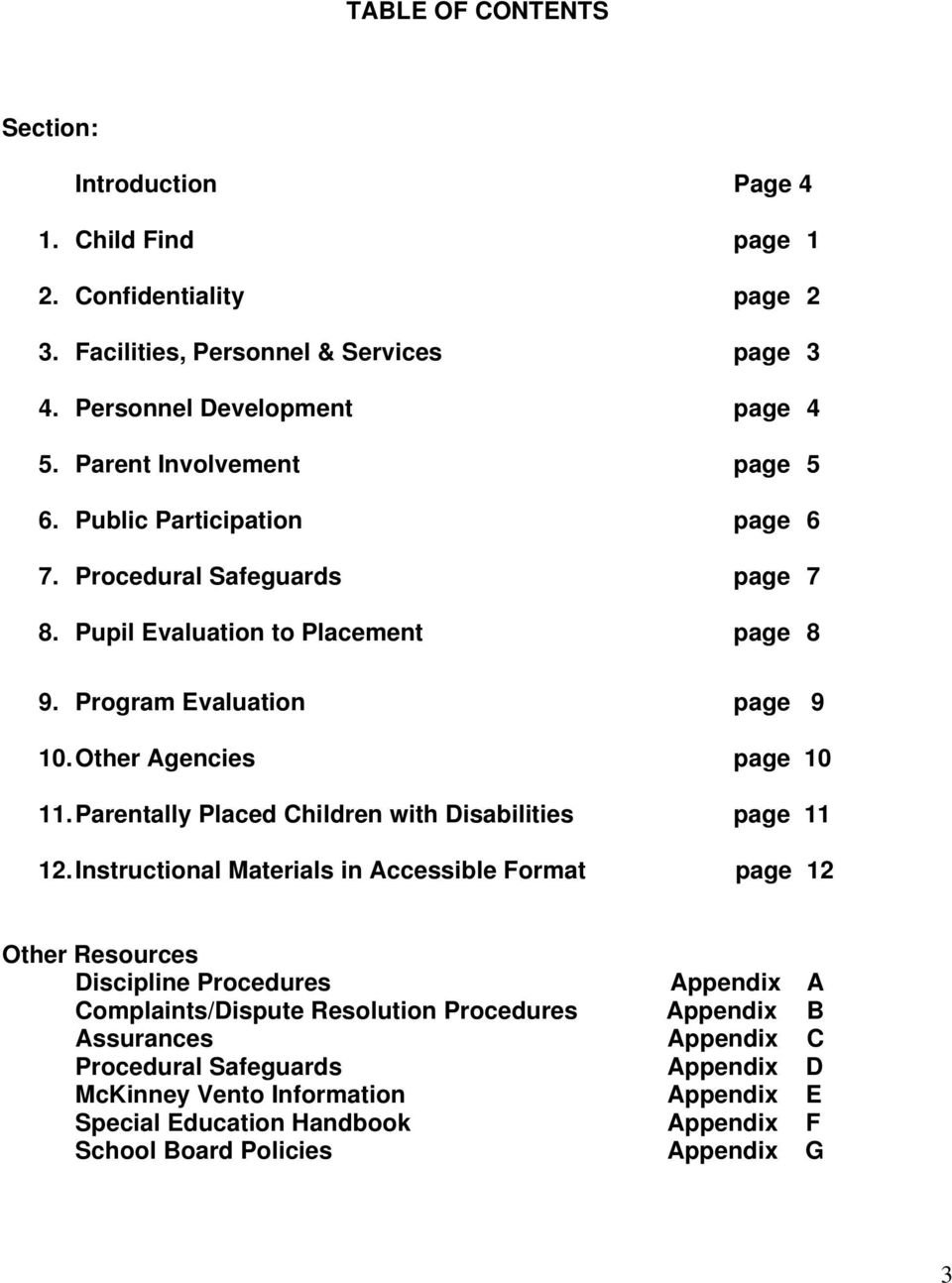
3 TABLE OF CONTENTS Section: Introduction Page 4 1. Child Find page 1 2. Confidentiality page 2 3. Facilities, Personnel & Services page 3 4. Personnel Development page 4 5. Parent Involvement page 5 6. Public Participation page 6 7. Procedural Safeguards page 7 8. Pupil Evaluation to Placement page 8 9. Program Evaluation page Other Agencies page Parentally Placed Children with Disabilities page Instructional Materials in Accessible Format page 12 Other Resources Discipline Procedures Appendix A Complaints/Dispute Resolution Procedures Appendix B Assurances Appendix C Procedural Safeguards Appendix D McKinney Vento Information Appendix E Special Education Handbook Appendix F School Board Policies Appendix G 3
4 Londonderry School District Special Education Plan INTRODUCTION IDEA 2004 requires the Londonderry School District has in effect policies, procedures, and programs that are consistent with the State s policies and procedures and are established in accordance with IDEA 2004 and other relevant federal statutes. The Londonderry School District has developed this Special Education Plan and it serves as a tool for the District s implementation of IDEA 2004 requirements in providing programs for children with disabilities. In addition, it provides the required assurances necessary for application for federal special education funds. Throughout this manual, there are references to state and federal special education laws and regulations. To ensure a more readable document, the following abbreviations are used: NH Rules - Refers to New Hampshire Rules for the Education of Children with Disabilities This Special Education Manual Template has been revised to align with NH Rules effective June 30, IDEA Regulations Refers to sections in 34 CFR Part 300 of the Assistance to States for the Education of Children with Disabilities and Preschool Grants for Children with Disabilities Final Rules 8/14/06. 4

5 1. CHILD FIND Ed 1105 The Londonderry School District ensures that all children who have disabilities, from 2.5 to age 21, who reside in the District, and who are in need of special education and related services are identified, located and evaluated. This applies to all children with disabilities, including highly mobile children (such as migrant and homeless children), children placed in homes for children, health care facilities, or state institutions, and children who are suspected of being eligible under IDEA, even though they are advancing from grade to grade. In addition, this applies to those children attending approved, non-public private schools within the geographic boundaries of the District. For those students who are transitioning from Early Supports and Services to preschool, the District will participate in a transition planning meeting for the purposes of affecting a smooth and timely transition and implementing an Individual Education Program or Individual Family Support Plan by the child s third birthday. All data and information collected and used under this section are subject to confidentiality requirements as described in Section 2 - Confidentiality. The District child find program includes, at a minimum, the following: 1. The District has established referral procedures, which ensure that all students who are suspected or known to be a child with a disability are referred to the special education evaluation team for further evaluation. These procedures are found in Section 8 Pupil Evaluation to Placement. 2. Any person may refer a child to the IEP team for reasons including but not limited to the following (list is not exhaustive): a. Failing to pass a hearing or vision screening; b. Unsatisfactory performance on group achievement test or accountability measures; c. Receiving multiple academic and/or behavioral warnings or suspensions/expulsions from a child care or after school program; and d. Repeatedly failing one or more subjects. e. Inability to progress or participate in developmentally appropriate preschool activities; and f. Receiving services from family centered early supports and services. 3. On an annual basis, the District contacts all approved nonpublic private schools (including religious elementary and secondary schools) within its geographic boundaries regardless of where the child resides. The District shall conduct a consultation meeting and advise school officials of the District s responsibilities to 5
6 identify and evaluate all students who are suspected of or known to be a child with a disability enrolled in such schools. The District shall conduct child find activities that ensure equitable participation of private school students with disabilities and provide an accurate count of those students. All child find activities conducted for children enrolled in private schools by their parents shall be similar to those activities conducted for children who attend public schools in the District. Referrals from approved nonpublic schools shall be forwarded to an appropriate special education team for further consideration. 4. On an annual basis, the District contacts all community agencies and programs within its geographic boundaries that provide medical, mental health, welfare, and other human services, to advise them of the District s responsibility to identify and evaluate all students who may be a child with a disability. This includes homes for children, health care facilities, or state institutions within the boundaries of the District that may have knowledge of children with disabilities who are involved with the state court and for whom a special education program may be appropriate. Referrals from these agencies shall be forwarded to the special education evaluation team for further consideration. 5. On an annual basis, the District publicizes and disseminates information, which describes its Child Find Program. This includes a description of the District s special education program, supports and services, including a contact person, his/her functions, and the manner by which he/she might be contacted for further information or referral. 6. The District shall annually provide all parents of children with disabilities information regarding their rights and responsibilities under federal and state special education laws. 7. The District ensures that all referrals from parents and others who suspect or know a child with a disability are forwarded to the special education evaluation team. The District shall provide the parents with a written notice of any referral other than one initiated by the parent. B. Ensure there are continuing efforts related to cultural competency in relationship to public awareness and child find activities, such as the ability to communicate with and relate to parents and families in ways which are appropriate to their individual racial, ethnic, and/or cultural backgrounds. 1. The District shall coordinate with area agencies and family centered supports and services to establish a process of district notification of children served by these programs consistent with the interagency agreement between the District and the area agencies providing family centered supports and services. 6
7 i. Ed (a): The LEA shall develop a written early transition process for children exiting family centered early supports and services which assures that any child who is potentially a child with a disability is evaluated and eligibility for special education is determined prior to the child s third birthday. If a child is determined to be a child with a disability eligible for special education and related services, the LEA shall ensure that an IEP is developed and implemented on/before the child s third birthday. ii. Ed (b): The transition process in Ed (a) shall include a written interagency agreement between the LEA and the local area agencies, as defined by RSA 171-A:21-b, responsible for the provision of family centered supports and services in that community. 7

8 2. CONFIDENTIALITY OF INFORMATION Ed 1119 The Londonderry School District adheres to the Confidentiality of Information regulations set forth in the NH Rules, the Federal Family Educational Rights and Privacy Act of 1974 (FERPA) and the Individuals with Disabilities Education Act (IDEA 2004; 34 CFR ), with its implementing federal regulations.. The District provides written notice to fully inform parents about the requirements of this section including: 1. a description of the extent that the notice is given in the native languages of the various population groups residing in the District; 2. a description of the children for whom personally identifiable information is maintained, the types of information sought, the methods the District intends to use in gathering the information (including the sources from whom information is gathered), and how the information will be used; 3. a summary of the policies and procedures that participating agencies must follow regarding storage, disclosure to third parties, retention, and destruction of personally identifiable information; and 4. a description of all of the rights of parents and children regarding this information, including the rights under the Family Educational Rights and Privacy Act of 1974 and IDEA and its regulations. Before any major identification, location, or evaluation activity, the notice is published or announced in newspapers or other media, with circulation adequate to notify parents throughout the District of the activity. ACCESS RIGHTS The District permits parents to inspect and review any education records relating to their child that is collected, maintained, or used by the District under 34 CFR Part 300. The District will comply with a request without unnecessary delay and before any meeting regarding an IEP, or any hearing pursuant to IDEA and its regulations and in no case more than 45 days after the request has been made. The right to inspect and review education records under this section includes: 1. the right to a response from the District to reasonable requests for explanations and interpretations of the records; 2. the right to request that the District provide copies of the records containing the information if failure to provide those copies would effectively prevent the parent from exercising the right to inspect and review the records; and 8
9 3. the right to have a representative of the parent inspect and review the records. The District may presume that the parent has authority to inspect and review records relating to his or her child unless the District has been advised that the parent does not have the authority under applicable State law governing such matters as guardianship, separation, and divorce. RECORD OF ACCESS The District keeps a record of parties obtaining access to education records collected, maintained, or used under Part B of IDEA (except access by parents and authorized employees of the participating agency), including the name of the party, the date access was given, and the purpose for which the party is authorized to use the records. RECORD ON MORE THAN ONE CHILD If any education record includes information on more than one child, the parents of those children have the right to inspect and review only the information relating to their child or to be informed of that specific information. LIST OF TYPES and LOCATION OF RECORDS The District provides parents on request a list of the types and locations of education records collected, maintained, or used by the District. FEES The District may charge a fee for copies of records that are made for parents under this part if the fee does not effectively prevent the parents from exercising their right to inspect and review those records. The District does not charge a fee to search for or to retrieve information. AMENDMENT OF RECORDS AT PARENT REQUEST A parent who believes that information in the education records collected, maintained, or used under this part is inaccurate or misleading or violates the privacy or other rights of their child, may request this information be amended. The District will determine whether to amend the information in accordance with the request within a reasonable period of time of receipt of the request. If the District decides to not amend the information in accordance with the request, it will inform the parent of the refusal and advise the parent of the right to a hearing. OPPORTUNITY FOR HEARING The District, on request from the parent, will provide an opportunity for a hearing to challenge information in education records to ensure that it is not inaccurate, misleading, or otherwise in violation of the privacy or other rights of the child. RESULT OF HEARING If, as a result of the hearing, the District decides that the information is inaccurate, misleading or otherwise in violation of the privacy or other rights of the child, the District will amend the information accordingly and so inform the parent in writing. If, as a result of the hearing, the District decides that the information is not inaccurate, misleading, or 9
10 otherwise in violation of the privacy or other rights of the child, it will inform the parent of the right to place in the records it maintains on the child a statement commenting on the information or setting forth any reasons for disagreeing with the decision of the District. Any explanation placed in the records of the child under this section 1. is maintained by the District as part of the records of the child as long as the record or contested portion is maintained by the District; and 2. if the records of the child or the contested portion are disclosed by the District to any party, the explanation is also disclosed to the party. HEARING PROCEDURES A hearing held under this section is conducted according to the procedures under 34 CFR CONSENT Except as to disclosures addressed in 34 CFR Part (b) for which parental consent is not required by 34 CFR Part 99, parental consent is obtained before personally identifiable information is (1) disclosed to anyone other than officials of participating agencies collecting or using the information under 34 CFR Part 300, subject to this section; or (2) used for any purpose other than meeting a requirement of 34 CFR Part 300. The District will not release information from education records to participating agencies without parental consent unless authorized to do so under Part 99. The District protects the confidentiality of personally identifiable information at collection, storage, disclosure, and destruction stages. All persons collecting or using personally identifiable information will receive training or instruction regarding IDEA-B policies and procedures under 34 CFR and 34 CFR Part 99. The District maintains, for public inspection, a current listing of the names and positions of those employees within the District who may have access to personally identifiable information. Safeguards (34 CFR ): Each district must protect the confidentiality of personally identifiable information at collection, storage, disclosure, and destruction stages. One official at each district must assume responsibility for ensuring the confidentiality of any personally identifiable information. All persons collecting or using personally identifiable information must receive training or instruction regarding the state s policy and procedures under 34 CFR and CFR part 99. Each district must maintain, for public inspection, a current listing of the names and positions of those employees who may have access to personally identifiable information. DESTRUCTION OF INFORMATION The District informs parents when personally identifiable information collected, maintained, or used under this part is no longer needed to provide educational services to the child. The information is destroyed at the request of the parents. However, a permanent record of a student's name, address, and phone number, his or her grades, attendance record, classes attended, grade level completed, and year completed shall be maintained without time limitation. 10
11 CHILDREN S RIGHTS (Ed ) The District ensures the rights of privacy afforded to children are consistent with those afforded to parents, taking into consideration the age of the child and type or severity of disability. The age of majority in New Hampshire is eighteen (18) years, thus parental rights regarding educational records in IDEA and FERPA transfer to students at age 18. DISCIPLINARY INFORMATION (Ed ) The District includes in the records of a child with a disability a statement of any current or previous disciplinary action that has been taken against the child. Such statements shall be included in, and transferred with the disabled child s record to the same extent that the disciplinary information is included in, and transmitted with the student records of children without disabilities. The statement may include a description of any behavior engaged in by the child that required disciplinary action, a description of the disciplinary action taken, and any other information that is relevant to the safety of the child and other individuals involved with the child. If the child transfers from one school to another, the transmission of any of the child's records includes both the child's current individualized education program and any statement of current or previous disciplinary action that has been taken against the child. Student Records Special Education Index of Documents contained in file Log of people who have accessed files All Notices of Team meetings Written Prior Notice Forms Student Referral Form Permission to Test Form Evaluation Summary Forms o Evaluation Reports Individualized Education Programs SPEDIS/NHSEIS Forms Teacher/Student Comments Correspondence Out-of-District Progress Reports At a minimum the records for students with disabilities should be kept as long as the student is in a program and there is District liability for the education of the student. Given court decisions that are retroactive you might be prudent to preserve for at least six (6) years after termination or program completion. 11
12 3. FACILITIES, PERSONNEL & SERVICES Ed (b) (3) The Londonderry School District shall take steps to ensure that children with disabilities have equal access to the variety of educational programs and services available to nondisabled children. The District ensures that, to the maximum extent appropriate, children with disabilities, including children in public or private institutions or other care facilities, are educated with students who do not have disabilities. Special classes, separate classes, separate schooling, or other removal of students with disabilities from the regular educational environment occurs only when the nature or severity of the disability is such that education in regular classes with the uses of supplementary aids and services cannot be achieved satisfactorily. Placement decisions for children with disabilities shall be made on an individual basis by the IEP team and in accordance with the procedures described in Section 8 Pupil Evaluation to Placement. The District shall provide a full range of opportunities, programs and services to meet the unique needs of children with disabilities in the least restrictive educational setting. The District shall ensure that every child with a disability shall have full access to the general curriculum with accommodations and modifications as delineated in the IEP. This includes the provision of non-academic and extra-curricular services. These opportunities shall be provided through public school programs within and outside of the boundaries of the District. The District shall provide access to vocational training and transition services as appropriate. Vocational and transition services are provided primarily within the District and at the high school level. Other student specific circumstances may be addressed as determined by the IEP team. Equipment, Materials and Assistive Technology The District shall provide appropriate instructional equipment and material, including assistive technology devices and assistive technology services appropriate to implement each student s IEP. Personnel Standards Teachers of students with disabilities, prior to employment, shall have valid New Hampshire certification with an endorsement appropriate for the disabilities of the students they serve. Additionally, special education teachers within the District must meet highly qualified teacher requirements for their respective teaching assignments, as designated by federal and state guidelines. Programs and Services (Table : Continuum of Alternative Learning Environment) The District provides educational services to students with disabilities along a continuum of environments including the following: 12
13 Regular Classroom A child with a disability attends the regular class with supports and services as required by the IEP Regular Classroom with Consultative Assistance A child with a disability attends the regular class with consultative assistance being provided to the classroom teacher. Regular Classroom with Assistance by Specialists A child with a disability attends the regular class with direct services provided by specialists or paraprofessionals working under the direction of professional teaching staff. Regular Classroom plus Resource Room Help A child with a disability attends the regular class and receives assistance in the Resource Room Program. When the regular education setting, with accommodations, modifications, supplementary aides and services is inadequate to meet the needs of a student with a disability, the student may receive assistance (by team agreement) in a resource setting within the public school system for a portion of the school day. The student can spend no more that 60% of the school day in this setting. Instruction provided in the resource setting will ensure each student continued access to the general curriculum. The total number of students with disabilities being served in the resource room at any given time shall not exceed 12 students without the assistance of support personnel. The maximum number of children in a Resource Room shall not exceed 20 (Ed (f)(4). The District shall ensure that the resource settings are staffed with personnel who meet state certification requirements and federal Highly Qualified Teacher requirements as applicable. Regular Classroom plus part-time special class A child with a disability attends a regular class and a self-contained special education classroom Self-contained Special Education Class A child with a disability attends a special education class for more than 60% of their day. The class is organized either by the needs of the students or by the degree of severity of the disability. Self-contained special education classes serve students according to chronological age with a range of not more than four years. The number of students in a self-contained classroom can not exceed 12. A minimum teacher-student ratio of 1:8 or 2:12 shall be provided unless the severity of disabilities warrants the assignment of additional staff. Maintaining this ratio can be accomplished through the assignment of two teachers or a teacher and a paraprofessional. 13
14 Full-time or part-time special day school A child with a disability attends a public or privately operated special day program full-time or part-time Full-time Residential Programs The child attends a privately or publicly approved residential program on a fulltime basis. Preschool Programs (Table : Continuum of Alternative Learning Environments Pre-school) Children in preschool programs shall be grouped by age levels with a range of not more than three years. Children with disabilities shall be provided with appropriate special education and related services through the District s preschool programs and services. PLEASE NOTE: the maximum number of preschool children in an early childhood special education program shall be 12, regardless of the number of staff members assigned to the program (Ed (d) (3). Early Childhood Program: a preschool child with a disability attends an early childhood program Home: a preschool child with a disability receives some or all of his/her supports and services in the child s home Special Education Program: a preschool child with a disability attends a special education program Service Provider Location: a preschool child with a disability receives supports and services from a service provider Separate School: a preschool child with a disability attends a publicly or privately operated separate day school facility designed specifically for children with disabilities Residential Facility: a preschool child with a disability attends a publicly or privately operated residential school or residential medical facility on an inpatient basis Home Instruction for School Aged Children (Ed ) A child with a disability receives all or a portion of his/her special education program at home in accordance with Ed Home instruction for children at least six years of age but less than 21 years of age shall include no fewer than ten hours per week of specially designed instruction as specified in the child s IEP so that the child will progress in the general curriculum and meet IEP goals. 14

15 Home instruction will include related services in addition to the ten hours of specially designed instruction and will be delivered in accordance with the NH Rules. Home-based programs shall not exceed 45 days in a school year unless individual circumstances warrant an extension to this time period. If the IEP team determines that home instruction should be implemented for more than 45 days of a school year, the District will complete the following requirements: 1. Describe, in writing, the specific circumstances resulting in the need for the home instruction; 2. Develop an IEP which includes all the required elements; and 3. Develop a written plan of the transition of the child into a less restrictive environment. Home instruction shall NOT include parent designed home education programs as authorized in Ed 315. Home instruction shall be implemented by personnel qualified in accordance with 34CFR and Section 2122 in the ESEA. Facilities and Location Instructional areas for children with disabilities shall be located in classrooms with students of a similar chronological age and shall be comparable to other classrooms within the school. They shall be located in facilities that are, in the judgment of the IEP team, in the least restrictive environment. The physical space used for classrooms and other instructional programs and school activities for children with disabilities shall be of sufficient size to accommodate program modifications and accommodations necessary to implement the children s IEPs and to provide for all other learning activities. Length of School Day Preschool level - The IEP team shall determine the length of the school day for preschool students with disabilities. Elementary/High School: the school day shall be a minimum of 180 days in each year or the equivalent number of hours approved by the Commissioner of Education, NHDOE, consistent with the provisions of RSA 189:1, 189:2, 189:24, and189:25 and Ed When, due to a student s limited physical and/or emotional stamina, the special education placement team recommends a school day of less than the minimums hours listed above, written consent shall be obtained from the Superintendent of Schools and the parent prior to implementing a shortened school day. A copy of the written consent shall be sent to the State Director of Special Education, a copy to the parent, and another placed in the student s school records. If it would cause a serious adverse effect upon a child s educational progress pursuant to RSA 193:1 I(c), the Superintendent shall not excuse a child from the required minimum school day. The District s obligation to provide a free and appropriate public education to a child shall still be in effect even if the child attends school for a shortened school day. 15

16 Length of School Year The District shall provide a standard school year of at least 180 days or the equivalent number of hours per ED (see above: Length of School Day). Students with disabilities in need of extended school year programming shall be provided for through the requirements described in Section 9 Pupil Evaluation to Placement. Extended School Year Programming shall not be limited only to the summer months. Supervision and Administration The Superintendent of Schools, the Director of Pupil Services, and the building level administrative staff shall supervise the services and programs provided to students with disabilities. Assistants shall work under the direct supervision of appropriately certified personnel and be supervised by the professional under whom they work as often as deemed necessary by the District, but no less than once each week. Assistants shall implement plans designed by the supervising professionals and monitor the behavior of student(s) with whom they work. They may not design or evaluate the effectiveness of programs. Assistants are evaluated through a predetermined performance review process annually. Diplomas The Londonderry School District shall ensure that each child with a disability is entitled to continue in an approved program until such time as the student has earned a regular high school diploma or has attained the age of 21, whichever occurs first, or until the District determines that the student no longer requires special education in accordance with Section 8 Pupil Evaluations to Placement. All children with disabilities in the Londonderry School District shall have an equal opportunity to complete a course of studies leading to a regular high school diploma. A regular diploma shall be issued to all students who: 1. successfully achieve the minimum number of 24 credits, 2. meet specific course requirements as described in the Londonderry High School Program of Studies The term regular high school diploma does not include an alternative degree that is not fully aligned with the NH School Approval Standards, such as a certificate or a General Educational Development credential (GED). Any student who receives a diploma/certificate other than the District s regular high school diploma remains eligible to receive a free appropriate public education until he or she reaches age twenty-one or until the IEP Team, through a formal evaluation process, determines that such student is no longer in need of, and thereby not eligible for, special education and related services. 16
17 PROGRAM DESCRIPTIONS Londonderry High School The HS Special Education Department provides the support identified students need to achieve their greatest level of academic and functional independence. Students are supported through their IEP in all curriculum levels. As mandated through IDEA, individual transition plans are developed for students and goals are developed through the IEP to support students needs to ensure readiness for post secondary opportunities. Students and parents are advised of the range of options open to them as well as the recommended options to meet their individual goals. Inclusion Support Services: Every curriculum area and level is open to all HS students and identified special education students receive inclusion support in general education settings as needed. Some courses are designated as "college prep" and require a greater level of independence while others are designed to meet the district benchmarks and provide opportunities for students to continue to work on their functional skills. Educational assistants and when appropriate, special education teachers and case managers, are available to provide in-class support including reinforcement of the teacher's instruction or other skill sets as determined by the IEP. Classroom teachers also receive support in implementing IEP accommodations and modifications through consultation with special education teachers and case managers. Additional support to students is available by accessing "Learning and Math Lab", a general education service open to all students at the high school. Pull out core curriculum classes are offered in Math, English, social studies, science and reading. The content in these courses meets the state and district benchmarks and provides the instruction and supports required as outlined in students individual education programs (IEP). Study Labs: Study lab is a support service offered 24 periods of the school day, including a 45- minute period after school. The main purpose of Study Lab is to support students in their course work. Case managers teach and reinforce study and learning strategies that will help students be successful and independent learners. Students are coached on how to advocate for themselves. Strategies in time-management, organization, note taking; memory and test-taking skills are stressed, using the students' own course materials to apply the strategies. Students also receive support in the completion of homework and long-term assignments. A 1:4 ratio or less of staff to students is provided to ensure that each student receives the needed level of support. The 24 periods of study lab are organized into Three Year of Grad Level (YOG) study labs. The focus in freshman study lab is study skills, organization, and homework completion. At the sophomore level, an on-line study skills assessment is given to determine the specific needs of each student. At the junior/senior level, the focus shifts to individual transition planning for post high school considerations along with needed academic support. Academic and Career Training (ACT) Program: The ACT Program is a program 17

18 within the high school for students with a variety of developmental disabilities and cognitive impairments. The goal of the program is to prepare students for adult living by helping them become as independent as possible. Students participate in CORE academic classes within the program as well as Interactive classes with the general education population. CORE academic classes focus in the integration of basic academic skills and their functional application. Interactive classes allow nondisabled peers to mentor and encourage ACT Students in a modified regular education setting, meeting modified curriculum goals. The ACT Program classes are self- contained, instruction is individualized, and students develop social, functional, academic, prevocational skills, as well as acquired daily living skills. Students within the ACT Program usually matriculate through their 21 st birthday. Transition from high school to adult life, work opportunities and community experiences, are an important part of the program. In compliance with IDEA and the State Performance Plan Indicator 13, each student over the age of sixteen has an individualized education program which includes coordinated, measurable, annual IEP goals and transition services that will reasonably enable the student to meet the post secondary goals. Transition Program: This program provides the emotional and academic support needed by our emotionally disabled students. With this support, students are able to remain and make academic progress in the public school setting. Most students spend one period in the Transition classroom each day where they receive assistance with organization, scaffolding and completion of assignments, weekly counseling, and assistance in navigating their academic day in the mainstream. Additional periods in the Transition program are provided to specific students with acute needs so that they can complete their class work in a safe environment until they are able to reintegrate into some or all of their classes. The philosophical foundation of the program is based on Dr. William Gasser's "Choice Theory/Reality Therapy" approach. Students are assisted through this structured program in dealing with choices and decision-making, aimed at making their lives better now and in the future. Friendships and Learning Experiences (FLEX): This is a supportive program designed to help students with Autism Spectrum Disorders (ASD) successfully integrate into the school environment. Students are scheduled for one period a day and receive guidance, learning and support in academics, organization, and social skills. An additional period/a social skills class is also provided to students in need of more direct instruction in this area. Students in this program may have difficulty dealing with change, may exhibit repetitive behaviors, or may have difficulty with self regulation. The staff is available to provide support to the students in the above areas. The program also provides a safe and quiet area where students can go when they become anxious due to sensory overload. The supports of the program are available every period of the day. Students Tackling Emotional and Personal Struggles (STEPS (EH) Program): This program is housed in the main building of the high school and consists of 4 adjacent rooms. The program provides services to students with social-emotional 18
19 and behavioral challenges who are unable to function in the larger community of the high school building. The program provides the structure that students need to grow academically and emotionally. Four core academic courses, a Personal Development class and after school support are offered through the program. An Outdoor Education class is also provided to fulfill the physical education requirement. The outdoor education class takes place in the community with various activities scheduled throughout the year. The curriculum is overseen by the high school curriculum coordinators. Students are able to matriculate back into LHS for courses as deemed appropriate by the student s team (which includes the parents). The program maintains strong connections between home and school. Communication logs inform parents of students' performance or issues, and parents are encouraged to communicate issues occurring at home that may affect the students' behavior. The program uses a Level System to determine privileges and restrictions for individual students. Discipline is handled within the program with school administration support when needed. Consultation with a student's psychologist, psychiatrist, neurologist, general practitioner, juvenile probation officer, and especially with parents is frequently pursued, and necessary to ensure that the student receives consistent support and services throughout the day. Londonderry Middle School Provision of special education services is a collaborative effort between regular and special education staff. The objective is to assist students so that they will learn the strategies, techniques, and skills to enable them to learn independently within the expectations of the general education curriculum. All students are included in the regular classroom setting as much as possible at the middle school. Special education students who require academic assistance receive support through their regular classes from the classroom teacher and special education case manager. Team taught classroom opportunities which offer smaller class sizes and cooperative teaching between a regular educator and special educator are available at each grade level. Students requiring more intensive specialized instruction can participate in a pull-out model for reading, language arts and/or math. These classes are grouped by grade level and /or IEP needs and taught by special education teachers. The instruction can be small group and/or individualized based upon student need. Reading, language arts and math curricula focus on basic skill development in the content area and IEP specific goals and objectives. Through FY will be reorganizing the programming model at LMS. This programming change will be phased in starting at the 6 th grade level. Twelve special education teachers will service the inclusionary program for students with disabilities. There will be two dedicated special education teachers at each grade level who will teach the pull-out academic classes, as well as, team teach with regular education teachers. In addition, there will be six case managers (two at each grade level) who loop with the students are they matriculate through LMS. Students will have access to an academic support lab as needed throughout the day. Friends III Program: (Fostering and Respecting Individuals with Intensive Educational Needs) This program is a continuation of Friends II at Matthew Thornton and of Friends I at Moose Hill. This program is an expansion of the current programming at the elementary level serving students with Autism and Pervasive Developmental Disorder. This is an intensive self contained program. All instruction is specifically designed for the students in the program to meet their unique social skills, communication, sensory, cognitive, and adaptive needs. Students participate 19
20 with non-disabled peers in the regular classroom as it is deemed appropriate. FRIENDS III is taught by a special educator with Applied Behavior Analysis (ABA) background and supported by special education assistants, while a Speech/Language Pathologist and Occupational Therapist provide both consult and team/individual therapy. The district wide Board Certified Behavior Analyst works closely with the staff in developing and supporting the individual student programs. This program is specifically designed to integrate speech and language therapy, occupational therapy, and social skills. Learning takes place both within the classroom setting and in the school and local community. Basic Academic Skills (BAS) Program: This is a program for students with global delays in academic, cognitive, and/or ADL and independence areas. Students are assigned to a grade-level team, although some students spend the majority of their day in the BAS program. The BAS program is staffed by one special educator teacher and special education assistants. Students in this program receive direct support in pre-academic, functional living and pre-vocational skills as outlined through their IEP. Learning takes place both within the classroom setting and in the school and local community. Additionally, speech and language, as well as, occupational therapy provide services and consultation to the program. Program For Success (PFS): This program provides supports to students with emotional disabilities. Students are included in regular academic subjects, but receive a structured program of support for the academic and emotional needs in the Program For Success (PFS). Direct services are provided to this population by teachers, a counselor and special education assistants. Consultation services are also provided by the staff to parents and classroom teachers. Related Services: Speech Language Pathologists (SLP) service the speech and language identified students and work on a consultative basis with the grade level teams. Speech and Language Pathologists provide direct services in the classroom working with the grade level team. Group speech and language services are provided through Language Arts Skills class and in social and communication groups as needed. The Speech and Language Pathologists are assisted by a Speech and Language Assistant. One Certified Occupational Therapy Assistant (COTA) delivers service to students with disabilities ranging from cognitive impairments to students on the PDD and Autism spectrum, students with medical issues and non-verbal learning disabilities as well as students with visual processing disorders affecting their fine motor skills. Therapy is varied according to individual IEP s, but includes sensory integration, direct instruction of self regulation, fine motor skills and functional living skills. Londonderry Elementary School Programs Modified regular education programs are designed to provide services to students within the regular classroom. The objective is to assist students so that they will learn the strategies, 20

21 techniques, and skills to enable them to increase their independence within the general curriculum. Strategies may include organization skills, attending skills, behavior management, and verbal comprehension as well as specific instruction in reading, writing and mathematics through our Response To Intervention (RTI) Three Tier Model. Resource programs: Resource programs provide more intensive instruction to remediate difficulties in language, reading, writing, mathematics and social skills. This instruction can be individualized or in small groups. Specialized instruction, specialized programs, and materials are provided by the special education team to meet the goals and objectives identified in the students I.E.P. (Individualized Education Program). Significant individualized programs: Significant individualized programs are developed for low incidence populations who require a significant portion of their day to be highly individualized. This might include students with autism, mental retardation, significant developmental delays, multiple handicaps, traumatic brain injury or severe emotional disturbances. Friends II Program: (Fostering and Respecting Individuals with Intensive Educational Needs) This program is a continuation of Friends I at Moose Hill. This is an intensive district-wide program housed at Matthew Thornton. All instruction is specifically designed for the students in the program to meet their unique social skills, communication, sensory, cognitive, and adaptive needs. Students participate with non-disabled peers in the regular classroom as it is deemed appropriate. This program is specifically designed to integrate speech and language therapy, occupational therapy, and social skills. This program serves children with a diagnosis of autism or pervasive development disorder who have very limited communication skills and significant sensory needs. The curriculum is based on the principals of applied behavioral analysis (ABA). This program is staffed by one special education teacher and paraprofessionals, while a Speech/Language Pathologist and Occupational Therapist provide both consult and team/individual therapy. The district wide Board Certified Behavior Analyst works closely with the staff in developing and supporting the individual student programs. FLEX (Friends ) This is an extension of the FRIENDS II program housed at Matthew Thornton School. This is a supportive program designed to help students with Autism Spectrum Disorders (ASD) successfully integrate into the school environment. All instruction is specifically designed for the students in the program to meet their unique social skills, communication, sensory, cognitive, and adaptive needs. Students have the flexibility of having all content area curriculum taught within the FLEX classroom and experience inclusionary activities when appropriate. PALS Program (Primary Academic Learning) This is a district wide program housed at Matthew Thornton School. This comprehensive program is designed to meet the unique needs of students with cognitive and developmental disabilities at grades 1 5. The program s focus is on academic, communication, social and functional skills. Students are assigned to an age appropriate grade level and participate in grade level curriculum areas with modifications when appropriate. Direct instruction in specific academic, speech/language, fine/gross motor, and social functioning occur within the program and in the natural setting. The PALS program is staffed by a 21
22 special educator and paraprofessionals, while a Speech/Language Pathologist and Occupational Therapist provide both consult and team/individual therapy. The district wide Board Certified Behavior Analyst works closely with the staff in developing and supporting the individual student programs.. Elementary Program For Success (EPFS): This is a district program, housed at South Elementary School, which provides a continuum of services and supports to emotionally disabled students. This program provides daily instruction in behavior management, social skills, academic strategies, instruction, counseling, and provides an alternative environment which is available to support individualized needs Related services: Related services include speech and language, occupational therapy, physical therapy, guidance, nursing services, psychological, evaluation services and rehabilitative assistants as required to implement the goals and objectives of a students I.E.P. (individual Education Program). All professional staff members provide consultative service to parents and classroom teachers as needed. Moose Hill The Londonderry Early Education Program (LEEP) is a developmental preschool servicing youngsters age three and four with special needs. The LEEP program also has typically developing children attend on a tuition basis to be role models. This inclusionary model is in line with the State Performance Plan (SPP) indicator 6, which targets the percentage of preschool students with Individual Education Programs who receive programming in settings with typically developing peers. The mission at LEEP is to provide high quality developmental programming to children. Many students require education and therapeutic intervention in a specifically controlled environment such as a small student/teacher ratio. LEEP utilizes an interdisciplinary team approach consisting of early childhood teachers, special education teachers, speech therapy, occupational therapy, physical therapy, school nursing and teaching assistants. In addition, outside child psychologists, vision specialists, orientation and mobility specialists, autism specialists and behavioral specialists consult to the program in a variety of ways. The complexity and severity of the disabilities of the children serviced by LEEP has continued to become more acute. We continue to see a steady increase in the number of children who are autistic or have low-incidence disabilities. Friends Program: (Fostering and Respecting Individuals with Intensive Educational Needs) This program continues to serve a growing need in Londonderry students with Autism and Pervasive Developmental Disorder. This is an intensive program located at Moose Hill for preschool and kindergarten students. All instruction is specifically designed for the students in the program to meet their unique social skills, communication, sensory, cognitive, and adaptive needs. Students participate with non-disabled peers in the regular classroom as it is deemed appropriate. This program is specifically designed to integrate speech and language therapy, occupational therapy, and social skills. The program receives on-going guidance 22
23 and consultation from outside experts. Moose Hill School: Kindergarten Program: Children who are five years of age and entering kindergarten receive their special education services by the kindergarten special education team. Children with special needs are included within the regular classroom to the fullest extent possible. Special education staff work with students on emerging math and reading foundations. Students receive direct instruction in phonological awareness and number sense to serve as a basis for future instruction. Supports and services listed for the LEEP Program would also be available at the kindergarten level. 4. PERSONNEL DEVELOPMENT Ed (4) The District has adopted a Professional Development Master Plan to serve as a basic guideline for the operation of its professional development for a five-year period. The District shall work to promote a climate that encourages the continuing education and training of all staff within the District. The Professional Development Mater Plan shall advance an educational environment in which students receive high exposure to stimulating teachers, instructional materials and activities. Professional development activities that enhance the knowledge and skills of all staff related to the education of children with disabilities and increase their understanding of the diverse needs of all students shall be offered to all teachers, specialists, paraprofessionals, administrators and other IEP team members. A variety of professional development opportunities shall be available to District staff, including job-embedded activities, in-service workshops, conferences and/or formal coursework reimbursed through the District. PLEASE NOTE: Staff members of the school District shall participate in child-specific training and professional consultation as required to help them understand various types of disabilities and meet the needs of individual students. Pages #---- through #---- include the School District Professional Development Plan. (awaiting update from the Assistant Superintendent s office) 23
24 5. PARENT INVOLVEMENT Ed (b)(5) The Londonderry School District shall actively involve parents in all steps of the special education process. In addition to fulfilling legal requirements, the District recognizes the crucial and irreplaceable role parents play in the education of their children. Therefore, consistent efforts will be placed on keeping parents well informed within the context of a collaborative team process. In part this is accomplished by the dissemination of Procedural Safeguards Notice and Written Prior Notices. Procedural Safeguards Notice (Ed 1120) Parents of a child with disabilities will be given New Hampshire Procedural Safeguards in Special Education (appendix D) describing the procedural safeguards available to them under state and federal law on an annual basis. In addition, parents will be provided a copy of procedural safeguards: Upon initial referral or parent request for evaluation Upon receipt of the first State complaint and upon the receipt of the first due process complaint in a school year In accordance with discipline procedures Upon request by a parent. Written Prior Notice Parents will be officially notified in writing any time the District: proposes to initiate or change the identification, evaluation or educational placement of the child or the provision of a free and appropriate public education to the child; or refuses to initiate or change the identification, evaluation or educational placement of the child or the provision of a free and appropriate public education to the child. The notification shall include: 1. A description of the action proposed or refused by the district; 2. An explanation of why the agency proposes or refuses to take the action 3. A description of each evaluation, procedure, assessment, record or report the district used as basis for the proposed or refused action; 4. A statement that the parents of the child with disabilities have protection under the procedural safeguards of IDEA (if this notice is not an initial referral for evaluation, the means by which a copy of the description of the procedural safeguards can be obtained; 5. Sources for parents to contact to obtain assistance in understanding the provisions of the law; a description of the other options that the IEP team considered and the reasons why those options were rejected, and 6. A description of the other options the team considered and the reasons why they were rejected, and 24
25 7. A description of other factors that are relevant to the agency s proposal or refusal. Ongoing parent involvement is supported through the following actions: 1. Parents shall receive formal notification when their child is referred for special services, except in the case where the parent was the referring party. Procedural Safeguards and information regarding the Special Education Process shall be provided to the parent at this time. 2. Within 15 days of the receipt of the referral, the IEP Team (including the parents) will meet to determine the appropriate course of action. 3. The IEP Team shall determine if the referral is appropriate and whether there is a need for a comprehensive evaluation. If so, specific evaluations shall be determined by the team. The district shall provide Written Prior Notice (WPN) and request written permission to proceed. 4. The evaluation process, including a written summary report, shall be completed within 45 days after receipt of parental permission for testing or at the conclusion of any extension provided in Ed (c). Parents shall be included as part of the team which determines whether or not the child qualifies as a child with a disability. The team decision shall be provided Written Prior Notice to the parent with a request for written approval of the decision. PLEASE NOTE: Only one extension of no more than 15 days may be granted in the evaluation process with written consent of both parties. 5. If a child is determined to be a child with a disability, an IEP will be developed within the next 30 calendar days. As members of the IEP team, parents are encouraged to be active participants in the IEP process. Parent concerns and input shall be considered in the development of the IEP. Written Prior Notice shall be provided to the parent. The parent must provide written approval before the IEP can be implemented. NOTE: Each LEA shall adopt a POLICY describing the evaluation procedures and standards that will be used to evaluate whether a child has a specific learning disability. See page of this document. (Ed (b)) 6. Upon approval of the IEP, the IEP Team, including parents, shall determine an appropriate placement for the child. Written Prior Notice is again completed and parents must agree in writing to the proposed placement prior to its implementation. 7. Parents will receive 10 days notice for any meetings held for the purpose of developing or amending the child s IEP and/or determining placement, unless the notification requirement is waived in writing by the parent. All IEP Team meeting 25
26 notices include the purpose, time, location, and participants expected to attend the meeting. The District shall take steps to ensure that one or both parents of the child with a disability are present at each meeting of the IEP Team and are afforded the opportunity to participate. This includes scheduling the meeting at a mutually agreed upon time and place. Parents and the District are encouraged to use alternative means of participation, such as video conferencing and conference calls in order to include the parent. Meetings will be rescheduled at parent request, unless the parent requests that the meeting continue without him or her in attendance. It is recommended that the District contact the parent a minimum of two times and document the attempts to secure their participation. If these attempts have been unsuccessful, a meeting may proceed without the parents. 8. District special education staff shall take whatever steps necessary to ensure that the parents understand the proceedings at the meeting, including arranging for an interpreter for parents who are deaf or whose native language is other than English. 9. The District shall provide copies of all written documents to parents including Written Prior Notice, evaluation summary report, and IEP. 10. The District shall file a request for appointment of a surrogate parent, to represent a child with a disability, when the parents or guardians are not known, or the student is a ward of the state. 11. For a student considered to be an unaccompanied homeless youth, as defined in the McKinney-Vento Homeless Assistance Act, who is or may be a youth with an educational disability, the District shall immediately enroll the child in school for the purposes of attending classes and participating fully in school activities. The District s local homeless education liaison shall have no more than 30 days from the initial date of school enrollment to appoint a surrogate parent for the unaccompanied homeless youth. 12. A parent, as defined in Ed (h) or an adult student may authorize an individual to act on their behalf pursuant to a duly executed power of attorney. (Ed (c)) 13. The district has the authority to initiate court proceedings to authorize initial provision of services, but a due process hearing may not be used in this circumstance. (Ed (d)) (If a parent refuses consent for the initial provision of special education services, the LEA shall not pursue the initial provision of special education services by initiating a due process hearing under Ed The LEA shall have the authority to initiate court proceedings to authorize the initial provision of special education services.) 26
27 14. Districts shall obtain informed parent consent annually and when there is a change in services paid for by public insurance. Parents may refuse permission, but this does not relive the district of its responsibility to provide services detailed in the IEP.(Ed and Ed (a)) 15. The LEA, upon a written request for an IEP team meeting by the parent, guardian, or adult student shall: schedule a mutually agreeable time and date for the meeting, convene the IEP team on the mutually agreeable upon time and date, OR provide to the parent/guardian/adult student with written prior notice detailing why the LEA refuses to convene the IEP team that the parent, guardian, or adult student has requested. (Ed (b)). 6. PUBLIC PARTICIPATION Ed A copy of the Londonderry School District s Special Education Plan shall be available for review by parents, other agencies and the general public. Copies of the Plan shall be located at the SAU office and in each school building. The Special Education Plan shall be reviewed and revised as necessary under the supervision of the Special Education Administrator. When the plan is under review, the Special Education Council will review the draft plan. The SEC is comprised of all stakeholders including parents, regular education teachers, special education teachers, school administration and School Board members. Upon approval of the SEC the Special Education Plan will be presented to the School Board in public session for final approval. Public will be given an opportunity to provide public comment at the School Board meeting. Notice regarding the availability of this plan and its revisions shall be disseminated to the public through formal school District postings and notices in local newspapers. Each year, the Londonderry School District School Board is asked to approve allocation of IDEA funds. The district then submits its Annual Request for Federal Special Education Funds to the NH Department of Education for approval. The public will be notified through formal School District postings and provided an opportunity to review the information and provide public comment at the School Board meeting. 7. PROCEDURAL SAFEGUARDS Ed 1120 The Londonderry School District shall provide a copy of New Hampshire Procedural Safeguards in Special Education to the parents of a child with a disability one time per year. This is typically done at each annual IEP team meeting. A copy shall also be given to the parents: 27
28 1. Upon initial referral or parent request for evaluation; 2. Upon receipt of the first request for a due process hearing filed in a school year; 3. Upon receipt of the first State complaint in a school year; 4. Upon request by a parent. The District shall ensure that the parents of children with disabilities are afforded all of the rights and procedural safeguards contained in federal law and described in the NH Rules (Ed ) including, but not limited to, the right to: Receive written prior notice of any action regarding their child which the District proposes or refuses; Grant or refuse consent for any District action regarding their child; Obtain an independent educational evaluation; Appeal specific proposals of the District regarding their child, and File a complaint All of the rights and guarantees included under procedural safeguards shall apply to parents, adult students, and public agencies, which include school districts. These rights shall be transferred to children with disabilities who are emancipated minors or who have attained the age of 18 years and have not been adjudicated as incompetent by a court. PLEASE NOTE: A parent, as defined in Ed (h), or an adult student may authorize an individual to act on their behalf pursuant to a duly executed power of attorney (Ed (c)) Written Prior Notice Parents will be officially notified in writing any time the District: proposes to initiate or change the identification, evaluation or educational placement of the child or the provision of a free and appropriate public education to the child; or refuses to initiate or change the identification, evaluation or educational placement of the child or the provision of a free and appropriate public education to the child The notification shall include: 1. A description of the action proposed or refused by the district 2. An explanation of why the agency proposes or refuses to take the action 3. A description of each evaluation, procedure, assessment, record or report the district used as basis for the proposed or refused action; 4. A statement that the parents of the child with disabilities have protection under the procedural safeguards of IDEA (if this notice is not an initial referral for evaluation, the means by which a copy of the description of the procedural safeguards can be obtained; 28
29 5. Sources for parents to contact to obtain assistance in understanding the provisions of the law; a description of the other options that the IEP team considered and the reasons why those options were rejected and 6. A description of other options that the IEP team considered and the reasons why those options were rejected; and 7. A description of other factors relevant to the district s proposal or refusal. Informed Consent The District shall obtain informed, written consent from the parent of a child with a disability prior to: conducting an initial evaluation, initial provision of special education and related services to a child with a disability, annual renewal of the IEP and placement of a child with a disability, determining or changing the disability classification, changing the nature or extent of the special education or special education and related services, or conducting a re-evaluation annual access to public insurance or when changes in services paid by public insurance are made; and each time the district proposes to access the public insurance Parents of children with disabilities shall have 14 days after the receipt of written prior notice to sign documents included with the notice to indicate consent, consent with conditions, or denial of consent. The 14-day time limit shall be extended if the District and parent mutually agree to an extension. The District shall advise the parent in writing of the necessity of signing documents that describe actions requiring the parent s consent for the purpose of ensuring the timely provision of appropriate services. Additionally, the District shall advise the parent of the right to access all of the rights and procedures outlined in this section if the parent disagrees with a proposal that the District makes. The District shall take reasonable measures to obtain consent including, but not limited to phone contact, and letters. The District shall document all contacts made or attempted and the results of these contacts. Copies of all letters and responses received shall be kept in the student s confidential file. A copy of any document the parent gives consent in writing shall be provided to the parent, and a copy of such document shall also be placed in the child s educational records. Should a parent either deny consent or not responds to a request for written consent, the District is required to respond in the following ways: 29
30 Initial evaluation The LEA is required to obtain informed consent for the initial evaluation. If a parent refuses consent to a proposal included in Ed (a)(1) the LEA shall have the authority to pursue the initial evaluation by the initiation of a due process hearing under Ed (Ed (c)) Initial provision of services The LEA is required to obtain informed consent for the initial provision of services. If a parent refuses consent for the initial provision of special education services, the LEA shall not pursue the initial provision of special education services by initiating a due process hearing under Ed The LEA shall have the authority to initiate court proceedings to authorize the initial provision of special education services. (Ed (d)) Re-evaluation and Continuation of Services The LEA is required to obtain informed consent for both the re-evaluation and continuation of services. If the parent fails to respond to the request for consent, the LEA shall implement the proposed changes after the LEA has taken reasonable measures to obtain informed written consent. If the parent refuses consent for a reevaluation or the continuation of services, the LEA shall pursue the reevaluation or continuation of services through dispute resolution processes. Other Consent areas Public or Private Insurance - The LEA must obtain informed consent from the parent each time access to public insurance or private insurance is sought. The LEA must notify the parents that the refusal to allow access to their public or private insurance does not relieve the public agency of its responsibility to ensure that all required services are provided at no cost to the parents. The district may not initiate dispute resolution processes if a parent refuses to grant consent. Release of Records - The LEA must obtain informed consent for the release of education records. If the parent refuses consent, the LEA may initiate a court proceeding to obtain a court order for the release of information. Independent Educational Evaluation Parents shall have the right to request an independent evaluation at the District s expense if they disagree with an evaluation conducted by the District. If parents request an independent educational evaluation at public expense, the District shall either initiate a due process hearing to show that its evaluation is appropriate or ensure that an independent educational evaluation is provided at public expense, unless it has demonstrated at a hearing that the evaluation obtained by the parent does not meet the District s criteria. The District may ask for the reason why parents object to the District s evaluation; however, the explanation shall not be required and the District shall not unreasonably delay either providing the independent educational evaluation at public expense or initiating a due process hearing to defend the District s evaluation. 30
31 If a parent obtains an independent educational evaluation at private expense, the District shall consider the results of the evaluation if it meets the District s criteria. If an independent educational evaluation is at public expense, the criteria under which the evaluation is obtained, including the location of the evaluation and the qualifications of the examiner, must be the same as the criteria that the District uses when it initiates an evaluation, to the extent those criteria are consistent with the parent s right to an independent educational evaluation. Results of an independent evaluation obtained at parents expense may be presented as evidence at a hearing regarding the child. Appeal Decisions The parent shall have the right to appeal any decision of the District or IEP team regarding the referral, evaluation, determination of eligibility, IEP, provision of a free and appropriate public education, or placement of a child with a disability using the procedures detailed in the NH Rules - Ed A due process hearing can be initiated by either party at any time and will be conducted in accordance with the NH Rules - Ed Alternative dispute resolution shall be voluntary and available to parents and the District in accordance with the NH Rules File Complaint The parent shall have the right to file a complaint, in accordance with the NH Rules - Ed (a), to report actions taken by the District that are contrary to the provisions of state and federal requirements regarding the education of children with disabilities. Appendix D contains a copy of the New Hampshire Procedural Safeguards Handbook dated December 2008 which includes a list of Low-Cost or Free Legal and Other Relevant Services in New Hampshire 8. PUPIL EVALUATION TO PLACEMENT The Londonderry School District implements the Special Education Process utilizing the following sequence: a) Referral b) Evaluation c) Determination of eligibility d) Development and approval of IEP; e) Placement f) Ongoing monitoring of the IEP; and g) Annual review of the IEP 31
32 REFERRAL (Ed 1106) Any student age 2.5 to 21 years suspected of having a disability may be referred to the District by parents, District personnel, or any other concerned party. A child s parents may also contact their child s teacher(s) or other school professional to request an evaluation. This request may be verbal or in writing; however, parents will be asked to place their request in writing and submit it to the building principal (or designee). Assistance in completing this written request shall be available to parents upon request. Upon receipt of a referral from someone other than a parent, and prior to the evaluation of a child suspected of being a child with a disability, the District shall immediately send written notification of the referral to the parent. Procedural Safeguards will be included with the parent notification. A meeting will be scheduled and held within 15 calendar days of receipt of the referral to review the referral and determine the appropriate course of action. At a minimum, the following people shall be invited to be part of the referral team: One or both of the student s parents, guardian, and/or surrogate parent A representative of the School District other than the student s teacher who is qualified to provide or supervise the provision of special education services Not less than on regular education teacher of the child (if the child is, or may be, participating in the regular education environment) Not less than one special education teacher or, when appropriate, not less than one special education provider of the child The student (if on the age of majority) and where otherwise appropriate Other individuals at the discretion of the parent or School District who have knowledge or expertise regarding the child This District representative shall be qualified to provide, or supervise the provision of, specially designed instruction to meet the unique needs of children with disabilities, knowledgeable about the general curriculum, and knowledgeable about the availability of District resources. The team will review concerns raised in the referral and decide which of the following actions should occur. 1. Determination that student is not suspected to be a child with a disability a. The IEP team considers information available, including parent concerns, and determines that no evaluation is needed. b. The IEP team may recommend intervention strategies to be used in the regular class or other District options (SAT Team; 504 Team, etc). 32
33 c. The IEP team shall document its decision in meeting notes and Written Prior Notice. 2. Determination that child may be a child with a disability a. The IEP team considers information available, including parent concerns, and determines that further evaluation is needed to address concerns and determine if the child is eligible for special education and related services. b. The IEP team may request additional information from outside sources. Parents will be asked to provide written consent for the District to obtain this information. c. The IEP team shall document its decision(s) in meeting notes and Written Prior Notice, and request written parental consent for evaluation. In either situation, if the child s parent disagrees with the team s disposition of the referral, the parent or District may activate the due process procedures (described in Appendix B Complaint/Dispute Resolution Procedures; Ed 1120). The District shall comply with federal and state law and regulations when accepting referrals and transitioning children from early supports and services programs to preschool programs. EVALUATION (Ed 1107) When the team determines that additional information is necessary, a full and individual evaluation is provided to determine if the child is a child with a disability and to determine the educational needs of the child. The IEP team plans initial evaluations and re-evaluations, and parents are active participants in the evaluation planning process. Evaluations will be provided based on the suspected disability (or disabilities), and in accordance with the NH Rules. The child s educational history shall be reviewed, including identification of the child s past opportunities to have acquired important skills and information. The District shall comply with state and federal laws and regulations relative to initial evaluations, evaluation procedures and re-evaluations, including the additional procedures required for evaluating children with specific learning disabilities. Written parental consent is required in order for the District to conduct evaluations as a part of an eligibility determination. If a parent refuses consent to a proposal included in Ed (a)(1) the LEA shall have the authority to pursue the initiation of a due process hearing under ED (Ed (c)) Written parental consent shall also be required for individual evaluations that are necessary to further diagnose the needs of a child who has previously been determined to be a child with a disability. The District shall complete all evaluations within 45 calendar days of receipt of written consent from the parent. When circumstances warrant additional time to complete evaluations, only one extension of UP TO 15 days may be granted upon written consent of the parties. A copy of this written agreement will be placed in the child s confidential 33
34 file with the signed permission to test. When an extension is requested, the team shall make every effort to complete the evaluation in the shortest amount of time possible. If a child with a disability moves into the District from another NH District his/her disability identification will be honored without delay. If the child is moving into the District from another state, an IEP team meeting will be convened as soon as possible to review the types of evaluations that have previously been conducted and to plan any further evaluations necessary to determine eligibility in accordance with the NH Rules. If evaluations are not sufficient or current, further evaluations will be conducted as per team agreement. Formal eligibility as a child with a disability, as defined in the NH Rules, shall be determined within 45 calendar days of receipt of parental permission to evaluate. The student will receive special services in accordance with the out of state IEP during this interim period. The District shall ensure that evaluation materials and instructions are presented in the child s native language or other mode of communication and in the form most likely to yield information on what the child knows, and can do academically, developmentally and functionally, unless it is clearly not feasible. Standardized tests and materials in the child s native language shall be used whenever possible. If it is not possible to administer a test in this manner, the test will not be used. Examiners shall be responsible for selecting current assessment tools that have been demonstrated to be reliable and valid. The District shall periodically review and consistently update test materials to the most current editions. Examiners shall be expected to use all test materials for their intended purpose. If an assessment is not conducted under standard conditions, a description of the extent to which it varied from standard conditions must be included in the evaluation report. The District shall ensure that all evaluators are qualified according to the NH Rules. (See Table ) Each evaluator shall prepare a test report reflecting the data and their conclusions. DETERMINATION OF ELIGIBILITY (Ed 1108) Upon the completion of the administration of tests and other evaluation materials, a team of qualified professionals and the parent of the child will meet to review the results and recommendations of the evaluations and to determine whether the child is a child with a disability and that the child requires specialized instruction. At this meeting, team members will draw upon information from a variety of sources, including aptitude and achievement tests, parent input, teacher recommendations, physical condition, social or cultural background, and adaptive behavior. They must ensure that the information obtained from all of these sources is documented and carefully considered. The team will complete a written summary containing the results of the various diagnostic findings and forward a copy of the report to the parent and maintain a copy for the child s records. The report shall include, at a minimum: 1. The results of each evaluation procedure, test record, or report; 34
35 2. A written summary of the findings of the procedure, test, record, and/or report; and 3. Information regarding the parent s rights of appeal in accordance with the NH Rules - Ed 1120 and a description of the parent s right to an independent evaluation in accordance with the NH Rules - Ed PLEASE NOTE: Upon request from parents, the LEA shall provide access to test results and other relevant educational records 5 days prior to the IEP team meeting. (Ed (d)) A child may not be determined to be eligible if the determining factor for that eligibility decision is lack of instruction in reading or math, limited English proficiency, or the child does not otherwise meet the eligibility criteria under state guidelines. If a determination is made that a child has a disability and needs special education and related services, a meeting to develop an IEP shall be conducted within 30 calendar days of the eligibility meeting. Additional Procedures for Evaluating Children with Specific Learning Disabilities (CFR ) Each LEA must adopt a policy describing the evaluation procedures and standards that will be used to evaluate whether a child has a learning disability. The policy adopted by the Londonderry School Districts follows on pages 39. EVALUATION REQUIREMENTS FOR CHILDREN WITH SPECIFIC LEARNING DISABILITIES (Ed ) For purposes of evaluating whether a child has a specific learning disability one or more of the following criteria shall be used: 1. A discrepancy model between intellectual skills and achievements; 2. A process that determines if the child responds to scientific, researchbased intervention as part of the evaluation procedures described in 34 CFR (a)(2); and 3. Other alternative research-based procedures as described in 34 CFR (a)(3). When a child is suspected of having a specific learning disability, The Londonderry School District shall comply with the additional evaluation requirements for this disability category. The Londonderry School District Specific Learning Disability Eligibility Process form, which follows on pages 40 through 42 guides IEP teams to ensure compliance with the requirements of Ed
36 IGBAAA DETERMINATION OF ELIGIBILITY OF SPECIFIC LEARNING DISABILITY Londonderry School District (SAU 12) Learning Disability Deliberation Process shall be utilized to determine the existence of a specific learning disability using multiple sources of data to identify a child s pattern of strengths and weaknesses in classroom performance, academic achievement, and intellectual development. The manner in which a student responds to instruction and intervention will also be considered in the determination of eligibility as a child with a specific learning disability. The determination of an existing specific learning disability will be made by a multi-disciplinary team composed according to 34CFR Part and New Hampshire Rules For The Education Of Children With Disabilities Part Ed1103; Ed1107. This required team shall include at minimum: parent/legal guardian/surrogate parent/adult student; child s regular teacher or regular classroom teacher qualified to teach a child or his/her age; person(s) qualified to conduct individual diagnostic evaluation of children; a person certified in Specific Learning Disabilities; and a Local Education Agency (LEA) representative. Pursuant to 34 CFR Part (a) (2) and (a)(3), RSA 186 C and New Hampshire Rules For The Education Of Children With Disabilities Part Ed , it shall be the policy of the Londonderry School District (SAU 12) to evaluate students suspected of having a specific learning disability in a manner consistent with 34 CFR Part ; New Hampshire Rules For The Education Of Children With Disabilities Part Ed1107 and the procedures and standards included in the attached form entitled, Londonderry School District (SAU 12) Learning Disability Deliberation Process. Statutory and Regulatory references 34 CFR Part 300, Assistance to states for the Education of Children with Disabilities and Preschool Grants for Children with Disabilities RSA 186-C, New Hampshire s Special Education statute NH Code of Administrative Rules, Chapter Ed 1100, Rules for the Education of Children with Disabilities LONDONDERRY SCHOOL BOARD Adopted: January 5,
37 Londonderry School District NH Learning Disability Deliberation Report Specific Learning Disability Definition: The term means a disorder in one or more of the basic psychological processes involved in understanding or in using language, spoken or written, that may manifest itself in the imperfect ability to listen, think, speak, read, write, spell, or to do mathematical calculations, including conditions such as perceptional disabilities, brain injury, minimal brain dysfunction, dyslexia, and development aphasia. Part A: Characteristics 1. Is there a disorder in one or more of the basic psychological processes? YES NO Verify score: (attention, working memory, long-term memory, short-term memory, auditory processing, visual spatial reasoning, phonological processing, retrieval, processing speed, and fluid reasoning) If question 1 has been answered yes proceed to question 2. If question 1 is no proceed to Conclusions. 2. Is the student achieving adequately for the student s age or meeting state approved GLEs in all of the areas below, when provided learning experiences and instruction appropriate for the student s age or GLEs? If not, identify the areas: Oral expression Listening comprehension comprehension Written expression calculation Basic reading skills problem solving Verify: YES NO Reading fluency skill Reading Mathematical Mathematical If question 2 has been answered no proceed to question 3. If question 2 is yes the student does not qualify for special education with a learning disability, proceed to Conclusions. 3. Based on the results of question 2, do these affect the student s educational YES NO performance? If question 3 has been answered yes, proceed to question 4. If answered no, the student does not qualify for special education as a student with a learning disability; proceed to Conclusion. 37
38 4. Is the underachievement due to the lack of appropriate instruction? YES NO In making this determination, the TEAM must consider: a. Data that demonstrates that prior to, or as a part of, the referral process, the child was provided appropriate instruction in regular education settings, delivered by qualified personnel, AND b. Data-based documentation of repeated assessments of achievement at reasonable intervals, reflecting formal assessment of student progress during instruction, which was provided by child s parents. If question 4 has been answered no proceed to question 5. If question 4 is yes the student does not qualify for special education with a learning disability; proceed to Conclusions. 5. Relevant behavior noted during the observation and its relationship to academic functioning: The child must be observed in learning environment to document the child s academic performance and behavior in the areas of difficulty. 6. Educationally relevant medical findings? YES NO If yes, specify: 7. Is the student s lack of achievement primarily the result of: Vision, Hearing, or Motor Disability YES NO Mental Retardation YES NO Emotional Disturbance YES NO Environmental, Cultural or Economic Disadvantage, and/or Limited English proficiency YES NO 38
39 If all parts of question 7 has been answered no proceed to question 8. If any part of question 7 is yes the student does not qualify for special education with a learning disability, proceed to Conclusions. 8. Are evaluations utilized reliable assessments and performed by qualified individual? Part B: Conclusion 1. Does a learning disability exist AND require special education and related services? Summarize basis for decision: YES YES NO NO If the answer to question 1 is yes, the student qualifies as a child with a learning disability under the New Hampshire Special Education Regulations. I certify that this report reflects my conclusion. Name: Title: I certify that this report DOES NOT reflect my conclusion. Name: Title: * Further information regarding parent s rights of appeal and right to an independent evaluation can be found in ED and ED1120 of the NH rules for the education of children with disability and/or in the procedural safeguards. 39
40 PLEASE NOTE: The NHDOE clarifies that the initial evaluation of a child suspected of having a learning disability requires an intelligence test. Also required: academic achievement, observation, vision and hearing. Observation: A. At least one team member other than the child s regular teacher shall observe the child s academic performance in the regular classroom setting. B. The LEA must ensure that the child is observed in the child s learning environment (including the regular classroom setting) to document the child s academic performance and behavior in the areas of difficulty. C. In the case of a child of less than school age or out of school, a team member shall observe the child in an environment appropriate for a child of that age. RE-EVALUATION The District shall ensure that a re-evaluation of each child with a disability is conducted at least once every three years or sooner if the child s parent or teacher requests a reevaluation. The IEP team, including parents as active participants and other qualified professionals as appropriate, shall plan re-evaluations. The Team may determine that previous assessments used to determine eligibility are still considered to be valid. Such decisions must be documented in the Written Prior Notice form. INDEPENDENT EDUCATIONAL EVALUATIONS (Ed ) Parents of a child with a disability have the right to obtain an independent educational evaluation at public expense if they disagree with an evaluation conducted by the District. If parents request an independent educational evaluation at public expense, the District: shall either initiate a due process hearing to show that its evaluation is appropriate or ensure that an independent educational evaluation is provided at public expense, unless it has demonstrated at a hearing that the evaluation obtained by the parent does not meet the District s criteria. The District may ask for the reason why parents object to the District s evaluation; however, the explanation shall not be required and the District shall not unreasonably delay either providing the independent educational evaluation at public expense or initiating a due process hearing to defend the District s evaluation. If a parent obtains an independent educational evaluation at private expense, the District shall consider the results of the evaluation if it meets the District s criteria. If an independent educational evaluation is at public expense, the criteria under which the evaluation is obtained, including the location of the evaluation and the qualifications of the examiner, must be the same as the criteria that the District uses when it initiates an 40
41 evaluation, to the extent those criteria are consistent with the parent s right to an independent educational evaluation. The agency criteria determined by the LEA shall not be so restrictive that it effectively prohibits parents choice Ed (c)). Results of an independent evaluation obtained at parents expense may be presented as evidence at a hearing regarding the child. DEVELOPMENT OF THE INDIVIDUALIZED EDUCATION PROGRAM (IEP) (Ed 1109) A meeting to develop an Individualized Education Program (IEP) for the child shall be conducted within 30 calendar days of a determination that the child needs special education and related services. For previously identified children with disabilities, the IEP must be in place at the beginning of the school year. The District shall take steps to ensure that one or both of the child s parents attend each IEP meeting or are afforded the opportunity to participate. IEP meetings will be scheduled during the day at a mutually convenient time and place. The District shall ensure that parents of a child with a disability receive written notice no fewer than 10 calendar days before an IEP meeting is to occur. The notice shall include the purpose, time, location, and identification of the participants. The 10-day notice requirement may be waived with the written consent of the parent or upon the written request of the parent. If the parent is unable to attend a meeting, they may ask for it to be rescheduled or held in a different location. The District shall consider alternative ways for a parent to participate if he or she is not able to physically attend a meeting, such as a telephone conference call. If for some reason parents cannot take part in scheduled meetings, documentation of the attempts made to include the parent shall be kept. THE IEP TEAM (Ed (a)) A team approach shall be used to develop an IEP for each child with a disability. The IEP team shall include*: 1. The parents of the child 2. Not less than one regular education teacher of the child (if the child is, or may be, participating in the regular education environment) 3. Not less than one special education teacher of the child, or, where appropriate, not less than one special education provider of the child 4. A representative of the public agency who a. Is qualified to provide or supervise the provision of specially designed instruction to meet the unique needs of children with disabilities b. Is knowledgeable about the general curriculum; and c. Is knowledgeable bout the availability of resources of the public agency 5. An individual who can interpret instructional implications of evaluation results, 6. Other individuals who have knowledge or special expertise regarding the child (at the discretion of the parent or school District), 7. Transition service representative if applicable 8. If appropriate, the child. 41
42 A team member may be excused from the whole or part of the meeting if the parent and the District agree the member s area of curriculum or related services is not being modified or discussed. PLEASE NOTE: The LEA or parent shall notify the other party 72 hours before a scheduled meeting or upon learning of the expected absence of a team member, whichever is earlier. (Ed (d)) The team member may be excused only if the parent and the district provide written consent to the excusal. The team member must submit written suggestions about the development of the IEP to the parent and IEP team prior to the meeting. In the case of a child who was previously provided services Early Supports and Services (Part C of the IDEA), an invitation to the initial IEP Team meeting shall, at the request of the parent, be sent to the Part C service coordinator or other representatives of the Part C system to assist with the smooth transition of services. Team members may, at times, fulfill more than one role. IEPs shall be developed collaboratively and include all necessary components as designated in state and federal laws and regulations. Transition goals, related services and/or supports shall be included in the discussion and incorporated into the IEP as appropriate. This includes transition to adult life as well as transitions from grade to grade, school to school or from one agency to another. Necessary supports to ensure successful transitions will be documented. When a vocational education component is being considered for a child with a disability, vocational assessment(s) shall be administered to the child by diagnosticians qualified as specified by the publisher of the assessment. The IEP team membership shall include an individual knowledgeable about the vocational program(s) being considered. If the IEP team determines that vocational education is to be provided, a vocational education component shall be included as an integral part of the IEP. Goals and objectives, as well as any appropriate accommodations and/or modifications, will be developed for the IEP unless the student will participate in the vocational class/program without the need for modifications. Transition goals related to vocational programming will be reflected in the Individual Transition Plan and in the summary of the child s academic achievement and functional performance (completed before graduation from secondary school with a regular diploma or exceeding the age of eligibility for FAPE). The District shall ensure that each child with a disability has access to appropriate instructional equipment and materials for the proper and timely implementation of the IEP, including assistive technology devices or aids. The LEA shall provide each teacher and service provider listed as having responsibilities for implementing the IEP with a copy of the complete IEP for working and monitoring purposes. In addition, the LEA shall provide a private school or non- 42
43 district provider responsible for implementing the IEP with a copy of the IEP on or before the first day of placement. The NHDOE interprets this to mean a paper copy. (Ed ) The District shall maintain written evidence documenting implementation of the child s IEP, including, but not limited to (Ed (b): 1. all special education and related services provided; 2. any supplementary aids and services provided; 3. program modifications made; and 4. supports provided for school personnel implementing the IEP. The IEP team shall determine the appropriate duration of an IEP, which shall not exceed 12 months. The IEP shall be reviewed at least annually and, if necessary, revised. The LEA shall conduct annually, at or near the end of the term of the IEP, a meeting for the purpose of assessing the effectiveness of the present program, and to design an IEP, including Extended Year Services if determined by the IEP team to be necessary for FAPE. The District shall seek to obtain informed consent from a parent on the IEP before providing special education and related services to a child. In accordance with IDEA 2004, if a parent refuses to consent to the initial provision of special education and related services, the District shall not initiate a request for mediation or a due process hearing. The LEA shall have the authority to initiate court proceedings to authorize the initial provision of special education services. If a parent refuses to consent to the provision of special education and related services other than initial provision of such services, the District shall initiate a due process hearing as specified in Ed At any time, the parent or District can request another meeting to discuss any areas of concern regarding provisions in the IEP. IEP DEVELOPMENT FOR STUDENTS WHO TRANSFER If a child with a disability who had an IEP that was in effect in a previous New Hampshire school district transfers to the Londonderry School District during the same year, the District shall consult with the child s parents and provide services comparable to those described in the child s IEP from the previous District, until it either adopts the child s previous IEP, or develops, adopts and implements a new IEP for the student. If a child with a disability transfers from a district outside of New Hampshire, the Londonderry School District shall additionally determine if an evaluation is necessary in order to complete the previously described IEP process for the new student. The District shall provide a free appropriate public education, including services comparable to those described in the child s IEP from the previous District during this process. 43
44 MONITORING AND RE-EVALUATION (Ed ) The District shall develop and implement procedures to ensure that IEPs are monitored in a regular and systematic manner. Student progress shall be monitored continually so that adjustments can be made as needed to ensure that each student is progressing adequately toward the goals and benchmarks/objectives in his or her IEP. Progress shall be monitored in accordance with the IEP through a variety of means such as consultation, observation, work samples and post testing. Parents will be notified of their child s progress throughout the year at least as often as parents of children without disabilities are notified of their child s progress. If a student is not progressing adequately toward the goals and benchmarks/objectives in the IEP, a meeting shall be called to discuss possible IEP or program adjustments which may facilitate progress. Conversely, if a student has met or exceeded the goals and benchmarks/objectives in the IEP, the IEP will be amended to reflect new goals. The IEP team may be reconvened at any time to review the provisions of the IEP. The LEA shall, upon a written request for an IEP team meeting, schedule a mutually agreeable time and date, convene the IEP team, or provide the parent/guardian/adult student with written prior notice detailing why the LEA refuses to convene the requested meeting. All of the above must be completed within 21 days. PLEASE NOTE: Both IDEA (34CFR (a)(4)) and NH Rules allow the parents and district to agree to amend or modify the IEP without a meeting and to develop a written plan to amend or modify the IEP which must be shared with all EP team members. PLACEMENT OF CHILDREN WITH DISABILITIES The District shall ensure that, to the maximum extent appropriate, children with disabilities, including children in public or private institutions or other care facilities shall be educated with children who do not have disabilities. Special classes, separate classes, separate schooling, or other removal of children with disabilities from the regular educational environment shall occur only when the nature or severity of the disability is such that education in regular classes with the uses of supplementary aids and services cannot be achieved satisfactorily. IEP Team The IEP Team (including the parents) shall make placement decisions in accordance with state and federal laws and rules. For each child with a disability, the IEP team shall include*: 1. The parents of the child 2. Not less than one regular education teacher of the child (if the child is, or may be, participating in the regular education environment) 44
45 3. Not less than one special education teacher of the child, or, where appropriate, not less than one special education provider of the child 4. A representative of the public agency who a. is qualified to provide or supervise the provision of specially designed instruction to meet the unique needs of children with disabilities b. is knowledgeable about the general curriculum; and c. is knowledgeable about the availability of resources of the public agency 5. Other individuals who have knowledge or special expertise regarding the child (at the discretion of the parent of school District), 6. Transition service representative if applicable 7. If appropriate, the child. Placement Decisions (Ed 1111) The decision where a child with a disability receives supports and services shall occur after the development and approval of the individualized education program (IEP). The placement decision shall be based on the unique educational needs of the child as specified in the individualized education program and the requirements for placement in the least restrictive environment. In making placement decisions, the IEP team shall: 1. Draw upon information from a variety of sources, including but not limited to aptitude and achievement tests and teacher recommendations; 2. Consider information about the student s physical condition, social or cultural background, and adaptive behavior; 3. Ensure that information obtained from all of these sources is documented and carefully considered; 4. Ensure that the placement decision is made by a group of persons knowledgeable about the child, the meaning of the evaluation data, and the placement options. 5. Each LEA shall ensure that to the maximum extent appropriate, children with disabilities, including children in public or private providers of special education, are educated with children who do not have disabilities and that, consistent with 34 CFR , special classes, separate schooling, or other removal of children with disabilities from the regular educational environment occurs only when the nature or the severity of the disability is such that education in regular classes with the use of supplementary aids and services cannot be achieved satisfactorily. (Ed (a)) The District shall offer a continuum of alternative learning environments from least restrictive to most restrictive. These learning environments shall range from regular classes to a home environment and shall be available for children with disabilities including children of preschool age. Supplementary services shall be provided in conjunction with regular class placement. 45
46 Each child s educational placement shall be reviewed annually and shall be based on his/her individualized education program (IEP). The placement shall be as close as possible to the child s home. If possible, a child with a disability shall be educated in the school he/she would attend if a disability did not exist. The least restrictive environment shall be selected with consideration given to any potentially harmful effects to the child or on the quality of services described in the child s individualized education program. The District shall ensure that children with disabilities participate with non-disabled peers, to the maximum extent possible, in non-academic activities such as recess, lunch and specials (art, music). The District shall ensure that parents are afforded the same notification for placement meetings as they receive for IEP meetings, including a minimum of 10-day notice, unless the 10-day notice requirement is waived in writing. Special education placements shall require written consent from parents prior to implementation, and shall be determined at least annually. Graduation from high school with a regular high school diploma shall constitute a change in placement, requiring written prior notice and parental consent. Graduation from high school with a regular high school diploma does not however, require evaluations to discharge from special education services. A summary of performance shall be developed by the student, IEP team and parents to facilitate information sharing after the student leaves school. HOME INSTRUCTION The District shall provide students with home instruction as follows: 1. Preschool students with disabilities may receive all or a portion of their special education program at home depending upon the need as specified in the IEP. 2. Children with disabilities ages 6-21 may receive a home instruction program on a temporary basis. Such programs shall minimally include 10 hours per week of specially designed instruction as specified in the student s IEP and shall also include educationally related services as specified in the child s IEP. Related services to be provided shall be in addition to the 10 hours of specially designed instruction. Services shall be implemented by qualified personnel. 3. Home instruction for children at least 6 years of age but less than 21 years of age shall offer access to the general curriculum and allow students to participate with non-disabled children to the maximum extent appropriate to the need of the student. 4. Except as noted in Ed , temporary home-based programming shall not exceed 45 days in a school year. 5. Home-based programs described in Ed (c) shall not include parent designed home education programs as authorized in Ed
47 6. A child with a disability who is in a hospital or institution shall receive special education or special education and educationally related services in that setting. When rare, unusual, and extraordinary circumstances are such that it may be appropriate to implement the IEP for a child with a disability at home for more than 45 days of a school year, the District shall submit all required information, including the child s IEP, minutes of the IEP team meeting at which the decision to implement the home instruction was made, to the State Director of Special Education for review at least 10 days prior to the 46 th day of the home based program. A written plan for transition of the child into a less restrictive environment shall be developed and submitted as part of this process. EXTENDED SCHOOL YEAR SERVICES (ESY) (Ed 1110) Extended school year services are special education and related services provided to a child with a disability beyond the normal school year and in accordance with the child s IEP, and at no cost to the parents of the child. The District shall ensure that ESY services will be available as necessary to provide each child with a disability a free, appropriate public education. The child s IEP team shall determine the child s need for extended school year services. The District shall not limit extended school year services to particular categories of disability or unilaterally limit the type, amount or duration of those services. The District shall provide extended school year services at times during the year when school is not in session, if determined by the IEP team to be necessary for the provision of FAPE, and shall not limit ESY services to the summer months. PLEASE NOTE: ESY services provided in non-special education or non-district programs shall be supervised on site by appropriately certified LEA personnel no less than once a week. (Ed (c)) The certification requirements for ESY personnel are the same as during the school year. CONTINUUM OF EDUCATION ENVIRONMENTS The following is a list of the educational environments to be considered when making placement decisions after agreement to the Individualized Education Program (IEP). The IEP Team shall keep in mind that all children with disabilities must be placed in the least restrictive environment for implementing the student s specialized instruction as detailed in their IEP. Regular Classroom: A child with a disability attends regular class with supports and services required by the IEP. Regular Classroom with consultative assistance: A child with a disability with assistance being provided to the classroom teacher by consulting specialists. Regular classroom with assistance by specialists: A child with a disability attends a regular class with services provided to the child by specialists. 47
48 Regular classroom plus resource room help: A child with a disability attends a regular class and receives assistance at or through the resource room program. Regular classroom plus part-time special class: A child with a disability attends a regular class and a self-contained special education classroom. Full-time special class: A child with a disability attends self-contained special class full-time. Full-time or part-time special day school: A child with a disability attends a publicly or privately operated special day program full-time or part-time. Full-time residential placement: A child with a disability attends a publicly or privately operated residential program full-time. Home Instruction: A child with a disability receives all or a [portion of her/his special education program at home in accordance with Ed Hospital or institution: A child with a disability receives special education while in a hospital or institution. For a complete description of the above placement options, see the NH Rules - Ed (b), Table Continuum of Alternative learning Environments. Preschool children shall be educated in a setting that is appropriate to implement the IEP or IFSP. (Ed (b)) Preschool children with disabilities may receive their special education program in any of the settings listed below. (Ed (c) and Table Continuum of Alternative Learning Environments Pre-school) Early childhood program: A preschool child with a disability attends an early childhood program. Home: A preschool child with a disability receives all or some of his/her supports and services in the child s home. Special education program: A preschool child with a disability attends a special education program. Service Provider Location: A preschool child with a disability receives supports and services from a service provider. Separate school: A preschool child with a disability attends a publicly or privately operated separate day school facility designed specifically for children with disabilities. Residential facility: A preschool child with a disability attends a publicly or privately operated residential school or residential medical facility on an inpatient basis.. 48
49 9. STATE DEPARTMENT OF EDUCATION MONITORING OF EDUCATIONAL SERVICES AND PROGRAMS FOR CHILDREN WITH DISABILITIES Ed 1126 The Londonderry School District is committed to providing effective, high quality special education services to all children with disabilities. The Londonderry School District continually evaluates the special education and educationally related services it provides to children with disabilities to ensure that all students unique needs are met. The Londonderry School District determines, at least annually, the degree to which special education and related services being provided for children with disabilities are effectively meeting the students needs. As part of its evaluation activities, the Londonderry School District also identifies program deficiencies and plans for future needs. Evaluation of the overall functioning, efficiency and success of the special education programs offered by the Londonderry School District is conducted through a combination of objective and subjective techniques. This process includes an internal monitoring and review component that considers both individual and general program impact, as well as an external review process, which consists of the NH Department of Education Program Approval and Improvement Process. Individual Program Impact The effectiveness of students individualized education programs is determined through a careful analysis conducted by each child s IEP team. The IEP team monitors the child s progress toward achieving the measurable goals, including post-secondary goals when age appropriate, detailed in the student s IEP. Evaluation measures may include: Curriculum based measurement Student observation Post testing and diagnostic reevaluations IEP progress reports Report cards Input from parents Student movement from more restrictive to less restrictive educational settings General Program Impact Participation in state and district-wide assessments is part of the statewide accountability system that helps to ensure that all children have a fair, equal, and significant opportunity to obtain a high-quality education through the New Hampshire Curriculum. The Londonderry School District ensures that all students with disabilities have the opportunity to participate in state and district-wide assessments with appropriate accommodations as necessary, to show what they know and can do, and how they are progressing, based upon challenging state academic achievement standards. 49
50 Decisions about accommodations are determined by IEP teams and are specified in each student s IEP. Students currently in grades 2, 3, 4, 5, 6, 7, 8, 10 and 11 who are identified by their IEP teams as appropriate for alternate statewide assessment based upon alternate achievement standards, will be included in New Hampshire s Alternate Learning Progressions (NH-ALPs). This process begins each school year in March and ends in May for all participating students. In a similar manner, the IEP team determines alternate forms for district-wide assessments to be provided for all eligible students. Results of group assessments are formally analyzed by District staff to determine trends and patterns that may reflect areas in need of improvement. Instructional decisions are made in accordance with the analysis of assessment results in order to more effectively meet the needs all students. Alternate assessments are examined in order to reflect on progress, programming needs and potential adjustments that may be needed for students with more significant disabilities. The following strategies are included in those utilized to assess general program effectiveness in the special education department: Parent Survey results as collected through compliance with Indicator 8 General Staff input Special Education Council Meetings New Hampshire Special Education Information System data Department of Education annual district data profile based on Indicators 1-14 of the State Performance Plan and DOE District Determinations The above information will be used to identify program needs, training needs and any gaps in services that may exist. Systemic changes for the upcoming school year will be considered and planned for, based on the information gathered. Additionally, the information will be used to plan District professional development activities. All professional and paraprofessional staff members within the Londonderry School District are evaluated using a predetermined system aimed at professional growth and development. Feedback is provided to all in the form of a summative evaluation. In this way, the Londonderry School District ensures that all staff may continue to improve their knowledge and skills in order to effectively meet the needs of all students. NH Department of Education Focused Monitoring The findings and recommendations from the external Program Approval and Improvement Process, conducted by the NH Department of Education, will be carefully considered and addressed by all members of the Londonderry School District Administrative Team. Team members/district officials will analyze the final report and implement the necessary activities to ensure full compliance with state and federal laws and regulations. Upon notification from the NH Department of Education regarding areas of non-compliance, all corrective action activities shall be completed as soon as possible, but in no case later than one year. 50
51 10. OTHER AGENCIES It is the practice of the Londonderry School District to coordinate its efforts with other local and state agencies whenever possible, in order to meet the needs of children with disabilities and their families. The Londonderry School District shall work cooperatively with all social service or other agencies within the surrounding area that provide medical, mental health, welfare, and other human services. Formal relationships with agencies are typically established through the Director of Pupil Services. The Director of Pupil Services shall contact all public and private agencies to explain the Londonderry School District s obligation to identify and evaluate all children suspected of being a child with a disability. Further, public and private agencies shall be notified of the process for their participation in the Londonderry School District s special education procedures as detailed in Section 2 Child Find of this Plan. Children Placed in Homes for Children, Health Care Facilities, or State Institutions The District shall assure the provision of a free, appropriate public education to children with or who might have disabilities that are in residential placement or placements awaiting disposition of the courts and committed juvenile students with or who might have disabilities to the extent that such students are not covered under Ed The District shall assure compliance with all regulations and procedures established under the NH Rules Ed Transition of Children from Part C to Preschool Programs Children participating in Family Centered Early Supports and Services (ESS) and who will participate in preschool special education shall experience a smooth and effective transition to those programs. The District shall participate in transition planning conferences arranged by representatives of ESS. An IEP will be developed and will be in effect for eligible children by the third birthday. PLEASE NOTE: The transition process must include a written interagency agreement (Memorandum of Understanding) between the LEA and the local area agency responsible for family centered supports and services in the community. 51
52 11. PARENTALLY PLACED CHILDREN WITH DISABILITIES Ed 1112 The Londonderry School District shall ensure that children with disabilities who are placed by their parents in private schools have equitable participation in special education programs pursuant to state and federal regulations. In accordance with the New Hampshire Education Rules, children who are receiving home education shall not be considered to be children attending a private school. Child Find The Londonderry School District must locate, identify and evaluate all children with disabilities attending all private schools, including religious schools, within the geographic boundaries of the Londonderry School District. Private schools must be approved as elementary or secondary schools as listed in NHSEIS. On an annual basis, the Londonderry School District consults with representatives of private schools and representatives of parentally placed students to decide: 1. How parentally placed private school children will participate equitably, and 2. How parents, teachers, and private school officials will be informed of the District s year-round child find activities. All child find activities conducted for children enrolled in private schools by their parents are similar to those activities conducted for children who attend public schools within the Londonderry School District. The Londonderry School District maintains records and reports the number of private school students evaluated, the number of children determined to be children with disabilities, and the number of parentally placed private school children with disabilities who are served to the NH Department of Education on an annual basis. A Notice to Parents of Private School Children is distributed to local newspapers for publication, as well as posted at each private school located within the boundaries of the District each year. This notice fulfills the District s obligation to invite representatives of parents of the children with disabilities who are enrolled in the school to the consultation meeting. Consultation The Londonderry School District conducts timely and meaningful consultation with representatives of private schools and representatives of parents of parentally placed private school children with disabilities in order to design and develop special education and related services for eligible children who attend private schools within the Londonderry School District. The consultation process operates throughout the school year to ensure that parentally placed children have the opportunity to meaningfully participate in special education and related services. 52
53 Through the consultation process, the Londonderry School District decides: 1. Which children will be served, 2. What services will be provided, 3. How and where the services will be provided, and 4. How the services will be evaluated. The Londonderry School District documents the decisions these decisions on the Affirmation of Consultation form. The completed form is sent to each private school providing and rationale of the Londonderry School District s decisions. Provision of Services Services to parentally placed private school children are provided by personnel meeting the same standards as those required in the Londonderry School District. Eligible children have no individual right to services and they may receive different amounts of services than those provided to students in the public schools. An Individual Service Plan (ISP) will be developed for each child eligible to receive services. Private elementary and secondary school teachers who are providing equitable services to parentally placed private school children with disabilities do not have to meet the highly qualified special education teacher requirements. PLEASE NOTE: IDEA grant monies may be applied toward these procedures and any unexpended funds must be carried over for one year. 12. INSTRUCTIONAL MATERIALS IN ACCESSIBLE FORMAT Ed (b) (12) The Londonderry District ensures that children with disabilities who need instructional materials in accessible formats will receive those materials, as set forth in their IEP s or dictated by their disabilities, at the same time other non-disabled children receive their instructional materials. Such materials may include, but are not limited to, Braille texts, books-on-tape, specialized software, etc. 53
54 Appendix A DISCIPLINE PROCEDURES Ed CFR Suspensions of Ten Days or Less During the School Year Children with disabilities shall be entitled to the same protections and procedures that are available to children without disabilities. School personnel may remove a student with a disability, who violates the code of conduct, from his or her current educational placement under certain circumstances. A student may be removed to an interim alternative educational setting, another setting, or suspension, for not more than 10 school days at a time for a violation of school rules in accordance with the discipline policy of the Londonderry School District that is used for all students, unless it is determined that the removal constitutes a change of placement. When a child is removed from his or her current placement for 10 or fewer days in the school year, the Londonderry School District shall not be required to provide any special or regular education services during the suspension, as long as those removals do not constitute a change of placement under 34 CFR When these removals (10 days or less at one time) accumulate to more than 10 days in a school year, school personnel, in consultation with at least one of the child s teachers, shall determine the extent of services needed to enable the child to progress in the general curriculum and toward the IEP goals, and the location in which the services will be provided. School personnel may consider unique circumstances on a case-by-case basis whether a change in placement is appropriate for a student with a disability who violates the code of conduct. Change of placement includes removal for more than 10 consecutive days or a series of removals in excess of 10 days that constitute a pattern. When disciplinary action results in a change of placement, notice shall be provided to parents the day the decision is made. Suspensions of More Than Ten Days When any change in placement is contemplated for more than 10 school days because of a violation of a code of student conduct, the Londonderry School District, the parent, and relevant members of the IEP Team shall convene no later than 10 school days after the school decides to suspend the child and review: all relevant information in the student s file; the child s IEP; 54
55 any teacher observations; and any relevant information provided by the child s parents To determine: if the conduct in question was caused by the child s disability or had a direct and substantial relationship to the child s disability; or if the conduct in question was a direct result of the Londonderry School District s failure to implement the IEP. If either of the above determinations is affirmative, the conduct shall be determined to be a manifestation of the child s disability. If determined that the child's conduct is a direct result of the Londonderry School District s failure to implement the IEP, the Londonderry School District shall take immediate steps to remedy those deficiencies. If the behavior is not a manifestation of the student s disability, relevant disciplinary procedures that apply to students without disabilities may be applied in the same manner as they would be applied to other students, except that appropriate educational services must continue. Manifestation Determination Decision If the Londonderry School District, the parent, and relevant members of the IEP Team determine that the child s conduct was a manifestation of his/her educational disability, the IEP Team shall: 1. Conduct a functional behavioral assessment and implement a behavioral intervention plan for the child, or 2. If a behavioral intervention plan has been developed, the team shall review the existing plan and modify it as necessary to address the behavior; and 3. Except under special circumstances return the child to the placement from which he/she was removed, unless the parent and the Londonderry School District agree to a change of placement as part of the modification of the behavioral intervention plan. Special Circumstances allowing for removal to an Interim Alternative Educational Setting The child may be removed from his/her current placement by school personnel and placed by the IEP Team in an Interim Alternative Educational Setting (IAES) for up to forty-five (45) school days without regard to the manifestation determination in cases where the child: 1. Carried or possessed a weapon to or at school, on school premises, or to or at a school function under jurisdiction of a state educational agency (SEA) or District; 2. Knowingly possessed or used illegal drugs, or sold or solicited the sale of a controlled substance, while at school, on school premises, or at a school function under the jurisdiction of an SEA or District; or 55
56 3. Inflicted serious bodily injury* upon another person while at school, on school premises, or at a school function under the jurisdiction of an SEA or District. * Serious Bodily Injury: defined in USC 1365(g) means a bodily injury that involves a substantial risk of death; extreme physical pain; protracted and obvious disfigurement; or protracted loss or impairment of the function of a bodily member, organ or faculty. No later than the date of the disciplinary decision, the Londonderry School District shall notify the parents of the decision and of the procedural safeguards. If parents disagree with the decision and request an appeal, the child shall remain in the alternative setting pending the appeal. If there is a disagreement with the parents, the Londonderry School District may seek an order from a Hearing Officer for placement in an interim alternative educational setting when it believes that maintaining the current placement of the child is substantially likely to result in injury to the child or to others. A child who has not been determined to have a disability and is subject to disciplinary action may assert the protections in this part if the Londonderry School District had knowledge that the child was a child with a disability before the behavior that precipitated the disciplinary action occurred. The Londonderry School District will consider cases on an individual basis and in accordance with CFR Protections for Children Not Yet Eligible for Special Education and Related Services. Nothing in this part will prohibit employees of the Londonderry School District from reporting a crime committed by a child with a disability to appropriate authorities. Neither will it prevent state law enforcement and judicial authorities from exercising their responsibilities with regard to the application of Federal and State law to crimes committed by a child with a disability. If the Londonderry School District reports a crime committed by a child with a disability, then the Londonderry School District shall also ensure that copies of the special education and discipline records will be transmitted for consideration by the appropriate authorities, but only to the extent permitted by the Family Educational Rights and Privacy Act (FERPA). Attendance and Discipline It is expected that all students in the Londonderry School District will comply with the attendance and behavior expectations and rules of the schools. The Londonderry School District shall not discriminate against anyone on the basis of disability when administering attendance and discipline systems. To this end, a minority of students may require accommodations or modifications to the discipline or attendance policies because of their educational disabilities. If a student with a disability is in jeopardy of not meeting the attendance requirements or school rules, the Individualized Education Program (IEP) Team will convene and review and/or revise the student s Individualized Education Program (IEP) as appropriate. 56
57 The Londonderry School District has instituted procedures for manifestation determination meetings. Additionally, a functional behavior assessment shall be conducted and/or reviewed as required. Appendix B DISPUTE RESOLUTION Complaint Procedures Ed 1121 Individuals or organizations may file a complaint to report alleged violations of state and federal special education requirements that may have been committed by the Londonderry School District regarding the education of children with disabilities. Individuals who live out of state may also file a complaint The NH Department of Education has a form available to file a complaint, which may be found on the Department s website ( Use of this form is not required, but all complaints must: 1. Be in writing and signed, including contact information for the signer; 2. Include a statement that the school district has violated a state or federal requirement regarding the education of a child with a disability under Part B of the Act or 34 CFR 300; and 3. Contain the facts on which the statement is based; and 4. Allege a violation that occurred not more than one year prior to the date the complaint was received; and 5. The complaint must indicate how the complaining party would like to see this complaint resolved. 6. A copy of the complaint must be sent to the District. Complaints shall be directed to: Commissioner of Education Attn: Special Education Complaints Office 101 Pleasant Street Concord, NH All complaints received by the Bureau of Special Education will be reviewed by the Complaints Office. If the issues are determined appropriate for the complaint procedures, an investigation of the alleged violation(s) will take place, in accordance with Ed
58 Dispute Resolution Procedures Ed 1122 The Londonderry School District shall promote collaboration between teachers and parents. Communication between parents and teachers forms the basis for positive working relationships and may often prevent the need to use a more formal dispute process. When differences arise, parties will be encouraged to work to resolve them through informal problem-solving meetings whenever possible. Several options are available for the informal resolution of differences regarding the provision of special education and special education related services. These methods of alternative dispute resolution include the following: Facilitated Special Education Team Meetings Facilitation of a special education team meeting is a free service offered by the NH Bureau of Special Education upon request by the Londonderry School District or parent. A trained facilitator is sent by the Bureau to attend and conduct a regular special education team meeting scheduled and arranged by the Londonderry School District. The facilitator has no interest in the content or the outcome of the meeting; he/she is there to conduct the meeting and keep it moving forward. Facilitators are volunteers from various fields who receive training through the Department of Education. PLEASE NOTE: The Londonderry School district will apply rules of confidentiality to any Facilitated IEP meeting. Any discussion held during that team meeting must be kept confidential and cannot be used in a due process hearing unless the parent and LEA agree otherwise. (RSA 186-C: 23) Mediation Mediation is a voluntary, confidential and informal dispute resolution process that is guided by a trained professional (mediator). The mediator helps the parents and the Londonderry School District engage in discussions of issues related to the child s free appropriate public education in order to reach a mutually acceptable solution to their dispute. Either party may request mediation by writing to the Commissioner of Education. The mediation conference is conducted within 30 calendar days after receipt of the written request. The mediator is appointed by the Department of Education and the process is provided at no expense to the parent. If mediation results in an agreement between parents and the Londonderry School District, a mediation agreement containing the details of the resolution is written and signed by both parties. If no agreement is reached, either party may decide to request an impartial due process hearing to resolve the matter. If both parties agree to participate in mediation, the Londonderry School District shall file a request with the NH Department of Education. 58
59 Neutral Conference A neutral conference is a voluntary, confidential process presided over by a trained professional (neutral) who listens to both sides of a dispute and makes a recommendation, which both sides may either adopt or refuse. The neutral s recommendation should guide both parties in determining whether to proceed with a due process hearing. The neutral s recommendation is non-binding unless both parties agree to it. If both parties agree to initiate a neutral conference, the Londonderry School District will file a request with the NH Department of Education. Impartial Due Process Hearing This is the most formal process with which to resolve a dispute between the Londonderry School District and the parent. If the parent and the Londonderry School District cannot agree on a special education issue relating the identification, evaluation, or educational placement of a child with a disability, or the provision of a free and appropriate public education, either one has the option of requesting an impartial due process hearing. The one exception to this is with regard to disagreements relating to the initial provision of services. The hearing is conducted by a hearing officer appointed by the State Department of Education. A due process hearing can be requested by either the school District or the parent on any matters relating to special education. If either party requests a due process hearing, the Londonderry School District shall inform the parents of free or low cost legal services. The Londonderry School District will offer mediation and if the parents request due process, the Londonderry School District will schedule a resolution session. Requests for a due process hearing must be made in accordance with state statutes of limitations. The following is a brief list of the important time limits: A parent must request a due process hearing within 2 years of the date on which the alleged violation was discovered or reasonably should have been discovered. A parent must request a due process hearing within 90 days of a unilateral placement in order to recover the costs of the unilateral placement. Any appeal of a Hearing Officer s final decision must be filed in either state superior court or federal court within 120 days from the receipt of the final Hearing Officer decision. A parent must file any action to recover their attorneys fees and reasonable court costs in state superior court or federal court within 120 days from the receipt of the final Hearing Officer decision. 59
60 Appendix C Londonderry School District Brief Overview of the Special Education Process Information for Parents Referral The IEP Team is required to meet within 15 days of the date on which the referral was received to determine what will be done in response to this referral and to determine the best course of action regarding your child s educational program. Evaluation If the IEP Team determines that your child does not need to be evaluated, they will provide you with some ideas/suggestions/modifications pertaining to the reason for referral that may be helpful for your child in the classroom. If the team determines that your child will be evaluated, a meeting will be convened within 45 days of receipt of your written consent to discuss the results of the evaluation and to determine the educational needs of the student, including possible eligibility for special education services. IEP If the IEP Team determines that your child is a child with disability, a meeting to develop an Individualized Education Program will be conducted within 30 days. You will be notified of the date and time of the IEP meeting at least ten days in advance. Placement Once an IEP has been developed and approved, the IEP Team will meet to determine an appropriate placement within the least restrictive environment for your child. You will be notified of the placement meeting at least ten days in advance. You may contact the Londonderry School District, Department of Pupil Services, (268C Mammoth Road, Londonderry, New Hampshire, 03053; ), with questions. Parents of a child with a disability have certain protections under the procedural safeguards of Part B of the IDEA (Section 615 (d)(1)(a). A copy of these safeguards may be obtained by contacting: Director of Pupil Services Londonderry School District Additional agencies that can provide assistance in understanding the provisions of Part B of the IDEA: New Hampshire Department of Education 101 Pleasant Street, Concord, NH Telephone (603) The Parent Information Center (PIC) P.O. Box 2405, Concord, NH Telephone (603)
61 Disabilities Rights Center in Concord P.O. Box 3660, Concord, NH Telephone (603) or (800) Individualized Education Program The Londonderry School District establishes an individualized education program (IEP) team for each child referred to the local educational agency. All meetings involving the identification, evaluation, educational placement, and provision of a free appropriate public education involve the IEP Team. PARTICIPANTS The IEP Team for each child consists of all of the following: the parents of the child; not less than one regular education teacher of the child if the child is, or may be, participating in a regular educational environment; Not less than one special education teacher, or when appropriate, note less than one special education provider of the child a representative of the local educational agency: o who is qualified to provide or supervise the provision of special education, o who is knowledgeable about the general curriculum, o who is knowledgeable about the availability of and authorized to commit the resources of the local educational agency and o who may be another local educational agency member of the IEP team if the criteria above are met; an individual who can interpret the instructional implications of evaluation results, who may otherwise be a team participant; when determining the child's educational placement, individuals who are knowledgeable about the child and the placement options; at the discretion of the parent or local educational agency, other individuals who have knowledge or special expertise about the child, including related services personnel as appropriate (the determination of the individual's knowledge or special expertise is made by the party [parents or public local educational agency] who invited the individual to be a member of the individualized education program); whenever appropriate, the child; when transition is being discussed, other agencies who may be responsible for the provision or payment of transition services; and when the purpose of the meeting will be consideration of transition services, the student. If an invited agency does not send a representative to the meeting, the local educational agency takes other steps to obtain the agency's participation in planning transition services. If the student does not attend the individualized education program meeting, the local educational agency takes other steps to ensure consideration of the student s preferences and interests. PARENT PARTICIPATION IN INDIVIDUALIZED EDUCATION PROGRAM TEAM MEETINGS The Londonderry School District takes steps to ensure that one or both of the parents of a child with a disability are present at each individualized education program meeting or are afforded the opportunity to participate, including: notifying parents of the meeting early enough to ensure that they will have an opportunity to attend and 61
62 scheduling the meeting at a mutually agreed on time and place. The notice required in these procedures: indicates the purpose, time, and location of the meeting and who will be in attendance and informs the parents of the provisions in these policies relating to the participation of other individuals on the individualized education program team who have knowledge or special expertise about the child. For a student with a disability beginning at age 14, or younger, if appropriate, the notice also: indicates that a purpose of the meeting will be the development of the required statement of the transition services needs of the student and indicates that the local educational agency will invite the student. For a student with a disability beginning at age 16, or younger, if appropriate, the notice: indicates a purpose of the meeting is the consideration of needed transition services for the student; indicates the local educational agency will invite the student; and identifies any other agency that will be invited to send a representative as long you have been notified and have given your permission for that representative to attend. If neither parent can attend, the local educational agency uses other methods to ensure parent participation, including individual or conference telephone calls. The local educational agency conducts meetings without a parent in attendance if the public agency is unable to convince the parents that they should attend. In this case the local educational agency has a record of its attempts to arrange a mutually agreed on time and place, such as: detailed records of telephone calls made or attempted and the results of those calls; copies of correspondence sent to the parents and any responses received; and detailed records of visits made to the parent's home or place of employment and the results of those visits. The local educational agency takes whatever action is necessary to ensure that the parent understands the proceedings at the individualized education program meeting, including arranging for an interpreter for parents with deafness or whose native language is other than English. The local educational agency gives the parent a copy of the child's individualized education program at no cost to the parent. Ed IEP Team Certain individuals must be involved in writing a student s Individualized Education Program (IEP). An IEP team member may fill more than one of the team positions if properly qualified. The basic team is comprised of the following individuals: One or both of the student s parents, guardian, and/or surrogate parent A representative of the School District other than the student s teacher who is qualified to provide or supervise the provision of special education services Not less than on regular education teacher of the child (if the child is, or may be, participating in the regular education environment) 62
63 Not less than one special education teacher or, when appropriate, not less than one special education provider of the child The student (if on the age of majority) and where otherwise appropriate Vocational education representatives, if appropriate A member of the multidisciplinary team if the student is newly identified or for initial placement decision Other individuals at the discretion of the parent or School District A representative of any other agency that is likely to be responsible for providing or paying for transition services WITH PERMISSION of the parent/guardian/adult student. The regular education teacher must be involved in developing appropriate positive behavioral interventions and strategies, as well as assisting the team in determining the supports necessary for school personnel to implement the IEP. While only one regular education teacher is required to attend the IEP team meeting, it is important for the case manager to consult with or gather additional information from the child s other teachers. FLOW CHART OF SPECIAL EDUCATION PROCESS REFERRAL Notice of Receipt of Special Education Referral Procedural Safeguards to Parent(s) DISPOSITION OF REFERRAL MEETING (within 15 days of referral) Notification of Special Education Team Meeting Written Prior Notice Disposition of Referral EVALUATION PLANNING TEAM MEETING (including parent) Proposal for Individual Evaluation Permission to Evaluate Consent Form Written Prior Notice Parents have 14 days to agree/disagree DETERMINATION OF ELIGIBLITY TEAM MEETING (including parent) Individual Examiner Reports Evaluation Summary report Parent s Response to Special Education Proposal Written Prior Notice 63
64 Parents have 14 days to agree/disagree IEP DEVELOPMENT (within 30 days of identification as a child with a disability) Parent Notification of Special Education Team Meeting 10 days in advance Documentation of efforts to ensure parent participation in meeting(s) Parent participation in IEP development IEP Written Prior Notice Parent s Response to Special Education Proposal Parent have 14 days to agree/disagree PLACEMENT Determine placement in least restrictive environment Written Prior Notice Placement Proposal Parent s Response to Special Education Proposal Parents have 14 days to agree/disagree REGULAR MONITORING OF THE IEP Ensure progress toward goals Consultation, observation, work samples, post-testing Regular notification of progress to parents ANNUAL REVIEW OFTHE IEP IEP/Program adjustments to facilitate progress Amendments to accommodate for met/exceeded goals 64
65 Appendix D PROCEDURAL SAFEGUARDS 65
Belmont Public Schools Special Education Programs
 Belmont Public Schools Special Education Programs Preschool Program School: Belmont system wide Population Served: Special Education Students Aged 3 5 Grade: Pre K Program Description: This program is
Annual Public Notice of Special Education Services and Programs for Students with Disabilities
 1 Annual Public Notice of Special Education Services and Programs for Students with Disabilities Mastery Charter School publishes the following Annual Notice in the school s Parent-Student Handbook and
CHILD FIND POLICY and ANNUAL PUBLIC NOTICE OF SPECIAL EDUCATION STUDENTS AND PROGRAMS FOR STUDENTS WITH DISABILITIES
 CHILD FIND POLICY and ANNUAL PUBLIC NOTICE OF SPECIAL EDUCATION STUDENTS AND PROGRAMS FOR STUDENTS WITH DISABILITIES It is the policy of YouthBuild Philadelphia Charter School that all students with disabilities,
South Dakota Parental Rights and Procedural Safeguards
 South Dakota Parental Rights and Procedural Safeguards Special Education Programs Revised July 2011 Prior Written Notice... 1 Definition of Parental Consent... 3 Definition of a Parent... 3 Parental Consent...
Individual Education Program (IEP) Form Guidance
 The purpose of the IEP document is to provide a written record of the decisions made at an IEP meeting where parent(s) and school personnel jointly make decisions about the educational program for a student
PRESCHOOL PLACEMENT CATEGORIES
 PRESCHOOL PLACEMENT CATEGORIES CASEMIS 20 EARLY CHILDHOOD SPECIAL EDUCATION SETTING Early Childhood Special Education Setting: This is a placement setting where children receive all of their special education
ARLINGTON PUBLIC SCHOOLS SPECIAL EDUCATION PROGRAMS AND SERVICES
 ARLINGTON PUBLIC SCHOOLS SPECIAL EDUCATION PROGRAMS AND SERVICES Introduction The Arlington Public Schools provides a comprehensive array of programs and services from pre-school through grades 12 designed
Service Delivery Models
 Service Delivery Models Anne Arundel County Public Schools (AACPS) is committed to educational excellence by "Elevating all Students, Eliminating all Gaps." To that end, AACPS offers a full continuum of
Child and Family Rights/Procedural Safeguards
 Child and Family Rights/Procedural Safeguards First Steps Early Intervention Program Mississippi State Department of Health Revised 03-06-15 Table of Contents Contents Page Number Introduction 3 Section
How To Run A School District School In Braintree
 Braintree Public Schools A Parent s Guide to Special Education Programs The purpose of this guide is to provide a general overview of programs and specialized services that are available at the pre-school,
Special Education Program Descriptions 2014-2015
 Special Education Program Descriptions 2014-2015 Stillwater Central School District 1068 Hudson Avenue Stillwater, New York 12180 Introduction This document provides descriptions of the special education
INDIVIDUALS WITH DISABILITIES EDUCATION ACT NOTICE OF PROCEDURAL SAFEGUARDS
 INDIVIDUALS WITH DISABILITIES EDUCATION ACT NOTICE OF PROCEDURAL SAFEGUARDS Tennessee Department of Education Division of Special Education Department of Education February 11, 2008; Publication Authorization
Part B PROCEDURAL SAFEGUARDS NOTICE
 Part B PROCEDURAL SAFEGUARDS NOTICE New York State Education Department PROCEDURAL SAFEGUARDS NOTICE Rights for Parents of Children with Disabilities, Ages 3-21 As a parent, you are a vital member of the
Special Education Program Descriptions 2016-17
 Special Education Student Services Special Education Program Descriptions 2016-17 Bethlehem Central School District 700 Delaware Avenue, Delmar, New York 12054 Introduction This document provides descriptions
Parent s Guide to SPECIAL EDUCATION
 Parent s Guide to SPECIAL EDUCATION in MISSOURI Missouri Department of Elementary and Secondary Education Division of Special Education D. Kent King, Commissioner of Education Revised September 2008 This
Part B PROCEDURAL SAFEGUARDS NOTICE
 Part B PROCEDURAL SAFEGUARDS NOTICE New York State Education Department PROCEDURAL SAFEGUARDS NOTICE Rights for Parents of Children with Disabilities, Ages 3-21 As a parent, you are a vital member of the
Compliance Standards for Special Education
 s for Special Education Michigan Department of Education Office of Special Education October 2013 State Board of Education John C. Austin, President Casandra E. Ulbrich, Vice President Daniel Varner, Secretary
HOPKINTON PUBLIC SCHOOLS CONTINUUM OF ALTERNATIVE SERVICES AND PLACEMENTS
 HOPKINTON PUBLIC SCHOOLS CONTINUUM OF ALTERNATIVE SERVICES AND PLACEMENTS Hopkinton Public Schools provides programs for students in need of special education from the ages of three through twenty-one,
Q&A: Related Services
 Q&A: Related Services The (MDE), Division of Compliance and Assistance, has developed this document to assist school districts and parents who have raised questions about related services. The intention
Special Education Procedural Safeguards
 Special Education Procedural Safeguards Rights for Parents and Children School District of For more information or questions regarding your child s special education services contact: Director of Special
Continuum of Special Education Services for School-Age Students with Disabilities. April 2008 (Updated November 2013)
 Continuum of Special Education Services for School-Age Students with Disabilities April 2008 (Updated November 2013) The University of the State of New York The State Education Department Office of P-12
Cambridge Public Schools Office of Student Services Comprehensive Staffing Analysis
 March 13, 2015 Cambridge Public Schools Office of Student Services Comprehensive Staffing Analysis By Dr. Victoria L. Greer 159 Thorndike St. Cambridge, MA 02139 Staffing Analysis The Office of Student
Comprehensive Special Education Plan. Programs and Services for Students with Disabilities
 Comprehensive Special Education Plan Programs and Services for Students with Disabilities The Pupil Personnel Services of the Corning-Painted Post Area School District is dedicated to work collaboratively
CHAPTER 4 THE INDIVIDUALIZED EDUCATION PROGRAM (IEP) INTRODUCTION A. IEP TEAM
 C H A P T E R 4 : T H E I N D I V I D U A L I Z E D E D U C A T I O N P R O G R A M ( I E P ) INTRODUCTION The Individualized Education Program is defined as a written statement for each student with an
Special Education For Preschoolers
 C A L I F O R N I A E A R L Y S T A R T Special Education For Preschoolers A G U I D E F O R P A R E N T S Early Intervention services system encouraging partnerships between families and professionals,
Your Family s Special Education Rights
 VIRGINIA DEPARTMENT OF EDUCATION DIVISION OF SPECIAL EDUCATION AND STUDENT SERVICES Your Family s Special Education Rights VIRGINIA PROCEDURAL SAFEGUARDS NOTICE SPECIAL EDUCATION PROCEDURAL SAFEGUARDS
Navigating the Course:
 Navigating the Course: Finding Your Way Through Indiana s Special Education Rules A companion guide to: ARTICLE 7 September 2009 TABLE OF CONTENTS Table of Contents... 1 Section I: INTRODUCTION... 7 PURPOSE...
INDIVIDUALIZED EDUCATION PROGRAM & SPECIAL EDUCATION PROGRAMS & RELATED SERVICES
 INDEX INDIVIDUALIZED EDUCATION PROGRAM & SPECIAL EDUCATION PROGRAMS & RELATED SERVICES 7.1 PURPOSE AND SCOPE..7 1 7.2 INDIVIDUALIZED EDUCATION PROGRAM REQUIREMENTS..7 1 7.2. A. DEVELOPMENT OF IEP......7
Glossary of Special Education Terminology
 Glossary of Special Education Terminology 1. "A Child with a Disability": A student who has been properly evaluated in accordance with regulations who is found to have a disability which results in the
Side-by-side Comparison of Early Intervention and Preschool Special Education
 NM Part C Early Intervention Procedures - Appendix A. Side-by-side Comparison of Early Intervention and Preschool Special Education The following is a side-by-side comparison of: Early intervention services
EAST QUOGUE UNION FREE SCHOOL DISTRICT PROGRAMS FOR STUDENTS WITH DISABILITIES UNDER THE IDEA AND NEW YORK EDUCATION LAW ARTICLE 89 Policy 4321
 I. General The Board of Education shall make available a free appropriate public education to all students with disabilities who reside within the School District and are eligible for special education
Middleborough Public Schools
 Middleborough Public Schools Pupil Personnel Services Special Education Program Descriptions 2011-2012 pg. 1 Special Education Mission Statement The Special Education Department is committed to providing
Parent s Guide to SPECIAL EDUCATION
 Parent s Guide to SPECIAL EDUCATION in MISSOURI Missouri Department of Elementary and Secondary Education Division of Special Education D. Kent King, Commissioner of Education Revised September 2008 ADDENDUM
Special Education Parent Handbook
 Special Education Parent Handbook Published by The Acton-Boxborough Special Education Parent Advisory Council With Support from the Acton Public and Acton-Boxborough Regional School Districts December
School-based Support Personnel
 L. SUPPORT SERVICES School-based Support Personnel Yukon Education provides both professional and paraprofessional support to schools to address the diverse learning of students. Learning Assistance Program
April 2008 SUBJECT: CONTINUUM OF SPECIAL EDUCATION SERVICES FOR SCHOOL-AGE STUDENTS WITH DISABILITIES
 THE STATE EDUCATION DEPARTMENT / THE UNIVERSITY OF THE STATE OF NEW YORK / ALBANY, NY 12234 OFFICE OF VOCATIONAL AND EDUCATIONAL SERVICES FOR INDIVIDUALS WITH DISABILITIES STATEWIDE COORDINATOR FOR SPECIAL
Dear Parent, Sincerely, [Name] [Title]
![Dear Parent, Sincerely, [Name] [Title]](/thumbs/26/9135570.jpg "Dear Parent, Sincerely, [Name] [Title]") Struthers City School District Bylaws & Policies 2261.02 - TITLE I PARENTS RIGHT TO KNOW In accordance with the requirement of Federal law, for each school receiving Title I funds, the Superintendent shall
Struthers City School District Bylaws & Policies 2261.02 - TITLE I PARENTS RIGHT TO KNOW In accordance with the requirement of Federal law, for each school receiving Title I funds, the Superintendent shall
Regulation Special Education and Related Services for Eligible Students
 Regulation Special Education and Related Services for Eligible Students The purpose of the district s special education program regulations is to address program areas where state and federal regulations
Annual Public Notice of Special Education Services and Programs
 Annual Public Notice of Special Education Services and Programs It is the responsibility of the Pennsylvania Department of Education to ensure that all children with disabilities residing in the Commonwealth,
NEW HAMPSHIRE CODE OF ADMINISTRATIVE RULES. PART He-M 1301 MEDICAL ASSISTANCE SERVICES PROVIDED BY EDUCATION AGENCIES
 CHAPTER He-M 1300 SPECIALIZED SERVICES PART He-M 1301 MEDICAL ASSISTANCE SERVICES PROVIDED BY EDUCATION AGENCIES Statutory Authority: RSA 186-C:27; I-II He-M 1301.01 Purpose. The purpose of these rules
Special Education Process: From Child-Find, Referral, Evaluation, and Eligibility To IEP Development, Annual Review and Reevaluation
 Special Education Process: From Child-Find, Referral, Evaluation, and Eligibility To IEP Development, Annual Review and Reevaluation Companion Document to NJOSEP Code Trainings October/November 2006 Updated
Legal Issues in Special Education relating to San Bernardino City USD January 8, 2015
 Legal Issues in Special Education relating to San Bernardino City USD January 8, 2015 Michael Dominguez Director Special Education/SELPA Laws that Protect Students with Disabilities IDEA Core Principals
Baden Academy Charter School Special Education Policy. with disabilities appropriate to their needs, abilities and interests and that complies with
 Baden Academy Charter School Special Education Policy Baden Academy Charter School is committed to providing a quality education to children with disabilities appropriate to their needs, abilities and
On-Site Compliance Review Administrative Records Checklist OSDE-SES. Completed By:
 SCHOOL DISTRICT/AGENCY: SCHOOL YEAR: Date: Completed By: 1. Child Identification, Location, and Evaluation A. Public Awareness activities: 1) Is documentation of two public awareness activities from ongoing/periodic
Annual Public Notice of Special Education & Early Intervention Services and Programs
 Annual Public Notice of Special Education & Early Intervention Services and Programs It is the responsibility of the Pennsylvania Department of Education to ensure that all children with disabilities residing
Special Education Program Descriptions School-Based Program Delivery Model
 Special Education Program Descriptions School-Based Program Delivery Model Resource Room Services Resource Room Services, available in all MCPS schools, provide students with disabilities with the support
Parent s Guide to Special Education
 Revised 2010 Parent s Guide to Special Education Virginia Department of Education Division of Special Education and Student Services Table of Contents Introduction....3 Understanding Special Education
SUBCHAPTER 3. SPECIAL EDUCATION NEW JERSEY ADMINISTRATIVE CODE TITLE 6A EDUCATION
 CHAPTER 14 SPECIAL EDUCATION NEW JERSEY ADMINISTRATIVE CODE TITLE 6A EDUCATION CHAPTER 14. AUTHORITY: SPECIAL EDUCATION N.J.S.A. 18A:4-15, 18A:7A-1 et seq., 18A:7B-1 et seq., 18A:7C-1 et seq., 18A:40-4,
FAIRFAX COUNTY PUBLIC SCHOOLS PROCEDURES REQUIRED FOR IMPLEMENTATION OF SPECIAL EDUCATION REGULATIONS IN VIRGINIA S PUBLIC SCHOOLS
 FAIRFAX COUNTY PUBLIC SCHOOLS PROCEDURES REQUIRED FOR IMPLEMENTATION OF SPECIAL EDUCATION REGULATIONS IN VIRGINIA S PUBLIC SCHOOLS Table of Contents Child Find... 2 Screening... 3 General Screening Procedures...
Special Education Advocacy for Children in Oregon. Brian V. Baker, Juvenile Rights Project, Inc. & Joel Greenberg, Oregon Advocacy Center, Inc.
 Special Education Advocacy for Children in Oregon Brian V. Baker, Juvenile Rights Project, Inc. & Joel Greenberg, Oregon Advocacy Center, Inc. Goals Understand eligibility for special education and Section
ATTLEBORO PUBLIC SCHOOLS. Office of Special Education 2015-2016
 ATTLEBORO PUBLIC SCHOOLS Office of Special Education 2015-2016 PROGRAM DESCRIPTIONS Page 1 Attleboro Public Schools Preschool Special Education Programs Special education regulations 603 C.M.R 28.04 govern
Frequently Asked Questions about Making Specific Learning Disability (SLD) Eligibility Decisions
 Frequently Asked Questions about Making Specific Learning Disability (SLD) Eligibility Decisions This document is part of the department s guidance on implementing Wisconsin SLD criteria. It provides answers
Special Education Services. Serving Children Supporting Families Encouraging Success
 Special Education Services Serving Children Supporting Families Encouraging Success 1 If you have this brochure in your hand, then you are most likely asking: 1. Does PA Distance Learning Charter School
NEW HAMPSHIRE DEPARTMENT OF EDUCATION SPECIAL EDUCATION PROGRAM APPROVAL VISITATION CASE STUDY COMPLIANCE REVIEW
 NEW HAMPSHIRE DEPARTMENT OF EDUCATION SPECIAL EDUCATION PROGRAM APPROVAL VISITATION CASE STUDY COMPLIANCE REVIEW Enriched Learning Center SUMMARY REPORT James Cochran, Executive Director Maureen Soraghan,
HINGHAM PUBLIC SCHOOLS GUIDE TO STUDENT SERVICES. Special Education and English Learner Education
 HINGHAM PUBLIC SCHOOLS GUIDE TO STUDENT SERVICES Special Education and English Learner Education Hingham Public Schools Commitment to Learning Fulfillment of Potential Service to Others Hingham Public
Lock in Your Team: The Role of the School Nurse in Special Education
 Lock in Your Team: The Role of the School Nurse in Special Education 2009 National Alliance for Medicaid in Education Thursday, October 15, 10:45 AM 12:15 PM Derby Janet Lowe, LSN, CPN, MA Lock In : To
REGULATIONSPEQUANNOCK TOWNSHIP
 A. Definitions 2423R BILINGUAL AND ESL EDUCATION PROGRAM 2423R / PAGE 1 0F 11 M 1. "Bilingual education program" means a full-time program of instruction in all those courses or subjects which a child
SPECIAL EDUCATION RIGHTS AND RESPONSIBILITIES
 SPECIAL EDUCATION RIGHTS AND RESPONSIBILITIES Chapter 13 Information on Preschool Education Services TABLE OF CONTENTS Question Page 1. What is the federal law that requires preschool education services?...
SPECIAL EDUCATION STANDARD OPERATING PROCEDURES MANUAL BRIDGEPORT PUBLIC SCHOOLS
 SPECIAL EDUCATION STANDARD OPERATING PROCEDURES MANUAL BRIDGEPORT PUBLIC SCHOOLS 2014 The District understands and acknowledges that the laws and interpretations of the laws may change over time. Readers
Sp e c i a l. Ed u c a t i o n. National disability
 Sp e c i a l Ed u c a t i o n & Th e La w M e m b e r o f t h e National disability R i g h t s N e t w o r k This publication was prepared by the Disability Law Center of Alaska, The Protection and Advocacy
WHAT HAPPENS IF MY CHILD IS HAVING TROUBLE LEARNING IN SCHOOL?
 TABLE OF CONTENTS INTRODUCTION... 1 WHAT HAPPENS IF MY CHILD IS HAVING TROUBLE LEARNING IN SCHOOL?... 2 STEPS TO GETTING SERVICES... 3 ANSWERS TO FREQUENTLY ASKED QUESTIONS... 9 REQUEST FOR ASSISTANCE...
Catholic Conference of Ohio
 Catholic Conference of Ohio Q&A DOCUMENT TO ASSIST PARENTS OF SPECIAL NEEDS CHILDREN AND SERVE AS A RESOURCE FOR CATHOLIC SCHOOLS ENROLLING CHILDREN WITH DISABILITIES 1. What is the Individual Disability
Question 1: What Process was used to develop the delivery system for eligible individuals?
 Colfax-Mingo Special Education Service Delivery Plan June 2015 Question 1: What Process was used to develop the delivery system for eligible individuals? The delivery system was developed in accordance
Table 1100.1 Required Assessments and Qualified Examiners by Type of Disability Disability Assessments Required Qualified Examiners
 Table 1100.1 Required Assessments and Qualified Examiners by Type of Disability Disability Assessments Required Qualified Examiners AUTISM School School Professional Licensed to provide a DEAF-BLINDNESS
NEW MEXICO PRIMER ON SPECIAL EDUCATION IN CHARTER SCHOOLS: BACKGROUND SECTION
 NEW MEXICO PRIMER ON SPECIAL EDUCATION IN CHARTER SCHOOLS: BACKGROUND SECTION This section is divided into two parts: a discussion of the legal status of charter schools and their linkage to other local
Special Education Programs & Resources Guide for Families
 Special Education Programs & Resources Guide for Families School Year 2015-2016 Letter from the Deputy Chief Dear DCPS Families, We value your role in your child s education and know you share the same
Office of Special Education. Programs & Resources Guide for Families
 Office of Special Education Programs & Resources Guide for Families 2013 2014 2 OFFICE OF SPECIAL EDUCATION PROGRAMS & RESOURCES GUIDE Table of Contents Letter from the Chief of Special Education 2 Overview
N.J.A.C. 6A:14, SPECIAL EDUCATION TABLE OF CONTENTS
 N.J.A.C. 6A:14, SPECIAL EDUCATION TABLE OF CONTENTS SUBCHAPTER 1. GENERAL PROVISIONS 6A:14-1.1 General requirements 6A:14-1.2 District eligibility for assistance under IDEA Part B 6A:14-1.3 Definitions
SPECIAL EDUCATION COMPREHENSIVE LOCAL PLAN
 SECTION 0000 BOARD POLICY PHILOSOPHY-GOALS-OBJECTIVES BP 0430 AND COMPREHENSIVE PLANS SPECIAL EDUCATION COMPREHENSIVE LOCAL PLAN The Governing Board recognizes that, under Federal law, all individuals
Perkins Cancellation
 FEDERAL STUDENT AID HANDBOOK Volume 6 Managing Campus-Based Programs, 2011 2012 http://ifap.ed.gov/fsahandbook/attachments/1112fsahbkvol6ch5.pdf THIS IS AN EXCERPT FROM VOLUME 6, CHAPTER 5 CHAPTER 5 Perkins
To help improve the educational experience and general wellbeing of those students who are unable to profit from the existing school program.
 LOCATOR: 3.01 TITLE: School Psychologist QUALIFICATIONS: 1. Valid Connecticut certification with endorsement as psychologist. 2. Such alternatives to the above qualifications as the Board may find appropriate
The IEP Process: Frequently Asked Questions
 The IEP Process: Frequently Asked Questions A. DEVELOPMENT OF THE IEP February 2010 Developed for Rhode Island Department of Elementary and Secondary Education Deborah A. Gist Commissioner Rhode Island
SPECIAL EDUCATION IN MASSACHUSETTS
 SPECIAL EDUCATION IN MASSACHUSETTS Children's Law Center of Massachusetts 298 Union Street Lynn, MA 01901 (781) 581-1977 *updated February 2013 Introduction.1 When is a student eligible for special education
Notice of Special Education Procedural Safeguards for Students and Their Families
 Special Education A service, not a place. Notice of Special Education Procedural Safeguards for Students and Their Families Requirements under Part B of the Individuals with Disabilities Education Act,
Pelham Union Free School District District Special Education Plan December 2012
 Pelham Union Free School District District Special Education Plan December 2012 Adopted on: Dec. 17, 2012 1 Table of Contents District Vision and Introduction pg.. 3 Program Overview pg.. 4 Guiding Principals
http://www.bls.gov/oco/ocos070.htm Teachers Special Education
 http://www.bls.gov/oco/ocos070.htm Teachers Special Education * Nature of the Work * Training, Other Qualifications, and Advancement * Employment * Job Outlook * Projections Data * Earnings * OES Data
SPECIAL EDUCATION AND DISABILITY POLICY (SEDP)
 VCU 1 SPECIAL EDUCATION AND DISABILITY POLICY (SEDP) SEDP 330. Survey of Special Education. 3 Semester course; 3 lecture hours. 3 credits. Presents an overview of the historical basis and regulatory requirements
Parent Guide to Special Education
 Pennsylvania Parent Guide to Special Education for School-Age Children INTRODUCTION Parents are very important participants in the special education process. Parents know their child better than anyone
Chapter 6: Individualized Education Programs (IEPs)
 33 Chapter 6: Individualized Education Programs (IEPs) In this chapter you will: learn the parts of an IEP learn who is on an IEP team discover tips and things to remember when working on the IEP understand
PROGRAMS FOR STUDENTS WITH DISABILITIES UNDER IDEA AND NEW YORK S EDUCATION LAW ARTICLE 89
 PROGRAMS FOR STUDENTS WITH DISABILITIES UNDER IDEA AND NEW YORK S EDUCATION LAW ARTICLE 89 The Board of Education shall make available a free appropriate public education to all students with disabilities
If you asked 100 directors of special education why special
 01-Book 2-4908.qxd 2/10/2006 7:37 PM Page 9 1 Which Laws Affecting Special Education Should Every Teacher Know? If you asked 100 directors of special education why special education services exist in their
Transition to Early Childhood Special Education A Guide for Parents of Children with Disabilities Who Are Turning Three
 Transition to Early Childhood Special Education A Guide for Parents of Children with Disabilities Who Are Turning Three Originally developed: (1995) Bridging Early Services, Transition Taskforce, Kansas
EVALUATION AND ELIGIBILITY. Processes and Procedures From Referral to Determination of Eligibility
 AZ-TAS EVALUATION AND ELIGIBILITY Processes and Procedures From Referral to Determination of Eligibility Exceptional Student Services January 2012 Table of Contents Introduction.. 3 Child Find...3 Response
Newton Public Schools. Guide to Special Education Programs and Related Services
 Newton Public Schools Guide to Special Education Programs and Related Services January 2013 1 of 49 pages The Newton Public Schools Guide to Special Education Programs and Related Services provides an
COMMONWEALTH OF PENNSYLVANIA DEPARTMENT OF EDUCATION INDIVIDUALS WITH DISABLITIES EDUCATION ACT PART B POLICIES AND PROCEDURES UNDER 34 CFR
 COMMONWEALTH OF PENNSYLVANIA DEPARTMENT OF EDUCATION INDIVIDUALS WITH DISABLITIES EDUCATION ACT PART B POLICIES AND PROCEDURES UNDER 34 CFR 300.101--300.176 July 1, 2009 1 PURPOSE A State Education Agency
PART 226 SPECIAL EDUCATION SUBPART A: GENERAL
 ISBE 23 ILLINOIS ADMINISTRATIVE CODE 226 TITLE 23: EDUCATION AND CULTURAL RESOURCES : EDUCATION CHAPTER I: STATE BOARD OF EDUCATION : INSTRUCTION FOR SPECIFIC STUDENT POPULATIONS PART 226 SPECIAL EDUCATION
Special Education NSSRS Data Element Definitions
 Special Education NSSRS Data Element Definitions These definitions are compiled to supplement the Special Education Snapshot instructions in the NSSRS Student Template available on the NSSRS Instructions
Office of Specialized Instruction. Programs & Resources Guide for Families
 Office of Specialized Instruction Programs & Resources Guide for Families 2014 2015 Letter from the Chief Dear DCPS Families, We are pleased to present you with the 2014 2015 Programs and Resources Guide
SPECIFIC LEARNING DISABILITY
 SPECIFIC LEARNING DISABILITY 24:05:24.01:18. Specific learning disability defined. Specific learning disability is a disorder in one or more of the basic psychological processes involved in understanding
Standards for the School Nurse [23.120]
![Standards for the School Nurse [23.120]](/thumbs/25/4559478.jpg "Standards for the School Nurse [23.120]") Standards for the School Nurse [23.120] STANDARD 1 Content Knowledge The certificated school nurse understands and practices within a framework of professional nursing and education to provide a coordinated
Standards for the School Nurse [23.120] STANDARD 1 Content Knowledge The certificated school nurse understands and practices within a framework of professional nursing and education to provide a coordinated
ETR. Evaluation Team Report TYPE OF EVALUATION: CHILD'S INFORMATION: DATES PARENTS'/GUARDIAN INFORMATION ETR FORM STATUS CHILD'S NAME:
 CHILD'S INFORMATION: TYPE OF EVALUATION: STREET: GENDER: CITY: STATE: OH ZIP: DISTRICT OF RESIDENCE: DISTRICT OF SERVICE: GRADE: INITIAL EVALUATION DATES DATE OF MEETING: DATE OF LAST ETR: REFERRAL DATE:
Kennedy Krieger School: Montgomery County Campus Special Education for Students Ages 7 21
 Kennedy Krieger School: Montgomery County Campus Special Education for Students Ages 7 21 We are all born with great potential. Shouldn t we all have the chance to achieve it? Mission At Kennedy Krieger
Supporting Families in Transition between Early Intervention and School Age Programs
 Supporting Families in Transition between Early Intervention and School Age Programs by Cheryl Johnson, Special Education Unit, Colorado Department of Education The transitions between early intervention
SWGUVKQPU"("CPUYGTU"
 SWGUVKQPU(CPUYGTU (Generated after the Allan Blume Video, August 2005) CEEQOOQFCVKQPU(OQFKHKECVKQPU S3
LYNBROOK UNION FREE SCHOOL DISTRICT LYNBROOK, NEW YORK
 LYNBROOK UNION FREE SCHOOL DISTRICT LYNBROOK, NEW YORK TWO YEAR PLAN DISTRICT POLICIES, PRACTICES AND PROCEDURES FOR ASSURING APPROPRIATE EDUCATIONAL SERVICES AND DUE PROCESS IN EVALUATION AND PLACEMENT
Special Education: Understanding Federal and State Statutory Requirements
 From Policy to Practice Brief Special Education: Understanding Federal and State Statutory Requirements PURPOSE OF THIS BRIEF This brief provides local leaders and educators with an overview of the state
September 13, 2011 ASSEMBLY BILL 114: NONPUBLIC AGENCY CERTIFICATION
 Page 1 September 13, 2011 Dear County and District Superintendents, Special Education Local Plan Area Directors, Special Education Administrators at County Offices of Education, Charter School Administrators,