
Employee Handbook. Terms and Conditions of Service
|
|
|
- Rafe Allen
- 10 years ago
- Views:
Transcription
1 October 2015 This replaces the March 2011 version which was issued in April The Pay Spine is correct from 1 October Employee Handbook Terms and Conditions of Service

2 2 Contents 1. Introduction Scope Work-life Balance Guiding Principles for the Organisation 5 2. Your Working Time Key Principles Standard Hours Other Patterns of Work, including 24/7 and Night Working Rostering Additional Hours and Premium Time Examples of Standard Hours and Other Patterns of Work General Arrangements Existing Arrangements (in place before 1 October 2007) Standby and Call-out Pay Pay Spine Your Holiday Your Holiday Public Holidays Your Holiday Entitlement Taking Holiday Part Time Employees Holiday Carry Forward Extra Payments Honorarium Payment Acting Up Disturbance Payment Subsistence Payment Tools Professional Fees Payment of Childcare Costs Overpayment Trainees Laundry Provision Telephones and Communications Trade Union Subscriptions Home Working Travel Scheme Introduction Objectives of the Travel Scheme Council Cars Travel Plan Car Parking Other Arrangements Payment for Travel 30

3 Contents 3 6. General Employment Appointments Salary Framework Policy Starting Salaries Probationary Period Politically Restricted Jobs Job Grading and Appeals Requesting Personal Flexible Work Patterns Termination of Employment Training and Development Claims for Payment Local Government Pension Scheme Continuous Service Long Service Awards Standards of Behaviour Declaration of Criminal Convictions Close Personal Relationships Standards for Election Candidates Other Employment Membership of Other Organisations Directorships and Conflicts of Interest Personal Interests and Beliefs Examples of Other Employment and Conflicts of Interest Gifts and Hospitality Policies and Procedures Disputes Resolution Grievance Disciplinary Procedure Attendance Management Appeal Process for Termination of Employment due to Sickness Capability Procedure Smoking Policy Family Friendly Policies Personal Circumstances Information Security Use of Electronic Communications in the Workplace Market Rate Supplements Personal Accident Cover for Assault and Accidents at Work Equality and Diversity Early Retirement and Severance Policy Whistleblowing Reducing the Risk of Fraud Health and Safety Glossary of Terms 46
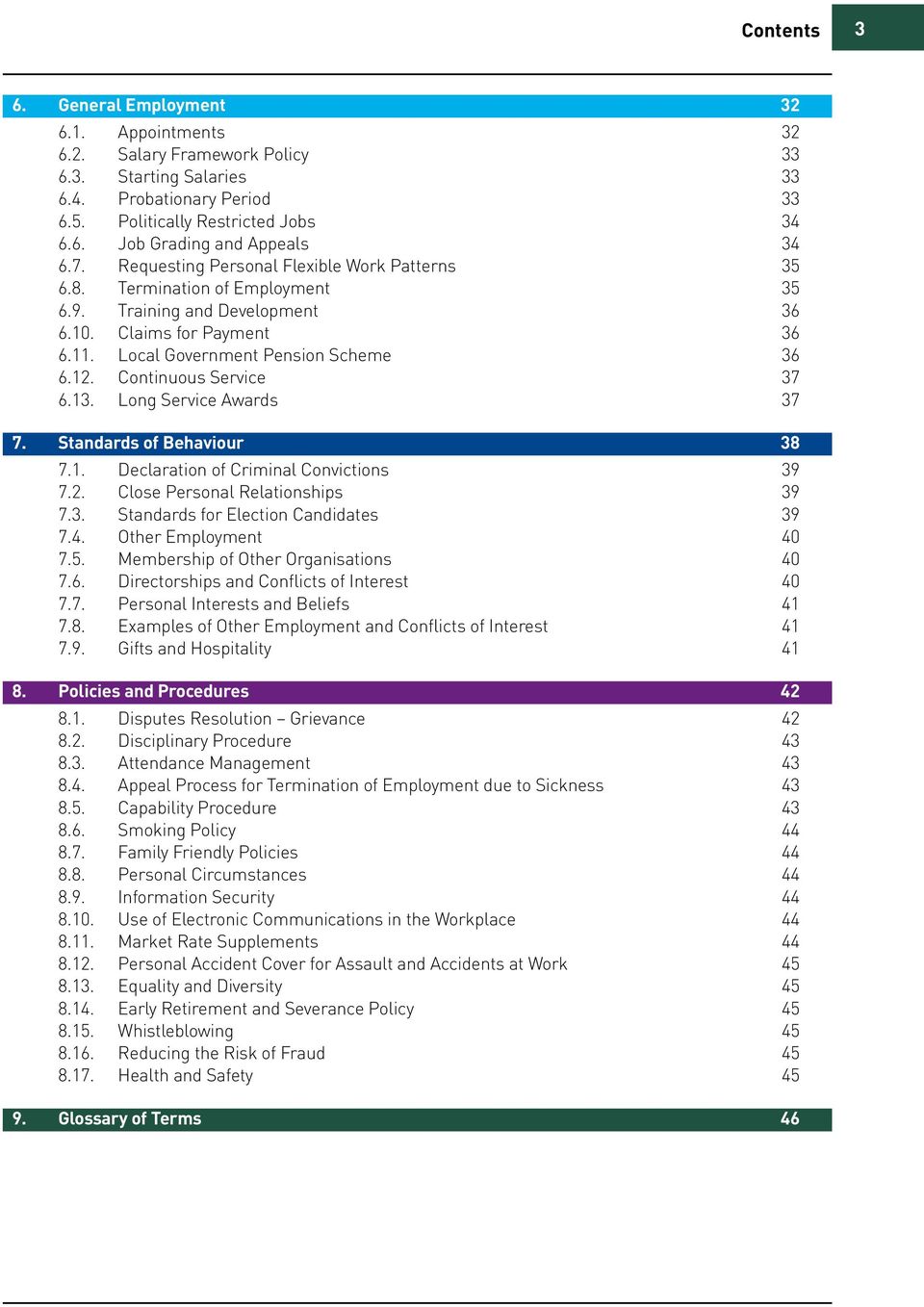
4 4 Introduction 1. Introduction Our Mission Our mission is to be a modern, flexible and emotionally intelligent organisation able to work with our diverse communities to sustain the services they need, the outcomes we choose and the opportunities they want. A council which: Connects ideas, people and resources across boundaries of all kinds, supporting communities to harness and build on their strengths. Focuses on creating trust and synergy between institutions, businesses and citizens in Kirklees. Continues to provide a consistent level of basic services, but targets limited resources as appropriate to meet community needs and strives to maximise the impact of all our services by collaborating with others. Safeguards vulnerable citizens, but wherever possible, seeks to not just provide a safety net, but also a route to help people control their own lives and to stay safe and well. Our Values We will work together with a common sense of purpose. We will be: Passionate - about the difference we make Confident - in our abilities to get things done Flexible - in doing what we can as well as we can 1.1. Scope These terms and conditions apply to all employees covered by the National Joint Council for Local Government Services and all employees covered by single status: former manual workers; former APT&C Staff; chief officers; all craft workers and JNC youth workers. The terms and conditions supersede all previous national and local conditions of service for these employees. An exception is the national pay award ( Green Book ), where any future settlement will apply to all employees covered by the single status agreement. This will include chief officers. Other allowances will - where appropriate - track the average national pay award. These terms and conditions are subject to amendment from time to time in order to take account of changing circumstances and following negotiation with recognised trade unions. We acknowledge the importance of membership of recognised trade unions and aim to provide stable industrial relations through consultation and negotiation. For all other employees of Kirklees Council, their existing terms and conditions continue to be in force. None of the provisions of this handbook will apply to them. However, we aspire to bring everyone except teachers within scope of single status terms and conditions. Our Behaviours We want you to enjoy working here and provide the best possible services to our communities. By demonstrating the behaviours we have said we would like to see in our colleagues we can create a great place to work. Communicate Flexible Honest Positive Respectful Supportive
5 4 Introduction Work-life Balance Our approach to employees, and therefore our policies, encourages managers to focus on the individual, applying consistency around judgement rather than rules. Examples of this approach to help employees balance the complex demands of work and home life are: Flexible working Working at home Mobile and touchdown working Being part of a well organisation - performance management including attendance Meeting the changing needs of employees throughout their careers with the council Over the coming years people will think less in terms of a single workplace than of several workplaces, powered by developments in communication technologies. Mobile and home working will involve us in a shift from personalised space to personalised time having more control over our hours of work instead of a dedicated place in an office. The spheres of work and leisure will become less distinct for people working in these ways. As customers are looking for more flexibility and accessibility to services, we need to think about what this means for service delivery in the future Guiding Principles for the Organisation These guiding principles enable employees, managers and recognised trade unions to have a framework in which to consider any issues around these terms and conditions. Everyone has a responsibility to be aware that these guiding principles will be followed at all times. Assistant Directors will define their service s opening/operational hours and the type of working time framework that the service is using. These decisions will be aimed at creating a customerfocused service delivery. The council accepts and respects an individual s right to a fulfilled life both inside and outside paid work, to the mutual benefit of the individual, the council and customers. Wherever possible the council will try to make reasonable adjustments to meet the needs of an individual, provided that this does not conflict with customer service or impact on other employees. We will consult recognised trade unions within the collective bargaining framework on relevant corporate and service-based issues with a commitment to seeking views and achieving a shared understanding. Where contractual matters are discussed such as pay or changes to terms and conditions then we will negotiate with recognised trade unions with a view to reaching an agreement. There may be times such as changes in customer requirements or demand when a service needs to review the total annualised hours for an employee. This could lead to a permanent increase or decrease in total hours. When this happens, the service must take into account the impact and implications of the change on the employee and must negotiate with the appropriate trade union and inform the employee before making the change. The profile of an employee s working pattern should be based on the requirements of the job and the needs of the service. Managers should consider the flexibility sought by the existing jobholder. When recruiting either as a replacement to an existing job or to a new job the manager can amend the working profile and working days. Assistant Directors, in consultation with trade unions, will agree a procedure for managing annualised hours within their service. This will include clear arrangements for rostering, changing rostering at short notice and flexible working, and the method for calling off hours against the annual total of hours, and a description of the circumstances where additional hours may attract an additional payment. This procedure will be clear enough to be understood by both the service and employees. Managers will give at least 30 calendar days notice before implementing any changes. Normal staffing levels should not lead to overtime being worked. If regular overtime is being worked, services should employ additional staff. continued over the page
6 6 Introduction If you have more than one job with the council, your principal line manager will be the manager for the first job you were employed in, unless otherwise agreed. It is your responsibility to make sure that the total time spent on all your council jobs does not exceed European working time directive rules, and that you give yourself sufficient rest time. All services will work within the terms and conditions contained in this Employee Handbook. The council will not be entering into any local agreements. Service-specific agreements must be approved by the central negotiating forum for terms and conditions. NOTE You can access any policies or procedures referred to in this handbook from the council s intranet or from your manager. Schools-based employees can also access the council s intranet, or should ask their head teacher. Consultation is the right to be informed, have meaningful discussion and make comments within a reasonable timescale - normally seven working days. Wherever this handbook mentions Assistant Director or manager, school support staff should substitute the word head teacher. For the purposes of this agreement the appropriate or recognised trade unions are UNISON, GMB and Unite.
7 Introduction 7

8 8 Your Working Time 2. Your Working Time The council expects all employees to be flexible in their approach to their working hours to meet service needs. In return, the council will wherever possible seek to ensure that employees are able to make flexible arrangements to meet occasional personal needs Key Principles The hours of work in any service area will reflect the needs and activities of that service. Assistant Directors can amend hours and roster patterns - following consultation and after at least 30 calendar days notice - at any time within these principles. Services should introduce flexible working patterns wherever practicable. Where the council identifies a need to change the days on which an employee works, it will first seek volunteers. If there are insufficient volunteers, the council can following negotiations serve a 90 day notice of change of contract. The consolidation period for all these working time frameworks is normally 4 weeks. However, in some circumstances, it may be over a longer period. There are two working time frameworks: - Standard hours (including annualised hours) - Other patterns of work (including 24/7 and night working) Rostering (2.4) and Additional Hours and Premium Time (2.5) can be used within either of these two frameworks.

9 Your Working Time Standard Hours The Assistant Director has the discretion to define the working week for the entire service or for a distinct group within the service if required. A number of working patterns can exist within the service The Assistant Director taking note of the guiding principles in section 1.3 can determine working days of the week to be any five days out of seven, and can also determine a working timetable of planned working hours to meet the needs of the service Planned working hours can be between and on any day These hours may be varied by up to one additional hour at either side of the planned day, or displaced by up to two hours from the planned day Planned working hours can include different numbers of hours in each week over a declared longer time period. This is called annualised hours and gives your service and yourself the flexibility to vary your patterns of work throughout the year, according to the requirements of the service and your individual needs For example, a declared annual work pattern could consist of 34 hours a week during January to June and 40 hours a week during July to December Some employees may be offered contracts in excess of 37 hours. Where this occurs, all these hours will be paid at plain time. The council has the discretion to reduce these hours to 37 hours a week following a 90 days notification period and appropriate consultations For employees on a flexible scheme the planned working hours are the entire range of available flexihours that are offered Historically, flexitime was built around core hours. We are now looking towards balancing the needs of the individual and the requirements of service delivery. The concept of core hours no longer applies With a standard hours scheme it is possible that at any time there could be a difference between hours worked and payment received. Any time surplus or deficit will be set against the employee s annualised hours. When an employee leaves the council it is important that there is an agreed procedure for dealing with this difference. This may be to: Use the notice period to close the gap between work and pay Adjust the final salary payment Accept that, within limits, the service will ignore a shortfall in hours worked but will compensate the employee for a surplus of hours worked Note: These types of working patterns are already in place, for example: Flexitime for office-based employees A school cleaner working term time A customer services assistant working 37 hours a week Tuesday-Saturday The standard working week for a full-time employee is 37 hours covering 365¼ days a year including leap years (52.19 weeks).
10 10 Your Working Time Examples of standard hours patterns Full Time Employee Based on standard working week 37 hours Based on total annual hours (52.19 weeks x 37 hours) 1,931 hours Length of service * Total annual hours Total holiday hours Actual working hours Employee with less than 5 years service Employee with 5 or more years service 1, ,668 1, ,631 * This includes the employee s entire holiday entitlement, including public holidays. See section 3 for further details on holidays. Part Time Employee Based on standard working week 20 hours Based on total annual hours (52.19 weeks x 20 hours) 1,044 hours Length of service * Total annual hours Total holiday hours Actual working hours Employee with less than 5 years service Employee with 5 or more years service 1, , * This includes the employee s entire holiday entitlement, including public holidays. See section 3 for further details on holidays. Part Time Employee Working Term-time Only Based on standard working week 20 hours Based on 39 weeks total annual hours (including leap years) 780 hours Length of service * Total annual hours Total holiday hours Actual working hours Employee with less than 5 years service Employee with 5 or more years service * This includes the employee s entire holiday entitlement, including public holidays. See section 3 for further details on holidays.

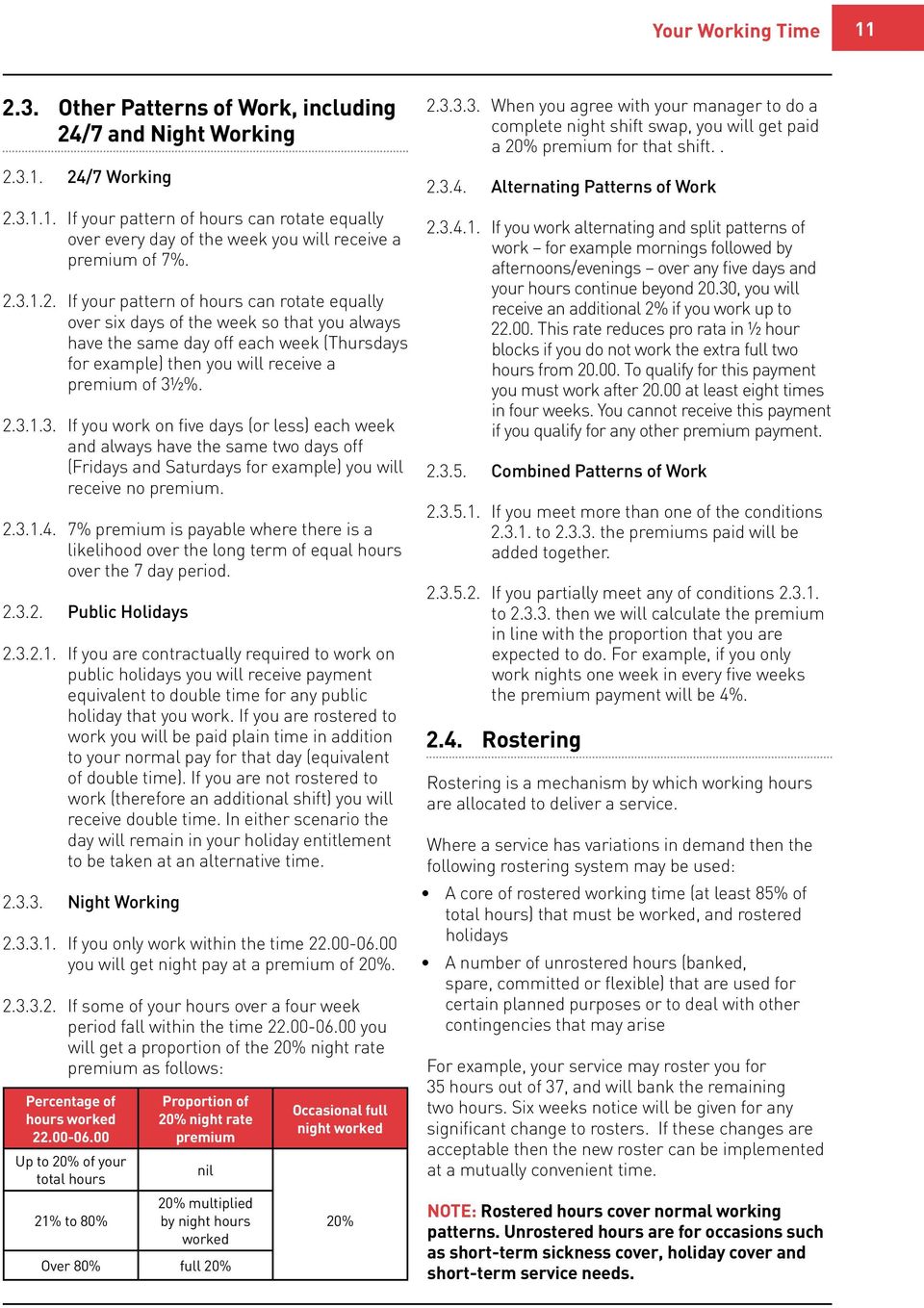
11 Your Working Time Other Patterns of Work, including 24/7 and Night Working /7 Working If your pattern of hours can rotate equally over every day of the week you will receive a premium of 7% If your pattern of hours can rotate equally over six days of the week so that you always have the same day off each week (Thursdays for example) then you will receive a premium of 3½% If you work on five days (or less) each week and always have the same two days off (Fridays and Saturdays for example) you will receive no premium % premium is payable where there is a likelihood over the long term of equal hours over the 7 day period Public Holidays If you are contractually required to work on public holidays you will receive payment equivalent to double time for any public holiday that you work. If you are rostered to work you will be paid plain time in addition to your normal pay for that day (equivalent of double time). If you are not rostered to work (therefore an additional shift) you will receive double time. In either scenario the day will remain in your holiday entitlement to be taken at an alternative time Night Working If you only work within the time you will get night pay at a premium of 20% If some of your hours over a four week period fall within the time you will get a proportion of the 20% night rate premium as follows: Percentage of hours worked Up to 20% of your total hours 21% to 80% Proportion of 20% night rate premium nil 20% multiplied by night hours worked Over 80% full 20% Occasional full night worked 20% When you agree with your manager to do a complete night shift swap, you will get paid a 20% premium for that shift Alternating Patterns of Work If you work alternating and split patterns of work for example mornings followed by afternoons/evenings over any five days and your hours continue beyond 20.30, you will receive an additional 2% if you work up to This rate reduces pro rata in ½ hour blocks if you do not work the extra full two hours from To qualify for this payment you must work after at least eight times in four weeks. You cannot receive this payment if you qualify for any other premium payment Combined Patterns of Work If you meet more than one of the conditions to the premiums paid will be added together If you partially meet any of conditions to then we will calculate the premium in line with the proportion that you are expected to do. For example, if you only work nights one week in every five weeks the premium payment will be 4% Rostering Rostering is a mechanism by which working hours are allocated to deliver a service. Where a service has variations in demand then the following rostering system may be used: A core of rostered working time (at least 85% of total hours) that must be worked, and rostered holidays A number of unrostered hours (banked, spare, committed or flexible) that are used for certain planned purposes or to deal with other contingencies that may arise For example, your service may roster you for 35 hours out of 37, and will bank the remaining two hours. Six weeks notice will be given for any significant change to rosters. If these changes are acceptable then the new roster can be implemented at a mutually convenient time. NOTE: Rostered hours cover normal working patterns. Unrostered hours are for occasions such as short-term sickness cover, holiday cover and short-term service needs.
12 12 Your Working Time 2.5. Additional Hours and Premium Time Additional hours and premium time will only be paid when flexible arrangements cannot be used Additional hours and premium time can apply to both standard hours and other patterns of work Additional hours are those worked in excess of your planned working hours. These are paid at plain time except when you meet the conditions set out at below All premium time will be paid at time and a half (1.5x plain time), except for unplanned work on the eight public holidays, which is paid at double time. You cannot get any additional rate of premium time even if you meet two or more of the conditions in Premium time will be paid only when agreed with your manager and when one or more of the following conditions are met: OR A) Your total hours exceed 148 over 4 weeks (or four times your planned working hours, if this is more than 37) B) Your additional hours exceed 25% of your planned working hours over 4 weeks C) If you are on standard hours and you work more than one hour either side of your planned working day D) You are working on a public holiday and you are not receiving the premium pay for other patterns of work E) You work on the 6th and 7th day in a 5 days in 7 working pattern, or on the 11th to 14th day in a 14 day working pattern, or any similar pattern F) When you commit to planned additional work (beyond your contractual hours) to be carried out on your 6th or 7th day or when the service is closed. You will be given at least 6 weeks notice of the additional work and you will be paid at time and two thirds If you qualify for premium time under any of the last three conditions (C, D or E), we will calculate this first. In this case, you will not be due any further premium time even if you meet conditions A or B. You cannot use one condition to accumulate time under another condition You cannot build up your annualised hours total from premium time Casual employees will be paid at plain time unless condition A applies Examples of Standard Hours and Other Patterns of Work Benefits Officer 37 hours full-time, total 148 hours in 4 week period. Basic pay no additional payments. On flexitime arrangement Example 1 Is asked to carry out work on Saturday following an unusual unexpected increase in work volume, which cannot be accommodated by flexitime. Works 5 additional hours on two Saturdays Receives premium time payment of: 10 hours at x Catering Assistant Works 3 hours a day term time, on fixed hours to 14.00, total 60 hours in 4 week period. Flexible working arrangements are used within the service. Basic pay no additional payments. Example 2 Is asked to work to for 3 days No additional payment, since this is normal work pattern Example 3 Is asked to work to on two days If this cannot be accommodated within flexible arrangements, employee receives additional payment of: 1 hour x 2 days at plain time and 1 hour x 2 days at x Care Assistant Example 4 Working on a 4 days on, 4 days off pattern, but the same basic 5 hours in both periods, Contractually required to cover public holidays, in the same ratio as normal working. 70 hours in 4 week period Receives basic pay, plus 7% for rotation by day and enhancement for any public holiday worked

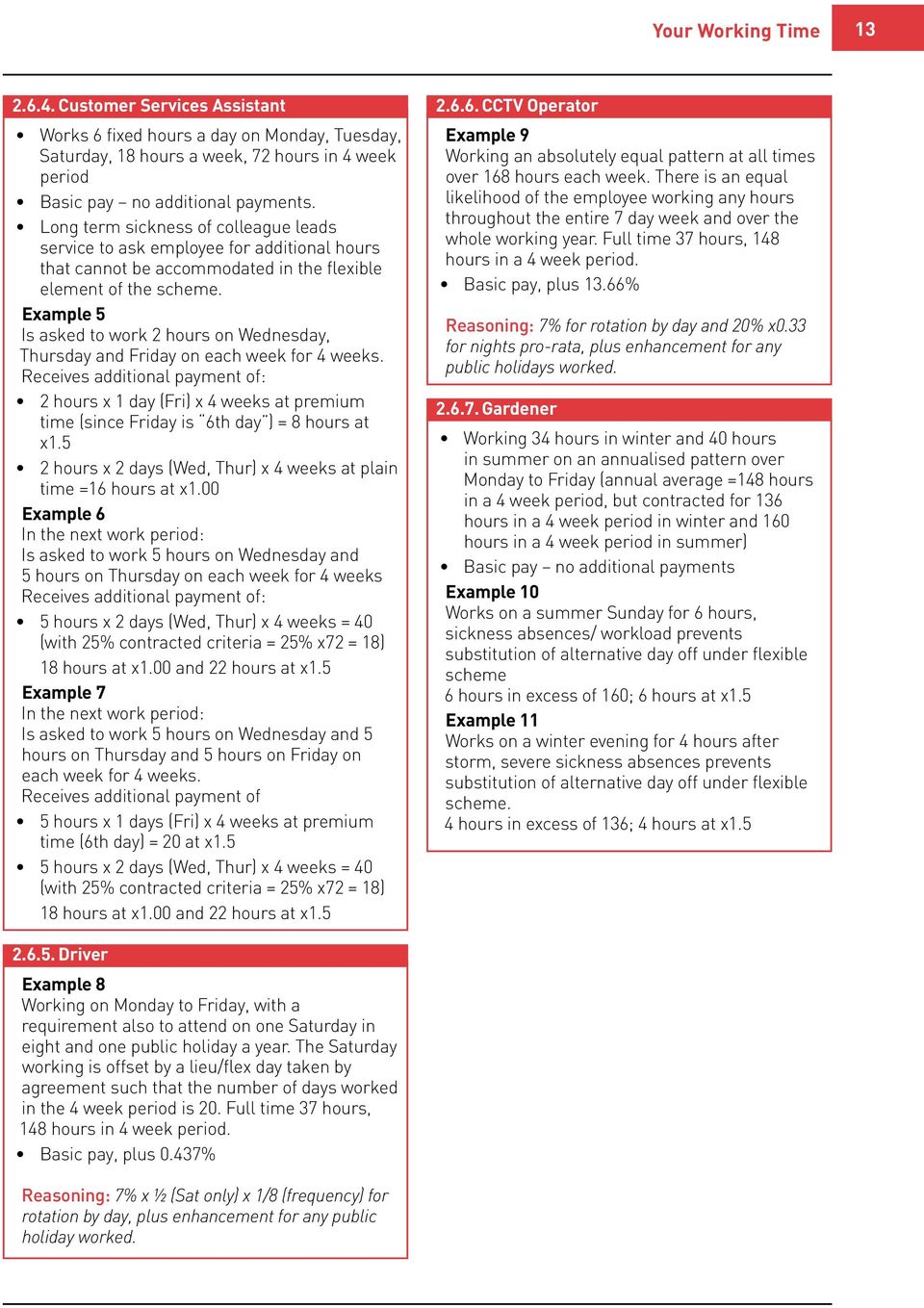
13 Your Working Time Customer Services Assistant Works 6 fixed hours a day on Monday, Tuesday, Saturday, 18 hours a week, 72 hours in 4 week period Basic pay no additional payments. Long term sickness of colleague leads service to ask employee for additional hours that cannot be accommodated in the flexible element of the scheme. Example 5 Is asked to work 2 hours on Wednesday, Thursday and Friday on each week for 4 weeks. Receives additional payment of: 2 hours x 1 day (Fri) x 4 weeks at premium time (since Friday is 6th day ) = 8 hours at x1.5 2 hours x 2 days (Wed, Thur) x 4 weeks at plain time =16 hours at x1.00 Example 6 In the next work period: Is asked to work 5 hours on Wednesday and 5 hours on Thursday on each week for 4 weeks Receives additional payment of: 5 hours x 2 days (Wed, Thur) x 4 weeks = 40 (with 25% contracted criteria = 25% x72 = 18) 18 hours at x1.00 and 22 hours at x1.5 Example 7 In the next work period: Is asked to work 5 hours on Wednesday and 5 hours on Thursday and 5 hours on Friday on each week for 4 weeks. Receives additional payment of 5 hours x 1 days (Fri) x 4 weeks at premium time (6th day) = 20 at x1.5 5 hours x 2 days (Wed, Thur) x 4 weeks = 40 (with 25% contracted criteria = 25% x72 = 18) 18 hours at x1.00 and 22 hours at x CCTV Operator Example 9 Working an absolutely equal pattern at all times over 168 hours each week. There is an equal likelihood of the employee working any hours throughout the entire 7 day week and over the whole working year. Full time 37 hours, 148 hours in a 4 week period. Basic pay, plus 13.66% Reasoning: 7% for rotation by day and 20% x0.33 for nights pro-rata, plus enhancement for any public holidays worked Gardener Working 34 hours in winter and 40 hours in summer on an annualised pattern over Monday to Friday (annual average =148 hours in a 4 week period, but contracted for 136 hours in a 4 week period in winter and 160 hours in a 4 week period in summer) Basic pay no additional payments Example 10 Works on a summer Sunday for 6 hours, sickness absences/ workload prevents substitution of alternative day off under flexible scheme 6 hours in excess of 160; 6 hours at x1.5 Example 11 Works on a winter evening for 4 hours after storm, severe sickness absences prevents substitution of alternative day off under flexible scheme. 4 hours in excess of 136; 4 hours at x Driver Example 8 Working on Monday to Friday, with a requirement also to attend on one Saturday in eight and one public holiday a year. The Saturday working is offset by a lieu/flex day taken by agreement such that the number of days worked in the 4 week period is 20. Full time 37 hours, 148 hours in 4 week period. Basic pay, plus 0.437% Reasoning: 7% x ½ (Sat only) x 1/8 (frequency) for rotation by day, plus enhancement for any public holiday worked.
14 14 Your Working Time 2.7. General Arrangements Assistant Directors will determine the total number of hours to be worked in the full year and the pattern of work each week or month for each of their service areas. These will be adopted and reviewed from time to time, in consultation with the recognised trade unions. The hours are calculated annually and rostered over the year to match service demands All employees will have an individual agreed working profile that sets out their working pattern, guaranteed minimum number of contracted hours and base salary Scheduling of work can take a variety of forms: there may be an average monthly total to be worked, or it may take the form of periods of intense working followed by periods of rest for example a two weeks on, two weeks off pattern Assistant Directors in consultation with trade unions should consider: Requirements for a minimum staffing and skill mix throughout the daily work cycle, and provision for unforeseen events Minimum and maximum hours that can be worked in a defined period Guidelines for issuing rosters and making roster changes at short notice For part-time employees, annualised hours and holidays are worked out in proportion to full-time equivalents A system for keeping track of hours worked must be agreed locally and in consultation with recognised trade unions. Misuse of council time is fraud. Managers and employees are responsible for maintaining accurate records such as: Total contracted annual hours Schedule of hours worked that four-week period Total hours worked Total hours remaining Holiday taken and due Any working pattern must take account of European working time directive rules governing weekly working time and rest breaks, and any other job-related rules concerning rest breaks All employees (except where statute permits shorter breaks) should have a minimum 11 hours rest between each working day, and should not work more than six days in every seven, or 12 days in every 14. These requirements must be recognised when arranging working patterns Managers must make sure that taking account of overtime and any other employment with the council an employee must not work more than 192 hours in any four week period. This requirement includes compliance with the European working time directive rules. Exceptions can be made for: Busy periods Emergencies People working away from home In these cases, rest periods can be accumulated but must be taken later Normally, additional hours worked will be called-off against the employee s annualised hours. However, we recognise that at some times during the year there may be an unexpected need for additional work which could not have been predicted. In these circumstances the manager and the employee will agree additional hours in accordance with the premium time payments set out in Existing Arrangements (in place before 1 October 2007) Contractual overtime existing working arrangements will be recognised at implementation, but will be de-contractualised Sleep-ins existing arrangements will be recognised for the purpose of implementation Lettings existing arrangements will be recognised for the purpose of implementation.

15 Your Working Time Standby and Call-out Working Days Standby with Call-out [A] Payment per day Call-out on each Occassion [A] Active Standby [B] Payment per day Reactive Standby [C] Payment per day Monday Friday for the first Weekend or 2 hours, then Public Holidays x1.5 plain time These figures are derived from SCP28 and apply from 1 January Where standby and/or call-out is a requirement of the job this will be specified in the contract of employment for the jobholder Standby and call-out payments are regarded as reflecting the inconvenience to the employee when carrying out standby or callout duties We expect that all employees graded GR13 and above who are contracted to do standby or call-out will carry out standby as and when reasonably required, such as in response to emergency situations. This will be deemed to be a requirement and part of the graded duties of the job. If you are GR13 or above and you do any call-out or other active work you will set the plain time hours spent on the work performed against your annualised hours In special circumstances and as agreed with the Head of HR those employees graded GR13 and above who are regularly required to do standby or call-out will be on a rota system and will be paid in accordance with the table above. This is subject to the employee meeting all three of the following criteria: There is a multi-service and crossfunctional standby and call-out arrangement in place Employees are on a regular rota for standby or call-out There is a strong likelihood of an individual being called out at least once a week on this rota Any call-out time is in accordance with The contractual standby / call-out arrangements will be reviewed from time to time. Any changes to the existing arrangements will be driven by the requirements of the service and will be subject to 30 days notice of variation to the contract of employment after negotiation with recognised trade unions The contract of employment may state the number of days over the whole year during when the employee will be on call. This can be any combination of days, weeks, months, or seasons. The exact days of availability can be set down in the contract, or be notified to the employee in writing (with at least 14 days notice) Your manager will set out one of three requirements for standby and/or call-out: A) Standby, with a requirement to attend site (a workplace or other location to carry out the call-out duties) to carry out call-out B) Standby only, in circumstances where the frequency of disturbance is significant and regular, but with an expectation that tasks as necessary will be carried out from the standby location, and no physical site attendance will be necessary ( active standby ) C) Standby only, in circumstances where the frequency of disturbance is occasional or unusual, with an expectation that tasks as necessary will be carried out from the standby location, and no physical site attendance will be necessary ( reactive standby ) For example, if you were on active standby (B) for a complete week you would get continued over the page
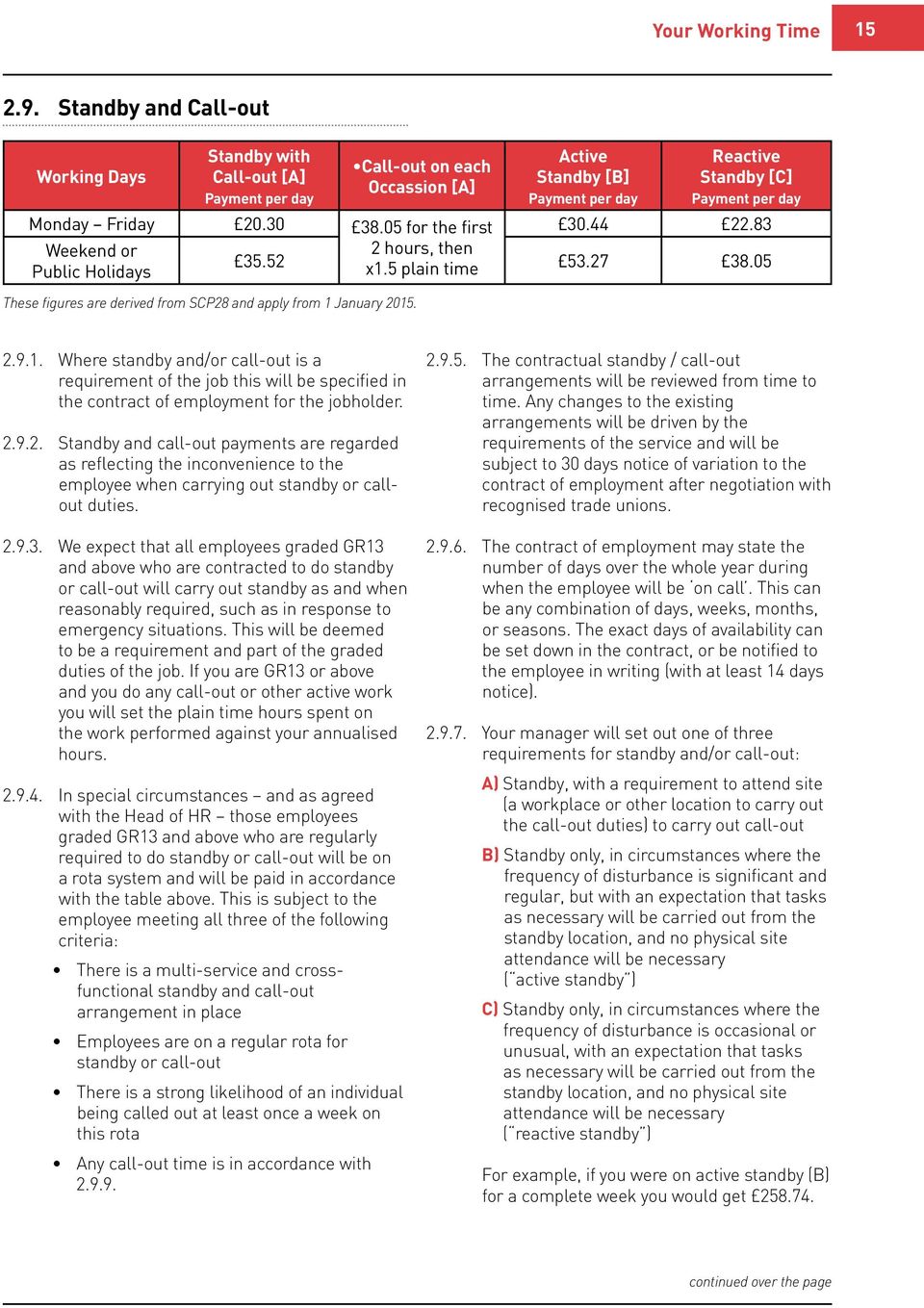
16 16 Your Working Time Under option A you will receive a payment for the first two hours of work. This payment will be claimed each time you carry out the callout duty, and includes travel time to site. If you receive a second or subsequent call-out during this period, you are expected to carry this out as part of the first call-out. Time beyond this is paid at x1.5 your normal plain time In some service areas where this time target of two hours is not appropriate, employees will record their call-out time and can set their plain time hours spent on the work performed against their annualised hours Emergency standby or call-out duties carried out on a Saturday, Sunday, public holiday or when the service is closed will be paid at not less than double time, taking account of fixed and variable payments. This also applies to staff who are called out on their 6th or 7th day. However, staff who are contractually required to be available for every day over a week are not entitled to payment other than for additional hours in such circumstances Under options B and C, the rate payable is fully inclusive. This includes any time spent dealing with or resolving any issue. In the unlikely event that attendance at site is necessary, this must be verified by the service. In such cases employees will record their call-out time and can set their plain time hours spent on the work performed against their annualised hours For option B and C, you and your Assistant Director will keep records of the frequency of calls. If you are called out more than seven times in any seven day period, you may qualify for option B. Otherwise you will be in option C If you are called out you will be paid travel costs in accordance with the travel scheme see section Standby will normally be on weekdays for about 16 hours from the end of normal work on one day to the start of normal work on the next, and for a 24 hour period at weekends and holidays. In a continuous period of standby for seven days there would be 5 weekday (Monday to Friday) and two weekend payments. Where standby is not required for all of these hours the payment will be in proportion Where you do occasional call-out duties in addition to your normal duties for example, to respond to emergencies you will normally be paid at the call-out rate as shown in the table at 2.9. Or you can set your plain time hours spent on the work performed against your annualised hours.

17 Your Working Time Pay Salaries are calculated and paid every four weeks (13 times a year) Casual employees will be paid every two weeks All payments will be made to a nominated bank or building society account. It is essential that you open and maintain a personal bank account or suitable building society account and provide the council with the necessary details to enable direct payments to be made. The Post Office offers a range of basic bank accounts A fundamental part of this new approach is that any additional payments will only apply to employees graded up to and including GR12. We expect that employees on grade GR13 and above will work towards outcomes and therefore additional payments - for example, premium time payments - do not apply Incremental Progression All employees will receive incremental increases in their pay that reflect performance based on outcomes, not length of service. This will be achieved by demonstrating that you have met the required outcomes consistently over a reasonable period You will not receive an incremental increase if you fail to demonstrate satisfactory performance. Your manager has the discretion not to award an incremental increase Managers can award accelerated incremental progression based on exceptional performance.

18 18 Your Working Time You can expect to receive an annual increment if you are not on the top of your grade, unless your performance or behaviour is unsatisfactory. To decide this, your manager must meet with you separately and not wait until your appraisal discussion If your current increment due date is 1st April this will continue to be the case until you reach the top of your grade. For all new employees, or existing employees who change jobs, then increments will be paid on the anniversary of the date of your appointment Career Graded Jobs For all career graded jobs, you can only move to the next grade provided that you have successfully demonstrated that you have met the required outcomes. These outcomes will be specific to an individual career grade progression scheme If your incremental progression has been withheld as a result of unsatisfactory performance, it will only be reinstated from the date that your Assistant Director considers that your performance has risen to a satisfactory level. This cannot be back-dated.
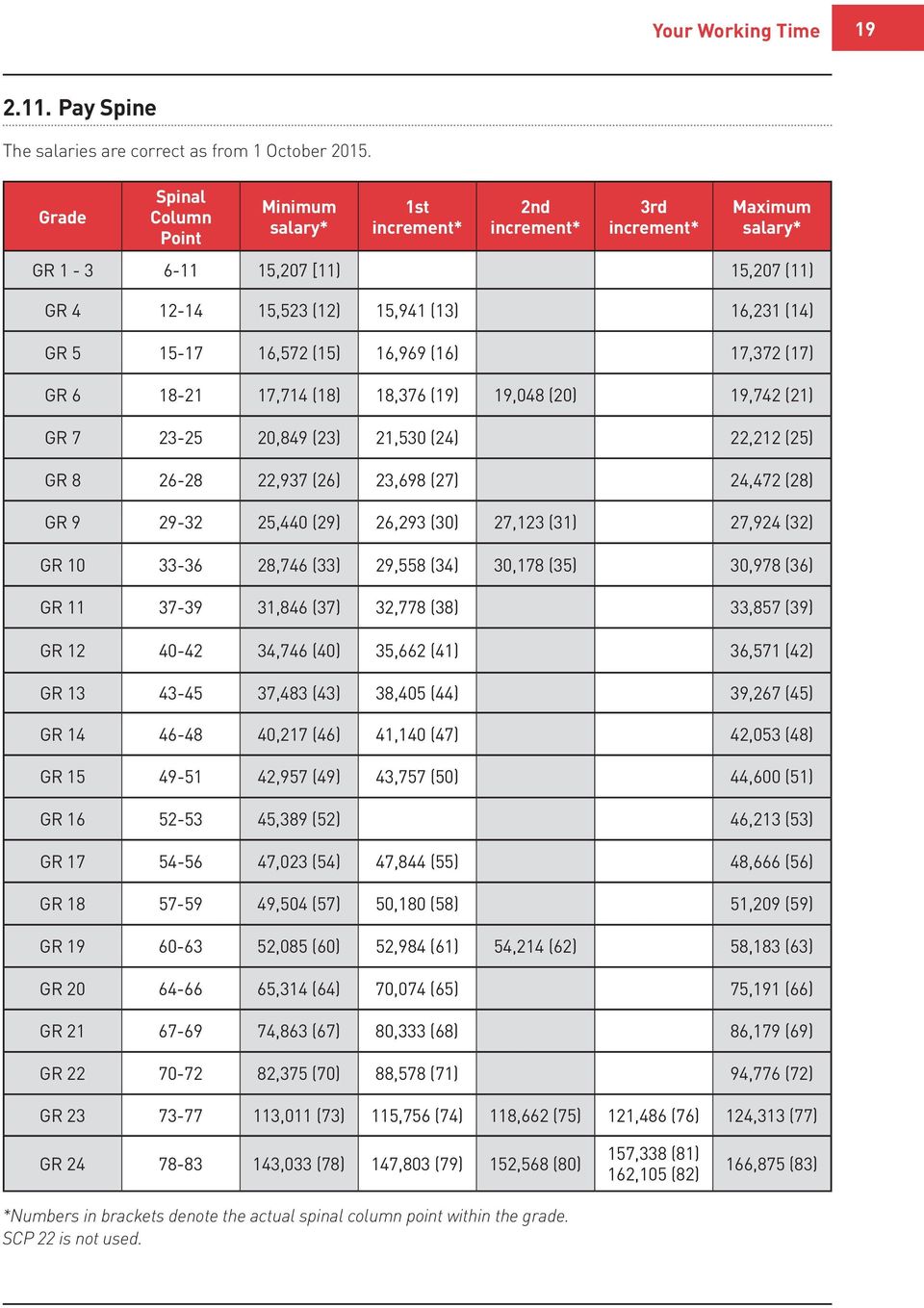
19 Your Working Time Pay Spine The salaries are correct as from 1 October Grade Spinal Column Point Minimum salary* 1st increment* 2nd increment* 3rd increment* Maximum salary* GR ,207 [11) 15,207 (11) GR ,523 (12) 15,941 (13) 16,231 (14) GR ,572 (15) 16,969 (16) 17,372 (17) GR ,714 (18) 18,376 (19) 19,048 (20) 19,742 (21) GR ,849 (23) 21,530 (24) 22,212 (25) GR ,937 (26) 23,698 (27) 24,472 (28) GR ,440 (29) 26,293 (30) 27,123 (31) 27,924 (32) GR ,746 (33) 29,558 (34) 30,178 (35) 30,978 (36) GR ,846 (37) 32,778 (38) 33,857 (39) GR ,746 (40) 35,662 (41) 36,571 (42) GR ,483 (43) 38,405 (44) 39,267 (45) GR ,217 (46) 41,140 (47) 42,053 (48) GR ,957 (49) 43,757 (50) 44,600 (51) GR ,389 (52) 46,213 (53) GR ,023 (54) 47,844 (55) 48,666 (56) GR ,504 (57) 50,180 (58) 51,209 (59) GR ,085 (60) 52,984 (61) 54,214 (62) 58,183 (63) GR ,314 (64) 70,074 (65) 75,191 (66) GR ,863 (67) 80,333 (68) 86,179 (69) GR ,375 (70) 88,578 (71) 94,776 (72) GR ,011 (73) 115,756 (74) 118,662 (75) 121,486 (76) 124,313 (77) GR ,033 (78) 147,803 (79) 152,568 (80) *Numbers in brackets denote the actual spinal column point within the grade. SCP 22 is not used. 157,338 (81) 162,105 (82) 166,875 (83)
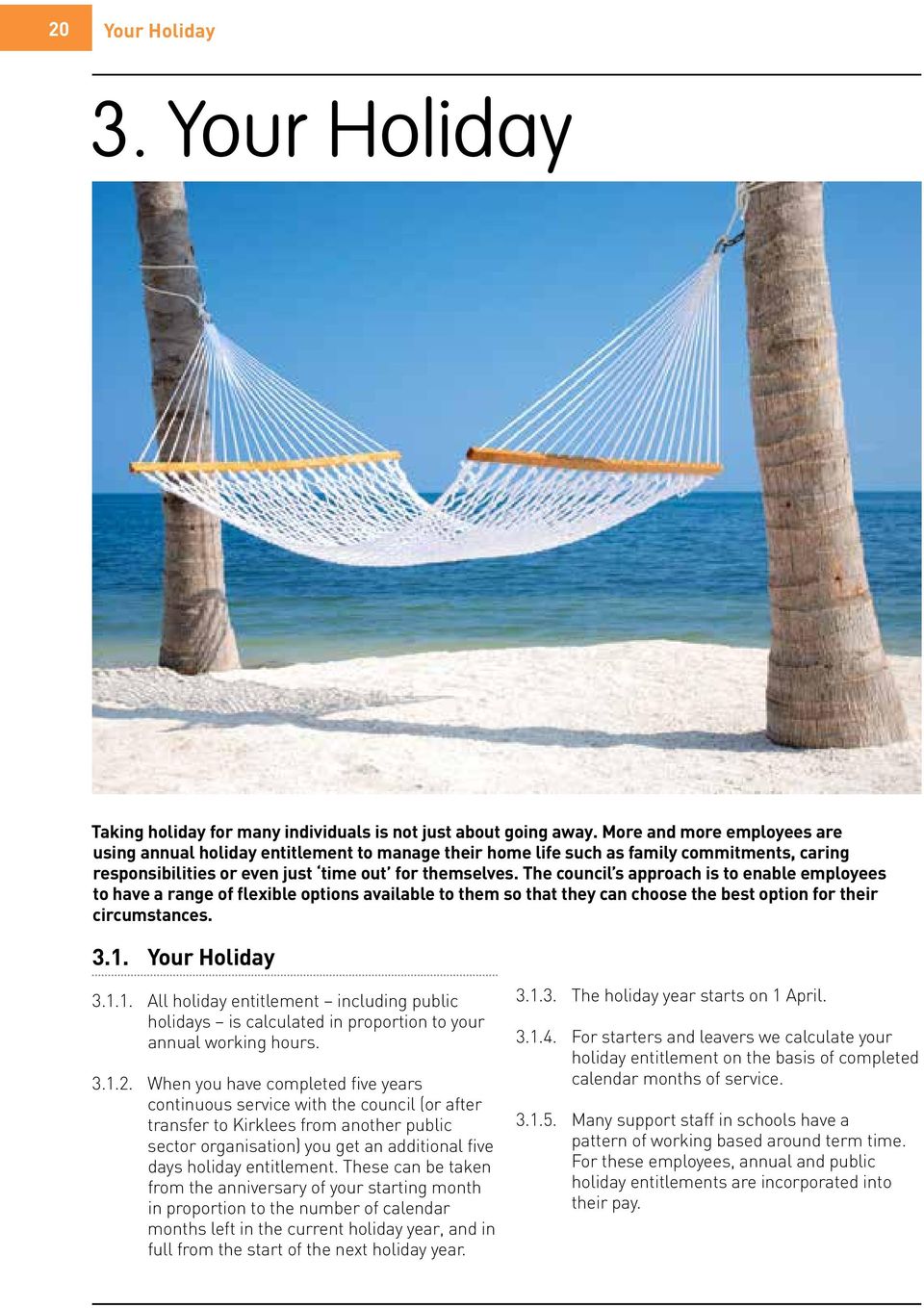
20 20 Your Holiday 3. Your Holiday Taking holiday for many individuals is not just about going away. More and more employees are using annual holiday entitlement to manage their home life such as family commitments, caring responsibilities or even just time out for themselves. The council s approach is to enable employees to have a range of flexible options available to them so that they can choose the best option for their circumstances Your Holiday All holiday entitlement including public holidays is calculated in proportion to your annual working hours When you have completed five years continuous service with the council (or after transfer to Kirklees from another public sector organisation) you get an additional five days holiday entitlement. These can be taken from the anniversary of your starting month in proportion to the number of calendar months left in the current holiday year, and in full from the start of the next holiday year The holiday year starts on 1 April For starters and leavers we calculate your holiday entitlement on the basis of completed calendar months of service Many support staff in schools have a pattern of working based around term time. For these employees, annual and public holiday entitlements are incorporated into their pay.
21 Your Holiday Public Holidays In addition to annual holiday all employees get 8 days public holidays each year. These relate to the following days: New Year s Day 1 Good Friday, Easter Monday 2 May Day 1 Spring Holiday Monday 1 August Holiday Monday 1 Christmas Day, Boxing Day These days will be added to each holiday year based on the actual dates that arise in each annual period from 1 April, since Easter can fall in March or April You must count these days as part of your annual holiday if you do not work on those days (if the service is closed or you are absent from work, for any reason, on that date). Schools support staff working term times have these days incorporated into their pay If you are required to work on a public holiday, this will be part of your duties and you will be paid an agreed additional payment If you are asked and voluntarily agree to work on a public holiday, you will receive a premium time payment.
22 22 Your Holiday 3.3 Your Holiday Entitlement This table shows your total holiday entitlement each year, depending on your length of service: Length of Service * Holiday Entitlement Public Holidays Total Less than five years 27½ 8 35½ Five or more years 32½ 8 40½ * Holiday entitlement now includes Easter Tuesday and Spring Holiday Tuesday, Christmas Eve (½ day) and two former floating days If you work on a public holiday, then the hours that you work will not be deducted from your holiday entitlement The holiday entitlements shown in the table above are effective from 1 October If you are on long term sick leave your annual holiday entitlement accrues at the statutory rate (see also section 8.3).
23 Your Holiday Taking Holiday You must agree your holiday time with your manager before you take it You may take any part of your holiday in hours Assistant Directors, after consultation with recognised trade unions, may determine that all or part of a service will close for a specified number of days a year. You may be required to take holiday on these days, but you will be given advance notice Assistant Directors may determine that services will be provided on any day, and may - after giving reasonable notice - require employees to attend on any day Assistant Directors may determine holiday rotas to ensure that sufficient employees are available to deliver appropriate levels of service All employees working term time, including schools support staff, have their holidays incorporated into their pay Part Time Employees If you work part time, your holiday will be calculated in proportion to your contractual hours worked Holiday Carry Forward You must take at least 28 days holiday each year. This is a legal requirement. The 28 days includes public holidays. You can carry forward any of your additional holiday entitlement for an unlimited period. There are no arrangements to buy back any untaken holiday You must have a discussion with your manager about how many hours or days holiday you want to carry forward, and for how long. Your manager will need to know for service planning purposes the amount of holiday you are intending to carry forward Assistant Directors will regularly monitor the holiday carry forward across their service to make sure that all employees are taking the statutory minimum 28 days holiday a year If you leave, you will be expected to arrange to take your holiday before your last day at work. You will lose any untaken holiday unless it can be used up before you leave, or you agree an alternative arrangement with your service. If you have already taken more holiday than you are entitled to, we will reclaim this from your final salary payment.
24 24 Extra Payments 4. Extra Payments 4.1. Honorarium Payment You will receive an honorarium payment if you perform duties which are outside the scope of your current job (at any grade) and where the additional duties and responsibilities involved are above the level of your current job. The amount of payment will reflect the proportion of graded duties for that job You will not qualify for an honorarium payment if you just have an increase in the volume of your work or you carry out duties at the same or at a lower level An honorarium is time limited, usually 3-6 months. If a longer period is required then the Assistant Director should refer to the Managing Short Term Development Opportunities guidelines on the intranet for alternative arrangements Your Assistant Director will confirm in writing to you and to Payroll the period for which the honorarium payment will apply and will give you details of your additional duties for which the payment is being made. Payment is due as soon as the honorarium is agreed, and will be paid in your next salary.
25 Extra Payments Acting Up Acting up is when you perform the duties for someone whose job is at a higher level than your own. If your current job is grade GR8 and above, and your job description includes acting up, no additional payment will be made for the first four weeks see the table below. You will receive additional payment in recognition of the acting up starting from week five. The amount of payment will reflect the proportion of graded duties for that job For jobs graded GR7 and below there is usually no specific requirement to act up as part of the job. If you are required to do so you will be paid for the proportion of graded duties for the higher job from day one Please refer to the Managing Short Term Development Opportunities guidelines on the intranet for further details on how these arrangements are managed. Or ask your manager. Grade GR13 and above GR8 to GR12 GR1 to GR7 Time before acting up payment starts Only following a recruitment process Four weeks Immeditaley Example 1 An assistant cook would act up as cook if the cook was on holiday. They would be paid immediately for these duties. Example 2 A deputy team manager would normally have acting up requirements in their job description. When acting up for their team manager, they would not receive additional payment unless the acting up period was for more than four weeks Disturbance Payment Disturbance payment is given to an employee whose job base is moved by the council. It will be paid for up to two years. This payment is only applicable to employees graded up to and including GR The Assistant Director, in discussion with the employee, will determine how much payment to make, taking into account both the employee s circumstances and the needs of service delivery. The Assistant Director will keep a record of the discussion and will inform Payroll of the agreed payment. Matters to consider will include: Time (additional due to new travel arrangements) Travel costs (fuel or net fares) Caring commitments (for example, child or elderly parents) You can agree to be paid by equal instalments over the agreed time period or as two lump sums: At the time of relocation On the first anniversary of the move, provided that you are still working at the new location If your relocation is less than two miles from your current designated job base, no disturbance payment is due.
26 26 Extra Payments 4.4. Subsistence Payment You cannot normally claim for subsistence when you are working within 50 miles of your job base The Assistant Director will determine whether subsistence payments will be pre paid by the service through a recognised process or whether the employee must claim afterwards. The preferred option will be for subsistence payments to be pre-paid to the employee, taking account of individual circumstances These items can be claimed afterwards provided that you have agreed them with your manager first: The cost of any hotel accommodation, approved in advance The cost of any breakfast or evening meal taken in the hotel (or the cost of a meal bought elsewhere if you can show that is similar in price to those reasonably available in the hotel) The costs of any meals which you have to buy at a place where food is not sold at normal retail prices (for example, motorway services, railway catering) On those exceptional occasions where you incur unreasonable costs due to an unexpected working pattern the Assistant Director will consider full or part payment of the costs incurred When you work for longer than the recognised working day of 7 hours 24 minutes (7.4 hours) your extra hours will be credited to your total annualised hours for that year. Where this is not appropriate you can agree an alternative arrangement with your manager as to how you will claim these additional working hours If you need to provide food and drink to entertain clients or suppliers, you must get these costs approved in advance by your Assistant Director Tools There are some roles within the council that require the use of tools for the employee to do their job. In most cases the tools will be provided by the service, in other cases you will be required to provide and maintain your own tools. The service will confirm the tools you are expected to supply. If you are required to provide your own tools you will receive an allowance. Employees are expected to ensure that tools are kept in good working order and replaced when necessary. Tool Allowance is not paid for equipment that you provide voluntarily, to assist you in your work Professional Fees These are fees paid by individuals to professional bodies for maintaining their professional or registered status - for example, social workers, lawyers, or architects You are responsible for paying your own professional fees and any other work-related fees, such as HGV licence renewal. It is your responsibility to make sure that you have any up to date registration that is a requirement for the job The council at its sole discretion may pay or contribute towards the cost of nationally recognised professional fees in the light of changing legislation. This will be reviewed from time to time Payment of Childcare Costs When we ask you to work hours that are different from your normal pattern of work, or on days for which you are not normally contracted to work (for example, to attend a training course) we will pay your additional childcare costs. These costs can include fees for childminders or babysitters or the cost of extra nursery or crèche facilities You must produce a VAT receipt whenever you claim for expenses.
27 Extra Payments Overpayment Where we have made an overpayment we will normally ask you to repay this. Your Assistant Director, in consultation with the Head of HR, may reduce or waive an overpayment on compassionate grounds Trainees If you are a trainee you will be paid at least the national minimum wage and the following costs during your traineeship: Training, including course fees, registration fees, examination fees Student membership fees for professional bodies Other costs such as HGV licence or medical where it is a requirement of the traineeship to have recognised certification If you fail to sit an examination within a reasonable period without good reason, or fail to show satisfactory progress, or discontinue the course, your Assistant Director may withdraw the funding and may require you to refund all or a proportion of the fees, depending on the circumstances After you have successfully completed a council-funded traineeship you are expected to continue working for the council for two years. If you don t do this, you must repay the cost of the traineeship. Such repayment is reduced by 1/24th for each completed month of service with the council following the date of completing the traineeship In exceptional circumstances your Assistant Director may reduce or waive this repayment after consultation with the Head of HR You must agree, with your Assistant Director, the amount of work time you spend on your training Laundry Provision Where uniforms or overalls are issued you must wear, launder and maintain these items of clothing at your own expense The council will provide, launder and maintain clothing at its expense where for health and safety reasons there is a statutory requirement to do so and where, following a risk assessment, the clothing is classified as personal protective clothing Telephones and Communications If you are designated as a home worker we will install at your home a dedicated broadband/phone connection at the council s expense which is for council-related work only If you already have broadband in your home, the council expects you to use this where necessary. This is covered by your standby payment If you are on call-out you will be provided with a council mobile phone and, where appropriate, other mobile IT devices necessary for you to carry out the task The council will not pay for the use of private fixed telephone lines Trade Union Subscriptions You have a right to be a member of a trade union If you authorise us, we will agree an arrangement with a trade union recognised by the council for collective bargaining purposes to deduct your trade union subscription from your salary Home Working The council will pay an allowance of 13 each four week period as a contribution to heating and lighting costs to anyone who is solely and only a home worker. No allowance is paid to anyone who works occasionally at home.
28 28 Travel Scheme 5. Travel Scheme 5.1. Introduction You will need to travel when required. For many people it is an essential part of their job. For others travel will be occasional for example when attending a training course The council supports green travel. This is any form of transport that causes less damage to the environment than driving. Walking, cycling and public transport are the main forms of green travel, but shortening and combining car trips or driving a car that runs on cleaner fuel than conventional petrol or diesel are also greener alternatives There are a range of options for services to consider as part of their travel plans: 1. Public transport and walking 2. Pay as you go using HMRC mileage rate* 3. Pool cars or service cars 4. City Car Club *Use of your own car is on a voluntary basis and subject to the overall service travel plan. Assistant Directors are responsible for determining travel plans If you use your own car you must log all your work related mileage. Your travel costs will be settled on a pay as you go basis using HMRC mileage rates.
29 Travel Scheme Objectives of the Travel Scheme Enabling and encouraging managers and employees to make a positive contribution to the green agenda, using their judgement Fairness across the organisation regardless of grade Flexibility to deliver a wide range of council services effectively taking into account factors including cost, service quality, employee time and responsiveness to customers Council Cars Pool Cars a pool of council cars will be made available for services to use. Transport Services will be responsible for the management of these vehicles Car Club a scheme operated by an external company whereby cars are parked in Huddersfield and Dewsbury town centres and can be booked for any length of time We will make suitable arrangements to ensure that council cars are maintained in a roadworthy condition. We will also use tracking systems (vehicle telematics) to provide security and reassurance to the driver and to monitor the car s whereabouts All council-owned vehicles will be provided with a parking permit valid for all council car parks and residents parking areas. Any costs incurred when using a council car for example parking, fuel can be reclaimed In some cases you may be allowed to use the council car to and from home. This is only permissible in very restricted circumstances. Any use of a council car for private purposes is strictly forbidden and will result in formal action.
30 30 Travel Scheme 5.4. Travel Plan Assistant Directors must produce an annual travel plan along with normal service plans and carbon impact assessments If you drive more than 8,000 miles a year on council business we may provide you with a council car If you use your own car, bicycle or motorcycle on council business you must make sure that you have arranged appropriate insurance for business use. Failure to have a valid driving licence or insurance certificate will be considered as misconduct Car Parking We will pay your car parking charges on days when you use your own car on council business Services may choose to provide service car parking permits. These are not normally for a single designated car but are for shared group use Other Arrangements You cannot claim car park charges at any time when you are using a car parking permit If you have driving in your job description you must be prepared to drive a council vehicle when asked Payments for Travel We will meet any reasonable costs of using buses and trains. You should try to buy the cheapest available ticket, for example day tickets. All travel will be standard class only. The preferred option will be for public transport travel payments to be pre-paid taking account of your individual circumstances and for your service to provide you with tickets in advance We will meet reasonable costs for taxis if their use has been agreed in advance You must provide receipts or tickets when claiming for any journey costs If you use your own car, motorcycle or bicycle we will pay the appropriate HMRC mileage rate.
31 Travel Scheme 31
32 32 General Employment 6. General Employment 6.1. Appointments All services will recruit within the council s recognised recruitment and selection procedure In schools, the responsibility for the recruitment and appointment of staff has been delegated to the school governing bodies. The Schools Surplus Staff Partnership Scheme is complementary to the following principles Some services will require pre-employment health screening for certain jobs. Applicants will receive information about this in their recruitment pack Some jobs require applicants to have a criminal records check before appointment. This will be made clear to applicants during the recruitment process.
33 General Employment If you are appointed to another job within the council you will normally start your new job no later than the date when your normal notice period would have expired In exceptional circumstances, where your old Assistant Director has difficulty in releasing you, the date for starting your new job can be delayed subject to the following conditions: The delay is acceptable to your new Assistant Director The delay is acceptable to you The salary and other terms and conditions of your new job will start from the date when your normal notice period would have expired This provision is not available where an employee elects to move to a job with a lower salary or an employee is designated a job with a lower salary due to capability or disciplinary action Management will consider the circumstances of the affected job(s), the group of employees and individuals within the group. This will include discussions with employees Starting Salaries When recruiting, Assistant Directors will offer a salary which is appropriate to the applicant s skills and experience. This applies both to career graded and non career graded jobs If you are on a fixed term contract and you have accrued more than 12 months continuous service, the council will make efforts to move you to a suitable alternative job for a maximum of 3 months, to run concurrently with your contractual notice period to the end of the contract. However, if such efforts are unsuccessful, your employment with the council will cease Salary Framework Policy There is a provision available for when an employee suffers a reduction in earnings due to a service review or redeployment Probationary Period If you are new to Kirklees Council you must serve a probationary period of six months before your appointment is confirmed. See the probationary monitoring procedure for details of the process. This does not apply to transfers between services within the council During the probationary period you will receive appropriate training and assistance and your overall performance will be assessed. If your conduct or capability is unsatisfactory, appropriate action will be taken in accordance with the procedure.
34 34 General Employment 6.5. Politically Restricted Jobs Jobs are politically restricted because of the nature of their duties and responsibilities Jobs graded GR13 and above will be politically restricted unless an exemption is granted Jobs graded below GR13 will not be politically restricted unless explicitly stated The restrictions are incorporated into the contract of employment and will disqualify job holders from holding public elected offices (from the time of the next election affecting them) and from engaging in certain specified activities Employees in politically restricted jobs are NOT allowed to: Be a member of a local authority (other than a parish or community council), a Member of Parliament, a Member of the Scottish Parliament, a Member of the Welsh Assembly or a Member of the European Parliament Act as an election agent or sub-agent on behalf of a person who is to be a candidate at any election of a local authority, Parliament, Assembly or European Parliament Canvass on behalf of a political party, or on behalf of a person, who is to be a candidate at any election of a local authority, Parliament, Assembly or European Parliament Hold any office in a political party (although mere membership is not affected) Speak in public or publish any written or artistic work on party political matters that appear to be designed to affect public support for a political party 6.6. Job Grading and Appeals The council has adopted the NJC Job Evaluation Scheme that consists of a 13 factor plan, a scoring system and weightings that are free from gender bias and discrimination on the grounds of any of the protected characteristics covered by the Equality Act All jobs are graded in accordance with a fair and non-discriminatory grading structure You may only appeal against the initial job evaluation exercise on the grounds that the scheme was misapplied for example, factor levels or scores were wrongly allocated, the information provided was inadequate or the evaluation panel failed to follow the correct guidance. Salary levels and grade are not a basis for an appeal If you can show that your job has changed significantly since the initial evaluation because of substantial changes in your duties and responsibilities you can ask through your manager - for a re-evaluation of your job. The procedure in the grading and appeals policy must be followed If the decision of the appeal panel is found to be perverse, or due process has not been followed, an individual can request a referral to councillors The restrictions apply to these jobs unless the job holder makes a successful application for exemption to the Monitoring Officer of the Standards Committee.
35 General Employment Requesting Personal Flexible Work Patterns The council provides a very wide range of services to a diverse range of customers. This means that we need flexibility to deliver effective services to customers, driven by their needs. Employees should be involved in the discussion with their manager about where, when and how they work Services have full discretion over the degree of flexible working. Customer needs and service delivery must be considered at all times Services may determine that the working profile for some jobs or periods of work may have to be restricted to achieve effective service delivery Services will determine the use of flexible working after consultation with recognised trade unions on the understanding that: It is applied fairly It operates within the context of the council s flexible ways of working policy Consideration is given to the most appropriate technology and office accommodation It aligns with the working time framework(s) chosen for the service As part of the council s approach to worklife balance there is a range of flexible work patterns available. You can find details on the intranet. You should discuss the options available informally with your manager Termination of Employment Other than for any legal requirement or by mutual agreement, the periods of notice for both the council and employees are: Directors or Assistant Directors Employees graded GR9 and above All other employees 12 weeks 8 weeks 4 weeks You can give notice to terminate your employment on any working day but it must be in writing The council may decide not to insist that you work the full notice period If the council gives you notice of termination of your employment it may require you to perform only certain specific duties or no duties at all. You may be excluded from any council premises during part or all of your notice period. But your salary and benefits will be paid in full until your employment is terminated. During your notice period you will remain an employee of the council and you may not work for any other organisation, whether paid or not On termination of your employment you must return all council property immediately. This includes any ID cards, keys, credit cards, computer and other equipment, and anything else in your possession which belongs to or relates to the business of the council If you make a formal request in writing for flexible working, a discussion with your manager must take place within four weeks. Your manager will respond to such a request within six weeks of receiving the request.
36 36 General Employment 6.9. Training and Development You have the right to an annual discussion about your training and development needs as set out in the council s performance management framework. This discussion forms part of your appraisal. This is an opportunity to discuss any training and development that will help to develop your career Some schools operate their own performance management system You must make yourself available for any agreed training and development You can also ask your Assistant Director for relevant training and they will consider your request When you attend a training course on a day that is not a planned working day, you can set these hours against your total annualised hours for the year On occasions the training may last longer than the planned working day. With the agreement of your manager you can claim the extra hours against your total annualised hours. But you cannot receive additional payment for them If you incur additional costs as part of the training (for example, lunch) you can claim these as a subsistence payment, with the agreement of your manager. Or these might be pre-paid by your service Claims for Payment All claims will be paid under arrangements approved by the Director of Resources You must submit all claims on an approved electronic or paper form. Claims must be authorised by your manager Local Government Pension Scheme The Local Government Pension Scheme (LGPS) is a statutory, funded pension scheme. As such it is very secure because the benefits are defined and set out in law. Highlights of the benefits provided by the scheme are: A guaranteed pension based on the best of your final 3 years salary A tax free lump sum of up to 25% of the total value of the benefits Life assurance cover of 3 times your yearly pay from the day you join the scheme Early payment of benefits if you have to stop work permanently because of ill health Pensions for your spouse, civil partner, cohabiting partner and/or your children A pension that increases each year in line with inflation Your contribution rate is determined by your salary please refer to the handbook from the West Yorkshire Pension Fund, the local LGPS administrator We will reimburse your claims through your salary. We will do this in a timely manner.
37 General Employment Continuous Service If you have previous continuous employment with an organisation covered by the Redundancy Payments (Modification) Orders (which includes local authorities and related bodies) or a TUPE Transfer Agreement this will be recognised in calculating your entitlement to: Annual holiday entitlement Sickness pay Maternity or paternity leave Redundancy payment Notice period Pensions Long Service Awards You are entitled to a long service award once you have completed 25 years service of any description with Kirklees Council, and are still employed at Kirklees Council. This includes any broken service and service with one of the pre-1974 constituent councils of Kirklees. In calculating a long service award we will take account of any period when you were or are transferred to or from an arms length organisation such as Kirklees Neighbourhood Housing or Kirklees Active Leisure Previous service with the NHS will be recognised in calculating your entitlement to: Annual holiday entitlement Sickness pay Maternity or paternity leave Notice period Pensions (subject to transfer in)
38 38 Standards of Behaviour 7. Standards of Behaviour The public expects and is entitled to demand the highest ethical standards of conduct of any local government employee. Public confidence in an employee s credibility and integrity would be shaken should the least suspicion arise however ill-founded that they could be influenced by personal considerations. Mutual trust is the foundation of the employment contract between the council and all its employees. These standards of behaviour provide direction on how you must behave to avoid any action that could compromise that trust. The standards of behaviour also provide guidance on how to behave when dealing with internal and external colleagues, councillors, members of the public, and contractors such as suppliers, providers, consultants and temporary staff. You must follow these standards of behaviour and must understand that they are incorporated into your contract of employment. If you fail to follow these standards you will face formal action.
39 Standards of Behaviour 39 You must: Follow all reasonable rules and instructions that apply to you and given by those supervising or managing your activities or area of work Act in accordance with the council s policies and standing orders. Where you are unsure of how you are affected you should seek advice from your manager Carry out your responsibilities in a way that is fair, just and equitable and reflects the council s commitment to equality and diversity Pay due regard to your common law obligations Maintain the highest level of courtesy and respect when dealing with colleagues both inside and outside the council, councillors, members of the public and contractors Not put yourself in a position where your private activities discredit the council or bring the council into disrepute Avoid the use of language or images whether written, printed or electronic that could cause offence to an individual or others nearby Dress in accordance with your service s requirements and wear your council identity badge when at work Make sure that public money and other resources are used properly and efficiently and with consideration to any impact on the environment Not disclose any confidential information 7.1. Declaration of Criminal Convictions You will act with the utmost honesty at all times. If you are charged, summonsed, convicted or receive a verbal or written caution in relation to any criminal proceedings or Anti-Social Behaviour Orders (ASBOs) which are directly relevant to your council employment you must report this to your manager as soon as you reasonably can. Failure to do so will lead to formal action and may lead to gross misconduct. If you are unsure as to whether you should report an incident, you should seek advice Close Personal Relationships The council does not support arrangements where an employee supervises or is supervised by another employee with whom they share a close personal relationship A close personal relationship is defined as: husband, wife or civil partner, other member of the same family, fiancé(e), cohabitee, or any other person known to have a similar personal relationship If you have a close personal relationship with an existing employee you cannot be considered for appointment to a job in the same team and in the same line of management If a close personal relationship develops or already exists between you and someone working within the same team, you should make this known to your manager Standards for Election Candidates If you wish to stand as a candidate for election as a Kirklees councillor, you must have resigned your job with the council before you submit your consent to nomination paper. Anyone standing as a candidate for election to Kirklees Council while still employed by the council is opening themselves to challenge in law You may stand for election to another local authority council or to a parish or community council while you are employed by Kirklees If your job is classed as politically restricted, other conditions will apply see section 6.5.
40 40 Standards of Behaviour 7.4. Other Employment The council recognises that some employees often wish to take other employment in addition to their council job. This includes working for another employer; doing consultancy work; teaching; giving presentations; being self employed; doing casual work There is no automatic bar to any employee taking other paid work. However, if you wish to take on any such employment or similar activities whether paid or not you should consider carefully whether this could have an adverse impact on your council job. If in doubt, you should seek advice from your Assistant Director If there is any possibility of adverse impact you must get approval from your Assistant Director. They will maintain a register of activities and record any issues, concerns, agreements, or directions associated with the activity. In reaching such agreement, you and your Assistant Director must think about: Whether you are unable to do your council job effectively because of the requirements of your other work, including overlap of working periods and emotional, physical and mental demands Any conflict of interest with the council not using the reputation of the council to earn private income Demonstrating that you are not using the council s time and materials or the intellectual property rights of the council to earn income Not breaking the European working time directive rules 7.5. Membership of Other Organisations You should take into account your membership of any clubs or organisations outside the council that could be seen to be influencing your views, perceptions or actions. Similarly, you should consider any financial interest you or personal friends or relatives may have in any suppliers or contractors to the council If you have any such interests or relationships that could be perceived as having any influence on your decisions or actions as an employee, you should formally advise your Assistant Director in writing Directorships and Conflicts of Interest You must declare your involvement with any of the following to your Assistant Director. Details will be recorded in a register maintained by the Assistant Director A directorship or management role in any business, charity or voluntary organisation A shareholding or interest in any family business, or ownership of shares (other than shares in a public limited company where you own less than either 2,500 shares or 0.1% of the issued share capital) Membership of a secret society: An organisation which is secret in that the object of the organisation or the duties, obligations or secrets imposed upon or accepted by its members, or details of the membership itself of the organisation, are protected in any way by penalties which may be imposed upon its members.
41 Standards of Behaviour Personal Interests and Beliefs You must ensure that your personal interests and beliefs do not hinder the performance of your council duties. You should discuss any concerns with your Assistant Director Examples of Other Employment and Conflicts of Interest Working in a bar For most employees, occasional evening or weekend bar work would not need to be disclosed unless the hours of work left you too tired to be able to do your council job effectively. However, if you worked in the council s licensing section, taking a job in licensed premises might be seen as a potential conflict of interest, and your Assistant Director should be consulted first Local history society Many people are interested in local history, including tracing family trees and the study of local buildings and landscapes. Being a member of such groups is of course no problem, but if you were a paid lecturer, you should consider carefully whether this activity conflicted with the council s interest particularly if you work in Planning or Design & Property Service, for example. You should not use council equipment such as a laptop or projector for these activities Consultancy A manager working in a specialised area such as legal, HR or planning should not undertake any paid consultancy work in this field for any public or private organisation without first discussing this with their Assistant Director Gifts and Hospitality Companies provide gifts and hospitality as part of their sales and marketing effort, and by doing so are seeking to influence you as a council employee. To maintain transparency, integrity and the trust of the public, colleagues and all suppliers, you should tell suppliers that they should not give you any gifts or hospitality If you do receive a gift, you must return it, apart from items such as pens, diaries and calendars with a value of less than 15. You may keep these, but you must record them in the gift and hospitality register which your Assistant Director maintains. Promotional calendars should not be prominently displayed There is a balance to be struck with regard to meals and drinks. It is all right to accept meals where they form part of the working day. The value of the meal should be appropriate for the time of day and the location. You must record all meals and drinks in the register, including the value and the reason for the hospitality, particularly when it is a meal at the end of the day Where employees provide personal services, such as representation and care, the customer will often wish to show their appreciation. Managers and employees should discourage service users from giving gifts wherever possible. If the gift has a value of less than 15 and you cannot refuse it without causing undue upset, then accept the gift for use by your team and enter it in the register. Gifts with a value of more than 15 cannot be accepted In rare cases employees are left money or items in wills. Tell your Assistant Director and suggest that the money or item be offered to other beneficiaries of the will or to the council, whichever is more appropriate If you receive a gift that would be inappropriate to return you must record it in the register and pass it to the Mayor s office for the Mayor s Charity.
42 42 Policies & Procedures 8. Policies & Procedures Each employee has a responsibility to make sure that the council s policies and procedures are followed at all times. You can see the full policies on the council s intranet or you can ask your manager for a copy of the relevant policy. Your service may also make version controlled policies available locally. Under LMS (Local Management of Schools) some responsibilities have been delegated to school governing bodies. For school support staff in an aided or trust school or an Academy, the governing body is your employer. School support staff should therefore refer to the intranet or their head teacher for further clarification. This applies particularly to clauses 8.1. to Disputes Resolution Grievance The council has a grievance and disputes procedure that explains how the process will operate The aim is to create a working environment in which harassment and bullying are known to be unacceptable, where individuals can feel secure and trusted and where they treat each other with dignity and respect If you have any grievance relating to your employment with the council, you should first discuss with and/or write to your manager setting out the complaint or the grievance and asking for a meeting with them to discuss the matter further. If it is not resolved to your satisfaction, you should refer the issue to your manager s manager Later steps in the council s grievance procedures are set out in the policy.
43 Policies & Procedures Disciplinary Procedure The council has a disciplinary procedure that explains how the disciplinary and appeal process will operate Attendance Management The council expects good attendance and will support you in maintaining your attendance. If you are absent from work as a result of poor health, your attendance will be managed in accordance with the council s attendance management procedure If you cannot work because of illness or industrial injury the statutory sick pay rules and the council s or your school s attendance management policy requires you to follow the correct procedure for telling us about your absence If you are entitled to sick pay it is due as follows: Years of service Up to 1 Sick pay entitlement 1 month full pay + (2 months half pay)* months full pay + 2 months half pay months full pay + 4 months half pay months full pay + 5 months half pay 5+ 6 months full pay + 6 months half pay ()* after completing 4 months service Sick pay entitlement is based on a rolling 12 months basis i.e. from the first day of any absence any sickness days in the 12 months immediately preceding that absence are accumulated to give the remaining allowance due After 6 months sick leave, your holiday only accrues at the statutory minimum rate If you call in sick on a day that attracts an extra payment then you will not receive this payment If you are absent as a result of an accident (e.g. car accident), and choose to make a claim against a third party, you will be expected to claim loss of earnings as part of your claim. If such damages are paid out you will be expected to repay the earnings paid to you throughout your absence period. If you repay the amount in full, the absence period will be deleted from your sickness record. If you only repay part of your earnings, the council can decide to what extent any period of absence is recorded. If your claim is unsuccessful you will not be expected to repay the loss of earnings Appeal Process for Termination of Employment due to Sickness If you become too ill to continue working we may terminate your employment. This policy explains how you can appeal against this Capability Procedure The capability procedure provides a process for dealing with unacceptable performance and lack of competence by supporting employees to improve and sustain performance to a satisfactory standard. If the necessary level of performance is not achieved, Assistant Directors will take appropriate action If you have more than 5 years service, your Assistant Director has the discretion to continue you on full pay after 6 months, and up to 12 months for a particular physical condition. During this period there will be a review every four weeks. At the end of this period, if you do not return to work then your sick pay will cease.
44 44 Policies & Procedures 8.6. Smoking Policy The council recognises that smoking and passive smoking are a risk to health. In line with national smoke-free legislation, smoking is not allowed in any council buildings, council vehicles and other places under the council s control Family Friendly Policies The council recognises the importance of balancing commitments of work with family life. Our Achieving Work-life Balance Guidelines explain how we can help you with time away from work to deal with events such as: Having a baby Caring needs Illness Bereavement Religious festivals 8.8. Personal Circumstances You must tell payroll of any change to your personal circumstances. You must also tell your manager. If you fail to do so, the council will be unable to contact or consult with you These changes include: Change of home address Change of next of kin or emergency contact Change of name 8.9. Information Security You have a responsibility to comply with this policy throughout your time employed by the council. The policy includes: Responsibility for the security of information, systems, equipment and premises as far as these are within your control Awareness of the need to avoid unauthorised or unintended disclosure, loss or damage to the council s information; unofficial access to any council system; loss or damage to any council equipment, and unofficial access to council premises Further information can be found in the Security Policy Use of Electronic Communications in the Workplace All council electronic communications equipment is there to help provide a high quality service to our customers. While the use of this equipment for council business must come first, the council allows employees and councillors to use this equipment for appropriate and moderate personal use. Employees will be charged for personal use. See the policy for further information Market Rate Supplements The principles for applying a supplement are set out in the Market Rate Supplement policy.
45 Policies & Procedures Personal Accident Cover for Assault and Accidents at Work There is an agreement with regard to personal accidents at work. Please contact your manager if you need to refer to this policy Equality and Diversity The council opposes all forms of discrimination and believes in treating all employees fairly regardless of any of the protected characteristics covered by the Equality Act All employees will be made aware of the council s equality and diversity strategy and the policy statement during induction which covers all aspects of discrimination and encouraged to refresh awareness through training sessions, team briefings and one to one discussions Employees are expected to maintain the highest standards of behaviour when dealing with areas of diversity both inside and outside the council. Failure to do so will result in formal action Early Retirement and Severance Policy Whistleblowing The council provides the opportunity for you to raise genuine concerns if you believe colleagues are behaving inappropriately. You can report concerns through an answerphone without leaving your name if you wish. Further information can be found on the intranet Reducing the Risk of Fraud If we find out, or have reasonable grounds to suspect, that you have committed fraud, theft or similar then we will investigate. This could lead to disciplinary action which could result in your immediate dismissal Health and Safety Under the Health and Safety at Work Act (1974) you are personally responsible for your own health and safety and that of your colleagues and visitors. You must report any accidents or near misses to your manager for recording in the Accident or the Incident Book immediately. You must familiarise yourself with the council s policy on health and safety, which is on the intranet or from your manager. You must also read and ensure that you understand the fire procedure for the area where you work. The council has a provision for you to access early retirement. Approval for this is dependent on the needs of the council.
46 46 Glossary of Terms 9. Glossary of Terms Annualised hours Call-out Defined working week Disturbance payment The total hours worked in a year that an individual employee agrees with their manager. This total excludes holiday entitlement. A requirement to attend for work at short notice for a specific need. The total hours worked in a week, including the working profile, that an individual employee agrees with their manager. Payment made to an employee whose job base is moved by the council. Exceptional performance Performance which consistently over a period goes beyond an employee s agreed objectives or outcomes. Flexible working Formal action Grading scheme Honorarium payment Market supplement Planned working hours Professional fees Rostering Standby Subsistence payment Touchdown working A term used to describe a range of working arrangements such as working at home; working from home; hot desking; touchdown; mobile working. A recorded event ranging from a note on file, an interview to disciplinary action The new job grading scheme introduced as part of Single Status which replaces the Scale 1-6, SO and PO grades and Hay scales. The new scales run throughout the organisation, from GR1 to GR24. Payment made to an employee who undertakes additional duties at a higher level than their current job grade. A temporary additional payment made to reflect the external market salary and conditions relating to a specific job. The times that you are expected to work as set down by your manager. These can vary in accordance with a published roster. Fees paid by individuals to professional bodies for maintaining their professional or registered status for example, social workers, lawyers, architects. A mechanism by which working hours are allocated to deliver a service. A requirement to be ready and available for call-out. Payment for meals and accommodation taken as a requirement of working away from an employee s normal base. Working from a remote office which provides full access to the council s IT network.
47 47 Revisions Revisions to to the the Employee Employee Handbook Handbook This This Employee Employee Handbook Handbook encompasses encompasses specific specific changes changes agreed agreed between between Management Management and and the the Trade Trade Unions Unions (Unite, (Unite, Unison Unison and and GMB). GMB). Both Both sides sides recognise recognise that that through through our our ongoing ongoing schedule schedule of of meetings meetings there there will will be be further further negotiations negotiations which which will will give give rise rise to to further further amendments. amendments. Additional Additional changes changes may may be be made made in in recognition recognition of of plans plans to to incorporate incorporate other other staff staff groups groups into into Single Single Status. Status. Signed: Signed: on on behalf behalf of of Kirklees Kirklees Council Council Print Print name...date... Signed: Signed:... on on behalf behalf of of Unite Unite Print Print name...date... Signed: Signed:... on on behalf behalf of of Unison Unison Print Print name...date... Signed: Signed:... on on behalf behalf of of GMB GMB Print Print name...date...
48 For copies of this handbook please contact: Document Solutions T: ask for Document Solutions
Supplementary Information on the Terms and Conditions of Employment in the Final Agreement
 THE UNIVERSITY OF MANCHESTER Supplementary Information on the Terms and Conditions of Employment in the Final Contents 1. Introduction 2. Pay and Grading structure 2.1 Pay on appointment (amended December
JOB SHARING POLICY AND PROCEDURE
 JOB SHARING POLICY AND PROCEDURE INTRODUCTION 1. Carmarthenshire County Council is fully committed to equality of opportunity in employment. The aim of the Job Share Policy is to provide opportunities
NATIONAL JOINT COUNCIL FOR STABLE STAFF MEMORANDUM OF AGREEMENT BETWEEN THE NATIONAL TRAINERS FEDERATION AND THE NATIONAL ASSOCIATION OF STABLE STAFF
 NATIONAL JOINT COUNCIL FOR STABLE STAFF MEMORANDUM OF AGREEMENT BETWEEN THE NATIONAL TRAINERS FEDERATION AND THE NATIONAL ASSOCIATION OF STABLE STAFF Preamble 1 The Agreement provides for a Racing Industry
NHS STAFF COUNCIL IN PARTNERSHIP. NHS terms and conditions of service handbook
 NHS STAFF COUNCIL IN PARTNERSHIP NHS terms and conditions of service handbook Amendment number 35 Pay and conditions circulars (AforC) number 1/2015, number 2/2015 and number 3/2015 Introduction The terms
Derbyshire Constabulary REORGANISATION, REDUNDANCY AND REDEPLOYMENT POLICY POLICY REFERENCE 05/001. This policy is suitable for Public Disclosure
 Derbyshire Constabulary REORGANISATION, REDUNDANCY AND REDEPLOYMENT POLICY POLICY REFERENCE 05/001 This policy is suitable for Public Disclosure Owner of Doc: Head of Department, Human Resources Date Approved:
Wiltshire Council Human Resources Pay Policy Statement
 Wiltshire Council Human Resources Pay Policy Statement This policy can be made available in other languages and formats such as large print and audio on request. What is it? The pay policy statement sets
Policy and Procedure. Managing Attendance. Policy and Procedure
 Managing Attendance Policy and Procedure Agreed at CNG on 25 th April 2007 Managing Attendance Policy and Procedure Table of contents: TABLE OF CONTENTS Section 1 The Policy 3 Aim of the Process 3 Key
This section provides the Scottish Government overtime rules and payment rates.
 Introduction This section provides the Scottish Government overtime rules and payment rates. This section does not apply to staff with no conditioned hours, to those with separately negotiated terms for
Department of Health and Department of Social Care Manx Pay, Terms and Conditions Handbook
 Department of Health and Department of Social Care Manx Pay, Terms and Conditions Handbook Version 11: Nov 2013 Introduction Introduction The Terms and Conditions of service set out in this Handbook apply
Trans Canada Trail Ontario
 TABLE OF CONTENTS Section PAGE 1.0 Purpose and Scope of Policy 1 2.0 Introduction and Regulations 1 3.0 Recruitment and Selection 1 4.0 Probation 2 5.0 Hours of Work 3 6.0 Performance Appraisal 3 7.0 Employee
Removal and associated expenses guidance for doctors in training. Local guidance
 Removal and associated expenses guidance for doctors in training Local guidance Version Control: July 2011 Foreword 1. This document provides local guidance on removal and associated expenses for doctors
Principal Statement of Employment Particulars
 Principal Statement of Employment Particulars Name Address This statement, and other documents referred to in it, set out the principal terms of your employment by The Ombudsman Service Limited ( TOSL
HR Guide: Work Life Balance Options Version: 2
 HR Guide: Work Life Balance Options Version: 2 Section 1 Section 2 Section 3 Section 4 Introduction Annualised Hours Compressed Hours Career Break Contents Section 5 Section 6 Section 7 Section 8 Section
Police Staff Council Pay and conditions of service handbook
 Police Staff Council Pay and conditions of service handbook Contents Part one Principles and constitution Principles.......................................................5 Constitution.....................................................7
SJIB Holiday With Pay Scheme
 A] Holiday Pay - How it works SJIB Holiday With Pay Scheme Administration of the Scheme This is administered and controlled by the SJIB. Members are required to calculate and forward to the SJIB their
Annualised hours policy
 Annualised hours policy This policy may form part of your contract of employment (depending on the wording in your written statement of terms and conditions). The councils are entitled to introduce minor
BRENT COUNCIL PAY POLICY STATEMENT
 BRENT COUNCIL PAY POLICY STATEMENT Financial Year 2016/17 April 2016 1 Contents Purpose... 3 Strategic Context... 3 Review of Employee Benefits... 4 Council Pay Rates and Scales... 4 Remuneration of Senior
Payroll Procedure. 1 Procedure Introduced February 2010 Finance Office
 Payroll Procedure Version No: Reason for Update Date of Update Updated By 1 Procedure Introduced February 2010 Finance Office 2 Procedure updated reflecting changes in procedures and introduction of Employee
CHANGE MANAGEMENT POLICY AND PROCEDURE
 CHANGE MANAGEMENT POLICY AND PROCEDURE This Change Management Policy and Procedure contains guidance to managers and staff who are involved in the development and implementation of changes in working arrangements
UNIVERSITY OF OTAGO GENERAL PRACTITIONER INDIVIDUAL EMPLOYMENT AGREEMENT
 UNIVERSITY OF OTAGO GENERAL PRACTITIONER INDIVIDUAL EMPLOYMENT AGREEMENT 1 July 2012 Contents UNIVERSITY OF OTAGO... 1 GENERAL PRACTITIONER... 1 INDIVIDUAL EMPLOYMENT... 1 AGREEMENT... 1 EMPLOYMENT AGREEMENT...
Chapter 2: Salaries and Grading
 Chapter 2: Salaries and Grading 2.1 How and when you get paid 2.1.1 Unless otherwise stated you will be paid monthly on the 27th of each month. Where the 27th falls on a weekend or a bank holiday you will
EDUCATION AUTHORITY BELFAST REGION
 SC15/47/02 JOBDESCRIPTION EDUCATION AUTHORITY BELFAST REGION JOB TITLE: LOCATION: Technician 2 Home Economics Grosvenor Grammar School Marina Park BELFAST BT5 6BA TELEPHONE NO: 028 90702777 PRINCIPAL:
THE PLYMOUTH BOOK. Local Terms and Conditions. 14 September 2011 Protectively marked
 THE PLYMOUTH BOOK Local Terms and Conditions 14 September 2011 Protectively marked INTRODUCTION... 4 1. REMUNERATION... 5 1.1. Pay and Grading... 5 1.2. Working week and normal working day... 5 1.3. Standard
MAYFIELD SCHOOL. Author: Torbay Human Resources [April 2011] Renewed 9 th November 2015
![MAYFIELD SCHOOL. Author: Torbay Human Resources [April 2011] Renewed 9 th November 2015](/thumbs/30/14355908.jpg "MAYFIELD SCHOOL. Author: Torbay Human Resources [April 2011] Renewed 9 th November 2015") MAYFIELD SCHOOL Policy: TUPE Guidelines for Managers Author: Torbay Human Resources [April 2011] Governors Committee: Leadership Date adopted: 23 rd May 2011 Renewed 9 th November 2015 Next review: Autumn
MAYFIELD SCHOOL Policy: TUPE Guidelines for Managers Author: Torbay Human Resources [April 2011] Governors Committee: Leadership Date adopted: 23 rd May 2011 Renewed 9 th November 2015 Next review: Autumn
SOUTHEND UNIVERSITY HOSPITAL NHS FOUNDATION TRUST TERMS & CONDITIONS OF SERVICE
 SOUTHEND UNIVERSITY HOSPITAL NHS FOUNDATION TRUST TERMS & CONDITIONS OF SERVICE 1 October 2013 INDEX Pages SECTION 1 ~ PAY 1 Employee Pay 3 2 Implementation of Agenda for Change 3 3 Incremental Progression
BIRMINGHAM CITY UNIVERSITY ACADEMIES TRUST SICK PAY AND ABSENCE MANAGEMENT SCHEME
 BIRMINGHAM CITY UNIVERSITY ACADEMIES TRUST SICK PAY AND ABSENCE MANAGEMENT SCHEME 1. Introduction 1.1. BCUAT wants to ensure that employees who are absent from work due to ill-health or injury receive
Holidays and leave. Annual holidays entitlements. Principles underpinning the Holidays Act. Establishing entitlements
 Holidays and leave This guide provides information on employees minimum legal entitlements to: annual holidays public holidays sick leave, and bereavement leave. Principles underpinning the Holidays Act
HR Service Level Agreement 2013 / 14
 HR Service Level Agreement 2013 / 14 Why use City of York Council HR Service There are a number of reasons why you should choose to work with the York HR Service: HR understands education and can apply
SICK LEAVE AND SICK PAY SCHEME APPLICABLE TO ALL STAFF (INCLUDING HOURLY PAID STAFF)
 SICK LEAVE AND SICK PAY SCHEME APPLICABLE TO ALL STAFF (INCLUDING HOURLY PAID STAFF) 1. Introduction 1.1 This scheme sets out the rights, entitlements and obligations upon all members of staff irrespective
2. The background and details of the new arrangements are attached at Annex A.
 NHS Circular: PCS(SP)2003/5 abcdefghijklm Health Department Human Resources Directorate Dear Colleague NEW ARRANGEMENTS FOR CLINICAL PSYCHOLOGY TRAINEES 1. Following discussions with at the HR Forum it
Automatic enrolment: guidance on certifying money purchase pension schemes
 Automatic enrolment: guidance on certifying money purchase pension schemes April 2014 Contents 1. Background...4 1.1 Automatic enrolment: the employer duty...4 2. Purpose of this guidance...5 2.1 Relevant
ADOPTION LEAVE. It is essential that you read all the guidance in these adoption leave pages.
 ADOPTION LEAVE This document includes all the guidance given on the Personnel Services website, which can be found at http://www.admin.ox.ac.uk/personnel/during/family/adoption/. This guidance is intended
Managing sickness absence - policy and procedure
 Managing sickness absence - policy and procedure Absence Management, Issue 2, March 2008 Page 1 Contents 1. Introduction...3 2. Policy aim...3 3. General guidance...3 4. General responsibilities...4 4.1
PAY POLICY STATEMENT 2015/16
 PAY POLICY STATEMENT 2015/16 This Pay Policy Statement is produced in accordance with Chapter 8 of the Localism Act 2011. It was approved by Luton Borough Council ( the Council ) at a meeting of the Full
FLEXIBLE WORKING HOURS SCHEME EXCEPT FOR TEACHING STAFF, CRAFT OPERATIVES AND FORMER MANUAL WORKERS
 FLEXIBLE WORKING HOURS SCHEME EXCEPT FOR TEACHING STAFF, CRAFT OPERATIVES AND FORMER MANUAL WORKERS The Council operates a Flexible Working Hours Scheme in those areas of its service which are conducive
MISSION AUSTRALIA COMMUNITY SERVICES ENTERPRISE AGREEMENT 2011-2014 COMMISSIONER MCKENNA SYDNEY, 9 AUGUST 2011
 [2011] FWAA 5229 DECISION Fair Work Act 2009 s.185 Enterprise agreement Mission Australia (AG2011/10881) MISSION AUSTRALIA COMMUNITY SERVICES ENTERPRISE AGREEMENT 2011-2014 Social, community, home care
Redundancy & Redeployment Policy. Transformation & Human Resources
 Redundancy & Redeployment Policy Transformation & Human Resources Issued by HR Policy Team Effective from REDUNDANCY AND REDEPLOYMENT POLICY 1 General Principles Purpose 1.1 The purpose of the policy is
POLICY FOR MANAGING SICKNESS ABSENCE
 Summary POLICY FOR MANAGING SICKNESS ABSENCE This policy sets out the standards for dealing with sickness absence in a fair, sensitive and supportive way, whilst at the same time recognising the needs
Western Power and CEPU Enterprise Agreement 2013
 Western Power and CEPU Enterprise Agreement 2013 Page Number 1 Contents Page 1. Title... 3 2. Coverage... 3 3. No Extra Claims... 3 4. The Objectives of this Agreement... 3 5. Mutual Obligations... 4 6.
FREQUENTLY ASKED QUESTIONS TUPE
 FREQUENTLY ASKED QUESTIONS TUPE DATE: 25 th July 2014 VERSION: 4 AUTHORS: HR ADVISORY NUMBER QUESTION ANSWER 1 What is TUPE? TUPE is an abbreviation for the Transfer of Undertakings (Protection of Employment)
JOB-SHARING SCHEME FOR SPECIAL NEEDS ASSISTANTS IN RECOGNISED PRIMARY AND POST-PRIMARY SCHOOLS
 Circular Letter 0041/2014 To: The Managerial Authorities of Recognised Primary, Secondary, Community, and Comprehensive Schools and The Chief Executives of Education and Training Boards JOB-SHARING SCHEME
Haringey Council. Pay Policy Statement 2015/16. Published April 2015
 Haringey Council Pay Policy Statement 2015/16 Published April 2015 1. Background Localism Act 2011 - Openness and accountability in local pay 1.1. Section 38(1) of the Localism Act requires local authorities
The Highland Council. Travel and Subsistence Allowances. Code of Conduct. For. APT and C Staff
 The Highland Council Travel and Subsistence Allowances Code of Conduct For APT and C Staff 2005-07-13 travel and subsistence allowances - code of conduct Printed: 23 January 2012 Amended: 13 May 1997 This
Insert CCG Logo. Flexi Time Scheme
 1 Insert CCG Logo Flexi Time Scheme Review Circulation Application Ratification Author Minor Amendments Supersedes Title 1 DOCUMENT CONTROL PAGE Flexi Time Scheme All previous CCG Flexi Time Policies
[EMPLOYERS NAME AND ADDRESS]
![[EMPLOYERS NAME AND ADDRESS]](/thumbs/30/14286809.jpg "[EMPLOYERS NAME AND ADDRESS]") THIS CONTRACT HAS BEEN PROVIDED BY WITHY KING SOLICITORS FOR MEMBERS OF ANA THIS IS FOR GUIDANCE ONLY. IS YOUR RESPONSIBILITY TO ENSURE ITS LEGAL CONTENT. Contracts Drawing up a contract at the beginning
THIS CONTRACT HAS BEEN PROVIDED BY WITHY KING SOLICITORS FOR MEMBERS OF ANA THIS IS FOR GUIDANCE ONLY. IS YOUR RESPONSIBILITY TO ENSURE ITS LEGAL CONTENT. Contracts Drawing up a contract at the beginning
Stratford on Avon District Council. The Human Resources Strategy
 Stratford on Avon District Council The Human Resources Strategy Page 1 1 Purpose of The Human Resources (HR) Strategy The purpose of this document is to review the role and effectiveness of human resource
Version 28: 14th April 2014. H: Business Support Salaried Term Time. (Full-time & Permanent) H: NATIONAL CONTRACT OF EMPLOYMENT FOR
 H: NATIONAL CONTRACT OF EMPLOYMENT FOR BUSINESS SUPPORT SALARIED TERM TIME STAFF (FULL-TIME & PERMANENT) IN COLLEGES OF FURTHER EDUCATION IN WALES 1 THE EMPLOYER: THE EMPLOYEE: DATE OF ISSUE: [Name and
Holidays and holiday pay
 Holidays and holiday pay Acas can help with your employment relations needs Every year Acas helps employers and employees from thousands of workplaces. That means we keep right up to date with today s
FLEXIBLE WORKING TIME AND WORK PATTERN POLICY
 NHS Ayrshire & Arran Organisation & Human Resource Development Policy FLEXIBLE WORKING TIME AND WORK PATTERN POLICY Version Number: 1.0 Prepared By: Policy Development & Review Working Group Effective
Human Resources Frequently Asked Questions
 Human Resources Frequently Asked Questions These FAQ s have been developed and agreed with union officials and county councillors and are in use currently for the SOR project ongoing in other parts of
LOCAL ISSUES. ST. MICHAEL S HOSPITAL (hereinafter referred to as "the Hospital") ONTARIO NURSES ASSOCIATION (hereinafter referred to as "the Union")
 LOCAL ISSUES Between: ST. MICHAEL S HOSPITAL (hereinafter referred to as "the Hospital") And: ONTARIO NURSES ASSOCIATION (hereinafter referred to as "the Union") Combined Expiry Date: March 31, 2016 TABLE
Sickness Absence Management Policy
 Bolsover District Council Sickness Absence Management Policy (July 2015) 26 CONTROL SHEET FOR SICKNESS ABSENCE MANAGEMENT POLICY Policy Details Comments / Confirmation (To be updated as the document progresses)
Pay Policy Statement 2015-16. 1 st February 2015.
 Pay Policy Statement 2015-16 1 st February 2015. 1 CONTENTS: 1. Background 2. Purpose and Scope: 3. Organisational context 4. Determination of pay and terms and conditions 5. Relationship between highest
Senior Executive Employment Contract
 Senior Executive Employment Contract [Company Name] [Employee Name] Drafted by Solicitors Contents Clause 1. Interpretation... 1 2. Term of appointment... 2 3. Employee warranties... 2 4. Duties... 3 5.
Absence Management Policy
 Absence Management Policy 1. Policy Statement The University is committed to developing a working environment and working practices which help maintain and improve the health of our employees. As such,
NHS North Somerset Clinical Commissioning Group
 NHS North Somerset Clinical Commissioning Group HR Policies Managing Sickness Absence Approved by: Quality and Assurance Group Ratification date: September 2013 Review date: September 2016 Elaine Edwards
Job Application Pack. Senior HR Adviser. August 2015
 Job Application Pack Senior HR Adviser August 2015 Dear Applicant August 2015 Senior HR Adviser We are currently seeking to appoint a Senior HR Adviser, who will be contracted to work from home and the
COMPARISON TABLE - CURRENT AWARDS/MODERN AWARD
 COMPARISON TABLE - CURRENT AWARDS/MODERN AWARD AWARD MATTER HEALTH AND ALLIED SERVICES - PRIVATE SECTOR - VICTORIA CONSOLIDATED AWARD 1998 HEALTH PROFESSIONALS and SUPPORT SERVICES AWARD 2010 Definitions
HR Services. Employee Handbook. Conditions of Service for Support Staff. Working Week. (a) Support Staff
 HR Services Employee Handbook Conditions of Service for Support Staff Working Week (a) Support Staff (i) Full time staff are contractually required to work a 35 hour week, consisting of 9.00 a.m. -5.00
SENIOR MANAGEMENT PERSONNEL POLICY
 SENIOR MANAGEMENT PERSONNEL POLICY A POLICY OF THE CITY OF AUBURN, NEW YORK, TO PROVIDE A COMPENSATION AND BENEFIT PLAN FOR SENIOR MANAGERS AND NON- UNION EMPLOYEES. The Senior Management Policy is designed
HUMAN RESOURCES SERVICES SERVICE LEVEL AGREEMENT
 HUMAN RESOURCES SERVICES SERVICE LEVEL AGREEMENT (Schools) 1 April 2008-31 March 2011 HUMAN RESOURCES SERVICES TO SCHOOLS 1. INTRODUCTION CONTENTS 1.1 Status of Agreement 3 1.2 Standard Conditions 3 1.3
Award Maintenance. Agreement Maintenance. 1. Recruitment and retention initiatives
 ANF Medical Centres & Clinics Claim Part A Award Maintenance The new Agreement is to contain all conditions contained in the Nurses Award 2010 and the National Employment Standards (where these are beneficial)
SICKNESS ABSENCE POLICY. Version:
 SICKNESS ABSENCE POLICY Version: V4 Policy Author: Shajeda Ahmed Designation: Senior Human Resources Manager Responsible Director of Strategy and Business Support Director: EIA Assessed: 22 November 2012
To work systemically with children and families, undertaking assessments, evidence based interventions and providing effective help.
 Job Description Job Title: Social Worker Directorate: People Section: Vulnerable Children and Corporate Parenting Responsible to: Practice Manager Grade Level 10 Objectives of the post To work systemically
REDEPLOYMENT AND REDUNDANCY. Policy and Procedure for Handling Redeployment and Redundancy
 REDEPLOYMENT AND REDUNDANCY This item sets out the Council s written policy for handling organisational change, which involve staff redundancies. This policy was agreed by the Policy and Resources Committee
Employees. Table of Contents
 Table of Contents 1. Introduction 2 2. Recruitment 2 3. Pay and Leave Administration 5 3.1 Pay Administration 5 3.2 Leave Administration 7 4. Benefits 10 5. Employee Assistance Program 12 6. Conflict Resolution
PROCEDURE FOR MANAGING SICKNESS ABSENCE
 PROCEDURE FOR MANAGING SICKNESS ABSENCE ORKNEY ISLAND S COUNCIL PROCEDURE FOR MANAGING SICKNESS ABSENCE 1 INTRODUCTION The Council s procedure on the management of sickness absence is outlined below. The
University College Dublin UCD Income Continuance Plan. Member s Booklet
 University College Dublin UCD Income Continuance Plan Member s Booklet September 2014 2 UCD Income Continuance Plan INTRODUCTION This explanatory booklet was produced by Friends First and provides a brief
Managing Employees Health in the Workplace Policy (Sickness Absence Management) Version 4.1
 Managing Employees Health in the Workplace Policy (Sickness Absence Management) Version 4.1 Previously known as Attendance Management Policy Lead executive Name / title of author: Janet Wilkinson, Director
Wiltshire Council Human Resources. Improving Work Performance Policy and Procedure
 Wiltshire Council Human Resources Improving Work Performance Policy and Procedure This policy can be made available in other languages and formats such as large print and audio on request. What is it?
Disciplinary Policy and Procedure
 Disciplinary Policy and Procedure Policy The success of the University is dependent on its most important resource, its staff. It is therefore vital that all employees are encouraged to work to the best
St John of God Health Care HSU Health Professionals, Administrative, Clerical and Technical Enterprise Agreement 2015
 St John of God Health Care HSU Health Professionals, Administrative, Clerical and Technical Enterprise Agreement 2015 Introduction St John of God Health Care is committed to the dignity and worth of each
MANAGING SICKNESS ABSENCE POLICY
 MANAGING SICKNESS ABSENCE POLICY Policy Devised: March 2013 Adopted on: 5 th December 2013 Review date: December 2014 1. BACKGROUND 1.1 From time to time employees may suffer ill health and it is essential
Attendance management Policy
 Attendance management Policy Policy summary West Yorkshire Police supports police officers and police staff, absent from work due to sickness and will treat them with compassion and respect. This policy
Absence Management Policy and Procedures
 Absence Management Policy and Procedures Part 1 General Policy 1. Introduction 1.1 ARK Academies is committed to creating a positive working environment. Employees who are absent from work due to sickness
b. Any change in the standard work week for full-time employees shall require approval of the appropriate employer representative and the President.
 Page: 45 C. Civil Service Employees 1. Coverage This Subsection C. applies to all civil service employees of the Board unless otherwise provided by these Regulations, by law, or by the terms of a collective
CONTENTS. What is long term sickness? Page 2. Keeping in Contact during Absence Page 2. Medical Certificates Page 2
 CONTENTS What is long term sickness? Page 2 Keeping in Contact during Absence Page 2 Medical Certificates Page 2 The Role of the Occupational Health Service Page 2 Access to Health Records Act (1990) Page
& Waitemata District Health Board. Dental Therapists and Dental Assistants. Collective Agreement
 & Waitemata District Health Board Dental Therapists and Dental Assistants Collective Agreement 1 May 2012 30 April 2014 OBJECTIVES: The parties to this agreement: a) Are committed to promoting, protecting
Part B: Employment 9. Part C: Other conditions of service 17. Schedule 1: Salary Scales 32. Schedule 2: Casual staff 35
 Part A: Agreement formalities 3 1 Title 3 2 Operation of agreement 3 3 Definitions 3 4 Application 4 5 Access to Agreement 4 6 Entire Agreement 4 7 Savings Provision and Relationship with Other Awards
Collective Agreement. Salaried Employees
 Collective Agreement between The Swedish Trade Federation, The Union and The Swedish University Graduate Unions 1 May 2013 30 April 2016 Item number 81-473 Salaried Employees Collective Agreement Contents
Attendance Management / Sickness Absence Management Practice Guidance Note Managers Guidelines - Attendance / Sickness Management V02
 Attendance Management / Sickness Absence Management Practice Guidance Note Managers Guidelines - Attendance / Sickness Management V02 Date Issued Planned Review PGN No: Issue 1 May 2014 May 2017 ASM-PGN-01
Human Resources ATTENDANCE MANAGEMENT POLICY AND PROCEDURE. Agreed June 2013
 Human Resources ATTENDANCE MANAGEMENT POLICY AND PROCEDURE Agreed June 2013 To be reviewed 2015 Contents Page 1. Scope and Policy 3 2. Accountability 3 3. Learner Involvement 3 4. Process 4.1 Rules for
Sickness Management Policy
 Sickness Management Policy Human Resources UpdatedSept 2012 AJR/HR/Sickness Management Policy 1.0 PURPOSE 1.1 The University is committed to promoting the health, safety and welfare of its employees. The
SUMMARY OF KEY CHANGES NURSES AND MIDWIVES (VICTORIAN PUBLIC SECTOR)(SINGLE INTERST EMPLOYERS) ENTERPRISE AGREEMENT 2012-2016
 SUMMARY OF KEY CHANGES NURSES AND MIDWIVES (VICTORIAN PUBLIC SECTOR)(SINGLE INTERST EMPLOYERS) ENTERPRISE AGREEMENT 2012-2016 The Single Interest Employers Agreement provides terms and conditions of employment
Agenda for Change. NHS terms and conditions of service handbook
 Agenda for Change NHS terms and conditions of service handbook January 2005 Introduction The terms and conditions of service set out in this Handbook apply in full to all staff directly employed by NHS
DRAFT MANAGEMENT OF EMPLOYEE CAPABILITY: ATTENDANCE MANAGEMENT POLICY
 DRAFT MANAGEMENT OF EMPLOYEE CAPABILITY: ATTENDANCE MANAGEMENT POLICY CONTENTS Section Page 1 Introduction 2 2 Scope 2 3 Key Responsibilities 3 4 Definitions used Within the Policy 3 5 Recording & Monitoring
POLICY AND PROCEDURE
 SICKNESS ABSENCE MANAGEMENT POLICY AND PROCEDURE 2 Version History Version Status Author Date Comments 1 Initial Draft AGH 23/04/13 Initial draft for discussion 2 Amended AGH 11/11/13 Amended following
Additional Annual Leave (Salary Sacrifice) Scheme 2014 / 15
 Additional Annual Leave (Salary Sacrifice) Scheme 2014 / 15 Page 1 of 16 Contents Section Page 1 Introduction & Purpose 3 2 Scope 3 3 Definitions 3 4 Responsibilities 3 5 Flowchart 4 6 Details of scheme
WORKCOVER QUEENSLAND EMPLOYEES AWARD STATE 2014
 CITATION: WorkCover Queensland Employees Award - State 2014 - Modern Award WORKCOVER QUEENSLAND EMPLOYEES AWARD STATE 2014 Table of Contents PART 1 Title and Operation... 3
This Policy will be applied in a non-discriminatory way, in line with the School s Equality and Diversity policies.
 LONDON SCHOOL OF HYGIENE & TROPICAL MEDICINE POLICY AND PROCEDURE ON SICKNESS ABSENCE MANAGEMENT This Policy will be applied in a non-discriminatory way, in line with the School s Equality and Diversity