
Why 529 College Savings Plans Favor the Fortunate
|
|
|
- Britney Lawrence
- 10 years ago
- Views:
Transcription
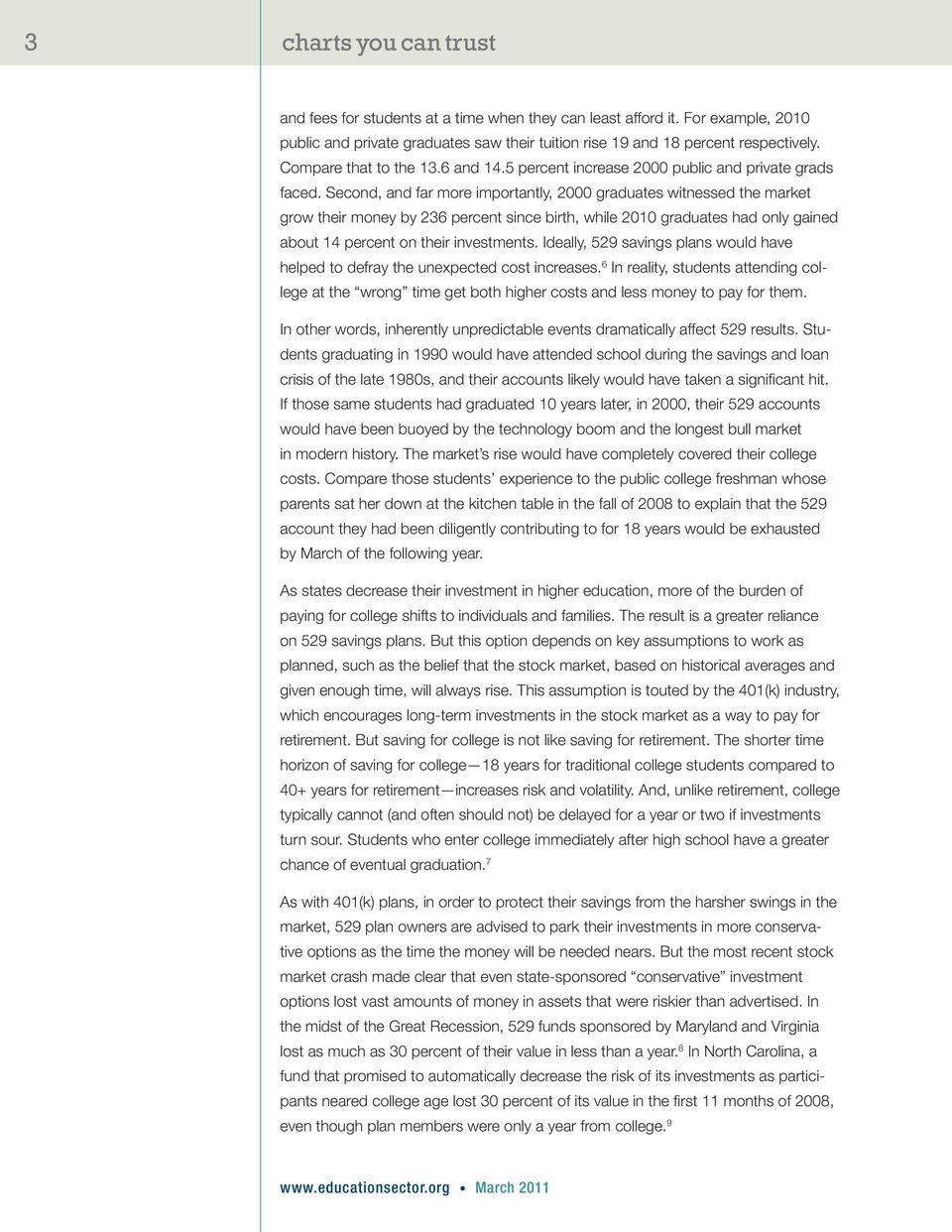
1 By Chad Aldeman Why 529 College Savings Plans Favor the Fortunate College costs have skyrocketed 82 percent over the past decade, prompting more and more families to turn to private savings accounts, or 529 savings plans, to pay for higher education. 1 These plans allow parents to put away money for their child s college expenses in accounts where investment earnings are allowed to grow tax-free until the child is ready for college. 2 Today, every state sponsors at least one 529 plan, and families have more than 10 million accounts, assets of which have increased from $14 billion to $135 billion in the last decade. 3 Despite their popularity, 529 savings plans have a remarkably poor track record. The plans rely on the power of compounding stock market returns to finance higher education. But the recent collapse in stock market prices diluted that power, as parents who had been carefully putting away money for years suddenly watched those account balances plummet in a matter of months. The Great Recession made clear what should have been obvious all along: Market rises and falls create huge winners and losers, based solely on luck and timing. Thus, for 529 savings account owners, when their child enters college matters far more than how much they have saved for it. In their present form, 529 savings plans have been in use nationwide only since 2001; so, no one has had a full 18 years for the plan to mature. 4 But using a hypothetical family s contributions, along with real college costs and the average annual rate of return for the Standard & Poor s 500, we can calculate the value of savings plans over time and illustrate the influence of market volatility and the importance of timing. These calculations represent more accurate depictions of what might happen to real investors than simply looking at long-term market averages, which mask swings in either direction. Chart 1 assumes 529 savings plans have been in existence for the past 40 years and shows the number of years a student could afford to attend a public or private fouryear university using only the savings account. The chart assumes families will make annual contributions of $1,000 (in 2010 dollars) from the time a child is born until age 18, when he is expected to enroll in college. For costs, the chart uses the actual unadjusted cost of tuition, fees, room, and board at the average four-year public and private university. 5 The results vary greatly depending on the year a student enters college. A student entering a in 1997, for example, could have paid for as much as 4.27 college, while a student entering in 2008 could have paid for only.72 years. The figures for s show a similar pattern. Why the large differences? The first reason is that states deal with recessions by cutting contributions to s and universities. This leads to rising tuition

2 2 CHART plans favor the lucky 18 investing $1,000 a year in a 529 plan would have earned enough for... 4 college Graduation Rate * 08* 09* It s all about timing... Investors starting in 1979 would have earned enough by 1997 for Year of college entrance OR 0.72 But investors starting in 1990 would have enough by 2008 for only OR 0.32 Tuitions rise when students can least afford it grads saw their tuition increase But the market grew money by 2010 grads saw their tuition increase But the market grew money by only 13.6 % for 19.0 % for 14.5 % for 236 % percent 18.0 % for 14.0 % percent Note: Chart assumes families will make annual contributions of $1,000 (in 2010 dollars) from the time a child is born until age 18. It uses real inflation rates and real annual returns for the S&P 500. For costs, it uses the actual unadjusted cost of tuition, fees, room, and board at the average four-year public and private university as calculated by the College Board s 2009 Trends in College Pricing report. * For future years, the chart uses college costs and assumes no change.

3 3 and fees for students at a time when they can least afford it. For example, 2010 public and private graduates saw their tuition rise 19 and 18 percent respectively. Compare that to the 13.6 and 14.5 percent increase 2000 public and private grads faced. Second, and far more importantly, 2000 graduates witnessed the market grow their money by 236 percent since birth, while 2010 graduates had only gained about 14 percent on their investments. Ideally, 529 savings plans would have helped to defray the unexpected cost increases. 6 In reality, students attending college at the wrong time get both higher costs and less money to pay for them. In other words, inherently unpredictable events dramatically affect 529 results. Students graduating in 1990 would have attended school during the savings and loan crisis of the late 1980s, and their accounts likely would have taken a significant hit. If those same students had graduated 10 years later, in 2000, their 529 accounts would have been buoyed by the technology boom and the longest bull market in modern history. The market s rise would have completely covered their college costs. Compare those students experience to the freshman whose parents sat her down at the kitchen table in the fall of 2008 to explain that the 529 account they had been diligently contributing to for 18 years would be exhausted by March of the following year. As states decrease their investment in higher education, more of the burden of paying for college shifts to individuals and families. The result is a greater reliance on 529 savings plans. But this option depends on key assumptions to work as planned, such as the belief that the stock market, based on historical averages and given enough time, will always rise. This assumption is touted by the 401(k) industry, which encourages long-term investments in the stock market as a way to pay for retirement. But saving for college is not like saving for retirement. The shorter time horizon of saving for college 18 years for traditional college students compared to 40+ years for retirement increases risk and volatility. And, unlike retirement, college typically cannot (and often should not) be delayed for a year or two if investments turn sour. Students who enter college immediately after high school have a greater chance of eventual graduation. 7 As with 401(k) plans, in order to protect their savings from the harsher swings in the market, 529 plan owners are advised to park their investments in more conservative options as the time the money will be needed nears. But the most recent stock market crash made clear that even state-sponsored conservative investment options lost vast amounts of money in assets that were riskier than advertised. In the midst of the Great Recession, 529 funds sponsored by Maryland and Virginia lost as much as 30 percent of their value in less than a year. 8 In North Carolina, a fund that promised to automatically decrease the risk of its investments as participants neared college age lost 30 percent of its value in the first 11 months of 2008, even though plan members were only a year from college. 9
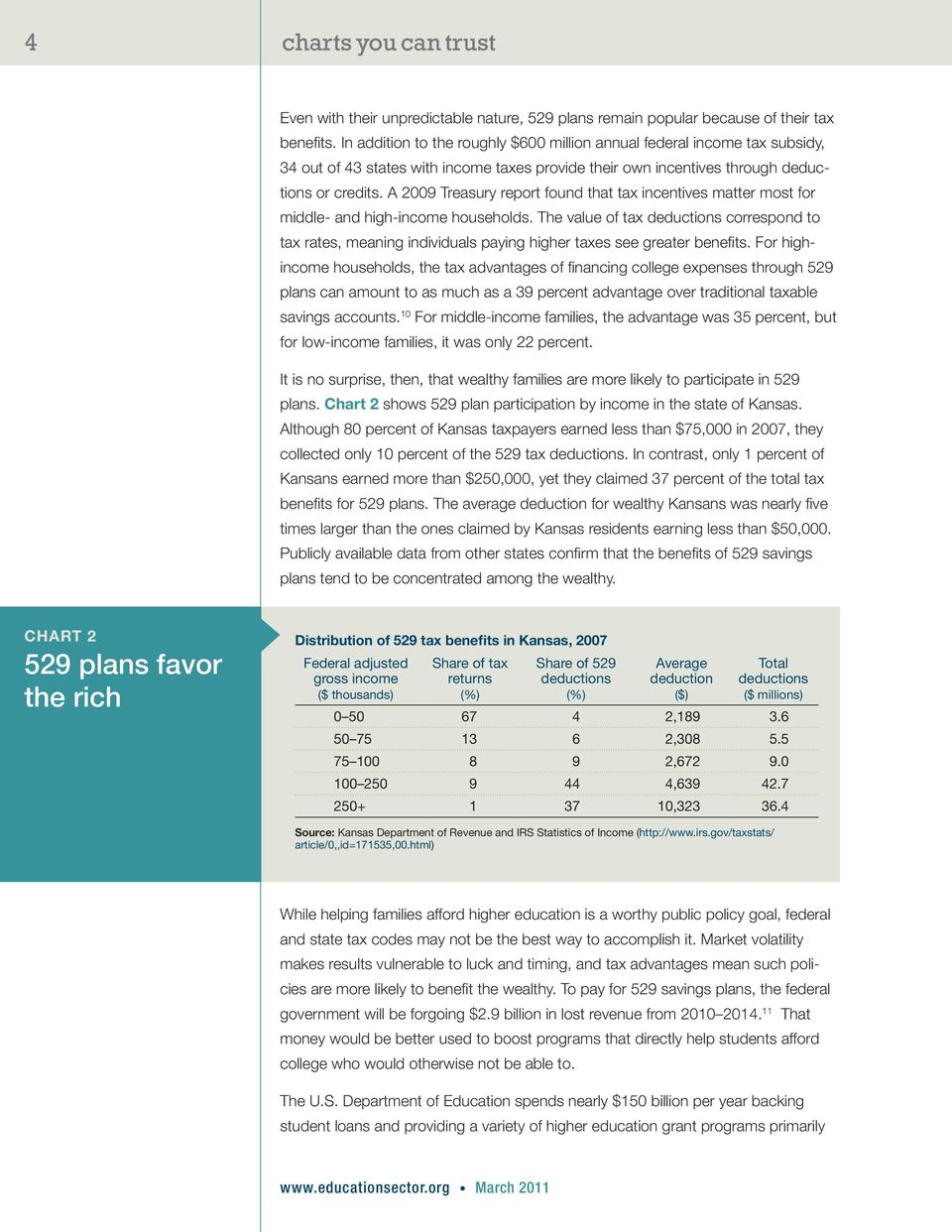
4 4 Even with their unpredictable nature, 529 plans remain popular because of their tax benefits. In addition to the roughly $600 million annual federal income tax subsidy, 34 out of 43 states with income taxes provide their own incentives through deductions or credits. A 2009 Treasury report found that tax incentives matter most for middle- and high-income households. The value of tax deductions correspond to tax rates, meaning individuals paying higher taxes see greater benefits. For highincome households, the tax advantages of financing college expenses through 529 plans can amount to as much as a 39 percent advantage over traditional taxable savings accounts. 10 For middle-income families, the advantage was 35 percent, but for low-income families, it was only 22 percent. It is no surprise, then, that wealthy families are more likely to participate in 529 plans. Chart 2 shows 529 plan participation by income in the state of Kansas. Although 80 percent of Kansas taxpayers earned less than $75,000 in 2007, they collected only 10 percent of the 529 tax deductions. In contrast, only 1 percent of Kansans earned more than $250,000, yet they claimed 37 percent of the total tax benefits for 529 plans. The average deduction for wealthy Kansans was nearly five times larger than the ones claimed by Kansas residents earning less than $50,000. Publicly available data from other states confirm that the benefits of 529 savings plans tend to be concentrated among the wealthy. chart plans favor the rich Distribution of 529 tax benefits in Kansas, 2007 Federal adjusted gross income ($ thousands) Share of tax returns (%) Share of 529 deductions (%) Average deduction ($) Total deductions ($ millions) , , , , , Source: Kansas Department of Revenue and IRS Statistics of Income ( article/0,,id=171535,00.html) While helping families afford higher education is a worthy public policy goal, federal and state tax codes may not be the best way to accomplish it. Market volatility makes results vulnerable to luck and timing, and tax advantages mean such policies are more likely to benefit the wealthy. To pay for 529 savings plans, the federal government will be forgoing $2.9 billion in lost revenue from That money would be better used to boost programs that directly help students afford college who would otherwise not be able to. The U.S. Department of Education spends nearly $150 billion per year backing student loans and providing a variety of higher education grant programs primarily
5 5 targeted to low- and moderate-income students. State governments directly subsidize public higher education for nearly three-fourths of the undergraduate students nationwide, in addition to offering their own grant and loan programs. Each of these options provides a better way to make college affordable than unpredictable and poorly targeted 529 plans. Notes 1. This is in 2010 dollars. Trends in College Pricing 2009 (Washington, D.C.: The College Board). 2. Qualified higher education expenses include tuition and fees and room and board. 3. Data available from the College Savings Plans Network at: 4. Congress created 529 plans in 1996, but a 2001 law made distributions from the accounts for qualified education expenses entirely free from federal taxes. 5. The chart uses the average annual returns for the S&P 500. For college costs, it uses the College Board s Trends in College Pricing average for public and private four-year tuition, fees, room, and board. 6. This is especially true for prepaid 529 plans, a version of 529s that allow the owner to lock in current tuition rates by making upfront cash payments. As of March 2009, only 17 states offered prepaid 529 plans. Of these, only 12 were accepting new members, and only 40 percent provided guarantees to investors that promises could not be watered down in the case of a recession (Student Lending Analytics Blog: lending_analytics/2009/03/prepaid-college-tuition-plans-not-a-guarantee. html). 7. Waiting to Attend College: Undergraduates Who Delay Their Postsecondary Enrollment, (Washington, D.C.: National Center for Education Statistics, June 16, 2005). 8. Nancy Trejos, 529 Savings Plans Battered in Downturn; Parents Reconsider Investment Strategy, The Washington Post, October 19, Ron Lieber, Saving for College Wisely in a Treacherous Time, The New York Times, January 3, An Analysis of Section 529 College Savings and Prepaid Tuition Plans, (Washington, D.C.: The Department of the Treasury, September 9, 2009). 11. Estimates of Federal Tax Expenditures for Fiscal Years (Washington, D.C.: Joint Committee on Taxation, December 15, 2010).

Top 5 Mistakes Parents Make Saving for Their Child s Education
 Top 5 Mistakes Parents Make Saving for Their Child s Education The BMO Institute provides insights and strategies around wealth planning and financial decisions to better prepare you for a confident financial
THE MISSISSIPPI AFFORDABLE COLLEGE SAVINGS PROGRAM
 THE WAY TO GO GO THE MISSISSIPPI AFFORDABLE COLLEGE SAVINGS PROGRAM MACS is a program of College Savings Mississippi, and is administered by the Office of the State Treasurer, Lynn Fitch. THE MISSISSIPPI
SEPTEMBER 2014 AN EXCLUSIVE MID-YEAR REVIEW OF 529 PLAN ACTIVITY
 SEPTEMBER 2014 AN EXCLUSIVE MID-YEAR REVIEW OF 529 PLAN ACTIVITY September 2014 Education is the key to unlocking the door to opportunity. Throughout the past several years, new research continues to provide
THE BUFFETT RULE: A BASIC PRINCIPLE OF TAX FAIRNESS. The National Economic Council
 THE BUFFETT RULE: A BASIC PRINCIPLE OF TAX FAIRNESS The National Economic Council April 2012 The Buffett Rule: A Basic Principle of Tax Fairness The Buffett Rule is the basic principle that no household
State Notes TOPICS OF LEGISLATIVE INTEREST Winter 2015
 A Primer on Certificated Credits under the Michigan Business Tax By Elizabeth Pratt, Fiscal Analyst, Cory Savino, Fiscal Analyst, and David Zin, Chief Economist Introduction State General Fund/General
Don t Double Our Rates
 Don t Double Our Rates An Issue Brief Congress should be helping to keep college affordable, not making it more expensive for student loan borrowers to pay for college Background Unless Congress acts decisively,
From Here to There. Michigan s 529 College Savings Plan
 From Here to There Michigan s 529 College Savings Plan You Can Get There. We Can Help. Paying for a college education can be one of the most pressing financial challenges a family may face. Although it
Understanding 529 Plans
 a guide to Understanding 529 Plans A 529 plan is a qualified tuition program to help finance qualified higher education expenses. Table of Contents It Pays to Save for Education...2 Education Costs Outpace
Unit Investment Trusts
 a guide to Unit Investment Trusts A unit investment trust (UIT) is a registered investment company that buys and holds a generally fixed portfolio of stocks, bonds, or other securities. Table of Contents
The Investment Performance of Rare U.S. Coins By: Raymond E. Lombra, Ph.D.
 The Investment Performance of Rare U.S. Coins By: Raymond E. Lombra, Ph.D. An independent study of the investment performance of rare U.S. coins for the period January 1979 to December 2011. Analysis by
LABORPARTY. Financing Just Health Care Labor Party Briefing Paper. Revised February 2002. Key Components of Just Health Care Financing
 LABORPARTY Financing Just Health Care Labor Party Briefing Paper Revised February 2002 The Labor Party proposes a national health insurance program for the United States that would provide universal coverage
Biennial VA529 Status Report July 2014
 VA529 Oversight Report No. 1 Biennial VA529 Status Report July 2014 Profile: Programs Operated by VA529 as of March 31, 2014 CURRENT STATUS PrePAID InVEST CollegeWealth CollegeAmerica* Program type Defined
Aim High For Higher Education. Edvest: Wisconsin s 529 College Savings Plan
 Aim High For Higher Education Edvest: isconsin s 529 College Savings Plan 3 Aim High for your Child s Future 4 How Edvest orks 5 Edvest Offers Tax Advantages 6 Edvest is Flexible to Use 7 Investment Options
How To Know If A Health Insurance Tax Is Progressive
 Citizens for Tax Justice December 11, 2009 Would the Senate Democrats proposed excise tax on highcost employer-paid health insurance benefits be progressive? Summary Senate Democrats have proposed a new,
Thank you for joining: 15 Financial Myths Demystified The webinar will begin shortly. If you are experiencing technical difficulties with Adobe
 Thank you for joining: 15 Financial Myths Demystified The webinar will begin shortly. If you are experiencing technical difficulties with Adobe Connect, please call 1-800-422-3623. 15 Financial Myths Demystified
Department of Legislative Services Maryland General Assembly 2014 Session FISCAL AND POLICY NOTE. Income Tax Credit - Student Loan Payments
 Department of Legislative Services Maryland General Assembly 2014 Session SB 632 FISCAL AND POLICY NOTE Senate Bill 632 Budget and Taxation (Senator Madaleno, et al.) Income Tax Credit - Student Loan Payments
April 8,2005 JEFFREY KUPFER, EXECUTIVE DIRECTOR PRESIDENT S ADVISORY PANEL ON FEDERAL TAX REFORM
 DEPARTMENT OF THE TREASURY WASHINGTON, D.C. 20220 April 8,2005 MEMORANDUM FOR FROM SUBJECT JEFFREY KUPFER, EXECUTIVE DIRECTOR PRESIDENT S ADVISORY PANEL ON FEDERAL TAX REFORM ROBERT CAmoLi& DEPUTY ASSISTANT
TURN A DREAM INTO A DEGREE A COLLEGE SAVINGS PROGRAM FOR NEW JERSEY RESIDENTS. Follow us @NJBEST529
 TURN A DREAM INTO A DEGREE A COLLEGE SAVINGS PROGRAM FOR NEW JERSEY RESIDENTS Follow us @NJBEST529 What Does the Future Hold? As soon as your child is born, you begin imagining what the future will hold.
The easy way to save for your retirement
 The easy way to save for your retirement If you want to live comfortably during your retirement, you really can t afford to wait to begin saving for that goal. And now that your employer is offering the
COLLEGE PLANNING SAVING FOR A COLLEGE EDUCATION. Why is it Important to Start Saving Now? The Projected Cost of College 2012/2013 2017/2018 2022/2023
 Making College a Reality: A college education can be one of the most important investments you ll ever make. But the benefits of increased earning power and expanded horizons come at a price college is
In This Issue. July 5, 2013
 July 5, 2013 Which States Reward College Savers? The last Adviser Fund Update focused on the basics of 529 plans. In this edition, we'll continue examining 529s with a look at tax implications, management
Financial Wellness & Education. Understanding mutual funds
 Financial Wellness & Education Understanding mutual funds Benefits of mutual funds Foresters Financial Services provides everyday families and individuals with financial solutions, guidance and tools,
Congratulations on taking the first step toward saving for your child s education!
 Congratulations on taking the first step toward saving for your child s education! This enrollment guide will walk you through the PA 529 Guaranteed Savings Plan s (GSP) features and benefits such as flexibility,
NextGen College Investing Plan. An investment for a lifetime of achievement
 NextGen College Investing Plan An investment for a lifetime of achievement An investment for a lifetime of achievement... begins today Education is the soul of a society as it passes from one generation
Retirement on the. Brain. Your Retirement Plan: Don t pass up the perks
 Retirement on the Brain Your Retirement Plan: Don t pass up the perks Retirement on the Brain Your Retirement Plan Understanding the advantages of your retirement plan is crucial in making wise savings
United States General Accounting Office. Testimony Before the Committee on Finance, United States Senate
 GAO United States General Accounting Office Testimony Before the Committee on Finance, United States Senate For Release on Delivery Expected at 10:00 a.m. EST on Thursday March 8, 2001 ALTERNATIVE MINIMUM
Tax Planning in a Changing Tax World
 Tax Planning in a Changing Tax World The Financial Planning Association (FPA ) is the leadership and advocacy organization for those who provide, support and benefit from professional financial planning.
Federal Tax and Capital Gains: Rates Over Time
 Preparing for a World of Higher Taxes Are You Ready? Presented by: Matt Sommer, CFP, CPWA, AIF Director and Senior Retirement Specialist, Retirement Strategy Group C-0610-114 4-30-11 Federal Tax and Capital
STATEMENT OF DAVID S. MUNDEL ASSISTANT DIRECTOR FOR HUMAN RESOURCES AND COMMUNITY DEVELOPMENT CONGRESSIONAL BUDGET OFFICE BEFORE THE
 STATEMENT OF DAVID S. MUNDEL ASSISTANT DIRECTOR FOR HUMAN RESOURCES AND COMMUNITY DEVELOPMENT CONGRESSIONAL BUDGET OFFICE BEFORE THE EDUCATION, ARTS AND HUMANITIES SUBCOMMITTEE SENATE COMMITTEE ON LABOR
Understanding variable annuities
 Allianz Life Insurance Company of North America Understanding variable annuities Discover how you can insure a portion of your retirement assets. USA-1517 Page 1 of 20 Solutions for RETIREMENT REALITIES
Testimony of Mark J. Mazur Assistant Secretary of the Treasury for Tax Policy United States Senate Committee on Finance June 24, 2014
 Testimony of Mark J. Mazur Assistant Secretary of the Treasury for Tax Policy United States Senate Committee on Finance June 24, 2014 Chairman Wyden, Ranking Member Hatch, and members of the Committee,
Wealth Strategies. www.rfawealth.com. The Importance of Age-Based Tax Planning. www.rfawealth.com. Age Based Tax Planning WEALTH STRATEGIES Page 1
 www.rfawealth.com Wealth Strategies The Importance of Age-Based Tax Planning Part 9 of 12 Age Based Tax Planning WEALTH STRATEGIES Page 1 In today s world, more and more of the responsibilities of preparing
COLLEGE COSTS AND PRICES: SOME KEY FACTS FOR POLICYMAKERS
 LUMINA ISSUE PAPERS COLLEGE COSTS AND PRICES: SOME KEY FACTS FOR POLICYMAKERS by Nate Johnson Postsecondary Analytics Tuition is rising, more students are in debt and at higher levels than ever before,
Fast Facts on Education in America UPDATED FEBRUARY 2014
 Fast Facts on Education in America UPDATED FEBRUARY 2014 The climate of postsecondary education in America has changed dramatically since Scholarship America s inception more than 55 years ago. Access
Facts and Figures on the Middle-Class Squeeze in Idaho
 Facts and Figures on the Middle-Class Squeeze in Idaho For hard-working, middle-class families all over the country, life during the Bush presidency has grown less affordable and less secure. President
10 MISTAKES PEOPLE MAKE IN RETIREMENT
 10 MISTAKES PEOPLE MAKE IN RETIREMENT by Bill Elson, CFP 3705 Grand Avenue Des Moines, IA 50312 (515) 255-3306 or (800) 616-4392 [email protected] KEYWORDS: RETIREMENT PLANNING, RETIREMENT INCOME, RETIREMENT
Strategy Paper: Financial Planning for Generation-Y. SMSF Specialists Investment Management Financial Planning Accounting
 Strategy Paper: 190 Through Road Camberwell VIC 3124 T: (03) 9809 1221 F: (03) 9809 2055 [email protected] www.gfmwealth.com.au ABN 69 006 679 394 Financial Planning for Generation-Y SMSF Specialists
Student Debt: Bigger and Bigger. By Heather Boushey. September 2005
 cepr Briefing Paper CENTER FOR ECONOMIC AND POLICY RESEARCH Student Debt: Bigger and Bigger By Heather Boushey September 2005 CENTER FOR ECONOMIC AND POLICY RESEARCH 1611 CONNECTICUT AVE., NW, SUITE 400
Tax Expenditures and Social Policy: A Primer
 Percent Tax Expenditures and Social Policy: A Primer Daniel Mandel What Are Tax Expenditures? Congress uses the tax code to promote a broad range of policy objectives. Rather than directly spend government
CRITICAL ELEMENTS OF THE CURRENT TAX INCENTIVE STRUCTURE
 October 8, 2012 The U.S. retirement savings system encourages individuals to save for retirement by providing income tax exclusions or deductions for contributions to employer-sponsored defined contribution
States Can Adopt or Expand Earned Income Tax Credits to Build a Stronger Future Economy By Erica Williams
 Updated January 19, 2016 States Can Adopt or Expand Earned Income Tax Credits to Build a Stronger Future Economy By Erica Williams Twenty-six states plus the District of Columbia have enacted their own
transition to 401(k) PLAnS
 transition to 401(k) PLAnS A TRAIN WRECK IN THE MAKING PArt i LoSS of retirement SEcuritY California Retired County Employees Association Retirement Security Committee March 2012 CRCEA; P.O. Box 706; Merced,
A Better Approach to Target Date Strategies
 February 2011 A Better Approach to Target Date Strategies Executive Summary In 2007, Folio Investing undertook an analysis of Target Date Funds to determine how these investments might be improved. As
Series. Eagle Select. Fixed Indexed Annuity (ICC13 E-IDXA)* Issued by:
 Fixed Indexed Annuity Eagle Select Series (ICC13 E-IDXA)* Issued by: * Form number and availability may vary by state. Annuity contracts are products of the insurance industry and are not guaranteed by
RETIREMENT PLANNING GUIDE. Getting you on the right track
 RETIREMENT PLANNING GUIDE Getting you on the right track Table of Contents Why is a retirement plan important? 2 How much will you need? 4 How can your retirement plan help? 6 Where should you invest?
PLAN FOR YOUR FUTURE. 71% say retirement WHY ENROLL? GET STARTED TODAY ONE TWO THREE
 Regions Financial Corporation 401(k) Plan PLAN FOR YOUR FUTURE You may spend 20 years or more in retirement that s a long time to go without a paycheck! Of course, there will still be bills to pay, so
Canada s Retirement Security Crisis. National Union of Public and General Employees (NUPGE) Ottawa, Canada: January 2012
 Canada s Retirement Security Crisis National Union of Public and General Employees (NUPGE) Ottawa, Canada: January 2012 MYTH1 Most public sector employees have a gold-plated pension. No, in fact the far
Tax Laws Can Make You Rich
 #9 F I N A N C I A L P L A N N I N G Tax Laws Can Make You Rich CPA... Imagine the possibilities! Intro Learning Activity Learning Objectives 1. Understand that certain U.S. tax laws assist individuals
How To Use A Massmutual Whole Life Insurance Policy
 An Educational Guide for Individuals Unlocking the value of whole life Whole life insurance as a financial asset Insurance Strategies Contents 3 Whole life insurance: A versatile financial asset 4 Providing
The primary purpose of a tax system is to support public goods and services. State and local taxes
 Issue Brief UPDATED APRIL 2015 BY WILLIAM CHEN Who Pays Taxes in California? The primary purpose of a tax system is to support public goods and services. State and local taxes are the way that Californians
WHO BORROWS PRIVATE LOANS?
 Issue Brief August 2007 WHO BORROWS PRIVATE LOANS? Borrowing through private student loan programs totaled $17.3 billion in 2005 06 and accounted for 20 percent of all education borrowing. While still
ENTITY CHOICE AND EFFECTIVE TAX RATES
 ENTITY CHOICE AND EFFECTIVE TAX RATES Prepared by Quantria Strategies, LLC for the National Federation of Independent Business and the S Corporation Association ENTITY CHOICE AND EFFECTIVE TAX RATES CONTENTS
Composition of Federal Spending
 The Honorable David M. Walker Comptroller General of the United States U.S. Government Accountability Office February 10, 2005 2 Composition of Federal Spending 1964 1984 2004* Defense Net interest *Current
NPH Fixed Income Research Update. Bob Downing, CFA. NPH Senior Investment & Due Diligence Analyst
 White Paper: NPH Fixed Income Research Update Authored By: Bob Downing, CFA NPH Senior Investment & Due Diligence Analyst National Planning Holdings, Inc. Due Diligence Department National Planning Holdings,
Enhancing Tax Credits to Encourage Saving for Higher Education Advancing the American Opportunity Tax Credit and Reforming the Saver s Credit
 New America Foundation College Savings Initiative Enhancing Tax Credits to Encourage Saving for Higher Education Advancing the American Opportunity Tax Credit and Reforming the Saver s Credit Mark Huelsman,
Life Insurance Companies and Products
 Part B. Life Insurance Companies and Products The current Federal income tax treatment of life insurance companies and their products al.lows investors in such products to obtain a substantially higher