
CFD Summary Workshop 01 - Basic viewing controls in ANSYS ICEM CFD 13.0
|
|
|
- Phoebe Hawkins
- 10 years ago
- Views:
Transcription
1 ANSYS ICEM CFD and ANSYS CFX Introductory Training Course Course notes prepared by David Ryan and updated by Julia Hofinger Acknowledgements to Andrea Gabriele, Dr Hassan Hemida and Muhammad Eesa. CFD Summary... 1 Workshop 01 - Basic viewing controls in ANSYS ICEM CFD Workshop 02 - Drawing a Pipe in ANSYS ICEM CFD... 3 Workshop 03 - Tetra-Meshing a Pipe in ANSYS ICEM... 6 Workshop 04 - Setting up a CFD Simulation in ANSYS CFX-Pre... 8 Workshop 05 - Running a simulation in ANSYS CFX-Solver Workshop 06 - Examining the results in ANSYS CFD-Post Workshop 07 - Hexa-Meshing a Pipe in ANSYS ICEM Workshop 08 - Simulation of turbulent flow of water Workshop 09 - Non-Newtonian flow with heat transfer Workshop 10 - Transient simulation of a stirred tank (sliding mesh) Workshop 11 - Multiphase flow with a free surface General notes about using ICEM and CFX Stages of a simulation Help, tutorials, workshops available: Software required (ANSYS) and files created BlueBEAR cluster computer at University of Birmingham software used to access CFD Summary Real world problem -> (simplified) 2D or 3D geometry -> Mesh which splits geometry into cells -> Simulation physics setup (boundary conditions) -> Running simulation (number crunching) -> Post processing -> Analysis and results write-up. In the following 11 workshops we will be looking at stages from 3D geometry creation to postprocessing. Workshop 01 - Basic viewing controls in ANSYS ICEM CFD 13.0 Introduction: The program ANSYS ICEM CFD allows you to view and edit geometry, blocking and mesh files. The mesh file is the output which will be used in later CFD simulations. Task: to open a file in ICEM and be able to use the 3D controls available. 1) Load ICEM: a) Start (Windows logo), Programs, ITS Applications, ANSYS 13.0, ICEM CFD. 2) Wait for the software to load. a) May take seconds, its a big program. 3) Navigate to right folder: Press the folder icon, Desktop (on left). You should be able to see folder CFX Training Files. 4) Make a copy of the CFX Training Files folder (right click, Copy, Paste into same folder). a) This is so the original files are preserved for reference. b) Only work in the copy folder CFX Training Files - Copy. 5) Double click CFX Training Files - Copy, double click Sono_Part. (Model belongs to Dave Ryan) (page 1 of 21)


2 6) Open project file Sono_Part. 7) On the left is a hierarchy of the model, including geometry, mesh and parts. a) Use the + and - boxes to expand and contract this b) Use the tick boxes to show and hide various aspects of the project i) Note on files bigger than this, don t tick the Volumes on takes too long to display c) Try viewing only geometry, and only mesh. What difference does it make? d) What difference does switching on and off various parts make? What is in each part? 8) Use the buttons on the toolbar to select different geometry and mesh views. a) Also try the drop down options from the small arrows. 9) Try 3D rotation controls a) Left click and drag to do 3D rotation (around axes in screen) b) Right click and: i) vertical drag for easy zoom ii) horizontal drag for 3D rotation (around axis perpendicular to screen) c) Middle click (scroll wheel hold down) and drag for translation d) Note: in ICEM all 3D rotation options are easily available from the mouse. CFX-Pre and CFD- Post will have different mouse controls! 10) Use the buttons to view the whole geometry/mesh, zoom in, measure distances. 11) Save a new version of the project by: a) File (menu at top), Save Project As, type in Sono_Part copy, Save 12) View project files by: a) Bring up Windows Explorer (keyboard shortcut Windows-E ). b) Navigate to folder: Desktop, Copy of Training Files, Sono_Part 13) File Types: Important types of file are as follows (turn File Extensions on in Windows Explorer options): a).prj used by ICEM to link all other files together in one project. b).tin geometry file vertices, edges, surfaces, bodies., volume (cube/hexa, tetra, prism) elements. c).uns (unstructured) mesh file mesh elements of type line, triangle, square, cube/hexa, tetra, prism, pyramid which cover the geometry and make it possible to run fluid simulations on it. d).blk blocking file - used for hexa meshing later on to define a regular grid. (page 2 of 21)

3 e) Other file types are less important:.atr,.par,.fbc, backup.bak files. f) Will be creating a mesh file.msh as the output of ICEM for simulations in CFX. 14) Extension task: Back to ICEM: the buttons open, save and close the geometry, mesh and blocking files independently. For example, try using the first one (with brown cube) to close the geometry, and leave just the mesh open. 15) Extension task: insert a cut plane: a) Right click Mesh in the tree structure on left, Cut Plane, Show Cut Plane. b) In the tree structure, tick Mesh lines and shells on, and tick Geometry off. c) Manage Cut Plane options panel in lower left: select from Method drop-down list the Middle X Plane method. An outline of only part of the surface mesh should appear. d) Now try ticking the Volumes on. You can see a cross-section of the mesh. e) Make sure the solid view is on, not the wireframe ( ). f) Try rotating this cross-section in 3D. g) Try zooming in on an area of interest. 16) Close the project file: File, Close Project. Workshop 02 - Drawing a Pipe in ANSYS ICEM CFD Task: to create a cylindrical pipe ready to be meshed with ANSYS ICEM CFD v ) Close any previous files, have blank screen in ICEM. 2) Create new project file for the pipe in ICEM: a) File, New Project. b) Select folders in turn: Desktop, CFX Training Files Copy, Pipe. c) Save project with name Pipe in folder Pipe. 3) We are going to create some points now: a) Select Geometry tab at top of screen. b) Select Create Point option. c) In the bottom left are various options for creating the point. Select the second XYZ option. d) Input the numbers X=0, Y=0, Z=0. e) Press Apply to create a point on screen f) Note - If the point does not appear, then check that points are displayed in the tree, and use the Fit Window option in the top left to zoom the screen correctly. 4) Select the third option Base Point and Delta a) First, enter the relative displacement (delta) for the new point: i) DX = 0, DY = 25, DZ = 0. (The option is now set up to create a point 25 away in the y- direction from another point.) b) Second, select the base point: i) Click the arrow icon once ii) Left click the blue point created in previous step. (It is highlighted in yellow). iii) Middle click anywhere on screen to create 1 new point. iv) Right click to get rid of red option at bottom. This prevents creation of more points. v) If necessary, fit window to display both old and newly created points (blue). Can also use right-click zoom to zoom out. Note: in ICEM view mode, you get the normal 3D rotation options from the mouse, and in ICEM edit mode: left click selects things, middle click does things, and right click cancels things or backs up. It is different to normal Windows practise. Its awkward to get used to, but once you are used to it, it works very well. (page 3 of 21)

4 5) Display co-ordinates of both points on screen using, the third option under the arrow on. 6) Do another Base Point and Delta to create a point at (0,0,25) away from original (0,0,0) point. a) Change the DX, DY, DZ input fields appropriately. b) Make sure to select the right base point (0,0,0). c) There should now be exactly 3 points created at (0,0,0), (0,25,0), (0,0,25). 7) We are going to make a circle of radius 25 using these three points, as follows: a) Under Geometry tab, select Create and modify curve. b) Under Create and modify curve option panel on bottom left, select 3rd option Circle or Arc. c) Red text Select 3 locations... will appear at the bottom. d) (Left)-Click these three points in order: i) (0,0,0) (centre) ii) (0,25,0) iii) (0,0,25) e) Right click to de-select red text and de-activate circle creation mode. f) A circle will be created. (If it doesn t appear, check Curves are ticked on in the Geometry tree view.) 8) Create a new point at (800,0,0) using explicit coordinates method as in stage 3, and fit window. a) Note that under 3D rotation this new point is a lot further away! 9) Create a line down the pipe axis: a) Geometry, Create/Modify Curve, From Points (first option). b) Left click first point at (0,0,0) at centre of circle c) Left click second point at (800,0,0). Line appears on screen d) Middle click to finish line creation. (More left clicks would create a curve or spline.) e) Right click to de-select line creation mode. 10) Create a circular surface inside the circle: a) Geometry, Create/Modify Surface at top. b) Simple Surface (first option at bottom left). c) Method: From Curves. d) Left-click icon to right of Curves. e) Left-click circle on screen. f) Middle click anywhere to create the circular surface. g) Right click to de-select surface creation mode. 11) Create a cylindrical surface using a driven curve method: a) Curve Driven (second option) b) Left-click long line, this is the driving curve. c) Left-click the circular boundary, this is the driven curve. d) Middle click to accept the driven curve(s). e) Surface is created. f) Right-click to de-select the driven curve creation method. 12) Left click and drag to view the whole 3D geometry so far from different angles. Try displaying with wireframe. Note the missing circle at the far end, we will create this shortly. 13) View only points, only curves, only surfaces using the ticks on the Geometry tree on left. Familiarise yourself with what has been created so far, and where it has been created. 14) Create the final circular surface at the far end of the pipe, using an appropriate surface method. Note: the bounding circle has already been created by the driven curve method. 15) Give names to the INLET, OUTLET and WALL surfaces: a) Under Geometry tree, highlight only Surfaces. b) Right click Parts, Create Part. c) Part = INLET. d) Entities: click arrow icon, left click surface (near surface, around origin) to highlight it, middle click to save selection, right click to de-select mode. (page 4 of 21)

5 e) Note that the INLET part has been created, and can be turned on and off independently using the tree view. f) Part = OUTLET, repeat step to identify an outlet at the far end. g) Part = WALL, repeat step to identify the wall. h) Notes: GEOM now contains only 0D and 1D elements; points and lines. 16) Create a BODY part for the volume mesh elements (created later) to belong to: a) Turn on points and lines, turn off surfaces b) Geometry, Create Body c) Part = BODY d) Material Point, Location = Centroid of 2 points e) 2 screen locations: use arrow icon, select both points at end of long line using left click, middle click to create body point, right click to cancel mode. 17) Turn on Surfaces again. Right click Parts in tree diagram, select Good Colors. This shows each part in separate colours. 18) Delete the long line down the middle using Geometry, Delete Curve. Remember to right click to come out of this selection mode. 19) Save the project using File, Save Project. Alternatively, use the Save icon. a) This is the file we will use to create a mesh in the next workshop. 20) Extension task: try deleting the cylindrical surface using Geometry, Delete Surface method. 21) Extension task: try recreating the cylindrical surface using Geometry, Create/Modify Surface at top, then Simple Surface on left, then Method 2-4 curves. Select the two separate circles to create the cylinder between them. Need this method rather than the other, since the curves are not connected. 22) Extension task: try transforming the circle around (0,0,0) to be double its size: a) Geometry tab, Transform Geometry. b) Scale Geometry (4 th graphical icon in bottom left). c) Use icon to right of Select to select just the circle. (Left-click to select it, middle click to save selection. May want to turn surfaces off to select the circle only, and not any surface.) d) Change x, y and z factors to 2. This will double the size. e) Change the centre point to Centroid. This will perform the change around the circle centre, not the origin. In general, these are different locations. f) Tick Copy on, to create a copy of the circle, rather than move the circle. g) Press Apply to create a scaled copy of the original curve. 23) Extension task: create a conic surface between the big circle at the near end and the small circle at the far end, using 2-4 curves method. 24) Extension task: create a diagnostic topology. Very useful for viewing surface connectivity and cleaning up dirty geometry imported from other programs: a) Geometry, Repair Geometry b) Build Diagnostic Topology c) Tolerance 0.1, Feature Angle 30, don t filter curves or points, de-select any ticks lower down d) Apply, view wireframe e) Notice that all curves are colour coded. i) Green is disconnected curves. Can normally delete them. ii) Yellow is singly-connected curves. Normally want to close these holes. iii) Red means 2 connections. This is normal for a fluid domain. iv) Blue means 3 or more connections. This is found at intersections between fluid domain boundaries. f) Note there are tools here (Close holes, Remove holes, Stitch/Match edges) to automate clean-up of dirty imported geometry. 25) Extension task: Delete and create both surfaces and lines so that fluid region is closed. A new Diagnostic Topology with only red curves proves this is the case. 26) Close the current file, discarding any changes in the extension tasks. (page 5 of 21)

6 Workshop 03 - Tetra-Meshing a Pipe in ANSYS ICEM Introduction: There are two main types of mesh available: tetrahedral and cubic/hexahedral. These are abbreviated to tetra and hexa. In general, hexa provides better simulations for the same amount of computational resources, however tetra is a lot easier to produce for complex geometry. It is useful to be able to create both, and ICEM can create either. Task: Create a tetrahedral mesh on a cylindrical pipe with ANSYS ICEM. 1) Open the Pipe example from previous workshop. a) The completed version is available in a separate project file if necessary. 2) Save the project with a different name: Pipe_tetra. We will now work on this. 3) Mesh tab, Global Mesh Setup (1 st icon at top). 4) Global Mesh Size (1 st icon at bottom left): a) Scale factor = 1. (This factor allows the whole mesh to be scaled to higher or lower resolutions from a single number. Use 1 as default scaling.) b) Max element = 4. (This is the maximum size of any side of a triangle or tetrahedron you will create, across the whole mesh.) c) Untick all boxes. d) Apply 5) Shell Meshing Parameters: a) Mesh Type: All Tri (only triangles, no squares). b) Mesh Method: Patch Independent (use help system later on to understand the other methods available). c) Apply 6) Volume Meshing Parameters: a) Mesh Type: Tetra/Mixed (we will create Tetra mesh). b) Mesh Method: Quick (Delaunay) (Delaunay creates a smoother volume mesh than Octree. Use Help system to understand these different methods as you try them later on.) c) Leave other options, Apply 7) Prism Meshing Parameters: a) Look at them only. Leave changing these for extension work. Important ones are: Height ratio, Number of Layers, Prism Height Limit Factor. 8) Part Mesh Setup (at top) brings up dialog box. a) On row Wall only, tick prism. We will only create a prism layer on the wall. b) Set num layers to 1 on wall only. c) Apply, Dismiss. 9) Compute Mesh icon (at top). a) Surface Mesh Only. b) Compute (and wait for triangular surface mesh to be generated). c) Mesh appears at tree in top left, with points, lines and shells which can all be viewed separately. i) Try deselecting the Geometry items which are overlaid in the view, and viewing the different aspects of the surface mesh using solid (not wireframe) 3D graphics. 10) Edit Mesh, Smooth Mesh Globally (at top): a) Up to value: 0.8. b) Criterion: Quality. (Histogram shows how good each triangle is. This is related to how well CFD will run on the mesh.) c) Apply. May re-run if not all above 0.5 on first run. (page 6 of 21)

7 d) Note that some triangles will have moved slightly. On complicated geometry it is extremely valuable to smooth the surface mesh before generating the volume mesh. 11) Mesh, Compute Mesh (at top), Compute Volume Mesh (blue icon at side): a) Check correct Mesh Type and Method. b) Make sure Load Mesh upon Completion is selected. c) Compute. d) Wait for Delaunay mesh to be computed. It is inside the surface mesh, so need a cut-plane to view the volume elements (which are contained in the part BODY ). e) Right click Mesh in the tree, Cut Plane, Show Cut Plane (or in View, Cut Mesh Plane) i) Method: Middle Z Plane (lengthways). ii) De-select all geometry, only have mesh selected. iii) Select volume elements too iv) View the internal structure of the mesh from different angles v) Right-click Mesh, Cut Plane, Show Cut Plane (second time to de-select it). Volume elements hidden automatically. 12) Smooth the volume mesh using same method. May want to smooth to quality 0.4, 0.6, 0.8 in sequence. Normally want quality above ) Save the Pipe_tetra project. 14) Save a mesh file for use in CFX-Pre: a) Output tab, Select solver (at top) i) Output Solver: Fluent V6 (this is to illustrate that CFX can read several different formats of mesh files) ii) Apply b) Write Input (at top) i) Save project (not important since just done), select Yes. ii) Pipe_tetra.uns selected, select Open. iii) Rename Output File to./pipe_tetra iv) Done c) Pipe_tetra.msh mesh file is created in same directory. 15) Extension: Generate a prism mesh around the tetrahedral mesh for much improved wall treatment in your CFD simulations: a) Mesh, Part Mesh Setup (at top) brings up dialog box. i) Tick prism on WALL. (This will prism mesh round the whole WALL surface, and you will see the prism layer intersect the INLET and OUTLET surfaces.) ii) num layers = 1 on WALL. iii) Apply, Dismiss b) Mesh, Compute Mesh (at top) i) Prism Mesh (at lower left side) ii) Compute c) View a cut plane to see the change in internal detail of volume elements d) Can split the prisms into say 5 layers: i) Edit Mesh, Split Mesh ii) Prism Ratio = 1.4, Number of Layers = 5 iii) Apply 16) Extension: Try Info menu, Mesh Info to view size of mesh and other statistics. 17) Extension: Try reopening the previous mesh without the prisms, using Open Mesh, tri2tet_mesh.uns which is temporary copy of previous mesh, Replace. 18) Extension: Try closing the mesh. 19) Extension: Try computing a volume mesh in one go using Octree method. Produce a cut plane and note the difference with the Delaunay mesh. 20) Extension: Try inserting a mesh density around a small region of max element size 2. What happens when you Delaunay or Octree mesh the whole fluid domain? (page 7 of 21)

8 21) Extension: change the Max Element to 6 and re-compute the surface mesh to see what changes. New surface mesh replaces all of old mesh. 22) Close the project without saving changes made during extension tasks. Exit ICEM. Workshop 04 - Setting up a CFD Simulation in ANSYS CFX-Pre Intro: Up to now we have concentrated on creating a geometry and a mesh. Now we will use the mesh to define a computational fluid dynamics (CFD) simulation. CFX-Pre is the tool used to do this. It involves importing a mesh, setting up simulation physics, and exporting a run definition file to be used in CFX-Solver. Task: to create a definition file for a CFD simulation of laminar flow of glucose, a viscous liquid. 1) Start, Programs, ITS Applications, ANSYS 13.0, Fluid Dynamics, CFX. This opens the CFX Launcher. 2) Change the working directory to the Pipe directory. (Go in via trusernn directory.) 3) From the Launcher, open CFX-Pre (Unblock any applications). 4) File, New Case, General, OK. 5) File, Import, Mesh. a) Files of Type (down bottom): FLUENT. b) Mesh units: [mm] (1 unit in ICEM is now 1mm this is important!) c) Select Pipe_hexa.msh file from Pipe_completed directory. (You will create this yourself tomorrow. Alternatively, you could use Pipe_tetra_prism.msh file created in Workshop 3, which has a good boundary layer.) d) Open 6) Practise 3D rotation tools which are different to ICEM: a) Left-click on a place centre the view there b) Left-click drag 3D rotation c) Right-click rectangle drag zoom in d) Icon to view whole mesh again e) SHIFT-Middle-click drag zoom in and out using mouse f) CTRL-Middle-click drag translation g) Note the author apologises on behalf of ANSYS for including two completely separate mouse interfaces in ICEM and CFX! h) You will need these 3D rotation mouse tips again, when post-processing in ANSYS CFD-Post. 7) File, Save Case As, Laminar_Glucose_hexa. This creates a.cfx file in the working directory for the CFX-Pre case. 8) From the toolbar, click Create a Material, and name it Glucose. a) Check Thermodynamic State and make sure the state value is Liquid. b) In the Material Properties tab, set the density at 1000 [kg m^-3]. c) Under Specific Heat Capacity set 1 [cal g^-1 K^-1]. d) Expand the Transport Properties section. e) Check the Dynamic Viscosity box, enter the value 0.06 Pa.s f) OK to save the material. g) Note if you expand the Materials list, Glucose is now listed. 9) In the Outline workspace, double-click Analysis Type a) Note that this analysis is Steady State. Leave it as that for now. Later on we will look at a transient simulation. (OK to exit this tab) 10) In the Outline workspace, right click Default Domain and rename to FluidDomain. 11) In the Outline workspace, double-click FluidDomain. a) Fluid & Particle Definitions, delete the Fluid1 from the list. b) Add New Item, type Glucose and OK (page 8 of 21)

9 c) Material, select Glucose from the drop-down list. d) From the Fluid Models tab: i) Choose None for Heat Transfer model ii) Choose None (Laminar) for Turbulence model. e) From the Initialisation tab: i) Check the Domain Initialisation box. ii) Note initial conditions. f) OK to accept Domain settings. 12) From the Insert menu: a) Choose Boundary b) Enter the name Inlet. c) Boundary Type: Inlet d) For Location, choose INLET. e) From the Boundary Details tab, Mass and Momentum section: i) Choose the Option Mass Flow Rate ii) Enter the value 0.2 [kg s^-1] for the Mass Flow Rate f) OK 13) Create a new boundary condition and name it Outlet. a) Boundary Type: Outlet b) For Location, choose OUTLET. c) From the Boundary Details tab, Mass and Momentum section: i) Choose the Option Average Static Pressure ii) Enter a Relative Pressure of 0 [Pa]. d) Press OK to accept the boundary 14) Rename FluidDomain Default to Wall. 15) Double click Wall to open it. Note that it automatically has a Wall boundary type, and select the WALL area. Under Boundary Details tab, note it is a non-slip wall, this can be changed to other settings if necessary. It is set correctly for this simulation with stationary non-slip walls, so press OK to exit. 16) In the Outline workspace, double-click Solver Control. a) Change to a physical timescale of 1 *s+: Timescale control = Physical Timescale, Physical Timescale = 1 *s+. b) In the Convergence Criteria section: i) Change the Residual Target to (which is 10E-05), OK c) Add a conservation target: tick the check box, then enter the value Note that this enforces mass and momentum conservation across the whole flow domain; residuals are only across individual mesh cells. 17) Save the case (File, Save Case). 18) From the toolbar: a) Click Write Solver Input File which is the last icon at the top b) Navigate to working directory c) Name the file Laminar_Glucose_hexa.def, Save. (A.def file is a CFX-Solver input file) 19) Extension: right-click on an item in the Outline tree, and select Edit in Command Editor. Note that many items can be quickly set here, with knowledge of the correct programming format. 20) Extension: in Solver Control, try changing the number of iterations, the residual target or the conservation target. Read the help documentation to find out more about this. 21) Extension - try using Opening instead of Outlet for the outlet boundary condition. Use the Help index to learn about and apply appropriate settings, and when you might want to use the Opening (e.g. recirculation across the boundary plane). (page 9 of 21)


10 Workshop 05 - Running a simulation in ANSYS CFX-Solver Intro: CFX-Solver is the penultimate stage in obtaining fluid dynamics results. Its job is to take the simulation setup from Pre, and produce the answer to the simulation, to be displayed graphically in Post. This is the most computationally intensive stage of the process. The solution is obtained iteratively, by converging on the correct result. Often we will accept less than fully converged results when conducting preliminary investigations such as this, to move the process along a bit faster. Task: to run a CFD simulation of laminar flow of glucose, a viscous liquid. 1) From the CFX launcher, select CFX-Solver Manager ) File, Define Run. a) Solver Input File, select Laminar_Glucose_hexa.def. b) No initial values specification c) Not double precision (leave unchecked). d) Run mode: Serial e) Press Start Run to start the simulation. 3) The screen is split in two. a) On the right is text describing the progress of the run. b) On the left, a graphical representation of convergence. 4) The run will finish and look similar to this: 5) Select OK. (Don t check the box to post-process yet.) a) In Pipe directory, the.res file with the results of the run has been created automatically. b) So has the.out file, which gives the verbose output printed on the right hand side of the screen. 6) Look at the Momentum and Mass graph. This shows the residuals (expressions of error remaining in the solutions) as a logarithmic plot, which is decreasing until full 10-5 convergence results. 7) The icons allow you control on creating and opening runs. The third one is very useful for opening a completed run. 8) Extension: on the run definition try: a) Using Initial Values Specification and the results of a previous similar simulation, and observe how the results converge quicker. b) Using Double Precision. For some CFD simulations it is necessary to use this, but it doubles the computational resources required. (page 10 of 21)

11 c) Run Mode: HP MPI Local Parallel. This will parallel process the simulation on the local computer, running on 2 cores in most cases (2011 Intel chip). 9) Extension: go back to CFX-Pre and change the amount of convergence required. Then re-run the simulation in Solver, using the results of the existing run. 10) File, Close Workspace. Since the run has completed, don t worry about the message which pops up, select OK. 11) Close CFX-Solver. No saving of files is necessary. Workshop 06 - Examining the results in ANSYS CFD-Post Intro: This is the final stage: viewing the flow field results in graphical format. This workshop will introduce you to various plots available in CFD-Post for analysing the results files obtained from the solver. Task: To be able to create graphical representations of flow field results. 1) From the CFX launcher, select CFD-Post ) File, Load Results, Laminar_Glucose_hexa_001.res a) The Solver will create 002, 003, 004 etc run files if you re-run the simulation. 3) From the toolbar, click Location and choose Plane. Leave name as Plane 1. a) In the Details of Plane 1, choose the Method ZX Plane, leave Y value as 0. b) Apply to view this plane (grey only) c) Colour tab, Mode = Variable d) Variable = Velocity e) Apply to view the plane coloured by velocity. f) Try viewing Pressure on the same plane. g) Try viewing Velocity on a YZ plane in the middle of the pipe (use the slider on X ), with colour range = local. What do you notice about the velocity profile in cross-section? h) Try changing the direction and position of Plane 1 further, and seeing the flow velocity in different places. 4) From the toolbar, click Vector. Leave name as Vector 1 a) Location = Plane 1 b) Hide Plane 1 in the tree view to just see the vectors based at that location. c) Apply to produce vector plot starting at Plane 1. Try rotating it in 3D. d) Double click Plane 1 and move it. Notice how the vectors move too. e) Can change size of vectors on Symbol tab of Vector 1 setup, if necessary. 5) Create a second plane in a perpendicular direction to Plane 1. Turn the vector plot off, and both planes on, and display velocity in both planes. What do you notice where the planes meet? 6) From the toolbar, click Contour. Leave name as Contour 1. a) Locations Plane 1. b) Variable Pressure c) Apply see the bands of pressure in the 11 contours created. d) Hide both Plane 1 and Plane 2 to see the contour plot clearly. 7) From the toolbar, click Streamline icon. a) Start from: Inlet b) Number of points: 25 c) Apply d) Notice how 3D structure of flow is visualised. In more complex flows this Streamline function is valuable to view the 3D flow structure. 8) Location, Isosurface a) Variable: Velocity (page 11 of 21)

12 b) Value: 0.1 [m s^-1] c) Apply. (All points with this value of velocity are joined up in a 2D surface within 3D space.) d) Also try colouring by variable, Pressure. 9) From the 5 tabs in the top left, select Calculator, then Function Calculator. a) Choose the Function areaave, the Location Plane 1, and the Variable Velocity b) Clear check box Clear previous results on calculate c) Select check box Show equivalent expression d) Click Calculate. (Correct value ~ m/s when Plane 1 is ZX plane down middle). e) Change the Variable to Pressure gradient (use the... button to right of variable), and click Calculate. (Correct value ~ 88.4 Pa/m). f) Change the Function to massflow and the Location to Outlet. Click Calculate (what is missing from 0.2 is the residual p-mass. It may show up as negative). 10) Save the results file Laminar_Glucose_hexa.cst, which is a state file for CFD-Post. 11) Extension: create new Chart from top toolbar. a) New Data Series, location Streamline 1 b) X axis: variable X c) Y axis: variable Velocity d) Note how different streamlines have different experiences of velocity as they travel down the pipe. 12) Extension: try using the Session menu to record a series of commands, save them as a.cse file, and play them back to automate post-processing. 13) Extension: click the Table Viewer tab in bottom right. Try inserting some expressions into a table. See how they calculate. 14) Extension: click the Report Viewer tab in bottom right. See how your basic flow information, charts and tables are all brought together in a printable format. Workshop 07 - Hexa-Meshing a Pipe in ANSYS ICEM Intro: So far we have been through the complete cycle of geometry creation, meshing, simulation setup, solving, and post-processing. Now we go back to meshing to find a different method which is superior in many circumstances, but harder to use with complicated geometry. This method is structured meshing. Task: Mesh a cylindrical pipe with ANSYS ICEM using Blocking and O-grid Function. 1) Open ICEM. 2) Open the Pipe project (geometry only). 3) File, Save Project As, Pipe_hexa. 4) Blocking menu (at top), Create Block (first option). 5) Check in Geometry tree all curves and surfaces are visible (ticked). 6) Create a new block: a) Create Block Initialise Blocks (1 st icon from 5 in bottom right). b) Entities, click icon to right, red message appears, select all geometry on screen using marquee select (left-click drag from top left to bottom right of all geometry), middle click to save selection, right click to de-select mode. (Actually, not necessary in this case ICEM selects the entire geometry, if nothing has been selected!) c) A block is created around all the geometry. 7) Blocking, Pre-Mesh Parameters a) Edge Params i) Select long edge ii) Nodes = 40 (page 12 of 21)

13 iii) Scroll down to Copy Parameters (tick it), Method: To All Parallel Edges. All four long edges should highlight. iv) Apply to save the selection b) Click Edge Params again i) Select one short edge of square ii) Nodes = 9 iii) Apply c) Repeat for a perpendicular short edge of square. 8) Expand Blocking in the tree a) Tick Pre-Mesh b) To the message: Re-mesh out of date parts c) You can now see the structured mesh created via the blocking for the pipe. There are however 2 problems at this stage: i) Wrong shape at the inlet and outlet ii) No O-grid so there are degenerate cubes on the surface. 9) To get the outlet and inlet the right shape, we need to associate the appropriate blocking edges with the corresponding edges in the geometry. a) Dismiss Pre-Mesh Params b) Hide Pre-Mesh c) Show Edges (Blocking) and Curves (Geometry) d) Blocking, Associate i) Associate Edge to Curve ii) Left click all four blocking edges at the inlet, middle click to save selection iii) Select the 1 circle at the inlet, middle click to save selection iv) Associated edges turn green. e) Repeat the same association, but with the right edges and curves at the outlet. f) Turn Pre-Mesh on again, recompute. Notice how the pre-mesh now follows the curves of the geometry g) Note with this method, if your pre-mesh does not follow your geometry successfully, it is because some aspect of association has not been completed carefully. 10) O-grid is now necessary, since it is now possible to see directly the skewed cells at the inlet and outlet. a) Blocking, Split Block (at top) b) O-grid (2 nd option) c) Select Block (+), left click (the only) block, middle click to select d) Select Face (+), left click only the faces at inlet and outlet, middle click to select. This allows O-grid to penetrate those faces, but to create in effect a boundary layer over every other face. i) ICEM O-gridding is extremely versatile, and can produce complex boundary layers, as long as the geometry can be created from a block with some parts removed. e) Offset = 1. (This creates the O-grid within the block about ½ way through. Extension: redo blocking with values of 0.2, 1.8 here.) f) Apply. O-grid appears g) Turn on Pre-Mesh to view the result. 11) A problem is now found in the boundary layer. We need more layers: a) Blocking, Pre-Mesh params (at top) b) Edge Params (at left) c) Select any diagonal edge. All parallel edges should be selected too, automatically. d) Nodes = 15 e) Mesh law = Exponential 1 f) Spacing 1 = 0.1 g) Apply (page 13 of 21)

14 h) Turn Pre-Mesh off, then on again, to view the result 12) Blocking is now complete. Convert structured grid from blocking into an unstructured mesh in same format as tet-mesh: a) On tree view: Right-click Pre-Mesh, Convert to Unstructured Mesh b) Hide all geometry and blocking, show Mesh c) Edit Mesh, Display Mesh Quality (at top) d) Apply (at bottom). Histogram appears. Mesh quality is very good, since this is a simple structured hex mesh with O-grid. e) Edit Mesh, Smooth Hexahedral Mesh orthogonal (at top) f) Apply (at bottom might take a while) g) Notice how the inlet surface mesh has smoothed out. h) Redo the quality statistics. Notice how they have reduced. i) Hide the mesh, select the lower bars in the histogram. The bad quality mesh areas appear. j) Press Display Mesh Quality (at top) again, and unhide Mesh elements to return to previous view. 13) Save project 14) Output, Solver Setup, Output Solver = Fluent V6, OK 15) Output, Write Input (no to message), Open ( Pipe_hexa ), Output File./Pipe_hexa 16) Extension: Try closing the mesh file, changing the pre-mesh parameters, re-pre-meshing, and regenerating the mesh. 17) Extension: We ve already run laminar flow of glucose on hexa mesh (Workshop 5). Try running this simulation on a tetra/prism mesh, initializing from the results of the hexa mesh, continuing the history. 18) Close ICEM Workshop 08 - Simulation of turbulent flow of water Intro: Turbulence models are introduced, which widen possible range of flows which can be simulated to include many of real world relevance. A tetrahedral laminar case file will be changed to become a hexahedral turbulent case file. Task: to create a CFD simulation of turbulent flow of water. 1) Open CFX Launcher. Check the directory is Pipe. Open CFX-Pre. 2) Open the CFX-Pre file Laminar_Glucose_hexa.cfx 3) From the File menu, choose Save Case As and save the simulation as Turbulent_Water_hexa. 4) To replace the old mesh for the structured one (this is a useful feature!): a) Click on reload mesh files b) Expand the (only) option with the file name c) Find the new file by browsing and selecting it d) Click OK 5) In the Outline workspace, double-click FluidDomain. a) Insert a Fluid, Water b) Delete Glucose from the Fluid and Particle Definitions list c) For Water: Material = Water d) From the Fluid Models tab, change the Turbulence model option to Shear Stress Transport i) Alternative turbulence models could include k-epsilon or k-omega ii) OK 6) Double-click the Inlet boundary condition. (page 14 of 21)

15 a) From the Boundary Details tab, and in the Mass and Momentum section, choose the Option Mass Flow Rate and enter the value 10 [kg s^-1] for the Mass Flow Rate. b) In the Turbulence section choose Low (intensity = 1%). Finally click OK. c) Note: error message has disappeared, as turbulence is now defined for inlet. 7) Save the case file, which should automatically be called Turbulent_Water_hexa.cfx. 8) From the toolbar, click Write Solver File. Name the file Turbulent_Water_hexa.def and click Save. 9) Open CFX-Solver, set up a new run using this definition file. Start Run. Look at monitor points and turbulence stats. Wait for it to converge, or STOP it early if it takes too long. a) Note error messages at start which talk about recirculation at the Outlet. Can get rid of these by selecting Opening as the boundary condition at the Outlet, and using a suitable type of opening e.g. Entrainment. The Help Files have details of these. 10) Open CFD-Post, and examine the results. a) Can open results first, then open the previous state file on the results to save time 11) Extension: carry out a Case Comparison in CFD-Post between this results file and the previous one. 12) Extension: calculate the Reynolds number for the pipe in each case. Workshop 09 - Non-Newtonian flow with heat transfer Task: to simulate the laminar flow of a non-newtonian fluid with heat transfer. 1) Open the CFX-Pre file Laminar_Glucose_hexa.cfx 2) From the File menu, choose Save Case As and save the case as Laminar_NNT_hexa which will be for non-newtonian fluid. 3) Double click Expressions a) Right click Expressions, Insert, Expression b) Name: Visc i) Type Kindex * sstrnr^ (FB -1) in the white area, hit Apply, expand Expressions to see this expression listed above. (1) where Kindex is the consistency index of the fluid, (2) FB is the flow behaviour index (3) sstrnr is the shear strain rate (variable). c) Insert another expression: Kindex which is 0.1 [Pa s^0.6] (type exactly as shown) d) Insert a third expression: FB which is 0.6 e) The three expressions should be listed. Return to the Outline view. 4) Right click on Expressions and select Edit in Command Editor. Note that expressions can be copied and pasted in here, in bulk, when the correct programming syntax is known. Refer to CFX help system on CCL or Common Command Language for how to use the command editor. Exit the dialog without changing anything. a) Note that CEL or Common Expression Language is something different: it is the language that individual expressions are written in, and which you used earlier to write the expression Visc. CEL expressions are used within CCL to set expression values. 5) From the toolbar, click Create a Material, and name it Power Law. a) Check Thermodynamic State and make sure the state value is Liquid. b) In the Material Properties tab, set the density at 1000 kg m^-3. c) Check the Specific Heat Capacity box, set value to 4000 [J kg^-1 K^-1] d) Expand the Transport Properties menu, check the Dynamic Viscosity box, press the Expression Symbol, and enter the value as Visc. e) Check the Thermal Conductivity box and enter the value 0.6. f) Click OK. (page 15 of 21)

16 6) Double click FluidDomain. a) Create a new fluid Power Law, change material to Power Law from the drop-down list, delete fluid Glucose from table. b) From the Fluid Models tab, choose Thermal Energy for Heat Transfer and None for Turbulence. c) OK to save domain settings. 7) For the inlet boundary condition, use Mass Flow Rate and set the value at 0.05 kg s -1, and for Heat Transfer, set the Static Temperature at 330 K. 8) For the outlet boundary condition, use Average Static Pressure, and set it at 0 Pa. 9) At the boundary Wall, under the Boundary Details tab, for Heat Transfer option choose Temperature, and use a Fixed Temperature of 450 K. 10) In the Solver section, double-click Solver Control. Ensure that the Advection Scheme is set to High Resolution. 11) Save case. Save definition file. Run Solver on definition to produce results. Examine results file in CFD-Post. View the temperature in a plane through the middle of the pipe. Workshop 10 - Transient simulation of a stirred tank (sliding mesh) Task: To simulate the time dependent laminar flow of a Newtonian fluid in a stirred tank. Notes: The files are called Rushton, but the stirrer geometry is not an actual Rushton impeller. In addition, unbaffled cases can be run by setting the entire domain to rotating and then giving the external wall a counter-rotating velocity. This allows the wall to stay stationary for the external observer, while the impeller is still rotating. 1) In the ANSYS launcher, change the directory to be Rushton. 2) Create a new CFX-Pre General simulation, and save it as Rushton_Transient.cfx. 3) Import mesh created with ICEM-CFD. Mesh is called Rushton.cfx5. Make sure units of *mm+ are selected. 4) Double Click on Analysis Type. Under Analysis Type select Transient. For the Total Time of the simulation select 12s with Time Steps of 6s and 0s of Initial Time. 5) We need two domains to set up a sliding mesh. From the tool bar Insert option, click Create Domain and name it Impeller. 6) Select the entire surfaces of the turbine domain grouped under SURF_TURBINE and from the fluid list choose Water. Set the domain motion to 1 rev/min ( Re=26.6) and the y-axis as centre of rotation. 7) If the interfaces have been correctly defined in Icem-CFD, they should be correctly recognized by Cfx-Pre and Default Fluid-Fluid interface should appear. 8) Right click on Default Domain and rename as Vessel. Double click on Vessel and make sure that the domain is stationary and located in Surf_Vessel. 9) Double click on the Default Fluid-Fluid interface a) Interface Model general connection b) Frame Change / Mixing model Transient Rotor-Stator c) Pitch change set to none. 10) The initial file for this case is causing some problems; do avoid these: a) Double click one of the domains b) In the initialization tab: tick the box for domain initialization and enter 0 for all velocity components and also for the pressure c) Do this for both domains (page 16 of 21)

17 11) Double click on Solver Control. Have a look at the settings here. As an extension, you could change the maximum number of coefficient loops, the minimum residual, or insert a conservation target. 12) Double click on Output Control and in the Trn Results create a new file called Rushton Transient Time step with an Output frequency of Every Time step 13) Save as.cfx file using from the file menu Save simulation as 14) Write the solver definition file. 15) Close Pre, open Solver Manager, set up a new run using initial conditions Rushton_SteadyState.res. 16) Start Run, wait for it to complete. 17) Post process in CFD-Post. a) In particular, note that there are two timesteps, which can be switched between using the Clock icon, and animated between using the Filmstrip icon. b) Also, in the impeller domain different results are obtained depending on whether the variable selected is obtained using rotating coordinates or stationary coordinates. When plotting velocity on a plane through the middle of the whole geometry, the correct one to use is the one which does not leave a visible outline on the impeller domain boundary. Workshop 11 - Multiphase flow with a free surface By Dr Hassan Hemida, University of Birmingham Task: To be able to run a simulation with two fluids with an interface between them. 1) In the CFX launcher, choose directory BigWave. 2) Open CFX-Pre 3) Choose new simulation, general 4) Right click on Mesh, import a FLUENT mesh. 5) Choose file type Fluent (*cas,*msh) and load the mesh file bigwave.msh with units *m+ 6) Double click Analysis Type a) Basic settings, Analysis type, option, transient b) Time Duration, Options, total time c) Total time, 8 s d) Time steps, Timesteps, 0.1 s e) OK (page 17 of 21)

18 7) Double click on the default Domain and apply the following: a) Location, SOLID b) Domain type, Fluid Domain c) Basic Setting, delete Fluid 1 d) Basic Settings, create new fluid, Air i) Air, Material Air at 25 C ii) Air, Option, Continuous Fluid iii) Domain Models, Option, Buoyant iv) Gravitational acceleration, (0,0,-9.81) v) Buoyancy Ref. Temperature: 25 C. (If Buoyancy ref. density is needed, select [kg m^-3]). e) Create new fluid i) Name it Water, with material Water, set the ref. density for this fluid: 997 [kg m^-3] f) Fluid Models, Multiphase, homogeneous Model, selected g) Fluid Models, Free Surface Model, Options, standard h) Heat Transfer: None. (Can tick homogeneous, but this is now irrelevant.) i) Turbulence, None (Laminar) 8) Create boundary conditions a) Insert, boundary conditions, Inlet i) Choose location, INLETWATER ii) Boundary type, inlet iii) Boundary Details: Normal speed 20 m/s iv) Fluid Values, Air, Volume Fraction, 0 v) Fluid Values, water, Volume Fraction, 1 b) Insert, boundary conditions, Building i) Choose location, BUILDING1 ii) Boundary type, wall c) Insert, boundary conditions, Sides i) Choose location, SIDES ii) Boundary type, wall d) Insert, boundary conditions, Ground i) Boundary type, wall ii) Location GROUND e) Insert, boundary conditions, Openings i) Boundary type, Opening ii) Location, INLETAIR, OUTLET, ROOF iii) Boundary Details, Rel. Pressure, 0 iv) FLUID VALUES, Air at 25 C, volume fraction 1 v) FLUID VALUES, Water, volume fraction 0 9) Global initialization a) Double click Default Domain b) Initialization, Check Initial condition, velocity type Cartesian, (0,0,0) c) Initialization, Relative Pressure, 0 Pa d) Initialization, Air at 25 C, volume fraction 1 e) Initialization, Water volume fraction 0 10) Solver setting a) Output control, Trn Results, new, Transient Results 1, Standard, output frequency, option, Time Interval, 0.5 s b) Solver control, basic settings, Max. Coeff. Loop, 4 11) Save the case as FreeSurf.cfx 12) Write the solver definition file FreeSurf.def. 13) Start solver (single processor) (page 18 of 21)
![density is needed, select 1.185 [kg m^-3]). e) Create new fluid i) Name it Water, with material Water, set the ref.](/docs-images/42/12867207/images/page_18.jpg "density for this fluid: 997 [kg m^-3] f) Fluid Models, Multiphase, homogeneous Model, selected g) Fluid Models, Free Surface Model, Options, standard h) Heat Transfer: None.")
19 14) During run: a) Note the variables being solved b) Look at the convergence. As we have only set the max. coefficient loops to 4, the calculation might not reach the intended convergence criteria. This is nevertheless tolerated in this tutorial, as this saves time which is better spent on doing tutorials (than watching solver). 15) Visualize the results in CFX-post a) Load the result file b) Insert, location, isosurface i) Geometry, Variable, Air.Volume Fraction ii) Value, 0.5 iii) Colour, Variable, Water Velocity (on this isosurface either standard variable or superficial velocity will make no difference). c) Animate the isosurface using the.trn data files from different timesteps stored in the transient file store directory. 16) Extension: Run a simulation with Interface Compression Level set, e.g. to 2. This option is found in the fluid domain settings. It gives more detail at the interface between two fluids, i.e. where the volume fraction of each is approximately 0.5. General notes about using ICEM and CFX Stages of a simulation Create 3D geometry Unstructured Tet/Hex: create a mesh: surface, volume and prism Structured: create a blocking, then a mesh Create a low resolution mesh, run steady state laminar or simple turbulence model like k- epsilon on this mesh. Repeat with one of the following upgrades, using the previous output as initial conditions for next stage: o Increase resolution of mesh Global increase, or local increase where previous results show high gradients o Try different turbulence models o Change steady state to transient o Decrease time step (increase frequency resolution) o Change boundary conditions from steady to unsteady o Change single phase to multiphase with moving boundary o Change a constant viscosity liquid to a variable viscosity liquid o Add a chemical reaction o Add heat transfer and boundary conditions o Other simulation physics add-ins. Run on BlueBEAR cluster instead of on workstation for speed-up on convergence time o BlueBEAR can be run independently, has up to 8GB/16GB RAM per node. o Some people s PhD s hang off the results of a single simulation run over the last 6 months of their course! o Requesting more nodes, memory, hard drive or access time reduces priority in BlueBEAR scheduling. o For different problems there are different optimal numbers of nodes. Much more is not always much better: This is due to cross-talk reducing efficiency of simulation. (page 19 of 21)

20 Help, tutorials, workshops available: For any feature of ICEM or CFX that you do not understand, use the ICEM or CFX help system as first line support. You can normally find out about the option you want to use by doing a keyword search. ICEM and CFX-Pre tutorial files available on local machine, e.g. at: o C:\Program Files\ANSYS Inc\v130\CFX\examples o C:\Program Files\ANSYS Inc\v130\icemcfd\Samples Extra tutorials online: o Need to be registered with ANSYS Customer Portal for this. Students need to sign up on the Student Portal. (Additional information on BlueBEAR website.) Once you have the software, ask the person in department who deals with your ANSYS licence. CFX (Pre) tutorial notes are found in the Help system. They accompany the tutorial files found on the local machine. Very helpful. ICEM tutorial notes in the Help system redirects you to the ANSYS Customer Portal, so less helpful if you do not have registration. CFD website at University of Birmingham: Books CFD section in library simulation physics specific to your CFD application. Need understanding of your problem, and how to model it. Software required (ANSYS) and files created ICEM-CFD creating 3D geometry of fluid dynamical system, meshing a 3D geometry using either tetrahedra/prisms or cubes (hexa). Output: many options. The program s native format is project files (*.prj) which summarise many other file types, e.g. geometry (.tin), blocking (.blk), ICEM mesh (.uns). o Can import geometry from other programs, e.g. AutoCAD, Solidworks CFX-Pre creating CFD simulation of system. Takes as input a meshed 3D system (various formats can be read). Adds physics: fluid models, initial and boundary conditions. Output a CFD simulation (*.cfx), and a solver input file (*.def). CFX-Solver running a simulation. Input: a definitions file (*.def). Steady state: resolve until error is small. Transient: each timestep needs to be resolved, i.e. iterated until relative error has become very small (e.g ) so this can take a very long time. Output a results (*.res) file and (sometimes) files for back-up and transient results. CFD-Post viewing results from simulation. Can plot scalar quantities on planes. Can overlay vector quantities (i.e. velocity) as arrows. Isosurfaces. Streamlines. Graphs, Tables, Reports. State files (static) are (.cst) format. Session files (dynamic, like a macro) are (.cse) format. BlueBEAR cluster computer at University of Birmingham software used to access See Need to have a project code o Supervisor needs to apply for this. Need to be registered on BlueBEAR o Done via BIIS website WinSCP can be used to transfer files to and from the cluster o Connection to bluebear.bham.ac.uk requires all three logon nodes to be available o Connection to bluebearx.bham.ac.uk (x=1, 2 or 3) if the above doesn t work o Free of cost PuTTY used for text window access to BlueBEAR o Secure shell client provides text based access to the system. o Access logon or graphical nodes please use appropriate ones (detailed information can be found on BlueBEAR website) o Submit a batch process using a script and files all uploaded using WinSCP (page 20 of 21)

21 o Request an interactive node (see Exceed) o Free Exceed is necessary for some applications o For graphical, interactive jobs, e.g. CFX Pre or Post o Can be obtained for free (check website) Disk space to store working data o 50GB of backed up disk space available o 70GB of non backed up disk space available o A list of applications can be found at A limited number of licenses is available for some products including Ansys CFX. Therefore, only a reasonable number of jobs should be run simultaneously. Otherwise, it may not be possible for all users to use the program immediately upon obtaining a node. New options for HPC are currently being looked at information is circulated via internal s, on the BEAR website and in BEAR user forums (page 21 of 21)
Steady Flow: Laminar and Turbulent in an S-Bend
 STAR-CCM+ User Guide 6663 Steady Flow: Laminar and Turbulent in an S-Bend This tutorial demonstrates the flow of an incompressible gas through an s-bend of constant diameter (2 cm), for both laminar and
Tutorial: 3D Pipe Junction Using Hexa Meshing
 Tutorial: 3D Pipe Junction Using Hexa Meshing Introduction In this tutorial, you will generate a mesh for a three-dimensional pipe junction. After checking the quality of the first mesh, you will create
Introduction to ANSYS ICEM CFD
 Workshop 8.2 3D Pipe Junction 14.5 Release Introduction to ANSYS ICEM CFD 2012 ANSYS, Inc. April 1, 2013 1 Release 14.5 3D Pipe Junction 3D Pipe Junction This is a simple 4-way pipe intersection with two
Multiphase Flow - Appendices
 Discovery Laboratory Multiphase Flow - Appendices 1. Creating a Mesh 1.1. What is a geometry? The geometry used in a CFD simulation defines the problem domain and boundaries; it is the area (2D) or volume
Tutorial: 2D Pipe Junction Using Hexa Meshing
 Tutorial: 2D Pipe Junction Using Hexa Meshing Introduction In this tutorial, you will generate a mesh for a two-dimensional pipe junction, composed of two inlets and one outlet. After generating an initial
ICEM CFD Tutorial. Simple Duct Grid
 ICEM CFD Tutorial Simple Duct Grid Scott J. Ormiston Gavin Joyce Department of Mechanical Engineering Winnipeg, Manitoba Canada V1.01 17 January 2013 Department of Mechanical Engineering Page 1 of 22 1.
Harvesting-Combine-Flow Simulation Technique
 Page 1/14 Madhur Bhaiya, Prof. Dr.-Ing. Andreas Jahr, B.Eng. Holger Happel FH Düsseldorf 1 ABSTRACT CFX 11.0 is a Computational Fluid Dynamics (CFD) program for simulating the behavior of systems involving
Introduction to ANSYS
 Lecture 3 Introduction to ANSYS Meshing 14. 5 Release Introduction to ANSYS Meshing 2012 ANSYS, Inc. March 27, 2014 1 Release 14.5 Introduction to ANSYS Meshing What you will learn from this presentation
ANSYS CFD-Post Standalone: Tutorials
 ANSYS CFD-Post Standalone: Tutorials ANSYS, Inc. Release 12.1 Southpointe November 2009 275 Technology Drive ANSYS, Inc. is Canonsburg, PA 15317 certified to ISO [email protected] 9001:2008. http://www.ansys.com
ANSYS CFD-Post Tutorials
 ANSYS CFD-Post Tutorials ANSYS, Inc. Southpointe 275 Technology Drive Canonsburg, PA 15317 [email protected] http://www.ansys.com (T) 724-746-3304 (F) 724-514-9494 Release 15.0 November 2013 ANSYS, Inc.
HowTo Rhino & ICEM. 1) New file setup: choose Millimeter (automatically converts to Meters if imported to ICEM)
 HowTo Rhino & ICEM Simple 2D model 1) New file setup: choose Millimeter (automatically converts to Meters if imported to ICEM) 2) Set units: File Properties Units: Model units: should already be Millimeters
SpaceClaim Introduction Training Session. A SpaceClaim Support Document
 SpaceClaim Introduction Training Session A SpaceClaim Support Document In this class we will walk through the basic tools used to create and modify models in SpaceClaim. Introduction We will focus on:
Generative Drafting. Page 1 1997 2001 DASSAULT SYSTEMES. IBM Product Lifecycle Management Solutions / Dassault Systemes
 Generative Drafting Page 1 Tutorial Objectives Description This Tutorial is an introduction to Generative Drafting. Message To show how CATIA V5 allows the user to automatically generate associative drafting
Set up and solve a transient problem using the pressure-based solver and VOF model.
 Tutorial 18. Using the VOF Model This tutorial was run using ANSYS FLUENT 12.1. The results have been updated to reflect the change in the default setting of node-based smoothing for the surface tension
Understand the Sketcher workbench of CATIA V5.
 Chapter 1 Drawing Sketches in Learning Objectives the Sketcher Workbench-I After completing this chapter you will be able to: Understand the Sketcher workbench of CATIA V5. Start a new file in the Part
Applying a circular load. Immediate and consolidation settlement. Deformed contours. Query points and query lines. Graph query.
 Quick Start Tutorial 1-1 Quick Start Tutorial This quick start tutorial will cover some of the basic features of Settle3D. A circular load is applied to a single soil layer and settlements are examined.
Customer Training Material. Lecture 2. Introduction to. Methodology ANSYS FLUENT. ANSYS, Inc. Proprietary 2010 ANSYS, Inc. All rights reserved.
 Lecture 2 Introduction to CFD Methodology Introduction to ANSYS FLUENT L2-1 What is CFD? Computational Fluid Dynamics (CFD) is the science of predicting fluid flow, heat and mass transfer, chemical reactions,
This tutorial provides a recipe for simulating L
 Pipe Flow Tutorial for STAR-CCM+ ME 448/548 February 5, 2014 Gerald Recktenwald [email protected] 1 Overview This tutorial provides a recipe for simulating laminar flow in a pipe with STAR- L CCM+. The
Learning Module 4 - Thermal Fluid Analysis Note: LM4 is still in progress. This version contains only 3 tutorials.
 Learning Module 4 - Thermal Fluid Analysis Note: LM4 is still in progress. This version contains only 3 tutorials. Attachment C1. SolidWorks-Specific FEM Tutorial 1... 2 Attachment C2. SolidWorks-Specific
ANSYS ICEM CFD Tutorial Manual
 ANSYS ICEM CFD Tutorial Manual ANSYS, Inc. Southpointe 275 Technology Drive Canonsburg, PA 15317 [email protected] http://www.ansys.com (T) 724-746-3304 (F) 724-514-9494 ANSYS ICEM CFD 15.0 November
AN EFFECT OF GRID QUALITY ON THE RESULTS OF NUMERICAL SIMULATIONS OF THE FLUID FLOW FIELD IN AN AGITATED VESSEL
 14 th European Conference on Mixing Warszawa, 10-13 September 2012 AN EFFECT OF GRID QUALITY ON THE RESULTS OF NUMERICAL SIMULATIONS OF THE FLUID FLOW FIELD IN AN AGITATED VESSEL Joanna Karcz, Lukasz Kacperski
COMPUTATIONAL FLUID DYNAMICS (CFD) ANALYSIS OF INTERMEDIATE PRESSURE STEAM TURBINE
 Research Paper ISSN 2278 0149 www.ijmerr.com Vol. 3, No. 4, October, 2014 2014 IJMERR. All Rights Reserved COMPUTATIONAL FLUID DYNAMICS (CFD) ANALYSIS OF INTERMEDIATE PRESSURE STEAM TURBINE Shivakumar
Tutorial 1. Introduction to Using ANSYS FLUENT in ANSYS Workbench: Fluid Flow and Heat Transfer in a Mixing Elbow
 Tutorial 1. Introduction to Using ANSYS FLUENT in ANSYS Workbench: Fluid Flow and Heat Transfer in a Mixing Elbow Introduction This tutorial illustrates using ANSYS Workbench to set up and solve a three-dimensional
Finding Drag Coefficient using Solidworks Flow Simulation
 Finding Drag Coefficient using Solidworks Flow Simulation Using solidworks to find the drag coefficient of shapes is a very useful way to cut down on the design time of a project, as it can remove tests.
TABLE OF CONTENTS. INTRODUCTION... 5 Advance Concrete... 5 Where to find information?... 6 INSTALLATION... 7 STARTING ADVANCE CONCRETE...
 Starting Guide TABLE OF CONTENTS INTRODUCTION... 5 Advance Concrete... 5 Where to find information?... 6 INSTALLATION... 7 STARTING ADVANCE CONCRETE... 7 ADVANCE CONCRETE USER INTERFACE... 7 Other important
2013 Getting Started Guide
 2013 Getting Started Guide The contents of this guide and accompanying exercises were originally created by Nemetschek Vectorworks, Inc. Vectorworks Fundamentals Getting Started Guide Created using: Vectorworks
Customer Training Material. Shell Meshing Stamped Part ICEM CFD. ANSYS, Inc. Proprietary 2010 ANSYS, Inc. All rights reserved. WS3.
 Workshop 3.1 Shell Meshing Stamped Part Introduction to ANSYS ICEM CFD WS3.1-1 Create Project / Open Geometry File > New Project Enter the Stamping folder Type Stamped-mesh Save File > Geometry > Open
Basic 2D Design Be sure you have the latest information!
 Basic 2D Design mastercam x getting started tutorials Basic 2D Design December 2011 Be sure you have the latest information! Information might have been changed or added since this document was published.
Keywords: CFD, heat turbomachinery, Compound Lean Nozzle, Controlled Flow Nozzle, efficiency.
 CALCULATION OF FLOW CHARACTERISTICS IN HEAT TURBOMACHINERY TURBINE STAGE WITH DIFFERENT THREE DIMENSIONAL SHAPE OF THE STATOR BLADE WITH ANSYS CFX SOFTWARE A. Yangyozov *, R. Willinger ** * Department
Plotting: Customizing the Graph
 Plotting: Customizing the Graph Data Plots: General Tips Making a Data Plot Active Within a graph layer, only one data plot can be active. A data plot must be set active before you can use the Data Selector
Chapter 9. Editing Features. Learning Objectives
 Chapter 9 Editing Features Learning Objectives After completing this chapter, you will be able to: Edit features. Edit sketches of the sketch based features. Edit the sketch plane of the sketch based features.
GAMBIT Demo Tutorial
 GAMBIT Demo Tutorial Wake of a Cylinder. 1.1 Problem Description The problem to be considered is schematically in fig. 1. We consider flow across a cylinder and look at the wake behind the cylinder. Air
Introduction to CFD Analysis
 Introduction to CFD Analysis Introductory FLUENT Training 2006 ANSYS, Inc. All rights reserved. 2006 ANSYS, Inc. All rights reserved. 2-2 What is CFD? Computational fluid dynamics (CFD) is the science
The following is an overview of lessons included in the tutorial.
 Chapter 2 Tutorial Tutorial Introduction This tutorial is designed to introduce you to some of Surfer's basic features. After you have completed the tutorial, you should be able to begin creating your
Pro/ENGINEER Wildfire 4.0 Basic Design
 Introduction Datum features are non-solid features used during the construction of other features. The most common datum features include planes, axes, coordinate systems, and curves. Datum features do
GUIDE TO POST-PROCESSING OF THE POINT CLOUD
 GUIDE TO POST-PROCESSING OF THE POINT CLOUD Contents Contents 3 Reconstructing the point cloud with MeshLab 16 Reconstructing the point cloud with CloudCompare 2 Reconstructing the point cloud with MeshLab
Appointment Scheduler
 EZClaim Appointment Scheduler User Guide Last Update: 11/19/2008 Copyright 2008 EZClaim This page intentionally left blank Contents Contents... iii Getting Started... 5 System Requirements... 5 Installing
version 3.0 tutorial - Turbulent mixing in a T-junction with CFDSTUDY in SALOME contact: [email protected]
 EDF R&D Fluid Dynamics, Power Generation and Environment Department Single Phase Thermal-Hydraulics Group 6, quai Watier F-78401 Chatou Cedex Tel: 33 1 30 87 75 40 Fax: 33 1 30 87 79 16 MAY 2013 documentation
DWGSee Professional User Guide
 DWGSee Professional User Guide DWGSee is comprehensive software for viewing, printing, marking and sharing DWG files. It is fast, powerful and easy-to-use for every expert and beginners. Starting DWGSee
ANSYS FLUENT. Using Moving Reference Frames and Sliding Meshes WS5-1. Customer Training Material
 Workshop 5 Using Moving Reference Frames and Sliding Meshes Introduction to ANSYS FLUENT WS5-1 Introduction [1] Several solution strategies exist when there are moving parts in the domain. This workshop
. Address the following issues in your solution:
 CM 3110 COMSOL INSTRUCTIONS Faith Morrison and Maria Tafur Department of Chemical Engineering Michigan Technological University, Houghton, MI USA 22 November 2012 Zhichao Wang edits 21 November 2013 revised
Project Setup and Data Management Tutorial
 Project Setup and Heavy Construction Edition Version 1.20 Corporate Office Trimble Navigation Limited Engineering and Construction Division 5475 Kellenburger Road Dayton, Ohio 45424-1099 U.S.A. Phone:
Intro to 3D Animation Using Blender
 Intro to 3D Animation Using Blender Class Instructor: Anthony Weathersby Class Objectives A primer in the areas of 3D modeling and materials An introduction to Blender and Blender s toolset Course Introduction
SketchUp Instructions
 SketchUp Instructions Every architect needs to know how to use SketchUp! SketchUp is free from Google just Google it and download to your computer. You can do just about anything with it, but it is especially
AutoDWG DWGSee DWG Viewer. DWGSee User Guide
 DWGSee User Guide DWGSee is comprehensive software for viewing, printing, marking and sharing DWG files. It is fast, powerful and easy-to-use for every expert and beginners. Starting DWGSee After you install
Introduction to Autodesk Inventor for F1 in Schools
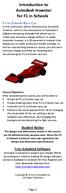 Introduction to Autodesk Inventor for F1 in Schools F1 in Schools Race Car In this course you will be introduced to Autodesk Inventor, which is the centerpiece of Autodesk s digital prototyping strategy
Tutorial for Tracker and Supporting Software By David Chandler
 Tutorial for Tracker and Supporting Software By David Chandler I use a number of free, open source programs to do video analysis. 1. Avidemux, to exerpt the video clip, read the video properties, and save
An introduction to 3D draughting & solid modelling using AutoCAD
 An introduction to 3D draughting & solid modelling using AutoCAD Faculty of Technology University of Plymouth Drake Circus Plymouth PL4 8AA These notes are to be used in conjunction with the AutoCAD software
Adobe Illustrator CS5 Part 1: Introduction to Illustrator
 CALIFORNIA STATE UNIVERSITY, LOS ANGELES INFORMATION TECHNOLOGY SERVICES Adobe Illustrator CS5 Part 1: Introduction to Illustrator Summer 2011, Version 1.0 Table of Contents Introduction...2 Downloading
Castle Modeling. In this PDF tutorial we will be modeling a simple castle as pictured above.
 Course: 3D Design Title: Castle Modeling Blender: Version 2.6X Level: Beginning Author; Neal Hirsig ([email protected]) May, 2012 This tutorial assumes that you already know how to: Display orthographic
10.0-2. Finite Element Modeling
 What s New in FEMAP FEMAP 10.0 and 10.0.1 include enhancements and new features in: User Interface on page 3 Meshing on page 23 Mesh Associativity on page 33 Properties on page 33 Functions on page 35
Microsoft Access 2010 handout
 Microsoft Access 2010 handout Access 2010 is a relational database program you can use to create and manage large quantities of data. You can use Access to manage anything from a home inventory to a giant
DataPA OpenAnalytics End User Training
 DataPA OpenAnalytics End User Training DataPA End User Training Lesson 1 Course Overview DataPA Chapter 1 Course Overview Introduction This course covers the skills required to use DataPA OpenAnalytics
Laminar Flow in a Baffled Stirred Mixer
 Laminar Flow in a Baffled Stirred Mixer Introduction This exercise exemplifies the use of the rotating machinery feature in the CFD Module. The Rotating Machinery interface allows you to model moving rotating
Migrating to Excel 2010 from Excel 2003 - Excel - Microsoft Office 1 of 1
 Migrating to Excel 2010 - Excel - Microsoft Office 1 of 1 In This Guide Microsoft Excel 2010 looks very different, so we created this guide to help you minimize the learning curve. Read on to learn key
Introduction to COMSOL. The Navier-Stokes Equations
 Flow Between Parallel Plates Modified from the COMSOL ChE Library module rev 10/13/08 Modified by Robert P. Hesketh, Chemical Engineering, Rowan University Fall 2008 Introduction to COMSOL The following
Creating Drawings in Pro/ENGINEER
 6 Creating Drawings in Pro/ENGINEER This chapter shows you how to bring the cell phone models and the assembly you ve created into the Pro/ENGINEER Drawing mode to create a drawing. A mechanical drawing
http://school-maths.com Gerrit Stols
 For more info and downloads go to: http://school-maths.com Gerrit Stols Acknowledgements GeoGebra is dynamic mathematics open source (free) software for learning and teaching mathematics in schools. It
ME6130 An introduction to CFD 1-1
 ME6130 An introduction to CFD 1-1 What is CFD? Computational fluid dynamics (CFD) is the science of predicting fluid flow, heat and mass transfer, chemical reactions, and related phenomena by solving numerically
NUMERICAL ANALYSIS OF THE EFFECTS OF WIND ON BUILDING STRUCTURES
 Vol. XX 2012 No. 4 28 34 J. ŠIMIČEK O. HUBOVÁ NUMERICAL ANALYSIS OF THE EFFECTS OF WIND ON BUILDING STRUCTURES Jozef ŠIMIČEK email: [email protected] Research field: Statics and Dynamics Fluids mechanics
TwinMesh for Positive Displacement Machines: Structured Meshes and reliable CFD Simulations
 TwinMesh for Positive Displacement Machines: Structured Meshes and reliable CFD Simulations 05.06.2014 Dipl.-Ing. Jan Hesse, Dr. Andreas Spille-Kohoff CFX Berlin Software GmbH Karl-Marx-Allee 90 A 10243
ME 24-688 Week 11 Introduction to Dynamic Simulation
 The purpose of this introduction to dynamic simulation project is to explorer the dynamic simulation environment of Autodesk Inventor Professional. This environment allows you to perform rigid body dynamic
INTRODUCTION to ESRI ARCGIS For Visualization, CPSC 178
 INTRODUCTION to ESRI ARCGIS For Visualization, CPSC 178 1) Navigate to the C:/temp folder 2) Make a directory using your initials. 3) Use your web browser to navigate to www.library.yale.edu/mapcoll/ and
Creating Hyperlinks & Buttons InDesign CS6
 Creating Hyperlinks & Buttons Adobe DPS, InDesign CS6 1 Creating Hyperlinks & Buttons InDesign CS6 Hyperlinks panel overview You can create hyperlinks so that when you export to Adobe PDF or SWF in InDesign,
Turbulence Modeling in CFD Simulation of Intake Manifold for a 4 Cylinder Engine
 HEFAT2012 9 th International Conference on Heat Transfer, Fluid Mechanics and Thermodynamics 16 18 July 2012 Malta Turbulence Modeling in CFD Simulation of Intake Manifold for a 4 Cylinder Engine Dr MK
Fireworks CS4 Tutorial Part 1: Intro
 Fireworks CS4 Tutorial Part 1: Intro This Adobe Fireworks CS4 Tutorial will help you familiarize yourself with this image editing software and help you create a layout for a website. Fireworks CS4 is the
OPERATION MANUAL. MV-410RGB Layout Editor. Version 2.1- higher
 OPERATION MANUAL MV-410RGB Layout Editor Version 2.1- higher Table of Contents 1. Setup... 1 1-1. Overview... 1 1-2. System Requirements... 1 1-3. Operation Flow... 1 1-4. Installing MV-410RGB Layout
CATIA V5 Tutorials. Mechanism Design & Animation. Release 18. Nader G. Zamani. University of Windsor. Jonathan M. Weaver. University of Detroit Mercy
 CATIA V5 Tutorials Mechanism Design & Animation Release 18 Nader G. Zamani University of Windsor Jonathan M. Weaver University of Detroit Mercy SDC PUBLICATIONS Schroff Development Corporation www.schroff.com
Working With Animation: Introduction to Flash
 Working With Animation: Introduction to Flash With Adobe Flash, you can create artwork and animations that add motion and visual interest to your Web pages. Flash movies can be interactive users can click
CFD SIMULATION OF SDHW STORAGE TANK WITH AND WITHOUT HEATER
 International Journal of Advancements in Research & Technology, Volume 1, Issue2, July-2012 1 CFD SIMULATION OF SDHW STORAGE TANK WITH AND WITHOUT HEATER ABSTRACT (1) Mr. Mainak Bhaumik M.E. (Thermal Engg.)
Introduction to MS WINDOWS XP
 Introduction to MS WINDOWS XP Mouse Desktop Windows Applications File handling Introduction to MS Windows XP 2 Table of Contents What is Windows XP?... 3 Windows within Windows... 3 The Desktop... 3 The
HOW TO LINK AND PRESENT A 4D MODEL USING NAVISWORKS. Timo Hartmann [email protected]
 Technical Paper #1 HOW TO LINK AND PRESENT A 4D MODEL USING NAVISWORKS Timo Hartmann [email protected] COPYRIGHT 2009 VISICO Center, University of Twente [email protected] How to link and present
Introduction to CATIA V5
 Introduction to CATIA V5 Release 16 (A Hands-On Tutorial Approach) Kirstie Plantenberg University of Detroit Mercy SDC PUBLICATIONS Schroff Development Corporation www.schroff.com www.schroff-europe.com
Hosting Users Guide 2011
 Hosting Users Guide 2011 eofficemgr technology support for small business Celebrating a decade of providing innovative cloud computing services to small business. Table of Contents Overview... 3 Configure
Layout Tutorial. Getting Started
 Getting Started Layout Tutorial This tutorial will explain how create a layout template, send views to a layout page, then save the document in PDF format. In this tutorial you will learn about: Creating
Tutorial for laboratory project #2 Using ANSYS Workbench. For Double Pipe Heat Exchanger
 Tutorial for laboratory project #2 Using ANSYS Workbench For Double Pipe Heat Exchanger 1. Preparing ANSYS Workbench Go to Start Menu/All Programs/Simulation/ANSYS 12.1/Workbench. In the toolbox menu in
ABAQUS Tutorial. 3D Modeling
 Spring 2011 01/21/11 ABAQUS Tutorial 3D Modeling This exercise intends to demonstrate the steps you would follow in creating and analyzing a simple solid model using ABAQUS CAE. Introduction A solid undergoes
Trace Layer Import for Printed Circuit Boards Under Icepak
 Tutorial 13. Trace Layer Import for Printed Circuit Boards Under Icepak Introduction: A printed circuit board (PCB) is generally a multi-layered board made of dielectric material and several layers of
Importing and Opening an Alignment
 Chapter 6 Alignment Files An alignment defines the route of a road, utility line, water way, etc., and is typically comprised of both horizontal and vertical elements. Also, an alignment may include cross-sectional
Interactive Voting System. www.ivsystem.nl. IVS-Basic IVS-Professional 4.4
 Interactive Voting System www.ivsystem.nl IVS-Basic IVS-Professional 4.4 Manual IVS-Basic 4.4 IVS-Professional 4.4 1213 Interactive Voting System The Interactive Voting System (IVS ) is an interactive
Introduction to Autodesk Inventor for F1 in Schools
 F1 in Schools race car Introduction to Autodesk Inventor for F1 in Schools In this course you will be introduced to Autodesk Inventor, which is the centerpiece of Autodesk s Digital Prototyping strategy
Getting Started with ANSYS ANSYS Workbench Environment
 Getting Started with ANSYS ANSYS Workbench Environment Overview The purpose of this tutorial is to get you started with the ANSYS Workbench environment. We will use a simple, static analysis of a single
Visualization of 2D Domains
 Visualization of 2D Domains This part of the visualization package is intended to supply a simple graphical interface for 2- dimensional finite element data structures. Furthermore, it is used as the low
ArcGIS. Tips and Shortcuts. for Desktop
 ArcGIS Tips and Shortcuts for Desktop Map Navigation Refresh and redraw the display. F5 Suspend the map s drawing. F9 Zoom in and out. Center map. Roll the mouse wheel backward and forward. Hold down Ctrl
Composite Surfaces Tutorial
 Composite Surfaces Tutorial 4-1 Composite Surfaces Tutorial This tutorial will use the same model as the Materials & Loading Tutorial (with some modifications), to demonstrate how to perform a circular
CREATING A 3D VISUALISATION OF YOUR PLANS IN PLANSXPRESS AND CORTONA VRML CLIENT
 CREATING A 3D VISUALISATION OF YOUR PLANS IN PLANSXPRESS AND CORTONA VRML CLIENT 20-25 Minutes This topic is for users of PlansXpress Total Toolkit Edition. To upgrade to PlansXpress Total Toolkit, call
THE CFD SIMULATION OF THE FLOW AROUND THE AIRCRAFT USING OPENFOAM AND ANSA
 THE CFD SIMULATION OF THE FLOW AROUND THE AIRCRAFT USING OPENFOAM AND ANSA Adam Kosík Evektor s.r.o., Czech Republic KEYWORDS CFD simulation, mesh generation, OpenFOAM, ANSA ABSTRACT In this paper we describe
Tutorial: Biped Character in 3D Studio Max 7, Easy Animation
 Tutorial: Biped Character in 3D Studio Max 7, Easy Animation Written by: Ricardo Tangali 1. Introduction:... 3 2. Basic control in 3D Studio Max... 3 2.1. Navigating a scene:... 3 2.2. Hide and Unhide
Chapter 1. Creating Sketches in. the Sketch Mode-I. Evaluation chapter. Logon to www.cadcim.com for more details. Learning Objectives
 Chapter 1 Creating Sketches in Learning Objectives the Sketch Mode-I After completing this chapter you will be able to: Use various tools to create a geometry. Dimension a sketch. Apply constraints to
A Guide to the free mesh program Discretizer with OpenFOAM for CFD (Computational Fluid Dynamics)
 Discretizer Manual Release date 09/01/10 Side 1 of 13 A Guide to the free mesh program Discretizer with OpenFOAM for CFD (Computational Fluid Dynamics) Homepage: http://www.discretizer.org/ Creator of
Introduction to ANSYS ICEM CFD
 Lecture 6 Mesh Preparation Before Output to Solver 14. 0 Release Introduction to ANSYS ICEM CFD 1 2011 ANSYS, Inc. March 22, 2015 Mesh Preparation Before Output to Solver What will you learn from this
OpenFOAM Opensource and CFD
 OpenFOAM Opensource and CFD Andrew King Department of Mechanical Engineering Curtin University Outline What is Opensource Software OpenFOAM Overview Utilities, Libraries and Solvers Data Formats The CFD
ABAQUS/CAE Tutorial: Analysis of an Aluminum Bracket
 H. Kim FEA Tutorial 1 ABAQUS/CAE Tutorial: Analysis of an Aluminum Bracket Hyonny Kim last updated: August 2004 In this tutorial, you ll learn how to: 1. Sketch 2D geometry & define part. 2. Define material
CHEG 3128 Heat, Mass, & Kinetics Laboratory Diffusion in Laminar Flow Regimes Modeling and COMSOL Tutorial Tutorial by Andrea Kadilak
 CHEG 3128 Heat, Mass, & Kinetics Laboratory Diffusion in Laminar Flow Regimes Modeling and COMSOL Tutorial Tutorial by Andrea Kadilak Introduction COMSOL is a computer modeling software package that will
Create a Poster Using Publisher
 Contents 1. Introduction 1. Starting Publisher 2. Create a Poster Template 5. Aligning your images and text 7. Apply a background 12. Add text to your poster 14. Add pictures to your poster 17. Add graphs
SAP Business Intelligence (BI) Reporting Training for MM. General Navigation. Rick Heckman PASSHE 1/31/2012
 2012 SAP Business Intelligence (BI) Reporting Training for MM General Navigation Rick Heckman PASSHE 1/31/2012 Page 1 Contents Types of MM BI Reports... 4 Portal Access... 5 Variable Entry Screen... 5
WHAT S NEW IN WORD 2010 & HOW TO CUSTOMIZE IT
 WHAT S NEW IN WORD 2010 & HOW TO CUSTOMIZE IT The Ribbon... 2 Default Tabs... 2 Contextual Tabs... 2 Minimizing and Restoring the Ribbon... 3 Customizing the Ribbon... 3 A New Graphic Interface... 5 Live
Microsoft PowerPoint 2010 Templates and Slide Masters (Level 3)
 IT Services Microsoft PowerPoint 2010 Templates and Slide Masters (Level 3) Contents Introduction... 1 Installed Templates and Themes... 2 University of Reading Templates... 3 Further Templates and Presentations...
Quickstart for Desktop Version
 Quickstart for Desktop Version What is GeoGebra? Dynamic Mathematics Software in one easy-to-use package For learning and teaching at all levels of education Joins interactive 2D and 3D geometry, algebra,
PowerPoint 2007: Basics Learning Guide
 PowerPoint 2007: Basics Learning Guide What s a PowerPoint Slide? PowerPoint presentations are composed of slides, just like conventional presentations. Like a 35mm film-based slide, each PowerPoint slide