
Calculating the Return on Investment (ROI) of Corporate elearning WHITE PAPER 2011 B ONLINE LEARNING
|
|
|
- Delilah Bryant
- 10 years ago
- Views:
Transcription
1 Calculating the Return on Investment (ROI) of Corporate elearning WHITE PAPER 2011 B ONLINE LEARNING

2 In choosing an elearning system, managers frequently need to calculate the return on investment (ROI) of their buying decision. From an accounting point of view, calculating the ROI is relatively simple; place a monetary value on all the known benefits of installing a learning management system, deduct all known costs, and then divide the total by the costs. Multiply the result by 100 to express ROI as a percentage. For every $1 invested there is a net benefit of $8 after costs are covered. This figure is usually expressed as annual benefit, even though there may be long-term effects. It is expressed this way because with traditional classroom based training, the impact of the training usually diminishes after a year. However, with an electronic performance support subsystem as part of an on-line learning system, skills can be reinforced long after a course is over, so it s a conservative calculation for elearning modules. Expressed as a formula, return on investment is: ROI (% ) = Net Program Benefits / Program Costs x 100 For example, a training program for XYZ Company produces measurable benefits of $400,000 and costs $40,000. Net Program Benefits are $400,000 - $40,000 = $360,000 So ROI = $360,000/$40,000 x 100 = 800% However, not all information and value can be expressed a number, making the final decision more complicated that it might seem. As well, an accounting focus tends to place the emphasis on the efficiency of the solution, rather than its effectiveness.

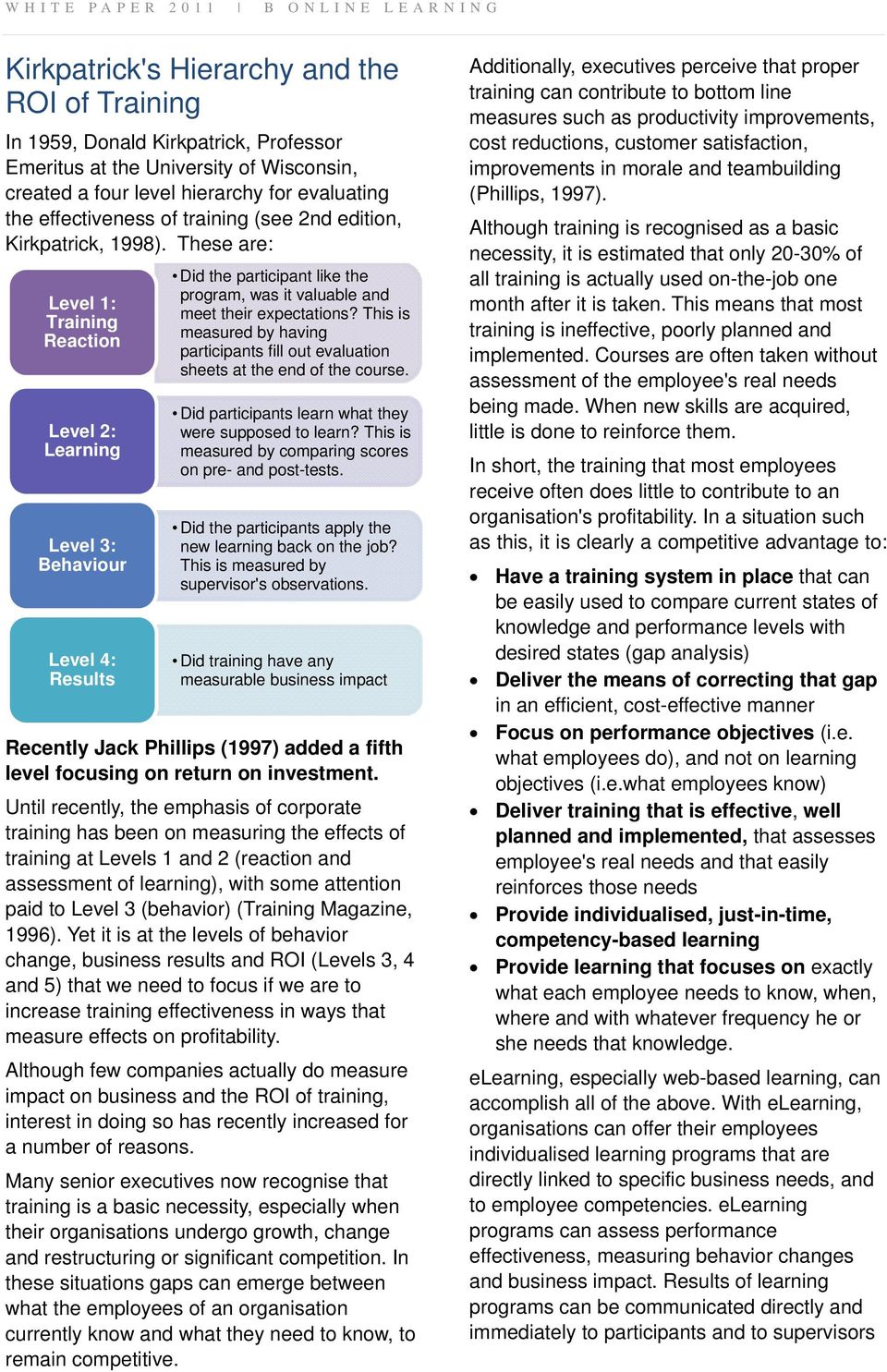
3 Kirkpatrick's Hierarchy and the ROI of Training In 1959, Donald Kirkpatrick, Professor Emeritus at the University of Wisconsin, created a four level hierarchy for evaluating the effectiveness of training (see 2nd edition, Kirkpatrick, 1998). These are: Level 1: Training Reaction Level 2: Learning Level 3: Behaviour Level 4: Results Did the participant like the program, was it valuable and meet their expectations? This is measured by having participants fill out evaluation sheets at the end of the course. Did participants learn what they were supposed to learn? This is measured by comparing scores on pre- and post-tests. Did the participants apply the new learning back on the job? This is measured by supervisor's observations. Did training have any measurable business impact Recently Jack Phillips (1997) added a fifth level focusing on return on investment. Until recently, the emphasis of corporate training has been on measuring the effects of training at Levels 1 and 2 (reaction and assessment of learning), with some attention paid to Level 3 (behavior) (Training Magazine, 1996). Yet it is at the levels of behavior change, business results and ROI (Levels 3, 4 and 5) that we need to focus if we are to increase training effectiveness in ways that measure effects on profitability. Although few companies actually do measure impact on business and the ROI of training, interest in doing so has recently increased for a number of reasons. Many senior executives now recognise that training is a basic necessity, especially when their organisations undergo growth, change and restructuring or significant competition. In these situations gaps can emerge between what the employees of an organisation currently know and what they need to know, to remain competitive. Additionally, executives perceive that proper training can contribute to bottom line measures such as productivity improvements, cost reductions, customer satisfaction, improvements in morale and teambuilding (Phillips, 1997). Although training is recognised as a basic necessity, it is estimated that only 20-30% of all training is actually used on-the-job one month after it is taken. This means that most training is ineffective, poorly planned and implemented. Courses are often taken without assessment of the employee's real needs being made. When new skills are acquired, little is done to reinforce them. In short, the training that most employees receive often does little to contribute to an organisation's profitability. In a situation such as this, it is clearly a competitive advantage to: Have a training system in place that can be easily used to compare current states of knowledge and performance levels with desired states (gap analysis) Deliver the means of correcting that gap in an efficient, cost-effective manner Focus on performance objectives (i.e. what employees do), and not on learning objectives (i.e.what employees know) Deliver training that is effective, well planned and implemented, that assesses employee's real needs and that easily reinforces those needs Provide individualised, just-in-time, competency-based learning Provide learning that focuses on exactly what each employee needs to know, when, where and with whatever frequency he or she needs that knowledge. elearning, especially web-based learning, can accomplish all of the above. With elearning, organisations can offer their employees individualised learning programs that are directly linked to specific business needs, and to employee competencies. elearning programs can assess performance effectiveness, measuring behavior changes and business impact. Results of learning programs can be communicated directly and immediately to participants and to supervisors
4 Costs associated with participants Costs associated with employees as participants frequently represent more than 80% of the cost of a traditional training program (Head, 1994). Traditionally, this cost is arrived at by adding the participants salaries (during the time they are taking training), together with lost opportunity costs (the value of the deduced productivity of each participant, and/or the value of the time lost due to absence from the workplace). Calculating this figure is further complicated if a temporary employee replaces the participant, where the salary of the temporary employee has to be adjusted (usually by a factor of between 1.2 and 1.5) to make up for their lower efficiency. If there is no replacement, then the participant's missing productivity must be calculated for the time they are absent due to training and travel. Web based training minimises costs associated with participants by: Reducing the time it takes for a participant to master content. Productivity losses are minimized together with lost opportunity costs. For example, with web-based learning, Andersen Consulting reported 60-70% less time was needed for training (Jerram, 1994). At CSX Transportation it was 50% less to master equivalent content (Trisram, 1995). The Los Angeles Department of Water and Power experienced a 50% reduction in training time (Piazza, 1995). Reducing the "training cycle time". Just- In-Time ( JIT) training eliminates wasted time associated with waiting for an entire course to be offered in order to get one critical piece of information. Significantly reducing travel costs, costs of meals and lodging elearning and ROI All corporate training directly impacts profitability in at least three ways: The costs associated with training - including direct costs such as staff, delivery systems, travel, per diems and opportunity costs The costs associated with lost productivity during training time, and The benefits that accrue to the organisation as a result of formal training- including increase in productivity. Most traditional training ROI models assume a set of fixed cost categories that include: Needs assessment (prorated over shelf life) Design and development (prorated) Acquisition (prorated) Delivery (all subsections are expensed) Salaries/benefits- facilitators/coordination Program materials and fees Travel/lodging/meals Facilities Salaries/benefits - participants Contact time Travel time Prep time Evaluation (prorated) Overhead/training and development (prorated) (Phillips, 1997, p.139) But, as the Alex Informatique (1998) points out, the "introduction of web-based training substantially alters the validity of this categorisation." For example, conventional training is delivered through seminars often lasting several days, while web-based training often occurs in JIT (just-in-time) sessions, in response to a current performance problem. There are not dedicated classrooms, training centres, travel expenditures needed. These cost categories become irrelevant. Moreover a video enabled server that functions over the existing LAN or WAN could add substantial functionality to the existing corporate infrastructure, positively benefiting corporate operations.
5 For example: Company XYZ decides to introduce a new product. To facilitate this XYZ company sends 500 participants on a 5 day course. These participants average wages are $20/hr (includes the cost of insurance and other benefits). The cost of sending these employees for 5 days of training, not including travel time, opportunity costs, or the costs of creating or purchasing and delivering the training are: 500 people x $20/hr x40hrs =$400,000. A 40% reduction in time spent on training, with all else remaining equal, means a saving of $160,000 in wages allocated to training. But the cost of actual wages can be small compared to the possible lost opportunity costs. For example, if XYZ Company takes a salesperson away from their sales activities for one day and the opportunity cost is $10,000 in revenue, and if XYZ Company is realising a 10% net income on revenue, then that company looses $1,000 in profit each day the sales person is off. If XYZ company sent its sales force of 500 on a 5 day training course, the lost opportunity costs would be $2,500,000. Any decrease in training time reduces the lost opportunity cost. Reducing the time spent on training by 40% reduces the lost opportunity costs for savings of $1,000,000. By using elearning rather than traditional classroom methods, XYZ Company can also significantly reduce the travel, lodging and entertainment costs that go along with traditional methods of training. Suppose XYZ Company sends its 500 salespeople to training site for a week. Assuming travel and entertainment expenses per employee who travels of $1,000/week, the total travel and entertainment cost for a week of training is $500,000. With elearning the entire cost of travel, lodging and meals is eliminated. Other traditional costs in delivering training have included Instructional Delivery Costs, Instructional Content Costs and Management Costs. These costs include overhead costs and the cost of equipment. All of these costs can be greatly reduced or eliminated altogether by giving employees access to elearning at their desks or at shared, centrally located work stations. With elearning, significant savings are to be had in terms of the cost of trainers' inclassroom time. For example: If XYZ company pays a trainer a salary of $40,000 annually, with additional employee costs of 25%, that trainer costs XYZ Company about $920/week. If XYZ Company wishes to train its 500 sales personnel, for one week, in classes of 20, it will take 25 person/weeks to complete the assignment. During this period the trainer(s) will cost $23,750 in salary and benefits. In order to deliver this training simultaneously to all salespeople, XYZ company will require 25 trainers sent out on 20 trips, at $1,000/trip (5 trainers are already on site). Total travel cost is $20,000. elearning eliminates these costs. One instructional designer could handle the entire sales staff, and training time for the sales staff would be reduced from 5 to 3 days. It does cost more to build elearning than it does to create classroom training - estimates are about $4,000/hr for traditional training (to create lecture notes and slides/overheads) compared to $20,000/hr to $40,000/hr for elearning (the range reflects the fact that elearning can range from text on a screen to full multimedia productions). And it does cost to install web-ready computers - about $1,000 per system, although this cost may be a moot factor in most business where web-based computers already are in place. But both the course production and the hardware costs are amortized over a period of several years. elearning and Improved Performance Important to the ROI results as savings in instruction are, the most important training ROI results come as consequences of the nature of elearning itself. Good elearning is faster than classroom training, making it cheaper to use in the long run. Second, studies have shown that people
6 trained using interactive elearning remember more of what they learn, remember it more accurately, for a longer period of time, and are better able to use what they learn to improve their job performances by 15-25% over traditional course delivery methods. Case studies from Intel, American Airlines, Pacific Gas & Electric, IBM, Bethlehem steel, Bell South, Steelcase and Pizza Hut can demonstrate results of significant improvements in motivation of learners, ability to retain what they learn longer and more accurately. The actual ROI for Web based training will vary from one corporation to another, as costs and requirements vary. But it is safe to say that the savings made by implementing Web based training when compared with classroom-based training are substantial. Barry explains why online education is a multiplier that demonstrates the real value of electronic education : the ability to deliver training locally the ability to deliver courses in hourly increments, matching the business volume shifts with training opportunities the ability to use tools that reduce the time needed to learn specific educational goals the ability to deliver "just in case" is training Beyond ROI calculating the intangible As an accounting exercise, calculating ROI is relatively straightforward. But, as Barry notes, ROI analyses rarely include the soft values of electronic education, including improved employee retention and the value of using a familiar work tool (personal computer) as a teaching tool. Phillips extends this thought with a list of intangible benefits of all training. He contends that for some programs, intangible, non-monetary benefits are extremely valuable, often carrying as much influence as the hard data items. Intangible benefits include items such as: increased job satisfaction the line increased organisational commitment improved teamwork improved customer service reduced complaints, and reduced conflicts Finally, the effectiveness of any educational program will determine the ultimate ROI. There is no point in focusing on the amount of money saved by a proposed elearning solution if that solution does not produce real learning in the form of change of behaviour, level of knowledge or personal growth of the learners. This is not a function of instruction being online or in a classroom, but is a result of successful teaching strategies. Paper adapted from the Operitel Corporation paper by Dr. Karen Anderson an Associate Professor of Sociology at York University, Toronto, Canada. Dr. Gary Woodill, a former Professor of Education at Ryerson University in Toronto, Canada

WHITE PAPER. Using ROI to Make the Business Case for Training. www.bizlibrary.com. Authors: Ray Halagera President, The Profit Ability Group
 Using ROI to Make the Business Case for Training WHITE PAPER Authors: Ray Halagera President, The Profit Ability Group Dean Pichee President, BizLibrary INTRODUCTION Training Magazine does an annual survey
Eleven Reasons Why Training and Development Fails... and what you can do about it. Jack J. Phillips & Patti P. Phillips
 Eleven Reasons Why Training and Development Fails... and what you can do about it By Jack J. Phillips & Patti P. Phillips During their more than 10 years as consultants to some of the world s largest organizations,
Corporate Learning Watch
 Quantifying the Organizational Benefits of Training August 2010 The Majority of CEOs Want Return on Investment Data for Training Programs, But Few Receive It Watch List A recent survey of CEOs found that
The Kirkpatrick/Phillips Model for Evaluating Human Resource Development and Training
 The Kirkpatrick/Phillips Model for Evaluating Human Resource Development and Training By Allan Bailey, CEO, Learning Designs Online The ROI Methodology Because of its appropriateness to the business setting,
Using Return on Investment to Evaluate Project Management Training. Abstract. Introduction
 Using Return on Investment to Evaluate Project Management Training Author: Gina Abudi, MBA, Partner/VP Peak Performance Group, Inc. Abstract Executives today are demanding to see the monetary value that
Measuring the Impact of Sales Training
 Measuring the Impact of Sales Training Authors: Barry Hennessy [email protected] Jon Gooding [email protected] Page 1 Table of Contents Why Measure? 3 What to Measure? 3 Business Impact Considerations
Measuring ROI in Executive Coaching
 Measuring ROI in Executive Coaching Jack J. Phillips, Ph.D. and Patricia P. Phillips, Ph.D.
You Can Create Measurable Training Programs A White Paper For Training Professionals
 You Can Create Measurable Training Programs A White Paper For Training Professionals Executive Summary Determining training return on investment (ROI) is a pressing need for all training professionals.
By Jack Phillips and Patti Phillips How to measure the return on your HR investment
 By Jack Phillips and Patti Phillips How to measure the return on your HR investment Using ROI to demonstrate your business impact The demand for HR s accountability through measurement continues to increase.
Instructional Design Principles in the Development of LearnFlex
 Instructional Design Principles in the Development of LearnFlex A White Paper by Dr. Gary Woodill, Ed.D. Chief Learning Officer, Operitel Corporation [email protected] Dr. Karen Anderson, PhD. Senior
Understanding the business benefits of introducing an LMS
 An White Paper Understanding the business benefits of introducing an LMS Revision 1.2 e2train November 2004 Authors Martin Belton ([email protected]) Rob Caul ([email protected]) Produced by
Hard Numbers from Soft Skills: You Can Measure the Impact and ROI for Soft Skill Programs Jack J. Phillips, PhD and Patti P.
 Hard Numbers from Soft Skills: You Can Measure the Impact and ROI for Soft Skill Programs Jack J. Phillips, PhD and Patti P. Phillips, PhD Recently, a large gold mining company based in North America with
Measuring Return on Investment (ROI) in Training as Part of Your Business Strategy
 Measuring Return on Investment (ROI) in Training as Part of Your Business Strategy By Catherina Opperman Measuring ROI in training is the clearest statement an can make about the amount invested in training.
Return on Investment (ROI): Calculating the Monetary Return of a Leadership Development Program
 Return on Investment (ROI): Calculating the Monetary Return of a Leadership Development Program Frederick R. Rohs Professor and Extension Staff Development Specialist Department of Agricultural Leadership,
Building a Business Case: The ROI of Using an Online Compliance Training Program. Courtesy of:
 Building a Business Case: The ROI of Using an Online Compliance Training Program Courtesy of: Page 2 The Importance and Necessity of Compliance Training The financial services industry has become over
IBM Training White Paper. The value of e-learning
 IBM Training White Paper The value of e-learning Contents 1 Overview of the market 2 Types of e-learning 3 Benefits and disadvantages 6 Implementing a program 7 Developing a business case 9 Recommendations
Making the business case for C4RISK databasebased Operational Risk Management software
 Making the business case for C4RISK databasebased Operational Risk Management A robust Risk Management and Control process is an integral part of the business infrastructure to enable the Board to create
ROI of Training and Development Programmes: Challenges and Developments
 ROI of Training and Development Programmes: Challenges and Developments Shefali Sachdeva* *Ph.D. Scholar, Department of Commerce, Delhi School of Economics, Delhi University, Delhi, INDIA. E-Mail: Shesach19{at}gmail{dot}com
Guide. Professional Development. When change is constant, learning must be continuous. ISM-ADR School for Supply Management. Leadership Delivered
 When change is constant, learning must be continuous. Bill Michels, C.P.M., CEO, ADR North America Professional Development Guide ISM-ADR School for Supply Management Leadership Delivered Paul Novak, CPSM,
CHAPTER 1: A FRAMEWORK FOR INTERPERSONAL SKILL DEVELOPMENT
 CHAPTER 1: A FRAMEWORK FOR INTERPERSONAL SKILL DEVELOPMENT The first chapter sets the stage for improving interpersonal relations in organizations by presenting a framework for interpersonal skill development
Choosing an LMS FOR EMPLOYEE TRAINING
 Choosing an LMS FOR EMPLOYEE TRAINING As organizations grow it becomes more challenging to scale your internal learning culture. You must be certain that your staff is trained in the entire organizational
X-Plain Preventing Injuries at Work Through Ergonomics - Cost-Benefit Analysis Reference Summary
 X-Plain Preventing Injuries at Work Through Ergonomics - Cost-Benefit Analysis Reference Summary Introduction Ergonomics is the science of designing a safe, comfortable, and highly productive workplace.
Measuring ROI in Executive Coaching
 Measuring ROI in Executive Coaching Jack J. Phillips, Ph.D. and Patricia P. Phillips, Ph.D. This article first appeared in the International Journal of Coaching in Organizations, 2005, 3(1), 53-62. It
Effective Employee Incentive Programs Bring Out The Best In Your Firm
 Effective Employee Incentive Programs Bring Out The Best In Your Firm By Lisa A. Rozycki 2006 All Rights Reserved An incentive program is a planned activity designed to motivate people to achieve predetermined
A better way to calculate equipment ROI
 page 1 A better way to calculate equipment ROI a West Monroe Partners white paper by Aaron Lininger Copyright 2012 by CSCMP s Supply Chain Quarterly (www.supplychainquarterly.com), a division of Supply
INCOME TAX COMPUTER SOFTWARE ACQUIRED FOR USE IN A TAXPAYER S BUSINESS
 INTERPRETATION STATEMENT: IS 16/01 INCOME TAX COMPUTER SOFTWARE ACQUIRED FOR USE IN A TAXPAYER S BUSINESS All legislative references are to the Income Tax Act 2007 unless otherwise stated. Relevant legislative
Inducting New Employees Automating the Induction Process to Realise Significant Return on Investment
 Inducting New Employees Automating the Induction Process to Realise Significant Return on Investment Studies by SHRM have proven the value of implementing a strong induction program within an organisation
Equip Your Team with World Class Communication Skills
 64 Courses NOW AVAILABLE From The QSC ServiceSkills Library Equip Your Team with World Class Communication Skills ServiceSkills includes all-inclusive access to 62 training modules in these five series:
THE REPUBLIC OF UGANDA DPP
 THE REPUBLIC OF UGANDA DPP Staff Training and Development Policy 2014 TABLE OF CONTENTS 1.0 INTRODUCTION 3 1.1 Policy and Legal Framework 4 1.2 Principles/Guidelines of the Training and Staff Development
An E-Learning Primer
 An E-Learning Primer Online Training for Rehab Professionals and Staff By Melissa S. Cohn, OTR/L "E-learning," the electronic version of distance learning, is one of the fastest growing trends in higher
Instructional Design Basics for Courses/Modules By William J. Rothwell* CLS Module
 Instructional Design Basics for Courses/Modules By William J. Rothwell* CLS Module Designing a training course [i.e. module] can be more difficult than it appears to be. Many books and articles have been
SPIN applies science to selling
 SPIN applies science to selling If, to the man in the street, selling conjures images of hype and hyperbole, false bonhomie and subtle misrepresentation, no company can be the object of greater suspicion
The Workplace Supervisor, Coach and Mentor
 WESTERN AUSTRALIA The Workplace Supervisor, Coach and Mentor A resource for Disability Service supervisors and coordinators to support staff involved in accredited training. Acknowledgements This guide
TEAM PRODUCTIVITY DEVELOPMENT PROPOSAL
 DRAFT TEAM PRODUCTIVITY DEVELOPMENT PROPOSAL An initial draft proposal to determine the scale, scope and requirements of a team productivity development improvement program for a potential client Team
Module VII: INTRODUCTION STEP 1: NEEDS ASSESSMENT. Needs Assessment. Employee Training & Development. Design
 Module VII: Employee Training & Development INTRODUCTION Training vs. Development Training programs are intended to ensure employees are proficient in meeting the requirements of their current role. However
2005 Rooney Award. Nomination: Innovative State Human Resource Management
 2005 Rooney Award Nomination: Innovative State Human Resource Management Program Title: E-Learning Program State: North Carolina Contact Person: Thomas H. Wright Title: State Personnel Director Agency:
HR NAV + Training & Development
 HR NAV + Training & Development Learning Management System/ E-Learning Training and Development Investing in Training and Development Ensures higher productivity More highly skilled employees Reduced turnover
E-learning Course Design Don McIntosh, Ph.D. - February 23, 2006
 E-learning Course Design Don McIntosh, Ph.D. - February 23, 2006 Introduction Imagine your company is embarking on a program to implement e-learning to complement its classroom training program, and you
What s the REAL ROI of Video Conferencing? S. Ann Earon, Ph.D. President, Telemanagement Resources International Inc.
 What s the REAL ROI of Video Conferencing? S. Ann Earon, Ph.D. President, Telemanagement Resources International Inc. White Paper November 2014 Over the years, the growth of video conferencing has been
INL PROGRAM PERFORMANCE METRIC EXAMPLES
 1 INL PROGRAM PERFORMANCE METRIC EXAMPLES The purpose of this document is to assist Program Officers and Implementers with developing performance measurements that: 1. Are quantifiable 2. Are consistent
Q: What is an American Express travel card and why would I want a card?
 Travel Card: FAQ Q: What is an American Express travel card and why would I want a card? A: A travel card is basically a "credit card" that can be used to purchase business travel, business meal and business
ABOUT FINANCIAL RATIO ANALYSIS
 ABOUT FINANCIAL RATIO ANALYSIS Over the years, a great many financial analysis techniques have developed. They illustrate the relationship between values drawn from the balance sheet and income statement
Learning Management. Systems...an introduction.
 Learning Management L Systems..an introduction. D a t a R u n n e r s, L L C Page 0 Contents 1. WHAT IS A LEARNING MANAGEMENT SYSTEM?... 3 1.1. CORE REASONS FOR PURCHASING AN LMS... 4 1.2. LMS MATURITY...
REVAMP YOUR TRAINING 7 STEPS TO A SUCCESSFUL BLENDED LEARNING PROGRAM
 REVAMP YOUR 7 STEPS TO A SUCCESSFUL BLENDED LEARNING PROGRAM BY STEVE O BRIAN, VICE PRESIDENT, CHRONUS CORPORATION WITH KAREN DU FOUR DES CHAMPS, & DEVELOPMENT EXPERT, AUTHOR, SPEAKER, AND CONSULTANT PROGRAM
Manual on o Training Management
 5 Project on Improvement of Local Administration in Cambodia Manual on o Training Management Introduction What is Training Management? How to Use the Manuals Table of Contents 1. Introduction...4 2. What
ROI and Coaching: Applying Metrics to Measure the Effectiveness of Coaching Programs A study by Paul Bernard ( Paul Bernard & Associations 2006)
 ROI and Coaching: Applying Metrics to Measure the Effectiveness of Coaching Programs A study by Paul Bernard ( Paul Bernard & Associations 2006) Page 2 of 22 Scenario XYZ Financial Services Company pays
Understand How and Where Computers are used in Manufacturing
 H. RESOURCE MANAGEMENT AND MANUFACTURING COMPUTING H1 Understand How and Where Computers are used in Manufacturing H1.1 List possible computer applications in manufacturing processes. Performance Objective:
Time is Money: Justifying the Switch to Automated Time Collection
 Time is Money: Justifying the Switch to Automated Time Collection Can I Justify Switching to Automated Time Collection? Every employee in your organization is affected by how time and attendance data is
Contact Centre Supervisor
 Development and Training Programme: Contact Centre Supervisor July 2011 Contact Details Name: Registered office address: Fifth Quadrant Pty Ltd Northpoint Level 11, 100 Miller Street North Sydney NSW 2060
Guidelines for Successful Competency and Training Management
 Guidelines for Successful Competency and Training Management Simon Burtonshaw-Gunn and Mel Davies OUR COMPANY Risktec Solutions is an independent and specialist risk management consulting company which
Lynette Gillis, Ph.D. and Allan Bailey, Centre for Learning Impact
 CASE STUDY DILLON CONSULTING: Measuring the ROI of Project Management Training Lynette Gillis, Ph.D. and Allan Bailey, Centre for Learning Impact Overview of Dillon Consulting Dillon Consulting is a Canadian-owned
Sample Career Ladder/Lattice for Hospitality
 Click on a job title to see examples of descriptive information about the job. Click on a link between job titles to see the critical development experiences needed to move to that job on the pathway.
Learning Outcome 1 The learner will: Understand the role of the sales manager and the qualities and skills required.
 Unit Title: Sales Management Unit Reference Number: J/601/7525 Guided Learning Hours: 160 Level: Level 5 Number of Credits: 18 Learning Outcome 1 The learner will: Understand the role of the sales manager
A hybrid model for apprenticeship education through a partnership between Sault College and Durham College
 A hybrid model for apprenticeship education through a partnership between Sault College and Durham College Opportunity Durham College in Oshawa established a partnership with Sault College in Sault Ste
COCOS HOSTING (Hosting and outsourcing on the COCOS infrastructure)
 COCOS HOSTING (Hosting and outsourcing on the COCOS infrastructure) Simplifying Customer Interaction Management with the leading edge technology, best Customer Service and optimum costs. COCOS Hosting
The value of training*
 IBM Training White Paper The value of training* *and the high cost of doing nothing Contents 2 The high cost of doing nothing 3 Value of training and skills development programs 5 Recommended components
Management Accounting 2 nd Year Examination
 Management Accounting 2 nd Year Examination August 2010 Paper, Solutions & Examiner s Report NOTES TO USERS ABOUT THESE SOLUTIONS The solutions in this document are published by Accounting Technicians
HOW TO USE VIDEO TO MOTIVATE LEARNING
 HOW TO USE VIDEO TO MOTIVATE LEARNING Catherine de Salvo Director, Scott Bradbury Ltd. trainingzone How do you use video to motivate learning? If you are considering using video as part of your online
Lecture Notes Human Resource Management MBA- IInd Semester. Lecture 7 Training
 Lecture Notes Human Resource Management MBA- IInd Semester Lecture 7 Training 2 Human Resource Management @ Prikshat Verma LECTURE 7 - TRAINING We can define Training as any planned or structured activity
Investing in a new HR and Payroll system. nvesting
 Investing in a new HR and Payroll system nvesting R and Investing in a new HR and Payroll system What to do if your HR and/or Payroll systems need updating Investing in a new, or upgrading your existing
TABLE OF CONTENTS 1 INTRODUCTION... 2
 TABLE OF CONTENTS 1 INTRODUCTION... 2 2 COST OF AN EMPLOYEE TO AN AIRLINE... 2 2.1 Mechanic s Gross Salary... 3 2.2 Overtime... 3 2.3 Company s Contributions... 3 3 EMPLOYEE PRODUCTIVITY... 5 3.1 Case
ROI VOI Feasibility Analysis
 ROI VOI Feasibility Analysis Pink Elephant White Paper PinkLink November 2006 Table Of Contents 1 VOI vs ROI... 3 2 VOI & The ITIL Business Case... 4 2.1 Why ROI/VOI & IT Governance... 4 3 Project Initiation...
Training at the click of a button: A guide to our short online courses
 Training at the click of a button: A guide to our short online courses About learndirect We re one of the largest integrated providers of courses and qualifications, training, computer based testing solutions
Learning and Analytics: Business Briefing
 Business Briefing SUCCESSFACTORS / Business Briefing : Business Briefing Why learning with analytics bridges the gaps in your workforce s capabilities, improves performance and delivers a quantifiable
Current learning trends in Europe and the United States
 Current learning trends in Europe and the United States Addressing the challenges of the economic downturn and the development needs of today s learners A whitepaper by: Jeremy Blain Director of the Cegos
2014-2018 B UILDING A T O R ONTO PUBLIC S E R V ICE
 2014-2018 B UILDING A T O R ONTO PUBLIC S E R V ICE CONTENTS A Look Back as we Continue Forward 2 Message from the City Manager 3 Message from the Executive Director of Human Resources 4 Message from
Concept Paper. Improving Training Evaluation in Organizations
 Concept Paper On Improving Training Evaluation in Organizations Prepared by Dr. Paul Squires President 20 Community Place Morristown, NJ 07960 973-631-1607 fax 973-631-8020 www.appliedskills.com According
THE IMPACT OF E-LEARNING IN THE IMPROVEMENT OF VALUE AND EFFICIENCY THROUGHOUT THE HOPSITALITY INDUSTRY ABSTRACT
 THE IMPACT OF E-LEARIG I THE IMPROVEMET OF VALUE AD EFFICIECY THROUGHOUT THE HOPSITALITY IDUSTRY ABSTRACT Maher F.Hossny Pharos University Tourism and Hotel Management Alexandria, Egypt e-mail: [email protected]
CAREER OPPORTUNITIES IN HUMAN RESOURCES TRAINING AND DEVELOPMENT
 CAREER OPPORTUNITIES IN HUMAN RESOURCES TRAINING AND DEVELOPMENT Description of the Field Attracting the most qualified employees and matching them to the jobs for which they are best suited is important
MindGent Healthcare Services. Addressing the Issues of Nursing Shortages and Patient Safety through Bio-Medical Device Integration (BMDI)
 MindGent Healthcare Services Addressing the Issues of Nursing Shortages and Patient Safety through Bio-Medical Device Integration (BMDI) December 2005 Page 1 of 7 Abstract Medical facilities are constantly
HR Professionals Building Human Capital
 Human Resource WSQ 1 Marina Boulevard #16-01 One Marina Boulevard Singapore 018989 Tel: 6883 5885 Fax: 6512 1111 Email: http://portal.wda.gov.sg/feedback Website: www.wda.gov.sg Printed in Feb 2015 HR
Fundamentals Level Skills Module, Paper F5. Section A
 Answers Fundamentals Level Skills Module, Paper F5 Performance Management December 2014 Answers Section A 1 A Division A: Profit = $14 4m x 30% = $4 32m Imputed interest charge = $32 6m x 10% = $3 26m
CERIDIAN TRAINING & EMPLOYEE DEVELOPMENT PROGRAMS
 CERIDIAN TRAINING & EMPLOYEE DEVELOPMENT PROGRAMS Invest in your people and generate greater profitability for your organization. CERIDIAN TRAINING & EMPLOYEE DEVELOPMENT PROGRAMS Organizations can demonstrate
The Business Value of Meetings: Test Your Knowledge Jack J. Phillips PhD Chairman, ROI Institute, Inc.
 The Business Value of Meetings: Test Your Knowledge Jack J. Phillips PhD Chairman, ROI Institute, Inc. The Issue The recession has brought radical changes to the meetings and events industry. With the