
NHMRC PROJECT GRANTS ADVICE AND INSTRUCTIONS TO APPLICANTS. for funding commencing in 2015
|
|
|
- Heather Bradford
- 10 years ago
- Views:
Transcription
1 NHMRC PROJECT GRANTS ADVICE AND INSTRUCTIONS TO APPLICANTS for funding commencing in 2015 Applications open on 04 December 2013 and close at 17:00 hrs (AEDT) on 05 March Late applications will not be accepted This document should be read in conjunction with the NHMRC Funding Rules Incorporating the Project Grants Scheme for funding commencing in The advice and instructions for Part A of the application form (Section 4) are applicable to all NHMRC funding schemes. The advice and instructions for Part B of the application form (Section 5) are for Project Grant applicants only. NHMRC has endeavoured to streamline the application form where possible. Details of changes are listed under Key Changes Section 1.2. Applicants should read all instructions and other accompanying documentation, and consult with their own Research Administration Office or technical team before contacting the Research Help Centre (RHC) ([email protected]). The RHC can help with: specific information regarding funding schemes; filling out application forms; and difficulties with logging into and using the Research Grants Management System (RGMS) All enquiries should be directed to: Research Help Centre Ph: [email protected] TUESDAY, 6 FEBRUARY 2014 Page 1
2 Table of Contents 1. INTRODUCTION OVERVIEW KEY CHANGES TO THE APPLICATION FORM PLANNING YOUR APPLICATION COMPLIANCE REQUIREMENTS OFFLINE FORMS PROFILE AND CV REFERENCING PUBLICATIONS VIEWING OR PRINTING YOUR APPLICATION PROFILE AND CV REQUIREMENTS FOR PROJECT GRANTS... 9 PROFILE SECTION PRO-PD: PERSONAL DETAILS PRO-PN: PANEL NOMINATIONS AND INVITATIONS PRO-PU: PEER REVIEW UNAVAILABILITY PRO-A: ADDRESS PRO-RE: RESEARCH INTERESTS PRO-FR: FIELDS OF RESEARCH CV SECTION CV-PUB: PUBLICATIONS STARTING A NEW APPLICATION CREATE APPLICATION PART A APPLICATION DETAILS A-PA: PART A HOME A-PINST: INSTITUTIONS - PARTICIPATING A-RC: RESEARCH CLASSIFICATION A BOD: BURDEN OF DISEASE A-RT: RESEARCH TEAM AND COMMITMENT A-EG: ETHICS GENERAL PART B APPLICATION DETAILS HOME B AIPROJ: APPLICATION INFORMATION B PR: GRANT PROPOSAL B PB: PROPOSED BUDGET B NPA: NOMINATION OF POSSIBLE ASSESSORS B NA: NON ASSESSOR SUMMARY CERTIFICATION APPLICATION CERTIFICATION RAO CERTIFICATION APPENDIX A: NHMRC BUDGET GUIDELINES FOR RESEARCH SUPPORT GRANTS. 34 APPENDIX B: CAREER DISRUPTION TUESDAY, 6 FEBRUARY 2014 Page 2
3 1.Introduction This document should be read in conjunction with the: 1. NHMRC Funding Rules incorporating scheme specific information for funding commencing in 2015 (the Funding Rules), which provides important information on the objectives and underlying principles of NHMRC funding. The Funding Rules can be found on the NHMRC website at 2. NHMRC Peer Review Guidelines which will assist applicants in understanding the peer review process. The peer review guidelines can be found on the NHMRC website at: 3. RGMS training resources which are available on the NHMRC website at Overview The purpose of this document is to provide advice to applicants and Administering Institutions Research Administration Officers (RAOs) for the completion and submission of applications for NHMRC funding. Applicants should read all instructions and other accompanying documentation, and consult with their own RAO or technical teams before contacting the NHMRC Research Help Centre (RHC) by , or by phone on during business hours. NHMRC s RGMS must be used to access/enter an applicant s Profile and CV, and submit an application for NHMRC funding. Applicants who are not yet registered on RGMS can do so via the New to RGMS? link on the RGMS login page ( or obtain assistance by contacting the RHC at [email protected] or on A complete application must consist of the following: 1. Complete RGMS Profile (refer to scheme specific requirements for completion within RGMS CV), 2. Completion of all questions in Part A and B of the application form, and 3. Uploaded documents such as the Grant Proposal PDF as required by individual schemes. 1.2 Key Changes to the application form TUESDAY, 6 FEBRUARY 2014 Page 3

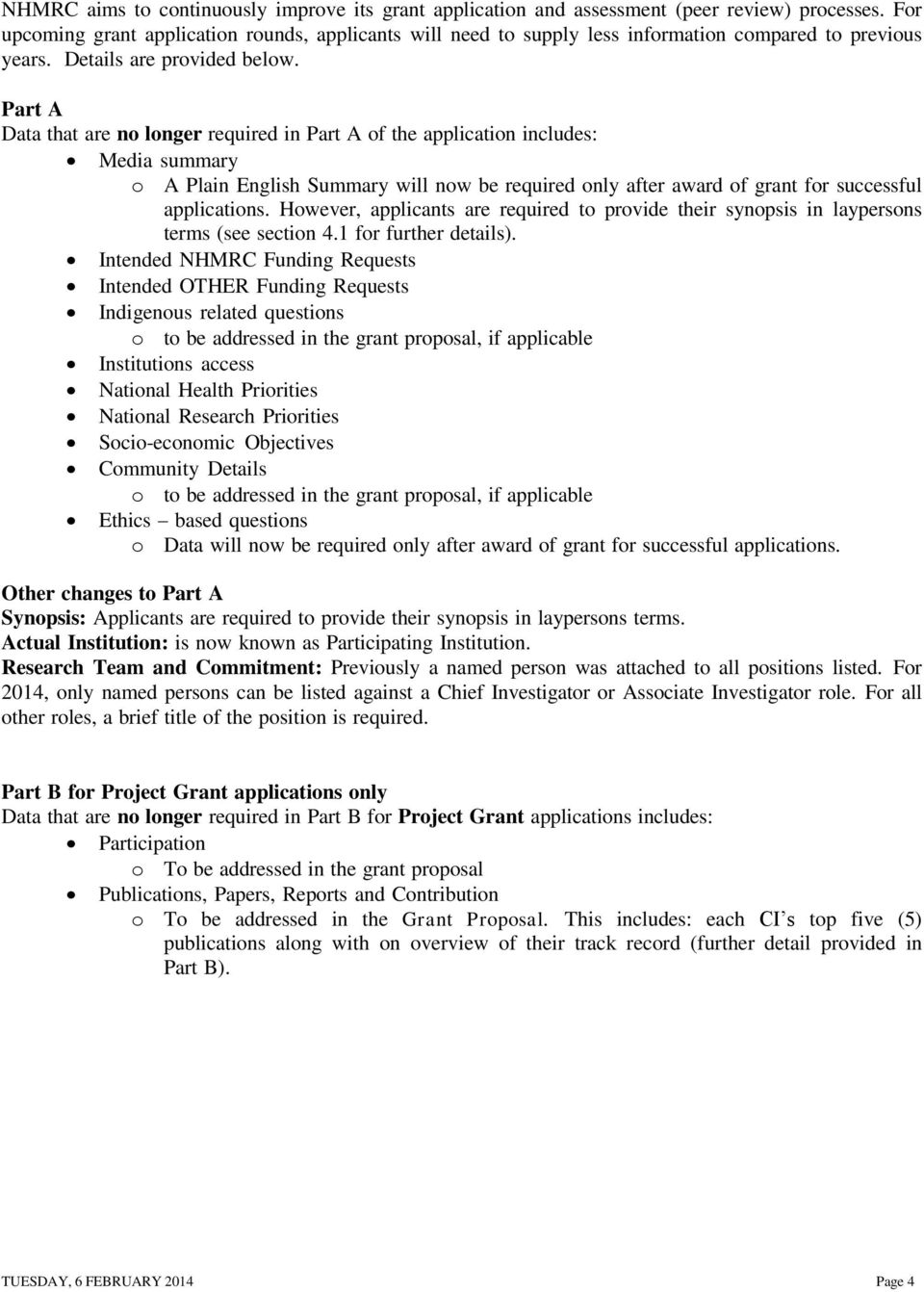
4 NHMRC aims to continuously improve its grant application and assessment (peer review) processes. For upcoming grant application rounds, applicants will need to supply less information compared to previous years. Details are provided below. Part A Data that are no longer required in Part A of the application includes: Media summary o A Plain English Summary will now be required only after award of grant for successful applications. However, applicants are required to provide their synopsis in laypersons terms (see section 4.1 for further details). Intended NHMRC Funding Requests Intended OTHER Funding Requests Indigenous related questions o to be addressed in the grant proposal, if applicable Institutions access National Health Priorities National Research Priorities Socio-economic Objectives Community Details o to be addressed in the grant proposal, if applicable Ethics based questions o Data will now be required only after award of grant for successful applications. Other changes to Part A Synopsis: Applicants are required to provide their synopsis in laypersons terms. Actual Institution: is now known as Participating Institution. Research Team and Commitment: Previously a named person was attached to all positions listed. For 2014, only named persons can be listed against a Chief Investigator or Associate Investigator role. For all other roles, a brief title of the position is required. Part B for Project Grant applications only Data that are no longer required in Part B for Project Grant applications includes: Participation o To be addressed in the grant proposal Publications, Papers, Reports and Contribution o To be addressed in the Grant Proposal. This includes: each CI s top five (5) publications along with on overview of their track record (further detail provided in Part B). TUESDAY, 6 FEBRUARY 2014 Page 4
5 CV section for Project Grant applications only The following fields are no longer required to be completed in the CV component but should be captured in the Grant Proposal, where applicable: Executive Summary Employment history Career Disruption Patents Translation into Policy/Practice Contribution to NHMRC Editorial Responsibilities Supervision and Mentoring Workload Additional Information Note: data from the last five (5) years of all publications are available to assessors via the CV component (CV-Pub) of the application. 1.3 Planning your Application Planning, preparing and submitting your application ahead of time is highly recommended when you are applying for one of NHMRC s highly competitive funding rounds. It is recommended that you contact your RAO early in the application process. Your RAO can help guide you through the process and will advise you of any recent changes to NHMRC policies, institutional deadlines or requirements you must meet. While completing your application, it is important to keep in mind the assessment criteria and category/scoring descriptors that assessors will use to evaluate your application. Please read these carefully and note any content you should include in your application. Plan a realistic timeline for completion of your application to ensure applications are submitted to your RAO on or ahead of time. This will be especially important if there are multiple CIs involved with an application. 1.4 Compliance Requirements Naming and Formatting of PDF Documents All documents to be uploaded must be in PDF format. Each PDF file must not exceed 2 Mb in size. PDF files must be named using the following convention: APPID_Applicant s Surname_Document Type/Name.pdf e.g. Grant Proposal PDF: APP _Smith_Grant Proposal.pdf. Applicants are advised to retain a copy of each PDF file they submit. TUESDAY, 6 FEBRUARY 2014 Page 5

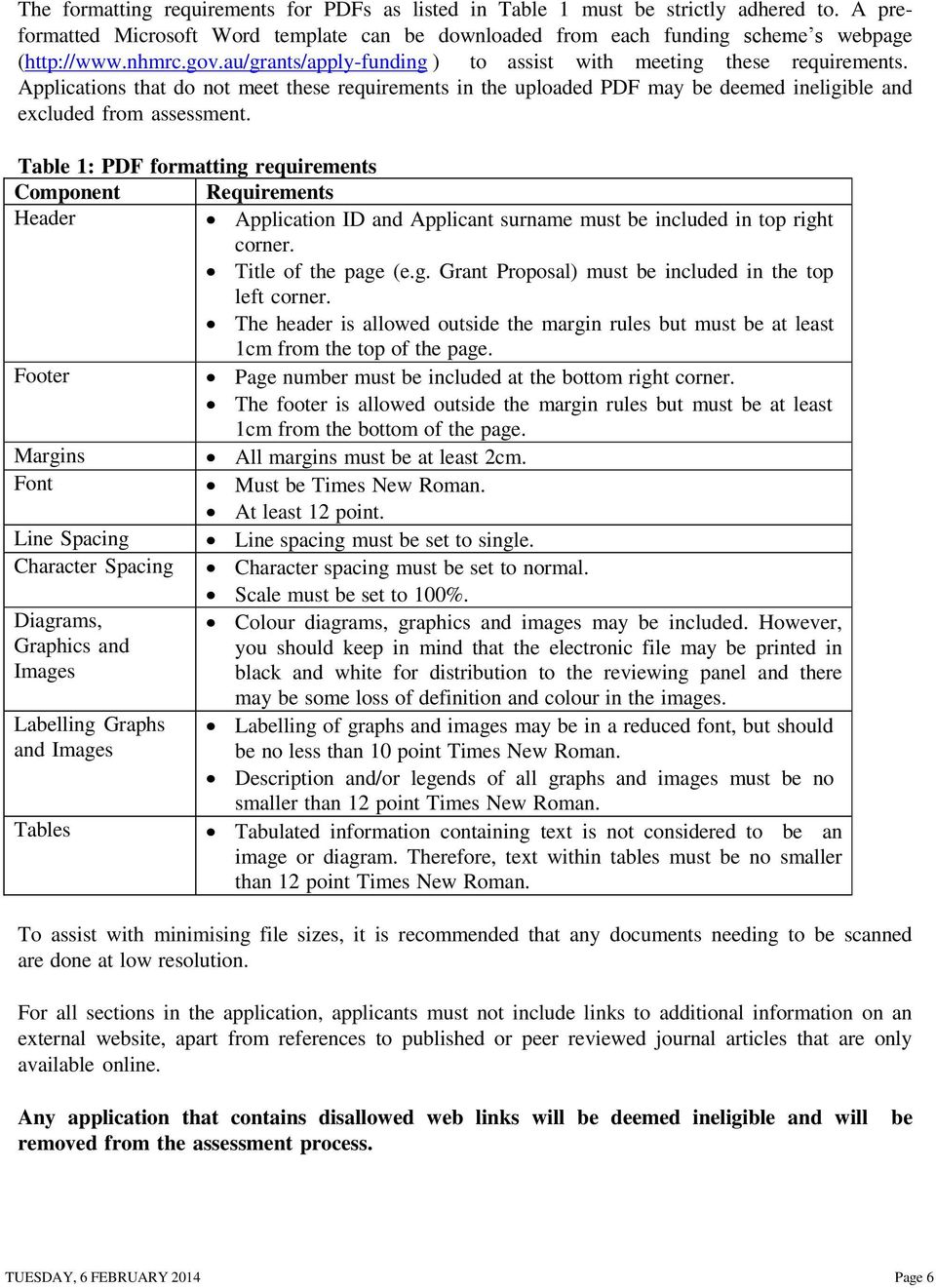
6 The formatting requirements for PDFs as listed in Table 1 must be strictly adhered to. A preformatted Microsoft Word template can be downloaded from each funding scheme s webpage ( ) to assist with meeting these requirements. Applications that do not meet these requirements in the uploaded PDF may be deemed ineligible and excluded from assessment. Table 1: PDF formatting requirements Component Requirements Header Application ID and Applicant surname must be included in top right corner. Title of the page (e.g. Grant Proposal) must be included in the top left corner. The header is allowed outside the margin rules but must be at least 1cm from the top of the page. Footer Page number must be included at the bottom right corner. The footer is allowed outside the margin rules but must be at least 1cm from the bottom of the page. Margins All margins must be at least 2cm. Font Must be Times New Roman. At least 12 point. Line Spacing Line spacing must be set to single. Character Spacing Character spacing must be set to normal. Scale must be set to 100%. Diagrams, Colour diagrams, graphics and images may be included. However, Graphics and you should keep in mind that the electronic file may be printed in Images black and white for distribution to the reviewing panel and there Labelling Graphs and Images Tables may be some loss of definition and colour in the images. Labelling of graphs and images may be in a reduced font, but should be no less than 10 point Times New Roman. Description and/or legends of all graphs and images must be no smaller than 12 point Times New Roman. Tabulated information containing text is not considered to be an image or diagram. Therefore, text within tables must be no smaller than 12 point Times New Roman. To assist with minimising file sizes, it is recommended that any documents needing to be scanned are done at low resolution. For all sections in the application, applicants must not include links to additional information on an external website, apart from references to published or peer reviewed journal articles that are only available online. Any application that contains disallowed web links will be deemed ineligible and will removed from the assessment process. be TUESDAY, 6 FEBRUARY 2014 Page 6
7 1.5 Offline forms Protected offline PDF forms (offline forms) for each scheme s application have been provided for your convenience. You can use these forms to fill out your application off line and then copy and paste the text from the form into RGMS. The forms can be found on the RGMS s webpage: Note: These templates are provided as an aid only. They cannot be completed and ed to NHMRC. All applications must be submitted through RGMS. Applicants choosing to use the available forms should note the discrepancy between Microsoft Word character counter and the character counting within RGMS. To aid you in conforming to RGMS character limits, the following URL has been provided as a guide: Profile and CV It is essential that your Profile and CV are kept up to date. Relevant information from your Profile and CV will be imported into snapshots of your application. Applicants will not be able to initiate or be added to an application if all mandatory fields in the RGMS profile have not been completed. Advice on completing the Profile and CV components of RGMS is available in this document. 1.7 Referencing Publications Each publication entered into your CV will be given an identification number by RGMS to assist you in referring your publications. Applicants should use this number when referring to specific publications in your application, particularly in text boxes where characters are limited. Please do not use the Sequence Number as this will change upon the addition of new publications and/or publication uploads. TUESDAY, 6 FEBRUARY 2014 Page 7

8 1.8 Viewing or printing your application The Snapshot Reports function provides two types of snapshots: a Summary Snapshot (used for the assignment of applications to grant review panels and assessors, and identification of conflicts of interest); an Assessor Snapshot (used for the peer review of applications), and can also be used by applicants and RAOs to review applications before submission). For instructions on how to run and view a Snapshot Report, applicants should refer to the RGMS User Guide Applying for Grants on the NHMRC website. Snapshots are viewed in the Snapshot Reports tab at the top of the RGMS application screen. Uploaded documents can also be accessed via the Snapshot Reports tab. This will allow users to print or view a document version of their application (either in part or in full). TUESDAY, 6 FEBRUARY 2014 Page 8

9 2. Profile and CV Requirements for Project Grants Important Note Step-by-step instructions for accessing and completing your Profile and CV in RGMS are provided in the RGMS User Guide Introduction to RGMS ( The following pages provide additional advice about Profile and CV requirements. When completing your application, please ensure that all required sections of your Profile and CV have been entered in and updated appropriately. Profile and CV information forms a critical part of applications, is crucial to identifying reviewers, and enables quick and accurate assignment to grant review panels. Information of particular importance is indicated by a red asterisk in RGMS such as title, institution and research keywords. Completing core fields is required of all investigators before creating or being included on an application. You can update your Profile and CV at any time, even while completing a grant application. However, core fields will need to be completed prior to the CI being added to the application. Please note that when the application is certified by CIA, the final snapshot (which includes the relevant extracted information from the Profile and CV of each CI) is made and the application locked down - thus, any subsequent changes a CI makes to their Profile and CV do not appear in the application. The Profile/CV is SEPARATE to your grant application. While there may be some overlap of certain information, it is your responsibility to ensure that information specific to your application that may be included in the Profile/CV is also provided in the relevant parts of the application itself where required. For sections marked as Not Required, relevant information for the proposed research can be included in the CI Track Record section of the Grant Proposal. For further information please refer to the RGMS My Profile and CV requirements for 2014 Schemes document which can be found on the NHMRC website ( PROFILE SECTION Project Grants requires you to complete all sections of your Profile. 2.1 Pro-PD: Personal Details Peer Review Peer Review is an integral part of NHMRC funding schemes. NHMRC grant recipients have obligations to contribute to the assessment of applications (as outlined in the funding agreement). TUESDAY, 6 FEBRUARY 2014 Page 9

10 The NHMRC may approach you with a request to participate in the assessment process. If you are not available for participation, please select the year(s) from the searchable list and enter in the free text field, dates and a brief reason for your unavailability. To maintain the list of available assessors within RGMS, NHMRC requires that all applicants update their information within the Profile and CV sections routinely. This will ensure that any unavailable assessors will not be contacted unnecessarily. Personal Details Provide your most current details in this section. It is important that your title, names, phone and details are up to date as these are the details NHMRC relies on when contact is required. 2.2 Pro-PN: Panel Nominations and Invitations Please indicate which, if any, scheme you have been nominated/invited to participate in as a potential panel member. 2.3 Pro-PU: Peer Review Unavailability If you are unwilling/unable to act as a reviewer for NHMRC s review schemes please provide the NHMRC with a statement detailing your reasons, and the period for which you are unavailable. 2.4 Pro-A: Address Provide details of the address you wish to use if the NHMRC needs to contact you via the postal service. Home addresses are acceptable. 2.5 Pro-RE: Research Interests It is important that this information is as accurate as possible as it may be used to assist the Peer Review Process in identifying potential panel members, external assessors or committee members and may also be used for analyses of NHMRC s funding profile. Select a Broad Research Area and up to 10 Research Keywords most applicable to your main area of research. At least one and up to three keywords is also required to describe your core research methodologies or methodological expertise (e.g. clinical trials, knockout mice, gene therapy etc). You may also provide any other additional information and details of your research expertise or interests. This can include your research methodologies, student supervision and key publications. (You have a maximum of 2000 characters including spaces and line breaks to provide this information.) TUESDAY, 6 FEBRUARY 2014 Page 10
11 2.6 Pro-FR: Fields of Research You can add as many Fields of Research as you need, also indicate when you started your research in that field and whether the research is on-going or terminated. CV SECTION Information in these sections is used both within and as an adjunct to applications, including identifying potential assessors and panel members. 2.7 CV-Pub: Publications Project Grant applications require details on your publications in the last five years. This information can be uploaded using a tab delimited file using Microsoft Excel or by exporting your EndNote Library as an.xml file. Further details on how to do this can be found on the CV-PU: Publication Uploads page in RGMS. Your publications will be grouped together by the type of publication. They will also automatically be given an RGMS ID number. Use this number if you wish to refer to your publications in other sections of your application. DO NOT use the sequence number when referring to your publications in other areas of the application as this number will change if you upload more publications whereas the RGMS ID for each publication will not. TUESDAY, 6 FEBRUARY 2014 Page 11
12 3. STARTING A NEW APPLICATION Important Note Step-by-step instructions for creating and completing an application in RGMS are provided in the RGMS User Guide Applying for Grants ( The following pages provide additional advice about the content and purpose of each field. 3.1 Create Application Initiative Please select the funding scheme from which you are seeking funding. Round Please select the funding round. Application Identification Number (RGMS ID) Each application will have its own unique Application Identification Number (Application ID), which is generated by RGMS. Please use this ID number (e.g. APP########) to identify your application in any correspondence when referring to your application. Administering Institution There can only be one Administering Institution for each application. You must ensure that the institution you choose as your Administering Institution is the correct institution for your application. If in doubt contact the RAO at your proposed Administering Institution to confirm its status as an NHMRC Administering Institution and ensure it has the facilities to administer your application. Application Title The application title will be used to identify the application at all times during the assessment process and should accurately describe the nature of the research proposal. (You have a maximum of 250 characters including spaces and line breaks to provide this information.) Grant Duration Please select the requested duration of your grant. Please note that in the event your application is funded, the NHMRC may not provide funding for all requested years. TUESDAY, 6 FEBRUARY 2014 Page 12

13 RAO Edit Access If you wish to allow your RAO to have edit rights to your application, you should select Yes in the RAO Edit Access field. NHMRC provides this functionality to support researchers and RAOs in managing the application process. NHMRC does not accept any responsibility for errors or omissions arising from the use of the RAO edit function and strongly recommend that the RAO, CIA and Administering Institution discuss the management of RAO edit access before selecting this function. TUESDAY, 6 FEBRUARY 2014 Page 13

14 4. PART A APPLICATION DETAILS Important Note Step-by-step instructions for creating and completing an application in RGMS are provided in the RGMS User Guide Applying for Grants ( The following pages provide additional advice about the content and purpose of each field. 4.1 A-PA: PART A HOME Application ID, Initiative, Round, Administering Institution, Application Title, Grant Duration These fields will be pre-populated from your selections in the Create Application screen. Aboriginal and Torres Strait Islander Research This question enables you to identify research that is specifically motivated by a desire to investigate Aboriginal and/or Torres Strait Islander health issues. It is also designed to enable NHMRC to identify those research proposals that will require assessment of the proposed research against the Criteria for Health and Medical Research of Indigenous Australians (see below). Research proposals that specifically relate to the health of Aboriginal and/or Torres Strait Islander peoples must address the following guidelines: I. Criteria for Health and Medical Research of Indigenous Australians available at: II. Values and Ethics Guidelines for Ethical Conduct in Aboriginal and Torres Strait Islander Health Research available at: III. The NHMRC Road Map II: A strategic framework for improving the health of Aboriginal and Torres Strait Islander people through research available at: Q: Does this research proposal include Aboriginal and/or Torres Strait Islander health research and/or capacity building? You should only select YES if you can demonstrate that at least 20% of your research effort and/or capacity building relates to Aboriginal and/or Torres Strait Islander health. You will be required to provide details of how your application addresses Aboriginal and/or Torres Strait Islander health in Part B of the application form under the Grant Proposal. If you have answered Yes to this question, your application may be assessed against The Indigenous Criteria. TUESDAY, 6 FEBRUARY 2014 Page 14

15 Synopsis The synopsis should accurately, and briefly, summarise the research proposal. This information may be used to assign applications to Grant Review Panels (GRP) and assessors. It may also be used by other organisations (if applicable) to determine whether the research proposal meets their priorities for funding. Applicants should therefore use laypersons terms, where possible. Please include a brief, plain English paragraph outlining your project. (You have a maximum of 2000 characters including spaces and line breaks to provide this information.) Privacy Notice Please ensure that you have carefully read and understood the NHMRC Privacy Notice, prior to completing the application. The Privacy Notice is located in the Funding Rules. If you have not understood the Privacy Notice or require further clarification, please contact the NHMRC Privacy Contact Officer (NHMRC, GPO Box 1421, Canberra ACT 2601). Consent to provide information to International Assessors Under amendments to the Privacy Act 1988 that take effect in March 2014, the NHMRC requires your consent when sending your personal information overseas, for the purposes of peer-review of applications. 4.2 A-PINST: INSTITUTIONS - PARTICIPATING Note: the term Actual Institution has now been replaced with Participating Institution. In some cases the institution that will administer your application may differ from the institution in which you will actually conduct the proposed research. For example, many universities administer research, which will be conducted in an affiliated teaching hospital. In this section you will need to list the Participating Institution and department where the proposed research will be conducted. Note: If the research will be conducted at more than one institution, enter the percentage allocated to each participating institution and department to reflect the sharing of the research effort among the institutions that you have listed. The percentages entered must total 100%. Complete this page for each institution if there is more than one. If the participating institution does not appear in the list please the institution name to RHC ([email protected]). (You have a maximum of 100 characters including spaces and line breaks to answer this question.) 4.3 A-RC: RESEARCH CLASSIFICATION The Research Areas, Fields of Research and Keywords will be used in the peer review process to assist with the allocation of your application to the most relevant GRP and with the selection of appropriate expert peer reviewers for your application. It may also be used for analyses of NHMRC s Funding Profile. TUESDAY, 6 FEBRUARY 2014 Page 15

16 You must make the selections that best describe your research proposal against each of the following fields: Guide to Peer-Review Areas Choose at least one (up to three) selection from the list. Broad Research Area. Fields of Research (FoR). Fields of Research Subcategory. Research Keywords/Phrases When completing this section, refer to the relevant Guide to Peer Review Areas for the scheme to which you are applying for funding. Relevant documents can be found at the following web address: You should also refer to the Australian Standard Research Classifications and NHMRC Research Keywords and Phrases. This information is available at: A BoD: BURDEN OF DISEASE Use the Browse button to select a Burden of Disease that best describes the area of research of the application. You can select up to three Burden of Disease types and you must allocate a percentage of time against each. The percentage total must not exceed 100%. 4.5 A-RT: RESEARCH TEAM AND COMMITMENT This section is not applicable to NHMRC Postgraduate Scholarships or Fellowship schemes. In this section you are able to add or remove team roles, request Personnel Support Packages (PSP), and identify proposed workloads. For further information on Research Support application budgets please see NHMRC Budget Guidelines for Research Support Grants found at Appendix A. Note: Loadings are applicable to all NHMRC-funded graduate research personnel with registered medical or dental qualifications, whether or not they perform any clinical duties. These loadings are paid on claim by the Administering Institution. All CIs will need to have completed all mandatory fields in their RGMS Profile and CV before being included on the application. If a CI on your team has not completed all mandatory fields in their Profile and CV, an error message will appear when you attempt to add them as a team member. When adding team roles you will need to select from the four role types that are described below. You can only assign a named person to a Chief Investigator or Associate Investigator role. For all other roles, you should provide a brief title of the position. TUESDAY, 6 FEBRUARY 2014 Page 16

17 1. Chief Investigator (CI) Chief Investigator A (CIA) is responsible for completion and lodgement of the application. CIA is the project leader who is responsible for the successful completion of the research proposal. Other CIs are to read the application and must agree to its contents before it is submitted. A maximum of 10 CIs (CIA to CIJ) may be entered into your RGMS application. CIs may request a salary, however the level and proportion requested must be fully justified. Note: CIB CIJ are required to have an RGMS account and all mandatory fields of their Profile and CV completed in order to be added and have access to their application. Ensure you ask other CIs to provide the spelling of their name as it is within RGMS this may avoid confusion when are trying to identify them. A-RT: Researcher Details Person Search the RGMS database and select the CI. Role Please select the CI s role on this application. Australian Based Is this CI to be based in Australia for the duration of the grant? Core Profile Data Entered? All CIs must have their core details in RGMS. Qualifications & Skills Provide justification for why each CI is needed for the proposed research including an outline of the specific qualifications or skills required. (You have a maximum of 2000 characters including spaces and line breaks to provide this information.) A-R RT: Proposed Salary For each CI listed you must nominate the requested PSP level and percentage (%) required for each year of funding. Salary a. Enter the PSP level sought, based on the level of work to be undertaken by the team member. b. Enter the percentage of PSP requested for each year of funding. Applicants must apply for the exact proportion of a PSP that is required for the research being proposed. Reason Please justify any requests for salary. TUESDAY, 6 FEBRUARY 2014 Page 17

18 Note: When awarding a budget, the GRP will consider whether the PSPs requested are fully justified and reasonable given the time commitment indicated for this application. (You have a maximum of 1000 characters including spaces and line breaks to answer this question.) Note: Salaries will be automatically calculated, taking into account the NHMRC PSP levels requested and the percentage of PSP requested. 2. Associate Investigator (AI) An AI is an investigator who provides intellectual input into the research and whose participation warrants inclusion of their name on publications. AIs are not able to draw a salary AIs named on the application will be advised by the CIA. The CIA must obtain written agreement from AIs to be named on the application. RAOs are responsible for ensuring written agreement has been received from the AIs prior to certifying the application, which is to be made available to NHMRC on request. Note: AIs do not have access to the application in RGMS and are not required to endorse the final application. A-RT: Associate Investigator Search the RGMS database and select the AI. If the AI does not have an RGMS account, please enter their details manually. A maximum limit of 10 (ten) AIs applies for all schemes except for Program Grants (see Program Grants Funding Rules for further details). 3. Professional Research Person A Professional Research Person is a graduate with recognised qualifications who will be employed to undertake research on this proposal. The Professional Research Person will not have responsibility for the proposal. You must provide details of their contribution to the proposal, including the work to be undertaken and the time commitment, and reasons for the PSP requested. Do not include the name of the person, only a brief description of their role/title. A-R RT: Proposed Salary Nominate the requested level and percentage (%) of PSP for each year of funding. Salary a. Enter the PSP level sought, based on the level of work to be undertaken by the team member. b. Enter the percentage of PSP requested for each year of funding. Applicants must apply for the exact proportion of a PSP that is required for the research being proposed. Reason Please justify any requests for salary. TUESDAY, 6 FEBRUARY 2014 Page 18
19 Note: When awarding a budget, the GRP will consider whether the PSPs requested are fully justified and reasonable given the time commitment indicated for this application. (You have a maximum of 1000 characters including spaces and line breaks to answer this question.) 4. Technical Support Staff Technical Support Staff includes research students and technical staff to be employed on this proposal. You must provide details of their contribution to the proposal, including the work to be undertaken and the time commitment, and reasons for the PSP requested. Casual staff that are to be contracted at hourly rates should NOT be included as part of the PSP requests but rather should be included under Direct Research Costs. See Part B-Proposed Budget for further details. Do not include graduate personnel as Technical Support Staff. Do not include the name of the person, only a brief description of their role/title. A-RRT: Proposed Salary Nominate the requested level and percentage (%) of PSP for each year of funding. Salary a. Enter the PSP level sought, based on the level of work to be undertaken by the team member. b. Enter the percentage of PSP requested for each year of funding. Applicants must apply for the exact proportion of a PSP that is required for the research being proposed. Reason Please justify any requests for salary. Note: When awarding a budget, the GRP will consider whether the PSPs requested are fully justified and reasonable given the time commitment indicated for this application. (You have a maximum of 1000 characters including spaces and line breaks to answer this question.) 4.6 A-EG: ETHICS GENERAL If you answer Yes to any of these questions, the NHMRC will require ethics approvals to be supplied in the event your application is funded. Further information on ethics clearances can be found here: TUESDAY, 6 FEBRUARY 2014 Page 19
20 5. PART B APPLICATION DETAILS Part B of the application is specific to the Project Grants Scheme. This part of the application differs to that of other NHMRC schemes. Important Note Step-by-step instructions for creating and completing an application in RGMS are provided in the RGMS User Guide Applying for Grants ( The following pages provide additional advice about the content and purpose of each field. 5.1 HOME General RGMS will automatically populate the round with the funding scheme you are applying to. 5.2 B AIProj: APPLICATION INFORMATION Career Disruptions Select the appropriate option from the drop down box. Further details on how to address career disruptions are provided under Grant Proposal. New Investigator This section relates to applicants seeking funding as a New Investigator. Note: All applicants must meet the new eligibility requirements for New Investigators. To be eligible to apply in this category, all CIs on an application for New Investigator funding will: have less than 10 years from the date of the letter advising them that their doctoral thesis was passed, unless career disruptions exist; not have been a named CI (or equivalent) on a funded NHMRC Project Grant and/or an ARC Discovery Grant; and not have been a named CI (or equivalent) on a funded research grant from any other agency listed on the Australian Competitive Grants Register or from an international funding agency totalling $AUD 250,000 or more. For further detail refer to the Project Grants Scheme-Specific Information, Section 6 TUESDAY, 6 FEBRUARY 2014 Page 20

21 Is this application for New Investigator funding? Select yes if the application is to be considered a New Investigator application. Provide justification to support your request to be considered as a New Investigator. Justify or provide further information as to why you and your research team are requesting to be considered as a New Investigator. (You have a maximum of 2000 characters including spaces and line breaks to answer this question.) Clinical Trial This question aims to identify applications that involve a clinical trial. Select the appropriate option from the drop down box. Funding Organisation(s) Applicants seeking funding from Cancer Australia and/or Cancer Council (either exclusively or in addition to NHMRC funding) must complete this part of the application. Note: If no box is selected, applications will be assessed by NHMRC only. Select the organisation(s) from which funding is sought. Some organisations may have additional specified criteria which will need to be addressed, or organisations may wish to target areas that are particularly innovative and understand that pilot data underpinning the research proposal may be lacking. Applicants are therefore encouraged to read all the terms and conditions for the organisation for which you have sought funding. Cancer Australia Cancer Council Cystic Fibrosis Australia Department of Health (Hearing Loss Prevention Program) Duchenne Foundation Consent to disclose personal information to other organisations NHMRC have confirmed funding arrangements with the other organisations listed below for the 2013 Project Grants scheme. Note: All CIs must consent to NHMRC providing the application, snapshot reports and information about the results of NHMRC s assessment of this application to third parties. It is the CIA s responsibility to seek consent from the other CIs listed on this application. Written evidence of such consent should be provided to your RAO, and may be requested by NHMRC. Select the appropriate option from the drop down box. TUESDAY, 6 FEBRUARY 2014 Page 21
22 Other Organisations Select which organisation/s (if any) you consent NHMRC providing your personal information to. For more information please refer to Section 5.6 of the Project Grants Scheme-Specific Information. Have you sought agreement from Associate Investigators (AI) for their name to be included in this application? Select the appropriate option from the drop down box. Written evidence will need to be provided to your RAO that all AIs have agreed to be named on the application. 5.3 B PR: GRANT PROPOSAL The Grant Proposal will be the core document that assessors will use in reviewing your application. For previous years, some details of the Grant Proposal were captured in the Background and Research Plan PDF and the CV component. The Grant Proposal aims to capture more information in one document thereby simplifying the process for applicants and assessors. It is therefore critical that applicants address all relevant aspects highlighted below. The Grant Proposal must be uploaded into RGMS as a PDF file. Please refer to Section 1.4 for formatting requirements. It should be noted that any application that does not meet these requirements will not be awarded funding. The Grant Proposal template can be found on the NHMRC s website at: TUESDAY, 6 FEBRUARY 2014 Page 22
23 There are several sections to be addressed in the Grant Proposal. These are highlighted below along with page limits and key changes compared to previous years. Section Page Limit Key Changes A. Research Proposal 9 pages Previously known as the Background and Research Plan B. References 2 pages Previously 3 pages C. CI Time Commitment to this ½ page per Previously captured in A Proposal CI D. Team Quality and Capability 1 page Details must be in relation to this proposal relevant to this proposal E. CI Track Record including the Top 5 publications in the last 5 years 2 pages per CI Each CI is required to identify their Top 5 publications in the last 5 years along with other nonpublication research achievements in the last 5 years F. Career Disruption, if applicable G. Priority-driven Young Investigator Project Grants, if applicable H. Indigenous Health Criteria, if applicable 1 page per CI Previously captured in CV 1 page per Young Investigator Previously captured at the beginning of the Background and Research Proposal 2 pages Previously captured in Part A A. Research Proposal 9 pages All scientific information relating to your proposal must be contained in this section. The research proposal will be assessed by experts in the field and you should include any pilot or feasibility study data supporting the research planned. You should also keep in mind the assessment criteria that reviewers will use to evaluate applications and the detailed category descriptors in relation to each of the assessment criteria. Refer to section 9.1 of the Funding Rules for further details. This section should address the following assessment criteria: Scientific Quality (50% of overall score) this includes the clarity of the hypotheses or research objectives, the strengths and weaknesses of the research plan and the experimental design, and the feasibility of the proposed research Significance and/or Innovation (25% of overall score) - this includes the potential to increase knowledge about human health, disease diagnoses, or biology of agents that affect human health, or the application of new ideas, procedures, technologies, programs or health policy settings to important topics that will impact on human health. References cited in this document are to be listed in the separate References section outlined below. TUESDAY, 6 FEBRUARY 2014 Page 23
24 Your Research Proposal should include: Component Properties Aims Describe the specific aims of the project, including a clear statement of hypotheses to be tested Background Research Plan Methods and techniques to be used Timeline/s Outcomes and Significance Provide a rationale for the project. Outline the research plan in detail, including the following where appropriate: Detailed description of the experiment design, Techniques to be used, Methods of statistical analysis, including power calculations; Ethical implications the research may have; Community involvement and/or plans to transfer knowledge to stakeholders or into practice; Expected outcomes of the research project; and The timeline for the project. Provide a detailed timeline for the expected outcomes of the research proposal along with justification for the duration requested. Describe the importance of the problem to be researched, the planned outcome of the research plan, and the potential significance of the research. B. References 2 pages References relating to the Research Proposal must: not exceed 2 pages, provide a list of all references cited in the application in an appropriate standard journal format, (NHMRC prefers the Author-date (also known as the Harvard System), Documentary-note and the Vancouver System), list authors in the order in which they appear in PubMed, not include web links, only include references to cited work. C. CI Time Commitment to this Proposal ½ page per applicant Applicants are required to provide an overview of each CIs time commitment to this research proposal, along with other research commitments. Applicants need to provide detailed information for assessors to assure them that each CI will and is able to provide a sufficient level of commitment to successfully undertake and complete the research proposed. For each CI, applicants should detail the following in ½ page or less: the NHMRC research time that will be dedicated to this application if it were to be funded (this application %); the amount of research time each CI spends on other NHMRC grants (other grants %) in an average working week; and a brief description outlining their role on this proposal. TUESDAY, 6 FEBRUARY 2014 Page 24
25 Note: The % for this application plus all current grants % should be no greater than 100%. For example, if you propose spending 50% of your standard week s working hours on NHMRC funded projects, and this application constitutes 80% of your NHMRC research time then your NHMRC research time for this application is 80%. Note: CIA is the project leader and is responsible for the successful completion of the research proposal. D. Team Quality and Capability relevant to this proposal 1 page A summary of the research team s quality and capability must be contained in this section. Applicants should detail the following: the expertise and productivity of team members relevant to the proposed project; their influence in this specific field of research; how the team will work together to achieve the project aims; and how junior members are contributing to the overall track record of the team. E. CI Track Record, including the Top 5 publications in the last 5 years 2 pages per CI This section has two components: the top 5 publications in the last 5 years; and overall Track Record in the last 5 years. Top 5 Publications in the last 5 years Applicants are asked to list their top 5 publications in the last 5 years and reasons why these publications have been selected. Note: Reviewers will use this information to assess the track record quality of the research team. Overall Track Record in the last 5 years Applicants are encouraged to use this section to identify aspects of their track record that are in addition to their publication record. This includes any relative to opportunity considerations you wish the assessors to take into consideration. Assessors will have access to the last 5 years of publications through the CV/Profile section. Therefore, the following areas should be considered: Career summary - including qualifications, employment and appointment history; Research support - including grants and fellowships; Contribution to field of research this may include the impact of previous research including translation of research into health outcomes; Patents this information should include if the patent has been licensed, when they have been licensed, to whom they have been licensed and if that license is current or not; Collaborations; Community engagement and participation; Professional involvement - including committees, conference organisation, conference participation; TUESDAY, 6 FEBRUARY 2014 Page 25
26 International standing - including invitations to speak, international committees; Supervision and mentoring; Peer review involvement (including NHMRC, other granting organizations, manuscripts, editorial responsibilities) Other contributions to NHMRC; and any other information you think is vital to your application Note: Reviewers will use this information along with each CI s publication record from the CV/Profile section as an indicator of the productivity of the research team. Career Disruption 1 page per CI The NHMRC is committed to ensuring that every applicant is treated fairly, and this means that we recognise that some candidates will have had career disruptions that should be considered when evaluating their track record. We recognise the following reasons for career disruption: pregnancy; major illness; and carer responsibilities including parental leave. All career disruptions will be reviewed to ensure they meet policy guidelines. For further guidance on what constitutes a career disruption, please refer to Appendix B of this document, and NHMRC Funding Rules, Sections 3.6 and 3.7. It is critical that applicants use this opportunity to declare any career disruptions - periods of reduced or no productivity - that may be relevant to their most recent five year research career history. The assessment of your track record, that of your team, and the scientific quality and significance and/or innovativeness of the application, can be assessed objectively taking all the relevant factors into account. Applicants are asked to clearly outline the duration and impact the career disruption had on your productivity within the last five years. This will ensure that the appropriate amount of time is added to your track record for consideration by peer reviewers. For example, if in the last 5 years you have taken six months of maternity/carers leave and then returned to work at 0.5 Full Time Equivalent (FTE) for three years before resuming at a full-time level, you will have worked an equivalent of 3 years FTE over the past 5 years (see Table). You should therefore add to your Track Record pages of the Grant Proposal any publications or other components of your Track Record that you want peer reviewers to consider predating five years by two years (see below for further details on how to capture this in your application). TUESDAY, 6 FEBRUARY 2014 Page 26
27 Work status over past 5 years Effective Full Time Equivalent (FTE) (years) 0.5 years maternity leave (6 months) FTE for 3 years years full time 1.5 TOTAL in past 5 years 3 Details of any career disruption that occurred in the last five years should be included in this section. Each relevant CI has one additional A4 page in which to provide this information. This extra one page must only be used to: (a) provide a word summary of the career disruption/s that will be read out by the spokesperson prior to discussion of each application; (b) explain the career disruption/s in more detail (if needed); (c) provide details of additional research outputs (those that occurred in the relevant preceding years) that you want the reviewers to consider when assessing your application; and (d) if applicable, indicate any national or international conferences where you were invited to give a major presentation, or other significant invitations (e.g., to join an editorial board of a major journal, or write a major review), and were not able to do so because of considerations associated with the career disruption. This extra page must comply with all formatting rules applicable to the Grant Proposal. If the career disruption is of a highly sensitive nature and you (or members of your CI Team) do not wish to share this information in the Grant Proposal, details of the nature of the career disruption may be submitted separately to NHMRC. For example: an applicant may consider their medical condition to be of a personal nature and therefore may wish to submit their career disruption claim separately. Applicants wishing to submit the document separately should (a) indicate in the Grant Proposal that they wish to make a claim under the career disruption provisions and that it is of a sensitive or private nature; (b) include details of the outputs that relate to the career disruption period claimed in the Track Record section of the Grant Proposal. The extra one page must only be used for the purposes of providing details of additional research outputs (those that occurred in the relevant preceding years) that you want the reviewers to consider when assessing your application and must comply with all formatting rules applicable to the Grant Proposal; and (c) provide details of the nature of the career disruption in a separate PDF document to NHMRC in confidence to address: [email protected] by 5.00pm 5 th March The separate PDF must not exceed one A4 page in length. TUESDAY, 6 FEBRUARY 2014 Page 27
28 F. Priority-driven Young Investigator Project Grants 1 page Grants awarded through the Priority-driven Collaborative Cancer Research Scheme (PdCCRS) are designed to principally support applied cancer research projects that relate to the research priority area/s of Cancer Australia and/or its Funding Partners and which have the potential to directly improve cancer outcomes by influencing clinical practice and/or policy. Applicants who are submitting an NHMRC project grant application, and one as Young Investigator for the same project, or a closely related project to the PdCCRS you must provide a 1 page modified research proposal with reduced aims and timeframes. The following text should be included on this one page: This proposal is to be considered for funding from NHMRC and PdCCRS Funding from NHMRC is sought for a project addressing the following aims: Aim 1 Aim 2 Aim 3 etc Funding from the PdCCRS is alternatively sought for the same project modified to one/two year/s. In the one/two year/s timeframe the project will only address the following aim/s: Aim 1 Aim 2 Applications that do not comply with the above guidelines could be deemed ineligible and excluded from further consideration. For further information refer to Section 5 of the NHMRC Funding Rules available at: G. Criteria for Health and Medical Research of Indigenous Australians 2 pages All Indigenous health research applications must demonstrate that at least 20% of their research effort and/or capacity building relates to Aboriginal and/or Torres Strait Islander health. Applicants should use this section to describe what proportion of the research effort and/or capacity building activity will be directed to Indigenous Health and to subsequently address all six elements of The Indigenous Criteria, which are: Community Engagement; Benefit; Sustainability and Transferability; Building Capacity; Priority; and Significance. For further details refer to the Project Grants Scheme-Specific Information Section 7. TUESDAY, 6 FEBRUARY 2014 Page 28
29 5.4 B PB: PROPOSED BUDGET NHMRC funds the direct costs of the research proposal based on advice from peer review. It is therefore critical that applicants ensure that all budget requests are fully justified. Budget requests can cover: Personnel Support Packages (PSPs) captured in Part A; Direct Research Costs (DRCs); and Equipment Costs. Note: All budget requests must be reported on a yearly basis and they should clearly justify any research cost(s) which may be atypical for the particular field of research. Using Research Facilities Applicants often need to receive services from third parties to enable their research to be successfully undertaken. Such research facilities include biospecimens and associated data from biobanks or pathology services, and from organisations such as non-human primate colonies, the Australian Twin Registry, Cell Bank Australia, the Trans-Tasman Radio Oncology Group and from organisations that provide clinical trials services. This list is illustrative and is by no means exhaustive. Is this application using services provided by a research facility? If you answer YES, provide details of the costs of using services provided by research facilities in the budget as Direct Research Costs and ensure they are fully justified. Applicants should consult with research facilities to ensure that the services they require can be provided and that the charges included in the research budget reflects their charges. Letters from research facilities confirming their collaboration can be uploaded on this page. Direct Research Costs (DRC) Direct Research Costs (DRC) include those that are integral to achieving the proposed aims and objectives outlined in the research proposal. Such costs must directly address the research objectives of the proposal, relate to the research plan and require the associated budget to have been properly justified. Applications with poorly justified budget proposals run the risk of having their budget adjusted by the GRP. For further information on Research Support application budgets please see NHMRC Budget Guidelines for Research Support Grants found at Appendix A. TUESDAY, 6 FEBRUARY 2014 Page 29
30 Applicants must provide: a. The total value of the DRCs requested for each year, in quanta of $5,000 ensuring that the subtotal amount for each year is rounded to the nearest $5,000; and b. Details and amount sought for each item requested. This information must be aligned with the proposed aims of the study, be detailed on a yearly basis and be fully justified. (You have a maximum of 6000 free text characters to provide this justification depending on the complexity of proposed budgets: you are not required to fill all the available space.) Note: For studies that require the use of animals, it should be noted that GRPs are provided with the Monash Animal Research costs to act as a guide to ensure consistency between applications and panels. While NHMRC acknowledges that different institutions have different costs involved, applicants are again encouraged to provide detailed justification of budgets requested. Details on the Monash Animal Research costs can be found at: Equipment You must provide: a. The total value of all items of equipment for each year, b. Justification for the cost of each equipment item. This justification must clearly outline why the equipment is required for the proposed research and why the equipment cannot be provided by the Institution. Note: Individual items of equipment costing less than $10,000 must be requested as DRCs. Applicants may not seek funding for equipment totalling more than $80,000 for the entire period of the grant. (You have a maximum of 2000 free text characters to provide this justification.) 5.5 B NPA: NOMINATION OF POSSIBLE ASSESSORS In this section you can nominate up to two national and two international assessors who you consider appropriate to provide an assessment of the research proposal. Applicants are not required to nominate a possible assessor but this can assist NHMRC in the process of finding suitable assessors. Please do not nominate potential assessors who are likely to have a Conflict of Interest (CoI). You should provide the following information for each nominated assessor: Name; Expertise; and Contact details ( , Phone). TUESDAY, 6 FEBRUARY 2014 Page 30
31 NHMRC may use your nominated assessors if possible and if they do not have a CoI with the application. For example, previous and current collaborations, working within the same department or close personal relationship with a potential assessor are likely to be deemed as high conflicts. Details of your nominated assessors will be advised, in confidence, only to persons directly involved in the selection of the assessors of your application. 5.6 B NA: NON ASSESSOR In this section you are asked to nominate an individual who you would NOT like to be approached to assess the application. Only one individual may be nominated. NHMRC will use this information to manage potential CoIs to help in the process of selecting potential assessors. The following information is required: Name; Institution; and . Provide the above information of the requested non-assessor against the following criteria: Conflict of Interest (the person is a collaborator, supervisor, relative, and/or similar); and Personal concerns which lead you to believe that the assessor would be incapable of giving a fair assessment due to unreasonable bias. Details of your requested non-assessor will be advised, in confidence, only to persons directly involved in the selection of the assessors of your application. TUESDAY, 6 FEBRUARY 2014 Page 31
32 6. SUMMARY The budget summary is automatically generated from the following sections of the application: Salaries PART A RT, Research Team and Commitment; Direct Research Costs Part B - PB, Proposed Budget; Equipment Part B - PB, Proposed Budget. If any of the information is incorrect, please return to the appropriate section in the application to amend. 7. CERTIFICATION 7.1 APPLICATION CERTIFICATION It is the responsibility of the CIA to ensure that the application is complete and correct before certification. Your application will be reviewed as provided after the certification process is approved. Only the CIA will need to certify the application. The CIA must gain written agreement from each CI to be named on the application and for the final application to be certified. The CIA must gain written agreement from each AI to be named on the application. The CIA should provide the RAO with evidence that the application is complete and all CIs have agreed to it (i.e. through written evidence such as e- mail). Once the application has been certified it will be locked and no further edits will be permitted. Refer to the RGMS User Guide Applying for Grants for step-by-step instructions ( 7.2 RAO CERTIFICATION The RAO is required to complete the RAO Certification screen of the electronic application before the application is lodged. By answering Yes to the questions, the RAO is verifying that all sections have been completed, the necessary approvals have been obtained and that the RAO holds the approval documents. Prior to certifying the application the RAO should ensure: The application is complete and correct, The CI team meets all eligibility requirements, Written evidence of consent has been obtained from all CIs and AIs, The application and attachments comply with the formatting requirements. TUESDAY, 6 FEBRUARY 2014 Page 32
33 Refer to the RGMS User Guide Applying for Grants for step-by-step instructions ( TUESDAY, 6 FEBRUARY 2014 Page 33
34 APPENDIX A: NHMRC Budget Guidelines for Research Support Grants Introduction NHMRC funds the direct costs of the research proposal based on advice from peer review. This document is designed to assist NHMRC grant applicants in identifying resources which can or cannot be funded using NHMRC funds, and to assist applicants in the preparation of the budget component of their grant application. Level of funding Applicants are advised to clearly justify the requested budget paying particular attention to any research cost(s) which may be specific to this field of research and specially needed for their application. The GRP advises NHMRC of a budget for each application. The GRP s recommendation is based on the budget requested by the applicant, the requirements of the proposal as assessed by the GRP and its knowledge of the costs associated with the research. Grant applicants are required to: make a case for NHMRC grant funding in accordance with the Scheme-Specific Information. declare the sources, duration and level of funding already held for research. Where co-funding has already been secured, applicants should indicate the components of the budget for which NHMRC support is being sought. Budget considerations There are three areas to consider when preparing a budget proposal: 1. support for personnel engaged in the conduct of the research; 2. direct research costs; and 3. equipment costs necessary to conduct the research. These and other budget considerations are discussed below. Support for Personnel Researchers who are not Australian citizens or permanent residents in Australia are eligible to apply for an NHMRC grant as CI B to J. Associate Investigators are not permitted to draw salary from a NHMRC grant. Casual computing and similar casual staff requirements, which will be contracted at hourly rates, should be included under DRCs. TUESDAY, 6 FEBRUARY 2014 Page 34
35 Funds to support personnel are provided as Personnel Support Packages (PSPs). Requests for additional funds to cover salary or salary on costs for personnel are not to be included in either the salary or DRC sections of a budget application. The level of PSP requested in an application should match the roles and responsibilities of the position, rather than the expertise of a specific person whom the CIs may intend to appoint to the position. Information on PSP amounts can be found at: Personnel Support Packages (PSPs) are designed to contribute to the full cost of salary. Administering Institutions should seek their own advice on any potential taxation implications. All applicant CIs must indicate the proportion (%) of their research time that they will commit to NHMRC funded research for the currently submitted grant application. Further information on how to indicate the amount of time proposed to be devoted to the grant, should it be awarded, is provided in the Advice and Instructions to Applicants document. Applicants may apply for a full PSP provided that 80% or more of the occupant s time will be devoted to the Project. An annual indexation will be applied to PSPs, based on the Australian Government Wage Cost Index (WCI). Direct Research Costs Applicants should refer to NHMRC Direct Research Costs Guidelines available at: ( DRCs are available in multiples of $5,000. Individual items of equipment costing less than $10,000 must be requested as DRC. All requests for funds must be fully justified, especially requests for: programming, preparation and data storage or the hire of external computer time. Funds will not be provided for the hire of computer time on a computer within the applicant's institution, covering the liability insurance for human clinical trials; and administrative charges associated with registration of clinical trials. Salaries for personnel that are eligible to be funded as a PSP, and/or the gap between the PSPs contribution and actual salaries and on costs are not to be included as a DRC in application budgets. Travel, conference and publication costs When travel is integral to undertaking the research project, such as field work, research collaborations or use of facilities in other countries, this cost should be included in the grant application budget. TUESDAY, 6 FEBRUARY 2014 Page 35
36 It is not possible to predict where and how knowledge translation and knowledge transfer will occur (because the research is yet to be undertaken). Thus, the cost of conference attendance and publications are not to be included as DRCs in grant application budgets. Using Research Facilities Biospecimen and Associated Data Requests for biospecimens and associated data must be fully justified in the DRC component of the application form. The NHMRC will support the costs of biospecimens and associated data that are a direct requirement of the research project. Biospecimen and associated data costs must be based upon published cost recovery schedules of biobanks or similar accredited bodies (e.g. Pathology services). An indicative list of these is available below. Such costs will typically represent cost recovery for the costs of collection, processing, storage and distribution. Consideration for additional project development and management costs for utilising biospecimens and associated data may be requested. Given the significant expansion in biobank activities in Australia in the last decade, any future proposal for prospective funding of a biobank must specify why the samples cannot already be sourced from an existing biobank. Any proposal to establish a new biospecimen collection should seek to use infrastructure or services provided by biobanks or similar accredited bodies. Comprehensive justification for not using one of these must be provided. Following is an indicative list of Biobanks and services that provide services based upon international standards of best practice (ISBER): ASPREE Healthy Ageing Biobank Australian Brain Bank Network Australian Breast Cancer Tissue Bank Australian Ovarian Cancer Study Australian Prostate Cancer BioResource Australian Schizophrenia Research Bank Cancer Institute NSW Biobanking Network - including: GynBioBank, Kolling Institute of Medical Research Neuroendocrine, Gynaecological, Breast and Upper GI Banks Genetic Repositories Australia (GRA) Kathleen Cuningham Foundation Consortium for Research into Familial Breast Cancer Lowy Biorepository NATA Accredited Pathology Practices NSW Children s Hospital Network The Leukaemia and Lymphoma Tissue Bank A joint research initiative of ALLG and the Leukaemia Foundation [email protected] Victorian Cancer Biobank WA DNA Bank TUESDAY, 6 FEBRUARY 2014 Page 36
37 WA Research Tissue Network (Operated by St John of God HealthCare) Wesley Institute Other Research Facilities The costs of utilising the services of other research facilities can also be sought through DRCs. Examples of organisations that are included in this category include Australian based Non-Human Primate colonies, the Australian Twin Registry, Cell Bank Australia, the Trans-Tasman Radiation Oncology Group (TROG) and suppliers of clinical trials services. This list is illustrative and is by no means exhaustive. Researchers should consult with research facilities to ensure that the services they are seeking DRC funding for can be provided and that the research budgets reflect these charges. Letters from research facilities confirming their collaboration should be included with the application to assist the Grant Review Panel in assessing the application. Animal Agistment Costs Requests for animal agistment costs must be fully justified in the DRC component of the application form. The NHMRC will support the costs of animal agistment that are a direct requirement of the research project. Animal agistment costs may include the costs of food and caging, and of experimental breeding, during the course of the project. For information on animal agistment costs, consult your Administering Institution. The purchase of animals should be included in DRC. Funds will be provided for the full purchase price of non-human primates. Applicants should contact the relevant Australian non-human primate breeding colony to obtain information about the terms and conditions associated with the purchase of animals and agistment fees. The NHMRC will not support infrastructure costs that should normally be provided by the Animal House of the host institution (such as administration or support of Animal House staff) regardless of whether or not the institution has its own Animal House. Equipment Where an applicant is requesting funding for an item of equipment, the equipment must be unique to the project and essential for the project to proceed. Equipment requests must not include the type of apparatus normally provided from institutional funds such as freezers, etc. Applicants must provide details as to why the equipment is not being provided by their institution. For each item of equipment requested, a written quotation must be received and held with the Research Office of the Administering Institution and must be made available to the NHMRC on request. The applicant must ensure the Administering Institution is prepared to meet all service and repair costs in relation to equipment awarded. TUESDAY, 6 FEBRUARY 2014 Page 37
38 Funds will not be provided for the purchase of computers except where these are an integral component of a piece of laboratory equipment or are of a nature essential for work in the research field. For example: a computer which is dedicated to data collection from a mass spectrometer, or used for the manipulation of extensively large datasets (i.e. requiring special hardware) may be supported. Individual items of equipment costing less than $10,000 must be requested as DRCs. Applicants may not seek funding for equipment totalling more than $80,000 for the entire period of the grant. An annual indexation will be applied to equipment, based on the WCI. Medicare Claims The following information relates to health services NHMRC grant applications having clinical relevance in order to attract Medicare benefits. Medicare is governed by the Health Insurance Act 1973 which sets out the services attracting benefits. Sub-section 19(5) of the Health Insurance Act 1973 provides that benefits are for where services are clinically relevant for the treatment of the patient. Clinical relevance is a matter of judgement for the patient's medical practitioner. Where a range of services or tests are carried out by the patient s medical practitioner as part of the deliberate management of the patient's health, Medicare rebates are payable. However, a range of tests offered to a patient by a clinic for which there is no apparent clinical necessity, as determined by a medical practitioner, do not attract benefits. In light of this information, Medicare rebates would not be available for patient visits to General Practitioners as part of a research project, where such visits would not be deemed clinically relevant for the treatment of the patient. Infrastructure, Indirect Costs and Institutional Overheads NHMRC does not fund: the indirect costs of research; or research infrastructure; or institutional overheads and administrative charges (levied to pay for institutional research; and general infrastructure. This policy applies regardless of whether the institution, department, unit or individual researcher is in receipt of any form of Commonwealth or State support for research infrastructure. Research infrastructure includes facilities necessary to the research endeavour that a responsible institution with research as a part of its mission would be expected to supply as a prerequisite to its engagement in research, and includes: physical space and all the services associated with it; TUESDAY, 6 FEBRUARY 2014 Page 38
39 furniture for research staff; administrative services; office services and consumables that are not specific to the research project; laboratory services and consumables that are not specific to the research project; animal house facilities; computer networks and basic network utilities; and personal computers, related network peripherals and software needed for communicating, writing, and undertaking simple analyses. TUESDAY, 6 FEBRUARY 2014 Page 39
40 APPENDIX B: Career Disruption Career disruption represents a category within the assessment of relative to opportunity. A career disruption is considered separate to other categories, as it is anticipated to have longer lasting impacts on a researcher s career progression than is necessarily reflected by the actual time taken as leave or absence from their research. Circumstances considered under career disruption include: Pregnancy, Major illness, and Carer responsibilities Parental leave Care for immediate family (e.g. spouse, children or elderly parent). A career disruption involves a prolonged interruption to an applicant s capacity to work, either due to absence (for periods of 1 month or greater) and/or long-term partial return to work, to accommodate carers responsibilities or illness. Applicants are encouraged to provide details of how their specific disruption has affected their track record, funding opportunities and career progress. In addition to impacting on publication rates, a career disruption can severely diminish the possibility of presenting at conferences, establishing an international reputation, applying for funding, obtaining preliminary data for grants and taking on new students. The period of career disruption may be used for example: (i) to determine an applicant s eligibility for a scheme (e.g. Early Career Fellowships); (ii) to allow the inclusion of additional Track Record information for assessment of an application (e.g. Project Grants); or (iii) for consideration by the GRP during their deliberations (e.g. Program Grants). Further details on how career disruptions are considered in each Scheme are outlined in each Scheme s specific documentation (including Funding Rules, Category Descriptors, Advice and Instructions, and Peer Review Guidelines). The impact of any career disruption(s) may also be considered by assessors when determining an applicant s achievements against the selection criteria relative to opportunity. Circumstances that impact upon research productivity which are considered under Relative to Opportunity (NHMRC Funding Rules, Section 3.6) but are NOT (generally) career disruptions include: employment outside the research sector including time spent working in industry, restrictions on publication associated with time spent working in other sectors (e.g., industry, policy and government), clinical, administrative or teaching workload, relocation of laboratory or clinical practice setting, and the typical performance of researchers in the research field in question. TUESDAY, 6 FEBRUARY 2014 Page 40
41 Circumstances that are not career disruptions, but which may have impacted an applicant s productivity, are considered during Peer Review. Consideration of achievement against assessment criteria relative to opportunity reflects the NHMRC s aim that assessment processes accurately measure an applicant s track record relative to stage of career, including consideration as to whether productivity and contribution is commensurate with the opportunities available to the applicant. TUESDAY, 6 FEBRUARY 2014 Page 41
Research Grants Management System User Guide Assessment Processes. Target Audience Assessors, Applicants and RAOs. Version: 1.0 20 May 2015 N H M R C
 Research Grants Management System User Guide Assessment Processes Target Audience Assessors, Applicants and RAOs Version: 1.0 20 May 2015 0 VERSION CONTROL Date Version Author Details 20/5/15 1.0 Lynne
New Investigator Form
 Research Grants Management System User Guide New Investigator Application Form Target Audience 2016 NHMRC Project Grants New Investigators and/or Cancer Australia Young Investigators 9 December 2015 1
AUSTRALIAN RESEARCH COUNCIL Linkage Projects Proposal for Funding Commencing in 2016. Total number of sheets contained in this Proposal: 12
 AUSTRALIAN RESEARCH COUNCIL Linkage Projects Proposal for Funding Commencing in 2016 LP PROJECT ID: LP160100001 First Investigator: Prof Example Example Admin Org: Example Administering Organisatioin Total
EARLY MID CAREER FELLOWSHIPS (2016 2019) APPLICATION GUIDELINES
 EARLY MID CAREER FELLOWSHIPS (2016 2019) APPLICATION GUIDELINES NSW HEALTH 73 Miller Street NORTH SYDNEY NSW 2060 Tel. (02) 9391 9000 Fax. (02) 9391 9101 TTY. (02) 9391 9900 www.health.nsw.gov.au This
Movember Clinical Trial Award (CTA)
 Movember Clinical Trial Awards Part 1: Overview Participating Organisation (s) Funding Category Description The Movember Foundation and Prostate Cancer Foundation of Australia Movember Clinical Trial Award
Morris Animal Foundation
 General Information: Morris Animal Foundation First Award Proposal Morris Animal Foundation (MAF) is dedicated to funding proposals that are relevant to our mission of advancing the health and well-being
Instructions for Application Submission National MS Society-American Academy of Neurology (AAN) Clinician Scientist Development Award 2016
 Instructions for Application Submission National MS Society-American Academy of Neurology (AAN) Clinician Scientist Development Award 2016 INTRODUCTION Please read these instructions and follow them carefully.
Research Data Management Procedures
 Research Data Management Procedures pro-123 To be read in conjunction with: Research Data Management Policy Version: 2.00 Last amendment: Oct 2014 Next Review: Oct 2016 Approved By: Academic Board Date:
SELECTION PANEL PROCEDURES FOR SCHOOL TEACHERS 2013
 SELECTION PANEL PROCEDURES FOR SCHOOL TEACHERS 2013 Selection Panel Procedures for School Teachers 2013, which is located on the Department s website at http://www.teach.nsw.edu.au/documents/sel_panelproc.pdf,
POLONEZ 1 APPLICATION FORM DATA REQUIRED IN THE APPLICATION FOR FUNDING RESEARCH FELLOWSHIPS FOR INCOMING RESEARCHERS
 Attachment no 1 POLONEZ 1 Call Text POLONEZ 1 APPLICATION FORM DATA REQUIRED IN THE APPLICATION FOR FUNDING RESEARCH FELLOWSHIPS FOR INCOMING RESEARCHERS Information to be entered in the electronic application
2017 Postdoctoral Fellowship. Application and Funding Guide:
 2017 Postdoctoral Fellowship Application and Funding Guide: DST-NRF Free-standing (Local and Abroad) DST-NRF Innovation DST-NRF-DHET Scarce Skills Postdoctoral Grants Management and Systems Administration
HIGHER DEGREES BY RESEARCH: POLICY AND PROCEDURES (THE GOLD BOOK)
 HIGHER DEGREES BY RESEARCH: POLICY AND PROCEDURES (THE GOLD BOOK) PART 3 DISTINCTIVE FEATURES OF THE RESEARCH DEGREES AND PROGRAMS... 3 3.1 Introduction to Part 3... 3 3.2 PhD... 4 3.2.1 The degree of
Last Modified: August 25, 2015. Table of Contents. Page 1 of 15
 National Science Foundation Office of International Science and Engineering How to Apply to the East Asia and Pacific Summer Institutes (EAPSI) Fellowship Program for U.S. Graduate Students via NSF FastLane
When you have read through the step-by-step guide and have all your paperwork ready to be uploaded to the applicant portal, you can apply online.
 How to apply Applying online To apply to study at Monash University, first read through the easy step-by-step guide, as this outlines how to use the applicant portal and provides links to the other important
Procedure for applying to BUE- LSBU PhD Programme
 University Research & Post Graduate Studies Committee (URPGC) Procedure for applying to BUE- LSBU PhD Programme The joint BUE- LSBU PhD programme was established to help support BUE teaching assistants
Rural Financial Counselling Service Programme 2016 to 2019 Grant application assessment plan
 Rural Financial Counselling Service Programme 2016 to 2019 Grant application assessment plan SEPTEMBER 2015 i Commonwealth of Australia 2015 Ownership of intellectual property rights Unless otherwise noted,
Strategy & Writing Guide for Grant Proposals
 NHMRC Project Grants Strategy & Writing Guide for Grant Proposals Please note that significant changes have been introduced this round. This guide contains advice and suggestions for writing the Grant
REGULATION 5.1 HIGHER DOCTORATES, THE DOCTORAL DEGREE (RESEARCH), THE DOCTORAL DEGREE (PROFESSIONAL) AND THE MASTERS DEGREE (RESEARCH)
 REGULATION 5.1 HIGHER DOCTORATES, THE DOCTORAL DEGREE (RESEARCH), THE DOCTORAL DEGREE (PROFESSIONAL) AND THE MASTERS DEGREE (RESEARCH) PART A GENERAL PART B HIGHER DOCTORATES PART B THE SCHEDULE PART C
A COLLABORATIVE PEDIATRIC CANCER RESEARCH AWARDS PROGRAM 2015 GRANT FUNDING OPPORTUNITY IN PEDIATRIC ONCOLOGY
 A COLLABORATIVE PEDIATRIC CANCER RESEARCH AWARDS PROGRAM 2015 GRANT FUNDING OPPORTUNITY IN PEDIATRIC ONCOLOGY LETTER OF INTENT Application Opens September 4, 2014 https://proposalcentral.altum.com/ Due
Assessment and Reporting in Society and Culture Stage 6
 Assessment and Reporting in Society and Culture Stage 6 Effective from 2015 HSC Date published June 2014 This document contains the Board of Studies, Teaching and Educational Standards NSW (BOSTES) requirements
Guide to Developing a Quality Improvement Plan
 4 Guide to Developing a Quality Improvement Plan September 2013 Copyright The details of the relevant licence conditions are available on the Creative Commons website (accessible using the links provided)
2015 Grant Application Guidelines for A Awards
 2015 Grant Application Guidelines for A Awards In this packet you will find the following: Award Overview and Eligibility - page 2, 3 Application Information and Outline - pages 4, 5 Important Dates and
Administrative forms (Part A) Project proposal (Part B)
 Ref. Ares(2015)2346168-04/06/2015 Project Grants (HP-PJ) Administrative forms (Part A) Project proposal (Part B) Version 2.0 05 June 2015 Disclaimer This document is aimed at informing potential applicants
Application for Admission to the Register of Higher Degree by Research Supervisors
 Application for Admission to the Register of Higher Degree by Research Supervisors The overall aim of the Registration scheme is to support and enhance the practice of postgraduate supervision in order
APPLICATION GUIDE AND APPLICATION FOR REGISTRATION AS AN AUSTRALIAN UNIVERSITY COLLEGE EFFECTIVE FROM 1 JANUARY 2013
 APPLICATION GUIDE APPLICATION FOR A REGISTERED HIGHER EDUCATION PROVIDER TO CHANGE PROVIDER CATEGORY TO: AUSTRALIAN UNIVERSITY COLLEGE, OR AUSTRALIAN UNIVERSITY, OR AUSTRALIAN UNIVERSITY OF SPECIALISATION
The American Board of Dental Public Health
 The American Board of Dental Public Health Incorporated 1950 Introduction Certification As a Specialist in Dental Public Health ABDPH Certification-Examination-Information The American Board of Dental
GUIDELINE Higher Degree by Research (HDR) application for admission and enrolment
 GUIDELINE Higher Degree by Research (HDR) application for admission and enrolment Date of approval 18-Jun-14 Approved by Head of Higher Education and Research Date of effect 18-Jun-14 Current to 18-Jun-17
FWO Guide for Applicants
 FWO Guide for Applicants 1 Content 2 Introduction... 2 2.1 Goal of the guide... 2 2.2 FWO Mission... 2 3 Registration... 3 3.1 Receiving login and password.... 3 3.2 Personal data... 4 4 PhD fellowships
NHS Innovator Accelerator. Guidance note - for completing the application form
 NHS Innovator Accelerator Guidance note - for completing the application form Guidance note - for completing the application form Please read the Call for Applications before completing the application
Research Degree Procedures
 Research Degree Procedures The policies and procedures of the Australian Institute of Business (AIB) relating to research higher degree study are included in this document. 1. Research at AIB AIB is a
Comments or suggestions on how this document could be improved would be welcomed.
 Each year, Hobsons seeks to collect data from all Business Schools offering an MBA program within Australia via a survey. Once the data has been collected, it is summarised and placed on the Hobsons website
2016 Course Prospectus
 RTO ID 88112 2016 Course Prospectus For Certificate IV, Diploma and Advanced Diploma Qualifications Practical. Accessible. Simple to use. PO Box 493, Fyshwick, ACT 2610 T: 02 6188 4320 F: 02 6273 8988
Common Rules Courses leading to the Awarding of a Professional Doctorate (Research) Doctor of
 Common Rules Courses leading to the Awarding of a Professional Doctorate (Research) Doctor of Version: 3.00 Approved: Council Date: 20 June 2008 Administered: Governance Next Review: June 2011 COMMON RULES
Applicants: How to apply for a Commonwealth PhD Scholarship
 Applicants: How to apply for a Commonwealth PhD Scholarship Log On/Register Apply for a Scholarship A. Application Details B. Personal Information C. Career To Date D. References E. Endorsement F. Proposed
Fellowship Applications / Nominations
 Ratified May 1989 Last reviewed Feb 2015 Review due Feb 2016 Fellowship Applications / Nominations Policy Fellowship of Speech Pathology Australia is one of the highest public professional honours the
Thesis/Dissertation Guide. Instructions for Preparation and Submission
 Thesis/Dissertation Guide Instructions for Preparation and Submission Graduate Services College of Arts and Sciences 8th Floor Haas Howell Building Atlanta, Georgia 30303 404 413 5040 TABLE OF CONTENTS
As an aged care worker, this incentive is for you to upgrade your qualifications and build your career in aged care.
 Aged Care Education and Training Incentive Programme COMPLETION PAYMENT This application form is to be completed by applicants who have completed studies and have already received a commencement payment
AMERICAN ACADEMY OF AUDIOLOGY AMERICAN ACADEMY OF AUDIOLOGY FOUNDATION
 AMERICAN ACADEMY OF AUDIOLOGY AMERICAN ACADEMY OF AUDIOLOGY FOUNDATION Research Grants in Hearing & Balance Program NEW INVESTIGATOR GUIDELINES Direct Inquiries to [email protected] American Academy
VICTIMS SUPPORT PROGRAMME. Guidance Note on the Recruitment of Staff G3/VSP
 VICTIMS SUPPORT PROGRAMME Guidance Note on the Recruitment of Staff G3/VSP Version 1.0 Effective Date 19 th August 2013 1 Contents 1. Introduction and Background... 3 2. Recruitment Code... 4 3. The Recruitment
How To Get A Phd In Biology
 Operations Manual & Rules for Graduate Study & Research In the Department of Biology University of Saskatchewan Graduate work in the Department of Biology is administered by the Graduate Studies Committee
University Research Fellowships 2016 Republic of Ireland applicants
 University Research Fellowships 2016 Republic of Ireland applicants 1. Overview The Royal Society and Science Foundation Ireland (SFI) have established a partnership to ensure that outstanding early career
T-300.1. Appeals Policy. 1 June 2015 Version 1.0. T-300.1 151157_008.docx
 T-300.1 Appeals Policy 1 June 2015 Version 1.0 T-300.1 151157_008.docx Table of Contents Document Control... 3 Glossary of Terms... 4 List of Abbreviations... 5 Appeals Policy... 6 1. Purpose... 6 2. Scope...
and MASTERS DEGREE BY THESIS (and Qualifier)
 P.O. Box 157, LISMORE NSW 2480 Telephone: (02) 6620 3414 Fax: (02) 6626 9145 APPLICATION FOR ADMISSION DOCTOR OF PHILOSOPHY (and Qualifier) and MASTERS DEGREE BY THESIS (and Qualifier) INSTRUCTION SHEET
REGULATION 5.1 HIGHER DOCTORATES, THE DEGREE OF DOCTOR OF PHILOSOPHY, PROFESSIONAL DOCTORATES AND MASTERS DEGREES BY RESEARCH
 REGULATION 5.1 HIGHER DOCTORATES, THE DEGREE OF DOCTOR OF PHILOSOPHY, PROFESSIONAL DOCTORATES AND MASTERS DEGREES BY RESEARCH PART A GENERAL PART B HIGHER DOCTORATES PART B THE SCHEDULE PART C THE DEGREE
Grass University Degree Application Process
 Applying for admission to a HDR program through Griffith University Degree and Career Finder video Target audience HDR applicants Welcome to this short video titled Applying for admission to a Higher Degree
the form as set out. Full Economic Costing is not payable on these awards. Retrospective application (where the individual has already commenced
 PATHOLOGICAL SOCIETY & JEAN SHANKS FOUNDATION PATHOLOGICAL RESEARCH TRAINING FELLOWSHIPS SCHEME GUIDANCE TO APPLICANTS This is a national scheme designed to increase the research skills, ability and interest
Guidelines for Thesis PSYC 6100
 1 Guidelines for Thesis PSYC 6100 MA Program in Psychology Webster Vienna Private University Psychology Department 2 Course Description The master s thesis consists of an individual research project designed
Creating a Transfer of Human Ethics Clearance Application
 Creating a Transfer of Human Ethics Clearance Application A Transfer of Ethics Clearance is to be completed where a researcher needs to transfer an ethics clearance obtained from an HREC at another institution
2016 Government of Ireland Postdoctoral Fellowship Scheme: Frequent Asked Questions (FAQs)
 2016 Government of Ireland Postdoctoral Fellowship Scheme: Frequent Asked Questions (FAQs) FAQ Deadline 4pm (Ireland time) Friday 13 th November 2015 Please note that the deadline for receipt of FAQs is
How To Write A Research Proposal For An Erc Grant
 ERC Starting Grant 2014 Research proposal (Part B1 and Part B2) Version 1.0 11 December 2013 Disclaimer This document is aimed at informing potential applicants for Horizon 2020 funding. It serves only
Quality Assurance and Enhancement Documentation. 1.0 Introduction. 2.0 Standard Format. 3.0 Programme Approval Form. 4.0 Validation Documentation
 Quality Assurance and Enhancement Documentation 1.0 Introduction 2.0 Standard Format 3.0 Programme Approval Form 4.0 Validation Documentation 5.0 Response to Conditions 6.0 Definitive Document 7.0 Programme
Work with your prospective supervisors to complete your application.
 Guidance notes for ESRC applicants October 2016 Entry The deadline for applications is noon (GMT) on Friday 19 th February 2016. It is important that you allow yourself sufficient time to read these Guidance
RE AP QUE PLIC FOR IONS. Compa CPRIT RFA C 12 FORM 2. Company. p.1/17
 RE AP QUE ST PLIC AT RFA C 12 FORM 2 FOR IONS Compa any Formation Awards FY 2012 Fiscal Year Award Period September 1, 2011 Augustt 31, 2012 CPRIT RFA C 12 FORM 2 (Rev 6/ /30/11) Company Formation Awards
HUMAN RESEARCH PROTOCOL SUBMISSIONS 4
 CHAPTER 4 HUMAN RESEARCH PROTOCOL SUBMISSIONS 4 PROTOCOL SUBMISSION PROCEDURE 4.1 Introduction 4.1 4.1 The approval process for human research protocol submissions is divided into two stages: a. Defence
[A series of papers, whether published or otherwise, is not acceptable for submission as a thesis.
 Regulations for the award of PhD and MPhil These Regulations apply to students registering in and after January 2011 1 1 Admission and Registration 1.1 The normal minimum entrance requirement for registration
Future Research Leaders call 2015/16 Guidance notes for non-academic reviewers
 Future Research Leaders call 2015/16 Guidance notes for non-academic reviewers Introduction... 1 Aims and objectives... 1 Procedure... 3 Peer Review form on Je-S... 3 The decision-making process... 3 Assessment
UCL HUMAN RESOURCES DIVISION. Online Recruitment System User Manual
 UCL HUMAN RESOURCES DIVISION Online Recruitment System User Manual HR Administrative Process Team Page 1 of 181 26 October 2009 CONTENTS Accessing the System...8 Requesting Access to the System... 8 Log
How To Get A Degree From Une
 !!!" #$!!" %&'&'& ()*(+',,,,- HOW TO APPLY The following application form can be used by potential international students to apply for admission to postgraduate research/higher degree research programs
Accreditation by Overseas Qualification, Professional Association Membership or Advanced Standing
 BOOKLET C Accreditation by Overseas Qualification, Professional Association Membership or Advanced Standing Information Booklet This booklet has been developed to assist applicants wishing to obtain accreditation
CIHR Reviewers Guide for New Investigator Salary Awards
 CIHR Reviewers Guide for New Investigator Salary Awards October 2014 Table of Contents INTRODUCTION... 3 PEER REVIEW AT CIHR... 3 SUMMARY OF THE PEER REVIEW PROCESS... 3 STAGE 1: INDIVIDUAL REVIEW... 4
Grants Management and Systems Administration
 Grants Management and Systems Administration Masters and Doctoral Scholarships Grants Manual 2015 June 2014 Table of Contents List of Acronyms... 3 Contact Details... 4 1. Introduction... 5 2. Application
GUIDELINES FOR APPLICANTS
 GUIDELINES FOR APPLICANTS TABLE OF CONTENTS I. ABOUT POLONEZ... 2 II. APPLICANTS... 2 III. HOST INSTITUTION OF THE FELLOWSHIP... 3 IV. FUNDING... 5 V. HOW TO COMPLETE THE POLONEZ 1 APPLICATION FORM...
Forms and Templates. Recognition of Prior Learning Initiative CHC50113
 Recognition of Prior Learning Initiative Forms and Templates RPL Assessment Toolkit for CHC50113 Diploma of Early Childhood Education and Care CHC50113 DIPLOMA Effective July 2013 Commonwealth of Australia
Wales Patient Access Scheme: Process Guidance
 Wales Patient Access Scheme: Process Guidance July 2012 (Updated September 2014) This guidance document has been prepared by the Patient Access Scheme Wales Group, with support from the All Wales Therapeutics
Guidelines for Thesis
 MA Program in Psychology Webster University Leiden Behavioral & Social Sciences (BSS) Department Course Description Guidelines for Thesis The master s thesis consists of an individual research project
A17.0 Research Higher Degree Programs Policy
 A17.0 Research Higher Degree Programs Policy Policy Category Academic Document Owner Vice Chancellor and President Responsible Officer Academic Director Review Date 1 January 2015 File Number Staff Code
INSTRUCTIONS TO HELP YOU COMPLETE YOUR APPLICATION FOR A DERMATOLOGY REGISTRAR TRAINING POSITION
 INSTRUCTIONS TO HELP YOU COMPLETE YOUR APPLICATION FOR A DERMATOLOGY REGISTRAR TRAINING POSITION This instruction sheet is provided to assist you in filling out your application form for a training position
GUIDELINES FOR GRANT APPLICATIONS TO THE NESTLÉ FOUNDATION
 GUIDELINES FOR GRANT APPLICATIONS TO THE NESTLÉ FOUNDATION 1. General Information about the Foundation Origin and nature The Nestlé Foundation for the Study of Problems of Nutrition in the World was established
Higher Degree by Research Thesis Presentation - Guidelines
 Higher Degree by Research Thesis Presentation - Guidelines Introduction These Guidelines apply to theses prepared for Higher Degrees by Research (HDR). HDR candidates at the University of the Sunshine
Application for Admission to QUT as an International Student in a Research Program
 Queensland University of Technology Student Business Services Victoria Park Road Kelvin Grove Qld 4059 Australia Phone 07 3138 2000 Fax +61 7 3138 3529 www.international.qut.edu.au CRICOS No. 00213J ABN
https://syracuseuniversity.qualtrics.com/controlpanel/ajax.php?action=getsurveyprintpre...
 Page 1 of 7 SU - UMU Pilot Grant Program Driving Inspiration and Innovation through Collaboration Syracuse University- Upstate Medical University 2015 Pilot Grant Application Responding to society s most
Professional Diploma in Marketing
 Professional Diploma in Marketing 543 Project Management in Marketing Work-Based Project Brief and Mark Scheme March 2015 Candidates are required to choose ONE out of the following TWO project briefs:
Fact sheet and frequently asked questions: Continuing professional
 Fact Sheet and FAQ January 2012 Fact sheet and frequently asked questions: Continuing professional development (CPD) Background The National Board released its draft continuing professional development
Comparison table showing 2015 accreditation standards for specialist medical programs and professional development programs against the 2010 standards
 Comparison table showing 2015 accreditation standards for specialist medical programs and professional development programs against the 2010 standards Medical Programs and Professional Development Programs
University of KwaZulu-Natal. Recommended examination policies and procedures for PhD degrees
 1 University of KwaZulu-Natal Recommended examination policies and procedures for PhD degrees Definition of terms: The definitions of terms provided in the General Academic Rules and Rules for Students
PRINCIPLES FOR ACCESSING AND USING PUBLICLY-FUNDED DATA FOR HEALTH RESEARCH
 TARGETED CONSULTATION DRAFT National Health and Medical Research Council PRINCIPLES FOR ACCESSING AND USING PUBLICLY-FUNDED DATA FOR HEALTH RESEARCH Developed by NHMRC s Prevention and Community Health