
CA Clarity PPM. Demand Management User Guide. v
|
|
|
- Phyllis Stevenson
- 10 years ago
- Views:
Transcription

1 CA Clarity PPM Demand Management User Guide v
2 This documentation, which includes embedded help systems and electronically distributed materials, (hereinafter referred to as the Documentation ) is for your informational purposes only and is subject to change or withdrawal by CA at any time. This Documentation may not be copied, transferred, reproduced, disclosed, modified or duplicated, in whole or in part, without the prior written consent of CA. This Documentation is confidential and proprietary information of CA and may not be disclosed by you or used for any purpose other than as may be permitted in (i) a separate agreement between you and CA governing your use of the CA software to which the Documentation relates; or (ii) a separate confidentiality agreement between you and CA. Notwithstanding the foregoing, if you are a licensed user of the software product(s) addressed in the Documentation, you may print or otherwise make available a reasonable number of copies of the Documentation for internal use by you and your employees in connection with that software, provided that all CA copyright notices and legends are affixed to each reproduced copy. The right to print or otherwise make available copies of the Documentation is limited to the period during which the applicable license for such software remains in full force and effect. Should the license terminate for any reason, it is your responsibility to certify in writing to CA that all copies and partial copies of the Documentation have been returned to CA or destroyed. TO THE EXTENT PERMITTED BY APPLICABLE LAW, CA PROVIDES THIS DOCUMENTATION AS IS WITHOUT WARRANTY OF ANY KIND, INCLUDING WITHOUT LIMITATION, ANY IMPLIED WARRANTIES OF MERCHANTABILITY, FITNESS FOR A PARTICULAR PURPOSE, OR NONINFRINGEMENT. IN NO EVENT WILL CA BE LIABLE TO YOU OR ANY THIRD PARTY FOR ANY LOSS OR DAMAGE, DIRECT OR INDIRECT, FROM THE USE OF THIS DOCUMENTATION, INCLUDING WITHOUT LIMITATION, LOST PROFITS, LOST INVESTMENT, BUSINESS INTERRUPTION, GOODWILL, OR LOST DATA, EVEN IF CA IS EXPRESSLY ADVISED IN ADVANCE OF THE POSSIBILITY OF SUCH LOSS OR DAMAGE. The use of any software product referenced in the Documentation is governed by the applicable license agreement and such license agreement is not modified in any way by the terms of this notice. The manufacturer of this Documentation is CA. Provided with Restricted Rights. Use, duplication or disclosure by the United States Government is subject to the restrictions set forth in FAR Sections , , and (c)(1) - (2) and DFARS Section (b)(3), as applicable, or their successors. Copyright 2011 CA. All rights reserved. All trademarks, trade names, service marks, and logos referenced herein belong to their respective companies.
3 Contact CA Technologies Contact CA Support For your convenience, CA Technologies provides one site where you can access the information you need for your Home Office, Small Business, and Enterprise CA Technologies products. At you can access the following: Online and telephone contact information for technical assistance and customer services Information about user communities and forums Product and documentation downloads CA Support policies and guidelines Other helpful resources appropriate for your product Providing Feedback About Product Documentation If you have comments or questions about CA Technologies product documentation, you can send a message to [email protected]. If you would like to provide feedback about CA Technologies product documentation, complete our short customer survey, which is available on the CA Support website at
4

5 Contents Chapter 1: Demand Management Overview 9 Demand Management Terms... 9 How to Get Set Up with Demand Management Chapter 2: Demand Management Configurations 11 How to Set up for Incident Financial Defaults Incident Categories How to Work with Incident Categories Associate Investments with Incident Categories Control Access to Incident Categories Set the Incident Category Priority Assign Investments to Incidents Incident Jobs Check for Errors Chapter 3: Incidents 17 Incidents Overview Incident Components How to Get Started with Incidents Incidents Integration with Service Management Vendors How to View and Manage Incidents Types of Incidents Log New Incidents How the Assign Incidents Process Works Assign Incidents Process Flow Starting and Terminating Assign Incidents Process Resolving and Closing Incidents View Newly Assigned Incidents Assign Resources to Incidents Reassign Incidents Modify the Incident Contact Information Modify the Incident Category Incident Priority Modify the Incident Priority Override the Incident Priority Incident Priority Matrix Contents 5
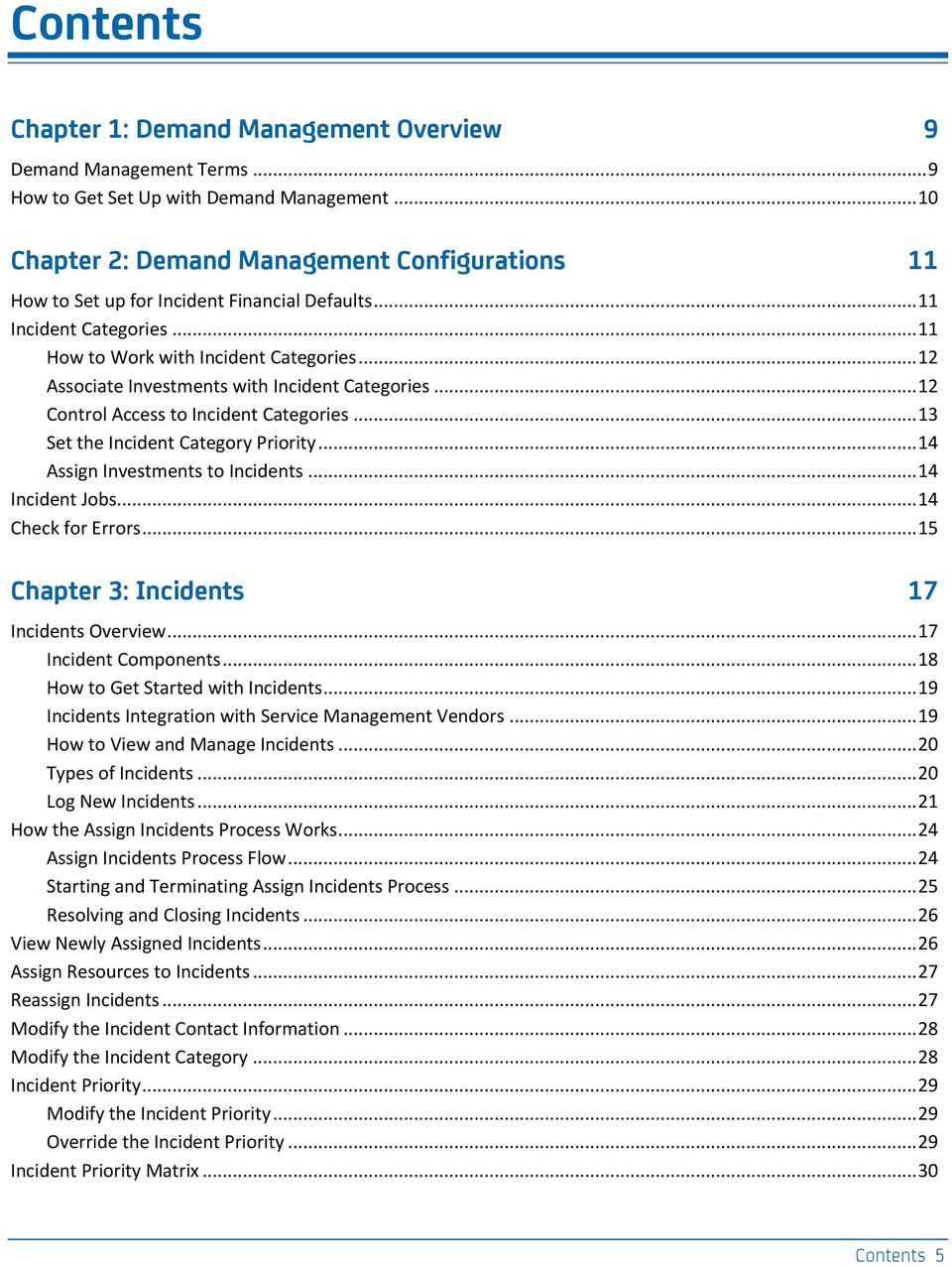
6 Change the Incident Status Flag Incidents for Conversion Enter Time Spent (Incident) View Project and Task Associations How to Manage Incident Notes Add Notes to Incidents View Incident Notes View Audit Fields for Incidents Manage Automated Incident Processes How Incidents are Converted into Planned Work Convert Incidents into Projects Convert Incidents into Project Tasks Incident Data Mapping Chapter 4: Ideas 39 Idea Overview Idea Components How Ideas Status Flow Works How the Idea Approval Process Works Ideas Imported from Another System of Record How to Manage Ideas Create New Ideas Main Properties Capacity Planning Scenarios Create Capacity Planning Scenarios Apply Capacity Planning Scenarios How to Manage Allocations to Parent Investment Add and Remove Parent Investment Associations Define Allocations to Parent Investments Share Ideas Across Investments Aggregate Idea Costs to the Parent Investment How to Staff a Team About the Team: Staff Page Add Resources or Roles to the Idea Staff Book Overallocated Resources View Role Capacity on Ideas Staff Allocations Staff Member Replacement Change Staff Member Roles Remove Staff Members Approve Ideas Demand Management User Guide
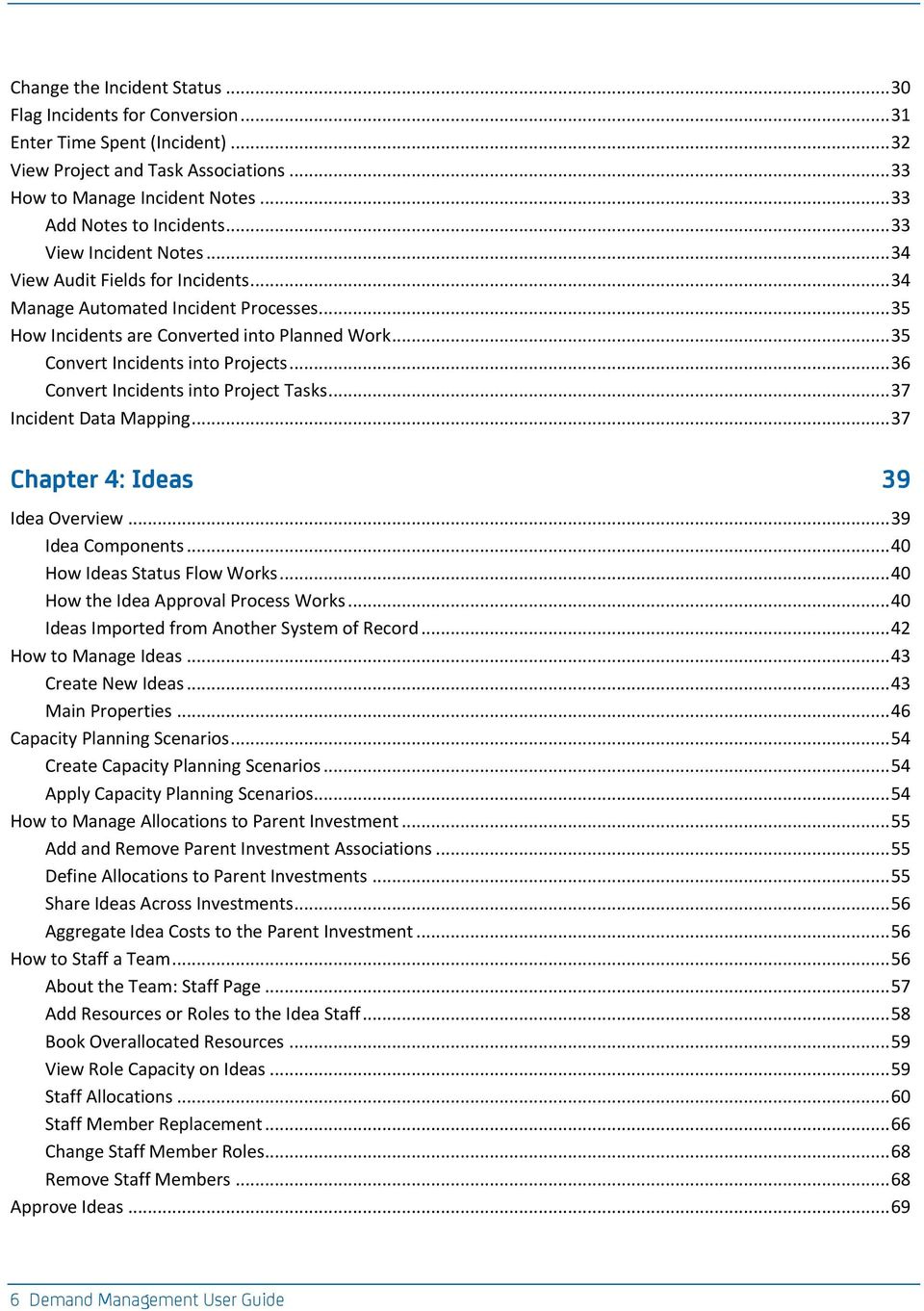
7 Reject Ideas How to Convert Ideas into Investments Convert Ideas into Investments Convert Ideas into Projects Using Project Templates Use Ideas to Create Multiple Investments Delete Ideas Appendix A: Access Rights 73 Idea Access Rights Resource Access Right for Ideas Incident Access Rights Incident Resource Roles Idea Resource Roles Contents 7
8

9 Chapter 1: Demand Management Overview Demand Management provides a means to capture, classify, evaluate, and dispose of all sources of demand. Demand on an IT organization can take many forms. Demand can be a project request, service request, incident, idea for a new product or service, strategic initiative, or support request. Use Demand Management to capture demand in one of two ways. You can use CA Clarity PPM forms to capture information about an idea, project request, or incident. You can also integrate CA Clarity PPM data with other systems that capture help desk tickets, incidents, and service requests. These integrations are supported through the XML Open Gateway (XOG). See the XML Open Gateway Developer Guide for more information. This section contains the following topics: Demand Management Terms (see page 9) How to Get Set Up with Demand Management (see page 10) Demand Management Terms The following terms are used in the context of Demand Management: External ID The identification number of an incident inherited from an external system, such as Remedy. Flag for Conversion Impact OBS Priority The state of an incident once you have manually converted it into a project or project task. The extent of the incident distorting expected service levels: high impact (High), medium impact (Medium), and low impact (Low). Organizational Breakdown Structures is a hierarchical unit structure. OBS helps to view the framework of an organization from both a visual and functional perspective for aggregation, drill down, and resource searching. The priority of the incident being resolved in terms of high priority (High), medium priority (Medium), and low priority (Low). Chapter 1: Demand Management Overview 9

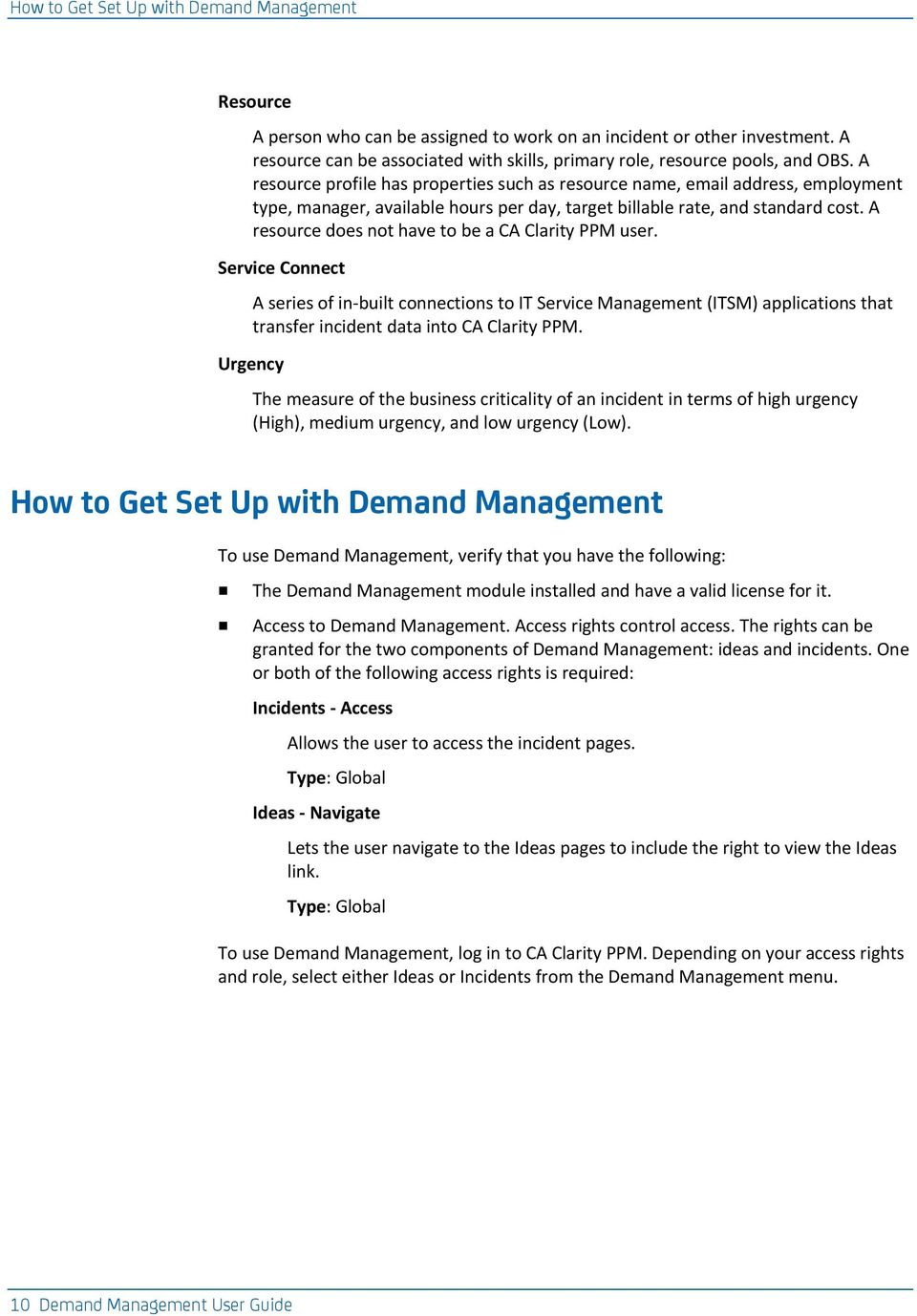
10 How to Get Set Up with Demand Management Resource A person who can be assigned to work on an incident or other investment. A resource can be associated with skills, primary role, resource pools, and OBS. A resource profile has properties such as resource name, address, employment type, manager, available hours per day, target billable rate, and standard cost. A resource does not have to be a CA Clarity PPM user. Service Connect A series of in-built connections to IT Service Management (ITSM) applications that transfer incident data into CA Clarity PPM. Urgency The measure of the business criticality of an incident in terms of high urgency (High), medium urgency, and low urgency (Low). How to Get Set Up with Demand Management To use Demand Management, verify that you have the following: The Demand Management module installed and have a valid license for it. Access to Demand Management. Access rights control access. The rights can be granted for the two components of Demand Management: ideas and incidents. One or both of the following access rights is required: Incidents - Access Allows the user to access the incident pages. Type: Global Ideas - Navigate Lets the user navigate to the Ideas pages to include the right to view the Ideas link. Type: Global To use Demand Management, log in to CA Clarity PPM. Depending on your access rights and role, select either Ideas or Incidents from the Demand Management menu. 10 Demand Management User Guide
11 Chapter 2: Demand Management Configurations This section contains the following topics: How to Set up for Incident Financial Defaults (see page 11) Incident Categories (see page 11) Incident Jobs (see page 14) Check for Errors (see page 15) How to Set up for Incident Financial Defaults Before a resource can enter financial data for incidents, do the following: Set up the rate matrices and financially enable all resources that works with incidents Create logical groups of investments See the Financial Management User Guide for more information. Define default financial properties for investments Investments only support investment-level allocations and chargebacks. Incident Categories Part of setting up Demand Management is to create logical groups of investments named incident categories. Incident categories let you classify incidents of a particular type. They allow you to configure logical groupings of incidents that reflect your organization structure. You can then create and associate investments with these incident categories. In small organizations, where resources work with all incident categories, you can add all resources to a group. Then assign the group to an incident category. In a larger organization, where resources are specialists, you can create groups, and add resources to groups based upon their expertise. Then assign the groups to different incident categories. Chapter 2: Demand Management Configurations 11

12 Incident Categories How to Work with Incident Categories Once you have created incident categories, resources can log incidents. Next, define the incident category properties, associate your investments with incident categories, and grant resources, groups, and OBS units access to the incident category. Use the Create Incident Category page to create an incident category. 1. Open Administration, and from Data Administration, click Incidents. The setup page appears. 2. Click New. The create page appears. 3. Complete the following fields: Category Name Defines the short name for the incident category. Category ID Defines the unique identifier for the incident category. Description Defines a brief description. 4. Click Save and Return. Associate Investments with Incident Categories Once you catalog your investments, you can associate investments-assets, applications, products, services, and other work-with incident categories individually or using a batch process. For example, you can associate the monitor, keyboard, and mouse assets with the Hardware: Peripherals incident category. You can also associate investments with an incident category from the incident. Before associating your investments with an incident category, select the affected investments within an incident category. 1. Open Administration, and from Data Administration, click Incidents. The setup page appears. 12 Demand Management User Guide

13 Incident Categories 2. Click the name of incident category to associate your investment with. The properties page appears. 3. Click Associated Investments. 4. Select an investment for the Select Investments field. 5. Click Save. Control Access to Incident Categories Use the Access to this Category pages to control resources, groups, and OBS units that have access to an incident category. 1. Open Administration, and from Data Administration, click Incidents. The setup page appears. 2. Click the name of the incident category. The properties page appears. 3. Open the Access to this Category menu and click on of the following options: Full View Displays a list of all resources, groups, and OBS units having access to the incident category. Also, the access rights of resources, groups, and OBS units have to this category. Resource Group Defines the resources to grant access to this incident category. Defines the groups to grant access to this incident category. OBS Unit Defines the OBS units to grant access to this incident category. 4. Click Add and select the check box next to each access right, and click Next. 5. Select the check box next to each entity (resource, group, or OBS unit), and click Add. Note: The list of entities that appears depends upon your selection. Chapter 2: Demand Management Configurations 13

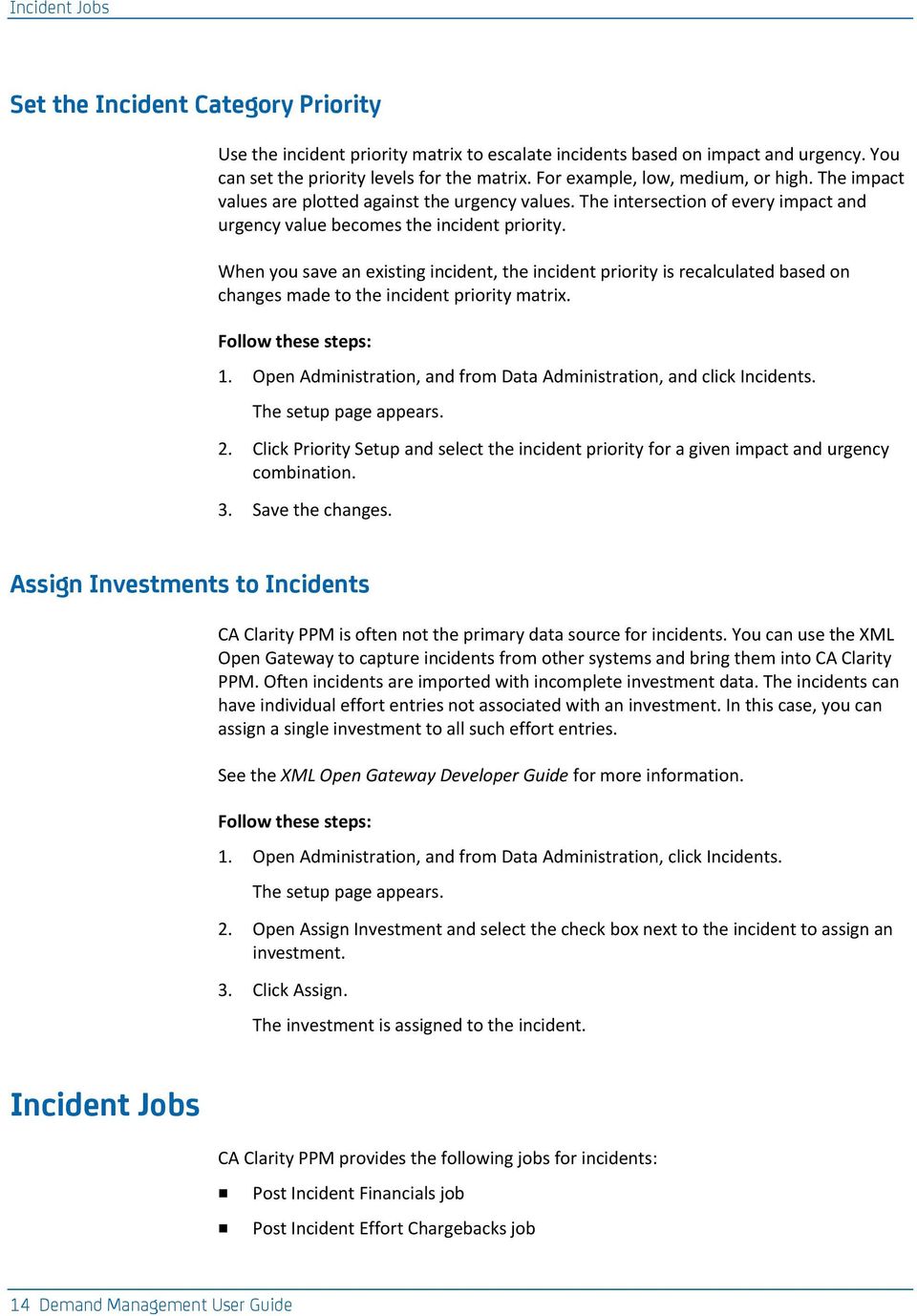
14 Incident Jobs Set the Incident Category Priority Use the incident priority matrix to escalate incidents based on impact and urgency. You can set the priority levels for the matrix. For example, low, medium, or high. The impact values are plotted against the urgency values. The intersection of every impact and urgency value becomes the incident priority. When you save an existing incident, the incident priority is recalculated based on changes made to the incident priority matrix. 1. Open Administration, and from Data Administration, and click Incidents. The setup page appears. 2. Click Priority Setup and select the incident priority for a given impact and urgency combination. 3. Save the changes. Assign Investments to Incidents CA Clarity PPM is often not the primary data source for incidents. You can use the XML Open Gateway to capture incidents from other systems and bring them into CA Clarity PPM. Often incidents are imported with incomplete investment data. The incidents can have individual effort entries not associated with an investment. In this case, you can assign a single investment to all such effort entries. See the XML Open Gateway Developer Guide for more information. 1. Open Administration, and from Data Administration, click Incidents. The setup page appears. 2. Open Assign Investment and select the check box next to the incident to assign an investment. 3. Click Assign. The investment is assigned to the incident. Incident Jobs CA Clarity PPM provides the following jobs for incidents: Post Incident Financials job Post Incident Effort Chargebacks job 14 Demand Management User Guide
15 Check for Errors Check for Errors 1. Open Administration, and from Data Administration, click Incidents. The setup page appears. 2. Click Processing Errors. Chapter 2: Demand Management Configurations 15
16

17 Chapter 3: Incidents The overall goal of managing incidents is for an organization to return to the normal service level as soon as possible. Incident management allows an IT organization to capture, forecast, and decide on the work undertaken by its users. This section contains the following topics: Incidents Overview (see page 17) How the Assign Incidents Process Works (see page 24) View Newly Assigned Incidents (see page 26) Assign Resources to Incidents (see page 27) Reassign Incidents (see page 27) Modify the Incident Contact Information (see page 28) Modify the Incident Category (see page 28) Incident Priority (see page 29) Incident Priority Matrix (see page 30) Change the Incident Status (see page 30) Flag Incidents for Conversion (see page 31) Enter Time Spent (Incident) (see page 32) View Project and Task Associations (see page 33) How to Manage Incident Notes (see page 33) View Audit Fields for Incidents (see page 34) Manage Automated Incident Processes (see page 35) How Incidents are Converted into Planned Work (see page 35) Incident Data Mapping (see page 37) Incidents Overview Demand Management provides the functionality necessary for your organization to prioritize and manage all unplanned work. Unplanned work includes incidents, ideas, or requests for enhancements that consume resources on a daily basis. Together with planned project work, unplanned work creates the total IT demand. Use Demand Management to assess the cost incurred due to unplanned work and to view resource use. An incident is any event that does not form part of the standard operation of a service. The incident can potentially cause an interruption to or a reduction in the quality of that service. Incidents include hardware or software, and service requests. Chapter 3: Incidents 17
18 Incidents Overview An IT service request is a request from a user for support, delivery, information, advice, or documentation, not being a failure in the IT infrastructure. IT service requests are an important part of IT Service Management. Within Demand Management, you can create incidents to capture service requests and the associated information regarding the assignment, discussion, resolution, and time spent. This data is key to any IT department day-to-day operations. Without incidents, an organization and its users can experience unnecessary extended interruptions resulting in increased costs to the company. Incident Components Incidents consist of the following components: Incident properties Use the incident properties pages to define any view incident basics, such as its short description, category, status, urgency, and impact. In addition, you can convert the incident into a project or project task from the Incident Properties page. Associations Effort Notes Use the Associations menu to view a list of projects and project tasks from which this incident was converted. Use this component to view a list of the resource effort on timesheets to resolve this incident. Use this component to add notes to your incident or to view a list of notes posted to your incident. Processes You can use CA Clarity PPM processes to automate certain elements of demand management. For example, you can create a process that notifies the incident manager when the incident status changes to "Resolved". You can also define a process to implement your incident, such as setting the incident urgency to "High". Your CA Clarity PPM administrator can define incident type-specific processes or global processes designed to work on a specific incident. You can create and run processes on incidents. See the CA Clarity Basics User Guide for more information. 18 Demand Management User Guide
19 Incidents Overview Audit This component provides a way to track the history of specific activities that occur for an incident. Your CA Clarity PPM administrator, who determines which fields are audited and what information is stored in the audit trail, sets up Auditing. If Audit Trail is enabled and you have the appropriate access rights, the Audit menu displays when you open your incident. Use this menu to view a log of change, addition, or deletion records for any of the fields chosen for auditing. See the CA Clarity Basics User Guide for more information. How to Get Started with Incidents Before you report and manage incidents, verify if your CA Clarity PPM administrator has set up the incident category mapping. If this step is not completed, the following error message appears when you try to access incidents for the first-time: ITL-0514: Incident category must be created before incident instance can be created. Please contact your administrator. See the Administration Guide for more information. An IT worker or a requester can log an incident. Resources with either role have adequate access rights to created new incidents. Once you have logged the incident, you can view and edit the incidents you have created from the Reported by Me menu. IT workers can view a list of all incidents associated with the incident category to which they are assigned from the Assigned to Me menu. Incidents Integration with Service Management Vendors Create incidents in CA Clarity PPM, or through integrations with other systems that already capture help desk tickets, incidents, and service requests. Typically the primary data source for incidents is from other systems. If your organization uses an existing service management vendor, use the XML Open Gateway to capture data in CA Clarity PPM. XOG and the Service Connect in-built integrations to IT Service Management (ITSM) systems support the integrations. You can use the XML Open Gateway to import incidents and any associated notes and effort. Once imported, the incidents are ready to be part of the demand management process. See the XML Open Gateway Developer Guide for more information. Chapter 3: Incidents 19
20 Incidents Overview How to View and Manage Incidents Use the Incident List page to view incidents assigned to you, reported by you, or reported by others. From the Incident List page, you can do the following: Log new incidents (see page 21). Assign resources to incidents (see page 27). Modify contact information (see page 28). Set the incident priority (see page 29). View project and task associations (see page 33). Add incident notes (see page 33). Convert Incidents in to planned work (see page 35). 1. Open Home, and from Demand Management, click Incidents. The list page appears. 2. Open the following menus to view particular incidents: Assigned to Me Reported by Me Reported by Others Types of Incidents You can view a list of incidents to which you have rights to view on the Incident List page. Open the Incident List page to view incidents that are assigned to you, reported by you, or reported by others. Assigned to Me Displays the Incident List page with a list of incidents to which requestors or IT workers are assigned. If you are assigned an incident, the list also displays any incidents you report. Assigned to Me appears. Or, if you have the Incidents - Manage Category Incidents access right for at least one incident category. You can specify how you are notified of new incidents or of incidents assigned to you. These account settings are handled on the Account Settings: Notifications page. See the CA Clarity Basics User Guide for more information. 20 Demand Management User Guide
21 Incidents Overview Reported by Me Displays a list of incidents you report to requestors and IT managers, and any assigned to you. Reported by Others Displays a list of incidents assigned to you, or reported by other resources. The list includes incidents mapped to incident categories to which you have access rights, either directly or by your association to a group. The page appears if you have either the Incidents - Create/Edit - All access right, or the Incidents - Manage Category Incidents access right. Log New Incidents You can create an incident to report new incidents or work requests from Demand Management, or directly from the investment. To create an incident, you require the following access rights for at least one incident category: Incidents - Create Incidents - Select Category 1. Open Home, and from Demand Management, click Incidents. The list page appears. 2. Click New. The create page appears. 3. Complete the following fields in the General section of the page: Short Description Defines the name of the incident. Make the name short and descriptive. Tracking ID Defines the tracking number for this incident. If auto-numbering is enabled, the field is read-only. Detailed Description Type Defines the detailed description for the incident. Indicates a type for this incident. Select Incident or Service Request from the drop-down. Chapter 3: Incidents 21
22 Incidents Overview Category Status Defines the classification for this incident and helps to trace costs for unplanned work. Click the Browse icon to select the incident category for this incident. Indicates the status for this incident. The status of a new incident is set to "New" by default when you first save it. Select one of the following from the drop-down to change the status: New, Assigned, Work In Progress, Escalated, On Hold, Resolved, and Closed. Urgency Impact Defines the critical measure the incident has based on business needs. Select one of the following: Low, Medium, and High. Default: Medium Defines the extent to which the incident leads to a distortion of expected service levels. Select one of the following from the drop-down: Low, Medium, and High. Default: Medium Override Priority Priority Indicates if the priority of the incident can be overridden. Incident priority is ranked by the Incident Priority matrix based on urgency and impact selections. This field is displayed only if you have the Incidents - Override Priority access right. Select the check box to override the priority of the incident. Defines the order of resolving incidents based on impact and urgency. If you do not have the Incidents - Override Priority access right, the priority is system-generated and read-only. Otherwise, first select the Override Priority check box and then select a priority from the drop-down: Low, Medium, and High. Date Created After an incident is submitted, displays the date and time of creating the incident. The field is read-only. Start Date Indicates the date the IT worker is expected to start working on the incident. Note: Verify that you have the Incident - Create/Edit access right to view the field. 22 Demand Management User Guide
23 Incidents Overview Expected End Date Indicates the date the IT worker is expected to complete the work and mark the incident resolved. Estimated Total Effort Defines the estimated total amount of effort to resolve the incident. Note: Verify that you have the Incident - Create/Edit access right to view the field. Actual Total Effort (Hours) Displays the sum of all the hours from individual effort entries for the incident. This field is read-only. Resolved Date Indicates the date the incident status is set to "Resolved". Verified Date Indicates the date the incident resolution is accepted and verified for closure. Attachment Indicates if a file relating to the incident is attached. Click the Browse icon and attach the file. You can add up to ten file attachments. 4. Complete the following fields in the Primary Contact section: Name Defines the contact for this incident. By default, it is resource currently logged in. Defines the primary contact address. Home Phone Defines the primary contact home phone number. Work Phone Defines the primary contact work phone number. Mobile Phone Pager Defines the primary contact mobile phone number. Defines the primary contact pager number. Chapter 3: Incidents 23
24 How the Assign Incidents Process Works Fax Defines primary contact fax number. 5. Save the changes. How the Assign Incidents Process Works The process administrators use the Assign Incidents process - an incident approval process - to manage the assignment, review, and completion of incidents. By default, the process is not active. Before it can be started, the process administrator activates the process. The requestor logs an incident, the process starts automatically. The process can be customized with additional business rules with approval from the process administrator. See the Administration Guide for more information. Assign Incidents Process Flow The Assign Incidents process has steps that can be triggered. The following steps can be triggered in the process: Assign IT Worker This step is triggered when an incident is first logged. This step triggers CA Clarity PPM to run the Assign Incidents job and, when the job has finished, to mark this step as complete. This step sends an action item to the IT worker to review the incident to which they have been assigned. Once this step is complete, the Acquire Incident step starts. 24 Demand Management User Guide
25 How the Assign Incidents Process Works Acquire Incident This step is triggered when either the Assign IT Worker or the Incident Not Resolved step is complete. This step sends an action item to the IT worker to review and accept the newly assigned incident. During the IT worker review of the action item, the IT worker can either accept or reject the assignment. If the assignment is rejected, the Incident Escalated step starts. If the assignment is accepted, the Work On Incident step starts. Work On Incident This step is triggered when the Acquire Incident step is complete. This step sends an action item to the IT worker to work on the new assignment. The IT worker then works on the incident and then marks the action item as done. Once marked as done, the Record Effort step starts. Record Effort This step is triggered when the Work On Incident step is complete. This step sends an action item to the IT worker to record the effort spent on the incident. The IT worker then requires to record the effort and mark the action item as done. Once marked as done, the Resolution Verification step starts. Resolution Verification This step is triggered when the Record Effort step is complete. This step sends an action item to the requestor to verify and confirm that the incident has been satisfactorily resolved. During their review of the action item, the requestor can either approve or reject the resolution. If the resolution is approved, the process ends. If the resolution is rejected, the Incident Escalated step starts. Incident Escalated This step is triggered when either the Acquire Incident or the Resolution Verification step is complete. This step changes the status of the incident to "Escalated". Once this step is complete, the Incident Not Resolved step starts. Incident Not Resolved This step is triggered when the Incident Escalated step is complete. This step sends a notification to the IT manager that the incident has not been resolved and to review and reassign the incident. When the IT manager marks the action item as done, the Acquire Incident step starts. Starting and Terminating Assign Incidents Process Starting the Process Once the Assign Incidents process is validated and is active, it can be started from the Incident: Processes page. An instance of the Assign Incidents process is created automatically each time an incident is submitted for approval. Chapter 3: Incidents 25
26 View Newly Assigned Incidents Terminating the Process The Assign Incident process terminates when the Resolution Verification step is complete. Resolving and Closing Incidents Resolving Incidents Once the IT worker has resolved the incident, open the incident and change the status to "Resolved". Then, enter a date in the Resolved Date field. Use the Incident Properties page to edit. Setting the status of an incident to "Resolved", when the Assign Incidents process is active and running, triggers a notification. The notification asks the requestor to verify and confirm the resolution. Note: To select and save a date in the Resolved Date field, you must have the Incident - Create/Edit access right. Closing Incidents Once the requestor has accepted the resolution of the incident, the IT worker requires to change the status of the incident to "Closed". The status is specified on the Incident Properties page. If the Assign Incidents process is active and running, setting the status of an incident to "Closed", triggers a notification. The notification informs the requestor that the incident is closed. This process does not change the status of an incident to "Closed". View Newly Assigned Incidents IT workers receive notifications when an IT manager assigns work on an incident. The following procedure explains how to view incident notifications. 1. Open Home, and from Personal, click Organizer. The Action Items portlet displays with other portlets. 2. Click Notifications. 3. In the Show field, select Incidents. The number of incident notifications you have received are displayed. 4. Click the Incidents link in the portlet. The notifications page appears. See the CA Clarity Basics User Guide for more information. 26 Demand Management User Guide
27 Assign Resources to Incidents Assign Resources to Incidents Verify that all incidents are assigned to a resource. Use the Assign To field on the Incidents List page to assign and reassign incidents. The field displays on the page after you submit the incident for the first-time. When you assign an incident, a notification is sent to the user assigned. The method of receiving notifications depends on the assigned user personal notification settings. See the CA Clarity Basics User Guide for more information. 1. Open Home, and from Demand Management, click Incidents. The list page appears. 2. Click the incident short description. The properties page appears. 3. Click the Browse icon located next to the Assigned To field. The selected resource is assigned to the incident. 4. Save the changes. Reassign Incidents You can reassign incidents that are unresolved to another user. When you assign an incident, a notification is sent to the assigned user. The method of receiving notifications depends on the assigned user personal notification settings. See the CA Clarity Basics User Guide for more information. 1. Open Home, and from Demand Management, click Incidents. The list page appears. 2. Select the check box next to the incident you want to reassign. 3. Click Reassign. The select resources page appears. 4. Select the user you want to assign. 5. Click Reassign. The confirmation page appears. 6. Click Reassign. Chapter 3: Incidents 27
28 Modify the Incident Contact Information Modify the Incident Contact Information The primary contact defaults to the resource currently logged-in and includes the resource default contact information. When you assign another resource as the primary contact for the incident, the resource contact information is also updated when the page is saved. If you change the resource contact information, the changes are saved for the incident. The resource default contact information does not change. See the Resource Management User Guide for more information. 1. Open Home, and from Demand Management, click Incidents. The list page appears. 2. Click the incident short description to open the incident. The properties page appears. 3. Scroll down to view the Primary Contact section of the page. 4. Select another resource as the primary contact in the Name field. 5. Save the changes. Modify the Incident Category You can enter or change the incident category for an incident. Incident categories help to distinguish real incidents from IT service requests. All incidents must belong to an incident category. Incident category mapping can occur at the investment level or at the administration level. Both require particular access rights. The following procedure explains how to change the incident category for the incident. See the Resource Management User Guide for more information. 1. On the Incident List page, click the incident short description to open the incident. The properties page appears. 2. Select a new category in the Category field. 3. Save the changes. 28 Demand Management User Guide
29 Incident Priority Incident Priority You can modify or override the incident priority. An incident priority helps IT managers determine the plan in resolving incidents. The priority of an incident is a system-generated value the Incident Priority matrix determines. Modify the Incident Priority Modify the incident priority by altering the Impact and Urgency fields. You can also adjust the impact and urgency values by altering the timing of the incident or by temporarily altering the affected hardware or software. 1. Open Home, and from Demand Management, click Incidents. The list page appears. 2. Click the short description to open the incident. The properties page appears. 3. Do one or both of the following: To modify the impact of the incident, select a value from the Impact down-down. Choices are: Low, Medium, or High. To modify the urgency of the incident, select a value from the Urgency drop-down. Choices are: Low, Medium, or High. 4. Click Save. Override the Incident Priority During the Evaluation of Priority phase of the incident, override the incident priority in the queue. 1. Open Home, and from Demand Management, click Incidents. The list page appears. 2. Click the incident short description to open the incident. The properties page appears. 3. Select the Override Priority check box. If you do not have the Incidents - Override Priority access right, the Override Priority field appears as read-only. 4. Select the priority from the drop-down. Choices are: Low, Medium, and High. Chapter 3: Incidents 29
30 Incident Priority Matrix 5. Save the changes. Incident Priority Matrix The priority of an incident is a function of its impact and urgency. Based on the settings on the Incident Priority matrix, the CA Clarity PPM administrator sets the priorities. Use the Incident Priority matrix to plot the impact values against the urgency values. See the Administration Guide for more information. Change the Incident Status The status of an incident is its current state in CA Clarity PPM. When you first log an incident, the status of the incident is "New." As an incident is worked on, the status of the incident changes. Use the Status field to alter its state. The following is a list of values you can set for the status of an incident: New The incident is new and not been reviewed and resolved. Assigned The incident is open and a resource is assigned (Assigned To field). Work In Progress The incident is open and the IT worker is working on the incident. Escalated On Hold The incident is open but requires a higher-level authority to invest resources. The incident is open. But the IT worker is awaiting information to resolve the incident. Resolved The incident is no longer open. Either the IT worker cannot reproduce the incident and the requestor did not supply adequate information, or lost contact with the service desk. Or, the incident is closed but is pending verification from the requestor. If the Assign Incidents process is active and running, setting the status of an incident to "Resolved", triggers a notification. The notification asks the requestor to verify and confirm the resolution. 30 Demand Management User Guide
31 Flag Incidents for Conversion Closed The incident is no longer open. The requestor is satisfied with the resolution of the incident. Incidents that are imported into CA Clarity PPM through the XML Open Gateway also have a "Closed" status. 1. Open Home, and from Demand Management, click Incidents. The list page appears. 2. Click the incident short description to open the incident. The properties page appears. 3. Select a value from the Status drop-down. 4. Click Save. Flag Incidents for Conversion Incident scope can reach a point that requires handling as a project or project task. The IT worker assigned to work on the incident flags the incident for conversion and assigns the incident to a project manager. Depending on the personal notification settings of the project manager, a notification to convert the incident into a project or project task is sent. See the CA Clarity Basics User Guide for more information. 1. Open Home, and from Demand Management, click Incidents. The list page appears. 2. Click the incident short description to open the incident. The properties page appears. 3. Select the Flagged for Conversion check box. 4. Select a project manager in the Assigned Project Manager field. 5. Save the changes. Chapter 3: Incidents 31
32 Enter Time Spent (Incident) Enter Time Spent (Incident) You can link directly to your timesheet to record the time you spend working on your assigned incidents. Use the Enter Time button on the incident effort page and the incident properties page. The incident effort page displays a chronological list of the timesheet entries you recorded for this incident. The incident effort is used to calculate costs for unplanned work. The time you spend and enter for the incident does not get carried forward when the incident is converted. The incident effort and the new project or task effort represent separate activities and are time-tracked, separately. You can enter time spent working on incidents from the incident or from CA Clarity PPM timesheets. See the CA Clarity Basics User Guide for more information. 1. Open Home, and from Demand Management, click Incidents. The list page appears. 2. Click the incident short description to open the incident. The properties page appears. 3. Click Enter Time. The Select Investment and Time Period page appears. 4. Complete the following fields: At Investment Click the Browse icon to select the investment to charge the resulting cost. The investments that display for selection are associated with the incident category of the incident. And the incidents to which you have access rights for incident tracking. At Time Period Select an open timesheet period from the drop-down. 5. Click Save and Return. The selected timesheet for the period opens. 6. Log the time you spent working on the incident on your timesheet. 32 Demand Management User Guide
33 View Project and Task Associations View Project and Task Associations Use the incident associations page to view a list of the projects and project tasks associated with the incident. An association to the incident occurs any time you create a project or project task for the incident. 1. Open Home, and from Demand Management, click Incidents. The list page appears. 2. Click the incident Short Description link, and click Associations. How to Manage Incident Notes Use the incident notes page to add and view private and public notes. Notes let you record additional information about the incident you are working on. All the notes the IT worker adds, displays in chronological order in a list. You can view and sort the list of notes and add additional notes. All incident notes are public by default and viewable to the requestor and to the IT worker. Once a note is saved, it becomes read-only and cannot be modified or deleted. A timestamp and the name of the resource who added the note is stored with the note. You can do the following: Add notes (see page 33). View notes (see page 34). Add Notes to Incidents 1. Open Home, and from Demand Management, click Incidents. The list page appears. 2. Click the incident short description to open the incident and add a note. The properties page appears. 3. Open the Notes menu and complete the following fields: Subject Defines the subject for the note. Description Defines a short description of the note. Chapter 3: Incidents 33
34 View Audit Fields for Incidents 4. Click Add. The new note appears in the list. Notes are listed in the order created. The most recent note appears at the top of the list. 5. To sort the list, click the column header. For example, to sort the list by subject, click the Subject column header. When sorted, an arrow appears in the column header. To reverse the sort order, click the column header again. Do the same to sort by the Entered By and Date Entered columns. 6. Click Return. View Incident Notes You can view an overview of all of the notes for a particular incident. All the additional notes display in the notes list. 1. Open the incident. 2. Click Notes. 3. Click the note subject to open the note. Details of the note displays. 4. Click Return when you are done. View Audit Fields for Incidents You can view all the previous and new values of fields changed, the resource who changed them, and the date of changing the values. The fields display in the bottom half of the Incident Audit Trail page. To record audit trail, specific field property attributes require to be set up for auditing. Contact your CA Clarity PPM administrator or see the Administration Guide for more information. 1. Open Home, and from Demand Management, click Incidents. The list page appears. 2. Click the incident short description. The properties page appears. 34 Demand Management User Guide
35 Manage Automated Incident Processes 3. Click Audit. The audit trail page appears. Manage Automated Incident Processes You can create, track progress, and delete automated incident processes. Verify that the related processes are active and valid. Note: Verify that you have the appropriate access rights to access this menu. 1. Open Home, and from Demand Management, click Incidents. The list page appears. 2. Click the incident short description. The properties page appears. 3. Click Processes. The processes page appears. 4. From the Processes menu, click the following submenus to view processes in various states: Available. Lists any processes that are already created for the incident. Initiated. List processes already started. See the Administration Guide for more information. How Incidents are Converted into Planned Work Converting an incident or work request into a project or project task converts unplanned work into planned work. When incidents become planned work, they are converted into either projects or project tasks. 1. Typically, at IT worker assigned to work on the incident does the following: a. Flags the incident for conversion. b. Assigns the incident to a project manager. c. Closes the incident. 2. The project manager converts the incident into a project or project task. Only the project manager assigned to the incident can convert the incident into a project or project task. Chapter 3: Incidents 35
36 How Incidents are Converted into Planned Work You can track projects and project tasks associated with the incident. Once an incident is converted, use the Incident Associations page. Convert Incidents into Projects If you get a notification from an IT worker to convert an incident to a project task, use the notification to link to the incident. How you are notified depends on your personal notification settings. See the CA Clarity Basics User Guide for more information. 1. Open Home, and from Demand Management, click Incidents. The list page appears. 2. Click Assigned To Me. 3. Select the check box next to the incident, and click Convert to Project. The select conversion type page appears. 4. Do one of the following: 5. Click Next. To convert the incident into a new project based on a project template: Select Project from Template and click Next. The Select Project Template page appears. Select the project template. To convert the incident into a new project, select Project. The create page appears. Details from the incident page, like the name of the project, manager, start and finish dates are replicated on to the project page. 6. Complete the remaining fields on the page. See the Project Management User Guide for more information. 7. Save the changes. Note: If more work is required to resolve the incident, the IT project staff can reopen the incident. 36 Demand Management User Guide
37 Incident Data Mapping Convert Incidents into Project Tasks If you receive a notification to convert an incident into a project task, use the action item to link to the incident. Each new project task created is added to the bottom of the hierarchy of WBS (work breakdown structure) within the project. Only the project manager assigned to the incident can convert the incident into a project task. A task can only be associated with an existing and active project. You can convert only one incident at a time. 1. Open Home, and from Demand Management, click Incidents. The list page appears. 2. Click Assigned To Me. 3. Select the check box next to the incident, and click Convert to Task. The select project page appears. 4. Select the project to associate the task. 5. Click Add. The create page appears. Details from the incident page, like the name of the project, manager, start and finish dates are replicated on to the task page. 6. Complete the remaining fields on the page. See the Project Management User Guide for more information. 7. Save the changes. Note: If more work is required to resolve the incident, the IT project staff can reopen the incident. Incident Data Mapping When an incident is converted into a project or a project task, data is carried forward with the incident to the new project. If the contact or assigned resource is not a team member of the project, data does not carry forward. Effort data is not carried forward to the project or project task during conversion. Chapter 3: Incidents 37
38 Incident Data Mapping When you convert an incident into a project or project task, you cannot link back to the incident from the project or project task. A link exists only from the incident to the converted project or project task. The data moved over to the project or project task is defined in the following table: Incident Data Field Project Data Field Project Task Field Short Description Project Name Name Tracking ID Project ID ID Status Status (Unapproved) Status (Not Started) Detailed Description Description N/A Assigned Project Manager Manager N/A Start date Start Date Start (date) Expected End date Finish Date Finish (date) 38 Demand Management User Guide
39 Chapter 4: Ideas Ideas are the initial stage of creating new opportunities for investment such as projects, assets, applications, products, services, and other work. Ideas lay the foundation for a specific type of investment by serving as a container for pertinent information. For example, you might have an idea that is valuable enough to be evaluated and converted into a project, service, or investment. This section contains the following topics: Idea Overview (see page 39) How to Manage Ideas (see page 43) Capacity Planning Scenarios (see page 54) How to Manage Allocations to Parent Investment (see page 55) How to Staff a Team (see page 56) Approve Ideas (see page 69) Reject Ideas (see page 69) How to Convert Ideas into Investments (see page 70) Delete Ideas (see page 72) Idea Overview Ideas let you conduct more expedient analysis earlier to weed out unwanted ideas before they become investments and devour vital resources. You can track and convert ideas into investment opportunities. These investment opportunities can then be approved as part of your company portfolio. You can define an idea for a project, product, asset, application, service, or other work. You can also include ideas as part of an investment hierarchy. An idea can be added as a child of an investment hierarchy, have simple budgeting, and have a staff. Idea Audit Trail Audit Trail provides a way to track the history of specific activities that occur for an idea. Your CA Clarity PPM administrator determines which fields are audited and what information is stored in the audit trail. If Audit Trail is enabled for ideas and you have the appropriate access rights, the Audit page displays when you have your idea open. Use this page to view a log of change, addition, or deletion records for the fields chosen for auditing. See the CA Clarity Basics User Guide for more information. Chapter 4: Ideas 39
40 Idea Overview Idea Components Ideas consist of the following components: Idea properties Team Budget Use the idea properties pages to define idea basics from its subject and schedule. In addition, you can define budget properties from the properties pages. Use the Team menu to build a team that includes the staff who performs the work. Use this component to create a simple budget and/ or forecast for your idea. Reporting Use CA Clarity PPM reports to track and analyze idea activities and progress. See the CA Clarity Basics User Guide for more information. How Ideas Status Flow Works A new idea has an "Unapproved" status. When you submit a completed idea for approval, the idea status changes to "Submitted for Approval". The approver can either approve, reject, or change the idea status to "Incomplete". Automated idea processes move the workflow. How the Idea Approval Process Works The Idea Approval process is an out-of-the-box idea process. The process helps the CA Clarity PPM process administrators to manage the submission, review, approval, or rejection of ideas. By default, this process is not active. The CA Clarity PPM process administrator activates before the idea can be started. Customize a process using additional business rules. The process requires the CA Clarity PPM process administrator approval. See the Administration Guide for more information. 40 Demand Management User Guide
41 Idea Overview For each action item this process sends, a notification is sent that coincides with the action item. The process locks the idea status for the duration of the approval process and does not allow any approver to change manually the idea status. Following are the steps triggered from the Idea Approval process: Set Status to Approved Triggers when an Approver uses the action item to approve the idea. The idea status is set to "Approved". Set Status to Rejected Triggers when an Approver uses the action item to reject the idea. The idea status is set to "Rejected". Set Status to Incomplete Triggers when an Approver uses the action item to mark the idea as incomplete. The idea status is set to "Incomplete". Resubmit Creates and sends an action item to the idea originating requestor to complete and resubmit the idea. The Approver then requires to use the action item to resubmit the idea, or to set the idea status to "Submitted". Notify Approved Sends a notification to the idea originating requestor that the idea is approved. Notify Rejected Sends a notification to the idea originating requestor that the idea is rejected. Set Status to Submitted Starting the Idea Approval Process Triggers when an Approver uses the action item to resubmit the idea. The idea status is set to "Submitted" and returns to the start of the process. An instance of Idea Approval process is created automatically each time you submit ideas for approval. During the process, the approver reviews the idea. The idea can be approved, rejected, or set to incomplete to request additional information from the idea originating requestor. Once your idea is approved, you can convert it into any project, service, or investment to which you have the rights to create. Note: You can only have access to one Idea Approval process at any given time. The process administrator cannot grant access to more than one Idea Approval process. Otherwise, an error occurs when you click Submit for Approval. Chapter 4: Ideas 41
42 Idea Overview Sending Action Items to Approve Ideas Approving Ideas from Action Items Terminating the Idea Approval Process Submitting an idea for approval, creates an instance of the Idea Approval process. An action item is sent to each user (Approver) that has the right to approve the idea. The action items requests that the Approver review and approve the idea. Another action item is sent to the idea originating requestor when the idea is approved or rejected. If the status is changed to "Incomplete", the originating requestor is sent an action item to provide additional information and resubmit the idea. As multiple users can have the right to approve the idea, contradictory responses could get recorded. For example, an Approver approves the idea and another reject it before the background process engine cycles. In this case, the outstanding action items are closed, if any, and new copies of the same action item are sent. The new action item states that contradictory responses are received. As an Approver, you can receive action items when an idea originating requestor submits an idea for approval. You can review the idea and then approve it from the action item by clicking Approved. Note: The Idea Approval process changes the Status field to read-only. Therefore, approve the idea from the action item by clicking Approved. The Idea Approval process terminates when you approve, reject, or delete it. Ideas Imported from Another System of Record The system of record for ideas is often not CA Clarity PPM. For this reason, you can import ideas from another system of record using the XML Open Gateway to view and manage in CA Clarity PPM. Once imported, the ideas are ready to be part of the portfolio management process. See the XML Open Gateway Developer Guide for more information. 42 Demand Management User Guide
43 How to Manage Ideas How to Manage Ideas An idea is the starting point for creating investments and maintaining them in CA Clarity PPM. You can do the following from the Ideas page: Create new ideas (see page 43). Manage the idea properties (see page 46). Define scheduling information (see page 49). Define budget information (see page 50). Build a team (see page 56). Evaluate ideas using capacity planning scenarios (see page 54). Manage parent investment allocations (see page 55). Delete ideas (see page 72). Create New Ideas Use the create idea page to define your idea general properties, estimated costs and benefits, detailed description, and to start the Idea Approval process. Some of the idea properties are used when you convert the idea into a project, service, or investment. 1. Open Home, and from Demand Management, click Ideas. The list page appears. 2. Click New. The create page appears. 3. Complete the following required fields in the General section of the page: Subject Idea ID Defines the idea summary/name. When you convert the idea into a project, service, or investment, the subject is used as a link from the investment to the idea. During the conversion process, the subject becomes the description of the investment. Defines the idea unique ID. If auto-numbering is configured, the field displays as read-only. During the conversion process, the Idea ID is the name of the investment. Chapter 4: Ideas 43
44 How to Manage Ideas Idea Priority Defines the value assigned to the idea by the idea manager. The value corresponds to the risk priority. Choices are: Low (default), medium, and High. Description Details the description of the idea. Manager Defines the name of the resource that manages and owns the idea. The idea manager has access to the idea budget and schedule properties. Originating Requestor Defines the name of the resource originating the idea request. By default, the field displays the name of the resource creating the idea. Note: If you select another resource, your access rights to view the idea could cease. In particular, you require Idea View All or the Resource Idea View access right to this resource to view this idea. Active Specifies if the idea is active. Activate the investment to allow resources to view ideas in portfolios and in any capacity planning portlet. Default: Selected General Notes Specifies additional information about the idea not covered by the idea description. 4. Complete the following fields in the Estimated Costs and Benefits section of the page as needed. Some of these properties are used when you convert the idea into a project, service, or investment: Estimate Type Defines the type of estimate benefits, cost, and revenue impact for the idea. Currency Code Defines the system currency and a read-only field. If multi currency is enabled, a drop-down list of all active currency codes. During the conversion process, the currency code is the currency code for the investment. Business Unit Defines the business unit associated to the idea. Benefit Description Defines the general description of the idea benefits. 44 Demand Management User Guide
45 How to Manage Ideas Estimated Cost Defines the estimated total cost of the idea. During the conversion process, the estimated cost is the investment planned cost. Estimated Benefit Defines the estimated total financial benefit of the idea both in term of revenue and money saved. Estimated Start Date Indicates the estimated start date for the idea. The date must be on or before the estimated finish date. Estimated Finish Date Indicates the estimated finish date for the idea. The date must be on or before the estimated finish date. Breakeven Date Defines the estimated break-even date for the idea. During the conversion process, the break-even date is the budget break-even date for the investment. 5. Complete the following fields in the Detailed Description section: Impact on Existing Initiatives Risks Defines the description of the impact the idea has on the existing initiatives. Defines the description of the risks, whether the idea is implemented or not. Dependencies Defines the description of the dependencies, or list of any dependencies the idea have. 6. In the Organizational Breakdown Structure section, click the Browse icon next to the OBS to associate with the idea for security, organizational, or reporting purposes. The OBS-named-Department is used to associate the idea with a CA Clarity PPM department. If multiple OBS exist, the OBS-named-Department is listed last. See the CA Clarity Basics User Guide for more information. 7. Do one of the following: Save the new idea. The new idea displays in the list on the Ideas page with the "Unapproved" status. Click Submit for Approval to save the new idea and submit it for approval. The new idea displays in the list on the Ideas page with the "Submitted for Approval" status. Chapter 4: Ideas 45
46 How to Manage Ideas Main Properties Main properties let you define base information about the idea. 1. To view main properties, open the idea. The general page appears. 2. Click the links from the Properties menu to access other main properties pages. You can do the following: How to Manage General Information Edit general information (see page 46), such as name, manager, goals, status, alignment, and OBS associations. Manage scheduling information (see page 49), such as start and finish dates, and tracking methods. Manage budget information (see page 50), such as planned cost and benefit, and NPV and breakeven metrics. From the properties page for an idea, you can take the following actions: Associate the idea with an OBS (see page 46). Define the target manager (see page 47). View a summary of estimated costs and benefits (see page 47). View a detailed description of the idea. (see page 47) Submit an idea for approval (see page 47). Request information about the idea (see page 48). You can edit the general properties from this page, or from the idea list page. See the CA Clarity Basics User Guide for more information. Associate Ideas with Organizational Breakdown Structures Organizational breakdown structures (OBS) controls access, department hierarchies, and reporting. If at least one OBS exists for ideas, you can associate any of these OBS to your idea. The OBS named Department is used to associate an idea with a CA Clarity PPM department. If several exist, the Department OBS is listed last. See the CA Clarity Basics User Guide for more information. 46 Demand Management User Guide
47 How to Manage Ideas Define the Target Manager The target manager is the resource who manages the idea when converted into a project, service, or investment. Recommended to complete the field. 1. Open the idea. The list page appears. View Estimated Costs and Benefits View a Detailed Description Submit Ideas for Approval 2. Click the subject of the idea to assign a target manager. The properties page appears. 3. Select a resource in the Target Manager field. Note: Complete the field before you convert the idea into a project, service, or investment. Otherwise, the resource identified as the idea Manager, becomes the manager for the project, service, or investment. A high-level overview of the idea estimated costs and benefits appear in the Estimated Costs and Benefits section of the properties page. The fields displayed in the section are the same fields that displayed when you first created the idea, on the Create Idea page. View and edit the impact the idea has on existing initiatives, the risks of the idea, and the dependencies the idea has on existing initiatives. Use the Detailed Description section of the properties page to view the data. Submit the new idea for approval. You can also submit an idea for approval while still creating. 1. Open the idea. The list page appears. 2. Click the subject of the idea to submit for approval. The properties page appears. Chapter 4: Ideas 47
48 How to Manage Ideas Request More Information Deactivate Ideas 3. Do one of the following: Click Submit for Approval. Change the status to "Submitted for Approval" and click Save. Click Return to return to the Ideas page. Note: You can submit any idea for approval except ideas that can be converted into projects, services, or investments. A submitted idea can require additional information before approval and conversion into a project, service, or investment. 1. Open the idea. The list page appears. 2. Click the subject of the submitted idea. The properties page appears. 3. Change the submitted idea status to "Incomplete". 4. In the General Notes field, enter any notes or directions about the additional information that you require from the idea manager. 5. Click Save and Return to return to the Ideas page. The Ideas page appears with the idea status as "Incomplete". 6. Send an action item and a notification to the idea manager to provide additional information and to resubmit the idea. See the CA Clarity Basics User Guide for more information. 1. Open the idea. The list page appears. 2. Click the subject of the idea to deactivate. The properties page appears. 3. In the General section of the page, clear the Active check box. 4. Click Save. 48 Demand Management User Guide
49 How to Manage Ideas Define Scheduling Information Use the idea properties page to define the idea start and finish dates, open it for time entry, and define its charge code. 1. Open the idea. The list page appears. 2. Click the subject of the idea. The properties page appears. 3. Open the Properties menu and then from Properties, click Schedule. The schedule page appears. 4. In the Schedule section of the page, complete the following fields. Some of these properties are used when you convert the idea into a project, service, or investment: Start Date Indicates the idea start date. When you convert the idea into an investment, the date is the investment start date. Finish Date Indicates the idea finish date. When you convert the idea into an investment, the date becomes the investment finish date. Set Planned Cost Dates Specifies if the planned cost dates are synchronized with the investment dates. Selecting the option for a detailed financial plan does not affect the planned cost dates. Default: Selected Required: No 5. In the Tracking section of the page, complete the following fields: Time Entry Select the field to allow staff members to record the time they work on the idea on the timesheets. Important! Ensure that you select the Time Entry field to enable staff members to record work on ideas on the timesheets. Default: Selected Chapter 4: Ideas 49
50 How to Manage Ideas Define Budget Information Track Mode Indicates the method for the staff members to enter time for hours worked on the idea. Options: Clarity. Staff members record time using timesheets. None. Non labor resources track actuals through transaction vouchers, or when enter actuals through a scheduler, such as Open Workbench. Other. Import actuals from a third-party application. Default: Clarity Charge Code Select a default charge code to use for all idea tasks. If you enter a different charge code at the task level on timesheets, the task-level charge codes override the idea-level charge code. See the CA Clarity Basics User Guide for more information. 6. Click Save and Return, or Submit for Approval. The idea budget data is essential in managing and analyzing idea portfolios. Correctly defining and recording the idea planned cost and benefit information is key to accurately assessing and analyzing ideas during portfolio management. You can define budget information from the Idea: Properties: Main - Budget page. With budget properties, you can define metrics. For example, the idea planned cost, NPV, ROI, and breakeven information. Or calculate automatically using the cost of capital. You can also use the fields on the page to set the start and end dates over which the budget is experienced. With budget properties, money flows constantly and evenly over this period. The values budget properties are applied to only one time period: From the idea start date to the finish date. The dates are applied only to your idea and not to its parent investments. 1. Open the idea. The list page appears. 2. Click the subject of the idea. The properties page appears. 3. Open the Properties menu and then from Properties, click Budget. The budget page appears. 50 Demand Management User Guide
51 How to Manage Ideas 4. Complete the following fields in the Financial Planning section: Currency Defines the currency for the investment. Default: System currency Budget equals Planned Values Specifies if the budget values in the budget properties of an investment match the planned values. If a detailed budget plan exists for the investment, all the field values in the Budget section are display-only. The fields reflect the values in the detailed budget plan. When the check box is cleared, you can edit the budget fields. Default: Selected Calculate Financial Metrics Specifies if financial metrics for the investment are calculated automatically. If unselected, you can define the financial metrics manually. Default: Selected 5. Complete the following fields in the Financial Metrics Options section: Use System Rate for Total Cost of Capital Select the field to calculate the total cost of capital at system rate. Use System Reinvestment Rate Select the field to calculate the total cost of capital at the system reinvestment rate. System Rate Displays the system rate for calculating the total cost of capital. Investment Rate Displays the investment rate for calculating the total cost of capital. Initial Investment Defines the initial investment on the idea. 6. Complete the following fields in the Planned section. Some of these properties are used when you convert the idea into a project, service, or investment: Planned Cost Defines the idea planned costs. The value is distributed between the Planned Cost Start and the Planned Cost Finish dates. Note: When you convert the idea into an investment, the planned cost value supersedes the estimated cost entered in the Estimated Costs and Benefits section of the Idea Properties: General page. Chapter 4: Ideas 51
52 How to Manage Ideas Planned Cost Start Select the date of starting the idea planned cost. Planned Cost Finish Select the date the idea planned cost expires. Planned Benefit Defines the total planned benefit you receive from the idea. Note: When you convert the idea into an investment, the planned benefit value supersedes the estimated benefit entered in the Estimated Costs and Benefits section of the Idea Properties: General page. Planned Benefit Start Select the date when the idea planned benefit starts. Planned Benefit Finish Select the date when the planned benefit of the idea expires. Planned NPV Displays the planned NPV (Net Present Value) of the investment. Planned ROI Displays the planned ROI (Return on Investment) of this investment. Planned Breakeven The date when the idea planned cost equals the planned benefit. The field is read-only. Planned IRR Displays the planned internal rate of return for the investment. Planned MIRR Displays the planned modified internal rate of return (MIRR) for the investment. Planned Payback Period Displays the date of the investment planned payback period. 7. The following fields display in the Budget section. Budget Cost Displays the budgeted cost amount for the investment. Budget Cost Start Displays the budgeted cost start date of the investment. 52 Demand Management User Guide
53 How to Manage Ideas Budget Cost Finish Displays the budgeted cost finish date of the investment. Budget Benefit Displays the budgeted benefit amount of the investment. Budget Benefit Start Displays the budgeted benefit start date of the investment. Budget Benefit Finish Displays the budgeted benefit finish date of the investment. Budget NPV Displays the budgeted NPV (Net Present Value) of the investment. Budget ROI Displays the budgeted ROI (Return on Investment) of this investment. Budget Breakeven Displays the date when the idea budgeted cost equals the planned benefit. The field is read-only. Budget IRR Displays the budgeted internal rate of return for the investment. Budget MIRR Displays the budgeted modified internal rate of return (MIRR) for the investment. Budget Payback in Months Displays the date of the investment budgeted payback period 8. Submit your changes. 9. View an Overview of Estimated Cost and Benefits. Chapter 4: Ideas 53
54 Capacity Planning Scenarios Capacity Planning Scenarios Scenarios allow you to apply a systematic methodology to optimize your idea or portfolio. Apply scenarios to your idea to analyze how staffing changes or shifts in dates affect the outcome of your idea or portfolio. You can evaluate your ideas by switching between a scenario and the plan of record. You can do the following: Create capacity planning scenarios (see page 54). Apply capacity planning to ideas (see page 54). See the Portfolio Management User Guide for more information. Create Capacity Planning Scenarios Create a capacity planning scenario from any idea page that displays the scenario toolbar. The scenario toolbar displays below the page toolbar. You cannot create portfolio scenarios from the idea but from within a portfolio. Apply Capacity Planning Scenarios Use the scenario toolbar to select any existing capacity planning scenarios to which you have access rights (including any portfolio scenarios). When you open an idea and select a scenario, either from a capacity planning scenario-enabled page, or the financial plan page of idea properties, that scenario is set as the current scenario. 54 Demand Management User Guide
55 How to Manage Allocations to Parent Investment How to Manage Allocations to Parent Investment Use the parents page of the idea hierarchy to view a list of investments and services to which the idea is allocated. Also, helps to view the percentage the idea is allocated to each parent. You can do the following: Add and remove parent associations (see page 55). View allocations to parent investments (see page 55). Share idea allocation across parent investments (see page 56). Aggregate idea costs to parent investments (see page 56). 1. Open the idea. The list page appears. 2. Click the subject of the idea to view the investment the idea is allocated to. The properties page appears. 3. Select Hierarchy. The hierarchy page appears. You can view the details of the parent investment of the idea. Add and Remove Parent Investment Associations You can add and remove parent investment associations to and from your idea based on your company business rules. Add or remove associations on one of the parent investment-related set allocations page. See the Portfolio Management User Guide for more information. Define Allocations to Parent Investments Allocate ideas to one or more parent investments or services. However, the total allocation percentage of your idea to its parent investments is required to equal 100 percent. View the parent investments and services allocation amounts of an idea on the parents page of the idea hierarchy. You can define the allocation of the idea to a parent investment from this page. Chapter 4: Ideas 55
56 How to Staff a Team 1. Open the idea. 2. Click Hierarchy. 3. Click Add to add parent investments. 4. When all parent investments are added, click in the Allocation field of each parent and indicate the allocation of the idea. 5. Click Save. Share Ideas Across Investments You can share ideas between other investments, services, and ideas. For example, you can share an idea for an online banking phone system that supports servers in two areas around the country. First, add the servers as child investments to the online banking phone system idea investment hierarchy. Then, edit the child investment cost allocation percentage and time segments. Your idea investment allocation percentage dictates the amount that the idea is allocated to parent investment, service, or idea. All cost information displayed in the parent idea hierarchy is based on the allocation percentages. Aggregate Idea Costs to the Parent Investment Child idea cost totals are automatically aggregated to its parent investments. During the calculation, the parent idea start and finish date are considered for applying the child idea costs to the parent. How to Staff a Team To provide planning data for capacity planning or portfolio planning, you can staff your idea with resources. Staff your idea with a team member to perform up-front work, before approving and converting the idea into a project, investment, or service. Use the team staff page of an idea to staff your ideas by allocating roles and resources. You can add both labor and non-labor resources. From this page, you can view the bottom-up aggregated work effort by role. You can switch the view to edit the idea direct planned work. The Team menu contains three options: Staff, Detail and Role Capacity. To view the team staff page of an idea, open the idea, and click Team. 56 Demand Management User Guide
57 How to Staff a Team About the Team: Staff Page To display the team staff page, open the idea and click Team. Staff members are resources or roles that can be assigned to work on an idea. The staff can record the time worked on the idea on their timesheet. Ideas are not associated with tasks and staffing them does not result in long-term commitments for that staff. You can use a role as a placeholder when you do not know the name of the resource you want to staff on your idea. Or, if the resource for staffing is not available. You can staff your idea with multiple instances of a role but not multiple instances of a resource. Use the team staff page of an idea to add staff to the idea. The following describes the columns and icons on the page when you staff resources to the idea: Properties icon Opens the resource profile. You can view profile information and change allocations, including planned and hard allocations. See the Resource Management User Guide for more information. Resource Finder icon Opens the Find Resources page for the selected resource. On this page, you can replace the resource or role with a different resource or role. Resource column Click a resource name to view and edit the resource general properties. Resource Allocation Role Opens the Resource/ Role Allocations page. You can update the resource allocation. Displays the role of the resource, which can be different from the primary role selected in the resource profile. Time column Displays a yellow checkmark if the resource or role is allowed to enter time for the idea. Booking Status column Displays the resource or role booking status. Values Hard. The resource is committed to the idea. Soft. The resource is tentatively scheduled for the idea. Mixed. Both soft and hard allocation exists for the resource. Chapter 4: Ideas 57
58 How to Staff a Team Start column Displays the team member allocation start date. If not defined, the date defaults to the start date of the idea. Finish column Displays the team member allocation finish date. If not defined, the date defaults to the finish date of the idea. % Allocation Displays the team member percent allocation to the idea. Each staff member is assigned to the idea at 100 percent of the resource available time by default. Allocation Displays the number of hours the resource has been tentatively booked to the idea. Unless you change the booking dates, staff members are automatically booked for the entire duration of the idea. This field cannot be edited but changes to reflect edits you make using: The setting allocation options. The new allocation curves defined on the Idea Staff Member: Properties page. The Shift Allocation option. Allocated Actuals Displays the total number of hours the resource has recorded to date on this idea. Incident Actuals Displays the time posted to incidents associated to this idea. Total Actuals Displays the aggregated total actual time posted. This value is the sum of the allocated actuals and the incident actuals. Add Resources or Roles to the Idea Staff The team staff page of an idea displays a list of the resources or roles that are added to your idea. All resources are automatically allocated at 100 percent of their available working days. You can adjust the value to meet your needs. When adding resources to your idea staff, chances of over-allocation of the resource can happen. In this case, a confirmation page appears to either over-allocate the resource, or to accept the remaining availability of the resource. Note: You can add multiple instances of a role to an idea. But not multiple instances of the same named resource. For example, assign programmer (1) and programmer (2) to represent two different requirements with a programming role. 58 Demand Management User Guide
59 How to Staff a Team 1. Open the idea. 2. Click Team. 3. Do one of the following: Click Add to select individual resources or roles for the idea staff. The Select Resources page appears. Click Add/Update by OBS to add all the resources in a selected OBS unit to the idea staff. 4. Select the resources and roles to add to the idea staff. Use the Search Filter to find resources or roles by name or other criteria. 5. Click Add to add the resources and roles. 6. Save the changes. Book Overallocated Resources The available hours for a resource can be less than the total number of requested hours. In this case, instead of the Booking Confirmation page, the Remaining Availability Confirmation page appears. Adding a resource to the project or investment displays overbooking in the Remaining Availability Confirmation page. If the resource is booked at 100 percent (default) of their availability, the 100 percent Resource Allocation column lists the number of utilized hours. The Remaining Availability column indicates the actual number of available work hours for the resource on your project. When the confirmation page appears, select one of the following options: Overallocate Over-allocates the resource. Remaining Only Books the resource for the amount listed in the Remaining Availability column. View Role Capacity on Ideas The role capacity page of idea team provides an aggregated view of all role demand whether generated by role-based team members or named resources. You can view this information against the capacity of the resources that fill those roles. To access the page from the idea Team menu, select Role Capacity on the page toolbar. Resources without a team role are captured on this page in the [No Role] row. Chapter 4: Ideas 59
60 How to Staff a Team From the role capacity page, you can view: Role allocation to the idea vis-a-vis allocation to other investments and over-allocations. Available role capacity for this idea. You can view this information from inside and outside of a scenario. If a role appears over-allocated, click Staff to go to the team staff page of an idea and view all the resources using that role. Staff Allocations Staff allocation is the period during which a resource is booked to an idea. Unless you change the booking dates, staff members are automatically booked for the entire duration of the idea. The allocation amount granted for a resource can be calculated as follows: Total number of working days including the start and finish dates * Number of available hours per day ETC is based on the number of hours a resource is assigned to the idea. Edit Staff Allocations 1. Open the idea. 2. Click Team. 3. Edit the following fields: Role Time Select a role for this resource on the idea. Indicates that the resource can enter time taken for completing the work on the idea. Booking Status Select the booking status for the resource on the idea. % Allocation 4. Click Save. Enter the default amount for the resource allocated to the idea. You can enter "0" (zero) as the allocation percentage. The Allocation column reflects the changes done here. 60 Demand Management User Guide
61 How to Staff a Team Change Resource Default Allocation Use the Planned Allocation and Hard Allocation sections on a resource Staff Member Properties page to indicate any deviations from the Default % Allocation field. You can unbook a hard-booked resource, or extend a resource for additional planning. The Planned Allocation curve represents the default, or total allocation amount requested by the manager. The Hard Allocation curve represents the allocation amount that the resource manager commits. The booking status for a resource changes according to the allocation amounts in the planned and hard allocation curves. For example, suppose the planned or default allocation is 100 percent for a resource. Suppose, a resource is booked to work on your idea from 8/01/11 through 11/30/11. But is also scheduled to work on another idea 50 percent of the time through September 1. And, in addition, plans to be on vacation from 9/15/11 through 9/22/11. In this case, you could create two allocation curves for the resource: One that indicates a 50 percent deviation from 8/01/11 through 9/01/11, and another that indicates a zero percent deviation from 9/15/11 to 9/22/ Open the idea. 2. Click Team. 3. Click the Properties icon for the resource to change allocation. The properties page appears. The page displays the basic profile fields and allocation-related fields. 4. In Default % Allocation, enter the percentage of time the resource requires to be allocated to the idea. You can enter 0 (zero). Note: The Allocation and Allocation % columns on the Idea: Team: Staff page reflects the changes, if any. 5. In the Planned Allocation and Hard Allocation sections, create a row each for deviation from the default allocation. To use the short example preceding the steps, create two rows: One to cover the period for the resource working at 50 percent (instead of the 100 percent default or planned allocation). Another, for the period that the resource actually works at 0 percent (instead of the 100 percent default or planned allocation). 6. To create a planned or hard allocation period: a. Enter or select a Start date for the period. b. Enter or select a Finish date for the period. c. Enter the percentage of time you expect them to work (as tentative or committed) in the % Allocation field. You can enter 0 (zero). 7. Click New Row to add another row and repeat Step 4. Chapter 4: Ideas 61
62 How to Staff a Team How to Reset Staff Allocations 8. When you are done, click Save and Return. You can reset the staff allocations for an idea in the following ways: Shift the allocation (see page 62) to shift or scale all or a portion of the resource allocations. Set the allocation (see page 63) to update the allocation of multiple team members at the same time. Commit the planned allocation (see page 64) to reset a resource hard allocation to be equal to the planned allocation. Accept the hard allocation (see page 65) to reset a resource planned allocation to be equal to the hard-booked allocation. Use the Actions menu on the team staff page and team detail pages of an idea for the preceding options. Shift and Scale Resource Allocations on Ideas Move resource allocations back and forward in time to shift or scale all or a portion of the resource allocations in an idea. As you move data, segmented allocation dates are kept intact, even when the percent allocated for each segment changes. Shifting allocations is useful for projecting allocations beyond the allowable time-scaled view, which can only extend for six months. For example, consider an allocation that starts on May 1, continues at its default rate of 100 percent through the end of May. Then goes through June at the reduced allocation of 50 percent. Now, shift the allocation to start from June 1 to July 2 (for 31 calendar days) at 100 percent, and up to August 2 at 50 percent. You can also shift allocations for time spans that contain no segments. 1. Open the idea. 2. Click Team. The staff list page appears. 3. Select the check box next to the resource to shift allocation. 4. From the Actions menu, click Shift Allocation. The allocations page appears. 5. In the Time Span to Shift section, click Select Date to change the start and finish dates for the resource allocated to the idea. Data shifts according to the dates you enter in the fields. 62 Demand Management User Guide
63 How to Staff a Team 6. In the Time Shift Parameters section, do the following: At Shift to Date, click Select Date to select a new beginning date for shifting the data. If the field is left empty, no shifting occurs. At Shift Cut-Off Date, click Select Date to select the last date for shifting data. You cannot shift allocations beyond the date. At Scale Allocation % By, enter the percentage change in the allocation for the shift. If the field is left empty, no scaling occurs. 7. Save the changes. Set Allocations for Multiple Team Members Set the allocations of multiple team members with one action simultaneously. Click More on the team staff page and team detail pages of an idea to use the Set Allocation option. 1. Open the idea. 2. Click Team. The staff list page appears. 3. Select the check box next to the resource to update allocation. 4. From the Actions menu on top right, click Set Allocation. The allocations page appears. 5. In the General section of the page, set the following allocations for the selected team members: Start Date Defines the date of starting work on the idea. Select the Reset to Match Investment Start Date check box to reset the resource staffing requirements on the idea to match the idea start date. Finish Date Defines the last date of working on the idea. Select the Reset to Match Investment Finish Date check box to reset the resource staffing requirements on the idea to match the idea finish date. Default % Allocation Defines the percentage of time for allocating the resource to the idea. You can enter 0 percent. The Allocation and Allocation % columns on the Idea Team: Staff page reflects the change. Chapter 4: Ideas 63
64 How to Staff a Team Booking Status column Displays the resource or role booking status. Values Hard. The resource is committed to the idea. Soft. The resource is tentatively scheduled for the idea. Mixed. Both soft and hard allocation exists for the resource. 6. Click Save and Return. Commit Resource Planned Allocation Committing the planned allocation, equalizes the hard allocation to the planned allocation for the resource. Commit after editing the planned allocation segment for hard-booking the segments for a resource. A hard booking status for a resource signifies full commitment. To use the Commit Planned Allocation option, click More on the Idea Team: Staff page and Idea Team: Detail pages and select the option. Committing planned allocation does not reset the default allocation percentage. This action copies the planned allocation into the Hard Allocation section of the resource Staff Member Properties page. Note: The Hard Allocation section displays on the page depending on your Mixed Booking settings. See your CA Clarity PPM administrator. 1. Open the idea. 2. Click Team. The staff list page appears. 3. Select the check box next to the resource to commit planned allocation. 4. From the Actions menu on top right, click Commit Planned Allocation. The confirmation page appears. 5. Click Yes. 64 Demand Management User Guide
65 How to Staff a Team Accept Resource Hard Allocation Edit Resource Allocations Use the Accept Hard Allocation option to reset the planned allocation to equalize to the hard-booked allocation. If soft-booked planned segments displays in the Planned Allocation section, they are removed. All segments are then reset to equal the hard-booked segment. Note: The Accept Hard Allocation option displays on the page depending on your Mixed Booking settings. See your CA Clarity PPM administrator. 1. Open the idea. 2. Click Team. The staff list page appears. 3. Select the check box next to the resource to accept hard allocation. 4. From the Actions menu on top right, click Accept Hard Allocation. The confirmation page appears. 5. Click Yes. This action sets the planned allocation to equal committed allocation. Accordingly, the % Allocation and Allocation column values change. The Booking Status value displays as "Hard" as the allocation is fully committed. The team detail page of an idea lists planned and committed allocation for an idea by resource by time period in a graph format. The view helps you determine if a resource is overbooked or under booked and by how much. You can also ascertain the availability of a resource for an idea. To view the page, select Team, and then click Detail from the page toolbar. The team detail page displays data based on resource, allocation, and time period. Scrolling over a time period displays a note providing you with a brief summary of what you see. The time period columns are, by default, set to weekly, and start with the current week. The allocation color code is as follows: Yellow Red Resource is allocated at or under availability for that time period. Resource is over-allocated (the amount of time booked exceeding availability) for that time period. Chapter 4: Ideas 65
66 How to Staff a Team Green Allocation to other investments, ideas, or services. See the CA Clarity Basics User Guide for more information. Staff Member Replacement Guidelines to Replace Staff Members Replace a staff member assignment from the team staff page of an idea. Use the availability score to find a replacement at the team level. In addition, you can replace a resource with a different named resource, and a role with a resource. During replacement, over-allocating the member replacing the previous member or members can occur. Consider the following before making a staff member replacement: Replacing a resource with a different resource, does not transfer the actuals and pending actuals (if any) of the original to the new staff member. Only the remaining ETC is transferred to the new staff member. The original staff member requires to complete time entries so that the actual data is posted before the replacement occurs. The role of the original staff member is transferred to the new staff member, unless you are replacing a role with a different role. How Data Transfers From Replaced Staff Members The following table identifies how data from the replaced staff member transfers to the new staff member: Data Type Transfers Available Start Available Finish Remaining Allocation Percent (%) Allocation Investment Role Existing Actuals Pending Actuals Baselines Yes, if this date has not passed and if new resource is not booked on that date. Yes Yes Yes Yes No No No 66 Demand Management User Guide
67 How to Staff a Team Replace Staff Members Use the team staff page of an idea to replace staff members assigned to your idea. A list of resources displays the staff with the same role as the resource being replaced, and their availability during the idea time period. You can replace a resource using the staff or detail page. Use the method to select a resource best suited in terms of availability for replacing the other. An availability score is automatically generated for each of the resources to which you have access. The score indicates the close match between the potentially replacing and the replaced resources. Availability is based on the duration of the assignment and the daily availability of the resource. Generally speaking, the higher the score, the closer the match. See the Project Management User Guide for more information. Use the replace resource page to replace staff members. The page lists all of the resources to which you have access. The Availability field at the top right of the page identifies the assignment period. The page also displays the number of hours the replacing resource is allocated to your idea. Both the allocated dates and the hours are transferred to the new replacement. The Availability Match column displays a score that factors in the work period and the availability of each resource. Suppose, you do not add any skill specifications to your search criteria. Then, the Total Match column value duplicates the Availability Match score, and renders the Skill Match column. If you search by skills criteria and availability criteria, the Total Match column displays an average of the two scores. Note: The following message displays at the top of the screen: "Match scores can be inaccurate if availability dates do not fall into the following range: ddmmyy - ddmmyy." This message appears when there is a discrepancy between the date range in the message and the dates in the Availability field. The Availability Match score can be inaccurate. For example, suppose the dates in the Availability field are 9/1/11-2/7/12, and the date range in the message is 9/7/11-9/7/12. A one-to-one comparison for any resource cannot be generated, lowering the overall availability match scores. 1. Open the idea. 2. Click Team. The staff list page appears. 3. Click the Resource Finder icon next to the resource. The resource finder page appears. Chapter 4: Ideas 67
68 How to Staff a Team 4. Enter filter criteria to find the replacement resource. The results are displayed. 5. Select the check box next to the resource and click Replace. The confirmation page appears. 6. Click Yes. Change Staff Member Roles You can change a staff member role on an idea-by-idea basis. The change does not affect the role identified for them in their resource profile. You can replace a role assignment from either the idea staff or detail page. 1. Open the idea. 2. Click Team. The staff list page appears. 3. Click the Properties icon for the resource to change the investment role. The properties page appears. The page displays the basic profile fields and allocations-related fields. 4. In the General section of the staff member properties page, select a role in the Investment Role field. 5. Save the changes. Remove Staff Members If the resource does not post actuals to the idea and has no submitted actuals pending, you can remove a staff member from your idea. Note: Removing a staff member from your idea does not: Delete the resource from CA Clarity PPM Change the staff member status to inactive 1. Open the idea. 2. Click Team. The staff list page appears. 68 Demand Management User Guide
69 Approve Ideas 3. Select the check box next to the resource, and click Remove. The confirmation page appears. 4. Click Yes. Approve Ideas Only ideas with a status of "Submitted for Approval" can be approved. 1. Open Home, and from Demand Management, click Ideas. The list page appears. 2. Select the check box next to the idea, and click Approve. OR 1. Open the idea. The properties page appears. 2. Select "Approved" from the Status drop-down. 3. Save the changes. Reject Ideas You can reject ideas from the list page or from the properties page of a specific idea. An idea can only be rejected if its status is "Submitted for Approval." 1. Open Home, and from Demand Management, click Ideas. The list page appears. 2. Select the check box next to the idea, and click Reject. OR 1. Open the idea. The properties page appears. Chapter 4: Ideas 69
70 How to Convert Ideas into Investments 2. Select "Rejected" from the Status drop-down. 3. Save the changes. The idea status is set to "Approved". How to Convert Ideas into Investments With the appropriate access rights, you can convert your approved ideas into projects, services, or investments. Before you convert, submit your ideas for approval. If you have defined a simple budget, the information you enter on the Idea Properties: Budget page supersedes that entered in the Estimated Costs and Benefits section of the Idea: Properties: Main - General page during the conversion process. You can do the following: Convert the idea an investment type (such as application or product). See the IT Service Management User Guide for more information. Convert the idea into a project using a project template (see page 71). Use the idea to create multiple investments (see page 71). Convert Ideas into Investments Only an idea with an "Approved" status can be converted. 1. Open the idea. 2. Click Convert. The select investment type page appears. Note: The investment types listed on the page are based on your access rights. For example, suppose you have the right to create asset and application investment types. Then, "Asset" and "Application" appear as choices on the page. 3. Select the investment type to convert the idea. 4. Click Next. The create page appears. For example, for converting your idea into a service, the Create Service page appears. See the IT Service Management User Guide for more information. 5. Complete the fields on the page, and save. 70 Demand Management User Guide
71 How to Convert Ideas into Investments Convert Ideas into Projects Using Project Templates Converting an idea into a project using a project template, transfers certain properties, such as the budget data, to the idea. The properties so transferred to the idea supersedes the properties from the project template. Once you convert the idea into a project, you can modify the project properties. Only an idea with an "Approved" status can be converted. 1. Open the idea. 2. Click Convert. The select investment type page appears. 3. Select Project from Template. 4. Click Next. The select template page appears. 5. Select the template. 6. Click Next. The create page appears. 7. Complete the fields on the page, and save. See the Project Management User Guide for more information. Use Ideas to Create Multiple Investments 1. Open the idea. 2. Click Convert. The select investment type page appears. 3. Select the investment type to convert the idea and click Next. The create page appears. 4. Complete the fields on the page. 5. Save the changes. The properties page appears with the "Converted" status. 6. Repeat Step 3 through Step 6 for creating more investments. Chapter 4: Ideas 71
72 Delete Ideas Delete Ideas You can delete any idea, including ideas converted to investments. Deleting an idea-converted-investment, the link from the converted investment to the idea is removed. Deleting an idea does not delete the converted investment. 1. On the Ideas list page, select the check box next to the idea. 2. Click Mark for Deletion. The idea is deleted and no longer displays in the list. 72 Demand Management User Guide
73 Appendix A: Access Rights This section contains the following topics: Idea Access Rights (see page 73) Resource Access Right for Ideas (see page 76) Incident Access Rights (see page 77) Incident Resource Roles (see page 78) Idea Resource Roles (see page 80) Idea Access Rights The following access rights are required to work with ideas: Idea - Approve - All Lets you approve all ideas. Type: Global Idea - Approve Allows user to approve a specific idea. Type: Instance Ideas - Create Lets you create instances of the idea object. The right includes the Ideas - Navigate access. Type: Global Idea - Edit - All Lets you edit all ideas. The access right includes the Idea - View access and the ability to delete all ideas. Type: Global Idea - Edit Allows user to edit a specific idea. The access right includes the Idea - View access right and the ability to delete a specific idea. The right does not include the Ideas - Navigate access right. Type: Instance Idea - Edit Access Rights - All Lets you edit the access rights for all ideas. The right does not include the Ideas - Navigate or Idea - View access. Type: Global Appendix A: Access Rights 73
74 Idea Access Rights Idea - Edit Access Rights Allows user to edit the access rights for a specific idea. The right does not include the Ideas - Navigate or Idea - View access rights Type: Instance Idea - Hierarchy - Parents - Add - All Lets you add investments to the Parent Hierarchy for any idea. Type: Global Idea - Hierarchy - Parents - Add Allows users to add investments to the Parent Hierarchy for a specific idea. Type: Instance Idea - Hierarchy - Parents - Edit - All Lets you edit investments in the Parent Hierarchy for any idea. Type: Global Idea - Hierarchy - Parents - Edit Allows users to edit investments in the Parent Hierarchy for a specific idea. Type: Instance Idea - Hierarchy - Parents - View - All Lets you view investments in the Parent Hierarchy for any idea. Type: Global Idea - Hierarchy - Parents - View Allows user to view investments in the Parent Hierarchy for a specific idea. Type: Instance Idea - Initiator (Auto) The right is automatically granted to the initiator of the idea. Type: Instance Idea - Manager (Auto) The right is automatically granted to the manager of the idea. The right includes the Idea - Hierarchy - Parents - View access right. Users with the right can edit existing staff allocations. Type: Instance Ideas - Navigate Lets the user navigate to the Ideas pages to include the right to view the Ideas link. Type: Global 74 Demand Management User Guide
75 Idea Access Rights Idea - View Allows user to view a specific idea. The right does not include the Ideas - Navigate access right. Type: Instance Idea - View - All Lets you view all ideas. The right includes the Ideas - Navigate access. Type: Global Idea - Hierarchy - Parents - View - All Lets you view investments in the Parent Hierarchy for any idea. Type: Global Idea - Hierarchy - Parents - View Allows user to view investments in the Parent Hierarchy for a specific idea. Type: Instance Idea - View - All Lets you view all ideas. The right includes the Ideas - Navigate access. Type: Global Idea - View Allows user to view a specific idea. The right does not include the Ideas - Navigate access right. Type: Instance Ideas - Create Lets you create instances of the idea object. The right includes the Ideas - Navigate access. Type: Global Ideas - Navigate Lets the user navigate to the Ideas pages to include the right to view the Ideas link. Type: Global Appendix A: Access Rights 75
76 Resource Access Right for Ideas Resource Access Right for Ideas The following resource rights are also available when managing ideas: Resource - Approve Ideas Allows the user to approve Ideas for a specific Resource. Includes the Resource - Edit Ideas access right. Type: Instance Resource - Approve Ideas - All Lets the user approve Ideas for all Resources. Includes the Resource - Edit Ideas - All access right. Type: Global Resource - Edit Ideas Allows the user to edit and delete ideas for a specific Resource. Includes the Resource - View Ideas access right but not the Ideas - Navigate access right. Type: Instance Resource - Edit Ideas - All Allows the user to edit and delete ideas for all resources and the Resource - View Ideas - All access right. Type: Global Resource - Enter Time The right allows the user to complete, submit, and reject timesheets for a resource. The Timesheets link appears on the Personal page. Type: Instance Resource - Self (Auto) The right is automatically granted to the resource and includes the Resource - Edit Ideas access right. Type: Instance Resource - View Ideas Allows the user to view ideas for a specific resource. Includes the ability to delete Ideas, but does not include the Ideas - Navigate access right. Type: Instance Resource - View Ideas - All Allows the user to view ideas for all resources. Includes the ability to delete ideas and the Ideas - Navigate access right. Type: Global 76 Demand Management User Guide
77 Incident Access Rights Incident Access Rights Incidents are typically short-lived. You can have many incidents at any given time. The access rights to incidents are governed from incident categories. You can see only the incidents mapped to categories to which you have access rights. Your CA Clarity PPM administrator can assign access rights to incidents, or the Incident Manager can assign access rights within the incident instance. The following access rights are required to work with incidents and incident categories: Incidents - Access Allows the user to access the incident pages. Type: Global Incidents - Administrate Allows the user to access the incident administration pages, and administer the category-investment mapping, category-group mapping, and priority setup. Type: Global Incidents - Create Allows the user to create and edit incidents, giving limited access to the incident properties. Includes the Incidents - Access access right. Type: Global Incident - Create/Edit Allows the user to create new incidents and edit a specific incident. Type: Instance Incidents - Create/Edit - All Allows the user to create and edit incidents on the incident pages. Includes the Incidents - Access and Incidents - Select Category - All access rights. Type: Global Incidents - Manage Category Incidents Allows the user to manage incidents mapped to a specific category. Includes the Incidents - Select Category access right. Type: Instance Incidents - Override Priority Allows the user to override the priority of the incident to which the user has access. Resources with the access right can view the Override Priority field on the Incident Properties page. Type: Global Appendix A: Access Rights 77
78 Incident Resource Roles Incidents - Select Category Allows a resource to select a specific incident category. Type: Instance Incidents - Select Category - All Allows the user to select all categories on the incident pages. Includes the Incidents - Access access right. Type: Global Incident Resource Roles No default incident-specific roles exist. You can add the appropriate roles to work with incidents based on the instance and global access rights provided. For example, you can set up the following roles to work with incidents: Role Role Description Access Right IT Administrator IT Manager Assign this role to resources responsible for setting up, administering, and mapping incident categories and financial settings for incidents from the Administration menu. Resources with this role are also responsible for assigning investments to incident categories. IT administrators determine which resources need incident access rights and the incident access rights that requires to be granted to the resources. Assign this role to resources responsible for assigning incidents. With this role, a resource can view new incidents, assign them to IT workers, and when necessary, reassign unresolved incidents to another resource or group. Incidents - Administrate; Administration - Access Incidents - Create/Edit - All 78 Demand Management User Guide
79 Incident Resource Roles Role Role Description Access Right IT Worker Assign this role to resources responsible for working on and resolving incidents. With this role, a resource can create, view and assign appropriately all incidents within a specific set of incident categories. The default page that appears for an IT worker is Assigned to Me. This page displays those incidents that have been assigned to the IT worker. When an incident requires converting into a project or a project task, the IT worker flags the incident for conversion. Incidents - Manage Category Incidents Requestor Assign this role to resources responsible for logging new incidents. With this role, a resource can view a prioritized work queue and record information about the nature of work performed against the reported incident. Those incidents logged by a requestor are displayed on the Reported by Me page. When a requestor is assigned to an incident, the Assigned to Me page appears and displays a list of those incidents. Requestors have a limited view of the incident properties. They can view the incident public notes, tracking ID, short description, detailed description, type, and category. Incidents - Create; either Incidents - Select Category - All or, Incidents - Select Category for at least one incident category Appendix A: Access Rights 79
80 Idea Resource Roles Idea Resource Roles No idea-specific roles exist in CA Clarity PPM. You can add the appropriate roles to work with ideas based on the instance and global access rights provided. For example, you can set up the following roles to work with ideas: Manager The idea manager has implicit access rights to the ideas created. Approver The approver of the idea has access to approve or reject ideas, or to set ideas as incomplete. 80 Demand Management User Guide
CA Cloud Service Delivery Platform
 CA Cloud Service Delivery Platform Customer Onboarding Version 01.0.00 This Documentation, which includes embedded help systems and electronically distributed materials, (hereinafter referred to as the
CA Clarity PPM. Portfolio Management User Guide. v13.0.00
 CA Clarity PPM Portfolio Management User Guide v13.0.00 This documentation, which includes embedded help systems and electronically distributed materials, (hereinafter referred to as the Documentation
CA Clarity PPM. Project Management User Guide. v13.0.00
 CA Clarity PPM Project Management User Guide v13.0.00 This documentation, which includes embedded help systems and electronically distributed materials, (hereinafter referred to as the Documentation )
CA Clarity PPM. Financial Management User Guide. v13.0.00
 CA Clarity PPM Financial Management User Guide v13.0.00 This documentation, which includes embedded help systems and electronically distributed materials, (hereinafter referred to as the Documentation
CA Clarity PPM. Resource Management User Guide. v13.0.00
 CA Clarity PPM Resource Management User Guide v13.0.00 This documentation, which includes embedded help systems and electronically distributed materials, (hereinafter referred to as the Documentation )
CA Clarity Project & Portfolio Manager
 CA Clarity Project & Portfolio Manager Project Management User Guide v12.1.0 This documentation and any related computer software help programs (hereinafter referred to as the "Documentation") are for
CA Clarity Project & Portfolio Manager
 CA Clarity Project & Portfolio Manager Using CA Clarity PPM with Open Workbench and Microsoft Project v12.1.0 This documentation and any related computer software help programs (hereinafter referred to
CA Clarity PPM. Business Objects Universe Developer Guide. v13.0.00
 CA Clarity PPM Business Objects Universe Developer Guide v13.0.00 This documentation, which includes embedded help systems and electronically distributed materials, (hereinafter referred to as the Documentation
CA Cloud Service Delivery Platform
 CA Cloud Service Delivery Platform Service Level Manager Version 01.0.00 This Documentation, which includes embedded help systems and electronically distributed materials, (hereinafter referred to as the
Connector for CA Unicenter Asset Portfolio Management Product Guide - On Premise. Service Pack 02.0.02
 Connector for CA Unicenter Asset Portfolio Management Product Guide - On Premise Service Pack 02.0.02 This Documentation, which includes embedded help systems and electronically distributed materials (hereinafter
CA Nimsoft Monitor. Probe Guide for Active Directory Response. ad_response v1.6 series
 CA Nimsoft Monitor Probe Guide for Active Directory Response ad_response v1.6 series Legal Notices This online help system (the "System") is for your informational purposes only and is subject to change
Unicenter NSM Integration for BMC Remedy. User Guide
 Unicenter NSM Integration for BMC Remedy User Guide This documentation and any related computer software help programs (hereinafter referred to as the Documentation ) is for the end user s informational
CA Nimsoft Monitor. Probe Guide for CA ServiceDesk Gateway. casdgtw v2.4 series
 CA Nimsoft Monitor Probe Guide for CA ServiceDesk Gateway casdgtw v2.4 series Copyright Notice This online help system (the "System") is for your informational purposes only and is subject to change or
CA Clarity PPM v13.x Business Analyst Exam
 CA Clarity PPM v13.x Business Analyst Exam (CAT-241) Version 1.2 - PROPRIETARY AND CONFIDENTIAL INFORMATION - These educational materials (hereinafter referred to as the Materials ) are for the end user
CA Change Manager Enterprise Workbench r12
 CA Change Manager Enterprise Workbench r12 Database Support for Microsoft SQL Server 2008 This documentation and any related computer software help programs (hereinafter referred to as the "Documentation")
Unicenter Service Desk
 Unicenter Service Desk ITIL User Guide r11.2 This documentation (the Documentation ) and related computer software program (the Software ) (hereinafter collectively referred to as the Product ) is for
CA Spectrum and CA Service Desk
 CA Spectrum and CA Service Desk Integration Guide CA Spectrum 9.4 / CA Service Desk r12 and later This Documentation, which includes embedded help systems and electronically distributed materials, (hereinafter
CA VPN Client. User Guide for Windows 1.0.2.2
 CA VPN Client User Guide for Windows 1.0.2.2 This Documentation, which includes embedded help systems and electronically distributed materials, (hereinafter referred to as the Documentation ) is for your
CA SMF Director. Release Notes. Release 12.6.00
 CA SMF Director Release Notes Release 12.6.00 This documentation, which includes embedded help systems and electronically distributed materials, (hereinafter referred to as the Documentation ) is for your
CA Clarity PPM. Connector for Microsoft SharePoint Release Notes. v2.0.00
 CA Clarity PPM Connector for Microsoft SharePoint Release Notes v2.0.00 This documentation, which includes embedded help systems and electronically distributed materials, (hereinafter referred to as the
CA Nimsoft Monitor. Probe Guide for Lotus Notes Server Monitoring. notes_server v1.5 series
 CA Nimsoft Monitor Probe Guide for Lotus Notes Server Monitoring notes_server v1.5 series Legal Notices This online help system (the "System") is for your informational purposes only and is subject to
CA Nimsoft Monitor. Probe Guide for Performance Collector. perfmon v1.5 series
 CA Nimsoft Monitor Probe Guide for Performance Collector perfmon v1.5 series CA Nimsoft Monitor Copyright Notice This online help system (the "System") is for your informational purposes only and is subject
Mobile Time Manager. Release 1.2.1
 Mobile Time Manager Release 1.2.1 This Documentation, which includes embedded help systems and electronically distributed materials, (hereinafter referred to as the Documentation ) is for your informational
CA Clarity Project & Portfolio Manager
 CA Clarity Project & Portfolio Manager Connector for CA Unicenter Service Desk & CA Software Change Manager for Distributed Product Guide v2.0.00 This documentation, which includes embedded help systems
CA Cloud Service Delivery Platform
 CA Cloud Service Delivery Platform Business Relationship Manager Version 01.0.00 This Documentation, which includes embedded help systems and electronically distributed materials, (hereinafter referred
CA Unified Infrastructure Management
 CA Unified Infrastructure Management Probe Guide for iseries Journal Message Monitoring journal v1.0 series Contact CA Contact CA Support For your convenience, CA Technologies provides one site where you
CA Clarity PPM. Connector for Microsoft SharePoint Product Guide. Service Pack 02.0.01
 CA Clarity PPM Connector for Microsoft SharePoint Product Guide Service Pack 02.0.01 This Documentation, which includes embedded help systems and electronically distributed materials, (hereinafter referred
CA Nimsoft Monitor. Probe Guide for iseries System Statistics Monitoring. sysstat v1.1 series
 CA Nimsoft Monitor Probe Guide for iseries System Statistics Monitoring sysstat v1.1 series Legal Notices This online help system (the "System") is for your informational purposes only and is subject to
CA Nimsoft Service Desk
 CA Nimsoft Service Desk Single Sign-On Configuration Guide 6.2.6 This Documentation, which includes embedded help systems and electronically distributed materials, (hereinafter referred to as the Documentation
CA Nimsoft Monitor. Probe Guide for Internet Control Message Protocol Ping. icmp v1.1 series
 CA Nimsoft Monitor Probe Guide for Internet Control Message Protocol Ping icmp v1.1 series CA Nimsoft Monitor Copyright Notice This online help system (the "System") is for your informational purposes
CA Nimsoft Monitor. Probe Guide for Cloud Monitoring Gateway. cuegtw v1.0 series
 CA Nimsoft Monitor Probe Guide for Cloud Monitoring Gateway cuegtw v1.0 series Legal Notices This online help system (the "System") is for your informational purposes only and is subject to change or withdrawal
CA Spectrum and CA Embedded Entitlements Manager
 CA Spectrum and CA Embedded Entitlements Manager Integration Guide CA Spectrum Release 9.4 - CA Embedded Entitlements Manager This Documentation, which includes embedded help systems and electronically
CA NetQoS Performance Center
 CA NetQoS Performance Center Install and Configure SSL for Windows Server 2008 Release 6.1 (and service packs) This Documentation, which includes embedded help systems and electronically distributed materials,
Upgrade Guide. CA Application Delivery Analysis 10.1
 Upgrade Guide CA Application Delivery Analysis 10.1 This Documentation, which includes embedded help systems and electronically distributed materials, (hereinafter referred to as the Documentation ) is
How To Install Caarcserve Backup Patch Manager 27.3.2.2 (Carcserver) On A Pc Or Mac Or Mac (Or Mac)
 CA ARCserve Backup Patch Manager for Windows User Guide r16 This Documentation, which includes embedded help systems and electronically distributed materials, (hereinafter referred to as the Documentation
CA Mobile Device Management. How to Create Custom-Signed CA MDM Client App
 CA Mobile Device Management How to Create Custom-Signed CA MDM Client App This Documentation, which includes embedded help systems and electronically distributed materials, (hereinafter referred to as
CA Nimsoft Monitor. Probe Guide for DNS Response Monitoring. dns_response v1.6 series
 CA Nimsoft Monitor Probe Guide for DNS Response Monitoring dns_response v1.6 series Legal Notices This online help system (the "System") is for your informational purposes only and is subject to change
CA Technologies SiteMinder
 CA Technologies SiteMinder Agent for Microsoft SharePoint r12.0 Second Edition This Documentation, which includes embedded help systems and electronically distributed materials, (hereinafter referred to
CA APM Cloud Monitor. Scripting Guide. Release 8.2
 CA APM Cloud Monitor Scripting Guide Release 8.2 This Documentation, which includes embedded help systems and electronically distributed materials, (hereinafter referred to as the Documentation ) is for
CA Product Vision. Getting Started Guide
 CA Product Vision Getting Started Guide Spring 2012 This documentation, which includes embedded help systems and electronically distributed materials, (hereinafter referred to as the Documentation ) is
CA Nimsoft Monitor. Probe Guide for Microsoft Exchange Server Response Monitoring. ews_response v1.1 series
 CA Nimsoft Monitor Probe Guide for Microsoft Exchange Server Response Monitoring ews_response v1.1 series CA Nimsoft Monitor Copyright Notice This online help system (the "System") is for your informational
CA Clarity Project & Portfolio Manager
 CA Clarity Project & Portfolio Manager Studio Developer's Guide v12.0.0 This documentation and any related computer software help programs (hereinafter referred to as the "Documentation") are for your
CA Nimsoft Monitor. Probe Guide for Java Virtual Machine Monitoring. jvm_monitor v1.4 series
 CA Nimsoft Monitor Probe Guide for Java Virtual Machine Monitoring jvm_monitor v1.4 series Legal Notices This online help system (the "System") is for your informational purposes only and is subject to
CA Nimsoft Monitor. Probe Guide for URL Endpoint Response Monitoring. url_response v4.1 series
 CA Nimsoft Monitor Probe Guide for URL Endpoint Response Monitoring url_response v4.1 series Legal Notices This online help system (the "System") is for your informational purposes only and is subject
CA Nimsoft Service Desk. Compatibility Matrix
 CA Nimsoft Service Desk Compatibility Matrix Last Updated On: December 6, 2013 This Documentation, which includes embedded help systems and electronically distributed materials, (hereinafter referred to
CA Clarity PPM. Glossary. Release 13.1.00
 CA Clarity PPM Glossary Release 13.1.00 This Documentation, which includes embedded help systems and electronically distributed materials, (hereinafter referred to as the Documentation ) is for your informational
Nimsoft Monitor. dns_response Guide. v1.6 series
 Nimsoft Monitor dns_response Guide v1.6 series CA Nimsoft Monitor Copyright Notice This online help system (the "System") is for your informational purposes only and is subject to change or withdrawal
Unicenter Patch Management
 Unicenter Patch Management Best Practices for Managing Security Updates R11 This documentation (the Documentation ) and related computer software program (the Software ) (hereinafter collectively referred
Glossary. Release 13.3.00
 Glossary Release 13.3.00 This Documentation, which includes embedded help systems and electronically distributed materials, (hereinafter referred to as the Documentation ) is for your informational purposes
CA Nimsoft Monitor. Probe Guide for Apache HTTP Server Monitoring. apache v1.5 series
 CA Nimsoft Monitor Probe Guide for Apache HTTP Server Monitoring apache v1.5 series Legal Notices This online help system (the "System") is for your informational purposes only and is subject to change
CA Nimsoft Monitor. Probe Guide for E2E Application Response Monitoring. e2e_appmon v2.2 series
 CA Nimsoft Monitor Probe Guide for E2E Application Response Monitoring e2e_appmon v2.2 series Copyright Notice This online help system (the "System") is for your informational purposes only and is subject
CA Mobile Device Management 2014 Q1 Getting Started
 CA Mobile Device Management 2014 Q1 Getting Started This Documentation, which includes embedded help systems and electronically distributed materials, (hereinafter referred to as the Documentation ) is
CA Unified Infrastructure Management
 CA Unified Infrastructure Management hyperv Release Notes All series Copyright Notice This online help system (the "System") is for your informational purposes only and is subject to change or withdrawal
CA Workload Automation Agent for Microsoft SQL Server
 CA Workload Automation Agent for Microsoft SQL Server Release Notes r11.3.1, Second Edition This Documentation, which includes embedded help systems and electronically distributed materials, (hereinafter
BrightStor ARCserve Backup for Linux
 BrightStor ARCserve Backup for Linux Agent for MySQL Guide r11.5 D01213-2E This documentation and related computer software program (hereinafter referred to as the "Documentation") is for the end user's
CA Nimsoft Service Desk
 CA Nimsoft Service Desk Rapid Workflow Implementation Guide 7.13.7 Legal Notices Copyright 2013, CA. All rights reserved. Warranty The material contained in this document is provided "as is," and is subject
BrightStor ARCserve Backup for Windows
 BrightStor ARCserve Backup for Windows Serverless Backup Option Guide r11.5 D01182-2E This documentation and related computer software program (hereinafter referred to as the "Documentation") is for the
CA Desktop Migration Manager
 CA Desktop Migration Manager DMM Deployment Setup Guide 12.9 This Documentation, which includes embedded help systems and electronically distributed materials, (hereinafter referred to as the Documentation
HP Service Manager. Software Version: 9.34 For the supported Windows and UNIX operating systems. Incident Management help topics for printing
 HP Service Manager Software Version: 9.34 For the supported Windows and UNIX operating systems Incident Management help topics for printing Document Release Date: July 2014 Software Release Date: July
CA Unified Infrastructure Management
 CA Unified Infrastructure Management Probe Guide for iseries Journal Message Monitoring v1.0 series Copyright Notice This online help system (the "System") is for your informational purposes only and is
CA Performance Center
 CA Performance Center Single Sign-On User Guide 2.4 This Documentation, which includes embedded help systems and electronically distributed materials, (hereinafter referred to as the Documentation ) is
HP Service Manager. Software Version: 9.34 For the supported Windows and UNIX operating systems. Service Desk help topics for printing
 HP Service Manager Software Version: 9.34 For the supported Windows and UNIX operating systems Service Desk help topics for printing Document Release Date: July 2014 Software Release Date: July 2014 Legal
CA Nimsoft Unified Management Portal
 CA Nimsoft Unified Management Portal HTTPS Implementation Guide 7.6 Document Revision History Document Version Date Changes 1.0 June 2014 Initial version for UMP 7.6. CA Nimsoft Monitor Copyright Notice
HP Service Manager. Service Desk help topics for printing. For the supported Windows and UNIX operating systems. Software Version: 9.
 HP Service Manager For the supported Windows and UNIX operating systems Software Version: 9.32 Service Desk help topics for printing Document Release Date: August 2013 Software Release Date: August 2013
CA Cloud Storage for System z
 CA Cloud Storage for System z Release Notes Release 1.1.00 This Documentation, which includes embedded help systems and electronically distributed materials, (hereinafter referred to as the Documentation
CA Workload Automation Agent for Remote Execution
 CA Workload Automation Agent for Remote Execution Release Notes r11.3.1 This Documentation, which includes embedded help systems and electronically distributed materials, (hereinafter referred to as the
CA Identity Manager. Glossary. r12.5 SP8
 CA Identity Manager Glossary r12.5 SP8 This documentation, which includes embedded help systems and electronically distributed materials, (hereinafter referred to as the Documentation ) is for your informational
CA Performance Center
 CA Performance Center Release Notes Release 2.3.3 This Documentation, which includes embedded help systems and electronically distributed materials, (hereinafter referred to as the Documentation ) is for
Using Project and Resource Management with Clarity
 Using Resource and Project Management with Clarity Using Project and Resource Management with Clarity Self Paced Training Course Page 1 of 112 Using Resource and Project Management with Clarity Module
Open Workbench. User Guide. v2.0.00
 Open Workbench User Guide v2.0.00 This documentation, which includes embedded help systems and electronically distributed materials, (hereinafter referred to as the Documentation ) is for your informational
CA Clarity Project & Portfolio Manager
 CA Clarity Project & Portfolio Manager Administration Guide v12.1.0 This documentation and any related computer software help programs (hereinafter referred to as the "Documentation") are for your informational
CA SiteMinder. Web Agent Installation Guide for IIS 12.51
 CA SiteMinder Web Agent Installation Guide for IIS 12.51 This Documentation, which includes embedded help systems and electronically distributed materials (hereinafter referred to as the Documentation
CA ARCserve Backup for Windows
 CA ARCserve Backup for Windows Agent for Microsoft SharePoint Server Guide r15 This documentation and any related computer software help programs (hereinafter referred to as the "Documentation") are for
CA Nimsoft Service Desk
 CA Nimsoft Service Desk Configure Outbound Web Services 7.13.7 Legal Notices Copyright 2013, CA. All rights reserved. Warranty The material contained in this document is provided "as is," and is subject
Arcserve Cloud. Arcserve Cloud Getting Started Guide
 Arcserve Cloud Arcserve Cloud Getting Started Guide This Documentation, which includes embedded help systems and electronically distributed materials, (hereinafter referred to as the Documentation ) is
CA SiteMinder. Web Agent Installation Guide for IIS. r12.5
 CA SiteMinder Web Agent Installation Guide for IIS r12.5 This Documentation, which includes embedded help systems and electronically distributed materials, (hereinafter referred to as the Documentation
How Technology Supports Project, Program and Portfolio Management
 WHITE PAPER: HOW TECHNOLOGY SUPPORTS PROJECT, PROGRAM AND PORTFOLIO MANAGEMENT SERIES 4 OF 4 How Technology Supports Project, Program and Portfolio Management SEPTEMBER 2007 Enrico Boverino CA CLARITY
ehealth Psytechnics Integration for User Guide r6.0 SP3
 ehealth Psytechnics Integration for User Guide r6.0 SP3 This documentation and any related computer software help programs (hereinafter referred to as the Documentation ) is for the end user s informational
CA Nimsoft Monitor. Probe Guide for File and directory checking. dirscan v3.0 series
 CA Nimsoft Monitor Probe Guide for File and directory checking dirscan v3.0 series Legal Notices This online help system (the "System") is for your informational purposes only and is subject to change
CA Data Protection. Content Provider Development Guide. Release 15.0
 CA Data Protection Content Provider Development Guide Release 15.0 This Documentation, which includes embedded help systems and electronically distributed materials (hereinafter referred to as the Documentation
etrust Audit Using the Recorder for Check Point FireWall-1 1.5
 etrust Audit Using the Recorder for Check Point FireWall-1 1.5 This documentation and related computer software program (hereinafter referred to as the Documentation ) is for the end user s informational
CA Nimsoft Monitor. Probe Guide for Sharepoint. sharepoint v1.6 series
 CA Nimsoft Monitor Probe Guide for Sharepoint sharepoint v1.6 series Legal Notices This online help system (the "System") is for your informational purposes only and is subject to change or withdrawal
CA Workload Automation Agent for Databases
 CA Workload Automation Agent for Databases Implementation Guide r11.3.4 This Documentation, which includes embedded help systems and electronically distributed materials, (hereinafter referred to as the
CA ERwin Process Modeler Data Flow Diagramming
 CA ERwin Process Modeler Data Flow Diagramming Overview Guide r7.3 This documentation and any related computer software help programs (hereinafter referred to as the Documentation ) is for the end user
CA Spectrum. Microsoft MOM and SCOM Integration Guide. Release 9.4
 CA Spectrum Microsoft MOM and SCOM Integration Guide Release 9.4 This Documentation, which includes embedded help systems and electronically distributed materials, (hereinafter referred to as the Documentation
SIEBEL PROFESSIONAL SERVICES AUTOMATION GUIDE
 SIEBEL PROFESSIONAL SERVICES AUTOMATION GUIDE VERSION 7.5, REV. A 12-EEE81N JANUARY 2003 Siebel Systems, Inc., 2207 Bridgepointe Parkway, San Mateo, CA 94404 Copyright 2002 Siebel Systems, Inc. All rights
HP Service Manager. Software Version: 9.40 For the supported Windows and Linux operating systems. Request Management help topics for printing
 HP Service Manager Software Version: 9.40 For the supported Windows and Linux operating systems Request Management help topics for printing Document Release Date: December 2014 Software Release Date: December
CA Unified Infrastructure Management
 CA Unified Infrastructure Management Probe Guide for IIS Server Monitoring iis v1.7 series Copyright Notice This online help system (the "System") is for your informational purposes only and is subject
Intuit Field Service Management ES
 Intuit Field Service Management ES QuickBooks Merchant Services Integration User Guide This documentation and related computer software program (hereinafter referred to as the Documentation ) is for the
Unicenter TCPaccess FTP Server
 Unicenter TCPaccess FTP Server Release Summary 6.0 This documentation and related computer software program (hereinafter referred to as the Documentation ) is for the end user s informational purposes
Polar Help Desk 4.1. User s Guide
 Polar Help Desk 4.1 User s Guide Copyright (legal information) Copyright Polar 1995-2005. All rights reserved. The information contained in this document is proprietary to Polar and may not be used or
CA Service Desk Manager r12.x Professional Exam (CAT-180) Study Guide Version 1.2
 CA Service Desk Manager r12.x Professional Exam (CAT-180) Study Guide Version 1.2 - PROPRIETARY AND CONFIDENTIAL INFORMATION - These educational materials (hereinafter referred to as the Materials ) are
BrightStor ARCserve Backup for Windows
 BrightStor ARCserve Backup for Windows Tape RAID Option Guide r11.5 D01183-1E This documentation and related computer software program (hereinafter referred to as the "Documentation") is for the end user's
Easy Manage Helpdesk Guide version 5.4
 Easy Manage Helpdesk Guide version 5.4 Restricted Rights Legend COPYRIGHT Copyright 2011 by EZManage B.V. All rights reserved. No part of this publication or software may be reproduced, transmitted, stored
CA OPS /MVS Event Management and Automation
 CA OPS /MVS Event Management and Automation Security Guide Release 12.0 This Documentation, which includes embedded help systems and electronically distributed materials, (hereinafter referred to as the
CA Unified Infrastructure Management Server
 CA Unified Infrastructure Management Server CA UIM Server Configuration Guide 8.0 Document Revision History Version Date Changes 8.0 September 2014 Rebranded for UIM 8.0. 7.6 June 2014 No revisions for
CA SiteMinder. SDK Overview. r6.0 SP6/6.x QMR 6. Second Edition
 A SiteMinder SDK Overview r6.0 SP6/6.x QMR 6 Second Edition This documentation, which includes embedded help systems and electronically distributed materials, (hereinafter referred to as the Documentation
CA Process Automation
 CA Process Automation Glossary Service Pack 04.0.01 This Documentation, which includes embedded help systems and electronically distributed materials, (hereinafter referred to as the Documentation ) is