
Flu Fishing - A Guide to Managing Your Fisher Catch
|
|
|
- Toby George Cooper
- 5 years ago
- Views:
Transcription
1 The EU Discard Reduction Manual A GUIDE TO HELP FISHERMEN AND MEMBER STATES MEET THE CFP S LANDING OBLIGATION Karly McIlwain
2 ACKNOWLEDGEMENTS Environmental Defense Fund gratefully acknowledges the Quadrivium Foundation and Mr. Philip and Ms. Alicia Hammarskjold for their generous support of this project. CONTRIBUTORS Jessica Landman, Erin Priddle, Erik Lindebo, Andrea Giesecke, Britt Groosman, Pamela Ruiter, Ella Thackray, Sarah Poon, Kent Strauss, John Goodlad, Mogens Schou, Aditi Dasgupta, Rahel Marsie-Hazen. Any views expressed in the Manual are those of the authors and do not necessarily represent those of the contributors or their organizations. Any errors are those of the authors. Copyright 2015 Environmental Defense Fund. All rights reserved. McIlwain, K. (2015) The EU Discard Reduction Manual. Environmental Defense Fund.

3 Table of Contents Introduction 1 How to Use this Guide 5 Before You Begin 7 Smart Use of Available Quota 9 Selectivity and Avoidance Solutions 25 Options to Meet Full Documentation 31 Incentives for Compliance with the Landing Obligation 38 Opportunity to Test Concepts through Pilot Projects 41 References 44 Glossary 48 Appendix A: Resource Center 54 Appendix B: Common Fisheries Policy Overview 56

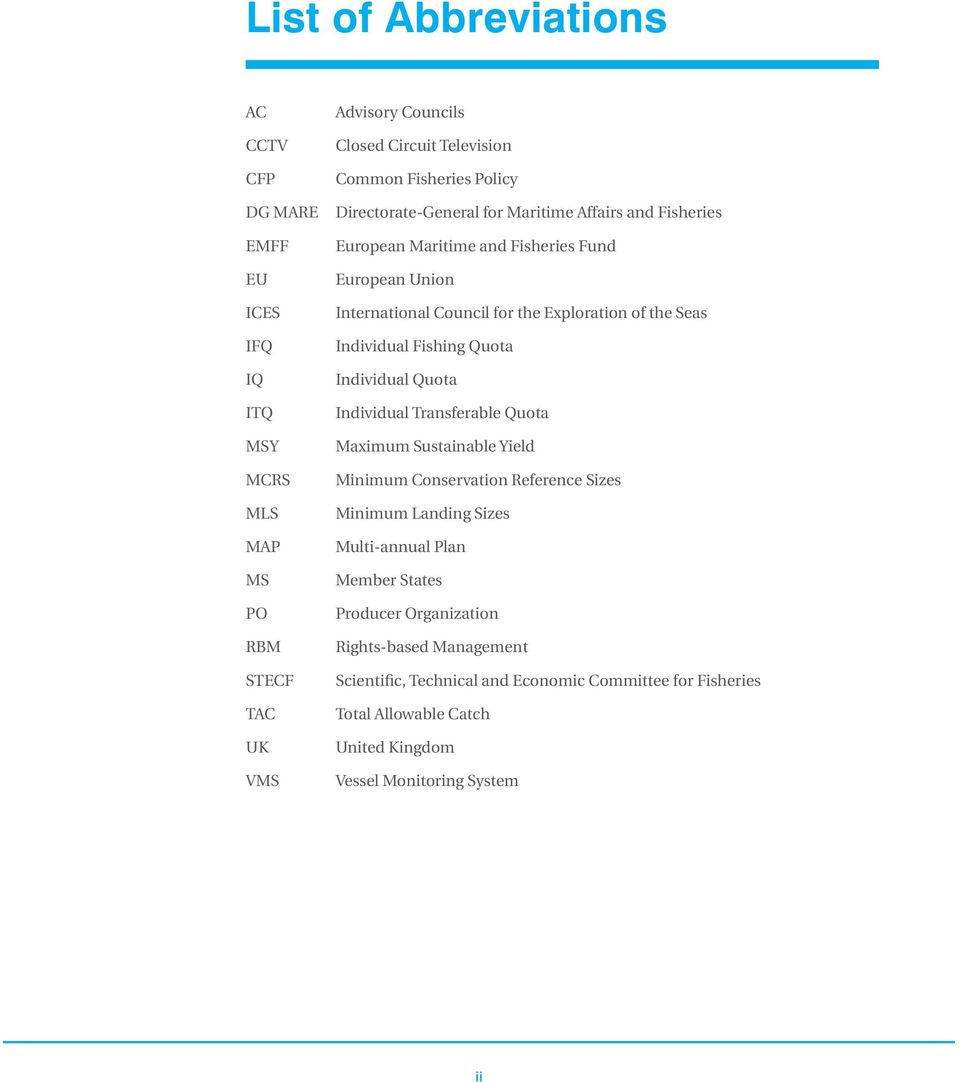
4 List of Abbreviations AC CCTV CFP DG MARE EMFF EU ICES IFQ IQ ITQ MSY MCRS MLS MAP MS PO RBM STECF TAC UK VMS Advisory Councils Closed Circuit Television Common Fisheries Policy Directorate-General for Maritime Affairs and Fisheries European Maritime and Fisheries Fund European Union International Council for the Exploration of the Seas Individual Fishing Quota Individual Quota Individual Transferable Quota Maximum Sustainable Yield Minimum Conservation Reference Sizes Minimum Landing Sizes Multi-annual Plan Member States Producer Organization Rights-based Management Scientific, Technical and Economic Committee for Fisheries Total Allowable Catch United Kingdom Vessel Monitoring System ii
5 Figures, Snapshots and Tables Figures 1.1 Tools Discussed in this Manual Questions to Guide the Use of this Manual Using Inter-species Flexibility Levels of Transferability Permanent Tranferability Temporary Transferability 15 Snapshots 3.1 Providing Resilience for Climate Change A Note about Relative Stability and Trading Platforms United States Alaska Halibut and Sablefish Fixed Gear Individual Fishing Quota (IFQ) Program United States Pacific Coast Groundfish Limited Entry Trawl Individual Fishing Quota Program Use of Risk Pools to Manage Choke Species Choke Species in Mixed Fisheries Addressing Technical Measures Under the New CFP Pacific Whiting Conservation Cooperative Designing with the Goal to Reduce Bycatch Scotland Conservation Credit Scheme Challenges for Swedish Innovation: Perspective from a Swedish Fisherman United Kingdom North Sea and English Channel Discard Pilot Projects The Danish Fisheries Traceability System United Kingdom Project 50% 42 Tables 3.1 Examples of Stakeholder Groups who Have Implemented and Managed RBM Trade Platforms 24 iii

6

7 Introduction Fishermen in the European Union (EU) are facing a whole new set of rules and incentives under the new Common Fisheries Policy (CFP). One of the most important changes is the landing obligation (Article 15), which requires fishermen to record, land and account for, through presentation of quota, all catches subject to catch limits. This is a paradigm shift from the former regulatory framework, within which fishermen were not actively encouraged to avoid discarding and, in fact, were often compelled to discard huge amounts of fish. The discarding was tied to limited landing quota allocations for target species, as well as Minimum Landing Sizes (MLS), catch composition rules and few or no regulations concerning mortality at sea. The implementation of the CFP will require a big operational change for EU fleets and fishery managers, and fishermen will have to work together to find solutions. This guide explores a broad suite of design tools to help EU fisheries meet the requirements of the landing obligation while also providing the EU fishing industry, managers and key stakeholders with best practices that have worked in fisheries around the world. This guide is not prescriptive; rather, it discusses different options that can be tailored to the diverse circumstances and variety of fisheries in EU waters. 1 There are two main categories of tools addressed in this guide: the first concerns the smarter use of available quota under a total allowable catch (TAC), while the second concerns increased selectivity and avoidance measures. The first set of tools looks at how to ensure the EU and Member States (MS) use their available TAC in the smartest way under rights-based management (RBM). 2 RBM under quota programs refers to scenarios in which fishermen, fishing cooperatives or fishing communities are granted a secure, exclusive share of the Member State s EU catch quota, preferably in return for full accountability for meeting catch limits. Fisheries around the world have demonstrated the ability to drastically reduce discards through the implementation of quota-based RBM systems with individual or group rights, responsibilities and rewards. When coupled with a monitoring system to prove compliance, RBM can help meet the core requirements of the new CFP by significantly reducing discards and providing 1 EU fisheries can be categorised in many ways. However, in terms of the landing obligation, the clearest distinction is between management of species categorized by catch limit (i.e. total allowable catch [TAC]) and non-catch limit stocks. All species subject to a catch limit are subject to the landing obligation. In addition, Mediterranean species with a minimum conservation reference size (but without a TAC) are also subject to the landing obligation. 2 RBM programs include any system of allocating individual fishing rights to fishermen, fishing vessels, enterprises, cooperatives or fishing communities (EC, 2007). 1
8 full documentation of the fishery. It also provides benefits that many other fishery management systems have been unable to attain, including ending the race for fish and improving economic performance (Essington, 2010; Grafton et al., 2000). One of the most important, and sometimes misunderstood, aspects of RBM is its flexibility in design. Given the diversity of EU fisheries, fleets and industry structure, RBM can be tailored to best meet the characteristics of each fishery and directly address the issues driving high rates of discarding. Each country and fishery should evaluate the options provided in this guide to determine the most appropriate design tools based on the legal and political structures of that country, as well as the fishery characteristics and wider goals. This guide highlights some of the options that can be employed to design an RBM system with a particular focus on reducing discarding. The smart quota tools discussed in this guide include: Inter-species flexibility: substitutes one species quota to cover catch of a different species based on a weighted formula, typically allowing the more valuable species quota to be traded for a larger amount of quota of a less valuable species (i.e. not a 1:1 ratio quota exchange). Banking and borrowing: allows a portion of Member States species catch quota to roll over to the next year. Risk pools: fishermen cooperatively pool their species quota together, allowing them to access quota without requiring the purchase of quota on the market. This solution essentially acts as an insurance policy for vessels and relies on and increases trust between fishermen working through a cooperative approach. Buffer quotas: portions of an individual Member State or community s quota units are set aside from the total quota to be released by the Member State or the community quota group when deemed necessary (i.e. can be used where choke species are an issue). Transferability of quota (permanent and temporary): allows fishermen (or groups of fishermen or Member States) to sell or lease quota to align quota holdings with the composition of the catch. Deemed values: requires fishermen who land species for which they do not have quota to pay a pre-agreed fee to the government. The second set of tools relies less on a change in the management of the quota available to the fishery, as proposed in the first set. Rather, it focuses on a change in the day-to-day operation of the fishing industry on the water. The tools that offer increased selectivity and avoidance are also the only tools available to deal with the issue of undersized 2

9 catches, which will be especially important for the implementation of the landing obligation in the Mediterranean. It is important to note that these tools are not exclusive to RBM and can be implemented in both RBM and non-rbm fisheries. The second set of tools highlighted in the guide includes: Avoidance measures: fishing behaviors and techniques that can reduce discarding, including fishing at different depths, gear-switching and temporal changes. Technologies to improve selectivity: technological advancements that can help improve the selectivity of gear. Real-time spatial and temporal closures: ad-hoc temporary closures that avoid areas with high juvenile catch rates or hot spots of choke species. This guide is not intended to provide a single set of tools to address discards across all types of fisheries. Some fisheries may find that a single tool will be sufficient to address discards, while other fisheries will need to use a combination of tools to satisfy landing obligation requirements. The key will therefore be to incorporate stakeholders knowledge and tailor solutions to specific fisheries. Finally, no matter which set of tools or combination of tools a fishery decides to pursue to meet the landing obligation, all fisheries will have to address the requirement for full documentation. With full documentation, not only will fishermen meet landing obligation requirements and be accountable for their catch, but also all stakeholders will benefit from improved fishery science. This will be crucial in advancing any justification for quota uplift. EU advisory bodies such as the International Council for the Exploration of the Seas (ICES) and the Scientific, Technical and Economic Committee for Fisheries (STECF) have clearly stated their requirement for data of high confidence prior to approval for quota uplift. 3

10

11 1 How to Use this Guide There are many ideas and initiatives that aim to support implementation of the landing obligation. Before considering those options, it is important to understand which factors make it challenging for a particular fishery or Member State to meet the landing obligation. We have separated these into two broad categories, which are discussed in greater detail later in this guide: 1. Matching quota to catch Where the catch does not always reflect the quota allocation, the challenge is efficient quota allocation and how to match quota to catch. This logic applies to issues both at the Member State level and at the individual fishery level. In this scenario, the question becomes, How to design a system that matches catch to quota allocation? Design solutions to this scenario are covered in Section 3 Smart Use of Available Quota. 2. Avoidance and gear selectivity Where the EU TAC does not cover the total EU catch, or the Member State or fishery level catch is higher than the allocated quota (as in the case of fleets that have been discarding), the question becomes, How can the EU and/or Member State fleets catch less of this stock? Design solutions for dealing with this issue are covered in Section 4 Selectivity and Avoidance Solutions. Both scenarios may describe relevant challenges faced by some fisheries requiring the use of both avoidance and gear selective strategies with improvements in management of quota to reach discard reductions. Using the tools listed Sections 3 and 4 together can provide a powerful combination to secure the change needed to meet the landing obligation and be a powerful aid to enabling fishermen to innovate, respond, adapt and be rewarded for these efforts. In each circumstance, the implementation of the landing obligation should be incentivized and controlled through an appropriate system of full accountability and documentation. See Section 5 Options to Meet Full Documentation. Note that, in all likelihood, there will be a need for selectivity and better use of available quota in most fisheries. However, for species subject to minimum conservation reference sizes in the Mediterranean, only selectivity and avoidance measures are relevant. FIGURE 1.1 Tools Discussed in this Manual Tools for the Smart Use of Available Quota Tools for Selectivity and Avoidance Inter-species flexibility Avoidance tools Banking and borrowing Technology improvements Risk pools Incentives Buffer quotas Transferability of quota Deemed value 5

12 FIGURE 1.2 Questions to Guide the Use of this Manual Regulations prevent you from accessing additional quota You are concerned the landing obligation will cause a race for fish You want flexibility in the use of quota provided in the fishery You do not have enough quota to cover your discards You are concerned that choke species will shut down your business If you answer yes to any of these statements, please review Section 3: Smart Use of Available Quota You want to improve the efficiency of quota use in your fishery Your quota does not match your catch There is no communication between fishermen when hotspots of juveniles or choke species are found If you answer yes to any of these statements, please review Section 4: Selectivity and Avoidance Solutions Initial capital upfront cost prevent use of new avoidance technologies Technical measures are impeding your ability to reduce discards Your quota does not match your catch Your target species are managed by minimum landing sizes rather than TACs EU wide TAC does not cover the total catches of the EU fleet 6

13 2 Before You Begin As a key centerpiece of its recent reform of the CFP, the EU has put in place an obligation to establish full catch accountability and to gradually eliminate discards by taking into account the best available scientific advice and emphasizing avoidance and reduction of unwanted catches. Known as the landing obligation, these new requirements will be gradually implemented from 1 January 2015 through The implementation will begin with pelagic species and some Baltic demersal species, followed by the remaining demersal species and finally will extend to all remaining species under EU jurisdiction and subject to catch limits or minimum landing sizes. 3 The landing obligation represents a significant challenge to fishermen, Member State governments, Advisory Councils, the Directorate-General for Maritime Affairs and Fisheries (DG MARE) and other stakeholders who have in the past worked under a totally different incentive structure for catching and landing fish. Under the old CFP, fishermen were not actively encouraged to avoid discarding and there was little or no regulation concerning mortality at sea. Instead, fishermen faced multiple constraints on fishing behavior, in effect telling them how to fish, in an effort to keep within annual quota and harvesting levels. Unfortunately, these regulations solely targeted what was being landed and frequently ignored what happened to total mortality at sea, where fishermen often felt compelled to discard huge amounts of: quota (this type of discarding, done because of a 3 The new CFP also calls for an end to overfishing by 2015 for most TAC species and by 2020 at the latest for all such stocks; CFP Article 2.2 sets an objective of rebuilding depleted fisheries to abundance levels above the Maximum Sustainable Yield. Please see Appendix A for details on implementation deadlines by species group under the landing obligation. lack of available quota, is referred to as regulatory discarding) discarding) marketable fish (this is called high grading or economic discarding) Often, the piecemeal quota allocation has not reflected the catch composition of the mixed fisheries, nor has the allocation under the principle of relative stability rules (see page 56) been flexible enough to adjust for changing fishing patterns, consumer demand by Member State or stock movements through time. While relative stability does offer recognized advantages, such as providing Member States with a guaranteed share of the annual overall TAC and prevention of allocation disputes between Member States, at times it has put industry under limited flexibility and rigid management, resulting in high regulatory and economic discards, economic inefficiencies and some negative implications for economic and ecological sustainability. Although the landing obligation may be challenging in its own right, it may lead to an increase in quota swaps and help drive a review of the current EU and Member State quota management. Fishery managers in all Member States will need to put in place management measures that make the landing obligation practical and workable. Their reforms will need to both (1) achieve compliance with the new requirements and (2) enable fishermen to continue to operate profitably. This guide offers fishermen and managers guidance on how to meet these two goals. Making the change will be 7

14 challenging but it is far from impossible; existing fisheries have demonstrated that they can both prosper and radically reduce their discards. Examples from around the world include: in the North Pacific fisheries for sablefish and halibut in British Columbia (Branch, 2008; Fujita et al., 1998). In the same fishery in Alaska, non-target TAC species discards declined by 14%, from a discard rate of 24% before the program implementation to 10% after program implementation (Branch, 2008; Fujita et al., 1998). American fisheries after management reform was implemented (Essington, 2010). Groundfish Limited Entry Trawl IFQ program dramatically decreased after the first year under RBM. These reductions ranged between 10% and 97% of the prior season levels, depending on the species (NOAA, 2012). Under the previous management program, these fish would have been discarded at sea rather than retained on the vessels. between the Devon Beam Trawler Fleet and United Kingdom scientists in the English Channel, successfully reduced discards by 52% on average, with some vessels reaching a 69% reduction in their discard rate (Armstrong and Revill, 2010). While all of these fisheries exhibit different characteristics, such as operating under a different set of rules, different political frameworks and a range of targeted species, what is common to all of them is their use of smart quota management tools and techniques to reduce their discarding while still remaining economically viable. As such, while there is clear recognition of the immensity of the challenge for EU fleets, there are evidence-based examples from around the world in which reducing discarding has been not just possible but possible under conditions of continued viability for fishing fleets. This guide is not prescriptive. Rather, it offers a menu of possibilities. It covers the key design challenges of the landing obligation, including how to avoid choke species and unwanted catch, and offers different design solutions to guide and inform the process depending on the needs of a particular fishery. Detailed discussions about how to design systems to reduce discarding are provided and coupled with case studies that highlight how fisheries facing similar challenges have successfully designed and implemented systems that reduce discards. The design advice presented here draws on the experience of both European fisheries and other well-managed sustainable fisheries around the world. 8

15 3 Smart Use of Available Quota 3.1 BACKGROUND One proven approach to reducing discarding dramatically is the introduction of: fisheries to prove compliance. This powerful combination of tools allows for flexibility, innovation and improved economic performance while at the same time enabling industry to meet stringent environmental targets. RBM is a system that provides the fishing industry with an important mix of rights, responsibilities and rewards. In RBM quota programs, fishermen, fishing cooperatives or fishing communities are granted a secure, exclusive share of catch quota in return for full accountability for meeting catch limits. In exchange for full, individual accountability, the individual fishermen and vessels are held to their own actions. No longer are fishery managers allowed to close a fishery because a single vessel has overshot its quota. Instead, all vessels with quota are allowed to continue fishing until their quota holding is exhausted. Fisheries operating under RBM quota programs have shown increased resilience in the face of environmental fluctuations and market disruptions. Research has shown that RBM programs are able to reduce discards, as well as meet other economic, environmental and societal goals, including: stocks (Costello et al., 2008) (Branch, 2008) (Essington, 2010) safer and more sustainable jobs (Crowley and Palsson, 1992; Gislason and Associates., 2008; Knapp, 1999; McCay, 1995) increase in the profits and value of fisheries (Grafton et al., 2000; Newell et al., 2005) (Sylvia et al., 2008) with greater autonomy for fishermen to demonstrate their compliance with the rules so long as overarching targets are adhered to (Bonzon et al., 2010; Makino, 2011) RBM works by each fisherman, community or cooperative agreeing to limit catch to a pre-determined level, enabling management systems to move away from the complex and often frustrating fishing effort controls (including those that incentivize regulatory discarding) that are used under conventional fishery management systems. Under RBM with full accountability, the European Commission and Member States should be able to envisage a scaling back of effort limits like days at sea, vessel capacity requirements, tow times or other constraints imposed by regulations. Rather, individual business plans can drive the decisions of each fishery participant to allow for economic optimization, while fishery managers can tailor regulations 9

16 specific to a fishery, all under a system of full accountability and documentation. This guide is not a comprehensive roadmap for the design of an RBM system from beginning to end (details of such a process can be found in the Catch Share Design Manual, Volume 1: A Guide for Managers and Fishermen). Rather, it highlights how the smart use of available quota can be employed to meet the landing obligation. While not all of the tools discussed below require an RBM system to attain a successful reduction in discards, RBM provides numerous benefits that are not achievable under conventional fisheries management. When RBM has been coupled with tools found in Section 4: Selectivity and Avoidance Solutions, improved performance and reduction in discards have often been achieved. As full documentation is required under the new CFP, Member States will have to design monitoring systems regardless of their decision to implement RBM or not. Implementing a monitoring system requires that challenging and sensitive issues, such as personal privacy and private data concerns, be addressed. This requires stakeholder engagement. While challenging, the benefits of full documentation often far outweigh the challenges (See Section 5 to learn more about monitoring). Some of the benefits include: possible to prove they are complying with the discard ban and other marine environmental regulations trust in the data from fishermen fishery managers, scientists and other relevant stakeholders such as environmental groups Fisheries around the world are demonstrating these positive outcomes under RBM management through full documentation. Some EU fisheries are already working to identify a full documentation monitoring system that can address their needs. Coupling the advancements in monitoring with the introduction of an RBM system will help to further the biological, economic and social performance of these fisheries. 3.2 SMART QUOTA TOOLS To address the discard ban through a landing obligation, there are many design features 4 (referred to from this point forward as smart quota tools ) available to customize customize a program, for specific fishery and fleet characteristics. Member States, fishery managers and fishermen can develop and test these tools through the development of multi-annual plans (MAPs) that give their stakeholders greater autonomy to devise and set the rules that govern their fisheries. Much here relies on the Commission and Member States willingness to scale back from current technical measures so that a framework of true regionalization can be developed. The regional groups must also embrace the knowledge within the Advisory Councils so that genuine bottom-up driven comanagement can be secured. 4 Design features are a set of tools and choices that are incorporated into a fishery management program. When creating an RBM program, there are many design feature options that can be adopted. Ultimately, design features should be chosen based on their ability to reach the program s stated goals. In this context, the document focuses on design features that will minimize discards, manage choke species and help address unavoidable and unwanted catch. With properly designed systems, and in conjunction with existing and future MAPs and their discard plans, there is an opportunity not only to improve economic performance for fleets but also to enable fleets to meet the requirements of the new CFP. Presented below are some of the options for smart quota management Inter-species flexibility The new CFP allows for limited quota transfer between different species subject to the landing obligation and that are within safe biological limits (up to 10% of permitted landings see Article 15[9]), called inter-species flexibility or weighted transfer of quota. 5 Similarly, under existing RBM systems, some multi-species fisheries allow 5 For stocks subject to the landing obligation, Member States may use a year-to-year flexibility of up to 10% of their permitted landings. For this purpose, a Member State may allow landing of additional quantities of the stock that is subject to the landing obligation provided that such quantities do not exceed 10% of the quota allocated to that Member State. Article 105 of Regulation (EC) No 1224/2009 shall apply. 10

17 3 SMART USE OF AVAILABLE QUOTA Inter-species Flexibility BEST PRACTICES science-based evaluations. interspecies transfers. participants to substitute the concessions from one species to cover catch of a different species (i.e. shares for species B may be used to cover catch and landings for species A). In many cases, more vulnerable or more valuable species cost more in terms of shares than another species (i.e. a portion of a more valuable species quota can be traded for a larger portion of quota of a less valuable species). The use of inter-species flexibility brings an additional layer of complexity to program design and infrastructure. Interspecies flexibility would need science-based evaluations to determine appropriate transfer amounts, in order to ensure stocks are not adversely affected. A real-time trading platform to track and monitor the use of landings would be strongly advised. For example, in a worst-case scenario, all EU fisheries would use 10% of other quota to cover catches FIGURE 3.1 Using Inter-species Flexibility QUOTA EXCHANGE RATE 3 = 1 FISHERMAN A FISHERMAN B Fisherman A needs quota for 2 fish, but only holds quota for 10. Through interspecies flexibility transfers, he/she can receive quota at a transfer based on a quota exchange rate of 3 for 1. Before Exchange Fisherman B has extra quota and is looking for a temporary transfer. After Exchange 11

18 SNAPSHOT 3.1 Providing Resilience for Climate Change Overfishing is only one of the multiple drivers affecting the health of global fisheries. Climate change, habitat degradation and pollution are all threatening the sustainability of fisheries worldwide (Sumaila et al., 2011). Research, observations and modelling exercises have demonstrated that one of the most significant concerns will be the impact of climate change on the distribution and range of fish species and stocks (Sumaila et al., 2011). With some key regional fisheries already experiencing these changes, as with the recent dispute over mackerel between the EU, Iceland and the Faroe Islands, fishermen and fishery managers will undoubtedly have to address these issues in the near future. RBM can provide mitigation opportunities to manage the challenges posed by climate change. Changes to range and distribution of species and stocks will most likely manifest in issues of catch not aligning with allocated quota. Smart quota tools provided by RBM programs are some of the few options available to date that will be able to address these issues. Tools such as transferability of quota between Member States and within an ICES region will provide flexibility for industry and managers to match catch to quotas. Inter-species flexibility managed by RBM provides an additional opportunity to manage changes in fishery composition. When stock changes extend beyond borders, mere transferability will not be enough, but it may offer some useful options. While RBM may not be able to address all the many challenges associated with climate change, it can provide industry with options that will allow resilient and adaptable management that is not available under traditional fisheries management. for one specific choke species. Unfortunately, such flexibility may in fact force ICES scientists to set an even lower overall TAC for the choke species to allow for that probability. The increased complexity in trades associated with inter-species flexibility and the need for caution in TAC-setting for choke species may make this option less attractive. The use of cod equivalents in the Icelandic Individual Transferable Quota System is a successful example of inter-species flexibility. In this system, all species in the quota program can be traded according to set conservation rates of cod (see Figure 3.1). These rates are established by Iceland s Ministry of Fisheries and can be viewed on the ministry s website Banking and borrowing Under the new CFP, as stated in Article 15(9), Member States are provided flexibility to roll over 10% of catch quotas to the next year. The mechanism is alternately termed banking and borrowing, quota rollovers and inter-annual quota flexibility. While this flexibility mechanism is provided to Member States, benefits will be realized most greatly if implemented at the individual fishermen/vessel level. If secured rights in a fishery are provided to fishermen and fishing entities coupled with full accountability, these fishing participants would then be provided with increased flexibility to plan their harvests each year. In some cases, fishermen may plan to over- or underharvest their quota as a part of their business model. In other instances, fishermen may accidentally catch more of a species than they hold quota for within a given year. Alternatively, due to bad weather or other circumstances, they may not actually use their full allocation. The CFP provides for the opportunity to allow fishermen operating under individual quota entitlements to make their own decisions regarding business plans, rather than be confined to detailed regulation. This tool could prove immensely helpful should a fisherman have a disaster haul (i.e. a 12

19 single haul comprised largely of choke species that exhaust an individual s annual quota allocation). Allowing a quota rollover can serve as insurance to fishermen that they can borrow against the next fishing year. The primary consideration when creating rollovers is that the overages or underages of quotas are recorded and enforced over the entire fishing season. Real-time data collection systems are very important and will be especially essential to the application of banking and borrowing at the individual vessel and fisherman level. Nonetheless, this is an important flexibility. It could be even further developed to incorporate an interest rate equal to net mortality and growth of the resource, which could be calculated and added to a participant s holding. For example, 1,000 kilograms of cod quota left in the water for another year may be worth 1,050 kilograms the next year, as the fish would theoretically grow in size before harvest (Grafton et al., 2006). This concept, although theoretically sound, has not yet been tested in a fishery and may be suitable for incorporation in a pilot project (Grafton et al., 2006) Transferability of quota Transferability of quota means allowing a Member State, individual or group to buy, sell, exchange (often called swapping in the EU context) and/or lease quota to and from other Member States, individuals or groups within a specific fishery (Bonzon et al., 2010). Quota is often transferred to allow the entity holding the quota to match catch composition. This can prevent landings from exceeding the catch limit (called overages) or enable fishermen to sell unused quota to others. LEVELS OF TRANSFERABILITY FIGURE 3.2 Levels of Transferability Transferability can be implemented at different levels to help align quota with the needs of each individual entity. 1 Country to country Example: EU member states 2 Fisherman Cooperative to fisherman Cooperative Example: U.S. Bering Sea and Aleution Island Crab Rationalization Program 3 Fisherman to fisherman Example: British Columbia Integrated Groundfish Program 4 Fisherman cooperative to fisherman Example: Risk pools in U.S. Pacific Coast Groundfish Limited Entry Trawl Individual Fishing Quota Program 13

20 Permanent Transferability FIGURE 3.3 Permanent Transferability TWO SCENARIOS FISHERY Allocated 3 long-term shares Allocated 3 long-term shares shares shares ORIGINAL FISHERMAN 1 ORIGINAL FISHERMAN 2 Fisherman 1 permanently sells all 3 long-term shares to an existing fisherman or a new entrant and exits the fishery Fisherman 2 permanently sells 2 long-term shares to an existing fisherman or a new entrant shares share shares FISHERMAN 1 EXITS OTHER FISHERMAN FISHERMAN 2 OTHER FISHERMAN Long-term shares are converted to annual allocations* each season for all participants: 1 = 2 fish fish fish OTHER FISHERMAN FISHERMAN 2 OTHER FISHERMAN Season ends shares share shares This fisherman holds 3 long-term shares Fisherman 2 holds 1 long-term share This fisherman holds 2 long-term shares Key Originally allocated long-term share Permanently transferred long-term share * Annual allocation units can be in weight or number of fish. 14
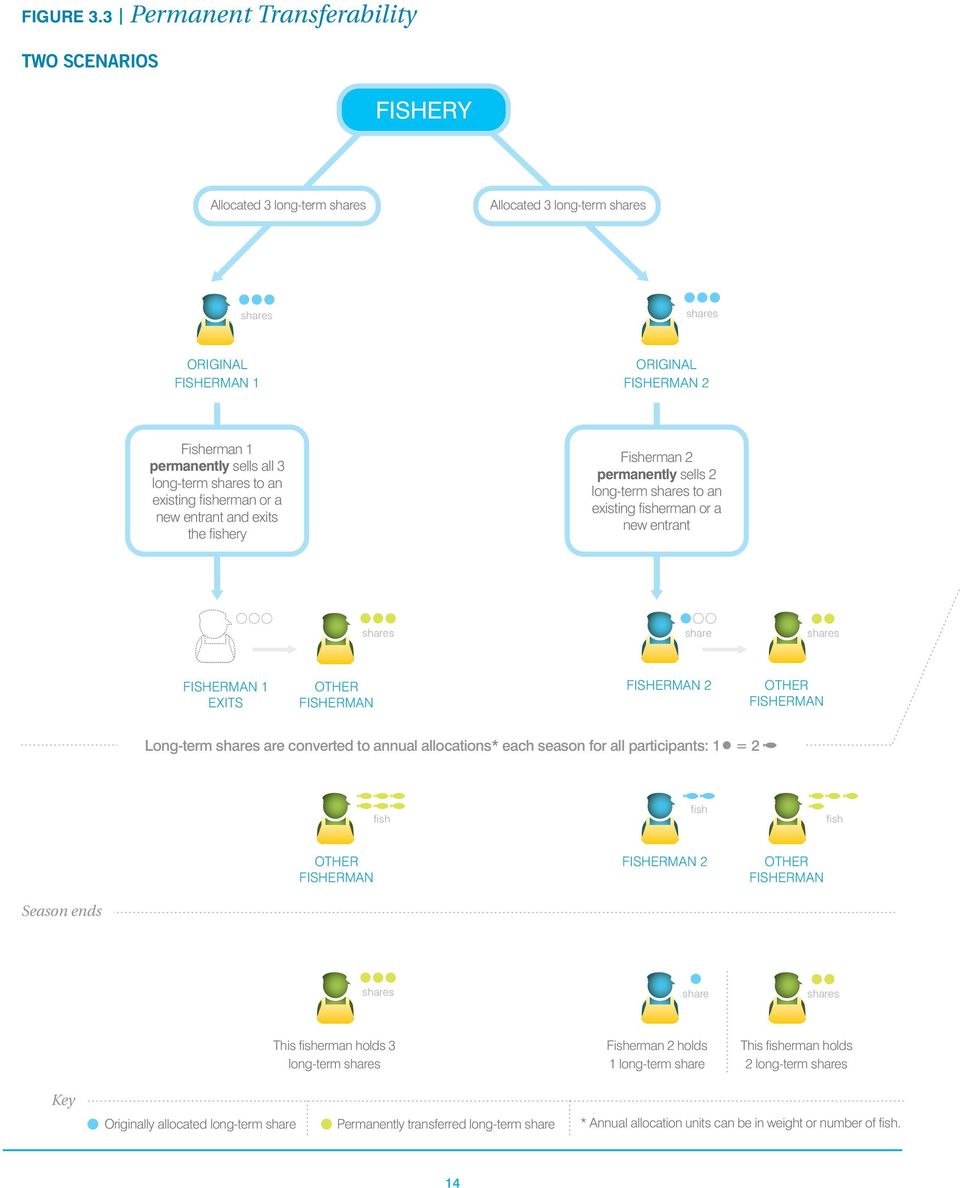
21 Temporary Transferability FIGURE 3.4 Temporary Transferability 3 SMART USE OF AVAILABLE QUOTA TWO SCENARIOS FISHERY Allocated 3 long-term shares Allocated 3 long-term shares shares shares ORIGINAL FISHERMAN 3 ORIGINAL FISHERMAN 4 Long-term shares are converted to annual allocations* each season for all participants: 1 = 2 fish fish FISHERMAN 3 FISHERMAN 4 Fisherman 3 temporarily leases his entire annual allocation for this season to an existing fisherman or a new entrant Fisherman 4 temporarily leases a portion of his annual allocation for this season to an existing fisherman or a new entrant fish fish fish FISHERMAN 3 OTHER FISHERMAN 4 FISHERMAN OTHER FISHERMAN Season ends shares shares The temporary lease ends and Fisherman 3 begins the new year with his original long-term shares The temporary lease ends and Fisherman 4 begins the new year with his original long-term shares Key Originally allocated long-term share Temporarily transferred annual allocation * Annual allocation units can be in weight or number of fish. 15
22 In the context of addressing discards, transferability can be implemented at different levels to help align quota with the needs of each individual entity (see Figure 3.2). Transferability can occur at the EU level between Member States or at the level of individual fishermen, fishing cooperatives, fishing communities and/or fishing businesses such as the Producer Organizations (PO) that hold and manage quota allocations in many Member States. The more individuals and groups that are allowed to participate in the design feature of transferability, starting from intra-member State up to inter-member State, the more effectively the concerns of aligning quota with catch to avoid discarding can be addressed. Allowing for formalized quota transfer opportunities within a Member State and between Member States provides an opportunity to design RBM systems that can best meet the landing obligation. A program may allow for quota to be temporarily transferred also called leasing or exchanging between participants or permanently transferred (i.e. sold) (see Figures 3.3 and 3.4). The primary difference is that at the end of the season, leased quota is reverted to the original quota holder for the next fishing season. Permanently transferred quota, on the other hand, remains with the new holder. Transferability is beneficial because it increases flexibility for fishermen to trade their quota through an efficient and effective process while still being able to meet overarching goals and stay within maximum sustainable yield (MSY) limits (Bonzon et al., 2010). It is important to note that permanent transfers can be achieved within Member States but not between Member States under the principle of Relative Stability. However, in practice legal agreements are drawn up to support the annual transfer of quota units on an extended basis Consideration for transferability When designing the attribute of transferability, the fishery s goals should guide the decision-making process. There are many ways to design and implement transferability that can significantly impact the outcome performance of a program transferability can help new entrants in a fishery, and improve the economic efficiency of a program. However without being designed to a program s goals, transferability may lead to negative social outcomes (Bonzon et al., 2010). Below are some considerations regarding transferability s connection to social and fleet composition goals. Social Goals When implementing a transferable RBM program in a fishery or within a Member State, participants may aim to maintain historical fleet structure by preventing quota transfers to non-fishing entities and limiting concentration of quota. There are multiple safeguards that can be designed into an RBM system to address or prevent such outcomes. These safeguards include the use of concentration caps (i.e. limits) on the percentage of fish shares that any individual, PO, cooperative or community group may hold and/or may fish. This prevents excessive quota consolidation the level that defines excessive can be different for different fisheries based on the fishery s goals from occurring in the fishery. Fisheries may also choose to require quota holders to be on-board when fishing, a design feature called an owner-on-board requirement. In this scenario, quota may not be harvested if the owner is not physically present on the vessel. Some fisheries elect to set a percentage of quota to be landed in the owner s presence (for example, at least 60% must be landed with the owner on-board while the remaining 40% can be landed in the owner s absence). This allows the owner to have some flexibility while preventing absentee skippers in the fishery, should absent skippers be an identified concern. In addition to a maximum amount of quota permitted to be held by an individual or entity through a concentration cap, an RBM program may want to consider establishing a use it or lose it clause or a minimum quota level required by a vessel to operate in the fishery A use it or lose it clause is when vessels are required to catch all held quota themselves or trade all held quota to another entity for harvesting. This can prevent vessels from changing their effort from the existing fishery to target a new fishery and species, resulting in the potential for significant effort shifts and can prevent the loss of economic opportunities. 16
23 3 SMART USE OF AVAILABLE QUOTA The RBM program may also want to consider grandfathering in vessels with historically high landings compared to the fleet average to prevent existing participants from being ineligible for the system. It is important to consider that the inclusion of these tools may reduce the program s economic efficiency. The identified fishery goals should inform which tools should be used in the design of a program. Transfers at the EU and Member State level Quota transferability at EU and Member State level will be important with the new landing obligation, as it can be expected that the Member State quota allocation will not necessarily reflectcatch of fishing operations. This has been an issue, for example, within the whiting fishery targeted by fleets from France and the United Kingdom (UK). Prior to the new CFP, France had historically transferred whiting allocations to UK fishermen, as whiting was not a target or valuable species for the French fleet. Under the new landing obligation, however, fleets will need to retain their allocated whiting quota, as all captured whiting is required for landing. This will leave the UK fishermen in a difficult situation in which quota will need to be acquired from a new source (Park, personal communication, 2015) Should quota be transferable between Member States at the individual fishing level, there may be concerns regarding the permanent loss of quota from one Member State to another. This can be addressed in two potential ways. First, only temporary transfers of quota between Member States would be allowed. In this scenario, at the beginning of each year, Member States would revert to their original quota percentages as determined by their share under the principle of relative stability. This type of temporary transferability is already occurring within Member State allocations each year. (Please see page 56: Principle of Relative Stability and Member State Transfers.) Strengthening this design feature can help relieve the existing concerns about permanently losing quota to other fishing nations. The second option is to limit the amount of quota eligible for transfers between Member States altogether. This type of transferability constraint would set a concentration cap that would limit the amount of quota leaving one Member State to be held by another Member State to a level deemed acceptable. This may be a viable option if Member States wish to ensure the historical level of participation of fishing fleets within their own borders is maintained or in situations in which there are strong social objectives within a Member State. SNAPSHOT 3.2 A Note about Relative Stability and Trading Platforms In double-mixed fisheries fisheries where both stocks and Member States are mixed together transferability of quota to align catches with vessels and avoid discarding and inefficiency provides both opportunities and challenges. A good deal of international trading already occurs between Member States each year to align quota with fishing interests on a national level (Anderson et al., 2009). Because relative stability ensures that quota distribution reverts each year to the same starting point, it provides some protection against the permanent transfer of quota between private fishing interests, which may be a concern to some Member States or fisheries. On the flip side, Member States wishing to take advantage of choke species closures will need to develop enhanced mechanisms for trading quota across national lines to maximize the usefulness of this tool in reducing catches in excess of quota holdings. 17
24 PHOTO: SCOTT DICKERSON SNAPSHOT 3.3 United States Alaska Halibut and Sablefish Fixed Gear Individual Fishing Quota (IFQ) Program At the establishment of the U.S. Alaska Halibut and Sablefish Fixed Gear IFQ Program, fishery managers and fishermen identified the retention of historical fleet structure as a key goal. To meet this goal, concentration caps became a key implemented design feature, in addition to strict participant eligibility and restrictions on trading. Concentration caps are used in two different levels within the fishery, specifically: 1. Vessel IFQ cap A concentration cap to limit the amount of quota fish a vessel is allowed to land per year. 2. Quota share use A concentration cap to limit the amount of long-term shares held by a single fishery participant. This cap ranges from 0.5%-1.5%, depending on the management zone (there are multiple zones based on biological stock locations). Some fishermen were grandfathered into the program with larger holdings based on their historical landing values (McIlwain, 2013). These concentration caps have played a significant role in the performance of the program. Since the implementation of the program, the fleet has been successful in maintaining its historical structure and has prevented the ownership of quota by corporations (McIlwain, 2013). Additionally, owner-on-board provisions have supported a fleet of owneroperators (McIlwain, 2013). 18
25 3 SMART USE OF AVAILABLE QUOTA Transferability BEST PRACTICES between participants. social goals. introduce the concept of transferability to participants. Transfer from accountable to unaccountable sectors Accountability occurs when individual vessels and fishermen are responsible for staying within their quota through effective monitoring systems. If quota is transferred from accountable to unaccountable sectors, discard reduction goals and additional stated program goals can be undermined. This may be an area of concern in the issue of flagging (i.e. when one Member State vessel fishes under another Member State flag), creating a potential loophole for quota to be landed by other participants who may lack individual accountability measures. To help prevent such scenarios, clear transferability eligibility and enforcement should be established in the design of the program to ensure that quota is only transferred to eligible participants. Under the CFP, enforcement is a Member State competence, meaning it is the responsibility of the Member State to adopt appropriate measures. It is therefore essential that Member States accessing fishery resources in shared waters work cooperatively to find enforcement solutions, through multijurisdictional agreements promoted by regionalization to create a level playing field. For additional design options and safeguards regarding transferability, please see Catch Share Design Manual, Volume 1: A Guide for Managers and Fishermen. One concern is that improved transferability will create a price spike in choke species quota, which could become prohibitively high. To clarify, transferability does not cause a price increase. Rather, it is the scarcity of quota for choke species that makes quota costly. Without transferability, there would be no price. But there would also be no fishing, because reaching quota limits would shut down fishing. When transferability is allowed, an increase in the pool of people eligible to receive transfers can increase the demand and therefore the price for the same amount of limited quota. In these circumstances, transferability will further incentivize selectivity. Some fishing sectors will improve their catch selectivity so that they can sell their unused quota to others. In these cases, vessels are incentivized to increase their selectivity while providing additional income from the selling of unused quota to others. Experience has shown this can lead to increased cooperation among fishermen, including information-sharing, risk-pooling and bycatch reduction (Ovando et al., 2013; NOAA, 2012) Risk pools A risk pool is a collectively managed quota holding that brings members choke species quota together to be managed in a collaborative way. Individual vessels pay to be a part of the quota pool in exchange for access to additional choke species quota, should their vessel exceed its allocated amount. This essentially allows fishermen to spread risk across the collective group. Payment may be in the form of money, quota or a combination thereof, to be determined at the discretion of the cooperative s participants. Typically, joining a quota pool requires members to adhere to additional discard avoidance measures (e.g. voluntary closures, gear switching, etc.) determined by the group. These features provide a safety net for vessels while providing an incentive for innovation in avoiding choke species. 19
26 SNAPSHOT 3.4 United States Pacific Coast Groundfish Limited Entry Trawl Individual Fishing Quota Program Use of Risk Pools to Manage Choke Species PHOTO: COREY ARNOLD In 2011, the U.S. Pacific Coast groundfish fishery transitioned to an Individual Fishing Quota (IFQ) program to improve the biological and economic performance of the fishery. At the beginning of the program, seven species were determined to be significantly overfished, resulting in the establishment of very low TACs. These species became known as choke species. (See box on page 22.) Additionally, several other species, such as halibut and sablefish, were considered to be constraining to fishermen. Before the IFQ program, these overfished species were considered bycatch and were required to be discarded. As part of the IFQ program, however, small quota for overfished species were distributed to participants, allowing fishermen to land the species provided they had enough quota to cover the catch. As the groundfish fishery is a multi-species fishery, it is predominantly targeted with trawl gear. However, it can be difficult to avoid bycatch species and a single trawl tow could cause a fisherman to overfish his/her individual quota for the seven choke species. This scenario posed a threat to many fishermen, as the average allocation for one choke species was just more than three kilograms (i.e. seven pounds). As a result, in this scenario, the fisherman would have to find other fishermen willing to sell their limited annual quota for that species in order to continue fishing. The limited availability of quota could make it difficult to obtain additional quota pounds, as it could potentially be very expensive (Holland and Jannot, 2012). To address these concerns and to minimize this risk, some IFQ participants formed a cooperative called a risk pool to provide increased stability for their fleet by pooling together their individual shares for overfished species, allowing members to access a larger pool of bycatch quota. Members of the risk pool contributed their shares to be accessed collectively by the group in exchange for compliance with rules established by the quota pool. These features provide a safety net for vessels while providing an incentive for vessels to be innovative in avoiding choke species. After one year in operation, significant improvements, such as the highest increases in retention rates, have been documented for the fishery. Retention rates the fraction of total fish landed and not discarded were up by 84% for widow rockfish, 83% for boccacio and 82% for cowcod (NOAA, 2012). The overall retention rate is 97% for more than millions of pounds of fish harvested (NOAA, 2012). Under the previous management program, these fish would have been discarded at sea rather than retained on the vessels. Under rights-based management, overall discard has declined by nearly 80%, and catches of overfished species have dropped dramatically. In addition to risk pools, fishermen are also experimenting with gear modifications and other behavior changes that reduce catch of unwanted species because it is now in their economic interest to do so. 20
27 3 SMART USE OF AVAILABLE QUOTA Risk pools essentially act as an insurance policy for vessels, allowing them to access choke species quota without requiring the purchase of expensive quota from the market under time pressure. This design feature can be employed by a fishery cooperative or PO on behalf of all of its members, for whom it manages quota. It can also be employed by groups of fishermen operating under systems that allocate a secure portion of the TAC to participants, such as individual transferable quota (ITQ), individual quota (IQ) or a fishery cooperative (i.e. producer organization or similar). Risk pools are an integral component of the United States Pacific Coast Groundfish Limited Entry Trawl Individual Fishing Quota Program. The tool was created because fishermen were faced with early closures due to the low availability of quota for choke species. In the EU context, the Danish pool system in the Danish Pelagic and Demersal Individual Transferable Quota Program covers all quota-managed species in the pelagic and demersal fishery (Bonzon et al., 2010). It allows fishermen to match catches with quota holdings retrospectively for a full year through leasing. It also requires them to purchase quota for any overages for which quota are available before they resort to discarding (under the old CFP). Of course, under the landing obligation, this system may need some alterations Buffer quotas Buffer quotas are portions of an individual Member State or community s quota that are set aside from the initial allocation of quota to be released when deemed necessary. Access to this quota can be granted (sold or otherwise made available) as an incentive to vessels that demonstrate best practice fishing behavior to reduce their discards. Best practices might include: participation in voluntary spatial closures and temporal closures, gear-switching or other selectivity measures and implementation of CCTV cameras. Buffer quotas are an idea similar to risk pools in ITQ, IQ, cooperative and producer organization in fisheries. The main difference is that buffer quotas are implemented at the level of governments rather than by a voluntarily formed, market-driven collective entity. To further incentivize participation, management may prefer to allocate this quota after the fishing season has closed or when the quota released at the start of the season has been landed. This will allow only the vessels that have implemented best practices to continue to fish while others will be docked. Buffer quotas can be established with or without an RBM system in place. However, should buffer quotas be implemented without secure allocation to individual vessels and cooperatives, there will need to be clear mechanisms in place to prevent a race to fish from occurring amongst fishing participants. A race to fish can cause significant problems, such as shortened fishing seasons or market gluts Deemed values Deemed value is a smart quota tool that requires fishermen who land species for which they do not have quota to pay a pre-agreed fee to the government. The fees are set high enough that fishermen are not encouraged to fish for such species and are instead encouraged to continue to practice avoidance techniques, but low enough that they do not encourage illegal discarding; under a system of full accountability on the water, this should be less of a worry. Deemed Values BEST PRACTICES 1. Consider establishing a real-time, transparent system to track landings to ensure prices are set appropriately and fishermen are not exceeding the catch limit. 2. Consider reimbursement of the deemed value should a participant retroactively purchase quota to cover the catch overage. 21
28 A tool like this could prevent fishermen from having to end the season prematurely. It is based on the concept that fines will prevent fishermen from profiting off the landing of illegal or overage fish while allowing their fishing costs to be covered, as the deemed fee would be significantly less than a fine for illegal discarding. This design feature has been implemented with success in the New Zealand fishery management program (Bonzon et al., 2010). To prevent overages of Member State quota holdings, the government would need to track landings carefully to ensure that prices are set appropriately and that fishermen are not exceeding the catch limit. The government may consider establishing a set-aside quota to cover the Member State s total catch or may refund deemed values if participants retroactively purchase quota to cover overages. This sensitive price balance is not as crucial in a fishery under full accountability and documentation. This design tool may also provide a viable means to address the 9% of quota species flexibility provided to Member States under Article 15(8), where they do not have quota to cover their catch or if catches exceed a Member State s quota allocation. SNAPSHOT 3.5 Choke Species in Mixed Fisheries Many fishermen, fishing communities and managers are concerned that the landing obligation will result in premature fishery closures due to choke species. Choke species are defined as fish stocks that put an early end to fishing due to quota exhaustion. Choke species are particularly problematic in European waters because of the nature of the fisheries. Many fishermen operate their businesses in mixed fisheries, meaning that they are not targeting a single species managed under a single TAC; rather, they have multiple TACs for a range of quota species. Under these circumstances, once fishermen hit the single TAC for the choke species, they are required to abort their fishing operations and return to shore. This can be crippling for fishermen and is the single biggest concern with regards to compliance with the landing obligation in EU waters. Prior to the landing obligation, fleets traditionally discarded catch in excess of quotas or for which they lacked quota. As this practice will no longer be permitted and vessels are to retain all catch, there is increased risk that fisheries will be forced to close early, creating significant costs to industry and lost economic potential as commercially viable species with remaining quota are left in the water uncaught. These conditions may severely limit economic opportunities for the fleets targeting mixed species fisheries or targeting only a subset of the stocks in a mixed fishery. Choke species can also result in hazardous fishing conditions by creating a race to fish. In this scenario, fishermen are incentivized to fish and land as much as possible of their choke species before the quota becomes fully exhausted by other fishermen. These behaviors have occurred around the world when choke species fisheries are not managed under an RBM program. Flexibility within a well-defined RBM system then remains the only viable option to avoid closures due to choke species. Buffer quotas, deemed values, risk pools and inter-species flexibility of quotas are just a few possibilities presented in this guide as RBM smart quota tools that can help manage for choke species. 22
29 3 SMART USE OF AVAILABLE QUOTA 3.3 INFRASTRUCTURE FOR SMART QUOTA TOOLS Transparency mechanisms A significant barrier to the efficient operation of smart quota tools is the ability to guarantee transparency regarding quota holdings and usage. Fisheries that lack mechanisms to determine quota holders or the amount of quota will prevent the successful and efficient utilization of quota. This can severely impact the viability of transferability in the fishery. To address this challenge, there needs to be a transparent mechanism through which participants can identify other quota holders and potential local sellers. Often, this role is fulfilled by the government and may exist in the form of a quota registry that is publicly shared. For example, a quota registry has been used in Scotland s Fixed Quota Allocation (FQA) program. It includes information regarding fishing vessel licenses and entitlement holders who hold FQA units (DEFRA, 2014). This data is now available in real-time, allowing for transparency and up-to-date information for fishery participants (DEFRA, 2014). Trade platforms To guarantee maximum efficiency from the use of smart quota tools, a well-functioning and transparent quotatrading platform is highly recommended. Trading platforms can provide fishermen and fishery managers with a plethora of information, including real-time data regarding quota landed, quota available for purchase or lease and analysis of market trends. Rather importantly, they aid in the efficient management of quota where fishery managers, quota managers or fishermen themselves mediate trades between individual producer organizations and/or Member States. Typically in the form of a web-based program, trade platforms allow operators to efficiently transfer quota to cover catches or purchase quota before their vessels leave port, depending on the regulations. This system provides important flexibility to develop business plans and tailor fishing behavior to such plans. It can also help fishery managers improve management of the fishery by having real-time data of exploitation rates. Finally, it can improve fishery data by providing real-time information regarding market trends and catch data. This will allow fleets to reach economic optimization and optimize quota allocations while allowing fishery managers and scientists to become better informed. Trade platforms can be established and managed by a range of stakeholders. This can include fishery managers, producer organizations, groups of fishermen or thirdparty providers. There are successful examples of trade platforms around the world that have been implemented by a variety of stakeholders. They range in sophistication from informal websites that connect individual fishermen to one another to highly functional and innovative systems. An example of an innovative trade platform managed by a third party is IQMI. IQMI services the fishermen of Canada s British Columbia Integrated Groundfish Program. IQMI provides real-time listings of quota available for trade, both permanent and leasing. It also offers support to fishermen in managing their quota. 23
30 TABLE 3.1 EXAMPLES OF STAKEHOLDER GROUPS WHO HAVE IMPLEMENTED AND MANAGED RBM TRADE PLATFORMS STAKEHOLDER EXAMPLE Fishery managers Restricted Access Management (RAM) of the National Marine Fisheries Service (NMFS) United States Crab Rationalization Program (for intercooperative trading) Producer organization and fishery organization Internal cooperative management systems United States Crab Rationalization Program (for intra-cooperative trades) Individual fishermen Informal, independent websites established by individual fishermen United States Gulf of Mexico Commercial Grouper and Tilefish Individual Fishing Quota Program; United States Gulf of Mexico Commercial Red Snapper Individual Fishing Quota Program Third party provider IQMI British Columbia Integrated Groundfish Program 24
31 4 Selectivity and Avoidance Solutions In some cases, selectivity solutions alone may help a fleet to meet the landing obligation. In other cases, however, reducing discards effectively may occur through a combination of quota management tools and selectivity solutions, as highlighted in Section 3. Some fisheries have even shown that the best way to incentivize the implementation of selectivity tools is to implement a RBM system and allow fishermen to decide which selectivity tools best match their fisheries. These tools will be important for EU fisheries subject to the landing obligation and managed through a minimum conservation reference sizes instead of a TAC. This section discusses such situations and provides some solutions that can improve the efficiency of target catch through selectivity methods to better align with quota holdings. Solutions can be divided into the two main categories of: 1. Avoidance Measures 2. Technology Improvements These options have been implemented in fisheries around the world, including in the EU, with significant successes (Haflinger and Gruver, 2009; WWF, 2014; WWF Scotland, 2009). The success of the techniques often depends on the level of collaboration between fishermen, the willingness of fleets to share information and the ability of fishery managers to align incentives for the fishing fleets. 6 It is important to note that these tools are flexible. They have the ability to be implemented in both fisheries managed by RBM and in fisheries managed under conventional fisheries management. 4.1 FISHING BEHAVIOR ADJUSTMENTS Fishermen around the world have demonstrated that simple adjustments of fishing behaviours can lead to a significant reduction of discards. Additionally, these measures may have minimal upfront costs and save time compared to other options. When combined with an RBM system, fishermen are offered a unique opportunity to innovate, securing improved selectivity and increasing efficiency and profitability. Below are examples of avoidance measures designed to improve selectivity: Fishing at different depths Adjusting the depth at which your fishing gear is located may have a significant impact on catch composition. This was found to be especially applicable for longline fleets, which have reduced the amount of discards by setting longline hooks deeper than 100 metres (Beverly and Robinson, 2004; SPC, 2005). This was deep enough to capture target species while avoiding unwanted catch species found higher up in the water column (SPC, 2005). Switching gears Some fishermen switch to more selective gears when faced with bycatch or discard constraints. This switch is often made when fishery management transitions to RBM, as fishermen no longer operate under a race to fish and are provided an increase in time for fishing. However, this will depend on the technical regulations governing a particular fishery. Temporal changes Similar to gear-switching, some fishermen adjust the time of day and/or season 6 These techniques have the potential to help meet the requirements of the CFP without operating within the context of an RBM. But there is a tradeoff: economic optimization of quota may not reach its full potential. 25
32 SNAPSHOT 4.1 Addressing Technical Measures Under the New CFP Detailed input controls do not provide the flexibility needed for fleets to effectively reduce discarding. In most cases, the current technical measures have impeded or even prohibited fleets from reducing discards as the minimum landing size rule created regulatory discarding of certain sizes of fish and economic inefficiencies for fleets. These technical measures have created the incentive for fishermen to undermine or evade regulations, rather than incentivize fishermen-led innovations for discard avoidance. Under the CFP, all stakeholders need to develop new ways of doing business. An alternative to a detailed technical framework is the option to specify high-level output goals and allow industry to develop technical design features. This will allow industry to develop gears and fishing practices that will attain the required selectivity profile over different sectors of the industry through innovation and smart fishing practices. Minimum selectivity standards should be developed and set at regional levels, taking into account fleet characteristics and selectivity needs. Accountability at the individual fishermen/vessel level to demonstrate adherence to the landing option should be a critical prerequisite, in return for the flexibility to find innovative ways to meet environmental standards. Through scaling back technical measures and allowing stakeholders to identify and implement appropriate controls and measures on a regional basis to meet performance targets, resilient and flexible systems will follow. The new CFP can allow fishermen to make decisions that best suit their needs without compromising the sustainability of fish stocks. These measures should be drafted in a way that creates positive incentives with clear rewards for achieving the highlevel aims of the CFP. Current technical measures that may need revaluation under the proposed new framework for technical measures include: Days at sea The days at sea measure constrains the amount of time a vessel is allowed to harvest. This time constraint often results in a limitation of the amount and diversity of fishing grounds a vessel can access. In some cases, the fleet s only option is to harvest in areas with undesirable conditions, such as high catch rates of juveniles and/or choke species due to their proximity to port. This creates an incentive and a requirement to discard in order to meet the timed requirements. When this constraint is removed, fleets have the ability to be selective in choosing their fishing grounds, providing them time to fish in low-risk areas under optimal conditions. Gear flexibility and mesh size restrictions Some gear types are inherently more selective than others and can drastically reduce the rates of discards and/or bycatch. However, in some fisheries, fishermen are unable to switch gear types due to inflexible regulations that hamper innovation. Under the new CFP, this can change. Permission to switch gear types allows fishermen to fish more selectively for different types of fish in different areas, which can increase revenue. They will be able to innovate gear designs, thereby finding new ways to catch what they want and avoid what they don t want. For example, in the United States Pacific Coast Groundfish Limited Entry Trawl Individual Fishing Quota Program, fishermen are permitted to switch from trawl to longline or pots in order to fish their individual quota (NOAA, 2012). Through these actions, there is an unprecedented opportunity for recovering EU fisheries and for transforming the fishing business into a sustainable, profitable and autonomous profession in which fishermen have greater flexibility and more control over their businesses. 26
33 4 SELECTIVITY AND AVOIDANCE SOLUTIONS SNAPSHOT 4.2 Pacific Whiting Conservation Cooperative Designing with the Goal to Reduce Bycatch The Pacific Whiting Conservation Cooperative (PWCC) is an industry-led RBM program in the catcher/processor sector of the United States whiting (Merluccius productus) fishery. Established in 1997 by three seafood companies owning 10 vessels, the cooperative was formed based on the goal to end the Olympic-style race for fish conditions while reducing discard wastes and improving the economic efficiency of the fleet (PWCC, 2013). To reach these goals, the cooperative negotiated secure allocations of the total catcher/processor sectors quota to each of the individual company members. As all of the vessels in the sector joined the cooperative, this was a complete self-established voluntary RBM program led by industry. Through these allocations, the cooperative effectively ended the race to fish, as each company and its vessels became fully accountable to their allocated portion of the total catch quota. As the cooperative was fully accountable to the catch, information-sharing and collaboration became essential to reducing bycatch. Operating under an RBM program provided the opportunity for the fleet to be selective in fishing grounds and allowed the fleet to only target areas and whiting schools with lower concentrations of bycatch (PWCC, 2013). In the past, such flexibility would not have been allowed when vessels were operating under derby conditions with a constant threat of early closure due to quota exhaustion. Today, real-time catch data is shared with a third party, Sea State, to determine whether certain areas have high amounts of bycatch species ( PWCC, 2013; Sylvia et al., 2008). If Sea State reports that an area has significant concentrations of unwanted species, the area becomes a temporary closure and the cooperative s vessels are no longer able to fish in the vicinity. When areas are closed, they are termed rolling hot spots (Sylvia et al., 2008). Finally, all catches are monitored through 100% observer coverage. Through these changes in fishing methods and behavior, combined with a strong documentation system, the cooperative was successful in reducing catches of unwanted species. The cooperative reports that, in most years, bycatch and discards are less than 1% of the total cooperative s whiting catch ( PWCC, 2013). For some individual species, such as the yellowtail rockfish (Sebastes flavidus), reductions have been even greater. Bycatch and discard reduction are not the only improvements made by the PWCC. The cooperative annually funds efforts for the improvement of the fishery s science and bycatch avoidance program (PWCC, 2013). The PWCC is an example of a fishery whose self-led industry resulted in the removal of constraints that had inadvertently promoted discarding. for fishing to avoid discards. This is largely due to biological characteristics (e.g. there are seasonal trends during which undersized juveniles are more prevalent) and behavior characteristics (e.g. species practice vertical migration making them less prevalent in certain depths during specific times of the day). Real time, temporary spatial closures Fishermen are typically against the implementation of closures, which limit their freedom to fish where they choose. However, today there are a number of fisheries in which fishermen have shown their willingness to embrace self-imposed closures. Indeed, there are cases in which fishermen have instituted such closures due to the benefits that can accrue (Makino, 2011; PWCC, 2013). For discard avoidance, voluntary, short-lived closures can be essential to avoid areas with high juvenile catch rates or a hotspot of a choke 27
34 species (i.e. where choke species have congregated). These voluntary closures do not require an RBM system to be implemented; however, due to the sharing of sensitive information between fishing participants, a certain level of trust and/or a thirdparty data collection will be required for successful implementation. Due to the secure allocation of quota in RBM, sharing fishing information to avoid quota overages and choke species is common in many RBM fisheries (PWCC, 2013; Sylvia et al., 2008; NOAA, 2012). An example of voluntary hotspot closures is in the United States Bering Sea Pollock Conservation Cooperative American Fisheries Act Program. In this fishery, vessels in the Cooperative fleet report real-time catch information to a third-party assessor for analysis. Based on information shared by vessels, if a bycatch rate reaches a designated danger mark, a voluntary closure of the high bycatch area will be declared for all vessels in the specified area for a limited amount of time. This innovative feature has been credited with bycatch reductions for the fleet. 4.2 TECHNOLOGIES TO IMPROVE SELECTIVITY Emerging technologies have the ability to limit discards dramatically by improving the selectivity of fishing gear and fishing behaviors. These technologies range from physical tools, such as excluder devices, to data collection systems that calculate locations to avoid because there is a high concentration of non-target species. These technologies can be employed by the fishing industry to help improve their efficiency in capturing target species while reducing the capture of unwanted species. Member States should therefore consider prioritizing EMFF funding to develop gear technologies that enable a move towards fishermen s ability to avoid and reduce the capture of non-target species. An example to illustrate the benefit of technological adaptations to reduce discarding is the Smart Gear Competition, which is an annual international competition that works to utilize the extensive knowledge of fishermen to create innovative gear modifications for the reduction of unwanted catch. Launched by a collaboration of scientists, fishermen, industry leaders and the World Wildlife Fund, this initiative has seen much success. Lessons can be learned from previous winners to understand how gear innovations can help reduce discarding in EU fisheries. In some cases, the winning invention has become required for use in fisheries. For example, the Eliminator was developed to reduce the capture of sharks, cod and skates in haddock trawl fisheries and has since been suggested as a mandatory tool for EU vessels to employ when operating in Norwegian waters (WWF, 2014). Another innovative gear modification is the Flexigrid, which improves selectivity of trawl nets and is now required in European whiting fisheries (WWF, 2014). Web-based portals are increasingly playing a role in improving selectivity by predicting areas with high concentration of undersized and unwanted species. These technologies collect fishery-dependent information from fishermen and historical observations and combine it with fishery-independent data (e.g. temperature and physical ocean properties) to predict hotspot locations (NOAA, 2013). Current pilot projects in the redfish trawl fishery in the Gulf of Maine, called the REDNET network, are working to improve discard rates with this information-sharing technology (NOAA, 2013). Finally, existing technologies have been redesigned to help predict species presence in a particular area. For example, a temperature and depth probe, a common tool in oceanography, is now used on fishing vessels in New England and mid-atlantic fisheries of the United States to measure the bottom temperature of the ocean. Using this information, fishermen have improved their ability to predict the types of species that will be present and possibly caught during a trawling haul (NOAA, 2013). Further improvements are being made to have data uploaded wirelessly to fishermen, improving the efficiency of data 28
35 4 SELECTIVITY AND AVOIDANCE SOLUTIONS SNAPSHOT 4.3 Scotland Conservation Credit Scheme The Scotland Conservation Credit Scheme is an RBM program started in 2008 with the goal of reducing cod (Gadus morhua) discards in the North Sea. A steering committee comprised of fishery managers, representatives of the fishing industry, NGOs and scientists advises the government in the management of the program. The scheme was built on a prior high-grade ban, which prevented the fleet from discarding small but marketable fish to make room for larger and more valuable fish (WWF Scotland, 2009). The scheme is voluntary and incentivize fishermen to adopt conservationminded behaviors in exchange for additional days at sea under the effort-based fishery management system (WWF Scotland, 2009). The program focused on two main strategies for discard reductions: (1) changing fishing behavior to minimize the capture of unwanted species and (2) reducing the amount of fishing effort (WWF Scotland, 2009). Design features employed in the scheme were real-time rolling closures as well as seasonal and permanent closures of specified areas to avoid cod spawning aggregations and areas of high cod density. Gear modifications, including cod excluder devices for nephrops and limitations to a single net per vessel, were also enforced. To ensure that these changes were adhered to at sea, the fleet was monitored through on-board observers and CCTV monitoring systems. Based on these collective efforts, the Scotland Conservation Credit Scheme has been viewed as a success, as the amount of cod discards in the fishery has been reduced (WWF Scotland, 2009). collection and decreasing the time needed for analysis (NOAA, 2013). These are just a handful of examples that are emerging to help further the reduction of discards. There are many others that are in the process of being developed and are being tested through pilot projects in a variety of fisheries (NOAA, 2013; WWF Scotland, 2009). One area that could be pursued in this context is the creation of a selectivity best practice platform, which could help knowledge-sharing in both existing selectivity successes and also in ongoing trials and pilot projects. 4.3 INCENTIVES FOR IMPLEMENTING EFFICIENCY AND AVOIDANCE TECHNIQUES The availability of avoidance technologies and methods to avoid unwanted catch does not necessarily mean immediate adoption by fleets. Many fleets may face barriers to implementation. Barriers may vary between categories of fisheries and vessels, but they often include fleet and vessel hesitation to purchase these technologies due to upfront financial costs or concerns regarding information-sharing between vessels. A key to fleets adopting new technologies and overcoming these barriers is creating incentives for fleet participation. There is clear support for the implementation of incentives and rewards to participants who fish in a more selective way. The new CFP encourages rewards in the form of quota uplift, which may be materialized through the design features of quota set-asides or allocation preferences. Often, these incentive schemes require an RBM program to ensure 29
36 SNAPSHOT 4.4 Challenges for Swedish Innovation: Perspective from a Swedish Fisherman In Sweden, gear developers have been experimenting with a range of gear modifications such as using different panels, mesh shapes and sizes to help reduce their discards. While these are the types of innovations needed to meet the rigorous requirements of the landing obligation, Swedish fishermen have been hampered by an inability to scale up their efforts due to the current framework for technical measures around minimum and maximum mesh sizes in a prawn trawler, as well as shapes and lengths. Additionally, the time-consuming efforts required to secure necessary derogations have stifled innovation and the opportunity to scale up successful projects is therefore threatened. Under the new CFP, however, there is new opportunity for Swedish fishermen and many other innovators in similar scenarios around EU fisheries. Pilot projects provide a new opportunity for testing these fishermen-led innovations and the EMFF should be accessed to aid fishermen in their transition towards sustainable fisheries and reduced discarding. Through these advancements, Swedish fishermen will have the opportunity to employ these new design efforts to meet the demands of the landing obligation. such a system is developed through a tailored, measured approach. However, there are other forms of incentives that could be employed, such as monetary incentives. The EMFF will be a key funding instrument to incentivize EU fleets to meet the rigorous requirements of the CFP. Specifically, the EMFF is providing resources to support the transition to sustainable fishing, to support projects that create jobs and mechanisms that will improve access for financing (Priddle, 2013). Fishermen and other relevant organizations must utlize this important funding tool to aid in this transition, particularly in helping to fund projects and trials that help demonstrate how fishermen and Member States can meet the landing obligation. 30
37 5 Options to Meet Full Documentation Under Article 15(13), monitoring systems will be a crucial component to meet the new CFP s mandate that Member States provide detailed and accurate documentation of all fishing trips to ensure catch is fully documented and accounted for. Member States shall ensure detailed and accurate documentation of all fishing trips and adequate capacity and means for the purpose of monitoring and compliance with the obligation to land all catches, inter alia such means as observers, CCTV, and others. In doing so, Member States shall respect the principle of efficiency and proportionality. This mandate confirms to Member States must provide documentation to demonstrate that their fishermen and fishing fleets are meeting the requirements. To meet the rigorous requirement of fully documented fisheries, Member States must adopt systems of robust monitoring and full accountability. While the CFP requires Member States to provide detailed and accurate documentation of all catches, the technical regulation does not contain measures to achieve full accountability. Specifically, it does not prescribe a particular accounting system (i.e. monitoring system) that must be used. This provides Member States with a degree of flexibility to design systems that will best meet the needs of their fisheries. There are a number of ways to ensure full accountability and there is not a single, universally applicable solution for all fleets in European waters. The new CFP does not set decisions on monitoring to be made at a particular level (e.g. EU, Member State, Advisory Councils). Therefore, there is an opportunity for final designs in monitoring catches to be agreed on at a regional level with input from the Advisory Councils, or even at an individual fishery level (e.g. producer organizations could decide how to fully document their members fishing). It is worth noting that there are issues in creating a level playing field between Member States fishing in shared waters should different monitoring systems be applied in different countries with shared access to stocks. There could, however, be a first mover advantage through which those getting ahead of the game could be rewarded for demonstrating their willingness to engage in effective monitoring. Creating incentives for the industry to take more responsibility, such as in exchange for exemption from technical measures, may further encourage fleet participation in monitoring systems. This approach was pursued in the Commission s Skagerrak proposal, which exempted vessels operating in the Skagerrak from the effort-based measures detailed in the long-term management for cod, in order to facilitate more selective fishing under an obligation to land all catches. The proposal suggested that vessels be required to operate an electronic monitoring (EM) system in order to participate (EC, 2012). It is important to note that catch limits should be based on both science and alternative forms of data collection to inform sound TAC-setting. Monitoring systems can play an important role by providing new data to inform the fishery s science and bolster fishery knowledge in addition to the conventional methods of stock assessment. This allows for both individual accountability and new and innovative approaches to science-industry partnership to improve fishery science. The following section examines the options for designing a monitoring system that meets the requirements for full documentation. It provides general information 31
38 regarding the monitoring tools and different methods available to EU fisheries, while discussing the pros and cons of each. The section is not a prescriptive outline of a monitoring program from start to finish, but rather presents an overview of the available methods. The Fisheries Monitoring Roadmap provides a deeper evaluation of these tools, as well as guidance to match tools with management goals. 5.1 MONITORING TOOLS There are multiple monitoring system options available with the capacity for compliance monitoring. However, there are three common monitoring systems used in fisheries for the documentation of discarding behavior and full catch accounting that keep accountability at the individual vessel level. They are: (1) electronic monitoring systems, (2) onboard observers and (3) electronic logbooks and fish tickets. Reference fleets have been suggested as an additional monitoring option for EU fleets. However, due to lack of accountability at the individual vessel level demonstrating adherence to the landing obligation, it is not advocated as an adequate system to meet full catch accountability. Pilot projects can be introduced to encourage sub-sectors of a fishery (such as vessels sharing a gear type or a landing site) to experiment with monitoring systems and performance measures when the entire fishery may not be prepared to do so. In this way, fishery innovators can lay the groundwork for others rapid uptake Electronic monitoring (EM) systems Electronic monitoring systems, also called remote electronic monitoring (REM), are comprised of one or more of the following: CCTV, sensors that monitor the use of fishing gear, Global Positioning Systems (GPS) to locate a vessel s path and speed through the water and a data center to collect, manage and store data (Lowman et al., 2013). Data and video are reviewed at a shore-based data center to ensure compliance. To lower costs, data audits are typically conducted for only a set percentage per vessel, with the understanding that if illegal behavior is observed then 100% of the footage will be audited (Bonzon et al., 2010). This technique has been implemented in the British Columbia Groundfish fishery, in which 10% of each vessel s footage is monitored at random (Bonzon et al., 2010). Pros EM systems provide a cost-effective substitute for on-board observers while generating comparable level data; they are typically lower in cost than on-board observer monitoring systems (Bonzon et al., 2010; Mangi et al., 2013). EM can make data available in real-time and can provide data-sharing capabilities. It has the ability to bring industry data in line with scientific assessments by validating catches at sea. It also provides robust accountability and documentation to ensure civil society and other stakeholder concerns are effectively met on-board by ensuring compliance with fishery regulations. EM will also help fishermen meet other EU regulations, such as targets under the Marine Strategy Framework Directive. Cons One of the largest barriers to EM implementation is the expressed uneasiness of crewmembers at having their actions monitored by cameras onboard (Mangi et al., 2013). There are also financial implications of the EM systems, including the purchase and installation of the equipment, combined with annual operational fees. Finally, they have limitations in their ability to collect detailed biological data On-board observers On-board observers, also known as at-sea observers, are third-party representatives who are hired to accompany a vessel during fishing trips. While on-board, the observers are responsible for watching the practices of the vessel and its crew, collecting catch data and reporting any observed misbehaviors and infractions during the trip. 32
39 5 OPTIONS TO MEET FULL DOCUMENTATION SNAPSHOT 5.1 United Kingdom North Sea and English Channel Discard Pilot Projects Discard reduction pilot projects have been established for UK fleets in the North Sea and English Channel targeting cod (Gadus morhua) and sole (Solea solea), respectively. Under these pilot projects, the two core goals of full accountability and documentation were incorporated into the project designs. Fleets were required to deduct all catch from their vessels allocated quota, regardless of size or marketability (Condie et al., 2013). All participating vessels were also required to use EM, specifically CCTV cameras and sensors, to provide documentation that full accountability was followed. As full accountability and documentation became a requirement, other restraints on fishing, such as gear restrictions, were lifted from the fleets, providing freedom to innovate fishing methods and behavior (Condie et al., 2013). Twenty-five vessels participated in the Scottish fleet targeting cod in the North Sea. Participation in the program provided the fleet an increase of 30% in cod quota, an amount smaller than the estimated annual amount of discards from the fleet, in exchange for full accountability and documentation (MFSD, 2011). As a result of the program, significant changes were observed. The fleet made alterations to its typical harvesting behaviors, including modifications in gear type and harvesting at alternative fishing grounds to avoid large populations of juvenile cod (Condie et al., 2013; MFSD, 2011). Similar changes in fishing behavior and methods were seen for the six participating vessels in the English North Sea cod pilot fleet. The vessels experienced a reduction in discard rates, down to 0%-6%, as well as reductions in the amount of undersized cod caught (Course et al., 2011). The fleet elected to change to a more selective gear type in addition to a reduced fishing effort. This combination is responsible for making the discard reductions possible (Course et al., 2011). Finally, the fleet s members were able to efficiently manage quota to ensure they did not run out until the end of the year (Course et al., 2011). In addition to innovative changes in fishing behaviors and discard reductions, the pilots demonstrated the potential for EM technologies as a substitute for on-board observers and an effective monitor of catch. As the cost of observers on-board can be higher than EM, 7 this was an important advancement to show that documentation is possible through an EM system. The pilots also identified choke species as a concern, with further consideration of appropriate design features needed to address the issue (MSFD, 2011). Pros On-board observers are able to determine first-hand whether discarding is happening or not. In addition, on-board observers have the ability to collect fishery data that is both dependable and independent for scientific data collection. Observers are often credited with collecting the most detailed 7 Monitoring costs may vary based on location, fishery characteristics and the technology provider. In general, observers on-board have typically been more expensive than EM (Mangi, 2013). For example, the daily cost of EM is approximately $146 USD, compared to $527 USD for on-board observers in the British Columbia Integrated Groundfish Program (Bonzon et al., 2010). biological information for fisheries compared to other monitoring methods (Mangi et al., 2013). Cons There are limitations on the feasibility of using on-board observers, including space available on the vessel. Smaller vessels often do not have extra room to accommodate an additional person during a fishing trip. There are also financial considerations. On-board observers may not be economically feasible for some businesses, as this is typically the most 33
40 PHOTO: ERIK LINDEBO SNAPSHOT 5.2 The Danish Fisheries Traceability System The Danish fisheries traceability system was established to address the issue of traceability of fish products. The system allows for the tracking of fish from the harvesting vessel to docks, fish buyers, processors, retailers and, finally, to consumers (Helledie and Tørring, 2013). The SIF system (Sporbarhed i fiskerindustrien) is based on the use of a program similar to an electronic logbook, in which fishermen upload catch data, creating a record that is updated at every point of transaction until purchased by the consumer (Helledie and Tørring, 2013). The technological advancements employed in this fishery are not only an example of successful traceability, but also provide options for monitoring systems to track landings and real-time data collection that can inform quota transfers between fishing participants. While this system is an option for monitoring, it does not address fishing behaviors on the open waters. This may allow for omissions of discarding while fishing at sea. SIF is currently exploring the addition of CCTV cameras that will address this concern and create a robust monitoring system that can provide both ease of quota transferability and full documentation (Helledie and Tørring, 2013). 34
41 5 OPTIONS TO MEET FULL DOCUMENTATION expensive monitoring system option (Mangi et al., 2013). Other concerns include crew altering their behaviors in the presence of an observer. Unless onboard observers are present for 100% of given fishing trips, this may compromise the system s validity as a full documentation system. Finally, depending on the geographic location of fleets, the logistics of including observers on-board may be challenging. Specifically, if vessels are departing from ports across the coastline, arranging observers will be much more logistically challenging compared to a fishery where vessels are located in a handful of ports (Mangi et al., 2013) Electronic logbooks, at-sea weights and fish tickets Electronic logbooks also termed self-reporting and fish tickets are software systems that record information related to the vessel s catch, to later be uploaded to an online platform (Lowman et al., 2013). Electronic logbooks record information regarding location of catch, species composition, weight, gear type and other pertinent trip information (Lowman et al., 2013). Fish tickets provide information regarding the landing and purchase of fish by a buyer (Lowman et al., 2013). These systems can be accompanied by at-sea weight technologies to improve the accuracy of reporting. Often, these forms of self-reporting are the monitoring method preferred by fishermen (Mangi et al., 2013). Pros These systems offer the ability for product traceability and detailed recordkeeping for both fishery managers and industry. Self-reporting is also believed to build trust between fishermen and the scientific community (Mangi et al., 2013). Additionally, electronic logbooks allow for real-time data collection. Cons These systems are heavily dependent on the honesty of the fishing vessel and its crew. As such, these systems have significant limitations to verifying the accuracy of submitted information. Rather than a third party submitting information to an online platform, the vessel crew is submitting its own information, leaving some opportunity for inaccurate reporting, including misidentification of species, underreporting of catch and underreporting of discards/bycatch Reference fleets Reference fleets are identified vessels in a fleet whose behaviors and catch compositions are monitored, typically by an EM system or an on-board observer, to establish a discard rate. Based on the reference fleet s catch composition, discard rates are extrapolated across all vessels in the fleet and applied to the vessels quota. This information can also be a basis for the formation of fishery regulations. Pros Reference fleets have the ability to collect fishery data that is both dependable and independent for scientific data collection (i.e. biological sampling). Reference fleets can be implemented as a supporting monitoring system, coupling with one of the above methods (e.g. on-board observers and electronic monitoring) to allow for the accountability of the individual vessel. This can improve the quality and quantity of data collected in the fishery and can help bolster scientific assessments. Cons Reference fleets do not provide accountability at an individual vessel level. This can be an issue for multiple reasons. First, it can allow an opportunity for cheating behaviors, as vessels are not held to standards for comprehensive, complete and reliable documentation of all catches, including discards. Second, it can be seen as disadvantageous to vessels that fish more efficiently and in a cleaner manner than the reference fleet. In this scenario, the vessels will be held to the extrapolated discard rate and fishing restrictions created based on potential inefficient practices of the reference fleet. This can create a disincentive for vessels to improve selectivity through innovation and smart fishing practices. Furthermore, it will be difficult to establish reference fleets that are adequate given the broad variety of vessels, gears and fishing patterns typical of the EU demersal fleet. 35
42 5.2 CONSIDERATIONS FOR A MONITORING SYSTEM Similar to the design of an RBM program, the development of a monitoring system can vary both between fisheries and within fisheries (i.e. different sectors use different monitoring techniques). There will be key considerations in designing a system to monitor, collect and manage data, including: Fishery characteristics It will be important to match fishery characteristics with an appropriate monitoring system. Fishery characteristics such as single or mixed catch and small-scale or industrial fleets will have significant implications on the compatibility of monitoring systems. A single monitoring system will not be appropriate for implementation across all EU fishery contexts and needs to respect the principle of efficiency and proportionality. However, whichever system is selected for a fishery should provide comprehensive, complete and reliable documentation of all catches, including discards. Stakeholder input Surveys of fishermen s opinions have shown reluctance relating to the implementation of monitoring systems on vessels due to concerns regarding loss of privacy, cost and impacts on their routine (Mangi et al., 2013). Selfreporting is often the method preferred by fishermen, even though fishermen themselves acknowledge that it is not always reliable (Mangi et al., 2013). To build credibility and support, it is important to include stakeholders, especially fishermen, in the design and development of a fishery s monitoring system. Ownership of data Ownership of data will need to be established prior to the implementation of a monitoring system. Ownership can be held by the government, vessels owners, producer organizations, fishing cooperatives and/or fishing communities. This may entail a legal assessment to fully understand the legal context in which the fishery is operating before a determination of ownership can be made. Sharing of data Similar to ownership of data, guidelines for the sharing of data should be established prior to the implementation of a monitoring system. There are many beneficial uses in sharing data that allow improved avoidance of discards and bycatch (i.e. establishing areas of high juvenile and/or prohibited species catch). Determining these guidelines will be important and can potentially prevent future conflict between data users. Real-time data availability Industry has expressed concern about the use of outdated biological advice, as it may not reflect the current biological status of the fishery. In the context of the landing obligation, this may lead to unnecessarily low catch limits that may create choke species. For this reason, whichever monitoring system is employed by a fishery, it is strongly suggested that data is made available in real time. Not only will this improve economic efficiency and transferability of quota by providing up-to-date information that allows industry to make decisions that are best for business, it can also allow fishermen to make informed choices regarding fishing grounds and harvesting methods. Incentives Aligning incentives will be key for stakeholder buy-in when designing and implementing monitoring systems. Similar to the implementation of RBM, incentives may be in the form of monetary or subsidy incentives (as allowed under the EMFF funding provisions), access to additional quota (through set-asides or other methods of allocation) and helping to determine and set industry preference in allocation formulas. There are added incentives in terms of bringing real-time data in line with scientific assessments to support catch limits, as well as incentives to work cooperatively with environmental NGOs. 36
43 5.3 ADDITIONAL BENEFITS OF FULL DOCUMENTATION There is an inherent amount of uncertainty in fisheries management. Human activities and nature can impact habitat and productivity in ways that are not yet fully understood. Furthermore, market demand and prices can have strong effects on catch and can result in volatility. Fishery managers must make decisions based on uncertain information and without full understanding of the consequences of those decisions. Full documentation is not only a core principle of the new CFP that ensures fishermen adhere to the discard ban; it also offers the dual benefit of informing science and allowing for improved decision-making. Data collection, conducted under the full documentation requirement, can lead to improvements in fishery science regarding stock assessments and population dynamics. This can help reduce uncertainty and enable managers to limit the degree of precaution necessary when setting catch limits. 37
44 6 Incentives for Compliance with the Landing Obligation While this guide focuses on the challenges the industry is currently facing under the landing obligation, the new policy provides incentives for compliance (in addition to the many benefits operating under a quota program, as discussed on page 9). The section below details some potential opportunities and incentives that may be able to improve a fleet s operation and economic performance. 6.1 NEW OPPORTUNITIES FOR UNAVOIDABLE AND UNWANTED CATCH The interpretation of unwanted catch has been drastically transformed under the new CFP. Operating under the old CFP, unavoidable and unwanted catch was common due to rigid regulations that required regulatory discarding for fish that did not meet MLS or the requirements of other input regulations. Additionally, fishermen tend to discard smaller, less marketable fish of legal size to accommodate larger and more profitable fish on their vessels. This type of discarding for economic rather than regulatory reasons is called high grading. This type of management under the old CFP resulted in a broad definition and operationalization of unavoidable, unwanted catch. In comparison, the new CFP allows for changes in the perception of what constitutes unavoidable and unwanted catch in a fishery. First, some fish are no longer seen as unwanted as they can have value due to the fact that, by obtaining quota, fishermen can now legally land and sell them. Under RBM quota management, fleets may have the ability to align quota to match their catch by either (1) purchasing quota from others to cover their mixed catch or (2) selling unused quota to other participants. Second, the CFP provides increased opportunities to avoid catches that tend to always be unwanted, such as undersized or protected species. This becomes especially true when strict regulations using days at sea end up limiting access to a diversity of fishing grounds due to time constraints. In some cases this has required fleets to harvest in areas with undesirable conditions such as high catch rates of juveniles and/or choke species, simply because they were closer to port. Inevitably, while the new CFP shifts the perception of unavoidable and unwanted catch, not all species will have the same value and some fleets may still have individual views of certain species as unmarketable and undesirable while working under a landing obligation. Some of this catch may not be as valuable as the target catch or there may not be a present market for these species. However, there are some options and design features to alleviate the financial consequences and improve operations to manage unwanted catch. 38
45 6 INCENTIVES FOR COMPLIANCE WITH THE LANDING OBLIGATION 6.2 COST COMPENSATION MECHANISMS Under the landing obligation, all catch is to be recorded and landed (although some flexibility on landing exists under various derogations). 8 This can cause some financial consequences for fishing fleets, as unmarketable and unwanted catch will take up room on vessels that would otherwise contain legal and marketable catch. If not properly designed, this could create an unintended incentive for fleets to dump illegally. Cost compensation mechanisms provide an alternative to allow fleets to recoup the costs of keeping the fish without either profit or loss. These will incentivize fleets to adhere to legislation without incurring significant financial penalties. Norway has implemented a cost compensation mechanism that incentivizes fishermen to land fish that would otherwise be discarded by compensating them 20% of the discard catch value received at market to offset related fishing costs. The remaining 80% is passed through one of the six Norwegian fishery sales organization (Gullestad, 2013). 9 Similar mechanisms could be implemented in EU fisheries, and within legal regulation, with established fishery cooperatives (i.e. producer organizations) helping to manage the application of the cost compensation mechanism. Data collection, research, monitoring and enforcement are other options for passed-through funds from the cost compensation mechanism (i.e. funds remaining after the fishermen s costs are deducted). 6.3 VALUE ADDED PROCESSES AND ECO-CERTIFICATIONS There are a number of examples that illustrate how fishermen have utilized the flexibility that comes with being assigned a secure share of the total catch under RBM programs. These additional benefits have shown increased catch revenues for fishermen (Bonzon et al., 2010). There are four main ways for increased revenues to be achieved: Value added processes Economic discards are typically addressed through increased monitoring. In some fisheries, however, marketing tools and value-adding processes may help solve this issue and improve the economic viability of the fishery. For example, in the goose barnacle fishery in Spain, managed by cooperatives called confradias, economic discards were a significant problem, as fishermen would only retain large goose barnacles while discarding the smaller barnacles. To address this wasteful practice, the fishery diversified available fishery products by creating a canned barnacle product. This product is a high-end barnacle pâté made with seaweed, using the smaller, less valuable goose barnacles that previously would have been discarded(ec, 2011). This solution aims to reduce high grading behaviors and the amount of wasteful discards. Participants are already benefitting from an increased income from the new products (EC, 2011). Higher quality of catch When a fleet is able to end the race for fish, the industry is allowed a significant increase in time to operate in the fishery. This provides flexibility in the type of products brought to market (Bonzon et al., 2010). For example, in the United States Alaskan Halibut and Sablefish Fixed Gear IFQ Program, the fishing industry predominantly provided frozen fish to the market as a large supply of fish was available during a short season. This resulted in a limited amount of time available to process the product, in addition to an overall poor quality of landed fish (Bonzon et al., 2010). However, once RBM was implemented and the fishing season length drastically increased, the 8 Note that there is flexibility with respect to landing all fish. For example, fish with a high rate of survival can in some cases be discarded but there is no flexibility in recording all fish that are caught. Article 15(5c). 9 Fishery sales organizations are similar to industry unions and fishermen s associations. They can be involved in a range of activities, including market purchasing of fish, work conditions, etc. 39
46 industry could provide more than just frozen fillets; it began to provide fresh fillets of higher quality to customers (Bonzon et al., 2010). This resulted in increased revenues for the industry and more profitable jobs for the fishermen (Bonzon et al., 2010). A similar situation could occur in many segments of EU fleets. For example, secure rights would allow nephrops fishermen to fish more carefully and provide higher quality whole nephrops instead of cheaper nephrop tails sold as scampi. Better pricing through elimination of gluts in market As secure privileges are provided under RBM, the industry is given the opportunity to decide when it wants to fish. By eliminating these micromanagement regulations and incentives to race for fish, fishermen have the ability and incentive to space deliveries to market within the fishing season. Fleets are no longer required to bring catch to market all at the same time; rather, they can do so at their own discretion. Before secure privileges, traditional fishery management resulted in an oversupply of product (called a glut in the market) that drove down the price. Where gluts can be eliminated, fishermen can capture better pricing in the marketplace. RBM programs in the United States Alaskan Halibut and Sablefish Fixed Gear IFQ Program and Gulf of Mexico Commercial Red Snapper IFQ Program have all experienced increases in price for their products, in part due to elimination of market gluts (Bonzon et al., 2010; NMFS, 2011). Eco-certification Fisheries operating under well-designed, robust management can not only meet compliance requirements, but also have the opportunity to become candidates for ecocertifications such as the Marine Stewardship Council (MSC). Fisheries eligible for these labels can increase the value of their products and, in turn, profits to fishermen. Examples of MSC certified fisheries include: 1. Danish Demersal Transferable Fishing Concession, for Haddock, Shrimp, Monkfish 2. Danish Pelagic Transferable Fishing Concession for Mackerel 3. Dutch Cutter (Beam Trawl) Individual Transferable Quota for Herring 4. United Kingdom Scottish Pelagic Sustainability Group for North Sea Herring Direct niche marketing As RBM programs can provide fishermen time to improve quality of catch and harvest timing, fishermen are able to diversify their fishing product portfolios. These can been seen as additional opportunities to expand the industry s business portfolio through improvements in marketing and entry into new markets (Bonzon et al., 2010). Fishermen in the Gulf of Mexico Commercial Red Snapper IFQ Program have created their own niche branding called Gulf Wild. Gulf Wild focuses on expanding markets for its RBM products while providing detailed information to consumers. Innovative technology allows consumers to track their fish from vessel to plate, providing valuable information including vessel name, captains biographies and the exact time and location the fish was caught (Gulf Wild, 2013). 40
47 7 Opportunity to Test Concepts through Pilot Projects The new CFP provides Member States with the opportunity to conduct pilot projects to demonstrate what is required in order to comply with the landing obligation under Article 15 of the regulation. These projects should take into account the views of the relevant Advisory Councils and Member States. They should have the aim of fully exploring all practicable methods for the avoidance, minimization and elimination of unwanted catches in a fishery (Article 14[1]). This provides the fishing industry with an opportunity to test tools for reducing discards before adopting them in a permanent capacity. These pilot projects may be used to demonstrate new control technologies, new systems for data management and changes in fishing regulation or a combination thereof, showing how the landing obligation can successfully be met. Additionally, pilot projects can help build the evidence needed to give the European Commission confidence to shift away from micromanagement rules such as technical measures and control measures. Member States, industry and other stakeholder groups can reasonably request a review of the existing technical measures retaining only elements that, upon review, prove necessary in a system of full accountability and under the landing obligation. Through pilot projects, industry can demonstrate the ability to reach the overall CFP requirements without such measures. This also provides the opportunity to demonstrate the validity of these methods in meeting the landing obligation. 41
48 SNAPSHOT 7.1 United Kingdom Project 50% Beginning in 2009, a pilot project was developed between the Devon Beam Trawler Fleet and UK scientists with the goal of reducing discards of juvenile fish by 50% in the English Channel. Prior to the project, the Devon Beam Trawler Fleet had one of the largest discard rates among UK fisheries (Armstrong and Revill, 2010). The collaboration provided an opportunity for fishermen to identify barriers to reducing discards and provided a platform for fishermen to begin to address these barriers with support from the government (Armstrong and Revill, 2010). The top-down restrictions on gear were identified as the most significant issue preventing discard reduction. In response, the pilot project provided an opportunity to remove gear specificity restrictions and allowed fishermen to individually experiment with gear modifications to improve selectivity. This enabled the fishermen to innovate based on their deep knowledge and years of experience participating in the fishery (Armstrong and Revill, 2010; Condie et al., 2013). At the end of the project, there were 11 different modifications in mesh size and trawl structure for participants. Through the development of these gear modifications, the pilot project reached a discard reduction of 52%, an amount which exceeded the original goal of 50% (Armstrong and Revill, 2010). The project also reported fish arriving for market in improved condition, as well as increased information-sharing between fishermen and the government (Armstrong and Revill, 2010). This project was a large success and demonstrated an improvement over previous command and control regulations. Despite the successful changes made in the fishery, additional alterations to management will be needed under the new CFP to meet the landing obligation. The fishery continues to operate under conventional fishery management that has created limitations on the fleet s ability to be selective and to reach the newly adopted requirements of the CFP. Nevertheless, the fishery has a head start through Project 50%. With the incorporation of appropriate management design features, the fishery can continue progressing towards meeting the landing obligation. 42
49 References
50 References Andersen, J. L., Nielsen, M. and Lindebo, E. (2009). Economic gains of liberalising access to fishing quotas within the European Union. Marine Policy, 33(3), Armstrong, S. and Revill, A. (2010). Project 50% final report: Centre for Environment, Fisheries & Aquaculture Sciences (CEFAS). Beverly, S. and Robinson, E. (2004). New deep setting longline techniques for bycatch mitigation. Noumea, New Caledonia: Secretariat of the Pacific Community. Bonzon, K., McIlwain, K., Strauss, C. K. and VanLeuvan, T. (2010). Catch share design manual: a guide for managers and fishermen: Environmental Defense Fund. Branch, T. (2008). How do individual transferable quotas affect marine ecosystems? Fish and Fisheries, 10 (1), Condie, H. M., Grant, A. and Catchpole, T. L. (2013). Incentivising selective fishing under a policy to ban discards; lessons from European and global fisheries. Marine Policy. Costello, C., Gaines, S. and Lynham, J. (2008). Can catch shares prevent fisheries collapse? Science, 321, Costello, C., Ovando, D., Hilborn, R., Gaines, S.D., Deschenes, O. and Lester, S.E. (2012). Status and Solutions for the World s Unassessed Fisheries. Science, 26(338), Council of Ministers. (2013). Position of the Council at first reading with a view to the (EC) No 1224/2009 and repealing Council Regulations (EC) No 2371/2002, (EC) No adoption of a Regulation of the European Parliament and of the Council on the Common Fisheries Policy, amending Council Regulations (EC) No 1954/2003 and 639/2004 and Council Decision (EC) No 2004/585. Brussels. Course, G., Pasco, G., Revill, A. and Catchpole, T. (2011). The English North Sea catch-quota pilot scheme - using REM as a verification tool: the Center for Fisheries, Environmental and Aquacultural Sciences (CEFAS). Crowley, R. W. and H Palsson, H. (1992). rights based fisheries management in Canada. Marine Resource Economics, 7(1-21). Essington, T. (2010). Ecological indicators display reduced variation in North American catch share fisheries. Proceedings of the National Academy of Sciences of the United States. 107(2), European Commission (EC). (2007). Rights-based management tools in fisheries. Retried from fisheries/consultations/rbm/index_en.htm European Commission (EC). (2011). Commercialisation of new goose barnacle products - FLAG Ria de Vigo-A Guarda - ES. Retreived from European Commission (EC). (2012). Proposal for a Regulation of the European Parliament and of the Council on certain technical and control measures in the Skagerrak and amending Regulation (EC) No 850/98 and Regulation (EC) No 1342/2008. European Commission (EC). (2013). Fishing TACs and quotas 2013.Essington, T. (2010). Ecological indicators display reduced variation in North American catch share fisheries. Proceedings of the National Academy of Sciences of the United States, 107(2), Food and Agriculture Organization of the United Nations (2010). Fisheries Glossary. Food and Agriculture Organization of the United Nations. Retrieved from Fujita, R. M., Foran, T. and Zevos, I. (1998). Innovative approaches for fostering conservation in marine fisheries. Ecological Applications, 8, Gislason, GS and Associates Ltd. (2008). Employment impacts of ITQ fisheries in Pacific Canada. Prepared for Fisheries and Oceans Canada, Ottawa. Grafton, R. Q., Squires, D. and Fox, K. (2000). Private property and economic efficiency: a study of a common-pool resource. Journal of Law and Economics, 43(2), Grafton, R. Q., Arnason, R., Bjørndal, T., Campbell, D., Campbell, H., Clark, C. et al. (2006). Incentive-based approaches to sustainable fisheries. Canadian Journal of Fisheries and Aquatic Sciences, 63(3),
51 REFERENCES Graham, N., Doerner, H. and Damalas, D. (2014). Landing obligations in EU fisheries - part 2 JRC Scientific and Policy reports (Vol. STECF-14-06): Scientific, Technical and Economic Committee for Fisheries (STECF). Grimm, D., Barkhorn, I., Festa, D., Bonzon, K., Boomhower, J., Hovland, V. and Blau, J. (2012). Assessing catch shares effects evidence from federal United States and associated British Columbian fisheries. Marine Policy, 36(3), Gulf Wild. (2013). My gulf wild. Retrieved from from Haflinger, K. and Gruver, J. (2009). Rolling hot spot closure areas in the bering sea walleye pollock fishery: estimated reduction of salmon bycatch during the 2006 season. Paper presented at the American Fisheries Society Symposium. Retrieved from fisheriessociety.org/proofs/ayk/haflinger.pdf Hannesson, R. (1988). Fishermen s organizations and their role in fisheries management: theoretical considerations and experiences from industrialized countriesstudies on the role of fishermen organizations in fishery management: Food and Agriculture Organization of the United Nations (FAO). Retrieved from Helledie, O. and Tørring, P. (2013). SIF The Danish fisheries traceability system. Retrieved from Holland, D. S. and Jannot, J. E. (2012). Bycatch risk pools for the U.S. west coast groundfish fishery. Ecological Economics, 132. International Council for the Exploration of the Sea (ICES). (2013). General Context of ICES Advice Lowman, D., Fisher, R., Holliday, M., McTee, S. and Stebbins, S. (2013). Fishery monitoring roadmap. Makino, M. (2011). Fisheries Management in Japan: Its institutional features and case studies. Fish and Fisheries Series. Vol. 34. Mangi, S. C., Dolder, P. J., Catchpole, T. L., Rodnell, D. and Rozarieux, N. (2013). Approaches to fully documented fisheries: practical issues and stakeholder perspectives. Fish and Fisheries. Marine Scotland Fisheries Division (MSFD). (2011). Report on catch quota management using remote electonic monitoring (REM). McCay, B. J. (1995). Social and ecological implications of ITQs: an overview. Ocean and Coastal Management, 28(1-3), McIlwain, K. (2013). Catch shares in action: Alaska halibut and sablefish fixed gear individual fishing quota program: Environmental Defense Fund. Newell, R. G., Sanchirico, J. N. and Kerr, S. (2005). Fishing quota markets. Journal of Environmental Economics and Management, 49( ). National Marine Fisheries Service Southeast Regional Office (NMFS). (2011). Gulf of Mexico 2010 Red Snapper Individual Fishing Quota Annual Report. Retrieved from National Oceanic and Atmospheric Administration (NOAA). (2012). The west coast groundfish fishery: results from the first year of catch shares Retrieved from National Oceanic and Atmospheric Administration (NOAA). (2013). Networks of researchers and fishermen working together to reduce bycatch, maximize fishing opportunities and advance real-time technology. Retrieved from networkscoopresearch.html Ovando, D.A., Deacon, R.T., Lester, S.E., Costello, C., Van Leuvan, T., McIlwain, K., Strauss, C.K. Arbuckle, M., Fujita, R., Gelcich, S., and Uchida, H. (2013). Conservation incentives and collective choices in cooperative fisheries. Marine Policy, 37, Pacific Whiting Conservation Cooperative (PWCC). (2013). Retrieved from Priddle, E. (2013). Sustainable European fisheries depend upon sustainable investment mechanisms. Retrieved from edfish/2013/11/06/sustainable-european-fisheries-depend-upon-sustainable-investment-mechanisms/ - sthash.ieyy4sgw.dpuf Secretariat of the Pacific Community (SPC). (2005). Set your longline deep: catch more target fish and avoid bycatch by using a new gear design. Retrieved from Sumaila, U. R., Cheung, W. W. L., Lam, V. W. Y., Pauly, D. and Herrick, S. (2011). Climate change impacts on the biophysics and economics of world fisheries. Nature Climate Change, 1, Sylvia, G., Mann, H. M. and Pugmire, C. (2008). Achievements of the Pacific whiting conservation cooperative: rational collaboration in a sea of irrational competition. In R. Townsend & R. Shotton (Eds.), Case Studies on Fisheries Self-Governance. FAO Fisheries Technical Paper 504. Food and Agriculture Organization of the United Nations. World Wildlife Fund (WWF) Scotland. (2009). The Scottish conservation credit scheme: moving fishery management towards conservation. Retrieved from World Wildlife Fund (WWF). (2014) International Smart Gear Competition. Retrieved from international-smart-gear-competition 45
52
53 Glossary
54 Glossary Allocation Distribution of a secure share of the catch to individuals or groups. Area-based catch share (syn.: Territorial Use Rights for Fishing) A catch share program in which participants are allocated access privileges based on specific areas, and are accountable to catch limits or other appropriate controls on fishing mortality for harvested species. At-sea monitoring The collection of information on fishing activities taking place at sea, including harvesting, catch handling, biological sampling, fishing methods and interactions with protected species. At-sea monitoring is conducted with on-board observers or an electronic monitoring system. Buffer Quota (syn.: Set aside quota) Portion of quota that is set aside from the initial allocation to be released when deemed necessary. Bycatch (syns.: Incidental catch, Non-target catch/species) Fish other than the primary target species that are caught incidentally to the harvest of those species. Bycatch may be retained or discarded. Discards may occur for regulatory or economic reasons (NRC, 1999). Catch (syn.: Harvest) The total number (or weight) of fish caught by fishing operations. Catch includes all fish killed by the act of fishing, not just those landed (FAO, 2010.). Catch accounting The tracking of fishermen s catch, including landings and discards, against their share holdings. Catch limit (syn.: Total allowable catch) The scientifically determined acceptable level of fishing mortality. Catch share (syn.: Catch share program) A fishery management system that allocates a secure area or privilege to harvest a share of a fishery s total catch to an individual or group. Programs establish appropriate controls on fishing mortality and hold participants accountable. Choke Species A species in a quota managed mixed fishery that will prematurely close the fishery when its quota is exhausted. Concentration A measurement of the percent of privileges held by one entity. Concentration cap (syn.: Accumulation limit) The limit on the percentage of shares that any one participant or entity can hold and/or fish. Consolidation The accumulation of shares by a relatively small number of shareholders. Controls on fishing mortality Management measures such as catch limits, gear restrictions and seasonal and spatial closures that limit the total amount harvested each year. When set at appropriate levels, they ensure long-term sustainability of stocks. Cooperative 1. A group of fishery participants that is allocated a secure share of the catch limit or a secure area, and collectively manages its allocation. 2. A group of people who come together to coordinate activities in some way. Cooperative catch share A type of catch share in which one or more groups of fishery participants are allocated a secure share of the catch limit or a secure area, and accept certain fishery management responsibilities, including ensuring compliance with controls on fishing mortality. Deemed value - A design feature in a catch share program that requires fishermen to a pay a pre-agreed fee to the government for landed species for which they do not have quota. It maybe refunded should fishermen retroactively purchase quota to cover their catch. Derby-style fishing (syns.: Olympic-style fishing, Race for fish) Fishing conditions characterized by short seasons and severe competition for fish, often resulting in low profits and harvests that exceed sustainable levels. Disaster haul A single haul during a fishing trip which exhausts a fisherman s choke species quota holdings for the year, unless addition quota is purchased and/or leased. Discard (syns.: Regulatory discard, Economic discard) To release or return a portion of the catch, dead or alive, before offloading, often due to regulatory constraints or a lack of economic value (FAO, 2010). 48
55 GLOSSARY Dockside monitoring The monitoring of activities taking place upon a vessel s landing, including weighing or counting offloaded catch, biological sampling and identifying species composition. Effort-based Fishing privileges based on a percentage or absolute number of the total effort unit available, often allocated as days, pots or trawl tows. Effort-based programs do not qualify as a catch share. Electronic monitoring A technique employed to monitor at-sea fishing activities, often consisting of cameras, sensors and Global Positioning System (GPS) units that record vessel and fishing location, fishing activity, catch (retained and discarded) and compliance with fishing rules. Enforcement Measures to ensure compliance with fishery regulations, including catch limits, gear use and fishing behavior. Fish Used as a collective term that includes finfish, molluscs, crustaceans and any aquatic plant or animal that is harvested. Fish stock The living resources in the community or population from which catches are taken in a fishery. Use of the term fish stock usually implies that the particular population is more or less isolated from other stocks of the same species and hence self-sustaining. In a particular fishery, the fish stock may be one or several species of fish but here is also intended to include commercial invertebrates and plants (FAO, 2010). Fishery The combination of fish and fishermen in a region, the latter fishing for similar or the same species with similar or the same gear types (Blackhart et al., 2006). Fishery information The information needed in a fishery for science and compliance, which can be collected through various forms of monitoring and self-reporting. Fishing inputs The resources used to catch a species or group of species, often including fishing vessels, vessel type and power, gears used, fuel and more. Fishing mortality (syn.: Mortality) A measurement of the rate of fish removal from a population by fishing. Fishing mortality can be reported as either annual or instantaneous. Annual mortality is the percentage of fish dying in one year. Instantaneous mortality is the percentage of fish dying at any given point in time (Blackhart et al., 2006). Group-allocated A catch share program in which privileges are allocated to a clearly defined group of people, often a community or fishing association. Harvest The total number or poundage of fish caught and kept from an area over a period of time (Blackhart et al., 2006). Individual Fishing Quota (IFQ) A type of catch share program in which shares are allocated to individuals or individual entities. Recipients are generally fishermen and shares may or may not be transferable. Individual Quota (IQ) A type of catch share program in which shares are allocated to individuals or individual entities. Recipients are generally fishermen and shares are not transferable. Individual Transferable Effort Quota (ITEQ) (syns.: Effortbased, Transferable effort share) A percentage of the total allowable effort allocated to individuals, often in the form of days-at-sea or a set amount of gear. ITEQ is tradable between eligible participants. Individual Transferable Quota (ITQ) A type of catch share program in which shares are allocated to individuals or individual entities. Recipients are generally fishermen and shares are transferable. Individual Vessel Quota (IVQ) A type of catch share in which shares are allocated to an individual vessel. Shares are attached to the vessel rather than the vessel owner and shares may or may not be transferable. This has been used most commonly in Canada. Individually allocated A catch share in which privileges are allocated to individuals or individual entities. Input controls (syns.: Input regulations, Input-based regulations, Input-based controls, Input measures) Management instruments used to control the time and place, as well as type and/or amount, of fishing in order to limit yields and fishing mortality; for example, restrictions on type and quantity of gear, effort and capacity and closed seasons (FAO, 2010.). Landings The number or weight of fish offloaded at a dock by fishermen. Landings are reported at the locations where fish are brought to shore (Blackhart et al., 2006). Limited access (syns.: Controlled access, License limitation, Limited entry) A fishery management approach that limits the number of fishermen participating in a fishery, usually by issuing a limited number of licenses. Logbook (syn.: Logsheet) A detailed, usually official record of a vessel s fishing activity registered systematically onboard the fishing vessel. It usually includes information on catch and species composition, the corresponding fishing effort and location (FAO, 2010.). Maximum Economic Yield (MEY) The catch level that corresponds to the highest amount of profit that could be earned from a fishery (Blackhart et al., 2006). Maximum Sustainable Yield (MSY) The largest average catch that can be taken continuously (sustained) from a stock under average environmental conditions. This is often used as a management goal (Blackhart et al., 2006). 49
56 Monitoring (syn.: Catch control) The collection of fishery information for the purposes of science, including setting catch limits, assessing stocks and ensuring accountability, including catch accounting and enforcing fishery regulations. Mortality A measurement of the rate of the death of fish, resulting from several factors but mainly predation and fishing. Multi-species fishery (syn.: Mixed fishery) A fishery in which more than one species is caught at the same time. Because of the imperfect selectivity of most fishing gear, most fisheries are multi-species. The term is often used to refer to fisheries where more than one species is intentionally sought and retained (NRC, 1999). Non-target species (syns.: Bycatch, Incidental catch) Species not specifically targeted as a component of the catch but which may be incidentally captured (Blackhart et al., 2006). On-board observers (syn.: Observers) A certified person aboard a fishing vessel who collects scientific and technical information on the fishing operations and the catch. Observer programs can be used for monitoring fishing operations (e.g. areas fished, fishing effort deployed, gear characteristics, catches and species caught, discards, collecting tag returns, etc.) (FAO, 2010.). Open access Condition in which access to a fishery is not restricted (i.e. no license limitation, quotas or other measures that would limit the amount of fish that an individual fisherman can harvest) (NRC, 1999). Overage When a fishery exceeds the annual recommended or specified regulated catch for a species or species group, known as a catch limit (Blackhart et al., 2006). Overcapacity A level of fishing pressure that threatens to reduce a stock or group of stocks below the abundance necessary to support Maximum Sustainable Yield and allow an economically sustainable fishing industry (Blackhart et al., 2006). Overcapitalisation (syn.: Excess capacity) In the short term, fishing capacity that exceeds the level required to capture and handle the allowable catch. In the long-term, fishing capacity that exceeds the level required to ensure the sustainability of the stock and the fishery at the desired level (FAO, 2010). Overfished A state at which a fish stock is below a scientifically determined target biomass (e.g. one half of the biomass that produces Maximum Sustainable Yield). Overfishing A rate of fishing mortality that, unchanged, will result in an overfished state. Permit bank (syns.: Quota bank, Community license bank) Collection of harvesting privileges in which certain rules and stipulations govern the use of the privileges and the distribution of benefits. Quota The maximum number of fish that can be legally landed in a time period. Quota can apply to the total fishery or an individual fisherman s share under a catch share program (Blackhart et al., 2006). Quota-based catch share A catch share program in which secure shares of the catch limit are allocated to individuals or groups and participants are held accountable to their share. Shares are based on the number or weight of fish. Quota uplift An expected increase in the catch limit when a fishery transitions from accounting only landings to accounting for the complete catch, comprising of both discards (or fish that would be discarded) and catch brought to market. Race for fish (syns.: Derby-style fishing, Olympic fishing) A pattern of fishing characterised by an increasing number of highly efficient vessels fishing at an increasing pace, with season length becoming shorter and shorter (FAO, 2010). Rights-based management A system of allocating individual fishing rights to fishermen, fishing vessels, enterprises, cooperatives or fishing communities (EC, 2007). Risk pool (syn.: Quota pool) A collectively managed quota pool in which members have access to available quota. Sector 1. A specific division of a fishery with unique characteristics including management regulations, gear types, fishing locations, purpose of activity or vessel size. 2. A type of group-allocated catch share program, most commonly used in New England Selectivity Ability to target and capture fish by size and species during harvesting operations, allowing by catch of juvenile fish and non-target species to escape unharmed (FAO, 2010). Shareholder (syn.: Privilege holder, quota holder) An individual or entity holding a secure share in a catch share fishery. Single-species fishery A type of fishery in which fishermen target only one species of fish, although it is usually impossible not to catch others incidentally (Blackhart et al., 2006). Stewardship Responsible management of resources for future generations, such as maintaining populations of target and non-target species, protecting wildlife, conserving key habitats and strengthening ecosystem resilience. 50
57 GLOSSARY Stock A part of a fish population usually with a particular migration pattern, specific spawning grounds and subject to a distinct fishery. A fish stock may be treated as a total or a spawning stock. Total stock refers to both juveniles and adults, either in numbers or by weight, while spawning stock refers to the numbers or weight of individuals that are old enough to reproduce (Blackhart et al., 2006). Sustainable fishing Fishing activities that do not cause or lead to undesirable changes in the biological and economic productivity, biological diversity, or ecosystem structure and functioning from one human generation to the next (FAO, 2010.). Sustainable harvest (syns.: Sustainable catch, Sustainable yield) The biomass or number of fish that can be harvested without reducing the stock biomass from year to year, assuming that environmental conditions remain the same (Blackhart et al., 2006). Target species (syn.: Directed fishery) Those species primarily sought by fishermen in a particular fishery. There may be primary as well as secondary target species (FAO, 2010). Tenure length of shares The duration for which an individual or group s share is allocated. Territorial Use Rights for Fishing (TURF) (syn.: Areabased catch share) An area-based management program that assigns a specific area to an individual, group or community. To meet the definition laid out in the Design Manual, one or more species in the area must have a scientifically based catch limit or other appropriate controls on fishing mortality. Total allowable catch (TAC) (syn.: Catch limit) The annual recommended or specified regulated catch for a species or species group (Blackhart et al., 2006). Total catch The landed catch plus discard mortality (Blackhart et al., 2006). Transferable (syns.: Transferability, Tradable) In reference to the attributes of a catch share program, shareholders can buy, sell and/or lease shares. See SEASALT. Vessel Monitoring System (VMS) A satellite communications system used to monitor fishing activities; for example, to ensure that vessels stay out of prohibited areas. The system is based on electronic devices, which are installed aboard vessels. These devices automatically send data to a shore-based satellite monitoring system (Blackhart et al., 2006). 51
58
59 Appendices
60 Appendix A Resource Center ENVIRONMENTAL DEFENSE FUND S TOOLKIT Environmental Defense Fund has developed the world s most comprehensive collection of research-driven materials on improving fisheries management. Available at fisherytoolkit.edf.org, the toolkit includes low cost, cuttingedge and highly replicable solutions to help fishermen and fishery managers plan for success. Key tools include: Catch Share Design Manuals Whether you re a manager, a fisherman, practitioner or any other fishery stakeholder, the Catch Share Design Manuals and supplemental guides will help chart a customized path to a more sustainable and profitable fishery. The publications highlight how good fishery management can address existing challenges and maximize potential benefits. Most importantly, these tools are not prescriptive. Rather, they offer a series of questions whose answers help guide and inform the catch share design process. Catch Share Design Manual, Volume 1: A Guide for Managers and Fishermen (Second Edition) The Catch Share Design Manual is the most comprehensive overview of catch share design, drawing on hundreds of fisheries in more than 30 countries and the expertise of more than 60 fishery experts from around the world. Through a series of questions, it provides a step-by-step roadmap for designing a customized catch share program to meet your fishery s goals. Catch Share Design Manual, Volume 2: Cooperative Catch Shares Nobel Laureate Elinor Ostrom popularized the understanding that resource users can and, under the right conditions, will engage in co-management of their resources. The Cooperative Catch Shares volume discusses this notion for fisheries and provides important design guidance for managers and fishermen. Catch Share Design Manual, Volume 3: Territorial Use Rights for Fishing TURFs date back thousands of years and numerous studies highlight their effectiveness for managing nearshore fisheries. Recent innovations in TURF design, including approaches for scaling management across a broad area, are expanding their appeal and applicability. The TURF volume builds on this growing experience, offering clear guidance for customized design. Science-Based Management of Data-Limited Fisheries A Supplement to the Catch Share Design Manual - The majority of fisheries worldwide lack sufficient data to conduct industry-standard stock assessments. A recent Science paper shows these fisheries are at serious risk (Costello et al., 2012). Due to this lack of data, more than 10,000 fisheries worldwide have been left out of recent advances in effective management. This guide outlines an approach for science-based management of fisheries even in the absence of good data. Transferable Effort Shares: A Supplement to the Catch Share Design Manual Transferable effort share programs are a type of rights-based management 54
61 APPENDIX A RESOURCE CENTER that share many key attributes of catch shares. While these programs don t provide all the benefits of catch shares, they are often used when fisheries lack key data and may be a useful stepping stone towards catch shares. Before ruling out catch shares due to data constraints, see our guide on data-limited fisheries. Catch Shares in Action Reports In addition to the available manuals, there are 15 available Catch Shares in Action reports on diverse fisheries from around the world that have tailored fishery management programs to meet their unique needs. Each report highlights the key decisions made for each of the seven steps in designing the catch share, as well as the fishery s history and performance. FISHERIES MONITORING ROADMAP FisheryMonitoringRoadmap_FINAL.pdf The Fishery Monitoring Roadmap is a tool to help fishery managers and other stakeholders better understand the different capabilities and drawbacks of available monitoring tools, match monitoring tools with clearly identified management and monitoring goals and ultimately allow for the optimisation of fishery monitoring programs. The Roadmap is especially helpful for fisheries that are considering incorporating electronic monitoring or electronic reporting tools into their monitoring programs. 55
62 Appendix B Common Fisheries Policy Overview OVERALL AIM OF THE CFP AND THE USE OF CATCH LIMITS The Common Fisheries Policy (CFP) is the European Union s overarching management system for its fisheries, both fleet and stocks. The CFP was first introduced in the 1970s, with the most recent update taking effect on 1 January The reformed Basic Regulation (REGULATION [EU] No 1380/2013) aims to ensure that fishing activities are environmentally sustainable and managed in a way that is consistent with the objectives of achieving economic, social and employment benefits, and of contributing to the availability of food supplies, as per Article 2(1). Guided by the principles and regulations of the CFP, the European Union sets catch limits for 36 different benthic, demersal, pelagic and deep-sea species (EC, 2013) in more than 50 different ICES stock zones. Member States are allocated both species- and area-based quotas. Each of the 21 eligible Member States receives a certain share of the total catch limit based on the principle of relative stability. Relative stability allocation amounts are derived from historical catch amounts (with the reference period from ), Hague preferences and compensation for exclusive economic zone (EEZ) losses that were determined Principle of Relative Stability and Member State Transfers The principle of relative stability implies that Member States relative shares of annual EU quota remain unchanged over time. However, after total allowable catch limits are allocated, Member States are allowed to enter negotiations for bilateral quota transfers throughout the year. This provides an opportunity for individual Member States to match allocated quota with projected quota needs. Although many transfers or swaps are done as soon as the overall TACs have been agreed upon, some transfers or swaps are conducted later in the year when fisheries are threatened by closures due to insufficient availability of quota. In a study across a six-year period, it was found that Member States exchange quota at an average of 4%, of which 25% are annual and repeated (i.e. semi-permanent and a clear indication of a newly formed relative stability ) trades between Member States (Andersen, et al., 2009). Germany, Belgium, the Netherlands and Denmark were found to be the most frequent quota swappers (Andersen et al., 2009). Herring, horse mackerel, blue whiting, sprat and mackerel were found to be the top five species traded between Member States (Andersen et al., 2009). More recent information suggests that total quota exchanges and transfers are increasing and we can expect that this increase will continue in the coming years. 56
63 APPENDIX B COMMON FISHERIES POLICY OVERVIEW during the 1983 CFP negotiations. For newer Member States, relative stability allocations have been determined though EU accession negotiations. In 2013, there were 300 different allocations for 36 species to each eligible Member State (EC, 2013). ARTICLE 15: THE LANDING OBLIGATION Article 15 of the reformed Basic Regulation is a significant shift in European fisheries management and one of the most discussed changes of the 2013 regulation. The article states that all catches subject to catch limits (and, in the Mediterranean, catches subject to minimum landing sizes) shall be recorded, landed, and counted against the quotas (Article 15[1]). The implementation is to take place within a timeframe from 1 January 2015 to 1 January 2019 (CM, 2013). There is a lot of concern amongst Member States and industry as to how the requirements of this new article can be achieved in time. The implementation of the landing obligation is to be specified in multi-annual plans (MAPs) or, in the absence thereof, in specific discard plans, which will need to include provisions on accurate documentation of catches. Member States are required to ensure they have the capacity and means to monitor compliance with the obligation to land all catches through such means as observers, CCTV and other measures (Article 15[13]). A number of exemptions to the landing obligation are spelled out in the CFP, including stocks not subject to TACs, protected species and species with a high survival rate. The main exemption system is the de minimis exceptions, to be used for situations in which fleets can demonstrate that selectivity is unable to be improved or that handling unwanted catches would incur disproportionate costs. This situation will likely only be granted for exceptional cases, for which eligibility has not been clearly defined. It will not be offered by default to all Member States by the Commission and will in any case be limited to 5% of the total annual catch. To be granted the exemption, Member States will have to provide documentation supported by science and information in regards to why de minimis is the only option left for a particular fishery. However, it is still unclear how exactly the Commission will interpret and implement the use of the exemptions. In addition to de minimis exceptions, there are two additional flexibility mechanisms outlined in Article 15: 1. Interspecies flexibility Where non-target catches are caught in excess of available quotas and may be deducted from the quota of the target species without penalty. In other words, quota for target species may cover the landings of non-target species in the event that there is no quota available. This is also allowed in the case of species catches for which the Member State has no quota. This can only occur provided that the Member State does not exceed 9% of the quota for the target species and that the target species is within safe biological limits (Article 15[8]). 2. Year-to-year flexibility of quota Under this mechanism, up to 10% of quota can be borrowed from the next year (Article 15[9]). With the aim of ensuring the protection of juveniles, minimum conservation reference sizes (MCRS) are established in Article 15(10) and will replace the current minimum landing sizes (MLS). For species covered by the landing obligation, catches of species below the MCRS are prohibited from human consumption (Article 15[11]). Uplift of quota Ever since the CFP s landing obligation was finalized, a significant amount of debate has occurred around the so-called uplift of quota. ICES is responsible for recommending an annual, scientifically based catch limit for quota species to the Commission. This recommendation has so far been set assuming a discard rate based on the understanding that discarding occurs at sea by fishing fleets, as estimated using and extrapolating from available data (ICES, 2013). However, with the introduction of the landing obligation, ICES will now be asked by the Commission to provide catch limit recommendations 57
64 assuming limited (not technically zero, due to exemptions) discards. The expected difference in overall quota is the anticipated uplift. Scientists will be working with new data and assumptions that discarding has indeed decreased, but their assumptions will need to remain conservative while awaiting the new documentation promised by the new CFP. In other words, an uplift of quota will only come paired with full accountability of the fleet. Full accounting for fishing mortality has the ability to reduce the uncertainty in the fishery (Grimm et al., 2012) that causes ICES to make conservative assumptions about fish mortality. With full accountability, scientists and nongovernmental organizations (NGOs) can join industry in asking ICES to incorporate the reduced discard rate into their advice on total allowable catches. This was supported in a 2014 report by the Scientific, Technical and Economic Committee for Fisheries, an advisory body to the European Commission, which called for high confidence in data as a prerequisite to justify a quota uplift (Graham et al., 2014). In other words, the desired uplift flows directly from two core CFP principles, as described in Articles 15(1) and 15(13): 1. Full accountability All catches count against quotas and fishing may only take place if quota holdings are available for all species in the fishery. 2. Documentation As users of public resources, fishermen must provide reliable documentation of their total catches (preferably within a traceability system that enables them to meet other EU requirements and could also be used to satisfy the demands of certification schemes at the same time if such schemes are advantageous). At present, advanced CCTV monitoring technologies can secure this, as well as observer coverage and other technologies that are currently in development. NEW OPPORTUNITIES UNDER THE NEW CFP Although the landing obligation is seen as a very heavy lift for industry, the new CFP also presents some opportunities. Regionalization and Adaptive Management The new CFP is to herald a move from centralized policymaking in Brussels towards more decentralized, regional policy-making. The CFP provides general guidelines and performance targets for the fishing industry to meet. Specifically, do not overfish, do not discard and demonstrate that you are doing neither. Member States, however, will need to spell out how they intend to adhere to these performance targets themselves. Fishery managers in the Member States, guided by input from the Advisory Councils (AC), need to advise on which tools will best help reach these goals. In the new CFP, there is a provision for Member States to develop joint recommendations for regional management measures that are specific to their fisheries. These will be submitted to the European Commission and, if approved, will be adopted through delegated acts. The regional groups are responsible for formulating discard plans or joint recommendations for their specific fisheries. These groups are comprised of Member States within the same region and are part of the regionalization process in line with the new CFP. There are currently five groups: the Scheveningen (North Sea), the Baltfish (Baltic Sea), North Western Waters, South Western Waters and Mediterranean. The joint recommendations will have to be approved by the Commission prior to the implementation date of the landing obligation in that specific fishery. These regional groups will also be responsible for the multiannual management plans, which will include details of the implementation of the landing obligation in the long-term. The groups will work closely together with the relevant ACs and will need to consult them on the joint recommendations before submitting them to the Commission. The discard plans are valid for three years and shall include a list of concerned species, whether any exemptions will be used and how (e.g. such as de minimis 58
65 APPENDIX B COMMON FISHERIES POLICY OVERVIEW and high survivability and fixing of minimum conservation reference sizes). They may also include provisions on documentation of catches. Adaptive management and performance assessments will be key to ensuring sustainable fishery management in the EU. Inclusion of these key components can help stakeholders address any issues or improve the operation of the multi-annual plans, while promoting innovation and co-management. Overhaul of current regulations The new CFP necessitates the alignment of current regulations, 10 as some of these are in direct conflict. Reforming the technical measures framework will be central to success. Shifting the current governance framework away from regulatory discarding and 10 Technical Measures Regulation, IUU regulation, Control regulations micromanagement while ensuring that environmental and accountability requirements are met will be key for the new supportive framework. The Commission has proposed a two-pronged approach to address the issue. First, the European Commission has drafted a proposal of urgent Omnibus provisions that would eliminate the provisions of existing regulations that are in direct conflict with the new CFP, and the landing obligation in particular. The Omnibus is, in effect, a temporary patch-up, in expectation of a more comprehensive and overarching revision of the technical measures framework and control measures, which will proceed through co-decision at a slower pace. Additionally, pilot projects, discard elimination plans and MAPs may propose the removal of certain technical and control measures that contribute to discarding so long as sustainability targets are being met (see page 26: Addressing Technical Measures under the New CFP). 59
66
67 Appendices References
68 References Andersen, J. L., Nielsen, M. and Lindebo, E. (2009). Economic gains of liberalising access to fishing quotas within the European Union. Marine Policy, 33(3), European Comission (EC). (2013). Fishing TACs and quotas Graham, N., Doerner, H. and Damalas, D. (2014). Landing obligations in EU fisheries - part 2 JRC Scientific and Policy reports (Vol. STECF-14-06): Scientific, Technical and Economic Committee for Fisheries (STECF). Grimm, D., Barkhorn, I., Festa, D., Bonzon, K., Boomhower, J., Hovland, V. and Blau, J. (2012). Assessing catch shares effects evidence from federal United States and associated British Columbian fisheries. Marine Policy, 36(3),
THE LANDING OBLIGATION AND ITS IMPLICATIONS ON THE CONTROL OF FISHERIES
 DIRECTORATE-GENERAL FOR INTERL POLICIES POLICY DEPARTMENT B: STRUCTURAL AND COHESION POLICIES FISHERIES THE LANDING OBLIGATION AND ITS IMPLICATIONS ON THE CONTROL OF FISHERIES STUDY This document was requested
Project Title: Fishing Technology and Conservation Engineering to Reduce Bycatch Contact: Carwyn F. Hammond and Scott McEntire
 Project Title: Fishing Technology and Conservation Engineering to Reduce Bycatch Contact: Carwyn F. Hammond and Scott McEntire Overview: The Conservation Engineering project of the AFSC conducts an ongoing
COUNTRY NOTE ON NATIONAL FISHERIES MANAGEMENT SYSTEMS -- GERMANY
 COUNTRY NOTE ON NATIONAL FISHERIES MANAGEMENT SYSTEMS -- GERMANY Historical overview 1. There has been an ongoing structural change in the German fleet since the end of World War II. In the 1950s, nearly
How can Fisheries Management Solve the Problem of Biological Sustainability?
 How can Fisheries Management Solve the Problem of Biological Sustainability? Workshop in Akureyri Iceland 11.-12. October 2007 Niels Vestergaard Department of Environmental and Business Economics Centre
Marine Stewardship Council
 Marine Stewardship Council MSC Fishery Standard Principles and Criteria for Sustainable Fishing Version 1.1 1 st May 2010 Committees responsible for this Standard This standard is intended to be used on
Ellen Hey Professor of Public International Law, Erasmus School of Law, Erasmus University Rotterdam
 THE PRINCIPLE OF COMMON BUT DIFFERENTIATED RESPONSIBILITIES Ellen Hey Professor of Public International Law, Erasmus School of Law, Erasmus University Rotterdam Short summary This lecture discusses the
RIR for Hagfish Collection of Information
 RIR for Hagfish Collection of Information A description of the management objectives This collection of information for the hagfish fishery is being proposed under the provisions of section 402(a) of the
Maria Espinosa Romero John Driscoll
 Maria Espinosa Romero John Driscoll Fisheries management in Canada a. Traditionally done on a stock-by-stock basis; b. Canada s commitments to ecosystem approach will change this; c. Two interrelated pathways
3.13.5.b Gear selectivity in the directed cod fishery (BACOMA project)
 3.13.5.b Gear selectivity in the directed cod fishery (BACOMA project) IBSFC has asked ICES to: i) evaluate the potential improvement in the gear selectivity in the directed cod fisheries as concluded
AP ENVIRONMENTAL SCIENCE 2006 SCORING GUIDELINES. Question 4
 AP ENVIRONMENTAL SCIENCE 2006 SCORING GUIDELINES Question 4 (a) Identify the five-year period during which the greatest rate of decline in the fish harvest took place. For that five-year period, calculate
8.3.18 Advice May 2014
 8.3.18 Advice May 2014 ECOREGION STOCK Baltic Sea Sprat in Subdivisions 22 32 (Baltic Sea) Advice for 2015 ICES advises on the basis of the MSY approach that catches in 2015 should be no more than 222
Shark, Skate and Ray Conservation Plan
 Shark, Skate and Ray Conservation Plan Introduction Sharks, skates and rays, collectively known as elasmobranchs are caught in fisheries worldwide, including in EU and UK waters. Many have been depleted
REGIONAL ELECTRONIC TECHNOLOGIES IMPLEMENTATION PLAN FOR WEST COAST MARINE FISHERIES DRAFT JANUARY 27, 2015
 REGIONAL ELECTRONIC TECHNOLOGIES IMPLEMENTATION PLAN FOR WEST COAST MARINE FISHERIES DRAFT JANUARY 27, 2015 Introduction In recent years, the National Marine Fisheries Service (NMFS) and the Pacific Fishery
Getting Involved: Cooperative Program and Grant Opportunities for Fishermen in the South Atlantic Region An Overview
 Getting Involved: Cooperative Program and Grant Opportunities for Fishermen in the South Atlantic Region An Overview Fisheries managers often receive questions from fishermen regarding opportunities to
E-fish: Regulating quantity or promoting e-quality? Foundations of a new paradigm
 CFP Reform: Resource conservation and Fleet management European Parliament Hearing 2010 E-fish Regulating quantity or promoting e-quality? Foundations of a new paradigm The value of a scarce resource:
CEMARE Report 58 Future options for UK fish quota management. A Hatcher, S Pascoe, R Banks and R Arnason
 CEMARE Report 58 Future options for UK fish quota management A Hatcher, S Pascoe, R Banks and R Arnason Future Options for UK Fish Quota Management A Report to the Department for the Environment, Food
5 Year Strategic Plan
 Mid Atlantic Fishery Management Council 5 Year Strategic Plan 2014 2018 DRAFT 5/31/2013 Table of Contents Table of Contents... 1 Introduction... 2 The Mid Atlantic Fishery Management Council... 2 Rationale
National Marine Fisheries Service Electronic Monitoring Cooperative Research and Implementation Program
 National Marine Fisheries Service Electronic Monitoring Cooperative Research and Implementation Program Introduction This cooperative research program has been developed to be responsive both to the implementation
Federal Register / Vol. 73, No. 33 / Tuesday, February 19, 2008 / Rules and Regulations
 Federal Register / Vol. 73, No. 33 / Tuesday, February 19, 2008 / Rules and Regulations 9035 553(d)(3). This finding is based upon the reasons provided above for waiver of prior notice and opportunity
Indicator fact sheet Fishing fleet trends
 Indicator fact sheet Fishing fleet trends Key message: The big EU 15 fishing fleet (1989 2000) has decreased in numbers of vessels (10 %), in tonnage (6 %) and power (12 %) The much smaller EFTA fishing
Electronic management and exchange of fishery information
 FLUX Electronic management and exchange of fishery information Dr Heiner Lehr [email protected] 1 INTRODUCTION 2 Global seafood trade Global seafood trade is estimated to be worth about 140 billion USD
Assessing Catch Shares Effects Evidence from Federal United States and Associated British Columbian Fisheries
 Assessing Catch Shares Effects Evidence from Federal United States and Associated British Columbian Fisheries Dietmar Grimm, a, 1 Ivan Barkhorn, a David Festa, b Kate Bonzon, b Judd Boomhower, b,2 Valerie
Self governance in New Zealand s developmental fisheries: deep-sea crabs
 269 Self governance in New Zealand s developmental fisheries: deep-sea crabs M. L. Soboil and A. Craig Aotearoa Fisheries Ltd PO Box 2831 Wellington, New Zealand [email protected]; [email protected]
Brexit & the EU s Common Fisheries Policy
 Brexit & the EU s Common Fisheries Policy contents Background THE BrITISH FISHIng InduSTry Eu over-centralization QuoTaS & discards SuBSIdIES BETTEr off out Background Britain joined the European union's
CRITERIA FOR ALLOCATING ACCESS TO FISHING IN THE EU
 DIRECTORATE-GENERAL FOR INTERNAL POLICIES POLICY DEPARTMENT B: STRUCTURAL AND COHESION POLICIES FISHERIES CRITERIA FOR ALLOCATING ACCESS TO FISHING IN THE EU STUDY This document was requested by the European
A. GULF OF MAINE HADDOCK ASSESSMENT SUMMARY FOR 2014
 A. GULF OF MAINE HADDOCK ASSESSMENT SUMMARY FOR 2014 State of Stock: The Gulf of Maine haddock (Melanogrammus aeglefinus) stock is not overfished and overfishing is not occurring in 2013 (Figure A1). Spawning
Skjal 2. The Faroe Plateau Ecosystem. ICES 2016
 Skjal 2. The Faroe Plateau Ecosystem. ICES 2016 ICES Advice on fishing opportunities, catch, and effort Faroes Ecoregion Published 10 June 2016 4.3.1 Cod (Gadus morhua) in Subdivision 5.b.1 (Faroe Plateau)
Capacity and Efficiency in Swedish Pelagic Fisheries
 SLI WORKING PAPER 2006:1 Capacity and Efficiency in Swedish Pelagic Fisheries Staffan Waldo The Swedish Institute for Food and Agricultural Economics Capacity and Efficiency in Swedish Pelagic Fisheries
Response by Swedish authorities to the European Commission s public consultation on short selling
 Ministry of Finance Financial Institutions and Markets Fi2010/3634 10-5913 Financial Stability Department 2010-560-AFS European Commission Internal Markets and Services DG Financial Institutions [email protected]
NLD. Fleet report 2013 Vlootverslag 2013
 NLD Fleet report 2013 Vlootverslag 2013 Table of contents Summary of report 4 1 Fleets. 5 1.1 Description of fleets. 5 1.2 Link with fisheries. 5 1.3 Development in fleets. 6 1.4 Development in engine
AGREED RECORD OF FISHERIES CONSULTATIONS BETWEEN THE EUROPEAN UNION AND NORWAY FOR 2013 CLONAKILTY, 18 JANUARY 2013
 AGREED RECORD OF FISHERIES CONSULTATIONS BETWEEN THE EUROPEAN UNION AND NORWAY FOR 2013 CLONAKILTY, 18 JANUARY 2013 1 A European Union Delegation, headed by Mr John SPENCER, and a Norwegian Delegation,
The Economic Performance of U.S. Catch Share Programs
 The Economic Performance of U.S. Catch Share Programs Ayeisha A. Brinson and Eric M. Thunberg U.S. Department of Commerce National Oceanic and Atmospheric Administration National Marine Fisheries Service
SERVICES NATIONAL MARINE FISHERIES SERVICE FISHERIES MARKET NEWS HOME PAGES
 HOME PAGES The National Marine Fisheries Service provides information on programs and data available to the public and fishing industry via home page. Please use the following address for NMFS home page
Fisheries Management: Arctic principles
 Fisheries Management: Arctic principles Spatial issues in the Arctic Marine Resource Management Stockholm 4-6 September 2014 Niels Vestergaard Department of Environmental and Business Economics Centre
National Saltwater Recreational Fisheries Policy
 National Saltwater Recreational Fisheries Policy Alaska Regional Implementation Plan 2016-2017 Photo Credit: Richard Yamada Contents Foreward 5 Alaska Regional Overview 6 Setting the Stage 8 Guiding Principles
Improving Selectivity running for a long time now and ongoing
 Improving Selectivity running for a long time now and ongoing A Dutch Flatfish Fisheries Point of View European Parliament Committee on Fisheries 13 April 2015 Pim Visser, chief executive VisNed blad 1
CHANGES TO AUTHORIZED COST RECOVERY FEE PAYMENT METHODS
 Final Regulatory Impact Review CHANGES TO AUTHORIZED COST RECOVERY FEE PAYMENT METHODS February 2016 Lead Agency: Responsible Official: For further information contact: National Marine Fisheries Service,
Comparison of At-Sea Catch Monitoring Programs with Full Observer Coverage to the Directed Atlantic Herring Fishery New England
 Comparison of At-Sea Catch Monitoring Programs with Full Observer Coverage to the Directed Atlantic Herring Fishery New England June 2012 A report prepared by MRAG Americas, Inc. www.mragamericas.com Contents
Commercial Electronic Logbook Pilot Project
 Commercial Electronic Logbook Pilot Project SEFSC Brett Pierce and Dave Gloeckner Fishery Monitoring Branch Southeast Fisheries Science Center September 16, 2014 Goals and Objectives Goal: Create on-board
Therefore, this is a very important question, which encourages consideration of the current management of the resource.
 Aalisarnermut, Piniarnermut Nunalerinermullu Naalakkersuisoqarfik Department of Fisheries, Hunting and Agriculture Finn's speech to NAFMC Climate change in the North Atlantic has become a reality which
Northern Territory Fisheries Resource Sharing Framework
 Northern Territory Fisheries Resource Sharing Framework Page 1 of 11 Introduction Fishing is important in the Northern Territory (Territory). Coastal Aboriginal people recognise sea country out to the
22. Assessment of the Octopus Stock Complex in the Bering Sea and Aleutian Islands
 22. Assessment of the Octopus Stock Complex in the Bering Sea and Aleutian Islands M. Elizabeth Conners, Christina Conrath, and Kerim Aydin Alaska Fisheries Science Center November 2015 Executive Summary
6.3.27 (update) Advice November 2014
 6.3.27 (update) Advice November 2014 ECOREGION STOCK North Sea Sole in Subarea IV (North Sea) (updated) Please note: The present advice replaces the advice given for this stock in June 2014. Advice for
Application for Emergency Medical Transfer (EMT) of IFQ
 Revised: 04/13/2015 OMB Number: 0648-0272 Expiration Date: 03/31/2018 Application for Emergency Medical Transfer (EMT) of IFQ U.S. Dept. of Commerce/NOAA National Marine Fisheries Service Restricted Access
Transforming wasted resources. for a sustainable future. The sustainable management of bycatch in Latin America and Caribbean trawl fisheries
 Transforming wasted resources for a sustainable future The sustainable management of bycatch in Latin America and Caribbean trawl fisheries REBYC-II LAC Shrimp trawling and other types of bottom trawling
BEST PRACTICES FOR FISHERIES MANAGEMENT
 BEST PRACTICES FOR FISHERIES MANAGEMENT 1 ACKNOWLEDGEMENTS It has been possible to produce this report between December 2008 and April 2009 thanks to a very supportive collaboration with scientists, managers,
Developing science for result-based management in fisheries - a digression?
 Not to be cited without prior reference to the author. 18 th August 211 ICES CM 211/P:12 Developing science for result-based management in fisheries - a digression? By, Mogens Schou Ministry of Food, Copenhagen.
EUROPEAN COMMISSION DIRECTORATE-GENERAL FOR MARITIME AFFAIRS AND FISHERIES FLUX
 EUROPEAN COMMISSION DIRECTORATE-GENERAL FOR MARITIME AFFAIRS AND FISHERIES MEDITERRANEAN AND BLACK SEA Integrated Fisheries Data Management Version 0.11 INTEGRATED FISHERIES DATA MANAGEMENT PROGRAMME PHASE
The Economics of Ecosystem Based Management: The Fishery Case
 The Economics of Ecosystem Based Management: The Fishery Case Fisheries impact on marine ecosystem and policy implications Peder Andersen Co-authors: Lars Ravensbeck Hans S. Frost Department of Food and
Data Collection on Tuna Fisheries in Thailand: The transition of the old practice to the modern technology development
 Data Collection on Tuna Fisheries in Thailand: The transition of the old practice to the modern technology development Sampan Panjarat Andaman Sea Fisheries Research and Development Center (Phuket) 77
Marine Fisheries Stock Assessment Improvement Plan
 Marine Fisheries Stock Assessment Improvement Plan Report of the National Marine Fisheries Service National Task Force for Improving Fish Stock Assessments Pamela M. Mace (Chair), Norman W. Bartoo, Anne
Guidelines for Supporting Fishery Improvement Projects
 Guidelines for Supporting Fishery Improvement Projects Working together, conservation groups and the seafood industry can be a powerful force for improving the sustainability of seafood and the health
6.3.2 Advice June 2014. Mixed-fisheries advice for Subarea IV (North Sea) and Divisions IIIa North (Skagerrak) and VIId (Eastern Channel)
 6.3.2 Advice June 2014 ECOREGION STOCK North Sea Mixed-fisheries advice for Subarea IV (North Sea) and Divisions IIIa North (Skagerrak) and VIId (Eastern Channel) Scenarios for 2015 Mixed-fisheries considerations
A Functional Classification System for Marine Protected Areas in the United States
 A Functional Classification System for Marine Protected Areas in the United States The U.S. Classification System: An Objective Approach for Understanding the Purpose and Effects of MPAs as an Ecosystem
Slavery and Labour Abuse in the Fishing Sector. Greenpeace guidance for the seafood industry and government. Greenpeace / Pierre Gleizes
 Slavery and Labour Abuse in the Fishing Sector Greenpeace guidance for the seafood industry and government Slavery and Labour Abuse in the Fishing Sector Page 2 Slavery and Labour Abuse in the Fishing
Principal risks and uncertainties
 Principal risks and uncertainties Our risk management approach We have a well-established risk management methodology which we use throughout the business to allow us to identify and manage the principal
Accreditation Scheme for Museums and Galleries in the United Kingdom: Accreditation Standard
 Accreditation Scheme for Museums and Galleries in the United Kingdom: Accreditation Standard October 2011 Contents Introduction 4 Eligibility 6 Requirements for Accreditation 7 1 Organisational health
Environmental Compliance Questionnaire for National Oceanic and Atmospheric Administration Federal Financial Assistance Applicants
 OMB Approval No.: 0648-0538 Environmental Compliance Questionnaire for National Oceanic and Atmospheric Administration Federal Financial Assistance Applicants Instructions The National Environmental Policy
Establishing large-scale trans-boundaries MPA networks: the OSPAR example in North-East Atlantic
 Establishing large-scale trans-boundaries MPA networks: the OSPAR example in North-East Atlantic Introduction A pledge to establish a representative network of marine and coastal protected areas by 2012
MINISTERIAL MEETING OF THE BLUE WEEK 2015
 5 JUNE 2015 MINISTERIAL MEETING OF THE BLUE WEEK 2015 We, Ministers responsible for Ocean/ Fisheries/ Maritime Affairs, having met in Lisbon on June the 5 th, 2015, at the invitation of the Minister of
Act on Fishing Outside of Icelandic Jurisdiction
 Act on Fishing Outside of Icelandic Jurisdiction No. 151, 27 December 1996 Entered into force 30 December 1996. Amended by Act No. 22/1998 (entered into force 29 April 1998), Act No. 82/1998 (entered into
INTERIM MEASURES ADOPTED BY PARTICIPANTS IN NEGOTIATIONS TO ESTABLISH SOUTH PACIFIC REGIONAL FISHERIES MANAGEMENT ORGANISATION
 INTERIM MEASURES ADOPTED BY PARTICIPANTS IN NEGOTIATIONS TO ESTABLISH SOUTH PACIFIC REGIONAL FISHERIES MANAGEMENT ORGANISATION Participants in the negotiations to establish a South Pacific Regional Fisheries
Optimisation of trawl energy efficiency under fishing effort constraint D. PRIOUR & R. KHALED Ifremer, BP 70, 29280 Plouzané, France
 Optimisation of trawl energy efficiency under fishing effort constraint D. PRIOUR & R. KHALED Ifremer, BP 70, 29280 Plouzané, France ABSTRACT: Trawls energy efficiency is greatly affected by the drag,
Pacific Integrated Commercial Fisheries Initiative (PICFI)
 Pacific Integrated Commercial Fisheries Initiative (PICFI) Supporting First Nation Participation in Integrated Commercial Fisheries An Application Guide for British Columbia First Nations JUNE 2008 Published
Appendix A. The Marine Life Protection Act (MLPA)
 Appendix A. The Marine Life Protection Act (MLPA) THE PEOPLE OF THE STATE OF CALIFORNIA DO ENACT AS FOLLOWS: SECTION 1. Chapter 10.5 (commencing with Section 2850) is added to Division 3 of the Fish and
SIMPLE FINANCIAL ANALYSIS FOR A SMALL FISH PROCESSING PLANT
 SIMPLE FINANCIAL ANALYSIS FOR A SMALL FISH PROCESSING PLANT by Gunnar Knapp Professor of Economics Institute of Social and Economic Research University of Alaska Anchorage 3211 Providence Drive Anchorage,
How To Write A Listing Policy For A Species At Risk Act
 Fisheries and Oceans Canada Species at Risk Act Listing Policy and Directive for Do Not List Advice DFO SARA Listing Policy Preamble The Fisheries and Oceans Canada (DFO) Species at Risk Act (SARA) Listing
Annual report on balance between fishing capacity and fishing opportunities for 2013 - Croatia
 Annual report on balance between fishing capacity and fishing opportunities for 2013 - Croatia pursuant to Article 22 of the Regulation (EU) no 1380/2013 of the European Parliament and of the Council of
Marine Stewardship Council Fisheries Assessment Methodology and Guidance to Certification Bodies
 Marine Stewardship Council Marine Stewardship Council Fisheries Assessment Methodology and Guidance to Certification Bodies Including Default Assessment Tree and Risk-Based Framework Version 2.1, Release
PIRSA Fisheries & Aquaculture Charter Fishery Compliance Plan 2014-2015
 Fishery Management Plan Goals: 1. Charter Boat Fishery resources harvested within ecologically sustainable limits 2. Optimum utilisation and equitable distribution of the Charter Boat Fishery resources
Accounting for Infrastructure Projects within Enterprise Zones (EZ) and Tax Increment Financing (TIF) Funded Programmes.
 Accounting for Infrastructure Projects within Enterprise Zones (EZ) and Tax Increment Financing (TIF) Funded Programmes. Background 1 A number of initiatives are under way that involve local authorities