
Executive Budget Appendix on Tax Credits, Deductions, and Exemptions
|
|
|
- Edgar Robertson
- 10 years ago
- Views:
Transcription
1 Executive Budget Appendix on Tax Credits, Deductions, and Exemptions Fiscal Years 2014 and 2015 State of Michigan Rick Snyder, Governor

2 Executive Budget Appendix on Tax Credits, Deductions, and Exemptions Fiscal Years 2014 and 2015 State of Michigan Michigan Department of Treasury Rick Snyder, Governor

3 ACKNOWLEDGMENTS Scott Darragh compiled this report under the direction of Howard Heideman, Director of the Tax Analysis Division, Office of Revenue and Tax Analysis (ORTA). ORTA economists Denise Heidt, Andrew Lockwood, and Thomas Patchak-Schuster prepared significant contributions. Tim Densmore of the Department of Treasury s Motor Fuel Section, Sandy Konieczny of the Department of Labor and Economic Growth, and Steve Bendele and Michael Bjorne of the Department of State provided data for various tax credits, deductions, and exemptions. County equalization directors provided estimates of the value of tax-exempt property in their counties, county treasurers provided data for the taxes they administer, and city income tax directors provided estimates for other local tax credits, deductions, and exemptions. We would like to thank all of these officials for their assistance and cooperation. The public act summaries in this report are intended to be brief overviews of the legislation enacted in They are not intended to provide any tax guidance and may not be relied upon as the official interpretation or position of the Michigan Department of Treasury. This report is available on the Internet at Andy Dillon State Treasurer Department of Treasury i
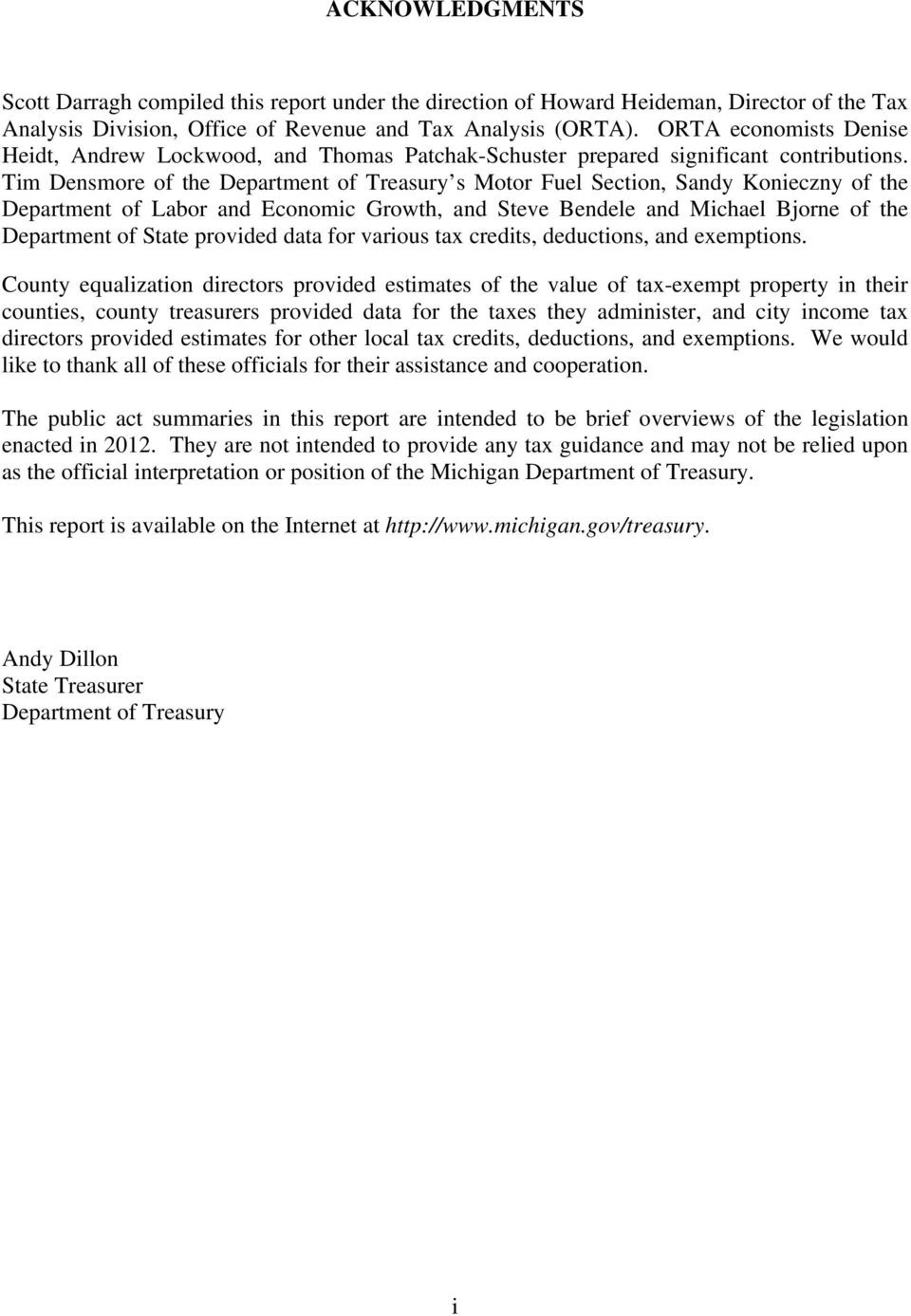
4 TABLE OF CONTENTS Page EXECUTIVE SUMMARY... 1 CHAPTER 1: INTRODUCTION TO TAX EXPENDITURES... 2 Defining Tax Expenditures... 2 Technical Issues... 4 Measuring Tax Expenditures... 5 Cautionary Notes and the Reliability of Estimates... 6 Why Report Tax Expenditures?... 7 CHAPTER 2: SUMMARY OF TAX EXPENDITURES... 9 CHAPTER 3: TAX EXPENDITURE BUDGET CHAPTER 4: BUSINESS PRIVILEGE TAX EXPENDITURES Business Privilege Tax Expenditure Changes Insurance Company Tax Oil and Gas Severance Tax Corporate Income Tax Expenditures CHAPTER 5: CONSUMPTION TAX EXPENDITURES Consumption Tax Expenditure Changes Alcoholic Beverage Taxes Tobacco Products Tax State Convention Facility Development Tax Sales and Use Tax Expenditures CHAPTER 6: INDIVIDUAL INCOME TAX EXPENDITURES Individual Income Tax Expenditure Changes State Income Tax Expenditures ii

5 Federal Income Tax Expenditures CHAPTER 7: TRANSPORTATION TAX EXPENDITURES Transportation Tax Expenditure Changes Aircraft Registration and Transfer Fee Aviation Fuel Tax Expenditures Marine Vessel Fuel Tax Expenditures Motor Carrier Privilege Fee Motor Fuel Taxes Motor Vehicle Registration Fee Watercraft Registration Fee CHAPTER 8: PROPERTY AND OTHER LOCAL TAX EXPENDITURES Property and Other Local Tax Expenditure Changes Utility Property Tax Expenditures General Property Tax Iron Ore Specific Tax Mobile Home Tax Real Estate Property Transfer Tax Accommodations Tax City Income Tax City Utility Users Tax iii

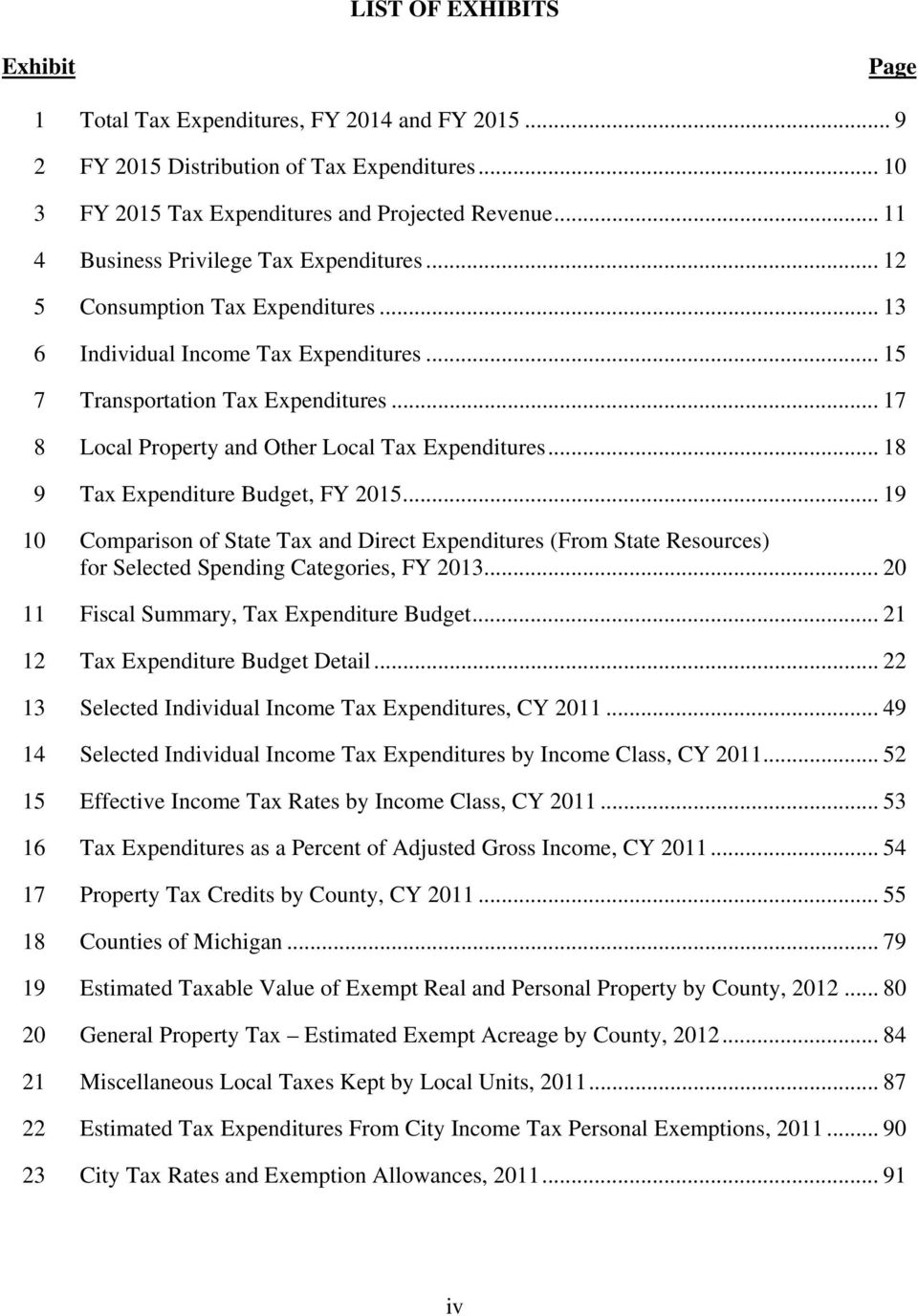
6 LIST OF EXHIBITS Exhibit Page 1 Total Tax Expenditures, FY 2014 and FY FY 2015 Distribution of Tax Expenditures FY 2015 Tax Expenditures and Projected Revenue Business Privilege Tax Expenditures Consumption Tax Expenditures Individual Income Tax Expenditures Transportation Tax Expenditures Local Property and Other Local Tax Expenditures Tax Expenditure Budget, FY Comparison of State Tax and Direct Expenditures (From State Resources) for Selected Spending Categories, FY Fiscal Summary, Tax Expenditure Budget Tax Expenditure Budget Detail Selected Individual Income Tax Expenditures, CY Selected Individual Income Tax Expenditures by Income Class, CY Effective Income Tax Rates by Income Class, CY Tax Expenditures as a Percent of Adjusted Gross Income, CY Property Tax Credits by County, CY Counties of Michigan Estimated Taxable Value of Exempt Real and Personal Property by County, General Property Tax Estimated Exempt Acreage by County, Miscellaneous Local Taxes Kept by Local Units, Estimated Tax Expenditures From City Income Tax Personal Exemptions, City Tax Rates and Exemption Allowances, iv
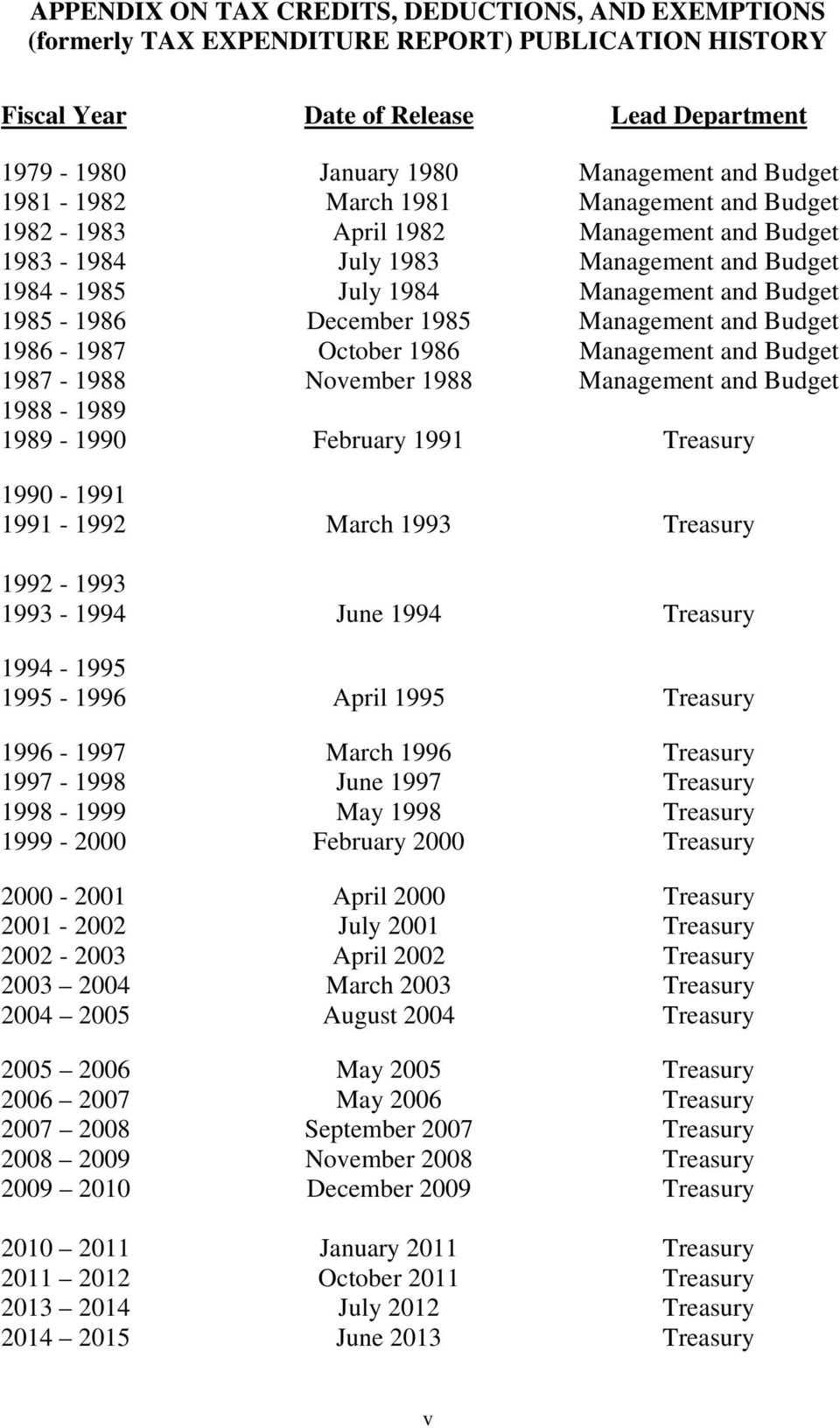
7 APPENDIX ON TAX CREDITS, DEDUCTIONS, AND EXEMPTIONS (formerly TAX EXPENDITURE REPORT) PUBLICATION HISTORY Fiscal Year Date of Release Lead Department January 1980 Management and Budget March 1981 Management and Budget April 1982 Management and Budget July 1983 Management and Budget July 1984 Management and Budget December 1985 Management and Budget October 1986 Management and Budget November 1988 Management and Budget February 1991 Treasury March 1993 Treasury June 1994 Treasury April 1995 Treasury March 1996 Treasury June 1997 Treasury May 1998 Treasury February 2000 Treasury April 2000 Treasury July 2001 Treasury April 2002 Treasury March 2003 Treasury August 2004 Treasury May 2005 Treasury May 2006 Treasury September 2007 Treasury November 2008 Treasury December 2009 Treasury January 2011 Treasury October 2011 Treasury July 2012 Treasury June 2013 Treasury v
8 APPENDIX ON TAX CREDITS, DEDUCTIONS, AND EXEMPTIONS EXECUTIVE SUMMARY Fiscal Years 2014 and 2015 The Appendix on Tax Credits, Deductions, and Exemptions (formerly entitled the Tax Expenditure Appendix) is a compilation of the revenue cost of the various tax credits, deductions, and exemptions contained in Michigan tax law. Section 1 of Public Act 72 of 1979 requires the Governor to submit a report on specific tax credits, deductions, and exemptions along with the annual presentation of the Executive Budget to the Legislature. Throughout this report, credits, deductions, and exemptions will often be referred to as tax expenditures. Tax expenditures can be defined broadly as the tax revenue foregone as a result of preferential provisions such as credits, deductions, exemptions, deferrals, exclusions, or lower tax rates. These provisions are tax expenditures because, like appropriations, they allocate resources for specific public purposes, but do so through the tax system rather than the expenditure system. Total tax expenditures are projected to increase 2.8 percent between fiscal year (FY) 2014 and FY 2015, from $32.07 billion to $32.97 billion. Tax expenditures are divided into five broad categories: business privilege, consumption, individual income, local property, and transportation. Business privilege tax expenditures are predicted to increase from $927.9 million to $940.3 million from FY 2014 to FY The estimates under the business privilege tax category reflect the credits, deductions, and exemptions in place under the corporate income tax and the most significant certificated credits which may be claimed under the Michigan business tax. Consumption tax expenditures are predicted to increase 3.6 percent between FY 2014 and FY 2015, from $15,616.1 million to $16,178.1 million. Growth in tax expenditures related to health care services, food for home use, and industrial processing account for most of the increase. Comparisons between the estimates for consumption tax expenditures contained in this report and those in prior editions of the Tax Expenditure Appendix are not valid due to changes in the methodology and data sources used to calculate tax expenditures related to services. Individual income tax expenditures are predicted to rise from $8,038.5 million in FY 2014 to $8,276.0 million in FY 2015, a 3.0 percent increase. In recent tax years the income tax adjustment for income attributable to another state has been volatile, resulting in volatility of the estimated income tax expenditure. Local tax expenditures are predicted to increase 1.1 percent between FY 2014 and FY 2015, rising from $7,440.1 million to $7,525.4 million. The value of local tax exemptions will rise as property values stabilize and begin to increase. Transportation tax expenditures are predicted to decrease by a very small amount between FY 2014 and FY 2015, from $48.4 million to $48.3 million. 1

9 CHAPTER 1 INTRODUCTION TO TAX EXPENDITURES Section 1 of Public Act 72 of 1979 requires the Governor to submit a report on specific tax credits, deductions, and exemptions along with the annual presentation of the Executive Budget to the Legislature: The governor, with the annual budget message to the legislature, shall report, at a minimum, the tax credits, deductions, and exemptions enumerated in this act. The message shall include tax credits, deductions, and exemptions by budget and also shall contain a separate report on tax credits, deductions, and exemptions in total, which may be printed as an appendix to the budget. The department of treasury shall furnish these items to the governor for inclusion in the report as required by this act. The Appendix on Tax Credits, Deductions, and Exemptions is a compilation of the revenue cost of the various tax credits, deductions, and exemptions contained within the Michigan state and local tax structure. These provisions are more commonly known as tax expenditures and will be referred to as tax expenditures in this report. When known, the number of taxpaying units taking advantage of a given tax expenditure is also included. This Appendix is divided into eight chapters. Chapter 1 discusses the definition and measurement of tax expenditures. Chapter 2 presents a summary of tax expenditures by type of tax. Chapter 3 lists tax expenditures by budget category. Chapters 4 through 8 examine the five main tax expenditure categories in greater detail: business privilege, consumption, individual income, transportation, and local property. Chapters 4 through 8 discuss changes in tax laws and the reliability of tax expenditure estimates. In addition, a brief description of each tax expenditure is provided. Defining Tax Expenditures Tax expenditures can be defined broadly as the tax revenue foregone as a result of preferential provisions such as credits, deductions, exemptions, deferrals, exclusions, or lower tax rates. These provisions are tax expenditures because, like appropriations, they allocate resources for specific public purposes, but do so through the tax system rather than the expenditure system. For economic purposes, it makes no difference whether a policy objective is pursued through direct spending or through the tax code. For example, a tax credit of 50 percent of the amount spent on health care by individuals is exactly the same as a spending program that pays 50 percent of health care expenses. Either way, the individual receives a 50 percent reduction in the effective cost of health care. Classifying items as tax expenditures is a subjective process. Some argue that the tax expenditure definition should be as broad as possible, encompassing all deductions or credits that 2

10 reduce the taxable base from 100 percent of income or wealth. Others recommend a more narrow definition that includes only those tax deductions or credits that are adjustments to the normal or appropriate tax structure. The narrow tax expenditure definition reserves the term tax expenditure for items that are true substitutes for direct spending. This report does not make any assumptions regarding the correct definition of the term tax expenditure but rather reports all exemptions, deductions, and credits that are explicitly outlined in statute. Changes in law can affect revenues and not involve a tax expenditure. For example, reductions in tax rates would generally reduce tax revenues but do not fit the definition of a tax expenditure. Changes in the way the tax law apportions income between states would also not qualify as a tax expenditure. Finally, a tax change that requires a change in the recognition of income between subsidiaries (perhaps through unitary or separate reporting) or the recognition of expenses between a client and an employment agency would not be tax expenditures. Traditionally, tax expenditures have served two purposes. First, they redistribute the tax burden. Tax expenditures such as personal income tax exemptions, sales tax exemptions for food and prescription drug purchases, and the corporate income tax credit for small firms all shift the relative tax burden. These tax expenditures are designed to reduce the tax burden on low-income individuals and businesses. Second, tax expenditures create an incentive for individuals or firms to change their behavior. The earned income tax credit, at both the federal and state levels, is intended to increase work effort and attachment to the labor force and is a good example of a tax expenditure designed to influence taxpayer behavior. Tax expenditures are so named because they can be viewed as alternatives to direct government appropriations or regulation. In fact, tax expenditures are very similar to direct appropriations in many respects. The main difference is that while appropriations achieve policy goals directly, tax expenditures achieve policy goals indirectly by changing relative prices or reducing costs. For example, the government may help the poor directly by providing food stamps. Alternatively, the government can exempt food from the sales tax, which lowers the cost of food purchases relative to other goods. This will aid poorer residents because they spend a greater percentage of their income on basic needs such as food, which is not taxed. However, the allocation of government resources through the tax system suffers from some drawbacks. First, because tax expenditures accomplish their goals indirectly, they may provide a less efficient means of targeting benefits than direct expenditures. Sometimes, the targeted group may not receive the benefits, or other groups who were not targeted originally may benefit. Second, policymakers tend to ignore tax expenditures during the budgeting process. Instead, they focus their attention almost strictly upon actual revenue and spending. They may spend less time considering potential new tax expenditures and revenue that might be collected by eliminating or reducing current tax expenditures. Finally, providing resources via tax expenditures may be more costly than through direct appropriation. Centralized purchasing of certain items such as prescription drugs or diabetic supplies by the state may result in a lower cost than if individuals purchase the items and then apply for a tax credit. On the other hand, the cost to governments of administering most tax expenditures is usually a fraction of the cost of administering direct spending programs. 3

11 Annual review of tax expenditures would encourage policymakers to rank all policy goals before deciding which should be funded, by how much, and by what means. Ideally, this review process would use three criteria in order to evaluate which tax expenditures are retained. First, the effectiveness of the specific tax expenditure should be evaluated. Does it accomplish its objective at the lowest cost without unintended outcomes? Second, the tax expenditure should be more effective relative to alternatives such as direct spending or regulation. Finally, the relative importance of the tax expenditure and its goals should be examined and compared to direct spending actions. This report does not attempt to evaluate each tax expenditure according to these criteria. It is designed to aid policymakers in evaluating the efficiency, effectiveness, and relative importance of each tax expenditure. State Versus Federal Tax Expenditures Technical Issues The starting point in calculating Michigan taxable income is the federal Internal Revenue Code definition of adjusted gross income (AGI). As a result, the exclusions and deductions used in the calculation of federal AGI also reduce state income tax liability. Exclusions or deductions from federal AGI that Michigan does not disallow specifically are classified as federal tax expenditures. This classification does not mean that federal tax expenditures are outside the control of state government. Michigan could require that specific federal tax expenditures be added back to AGI in calculating Michigan taxable income. State Versus Local Tax Expenditures This report also distinguishes between state tax expenditures (associated with taxes collected by the state government) and local tax expenditures (associated with taxes collected by local governments). For the purposes of this report, the distinction between state and local government tax expenditures rests on which level of government collects the tax, not the level of government affected by the tax expenditure. In fact, some state tax expenditures have implications for local government budgets, while some local government tax expenditures have ramifications for the state government budget. For example, property tax exemptions granted for industrial or commercial development are classified as local tax expenditures. These local property tax exemptions also have state budget implications because they reduce state education tax revenue and reduce taxable value per pupil and thus increase state aid payments to local school districts through the state s formula for providing funds to K-12 education. Income Tax Personal Exemption For tax year 2012, individual Michigan taxpayers could claim a $3,763 personal exemption for themselves and each of their dependents. The personal exemption is classified as a tax expenditure in this report. Some contend that the exemption is essential for determining an appropriate income tax base and should not be considered a tax expenditure. Yet even using a 4
12 narrow definition of tax expenditures, the personal exemption would be considered a tax expenditure because it changes the distribution of the tax burden based on family size. Industrial Processing Exemption From Sales Tax The levy of a pure retail sales tax takes place only at the retail level, that is, sales to the final consumer. Goods or services used in the production of consumer goods are exempt from this pure retail sales tax. States differ as to the business purchases they exempt from the sales tax. In Michigan, sales of goods used in industrial processing are exempt, although sales of goods used in business, but not in the actual manufacturing process, are subject to taxation. In this sense, the exclusion of non-retail sales from a pure retail sales tax base is not a tax expenditure. However, Michigan s sales tax is not a pure retail sales tax because many final consumer goods, such as services, are not subject to taxation. Hence, this report includes the business purchase exemption as a tax expenditure for the state sales tax. Measuring Tax Expenditures The estimates in this report for fiscal year (FY) 2014 and FY 2015 are based on the most recent data available. Tax year 2011 income tax data (returns processed in the spring of 2012) are used, as are 2011 property and sales tax data, and tax year 2011 Michigan Business Tax (MBT) data. Most estimates of the cost (in terms of foregone revenue) of credits, deductions, exemptions, and other reductions are based on actual tax return data. However, many exemptions are not reported on tax returns. In these instances, tax expenditure estimates were derived from other sources. The tax expenditure estimates do not necessarily reflect the amount of actual revenue that would be gained through the repeal of specific provisions. This is attributable to three economic assumptions (listed below) which have been made to ease the task of estimation. (These assumptions are consistent with those made at the federal level and used by other states.) Assumption 1: The elimination of a particular tax expenditure does not alter economic behavior. In many instances, tax expenditures are specifically designed to provide incentives for people and businesses to behave in a certain manner. Elimination of tax expenditures would most likely alter their behavior. For example, if the sales tax exemption for food were eliminated, the final price that consumers pay for food would increase and food purchases would decline. In this case, the elimination of the tax expenditure would be similar to a price increase. This drop in food purchases offsets some of the revenue gain from eliminating the exemption. Assumption 2: Each tax expenditure is independent. The repeal of certain tax expenditure provisions can increase or decrease the revenue losses associated with other provisions that are kept in place. For example, reducing or 5

13 removing one MBT deduction or credit may allow firms to take greater advantage of other deductions or credits, offsetting at least some of the original revenue impact. Assumption 3: The elimination of tax expenditures does not affect overall macroeconomic conditions. In principle, repeal or enactment of major tax expenditure provisions would have some impact on the economy. For example, imposing the sales tax on services or repealing the personal income tax exemption may significantly reduce income levels and affect taxpayers spending which would affect the macro economy. However, marginal changes in particular provisions are unlikely to have a significant impact on overall income levels and rates of economic growth. In essence, each tax expenditure estimate is an isolated estimate. That is, each estimate assumes implicitly that no other tax expenditures exist (i.e., there is no interaction) and that all other factors remain constant (i.e., taxpayers do not change their behavior and the repeal of the provision does not affect the overall economy). Because this report ignores many of these factors to simplify estimation, actual state revenue gains from eliminating specific tax expenditures would generally fall short of the estimates. Cautionary Notes and the Reliability of Estimates In many instances, this report aggregates individual tax expenditure estimates. However, due to the simplifying assumptions that have been made, aggregating various tax expenditure estimates in order to measure the cost of changing all of them simultaneously will not be accurate. The estimated revenue gain from simultaneously eliminating two tax expenditures will be less than the sum of the cost of the two measured separately. Therefore, the reader is cautioned regarding interactions between tax expenditures. The reader is also cautioned about comparing tax expenditure estimates across years. Substantial changes in federal, state, and local tax laws occur each year that affect the number, type, and magnitude of tax expenditures. In addition, measurement techniques may also vary from year to year, depending on the available data. Tax expenditure estimates that appear in this report have different levels of reliability depending on the accuracy of the data and the estimation procedure employed. Chapters 4 through 8 denote the reliability of tax expenditure estimates included in the respective chapters. High reliability implies that the estimate should be relatively accurate. If the estimate does not approximate closely the actual value of the tax expenditure, it is most likely incorrect by a relatively small margin. Conversely, low reliability implies that the actual value could be much greater or smaller and that the range of possible values is large. Reliability indicators are as follows: 6
14 1. High reliability level. This category is reserved for estimates that were derived using actual recent tax return data. The higher education tax expenditure, which is based on recent income tax return data, is an example of an estimate that is accurate and highly reliable. 2. Average reliability level. Tax expenditure estimates in this category were also based on tax return data. However, specific economic assumptions were necessary to derive these estimates because less recent data or sample data were used. The personal exemption from city income taxes is an example of an estimate with average reliability. Estimates were based on a recent survey of city treasurers. Some city estimates were carried forward from last year, while other estimates were based on rounded figures. While this will affect the precision of the total estimate, the impact should be relatively small. 3. Low reliability level. This category is reserved for estimates that are imprecise. Estimates in this category were based on highly aggregated (national) data, required restrictive assumptions, or used poor non-tax data sources. For example, federal income tax expenditure estimates have a low degree of reliability because they were based on national tax expenditure data apportioned to Michigan. Why Report Tax Expenditures? Some economists argue that a regular periodic evaluation of tax expenditures should become common practice. Unlike fixed appropriations, tax expenditures are open-ended entitlements: if people or firms qualify for an exemption, they receive it. In periods of recession, tax expenditures are rarely re-examined as budget cuts are typically focused around direct spending. When the economy improves, both direct spending and tax expenditures tend to increase as legislators can afford to be more generous. According to the Advisory Commission on Intergovernmental Relations (ACIR), there are at least three reasons why tax expenditures should be reviewed periodically: 1. Tax Equity. Reviewing tax expenditures helps to ensure both vertical and horizontal equity in the tax structure. Horizontal equity refers to taxpayers in similar income groups, while vertical equity refers to taxpayers in different income groups. If a tax system that relies on voluntary compliance is to work, people must regard that system as equitable. 7

15 2. Fiscal Discipline. Adopting regular tax expenditure reporting gives policymakers more information regarding available resources and how these resources are being used. All state programs, whether they are funded through direct or indirect spending, should work in unison so that particular policy objectives can be attained. 3. Political Accountability. By mandating a periodic review of the tax code, state lawmakers would foster a public discussion about how the tax system should be designed. In addition, lawmakers would indicate publicly whether they support or oppose certain tax expenditures, much like the appropriations process. The Michigan Legislature has recognized these potential problems and regularly places sunset dates on new tax expenditures, or requires a report on the activity related to the tax break. In addition, the annual publication of this report provides an itemization of tax expenditures along with their cost. Finally, the inclusion of any item as a tax expenditure should not be viewed as an expression of support for or objection to any particular tax policy. As noted above, tax expenditures represent spending done outside of the annual appropriation process. While a periodic review of tax expenditures is encouraged as a way to better conduct public policy, the inclusion of a particular credit, deduction, or exemption in this report does not signify any conclusion regarding the public policy merit of that particular tax expenditure. 8

16 CHAPTER 2 SUMMARY OF TAX EXPENDITURES Chapter 2 lists tax expenditures by the tax categories business privilege, consumption, individual income, transportation, local property, and other local tax expenditures. Chapter 2 also includes aggregated tax expenditures. As noted earlier, aggregated measures of tax expenditures should be viewed with caution. The independence assumption underlying individual tax expenditure estimates is unrealistic and, if relaxed, aggregated figures would likely decrease. Total tax expenditures are projected to increase from $ billion in FY 2014 to $ billion in FY 2015, a 2.8 percent increase (see Exhibit 1). The overall increase in tax expenditures was concentrate in consumption and individual income tax expenditures. Exhibit 1 Total Tax Expenditures, FY 2014 and FY 2015 FY 2014 FY 2015 Change FY FY 2015 Tax Category (000) (000) (000) Business Privilege $927,900 $940,300 $12,400 Consumption 15,616,053 16,178, ,091 Individual Income 8,038,463 8,276, ,570 Property 7,264,060 7,347,650 83,590 Other Local (City Income) 176, ,756 1,734 Transportation 48,359 48, TOTAL $32,070,857 $32,968,232 $897,375 Totals may differ slightly due to rounding. Most tax expenditures result from deductions, exemptions, or credits from consumption, income, and property taxes (see Exhibit 2). For FY 2015, consumption tax expenditures comprise 49.1 percent of total tax expenditures, while income tax expenditures comprise 25.1 percent and property and other local taxes comprise 22.8 percent. Not surprisingly, taxes that generate 9

17 significant revenue are also associated with large tax expenditures (see Exhibit 3). Most notable are consumption tax expenditures resulting from the exemptions for food, services, and industrial processing. Exhibit 2 FY 2015 Distribution of Tax Expenditures Total may not equal 100 percent due to rounding. 10

18 Exhibit 3 FY 2015 Tax Expenditures and Projected Revenue (millions of dollars) Tax Projected Percent of Tax Category Expenditure Revenues* Revenues Business Privilege Oil and Gas Severance $7.6 $ % Corporate Income/MBT % Consumption Total Alcohol % Cigarette and Tobacco % Sales and Use 16, , % Individual Income Tax 5, , % Transportation Aviation Fuel % Gasoline % Diesel Fuel % Motor Vehicle Registration % City Income Tax % TOTAL $22,779.0 $21, % *From Consensus Revenue Estimating Conference, May City income taxes are not a consensus estimate. Exhibits 4 through 8 provide a breakdown of individual tax expenditures across the five tax categories. An asterisk denotes a new tax expenditure or one that has been modified by legislation since the publication of the previous report. For more detailed information regarding these changes, consult the specific chapter relating to the tax expenditure. 11

19 Exhibit 4 Business Privilege Tax Expenditures FY 2014 FY 2015 Tax or Tax Expenditure (000) (000) Insurance Company Disability Insurance Exclusion $9,600 $10,100 Michigan Association and Facilities Credit 28,000 $29,400 Michigan Examination Fees Credit 3,000 3,200 Supplemental Workers Compensation 1,200 1,200 SUBTOTAL $41,800 $43,900 Oil and Gas Severance Tax Marginal Wells $5,000 $5,300 Public Land 2,200 2,300 SUBTOTAL $7,200 $7,600 Corporate Income Tax Foreign Dividends Income Exclusion $229,000 $238,400 Government Securities' Income Exclusion Small Business Alternate Tax Credit 11,000 11,500 SUBTOTAL $240,900 $250,800 Michigan Business Tax Certificated Credits Brownfield Redevelopment Credit 40,000 32,000 Film Credits 5,000 0 Michigan Economic Growth Authority (MEGA) 245, ,000 MEGA Photovoltaic Technology Credit 21,000 14,000 MEGA Polycrystaline Silicon Manufacturing 26,000 29,000 MEGA Vehicle Battery Credit 285, ,000 Other Certificated Credits 16,000 16,000 SUBTOTAL $638,000 $638,000 TOTAL $927,900 $940,300 12

20 Exhibit 5 Consumption Tax Expenditures FY 2014 FY 2015 Tax or Tax Expenditure (000) (000) Alcoholic Beverages Taxes Beer Shipped Out-of-State n.a. n.a. Damaged Beer n.a. n.a. Homemade Wine n.a. n.a. Small Brewer s Credit $90 $90 SUBTOTAL $90 $90 Tobacco Products Tax Bad Debt Deduction $400 $400 Licensee Expenses 13,800 13,510 Sales on Military Bases and Reservations 5,601 5,545 SUBTOTAL $19,801 $19,455 Sales and Use Tax Expenditures Air and Water Pollution $55,000 $57,000 Aircraft Parts 7,110 7,320 Bad Debts 39,100 40,500 Cargo Aircraft 22,940 22,600 Church Construction 1,977 2,017 Church Cars 2,590 2,680 Collection Fee 47,400 49,100 Commercial Domestic Aircraft 4,000 4,000 Commercial Vessels n.a. n.a. Communication and Telephone Exemption 37,000 37,000 Donated Property n.a. n.a. Donated Vehicles Driver Training Employee Meals 19,010 19,700 Enterprise Zone Credit n.a. n.a. Food 1,256,760 1,302,130 Food for Students 17,100 17,700 Government or Red Cross 206, ,340 Gratuity and Tips 73,450 76,100 Horticultural and Agricultural Products 329, ,190 Imported Property from Other States 1,660 1,690 13
21 Exhibit 5 (Continued) FY 2014 FY 2015 Tax or Tax Expenditure (000) (000) Industrial Processing $1,213,000 $1,274,000 Interstate Communications 7,000 6,800 Interstate Trucks and Trailers 29,290 30,340 Investment Coins 4,790 5,030 Isolated Sales n.a. n.a. Military PX Sales Military Vehicles Sales n.a. n.a. Military Vehicles Sales (Residents Out-of-State) n.a. n.a. Newspapers, Periodicals, and Films 103, ,100 Nonprofit Ambulance and Fire Services n.a. n.a. Nonprofit Hospital or Housing Construction 1,720 1,770 Nonprofit Organizations 263, ,300 Nonprofits Sales under $5,000 n.a. n.a. Nonresident Merchandise Transfer n.a. n.a. Nonresident Property n.a. n.a. Ophthalmic and Orthopedic Products 69,500 71,590 Prescription Drugs 555, ,140 Radio and TV 4,400 4,400 Rail Rolling Stock 1,840 1,910 Residential Utilities 164, ,000 Returned Vehicles 1,100 1,100 Sales of Business n.a. n.a. Sale of Water 60,800 61,400 Services (Including Nonprofits) 10,918,960 11,278,950 Small Out-of-State Purchases n.a. n.a. Telephone Services 14,810 15,340 Textbooks Sold by Schools n.a. n.a. Tribal Tax Agreement n.a. n.a. Vehicles and Aircraft Transfers 37,650 38,400 Vehicles Purchased for Use in Another State n.a. n.a. Vending Machines and Mobile Facilities 21,837 22,055 SUBTOTAL $15,596,162 $16,158,599 TOTAL $15,616,053 $16,178,144 Note: Total may differ from Exhibit 1 due to rounding. 14
22 Exhibit 6 Individual Income Tax Expenditures FY 2014 FY 2015 Tax or Tax Expenditure (000) (000) State Income Tax Adjustments to Income (except military) $214,107 $218,569 College Savings Accounts 11,259 12,070 Dependent Exemption 17,165 17,336 Disabled Veteran Exemption Earned Income Credit 115, ,900 Farmland Credit 44,152 45,918 Historic Preservation Credit 1,390 1,544 Holocaust Survivor Subtraction n.a. n.a. Home Heating Assistance Credit Homestead Property Tax Credit 566, ,346 Income Attributable to Another State 2,209,991 2,298,390 Income Tax Paid to Other State Credit 55,897 58,329 Military Pay 29,307 30,728 Pension and Retirement Benefits Deduction 483, ,184 Personal Exemption 1,241,047 1,277,787 Renaissance Zones 2,538 2,411 Senior Investment Income Deduction 14,596 14,606 Senior Standard Deduction 7,300 14,700 Social Security Benefits 266, ,771 Special Exemption 9,752 9,791 State and Local Income Tax Refunds 20,411 20,615 Tribal Tax Agreements n.a. n.a. U.S. Government Bond Interest Deduction 9,689 9,786 TOTAL STATE $5,319,709 $5,479,131 Federal Adjustments Accelerated Depreciation $104,905 $108,052 Employer Contributions to Insurance 890, ,535 Employer Pension Plans 638, ,334 Federal Adjustments to Income 54,338 55,968 Fellowships and Scholarships 15,543 16,009 Gain on Sale of Primary Residence $170,624 $172,330 Income Maintenance Benefits 3,648 3,757 Individual Retirement Accounts 263, ,177 Interest on Life Insurance Savings 119, ,571 15
23 Exhibit 6 (Continued) FY 2014 FY 2015 Tax or Tax Expenditure (000) (000) Federal Adjustments (continued) Medical Savings Account 9,559 9,846 Railroad Retirement Benefits 1,222 1,259 Social Security Benefits 331, ,356 Student Loan Deduction 4,376 4,507 Veterans Benefits 61,771 63,624 Workers Compensation 49,104 50,577 TOTAL FEDERAL $2,718,754 $2,796,902 TOTAL STATE AND FEDERAL $8,038,463 $8,276,033 16
24 Exhibit 7 Transportation Tax Expenditures FY 2014 FY 2015 Tax or Tax Expenditure (000) (000) Aviation Gasoline and Marine Fuel Federally Owned Aircraft $315 $317 Interstate Flight Refund 3,200 3,248 Marine Vessel Exemption SUBTOTAL $4,255 $4,305 Motor Fuel Taxes Diesel Fuel for Jobsites and Charter Firms $5,450 $5,530 Diesel Fuel for Railroads n.a. n.a. Evaporation and Loss Allowance 12,520 12,460 Fuel for Off-Road Use 1,100 1,100 Municipal Franchise Vehicles Public Vehicles 13,090 12,960 Tribal Tax Agreements n.a. n.a. SUBTOTAL $32,590 $32,470 Motor Vehicles Registration Fee Disabled Veterans Vehicles $550 $560 Handicapper Vans n.a. n.a. Intercity Commercial Buses n.a. n.a. Public and Nonprofit Vehicles 10,950 11,000 SUBTOTAL $11,500 $11,560 Watercraft Registration Fee Publicly-Owned Vehicle $14 $14 TOTAL $48,359 $48,349 17
25 Exhibit 8 Local Property and Other Local Tax Expenditures FY 2014 FY 2015 Tax or Tax Expenditure (000) (000) Property and Other Local Tax Expenditures Agriculture Transfers $34,300 $34,600 Air and Water Pollution Control 130, ,000 Church Transfers n.a. n.a. Cultural Organizations n.a. n.a. Energy Conservation Devices Enterprise Zone Credit 0 0 Fairground Property n.a. n.a. Homestead Exemption 3,070,000 3,100,700 Homestead Exemption for Farm Property 160, ,600 Industrial Facilities Development 228, ,400 Mobile Homes 54,200 55,300 Neighborhood Enterprise Zones 22,500 23,000 Next Energy Exemption 3,600 3,800 Obsolete Property Rehabilitation 11,500 11,500 Personal Property - Indust./Commercial Ad Valorem 368, ,500 Personal Property - Industrial Facilities 68,500 69,900 Poverty Exemption 8,300 8,500 Railroad Right-of-Way/Broadband Credit 51,000 51,600 Renaissance Zones 86,000 87,000 Specifically-Taxed Property n.a. n.a. Tax-Exempt Property 1,796,000 1,823,000 Tax Increment Financing 280, ,000 Taxable Value Cap 890, ,900 Water Softeners 1,270 1,280 SUBTOTAL $7,264,060 $7,347,650 City Income Tax Federal Deductions n.a. n.a. Net Profits of Financial Institutions n.a. n.a. Nonresident Reduced Rate $163,422 $165,056 Pensions, Annuities, and Retirement n.a. n.a. Personal Exemption 12,600 12,700 Supplemental Unemployment Benefits n.a. n.a. SUBTOTAL $176,022 $177,756 TOTAL $7,440,082 $7,525,406 18
26 CHAPTER 3 TAX EXPENDITURE BUDGET Chapter 3 illustrates the concept of a tax expenditure budget. This presentation organizes tax expenditures by the spending category that benefits from the expenditure rather than by the revenue source that finances it. Tax expenditures are grouped in categories similar to direct expenditures in the Executive Budget such as commerce, education, transportation, and natural resources. This allows for a comparison of funding between direct appropriations and tax expenditures for selected spending categories. By a wide margin, the commerce and income distribution budget categories tend to receive most funding from tax expenditures (see Exhibit 9). Relative to direct spending, tax expenditures appear to be a preferred method to fund these objectives. In contrast, transportation and higher education are funded much more intensively via direct appropriations (see Exhibit 10). Exhibits 11 and 12 provide an itemized breakdown of tax expenditures by spending category. These exhibits are a simple reorganization of the summary tables provided in Chapter 2; only the groupings are different. Exhibit 9 Tax Expenditure Budget, FY
27 Exhibit 10 Comparison of State Tax and Direct Expenditures (From State Resources) for Selected Spending Categories, FY 2013 FY 2014 Tax FY 2013 Direct Expenditure Expenditure Total Percent Tax Spending Category (000) (000) (000) Expenditure Agriculture $373,962 $65,058 $439, % Commerce (LARA) 11,963, ,203 12,339, % Higher Education 521,142 1,302,194 1,823, % Income Distribution (DHS) 7,151,766 1,097,045 8,248, % Military Affairs 98,441 68, , % Natural Resources 55, , , % Public (Community) Health 4,033,708 4,974,796 9,008, % Transportation 51,481 2,188,645 2,240, % TOTAL $24,248,771 $10,595,182 $34,843, % Note: FY 2013 expenditure figures from FY Appropriations Report, Senate Fiscal Agency. Note that Exhibit 10: (1) compares own state resources to tax expenditures (i.e., it ignores federal grants), and (2) does not include local tax expenditures and local direct expenditures. For example, the income distribution budget category does not include tax expenditures associated with the city income tax. Tax expenditures associated with the government and nonprofit budget category are also not included, because there is no comparable direct expenditure category. 20
28 Exhibit 11 Fiscal Summary, Tax Expenditure Budget FY 2014 FY 2015 Budget Category (000) (000) Agriculture $648,362 $679,209 Commerce 13,301,241 13,689,954 Education 985,142 1,008,259 Government and Nonprofit Organizations 1,941,026 1,981,249 Income Distribution 10,826,366 11,053,219 Military Affairs 98, ,648 Natural Resources 185, ,070 Public Health 4,033,708 4,215,715 Transportation 51,481 51,909 TOTAL $32,070,857 $32,968,232 Note: Total may differ from Exhibit 1 due to rounding. See Exhibit 12 for a detailed list of tax expenditures. 21
29 Exhibit 12 Tax Expenditure Budget Detail Tax/Tax Expenditure FY 2014 FY 2015 (000) (000) Agriculture General Property Tax Agriculture Transfer $34,300 $34,600 Homestead Exemption for Farm Property 160, ,600 Taxable Value Cap 80,100 80,901 Income Tax Farmland Development Credit (PA 116) 44,152 45,918 Sales and Use Taxes Horticultural or Agricultural Products 329, ,190 TOTAL $648,362 $679,209 Commerce Alcoholic Beverage Taxes Small Brewer s Credit $90 $90 Tobacco Products Tax Bad Debt Deduction Licensee Expenses 13,800 13,510 Income Tax Accelerated Depreciation 104, ,052 Income Attributable to Another State 2,209,991 2,298,390 Renaissance Zone Credit 2,538 2,411 Insurance Company Retaliatory Tax Disability Insurance Exclusion 9,600 10,100 Michigan Association and Facilities Credit 28,000 29,400 Michigan Examination Fees Credit 3,000 3,200 Supplemental Workers Compensation Credits 1,200 1,200 Corporate Income Tax Foreign Dividends Income Exclusion 229, ,400 Government Securities' Income Exclusion Small Business Alternate Tax Credit 11,000 11,500 Michigan Business Tax Brownfield Redevelopment Credit 40,000 32,000 Film Credits 5,000 0 Michigan Economic Growth Authority (MEGA) 245, ,000 MEGA Photovoltaic Technology Credit 21,000 14,000 MEGA Polycrystaline Silicon Manufacturing 26,000 29,000 22
30 Tax/Tax Expenditure FY 2014 FY 2015 (000) (000) Commerce (Continued) MEGA Vehicle Battery Credit $285,000 $251,000 Other Certificated Credits 16,000 16,000 Oil and Gas Severance Tax Marginal Wells 5,000 5,300 Property Tax Broadband Investment Credit 25,000 25,300 Enterprise Zone 0 0 Industrial Facilities Development 228, ,400 Mobile Homes 54,200 55,300 Neighborhood Enterprise Zones 22,500 23,000 Next Energy Exemption 3,600 3,800 Obsolete Property Rehabilitation 11,500 11,500 Personal Property - Indust./Commercial Ad Valorem 368, ,500 Personal Property - Industrial Facilities 68,500 69,900 Renaissance Zones 86,000 87,000 Tax Increment Financing 280, ,000 Taxable Value Cap 213, ,736 Water Softeners 1,270 1,280 Sales and Use Taxes Aircraft Parts 7,110 7,320 Bad Debts 39,100 40,500 Cargo Aircraft 22,940 22,600 Collection Fee 47,400 49,100 Commercial Domestic Aircraft 4,000 4,000 Communication and Telephone Exemption 37,000 37,000 Employee Meals 19,010 19,700 Gratuities and Tips 73,450 76,100 Imported Property from Other States 1,660 1,690 Industrial Processing 1,213,000 1,274,000 Interstate Telecommunications 7,000 6,800 Interstate Trucks and Trailers 29,290 30,340 Investment Coins 4,790 5,030 Newspapers, Periodicals, and Films 103, ,100 Radio and TV 4,400 4,400 Returned Vehicles 1,100 1,100 Sale of Water 60,800 61,400 Services (except education, health, and 6,931,260 7,127,410 nonprofits) Telephone Services 14,810 15,340 23
31 FY 2014 FY 2015 Tax/Tax Expenditure (000) (000) Commerce (Continued) Vehicle and Aircraft Transfers $37,650 $38,400 Vending Machines 21,837 22,055 TOTAL $13,301,241 $13,689,954 Education Income Tax College Savings Account $11,259 $12,070 Fellowships and Scholarships 15,543 16,009 Higher Education/Public Contribution Credit $0 $0 Property Tax Exempt Public Education Property 464, ,000 Sales Tax Services 494, ,180 TOTAL $985,142 $1,008,259 Government and Nonprofit Organizations Aviation Gasoline Tax Federally Owned Aircraft $315 $317 Income Tax Historic Preservation Credit 1,390 1,544 U.S. Government Bond Interest Deduction 9,689 9,786 Motor Fuel Taxes Public Vehicles 13,090 12,960 Motor Vehicle Weight Tax Public and Nonprofit Vehicles 10,950 11,000 Oil and Gas Severance Tax Public Land 2,200 2,300 Property Tax Tax Exempt Property 1,332,000 1,352,000 Sales and Use Taxes Church Cars 2,590 2,680 Church Construction 1,977 2,017 Government or Red Cross 206, ,340 Nonprofit Organizations 263, ,300 Services 96,091 98,991 Watercraft Registration Fee Publicly Owned Watercraft TOTAL $1,941,026 $1,981,249 24
32 FY 2014 FY 2015 Tax/Tax Expenditure (000) (000) Income Distribution City Income Tax Nonresident Reduced Rate $163,422 $165,056 Personal Exemption 12,600 12,700 General Property Tax Homestead Exemption 3,070,000 3,100,700 Poverty Exemption 8,300 8,500 Taxable Value Cap 596, ,263 Income Tax Adjustments to Income (gains/losses and other) 214, ,569 Adjustments to Income (federal) 54,338 55,968 Dependent Exemption 17,165 17,336 Earned Income Tax Credit 115, ,900 Employer Contributions to Health 890, ,535 and Life Insurance Employer Pension Plans 638, ,334 Gain on Sale of Primary Residence 170, ,330 Home Heating Assistance Credit Homestead Property Tax Credit 565, ,936 (excluding veterans) Income Maintenance Benefits 3,648 3,757 Individual Retirement Account 263, ,177 Interest on Life Insurance Savings 119, ,571 Other State Tax Credit 55,897 58,329 Pension and Retirement Benefits Deduction 483, ,184 Personal Exemption 1,241,047 1,277,787 Railroad Retirement Benefits 1,222 1,259 Senior Investment Income Deduction 14,596 14,606 Senior Special Deduction 7,300 14,700 Social Security Benefits (federal exclusion) 331, ,356 Social Security Benefits (in federal AGI) 266, ,771 Special Exemption 9,752 9,791 State and Local Income Tax Refunds 20,411 20,615 Student Loan Deduction 4,376 4,507 Workers Compensation 49,104 50,577 Sales and Use Taxes Donated Vehicles Food 1,256,760 1,302,130 Food for Students 17,100 17,700 Residential Utilities 164, ,000 TOTAL $10,826,366 $11,053,219 25
33 FY 2014 FY 2015 Tax/Tax Expenditure (000) (000) Military Affairs Cigarette Tax Sales on Military Bases and Reservations $5,601 $5,545 Income Tax Disabled Veteran Exemption Military Pay 29,307 30,728 Veterans Benefits 61,771 63,624 Veterans Property Tax Credit Motor Vehicle Weight Tax Disabled Veteran Vehicles Sales and Use Taxes Military Post-Exchange Sales TOTAL $98,441 $101,648 Natural Resources Property Tax Air and Water Pollution $130,000 $130,000 Energy Conservation Devices Sales and Use Taxes Air and Water Pollution 55,000 57,000 TOTAL $185,090 $187,070 Public Health Income Tax Medical Care Savings $9,559 $9,846 Sales and Use Taxes Medical Services 3,397,269 3,543,369 Nonprofit Hospital Construction 1,720 1,770 Ophthalmic and Orthopedic Products 69,500 71,590 Prescription Drugs $555,660 $589,140 TOTAL $4,033,708 $4,215,715 Transportation Aviation Gasoline Tax Interstate Flight Refund $3,200 $3,248 Motor Fuel Taxes Diesel Fuel for Jobsites 5,450 5,530 Evaporation and Loss Allowance 12,520 12,460 Fuel for Off-Road Use 1,100 1,100 26
34 FY 2014 FY 2015 Tax/Tax Expenditure (000) (000) Transportation (Continued) Marine Vessel Fuel $740 $740 Municipal Franchise Vehicles Sales and Use Taxes Driver Training Rail Rolling Stock 1,840 1,910 Utility Property Tax Railroad Right-of-Way 26,000 26,300 TOTAL $51,481 $51,909 27
35 CHAPTER 4 BUSINESS PRIVILEGE TAX EXPENDITURES Business privilege tax expenditures include insurance company retaliatory, oil and gas severance, and corporate income expenditures. Business privilege tax expenditures are projected to increase from $927.9 million in FY 2014 to $940.3 million in FY The reduction of tax credits and deductions under the corporate income tax results in much smaller tax expenditures than under the Michigan Business Tax (MBT). Estimate Reliability (2) Small Business Alternative Tax Rate Credit (3) Other Corporate Income Tax and MBT Tax Expenditures This year s report includes tax expenditures for the corporate income tax, which replaced the MBT for most corporate taxpayers effective January 1, A big difference between the corporate income tax and the MBT is that business entities other than traditional corporations (sole proprietorships, partnerships, S-corporations, and other flow-through entities) are not taxed under the corporate tax. The income from flow-through entities is taxable to the owners under the individual income tax. Other tax expenditure estimates from business privilege taxes were based on 2011 data. Insurance and oil and gas severance tax expenditure estimates are also reliable because they were based on recent data collected by the state. Business Privilege Tax Expenditure Changes Public Act 70 of 2012 amended the Income Tax Act to allow a member of a unitary business group that has a certificated credit available under Sections 431 (MEGA) and 434(2) (plug-in traction battery packs) and (5) (integrative cell manufacturing facility) of the Michigan Business Tax to not file a combined return but elect to file a separate return and pay the tax under MBT. Public Act 217 of 2012 amended the Income Tax Act to allow a corporate owner of a flowthrough entity to exempt that flow-through entity from the withholding requirements by filing an exemption certificate with the Department of Treasury and providing a copy to the flow-through entity. This Act also provides a withholding exemption for a flow-through entity on any member that elects to be taxed under the Michigan Business Tax. Public Act 405 of 2012 amended the Michigan Business Tax Act to direct all money collected under the MBT to the General Fund, beginning with the fiscal year ending September 30, Previously, a portion of the revenue from the MBT was directed to the School Aid Fund. Public Act 414 of 2012 amended the Income Tax Act to eliminate both the individual and corporate income taxes on income derived from minerals, effective for the 2013 tax year. See Public Act 410 on 2012 on page
36 Public Act 475 of 2012 amended the Michigan Business Tax Act to extend the allowable time frame for assigning a historic preservation credit and allow for a previously assigned credit to be reassigned under certain circumstances. Public Act 601 of 2012 amended the Michigan Business Tax Act to allow construction contractors to claim an expanded deduction for purchases from other firms when determining the gross receipts tax base under the MBT, if the contractor did not claim the alternate tax credit, whether or not the construction contractor was eligible for the credit. Public Act 605 of 2012 amended the Michigan Business Tax Act to make changes to the definitions of a corporate officer and earnings from self-employment, allow a taxpayer that acquires assets from another corporation to deduct business losses from the selling corporation, and refine the definition of a sale of tangible personal property when the property is stored in Michigan for a limited period of time prior to the property leaving the state. The Public Act also amended the historic preservation credit to provide that a qualified assignment of a credit includes an assignment made within the 12 months immediately succeeding the tax year in which the certificate of completed rehabilitation is issued. Insurance Company Tax Effective January 1, 2012, the MBT tax on Michigan insurance premiums was replaced by a 1.25 percent tax in the Income Tax Act. Foreign companies are also subject to a retaliatory tax, which requires them to pay the same tax that a Michigan-based insurer would have to pay in the firm s home state. Foreign insurers pay the premiums tax or the retaliatory tax, whichever is greater. The estimated yield from taxes on insurers is $401.5 million for FY 2015; revenue goes to the State General Fund. FY 2015 Estimate Captive Insurance Companies Exempts companies authorized under the Insurance Code as captive insurance companies or special purpose financial captives from the MBT and its gross premiums tax. n.a. Disability Insurance Exclusion $10,100,000 Exempts the first $190,000,000 of disability insurance premiums written in Michigan. Michigan Association and Facilities Credit $29,400,000 Provides a credit for payments made to the Michigan workers compensation placement facility, the Michigan basic property insurance association, the Michigan automobile insurance placement facility, the property and casualty guaranty association, and the life and health guaranty association. 29
37 FY 2015 Estimate Michigan Examination Fees Credit $3,200,000 Allows an insurance company to claim a credit equal to 50 percent of the examination fees paid by the company during the year under section 224 of the insurance code. Workers Disability Supplemental Benefit (WDSB) Credit $1,200,000 Provides a credit for 100 percent of the supplemental cost of living payments made to persons injured between September 1965 and December Prior to the identical Single Business Tax (SBT) credit, firms were reimbursed through the appropriations process for these payments. Oil and Gas Severance Tax Enacted in 1929, the oil and gas severance tax is levied on the privilege of producing oil and gas. The base is the gross cash market value of oil and gas that is severed from the ground. The tax rate is 6.6 percent for normal oil production, 5.0 percent for natural gas production, and 4.0 percent for stripper wells and marginal properties. The projected yield is $57.0 million for FY 2015; revenue goes to the State General Fund. FY 2015 Estimate Marginal Wells $5,300,000 Taxes oil from marginal or stripper wells at 4.0 percent, rather than the 6.6 percent rate on other oil production. Public Land $2,300,000 Exempts oil and gas severed from publicly-owned lands from taxation. 30
38 Corporate Income Tax Expenditures Public Act 38 of 2011 added a 6.0 percent tax on corporate income to the Income Tax Act. The new tax took effect on January 1, 2012, and applies only to C corporations and entities taxed as C corporations for federal income tax purposes, with the tax imposed on federal taxable income subject to allocation or apportionment. A significant difference between the MBT and the new corporate tax is the elimination of most tax credits. The only credit enacted against the corporate income tax is the small business alternative credit. Financial institutions are not taxed on business income or gross receipts, but are subject to a tax of 0.29 percent on their apportioned net capital. An entity that has received, has been approved to receive, or has been assigned certain certificated tax credits under the MBT may elect to continue to file and pay under the MBT in lieu of the corporate income tax. Examples of the remaining certificated credits are the photovoltaic credit, the MEGA employment tax credit, polysilicon credit, select renaissance zone credits, battery pack credits, historic preservation credit, brownfield redevelopment credit, film production and infrastructure credits, and the farmland preservation credit. Revenues from the corporate income tax were estimated at the May 2013 Consensus Conference to be $957.0 million in FY 2014 and $993.0 million in FY The certificated credits remaining under the MBT were estimated at -$638.0 million in both FY 2014 and FY Included with the estimated reduction in corporate tax revenue associated with the small business alternative credit are estimates of the remaining certificated credits that will be claimed by those taxpayers that continue to file under the MBT. FY 2015 Estimate Anchor Company Credit (MBT Certificated Credit) Provides credits to a qualified taxpayer that was designated by the Michigan Economic Growth Authority (MEGA) as an anchor company within the past five years and that has influenced a new qualified supplier or customer to open, locate, or expand in this state. n.a. Brownfield Redevelopment Credit (MBT Certificated Credit) $32,000,000 Provides credit for a portion of the cost for investments made for the demolition, construction, restoration, alteration, renovation, or improvement of buildings located in Brownfield development zones. Farmland Preservation Credit (MBT Certificated Credit) $1,000,000 Provides property tax relief for corporate farms eligible under former Public Act 116 of 1974 and reenacted by Public Act 451 of This credit is included in Other Certificated Credits in Exhibits 4 and
39 FY 2015 Estimate Film Credits (MBT Certificated Credit) $0 Provides credits for film production expenditures made after February To be eligible for the credit, companies must enter into an agreement with the Michigan film office. The MBT provides a 40 to 42 percent direct production expenditure and 30 percent qualified personnel expenditures film production credit; a 25 percent investment film infrastructure credit. Foreign Dividends Exemption (Corporate Income) $238,400,000 Excludes dividends and royalties received from a foreign entity or person from taxable income. Government Securities Interest Exemption (Corporate Income) $900,000 Excludes interest income from obligations or securities of the federal government, State of Michigan or Michigan governmental unit. Historic Preservation Credit (MBT Certificated Credit) $2,000,000 Provides for a credit of up to 25 percent of expenditures for the restoration of a qualified historic site. This credit is included in Other Certificated Credits in Exhibits 4 and 12. Michigan Economic Growth Authority (MEGA) Credits (MBT Certificated Credit) Provides numerous credits for new or expanding firms based on additional payroll and health care costs or additional business activity costs associated with an expansion or new location. $296,000,000 MEGA Photovoltaic Technology Credit (MBT Certificated Credit) $14,000,000 Provides for MEGA credits for the construction and operation of a new facility in Michigan for the development and manufacturing of photovoltaic energy, photovoltaic systems, or other photovoltaic technology. The total amount of credits under this provision, for all years, may not exceed $75,000,000. MEGA Polycrystalline Silicon Manufacturing Credit (MBT Certificated Credit) Provides for a single twelve-year MEGA credit for the manufacture of polycrystalline silicon to be used for solar cells and semiconductor microchips beginning with a tax year that begins after December 31, The credit s MEGA agreement must have been entered into by December 31, $29,000,000 32
40 FY 2015 Estimate MEGA Vehicle Battery Credit (MBT Certificated Credit) $251,000,000 Provides for MEGA credits for the mass production of certain plug-in traction battery packs for electrical motor vehicles that qualify for a federal tax credit. The maximum amount of these credits that may be claimed in calendar 2011 (impact seen in fiscal year 2012) is $40 million. The credit is refundable, but may also be carried forward for up to 10 years. Renaissance Zone Credit (MBT Certificated Credit) $10,000,000 Provides a credit for the portion of tax attributable to business activity in a renaissance zone designated based on a development or qualified collaboration agreement. This credit is included in Other Certificated Credits in Exhibits 4 and 12. Small Business Alternative Tax Credit (Corporate Income) $11,500,000 For qualifying smaller firms, provides a credit that effectively lowers the taxpayer s tax to 1.8 percent of adjusted business income. Qualifications include: Gross receipts must be less than or equal to $20 million (the credit is phased out for firms with gross receipts between $19 million and $20 million). Total adjusted business income may not exceed $1.3 million. Allocated business income limit for any one owner may not exceed $180,000 (with a credit phase-out between $160,000 and $180,000). Workers Disability Supplemental Benefit (WDSB) Credit (MBT Certificated Credit) Provides a credit for 100 percent of the supplemental cost of living payments made to persons injured between September 1965 and December Prior to the identical SBT credit, firms were reimbursed through the appropriations process for these payments. This credit is included in Other Certificated Credits in Exhibits 4 and 12. $3,000,000 33
41 CHAPTER 5 CONSUMPTION TAX EXPENDITURES Consumption tax expenditures include tax expenditures associated with alcohol, cigarette, and sales and use taxes. Total consumption tax expenditures are projected to increase to $16,178.1 million in FY 2015, a 3.6 percent increase over the FY 2014 level of $15,616.1 million. The growth in sales and use tax expenditures associated with industrial processing, food for home preparation and consumption, and exempt services such as health care and professional, scientific, and technical services account for most of the growth between FY 2014 and FY Sales and use tax expenditure estimates are based on FY 2007 through FY 2012 data. Alcohol and cigarette tax expenditure estimates were based on FY 2012 data. Estimate Reliability (1) Alcohol and Cigarette Taxes Residential Utilities Exemption (3) Other Sales and Use Tax Expenditures Because firms sales tax returns provide no information regarding most sales of exempt goods or services, sales and use tax expenditures are difficult to estimate. For example, because restaurants do not report the actual gratuities and tips their workers receive, it is not possible to accurately gauge the revenue lost from excluding these payments from the sales tax base. In this and many other instances, it was necessary to base estimates on restrictive assumptions. In addition, many estimates were based on national sales data apportioned to Michigan. Cigarette tax expenditure estimates were based on recent tax collections. These estimates are reliable. Consumption Tax Expenditure Changes Public Acts 117 and 118 of 2012 amended the Use Tax Act and the General Sales Tax Act, respectively, to change the timing of payments for taxpayers required to pay on an accelerated schedule, effective January 1, These Public Acts do not change the amount of tax due. Public Act 126 of 2012 amended the General Sales Tax Act to eliminate the exemption for purchases of tangible personal property made by an inmate of a penal or correctional institution with scrip or an equivalent issued and redeemed by the institution. The new Act took effect for sales made on or after October 1, Public Act 188 of 2012 amended the Tobacco Products Tax Act (TPTA) to classify a person who uses or allows another to use a commercial-grade roll-your-own machine to produce cigarettes as a nonparticipating manufacturer under the TPTA and to enhance enforcement of the TPTA through the use of digital cigarette stamps and additional reporting. The Public Act also provides for additional compensation of tobacco tax licensees to reimburse the licensees for the cost of digital stamping machines and technology. 34
42 Public Act 211 of 2012 amended the Revenue Act to provide that filing a return includes filing a combined, consolidated, composite return regardless of whether any tax was paid or the taxpayer reported any amount in the tax line including zero. Once the return is filed the 4-year period of review under the general statute of limitations begins. The Public Act was applied retroactively and took effect for all tax years open under the statute of limitations. Public Act 225 of 2012 amended the General Sales Tax Act to dedicate 18 percent of the sales tax at 4 percent levied on the sale of motor fuel to the State Trunkline Fund to match available federal highway funds, and then any remaining funds to county and local road funding. The overall amount of sales tax earmarked is limited to $100 million and this earmarking only applies for fiscal year Public Act 226 of 2012 amended the General Sales Tax Act to dedicate the sales tax at 4 percent collected on the sale of aviation fuel and aviation products to the State Aeronautics Fund for fiscal year 2013 only. The earmarking is limited to $10 million. Public Act 325 of 2012 amended the Tobacco Products Act to limit the tax on premium cigars to 50 cents per cigar. Previously the tax was 32 percent of the wholesale price without any limit. Public Act 408 of 2012 amended the Use Tax Act to divide the 6 percent tax levied under the Act into a state component tax levied by the state and a metropolitan areas component tax levied by a Metropolitan Areas Metropolitan Authority, beginning October 1, The rate of the metropolitan areas component tax would be set at a rate sufficient to generate specific revenue amounts in fiscal years 2016 through 2023 with annual adjustments for years after 2023, used to reimburse local governments for the cost of the personal property tax exemptions discussed below. Of the remaining state component tax, a portion of would be earmarked equal to any reduction in tax revenues under the state education tax or basic school operating mills due to the exemptions for personal property discussed on page 69. The changes in the use tax composition and earmarking is subject to a statewide referendum to be held in August Public Act 412 and 413 of 2012 amended the General Sales Tax Act and the Use Tax Act, respectively, to exempt the sale of tangible personal property for use as or at mineral-producing property. For property with both exempt and non-exempt uses, the exemption is proportional to the share of use that is exempt. See Public Act 410 on page 70. Public Acts 429 and 467 of 2012 amended the Use Tax Act and the General Sales Tax Act, respectively, to expand the definition of rolling stock to include property to be affixed to and directly used in the operation of a truck or trailer. Rolling stock, including large trucks, trailers, and parts, used in interstate commerce is already exempt from tax under the sales and use taxes. Public Acts 458 and 585 of 2012 amended the General Sales Tax Act and the Use Tax Act, respectively, to allow taxpayers required to file and pay sales and use taxes on an accelerated basis to pay the lesser of 75 percent of the tax due for the previous month or 75 percent of the tax due for same month in the previous year. These Public Acts do not affect the amount of tax liability due, but only the timing of payments. 35
43 Public Act 509 of 2012 amended the General Sales Tax Act to extend to diesel fuel the prepayment requirement applied to gasoline. The Department of Treasury would determine the prepayment rate monthly based on the average retail price. Public Act 573 of 2012 amended the General Sales Tax Act to extend the exemption for purchases by a non-profit charitable organization to property used in fundraising. The exemption has a limit of $5,000 on the sales price of any single item of property or vehicle. Alcoholic Beverage Taxes The following table lists specific alcoholic beverage taxes and their expected yields for FY 2015 (millions of dollars). Tax Alcoholic Beverage Taxes (millions) Location of Deposit FY 2015 Revenue Beer and Wine Excise General Fund $ Percent Liquor Excise School Aid Fund $ Percent Liquor Specific General Fund $ Percent Liquor Tourism Convention Facility Development Fund $44.6 FY 2015 Estimate Beer Shipped Out-of-State Exempts beer manufactured in Michigan, or imported into this state, and then shipped for sale and consumption outside the state. Damaged Beer Exempts beer from the beer tax when consumed on the manufacturer s property or not offered for sale. Homemade Wine Exempts homemade wine or alcoholic cider from the wine tax when made on the premises by an owner for family use. n.a. n.a. n.a. Small Brewer s Credit $90,000 Allows brewers who produce less than 50,000 barrels annually to apply for a $2 per barrel credit on the first 30,000 barrels produced. 36
44 Tobacco Products Tax In 1947, the State of Michigan enacted an excise tax on the sale and distribution of cigarettes to consumers. The tax rate is currently $2.00 per pack of 20 cigarettes. Cigarette tax revenues are mainly distributed to the School Aid Fund, the Medicaid Benefits Trust Fund, and the General Fund-General Purpose account. In FY 2015, the tax on cigarettes will yield an estimated $847.5 million. Taxes on other tobacco products (smokeless tobacco and cigars) are projected to yield $73.3 million. FY 2015 Estimate Bad Debt Deduction $400,000 Allows cigarette wholesalers to deduct any losses from bad debts. Licensee Expenses $13,510,000 Exempts 1.5 percent of the cigarette tax due from licensees, and 1.0 percent of the tax on other tobacco products, to cover their expenses in administering the tax. Sales on Military Bases and Reservations $5,545,000 Exempts the sale of cigarettes on U.S. military bases and to tribal members living within their own tribe s Indian country. Tribal Tax Agreements Establishes the number of cigarettes that each tribe may obtain taxfree for the tribe s resident members, while requiring retailers in each tribal agreement area to limit tax-free sales to resident members. n.a. State Convention Facility Development Tax Public Act 106 of 1985 is known as the State Convention Facility Development Act. The Act levies a tax of 1.5 percent of the room charge on hotels with 81 to 160 rooms located in Wayne (excluding Detroit), Oakland, and Macomb Counties, and 5 percent on hotels with over 160 rooms. For Detroit, the tax rates are 3 and 6 percent. The Act became effective October 1, Revenue is dedicated to pay for qualified convention facilities, with excess revenue returned to Michigan counties. FY 2015 Estimate Small Hotel Exemption Excludes hotels and motels with fewer than 81 rooms from the state convention facility development tax. n.a. 37
45 Sales and Use Tax Expenditures Enacted in 1933, the sales tax is levied on gross proceeds from retail sales of tangible personal property for use or consumption. The sales tax rate is equal to 6 percent. Sales tax collections are projected to yield $7,594.1 million in FY Sales tax revenues are distributed as follows: 73.3 percent to the School Aid Fund; up to 24.3 percent to cities, villages, and townships; and the remainder to the General Fund. State law earmarks 4.65 percent of the sales tax on transportation-related items to the Comprehensive Transportation Fund (CTF). The use tax is levied on the privilege of use, storage, and consumption of certain tangible personal property that is not subject to the sales tax. It is also levied on the services of telephone, telegraph, and other leased wire communications; sales of used autos between individuals; and transient hotel and motel charges. Most services are exempt. The use tax was enacted in 1937 as a complement to the sales tax; the rate is 6 percent of the purchase or rental price. Twothirds of the revenue goes to the General Fund while the remainder is deposited into the School Aid Fund. Use tax collections are projected to total $1,383.0 million in FY Due to their complementary nature, sales and use tax expenditures are reported together. FY 2015 Estimate Air and Water Pollution $57,000,000 Exempts the sale of personal property purchased or installed as part of air or water pollution control facilities. Aircraft Parts $7,320,000 Exempts sales of parts and materials affixed in Michigan to passenger, cartage, and certain other aircraft from tax. Bad Debts $40,500,000 Effective January 1, 1984, a retailer is allowed to deduct the amount of bad debts related to previously reported, taxable retail sales at the time that these debts become worthless or uncollectible. Cargo Aircraft $22,600,000 Exempts from use tax aircraft owned by an air carrier certified by the United States Department of Transportation and used solely for the transport of air cargo. Church Construction $2,017,000 Exempts materials used in the construction of a church sanctuary. This exemption was created by Public Act 274 of Church Cars $2,680,000 Exempts sales of most cars and trucks to regularly organized churches or houses of religious worship. 38
46 FY 2015 Estimate Collection Fee $49,100,000 Sales and use tax returns are due by the 20th of the month for sales made the previous month. A seller may retain 0.75 percent of the tax (not to exceed $20,000) if proceeds are remitted by the 12th of the month, or 0.50 percent of the tax (not to exceed $15,000) if proceeds are remitted from the 13th through the 20th of the month. Commercial Domestic Aircraft $4,000,000 Exempts from use tax aircraft owned by domestic passenger carriers if the aircraft is used primarily in regular commercial passenger transportation. Commercial Vessels Exempts sales of commercial vessels of 500 tons or more when purchased on special order. Also exempts bunker and galley fuel, provisions, supplies, maintenance and repairs for the exclusive use of such vessels engaged in interstate commerce. n.a. Communication and Telephone Exemption $37,000,000 Exempts communications and telephone service from coin-operated installations, switchboards, concentrator identifiers, and interoffice circuitry and their accessories for telephone answering services and directory advertising proceeds. Donated Vehicles $125,000 Exempts certain vehicle transfers from the sales or use taxes when the vehicle is transferred from a qualifying organization to certain low-income families. Driver Training $201,000 Exempts property used for demonstration or driver training programs. Employee Meals $19,700,000 Exempts meals provided by employers to their employees starting in Food $1,302,130,000 Exempts food for human consumption, except prepared food intended for immediate consumption. Food for Students $17,700,000 Exempts sales of food by nonprofit schools or other similar educational institutions to students. 39
47 FY 2015 Estimate Government or Red Cross $214,340,000 Exempts sales to the United States or agencies or instrumentalities wholly owned by the U.S.; the American Red Cross; and the State of Michigan, its departments, institutions, and political subdivisions. Gratuity and Tips $76,100,000 Excludes a separately billed and itemized gratuity or tip from a retailer s gross proceeds. Horticultural and Agricultural Products $356,190,000 Exempts sales of property used or consumed in connection with production of horticultural or agricultural products to persons engaged in business. Imported Property $1,690,000 Exempts property that is not an aircraft purchased by a nonresident and brought into Michigan more than 90 days after purchase from the use tax. A similar exemption applies to property purchased by a resident and brought into the state more than 360 days after purchase. Industrial Processing $1,274,000,000 Exempts sales to persons for use or consumption in industrial processing. This tax expenditure estimate excludes raw materials used in production. This estimate includes exemptions for durable and non-durable manufacturing equipment and utility expenses. International Telecommunications $6,800,000 Exempts international and WATS calls from the use tax. Interstate Trucks and Trailers $30,340,000 Exempts purchases of qualified trucks and their trailers (and parts affixed to them) by interstate motor carriers from sales and use tax. An exemption based on out-of-state usage would lower the tax expenditure to $12,000,000. Investment Coins $5,030,000 Exempts investment coins from sales and use tax. Investment coins are legal tender with a fair market value greater than the face value of the coins. Isolated Sales Exempts an isolated sale or transfer transaction by a property owner not required to possess a sales tax license. n.a. 40
48 FY 2015 Estimate Military PX Sales $581,000 Exempts military post-exchange sales. Military Vehicle Sales Exempts vehicle sales to nonresidents serving in the U.S. armed forces, or when purchased by a Michigan resident in military service when sales tax is paid to another state. n.a. Newspapers, Periodicals, and Films $105,100,000 Exempts sales of copyrighted films, newspapers, and periodicals. Nonprofit Ambulance and Fire Service Exempts sales of vehicles not for resale to Michigan nonprofit corporations organized exclusively to provide a community with ambulance or fire department services. n.a. Nonprofit Hospital or Housing Construction $1,770,000 Exempts tangible personal property used by contractors where the property is affixed to and made a structural part of the real estate of a nonprofit hospital or nonprofit housing. Nonprofit Organizations $273,300,000 Exempts sales to nonprofit schools, hospitals, homes for the care of children or aged persons, and other benevolent institutions operated by an entity of government, a regularly-organized church, a religious or fraternal organization, a veteran s organization, a nonprofit corporation, or a parent-cooperative preschool. Nonprofit Sales Under $5,000 Exempts aggregate sales under $5,000 for qualified nonprofit organizations. Nonresident Merchandise Transfer Exempts promotional merchandise that is transferred pursuant to a redemption offer to a person located outside the state. Nonresident Property Exempts the storage, use, or consumption of property brought into Michigan by a nonresident living temporarily within this state. n.a. n.a. n.a. Ophthalmic and Orthopedic Products $71,590,000 Exempts sales to individuals of artificial limbs or eyes, ophthalmic products, or orthopedic appliances. 41
49 FY 2015 Estimate Prescription Drugs $589,140,000 Exempts prescription drugs for human consumption. Radio and TV $4,400,000 Exempts sales to persons licensed to operate commercial radio or television stations when the property is used as a component of a film, tape, or recording produced for resale or transmission. Rail Rolling Stock $1,910,000 Exempts rail rolling stock and selected other related equipment, material, and supplies from sales and use taxes. Residential Utilities $167,000,000 Exempts the residential use of electricity, natural gas, and home heating fuels from the additional two percent sales and use tax rate. Returned Vehicles $1,100,000 Exempts from gross proceeds a refund less an allowance for motor vehicle buybacks by manufacturers under provisions of the lemon law. Sale of Business Excludes from the use tax non-inventoried property purchased as part of a business. n.a. Sale of Water $61,400,000 Exempts the sale of water through water mains or delivered in bulk tanks in quantities over 500 gallons. Services $11,278,950,000 Exempts services for categories listed in the table below. The estimates include services consumed by businesses, consumers, and government/non-profit entities. Approximately $3.70 billion of the total represents services purchased by consumers. 42
50 Service Tax Expenditures, FY 2015 (millions) Category For Profit Nonprofit Total Accommodations and Food Service $9.6 $0.0 $9.6 Admin., Support, and Waste Mgmt Arts, Entertainment, and Recreation Construction 1, ,107.9 Educational Services Health Care and Social Assistance 1, , ,543.4 Information Other Services (except Public Admin.) Professional, Scientific, and Technical 2, ,169.6 Real Estate and Rental and Leasing Transportation and Warehousing 1, ,127.0 Utilities TOTAL $8,427.7 $2,851.3 $11,279.0 Source: Calculations by the Office of Revenue and Tax Analysis using the 2007 Economic Census: Geographic Area Series, Michigan, U.S. Department of Commerce. Totals may differ from other exhibits and may not add due to rounding. FY 2015 Estimate Small Out-of-State Purchases Exempts property purchased outside Michigan where the purchase price or actual value does not exceed $10 per calendar month. n.a. Telephone Services $15,340,000 Exempts tangible personal property located on the premises of the subscriber and central office equipment or wireless equipment directly used in transmitting, receiving, or switching, or in the monitoring or switching of a two-way interactive device. Textbooks Sold by Schools Exempts sales of textbooks sold by a public or nonpublic school to students enrolled in a K-12 program. Tribal Tax Agreements Exempts certain sales of tangible personal property to tribes and tribal members for use within a designated agreement area, while providing for increased collections on sales to non-members. n.a. n.a. 43
51 FY 2015 Estimate Vehicle and Aircraft Transfers $38,400,000 Exempts certain isolated transfers of vehicles, aircraft, snowmobiles, or watercraft. Vehicles Purchased for Use in Another State Provides for an adjusted tax on the vehicles purchased in Michigan for use in another state. The sales tax is equal to what would have been paid if the vehicle had been purchased in the other state. n.a. Vending Machines and Mobile Facilities $22,055,000 Exempts the portion of gross proceeds representing commissions paid to an entity otherwise exempt from the sales tax where the gross proceeds are from certain non-electric vending machines where consideration is 10 cents or less. Also exempts sales of nonalcoholic beverages, and items sold near room temperature from a mobile facility or vending machine. 44
52 CHAPTER 6 INDIVIDUAL INCOME TAX EXPENDITURES Individual income tax expenditures include federal income tax expenditures (i.e., tax revenue foregone due to deductions, credits, or exemptions from the calculation of federal adjusted gross income), and state income tax expenditures (i.e., tax revenue foregone due to credits and exemptions that appear on the state income tax form). State individual income tax expenditures are projected to increase 3.0 percent from $5,319.7 million in FY 2014 to $5,479.1 million in FY Federal income tax expenditures are projected to increase 2.9 percent from $2,718.8 million in FY 2014 to $2,796.9 million in FY Individual income tax expenditure estimates were based on tax year 2011 data. Estimate Reliability (1) State Income Tax Expenditures (3) Federal Income Tax Expenditures State income tax expenditure estimates are reliable because they are based on actual individual tax returns for tax year In addition, most state income tax expenditures are credits that are relatively stable from year to year. In contrast, federal income tax expenditure estimates are less reliable. Federal income tax expenditures are estimated by apportioning total (national) federal tax expenditure estimates to Michigan using a three-step formula (outlined later). Thus, Michigan federal income tax expenditure estimates will only be as reliable as federal government (national) estimates and the assumptions used to apportion those estimates to Michigan. Individual Income Tax Expenditure Changes Public Act 223 of 2012 amended the Income Tax Act to reduce the income tax rate for individuals and trusts to 4.25 percent, effective October 1, The income tax rate for individuals and trusts was previously scheduled to be reduced to 4.25 percent on January 1, Public Act 224 of 2012 amended the Income Tax Act to create an alternative calculation of the personal exemption amount. The taxpayer would be allowed the greater of the new calculation or the personal exemption in existing law. The new exemption amount would be $3,950, beginning October 1, 2012, and before January 1, On and after January 1, 2014, the alternative exemption amount is $4,000. The Public Act allows for the exemption for tax year 2012 to be annualized, resulting in an exemption amount of $3,763 for calendar-year filers. This is greater than the $3,700 exemption allowed under law prior to P.A Public Act 414 of 2012 amended the Income Tax Act to eliminate both the individual and corporate income taxes on income derived from minerals, effective for the 2013 tax year. See Public Act 410 on page
53 Public Act 597 of 2012 amended the Income Tax Act to exempt retirement or pension benefits received for services in the Michigan National Guard, effective January 1, The Public Act also increased the allowable deduction for retirement or pension benefits received by taxpayers through employment with a governmental agency that was not covered by the Social Security Act. The allowable deduction for taxpayers born in 1946 through 1952 was increased by up to $15,000 for each taxpayer receiving such benefits, effective January 1, Beginning in 2015, taxpayers who were born after 1952, have reached 62 years of age, and are receiving benefits from employment with governmental agency that was not covered under the Social Security Act would be eligible to deduct up to $15,000 of those benefits. State Income Tax Expenditures Enacted in 1967, the Michigan individual income tax is a direct tax on federal AGI after certain adjustments are made. For FY 2015, the State of Michigan will collect an estimated $8,572.6 million in net income tax revenue. Income tax revenue goes to the School Aid Fund and General Fund. State income tax expenditures include the state personal exemption, subtractions from income, and various state tax credits. In tax year 2011, these tax expenditures reduced Michigan s effective income tax rate from a nominal rate of 4.35 percent to an average effective rate of 2.11 percent. Public Act 38 of 2011 made significant changes to the Michigan income tax, effective January 1, The impact of those changes is included in the estimates below. Detailed information on income tax expenditures is presented in Exhibits 14 through 18. FY 2015 Estimate Adjustments to Income $218,569,000 New data allow for many subtractions from income to be reported separately. The estimate here represents the net difference between the remaining subtractions and additions to income. The remaining subtractions include gains and losses from other states, net operating losses, and net income from gas and oil royalty or working interests. College Savings Account $12,070,000 A deduction is allowed for contributions to purchase contracts under the Michigan Education Trust or to fund accounts in the Michigan Education Savings Program. Investment earnings are also exempt. Dependent Exemption $17,336,000 Taxpayers claimed as a dependent on another taxpayer s return may claim an exemption equal to $1,500 for themselves when filing their tax return. 46
54 FY 2015 Estimate Disabled Veterans Exemption $200,000 Allows a taxpayer to claim an additional exemption of $300 if the taxpayer or a dependent of the taxpayer is a qualified disabled veteran. Earned Income Tax Credit $118,900,000 Provides a refundable income tax credit equal to 6 percent of any federal earned income tax credit for which a taxpayer is eligible. Approximately 66 percent of the credit exceeded the claimant s income tax liability for tax year Farmland Development Credit $45,918,000 Provides an income tax credit for property taxes paid on farms covered by a farmland development rights agreement to reduce conversion of agricultural and open space lands to other uses (see Exhibit 17). This credit was expanded by Public Act 421 of Historic Preservation Credit $1,045,000 Provides a credit against qualified expenditures made to rehabilitate a historic resource. The rehabilitation plan must be certified by the Michigan Historical Center. Holocaust Survivor Asset Recovery Deduction Public Act 181 of 1999 allows Holocaust survivors to subtract any income received as a result of a settlement of claims against any entity or individual for any recovered asset pursuant to the German act regulating unresolved property claims. n.a. Home Heating Assistance Credit $144,000 Provides a refundable credit to assist low-income households with the cost of home heating. For FY 2012, these credits totaled an estimated $58.1 million. The program is primarily funded with a block grant from the federal government. The credit s net cost to the state was $141,000 in FY
55 FY 2015 Estimate Homestead Property Tax Credit $566,346,000 Provides a refundable credit against income tax liability for property tax paid. In most cases, this credit is 60 percent of the amount by which property taxes exceed 3.5 percent of household income. Renters may use 20 percent of the rent paid to approximate their property tax, and then calculate their credit as above. Special credits are available for low-income senior citizens, veterans, and blind and disabled persons. For tax year 2011, homestead credits, excluding the farmland credit itemized separately, totaled $817.6 million (Exhibit 17). Of the homestead credits, 52.3 percent went to general taxpayers, 40.7 percent went to senior citizens, and the remaining 7.0 percent went to veterans and blind and disabled persons. Income Attributable to Another State $2,298,390,000 Provides a deduction to Michigan residents for business income earned in another state or gains from the sale of property located in another state. In addition, non-residents may deduct income not allocated to Michigan. Income Tax Paid to Another State Credit $58,329,000 Provides a credit to Michigan taxpayers subject to income tax if the taxpayer s income is also taxed by another state. For tax year 2011, taxpayers claimed $49.7 million in credits. Military Pay $30,728,000 Exempts compensation received while on active duty in the U.S. Armed Forces. Pension and Retirement Benefits Deduction $484,184,000 Provides a deduction for pension and retirement benefits based on the age of the taxpayer and, if married, the taxpayer s spouse. For those born prior to 1946, all benefits from public sources are deductible and benefits from private sector plans are deductible up to $48,302 for singles and $96,605 for married couples filing a joint return (2013 limits). Taxpayers born between 1946 and 1952, inclusive, may deduct from all retirement benefits up to $20,000 for singles and $40,000 for married couples. There is no deduction allowed for taxpayers born after 1953 until they turn age
56 Exhibit 13 Selected Individual Income Tax Expenditures, CY 2011 Higher Education MI s City Income Tax Credit Tax Credit Adjusted Gross Income Number Percent Number Amount Number Amount Less Than $2,000* 389, % 9,266 $89,844 2,372 $170,668 2,001-4, , % 15, ,668 1,441 71,743 4,001-6, , % 18, ,522 1, ,128 6,001-8, , % 20, ,893 2, ,465 8,001-10, , % 24, ,294 2, ,450 10,001-12, , % 24, ,373 2, ,144 12,001-14, , % 25, ,062 3, ,085 14,001-16, , % 25, ,462 2, ,499 16,001-18, , % 24, ,484 3, ,963 18,001-20, , % 22, ,537 3, ,881 20,001-25, , % 52,271 1,530,055 7, ,046 25,001-30, , % 46,548 1,545,407 7, ,732 30,001-35, , % 40,900 1,425,731 7, ,001 35,001-40, , % 35,981 1,310,443 7, ,098 40,001-45, , % 32,452 1,219,345 7, ,514 45,001-50, , % 30,271 1,191,636 8, ,029 50,001-55, , % 28,181 1,163,997 8, ,216 55,001-60, , % 26,178 1,089,120 8, ,056 60,001-70, , % 47,724 2,052,992 17,284 1,402,550 70,001-80, , % 41,522 1,854,967 17,141 1,458,796 80,001-90, , % 34,976 1,606,438 16,462 1,482,673 90, , , % 28,510 1,346,327 15,131 1,410,871 Over 100, , % 125,197 8,380, ,621 11,634,426 TOTAL 4,639, % 780,987 $29,436, ,748 $23,845,034 *Includes 147,335 credit-only returns (zero income). 49
57 FY 2015 Estimate Personal Exemption $1,277,787,000 Exempts $3,950 (tax year 2013) from AGI for each personal exemption claimed on the federal income tax return. The personal exemption will increase to $4,000 in 2014, and then increase in $100 increments based on the rate of inflation. The personal exemption reduced tax year 2011 revenue by approximately $1,085.8 million. The distribution of effective exemptions across AGI classes is outlined in Exhibit 14. Effective exemptions are exemptions that offset actual income. Renaissance Zones $2,411,000 Public Act 376 of 1996 establishes Renaissance Zones. Public Act 98 of 1999 allows for the designation of 10 additional zones. Public Act 139 of 1999 lets the communities with zones designated in 1996 establish new subzones and extend the tax cuts in their subzones. The Income Tax Act exempts residents of the zones from tax on most types of income. Special provisions apply to capital gains, interest, dividend, and lottery income. Senior Investment Income Deduction $14,606,000 Allows a taxpayer who was born prior to 1946 to deduct dividends, interest, and capital gains included in AGI up to limits which are adjusted for inflation annually. The limits for tax year 2013 are $10,767 for singles and $21,534 for couples filing a joint return. The limits are reduced by the amount deducted for pension and retirement benefits. Senior Standard Deduction $14,700,000 Beginning in tax year 2013, taxpayers born after 1945 and before 1953 who have reached age 67 are eligible for a deduction against all income in lieu of a deduction for retirement benefits. The deduction is $20,000 for singles and $40,000 for couples filing a joint return. Social Security Benefits $276,771,000 Provides a deduction for Social Security benefits included in AGI. Depending on income, benefit recipients may have to include some Social Security benefits in AGI for federal tax purposes. Special Exemption $9,791,000 Allows a taxpayer and his or her spouse to each claim a $2,500 exemption for tax year 2013 if they or a dependent are disabled. These exemptions are adjusted periodically for inflation. 50
58 FY 2015 Estimate State and Local Income Tax Refunds $20,615,000 Provides a deduction of a state and local income tax refund if the refund is included in AGI. For federal tax purposes, payments of state and local taxes that are reported as an itemized deduction but subsequently returned as a refund are included in AGI for the year in which the refund was received. For example, income tax withholding for tax year 2013 may be claimed as an itemized deduction on the 2013 federal income tax return. If a portion of that withholding is returned to a taxpayer as a refund in early 2014, the taxpayer would report the refund as income on the 2014 federal income tax return, but subtract the refund amount on the 2014 Michigan return. Tribal Tax Agreements Exempts all non-business income of resident tribal members from the income tax. Business income will be allocated based on the percentage of business activity that takes place within tribal and trust lands. n.a. U.S. Government Bond Interest Deduction $9,786,000 Provides a deduction for interest received on debt issued by the U.S. Government and included in AGI. The deduction includes interest received from U.S. Savings Bonds and U.S. Treasury bills, notes, and bonds. 51
59 Exhibit 14 Selected Individual Income Tax Expenditures by Income Class, CY 2011 Adjusted MI-1040s Gen. Prop Tax Credit Effective Exemptions (1) Gross Income Number Percent Number Amount Number Amount Zero Income (2) 219, % 23,697 $17,091,208 0 $0 $0-2, , % 15,205 8,205,606 17,370 2,720,119 2,001-4, , % 16,412 7,690,686 52,146 8,166,078 4,001-6, , % 21,753 9,915,088 77,482 12,133,648 6,001-8, , % 28,582 13,124, ,960 16,123,461 8,001-10, , % 42,687 20,398, ,637 24,372,683 10,001-12, , % 42,811 20,618, ,221 25,717,007 12,001-14, , % 50,769 24,622, ,165 32,442,016 14,001-16, , % 48,941 23,616, ,954 31,939,185 16,001-18, , % 47,335 22,312, ,798 31,131,798 18,001-20, , % 44,616 20,623, ,182 29,156,134 20,001-25, , % 97,258 43,527, ,731 66,356,199 25,001-30, , % 84,716 36,624, ,115 59,682,543 30,001-35, , % 72,543 30,519, ,195 54,057,577 35,001-40, , % 62,877 26,432, ,420 49,081,577 40,001-45, , % 50,370 21,410, ,138 45,122,333 45,001-50, , % 41,611 17,853, ,670 42,387,000 50,001-55, , % 34,520 15,048, ,361 41,085,768 55,001-60, , % 28,561 12,798, ,309 39,668,265 60,001-70, , % 43,983 20,713, ,883 75,619,419 70,001-80, , % 31,104 12,798, ,071 69,541,451 80,001-90, , % 8,108 1,476, ,212 60,950,664 90, , , % , ,507 51,600,850 Over 100, , % ,101 1,384, ,772,485 TOTAL 4,639, % 939,147 $427,848,573 6,933,769 $1,085,828,260 (1) (2) Effective exemptions in this exhibit are personal exemptions that offset exemptions. This number does not include disabled and other special exemptions. Includes 147,335 credit-only returns. 52
60 Exhibit 15 Effective Income Tax Rates by Income Class, CY 2011 (1) Adjusted Total Adjusted Total Income Effective Gross Income Gross Income Tax Paid Tax Rate Zero Income (2) ($6,971,528,672) ($98,275,282) $0-2, ,536,358 (52,614,886) % 2,001-4, ,799,615 (32,272,707) -6.55% 4,001-6, ,796,588 (32,955,425) -4.12% 6,001-8,000 1,122,707,447 (37,472,378) -3.34% 8,001-10,000 1,570,280,201 (53,669,720) -3.42% 10,001-12,000 1,827,722,710 (48,636,816) -2.66% 12,001-14,000 2,202,581,995 (56,880,625) -2.58% 14,001-16,000 2,367,296,478 (42,121,979) -1.78% 16,001-18,000 2,469,622,349 (28,398,384) -1.15% 18,001-20,000 2,538,991,652 (10,595,139) -0.42% 20,001-25,000 6,426,968,276 14,689, % 25,001-30,000 6,761,972,819 66,903, % 30,001-35,000 6,965,982, ,230, % 35,001-40,000 7,212,751, ,204, % 40,001-45,000 7,067,796, ,797, % 45,001-50,000 7,113,681, ,028, % 50,001-55,000 7,299,845, ,351, % 55,001-60,000 7,355,333, ,106, % 60,001-70,000 14,791,125, ,334, % 70,001-80,000 14,682,404, ,022, % 80,001-90,000 13,873,086, ,067, % 90, ,000 12,486,010, ,819, % Over 100, ,162,257,823 3,602,226, % TOTAL $264,777,026,191 $5,646,888, % Effective rate excluding zero income AGI and Taxes Paid 2.11% Effective rate excluding zero income AGI 2.08% (1) Values in this table are based on a sample of the 4,491,741 MI-1040 and MI-1040CR returns. (2) Includes 147,335 credit-only returns (zero income). 53
61 Exhibit 16 Tax Expenditures as a Percent of Adjusted Gross Income, CY 2011 Adjusted Effective Adjustments Nonrefundable Prop. Tax Gross Income Exemptions (1) to Income Credits (2) Credits Less Than $2, % 30.7% -1.2% 652.4% 2,001-4, % 19.6% 0.0% 132.5% 4,001-6, % 19.9% 0.8% 87.9% 6,001-8, % 21.8% 0.9% 71.0% 8,001-10, % 20.1% 1.0% 60.8% 10,001-12, % 22.9% 1.0% 52.5% 12,001-14, % 21.3% 1.0% 45.6% 14,001-16, % 21.8% 1.1% 39.0% 16,001-18, % 21.2% 1.1% 34.0% 18,001-20, % 20.8% 1.2% 29.6% 20,001-25, % 20.8% 1.1% 24.1% 25,001-30, % 21.0% 1.1% 18.9% 30,001-35, % 21.2% 1.1% 15.0% 35,001-40, % 23.4% 1.0% 12.2% 40,001-45, % 21.9% 1.0% 10.2% 45,001-50, % 21.8% 1.0% 8.5% 50,001-55, % 22.2% 1.0% 7.3% 55,001-60, % 22.2% 1.0% 6.2% 60,001-70, % 21.7% 1.0% 4.9% 70,001-80, % 21.0% 1.0% 2.9% 80,001-90, % 20.6% 1.1% 0.3% 90, , % 19.6% 1.1% 0.0% Over 100, % 37.7% 0.9% 0.0% (1) The effective exemption number includes special exemptions (e.g., disabled exemption). (2) Income tax credits were divided by the tax rate (4.35%) to determine the equivalent tax deduction. Nonrefundable credits include the city income tax, college contribution, taxes paid to other states, community foundation, the homeless food bank credit, the vehicle donation credit, and the energy cost recovery surcharge credit. 54
62 Exhibit 17 Property Tax Credits by County, CY 2011 General Seniors Veterans County Number Amount Number Amount Number Amount ALCONA 500 $173, $328, $4,500 ALGER , , ,500 ALLEGAN 8,100 3,260,800 4,200 2,951, ,300 ALPENA 1, ,900 1, , ,700 ANTRIM 1, ,100 1, , ,000 ARENAC , ,300 < 50 3,600 BARAGA , ,200 < 50 3,900 BARRY 3,600 1,487,600 2,100 1,521, ,800 BAY 8,400 2,870,800 5,900 3,666, ,400 BENZIE 1, , ,600 < 50 4,100 BERRIEN 12,700 4,789,500 7,600 5,046, ,900 BRANCH 2,800 1,012,900 1,700 1,075, ,400 CALHOUN 10,100 4,265,500 6,100 4,542, ,400 CASS 2, ,100 1,800 1,139,800 < 50 5,200 CHARLEVOIX 2, ,400 1,600 1,159,500 < 50 2,600 CHEBOYGAN 1, ,400 1, , ,700 CHIPPEWA 2, ,400 1, , ,200 CLARE 1, ,700 1, , ,200 CLINTON 4,900 2,295,700 2,800 2,048,600 < 50 3,100 CRAWFORD , , ,600 DELTA 2, ,700 1, , ,900 DICKINSON 1, ,900 1, , ,600 EATON 11,600 5,087,500 6,200 4,550, ,300 EMMET 3,100 1,274,200 1,700 1,257,800 < 50 4,200 GENESEE 37,200 13,596,600 16,500 9,820, ,500 GLADWIN 1, ,100 1, , ,600 GOGEBIC , , ,500 GRAND TRAVERSE 9,600 4,306,100 4,700 3,665, ,500 GRATIOT 2, ,400 1, , ,500 HILLSDALE 3,000 1,135,800 1,900 1,176, ,700 HOUGHTON 1, ,900 1, , ,700 HURON 2,400 1,085,100 2,500 1,743, ,600 INGHAM 33,700 16,012,600 11,900 9,732, ,800 IONIA 4,400 1,654,200 2,200 1,434, ,600 IOSCO 1, ,600 1, , ,400 IRON , , ,200 ISABELLA 6,000 2,445,200 2,400 1,705, ,700 JACKSON 12,100 4,534,500 6,500 4,111, ,600 KALAMAZOO 26,900 11,430,800 10,900 8,443, ,500 KALKASKA 1, , ,500 < 50 4,000 KENT 64,400 26,435,600 24,300 17,631, ,400 KEWEENAW , ,100 < 50 1,900 55
63 Exhibit 17 (Continued) General Seniors Veterans County Number Amount Number Amount Number Amount LAKE 600 $199, $244,100 < 50 $4,200 LAPEER 5,500 2,183,900 3,000 1,886, ,000 LEELANAU 1, ,100 1, ,400 < 50 1,600 LENAWEE 8,000 3,266,800 4,900 3,448, ,700 LIVINGSTON , ,100 < 50 4,200 LUCE , ,000 < 50 3,600 MACKINAC , ,300 < 50 2,900 MACOMB 91,300 46,038,100 50,300 39,476, ,900 MANISTEE 1, ,400 1, , ,900 MARQUETTE 4,400 1,490,200 2,000 1,176, ,400 MASON 2, ,100 1,700 1,175, ,300 MECOSTA 2, ,900 1, , ,000 MENOMINEE 1, , , ,000 MIDLAND 5,800 2,183,700 3,400 2,305, ,700 MISSAUKEE , ,400 < 50 2,700 MONROE 9,100 3,622,700 5,900 3,823, ,800 MONTCALM 4,700 1,689,200 2,700 1,700, ,300 MONTMORENCY , , ,600 MUSKEGON 15,000 5,531,600 7,900 5,230, ,600 NEWAYGO 3,100 1,217,400 2,000 1,367, ,600 OAKLAND 108,800 60,152,500 53,300 45,180, ,900 OCEANA 1, ,800 1, , ,700 OGEMAW 1, ,200 1, , ,600 ONTONAGON , , ,000 OSCEOLA 1, ,500 1, , ,300 OSCODA , ,700 < 50 2,800 OTSEGO 1, , , ,500 OTTAWA 23,300 9,505,900 11,800 8,506, ,200 PRESQUE ISLE , , ,600 ROSCOMMON 1, ,300 1, , ,700 SAGINAW 13,800 4,613,400 7,500 4,380, ,500 ST. CLAIR 13,600 5,383,500 8,000 5,499, ,700 ST. JOSEPH 4,500 1,613,200 2,400 1,522, ,800 SANILAC 2,900 1,160,900 2,100 1,333, ,500 SCHOOLCRAFT , , ,500 SHIAWASSEE 6,100 2,251,100 3,500 2,160, ,500 TUSCOLA 3,800 1,381,400 2,600 1,615, ,600 VAN BUREN 6,800 2,759,200 3,700 2,704, ,200 WASHTENAW 36,600 20,515,800 12,300 11,141, ,800 WAYNE LESS DETROIT 106,400 54,823,500 54,000 44,504, ,900 WEXFORD 2, ,500 1, , ,700 OUTSIDE OF MICHIGAN 20,900 10,056,700 9,800 7,854, ,400 DETROIT 114,500 53,584,600 28,700 21,223, ,500 TOTAL 939,100 $427,848, ,100 $332,509,000 10,100 $1,234,400 56
64 Exhibit 17 (Continued) Blind and Disabled Farmland Total Credits County Number Amount Number Amount Number Amount ALCONA 100 $28,100 < 50 $19,600 1,200 $553,400 ALGER ,900 < ,300 ALLEGAN , ,800 13,400 7,456,900 ALPENA ,500 < 50 18,800 4,000 1,736,800 ANTRIM ,800 < 50 48,100 3,200 1,779,200 ARENAC , ,700 2,000 1,146,000 BARAGA ,900 < ,100 BARRY , ,900 6,200 3,742,000 BAY 1, , ,359,300 16,200 8,601,600 BENZIE ,000 < 50 2,700 2,200 1,061,600 BERRIEN 1, , ,100 22,000 11,123,000 BRANCH , ,000 5,000 3,086,900 CALHOUN 1, , ,100 18,000 10,543,100 CASS , ,100 4,800 3,150,800 CHARLEVOIX ,500 < 50 40,400 4,200 2,242,400 CHEBOYGAN ,700 < 50 23,600 3,100 1,346,400 CHIPPEWA ,100 < 50 21,700 3,700 1,513,700 CLARE ,300 < 50 99,300 3,600 1,455,700 CLINTON , ,200 8,200 5,350,300 CRAWFORD ,600 < , ,800 DELTA ,900 < 50 63,700 4,700 2,056,400 DICKINSON ,600 < 50 21,000 3,500 1,613,400 EATON , ,500 18,900 10,765,100 EMMET ,900 < 50 5,200 5,100 2,639,300 GENESEE 5,300 2,854, ,800 59,500 26,665,200 GLADWIN ,000 < 50 32,300 3,200 1,454,600 GOGEBIC ,900 < , ,400 GRAND TRAVERSE ,700 < 50 64,100 15,100 8,409,300 GRATIOT , ,887,000 5,000 3,981,700 HILLSDALE , ,700 5,600 3,279,500 HOUGHTON ,100 < ,100 1,265,100 HURON ,300 1,000 5,942,900 6,300 8,917,800 INGHAM 2,800 1,848, ,260,900 48,800 28,877,300 IONIA , ,600 7,200 4,158,000 IOSCO ,200 < 50 50,500 3,300 1,299,400 IRON ,100 < 50 8,500 1, ,500 ISABELLA , ,300 9,200 4,920,600 JACKSON 1, , ,000 20,600 9,967,400 KALAMAZOO 2,300 1,375, ,800 40,300 21,841,000 KALKASKA ,300 < 50 1,800 1, ,500 KENT 5,200 3,182, ,800 94,500 47,900,600 KEWEENAW < 50 5,300 < ,600 57
65 Exhibit 17 (Continued) Blind and Disabled Farmland Total Credits County Number Amount Number Amount Number Amount LAKE 200 $69,200 < 50 $6,700 1,200 $524,000 LAPEER , ,000 9,300 4,585,600 LEELANAU ,100 < 50 38,900 2,500 1,694,100 LENAWEE 1, , ,165,100 14,500 9,458,600 LIVINGSTON ,100 < 50 6,700 14,800 8,509,200 LUCE < 50 11,700 < ,300 MACKINAC ,100 < , ,800 MACOMB 7,300 5,285,300 < , ,500 91,002,700 MANISTEE ,200 < 50 2,000 3,400 1,668,000 MARQUETTE ,800 < 50 3,300 7,100 2,894,700 MASON , ,200 4,600 2,466,900 MECOSTA ,500 < ,200 4,100 1,890,000 MENOMINEE ,000 < 50 69,800 2, ,300 MIDLAND ,900 < ,700 10,000 5,003,700 MISSAUKEE , ,900 1,600 1,155,600 MONROE 1, , ,000 16,300 8,620,100 MONTCALM , ,800 8,300 4,508,800 MONTMORENCY ,200 < 50 13,000 1, ,500 MUSKEGON 2,500 1,402,100 < ,900 25,800 12,458,300 NEWAYGO , ,300 5,700 3,100,600 OAKLAND 6,800 4,928,700 < , , ,428,500 OCEANA , ,900 3,700 2,027,800 OGEMAW ,800 < 50 83,400 2,600 1,189,100 ONTONAGON ,200 < 50 2, ,200 OSCEOLA , ,900 2,800 1,446,700 OSCODA ,300 < ,600 OTSEGO ,300 < , ,300 OTTAWA 1, , ,403,600 37,000 20,395,100 PRESQUE ISLE ,400 < 50 23,400 1, ,800 ROSCOMMON ,400 < 50 35,500 3,600 1,593,000 SAGINAW 2,300 1,219, ,248,900 24,500 12,504,800 ST. CLAIR 1, ,700 < ,100 23,400 11,982,600 ST. JOSEPH , ,800 7,700 4,238,300 SANILAC , ,972,900 5,900 4,637,000 SCHOOLCRAFT < 50 17,700 < 50 3, ,600 SHIAWASSEE , ,600 10,700 5,609,500 TUSCOLA , ,700,400 7,800 6,975,200 VAN BUREN , ,100 11,400 6,402,400 WASHTENAW 2,000 1,465, ,200,700 51,200 34,334,100 WAYNE LESS DETROIT 9,300 6,915,000 < , , ,448,400 WEXFORD ,800 < 50 39,300 4,800 2,207,100 OUTSIDE OF MICHIGAN 1,700 1,178,300 < ,400 32,600 19,346,600 DETROIT 12,100 8,565,400 < 50 8, ,700 83,451,700 TOTAL 90,000 $55,980,500 7,900 $40,821,300 1,497,400 $858,393,700 58
66 Federal Income Tax Expenditures Michigan s income tax uses the federal definition of AGI as the starting point in calculating taxable income. Therefore, income sources excluded from AGI at the federal level are excluded automatically from state income taxation unless the state explicitly adds these items back. This section lists income sources that are not included in the federal definition of AGI and are not added back to Michigan taxable income. Federal income tax expenditure estimates were derived using a three-step formula: 1. Federal (national) government tax expenditure estimate times Michigan s apportionment factor equals Michigan s share of federal government revenue loss. 2. Michigan s share of federal revenue loss divided by the average marginal tax rate for federal taxpayers equals Michigan income excluded from federal taxation. 3. Michigan income excluded from federal taxation times the state income tax rate equals Michigan s tax expenditure due to federal deductions or exemptions. Federal government estimates are from the Budget of the United States Government. The apportionment factors for the various expenditures are based on relevant statistics from the Bureau of Economic Analysis, the U.S. Census Bureau, and other sources. Federal marginal tax rates are from the U.S. Department of Treasury. The reader is again cautioned regarding the reliability of federal income tax expenditure estimates. The accuracy of these estimates is dependent upon the accuracy of federal estimates, apportionment factor estimates, and marginal tax rate estimates. FY 2015 Estimate Accelerated Depreciation $108,052,000 When a person buys property to be used in a business or to earn rent and the property has a useful life of more than one year, the cost of the property is typically depreciated over its expected life. For tax purposes, a person may deduct depreciation at an accelerated rate. The federal tax expenditure estimate for depreciation now compares tax law depreciation with the estimated economic depreciation adjusted for inflation. Employer Contributions to Health and Life Insurance $917,535,000 Exempts employer payments for employee medical insurance from taxation. Also exempts employer payments for life insurance premiums on the first $50,000 of life insurance. 59
67 FY 2015 Estimate Employer Pension Plans $657,334,000 Exempts employer payments into qualified employee pension plans from taxation. Federal Adjustments to Income $55,968,000 Excludes moving expenses, health insurance purchased by selfemployed persons, and alimony paid from the calculation of federal AGI. Fellowships and Scholarships $16,009,000 Excludes most fellowships and scholarships used for tuition and fees for degree-seeking candidates from the calculation of federal AGI. Gain on Sale of Primary Residence Excludes from AGI a gain from the sale of a primary residence. To qualify for the full exemption, the taxpayer must have owned and lived in the home for at least two of the past five years and not claimed a similar exclusion in the previous two years. The maximum exclusion is $250,000 for a single return and $500,000 for a joint return. $172,330,000 Income Maintenance Benefits $3,757,000 Excludes public assistance benefits such as Temporary Aid to Needy Families (TANF) and general assistance from taxation. Individual Retirement Accounts $271,177,000 Since 1982, taxpayers could establish an IRA and deduct from taxable income contributions up to $2,000 per year. In 1987, this deduction was reduced or eliminated for some taxpayers. Federal tax legislation enacted in 2001 increased the maximum contribution limit to $5,000 for Only persons with an AGI below $92,000 on a joint return ($58,000 on a single return) or not covered by an employer retirement plan can take the full $5,000 deduction. A partial deduction, phased out according to income, is available between $92,000-$112,000 for joint filers and $58,000-$68,000 for single filers. Interest on Life Insurance Savings $123,571,000 Exempts interest earned from life insurance from tax if used to buy additional life insurance. Medical Care Savings Account $9,846,000 Reduces income by the amount contributed by or on behalf of a taxpayer to a qualified medical care savings account. 60
68 FY 2015 Estimate Railroad Retirement Benefits $1,259,000 Exempts most Type I railroad retirement benefits, which are taxed the same as social security benefits (see below). Social Security Benefits $341,356,000 Exempts most social security benefits. Federal social security benefits are not taxable under federal law unless half of these benefits plus modified AGI exceed $32,000 on a joint return or $25,000 on an individual return. If benefits exceed this amount, a portion (generally no more than 50 percent but potentially up to 85 percent of social security benefits) is taxable under federal law. This estimate is only for the portion of Social Security benefits that are excluded from federal AGI. The portion included in AGI is reported separately above. Student Loan Deduction $4,507,000 Allows a deduction for interest paid on qualified education loans. The Federal Taxpayer Relief Act of 1997 provides a maximum deduction of $2,500 for tax year 2001 and following. Veterans Benefits $63,624,000 Excludes veterans benefits administered by the Veterans Administration from AGI. Workers Compensation $50,577,000 Exempts workers compensation received by the worker or his or her beneficiaries from taxation. 61
69 CHAPTER 7 TRANSPORTATION TAX EXPENDITURES Transportation tax expenditures are projected to essentially remain unchanged, decreasing from $48.4 million in FY 2014 to $48.3 million in FY Transportation tax expenditure estimates were based on FY 2011 and FY 2012 data. Estimate Reliability (1) Aviation Fuel Tax Motor Vehicle Registration Fee Watercraft Registration Fee (2) Marine Vessel Fuel Motor Fuel Tax Because most transportation tax expenditures require taxpayers to claim a refund from the state, transportation tax expenditure estimates have a relatively high degree of reliability. In addition, most of the estimates were based on recent data. No changes in Transportation Tax Expenditure Changes Aircraft Registration and Transfer Fee In lieu of general or local property taxes on aircraft, the state levies an aircraft registration fee. The tax base is either the maximum gross weight or maximum take-off weight, whichever is greater. The registration fee is assessed at one cent per pound. The transfer fee is $1. These fees will yield an estimated $365,000 to the state s Aeronautics Fund in FY Aviation Fuel Tax Expenditures Enacted in 1929, the aviation fuel tax is a tax on fuel sold for propelling aircraft. It is levied on the privilege of using aviation facilities, and the rate is three cents per gallon. In FY 2015, the aviation fuel tax is projected to yield $5.4 million, which is deposited into the state s Aeronautics Fund. FY 2015 Estimate Federally-Owned Aircraft $317,000 Exempts the federal government from the aviation gasoline tax for fuel used in federally-owned aircraft. 62
70 FY 2015 Estimate Interstate Flight Refund $3,248,000 Airlines that operate scheduled interstate flights receive a refund of 1.5 cents per gallon of aviation fuel used. Marine Vessel Fuel Tax Expenditures Enacted in 1947, the marine vessel fuel tax is levied on the privilege of operating vessels on navigable streams. The rate is 15 cents per gallon on diesel fuel. Two percent of gasoline sales is assumed to be for off-road use and is earmarked to the Recreation Improvement Fund. Not less than 80 percent of this amount is transferred to the Waterways Fund. FY 2015 Estimate Marine Vessel Exemption $740,000 Exempts watercraft used: by federal, state, or local governments; for commercial fishing; by the Sea Scouts; in interstate or foreign commerce; by a railroad company; and in connection with an activity providing a person s chief means of livelihood from the tax on marine fuels. Motor Carrier Privilege Fee A $100 fee is assessed on most vehicles operating on highways as common and contract carriers. Buses, trucks, or tractors used solely for the transportation of household goods pay a $50 fee. The fee was enacted in 1929 for the privilege of using highways. Revenue is deposited into the Michigan Transportation Fund. There are no tax expenditures associated with this fee. Motor Fuel Taxes Motor fuel taxes include gasoline, diesel fuel, motor carrier diesel fuel, and liquefied petroleum gas taxes. The tax rate on gasoline is 19 cents per gallon. The diesel fuel tax rate is 15 cents per gallon. Revenue is earmarked to the Michigan Transportation Fund, and distributed to the state, counties, and cities to maintain roads, and to the Comprehensive Transportation Fund to help finance public transportation. In FY 2015, motor fuel taxes will yield an estimated $940.9 million. 63
71 FY 2015 Estimate Diesel Fuel for Railroads Exempts diesel fuel used by railroad locomotives from motor fuel taxes. n.a. Evaporation and Loss Allowance $12,460,000 The 2 percent evaporation and loss allowance was replaced in 1997 by a 1.5 percent allowance for the collection of fuel taxes. Fuel for Job Sites and Charter Firms $5,530,000 Exempts fuel consumed on job sites or by private and public charter bus trips from the gasoline and diesel fuel taxes. Fuel for Off-Road Use $1,100,000 Exempts fuel purchased for motor vehicles used exclusively on nonpublic roads. Municipal Franchise Vehicles $420,000 Refunds gasoline tax to persons operating passenger vehicles under a municipal franchise, license, permit, agreement or grant, such as taxi cabs. Public Vehicles $12,960,000 Exempts fuel purchased for motor vehicles owned or leased by state, federal, or local governments from motor fuel taxes. Tribal Tax Agreements Provides for tribes to obtain tax-free motor fuel for use by the tribe, tribal entities, and resident tribal members. Sales to other parties made by tribal retailers will be fully taxed. n.a. 64
72 Motor Vehicle Registration Fee The motor vehicle registration fee was based originally on vehicle weight and type and was levied in lieu of the general property tax. Beginning with model year 1984, the registration fee for passenger vehicles became based on the vehicle s value rather than its weight. Other vehicles are still taxed on their weight. Registrations are effective for one year and expire annually on the owner s birthday. For FY 2015, the motor vehicle registration fee is projected to yield $920.0 million. FY 2015 Estimate Disabled Veterans Vehicles $560,000 Provides totally disabled veterans free vehicle license plates. Handicapper Vans Reduces the tax by 50 percent for vans that are owned by persons using a wheelchair. Intercity Commercial Buses Intercity commercial buses pay a registration fee of $25 rather than a tax based on weight. n.a. n.a. Public and Nonprofit Vehicles $11,000,000 Motor vehicles owned and operated by the state, a state institution, a municipality, a nonprofit college or university, or other nonprofit organization pay a lower rate of $5 for license plates with a five-year registration period. Watercraft Registration Fee A fee is assessed on motorboats and other vessels operating in Michigan waters based on boat type and length. The fee was enacted in The Marine Safety Fund receives 49 percent of the revenue, the Waterways Fund receives 17.5 percent, and the Harbor Development Fund receives the remaining 33.5 percent. Registrations are valid for three years. FY 2015 Estimate Publicly-Owned Watercraft $14,000 Levies a special fee of $1.50 for publicly-owned vessels if the vessels are not used for recreational, commercial, or rental purposes. 65
73 CHAPTER 8 PROPERTY AND OTHER LOCAL TAX EXPENDITURES Property tax expenditures include expenditures associated with general property, iron ore specific, mobile home, real estate property transfer, and city income taxes. Local property and other local tax expenditures are projected to increase 1.1 percent from $7,440.1 million in FY 2014 to $7,525.4 million in FY Estimates related to property taxes have stopped decreasing due to the stabilization of property values in many parts of the state. Estimates were based on FY 2011 and FY 2012 data. Estimate Reliability (1) Railroad Right-of-Way (3) Tax-Exempt Property (1-2) Homestead Exemption for Farm and Homestead Property Other Local Taxes Technology Parks Tax expenditure estimates attributable to tax-exempt property are not reliable due to the inherent difficulty of estimating values of tax-exempt properties within each of Michigan s 83 counties. County equalization directors provide these estimates based on their own estimates or surveys of local units. Estimates are somewhat arbitrary because equalization directors use different methods to derive estimates. In many cases, equalization directors did not provide estimates, and estimates from previous years were used. These latter cases are noted in the exhibits. Other local tax expenditures include accommodations, city income, and city utility users tax. For most of these categories, data were not available to estimate the statewide value of tax expenditures associated with these taxes. The two exceptions are the Nonresident Reduced Rate and Personal Exemption tax expenditures associated with the city income tax. These estimates were based on a survey of city treasurers and are relatively stable from year to year. Property and Other Local Tax Expenditure Changes Public Act 47 of 2012 amended the General Property Tax Act to provide that a transfer of stock of a summer resort corporation would be a transfer of ownership only with respect to the real property that was assessed to the transferor lessee stockholder. Also, a transfer of more than 50 percent of the corporation s stock would not constitute a transfer of ownership of the corporation s real property. Public Act 57 of 2012 amended the General Property Tax Act to allow for summer property taxes to be deferred on agricultural property owned by a partnership. To qualify, the individual partners had to qualify for the deferment prior to forming the partnership. Public Act 66 of 2012 amended the General Property Tax Act to allow the Department of Treasury to grant a property tax exemption for 2012 and the immediately preceding three years 66
74 for property that would have qualified for the exemption for nonprofit housing for the elderly or disabled except that the exemption claim was not filed timely. This Public Act was designed to address a specific property eligible for the exemption in Public Act 114 of 2012 amended the General Property Tax Act to extend the deadline for filing a principal residence exemption to June 1 and create a second deadline of November 1. The June 1 deadline would first apply to the next summer tax levy and the November 1 deadline would first apply to the next winter tax levy. P.A. 114 also allowed a lending institution to retain a principal residence exemption on foreclosed property if the lending institution pays the tax savings to the School Aid Fund. Public Act 135 of 2012 amended the General Property Tax Act to allow a person to file an affidavit in lieu of federal and state income tax returns to claim a poverty exemption on his or her principal residence if the resident was not required to file a federal or state income tax return. Public Acts 184 and 185 amended the General Property Tax Act to allow mills previously billed as part of a winter tax levy to be collected as a summer tax levy, if the aggregate amount of revenue from all individual millages that would be collected in the winter totals $100 or less per individual tax bill, and if the summer collection receives the necessary approvals. The revenue collected in the summer levy that was previously collected with the winter levy would be placed in a restricted fund and dispersed to the local taxing authorities on December 1. Public Act 220 of 2012 amended the Tax Tribunal Act to increase the interest rate used to determine interest due on underpayments or overpayments of tax as decided by the Tax Tribunal, effective July 1, The new interest rate is calculated as the average prime rate charged by at least three commercial banks plus 1 percent. Public Act 229 of 2012 amended the Corridor Improvement Authority Act to allow two or more cities, villages, or townships to create a joint corridor improvement authority under certain conditions. To be eligible, the local governments must be in a county with a population of more than 335,000 and less than 415,000, and that has at least two public universities within its boundaries. The only county currently satisfying these conditions is Washtenaw County. Public Act 234 of 2012 amended the General Property Tax Act to provide that a person who sells property with delinquent taxes to a Native American entity resulting in the property becoming exempt under federal law from forfeiture, foreclosure, or sale for delinquent taxes is personally liable for the delinquent taxes. Public Act 248 of 2012 amended Part 511 of the Natural Resources and Environmental Protection Act to allow a forest owner to withdraw property from the commercial forest program if the property otherwise qualified for a property tax exemption. The owner is required to reimburse the state for the specific payment of $1.25 per acre made on commercial forest property but would not have to pay the withdrawal fee and penalty normally imposed upon withdrawal. 67
75 Public Act 290 of 2012 amended the Local Development Financing Act to allow the Michigan Economic Development Authority to designate an additional three certified technology parks before March 31, These parks, commonly referred to SmartZones, would be able to capture school taxes for additional periods under certain circumstances. The Public Act would also allow a closed military installation to be designated as a certified alternative energy park. Public Act 324 of 2012 amended the General Property Tax Act to allow a homeowner to retain the principal residence exemption after moving into a nursing home or assisted living facility under certain circumstances. The Public Act also adds a boundary between local tax collecting units as an item that does not break continuity when determining what property qualifies for a principal residence exemption. Public Act 368 of 2012 amended the General Property Tax Act to classify a vacant parcel, wooded parcel, or a parcel which has one or more agricultural outbuildings that comprise more than 50 percent of the taxable value of all buildings on that parcel as agricultural real property if the parcel is contiguous to a parcel of real property that is classified as agricultural real property, engaged in agricultural operations, and owned by the same owner. Public Act 382 of 2012 amended the General Property Tax Act to increase the penalty for failing to notify the local assessor of a transfer of ownership of industrial or commercial property. Public Act 393 of 2012 amended the City Utility Users Tax Act to require a city levying the tax that formed a lighting authority to pay $12.5 million annually to that authority from the proceeds of the tax. The city utility users tax is only levied in Detroit. The Public Act would impose additional restrictions on the use of revenue if the lighting authority issued bonds according to a contract with the city that pledged revenue from the tax. Public Act 394 of 2012 amended the City Income Tax Act to set the tax rates for a city of more than 600,000 at 2.4 percent on residents and 1.2 percent on non-residents beginning January 1, The rates would remain at those levels until the January 1 after all bonds, obligations, and other evidence of indebtedness issued by a lighting authority have been fully paid at which time the rates would be reduced to 2.2 percent on residents and 1.1 percent on non-residents. Public Act 396 of 2012 amended the Downtown Development Authority Act to create a catalyst development project designated by a downtown development authority in a city with a population of more than 600,000 (Detroit) that is expected to result in at least $300 million of capital investment. A catalyst development project would be able to capture tax increment revenue to pay or repay the costs of land acquisition, site work, project construction or debt issued to develop or construct a project. Public Act 397 of 2012 amended the Plant Rehabilitation and Industrial Development Districts Act to continue to subject manufacturing personal property covered by an industrial facilities exemption certificate on December 31, 2012, to the industrial facilities tax until the personal property would be exempt under the General Property Tax Act revisions to be discussed below. 68
76 Public Act 398 of 2012 amended the Technology Park Development Act to continue to subject manufacturing personal property covered by a technology park facilities exemption certificate on December 31, 2012, to the technology park facilities tax until the personal property would be exempt under the General Property Tax Act revisions to be discussed below. Public Act 399 of 2012 amended section 9f of the General Property Tax Act to continue to exempt new manufacturing personal property from property taxes if the property was exempt under section 9f on December 31, 2012, until the later of the expiration of the personal property s current exemption or the date the personal property would become exempt under the General Property Tax Act revisions to be discussed below. Public Act 400 of 2012 amended the Enterprise Zone Act to continue to subject manufacturing personal property subject to the specific tax levied in lieu of ad valorem property taxes on a qualified business under the Act on December 31, 2012, until the personal property would be exempt under the General Property Tax Act revisions to be discussed below. Public Act 401 of 2012 amended the General Property Tax Act to exempt new eligible manufacturing personal property from the collection of taxes under the Act. New eligible manufacturing personal property is personal property that is located on a parcel of real property, used more than 50 percent of the time in industrial processing or in direct integrated support, was not placed in service or subject to tax under the Act before January 1, 2013, and was initially purchased after December 31, The exemption is subject to a referendum to be held in August 2014, and if the referendum is approved by the voters, the exemption takes effect beginning December 31, Public Act 402 of 2012 amended the General Property Tax Act to exempt eligible personal property from the collection of taxes under the Act, beginning December 31, Eligible personal property under the Public Act is industrial or commercial personal property with a combined taxable value in a single local tax collecting unit of less than $40,000 that is owned by or under the control of the owner claiming the exemption. The exemption is subject to a referendum to be held in August Public Act 403 of 2012 amended the General Property Tax Act to exempt previously existing eligible manufacturing personal property from the collection of taxes under the Act, beginning December 31, Under the Public Act, previously existing eligible manufacturing personal property is personal property that is located on a parcel of real property, used more than 50 percent of the time in industrial processing or in direct integrated support, and was either subject to or exempt from the collection of ad valorem property taxes for the immediately preceding 10 years or, for personal property that was outside Michigan for some or all of the preceding 10 years, would have been subject to ad valorem property taxes over the immediately preceding 10 years if that personal property had been located within Michigan. In 2016, property initially purchased before 2006 would be exempt under P.A In 2017, property initially purchased in 2006 would also be exempt. In 2018, property initially purchased in 2007 would also be exempt, and so on, until 2023 when all eligible manufacturing property would be exempt under either P.A. 401 or 403. The exemption is subject to a referendum to be held in August
77 Public Act 404 of 2012 amended the Metropolitan Extension Telecommunications Rights-of- Way Oversight (METRO) Act to eliminate the METRO authority and transfer its responsibilities to the Metropolitan Areas Metropolitan Authority, effective October 1, Public Act 406 of 2012 created the Local Unit of Government Essential Services Special Assessment Act to allow the legislative body of a local unit of government to create a special assessment district to cover some or all of the costs of essential service equipment, maintenance of essential service equipment, and the provision of essential services lost under P.A. 401 or P.A The special assessment would be levied on industrial and commercial real property located in that local unit on which is located exempt eligible manufacturing personal property. The new Act defines essential services as ambulance, fire, and police services as well as jail operations. The amount of the special assessment would be determined and limited by a formula in the Act. The Act is subject to a referendum to be held in August Public Act 407 of 2012, the Michigan Metropolitan Areas Metropolitan Authority Act, created the Metropolitan Areas Metropolitan Authority as a metropolitan government. The Authority would be governed by the Metropolitan Areas Council. The Authority would levy the metropolitan areas component tax under the use tax (see P. A. 408 on page 35) to reimburse local governments for the personal property tax exemptions described above, beginning in The Authority would distribute the metropolitan areas component tax funds according to the priority structure established in the Act. The Act also directs the Legislature to appropriate an amount equal to all 2014 and 2015 debt loss (as further defined) for municipalities that are not a local school district or intermediate school district and an amount equal to all school debt loss (as further defined) for a local school district or intermediate school district. The Act is subject to a referendum to be held in August Public Act 409 of 2012 amended the General Property Tax Act to exempt from the collection of taxes under the Act any mineral located at an open mine, mineral-producing property subject to the mineral severance tax created by Public Act 410, and low-grade iron ore and low-grade iron ore mining property subject to a specific tax on low-grade iron ore or mining property (P.A. 77 of 1951 or P.A. 68 of 1963). Public Act 410 of 2012, the Nonferrous Metallic Minerals Extraction Severance Tax Act, levied a specific tax on the extraction of minerals in lieu of general property taxes, the corporate income tax, the general sales tax, and the use tax. The tax is equal to 2.75 percent of the taxable mineral value. Public Act 411 of 2012, the Rural Development Fund Act, established the rural development fund funded through revenues raised by the nonferrous metallic minerals extraction severance tax. The Act also created the rural development fund board to oversee the fund by, among other duties, evaluating project proposals to use resources from the rural development fund to support the expansion and sustainability of land-based industries, worker training related to land-based industries, and energy, transportation, communications, water, and wastewater infrastructures to benefit rural communities and micropolitan statistical areas. Actual expenditures from the fund would require legislative appropriations. 70
78 Public Act 463 of 2012 amended the Tax Tribunal Act to establish procedures to allow either a petitioner or a local tax collecting unit to request an informal settlement conference after a petition was filed in the Residential Property and Small Claims Division of the Tax Tribunal. Public Act 482 of 2012 amended the General Property Tax Act to require a tax statement for the year in which property was returned to the county for delinquent taxes to include notice that as of March 1 there were delinquent taxes on the property, and that those taxes were returned to the county treasurer for collection. Public Act 490 of 2012 amended the Plant Rehabilitation and Industrial Development Districts Act to allow an exception to the requirements for a tax abatement otherwise mandated under the Act. Under the Act, property is taxed under a lower specific tax for a period of time instead of being subject to property taxes. Public Act 494 of 2012 amended the General Property Tax Act to exempt new construction on development property from the collection of local school operating taxes for 3 years or until the new construction ceases to be development property, whichever comes first. The Public Act defines development property as real property on which a residential structure is located and the residential structure is not currently occupied and has never been occupied, is available for sale, is not leased, and is not used for any business or commercial purpose. Public Act 497 of 2012 amended the General Property Tax Act to exempt a transfer of residential real property between parents and children and between siblings from the pop up in taxable value if the state equalized value of the property exceeds the taxable value at the time of the transfer. To be eligible, the use of the property may not change following the transfer. Public Act 502 of 2012 amended the Brownfield Redevelopment Financing Act to remove the December 31, 2012, deadline for the approval of a work plan and make other changes to increase the flexibility of the brownfield program by allowing for some revenue capture prior to approval of the work plan and certain activities to begin prior to plan approval. Public Act 510 of 2012 amended the Downtown Development Authority Act to revise the 2011 deadline for an authority to apply to have revenue from the state education tax retained and paid to the authority. Public Act 524 of 2012 amended the General Property Tax Act to revise provisions under which a bank, land contract vendor, credit union, or other lending institution may retain the principal residence exemption on foreclosed property. P.A. 524 made changes to P.A. 114 to resolve technical issues with the original legislation. Public Acts 603 and 604 of 2012 amended the Natural Resources and Environmental Protection Act to increase the state s payments to local governments in lieu of other taxes on land owned by the state. 71
79 Utility Property Tax Expenditures The State of Michigan levies a utility property tax on certain public utilities doing business in Michigan. The tax base is equal to 50 percent of the true cash value of all property owned by railroad, railroad car, and telephone and telegraph companies. Enacted in 1905, the utility property tax rate equals the average statewide general property tax rate in the preceding year on commercial and industrial property. Revenue is deposited into the General Fund, and FY 2015 collections are projected to total $54.0 million. FY 2015 Estimate Broadband Investment Credit $25,300,000 Public Act 50 of 2002 provides a credit for the state utility property tax for a company that installs telecommunications equipment with information carrying capability exceeding 200 kilobits per second in both directions. This credit was intended to accelerate the introduction of broadband Internet access to Michigan. Railroad Right-of-Way $26,300,000 Provides a credit to railroad companies for maintaining or improving certain rolling stock and rights-of-way in Michigan. General Property Tax Enacted in 1893, Michigan s general property tax is the main source of revenue for local governments. The property tax is levied on a base of taxable value. Taxable value cannot increase in any one year by more than 5 percent or the rate of inflation, whichever is less (excluding transfers, new construction, and additions). Rates may vary by local unit, though each local unit s rate is subject to the State Constitution (Article IX, Sec. 6) and various statutes. The following table lists average statewide millage rates since The one-year reduction in the State Education Tax to 5 mills was responsible for the decline in average millage rates for
80 Average Statewide Millage Rates Calendar Year Homestead Property Nonhomestead Property All Property 1993 n.a. n.a n.a. n.a n.a. n.a Source: All Property Millage Rates from State Tax Commission except 1994; CY 1994 All Property Rate and Homestead and Nonhomestead millage rates. FY 2015 Estimate Agricultural Transfers $34,600,000 Increases in the taxable value of property are capped at 5 percent or the rate of inflation, whichever is less. When ownership in property is transferred, the taxable value is set equal to the state equalized value, which is 50 percent of the true cash value. This provision exempts transfers of agricultural property from the pop up in taxable value when the new owner certifies that the property will continue to be used in agriculture. 73
81 FY 2015 Estimate Air and Water Pollution Control $130,000,000 Exempts air and water pollution control equipment from the property tax after approval and certification by the State Tax Commission. Cultural Organizations Exempts from the property tax real property owned and occupied by a nonprofit organization meeting specific requirements. Some of the requirements are that the organization must be: incorporated under state law; devoted exclusively to the development of literature, music, painting or sculpture; and available to the general public on a regular basis. The cost of this provision has not been estimated due to lack of data. n.a. Energy Conservation Devices $70,000 Exempts energy conservation devices from property tax. This exemption must be approved and certified by the State Tax Commission. Fairground Property Exempts property owned by an agricultural society and used primarily for fair purposes. n.a. Homestead Exemption $3,100,700,000 Exempts most owner-occupied housing that is the primary residence of the owner from local school operating mills. For most school districts 18 mills are assessed locally for school operations. Homestead Exemption for Farm Property $161,600,000 Exempts qualified agricultural property from local school operating mills. The estimate includes all property classified as agricultural, including houses. Industrial Facilities Development $233,400,000 Allows local governments to grant property tax exemptions for up to 12 years to encourage the establishment of new industrial facilities and the creation, restoration, or replacement of obsolete facilities. In lieu of property tax, an industrial facilities tax is levied on industrial property (building, machinery, and equipment, but not land). 74
82 FY 2015 Estimate For a restored facility, the industrial facilities tax is levied at the same rate as the local property tax, but only on the taxable value of the property before the exemption. Therefore, the value of restoration or replacement is exempt from the industrial facilities tax. For a new facility approved after 1993, the industrial facility tax is half the property tax rate applied to the taxable value of the new facility. The full 6-mill State Education Tax rate is levied unless reduced by the Director of the Strategic Fund. Exhibit 19 displays a partial estimate of the taxable value of property subject to the industrial facilities development program. Public Act 39 of 2007 and Public Act 457 of 2008 reduced the tax on new facility personal property on land classified as industrial or commercial real property. Neighborhood Enterprise Zones $23,000,000 Allows local units of government that participate in this program to grant property tax abatements. For new housing, the property tax rate is equal to one-half the statewide average millage rate. For rehabilitated housing, assessments are frozen so that the value of improvements is not taxed. Currently, 19 cities participate in this program. Next Energy Exemption $3,800,000 Provides an exemption for alternative energy personal property certified by the Michigan Next Energy Authority from personal property taxes. The exemption is intended to help promote the research, development, and manufacturing of alternative energy technologies in Michigan. Obsolete Property Rehabilitation Exemption $11,500,000 Under the Obsolete Property Rehabilitation Act (OPRA), commercial buildings in qualified local governmental units may be granted an OPRA abatement certificate, which results in reduced property taxes on the increased value of renovated and redeveloped facilities. Personal Property Ad Valorem Exemptions $373,500,000 Exempts industrial personal property from the 18-mill property tax for local schools and the state education tax (6 mills). Commercial personal property is exempt from 12 of the 18 mills for schools. 75
83 FY 2015 Estimate Personal Property Industrial Facilities $69,900,000 Provides an exemption from the industrial facilities tax equal to the portion of the tax attributable to the 6 mills for state education tax and the 18 mills for school operations. Poverty Exemption $8,500,000 Provides an exemption for impoverished individuals who, in the judgment of the township supervisor and board of review, are unable to contribute towards the provision of public services. Renaissance Zones $87,000,000 Exempts individuals who are residents of a Renaissance Zone or a business that is located and conducts business activity within a Renaissance Zone from most property taxes. Tax-Exempt Property $1,823,000,000 Exhibit 19 reports the results from the 2012 County Survey of Tax- Exempt Property. The survey includes seven categories of taxexempt property reported by county. These estimates of the taxable value of exempt property were provided by county equalization departments, as required by Public Act 155 of Exhibit 18 contains a map of Michigan s counties. The total estimated taxable value of exempt property (not including tax-exempt property for industrial facility development) reported was $34.6 billion. If taxed at the 2010 average nonhomestead statewide rate of mills, tax-exempt property would have yielded $1.75 billion in property tax revenue. Note: Tax-exempt property for Ingham and Wayne counties is not included in estimates. Both counties contain substantial tax-exempt property used for public education, state and federal government, municipal and personal purposes. Estimates for the various classifications of tax-exempt property are presented below. Tax-Exempt Acreage Exhibit 20 shows exempt nonprofit religious or educational property by county. Properties are exempt under Article IX, Sec. 4, of the State Constitution. Tax-exempt acreage totaled an estimated 432,489 acres in n.a. Tax-Exempt County and Municipal Property $248,000,000 Exempts real property owned by counties, townships, cities, villages, and school districts. 76
84 FY 2015 Estimate Tax-Exempt Federal Property $313,000,000 Exempts real property belonging to the United States government. Tax-Exempt Other Real Tax Exempt Property $201,000,000 Exempts other real property including hospitals, charitable institutions, selected nonprofit organizations, cemeteries, and utilities. Tax-Exempt Personal Property $421,000,000 Exempts specific items from the property tax. Examples include hospital equipment, special tools, inventories, solar wind and water energy equipment, air and water pollution equipment, and wood and fish harvesting equipment. Examples of personal property owners receiving the exemption include charitable institutions, libraries, banks and trusts, credit unions, parent-cooperative preschools, government units, airports, memorial posts, and public service organizations. The estimate does not include personal property owned by religious and nonprofit educational organizations. Tax-Exempt Public Education Property $471,000,000 Exempts real property owned, leased, loaned, or otherwise made available to school districts if the property is used primarily for public school purposes. Tax-Exempt Specifically-Taxed Property Imposes a registration fee on motor vehicles, boats, and aircraft in lieu of property taxes. The difference between the revenue from the registration fee compared to revenue that would result from a property tax represents a tax expenditure. n.a. Tax-Exempt State Property $169,000,000 Exempts real property owned by the State of Michigan. 77
85 FY 2015 Estimate Tax Increment Financing $280,000,000 Allows municipalities to create tax increment finance plans under the Downtown Development Authority Act, P.A. 197 of 1975; the Tax Increment Finance Authority Act, P.A. 450 of 1980; the Local Development Finance Authority Act, P.A. 281 of 1986; and the Brownfield Redevelopment Act, P.A. 381 of Each authority may capture millage from the general property tax and industrial and commercial facilities taxes. The captured revenue, which would normally accrue to the city, county, and school district, is diverted to finance commercial and industrial costs. Estimates of the cost of tax increment financing assume that local units would have invested in projects without assistance from tax increment finance plans. To the extent these investments would not have occurred without funding through the tax increment finance plan, the tax expenditure estimates are overstated. Taxable Value Cap $898,000,000 Limits the rate of increase in property tax assessments to 5 percent or the rate of inflation, whichever is less. Taxable value becomes 50 percent of true cash value when ownership is transferred. Veterans Organizations Exempts real and personal property owned and occupied by veterans organizations. Previously, exemptions were limited to those buildings used as residences. Some revenue will be lost through the exemption, but only a few headquarters are currently on the tax rolls. n.a. Water Softeners and Water Coolers $1,280,000 Exempts rented or leased water softener equipment and leased bottled water coolers from the personal property tax. Iron Ore Specific Tax The iron ore tax is levied on iron ore mines in lieu of property tax. The tax was enacted in 1951 to encourage commercial development of mineral resources in Michigan. The rate is 1.1 percent of the value per gross ton of iron ore pellets, and it is levied only in Marquette County. The iron ore tax yielded $12.0 million in FY The state s share of the iron ore specific tax is deposited into the School Aid Fund. The state received $6.5 million in FY
86 Exhibit 18 Counties of Michigan KEWEENAW HOUGHTON ONTONAGON BARAGA GOGEBIC IRON MARQUETTE ALGER DELTA SCHOOLCRAFT LUCE MACKINAC CHIPPEWA DICKINSON MENOMINEE EMMET CHEBOYGAN LEELANAU CHARLEVOIX ANTRIM OTSEGO PRESQUE ISLE MONT- MORENCY ALPENA BENZIE KALKASKA GRAND TRAVERSE CRAW- FORD OSCODA ALCONA MANISTEE WEXFORD MIS- SAUKEE ROSCOM- MON OGEMAW IOSCO MASON LAKE OSCEOLA CLARE GLADWIN ARENAC HURON OCEANA NEWAYGO MECOSTA ISABELLA MIDLAND BAY MUSKEGON MONTCALM GRATIOT SAGINAW TUSCOLA SANILAC OTTAWA KENT IONIA CLINTON SHIA- WASSEE GENESEE LAPEER ST. CLAIR MACOMB ALLEGAN BARRY EATON INGHAM LIVING- STON OAKLAND VAN BUREN KALAMA- ZOO CALHOUN JACKSON WASHTENAW WAYNE BERRIEN CASS ST. JOSEPH BRANCH HILLSDALE LENAWEE MONROE 79
87 Exhibit 19 Estimated Taxable Value of Exempt Real and Personal Property by County, 2012 (Taxable Value in Thousands) Industrial County Facilities and Public County Tax Federal State Municipal Education ALCONA $0 $93,880 $6,900 $23,277 $15,116 ALGER* ,328 1,757 2,230 7,253 ALLEGAN 107, ALPENA 8,372 9,094 68, ,000 68,200 ANTRIM* ARENAC * 1, ,434 1,437 1,150 BARAGA* 0 20,100 39,143 20,860 24,515 BARRY 6, ,000 23,214 48,976 BAY* 144,357 15,669 13,958 19, ,856 BENZIE* 0 33,116 85,394 20,320 5,463 BERRIEN 56, BRANCH * 55, ,450 4,500 CALHOUN 197,092 n.a n.a n.a n.a CASS * 23, , , ,813 CHARLEVOIX* 101, ,066 24,426 44,643 CHEBOYGAN * 0 2,192 72,007 38,012 21,395 CHIPPEWA * 1,869 1,243,228 50,000 3,000 54,000 CLARE * 8, ,013 3,443 37,108 CLINTON * 18, ,200 15,000 25,000 CRAWFORD , ,000 6,233 21,150 DELTA * 20,090 56,950 14,051 12,450 27,608 DICKINSON 11,469 8,300 9,500 8,300 45,000 EATON 137, , ,688 41,970 EMMET 4, , GENESEE 76,551 18,075 60, , ,131 GLADWIN * 5,555 50,000 25,000 13,000 31,000 GOGEBIC * , ,521 2,287 GRAND TRAVERSE * 21, ,000 66,800 GRATIOT * 28,137 1,650 9,250 8, ,000 HILLSDALE 55, ,200 70,000 HOUGHTON 0 14,031 85,971 9, ,132 HURON* 56,841 39,400 10,542 85,700 0 INGHAM * 186,082 n.a. n.a n.a. n.a. IONIA 16, ,297 17,255 21,800 IOSCO 0 7,893 1,111 8, IRON * 3,111 23,000 15,000 7, ISABELLA 11,562 n.a. n.a. n.a. n.a. JACKSON * 94,089 2, ,000 38,000 98,000 KALAMAZOO 147,120 37, , ,595 1,521,313 KALKASKA * 2,996 1, , ,000 95,000 KENT * 543,538 24,450 23, , ,900 KEWEENAW 0 67,495 7,610 10,594 1,629 80
88 Exhibit 19 (Continued) Total Taxable Exempt Personal Exempt Value Real and as a Percent County Property Other Total Personal Property of Taxable ALCONA $0 $821 $139,994 $756, % ALGER* 55, ,568 $352, % ALLEGAN 113, ,900 $4,126, % ALPENA 174, ,008 $896, % ANTRIM* $1,674, % ARENAC * 33, , ,787 $551, % BARAGA* 53, , ,304 $235, % BARRY 61,780 34, ,142 $1,860, % BAY* 255,154 2, ,607 $2,901, % BENZIE* 0 15, ,796 $1,099, % BERRIEN $6,947, % BRANCH * 0 6,500 22,304 $1,283, % CALHOUN n.a n.a 0 $3,604, % CASS * 253, ,252 $1,819, % CHARLEVOIX* 3, ,653 $2,018, % CHEBOYGAN * 28,393 9, ,493 $1,313, % CHIPPEWA * 21,200 3,500 1,374,928 $1,062, % CLARE * 72, ,129 $1,021, % CLINTON * 43, ,430 $2,411, % CRAWFORD 53,403 20, ,331 $525, % DELTA * ,059 $1,148, % DICKINSON 11, ,200 $964, % EATON 138, , ,959 $3,255, % EMMET 0 0 9,689 $2,608, % GENESEE 405, ,604,679 $8,805, % GLADWIN * 2,900 2, ,360 $938, % GOGEBIC * ,759 $507, % GRAND TRAVERSE * 169,600 51, ,665 $4,286, % GRATIOT * 135,000 10, ,600 $1,108, % HILLSDALE 45,071 42, ,680 $1,263, % HOUGHTON 2,371 9, ,276 $772, % HURON* ,642 $1,651, % INGHAM * n.a. n.a. n.a. $7,026,714 n.a. IONIA 3, ,252 $1,468, % IOSCO 1,000 4,855 24,420 $1,120, % IRON * ,525 $483, % ISABELLA n.a. n.a. 0 $1,622, % JACKSON * 200,000 5, ,000 $4,176, % KALAMAZOO 138, ,541 3,010,325 $7,902, % KALKASKA * 100,000 55, ,000 $718, % KENT * 1,840, ,010 2,706,893 $20,039, % KEWEENAW , ,916 $129, % 81
89 Exhibit 19 (Continued) Industrial County Facilities and Public County Tax Federal State Municipal Education LAKE $118 $73,422 $41,768 $8,266 $9,252 LAPEER* 57,151 3,272 16, ,854 98,456 LEELANAU * 0 1, ,072 14,000 LENAWEE * 100,337 1,500 34,800 76, ,800 LIVINGSTON * 18, , , ,312 LUCE * 11, ,000 2,571 4,301 MACKINAC * n.a. 22,794 73,314 10,193 15,013 MACOMB 795,737 2,939,414 82, , ,193 MANISTEE 15, ,853 39,950 35,534 38,122 MARQUETTE 89 61,500 43,500 22, ,000 MASON 9, ,900 32,300 86, ,700 MECOSTA 51,689 9,953 2,361 11, ,000 MENOMINEE * 3, , MIDLAND * 132, ,130 75,210 90,150 MISSAUKEE 4, ,533 4,577 19,780 MONROE 169, ,652 80, ,948 MONTCALM * 32,131 n.a. 0 n.a. n.a. MONTMORENCY * ,000 36,000 20,000 13,000 MUSKEGON 72,318 17,203 85, , ,309 NEWAYGO 3,172 n.a. n.a. n.a. n.a. OAKLAND 262,639 n.a. n.a. n.a. n.a. OCEANA * 7,218 16,500 6,100 2,200 15,000 OGEMAW * 533 6,230 12,830 8,171 6,256 ONTONAGON 1, ,806 27,468 4,398 11,803 OSCEOLA 15, ,508 5,365 22,412 OSCODA * ,766 96,109 21,910 33,483 OTSEGO * 2,041 2,016 22,300 6,285 80,000 OTTAWA 679,528 18,907 28, , ,346 PRESQUE ISLE * 373, , ,911 n.a. ROSCOMMON* 1, ,000 5,717 32,088 SAGINAW 135,672 25, , , ,000 SAINT CLAIR* 71,092 12,699 66, , ,092 SAINT JOSEPH 104,296 n.a. n.a. n.a. n.a. SANILAC 10,958 n.a. n.a. n.a. n.a. SCHOOLCRAFT * 10,491 n.a. n.a. n.a. 46,828 SHIAWASSEE * 6, ,500 68,000 93,000 TUSCOLA* 13, VAN BUREN * 97, ,000 12,500 7,500 WASHTENAW * 280, ,259 WEXFORD * 20,593 n.a. n.a. n.a. 0 TOTAL $5,540,289 $5,946,404 $3,203,075 $4,704,419 $8,937,091 Note: Wayne and Ingham Counties are not in totals taxable value for Wayne County was $41.4 billion. * Based on surveys from current and prior years as counties did not provide estimates. ** Numbers are for a subset of the local units in the county. 82
90 Exhibit 19 (Continued) Total Taxable Exempt Personal Exempt Value Real and as a Percent County Property Other Total Personal Property of Taxable LAKE $680 $5,462 $138,850 $560, % LAPEER* 184, ,527 $2,603, % LEELANAU * 0 2,092 19,624 $2,376, % LENAWEE * 0 21, ,400 $3,167, % LIVINGSTON * 0 14, ,424 $7,482, % LUCE * 650 1,749 17,321 $184, % MACKINAC * 7,817 2, ,295 $904, % MACOMB 159, ,808 4,939,127 $24,386, % MANISTEE 50,015 55, ,521 $1,090, % MARQUETTE 0 240, ,000 $2,162, % MASON 28,900 49, ,700 $1,538, % MECOSTA 72,932 22, ,836 $1,235, % MENOMINEE * 0 4,431 80,196 $686, % MIDLAND * 154, , ,605 $3,473, % MISSAUKEE ,962 $551, % MONROE 0 8, ,727 $5,601, % MONTCALM * 89, ,554 $1,710, % MONTMORENCY * 0 175, ,000 $493, % MUSKEGON 567, ,076,228 $4,340, % NEWAYGO n.a. n.a. 0 $1,372, % OAKLAND 116,068 n.a. 116,068 $49,235, % OCEANA * 4, ,900 $1,130, % OGEMAW * 0 2,844 36,331 $805, % ONTONAGON 29, , ,515 $247, % OSCEOLA 180,968 6, ,627 $686, % OSCODA * 7,365 7, ,185 $375, % OTSEGO * 45,800 3, ,066 $1,155, % OTTAWA 0 719,285 1,744,788 $9,316, % PRESQUE ISLE * n.a. n.a. 149,226 $646, % ROSCOMMON* 8,400 9, ,832 $1,250, % SAGINAW 1,718, ,000 3,036,521 $4,984, % SAINT CLAIR* 129, , ,371 5,482, % SAINT JOSEPH n.a. n.a. 0 1,854, % SANILAC n.a. n.a. 0 1,473, % SCHOOLCRAFT * n.a. n.a. 46, , % SHIAWASSEE * 12, ,175 1,701, % TUSCOLA* ,392, % VAN BUREN * 1, ,500 2,978, % WASHTENAW * ,384 13,976, % WEXFORD * n.a. n.a , % TOTAL $7,988,546 $3,811,203 $34,590,738 $267,332, % Note: Wayne and Ingham Counties are not in totals taxable value for Wayne County was $41.4 billion. * Based on surveys from current and prior years as counties did not provide estimates. ** Numbers are for a subset of the local units in the county. 83
91 Exhibit 20 General Property Tax Estimated Exempt Acreage by County, 2012 Estimated Estimated County Acreage County Acreage ALCONA 410 LAKE 1,052 ALGER* 14,000 LAPEER* 4,600 ALLEGAN * 1,000 LEELANAU * 3,202 ALPENA 5,800 LENAWEE * 9,200 ANTRIM * 1,000 LIVINGSTON ** 1,326 ARENAC * 5,434 LUCE * 2,300 BARAGA 24,993 MACKINAC * 240 BARRY 31,219 MACOMB 5,467 BAY* 3,650 MANISTEE 4,400 BENZIE * 554 MARQUETTE 180 BERRIEN 6,812 MASON 620 BRANCH * 425 MECOSTA 2,700 CALHOUN * 5,670 MENOMINEE * 141 CASS * 60 MIDLAND * 2,000 CHARLEVOIX * 350 MISSAUKEE 1,440 CHEBOYGAN * 10,950 MONROE 3,200 CHIPPEWA * 1,500 MONTCALM * 7,000 CLARE * 172 MONTMORENCY * 200 CLINTON * 100 MUSKEGON 2,100 CRAWFORD 1,519 NEWAYGO * 6,800 DELTA * 700 OAKLAND 4,280 DICKINSON 400 OCEANA * 500 EATON 3,165 OGEMAW * 693 EMMET 1,000 ONTONAGON 200 GENESEE 12,000 OSCEOLA 1,285 GLADWIN * 1,000 OSCODA * 211 GOGEBIC * 2,300 OTSEGO * 735 GRAND TRAVERSE * 4,278 OTTAWA 6,300 GRATIOT * 300 PRESQUE ISLE * 92,659 HILLSDALE 2,900 ROSCOMMON * 1,398 HOUGHTON 3,386 SAGINAW 4,500 HURON* 341 SAINT CLAIR * 11,972 INGHAM n.a. SAINT JOSEPH 8,712 IONIA 544 SANILAC * 0 IOSCO 32,857 SCHOOLCRAFT * n.a. IRON * 645 SHIAWASSEE * 325 ISABELLA * 2,882 TUSCOLA * 475 JACKSON * 3,020 VAN BUREN * 4,530 KALAMAZOO 40,000 WASHTENAW * 200 KALKASKA * 340 WEXFORD * 800 KENT * 3,200 KEWEENAW 3,670 TOTAL 432,489 * Based on a previous year's survey. ** Numbers are for a subset of the local units in the county. Notes: Many estimates are rounded to the nearest hundred. Wayne County is not included. Total may differ due to rounding. 84
92 Mobile Home Tax Enacted in 1959, the mobile home tax is levied on mobile homes in lieu of property tax. The tax rate is $3 per month per occupied mobile home located in licensed mobile home parks. Township or city treasurers administer the mobile home tax. Counties and municipalities keep 50 cents each, while the remaining $2 is remitted to the state and deposited into the School Aid Fund. The 2012 state share of this tax totaled $2.8 million indicating $4.2 million in total state and local collections. Exhibit 21 only shows the county share of the tax. FY 2015 Estimate Mobile Home Tax Expenditure $55,300,000 The tax burden on mobile home occupants ($36 per year) is small compared with the tax burden on homeowners. The reported figure is an estimate of the difference between the amount of property taxes that would be paid on mobile homes if they were not exempt and the amount collected from the mobile home tax. Out-of-State Coaches Exempts out-of-state coaches when accompanied by an out-of-state auto for an accumulated period of up to 90 days during any 12- month period if the occupants are tourists and not engaged in business in Michigan. n.a. Real Estate Property Transfer Tax Enacted in 1966, the county real estate property transfer tax is a tax on the transfer of an interest in real property. The tax is levied at a rate of 55 cents per $500 (0.11 percent), or fraction thereof, on the fair market value of the property being transferred. The treasurer of the county in which the transfer takes place collects the tax, and the revenue goes to the county general fund. The estimated statewide revenue yield was approximately $23.3 million in 2011 (see Exhibit 21). The School Finance Reform Package of 1994 created a state real estate property transfer tax in addition to the county tax. The rate is $3.75 per $500 (0.75 percent), or fraction thereof, on the fair market value of the property being transferred. The tax is collected by the county treasurer and forwarded to the state. Revenue is deposited into the School Aid Fund. The state real estate transfer tax is projected to yield $212.2 million in FY Although several exemptions from the state and county transfer tax are permitted, they are designed to define which real estate transfers are subject to the tax. The act does not define real estate transfers explicitly, but by exclusion. Exempt transfers include transfers involving federal, state and local units of governments, certain conveyances between spouses, instruments used to straighten boundary lines when no money is paid, and land contracts in which the title passes to the grantee only when the contract has been paid. Public Act 203 of 2000 added churches and 85
93 church property to the list of exempt transfers. Transfers of less than $100 are also exempt. There are no estimates regarding these tax expenditures due to an absence of data. Accommodations Tax Under Public Act 263 of 1974, owners of businesses providing rooms to transient guests are subject to the accommodations tax which is collected by the county treasurer. Housing and nursing homes are excluded from the tax. Only counties with a population of less than 600,000 that have a city with a population of at least 40,000 may levy the tax. Counties currently imposing the tax include: Calhoun, Genesee, Ingham, Kalamazoo, Kent, Muskegon, Saginaw, Washtenaw, and Wexford. The tax is levied on the amount transient guests pay for lodging. The maximum rate is 5 percent and is determined by the county. Revenues (less administrative costs) are dedicated to convention facilities and the promotion of conventions and tourism. The tax yielded approximately $18.9 million in 2011 (see Exhibit 21). City Income Tax A city income tax is levied by adoption of a city ordinance subject to voter approval. Income earned and received by city residents, income earned in the city by nonresidents, and corporate income earned in the city are subject to city income taxes. In CY 2011, city income taxes totaled $412.6 million (see Exhibit 23). Currently, 22 cities levy a city income tax. While rates vary, most cities levy a 1.0 percent tax on residents and corporations and a 0.5 percent tax on nonresidents. Revenue collections go to the general fund of the taxing city, and most revenue comes from city residents. FY 2015 Estimate Federal Deductions Tax expenditures for city income taxes are similar to those for state and federal income taxes. However, most city income taxes are based on gross income from salaries, bonuses, wages, commissions, interest, and dividends rather than on federal AGI. Net Profits of Financial Institutions Exempts net profits of financial institutions and insurance companies from the city income tax. No statewide estimate is available. n.a. n.a. 86
94 Exhibit 21 Miscellaneous Local Taxes Kept by Counties, 2011 Mobile Home Real Estate County Accommodations (County Share) Prop. Trans. ALCONA $0 $0 $30,891 ALGER ,019 ALLEGAN 0 28, ,424 ALPENA ,619 ANTRIM ,242 ARENAC 0 1,959 26,920 BARAGA ,896 BARRY 0 5, ,508 BAY 0 9, ,858 BENZIE ,202 BERRIEN 0 19, ,647 BRANCH 0 3,176 98,028 CALHOUN 131,648 13, ,581 CASS 0 4, ,996 CHARLEVOIX 0 2,976 95,629 CHEBOYGAN ,845 CHIPPEWA 0 2,495 76,294 CLARE 0 2,112 49,841 CLINTON 0 10, ,566 CRAWFORD ,732 DELTA 0 3,628 62,669 DICKINSON 0 2,255 42,819 EATON 0 9, ,794 EMMET 0 2, ,167 GENESEE 1,139,806 49, ,447 GLADWIN 0 3,726 54,791 GOGEBIC ,095 GRAND TRAVERSE 0 10, ,953 GRATIOT 0 3,926 72,307 HILLSDALE* 0 2,115 81,168 HOUGHTON ,253 HURON 0 2,707 81,645 INGHAM 2,466,267 13, ,714 IONIA 0 5,993 82,018 IOSCO ,310 IRON ,632 ISABELLA 0 4,552 97,941 JACKSON 0 22, ,375 KALAMAZOO 2,118,979 78, ,476 KALKASKA ,279 KENT 5,803,776 45,849 1,640,338 KEWEENAW 0 0 7,758 87
95 Exhibit 21 (Continued) Mobile Home Real Estate County Accommodations (County Share) Prop. Trans. LAKE $0 $0 $25,450 LAPEER 0 11, ,185 LEELANAU ,176 LENAWEE 0 10, ,618 LIVINGSTON 0 17, ,737 LUCE 0 0 8,594 MACKINAC ,278 MACOMB 0 72,548 1,940,680 MANISTEE ,459 MARQUETTE 0 2, ,446 MASON 0 2,553 59,333 MECOSTA 0 2,738 94,530 MENOMINEE ,321 MIDLAND 0 5, ,310 MISSAUKEE ,364 MONROE 0 30, ,034 MONTCALM 0 4,133 91,284 MONTMORENCY ,545 MUSKEGON 909,294 21, ,274 NEWAYGO 0 8,251 71,667 OAKLAND 0 77,953 4,455,959 OCEANA 0 2,657 56,343 OGEMAW ,328 ONTONAGON ,268 OSCEOLA ,154 OSCODA ,341 OTSEGO 0 1,947 72,822 OTTAWA 0 31, ,067 PRESQUE ISLE ,736 ROSCOMMON 0 1,347 71,425 SAGINAW 2,335,208 10, ,832 SAINT CLAIR 0 21, ,818 SAINT JOSEPH 0 5, ,307 SANILAC 0 5,704 91,551 SCHOOLCRAFT ,525 SHIAWASSEE 0 10,463 79,663 TUSCOLA 0 3,220 75,546 VAN BUREN 0 6, ,857 WASHTENAW 3,993,639 32,601 1,133,999 WAYNE * 0 80,101 3,272,066 WEXFORD 0 1,953 63,676 TOTAL $18,898,617 $856,099 $23,309,254 * Figures carried forward from a previous year. 88
96 FY 2015 Estimate Nonresident Reduced Rate $165,056,000 Nonresidents income is taxed at half the rate paid by residents. Pensions, Annuities, and Retirement Plans Exempts proceeds of pensions, annuities, and retirement plans from the city income tax. Although no statewide estimate is available, this tax expenditure is likely to be substantial. n.a. Personal Exemption $12,700,000 Exempts a certain amount of income for each person claimed on the federal form. The exemption amounts for the various cities are listed in Exhibit 22. While most cities record the number of personal exemptions provided, some do not. In these cases, personal exemptions are estimated based on the number of tax returns multiplied by a weighted average number of exemptions. Supplemental Unemployment Benefits Exempts supplemental unemployment benefits from the city income tax. A statewide estimate is not available. n.a. City Utility Users Tax The uniform city utility users tax is based on the privilege of consuming public telephone, electric, steam, or gas services in a city of one million or more. Currently, Detroit is the only city in Michigan eligible to levy the tax. The maximum rate is 5 percent, which is the current rate in Detroit. Revenues are earmarked for increased law enforcement. Collections totaled $44.9 million in
97 Exhibit 22 Estimated Tax Expenditures From City Income Tax Personal Exemptions, 2011 Nonresident and Resident Partial-Year Resident City Quantity Amount Quantity Amount Albion 3,881 $23,286 3,310 $11,467 Battle Creek 33, ,660 39, ,913 Big Rapids 2,766 16,596 13,646 40,938 Detroit 205,610 3,084, ,485 2,231,138 Flint 24, ,590 58, ,111 Grand Rapids 217,800 1,960, ,923 1,313,654 Grayling ,110 3,826 57,390 Hamtramck * 20, ,936 6,629 19,887 Highland Park * 8, ,092 3,620 21,720 Hudson 1,642 16,420 1,194 5,970 Ionia 4,820 33,740 12,975 45,413 Jackson 19, ,166 31,235 93,705 Lansing 52, ,766 90, ,352 Lapeer 7,564 45,384 16,921 50,763 Muskegon 12,630 75,780 29,233 87,699 Muskegon Heights * 1,783 10,698 5,010 15,030 Pontiac 13,016 78,096 47, ,255 Port Huron 19, ,848 22,862 68,586 Portland 3,795 37,950 2,295 11,475 Saginaw 28, ,596 41, ,980 Springfield 3,735 28,013 7,149 26,809 Walker 19, ,018 33,303 99,909 TOTAL 706,165 $7,046,095 1,060,184 $5,174,162 * Based on a previous year's survey. 90
98 Exhibit 23 City Tax Rates and Exemption Allowances, 2011 City Income Tax Rate Non- Personal Collections City Resident Resident Corporation Exemption (000s) Albion 1.00% 0.50% 1.00% $600 $1,017 Battle Creek 1.00% 0.50% 1.00% ,953 Big Rapids 1.00% 0.50% 1.00% 600 1,893 Detroit 2.50% 1.25% 1.00% ,586 Flint 1.00% 0.50% 1.00% ,831 Grand Rapids 1.50% 0.75% 1.50% ,204 Grayling 1.00% 0.50% 1.00% 3, Hamtramck 1.00% 0.50% 1.00% 600 1,705 Highland Park 2.00% 1.00% 2.00% 600 3,161 Hudson 1.00% 0.50% 1.00% 1, Ionia 1.00% 0.50% 1.00% 700 2,065 Jackson 1.00% 0.50% 1.00% 600 7,323 Lansing 1.00% 0.50% 1.00% ,618 Lapeer 1.00% 0.50% 1.00% 600 2,268 Muskegon 1.00% 0.50% 1.00% 600 7,041 Muskegon Heights 1.00% 0.50% 1.00% Pontiac 1.00% 0.50% 1.00% 600 9,853 Port Huron 1.00% 0.50% 1.00% 600 5,768 Portland 1.00% 0.50% 1.00% 1, Saginaw 1.50% 0.75% 1.50% ,478 Springfield 1.00% 0.50% 1.00% Walker 1.00% 0.50% 1.00% 600 7,828 TOTAL $412,576 91
THE MICHIGAN BUSINESS TAX (MBT)
 Note: As of January 1, 2012, the MBT has been replaced by the Michigan Corporate Income Tax (CIT). Businesses with certificated credits may still elect to file under the MBT structure. See the Michigan
Michigan Business Tax Frequently Asked Questions
 NOTICE: The MBT was amended by 145 PA 2007 on December 1, 2007. Act 145 imposes an annual surcharge to taxpayers' MBT liability, as well as makes other changes. Some of the FAQs below have revised answers
State Notes TOPICS OF LEGISLATIVE INTEREST Winter 2015
 A Primer on Certificated Credits under the Michigan Business Tax By Elizabeth Pratt, Fiscal Analyst, Cory Savino, Fiscal Analyst, and David Zin, Chief Economist Introduction State General Fund/General
Tax Reform in Texas: Was it the Perfect Storm? Karey Barton Principal
 Tax Reform in Texas: Was it the Perfect Storm? Karey Barton Principal December 15, 2008 Agenda The background: What was the emphasis driving tax reform? How did the process work? The basics: Who is subject
Homestead Tax Credit
 Homestead Tax Credit Prepared by Al Runde Wisconsin Legislative Fiscal Bureau One East Main, Suite 301 Madison, WI 53703 Homestead Tax Credit Introduction The homestead tax credit program directs property
PREVIEW. California Tax Facts. An Overview of the Golden State s Tax Structure
 PREVIEW California Tax Facts An Overview of the Golden State s Tax Structure 1 PREVIEW California Tax Facts An Overview of the Golden State s Tax Structure 3 ABOUT THE CALIFORNIA TAX FOUNDATION The California
MBT FAQ Index. Updated 9/19/2008 1
 *Words surrounded by quotation marks are defined in the MBT statute* A Accounting Methods Actual or Annual A8, A11, A31, C33, U28, M55 Cash or Accrual C32, C40, M16, M33, U17, U21 Accounts Receivable Factoring
MICHIGAN AUDIT REPORT OFFICE OF THE AUDITOR GENERAL THOMAS H. MCTAVISH, C.P.A. AUDITOR GENERAL
 MICHIGAN OFFICE OF THE AUDITOR GENERAL AUDIT REPORT THOMAS H. MCTAVISH, C.P.A. AUDITOR GENERAL The auditor general shall conduct post audits of financial transactions and accounts of the state and of all
How To Get Rid Of Property Tax In Pennsylvania
 Personal Property Tax Reform Legislation By David Zin, Chief Economist On December 27, 2012, the Governor signed Public Acts (PAs) 397 through 404 of 2012, as well as PAs 406, 407, and 408. Public Acts
Hawaii Individual Income Tax Statistics
 Hawaii Individual Income Tax Statistics Tax Year 2012 Department of Taxation State of Hawaii Hawaii Individual Income Tax Statistics Tax Year 2012 Department of Taxation State of Hawaii November 2014 Prepared
Tax Rates. For personal income tax purposes, for tax years beginning after 2014, the tax rates are as follows:
 October 2014 District of Columbia Reduced Tax Rates, Single Sales Factor, Other Changes Adopted Permanent District of Columbia budget legislation makes numerous significant changes to the corporation franchise
State, Local Tax Structure Base State, Local Tax Structure, the State of Ohio
 , Structure Base, Structure, the of Income / LLC; S-Corporation; General es $150, plus 0.26% on excess receipts over $1.0 million. All out-of-state sales are exempt NOTE: The following organizations are
NORTH CAROLINA GENERAL ASSEMBLY LEGISLATIVE FISCAL NOTE
 NORTH CAROLINA GENERAL ASSEMBLY LEGISLATIVE FISCAL NOTE BILL NUMBER: SHORT TITLE: SPONSOR(S): House Bill 1429 (House Finance Committee Substitute, as amended) Financial Responsibility Act Representatives
A JOINT RESOLUTION OF THE SENATE AND THE HOUSE OF REPRESENTATIVES OF THE STATE OF MONTANA REVISING THE OFFICIAL
 SJ00.0 SENATE JOINT RESOLUTION NO. INTRODUCED BY B. TUTVEDT A JOINT RESOLUTION OF THE SENATE AND THE HOUSE OF REPRESENTATIVES OF THE STATE OF MONTANA REVISING THE OFFICIAL ESTIMATE OF THE STATE'S GENERAL
2014 LEGISLATION INCOME TAX
 HOUSE BILLS 2 HB 74 ENERGY EFFICIENT VEHICLE TAX CREDITS 2 HB 140 TAX CREDIT AMENDMENTS 2 HB 356 NEW CONVENTION FACILITY DEVELOPMENT INITIATIVE 3 SENATE BILLS 4 SB 47 EMERGENCY MANAGEMENT ACT AMENDMENTS
Guide to Metropolitan Taxes for 2014
 Guide to Metropolitan Taxes for 2014 Metropolitan Taxes, Special Ward Taxes and National Taxes Month Metropolitan Taxes Special Ward Taxes National Taxes April May Automobile tax, mine tax Light motor
Annual Report FY 2014. Courtney M. Kay-Decker Director
 Annual Report FY 2014 Courtney M. Kay-Decker Director TABLE of CONTENTS Department of Revenue Organizational Chart... 2 Department Mission, Vision, and Guiding Principles... 3 Department Core Functions...
The Shares of Indiana Taxes Paid by Businesses and Individuals: An Update for 2006
 The s of Indiana Taxes Paid by es and Individuals: An Update for 2006 Larry DeBoer Department of Agricultural Economics Purdue University October 2007 Summary The s of Indiana Taxes Paid by es and Individuals:
OVERVIEW OF THE FEDERAL TAX SYSTEM AS IN EFFECT FOR 2012
 OVERVIEW OF THE FEDERAL TAX SYSTEM AS IN EFFECT FOR 2012 Prepared by the Staff of the JOINT COMMITTEE ON TAXATION February 24, 2012 JCX-18-12 CONTENTS Page INTRODUCTION... 1 I. SUMMARY OF PRESENT-LAW FEDERAL
APPENDIX 1 SUMMARY ITEMS THAT REDUCE TAX LIABILITY FOR MISSOURI TAXES BY TAX TYPE
 APPENDIX 1 SUMMARY ITEMS THAT REDUCE TAX LIABILITY FOR MISSOURI TAXES BY TAX TYPE BANK FRANCHISE recapture, officer life insurance) the state of Missouri or any political subdivision thereof except taxes
SENATE BILL No. 372 page 2
 SENATE BILL No. 372 AN ACT relating to sales taxation; concerning the sourcing of mobile telecommunications services; amending K.S.A. 2001 Supp. 79-3603 and repealing the existing section; also repealing
SHARED REVENUE AND TAX RELIEF
 455 SHARED REVENUE AND TAX RELIEF GOVERNOR S BUDGET RECOMMENDATIONS Source FY01 FY02 % Change FY03 % Change of Funds Adjusted Base Recommended Over FY01 Recommended Over FY02 GPR 1,717,508,900 1,715,169,400-0.1
Adjusted Factor-Based Nexus Thresholds Announced, Other Matters Discussed
 January 2013 California FTB Contacting Nonfilers The California Franchise Tax Board (FTB) is contacting more than 1 million people who did not file a 2011 state income tax return. The deadline to file
North Carolina Tax Law Update. Presented by The NC Department of Revenue 2013
 North Carolina Tax Law Update Presented by The NC Department of Revenue 2013 Tax Simplification and Reduction Act House Bill 998 (S.L. 2013-316) reduces individual income and business tax rates. To help
General Instructions. Line-by-Line Instructions. Instructions for Completing MI W-4P, Withholding Certificate for Michigan Pension or Annuity Payments
 Form 4924, Page 2 General Instructions Instructions for Completing MI W-4P, Withholding Certificate for Michigan Pension or Annuity Payments Significant income tax changes take effect for the 2012 tax
Q UANTITATIVE E CONOMICS & S TATISTICS AUGUST 25, 2005. Virginia Taxes Paid by Manufacturers
 Q UANTITATIVE E CONOMICS & S TATISTICS AUGUST 25, 2005 Virginia Taxes Paid by Manufacturers $16 $14 $12 $10 $8 $6 $12.5 $12.2 $10.7 $10.8 $4 $2 $0 19992000200120022003 Introduction This study provides
INDIVIDUALS -- 2000 DEPARTMENT OF TAXATION -- STATE OF HAWAII
 hawaii income patterns INDIVIDUALS -- 2000 DEPARTMENT OF TAXATION -- STATE OF HAWAII STATE OF HAWAII Benjamin J. Cayetano, Governor DEPARTMENT OF TAXATION Marie Y. Okamura, Director Grant B. Tanimoto,
BRIEF OVERVIEW OF PENNSYLVANIA PERSONAL INCOME TAX
 CHAPTER 6: BRIEF OVERVIEW OF PENNSYLVANIA PERSONAL INCOME TAX TABLE OF CONTENTS I. OVERVIEW 2 II. TAX RATE...3 III. EIGHT CLASSES OF INCOME 3 A. Gross Compensation... 3 B. Interest... 4 C. Dividends...
Effective Federal Income Tax Rates Faced By Small Businesses in the United States
 Effective Federal Income Tax Rates Faced By Small Businesses in the United States by Quantria Strategies, LLC Cheverly, MD 20785 for Under contract number SBAHQ-07-Q-0012 Release Date: April 2009 This
State of Wisconsin Department of Revenue Limited Liability Companies (LLCs)
 State of Wisconsin Department of Revenue Limited Liability Companies (LLCs) Publication 119 (2/15) Table of Contents 2 Page I. INTRODUCTION... 4 II. DEFINITIONS APPLICABLE TO LLCS... 4 III. FORMATION OF
Individual income tax
 International Tax Puerto Rico Tax Alert 12 June 2015 Tax reform enacted Contacts Francisco A. Castillo [email protected] Ricardo Villate [email protected] Michelle Corretjer [email protected]
TAX CARD 2015 GREECE. Table of Contents
 GREECE TAX CARD TAX CARD 2015 GREECE Table of Contents 1. Individuals 1.1 Personal Income Tax 1.1.1 Employment and Pension Income 1.1.2 Income from Individual Practices and Freelance Professions 1.1.3
State and Local Taxation of the Electric Industry in Texas
 State and Local Taxation of the Electric Industry in Texas December 2014 The Association of Electric Companies of Texas, Inc. (AECT) is a trade organization of electric companies in Texas. Organized in
ENTITY CHOICE AND EFFECTIVE TAX RATES
 ENTITY CHOICE AND EFFECTIVE TAX RATES Prepared by Quantria Strategies, LLC for the National Federation of Independent Business and the S Corporation Association ENTITY CHOICE AND EFFECTIVE TAX RATES CONTENTS
For more information, please contact the Treasury Management Division at (501) 371-4567.
 If you are considering a move to Little Rock or have been a resident for a short time, you may have questions about Little Rock s tax rates. The following information includes a summary of various state
ST-1 Instructions. General Information
 Illinois Department of Revenue ST-1 Instructions Who must file Form ST-1? You must file Form ST-1, Sales and Use Tax and E911 Surcharge Return, if you are making retail sales of any of the following in
North Carolina s Reference to the Internal Revenue Code Updated - Impact on 2015 North Carolina Corporate and Individual income Tax Returns
 June 3, 2016 North Carolina s Reference to the Internal Revenue Code Updated - Impact on 2015 North Carolina Corporate and Individual income Tax Returns Governor McCrory signed into law Session Law 2016-6
How To Tax Virginia
 Virginia's General Fund Taxes About 90 percent of Virginia's general fund taxes (excluding Lottery and ABC profits) come from the following three sources: - individual income taxes; - sales and use taxes;
Ohio s state and local taxes: The dwindling business share
 POLICY MATTERS OHIO 2912 EUCLID AVENUE CLEVELAND, OHIO, 44115 TEL: 216/931-9922 FAX: 216/931-9924 WWW.POLICYMATTERSOHIO.ORG Ohio s state and local taxes: The dwindling business share Compared to individuals,
Table of Contents 2016-17 Biennial Budget Revenue, Department of
 Table of Contents 2016-17 Biennial Budget Revenue, Department of Agency Profile Revenue, Department of... 1 Tax System Management... 3 Debt Collection... 6 Minnesota Department of Revenue www.revenue.state.mn.us
CHAPTER 1 Introduction to Taxation
 CHAPTER 1 Introduction to Taxation CHAPTER HIGHLIGHTS A proper analysis of the United States tax system begins with an examination of the tax structure and types of taxes employed in the United States.
Understanding Mississippi Property Taxes
 Understanding Mississippi Property Taxes The Mississippi Association of Supervisors with the Center for Governmental Training and Technology Mississippi Property Tax Primer Property tax revenues are a
Instructions for Form 3800
 2014 Instructions for Form 3800 General Business Credit Department of the Treasury Internal Revenue Service Section references are to the Internal Revenue Code unless otherwise noted. Future Developments
THE CODE. On Taxes and Other Obligatory Payments
 THE CODE of the Republic of Kazakhstan On Taxes and Other Obligatory Payments TO THE BUDGET (THE TAX CODE) Effective January 1, 2015 Developed by ITIC in cooperation with the Information Bulletin of the
This notice provides guidance to taxpayers regarding the election to
 Part III - Administrative, Procedural, and Miscellaneous State and Local General Sales Tax Deduction Notice 2005-31 This notice provides guidance to taxpayers regarding the election to deduct state and
SECTION I COMMISSION ACTIVITIES. Fiscal Year 2012
 SECTION I COMMISSION ACTIVITIES Fiscal Year 2012 Page 2 Role of the New Jersey Commission on Capital Budgeting and Planning The New Jersey Commission on Capital Budgeting and Planning, established in 1975,
CHAPTER 241 TAXATION OF BANKS AND OTHER FINANCIAL CORPORATIONS
 TAXATION OF BANKS AND OTHER FINANCIAL CORPORATIONS 241-1 CHAPTER 241 TAXATION OF BANKS AND OTHER FINANCIAL CORPORATIONS Section 241-1 Definitions 241-1.5 Time of application of tax and other provisions
SECTION D CAPITAL PROGRAM CAPITAL PROGRAM 1999 2013 D 1 FEDERAL TAX LAW D 2 STATUTORY DEBT LIMIT D 2 FINANCING SUMMARY D 3 AGENCY DETAIL D 4
 SECTION D CAPITAL PROGRAM CAPITAL PROGRAM 1999 2013 D 1 FEDERAL TAX LAW D 2 STATUTORY DEBT LIMIT D 2 FINANCING SUMMARY D 3 AGENCY DETAIL D 4 Capital Budget CAPITAL BUDGET 1999 2013 RECOMMENDED EXECUTIVE
Arizona 1. Dependent Public School Systems (14) Arizona ranks 39th among the states in number of local governments, with 639 as of June 2002.
 Arizona Arizona ranks 39th among the states in number of local governments, with 639 as of June 2002. COUNTY GOVERNMENTS (15) There are no areas in Arizona lacking county government. The county governing
TAX PROVISIONS IN THE AMERICAN TAXPAYER RELIEF ACT OF 2012 (ATRA) James Nunns and Jeffrey Rohaly Urban-Brookings Tax Policy Center January 9, 2013
 TAX PROVISIONS IN THE AMERICAN TAXPAYER RELIEF ACT OF 2012 (ATRA) James Nunns and Jeffrey Rohaly Urban-Brookings Tax Policy Center January 9, 2013 ABSTRACT The fiscal cliff debate culminated in the passage
Tax Credits Users Manual: A Descriptive Guide to Iowa s State Tax Credits
 Tax Credits Users Manual: A Descriptive Guide to Iowa s State Tax Credits Published August 2014 Table of Contents This manual does not include property tax credits. Types of Taxes Against Which Credits
GUIDE TO OHIO S SCHOOL DISTRICT INCOME TAX Prepared by THE OHIO DEPARTMENT OF TAXATION JUNE 2013 TABLE OF CONTENTS
 Gui det oohi o s SchoolDi st r i ct I ncometax Updat edjune2013 GUIDE TO OHIO S SCHOOL DISTRICT INCOME TAX Prepared by THE OHIO DEPARTMENT OF TAXATION JUNE 2013 TABLE OF CONTENTS General Filing On the
ILLINOIS REGISTER DEPARTMENT OF REVENUE JANUARY 2016 REGULATORY AGENDA
 a) Part (Heading and Code Citations): Income Tax, 86 Ill. Adm. Code 100 A) Description: New rules will be added to Part 100 concerning the tax credit for Tech Prep Youth Vocational Programs (IITA Section
Budget 2014 26 February 2014
 1 Budget 2014 Budget 2014 26 February 2014 The Minister of Finance, Mr Pravin Gordhan, today announced a revised consolidated net tax revenue estimate for 2014/2015 of R997,7 billion and a slightly reduced
Details and Analysis of Senator Bernie Sanders s Tax Plan
 FISCAL FACT Jan. 2016 No. 498 Details and Analysis of Senator Bernie Sanders s Tax Plan By Alan Cole and Scott Greenberg Economist Analyst Key Findings: Senator Sanders (I-VT) would enact a number of policies
COUNCIL ON REVENUES. September 10, 2013
 NEIL ABERCROMBIE GOVERNOR SHAN TSUTSUI LT. GOVERNOR KURT KAWAFUCHI CHAIR MARILYN M. NIWAO VICE-CHAIR COUNCIL ON REVENUES MEMBERS: Carl S. Bonham Christopher Grandy Elizabeth P. Cambra Jack P. Suyderhoud
A JOINT RESOLUTION BE IT RESOLVED BY THE LEGISLATURE OF THE STATE OF TEXAS. Section 5, Article VII, Texas Constitution, is amended to read as follows:
 By: H.J.R. No. A JOINT RESOLUTION proposing a constitutional amendment relating to establishing the Texas Great Classroom Fund as a sequestered fund, funded by an Education Flat Tax, a Reformed Franchise
HANDOUTS Property Taxation Review Committee
 HANDOUTS Property Taxation Review Committee Legislative Services Agency September 1, 2004 Criteria For Good Proposals for Property Tax Reform Dr. Thomas Pogue, University of Iowa DISCLAIMER The Iowa General
SAN FRANCISCO S NEW GROSS RECEIPTS TAX AND BUSINESS REGISTRATION FEES
 SAN FRANCISCO S NEW GROSS RECEIPTS TAX AND BUSINESS REGISTRATION FEES This summary provides basic information regarding San Francisco Business and Tax Regulations Code ( Code ), Article 12-A-1, Gross Receipts
Line-by-Line Instructions for Schedule 1, Additions and Subtractions
 and interest and send you a bill. If you annualize your income, you must complete and attach an MI-2210. Enter the penalty and interest amounts on the lines provided. Line 35: Refund. This includes any
BOARD OF REVIEW DECLARATION OF POVERTY & REQUEST FOR TAX RELIEF APPLICATION
 BOARD OF REVIEW DECLARATION OF POVERTY & REQUEST FOR TAX RELIEF APPLICATION Property ID Number: Current SEV: Current Taxable Value: Property Address: APPLICANT INFORMATION: IMPORTANT: It is necessary that
Guide to Japanese Taxes
 Guide to Japanese Taxes CONTENTS 1. Introduction --------------------------------------------------------------------------------------------- 1 (1) Principle of Taxation under the Law (2) Self-Assessment
JAN 2 2 2016. amended by adding a new section to be appropriately designated. costs of construction and operation incurred by a contractor
 THE SENATE WENTY-EIGHTH LEGISLATURE, 0 STATE OF HAWAII JAN 0 S.B. NO. - A BILL FOR AN ACT RELATING TO TAXATION BE IT ENACTED BY THE LEGISLATURE OF THE STATE OF HAWAII: SECTION. Chapter, Hawaii Revised
2012 Census of Governments: Finance State and Local Government Summary Report
 2012 Census of Governments: Finance State and Local Government Summary Report Economy-Wide Statistics Briefs: Public Sector By Jeffrey L. Barnett, Cindy L. Sheckells, Scott Peterson, and Elizabeth M. Tydings
Chapter 6: Value Added Tax A Major Replacement Alternative
 Chapter 6: Value Added Tax A Major Replacement Alternative Introduction In its authorizing legislation, the Legislature required the Committee to be guided by the principle of neutrality in developing
Montana Legislative Fiscal Division. September 19, 2000. Prepared by Greg DeWitt, Senior Fiscal Analyst
 Montana Legislative Fiscal Division Highway State Special Revenue Account: Working Capital Update September 19, 2000 Prepared by Greg DeWitt, Senior Fiscal Analyst Highway State Special Revenue Account:
Recommendations of the State and Local Fiscal Modernization Study Commission to the General Assembly:
 Recommendations of the State and Local Fiscal Modernization Study Commission to the General Assembly: The following recommendations have been identified as high priority items by the State and Local Fiscal
United States General Accounting Office. Testimony Before the Committee on Finance, United States Senate
 GAO United States General Accounting Office Testimony Before the Committee on Finance, United States Senate For Release on Delivery Expected at 10:00 a.m. EST on Thursday March 8, 2001 ALTERNATIVE MINIMUM