
Relational Database Design: FD s & BCNF
|
|
|
- Jack Green
- 10 years ago
- Views:
Transcription
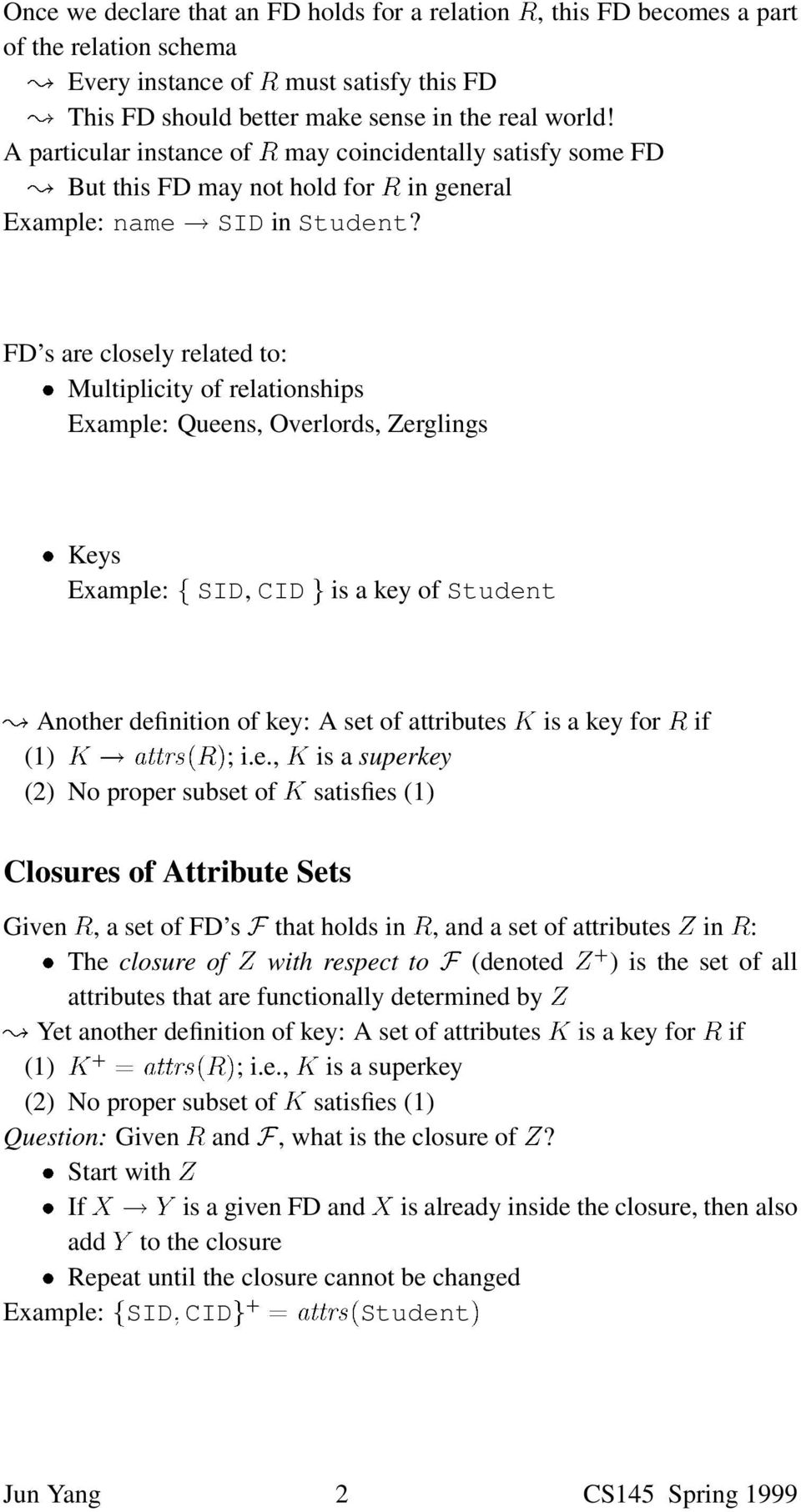
1 CS145 Lecture Notes #5 Relational Database Design: FD s & BCNF Motivation Automatic translation from E/R or ODL may not produce the best relational design possible Sometimes database designers like to start directly with a relational design, in which case the design could be really bad Notation,,... denote relations denotes the set of all attributes in,,... denote attributes,,... denote sets of attributes Functional Dependencies A functional dependency (FD) has the form, where and are sets of attributes in a relation Formally, means that whenever two tuples in agree on all the attributes of, they must also agree on all the attributes of FD s in Student(SID, SS#, name, CID, grade) Some FD s are more interesting than others: Trivial FD: where is a subset of Nontrivial FD: where is not a subset of Completely nontrivial FD: where and do not overlap Jun Yang 1 CS145 Spring 1999

2 Once we declare that an FD holds for a relation, this FD becomes a part of the relation schema Every instance of must satisfy this FD This FD should better make sense in the real world! A particular instance of may coincidentally satisfy some FD But this FD may not hold for in general name SID in Student? FD s are closely related to: Multiplicity of relationships Queens, Overlords, Zerglings Keys SID, CID is a key of Student Another definition of key: A set of attributes is a key for if (1) ; i.e., is a superkey (2) No proper subset of satisfies (1) Closures of Attribute Sets Given, a set of FD s that holds in, and a set of attributes in : The closure of with respect to (denoted ) is the set of all attributes that are functionally determined by Yet another definition of key: A set of attributes is a key for if (1) ; i.e., is a superkey (2) No proper subset of satisfies (1) Question: Given and, what is the closure of? Start with If is a given FD and is already inside the closure, then also add to the closure Repeat until the closure cannot be changed SID CID Student Jun Yang 2 CS145 Spring 1999
3 Question: Given and, what are the keys of? Brute-force approach: for every subset of, compute its closures and see if it covers Trick: start with small subsets; if, no need to try any superset of Trick: if does not appear on the right-hand side of any FD, then every key must contain what are the keys of Student? Closures of FD Sets Given and a set of FD s that holds in : The closure of in (denoted ) is the set of all FD s in that are logically implied by Question: Given and, is implied by? (Or, given and, is in?) Method 1: compute and check if it contains Method 2: try to prove using Armstrong s Axioms: Reflexivity: if, then Augmentation: if, then for any set Transitivity: if and, then or using other rules that follow from the axioms: Splitting: if, then and Combining: if and, then prove that SS# CID name grade Jun Yang 3 CS145 Spring 1999

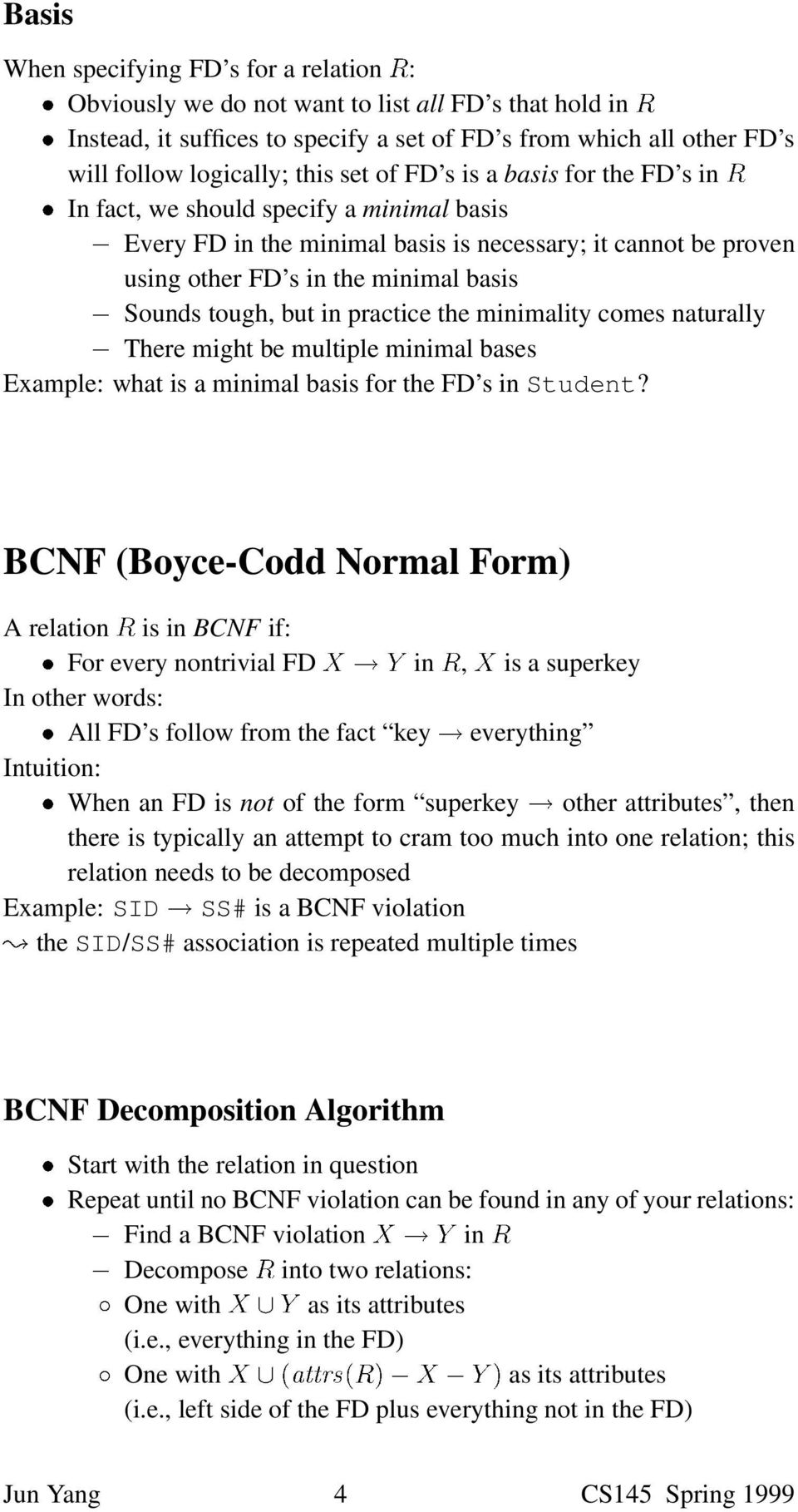
4 Basis When specifying FD s for a relation : Obviously we do not want to list all FD s that hold in Instead, it suffices to specify a set of FD s from which all other FD s will follow logically; this set of FD s is a basis for the FD s in In fact, we should specify a minimal basis Every FD in the minimal basis is necessary; it cannot be proven using other FD s in the minimal basis Sounds tough, but in practice the minimality comes naturally There might be multiple minimal bases what is a minimal basis for the FD s in Student? BCNF (Boyce-Codd Normal Form) A relation is in BCNF if: For every nontrivial FD in, is a superkey In other words: All FD s follow from the fact key everything Intuition: When an FD is not of the form superkey other attributes, then there is typically an attempt to cram too much into one relation; this relation needs to be decomposed SID SS# is a BCNF violation the SID/SS# association is repeated multiple times BCNF Decomposition Algorithm Start with the relation in question Repeat until no BCNF violation can be found in any of your relations: Find a BCNF violation in Decompose into two relations: One with as its attributes (i.e., everything in the FD) One with as its attributes (i.e., left side of the FD plus everything not in the FD) Jun Yang 4 CS145 Spring 1999
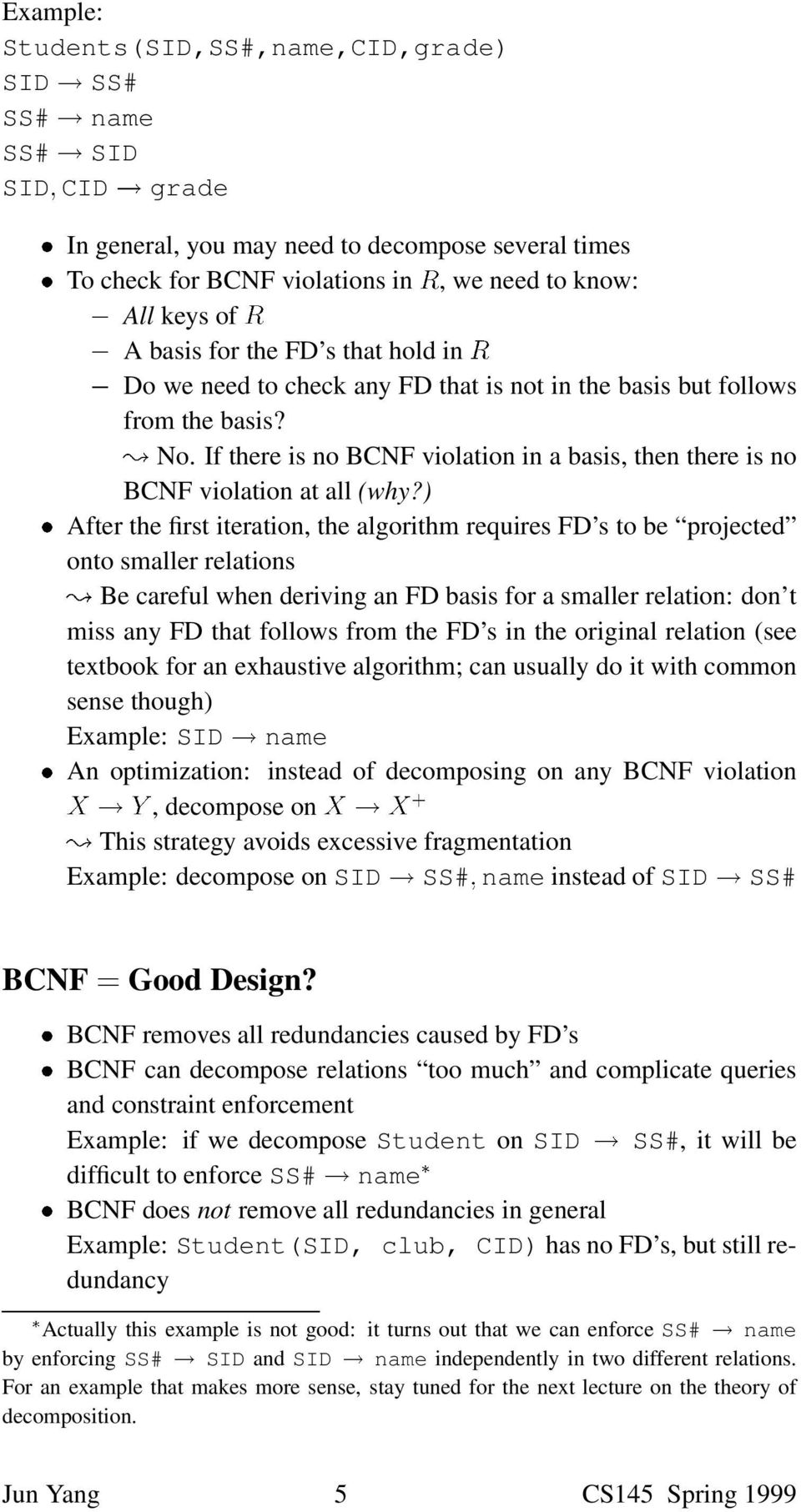
5 Students(SID,SS#,name,CID,grade) SID SS# SS# name SS# SID SID CID grade In general, you may need to decompose several times To check for BCNF violations in, we need to know: All keys of A basis for the FD s that hold in Do we need to check any FD that is not in the basis but follows from the basis? No. If there is no BCNF violation in a basis, then there is no BCNF violation at all (why?) After the first iteration, the algorithm requires FD s to be projected onto smaller relations Be careful when deriving an FD basis for a smaller relation: don t miss any FD that follows from the FD s in the original relation (see textbook for an exhaustive algorithm; can usually do it with common sense though) SID name An optimization: instead of decomposing on any BCNF violation, decompose on This strategy avoids excessive fragmentation decompose on SID SS# name instead of SID SS# BCNF Good Design? BCNF removes all redundancies caused by FD s BCNF can decompose relations too much and complicate queries and constraint enforcement if we decompose Student on SID SS#, it will be difficult to enforce SS# name BCNF does not remove all redundancies in general Student(SID, club, CID) has no FD s, but still redundancy Actually this example is not good: it turns out that we can enforce SS# name by enforcing SS# SID and SID name independently in two different relations. For an example that makes more sense, stay tuned for the next lecture on the theory of decomposition. Jun Yang 5 CS145 Spring 1999
Database Design and Normalization
 Database Design and Normalization CPS352: Database Systems Simon Miner Gordon College Last Revised: 9/27/12 Agenda Check-in Functional Dependencies (continued) Design Project E-R Diagram Presentations
Lecture Notes on Database Normalization
 Lecture Notes on Database Normalization Chengkai Li Department of Computer Science and Engineering The University of Texas at Arlington April 15, 2012 I decided to write this document, because many students
Schema Design and Normal Forms Sid Name Level Rating Wage Hours
 Entity-Relationship Diagram Schema Design and Sid Name Level Rating Wage Hours Database Management Systems, 2 nd Edition. R. Ramakrishnan and J. Gehrke 1 Database Management Systems, 2 nd Edition. R. Ramakrishnan
Schema Refinement and Normalization
 Schema Refinement and Normalization Module 5, Lectures 3 and 4 Database Management Systems, R. Ramakrishnan 1 The Evils of Redundancy Redundancy is at the root of several problems associated with relational
CS143 Notes: Normalization Theory
 CS143 Notes: Normalization Theory Book Chapters (4th) Chapters 7.1-6, 7.8, 7.10 (5th) Chapters 7.1-6, 7.8 (6th) Chapters 8.1-6, 8.8 INTRODUCTION Main question How do we design good tables for a relational
Design of Relational Database Schemas
 Design of Relational Database Schemas T. M. Murali October 27, November 1, 2010 Plan Till Thanksgiving What are the typical problems or anomalies in relational designs? Introduce the idea of decomposing
Database Design and Normal Forms
 Database Design and Normal Forms Database Design coming up with a good schema is very important How do we characterize the goodness of a schema? If two or more alternative schemas are available how do
Schema Refinement, Functional Dependencies, Normalization
 Schema Refinement, Functional Dependencies, Normalization MSCI 346: Database Systems Güneş Aluç, University of Waterloo Spring 2015 MSCI 346: Database Systems Chapter 19 1 / 42 Outline 1 Introduction Design
Relational Database Design
 Relational Database Design To generate a set of relation schemas that allows - to store information without unnecessary redundancy - to retrieve desired information easily Approach - design schema in appropriate
Functional Dependencies and Finding a Minimal Cover
 Functional Dependencies and Finding a Minimal Cover Robert Soulé 1 Normalization An anomaly occurs in a database when you can update, insert, or delete data, and get undesired side-effects. These side
Why Is This Important? Schema Refinement and Normal Forms. The Evils of Redundancy. Functional Dependencies (FDs) Example (Contd.)
 Why Is This Important? Schema Refinement and Normal Forms Chapter 19 Many ways to model a given scenario in a database How do we find the best one? We will discuss objective criteria for evaluating database
Functional Dependencies and Normalization
 Functional Dependencies and Normalization 5DV119 Introduction to Database Management Umeå University Department of Computing Science Stephen J. Hegner [email protected] http://www.cs.umu.se/~hegner Functional
Functional Dependencies
 BCNF and 3NF Functional Dependencies Functional dependencies: modeling constraints on attributes stud-id name address course-id session-id classroom instructor Functional dependencies should be obtained
Chapter 7: Relational Database Design
 Chapter 7: Relational Database Design Database System Concepts, 5th Ed. See www.db book.com for conditions on re use Chapter 7: Relational Database Design Features of Good Relational Design Atomic Domains
Relational Database Design Theory
 Relational Database Design Theory Informal guidelines for good relational designs Functional dependencies Normal forms and normalization 1NF, 2NF, 3NF BCNF, 4NF, 5NF Inference rules on functional dependencies
Week 11: Normal Forms. Logical Database Design. Normal Forms and Normalization. Examples of Redundancy
 Week 11: Normal Forms Database Design Database Redundancies and Anomalies Functional Dependencies Entailment, Closure and Equivalence Lossless Decompositions The Third Normal Form (3NF) The Boyce-Codd
Database Management Systems. Redundancy and Other Problems. Redundancy
 Database Management Systems Winter 2004 CMPUT 391: Database Design Theory or Relational Normalization Theory Dr. Osmar R. Zaïane Lecture 2 Limitations of Relational Database Designs Provides a set of guidelines,
Databases -Normalization III. (N Spadaccini 2010 and W Liu 2012) Databases - Normalization III 1 / 31
 Databases -Normalization III (N Spadaccini 2010 and W Liu 2012) Databases - Normalization III 1 / 31 This lecture This lecture describes 3rd normal form. (N Spadaccini 2010 and W Liu 2012) Databases -
Chapter 7: Relational Database Design
 Chapter 7: Relational Database Design Pitfalls in Relational Database Design Decomposition Normalization Using Functional Dependencies Normalization Using Multivalued Dependencies Normalization Using Join
Advanced Relational Database Design
 APPENDIX B Advanced Relational Database Design In this appendix we cover advanced topics in relational database design. We first present the theory of multivalued dependencies, including a set of sound
Theory of Relational Database Design and Normalization
 Theory of Relational Database Design and Normalization (Based on Chapter 14 and some part of Chapter 15 in Fundamentals of Database Systems by Elmasri and Navathe, Ed. 3) 1 Informal Design Guidelines for
Chapter 8. Database Design II: Relational Normalization Theory
 Chapter 8 Database Design II: Relational Normalization Theory The E-R approach is a good way to start dealing with the complexity of modeling a real-world enterprise. However, it is only a set of guidelines
SQL DDL. DBS Database Systems Designing Relational Databases. Inclusion Constraints. Key Constraints
 DBS Database Systems Designing Relational Databases Peter Buneman 12 October 2010 SQL DDL In its simplest use, SQL s Data Definition Language (DDL) provides a name and a type for each column of a table.
Introduction to Database Systems. Normalization
 Introduction to Database Systems Normalization Werner Nutt 1 Normalization 1. Anomalies 1. Anomalies 2. Boyce-Codd Normal Form 3. 3 rd Normal Form 2 Anomalies The goal of relational schema design is to
SQL Tables, Keys, Views, Indexes
 CS145 Lecture Notes #8 SQL Tables, Keys, Views, Indexes Creating & Dropping Tables Basic syntax: CREATE TABLE ( DROP TABLE ;,,..., ); Types available: INT or INTEGER REAL or FLOAT CHAR( ), VARCHAR( ) DATE,
Theory behind Normalization & DB Design. Satisfiability: Does an FD hold? Lecture 12
 Theory behind Normalization & DB Design Lecture 12 Satisfiability: Does an FD hold? Satisfiability of FDs Given: FD X Y and relation R Output: Does R satisfy X Y? Algorithm: a.sort R on X b.do all the
Limitations of E-R Designs. Relational Normalization Theory. Redundancy and Other Problems. Redundancy. Anomalies. Example
 Limitations of E-R Designs Relational Normalization Theory Chapter 6 Provides a set of guidelines, does not result in a unique database schema Does not provide a way of evaluating alternative schemas Normalization
Introduction to Databases, Fall 2005 IT University of Copenhagen. Lecture 5: Normalization II; Database design case studies. September 26, 2005
 Introduction to Databases, Fall 2005 IT University of Copenhagen Lecture 5: Normalization II; Database design case studies September 26, 2005 Lecturer: Rasmus Pagh Today s lecture Normalization II: 3rd
Chapter 5: FUNCTIONAL DEPENDENCIES AND NORMALIZATION FOR RELATIONAL DATABASES
 1 Chapter 5: FUNCTIONAL DEPENDENCIES AND NORMALIZATION FOR RELATIONAL DATABASES INFORMAL DESIGN GUIDELINES FOR RELATION SCHEMAS We discuss four informal measures of quality for relation schema design in
Chapter 10. Functional Dependencies and Normalization for Relational Databases
 Chapter 10 Functional Dependencies and Normalization for Relational Databases Chapter Outline 1 Informal Design Guidelines for Relational Databases 1.1Semantics of the Relation Attributes 1.2 Redundant
COSC344 Database Theory and Applications. Lecture 9 Normalisation. COSC344 Lecture 9 1
 COSC344 Database Theory and Applications Lecture 9 Normalisation COSC344 Lecture 9 1 Overview Last Lecture Functional Dependencies This Lecture Normalisation Introduction 1NF 2NF 3NF BCNF Source: Section
Normalization in Database Design
 in Database Design Marek Rychly [email protected] Strathmore University, @ilabafrica & Brno University of Technology, Faculty of Information Technology Advanced Databases and Enterprise Systems 14
Introduction Decomposition Simple Synthesis Bernstein Synthesis and Beyond. 6. Normalization. Stéphane Bressan. January 28, 2015
 6. Normalization Stéphane Bressan January 28, 2015 1 / 42 This lecture is based on material by Professor Ling Tok Wang. CS 4221: Database Design The Relational Model Ling Tok Wang National University of
6.830 Lecture 3 9.16.2015 PS1 Due Next Time (Tuesday!) Lab 1 Out today start early! Relational Model Continued, and Schema Design and Normalization
 6.830 Lecture 3 9.16.2015 PS1 Due Next Time (Tuesday!) Lab 1 Out today start early! Relational Model Continued, and Schema Design and Normalization Animals(name,age,species,cageno,keptby,feedtime) Keeper(id,name)
normalisation Goals: Suppose we have a db scheme: is it good? define precise notions of the qualities of a relational database scheme
 Goals: Suppose we have a db scheme: is it good? Suppose we have a db scheme derived from an ER diagram: is it good? define precise notions of the qualities of a relational database scheme define algorithms
Functional Dependency and Normalization for Relational Databases
 Functional Dependency and Normalization for Relational Databases Introduction: Relational database design ultimately produces a set of relations. The implicit goals of the design activity are: information
Database Management System
 UNIT -6 Database Design Informal Design Guidelines for Relation Schemas; Functional Dependencies; Normal Forms Based on Primary Keys; General Definitions of Second and Third Normal Forms; Boyce-Codd Normal
Database Systems Concepts, Languages and Architectures
 These slides are for use with Database Systems Concepts, Languages and Architectures Paolo Atzeni Stefano Ceri Stefano Paraboschi Riccardo Torlone To view these slides on-screen or with a projector use
Introduction to Database Systems. Chapter 4 Normal Forms in the Relational Model. Chapter 4 Normal Forms
 Introduction to Database Systems Winter term 2013/2014 Melanie Herschel [email protected] Université Paris Sud, LRI 1 Chapter 4 Normal Forms in the Relational Model After completing this chapter,
CSCI-GA.2433-001 Database Systems Lecture 7: Schema Refinement and Normalization
 CSCI-GA.2433-001 Database Systems Lecture 7: Schema Refinement and Normalization Mohamed Zahran (aka Z) [email protected] http://www.mzahran.com View 1 View 2 View 3 Conceptual Schema At that point we
How To Find Out What A Key Is In A Database Engine
 Database design theory, Part I Functional dependencies Introduction As we saw in the last segment, designing a good database is a non trivial matter. The E/R model gives a useful rapid prototyping tool,
The Relational Model. Ramakrishnan&Gehrke, Chapter 3 CS4320 1
 The Relational Model Ramakrishnan&Gehrke, Chapter 3 CS4320 1 Why Study the Relational Model? Most widely used model. Vendors: IBM, Informix, Microsoft, Oracle, Sybase, etc. Legacy systems in older models
Normalisation. Why normalise? To improve (simplify) database design in order to. Avoid update problems Avoid redundancy Simplify update operations
 Normalisation Why normalise? To improve (simplify) database design in order to Avoid update problems Avoid redundancy Simplify update operations 1 Example ( the practical difference between a first normal
Theory of Relational Database Design and Normalization
 Theory of Relational Database Design and Normalization (Based on Chapter 14 and some part of Chapter 15 in Fundamentals of Database Systems by Elmasri and Navathe) 1 Informal Design Guidelines for Relational
Determination of the normalization level of database schemas through equivalence classes of attributes
 Computer Science Journal of Moldova, vol.17, no.2(50), 2009 Determination of the normalization level of database schemas through equivalence classes of attributes Cotelea Vitalie Abstract In this paper,
Chapter 10 Functional Dependencies and Normalization for Relational Databases
 Chapter 10 Functional Dependencies and Normalization for Relational Databases Copyright 2004 Pearson Education, Inc. Chapter Outline 1 Informal Design Guidelines for Relational Databases 1.1Semantics of
Limitations of DB Design Processes
 Normalization CS 317/387 1 Limitations of DB Design Processes Provides a set of guidelines, does not result in a unique database schema Does not provide a way of evaluating alternative schemas Pitfalls:
Chapter 15 Basics of Functional Dependencies and Normalization for Relational Databases
 Chapter 15 Basics of Functional Dependencies and Normalization for Relational Databases Copyright 2011 Pearson Education, Inc. Publishing as Pearson Addison-Wesley Chapter 15 Outline Informal Design Guidelines
SQL NULL s, Constraints, Triggers
 CS145 Lecture Notes #9 SQL NULL s, Constraints, Triggers Example schema: CREATE TABLE Student (SID INTEGER PRIMARY KEY, name CHAR(30), age INTEGER, GPA FLOAT); CREATE TABLE Take (SID INTEGER, CID CHAR(10),
Normalisation to 3NF. Database Systems Lecture 11 Natasha Alechina
 Normalisation to 3NF Database Systems Lecture 11 Natasha Alechina In This Lecture Normalisation to 3NF Data redundancy Functional dependencies Normal forms First, Second, and Third Normal Forms For more
Relational Normalization Theory (supplemental material)
 Relational Normalization Theory (supplemental material) CSE 532, Theory of Database Systems Stony Brook University http://www.cs.stonybrook.edu/~cse532 2 Quiz 8 Consider a schema S with functional dependencies:
CS 377 Database Systems. Database Design Theory and Normalization. Li Xiong Department of Mathematics and Computer Science Emory University
 CS 377 Database Systems Database Design Theory and Normalization Li Xiong Department of Mathematics and Computer Science Emory University 1 Relational database design So far Conceptual database design
Lecture 6. SQL, Logical DB Design
 Lecture 6 SQL, Logical DB Design Relational Query Languages A major strength of the relational model: supports simple, powerful querying of data. Queries can be written intuitively, and the DBMS is responsible
Objectives of Database Design Functional Dependencies 1st Normal Form Decomposition Boyce-Codd Normal Form 3rd Normal Form Multivalue Dependencies
 Objectives of Database Design Functional Dependencies 1st Normal Form Decomposition Boyce-Codd Normal Form 3rd Normal Form Multivalue Dependencies 4th Normal Form General view over the design process 1
Relational Normalization: Contents. Relational Database Design: Rationale. Relational Database Design. Motivation
 Relational Normalization: Contents Motivation Functional Dependencies First Normal Form Second Normal Form Third Normal Form Boyce-Codd Normal Form Decomposition Algorithms Multivalued Dependencies and
The Relational Model. Why Study the Relational Model?
 The Relational Model Chapter 3 Instructor: Vladimir Zadorozhny [email protected] Information Science Program School of Information Sciences, University of Pittsburgh 1 Why Study the Relational Model?
Normalization of database model. Pazmany Peter Catholic University 2005 Zoltan Fodroczi
 Normalization of database model Pazmany Peter Catholic University 2005 Zoltan Fodroczi Closure of an attribute set Given a set of attributes α define the closure of attribute set α under F (denoted as
Boyce-Codd Normal Form
 4NF Boyce-Codd Normal Form A relation schema R is in BCNF if for all functional dependencies in F + of the form α β at least one of the following holds α β is trivial (i.e., β α) α is a superkey for R
Lecture 2 Normalization
 MIT 533 ระบบฐานข อม ล 2 Lecture 2 Normalization Walailuk University Lecture 2: Normalization 1 Objectives The purpose of normalization The identification of various types of update anomalies The concept
Chapter 10. Functional Dependencies and Normalization for Relational Databases. Copyright 2007 Ramez Elmasri and Shamkant B.
 Chapter 10 Functional Dependencies and Normalization for Relational Databases Copyright 2007 Ramez Elmasri and Shamkant B. Navathe Chapter Outline 1 Informal Design Guidelines for Relational Databases
DATABASE NORMALIZATION
 DATABASE NORMALIZATION Normalization: process of efficiently organizing data in the DB. RELATIONS (attributes grouped together) Accurate representation of data, relationships and constraints. Goal: - Eliminate
Database Constraints and Design
 Database Constraints and Design We know that databases are often required to satisfy some integrity constraints. The most common ones are functional and inclusion dependencies. We ll study properties of
Normalization. CIS 331: Introduction to Database Systems
 Normalization CIS 331: Introduction to Database Systems Normalization: Reminder Why do we need to normalize? To avoid redundancy (less storage space needed, and data is consistent) To avoid update/delete
Database Sample Examination
 Part 1: SQL Database Sample Examination (Spring 2007) Question 1: Draw a simple ER diagram that results in a primary key/foreign key constraint to be created between the tables: CREATE TABLE Salespersons
Outline. Data Modeling. Conceptual Design. ER Model Basics: Entities. ER Model Basics: Relationships. Ternary Relationships. Yanlei Diao UMass Amherst
 Outline Data Modeling Yanlei Diao UMass Amherst v Conceptual Design: ER Model v Relational Model v Logical Design: from ER to Relational Slides Courtesy of R. Ramakrishnan and J. Gehrke 1 2 Conceptual
EECS 647: Introduction to Database Systems
 EECS 647: Introduction to Database Systems Instructor: Luke Huan Spring 2013 Administrative Take home background survey is due this coming Friday The grader of this course is Ms. Xiaoli Li and her email
The core theory of relational databases. Bibliography
 The core theory of relational databases Slide 1 La meilleure pratique... c est une bonne théorie Bibliography M.Levene, G.Loizou, Guided Tour of Relational Databases and Beyond, Springer, 625 pages,1999.
Database Design. Marta Jakubowska-Sobczak IT/ADC based on slides prepared by Paula Figueiredo, IT/DB
 Marta Jakubowska-Sobczak IT/ADC based on slides prepared by Paula Figueiredo, IT/DB Outline Database concepts Conceptual Design Logical Design Communicating with the RDBMS 2 Some concepts Database: an
The Relational Model. Why Study the Relational Model? Relational Database: Definitions. Chapter 3
 The Relational Model Chapter 3 Database Management Systems 3ed, R. Ramakrishnan and J. Gehrke 1 Why Study the Relational Model? Most widely used model. Vendors: IBM, Informix, Microsoft, Oracle, Sybase,
SQL Programming. CS145 Lecture Notes #10. Motivation. Oracle PL/SQL. Basics. Example schema:
 CS145 Lecture Notes #10 SQL Programming Example schema: CREATE TABLE Student (SID INTEGER PRIMARY KEY, name CHAR(30), age INTEGER, GPA FLOAT); CREATE TABLE Take (SID INTEGER, CID CHAR(10), PRIMARY KEY(SID,
C# Cname Ccity.. P1# Date1 Qnt1 P2# Date2 P9# Date9 1 Codd London.. 1 21.01 20 2 23.01 2 Martin Paris.. 1 26.10 25 3 Deen London.. 2 29.
 4. Normalisation 4.1 Introduction Suppose we are now given the task of designing and creating a database. How do we produce a good design? What relations should we have in the database? What attributes
CS2Bh: Current Technologies. Introduction to XML and Relational Databases. Introduction to Databases. Why databases? Why not use XML?
 CS2Bh: Current Technologies Introduction to XML and Relational Databases Spring 2005 Introduction to Databases CS2 Spring 2005 (LN5) 1 Why databases? Why not use XML? What is missing from XML: Consistency
The Relational Model. Why Study the Relational Model? Relational Database: Definitions
 The Relational Model Database Management Systems, R. Ramakrishnan and J. Gehrke 1 Why Study the Relational Model? Most widely used model. Vendors: IBM, Microsoft, Oracle, Sybase, etc. Legacy systems in
Entity Relationship Diagram
 Yufei Tao Department of Computer Science and Engineering Chinese University of Hong Kong A primary goal of database design is to decide what tables to create. Usually, there are two principles: 1 Capture
Jordan University of Science & Technology Computer Science Department CS 728: Advanced Database Systems Midterm Exam First 2009/2010
 Jordan University of Science & Technology Computer Science Department CS 728: Advanced Database Systems Midterm Exam First 2009/2010 Student Name: ID: Part 1: Multiple-Choice Questions (17 questions, 1
DATABASE DESIGN: NORMALIZATION NOTE & EXERCISES (Up to 3NF)
 DATABASE DESIGN: NORMALIZATION NOTE & EXERCISES (Up to 3NF) Tables that contain redundant data can suffer from update anomalies, which can introduce inconsistencies into a database. The rules associated
Part I: Entity Relationship Diagrams and SQL (40/100 Pt.)
 Part I: Entity Relationship Diagrams and SQL (40/100 Pt.) Q.1.1) Translate the following E-R Schema to SQL-DDL tables using the CREATE Table Statement and check constraints, if needed: LatinName EnglishName
Announcements. SQL is hot! Facebook. Goal. Database Design Process. IT420: Database Management and Organization. Normalization (Chapter 3)
 Announcements IT0: Database Management and Organization Normalization (Chapter 3) Department coin design contest deadline - February -week exam Monday, February 1 Lab SQL SQL Server: ALTER TABLE tname
3. Database Design. 3.1. Functional Dependency. 3.1.01. Introduction. 3.1.02. Value in design. 3.1.03. Initial state. 3.1.05. Aims
 of 18 05/03/2007 07:37 3. Database Design This is the Database Design course theme. [Complete set of notes PDF 295Kb]. 3.1. Functional Dependency In this lecture we look at... [Section notes PDF 64Kb]
Quiz 3: Database Systems I Instructor: Hassan Khosravi Spring 2012 CMPT 354
 Quiz 3: Database Systems I Instructor: Hassan Khosravi Spring 2012 CMPT 354 1. [10] Show that each of the following are not valid rules about FD s by giving a small example relations that satisfy the given
Normalisation in the Presence of Lists
 1 Normalisation in the Presence of Lists Sven Hartmann, Sebastian Link Information Science Research Centre, Massey University, Palmerston North, New Zealand 1. Motivation & Revision of the RDM 2. The Brouwerian
Chapter 5: Logical Database Design and the Relational Model Part 2: Normalization. Introduction to Normalization. Normal Forms.
 Chapter 5: Logical Database Design and the Relational Model Part 2: Normalization Modern Database Management 6 th Edition Jeffrey A. Hoffer, Mary B. Prescott, Fred R. McFadden Robert C. Nickerson ISYS
Conceptual Design Using the Entity-Relationship (ER) Model
 Conceptual Design Using the Entity-Relationship (ER) Model Module 5, Lectures 1 and 2 Database Management Systems, R. Ramakrishnan 1 Overview of Database Design Conceptual design: (ER Model is used at
Introduction to Databases
 Introduction to Databases IT University of Copenhagen January 7, 2005 This exam consists of 6 problems with a total of 16 questions. The weight of each problem is stated. You have 4 hours to answer all
CS2Bh: Current Technologies. Introduction to XML and Relational Databases. The Relational Model. The relational model
 CS2Bh: Current Technologies Introduction to XML and Relational Databases Spring 2005 The Relational Model CS2 Spring 2005 (LN6) 1 The relational model Proposed by Codd in 1970. It is the dominant data
model license person owns car report-number participated damage-amount E-R diagram for a Car-insurance company.
 Exercises 9 address model driver-id license person owns car report-number location date driver participated accident damage-amount Figure 2.1 E-R diagram for a Car-insurance company. Exercises 2.1 Explain
About the Tutorial. Audience. Prerequisites. Copyright & Disclaimer
 About the Tutorial Database Management System or DBMS in short refers to the technology of storing and retrieving users data with utmost efficiency along with appropriate security measures. DBMS allows
Design Theory for Relational Databases: Functional Dependencies and Normalization
 Design Theory for Relational Databases: Functional Dependencies and Normalization Juliana Freire Some slides adapted from L. Delcambre, R. Ramakrishnan, G. Lindstrom, J. Ullman and Silberschatz, Korth
DATABASE MANAGEMENT SYSTEMS. Question Bank:
 DATABASE MANAGEMENT SYSTEMS Question Bank: UNIT 1 1. Define Database? 2. What is a DBMS? 3. What is the need for database systems? 4. Define tupule? 5. What are the responsibilities of DBA? 6. Define schema?
Database Design and Normalization
 Database Design and Normalization Chapter 10 (Week 11) EE562 Slides and Modified Slides from Database Management Systems, R. Ramakrishnan 1 Computing Closure F + Example: List all FDs with: - a single
There are five fields or columns, with names and types as shown above.
 3 THE RELATIONAL MODEL Exercise 3.1 Define the following terms: relation schema, relational database schema, domain, attribute, attribute domain, relation instance, relation cardinality, andrelation degree.
Question 1. Relational Data Model [17 marks] Question 2. SQL and Relational Algebra [31 marks]
![Question 1. Relational Data Model [17 marks] Question 2. SQL and Relational Algebra [31 marks]](/thumbs/31/14748519.jpg "Question 1. Relational Data Model [17 marks] Question 2. SQL and Relational Algebra [31 marks]") EXAMINATIONS 2005 MID-YEAR COMP 302 Database Systems Time allowed: Instructions: 3 Hours Answer all questions. Make sure that your answers are clear and to the point. Write your answers in the spaces provided.
EXAMINATIONS 2005 MID-YEAR COMP 302 Database Systems Time allowed: Instructions: 3 Hours Answer all questions. Make sure that your answers are clear and to the point. Write your answers in the spaces provided.
MCQs~Databases~Relational Model and Normalization http://en.wikipedia.org/wiki/database_normalization
 http://en.wikipedia.org/wiki/database_normalization Database normalization is the process of organizing the fields and tables of a relational database to minimize redundancy. Normalization usually involves
14 Databases. Source: Foundations of Computer Science Cengage Learning. Objectives After studying this chapter, the student should be able to:
 14 Databases 14.1 Source: Foundations of Computer Science Cengage Learning Objectives After studying this chapter, the student should be able to: Define a database and a database management system (DBMS)
A Web-Based Environment for Learning Normalization of Relational Database Schemata
 A Web-Based Environment for Learning Normalization of Relational Database Schemata Nikolay Georgiev September 2008 Master s Thesis in Computing Science, 30 ECTS credits Supervisor at CS-UmU: Stephen J.
COMP 378 Database Systems Notes for Chapter 7 of Database System Concepts Database Design and the Entity-Relationship Model
 COMP 378 Database Systems Notes for Chapter 7 of Database System Concepts Database Design and the Entity-Relationship Model The entity-relationship (E-R) model is a a data model in which information stored
Entity Relationship Model
 C H A P T E R 2 Entity Relationship Model Exercises 2.2 Answer: See Figure 2.1 2.4 Answer: See Figure 2.2. In the answer given here, the main entity sets are,, -offering, and instructor. The entity set