
Realizing the Future We Want for All. Report to the Secretary-General
|
|
|
- Edward Thompson
- 10 years ago
- Views:
Transcription


1 Realizing the Future We Want for All Report to the Secretary-General New York, June 2012

2 Following on the outcome of the 2010 High-level Plenary Meeting of the General Assembly on the Millennium Development Goals, the United Nations Secretary- General established the UN System Task Team in September 2011 to support UN system-wide preparations for the post-2015 UN development agenda, in consultation with all stakeholders. The Task Team is co-chaired by the Department of Economic and Social Affairs and the United Nations Development Programme and brings together senior experts from over 50 UN entities and international organizations to provide system-wide support to the post-2015 consultation process, including analytical input, expertise and outreach. Cover photo: istock photo

3 Realizing the future we want for all: Report to the Secretary-General i Realizing the future we want for all Summary The central challenge of the post-2015 UN development agenda is to ensure that globalization becomes a positive force for all the worlds peoples of present and future generations. Globalization offers great opportunities, but its benefits are at present very unevenly shared. The continuous striving for improvements in material welfare is threatening to surpass the limits of the natural resource base unless there is a radical shift towards more sustainable patterns of consumption and production and resource use. Persistent inequalities and struggles over scarce resources are among key determinants of situations of conflict, hunger, insecurity and violence, which in turn are key factors that hold back human development and efforts to achieve sustainable development. Business as usual thus cannot be an option and transformative change is needed. As the challenges are highly interdependent, a new, more holistic approach is needed to address them. Accordingly, this first report prepared by the UN System-wide Task Team on the Post-2015 UN Development Agenda recommends: A vision for the future that rests on the core values of human rights, equality and sustainability. An agenda format based on concrete end goals and targets, one of the key strengths of the MDG framework should be retained, but reorganized along four key dimensions of a more holistic approach: (1) inclusive social development; (2) inclusive economic development; (3) environmental sustainability; and (4) peace and security. This focused approach is consistent with the principles of the Millennium Declaration which set out a vision of freedom from want and fear for present and future generations and builds on the three pillars of sustainable development. To realize the future we want for all, a high degree of policy coherence at the global, regional, national and sub-national

4 ii UN System Task Team on the Post-2015 UN Development Agenda levels will be required. The core set of development enablers can be identified as a guide for such policy coherence without making the post-2015 UN development agenda a prescriptive one. In setting the agenda, it should be recognized that there are no blueprints and that one size does not fit all. Hence, the agenda should leave ample space for national policy design and adaptation to local settings, but be guided by the overall vision and its underlying principles. The post-2015 UN development agenda should be conceived as a truly global agenda with shared responsibilities for all countries. Accordingly, the global partnership for development would also need to be redefined towards a more balanced approach among all development partners that will enable the transformative change needed for a rights-based, equitable and sustainable process of global development. This would also involve reforms of mechanisms of global governance. It is still too early to define concrete goals and targets for the post-2015 UN development agenda. Various processes will need to run their course first. The outcome of and followup to the Rio+20 Conference on Sustainable Development will provide critical guidance and the proposed vision and framework for the post-2015 agenda must be fully aligned with that outcome. Also, broad and inclusive consultation processes on the vision for the post-2015 agenda are still ongoing and will be essential in shaping a shared vision. The immediate challenge is to reach consensus on the contours of an agenda that adequately identifies the development needs of present and future generations, and is capable of crystallizing these priorities in clear, easy-to-communicate sustainable development goals that will help guide coherent policy action at the global, regional and national levels. This report is to serve as a first reference for the broader consultations to take place.

5 Realizing the future we want for all: Report to the Secretary-General iii Contents Summary....i I. Introduction... 1 II. The transformative power of global goals a. Reviewing the MDG framework b. Lessons for the post-2015 UN development agenda III. Global trends, challenges and opportunities to which the post-2015 UN development agenda should respond a. Much progress, but business as usual is not an option...12 b. Progress in poverty reduction, but major inequalities persist c. The knowledge challenge d. Shifting demographics e. Growing environmental footprints f. Living in an insecure world g. Governance and accountability deficits...18 h. A need for new development pathways IV. Vision: the future we want for all a. Transformative change towards inclusive, people-centred, sustainable development b. Three fundamental principles i. Human rights...23 ii. Equality iii. Sustainability c. Four core dimensions i. Inclusive social development ii. Environmental sustainability iii. Inclusive economic development iv. Peace and security V. Shaping the global development agenda...33 a. Key considerations in shaping the agenda b. Possible format of the agenda c. Reshaping the global partnership for development d. New time horizon e. Monitoring and benchmarking VI. The way forward: consultations to forge consensus on a post-2015 UN development agenda a. Initial guidance from Member States b. Proposed road map i. Bringing different voices into the process ii. Major milestones leading up to Annexes I. The UN System Task Team on the Post-2015 UN Development Agenda: participating entities II. Strengths and weaknesses of the MDG framework III. Intergovernmental processes of relevance for post-2015 UN development agenda preparations....48

6


7 Realizing the future we want for all: Report to the Secretary-General 1 Photo Credit: istock Photo I. Introduction 1. The outcome document of the High-level Plenary Meeting of the United Nations General Assembly on the progress towards the Millennium Development Goals (MDGs), in 2010, requested the Secretary-General to make recommendations to advance the United Nations development agenda beyond Initial recommendations in this regard were presented in the Report of the Secretary-General on accelerating progress towards the MDGs of August 2011, with special reference to the need for an open and inclusive process of consultations on the agenda With this in mind, in September 2011, the Secretary-General established the UN System Task Team on the Post-2015 UN Development Agenda to coordinate system-wide preparations for the agenda, in consultation with all stakeholders. 3 The Task Team, launched in January 2012, brings together senior experts designated by the Principals of over 50 UN system entities and other international organizations. 4 The terms of reference of the Task Team include: assessing ongoing efforts within the UN system; consulting external stakeholders, such as civil society, academia and the private sector; and defining a system-wide vision and road map on the post-2015 UN development agenda. 1 General Assembly resolution 65/1 of 22 September Annual report of the Secretary-General on accelerating progress towards the Millennium Development Goals: options for sustained and inclusive growth and issues for advancing the United Nations development agenda beyond 2015, 11 July 2011, A/66/ Interoffice Memorandum No September The Task Team is co-chaired by DESA and UNDP. 4 The list of participating agencies is included in Annex I.
8 2 UN System Task Team on the Post-2015 UN Development Agenda 3. The Task Team has grounded its work in a shared understanding of development as resulting from the complex interaction of multiple economic, social, cultural, ecological, political and legal factors. Those factors have important cross-border elements, tying together people across the globe. Development is also context-specific, and different initial conditions mean that outcomes in terms of the fulfilment of human rights and degrees of freedom (from want and fear) vary greatly within and among countries and population groups. There is no universal blueprint of how to overcome these disparities and deficits, and how to lead the world towards a shared and sustainable future for all. 4. The purpose of a global development agenda is thus not to prescribe specific development strategies or policies, but to provide guidance for priority setting at all levels (global, regional, national and sub-national). Such an agenda should help create an enabling environment to meet shared objectives, support global solutions to global problems and guide national development efforts, while supporting the empowerment of people to determine their own futures. It should also be defined in a way that facilitates its implementation, transparent monitoring of progress and mutual accountability for results. 5. To call it a UN development agenda is to denote the readiness of the United Nations to serve as the multi-stakeholder platform for its formulation, with the capacity to undertake the broad-based consultations required and with the ambition to produce a global development agenda that all countries and all stakeholders will recognize as their own. 6. There are a number of relevant ongoing processes where negotiations leading to international agreements have been and will take place, including, among others, the United Nations Conference on Sustainable Development (Rio+20) in June The progress made within those processes and by the multiple consultations that will take place at national, regional and global levels will feed into the consultations on the post-2015 UN development agenda. 7. This report of the UN System Task Team aims to serve as a reference to orient these ongoing discussions and the broader consultation process taking place among governments, the UN system and other international organizations, civil society, academia and the private sector. The report will also inform the work of the High-level Panel of Eminent Persons to be appointed by the Secretary-General to advise him on the post-2015 process and it will provide technical inputs to the process for developing sustainable development goals (SDGs) that was agreed in the Rio+20 Outcome The report begins by reflecting on the experience of the UN system in supporting the implementation of the MDG framework (section II). Building on the lessons learned, the report provides an assessment of the key development challenges to which the global development agenda should respond (section 5 United Nations, The Future We Want, Outcome Document of the United Nations Conference on Sustainable Development, A/CONF.216/L.1, para , thefuturewewant.html.
9 Realizing the future we want for all: Report to the Secretary-General 3 III). It proposes a vision of people-centred, inclusive and sustainable development (section IV) and initial ideas for possible contours of a post-2015 UN development agenda (section V). It concludes by laying out a possible road map for the process of defining the agenda, including ways of bringing different voices of people around the world into the consultations (section VI). 9. The report is informed by the initial consultations organized by the UN System Task Team with Member States, academics, civil society organizations and the private sector. 6 It is also based on a thorough review of the growing literature on the subject The report manifests a genuinely collaborative effort among the agencies represented in the UN System Task Team. Above all, it represents a collective determination to reflect on the experience with the MDG framework and provide a solid foundation for all stakeholders to move forward with the preparations for a post-2015 UN development agenda that is responsive to both today s and tomorrow s global challenges and worthy of the aspirations of all countries and people for a better future. 6 The UN System Task Team organized an Expert Group Meeting on February 2012, and three informal briefings with Member States (General Assembly in November 2011 and February 2012; and ECOSOC in March 2012). The Report is also informed by ongoing consultations between UN system entities and civil society organizations. 7 As a supplement, participating entities of the UN System Task Team have prepared a number of think pieces on thematic issues central to this report. These notes are available from and may also serve as references for further consultations on the post-2015 UN development agenda.

10

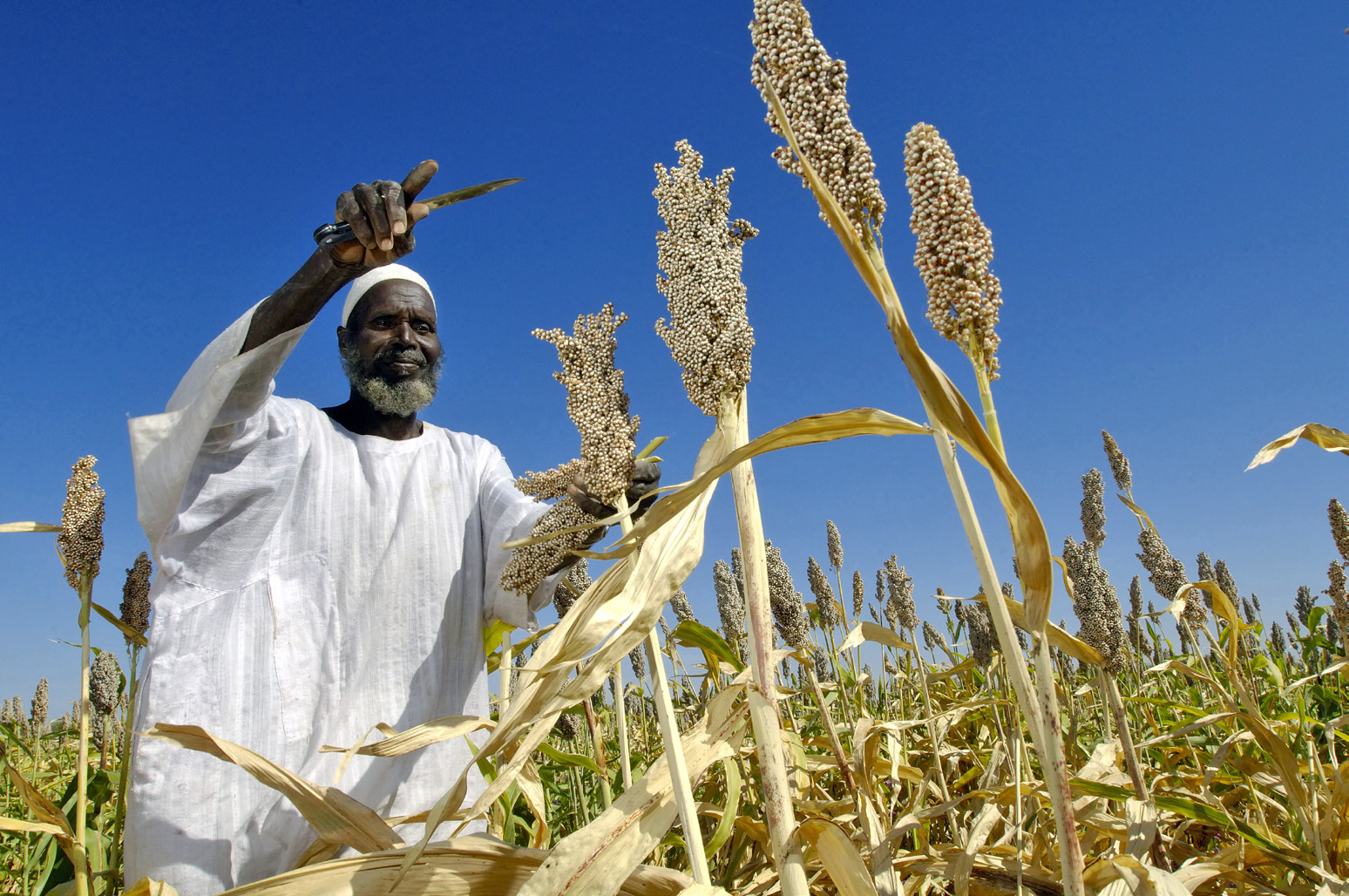
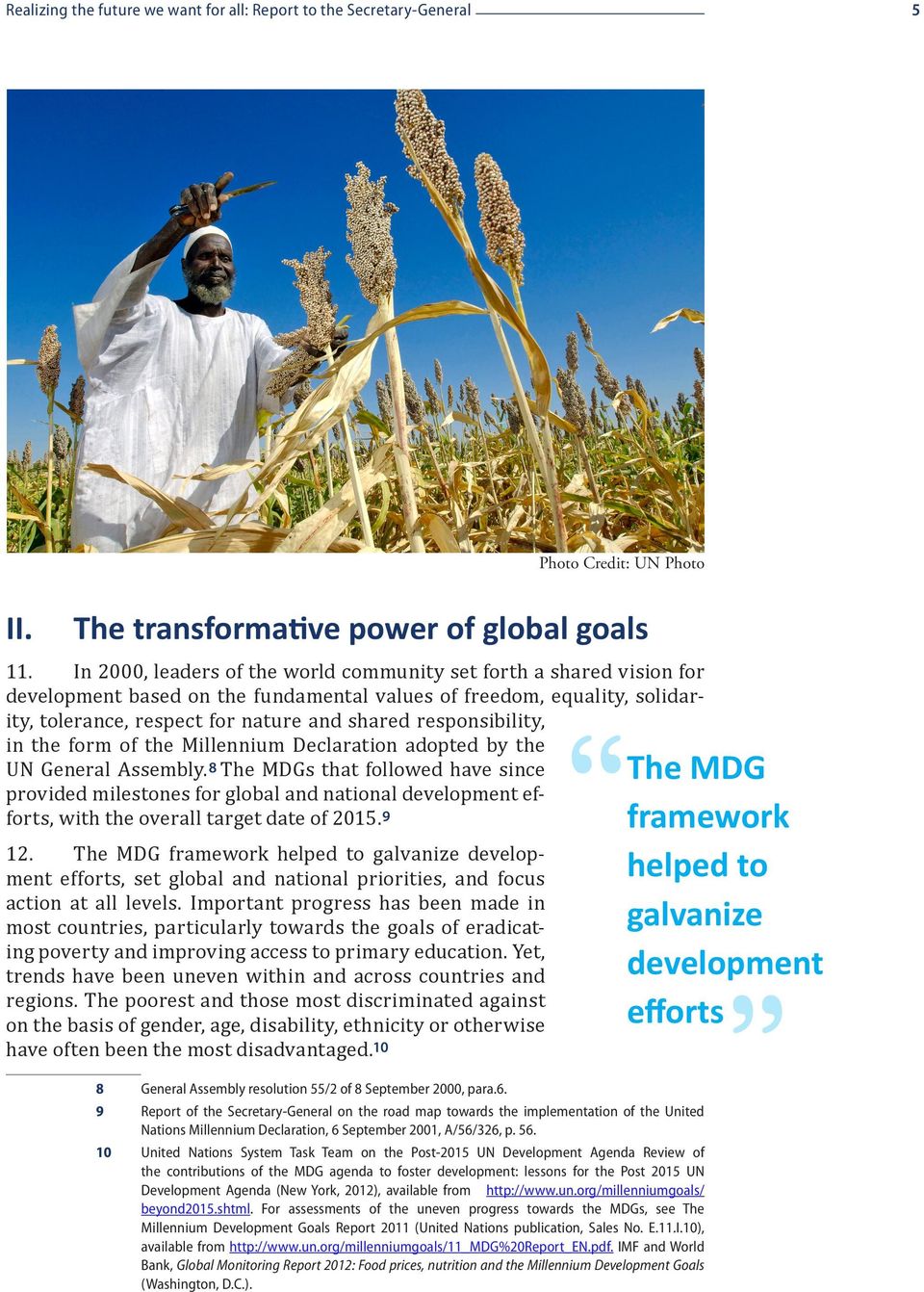
11 Realizing the future we want for all: Report to the Secretary-General 5 II. The transformative power of global goals 11. In 2000, leaders of the world community set forth a shared vision for development based on the fundamental values of freedom, equality, solidarity, tolerance, respect for nature and shared responsibility, in the form of the Millennium Declaration adopted by the UN General Assembly. 8 The MDGs that followed have since provided milestones for global and national development efforts, with the overall target date of The MDG framework helped to galvanize development efforts, set global and national priorities, and focus action at all levels. Important progress has been made in most countries, particularly towards the goals of eradicating poverty and improving access to primary education. Yet, trends have been uneven within and across countries and regions. The poorest and those most discriminated against on the basis of gender, age, disability, ethnicity or otherwise have often been the most disadvantaged General Assembly resolution 55/2 of 8 September 2000, para.6. Photo Credit: UN Photo 9 Report of the Secretary-General on the road map towards the implementation of the United Nations Millennium Declaration, 6 September 2001, A/56/326, p United Nations System Task Team on the Post-2015 UN Development Agenda Review of the contributions of the MDG agenda to foster development: lessons for the Post 2015 UN Development Agenda (New York, 2012), available from beyond2015.shtml. For assessments of the uneven progress towards the MDGs, see The Millennium Development Goals Report 2011 (United Nations publication, Sales No. E.11.I.10), available from IMF and World Bank, Global Monitoring Report 2012: Food prices, nutrition and the Millennium Development Goals (Washington, D.C.). The MDG framework helped to galvanize development efforts
12 6 UN System Task Team on the Post-2015 UN Development Agenda 13. Much more work remains to be done. Moreover, in some areas where global targets have already been met (such as halving extreme poverty), achievement of the goal (eradication of extreme poverty and hunger) is still pending. At the same time, other development challenges have gained more attention or become more pressing since Achieving basic human development goals and human rights will depend on addressing these emerging and pressing challenges, as elaborated in section III. The current section reviews the experience in implementing the MDG framework and draws lessons on how to proceed in defining the post-2015 UN development agenda. a. Reviewing the MDG framework 14. The precise added value of the MDG framework is difficult to determine. Yet, a review of its implementation clearly shows the historic contribution of the MDG framework in providing a common worldwide cause to address poverty and putting human progress at the forefront of the global development agenda. A brief summary of the framework s strengths and weaknesses, as assessed by the UN System Task Team, is provided in Annex II. 15. A major strength of the MDG framework derives from its focus on a limited set of concrete, common human development goals and targets: eradication of poverty and hunger, universal access to primary education, reducing child and maternal mortality and improving maternal health, promoting gender equality and empowering women, combating HIV/AIDS, malaria and other diseases, ensuring environmental sustainability and developing a global partnership for development. The framework has provided focus for priority setting in national and international development policies. Its simplicity, transparency and multi-dimensionality helped rally broad support for the goals and their achievement, and the emphasis on human development shifted policy attention well beyond the economic growth objectives that dominated previous agendas. The Rio+20 Outcome also recognizes these as features to be retained in a future development agenda. 16. The format of the MDG framework brought an inspirational vision together with a set of concrete and time-bound goals and targets that could be monitored by statistically robust indicators. This has not only helped keep the focus on results, but also motivated the strengthening of statistical systems and use of quality data to improve policy design and monitoring by national governments and international organizations. 17. The MDG framework strengthened the global partnership for development (MDG-8) and linked official development assistance (ODA), a fair multilateral trading system, debt relief and affordable access to new technologies and essential medicines to human development. 18. Some of these strengths also have been perceived as weaknesses. The focus on few goals caused certain development dimensions to be undervalued. With the implementation efforts, it has become clear that some targets were not adequately formulated. For example, some targets undervalued demographic change and consequently also the magnitude of certain social problems, such

13 Realizing the future we want for all: Report to the Secretary-General 7 as the size of urban slum populations. Furthermore, the emphasis on global targets went to the detriment of consideration for national circumstances and differences in initial conditions. Especially in the case of African countries, this has led to perceptions of failure even as substantial progress had been made, but without meeting the globally set target The MDGs also did not adequately address issues of productive employment, violence against women, social protection, inequalities, social exclusion, biodiversity, persistent malnutrition and increase in non-communicable diseases, reproductive health and complexities related to demographic dynamics, peace and security, governance, the rule of law and human rights. Neither did the MDG framework account for vulnerability to natural hazards and other external shocks, which have caused setbacks in MDG achievement. 20. In focusing on end objectives, the MDG framework provided little guidance as to the means to achieve them. While this had the advantage of keeping national stakeholders in the driver s seat of finding the best ways to reach the MDGs, the disadvantage has been a lost opportunity to provide guidance on how to address the root causes of poverty and unmet basic needs. 21. Several of the goals and targets related to the global partnership for development were defined rather imprecisely, thereby weakening accountability for the promised international support for the implementation of the MDG framework. Many of the commitments made by the international community have remained unfulfilled. 12 Insufficient access to predictable development finance, export markets, technologies and medicines remain important constraints to sustainable and inclusive development for many developing countries. The global economic and financial crisis of and its aftermath revealed important shortcomings in multilateral capacity to minimize and cope with shocks caused by volatile world markets. 22. Critics have argued that a number of these shortcomings could have been avoided if a more inclusive consultation process had taken place in formulating the MDGs. A more inclusive process might have led to a better understanding of the need to adapt the global goals and targets to country contexts, thus avoiding the unintended perception of the MDGs as a set of uniform targets to be pursued by all countries, regardless of their initial conditions. 13 On the other hand, however, a more extensive consultation process might have made it more difficult to 11 See, for example, William Easterly, How the Millennium Development Goals are unfair to Africa, World Development, vol. 37, No. 1, pp , as well as Ashwani Saith, From universal values to Millennium Development Goals: lost in translation, Development and Change, vol. 37, No. 6, pp MDG Gap Task Force Report 2011 The Global Partnership for Development: Time to Deliver (United Nations publication, Sales No. E.11.I.11). available from desa/policy/mdg_gap/mdg_gap2011/mdg8report2011_engw.pdf. 13 Jan Vandemoortele, The MDGs: M for misunderstood?, WIDER Angle, No. 1 (June), pp A number of these shortcomings could have been avoided if a more inclusive consultation process had taken place

14 8 UN System Task Team on the Post-2015 UN Development Agenda come to the focused set of measurable targets, which has proven to have been a key strength of the MDG framework. b. Lessons for the post-2015 UN development agenda 23. The vision for global development contained in the Millennium Declaration was intended to unify pursuance of economic, social and environmental objectives along with ensuring peace, security and respect for democratic values. Giving priority to and protecting the destitute and vulnerable, a core focus of the MDGs, emanated from this view. This vision is as relevant today as in 2000, notwithstanding the major changes that have occurred since then. 24. Thus far, in the discussions on the post-2015 UN development agenda, most stakeholders have identified the format of concrete goals, targets and indicators as one of the major strengths of the MDG framework and a feature to be retained. Such a format implies a clear framework of accountability, based on clear and easy-to-communicate goals, operational time-bound quantitative targets and measurable indicators. Most MDG targets appeared realistic and achievable, which made them credible. This sense of realism should be retained, but balanced with the need to be more ambitious. Continuing along historical trends will not be good enough, as the efforts needed to mitigate and adjust to climate change and to put the world on a sustainable development path make abundantly clear. 25. The focus on ends in the MDG framework was important in giving priority to human development in national development strategies. It makes sense to retain a focus on ends in the post-2015 agenda, but the opportunity to address the issue of means without being prescriptive should not be missed. Without providing blueprints, the post-2015 framework could include some general guidelines for policy orientation and coherence, and could highlight some of the key success factors of effective development processes. This might involve, for instance, policies that foster productive investment and decent work, and greater consistency of macroeconomic policies with broader developmental objectives, including, among others, poverty reduction, full employment and decent work, and sustainable food, nutrition and energy security. 26. Given the high degree of global interdependence, setting collective goals and targets to be pursued by the world community will remain meaningful. In doing so, however, a one-size-fits-all approach should be avoided. Needed flexibility should be ensured to tailor targets to regional, national and sub-national conditions and priorities, while respecting international standards, and should be tracked with data disaggregated by sex, age and geography (including rural-urban location). Such tailoring of development targets to national and local circumstances is most effectively and legitimately done through participatory processes.

15 Realizing the future we want for all: Report to the Secretary-General Given the outstanding deficits, the post-2015 UN development agenda should maintain the focus on human development and the eradication of poverty as ultimate objectives of any development agenda. Yet, the agenda should also respond to a number of challenges, elaborated in section III, that have become more pressing since the adop- tion of the Millennium Declaration and did not figure explicitly or were not adequately reflected in the MDG framework: reducing inequalities within and among countries; tackling climate change and achieving sustainable development; increasing resilience to natural disasters; addressing demographic and epidemiological dynamics; dealing with urban growth; ensuring peace and security; improving governance and State capabilities; and respecting human rights and cultural diversity. Dealing with these challenges in the context of a broader development agenda, as outlined in sections IV and V, will require globally coherent responses that are the responsibility of all countries. The post-2015 UN development agenda should maintain the focus on human development 28. The global consensus built around the MDG framework was one of its major strengths. Going forward, greater interdependence among countries and the global challenges ahead will require a truly global agenda for development, with shared responsibilities by all countries. Goals and targets for the global partnership should be more precisely defined to improve implementation and strengthen accountability.

16


17 Realizing the future we want for all: Report to the Secretary-General 11 III. Global trends, challenges and opportunities to which the post-2015 UN development agenda should respond a. Much progress, but business as usual is not an option 29. Since 2000, when the Millennium Declaration was adopted, there has been strong economic growth in many parts of the world, lifting millions out of poverty. Major advancements have been made in technology, radically changing the way people communicate, organize, network, learn and participate as national and global citizens. 30. However, progress in human development has been uneven, leaving many behind and widening inequalities. Furthermore, the global food, energy and financial crises of highlighted the fragility of global food supply systems and exposed systemic failures in the workings of financial and commodity markets and major weaknesses in the mechanisms of global governance. 14 The rapid worldwide spread of the financial fallout in the United States and, more recently, the uncertainty in global financial markets generated by the sovereign debt crises Photo Credit: UN Photo 14 World Economic and Social Survey 2010: Retooling Global Development (United Nations publication, Sales No. E.10.II.C.1). Progress in human development has been uneven

18 12 UN System Task Team on the Post-2015 UN Development Agenda in Europe have underscored the interconnectedness of the global economy. Higher and much more volatile world food and energy prices reflect decadeslong neglect of agriculture, negative impacts of climate change, higher exposure and vulnerability to disasters, land use for bio-fuel production that went at the expense of food production, as well as energy and commodity market speculation. Nearly one billion people in the world are undernourished 15 and more than 200 million are unemployed. 16 Labour incomes have been stagnant or have fallen as a share of national income in most developed and developing countries since the 1980s. Only 28 per cent of the global population is covered by comprehensive social protection systems, reflecting high degrees of informality. 17 Indeed, the global jobs crisis reflects the human costs of these multiple crises, deepening marginalization and poverty among vulnerable groups. The economic and food crises are compounded by the global environmental crisis, of which climate change has the most ominous implications. b. Progress in poverty reduction, but major inequalities persist 31. A number of developing countries, mostly in Asia, have been narrowing the gap in living standards vis-à-vis developed countries. Others, especially in Africa, have fallen further behind. The number of the world s poor living on less than $1.25 a day decreased from 1.9 billion in 1990 to 1.3 billion in Many developing countries have seen poverty decline, but in absolute terms the reduction was overwhelmingly concentrated in China. In spite of decreasing poverty rates in sub-saharan Africa, the absolute number of poor people increased in the region. 19 At the same time, the majority of the world s poor people three-quarters live in what are now middle-income countries. 32. With few exceptions, income and wealth inequalities within countries have increased since the early 1980s, including in high-income countries. 20 Inequalities in access to land and other productive assets, as well as in social outcomes and service access, also remain widespread. In developing countries, nutritious food, safe drinking water, improved sanitation, basic education coverage and learning outcomes are much worse for low-income and rural families, while child death rates and stunting are two to four times higher between the 15 Food and Agricultural Organization of the United Nations, The State of Food Insecurity in the World 2011 (Rome), available from 16 International Labour Organization, Global Employment Trends 2011 (Geneva), available from publication/wcms_ pdf. 17 International Labour Organization, World Social Security Report 2010/2011 (Geneva, 2011). 18 Shaohua Chen and Martin Ravallion, An update to the World Bank s estimates of consumption poverty in the developing world, Briefing Note (Washington D.C.: World Bank, Development Research Group, 2012), available from Resources/Global_Poverty_Update_2012_ pdf. 19 Ibid. 20 World Bank, World Development Indicators 2008 (Washington, D.C.)
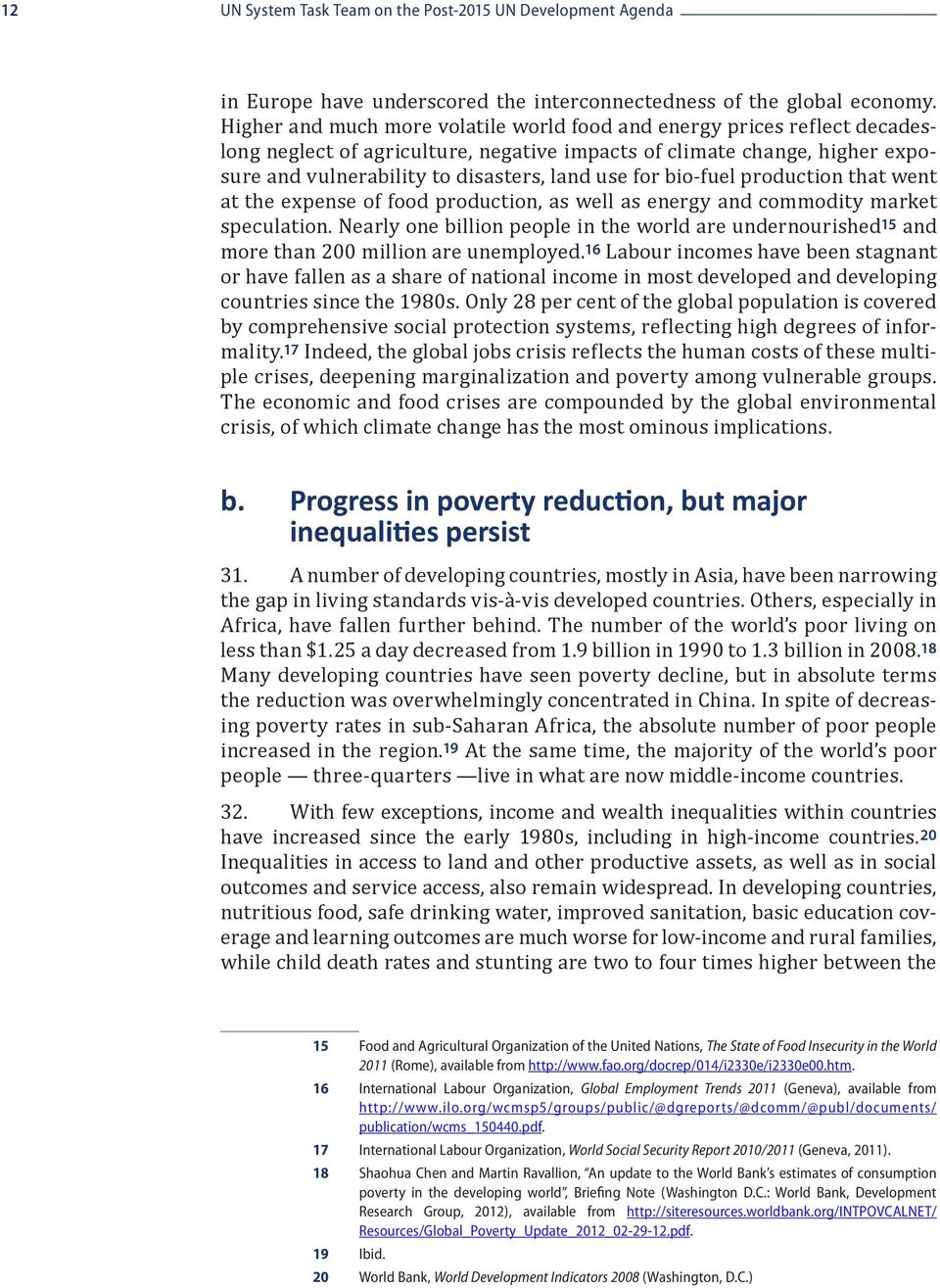

19 Realizing the future we want for all: Report to the Secretary-General 13 lowest and highest wealth quintiles. 21 Gender inequalities persist, as shown in wage earnings differentials, access to positions of decision-making and HIV infection rates. 22 In too many contexts, equal access to justice and political participation is not guaranteed in practice. 33. Redressing these trends will be a major challenge in the years ahead. High inequalities have impeded sustainable development and have no place in a world where a decent and secure well-being should be a prerogative of all citizens. c. The knowledge challenge 34. The worldwide spread of the internet and ICTs has massively expanded opportunities for the creation, transmission and dissemination of information. Yet, inequalities in access to ICT networks, education and technological progress and to innovation systems remain vast, within and among countries. Rapid loss of traditional knowledge and its non-formal channels of transmission is further widening the gap. Limited access to knowledge hampers progress towards inclusive growth and employment creation, technological progress for sustainable development and health improvements. Greater knowledge sharing will be critical to induce the transformative changes needed to achieve food, nutrition and energy security in sustainable ways and to contain the threat of climate change. 23 Photo Credit: istock Photo d. Shifting demographics 35. Over the past quarter century, world population increased by two billion. Currently, about 78 million people are added to the world s population 21 UNICEF, Progress for Children: Achieving the MDGs with Equity (United Nations publication, Sales No. E.10.XX.5). 22 UN Women, Progress of the World s Women : In pursuit of justice (New York, 2011). 23 See, for example, World Economic and Social Survey 2011: The Great Green Technological Transformation (United Nations publication, Sales No. E.11.II.C.1); and United Nations System High Level Task Force on the Global Food Security, Food and nutrition security for all through sustainable agriculture and food systems, March 2012, available from: sites/default/files/hltf%20note%20on%20sustainable%20agriculture%20and%20food%20 Systems.pdf.


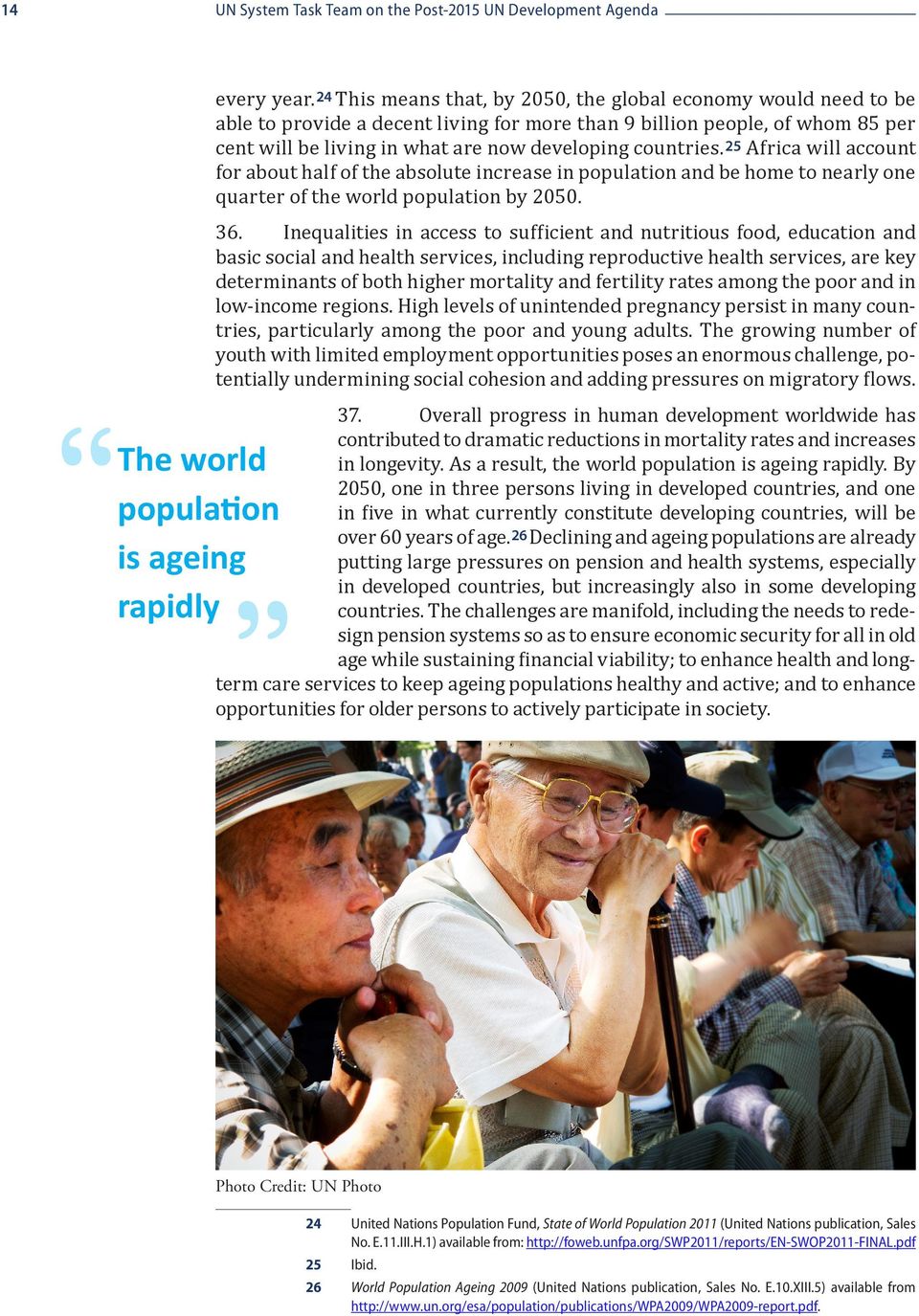
20 14 UN System Task Team on the Post-2015 UN Development Agenda The world population is ageing rapidly every year. 24 This means that, by 2050, the global economy would need to be able to provide a decent living for more than 9 billion people, of whom 85 per cent will be living in what are now developing countries. 25 Africa will account for about half of the absolute increase in population and be home to nearly one quarter of the world population by Inequalities in access to sufficient and nutritious food, education and basic social and health services, including reproductive health services, are key determinants of both higher mortality and fertility rates among the poor and in low-income regions. High levels of unintended pregnancy persist in many countries, particularly among the poor and young adults. The growing number of youth with limited employment opportunities poses an enormous challenge, potentially undermining social cohesion and adding pressures on migratory flows. 37. Overall progress in human development worldwide has contributed to dramatic reductions in mortality rates and increases in longevity. As a result, the world population is ageing rapidly. By 2050, one in three persons living in developed countries, and one in five in what currently constitute developing countries, will be over 60 years of age. 26 Declining and ageing populations are already putting large pressures on pension and health systems, especially in developed countries, but increasingly also in some developing countries. The challenges are manifold, including the needs to redesign pension systems so as to ensure economic security for all in old age while sustaining financial viability; to enhance health and longterm care services to keep ageing populations healthy and active; and to enhance opportunities for older persons to actively participate in society. Photo Credit: UN Photo 24 United Nations Population Fund, State of World Population 2011 (United Nations publication, Sales No. E.11.III.H.1) available from: 25 Ibid. 26 World Population Ageing 2009 (United Nations publication, Sales No. E.10.XIII.5) available from
21 Realizing the future we want for all: Report to the Secretary-General Around one billion people are international or internal migrants; South-South migration is as significant as South-to-North movements With approximately 214 million international migrants and an estimated 740 million internal migrants today; about one billion persons live outside their place of origin or habitual residence. 27 International migration today affects every region, with South-to-South migration as significant as South-to-North movements. Movements of people can be associated with multiple factors, including the search for better educational and job opportunities and working conditions, flight from poverty, conflict, human rights abuse, hunger, discrimination and environmental degradation and natural disasters. International migration is bringing benefits to both countries of origin and destination, including remittances and reduced labour shortages. The transfer of resources, skills, knowledge, ideas and networks through migration is difficult to quantify, yet significant. Many millions of migrants have also benefited from building a better future for themselves and their dependants. However, too many migrants continue to work and live in insecure, precarious and dangerous conditions, often marginalized and subject to discrimination and without access to social and health care services, while disruptions to family life can have significant social consequences, particularly in the country of origin. 39. By 2050, 70 per cent of the world s population is projected to live in urban areas. 28 Rapid urban growth is mainly occurring in countries least able to cope with the demand for decent jobs, adequate housing and urban basic services. Close to one billion people, or 33 per cent of the urban population in developing countries, live in slums, in inequitable and often life-threatening conditions. 29 If left unaddressed, these trends may become sources of social and political instability. 40. Larger urban populations will also influence food and landuse patterns, with potentially vast implications. Rising incomes and continued population growth have not only raised food demand, but also altered dietary patterns. This is reflected in increased per capita meat consumption, which has risen by about a quarter over the past decade. While meat is an important source of protein, under existing production conditions, higher demand can lead to land use shifts and further deforestation, higher energy use, rising food prices and regional food shortages. Global agricultural production will have to almost double in developing countries to feed a growing population by Although global food production has outpaced population growth, it has failed to meet potential demand, 27 United Nations Department of Economic and Social Affairs, Population Division, Trends in international migration stocks: migrants by age and sex, POP/DB/MIG/Stock/Rev.2010 (New York, 2011); and United Nations Development Programme, Human Development Report 2009 Overcoming barriers: Human mobility and development (New York, 2009). 28 United Nations Department of Economic and Social Affairs, Populations Division, World Urbanization Prospects, the 2011 revision, (New York, 2012), available from: unpd/wup/index.htm. 29 United Nations Human Settlements Programme (UN-Habitat), State of the World s Cities 2010/2011: Bridging the Urban Divide (Nairobi, 2008), available from listitemdetails.aspx?publicationid= Food and Agriculture Organization of the United Nations, The State of Food Insecurity in the World 2011, op. cit. Global agricultural production will have to almost double
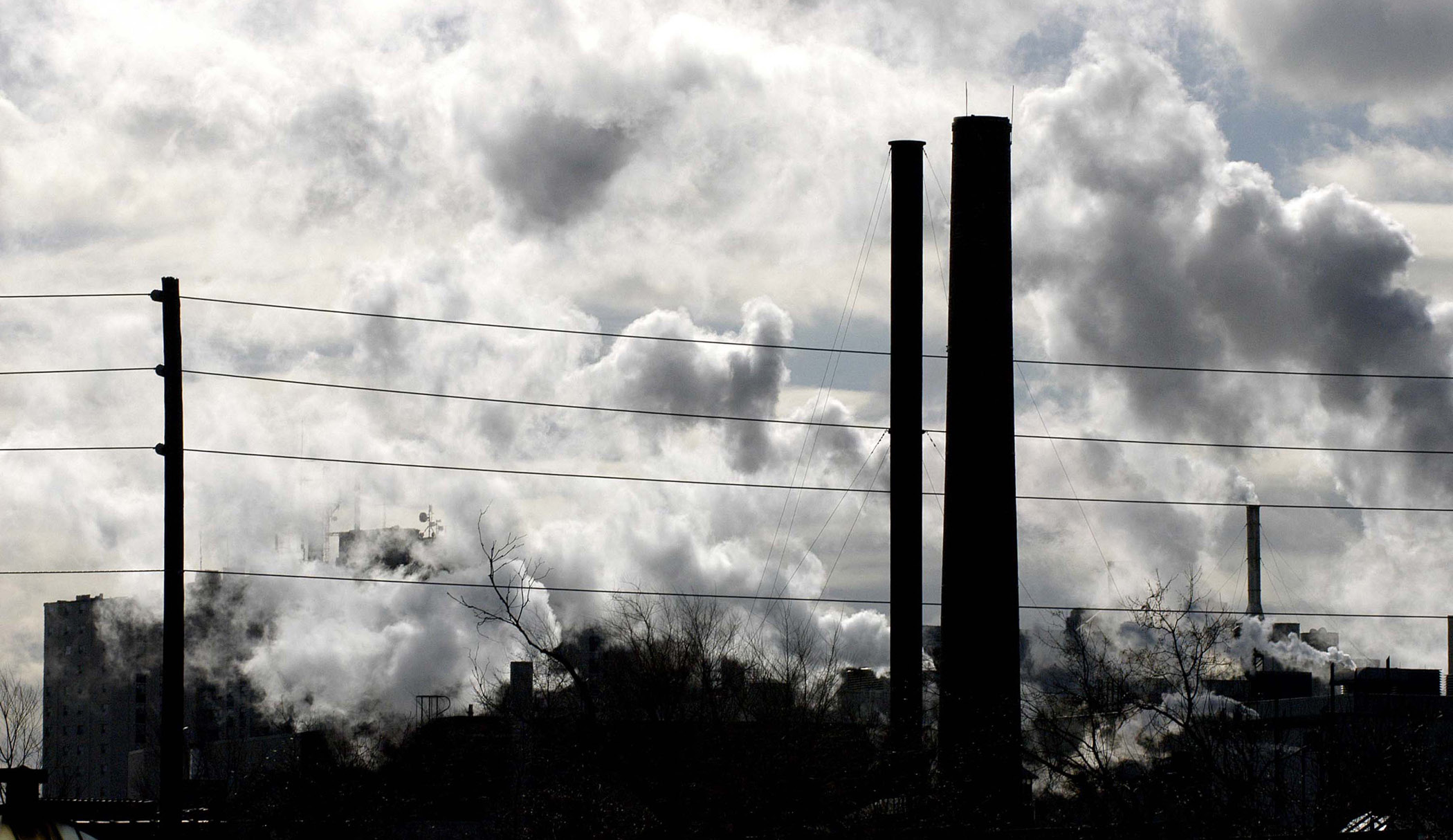
22 16 UN System Task Team on the Post-2015 UN Development Agenda Increased human activity is threatening to surpass the Earth s carrying capacity and unequal distribution still left nearly one billion people undernourished worldwide in At the same time, about 500 million people are obese. 31 Through its association with sharp increases in the prevalence of chronic diseases, unhealthy food consumption patterns are pushing up health costs worldwide. At the same time, under-nutrition at an early age limits adolescent growth and increases the risk of incurring chronic disease later in life. Under-nutrition further heightens women s health risks during pregnancy. Many developing countries face a double health burden caused by the high prevalence of both under- and over-nutrition. e. Growing environmental footprints 41. Growth of population, income, energy and resource use, waste and pollution have come at the cost of unprecedented use of natural resources and environmental degradation. Almost half of the Earth s forests are gone, groundwater sources and fish stocks are being rapidly depleted, and land degradation and ocean acidification are worsening. Biodiversity has been enormously reduced, and carbon dioxide emissions increased by 40 per cent between 1990 and 2008, to reach dangerous climate destabilizing concentrations of close to 30 billion tonnes a year. 32 Photo Credit: UN Photo 42. Increased levels of human activity are threatening to surpass the Earth s carrying capacity as a source and sink. At present, fossil fuels provide for more than 85 per cent of primary energy and account for about 60 per cent of carbon dioxide emissions as well as a significant proportion of emissions 31 World Health Organization, Nutrition Challenges, available from challenges/en/index.html. 32 World Economic and Social Survey 2011, op. cit.
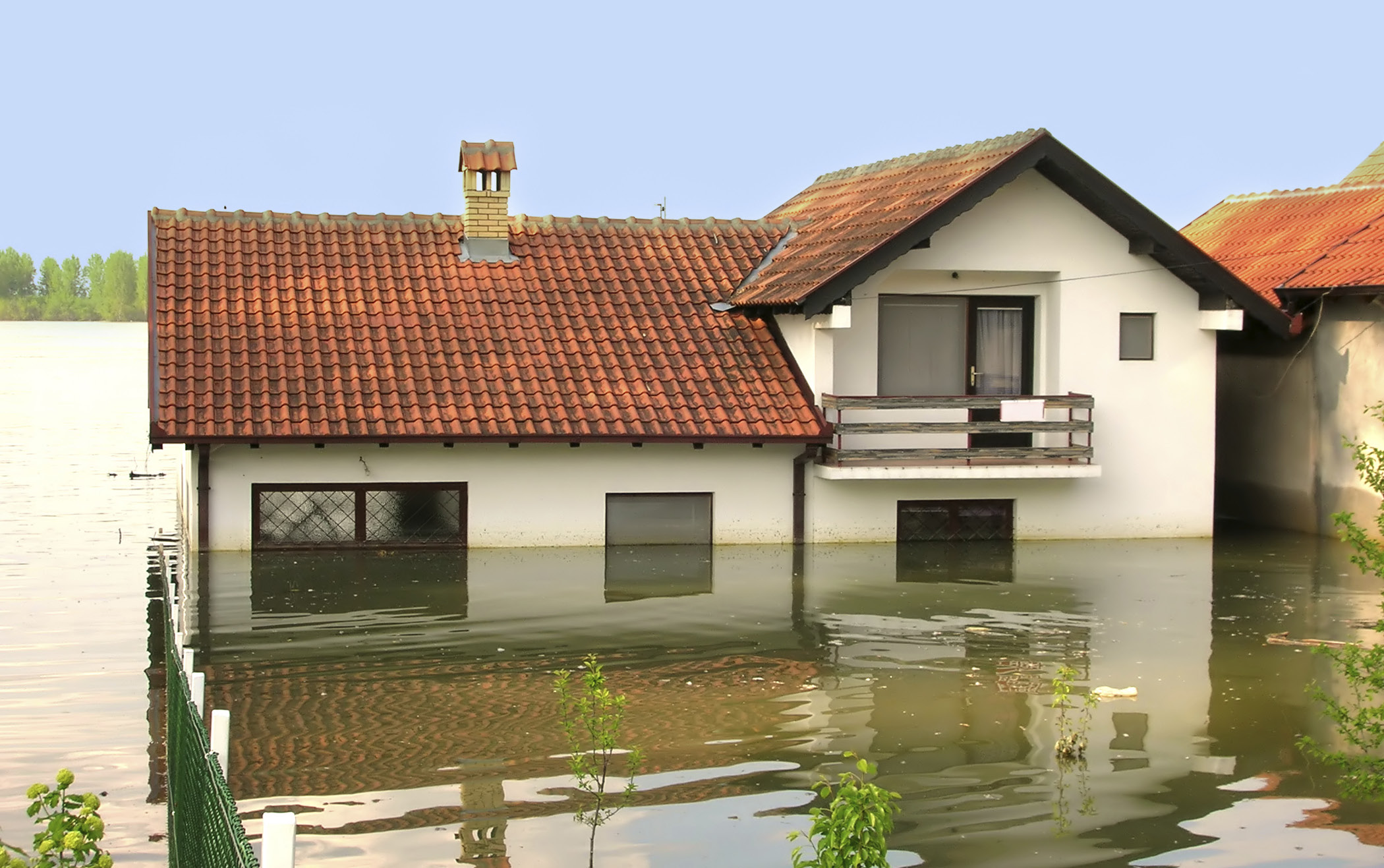
23 Realizing the future we want for all: Report to the Secretary-General 17 of sulphur and nitrogen compounds, black carbon, mercury and other air pollutants. To limit the increase in global average temperature to 2 C above pre-industrial levels (with a probability greater than 50 per cent), greenhouse gas emissions should have been reduced to less than 44 gigatonnes (Gt) CO 2 equivalent by 2020, well below present levels. The added challenge is that reductions in GHG emissions have to be achieved while enhancing access to energy. An estimated 1.4 billion people lack access to modern energy services, hampering their ability to overcome poverty. Traditional energy supplies also impose a higher unpaid work burden, especially on women. Photo Credit: istock Photo 43. The incidence of natural disasters has increased five-fold since the 1970s. This can be attributed in part to human-induced climate change. Natural disasters destroy livelihoods and may wipe out years of infrastructure investment. Deforestation, soil erosion, degradation of natural coastal protection and poor infrastructure have increased the likelihood that weather shocks will cause human disasters, especially for the poorest and most vulnerable in the LDCs, LLDCs and SIDS. It is estimated that over 42 million people were displaced by sudden-onset natural disasters in f. Living in an insecure world 44. At least one fifth of humanity lives in countries experiencing significant violence, political conflict, insecurity and societal fragility. 33 Such conditions form a major obstacle to development, with lasting implications for societal well-being. country affected by violence or fragility has achieved a single MDG 33 Geneva Declaration Secretariat, Global Burden of Armed Violence 2011: Lethal Encounters (Cambridge University Press, 2011).
24 18 UN System Task Team on the Post-2015 UN Development Agenda No low-income country affected by violence or fragility has achieved a single MDG target target. 34 Countries with major violence have poverty rates more than 20 percentage points higher than the average. 35 Fragile and conflict-affected countries also face far higher levels of undernourishment, educational deficits, child mortality, single female-headed households with young children, and safe drinking water and basic sanitation deprivations. 45. Peace, if defined as the absence of violence or absence of the fear of violence, is associated with multiple factors that reinforce one another, including horizontal, vertical and gender equality, justice, relevant education and employment opportunities, sound management of natural resources, human rights protection, political inclusion and low levels of corruption. 36 Prevention of conflict and sustained peace can bring rapid development gains, as shown by the experiences of Cambodia, El Salvador, Ethiopia, Mozambique and Rwanda, among many others. A legal system ensuring freedom from threat of all types of violence, including against minority groups, women and children; freedom from abuse, coercion and harassment; security of property; and confidence that effective investigation and criminal justice will follow any victimization. Addressing the sources of conflicts requires a multidimensional approach where development, human rights, peace, security and the rule of law are interrelated dimensions of well-being. 46. Income and job insecurity have also increased due to patterns of globalization based on outsourcing and weaker labour protection. This, together with the limited access to social security for the majority of workers in the world, puts the livelihoods of many households at risk to even small economic shocks. g. Governance and accountability deficits 47. The recent food, fuel and financial crises have highlighted the inter-connectedness of the world economic system. Climate change and rising migration are challenges with global ramifications. Yet, the policies, rules and institutions established to govern these processes are mostly national, while global mechanisms are strongly compartmentalized. The multilateral trade, finance and environmental architectures, for instance, lack coherence across many dimensions. 37 Institutions of global governance differ in constituencies and the distribution of voice and power among their respective memberships; democratic deficits exist in some of them, especially among the international financial institutions. 48. Global governance deficits and failure to implement international legal frameworks have spurred countries to seek regional solutions, including regional trade agreements, regional mechanisms of financial cooperation 34 World Bank, World Development Report 2011 (Washington, D.C.). 35 Ibid 36 Institute for Economics and Peace, Structures of peace: identifying what leads to peaceful societies, October 2011 (Sydney). 37 World Economic and Social Survey 2010, op. cit.
25 Realizing the future we want for all: Report to the Secretary-General 19 and informal arrangements to approach regional issues of migration. 38 These arrangements are important in responding to region-specific development needs, but they require coordination to avoid policy fragmentation and incoherence with multilateral regimes and international standards. 49. Recent events in the Arab States have brought to the fore longstanding demands from civil society, especially from young people, for a development trajectory grounded in democratic governance, the rule of law 39 and human rights. The events underscore the importance of addressing democratic governance deficits at the national and sub-national levels to ensure the legitimacy of development policies and to support the empowerment of people. h. A need for new development pathways 50. Continuation along previously trodden economic growth pathways will exacerbate inequalities, social tensions and pressures on the world s resources and natural environment. There is therefore an urgent need to find new development pathways that encourage creativity and innovation in the pursuit of inclusive, equitable and sustainable growth and development. Such an effort must be matched by reshaping the global partnership for development to support implementation and to ensure effective accountability mechanisms at all levels. 38 UNCTAD, Trade and Development Report 2007 (United Nations publication, Sales No. E.07.II.D.11); and International Organization for Migration, Regional consultative processes, available from 39 This includes respect for customary and traditional laws which is important for indigenous and rural populations in many countries.
26

27 Realizing the future we want for all: Report to the Secretary-General 21 Photo Credit: UN Photo IV. Vision: the future we want for all a. Transformative change towards inclusive, people-centred, sustainable development 51. This report presents a vision for the post-2015 UN development agenda as one that seeks to achieve inclusive, people-centred, sustainable global development: the future we want for all. Given the challenges described in section III, this will require transformative change in existing production and consumption processes, management of natural resources and mechanisms of governance. This, in turn, calls for a broad approach to development, based on social justice, structural transformation, economic diversification and growth The vision described here is holistic and global. It recognizes both the need for policy coherence and the diversity of contexts and challenges within and among countries. While no specific development path will suit all 40 This approach is consistent with Article 55 of the Charter of the United Nations, which states: With a view to the creation of conditions of stability and well-being which are necessary for peaceful and friendly relations among nations based on respect for the principle of equal rights and self-determination of peoples, the United Nations shall promote: higher standards of living, full employment, and conditions of economic and social progress and development. A vision for the post-2015 UN development agenda that seeks to achieve inclusive, people-centred, sustainable global development
28 22 UN System Task Team on the Post-2015 UN Development Agenda situations, two elements should be seen as common: first, core values, principles and standards derived from internationally-adopted normative frameworks should be explicitly integrated into the global development agenda and corresponding national strategies; and, second, the shorter-term pursuit of verifiable progress should support and affirm those principles. Founded on core values, transformative change will be fuelled by policy innovation and experimentation, as well as mutual and participatory learning. 53. The values and principles affirmed in the Millennium Declaration and its seven key objectives 41 remain a solid foundation for addressing today s and tomorrow s global development challenges and should therefore be used to help shape the post-2015 UN development agenda. This can be done in a focused manner by building a framework that: (i) is based on the three fundamental principles of human rights, equality and sustainability; and (ii) orients key goals along the four, highly interdependent dimensions of inclusive social development, environmental sustainability, inclusive economic development, and peace and security. These core dimensions are consistent with the notion of freedom from want for present and future generations, building on the three pillars of the sustainable development concept (economic, social, environmental), and that of freedom of fear. 54. Effective implementation of such a framework would require a high degree of policy coherence at the global, regional, national and sub-national levels. As there are no blueprints for the most effective enablers, ample space would need to be ensured for experimentation and adaptation to local settings. The obvious need for differentiation across different contexts is not inconsistent with an emphasis on policy coherence. The common-but-differentiated approach to policy coherence is to be guided by the overall vision and underlying principles of the proposed framework for the post-2015 UN development agenda. 55. Figure 1 provides a schematic presentation of an integrated framework for defining the post-2015 UN development agenda, built around the three fundamental principles of the vision, the four dimensions along which goals could be pursued and the four broad areas of enablers. In the proposed integrated framework, the enablers should be seen as not just effective towards achieving goals related to one dimension, but rather across all dimensions. The emphasis on the enablers is to address one of the perceived weaknesses of the MDG framework, which was silent on the means to achieve the goals. 56. The details of such a framework would need to be elaborated and refined through broad consultations. What follows has no intention of defining any goals in particular at this stage, but rather to provide a tentative description of how the framework could take further shape and serve as a guide for realizing the development vision presented here. 41 Peace, security and disarmament; development and poverty eradication; protecting our common environment; human rights, democracy and good governance; protecting the vulnerable; meeting the special needs of Africa; and strengthening the United Nations (General Assembly resolution 55/2, op. cit., paras. 1 6).
29 Realizing the future we want for all: Report to the Secretary-General 23 b. Three fundamental principles 57. The three principles would constitute the common, underlying elements necessary to address and resolve, through transformative change, the global trends and challenges that people will face in the post-2015 era. They provide the foundation of an agenda for achieving a better life for all human beings, and would serve to inspire and assist each society in determining how best to pursue this vision. i. Human rights 58. The human rights embedded in the UN Charter and the range of broadlyratified human rights conventions and treaties are based on fundamental values. These values include equality and non-discrimination, peace and security, freedom from fear and want, respect for fundamental principles and rights at work and to food, social and cultural dignity, solidarity, tolerance, shared responsibility, accountable and democratic governance, and sustainable development. The same values would need to underpin the new transformative development agenda. They encompass social and economic rights, while also including civil and political rights related to peace and security and other challenges, as well as the right to development. These need to be addressed simultaneously. 59. The enablers of participation, accountability, non-discrimination, empowerment and rule of law 42 provide a strengthened foundation for inclusive development paths. They provide practical guidance to design and assess development strategies and to clarify their content for example, by prioritizing universal access to adequate water, food, energy, income security, health services and other essential public goods and services. ii. Equality 60. The reduction of inequalities in all societies is essential to a vision of inclusive, sustainable development. The adoption of explicitly inclusive approaches is merited not only on ethical grounds, but also from the perspectives of development and peace and security. Such approaches would give the highest priority to addressing the situation of women and youth, as well as that of the most deprived and impoverished and seek the greatest potential for catch-up progress including by removing social, cultural, legal, administrative and financial barriers in their access to services, decent jobs, land and other economic resources, entrepreneurship and technology. 61. Gender equality has long been recognized both as a human right and a core development goal. In addition, discrimination against women and girls impairs progress in all other areas of development. The global development agenda should seek not only to address and monitor the elimination of specific gender gaps, but also to transform the structural factors that underpin the widespread persistence of gender inequalities, gender-based violence, 42 The rule of law is a core value of the United Nations and a principle of governance in which all persons, institutions, and entities are accountable to laws that are publicly promulgated, equally enforced and independently adjudicated, and which are consistent with international human rights, norms and standards.
30 24 UN System Task Team on the Post-2015 UN Development Agenda Figure 1. An integrated framework for realizing the future we want for all in the post-2015 UN development agenda Enablers: Fair and stable global trading system Adequate financing for development and stable financial system Affordable access to technology and knowledge Providing sustainable energy for all Coherent macroeconomic and development policies supportive of inclusive and green growth Inclusive economic development Eradicating income poverty and hunger Reducing inequalities Ensuring decent work and productive employment Enablers: Sustainable food and nutrition security Universal access to quality health care Universal access to quality education Inclusive social protection systems Managing demographic dynamics Fair rules to manage migration Environmental sustainability Protecting biodiversity Stable climate Resilience to natural hazards Human rights Equality Sustainability Inclusive social development Adequate nutrition for all Quality education for all Reduced mortality and morbidity Gender equality Universal access to clean water and sanitation Enablers: Sustainable use of natural resources (climate, oceans, forests, biodiversity) and management of waste Managing disaster risk and improving disaster response Peace and security Freedom from violence, conflict and abuse Conflict-free access to natural resources Enablers: Democratic and coherent global governance mechanisms Good governance practices based on the rule of law Conflict prevention and mediation Human rights protection Women s empowerment
31 Realizing the future we want for all: Report to the Secretary-General 25 discrimination and unequal development progress between women and men, girls and boys. The empowerment of women and girls and the protection of their rights 43 should be centre-pieces of the post-2015 agenda. 62. To decisively address inequalities will entail resolving the symptoms and immediate effects of poverty and deprivation, but must also go further. Transformative change will require recognizing and tackling both manifested gaps and their structural causes, including discrimination and exclusion, widely faced by women and girls, persons with disabilities, older people and members of indigenous and minority groups. National, local and regional strategies will need to be based on evidence and understanding of the structural and intersecting nature of inequalities, and shaped and monitored with the full involvement of those excluded. iii. Sustainability 63. Sustainability, 44 broadly defined, should serve as a fundamental principle for all aspects of development and for all societies. It represents the key challenge for a transformative agenda: how to reduce global greenhouse gas emissions and achieve more equitable and sustainable management and governance of natural resources while promoting dynamic and inclusive economic and human development. Consistent with the Rio+20 Outcome, the focus on sustainable development should comprise these three dimensions economic, social and environmental and recognize their inter-linkages. 64. Sustainability also implies ensuring inter-generational justice and a future world fit for children. This entails safeguarding a sustainable future in which children will be able to grow up healthy, well-nourished, resilient, well-educated, culturally sensitive and protected from violence and neglect. Children will need access to safe and unpolluted ecosystems including clean water, oceans and air as resources which must be protected, both now and in the future. c. Four core dimensions 65. This section elaborates the four core dimensions where progress will be needed in coming years and decades in order to build a rights-based, equitable, secure and sustainable world for all people. Achieving these broad objectives requires holistic approaches to policies, given positive synergies across all four dimensions. The three principles elaborated above human rights, equality and sustainability should shape and help inform development pathways to pursue these broad objectives and any specific goals, within the global development agenda. The suggested enablers are indicative of each of the four dimensions, yet understood as supportive of all. 43 Mechanisms for the protection of those rights would not only include legal provisions and their effective implementation, but also policies encouraging acceptance of gender equality as part of social norms and behaviours, reducing of gender inequalities in labour markets and access to productive resources, protecting of reproductive rights, and improving access to good quality health and education services and social protection. 44 The specific dimension of environmental sustainability, to which this principle fully applies, is addressed in section IV.c.ii.

32 26 UN System Task Team on the Post-2015 UN Development Agenda Ensuring people s rights to health and education is vital for inclusive social development i. Inclusive social development 66. Ensuring people s rights to health and education, including through universal access to quality health and education services, is vital for inclusive social development and should be a critical element of the post-2015 vision. Adequate investments in these areas will be needed to realize unmet MDGs, facilitate sustainable economic growth and employment generation, and close the gaps in human capabilities that help perpetuate inequalities and poverty across generations. 67. Priorities for social development and investments in people would include: preventive, curative and promotional health services, with particular emphasis on maternal, newborn and child survival and health; reproductive health services; access to essential medicines; non-communicable and infectious diseases; safe water, sanitation and hygiene; early childhood and adolescent development; childhood education; training and lifelong learning; and access to modern energy services. Major actions to halt the spread of HIV and AIDS will need to be integrated into these priorities. Access to sufficient nutritious food and promotion of healthy life styles with universal access to preventive health services will be essential to reduce the high incidence of non-communicable diseases in both developed and developing countries. Providing access to clean drinking water and sanitation for all people is still an unfulfilled promise in many countries and thus remains a priority. 68. The post-2015 agenda should focus on effective governance of systems for social development, ensuring universal coverage and quality service delivery that is also affordable to the most deprived groups. New health and information technologies and culturally relevant communication initiatives are powerful tools to support social development interventions and to empower families. Photo Credit: istock Photo
33 Realizing the future we want for all: Report to the Secretary-General Bold, comprehensive efforts to eradicate hunger and guarantee food and nutrition security for all, including access to sufficient nutritious food, are both feasible and essential. Such efforts would include adopting national strategies to support faster food productivity growth, greater food security, less food price volatility, strengthening resilience through the implementation of inclusive social protection systems, and empowering people through land tenure security, provision of information, technology and better access to credits and markets to better manage price shocks and climate risks. 70. For young children, especially those up to age two, food and nutrition security, as well as stimulation and protection, are critical for their physical and cognitive development. Adolescent girls, older people and persons with disabilities are also widely susceptible to acute nutritional and health deprivations. For all these groups, and their caregivers, social protection is an essential human right. 71. It is also critical to promote equitable change that ensures people s ability to choose their value systems in peace, thereby allowing for full participation and empowerment. Communities and individuals must be able to create and practice their own culture and enjoy that of others free from fear. This will require, inter alia, respect for cultural diversity, safeguarding cultural and natural heritage, fostering cultural institutions, strengthening cultural and creative industries, and promoting cultural tourism. ii. Environmental sustainability 72. Immediate priorities in preserving environmental sustainability include ensuring a stable climate, stopping ocean acidification, preventing land degradation and unsustainable water use, sustainably managing natural resources and protecting the natural resources base, including biodiversity. 73. Combining the diversification of production with increased resourceuse efficiency and incentives for the development and use of products with a light carbon, water and biodiversity footprint will be needed. The transition to low-carbon energy sources would need to be coupled with more efficient use of energy, greener consumption and the promotion of energy-efficient technologies. Improved scientific understanding and knowledge-sharing on climate change, natural hazards, the space environment and natural resource limits will be necessary for effective policy-making for sustainable development. 74. Education for sustainable development provides the values, skills and knowledge needed for shaping new attitudes, and consumption and production patterns conducive to sustainable development. Appropriate technical and vocational education and training will be essential for preparing people, including youth, for jobs enhancing environmental sustainability. 75. Promoting environmental sustainability, including sustainable, integrated natural resource management, with Promoting environmental sustainability can build resilience at all levels of society and realize multiple benefits

34 28 UN System Task Team on the Post-2015 UN Development Agenda the full participation of local organizations, can build resilience at all levels of society and realize multiple benefits. Ecosystem-based approaches to adaptation can provide a win-win opportunity for reducing vulnerabilities, as part of national adaptation strategies. Traditional and indigenous knowledge, adaptation and coping strategies can be major assets for local response strategies. Photo Credit: istock Photo 76. Deepening resilience among vulnerable populations and reducing risks of disasters and other shocks must be central to limiting the social and economic costs of disasters, in terms of death, hunger, malnutrition, displacement and forced migration. Building appropriate social protection floors should form a major part of these efforts. Integrating disaster risk reduction into sustainable development strategies by strengthening risk assessment, disaster prevention and humanitarian responses will be critical to protecting the gains of development, particularly among those most deprived. 77. Making the cities of the future sustainable is equally important. Rapidly expanding urban spaces need to be environmentally sustainable, energy- and resource-efficient, disaster-resilient and free of the deprivations and other problems of slum-dwellings, as well as able to ensure affordable energy and basic services for all residents, and to generate decent jobs and livelihoods. 78. In all these areas, technology transfer, capacity-building and international cooperation will be critical for sustainable progress, especially for developing countries. Building knowledge societies, more sustainable lifestyles, access to quality life-long education, freedom of expression and cultural and linguistic diversity will be essential for transformative development based on the principles of human rights, equality and sustainability. 79. Improving access to geographical information and geospatial data, and building capacities to use scientific information in areas such as climate monitoring, land use planning, water management, disaster risk reduction, health and food security, will allow for more accurate environmental and social impact assessments and more informed decision-making at all levels.
35 Realizing the future we want for all: Report to the Secretary-General 29 iii. Inclusive economic development 80. Sustainable development involves stable, equitable and inclusive economic growth, based on sustainable patterns of production and consumption. Inclusiveness is broader than just a pro-poor focus. It implies universality and focuses not only on those de- fined as poor, but also on vulnerable populations in precarious livelihoods. It is a dynamic concept as people can move out of poverty, but may still remain vulnerable. This will require a broad approach to macroeconomic policies: an approach that aligns the imperatives of macroeconomic stability and financial sustainability with broader structural development policies enabling adequate generation of productive employment and decent work, reduction of poverty and inequalities, low-carbon as well as resource-and waste-efficient economic growth, and welfare protection. 81. Better governance of the economic and financial sectors will be key to maintaining regulatory frameworks that respect human rights and protect the environment. The realities of economic and trade interdependence will also require stronger policy consistency and coordination, as well as partnerships and institutional capacitybuilding across countries and regions, not least to build resilience against economic shocks. 82. Growth strategies for the future should give immediate priority to dealing with the global jobs crisis and support productive activities to create full employment and decent work. Women, young people and members of disadvantaged groups should be accorded special attention. This calls for the integration of employment objectives into macroeconomic frameworks, national development plans and poverty reduction strategies. Full respect for human rights at work, labour market policies that promote decent work, social security guarantees, the removal of structural barriers to labour markets and policies that foster productive investment, sustainable enterprise development and entrepreneurship, such as expanded access to financial services, should be key components of broad-based, inclusive economic development. 83. Tailored to country-specific needs, strategies should prioritize productivity-enhancing investments that generate inclusive and green growth, including in sustainable agricultural and industrial productivity, physical infrastructure, information technology, and in health and education of all people. 84. Inclusive economic development will also depend on ensuring access to land, natural resources, energy inputs and services for smallholder farmers, many of whom are women, to support truly sustainable food production and consumption. Sustained growth in smallholder agriculture is of particular importance to poverty reduction in the many countries where large numbers of poor and hungry families and women depend on farming as their main source of livelihood. Sustainable development involves stable, equitable and inclusive economic growth

36 30 UN System Task Team on the Post-2015 UN Development Agenda Photo Credit: UN Photo 85. The dynamism of migrants and their economic and other contributions to both their countries of origin and host countries need to be more fully harnessed, above all by recognizing migrants as positive agents of innovation with human rights. Better managing migration, both in countries of origin and destination, will be essential. 86. Education understood as the transmission, acquisition, creation and adaptation of knowledge, skills and values is indispensable for inclusive economic development. In this perspective, children, young people and adults are dynamic participants and contributors to the learning process. Basic education is a human right in itself and a condition for the realization of other rights. It is also a foundation for inclusive economic growth and transformative change. It must be complemented by further educational and training provisions, including tertiary and vocational programmes, to maintain a labour force that can respond to changing economic opportunities. 87. Science and technology, and information derived from their application, will be a major source of innovation for development. Partnerships to strengthen the scientific and engineering capabilities of developing countries, together with global and regional coordination to foster research, product development, and technology access, transfer and adaptation, will be crucial for enabling transformative development. Among many examples, technology, information networks and people-led innovation will help drive progress towards food and nutrition security, affordable health services, sustainable energy use and natural resource management, greater resilience to shocks, effective responses to climate change and more equitable and sustainable patterns of consumption and production. 88. The multilateral trade, finance and environmental architectures will need to be reassessed to ensure greater coherence such that they can more

37 Realizing the future we want for all: Report to the Secretary-General 31 Photo Credit: istock Photo effectively enable implementation of the post-2015 agenda. Democratic deficits in some of the institutions of global governance will need to be addressed to ensure legitimacy in their decision-making. Greater coherence will also need to be sought between global and regional mechanisms of global governance. iv. Peace and security 89. Peace and security, including freedom from political persecution, discrimination and all forms of violence, are critical for development and a major component of it. At the same time, experience shows and intergovernmental agreements explicitly recognize peace and security, development and human rights as interlinked and mutually reinforcing. 45 This applies not only in areas affected by armed conflict, where the restoration of peace and security is an overriding imperative, but in all societies, including those with significant levels and often multiple and hidden forms of violence and injustice. 90. Meeting the imperatives of peace and security is often most urgent for highly vulnerable populations, including women and girls, children and the aged, people with disabilities, migrants, refugees, internally displaced, stateless persons and indigenous and minority groups. Preventing conflicts and ensuring security for these groups is dependent not only on goodwill and solidarity, but also on effective systems of justice and recourse and inclusive political processes, available and accessible to everyone. Strengthening 45 General Assembly resolution 60/1 of 16 September Implementation of a post-2015 development agenda will depend, critically, on effective governance capacities
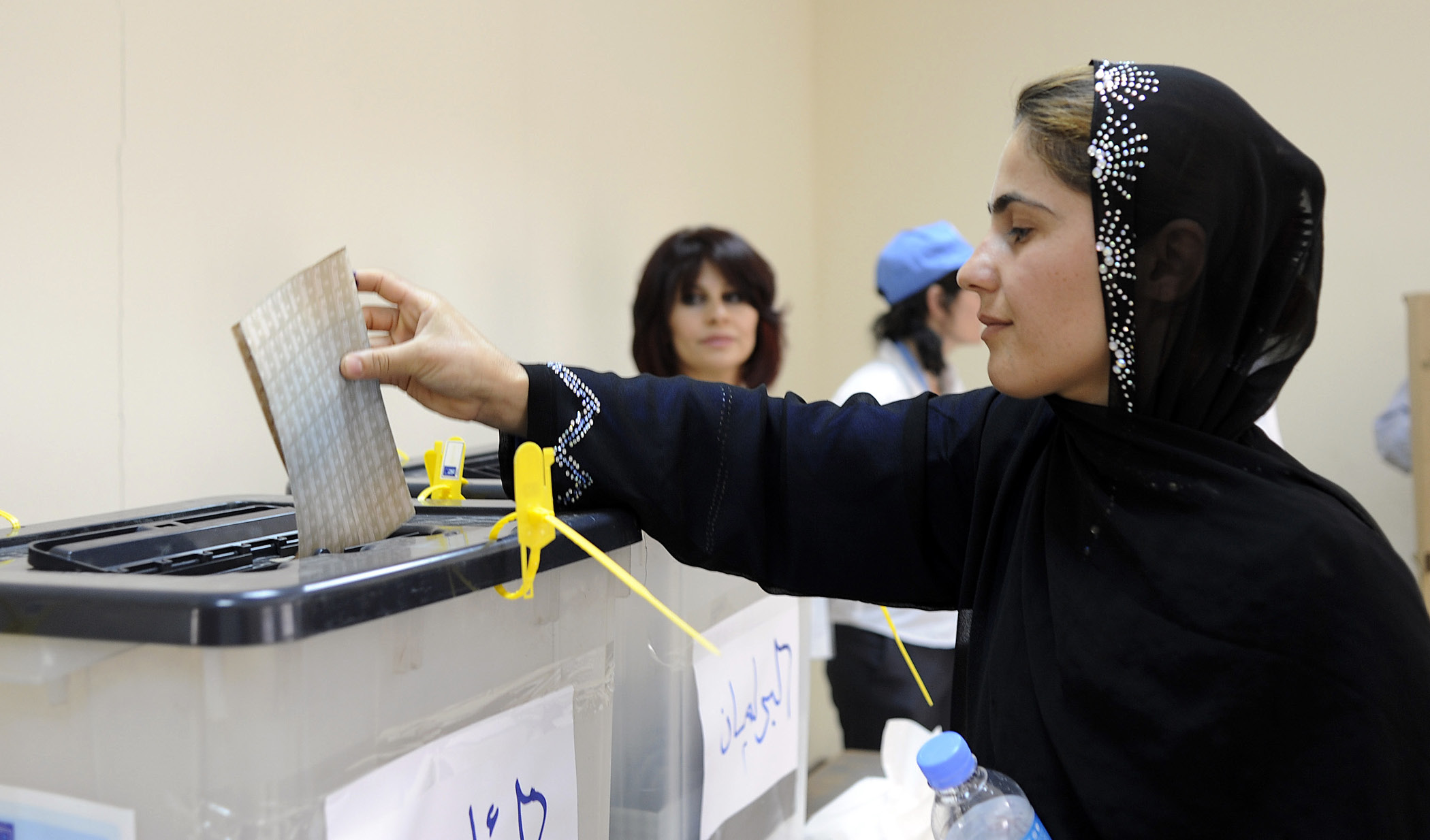
38 32 UN System Task Team on the Post-2015 UN Development Agenda Photo Credit: UN Photo cultures of peace and tolerance and building state capacities to ensure peace and security is essential in all countries and particularly pressing in so-called fragile states. 91. The prevention and reduction of all forms of violence and abuse and protection against their specific manifestations, including trafficking in human beings, torture, organized crime, the press-ganging of children, drug-related criminality, sexual abuse and labour exploitation should be at the heart of any agenda which fully recognizes the centrality of human security, both as a human rights imperative and as integral to development. Furthermore, as gender-based violence is one of the worst and most pervasive manifestations of inequality and discrimination, particular attention must be paid to ending all forms of violence against women and girls. 92. Implementation of a post-2015 development agenda will depend, critically, on effective governance capacities at national, local and municipal levels, including political commitment and leadership; and on the legal and economic empowerment of people, especially those most excluded, and of their civil society organizations, to participate effectively in national and local decisionmaking. As such, governance is an essential issue within all four of the dimensions outlined above. 93. Governance must be based on the rule of law, including compliance with international laws, and principles of inclusion and participation. International, national and local institutions must strive to be transparent, accountable, responsive and competent. Stakeholder engagement and participation of all groups in society, judicial independence, access to information and freedom of expression, combined with regular monitoring based on agreed benchmarks, will together form the basis of good governance. Effective governance is also central to the systemic transformations of economies in ways that support rights-based, equitable and sustainable development.

39 Realizing the future we want for all: Report to the Secretary-General 33 Photo Credit: istock Photo V. Shaping the global development agenda a. Key considerations in shaping the global development agenda 94. The vision proposed above for the post-2015 UN development agenda aims to provide a more holistic guide to international and national policymaking than that provided by the MDG framework. Such a global development agenda would also provide the overarching framework for related agendas, such as the outcome of the Istanbul Plan of Action for the LDCs and the outcomes of the major ongoing or forthcoming intergovernmental processes addressed in section VI and listed in Annex III. 95. In the process of defining the post-2015 agenda, the international community should be cautious of three dangers: overloading, being either too prescriptive or too vague, and donor-centrism. 96. First, the search for a more comprehensive approach runs the risk of overloading the post-2015 UN development agenda. The success of the MDGs is due to their clarity, conciseness and measurability. A structured approach based on principles, broad objectives and specific goals and targets, and enablers, such as that very tentatively presented in Figure 1, should help avert this risk. While challenging, due The international community should be cautious of three dangers: overloading, being either too prescriptive or too vague, and donor-centrism
40 34 UN System Task Team on the Post-2015 UN Development Agenda consideration will need to be given to the strong interdependencies among economic and social development, environmental sustainability and peace and security when defining the concrete goals and targets of the post-2015 UN development agenda. 97. Second, there is the risk of making the agenda too prescriptive. The focus on outcomes and the absence of guidance on the means of implementation in the MDG framework has encouraged some more prescriptive policy recommendations. However, this risks a one-size-fits-all approach and potential clash with the principle of national ownership. As indicated, the general principles of human rights, equality and sustainability could be used to provide overall guidance for priority setting and choosing among policy options. 98. Third, given outstanding deficits, meeting basic human development goals and addressing the needs of people living in the most vulnerable countries must remain central to any post-2015 development agenda. Yet, this should be done in a way that does not perpetuate the current perception of the global partnership for development as being, in essence, a donor-recipient relationship. This will require ensuring, through a broad consultative process, that the goal- and target setting of the agenda at large is relevant to all countries and that the global partnership is redefined to serve these collective goals. b. Possible format of the agenda 99. It is too early to discuss what the precise goals and targets of the post UN development agenda might entail. Various processes will need to run their course first, including the broader consultation processes about the vision for the post-2015 agenda and related discussions about sustainable development goals called for in the Rio+20 Outcome. Some basic features of the format may be suggested, however, and serve as a reference for those consultations. A limited set of universal goals 100. Global targets encourage all nations to accelerate progress, even though their applicability can only be judged in country-specific context, considering initial conditions. The global targets that made a difference as part of the MDG framework and other agendas share the following characteristics: engaging, clear, few in number, ambitious yet feasible, measurable and with far-reaching and long-term positive implications for development The objectives captured by the MDGs could be consolidated under the four different dimensions, which would provide continuity, though some goals may need to be defined in a broader sense to capture the global challenges ahead. As an example, the educational goal would go beyond improving access to schooling (quantity) to emphasize improving the relevance and quality of education at all levels. Improving nutrition would include reducing both under-nutrition, particularly stunting, and obesity. Eradicating hunger and ensuring food and nutrition security would comprise the four pillars of food availability, access, utilization and stability, including sustainable food production and consumption systems.
41 Realizing the future we want for all: Report to the Secretary-General The consultation process for the post-2015 UN development agenda should focus on the pertinence of the four dimensions of the proposed framework for setting a core set of collective goals and targets and how those should be adapted to different contexts. At the same time, it will be indispensable to resist any unnecessary complexity. Simplicity and succinctness in preparing the agenda will be vital to ensure its focus and ultimate development impact. This will demand tough choices. but one size does not fit all 103. Global goals and targets should not be confused with national targets. Development processes are context specific. Therefore, to be meaningful, global goals and targets must be tailored and adapted to national and regional contexts and initial conditions. It is not necessary that each country fully attains global targets in order for the world to attain them General principles and key practices for rights-based, equitable and sustainable development, as laid out in the vision, would provide overall guidance for priority setting and choosing among policy options. Based on these principles, a number of clearly defined development enablers could be spelled out, as suggested in section IV. This would contribute to coherence among policies primarily at the (sub-) national level, but where relevant, also at the regional and global levels. Examples of the enablers include policies relating to issues such as sustainable food and nutrition security, protection of ecosystems; access to technology and knowledge; macroeconomic policies that are pro-poor, pro-employment and pro-environment; a trading environment that contributes to sustainable economic growth; good governance; and well-managed migration. Development of such enabling policies would by their nature be context specific and nationally driven, based on the specific challenges that each and every country is facing. Results of these policies could be monitored through performance as well as other indicators, some of which could be internationally agreed and others nationally defined. Global goals and targets must be tailored and adapted to national and regional contexts and initial conditions c. Reshaping the global partnership for development 105. The global partnership for development should be reoriented given the changed context, new actors and new challenges and be directly linked to the dimensions of the post-2015 agenda. Sustained economic growth for reduction of poverty, inequality and vulnerability will require strengthened partnerships among governments, the private sector and civil society to make sure that international trade, national and foreign direct investments contribute to productive employment creation, economic security and investments in health, education, rural development, water and sanitation while safeguarding human rights and empowering women.
42 36 UN System Task Team on the Post-2015 UN Development Agenda The global partnership itself should also be truly global 106. Moreover, the expected emphasis of the post-2015 UN development agenda on sustainable development a truly global challenge will have significant implications for how the global partnership for development should be constructed. The global partnership itself should also be truly global and contain goals for all stakeholders. Policy coherence will become even more important, across policies relating to trade, investment, the environment and development The global partnership must encompass all forms of partnerships between governmental and non-governmental actors Partnerships to implement a post-2015 UN development agenda should reflect the full range of actors that have the potential to support sustainable development (governments, civil society, the private sector and foundations). They should include specific actions and resources for vulnerable population groups and countries, in particular, LDCs, LLDCs, and SIDS. Such partnerships should also be encouraged at all levels (global, regional, national and local), depending on the issues to be addressed and the context A reshaped and reinvigorated global partnership for development will also be essential to improve management of migration flows and to enhance their contribution to the creation of wealth, trade, jobs and social empowerment. Knowledge sharing and the transfer of technology in the areas of information and telecommunications, agriculture, disease prevention and management, disaster relief and mitigation, and energy will be increasingly important for food security and nutrition, global health and efforts to reduce the impacts of climate change. Access to these technologies and knowledge should be facilitated through the global partnership The global partnership needs to include North-South, South-South and triangular cooperation New partnerships including North-South, South-South and triangular cooperation, with participation from civil society organizations, the private sector, and philanthropy should be formed in a transparent way, in collaboration with the presumed beneficiaries and with a clear framework for monitoring and mutual accountability. Recent progress made in rethinking traditional development assistance and shifting from the current focus on aid effectiveness to more purposeful development effectiveness will be instrumental in redefining the global partnership for development in ways such that it would be a forceful enabler for the implementation of the post-2015 agenda Consideration could be given to building a dual structure for partnerships within the post-2015 framework, including one component where partnerships are mainstreamed under each thematic goal, which would allow a stronger link between the goals and means for achieving them, and a second component that supplements the partnerships with a broader international enabling environment goal, covering areas of common and in some cases, differentiated responsibility.
43 Realizing the future we want for all: Report to the Secretary-General 37 d. New time horizon 111. To accomplish the necessary transformative change, consideration could be given to a longer time horizon for the post-2015 agenda, possibly from 2015 to anywhere between 2030 and The pros and cons of a time horizon of 15 years versus one of 25 years or more would have to be weighed carefully. Targets for at least a 25-year period have the advantage of allowing for additional time to accomplish major transformations in the economic, social and environmental spheres. Yet, they may suffer from weaker political accountability because deadlines would be beyond the watch of the leaders who approve them. This risk could be mitigated by accompanying longer-term goals and targets with intermediate ones Intermediate targets could be set to serve as quantitative goal posts against which world leaders and all stakeholders could review global progress vis-à-vis the longer-term goals, for instance, every five years. Such interim measures and periodic reviews would not only strengthen accountability, but also allow for adjustment or refinement of the long-term goals, based on changing circumstances and experiences in implementation. e. Monitoring and benchmarking 113. Performance can be measured in terms of absolute or relative progress. Both approaches are valid but incomplete. Most MDG targets are expressed in relative terms e.g. reducing poverty by half, cutting infant mortality by two-thirds and maternal mortality by three-quarters. Proportional changes tend to be inversely related to initial levels. That is why one unintended consequence of the way the MDGs were formulated has been to implicitly put a higher burden of achievement on countries with lower levels of human development. Another drawback is that relative targets can be met even as the absolute number of people may have increased due to population growth There are precedents for formulating global targets in ways that combine relative and absolute benchmarks. For example, the 1990 World Summit for Children set the target of reducing the under-five mortality rate by onethird or to a level of 70 per 1,000 live births by the year 2000, whichever implied the largest reduction. The implications of selecting a particular type of benchmark or combination thereof will have to be carefully considered in formulating the post-2015 agenda Targets should take proper account of population dynamics and different demographic structures across countries and regions and within countries. The clearest expression of these is the changing weights of youth and older persons in societies; different rates of fertility, morbidity and mortality; and urbanization rates. A combination of absolute and relative targets will be needed for an all-inclusive development agenda that takes shifting demographics into account.
44 38 UN System Task Team on the Post-2015 UN Development Agenda 116. Targets should also be set in a way to measure the prevailing inequalities and sustainability aspects. Defining qualitative indicators and more availability of data disaggregated by sex, age, geography, migrant status and rural-urban location will be critical to monitor both the degree to which development progress is indeed inclusive and sustainable, and the extent to which the needs of the most deprived and vulnerable groups are being addressed. Such indicators and data will also facilitate better assessment of policy effectiveness and contribute to strengthening accountability. However, producing them will require strengthening statistical capacities in most countries The ability of people to hold institutions accountable for delivery of quality services; for responsiveness, recourse and transparency; and for setting and adjusting priorities and targets is key to people s empowerment. Well-defined, rule-of-law-based performance standards and benchmarks for accountability can generate confidence among the public in their institutions, thereby building support for the global development agenda. Pluralistic, independent media may help raise public awareness about development issues, empowering people with information to better monitor implementation and performance and hold governments accountable. National measures of progress should be complemented with disaggregated data and qualitative information for better understanding of factors contributing to and impeding progress in improving peoples lives. These efforts can build on existing household survey programmes, while promoting community-led monitoring, wider access to ICT resources and the use of social media for development.

45 Realizing the future we want for all: Report to the Secretary-General 39 Photo Credit: istock Photo VI. The way forward: consultations to forge consensus on a post-2015 UN development agenda a. Initial guidance from Member States 118. The outcome document of the 2010 High-level Plenary Meeting of the General Assembly on MDG progress requests the Secretary-General to report annually on efforts to accelerate progress towards the MDGs and to include recommendations to advance the UN development agenda beyond 2015 in these reports The 2011 Report of the Secretary-General recommended an open and inclusive consultation process, in order for the post-2015 agenda to have the best development impact. 47 Member States have conveyed the same message in recent briefing sessions on post-2015 in the General Assembly and ECOSOC, calling for a Member State-led process of open and inclusive consultations, with early and broad participation by all stakeholders. This has been reinforced in the Rio+20 Outcome where Member States are to constitute an open working group to guide the process of preparing sustainable development goals Member States have underscored the need to support the capacity of least developed countries to participate in the discussions. They have stressed the importance of other intergovernmental processes feeding 46 General Assembly resolution 65/1, op. cit., para Annual report of the Secretary-General on accelerating progress towards the Millennium Development Goals, op. cit.
46 40 UN System Task Team on the Post-2015 UN Development Agenda The proposed road map is based on a two-step approach into discussions on the post-2015 agenda, especially Rio+20. The Rio+20 outcome document (para. 249) has also stressed the imperative of ensuring full convergence of the Rio+20 and post-2015 processes, to arrive at one post-2015 UN development agenda, with sustainable development at its centre The outcome document of the 2010 MDG Summit further requests the President of the General Assembly to convene a special event to follow up on efforts made towards achieving the MDGs during its 68th session, which begins in September This could provide an opportunity to lay the foundations for consensus on the post-2015 UN development agenda, ensuring convergence with the process to prepare sustainable development goals Member States have yet to take any decisions on the nature of the special event and the timelines for the post-2015 process as a whole. What follows is a possible roadmap for reaching consensus on a post-2015 UN development agenda, including ways of bringing the voices of different stakeholders into the process as well as major milestones leading up to b. Proposed road map 123. The proposed road map is based on a two-step approach for supporting Member States to develop the post-2015 UN development agenda. The first step, from now through the special event, is to promote an open, inclusive and transparent consultation process, to take stock and encourage contributions from a wide range of stakeholders. The second step, from the special event through 2015, is to intensify efforts to achieve intergovernmental consensus, while sustaining an open and inclusive process. i. Bringing different voices into the process 124. In its global convening role, the UN can bring together the different sets of stakeholders who can contribute to an agenda of human progress and sustainable development, building on agreements by Member States in the Millennium Declaration, the international summits and conference since the 1990s and successive reviews, especially the Rio+20 outcome. It will be important to capture the perspectives and contributions of civil society, the private sector, philanthropic foundations and other development partners. The UN can also bring voices that may otherwise not be heard, such as youth representatives, into the debate and help amplify perspectives of those marginalized The United Nations Development Group has taken steps to initiate outreach on several levels: (i) supporting at least 50 national level post-2015 dialogues in developing countries to complement the active debates already ongoing in developed countries; (ii) convening nine global thematic consultations; and (iii) stimulating and supporting citizen and stakeholder engagement with the post-2015 agenda, including through an interactive web portal, crowd-sourcing of views, and submission of video testimonies, meeting summaries and artwork. 48 General Assembly resolution 65/1, op. cit., para. 79.
47 Realizing the future we want for all: Report to the Secretary-General The outcomes of the national dialogues and thematic meetings and public engagement will be synthesized. How such meetings and processes can feed into the intergovernmental processes should be considered These different types and levels of outreach can anchor other innovative consultations and processes taking place outside the UN. In addition, the UN Millennium Campaign, the Non-Governmental Liaison Service, the Global Compact and the ILO will play key roles in reaching out to civil society, the private sector and labour. ii. Major milestones leading up to A number of important meetings and processes will serve as milestones on the path towards The Rio+20 Conference has provided critical guidance on how member States will elaborate the concept of sustainable development goals, to be coherent with and integrated in the post-2015 UN development agenda. and launched an inclusive and transparent process for doing so, open to all stakeholders. Within the Rio+20 negotiations, member States have also identified a number of priority areas for sustainable development. Among these are poverty eradication; food security and sustainable agriculture; water and sanitation; energy; sustainable tourism; sustainable transport; sustainable cities and human settlements; health and population; full and productive employment, decent work and social protection; oceans and seas; disaster risk reduction and resilience; sustainable production and consumption; gender equality and women s empowerment, among others Other major intergovernmental processes will also help Member States and other stakeholders identify key priorities for a post-2015 UN development agenda; a list of such processes is contained in Annex III. Examples include the 2012 High-level Meeting on the Rule of Law, the 2013 High- Level Dialogue on International Migration and Development, the 20-year review of the Programme of Action of the International Conference on Population and Development in 2014, and, in 2015, the World Conference on Disaster Reduction, the 10-year review of the World Summit on the Information Society (WSIS) and the Commemoration of the 20th anniversary of the Beijing World Conference on Women The Secretary-General s High-level Panel on post will convene from July 2012 to provide recommendations on possible components of a post-2015 UN development agenda, as well as to contribute to the overall political process. The Panel will deliver its report in the first quarter of The decision of the United Nations Conference on Sustainable Development (Rio+20) to initiate an intergovernmental process for the preparation of a proposal for sustainable development goals consistent with the post UN development agenda, provides an opportunity to The decision of Rio+20 to prepare... SDGs provides the opportunity to reach consensus on a unified framework for the UN development agenda after 2015
48 42 UN System Task Team on the Post-2015 UN Development Agenda reach consensus on a unified framework for the UN development agenda after 2015 based on the active participation and leadership of Member States and broad consultations with all relevant stakeholders The General Assembly will continue to provide overall guidance to the post-2015 process. It would be up to the Assembly to identify the parameters for the 2013 special event and, soon after the event, to agree on the modalities for a 2014 or 2015 UN summit on development and for the intergovernmental preparatory process leading up to it. The role of the Assembly will be supplemented by contributions provided by ECOSOC s Annual Ministerial Review and Development Cooperation Forum and its relevant functional commissions and expert bodies, as well as through subsidiary bodies of the Assembly, such as the Human Rights Council The special event of the President of the General Assembly should be convened with multi-stakeholder participation, as with the 2010 MDG Summit. Drawing upon multiple inputs, the event could provide a platform for an interactive dialogue among Member States and other stakeholders about the possible contours of the post-2015 UN development agenda and, in doing so, provide a basis for subsequent decision-making. It could also yield a call to convene a UN summit on development in 2014 or 2015 to reach agreement on the post-2015 UN development agenda Based on the outcome of the special event in 2013, more focused discussions could then be launched on the specific format and content of a new agenda, including possible goals and targets to be proposed for intergovernmental agreement. The open working group of Member State experts called for in the Rio+20 Outcome to guide development of sustainable development goals will submit a report, to the sixty-eighth session of the Assembly, containing a proposal for sustainable development goals for consideration and appropriate action The development of indicators for agreed targets could be tasked to an inter-agency and expert group on indicators, with advice from the UN Statistical Commission, as has been the case with the MDG framework. The group could also be tasked with reviewing the numerical aspects of setting targets, which should be based on accurate assessment of past trends at the global, regional and sub-regional levels As the deliberations on the post-2015 UN development agenda advance, preparatory work would also need to begin at various levels on monitoring and evaluation systems, accountability mechanisms and mobilization of resources to support implementation of the agenda. At this later stage, the UN system could also initiate work on developing a coherent UN system approach to support the implementation of the agenda by governments and other stakeholders.
49 Realizing the future we want for all: Report to the Secretary-General The biggest immediate challenge will be to reach consensus on the contours of an agenda that adequately identifies the development needs of present and future generations, and is capable of crystallizing these priorities in clear, easy-to-communicate development goals that will help guide coherent policy action at the global, regional and national levels The UN System Task Team is committed to supporting the broad consultation process that is already taking shape, through its analytical inputs, expertise and outreach. Ultimately, the Task Team seeks to contribute to the definition of a post-2015 global development agenda that responds to the aspirations of all people for a world free of want and fear and consistent with economic development, social progress and environmental sustainability.
50 44 UN System Task Team on the Post-2015 UN Development Agenda Annex 1 UN System Task Team on the Post-2015 UN Development Agenda Membership Department of Economic and Social Affairs (DESA), Co-Chair United Nations Development Programme (UNDP), Co-Chair Convention on Biological Diversity (CBD) Department of Public Information (DPI) Economic Commission for Africa (ECA) Economic Commission for Europe (ECE) Economic Commission for Latin America and the Caribbean (ECLAC) Economic and Social Commission for Asia and the Pacific (ESCAP) Economic and Social Commission for Western Asia (ESCWA) Executive Office of the Secretary-General (EOSG) Food and Agricultural Organization of the United Nations (FAO) Global Environment Facility (GEF) International Atomic Energy Agency (IAEA) International Civil Aviation Organization (ICAO) International Fund for Agricultural Development (IFAD) International Labour Organization (ILO) International Maritime Organization (IMO) International Monetary Fund (IMF) International Organization for Migration (IOM) International Telecommunication Union (ITU) Joint United Nations Programme on HIV/AIDS (UNAIDS) Non-Governmental Liaison Service (NGLS) Office of the Deputy Secretary-General (ODSG) Office of the High Commissioner for Human Rights (OHCHR) Office of the High Representative for the Least Developed Countries, Landlocked Developing Countries and Small Island Developing States (OHRLLS) Office of the Special Advisor on Africa (OSAA) Peace building Support Office (PBSO) United Nations Children s Fund (UNICEF) United Nations Conference on Trade and Development (UNCTAD) United Nations Convention to Combat Desertification (UNCCD) United Nations Educational, Scientific and Cultural Organization (UNESCO) United Nations Entity for Gender Equality and Empowerment of Women (UN Women) United Nations Environment Programme (UNEP) United Nations Framework Convention on Climate Change (UNFCCC) United Nations Fund for International Partnerships (UNFIP) United Nations Global Compact Office
51 Realizing the future we want for all: Report to the Secretary-General 45 United Nations High Commissioner for Refugees (UNHCR) United Nations Human Settlements Programme (UN-HABITAT) United Nations Industrial Development Organization (UNIDO) United Nations International Strategy for Disaster Reduction (UNISDR) United Nations Institute for Training and Research (UNITAR) United Nations Millennium Campaign United Nations Office for Outer Space Affairs (UNOOSA) United Nations Office for Project Services (UNOPS) United Nations Office on Drugs and Crime (UNODC) United Nations Population Fund (UNFPA) United Nations Relief and Works Agency for Palestinian Refugees in the Near East (UNRWA) United Nations Research Institute for Social Development (UNRISD) United Nations System Chief Executives Board for Coordination Secretariat (CEB) United Nations University (UNU) United Nations Volunteers (UNV) United Nations World Tourism Organization (UNWTO) Universal Postal Union (UPU) World Bank World Food Programme (WFP) World Health Organization (WHO) World Intellectual Property Organization (WIPO) World Meteorological Organization (WMO) World Trade Organization (WTO)
52 46 UN System Task Team on the Post-2015 UN Development Agenda Annex 2 Strengths and Weaknesses of the MDG Framework: abridged summary a Strengths Weaknesses Key conceptualization and characteristics of the MDG framework The integrated framework influenced policies by giving priority and operational meaning to various dimensions of human development; Simple, transparent and easy-to-communicate framework; It provided the basis for converging advocacy, thereby helping to strengthen the global partnership for development and directing global and national resources towards poverty reduction and human development; It recognized the special needs of Africa and LDCs, LLDCs and SIDS and strengthened international commitments to address those needs. Lack of consultations at its conception to build ownership led to the perception of a donor-centric agenda; Excluded some important issues embodied in the Millennium Declaration; Inadequate incorporation of other important issues, such as environmental sustainability, productive employment and decent work, inequality; Limited consideration of the enablers of development; Failure to account for differences in initial conditions. Clear definition of goals, targets and indicators helped improve policy monitoring and accountability; Format of the MDG framework Imprecise quantitative targets were set for some dimensions, such as for reducing the number of slumdwellers and several targets related to MDG-8; Supported the development of countries statistical capacity and the use of robust data in support of development policies; Improved statistical system coordination at national and international levels. Failure to account for population dynamics; Perception of a top-down exercise (from the international to the national statistical systems); Lack of clarity on how to tailor global targets to national realities and regional dynamics, among others; Lack of attention to disaggregated monitor progress among vulnerable groups, qualitative aspects, and interdependencies across the MDGs. (cont d)
53 Realizing the future we want for all: Report to the Secretary-General 47 Strengths MDG framework promoted concrete actions to address human development shortfalls and the goals and targets were made explicit in national development policies; Weaknesses MDG implementation MDGs influenced the setting of rather rigid national policy agendas, following international benchmarks, rather than local conditions and often ignoring the complexities of the development process; Provided a common framework and an improved coordination opportunity for development actors; Facilitated various forms of intra-regional cooperation; Some countries tailored the MDG framework to reflect their own realities, including adding relevant goals, targets and indicators and using disaggregated data across regions and vulnerable groups. Policies and programmes did not consider the synergies between achieving the different goals and targets; The way in which on-track and off-track progress was measured failed to adequately account for considerable progress made by countries with low initial levels of human development (especially in Africa); In the global debate, the MDGs led to overemphasizing financial resource gaps to the detriment of attention for institutional building and structural transformations. Note a: The above is an abridged version of the strengths and weaknesses discussed in United Nations System Task Team on the Post-2015 UN Development Agenda (2012). Review of the contributions of the MDG agenda to foster development: lessons for the Post 2015 UN Development Agenda, available from:
54 48 UN System Task Team on the Post-2015 UN Development Agenda Annex 3 Inter-governmental processes of relevance for post-2015 UN development agenda preparations Process Focus/Priority themes/purpose Date 101 st Session of the International Labour Conference 1. National Floors for Social Protection (recommendation to be adopted) 2. New programme on youth unemployment 3. Plan of action on promoting the Fundamental Principles and Rights at Work 30 May 15 June 2012 General Assembly Annual Review of Implementation of the Declaration of Commitment on HIV/AIDS and the Political Declarations on HIV/AIDS United Nations Conference on Sustainable Development (Rio+20) Third Development Cooperation Forum (DCF) 2012 ECOSOC Annual Ministerial Review (AMR) Review of progress made in the implementation of global commitments on HIV/AIDS, based on the Report of the Secretary-General with inputs from national reports 1. A green economy in the context of sustainable development and poverty eradication 2. The institutional framework for sustainable development 1. Aid quantity, sources and allocation 2. Mutual accountability and aid transparency 3. Policy coherence 4. Aid to mobilize other development finance 5. Impact of the sustainable development concept on development cooperation 6. South-South and triangular cooperation 7. Decentralized cooperation 8. Aid to promote gender equality 9. Private philanthropic organizations in development cooperation 10. The evolving development cooperation architecture Promoting productive capacity, employment and decent work to eradicate poverty in the context of inclusive, sustainable and equitable economic growth at all levels for achieving the MDGs 11 June June July 2012 July 2012 (cont d)
55 Realizing the future we want for all: Report to the Secretary-General 49 Process Focus/Priority themes/purpose Date ECOSOC Special Ministerial Meeting High-level Meeting on the Rule of Law International Dialogue on Peace building and State building United Nations Framework Convention on Climate Change (UNFCCC) 2012 ECOSOC Annual Ministerial Review (AMR) Second High-level Dialogue on International Migration and Development Strengthening the role of ECOSOC in coordinating the global development agenda, particularly in the context of implementing the outcomes of the Rio+20 Conference and formulating the post-2015 UN development agenda High-level Meeting of the 67 th Session of the General Assembly on the Rule of Law at the national and international levels for all Member States, non-governmental organizations and civil society represented at the highest level, to discuss and agree on an agenda on strengthening the rule of law 1. Share peace building and state building experiences 2. Gather and discuss good practices and constraints to delivering effective international assistant in support of peace building and state building 3. Identify a realistic set of objectives for peace building and state building that could guide national and international partners 4. Build trust between participating countries and organizations UN Climate Change Conference: the 18 th session of the Conference of the Parties serves as the meeting of the Parties to the Kyoto Protocol (COP18/CMP8) 2. Ad hoc Working Group on the urban Platform for Enhanced Action towards a new climate change agreement to be finalized in 2015 Science, technology and innovation, and the potential of culture for promoting sustainable development and achieving the Millennium Development Goals Take stock of the main achievements of the Global Forum on Migration and Development process and address the relationship between the Global Forum and the United Nations 24 September September 2012 High-level side event at opening of General Assembly 2012 Ongoing 26 November 7 December 2012 Ongoing July 2013 Second Half of 2013 (cont d)
56 50 UN System Task Team on the Post-2015 UN Development Agenda Process Focus/Priority themes/purpose Date The International Conference on Nutrition (ICN +20) Special Event organized by the President of the 68 th Session of the General Assembly to follow-up on efforts made towards achieving the Millennium Development Goals (tbc) Commission on the Status of Women Fourth Development Cooperation Forum (DCF) 2014 ECOSOC Annual Ministerial Review (AMR) 2014 General Assembly Special Session on the review of the 1994 ICPD Programme of Action UNESCO World Conference on Education for Sustainable Development (ESD): Learning Today for a Sustainable Future Comprehensive Ten-Year Review Conference of the Almaty Programme of Action (Landlocked Developing Countries and Small Island Developing States) Review progress made since 1992, reflect on the existing and new challenges and opportunities presented by the changes in the global economy, in the food system and by advances in science and technologies, and analyze policy options for improving nutrition (as requested by Member States in the 2010 MDG Summit Outcome Document) Challenges and achievements in the implementation of the Millennium Development Goals for women and girls The 2014 Development Cooperation Forum will focus on how development cooperation will feature in a post-2015 UN development agenda Addressing ongoing and emerging challenges for meeting the MDGs in 2015 and for sustaining development gains in the future Review the progress in the implementation of the ICPD Programme of Action (PoA), assess current population and development issues, and identify areas for the implementation of the ICPD PoA beyond 2014, based on the ongoing comprehensive operational review of the implementation of the PoA Marking the end of the UN Decade for Education for Sustainable Development (DESD) the review of the implementation of the UN DESD will draw out the relevance of ESD for the post-2014 education and sustainable development agendas General review conference focusing on issues relevant to LLDCs /2014 (tbc) March 2014 July 2014 July 2014 September 2014 November (cont d)
57 Realizing the future we want for all: Report to the Secretary-General 51 Process Focus/Priority themes/purpose Date World Conference on Indigenous Peoples World Conference on Education for All (EFA) 2015 General Assembly Special Session on the review of the Tunis Agenda of the World Summit on the Information Society (WSIS 2005) Second World Conference on Disaster Reduction The Commemoration of the 20 th anniversary of the Beijing World Conference on Women 10-year review of the Mauritius Strategy for the further implementation of the Barbados Programme of action for the Sustainable Development of Small Island Developing States High-level Mid-term Review of the Istanbul Programme of Action (IPoA) To share perspectives and best practices on the realization of the rights of indigenous peoples and to pursue the objectives of the United Nations Declaration on the Rights of Indigenous Peoples Assessment of progress towards the six EFA goals and way forward for education Review based on the results from two highlevel meetings organized by UNESCO (2013) and ITU (2014) To review the implementation of the Hyogo Framework for Action (HFA) Building the Resilience of Nations and Communities to Disasters and to facilitate the development of a post-2015 framework for disaster risk reduction as requested by the United Nations General Assembly Resolution 66/199 (tbd) International Meeting to review the Implementation of the Programme of Action for the sustainable Development of Small Island Developing States Review of the implementation of the IPoA with a special focus on ODA commitments and consideration of enhancing the resources of least developed countries. The review will cover all priority areas for action of the IPoA: 1. Productive capacity 2. Agriculture, food security and rural development 3. Trade 4. Commodities 5. Human and social development 6. Multiple crises and other emerging challenges 7. Mobilizing financial resources for development and capacity-building 8. Good governance at all levels 2014 April 2015 September (tbc) /2016
58 52 UN System Task Team on the Post-2015 UN Development Agenda For more information on the work of the UN System on the Post-2015 UN Development Agenda: Visit: or Contact: Rob Vos, UN-DESA, or Selim Jahan, UNDP,
Council conclusions on a transformative post-2015 agenda. General Affairs Council meeting Brussels, 16 December 2014
 Council of the European Union PRESS EN COUNCIL CONCLUSIONS Brussels, 16 December 2014 Council conclusions on a transformative post-2015 agenda General Affairs Council meeting Brussels, 16 December 2014
Realizing the Future We Want for All
 Realizing the Future We Want for All Realizing the Future We Want for All Report of the UN System Task Team to the Secretary General: June 2012 First set of recommendations on contours of the post 2015
Lessons Learned from MDG Monitoring From A Statistical Perspective
 Lessons Learned from MDG Monitoring From A Statistical Perspective Report of the Task Team on Lessons Learned from MDG Monitoring of the IAEG-MDG United Nations March 2013 The views expressed in this paper
TAP Network Response to the Post-2015 Zero Draft
 [LOGOS FOR ENDORSEMENT] TAP Network Response to the Post-2015 Zero Draft The Zero Draft of the Outcome Document for the Post-2015 Development Agenda represents a critical juncture in laying out a new sustainable
TUNIS COMMITMENT. Document WSIS-05/TUNIS/DOC/7 -E 18 November 2005 Original: English
 Document WSIS-05/TUNIS/DOC/7 -E 18 November 2005 Original: English TUNIS COMMITMENT 1. We, the representatives of the peoples of the world, have gathered in Tunis from 16-18 November 2005 for this second
THE GLOBAL AGENDA FOR SOCIAL WORK AND SOCIAL DEVELOPMENT COMMITMENT TO ACTION March 2012
 THE GLOBAL AGENDA FOR SOCIAL WORK AND SOCIAL DEVELOPMENT COMMITMENT TO ACTION March 2012 OUR COMMITMENTS As social workers, educators and social development practitioners, we witness the daily realities
Education 2030: Towards inclusive and equitable quality education and lifelong learning for all. ED/WEF2015/MD/3 Original: English
 Education 2030: Towards inclusive and equitable quality education and lifelong learning for all ED/WEF2015/MD/3 Original: English 1. We, Ministers, heads and members of delegations, heads of agencies and
The United Nations Environment Programme and the 2030 Agenda. Global Action for People and the Planet
 The United Nations Environment Programme and the 2030 Agenda Global Action for People and the Planet Unemployment, resource scarcity, climate change, food insecurity and inequity all signal the need for
Health in the 2030 Agenda for Sustainable Development
 EXECUTIVE BOARD EB138/CONF./8 138th session 27 January 2016 Agenda item 7.2 Health in the 2030 Agenda for Sustainable Development Draft resolution proposed by Japan, Panama, South Africa, Thailand, United
Rio Political Declaration on Social Determinants of Health
 Rio Political Declaration on Social Determinants of Health Rio de Janeiro, Brazil, 21 October 2011 1. Invited by the World Health Organization, we, Heads of Government, Ministers and government representatives
Goal 1: Eradicate extreme poverty and hunger. 1. Proportion of population below $1 (PPP) per day a
 Annex II Revised Millennium Development Goal monitoring framework, including new targets and indicators, as recommended by the Inter-Agency and Expert Group on Millennium Development Goal Indicators At
GLOBAL ALLIANCE FOR CLIMATE-SMART AGRICULTURE (GACSA)
 GLOBAL ALLIANCE FOR CLIMATE-SMART AGRICULTURE (GACSA) FRAMEWORK DOCUMENT Version 01 :: 1 September 2014 I Vision 1. In today s world there is enough food produced for all to be well-fed, but one person
The IBIS Education for Change strategy states the overall objective
 CONCEPT PAPER: YOUTH EDUCATION & TRAINING 1 Concept Paper youth education & training Photo: Ricardo Ramirez The IBIS Education for Change strategy states the overall objective of IBIS work with education
THE SECRETARY-GENERAL S FIVE-YEAR ACTION AGENDA
 U N I T E D N A T I O N S N A T I O N S U N I E S THE SECRETARY-GENERAL S FIVE-YEAR ACTION AGENDA 25 JANUARY 2012 The currents of change are transforming our human and physical geography. Demographic transformation,
Sundsvall Statement on Supportive Environments for Health
 Sundsvall Statement on Supportive Environments for Health Third International Conference on Health Promotion, Sundsvall, Sweden, 9-15 June 1991 The Third International Conference on Health Promotion: Supportive
Annex 8: SDG Indicator Mapping
 Annex 8 SDG Indicator Mapping 1. Annex 8 responds to Executive Board decision below, regarding the refinement of indicators and targets of the Strategic Plan Integrated Results and Resources Framework
How To Help The World
 The World We Want A North-East Asian Youth Vision This Declaration was handed to His Excellency Kim Sung-hwan, Minister of Foreign Affairs and Trade of the Republic of Korea, in Seoul on 9 th of January
Health in the post-2015 Development Framework: How to meet the needs of the most marginalized and excluded
 Policy briefing Health in the post-2015 Development Framework: How to meet the needs of the most marginalized and excluded Introduction For the past two years, UN Member States, UN agencies, civil society
TAP Network Response to the Post-2015 Z ero Draft
 TAP Network Response to the Post-2015 Z ero Draft The Zero Draft of the Outcome Document for the Post-2015 Development Agenda represents a critical juncture in laying out a new sustainable development
MINISTERIAL MEETING OF THE BLUE WEEK 2015
 5 JUNE 2015 MINISTERIAL MEETING OF THE BLUE WEEK 2015 We, Ministers responsible for Ocean/ Fisheries/ Maritime Affairs, having met in Lisbon on June the 5 th, 2015, at the invitation of the Minister of
United Nations Programme on Youth. Interagency Expert Group Meeting on. Goals and Targets for Monitoring the Progress of Youth in the Global Economy
 BACKGROUND PAPER United Nations Programme on Youth Interagency Expert Group Meeting on Goals and Targets for Monitoring the Progress of Youth in the Global Economy New York, 30-31 May 2007 INTRODUCTION
Scaling Up Nutrition (SUN) Movement Strategy [2012-2015]
![Scaling Up Nutrition (SUN) Movement Strategy [2012-2015]](/thumbs/27/12344538.jpg "Scaling Up Nutrition (SUN) Movement Strategy [2012-2015]") Scaling Up Nutrition (SUN) Movement Strategy [2012-2015] September 2012 Table of Contents Synopsis... 3 A: SUN Movement Vision and Goals... 4 B: Strategic Approaches and Objectives... 4 C: Principles of
Scaling Up Nutrition (SUN) Movement Strategy [2012-2015] September 2012 Table of Contents Synopsis... 3 A: SUN Movement Vision and Goals... 4 B: Strategic Approaches and Objectives... 4 C: Principles of
Concept Note and. Call for Papers
 Concept Note and Call for Papers AFRICAN ECONOMIC CONFERENCE 2015 ADDRESSING POVERTY AND INEQUALITY IN THE POST 2015 DEVELOPMENT AGENDA Kinshasa, Democratic Republic of Congo 2-4 November, 2015 1 1. Introduction
TST Issues Brief: Human rights including the right to development i
 TST Issues Brief: Human rights including the right to development i I. Stocktaking The Millennium Development Goals (MDGs) have had some success in highlighting key development and human rights issues
2014-2017. UNICEF/NYHQ2012-1868/Noorani
 UNICEF STRATEGIC PLAN 2014-2017 UNICEF/NYHQ2012-1868/Noorani UNICEF s Strategic Plan 2014-2017 is a road map for the realization of the rights of every child. The equity strategy, emphasizing the most
FINAL. World Education Forum. The Dakar Framework for Action. Education For All: Meeting our Collective Commitments. Revised Final Draft
 28/04/2000, 3 P.m. FINAL The Dakar Framework for Action Education For All: Meeting our Collective Commitments Revised Final Draft World Education Forum Dakar, Senegal, 26-28 April 2000 1 1 The Dakar Framework
SUMMARY OF NATIONAL VOLUNTARY REVIEW PROCESS INDEPENDENT STATE OF SAMOA
 SUMMARY OF NATIONAL VOLUNTARY REVIEW PROCESS INDEPENDENT STATE OF SAMOA The Government of the Independent State of Samoa strongly supports the launch of the United Nations Sustainable Development Goals
Appeal to the Member States of the United Nations Early Childhood Development: The Foundation of Sustainable Human Development for 2015 and Beyond
 UNICEF/NYHQ2006-0450/Pirozzi Appeal to the Member States of the United Nations Early Childhood Development: The Foundation of Sustainable Human Development for 2015 and Beyond We, the undersigned, submit
E/CN.6/2011/CRP.7. Gender equality and sustainable development
 18 March 2011 Original: English Commission on the Status of Women Fifty-fifth session 22 February-4 March 2011 Agenda item 3 (b) Follow-up to the Fourth World Conference on Women and to the twenty-third
Annex - Resolution 1 Declaration: Together for humanity
 Annex - Resolution 1 Declaration: Together for humanity Gathered in Geneva for the 30th International Conference of the Red Cross and Red Crescent, we, the members of this Conference, have focused on the
Disaster Risk Reduction and Building Resilience to Climate Change Impacts
 Disaster Risk Reduction and Building Resilience to Climate Change Impacts Luna Abu-Swaireh ([email protected]) May 2015 United Nations Office for Disaster Risk Reduction (UNISDR) Droughts Floods Storms
HOUSING AND LAND RIGHTS NETWORK H a b i t a t I n t e r n a t i o n a l C o a l i t i o n
 HOUSING AND LAND RIGHTS NETWORK H a b i t a t I n t e r n a t i o n a l C o a l i t i o n National Habitat III Parallel-reporting Tool Evaluation of Habitat II Implementation Following the commitments
WHO Consultation on the Zero Draft Global Mental Health Action Plan 2013-2020 International Diabetes Federation (IDF) Submission
 WHO Consultation on the Zero Draft Global Mental Health Action Plan 2013-2020 International Diabetes Federation (IDF) Submission The International Diabetes Federation (IDF), an umbrella organisation of
HLPE report on Nutrition and Food Systems
 HLPE report on Nutrition and Food Systems e-consultation on an Issues Note proposed by the HLPE Steering Committee From 9 December 2015 to 15 February 2016 Short Summary by the HLPE Secretariat 1 There
Human Rights Caucus reaction to the 2030 Agenda for Sustainable Development
 23 rd September 2015 Human Rights Caucus reaction to the 2030 Agenda for Sustainable Development In the late hours of Sunday 2 August 2015, UN Member States adopted the outcome document entitled Transforming
The EU role in global health QUESTIONNAIRE: Question 1 Question 2 Question 3: Question 4: Question 5:
 The EU role in global health QUESTIONNAIRE: Question 1: In your opinion, does the proposed concept global health cover the most relevant dimensions? If not, which other essential factors would you suggest?
PSYCHOLOGICAL CONTRIBUTIONS TO THE ERADICATION OF POVERTY. The Psychology Coalition at the United Nations, New York
 1 PSYCHOLOGICAL CONTRIBUTIONS TO THE ERADICATION OF POVERTY The Psychology Coalition at the United Nations, New York Submitted on the occasion of the United Nations International Day for the Eradication
VOLUNTARY GUIDELINES ON THE GOVERNANCE OF TENURE. At a glance
 VOLUNTARY GUIDELINES ON THE GOVERNANCE OF TENURE At a glance VOLUNTARY GUIDELINES ON THE GOVERNANCE OF TENURE At a glance FOOD AND AGRICULTURE ORGANIZATION OF THE UNITED NATIONS Rome, 2012 The designations
GLOBAL CONSULTATION GENEVA, 14-16 OCTOBER 2015 CO-CHAIRS SUMMARY
 OCHA/Iason Athanasiadis GLOBAL CONSULTATION OF THE WORLD HUMANITARIAN SUMMIT GLOBAL CONSULTATION CO-CHAIRS SUMMARY Given the growing scale of humanitarian needs around the world and an ever more complex
Driving Sustainable Development: the role of Science, Technology and Innovation
 G-SCIENCE ACADEMIES STATEMENTS 2013 Driving Sustainable Development: the role of Science, Technology and Innovation 1. Introduction The framework of Millennium Development Goals has led to several in-depth
Ref.: SCBD/MPO/AF/CR/84948 31 August 2015 N O T I F I C A T I O N. Preparation for the United Nations Sustainable Development Summit 2015
 Ref.: SCBD/MPO/AF/CR/84948 31 August 2015 Dear Madam/Sir, N O T I F I C A T I O N Preparation for the United Nations Sustainable Development Summit 2015 I am pleased to inform you that the President of
The future agenda for development cooperation: voices of Dutch society
 The future agenda for development cooperation: voices of Dutch society Contribution prepared for the High Level Panel on the Post 2015 development agenda - March 2013 Prepared by NCDO, in cooperation with
2011 UNDP Global Management Meeting 27 June 2011. Speech delivered at the Opening Plenary by
 2011 UNDP Global Management Meeting 27 June 2011 Speech delivered at the Opening Plenary by H.E. Izabella Teixeira, Minister of the Environment of Brazil Your Excellency Mr Ban Ki-moon, the United Nations
Framework. Australia s Aid Program to Papua New Guinea
 Framework Australia s Aid Program to Papua New Guinea 21 October 2002 Our Unique Development Partnership our close bilateral ties are reflected in our aid program Enduring ties bind Papua New Guinea with
THE FUTURE WE WANT. I. Our Common Vision
 THE FUTURE WE WANT I. Our Common Vision 1. We, the heads of State and Government and high level representatives, having met at Rio de Janeiro, Brazil, from 20-22 June 2012, with full participation of civil
of European Municipal Leaders at the Turn of the 21 st Century
 The Hannover Call of European Municipal Leaders at the Turn of the 21 st Century A. PREAMBLE We, 250 municipal leaders from 36 European countries and neighbouring regions, have convened at the Hannover
Rwanda. Strategy for Sweden s development cooperation with 2015 2019 MFA
 MINISTRY FOR FOREIGN AFFAIRS, SWEDEN UTRIKESDEPARTEMENTET Strategy for Sweden s development cooperation with Rwanda 2015 2019 MFA 103 39 Stockholm Telephone: +46 8 405 10 00, Web site: www.ud.se Cover:
High-level Panel on Global Sustainability Third Meeting of the Panel Helsinki, 16-17 May 2011. Meeting Report
 I. Introduction High-level Panel on Global Sustainability Third Meeting of the Panel Helsinki, 16-17 May 2011 Meeting Report Prepared by the Panel secretariat with guidance from the Co-Chairs 1. The third
Civil BRICS Forum Statement
 Civil BRICS Forum Statement Appeal to the BRICS leaders We, the participants of the Civil BRICS Forum, highly appreciate the Russian Presidency initiative to launch the first ever BRICS civil society consultative
Synthesis Report. Towards an effective monitoring and accountability framework for the post-2015 development agenda: perspectives from the regions.
 Synthesis Report Towards an effective monitoring and accountability framework for the post-2015 development agenda: perspectives from the regions. In response to the emphasis and strong recognition by
12-1. Provisional Record
 International Labour Conference Provisional Record 104th Session, Geneva, June 2015 12-1 Sixth item on the agenda: A recurrent discussion on the strategic objective of social protection (labour protection),
United Cities and Local Governments, UCLG Policy Paper on Local Finance
 Commission on Urban Strategic Planning Policy Paper on Strategic Urban Development Introduction: The context of urban strategic planning The world population is rapidly becoming urbanized as the rural
Recognizing that women smallholder farmers constitute the majority of food producers, but remain vulnerable and require targeted support;
 DECLARATION OF THE HIGH-LEVEL MEETING Toward African Renaissance: Renewed Partnership for a Unified Approach to End Hunger in Africa by 2025 under the Framework the Comprehensive Africa Agriculture Development
Perspective. The Hanoi Communiqué
 The Hanoi Communiqué The Ministers, representatives of countries, practitioners, scientists, civil society, private sector, and all other participants present at the 2 nd Global Conference on Agriculture,
Ministerial Declaration of The Hague on Water Security in the 21st Century
 Ministerial Declaration of The Hague on Water Security in the 21st Century 1. Water is vital for the life and health of people and ecosystems and a basic requirement for the development of countries, but
Adelaide Statement on Health in All Policies moving towards a shared governance for health and well-being
 Taking account of health means more effective government More effective government means improved health Report from the International Meeting on Health in All Policies, Adelaide 2010 The Adelaide Statement
Focus area 1. Poverty eradication
 Focus area 1. Poverty eradication Eradication of poverty in all its forms remains the overriding priority and a necessary condition for sustainable development. The pursuit of this would provide a strong
The Copenhagen Decisions. Submission on the outcome of the Ad Hoc Working Group on Long Term Cooperative Action under the Convention under item 3
 The Copenhagen Decisions Submission on the outcome of the Ad Hoc Working Group on Long Term Cooperative Action under the Convention under item 3 Proposal by the African Group Rev.1 (Copenhagen Denmark,
A review of social protection experiences in Africa Draft paper by G. Mutangadura
 A review of social protection experiences in Africa Draft paper by G. Mutangadura Introduction Social protection has been defined by the UN in 2001 to be The set of public and private policies and programmes
First Global Ministerial Conference on Healthy Lifestyles and Noncommunicable Disease Control Moscow, 28-29 April 2011 MOSCOW DECLARATION PREAMBLE
 First Global Ministerial Conference on Healthy Lifestyles and Noncommunicable Disease Control Moscow, 28-29 April 2011 MOSCOW DECLARATION PREAMBLE We, the participants in the First Global Ministerial Conference
How To Help The World Coffee Sector
 ICC 105 19 Rev. 1 16 October 2012 Original: English E International Coffee Council 109 th Session 24 28 September 2012 London, United Kingdom Strategic action plan for the International Coffee Organization
Fact Sheet: Youth and Education
 Fact Sheet: Youth and Education 11% of the world s youth (15-24 years old) are non-literate. Data from 2005-2008 indicates that in developing countries, the percentage of nonliterate youth is 13%, with
CONCEPT NOTE. High-Level Thematic Debate
 CONCEPT NOTE High-Level Thematic Debate Advancing Gender Equality and Empowerment of Women and Girls for a Transformative Post-2015 Development Agenda 6 March 2015 Introduction The UN and the international
Hong Kong Declaration on Sustainable Development for Cities
 Hong Kong Declaration on Sustainable Development for Cities 1. We, the representatives of national and local governments, community groups, the scientific community, professional institutions, business,
Targets in the proposed SDGs framework
 Targets in the proposed SDGs framework Goal 3. Ensure healthy lives and promote well-being for all at all ages 3.2 By 2030, end preventable deaths of newborns and children under 5 years of age 3.6 By 2020,
Draft conclusions concerning the recurrent discussion on social protection (labour protection)
 INTERNATIONAL LABOUR CONFERENCE 104th Session, Geneva, June 2015 Committee for the Recurrent Discussion on Social Protection (Labour Protection) C.P.S/P.T/D.2 The Drafting Group of the Committee for the
192 EX/6. Executive Board Hundred and ninety-second session
 Executive Board Hundred and ninety-second session 192 EX/6 PARIS, 31 July 2013 Original: English Item 6 of the provisional agenda PROPOSAL FOR A GLOBAL ACTION PROGRAMME ON EDUCATION FOR SUSTAINABLE DEVELOPMENT
Policy Paper. Women and Peace and Security Agenda Progress and remaining challenges after 20 years of implementation
 SYMPOSIUM ENHANCING WOMEN S SHARE IN PEACE AND SECURITY Good practice, gaps and challenges in the implementation of the women, peace and security agenda emerging trends and priorities in 21st century security
THE FUTURE WE WANT. I. Our Common Vision
 THE FUTURE WE WANT I. Our Common Vision 1. We, the heads of State and Government and high level representatives, having met at Rio de Janeiro, Brazil, from 20-22 June 2012, with full participation of civil
$ Post92015$Global$Thematic$Consultation$on$Food$and$Nutrition$Security$ Submitted$by$the$NCD$Alliance$ January$2013$
 $ Post92015$Global$Thematic$Consultation$on$Food$and$Nutrition$Security$ Submitted$by$the$NCD$Alliance$ January$2013$ The NCD Alliance (NCDA) was founded by four international NGO federations representing
Questions and Answers on Universal Health Coverage and the post-2015 Framework
 Questions and Answers on Universal Health Coverage and the post-2015 Framework How does universal health coverage contribute to sustainable development? Universal health coverage (UHC) has a direct impact
Sub-Saharan Africa. Strategy for Sweden s regional development cooperation in 2016 2021 MFA
 MINISTRY FOR FOREIGN AFFAIRS, SWEDEN UTRIKESDEPARTEMENTET Strategy for Sweden s regional development cooperation in Sub-Saharan Africa 2016 2021 MFA 103 39 Stockholm Telephone: +46 8 405 10 00, Web: www.gov.se
Sustainable jobs, secure incomes and social protection
 3 rd ITUC World Congress 18-23 May 2014 Berlin Sustainable jobs, secure incomes and social protection Framework for Action INTERNATIONAL TRADE UNION CONFEDERATION Sustainable jobs, secure incomes and social
Banjul Declaration on the Strategies for Accelerating the Implementation of the Dakar and Beijing Platforms for Action
 Distr.: GENERAL UNITED NATIONS ECONOMIC COMMISSION FOR AFRICA E/ECA/ARCW/8/11 15 December 2009 Original: ENGLISH Eighth Africa Regional Conference on Women (Beijing + 15) 19 20 November 2009 Banjul, The
Hanover Declaration Local Action Driving Transformation
 Hanover Declaration Local Action Driving Transformation 1 National Governments: Build upon local authority climate leadership! The International Conference on Climate Action 2015 (ICCA2015) showed that
Promoting the Sexual and Reproductive Rights and Health of Adolescents and Youth:
 August 2011 About the Youth Health and Rights Coalition The Youth Health and Rights Coalition (YHRC) is comprised of advocates and implementers who, in collaboration with young people and adult allies,
21 PROGRESSIVE PROPOSALS FOR COP21 approved by the PES Presidency on 9 October, to be adopted by PES Leaders on 21 October in Paris
 21 PROGRESSIVE PROPOSALS FOR COP21 approved by the PES Presidency on 9 October, to be adopted by PES Leaders on 21 October in Paris The world community will have the unique opportunity to tackle dangerous
WORLD HEALTH ORGANIZATION
 WORLD HEALTH ORGANIZATION FIFTY-SIXTH WORLD HEALTH ASSEMBLY A56/27 Provisional agenda item 14.18 24 April 2003 International Conference on Primary Health Care, Alma-Ata: twenty-fifth anniversary Report
Women s 8 Red Flags following the conclusion of the Open Working Group on Sustainable Development Goals (SDGs)
 Women s 8 Red Flags following the conclusion of the Open Working Group on Sustainable Development Goals (SDGs) Women s Major Group Final Statement - 21 July 2014 Adoption of Outcome a Significant Step
FEED THE FUTURE LEARNING AGENDA
 FEED THE FUTURE LEARNING AGENDA OBJECTIVE OF THE LEARNING AGENDA USAID s Bureau of Food Security will develop Feed the Future s (FTF) Learning Agenda, which includes key evaluation questions related to
REVIEW OF THE IMPLEMENTATION OF WSIS OUTCOMES WRITTEN SUBMISSIONS
 REVIEW OF THE IMPLEMENTATION OF WSIS OUTCOMES WRITTEN SUBMISSIONS A. PERSONAL INFORMATION Title: PROFESSOR First name: COLLETTE Last name: SUDA Name of Organization: Stakeholder Type 1 : PRINCIPAL SECRETARY
Summary. Developing with Jobs
 Do not publish or DiStribute before 00:01 Gmt on tuesday 27 may 2014 Summary Developing with Jobs World of Work Report 2014 Developing with jobs Executive Summary INTERNATIONAL LABOUR ORGANIZATION RESEARCH
Ongoing ITU research suggests that at present, around 43% of national strategies reference youth.
 YOUTH AND ICT HIGHLIGHTS Almost half the world's population is under the age of 25 and nearly a quarter are aged 12 to 24. Of those aged 12-24, nearly 40% live on less than two dollars a day. Youth employment
RESOLUTIONS ADOPTED BY THE GENERAL ASSEMBLY. [without reference to a Main Committee (A/53/L.79)]
![RESOLUTIONS ADOPTED BY THE GENERAL ASSEMBLY. [without reference to a Main Committee (A/53/L.79)]](/thumbs/40/21788104.jpg "RESOLUTIONS ADOPTED BY THE GENERAL ASSEMBLY. [without reference to a Main Committee (A/53/L.79)]") UNITED NATIONS A General Assembly Distr. GENERAL A/RES/53/243 6 October 1999 Fifty-third session Agenda item 31 The General Assembly, RESOLUTIONS ADOPTED BY THE GENERAL ASSEMBLY [without reference to a
UNITED NATIONS A General Assembly Distr. GENERAL A/RES/53/243 6 October 1999 Fifty-third session Agenda item 31 The General Assembly, RESOLUTIONS ADOPTED BY THE GENERAL ASSEMBLY [without reference to a
OUTLINE. Source: 36 C/Resolution 16, 190 EX/Decision 9 and 192 EX/Decision 6.
 37th Session, Paris, 2013 37 C 37 C/57 4 November 2013 Original: English Item 5.19 of the provisional agenda PROPOSAL FOR A GLOBAL ACTION PROGRAMME ON EDUCATION FOR SUSTAINABLE DEVELOPMENT AS FOLLOW-UP
CALL FOR PAPERS JOHANNESBURG SOUTH AFRICA, NOV. 30 DEC 4, 2015 DEMOGRAPHIC DIVIDEND IN AFRICA: PROSPECTS, OPPORTUNITIES AND CHALLENGES
 CALL FOR PAPERS 7 th African Population Conference JOHANNESBURG SOUTH AFRICA, NOV. 30 DEC 4, 2015 DEMOGRAPHIC DIVIDEND IN AFRICA: PROSPECTS, OPPORTUNITIES AND CHALLENGES Hosted by the Government of South
18.01.2014 Final Communiqué of the GFFA 2014
 18.01.2014 Final Communiqué of the GFFA 2014 "Empowering Agriculture: Fostering Resilience Securing Food and Nutrition" We, the Agriculture Ministers of 65 states of the world, assembled here in Berlin
Governance as Stewardship: Decentralization and Sustainable Human Development
 Governance as Stewardship: Decentralization and Sustainable Human Development by Jerry VanSant Research Triangle Institute USA EXECUTIVE SUMMARY Introduction The United Nations Development Programme (UNDP)
Preventing violence against children: Attitudes, perceptions and priorities
 Preventing violence against children: Attitudes, perceptions and priorities Introduction As countries in every region of the world strive to meet the targets of the Millennium Development Goals (MDGs),
About 870 million people are estimated to have
 Undernourishment around the world in 212 Undernourishment around the world Key messages The State of Food Insecurity in the World 212 presents new estimates of the number and proportion of undernourished
Second International Conference on Health Promotion, Adelaide, South Australia, 5-9 April 1998
 Second International Conference on Health Promotion, Adelaide, South Australia, 5-9 April 1998 Adelaide Recommendations on Healthy Public Policy (WHO/HPR/HEP/95.2) The adoption of the Declaration of Alma-Ata
IBIS Global Strategy for Democratic Governance, Citizens Rights and Economic Justice 2012-2017
 1. Introduction IBIS Global Strategy for Democratic Governance, Citizens Rights and Economic Justice 2012-2017 IBIS believes that the direct participation and influence of a well organised, competent and
The Committee of Ministers, under the terms of Article 15.b of the Statute of the Council of Europe,
 Recommendation CM/Rec(2014)1 of the Committee of Ministers to member States on the Council of Europe Charter on shared social responsibilities 1 (Adopted by the Committee of Ministers on 22 January 2014
Nurture Our Planet. Nourish Our People. Recommendations from the High Level Roundtable on Food and Nutrition Security and Sustainable Agriculture
 Recommendations from the High Level Roundtable on Food and Nutrition Security and Sustainable Agriculture 15 16 March 2012, New York Nourish Our People Nurture Our Planet Women in Ethiopia showing cabbage
social protection floor initiative
 social protection floor initiative TER SECURITY PROTECTION HILDREN FAMILY PARTICIPATE SFERS SECURITY COUNTRY OWNERSHIP The human right to social security Sufficient income for adequate food, housing, water
Security Council. United Nations S/2008/434
 United Nations S/2008/434 Security Council Distr.: General 3 July 2008 Original: English Special report of the Secretary-General pursuant to Security Council resolution 1806 (2008) on the United Nations
United Nations General Assembly s Overall Review of the Implementation of WSIS Outcomes
 United Nations General Assembly s Overall Review of the Implementation of WSIS Outcomes Zero Draft Preamble 1. Recalling the request in paragraph 111 of the Tunis Agenda for the Information Society to
Berlin Recommendations for the Cities of Tomorrow
 Berlin Recommendations for the Cities of Tomorrow Berlin, 2 June 2016 The German Habitat Forum took place in Berlin on 1-2 June 2016 and brought together more than 1000 attendees from 74 countries. The