
Teacher Rating of Oral Language and Literacy (TROLL): A Research-Based Tool
|
|
|
- Barrie Wheeler
- 10 years ago
- Views:
Transcription
1

2 Teacher Rating of Oral Language and Literacy (TROLL): A Research-Based Tool CIERA Report #-06 David K. Dickinson, Educational Development Center Allyssa McCabe, University of Massachusetts Lowell Kim Sprague, Educational Development Center CIERA Inquiry : Policy and Profession What is the Teacher Rating of Oral Language and Literacy (TROLL)? Can it provide an accurate measure of students literacy acquisition skills? In this article, we describe the Teacher Rating of Oral Language and Literacy (TROLL), an instrument that measures skills identified as critical in the New Standards for Speaking and Listening (Tucker & Codding, 998). In 5 0 minutes and without prior training, teachers can assess an individual child s current standing with respect to skills that research has identified as critical for literacy acquisition. Skills assessed include language, reading, and writing abilities. TROLL has been used with over 900 low-income children. The instrument is reliable and has strong internal consistency. Its validity has been established in numerous ways; TROLL correlates significantly with scores on the Peabody Picture Vocabulary Test and the Early Phonemic Awareness Profile given to the same children by trained researchers. Fall TROLL judgements of the literacy skills of these same children correlate with fall but not spring assessments of literacy skills obtained with the Early Literacy Profile. TROLL also displays instructional sensitivity. Center for the Improvement of Early Reading Achievement University of Michigan Ann Arbor September 0, 00

3 University of Michigan School of Education 60 E University Ave., Rm 600 SEB Ann Arbor, MI voice fax [email protected] 00 Center for the Improvement of Early Reading Achievement. This research was supported under the Educational Research and Development Centers Program, PR/Award Number R05R7000, as administered by the Office of Educational Research and Improvement, U.S. Department of Education. However, the comments do not necessarily represent the positions or policies of the National Institute of Student Achievement, Curriculum, and Assessment or the National Institute on Early Childhood Development, or the U.S. Department of Education, and you should not assume endorsement by the Federal Government.

4 Teacher Rating of Oral Language and Literacy (TROLL): A Research-Based Tool David K. Dickinson, Educational Development Center Allyssa McCabe, University of Massachusetts Lowell Kim Sprague, Educational Development Center To be able to read and write, children first must develop sufficient oral language skills (Dickinson & McCabe, 99; Dickinson & Tabors, 00; Snow 98; Snow, Burns, & Griffin, 998). Oral language skills blossom during the preschool years, which means that they are also very vulnerable and in need of stimulation during this time, as a number of major organizations involved in the education of young children have recognized. Because speaking and listening are so critical for literacy development in early childhood, the New Standards project, a program of the National Center on Education and the Economy (Tucker & Codding, 998), has developed research-based standards for speaking and listening for preschool through third grade. These standards complement those already developed for reading and writing. Speaking and listening standards include many specific recommendations for teachers regarding beneficial habits of conversation, useful kinds of talk such as narratives and explanations, and language conventions relevant to early childhood. Many programs will be concerned to see that their students meet such national standards. Anna is a quiet, attractive Hispanic girl, with long wavy black hair always tied back neatly into a ponytail and large brown eyes that seem to study everything around her. Her teacher has observed that she is shy with other children, reluctant to participate in group choruses, and often the last to join a line or in clean-up activities. Still, the teacher has never had to reprimand Anna. Only when the teacher sits down to fill out reports on the language development of each of her students does she realize Anna has a problem. A Call for Developmentally Appropriate Assessment In 998, the International Reading Association (IRA) and the National Association for the Education of Young Children (NAEYC) joined together to formulate a position statement regarding early literacy development. The

5 CIERA Report -06 statement acknowledges the difficulty that teachers face, for example, in kindergarten classrooms where a five-year range in children s literacy-related skills is not uncommon (Riley, 996). Estimating where each child is in terms of the acquisition of speaking, listening, reading, and writing skills is critical in order to provide developmentally appropriate instruction to all children in this wide range. The position statement (p.8, emphasis ours) is quite clear that throughout these critical years accurate assessment of children s knowledge, skills, and dispositions in reading and writing will help teachers better match instruction with how and what children are learning. However, early reading and writing cannot simply be measured as a set of narrowly defined skills on standardized tests. These measures often are not reliable or valid indicators of what children can do in typical practice, nor are they sensitive to language variation, culture, or the experiences of young children. As if these difficulties were not enough, teachers typically have not been trained to evaluate children s language development as it relates to the acquisition of literacy. In response to this need, this report presents an accessible means of evaluating each child in your classroom for literacy-related language development. Periodic evaluation of children using this tool will enable teachers and programs to assess and demonstrate their effectiveness. The Development of TROLL The Teacher Rating of Oral Language and Literacy (TROLL) is a rating tool developed by David Dickinson to provide teachers with a way to track the language and literacy development of children in their classrooms. It is represented in its entirety in the Appendix. TROLL is designed to enable teachers to rate a child s literacy-related skill and describe his or her literacyrelated interests. Although it was developed for research purposes separate from the New Standards initiative, TROLL addresses all the central speaking and listening skills present in the New Standards. In fact, in constructing TROLL, the present researchers (who were also involved in developing these standards) drew on the same body of theory and research that was the foundation for Speaking and Listening from Preschool through Third Grade. TROLL also covers many of the early reading and writing skills teachers will want to track. Furthermore, TROLL allows teachers to track children's interest in various language and literacy activities something that no direct assessment tool can hope to capture. Using TROLL No formal training is required for using TROLL. This tool is designed so that classroom teachers can easily track the language and literacy development of

6 TROLL their students. TROLL only requires approximately 5 0 minutes for each child and, with a little planning, can be completed without disrupting classroom activities. Teachers can use the information to inform their teaching. First, teachers can identify children who are most in need of rich language and literacy stimulation in order to catch up to their peers in this regard. Second, teachers could combine the results for all children in their classes to determine which areas of performance might merit more systematic instruction for the entire class, or at least a group of children. For example, if all children in a class score relatively low on rhymes, their teacher might want to begin providing numerous opportunities to listen to and produce rhyming chants, songs, and poems. Or, more likely, a teacher might find that half or two thirds of the class could benefit from more rhyming activity. School reading specialists can rate children in a classroom independently of the classroom teacher. Comparing ratings of individual children can serve as a reliability check and as an excellent, focused springboard for discussion. Furthermore, the reading specialist might consider using TROLL ratings of children as a grounding for discussion with parents. Parents constitute a third group of potential TROLL users. Teachers of bilingual children often have a very difficult time rating the language competence of children who speak English as a Second Language. In such cases, educators are advised to enlist the help of these children s parents. In fact, we found that maternal reports of preschoolers literacy (when children were three or four years old) significantly predicted much of the variation in kindergarten tests, first-grade teacher assessments, and direct assessments of decoding given near the end of first grade (Dickinson, & DeTemple, 998). The Contents of TROLL TROLL contains three subscales: (a) language use, (b) reading, and (c) writing. Introductory questions determine the language(s) the child speaks and his or her comprehension and production abilities in English. Teachers are given the opportunity to rate English and native language competence. The tool has 5 items each measured on a scale that varies slightly by item (i.e., most but not all use a -point scale). Total scores are easily calculated simply by adding individual scores on these 5 scales; total scores vary from a minimum of to a maximum of 98. These total scores provide teachers both an indication of an individual child's development relative to other children and a means to chart an individual child's growth. In Table we display what different scores on TROLL indicate about a child's overall developmental level. For example, a score of 6 indicates that the child is making progress that is average for four-year-olds in the fall. We have reported the TROLL total score that corresponds to particular percentiles by converting the raw scores of our total sample to percentiles. This norming sample was composed of low-income, high-risk children, so that these norms should be regarded as provisional. However, we argue that the wellknown academic disadvantages of low socioeconomic status (SES) pre-

7 CIERA Report -06 Table : What TROLL Scores Mean year olds' TROLL scores Fall n=5 Spring n=55 year olds TROLL scores Fall n=6 Spring n= school children (e.g., Stipek & Ryan, 997) make this norming sample important in its own right, especially for those who work with low-income children. If a child from a low SES family scores at the 0th percentile, for example, this result cannot be dismissed as simply due to economic disadvantage; such a child is scoring very poorly relative to his or her economic peers. 5 year olds TROLL scores Fall n=8 Spring n=9 Relative standing on the TROLL Recommendations/Meaning th percentile Assessment by child by audiologist, speech-language pathologist. Discuss Concerns with parents th percentile Assessment of child by speech-language pathologist, extra involvement in extended conversations and other literacy activities th percentile Child is performing at an average level th percentile Child is performing above average th percentile Child should be encouraged to read and write at advanced levels in school and at home. Psychometric Properties of TROLL Field Testing More than 900 children have been assessed over the last several years. New England Quality Research Center for Head Start (NEQRC) used this instrument, as did the Literacy Environment Enrichment Program (LEEP), a professional development program designed for use with preschool teachers and their supervisors. Reliability Teachers independently rated 7 children twice, and their ratings were comparable. Children who scored high on TROLL the first time also scored high the second time they were assessed, despite the fact that teachers did not have access to their prior ratings.

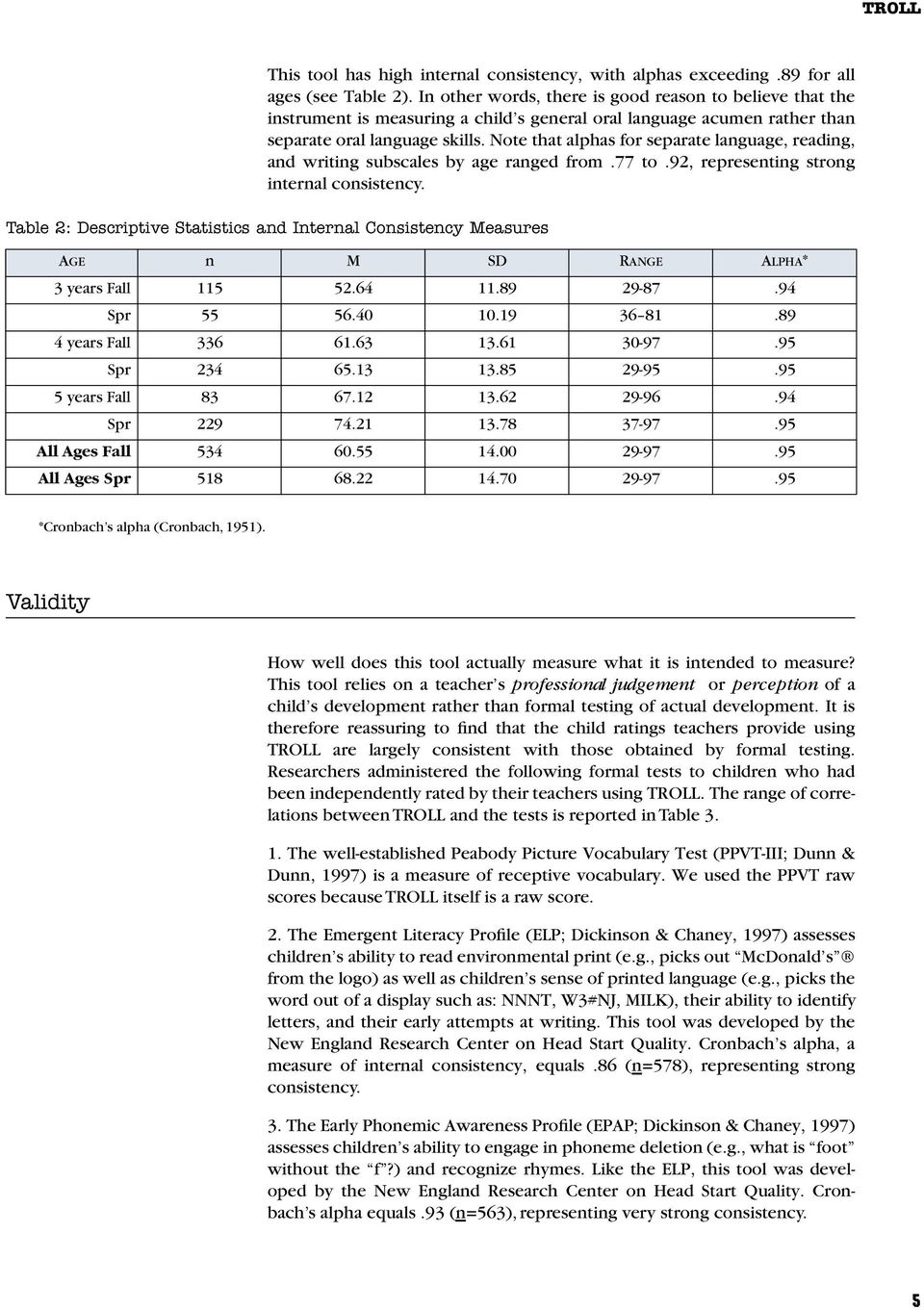
8 TROLL This tool has high internal consistency, with alphas exceeding.89 for all ages (see Table ). In other words, there is good reason to believe that the instrument is measuring a child s general oral language acumen rather than separate oral language skills. Note that alphas for separate language, reading, and writing subscales by age ranged from.77 to.9, representing strong internal consistency. Table : Descriptive Statistics and Internal Consistency Measures AGE n M SD RANGE ALPHA* years Fall Spr years Fall Spr years Fall Spr All Ages Fall All Ages Spr *Cronbach s alpha (Cronbach, 95). Validity How well does this tool actually measure what it is intended to measure? This tool relies on a teacher s professional judgement or perception of a child s development rather than formal testing of actual development. It is therefore reassuring to find that the child ratings teachers provide using TROLL are largely consistent with those obtained by formal testing. Researchers administered the following formal tests to children who had been independently rated by their teachers using TROLL. The range of correlations between TROLL and the tests is reported in Table.. The well-established Peabody Picture Vocabulary Test (PPVT-III; Dunn & Dunn, 997) is a measure of receptive vocabulary. We used the PPVT raw scores because TROLL itself is a raw score.. The Emergent Literacy Profile (ELP; Dickinson & Chaney, 997) assesses children s ability to read environmental print (e.g., picks out McDonald s from the logo) as well as children s sense of printed language (e.g., picks the word out of a display such as: NNNT, W#NJ, MILK), their ability to identify letters, and their early attempts at writing. This tool was developed by the New England Research Center on Head Start Quality. Cronbach s alpha, a measure of internal consistency, equals.86 (n=578), representing strong consistency.. The Early Phonemic Awareness Profile (EPAP; Dickinson & Chaney, 997) assesses children s ability to engage in phoneme deletion (e.g., what is foot without the f?) and recognize rhymes. Like the ELP, this tool was developed by the New England Research Center on Head Start Quality. Cronbach s alpha equals.9 (n=56), representing very strong consistency. 5
9 CIERA Report -06 Table : Correlations* Between TROLL Subscales and Other Measures of Language and Literacy Development QRC and LEEP data All Ages Combined (n=6 688). PPVT Raw Score n=/ Emergent Literacy Profile Total n=68/67 Early Phonemic Awareness Profile Total n=57/ TROLL Total Score n=9/70 TROLL Language n=0/87 TROLL Reading n=95/75 TROLL Writing n=06/78 FALL SPRING FALL SPRING FALL SPRING FALL SPRING.7***.***.7***.0***.0***.8***.***.***.** ns.** ns.9* ns.5*** ns.5***.7***.***.6***.***.***.7***.*** The EPAP and PPVT were administered in English to all children, regardless of language dominance. The ELP was administered in the child s dominant language. TROLL total scores fall and spring r=.88***. *p <.05 **p <.0 ***p <.00 Teacher ratings of children s language and literacy development on TROLL show moderate associations with children s scores on all three formal measures. In other words, in about five minutes and with no special training, teachers themselves can index what specially trained researchers would spend 5 0 minutes per child assessing. Of course, the TROLL teacher ratings do not agree completely with the researchers tests. This difference partly reflects the fact that TROLL captures other factors that teachers take into consideration as they rate individual children factors that are not captured in researchers direct, formal assessments. In other words, TROLL captures the kind of assessment information recommended in the position statement by IRA and NAEYC. Formal tests measure how well a child does at only one point in time; children may be tired or sick on the day of the PPVT- III assessment and receive a dismal score for their receptive vocabulary, whereas their teacher knows that on most days they are quick to pick up on the vocabulary of classroom units and articulate when sharing stories of personal experience. The TROLL score is not as vulnerable to fluctuations in a child s performance as the formal tests. Also, as noted earlier, TROLL includes information about children's engagement in literacy activities and patterns of oral language use. TROLL scores correlate well with our measure of phonological awareness (EPAP), as is shown in Table. Numerous researchers have established that phonological awareness is a critical precursor, correlate, and predictor of reading achievement (Bryant, MacLean, & Bradley, 990; Cronin & Carver, 998; Speece, Roth, Cooper, & de la Paz, 999; Stanovich, 99; Vellutino & Scanlon, 00; Wagner, Torgesen, Laughon, Simmons, & Rashotte, 99; Wagner et al., 997). Another point worth noting is that TROLL total scores are more closely related to formal language scores phonological awareness and vocabulary than they are to literacy scores (see Table ). Of special significance is the fact that, in the fall, teacher s ratings of children s print-related knowl- 6

10 TROLL edge correlate with children s scores on the Early Literacy Profile (e.g., environmental print, letter identification) whereas no such relationship exists in the spring the opposite of what one would predict. How can this be? After all, teachers have had far more interaction with children and should therefore be more sensitive in the spring than in the fall. One possibility is that in these preschool classrooms, throughout the year teachers have more occasions to observe children s spoken language than their literacy activities. In the fall they may make special efforts to identify children s level of literacy development, but either fail to revisit this assessment or have relatively few occasion to observe children using literacy so have no basis for accurately gauging their growth. Thus, children may make progress in their knowledge of print as registered by the ELP that goes undetected by their teachers. Alternatively, children may not be making such progress and teachers fail to note this. This finding of reduced ability to gauge children s literacy status is sobering. The danger of any teacher judgment is that it become a self-fulfilling prophecy (Rosenthal & Jacobsen, 968); teachers opinions of children at the very outset of their education may predict children s success. They may give extra attention and motivation to the children they expect to become the most accomplished; conversely, they may fail to support children they expect to fail. This lack of a revision of judgements about individual children s literacy skills and interests is regrettable and points to the potential value of teachers carrying out periodic informal assessments of children to provide concrete evidence of children s growth. For example, teachers can ask children to identify letters in their own names and in those of other children in the classroom, to write their names, etc. In short, rather than promote such self-fulfilling prophecies, we hope that TROLL will predict possible failure in order to prevent failure. That is, we hope that teachers will use this instrument to give children who are struggling the help they need so that they never have to experience true failure at a later point. TROLL Measures Effective Instruction Teachers often struggle to keep track of children s growth. Researchers have asked teachers to track over 900 children using TROLL. In the New England Quality Research Center study of Head Start programs, there was a significant improvement in 7 children s TROLL scores in the spring versus the fall (t [7]=.65, p=.000). Teachers were developing children s language and literacy skills, and TROLL reflected the gains made by individual children. In other words, TROLL displays instructional sensitivity. TROLL has also been able to detect changes that occurred as a result of a program improvement effort. Head Start teachers and their supervisors volunteered to participate in the LEEP program (previously introduced). They received academic credit for participating in two intensive three-day blocks three months apart. TROLL scores for children whose teachers participated in LEEP were significantly higher than for children whose teachers did not. 7

11 CIERA Report -06 Specifically, children in LEEP classrooms gained more overall from fall to spring on average, compared to a control group (F=9., p=.00). Furthermore, the classrooms that supported such advances were independently observed to have improved classroom language and literacy practices. Teachers who participated in LEEP made a significantly greater effort to engage children in conversation and to provide opportunities for children to write and use books. The most major shift was represented by the extent to which teachers planned activities with the intention of having children practice literacy-related skills. Enriching the literacy environment had one additional surprising impact: Children whose teachers participated in LEEP displayed significant growth in social skills as compared with their peers (Fn=8.6, pn=.00). Children who are busy talking, reading, and writing activities registered by TROLL were more likely to be viewed by their teachers as developing stronger collaboration skills. A Final Note We conclude by returning to Anna s story. Anna scored the lowest on TROLL of anyone in her class a total of 0 points. Her teacher realized that she spent far more time talking to Anna s high-scoring classmates than she did to Anna. Children who were already the most advanced talkers were the ones who asked her for the names of things that interested them, participated in group discussions, and took many opportunities to explain activities to other children or tell stories about themselves. In other words, the teacher found that in her classroom, as in the classrooms of other preschool teachers 5, the old adage The rich get richer applied to language and literacy development. The teacher also realized that several of the children who acted out frequently also received low scores, and she made an effort to involve them in more conversations. Two such boys, in particular, seemed to thrive on this extra attention for positive behavior, and were noticeably better behaved by the end of the year. In the subsequent weeks, Anna s teacher made a concentrated effort to involve her in talk every day. Anna looked at her politely during these initiatives, but she seldom responded. Anna was still very, very quiet. On her teacher s recommendation, Anna s parents had her hearing acuity evaluated by an audiologist, who discovered that Anna had a mild hearing loss. Anna, like many other children (Friel-Patti & Finitzo, 990), had previously undetected hearing loss that made it hard for her to learn in class. With medical treatment, Anna s hearing problem was readily resolved. However, she still struggled with language learning and delay and benefited from speech and language remedial services. Because her hearing loss was discovered so early, her parents, teacher, and speech language pathologist believe she has every chance to speak, read, and write with her peers. She did not have to fail at reading in order to get the help she needed to succeed. Anna benefited from the kind of early intervention strongly recommended by Snow, Burns, and Griffin (998, pp. 8 9). 8

12 TROLL References Bryant, P., MacLean, M., & Bradley, L. (990). Rhyme, language, and children s reading. Applied Psycholinguistics, (), 7-5. Cronbach, L.J.(95). Coefficient Alpha and the internal structure of tests. Psychometrika, 6, 97-. Cronin, V., & Carver, P. (998). Phonological sensitivity, rapid naming, and beginning reading. Applied Psycholinguistics, 9 (), 7 6. Dickinson, D. K., & DeTemple, J. (998). Putting parents in the picture: Maternal reports of preschoolers literacy as a predictor of early reading. Early Childhood Research Quarterly, (), 6. Dickinson, D. K., & McCabe, A. (99). The acquisition and development of language: A social interactionist account of language and literacy development. In J. F. Kavanagh (Ed.), The language continuum from infancy to literacy. Parkton, MD: York Press. Dickinson, D. K. & Tabors, P. O. (00). Beginning literacy with language: Young children learning at home and school. Baltimore, MD: Brookes. Dickinson & Chaney, C. (997). Profile of early literacy development. Newton, MA: Education Development Center. Dunn, L.M., & Dunn, L.M. (997). Peabody picture vocabulary test Third edition. Circle Pines, MN: American Guidance Service. Friel-Patti, S., & Finitzo, T. (990). Language learning in a prospective study of otitis media with effusion in the first two years of life. Journal of Speech and Hearing Research,, Gresham, F. M., & Elliott, S. N. (990). Social skills rating system: Ages 5. Circle Pines, MN: American Guidance Service. International Reading Association (IRA), & the National Association for the Education of Young Children (NAEYC). (998). Learning to read and write: Developmentally appropriate practices for young children. Young Children, 5 (), 0 6. New Standards. (000). Reading and writing grade by grade: Primary literacy standards for kindergarten through third grade. Washington, DC: Author. Riley, J. (996). The teaching of reading. London: Paul Chapman. Rosenthal, R., & Jacobsen, L. (968). Pygmalion in the classroom: Teacher expectation and pupils intellectual development. New York: Holt, Rinehart, and Winston. Snow, C. E. (98). Literacy and language: Relationships during the preschool years. Harvard Educational Review, 5, Snow, C. E., Burns, M. S., & Griffin, P. (Eds.). (998). Preventing reading difficulties in young children. Washington, DC: National Academy Press. 9

13 CIERA Report -06 New Standards. (000). Speaking and listening for preschool through third grade. Washington, DC: Author. Speece, D. L., Roth, F. P., Cooper, D. H., & de la Paz, S. (999). The relevance of oral language skills to early literacy: A multivariate analysis. Applied Psycholinguistics, 0 (), Stanovich, K.E. (99). Speculations on the causes and consequences of individual differences in early reading acquisition. In P. B. Gough, L. C. Ehri, & R. Treiman (Eds.), Reading acquisition (pp. 07 ). Hillsdale, NJ: Erlbaum. Stipek, D. J., & Ryan, R. H. (997). Economically disadvantaged preschoolers: Ready to learn but further to go. Developmental Psychology, (), 7 7. Tucker, M. S., & Codding, J. B. (998). Standards for our schools: How to set them, measure them, and reach them. San Francisco: Jossey-Bass. Vellutino, F. R., & Scanlon, D. M. (00). Emergent literacy skills, early instruction, and individual differences as determinants of difficulties in learning to read: The case for early intervention. In S. Neuman & D. Dickinson (Eds.), Handbook for research on early literacy (pp. 95 ). New York: Guilford. Wagner, R. K., Torgesen, J. K., Laughon, P., Simmons, K., & Rashotte, C. A. (99). Development of young readers phonological processing abilities. Journal of Educational Psychology, 85, 8 0. Wagner, R. K., Torgesen, J. K., Rashotte, C. A., Hecht, S. A., Barker, T. A., Burgess, S. R., Donahue, J., & Garon, T. (997). Changing relations between phonological processing abilities and word-level reading as children develop from beginning to skilled readers: A 5-year longitudinal study. Developmental Psychology,,

14 TROLL Appendix: Teacher Rating of Oral Language and Literacy Teacher Rating of Oral Language and Literacy David K. Dickinson Center for Children & Families, EDC Copyright 997 Education Development Center. All rights reserved. LANGUAGE USE:. How would you describe this child s willingness to start a conversation with adults and peers and continue trying to communicate when he/she is not understood on the first attempt? Select the statement that best describes how hard the child works to be understood by others. Child almost never begins a conversation with peers or the teacher and never keeps trying if unsuccessful at first. Child sometimes begins conversation with either peers or the teacher. If initial efforts fail he/she often gives up quickly. Child begins conversations with both peers and teachers on occasions. If initial efforts fail, he/she will sometimes keep trying. Child begins conversations with both peers and teachers. If initial efforts fail, he/ she will work hard to be understood.. How well does the child communicate personal experiences in a clear and logical way? Assign the score that best describes this child when he/she is attempting to tell an adult about events that happened at home or some other place where you were not present. Child is very tentative, only offers a few words, requires you to ask questions. Has difficulty responding to questions you ask. Child offers some information, but information needed to really understand the event is missing (e.g., where or when it happened, who was present, the sequence of what happened). Child offers information and sometimes includes the necessary information to really understand the event. Child freely offers information and tells experiences in a way that is nearly always complete, well sequenced, and comprehensible.. How would you describe this child s pattern of asking questions about topics that interest him/her (e.g., why things happen, why people act the way they do)? Assign the score that best describes the child s approach to displaying curiosity by asking adults questions. To your knowledge, the child has never asked an adult a question reflecting curiosity about why things happen or why people do things. English competence: On a few occasions the child has asked adults some questions. The discussion that resulted was brief and limited in depth. On several occasions the child has asked interesting questions. On occasion these have lead to an interesting conversation. Child often asks adults questions reflecting curiosity. These often lead to interesting, extended conversations.

15 CIERA Report -06. How would you describe this child s use of talk while pretending in the house area, when playing with blocks, etc.? Consider the child s use of talk with peers to start pretending and to carry it out. Assign the score that best applies. Child rarely or never engages in pretend play or else never talks while pretending. English competence: On occasion the child engages in pretending that includes some talk. Talk is brief, may only be used when starting the play, and is of limited importance to the on-going play activity. Child engages in pretending often and conversations are sometimes important to the play. On occasion child engages in some back-andforth pretend dialogue with another child. Child often talks in elaborate ways while pretending. Conversations that are carried out in role are common and are an important part of the play. Child sometimes steps out of pretend play to give directions to another. 5. How would you describe the child s ability to recognize and produce rhymes? Child cannot ever say if two words rhyme and cannot produce a rhyme when given examples (e.g., rat, cat, ). English: Child occasionally produces or identifies rhymes when given help. Child spontaneously produces rhymes and can sometimes tell when word pairs rhyme. Child spontaneously rhymes words of more than one syllable and always identifies whether words rhyme. 6. How often does (CHILD) use a varied vocabulary or try out new words (e.g. heard in stories or from teacher? 7.When (CHILD) speaks to adults other than you or the teaching assistant is he/she understandable? 8. How often does (CHILD) express curiosity about how and why things happen? LANGUAGE SUBTOTAL: READING: 9. How often does (CHILD) like to hear books read in the full group? 0. How often does (CHILD) attend to stories read in full or small groups and react in a way that indicates comprehension?

16 TROLL. Is (CHILD) able to read story books on his/her own? Does not pretend to read Pretends to read Pretends to read and reads some words Reads the written words. How often does (CHILD) remember the story line or characters in books that he/she heard before either at home or in class?. How often does (CHILD) look at or read books alone or with friends?. Can (CHILD) recognize letters? (choose one answer) None of the letters of the alphabet...0 Some of them (up to 0)...0 Most of them (up to 0)...0 All of them Does (CHILD) recognize his/her own first name in print? NO YES 6. Does (CHILD) recognize other names? No One or two A few (up to or 5) Several (6 or more) 7. Can (CHILD) read any other words? No One or two A few (up to or 5) Several (6 or more) 8. Does (CHILD) have a beginning understanding of the relationship between sounds and letters (e.g. the letter B makes a buh sound)? No One or two A few (up to or 5) Several (6 or more) 9. Can (CHILD) sound out words that he/she has not read before? No Once or twice One syllable words often Many words READING SUBTOTAL:

17 CIERA Report -06 WRITING: 0. What does (CHILD s) writing look like? Only draws or scribbles Some letter-like marks Many conventional letters Conventional letters and words. How often does (CHILD) like to write or pretend to write?. Can (CHILD) write his/her first name, even if some of the letters are backwards?. Does (CHILD) write other names or real words? No One or two A few (up to or 5) Several (6 or more). How often does (CHILD) write signs or labels? 5. Does (CHILD) write stories, songs, poems, or lists? WRITING SUBTOTAL: ORAL LANGUAGE SUBTOTAL: READING SUBTOTAL: TOTAL TROLL SCORE: (out of possible) (out of possible) (out of possible) (out of 98 possible)

18 TROLL Notes. For more information about LEEP contact David Dickinson at EDC, 55 Chapel St., Newton, MA It was not feasible to obtain test-retest reliability estimates, as teachers would have had to rate the same children twice within a short amount of time, a request that would have been unreasonable. Also, a close retest might have allowed examiner memory (and hence bias) to compromise the second rating.. There were several small changes in the technical details of the TROLL making it inappropriate to conduct psychometric assessments using the sample of 97. Hence we reduced the sample size. Analyses with the earlier sample had similar patterns.. This finding came from teacher ratings using an adaptation of another tool, the Social Skills Rating System (Gresham & Elliott, 990). 5. See the report of patterns of classroom interaction in preschool classrooms in Dickinson and Tabors (00). 5

Teacher Rating of Oral Language and Literacy (TROLL): Individualizing early literacy instruction with a standards-based rating tool
 David K. Dickinson Allyssa McCabe Kim Sprague Teacher Rating of Oral Language and Literacy (TROLL): Individualizing early literacy instruction with a standards-based rating tool This rating system measures
Decontextualized Language Input and Preschoolers Vocabulary Development
 Decontextualized Language Input and Preschoolers Vocabulary Development Meredith L. Rowe, Ed.D. 1 ABSTRACT This article discusses the importance of using decontextualized language, or language that is
Comprehensive Reading Assessment Grades K-1
 Comprehensive Reading Assessment Grades K-1 User Information Name: Doe, John Date of Birth: Jan 01, 1995 Current Grade in School: 3rd Grade in School at Evaluation: 1st Evaluation Date: May 17, 2006 Background
Literacy Learning in Preschool and Kindergarten
 Chapter 1 Literacy Learning in Preschool and Kindergarten Preschool and kindergarten are the most important grades! I say this to preschool, kindergarten, primary, middle school, junior high, and high
Illustration Sylvie Wickstrom
 Choosing an Appropriate System Amy Lynn Shillady Amy Lynn Shillady, M.A., has worked with NAEYC s Professional Development department, and NHSA s Research and Evaluation department. A former Head Start
Early Childhood Study of Language and Literacy Development of Spanish-Speaking Children
 Early Childhood Study of Language and Literacy Development of Spanish-Speaking Children Subproject 1 of Acquiring Literacy in English: Crosslinguistic, Intralinguistic, and Developmental Factors Project
Create stories, songs, plays, and rhymes in play activities. Act out familiar stories, songs, rhymes, plays in play activities
 PRESCHOOL Language Arts Literacy Expectation 1 Children listen and respond to environmental sounds, directions, and conversations. NJCCC K-12 Standard 3.4 Listening Strand A: Active Listening Strand B:
Estimated Impacts of Number of Years of Preschool Attendance on Vocabulary, Literacy and Math Skills at Kindergarten Entry
 Estimated Impacts of Number of Years of Preschool Attendance on Vocabulary, Literacy and Math Skills at Kindergarten Entry By W. Steven Barnett and Cynthia Esposito Lamy Abstract This study estimates the
Technical Report. Overview. Revisions in this Edition. Four-Level Assessment Process
 Technical Report Overview The Clinical Evaluation of Language Fundamentals Fourth Edition (CELF 4) is an individually administered test for determining if a student (ages 5 through 21 years) has a language
NFL Quarterback Bernie Kosar told
 RESEARCH PAPER VOLUME 1 Why It Is Important to Teach Phonemic Awareness and Alphabet Recognition by Dr. Cathy Collins Block Professor of Education Texas Christian University NFL Quarterback Bernie Kosar
The Power of Interactive Read Alouds By: Gwen Marra, Ed.D. Today s classrooms are bombarded with demands of all kinds. Teachers work to find balance
 The Power of Interactive Read Alouds By: Gwen Marra, Ed.D. Today s classrooms are bombarded with demands of all kinds. Teachers work to find balance to provide time to play and time to assess, time to
Parent Education Activities
 PART III: PARENT EDUCATION Parent education sessions need to be planned and should follow a similar sequence each time. The suggested sequence is listed here and is explained later in this article. Also,
Oral language is the foundation on which reading and writing are
 If children come to school with welld eveloped oral language, it must be expanded. If children come to school with underdeve l o p e d oral language, it must be developed. Foundations for Learning to Read
The Creative Curriculum for Preschool: Objectives for Development & Learning
 Curriculum Alignment of The Creative Curriculum for Preschool: Objectives for Development & Learning with Alignment of The Creative Curriculum for Preschool: Objectives for Development & Learning With
Effective Literacy Instruction for Early Childhood Education Students
 Effective Literacy Instruction for Early Childhood Education Students Clara Rouse, PhD Educational Leadership Consultant Melissa Morris Curriculum Specialist January 2012 The Importance of Early Literacy
SPECIFIC LEARNING DISABILITIES (SLD)
 Together, We Can Make A Difference Office 770-577-7771 Toll Free1-800-322-7065 www.peppinc.org SPECIFIC LEARNING DISABILITIES (SLD) Definition (1) Specific learning disability is defined as a disorder
TECHNICAL ASSISTANCE AND BEST PRACTICES MANUAL Speech-Language Pathology in the Schools
 I. Definition and Overview Central Consolidated School District No. 22 TECHNICAL ASSISTANCE AND BEST PRACTICES MANUAL Speech-Language Pathology in the Schools Speech and/or language impairments are those
The InvestiGator Club Prekindergarten Learning System Early Reading First Grants: Alignment and Support
 The InvestiGator Club Prekindergarten Learning System Early Reading First Grants: Alignment and Support Robert-Leslie Publishing, developer of The InvestiGator Club Prekindergarten Learning System, offers
Reading Instruction and Reading Achievement Among ELL Students
 Research Into Practice READING Reading Instruction and Reading Achievement Among ELL Students Principles of ELL Reading Instruction Some very straightforward principles, directly supported by research,
Psychology of Learning to Read
 Psychology of Learning to Read Learning Goals Explain the six skills necessary for learning how to read. Explain instructional strategies for each of the six skills. 1 Background Teachers play a very important
National Early Literacy Panel: Questions and Answers
 National Early Literacy Panel: Questions and Answers What is the National Early Literacy Panel? The National Early Literacy Panel (NELP) is a panel of nine nationally-known researchers convened by the
PRE AND POST TEST TO SEE THE DIFFERENCE BETWEEN YEARS OF ANIMATED LITERACY AND KNOWLEDGE OF LETTERS STEPHANIE, BUCK. Submitted to
 Animated Literacy 1 RUNNING HEAD: Years of Animated Literacy Letters PRE AND POST TEST TO SEE THE DIFFERENCE BETWEEN YEARS OF ANIMATED LITERACY AND KNOWLEDGE OF LETTERS By STEPHANIE, BUCK Submitted to
Literacy Skills Assessment
 AUTHENTIC Early RESEARCH BASED FIELD TESTED Literacy Skills Assessment (ELSA) Developed by Dr. Andrea DeBruin-Parecki Director of the High/Scope Early Childhood Reading Institute a better way to conduct
Scientifically Based Reading Programs. Marcia L. Kosanovich, Ph.D. Florida Center for Reading Research SLP Academy Fall, 2005
 Scientifically Based Reading Programs Marcia L. Kosanovich, Ph.D. Florida Center for Reading Research SLP Academy Fall, 2005 Goals for Today 1. Understand the big picture of an effective reading program.
Early Literacy: Policy and Practice in the Preschool Years. by Dorothy S. Strickland and Shannon Riley-Ayers
 NIEER April 2006, Issue 10 Series edited by Ellen Frede and W. Steven Barnett Preschool Policy Brief National Institute for Early Education Research Contact Us: 120 Albany Street Suite 500 New Brunswick,
Early Literacy. Early Literacy Development: A Focus on Preschool
 Early Literacy Early Literacy Development: A Focus on Preschool Introduction The importance of children s early literacy development cannot be overstated. Children s success in school and later in life
INTEGRATING THE COMMON CORE STANDARDS INTO INTERACTIVE, ONLINE EARLY LITERACY PROGRAMS
 INTEGRATING THE COMMON CORE STANDARDS INTO INTERACTIVE, ONLINE EARLY LITERACY PROGRAMS By Dr. Kay MacPhee President/Founder Ooka Island, Inc. 1 Integrating the Common Core Standards into Interactive, Online
Standards for Preschool and Kindergarten Mathematics Education. Sue Bredekamp
 Standards 1 Standards for Preschool and Kindergarten Mathematics Education Sue Bredekamp The standards-based accountability movement that has dominated elementary and secondary education reform for the
READING SPECIALIST STANDARDS
 READING SPECIALIST STANDARDS Standard I. Standard II. Standard III. Standard IV. Components of Reading: The Reading Specialist applies knowledge of the interrelated components of reading across all developmental
The Effects of Read Naturally on Grade 3 Reading: A Study in the Minneapolis Public Schools
 The Effects of Read Naturally on Grade 3 Reading: A Study in the Minneapolis Public Schools David Heistad, Ph.D. Director of Research, Evaluation, and Assessment Minneapolis Public Schools Introduction
* Lab Experience Course Code: (1) General Studies/Core (3) Major ** Field Experience (2) Enhanced General Studies (4) Professional Education
 Tennessee Teacher Licensure Standards: Page 1 of 9 Introduction Candidates for licensure as a reading specialist complete advanced studies in reading and leadership, enabling them to fulfill multiple responsibilities
Teaching Young Children How to Read: Phonics vs. Whole Language. Introduction and Background
 Kelly Waldo Senior Capstone Paper Paoze Thao, PhD California State University Monterey Bay Teaching Young Children How to Read: Phonics vs. Whole Language Introduction and Background I am interested in
Frequently Asked Pre-Kindergarten Literacy Questions
 Frequently Asked Pre-Kindergarten Literacy Questions Pre-Kindergarten literacy coaches collaborate with teachers to enhance their early literacy practices in the classrooms. Teachers often pose questions
The Importance of the Assessment Cycle in
 The Importance of the Assessment Cycle in The Creative Curriculum for Preschool 1 The Importance of the Assessment Cycle in The Creative Curriculum for Preschool The Importance of the Assessment Cycle
IDENTIFICATION AND ASSESSMENT OF ENGLISH LANGUAGE LEARNERS
 IDENTIFICATION AND ASSESSMENT OF ENGLISH LANGUAGE LEARNERS CHAPTER 3 INDEX 3.1 PURPOSE AND SCOPE... 3 1 3.2 IDENTIFICATION AND REFERRAL OF ENGLISH LEARNERS SUSPECTED OF HAING A DISABILITY... 3 1 3.3 SPECIAL
Early Literacy Development in Preschool and Title I School District
 A Report of: The Carroll County Public Library Emergent Literacy Training Assessment Project Prepared for: Carroll County Public Library 50 East Main Street Westminster, MD 21157 Prepared by: Elaine M.
Promoting Cross-Disciplinary Collaboration at the Preprofessional Level: The Reading Specialist in the Speech-Language Clinic
 Promoting Cross-Disciplinary Collaboration at the Preprofessional Level: The Reading Specialist in the Speech-Language Clinic Laura M. Justice Terri Purcell University of Virginia, Charlottesville Widespread
Leveled Literacy Intervention (LLI) consists of a series of planned lessons designed to provide supplementary instruction
 Research Base for Leveled Literacy Intervention Leveled Literacy Intervention (LLI) consists of a series of planned lessons designed to provide supplementary instruction to kindergarten, first, and second
Aligning Curriculum with the Pre-Kindergarten Standards. Pre-Kindergarten Standards and Indicators by Key Learning Area
 Aligning Curriculum with the Pre-Kindergarten Standards PA Pre-K Counts and Keystone STARS require that every program utilize a curriculum that is aligned with Pennsylvania s Learning Standards for Early
Parents perspectives: Children s use of technology in the Early Years
 99 Parents perspectives: Children s use of technology in the Early Years Dr Susie Formby National Literacy Trust March 2014 About the National Literacy Trust We are a national charity dedicated to raising
Speaking of Writing: The Significance of Oral Language in English Learners Literacy Development
 Speaking of Writing: The Significance of Oral Language in English Learners Literacy Development By Connie Williams, Roberta Stathis, and Patrice Gotsch Teacher Writing Center November 2008 2008 Teacher
Delray Beach CSAP - Kindergarten Readiness
 Delray Beach CSAP - Kindergarten Readiness Assurance #1 School Readiness has improved over the past four (4) years and stands at 78% in 2011 with 75% of our students attending a State Voluntary Pre-Kindergarten
Numbers Plus Preschool Mathematics Curriculum: Teacher s Manual
 Number and operations involves understanding whole numbers and realizing that numbers represent quantity. It includes learning number words and symbols, counting, comparing and ordering quantities, composing
How To Assess A Child
 assessment report......... Marcy Guddemi, Ph.D. Betsy J. Case, Ph. D. February 2004 (This updated version was originally published as: Guddemi, M. P. (2003). The important role of quality assessment in
THE ROLE OF PLAY IN PROMOTING CHILDREN S POSITIVE APPROACHES TO LEARNING
 THE ROLE OF PLAY IN PROMOTING CHILDREN S POSITIVE APPROACHES TO LEARNING Marilou Hyson, Ph.D. Senior Consultant, NAEYC Affiliate Faculty, Applied Developmental Psychology George Mason University Defining
BUILDING YOUR CHILD S LISTENING, TALKING, READING AND WRITING SKILLS KINDERGARTEN TO SECOND GRADE
 BUILDING YOUR CHILD S LISTENING, TALKING, READING AND WRITING SKILLS KINDERGARTEN TO SECOND GRADE PURPOSE This resource was developed to provide information about children s typical development of skills
Best Practices. Using Lexia Software to Drive Reading Achievement
 Best Practices Using Lexia Software to Drive Reading Achievement An overview of Implementation Principles to apply in your school for using Lexia Reading Skills Software to Close the Reading Achievement
Critical Review: What are the effects of adding music to the treatment of speech and language disorders in pre-school and school aged children?
 Critical Review: What are the effects of adding music to the treatment of speech and language disorders in pre-school and school aged children? Ronson, J.C. M.Cl.Sc. Candidate, S-LP School of Communication
SPECIFIC LEARNING DISABILITY
 SPECIFIC LEARNING DISABILITY 24:05:24.01:18. Specific learning disability defined. Specific learning disability is a disorder in one or more of the basic psychological processes involved in understanding
62 Hearing Impaired MI-SG-FLD062-02
 62 Hearing Impaired MI-SG-FLD062-02 TABLE OF CONTENTS PART 1: General Information About the MTTC Program and Test Preparation OVERVIEW OF THE TESTING PROGRAM... 1-1 Contact Information Test Development
Frequently Asked Questions About the Early Literacy Skills Assessment (ELSA)
 Frequently Asked Questions About the Early Literacy Skills Assessment (ELSA) 3 Frequently Asked Questions Setting Q. Do the tester and child have to sit at a table to do the assessment? Can the child sit
THINKING IT THROUGH: TEACHING AND LEARNING IN THE KINDERGARTEN CLASSROOM
 THINKING IT THROUGH: TEACHING AND LEARNING IN THE KINDERGARTEN CLASSROOM This position statement provides educators of young children with important assessment guidelines. It also highlights some of the
Reading to Young Children: A Head-Start in Life
 Reading to Young Children: A Head-Start in Life The research sets out to explore the connections between parents reading to their young children and their child s later reading and other cognitive skills.
Instructional Strategies for Developing Oral Language
 Taking a Slice of the Oral Language Pie Instructional Strategies for Developing Oral Language By Sue McCandlish, M.A Education, B. App Sc (Speech Pathology) The Oral Language Pie highlighted four domains
Literacy. Work Stations. Source: Diller, D.(2003) Literacy Work Stations, Making Centers Work
 Literacy Work Stations Source: Diller, D.(2003) Literacy Work Stations, Making Centers Work Kyrene Reading Instruction Focus: Improve student achievement through implementation of curriculum and adopted
Scientifically Based Reading Programs: What are they and how do I know?
 Scientifically Based Reading Programs: What are they and how do I know? Elissa J. Arndt, M.S. CCC-SLP Florida Center for Reading Research Alternate Assessment Summer Training Institute July, 2007 1 Goals
Possibilities For Wording Of IEP Goals and Objectives For Alignment Charts
 Motivation and Interest Maintain attention to a literacy-related activity for minutes. Literacy Interactions Print and Book Awareness will stay with the adult while they look at or read the book for at
Positive early language and literacy development
 Early Language and Literacy Development P Positive early language and literacy development can give children a window to the world, helping to ensure that each child can seize his or her potential for
Literacy Specialist Endorsement
 Literacy Specialist Endorsement 2004 Modified Ohio/IRA Program Standards (Grades K-12) Literacy specialist (limited to a teaching license that is endorsed for the teaching of reading grades kindergarten
Advice for Class Teachers. Moderating pupils reading at P 4 NC Level 1
 Advice for Class Teachers Moderating pupils reading at P 4 NC Level 1 Exemplars of writing at P Scales and into National Curriculum levels. The purpose of this document is to provide guidance for class
Selecting Research Based Instructional Programs
 Selecting Research Based Instructional Programs Marcia L. Grek, Ph.D. Florida Center for Reading Research Georgia March, 2004 1 Goals for Today 1. Learn about the purpose, content, and process, for reviews
An Early Childhood Practitioner s Guide: Developmentally Appropriate Literacy Practices for Preschool-Age Children
 An Early Childhood Practitioner s Guide: Developmentally Appropriate Literacy Practices for Preschool-Age Children SUMMARY In her discussion of user-friendly and developmentally appropriate literacy strategies
Alignment of the Hawaii Preschool Content Standards With HighScope s Preschool Child Observation Record (COR), 2nd edition
 Alignment of the Hawaii Preschool Content Standards With HighScope s Preschool Child Observation Record (COR), 2nd edition The following chart shows how items from the Hawaii Preschool Content Standards
Preschool Early Literacy Indicators (PELI ) Benchmark Goals and Composite Score Dynamic Measurement Group, Inc. / August 20, 2015
 Preschool Early Literacy Indicators (PELI ) Benchmark Goals and Composite Score Dynamic Measurement Group, Inc. / August, 5 Benchmark Goals PELI benchmark goals are empirically derived, criterion-referenced
Recommended Practices For Assessment, Diagnosis and Documentation of Learning Disabilities
 LEARNING DISABILITIES ASSOCIATION OF ONTARIO Recommended Practices For Assessment, Diagnosis and Documentation of Learning Disabilities Diagnosis of Learning Disabilities Accurate diagnosis of learning
Assessment Techniques and Tools for Documentation
 Assessment Techniques and Tools for Documentation 47 Assessing the Kindergarten Student s Learning Assessment and evaluation are fundamental components of teaching and learning. Assessment is the process
Early childhood literacy and the role of the speech-language pathologist
 Professional Development Series Early childhood literacy and the role of the speech-language pathologist Dr Marleen Westerveld Speech Pathology School of Allied Health Sciences 26 February 2014 Overview
NSTA Position Statement: Early Childhood Science Education
 NSTA Position Statement: Early Childhood Science Education Introduction At an early age, all children have the capacity and propensity to observe, explore, and discover the world around them (NRC 2012).
What Does Research Tell Us About Teaching Reading to English Language Learners?
 Jan/Feb 2007 What Does Research Tell Us About Teaching Reading to English Language Learners? By Suzanne Irujo, ELL Outlook Contributing Writer As a classroom teacher, I was largely ignorant of, and definitely
Using Direct Instruction Programs as Intervention Programs in Grades K 3
 Using Direct Instruction Programs as Intervention Programs in Grades K 3 Direct Instruction News Volume 5, Number 2 Summer 2005 Introduction This article is about the use of Direct Instruction as an intervention
Early Childhood Building Blocks
 Early Childhood Building Blocks Best Practices in Assessment in Early Childhood Education Judy Harris Helm, Ed.D. Introduction The director of the early childhood program was puzzled. A prospective parent
Whatever Happened TO. Developmentally Appropriate Practice. in Early Literacy? VIEW POINT. Susan B. Neuman and Kathleen Roskos
 VIEW POINT Whatever Happened TO in Early Literacy? Terri Gonzalez Susan B. Neuman, EdD, is a professor of educational studies at the University of Michigan, Ann Arbor. Susan coauthored with Sue Bredekamp
Helping your child with Non-verbal Learning Disability
 Helping your child with Non-verbal Learning Disability What is non-verbal learning disability? Non-verbal learning disability (NVLD) is a term used to describe a pattern of strengths and weaknesses in
Curriculum and Instruction
 Curriculum and Instruction Core curriculum is the foundation of Tier 1 instruction and is the basis for building K-12 literacy in Arizona students. The curriculum at each level must be based upon the 2010
The National Reading Panel: Five Components of Reading Instruction Frequently Asked Questions
 The National Reading Panel: Five Components of Reading Instruction Frequently Asked Questions Phonemic Awareness What is a phoneme? A phoneme is the smallest unit of sound in a word. For example, the word
Assessing Young English Learners Across Purposes and Domains: Promises and Pitfalls
 Assessing Young English Learners Across Purposes and Domains: Promises and Pitfalls By Linda M. Espinosa, Ph.D. Language Minority Children Roundtable April 2008 5/5/2008 1 Bilingual Children are Different
These Guidelines aim to maximise Reading Recovery effectiveness in Victorian schools and assure the provision of a quality intervention for students.
 These Guidelines aim to maximise Reading Recovery effectiveness in Victorian schools and assure the provision of a quality intervention for students. The Guidelines reflect the intent of the Australian
Florida Center for Reading Research RAVE-O
 1 Florida Center for Reading Research RAVE-O What is RAVE-O? RAVE-O (Retrieval, Automaticity, Vocabulary, Engagement-Orthography) is a comprehensive, fluency reading and comprehension intervention program
California. www.heinemann.com Phone: 800.225.5800
 California Preschool Learning Foundations, Vol. 1 (Foundations in Language and Literacy) and The Continuum of Literacy Learning, Grades PreK 8: A Guide to Teaching by Gay Su Pinnell and Irene C. Fountas
ELIGIBILITY GUIDELINES SPEECH PATHOLOGY
 ELIGIBILITY GUIDELINES SPEECH PATHOLOGY These guidelines are consistent with the Texas Speech- Language-Hearing Association s (TSHA) eligibility templates. It is recommended that you contact the TSHA Vice
Teaching Reading. A Guide to the Report and Recommendations for Parents and Carers
 Teaching Reading A Guide to the Report and Recommendations for Parents and Carers National Inquiry into the Teaching of Literacy December 2005 Commonwealth of Australia 2005 This work is copyright. It
The Early Development Instrument: A Tool for Monitoring Children s Development and Readiness for School
 The Early Development Instrument: A Tool for Monitoring Children s Development and Readiness for School Magdalena Janus * Children are born ready to learn, and their neurological system has a vast opportunity
AR State PIRC/ Center for Effective Parenting
 Helping Young Children Learn to Read What Parents Can Do Reading is one of the basic building blocks for your child s learning and school success. It is a skill on which most other learning is built. Children
An Introductory Teacher. Works. Guide for Early Language and Emergent Literacy Instruction. Based on the National Early Literacy Panel Report
 What An Introductory Teacher Works Guide for Early Language and Emergent Literacy Instruction Based on the National Early Literacy Panel Report What Works An Introductory Teacher Guide for Early Language
Pre-Requisites EDAM-5001 Early Literacy Guiding Principles and Language
 . EDAM EDAM-5001. EARLY LITERACY: GUIDING PRINCIPLES AND LANGUAGE DEVELOPMENT This course is the prerequisite for all other courses in the Early Childhood Literacy program. It outlines the philosophical
Early Childhood Measurement and Evaluation Tool Review
 Early Childhood Measurement and Evaluation Tool Review Early Childhood Measurement and Evaluation (ECME), a portfolio within CUP, produces Early Childhood Measurement Tool Reviews as a resource for those
Speech-Language Pathologist Services
 Speech-Language Pathologist Services Who are Speech-Language Pathologists? School Speech-Language Pathologists are members of the Professional Services Team of the Halton District School Board. All have
Homeschooling: Helping Children Achieve Academic and Personal Success
 Homeschooling: Helping Children Achieve Academic and Personal Success Calvert School 2010 Table of Contents Homeschooling Overview p. 3 Homeschooling and Academic Accomplishments p. 4 Homeschooling and
Frequently Asked Questions about Making Specific Learning Disability (SLD) Eligibility Decisions
 Frequently Asked Questions about Making Specific Learning Disability (SLD) Eligibility Decisions This document is part of the department s guidance on implementing Wisconsin SLD criteria. It provides answers
What Should Young Children Be Learning?
 Single copy reprint permission from Child Care Information Exchange PO Box 3249, Redmond, WA 98073 - (800)221-2864 www.childcareexchange.com Multiple use copy agreement available for educators by request
Standards for Certification in Early Childhood Education [26.110-26.270]
![Standards for Certification in Early Childhood Education [26.110-26.270]](/thumbs/24/3436110.jpg "Standards for Certification in Early Childhood Education [26.110-26.270]") I.B. SPECIFIC TEACHING FIELDS Standards for Certification in Early Childhood Education [26.110-26.270] STANDARD 1 Curriculum The competent early childhood teacher understands and demonstrates the central
I.B. SPECIFIC TEACHING FIELDS Standards for Certification in Early Childhood Education [26.110-26.270] STANDARD 1 Curriculum The competent early childhood teacher understands and demonstrates the central
DISTINGUISHING LANGUAGE ACQUISITION FROM LEARNING DISABILITIES
 Division of English Language Learners and Student Support Milady Baez, Deputy Chancellor 52 Chambers Street, Room 209 New York, New York 10007 Phone: 212-374-6072 http://schools.nyc.gov/academics/ell/default.htm