
Clinical Glidepath TM Tools Syncope Frail Life expectancy less than five years or significant functional impairment
|
|
|
- Jennifer Newman
- 10 years ago
- Views:
Transcription
1 Robust Elderly greater ALL GROUPS 1 SYMPTOMS a) wth, nausea b) postural symptoms c) chest pain, dyspnea, post-exercise, dizziness, history of heart disease, palpitations, family history (prolonged QT) 2 d) defecation, micturition, coughing, swallowing e) head turning or neck pressure f) ictal symptoms, diplopia, headache, aura, hemiparesis g) occurs following meals h) heat exposure, poor fluid intake i) medication-related 3 j) flushing, dermatographia, urticaria, dyspepsia CAUSE a) vasovagal b) orthostasis c) cardiac 2 d) situational e) carotid sinus hypersensitivity f) neurologic g) postprandial h) dehydration i) medications 3 j) systemic mastocytosis INFORMATION: GERIMED ( ) CLINICAL GLIDEPATH TM TOOLS 2003 GERIMED OF AMERICA 1

2 Recommendations: Highest Do Discuss Consider Lowest **** (see introduction for further explanation) (continued) PHYSICAL EXAMINATION 1 Robust Elderly greater FURTHER event, send to ED. event, discuss event, discuss event, consider 2. Consider ECG 1 3. Consider Hgb/Hct, BUN/Cr, 5. **** INFORMATION: GERIMED ( ) CLINICAL GLIDEPATH TM TOOLS 2003 GERIMED OF AMERICA 2

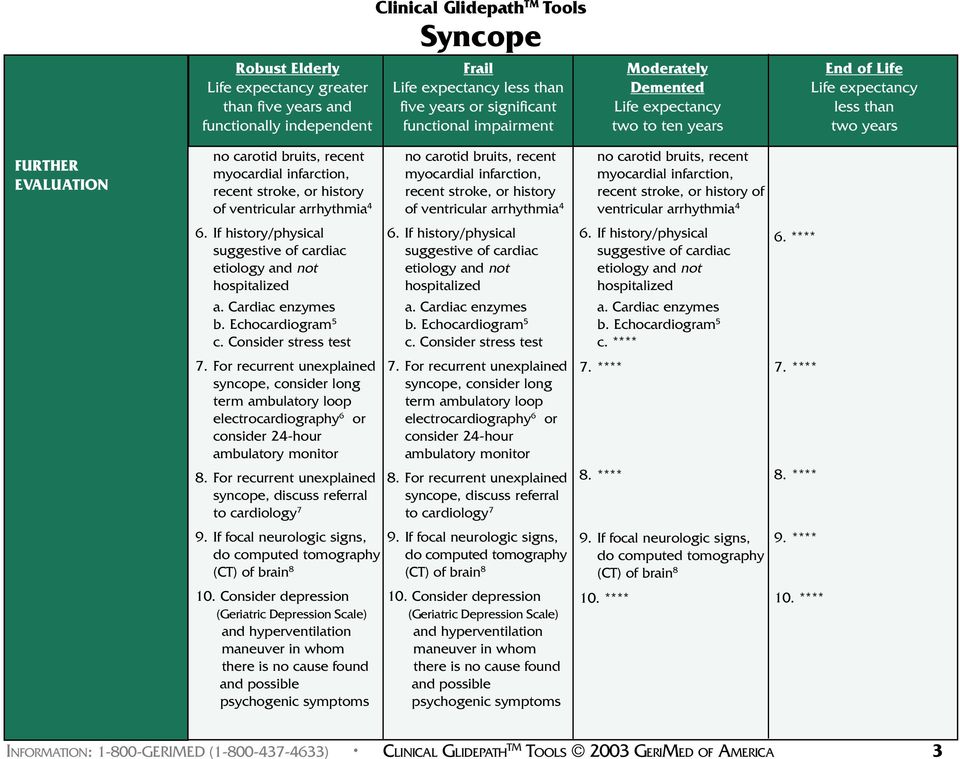
3 Robust Elderly greater FURTHER recent stroke, or history of ventricular arrhythmia 4 c. Consider stress test 7. For recurrent unexplained syncope, consider long term ambulatory loop electrocardiography 6 or consider 24-hour ambulatory monitor 8. For recurrent unexplained syncope, discuss referral to cardiology Consider depression (Geriatric Depression Scale) and hyperventilation maneuver in whom there is no cause found and possible psychogenic symptoms recent stroke, or history of ventricular arrhythmia 4 c. Consider stress test 7. For recurrent unexplained syncope, consider long term ambulatory loop electrocardiography 6 or consider 24-hour ambulatory monitor 8. For recurrent unexplained syncope, discuss referral to cardiology Consider depression (Geriatric Depression Scale) and hyperventilation maneuver in whom there is no cause found and possible psychogenic symptoms recent stroke, or history of ventricular arrhythmia 4 c. **** 7. **** 8. **** 10. **** 6. **** 7. **** 8. **** 9. **** 10. **** INFORMATION: GERIMED ( ) CLINICAL GLIDEPATH TM TOOLS 2003 GERIMED OF AMERICA 3
4 REFERENCES 1. The history, physical examination and ECG are the core of the syncope workup, giving a combined diagnostic yield up to 50%. Linzer M, et al, in a 2-part series, have reviewed English language studies between The studies were randomized trials, observational studies, cohort studies or case series of >10 patients. In addition, footnotes 2,5, and 7 (below) are based on these papers. Linzer M, Yang EH, Estes M 3 rd, Wang, P, et al. Diagnosing Part 1: Value of history, physical examination, and electrocardiography. Ann Intern Med 1997; 126: Linzer M, Yang EH, Estes M 3 rd, Wang, P, et al. Diagnosing Part 2: Unexplained syncope. Ann Intern Med 1997; 127: Patients in whom heart disease is known or suspected or those with exertional syncope are at higher risk for adverse outcome. 3. Many drugs can cause syncope and near-syncope. However, in one multicenter case-controlled study of over 2300 patients, the following drugs were significantly associated with an excess risk of syncope: fluoxetine, haloperidol and L-dopa. Cherin P, Colvez A, Deville de Periere G, Sereni D: Risk of syncope in the elderly and consumption of drugs: A case-control study. J Clin Epidemiol 1997; 50: Five referral studies of carotid sinus message in syncope show that its greatest utility may be in older patients (mean age in studies 60-81). The test appears to be safe if done in the office in patients who do not have carotid bruits, recent recent stroke or history of ventricular tachycardia (incidence of neurologic complications <0.2%). Patients who have cardioinhibitory hypersensitivity of the carotid sinus (asystole lasting >3 seconds) were effectively treated by the implantation of an artificial pacemaker. Yield of these studies was high (46%) likely because of referral-based population. McIntosh SJ, et al. Am J Med 1993; 95: McIntosh SJ, et al. Age Ageing 1993; 22: Kenny RA, et al. Age Ageing 1991; 20: Brignole M, et al. Am Heart J 1991; 122: Brignole M, et al. Am J Cardiol 1991; 68: No studies have been specifically designed to assess the usefulness of echocardiography. Echocardiogram is about 7 times more expensive than ECG and helpful in 5% of patients without clinical or EKG signs of heart disease. 6. Loop electrocardiography is a type of event monitor which can be activated after syncope by pressing a button that freezes in memory the previous 2-5 minutes and the subsequent 60 seconds of heart rhythm. Diagnostic yield in 3 INFORMATION: GERIMED ( ) CLINICAL GLIDEPATH TM TOOLS 2003 GERIMED OF AMERICA 4
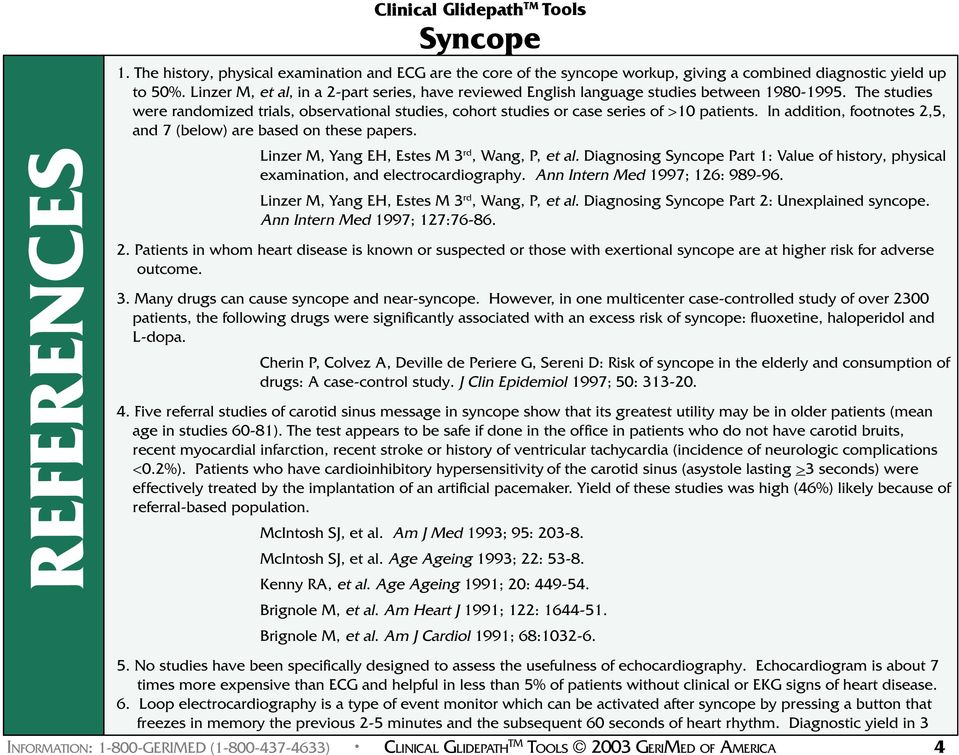
5 referral studies varied from 24% to 47%. The highest yield was seen in patients with palpitations. Cucumee SR, et al. Southern Med J 1990; 83: Linzer M, et al. Am J Cardiol 1990; 66: Brown AP, et al. Br Heart J 1987; 58: Referral studies of upright tilt-table testing in elderly patients with syncope (mean age >60 years) showed positive response rate to tilt (# of positive tests/ total # of patients tested) of 54% (range 26% to 90%). For elderly controls (without syncope), the positive response rate was 11%. Kapoor WN, et al. Upright tilt testing in evaluating syncope: a comprehensive literature review. Am J Med 1994; 97: Diagnostic yield 2% if no clinical evidence of neurologic invasive testing. REFERENCES INFORMATION: GERIMED ( ) CLINICAL GLIDEPATH TM TOOLS 2003 GERIMED OF AMERICA 5

Assessment, diagnosis and specialist referral of adults (>16 years) with an episode of transient loss of consciousness (TLoC) or a blackout.
 Assessment, diagnosis and specialist referral of adults (>16 years) with an episode of transient loss of consciousness (TLoC) or a blackout. TLoC is common huge variation in management range of clinicians
Fainting - Syncope. This reference summary explains fainting. It discusses the causes and treatment options for the condition.
 Fainting - Syncope Introduction Fainting, also known as syncope, is a temporary loss of consciousness. It is caused by a drop in blood flow to the brain. You may feel dizzy, lightheaded or nauseous before
Clinical characteristics and prodrome of Vasovagal syncope(vvs) in young and old.
 Clinical characteristics and prodrome of Vasovagal syncope(vvs) in young and old. Clodagh O Dwyer, Ciara rice, Dymphna Hade, Lisa Byrne, Michelle Burke, CW Fan, RA Kenny Falls & Blackout Unit, St. James
Introduction. What is syncope?
 Syncope Introduction What is syncope? Syncope (SING-kuh-pee) is a medical term for fainting. When you faint, your brain is not receiving enough blood and oxygen, so you lose consciousness temporarily.
Syncope 2015: Evaluation and Treatment. Steve Greer, MD FHRS BHHI Primary Care Symposium February 27, 2015
 Syncope 2015: Evaluation and Treatment Steve Greer, MD FHRS BHHI Primary Care Symposium February 27, 2015 Financial disclosures Research Support National Heart, Lung, and Blood Institute Boston Scientific
Autonomic Stress Test
 Autonomic Stress Test (The expanded head-up tilt test) Artur Fedorowski Syncope Unit Skåne University Hospital, Malmö, Sweden NordSync 2011, Malmö Disclosure None The expanded head-up tilt test When? Why?
Conflicts of interest: None
 Syncope in Athletes Thomas G. Allison, PhD, MPH Mayo Clinic Rochester, MN USA 13 th Annual Review Course in Clinical Cardiology Zurich 14 April, 2015 CP972908-1 Conflicts of interest: None Syncope: Definition
Ngaire has Palpitations
 Ngaire has Palpitations David Heaven Cardiac Electrophysiologist/Heart Rhythm Specialist Middlemore, Auckland City and Mercy Hospitals Auckland Heart Group MCQ Ms A is 45, and a healthy marathon runner.
Il loop recorder esterno. Roberto Maggi
 Il loop recorder esterno Roberto Maggi ECG monitoring and syncope In-hospital monitoring Holter Monitoring Event recorder External loop recorder Remote (at home) telemetry Implantable loop recorder External
Diana Heiman, MD Associate Professor, Family Medicine Residency Director East Tennessee State University
 Diana Heiman, MD Associate Professor, Family Medicine Residency Director East Tennessee State University Objectives Define exercise associated collapse (EAC) and exercise-associated postural hypotension
trust clinical guideline
 CG23 VERSION 1.0 1/7 Guideline ID CG23 Version 1.0 Title Approved by Transient Loss of Consciousness Clinical Effectiveness Group Date Issued 01/01/2013 Review Date 31/12/2016 Directorate Authorised Staff
TILT TESTING INFORMATION AND PROTOCOLS
 TILT TESTING INFORMATION AND PROTOCOLS For technicians and doctors June 2008 Dr Nicola Cooper Consultant in Acute Medicine & Geriatrics TILT TESTING This information has been compiled for technicians and
Cardiac Syncope. spot it, stop it! Syncope is Tranient Loss of Consciousness (T- LOC) due to: transient global cerebral hypoperfusion
 Definition Cardiac Syncope spot it, stop it! David Gareth Jones Heart Rhythm Centre Royal Brompton & Harefield NHS Foundation Trust Syncope is Tranient Loss of Consciousness (T- LOC) due to: transient
Neurocardiogenic Syncope
 Neurocardiogenic Syncope Christopher Bonnet, M.D. Director, Clinical Electrophysiology Definition of Syncope Abrupt and transient loss of consciousness Loss of postural tone Spontaneous and rapid recovery
Syncope. Approach Diagnosis and Treatment. Robert Satran MD
 Syncope Approach Diagnosis and Treatment Robert Satran MD Transient Loss of Consciousness (TLOC) Transient Loss of Consciousness (TLOC ) Classification Underlying Mechanism Is Transient Global Cerebral
SYNCOPE a symptom, not a diagnosis
 SYNCOPE a symptom, not a diagnosis Dr Jaycen Cruickshank Ballarat Emergency Education Grampians Emergency Medicine Training Hub Syncope Learning objectives Learning objectives To name the common and important
Requirements for Provision of Outreach Paediatric Cardiology Service
 Requirements for Provision of Outreach Paediatric Cardiology Service Dr Shakeel A Qureshi, Consultant Paediatric Cardiologist, Evelina Children s Hospital, London, UK On behalf of British Congenital Cardiac
Novartis Gilenya FDO Program Clinical Protocol and Highlights from Prescribing Information (PI)
 Novartis Gilenya FDO Program Clinical Protocol and Highlights from Prescribing Information (PI) Highlights from Prescribing Information - the link to the full text PI is as follows: http://www.pharma.us.novartis.com/product/pi/pdf/gilenya.pdf
Atrial Fibrillation An update on diagnosis and management
 Dr Arvind Vasudeva Consultant Cardiologist Atrial Fibrillation An update on diagnosis and management Atrial fibrillation (AF) remains the commonest disturbance of cardiac rhythm seen in clinical practice.
Coronary Artery Disease leading cause of morbidity & mortality in industrialised nations.
 INTRODUCTION Coronary Artery Disease leading cause of morbidity & mortality in industrialised nations. Although decrease in cardiovascular mortality still major cause of morbidity & burden of disease.
The investigation of syncope
 Seizure (2004) 13, 537 548 The investigation of syncope Savvas Hadjikoutis a, Peter O Callaghan b, Philip E.M. Smith a, * a The Welsh Epilepsy Unit, Department of Neurology, University Hospital of Wales,
510(k) Summary May 7, 2012
 510(k) Summary Medicalgorithmics 510(k) Premarket Notification 510(k) Summary May 7, 2012 1. Submitter Name and Address Medicalgorithmics LLC 245 West 107th St., Suite 11A New York, NY 10025, USA Contact
Professor Rose Anne Kenny, St James Hospital &Trinity College, Dublin
 Syncope Presentation and Investigation in the Acute Setting Professor Rose Anne Kenny, St James Hospital &Trinity College, Dublin Definition- Presentation Syncope is a syndrome consisting of a relatively
Living with Low Blood Pressure
 Living with Low Blood Pressure Understand the medical jargon and tips on how to cope with low Blood Pressure (BP) What is low blood pressure? Blood pressure (BP) is measured in millimetres of mercury (mm
Evaluation of Syncope
 Evaluation of Syncope THOMAS H. MILLER, M.D., Southern Illinois University School of Medicine, Quincy, Illinois JERRY E. KRUSE, M.D., M.S.P.H., Southern Illinois University School of Medicine, Springfield,
Approach to the Patient with Syncope
 Syncope Case Study 38-year-old female with recurrent syncope occasionally occurring during emotional stressful times. Her physical examination and 12 lead EKG are normal. Approach to the Patient with Syncope
2320-6691 2015; 3(3B):1132-1136 ISSN 2347-954X
 Scholars Journal of Applied Medical Sciences (SJAMS) Sch. J. App. Med. Sci., 2015; 3(3B):1132-1136 Scholars Academic and Scientific Publisher (An International Publisher for Academic and Scientific Resources)
Syncope is a transient and abrupt. Evaluation of Syncope
 Evaluation of Syncope ROBERT L. GAUER, MD, Womack Army Medical Center, Fort Bragg, North Carolina Syncope is a transient and abrupt loss of consciousness with complete return to preexisting neurologic
Christopher M. Wright, MD, MBA Pioneer Cardiovascular Consultants Tempe, Arizona
 Christopher M. Wright, MD, MBA Pioneer Cardiovascular Consultants Tempe, Arizona Areas to be covered Historical, current, and future treatments for various cardiovascular disease: Atherosclerosis (Coronary
How to control atrial fibrillation in 2013 The ideal patient for a rate control strategy
 How to control atrial fibrillation in 2013 The ideal patient for a rate control strategy L. Pison, MD Advances in Cardiac Arrhythmias and Great Innovations in Cardiology - Torino, September 28 th 2013
Arrhythmia from a GP Perspective. Dr Jonathan Shribman GPSI Cardiology Northamptonshire
 Arrhythmia from a GP Perspective Dr Jonathan Shribman GPSI Cardiology Northamptonshire Arrhythmia from a GP Perspective Common presentation in General Practice Associated with considerable morbidity But
HEART MONITOR TREADMILL 12 LEAD EKG
 2 HEART MONITOR TREADMILL 12 LEAD EKG Portable ambulatory monitoring system Continuously records electrical activity of the heart for 24 hours or more Also known as ambulatory electrocardiographic monitor
Atrial Fibrillation Cardiac rate control or rhythm control could be the key to AF therapy
 Cardiac rate control or rhythm control could be the key to AF therapy Recent studies have proven that an option of pharmacologic and non-pharmacologic therapy is available to patients who suffer from AF.
Guidelines on management (diagnosis and treatment) of syncope*
 European Heart Journal (2001) 22, 1256 1306 doi:10.1053/euhj.2001.2739, available online at http://www.idealibrary.com on Task Force Report Guidelines on management (diagnosis and treatment) of syncope*
Atrial Fibrillation and Cardiac Device Therapy RAKESH LATCHAMSETTY, MD DIVISION OF ELECTROPHYSIOLOGY UNIVERSITY OF MICHIGAN HOSPITAL ANN ARBOR, MI
 Atrial Fibrillation and Cardiac Device Therapy RAKESH LATCHAMSETTY, MD DIVISION OF ELECTROPHYSIOLOGY UNIVERSITY OF MICHIGAN HOSPITAL ANN ARBOR, MI Outline Atrial Fibrillation What is it? What are the associated
Atrial Fibrillation (AF) March, 2013
 Atrial Fibrillation (AF) March, 2013 This handout is meant to help with discussions about the condition, and it is not a complete discussion of AF. We hope it will complement your appointment with one
5/1/2015. When should I worry? Presyncope is the feeling that one is about to pass out but remains conscious with a transient loss of postural tone.
 When should I worry? Robert Vogt-Lowell, MD, FAAP, FAAC, MAAC Pediatric Cardiologist Pediatrix Cardiology of Miami DEFINITIONS Syncope is a transient loss of consciousness and muscle tone that results
What Medical Emergencies Should a Dental Office be Prepared to Handle?
 What Medical Emergencies Should a Dental Office be Prepared to Handle? Gary Cuttrell, DDS, JD, University of NM Division of Dental Services Santiago Macias, MD, First Choice Community Healthcare Dentists
Diagnostic tests for syncope
 Diagnostic tests for syncope Working together with individuals, families and medical professionals to offer support and information on syncope and reflex anoxic seizures www.stars.org.uk Registered Charity
Electrocardiography Review and the Normal EKG Response to Exercise
 Electrocardiography Review and the Normal EKG Response to Exercise Cardiac Anatomy Electrical Pathways in the Heart Which valves are the a-v valves? Closure of the a-v valves is associated with which heart
Syncope in the Elderly Assessment and Treatment. Professor Rose Anne Kenny Trinity College Dublin Newcastle University
 Syncope in the Elderly Assessment and Treatment Professor Rose Anne Kenny Trinity College Dublin Newcastle University Definition Syncope is a syndrome consisting of a relatively short period of temporary
Recurrent AF: Choosing the Right Medication.
 In the name of God Shiraz E-Medical Journal Vol. 11, No. 3, July 2010 http://semj.sums.ac.ir/vol11/jul2010/89015.htm Recurrent AF: Choosing the Right Medication. Basamad Z. * Assistant Professor, Department
RATE VERSUS RHYTHM CONTROL OF ATRIAL FIBRILLATION: SPECIAL CONSIDERATION IN ELDERLY. Charles Jazra
 RATE VERSUS RHYTHM CONTROL OF ATRIAL FIBRILLATION: SPECIAL CONSIDERATION IN ELDERLY Charles Jazra NO CONFLICT OF INTEREST TO DECLARE Relationship Between Atrial Fibrillation and Age Prevalence, percent
What Can I Do about Atrial Fibrillation (AF)?
 Additional Device Information 9529 Reveal XT Insertable Cardiac Monitor The Reveal XT Insertable Cardiac Monitor is an implantable patientactivated and automatically activated monitoring system that records
Potential Causes of Sudden Cardiac Arrest in Children
 Potential Causes of Sudden Cardiac Arrest in Children Project S.A.V.E. When sudden death occurs in children, adolescents and younger adults, heart abnormalities are likely causes. These conditions are
Syncope Unit Project A prospective systematic guideline-based evaluation and treatment of patients referred to the Syncope Units of general hospitals
 AIAC Associazione Italiana Aritmologia e Cardiostimolazione Syncope Unit Project Syncope Unit Project A prospective systematic guideline-based evaluation and treatment of patients referred to the Syncope
Preoperative Laboratory and Diagnostic Studies
 Preoperative Laboratory and Diagnostic Studies Preoperative Labratorey and Diagnostic Studies The concept of standardized testing in all presurgical patients regardless of age or medical condition is no
Atrial Fibrillation 2014 How to Treat How to Anticoagulate. Allan Anderson, MD, FACC, FAHA Division of Cardiology
 Atrial Fibrillation 2014 How to Treat How to Anticoagulate Allan Anderson, MD, FACC, FAHA Division of Cardiology Projection for Prevalence of Atrial Fibrillation: 5.6 Million by 2050 Projected number of
Evaluating ED Patients with Transient Ischemic Attack: Inpatient vs. Outpatient Strategies
 Evaluating ED Patients with Transient Ischemic Attack: Inpatient vs. Outpatient Strategies Michael A. Ross MD FACEP Associate Professor of Emergency Medicine Wayne State University School of Medicine Detroit
GENERAL HEART DISEASE KNOW THE FACTS
 GENERAL HEART DISEASE KNOW THE FACTS WHAT IS Heart disease is a broad term meaning any disease affecting the heart. It is commonly used to refer to coronary heart disease (CHD), a more specific term to
Acquired, Drug-Induced Long QT Syndrome
 Acquired, Drug-Induced Long QT Syndrome A Guide for Patients and Health Care Providers Sudden Arrhythmia Death Syndromes (SADS) Foundation 508 E. South Temple, Suite 202 Salt Lake City, Utah 84102 800-STOP
Tilt Table Testing for Assessing Syncope
 263 ACC EXPERT CONSENSUS DOCUMENT Tilt Table Testing for Assessing Syncope DAVID G. BENDITT, MD, FACC, CHAIR DAVID W. FERGUSON, MD, FACC BLAIR P. GRUBB, MD, FACC WISHWA N. KAPOOR, MD JOHN KUGLER, MD, FACC
Emergency Scenario. Chest Pain
 Emergency Scenario Chest Pain This emergency scenario reviews chest pain in a primary care patient, and is set up for roleplay and case review with your staff. 1) The person facilitating scenarios can
Atrial Fibrillation. Information for you, and your family, whänau and friends. Published by the New Zealand Guidelines Group
 Atrial Fibrillation Information for you, and your family, whänau and friends Published by the New Zealand Guidelines Group CONTENTS Introduction 1 The heart 2 What is atrial fibrillation? 3 How common
Atrial Fibrillation Management Across the Spectrum of Illness
 Disclosures Atrial Fibrillation Management Across the Spectrum of Illness NONE Barbara Birriel, MSN, ACNP-BC, FCCM The Pennsylvania State University Objectives AF Discuss the pathophysiology, diagnosis,
What Are Arrhythmias?
 What Are Arrhythmias? Many people have questions about what the word arrhythmia means, and arrhythmias can be a difficult subject to understand. The text below should give you a better understanding of
Is it really so? : Varying Presentations for ACS among Elderly, Women and Diabetics. Yen Tibayan, M.D. Division of Cardiovascular Medicine
 Is it really so? : Varying Presentations for ACS among Elderly, Women and Diabetics Yen Tibayan, M.D. Division of Cardiovascular Medicine Case Presentation 69 y.o. woman calls 911 with the complaint of
Overview. Geriatric Overview. Chapter 26. Geriatrics 9/11/2012
 Chapter 26 Geriatrics Slide 1 Overview Trauma Common Medical Emergencies Special Considerations in the Elderly Medication Considerations Abuse and Neglect Expanding the Role of EMS Slide 2 Geriatric Overview
Atrial Fibrillation: Drugs, Ablation, or Benign Neglect. Robert Kennedy, MD October 10, 2015
 Atrial Fibrillation: Drugs, Ablation, or Benign Neglect Robert Kennedy, MD October 10, 2015 Definitions 2014 AHA/ACC/HRS Guideline for the Management of Patients With Atrial Fibrillation: Executive Summary.
Perioperative Cardiac Evaluation
 Perioperative Cardiac Evaluation Caroline McKillop Advisor: Dr. Tam Psenka 10-3-2007 Importance of Cardiac Guidelines -Used multiple times every day -Patient Safety -Part of Surgical Care Improvement Project
50 years of CRM Device Therapy Past, Present and Future. Richard Sutton Professor of Cardiology Imperial College, London, UK
 50 years of CRM Device Therapy Past, Present and Future Richard Sutton Professor of Cardiology Imperial College, London, UK The Past First implant 1958 Sweden Dual Chamber pacing (VAT) 1962 US Transvenous
ECG may be indicated for patients with cardiovascular risk factors
 eappendix A. Summary for Preoperative ECG American College of Cardiology/ American Heart Association, 2007 A1 2002 A2 European Society of Cardiology and European Society of Anaesthesiology, 2009 A3 Improvement,
PATIENT INFORMATION INSURANCE INFORMATION
 PATIENT INFORMATION NAME DATE ADDRESS CITY ST ZIP PHONE(H) (C) (W) DATE OF BIRTH EMAIL AGE SEX: M F SS#(optional) EMPLOYER OCCUPATION ARE YOU CURRENTLY: MARRIED PARTNERED DIVORCED WIDOWED SINGLE SPOUSE/PARTNER
Transient Loss of Consciousness A Clinical Approach
 A Clinical Approach Dr. Hany. M. Zaki-eldine, MD Ass Prof Neurology and Interventional Neurology Ain Shams Univ Member of the World Federation of Therapeutic and Interventional Neuroradiology Syncope Epilepsy
DERBYSHIRE JOINT AREA PRESCRIBING COMMITTEE (JAPC) MANAGEMENT of Atrial Fibrillation (AF)
 DERBYSHIRE JOINT AREA PRESCRIBING COMMITTEE (JAPC) MANAGEMENT of Atrial Fibrillation (AF) Key priorities Identification and diagnosis Treatment for persistent AF Treatment for permanent AF Antithrombotic
Electrophysiology Heart Study - EPS -
 Electrophysiology Heart Study - EPS - What is an EPS? EPS is short for ElectroPhysiology heart Study. This procedure looks at the electrical system of your heart. An EPS will show if you have a heart rhythm
Consensus statement for the diagnosis and management of syncope. Argentine Society of Cardiology
 CONSENSUS Consensus statement for the diagnosis and management of syncope. Argentine Society of Cardiology Director Dr. Claudio Militello MTSAC Committee of Editorial Staff Dr. Rafael Acunzo MTSAC Dr.
Tachyarrhythmias (fast heart rhythms)
 Patient information factsheet Tachyarrhythmias (fast heart rhythms) The normal electrical system of the heart The heart has its own electrical conduction system. The conduction system sends signals throughout
James F. Kravec, M.D., F.A.C.P
 James F. Kravec, M.D., F.A.C.P Chairman, Department of Internal Medicine, St. Elizabeth Health Center Chair, General Internal Medicine, Northeast Ohio Medical University Associate Medical Director, Hospice
NEW STUDENT-ATHLETE MEDICAL HISTORY FORM
 Student-Athlete Information NEW STUDENT-ATHLETE MEDICAL HISTORY FORM Name Date Birth SSN Sport Student ID Number Academic Class 1 Personal Physician s Name Phone # Person to Contact In The Event of Emergency
www.irishheart.ie CARDIOMYOPATHY SUPPORT GROUP IRELAND
 www.irishheart.ie CARDIOMYOPATHY SUPPORT GROUP IRELAND Cardiomyopathy Support Group This is a voluntary group of people, all of whom have cardiomyopathy. It was set up in association with the Irish Heart
INFORMED CONSENT INFORMED CONSENT FOR PARTICIPATION IN A HEALTH AND FITNESS TRAINING PROGRAM
 INFORMED CONSENT INFORMED CONSENT FOR PARTICIPATION IN A HEALTH AND FITNESS TRAINING PROGRAM NAME: DATE: 1. PURPOSE AND EXPLANATION OF PROCEDURE I hereby consent to voluntarily engage in an acceptable
Things You Should Know About Adverse Event Report Data
 U.S. Department of Health and Human Services Food and Drug Administration Center for Food Safety and Applied Nutrition CFSAN Adverse Event Reporting System Voluntary Reports on Red Bull Energy Drink January
Palpitations & AF. Richard Grocott Mason Consultant Cardiologist THH NHS Foundation Trust & Royal Brompton & Harefield NHS Foundation Trust
 Palpitations & AF Richard Grocott Mason Consultant Cardiologist THH NHS Foundation Trust & Royal Brompton & Harefield NHS Foundation Trust Palpitations Frequent symptom Less than 50% associated with arrhythmia
Low Blood Pressure. This reference summary explains low blood pressure and how it can be prevented and controlled.
 Low Blood Pressure Introduction Low blood pressure, or hypotension, is when your blood pressure reading is 90/60 or lower. Some people have low blood pressure all of the time. In other people, blood pressure
www.irishheart.ie LONG QT SYNDROME SUPPORT GROUP IRELAND
 www.irishheart.ie LONG QT SYNDROME SUPPORT GROUP IRELAND Long QT Syndrome Support Group This is a voluntary group of people, all of whom have families with Long QT syndrome (LQTS). It was set up in association
Medical Tourism - The Role of Intervals inCardiovascular Cancer
 Acute Decompensated Heart Failure: Time Critical Interventions MO-51 / 1 Hour Faculty: Matthew Strehlow, MD, FACEP Monday, 10/26/2015 / 3:30 PM - 4:20 PM The treatment of congestive heart failure (CHF)
Diagnostic Scoring System for LQTS
 Medical Coverage Policy Genetic Testing: Congenital Long QT Syndrome Device/Equipment Drug Medical Surgery Test Other Effective Date: 2/15/2011 Policy Last Updated: 2/21/2012 Prospective review is recommended/required.
Atrial Fibrillation (AF) Explained
 James Paget University Hospitals NHS Foundation Trust Atrial Fibrillation (AF) Explained Patient Information Contents What are the symptoms of atrial fibrillation (AF)? 3 Normal heartbeat 4 How common
Evaluation of a direct access cardiac arrhythmia monitoring service
 ORIGINAL ARTICLE Cardiology Journal 2012, Vol. 19, No. 1, pp. 70 75 10.5603/CJ.2012.0010 Copyright 2012 Via Medica ISSN 1897 5593 Evaluation of a direct access cardiac arrhythmia monitoring service David
Chest Pain in Young Athletes. Christopher Davis, MD, PhD Pediatric Cardiology Rady Children s Hospital San Diego cdavis@rchsd.
 Chest Pain in Young Athletes Christopher Davis, MD, PhD Pediatric Cardiology Rady Children s Hospital San Diego [email protected] 858-966-5855 None Disclosures Chest Pain: the good news and the bad news:
Portable, cordless, single-channel ECG Monitor HCG-801-E
 Portable, cordless, single-channel ECG Monitor HCG-801-E Screening & Self -Monitoring of cardiac events Compact - Cordless - Simple operation Fast - Discrete Records about 30 seconds heart rhythm and waveform
Cardiology ICD-10-CM Coding Tip Sheet Overview of Key Chapter Updates for Cardiology
 Cardiology ICD-10-CM Coding Tip Sheet Overview of Key Chapter Updates for Cardiology Chapter 4: Endocrine, Nutritional, and Metabolic Diseases (E00-E89) The diabetes mellitus codes are combination codes
Chapter 57 SYNCOPE. Professor R. A. Kenny. Department of Geriatric Medicine and. Institute of Neuroscience. Trinity College. Dublin.
 1 Chapter 57 SYNCOPE Professor R. A. Kenny Department of Geriatric Medicine and Institute of Neuroscience Trinity College Dublin Ireland Phone: + 353 1 428 4182 Fax: + 353 1 410 3454 Email: [email protected]
BASIC STANDARDS FOR RESIDENCY TRAINING IN CARDIOLOGY
 BASIC STANDARDS FOR RESIDENCY TRAINING IN CARDIOLOGY American Osteopathic Association and the American College of Osteopathic Internists Specific Requirements For Osteopathic Subspecialty Training In Cardiology
4/7/2015. Cardiac Rehabilitation: From the other side of the glass door. Chicago, circa 1999. Objectives. No disclosures, no conflicts
 Cardiac Rehabilitation: From the other side of the glass door No disclosures, no conflicts Charles X. Kim, MD, FACC, ABVM Objectives 1. Illustrate common CV benefits of CV rehab in real world practice.
Treating AF: The Newest Recommendations. CardioCase presentation. Ethel s Case. Wayne Warnica, MD, FACC, FACP, FRCPC
 Treating AF: The Newest Recommendations Wayne Warnica, MD, FACC, FACP, FRCPC CardioCase presentation Ethel s Case Ethel, 73, presents with rapid heart beating and mild chest discomfort. In the ED, ECG
INSERTABLE CARDIAC MONITORING SYSTEM. UNLOCK the ANSWER. Your heart and long-term monitoring
 INSERTABLE CARDIAC MONITORING SYSTEM UNLOCK the ANSWER Your heart and long-term monitoring UNLOCK the ANSWER Irregular heartbeats can be related to a variety of conditions, including unexplained fainting,