
Cervical Screening Programme
|
|
|
- Joseph Adam Bond
- 10 years ago
- Views:
Transcription
1 Cervical Screening Programme England

2 The NHS Information Centre is England s central, authoritative source of health and social care information. Acting as a hub for high quality, national, comparative data, we deliver information for local decision makers, to improve the quality and efficiency of care. Author: The NHS Information Centre, Screening and Immunisations team Responsible Statistician: Clare McConnell, Section Head Version: 1.1 Date of Publication: 24 th November

3 Contents Contents 3 Executive Summary 4 Introduction Background Quality Statement Report Structure Experimental Statistics Changes to the Report User Feedback 15 Analysis and Commentary 16 Call and Recall Programme 16 Cervical Cytology 34 Colposcopy 43 Data Tables 52 Appendices 98 Appendix A - Definitions 98 Appendix B - Glossary 101 Appendix C Feedback from Users 103 Appendix D Data Validation and Data Quality 104 Appendix E - Related Publications and Useful Web Links 107 3

4 Executive Summary Cervical Screening Programme, England Women between the ages of 25 and 64 are invited for regular cervical screening under a national Cervical Screening Programme. This is intended to detect abnormalities within the cervix that could, if untreated, develop into cancer. This report presents information about the NHS Cervical Screening Programme in England in and includes data about the call and re-call system, screening samples examined by pathology laboratories, and referrals to colposcopy clinics. The statistics in this report are used to inform policy and to monitor the quality, effectiveness and safety of screening services. The statistics are based on information that is routinely collected by the NHS Cancer Screening Programmes for the operation of the screening programme including quality assurance and performance management purposes. They are presented by Primary Care Organisation (PCO), Strategic Health Authority (SHA), pathology laboratory and colposcopy clinic. The current target age group for the Cervical Screening Programme of years is used to report statistics. Main Findings At 31 st March 2011, the percentage of eligible women (aged 25 to 64) who were recorded as screened at least once in the previous 5 years (coverage) was 78.6%. This compares to 78.9% in 2010 and to 79.5% five years ago (in 2006). Time from screening to receipt of results is measured using an expected delivery date. In , 78.9% of test results were reported to have an expected delivery date of within 2 weeks of the sample being taken (i.e. women would be expected to receive the results of their tests within 2 weeks). 4
5 In previous years time from screening to availability of result, which is measured as the number of days from the sample being taken to the result being sent by the PCO, has been reported. The percentage of test results available within 2 weeks has increased each year since when it first became possible to monitor 2 week availability. In , 44.6% of test results were available within 2 weeks. In , this figure was considerably higher at 82.8%. Just under 3.7 million samples were examined by pathology laboratories in ; similar to the numbers examined in Of the 3.7 million samples examined in , 3.4 million (93.2%) were submitted by GPs and NHS community clinics. The percentage of laboratory tests authorised (i.e. test results confirmed) within 2 weeks of receipt at the laboratory increased in to 92.9% from 60.5% in A further 6.1% were authorised within 4 weeks. In , 27.9% of women referred to colposcopy were offered an appointment within 2 weeks. This percentage rose to 65.5% for those offered an appointment within 4 weeks of referral. 5
6 Introduction This report presents information about the NHS Cervical Screening Programme in England in and includes data about the call and re-call system, screening samples examined by pathology labs and referrals to colposcopy clinics. The publication includes analysis and commentary along with a series of detailed tables and a Glossary to aid understanding of the technical terms used. The report focuses on England but also includes regional comparisons and coverage statistics from other UK countries. The statistics in this report are used to inform policy and to monitor the quality, effectiveness and safety of screening services. This publication has been in existence for a number of years and publications are available dating back to The report was originally published by the Department of Health Statistics Division. Responsibility for the publications transferred from DH to the NHS Information Centre when it was formed in Background Women between the ages of 25 and 64 are invited for regular cervical screening under a national Cervical Screening Programme. This is intended to detect abnormalities within the cervix that could, if untreated, develop into cancer. National policy is that women are offered screening every three or five years depending on their age. Women aged are invited every 3 years, whereas those aged are invited every 5 years. Prior to 2003, women were eligible for routine screening from age 20. In this bulletin, the current target group of years has been used to report statistics. The cervical screening process falls into three main phases: 6
7 Call and recall programme Most women invited by the screening programme have their initial screening test at either their GP practice or a NHS Community Clinic. The standard age ranges and frequency of screening are detailed above. Women aged 65 or over whose last three consecutive tests were reported as negative are removed from the call/recall programme It is possible for women outside the age range to be invited for screening should a need be identified. Women over 65 who have not undergone a previous test or who require ongoing surveillance continue to be included in the programme. Cervical Cytology Samples from the testing process are passed to pathology laboratories for screening by a cytologist. The results of the test are returned to PCTs, the GP, and the sample taker (if not the GP). The Cancer Reform Strategy, states that women should receive their cervical screening tests result within 2 weeks and this commitment was highlighted in the NHS Operating Framework which stated that the target should be achieved for all women by the end of Most women receive a normal result and are recalled for another routine test in three or five years dependent on their age. Where the pathology laboratory identifies cell changes that require further investigation, women receive an abnormal test result. Following an abnormal test result, some women will be referred for colposcopy. However, not all abnormal changes require immediate treatment and some women may instead be recalled for a repeat test in 6 or 12 months time In a small proportion of cases the pathology laboratory is unable to assess the cells to give a result and the test is considered inadequate. In such cases women are asked to return for a repeat test. 1 Cancer Reform Strategy, 2007, Department of Health - 7
8 Colposcopy Women referred for colposcopy attend a colposcopy clinic where a colposcope (a lighted, low-powered microscope) is used to examine the cervix and to determine appropriate treatment. A biopsy may be taken from the cervix for diagnosis and/or the cervix may be treated. Alternatively, women may be asked to have a repeat test. 1.2 Quality Statement This Quality Statement presents information to aid interpretation of the data. A fuller Quality Statement is available on the publication webpage which can be accessed via the following link: Data Sources The statistics are based on information that is routinely collected by the NHS Cancer Screening Programmes for the operation of the screening programme including quality assurance and performance management purposes. They are presented by Primary Care Organisation, Strategic Health Authority, pathology laboratory and colposcopy clinic. The information is collected on the following three returns: KC53 information from the call and recall system, collected on all 151 Primary Care Organisations. KC61 information on screening samples examined by pathology laboratories, collected from 109 laboratories carrying out cervical cytology. KC65 information on referrals to colposcopy, subsequent treatment and outcome, collected from 217 clinics/trusts providing colposcopy services. In some instances, smaller clinics have included their data in the main hospital return. The KC65 return was first collected in
9 In addition to the above returns, data on time from screening to receipt of results is obtained from monthly reports produced by the open Exeter system 2. The NHS Data Model and Dictionary Service contains more information on the above returns including guidance on content, completion and definitions. Links to the returns are given below: KC53 ms/community/kc53/kc53_fr.asp?shownav=1 KC61 unity/kc61/kc61_fr.asp?shownav=1 KC65 unity/kc65/kc65_fr.asp?shownav=1 Further information on the underlying sources of information can be found in the NHS ICs List of Administrative Sources, available through the following link: The data from each of the three returns is collected at the end of each financial year in aggregate form. The NHS Cervical Screening Programme includes regional Quality Assurance (QA) Reference Centres (QARCs) which are responsible for quality assuring the screening programme including KC53, KC61 and KC65 returns. Data are quality assured by the QARCs on an annual basis. Aggregated data is provided to the NHS Information Centre 2 Connecting for Health (CfH) Exeter system (NHAIS), Cancer Screening Statistics VSA15 Report. 9
10 (NHS IC) in a defined format. Further validation and quality assurance checks are carried out at the NHS IC as part of the publication process Accuracy and Reliability These are established collections based on 100 per cent data, i.e. not a sample. Submissions have been made for all PCOs and by all pathology laboratories and colposcopy clinics. Appendix D contains further information on data validation and data quality. Data quality issues were identified in relation to figures submitted by a 8 laboratories carrying out cervical cytology and a 10 of clinics/trusts providing colposcopy services. Details of the data quality issues identified are reported in Appendix D Timeliness and Punctuality The cervical screening data are made available as soon as possible after they have been compiled and validated (usually October each year). A copy of last year s report can be found at: Accessibility and Clarity Most data fields are published in the Data Tables as part of this main report which is available on the NHS IC Cervical Screening web pages: The tables and graphs are also available as Excel files and tables are available as CSV files, which again are accessible through the web pages. Further analysis may be available on request, subject to resource limits and compliance with disclosure control requirements. 10
11 1.2.5 Coherence and Comparability Changes in Screening Policy Screening policy changed in Prior to this, women aged were screened at least every five years. From 2004 women did not receive their first invitation until they were 25. Prior to 2004, national policy was to invite women for screening at intervals of not more than 5 years and therefore there was some variation in local practice. This also changed in 2004 so that women aged were invited for screening every 3 years whereas those aged were invited every 5 years. The above changes in policy need to be borne in mind when considering trend data. The NHS IC maintains awareness of changes that may impact on the data through regular meetings and communication with the NHS Cervical Screening Programme and the Department of Health. Time series The main tables in the publication contain time series which enable examination of trends over a period of years. Throughout the report statistics are compared with the previous year. Comparisons with other countries This report includes coverage comparisons with other UK countries which can be found in section Confidentiality, Transparency and Security The standard NHS security and confidentiality policies have been applied in the production of these statistics. An annual risk assessment is undertaken prior to publication which addresses any potential issues around disclosure. The following disclosure controls have been applied to this publication: 11
12 In Table 26b the actual number of biopsies by organisation has been suppressed, leaving totals by region available. The percentage showing CIN (cervical intra-epithelial neoplasia) or worse has been banded to 2.5% increments Data Revisions Subsequent to publishing the Cervical Screening Programme, England, report on 21 st October 2010, a number of changes were identified as being needed affecting Tables 1, 18, 18a, 19, 20, 21, 24, 25, 26a and 26b in the Data Tables and Tale O in the PDF report. These errors were mainly due to incorrect data submissions. There was a small impact on England level data in Tables 18 and 18a. The impact on England level data for all other tables affected was very limited. All relevant excel tables were reissued on 22 nd November 2011 except Table 1, which was footnoted. Please note that figures were not revised in the full PDF report. The re-issued excel tables and an Errata Note detailing the revisions can be found on the publication webpage: Where this report uses statistics, they are the correct, revised statistics. Where data is re-submitted post publication in the future, the NHS IC will assess whether the resubmitted data has a significant impact on England level data. Where this is the case, the affected excel tables will be re-issued. Where the impact to England level data is not significant, footnotes will be made to the affected tables. 12
13 1.3 Report Structure Statistics from the cervical screening programme are presented in the Analysis and Commentary section of this report in three sub-sections as follows: Call and Recall Programme Cervical Cytology Colposcopy More detailed tables are presented in the Data Tables section In presenting laboratory statistics in the Cervical Cytology section, data about samples from GP and NHS Community Clinics have been used in most tables in preference to data about samples from all sources, so as to reflect more closely the results from screening programme tests Due to the technical nature of some of the terms used in this report a Glossary is included as an aid to understanding see Appendix B Appendix A contains Definitions which users may find useful when reading this report. A definition of coverage is included in this appendix. 13

14 1.4 Experimental Statistics Time from screening to receipt of result In previous years, this publication has reported the time from screening to availability of result which is measured as the number of days from the sample being taken to the result being sent by the PCO to the woman (not to the woman receiving the result). This year, time from screening to receipt of result, as measured by expected delivery date, is reported as these data are considered to be of more interest to users of the statistics. They are published as experimental statistics as they are undergoing evaluation. A key part of the Experimental Statistics label is user engagement in the evaluation of those statistics. The NHS IC invites readers to comment on this publication, which will help inform the next report. Comments may be sent to: [email protected] As in previous years, Table 9 and 9a in the Data Tables section of this publication present figures at both regional and local level for time from screening to availability of result. In addition, Tables 9b and 9c present figures at both regional and local level for time from screening to receipt of result as measured by expected delivery date. The NHS IC does not intend to publish statistics on time from screening to availability of results in future publications. Users of the publication who have any concerns about this change should contact the NHS IC: Tel: [email protected] 14

15 1.5 Changes to the Report UK Coverage statistics Coverage in other UK countries is included in this year s report to enable comparison (see section 2.1.7). However, it should be noted that cervical screening programmes in other counties vary in terms of the age groups covered by the screening programmes, the frequency of screening and in how coverage is calculated. In comparing coverage in England to other counties, these differences (which are detailed in the text) should be considered. 1.6 User Feedback The NHS Information Centre welcomes feedback on all publications. If you wish to comment on this report a feedback form is available on the NHS IC website at: Feedback received from users via the publication webpage is summarised in Appendix C along with any action that has been taken as a result of this feedback. 15

16 Analysis and Commentary Call and Recall Programme 2.1 Coverage Coverage is defined as the percentage of women in a population eligible for screening at a given point in time who were screened adequately within a specified period. As the frequency with which women are invited for screening is dependent on age, coverage is calculated differently for different age groups, as follows: Women aged 25 to 49 Coverage is calculated as the number of women in this age group who have had an adequate screening test within the last 3.5 years as a percentage of the eligible population aged 25 to 49. Women aged 50 to 64 Coverage is calculated as the number of women in this age group who have had an adequate screening test within the last 5 years as a percentage of the eligible population aged Women aged 25 to 64 (the complete target age group) Coverage is calculated as the number of women in this age group who have had an adequate screening test within the last 5 years as a percentage of the eligible population aged 25 to

17 The eligible population is the PCT s responsible population 3 excluding those women whose recall to screening has been ceased for clinical reasons (most commonly due to hysterectomy) At 31 st March 2011, the percentage of eligible women (aged 25 to 64) who were recorded as screened at least once in the previous 5 years (coverage) was 78.6%. This compares to 78.9% in 2010 (see Table A) and to 79.5% five years ago (in 2006).. Table A: Cervical Screening: Coverage by Age Group, at 31 st March 2010 and 2011 Coverage Year years (less than 3.5 years since last adequate test) (%) years (less than 5 years since last adequate test) (%) years (less than 5 years since last adequate test) (%) Source: KC53, The NHS Information Centre. See also Table 13 in Data Tables section. Figure 1 shows coverage of the target age group since The Primary Care Trust's responsible population comprises: - all persons registered with a GP whose practice forms part of the PCT, regardless of where the person is resident, plus - any persons not registered with a GP who are resident within the PCTs statutory geographical boundary. Note that persons resident within the PCTs geographic area, but registered with a GP belonging to another PCT, are the responsibility of that other Primary Care Trust. 17
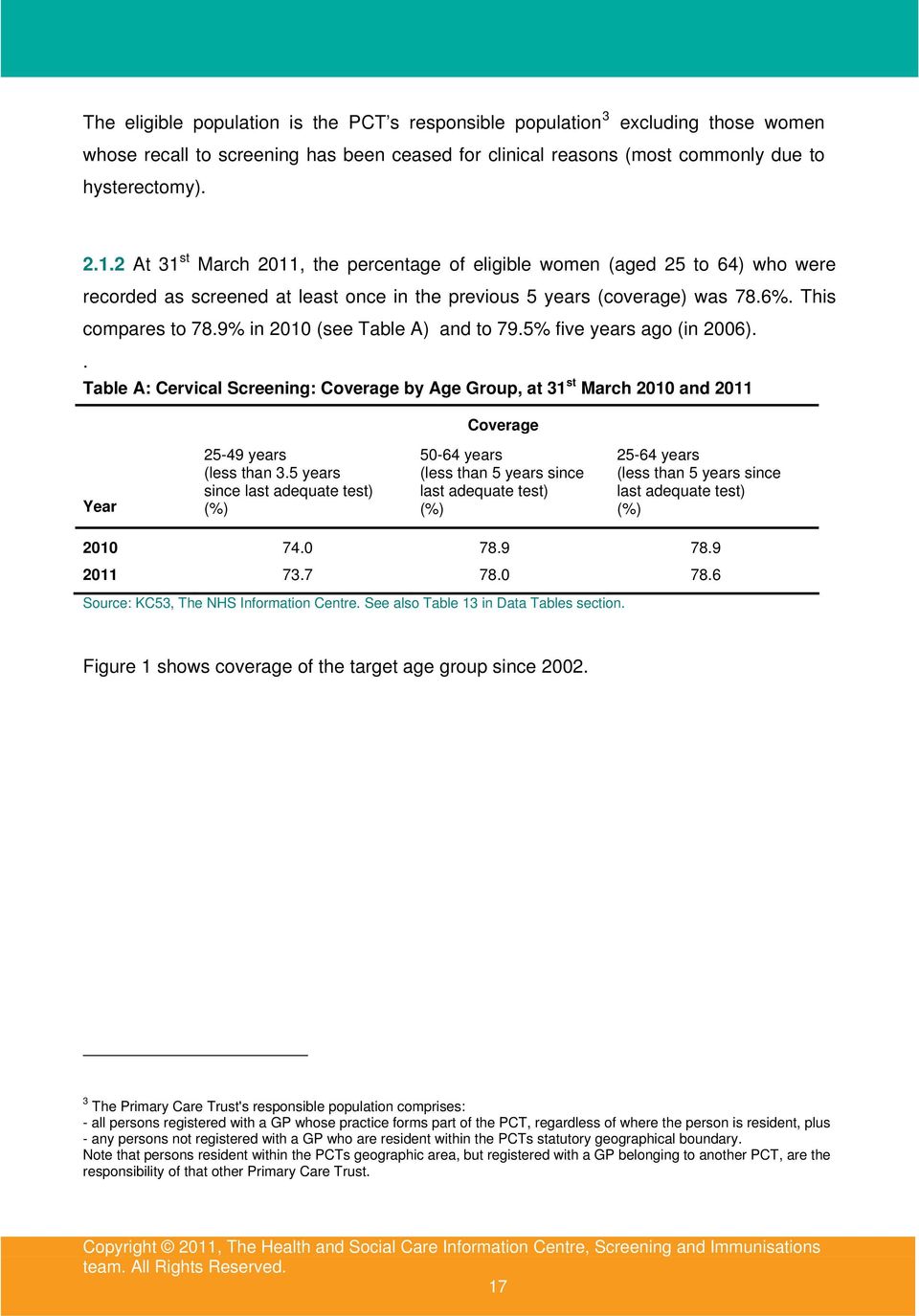
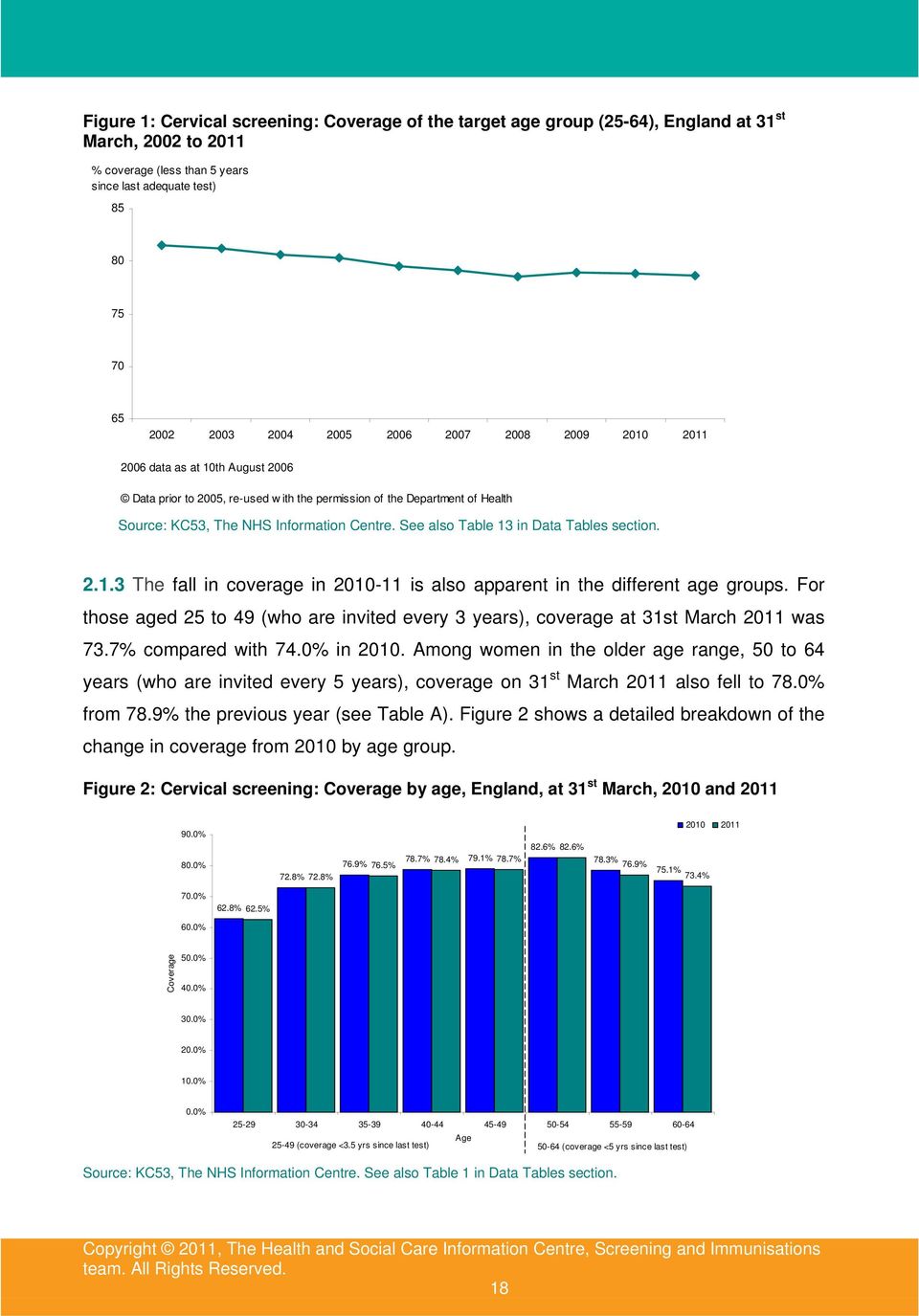
18 Figure 1: Cervical screening: Coverage of the target age group (25-64), England at 31 st March, 2002 to 2011 % coverage (less than 5 years since last adequate test) data as at 10th August 2006 Data prior to 2005, re-used w ith the permission of the Department of Health Source: KC53, The NHS Information Centre. See also Table 13 in Data Tables section The fall in coverage in is also apparent in the different age groups. For those aged 25 to 49 (who are invited every 3 years), coverage at 31st March 2011 was 73.7% compared with 74.0% in Among women in the older age range, 50 to 64 years (who are invited every 5 years), coverage on 31 st March 2011 also fell to 78.0% from 78.9% the previous year (see Table A). Figure 2 shows a detailed breakdown of the change in coverage from 2010 by age group. Figure 2: Cervical screening: Coverage by age, England, at 31 st March, 2010 and % 80.0% 72.8% 72.8% 76.9% 76.5% 78.7% 78.4% 79.1% 78.7% 82.6% 82.6% 78.3% 76.9% 75.1% 73.4% % 62.8% 62.5% 60.0% Coverage 50.0% 40.0% 30.0% 20.0% 10.0% 0.0% Age (coverage <3.5 yrs since last test) (coverage <5 yrs since last test) Source: KC53, The NHS Information Centre. See also Table 1 in Data Tables section. 18
19 2.1.4 Coverage of the target age group (25-64) varied between Strategic Health Authorities, with 4 achieving 80% or more and 6 achieving below 80% (see Table B). The highest reported coverage was in the East Midlands at 81.4%, the lowest was London at 74.0%. Table B: Coverage for age group by SHA, 31 st March 2010 and 2011 Coverage (Less than 5 years SHA since last adequate test) (%) England North East North West Yorkshire & the Humber East Midlands West Midlands East of England London South East Coast South Central South West Source: KC53, The NHS Information Centre. See also Table 13 in Data Tables section Coverage was 80% or higher in 57 of the 151 PCOs - see Figures 3 and 3a. Figure 3 - Cervical screening: coverage of the target age group (25-64) by Primary Care Organisation, England, 31 st March 2011 Number of PCOs Coverage (% of eligible population less than 5 years since last test) NB: Due to rounding, the figures presented in the above bar chart may not exactly match those derived from aggregating the relevant columns from Table 13 in the Data Tables section. Source: KC53, The NHS Information Centre. See also Table 13 in Data Tables section. 19

20 Figure 3a - Cervical screening: coverage of the target age group (25-64) by Primary Care Organisation, England, 31 st March 2011 NB: Due to rounding, the figures presented in the above bar chart may not exactly match those derived from aggregating the relevant columns from Table 13 in the Data Tables section. Source: KC53, The NHS Information Centre. See also Table 13 in Data Tables section Where coverage is calculated to include those with recall ceased for clinical reasons 4, 73.3% of women in the age group were recorded as being tested within 5 years of their last adequate test on 31 st March A further 6.8% were tested within 10 years of their last test. 8.8% had been called but had never attended for screening (see Table C) 4 Ceased for clinical reasons usually indicates the women has no cervix. 20

21 Table C: Test status of women aged at 31 st March 2011 thousands Women who have been tested (time since last test) Women called but not tested Number of women resident (000s) Number of women ceased for clinical reasons less than 1.5 years 1.5 to 3 years 3 to 3.5 years 3.5 to 5 years 5 to 10 years 10 to 15 years 15 years and over no adequate sample never attended no cytology record (%) Source: KC53, The NHS Information Centre. See also Tables 2 and 3 in Data Tables section. NB: The sum of components may not equal totals due to rounding Table D shows coverage in other UK countries. It should be noted that cervical screening programmes in other counties vary in terms of the age groups covered by the screening programmes, the frequency of screening and in how coverage is calculated. In comparing coverage in England to other counties, these differences (detailed in the footnotes) should be borne in mind. Coverage in Table D below is calculated for women aged 25 to 64 years for all countries with the exception of Scotland where it is calculated for women aged years. Table D: Coverage by Country at 31 st March 2011 Country Number of eligible women (thousands) Number of women less than 5 years since last adequate test (thousands) Coverage (Less than 5 years since last adequate test) (%) England 5 13, , Northern Ireland Scotland 7 1, , Wales Source for England figure: KC53, The NHS Information Centre. See also Table 2 in Data Tables section. 5 In England women between the ages of years are invited for screening. Women aged are invited every 3 years and those aged are invited every 5 years. 6 The Northern Ireland screening programme targets women aged but reports on those aged Prior to January 2011, women in Northern Ireland were invited for screening every 5 years. However, since January 2011 women aged have been invited every 3 years. 7 The Scottish screening programme targets women aged 20-60, who are invited for screening every 3 years. 8 Scotland coverage figure is for within 5.5 years since last adequate test. For further information on Scottish data, please contact: [email protected] 9 The Welsh screening programme targets women aged 20-64, who are invited for screening at least every 3 years. However, the coverage published above is reported for the age range years 21
22 With the exception of Scotland, coverage is calculated as the percentage of women in a population eligible for screening at a given point in time who were screened adequately within the past 5 years. The Scottish programme calculates coverage within the past 5.5 years. 2.2 Invitations for screening The number of women aged 25 to 64 invited for screening increased by 259,085 (6.4%) in , taking the total number of invitations for this age group to 4.3 million (see Table E). In , 4.1 million women in this age group were invited for screening. Within the years age group, 3.4 million women were invited for screening in an increase of 120,024 (3.7%) from A total of 955,331 women aged were invited for screening in , an increase of 139,061 (17.0%) from the previous year Examination of women invited by age group over the last 5 years shows some variation see Table E and Figure 4. In 2003 screening policy changed so that women aged were invited for screening every 3 years whereas those aged were invited every 5 years. Prior to 2004, women were screened from age 20 and at intervals of not more than 5 years which led to some variation in local practice. This change in policy may partly explain some of the trends in women invited for screening apparent in Table E and Figure 4. 22
23 Table E: Number of women invited for screening by year and age group from to %change from to Under 20 1, , ,105 57,490 54,345 52, , , , , , , , , , , , , , , , , , , , , , , , , , ,004,921 3,376,329 3,376,757 3,253,116 3,373, % , , , , , , , , , , , , , , , ,002, , , , , % ,550 33,543 31,350 48,579 51, ,092 6,340 7,963 11,459 10, and over 8,417 3,048 4,059 4,987 4,120 Total (all) 4,323,911 4,337,720 4,122,131 4,189,387 4,447, % Total (25-64) 4,007,355 4,177,969 4,020,652 4,069,386 4,328, % Source: KC53, The NHS Information Centre. See also Table 4 in Data Tables section. Figure 4: Number of women invited for screening by age group and year, to ,500,000 4,000,000 3,500,000 Number 3,000,000 2,500,000 2,000,000 1,500, ,000, , Year Source: KC53, The NHS Information Centre. See also Table 4 in Data Tables section. 23
24 2.2.3 Table F shows that although most invitations to women aged 25 to 64 were calls 10 or routine recalls, 14.5% were early recalls for surveillance and 3.6% were early recalls following an abnormality (i.e. persistent findings of borderline changes or mild dyskaryosis). Table F: Number of women (aged 25-64) invited in the year by type of invitation, , Year Total Call Routine Repeat in less than 3 years for reasons of Recall Surveillance Abnormality Inadequate Sample ,069, % 61.1% 15.8% 4.3% 2.5% ,328, % 63.3% 14.5% 3.6% 2.1% Source: KC53, The NHS Information Centre. See also Table 4 in Data Tables section As the number of women invited for screening increased over the previous year, the number of women tested has also increased. In , 3.4 million women in the Cervical Screening Programme target age range (25-64 years) were tested (see Table G). This compares with 3.3 million in and 3.6 million in Although the number of women aged years invited for screening increased in (see paragraph 2.2.1), the number of women tested fell. A total of 2.6 million women aged were tested in , a fall of 51,681 (2.0%) from A total of 0.8 million women aged were tested in , an increase of 130,641 (19.5%) from Analysis of the numbers of women tested by age group over the last 5 years shows some variation see Table G and Figure 5. The change in policy detailed in paragraph above may partly explain some of the trends in women tested over time that are apparent in Table G and Figure 5. The increase in the number of women tested in might be partly explained by the well publicised battle against cervical cancer of a high profile media personality. 10 Where the invitation type is call, this indicates that the invitation is a first call for screening. Women receiving this invitation type will not have been screened before. 24
25 Table G: Number of women tested by year and age group from to % change from to Under 20 3,508 2,840 3,595 2,874 1, ,935 96,926 76,661 55,068 38, , , , , , , , , , , , , , , , , , , , , , , , , , ,339,142 2,470,506 2,957,522 2,603,341 2,551, % , , , , , , , , , , , , , , , , , , , , % ,696 42,788 32,262 36,406 44, ,216 6,457 5,727 5,613 5, and over 2,851 2,576 2,434 2,118 1,912 Total 3,370,846 3,374,826 3,728,052 3,374,246 3,442, % ,170,640 3,223,239 3,607,373 3,272,167 3,351, % Source: KC53, The NHS Information Centre. See also Table 5 in Data Tables section. Figure 5: Number of women tested by year and age group, to ,000,000 3,500,000 3,000,000 Number 2,500,000 2,000,000 1,500, ,000, , Year Source: KC53, The NHS Information Centre. See also Table 5 in Data Tables section. 25
26 2.2.6 Of those aged tested in the year, just under 2.8 million (83.4%) were tested following an invitation within the screening programme see Table H. The remaining 555,996 women (16.6%) had screening tests not prompted by the programme, i.e. tests initiated by the sample taker or opportunistically by the woman, without her necessarily having been invited. 11 In particular, some women are routinely recalled by their GPs, possibly earlier than at the locally agreed standard interval. Because women recorded as having a test not prompted by the programme may nevertheless have been invited through such a GP programme, it is not possible to calculate the percentage uptake of invitations from the call/recall database. Table H: Number of women (25-64 years) tested in the year by type of invitation, to Total Invited Outside Programme Number Number % Number % ,223,239 2,592, , ,607,373 2,870, , ,272,167 2,626, , ,351,127 2,795, , Source: KC53, The NHS Information Centre. See also Table 5 in Data Tables section. 2.3 Test results Some women have more than one test during the year for clinical reasons 12 and the 3.4 million women of all ages tested in generated 3.7 million tests (see Table I) Of the 3.7 million tests, 2.8% did not have a result, as the sample was inadequate i.e. it did not contain material suitable for analysis (see paragraphs below for more information on inadequate samples). 11 Opportunistic tests will most commonly be taken from women who are overdue for screening. 12 This can be if the sample is inadequate or if the results show borderline changes for which the woman is screened again after 6 months. 26
27 Table I: Number of tests and result, Result of Test Number of Tests Percentage (%) Inadequate 102, Adequate 3,559, Total 3,662, Source: KC53, The NHS Information Centre. See also Table 7 in Data Tables section For women tested again due to an earlier inadequate test, 11.1% of tests resulted in a repeated inadequate result, a decrease on (11.4%) - see Table J. These repeated inadequate samples accounted for 9.6% (9,818 out of 102,779) of all inadequate results in the year. Table J: Result of test where a repeat invitation was sent in less than 3 years due to a previous inadequate sample, , Result of Test Number of tests Percentage (%) Number of tests Percentage (%) Inadequate 11, , Adequate 89, , Total 101, , Source: KC53, The NHS Information Centre. See also Table 7 in Data Tables section Of the 3.3 million women aged who had an adequate result in , 93.4% were negative and 6.6% had a result categorised as abnormal (from borderline changes through to severe dyskaryosis and potential cancer 13 ). Table K shows the breakdown of the results of adequate tests for the last 2 years. 13 Potential cancer includes severe dyskaryosis/?invasive carcinoma and?glandular neoplasia. 27
28 Table K: Results of adequate tests for women aged 25-64, , Result* % % Negative Borderline changes Mild dyskaryosis Moderate dyskaryosis Severe dyskaryosis Severe dyskaryosis/?invasive carcinoma ?Glandular neoplasia Total Source: KC53, The NHS Information Centre. See also Table 8 in Data Tables section. NB: The sum of components may not equal totals due to rounding. *Most severe result in year Within the target age range the percentage of results which are severe dyskaryosis or worse shows a distinct pattern by age, being highest at 1.70% for women aged 25-29, falling to 0.21% for women aged (see Figure 6). Figure 6* - Cervical screening: women with test result severe dyskaryosis or worse as a percentage of all women with adequate test results, by age, England Percentage Age * This chart is shown to 2 decimal places due to the very small percentages involved. Note that the percentages in Figure 6 are aggregates of 3 test result groups (severe dyskaryosis, severe dyskaryosis/?invasive carcinoma and?glandular neoplasia). The aggregated figures shown in Figure 6 may not equal the sum of the individual components shown in Table 8 in the Data Tables due to rounding. Source: KC53, The NHS Information Centre. See also Table 8 in Data Tables section. 28
29 2.3.6 At PCO level, in 118 of the 151 PCOs the proportion of women presenting with an abnormal result was between 4% and 8%. In 30 PCOs the proportion was between 8% and 10%; and in 3 PCOs the proportion was above 10% (the maximum was 10.6%) see Figure 7. Figure 7 - Cervical screening: Percentage of tests for women aged 25-64, with an abnormal result by Primary Care Organisation, England Number of PCOs Percentage of abnormal samples Source: KC53, The NHS Information Centre. See also Table 12 in Data Tables section. 2.4 Time from screening to receipt of results The Cancer Reform Strategy 15, states that women should receive their cervical screening test result within 2 weeks and this commitment was highlighted in the NHS Operating Framework which stated that all women should receive the results of their cervical screening tests within 2 weeks by National policy is that all result letters should be produced by the Primary Care Organisation. Time from screening to receipt of results is measured using an expected delivery date based on the date of letter printing and the postage class used by the Primary Care Organisation. 14 In previous years, this publication has reported the time from screening to availability of result which is measured as the number of days from the sample being taken to the result being sent by the PCO to the woman (not to the woman receiving the result). This year information on time from screening to receipt of result is available and so has been reported as this measurement is considered to be of more interest to users of these statistics. As in previous years, Table 9 and 9a of this publication present figures at both regional and local level for time from screening to availability of result. Tables 9b and 9c present figures at regional and local level for time from screening to receipt of results, as measured by expected delivery date 15 Cancer Reform Strategy, 2007, Department of Health 16 The Operating Framework for for the NHS in England, 2009, Department of Health pdf 29
30 2.4.2 In , 78.9% of test results were reported to have an expected delivery date of within 2 weeks of the sample being taken (i.e. women would be expected to receive the results of their test within 2 weeks) 17. Table L below shows the time from screening to receipt of test result. Note that as PCOs had until the end of 2010 to meet the two week requirement on time from screening to receipt of results, not all letters would be expected to have an expected delivery of within 2 weeks for the reporting period. Table L: Time from screening to receipt of results, as measured by expected delivery date of result letter (eligible women aged years), Total number of letters to women tested sent by the PCO 3,406,604 Expected Delivery Date Within 14 days (%) 78.9 More than 2 weeks and up to 3 weeks (%) 13.3 More than 3 weeks (%) 7.9 Source: National Cancer Screening Statistics VSA15 Report, Connecting for Health (CfH) Exeter system (NHAIS). See also Tables 9b and 9c in Data Tables section. NB: The sum of components may not equal totals due to rounding. In previous years time from screening to availability of result, which is measured as the number of days from the sample being taken to the result being sent by the PCO, has been reported 18. The percentage of test results available within 2 weeks has increased each year since when it first became possible to monitor 2 week availability 19. In , 11.1% of test results were available within 2 weeks of screening. By , 44.6% of test results were available within 2 weeks and in this figure was considerably higher again at 82.8% (see Table 9 in Data Tables). The percentage of results available within 2 weeks in is likely to have been impacted by the 2 week requirement on time from screening to receipt of results. 17 Time from screening to receipt of test results as measured by expected date of delivery is calculated from summing monthly data for primary care organisations. 18 This is based on letters being printed on the recorded date and NHS Cervical Screening Programme policy being that letters should be despatched on the same date. NB: The NHS IC does not intend to publish statistics on time from screening to availability of results in future publications (for further information see section on Changes to the Report). 19 Prior to , the lowest timescale available was the percentage of tests results available within 4 weeks. 30
31 2.4.3 Figure 8 shows the percentage of result letters with an expected delivery date of within 2 weeks of testing by Strategic Health Authority. Again, as regions had until the end of 2010 to meet the two week requirement on time from screening to receipt of result, some variation between SHAs is expected. Figure 8: Cervical Screening: Time from screening to receipt of results as measured by expected date of delivery of result letter by Strategic Health Authority (eligible women aged years), Up to 2 weeks % England North East North West Yorkshire & the Humber East Midlands West Midlands East of England London South East Coast South Central South West Source: National Cancer Screening Statistics VSA15 Report, Connecting for Health (CfH) Exeter system (NHAIS). See also Tables 9b and 9c in Data Tables section. Table 9b in the Data Tables section presents SHA figures on time from screening to receipt of results. Table 9c in the Data Tables section presents the same figures at PCO level. 31
32 2.5 Recall status Normal recall status, indicated by action code A (routine recall) is usually used only where the test result is negative. However, HPV sentinel sites 20 (introduced in ) show a small number of tests with normal recall status within the borderline changes and mild dyskaryosis categories (2.7% and 0.8% respectively) in accordance with the HPV triage protocol. In , 85.3% of women who had nothing other than a negative test result in the year had a normal recall status. Of the remaining women with negative results,13.9% had a repeat recall status as they were under surveillance or follow-up and 0.9% had a suspend recall status as they were under hospital care 21 (see table M). Table M: Recall status by most severe screening result, Recall status Normal (%) Repeat (%) Suspend (%) Inadequate Negative Borderline changes Mild dyskaryosis Moderate dyskaryosis Severe dyskaryosis Severe dyskaryosis/?invasive carcinoma ?Glandular neoplasia Source: KC53, The NHS Information Centre. See also Table 10 in Data Tables section. NB: The sum of components may not equal totals due to rounding Repeat recall status, action code R, requires a further test earlier than routine recall, typically within 6 months of the previous test. 22 This may be used where a test result is negative, inadequate, borderline changes or mild dyskaryosis. In , 20 Several areas have been operating an HPV triage programme, whereby women whose test shows mild dyskaryosis or a borderline test result are initially tested for the presence of HPV. This can speed up referral to colposcopy where required and avoid referral where HPV is not found. If this test is negative, the women are returned to the screening programme for routine recall. Further information is available from: 21 Those with a negative test result and suspend recall status could include some who were referred to colposcopy due to symptoms noted at the time of testing. 22 NB: Where the test result is negative with a repeat recall status, a further test is usually required within 12 months of the previous test. 32
33 26.7% of women whose most severe test result in the year was mild dyskaryosis had a repeat recall status (see table M); the corresponding proportion for borderline was 70.5%, and for inadequate 97.1%. The remaining majority of women in these three groups had a suspend recall status Suspend recall status, action code S, is an indication that recall has been suspended due to referral. This is the only allowable status following a test result of moderate dyskaryosis or worse. It is also used for women who are referred after repeated low-grade abnormalities and for women who are to remain under hospital care regardless of their test result. In , all women whose most severe test result in the year was moderate dyskaryosis or worse had a suspend recall status; no women were recorded with repeat recall status (see Table M). 33
34 Cervical Cytology 3.1 Samples examined Just under 3.7 million samples were examined by pathology laboratories in ; similar to the numbers examined in Of the 3.7 million samples examined in , 3.4 million (93.2%) were submitted by GPs and NHS community clinics almost all these would have been samples taken as part of the screening programme. A further 0.2 million (5.7%) of the samples were from NHS hospitals - most of these were likely to have been samples taken following the discovery of symptoms or cytological abnormality (see Table N). Table N: Number of samples examined by pathology laboratories by source of sample, , NHS Total GP NHSCC GUM Hospital Private Other ,676,196 3,294, ,977 19, ,290 10,690 11, ,689,091 3,330, ,734 18, ,922 9,540 11,851 Source: KC61, The NHS Information Centre. See also Table 14 in Data Tables section The use of Liquid Based Cytology (LBC), which is a way of preparing cervical samples for examination in the laboratory, began in April 2001 with three pilot laboratories. In October 2003 the National Institute for Clinical Excellence recommended its use nationally. It was expected that the use of LBC would substantially reduce the proportion of inadequate samples, and figures for recent years confirm this. During , a number of laboratories began the conversion to LBC and by the end of all laboratories had converted Before the introduction of Liquid Based Cytology (LBC) technology, rates of inadequate samples submitted by GP and NHS Community Clinics for women aged were between 9% and 10% each year and these women had to be tested again. As LBC has been rolled out across the country this rate has fallen significantly and in was at a record low of 2.5%. In the rate of inadequate samples for women aged was 2.7% (91,304 samples) - see Table O. Figure 9 shows the trend in the 34
35 proportion of inadequate samples from GP and NHS Community Clinics since for women of all ages. Table O: Number of GP and NHS Community Clinic samples examined by pathology laboratories, number and proportion inadequate by year for women aged 25-64, to Year No of samples examined No of inadequate samples Percentage inadequate samples ,347, , ,418, , ,187, , ,213,972 94, ,584,346 90, ,289,856 93, ,337,248 91, Source: KC61, The NHS Information Centre. See also Table 15 in Data Tables section. NB: Before women aged were included in the screening programme, therefore only the percentage of inadequate samples are quoted for comparison. Figure 9 - Cervical cytology: Percentages of samples from GP & NHS Community Clinics found to be inadequate, from women of all ages, England 2002 to 2011 Percentage Data prior to 2005, re-used with the permission to the Department of Health Source: KC61, The NHS Information Centre. See also Table 15 in Data Tables section. 35
36 3.1.4 Analysis by age group has shown that the proportion of samples found inadequate was generally lower for women in the younger age bands, below 55 years (see Table P). Table P: GP and NHS Community Clinic samples examined by pathology laboratories, proportion inadequate by age of women, Age % Inadequate Age % Inadequate Under and over All ages Source: KC61, The NHS Information Centre. See also Table 15 in Data Tables section At laboratory level, there was variation in the proportion of samples judged to be inadequate. In , all laboratories had inadequate results of less than 8%, with only 8 laboratories with inadequate rates of over 5% - see Figure 10. Figure 10 - Cervical cytology: Percentage of samples from GP & NHS Community Clinics found to be inadequate, for women aged 25-64, by laboratory, England Number of laboratories % inadequate NB: Due to rounding, the figures presented in the above bar chart may not exactly match those derived from aggregating the relevant columns from Table 19 in the Data Tables section. Source: KC61, The NHS Information Centre. See also Tables 19 in Data Tables section. 36
37 3.2 Results The percentage of adequate GP and NHS Community Clinic samples tested in for women aged 25-64, which were reported as being negative was 93.9%. Borderline changes were found in 3.5% of adequate tests, mild dyskaryosis in 1.6%, moderate dyskaryosis in 0.4% and severe dyskaryosis in 0.5%; suspected invasive carcinoma or glandular neoplasia were found in less than 0.1% of samples (see Table Q). Table Q: GP and NHS Community Clinic adequate samples (women aged 25-64) examined by pathology laboratory by result, Test Result Number Percentage Negative 3,046, Borderline changes 114, Mild dyskaryosis 52, Moderate dyskaryosis 14, Severe dyskaryosis 16, ?Invasive carcinoma ?Glandular neoplasia 1, Total Adequate 3,245, Source: KC61, The NHS Information Centre. See also Table 15 in Data Tables section, which includes figures for inadequates. NB: The sum of components may not equal totals due to rounding Analysis of test results by age group showed that, up to the age of 64, the older the women the higher the proportion of tests found to be negative (see Table 15 in Data Tables). The proportion of tests showing suspected invasive carcinoma or glandular neoplasia was also higher in the older age groups. Borderline changes, mild dyskaryosis and moderate dyskaryosis occurred more frequently in samples from younger women; the proportion of tests showing severe dyskaryosis was highest in samples from women aged At laboratory level there was variation in the percentage distribution of results, in particular in the proportion reported as borderline or mild (see Table 19 in Data Tables). 37
38 3.2.4 The distribution of the individual laboratory results is used for quality assurance purposes, as set out in sections of the second edition of Achievable standards, benchmarks for reporting and criteria for evaluating cervical cytopathology, NHSCSP publication No 1, May This document sets achievable targets and standards for laboratories engaged in cervical screening Achievable standards for laboratory reporting are set from the 10th and 90th percentiles 24 of the distributions of three key indicators. The ranges for and are set out in Table R which report on women aged tested in GP or NHS Community Clinics. Table R: Achievable Standards for Laboratory Reporting, , Indicator 10th 90 th percentile range* Mild/Borderline as % of adequate samples 3.9% - 7.4% 3.6% 7.4% Moderate or worse as % of adequate samples 0.8% - 1.5% 0.7% - 1.3% PPV for CIN2 or worse 74.2% % % Number of laboratories whose results were used ** *Based on results for women aged tested in GP & NHS Community Clinics ** The percentile range for PPV for CIN2 or worse is based on 104 laboratories as 5 were unable to provide data. Source: KC61, The NHS Information Centre. See also Table 19 in Data Tables section The percentage of laboratory tests authorised (i.e. test results confirmed) within 2 weeks of receipt at the laboratory increased in to 92.9% from 60.5% in see Table S. A further 6.1% were authorised within 4 weeks. At a laboratory level there was wide variation within these timeframes (see Table 16a in the Data Tables). The percentage of tests authorised within 2 weeks in is likely to have been impacted by the requirement for all women to receive the results of their tests within 2 weeks by 2010 (see sections ) A percentile is the value of a variable below which a certain percent of observations fall. For example, the 10th percentile is the value (or score) below which 10 percent of the observations may be found. 38
39 Table S: Samples examined by pathology laboratories - Time from receipt of sample to authorisation of report by laboratory, , <2 weeks 3-4 weeks 5-6 weeks 7-8 weeks 9-10 weeks >10 weeks % % % % % % Source: KC61, The NHS Information Centre. See also Table 16 in Data Tables section. NB: The sum of components may not equal totals due to rounding. 3.3 Outcome of gynaecological referrals Information about outcomes of gynaecological referrals following tests registered during April June 2010 was provided by all laboratories with sizeable numbers of screening programme tests (see Table T). Table T: Outcome of referrals for samples registered at the laboratory between April and June 2010 Outcome Women referred after persistent nonnegative samples % Women referred after single occurrence of potentially significant abnormality % Cervical Cancer CIN3 & Adenocarcinoma in Situ CIN CIN Non Cervical Cancer Other HPV Only No CIN/No HPV Seen in Colposcopy result n/k Inadequate Biopsy Colposcopy No Abnormality Detected Source: KC61, The NHS Information Centre. See also Table 18a in Data Tables section. NB: The sum of components may not equal totals due to rounding. 39
40 3.3.2 Figure 11 shows the outcomes for women referred following persistent nonnegative tests where the referral outcome was known. 0.1% were found to have cervical cancers and 6.1% showed cervical intra-epithelial neoplasia (CIN) 3 25 or adenocarcinoma in situ. The first column of figures in Table T gives a full breakdown of the outcomes of these referrals (including the large Other category in Figure 11) and shows that in 31.3% of referrals no abnormality was detected at colposcopy. Figure 11 - Outcome of referral, following persistent non-negative test result, England, April June 2010 Cervical Cancer, 0.1 CIN3 or Adenocarcinoma in situ, 6.1 CIN2, 9.7 CIN1, 25.4 Other, 58.6 Non Cervical Cancer, 0.0 Source: KC61, The NHS Information Centre. See also Table 18a in Data Tables section For referrals with known outcomes following a single occurrence of a potentially significant abnormality, 2.7% were found to be cervical cancers, and 55.8% showed CIN 3 or adenocarcinoma in situ see Figure 12. The second column of figures in Table T gives a full breakdown of the outcomes of these referrals. 25 See Definitions section for further information about cervical intra-epithelial neoplasia (CIN) 40
41 Figure 12 - Outcome of referral, following single occurrence of potentially significant abnormality, England, April June 2010 Cervical Cancer, 2.7 Non Cervical Cancer, 0.4 Other, 8.8 CIN1, 8.8 CIN3 or Adenocarcinoma in situ, 55.8 CIN2, 23.5 NB: The sum of components may not equal totals due to rounding. Source: KC61, The NHS Information Centre. See also Table 18a in Data Tables section A positive predictive value (PPV) was calculated for each laboratory. Positive Predictive Value is a measure of the laboratory s ability to predict CIN2 or worse from tests with result moderate dyskaryosis or worse. The PPV calculation for cervical screening is outlined in Appendix A on Definitions. Reported PPVs for laboratories ranged from 63% to 97% with the majority lying between 75% and 95% (see Figure 13). The achievable standard for which is based on the PPV distribution for is shown in Table R above. 41
42 Figure 13 - Positive Predictive Value 26, England, April June 2010 Number of Laboratories Positive Predictive Value (%) NB: 3 laboratories did not provide this information and so are excluded from Figure 13. Source: KC61, The NHS Information Centre. See also Table 19 in Data Tables section Retrospective information regarding referrals from an earlier complete year was collected again in , relating to referrals in the 12 month period April 2009 to March The results from the whole year ( ) were similar to the first quarter of See Appendix A: Definition, para
43 Colposcopy 4.1 Referrals for colposcopy Details of the first referrals of each quarter to each clinic were recorded. In , 142,984 referrals to colposcopy were reported, a decrease of 7.9% from (155,265 referrals). Of these, 75.1% were reported as being triggered by a screening test and 20.0% were clinically indicated. Of women referred to colposcopy, 48.2% followed findings of borderline changes or mild dyskaryosis; 11.0% of referrals followed findings of moderate dyskaryosis and 14.4% followed findings of severe dyskaryosis or worse (see Table U). Table U: Women referred to colposcopy: referral indication of first offered appointment, , Total number of referrals 155, ,984 % % Screening sample Total* Inadequate Borderline changes Mild dyskaryosis Moderate dyskaryosis Severe dyskaryosis Severe dyskaryosis/?invasive carcinoma** ?Glandular neoplasia** Clinical indication urgent Clinical indication - non urgent Other Total Source: KC65, The NHS Information Centre. See also Table 20 in Data Tables section. * Sum of inadequate, borderline changes, mild dyskaryosis, moderate dyskaryosis, severe dyskaryosis, severe dyskaryosis/?invasive carcinoma,?glandular neoplasia **?invasive carcinoma means suspected invasive carcinoma,?glandular neoplasia means suspected glandular neoplasia NB: The sum of components may not equal totals due to rounding. Where categories are aggregated in the text (e.g. percentage of first referrals that are clinically indicated) they are calculated from the raw data and therefore may not match the summed categories in the table. 43
44 4.1.2 Clinics were asked to supply data on the time between the date on the woman s referral letter and her first offered out-patient appointment, regardless of whether she attended the appointment or not. Where direct referral systems are in operation, the referral date has been taken to be the date the test was reported. In , 27.9% of women referred to colposcopy were offered an appointment within 2 weeks. This percentage rose to 65.5% for those offered an appointment within 4 weeks of referral and to 96.4% for those offered an appointment within 8 weeks. The time from referral to the first offered appointment was over 12 weeks for 0.8% of women referred. This could be where patients had requested a delayed appointment for personal reasons or where treatment for another condition had to be completed before colposcopy could take place (see Table V). Table V: Women referred to colposcopy: time from referral to first offered appointment by indication, , All referrals Waiting Time % % less than or equal to 2 weeks less than or equal to 4 weeks less than or equal to 8 weeks less than or equal to 12 weeks Moderate or severe dyskaryosis less than or equal to 4 weeks Severe dyskaryosis/?invasive carcinoma less than or equal to 2 weeks ?Glandular neoplasia less than or equal to 2 weeks Source: KC65, The NHS Information Centre. See also Table 21 in Data Tables section. 44
45 4.1.3 Women with more serious test results were offered appointments earlier - see Figure 14 and Table V. Figure 14 - Women referred to colposcopy: time from referral to first offered appointment by indication, Percentage 100% 90% 80% 70% 60% Over 12 w eeks >8 to 12 w eeks >4 to 8 w eeks >2 to 4 w eeks <=2 w eeks 50% 40% 30% 20% 10% 0% All Referrals Inadequate Borderline / Mild Dyskaryosis Moderate / Severe Dyskaryosis Severe /?Invasive / Glandular neoplasia Clinical Indication Other Referral result Source: KC65, The NHS Information Centre. See also Table 21 in Data Tables section There was some variation between regions in the proportions of all women offered an appointment within 8 weeks. Percentages ranged from 91.3% in South Central to 99.2% in the West Midlands and East of England. For those with moderate or severe dyskaryosis the percentage offered an appointment within 4 weeks ranged from 82.1% in South Central to 99.1% in the North East see Table W. 45
46 Table W: Women referred to colposcopy: time from referral to first offered appointment by indication and SHA, Referral Indication All referrals (%) Waiting Time England North East North West Less than or equal to 2 weeks Less than or equal to 4 weeks Less than or equal to 8 weeks Less than or equal to 12 weeks Moderate or Severe Dyskaryosis (%) Less than or equal to 4 weeks Severe dyskaryosis/?invasive Carcinoma (%) Less than or equal to 2 weeks ?Glandular Neoplasia (%) Less than or equal to 2 weeks Source: KC65, The NHS Information Centre. See also Table 21 in Data Tables section. Yorkshire & the Humber East Midlands West Midlands East of England London South East Coast South Central South West 4.2 Appointments for colposcopy During a total of 443,737 appointments were reported at colposcopy clinics, a decrease of 2.2% from (453,947 appointments). Of these, 39.9% were new appointments (i.e. all appointments offered for a first visit), 7.2% were for return for treatment and 52.9% were follow-up appointments (see Table X). Table X: Appointments for colposcopy: Appointment type, , Appointment Type Number % Number % New appointments 190, , Return for treatment 35, , Follow Up 228, , Total 453, , Source: KC65, The NHS Information Centre. See also Table 22 in Data Tables section. 46
47 4.2.2 Table Y shows that although 72.5% of all appointments were attended, 2.6% were cancelled by the patient on the day and in the case of 10.8% of appointments, the patient did not attend and gave no advance warning. 3.5% of total appointments were cancelled by the clinic. Table Y: Appointments for colposcopy: Attendance status and appointment type, New appointments Return for treatment Follow Up Total Appointments Attendance Status % % % % Attended Cancelled by patient - in advance Cancelled by patient - on the day Cancelled by clinic Did not attend - no advance warning Did not attend - arrived late Did not attend - left without being seen Total Total number of appointments 177,128 31, , ,737 Source: KC65, The NHS Information Centre. See also Table 22 in Data Tables section. NB: The sum of components may not equal totals due to rounding The lowest attendance was seen in follow up appointments, where only 67.0% were attended; in 14.0% of follow up appointments the patient failed to attend with no advance notice. 4.3 First Attendances at colposcopy Clinics are required to supply details of all treatment and procedures undertaken at first attendance at the colposcopy clinic. The data collected relate only to procedures undertaken the first time a woman attends. In the case of deferred treatment the woman will be recorded as having no treatment at her first attendance In , 137,375 first attendances at colposcopy were reported, a decrease of 7.1% from (147,929 attendances) see Table Z. Most will relate to a referral in that year, although some women attending may have been referred in a previous year and some of the women referred in will attend in the next. 47
48 Table Z: Women referred to colposcopy: First attendances, , Number of First Attendances 147, ,375 Source: KC65, The NHS Information Centre. See also Table 23 in Data Tables section Table AA shows that, overall, 60.8% women attending had some treatment or procedure at first attendance. For those attending with high-grade abnormalities, the proportion was 84.7% The most common treatment or procedure at first attendance was diagnostic biopsy. This was carried out at 44.8% of all first attendances. The use of this procedure was more common amongst those attending with low-grade abnormalities (57.1%), with only 3.4% of those with low grade abnormalities 27 undergoing excision. Conversely, for those attending with high-grade abnormalities 28, the most common treatment at first attendance was excision (46.0%) and 38.2% had a diagnostic biopsy (see Table AA). Table AA: Women referred to colposcopy: First attendance by type of procedure and result of referral, Referral Indication Treatment All referrals % Inadequate % Low grade % High grade % Clinical indication (urgent) % Clinical indication (nonurgent) % No procedure Procedure used Diagnostic biopsy Excision Ablation without biopsy Ablation with biopsy Other Source: KC65, The NHS Information Centre. See also Table 23 in Data Tables section. NB: The sum of components may not equal totals due to rounding. 27 Low grade abnormalities include borderline changes and mild dyskaryosis 28 High grade abnormalities include moderate dyskaryosis, severe dyskaryosis, severe dyskaryosis/?invasive carcinoma and?glandular neoplasia 48
49 4.3.5 Treatment patterns vary considerably at local and regional level. The percentage of all women receiving some treatment or procedure at first attendance ranged from 48.6% in the West Midlands to 76.6% in the North East (see Table 23 under Data Tables) The use of diagnostic biopsy for those attending with a high-grade abnormality ranged from 21.4% in the South Central region to 70.3% in London. For a low-grade abnormality the equivalent range was 34.3% in the West Midlands to 78.0% in the North East The use of excision at first attendance was more common for those attending with a high-grade abnormality. It ranged from 9.9% in London to 63.7% in the North East (see Table 23 under Data Tables) It is likely that the majority of those women presenting with high-grade abnormalities and reported as having either no treatment or a diagnostic biopsy went on to receive therapeutic treatment at a subsequent attendance. 4.4 Biopsies For each biopsy taken, the time elapsing before the woman is informed in writing of her result is recorded. The interval measured is the time between the date on which the biopsy was taken and the date on the letter that is sent to the patient informing her of her result. In order to allow time for follow up of results, the data relates only to those biopsies taken in the first month of each quarter. The data include all biopsies taken, not just those taken from women on first attendance. It is possible that more than one biopsy may be taken from the same woman. 49
50 Figure 15: Biopsies taken at colposcopy: time from biopsy until patient informed of result (4 month sample) Percentage <=2wks >2-4 wks >4-8 wks >8-12 wks >12 wks Weeks Source: KC65, The NHS Information Centre. See also Table 24 in Data Tables section In , 43,875 biopsies were reported by clinics in the four sample months (see Figure 15). These represent approximately one third of the total annual workload. The woman was informed of her result within 2 weeks in 37.9% of all cases, and in a further 42.8% of cases, women were informed within 4 weeks. In 1.4% of cases, women had not been informed of their results within 12 weeks. This latter figure includes cases where the result had yet to be reported to the clinic Clinics are asked to supply data on the histological result for each biopsy taken. Of all biopsies reported, 64.8% were diagnostic, 34.3% were excision and the remaining 0.9% were other non-diagnostic biopsies. These are similar proportions to last year (see Table AB). Table AB: Biopsies by type, , Diagnostic Excision Other Non Diagnostic Year Number % of Total Number % of Total Number % of Total Total (100%) , , , , , ,798* * NB: This figure differs from the number of biopsies (43,875) reported in paragraph This is primarily due to software problems experienced in the East of England region. The size of the difference is not large enough to affect the figures in Table AB by more than 0.2%. Source: KC65, The NHS Information Centre. 50
51 4.4.4 Of all non-diagnostic biopsies (i.e. excision biopsies and other non-diagnostic biopsies) taken in , where the result was known, 86.9% showed evidence of cervical intra-epithelial neoplasia (CIN) or worse 29. This is a decrease on last year, when the equivalent proportion was 87.6% (see Table AC). The proportions at SHA level are shown in Table 25 in the Data Tables section. Table AC: Non-diagnostic biopsies taken at colposcopy: by outcome (4 month sample), , Outcome Number of biopsies reported 17,518 15,417 Biopsies with unknown result Biopsies with known result (= 100%) 17,356 15,271 % % Cancer Adenocarcinoma in situ CIN CIN CIN HPV / Cervicitis only No CIN / No HPV Inadequate / unsatisfactory biopsy Total showing CIN or worse Source: KC65, The NHS Information Centre. See also Table 25 in Data Tables section. NB: The sum of components may not equal totals due to rounding. 4.5 Clinic data Colposcopy data for individual clinics is shown in Tables 26a and 26b of the Data Tables section. These may be used to identify different treatment patterns across the country and show wide variation between clinics. Some of this variation may arise from the fact that many clinics deal with only a small number of cases and this should be borne in mind when interpreting the clinic level results. 29 This covers CIN1, CIN2, CIN3, adenocarcinoma in situ and cancer 51
52 Data Tables INDEX TO TABLES Table number Description 1 Statistics on cervical cancer and the NHS Cervical Screening Programme, 2002 to NHS Cervical Screening Programme: test status of women and coverage by age, 31st March NHS Cervical Screening Programme: test status of women by age (numbers), 31st March a NHS Cervical Screening Programme: test status of eligible women by age, 31st March NHS Cervical Screening Programme: number of women invited in the year by type of invitation and age, : all ages 5 NHS Cervical Screening Programme: number of women tested in the year by type of invitation and age, : all ages 6 NHS Cervical Screening Programme: number of women aged tested in the year by type of invitation and result, NHS Cervical Screening Programme: number and percentage of tests in the year by type of invitation and result, : all ages 8 NHS Cervical Screening Programme: results of adequate tests by age, : all ages 9 NHS Cervical Screening Programme: Time from screening to availability of result by Strategic Health Authority, a 9b 9c NHS Cervical Screening Programme: Time from screening to availability of result by Primary Care Organisation, NHS Cervical Screening Programme: Time from screening to receipt of results by Strategic Health Authority, NHS Cervical Screening Programme: Time from screening to receipt of results by Primary Care Organisation, NHS Cervical Screening Programme: Recall status by most severe screening result and Strategic Health Authority, NHS Cervical Screening Programme: Summary of Strategic Health Authority data for women aged 25-64,
53 12 NHS Cervical Screening Programme: Target Age Group (25-64), results of tests by Primary Care Organisation, NHS Cervical Screening Programme: Coverage by age band and Primary Care Organisation, to Samples examined by pathology laboratories, by source of sample and result of test, GP & NHS Community Clinic samples examined by pathology laboratories, by result of test and age of women, Samples examined by pathology laboratories: Time from receipt of sample to authorisation of report by Strategic Health Authority, a Samples examined by pathology laboratories: Time from receipt of sample to authorisation of report by laboratory, Samples examined by pathology laboratories, by source of sample, result of test and Strategic Health Authority, Outcome of referrals for samples registered at the laboratory between April March 2010, by Strategic Health Authority 18a Outcome of referrals for samples registered at the laboratory between April - June 2010, by Strategic Health Authority 19 GP and NHS Community Clinic samples from women aged examined by pathology laboratories, by laboratory and result, Women referred to colposcopy: referral indication of first offered appointment, by Strategic Health Authority, Women referred to colposcopy: time from referral to first offered appointment, by referral indication and Strategic Health Authority, Appointments for colposcopy: attendance status and appointment type, by Strategic Health Authority, Women referred to colposcopy: first attendance by result of referral, type of procedure and Strategic Health Authority, Biopsies taken at colposcopy: time from biopsy until patient informed of result, by Strategic Health Authority (4 month sample), Non diagnostic biopsies taken at colposcopy: by type, outcome and Strategic Health Authority (4 month sample) a Summary statistics by colposcopy clinic, England : waiting times and attendances 26b Summary statistics by colposcopy clinic, England : procedures and outcomes 53
54 Table 1: Statistics on cervical cancer and the NHS Cervical Screening Programme, 2002 to 2011 England units Cervical Screening Programme data Coverage-less than 5 years (1) Women aged % Under 20 % % % % % % % % Ages to be % screened % within 5 years * % % % and over % Coverage-less than 3 or 3.5 years (2) Women aged % Under 20 % % % % Ages to be screened within 3 or 3.5 years * % % % % % % % % % and over % * National policy for the screening programme is that eligible women aged are to be screened every 3 years (from years) and women aged are to be screened every 5 years Invitations and outcomes (3) Women invited (20-64) millions Women invited (25-64) Women screened (20-64) millions Women screened (25-64) Women with low-grade abnormalities (20-64) millions % Women with low-grade abnormalities (25-64) millions % Women with high-grade abnormalities (20-64) millions % Women with high-grade abnormalities (25-64) millions % Pathology Laboratory data (4) Samples examined (All ages) millions Samples found inadequate (All ages) % Samples examined (20-64) millions Samples found inadequate (20-64) % Samples examined (25-64) millions Samples found inadequate (25-64) % Cervical Cancer registration data (5)(7) Registrations in women aged ,673 1,674 1,682 1,707 1,815 1,754 1,814 2, Registrations in women of all ages 2,350 2,372 2,275 2,299 2,405 2,338 2,384 2, Registrations per 100,000 popn (25-64) rate Registrations per 100,000 popn (all ages) rate Cervical Cancer mortality data (6)(7) Deaths (25-64) Deaths (all ages) Deaths per 100,000 popn (25-64) rate Deaths per 100,000 popn (all ages) rate = Not available - = Zero (1) Source: Form KC53; data are as at 31 March (except th August) and are of women less than 5 years since last test with an adequate result. (Data prior to 2002 were based on last test with a result, not last adequate test, and have been adjusted to allow for this). (2) Source: Form KC53; data are as at 31 March (except th August) and are of women less than 3 years (from years) since last test with an adequate result. Data prior to 2002 were based on last test with a result, not last adequate test. (3) Source: Form KC53; data are for 12 months ending 31 March; percentage with abnormalities is based on women with a test result, excluding those whose samples were inadequate. Low-grade abnormalities: Borderline dyskaryosis, Mild dyskaryosis High-grade abnormalities: Moderate dyskaryosis, Severe dyskaryosis, Severe dyskaryosis/invasive carcinoma, Glandular neoplasia (4) Source: Form KC61 Part B; data are for 12 months ending 31 March and relate to samples from GP and NHS Community Clinics only. (5) Source: National Cancer Intelligence Centre, ONS; Cancer incidence figures are based on newly diagnosed cases registered in each calendar year. (6) Figures for mortality are taken from the ONS Death Registration figures. Mortality figures are for deaths registered in each calendar year. Age-standardised incidence and mortality rates per 100,000 population, standardised to the European Standard Population. Age-standardised rates are used to allow comparison between populations which may contain different proportions of people of different ages. (7) Cervical cancer is coded as C53 in the International Classification of Diseases, Tenth Revision (ICD-10). The mortality data includes deaths where cervical cancer was the underlying cause of death. Data prior to 2005, re-used with the permission of the Department of Health. Copyright 2011, The Health and Social Care Information Centre. All rights reserved 54
55 Table 2: NHS Cervical Screening Programme: test status of women and coverage by age, 31 March 2011 England Percentages & Thousands Number of women with recall ceased Number of Coverage (1) Number of Coverage (1) women less than (less than 3.5 women less than (less than 5 Number of Number of 3.5 years years since than 5 years years since women for clinical for age for other eligible since last last adequate since last last adequate Age at 31 March 2011 resident reasons reasons reasons women adequate test test)(%) adequate test test)(%) All age groups 27, , , , , , , , , , , (2) 9, , , , (2) 4, , , , Under 20 6, , , , , , , , , , , , , , , , , , , , , , , , , , , , , , , , , , and over 1, , = Not available - = Zero (1) The denominator used in calculating the percentage is the resident population less those women with recall ceased for clinical reasons. (2) National policy for the screening programme is that eligible women aged are to be screened every 3 years and women aged are to be screened every 5 years. Source: KC53 Parts A2 and A3 Copyright 2011, The Health and Social Care Information Centre. All rights reserved 55
56 Table 3: NHS Cervical Screening Programme: test status of eligible women (1) by age, 31 March 2011 England Thousands Number of women - Time since last adequate test Women called but not tested 1.5 years 3 years 3.5 years 5 years 10 years no Age at less than & up to & up to & up to & up to & up to 15 years adequate never no cytology 31 March years 3 years 3.5 years 5 years 10 years 15 years and over sample attended record All ages groups 4, , , , , , , , , , , , , Under , , and over (1) Excludes women with recall ceased for clinical reasons Source: KC53 Part A3 Copyright 2011, The Health and Social Care Information Centre. All rights reserved Table 3a: NHS Cervical Screening Programme: test status of eligible women by age, 31 March 2011 England Percentages & Thousands Women with at least one adequate test result recorded Women called but not tested less than 5 years or Number of Ceased 5 years since more since no Women with Age at women for clinical adequate adequate adequate never no cytology 31 March 2011 resident reasons test test sample attended record (Thousands) (%) (%) (%) (%) (%) (%) All age groups 27, , Under 20 6, , , , , , , , , , , , and over 1, Source: KC53 Parts A2 and A3 Copyright 2011, The Health and Social Care Information Centre. All rights reserved 56
57 Table 4: NHS Cervical Screening Programme: number of women invited in the year by type of invitation and age, : all ages England Numbers Type of Invitation Repeat in less than 3 years for reasons of Age at Routine Inadequate 31 March 2011 Total Call Recall Surveillance Abnormality Sample All Age Groups 4,447, ,353 2,787, , ,054 95, ,328, ,998 2,739, , ,615 90,405 Under ,315 35,435 2,308 7,146 6,150 1, , , ,699 89,487 44,261 11, , , , ,077 33,916 14, ,789 59, , ,956 24,695 14, ,406 36, , ,320 20,694 14, ,399 25, ,542 79,477 16,331 12, ,952 16, ,367 50,400 9,828 9, ,530 13, ,186 26,620 4,502 7, ,849 7, ,311 18,116 3,388 7, ,911 2,413 37,406 7,822 1,388 2, , ,220 2, and over 4, , Source: KC53 Part B Copyright 2011, The Health and Social Care Information Centre. All rights reserved Table 5: NHS Cervical Screening Programme: number of women tested in the year by type of invitation and age, : all ages England Numbers Type of Invitation Repeat in less than 3 years for reasons of Age at Routine Inadequate While Recall While Recall Outside 31 March 2011 Total Call Recall Surveillance Abnormality Sample Suspended Ceased Programme All Age Groups 3,442, ,731 1,874, ,776 69,542 39, ,488 26, , ,351, ,740 1,846, ,105 66,464 37, ,245 14, ,996 Under 20 1, , ,040 1, ,272 2, ,186-24, , , ,924 62,332 18,064 5,109 36, , ,047 26, ,577 96,103 13,287 6,655 31, , ,798 12, ,623 88,752 10,194 6,264 21, , ,001 7, ,849 78,786 9,299 6,049 17, , ,046 4, ,878 58,338 7,755 5,091 13, , ,305 2, ,985 36,122 4,723 3,623 8, , ,426 1, ,283 17,632 1,808 2,392 3, , ,736 1, ,487 11,040 1,334 2,521 2,897 11,794 25, , ,114 4, ,377 9,650 2, , ,416 1, , and over 1, = Not available - = Zero Source: KC53 Part C1 Copyright 2011, The Health and Social Care Information Centre. All rights reserved 57
58 Table 6: NHS Cervical Screening Programme: number of women aged tested in the year by type of invitation and result, England Numbers Type of Invitation Repeat in less than 3 years for reasons of Routine Inadequate While Recall While Recall Outside Result of test Total Call Recall Surveillance Abnormality Sample Suspended Ceased Programme ,351, ,740 1,846, ,105 66,464 37, ,245 14, ,996 Inadequate 89,159 6,004 47,147 9,713 1,252 3,725 3, ,816 Negative 3,051, ,938 1,735, ,512 43,391 32,071 99,227 13, ,263 Borderline changes 116,244 12,441 38,592 18,824 12,075 1,122 14, ,281 Mild Dyskaryosis 57,885 7,399 14,177 7,026 7, , ,743 Moderate Dyskaryosis 15,390 2,664 4,131 1,560 1, , ,565 Severe Dyskaryosis 18,644 4,059 5,909 1,324 1, , ,703?Invasive Carcinoma ?Glandular Neoplasia 1, Source: KC53 Part C2 Copyright 2011, The Health and Social Care Information Centre. All rights reserved Table 7: NHS Cervical Screening Programme: number and percentage of tests in the year by type of invitation and result, : all ages England Percentages & Numbers Type of Invitation Repeat in less than 3 years for reasons of Routine Inadequate While Recall While Recall Outside Result of test Total Call Recall Surveillance Abnormality Sample Suspended Ceased Programme Numbers Total 3,662, ,789 1,874, , ,729 88, ,692 27, ,001 Inadequate 102,779 6,048 48,029 11,075 2,130 9,818 4,274 1,098 20,307 Negative 3,294, ,650 1,762, ,038 73,717 74, ,527 25, ,749 Borderline changes 144,061 12,580 38,849 23,000 21,578 2,415 23, ,857 Mild Dyskaryosis 76,752 7,488 14,251 8,647 12, , ,222 Moderate Dyskaryosis 19,493 2,692 4,155 1,863 2, , ,072 Severe Dyskaryosis 21,665 4,093 5,934 1,565 1, , ,110?Invasive Carcinoma ?Glandular Neoplasia 1, Percentage of tests by result Total Inadequate Negative Borderline changes Mild Dyskaryosis Moderate Dyskaryosis Severe Dyskaryosis ?Invasive Carcinoma ?Glandular Neoplasia Percentage of tests by invitation Total Inadequate Negative Borderline changes Mild Dyskaryosis Moderate Dyskaryosis Severe Dyskaryosis ?Invasive Carcinoma ?Glandular Neoplasia Source: KC53 Part C3 Copyright 2011, The Health and Social Care Information Centre. All rights reserved 58
59 Table 8: NHS Cervical Screening Programme: results of adequate tests by age, : all ages England Percentages & Numbers Result (2) Severe Borderline Mild Moderate Severe /?Invasive?Glandular Age at 31 March 2011 Total (1) Negative Changes Dyskaryosis Dyskaryosis Dyskaryosis Carcinoma Neoplasia Numbers All age groups 3,403,981 3,173, ,153 66,973 18,437 21, , ,310,695 3,091, ,074 63,015 17,466 20, ,627 Under 20 1,926 1, ,457 32,133 3,688 3, , ,294 32,175 22,223 7,399 8, , ,346 20,442 12,756 3,680 4, , ,814 16,892 8,572 2,371 2, , ,126 16,477 7,483 1,680 1, , ,358 14,654 5,891 1,134 1, , ,506 8,524 3, , ,498 3,991 1, , ,486 2,919 1, ,716 42, ,362 4, and over 1,825 1, Percentages All age groups Under and over = Not available - = Zero (1) Excluding women all of whose tests during the year were classified as 'inadequate'. (2) Most severe result in the year. Source: KC53 Part D Copyright 2011, The Health and Social Care Information Centre. All rights reserved Table 9: NHS Cervical Screening Programme: Time from screening to availability of result by Strategic Health Authority, Percentages & Numbers England North North Yorkshire East West East of London South South South East West & Humber Midlands Midlands England East Coast Central West Up to 2 weeks >2 weeks up to 4 weeks >4 weeks up to 6 weeks >6 weeks up to 8 weeks >8 weeks up to 10 weeks >10 weeks up to 12 weeks Over 12 weeks Total with letter sent by Primary Care 3,584, , , , , , , , , , ,639 Organisation = 100% (number) Letter not sent by 81,838 1,857 10,745 4,973 4,580 4,939 10,378 23,479 8,056 7,114 5,717 Primary Care Organisation (number) Source: KC53 Part E Copyright 2011, The Health and Social Care Information Centre. All rights reserved 59
60 Table 9a: NHS Cervical Screening Programme: Time from screening to availability of result by Primary Care Organisation, Percentages & Numbers Total with letter sent by Up to 2 weeks >2 weeks >4 weeks >6 weeks >8 weeks >10 weeks over 12 weeks Letter not sent by Primary Care up to 4 weeks up to 6 weeks up to 8 weeks up to 10 weeks up to 12 weeks Primary Care Organisation = 100% (%) (%) (%) (%) (%) (%) (%) Organisation ONS Code (numbers) (number) England 3,584, ,838 North East SHA E , ,857 5ND County Durham PCT E , J9 Darlington PCT E , KF Gateshead PCT E , D9 Hartlepool PCT E , KM Middlesbrough PCT E , D7 Newcastle PCT E , D8 North Tyneside PCT E , TAC Northumberland Care Trust E , QR Redcar & Cleveland PCT E , KG South Tyneside PCT E , E1 Stockton-on-Tees Teaching PCT E , KL Sunderland Teaching PCT E , North West SHA E , ,745 5HG Ashton, Leigh & Wigan PCT E , ,321 TAP Blackburn with Darwen Teaching Care Trust Plus (1) E , HP Blackpool PCT E , HQ Bolton PCT E , JX Bury PCT E , NP Central & Eastern Cheshire PCT E , NG Central Lancashire PCT E , ,204 5NE Cumbria PCT E , NH East Lancashire Teaching PCT E , NM Halton & St Helens PCT E , NQ Heywood, Middleton & Rochdale PCT E , J4 Knowsley PCT E , NL Liverpool PCT E , NT Manchester PCT E , NF North Lancashire Teaching PCT E , J5 Oldham PCT E , F5 Salford PCT E , NJ Sefton PCT E , F7 Stockport PCT E , LH Tameside & Glossop PCT E , NR Trafford PCT E , J2 Warrington PCT E , NN Western Cheshire PCT E , NK Wirral PCT E , Yorkshire & the Humber SHA E , ,973 5JE Barnsley PCT E , NY Bradford & Airedale Teaching PCT E , J6 Calderdale PCT E , N5 Doncaster PCT E , NW East Riding of Yorkshire PCT E , NX Hull Teaching PCT E , N2 Kirklees PCT E , N1 Leeds PCT E , ,029 TAN North East Lincolnshire Care Trust Plus E , EF North Lincolnshire PCT E , NV North Yorkshire & York PCT E , H8 Rotherham PCT E , N4 Sheffield PCT E , N3 Wakefield District PCT E , East Midlands SHA E , ,580 5ET Bassetlaw PCT E , N7 Derby City PCT E , N6 Derbyshire County PCT E , PC Leicester City PCT E , PA Leicestershire County & Rutland PCT E , N9 Lincolnshire Teaching PCT E , ,379 5PD Northamptonshire Teaching PCT E , EM Nottingham City PCT E , N8 Nottinghamshire County Teaching PCT E , West Midlands SHA E , ,939 5PG Birmingham East & North PCT E , MD Coventry Teaching PCT E , PE Dudley PCT E , MX Heart of Birmingham Teaching PCT E , CN Herefordshire PCT E , PH North Staffordshire PCT E , PF Sandwell PCT E , M2 Shropshire County PCT E , TAM Solihull Care Trust E , M1 South Birmingham PCT E , PK South Staffordshire PCT E , PJ Stoke-on-Trent PCT E , MK Telford & Wrekin PCT E , M3 Walsall Teaching PCT E , PM Warwickshire PCT E , MV Wolverhampton City PCT E , PL Worcestershire PCT E , East of England SHA E , ,378 5P2 Bedfordshire PCT E , PP Cambridgeshire PCT E , PR Great Yarmouth & Waveney PCT E , QV Hertfordshire PCT (2) E , ,772 5GC Luton PCT E , PX Mid Essex PCT E , PQ Norfolk PCT E , PW North East Essex PCT E , PN Peterborough PCT E , P1 South East Essex PCT E , PY South West Essex PCT E ,
61 Table 9a: NHS Cervical Screening Programme: Time from screening to availability of result by Primary Care Organisation, Percentages & Numbers Total with letter sent by Up to 2 weeks >2 weeks >4 weeks >6 weeks >8 weeks >10 weeks over 12 weeks Letter not sent by Primary Care up to 4 weeks up to 6 weeks up to 8 weeks up to 10 weeks up to 12 weeks Primary Care Organisation = 100% (%) (%) (%) (%) (%) (%) (%) Organisation ONS Code (numbers) (number) England 3,584, ,838 5PT Suffolk PCT E , PV West Essex PCT E , London SHA E , ,479 5C2 Barking & Dagenham PCT E , A9 Barnet PCT E , TAK Bexley Care Trust E , K5 Brent Teaching PCT E , A7 Bromley PCT E , K7 Camden PCT E , C3 City & Hackney Teaching PCT E , K9 Croydon PCT E , HX Ealing PCT E , ,801 5C1 Enfield PCT E , A8 Greenwich Teaching PCT E , H1 Hammersmith & Fulham PCT E , ,700 5C9 Haringey Teaching PCT E , K6 Harrow PCT E , A4 Havering PCT E , AT Hillingdon PCT E , HY Hounslow PCT E , ,159 5K8 Islington PCT E , LA Kensington & Chelsea PCT E , ,222 5A5 Kingston PCT E , LD Lambeth PCT E , ,151 5LF Lewisham PCT E , C5 Newham PCT E , NA Redbridge PCT E , M6 Richmond & Twickenham PCT E , LE Southwark PCT E , M7 Sutton & Merton PCT E , C4 Tower Hamlets PCT E , NC Waltham Forest PCT E , LG Wandsworth PCT E , ,628 5LC Westminster PCT E , ,390 South East Coast SHA E , ,056 5LQ Brighton & Hove City PCT E , P7 East Sussex Downs & Weald PCT E , QA Eastern & Coastal Kent PCT E , P8 Hastings & Rother PCT E , L3 Medway PCT E , P5 Surrey PCT E , ,233 5P9 West Kent PCT E , ,263 5P6 West Sussex PCT E , ,329 South Central SHA E , ,114 5QG Berkshire East PCT E , QF Berkshire West PCT E , QD Buckinghamshire PCT E , ,032 5QC Hampshire PCT E , ,524 5QT Isle of Wight NHS PCT E , CQ Milton Keynes PCT E , QE Oxfordshire PCT E , FE Portsmouth City Teaching PCT E , L1 Southampton City PCT E , South West SHA E , ,717 5FL Bath & North East Somerset PCT E , QN Bournemouth & Poole PCT E , QJ Bristol PCT E , QP Cornwall & Isles Of Scilly PCT E , QQ Devon PCT E , QM Dorset PCT E , QH Gloucestershire PCT E , M8 North Somerset PCT E , F1 Plymouth Teaching PCT E , QL Somerset PCT E , A3 South Gloucestershire PCT E , K3 Swindon PCT E , TAL Torbay Care Trust E , QK Wiltshire PCT E , = Not available - = Zero (1) On 1st April 2010, 5CC - Blackburn with Darwen PCT became TAP - Blackburn with Darwen Teaching Care Trust Plus. (2) On 1st April 2010, 5P3 East & North Hertfordshire PCT and 5P4 West Hertfordshire PCT merged to create 5QV - Hertfordshire PCT. 61
62 Table 9b: NHS Cervical Screening Programme: Time from screening to receipt of result, as measured by expected delivery date, by Strategic Health Authority for eligible women aged 25-64, Experimental Statistics Percentages & Numbers England (1) North North Yorkshire East West East of London South South South East West & Humber Midlands Midlands England East Coast Central West Numbers Up to 2 weeks 2,686, , , , , , , , , , ,341 > 2 weeks up to 3 weeks 452,048 13,465 82,037 19,409 37,171 50,707 33,411 69,364 59,255 56,539 28,965 Over 3 weeks 267,686 3,463 51,642 13,658 17,816 51,080 12,875 33,825 27,894 43,022 10,622 Percentages (%) Up to 2 weeks > 2 weeks up to 3 weeks Over 3 weeks Total with letter sent by Primary Care 3,406, , , , , , , , , , ,928 Organisation = 100% (number) (1) The England total includes letters where the PCT was unknown, hence the sum of the SHAs will not equal the England total. NB: Time from screening to receipt of test results as measured by expected date of delivery is calculated from summing monthly data for primary care organisations. Source: Open Exeter, National Cancer Screening Statistics, VSA15 report Copyright 2011, The Health and Social Care Information Centre. All rights reserved 62
63 Table 9c: NHS Cervical Screening Programme: Time from screening to receipt of result, as measured by expected delivery date, by Primary Care Organisation for eligible women aged 25-64, Experimental Statistics Percentages & Numbers ONS Code Total with letter sent by Up to 2 weeks >2 weeks Over 3 weeks Up to 2 weeks >2 weeks over 3 weeks Primary Care up to 3 weeks up to 3 weeks Organisation = 100% (number) (number) (number) (%) (%) (%) (number) England (1) 3,406,604 2,686, , , North East SHA E , ,486 13,465 3, ND County Durham PCT E ,187 27,675 5,326 2, J9 Darlington PCT E ,165 5,531 1, KF Gateshead PCT E ,421 14, D9 Hartlepool PCT E ,300 4, KM Middlesbrough PCT E ,433 8, D7 Newcastle PCT E ,043 15,703 1, D8 North Tyneside PCT (4) E ,672 13,348 1, TAC Northumberland Care Trust (4) E ,190 18,531 2, QR Redcar & Cleveland PCT (4) E ,488 8, KG South Tyneside PCT (4) E ,535 9, E1 Stockton-on-Tees Teaching PCT (4) E ,715 10,502 1, KL Sunderland Teaching PCT E ,265 16, North West SHA E , ,083 82,037 51, HG Ashton, Leigh & Wigan PCT E ,254 13,884 4, TAP Blackburn with Darwen Teaching Care Trust Plus (2) E ,653 5,476 2,923 1, HP Blackpool PCT E ,521 6,528 1, HQ Bolton PCT E ,577 13,085 4,154 1, JX Bury PCT E ,998 10,192 1, NP Central & Eastern Cheshire PCT (4) E ,750 26,556 2, NG Central Lancashire PCT (4) E ,908 25,591 2,274 1, NE Cumbria PCT E ,028 17,886 5,554 7, NH East Lancashire Teaching PCT E ,045 14,202 7,262 2, NM Halton & St Helens PCT E ,841 14,874 2,891 2, NQ Heywood, Middleton & Rochdale PCT E ,962 10,927 1, J4 Knowsley PCT E ,592 6,518 1, NL Liverpool PCT E ,253 15,007 6,886 2, NT Manchester PCT E ,187 23,911 3, NF North Lancashire Teaching PCT E ,756 13,007 2,388 3, J5 Oldham PCT E ,174 11,116 1, F5 Salford PCT E ,495 9,509 2, NJ Sefton PCT E ,267 7,000 4,983 2, F7 Stockport PCT E ,178 1,730 6,936 9, LH Tameside & Glossop PCT E ,223 2,338 2,208 10, NR Trafford PCT E ,609 8,330 3, J2 Warrington PCT E ,332 8,328 2,345 2, NN Western Cheshire PCT E ,346 14, NK Wirral PCT E ,813 13,295 4,886 1, Yorkshire & the Humber SHA E , ,927 19,409 13, JE Barnsley PCT E ,443 9,080 2,034 2, NY Bradford & Airedale Teaching PCT E ,382 27, J6 Calderdale PCT E ,884 12, N5 Doncaster PCT E ,131 12,330 2,357 3, NW East Riding of Yorkshire PCT E ,880 18, NX Hull Teaching PCT E ,878 17, N2 Kirklees PCT E ,364 23, N1 Leeds PCT E ,749 46, TAN North East Lincolnshire Care Trust Plus E ,166 9, EF North Lincolnshire PCT E ,880 8, NV North Yorkshire & York PCT E ,778 42,613 4, H8 Rotherham PCT E ,063 8,072 2,204 2, N4 Sheffield PCT E ,089 22,814 4,263 4, N3 Wakefield District PCT E ,307 21, East Midlands SHA E , ,650 37,171 17, ET Bassetlaw PCT E ,055 3,729 1,743 1, N7 Derby City PCT E ,724 16, N6 Derbyshire County PCT E ,715 34,897 6,510 2, PC Leicester City PCT E ,075 18, PA Leicestershire County & Rutland PCT E ,284 39, N9 Lincolnshire Teaching PCT E ,459 39, PD Northamptonshire Teaching PCT E ,041 42, EM Nottingham City PCT E ,733 6,091 8,655 5, N8 Nottinghamshire County Teaching PCT E ,551 21,183 18,150 7, West Midlands SHA E , ,901 50,707 51, PG Birmingham East & North PCT E ,830 16,400 2,669 6, MD Coventry Teaching PCT E ,998 12,096 2,331 5, PE Dudley PCT E ,968 10,892 6, MX Heart of Birmingham Teaching PCT E ,582 11,391 4,689 1, CN Herefordshire PCT E ,001 10, PH North Staffordshire PCT E ,623 11,457 1, PF Sandwell PCT E ,036 14,214 4, M2 Shropshire County PCT E ,337 7, , TAM Solihull Care Trust E ,548 9,224 1,327 3, M1 South Birmingham PCT E ,234 6,781 10,967 4, PK South Staffordshire PCT E ,065 31,363 5, PJ Stoke-on-Trent PCT E ,795 14,964 2, MK Telford & Wrekin PCT E ,510 4, , M3 Walsall Teaching PCT E ,864 13,823 1, PM Warwickshire PCT E ,958 21,396 3,644 9, MV Wolverhampton City PCT E ,821 14, PL Worcestershire PCT E ,518 33, East of England SHA E , ,585 33,411 12, P2 Bedfordshire PCT E ,006 24,849 2,967 1, PP Cambridgeshire PCT E ,319 42, PR Great Yarmouth & Waveney PCT E ,796 11, QV Hertfordshire PCT (3) E ,856 57,780 16,931 7, GC Luton PCT E ,527 10,
64 Table 9c: NHS Cervical Screening Programme: Time from screening to receipt of result, as measured by expected delivery date, by Primary Care Organisation for eligible women aged 25-64, Experimental Statistics Percentages & Numbers ONS Code Total with letter sent by Up to 2 weeks >2 weeks Over 3 weeks Up to 2 weeks >2 weeks over 3 weeks Primary Care up to 3 weeks up to 3 weeks Organisation = 100% (number) (number) (number) (%) (%) (%) (number) England (1) 3,406,604 2,686, , , PX Mid Essex PCT E ,918 21,562 2, PQ Norfolk PCT E ,621 42, PW North East Essex PCT E ,435 19, PN Peterborough PCT E ,522 12, P1 South East Essex PCT E ,603 17,984 2, PY South West Essex PCT E ,010 17,567 6,451 1, PT Suffolk PCT E ,892 39, PV West Essex PCT E ,366 16,432 1, London SHA E , ,583 69,364 33, C2 Barking & Dagenham PCT E ,637 7,840 2, A9 Barnet PCT E ,718 14,915 6,396 1, TAK Bexley Care Trust E ,738 6,100 6,866 1, K5 Brent Teaching PCT E ,233 19, A7 Bromley PCT E ,367 12,790 7,582 1, K7 Camden PCT E ,550 14,294 1, C3 City & Hackney Teaching PCT E ,307 19, K9 Croydon PCT E ,443 22, HX Ealing PCT E ,612 21,813 1, C1 Enfield PCT E ,223 11,755 4,822 2, A8 Greenwich Teaching PCT E ,154 3,629 5,928 8, H1 Hammersmith & Fulham PCT E ,619 13, C9 Haringey Teaching PCT E ,559 11,335 4,119 6, K6 Harrow PCT E ,255 11, A4 Havering PCT E ,041 9,719 2, AT Hillingdon PCT E ,327 13, HY Hounslow PCT E ,581 17, K8 Islington PCT E ,292 13, , LA Kensington & Chelsea PCT E ,028 10, A5 Kingston PCT E ,244 11, LD Lambeth PCT E ,699 22,693 3, LF Lewisham PCT E ,972 17,940 1, C5 Newham PCT E ,375 20, NA Redbridge PCT E ,103 11,524 3,217 1, M6 Richmond & Twickenham PCT E ,876 13, LE Southwark PCT E ,679 19,881 2, M7 Sutton & Merton PCT E ,153 17,397 6, C4 Tower Hamlets PCT E ,640 18, NC Waltham Forest PCT E ,933 16, LG Wandsworth PCT E ,726 24,749 1, LC Westminster PCT E ,688 13, South East Coast SHA E , ,241 59,255 27, LQ Brighton & Hove City PCT E ,851 15,287 3,599 1, P7 East Sussex Downs & Weald PCT E ,578 15,695 2,921 2, QA Eastern & Coastal Kent PCT E ,494 40,179 6,873 1, P8 Hastings & Rother PCT E ,388 9,516 1, L3 Medway PCT E ,966 15,045 1,793 2, P5 Surrey PCT E ,328 66,711 11, P9 West Kent PCT E ,200 17,457 15,215 15, P6 West Sussex PCT E ,585 33,351 16,681 2, South Central SHA E , ,190 56,539 43, QG Berkshire East PCT E ,378 17,673 5,630 2, QF Berkshire West PCT E ,774 13,368 4,055 15, QD Buckinghamshire PCT E ,974 17,248 12,090 4, QC Hampshire PCT E ,024 54,700 17,485 12, QT Isle of Wight NHS PCT E ,406 4,816 2,550 1, CQ Milton Keynes PCT E ,178 7,740 6,413 4, QE Oxfordshire PCT E ,164 38,084 4,316 1, FE Portsmouth City Teaching PCT E ,550 7,704 3,608 1, L1 Southampton City PCT E ,303 14, South West SHA E , ,341 28,965 10, FL Bath & North East Somerset PCT E ,372 10, QN Bournemouth & Poole PCT E ,915 20,935 1, QJ Bristol PCT E ,720 17,570 6,524 3, QP Cornwall & Isles Of Scilly PCT E ,730 32,389 1, QQ Devon PCT E ,639 46,294 1, QM Dorset PCT E ,449 21,762 1, QH Gloucestershire PCT E ,624 40, M8 North Somerset PCT E ,774 7,960 2,803 2, F1 Plymouth Teaching PCT E ,641 14,486 2, QL Somerset PCT E ,241 31, A3 South Gloucestershire PCT E ,579 10,738 4,012 1, K3 Swindon PCT E ,800 11,367 2, TAL Torbay Care Trust E ,071 8, QK Wiltshire PCT E ,373 26,630 2, (1) The England total includes letters where the PCT was unknown, hence the sum of the PCTs or SHAs will not equal the England total. (2) On 1st April 2010, 5CC - Blackburn with Darwen PCT became TAP - Blackburn with Darwen Teaching Care Trust Plus. (3) On 1st April 2010, 5P3 East & North Hertfordshire PCT and 5P4 West Hertfordshire PCT merged to create 5QV - Hertfordshire PCT. (4) Following publication on 24th November, the numbers published for 'Up to 2 weeks', '>2 weeks and up to 3 weeks' and 'Over 3 weeks' for these PCTs were subsequently found to require revision. These figures were revised on 12th December Please note that the percentages were not affected. NB: Time from screening to receipt of test results as measured by expected date of delivery is calculated from summing monthly data for primary care organisations. Source: Open Exeter, National Cancer Screening Statistics, VSA15 report Copyright 2011, The Health and Social Care Information Centre. All rights reserved 64
65 Table 10: NHS Cervical Screening Programme: Recall status by most severe screening result and Strategic Health Authority, England Percentages & Numbers Result of Test Recall Status England North North Yorkshire East West East London South South South East West & Humber Midlands Midlands of England East Coast Central West Inadequate Total Tests (=100%) 88,129 2,176 11,630 4,463 4,623 9,459 8,235 20,028 8,055 6,119 13,341 (cat.1) Suspend (%) Repeat (%) Negative Total Tests (=100%) 3,024, , , , , , , , , , ,134 (cat.2) Normal (%) Suspend (%) Repeat (%) Borderline Total Tests (=100%) 116,075 8,939 12,735 10,435 8,804 11,950 12,903 21,275 9,851 8,653 10,530 changes (cat.8) Normal (%) Suspend (%) Repeat (%) Mild Total Tests (=100%) 63,015 3,109 7,929 2,843 3,834 6,385 7,367 16,729 5,037 4,923 4,859 Dyskaryosis (cat.3) Normal (%) Suspend (%) Repeat (%) Moderate Total Tests (=100%) 17,466 1,004 2,068 1,346 1,111 1,584 2,055 3,173 1,595 1,547 1,983 Dyskaryosis (cat.7) Suspend (%) Repeat (%) Severe Total Tests (=100%) 20,272 1,449 2,864 2,117 1,804 2,192 2,319 2,480 1,759 1,732 1,556 Dyskaryosis (cat.4) Suspend (%) Repeat (%) Severe/? invasive Total Tests (=100%) Carcinoma (cat.5) Suspend (%) Repeat (%) ?Glandular Total Tests (=100%) 1, Neoplasia (cat.6) Suspend (%) Repeat (%) = Not available - = Zero Source : KC53 Part F Copyright 2011, The Health and Social Care Information Centre. All rights reserved 65
66 Table 11: NHS Cervical Screening Programme: Summary of Strategic Health Authority data for women aged 25-64, Percentages & Thousands England North North Yorkshire East West East London South South South East West & Humber Midlands Midlands of England East Coast Central West Test status and coverage of target age group (25-64) (000s) Number of women 14, , , , , , , , , ,421.9 resident Number of women with recall ceased for clinical reasons Number of women with recall ceased for age reasons Number of women with recall ceased for other reasons Number of eligible women 13, , , , , , , , , ,305.3 Number of women less than 10, , , , , , , years since last adequate test Coverage (1) (less than 5 years since last adequate test )(%) Number of women less than 9, , , , years since last adequate test Coverage (1) (less than 3.5 years since last adequate test )(%) Number of women invited in the year by type of invitation (000s) Total 4, Type of Invitation Call Routine Recall 2, Repeat in less than 3 years for reasons of: Surveillance Abnormality Inadequate Smear Number of women tested in the year by type of invitation (000s) Total (2) 3, Type of Invitation Call Routine Recall 1, Repeat in less than 3 years for reasons of: Surveillance Abnormality Inadequate Smear While Recall Suspended While Recall Ceased Outside programme Results of adequate tests Numbers (000s) Total 3, Result (3) Negative 3, Borderline Dyskaryosis Mild Dyskaryosis Moderate Dyskaryosis Severe Dyskaryosis Severe /?Invasive Carcinoma ?Glandular Neoplasia Percentages Total Result (3) Negative Borderline Dyskaryosis Mild Dyskaryosis Moderate Dyskaryosis Severe Dyskaryosis Severe /?Invasive Carcinoma ?Glandular Neoplasia (1) The denominator used in calculating the percentage is the resident population less those women with recall ceased for clinical reasons. (2) The first result in the year. (3) Excluding those women all of whose tests during the year were classified as 'inadequate'. Source: KC53 Parts A2, A3, B, C1 and D Copyright 2011, The Health and Social Care Information Centre. All rights reserved 66
67 Table 12: NHS Cervical Screening Programme: Target Age Group (25-64), results of tests by Primary Care Organisation, Percentages & Thousands Result of test Number of Severe Eligible (1) women (2) Borderline Mild Moderate Dyskaryosis Population Screened Negative Dyskaryosis Dyskaryosis Dyskaryosis or worse ONS Code (000's) (000's) (%) (%) (%) (%) (%) England 13, , North East SHA E ND County Durham PCT E J9 Darlington PCT E KF Gateshead PCT E D9 Hartlepool PCT E KM Middlesbrough PCT E D7 Newcastle PCT E D8 North Tyneside PCT E TAC Northumberland Care Trust E QR Redcar & Cleveland PCT E KG South Tyneside PCT E E1 Stockton-on-Tees Teaching PCT E KL Sunderland Teaching PCT E North West SHA E , HG Ashton, Leigh & Wigan PCT E TAP Blackburn with Darwen Teaching Care Trust Plus E HP Blackpool PCT E HQ Bolton PCT E JX Bury PCT E NP Central & Eastern Cheshire PCT E NG Central Lancashire PCT E NE Cumbria PCT E NH East Lancashire Teaching PCT E NM Halton & St Helens PCT E NQ Heywood, Middleton & Rochdale PCT E J4 Knowsley PCT E NL Liverpool PCT E NT Manchester PCT E NF North Lancashire Teaching PCT E J5 Oldham PCT E F5 Salford PCT E NJ Sefton PCT E F7 Stockport PCT E LH Tameside & Glossop PCT E NR Trafford PCT E J2 Warrington PCT E NN Western Cheshire PCT E NK Wirral PCT E Yorkshire & the Humber SHA E , JE Barnsley PCT E NY Bradford & Airedale Teaching PCT E J6 Calderdale PCT E N5 Doncaster PCT E NW East Riding of Yorkshire PCT E NX Hull Teaching PCT E N2 Kirklees PCT E N1 Leeds PCT E TAN North East Lincolnshire Care Trust Plus E EF North Lincolnshire PCT E NV North Yorkshire & York PCT E H8 Rotherham PCT E N4 Sheffield PCT E N3 Wakefield District PCT E East Midlands SHA E , ET Bassetlaw PCT E N7 Derby City PCT E N6 Derbyshire County PCT E PC Leicester City PCT E PA Leicestershire County & Rutland PCT E N9 Lincolnshire Teaching PCT E PD Northamptonshire Teaching PCT E EM Nottingham City PCT E N8 Nottinghamshire County Teaching PCT E West Midlands SHA E , PG Birmingham East & North PCT E MD Coventry Teaching PCT E PE Dudley PCT E MX Heart of Birmingham Teaching PCT E CN Herefordshire PCT E PH North Staffordshire PCT E PF Sandwell PCT E M2 Shropshire County PCT E TAM Solihull Care Trust E M1 South Birmingham PCT E PK South Staffordshire PCT E PJ Stoke-on-Trent PCT E MK Telford & Wrekin PCT E M3 Walsall Teaching PCT E PM Warwickshire PCT E MV Wolverhampton City PCT E PL Worcestershire PCT E East of England SHA E , P2 Bedfordshire PCT E PP Cambridgeshire PCT E PR Great Yarmouth & Waveney PCT E QV Hertfordshire PCT (4) E GC Luton PCT E PX Mid Essex PCT E PQ Norfolk PCT E PW North East Essex PCT E PN Peterborough PCT E P1 South East Essex PCT E
68 Table 12: NHS Cervical Screening Programme: Target Age Group (25-64), results of tests by Primary Care Organisation, Percentages & Thousands Result of test Number of Severe Eligible (1) women (2) Borderline Mild Moderate Dyskaryosis Population Screened Negative Dyskaryosis Dyskaryosis Dyskaryosis or worse ONS Code (000's) (000's) (%) (%) (%) (%) (%) England 13, , PY South West Essex PCT E PT Suffolk PCT E PV West Essex PCT E London SHA E , C2 Barking & Dagenham PCT E A9 Barnet PCT E TAK Bexley Care Trust E K5 Brent Teaching PCT E A7 Bromley PCT E K7 Camden PCT E C3 City & Hackney Teaching PCT E K9 Croydon PCT E HX Ealing PCT E C1 Enfield PCT E A8 Greenwich Teaching PCT E H1 Hammersmith & Fulham PCT E C9 Haringey Teaching PCT E K6 Harrow PCT E A4 Havering PCT E AT Hillingdon PCT E HY Hounslow PCT E K8 Islington PCT E LA Kensington & Chelsea PCT E A5 Kingston PCT E LD Lambeth PCT E LF Lewisham PCT E C5 Newham PCT E NA Redbridge PCT E M6 Richmond & Twickenham PCT E LE Southwark PCT E M7 Sutton & Merton PCT E C4 Tower Hamlets PCT E NC Waltham Forest PCT E LG Wandsworth PCT E LC Westminster PCT E South East Coast SHA E , LQ Brighton & Hove City PCT E P7 East Sussex Downs & Weald PCT E QA Eastern & Coastal Kent PCT E P8 Hastings & Rother PCT E L3 Medway PCT E P5 Surrey PCT E P9 West Kent PCT E P6 West Sussex PCT E South Central SHA E , QG Berkshire East PCT E QF Berkshire West PCT E QD Buckinghamshire PCT E QC Hampshire PCT E QT Isle of Wight NHS PCT E CQ Milton Keynes PCT E QE Oxfordshire PCT E FE Portsmouth City Teaching PCT E L1 Southampton City PCT E South West SHA E , FL Bath & North East Somerset PCT E QN Bournemouth & Poole PCT E QJ Bristol PCT E QP Cornwall & Isles Of Scilly PCT E QQ Devon PCT E QM Dorset PCT E QH Gloucestershire PCT E M8 North Somerset PCT E F1 Plymouth Teaching PCT E QL Somerset PCT E A3 South Gloucestershire PCT E K3 Swindon PCT E TAL Torbay Care Trust E QK Wiltshire PCT E (1) This excludes women in the resident population whose recall was ceased for clinical reasons. (2) Excluding those women all of whose tests during the year were classified as 'inadequate'. (3) On 1st April 2010, 5CC - Blackburn with Darwen PCT became TAP - Blackburn with Darwen Teaching Care Trust Plus. (4) On 1st April 2010, 5P3 East & North Hertfordshire PCT and 5P4 West Hertfordshire PCT merged to create 5QV - Hertfordshire PCT. Source: KC53 Parts A2 and D Copyright 2011, The Health and Social Care Information Centre. All rights reserved 68
69 Table 13: NHS Cervical Screening Programme: Coverage by ageband and Primary Care Organisation, to Percentages & Thousands Eligible Population (1) Coverage Eligible Population (1) Coverage (000's) (000's) (000's) (less than (less than (less than (000's) (000's) (000's) (less than (less than (less than 3.5 yrs since last 5 yrs since last 5 yrs since last 3.5 yrs since last 5 yrs since last 5 yrs since last adequate test) adequate test) adequate test) adequate test) adequate test) adequate test) ONS Code (%) (%) (%) (%) (%) (%) England 9, , , , , , North East SHA E ND County Durham PCT E J9 Darlington PCT E KF Gateshead PCT E D9 Hartlepool PCT E KM Middlesbrough PCT E D7 Newcastle PCT E D8 North Tyneside PCT E TAC Northumberland Care Trust E QR Redcar & Cleveland PCT E KG South Tyneside PCT E E1 Stockton-on-Tees Teaching PCT E KL Sunderland Teaching PCT E North West SHA E , , , , HG Ashton, Leigh & Wigan PCT E CC Blackburn with Darwen PCT (2) E TAP Blackburn with Darwen Teaching Care Trust Plus (2) E HP Blackpool PCT E HQ Bolton PCT E JX Bury PCT E NP Central & Eastern Cheshire PCT E NG Central Lancashire PCT E NE Cumbria PCT E NH East Lancashire Teaching PCT E NMHalton & St Helens PCT E NQ Heywood, Middleton & Rochdale PCT E J4 Knowsley PCT E NL Liverpool PCT E NT Manchester PCT E NF North Lancashire Teaching PCT E J5 Oldham PCT E F5 Salford PCT E NJ Sefton PCT E F7 Stockport PCT E LH Tameside & Glossop PCT E NR Trafford PCT E J2 Warrington PCT E NN Western Cheshire PCT E NK Wirral PCT E Yorkshire & the Humber SHA E , , JE Barnsley PCT E NY Bradford & Airedale Teaching PCT E J6 Calderdale PCT E N5 Doncaster PCT E NWEast Riding of Yorkshire PCT E NX Hull Teaching PCT E N2 Kirklees PCT E
70 Table 13: NHS Cervical Screening Programme: Coverage by ageband and Primary Care Organisation, to Percentages & Thousands Eligible Population (1) Coverage Eligible Population (1) Coverage (000's) (000's) (000's) (less than (less than (less than (000's) (000's) (000's) (less than (less than (less than 3.5 yrs since last 5 yrs since last 5 yrs since last 3.5 yrs since last 5 yrs since last 5 yrs since last adequate test) adequate test) adequate test) adequate test) adequate test) adequate test) ONS Code (%) (%) (%) (%) (%) (%) England 9, , , , , , N1 Leeds PCT E TAN North East Lincolnshire Care Trust Plus E EF North Lincolnshire PCT E NV North Yorkshire & York PCT E H8 Rotherham PCT E N4 Sheffield PCT E N3 Wakefield District PCT E East Midlands SHA E , , ET Bassetlaw PCT E N7 Derby City PCT E N6 Derbyshire County PCT E PC Leicester City PCT E PA Leicestershire County & Rutland PCT E N9 Lincolnshire Teaching PCT E PD Northamptonshire Teaching PCT E EM Nottingham City PCT E N8 Nottinghamshire County Teaching PCT E West Midlands SHA E , , PG Birmingham East & North PCT E MDCoventry Teaching PCT E PE Dudley PCT E MX Heart of Birmingham Teaching PCT E CN Herefordshire PCT E PH North Staffordshire PCT E PF Sandwell PCT E M2 Shropshire County PCT E TAMSolihull Care Trust E M1 South Birmingham PCT E PK South Staffordshire PCT E PJ Stoke-on-Trent PCT E MK Telford & Wrekin PCT E M3 Walsall Teaching PCT E PM Warwickshire PCT E MV Wolverhampton City PCT E PL Worcestershire PCT E East of England SHA E , , , , P2 Bedfordshire PCT E PP Cambridgeshire PCT E P3 East & North Hertfordshire PCT (3) E PR Great Yarmouth & Waveney PCT E QV Hertfordshire PCT (3) E GC Luton PCT E PX Mid Essex PCT E PQ Norfolk PCT E PWNorth East Essex PCT E PN Peterborough PCT E
71 Table 13: NHS Cervical Screening Programme: Coverage by ageband and Primary Care Organisation, to Percentages & Thousands Eligible Population (1) Coverage Eligible Population (1) Coverage (000's) (000's) (000's) (less than (less than (less than (000's) (000's) (000's) (less than (less than (less than 3.5 yrs since last 5 yrs since last 5 yrs since last 3.5 yrs since last 5 yrs since last 5 yrs since last adequate test) adequate test) adequate test) adequate test) adequate test) adequate test) ONS Code (%) (%) (%) (%) (%) (%) England 9, , , , , , P1 South East Essex PCT E PY South West Essex PCT E PT Suffolk PCT E PV West Essex PCT E P4 West Hertfordshire PCT (3) E London SHA E , , , , C2 Barking & Dagenham PCT E A9 Barnet PCT E TAK Bexley Care Trust E K5 Brent Teaching PCT E A7 Bromley PCT E K7 Camden PCT E C3 City & Hackney Teaching PCT E K9 Croydon PCT E HX Ealing PCT E C1 Enfield PCT E A8 Greenwich Teaching PCT E H1 Hammersmith & Fulham PCT E C9 Haringey Teaching PCT E K6 Harrow PCT E A4 Havering PCT E AT Hillingdon PCT E HY Hounslow PCT E K8 Islington PCT E LA Kensington & Chelsea PCT E A5 Kingston PCT E LD Lambeth PCT E LF Lewisham PCT E C5 Newham PCT E NA Redbridge PCT E M6 Richmond & Twickenham PCT E LE Southwark PCT E M7 Sutton & Merton PCT E C4 Tower Hamlets PCT E NC Waltham Forest PCT E LG Wandsworth PCT E LC Westminster PCT E South East Coast SHA E , , LQ Brighton & Hove City PCT E P7 East Sussex Downs & Weald PCT E QA Eastern & Coastal Kent PCT E P8 Hastings & Rother PCT E L3 Medway PCT E P5 Surrey PCT E P9 West Kent PCT E P6 West Sussex PCT E
72 Table 13: NHS Cervical Screening Programme: Coverage by ageband and Primary Care Organisation, to Percentages & Thousands Eligible Population (1) Coverage Eligible Population (1) Coverage (000's) (000's) (000's) (less than (less than (less than (000's) (000's) (000's) (less than (less than (less than 3.5 yrs since last 5 yrs since last 5 yrs since last 3.5 yrs since last 5 yrs since last 5 yrs since last adequate test) adequate test) adequate test) adequate test) adequate test) adequate test) ONS Code (%) (%) (%) (%) (%) (%) England 9, , , , , , South Central SHA E , , QGBerkshire East PCT E QF Berkshire West PCT E QD Buckinghamshire PCT E QC Hampshire PCT E QT Isle of Wight NHS PCT E CQ Milton Keynes PCT E QE Oxfordshire PCT E FE Portsmouth City Teaching PCT E L1 Southampton City PCT E South West SHA E , , FL Bath & North East Somerset PCT E QN Bournemouth & Poole PCT E QJ Bristol PCT E QP Cornwall & Isles of Scilly PCT E QQDevon PCT E QMDorset PCT E QH Gloucestershire PCT E M8 North Somerset PCT E F1 Plymouth Teaching PCT E QL Somerset PCT E A3 South Gloucestershire PCT E K3 Swindon PCT E TAL Torbay Care Trust E QK Wiltshire PCT E = Not available - = Zero (1) This is the number of women in the resident population less those with recall ceased for clinical reasons. (2) On 1st April 2010, 5CC - Blackburn with Darwen PCT became TAP - Blackburn with Darwen Teaching Care Trust Plus. (3) On 1st April 2010, 5P3 East & North Hertfordshire PCT and 5P4 West Hertfordshire PCT merged to create 5QV - Hertfordshire PCT. Source: KC53 Parts A2 and A3 Copyright 2011, The Health and Social Care Information Centre. All rights reserved 72
73 Table 14: Samples examined by pathology laboratories, by source of sample and result of test, England Percentages & Numbers Source Total NHS all ages GP NHSCC GUM Hospital Private Other Numbers Total 3,689,091 3,330, ,734 18, ,922 9,540 11,851 Inadequate 104,227 90,510 3, , Negative 3,315,531 3,036,431 95,735 14, ,662 7,849 10,251 Borderline changes 146, ,884 4,710 1,534 22, Mild Dyskaryosis 78,260 54,102 2, , Moderate Dyskaryosis 20,056 14, , Severe Dyskaryosis 22,125 17, , ?Invasive Carcinoma ?Glandular Neoplasia 1,887 1, Percentages by result Total Inadequate Negative Borderline changes Mild Dyskaryosis Moderate Dyskaryosis Severe Dyskaryosis ?Invasive Carcinoma ?Glandular Neoplasia Percentages by source Total Inadequate Negative Borderline changes Mild Dyskaryosis Moderate Dyskaryosis Severe Dyskaryosis ?Invasive Carcinoma ?Glandular Neoplasia Source: KC61 Part A1 Copyright 2011, The Health and Social Care Information Centre. All rights reserved 73
74 Table 15: GP & NHS Community Clinic samples examined by pathology laboratories, by result of test and age of women, England Percentages & Numbers Result of Test Borderline Mild Moderate Severe?Invasive?Glandular Age Groups Total Inadequate Negative changes Dyskaryosis Dyskaryosis Dyskaryosis Carcinoma Neoplasia Numbers All ages 3,439,598 94,359 3,132, ,443 56,792 15,279 18, , ,337,248 91,304 3,046, ,009 52,306 14,102 16, ,296 Under 20 2, , ,360 1,704 55,042 5,418 3,997 1,069 1, ,752 13, ,045 33,288 20,112 6,330 7, ,953 12, ,128 19,491 9,859 2,836 3, ,246 13, ,631 16,738 7,116 1,832 2, ,565 13, ,681 16,202 6,091 1,334 1, ,020 12, ,831 14,077 4, ,597 8, ,759 7,432 2, ,701 8, ,707 4,040 1, ,414 8, ,876 2, ,455 1,003 24, , , and over 1, Percentages All ages Under and over = Not available - = Zero Source: KC61 Part B Copyright 2011, The Health and Social Care Information Centre. All rights reserved 74
75 Table 16: Samples examined by pathology laboratories: Time from receipt of sample to authorisation of report by Strategic Health Authority, Percentages England North North Yorkshire East West East of London South South South East West & Humber Midlands Midlands England East Coast Central West 0-2 weeks (0-14 days) weeks (15-28 days) weeks (29-42 days) weeks (43-56 days) weeks (57-70 days) Over 10 weeks (over 70 days) Source: KC61 Part A2 Copyright 2011, The Health and Social Care Information Centre. All rights reserved 75
76 Table 16a: Samples examined by pathology laboratories: Time from receipt of sample to authorisation of report by laboratory, Percentages & Numbers Total Samples = 0-2 weeks 3-4 weeks 5-6 weeks 7-8 weeks 9-10 weeks Over 10 weeks 100% (0-14 days) (15-28 days) (29-42 days) (43-56 days) (57-70 days) (over 70 days) (numbers) (%) (%) (%) (%) (%) (%) England laboratories 3,685, North East 183, James Cook University Hospital 19, Queen Elizabeth Hospital 26, Royal Victoria Infirmary 56, Sunderland Royal Hospital 18, University Hospital of North Durham 40, University Hospital of North Tees 22, North West 477, Arrowe Park Hospital 23, Blackpool Victoria Hospital (1) 2, Chorley and South Ribble District General Hospital 10, Countess of Chester Hospital 20, Cumberland Infirmary (2) East Lancashire Hospital (3) 10, Manchester Cytology Centre (11) 166, Mid Cheshire Hospital Foundation Trust 33, Royal Bolton Hospital 10, Royal Lancaster Infirmary (4) 9, Royal Liverpool University Hospita (5) 36, Royal Oldham Hospital (6) (7) 70, Southport and Formby District General Hospital 1, Stepping Hill Hospital (6) 17, Tameside General Hospital (7) 10, University Hospital Aintree (5) 9, Warrington Hospital 25, Whiston Hospital 19, Yorkshire & the Humber 378, Calderdale Royal Hospital 27, Dewsbury and District Hospital 35, Hull Royal Infirmary 33, Leeds Teaching Hospitals 80, Pathlinks (8) 60, Royal Hallamshire Hospital 89, York Hospital 52, East Midlands 262, Chesterfield Royal Hospital (9) 10, Kettering General Hospital 21, King's Mill Hospital (9) 18, Leicester Royal Infirmary & Leicester General Hospital 62, Northampton General Hospital 24, Nottingham City Hospital 49, Royal Derby Hospital (9) 75, West Midlands 326, Birmingham Women's Hospital 29, Heartlands Hospital 44, Hereford Hospital 14, New Cross Hospital 19, Princess Royal Hospital & Royal Shrewsbury Hospital 33, Russells Hall Hospital 21, Sandwell Hospital & City Hospital 32, University Hospital, Coventry 64, University Hospital of North Staffordshire 49, Walsall Manor Hospital 16, East of England 384, Basildon University Hospital 23, Bedford Hospital 38, Broomfield Hospital 23, Colchester General Hospital 24, Ipswich Hospital 24, Norfolk and Norwich University Hospital 56, Peterborough City Hospital 25, Princess Alexandra Hospital 19, Queen Elizabeth ll Hospital 30, Southend University Hospital 22, Watford General Hospital 34, West Anglia Pathology Services 59, London 679, Chase Farm Hospital 42, King's College Hospital 27, Kingston Hospital 35, Mayday University Hospital 25, North Middlesex University Hospital 21, Northwick Park Hospital 53, Princess Royal University Hospital (10) 18, Queen Elizabeth Hospital (10) 31, Queen Mary's Hospital Sidcup (10) 12, Queen's Hospital 48, St George's Hospital 27, St Helier Hospital 38, St Mary's Hospital 71, St Thomas's Hospital 33, The Doctors Laboratory 19, The Royal London Hospital 69, The Whittington Hospital 24, University College Hospital 31, University Hospital Lewisham 24, Whipps Cross University Hospital 21,
77 Table 16a: Samples examined by pathology laboratories: Time from receipt of sample to authorisation of report by laboratory, Percentages & Numbers Total Samples = 0-2 weeks 3-4 weeks 5-6 weeks 7-8 weeks 9-10 weeks Over 10 weeks 100% (0-14 days) (15-28 days) (29-42 days) (43-56 days) (57-70 days) (over 70 days) (numbers) (%) (%) (%) (%) (%) (%) England laboratories 3,685, South East Coast 322, Ashford and St Peter's Hospital 34, Conquest Hospital 26, Darent Valley Hospital 5, East Surrey Hospital 30, Maidstone Hospital 35, Medway Maritime Hospital 25, Partnership Pathology Services - Guildford 40, Preston Hall (Maidstone) 12, Royal Sussex County Hospital 33, Western Sussex 31, William Harvey Hospital 45, South Central 277, John Radcliffe Hospital 44, Queen Alexandra Hospital 47, Royal Berkshire Hospital 33, Royal Hampshire County Hospital 36, Southampton General Hospital 31, Stoke Mandeville Hospital 38, Wexham Park Hospital 27, Wycombe Hospital 19, South West 392, Derriford Hospital 30, Gloucestershire Royal Hospital 79, Great Western Hospital 20, Musgrove Park Hospital 43, Poole Hospital 45, Royal Cornwall Hospital 28, Royal Devon and Exeter Hospital 35, Royal United Hospital 32, Southmead Hospital 58, Torbay Hospital 18, = Not available - = Zero (1) Blackpool Victoria Hospital - cytology laboratory now closed - transferred to Manchester Cytology Centre on 10/05/2010. Note that as a result of the laboratory closure data was only submitted for part of the year. (2) Cumberland Infirmary - cytology laboratory has closed and was therefore unable to provide data on 'time from receipt of sample to authorisation of report'. (3) East Lancashire Hospital - cytology laboratory now closed - transferred to Manchester Cytology Centre on 01/08/2010. Note that as a result of the laboratory closure data was only submitted for part of the year. (4) Royal Lancaster Infirmary has submitted partial data up to September 2010 as the cytology laboratory closed and screening ceased in October (5) University Hospital Aintree - cytology laboratory now closed - transferred to Royal Liverpool University Hospital on 01/11/2010. Note that as a result of the laboratory closure data was only submitted for part of the year. (6) Stepping Hill Hospital - cytology laboratory now closed - transferred to the Pennine laboratory within Royal Oldham Hospital on 04/01/2011. Note that as a result of the laboratory closure data was only submitted for part of the year. (7) Tameside General Hospital - cytology laboratory now closed - transferred to the Pennine laboratory within Royal Oldham Hospital on 04/01/2011. Note that as a result of the laboratory closure data was only submitted for part of the year. (8) The Pathlinks network consists of Diana Princess of Wales Hospital, Scunthorpe General Hospital and Lincoln County Hospital. (9) Chesterfield Royal Hospital ceased screening as of September King's Mill Hospital ceased screening as of February Both merged with Royal Derby Hospital and therefore only partial data was available for Chesterfield Royal Hospital and King's Mill Hospital. (10) Princess Royal University Hospital, Queen Elizabeth Hospital and Queen Mary's Hospital Sidcup all moved on 01/04/2009 to South London Healthcare NHS Trust. For Part A2 a joint return was submitted for the 4th quarter of and therefore the data is presented as merged against Queen Elizabeth Hospital. (11) The following laboratories have closed and their work has transferred to Manchester Cytology Centre: Blackpool Victoria Hospital, Chorley and South Ribble District General Hospital, Cumberland Infirmary, East Lancashire Hospital, Royal Lancaster Infirmary. The cytology activity provided by the following hospitals has transferred or changed: Countess of Chester Hospital - cytology laboratory now closed - transferred to Arrowe Park Hospital on 01/04/2011. Chorley and South Ribble District General Hospital - cytology laboratory closed on 01/09/2010 and transferred to Manchester Cytology Centre. Royal Bolton Hospital - cytology laboratory now closed - transferred to the Pennine laboratory within Royal Oldham Hospital on 01/11/2010. Southport and Formby District General Hospital - cytology laboratory now closed - transferred to Manchester Cytology Centre and Royal Liverpool University Hospital on 01/07/2010. Barnsley District General Hospital, Rotherham District General Hospital and Doncaster Royal Infirmary all merged into Royal Hallamshire Hospital on 01/04/2010. Darent Valley Hospital merged with Preston Hall (Maidstone) on 29/07/2010 and became Maidstone Hospital. Name changes: North Tees General Hospital is now known as University Hospital of North Tees. Dewsbury District Hospital is now known as Dewsbury and District Hospital. York District Hospital is now known as York Hospital. Source: KC61 Part A2 Copyright 2011, The Health and Social Care Information Centre. All rights reserved 77
78 Table 17: Samples examined by pathology laboratories, by source of sample, result of test and Strategic Health Authority, Result of test: Number Result of test Percentages & Numbers Percentages Total Borderline/ Moderate Severe or Borderline/ Moderate Severe or Samples Inadequate Negative Mild Dyskaryosis worse Inadequate Negative Mild Dyskaryosis worse England 3,689, ,227 3,315, ,333 20,056 24, North East SHA All Sources 183,657 2, ,818 14,529 1,065 1, GP 162,747 2, ,048 11, , NHS Community Clinic 8, , GUM NHS Hospital 11, ,489 2, Private Other North West SHA All Sources 482,186 13, ,196 26,304 2,378 3, GP 414,111 11, ,053 17,590 1,552 2, NHS Community Clinic 24, ,080 1, GUM 3, , NHS Hospital 39,135 1,353 29,489 6, Private Other Yorkshire & the Humber SHA All Sources 378,377 5, ,212 17,742 1,795 2, GP 351,126 4, ,704 14,599 1,441 2, NHS Community Clinic 6, , GUM 1, , NHS Hospital 18, ,363 2, Private Other East Midlands SHA All Sources 262,035 4, ,201 13,269 1,044 1, GP 242,289 4, ,424 10, , NHS Community Clinic 5, , GUM NHS Hospital 12, ,380 2, Private Other West Midlands SHA All Sources 326,696 9, ,791 20,325 1,483 2, GP 294,347 8, ,471 15,415 1,091 1, NHS Community Clinic 7, , GUM NHS Hospital 16, ,356 3, Private Other 7, , East of England SHA All Sources 383,706 9, ,197 24,028 2,176 2, GP 359,040 8, ,135 20,182 1,771 2, NHS Community Clinic 6, , GUM 2, , NHS Hospital 14, ,406 2, Private 1, , Other London SHA All Sources 679,587 25, ,732 52,008 4,133 3, GP 578,324 20, ,692 34,657 2,437 2, NHS Community Clinic 33,764 1,534 29,394 2, GUM 5, , NHS Hospital 57,834 2,760 38,854 13,614 1,446 1, Private 3, , Other South East Coast SHA All Sources 322,164 9, ,876 19,352 1,945 2, GP 296,108 8, ,141 15,061 1,418 1, NHS Community Clinic 6, , GUM 1, NHS Hospital 16, ,786 3, Private 1, , Other South Central SHA All Sources 277,904 6, ,491 16,146 1,681 2, GP 263,834 6, ,849 13,827 1,419 1, NHS Community Clinic 2, , GUM 1, , NHS Hospital 9, ,571 1, Private Other South West SHA All Sources 392,779 16, ,017 20,630 2,356 1, GP 368,945 15, ,914 16,932 1,880 1, NHS Community Clinic 7, , GUM NHS Hospital 14, ,968 2, Private Other = Not available - = Zero Source: KC61 Part A1 Copyright 2011, The Health and Social Care Information Centre. All rights reserved 78
79 Table 18: Outcome of referrals for samples registered at the laboratory between April March 2010, by Strategic Health Authority Women referred after persistent non-negative sample (i.e. category 1/8/3 result) Percentages & Numbers Total with CIN3 & Non- Seen in known Cervical Adenocarcinoma HPV No CIN/ Cervical Colposcopy Inadequate Colposcopy Total result Cancer in situ CIN2 CIN1 only No HPV Cancer result n/k biopsy NAD Numbers England 68,572 64, ,492 6,578 16,951 8,282 7, ,180 19,146 North East 4,277 4, , North West 9,499 8, ,186 1,171 1, ,691 Yorkshire & Humber 4,948 4, , ,001 East Midlands 3,355 3, ,133 West Midlands 6,956 6, , ,601 East of England 5,983 5, , ,122 London 15,803 14, ,290 4,448 2,106 1, ,009 South East Coast 5,449 5, , ,781 South Central 4,959 4, , ,602 South West 7,343 7, ,938 1, ,650 Percentage of cases with known result England North East North West Yorkshire & Humber East Midlands West Midlands East of England London South East Coast South Central South West Women referred after single occurrence of potentially significant abnormality (i.e. category 7/4/5/6 result) Percentages & Numbers Total with CIN3 & Non- Seen in known Cervical Adenocarcinoma HPV No CIN/ Cervical Colposcopy Inadequate Colposcopy Total result Cancer in situ CIN2 CIN1 only No HPV Cancer result n/k biopsy NAD Numbers England 38,884 37,831 1,047 21,412 8,761 3, , North East 2,429 2, , North West 4,932 4, ,578 1, Yorkshire & Humber 3,693 3, , East Midlands 1,890 1, , West Midlands 3,720 3, , East of England 4,358 4, , London 6,492 6, ,004 1, South East Coast 3,609 3, , South Central 3,487 3, , South West 4,274 4, ,325 1, Percentage of cases with known result England North East North West Yorkshire & Humber East Midlands West Midlands East of England London South East Coast South Central South West = Not available - = Zero Source: KC61 Part C2 Copyright 2011, The Health and Social Care Information Centre. All rights reserved 79
80 Table 18a: Outcome of referrals for samples registered at the laboratory between April - June 2010, by Strategic Health Authority Women referred after persistent non-negative sample (i.e. category 1/8/3 result) Percentages & Numbers Total with CIN3 & Non- Seen in known Cervical Adenocarcinoma HPV No CIN/ Cervical Colposcopy Inadequate Colposcopy Total result Cancer in situ CIN2 CIN1 only No HPV Cancer result n/k biopsy NAD Numbers England 18,181 17, ,044 1,663 4,352 2,348 1, ,349 North East 1,105 1, North West 2,646 2, Yorkshire & Humber 1,678 1, East Midlands West Midlands 1,731 1, East of England 1,495 1, London 4,335 4, , ,100 South East Coast 1,389 1, South Central 1,161 1, South West 1,828 1, Percentage of cases with known result England North East North West Yorkshire & Humber East Midlands West Midlands East of England London South East Coast South Central South West Women referred after single occurrence of potentially significant abnormality (i.e. category 7/4/5/6 result) Percentages & Numbers Total with CIN3 & Non- Seen in known Cervical Adenocarcinoma HPV No CIN/ Cervical Colposcopy Inadequate Colposcopy Total result Cancer in situ CIN2 CIN1 only No HPV Cancer result n/k biopsy NAD Numbers England 9,823 9, ,328 2, North East North West 1,200 1, Yorkshire & Humber 1, East Midlands West Midlands East of England 1,190 1, London 1,698 1, South East Coast South Central South West Percentage of cases with known result England North East North West Yorkshire & Humber East Midlands West Midlands East of England London South East Coast South Central South West = Not available - = Zero Source: KC61 Part C1 Copyright 2011, The Health and Social Care Information Centre. All rights reserved 80
81 Table 19: GP and NHS Community Clinic samples from women aged examined by pathology laboratories, by laboratory and result, Percentages & Numbers Samples from GP and NHS Community Clinics - women aged Total samples examined Result (as a percentage of total adequate) PPV % GP & Inadequate Total Negative Borderline Mild Moderate Severe Apr-10 Apr-09 All sources NHS CC % adequate % % % % % to to all ages (25-64) (cat.1) samples (cat.2) (cat.8) (cat.3) (cat.7) (cat.4,5 & 6) Jun-10 Mar-10 England laboratories 3,689,091 3,337, ,245, North East 183, , , James Cook University Hospital 19,390 18, , Queen Elizabeth Hospital 26,462 23, , Royal Victoria Infirmary 56,893 50, , Sunderland Royal Hospital 18,678 16, , University Hospital of North Durham 40,232 36, , University Hospital of North Tees 22,002 20, , North West 482, , , Arrowe Park Hospital 23,320 20, , Blackpool Victoria Hospital (1) 2,101 1, , Chorley and South Ribble District General Hospital 10,071 8, , Countess of Chester Hospital 20,228 17, , Cumberland Infirmary (3) 4,244 3, , East Lancashire Hospital (4) 10,889 9, , Manchester Cytology Centre (14) 166, , , Mid Cheshire Hospital Foundation Trust 33,207 29, , Royal Bolton Hospital 10,586 9, , Royal Lancaster Infirmary (5) 9,696 8, , Royal Liverpool University Hospital 36,303 31, , Royal Oldham Hospital (7) (8) 70,526 62, , Southport and Formby District General Hospital 1,893 1, , Stepping Hill Hospital (7) 17,531 15, , Tameside General Hospital (8) 10,857 9, , University Hospital Aintree (9) 9,853 8, , Warrington Hospital 25,001 20, , Whiston Hospital 19,404 16, , Yorkshire & the Humber 378, , , Calderdale Royal Hospital 27,146 25, , Dewsbury and District Hospital 35,570 32, , Hull Royal Infirmary 33,273 31, , Leeds Teaching Hospitals 80,115 72, , Pathlinks (10) 60,270 55, , Royal Hallamshire Hospital 89,947 81, , York Hospital 52,056 48, , East Midlands 262, , , Chesterfield Royal Hospital (11) 10,222 9, , Kettering General Hospital 21,142 19, , King's Mill Hospital (11) 18,571 17, , Leicester Royal Infirmary & Leicester General Hospital 62,240 58, , Northampton General Hospital 24,955 22, , Nottingham City Hospital (12) 49,618 45, , Royal Derby Hospital (11) 75,287 70, , West Midlands 326, , , Birmingham Women's Hospital 29,017 25, , Heartlands Hospital 44,185 40, , Hereford Hospital 14,476 13, , New Cross Hospital 19,920 18, , Princess Royal Hospital & Royal Shrewsbury Hospital 33,356 29, , Russells Hall Hospital 21,808 19, , Sandwell Hospital & City Hospital 32,623 30, , University Hospital, Coventry 64,505 53, , University Hospital of North Staffordshire 49,841 47, , Walsall Manor Hospital 16,965 15, , East of England 383, , , Basildon University Hospital 23,538 21, , Bedford Hospital (13) 38,176 36, ,
82 Table 19: GP and NHS Community Clinic samples from women aged examined by pathology laboratories, by laboratory and result, Percentages & Numbers Samples from GP and NHS Community Clinics - women aged Total samples examined Result (as a percentage of total adequate) PPV % GP & Inadequate Total Negative Borderline Mild Moderate Severe Apr-10 Apr-09 All sources NHS CC % adequate % % % % % to to all ages (25-64) (cat.1) samples (cat.2) (cat.8) (cat.3) (cat.7) (cat.4,5 & 6) Jun-10 Mar-10 England laboratories 3,689,091 3,337, ,245, Broomfield Hospital 23,699 21, , Colchester General Hospital 24,804 22, , Ipswich Hospital 24,704 23, , Norfolk and Norwich University Hospital 56,421 53, , Peterborough City Hospital 25,752 23, , Princess Alexandra Hospital 19,095 17, , Queen Elizabeth ll Hospital 30,837 29, , Southend University Hospital 22,659 21, , Watford General Hospital 34,876 31, , West Anglia Pathology Services 59,145 54, , London 679, , , Chase Farm Hospital 42,670 37, , King's College Hospital 27,575 23, , Kingston Hospital 35,575 31, , Mayday University Hospital 25,895 23, , North Middlesex University Hospital 21,645 18, , Northwick Park Hospital 53,560 48, , Princess Royal University Hospital 18,467 16, , Queen Elizabeth Hospital 31,318 28, , Queen Mary's Hospital Sidcup 12,808 10, , Queen's Hospital 48,540 44, , St George's Hospital 27,048 22, , St Helier Hospital 38,826 35, , St Mary's Hospital 71,413 56, , St Thomas's Hospital 33,918 27, , The Doctors Laboratory 19,889 17, , The Royal London Hospital 69,044 59, , The Whittington Hospital 24,881 21, , University College Hospital 31,195 23, , University Hospital Lewisham 24,064 20, , Whipps Cross University Hospital 21,256 19, , South East Coast 322, , , Ashford and St Peter's Hospital 34,995 31, , Conquest Hospital 26,067 23, , Darent Valley Hospital 5,559 5, , East Surrey Hospital 30,710 28, , Maidstone Hospital 35,980 33, , Medway Maritime Hospital 25,829 24, , Partnership Pathology Services - Guildford 40,079 35, , Preston Hall (Maidstone) 12,105 11, , Royal Sussex County Hospital 33,329 30, , Western Sussex 31,737 28, , William Harvey Hospital 45,774 40, , South Central 277, , , John Radcliffe Hospital 44,184 41, , Queen Alexandra Hospital 47,535 43, , Royal Berkshire Hospital 33,327 31, , Royal Hampshire County Hospital 36,169 34, , Southampton General Hospital 31,139 28, , Stoke Mandeville Hospital 38,660 36, , Wexham Park Hospital 27,456 24, , Wycombe Hospital 19,434 18, , South West 392, , , Derriford Hospital 30,898 28, , Gloucestershire Royal Hospital 79,265 77, , Great Western Hospital 20,477 18, , Musgrove Park Hospital 43,799 40, , Poole Hospital 45,220 41, , Royal Cornwall Hospital 28,269 26, ,
83 Table 19: GP and NHS Community Clinic samples from women aged examined by pathology laboratories, by laboratory and result, Percentages & Numbers Samples from GP and NHS Community Clinics - women aged Total samples examined Result (as a percentage of total adequate) PPV % GP & Inadequate Total Negative Borderline Mild Moderate Severe Apr-10 Apr-09 All sources NHS CC % adequate % % % % % to to all ages (25-64) (cat.1) samples (cat.2) (cat.8) (cat.3) (cat.7) (cat.4,5 & 6) Jun-10 Mar-10 England laboratories 3,689,091 3,337, ,245, Royal Devon and Exeter Hospital 35,277 31, , Royal United Hospital 32,062 30, , Southmead Hospital 58,745 55, , Torbay Hospital 18,767 17, , = Not available - = Zero (1) Blackpool Victoria Hospital - cytology laboratory now closed - transferred to Manchester Cytology Centre on 10/05/2010. Note that as a result of the laboratory closure data was only submitted for part of the year. (2) Chorley and South Ribble District General Hospital cytology laboratory closed on 01/09/2010 and transferred to Manchester Cytology Centre. This resulted in a high number of referrals where the outcome could not be followed up. (3) Cumberland Infirmary - cytology laboratory now closed - transferred to Manchester Cytology Centre on 01/06/2010. Note that as a result of the laboratory closure data was only submitted for part of the year. (4) East Lancashire Hospital - cytology laboratory now closed - transferred to Manchester Cytology Centre on 01/08/2010. Note that as a result of the laboratory closure data was only submitted for part of the year and PPV values were not available. (5) Royal Lancaster Infirmary submitted partial data for Parts A and B (samples examined and results) up to September 2010 as screening ceased in October 2010 and transferred to Manchester Cytology Centre. Partial data was also submitted for Part C1 (PPV April - June 2010). (6) Southport and Formby District General Hospital - cytology laboratory now closed - transferred to Manchester Cytology Centre and Royal Liverpool University Hospital on 01/07/2010. This resulted in a high number of referrals where the outcome could not be followed up. (7) Stepping Hill Hospital - cytology laboratory now closed - transferred to the Pennine laboratory within Royal Oldham Hospital on 04/01/2011. Note that as a result of the laboratory closure data was only submitted for part of the year. (8) Tameside General Hospital - cytology laboratory now closed - transferred to the Pennine laboratory within Royal Oldham Hospital on 04/01/2011. Note that as a result of the laboratory closure data was only submitted for part of the year. (9) University Hospital Aintree - cytology laboratory now closed - transferred to Royal Liverpool University Hospital on 01/11/2010. Note that as a result of the laboratory closure data was only submitted for part of the year. The laboratory was unable to provide a PPV for April 2009 to March (10) The Pathlinks network consists of Diana Princess of Wales Hospital, Scunthorpe General Hospital and Lincoln County Hospital. (11) Chesterfield Royal Hospital ceased screening as of September King's Mill Hospital ceased screening as of February Both merged with Royal Derby Hospital and therefore only partial data was available for Chesterfield Royal Hospital and King's Mill Hospital. (12) Nottingham City Hospital stopped screening cytology samples in May 2011 and was therefore unable to supply the data required for the calculation of PPVs. (13) Bedford Hospital - due to a change in their laboratory system part way through the year, not all samples registered are included in the reported figures. (14) The following laboratories have closed and their work has transferred to Manchester Cytology Centre: Blackpool Victoria Hospital, Chorley and South Ribble District General Hospital, Cumberland Infirmary, East Lancashire Hospital, Royal Lancaster Infirmary. The cytology activity provided by the following hospitals has transferred or changed: Countess of Chester Hospital - cytology laboratory now closed - transferred to Arrowe Park Hospital on 01/04/2011. Royal Bolton Hospital - cytology laboratory now closed - transferred to the Pennine laboratory within Royal Oldham Hospital on 01/11/2010. Barnsley District General Hospital, Rotherham District General Hospital and Doncaster Royal Infirmary all merged into Royal Hallamshire Hospital on 01/04/2010. Princess Royal University Hospital, Queen Elizabeth Hospital and Queen Mary's Hospital Sidcup all moved on 01/04/2009 to South London Healthcare NHS Trust. Darent Valley Hospital merged with Preston Hall (Maidstone) on 29/07/10 and became Maidstone Hospital. Name changes: Dewsbury District Hospital is now known as Dewsbury and District Hospital. York District Hospital is now known as York Hospital. North Tees General Hospital is now known as University Hospital of North Tees. Source: KC61 Parts A1, B, C1 and C2 Copyright 2011, The Health and Social Care Information Centre. All rights reserved 83
84 Table 20: Women referred to colposcopy: referral indication of first offered appointment, by Strategic Health Authority, England (217 returns) Percentages & Numbers Referral indication Strategic Health Authority Result of screening sample England North North Yorkshire East West East London South South South East West & Humber Midlands Midlands of England East Coast Central West Total number of referrals = 100% 142,984 7,859 21,474 13,587 9,821 13,556 13,946 28,491 10,955 9,865 13,430 Screening sample - Total (1) Inadequate Borderline changes Mild dyskaryosis Moderate dyskaryosis Severe dyskaryosis Severe /?invasive carcinoma ?Glandular Neoplasia Clinical indication - urgent Clinical indication - non urgent Other (1) Sum of Inadequate, borderline changes, mild dyskaryosis, moderate dyskaryosis, severe dyskaryosis, severe /?invasive carcinoma and?glandular neoplasia. Totals may not add up to the sum of components due to rounding. Source: KC65 Part A Copyright 2011, The Health and Social Care Information Centre. All rights reserved Table 21: Women referred to colposcopy: time from referral to first offered appointment, by referral indication and Strategic Health Authority, England (217 returns) Percentages Referral indication Strategic Health Authority Waiting time England North North Yorkshire East West East London South South South East West & Humber Midlands Midlands of England East Coast Central West All referrals less than or equal to 2 weeks less than or equal to 4 weeks less than or equal to 8 weeks less than or equal to 12 weeks Moderate or severe dyskaryosis less than or equal to 4 weeks Severe /?invasive carcinoma less than or equal to 2 weeks ?Glandular neoplasia less than or equal to 2 weeks Source: KC65 Part A Copyright 2011, The Health and Social Care Information Centre. All rights reserved 84
85 Table 22: Appointments for colposcopy: attendance status and appointment type, by Strategic Health Authority, England (217 returns) Percentages and Numbers Appointment type Strategic Health Authority Attendance status England North North Yorkshire East West East London South South South East West & Humber Midlands Midlands of England East Coast Central West Total Appointments 443,737 21,859 75,247 37,413 27,369 43,617 36, ,962 34,771 24,126 37,338 New Appointments Total number = 100% 177,128 9,495 26,011 16,900 12,249 16,910 16,945 36,593 13,618 11,876 16,531 Attended Cancelled by patient - in advance Cancelled by patient - on the day Cancelled by clinic DNA - no advance warning DNA - arrived late DNA - left without being seen Return for treatment Total number = 100% 31,957 2,304 3,997 3,332 1,536 2,844 2,900 6,810 2,567 2,263 3,404 Attended Cancelled by patient - in advance Cancelled by patient - on the day Cancelled by clinic DNA - no advance warning DNA - arrived late DNA - left without being seen Follow up Total number = 100% 234,652 10,060 45,239 17,181 13,584 23,863 16,190 62,559 18,586 9,987 17,403 Attended Cancelled by patient - in advance Cancelled by patient - on the day Cancelled by clinic DNA - no advance warning DNA - arrived late DNA - left without being seen = Not available - = Zero Source: KC65 Part B Copyright 2011, The Health and Social Care Information Centre. All rights reserved 85
86 Table 23: Women referred to colposcopy: first attendance by result of referral, type of procedure and Strategic Health Authority, England (217 returns) Percentages & Numbers Referral indication Strategic Health Authority Treatment England North North Yorkshire East West East London South South South East West & Humber Midlands Midlands of England East Coast Central West Total number of referrals = 100% (1) 137,375 7,738 21,053 13,059 10,302 12,867 13,371 26,001 10,523 9,541 12,920 All referrals (1) No procedure Procedure used Inadequate Diagnostic biopsy Excision Ablation without biopsy Ablation with biopsy Other No procedure Procedure used Diagnostic biopsy Excision Ablation without biopsy Ablation with biopsy Other Low Grade (2) No procedure Procedure used Diagnostic biopsy Excision Ablation without biopsy Ablation with biopsy Other High Grade (3) No procedure Procedure used Diagnostic biopsy Excision Ablation without biopsy Ablation with biopsy Other Clinical Indication - Urgent No procedure Procedure used Diagnostic biopsy Excision Ablation without biopsy Ablation with biopsy Other Clinical Indication - Non urgent No procedure Procedure used Diagnostic biopsy Excision Ablation without biopsy Ablation with biopsy Other = Not available - = Zero (1) Includes "others" which cannot be broken down into a specific category. (2) Low grade results include borderline changes and mild dyskaryosis. (3) High grade results include moderate dyskaryosis, severe dyskaryosis, severe dyskaryosis/?invasive carcinoma and?glandular neoplasia. Source: KC65 Part C1 Copyright 2011, The Health and Social Care Information Centre. All rights reserved 86
87 Table 24: Biopsies taken at colposcopy: time from biopsy until patient informed of result, by Strategic Health Authority (4 month sample), England (217 returns) Percentages and Numbers Strategic Health Authority Waiting time England North North Yorkshire East West East London South South South East West & Humber Midlands Midlands of England East Coast Central West All Referrals 43,875 3,066 6,806 4,024 2,775 3,402 4,729 9,086 2,882 2,742 4,363 All Referrals (as percentage = 100%) less than or equal to 2 weeks more than 2 weeks up to 4 weeks more than 4 weeks up to 8 weeks more than 8 weeks up to 12 weeks over 12 weeks All informed within 8 weeks Source: KC65 Part D Copyright 2011, The Health and Social Care Information Centre. All rights reserved Table 25: Non diagnostic biopsies taken at colposcopy: by type, outcome and Strategic Health Authority (4 month sample) England (217 returns) Percentages and Numbers Strategic Health Authority Outcome England North North Yorkshire East West East London South South South East West & Humber Midlands Midlands of England East Coast Central West Number of biopsies reported 15,417 1,164 2,161 1,475 1,268 1,752 1,923 2, ,201 1,459 Biopsies with unknown result Biopsies with known result = 100% 15,271 1,163 2,098 1,465 1,245 1,752 1,923 2, ,165 1,459 Percentages Cancer Adenocarcinoma in situ CIN CIN CIN HPV / Cervicitis only No CIN / No HPV Inadequate / unsatisfactory biopsy Total showing CIN or worse = Not available - = Zero Source: KC65 Part E Copyright 2011, The Health and Social Care Information Centre. All rights reserved 87
88 Table 26a: Summary statistics by colposcopy clinic, England : waiting times and attendances Numbers & Percentages KC65 Part A: 1st appointment KC65 Part B All referrals Moderate or Severe dyskaryosis/? Glandular Appointments for severe dyskarosis?invasive carcinoma neoplasia colposcopy Trust code and name Name of unit Total referrals Clinical indication (%) Number of cases Less than 4 weeks wait (%) Number of cases Less than 2 weeks wait (%) Number of cases Less than 2 weeks wait (%) Attendance (%) DNA (%) Eng England 142, , , Q30 North East 7, , RLN City Hospitals Sunderland NHS Foundation Trust Sunderland Royal Hospital RXP County Durham and Darlington NHS Foundation Trust Bishop Auckland General Hospital RXP Darlington Memorial Hospital RXP Shotley Bridge Community Hospital (1) RXP University Hospital of North Durham RR7 Gateshead Health NHS Foundation Trust Queen Elizabeth Hospital 1, RVW North Tees and Hartlepool NHS Foundation Trust University Hospital of Hartlepool RVW University Hospital of North Tees RTF Northumbria Healthcare NHS Foundation Trust Berwick Infirmary RTF Hexham General Hospital RTF North Tyneside General Hospital RTF Wansbeck General Hospital RTR South Tees Hospitals NHS Foundation Trust Friarage Hospital RTR James Cook University Hospital RE9 South Tyneside NHS Foundation Trust South Tyneside District Hospital RTD The Newcastle Upon Tyne Hospitals NHS Foundation Trust Royal Victoria Infirmary 1, Q31 North West 21, , REM Aintree Hospitals NHS Trust University Hospital Aintree 1, RXL Blackpool Teaching Hospitals NHS Foundation Trust Blackpool Victoria Hospital RMC Bolton NHS Foundation Trust Royal Bolton Hospital NP Central and Eastern Cheshire PCT Cumberland House RW3 Central Manchester University Hospitals NHS Foundation Trust St Mary's Hospital 1, RJR Countess of Chester Hospital NHS Foundation Trust Countess of Chester Hospital RXR East Lancashire Hospitals NHS Trust Burnley General Hospital (2) RXR Royal Blackburn Hospital (2) RJN Eastern Cheshire NHS Trust Macclesfield District General Hospital NQ Heywood, Middleton & Rochdale PCT Dawes Family Practice RXN Lancashire Teaching Hospitals NHS Foundation Trust Royal Preston Hospital & Chorley and South Ribble District General Hospital REP Liverpool Women's NHS Foundation Trust Liverpool Women's Hospital 2, NT Manchester PCT The Palatine Centre RBT Mid Cheshire Hospitals NHS Foundation Trust Leighton Hospital RNL North Cumbria University Hospitals NHS Trust Cumberland Infirmary (3) RW6 Pennine Acute Hospitals NHS Trust Fairfield General Hospital RW6 North Manchester General Hospital RW6 Rochdale Infirmary RW6 Royal Oldham Hospital RM3 Salford Royal NHS Foundation Trust Hope Hospital RVY Southport and Ormskirk Hospital NHS Trust Ormskirk and District General Hospital RVY Southport and Formby District General Hospital RBN St Helens and Knowsley Hospitals NHS Trust Whiston Hospital 1, RWJ Stockport NHS Foundation Trust Stepping Hill Hospital RMP Tameside Hospital NHS Foundation Trust Tameside General Hospital RQ6 The Royal Liverpool and Broadgreen University Hospitals NHS Trust Royal Liverpool University Hospital RM4 Trafford Healthcare NHS Trust Trafford General Hospital RM2 University Hospital of South Manchester NHS Foundation Trust Withington Hospital RM2 Wythenshawe Hospital RTX University Hospitals of Morecambe Bay NHS Trust Furness General Hospital RTX Royal Lancaster Infirmary RTX Westmorland General Hospital RWW Warrington and Halton Hospitals NHS Foundation Trust Warrington Hospital 1, RBL Wirral University Teaching Hospital NHS Foundation Trust Arrowe Park Hospital RRF Wrightington, Wigan and Leigh NHS Foundation Trust Leigh Infirmary 1, Q32 Yorkshire & Humber 13, ,
89 Table 26a: Summary statistics by colposcopy clinic, England : waiting times and attendances Numbers & Percentages KC65 Part A: 1st appointment KC65 Part B All referrals Moderate or Severe dyskaryosis/? Glandular Appointments for severe dyskarosis?invasive carcinoma neoplasia colposcopy Trust code and name Name of unit Total referrals Clinical indication (%) Number of cases Less than 4 weeks wait (%) Number of cases Less than 2 weeks wait (%) Number of cases Less than 2 weeks wait (%) Attendance (%) DNA (%) Eng England 142, , , RCF Airedale NHS Foundation Trust Airedale General Hospital RFF Barnsley Hospital NHS Foundation Trust Barnsley Hospital RAE Bradford Teaching Hospitals NHS Foundation Trust Bradford Royal Infirmary RWY Calderdale and Huddersfield NHS Foundation Trust Calderdale Royal Hospital RWY Holme Valley Memorial Hospital RWY Huddersfield Royal Infirmary J6 Calderdale PCT Upper Valley Colposcopy Unit RP5 Doncaster and Bassetlaw Hospitals NHS Foundation Trust Bassetlaw Hospital RP5 Doncaster Royal Infirmary RP5 Doncaster Royal Infirmary GUM Clinic RP5 Retford Hospital N5 Doncaster PCT Carcroft Health Centre RCD Harrogate and District NHS Foundation Trust Harrogate District Hospital RWA Hull and East Yorkshire Hospitals NHS Trust Castle Hill Hospital RWA Hull Royal Infirmary RR8 Leeds Teaching Hospitals NHS Trust St James's University Hospital 1, RR8 Wharfedale Hospital RXF Mid Yorkshire Hospitals NHS Trust Dewsbury and District Hospital RXF Pontefract Hospital TAN North East Lincolnshire Care Trust Plus Littlefield Lane GP Surgery RJL Northern Lincolnshire and Goole Hospitals NHS Foundation Trust Diana Princess of Wales Hospital RJL Goole and District Hospital RJL Scunthorpe General Hospital RCC Scarborough and North East Yorkshire Healthcare NHS Trust Bridlington and District Hospital RCC Scarborough General Hospital RHQ Sheffield Teaching Hospitals NHS Foundation Trust Jessop Wing 1, RFR The Rotherham NHS Foundation Trust Rotherham Hospital N3 Wakefield District PCT White Rose GP Surgery RCB York Teaching Hospital NHS Foundation Trust York Hospital Q33 East Midlands 9, , RFS Chesterfield Royal Hospital NHS Foundation Trust Chesterfield Royal Hospital RTG Derby Hospitals NHS Foundation Trust Royal Derby Hospital N6 Derbyshire County PCT Buxton Medical Centre N6 Goyt Valley Medical Practice RY8 Derbyshire Community Health Services NHS Trust Heanor Memorial Hospital RNQ Kettering General Hospital NHS Foundation Trust Kettering General Hospital RNS Northampton General Hospital NHS Trust Northampton General Hospital 1, RX1 Nottingham University Hospitals NHS Trust Nottingham City Hospital (4) RX1 Queen's Medical Centre 1, RK5 Sherwood Forest Hospitals NHS Foundation Trust King's Mill Hospital & Newark Hospital RWD United Lincolnshire Hospitals NHS Trust Grantham and District Hospital RWD Lincoln County Hospital RWD Pilgrim Hospital Boston RWE University Hospitals of Leicester NHS Trust Leicester Royal Infirmary & Leicester General Hospital 2, Q34 West Midlands 13, , RLU Birmingham Women's NHS Foundation Trust Birmingham Women's Hospital 1, RJF Burton Hospitals NHS Foundation Trust Queen's Hospital RLT George Eliot Hospital NHS Trust George Eliot Hospital RR1 Heart of England NHS Foundation Trust Heartlands Hospital RR1 Good Hope Hospital RR1 Solihull Hospital RLQ Hereford Hospitals NHS Trust Hereford Hospital RJD Mid Staffordshire NHS Foundation Trust Stafford Hospital RXK Sandwell and West Birmingham Hospitals NHS Trust City Hospital RXK Sandwell Hospital
90 Table 26a: Summary statistics by colposcopy clinic, England : waiting times and attendances Numbers & Percentages KC65 Part A: 1st appointment KC65 Part B All referrals Moderate or Severe dyskaryosis/? Glandular Appointments for severe dyskarosis?invasive carcinoma neoplasia colposcopy Trust code and name Name of unit Total referrals Clinical indication (%) Number of cases Less than 4 weeks wait (%) Number of cases Less than 2 weeks wait (%) Number of cases Less than 2 weeks wait (%) Attendance (%) DNA (%) Eng England 142, , , RXW Shrewsbury and Telford Hospital NHS Trust Princess Royal Hospital RXW Royal Shrewsbury Hospital PK South Staffordshire PCT Sir Robert Peel Hospital RJC South Warwickshire NHS Foundation Trust Warwick Hospital RNA The Dudley Group of Hospitals NHS Foundation Trust Russells Hall Hospital RL4 The Royal Wolverhampton Hospitals NHS Trust New Cross Hospital RJE University Hospital of North Staffordshire NHS Trust University Hospital of North Staffordshire 1, RKB University Hospitals Coventry and Warwickshire NHS Trust Hospital of St Cross, Rugby RKB University Hospital, Coventry RBK Walsall Healthcare NHS Trust Walsall Manor Hospital RWP Worcestershire Acute Hospitals NHS Trust Alexandra Hospital RWP Kidderminster Hospital and Treatment Centre RWP Worcestershire Royal Hospital PL Worcestershire PCT Evesham Community Health Q35 East of England 13, , RDD Basildon and Thurrock University Hospitals NHS Foundation Trust Basildon University Hospital RC1 Bedford Hospital NHS Trust Bedford Hospital RGT Cambridge University Hospitals NHS Foundation Trust Addenbrooke's Hospital 1, RDE Colchester Hospital University NHS Foundation Trust Colchester General Hospital RWH East and North Hertfordshire NHS Trust Lister Hospital RQQ Hinchingbrooke Health Care NHS Trust Hinchingbrooke Hospital RGQ Ipswich Hospital NHS Trust Ipswich Hospital RGP James Paget University Hospitals NHS Foundation Trust James Paget University Hospital RC9 Luton and Dunstable Hospital NHS Foundation Trust Luton and Dunstable Hospital RQ8 Mid Essex Hospital Services NHS Trust Broomfield Hospital RM1 Norfolk and Norwich University Hospitals NHS Foundation Trust Norfolk and Norwich University Hospital 1, RGN Peterborough and Stamford Hospitals NHS Foundation Trust Peterborough City Hospital RAJ Southend University Hospital NHS Foundation Trust Southend University Hospital RQW The Princess Alexandra Hospital NHS Trust Princess Alexandra Hospital RCX The Queen Elizabeth Hospital King's Lynn NHS Foundation Trust Queen Elizabeth Hospital RWG West Hertfordshire Hospitals NHS Trust St Albans City Hospital RWG Watford General Hospital RGR West Suffolk Hospitals NHS Trust West Suffolk Hospital Q36 London 28, , RF4 Barking, Havering and Redbridge Hospitals NHS Trust Queen's Hospital 1, RVL Barnet and Chase Farm Hospitals NHS Trust Barnet Hospital RVL Chase Farm Hospital RNJ Barts and The London NHS Trust St Bartholomew's Hospital RQM Chelsea and Westminster Hospital NHS Foundation Trust Chelsea and Westminster Hospital 1, RJ6 Croydon Health Service NHS Trust Croydon Hospital RC3 Ealing Hospital NHS Trust Ealing Hospital RVR Epsom and St Helier University Hospitals NHS Trust St Helier Hospital RJ1 Guy's and St Thomas' NHS Foundation Trust Guy's Hospital 1, RQX Homerton University Hospital NHS Foundation Trust Homerton Hospital RYJ Imperial College Healthcare NHS Trust Hammersmith Hospital RYJ St Mary's Hospital 1, RJZ King's College Hospital NHS Foundation Trust King's College Hospital 1, RAX Kingston Hospital NHS Trust Kingston Hospital 1, RJ2 Lewisham Healthcare NHS Trust University Hospital Lewisham 1, RNH Newham University Hospital NHS Trust Newham Hospital RAP North Middlesex University Hospital NHS Trust North Middlesex University Hospital 1, RV8 North West London Hospitals NHS Trust Central Middlesex Hospital RV8 Northwick Park Hospital RAL Royal Free Hampstead NHS Trust The Royal Free Hospital (5) RYQ South London Healthcare NHS Trust Princess Royal University Hospital RYQ Queen Elizabeth Hospital
91 Table 26a: Summary statistics by colposcopy clinic, England : waiting times and attendances Numbers & Percentages KC65 Part A: 1st appointment KC65 Part B All referrals Moderate or Severe dyskaryosis/? Glandular Appointments for severe dyskarosis?invasive carcinoma neoplasia colposcopy Trust code and name Name of unit Total referrals Clinical indication (%) Number of cases Less than 4 weeks wait (%) Number of cases Less than 2 weeks wait (%) Number of cases Less than 2 weeks wait (%) Attendance (%) DNA (%) Eng England 142, , , RYQ Queen Mary's Hospital Sidcup RJ7 St George's Healthcare NHS Trust St George's Hospital 1, RAS The Hillingdon Hospitals NHS Foundation Trust The Hillingdon Hospital RKE The Whittington Hospital NHS Trust The Whittington Hospital 1, RRV University College London Hospitals NHS Foundation Trust University College Hospital 1, RFW West Middlesex University Hospital NHS Trust West Middlesex Hospital RGC Whipps Cross University Hospital NHS Trust Whipps Cross University Hospital Q37 South East Coast 10, , RTK Ashford and St Peter's Hospitals NHS Foundation Trust Ashford and St Peter's Hospital RTK The Blanche Heriot Unit RXH Brighton and Sussex University Hospitals NHS Trust Royal Sussex County Hospital RN7 Dartford and Gravesham NHS Trust Darent Valley Hospital RVV East Kent Hospitals University NHS Foundation Trust Buckland Hospital RVV Kent and Canterbury Hospital RVV Queen Elizabeth The Queen Mother Hospital RVV William Harvey Hospital RXC East Sussex Healthcare NHS Trust Conquest Hospital RXC Eastbourne District General Hospital RVR Epsom and St Helier University Hospitals NHS Trust Leatherhead Hospital RDU Frimley Park Hospital NHS Foundation Trust Frimley Park Hospital RWF Maidstone and Tunbridge Wells NHS Trust Maidstone Hospital RWF Tunbridge Wells Hospital RPA Medway NHS Foundation Trust Medway Maritime Hospital RA2 Royal Surrey County Hospital NHS Foundation Trust Royal Surrey County Hospital RTP Surrey and Sussex Healthcare NHS Trust Crawley Hospital RTP Dorking General Hospital RYR Western Sussex Hospitals NHS Trust St Richard's Hospital RYR Worthing Hospital & Southlands Hospital Q38 South Central 9, , RN5 Basingstoke and North Hampshire NHS Foundation Trust Basingstoke and North Hampshire Hospital RXQ Buckinghamshire Healthcare NHS Trust Stoke Mandeville Hospital RXQ Wycombe Hospital RD7 Heatherwood and Wexham Park Hospitals NHS Foundation Trust Heatherwood Hospital RD7 Wexham Park Hospital QT Isle of Wight NHS PCT St Mary's Hospital RD8 Milton Keynes Hospital NHS Foundation Trust Milton Keynes Hospital RTH Oxford Radcliffe Hospitals NHS Trust Oxford Radcliffe Hospitals 1, RHU Portsmouth Hospitals NHS Trust Queen Alexandra Hospital 1, RHW Royal Berkshire NHS Foundation Trust Royal Berkshire Hospital RHM Southampton University Hospitals NHS Trust Southampton General Hospital 1, RN1 Winchester and Eastleigh Healthcare NHS Trust Royal Hampshire County Hospital
92 Table 26a: Summary statistics by colposcopy clinic, England : waiting times and attendances Numbers & Percentages KC65 Part A: 1st appointment KC65 Part B All referrals Moderate or Severe dyskaryosis/? Glandular Appointments for severe dyskarosis?invasive carcinoma neoplasia colposcopy Trust code and name Name of unit Total referrals Clinical indication (%) Number of cases Less than 4 weeks wait (%) Number of cases Less than 2 weeks wait (%) Number of cases Less than 2 weeks wait (%) Attendance (%) DNA (%) Eng England 142, , , Q39 South West 13, , RBD Dorset County Hospital NHS Foundation Trust Dorset County Hospital RTE Gloucestershire Hospitals NHS Foundation Trust Gloucestershire Royal Hospital 1, RN3 Great Western Hospitals NHS Foundation Trust Great Western Hospital RVJ North Bristol NHS Trust Southmead Hospital 1, RBZ Northern Devon Healthcare NHS Trust North Devon District Hospital RK9 Plymouth Hospitals NHS Trust Derriford Hospital RD3 Poole Hospital NHS Foundation Trust St Mary's Gynaecology Unit REF Royal Cornwall Hospitals NHS Trust Ramsay Health Care REF Royal Cornwall Hospital 1, RH8 Royal Devon and Exeter NHS Foundation Trust Royal Devon and Exeter Hospital 1, RD1 Royal United Hospital Bath NHS Trust Royal United Hospital RNZ Salisbury NHS Foundation Trust Salisbury District Hospital RA9 South Devon Healthcare NHS Foundation Trust Torbay Hospital RBA Taunton and Somerset NHS Foundation Trust Musgrove Park Hospital 1, RDZ The Royal Bournemouth and Christchurch Hospitals NHS Foundation Trust Royal Bournemouth Hospital RA7 University Hospital Bristol NHS Foundation Trust St Michael's Hospital 1, RA4 Yeovil District Hospital NHS Foundation Trust Yeovil District Hospital = Not available - = Zero (1) Shotley Bridge Community Hospital includes figures for HMP Low Newton. (2) Royal Blackburn Hospital closed in September work transferred to Burnley General Hospital. Note that as a result of the closure data was only submitted by Royal Blackburn Hospital for part of the year. (3) Cumberland Infirmary - some minor data quality issues have been reported for this clinic due to issues with the IT system. (4) Nottingham City Hospital - some over counting has been reported in the figures submitted for this hospital. (5) The Royal Free Hospital - Issues with the IT system outputs at this unit have caused some data quality issues affecting the KC65 data submitted. The following changes occurred in these Trusts/hospitals: The GUM service at the Mid Staffordshire NHS Foundation Trust is no longer in operation. The Samuel Johnson Clinic closed in March 2010 and the work was absorbed by Sir Robert Peel Hospital. Data for Queen Elizabeth II Hospital, East and North Hertfordshire NHS Trust, is now submitted under Lister Hospital. Queensway Medical Centre closed in March 2010 and the work was absorbed by Southend University Hospital. Mayday Healthcare NHS Trust became Croydon Health Service NHS Trust and Mayday Hospital became Croydon Hospital on 01/10/2010. Queen Mary s, Roehampton has now merged with Kingston Hospital. Princess Royal University Hospital, Queen Elizabeth Hospital and Queen Mary's Hospital Sidcup all moved to South London Healthcare NHS Trust on 01/04/2009. Princess Royal Hospital has merged with Royal Sussex County Hospital as one service on two sites. HMP Downview, South East Coast, has now closed. Source: KC65 Parts A and B Copyright 2011, The Health and Social Care Information Centre. All rights reserved 92
93 Table 26b: Summary statistics by colposcopy clinic, England : procedures and outcomes KC65 Part C1 : 1st appointment KC65 Part D Numbers & Percentages KC65 Part E Procedure type used (all referrals) Biopsy outcome Non diagnostic biopsies Trust code and name Name of unit No procedure (%) Procedure used (%) Diagnostic biopsy(%) Excision (%) Ablation & no biopsy Ablation with (%) biopsy (%) Other (%) All informed within 8 weeks (%) Number of cases (1) Total showing CIN or worse (%) (2) Eng England , Q30 North East , RLN City Hospitals Sunderland NHS Foundation Trust Sunderland Royal Hospital RXP County Durham and Darlington NHS Foundation Trust Bishop Auckland General Hospital RXP Darlington Memorial Hospital RXP Shotley Bridge Community Hospital (3) RXP University Hospital of North Durham RR7 Gateshead Health NHS Foundation Trust Queen Elizabeth Hospital RVW North Tees and Hartlepool NHS Foundation Trust University Hospital of Hartlepool RVW University Hospital of North Tees RTF Northumbria Healthcare NHS Foundation Trust Berwick Infirmary RTF Hexham General Hospital RTF North Tyneside General Hospital RTF Wansbeck General Hospital RTR South Tees Hospitals NHS Foundation Trust Friarage Hospital RTR James Cook University Hospital RE9 South Tyneside NHS Foundation Trust South Tyneside District Hospital RTD The Newcastle Upon Tyne Hospitals NHS Foundation Trust Royal Victoria Infirmary Q31 North West , REM Aintree Hospitals NHS Trust University Hospital Aintree RXL Blackpool Teaching Hospitals NHS Foundation Trust Blackpool Victoria Hospital RMC Bolton NHS Foundation Trust Royal Bolton Hospital NP Central and Eastern Cheshire PCT Cumberland House RW3 Central Manchester University Hospitals NHS Foundation Trust St Mary's Hospital RJR Countess of Chester Hospital NHS Foundation Trust Countess of Chester Hospital RXR East Lancashire Hospitals NHS Trust Burnley General Hospital (4) RXR Royal Blackburn Hospital (4) RJN Eastern Cheshire NHS Trust Macclesfield District General Hospital NQ Heywood, Middleton & Rochdale PCT Dawes Family Practice RXN Lancashire Teaching Hospitals NHS Foundation Trust Royal Preston Hospital & Chorley and South Ribble District General Hospital REP Liverpool Women's NHS Foundation Trust Liverpool Women's Hospital NT Manchester PCT The Palatine Centre RBT Mid Cheshire Hospitals NHS Foundation Trust Leighton Hospital RNL North Cumbria University Hospitals NHS Trust Cumberland Infirmary (5) RW6 Pennine Acute Hospitals NHS Trust Fairfield General Hospital RW6 North Manchester General Hospital RW6 Rochdale Infirmary RW6 Royal Oldham Hospital RM3 Salford Royal NHS Foundation Trust Hope Hospital RVY Southport and Ormskirk Hospital NHS Trust Ormskirk and District General Hospital RVY Southport and Formby District General Hospital RBN St Helens and Knowsley Hospitals NHS Trust Whiston Hospital RWJ Stockport NHS Foundation Trust Stepping Hill Hospital RMP Tameside Hospital NHS Foundation Trust Tameside General Hospital RQ6 The Royal Liverpool and Broadgreen University Hospitals NHS Trust Royal Liverpool University Hospital RM4 Trafford Healthcare NHS Trust Trafford General Hospital RM2 University Hospital of South Manchester NHS Foundation Trust Withington Hospital RM2 Wythenshawe Hospital RTX University Hospitals of Morecambe Bay NHS Trust Furness General Hospital RTX Royal Lancaster Infirmary RTX Westmorland General Hospital RWW Warrington and Halton Hospitals NHS Foundation Trust Warrington Hospital RBL Wirral University Teaching Hospital NHS Foundation Trust Arrowe Park Hospital RRF Wrightington, Wigan and Leigh NHS Foundation Trust Leigh Infirmary
94 Table 26b: Summary statistics by colposcopy clinic, England : procedures and outcomes KC65 Part C1 : 1st appointment KC65 Part D Numbers & Percentages KC65 Part E Procedure type used (all referrals) Biopsy outcome Non diagnostic biopsies Trust code and name Name of unit No procedure (%) Procedure used (%) Diagnostic biopsy(%) Excision (%) Ablation & no biopsy Ablation with (%) biopsy (%) Other (%) All informed within 8 weeks (%) Number of cases (1) Total showing CIN or worse (%) (2) Eng England , Q32 Yorkshire & Humber , RCF Airedale NHS Foundation Trust Airedale General Hospital RFF Barnsley Hospital NHS Foundation Trust Barnsley Hospital RAE Bradford Teaching Hospitals NHS Foundation Trust Bradford Royal Infirmary RWY Calderdale and Huddersfield NHS Foundation Trust Calderdale Royal Hospital RWY Holme Valley Memorial Hospital RWY Huddersfield Royal Infirmary J6 Calderdale PCT Upper Valley Colposcopy Unit RP5 Doncaster and Bassetlaw Hospitals NHS Foundation Trust Bassetlaw Hospital RP5 Doncaster Royal Infirmary RP5 Doncaster Royal Infirmary GUM Clinic RP5 Retford Hospital N5 Doncaster PCT Carcroft Health Centre RCD Harrogate and District NHS Foundation Trust Harrogate District Hospital RWA Hull and East Yorkshire Hospitals NHS Trust Castle Hill Hospital RWA Hull Royal Infirmary RR8 Leeds Teaching Hospitals NHS Trust St James's University Hospital RR8 Wharfedale Hospital RXF Mid Yorkshire Hospitals NHS Trust Dewsbury and District Hospital RXF Pontefract Hospital TAN North East Lincolnshire Care Trust Plus Littlefield Lane GP Surgery RJL Northern Lincolnshire and Goole Hospitals NHS Foundation Trust Diana Princess of Wales Hospital RJL Goole and District Hospital RJL Scunthorpe General Hospital RCC Scarborough and North East Yorkshire Healthcare NHS Trust Bridlington and District Hospital RCC Scarborough General Hospital RHQ Sheffield Teaching Hospitals NHS Foundation Trust Jessop Wing RFR The Rotherham NHS Foundation Trust Rotherham Hospital N3 Wakefield District PCT White Rose GP Surgery RCB York Teaching Hospital NHS Foundation Trust York Hospital Q33 East Midlands , RFS Chesterfield Royal Hospital NHS Foundation Trust Chesterfield Royal Hospital RTG Derby Hospitals NHS Foundation Trust Royal Derby Hospital N6 Derbyshire County PCT Buxton Medical Centre N6 Goyt Valley Medical Practice RY8 Derbyshire Community Health Services NHS Trust Heanor Memorial Hospital RNQ Kettering General Hospital NHS Foundation Trust Kettering General Hospital RNS Northampton General Hospital NHS Trust Northampton General Hospital RX1 Nottingham University Hospitals NHS Trust Nottingham City Hospital (6) RX1 Queen's Medical Centre RK5 Sherwood Forest Hospitals NHS Foundation Trust King's Mill Hospital & Newark Hospital RWD United Lincolnshire Hospitals NHS Trust Grantham and District Hospital RWD Lincoln County Hospital RWD Pilgrim Hospital Boston RWE University Hospitals of Leicester NHS Trust Leicester Royal Infirmary & Leicester General Hospital Q34 West Midlands , RLU Birmingham Women's NHS Foundation Trust Birmingham Women's Hospital RJF Burton Hospitals NHS Foundation Trust Queen's Hospital RLT George Eliot Hospital NHS Trust George Eliot Hospital RR1 Heart of England NHS Foundation Trust Heartlands Hospital RR1 Good Hope Hospital RR1 Solihull Hospital RLQ Hereford Hospitals NHS Trust Hereford Hospital
95 Table 26b: Summary statistics by colposcopy clinic, England : procedures and outcomes KC65 Part C1 : 1st appointment KC65 Part D Numbers & Percentages KC65 Part E Procedure type used (all referrals) Biopsy outcome Non diagnostic biopsies Trust code and name Name of unit No procedure (%) Procedure used (%) Diagnostic biopsy(%) Excision (%) Ablation & no biopsy Ablation with (%) biopsy (%) Other (%) All informed within 8 weeks (%) Number of cases (1) Total showing CIN or worse (%) (2) Eng England , RJD Mid Staffordshire NHS Foundation Trust Stafford Hospital RXK Sandwell and West Birmingham Hospitals NHS Trust City Hospital RXK Sandwell Hospital RXW Shrewsbury and Telford Hospital NHS Trust Princess Royal Hospital RXW Royal Shrewsbury Hospital PK South Staffordshire PCT Sir Robert Peel Hospital RJC South Warwickshire NHS Foundation Trust Warwick Hospital RNA The Dudley Group of Hospitals NHS Foundation Trust Russells Hall Hospital RL4 The Royal Wolverhampton Hospitals NHS Trust New Cross Hospital RJE University Hospital of North Staffordshire NHS Trust University Hospital of North Staffordshire RKB University Hospitals Coventry and Warwickshire NHS Trust Hospital of St Cross, Rugby RKB University Hospital, Coventry RBK Walsall Healthcare NHS Trust Walsall Manor Hospital RWP Worcestershire Acute Hospitals NHS Trust Alexandra Hospital RWP Kidderminster Hospital and Treatment Centre RWP Worcestershire Royal Hospital PL Worcestershire PCT Evesham Community Health Q35 East of England , RDD Basildon and Thurrock University Hospitals NHS Foundation Trust Basildon University Hospital RC1 Bedford Hospital NHS Trust Bedford Hospital (7) RGT Cambridge University Hospitals NHS Foundation Trust Addenbrooke's Hospital (8) RDE Colchester Hospital University NHS Foundation Trust Colchester General Hospital RWH East and North Hertfordshire NHS Trust Lister Hospital RQQ Hinchingbrooke Health Care NHS Trust Hinchingbrooke Hospital (7) RGQ Ipswich Hospital NHS Trust Ipswich Hospital RGP James Paget University Hospitals NHS Foundation Trust James Paget University Hospital (7) (9) RC9 Luton and Dunstable Hospital NHS Foundation Trust Luton and Dunstable Hospital RQ8 Mid Essex Hospital Services NHS Trust Broomfield Hospital RM1 Norfolk and Norwich University Hospitals NHS Foundation Trust Norfolk and Norwich University Hospital (7) (10) RGN Peterborough and Stamford Hospitals NHS Foundation Trust Peterborough City Hospital RAJ Southend University Hospital NHS Foundation Trust Southend University Hospital RQW The Princess Alexandra Hospital NHS Trust Princess Alexandra Hospital (7) RCX The Queen Elizabeth Hospital King's Lynn NHS Foundation Trust Queen Elizabeth Hospital RWG West Hertfordshire Hospitals NHS Trust St Albans City Hospital RWG Watford General Hospital (7) RGR West Suffolk Hospitals NHS Trust West Suffolk Hospital Q36 London , RF4 Barking, Havering and Redbridge Hospitals NHS Trust Queen's Hospital RVL Barnet and Chase Farm Hospitals NHS Trust Barnet Hospital RVL Chase Farm Hospital RNJ Barts and The London NHS Trust St Bartholomew's Hospital RQM Chelsea and Westminster Hospital NHS Foundation Trust Chelsea and Westminster Hospital RJ6 Croydon Health Service NHS Trust Croydon Hospital RC3 Ealing Hospital NHS Trust Ealing Hospital RVR Epsom and St Helier University Hospitals NHS Trust St Helier Hospital RJ1 Guy's and St Thomas' NHS Foundation Trust Guy's Hospital RQX Homerton University Hospital NHS Foundation Trust Homerton Hospital RYJ Imperial College Healthcare NHS Trust Hammersmith Hospital RYJ St Mary's Hospital RJZ King's College Hospital NHS Foundation Trust King's College Hospital RAX Kingston Hospital NHS Trust Kingston Hospital RJ2 Lewisham Healthcare NHS Trust University Hospital Lewisham RNH Newham University Hospital NHS Trust Newham Hospital RAP North Middlesex University Hospital NHS Trust North Middlesex University Hospital
96 Table 26b: Summary statistics by colposcopy clinic, England : procedures and outcomes KC65 Part C1 : 1st appointment KC65 Part D Numbers & Percentages KC65 Part E Procedure type used (all referrals) Biopsy outcome Non diagnostic biopsies Trust code and name Name of unit No procedure (%) Procedure used (%) Diagnostic biopsy(%) Excision (%) Ablation & no biopsy Ablation with (%) biopsy (%) Other (%) All informed within 8 weeks (%) Number of cases (1) Total showing CIN or worse (%) (2) Eng England , RV8 North West London Hospitals NHS Trust Central Middlesex Hospital RV8 Northwick Park Hospital RAL Royal Free Hampstead NHS Trust The Royal Free Hospital (11) RYQ South London Healthcare NHS Trust (3) Princess Royal University Hospital RYQ Queen Elizabeth Hospital RYQ Queen Mary's Hospital Sidcup RJ7 St George's Healthcare NHS Trust St George's Hospital RAS The Hillingdon Hospitals NHS Foundation Trust The Hillingdon Hospital RKE The Whittington Hospital NHS Trust The Whittington Hospital RRV University College London Hospitals NHS Foundation Trust University College Hospital RFW West Middlesex University Hospital NHS Trust West Middlesex Hospital RGC Whipps Cross University Hospital NHS Trust Whipps Cross University Hospital Q37 South East Coast RTK Ashford and St Peter's Hospitals NHS Foundation Trust Ashford and St Peter's Hospital RTK The Blanche Heriot Unit RXH Brighton and Sussex University Hospitals NHS Trust Royal Sussex County Hospital RN7 Dartford and Gravesham NHS Trust Darent Valley Hospital RVV East Kent Hospitals University NHS Foundation Trust Buckland Hospital RVV Kent and Canterbury Hospital RVV Queen Elizabeth The Queen Mother Hospital RVV William Harvey Hospital RXC East Sussex Healthcare NHS Trust Conquest Hospital RXC Eastbourne District General Hospital RVR Epsom and St Helier University Hospitals NHS Trust Leatherhead Hospital RDU Frimley Park Hospital NHS Foundation Trust Frimley Park Hospital RWF Maidstone and Tunbridge Wells NHS Trust Maidstone Hospital RWF Tunbridge Wells Hospital RPA Medway NHS Foundation Trust Medway Maritime Hospital RA2 Royal Surrey County Hospital NHS Foundation Trust Royal Surrey County Hospital RTP Surrey and Sussex Healthcare NHS Trust Crawley Hospital RTP Dorking General Hospital RYR Western Sussex Hospitals NHS Trust St Richard's Hospital RYR Worthing Hospital & Southlands Hospital Q38 South Central , RN5 Basingstoke and North Hampshire NHS Foundation Trust Basingstoke and North Hampshire Hospital RXQ Buckinghamshire Healthcare NHS Trust Stoke Mandeville Hospital RXQ Wycombe Hospital RD7 Heatherwood and Wexham Park Hospitals NHS Foundation Trust Heatherwood Hospital RD7 Wexham Park Hospital QT Isle of Wight NHS PCT St Mary's Hospital RD8 Milton Keynes Hospital NHS Foundation Trust Milton Keynes Hospital RTH Oxford Radcliffe Hospitals NHS Trust Oxford Radcliffe Hospitals RHU Portsmouth Hospitals NHS Trust Queen Alexandra Hospital RHW Royal Berkshire NHS Foundation Trust Royal Berkshire Hospital RHM Southampton University Hospitals NHS Trust Southampton General Hospital RN1 Winchester and Eastleigh Healthcare NHS Trust Royal Hampshire County Hospital
97 Table 26b: Summary statistics by colposcopy clinic, England : procedures and outcomes KC65 Part C1 : 1st appointment KC65 Part D Numbers & Percentages KC65 Part E Procedure type used (all referrals) Biopsy outcome Non diagnostic biopsies Trust code and name Name of unit No procedure (%) Procedure used (%) Diagnostic biopsy(%) Excision (%) Ablation & no biopsy Ablation with (%) biopsy (%) Other (%) All informed within 8 weeks (%) Number of cases (1) Total showing CIN or worse (%) (2) Eng England , Q39 South West , RBD Dorset County Hospital NHS Foundation Trust Dorset County Hospital RTE Gloucestershire Hospitals NHS Foundation Trust Gloucestershire Royal Hospital RN3 Great Western Hospitals NHS Foundation Trust Great Western Hospital RVJ North Bristol NHS Trust Southmead Hospital RBZ Northern Devon Healthcare NHS Trust North Devon District Hospital RK9 Plymouth Hospitals NHS Trust Derriford Hospital RD3 Poole Hospital NHS Foundation Trust St Mary's Gynaecology Unit REF Royal Cornwall Hospitals NHS Trust Ramsay Health Care REF Royal Cornwall Hospital RH8 Royal Devon and Exeter NHS Foundation Trust Royal Devon and Exeter Hospital RD1 Royal United Hospital Bath NHS Trust Royal United Hospital RNZ Salisbury NHS Foundation Trust Salisbury District Hospital RA9 South Devon Healthcare NHS Foundation Trust Torbay Hospital RBA Taunton and Somerset NHS Foundation Trust Musgrove Park Hospital RDZ The Royal Bournemouth and Christchurch Hospitals NHS Foundation Trust Royal Bournemouth Hospital RA7 University Hospital Bristol NHS Foundation Trust St Michael's Hospital RA4 Yeovil District Hospital NHS Foundation Trust Yeovil District Hospital = Not available - = Zero (1) Number of cases excludes those non-diagnostic biopsies with an unknown result. (2) Percentages have been rounded up to the next 2.5%. (3) Shotley Bridge Community Hospital includes figures for HMP Low Newton. (4) Royal Blackburn Hospital closed in September work transferred to Burnley General Hospital. Note that as a result of the closure data was only submitted by Royal Blackburn Hospital for part of the year. (5) Cumberland Infirmary - some minor data quality issues have been reported for this clinic due to issues with the IT system. (6) Nottingham City Hospital - some over counting has been reported in the figures submitted for this hospital. (7) Some undercounting has been reported in the KC65 part E figures for these clinics. (8) Addenbrooke's Hospital: Due to issues with the laboratory system not all treatments have been reported. (9) James Paget University Hospital - data quality issues have been reported due to issues with the unit's IT system. (10) Norfolk and Norwich University Hospital - Procedure type excludes women referred under HPV test of cure. (11) The Royal Free Hospital - Issues with the IT system outputs at this unit have caused some data quality issues affecting the KC65 data submitted. The following changes occurred in these Trusts and hospitals: The GUM service at the Mid Staffordshire NHS Foundation Trust is no longer in operation. The Samuel Johnson Clinic closed in March 2010 and the work was absorbed by Sir Robert Peel Hospital. Data for Queen Elizabeth II Hospital, East and North Hertfordshire NHS Trust is now submitted under Lister Hospital. Queensway Medical Centre closed in March 2010 and the work was absorbed by Southend University Hospital. Mayday Healthcare NHS Trust became Croydon Health Service NHS Trust and Mayday Hospital became Croydon Hospital on 01/10/2010. Queen Mary s, Roehampton has now merged with Kingston Hospital. Princess Royal University Hospital, Queen Elizabeth Hospital and Queen Mary's Hospital Sidcup all moved to South London Healthcare NHS Trust on 01/04/2009. Princess Royal Hospital has merged with Royal Sussex County Hospital as one service on two sites. HMP Downview, South East Coast, has now closed. Source: KC65 Parts C1, D and E Copyright 2011, The Health and Social Care Information Centre. All rights reserved 97
98 Appendices Appendix A - Definitions 5.1 Coverage is defined as the percentage of women in a population who were eligible for screening at a given point in time and who were screened adequately within a specified period. For the complete target age group (25 to 64 years), coverage is calculated as the number of women in this age group who have had an adequate screening test within the last 5 years as a percentage of the eligible population aged The eligible population is the Primary Care Trust s responsible population 30. Women ineligible for screening, and thus not included in the numerator or denominator of the coverage calculation, are those whose recall has been ceased for clinical reasons (most commonly due to hysterectomy). 5.2 Local level coverage is calculated for Primary Care Organisations (i.e. Primary Care Trusts or Care Trusts). Although PCOs do have a defined geographical boundary, the populations used are not those of women resident within the PCO boundaries. Instead the populations of women for whom each PCO is responsible are used. Responsible populations include women on the list of GPs who comprise the PCO, regardless of which geographical PCO they live in; where women on the call/recall register are not under the care of a GP at the time coverage is calculated, they are allocated to a PCO on a geographical basis. 30 The PCTs responsible population comprises: - all persons registered with a GP whose practice forms part of the PCT, regardless of where the person is resident, plus - any persons not registered with a GP who are resident within the PCTs statutory geographical boundary Note that persons resident within the PCTs geographic area, but registered with a GP belonging to another PCT, are the responsibility of that other Primary Care Trust. 98
99 5.3 Cytology tests result categories The terms potential cancer, abnormal, negative and inadequate used in the text to describe the result of a cytology test are defined as follows in terms of the categories used on the cytology report form HMR 101/5: Abnormal: HMR 101/5 cat. 8 (borderline changes), cat. 3 (mild dyskaryosis), cat. 7 (moderate dyskaryosis), cat. 4 (severe dyskaryosis), cat. 5 & 6 (see Potential Cancer below); Women who have an abnormal test categorised as result code 3 or 8 may be recalled early for another test and referred if the abnormality persists. Women who have an abnormal test categorised as result code 4, 5, 6 or 7 will be referred immediately for further investigation, i.e. colposcopy. Potential cancer: HMR 101/5 cat. 5 (severe dyskaryosis/?invasive carcinoma) or cat. 6 (?glandular neoplasia); women who have such test results should be referred urgently for further investigation. Negative: HMR 101/5 cat. 2 (negative); women with a negative test result will usually be returned to the screening programme to be called again at the normal interval (3 or 5 years). Shorter recall intervals may be appropriate for women under surveillance or follow-up after treatment Inadequate: HMR 101/5 cat. 1 (inadequate); inadequate means it was not possible to obtain a valid result from the sample. Women with inadequate samples will be recalled for a repeat test. Women with multiple consecutive inadequate results may be referred for further investigation. 5.4 Positive Predictive Value (PPV): Positive Predictive Value is a measure of the laboratory s ability to predict CIN2 or worse from tests with results of moderate dyskaryosis or worse. PPV relating cytology with histology is calculated from outcomes of referral for tests with results of moderate dyskaryosis or worse as follows: (Numerator / Denominator) x
100 Numerator: Number of tests with results of moderate dyskaryosis or worse with outcome of referral: cancer, adenocarcinoma in situ, CIN3 or CIN2. Denominator: Number of tests as per numerator, but also including outcomes of CIN 1, HPV only, No CIN/HPV and 'seen in colposcopy - No Abnormality Detected' (where result was moderate dyskaryosis or worse). 5.5 CIN (cervical intra-epithelial neoplasia) CIN is not cancer but an indicator of the depth of abnormal cells within the surface layer of the cervix, and is divided into 3 grades. The higher the number/grade the more severe the condition: CIN 1 one third of the thickness of the surface layer of the cervix is affected. CIN 2 two thirds of the thickness of the surface layer of the cervix is affected. CIN 3 full thickness of the surface layer of the cervix is affected (also known as carcinoma in situ) 5.6 HPV Sentinel Site Several areas have been operating an HPV triage protocol programme, whereby women with a cytology result of mild dyskaryosis or borderline changes are initially tested for the presence of HPV and only women who have high risk HPV infection are referred for further investigation. This can speed up referral to colposcopy where required and avoid referral where HPV is not found. If the HPV test is negative, women are returned to the screening programme for routine recall. Further information is available from: Percentile A percentile is the value of a variable below which a certain percent of observations fall. For example, the 10th percentile is the value (or score) below which 10 percent of the observations may be found. 5.8 In the tables:.. = Not available - = Zero 5.9 For definitions of further medical terminology please visit the NHS Cancer Screening Programmes website at 100
101 Appendix B - Glossary Term?Glandular Neoplasia Definition?Glandular Neoplasia means suspected glandular neoplasia. Samples are identified as?glandular neoplasia if there are dyskaryotic cells with cytological features suggesting cervical glandular intraepithelial neoplasia (CGIN) or invasive endocervical adenocarcinoma, endometrial adenocarcinoma or extra-uterine adenocarcinoma 31.?Invasive Carcinoma?Invasive Carcinoma means suspected invasive carcinoma. Invasive carcinoma is commonly called cancer. Ablation Adenocarcinoma in situ A treatment that destroys tissue rather than removes it. A localized growth of abnormal glandular tissue that may become malignant 32. Biopsy A biopsy is a medical procedure that involves taking a small sample of tissue so that it can be examined under a microscope. The term biopsy is often used to refer to the act of taking the sample and the tissue sample itself 33. Carcinoma in situ (CIS) CIN This is an early form of carcinoma. There are cancerous cells in the cervix but they have not started to grow beyond the small area where they started 34. CIN 3 is sometimes called 'carcinoma in situ'. Cervical Intra-epithelial Neoplasia. See Definitions for more information Colposcope Colposcopy A colposcope is a specially designed and lighted microscope. It allows a doctor or specialist nurse to look more closely at the cells that cover the delicate lining of the cervix. A colposcopy is a detailed examination of the cervix (the neck of the womb). 35 Cytology The medical and scientific study of cells. Cervical cytology refers to a 31 Source: Achievable standards, Benchmarks for reporting, and Criteria for evaluating cervical Cytopathology, NHSCSP Publication No 1, May NHS Choices: 34 NHS Choices: Cervical Cancer - Treatment - NHS Choices 35 NHS Choices: 101
102 branch of pathology, the medical specialty that deals with making diagnoses of cervical dysplasia through the examination of cell samples. Dyskaryosis Dyskaryosis is the nuclear change which is seen in cells derived from lesions histologically described as CIN 36. Dysplasia Dysplasia is an abnormality of development. Cervical dysplasia refers to abnormal changes in cells from the surface of the cervix which, if left untreated, could lead to cervical cancer. Excision Biopsy Diagnostic biopsy: Non-diagnostic biopsy An excisional biopsy is where surgery is used to remove a larger area of tissue, such as a lump, for closer examination. Excision means cutting out, or removal 37. A biopsy taken to make a diagnosis. A biopsy performed to treat and to provide diagnostic information at the same time. Histology The study of the form of structures seen under the microscope 38. HPV Liquid Based Cytology (LBC) Human papilloma virus (HPV) is the name of a family of viruses that affect the skin and the moist membranes that line the body, such as those in the cervix, anus, mouth and throat. Infection of the cervix with some types of HPV can cause abnormal tissue growth and other changes to cells, which can lead to cervical cancer. Liquid based cytology (LBC) is a way of preparing cervical samples for examination in the laboratory 39. Screened A woman has been screened if she has had an adequate cervical screening test result. A woman who has had only an inadequate test has not been screened. Tested A woman has been tested if she has had a cervical screening test, regardless of the result. 36 Source: Achievable standards, Benchmarks for reporting, and Criteria for evaluating cervical Cytopathology, NHSCSP Publication No 1, May NHS Choices: 38 MedicineNet.Com,
103 Appendix C Feedback from Users The publication webpage has a Have your say link which invites users to comment on the publication. We have received a small amount of feedback from users following the last two publications (Cervical Screening Programme, England, and ): The comments were received from: Primary Care Trust 2 Strategic Health Authority 1 Public Health Organisation 1 Freelance Journalist 1 When asked how useful the report was, the responses were: Very useful 1 Useful 2 Not very useful 1 Not useful at all 1 One user reported that they found the publication easy to read with up to date statistics. One user reported that they found the publication too complex and indigestible. The NHS IC has since changed the format of the report s Executive Summary and it is hoped that users will find this more accessible. Additions have also been made to the Glossary in Appendix B. Some comments received required additional information to clarify them but user contact details had not been provided. The Have your say feedback template has now been amended and there is a separate section that gives users the option of leaving their name and address so that their comments can be responded to. 103
104 Appendix D Data Validation and Data Quality Information on the Cervical Screening Programme is collected on the following returns: KC53 information from the call and recall system, collected on Primary Care Organisations. KC61 information on screening samples examined by pathology laboratories, collected from laboratories carrying out cervical cytology. KC65 information on referrals to colposcopy, subsequent treatment and outcome, collected from clinics/trusts providing colposcopy services. In addition to the above returns, data on time from screening to receipt of results is obtained from monthly reports produced by the open Exeter system 40. In , returns were received on all PCOs and from all laboratories and colposcopy clinics. The NHS Cervical Screening Programme includes regional Quality Assurance Reference Centres (QARCs) which quality assure the data collections. Data validation and quality assurance checks are also carried out by the NHS IC as part of the publication process. Validation undertaken by the NHS IC includes: Comparisons with previous years data to ensure that any unusual trends are identified and explained Consistency checks between different parts of the returns Checks that totals equal the sums of parts 40 Connecting for Health (CfH) Exeter system (NHAIS), Cancer Screening Statistics VSA15 Report. 104
105 Checks on the calculations of statistics Part of the NHS IC s quality assurance procedure includes returning data tables to the QARCs for verification prior to publication. Data quality issues identified through the data validation/quality assurance processes are detailed below. KC53 No data quality issues were highlighted through the quality assurance and validation procedures. KC61 Data quality issues were reported by some Regional QA Co-ordinators in relation to data received from 8 laboratories carrying out cervical cytology. Footnotes have been placed against these clinics/trusts in the Data Tables. Data quality issues were primarily associated with laboratory/hospital closures during the collection period in the North West leading to problems with data collection or providing a complete data set. Issues with laboratory IT systems (e.g. a change in system) were also responsible for the data quality issues reported for some laboratories. KC65 Data quality issues were reported by some Regional QA Co-ordinators in relation to data received from 10 clinics/trusts providing colposcopy services. Footnotes have been placed against these clinics/trusts in the Data Tables. Data quality issues were primarily associated with IT systems but on occasion were due to human error. Data quality problems highlighted by the QA Co-ordinators varied and included some undercounting, errors in data recording, issues around the accuracy of some data and the inclusion of non colposcopy clinic data in error. 105
106 In addition, some QA co-ordinators highlighted issues around recording data on the KC65 collection form. In some instances, those supplying the data were not clear how to record certain information or reported that the current form did not enable them to record some activity accurately. Where data quality issues have been highlighted for a particular laboratory or clinic /trust some caution should be exercised when comparing figures over time as some apparent changes could reflect changes in data quality/completeness rather than real changes. Experimental Statistics: Time from Screening to Receipt of results In previous years, this publication has reported the time from screening to availability of result This year, time from screening to receipt of result is reported as these data are considered to be of more interest to users of the statistics (see Section 1.4 on Experimental Statistics for more information). Tables 9b and 9c present experimental statistics at both regional and local level for time from screening to receipt of result. In addition, monthly local statistics are available through the following link: All the statistics on time from screening to receipt of results are published as experimental statistics as they are undergoing evaluation. A key part of the Experimental Statistics label is user engagement in the evaluation of those statistics. The NHS IC invites readers to comment on this publication, which will help inform the next report. Comments may be sent to: [email protected] The statistics on time from screening to receipt of results have not been validated by the NHS IC like the other statistics in this report and this should be borne in mind when using them. 106
107 Appendix E - Related Publications and Useful Web Links This bulletin and copies of the Korner returns KC53, KC61 and KC65 can be found on the NHS Information Centre website at: Since this bulletin has been published by the NHS Information Centre. Previous editions published by the Department of Health, can be found at: alhealthcare/dh_ Further information about cervical screening is available from the NHS Cancer Screening Programmes website: 107
108 Published by the NHS Information Centre for health and social care Part of the Government Statistical Service ISBN This publication may be requested in large print or other formats. Responsible Statistician Clare McConnell Section Head For further information: Copyright 2011 The Health and Social Care Information Centre, Screening and Immunisations team. All rights reserved. This work remains the sole and exclusive property of the Health and Social Care Information Centre and may only be reproduced where there is explicit reference to the ownership of the Health and Social Care Information Centre. This work may be re-used by NHS and government organisations without permission. This work is subject to the Re-Use of Public Sector Information Regulations and permission for commercial use must be obtained from the copyright holder. 108
How To Get Immunisation Coverage In The Uk
 NHS Immunisation Statistics England 2012-13 Published 26 September 2013 We are the trusted source of authoritative data and information relating to health and care. www.hscic.gov.uk [email protected]
Assessment of compliance with the Code of Practice for Official Statistics
 Assessment of compliance with the Code of Practice for Official Statistics Statistics on Community Health in England (produced by the NHS Information Centre for Health and Social Care) Assessment Report
HPV and the Future of Cervical Screening
 HPV and the Future of Cervical Screening John Tidy, Professor of Gynaecological Oncology Chair, National Colposcopy QA Committee, Sheffield What is HPV? Small ds DNA virus Over 140 genotypes described
Developments to the NHAIS System
 Developments to the NHAIS System FHS Day - 3 rd March 2010 Graham Ambrose NHAIS and FHS Services GP Payments Total payments for 07/08 of 7.2b Cervical Cancer Screening 3.4m women called for screening Labs
Dr Julia Palmer BAC Annual Scientific Meeting October 2015 THE IMPACT OF HPV PRIMARY SCREENING ON COLPOSCOPY.
 Dr Julia Palmer BAC Annual Scientific Meeting October 2015 THE IMPACT OF HPV PRIMARY SCREENING ON COLPOSCOPY. Aims: An evaluation of primary HPV screening commenced in Sheffield in May 2013. This lecture
Abuse of Vulnerable Adults in England. 2011-12, Final Report, Experimental Statistics
 Abuse of Vulnerable Adults in England 2011-12, Final Report, Experimental Statistics Published: 6 March 2013 We are England s national source of health and social care information www.ic.nhs.uk [email protected]
NHS inpatient elective admission events and outpatient referrals and attendances
 NHS inpatient elective admission events and outpatient referrals and attendances Quarter Ending December 2013 Commentary o Key Points o Time Series Graphs Statistical Notes o National Statistics o Quarterly
NHS Sickness Absence Rates. January 2014 to March 2014 and Annual Summary 2009-10 to 2013-14
 NHS Sickness Absence Rates January 2014 to March 2014 and Annual Summary 2009-10 to 2013-14 Published 22 July 2014 We are the trusted source of authoritative data and information relating to health and
Individual Savings Account (ISA) Statistics
 Coverage: United Kingdom Theme: The Economy Latest Release: April 2016 Tables 9.7 to 9.12 Next Release: August 2016 Tables 9.4 to 9.6 Reporting Periods: Personal Tax Years Media contact: HMRC Press Office
CONSOLIDATED GUIDANCE ON STANDARDS FOR THE NHS BREAST SCREENING PROGRAMME
 CONSOLIDATED GUIDANCE ON STANDARDS FOR THE NHS BREAST SCREENING PROGRAMME NHSBSP Publication No 60 (Version 2) April 2005 Published by: NHS Cancer Screening Programmes The Manor House 260 Ecclesall Road
Ambulance Services, England 2012-13
 Published 19 June 2013 We are the trusted source of authoritative data and information relating to health and care. www.hscic.gov.uk [email protected] Author: Health and Social Care Information Centre
Individual Savings Account (ISA) Statistics
 Coverage: United Kingdom Theme: The Economy Latest Release: April 2015 Tables 9.7 to 9.12 August 2014 Table 9.4 and Table 9.6 Next Release: August 2015 Table 9.4 and Table 9.6 Reporting Periods: Personal
TAKING SAMPLES FOR CERVICAL SCREENING. A Resource Pack for Trainers
 TAKING SAMPLES FOR CERVICAL SCREENING A Resource Pack for Trainers NHSCSP Publication No 23 April 2006 Published by: NHS Cancer Screening Programmes Fulwood House Old Fulwood Road Sheffield S10 3TH Tel:
Hospital Episode Statistics
 Hospital Episode Statistics Accident and Emergency Attendances in England 2012-13 28 th January 2014 1 Copyright 2014, Health and Social Care Information Centre. This product may be of interest to members
Cancer Screening Programmes CERVICAL SCREENING. The Colposcopy Examination
 Cancer Screening Programmes CERVICAL SCREENING The Colposcopy Examination You have been asked to come for a colposcopy examination. Why do I need a further examination? 2 You have been asked to come for
Colposcopy and Programme Management. Guidelines for the NHS Cervical Screening Programme Second edition
 Colposcopy and Programme Management Guidelines for the NHS Cervical Screening Programme Second edition NHSCSP Publication No 20 May 2010 Second Edition Editors David Luesley, Simon Leeson Editorial Group
Statistical Bulletin. Business Demography, 2010. Headlines figures. Summary
 Statistical Bulletin Business Demography, 2010 Coverage: UK Date: 06 December 2011 Geographical Area: Local Authority and County Theme: Business and Energy Headlines figures Number of business deaths rose
NHS cervical screening Helping you decide
 NHS cervical screening Helping you decide What is cervical cancer? 2 What causes cervical cancer? 2 What is cervical screening? 3 Cervical screening results 6 What is a colposcopy? 8 What are the benefits
Clinical Practice Guidance for the Assessment of Young Women aged 20-24 with Abnormal Vaginal Bleeding
 Clinical Practice Guidance for the Assessment of Young Women aged 20-24 with Abnormal Vaginal Bleeding Clinical Practice Guidance for the Assessment of Young Women aged 20-24 with Abnormal Vaginal Bleeding
How To Calculate The Number Of Private Sector Businesses In The Uk
 STATISTICAL RELEASE STATISTICAL RELEASE BUSINESS POPULATION ESTIMATES FOR THE UK AND REGIONS 2011 12 October 2011 Issued by: BIS Level 2, 2 St Paul s Place, Sheffield, S1 2FJ For more detail: http://stats.bis.gov.
Beyond 2011: Population Coverage Survey Field Test 2013 December 2013
 Beyond 2011 Beyond 2011: Population Coverage Survey Field Test 2013 December 2013 Background The Beyond 2011 Programme in the Office for National Statistics (ONS) is currently reviewing options for taking
UK application rates by country, region, constituency, sex, age and background. (2015 cycle, January deadline)
 UK application rates by country, region, constituency, sex, age and background () UCAS Analysis and Research 30 January 2015 Key findings JANUARY DEADLINE APPLICATION RATES PROVIDE THE FIRST RELIABLE INDICATION
Statistical First Release
 Statistical First Release Special Educational Needs in England: January 2014 Reference SFR 26/2014 Date 4 September 2014 Coverage England Theme Children, Education and Skills Issued by Department for Education,
NATIONAL STATISTICS TO MONITOR THE NHS CANCER PLAN - REPORT OF A PRE SCOPING STUDY
 NATIONAL STATISTICS TO MONITOR THE NHS CANCER PLAN - REPORT OF A PRE SCOPING STUDY Statistics Commission Report No 2 May Statistics Commission Statistics Commission Report No. 2 National Statistics to
Health Visitor Service Delivery Metrics, England. Quarter 2 2013/14 (July to September 2013) to Quarter 3 2014/15 (October to December 2014)
 Health Visitor Service Delivery Metrics, England Quarter 2 2013/14 (July to September 2013) to Quarter 3 2014/15 (October to December 2014) Published 22 nd May 2015 Background The Health Visiting service
NHS Cervical Screening Having a colposcopy
 NHS Cervical Screening Having a colposcopy What is a colposcopy? 1 Why do I need a colposcopy? 1 What does a colposcopy involve? 2 Colposcopy results 4 Treatment to remove abnormal cells in the cervix
NATIONAL GUIDELINE FOR CERVICAL CANCER SCREENING PROGRAMME
 NATIONAL GUIDELINE FOR CERVICAL CANCER SCREENING PROGRAMME CERVICAL CANCER Introduction Cancer of the cervix is the second most common form of cancer amongst South African women. Approximately one in every
NHS Cervical Screening Programme. HPV Triage and Test of Cure Implementation Guide
 NHS Cervical Screening Programme HPV Triage and Test of Cure Implementation Guide NHSCSP GOOD PRACTICE GUIDE NUMBER 3 JULY 2011 HPV TRIAGE AND TEST OF CURE: IMPLEMENTATION GUIDANCE NHSCSP Good Practice
EX GRATIA PROVISION OF XYREM TO PANDEMRIX AND NARCOLEPSY PERSONAL INJURY CLAIMANTS BY THE DEPARTMENT OF HEALTH
 EX GRATIA PROVISION OF XYREM TO PANDEMRIX AND NARCOLEPSY PERSONAL INJURY CLAIMANTS BY THE DEPARTMENT OF HEALTH Introduction 1. This note describes the Department of Health s (DH) ex gratia and time-limited
Income Tax Liabilities Statistics 2012-13 to 2014-15
 Coverage: United Kingdom Theme: The Economy Released: 13 February 2015 Next Release: May 2015 Frequency of release: Twice yearly (Jan/Feb and Apr/May) Income Tax Liabilities Statistics 2012-13 to 2014-15
UK application rates by country, region, sex, age and background. (2014 cycle, January deadline)
 UK application rates by country, region, sex, age and background (2014 cycle, January deadline) UCAS Analysis and Research 31 January 2014 Key findings Application rates for 18 year olds in England, Wales
Explanation of your PAP smear
 Explanation of your PAP smear Approximately 5-10% of PAP smears in the United States are judged to be abnormal. Too often, the woman who receives this news worries that she already has, or will develop,
Northern Ireland Waiting Time Statistics:
 Northern Ireland Waiting Time Statistics: Inpatient Waiting Times Quarter Ending September 2014 Reader Information Purpose Authors This publication presents information on waiting times for inpatient treatment
An abnormal Pap smear - what does it mean?
 An abnormal Pap smear - what does it mean? It is natural to feel worried if you have just found out that your Pap smear result is not normal (abnormal). Around 1 in 10 Pap smears will show changes in the
2. Incidence, prevalence and duration of breastfeeding
 2. Incidence, prevalence and duration of breastfeeding Key Findings Mothers in the UK are breastfeeding their babies for longer with one in three mothers still breastfeeding at six months in 2010 compared
GP Patient Survey Your doctor, your experience, your say
 GP Patient Survey Your doctor, your experience, your say Guidance 2007/08 for strategic health authorities, primary care trusts and GP practices Introduction 1. This document provides guidance on this
Statistical First Release
 Statistical First Release Pupil absence in schools in England: autumn 2013 and spring 2014 Reference SFR 38/2014 Date 15 October 2014 Coverage England Theme Children, Education and Skills Issued by Department
BUSINESS POPULATION ESTIMATES FOR THE UK AND REGIONS
 STATISTICAL RELEASE BUSINESS POPULATION ESTIMATES FOR THE UK AND REGIONS 2013 Summary There were an estimated 4.9 million private sector businesses in the UK at the start of 2013, an increase of 102,000
UK Income Tax Liabilities Statistics
 Coverage: United Kingdom Theme: The Economy Released: 22 May 2015 Next Release: Jan/Feb 2016 Frequency of release: Twice yearly (Jan/Feb and Apr/May) Media contact: HMRC Press Office (Individuals) Tel:
NHS funding and expenditure
 NHS funding and expenditure Standard Note: SN/SG/ Last updated: April Author: Rachael Harker, Social and General Statistics Expenditure on the NHS has risen rapidly and consistently since it was established
Private Sector Employment Indicator, Quarter 1 2015 (February 2015 to April 2015)
 STATISTICAL RELEASE Date: 14 July 2015 Status: Experimental Official Statistics Coverage: England; Regions Private Sector Employment Indicator, Quarter 1 2015 (February 2015 to April 2015) 1. Introduction
Low Carbon and Renewable Energy Economy 2014, First Estimates
 Low Carbon and Renewable Energy Economy 2014, First Estimates Coverage: UK Date: 09 December 2015 Geographical Area: UK Theme: Agriculture and Environment Main points This bulletin presents first estimates
Diagnostic Waiting Times
 Publication Report Diagnostic Waiting Times Quarter Ending 30 September 2015 Publication date 24 November 2015 A National Statistics Publication for Scotland Contents Introduction... 2 Key points... 3
NHS Cervical Screening Programme Achievable standards, Benchmarks for reporting, and Criteria for evaluating cervical cytopathology
 NHS Cervical Screening Programme Achievable standards, Benchmarks for reporting, and Criteria for evaluating cervical cytopathology third edition including revised performance indicators NHSCSP PubliCatioN
Local Authority Personal Social Services Statistics. Guardianship under the Mental Health Act, 1983. England, 2013
 Local Authority Personal Social Services Statistics Guardianship under the Mental Health Act, 1983 England, 2013 Published 27 September 2013 Guardianship, 2012/13 We are the trusted source of authoritative
Lab Link via Host File Server
 Lab Link via Host File Server Programme NHS CFH Document Record ID Key Sub-Prog / Project Cervical Screening DOC - 00460 Prog. Director Owner Jill Jobson Version 1.1 Author Jill Jobson Version Date 14.11.2012
Cervical Cancer Screening and Management Guidelines: Changing Again, Huh?
 Cervical Cancer Screening and Management Guidelines: Changing Again, Huh? Summary of 2013 recommendations from ASC (American Cancer Society), ASCCP (American Society for Colposcopy and Cervical Pathology),
Newborn and Infant Physical Examination Screening Programme Standards 2016/17
 Newborn and Infant Physical Examination Screening Programme Standards 2016/17 Publication Date: April 2016 Review Date: March 2017 Public Health England leads the NHS Screening Programmes About Public
NHS Pensions Service Charter
 NHS Pensions Service Charter Our role and responsibilities in centrally administering the NHS Pension Scheme This document has been produced by the NHS Business Services Authority with the intent to compliment
Pandemic Influenza. NHS guidance on the current and future preparedness in support of an outbreak. October 2013 Gateway reference 00560
 Pandemic Influenza NHS guidance on the current and future preparedness in support of an outbreak October 2013 Gateway reference 00560 Purpose of Guidance To provide an update to EPRR Accountable Emergency
Incident reporting policy National Chlamydia Screening Programme
 Incident reporting policy National Chlamydia Screening Programme Date of publication: November 2014 Date for review: November 2016 About Public Health England Public Health England exists to protect and
JSNA Factsheet Template Tower Hamlets Joint Strategic Needs Assessment 2010 2011
 JSNA Factsheet Template Tower Hamlets Joint Strategic Needs Assessment 2010 2011. Executive Summary This fact sheet considers breast cancer, with a particular emphasis on breast screening and raising awareness
Regional characteristics of foreignborn people living in the United Kingdom
 Regional characteristics of foreignborn people living in the United Kingdom By Alice Reid and Caroline Miller, Office for National Statistics Abstract This article examines the characteristics of foreign-born
GP Patient Survey Your Doctor, Your Experience, Your Say
 To: GP Practices Chief Executives of Primary Care Trusts Dear Colleague GP Patient Survey Your Doctor, Your Experience, Your Say This letter confirms arrangements for delivery of the 2008 GP Patient Survey.
Public and Private Sector Earnings - March 2014
 Public and Private Sector Earnings - March 2014 Coverage: UK Date: 10 March 2014 Geographical Area: Region Theme: Labour Market Theme: Government Key Points Average pay levels vary between the public and
Debt advice services in the UK. A snapshot of demand and supply
 Debt advice services in the UK A snapshot of demand and supply September 2013 Introduction Since April 2012 the Money Advice Service has been responsible for co-ordinating the provision of free debt advice
Public payment and private provision
 Understanding competition and choice in the NHS Public payment and private provision The changing landscape of health care in the 2000s Research report Sandeepa Arora and Anita Charlesworth, Nuffield Trust
Quality and Methodology Information
 29 July 2015 Issued by Office for National Statistics, Government Buildings, Cardiff Road, Newport, NP10 8XG Media Office 08456 041858 Business Area 01633 455923 Lead Statistician: Michael Hardie Quality
Migration indicators in Kent 2014
 Business Intelligence Statistical Bulletin September 2015 Migration indicators in Kent 2014 Related information The and Census web page contains more information which you may find useful. change presents
A guide to absence statistics
 A guide to absence statistics Last updated: May 2016 Contents 1. Introduction 5 1.1 Requirements of schools in ensuring pupil attendance 5 2. Background to published statistics 7 2.1 Current termly publications
late payment The Late Payment of Commercial Debts (Interest) Act 1998: A User s Guide
 late payment The Late Payment of Commercial Debts (Interest) Act 1998: A User s Guide Index Introduction The importance of prompt payment Legal Warning Section 1: Understanding the legislation What is
Foreword. End of Cycle Report 2014. Applicants
 Foreword The End of Cycle Report is our most comprehensive analysis to date of recruitment to full time undergraduate courses in the UK. It provides a rich picture of demand and outcomes for higher education
Colposcopy. Information for patients. Women s & Children s
 Women s & Children s Colposcopy Information for patients Welcome to the gynaecology service at King s. The Colposcopy Unit is situated in Suite 8 of the Golden Jubilee Wing. The information in this leaflet
Cervical Cancer The Importance of Cervical Screening and Vaccination
 Cervical Cancer The Importance of Cervical Screening and Vaccination Cancer Cells Cancer begins in cells, the building blocks that make up tissues. Tissues make up the organs of the body. Sometimes, this
Killed 2013 upper estimate Killed 2013 lower estimate Killed 2013 central estimate 700
 Statistical Release 12 February 2015 Estimates for reported road traffic accidents involving illegal alcohol levels: 2013 (second provisional) Self-reported drink and drug driving for 2013/14 Main findings
ALABAMA BREAST AND CERVICAL CANCER EARLY DETECTION PROGRAM PROVIDER MANUAL
 ALABAMA BREAST AND CERVICAL CANCER EARLY DETECTION PROGRAM PROVIDER MANUAL Revised January 2012 1 TABLE OF CONTENTS PROGRAM OVERVIEW.. 3 INTRODUCTION 5 SCREENING ELIGIBILITY GUIDELINES 6 PATIENT RIGHTS..
Review of diabetes care in London Health and Environment Committee
 The London Assembly s Health and Environment Committee intends to review diabetes care in London. Aim of review The purpose of this review is for the Committee to understand the extent of diabetes prevalence
Evaluation of a Primary Care Dermatology Service: final report
 Evaluation of a Primary Care Dermatology Service: final report Report for the National Co-ordinating Centre for NHS Service Delivery and Organisation R&D (NCCSDO) December 2005 prepared by Chris Salisbury*
TRADE UNION MEMBERSHIP 2014. Statistical Bulletin JUNE 2015
 TRADE UNION MEMBERSHIP 2014 Statistical Bulletin JUNE 2015 Contents Contents... 2 Introduction... 3 Key findings... 5 1. Long Term Trends... 6 2.Private and Public Sectors. 12 3. Personal and job characteristics...