
PROPERTY MANAGEMENT SYSTEMS REQUIREMENTS. Checklist for Reviewing Systems Under the Federal Financial Management Improvement Act
|
|
|
- Amberlynn McBride
- 10 years ago
- Views:
Transcription
1 GAO United States General Accounting Office December 2001 PROPERT MANAGEMENT SSTEMS REQUIREMENTS Checklist for Reviewing Systems Under the Federal Financial Management Improvement Act GAO G
2 PREFACE December 2001 The Federal Financial Management Improvement Act (FFMIA) of 1996 requires, among other things, that agencies implement and maintain financial management systems that substantially comply with federal financial management system requirements. These requirements are detailed in the Federal Financial Management System Requirements series issued by the Joint Financial Management Improvement Program (JFMIP), in Office of Management and Budget (OMB) Circular A-127, Financial Management Systems, and in OMB s Revised Implementation Guidance for the Federal Financial Management Improvement Act (FFMIA) of 1996, issued January 4, JFMIP intends for the requirements to promote understanding of key financial management systems concepts and requirements, to provide a framework for establishing integrated financial management systems to support program and financial managers, and to describe specific requirements of financial management systems. We are issuing this checklist, which reflects JFMIP s Property Management Systems Requirements (JFMIP-SR-00-4, October 2000), to assist (1) agencies in implementing and monitoring their property management systems and (2) managers and auditors in reviewing their property management systems to determine if they substantially comply with FFMIA. This checklist is not required to be used in assessing property management systems. Rather, it is provided as a tool for use by experienced staff and is one in a series of documents we have issued to assist agencies in improving or maintaining effective operations. (See the last page of this document for a list of related products.) This checklist, the JFMIP source document, and the two previously mentioned OMB documents should be used concurrently. Those using this tool must apply experienced judgment in its interpretation and application. They must consider the impact of the completed checklist on an entire property management system and whether the system, as a whole, substantially complies with requirements. Additional copies of the checklist can be obtained from the U.S. General Accounting Office, 700 4th Street NW, Room 1100, Washington, DC 20548, or by calling (202) , or TDD (202) This checklist replaces GAO s previously issued exposure draft of the Property Management Systems Requirements Checklist (GAO G, June 2001) and is available on the Internet on GAO s Home Page ( under Other Publications and the subheading Accounting and Financial Management. Printed copies of the JFMIP document also can be obtained from GAO, or they can be downloaded from the JFMIP website at under JFMIP Documents and the subheading System Requirements. Jeffrey C. Steinhoff Managing Director Financial Management and Assurance
3 (BLANK) Page 2

4 CONTENTS Overview 5 Authoritative Guidance 6 How to Use This Checklist 7 Property Management Systems Requirements 8 General Requirements 9 Acquiring/Receiving Property 13 Managing and Accounting for Property 16 Interface Requirements 25 Related Products 26 Figure Abbreviations Figure 1: Agency Systems Architecture 5 CFO CFR FASAB FFMIA FMR FPMR GSA JFMIP OMB OPM PP&E SFFAS Chief Financial Officer Code of Federal Regulations Federal Accounting Standards Advisory Board Federal Financial Management Improvement Act Federal Management Regulation Federal Property Management Regulation General Services Administration Joint Financial Management Improvement Program Office of Management and Budget Office of Personnel Management Property, Plant, and Equipment Statement of Federal Financial Accounting Standards Page 3
5 (BLANK) Page 4

6 OVERVIEW The Federal Financial Management Improvement Act (FFMIA) of 1996 requires, among other things, that agencies implement and maintain financial management systems that substantially comply with federal financial management system requirements. These requirements are detailed in the Federal Financial Management System Requirements series issued by the Joint Financial Management Improvement Program (JFMIP) 1 and Office of Management and Budget (OMB) Circular A-127, Financial Management Systems. The JFMIP requirements document describes the federal financial system architecture as consisting of (1) core financial systems, (2) other financial and mixed systems (including the property management systems), not all of which are applicable to all agencies, (3) shared systems, and (4) departmental executive information systems (systems to provide management information to all levels of management). 2 Figure 1 is the JFMIP model that illustrates how these systems interrelate in an agency s overall systems architecture. Figure 1: Agency Systems Architecture Source: JFMIP Property Management Systems Requirements (October 2000). 1 JFMIP is a joint undertaking of OMB, the General Accounting Office, the Department of the Treasury, and the Office of Personnel Management (OPM), working in cooperation with each other and with operating agencies to improve financial management practices throughout the government. The program was initiated in 1948 by the Secretary of the Treasury, the Director of the Bureau of the Budget (now OMB), and the Comptroller General and was given statutory authorization in the Budget and Accounting Procedures Act of The Civil Service Commission, now the Office of Personnel Management, joined JFMIP in JFMIP has also issued the Framework for Federal Financial Management Systems (FFMSR-0, January 1995), which defines the framework for establishing and maintaining financial management systems to support management and deliver programs of the federal government. GAO published a companion checklist, Framework for Federal Financial Management System Checklist (GAO/AIMD , May 1998). Page 5
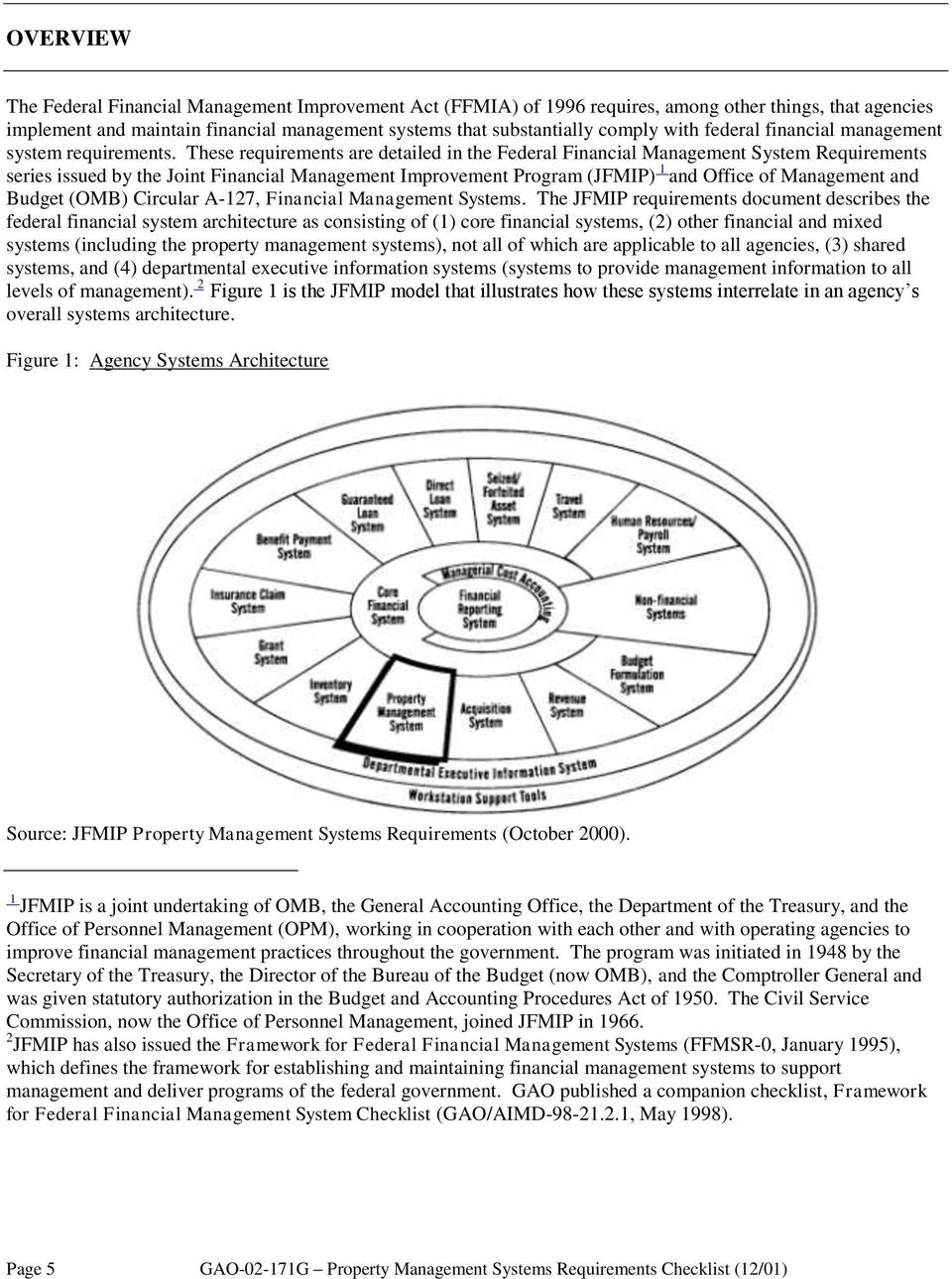
7 To date, JFMIP has issued 10 of the 15 functional requirements shown in figure 1. 3 We are issuing this checklist which reflects JFMIP s first issuance of the Property Management Systems Requirements (JFMIP-SR-00-4, October 2000) to assist (1) agencies in implementing and monitoring their property management systems and (2) managers and auditors in reviewing agency property management systems to determine if they substantially comply with FFMIA. This checklist is not a requirement. However, it is provided as a tool for use by experienced staff. This checklist; the JFMIP source document; OMB Circular A-127, Financial Management Systems; and OMB s Revised Implementation Guidance for the Federal Financial Management Improvement Act (FFMIA) of 1996, issued January 4, 2001, should be used concurrently. Staff members who use this tool must apply experienced judgment in its interpretation and application. They must consider the impact of the completed checklist on the entire property management system and whether the system, as a whole, substantially complies with requirements. Authoritative Guidance The basis for assessing compliance with the FFMIA requirements is provided by OMB Circular A-127 and OMB s implementation guidance, which agencies use in order to implement and maintain financial management systems that comply substantially with federal requirements. The implementation guidance identifies various criteria that an agency must meet to substantially comply with these requirements. One of the criteria listed in the OMB guidance is the JFMIP system requirements series. The source of all the questions in this checklist is the JFMIP Property Management Systems Requirements (JFMIP- SR-00-04, October 2000), which addresses requirements for property management systems. The JFMIP document acknowledges that property management system functionality does not necessarily reside in a single software application or functional system. In fact, property information may reside in or may be calculated in a number of applications or systems. The property management systems described in the JFMIP document may comprise all these applications and/or systems, their interfaces, and the processes required to manage property. It should be noted that the checklist is based on the existing published JFMIP standards and that changes in laws, regulations, and standards and practices since the JFMIP standards were issued are not included in the checklist. The JFMIP document segregates functional requirements into two general categories mandatory and valueadded. The mandatory requirements describe what the system must do. They consist of the minimum acceptable functionality necessary to establish a system and are based on federal laws, regulations, directives, or judicial decisions. Mandatory requirements are those against which agency heads evaluate their systems to determine substantial compliance with system requirements under FFMIA. These requirements apply to existing systems in operation and new systems planned or under development. 3 Thus far, the series includes the (1) Core Financial System Requirements, (2) Inventory System Requirements, (3) Seized Property and Forfeited Assets System Requirements, (4) Direct Loan System Requirements, (5) Guaranteed Loan System Requirements, (6) Travel System Requirements, (7) Human Resources & Payroll Systems Requirements, (8) System Requirements for Managerial Cost Accounting, (9) Grant Financial System Requirements, and (10) Property Management Systems Requirements. Page 6

8 The checklist uses (M) immediately following the question to indicate a mandatory system requirement. The value-added requirements describe optional features and may consist of any combination of the following: (1) using state-of-the-art technology, (2) employing the preferred or best business practices, or (3) meeting the special management needs of an individual agency. Agencies should consider value-added features when judging systems options. The need for these value-added features in agency systems is left to the discretion of each agency head. The checklist uses (V) ; immediately following the question to indicate that the item is value-added and not mandatory. How to Use This Checklist OMB s 2001 implementation guidance provides chief financial officers (CFO) and inspectors general with a means for determining whether their agencies financial management systems substantially comply with federal financial management system requirements. The annual reporting required by 31 U.S.C. 3512(d) is one means of assisting agencies in the determination of substantial compliance. Agencies can also use this checklist as a tool to help determine compliance with federal financial management system requirements. Completing this checklist will allow agencies to systematically determine whether specific systems requirements are being met. In determining substantial compliance, agencies should assess the results of the completed checklist based on the property management system requirements taken as a whole. The checklist contains three columns with the first citing the question. Use the second column to answer each question yes, ; no, or na. Use the third column to explain your answer. A yes answer should indicate that the agency s property management systems provide for the capability described in the question. For each yes answer, the third column should contain a brief description of how the property management systems satisfy that capability and should also refer to a source that explains or shows the capability. A no answer indicates that the capability does not exist. For a no answer, the third column should provide an explanation and, where applicable, a reference to any related supporting documentation (e.g., the agency is working on modifying or implementing its property management systems to have the capability available in subsequent years; management believes the capability is not cost effective and will not enhance the property management systems ability to manage operations). Cost-benefit studies or support for a no answer should be identified in the explanation column. If there are no cost-benefit studies or other support, a full explanation should be provided. No answers should not be viewed individually or taken out of context. Rather, no answers should be assessed as to their impact on the overall property management systems and the extent to which the no answers inhibit the entire property management systems from achieving compliance. Certain questions within the checklist may not be applicable to the agency. Answer such nonapplicable questions with na and provide an appropriate explanation in the third column. Page 7

9 PROPERT MANAGEMENT SSTEMS REQUIREMENTS The property management systems requirements document defines mandatory and value-added functional requirements for the three sections described below, which are (1) general requirements, (2) acquiring/receiving property, and (3) managing and accounting for property. Additionally, an interface requirements chapter provides information on input and output interfaces with the property management system. (There are no checklist questions drawn from pages 20 & 21 of the JFMIP source document.) 1. General requirements identify mandatory and value-added system functionalities that are common for all property management functions. In addition, there are functional requirements that apply to specific categories of property. (The checklist questions for this area are drawn from pages of the JFMIP source document.) 2. Acquiring/receiving property addresses initial physical control when property is delivered or real property is placed in service. Property is recognized as accounted for when title passes to the entity obtaining the property or when goods are delivered. Property may be purchased, leased, loaned, granted, transferred, constructed, or donated. The property management system may obtain information from the acquisition system when property is ordered. The property management system records receipt of property and the results of an initial physical inspection regarding the condition of property, whether from vendor, donated, transferred, or gained through discovery. (The checklist questions for this area are drawn from pages 14 &15 of the JFMIP source document.) 3. Managing and accounting for property. The managing property function captures and provides data to assist property managers and officials in managing property. The accounting-for-property function pertains to recording the acquisition cost of the property, or net book value/fair market value for donated or transferred items. (The checklist questions for this area are drawn from pages of the JFMIP source document.) The checklist questions follow the JFMIP source document. It should be noted that not all questions will apply in all situations and, as with the use of any checklist, professional judgment should be exercised. Using the JFMIP source document and its Appendix C: Glossary which defines terms used, along with OMB Circular A-127, Financial Management Systems, and OMB s Revised Implementation Guidance for the Federal Financial Management Improvement Act (FFMIA) of 1996, issued January 4, 2001, will help ensure that the user is cognizant of the background information necessary to fully understand the questions. Page 8
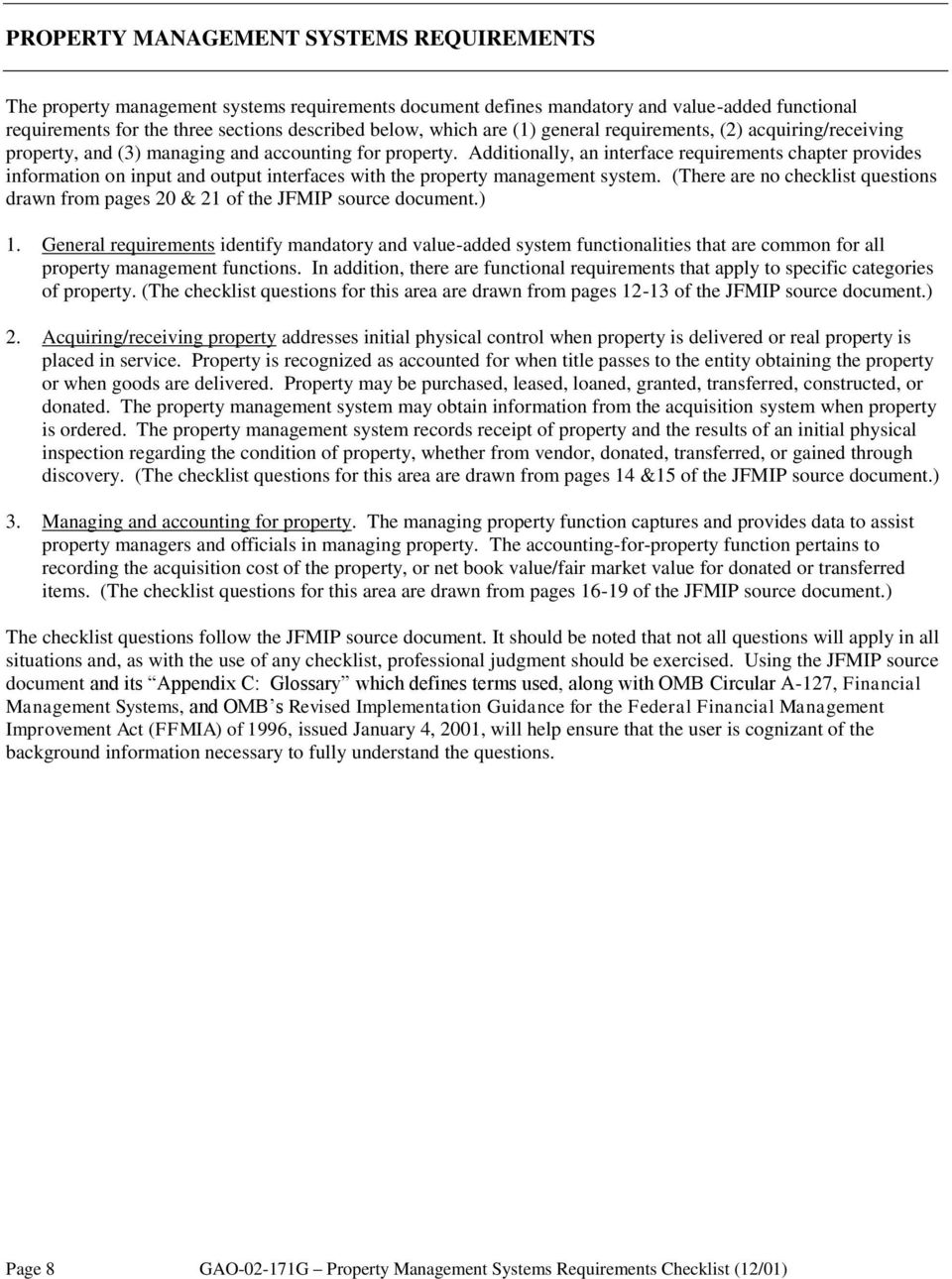
10 General Requirements 1. Does the property management system record-for all property management functions- beginning balances, acquisitions, and withdrawals, and does it calculate ending balances expressed in values and physical units, except for heritage assets and stewardship land, for which all end-of-period balances are expressed in physical units only? (M) 2. Does the property management system capture, for all property management functions, the condition of the asset for heritage assets; stewardship land; national defense property, plant and equipment (PP&E); and general PP&E for which a condition assessment survey was performed? (M) 3. Does the property management system provide edits (controls), for all property management functions, to prevent duplication and reduce the likelihood of creating erroneous property documents/records to ensure the integrity of data recorded in the system? (M) 4. Does the property management system permit, for all property management functions, only authorized users to enter, modify, or otherwise alter property records? (M) 5. Does the property management system provide, for all property management functions, an audit trail for entries to a property record, including the identification of the individual(s) entering or approving the information and/or data? (M) es/no The following DPAS functions support this requirement: Asset Receiving Accounting CFO Statement History The following DPAS data element supports this requirement: Condition Code The current DPAS system functions include edits and validation that will not allow duplication of a Stock Number/Serial Number combination or a duplicate Asset ID. Additionally each asset is required to have an Asset ID assigned. The DPAS system is CAC enabled for access as a user. Security users are not allowed access to property records and grant are responsible to allow users access in accordance with roles approved and assigned by the agency officials. The DPAS Asset Activity Inquiry provides an asset audit trail that includes the login Id of those individuals processing update actions. Page 9
11 General Requirements 6. Does the property management system identify, for all property management functions, the type of transaction affecting the property item, e.g., initial acquisition, change in location, and disposal? (M) 7. Does the property management system incorporate, for all property management functions, adequate security features that prevent unauthorized access to the property system by unauthorized individuals? (M) 8. Does the property management system enable, for all property management functions, the transfer of responsibility for property from one authorized manager to another authorized manager? (M) 9. Does the property management system capture, for all property management functions, real property information for the General Services Administration s (GSA) Worldwide Inventory system as directed in Federal Property Management Regulation (FPMR) (property management only)? (M) 10. Does the property management system produce, for all property management functions, reports in accordance with user-defined criteria? (M) es/no The DPAS Asset Activity Inquiry provides an asset audit trail that includes the Program Description to identify the action taken. A DPAS user must possess a valid and active CAC. In addition, each user account is built by role, restricting the user s functionality, and by level of access which determines the scope of information available to the user. The following DPAS functions support this requirement: Lateral Transfer UIC to UIC Site to Site Transfer Custodian to Custodian Transfer The only portions that deal with personal property management in FPMR relate to utilization and disposal which DPAS supports with the DAIS interface with DRMO. DPAS provides financial accounting for Real Property. The DPAS system has standard reports and forms for all functions within the system. The Data Inquiry module allows the users to build custom requests and reports. Page 10

12 General Requirements 11. Does the property management system capture, for all property management functions, the fact that an environmental or hazardous substance is located on or contained within a property item, in accordance with 41 Code of Federal Regulations (CFR) ? (M) 12. Does the property management system distinguish, for all property management functions, between capitalized property and expensed property tracked in the property management system? (M) 13. Does the property management system capture and prioritize the estimated cost of repairs? (V) 14. Does the property management system accumulate data from multiple appropriations? (V) 15. Does the property management system provide an on-line search capability based on user-defined parameters? (V) 16. Does the property management system provide the capability of interfacing online or through the Internet with other property management systems external to the agency to facilitate identification, location, or transfer of federal property governmentwide? (V) es/no N The following DPAS data elements identify Hazardous materials: Hazardous Material Code Special Control Item Code The DPAS system contains code that identifies and manages assets as Capitalized or Expensed property and maintains financial data in the Accounting tables. DPAS provides the capability to accumulate multiple appropriations with the following data elements: Appropriation Allotment Serial Number Fund Code DPAS provides a multitude of AD-Hoc queries that allows for the use of user-defined parameters in generating query results. The Data Inquiry module allows the users to build custom queries and reports. The DPAS system interfaces with the following systems that facilitate these requirements: UIT WAWF DAIS RPUID UII Page 11

13 General Requirements Specific categories Information technology es/no 17. Because information technology assets are personal property, the property management system may already capture the data required to account for these assets. However, does the property management system also capture (1) information essential to ensuring that software and software licenses are controlled and (2) information driven by contractual licenses and agreements with software developers, vendors, or software licensers? (V) Specific categories Government property in the custody of others Note: There are no checklist questions drawn from this section of the JFMIP source document (p. 13). Utilizing the functionality within the DPAS Catalog and Asset Receipt modules, users have the capability to manage software and software licenses as described in item 17 (1) and (2). The Component to end Item relationship, Agency Defined Fields and System ID aspects of the DPAS application can be utilized to accommodate this requirement. NOTES FOR GFE? This Document was created in Dec At that point the contractor s records were the official records for government property in the possession of contractors. In 2007, the Federal Acquisition Regulation and DoDI changed the requirement for the governments Accountable Property System of Record (APSR) to contain the official records. DPAS has all the required functionality to manage GFP including Contractor information, Contract information and all required asset information associated with the accountable GFP contract. These assts are coded with a Loan Cd of G in DPAS. Specific categories - National defense PP&E DPAS also tracks assets Loaned to other Government activities with all associated asset information. These assets are coded in DPAS as loan cd of M. Note: There are no checklist questions drawn from this section of the JFMIP source document (p. 13). Page 12

14 Acquiring/Receiving Property 1. Does the property management system create a skeletal property record or have any other mechanism for capturing information on property in-transit from the providing entity (e.g., vendor, donator, loaner, and grantor)? The skeletal property record or other mechanism is required only for property for which the government has taken title. For example, the skeletal property record or other mechanism may identify the following on newly acquired property: name and address of the shipper/vendor; estimated date of delivery; shipping address ("ship to" address); item identification (e.g., nomenclature, quantity, description, year of manufacture, make/model/ serial number, federal stock classification or national stock number); requisition information (e.g., contract/purchase order or other requisition document number, name and address of requisitioning organization); and Order date. (M) 2. Does the property management system complete the skeletal property record or create a property record for items with no skeletal property record, upon the agency's assuming possession of the item, placing the real property asset in service, or initiation of a real estate instrument/grant? (M) es/no The DPAS system provides the capability to identify an asset as Inbound or Outbound by assigning the appropriate Intransit Code in the Asset Receipt module. In addition, the following DPAS functions allow for tracking of information identified: Catalog Wide Area Workflow (WAWF) By storing the Contract Number or CAGE code (or both) in Asset Receiving, the shipper/vendor information can easily be obtained. The DPAS system provides this capability with the following processes: Accounting Module CIP/WIP Accounting Module Real Property Actions Page 13

15 Acquiring/Receiving Property 3. Does the property management system capture the method of acquiring each property item or bulk property items (e.g., direct purchase, completed workin-process, capital lease, donation, nonreciprocal transfer, or reciprocal transfer) and the date of acquisition? (M) 4. Does the property management system capture quantity, date of physical receipt or date real property is available for use or placed into service, and condition of item received when a condition assessment was made? (M) 5. Does the property management system forward physical receipt information, including quantity and date of physical receipt, to the acquisition system and the core financial system? 4 (M) 6. Does the property management system interface electronically with GSA's Worldwide Inventory? (V) 7. Does the property management system provide information on the status of upgrades and overhauls to property? (V) 8. Does the property management system aggregate relatively homogenous assets into asset pools? All assets in the asset pools have the same estimated useful life, and the acquisition cost of each item in the asset pool would be the average cost of all items in the pool. However, each item in the asset pool must have a separate property record and a separate agency-unique identification number. (V) es/no The DPAS system captures the method of acquisition with the assignment of the appropriate Action Code. The DPAS Accounting Module provides these functions. The DPAS system interfaces with the Wide Area Workflow (WAWF) The DPAS system generates and forwards an X819 (Capitalization of Purchased Assets) and an X815 (Transfer In of a Capital Asset) transaction to the core financial system. DPAS provides financial accounting for Real Property. DPAS provides the capability to track Improvement Costs in the Accounting Module and track overhauls in the Maintenance & Utilization Module. DPAS provides this capability through the following processes: Catalog Asset Receipt System ID Inquiries and Reports 4 The property management system should be capable of interfacing with other financial and/or mixed systems. However, interface requirements and systems architecture necessary to meet management and reporting requirements are determined by each agency. The Interface Requirements section of the JFMIP source document contains more information. Page 14

16 Acquiring/Receiving Property 9. Does the property management system capture warranty/ guarantee information, including terms and period of coverage? (V) es/no DPAS provides this capability through the Asset Receipt Module. Page 15
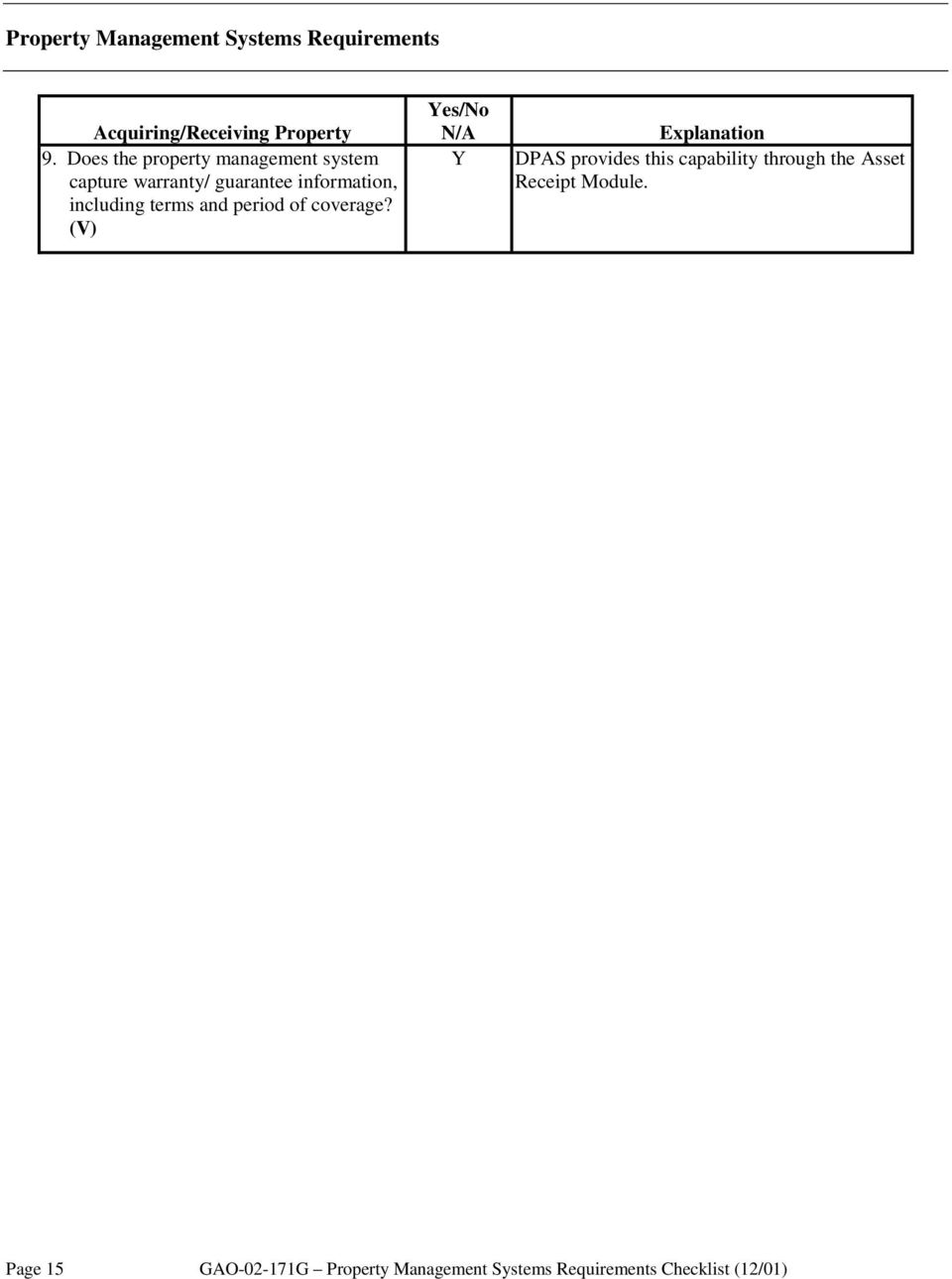
17 Managing and Accounting for Property Acquisition of property; Changes in asset values es/no 1. Does the property management system, for capitalized property and stewardship assets, classify PP&E by asset type (e.g., general, heritage, stewardship land, national defense)? (M) 2. Does the property management system, for capitalized property and stewardship assets, distinguish between heritage assets and multi-use heritage assets? (M) 3. Does the property management system, for capitalized property and stewardship assets, capture changes in quantities, including unit of measure, where applicable, for beginning balance adjustments, additions, and deletions and does it compute ending balances by asset category? (M) 4. Does the property management system, for capitalized property and stewardship assets, provide an audit trail for all adjustments to quantities and units? (M) 5. Does the property management system, for capitalized property and stewardship assets, capture the acquisition cost of an asset and any changes in the valuation, where applicable for reporting purposes? (M) 6. Does the property management system, for capitalized property only, capture the estimated value of donated assets? (M) DPAS distinguishes between these classifications with the following codes: Type Asset Code Asset Code DPAS identifies Heritage Assets with the assignment of the appropriate Asset Code. DPAS captures these changes in the Asset Activity Inquiry and the CFO Statement. DPAS captures these adjustments in the Asset Activity Inquiry. DPAS captures these costs in the following processes: Asset Management Receiving Module Asset Management Update Module Accounting Module These costs are captured in the following processes: Asset Management Receiving Module Asset Management Update Module Accounting Module Page 16
18 Managing and Accounting for Property 7. Does the property management system, for capitalized property only, provide an audit trail for all adjustments to property values? (M) 8. Does the property management system, for capitalized property only, classify PP&E according to the Standard General Ledger accounts (e.g., buildings, land, equipment, assets under capital lease, software)? (M) 9. Does the property management system, for capitalized property only, generate data for the journal entries necessary for recording changes in the valuation, including any associated gains or losses? (M) Depreciation, amortization, or depletion of capitalized assets es/no DPAS provides an audit trail for these adjustments in the Asset Activity Inquiry. DPAS complies with the DoD Standard General Ledger accounts. DPAS generates the required financial transactions for the journal entries through the Accounting Module. 10. Does the property management system capture the estimated useful life, depreciation/ amortization/depletion method, and salvage/residual value for each asset or group of assets, when applicable? (M) 11. Does the property management system calculate depreciation/amortization/ depletion based on a management-prescribed method (e.g., straight line, physical usage) and the net book value of capitalized assets? (M) DPAS captures this information in the following processes: Catalog Module Accounting Module DPAS utilizes the Straight Line method to calculate depreciation. Page 17

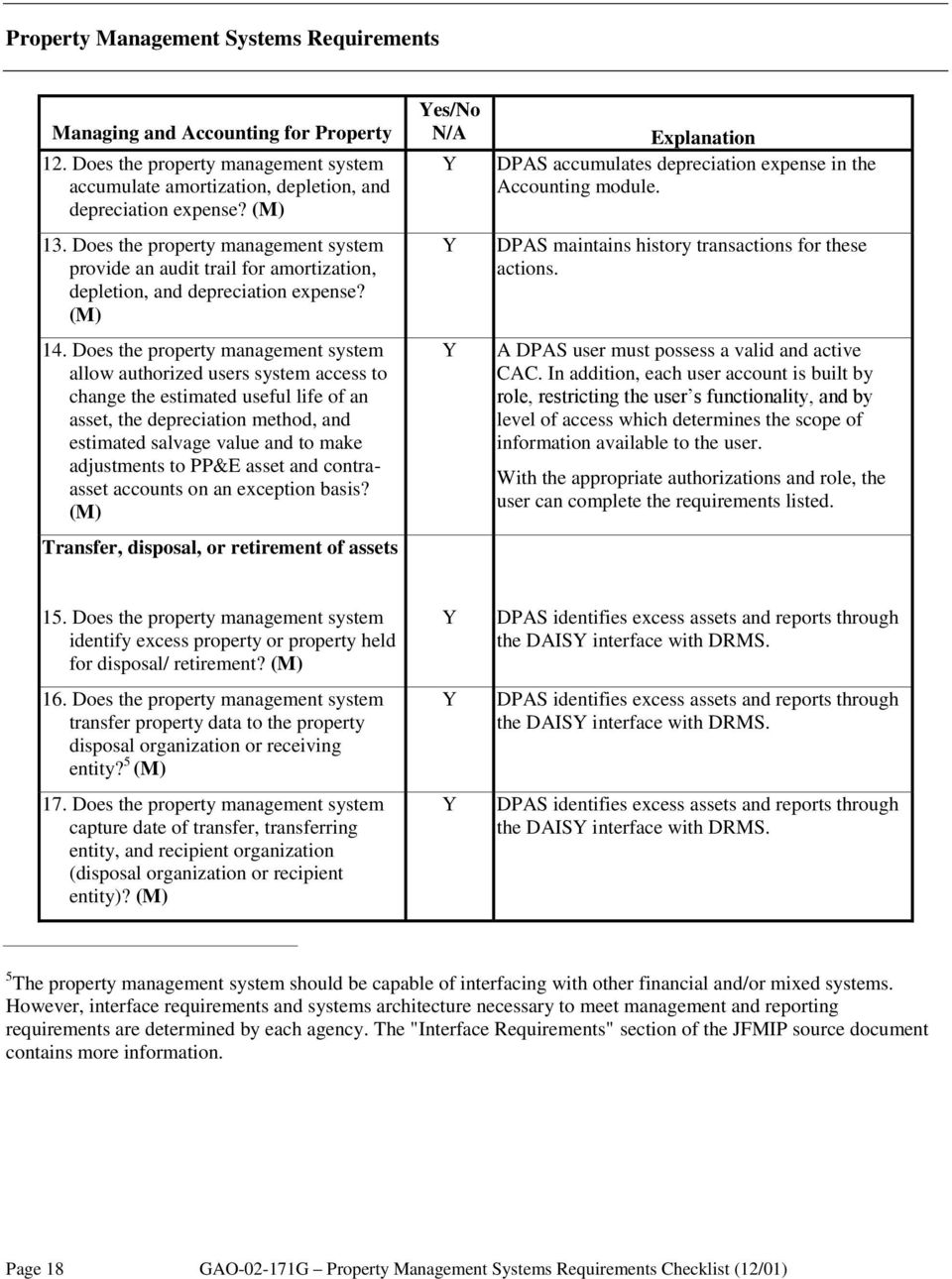
19 Managing and Accounting for Property 12. Does the property management system accumulate amortization, depletion, and depreciation expense? (M) 13. Does the property management system provide an audit trail for amortization, depletion, and depreciation expense? (M) 14. Does the property management system allow authorized users system access to change the estimated useful life of an asset, the depreciation method, and estimated salvage value and to make adjustments to PP&E asset and contraasset accounts on an exception basis? (M) Transfer, disposal, or retirement of assets es/no DPAS accumulates depreciation expense in the Accounting module. DPAS maintains history transactions for these actions. A DPAS user must possess a valid and active CAC. In addition, each user account is built by role, restricting the user s functionality, and by level of access which determines the scope of information available to the user. With the appropriate authorizations and role, the user can complete the requirements listed. 15. Does the property management system identify excess property or property held for disposal/ retirement? (M) 16. Does the property management system transfer property data to the property disposal organization or receiving entity? 5 (M) 17. Does the property management system capture date of transfer, transferring entity, and recipient organization (disposal organization or recipient entity)? (M) DPAS identifies excess assets and reports through the DAIS interface with DRMS. DPAS identifies excess assets and reports through the DAIS interface with DRMS. DPAS identifies excess assets and reports through the DAIS interface with DRMS. 5 The property management system should be capable of interfacing with other financial and/or mixed systems. However, interface requirements and systems architecture necessary to meet management and reporting requirements are determined by each agency. The "Interface Requirements" section of the JFMIP source document contains more information. Page 18
20 Managing and Accounting for Property 18. Does the property management system capture all essential information related to excess property and disposal as required by Federal Management Regulation (FMR) for applicable agencies? (M) 19. Does the property management system capture type of disposal action (e.g., retirement, exchange, sale, and donation), final disposition, and date of disposal? (M) 20. Does the property management system capture property retirement or disposal status? (M) 21. Does the property management system capture deletions? (M) 22. Does the property management system calculate gain or loss at time of disposal or retirement, sale, exchange, or donation? (M) 23. Does the property management system transfer the asset's acquisition cost, accumulated depreciation/amortization, and the amount of gain or loss to the core financial system at the time of asset transfer, disposal, or retirement? (M) 24. Does the property management system maintain an audit trail of transfer, disposal, and retirement actions? (M) es/no DPAS identifies excess assets and reports through the DAIS interface with DRMS. DPAS captures this information through the Document Register function of the system. DPAS captures this information through the DAIS interface with DRMS. DPAS captures deletions in the History table. DPAS generates the appropriate financial transaction for these type actions. DPAS transfers this information to the core financial system via the appropriate accounting interface. DPAS provides an audit trail of this information in the Asset Activity Inquiry. Page 19

21 Managing and Accounting for Property Deferred maintenance and condition es/no 25. Does the property management system capture management's estimate of deferred maintenance? This may be accomplished through a process or system other than the property system. (M) 26. Does the property management system capture management's assessment of property condition? This may be accomplished through a process or system other than the property system. (M) 27. Does the property management system capture the fact that an environmental or hazardous substance is located on or contained within a property item, in accordance with 41 CFR ? (M) Clean-up costs N DPAS does not track maintenance. The sites have other systems that capture this data. DPAS captures management s assessment with the assignment of the proper Condition Code. The following DPAS data elements identify Hazardous materials: Hazardous Material Code Special Control Item Code 28. Does the property management system capture the total estimated clean-up cost when the item is placed in service if the PP&E meets the criteria established in paragraph 88 of Statement of Federal Financial Accounting Standards (SFFAS) No. 6, Accounting for Property, Plant, and Equipment? This may be accomplished through a process or system other than the property system. (M) 29. Does the property management system capture environmental liabilities associated with PP&E when an event has occurred and the liability is probable and estimable? (See Federal Accounting Standards Advisory Board s (FASAB) Technical Release 2, Environmental Liabilities Guidance (March 1998)). This may be accomplished through a process or system other than the property system. (M) N N DPAS does not capture clean-up costs. DPAS does not capture Deferred Maintenance or Clean-up Costs. Page 20
22 Managing and Accounting for Property 30. Does the property management system, for general PP&E, calculate the annual amortization of estimated material, clean-up costs, and the unamortized balance? (M) Property accountability es/no N DPAS does not calculate these costs. 31. Does the property management system capture property identification number, which may be the item's serial number? (M) 32. Does the property management system capture location? (M) 33. Does the property management system capture an item's current ownership status (e.g., owned by the government, leased to the government under a capital lease, leased to the government under an operating lease, loaned to the government)? (M) 34. Does the property management system capture the current user (e.g., the agency, contractor, and grantee)? (M) DPAS has the capability to capture and store multiple identification numbers to include: Asset ID, Mfr Serial Number, Serial Number (e.g. Vehicle Registration Number), Accounting Reporting Number (accounting control number for capital assets) and UID. DPAS captures asset location in the Asset Management Receipt and Update modules. DPAS captures an item s current ownership in the Asset Management Receipt and Update modules. DPAS captures the current user in the Asset Management Receipt and Update modules. Page 21
23 Managing and Accounting for Property 35. Does the property management system capture an item's current use status whether in use, in storage, in transit, etc.? (M) 36. Does the property management system capture the identity of the property custodian and/or the accountable organization? (M) 37. Does the property management system capture in-transit information to establish/maintain accountability and control over government property (e.g., name and address of the shipper/vendor, estimated date of delivery, shipping address, item identification, source information)? (M) Property record maintenance es/no DPAS captures an item s current status in the Asset Management Receipt and Update modules. DPAS identifies the property custodian and identifies the accountable organization as a UIC. DPAS captures this information in the Asset Receiving module. 38. Does the property management system provide the capability of electronically transferring property records between interfacing systems for the gaining and losing property custodians within the agency? (V) 39. Does the property management system provide analytic tools for supporting analysis and evaluation of annual maintenance status, needs, and costs for effective program planning and budgeting? (V) 40. Does the property management system capture property maintenance, upgrade, and overhaul schedules? (V) N N The following DPAS functions support this requirement: Lateral Transfer UIC to UIC Site to Site Transfer Custodian to Custodian Transfer DPAS does not provide this capability. DPAS does not provide this capability. Page 22
24 Managing and Accounting for Property 41. Does the property management system capture actual maintenance, upgrade, and overhaul data? (V) 42. Does the property management system capture space utilization information? (V) 43. Does the property management system support the use of barcode scanners? (V) 44. Does the property management system record the stratification of critical and noncritical maintenance? (V) 45. Does the property management system record detailed information regarding known flood hazard or flooding of real property? (V) Acquisition of property; changes in asset value es/no N N DPAS does not provide this capability. DPAS captures space utilization in the Accounting module/real Property functions. DPAS supports Intermec barcode scanner technology. DPAS does not provide this capability. DPAS is not the official holder of Real Property. DPAS only performs the accounting functions for Real Property. 46. Does the property management system calculate and allocate interest expense for lease payments and apply the balance to reduce capital lease liability? (V) 47. Does the property management system identify the type of cost recorded (e.g., acquisition cost, estimated fair market value, revaluation, present value)? (V) 48. Does the property management system capture the acquisition cost of individual items acquired through bulk purchase, when required by agency policy? (V) N DPAS does not perform this function and most likely this would be performed by the accounting system DPAS captures these costs in the Asset Management Receipt and Update modules. DPAS captures these costs in the Asset Management Receipt and Update modules. Page 23
25 Managing and Accounting for Property 49. Does the property management system capture the cost of capitalizable improvements separate from the original cost, the estimated change in the asset's life as a result of the improvement, and the date of improvement? (V) Depreciation, amortization, or depletion of capitalized assets es/no DPAS captures this information in the Accounting module/improvement Costs. 50. Does the property management system calculate depreciation on asset pools? (V) 51. Does the property management system separately calculate depreciation on capital improvements? (V) Deferred maintenance and condition N DPAS accounts for and reports each asset and each improvement separately, thus there is no need to perform asset pooling or depreciation using the pooling method. DPAS calculates depreciation on capital improvements on separate schedules. 52. Does the property management system provide the capability of forecasting or scheduling maintenance requirements for future periods? (V) Transfer, disposal, or retirement of assets N DPAS does not provide this capability. 53. Does the property management system capture estimated cost to demolish property or otherwise dispose of property? (V) N DPAS does not capture these costs. Page 24
26 Interface Requirements Note: There are no checklist questions drawn from this section of the JFMIP source document (pp ). (See Footnotes 4 and 5.) es/no (193021) Page 25
27 Related Products These related products address three main categories: internal control, financial management systems, and financial reporting (accounting standards). We have developed these guidelines and tools to assist agencies in improving or maintaining effective operations and financial management. Internal Control Standards for Internal Control in the Federal Government, GAO/AIMD , November Determining Performance and Accountability Challenges and High Risks, GAO SP, November Streamlining the Payment Process While Maintaining Effective Internal Control, GAO/AIMD , May Internal Control Management and Evaluation Tool, GAO G, August Financial Management Systems Framework for Federal Financial Management System Checklist, GAO/AIMD , May System Requirements for Managerial Cost Accounting Checklist, GAO/AIMD , January Human Resources and Payroll Systems Requirements Checklist, GAO/AIMD , March Travel System Requirements Checklist, GAO/AIMD , May Guaranteed Loan System Requirements Checklist, GAO G, March Inventory System Checklist, GAO/AIMD , May Core Financial System Requirements Checklist, GAO/AIMD , February Direct Loan System Requirements Checklist, GAO/AIMD , April Seized Property and Forfeited Assets Requirements Checklist, GAO-01-99G, October Grant Financial System Requirements Checklist, GAO G, September Financial Reporting (Accounting Standards) Checklist for Reports Prepared Under the CFO Act, (Section 1004 of the GPO/PCIE Financial Audit Manual, July 2001). This is a checklist containing agency financial statement reporting requirements. These documents are available on the Internet on GAO's Home Page ( / under the heading Other Publications and the subheading Accounting and Financial Management. They can also be obtained from GAO, 700 4th Street NW, Room 1100, Washington, DC 20548, or by calling (202) or TDD (202) Page 26
Federal Financial Management System Requirements. Property Management Systems Requirements
 Federal Financial Management System Requirements Property Management Systems Requirements JFMIP-SR-00-4 October 2000 What is JFMIP? The Joint Financial Management Improvement Program (JFMIP) is a joint
GAO. Inventory System Checklist Systems Reviewed Under the Federal Financial Management Improvement Act of 1996. Financial Management Series
 GAO United States General Accounting Office Financial Management Series May 1998 Inventory System Checklist Systems Reviewed Under the Federal Financial Management Improvement Act of 1996 GAO/AIMD-98-21.2.4
VOLUME 3 - Property, Plant and Equipment
 Defense Finance and Accounting Service DFAS 7900.4 M Financial Management Systems Requirements Manual Volume 3, Property, Plant and September 2013 Strategy, Policy and Requirements SUBJECT: Description
GAO ACCOUNTING PRINCIPLES, STANDARDS, AND REQUIREMENTS. Title 2 Standards Not Superceded by FASAB Issuances. United States General Accounting Office
 GAO United States General Accounting Office November 2001 ACCOUNTING PRINCIPLES, STANDARDS, AND REQUIREMENTS Title 2 Standards Not Superceded by FASAB Issuances GAO-02-248G PREFACE November 2001 Before
Records Retention Timeframes for Property, Plant, & Equipment Research Report
 Accounting and Auditing Policy Committee Records Retention Timeframes for Property, Plant, & Equipment Research Report NOTE: This research report was prepared by the Records Retention Subgroup of the AAPC
AUDIT OF SBA S COMPLIANCE WITH JOINT FINANCIAL MANAGEMENT IMPROVEMENT PROGRAM PROPERTY MANAGEMENT SYSTEM REQUIREMENTS AUDIT REPORT NUMBER 3-34
 AUDIT OF SBA S COMPLIANCE WITH JOINT FINANCIAL MANAGEMENT IMPROVEMENT PROGRAM PROPERTY MANAGEMENT SYSTEM REQUIREMENTS AUDIT REPORT NUMBER 3-34 JULY 23, 2003 This report may contain proprietary information
CHAPTER 3 FINANCIAL MANAGEMENT SYSTEMS: POLICY, ROLES AND RESPONSIBILITIES FOR CONFORMANCE, EVALUATION, AND REPORTING
 CHAPTER 3 FINANCIAL MANAGEMENT SYSTEMS: POLICY, ROLES AND RESPONSIBILITIES FOR CONFORMANCE, EVALUATION, AND REPORTING 0301. GENERAL. By statute the head of a Federal agency is responsible for establishing
GAO CORE FINANCIAL SYSTEM REQUIREMENTS. Checklist for Reviewing Systems under the Federal Financial Management Improvement Act
 GAO United States Government Accountability Office Financial Management Series February 2005 CORE FINANCIAL SYSTEM REQUIREMENTS Checklist f Reviewing Systems under the Federal Financial Management Improvement
DoD Business Process Reengineering CONSTRUCTION IN PROGRESS REQUIREMENTS DOCUMENT
 DoD Business Process Reengineering CONSTRUCTION IN PROGRESS REQUIREMENTS DOCUMENT Office of the Deputy Undersecretary of Defense (Installations & Environment) Business Enterprise Integration Directorate
GENERAL RECORDS SCHEDULE 1.1: Financial Management and Reporting Records
 GENERAL RECORDS SCHEDULE 1.1: Financial Management and Reporting Records This schedule covers records created by Federal agencies in carrying out the work of financial management: procuring goods and services,
MS 711 ACCOUNTING FOR PROPERTY, PLANT, AND EQUIPMENT
 MS 711 ACCOUNTING FOR PROPERTY, PLANT, AND EQUIPMENT New Manual Section Responsible Office: OCFO Effective Date: March 29, 2007 Table of Contents Issuance Memo Attachments TABLE OF CONTENTS 1.0 Authorities
NGA Instruction for Determining Property Accountability. a. Primary. NGA PD 4000R2, Policy Directive for Logistics, 24 November 2003.
 NI 4160.1R3 Approved: 1 October 2004 Subgroup: Personal and Military Property 1. References. NGA Instruction for a. Primary. NGA PD 4000R2, Policy Directive for Logistics, 24 November 2003. b. Secondary.
How To Account For P&E
 Accounting for property, plant, and equipment Federal Financial Accounting Standards no. 6 ************************************************** Federal Accounting Standards Advisory Board (FASAB) ACCOUNTING
Revised Federal Financial Management System Requirements for Fiscal 2014 Reporting
 Chapter 9500 Revised Federal Financial Management System Requirements for Fiscal 2014 Reporting This chapter notifies agencies of the revised Federal Financial Management System Requirements. It rescinds
Statement #4/Managerial Cost Accounting Concepts and Standards for the Federal Government
 Statement #4/Managerial Cost Accounting Concepts and Standards for the Federal Government Executive Office of the President Office of Management and Budget "Managerial Cost Accounting Concepts and Standards
0101 OVERVIEW... 2 0102 POLICIES... 3 0103 AUTHORITY AND REFERENCES... 4 0104 ROLES AND RESPONSIBILITIES... 4 0105 PROCEDURES... 5
 VA Financial Policies and Procedures Recognition and Accounting for Assets CHAPTER 1 0101 OVERVIEW... 2 0102 POLICIES... 3 0103 AUTHORITY AND REFERENCES... 4 0104 ROLES AND RESPONSIBILITIES... 4 0105 PROCEDURES...
Department of Defense INSTRUCTION. Accountability and Management of DoD Equipment and Other Accountable Property
 Department of Defense INSTRUCTION NUMBER 5000.64 May 19, 2011 USD(AT&L) SUBJECT: Accountability and Management of DoD Equipment and Other Accountable Property References: See Enclosure 1 1. PURPOSE. This
Federal Financial Management System Requirements. Core Financial System Requirements
 Federal Financial Management System Requirements Core Financial System Requirements JFMIP-SR-02-01 November 2001 What is JFMIP? The Joint Financial Management Improvement Program (JFMIP) is a joint undertaking
U.S. DEPARTMENT OF TRANSPORTATION 4600.27B
 U.S. DEPARTMENT OF TRANSPORTATION 4600.27B CHANGE FEDERAL AVIATION ADMINISTRATION CHG1 Effective Date: National Policy 05/01/13 SUB J: Personal Property Management 1. Purpose. The purpose of this change
Federal Financial Management System Requirements Background and Purpose Organization and Content
 Background and Purpose Federal Financial Management System Requirements This revision of the Federal Financial Management System 1 Requirements implements the Office of Management and Budget (OMB) and
Washington Headquarters Services ADMINISTRATIVE INSTRUCTION
 Washington Headquarters Services ADMINISTRATIVE INSTRUCTION NUMBER 94 October 19, 2007 Incorporating Change 1, February 19, 2008 DFD SUBJECT: Personal Property Management and Accountability References:
United States Chemical Safety and Hazard Investigation Board
 United States Chemical Safety and Hazard Investigation Board Audit of Financial Statements As of and for the Years Ended September 30, 2005 and 2004 Submitted By Leon Snead & Company, P.C. Certified Public
Property and Equipment Accountability and Management Best Practice Discussion
 Property and Equipment Accountability and Management Best Practice Discussion Name: Office: Date: OUSD, (AT&L) P&E Policy Version 3.0 Why We Are Here The Department of Defense (DoD) is looking at departmental
PINAL COUNTY POLICY AND PROCEDURE 8.8. Replaces Policy Dated: January 12, 1981, and subsequent revisions to date
 PINAL COUNTY POLICY AND PROCEDURE 8.8 Subject: CAPITAL ASSETS Date: Effective as of July 1, 2009 Pages: 1 of 6 Replaces Policy Dated: January 12, 1981, and subsequent revisions to date Purpose: The purpose
Significant Revisions to OMB Circular A-127. Section Revision to A-127 Purpose of Revision Section 1. Purpose
 Significant Revisions to OMB Circular A-127 Section Revision to A-127 Purpose of Revision Section 1. Purpose Section 5. Definitions Section 6. Policy Section 7. Service Provider Requirements Section 8.
Agriculture Financial Standards Manual
 AGRICULTURE FINANCIAL STANDARDS MANUAL Office of the Chief Financial Officer Credit, Travel, and Accounting Policy Division Revised May 2004 I Summary of Changes Section Date Item Changed Change Authoritative
Corporate Property Automated Information System CPAIS. Privacy Impact Assessment
 Corporate Property Automated Information System CPAIS Privacy Impact Assessment May 2003 CONTENTS Background...3 Access to the Data...5 Maintenance of Administrative Controls...9 1 Introduction The Office
ADS Chapter 629. Accounting for USAID-Owned Property and Internal Use Software
 Accounting for USAID-Owned Property and Internal Use Software Document Quality Check Date: 03/27/2013 Partial Revision Date: 11/25/2011 Responsible Office: M/CFO/FPS File Name: 629_032713 Functional Series
Uniform Accounting Network Inventory Manual. Table of Contents. Warranty Maintenance Debt Management Depreciation Disposal
 Inventory Manual Uniform Accounting Network Inventory Manual Table of Contents Introduction Parts of the Manual Part 1 Assets Chapter 1 Acquisition Warranty Maintenance Debt Management Depreciation Disposal
FEDERAL PROPERTY MANAGEMENT PROCEDURE GUIDE
 FEDERAL PROPERTY MANAGEMENT PROCEDURE GUIDE Purpose The Federal Property Management Procedure Guide provides basic procedures for the management of federal property under North Dakota State University
DoD Financial Management Regulation Volume 4, Chapter 6 July 2006
 SUMMARY OF MAJOR CHANGES TO DOD 7000.14-R, VOLUME 4, CHAPTER 6 PROPERTY, PLANT, AND EQUIPMENT Substantive revisions are denoted by a preceding the section, paragraph, table, or figure that includes revision
NASA Financial Management Requirements Volume 20, Chapter 6 Effective: September 2008 Expiration: September 2013 CHAPTER 6.
 CHAPTER 6. CAPITAL LEASES TABLE OF CONTENTS 6.1 OVERVIEW...6-1 6.2 AUTHORITIES AND REFERENCES...6-1 6.3 ROLES AND RESPONSIBILITIES....6-1 6.4 DEFINITIONS....6-1 6.5 IDENTIFICATION...6-2 6.6 CAPITALIZATION
Accounting for Impairment of General Property, Plant, and Equipment Remaining in Use. Statement of Federal Financial Accounting Standards 44
 Federal Accounting Standards Advisory Board Accounting for Impairment of General Property, Plant, and Equipment Remaining in Use Statement of Federal Financial Accounting Standards 44 January 3, 2013 THE
DEPARTMENT OF DEFENSE FINANCIAL MANAGEMENT REGULATION VOLUME 11A: REIMBURSABLE OPERATIONS POLICY UNDER SECRETARY OF DEFENSE (COMPTROLLER)
 DoD 7000.14 - R DEPARTMENT OF DEFENSE FINANCIAL MANAGEMENT REGULATION VOLUME 11A: REIMBURSABLE OPERATIONS POLICY UNDER SECRETARY OF DEFENSE (COMPTROLLER) DoD 7000.14-R Financial Management Regulation Volume
VOLUME 1, CHAPTER 3: FEDERAL FINANCIAL MANAGEMENT IMPROVEMENT ACT OF 1996 COMPLIANCE, EVALUATION, AND REPORTING SUMMARY OF MAJOR CHANGES
 VOLUME 1, CHAPTER 3: FEDERAL FINANCIAL MANAGEMENT IMPROVEMENT ACT OF 1996 COMPLIANCE, EVALUATION, AND REPORTING SUMMARY OF MAJOR CHANGES All changes are denoted by blue font. Substantive revisions are
Fixed Assets. Depreciation tables may be created for methods not already included with the package.
 Fixed Assets Solution-IV Fixed Assets is designed to help you manage your assets and calculate depreciation. You may have as many depreciation calculations on an asset as required for your business. Different
MARQUETTE UNIVERSITY Office of the Comptroller Capitalization, Inventory, Depreciation and Retirement of Property, Buildings, and Equipment
 MARQUETTE UNIVERSITY Office of the Comptroller Capitalization, Inventory, Depreciation and Retirement of Property, Buildings, and Equipment Direct all inquiries to: Comptroller s Office 288-0833 Effective
CHAPTER 53 COST ACCOUNTING STANDARDS
 CHAPTER 53 COST ACCOUNTING STANDARDS A. REQUIREMENTS 0F COST ACCOUNTING SYSTEMS 1. The Defense Business Operations Fund shall have a cost estimating and cost accounting system or, as needed, systems specifically
FASAB ----------------- Federal Accounting Standards Advisory Board
 ----------------- FASAB ----------------- Accounting for Internal Use Software Statement of Federal Financial Accounting Standards Number 10 THE FEDERAL ACCOUNTING STANDARDS ADVISORY BOARD The (FASAB,
Statement of Federal Financial Accounting Standards 10: Accounting for Internal Use Software
 Statement of Federal Financial Accounting Standards 10: Accounting for Internal Use Software Status Issued October 9, 1998 Effective Date For periods beginning after September 30, 2000 Interpretations
Asset management policy
 Asset management policy POL-C-002 Version 3.1 26 February 2007 Contents 1. Title... 3 2. Introduction... 3 3. Scope... 3 4. Principles and guidelines... 3 5. Definition of responsibilities... 10 6. References...
Report No. D-2009-089 June 18, 2009. Internal Controls Over Government Property in the Possession of Contractors at Two Army Locations
 Report No. D-2009-089 June 18, 2009 Internal Controls Over Government Property in the Possession of Contractors at Two Army Locations Additional Information and Copies To obtain additional copies of this
DoD Financial Management Regulation Volume 4, Chapter 6 + August 2000 CHAPTER 6 PROPERTY, PLANT AND EQUIPMENT
 0601 GENERAL CHAPTER 6 PROPERTY, PLANT AND EQUIPMENT 060101. Purpose. This Chapter prescribes the accounting standards and policy for Department of Defense (DoD) property, plant and equipment (PP&E). The
Audit Program for Fixed Assets
 Form AP 35 Index Audit Program for Fixed Assets Legal Company Name Client: Balance Sheet Date: Instructions: The auditor should refer to the audit planning documentation to gain an understanding of the
Maintenance of Assets Records and Internal Audit
 To all Secretaries to Ministries and Heads of Departments, Maintenance of Assets Records and Internal Audit 1. Safeguarding Public Assets is one of the primary responsibilities of the Chief Accounting
ACCOUNTING RECORDS AND SOURCE DOCUMENTATION
 ACCOUNTING RECORDS AND SOURCE DOCUMENTATION May 1994 Introduction Criteria for Accounting Documents and Records Accounting Procedures Manual Chart of Accounts Nine Principles Governing Accounting Records
Fixed Asset Inventory
 Fixed Asset Inventory The purpose of the district-wide fixed asset inventory system is to gather information for the preparation of financial statements, including estimated annual depreciation costs of
DFARS Procedures, Guidance, and Information
 PGI 245.1 - GENERAL PGI 245.102-70 Policy. (Added July 23, 2010) (1) A basic principle of the Federal Acquisition Regulations System is that, upon contract award, contractors bring all the necessary organization,
GAO. The Chief Financial Officers Act A Mandate for Federal Financial Management Reform. Accounting and Financial Management Division
 GAO United States General Accounting Office Accounting and Financial Management Division September 1991 The Chief Financial Officers Act A Mandate for Federal Financial Management Reform GAO/AFMD-12.19.4
FINANCIAL POLICIES & PROCEDURES USER GUIDE SECTION 15
 I. INTRODUCTION The following fixed asset control policies and procedures help ensure proper stewardship of the School s real property which includes land, buildings, improvements to land other than buildings
GAO. Standards for Internal Control in the Federal Government. Internal Control. United States General Accounting Office.
 GAO United States General Accounting Office Internal Control November 1999 Standards for Internal Control in the Federal Government GAO/AIMD-00-21.3.1 Foreword Federal policymakers and program managers
3-0127 ADMINISTRATION & FINANCE August 2010 FEDERAL PROPERTY MANAGEMENT STANDARDS
 [ FEDERAL PROPERTY MANAGEMENT STANDARDS 3-0127 ADMINISTRATION & FINANCE August 2010 1.01 The Director of Budget Operations through the Associate Vice President for Administration and Finance is designated
5.D.1.5.3 Internal Use Software
 5.D.1.5.3 is included as General Property, Plant & Equipment on the Balance Sheet and represents the costs of software, whether commercial off-the-shelf (COTS), internally developed or contractor developed,
LEGAL SERVICES CORPORATION OFFICE OF INSPECTOR GENERAL FINAL REPORT ON SELECTED INTERNAL CONTROLS RHODE ISLAND LEGAL SERVICES, INC.
 LEGAL SERVICES CORPORATION OFFICE OF INSPECTOR GENERAL FINAL REPORT ON SELECTED INTERNAL CONTROLS RHODE ISLAND LEGAL SERVICES, INC. RNO 140000 Report No. AU 16-05 March 2016 www.oig.lsc.gov TABLE OF CONTENTS
AUDIT REPORT. Materials System Inventory Management Practices at Washington River Protection Solutions
 U.S. Department of Energy Office of Inspector General Office of Audits and Inspections AUDIT REPORT Materials System Inventory Management Practices at Washington River Protection Solutions OAS-M-15-01
MEMORANDUM INTERNAL CONTROL REQUIREMENTS FOR NON-PROFITS
 DIVISION OF CHILD CARE AND EARLY CHILDHOOD EDUCATION HEALTH AND NUTRITION UNIT P O BOX 1437, SLOT S 155 501-320-8982 FAX: 501-682-2334 TDD: 501-682-1550 TO: NON-PROFIT INSTITUTIONS FROM: HEALTH AND NUTRITION
Understanding the Entity and Its Environment and Assessing the Risks of Material Misstatement
 Understanding the Entity and Its Environment 1667 AU Section 314 Understanding the Entity and Its Environment and Assessing the Risks of Material Misstatement (Supersedes SAS No. 55.) Source: SAS No. 109.
How To Determine What Organizations Should Be Included In The Government-Wide Gpafr
 Statement of Federal Financial Accounting Standards 47: Reporting Entity Status Issued December 23, 2014 Effective Date For periods beginning after September 30, 2017. Earlier implementation is not permitted.
Implementation Guidance on Asbestos Cleanup Costs Associated with Facilities and Installed Equipment. Federal Financial Accounting Technical Release
 Implementation Guidance on Asbestos Cleanup Costs Associated with Facilities and Installed Equipment Federal Financial Accounting Technical Release Technical Release 10 THE FEDERAL ACCOUNTING STANDARDS
Department of Defense INSTRUCTION
 Department of Defense INSTRUCTION NUMBER 4165.71 January 6, 2005 USD(AT&L) SUBJECT: Real Property Acquisition References: (a) DoD Directive 4165.6, Real Property, October 13, 2004 (b) DoD Directive 4275.5,
ACCOUNTING BY GOVERNMENTAL ENTITIES ACCOUNTING AND CONTROL OF FIXED ASSETS OF STATE GOVERNMENT, ACCOUNTING FOR ACQUISITIONS AND ESTABLISHING CONTROLS
 This rule was filed as 1 NMAC 1.2.1. TITLE 2 CHAPTER 20 PART 1 PUBLIC FINANCE ACCOUNTING BY GOVERNMENTAL ENTITIES ACCOUNTING AND CONTROL OF FIXED ASSETS OF STATE GOVERNMENT, ACCOUNTING FOR ACQUISITIONS
INFORMATION MANAGEMENT
 United States Government Accountability Office Report to the Committee on Homeland Security and Governmental Affairs, U.S. Senate May 2015 INFORMATION MANAGEMENT Additional Actions Are Needed to Meet Requirements
Capital Asset Accounting Policies POLICY STATEMENT
 Responsible Executive: Controller Responsible Department: A&FS Review Date: May, 2015 Accounting & Financial Services Capital Asset Accounting Policies POLICY STATEMENT I. Capital Asset Policy A. General
DODIG-2013-105 July 18, 2013. Navy Did Not Develop Processes in the Navy Enterprise Resource Planning System to Account for Military Equipment Assets
 DODIG-2013-105 July 18, 2013 Navy Did Not Develop Processes in the Navy Enterprise Resource Planning System to Account for Military Equipment Assets Additional Copies To obtain additional copies of this
Federal Financial Management System Requirements. Revenue System Requirements
 Federal Financial Management System Requirements Revenue System Requirements JFMIP-SR-03-01 January 2003 What is JFMIP? The Joint Financial Management Improvement Program (JFMIP) is a joint undertaking
AUDIT PLAN: RECEIVABLES
 Audit procedures for receivables AUDIT PLAN: RECEIVABLES Completeness Agree the balance from the individual sales ledger accounts to the aged receivables listing and vice versa. Match the total of the
PERSONAL PROPERTY MANAGEMENT
 Court Services and Offender Supervision Agency for the District of Columbia POLICY STATEMENT PERSONAL PROPERTY MANAGEMENT I. COVERAGE This Policy Statement applies to all Court Services and Offender Supervision
CHAPTER 10 ACCOUNTING FOR PROPERTY, PLANT, AND EQUIPMENT
 CHAPTER 10 ACCOUNTING FOR PROPERTY, PLANT, AND EQUIPMENT 1. INTRODUCTION. a. Background/Authorities. This chapter describes accounting requirements for the acquisition, use, and retirement of property
UW-EXTENSION BUSINESS SERVICES POLICY AND PROCEDURE DOCUMENT (BSPPD) #18 CAPITAL EQUIPMENT
 UW-EXTENSION BUSINESS SERVICES POLICY AND PROCEDURE DOCUMENT (BSPPD) #18 CAPITAL EQUIPMENT INTRODUCTION UW-System policy F33 establishes a systemwide policy on the accountability for capital equipment.
5:31-7 Appendix B LOCAL AUTHORITIES - ACCOUNTING AND AUDITING IF ANY ARE NOT APPLICABLE, INSERT N/A AS YOUR ANSWER. FIRE DISTRICT YEAR UNDER AUDIT
 5:31-7 Appendix B LOCAL AUTHORITIES - ACCOUNTING AND AUDITING AUDIT QUESTIONNAIRE FOR FIRE DISTRICT AUDITS EACH QUESTION MUST BE ANSWERED. PLEASE CIRCLE YES OR NO. IF ANY ARE NOT APPLICABLE, INSERT N/A
REAL PROPERTY ASSET MANAGEMENT (DOE O 430.1B) REQUIREMENTS CHECKLIST
 DOE O 430.1B Requirements The management of real property assets must take a corporate, holistic, and performance-based approach to real property life-cycle asset management that links real property asset
How To Manage A Defense Department Budget
 DoD 7000.14 - R DEPARTMENT OF DEFENSE FINANCIAL MANAGEMENT REGULATION VOLUME 1: GENERAL FINANCIAL MANAGEMENT INFORMATION, SYSTEMS AND REQUIREMENTS UNDER SECRETARY OF DEFENSE (COMPTROLLER) 2BDoD 7000.14-R