
The Progressive Presidents
|
|
|
- Lee Barton
- 10 years ago
- Views:
Transcription
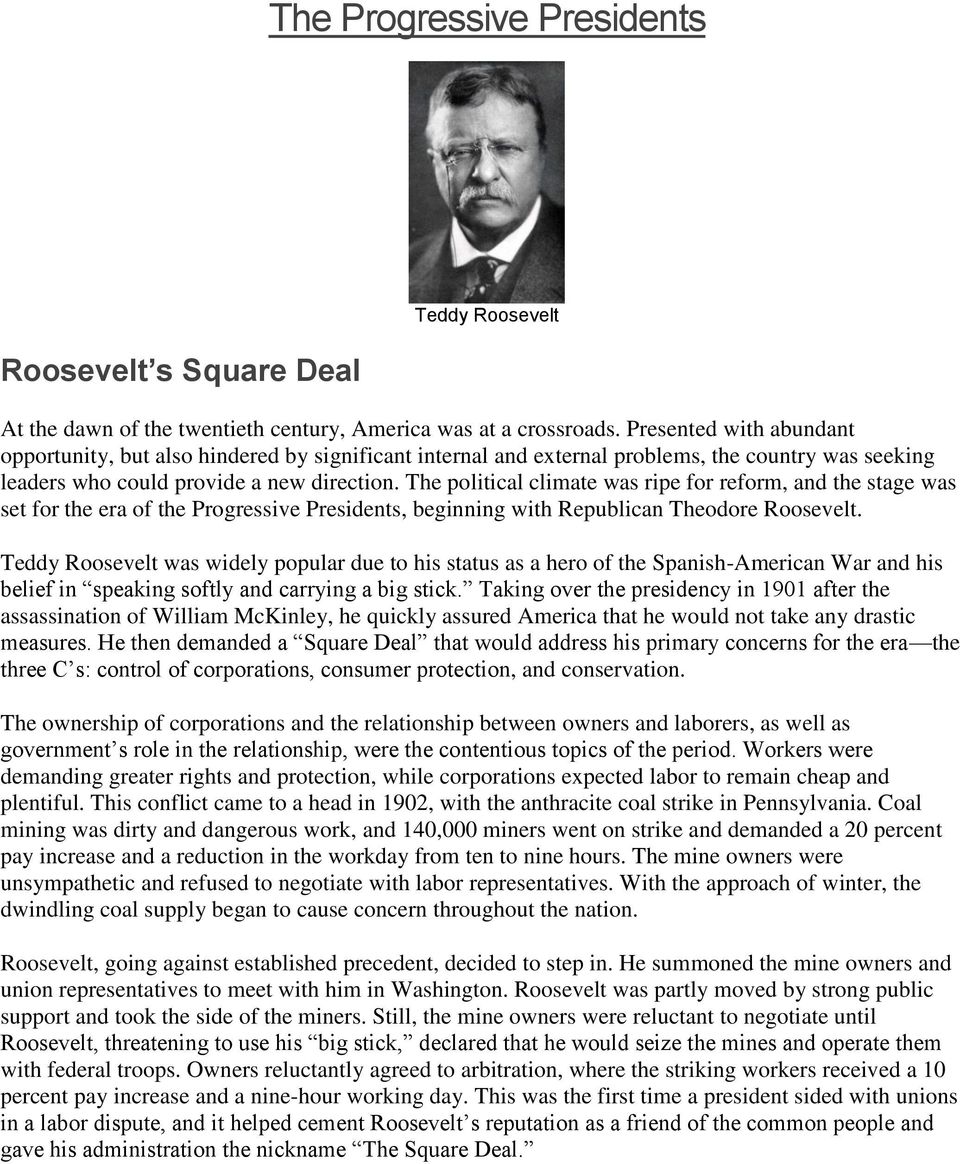
1 The Progressive Presidents Roosevelt s Square Deal Teddy Roosevelt At the dawn of the twentieth century, America was at a crossroads. Presented with abundant opportunity, but also hindered by significant internal and external problems, the country was seeking leaders who could provide a new direction. The political climate was ripe for reform, and the stage was set for the era of the Progressive Presidents, beginning with Republican Theodore Roosevelt. Teddy Roosevelt was widely popular due to his status as a hero of the Spanish-American War and his belief in speaking softly and carrying a big stick. Taking over the presidency in 1901 after the assassination of William McKinley, he quickly assured America that he would not take any drastic measures. He then demanded a Square Deal that would address his primary concerns for the era the three C s: control of corporations, consumer protection, and conservation. The ownership of corporations and the relationship between owners and laborers, as well as government s role in the relationship, were the contentious topics of the period. Workers were demanding greater rights and protection, while corporations expected labor to remain cheap and plentiful. This conflict came to a head in 1902, with the anthracite coal strike in Pennsylvania. Coal mining was dirty and dangerous work, and 140,000 miners went on strike and demanded a 20 percent pay increase and a reduction in the workday from ten to nine hours. The mine owners were unsympathetic and refused to negotiate with labor representatives. With the approach of winter, the dwindling coal supply began to cause concern throughout the nation. Roosevelt, going against established precedent, decided to step in. He summoned the mine owners and union representatives to meet with him in Washington. Roosevelt was partly moved by strong public support and took the side of the miners. Still, the mine owners were reluctant to negotiate until Roosevelt, threatening to use his big stick, declared that he would seize the mines and operate them with federal troops. Owners reluctantly agreed to arbitration, where the striking workers received a 10 percent pay increase and a nine-hour working day. This was the first time a president sided with unions in a labor dispute, and it helped cement Roosevelt s reputation as a friend of the common people and gave his administration the nickname The Square Deal.
2 Emboldened by this success and in pursuit of the first element of his Square Deal, Roosevelt began to attack large, monopolistic corporations. Some trusts were effective and legitimate, but many of these companies engaged in corrupt and preferential business practices. In 1902, the Northern Securities Company, owned by J.P. Morgan and James J. Hill, controlled most of the railroads in the northwestern United States and intended to create a total monopoly. Roosevelt initiated legal proceedings against Northern Securities and eventually the Supreme Court ordered that the company be dissolved. Roosevelt s radical actions angered big business and earned him the reputation of a trust buster, despite the fact that his successors Taft and Wilson actually dissolved more trusts. In 1903, with urging from Roosevelt, Congress created the Department of Commerce and Labor (DOCL). This cabinet-level department was designed to monitor corporations and ensure that they engaged in fair business practices. The Bureau of Corporations was created under the DOCL to benefit consumers by monitoring interstate commerce, helping dissolve monopolies, and promoting fair competition between companies. In 1913, the DOCL was split into two separate entities, the Department of Commerce and the Department of Labor, both of which continue to play an important role in regulating business today. The railroad business continued to be one of the most powerful and influential industries. Like many companies of the time, railroad companies engaged in corrupt business practices such as rebating and price fixing. Roosevelt encouraged Congress to take action to address these abuses, and in 1903, they passed the Elkins Act, which levied heavy fines on companies that engaged in illegal rebating. In 1906, they passed the Hepburn Act, which greatly strengthened the Interstate Commerce Commission. This law allowed the Commission to set maximum rates, inspect a company s books, and investigate railroads, sleeping car companies, oil pipelines, and other transportation firms. This was a bold action by Roosevelt and Congress given the transportation industry was a powerful lobbyist and a significant political contributor. The second element of Roosevelt s Square Deal was consumer protection. In the early 1900s, there was little regulation of the food or drugs that were available to the public. In 1906, Upton Sinclair published a book called The Jungle that described in graphic detail the Chicago slaughterhouse industry. Sinclair intended for his book to expose the plight of immigrant workers and possibly bring readers to the Socialist movement, but people were instead shocked and sickened by the practices of the meat industry. Roosevelt had the power to do something about the horrors described in The Jungle. He immediately appointed a special investigating committee to look into food handling practices in Chicago. Their report confirmed much of what Sinclair had written. Roosevelt was shocked by the report and predicted that it could have a devastating effect on American meat exports. He agreed to keep it quiet on the condition that Congress would take action to address the issues. After much pressure from Roosevelt, Congress reluctantly agreed to pass the Meat Inspection Act and the Pure Food and Drug Act of Many members of Congress were reluctant to pass these laws, as the meat industry was a powerful lobbying force. However, the passage of this legislation helped prevent the adulteration and mislabeling of food, alcohol, and drugs. It was an important first step toward ensuring that Americans were buying safe and healthy products. Eventually, the meatpacking

3 industry welcomed these reforms, as they found that a government seal of approval would help increase their export revenues. The final element of Roosevelt s Square Deal was conservation. Roosevelt was widely known as a sportsman, hunter, and outdoorsman, and he had a genuine love and respect for nature. However, many Americans of the time viewed the country s natural resources as limitless. For example, many farmers, ranchers, and timber companies in the west were consuming a huge portion of the available resources at an alarming rate. Their primary obsession was profit, and they had little concern for the damage they were causing. However, there was a small but vocal population who had a great deal of concern for the environment. Fortunately for them and for future Americans, the environmentalists had a friend in Teddy Roosevelt. Environmentalism and conservation were not new ideas, but most had not been concerned with ecological issues. While a number of laws had been passed to prevent or limit the destruction of natural resources, the majority of this legislation was not enforced or lacked the teeth necessary to make a significant difference. With Roosevelt s urging, Congress passed the Newlands Act of This legislation allowed the federal government to sell public lands in the arid, desert western states and devote the proceeds to irrigation projects. Landowners would then repay part of the irrigation costs from the proceeds they received from their newly fertile land, and this money was earmarked for more irrigation projects. Eventually, dozens of dams were created in the desert including the massive Roosevelt Dam on Arizona s Salt River. Another major concern of environmentalists was the devastation of the nation s timberlands. By 1900, only about 25 percent of the huge timber preserves were still standing. Roosevelt set aside 125 million acres of timberlands as federal reserves, over three times the amount preserved by all of his predecessors combined. He also performed similar actions with coal and water reserves, thus guaranteeing the preservation of some natural resources for future generations. Environmentalists such as John Muir, Gifford Pinchot, and the upstart Sierra Club aided Roosevelt in his efforts. Preserving America s natural resources and calling attention to the desperate need for conservation may well have been Teddy Roosevelt s greatest achievement as President, and his most enduring legacy.

4 Taft s Administration Howard Taft In 1908, President Teddy Roosevelt could have easily carried his burgeoning popularity to a sweeping victory in the presidential election, but in 1904, he made an impulsive promise not to seek a second elected term. However, he did not intend to completely relinquish control, so he handpicked a successor. Howard Taft, the 350-pound Secretary of War, was chosen as the Republican candidate for Taft was a mild progressive and an easygoing man that Roosevelt and other Republican leaders felt they could control. Taft easily defeated the Democratic candidate, William Jennings Bryan, and the Socialist candidate, Eugene Debs, in what can be construed as continued public endorsement of Roosevelt. Unfortunately, from the onset of his administration Taft did not live up to Roosevelt s standards or the expectations of other Progressives. He lacked Roosevelt s strength of personality and was more passive in his dealings with Congress. Many politicians were surprised to learn that Taft did not share some of the Progressive ideas and policies that Roosevelt endorsed. In fact, many people felt that Taft lacked the mental and physical stamina necessary to be an effective President. The first major blow to the Progressives during Taft s administration was the Payne-Aldrich Tariff of Taft called a special session of Congress to address what many people felt were excessive tariffs. After this session, the House of Representatives passed a bill that moderately restricted tariffs, but their legislation was severely modified when it reached the Senate. Radical Senators, led by Nelson W. Aldrich of Rhode Island, tacked on hundreds of revisions that effectively raised tariffs on almost all products. Taft eventually signed the bill and declared it the best bill that the Republican Party ever passed. This action dumbfounded Progressives and marked the beginning of an internal struggle for control of the Republican Party. Another issue that caused dissension among Republicans was Taft s handling of conservation issues. Taft was a dedicated conservationist and he devoted extensive resources to the protection of the environment. However, most of his progress was undone by his handling of the Ballinger-Pinchot dispute. Pinchot, the leader of the Department of Forestry and a well-liked ally of Roosevelt, attacked Secretary of the Interior Richard Ballinger for how he handled public lands. Ballinger opened up thousands of acres of public lands in Wyoming, Montana, and Alaska for private use, and this angered many Progressives. Pinchot was openly critical of Ballinger, and in 1910 Taft responded by firing Pinchot for insubordination. This infuriated much of the public as well as the legions of political players who were still fiercely loyal to Roosevelt.

5 A major rift occurred in the Republican Party because of Taft s straying from Progressive policy. The party was split down the middle between the Old Guard Republicans who supported Taft and the Progressive Republicans who backed Roosevelt. This division in the Republican Party allowed Democrats to regain control of the House of Representatives in a landslide victory in the congressional elections of In early 1912, Roosevelt triumphantly returned and announced himself as a challenger for the Republican presidential nomination. Roosevelt and his followers, embracing New Nationalism, began to furiously campaign for the nomination. However, because of their late start and Taft s ability as incumbent to control the convention, they were unable to secure the delegates necessary to win the Republican candidacy. Not one to admit defeat, Roosevelt formed the Bull Moose Party and vowed to enter the race as a third-party candidate. The split in the Republican Party made the Democrats optimistic about regaining the White House for the first time since They sought a reformist candidate to challenge the Republicans, and decided on Woodrow Wilson, a career academic and the current progressive governor of New Jersey. Wilson s New Freedom platform sought reduced tariffs, banking reform, and stronger antitrust legislation. The Socialists again nominated Eugene V. Debs whose platform sought public ownership of resources and industries. As expected, Roosevelt and Taft split the Republican vote, and Wilson easily won a majority of the electoral votes. Having received only 41 percent of the popular vote, Wilson was a minority president.

6 Woodrow Wilson Wilson s New Freedom Upon taking office, Woodrow Wilson became only the second Democratic president since Wilson was a trim figure with clean-cut features and pince-nez glasses clipped to the bridge of his nose, giving him an academic look. Partly due to his academic background and limited political experience, Wilson was very much an idealist. He was intelligent and calculating, but the public perception was that he was emotionally cold and distant. Wilson arrived in the White House with a clear agenda and the drive to achieve all of his goals. In addition, the Democratic majority in both houses of Congress was eager to show the public that their support was not misdirected. Wilson s platform called for an assault on the triple wall of privilege, which consisted of tariffs, banks, and trusts, and rarely has a president set to work so quickly. His first objective was to reduce the prohibitive tariffs that hurt American businesses and consumers. In an unprecedented move, Wilson personally appeared before Congress to call a special session to discuss tariffs in early Moved and stunned by Wilson s eloquence and force of character, Congress immediately designed the Underwood Tariff Bill, which significantly reduced import fees. The Underwood Tariff Bill brought the first significant reduction of duties since before the Civil War. In order to make up for the loss in revenues caused by the lower tariffs, the Underwood Bill introduced a graduated income tax. This new tax was introduced under the authority of the recently ratified Sixteenth Amendment. Initially, the tax was levied on incomes over $3,000, which was significantly higher than the national average. However, by 1917 the revenue from income taxes greatly exceeded receipts from the tariff. This margin has continued to grow exponentially over the years. After tackling the tariff, Wilson turned his attention to the nation s banks. The country s financial structure was woefully outdated, and its inefficiencies had been exposed by the Republican s economic expansion and the Panic of The currency system was very inelastic, with most reserves concentrated in New York and a few other large cities. These resources could not be mobilized quickly in the event of a financial crisis in a different area. Wilson considered two proposals: one calling for a third Bank of the United States, the other seeking a decentralized bank under government control. Siding with public opinion, Wilson called another special session of Congress in June of He overwhelmingly endorsed the idea of a decentralized bank, and asked Congress to radically change the banking system. Congress passed the Federal Reserve Act, which was arguably the greatest piece of legislation between the Civil War and Franklin Roosevelt s New Deal. The Act created a Federal Reserve Board, which oversaw a system of 12 regional reserve districts, each with its own central bank.

7 This new system also issued Federal Reserve Notes, paper currency that quickly allowed the government to adjust the flow of money, which are still in use today. The Federal Reserve Act was instrumental in allowing America to meet the financial challenges of World War I and emerge from the war as one of the world s financial powers. Emboldened by his successes, President Wilson turned his attention to the trusts. Although legislation designed to address the issue of trusts had existed for many years, they were still very much a problem. Again, Wilson appeared before Congress and delivered an emotional and dramatic address. He asked Congress to create legislation that would finally address trusts and tame the rampant monopolies. After several months of discussion, Congress presented Wilson with the Federal Trade Commission Act of This act allowed the government to closely inspect companies engaged in interstate commerce, such as meatpackers and railroads. The Commission investigated unfair trading practices such as false advertising, monopolistic practices, bribery, and misrepresentation. Following closely behind the Federal Trade Commission Act of 1914, was the Clayton Act of It served to strengthen the Sherman Anti-Trust Act of 1890 (the first measure passed by the U.S. Congress to prohibit trusts) and redefine the practices that were considered monopolistic and illegal. The Clayton Act provided support for labor unions by exempting labor from antitrust prosecution and legalizing strikes and peaceful picketing, which were not part of the Sherman Act. Renowned American Federation of Labor union leader, Samuel Gompers, declared the Clayton Act the Magna Carta of labor. Unfortunately, labor s triumph was short-lived, as conservative judges continued to curtail union power in controversial decisions. The era of the Progressive presidents produced a number of notable achievements. Trust-busting forced industrialists and monopolistic corporations to consider public opinion when making business decisions. This benefited the consumer and helped grow the economy. The Progressive presidents also increased consumers rights by limiting corporate abuses and trying to ensure the safe labeling of food and drugs. The creation of a federal income tax system lowered tariffs and increased America s presence as a global trading partner. It also raised additional revenues, some of which were used for beneficial programs such as conservation. The Progressive presidents served to strengthen the office of the president and the public began to expect more from the executive branch. Progressivism as a concept helped challenge traditional thinking about government s relationship to the people and sparked new ideas that stimulated thought for decades to come. Along with these significant accomplishments, the Progressive movement also had a number of notable shortcomings. Due to several contrary schools of thought within the movement, goals were often confusing and contradictory. Although most Progressives had good intentions, their conflicting goals helped detract from the overall objectives of the movement. Despite the numerous successes and lofty goals and ideals of the Progressive movement, the federal government was still too greatly influenced by industry and big business. The Progressive movement was not a complete success, but it did serve to spark new ideas and new ways of thinking about business and government. It created a new school of thought that challenged traditional ideas and allowed several new politicians to break the mold and lead the country in a new direction. This new way of thinking proved vital for the United States as the First World War loomed on the horizon.

8 Foreign Policy McKinley and Roosevelt China When Theodore Roosevelt took over the presidency in September 1901, after the assassination of William McKinley, he inherited many of McKinley s policies and programs. During McKinley s second run for office, he promised to continue programs of prosperity intended to lift the U.S. out of the depression of The gold standard assigned value to bank notes based on the corresponding price of gold, while imperialism promoted greater U.S. involvement in foreign nations. Roosevelt, despite much public skepticism, vowed to preserve and expand McKinley s programs. An important issue during McKinley s presidency was U.S. involvement in China. In a war that started in 1894 and ended in 1895, Japan defeated China, and for the next several years, China was in disarray. In the aftermath of the war, Japan and major European powers moved in to take control of China s substantial resources. Many U.S. leaders feared that if America did not join in, we would miss out on a huge economic opportunity. McKinley s Secretary of State, John Hay, sent a note to the countries with an economic stake in China requesting an Open-Door Policy that respected Chinese rights and promoted fair competition among those interested in Chinese resources. Britain, Germany, France, and Japan agreed to the policy, assuming that all of the other key countries would commit. Russia declined to commit to the plan, which caused dissension among the other countries and made the Open-Door Policy weak and relatively ineffective. Still, the Open Door continued to be the primary approach that the U.S. took toward China. By 1900, a group of Chinese patriots known as Boxers, rebelled against what they viewed as European exploitation. They killed 200 foreigners with the battle cry kill foreign devils. A multinational task force of 18,000 troops, including American soldiers, was quickly assembled to quell the rebellion. The Boxer group was disorganized and easily suppressed by the superior allied forces. The leaders of this multinational force assessed cash-poor China an indemnity of $300 million payable immediately. America realized that this reparation was excessive and would only punish and further repress the Chinese. As an act of friendship, the U.S. remitted $18 million to the Chinese, who as a sign of appreciation, sent students to the U.S. to study. These students later returned to China and were key players in the move to westernize China and help improve Chinese/American relations.

9 Spanish-American War Roosevelt and his Rough Riders The beginning of the twentieth century was a period of unprecedented American prosperity and power. The economic and social environment was perfect for the rise of the International Darwinism movement. Followers of this movement applied some of the fundamental views of Darwin s Origin of Species (1859) to international politics. They believed that the earth belonged to the strong, and with America quickly growing in strength, there was a strong surge of support for increased U.S. imperialism. The International Darwinism movement was enthusiastically promoted by Josiah Strong s book, Our Country: It s Possible Future and Its Present Crisis (1885). The book asserted that natural law dictates that strong countries will dominate weaker countries and that the Anglo-Saxon race is superior to other races. Inspired by Strong s book, many American imperialists began calling for the spread of American religion, culture, and values to what they considered backwards third-world countries. Another concern for many American businesspeople, politicians, and religious leaders was that the U.S. would not be able to keep pace with European powers. During the 1880s and 1890s, many European nations had flexed their imperial muscles throughout much of Africa, the Pacific, and China. Imperialists feared that the U.S. would be frozen out of these regions and would not be able to spread its influence or reap the financial benefits. Many people began to strongly encourage the federal government to spread American influence, and the government was more than happy to comply. In 1895, Cuban citizens revolted against their Spanish occupiers because of widespread poverty and oppression and what they perceived as Spanish tyranny. Some of the poverty was due to high U.S. duties that were placed on Cuban sugar. In a reactionary move to the revolt, Spanish General Butcher Weyler herded thousands of Cuban civilians into reconcentration camps. These camps were filthy and many of the residents died of diseases that flourished in these overcrowded and unsanitary camps. The sentiment of the American people was strongly against Spanish barbarism and there was a call of support for the Cuban people.

10 Newspaper tycoons William Randolph Hearst and Joseph Pulitzer played a major role in shaping the attitudes and opinions of Americans during this era. These two men owned many major newspapers across the country, and they were engaged in a fierce rivalry. In an attempt to outdo one another, they routinely created sensational headlines designed to scoop the competition. Unfortunately, these yellow journalism headlines were often enhanced or sometimes entirely made up in order to maximize their sensationalism. On February 9, 1898, Hearst greatly stoked the fire of anti-spanish sentiment when he published a private letter written by Spanish diplomat Dupuy de Lome that was very critical of President McKinley. De Lome was forced to resign, but the public was angered and outraged by the sensational stories and began to call for armed intervention in Cuba. President McKinley ordered the battleship USS Maine stationed in Havana Harbor ostensibly to monitor the situation and keep the peace. Then, on February 15, 1898, the Maine suddenly exploded in the harbor killing all 260 officers and crewmembers aboard. Immediately, both Spanish and American officials began investigating the cause of the explosion. The Spanish investigation concluded that the explosion was the result of an internal malfunction, and they ruled it an accident. However, after a hurried investigation, the American investigators reported that a Spanish mine caused the explosion. Spain attempted to pacify the U.S. and avoid armed confrontation with an offer of arbitration. However, fueled by the ever-present yellow press, the U.S. was enraged and ready to go to war, with the American public proclaiming, Remember the Maine, to Hell with Spain. Years later in 1976, a thorough investigation was conducted and it showed that the Spanish theory was correct and the explosion was accidental. On April 11, 1898, Congress declared war on Spain. They also ratified the Teller Amendment, which pledged to give Cubans their freedom after the Spanish were defeated. Many Europeans and Americans were skeptical of this anti-imperialistic pledge. Assistant Secretary of the Navy Theodore Roosevelt, acting in the absence of the Secretary, ordered Commodore George Dewey to attack the Spanishcontrolled Philippines at Manila Harbor. The U.S. also annexed Hawaii to use as a naval base in the Pacific on July 7, Although American confidence was very high, on paper the Spanish possessed a superior army and a navy of equal status. However, their navy was run-down and far from its home base.

11 The U.S. Navy easily destroyed the aging Spanish fleet in Manila. In the battle, over 400 Spanish sailors were killed or wounded, while the U.S. suffered no casualties. Having crushed the Spanish Navy, Dewey had no choice but to wait for ground support as his sailors were incapable of ground combat. Finally, soldiers arrived to lead the attack on the capital. The soldiers recruited rebel leader Emilio Aguinaldo, and on August 13, 1898, soldiers collaborating with Filipino rebels quickly captured Manila. The U.S. Navy had similar success in Cuba. They engaged the Spanish Navy and easily defeated it. The U.S. suffered only one casualty compared to over 500 Spanish casualties. Meanwhile, the U.S. Army, including Roosevelt s famed Rough Riders, routed the Spanish but suffered significant fatalities. There were many other battles and skirmishes, but the U.S. Army s most significant enemy was their lack of logistical preparedness, not the Spanish. For example, they were wearing wool uniforms in the intense heat, and were very susceptible to tropical illnesses. In addition, the lack of medical knowledge concerning the causes and treatments of tropical diseases such as malaria cost many American lives. During the course of the war, 400 U.S. soldiers were killed by Spanish hostilities, while over 5,000 were killed by disease. Despite these American shortcomings, the Spanish military was greatly overmatched, and they surrendered on August 12, Later in 1898, the Pact of Paris was signed, which freed Cuba from Spanish rule and gave the U.S. control over Guam and Puerto Rico. Cuban freedom was conditional, as they were pressured to sign the Platt Amendment, which prohibited Cuba from contracting debts and allowed the U.S. to intervene militarily at its discretion. The U.S. agreed to pay $20 million for the Philippines; since it was captured the day after the armistice was signed and therefore was not considered a spoil of war. The U.S. acquisition of the Philippines, the first American venture into true imperialism, sparked a great deal of domestic debate. In America, the Spanish-American War prompted a fast growing anti-imperialist movement, with members such as prominent authors, philosophers, and academics, including Mark Twain, Jane Addams, and Andrew Carnegie. The Filipino people longed for freedom after years of Spanish rule. In the Downes v. Bidwell case of 1901, the U.S. Supreme Court ruled that products imported from U.S. territories are subject to duties and the Constitution does not follow the flag. These and other rulings were referred to as insular cases and denied residents of occupied territories the rights and protections afforded by the Constitution. These rulings set an important precedent, since previously acquired land had been eligible for these rights as well as future statehood. The U.S. did not grant the Philippines independence, but instead, annexed it. On February 4, 1899, a bloody three-year revolution began that left over 600,000 Filipinos dead and was responsible for more American casualties than the Spanish- American War. In the aftermath of World War II, the America granted the Philippines independence on July 4, 1946.

12 Panama Canal An important discovery that resulted from the Spanish-American War was America s need to connect the Atlantic and Pacific Oceans. During the war, ships in the Pacific had to travel around South America in order to join the fleet in Cuba. The U.S. now had to protect and supply its far ranging territories in Guam, Puerto Rico, Hawaii, and the Philippines. The U.S. was also beginning to emerge as a world economic power and needed quicker shipping routes to meet its international business needs. Another significant reason for a quick route between the Atlantic and the Pacific was that the U.S. Navy was fast becoming an important, global military player. President Roosevelt began to swing his big stick in order to achieve his dream of building a canal in Central America. Initially, proponents of the canal considered two sites: Nicaragua and Panama. However, experts quickly concluded that Panama would be a more advantageous and realistic site. Despite Roosevelt s intentions, there were still several legal challenges to overcome before he could build the canal. The Clayton- Bulwer Treaty of 1850 between the U.S and Britain asserted that the U.S. could not have sole control over an isthmian canal in the Americas. However, the British were engaged in the South African Boer War and were feeling increasingly threatened by their European neighbors, so they were willing to repeal the treaty. In 1901, the British and the Americans signed the Hay-Pauncefote Treaty that allowed the U.S. to build and fortify a canal. England had little to lose by signing the treaty, and in exchange hoped to secure the U.S. as an ally in a conflict with Germany that was beginning to look inevitable. In addition to legal challenges, there were other significant obstacles to building a canal. Panama was eager to secure the canal project in the hope that it would revive their lagging economy. However, Panama was controlled by Colombia, and the Colombian Senate rejected a treaty that would have allowed the U.S. to lease a six-mile zone in Panama. The offer called for an initial payment of $10 million and an annual disbursement of $250,000, which the Colombians viewed as inadequate. Roosevelt was enraged by Colombia s refusal to cooperate and he was determined to secure the canal area one way or another. A Panamanian uprising against Colombian rule began on November 3, This coup was backed by Panamanians who sought the prosperity the canal offered as well as representatives of the company that hoped to sell the land to the U.S. for $40 million. The U.S. did not actively encourage this rebellion, although they viewed it as a fortunate development. Colombian soldiers were poised to crush the rebellion, but U.S. naval vessels would not allow them to cross the isthmus and engage the revolutionaries. Using questionable legal precedent, President Roosevelt quickly recognized Panama s independence three days later. This was a bitter victory for the

13 U.S., as it secured the necessary land for the canal, but hurt foreign perception of America as well as American relations in Latin America. Latin Americans were already concerned about American control in Puerto Rico and Cuba, and now they began to fear their neighbor to the north. After years of dubious politics and relationships, construction began on the Panama Canal in Many obstacles were encountered, including landslides, pestilence, and labor problems. However, a team of engineers persisted, and finally in 1914 the Panama Canal was opened and heralded as the greatest technological achievement of its time. The total costs to complete the job were staggering. In addition to $400 million in financial costs, the loss of good will toward America was incalculable. The English author James Bryce referred to the project as the greatest liberty Man has ever taken with Nature. Roosevelt Corollary Speak softly and carry a big stick Around the turn of the twentieth century, Latin American nations began defaulting on massive loans from European powers such as Germany and England. Many of these Banana Republics, including Venezuela and the Dominican Republic, had borrowed heavily and had no way or intention of repaying their debts. This issue came to the forefront in 1903, when German warships sank two Venezuelan vessels and bombarded a Venezuelan town. Their intention was to intimidate Venezuela into paying its debts, but they inadvertently threatened Roosevelt and America s sense of security as well. Roosevelt was intent on keeping European nations out of the Americas. He feared that if he allowed Germany and England into the Hemisphere to collect debts, they might decide to set up permanent bases, which would have been a violation of the Monroe Doctrine of In addition, the U.S. did not want the European powers to extort Latin American countries, thereby bankrupting them. In order to prevent their presence, Roosevelt devised the Roosevelt Corollary to the Monroe Doctrine, which instituted a policy of preventive intervention. In this clever maneuver, Roosevelt stated that the U.S. would now function as the policeman of the Caribbean. Under this arrangement, the U.S. took over the management of tariff collections in This meant that whenever a Latin American nation was overdue on a debt to a European power, the U.S. would intervene. America would pay off the foreign debt, and then take responsibility for collection, thereby guaranteeing the European loan. The Europeans quickly agreed to this arrangement, as it

14 ensured the prompt payment of the debt, but they were skeptical of America s motivation. Many people in America, Europe, and Latin America viewed this as yet another imperial move by the United States. Anti-imperialists believed that America was removing the traditional imperialists who were taking advantage of the Banana Republics, for no other reason than to take their place. The U.S. experienced a number of advantages by assuming control of these customhouses. Corruption and embezzlement were rampant in many of these Latin American countries. The U.S. ran the customhouses fairly and equitably and helped ensure that corruption was minimized. In the short run, several of these Latin American countries began managing their money more efficiently and achieving financial security for the first time. Countries such as the Dominican Republic and Venezuela were able to manage their resources more effectively and were beginning to emerge as viable trading partners. However, over time as the U.S. began to return control to local governments, many returned to their corrupt and inefficient ways, which ended this short era of relative prosperity. Despite the success of the Roosevelt Corollary, there were also several drawbacks. Essentially this was a perversion of the Monroe Doctrine, which was considered a sacred document in American politics. It also set another negative precedent for U.S. involvement in Latin America. This new policy was used for years as justification for military and political intervention throughout the region. For many decades, the U.S. performed military landings in Central America and stationed Marines in Nicaragua and other countries in semi-permanent bases. In addition, Roosevelt s cowboy diplomacy strained relations not only with Latin American nations, but with the rest of the world as well. The Roosevelt Corollary helped give notice that the U.S. was emerging as a significant world power that could not be ignored.

15 Taft and Wilson Dollar Diplomacy William Howard Taft was easily elected in 1908; because a majority of Americans believed that he would continue the popular Republican policies laid out by President Roosevelt. Taft was susceptible to outside pressure, and he often submitted to the desires of Congress and special interest groups. Roosevelt and many Americans were angry and dismayed when Taft began to stray from the Republican platform. However, one area in which Taft consistently pursued Roosevelt s aims was in expanding America s influence abroad. Taft used America s growing economic power as a diplomatic tool. He urged Wall Street investors to invest money in foreign markets in order to increase American influence abroad. Investors were especially encouraged to invest their money in foreign markets in which the U.S. had strategic interests, such as the Far East and the Panama Canal region. Many people were critical of Taft s plan and his critics denounced this strategy as dollar diplomacy. In fact, the senate refused to sign several treaties, but the president encouraged private banks and Wall Street investors to act independently. One goal of dollar diplomacy was to preempt foreign powers from gaining or enlarging an investment foothold in key markets. Many European countries had been imperial powers for decades and held a significant advantage over the U.S. in several global markets. The administration believed that if American investors were firmly situated in these markets economic rivals such as Germany would be unable to continue their dominance. Taft believed that the increased investment would not only benefit the U.S. but its trade partners as well, creating better foreign relations. Taft also assumed that the expenditure of money in foreign markets would increase American influence abroad and would help further its foreign policies. Of course, the overriding belief was that foreign investments would enhance American businesses, which in turn would grow the economy and enrich the government. A primary focus of dollar diplomacy was the Manchurian region of China. Japan and Russia controlled a large portion of Manchurian resources including the railroads. Taft, like many people of the era, believed that whoever controlled the railroads also controlled the economy. He believed that without an

16 interest in the Manchurian railroad system, the U.S. would be frozen out of the emerging Chinese markets and the Unite States open door policy in China would be undermined. Taft personally sent a telegram to the Chinese Government on behalf of American investors interested in railroads in the Yangtze Valley. In 1909, Secretary of State Philander C. Knox offered the Japanese and Russians a deal. He proposed that American bankers and industrialists would purchase the Manchurian railroads from Japan and Russia and return them to Chinese control. Japan and Russia flatly refused the offer, which publicly embarrassed the Taft administration. Taft persevered in his efforts to gain influence in China, and in 1912 the U.S. and five other nations offered the new Chinese Republic a huge loan. In an extension of the Roosevelt Corollary, Taft encouraged investors to spend money in Latin American countries such as Honduras and Haiti. Adhering to the Monroe Doctrine of 1823, Taft would not allow foreign investors into Latin American markets, so America felt a responsibility to support these financially struggling republics. Many of these nations were constantly on the verge of financial collapse and required foreign investment to strengthen their shaky foundations. Political turmoil in this region later required U.S. troops to protect the substantial American investment. In 1912, a group of 2,500 marines landed in Nicaragua to suppress a rebellion, and they remained for 13 years due to continued instability. This was another action that increased distrust of America among many Latin American nations. Central America and the Caribbean The Spanish-American War, the Panama Canal project, and the Roosevelt Corollary ensured extensive U.S. involvement in Latin America. Many Caribbean and Latin American countries seemed to be in a perpetual state of revolution and political upheaval. Due to its close geographic proximity, the U.S. felt compelled to get involved and exert influence in these conflicts. The significant financial investment that resulted from dollar diplomacy also required the U.S. to intervene repeatedly in order to protect its citizens and investments. Taft continued Roosevelt s imperialist policies and increased America s economic and political empire throughout the world. Disorder and rebellion in Cuba, Honduras, and the Dominican Republic were causes for alarm in the United States. Most Caribbean countries at the time were politically unstable and desperately impoverished. The U.S. adopted a policy of non-colonial imperial expansion in an attempt to bring stability and order to the region. Essentially, this unilateral policy enabled the U.S. to intervene in the

17 region without actually taking control of any of these countries. The decision to intervene was at the discretion of President, although some countries requested U.S. assistance. People on both sides of the imperialism issue were critical of non-colonial imperial expansion. Imperialists believed that this policy was limiting and contrary to American interests. Anti-imperialists believed the strategy was too vague and would allow America to intervene in any situation it wanted. A key element of this new imperialistic movement was the promotion of financial security for the U.S. and other countries in the western hemisphere. The U.S. stepped in and advised Caribbean countries on ways to more efficiently manage their economic affairs. However, many of these countries were rife with corruption and their resources were badly mismanaged, so the U.S. took a more active role to ensure that their revenues were properly handled. In many cases, the U.S. took control of a country s customhouses and made certain that revenues were appropriately controlled and distributed. In the short run, this strategy was successful. For example, U.S. control of the Dominican Republic s customhouses helped bring short-term financial security to the nation. However, when the U.S. returned control to the Dominicans, the mismanagement resumed and the Dominican Republic was no better off than before. Another unfortunate result of U.S. involvement was that feelings of resentment and distrust toward America continued to grow throughout Latin America. In 1912, within one week of taking office, Woodrow Wilson removed governmental support for American businesses operating in the Caribbean and China. Wilson was an intense critic of imperialism and his goal was to reverse Roosevelt s big stick policies and Taft s dollar diplomacy. His vision for U.S. foreign policy was based on morality. He strongly believed that his immediate predecessors had pursued a policy that would breed dislike of the U.S. and often sacrifice goodwill for short-term gain. For this reason, Wilson s foreign policy has sometimes been called missionary diplomacy or moral diplomacy. After Wilson s policies were instated, American bankers withdrew their support for Taft s six-nation loan to China, which caused the loan to collapse. Wilson also immediately repealed the Panama Canal Tolls Act that exempted U.S. vessels from paying tolls at the Canal. The repeal of this act pleased England who was angry at paying tolls that U.S. ships were exempt from. Another of Wilson s antiimperialist actions was the signing of the Jones Act of The Jones Act promised the Philippines independence as soon as they were able to demonstrate that they had a stable government. However, this act proved to be less than successful, as the Philippines were not granted independence until 30 years later on July 4, Haiti had been a key target of Taft s dollar diplomacy. It was an exceptionally poor nation even by Caribbean standards and Taft tried to improve the Haitian economy through the influx of American investment. Wilson began withdrawing some of America s involvement and influence when he took office, although many Americans continued to live and own property in Haiti. In 1914 and 1915, the Haitian people were outraged by the oppressive nature of their President, so they rebelled, literally tearing him to pieces during a bloody revolution. In response, Wilson reluctantly sent troops to Haiti to protect American citizens and investments. He agreed to a treaty with Haiti in which the U.S. would help police the nation and supervise its finances. Due to continued Haitian instability, U.S. troops remained in Haiti for 19 years. Despite Wilson s intentions, the U.S. continued to exert influence throughout the Caribbean.

18 For the United States, another key area of concern in Central America was Nicaragua. Its close proximity to the Panama Canal made Nicaragua s stability crucial to American interests in the region. Nicaragua asked the U.S. for help and in 1911 American bankers and investors reorganized the Nicaraguan financial structure and began to manage its customs service. They were successful in bringing some stability to the country, but in 1912 a violent political revolution began. This revolution greatly concerned the U.S., since an armed insurrection in the region threatened the security and the prosperity of the burgeoning Panama Canal. The U.S. responded by sending 2,500 troops to the nation. Although the troops were rarely involved in combat, they remained in Nicaragua for 13 years. Wilson s moral diplomacy achieved mixed results. One of his primary goals was to stabilize the Caribbean and Latin America during the onset of World War I, with a minimal amount of American involvement. In addition, he wanted to completely reverse Roosevelt s big stick policies and remove all elements of Taft s dollar diplomacy. However, Wilson faced a great deal of pressure from imperialists as well as American industrialists. Despite Wilson s intentions to limit U.S. involvement in the region, he sent troops to Nicaragua, Haiti, and the Dominican Republic, which ensured a U.S. military presence in the Caribbean and Central America for decades. Ironically, regardless of his sincere intentions to halt the spread of imperialism, Wilson intervened in Latin American affairs more than any other president.

19 The Mexican Revolution Pancho Villa The Latin American country most important to the well-being of the U.S. was its neighbor to the south, Mexico. Mexico is a nation rich in resources, but its ineffective and corrupt governments had exploited the Mexican people for years. A series of brutal dictators had controlled the country for decades, and many of them mismanaged Mexico s resources, making themselves rich while the majority of Mexicans were desperately poor. Tension had been high for years, and there had been several attempts at revolt, but the dictators were successful at suppressing any significant revolution. Mexican leaders sold the country s resources to foreign investors, often at the expense of Mexican citizens. Americans owned 43 percent of the land in Mexico, while foreigners from other countries owned 25 percent. By 1913, American investment in Mexico was well over a billion dollars, including significant ownership in railroads, oil resources, and mines. Porfirio Diaz, the leader at that time, was particularly ruthless and oppressive. Eventually, the number of foreigners profiting from Mexican resources and Diaz s cruelty helped promote a strong surge of nationalism in Mexico. The first Mexican Revolution began in The people were led by the radical Francisco Madero. Madero and his followers staged a successful campaign, and in 1911, they gained control of Mexico and appointed Madero president. He was very popular and viewed as a president of the people, but in 1913, another revolutionary group assassinated Madero. The leader of the coup, General Victoriano Huerta, then assumed the presidency. Because of the instability and revolution in Mexico, a huge influx of immigrants fled to the United States. Many Mexicans feared Huerta, and fled the country in order to escape his tyranny. The majority of these immigrants settled in the southwestern U.S., where they lived in segregated communities and were used as cheap labor for building railroads. All told, over one million Mexicans migrated to the United States in the early twentieth century. During this revolutionary era in Mexico, over 50,000 Americans owned property and lived in Mexico. They began to feel legitimately threatened by this newfound Mexican nationalism, and called for protection from the U.S. government. Other Americans not living in Mexico also asked for intervention, including yellow journalist William Randolph Hearst. Although Hearst may have truly desired aid for

20 Americans living in Mexico, he was surely influenced by his ownership of a Mexican Ranch larger than the state of Rhode Island. Despite growing pressure, President Wilson was reluctant to intervene in Mexican politics. He had been working to reduce American involvement in Latin America, and was very hesitant to interfere and risk a direct conflict with Mexico. Although Wilson was unwilling to play an active role in Mexico, he by no means condoned the tyrannical Huerta regime. In fact, Wilson was one of the few foreign leaders who did not accept the legitimacy of Huerta s leadership and refused to recognize his government. As Huerta s violence towards his people continued to escalate, Wilson was forced to act more directly. He stated that he would teach the South American republics to elect good men, and in 1914, the U.S. began supplying weapons to Huerta s rivals. Venustiano Carranza and Francisco Pancho Villa were the leaders of a rebel army created to unseat Huerta. In April 1914, a group of American sailors on shore leave was arrested in Tampico, Mexico. The U.S. was outraged, and the sailors were quickly released with the apologies of the Mexican government. However, Mexico was unwilling to provide the 21-gun salute demanded by the Americans. Seizing the opportunity to finally remove Huerta and end his tyranny, Wilson asked Congress for permission to use force against Mexico. In the mean time, while still awaiting Congressional approval, Wilson ordered the navy to seize the port of Vera Cruz. This action not only angered Huerta, it also upset the rebel leader Carranza, who viewed this act as exceeding the boundaries of the informal agreement between his group and the United States. As tensions continued to mount, war with Mexico seemed inevitable until Argentina, Brazil, and Chile intervened. The so-called ABC Powers interceded and attempted to reach an agreement between the United States and Mexico. These powerful South American nations helped the U.S. undermine Huerta, and in 1914, after intense internal and external pressure, President Huerta stepped down as ruler of Mexico. The open presidential seat was filled by Venustiano Carranza who still harbored resentment toward America because of the U.S. meddling at Vera Cruz. Despite his distrust of Carranza, President Wilson reluctantly recognized the legitimacy of Carranza s presidency. Meanwhile, Carranza s former general, Pancho Villa, had now emerged as his chief rival. Villa not only defied Carranza s régime by leading an armed revolution, he directly challenged the extensive U.S. involvement in Mexico. In an effort to rebuild a relationship with Mexico, Wilson supported Carranza against Villa and sent arms to sustain Carranza s armies. Villa was angered by Wilson s actions, and retaliated by killing 18 Americans in Mexico and then embarked on a bold raid into Columbus, New Mexico killing 19 Americans. Americans were stunned and outraged by Pancho Villa s brash actions. President Wilson ordered General John J. Pershing to lead several thousand troops into Mexico to capture Villa. General Pershing s army moved quickly into Mexico and engaged Villa s supporters, who were known as Villistas. The disorganized Mexican rebels were no match for the better-trained and equipped U.S. forces, and Pershing won several convincing victories. However, he was unable to find Pancho Villa, which was the ultimate goal of the mission, and this failure did little to enhance the international reputation of the U.S. military. Finally, as it no longer seemed possible for the U.S. to remain out of WWI, Wilson recalled Pershing and his men in January 1917.

21 Both Taft s dollar diplomacy and Wilson s moral diplomacy achieved mixed results. Taft s foreign spending and interventionism gained the U.S. short-term allies, but also created long-term animosity throughout Latin America. It strengthened the U.S. economy through increased American investment abroad and allowed America to gain a position in several emerging global markets. Upon taking office, Woodrow Wilson attempted to reverse most of Taft s foreign policy. Wilson s staunch anti-imperialism was a completely new approach for America. He withdrew government support of American investors in foreign markets and attempted to bring America back within its borders. However, his reluctance to intervene militarily in foreign affairs was often seen as hesitant and weak and caused many of his policies to be largely ineffective. Eventually, Wilson s approach to foreign policy proved too unrealistic for success in the Western Hemisphere, but the true test of his foreign policy would come on the other side of the Atlantic in World War I. Google images
Chapter 8 Notes Rise to World Power. Some Americans supported a foreign policy of isolationism, or noninvolvement, in world affairs.
 Chapter 8 Notes Rise to World Power Section 1: Expanding Horizons American Foreign Policy The influence of the United States began to extend to other world regions. Some Americans supported a foreign policy
Why did the US want to claim small islands in the Pacific Ocean such as Midway Island and Wake Island?
 US History & Government Imperialism Why did the US create an empire in the late 19 th Century? Social: Economic: Political: Religious: Military: China Why did the US want to claim small islands in the
Becoming a World Power. The Imperialist Vision. Imperialism (cont) 1872-1912. Americans wanted to develop overseas markets
 Becoming a World Power 1872-1912 The Imperialist Vision Imperialism economic and political domination of a strong nation over a weaker one Became popular with countries in Europe Imperialism (cont) Protectorates
Chapter 18. How well did Presidents Roosevelt, Taft, and Wilson promote progressive goals in national policies? Essential Question 18.
 Chapter 18 Essential Question How well did Presidents Roosevelt, Taft, and Wilson promote progressive goals in national policies? 18.1 President Theodore Roosevelt tames the trusts. Theodore Roosevelt
Progressive Presidents: Teddy Roosevelt, William Howard Taft, & Woodrow Wilson
 Progressive Presidents: Teddy Roosevelt, William Howard Taft, & Woodrow Wilson Theodore (Teddy) Roosevelt (Republican) The Square Deal The name given to Roosevelt s Progressive Reforms Philosophy He believed
Nationalism and U.S. Expansion
 Chapter 21: American Expansion and International Politics: 1870-1914 Nationalism and U.S. Expansion Diplomatic relations is a relationship between government officials of different nations with frequent
 Chapter 5 An Emerging g World Power Imperialism strong g nations extend their political, military, and economic control over weaker nations Causes of Imperialism Economic raw materials natural resources
Part I America Becomes an Imperial Power
 Chapter 20 Theodore Roosevelt And Progressive Reform Part I America Becomes an Imperial Power The Monroe Doctrine 1823 President Monroe signs document which is meant to end imperialism in the Western Hemisphere.
1. Which of the following is NOT an argument in support of imperialism or expansionism?
 U.S I Quarterly Assessment Practice Test Circle the best answer to each question. 1. Which of the following is NOT an argument in support of imperialism or expansionism? A. The United States should become
President Theodore Roosevelt
 Theodore Teddy Roosevelt Video Clip (20 min): 1. Political Party: 2. Dates of Presidency: 3. How was he a contradiction? President Theodore Roosevelt 4. List 5 words that describe Theodore Roosevelt (T.R.).
Imperialism. The Spanish American War. And. Page1
 Imperialism And he Spanish American War Page1 SOL Standard USII.5a Reasons for the Spanish American War Protection of American Business interests in Cuba American support of Cuban rebels to gain independence
Credit-by-Exam Review - US History A
 separation of powers checks and balances individual rights popular sovereignty federalism separation of powers Mayflower Compact Thomas Paine's Common Sense abolitionists What was the difference in the
SOCIAL STUDIES TEST for e-lessons day 2
 SOCIAL STUDIES TEST for e-lessons day 2 Name Directions: Use your own piece of paper as your answer document. Do not print off the test. You will need to only turn in your answer document. 29. The Cold
The Spanish American War Robin Rawlins Lake Region High School
 The Spanish American War Robin Rawlins Lake Region High School I. Summary A. The following lesson plan is a study of the Spanish American War and the impact that sensationalism played in US involvement
Theodore Roosevelt 1906
 Theodore Roosevelt 1906 what has especially directed the attention of the friends of peace is President Roosevelt's happy role in bringing to an end the bloody war recently waged between two of the world's
Unit 10 Review Game The Progressive Era
 Unit 10 Review Game The Progressive Era 1. As one progressive explained, the real heart of the progressive movement was to [A] to promote economic and social equality. [B] reinstate the policy of laissez-faire.
Spanish-American War Quiz
 Name Pd U.S. History, Paulic Spanish-American War Quiz 1) Throughout the 19th Century, this crop was Cuba's main export: A) Coffee B) Sugar C) Bananas D) Snickers 2) In 1868, Cuban sugar planters took
Progressive Era agrarian urban industrialization Trusts VOCABULARY Progressive Era: Agrarian: Urban: D Industrialization Trust
 The Progressive Era began at the turn of the 20 th Century and lasted through World War I. This time period represented a time of economic and social reform. The landscape of America was rapidly changing
Trends in US foreign policy before 1900
 Trends in US foreign policy before 1900 Instances of the Use of U.S. Armed forces the 19 th and 20th Centuries Scope N.A. C-L.A. AF ME-CA Asia Europe Pac Total 1801-1900 2 7 3 0 4 1 6 23 1901-2000 1 8
Foreign Affairs and National Security
 Foreign Affairs and National Security Objectives: TLW understand and explain the following questions as it relates to the Foreign affairs of the American Government What is foreign policy? What is the
Mesabi Range A section of low hills in Minnesota owned by Rockefeller in 1887, it was a source of iron ore for steel production.
 APUSH Chapter 24 Bessemer process Bessemer invented a process for removing air pockets from iron, and thus allowed steel to be made. This made skyscrapers possible, advances in shipbuilding, construction,
Foreign Policy 1898-1917 by Alan Brinkley
 Foreign Policy 1898-1917 by Alan Brinkley This reading is excerpted from Chapters 20 and 21 of Brinkley s American History: A Survey (12th ed.). I wrote the footnotes. If you use the questions below to
Theodore Roosevelt and the US Foreign Policy
 1901-1909 Republican Born 1858- died 1919 From: New York VP- Charles W. Fairbanks PP: Progressivism Theodore Roosevelt and the US Foreign Policy (1) Acquisition of the Presidency 1. Roosevelt became president
Twelfth Grade Hispanic/Latino Curriculum Lesson Plan Puerto Rican Migration to the United States
 Twelfth Grade Hispanic/Latino Curriculum Lesson Plan Puerto Rican Migration to the United States Content/Theme: Grade Level: Textbook Connection: Migration 12 th Grade United States Government - Democracy
The United States Foreign Policy & the Spanish American War
 I have seen two Americas, the America before the Spanish American War and the America since. The United States Foreign Policy & the Spanish American War Foreign Affairs of the 1880 & 1890s: 1. 1 st Pan-American
Reasons for U.S. Involvement in War
 Reasons for U.S. Involvement in War The United States has waged several wars throughout its history. These wars have in some ways differed drastically. For example, during the Revolutionary War, cannons
Option 1: Use the Might of the U.S. Military to End the Assad Regime
 1 Option 1: Use the Might of the U.S. Military to End the Assad Regime The Syrian dictatorship s use of chemical weapons against its own people was terrible. But we must not let it overshadow the larger
bosses political machines mugwumps Pendleton Civil Service Act
 Chapter 20 The Spirit of Reform (1868 1920) During the late 1800s widespread corruption in politics caused many people to seek reform. Reformers worked to improve living conditions, labor laws, the educational
Remember the Alamo. The Changing Border of the Southwest
 Remember the Alamo The Changing Border of the Southwest Interact: What do you think this picture shows? In the year 1820, the new country of the United States and the newer country of Mexico had a lot
What Do We Mean by Democracy and Freedom? (Speech scheduled for a Boston America First rally on December 12, 1941 that was never delivered)
 What Do We Mean by Democracy and Freedom? (Speech scheduled for a Boston America First rally on December 12, 1941 that was never delivered) In the slogans and propaganda that have been hurled back and
The Spanish-American War: The United States Becomes a World Power
 On April 19, Congress passed the Teller Amendteacher s guide primary source set The Spanish-American War: The United States Becomes a World Power The Spanish-American War lasted only about ten weeks in
Essential Question: What was the impact of European imperialism in Africa and India?
 Essential Question: What was the impact of European imperialism in Africa and India? Unit X Quiz 2 1. When did the Suez Canal open? 2. Why was it initially difficult for European powers to control their
The Progressive Era NEXT
 The Progressive Era Amid great political and social change, women gain a larger public role and lead the call for reform. President Theodore Roosevelt dubs his reform policies a Square Deal. The Progressive
Chapter Eight: America Builds An Empire. Speak softly and carry a big stick. -Theodore Roosevelt
 Chapter Eight: America Builds An Empire Speak softly and carry a big stick. -Theodore Roosevelt Chapter Objective, Essential Questions, & TEKS Objective: Identify, evaluate, and explain American expansionism,
Chapter 9: The Policies of Alexander Hamilton and Thomas Jefferson
 Chapter 9: The Policies of Alexander Hamilton and Thomas Jefferson Department of State, Department of Treasury, Department of War, Attorney General, Postmaster General : 5 government departments established
World History Course Summary Department: Social Studies. Semester 1
 World History Course Summary Department: Social Studies All World History courses (Honors or otherwise) utilize the same targets and indicators for student performance. However, students enrolled in Honors
U.S. Voting Rights Timeline
 1776 Only people who own land can vote Declaration of Independence signed. Right to vote during the Colonial and Revolutionary periods is restricted to property owners most of whom are white male Protestants
The Influence of the Treaty of Versailles on World War II. The Treaty of Versailles, drafted and passed after World War I, was a document
 The Influence of the Treaty of Versailles on World War II The Treaty of Versailles, drafted and passed after World War I, was a document that addressed the state of the international community in response
Chapter 10: How Americans Settled the Frontier. The white settlers moving west into land that Native Americans lived : westward expansion.
 Chapter 10: How Americans Settled the Frontier Multiple Perspectives and the Idea of a Frontier Frontier : The land west of where most white settlers lived. Native Americans lived on the frontier. The
No Taxation Without Representation!! Actions that led to the Revolutionary War
 No Taxation Without Representation!! Actions that led to the Revolutionary War Raising Taxes The French and Indian War had caused the British to be in a great deal of debt. They decided to keep a standing
Battling Beyond U.S. Borders
 Teacher s Guide Grade Level: 6 8 Curriculum Focus: U.S. History Lesson Duration: Two class periods Program Description Witness how a small group of Texan defenders bravely fought against the Mexican army
GEORGIA AMERICAN REVOLUTION
 GEORGIA in the AMERICAN REVOLUTION AMERICA HEADS TOWARD INDEPENDENCE: Until 1763, independence was unthinkable!!! Great Britain was the greatest, most powerful nation on earth, and the American colonists
Decision Making: Hamilton s Economic Policies Part 1: The Debt PROBLEM
 Decision Making: Hamilton s Economic Policies Part 1: The Debt PROBLEM The year is 1790, and George Washington has been President under the new national government, The Constitution, for about a year.
Consolidating the Revolution
 7 Consolidating the Revolution (1) CHAPTER OUTLINE Timothy Bloodworth of New Hanover County, North Carolina, rises from humble origins and gains a substantial position in his community and the respect
FAQ. Chickasaw and Choctaw Timber, Mineral Rights and Tribal Lands. Q. What is the case currently before the Federal Court?
 FAQ Chickasaw and Choctaw Timber, Mineral Rights and Tribal Lands Q. What is the case currently before the Federal Court? In 2005, the Chickasaw and Choctaw Nations brought suit against the U.S. Government
African American Civil Rights and the Republican Party. by Timothy Thurber State University of New York at Oswego
 African American Civil Rights and the Republican Party by Timothy Thurber State University of New York at Oswego Historians and other scholars interested in the politics of the African American freedom
Writing Prompts US History
 Writing Prompts US History In order to be successful in the classroom, students must have choice, write everyday and be able to defend positions. These prompts allow students to do all three. Please consider
Sample Test: Colonialism and Foundations of America. Use the following map and your knowledge of Social Studies to answer question 1.
 Sample Test: Colonialism and Foundations of America Use the following map and your knowledge of Social Studies to answer question 1. 1. What key activity does this map depict? A Middle Passage B Trans-Saharan
This Great Enterprise : Theodore Roosevelt and the Panama Canal
 CONSTITUTIONAL RIGHTS FOUNDATION Bill of Rights in Action 21:2 This Great Enterprise : Theodore Roosevelt and the Panama Canal In 1904, President Theodore Roosevelt took advantage of a revolution in Panama
GRADE 7 SOCIAL STUDIES. History
 GRADE 7 SOCIAL STUDIES History Standard 1 Historical Thinking Skills Students use information and concepts to interpret, analyze, and draw conclusions about United States history from 1763 1877. 7.1.1
Chapter 22: World War I. Four most powerful European nations in the early 1900s were Great Britain, France, Germany, Russia.
 Chapter 22: World War I The Beginnings of World War I World War I was fought from 1914-1918. United States entered World War I in 1917. The Origins of Europe s Great War Nationalism Four most powerful
Sam Houston, 1793-1863: An Early Leader of Texas
 12 November 2011 voaspecialenglish.com Sam Houston, 1793-1863: An Early Leader of Texas Cavalry soldiers line up at Fort Sam Houston, Texas loc.gov (You can download an MP3 of this story at voaspecialenglish.com)
Immigration, particularly Latino migration, has become. Latino Migration and U.S. Foreign Policy. by Lisa García Bedolla
 50 IMMIGRATION by Lisa García Bedolla A man stands next to murals in San Francisco s Mission District. Photo by Tino Soriano. Immigration, particularly Latino migration, has become a hot topic in American
Instructional Chunk #1: What is bias? How does bias effect perspective and opinion?
 Research Lesson Plan: Who sank the Maine? Author(s): Melissa Rapp, Cristina Kalesse, Anthony Swierzbinski, Sarah Lucas, Erin Sullivan Targeted Grade Level: 9 th grade Essential Question: What is bias?
Chapter 15: The South After the Civil War
 Chapter 15: The South After the Civil War The Economy of the South After the Civil War Three reasons the economy of the South was not very strong before the Civil War 1. Profits were made because labor
Japanese Segregation in San Francisco Lesson Plan
 Lesson Plan Central Historical Questions: Why did Teddy Roosevelt oppose the segregation of San Francisco s public schools? Materials: Copies Japanese Segregation Documents A-E Copies Japanese Segregation
WORLD WAR 2 Political and economic conditions in Europe and throughout the world after World War 1 led directly to World War 2:
 Political and economic conditions in Europe and throughout the world after World War 1 led directly to World War 2: 1. The Treaty of Versailles, ending World War 1, was particularly harsh on Germany and
Basic Timeline 1776 Declaration of Independence 1781 Articles of Confederation 1787 U.S. Constitution 1861-1865 Civil War 1865-1877 Reconstruction
 Basic Timeline 1781 Articles of Confederation 1776 Declaration of Independence 1861-1865 Civil War 1787 U.S. Constitution 1865-1877 Reconstruction Historical Context: The Revolution The American Revolution
4. There are three qualifications from becoming a member of the House of Representatives
 Article I Legislative Branch 1. The job of the legislative branch is to Make laws Name Period Federal Constitution Study Guide 2. The legislative branch is divided into two parts or two houses which are
AFRICAN-AMERICAN CONTRIBUTIONS SERIES presented by BlueCross BlueShield of Tennessee THE COLOR OF BLOOD TIME LINE OF MILITARY INTEGRATION
 AFRICAN-AMERICAN CONTRIBUTIONS SERIES presented by BlueCross BlueShield of Tennessee THE COLOR OF BLOOD TIME LINE OF MILITARY INTEGRATION 1639 The Virginia House of Burgesses passed the first legislation
Addendum: American History II:
 Addendum: American History II: On June 23, 2011, the North Carolina General Assembly passed The Founding Principles Act (SL 2011-273). This act calls for local boards of education to require, as a condition
Who Governs? CHAPTER 22 REVIEWING THE CHAPTER CHAPTER FOCUS STUDY OUTLINE
 CHAPTER 22 Who Governs? REVIEWING THE CHAPTER CHAPTER FOCUS This chapter provides an overview of American politics and central themes of the text, namely, Who Governs? To What Ends? A broad perspective
The Causes of the French and Indian War
 The Causes of the French and Indian War The End of the French Threat 1. relations between England & the colonies had been positive until the 1760s 2. England & France were the two main rivals for leadership
Federalists and Anti-Federalists Debate
 Federalists and Anti-Federalists Debate The proposed Constitution, and the change it wrought in the nature of the American Union, spawned one of the greatest political debates of all time. In addition
Shays Rebellion. Central Historical Question: How did Americans react to Shays rebellion?
 Central Historical Question: How did Americans react to Shays rebellion? Materials: PowerPoint on Articles of Confederation Copies of Textbook Excerpt on Copies of Thomas Jefferson Letter Copies of Guiding
Table of Contents Part One: Social Studies Curriculum Chapter I: Social Studies Essay Questions and Prewriting Activities
 Table of Contents Part One: Social Studies Curriculum Chapter I: Social Studies Essay Questions and Prewriting Activities 1. How the United States Became a World Power 1 2. Immigration 5 3. The Role of
Stock Market Crash and Great Depression
 Stock Market Crash and Great Depression USHC-7.4 Explain the causes and effects of the stock market crash of 1929 and the Great Depression, including the disparity in incomes, limited government regulation,
To What Extent is The Cold War a Result of Two Conflicting Ideologies?
 Rahaf Alwattar Daniela Morales Kiley Smith Madison So To What Extent is The Cold War a Result of Two Conflicting Ideologies? The Cold War was an unceasing state of political and military tensions between
Send all inquiries to: Glencoe/McGraw-Hill 8787 Orion Place Columbus, Ohio 43240-4027 ISBN 0-07-824996-1. Printed in the United States of America
 Copyright by The McGraw-Hill Companies, Inc. All rights reserved. Permission is granted to reproduce the material contained herein on the condition that such material be reproduced only for classroom use;
History of American Parties
 History of American Political Parties History of American Parties Six party systems or historical eras Changes in the nature of the two parties Which voters support which party What issues each party adopts
17. WHO BECOMES PRESIDENT OF THE UNITED STATES IF THE PRESIDENT SHOULD DIE? 22. HOW MANY CHANGES OR AMENDMENTS ARE THERE TO THE CONSTITUTION?
 DEPARTMENT OF JUSTICE Immigration & Naturalization Service 100 Typical Questions 1. WHAT ARE THE COLORS OF OUR FLAG? 2. HOW MANY STARS ARE THERE IN OUR FLAG? 3. WHAT COLOR ARE THE STARS ON OUR FLAG? 4.
Chapter 13 More Like the TVA?
 Page 55 Chapter 13 More Like the TVA? One of the most bitter arguments between liberals and conservatives has been over the government s role in the economy. Liberals say the government should do the things
The Roaring Twenties Great Depression
 The Roaring Twenties Great Depression Standard 7-4.3 Explain the causes and effects of the worldwide depression that took place in the 1930s, including the effects of the economic crash of 1929. What is
In this activity, students try to solve a mystery about the Pledge of Allegiance.
 Enrichment Activity 1 The Changing Pledge In this activity, students try to solve a mystery about the Pledge of Allegiance. They are provided with a version of the Pledge from October 1892 and are asked
Related Provisions of the United States Criminal Code. Use of The American National Red Cross in Aid of the Armed Forces
 CONTENTS Section 1 Section 2 Section 3 Section 4 Section 5 Section 6 Section 7 Section 8 Section 9 Section 10 Section 11 Section 12 Section 13 Organization Purposes Membership and chapters Board of Governors
The President s Job Description
 SECTION 1 The President s Job Description President Ronald Reagan talks to U.S. troops in South Korea in 1983. Guiding Question What are the roles and qualifications of the office of the President? Use
Chapter 2, Section 4: Launching the New Nation
 Chapter 2, Section 4: Launching the New Nation With George Washington the first president, the United States begins creating a working government for its new nation. Opening Activity: In a paragraph discuss
CLE On-Demand. View and record the Secret Words. Print this form and write down all the secret Words during the program:
 21 Winthrop Road Lawrenceville, N.J. 08648 (609) 895-0046 (609) 895-1899 Fax www.gardenstatecle.com [email protected] CLE On-Demand View and record the Secret Words Print this form and write down all
Standards Addressed by The Choices Program
 Standards Addressed by The Choices Program National Standards for the Social Studies National Standards for Social Studies are available online at cnets.iste.org/currstands. Strand I: Culture and Cultural
ELEVENTH GRADE UNIT OUTLINES
 ELEVENTH GRADE UNIT OUTLINES In eleventh grade, students have the intellectual and social capacity to develop serious historical knowledge and perspective, geographic literacy, economic understanding,
Teaching American History: Gilded Age and the Progressive Era. Assignment #1: Lesson Plans 1-3. Laura Pagington Nashoba Regional High School
 Teaching American History: Gilded Age and the Progressive Era Assignment #1: Lesson Plans 1-3 Laura Nashoba Regional High School 1 These three lesson plans that encompass approximately 5-7 days of instruction
FP1. HiSET TM Social Studies Practice Test
 FP1 HiSET TM Social Studies Practice Test Copyright 2013 Educational Testing Service. All rights reserved. E T S and the E T S logo are registered trademarks of Educational Testing Service (E T S) in the
TEACHER S KEY SESSION 1. THE WORLD BEFORE THE GREAT WAR. PRETASK. 3. Pre- listening.
 TEACHER S KEY SESSION 1. THE WORLD BEFORE THE GREAT WAR. PRETASK 3. Pre- listening. 1. Before 1914, the nations of Europe were involved in a race to obtain overseas colonies all over the world, mainly
Honduras - Trade and Investment at the Expense of Human Rights
 Honduras - Trade and Investment at the Expense of Human Rights Open Letter condemning the Canada- Honduras FTA As Canadian- based civil society organizations working for social and environmental justice
Name: Date: Hour: Allies (Russia in this instance) over the Germans. Allies (British and American forces defeated German forces in Northern Africa)
 Name: Date: Hour: World War II Use your textbook and other sources to complete the chart below regarding the significant events that took place during World War II. Answer the questions that follow in
Powers of Congress. Expressed, Implied, and Non-Legislative
 Powers of Congress Expressed, Implied, and Non-Legislative What are the basic powers of Congress? w Under the Constitution, Congress has three (3) sets of powers: n n n Expressed Powers: Powers specifically
How To Study Political Science At Pcj.Edu
 Political Science Courses-1 American Politics POL 110/American Government Examines the strengths and weaknesses, problems and promise of representative democracy in the United States. Surveys the relationships
U.S. Statutes Relating to Piracy. (1) In general.--a person who unlawfully and intentionally--
 U.S. Statutes Relating to Piracy 18 U.S.C. 2280. Violence against maritime navigation (a) Offenses.-- (1) In general.--a person who unlawfully and intentionally-- (A) seizes or exercises control over a
Presidential Election 1824 The Corrupt Bargain
 Presidential Election 1824 The Corrupt Bargain The Basics Time Required 2-3 class periods Subject Areas US History Expansion and Reform, 1800-1860 Common Core Standards Addressed: Writing Standards for
Academic Standards for Civics and Government
 Academic Standards for Civics and Government June 1, 2009 FINAL Secondary Standards Pennsylvania Department of Education These standards are offered as a voluntary resource for Pennsylvania s schools and
Chapter 8 C E N T R A L A M E R I C A A N D T H E C A R I B B E A N
 Chapter 8 C E N T R A L A M E R I C A A N D T H E C A R I B B E A N Dictator A ruler who has complete power over the government Communist In a communist economy the government owns all large businesses
Although the dominant military confrontations of the 20 th century were centered on the
 To what extent were the policies of the United States responsible for the outbreak and development of the Cold War between 1945 and 1949? Although the dominant military confrontations of the 20 th century
4. After all groups have finished, have the groups share and explain their answers.
 Title: Patriot, Loyalist, or Neutral? You Decide By Lynne Fuller, Carusi Middle School Historical Background: During the American Revolution, the American colonists had to decide to support the War for
Historical Notes on Native Americans. 1. Christopher Columbus, Native American Slave Trader 1492
 Historical Notes on Native Americans 1. Christopher Columbus, Native American Slave Trader 1492 Columbus shipped 10 Arawak men and women to Spain in the first Indian slavery dealings from North America.
TESTIMONY IN REGARDS TO THE ECONOMIC STATUS OF PUERTO RICO AS A NON-INCORPORATED TERRITORY OF THE UNITED STATES OF AMERICA
 1 TESTIMONY IN REGARDS TO THE ECONOMIC STATUS OF PUERTO RICO AS A NON-INCORPORATED TERRITORY OF THE UNITED STATES OF AMERICA BY JOSE M. MENENDEZ-MONROIG INTRODUCTION Nothing has done more damage to the