
Present and Future of Insulin Therapy: Research Rationale for New Insulins
|
|
|
- Laurence Bradley
- 10 years ago
- Views:
Transcription
1 Present and Future of Insulin Therapy: Research Rationale for New Insulins Current insulin analogues represent an important advance over human insulins, but clinically important limitations of these agents underlie ongoing efforts to develop new insulins. Differences in time-action characteristics present considerable clinical challenges with all currently available insulins. Neutral protamine Hagedorn (NPH) insulin is notable for its unpredictable uptake; the same dose in the same patient on 2 different days may peak and wash out at rates varying by hours. 1 Glargine and detemir have more predictable time-action profiles and longer half-lives than NPH insulin. 1 Often, this means that glargine and detemir can be dosed once daily, but some patients may need twice-daily dosing, which is less convenient and increases the number of daily injections. 2-5 Differences among rapid-acting insulin analogues also have important clinical consequences. In a 39-week randomized crossover study of aspart, glulisine, and lispro administered by continuous subcutaneous insulin infusion (CSII) in patients with type 1 diabetes mellitus (T1DM), the rate of hyperketonemia was higher with glulisine than with aspart (P =.01) or lispro (P =.02). 6 No statistically significant differences in hypoglycemia or glycated hemoglobin (A1C) were observed. 6 Some studies demonstrated that improvements in glycemic control can be achieved with stepwise insulin intensification in type 2 diabetes mellitus (T2DM). A 36-week trial of the stepwise addition of aspart to basal detemir compared dosing with and without carbohydrate counting in patients who were unable to attain A1C < 7% after a 12-week run-in period on basal detemir. 7 Patients who did not count carbohydrates adjusted their prandial insulin doses based on their estimate of the size of the meal. By the end of the study, approximately 77% of patients in both groups used basal-bolus therapy (BBT). Both groups experienced further reductions in A1C (no counting group: baseline A1C = 8.7%, ΔA1C = 1.1%; counting group: baseline A1C = 8.9%, ΔA1C = 1.3%). The average A1C reductions and hypoglycemia event rates did not differ between groups, but patients who counted carbohydrates gained less weight (2.0 kg) than patients who did not (2.7 kg; Figure 1). 7 A 24-week study of patients with T2DM compared glargine and glulisine 3 times daily (TID) with and without carbohydrate counting in patients with baseline A1C = 8.16% (Figure 2). 8 Patients who did not count carbohydrates split their total daily prandial dose 50%/33%/17% according to the size of their meals. This study found no statistically significant differences between treatment arms for glycemia, hypoglycemia, or weight gain, but total daily insulin doses were significantly lower with carbohydrate counting (P =.0002). 8 Taken together, these studies suggest that stepwise addition of prandial insulin to a basal insulin protocol in T2DM can be effective and safe, that some patients will attain improvements in glycemic control with additional doses of prandial insulin, and that carbohydrate counting further increases efficacy and safety, although good results can be attained without carbohydrate counting.

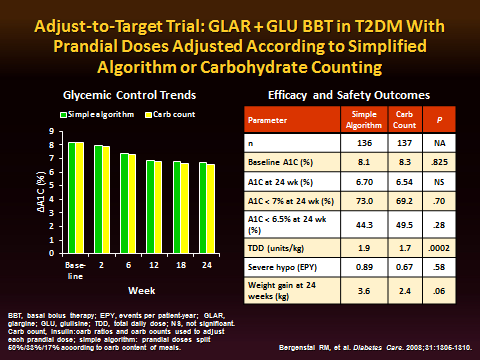
2 Figure 1. Figure 2.


3 Nevertheless, stepwise addition of prandial insulin does not bring a majority of patients to intensive targets in most clinical trials. Results from other randomized controlled trials highlight limitations in existing insulins and regimens. In a meta-analysis of 92 treatment arms from 53 randomized controlled trials targeting A1C < 7%, which included more than 32,000 patients, 4 common T2DM insulin regimens were evaluated: basal, premixed, prandial, and basal-bolus (Figure 3). 9 The proportion of patients attaining glycemic targets ranging from 6.5% to 8.0% was measured. The results indicate that, on average, patients using BBT were more likely to attain a given glycemic target than patients using the other insulin regimens. However, fewer than half of patients participating in these trials were able to attain A1C < 7% on any regimen. Furthermore, one of the largest clinical trials of insulin therapy found that, on average, patients with baseline A1C of 8.6%-8.7% who did not attain A1C 7% after 6 months of twice-daily premixed insulin or once-daily basal insulin demonstrated no further improvement in A1C even if switched to BBT. 10,11,12 Thus, some studies show that patients with T2DM unable to attain A1C 7% on their initial insulin regimens are unlikely to be able to attain A1C 7% with intensification of insulin therapy. Figure 3.

4 Insulin demonstrating more consistent pharmacodynamics would represent a clinically important advance over current insulins. Clinical trials of insulin intensification strategies in T2DM have yielded conflicting results, with some trials finding further improvement of glycemic control with stepwise insulin intensification but others demonstrating no change; these findings suggest that improved prandial insulins are needed. In addition, it is desirable that basal insulins have a flat, peakless time-action profile and long duration of action to more closely mimic physiological basal insulin secretion and eliminate the need for twice-daily injection in some patients. Accordingly, several insulins that seek to improve upon current analogues are in development. References 1. Heise T, Nosek L, Ronn BB, et al. Lower within-subject variability of insulin detemir in comparison to NPH insulin and insulin glargine in people with type 1 diabetes. Diabetes. 2004;53(6): Le Floch JP, Levy M, Mosnier-Pudar H, et al. Comparison of once- versus twice-daily administration of insulin detemir, used with mealtime insulin aspart, in basal-bolus therapy for type 1 diabetes: assessment of detemir administration in a progressive treat-to-target trial (ADAPT). Diabetes Care. 2009;32(1): Rosenstock J, Davies M, Home PD, Larsen J, Koenen C, Schernthaner G. A randomised, 52-week, treat-totarget trial comparing insulin detemir with insulin glargine when administered as add-on to glucoselowering drugs in insulin-naive people with type 2 diabetes. Diabetologia. 2008;51(3): Robertson KJ, Schoenle E, Gucev Z, Mordhorst L, Gall MA, Ludvigsson J. Insulin detemir compared with NPH insulin in children and adolescents with type 1 diabetes. Diabet Med. 2007;24(1): Garg SK, Gottlieb PA, Hisatomi ME, et al. Improved glycemic control without an increase in severe hypoglycemic episodes in intensively treated patients with type 1 diabetes receiving morning, evening, or split dose insulin glargine. Diabetes Res Clin Pract. 2004;66(1): van Bon AC, Bode BW, Sert-Langeron C, DeVries JH, Charpentier G. Insulin glulisine compared to insulin aspart and to insulin lispro administered by continuous subcutaneous insulin infusion in patients with type 1 diabetes: A randomized controlled trial. Diabetes Technol Ther. 2011;13(6): Meneghini L, Mersebach H, Kumar S, Svendsen AL, Hermansen K. Comparison of 2 intensification regimens with rapid-acting insulin aspart in type 2 diabetes mellitus inadequately controlled by once-daily insulin detemir and oral antidiabetes drugs: the step-wise randomized study. Endocr Pract. 2011;17(5): Bergenstal RM, Johnson M, Powers MA, et al. Adjust to target in type 2 diabetes: Comparison of a simple algorithm with carbohydrate counting for adjustment of mealtime insulin glulisine. Diabetes Care. 2008;31(7): Giugliano D, Maiorino MI, Bellastella G, Chiodini P, Esposito K. Multiple HbA1c targets and insulin analogues in type 2 diabetes: a systematic review. J Diabetes Complications. 2011;25(4): Buse JB, Wolffenbuttel BH, Herman WH, et al. The DURAbility of basal versus lispro mix 75/25 insulin efficacy (DURABLE) trial: Comparing the durability of lispro mix 75/25 and glargine. Diabetes Care. 2011;34(2):

5 11. Miser WF, Arakaki R, Jiang H, Scism-Bacon J, Anderson PW, Fahrbach JL. Randomized, open-label, parallel-group evaluations of basal-bolus therapy versus insulin lispro premixed therapy in patients with type 2 diabetes mellitus failing to achieve control with starter insulin treatment and continuing oral antihyperglycemic drugs: a noninferiority intensification substudy of the DURABLE trial. Clin Ther. 2010;32(5): Buse JB, Wolffenbuttel BH, Herman WH, et al. DURAbility of basal versus lispro mix 75/25 insulin efficacy (DURABLE) trial 24-week results: safety and efficacy of insulin lispro mix 75/25 versus insulin glargine added to oral antihyperglycemic drugs in patients with type 2 diabetes. Diabetes Care. 2009;32(6):

Prior Authorization Guideline
 Prior Authorization Guideline Guideline: PC - Apidra, Levemir Therapeutic Class: Hormones and Synthetic Substitutes Therapeutic Sub-Class: Antidiabetic Agents Client: CA, CO, NV, OK, OR, WA and AZ Approval
Initiation and Adjustment of Insulin Regimens for Type 2 Diabetes
 PL Detail-Document #300128 This Detail-Document accompanies the related article published in PHARMACIST S LETTER / PRESCRIBER S LETTER January 2014 Initiation and Adjustment of Insulin Regimens for Type
Type 2 Diabetes Adult Outpatient Insulin Guidelines Sutter Medical Foundation. February 2011.
 Type 2 Diabetes Adult Outpatient Insulin Guidelines. GENERAL RECOMMENDATIONS Start insulin if A1C and glucose levels are above goal despite optimal use of other diabetes medications. (Consider insulin
INSULIN TREATMENT FOR TYPE 2 DIABETES MANAGEMENT
 INSULIN TREATMENT FOR TYPE 2 DIABETES MANAGEMENT APIRADEE SRIWIJITKAMOL DIVISION OF ENDOCRINOLOGY AND METABOLISM DEPARTMENT OF MEDICINE FACULTY OF MEDICINE SIRIRAJ HOSPITOL QUESTION 1 1. ท านเคยเป นแพทย
Insulin Therapy In Type 2 DM. Sources of support. Agenda. Michael Fischer, M.D., M.S. The underuse of insulin Insulin definition and types
 Insulin Therapy In Type 2 DM Michael Fischer, M.D., M.S. Sources of support NaRCAD is supported by a grant from the Agency for Healthcare Research and Quality My current research projects are funded by
Insulin Algorithm for Type 2 Diabetes Mellitus in Children and Adults
 Insulin Algorithm for Type 2 Diabetes Mellitus in Children and Adults Stock # 45-11647 Revised 10/28/10 Glycemic Goals 1,2 Individualize goal based on patient risk factors A1c 6%
Intensive Insulin Therapy in Diabetes Management
 Intensive Insulin Therapy in Diabetes Management Lillian F. Lien, MD Medical Director, Duke Inpatient Diabetes Management Assistant Professor of Medicine Division of Endocrinology, Metabolism, & Nutrition
Insulin: Breaking Barriers Enhancing Therapies. Jerry Meece, RPh, FACA, CDE [email protected]
 Insulin: Breaking Barriers Enhancing Therapies Jerry Meece, RPh, FACA, CDE [email protected] Questions To Address Who are candidates for insulin? When do we start insulin? How do the different types of
IMPROVED METABOLIC CONTROL WITH A FAVORABLE WEIGHT PROFILE IN PATIENTS WITH TYPE 2 DIABETES TREATED WITH INSULIN GLARGINE (LANTUS ) IN CLINICAL
 464 IMPROVED METABOLIC CONTROL WITH A FAVORABLE WEIGHT PROFILE IN PATIENTS WITH TYPE 2 DIABETES TREATED WITH INSULIN GLARGINE (LANTUS ) IN CLINICAL PRACTICE STEPHAN A SCHREIBER AND ANIKA RUßMAN ABSTRACT
Intensifying Insulin Therapy
 Intensifying Insulin Therapy Rick Hess, PharmD, CDE, BC-ADM Associate Professor Gatton College of Pharmacy, Department of Pharmacy Practice East Tennessee State University Johnson City, Tennessee Learning
Scottish Medicines Consortium
 Scottish Medicines Consortium insulin glulisine for subcutaneous injection 100 units/ml (Apidra ) No. (298/06) Sanofi Aventis 4 August 2006 The Scottish Medicines Consortium (SMC) has completed its assessment
Medical Policy An independent licensee of the Blue Cross Blue Shield Association
 Afrezza Page 1 of 6 Medical Policy An independent licensee of the Blue Cross Blue Shield Association Title: Afrezza (human insulin) Prime Therapeutics will review Prior Authorization requests Prior Authorization
The basal plus strategy. Denis Raccah, MD, PhD Professor of Medicine University Hospital Sainte Marguerite Marseille FRANCE
 The basal plus strategy Denis Raccah, MD, PhD Professor of Medicine University Hospital Sainte Marguerite Marseille FRANCE ADA/EASD guidelines recommend use of basal insulin as early as the second step
INSULIN ALGORITHM FOR TYPE 2 DIABETES MELLITUS IN CHILDREN 1 AND ADULTS
 Publication # 45-11647 Targets*
Therapy Insulin Practical guide to Health Care Providers Quick Reference F Diabetes Mellitus in Type 2
 Ministry of Health, Malaysia 2010 First published March 2011 Perkhidmatan Diabetes dan Endokrinologi Kementerian Kesihatan Malaysia Practical guide to Insulin Therapy in Type 2 Diabetes Mellitus Quick
Insulin Initiation and Intensification
 Insulin Initiation and Intensification ANDREW S. RHINEHART, MD, FACP, CDE MEDICAL DIRECTOR AND DIABETOLOGIST JOHNSTON MEMORIAL DIABETES CARE CENTER Objectives Understand the pharmacodynamics and pharmacokinetics
Diabetes: When To Treat With Insulin and Treatment Goals
 Diabetes: When To Treat With Insulin and Treatment Goals Lanita. S. White, Pharm.D. Director, UAMS 12 th Street Health and Wellness Center Assistant Professor of Pharmacy Practice, UAMS College of Pharmacy
NCT00272090. sanofi-aventis HOE901_3507. insulin glargine
 These results are supplied for informational purposes only. Prescribing decisions should be made based on the approved package insert in the country of prescription Sponsor/company: Generic drug name:
CLASS OBJECTIVES. Describe the history of insulin discovery List types of insulin Define indications and dosages Review case studies
 Insulins CLASS OBJECTIVES Describe the history of insulin discovery List types of insulin Define indications and dosages Review case studies INVENTION OF INSULIN 1921 The first stills used to make insulin
Most patients with T2DM will eventually require insulin therapy. ADA Glycemic Control Targets. What are some of the obstacles?
 ADA Glycemic Control Targets A1C < 7% Preprandial plasma glucose 70-130 mg/dl Postprandial plasma glucose (PPG)
Insulin Analogues versus Pump Therapy in Type 2 Diabetes: Benefits from Pump Therapy
 Insulin Analogues versus Pump Therapy in Type 2 Diabetes: Benefits from Pump Therapy Eric RENARD, MD, PhD Endocrinology Dept, Lapeyronie Hospital Montpellier, France [email protected] Type 2
Basal Insulin Analogues Where are We Now?
 232 Medicine Update 41 Basal Insulin Analogues Where are We Now? S CHANDRU, V MOHAN Insulin is a polypeptide secreted by the beta cells of pancreas and consists of 51 amino acids (AA). It has two polypeptide
Practical Applications of Insulin Pump Therapy in Type 2 Diabetes
 Practical Applications of Insulin Pump Therapy in Type 2 Diabetes Wendy Lane, MD For a CME/CEU version of this article please go to www.namcp.org/cmeonline.htm, and then click the activity title. Summary
The prevalence of type 2 diabetes
 Insulin Therapy for Management of Type 2 Diabetes Mellitus: Strategies for Initiation and Long-term Patient Adherence Steven H. Barag, DO Effective glycemic control is essential to minimize the long-term
Insulin detemir versus insulin glargine for type 2 diabetes mellitus (Review)
 Insulin detemir versus insulin glargine for type 2 diabetes mellitus (Review) Swinnen SG, Simon ACR, Holleman F, Hoekstra JB, DeVries JH This is a reprint of a Cochrane review, prepared and maintained
Using Insulin in Type 2 Diabetes: In Need of a Renaissance? Introduction. David Kerr, M.D., and Tolulope Olateju, M.B., B.S.
 Journal of Diabetes Science and Technology Volume 5, Issue 4, July 2011 Diabetes Technology Society EDITORIAL Using Insulin in Type 2 Diabetes: In Need of a Renaissance? David, M.D., and Tolulope Olateju,
Diabetes Management Tube Feeding/Parenteral Nutrition Order Set (Adult)
 Review Due Date: 2016 May PATIENT CARE ORDERS Weight (kg) Known Adverse Reactions or Intolerances DRUG No Yes (list) FOOD No Yes (list) LATEX No Yes ***See Suggestions for Management (on reverse)*** ***If
Glycemic Control Initiative: Insulin Order Set Changes Hypoglycemia Nursing Protocol
 Glycemic Control Initiative: Insulin Order Set Changes Hypoglycemia Nursing Protocol Ruth LaCasse Kalish, RPh Department of Pharmacy Objectives Review the current practice at UConn Health with sliding
Improved Glycemic Control with Lesser Daily Dose with Insulin Glargine on Retransition from Insulin Detemir
 Diabetes Research and Metabolism: Open Access Received: Nov16, 2015, Accepted: Nov 27, 2015, Published: Nov 30, 2015 Diabetes Res Metab, Volume 1, Issue 1 http://crescopublications.org/drmoa/drmoa-1-003.pdf
Diabetes and the Elimination of Sliding Scale Insulin. Date: April 30 th 2013. Presenter: Derek Sanders, D.Ph.
 Diabetes and the Elimination of Sliding Scale Insulin Date: April 30 th 2013 Presenter: Derek Sanders, D.Ph. Background Information Epidemiology and Risk Factors Diabetes Its Definition and Its Impact
Intensifying Insulin In Type 2 Diabetes
 Intensifying Insulin In Type 2 Diabetes Eric L. Johnson, M.D. Associate Professor Department of Family and Community Medicine University of North Dakota School of Medicine and Health Sciences Assistant
How To Initiate Insulin
 Initiation and Titration of Insulin Analogs in the Patient with Type 2 Diabetes Supported by an educational grant from Novo Nordisk Inc. This program is supported by an educational grant from Novo Nordisk
TYPE 2 DIABETES SEQUENTIAL INSULIN STRATEGIES
 TYPE 2 DIABETES SEQUENTIAL INSULIN STRATEGIES Non-insulin regimes Basal insulin only (usually with oral agents) Number of injections 1 Regimen complexity Low Basal insulin +1 meal-time rapidacting insulin
Cochrane Quality and Productivity topics
 Long-acting insulin analogues versus NPH insulin (human isophane insulin) for type 2 diabetes mellitus NICE has developed the Cochrane Quality and Productivity (QP) topics to help the NHS identify practices
Starting patients on the V-Go Disposable Insulin Delivery Device
 Starting patients on the V-Go Disposable Insulin Delivery Device A simple guide for your practice For adult patients with Type 2 diabetes on basal insulin who need to take the next step Identify appropriate
Insulin Therapy. Endocrinologist. H. Delshad M.D. Research Institute For Endocrine Sciences
 Insulin Therapy H. Delshad M.D Endocrinologist Research Institute For Endocrine Sciences Primary Objectives of Effective Management A1C % 9 8 Diagnosis SBP mm Hg LDL mg/dl 7 145 130 140 100 Reduction of
The first injection of insulin was given on
 EFFECTIVE USE OF INSULIN THERAPY IN TYPE 2 DIABETES * Bernard Zinman, MDCM ABSTRACT Type 2 diabetes is a progressive disease; an individual s ability to secrete insulin in increasing amounts to overcome
Insulin detemir in the treatment of type 1 and type 2 diabetes
 AUTHOR COPY REVIEW Insulin detemir in the treatment of type 1 and type 2 diabetes Jean-Christophe Philips André Scheen Division of Diabetes, Nutrition & Metabolic Disorders, Department of Medicine, CHU
INPATIENT DIABETES MANAGEMENT Robert J. Rushakoff, MD Professor of Medicine Director, Inpatient Diabetes University of California, San Francisco
 INPATIENT DIABETES MANAGEMENT Robert J. Rushakoff, MD Professor of Medicine Director, Inpatient Diabetes University of California, San Francisco CLINICAL RECOGNITION Background: Appropriate inpatient glycemic
Presented By: Dr. Nadira Husein
 Presented By: Dr. Nadira Husein I have no conflict of interest Disclosures I have received honoraria/educational grants from the following: Novo Nordisk, Eli Lilly, sanofi-aventis, Novartis, Astra Zeneca,
Abdulaziz Al-Subaie. Anfal Al-Shalwi
 Abdulaziz Al-Subaie Anfal Al-Shalwi Introduction what is diabetes mellitus? A chronic metabolic disorder characterized by high blood glucose level caused by insulin deficiency and sometimes accompanied
Insulin glargine improves glycemic control and quality of life in type 2 diabetic patients on hemodialysis
 ORIGINAL ARTICLE JN EPHROL 25( DOI: 10.5301/jn.5000081 Insulin glargine improves glycemic control and quality of life in type 2 diabetic patients on hemodialysis Masao Toyoda, Moritsugu Kimura, Naoyuki
INSULINThere are. T y p e 1 T y p e 2. many different insulins for
 T y p e 1 T y p e 2 INSULINThere are many different insulins for Characteristics The three characteristics of insulin are: Onset. The length of time before insulin reaches the bloodstream and begins lowering
ADJUSTING INSULIN DOSES CONFLICTS OF INTEREST
 ADJUSTING INSULIN DOSES CONFLICTS OF INTEREST Vahid Mahabadi, MD Research grants from Sanofi and Amylin Pharmaceutical Companies Mayer B. Davidson, MD Advisory Board Sanofi Pharmaceutical Company Chief
Session 5: Insulin: Tried and True - Update on Best Practices in Clinical Use and Patient Adherence Learning Objectives
 Session 5: Insulin: Tried and True - Update on Best Practices in Clinical Use and Patient Adherence Learning Objectives 1. Design strategies to help patients overcome cultural barriers to using insulin,
INTERNAL MEDICINE RESIDENTS NOON CONFERENCE: INPATIENT GLYCEMIC CONTROL
 INTERNAL MEDICINE RESIDENTS NOON CONFERENCE: INPATIENT GLYCEMIC CONTROL Presented by: Leyda Callejas PGY5 Endocrinology, Diabetes and Metabolism Acknowledgements: Dr. P Orlander Dr. V Lavis Dr. N Shah
Insulin therapy in various type 1 diabetes patients workshop
 Insulin therapy in various type 1 diabetes patients workshop Bruce H.R. Wolffenbuttel, MD PhD Dept of Endocrinology, UMC Groningen website: www.umcg.net & www.gmed.nl Twitter: @bhrw Case no. 1 Male of
Donovan Victorine Pharm.D. BCACP Clinical Pharmacy Specialist Boise VA Medical Center. U-500 Insulin
 Donovan Victorine Pharm.D. BCACP Clinical Pharmacy Specialist Boise VA Medical Center U-500 Insulin Understand differences between U-500 concentrated insulin and standard insulin formulations Recognize
C. Wang, J. Mamza and I. Idris. Abstract. Introduction. Diabet. Med. 00, 000 000 (2015)
 Systematic Review or Meta-analysis Biphasic vs basal bolus insulin regimen in Type 2 diabetes: a systematic review and meta-analysis of randomized controlled trials C. Wang, J. Mamza and I. Idris Division
Diabetes Medications: Insulin Therapy
 Diabetes Medications: Insulin Therapy Courtesy Univ Texas San Antonio Eric L. Johnson, M.D. Department of Family and Community Medicine Diabetes and Insulin Type 1 Diabetes Autoimmune destruction of beta
Algorithms for Glycemic Management of Type 2 Diabetes
 KENTUCKY DIABETES NETWORK, INC. Algorithms for Glycemic Management of Type 2 Diabetes The Diabetes Care Algorithms for Type 2 Diabetes included within this document are taken from the American Association
(30251) Insulin SQ Prandial Carbohydrate
 Diagnosis Patient MUST BE educated using carbohydrate counting for prial insulin coverage before hospitalization to be eligible for this order set Nursing Metered Glucose (Single Select Section) Metered
Continuous Subcutaneous Insulin Infusion (CSII)
 IMPORTANCE OF FOCUS CSII (Insulin pumps) have been used for more than 35 years. In the U.S. in 2005, the level of insulin pump penetration was estimated at 20 to 30% in patients with type 1 diabetes mellitus
Lipodystrophy: Metabolic and Clinical Aspects. Resource Room Slide Series
 Lipodystrophy: Metabolic and Clinical Aspects Resource Room Slide Series Current Thinking About the Diagnosis and Treatment of the Insulin-Resistant State: How to Use Insulin Therapy Irl B. Hirsch, MD
INSULIN INTENSIFICATION: Taking Care to the Next Level
 INSULIN INTENSIFICATION: Taking Care to the Next Level By J. Robin Conway M.D., Diabetes Clinic, Smiths Falls, ON www.diabetesclinic.ca Type 2 Diabetes is an increasing problem in our society, due largely
A new insulin order form should be completed for subsequent changes to type of insulin and/or frequency of administration
 of nurse A new insulin order form should be completed for subsequent changes to type of insulin and/or frequency of administration 1. Check times for point of care meter blood glucose testing. Pre-Breakfast
Use of U-500 Insulin in the Treatment of Severe Insulin Resistance
 Use of U-500 Insulin in the Treatment of Severe Insulin Resistance Elaine Cochran, MSN, CRNP, and Phillip Gorden, MD Clinical Endocrinology Branch, National Institute of Diabetes and Digestive and Kidney
There seem to be inconsistencies regarding diabetic management in
 Society of Ambulatory Anesthesia (SAMBA) Consensus Statement on Perioperative Blood Glucose Management in Diabetic Patients Undergoing Ambulatory Surgery Review of the consensus statement and additional
Insulin Pump Therapy and Continuous Glucose Sensor Use in the Management of Diabetes Mellitus
 Insulin Pump Therapy and Continuous Glucose Sensor Use in the Management of Diabetes Mellitus Louis Haenel, IV, DO, FACOI, FACE Endocrinology Roper Hospital Charleston, SC Dr. Louis Haenel IV has disclosed
People with type 2 diabetes mellitus (T2DM) often require
 DIABETES TECHNOLOGY & THERAPEUTICS Volume 12, Supplement 1, 2010 ª Mary Ann Liebert, Inc. DOI: 10.1089=dia.2009.0192 Insulin Pump Use in Type 2 Diabetes Bruce W. Bode, M.D., F.A.C.E. Abstract Continuous
When and how to start insulin: strategies for success in type 2 diabetes
 1 When and how to start insulin: strategies for success in type diabetes Treatment of type diabetes in 199: with each step treatment gets more complex Bruce H.R. Wolffenbuttel, MD PhD Professor of Endocrinology
Management of Diabetes Mellitus with Insulin Lispro
 Clinical Medicine Insights: Therapeutics Review Open Access Full open access to this and thousands of other papers at http://www.la-press.com. Management of Diabetes Mellitus with Insulin Lispro Masami
A Simplified Approach to Initiating Insulin. 4. Not meeting glycemic goals with oral hypoglycemic agents or
 A Simplified Approach to Initiating Insulin When to Start Insulin: 1. Fasting plasma glucose (FPG) levels >250 mg/dl or 2. Glycated hemoglobin (A1C) >10% or 3. Random plasma glucose consistently >300 mg/dl
Harmony Clinical Trial Medical Media Factsheet
 Overview Harmony is the global Phase III clinical trial program for Tanzeum (albiglutide), a product developed by GSK for the treatment of type 2 diabetes. The comprehensive program comprised eight individual
Insulin T Y P E 1 T Y P E 2
 T Y P E 1 T Y P E 2 INSULIN There are many different insulins for many different situations and lifestyles. This section should help you and your doctor decide which insulin or insulins are best for you.
Evolution of Insulin Development: Focus on Key Parameters
 Adv Ther (2012) 29(7):590 619. DOI 10.1007/s12325-012-0034-8 REVIEW Evolution of Insulin Development: Focus on Key Parameters Joseph M. Tibaldi To view enhanced content go to www.advancesintherapy.com
INSULIN THERAPY FOR CHILDREN AND ADOLESCENTS WITH TYPE 1 DIABETES
 INSULIN THERAPY FOR CHILDREN AND ADOLESCENTS WITH TYPE 1 DIABETES Young Jun Rhie, M.D. Department of Pediatrics Korea University Ansan Hospital Introduction 1 Children and adolescents with type 1 diabetes
10 to 30 minutes ½ to 3 hours 3 to 5 hours. 30 60 minutes 1 to 5 hours 8 hours. 1 to 4 hours
 Insulin Action There are several types of insulin. They are classified by how long they act: very fast, fast, slow and very slow acting. Each type of insulin has a certain time period in which it works.