
Parker O-Ring Handbook ORD 5700
|
|
|
- Wilfred Murphy
- 10 years ago
- Views:
Transcription
1 aerospace climate control electromechanical filtration fluid & gas handling hydraulics pneumatics process control sealing & shielding Parker O-Ring Handbook ORD 5700

2 Failure, improper selection or improper use of the products and/or systems described herein or related items can cause death, personal injury or property damage. This document and other information from Parker Hannifin Corporation, its subsidiaries and authorized distriburs provides product and/or system options for further investigation by users having technical expertise. It is important that you analyze all aspects of your application and review the information concerning the product or system in the current product catalog. Due the variety of operating conditions and applications for these products or systems, the user, through his or her own analysis and testing, is solely responsible for making the final selection of the products and systems and assuring that all performance, safety and warning requirements of the application are met. The products described herein, including without limitation, product features, specifications, designs, availability and pricing, are subject change by Parker Hannifin Corporation and its subsidiaries at any time without notice. OFFER OF SALE The items described in this document are hereby offered for sale by Parker Hannifin Corporation, its subsidiaries and its authorized distriburs. This offer and its acceptance are governed by the provisions stated on the separate page of this document entitled Offer of Sale. Copyright 2007, Parker Hannifin Corporation, Cleveland, OH. All rights reserved.

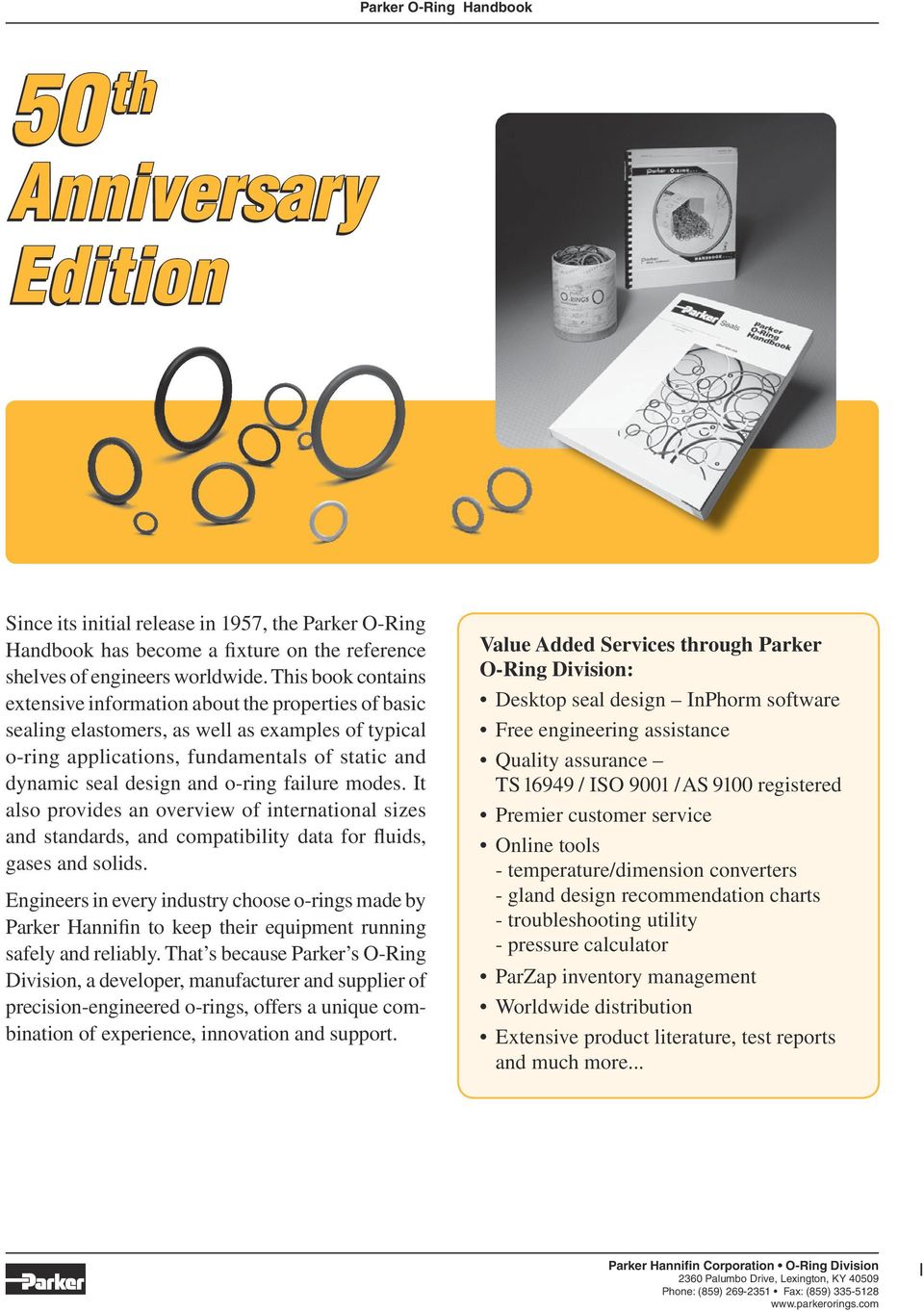
3 50 th Anniversary Edition Since its initial release in 1957, the Parker O-Ring Handbook has become a fixture on the reference shelves of engineers worldwide. This book contains extensive information about the properties of basic sealing elasmers, as well as examples of typical o-ring applications, fundamentals of static and dynamic seal design and o-ring failure modes. It also provides an overview of international sizes and standards, and compatibility data for fluids, gases and solids. Engineers in every industry choose o-rings made by Parker Hannifin keep their equipment running safely and reliably. That s because Parker s O-Ring Division, a developer, manufacturer and supplier of precision-engineered o-rings, offers a unique combination of experience, innovation and support. Value Added Services through Parker O-Ring Division: Deskp seal design InPhorm software Free engineering assistance Quality assurance TS / ISO 9001 / AS 9100 registered Premier cusmer service Online ols - temperature/dimension converters - gland design recommendation charts - troubleshooting utility - pressure calcular ParZap invenry management Worldwide distribution Extensive product literature, test reports and much more... I
4 Table of Contents Introduction Section I Basic O-Ring Elasmers Section II O-Ring Applications Section III Static O-Ring Sealing Section IV Dynamic O-Ring Sealing Section V Back-up Rings Section VI Compatibility Tables for Gases, Fluids, Solids Section VII Specifications Section VIII Sizes Section IX Appendix Section X Index Section XI II

5 Section I Introduction 1.0 How Use This Handbook What is an O-Ring? What is an O-Ring Seal? O-Rings as Drive Belts Cusm Molded Shapes Parker Engineering Advantages of O-Rings Operation O-Ring Characteristics Limitations of O-Ring Use Scope of O-Ring Use Static Seals Reciprocating Seals Oscillating Seals Rotary Seals Seat Seals Pneumatic Seals Vacuum Seals Cushion Installation Crush Installation Rod Wiper Installation Comparison of Common Seal Types Recommended Design Procedure O-Ring Design Procedure Using inphorm O-Ring Design & Material Selection Software Recommended Manual Design Procedure Introduction inphorm is a trademark of Parker Hannifin Corporation. 1-1

6 Introduction Introduction 1.0 How Use This Handbook For those who are unfamiliar with O-ring design, it is recommended first study this introducry section, becoming familiar with the basic principles of O-ring seals, their common uses and general limitations. Introduction Those who are already familiar with O-ring seal design may simply refer the appropriate design tables for the information needed. Even those who have designed many O-ring seals may profit by reviewing the basics from time time. 1.1 What is an O-Ring? An O-ring is a rus, or doughnut-shaped ring, generally molded from an elasmer, although O-rings are also made from PTFE and other thermoplastic materials, as well as metals, both hollow and solid. This handbook, however, deals entirely with elasmeric O-rings. O-rings are used primarily for sealing. The various types of O-ring seals are described in this section under Scope of O-Ring Use. O-rings are also used as light-duty, mechanical drive belts. More information, including design criteria on O-ring drive belts and their application will be found in O-Ring Applications, Section III. 1.3 Advantages of O-Rings They seal over a wide range of pressure, temperature and lerance. Ease of service, no smearing or retightening. No critical rque on tightening, therefore unlikely cause structural damage. O-rings normally require very little room and are light in weight. In many cases an O-ring can be reused, an advantage over non-elastic flat seals and crush-type gaskets. The duration of life in the correct application corresponds the normal aging period of the O-ring material. O-ring failure is normally gradual and easily identified. Where differing amounts of compression effect the seal function (as with flat gaskets), an O-ring is not effected because metal metal contact is generally allowed for. They are cost-effective. Groove 1.2 What is an O-Ring Seal? An O-ring seal is used prevent the loss of a fluid or gas. The seal assembly consists of an elasmer O-ring and a gland. An O-ring is a circular cross-section ring molded from rubber (Figure 1-1). The gland usually cut in metal or another rigid material contains and supports the O-ring (Figures 1-2 and 1-3). The combination of these two elements; O-ring and gland constitute the classic O-ring seal assembly. Figure 1-2: Basic Gland Bore Pisn Rod Figure 1-1: Basic O-Rng Figure 1-3: Gland and O-Ring Seal 1-2

7 1.4 Operation All robust seals are characterized by the absence of any pathway by which fluid or gas might escape. Detail differences exist in the manner by which zero clearance is obtained welding, brazing, soldering, ground fits or lapped finishes or the yielding of a softer material wholly or partially confined between two harder and stiffer members of the assembly. The O-ring seal falls in the latter class. The rubber seal should be considered as essentially an incompressible, viscous fluid having a very high surface tension. Whether by mechanical pressure from the surrounding structure or by pressure transmitted through hydraulic fluid, this extremely viscous fluid is forced flow within the gland produce zero clearance or block the flow of the less viscous fluid being sealed. The rubber absorbs the stack-up of lerances of the unit and its internal memory maintains the sealed condition. Figure 1-4 illustrates the O-ring as installed, before the application of pressure. Note that the O-ring is mechanically squeezed out of round between the outer and inner members close the fluid passage. The seal material under mechanical pressure extrudes in the microfine grooves of the gland. Figure 1-5 illustrates the application of fluid pressure on the O-ring. Note that the O-ring has been forced flow up, but not in, the narrow gap between the mating surfaces and in so doing, has gained greater area and force of sealing contact. Figure 1-6 shows the O-ring at its pressure limit with a small portion of the seal material entering the narrow gap between inner and outer members of the gland. Figure 1-7 illustrates the result of further increasing pressure and the resulting extrusion failure. The surface tension of the elasmer is no longer sufficient resist flow and the material extrudes (flows) in the open passage or clearance gap. Figure 1-4: O-Ring Installed Figure 1-6: O-Ring Extruding Figure 1-5: O-Ring Under Pressure Figure 1-7: O-Ring Failure 1.5 O-Ring Characteristics A very early and hisrically prominent user of O-rings (1) cites a number of characteristics of O-ring seals which are still of interest seal designers. Extracts of the more general characteristics are listed as follows: Note: While Parker Seal generally agrees with the author on most of his statements, exception will be taken certain generalizations due more recent developments in sealing geometry and improved elasmer technology. A. The seals can be made perfectly leak-proof for cases of static pisns and cylinders for fluid pressures up 5000 psi. (Limit of test pressure). The pressure may be constant or variable. B. The seals can be made seal satisfacrily between reciprocating pisns and cylinders at any fluid pressure up 5000 psi. There may be slight running leakage (a few drops per hundred strokes) depending on the filmforming ability of the hydraulic medium. O-rings can be used between rotating members with similar results but in all cases the surface rubbing speed must be kept low. C. A single O-ring will seal with pressure applied alternately on one side and then on the other, but in cases of severe loading or usage under necessarily unfavorable conditions, seal life can be extended by designing the mechanism so that each seal is subjected pressure in one direction only. Seals may be arranged in series as a safety measure but the first seal exposed pressure will take the full load. D. O-ring seals must be radially compressed between the botm of the seal groove and the cylinder wall for proper sealing action. This compression may cause the seal roll slightly in its groove under certain conditions of pisn motion, but the rolling action is not necessary for normal operation of the seals. E. In either static or dynamic O-ring seals under high pressure the primary cause of seal failure is extrusion of the seal material in the pisn-cylinder clearance. The major facrs effecting extrusion are fluid pressure, seal hardness and strength, and pisn-cylinder clearance. F. Dynamic seals may fail by abrasion against the cylinder or pisn walls. Therefore, the contacting surfaces should be polished for long seal life. Moving seals that pass over ports or surface irregularities while under hydraulic pressure are very quickly cut or worn failure. G. The shape of the seal groove is unimportant as long as it results in proper compression of the seal between the botm of the groove and the cylinder wall, and provides room for the compressed material flow so that the seal is not solidly confined between metal surfaces. H. The seal may be housed in a groove cut in the cylinder wall instead of on the pisn surface without any change in design limitations or seal performance. Introduction (1) O-Ring Seals in the Design of Hydraulic Mechanisms, a paper presented at the S.A.E. Annual Meeting, January, 1947 by Mr. D. R. Pearl of Hamiln Standard Prop. Div. of United Aircraft Corp. 1-3

8 Introduction I. Friction of moving O-ring seals depends primarily on seal compression, fluid pressure, and projected seal area exposed pressure. The effects of materials, surfaces, fluids, and speeds of motion are normally of secondary importance, although these variables have not been completely investigated. Friction of O-ring seals under low pressures may exceed the friction of properly designed lip type seals, but at higher pressures, developed friction compares favorably with, and is often less than, the friction of equivalent lip type seals. J. The effects of temperature changes from +18 C +121 C (-65 F +250 F) on the performance of O-ring seals depends upon the seal material used. Synthetic rubber can be made for continual use at high or low temperatures, or for occasional short exposure wide variations in temperature. At extremely low temperature the seals may become brittle but will resume their normal flexibility without harm when warmed. Prolonged exposure excessive heat causes permanent hardening and usually destroys the usefulness of the seal. The coefficient of thermal expansion of synthetic rubber is usually low enough so that temperature changes present no design difficulties. (Note: This may not be true for all elasmer compounds, especially FFKM.) K. Chemical interaction between the seal and the hydraulic medium may influence seal life favorably or unfavorably, depending upon the combination of seal material and fluid. Excessive hardening, softening, swelling, and shrinkage must be avoided. L. O-ring seals are extremely dependable because of their simplicity and ruggedness. Static seals will seal at high pressure in spite of slightly irregular sealing surfaces and slight cuts or chips in the seals. Even when broken or worn excessively, seals may offer some measure of flow restriction for emergency operation and approaching failure becomes evident through gradual leakage. M. The cost of O-ring seals and the machining expense necessary incorporate them in hydraulic mechanism designs are at least as low as for any other reliable type of seal. O-ring seals may be stretched over large diameters for installation and no special assembly ols are necessary. N. Irregular chambers can be sealed, both as fixed or moving-parts installations. Note: See paragraph 1.3 for additional advantages. their use, i.e., high temperature, high rubbing speeds, cylinder ports over which seals must pass and large shaft clearances. Disregard for these limitations will result in poor seal performance. Pisn rings, lip type seals, lapped fits, flat gaskets and pipe fittings all have their special places in hydraulic design, but where the design specifications permit the proper use of O-ring seals, they will be found give long and dependable service. While no claim is made that an O-ring will serve best in all conditions, the O-ring merits consideration for most seal applications except: A. Rotary speeds exceeding 1500 feet per minute contact speed. B. An environment completely incompatible with any elasmeric material. C. Insufficient structure support anything but a flat gasket. Note: These points are general statements and there are, of course, numerous exceptions. Details of O-ring seal design in regard particular situations are discussed in the following sections: Applications, Elasmers, Facrs Applying To all O-Ring Types, Static O-Ring Seals, and Dynamic O-Ring Seals can be referenced as needed. 1.7 Scope of O-Ring Use Further discussion in this chapter and in the remainder of this handbook is based on specific types of O-ring seals and special applications. Definitions of commonly used terms connected with O-ring seals are provided in the glossary contained in the Appendix, Section X. These terms are common the sealing industry. 1.6 Limitations of O-Ring Use Again citing Mr. D. R. Pearl s paper (1), limitations of O-ring use are given as: Although it has been stated that O-rings offer a reasonable approach the ideal hydraulic seal, they should not be considered the immediate solution all sealing problems. It has been brought out in the foregoing discussion that there are certain definite limitations on Figure 1-8: Static Seal Application (1) O-Ring Seals in the Design of Hydraulic Mechanisms, a paper presented at the S.A.E. Annual Meeting, January, 1947 by Mr. D. R. Pearl, Hamiln Standard Division of United Aircraft Corp. 1-4

9 1.7.1 Static Seals In a truly static seal, the mating gland parts are not subject relative movement (except for small thermal expansion or separation by fluid pressure), as contrasted from seals in which one of the gland parts has movement relative the other. Examples of static seals are: a seal under a bolt head or rivet, a seal at a pipe or tubing connection, a seal under a cover plate, plug or similar arrangement or, in general, the equivalent of a flat gasket. Figure1-8 illustrates a typical static seal. Note: True static seals are generally quite rare. Vibrational movement is present in vitrually all static applications Reciprocating Seals In a reciprocating seal, there is relative reciprocating motion (along the shaft axis) between the inner and outer elements. This motion tends slide or roll the O-ring, or sealing surface at the O-ring, back and forth with the reciprocal motion. Examples of a reciprocating seal would be a pisn in a cylinder, a plunger entering a chamber, and a hydraulic actuar with the pisn rod anchored. Figure 1-9 illustrates a typical reciprocating seal. Note: O-ring seals are generally not recommended for reciprocating installations in which the speed is less than one foot per minute. Consult a Parker Terriry Sales Manager for more information on special seals meet this requirement Oscillating Seals In an oscillating seal, the inner or outer member of the seal assembly moves in an arc (around the shaft axis) relative the other member. This motion tends rotate one or the other member in relation the O-ring. Where the arc of motion exceeds 360, as in multiple turns operate a valve handle, the return arc in the opposite direction distinguishes the oscillating seal from a rotary seal. Except for very special cases, any longitudinal motion (as caused by a spiral thread) involved in what is classed as an oscillating seal is not important. An example of an oscillating seal is an O-ring seal for a faucet valve stem. See Figure Rotary Seals In a rotary seal, either the inner or outer member of the sealing elements turn (around the shaft axis) in one direction only. This applies when rotation is reversible, but does not allow for starting and spping after brief arcs of motion, which is classed as an oscillating seal. Examples of a rotary seal include sealing a mor or engine shaft, or a wheel on a fixed axle. See Figure Seat Seals In a seat seal, the O-ring serves close a flow passage as one of the contact members. The motion of closing the passage disrts the O-ring mechanically create the seal, in contrast conditions of sealing in previously defined types. A sub-classification is closure with impact as compared with non-impact closure. Examples of a seat-seal include O-ring as a washer on the face of a spiral threaded valve, a seal on the cone of a floating check valve, and a seal on the end of a solenoid plunger. See Figure Pneumatic Seals A pneumatic seal may be any of the previously described types of O-ring seals but is given a different classification because of the use of a gas or vapor rather than a liquid. This has a vital affect on the lubrication of the O-ring and thus influences all moving (or dynamic) seal installations. A further point is that pneumatic seals may be affected by the increase in gas temperature with compression. Note that the seal should be defined as pneumatic-rotary etc. for complete identification. Figure 1-10: Oscillating Seal Introduction Note that groove size prevents rotation of O-ring Figure 1-11: Rotary Seal Figure 1-9: Reciprocating Seal Application Figure 1-12: Seat Seal 1-5

10 Introduction Vacuum Sealing A vacuum seal confines or contains a vacuum environment or chamber. The vacuum seal may be any of the previously defined types (except a pneumatic seal) and as in the case of pneumatic seals, both terms applicable the seal should be given for complete identification. This classification is given primarily because, in most cases, the leakage lerance is less than for pressure seals. In addition, the problem of pressure trapped between multiple O-rings, which increases the load on a single O-ring, does not apply. Multiple O-rings are useful in a vacuum seal reduce permeation. Additional information on the use of O-rings for sealing in a vacuum environment may be found in Parker Catalog 5705A, Vacuum Sealing. See also Section III, O-Ring Applications Cushion Installation Such an application requires that the O-ring absorb the force of impact or shock by deformation of the ring. Thus, forcible, sudden contact between moving metal parts is prevented. It is essentially a mechanical device. An example is the use of an O-ring prevent metal--metal botming of a pisn in a cylinder. The O-ring must be properly held in place as otherwise it might shift and interfere with proper operation of the mechanism Crush Installation This use of an O-ring is a variation of the static seal. The O-ring is crushed in a space having a cross-section different from that of a standard gland for example, triangular. While it is an effective seal, the O-ring is permanently deformed and therefore generally considered non-reusable. See Figure 1-13 and Design Chart 4-6 in Section IV for further information Rod Wiper Installation In this case, the O-ring is used keep a reciprocating shaft or rod clean prevent damaging an O-ring seal located inboard from the wiper. The wiper O-ring does not necessarily seal. If there is a possibility of trapping liquid between the wiper and sealing O-rings, the space between the two must be vented. This installation is effective on actuating cylinders of machinery used in dirty, dusty areas. See Figure O-Rings as Drive Belts O-rings make superior low-power drive belts. See O-ring Applications, Section III for additional information on drive belt design. 1.9 Cusm Molded Shapes Molded shapes consist of homogenous rubber parts functioning as sealing devices in both dynamic and static applications. Relying on Parker cusm designed seals can mean tal sealing, cost reduction, fast service, and quality assurance you. Contact the Parker Engineered Seals Division for more specific information on the availability of cusm molded shapes Parker Engineering Parker s Application Engineering Department personnel are prepared help you solve your sealing problems in several ways: Design Assistance Our engineers will review your application, study all facrs involved such as temperatures, pressures, gland design, bolt rque, surface finish, etc., and suggest several alternate designs. They will work with you in researching and testing those selected until the best possible seal is achieved, based on performance and low manufacturing cost. Compound Development Although the geometric configuration of the seal is critical, it is also very important select the most appropriate compound for the specific application. Even though Parker has many compounds available, we are always ready develop a special compound having its own distinct properties tailored the needs of a particular application. To insure that these physical properties are achieved with each batch of material, Parker has designed a control system called C.B.I. The initials C.B.I. stand for Controlled Batch Identification. This is a system of batch numbering and traceability developed by Parker Seal Group which ties the quality assurance system gether from the masterbatch the finished seals. Total Quality Management The Parker Seal Group employs a TS16949/AS9100 based system assure a continuing standard of quality that is commensurate with good manufacturing practices. However, in many cases as in cusm designed molded shapes a special quality assurance procedure will be developed for each individual molded shape with emphasis on the importance of the actual working area (or sealing interface) of the seal. Pressure O-ring Seal Vent Wiper O-ring Cut in two prevent pressure trap O-ring volume is usually 90-95% gland volume Figure 1-13: Crush Installation Figure 1-14: Wiper Installation 1-6

11 1.11 Comparison of Common Seal Types A number of common seal types, T-Seals, U-Cups, V-Packing and other devices, have been, and are still used for both dynamic and static seals. When compared with an O-ring seal, these other seal types may show one or more design disadvantages which might be overcome by use of an O-ring. As an aid in assessing the relative merits of an O-ring seal, Table1-1 lists several of the important facrs that must be considered in the selection of any effective seal geometry Recommended Design Procedure The following design steps are recommended for the designer/ engineer who is not familiar with O-ring seals: O-Ring Design Procedure using inphorm O-Ring Design & Material Selection Software described in paragraph Recommended Manual Design Procedure described in paragraph O-Ring Design Procedure using inphorm O-Ring Design & Material Selection Software. Parker recommends utilizing our inphorm design software guide the user through the design and selection of an O-ring and corresponding seal gland. Parker s inphorm not only addresses standard O-ring sizes, but allows the user cusm design O-ring glands and seals specifically for their application. To obtain inphorm software, contact Parker Product Information at C-PARKER or download from com. If inphorm is not readily available manual calculations can be performed using the following guidelines Recommended Manual Design Procedure 1. Study the Basic O-Ring Elasmers and O-Ring Applications Sections (II and III, respectively) see how a compound is selected, learn the effects of various environments on them, and become familiar with those considerations that apply all O-ring seal glands. 2. Check the Appendix, Section X, for the compound shrinkage class tables. If it is not AN shrinkage, it may be necessary compensate in the gland design for best sealing results. 3. Find the recommended O-ring size and gland dimensions in the appropriate design table in Static O-Ring Sealing or Dynamic O-Ring Sealing, Sections IV and V, respectively. 4. For industrial use, order the O-rings by the Parker compound number followed by the appropriate size number. Example: N For the experienced O-ring seal designer: 1. Determine the gland design for best sealing results. (a) If the fluid medium or its specification is known, refer the Fluid Compatibility Tables in Section VII or the various material or other specifications listed in Section VIII. (b) If the compound specification is known, refer Table 8-2, Table 8-3 or Table 8-4 in Section VIII as applicable. 2. Check the Appendix, Section X, for the compound shrinkage class tables. If it is not AN shrinkage, it may be necessary compensate in the gland design for best sealing results. 3. Find the recommended O-ring size and gland dimensions in the appropriate design table in Static O-Ring Sealing or Dynamic O-Ring Sealing, Sections IV and V, respectively. 4. For industrial use, order the O-rings by the Parker compound number followed by the size number. Example: N When ordering parts made with a military, AMS, or NAS specification material, see the Specifications Section VIII. Example: M83248/ For a design problem that cannot be resolved using the information in this reference guide, fill out a copy of the Statement of Problem sheet, Table 1-2, as completely as possible, then Contact the Parker O-Ring Division for problem analysis and design recommendations. Introduction Comparison of Seal Types Applications Periodic Tolerances Gland Adjustment Moving Required Adapters Space Type Static Moving Required Friction (Moving Seals) Required Requirements O-Ring X X No Medium Close No Small T-Seal X X No Medium Fairly Close No Small U-Packing X No Low Close No Small V-Packing X Yes Medium Fairly Close Yes Large Cup Type Packing X No Medium Close Yes Medium Flat Gasket X Yes No Large Compression or Jam Packing X X Yes High Fairly Close Yes Large Table 1-1: Comparison of Seal Types 1-7

12 Statement of Problem 1. Seal Type 2. Fluid Sealed (In sequence if multiple) A. B. C. D. Material Spec. Introduction 3. Temperature High Low Working 4. Pressure High Low Working 5. Applied Pressure Uni-Directional Steady Surge Bi-Directional Fluctuating Frequency 6. Gland Dimensions (If separate, groove wall) OD Finish Material ID Finish Material Finish Material 7. Max. Stretch at Installation 8. Assembly Problems Dirt Lint Lube Twisted Blind Pinching Over Threads Corners, Holes, Etc. Moving Seals 9. Length of Stroke (Reciprocating) Arc of Travel (Oscillating) Surface Speed (Rotary) 10. Shaft Bearings No Side Loading Effect Frequency (Oscillating or Reciprocating) Eccentricity 11. Operating Clearance Max. Min. 12. Leakage Tolerance 13. Friction Tolerance Breakaway Running 14. Anticipated Overhaul Period Ease of Access and Replacement 15. Lubrication By Fluid Sealed External 16. Cleanliness Protected Open Bad O-Ring Size No. And Parker Compound No. Or Military Part No. 17. Please include a drawing or sketch if needed clarify the assembly, and add any other pertinent information. NOTE: For O-rings molded of compounds having other than standard shrinkage, determine the finished dimensions and lerances as described in the Appendix (Section X). Table 1-2: Statement of Problem 1-8

13 Section II Basic O-Ring Elasmers 2.0 Elasmers Introduction Elasmers Polymer Rubber Elasmer Compound Basic Elasmers for O-Ring Seals Acrylonitrile-Butadiene (NBR) Carboxylated Nitrile (XNBR) Ethylene Acrylate (AEM, Vamac ) Ethylene Propylene Rubber (EPR, EPDM) Butyl Rubber (IIR) Chloroprene Rubber (CR) Fluorocarbon (FKM, FPM) Fluorosilicone (FVMQ) Hydrogenated Nitrile (HNBR) Perfluoroelasmer (FFKM) Polyacrylate (ACM) Polyurethane (AU, EU) Silicone Rubber (Q, MQ, VMQ, PVMQ) Tetrafluoroethylene-Propylene (AFLAS ) (FEPM) Compound Selection and Numbering Systems Selection of Base Polymer Physical and Chemical Characteristics Resistance Fluid Hardness Toughness Tensile Strength Elongation O-Ring Compression Force Modulus Tear Resistance Abrasion Resistance Volume Change Compression Set Thermal Effects Resilience Deterioration Corrosion Permeability Joule Effect Coefficient of Friction Electrical Properties Coefficient of Thermal Expansion Effects on Properties Standard Test Procedures Test Specimens Test Method Variables Effects of Environment on Testing Aging Srage Cure Date Age Control Shrinkage Compound Selection Non-Pioneering Design Pioneering Design Rapid Methods for Predicting the Compatibility of Elasmers with Mineral Based Oils Aniline Point Differences Elasmer Compatibility Index Operating Conditions Fluid Temperature Time Pressure Mechanical Requirements Selecting a Compound Compound Similarity Testing Specifications Qualification Testing Original Physical Properties Aged Physical Control Process Control Basic O-Ring Elasmers Vamac is a registered trademark of E.I. du Pont de Nemours & Co. AFLAS is a registered trademark of Asahi Glass Co., Ltd. 2-1

14 Basic O-Ring Elasmers Basic O-Ring Elasmers 2.0 Elasmers The basic core polymer of an elasmeric compound is called a rubber, produced either as natural gum rubber in the wild, on commercial rubber plantations or manufactured synthetically by the chemical industry. Today, more than 32 synthetic rubbers are known, the most important ones are listed in Table 2-1. Modern elasmeric sealing compounds generally contain 50 60% base polymer and are often described simply as rubber. The balance of an elasmer compound consists of various fillers, vulcanizing agents, accelerars, aging retardants and other chemical additives which modify and improve the basic physical properties of the base polymer meet the particular requirements of a specific application. Elasmers used in producing seals, and particularly those used in O-rings, will usually provide reliable, leak-free function if fundamental design requirements are observed. Cross-linking between the polymer chains is formed during the vulcanization process, see Figure 2-1. Cross-linking of the molecules changes the rubber from a plastic-like material an elastic material. After vulcanization, including any required post-cure, an elasmer compound attains the physical properties required for a good sealing material. As with all chemical reactions, temperature is responsible for the speed of reaction. Only when the ideal process temperature is constant during the entire vulcanization time, will the optimum degree of curing be reached. For this reason, the conditions of vulcanization are closely controlled and recorded as part of the Parker quality assurance process. 2.1 Introduction Elasmers Before reviewing the available elasmers and their general properties, it is necessary fully understand the terms polymer, rubber, elasmer and compound as they are used in this handbook Polymer A polymer is the result of a chemical linking of molecules in a long chain-like structure. Both plastics and elasmers are classified as polymers. In this handbook, polymer generally refers a basic class of elasmer, members of which have similar chemical and physical properties. O-rings are made from many polymers, but a few polymers account for the majority of O-rings produced, namely Nitrile, EPDM and Neoprene. Synthetic Rubber Abbreviation Chemical Name DIN/ISO 1629 ASTM D1418 M-Group (saturated carbon molecules in main macro-molecule chain): Polyacrylate Rubber ACM ACM Ethylene Acrylate AEM Chlorosulfonated Polyethylene Rubber CSM CSM Ethylene Propylene Diene Rubber EPDM EPDM Ethylene Propylene Rubber EPDM EPM Fluorocarbon Rubber FPM FKM Tetrafluorethylene Propylene Copolymer FEPM FEPM Perfluorinated Elasmer FFKM O-Group (with oxygen molecules in the main macro-molecule chain): Epichlorohydrin Rubber CO CO Epichlorohydrin Copolymer Rubber ECO ECO R-Group (unsaturated hydrogen carbon chain): Butadiene Rubber BR BR Chloroprene Rubber CR CR Isobutene Isoprene Rubber (Butyl Rubber) IIR IIR Chlorobutyl Rubber CIIR CIIR Isoprene Rubber IR IR Nitrile Butadiene Rubber NBR NBR Styrene Butadiene Rubber SBR SBR Hydrogenated Nitrile HNBR Carboxylated Nitrile XNBR XNBR Q-Group (with Silicone in the main chain): Fluorosilicone Rubber FMQ FVMQ Methyl Phenyl Silicone Rubber PMQ PMQ Methyl Phenyl Vinyl Silicone Rubber PMVQ PVMQ Methyl Silicone Rubber MQ MQ Methyl Vinyl Silicone Rubber VMQ VMQ Elasmer no cross-links Elasmer cross-linked U-Group (with carbon, oxygen and nitrogen in the main chain): Polyester Urethane AU AU Polyether Urethane EU EU Table 2-1: The Most Important Types of Synthetic Rubber, Their Groupings and Abbreviations Figure 2-1: Schematic Representation of Polymer Chains Before and After Vulcanization 2-2

15 2.1.2 Rubber Rubber-like materials first produced from sources other than rubber trees were referred as synthetic rubber. This distinguished them from natural gum rubber. Since then, usage in the industry has broadened the meaning of the term rubber include both natural as well as synthetic materials having rubber-like qualities. This handbook uses the broader meaning of the word rubber Elasmer Though elasmer is synonymous with rubber, it is formally defined as a high molecular weight polymer that can be, or has been modified, a state exhibiting little plastic flow and rapid, nearly complete recovery from an extending or compressing force. In most instances we call such material before modification uncured or unprocessed rubber or polymer. When the basic high molecular weight polymer, without the addition of plasticizers or other dilutents, is converted by appropriate means an essentially non-plastic state and tested at room temperature, it usually meets the following requirements in order be called an elasmer: A. It must not break when stretched approximately 100%. B. After being held for five minutes at 100% stretch, it must retract within 10% of its original length within five minutes of release. Note: Extremely high hardness/modulus materials generally do not exhibit these properties even though they are still considered elasmers. The American Society for Testing and Materials (ASTM) uses these criteria define the term elasmer Compound A compound is a mixture of base polymer and other chemicals that form a finished rubber material. More precisely, a compound refers a specific blend of chemical ingredients tailored for particular required characteristics optimize performance in some specific service. The basis of compound development is the selection of the polymer type. There may be a dozen or more different ones choose from. The rubber compounder may then add various reinforcing agents such as carbon black, curing or Influence of the Acrylonitrile Content Swelling in IRM 903 oil Increase IRM 903 oi l cold flexibility Swelling Acrylonitrile Content in % cold flexibility Decrease vulcanizing agents (such as sulfur or peroxide, activars, plasticizers, accelerars, antioxidants, or antiozonants) the elasmer mixture tailor it in a seal compound with its own distinct physical properties. Since compounders have thousands of compounding ingredients at their disposal, it seems reasonable visualize two, three, or even one hundred-plus compounds having the same base elasmer, yet exhibiting marked performance differences in the O-ring seal. The terms compound and elasmer are often used interchangeably in a more general sense. This usage usually references a particular type or class of materials such as nitrile compounds or butyl elasmers. Please remember that when one specific compound is under discussion in this handbook, it is a blend of various compounding ingredients (including one or more base elasmers) with its own individual characteristics and identification in the form of a unique compound number, For example, N or V Basic Elasmers for O-Ring Seals The following paragraphs briefly review the various elasmers currently available for use in O-rings and other elasmeric seals. If any of the rubber terms used in the descriptions are confusing, consult the Glossary of Seal and Rubber Terms in the Appendix, Section X. Service recommendations mentioned in this section are necessarily abbreviated. For more comprehensive and specific information on this important subject, see the Fluid Compatibility Tables in Section VII Acrylonitrile-Butadiene (NBR) Nitrile rubber (NBR) is the general term for acrylonitrile butadiene copolymer. The acrylonitrile content of nitrile sealing compounds varies considerably (18% 50%) and influences the physical properties of the finished material. The higher the acrylonitrile content, the better the resistance oil and fuel. At the same time, elasticity and resistance compression set is adversely affected. In view of these opposing realities, a compromise is often drawn, and a medium acrylonitrile content selected. NBR has good mechanical properties when compared with other elasmers and high wear resistance. NBR is not resistant weathering and ozone. See Figure 2-2. Heat resistance Up 100 C (212 F) with shorter 121 C (250 F). Cold flexibility Depending on individual compound, between -34 C and -57 C (-30 F and -70 F). Chemical resistance Aliphatic hydrocarbons (propane, butane, petroleum oil, mineral oil and grease, diesel fuel, fuel oils) vegetable and mineral oils and greases. HFA, HFB and HFC hydraulic fluids. Dilute acids, alkali and salt solutions at low temperatures. Water (special compounds up 100 C) (212 F). Basic O-Ring Elasmers Figure 2-2: Influence of the Acrylonitrile Content 2-3

16 Basic O-Ring Elasmers Not compatible with: Fuels of high aromatic content (for flex fuels a special compound must be used). Aromatic hydrocarbons (benzene). Chlorinated hydrocarbons (trichloroethylene). Polar solvents (kene, acene, acetic acid, ethylene-ester). Strong acids. Brake fluid with glycol base. Ozone, weather and atmospheric aging Carboxylated Nitrile (XNBR) Carboxylated Nitrile (XNBR) is a special type of nitrile polymer that exhibits enhanced tear and abrasion resistance. For this reason, XNBR based materials are often specified for dynamic applications such as rod seals and rod wipers. Heat resistance Up 100 C (212 F) with shorter 121 C (250 F). Cold flexibility Depending on individual compound, between -18 C and -48 C (0 F and -55 F). Chemical resistance Aliphatic hydrocarbons (propane, butane, petroleum oil, mineral oil and grease, diesel fuel, fuel oils) vegetable and mineral oils and greases. HFA, HFB and HFC hydraulic fluids. Many diluted acids, alkali and salt solutions at low temperatures. Not compatible with: Fuels of high aromatic content (for flex fuels a special compound must be used). Aromatic hydrocarbons (benzene). Chlorinated hydrocarbons (trichloroethylene). Polar solvents (kene, acene, acetic acid, ethylene-ester). Strong acids. Brake fluid with glycol base. Ozone, weather and atmospheric aging Ethylene Acrylate (AEM, Vamac) Ethylene acrylate is a terpolymer of ethylene and methyl acrylate with the addition of a small amount of carboxylated curing monomer. Ethylene acrylate rubber is not be confused with polyacrylate rubber (ACM). Heat resistance Up 149 C (300 F) with shorter life up 163 C (325 F). Cold flexibility Between -29 C and -40 C (-20 F and -40 F). Chemical resistance Ozone. Oxidizing media. Moderate resistance mineral oils. Not compatible with: Kenes. Fuels. Brake fluids Ethylene Propylene Rubber (EPR, EPDM) EPR copolymer ethylene propylene and ethylene-propylenediene rubber (EPDM) terpolymer are particularly useful when sealing phosphate-ester hydraulic fluids and in brake systems that use fluids having a glycol base. Heat resistance Up 150 C (302 F) (max. 204 C (400 F)) in water and/or steam). Cold flexibility Down approximately -57 C (-70 F). Chemical resistance Hot water and steam up 149 C (300 F) with special compounds up 260 C (500 F). Glycol based brake fluids (Dot 3 & 4) and silicone-basaed brake fluids (Dot 5) up 149 C (300 F). Many organic and inorganic acids. Cleaning agents, sodium and potassium alkalis. Phosphate-ester based hydraulic fluids (HFD-R). Silicone oil and grease. Many polar solvents (alcohols, kenes, esters). Ozone, aging and weather resistant. Not compatible with: Mineral oil products (oils, greases and fuels) Butyl Rubber (IIR) Butyl (isobutylene, isoprene rubber, IIR) has a very low permeability rate and good electrical properties. Heat resistance Up approximately 121 C (250 F). Cold flexibility Down approximately -59 C (-75 F ). Chemical resistance Hot water and steam up 121 C (250 F). Brake fluids with glycol base (Dot 3 & 4). Many acids (see Fluid Compatibility Tables in Section VII). Salt solutions. Polar solvents, (e.g. alcohols, kenes and esters). Poly-glycol based hydraulic fluids (HFC fluids) and phosphate-ester bases (HFD-R fluids). Silicone oil and grease. Ozone, aging and weather resistant. Not compatible with: Mineral oil and grease. Fuels. Chlorinated hydrocarbons. 2-4

17 2.2.6 Chloroprene Rubber (CR) Chloroprene was the first synthetic rubber developed commercially and exhibits generally good ozone, aging and chemical resistance. It has good mechanical properties over a wide temperature range. Heat resistance Up approximately 121 C (250 F). Cold flexibility Down approximately -40 C (-40 F). Chemical resistance Paraffin based mineral oil with low DPI, e.g. ASTM oil No. 1. Silicone oil and grease. Water and water solvents at low temperatures. Refrigerants Ammonia Carbon dioxide Improved ozone, weathering and aging resistance compared with nitrile. Limited compatibility Naphthalene based mineral oil (IRM 902 and IRM 903 oils). Low molecular weight aliphatic hydrocarbons (propane, butane, fuel). Glycol based brake fluids. Not compatible with: Aromatic hydrocarbons (benzene). Chlorinated hydrocarbons (trichloroethylene). Polar solvents (kenes, esters, ethers). Aliphatic hydrocarbons (butane, propane, natural gas). Aromatic hydrocarbons (benzene, luene). Chlorinated hydrocarbons (trichloroethylene and carbon tetrachloride). Gasoline (including high alcohol content). High vacuum. Very good ozone, weather and aging resistance. Not compatible with: Glycol based brake fluids. Ammonia gas, amines, alkalis. Superheated steam. Low molecular weight organic acids (formic and acetic acids) Fluorosilicone (FVMQ) FVMQ contains trifluoropropyl groups next the methyl groups. The mechanical and physical properties are very similar VMQ. However, FVMQ offers improved fuel and mineral oil resistance but poor hot air resistance when compared with VMQ. Heat resistance Up 177 C (350 F) max. Cold flexibility Down approximately -73 C (-100 F). Chemical resistance Aromatic mineral oils (IRM 903 oil). Fuels. Low molecular weight aromatic hydrocarbons (benzene, luene). Basic O-Ring Elasmers Fluorocarbon (FKM) Fluorocarbon (FKM) has excellent resistance high temperatures, ozone, oxygen, mineral oil, synthetic hydraulic fluids, fuels, aromatics and many organic solvents and chemicals. Low temperature resistance is normally not favorable and for static applications is limited approximately -26 C (-15 F) although certain compounds are suitable down -46 C (-50 F). Under dynamic conditions, the lowest service temperature is between -15 C and -18 C (5 F and 0 F). Gas permeability is very low and similar that of butyl rubber. Special FKM compounds exhibit an improved resistance acids and fuels. Heat resistance Up 204 C (400 F) and higher temperatures with shorter life expectancy. Cold flexibility Down -26 C (-15 F) (some -46 C) (-50 F). Chemical resistance Mineral oil and grease, ASTM oil No. 1, and IRM 902 and IRM 903 oils. Non-flammable hydraulic fluids (HFD). Silicone oil and grease. Mineral and vegetable oil and grease Hydrogenated Nitrile (HNBR, HSN) Hydrogenated nitrile is a synthetic polymer that results from the hydrogenation of nitrile rubber (NBR). Superior mechanical characteristics, particularly high strength, helps reduce extrusion and wear. Heat resistance Up 150 C (300 F) Cold flexibility Down approximately -48 C (-55 F) Chemical resistance Aliphatic hydrocarbons. Vegetable and animal fats and oils. HFA, HFB and HFC hydraulic fluids. Dilute acids, bases and salt solutions at moderate temperatures. Water and steam up 149 C (300 F). Ozone, aging and weathering. Not compatible with: Chlorinated hydrocarbons. Polar solvents (kenes, esters and ethers). Strong acids. 2-5

18 Basic O-Ring Elasmers Perfluoroelasmer (FFKM) Perfluoroelasmer (FFKM) currently offers the highest operating temperature range, the most comprehensive chemical compatibility, and the lowest off-gassing and extractable levels of any rubber material. Parker's proprietary formulations deliver an extreme performance spectrum that make them ideal for use in critical applications like semiconducr chip manufacturing, jet engines and chemical processing equipment. Heat resistance Up 320 C (608 F). Cold flexibility -18 C -26 C (0 F -15 F). Chemical resistance Aliphatic and aromatic hydrocarbons. Chlorinated hydrocarbons. Polar solvents (kenes, esters, ethers). Inorganic and organic acids. Water and steam. High vacuum with minimal loss in weight. Not compatible with: Fluorinated refrigerants (R11, 12, 13, 113, 114, etc.) Perfluorinated lubricants (PFPE) Polyacrylate (ACM) ACM (acrylic rubber) has good resistance mineral oil, oxygen and ozone. Water compatibility and cold flexibility of ACM are significantly worse than with nitrile. Heat resistance Up approximately 177 C (350 F). Cold flexibility Down approximately -21 C (-5 F ). Chemical resistance Mineral oil (engine, gear box, ATF oil). Ozone, weather and aging. Not compatible with: Glycol based brake fluid (Dot 3 and 4). Aromatics and chlorinated hydrocarbons. Hot water, steam. Acids, alkalis, amines Polyurethane (AU, EU) Polyurethane elasmers, as a class, have excellent wear resistance, high tensile strength and high elasticity in comparison with any other elasmers. Permeability is good and comparable with butyl. Heat resistance Up approximately 82 C (180 F). Cold flexibility Down approximately -40 C (-40 F). Chemical resistance Pure aliphatic hydrocarbons (propane, butane). Mineral oil and grease. Silicone oil and grease. Water up 50 C (125 F). Not compatible with: Kenes, esters, ethers, alcohols, glycols. Hot water, steam, alkalis, amines, acids Silicone Rubber (Q, MQ, VMQ, PVMQ) Silicones have good ozone and weather resistance as well as good insulating and physiologically neutral properties. However, silicone elasmers as a group, have relatively low tensile strength, poor tear strength and little wear resistance. Heat resistance Up approximately 204 C (400 F) special compounds up 260 C (500 F). Cold flexibility Down approximately -54 C (-65 F) special compounds down -115 C (-175 F). Chemical resistance Animal and vegetable oil and grease. High molecular weight chlorinated aromatic hydrocarbons (including flame-resistant insulars, and coolant for transformers). Moderate water resistance. Diluted salt solutions. Ozone, aging and weather. Not compatible with: Superheated water steam over 121 C (250 F). Acids and alkalis. Low molecular weight chlorinated hydrocarbons (trichloroethylene). Hydrocarbon based fuels. Aromatic hydrocarbons (benzene, luene). Low molecular weight silicone oils Tetrafluoroethylene-Propylene (AFLAS) This elasmer is a copolymer of tetrafluoroethylene (TFE) and propylene. Its chemical resistance is excellent across a wide range of aggressive media. Heat resistance Up approximately 232 C (450 F). Cold flexibility Down approximately -9 C (15 F). Compatible with Bases. Phosphate Esters. Amines. Engine Oils. Steam and hot water. Pulp and paper liquors. Not compatible with: Aromatic Fuels. Kenes. Chlorinated hydrocarbons. 2-6

19 2.3 Compound Selection and Numbering Systems The base elasmer and the hardness of the finished product are the main facrs which enable a given compound resist heat, chemical and other physical influences. The Parker compound code contains all the essential information needed identify the polymer family as well as the special property description and hardness. In the Type I numbering system, the base polymer of the compound is identified by the prefix letter: A = Polyacrylate B = Butyl or chlorobutyl C = Neoprene E = Ethylene-propylene or ethylene propylene diene F = Parofluor Ultra H = Hifluor K = Hydrogenated nitrile L = Fluorosilicone N = Acrylonitrile butadiene (nitrile), hydrogenated nitrile and carboxylated nitrile P = Polyurethane S = Silicone V = Fluorocarbon, AFLAS, Parofluor and Hifluor Z = Exotic or specialty blends In the Type II numbering system, the special property description is identified by a second letter: A = General purpose B = Low compression set E = Ethylene acrylate F = Fuel resistant or fully fluorinated G = High fluorine content J = NSF/FDA/WRAS approvals L = Internally lubed M = MIL/AMS approvals P = Low temperature or AFLAS W = Non-black compound S = Carboxylated The shore hardness range of a compound is indicated by the suffix numbers, e.g. 70 means that the material s hardness is 70±5 Shore A. The individual sequential compound number is shown between the suffix and the prefix. Type I Example: N where N = Acrylonitrile-butadiene or simply nitrile 0674 = Individual sequential compound identifier -70 = Nominal Shore A hardness Type II Example: NA where N = Acrylonitrile-butadiene or simply nitrile A = General purpose 151 = Individual sequential compound identifier -70 = Nominal Shore A hardness Selection of Base Polymer System operating temperatures and compatibility with the media be sealed are the two most important parameters which must be considered when selecting a base polymer. Only when these two facrs are identified (including any lubricants and potential cleaning fluids), can a reliable recommendation be given concerning selection of the proper elasmer base. For the seal designed, a compromise often has be made between specifying high quality, sealing grade materials and cheaper commercial products (which usually contain less base polymer and more inexpensive fillers). The application temperatures given in Figure 2-3 refer long-term exposure non-aggressive media. At higher temperatures, new crosslink sites may be formed between the polymer chains and lead a loss of seal flexibility. The stiffness in the polymer chains may be observed as excessive compression set in highly filled (loaded) compounds. This condition prevents an O-ring cross-section from returning its original, pre-compressed shape after deformation forces are removed. During compression, a seal changes its original shape effect a seal and over time, and with excessive temperature, elastic memory loss in the elasmer seal element can cause leakage. Exceeding the normal maximum temperature limit for a given compound always results in reduced service life. Practically all elasmers undergo a physical or chemical change when in contact with a sealed medium. The degree of change depends on the chemistry of the medium and on the system temperature. An aggressive medium becomes more active with increasing temperature. Physical changes are caused by three mechanisms which can work concurrently when: a. The elasmer absorbs a medium. b. Plasticizers and other components of the compound are dissolved and extracted or leached out by the media. c. Chemical reactions between the elasmer and the sealed medium. The result is often volume change, i.e. swelling or shrinkage of the elasmer seal. The degree of volume change depends on the type of medium, molecular structure of the rubber compound, system temperature, geometrical seal shape (material thickness), and the stressed condition of the rubber part (compression or stretch). When deformed and exposed a medium, rubber, when confined in a gland, swells significantly less than in free state (up 50%) due a number of facrs including lessened surface area in contact with the medium. The limit of permissible volume change varies with the application. For static seals, a volume change of 25% 30% can be lerated. Swelling leads some deterioration of the mechanical properties, and in particular, those properties which improve extrusion resistance. In dynamic applications, swelling leads increased friction and a higher wear rate. Therefore, a maximum swell of 10% should generally not be exceeded. Shrinkage should also be avoided because the resulting loss of compressive force will increase the risk of leakage. Basic O-Ring Elasmers 2-7

20 Basic O-Ring Elasmers The extraction of plasticizer from a seal material is sometimes compensated for by partial absorption of the contact medium. This situation however, can still lead unexpected shrinkage and resultant leakage when an elasmer dries out and the absorbed fluids evaporate. A chemical reaction between sealed or excluded medium and the elasmer can bring about structural changes in the form of further crosslinking or degrading. The smallest chemical change in an elasmer can lead significant changes in physical properties, such as embrittlement. The suitability of an elasmer for a specific application can be established only when the properties of both the medium and the elasmer are known under typical working conditions. If a particular seal material suits a medium, it is referred as being compatible with that medium. See Table 2-2 for a comparison of the properties of commonly used elasmers. 2.4 Physical and Chemical Characteristics In addition the basic elasmer descriptions, it is helpful have more information on the important physical and chemical properties of various elasmer compounds. This information is needed provide a clearer picture of how physical and chemical properties interact and affect the proper selection of an effective seal material. Among the more basic physical properties that have be considered are: Resistance Fluid As used throughout this handbook, the term fluid denotes the substance retained by the seal. It may be a solid, a liquid, a gas, a vapor or a mixture of all. (The term medium plural media is often used with this same meaning intended.) The chemical effect of the fluid on the seal is of prime importance. The fluid must not alter the operational characteristics or reduce the life expectancy of the seal significantly. Excessive chemical deterioration of the seal must be avoided. It is easy, however, be misled on this point. A significant amount of volume shrinkage usually results in premature leakage of any Temperature Range for Common Elasmeric Materials Styrene-Butadiene Rubber (SBR) Polyurethane Rubber (AU, EU) Butyl Rubber (IIR) LowTemperature Nitrile Rubber (NBR) Hydrogenated Nitrile Rubber (HNBR) High Temperature Nitrile Rubber (NBR) Chloroprene Rubber (CR) Polyacrylate Rubber (ACM) Ethylene-Propylene-Diene-Rubber (EPDM) Fluorosilicone-Rubber (FMQ, FVMQ) TFE/Propropylene Rubber (FEPM) Fluorocarbon Rubber (FKM) Perfluorinated Elasmer (FFKM) Silicone-Rubber (VMQ) C -100 F Temperature C Normal recommended temperature range Extended temperature range for short term only. Figure 2-3: Temperature Range for Common Elasmeric Materials 2-8

21 O-ring seal, whether static or dynamic. On the other hand, a compound that swells excessively in a fluid, or develops a large increase or decrease in hardness, tensile strength, or elongation, will often continue serve well for a long time as a static seal in spite of such undesirable conditions Hardness Throughout the seal industry, the Shore A type durometer scale, manufactured by a variety of manufacturers, is the standard instrument used measure the hardness of most rubber compounds. It should be noted that there are other hardness scales used describe elasmers (B, C, D, DO, O, OO) but these are typically not used by the rubber seal industry. The durometer has a calibrated spring which forces an indenr point in the test specimen against the resistance of the Comparison of Properties of Commonly Used Elasmers (P = Poor F = Fair G = Good E = Excellent) rubber. The indicating scale reads the hardness of the rubber. If there is no penetration, the scale will read 100, as on a flat glass or steel surface. (For specimens that are o thin or provide o small an area for accurate durometer readings, Micro Hardness Testing is recommended). In the O-ring industry, another hardness scale is used due the curved surface of the O-ring cross-section causing problems with accurately reading Shore A. The scale is IRHD (International Rubber Hardness Degrees). The size and shape of the indenr used in IRHD readings is much smaller, thus allowing for more accurate measurements on curved surfaces such as an O-ring cross-section. Unfortunately, there is not a direct correlation between the readings of Shore A and IRHD Scales. Basic O-Ring Elasmers Elasmer Type (Polymer) Parker Compound Prefix Letter Abrasion Resistance Acid Resistance Chemical Resistance Cold Resistance Dynamic Properties Electrical Properties AFLAS (TFE/Prop) V GE E E P G E E E G E E PF PF FG GE E Butadiene E FG FG G F G P F F P P G GE E FG F Butyl B FG G E G F G P G E P GE FG G G G GE Chlorinated Polyethylene Chlorosulfonated Polyethylene Flame Resistance Heat Resistance Impermeability Oil Resistance Ozone Resistance Set Resistance Tear Resistance Tensile Strength Water/Steam Resistance G F FG PF G G GE G G FG E F FG G F E G G E FG F F G G G F E F G F F E Epichlorohydrin Y G FG G GE G F FG FG GE E E PF G G F E Ethylene Acrylic A F F FG G F F P E E F E G F G PF E Ethylene Propylene E GE G E GE GE G P G G P E GE GE GE E E Fluorocarbon V G E E PF GE F E E G E E E F GE F E Fluorosilicone L P FG E GE P E G E P G E G P F F E Isoprene E FG FG G F G P F F P P G GE E FG F Natural Rubber E FG FG G E G P F F P P G GE E FG F Neoprene C G FG FG FG F F G G G FG GE F FG G F E HNBR N, K G E FG G GE F P E G E G GE FG E E G Nitrile or Buna N N G F FG G GE F P G G E P GE FG GE FG F Perfluorinated Fluoroelasmer V, F P E E PF F E E E G E E G PF FG GE E Polyacrylate A G P P P F F P E E E E F FG F P E Polysulfide P P G G F F P P E E E P P F F E Polyurethane P E P FG G E FG P F G G E F GE E P E SBR or Buna S G F FG G G G P FG F P P G FG GE FG F Silicone S P FG GE E P E F E P FG E GE P P F E Table 2-2: Comparison of Properties of Commonly Used Elasmers Weather Resistance 2-9
22 Basic O-Ring Elasmers Softer sealing materials, with lower hardness readings, will flow more easily in the microfine grooves and imperfections of the mating parts (the gland, bore, rod or seal flanges). This is particularly important in low-pressure seals because they are not activated by fluid pressure. Conversely, the harder materials offer greater resistance extrusion. Referring back the O-ring seal diagrams, Figures 1-4 through 1-7, it can be seen that a harder O-ring will have greater resistance extrusion in the narrow gap between the pisn and bore. There are certain applications in which the compressive load available for assembly is limited. In these situations, Figures 2-4 through 2-8 are helpful, providing compression load requirements for O-rings of different hardnesses, for each of the five standard O-ring cross-sections. In dynamic applications, the hardness of the O-ring is doubly important because it also affects both breakout and running friction. Although a harder compound will, in general, have a lower coefficient of friction than a softer material, the actual running and breakout friction values are actually higher because the compressive load required achieve the proper squeeze and force the harder material in a given O-ring cavity is so much greater. For most applications, compounds having a Shore A durometer hardness of is the most suitable compromise. This is particularly true of dynamic applications where 90 durometer or harder compounds often allow a few drops of fluid pass with each cycle, and 50 durometer compounds tend abrade, wear, and extrude very quickly. Normally durometer hardness is referred in increments of five or ten, as 60 durometer, 75 durometer, etc. not as 62 durometer, 66 durometer or 73 durometer. This practice is based on: (1) The fact that durometer is generally called out in specifications with a lerance of ±5 (i.e., 65±5, 70±5, 90±5); (2) The inherent minor variance from batch batch of a given rubber compound due slight differences in raw materials and processing techniques; and (3) The human variance encountered in reading durometer hardness. On a 70-durometer sck, for example, one person might read 69 and another 71. This small difference is be expected and is considered be within acceptable experimental error and the accuracy of the testing equipment Toughness Toughness is not a measured property or parameter but rather a qualitative term frequently used summarize the combination of resistance physical forces other than chemical action. It is used as a relative term in practice. The following six terms (paragraphs through 2.4.9) are major indicars of, and describe the ughness of a compound Tensile Strength Tensile strength is measured as the psi (pounds per square inch) or MPa (Mega Pascals) required rupture a specimen of a given elasmer material when stressed. Tensile strength is one quality assurance measurement used insure compound uniformity. It is also useful as an indication of deterioration of the compound after it has been in contact with a fluid for long periods. If fluid contact results in only a small reduction in tensile strength, seal life may still be relatively long, yet if a large reduction of tensile strength occurs, seal life may be relatively short. Exceptions this rule do occur. Tensile strength is not a proper indication of resistance extrusion, nor is it ordinarily used in design calculations. However, in dynamic applications a minimum of 1,000 psi (7 MPa) is normally necessary assure good strength characteristics required for long-term sealability and wear resistance in moving systems Elongation Elongation is defined as the increase in length, expressed numerically, as a percent of initial length. It is generally reported as ultimate elongation, the increase over the original dimension at break. This property primarily determines the stretch which can be lerated during the installation of an O-ring. Elongation increases in importance as the diameters of a gland become smaller. It is also a measure of the ability of a compound recover from peak overload, or a force localized in one small area of a seal, when considered in conjunction with tensile strength. An adverse change in the elongation of a compound after exposure a fluid is a definite sign of degradation of the material. Elongation, like tensile strength, is used throughout the industry as a quality assurance measure on production batches of elasmer materials O-Ring Compression Force O-ring compression force is the force required compress an O-ring the amount necessary maintain an adequate sealing line of contact. See Table 2-3 and Figures 2-4 through 2-8. It is very important in some applications, particularly in face-type seals where the available compression load is limited. The facrs that influence compression force for a given application, and a method of finding its approximate magnitude are explained in Section III, O-Ring Applications. O-Ring Compression Force Durometer Range Diameter Compression Load Less than normal Less than 25.4 mm (1") Middle third of range Less than normal Over 25.4 mm (1") Lower half of range Over normal Less than 25.4 mm (1") Upper third of range Over normal Over 25.4 mm (1") Upper half of range Table 2-3: O-Ring Compression Force 2-10
23 .070 Cross Section Percent Compression 40% 30% 20% 10% Shore A Hardness Basic O-Ring Elasmers 5% Compression Load per Linear Inch of Seal Pounds Figure 2-4:.070 Cross Section.103 Cross Section 40% Percent Compression 30% 20% 10% Shore A Hardness % Compression Load per Linear Inch of Seal Pounds Figure 2-5:.103 Cross Section 2-11
24 .139 Cross Section Basic O-Ring Elasmers Percent Compression 40% 30% 20% 10% Shore A Hardness % Compression Load per Linear Inch of Seal Pounds Figure 2-6:.139 Cross Section.210 Cross Section 40% Percent Compression 30% 20% 10% 50 Shore A Hardness % Compression Load per Linear Inch of Seal Pounds Figure 2-7:.210 Cross Section 2-12
25 .275 Cross Section Percent Compression 40% 30% 20% 10% Shore A Hardness Basic O-Ring Elasmers % Compression Load per Linear Inch of Seal Pounds Figure 2-8:.275 Cross Section Modulus Modulus, as used in rubber terminology, refers stress at a predetermined elongation, usually 100%. It is expressed in pounds per square inch (psi) or MPa (Mega Pascals). This is actually the elastic modulus of the material. The higher the modulus of a compound, the more apt it is recover from peak overload or localized force, and the better its resistance extrusion. Modulus normally increases with an increase in hardness. It is probably the best overall indicar of the ughness of a given compound, all other facrs being equal Tear Resistance Tear strength is relatively low for most compounds. However, if it is extremely low (less than 100 lbs./in.) (17.5 kn/m), there is increased danger of nicking or cutting the O-ring during assembly, especially if it must pass over ports, sharp edges or burrs. Compounds with poor tear resistance will fail quickly under further flexing or stress once a crack is started. In dynamic seal applications, inferior tear strength of a compound is also indicative of poor abrasion resistance which may lead premature wear and early failure of the seal. Usually however, this property need not be considered for static applications Abrasion Resistance Abrasion resistance is a general term that indicates the wear resistance of a compound. Where tear resistance essentially concerns cutting or otherwise rupturing the surface, abrasion resistance concerns scraping or rubbing of the surface. This is of major importance for dynamic seal materials. Only certain elasmers are recommended for dynamic O-ring service where moving parts actually contact the seal material. Harder compounds, up 90 durometer, are normally more resistant abrasion than softer compounds. Of course, as with all sealing compromises, abrasion resistance must be considered in conjunction with other physical and chemical requirements Volume Change Volume change is the increase or decrease of the volume of an elasmer after it has been in contact with a fluid, measured in percent (%). Swell or increase in volume is almost always accompanied by a decrease in hardness. As might be surmised, excessive swell will result in marked softening of the rubber. This condition will lead reduced abrasion and tear resistance, and may permit extrusion of the seal under high pressure. For static O-ring applications volume swell up 30% can usually be lerated. For dynamic applications, 10 or 15% swell is a reasonable maximum unless special provisions are made in the gland design itself. This is a rule-of-thumb and there will be occasional exceptions the rule. 2-13
26 Basic O-Ring Elasmers Swell may actually augment seal effectiveness under some circumstances. For instance, (1) swell may compensate for compression set. If a seal relaxes 15% and swells 20%, the relaxation (compression set) tends be canceled by the swell (see Table 2-4), (2) absorbed fluid may have somewhat the same effect on a compound as the addition of plasticizers, softening and thus providing more seal flexibility at the low temperature end of its operating range. These potential good effects however, should not be relied upon when choosing a compound for an application. Awareness of these facts is of interest as they can and frequently do contribute enhanced seal performance. The amount of volume swell after longterm immersion stabilized volume is seldom reported because it takes several readings identify. The usual 70-hour ASTM immersion test will indicate a swelling effect, whereas a long-term test shows shrinkage. Thus swell indicated by short-term testing may only be an interim condition. Shrinkage or decrease in volume is usually accompanied by an increase in hardness. Also, just as swell compensates for compression set, shrinkage will intensify the compression set effect causing the seal pull away from sealing surfaces, thus providing a leak path. It is apparent then, that shrinkage is far more critical than swell. More than 3 or 4% shrinkage can be serious for dynamic seals. In some instances, fluids may extract plasticizers, causing the seal shrink when the fluid is temporarily removed and the seal is allowed dry out. Such shrinkage may or may not be serious; depending on its magnitude, gland design, and the degree of leakage lerable before the seal re-swells and regains its sealing line of contact. However, even if the seal does re-swell there is Compression Set vs. Volume Change Parker Compound: Butyl Time: 168 hrs. Temperature: 74 C (165 F) Deflection used: 25% Air Fluorolube Fluoroester Volume Change % Set % of Original Deflection Table 2-4: Compression Set vs. Volume Change the danger that it may not properly reseat itself. If any shrinkage is a possibility in an application, it must be considered thoroughly and carefully Compression Set Compression set is generally determined in air aging and reported as the percent of deflection by which the elasmer fails recover after a fixed time under specified squeeze and temperature. Zero percent (0%) indicates no relaxation has occurred whereas 100% indicates tal relaxation; the seal just contacts mating surfaces but no longer exerts a force against those surfaces. Compression set may also be stated as a percent of original thickness. However, percent of original deflection is more common. See Figure 2-9. Although it is generally desirable have low compression set properties in a seal material, this is not so critical as it might appear from a practical design standpoint, because of actual service variables. It is easy go overboard on this property from a theoretical standpoint. Remember that a good balance of all physical properties is usually necessary for optimum seal performance. This is the eternal sealing compromise the seal designer always faces. For instance, a seal may continue seal after taking a 100% compression set provided temperature and system pressure remain steady and no motion or force causes a break in the line of seal contact. Also, as mentioned previously, swelling caused by contact with the service fluid may compensate for compression set. Table 2-4 shows the results of a laborary test that illustrates this phenomenon. Note that in air and in the fluid that caused slight shrinkage, the compound ok a set of approximately 20 25%. In the fluid that caused a 20% swell, there was no measurable compression set. The condition most be feared is the combination of high compression set and shrinkage. This will always lead seal failure unless exceptionally high squeeze is employed. See Figures 2-10 through Deflection = t o-ts Return Compression Set = t o-t i Original Thickness t o Figure 2-9: Compression Set Spacer Bar Recovered Thickness t i Example: t o= t s = t i = Compression Set (As Percent of Original Deflection) (ASTM normally requires C = deflection equal 1/4 t o ) C = = X 100 =20% Compression Set t o - ti t o - ts X 100
27 Compression Set (% ) Compression Set VMQ 70 Relationship between Compression set, deformation and cross-section 2 1 Silicone VMQ 70 Compression Set Test at T = 100 C (212 F) t = 70 h Cross-Section ^ 1 = 1.80 mm (.07 in.) ^ 2 = 7.00 mm (.28 in.) Compression Set (% ) Compression Set NBR 70 Relationship between Compression set, deformation and cross-section 1 2 Nitrile- Butadiene NBR 70 Compression Set Test at T = 100 C (212 F) t = 70 h Cross-Section ^ 1 = 1.80 mm (.07 in.) ^ 2 = 3.55 mm (.14 in.) ^ 3 = 7.00 mm (.28 in.) Basic O-Ring Elasmers Cross-Section Deformation (%) Cross-Section Deformation (%) Figure 2-10: Compression Set VMQ 70 Figure 2-11: Compression Set NBR 70 Compression Set (%) C F Compression Set Test Temperature Compression Set Test at t = 70 h NBR 70-1 (NormalTemperature NBR) NBR 70-2 (HighTemperature NBR) O-Ring Cross-Section Deformed by 25% Cross-Section = 3.55 mm (.14 in.) Figure 2-12: Compression Set vs. NBR 70 Compounds Compression Set (%) Compression Set Compression Set AgainstTemperature Compression Set Test at t = 70 h FKM 1 ACM 2 EPDM 3 VMQ 4 O-Ring Cross-Section Deformed by 25% Cross-Section = 3.55 mm (.14 in.) C F Test Temperature Figure 2-13: Compression Set vs. Polymer Family 2-15
28 0 0 Silicone Basic O-Ring Elasmers Compression Set Percent Nitrile Neoprene Silicone Ethylene Propylene Flourosilicone Fluorocarbon Compression Set Percent Nitrile Neoprene Ethylene Propylene Acrylate Fluorocarbon Flourosilicone Acrylate W=0.070 W= Temperature Degrees Fahrenheit 22 Hours Temperature Degrees Fahrenheit 22 Hours Figure 2-14: Compression Set.070 Cross Section Figure 2-15: Compression Set.139 Cross Section 0 0 Silicone Fluorocarbon Fluorocarbon Neoprene Nitrile Compression Set Percent Ethylene Propylene Compression Set Percent Neoprene Nitrile Acrylate Ethylene Propylene Flourosilicone Silicone Flourosilicone Acrylate W=0.210 W= Temperature Degrees Fahrenheit 22 Hours Temperature Degrees Fahrenheit 22 Hours Figure 2-16: Compression Set.210 Cross Section Figure 2-17: Compression Set.275 Cross Section 2-16
29 Thermal Effects All rubber is subject deterioration at high temperature. Volume change and compression set are both greatly influenced by heat. Hardness is influenced in a rather complex way. The first effect of increased temperature is soften the compound. This is a physical change, and will reverse when the temperature drops. However, it must be considered in high pressure applications because a compound that is sufficiently hard resist extrusion at room temperature may begin flow and extrude through the clearance gap as the temperature rises, due this softening effect. With increasing time at high temperature, chemical changes slowly occur. These generally cause an increase in hardness, along with volume and compression set changes as mentioned above. Changes in tensile strength and elongation are also involved. Being chemical in nature, these changes are not reversible. With the exception of the cryogenics field, the tendency is overlook the effects of low temperatures on elasmeric seal compounds as they are generally reversible as the temperature rises. Any changes induced by low temperature are primarily physical and, as stated, are reversible. An elasmer will almost completely regain its original properties when warmed. There are several tests that are used define low temperature characteristics of a compound, but there does not seem be much correlation among them. Perhaps the best of the low temperature tests is TR-10 or Temperature Retraction Test. The TR-10 test results are easily reproducible and are used extensively in many different specifications, not only for assuring low temperature performance but occasionally as a quality assurance measure as well. From experience, we have found that most compounds will provide effective sealing at 8 C (15 F) below their TR-10 temperature values. However, careful study of the paragraphs on temperature later in this section and in Section III should be made before selecting a compound for low temperature service. If low pressures are anticipated at low temperature, hardness should be considered along with the low temperature properties of the compound. As temperature decreases, hardness increases. Low pressures require a soft material that can be easily deformed as it is forced against mating surfaces. It is possible that a 70 durometer compound at room temperature might harden 85 durometer at -34 C (-30 F) and fail respond low pressure at this temperature. On the other hand, the same type of compound with 40 durometer hardness at room temperature may register only 75 durometer at -34 C (-30 F) and provide somewhat better response. In moderate pressure service, low temperature hardness increase is seldom of consequence. However, hardness is only one of several facrs consider when low temperature performance is involved. Flexibility, resilience, compression set and brittleness are perhaps more basic criteria for sealing at low temperature than measured hardness. This may be demonstrated by reference Figure 2-18 that shows the variation in hardness for several elasmers at low temperatures. It is significant that many of the materials for which hardness is plotted in Figure 2-18 are considered good for seal service at temperatures considerably below that at which durometer hardness tends reach a maximum. This clearly illustrates that durometer measurements alone are not reliable determinants of low temperature seal performance. The swelling or shrinkage effect of the fluid being sealed must also be taken in account. If the seal swells, it is absorbing fluids which may act in much the same way as a low temperature plasticizer, allowing the seal remain more flexible at low temperature than was possible before the absorption of the fluid. If the seal shrinks, something is being extracted from the compound. The greater part of the leached material is usually the plasticizer provided by the compounder for low temperature flexibility. This being the case, the seal may now lose some of its original flexibility at low temperature. It may become stiff at a temperature 2 C 5 C (5 F 10 F) higher than that at which it is rated. Crystallization is another side effect of low temperature operation that must be considered, especially for dynamic applications. (Crystallization is the re-orientation of molecular segments causing a change of properties in the compound). When a compound crystallizes it becomes rigid and has none of the resilience that is so necessary for an effective seal. This phenomenon manifests itself as a flat spot on the O-ring and is sometimes misinterpreted as compression set. The flatness will gradually disappear and the seal will regain its original resilience upon warming. Initially, it may take two or three months for a compound crystallize at a low or moderate temperature. However, on succeeding exposures low temperature, crystallization sets in much more rapidly. Hardness, Shore A Scale Effect of Low Temperature on Rubber Hardness Ethylene-Propylene Silicone Nitrile Nitrile Fluorocarbon Neoprene 55 Fluorosilicone 50 F C Temperature Nitrile Figure 2-18: Effect of Low Temperature on Rubber Hardness Basic O-Ring Elasmers 2-17
30 Basic O-Ring Elasmers The end result of crystallization is seal leakage. For example, seals which have been known function satisfacrily in an air conditioning unit through the first summer, have failed during srage because the system was not turned on pressurize the seals through a long, cold winter. One way test for the crystallization effect is use a double temperature drop. After conditioning at a moderately low temperature for a long period say two months temperature is lowered another 30 C (86 F) or so and leakage checked at Bar (10 20 psi) pressure. Certain types of polychloroprene (Neoprene) have a pronounced tendency crystallize. Springloading the seal can compensate for crystallization Resilience Resilience is essentially the ability of a compound return quickly its original shape after a temporary deflection. Reasonable resilience is vital a moving seal. Resilience is primarily an inherent property of the elasmer. It can be improved somewhat by compounding. More important, it can be degraded or even destroyed by poor compounding techniques. It is very difficult create a laborary test which properly relates this property seal performance. Therefore, compounding experience and functional testing under actual service conditions are used insure adequate resilience Deterioration This term normally refers chemical change of an elasmer resulting in permanent loss of properties. It is not be confused with reversible or temporary property losses. Both permanent and temporary property losses may be accompanied by swell. The temporary condition is due physical permeation of fluid without chemical alteration Corrosion Corrosion is the result of chemical action of a fluid and/or the elasmer compound upon the metal surfaces of the seal gland cavity. This handbook is primarily concerned with corrosive effects caused by the compound alone, although it should be noted that fluid corrosion of the gland metal will cause a change of surface finish that can seriously affect the seal, especially in a dynamic application. When rubber seals were first used, there were numerous instances in which the compound itself did act adversely upon metal causing actual pitting of the gland surface. Certain elasmer compounding ingredients, such as uncombined sulfur or certain types of carbon black were found cause the problem. Currently, compounding expertise, modern chemicals and supplier testing has made reports of this type of corrosion rare. However, due frequent introduction of new and improved compounding ingredients, continuous attention potential corrosive effects is necessary. A. Corrosion Caused by Free Sulphur Rubber compounds often are vulcanized using an accelerar containing the element sulfur. A large percentage of the sulfur under the influence of heat (vulcanization) forms bridges (crosslinks) between the elasmer molecule chains. This sulfur remains chemically fixed and cannot be extracted. However a smaller portion of the sulfur remains free and not fixed in the elasmer structure. Free sulfur in contact with many metals and alloys (e.g. silver, copper, lead) tends form metal sulfides which cause discoloring and corrosion damage. Further, a reaction between metal and sulfur can lead the failure of a dynamic seal if rubber adheres the metal surface after a long downtime. In all cases where there is dynamic action expected at the seal interface, use of a sulfur-free compound is recommended. B. Corrosion Caused by the Formation of Hydrochloric Acid Hydrochloric (HCl) acid can be formed in certain environmental conditions when free chloride is present in an elasmer. Compounds in the CR, ECO, CO and a lesser extent in ACM polymer groups tend cause corrosion if the formula does not contain sufficient amounts of inhibirs and stabilizers (e.g. metal oxides) which retard free chloride. Hydrochloric acid also can be formed around compounds which are free from chloride (e.g. SBR, NR) if they contain chloro-paraffin combinations which are used as flame retardants. C. Electrochemical Corrosion The formation of small galvanic cells is the main mechanism responsible for corrosion of metals. A galvanic cell is formed across two dissimilar metals. An electrolyte is required for the function of a galvanic cell. Alloys made up from different metal phases or crystals can be damaged when small local cells are formed. Electrochemical corrosion in the zone of a sealing element (e.g. an O-ring) does not necessarily mean that the elasmer is always the cause. It is very difficult say how far electrochemical corrosion depends on the elasmer. It is generally assumed that condensate accumulates between the rubber and the metal which, gether with other impurities, causes electrochemical corrosion. The propensity corrode depends on the type of metal alloy(s), surface roughness, state of the metal, temperature and humidity Permeability Permeability is the tendency of gas pass or diffuse through the elasmer. This should not be confused with leakage which is the tendency of a fluid go around the seal. Permeability may be of prime importance in vacuum service and some few pneumatic applications involving extended srage but is seldom consequential in other applications. It should be undersod that permeability increases as temperatures rise, that different gases have different permeability rates, and that the more a seal is compressed, the greater its resistance permeability. Refer O-Ring Applications, Section III for additional information on permeability and vacuum service Joule Effect If a freely suspended rubber strip is loaded and stretched and subsequently heated, the strip will contract and lift the load. Conversely, an unloaded strip when heated expands the 2-18
31 coefficient of expansion for that rubber. This phenomenon of contraction is termed the Joule effect and occurs only when heating a stretched rubber object. Example: O-ring as radial shaft seal. The O-ring with an inner diameter smaller than the shaft is fitted under tension. The O-ring heats up due friction and contracts. The result is increased friction and temperature. Failure of the O-ring is characterized by a hard, brittle O-ring surface. In practice an O-ring of larger inner diameter must therefore be selected. An inner diameter between 1% 3% larger than the shaft is recommended and the outer diameter of the gland should ensure that the O-ring is compressed on the shaft surface. The width of the gland should be slightly less than the crosssection diameter. The O-ring always should be fitted in the bore and never on the shaft Coefficient of Friction Coefficient of friction of a moving elasmer seal relates a number of facrs including material hardness, lubrication and surface characteristics of surrounding materials. Generally, breakout friction is many times that of running friction. This varies with several facrs, primarily hardness of the seal material. When only the hardness is changed, an increase in hardness will increase breakout friction while a decrease will lower breakout friction. In those instances where seal external lubrication is impossible, Parker offers several compounds having self-contained lubricants. These compounds are also desirable where continuous presence of a lubricant is uncertain, and where minimal friction is essential. For more friction data see O-Ring Applications and Dynamic O-Ring Sealing, Sections III and V, respectively Electrical Properties Elasmers may be good insulars, semiconducrs or conducrs. The type of material and compound (electrically conductive carbon black) are selected electrical requirements criteria: Electrically insulating: > 10 9 ohms-cm - SBR, IIR, EPDM, VMQ, FKM. Anti-static, as semiconducr: ohms-cm - NBR, CR. Electrically conductive: < 10 5 ohms-cm - Special Compounds. See Parker Chomerics Division. Many elasmers must be minimally conductive prevent electrostatic charging, e.g. fuel tank seals, drive belts, medical equipment, etc. When special conductive compounds are required, care should be taken ensure that conductive parts of the compound formula will not be dissolved or extracted by the medium being sealed, thus changing the electrical properties. See Figure For shielding purposes against electromagnetic interference (EMI), compounds filled with conductive-particles have been developed with a volume resistivity of < 10-2 Ohm- cm. Please contact Parker regarding any special compound requirements and specific physical properties when contemplating the use of conductive elasmers. For more in-depth information on conductive elasmers and EMI shielding, see Parker Chomerics product information Coefficient of Thermal Expansion Coefficient of linear expansion is the ratio of the change in length per C the length at 0 C. Coefficient of volumetric expansion for solids is approximately three times the linear coefficient. As a rough approximation, elasmers have a coefficient of expansion ten times that of steel (an exception this is perfluoroelasmer). This can be a critical facr at high temperature if the gland is nearly filled with the seal, or at low temperature if squeeze is marginal. See Table 2-5. Specific Electrical Resistance (according DIN 53596) NBR CR EPDM FKM VMQ Ohm-cm Figure 2-19: Specific Electrical Resistance (According DIN 53596) Linear Thermal Expansion of Typical Elasmers and Common Materials Contraction 24 C -54 C (75 F -65 F) (in./ft.) Expansion 24 C 191 C ( F) (in./ft.) Coefficient of Expansion (in./in./ F) Material Nitrile General Purpose x 10-5 Neoprene x 10-5 Parofluor 1.8 x 10⁻⁴ Fluorocarbon Elasmer x 10-5 Kel-F x 10-5 Ethylene Propylene x 10-5 Silicone x 10-4 Low-Temperature Type Silicone Fluorosilicone.193 N/A.396 N/A 1.1 x x 10-4 High-Temperature Type Aluminum, x 10-5 Stainless Steel, Type x 10-6 Steel, Mild x 10-6 Invar x 10-7 Table 2-5 : Linear Thermal Expansion of Typical Elasmers and Common Materials Basic O-Ring Elasmers 2-19
32 Basic O-Ring Elasmers Force Relative Force Produced by O-ring Swell for Different Compounds GlandVoid After Seal Compression Percent Figure 2-20: Relative Force Produced by O-ring Swell There are certain reactions that in some circumstances cause a seal exert relatively high forces against the sides of a groove. These forces are generated by thermal expansion of the rubber and/or swelling effect of a fluid. If the seal is completely confined and the gland is 100% filled, the dominating force is the force of thermal expansion of the rubber. There have been instances where a seal has ruptured a steel gland due expansion when heated. Effective force exerted by the seal due fluid swell is another potentially large facr if the gland volume exceeds that of the seal by only 5 10% (see Figure 2-20). Depending on the interaction between the rubber and the fluid being sealed, the effect may be quite pronounced even at larger gland void conditions Effects on Properties In some of the foregoing paragraphs, it has been mentioned that various facrs can alter the properties of rubber materials. Low temperatures cause reversible hardening of compounds, high temperatures may cause reversible and non-reversible changes of many kinds, and exposure fluids can effect all the properties of a rubber material. Besides these more-or-less obvious effects, there are many additional ways in which the properties of a compound may be modified so that results by two different laboraries may not agree. Knowledge of some of these pitfalls may avoid misunderstandings. 2.5 Standard Test Procedures There are standard ASTM procedures for conducting most of the tests on rubber materials. It is important follow these procedures carefully in conducting tests if uniform and repeatable results are be obtained. For instance, in pulling specimens find tensile strength, elongation, and modulus values, ASTM D412 requires a uniform rate of pull of 508 mm (20 inches) per minute. In one test, tensile strength was found decrease 5% when the speed was reduced 50.8 mm (2 inches) per minute, and it decreased 30% when the speed was further reduced 5.08 mm (0.2 inches) per minute. Elongation and modulus values decreased also, but by smaller amounts. ASTM Compression Set D395 Test Method B, states, The percentage of compression employed shall be approximately 25%. We have found significantly higher compression set values after compressing less than 25%, while results after 30 or 40% compression were sometimes smaller and sometimes greater than at 25% Test Specimens ASTM test methods include descriptions of standard specimens for each test. Often, two or more specimens are required, but results from the different specimens will seldom agree. The way that properties vary with the size of the specimen is not consistent. For instance, as the cross-section increases, nitrile O-rings produce lower values of tensile strength, elongation, and compression set. Ethylene propylene rings produce a similar pattern for tensile and elongation values but not compression set, while in fluorocarbon compounds only the elongation shows this trend. In fluid immersion tests, rings with smaller cross-sections have been found swell more than larger rings. In observing explosive decompression tests, the smaller cross-sections had much better resistance high-pressure gases. When cusmers wish monir the Shore A hardness of O-rings they purchase, they will sometimes order compression set butns from the same batch as the O-rings for purposes of conducting hardness tests. This is because durometer hardness readings taken on actual O-rings are noriously variable. It is important, therefore, in reporting test results, include both a description of the test specimens used as well as describing the test method itself in detail Test Method Variables More difficult avoid are differences in test results due differences introduced by the human equation. In testing for durometer hardness, for example, the presser foot of the instrument is applied the specimen as rapidly as possible without shock Apply just sufficient pressure obtain firm contact between presser foot and specimen. Different operars will often disagree on the hardness of a compound because they use different speeds and different amounts of pressure. In gauging the hardness of an O-ring, which has no flat surface, operars may vary in the accuracy with which they apply the indenr the actual crown of the O- ring, the point that gives the most reliable reading. The only industry recognized test for hardness of an O-ring is IRHD (see Hardness in this section). In conducting the TR-10 low temperature test, the cold bath should be warmed at the rate of 1 C (34 F) per minute. Any different rate will result in somewhat different readings Effects of Environment on Testing High humidity in the air will reduce the tensile strength of some compounds. Changes in a fluid medium can occur in service due the effect of heat and contaminants. A rubber that is virtually unaffected by new fluid may deteriorate in the same fluid after it has been in service for a month. Tests are sometimes run in previously used fluid for this reason. These are but a few examples illustrate the fact that the properties of rubber compounds are not constant. They vary according the conditions under which they are tested, and some of the variables may be rather subtle. 2-20
33 2.6 Aging Deterioration with time or aging relates the basic nature of the rubber molecule. It is a long chain-like structure consisting of many smaller molecules joined or linked gether. Points at which individual molecules join are called bonds. Bond sites and certain other areas may be particularly susceptible chemical reaction. At least three principle types of such reactions are associated with aging. They usually occur concurrently, but in varying degrees: a. Scission The molecular bonds are cut, dividing the chain in smaller segments. Ozone, ultra-violet light, and radiation cause degradation of this type. b. Crosslinking An oxidation process whereby additional intermolecular bonds are formed. This process may be a regenerative one. Heat and oxygen are principle causes of this type of aging process. c. Modification of Side Groups A change in the complex, weaker fringe areas of the molecular construction due chemical reaction. Moisture, for example, could promote this activity. Note: all mechanisms by which rubber deteriorates with time are attributable environmental conditions. It is environment and not age that is significant seal life, both in srage and actual service. While selection and application of synthetic rubber seals provide acceptable service life is the primary subject of this handbook, our concern in the next paragraph will be with seal life as it relates srage conditions. 2.7 Srage The effective srage life of an O-ring varies with the inherent resistance of each individual elasmer normal srage conditions. ARP 5316 places elasmers in three groups according Age resistance generally associated with products fabricated from various rubbers. Realize that this document, ARP 5316, is an Aerospace Recommended Practice, not a standard that must be met. Where non-age sensitive elasmers are involved, considerable srage life without detectable damage is common even under adverse conditions. For materials falling in the 15 year category, which are subject age deterioration, the following conditions are suggested for maximum life: 1. Ambient temperature not exceeding 49 C (120 F) 2. Exclusion of air (oxygen) 3. Exclusion of contamination 4. Exclusion of light (particularly sunlight) 5. Exclusion of ozone generating electrical devices 6. Exclusion of radiation Generally, sealed polyethylene bags sred in larger cardboard containers or polyethylene lined craft paper bags ensure optimal srage life. However, in normal warehousing conditions, life of even the relatively age-sensitive elasmers is considerable. This is due major improvements in modern compounding technique, and has been documented through a number of investigations concerned with effects of longterm srage of elasmeric materials undertaken in the recent past. These include controlled laborary studies of many years duration in addition evaluation of seals recovered from salvaged World War II aircraft and other sources after exposure widely varying conditions over many years. 2.8 Cure Date To facilitate proper sck rotation on the shelves of Parker distriburs and cusmers, Parker Seal supplies the cure date on all packaging. It is standard practice throughout the industry indicate the cure date by quarter and calendar year. When determining the age of a part, the quarter of manufacture (cure) is not counted. For example, parts cured in January, February, or March of a given year are not considered be one quarter old until July 1 of that same year. Cure dates are shown by a number indicating the quarter of cure followed by the letter Q (for quarter). For example, 2Q06 indicates the second quarter of 2006 (April, May, or June). 2.9 Age Control Prior ARP 5316, specification MIL-STD-1523A was the age control document for O-rings. Although cure date records are maintained for all Parker Seal elasmer products, not all of these products were subject the age control limitations of MIL-STD-1523A. It required that the age of certain military nitrile O-rings shall not exceed 40 quarters from the cure date at the time of acceptance by the Government acquiring activity. The age control requirements of MIL-STD-1523A did not apply any other polymer classes, such as fluorocarbon, butyl, ethylene propylene, silicone, fluorosilicone, polyurethane, etc. nor nitrile compounds not covered by the specification. Note:As of this printing, MIL-STD-1523A has been cancelled. It is included here for hisrical reference only. Refer ARP 5316 as a guide (ARP 5316 is available through SAE). Field experience has demonstrated that the current STORAGE CONDITIONS are much more important in determining the useful life of elasmeric seals than is TIME. Controlling srage time only serves de-emphasize the need for adequate control of srage conditions. Adhering this time-based srage philosophy may result in deteriorated seals, or in the wasteful destruction of perfectly good seals Shrinkage All rubber compounds shrink some extent during the molding process. The finished elasmeric part will be smaller than the mold cavity from which it was formed. Exactly how much smaller the part is we call the shrinkage facr. The basic nitrile polymer was one of the first synthetic polymers produced. As a result, it has become the standard or measuring stick for shrinkage variations between polymer families. This standard shrinkage facr is often called AN shrinkage. For other compounds, individual shrinkage facrs can lead different lerances and, thus, different designs. If, with the Basic O-Ring Elasmers 2-21
34 Basic O-Ring Elasmers variation of compound and hardness, the ability fall within expected dimensional lerances is compromised, is necessary manufacture compensating mold oling in order remain within the specified lerances, whatever they may be. For more information on shrinkage, see Shrinkage in the Appendix, Section X Compound Selection This section gives background information help in understanding the facrs involved in the process, and provide some guidance when recommended limits must be exceeded or when unlisted fluids are encountered. Compound selection may be classified in two categories the pioneering type and the non-pioneering type. If no pioneering were ever encountered, it would be possible skip all the other sections of this handbook and select the proper compound for an application from the tables. Since non-pioneering applications will include the greater part of all design work normally encountered, this category will be discussed first Non-Pioneering Design The term non-pioneering design refers reapplication of proven design. Three such cases come mind immediately: 1. When using the same fluid, gland design practices, and operating conditions, the same compounds utilized in past design may be trusted give successful results. 2. When the military service or other cusmer requires the use of some specific compound by citing a formulation, compound designation, or specification, the designer must locate the compound that meets such criteria and no option exists as compound choice. By use of such specifications, the problem becomes non-pioneering in that known successful solutions are relied on. For such design conditions, Tables 8-3, 8-4 and 8-5 list the most used specifications and indicate applicable Parker compounds. 3. There is a third case of non-pioneering design in which the designer can use past successes of others as a basis for a design foreign his own experience. The sections on Static and Dynamic O-Ring Sealing (Sections IV and V, respectively) provide gland design data based on average operating conditions, established by widespread field contact developed from years of experience with O-rings. In similar fashion, many sck compounds have proven be very satisfacry in certain fluids when used in glands of normal design. Provided operating conditions are within specified limits, gland design presents nothing new, and no problems should arise. The Fluid Compatibility Tables in Section VII provide specific seal compound recommendations for service with a variety of fluids. Each foregoing category is based on successful practice under similar service conditions. This is the heart of the non-pioneering approach Pioneering Design This implies that there is something new and therefore unknown or at least unproven about the design. There are at least two recognizable levels in this area that we elect call minor pioneering and major pioneering. A. Minor Pioneering applies when only a slight departure from previous practice is involved. If new operating conditions apply or some change in gland design is made but neither is radically different from the past design conditions, the previous design data will certainly apply as a starting point. If a fluid is new the user, but is listed in the Fluid Compatibility Table in Section VII, influence of the fluid retains minor pioneering status. (If the new fluid is foreign the user s experience and not listed in the table, the problem has suddenly become major pioneering. ) Each designer makes his own choice of how test a new design and his decision should be based on how far the application deviates from known successful usage. B. Major Pioneering applies when there is radical departure from previous practice. The most likely example is the use of a new fluid, foreign anyone s past experience. If the fluid s chemical nature can be related another fluid with known effect on a compound, this may reduce the problem minor pioneering. For example, if the fluid is a silicate ester, it can be surmised that its effect on the seal will be similar MLO-8200, MLO- 8515, or OS 45 type III and IV, since these also have a silicate ester base. In the case of petroleum base fluids, comparison of the aniline point of the fluid with that of standard test fluids gives a fair estimate of the fluid s effect on a seal material. It is fortunate that major engineering problems constitute only a very small percentage of the tal work, for they do not normally offer a direct and immediate answer. However, by using the Fluid Compatibility Tables in Section VII it should be relatively simple select one or two compounds for trial. The most likely compound should then be put on simulated service test. If performance is satisfacry, the answer is at hand. If not, a more accurate analysis and a better compound selection may be made based on test results. In summary, selecting an applicable compound is a matter of finding a reasonable starting point and proving the adequacy of such a selection by functional testing Rapid Methods for Predicting the Compatibility of Elasmers with Mineral Based Oils Aniline Point Differences In view of the ever increasing number of operating oils and sealing materials, it is desirable that a means be established enable interested parties employ suitable combinations of oil and rubber without the need for carrying out lengthy immersion tests on each combination. 2-22
35 A well-known rapid method for material selection is based on the aniline point of the oil, which is the lowest temperature at which a given amount of fresh aniline dissolves in an equal volume of the particular oil. Oils with the same aniline points usually have similar effect on rubber. The lower the aniline point, the more severe is the swelling action. The ASTM reference oils cover a range of aniline points found in lubricating oils. ASTM Oil No. 1 has a high aniline point 124 C (225 F) and causes slight swelling or shrinkage. IRM 902 (formally ASTM Oil No. 2) has a medium aniline point of 93 C (200 F) and causes intermediate swelling. IRM 903 (formally ASTM Oil No. 3) has a low aniline point 70 C (157 F) and causes high or extreme swelling of seal compounds. With mineral oil as a medium, changes in physical properties are the result of two different processes: A. Oil diffuses in the rubber causing swelling which is usually limited and differs from one elasmer another. B. Chemical components of the elasmer can be dissolved or extracted from the compound resulting in shrinkage. The processes can be concurrent and the resulting volume change may not be noticeable. The effect depends not only on the construction of the elasmer, but also on the sealed fluid itself. The base elasmer contains between 15% and 50% acrylonitrile (ACN). The higher the ACN content, the better the compatibility with oil. In the same way, a high content of aliphatics, e.g. as in paraffin based oils, leads a low tendency swell (also with low ACN content). Conversely, aromatic based oils cause swelling, which for some elasmers does not tend reach equilibrium, e.g. with NBR. A high ACN content is necessary resist swelling resulting from naphthalene based oils. Any other commercial oil with the same or similar aniline point can be expected have a similar effect on a particular sealing material as the corresponding ASTM oil. However, it has been found that the aniline point method is not always reliable. Some commercial oils of the same aniline point can differ significantly in their swelling power because they contain different sorts and amounts of additives Elasmer Compatibility Index A rapid and more accurate method for predicting the compatibility of commercial rubbers in mineral based oils involves the use of a representative reference compound called standard NBR 1. The action of mineral oils can be evaluated against this standard rubber in terms of the Elasmer Compatibility Index or ECI. Table 2-6 lists the ECI for various oils. Previous work has shown that there is an approximate linear relationship between the equilibrium percentage volume changes of NBR 1 in a range of mineral oils and those of any commercial nitrile in the same oils. In other words, if equilibrium percentage changes in the volume of different commercial nitrile rubbers in different mineral oils are plotted against those of standard elasmer NBR 1, a straight line can be obtained for each nitrile compound. This enables interested parties predict the volume change of a particular rubber material in any mineral oil if the compatibility index of this oil (i.e. the percentage volume change of NBR 1) is known. The straight-line graph for a particular compound is called the swelling behavior, or SB of the compound. Figure 2-21 gives an example of such a graph. Basic O-Ring Elasmers ECI for Various Oils Type of Oil ECI ASTM Oil Number BP Energol HLP Esso Nu H-54 (HLP 36) Houghn HD 20W/ Esso Nu H-44 (HLP 16) DEA Rando Oil HDC (HLP 36) Fina Hydran Shell Tellus 923 (HLP 16) ASTM Oil Number 2 (IRM 902) Esso-Trafo oil Agip F. 1 Rotra ATF Mobil Vac HLP Shell Tellus Essocis J Shell oil Texaco Rando Oil AAA BP Energol HP ASTM Oil Number 3 (IRM 903) Shell Tellus Shell Oil JYO Table 2-6: ECI for Various Oils Volume Change Compound X in Mineral Oil (%) (+2) Swelling Behavior (SB) For Compound X Elasmer Compatibility Index (ECI) for Mineral Oils Based on Standard Elasmer NBR No.1 Percent Volume Change Figure 2-21: Swelling Behavior (SB) for Compound X 2-23
36 Basic O-Ring Elasmers Example using Figure 2-21: To find the volume change of Compound X in a mineral oil having an ECI of 10 for volume, follow the 10% vertical ECI line until it intersects the slanted line. Follow the horizontal line from that point the vertical axis. Compound X will have a volume swell of approximately 2% in that oil. By using the ECI, the volume change of the above materials can be predicted in a mineral oil media, thus saving valuable laborary time. The ECI for an oil is initially determined in the laborary (see Table 2-6). The ECI values can be plotted on a compound specific graph (Figures 2-22 and 2-23) and the expected volume change can be read directly from the vertical axis. In this way, a decision can be made regarding elasmer compatibility with given oils. The procedure, originally developed by Parker, has been standardized under International Standard ISO The weight change of a test elasmer, e.g. NBR 1 ISO 6072, is measured after immersion in the respective oil for 168 hours at 100 C (212 F). The ECI is then simply read from Figure 2-24 plotting the weight change Operating Conditions The practical selection of a specific Parker compound number depends on adequate definition of the principle operating conditions for the seal. In approximate order of application, these conditions are Fluid, Temperature, Time, Pressure and Mechanical Requirements Fluid Fluid includes the fluid be sealed, outside air, any lubricant, or an occasional cleaning or purging agent be used in the system. For example, in pipelines it is common practice pump a variety of fluids in sequence through a line with a pig (floating plug) separating each charge. In a crankcase, raw gasoline, diesel fuel, gaseous products of combustion, acids formed in service, and water from condensation, can all be expected contaminate the engine oil. In both these cases, the seal compound must be resistant all fluids involved including any lubricant be used on the seal. Therefore, whenever possible, it is a good practice use the fluid being sealed as the lubricant, eliminating one variable. Thus far only the effects of fluids on seal compounds have been discussed. Consideration must also be given the effect of the compound on system fluids. For example: A. Some rubber compounding ingredients, such as magnesium oxide or aluminum oxide, used in compounds that cause chemical deterioration of fluorinated refrigerants. When choosing a compound for use with fluorinated refrigerants, it should not contain any of the ingredients that cause this breakdown. B. Compounds containing large amounts of free sulfur for vulcanization should not be used in contact with certain metals or fluids, because the sulfur will promote corrosion of the metal or cause chemical change of the fluid. C. Compounds for food and breathing applications should contain only non-xic ingredients. D. Seals used in meters or other devices that must be read through glass, a liquid, or plastic, must not discolor these materials and hinder vision. Sound judgment, then, dictates that all fluids involved in an application be considered. Once this is done, it is a simple matter check the Fluid Compatibility Tables in Section VII find a compound suitable for use with all the media. Volume Change (%) ^ ^ 1 = A , 2 = N ECI Figure 2-22: Swelling Characteristics of Parker Compounds 1 2 Volume Change (%) ^ ^ 1 = N , 2 = N ECI Figure 2-23: Swelling Characteristics of Parker Compounds Volume Change in Test Elasmer NBR 1 (%) ECI Weight Change on Test Elasmer NBR 1 (%) Weight Change on Test Elasmer NBR 1 (%) Figure 2-24: Weight Change on Test Elasmer NBR 1 (%) 2-24
37 Temperature Temperature ranges are often over-specified. For example, a rch or burner might reach temperatures of 400 C 540 C (750 F 1000 F). However, the tanks of gas being sealed may be located a good distance from this heat source and the actual ambient temperature at the seal might be as low as 121 C 149 C (250 F 300 F). A specification for aircraft landing gear bearing seals might call out -54 C 760 C (-65 F 1400 F), yet the bearing grease be sealed becomes so viscous at -54 C (-65 F) it cannot possibly leak out. At the high end, there is a timetemperature relationship in the landing rollout that allows rapid heat dissipation through the magnesium wheel housing on which the seals are mounted. This, combined with low thermal conductivity of the seal, limits heat input the seal so that temperature may never exceed 71 C (160 F). As a result, a more realistic temperature range would be -34 C 82 C (-30 F 180 F). Parker has applied a realistic temperature range with a margin of safety when setting the general operating temperature range for seal compounds. The maximum temperature recommendation for a compound is based on long term functional service. If it is subjected this temperature continuously, it should perform reliably for 1,000 hours. Time at less than maximum temperature will extend life. Similarly, higher temperature will reduce it. The high temperature limits assigned compounds in Figure 2-25 are conservative estimates of the maximum temperature for 1,000 hours of continuous service in the media the compounds are most often used seal. Since the p limit for any compound varies with the medium, the high temperature limit for many compounds is shown as a range rather than a single figure. This range may be reduced or extended in unusual fluids. Since some fluids decompose at a temperature lower than the maximum temperature limit of the elasmer, the temperature limits of both the seal and the fluid must be considered in determining limits for a system. Low temperature service ratings in the past have been based on values obtained by ASTM Test Methods D736 and D746. Currently, Method D2137 is in wide use. The present ASTM D2000 SAE 200 specification calls for the ASTM D2137 low temperature test. For O-rings and other compression seals, however, the TR-10 value per ASTM D1329 provides a better Basic O-Ring Elasmers Temperature Range for Common Elasmeric Materials Styrene-Butadiene Rubber (SBR) Polyurethane Rubber (AU, EU) Butyl Rubber (IIR) LowTemperature Nitrile Rubber (NBR) Hydrogenated Nitrile Rubber (HNBR) High Temperature Nitrile Rubber (NBR) Chloroprene Rubber (CR) Polyacrylate Rubber (ACM) Ethylene-Propylene-Diene-Rubber (EPDM) Fluorosilicone-Rubber (FMQ, FVMQ) TFE/Propropylene Rubber (FEPM) Fluorocarbon Rubber (FKM) Perfluorinated Elasmer (FFKM) Silicone-Rubber (VMQ) C -100 F Temperature C Normal recommended temperature range Extended temperature range for short term only. Figure 2-25: Temperature Capabilities of Principal Elasmers Employed in Seals 2-25
38 Basic O-Ring Elasmers means of approximating the low temperature capability of an elasmer compression seal. The low temperature sealing limit is generally about 8 C (15 F) below the TR-10 value. This is the formula that has been used, with a few exceptions, establish the recommended low temperature limits for Parker Seal Group compounds shown in Figure 2-25 and the Fluid Compatibility Tables in Section VII. This is the lowest temperature normally recommended for static seals. In dynamic use, or in static applications with pulsing pressure, sealing may not be accomplished below the TR-10 temperature, or approximately 8 C (15 F) higher than the low-limit recommendation in the Parker Handbook. These recommendations are based on Parker tests. Some manufacturers use a less conservative method arrive at low temperature recommendations, but similar compounds with the same TR-10 temperature would be expected have the same actual low temperature limit regardless of catalog recommendations. A few degrees may sometimes be gained by increasing the squeeze on the O-ring section, while insufficient squeeze may cause O-ring leakage before the recommended low temperature limit is reached. The low temperature limit on an O-ring seal may be compromised if the seal is previously exposed extra high temperature or a fluid that causes it take a set, or a fluid that causes the seal compound shrink. Conversely, the limit may be lowered significantly if the fluid swells the compound. See Figure Retraction % TR Test According ASTM-D 1329/ISO S 2921 for a NBR 70 Shore A Compound C F Temperature Test results: TR 10 = C (-25 F) TR 50 = C (-11 F) TR = C (-4 F) With decreasing temperature, elasmers shrink approximately ten times as much as surrounding metal parts. In a rod type assembly, whether static or dynamic, this effect causes the sealing element hug the rod more firmly as the temperature goes down. Therefore, an O-ring may seal below the recommended low temperature limit when used as a rod type seal. When excessive side loads are encountered on maximum lerance rods or glands, and the pressure is in the low range, leakage may occur at temperatures 5 or 8 C (10 or 15 F) above the TR-10 value. It may be necessary add as much as 22 C (40 F) the low temperature shown in the tables for this type of service. See Figure Time The three obvious dimensions in sealing are fluid, temperature, and pressure. The fourth dimension, equally important, but easily overlooked, is time. Up this point, temperature limits, both high and low, have been published at conventional short-term test temperatures. These have little bearing on actual long-term service of the seal in either static or dynamic applications. A comparison of the temperature limits of individual compounds in this guide with previous literature will reveal that for comparable materials the upper temperature limit is more conservatively expressed. The narrower temperature range does not imply that the compounds discussed are inferior others. Rather, those high temperature values based on continuous seal reliability for 1,000 hours are being recommended. As illustrated by the graph (Figure 2-28), short term or intermittent service at higher temperatures can be handled by these materials. For example, an industrial nitrile (Buna-N) compound, N , is recommended only 121 C (250 F), yet it is known seal satisfacrily for five minutes at 538 C (1,000 F) and at 149 C (300 F) for 300 hours. Therefore, when the application requires a temperature higher than that recommended in the compound and fluid tables, check the temperature curve determine if the tal accumulated time at high temperature is within the maximum allowable limit. The sealing ability of a compound deteriorates with tal accumulated time at temperature. The curves show the safe, cumulative time at a given temperature for specific elasmers used as static seals. For dynamic seal applications, temperatures as much as 14 C (25 F) below those indicated may be more realistic Pressure The system operating pressure is always a consideration as it effects the choice of seal materials in several ways. First is hardness, as may be required resist extrusion in dynamic designs or where there is a large gap between sealed members in static applications. Second is at-rest vs operating conditions and requirements for leakless at rest conditions which would suggest due consideration be given the long-term compression set properties of a given material. Figure 2-26: TR Test According ASTM-D 1329/ISO S2921 for a NBR 70 Shore A Compound 2-26
39 100 Change in Characteristics According Temperature on NBR Compound: NBR 80 Basic O-Ring Elasmers 0 C -50 F Shore A (pts) hardness Rebound elasticity (%) Compression set (%) Temperature Figure 2-27: Change in Characteristics According Temperature on NBR (1200) Seal Life at Temperature 593 (1100) 538 (1000) Temperature C ( F) 482 (900) 427 (800) 371 (700) 316 (600) 260 (500) Fluoroelasmer Ethylene Propylene & Neoprene Silicone GeneralTemperature Limits of Basic Elasmer Compounds 204 (400) 149 (300) 93 (200) Nitrile (HighTemperature Type) Nitrile (Low TemperatureType) 38 (100) Exposure Time Hours Figure 2-28: Seal Life at Temperature 2-27
40 Basic O-Ring Elasmers Mechanical Requirements An important consideration in selecting the proper seal material should be the nature of its mechanical operation, i.e. reciprocating, oscillating, rotating, or static. How the seal functions will influence the limitations on each of the parameters (fluids, temperature, pressure, and time) previously discussed. Static applications require little additional compound consideration. The prime requisite of a static seal compound is good compression set resistance. Dynamic applications, due movement, are more involved. All properties must approach the optimum in a dynamic seal compound, resilience assure that the seal will remain in contact with the sealing surface, low temperature flexibility compensate for thermal contraction of the seal, extrusion resistance compensate for wider gaps which are encountered in dynamic glands, and abrasion resistance hold a minimum the wearing away or eroding of the seal due rubbing Selecting a Compound Having discussed the major aspects of seal design that affect compound selection, here is a summary of the necessary steps follow, always keeping in mind that standard compounds should be used wherever possible for availability and minimum cost. 1. If military fluid or rubber specifications apply, select the compound from Table 8-2 or 8-3 in Section VIII, Specifications. 2. For all other applications, locate all fluids that will come in contact with the seal in the Fluid Compatibility Tables in Section VII. 3. Select a compound suitable for service in all fluids, considering the mechanical (pressure, dynamic, static) and temperature-time requirements of the application. 4. If a compound of different durometer from that listed in the Fluid Compatibility Tables in Section VII must be used, contact the O-Ring Division for a harder or softer compound in the same base polymer Compound Similarity General purpose O-ring compounds are listed by polymer and Shore A durometer hardness for ease of selection. Note that the last two digits of Parker O-Ring compound numbers indicate this type A hardness. For example, compound E is an 80-durometer material. The one exception is compound , which is a 70-durometer compound. Butadiene, chlorosulfonated polyethylene, isoprene, natural rubber, and a few other elasmers do not generally perform as well as the listed polymers in seal applications, and Parker does not normally offer O-rings in these materials. See Table 2-2 for comparison of similar properties by polymer family Testing An elasmer is seldom under the same confinement conditions when laborary physical property tests are made as when installed as a seal. The usual compression, lack of tension, and limited room for expansion when installed, all result in a different physical response from what is measured on an identical but unconfined part. Example: A silicone compound tested in hydrocarbon fuel in the free state may exhibit 150% swell. Yet seals of such a compound confined in a gland having volume only 10% larger than the seal, may well perform satisfacrily. Complete immersion may be much more severe than an actual application where fluid contact with the seal is limited through design. The service could involve only occasional splash or fume contact with the fluid being sealed. Different parts made from the same batch of compound under identical conditions will give varying results when tested in exactly the same way because of their difference in shape, thickness, and surface volume relationship (see Figure 2-29). Humidity alone has been found affect the tensile strength of some compounds. Correlation between test data and service conditions is not a simple problem; it is an industry-wide problem. Until improvement can be made, manufacturers and users must use the available data the best of their ability. In essence, it is the misapplication of data, not the measurements, which causes difficulty. However, with data in some other form, such Ratio Surface Mass Relative Effect of O-Ring Cross Section on Area Exposed Fluid Attack (Total Immersion) mm 0 Inch Cross Section (W) Figure 2-29: Relative Effect of O-ring Cross Section on Area Exposed Fluid Attack (Total Immersion) 2-28
41 misapplication might be greatly reduced. ASTM Designation D471 (Standard Method of Test for Change in Properties of Elasmeric Vulcanizates Resulting from Immersion in Liquids) states: In view of the wide variations often present in service conditions, this accelerated test may not give any direct correlation with service performance. However, the method yields comparative data on which base judgment as expected service quality and is especially useful in research and development work Specifications Specifications are important, but so is progress. Therefore, even though it may be more difficult prepare, a performance specification is recommended. This allows new developments and improvements be adopted without any appreciable effect on the specification. Avoid specifying how compound materials or process compounds. Let the seal manufacturer examine the performance desired. A vendor should be allowed supply his best solution a problem. It is not only possible, but also probable that a well-qualified supplier knows of materials and/or processes that will solve the problem and one should be permitted use them. It must be recognized that physical properties provide a means of screening new materials for an application by setting realistic minimums. These can be established when experience with certain properties gives a good indication of the suitability of a new material for the application. These properties also permit control of a material after it has proven satisfacry for an application. Therefore, a brief discussion of the main points that should be considered when preparing the physical and chemical test portions of a specification follows. The discussion is in the order that specifications are usually written and tests carried out. There are three major points that must always be considered when preparing any specification. These are: 1. Different size parts give different results (see Figure 2-30). All parts with varying cross section or shape will not meet specific properties set up on another particular part or on test specimens cut from a standard 6" x 6" x 0.075" test sheet. Therefore, always designate the actual parts on which the tests are be conducted for both qualification and control. For example, call for a particular size O-ring if the standard ASTM 6" x 6" x 0.075" test platens are not be used. 2. Always use standard hardness discs (1.28" dia. = 1 in² by 1/4" thick) or 6" x 6" x 0.075" sheets plied up a minimum thickness of 1/4" determine durometer hardness. It has been almost impossible obtain reliable and reproducible hardness readings on seals with curved surfaces and variable cross sections (such as O-rings). This problem has plagued the industry for years and is acknowledged in both specification and test standards. For example: ASTM Method D2240, paragraph 6-1 states: A suitable hardness determination cannot be made on a rounded, uneven, or rough surface. 3. It is recommended that standard test methods be used whenever possible. Consider the case of the deviation from the standard methods of taking instantaneous durometer readings. Occasionally, fifteen or thirty second delayed durometer readings are specified. A delayed Basic O-Ring Elasmers Variance in O-Ring Volume Change with Cross-Section W 10 W Volume Change Percent MIL P-5516 Nitrile Immersed in MIL-H-5606 (J-43) W * 0.103* Volume Change Percent Butyl Rubber Immersed in Skydrol 500A * ImmersionTime at 70 C (158 F) Weeks Figure 2-30: Variance in O-ring Volume Change With Cross-Section W *Averages of many samples 2-29
42 Basic O-Ring Elasmers durometer reading results in a lower durometer value than would be obtained with the standard instantaneous reading. This usually causes widespread confusion and enlarges the problem of correlation. Where feasible, designate a standard test method for each test required by a specification (either ASTM or ISO Test Method). These methods are widely used and help assure correlation among laboraries. Correlation of results is perhaps the hardest thing assure when preparing a specification. However, adhering the procedures described above minimizes this problem. Every well-written specification should contain both qualification and control sections. Although these two sections may be combined in the actual specification, they are discussed separately Qualification Testing Functional requirements should always be given first. One functional test is worth more than a thousand physical and chemical property tests. The following discussion will lead a specification for qualification of new seal compounds after the known functional requirements appear correlate with field or laborary, chemical or physical results. Thus the first step is set the original physical property limits that will assure that the mechanical properties desired in the seal are present. These are in addition the functional tests Original Physical Properties Original Physical Properties (before exposure service conditions) are those measurable attributes of an elasmer formulation which define certain physical parameters used in determining the suitability of a given elasmer material for a given class of service. Certain of these properties are also used in quality assurance testing maintain batch control and assure consistency between individual manufacturing lots of compound. Original Physical Properties are also used in limiting/delimiting rubber specifications. These properties are: a. Durometer Durometer or Hardness is measured in points with a Shore A instrument. Determine the durometer best suited for the application and round off (50, 65, 70, 85). A standard ±5 point lerance is established allow the vendor a realistic working range and permit normal variations experienced in reading durometer. b. Tensile Strength Determine the minimum tensile strength necessary for the application. Always take in consideration the inherent strength of the elasmers most likely be used meet the specification (most silicones have tensile strengths in the range of Bar ( psi); therefore, it would be foolhardy specify a minimum tensile strength requirement of 138 Bar (2,000 psi) for a silicone material). Once the minimum tensile strength has been set, multiply it by 1.20 (for example: 69 Bar x 1.20 = 82.8 Bar (1,000 psi x 1.20 = 1200 psi)). This is the minimum limit set for tensile strength in the qualification section. It provides for the normal tensile strength variation of ±15% experienced between production batches of a compound. c. Elongation Investigate and determine the maximum amount of stretch a seal must undergo for assembly in the application. Multiply this figure by 1.25 allow a safety facr and provide for normal production variation of ±20%. d..modulus Choose a minimum modulus that will assure a good state of cure, good extrusion resistance, and good recovery from peak loads. Keep in mind the original tensile and elongation figures established in (b.) and (c.). Modulus is directly related these two properties. e. Specific Gravity A value for specific gravity should not be set in the qualification section of the specification but the value should be reported as determined. This value will then be used in the control section Aged Physical Control The second step is determine the resistance of the seal the anticipated service environment. This is done by measuring change in volume and physical properties of test samples after exposure various conditions for a specified time at a specified temperature (i.e., 70 hours at 100 C (212 F). Recommended times, temperatures and test fluids for accelerated tests can be found in ASTM D471. It is usually desirable use the actual service fluid. This does, however, add another variable the tests since commercial fluids are not as tightly controlled as test fluids. This fluid variation accounts for some of the differences in test results. a. Hardness Change This is usually controlled avoid excessive softening (causing extrusion) or hardening (causing cracking, lack of resilience, and leakage). b. Tensile Strength Change Tensile strength change can limit a compounder severely. A reasonable plus or minus limit is usually set as insurance against excessive deterioration and early seal failure. Each individual fluid dictates its own specific limits. For example, a nitrile compound tested in petroleum based IRM 903 (formerly ASTM oil No. 3), at 100 C (212 F), can be expected lose a maximum of 35% tensile strength and the same compound tested in MIL-L-7808 (di-ester base fluid) can be expected lose a maximum of 70% tensile strength. Experience will probably dictate the limits. However, a 10% lerance is never considered realistic since this much variance in tensile strength can be experienced on two test specimens cut from the same sample. 2-30
43 c. Elongation Change Experience will dictate this limit as noted under tensile change. Once limits are set, lerances will apply as discussed in the Control Section on Elongation. Remember that every designer should set limits for the control of all of these properties based on his past experience in the same or similar application. Excessive hardening, gain of tensile strength, and loss of elongation after immersion are indications of over aging. Excessive softening, loss of tensile strength, and gain of elongation are good indications of reversion ward the original state before cure. d. Volume Change 1. Determine the maximum amount of swell that can be lerated in the application (usually 15% 20% for dynamic and 50% for static). 2. Determine the maximum amount of shrinkage that can be lerated in the application (usually 3-4% for both dynamic and static). Take in consideration dry-out cycles that may be encountered in service and include a dry-out test after the immersion test provide a control for dry-out shrinkage. Remember that shrinkage is a prime cause of failure. 3. Set the minimum and maximum limits necessary for control of the volume change of the compound in each fluid that will be encountered in the application, or a representative test fluid. 4. Once again it is necessary stress the difference between test results on different size seals. For instance, an O-ring with cross-section of.070 inch will not have the same volume swell as will an O-ring of the same compound with a.210 cross-section when tested under the same conditions. Furthermore, this difference is at its peak during the first 70 hours (a popular standard test time) and most accelerated testing is specified within this time period. It sometimes requires longer approach equilibrium value, depending on time and temperature. Figure 2-30 shows two graphs that depict these phenomena. Besides the extreme variation among different cross-section O-rings in the first two weeks of testing, notice that.070 section nitrile O-rings swell much less than the.210 section O-rings and that the reverse is true with the butyl compound. For these reasons, qualification volume swell testing must be limited definite test samples. A more realistic time (i.e., four or eight weeks depending on the fluid and the elasmer) would give results much more indicative of the stabilized swelling characteristics of a material. Normally neither the cusmer nor the manufacturer can afford such time for prolonged testing. Expecting all size seals from a given compound fall within a set volume swell limit at the most critical time period (70 hours) is unrealistic. Short-term test results are quite useful, but only if their inherent limitations are undersod. e. Compression Set Compression set is usually measured as the amount that a material fails recover after compression. A realistic value for compression set is all that is necessary assure a good state of cure and resilience of a compound. Compression set varies with the elasmer, the type and amount of curing agents, other compounding ingredients in the compound, the temperature of the test, and the thickness of the test specimen. For more information, see Physical and Chemical Characteristics earlier in this section (paragraph 2.4). f. Low Temperature Resistance Low temperature resistance is measured by determining the flexibility of an elasmer at a given low temperature. 1. The lowest temperature at which the seal is expected function should be determined. 2. The low temperature test method that most nearly simulates the actual service requirement should be chosen give the best possible assurance that the seal which passes this test will function in the application. Parker believes that the Temperature Retraction Test (TR-10) is the best method for determining a compound s ability seal at low temperatures. Most low temperature tests are designed indicate the brittle point of a material. This only tells at what low temperature the compound is most likely be completely useless as a seal in a standard design, but very little about the temperature at which it is useful. This is not the case with TR-10 that consists of stretching 3 or 4 samples 50%, freezing them, then warming them gradually at a constant rate, and finally recording the temperature at which the samples have returned 9/10 of the original stretch (1/10 return). This temperature (TR-10) then is the lowest temperature at which the compound exhibits rubber-like properties and therefore relates low temperature sealing capabilities. Functional tests indicate that O-rings will usually provide reliable dynamic sealing at or below the TR-10 value. Static O-rings normally function satisfacrily about -8 C (15 F) below this Process Control The purpose of process control is ensure uniformity of purchased parts from lot lot. Process control may be based on the requirements of the qualification section or actual qualification test results. Both of these methods have inherent weaknesses. When a material is qualified a specification close the specification limits, normal production variation may cause the material fall outside the limits. This could result in unnecessary rejection of good parts. Therefore it is suggested that control be based on actual test results of the material in question. One should be careful not be trapped by writing a specification based on one test report having only a single set of values. Any single set of tests made on a particular batch, or laborary samples, is very unlikely reflect mean values Basic O-Ring Elasmers 2-31
44 Basic O-Ring Elasmers that can be duplicated day-in and day-out in production. Seal manufacturers have accumulated years of test experience on popular, successful compounds. This information is available from Parker on request. With Parker s CBI program it is practical refer the batch from which any seal was made, as well as compound statistical capability and hisry. Many of the typical tests for determining a compound s physical and chemical properties that are specified in the qualification section are unnecessary provide good control of an approved material. Discussion will be limited only those properties really pertinent the control section of the specifications. a. Hardness is often specified as a control. It is frequently problematic because of inherent difficulties in measuring durometer with seal specimens rather than standard hardness discs, or platen plies. A lerance of ±5 points is the standard allowance for experimental error caused by reading techniques and production variance from batch batch of the same compound. This lerance is sometimes erroneously applied the original qualification results. For example, if the qualification section specified 70-durometer ±5 and the qualification value was a 68-durometer reading, the control section would specify 68 ± 5. It is more desirable keep the original qualification hardness and lerance remain in effect (i.e., both qualification and control values of 70 ± 5). This practice is less likely result in unnecessary rejection of usable parts. b. Tensile Strength, a lerance of ±15% is standard for any given compound. This lerance was taken in consideration when establishing the tensile strength qualification limit of 1200 psi for dynamic seals (see qualification section, tensile strength). If a part qualified at the minimum, 82.8 Bar (1200 psi), and the control lerance is applied, it (2500) Compound Per MIL-P Physical Property Change from Immersion (2000) -57% -46% Tensile Strength Bar (psi) (1500) 69.0 (1000) -5% Compound Per MIL-R % 34.5 (500) Original After Immersion ImmersionTime in MIL-L-7808 at 100 C (212 F) Hours Figure 2-31: Physical Property Change from Immersion 2-32
45 is possible receive a part with a tensile strength of 70.4 Bar (1020 psi). This value, 70.4 Bar (1020 psi), remains above the (69 Bar (1,000 psi) minimum that is usually required for dynamic applications as previously stated. c. Elongation, a lerance of ±20% is standard. Again this must be taken in consideration as part of the safety facr, when setting a limit for elongation for qualification. d. Modulus, a lerance of ±20% is standard but is seldom used for control. e. Specific Gravity of a compound having been established during qualification, a lerance of ±.02 may be applied. Specific gravity is the easiest and quickest control test available the industry day. It is also the most accurate if the stringent ±.02 lerance is applied. Specific gravity is the only test some purchasers use. f. Volume Change, a plus or minus lerance on this property is frequently unrealistic. A combination of variance in commercial fluids and sample size gives such an accumulation of negative facrs that it is not always feasible use volume swell as a control. It can be done if, (1) a controlled test fluid is used or control of the commercial fluid eliminates its variance, (2) time of the test is extended, (3) a volume swell hisry over a long period of time is established on every seal on which a check is desired, and (4) when testing small size seals multiple samples are used for each weighing, thus minimizing inaccuracy (for example: if the balance being used is accurate.01 gram and a small seal with a weight of.03 gram is being tested, it is easy see where a result on this size seal can be extremely inaccurate). If controls are established for the above properties and a compound complies, specifying additional tests is not necessary. Guard against specifying unrealistically high physical properties that may in reality be detrimental a seal due the greater percentage drop-off of these properties after short periods of exposure fluids (see Figure 2-31). In many applications, a compound in accordance with MIL-R-7362 has outperformed MIL-P material at both high and low temperature. Remember, building in o much of a safety facr in the specification can lead costs that are prohibitive because the best looking laborary reports are desired. If the compounder is forced develop a material that is extremely difficult process, manufacturing costs will increase due higher scrap rates. The cusmer ultimately bears these costs. Each seal supplier has developed numerous nitrile compounds meet various specifications, all written accomplish the same thing obtain a seal suitable for use with a petroleum base hydraulic fluid. The result is different compounds available for the same service, any one of which would perform satisfacrily in almost all the applications. Only the more common physical and chemical property tests have been discussed. When preparing a specification and in need of assistance, please call on a Parker Seal representative in your area. They will be more than happy help you. Basic O-Ring Elasmers 2-33
46 Basic O-Ring Elasmers 2-34
47 Section III O-Ring Applications 3.0 Introduction Facrs Applying All O-Ring Types Compatibility Temperature Pressure Extrusion Lubrication Parker O-Lube Parker Super O-Lube PTFE Coatings Other Friction Reduction Methods Internal Lubrication Accessories Extraction Tools O-Ring Sizing Cone O-Ring Kits Radiation Energy, Oil and Gas Fungus-Resistant Compounds Hydraulic Fluids Fire-Resistant Hydraulic Fluids HFA Fluids Concentrates Containing Mineral Oils (Oil-in-Water-Solutions) Micro-Emulsions Synthetic HFA Concentrates (Solutions) HFC Fluids HFD Fluids Temperature Extremes High Temperature Low Temperature O-Ring Applications 3.2 Cleanliness Assembly Selecting the Best Cross-Section Stretch Squeeze Gland Fill O-Ring Compression Force Specific Applications Aumotive Engine Brake System Fuel System Fuels for Aumobile Engines Transmission Cooling & Heating Systems Air Conditioning Power Steering Systems Refrigeration and Air Conditioning Food, Beverage and Potable Water Aerospace Technology Jet Fuels Liquid Rocket Propellants Nuclear Technology Vacuum Applications Vacuum Weight Loss Vacuum Seal Considerations Vacuum Leak Rate Gases-Permeability Leak Rate Approximation Gases-High Pressure Acids Plastic Contact Surfaces Silicone Fluids Underwriters Laboraries Water and Steam Resistance Semiconducr inphorm Seal Design and Material Selection Software Drive Belts Introduction Drive Belt Compound Selection Available Drive Belt Compounds Applications Summary
48 O-Ring Applications O-Ring Applications 3.0 Introduction In designing an O-ring seal, it is best determine the O-ring compound first, as the selected compound may have significant influence on gland design parameters. Essentially, the application determines the rubber compound; the primary facr being the fluid be sealed. The elasmer however, must also resist extrusion when exposed the maximum anticipated system pressure and be capable of maintaining good physical properties through the full temperature range expected. In dynamic applications, the selected material must also have the ughness and abrasion resistance so important in reciprocating and rotary seals. The Fluid Compatibility Tables in Section VII suggest potential Parker Compounds for over two thousand different gases, fluids and solids. Normally, the Recommended Parker O-Ring Compound indicated in the tables should be the one specified for initial testing and evaluation. In some instances, where there are two or more fluids be sealed, it may be necessary compromise on a seal material having the best overall resistance all the fluids involved. Whenever possible this should be a compound rated 1 for all the fluids under consideration. For a static seal application, a 2 rating is usually acceptable, but it should, in all cases, be tested. Where a 2 rated compound must be used, do not expect re-use it after disassembly. It may have degraded enough that it cannot safely be reinstalled. When a compound rated 3 is selected, be certain it is first thoroughly tested under the full range of anticipated operating conditions. Some of these 3-rated compounds may prove be satisfacry as static seals, but many will not. Note the operating temperature range of the chosen compound. The temperatures shown in Table 7-1 are general temperature ranges, but the presence of a particular fluid may modify the published limits. Remember, only appropriate testing can safely determine an acceptable O-ring seal material. If a compound designated Static only is the only compound recommended for the fluids, and the application is dynamic, the compound may nevertheless be suitable in some unique situations. Bear in mind that Static only compounds are not as ugh and abrasion resistant as other materials, and would normally wear more rapidly in a dynamic environment. If the anticipated seal motion is infrequent, or if the seal can be replaced often, a Static only compound will probably be satisfacry. If, for some reason a compound of different shore hardness from the one suggested in the Fluid Compatibility Table is needed, compounds of other hardnesses in the same polymer are available. Contact the O-Ring Division. When two or more compounds are suitable for a given application, price and sck availability may become determining facrs. Current piece-price and in-sck availability can be obtained from your nearest Authorized Parker O-Ring Distribur. Following this introduction are discussions on a number of special applications that require additional attention. It is recommended that the designer consult the applications listed and read carefully any of those paragraphs which apply his application. 3.1 Facrs Applying All O-Ring Types For the majority of standard applications, the design of the O-ring seal has generally already been accomplished. The necessary data for gland dimensions are simply selected from the tables in the sections on Static and Dynamic O-Ring Sealing, Sections IV and V, respectively. The value of making a detailed comparison between previously satisfacry installations and a new one cannot be over-emphasized. Such comparison should disclose any weak points where modification may be desireable or required, thus simplifying the process and facilitating the design effort. The following paragraphs discuss the more important design facrs that generally apply all O-ring seals. Data and procedures enabling the designer depart from the standard designs in order meet peculiar requirements, or obtain improved performance from the seal will also be found in this section. Specific design and dimensional data applicable static seals is provided in the Static O-Ring Sealing Section (IV), and information on dynamic seals is contained in the Dynamic O-Ring Sealing Section (V) Compatibility Compatibility between the O-ring and the fluid or fluids be sealed must be the first consideration in the design process. If the fluid will have an immediate adverse effect (chemical reaction resulting in surface destruction, loss of strength, degradation, or other marked change in physical properties) resulting in shortened seal life, there is little advantage be gained by proceeding further with the design until this basic problem is resolved. If more than one fluid is involved, both the sequence of exposure and time of contact with the O-ring need be considered. If compatibility cannot be determined from specific data in this section or the Fluid Compatibility Tables in Section VII, refer the problem your Parker Field Engineer, Parker O-Ring Distribur or contact the Application Engineering Department of the Parker O-Ring Division at (859)
49 3.1.2 Temperature Operating temperature, or more properly, the range of system temperature, may require some minor modification of the gland design. Gland dimensions given in the static and dynamic seal design sections are calculated for the temperature ranges listed for standard compounds. If the operation is only be at a high temperature, gland volume may need be increased compensate for thermal expansion of the O-ring. Conversely, for operation only at low temperature, a better seal may result by reducing the gland depth, thereby obtaining the proper squeeze on the contracted O-ring. Table 2-4, which lists the approximate rate of linear thermal expansion for typical elasmers and other materials, may be utilized calculate compensated gland dimensions. For either high or low temperature seal designs, however, there must normally be sufficient squeeze prevent leakage at room temperature. Figure 3-1 illustrates another possible type of design improve low temperature sealing capability by spring loading the O-ring. Such special designs for high and low temperature environments are seldom required. The minimum squeeze values for the various O-ring cross-section diameters given in the design charts of the static and dynamic seal design sections are generally satisfacry Extrusion Extrusion of O-rings may also be prevented by the use of anti-extrusion (back-up) devices. These are thin rings of much harder material fitted in the gland between the seal and the clearance gaps, which essentially provide zero clearance. They are available in hard elasmer compounds, leather, PTFE, Nylon and other similar materials. Parker Parbaks are elasmer back-up rings and are generally recommended based on their proven functional superiority. The exact point at which it becomes necessary use anti-extrusion devices will depend on the pressure, type of elasmer being used, its Shore hardness, the size of the clearance gap, and the degree of breathing of the metal parts which will be encountered. Figure 3-2 may be used as a guide in determining whether or not anti-extrusion rings should be used. When using the data, include in the diametral clearance any breathing, or expansion of the cylinder bore that may be anticipated due pressure. Although based on data obtained from O-rings, the ninety durometer curve can also be used as a guide back-up ring performance. The Parbak Back-Up Rings Section (VI), describes in greater detail Parker Parbak back-up rings, and provides size and part number data. Also see Patterns of O-Ring Failure in Section IX for more information on extrusion. O-Ring Applications Garter Spring O-Ring Limits for Extrusion , , , , , ,000 Soft MetalWedge Figure 3-1: Spring-Loading for Low Temperature Fluid Pressure (Bar) 69.0 Extrusion 1, No Extrusion Hardness Shore A 300 Fluid Pressure(psi) Pressure Pressure has a bearing on O-ring seal design as it can affect the choice of compound shore hardness. At very low pressures, proper sealing may be more easily obtained with lower durometer hardness (50-60 shore A). With higher pressures, the combination of pressure and material shore hardness determine the maximum clearance that may safely be lerated (see Figure 3-2). Cyclic fluctuation of pressure can cause local extrusion of the O-ring resulting in nibbling (see Section X, Failure Modes), particularly if peak system pressures are high enough cause expansion of the cylinder wall. One remedy may be stiffen the cylinder limit the expansion so that the bore pisn clearance does not exceed a safe value mm In Total Diametral Clearance* (Radial Clearance if Concentricity Between Pisn and Cylinder is Rigidly Maintained) *Reduce the clearance shown by 60% when using silicone or fluorosilicone elasmers. Basis for Curves ,000 pressure cycles at the rate of 60 per minute from zero the indicated pressure. 2. Maximum temperature (i.e. test temperature) 71 C (160 F). 3. No back-up rings. 4. Total diametral clearance must include cylinder expansion due pressure. 5. Apply a reasonable safety facr in practical applications allow for excessively sharp edges and other imperfections and for higher temperatures. Figure 3-2: Limits for extrusion 3-3
50 O-Ring Applications Lubrication Lubrication of O-ring seals is extremely important for installation and operation of dynamic seals as well as proper seating of static seals. The general rule for use of lubrication is: The greatest benefit in using a lubricant is obtained during the initial installation of the O-ring. Lubricants are commonly used on O-rings and other elasmeric seals. Using a suitable grease or oil during assembly helps protect the O-ring from damage by abrasion, pinching, or cutting. It also helps seat the O-ring properly, speeds up assembly operations, and makes aumated assembly line procedures possible. An additional benefit is the protection that the lubricant provides as a surface film. Proper lubrication also helps protect some polymers from degradation by atmospheric elements such as ozone and its presence helps extend the service life of any O-ring. A lubricant is almost essential in pneumatic applications requiring dynamic service. In vacuum applications, appropriate lubricants help reduce the overall leak rate by filling the microfine inclusions of the gland s metal surfaces and lowering permeation rates of the elasmer. Parker Seal offers two lubricants that will satisfy most service needs: Parker O-Lube and Parker Super-O-Lube. These two lubricants are described in the following paragraphs. Table 3-1 lists their key properties along with others used in specific types of services. Table 3-2 provides part number information for O-Lube and Super O-Lube. Parker O-Ring Lubricants O-Lube Super-O-Lube Part Number Description Part Number Description OLUBE 2 gr. tube SLUBE 2 gr. tube 884-2GRAMS 884-Grams OLUBE.25OZ ¼ oz. tube SLUBE.25OZ ¼ oz. tube OLUBE ½ oz. tube SLUBE ½ oz. tube OLUBE oz. tube SLUBE oz. tube OLUBE lb. pail SLUBE lb. can OLUBE lb. drum SLUBE lb pail Note: MSDS are available at Table 3-2: O-Ring Lubricants Parker O-Lube Parker O-Lube is an outstanding general-purpose grease intended for use with O-ring and other seals in hydrocarbon service. It can also be used in pneumatic service. The useful temperature is from -29 C 82 C (-20 F 180 F) Parker Super-O-Lube Parker Super-O-Lube is an all-purpose O-ring lubricant. It is not a grease, but rather a high-viscosity silicone oil. It is especially useful as a seal lubricant. The temperature range is -54 C 204 C (-65 F 400 F). Parker Super-O-Lube can be used as an assembly lubricant on all rubber polymers, including silicones. (Note: Silicones require special consideration.) In addition, Parker Super- Lubricants Type of Elasmer Type of Service Best Manufacturer Temp Range F NBR, Nitrile CR, Neoprene EPDM Silicone Fluorosilicone Fluorocarbon Hydraulic Oils & Fuels Extreme Service Pneumatic Vacuum Hydraulic Oils & Freon Vacuum Skydrol Steam & Hot Water General High Temperature Oil or Fuel High Temperature Hydraulic Vacuum & High Temperature O-Lube Parker Petrolatum Many Barium Grease Many Super O-Lube Parker DC-55 Dow Corning Co Celvacene Consolidated Vacuum Corp O-Lube Parker Petrolatum Many Celvacene Consolidated Vacuum Corp, MCS-352 Aviation Fluid Service Co Super O-Lube Parker DC4, DC-7, DC55 Dow Corning Co Petrolatum Many FS1292 Dow Corning Co Mil P Many Petrolatum Many Super O-Lube Parker DC 4 or DC-7 Dow Corning Co Petrolatum Many Super O-Lube Parker DC-55 Dow Corning Notes: Assembly lubricants should always be used sparingly during application. A light film is all that is required. This is doubly important in cases 1 and 2 below. 1. When only a thin film of O-Lube is used for assembly purposes, the assembly may be subject higher temperatures, with limits determined by the fluid and elasmer being used. 2. Use only a thin film of Super-O-Lube on silicone rubber if the temperature will exceed 149 C (300 F). Table 3-1: Parker O-Ring Lubricants Freon is a registered trademark of E.I. du Pont de Nemours & Co. Skydrol is a registered trademark of Solutia Inc. 3-4
51 O-Lube has some unique advantages. It clings tenaciously rubber or metal surface helping prevent it from being flushed away by action of the system fluid. It has one of the widest temperature ranges of any seal lubricant available. It can be used for high pressure systems or in hard vacuum environments. Super-O-Lube s inert nature lends itself a wide variety of fluid systems. Since there are no organic fillers, there can be no clogging of microfilters. In addition its outstanding performance in internal service, Parker Super-O-Lube gives protection rubber polymers that are normally age sensitive when exposed the atmosphere. This is a typical concern with ozone sensitive polymers that require age control. There are special situations that may exist where one of the two Parker lubricants would not be the best recommendation. For instance, there may be a need for a special high vacuum grease, or a lubricant that would be especially suited phosphate ester service. For guidance in handling these unique situations consult a Parker O-Ring Division Application Engineer. Before selecting a lubricant (other than the primary fluid being sealed) for use with O-rings, determine that it meets the following requirements: 1. It or any additives that it contains, should not cause shrinkage or excessive swelling of the O-ring compound being used. 2. It should not excessively soften or solidify over the anticipated service temperature range. 3. It should not break-down and leave gummy or gritty deposits after cycling, or show any adverse chemical reaction with the primary fluid being sealed. 4. It should be capable of forming a thin, strong (high surface tension) film over the metal being lubricated that the O-ring s dynamic motion cannot wipe away. 5. It should pass through any filters used in the system PTFE Coatings PTFE coatings of O-rings is an ideal low-friction coating where operational flexibility is a major consideration. PTFE also offers additional benefits such as: Positive identification at the assembly line Ease of installation Lower break-in rques Reduces costly hang-ups on aumatic systems Lower initial running friction Eliminates sticking of components after long srage Reduces twisting of rings during installation The following colors are available: standard blue, medium blue, light blue, white, purple, red, yellow, medium green, dark green, grey, clear, black, orange, brown umber, pink and green/gold Other Friction Reduction Methods Besides O-Lube and Super-O-Lube, Parker Seal can supply O-rings that have received various friction reducing treatments. These may include internal lubrication and Parker s Proprietary Lube Treatment. Both are valuable aids for aumated assembly operations, and may also be used in many types of applications reduce friction in service. Note: While it is always preferable use a lubricant, keep in mind that there are certain systems in which lubricants would introduce unacceptable contamination, such as semiconducr fabrication and processing equipment or medical and food processing devices Internal Lubrication Internal lubrication involves the incorporation of friction reducing ingredients in the elasmer formula. Since this process alters the material s chemistry, Parker s internally lubricated materials are assigned unique compound numbers differentiate them from their non-lubricated counterparts. Internal lubricants consist of organic materials such as graphite, molybdenum disulfide, powdered PTFE or, more commonly, a proprietary Parker organic lubricant. Because the lubricant is dispersed throughout the body of an O-ring, this method of friction reduction generally functions longer in service than external lubrication, but a somewhat lesser degree. Graphite-impregnated compounds are commonly used seal rotary shafts. It should not however, be used in contact with stainless steel surfaces because graphite tends cause corrosive pitting of stainless materials. For such applications, compounds containing molybdenum disulfide are often a successful alternative. Compound V contains powdered PTFE reduce friction. Compounds containing this organic lubricant have become quite popular. PTFE migrates through the O-ring and gradually blooms the surface, prolonging its lubricating effectiveness. It takes a long time degrade a significant portion of the coating when it is lost only through the mechanical action of the mating surface. Fluids, however, tend dissolve it, and some solvents can leach out much of the internal lubricant in a short time. Internally lubricated compounds, where applicable, are available from the O-Ring Division. O-Ring Applications 3-5
52 O-Ring Applications Accessories Extraction Tools These unique double-ended ols make life easier for those who have frequently install or remove O-rings from hydraulic or pneumatic cylinders and equipment. They are available in brass or plastic with or without a convenient carrying case O-Ring Sizing Cone A unique measuring cone and circumference Pi tape provide quick and easy o-ring sizing information determine the nearest standard Parker o-ring size. Please note: the cone and tape do not measure actual dimensions of a part and cannot be used for pass/fail inspections. See table 3-3 for part number information O-Ring Kits When part numbers are missing, seal dimensions are unknown, and the parts themselves are unavailable from the equipment OEM, these o-ring kits can save the day, not mention hours of downtime. More than eight different standard kits give you a choice of compounds and o-ring sizes for a wide range of sealing applications. The end result? Multiple sealing solutions for the same cost as a single OEM replacement part. We ll even build cusm kits using any of our 200-plus compounds. Please see table 3-4 through table 3-7 for detailed kit information. O-Ring Extraction Tools and Cone Part Numbers Part Number Description Brass extraction pick and Brass Extraction Kit spat in plastic pouch Plastic O-ring Pick Plastic extraction pick Plastic Sizing Cone O-ring sizing kit Notes: Private labeling is available. Table 3-3: Extraction Tools and Cone Part Numbers O-Ring Kits Part Number Description Compound E EPR 80 durometer O-rings Plastic per NAS 1613 rev. 2 in 37 popular AS568 sizes / Std. Kit E O-rings Plastic Compound N NBR 90 durometer Std. Kit N0552 O-rings in 37 popular AS568 sizes / 513 O-rings Plastic Compound N NBR 70 durometer Std. Kit N0674 O-rings in 37 popular AS568 sizes / 513 O-rings Plastic Compound V FKM 75 durometer O-rings Std. Kit V0747 in 37 popular AS568 sizes / 513 O-rings Plastic Compound V FKM (brown) 75 durometer Std. Kit V0884 O-rings in 37 popular AS568 sizes / 513 O-rings N1470 Compound N NBR 70 durometer in 30 AS568 Kit #1 popular sizes / 382 O-rings N1470 Metric Compound N NBR 70 durometer in 32 Kit #1 popular metric sizes / 372 O-rings Compound N NBR 90 durometer in 20 N1490 Boss Kit standard tube fitting sizes Note: Boxes and plugs are available as separate items. Table 3-4: O-Ring Kits AS568 Kit #1 Sizes Size Dimensions Quantity x x x x x x x x x x x x x x x x x x x x x x x x x x x x x x Table 3-5: AS568 Kit #1 Sizes Parker Metric Kit #1 Sizes Dimensions Quantity Dimensions Quantity 3.00 x x x x x x x x x x x x x x x x x x x x x x x x x x x x x x x x Table 3-6: Parker Metric Kit #1 Sizes 3-6
53 Parker Boss Kit Sizes Size Dimensions Tube OD Quantity x x x x.072 ¼ x x x x.087 ½ x x x x.116 ¾ x x x x x.118 1¼ x.118 1½ x.118 1¾ x Table 3-7: Parker Boss Kit Sizes 3.2 Cleanliness Cleanliness is vitally important assure proper sealing action and long O-ring life. Every precaution must be taken insure that all component parts are clean at time of assembly. Foreign particles dust, dirt, metal chips, grit, etc. in the gland may cause leakage and can damage the O-ring, reducing its life. It is equally important maintain clean hydraulic fluids during the normal operation of dynamic seal systems. Costly shut downs necessitated by excessive seal wear and requiring early seal replacement may be prevented by the use of effective filters in the fluid power system as well as installing wiper rings on actuating rods exposed external dust, dirt and other contaminants. 3.3 Assembly Assembly must be done with great care so that the O-ring is properly placed in the groove and is not damaged as the gland assembly is closed. Some of the more important design features insure this are: 1. The I.D. stretch, as installed in the groove, should not be more than 5%. Excessive stretch will shorten the life of most O-ring materials. Also, see Figure 3-3 for data on the flattening effect produced by installation stretch. 2. The I.D. expansion needed reach the groove during assembly ordinarily does not exceed 25-50% and should not exceed 50% of the ultimate elongation of the chosen compound. However, for small diameter O-rings, it may be necessary exceed this rule of thumb. If so, sufficient time should be allowed for the O-ring return its normal diameter before closing the gland assembly. 3. The O-ring should not be twisted. Twisting during installation will most readily occur with O-rings having a large ratio of I.D. cross-section diameter. 4. O-rings should never be forced over unprotected sharp corners, threads, keyways, slots, splines, ports, or other sharp edges. If impossible avoid by proper design, then thimbles, supports, or other shielding arrangements must be used during assembly prevent damage the seal. See Figure Closure of the gland assembly must not pinch the O-ring at the groove corners. 6. Gland closure should be accomplished by straight longitudinal movement. Rotary or oscillary motion is undesirable since it may cause bunching, misalignment and pinching or cutting of the seal. 3.4 Selecting the Best Cross-Section In designing an O-ring seal, there are usually several standard cross-section diameters available. There are a number of facrs consider in deciding which one use, and some of these facrs are somewhat contradicry. In a dynamic, reciprocating application, the choice is aumatically narrowed because the design charts and tables do not include all the standard O-ring sizes. For any given pisn or rod diameter, O-rings with smaller cross-section diameters are inherently less stable than larger cross-sections, tending twist in the groove when reciprocating motion occurs. This leads early O-ring spiral failure and leakage. The smaller cross-sections for each O-ring I.D. dimension are therefore omitted in the reciprocating seal design tables. Nevertheless, for many dynamic applications, there is still some choice as cross-section, and the larger cross-sections will prove be the more stable. Counterweighing this facr, is the reduced breakaway and running friction obtainable with a smaller cross-section O-ring. These and other facrs be considered are tabulated on Table 3-8. Effects of Cross Section Larger Section Dynamic Reciprocating Seals More stable More friction All Seals Requires larger supporting structure Smaller Section Less stable Less friction Requires less space reduces weight Better compression set (1) Poorer compression set (1) Less volume swell in fluid More volume swell in fluid Less resistant explosive decompression Allows use of larger lerances while still controlling squeeze adequately Less sensitive dirt, lint, scratches, etc. Poorer physical properties (2) More resistant explosive decompression Requires closer lerances control squeeze. More likely leak due dirt, lint, scratches, etc. Better physical properties (2) Cost and availability are other facrs consider, and these would need be determined for the particular sizes being considered. (1) Particularly true for nitrile and fluorocarbon elasmers. Doubtful for ethylene propylenes and silicones. (2) Applies tensile and elongation of nitriles, elongation of fluorocarbons. Table 3-8: Effects of Cross Section O-Ring Applications 3-7
54 O-Ring Applications 3.5 Stretch When an O-ring is stretched, its cross-section is reduced and flattened. When the centerline diameter is stretched more than two or three percent, the gland depth must be reduced retain the necessary squeeze on the reduced and flattened cross-section. The observed curve shown in Figure 3-3 indicates how much the compression diameter is reduced. The necessary percentage of squeeze should be applied this corrected compression diameter, reducing the gland depth below the recommended dimensions shown in the standard design charts. Free Diameter Free O-ring Compression Diameter Stretched O-ring Loss of Compression Diameter (W) Due Stretch Note: Figure 3-3 is valid for approximation purposes and even the majority of O-ring applications. However, more recent research has been done for the low stretch cases (i.e., 0 5%) where the observed values conform a more complex hyperbolic function. For more information, refer inphorm seal design and material selection software. Extra stretch may be necessary when a non-standard bore or rod diameter is encountered. In male gland (pisn type) assemblies of large diameter, the recommended stretch is so slight that the O-ring may simply sag out of the groove. There is then the danger of pinching if the O-ring enters the bore blind, i.e. in a location where the seal cannot be watched and manually guided in the bore. For large diameter assemblies of this kind, it is well use an O-ring one size smaller than indicated, but then the gland depth must be reduced as indicated above because the stretch may approach five percent. Percent Reduction in Cross Section Diameter (Flattening) Observed Calculated Percent of Diametral Stretch on O-ring Inside Diameter at Time of Assembly Proper Designs for Installation of O-rings (X Greater Than Y) Free O-ring Chamfer Angle Chamfer Serve as Shoe Horn X Y Cylinder Bore Direction of Installation The observed curve is reproduced by courtesy of the Research Laboraries of General Mors Corporation at the General Mors Technical Center in Warren, Michigan. This curve is based on a statistical analysis of a much larger volume of experimental data than has been available previously. In the stretched condition, an O-ring cross section is no longer circular. It is often necessary compensate for the loss in squeeze resulting from the reduced compression diameter. Dimensional changes in the free diameter do not affect the seal. Empirical formulas for observed curve: 0 3% Inside Dia. Stretch: Y = X X X X % Inside Dia. Stretch: Y = X X 2 Where X = percent stretch on inside diameter (i.e. for 5% stretch, X = 5) Y = percent reduction in cross section diameter. The calculated curve is based on the assumption that the O-ring section remains round and the volume does not change after stretching. ( Formula: Y = X ( Pisn Rod Chamfer Hole Junction View A Enlarged Bore SeeView "A" Eliminate Cross Drilled Sharp Edge Port Pinched O-ring (Preferred) Figure 3-4: Proper Designs for Installation of O-rings or Undercut Bore Figure 3-3: Loss of Compression Diameter (W) Due Stretch 3-8
55 Recovery Percent of Original Delection Compression Recovery of Three O-Ring Compounds When Light Squeeze is Applied 0 mm In Compression Recovery After Compression of 70 Hours at 100 C (212 F) Recovery is Essentially Independent of Sample Thickness Figure 3-5: Compression Recovery of Three O-ring Compounds When Light Squeeze is Applied An assembled stretch greater than five percent is not recommended because the internal stress on the O-ring causes more rapid aging. Over five percent stretch may sometimes be used, however, if a shorter useful life is acceptable. Of the commonly used O-ring seal elasmers, the reduction in useful life is probably greatest with nitrile materials. Therefore, where high stretch is necessary, it is best use ethylene propylene, fluorocarbon, polyurethane or neoprene, whichever material has the necessary resistance the temperatures and fluids involved. 3.6 Squeeze The tendency of an O-ring attempt return its original uncompressed shape when the cross-section is deflected is the basic reason why O-rings make such excellent seals. Obviously then, squeeze is a major consideration in O-ring seal design. In dynamic applications, the maximum recommended squeeze is approximately 16%, due friction and wear considerations, though smaller cross-sections may be squeezed as much as 25%. When used as a static seal, the maximum recommended squeeze for most elasmers is 30%, though this amount may cause assembly problems in a radial squeeze seal design. In a face seal situation, however, a 30% squeeze is often beneficial because recovery is more complete in this range, and the seal may function at a somewhat lower temperature. There is a danger in squeezing much more than 30% since the extra stress induced may contribute early seal deterioration. Somewhat higher squeeze may be used if the seal will not be exposed high temperatures nor fluids that tend attack the elasmer and cause additional swell. The minimum squeeze for all seals, regardless of cross-section should be about.2 mm (.007 inches). The reason is that with a very light squeeze almost all elasmers quickly take 100% compression set. Figure 3-5 illustrates this lack of recovery when the squeeze is less than.1 mm (.005 inch). The three curves, representing three nitrile compounds, show very clearly that a good compression set resistant compound can be distinguished from a poor one only when the applied squeeze exceeds.1 mm (.005 inches). Most seal applications cannot lerate a no or zero squeeze condition. Exceptions include low-pressure air valves, for which the floating pneumatic pisn ring design is commonly used, and some rotary O-ring seal applications. See the Dynamic O- Ring Sealing, Section V, and Tables A6-6 and A6-7 for more information on pneumatic and rotary O-ring seal design. 3.7 Gland Fill The percentage of gland volume that an O-ring cross-section displaces in its confining gland is called gland fill. Most O-ring seal applications call for a gland fill of between 60% 85% of the available volume with the optimum fill being 75% (or 25% void). The reason for the 60% 85% range is because of potential lerance stacking, O-ring volume swell and possible thermal expansion of the seal. It is essential allow at least a 10% void in any elasmer sealing gland. 3.8 O-Ring Compression Force The force required compress each linear inch of an O-ring seal depends principally on the shore hardness of the O-ring, its cross-section, and the amount of compression desired. Even if all these facrs are the same, the compressive force per linear inch for two rings will still vary if the rings are made from different compounds or if their inside diameters are different. The anticipated load for a given installation is not fixed, but is a range of values. The values obtained from a large number of tests are expressed in the bar charts of Figures 2-4 through 2-8 in Section II. If the hardness of the compound is known quite accurately, the table for O-ring compression force, Table 2-3 may be used determine which portion of the bar is most likely apply. Increased service temperatures generally tend soften elasmeric materials (at least at first). Yet the compression force decreases very little except for the hardest compounds. For instance, the compression force for O-rings in compound N decreased only 10% as the temperature was increased from 24 C (75 F) 126 C (258 F). In compound N the compression force decrease was 22% through the same temperature range. Refer Figure 3-6 for the following information: The dotted line indicates the approximate linear change in the cross section (W) of an O-ring when the gland prevents any change in the I.D. with shrinkage, or the O.D., with swell. Hence this curve indicates the change in the effective squeeze on an O-ring due shrinkage or swell. Note that volumetric change may not be such a disadvantage as it appears at first glance. A volumetric shrinkage of six percent results in only three percent O-Ring Applications 3-9
56 O-Ring Applications linear shrinkage when the O-ring is confined in a gland. This represents a reduction of only.003" of squeeze on an O-ring having a.103" cross-section (W) dimension. The solid lines indicate linear change in both I.D. and cross-section for a free-state (unconfined) O-ring. O-Ring Linear vs. Volume Change Relationship 100 Volume Swell Percent Linear Shrinkage 10 Percent Fixed I.D. Free O-Ring Fixed O.D Linear Expansion Percent Volume 20 Shrinkage Percent Figure 3-6: O-ring Linear vs. Volume Change Relationship 3.9 Specific Applications Aumotive The types of elasmer compound required by this industry are numerous and the variety of applications quite extensive. The following examples can be viewed as a brief analysis of the problems found in the aumotive industry. The demands made on an elasmer at high and low temperatures are even greater than normal while compatibility with new chemical additives which improve the physical properties of aumotive fuels and oils, require continuous improvement in elasmeric compounds for aumotive service. The selection of the proper O-ring compound depends on the temperature at the sealing interface and of the contact medium. Each group of elasmers have a working range of temperatures. The low temperature requirements for many aumotive applications are often below the brittleness point for elasmers like FKM, ACM and NBR. However, static applications, leakage at low temperatures may not occur because of O-ring deformation and the high viscosity of the sealed medium. The critical temperature often is bridged when the seal warms quickly in service Engine See Table 3-9. General requirements: Temperature: -40 C 125 C (-40 F 250 F) (sometimes higher) Medium: Engine oil, cooling water, fuel, hot air and mixtures of these media Engine Applications Application Medium Mor oil Oil filter Wet cylinders (Diesel) Air-filter SAE- Oils Water/ Oil Air/Fuel Table 3-9: Engine Applications Temperature Range C ( F) -35 C 110 C (-31 F 230 F) -30 C 120 C (-22 F 248 F) -25 C 200 C (-13 F 392 F) -25 C 150 C (-13 F 392 F) -30 C 100 C (-22 F 212 F) -25 C 120 C (-13 F 248 F) -35 C 90 C (-31 F 194 F) -60 C 210 C (-76 F 410 F) Compounds ASTM D1418 Parker NBR N NBR N FKM V ACM AA NBR N FKM V NBR N VMQ S Brake System General requirements: Temperature: -40 C 150 C (-40 F 302 F) Medium: Synthetic brake fluid (Dot3, Dot4, Dot5) with glycol or glycol-ether base Department of Transportion and SAE recommendations Compound: E , E Fuel System Gasoline and diesel fuels are used in normal commercial vehicles. Fuels are more aggressive than mineral oils and cause higher swelling of the elasmer which increases with temperature. Swelling of an elasmer in fuel is, however, generally reversible when the absorbed fuel vaporizes completely. When parts of a compound are dissolved or leached out of the elasmer however, shrinkage takes place which is permanent. If a nitrile-based compound is required, a compound must be selected which contains minimum amounts of plasticisers, anti-aging or anti-ozone additives. By careful selection of the seal compound, the tendency shrinkage or cold brittleness is avoided. 3-10
57 3.9.5 Fuels for Aumobile Engines There are several aumotive fuels on the market; gasoline (which can contain 10-20% ethanol), ethanol/e85, diesel and biodeisel are the most common. Parker is at the forefront in testing elasmer materials for use in traditional and alternative fuels. For the latest information and test data regarding this rapidly changing industry, please contact Parker s O-Ring Division. The best rubber compound use depends not only on the fuel itself, but also on the temperature range anticipated and the type of usage; i.e. whether in a static or a dynamic application. In aumotive fuel applications, extremely high temperatures are not anticipated, but in northern climates, temperatures as low as -40 C (-40 F) or even -54 C (-65 F) are sometimes encountered. Most of the compounds recommended for use in fuel have rather poor low temperature capability in air, but in a fluid that swells them the low temperature capability improves. In studying the effects of volume swell on low temperature, it was found that for each percent of volume swell in a fuel, the low temperature capability (TR-10) was improved between 0.5 C and 1 C (1 F and 2 F). The TR-10 value is a good indicar of the low temperature limit of a dynamic seal or a static seal exposed pulsating pressure. In a static steady pressure application, an O-ring will generally function a temperature approximately 8 C (15 F) lower than the TR-10 temperature. The volume swell chart that follows, therefore, can be used approximate the low temperature capability of a given compound in a given aumotive fuel. The results will not be precise because the effect of volume swell on the TR-10 value is not precise, and also because the composition of the fuels themselves is not uniform. In static applications, even in most extreme volume cases, swell can sometimes be lerated. An O-ring can swell only until it completely fills the cavity. Further increase in volume is not possible, regardless of how much volume swell is observed in a full immersion test. If the free state swell exceeds 50 percent, however, a radial squeeze assembly may be almost impossible take apart because of the osmotic forces generated. In dynamic applications, volume swell up 15 or 20 percent is usually acceptable, but higher values are likely increase friction and reduce ughness and abrasion resistance the point that use of the particular compound is no longer feasible. With these facrs in mind, the data in Table 3-10 can be helpful in finding a suitable compound use in a given aumotive fuel application Transmission General requirements: Temperature: 90 C (158 F) (short periods up 150 C) (302 F) Medium: Gear oil (reference oil SAE 90) For aumatic transmission: Medium: ATF oil (Aumatic Transmission Fluid) Compound: N , N , AA150-70, AE (Vamac), V , V (brown) Cooling and Heating Systems General requirements: Temperature: -40 C 100 C (-40 F 212 F) (short periods up 120 C (257 F)) Medium: a) Water-glycol mixture 1:1 (with 1 2% corrosion retarding additives) Medium: b) Water-ethylene glycol mixture 1:1 (Presne antifreeze) Compound: E O-Ring Applications Volume Swell of Compounds Compound No (2) N N (2) V (2) V TR-10 in air -40 F -23 F -15 F +5 F +5 F FUEL Unleaded gasoline 12% 14% 36% 1% 1% Unleaded +10% ethanol (3) 26% 24% 53% 5% 2% Unleaded +20% ethanol 24% 24% 56% 4% 5% Unleaded +10% methanol 35% 33% 66% 14% 16% Unleaded +20% methanol 32% 30% 67% 26% 36% (1) Volume swell of O-ring immersed in the fuel for 70 hours at room temperature. (2) Sck standard compounds. Generally available off-the-shelf. (3) The gasohol mixture most commonly used in the United States consists of unleaded gasoline plus 10% ethanol (ethyl alcohol). Table 3-10: Volume Swell of Compounds Presne is a registered trademark of Presne Products Corporation. 3-11
58 O-Ring Applications Air Conditioning Aumotive A/C units are almost exclusively charged with refrigerant R134a, whereas existing units are generally filled with the older (and now banned in US) R12 Freon refrigerant. Special oils are added the refrigerant in order lubricate the compressor: R134a systems use mostly polyalkylene glycol oils, whereas R12 systems employ mostly mineral oils. General requirements: Temperature: -40 C 80 C (-40 F 175 F) Medium: refrigerant R134a refrigerant R12 polyalkylene glycol oil mineral oil Compound: C , N Power Steering Systems General requirements: Temperature: Up 120 C (-40 F 257 F) (short periods up 150 C (302 F)) Medium: Power steering fluid Compound: N , N , AA150-70, AE (Vamac), V , V (brown) Compound Recommendation for Refrigerants Fluorinated Hydrocarbons ASTM Parker Refrigerant (R) D NBR N CR C and ASTM oil no. 2 (mixed 50:50) FKM V and Suniso 4G (mixed 50:50) FKM V CR C B1 CR C CR C CR C CR C and ASTM oil no. 2 (mixed 50:50) CR C CR C CR C FKM V CR C CR C B2 CR C CR C CR C a CR C BF (R112) FKM V C318 CR C K-152a CR C K-142b CR C MF (R11) NBR N PCA (R113) CR C TF (R113) CR C Table 3-11: Compound Recommendation for Refrigerants Frigen is a registered trademark of Canadian Hoechst Limited Corporation. Kaltron is a registered trademark of Joh A. Benckiser GMBH Joint Sck Company. Oils are preferred which tend have a constant viscosity over a wide temperature range. These highly developed oils can be very aggressive. FKM or ACM based materials are often are preferred when high operating temperatures are involved Refrigeration and Air Conditioning Seals used in cooling systems should be fully compatible with the refrigerant. Refrigerants often are coded R and consist of fluids based on fluorinated and chlorinated hydrocarbons. Trade names, e.g. Freon, Frigen, Kaltron are used gether with the type number. Examples: R13 corresponds Freon 13 and Kaltron 13 R13 B1 corresponds Freon 13 B1, Frigen 13 B1 and Kaltron 13 B1 Fire extinguishers are propelled with Halon R1301 corresponding Freon 13 B1. Several of these refrigerants also are used as propellants in aerosol containers. Further information on compounds can be found in the Fluid Compatibility Tables in Section VII. See Table Food, Beverage and Potable Water The Food and Drug Administration (FDA) has established a list of rubber compounding ingredients which tests have indicated are neither xic nor carcinogenic (cancer producing). Rubber compounds produced entirely from these ingredients and which also pass the FDA extraction tests are said meet the FDA requirements per 21 CFR The FDA does not approve rubber compounds. It is the responsibility of the manufacturer compound food grade materials from the FDA list of ingredients and establish whether they pass the necessary extraction requirements. 3-A Sanitary Standards have been formulated by the United States Public Health Service, the International Association of Milk Food and Environmental Standards, and the Dairy and Food Industries Supply Association. A similar document, E-3A Sanitary Standards, was later formulated by this same group plus the United States Department of Agriculture and the Institute of American Poultry Industries. The 3-A standards are intended for elasmers be used as product contact surfaces in dairy equipment, while the E-3A standards are intended for elasmers used as product contact surfaces in egg processing equipment. The requirements of the two specifications are essentially identical, the intent in each case being determine whether rubber materials are capable of being cleaned and receiving an effective bactericidal treatment while still maintaining their physical properties after repeated applications of the cleaning process chemicals. 3-12
59 Parker Seal produces a number of compounds that meet FDA requirements, and the most popular of these have been tested the 3-A and E-3A standards. Information on some of these and other Parker food grade compounds is contained in Table 3-12 assist the user in selecting the most suitable compound for their particular food application. Parker Compounds that Meet FDA Requirements FDA Polymer Compound Number 3A and E3A Classes Color/Other Features Ethylene E NT (1) Black Propylene Fluorocarbon V ,2,3,4 Red/USDA Nitrile N NT (1) Black N NT (1) Black N NT (1) Black N ,2,3,4 Black, USDA (2) Silicone S ,3,4 White S ,2,3,4 Rust/ZZ-R-765, Classes 1A, 1B, 2A, 2B/USDA S NT (1) Rust S ,2,3,4 Rust/USDA (2) (1) NT = Not tested (2) USDA = Declared chemically acceptable by United States Department of Agriculture, Animal and Plant Health Inspection Service, Meat and Poultry Inspection Program. They may be used in processing or srage areas for contact with meat or poultry food product prepared under Federal inspection... Table 3-12: Parker Compounds That Meet FDA Requirements Aerospace Technology The aerospace industry demands the most from elasmeric compounds. Special materials often must be developed meet specification requirements. Additionally many special requirements must be met during the production of finished parts, not least meet safety, technical and quality requirements. Our experience in aerospace sealing has been gained by working with a variety of global airframe and jet engine cusmers and as well as being represented on a number of standardization committees Jet Fuels In static applications, jet fuels can generally be sealed with nitrile O-ring materials such as Parker s N In the older jet fuels, such as JP-3, JP-4, and JP-5, and the later JP-8 and RJ-4, the swell seldom exceeds 20%. In JP-9 and JP-10, the normal volume swell is 24 40%. In a standard O-ring cavity, the rubber is confined, and cannot swell this extent. The standard cavities have at least 10% excess void, allowing the O-rings swell this amount before they are contained. This extra space greatly reduces the pressures that can be generated by a confined elasmer and avoids damaging any but the very lightest type of structure. In dynamic applications, Parker s V fluorocarbon elasmer may be used because it swells less than 2% in these fluids, but its low temperature capability does not normally extend below -29 C (-20 F). O-Ring Applications National Sanitation Foundation Additional requirements have been imposed upon seal manufacturers regarding food, beverage and potable water service. NSF 51, Food and Beverage, and NSF 61, Potable Water, deal with indirect additives that may arise by migration in food, beverage and potable water from rubber, plastic, metal or other materials. Parker Seal has developed a number of compounds, which meet NSF 51 and NSF 61 requirements. Some of these are listed below. NSF 51 Certified Materials N N V E NSF 61 Certified Materials N E E E E E E E E EJ EJ Liquid Rocket Propellants (Nitrogen Tetroxide/Aerozine 50) Rocket propulsion systems utilizing oxidizer and fuel combinations such as nitrogen tetroxide (N 2 O 4 ) and Aerozine 50 (50/50 mixture of UDMH and hydrazine) prompted development of an elasmeric compound seal against these fluids. The fuel system (i.e. Aerozine 50) does not pose as difficult a sealing problem as does the oxidizer. Most currently available elasmeric compounds are degraded by the extremely vigorous N 2 O 4 oxidizer. However, Parker developed a number of compounds which demonstrate markedly improved resistance N 2 O 4 in both liquid and vapor phases. The expected life of a seal of conventional design immersed in N 2 O 4 is limited. Considerable useful seal life with the material however, has been realized through special design practices. In the Gask-O-Seal rubber/metal configuration, where only a minute portion of the sealing element is exposed the fluid, Parker compounds have sealed nitrogen tetroxide at room temperature for more than a year. 3-13
60 O-Ring Applications Nuclear Technology Elasmers which are compounded for exposure radiation must satisfy stringent quality and material qualification tests. In addition resisting radiation, the elasmer also must be compatible with the contact medium under the working environment (temperature, pressure, etc). In the majority of these applications, the radiation dosage level remains below 10 6 rad, a level normally attained after years of operation. Practically all elasmers suffer no change of their physical properties at radiation levels up 1 M rad (= 10 6 rad = 10 4 J/kg). Parker has developed compounds with resistance radiation levels of 10 7 rad. Water and steam are common media in nuclear applications. Typical nuclear operating conditions are: Temperature: 180 C (350 F) Irradiation: 10 7 rad Radiation One of the most important properties if an elasmer used as an O-ring seal is its resistance compression set. On exposure gamma radiation, it is compression set that is most severely affected. After experiencing 1 x 10 8 rads, all elasmers tested had taken over 85% set, enough loss of memory that leakage would be expected. At 1 x10 7 rads, there were big differences between compounds, while at 1 x 10 6 rads, the effects on all compounds were minor. It is therefore in the range of 1 x 10 7, that an O-ring compound must be selected with care, while at higher levels they should not be considered, and at lower levels facrs other than radiation will be more significant. In a reacr, seals are often exposed hot water, steam, hot air, silicone fluids or other influences in addition the radiation. The tal effect is probably greater than a simple addition of the individual effects, and it is therefore important test a seal in conditions similar those it will encounter in service. Because effects vary with the individual compound, it is important that the exact compound be specified, and not merely the type of polymer. Table 3-13 gives data aid in selecting the most promising compounds test for many combinations of conditions Energy, Oil and Gas Applications in the offshore industry pose new and unique problems for seal manufacturers. Working conditions are very difficult involving: Aggressive contact media High pressures Wide range of temperatures Critical conditions occur in connection with: Oil additives causing chemical attack Explosive decompression Clearance gap extrusion at high pressure High and low temperatures Contact media are gas, oil, water (sea water, ground water), drilling mud, sour gas, CO 2, steam, rinsing water, lubricants (additives in lubricants as rust inhibirs), etc. Working conditions vary greatly location and function. Temperatures: up 225 C (450 F) plus peaks Working pressures: Bar and higher (1450 psi psi and higher) Contact our Application Engineering Department regarding the above and more difficult conditions. Data on Radiation Resistant Compounds Compound Polymer Comp. Set at 10 7 Rads (1) Max. Temp. (2) Steam & Water Resistance Silicone Fluid Resistance S Silicone 20.0% 204 C (400 F) Poor Poor N Nitrile 24.3% 149 C (300 F) OK 49 C (120 F) Good N Nitrile 24.3% 149 C (300 F) OK 49 C (120 F) Good E Ethylene Propylene 28.6% 177 C (350 F) Good Good S Silicone (Hi Temp) 31.4% 177 C (350 F) Poor Poor E Ethylene Propylene 46.6% 149 C (300 F) Good Good P Polyurethane 55.2% 82 C (180 F) Poor Good A (3) Polyacrylate 61.5% 149 C (300 F) Poor Good V Fluorocarbon 66.7% 204 C (400 F) Poor Good L (3) Fluorosilicone 67.6% 204 C (400 F) Poor Good (1) Compression set after exposure 10 7 rads of gamma radiation at room temperature. The lower values are preferred. If over 40%, use only at lower dosage level. (2) Temperature at which.139 cross section ring takes a 90% compression set after 1000 hours when not exposed radiation or fluids. (3) Material is obsolete, data presented represents family of materials. Note: Some of these compounds may no longer be available. Table 3-13: Data on Radiation Resistant Compounds 3-14
61 Fungus-Resistant Compounds Both the extreme environmental conditions experienced by the military and efforts in space have focused attention on many previously overlooked facets of hardware. Among these is the ability of materials resist degradation caused by fungus. Fungus is a problem in tropical regions such as southeast Asia. A number of Parker compounds have been submitted an independent laborary for fungus resistance exposure tests. The results of this study document that the Parker compounds shown in Table 3-14 are non-nutrient fungus as defined by MIL-STD-810F, Method With the possible exceptions of natural rubber and polyurethane, the base polymers for elasmers are normally non-nutrient fungi. Nevertheless, there are compounds that will support fungus growth because they contain nutrient type ingredients. The plasticizer used is of particular importance in this respect. By studying all the ingredients of a particular compound, a chemist can predict quite accurately whether it will support fungus growth, without conducting a test. Therefore, if it is desirable use some compound not listed below in an application that requires a non-nutrient material, contact Parker s Application Engineering Department determine whether the compound is a good candidate for the application. Fungus Tests on Compounds Fungus testing per MIL-STD-810F, Method (1) Non-Nutrient Fungus Growth (Rating = 0) Butyl B Neoprene C C Ethylene Propylene E E E E Nitrile N N N N N N N N N N N N N N Supports Fungus Growth (Rating >0) Silicone S S S S S S S Fluorocarbon V V V V Fluorosilicone L (1) Testing performed on U.S. fungal species only. Note: Some of these compounds may no longer be available Table 3-14: Fungus Tests on Compounds Neoprene C Ethylene Propylene E E Nitrile N N Polyurethane P Hydraulic Fluids There are so many types of hydraulic fluids that only the highest performance O-ring compounds can be used seal all of them. If a specific fluid is not listed in Section VII, a good candidate O-ring material can be selected from Table 3-15 if the type of the hydraulic fluid is known. Of course, it is important select a seal compound having a temperature range that is suitable for the application Fire-Resistant Hydraulic Fluids When mineral oils represent a high fire risk, fire-resistant hydraulic fluids are used. Three groups of such fluids are: Water emulsions (HFA and HFB groups) Water solutions (HFC) Water-free synthetic fluids (HFD) The types of fire-resistant hydraulic fluids are presented in Table Fluids containing water rely on their water content prevent fire. To remain effective, such fluids must be regularly checked and their water concentration maintained. Working temperatures are limited between 50 C and 65 C (120 F 150 F) because water easily evaporates at higher temperatures. All fluids containing water have one common feature: they have a negative effect upon bearings. According ISO Specification 6071, HFA, HFB and HFC hydraulic fluids are differentiated further by the suffix letters C, M, E and S: C indicates that no wear inhibir is present M indicates that a wear inhibir is present E indicates a mineral oil based HFA fluid S indicates a synthetic HFA fluid Table 3-17 shows a comparison of the most important properties of the four groups of non-flammable fluids gether with the recommended type of elasmer HFA Fluids HFA fluids contain more than 80% water. In practice 95% 98% water is more common, the balance being concentrates which improve wear and corrosion resistance. The relationship between water content and concentrate offers the greatest threat the proper function of HFA fluids. The local water supply is not only different from one area the next, but its various constituents may cause the hardness vary. The operating solution is mixed by the user and not by the manufacturer. HFA concentrates can have mineral oil or synthetic oil bases. Types of Non-Flammable Hydraulic Fluids Type of Hydraulic Fluid Content Application Hydraulic fluid HFA Oil in water Hydraulic fluid e.g. emulsion for hydraulic presses Hydraulic fluid HFB Water in oil Hydraulic fluid e.g. emulsion for hydraulic presses Hydraulic fluid HFC Water polymer Fire risk systems max. solutions 60 C at low pressure Hydraulic fluid HFD For fire risk systems at Waterless high temperatures and synthetic fluid pressures Table 3-17: Types of Non-Flammable Hydraulic Fluids O-Ring Applications 3-15
62 O-Ring Applications Compounds for Hydraulic Fluids Temp. Range O-Ring Compounds High-Water-Base Fluids (95-5 Fluids) 4 C 49 C (40 F 120 F) N , nitrile E , ethylene propylene -34 C 121 C (-30 F 250 F), N , nitrile -29 C 135 C (-20 F 275 F), N , nitrile Hydrocarbon Base Hydraulic Fluids -54 C 149 C -54 C 135 C (-65 F 275 F), N , nitrile (including petroleum base) (-65 F 300 F) -26 C 204 C (-15 F 400 F), V , fluorocarbon -26 C 204 C (-15 F 400 F), V , fluorocarbon Phosphate Esters Aircraft types (alkyl phosphate esters) -54 C 149 C (-65 F 300 F) E , ethylene propylene (NAS1613) E , ethylene propylene Phosphate Esters -34 C 93 C V , fluorocarbon Industrial types (aryl phosphate esters) (-30 F 200 F) V , fluorocarbon Phosphate Ester-Petroleum Oil Blends -1 C 100 C (30 F 212 F) V , fluorocarbon V , fluorocarbon Silicate Esters -26 C 204 C (-15 F 400 F), V , fluorocarbon -54 C 288 C -26 C 204 C (-15 F 400 F), V , fluorocarbon (-65 F 550 F) -54 C 149 C (-65 F 300 F), C , neoprene -73 C 177 C (-100 F 350 F), LM fluorosilicone (static only) Silicone Hydraulic Fluids -73 C 288 C -54 C 149 C (-65 F 300 F), E , ethylene propylene (-100 F 550 F) -26 C 204 C (-15 F 400 F), V , fluorocarbon -26 C 204 C (-15 F 400 F), V , fluorocarbon (brown Chromassure) E , ethylene propylene Water-Glycol -18 C 60 C N , nitrile (limited life as dynamic (But wider range seal anticipated (0 F 140 F) above 43 C (110 F)) as a coolant) N , nitrile (for higher temperature coolant use) Water-in-Oil Emulsions -12 C 49 C ( Invert emulsions) (10 F 120 F) N , nitrile Note: Due variations in each type of fluid, and the many variables possible in the application of O-rings, these compound listings are intended only as general guides. Users must test under their own operating conditions determine the suitability of any compound in a particular application. Table 3-15: Compounds for Hydraulic Fluids Properties of the Four Groups of Non-Flammable Fluids Reference Properties HFA/HFB HFC HFD kinematic viscosity (mm 2 /s) 50 C (122 F) viscosity/temperature relationship good very good bad density at 15 C (59 F) ca temperature range 3 C 55 C -25 C 60 C -20 C 150 C (37 F 131 F) (-13 F 140 F) (-4 F 302 F) water content (weight %) none stability emulsion poor solution very good very good very good life of bearings 5 10% 6 15% % heat transfer excellent good poor lubrication acceptable good excellent corrosion resistance poor acceptable good excellent combustion temperature not possible after vaporizing of water under 1000 C (1832 F) ca. 600 C (1112 F) environmental risk emulsion: used oil synth.: dilution special waste special waste regular inspection ph-level concentration water viscosity water content viscosity neutral hardness micro-organisms ph-level ph spec. gravity seal material NBR, FKM NBR FKM, EPDM (1) (1) only for pure (mineral oil free) phosphate-ester (HFD-R) Table 3-16: Properties of the Four Groups of Non-Flammable Fluids 3-16
63 Concentrates Containing Mineral Oils (Oil-in-Water-Solutions) Oil is not soluble in water. Only by employing emulsifiers it is possible bring about a stable oil-in-water-solution. The level of concentrates is limited by the stability of the emulsion. Mineral oil concentrates can contain practically all types of chemical additives that have thus far been developed. When the water evaporates, mineral oil remains behind, containing all required anti-corrosion additives. The concentrates are mostly based on naphthenic oils and can cause problems with certain O-ring compounds. Such emulsions have been used as hydraulic press fluids for decades. In general, emulsions take longer filter. With these kinds of fluids there is a great risk of micro-bacteriological growth which can lead problems. Such growth however, can be brought under control without difficulty by adding a biocide the mixture Micro-Emulsions Recently, new synthetic concentrates, which are similar oils, have been developed which form micro-emulsions when mixed by 5% with water. This is neither a true solution nor an emulsion, but can be better described as a highly stable colloidal suspension of high viscosity oil drops in water. The concentrate contains both water and oil soluble, wear resistant additives which form a high-pressure resistant film with good lubricating properties. They are not prone the micro-biological attack, and have a useful life of more than one year. Concentrates currently available at this time are limited 100 Bar (1450 psi) working pressure and are mostly used in aumated production lines, industrial robots, etc Synthetic HFA Concentrates (Solutions) Recently a number of synthetic HFA concentrates have been developed which form a stable solution in water and are also suitable carriers of semi-soluble additives whose purpose is protect metal components such as brass and copper. These fluids can be filtered finely as required because they are in complete solution. Should the water evaporate however, the residual fluid has a high ph value, which may cause corrosion. The most important physical properties of HFA fluids depend on their water proportion and vary greatly from mineral oils. As described above, wear and lubricating properties can be greatly improved by the addition of suitable concentrates. In spite of this, the working life of a hydraulic system using HFA fluid is significantly shorter than of a system using conventional hydraulic oils. Oil based hydraulic systems are increasingly being replaced by HFA fluids. The tendency leakage of these low-viscosity fluids has caused a search for additives that would increase the fluid s viscosity. The working temperature ranges from 5 C 55 C (42 F 130 F) HFC Fluids HFC hydraulic fluids consist of a solution of polyethylene and polypropylene glycols in a proportion of between 35% and 55%. The two glycols behave differently, bringing about a wide variation in the fluid s properties. While polyethylene glycols exhibit relatively high resistance shear, tests have shown that they suffer damage by shearing of the chains after only working hours. Most elasmer compounds that are compatible with mineral oils also can be used in HFC fluids (NBR for example). Certain FKM compounds are not compatible with HFC fluids. The wear resistant properties and viscosity of HFC fluids is good and corrosion may be controlled by additives. The temperature range is an improvement over mineral oil based fluids. Exposed bearings however, still remain very susceptible corrosion due high water content and the working life of equipment is thereby shortened. This is especially true with working pressures over 200 Bar (2900 psi). HFC fluids are regarded as special refuse and should be handled accordingly. Working temperature ranges from -25 C 60 C (-14 F 140 F) HFD Fluids This group of hydraulic fluids consists of pure synthetic, water-free fluid and does not suffer from most of the previously mentioned difficulties. On the down side however, compatibility with most seal materials is rather limited. The earliest developments in HFD fluids have disappeared from the market because they were extremely poisonous. Their place has been taken by pure phosphate esters, both synthetic and natural, which are essentially non-xic. Although much easier handle, these materials have a very steep viscosity/temperature relationship curve which makes the working range of temperature very narrow; this means that more cooling capacity is necessary avoid overheating the system. The fluid can be used at pressures in the range of Bar ( psi) and represents the most expensive hydraulic fluid on the market. Disposal is problem-free but must still be classified as special refuse. HFD fluids can be used at temperatures between -20 C and 150 C (-5 F and 300 F) Temperature Extremes High Temperature The fluorocarbons are the most useful for high temperature sealing applications. In a 1000 hour air age test at 204 C (400 F), Parker s fluorocarbon compound V ok a 66% set, leaving enough recovery continue sealing for many additional hours at that temperature. At 232 C (450 F), however, the anticipated useful life is reduced approximately 336 hours. The effect of the environment must be carefully assessed. In the presence of hot water or steam, the fluorocarbons tend harden and take a premature set. Under these conditions, ethylene propylene is generally superior fluorocarbon. O-Ring Applications 3-17
64 O-Ring Applications % of Original Deflection Compression Set Resistance of Compound N C (212 F) ASTM D395 Method B Conventional Nitrile Compound Compound N C 150 C (257 F) (302 F).139 Cross-Section O-ring 25% Deflection 70 Temperature Figure 3-7: Compression Set Resistance of Compound N Comparison of Elasmers in a Compatible Contact Medium and Maximum Allowable Temperatures in C ( F) Compound DIN/ISO 1629 Lubrication with mineral oil base Water Air NBR 110 C (230 F) 70 C (158 F) 90 C (194 F) High temperature 120 C (248 F) 100 C (212 F) 100 C (212 F) NBR FKM 200 C (392 F) (1) 120 C (248 F) (2) 200 C (392 F) EPDM not compatible 150 C (302 F) 200 C (392 F) (5) 150 C (302 F) VMQ not compatible 100 C (212 F) 210 C (410 F) FVMQ 175 C (347 F) (1) 100 C (212 F) 175 C (347 F) ACM 150 C (302 F) (1) (3) 150 C (302 F) CR 100 C (212 F) 80 C (176 F) (4) 90 C (194 F) (1) At these temperatures lubricants degrade after a short time. (2) Special compound. (3) High swelling at room temperature, hydrolysis at high temperatures. (4) Medium high swelling according temperature. (5) In water/steam. Table 3-18: Comparison of Elasmers in a Compatible Contact Medium and Maximum Allowable Temperatures High temperature silicones, such as Parker s S , appear superior the fluorocarbons in air aging tests, but this is true only when the test specimen is exposed circulating air. Among the nitrile compounds that provide good resistance petroleum fluids, adequate low temperature properties, good tensile strength, and good abrasion resistance for dynamic applications, compound N has the best high temperature properties. It is recommended for temperatures up 135 C (275 F) in air or petroleum oil. Its recommended low temperature limit is -32 C (-25 F). Figure 3-7, showing compression set values of this compound at various temperatures, demonstrates its fine high temperature capabilities. Where media compatibility is not optimum, elevated temperatures are additionally dangerous. As a direct comparison, Table 3-18 shows the maximum long-term temperature limits in a compatible contact medium Low Temperature When cooled, elasmer compounds lose their elasticity. At very low temperatures they harden and have glasslike brittleness, and may shatter if struck a sharp blow. As long as they are not mechanically disturbed, they remain intact, and upon return normal temperatures, regain their original properties, the condition being fully reversible. The low temperature flexibility of a given compound can be slightly improved if a contact medium causes swelling and softening. Softening can occur through adsorption of fluid that acts like a plasticizer. As indicated by the Fluid Compatibility Tables in Section VII, silicone (S ) and fluorosilicone (L ) should be selected for low temperature applications. These compounds have poor wear resistance properties and are recommended only for static applications. Other elasmer types with good cold flexibility are CR, EPDM and special NBR compounds. The Fluid Compatibility Tables can be used only as a guideline. The actual lifetime of a seal at low temperature depends on the application and on the medium be sealed. Temperature at the TR-10 point should be taken for all elasmers determine a minimum functional temperature. In practice, a static seal may have a minimum functional temperature of about 15 C (-8 F) lower than the TR-10 point, assuming a correctly designed gland. When air or other gases must be contained at temperatures below -54 C(-65 F)(the low temperature limit recommended for most silicones) compound S may be used reach temperatures -115 C (-175 F) or lower. If the permeability rate of silicones is thought be o high for the application, bear in mind that the rate decreases as the temperature goes down. For applications requiring moderately high temperatures as well as low, it is sometimes feasible use two O-rings, S maintain the seal at the extreme low temperature plus a butyl or fluorocarbon reduce permeability when the seal is warmer. If a low temperature seal must have resistance a fluid that attacks silicone, the answer may be a fluorosilicone. This material has excellent resistance a wide range of fluids, is usable up 177 C (350 F) or higher in many applications, and will often seal at temperatures as low as -73 C (-100 F). Its primary disadvantage is its lack of ughness, giving it limited usefulness as a dynamic seal, yet in certain dynamic applications, fluorosilicone O-rings have served well as springs activate a U-type shell of fluorocarbon elasmer or other wear resistant material. Other compounds will often seal at temperatures below their normal low temperature limit by increasing the squeeze. This procedure, however, is generally limited static face type designs, as a heavy squeeze makes a radial seal difficult assemble. 3-18
65 Where temperatures do not go below -40 C(-40 F), O-rings in Parker s low temperature fluorocarbon compound, VM835-75, can be utilized. Its other properties are similar the standard fluorocarbon compounds. For temperatures down -45 C (-50 F), Parker s V should be considered. The fluid medium often assists a low-temperature seal by acting as a plasticizer, keeping the elasmer soft and flexible below its normal low temperature limit. This low temperature benefit is most likely occur in fluids that swell the elasmer. For normal low temperature limits of several Parker Seal compounds, see Figure Vacuum Applications Butyl rubber has long been the preferred material for vacuum applications. Among the rubber polymers used for seals, it has one of the lowest permeability rates for gases. This, gether with the fact that butyl compounds have low outgassing or weight loss characteristics, good physical properties for a seal, a useful temperature range of -59 C 121 C (-75 F 250 F), and good moisture resistance, has established this preferred position. The need for special environmental considerations in addition low permeability will often change the recommendation. Service requirements such as high temperature, radiation resistance, long term exposure water or combinations of fluid media may take a careful study determine the proper recommendation Vacuum Weight Loss It is particularly important in many space and other vacuum applications that optical surfaces and electrical contact surfaces remain clean serve their intended purpose. Some rubber compounds contain small quantities of oil or other ingredients that become volatile under high vacuum conditions and deposit as a thin film on all the surrounding surfaces. Table 3-19 indicates the weight loss of several Parker Seal compounds due vacuum exposure. Where sensitive surfaces are involved, the higher weight loss compounds should be avoided. In those compounds which show low weight loss, the small amount of volatile material that is indicated is primarily water vapor. It is not likely deposit on nearby surfaces Vacuum Seal Considerations The rate of flow of gases from the pressure side the vacuum side of an elasmeric seal depends a great extent on how the seal is designed. Compound B has been tested in face type O-ring seals, using grooves that provided 15%, 30% and 50% squeeze. It will be seen from the results plotted in Figure 3-8 that increasing the squeeze reduced the leak rate dramatically. Lubricating the O-rings with a high vacuum grease also reduced the leakage of the lightly squeezed (15%) rings significantly, but the effect of the grease was considerably less at 30% squeeze. At 50% squeeze the effect of the grease was not detectable. Several other compounds were tested in this way with similar results. Increased O-ring squeeze reduces permeability by increasing the length of the path the gas has travel (width of ring) and decreasing the area available the entry of the gas (groove depth). Increasing the squeeze also tends force the rubber in any small irregularities in the mating metal surface, and thus prevents leakage around the seal. The vacuum grease aids the seal by filling these microscopic pits and grooves, thus reducing leakage around the ring, and at the same time it may be changing the surface tension favorably with the effect of a reduced rate of surface absorption. O-Ring Applications Weight Loss of Compounds in Vacuum Test Samples: Approximately.075" thick Vacuum Level: Approximately 1 x 10⁻⁶ rr Time: 336 hours (two weeks) Room Temperature Compound Percent Polymer Number Weight Loss B Butyl.18 C Neoprene.13 E Ethylene Propylene.39 E Ethylene Propylene.92 E Ethylene Propylene.76 L Fluorosilicone.28 L Fluorosilicone.25 N Nitrile 3.45 N Nitrile 1.06 P Polyurethane 1.29 S Silicone.03 S Silicone.31 V Fluorocarbon.09 V Fluorocarbon.07 V Fluorocarbon.07 Note: Some of these compounds may no longer be available. Table 3-19: Weight Loss of Compounds in Vacuum Helium Leak Rate CC/SEC/LIN. In X O-Ring Leak Rate 15 Dry Lubricated With Dow Corning DC11 Vacuum Grease Squeeze Percent O-ring I.D. = 4.850, W. =.070, CPD = B (Butyl) Temperature = 25 C (77 F), Pressure Differential = 4.1 Bar (60 psi) Figure 3-8: O-ring Leak Rate 3-19
66 O-Ring Applications It is recommended, therefore, that face type O-ring grooves be used whenever possible for static vacuum seals, using a silicone grease as a seating lubricant and surface coating in addition a heavy squeeze of the O-ring cross section. When a radial seal is required, or when a heavy squeeze is not possible for some other reason, it becomes more important use a vacuum grease. As an example of the benefit of high squeeze, we have found that Gask-O-Seals and Integral Seals both make effective vacuum seals because of the generous squeeze that is built in them. Gask-O-Seals have the added advantage of a high percent fill of the groove gether with a shallow depth which reduces the seal area that can be exposed the effects of vacuum, and prevents the rubber sealing element from moving due vibration or pressure changes. An additional benefit of high percentage confinement is the fact that increased temperatures do not increase the leak rate as much as normally expected with a lesser confinement. Although a very heavy squeeze is necessary reduce leakage an absolute minimum in an O-ring seal, this kind of design may require heavy construction. When such a shallow gland is desirable, it must be wide enough receive the full O-ring volume. For most purposes, the gland design shown for vacuum and gasses in Design Chart 4-2 is a reasonable compromise in a face seal situation. The squeeze recommended in that design chart, however, is sufficiently heavy that a male or female gland assembly with the same dimensions may be very difficult assemble. For these, then, Design Chart 4-1 and Design Table 4-1 are generally followed. There is very little data available on dynamic vacuum seals, but reasonably low leak rates have been reported using two O-ring seals designed according Design Chart 5-2 and Design Table 5-2. In sealing gases and vacuum, it is quite feasible use two O-ring seals in tandem, unlike reciprocating applications that seal a liquid, where pressure traps are often a problem. Surface Finish of Vacuum Gland Surface Roughness of Vacuum Gland Load Area t p > 50% A Contact Area B Gland Flanks R a R max R a R max Vacuum Torr Torr Table 3-20 Surface Finish of Vacuum Gland (See also Figure 3-9) Atmosphere B A A B Vacuum Surface roughness of the gland surfaces is more critical in sealing pressurized gases or vacuum, as a gas will find its way through extremely minute passages. Therefore, surfaces against which an O-ring must seal should have a surface roughness value smoother than usual. Surface finishes of 16 RMS are quite common, but 32 RMS finishes have been used successfully also Vacuum Leak Rate To determine approximate leak rate for a vacuum seal, use the Leak Rate Approximation method in the section on Gases. Note that where the external pressure is one atmosphere, the pressure differential across the seal (P) is 14.7 psi. Many parameters should be observed seal a vacuum. In general apply the following recommendations: Select correct O-ring compound; The surfaces be sealed and the gland must have a significantly better surface finish than for normal seals Table 3-20; The O-ring should fill the gland (nearly 100%, Figure 3-9). Larger contact areas are thereby created and the diffusion rate through the elasmer is slowed; To increase efficiency, two seals can be fitted in tandem in separate glands; The tal leakage rate is reduced using a suitable vacuum grease. Requirements for the O-ring compound are: Low gas permeation rate Good, i.e. low compression set Compatibility of medium Temperature compatibility Low weight loss in vacuum For more detailed information see Rate of gas leakage Gases-Permeability All elasmers are permeable some extent, allowing air, other gases under pressure or volatile liquids penetrate in the seal material and gradually escape on the low pressure side. The permeability rate of various gases through different rubber materials varies in an unpredictable way. In fact, the permeability of a given base polymer will vary according the proportions of the copolymer, among other things. Figure 3-10 shows this very clearly for one class of butadiene-acrylonitrile copolymers. The permeability also varies with temperature, and though the rate increases with increasing temperature, there is no easily defined relationship between these two variables. Table 3-24 (found at the end of this section) lists some permeability rates at various temperatures that may be helpful in approximating leak rates through O-ring seals. Figure 3-9: Vacuum O-ring Gland 3-20
67 Permeability Rate CC/SEC/ATM Effects of Acrylonitrile Content on Permeability of Butadiene-Acrylonitrile Copolymers 10 - at 25 C (77 F) CO 2 H 2 He O 2 N Acrylonitrile Content (%) Figure 3-10: Effect of Acrylonitrile Content on Perme ability of Butadiene-Acrylonitrile Copolymers at 25 C (77 F) from Gas Permeability of Hycar Polymers by B. F. Goodrich Company Leak Rate Approximation The leak rate of a gas through an O-ring seal may be roughly approximated when the permeability of the gas through the particular elasmer is known for the temperature at which the seal must function. The following formula is useful for this approximation: L = 0.7 F D P Q (1-S)² where L = Approximate leak rate of the seal, std. cc/sec. F = Permeability rate of the gas through the elasmer at the anticipated operating temperature, std. cc cm/ cm² sec bar (Many of these permeability rates are listed in Table 3-18, found at the end of this section) D = Inside diameter of the O-ring, inches. P = Pressure differential across the seal, lb/in² Q = Facr depending on the percent squeeze and whether the O-ring is lubricated or dry (from Figure 3-11) S = Percent squeeze on the O-ring cross section expressed as a decimal. (i.e., for a 20% squeeze, S =.20) This formula gives only a rough order of magnitude approximation because permeability varies between compounds in the same polymer, and because the assumptions on which it is based are not all exact. These assumptions are: 1. The cross section of a squeezed O-ring is rectangular. 2. The cross section area of a squeezed O-ring is the same as its area in the free condition. 3. The permeability rate of a gas through an O-ring is proportional the pressure differential across the seal. For convenience, the formula contains mixed units. It was set up this way because in the United States O-ring diameters are usually given in inches, and pressures in pounds per square inch while permeability figures are usually shown in metric units. The 0.7 facr resolves these inconsistencies. Effect of Squeeze and Lubricant on O-ring Leak Rate Dry Ring Lubricated Ring Dow Corning DC11.4 Vacuum Grease Percent Squeeze For helium leak rate, a variation of ±50% from the predicted value should be anticipated allow for limitations in the accuracy of test equipment and available standards, and for variations between samples. Facr Q Figure 3-11: Effect of Squeeze and Lubricant on O-Ring Leak Rate 3.13 Gases-High Pressure Because all elasmers are permeable, gases under pressure penetrate in the seal material. Naturally, the greater the pressure, the larger the quantity of gas forced in the rubber. When gas pressure around a seal is released after a soak period, gas trapped inside the seal expands and may escape harmlessly in the atmosphere, or it may form blisters on the surface. Some of these may rupture, leaving cracks or pits. This phenomenon is called explosive decompression. The severity of the damage varies with pressure, the gas, the rubber compound, the size of the cross section, and other facrs, such as pressure drop rate. We rarely see problems when the pressure is below 27.6 Bar (400 psi), and generally carbon dioxide causes more swelling and damage than does nitrogen, as mentioned, although any pressurized gas may cause the condition. As mentioned, elevated temperature increases the damage, as does a rapid rate of pressure drop. Where problems due explosive decompression are anticipated, it may help use a small cross section O-ring, as smaller cross sections are less subject explosive decompression problems than are large ones. In laborary tests, it was found that soaking compound N in MIL-H-5606 oil for 24 hours at 135 C (275 F) prior testing dramatically curtailed the severity of the damage, presumably because the oil permeates the rubber and reduces the amount of gas that can enter. This principle should be helpful in many applications. O-Ring Applications 3-21
68 O-Ring Applications 3.14 Acids Resistance of elasmeric compounds acids often changes dramatically with temperature and with concentration. In strong solutions, the acid resistant fluorocarbon compound often maintains its properties rather well, particularly at room temperature. In the Fluid Compatibility Table in Section VII, it is shown as the only compound that is likely withstand the effects of concentrated nitric and hydrochloric acids at room temperature. At higher temperatures in these acids, only a perfluoroelasmer can be expected maintain a seal on a long term basis. In dilute solutions, an ethylene propylene compound is usually preferred, particularly if there is any elevated temperature involved, because ethylene propylene has excellent resistance water as well as quite good acid resistance. It is particularly important test seal compounds under service conditions when a strong acid is be sealed at elevated temperatures Plastic Contact Surfaces Sometimes when an O-ring is used in contact with a plastic material, the plastic will develop a series of fine cracks that weaken it. This crazing has been noticed most frequently with polycarbonate resins, such as General Electric s Lexan, but it has also been found in other plastic materials. This effect is most severe when the plastic material is under the greatest stress, and may be caused by stress alone. For instance, compounds E , N and V were rated marginal, but we feel that the problem with these elasmers may have been caused by their hardness, as we would not expect a chemical effect between them and a polycarbonate resin. General Electric Company has tested a number of Parker Seal Compounds with Lexan and found that the following materials are generally acceptable in contact with Lexan. See Table Compounds for Use Against Lexan (1) Surfaces Ethylene Propylene E (marginal) E (marginal) Nitrile N N N N N N (marginal) (marginal) N (marginal) Fluorocarbon V V V (marginal) Neoprene C C Polyurethane P Silicone S S S (1) General Electric Trademark Note: Some of these compounds may no longer be available. Table 3-21: Compounds for Use Against Lexan Surfaces Silicone Fluids Silicone fluids are chemically very stable. Reference the Fluid Compatibility Table in Section VII, for instance, shows that all types of seal polymers except silicone rubber may be used for silicone oils and greases. There are some individual compound exceptions. Silicone fluids have a great tendency remove plasticizer from compounds, causing them shrink. The effect is most severe with the combination of low viscosity silicone fluids in high temperature environments. Because of this, military nitrile compounds, and any other nitriles with a low temperature limit below -40 C (-40 F) should not be used seal silicone fluids as such low temperature nitriles must contain large amounts of plasticizers. Other compounds, including the high temperature nitriles, should be tested before use be certain they will not shrink more than one or two percent. Silicone rubber is rated 3 (doubtful) in contact with silicone fluids. The poor rating is given because silicone rubber tends absorb silicone fluids, resulting in swelling and softening of the rubber. Occasionally, however, it is desirable seal a silicone fluid with a silicone rubber O-ring. This combination is generally acceptable if the viscosity of the silicone fluid is 100,000 centiskes or more, and if the maximum temperature will not exceed 149 C (300 F) Underwriters Laboraries Common Parker compounds are listed by Underwriters Laboraries (UL) under their Recognized Compound Program. The listing is based on UL testing of compound for specific service requirements as shown in Table Water and Steam Resistance Water seems like such an innocuous fluid; people are often surprised learn that it can bring problems if it is not sealed with the proper O-ring material. After a long period of water immersion, many compounds will swell quite drastically. In a static seal, this may be quite acceptable. Such a seal surely will not leak, and if it can be replaced with a new one after disassembly, the fact that it has become o large put back in the gland cavity becomes only an interesting curiosity. In situations where the O-rings are routinely replaced before they have swelled more than a few percent, the user may not even be aware of their strange behavior. Used as a long-term dynamic seal, however, this gradual swelling of many compounds in water can cause a slow but very annoying increase in both breakout and running friction. Figure 3-12 and Figure 3-13 illustrate this gradual swelling of a number of Parker Seal compounds when exposed water at two different temperatures. From these curves it will be seen that E ethylene propylene rubber is the single compound tested that had virtually no swell. This is our recommended compound for water and steam for temperatures up 149 C (300 F). Where exposure steam and hot air alternate, as in tire presses, it serves better than in either one alone. 3-22
69 Underwriters Laboraries Approved Services Fire Extinguishing Agents Gasoline Gasoline/Alcohol Blends* Naptha or Kerosene MPS Gas MFG or Natural Gas Diesel Fuel, Fuel Oil, Lubricating Oil Heated Fuel Oil Anhydrous Ammonia Service A B C D E F G H I J L M EA (3575) KA (21105) LM N N N N N N N (67357) NF (1106) N (67027) N (67147) V VA (19357) V V V V V V *Contact facry for specific ratios of alcohol (methyl and/or ethyl) and gasoline. Note: Material certifications are subject change. Please contact Parker s O-Ring Division for more information. Table 3-22: Underwriters Laboraries JMLU2 Gaskets and Seals LP-Gas Laundry Detergent Dishwashing Detergents Suitable use in UL 1081 Suitable use in UL262 applications Suitable for UL25 gasket applications Dry Chemical Carbon Dioxide Water O-Ring Applications For even greater resistance steam, Parker has developed compound E This ethylene propylene compound showed very little change in physical properties after 70 hours exposure steam at 288 C (550 F). With sealing steam or water with ethylene propylene rubber, it is important remember that it will deteriorate when exposed petroleum lubricants. When lubrication is required, silicone oil, glycerin, or ethylene glycol are suggested. Percent Swell Room Temperature C N N N N E Time Years Percent Swell C C (158 F) N Time Years N N E Figure 3-12: Water and Steam Resistance at Room Temperature Figure 3-13: Water and Steam Resistance at 70 C (158 F) 3-23
70 O-Ring Applications 3.15 Semiconducr The semiconducr industry is utilizing increased levels of xic fluids and gases, which place extreme demands upon seal design and materials. Not only prevent system contamination from the external environment, but they must not contribute any contaminates the system in their own right. Specific needs are required by each of the four primary environments employed by the semiconducr industry: Gases & Vacuum Thermal Plasma Wet Processing Working conditions: Temperatures: up 300 C (572 F) Pressures: vacuum 10-9 Contact our Application Engineering Department regarding Semiconducr sealing applications. PSI Bar Modulus Curves for Drive Belt Compounds S P C E inphorm Seal Design and Material Selection Software Parker recommends utilizing our inphorm design software guide the user through the design and selection of an O-ring and corresponding seal gland. Parker s inphorm not only addresses standard o-ring sizes, but will allow the user cusm design O-ring glands and seals specifically for their application. To obtain inphorm software contact the O-Ring Division, Parker Product Information at C-PARKER or download from. If inphorm is not readily available manual calculations can be performed Drive Belts Introduction O-rings and lathe-cut rings are being used extensively as low power drive belts because they are inexpensive and simple install. Due their resilient nature, they do not require the use of belt tensioning devices, and pulley locations do not need be extremely accurate. For most elastic drive belt applications, O-rings are preferred over lathe-cut rings for a number of reasons: (a) Ease of installation. (b) Uniform stress distribution. (c) Ready availability of many standard sizes. (d) Flexibility of usage. (e) No sharp corners on the belt. Lathe-cuts are often completely adequate for the task, but they are more likely require special oling, making the cost prohibitive when only a small quantity is needed. For large quantities, the oling cost becomes insignificant, and overall cost savings are generally realized in using lathe-cut rings. Due the special manufacturing techniques employed, all lathe-cut applications are reviewed by the O-Ring Division s Application Engineering Department. Parker Seal is conducting a continuing program of testing compounds for drive belt service, and developing new drive belt compounds optimize the properties that are most needed in a drive belt. Minimum stress relaxation and maximum flex Percent Stretch Figure 3-14: Modulus Curves for Drive Belt Compounds life are especially important in a drive belt, but several compounds must be available provide resistance the various fluids and temperature ranges that may be encountered Drive Belt Compound Selection An O-ring compound intended for drive belt service should be selected for minimum stretch relaxation (tensile set) and maximum dynamic properties. The choice of elasmer is determined by the physical environment: Contact medium, ozone, oil, grease. Service temperatures. The general requirements for elasmer drive belt materials are: Good aging resistance. Wear resistance. Relatively low tendency return original shape under tension and temperature caused by friction; this means a higher resistance the Joule effect. Good flexibility Available Drive Belt Compounds The information below describes the most suitable drive belt compounds available. The Application Engineering Department should be contacted for additional information. E has been developed specifically for drive belt use. Performance data from production samples show that it has properties superior O-ring compounds recommended formerly, and E has become the standard drive belt compound as a result. The most important of its properties are low stress relaxation combined with reliability and resistance high temperature. A limitation that prevents its use in a few applications is its lack of resistance petroleum fluids
71 Parker Seal Elastic Drive Belt Compound Data (1) Compound Number Specific Gravity, G DBA (5) E DBA (5) P DBA (5) C DBA (5) S Dynamic Stress Relaxation (2) Initial Stress, 120 PSI 13% 19% 14% 21% Static Stress Relaxation (3) Temp C ( F) 24 (75) 14% 21% 14% 2% Initial Stress, 120 PSI 66 (150) 18% 29% 19% 5% 82 (180) 20% 36% 22% 2% Flex Life Rating Good Excellent Acceptable Excellent Maximum Temperature, C ( F) 82 (180) 54 (130) 82 (180) 149 (300) Hardness, Shore A, Durometer Tensile Strength, Bar (PSI) Elongation, % 100%, Elongation, Bar (psi) Resistance : (4) Petroleum Fluids Silicone Fluids Water Ozone Abrasion 65±5 70±5 70±5 70± (1970) (4380) (2000) 62.1 (900) (440) 29 (420) 38.0 (550) 41.1 (600) Poor Excellent Good Poor Excellent Excellent Excellent Poor Excellent Fair Good Good Excellent Excellent Good Excellent Good Excellent Good Poor (1) All values shown are typical. Do not use for specification limits. Specimens: O-rings. (2) After three days dynamic testing at room temperature Mor pulley pitch diameter:.611", speed: 1740 rpm. Cast iron driven pulley pitch diameter: 2.623". Duty cycle 3 minutes on, 15 seconds off. Load: inertia of cast iron pulley. (3) After 48 hours static testing at temperature indicated. Two ½" diameter pulleys. (4) For information on resistance of these materials other fluids, see Fluid Compatibility Table in Section VII. (5) When ordering parts for drive belt applications, the letters DBA precede the part number. Example: DBAS Table 3-23: Parker Seal Elastic Drive Belt Compound Data O-Ring Applications Some O-ring seal compounds have been used successfully in many drive belt applications. The three materials described below have been evaluated specifically for this type of use and gave superior performance under the conditions stated: P has been a very successful material for drive belt applications. It is recommended for severe conditions where extra abrasion resistance, long life, and high stress values are required and service temperatures do not exceed 54 C (130 F). Its major attribute is reliability, which is due the excellent flow characteristics of polyurethane that minimize the possibility of poor knitting. It is a particularly ugh material, having high tensile strength and excellent resistance abrasion, wear, and fatigue. C is recommended where the service temperature exceeds 54 C (130 F) and there is a possibility of contact with petroleum fluids. It has outstanding resistance stress relaxation at temperatures as high as 82 C (180 F), though its resistance fatigue is not as good as other Parker drive belt compounds. S is the compound generally selected for high temperature use or for applications where the black color of the other drive belt compounds is not permissible. Being a silicone, however, it does not have the tensile strength or resistance wear and abrasion of the other compounds. The user, therefore, should not sacrifice these important properties by specifying an unrealistically high temperature provide a safety facr. Usually some excess temperature can be lerated if the exposure time is of short duration and is repeated only a few times during the life of the drive belt. It should be remembered that the physical properties of any compound will be poorer at elevated temperature. Table 3-23 compares the important properties of these rubber materials. Specific gravity and stress relaxation are listed first because these data are needed in drive belt design. When drive belts may contact fluids not listed in Table 3-23, refer the Fluid Compatibility Tables in Section VII. In any case, contact of elasmeric drive belts with any liquid must be kept an absolute minimum. Almost any liquid on the belt will reduce friction, causing slippage. Since contact with fluids is seldom encountered in drive belt practice, this becomes a minor consideration Applications Summary In the foregoing discussions on special applications, there are necessarily many references problems and failures, but the object of pointing out possible pitfalls is indicate the designer the steps he can take avoid them. The object of this whole reference manual, then, is the very positive one of showing how produce reliable, economical, effective O-ring seals for a diversity of uses. An important facr in most O-ring seals is the rubber compound from which it is made. For the special applications presented in this chapter, many specific compound recommendations are included. Parker Compound recommendations based on fluid type alone will be found in the Fluid Compatibility Tables in Section VII. It is an excellent practice, after selecting one or more likely materials, study those portions of the Elasmers section that apply that material. Background information is given there that will give the designer a better understanding of the general properties of each of the major polymers, and help him select wisely when a choice or compromise must be made. The explanations of physical properties and how they are tested are also necessary for an adequate understanding of rubber materials and their behaviour in different operating environments. 3-25
72 Gas Permeability Rates O-Ring Applications Source (2) Gas or Liquid Elasmer C F x 10-8 Temperature Permeability (1) Acene Silicone ,850 I Acetylene Butyl I Acetylene Butyl I Acetylene Natural I Acetylene Natural I Acetylene Nitrile I Acetylene Nitrile I Air Butyl Room 0.2 DC Air Butyl DC Air Fluorosilicone Room 48.4 DC Air Natural Room 6.7 DC Air Natural DC Air Silicone Room DC Air Silicone DC Air Polyurethane Room 0.5 DC Ammonia Silicone I Argon Butyl (B ) A Argon Butyl (B ) A Argon Butyl (B ) A Argon Ethylene Propylene A Argon Ethylene Propylene (E ) A Argon Ethylene Propylene (E ) A Argon Ethylene Propylene A Argon Ethylene Propylene (E ) A Argon Ethylene Propylene (E ) A Argon Ethylene Propylene A Argon Ethylene Propylene (E ) A Argon Ethylene Propylene (E ) A Argon Fluorocarbon-Vin (4) A Argon Natural I Argon Neoprene I Argon Neoprene A Argon Neoprene I Argon Neoprene I Argon Nitrile A Argon Nitrile (N ) A Argon Nitrile A Argon Nitrile (N ) A Argon Nitrile A Argon Nitrile (N ) A Argon Polyacrylate (A ) A Argon Polyacrylate (A ) A Argon Polyacrylate (A ) A Argon Polyurethane (P ) A Argon Polyurethane (P ) A Argon Polyurethane (P ) A Argon Polyurethane (P ) A Argon Polyurethane (P ) A Argon Polyurethane (P ) A Argon SBR A Argon SBR (G ) A (1) Std cc cm/cm2 sec. bar (2) I denotes information from Permeability Data for Aerospace Applications funded by NASA and prepared by IIT Research Institute, March A denotes information from Amics International Division, Energy Systems Group, Rockwell International publication AI-AEC-13145, Design Guide for Reacr Cover Gas Elasmer Seals March 7, 1975, and addendum, report ESC-DOE-13245, September 30, DC denotes information from Dow Corning Bulletin , Ocber P denotes information from Parker Seal tests. (3) NR Temperature not reported. (4) Registered trademark E.I. du Pont de Nemours & Co. Note: Some of these compounds may no longer be available. Table 3-24: Gas Permeability Rates 3-26
73 Gas Permeability Rates Source (2) Gas or Liquid Elasmer C F x 10-8 Temperature Permeability (1) Argon SBR (G ) A Argon SBR (G ) A Argon Silicone A Argon Silicone (S ) A Argon Silicone A Argon Silicone (S ) A Argon Silicone A Argon Silicone (S ) A Argon Silicone Room 450 I Argon PTFE A Benzene Silicone I Butane Silicone I Butane Silicone I Butane Silicone I Butane Silicone I Butane Silicone I Butane Silicone I iso-butane Silicone I iso-butane Silicone I iso-butane Silicone I iso-butane Silicone I iso-butane Silicone I Carbon Dioxide Butadiene I Carbon Dioxide Butadiene I Carbon Dioxide Butadiene I Carbon Dioxide Fluorosilicone Room 514 DC Carbon Dioxide Fluorosilicone I Carbon Dioxide Natural I Carbon Dioxide Natural I Carbon Dioxide Natural I Carbon Dioxide Neoprene I Carbon Dioxide Neoprene I Carbon Dioxide Neoprene I Carbon Dioxide Neoprene I Carbon Dioxide Nitrile I Carbon Dioxide Nitrile I Carbon Dioxide Polysulfide I Carbon Dioxide Polysulfide I Carbon Dioxide Polyurethane I Carbon Dioxide Polyurethane I Carbon Dioxide Silicone I Carbon Dioxide Silicone I Carbon Dioxide Silicone I Carbon Dioxide Silicone I Carbon Dioxide SBR I Carbon Dioxide SBR I Carbon Dioxide FEP PTFE I Carbon Monoxide Butadiene I Carbon Monoxide Natural I Carbon Monoxide Silicone Room 255 I Carbon Tetrachloride Silicone Room I O-Ring Applications (1) Std cc cm/cm2 sec. bar (2) I denotes information from Permeability Data for Aerospace Applications funded by NASA and prepared by IIT Research Institute, March A denotes information from Amics International Division, Energy Systems Group, Rockwell International publication AI-AEC-13145, Design Guide for Reacr Cover Gas Elasmer Seals March 7, 1975, and addendum, report ESC-DOE-13245, September 30, DC denotes information from Dow Corning Bulletin , Ocber P denotes information from Parker Seal tests. (3) NR Temperature not reported. (4) Registered trademark E.I. du Pont de Nemours & Co. Note: Some of these compounds may no longer be available. Table 3-24: Gas Permeability Rates 3-27
74 Gas Permeability Rates O-Ring Applications Source (2) Gas or Liquid Elasmer C F x 10-8 Temperature Permeability (1) Carbonyl Chloride Silicone Room I Ethane Butadiene I Ethane Silicone I Ethylene Silicone Room 1013 I Formaldehyde Silicone Room 8830 I Freon 11 Silicone I Freon 12 Butyl I Freon 12 Fluorocarbon I Freon 12 Neoprene I Freon 12 Nitrile I Freon 12 Polyurethane I Freon 12 Silicone I Freon 22 Butyl I Freon 22 Fluorocarbon I Freon 22 Neoprene I Freon 22 Nitrile I Freon 22 Polyurethane I Helium Butadiene I Helium Butyl (B ) P Helium Butyl (B ) P Helium Butyl (B ) P Helium EP (E ) P Helium EP (E ) P Helium EP (E ) P Helium Fluorocarbon I Helium Fluorocarbon (V ) P Helium Fluorocarbon (V ) P Helium Fluorocarbon (V ) P Helium Fluorosilicone (L ) P Helium Fluorosilicone (L ) P Helium Fluorosilicone (L ) P Helium Natural I Helium Natural I Helium Natural I Helium Natural I Helium Neoprene I Helium Neoprene I Helium Neoprene (C ) P Helium Neoprene I Helium Neoprene I Helium Neoprene I Helium Neoprene I Helium Neoprene (C ) P Helium Neoprene I Helium Neoprene (C ) P Helium Nitrile I Helium Nitrile (N ) P Helium Nitrile I Helium Nitrile (N ) P Helium Nitrile (N ) P Helium Nitroso NR I (1) Std cc cm/cm2 sec. bar (2) I denotes information from Permeability Data for Aerospace Applications funded by NASA and prepared by IIT Research Institute, March A denotes information from Amics International Division, Energy Systems Group, Rockwell International publication AI-AEC-13145, Design Guide for Reacr Cover Gas Elasmer Seals March 7, 1975, and addendum, report ESC-DOE-13245, September 30, DC denotes information from Dow Corning Bulletin , Ocber P denotes information from Parker Seal tests. (3) NR Temperature not reported. (4) Registered trademark E.I. du Pont de Nemours & Co. Note: Some of these compounds may no longer be available. Table 3-24: Gas Permeability Rates 3-28
75 Gas Permeability Rates Source (2) Gas or Liquid Elasmer C F x 10-8 Temperature Permeability (1) Helium Polyacrylate (A ) P Helium Polyacrylate (A ) P Helium Polyacrylate (A ) P Helium Polyurethane (P ) P Helium Polyurethane (P ) P Helium SBR I Helium Silicone I Helium Silicone (S ) P Helium Silicone I Helium Silicone (S ) P Helium Silicone (S ) P Helium TFE PTFE (sic) I Helium TFE PTFE I Helium TFE PTFE I Helium FEP PTFE I Helium FEP PTFE I Helium FEP PTFE I Helium FEP PTFE I Helium FEP PTFE I Hexane Silicone I Hydrogen Butadiene I Hydrogen Butadiene I Hydrogen Butyl (B ) A Hydrogen Butyl (B ) A Hydrogen Butyl (B ) A Hydrogen Ethylene Propylene A Hydrogen Ethylene Propylene (E ) A Hydrogen Ethylene Propylene (E ) A Hydrogen Ethylene Propylene A Hydrogen Ethylene Propylene (E ) A Hydrogen Ethylene Propylene (E ) A Hydrogen Ethylene Propylene A Hydrogen Ethylene Propylene (E ) A Hydrogen Ethylene Propylene (E ) A Hydrogen Fluorocarbon-Vin A Hydrogen Neoprene A Hydrogen Nitrile A Hydrogen Nitrile (N ) A Hydrogen Nitrile A Hydrogen Nitrile (N ) A Hydrogen Nitrile A Hydrogen Polyacrylate (A ) A Hydrogen Polyacrylate (A ) A Hydrogen Polyacrylate (A ) A Hydrogen Polysulfide I Hydrogen Polyurethane (P ) A Hydrogen Polyurethane (P ) A Hydrogen Polyurethane (P ) A Hydrogen Polyurethane (P ) A Hydrogen Polyurethane (P ) A Hydrogen SBR I O-Ring Applications (1) Std cc cm/cm2 sec. bar (2) I denotes information from Permeability Data for Aerospace Applications funded by NASA and prepared by IIT Research Institute, March A denotes information from Amics International Division, Energy Systems Group, Rockwell International publication AI-AEC-13145, Design Guide for Reacr Cover Gas Elasmer Seals March 7, 1975, and addendum, report ESC-DOE-13245, September 30, DC denotes information from Dow Corning Bulletin , Ocber P denotes information from Parker Seal tests. (3) NR Temperature not reported. (4) Registered trademark E.I. du Pont de Nemours & Co. Note: Some of these compounds may no longer be available. Table 3-24: Gas Permeability Rates 3-29
76 Gas Permeability Rates O-Ring Applications Source (2) Gas or Liquid Elasmer C F x 10-8 Temperature Permeability (1) Hydrogen SBR (G ) A Hydrogen SBR (G ) A Hydrogen SBR (G ) A Hydrogen Silicone Room I Hydrogen Silicone I Hydrogen Silicone (S ) A Hydrogen Silicone A Hydrogen Silicone (S ) A Hydrogen Silicone A Hydrogen Silicone (S ) A Hydrogen FEP PTFE I Hydrogen FEP PTFE I Hydrogen FEP PTFE I Hydrogen FEP PTFE I Hydrogen FEP PTFE I Hydrogen FEP PTFE I Hydrogen FEP PTFE I Hydrogen FEP PTFE I Hydrogen FEP PTFE I Hydrogen FEP PTFE I Hydrogen TFE PTFE I Hydrogen TFE PTFE I Hydrogen TFE PTFE I Hydrogen Sulfide Silicone I Iodine Silicone Room I Krypn Butyl (B ) A Krypn Butyl (B ) A Krypn Butyl (B ) A Krypn Ethylene Propylene (E ) A Krypn Ethylene Propylene (E ) A Krypn Ethylene Propylene (E ) A Krypn Ethylene Propylene (E ) A Krypn Ethylene Propylene (E ) A Krypn Ethylene Propylene (E ) A Krypn Fluorocarbon-Vin (4) A Krypn Natural I Krypn Neoprene A Krypn Nitrile A Krypn Nitrile (N ) A Krypn Nitrile A Krypn Nitrile (N ) A Krypn Nitrile A Krypn Nitrile (N ) A Krypn Polyacrylate (A ) A Krypn Polyacrylate (A ) A Krypn Polyacrylate (A ) A Krypn Polyurethane (P ) A Krypn Polyurethane (P ) A Krypn Polyurethane (P ) A Krypn Polyurethane (P ) A Krypn Polyurethane (P ) A (1) Std cc cm/cm2 sec. bar (2) I denotes information from Permeability Data for Aerospace Applications funded by NASA and prepared by IIT Research Institute, March A denotes information from Amics International Division, Energy Systems Group, Rockwell International publication AI-AEC-13145, Design Guide for Reacr Cover Gas Elasmer Seals March 7, 1975, and addendum, report ESC-DOE-13245, September 30, DC denotes information from Dow Corning Bulletin , Ocber P denotes information from Parker Seal tests. (3) NR Temperature not reported. (4) Registered trademark E.I. du Pont de Nemours & Co. Note: Some of these compounds may no longer be available. Table 3-24: Gas Permeability Rates 3-30
77 Gas Permeability Rates Source (2) Gas or Liquid Elasmer C F x 10-8 Temperature Permeability (1) Krypn Polyurethane (P ) A Krypn SBR A Krypn SBR (G ) A Krypn SBR A Krypn SBR (G ) A Krypn SBR A Krypn SBR (G ) A Krypn Silicone Room 735 I Krypn Silicone A Krypn Silicone (S ) A Krypn Silicone A Krypn Silicone (S ) A Krypn Silicone A Krypn Silicone (S ) A Krypn PTFE A Methane Butadiene I Methane Butyl I Methane Fluorocarbon I Methane Natural I Methane Neoprene I Methane Nitrile I Methane Silicone I Methane Silicone I Methane FEP PTFE I Methane FEP PTFE I Methane FEP PTFE I Methane FEP PTFE I Methane FEP PTFE I Methane TFE PTFE I Methane TFE PTFE I Methanol Silicone Room I Neon Natural I Nitric Oxide Silicone Room 450 I Nitrogen Butadiene I Nitrogen Butadiene I Nitrogen Butadiene I Nitrogen Butyl I Nitrogen Butyl I Nitrogen Butyl I Nitrogen Fluorocarbon I Nitrogen Fluorocarbon I Nitrogen Fluorosilicone Room 40 DC Nitrogen Isoprene I Nitrogen Isoprene I Nitrogen Natural Room 4.8 DC Nitrogen Natural I Nitrogen Natural I Nitrogen Natural I Nitrogen Neoprene I Nitrogen Neoprene I Nitrogen Neoprene I O-Ring Applications (1) Std cc cm/cm2 sec. bar (2) I denotes information from Permeability Data for Aerospace Applications funded by NASA and prepared by IIT Research Institute, March A denotes information from Amics International Division, Energy Systems Group, Rockwell International publication AI-AEC-13145, Design Guide for Reacr Cover Gas Elasmer Seals March 7, 1975, and addendum, report ESC-DOE-13245, September 30, DC denotes information from Dow Corning Bulletin , Ocber P denotes information from Parker Seal tests. (3) NR Temperature not reported. (4) Registered trademark E.I. du Pont de Nemours & Co. Note: Some of these compounds may no longer be available. Table 3-24: Gas Permeability Rates 3-31
78 Gas Permeability Rates O-Ring Applications Source (2) Gas or Liquid Elasmer C F x 10-8 Temperature Permeability (1) Nitrogen Neoprene I Nitrogen Nitrile I Nitrogen Nitrile I Nitrogen Nitrile I Nitrogen Nitrile I Nitrogen Nitrile I Nitrogen Nitroso NR3 108 I Nitrogen SBR I Nitrogen SBR I Nitrogen Silicone Room I Nitrogen Silicone Room 210 I Nitrogen Silicone I Nitrogen Silicone I Nitrogen TFE PTFE I Nitrogen TFE PTFE I Nitrogen TFE PTFE I Nitrogen FEP PTFE I Nitrogen FEP PTFE I Nitrogen FEP PTFE I Nitrogen FEP PTFE I Nitrogen FEP PTFE I Nitrogen Dioxide Silicone Room 5701 I Nitrogen Oxides TFE PTFE NR I Nitrogen Oxides FEP PTFE NR3 485 I Nitrogen Tetroxide TFE PTFE I Nitrogen Tetroxide TFE PTFE I Nitrogen Tetroxide TFE PTFE I Nitrous Oxide Silicone Room 3263 I Octane Silicone I Oxygen Butadiene I Oxygen Butadiene I Oxygen Butadiene I Oxygen Butadiene I Oxygen Butyl Room I Oxygen Butyl I Oxygen Butyl I Oxygen Butyl I Oxygen Fluorocarbon I Oxygen Fluorosilicone Room 81.3 DC Oxygen Fluorosilicone Room 82.5 I Oxygen Fluorosilicone I Oxygen Natural Room 13.0 DC Oxygen Natural I Oxygen Natural I Oxygen Natural I Oxygen Neoprene I Oxygen Neoprene I Oxygen Neoprene I Oxygen Neoprene A Oxygen Neoprene I Oxygen Nitrile I (1) Std cc cm/cm2 sec. bar (2) I denotes information from Permeability Data for Aerospace Applications funded by NASA and prepared by IIT Research Institute, March A denotes information from Amics International Division, Energy Systems Group, Rockwell International publication AI-AEC-13145, Design Guide for Reacr Cover Gas Elasmer Seals March 7, 1975, and addendum, report ESC-DOE-13245, September 30, DC denotes information from Dow Corning Bulletin , Ocber P denotes information from Parker Seal tests. (3) NR Temperature not reported. (4) Registered trademark E.I. du Pont de Nemours & Co. Note: Some of these compounds may no longer be available. Table 3-24: Gas Permeability Rates 3-32
79 Gas Permeability Rates Source (2) Gas or Liquid Elasmer C F x 10-8 Temperature Permeability (1) Oxygen Nitrile I Oxygen Nitrile I Oxygen Nitrile I Oxygen Polysulfide I Oxygen Polysulfide I Oxygen Polyurethane I Oxygen Polyurethane Room.80 DC Oxygen SBR I Oxygen Silicone Room I Oxygen Silicone I Oxygen Silicone I Oxygen Silicone I Oxygen Silicone I Oxygen TFE PTFE I Oxygen FEP PTFE I Oxygen FEP PTFE I Oxygen FEP PTFE I Oxygen FEP PTFE I Pentane Silicone I Pentane Silicone I Pentane Silicone I Pentane Silicone I Pentane Silicone I Pentane Silicone I Phenol Silicone I Propane Butadiene I Propane Butyl I Propane Natural I Propane Neoprene I Propane Polysulfide I Propane Silicone I Pyridene Silicone I Sulfur Dioxide Silicone Room I Toluene Silicone I Water Vapor Ethylene Propylene Room A Water Vapor Ethylene Propylene (E ) Room 550 A Xenon Butyl I Xenon Butyl (B ) A Xenon Butyl (B ) A Xenon Butyl (B ) A Xenon Ethylene Propylene A Xenon Ethylene Propylene (E ) A Xenon Ethylene Propylene (E ) A Xenon Ethylene Propylene (E ) A Xenon Ethylene Propylene (E ) A Xenon Ethylene Propylene (E ) A Xenon Ethylene Propylene A Xenon Ethylene Propylene (E ) A Xenon Ethylene Propylene (E ) A Xenon Fluorocarbon A Xenon Natural I O-Ring Applications (1) Std cc cm/cm2 sec. bar (2) I denotes information from Permeability Data for Aerospace Applications funded by NASA and prepared by IIT Research Institute, March A denotes information from Amics International Division, Energy Systems Group, Rockwell International publication AI-AEC-13145, Design Guide for Reacr Cover Gas Elasmer Seals March 7, 1975, and addendum, report ESC-DOE-13245, September 30, DC denotes information from Dow Corning Bulletin , Ocber P denotes information from Parker Seal tests. (3) NR Temperature not reported. (4) Registered trademark E.I. du Pont de Nemours & Co. Note: Some of these compounds may no longer be available. Table 3-24: Gas Permeability Rates 3-33
80 Gas Permeability Rates O-Ring Applications Source (2) Gas or Liquid Elasmer C F x 10-8 Temperature Permeability (1) Xenon Natural I Xenon Neoprene I Xenon Neoprene A Xenon Nitrile I Xenon Nitrile A Xenon Nitrile (N ) A Xenon Nitrile A Xenon Nitrile (N ) A Xenon Nitrile A Xenon Polyacrylate (A ) A Xenon Polyacrylate (A ) A Xenon Polyacrylate (A ) A Xenon Polyurethane (P ) A Xenon Polyurethane (P ) A Xenon Polyurethane (P ) A Xenon Polyurethane (P ) A Xenon Polyurethane (P ) A Xenon Polyurethane (P ) A Xenon SBR (G ) A Xenon SBR (G ) A Xenon SBR (G ) A Xenon Silicone Room 1523 I Xenon Silicone A Xenon Silicone (S ) A Xenon Silicone A Xenon Silicone (S ) A Xenon Silicone (S ) A Xenon Silicone (sic) 2200 A Xenon Silicone (S ) A Xenon PTFE A (1) Std cc cm/cm2 sec. bar (2) I denotes information from Permeability Data for Aerospace Applications funded by NASA and prepared by IIT Research Institute, March A denotes information from Amics International Division, Energy Systems Group, Rockwell International publication AI-AEC-13145, Design Guide for Reacr Cover Gas Elasmer Seals March 7, 1975, and addendum, report ESC-DOE-13245, September 30, DC denotes information from Dow Corning Bulletin , Ocber P denotes information from Parker Seal tests. (3) NR Temperature not reported. (4) Registered trademark E.I. du Pont de Nemours & Co. Note: Some of these compounds may no longer be available. Table 3-24: Gas Permeability Rates 3-34
81 Section IV Static O-Ring Sealing 4.0 Introduction Surface Finishes for Static O-Ring Seals Static Male and Female O-Ring Design Face Type O-Ring Seals Dovetail and Half-Dovetail Grooves Boss Seals Failures and Leakage O-Ring Glands O-Ring Glands for Aerospace Hydraulic Packings and Gaskets Design Chart 4-1 A & B Design Table O-Ring Glands for Industrial Static Seals Design Chart Design Table Face Seal Glands Design Chart Dovetail Grooves Design Chart Half Dovetail Grooves Design Chart Static Crush Seal Grooves Design Chart Tube Fitting Boss Seals AS5202 Design Table Tube Fitting Boss Seals AS4395 Design Table Design Table Vacuum Seal Glands Design Chart Static O-Ring Sealing 4-1
82 Static O-Ring Sealing Static O-Ring Sealing 4.0 Introduction It has been said that O-rings are the finest static seals ever developed. Perhaps the prime reason for this is because they are almost human proof. No adjustment or human facr comes in play when O-rings are assembled originally or used in repairs if the gland has been designed and machined properly. O-rings do not require high bolting forces (rque) seal perfectly. O-rings are versatile and save space and weight. They seal over an exceptionally wide range of pressures, temperatures and lerances. Once seated, they continue seal even though some feel that they theoretically should not. In addition, they are economical and easy use. Therefore, we agree that the O-ring is the finest static seal ever developed. 4.1 Surface Finish for Static O-Ring Seals The design charts indicate a surface roughness value not exceed 32 micro-inches (32 rms) on the sealing surfaces for static seals with a maximum of 16 rms recommended for face-type gas seals. These figures are good general guidelines, but they do not tell the whole sry. Equally important is the method used produce the finish. If the surface is produced by turning the part on a lathe, or by some other method that produces scratches and ridges that follow the direction of the groove, a very rough surface will still seal effectively. Some methods such as end milling or routing, however, will produce scratches that cut across the O-ring. Even these may have a rather high roughness value if the profile across them shows rounded valleys that the rubber can readily flow in. Usually, these ol marks have sharp, deep, angular valleys that the O-ring material will not penetrate or fill completely. For this type of surface, the recommended roughness values should not be exceeded. 4.2 Static Male and Female O-Ring Seal Design Design Chart 4-2 and its accompanying Design Table 4-2 give one set of dimensions for static O-ring seals when the configuration is similar a pisn or rod application with no motion involved. Aerospace Design Standard AS5857 is shown in Design Chart 4-1 and Design Table 4-1 for aerospace and military applications. For applications requiring more than two or three percent stretch on the inside diameter of the O-rings, refer Figure 3-3 determine the effective W dimension for the stretched ring. The desired percent squeeze should be applied this cross section diameter. In large male gland assemblies, it may be desirable use an O-ring one size smaller than indicated in the design chart. The design stretch is so small in these large sizes, that the O-ring tends sag out of the groove before it is assembled. Using the next smaller size simplifies assembly, but requires a reduced gland depth attain the proper squeeze. The need for back-up rings should be investigated for pressures exceeding Bar (1500 psi) (for all seal types). If there is no extrusion gap, back-up rings are not required. Very high pressures can be sealed without back-up rings if metal--metal contact (practically zero clearance) of the gland parts can be maintained. Instances have been reported of sealing pressures of 13,600 Bar (200,000 psi) with a 70 Shore A durometer O- ring without back-up rings. Vibration or pressure fluctuation sometimes will produce breathing which requires back-up rings at average pressures below Bar (1500 psi). When using silicone O-rings, the clearances given in the design charts and tables should be reduced 50%. For examples of static seals, see Figure 4-1 (female gland) and Figure 4-2 (male gland). Pressure Use the system pressure close clearance gap. Figure 4-1: End Cap Seal O-ring Added wall support on plug seal minimizes breathing. External threads prevent O-ring damage during assembly. Figure 4-2: Plug Seal 4.3 Face Type Seals Design Chart 4-3 explains how design an O-ring seal when the groove is cut in a flat surface. Note that when the pressure is outward, the groove outside diameter (OD) is primary, and the groove width then determines the inside diameter. Conversely, when the pressure is inward, the groove inside diameter is primary. This design technique minimizes movement of the O-ring in the groove due pressure, thereby virtually eliminating wear and pumping leakage. If this principle is used, groove diameters larger or smaller than indicated may be used. Two possible groove widths are shown in this chart, one for liquids, and the other for vacuum and gases, the extra width for liquids allows for some minimal volume swell. In vacuum applications, the narrower width allows for faster pump down and reduces dead volume in which gas can be trapped. In sealing a liquid that is known cause no swelling of the O-ring elasmer, the narrower groove would be suitable. Design Chart 4-3 is preferred over Design Chart 4-2 for static face seals because it calls for a heavier squeeze in all but the smallest (.070) cross-section rings, thus improving reliability at low temperatures. In a male or female gland design, the amount of squeeze required by Design Chart 4-3 is quite difficult assemble. 4-2
83 The 4-3 and 4-7 design charts are often used for vacuum seals. See O-Ring Applications, Section III, for assistance in finding the best rubber material and calculating the approximate leak rate for a face type static seal used for a vacuum or a gas. Face type seals are sometimes rectangular. In designing such a seal receive a standard O-ring, the inside corner radii of the groove should be at least three times (ideally six times) the cross-section diameter of the O-ring avoid over-stressing the ring or causing corner creases that would potentially leak. 4.4 Dovetail and Half-Dovetail Grooves It is sometimes necessary mount an O-ring in a face type groove in such a way that it cannot fall out. The dovetail groove described in Design Charts 4-4 and 4-5 will serve this function. This groove is difficult and expensive machine, and the lerances are especially critical. It should be used only when it is absolutely necessary. 4.5 Boss Seals The AS through -932 O-ring sizes (Parker s 3- series) are intended be used for sealing straight thread tube fittings in a boss. Design Table 4-3 and Design Table 4-4 show the two standard boss designs that are used for this purpose. Both of these bosses use the same O-ring, but Parker Seal Group recommends the Design Table 4-4 design when there is a choice. It is the newer design, and it has not been fully accepted yet by industry or by the military though there is a military standard for it. The 4-4 dimensions provide for closer lerance control of the O-ring cavity and disrt the O-ring less when assembled. The improved lerance condition assures much less trouble due leakage resulting from insufficient squeeze or extrusion when the older cavity is o small. The reduced disrtion gives a longer life. 4.6 Failures and Leakage By far the most common type of failure in static O-ring seals is extrusion. This is relatively easy prevent if the curves of Figure 3-2 are used when the seal assembly (groove and seal element) is designed. Pulsing or pumping leakage occasionally occurs when system pressure alone causes the O-ring rotate in the groove and the resilience of the seal returns it its original position. To avoid pumping leakage, design the gland so that the normal position of the seal cross-section will be on the low-pressure side of the gland or use a narrower groove. Porous castings, eccentric grooves, out-of-lerance parts, ol marks, and disrted or breathing glands are also frequent contriburs static O-ring seal malfunctioning and failure. Cast housings and parts fabricated from powdered metal are commonly vacuum impregnated with an epoxy seal minute pores. In this impregnation process, it is standard procedure wash excess epoxy from the surface with acene before the parts are given an oven cure. This washing process may be overdone the point where small fissures on the surface are re-opened causing leakage under the seal in spite of the epoxy impregnant. It is advisable, after the acene bath, paint the sealing surface with a thin film of epoxy and wipe off the excess before oven curing. Leakage due breathing, disrtion, and incorrect machining requires a careful analysis of the problem and a consideration of the possible alternatives find the most economical solution. When one of these causes is suspected, however, the possibility of porous metal should also be considered. For additional information on O-ring failures, see Section VIII, Failure Analysis, in this handbook. 4.7 O-Ring Glands O-Ring Glands (Per SAE AS5857) for Aerospace Hydraulic (Static and Reciprocating) Packings and Gaskets The SAE Aerospace Standard (AS) 5857 provides standardized gland (groove) design criteria and dimensions for elasmeric seal glands for static applications. The glands have been specifically designed for applications using SAE AS568 size O-rings at pressures exceeding 1500 psi (10.3 MPa) utilizing one or two anti-extrusion (backup) rings and applications at pressures under 1500 psi (10.3 MPa) without backup rings. The glands have been sized provide increased squeeze as compared AS4716 (shown in Section V) for more effective sealing at low temperatures and low seal swell conditions. These glands are not recommended for dynamic use. Primary usage is for static external sealing. The rod dimensions are the same as AS4716. The cylinder bore dimensions are the same as AS4716 except for sizes -001 through -011 and -104 through For additional information on SAE AS4716, see Section V, O-Ring Glands (Per AS4716) For Aerospace Hydraulic (Reciprocating) Packings And Gaskets O-Ring Glands for Industrial Static Seals Design Chart 4-2 provides the basis for calculating gland dimensions. For standard O-ring sizes, these dimensions have been calculated and are listed in Design Table 4-2. The procedures for the use of Design Table 4-2 are outlined in the guide below. After selecting gland dimensions, read horizontally determine proper O-ring size number. Refer Basic O-ring Elasmers and O-Ring Applications, Sections II and III respectively, for help in the selection of the proper compound. Remember, the effective part number for an O-ring consists of both a size number and a compound number. Refer Appendix, Section X for installation information. Static O-Ring Sealing 4-3
84 Static O-Ring Sealing Gland Design, O-Ring and Other Elasmeric Seals (SAE AS5857) Standard Gland Width for Zero, One, and Two Backup Rings in Inches Gland and O-Ring Cross Gland Width G Gland Width G Gland Width G AS568 Dash Section W Backup Ring No Backup Ring One Backup Ring Two Backup Rings Number Min. Max. Width Max. Min. Max. Min. Max. Min. Max Design Chart 4-1 A: Gland Design, O-Ring and other Elasmeric Seals (SAE AS5857) Gland Design, O-Ring and Other Elasmeric Seals (SAE AS5857) Standard Gland Diametral Clearance Dimensions in Inches Gland and AS568 O-Ring Cross-Section W Diametral Clearance D Max. Dash Number Min. Max. Exterior Interior Design Chart 4-1 B: Gland Design, O-Ring and Other Elasmeric Seals (SAE AS5857) 4-4
85 Gland Design, O-Rings and Other Elasmeric Seals (SAE AS5857) Standard gland dimensions in inches. Male Gland Female Gland (e) 0 5 (Typ.) Break Corners Approx..005 RAD. D 32 D F Dia. C Dia. A Dia. W (FMin.= A Max. -2 L Max.) W.005 Typ. D B Dia. H Dia. E Dia. (E Max. = B Min. +2 L Max.) Pressure Pressure Pressure Static O-Ring Sealing R 63 P L Gland Depth W I.D. W G P Groove Depth (Ref.) Gland Detail Finishes are RMS values..003 Typ. SectionW-W G G 1 G 2 No Parbak Ring One Parbak Ring Two Parbak Rings Gland Design, O-Ring and Other Elasmeric Seals (SAE AS5857) Gland and AS568 Dash No. Pisn or Cylinder OD C Cylinder Bore ID A Gland OD F Rod or Gland Sleeve OD B Rod Bore ID H Gland ID E Gland and AS568 Dash No. Pisn or Cylinder OD C Design Table 4-1: Gland Design, O-Ring and Other Elasmeric Seals (SAE AS5857) Cylinder Bore ID A Gland OD F Rod or Gland Sleeve OD B Rod Bore ID H Gland ID E
86 Static O-Ring Sealing Gland Design, O-Ring and Other Elasmeric Seals (SAE AS5857) (Continued) Gland and AS568 Dash Pisn or Cylinder OD Cylinder Bore ID Gland OD Rod or Gland Sleeve OD Rod Bore ID Gland ID No. C A F B H E Gland and AS568 Dash Pisn or Cylinder OD Design Table 4-1: Gland Design, O-Ring and Other Elasmeric Seals (SAE AS5857) Cylinder Bore ID Gland OD Rod or Gland Sleeve OD Rod Bore ID Gland ID No. C A F B H E
87 Gland Design, O-Ring and Other Elasmeric Seals (SAE AS5857) (Continued) Gland and AS568 Dash Pisn or Cylinder OD Cylinder Bore ID Gland OD Rod or Gland Sleeve OD Rod Bore ID Gland ID No. C A F B H E Gland and AS568 Dash Pisn or Cylinder OD Design Table 4-1: Gland Design, O-Ring and Other Elasmeric Seals (SAE AS5857) Cylinder Bore ID Gland OD Rod or Gland Sleeve OD Rod Bore ID Gland ID No. C A F B H E Static O-Ring Sealing 4-7
88 Static O-Ring Sealing Gland Design, O-Ring and Other Elasmeric Seals (SAE AS5857) (Continued) Gland and AS568 Dash No. Pisn or Cylinder OD C Cylinder Bore ID A Gland OD F Rod or Gland Sleeve OD B Rod Bore ID H Gland ID E Gland and AS568 Dash No. Pisn or Cylinder OD C Design Table 4-1: Gland Design, O-Ring and Other Elasmeric Seals (SAE AS5857) Cylinder Bore ID A Gland OD F Rod or Gland Sleeve OD B Rod Bore ID H Gland ID E
89 Guide for Design Table 4-2 If Desired Dimension is Known for Bore Dia. male gland Plug Dia. male gland Tube OD female gland Throat Dia. female gland Design Guide 4-2: Guide for Design Table 4-2 Select Closest Dimension in Column A C B D Read Horizontally in Column B-1 C G A B-1 G A-1 D G A-1 B G Industrial Static Seal Glands Male Gland Female Gland To Determine Dimension for Groove Dia. (male gland) Plug Dia. (male gland) Groove width Bore Dia. (male gland) Groove (male gland) Groove width Groove Dia. (female gland) Throat Dia. (female gland) Groove width Groove Dia. (female gland) Tube OD (female gland) Groove width Static O-Ring Sealing 1/2 E 1/2 E (e) 0 5 (Typ.) Break Corners Approx..005 RAD. 32 1/2 E B-1 Dia. (B-1 Min. = A Max. -2 L Max.) C Dia. A Dia. W W.005 Typ. B Dia. D Dia. A-1 Dia. (A-1 Max. = B Min. +2 L Max.) Pressure Pressure Pressure R 63 F L Gland Depth W I.D. W G F Groove Depth (Ref.) Gland Detail Finishes are RMS values. Refer Design Chart 4-2 (below) and Design Table 4-2 for dimensions.003 Typ. SectionW-W G G 1 G 2 No Parbak Ring metric conversion 32 =.8 One Parbak Ring Two Parbak Rings Industrial O-Ring Static Seal Glands G - Groove Width One Parbak Ring (G1) O-Ring W E(a) No 2-Size Cross-Section L Gland Squeeze Diametral Parbak AS568B- Nominal Actual Depth Actual % Clearance Ring (G) ±.003 through 1/16 (1.78 mm) ±.003 through 3/32 (2.62 mm) ±.004 through 1/8 (3.53 mm) ±.005 through 3/16 (5.33 mm) ±.006 through 1/4 (6.99 mm) (a) Clearance (extrusion gap) must be held a minimum consistent with design requirements for temperature range variation. (b) Total indicar reading between groove and adjacent bearing surface. (c) Reduce maximum diametral clearance 50% when using silicone or fluorosilicone O-rings. (d) For ease of assembly, when Parbaks are used, gland depth may be increased up 5%. Design Chart 4-2: For Industrial O-Ring Static Seal Glands Two Parbak Ring (G2) R Groove Radius Max. Eccentricity (b)
90 Gland Dimensions for Industrial O-Ring Static Seals, Bar (1500 psi) Max. A A-1 B B-1 C D G Static O-Ring Sealing O-Ring Size Parker Dimensions Mean Bore Dia. (Male Gland) Groove Dia. (Female Gland) No. 2- ID ± W OD (Ref) * * * * * * * * * * * * ± This groove width does not permit the use of Parbak rings. For pressures above Bar (1500 psi), consult Design Chart 4-2 for groove widths where back-up rings must be used. * These designs require considerable installation stretch. If assembly breakage is incurred, use a compound having higher elongation or use a two-piece pisn. Tube OD (Female Gland) Groove Dia. (Male Gland) Design Table 4-2: Gland Dimensions for Industrial O-Ring Static Seals, Bar (1500 psi) Max. Plug Dia. (Male Gland) Throat Dia. (Female Gland) Groove Width
91 Gland Dimensions for Industrial O-Ring Static Seals, Bar (1500 psi) Max. (Continued) A A-1 B B-1 C D G O-Ring Size Parker Dimensions Mean Bore Dia. (Male Gland) Groove Dia. (Female Gland) No. 2- ID ± W OD (Ref) ± * * * * * * * * * * * * ± This groove width does not permit the use of Parbak rings. For pressures above Bar (1500 psi), consult Design Chart 4-2 for groove widths where back-up rings must be used. * These designs require considerable installation stretch. If assembly breakage is incurred, use a compound having higher elongation or use a two-piece pisn. Tube OD (Female Gland) Groove Dia. (Male Gland) Design Table 4-2: Gland Dimensions for Industrial O-Ring Static Seals, Bar (1500 psi) Max. Plug Dia. (Male Gland) Throat Dia. (Female Gland) Groove Width Static O-Ring Sealing 4-11
92 Gland Dimensions for Industrial O-Ring Static Seals, Bar (1500 psi) Max. (Continued) A A-1 B B-1 C D G Static O-Ring Sealing O-Ring Size Parker Dimensions Mean Bore Dia. (Male Gland) Groove Dia. (Female Gland) No. 2- ID ± W OD (Ref) ± * ± * * This groove width does not permit the use of Parbak rings. For pressures above Bar (1500 psi), consult Design Chart 4-2 for groove widths where back-up rings must be used. * These designs require considerable installation stretch. If assembly breakage is incurred, use a compound having higher elongation or use a two-piece pisn. Tube OD (Female Gland) Groove Dia. (Male Gland) Design Table 4-2: Gland Dimensions for Industrial O-Ring Static Seals, Bar (1500 psi) Max. Plug Dia. (Male Gland) Throat Dia. (Female Gland) Groove Width
93 Gland Dimensions for Industrial O-Ring Static Seals, Bar (1500 psi) Max. (Continued) A A-1 B B-1 C D G O-Ring Size Parker Dimensions Mean Bore Dia. (Male Gland) Groove Dia. (Female Gland) No. 2- ID ± W OD (Ref) ± This groove width does not permit the use of Parbak rings. For pressures above Bar (1500 psi), consult Design Chart 4-2 for groove widths where back-up rings must be used. * These designs require considerable installation stretch. If assembly breakage is incurred, use a compound having higher elongation or use a two-piece pisn. Tube OD (Female Gland) Groove Dia. (Male Gland) Design Table 4-2: Gland Dimensions for Industrial O-Ring Static Seals, Bar (1500 psi) Max. Plug Dia. (Male Gland) Throat Dia. (Female Gland) Groove Width Static O-Ring Sealing 4-13
94 Gland Dimensions for Industrial O-Ring Static Seals, Bar (1500 psi) Max. (Continued) A A-1 B B-1 C D G Static O-Ring Sealing O-Ring Size Parker Dimensions Mean Bore Dia. (Male Gland) Groove Dia. (Female Gland) No. 2- ID ± W OD (Ref) ± * * ± * This groove width does not permit the use of Parbak rings. For pressures above Bar (1500 psi), consult Design Chart 4-2 for groove widths where back-up rings must be used. * These designs require considerable installation stretch. If assembly breakage is incurred, use a compound having higher elongation or use a two-piece pisn. Tube OD (Female Gland) Groove Dia. (Male Gland) Design Table 4-2: Gland Dimensions for Industrial O-Ring Static Seals, Bar (1500 psi) Max. Plug Dia. (Male Gland) Throat Dia. (Female Gland) Groove Width
95 Gland Dimensions for Industrial O-Ring Static Seals, Bar (1500 psi) Max. (Continued) A A-1 B B-1 C D G O-Ring Size Parker Dimensions Mean Bore Dia. (Male Gland) Groove Dia. (Female Gland) No. 2- ID ± W OD (Ref) ± This groove width does not permit the use of Parbak rings. For pressures above Bar (1500 psi), consult Design Chart 4-2 for groove widths where back-up rings must be used. * These designs require considerable installation stretch. If assembly breakage is incurred, use a compound having higher elongation or use a two-piece pisn. Tube OD (Female Gland) Groove Dia. (Male Gland) Design Table 4-2: Gland Dimensions for Industrial O-Ring Static Seals, Bar (1500 psi) Max. Plug Dia. (Male Gland) Throat Dia. (Female Gland) Groove Width Static O-Ring Sealing 4-15
96 Gland Dimensions for Industrial O-Ring Static Seals, Bar (1500 psi) Max. (Continued) A A-1 B B-1 C D G Static O-Ring Sealing O-Ring Size Parker Dimensions Mean Bore Dia. (Male Gland) Groove Dia. (Female Gland) No. 2- ID ± W OD (Ref) ± ± This groove width does not permit the use of Parbak rings. For pressures above Bar (1500 psi), consult Design Chart 4-2 for groove widths where back-up rings must be used. * These designs require considerable installation stretch. If assembly breakage is incurred, use a compound having higher elongation or use a two-piece pisn. Tube OD (Female Gland) Groove Dia. (Male Gland) Design Table 4-2: Gland Dimensions for Industrial O-Ring Static Seals, Bar (1500 psi) Max. Plug Dia. (Male Gland) Throat Dia. (Female Gland) Groove Width
97 Gland Dimensions for Industrial O-Ring Static Seals, Bar (1500 psi) Max. (Continued) A A-1 B B-1 C D G O-Ring Size Parker Dimensions Mean Bore Dia. (Male Gland) Groove Dia. (Female Gland) No. 2- ID ± W OD (Ref) ± This groove width does not permit the use of Parbak rings. For pressures above Bar (1500 psi), consult Design Chart 4-2 for groove widths where back-up rings must be used. * These designs require considerable installation stretch. If assembly breakage is incurred, use a compound having higher elongation or use a two-piece pisn. Tube OD (Female Gland) Groove Dia. (Male Gland) Design Table 4-2: Gland Dimensions for Industrial O-Ring Static Seals, Bar (1500 psi) Max. Plug Dia. (Male Gland) Throat Dia. (Female Gland) Groove Width Static O-Ring Sealing 4-17
98 Face Seal Glands Static O-Ring Sealing For Internal Pressure (outward pressure direction) dimension the groove by its outside diameter (H O) and width: (H O) = Mean O.D. of O-ring (see Table 4-1) Tolerance = Minus 1% of Mean O.D., but not more than For External Pressure (inward pressure direction) dimension the groove by its inside diameter (H) i and width: (H) i = Mean I.D. of O-ring (seetable 4-1) Tolerance = Plus 1% of Mean I.D., but not more than L 0 5 * (Typ.) Break Cor ners Approx..005 RAD. W W SectionW-W Surface finish X: 32 for liquids 16 for vacuum and gases 63 X R X G 63 L Groove Depth (= Gland Depth) W I.D..003 Max..005 Max. Gland Detail Finishes are RMS values (Refer Design Chart 4-3 below) O-Ring Face Seal Glands These dimensions are intended primarily for face type O-ring seals and low temperature applications. O-Ring Size Parker No through through through through through 475 W Cross Section Nominal Actual 1/16 3/32 1/8 3/16 1/4 Special 3/8 Special 1/2.070 ±.003 (1.78 mm).103 ±.003 (2.62 mm).139 ±.004 (3.53 mm.210 ±.005 (5.33 mm).275 ±.006 (6.99 mm).375 ±.007 (9.52 mm).500 ±.008 (12.7 mm) L Gland Depth Design Chart 4-3: Design Chart for O-Ring Face Seal Glands Squeeze Actual % G Groove Width Vacuum Liquids and Gases R Groove Radius
99 Dovetail Grooves It is often necessary provide some mechanical means for holding an O-ring in a face seal groove during assembly and maintenance of equipment. An undercut or dovetail groove has proven beneficial in many applications keep the O-ring in place. This is an expensive groove machine, however, and thus should be used only when absolutely necessary. It should be noted that although this method has been used successfully, it is not generally recommended. The inherent characteristics of the groove design limit the amount of void area. Normally acceptable lerance extremes, wide service temperature ranges, and fluid media that cause high swell of the elasmer are conditions that cannot be lerated in this type of groove design. L 66 Mean Groove Diameter Coincides With Mean O-ring Diameter. G R 1 Finishes are RMS values R Static O-Ring Sealing O-Ring Dovetail Grooves Radius R is CRITICAL. Insufficient radius will potentially cause damage the O-ring during installation, while excessive radius may contribute extrusion. O-Ring Size AS568A- 004 through through through through through 475 W Cross Section Nominal Actual 1/16 3/32 1/8 3/16 1/4 Special 3/8.070 ± ± ± ± ± ±.007 L Gland Depth Squeeze % G Groove Width (To sharp corner) R R / / / / / / NOTE: These design recommendations assume metal--metal contact. In special applications, for example in the semiconducr industry, deviation from these recommendations may be necessary. When designing with Parofluor elasmers, one should take in consideration that perfluorinated elasmers may require more squeeze than an FKM material obtain optimum sealing performance. To increase squeeze, modifications of the design recommendations shown above are necessary. Design Chart 4-4: Dovetail Grooves 4-19
100 Half Dovetail Grooves G Static O-Ring Sealing L 66 Mean Groove Diameter Coincides With Mean O-ring Diameter. R 1 Finishes are RMS values R O-Ring Half Dovetail Grooves Radius R is CRITICAL. Insufficient radius will potentially cause damage the O-ring during installation, while excessive radius may contribute extrusion. O-Ring Size AS568A- 004 through through through through through 475 W Cross Section Nominal Actual 1/16 3/32 1/8 3/16 1/4 Special 3/8.070 ± ± ± ± ± ±.007 L Gland Depth Squeeze % G Groove Width (To sharp corner) R R / / / / / / NOTE: These design recommendations assume metal--metal contact. In special applications, for example in the semiconducr industry, deviation from these recommendations may be necessary. When designing with Parofluor elasmers, one should take in consideration that perfluorinated elasmers may require more squeeze than an FKM material obtain optimum sealing performance. To increase squeeze, modifications of the design recommendations shown above are necessary. Design Chart 4-5: Half Dovetail Grooves 4-20
101 Triangular Grooves This type of crush seal is used where cost and ease of machining are important. The O-Ring is confined in a triangular recess made by machining a 45 degree angle on the male cover. The OD of the ring should be about the same as the recess diameter. The same sealing principle applies crush type seals used in recesses of straight thread tubing bosses. Pressures are limited only by clearances and the strength of the mating parts. The O-Rings are permanently deformed. Static O-Ring Sealing Static Crush Seal Grooves Size Number 004 through through through through through 475 Various Sizes Design Chart 4-6: Static Crush Seal Grooves W O-Ring CS Actual in +/- mm +/- in L Gland Depth + ( ) mm + ( )
102 Static O-Ring Sealing Height Suit Design Detail A Min. Clearance Envelope for Fitting (Note 1) G A D 120 ±0 30' ThreadT PD must be square with Surf.K within NT.I.R.across G Dia. Min. PD must be concentric with G Dia. within.030 T.I.R. and with D Dia. within.005 T.I.R. 125 To G C Min. Dia. for unrestricted flow of fluid may be any size or shape provided clearance is maintained J depth for fitting. Tube Fitting Boss Seals Surf.K B J.020R Max. 32 C 32 D Dia. E Depth Concentric DWithin.005 T.I.R R E 45 ± 5 Detail A Note 1: Min. flat boss face.clearance provisions for fitting, wrench, fitting installation and ol fillet radii must be added as required. Note 2: Tube fittings per AS5202 Boss Dimensions for Military Straight Thread Tube Fitting O-ring Gaskets per AS5202 (Supersedes AND10049, AND10050 and MS33649) Parker Actual Equiv. A B C D E G J N O-ring O-Ring Tube Tube Dia. Full Dia. Size Dimensions Dash OD Thread T Thd Dia. No.* W ID No. Min. Per Mil-S Depth Dia Min. Min ± ± UNJF-3B ± ± UNJF-3B ± ± UNJF-3B ± ± UNJF-3B ± ± UNJF-3B ± ± UNJF-3B ± ± UNJF-3B ± ± UNJF-3B ± ± UNJ-3B ± ± UNJF-3B ± ± UNJF-3B ± ± UNJ-3B ± ± UNJ-3B ± ± UNJ-3B ± ± UNJF-3B ± ± UNJ-3B ± ± UNJ-3B ± ± UNJ-3B ± ± UNJ-3B *Parker dash numbers correspond with those of AS568A Design Table 4-3: Boss Dimensions for Military Straight Thread Tube Fitting O-ring Gaskets per AS5202 (Supersedes AND10049, AND10050 and MS33649) 4-22
103 Tube Fitting Boss Seals Use fitting end per AS RAD F 45 ± 5 Thread K T Full threads this point thread T.015 RAD. for thread runout Chamfer relief hex flats shall be within the 15 ± 5 angle and K dia. limitations Q Squareness between thread T and face of hex shall not exceed H at measured at diameter K Static O-Ring Sealing Fitting End AS4395 Used with J1926/1 and AS5202 Bosses (Supercedes MS 33656) (Only the dimensions that define the O-ring Cavity are shown below.) Parker O-ring Size No. Tubing OD /8 5/16-24 Thread T E Dimension Across Hex Flats.563 F H Max. K Dia. ± /16 1/2-20 UNF-3A /8 9/ G /16 3/ /4 7/ /2 3/ /8 7/ /4 1 1/ * 7/8 1 3/ / ± UNJ-3A /4 1 5/ /2 1 7/ ± / *No fitting end for the O-ring size is included in AS4395, but the dimensions shown here follow the same pattern. Design Table Table 4-4: Fitting end AS4395 used with J1926/1 and AS5202 bosses (only the dimensions that define the O-ring cavity are shown.)
104 Static O-Ring Sealing This surface shall be square with the thread P.D. within.010t.i.r.when measured at Dia. L Minimum Spotface Diameter J E THD. T F L Detail "A" Tube Fitting Boss Seals C Dia. this dim. applies only when tap drill can not pass thru entire boss Min. Boss Height B Diameter D shall be concentric with thread P.D. within.005t.i.r. E K Detail A D Dia Rad. Finished tapered counterbore (Detail A) shall be be free from longitudinal and spiral ol marks. Annular ol marks up 100 micro-inches maximum will be permissible ± 5 Boss Dimensions for Industrial Straight Thread Tube Fittings O-Ring Gaskets per SAE J1926 Parker Actual O-Ring Dimensions B Min. C D E F J K L O-Ring Size W ID Tube OD Thread T Thread Depth Min Min. Min. ±1 Min ± ±.005 1/8 5/ ± ±.005 3/16 3/ ± ±.005 1/4 7/ ± ±.005 5/16 1/2-20 UNF-2B ± ±.005 3/8 9/ ± ±.009 1/2 3/ ± ±.009 5/8 7/ ± ±.009 3/4 1 1/ ± ± / ± ±.010 7/8 1 3/ ± ± / UN-2B ± ± / ± ± /4 1 5/ ± ± /2 1 7/ ± ± / Design Table 4-5: Boss Dimensions for Industrial Straight Thread Tube Fitting O-ring Gaskets Per SAE J
105 32 Parker O-Ring Handbook For Static Vacuum Seal Glands Male Gland Female Gland ½ E Gland Detail 0 5 Break Corners (Typ.) Approx..005 Rad. 1/2E 16 R 16 G 32 F L Gland Depth F Groove Depth (Ref.) Finishes are RMS values ½ E W W I.D. W.003 Typ. SectionW-W.005 Typ. Refer Design Chart 4-7 (below) for dimensions. W Static O-Ring Sealing Design Chart Static Vacuum Seal Glands O-Ring Size AS568A- 004 through through through through through 475 W L Cross-Section Gland Squeeze Nominal Actual Depth Actual % /16 ± /32 1/8 3/16 1/4.103 ± ± ± ± E Diametral Clearance G Groove Width R Groove Radius Max.* Eccentricity *Total indicar reading between groove and adjacent bearing surface. Design Chart 4-7: Design Chart for Static Vacuum Seal Glands 4-25
106 Static O-Ring Sealing 4-26
107 Section V Dynamic O-Ring Sealing 5.1 Introduction Hydraulic Reciprocating O-Ring Seals Surface Finishes Temperature Effects on Dynamic Seals Side Loads Direction of Pressure Shock Loads and Pressures High Frequency Motion or Vibration Squeeze Stretch Friction Break-Out Friction Running Friction Calculate Rubbing Surface Methods Reduce Friction Friction and Wear Friction Pneumatic Seals Wear Interdependence of Friction Wear and an Effective Seal Spiral Failure Speed of Stroke Lack of Lubrication Pressure Differential and Direction Squeeze Shape of Groove and Split Groove Temperature of Operation Length of Stroke Surface Finish Back-Up Rings Modifications for Special Applications Small Amount of Leakage Early Stress-Aging Low Temperature Leakage Excessive Swell (above 20%) Gland Dimensions for Reciprocating Hydraulic O-Ring Seals Floating Glands Pneumatic Reciprocating O-Ring Seals Temperature Silicone Compounds High-Pressure Lubrication Gland Dimensions Floating Seal Uni-Directional Gland Rotary Seal Oscillating Seal Seat Seal Drive Belts Calculation of Drive Belt Open Design Calculation of Drive Belt Crossed Design O-Ring Glands O-Ring Glands for Aerospace Hydraulic Packings and Gaskets O-Ring Glands for Industrial Reciprocating Seals O-Ring Glands for Pneumatic Floating Pisn Ring Seals O-Ring Glands for Rotary Seals Dynamic Vacuum Sealing Dynamic O-Ring Sealing 5-1
108 Dynamic O-Ring Sealing Dynamic O-Ring Sealing 5.1 Introduction Dynamic O-ring sealing applications are considerably more involved than static applications due the implied motion against the O-ring seal interface. Resistance fluids must be more carefully scrutinized than in conventional static seal designs since a volumetric increase in the O-ring in excess of approximately 20% may lead friction and wear difficulties, and only a minimum of shrinkage (at most 4%), can be lerated. The metal or other surface over which the O-ring will move also becomes critical. It must be hard and wear resistant. It also must be sufficiently smooth so that it will not abrade the rubber, and yet there must be small microfine pockets on the moving surfaces hold lubricant. The greatest dynamic use of O-rings is in reciprocating hydraulic rod and pisn seals. These are discussed first, but many of the ideas expressed are also applicable other dynamic applications. Considerations applying only other types of dynamic seals are discussed in greater detail later in the section. 5.2 Hydraulic Reciprocating O-ring Seals O-rings are best when used on short-stroke, relatively smalldiameter applications. Millions of O-rings however, are used very successfully in reciprocating hydraulic, pneumatic, and other fluid systems which employ long stroke, large diameter seals. If designed properly, an O-ring seal will give long, trouble-free service. The following discussion is presented so that common troubles and misuses can be avoided. If the engineer or designer is become his own seal expert, he must learn the basic types and causes of seal failure. In this section we present a discussion of failures and causes of various seal failure modes even though it may overemphasize the problems. Reciprocating seals are affected by extrusion, breathing, surface finish of the metal, and hardness of the seal as discussed in O-Ring Applications, Section III. These facrs should therefore be considered in any reciprocating gland design. There are also additional facrs discussed in this chapter that must be considered in order avoid future difficulty. Materials for the surface(s) over which moving O-rings slide should be chosen carefully. Those that give the maximum life moving O-ring seals are: Cast iron or steel for bores, hardened steel for rods, or hard chrome plated surfaces. Soft metals such as aluminum, brass, bronze, monel and some stainless steels should be avoided in most dynamic applications, although they may be used in low-pressure pneumatics. If the cylinder bore surface can be hardened, as by carburizing, cylinder life will be increased. Hardness of the pisn should always be lower than the cylinder walls minimize the possibility of damage the cylinder bore surface. Preferably, metallic moving surfaces sealed by an O-ring should never uch, but if they must, then the one containing the O-ring groove should be a soft bearing material. It is impossible run a highly polished pisn rod through a hard bearing without inflicting scratches on the rod. It is likewise impossible slide a hard pisn in a highly polished cylinder and not inflict scratches on the cylinder wall. The scratches are usually caused by small hard particles that are loosened and picked up by the oil which sooner or later become jammed between the moving surfaces and score them. Though they may be hairlines, they are longitudinal scratches and will therefore reduce sealing efficiency and life of the O-ring. The most satisfacry bearing material tried for this purpose is babbitt metal. Babbitt makes an excellent bearing and the hard particles become imbedded and captured in it without damage the hardened rod. In fact after millions of cycles, the babbitt imparts a glass-like finish the rod. Nylon may also be used as a bearing material, but the bearing may need be split in some fashion allow for nylon s relatively high coefficient of thermal expansion. In a suggested design, Figure 5-1, the pisn is surfaced with babbitt. The gland is also lined with babbitt. The O-ring may be located in the babbitt lining or in the supporting metal which should be relieved or mm (0.002 or inches) so there will be no chance of the hard metals running gether. Lubrication, as explained in O-Ring Application, Section III, is useful in all O-ring seals. It is doubly important in dynamic applications where a lubricating film between the O-ring, and the surface it slides over, will protect the ring from abrasion, frictional heating and rapid wear. In pneumatic applications, a back-up ring will trap some lubricant, and extend the useful life of seals that are lubricated infrequently. It will also help retain oil in applications powered with lubricated air. O-Ring Seals with Parbak Rings Babbitt Bearings Figure 5-1: O-ring Seals with Bearings 5-2
109 When a cylinder rod extends out in a dirty environment where it can pick up dirt, lint, metal chips, etc., this foreign material can nullify the effect of the best lubricant and cause rapid abrasive wear of both the O-ring and the rod. Equipment exposed such conditions should be fitted with a wiper/scraper ring prevent the dirt from reaching the O-ring seal. It is also good practice install a felt ring between the scraper and the seal insure proper lubrication of the rod on its return stroke. Figure 5-2 illustrates this concept. A felt ring may cause corrosion in some installations, as felt also tends collect moisture. A second O-ring may be used for the wiper, but it must not actually seal because a pressure trap condition is likely develop between two reciprocating CutWiper O-ring in Two Prevent Pressure Trap Cylinder End Cap Enlarged View of Felt Wiper Gland with Felt Installed in Groove in Squeeze Condition 3/18 Ref. Alternate Design One Hole in Top of Cylinder 1/8 Ref. Felt Ring Prefered Design Oiling Hole Direct Felt Snap Ring Washer Scraper Felt Wiper O-ring Packing Pisn Rod Bearing O-ring seals. This can be prevented by cutting the outer O-ring so it cannot seal. Since this can easily be forgotten, it is preferable provide a vent hole between the two O-rings. It should vent downward so it will not become clogged with dirt. The sample problem provided in Table 5-1 explains how design the gland for such an O-ring wiper. 5.3 Surface Finishes Finishes of contact surfaces have much do with the life of dynamic O-ring seals. Limits of maximum roughness for glands are given on the drawings accompanying the design charts in this section and represent accepted practice for military and industrial use. Surface roughness values less than 5 micro-inches are not recommended for dynamic seals, however, as an extending rod will be wiped completely dry and will not be lubricated when it retracts. The surface must be rough enough hold small amounts of oil. Ideally, a microscopic orange peel type of surface is best, presenting smooth rounded surfaces for the O-ring slide on, with small crevices between act as oil reservoirs. This kind of surface may be approximated by peening the rod with metal shot or glass beads. An even better surface can be obtained by electropolishing. The most desirable surface roughness value is from micro-inches. The roughness of a surface as measured comprises several elements which can be handled separately according DIN 4760: Level 1 dimensional deviations within lerance band Level 2 surface undulations (waves) Levels 3 5 range of roughness All these deviations from the ideal finish are superimposed as measurements are carried out and represent the surface roughness (see Figure 5-3). Surface finish is often quantified in terms of R t and R a (see Figure 5-4). R t is the vertical distance between the highest and the lowest peaks in a roughness profile over a test length l m. R t is increasingly being replaced by the maximum depth of roughness, R max. R max is the greatest single roughness found in five consecutive single trace lengths lm. Dynamic O-Ring Sealing Figure 5-2: Lubrication Between Scraper and Seal Rings Problem: To design a wiper gland for a 25.4 mm (1.000 in.) OD pisn rod. Procedural Steps: Example: (A) Select O-ring with actual ID slightly smaller than Rod OD, B. (A) Parker No (ID = 0.984) (B) Divide the actual minimum squeeze given in Design Chart A6-5 for this O-ring size by two (the same squeeze is permissible in most cases). (B) Squeeze 0.012/2 = (C) Add this amount both max. and min. gland depth, L, given in Design Chart A6-5 get proper gland depth for wiper, L W. (D) Calculate balance of gland dimensions same as for pisn rod seal. Table 5-1: Wiper Gland Design Example (C) L W min = = L W max = =
110 a b R t = Vertical Distance Between Highest and Lowest Point R t Dynamic O-Ring Sealing a) Dimensional Deviations b) Surface Undulations (Waves) c) Roughness d) Superimposition (with a or b) Figure 5-3: Surface Finish Structure This is given in Figure 5-4 by the roughest profile Z 4. In this case Z 4 = R max does not include extreme roughness peaks as is the case of R t. The medium roughness value R a is an arithmetic mean of all components of the roughness trace within the trace length l m. The average roughness value R z of five consecutive trace lengths often is preferred R e. If R a is known, R z can be taken from Figure 5-5 and vice versa. Figure 5-5 is taken from DIN 4768, part 1, attachment 1. Should R z reach the upper portion of the graph, it can be assumed that the specified R a values will not be exceeded. The lower limits would be taken if an R z value should be specified. Finally, the depth of roughness R p also is of interest and is the vertical distance between the highest point on the roughness trace and the center line of that trace. Values for R t are of very little assistance in reaching a conclusion regarding the suitability of a surface roughness from the sealing point of view. Table 5-1 shows that for a similar R t all levels of roughness can be produced. R a values are unsuitable for comparison because profiles 6 and 7 have the same R a value. R p values without reference the load area t p also gives a false impression of roughness. A static sealing surface R t 6.3 µm (VVV roughness DIN 3141) is rougher than the dynamic surface requirements. Seal manufacturers recommend a roughness R t 2.5 µm for a dynamic sealing surface (R a = mm) (VVV roughness DIN 3141) when the load area is over 50%, or when the surface finish roughness R p is under 50%. These limitations often are overlooked, nevertheless the connection between surface finish and load area is very important because an open profile can have sharp edges (e.g., profiles 2 through 6 in Table 5-2). These open profiles are a product of cutting processes such as turning or grinding. A much larger load area is produced by cold forming processes such as rolling, drawing or sinking. c d R -Value in inch a µ R Value in m a µ R max R p = Depth of Roughness R = Middle Roughness Value a and R Z 1 e Figure 5-4: Roughness Terminology z R a R a R a Z 2 l m l m Relationship Between Ra and Rz R z Z 3 =5xl e Upper limit for Rz when transposing from R R a RValue in m z z µ Z = R 4 max R = 1 z (Z 1 +Z 2 +Z 3 +Z 4 +Z) 5 5 l m R p R z Z 5 Deviation Upper limit for Ra when transposing from R R z a Figure 5-5: Relationship Between R a and R z 5-4
111 It can be clearly seen from Figure 5-6 that surfaces produced by roller burnishing have no sharp peaks which can cause damage a seal. Further, the valleys form potential lubrication reservoirs which improve the dynamic behavior of a seal. Surface finish values obtained in a single test are possibly not typical. For this reason several readings should be taken. When several results are be compared, the length of the test surface must be stated for different trace lengths, results are not comparable because they result from other profile heights. 5.4 Temperature Effects On Dynamic Seals High Temperatures It should be remembered that the higher the temperature (above 38 C) (100 F) in and around a reciprocating gland, the more critical the application becomes. The higher the interface temperature, the greater the tendency of the lighter fractions of the oil evaporate from an exposed surface. Lack of lubrication will cause greatly accelerated seal wear. If the temperature is high enough, the tacky residue (resins) which remains after oil evaporation will char and create a hard, abrasive surface which, if not removed, will quickly abrade away the seal until leakage or complete seal failure occurs. Low temperatures Low temperature environments are most troublesome, especially if the seal has been operating at a high temperature for some time. This is because the elasmer in the seal will take a compression set at high temperature. When the seal is then subjected low temperature, there may be insufficient elastic memory overcome the relatively high coefficient of shrinkage (10 times that of steel) at low temperatures. Once unseated from a spot on a given metal surface, the seal must be reseated by internal seal resilience or system pressure. Therefore, it is much easier seal a hydraulic system that goes from zero-pressure high-pressure almost instantaneously. Low-pressure fuel, pneumatic, oil, and similar fluid systems are prone leak if an O-ring is used as a dynamic seal at -54 C (-65 F) because there is insufficient pressure keep the O-ring tightly seated during and immediately after motion of the gland. Remember that the -54 C (-65 F) compound is flexible and capable of acceptable seal performance at -54 C (-65 F) but may not be resilient below -43 C (-45 F). 5.5 Side Loads Side loads on a pisn or rod can cause the clearance in the gland be on one side only. If excess clearance is created by side-loading, extrusion will result. If adequate squeeze has not been applied, leakage will result. The higher unit load on the opposite side causes uneven friction on the seal, and if high enough, the rod or barrel will be galled or scored. 5.6 Direction of Pressure The placement of a groove can be determined from the direction of the system pressure in relation the direction of the moving friction force. If the friction of the moving metal surface across the O-ring is in the same direction as the direction of pressure, the O-ring will tend be dragged in the gap more readily and thus extrude at only 30 40% of the pressure normally necessary cause extrusion. By placing the groove in the opposite metal part, any friction will work against pressure. Snubbing cylinders, in which the motion and force create the pressure, are the usual culprits. Dynamic O-Ring Sealing 1. R t 2. R t R p R p R t R p R a t p (%) µm µm µm R t Shock Loads and Pressures Shock pressures, such as those created by the sudden spping of a rapidly descending hydraulic hoist cylinder on which there is a heavy load, are often far in excess of the pressure for which the seal and the system were designed. The same could be said about the whip of a gun barrel, of a tank on rough roads, or a truck tailgate and others if they 3. R t R p R p1 4. R t R p R t1 5. R t R p R t R p a) Cold Formed Surface R p2 7. R t R p R t2 8. R t R p Table 5-2: Diagramatic Representation of Surface Profiles b) Machined Surface Figure 5-6: Surfaces Produced by Roller Burnishing (a) and by Normal Machining (b) 5-5
112 Dynamic O-Ring Sealing are designed ride on the hydraulic system during transit. Transient pressures of 690 Bar (10,000 psi) are not uncommon in these cases. A mechanical lock or brake should be provided hold a position once it is attained. The hydraulic cylinder should be used only raise and lower the load if it does not have a relief valve within it prevent excessive pressure build-up by shock loads. 5.8 High Frequency Motion or Vibration O-rings or other seals can be worn excessively by small frequent motions which are usually encountered when equipment is in transit. For example: the tilt cylinder of a lift truck, a hydraulic tailgate lift, and a road scraper blade. Normally, the hydraulic cylinder is intended as an actuar and not as a locking device or a snubber. It will be noted that brick pavements and dirt roads cause the most trouble when this type of effect is encountered. A mechanical lock is also recommended as a cure in this case. 5.9 Squeeze The best squeeze for a reciprocating O-ring seal must be a compromise of all the facrs involved. The design tables in this chapter are generally satisfacry. The greater the temperature range be sealed, the greater the squeeze that is needed. The same is true if low pressure or vacuums are encountered. On the other hand, o much squeeze will cause excessive friction, wear, and occasionally spiral failure. Some rubber compounds require more squeeze than others in order seal. The nitrile (buna-n) base compounds are recommended whenever possible because they are more extrusion-resistant, more wear-resistant, and require less squeeze seal, than any other oil-resistant rubber developed date. The military services have found that more than mm (0.017") squeeze (per side) on a mm (0.210") cross section makes an O-ring prone spiral failure. Yet much less than this amount of squeeze will allow leakage at low temperature. As discussed before, the amount of squeeze is a vital facr in friction. Therefore, one should carefully consider the squeeze applied the O-ring in any gland design. Squeeze is actually necessary only during periods of very low or no pressure sealing because at high pressures the O-ring seeks the path of least resistance, the clearance gap, and tends seal tighter and tighter as the pressure is increased. Enough squeeze must always be provided offset the great difference in coefficient of shrinkage of the rubber and the metal, take up the lerances of the metal and rubber parts, and compensate for the shrinkage (if any) of the rubber in the fluid. The following example illustrates how the squeeze can vary in a typical pisn installation: Consider Parker size and Design Table 5-2: 1. With perfect concentricity Gland Depth, L max = = Radial clearance, max = = Cross section, W min =.067 Reduction of W, due installation stretch = (see Figure 3-3) W min, installed = less L max = (from 1. above) squeeze, min = With maximum radial displacement (pisn tangent with bore) squeeze, min = (from 1. above) radial pisn shift, max = squeeze = min possible 3. With maximum eccentricity of T.I.R. between pisn and groove OD squeeze, min = (from 2. above) radial pisn shift, max = squeeze, min. = with adverse lerance build-up. If the O-ring is made in a compound that will shrink in the fluid, the minimum possible squeeze under adverse conditions then must be at least.076 mm (.003") Stretch When an O-ring must be stretched more than two or three percent as installed in a pisn groove, the reduction in the squeeze diameter that results should be allowed for in determining the gland depth so that the desired percent squeeze will be applied the reduced section. The percent of stretch should therefore be checked whenever the catalog gland dimensions are not used. Large diameter O-rings may fit the pisn so loosely that they must be carefully stuffed in the groove as the pisn enters the cylinder prevent damage. For these, the danger of damage is reduced if the next smaller size O-ring is used. Since this will likely cause a stretch close five percent, it will usually be necessary adjust the gland depth as mentioned above. See Figure 3-3 for the reduction in squeeze diameter with stretch. 5-6
113 5.11 Friction Friction, either break-out, running, or both, can become troublesome in some applications. At any given time, there are anomalies and difficulties in the prediction of developed friction. These are accentuated if one of the surfaces involved is deformable as in O-ring pisn or shaft seals. An understanding of the principles may prove helpful in the solution of specific problems Break-Out Friction In addition the usual causes of running friction: hardness of the rubber, type of surface, surface finish, squeeze on the O-ring, amount and type of lubrication, fluid pressure/ temperature, the amount of break-out friction that a system will generate depends on the length of time the surfaces of the metal and the seal element have been in physical contact at rest. See Figures 5-7 and 5-8. The theory has been proposed and generally accepted that the increase of friction on standing is caused by the rubber O-ring flowing in the microfine grooves or surface irregularities of the mating part. As a general rule for a 70 durometer rubber against an 8 micro-inch surface, the maximum break-out friction that will develop in a system is 3 times the running friction. This ratio can be reduced by the use of a softer rubber. Table 5-3 shows some of the facrs which may be used adjust friction. Coefficient of friction has little bearing on lubricated rubber s break-out and running friction. The other variables listed are much more important in the practical solution problems. Pounds of Friction Steel 8 Micro-In. RMS Glass Running Friction with 15 Feet per Minute Stroke Speed 2-1/2 Sec. 40 Min. 300 Hrs. Delay Between Cycles Figure 5-7: Change of O-ring Friction with Time at Rest 2-1/2 Sec. 40 Min. with Lubrication Figure 5-8: Flow of O-Ring in Metallic Surfaces 300 Hrs Running Friction High running friction may cause difficulty by wearing soft metal parts. Metals such as copper, brass or aluminum can be rapidly worn away by a moving O-ring. This is especially true if high pressures are involved. If unexplained leakage occurs with these or other soft metals, it is good practice check the metal dimensions for signs of wear. The following formulas may be used for estimating the running friction of O-rings. Pisn Groove Rod Groove F C = f c x L p F C = f c x L r F H = f h x A p F h = f h x A r F = F C + F H F = F c + F H A p = Projected area of seal for pisn groove applications. A r = Projected area of seal for rod groove applications. F = Total seal friction in pounds. F C = Total friction due seal compression. F H = Total friction due hydraulic pressure on the seal. fc = Friction due O-ring compression obtained from Figure 5-9. f h = Friction due fluid pressure obtained from Figure L p = Length of seal rubbing surface in inches for pisn groove applications. L r = Length of seal rubbing surface in inches for rod groove applications. Example: Parker rubbing against OD of O-ring at Bar (1500 psi), 10% compression, 70 durometer: F C = 0.7 x 3.93 = 2.75 F H = 48 x 0.44 = F = F C + F H = pounds Data for the coefficients (fc and fh) are given in Figures 5-9 and Projected areas and lengths of rubbing surface are given in Table 5-4. Friction Facrs (In Order of Importance) To Increase Friction Facr Increase Unit Load (squeeze) Increase RMS Surface Finish (metal) Increase Durometer Decrease Increase Increase Omit Lubrication Decrease Decrease Increase Decrease Stretch O-ring Lower Durometer of O-ring Speed of Motion Cross Section of O-Ring Pressure Lubrication Temperature Groove Width Diameter of Bore or Rod Surface Finish (O-Ring) Joule Effect* Coefficient of Friction# To Decrease Friction Decrease Decrease RMS Decrease Increase Decrease Decrease Use Lubrication Increase Increase Decrease Increase Compress O-Ring Increase Durometer * Refer rotary seals. # A minor facr and should be ignored in design work other than for ultra high speeds. Table 5-3: Friction Facrs Dynamic O-Ring Sealing 5-7
114 Dynamic O-Ring Sealing 5.12 Calculate Rubbing Surface The areas and lengths given in Table 5-4 are based on the dimensions given in Design Table 5-2 at the end of this section. If the application differs, use dimensions from the applicable table, i.e. Table Design 5-1 for aerospace, and calculate the area and length. The following example illustrates the procedure: Projected Area: A p = (π /4) [A² max - (B-1)² min ] A r = (π / 4) [(A-1)² max - B² min ] Rubbing Surface Length: L p = π A max L r = π B max For Parker Size No : A max = B min = A-1 max = B-1 min = B max = Projected Area: A p = (π/4) [(0.751 )²- (0.571)²] = sq. in. A r = (π/4) [(0.739)² - (0.559)²] = sq. in. Rubbing Surface Length: L p = 0.751π = 2.36 in. L r = 0.561π = 1.76 in Methods To Reduce Friction The foregoing formulas for estimating O-ring friction are intended for applications in which standard O-ring compound types are be used in systems lubricated with hydraulic oil. In pneumatic or other dynamic applications, Parker Seal can help reduce friction in several ways. O-Lube and Super- O-Lube greases are available from Parker distriburs, and O-rings may be ordered that have received special friction reducing treatments. These include internally lubricated rings and Lube Treated rings Friction and Wear O-rings load a sealing surface due their own resilience compounded with any system pressure. When the surface be sealed moves relative the O-ring, frictional forces are set up producing two effects: one leads wear and the other reduces the useful load which a cylinder can transmit Friction In dynamic applications difference must be made between break-out and running friction. Break-out friction must be overcome at the beginning of movement and also is known as start-up friction. Once movement is established the frictional forces drop a lower level and gliding begins. This can be clearly seen in reciprocating cylinders. The running friction of seals depends on countless facrs making a mathematical analysis practically impossible. For this reason it is difficult make exact statements regarding the level of friction which can be expected. The most important facrs are: Related the seal: Geometrical form including production lerances and resulting deformation; Hardness and surface finish; Friction values for dry and lubricated compound; Swell and temperature characteristics. Related the hydraulic fluid: Tendency build up a lubricating film and its distribution; Viscosity and temperature/viscosity relationship. Basis for Curves Basis for Curves 1 2 Running Friction Due Squeeze and Hardness (Durometer) Only 15 Micro-Inch Finish Chrome Plated Surface 3 AN6227 O-rings, 100,000 Cycles Room Temperature, Using MIL-H-5606 HydraulicOil 4 Speeds inexcess of 1Ft. per Min. 1 2 Running Friction Due Pressure Only 15 Micro-Inch Finish Chrome Plated Surface 3 AN6227 O-rings, 100,000 Cycles Room Temperature, Using MIL-H-5606 Hydraulic Oil 4 Speeds in Excess of 1 Ft. per Min. f Friction Lb. per Inc h Length of Rubbing Surface c Hardness 90 Shore A Friction Lb. per Square Inch of Seal Projected Area f h Percent Seal Compression Fluid Pressure PSI Figure 5-9: Friction Due O-ring Compression Figure 5-10: Friction Due Fluid Pressure 5-8
115 5-9 Dynamic O-Ring Sealing Parker O-Ring Handbook O-Ring Size Parker No. 2- Pisn Groove Rod Groove A p Sq. In. L p In. A r Sq. In. L r In O-Ring Size Parker No. 2- Pisn Groove Rod Groove A p Sq. In. L p In. A r Sq. In. L r In Table 5-4: Projected Areas and Lengths of Rubbing Surface for O-rings Projected Areas and Lengths of Rubbing Surface for O-Rings
116 Dynamic O-Ring Sealing Related the working conditions: Working pressure; Velocity of movement; Type of material and surface finish of surfaces; Working lerances; Axial loads and wear bands on pisns. These facrs cannot be quantified because they overlap and act cumulatively. At the beginning of a stroke the seal goes through three friction phases. Initially the seal is in direct contact with the sealing face with few lubricated fields, e.g., µ = 0.3. Then follows a wider area of mixed friction where the coefficient of friction can drop as low as according the proportion of lubrication/non-lubricated areas (Figure 5-11). Finally, pure hydrodynamic friction which does not allow direct contact between the seal and the running surfaces is rarely reached. As complete lubrication (= flooding) occurs, loss of fluid from a system increases. Friction depends on a compound's sliding properties. Hardness and deformation of the seal influence the seal pressure. Specific seal pressure is in general related, but not strictly proportional, the system pressure. The working pressure controls the width of clearance gaps and thereby the thickness of the lubricating film. The result depends on the geometry of the seal. Friction caused by O- rings increases with increasing pressure. Lip seals are more sensitive pressure, friction increases quicker than with seals without a lip. This shows that the geometry of a seal directly affects the amount of friction. Friction is proportional the working pressure and therefore it is necessary keep seal friction low, especially at low pressures. Unfortunately, reduction of the sealing force also results in an increased tendency leakage. This relationship can be modified within certain limits by selection of the seal geometry. Normally the decision must be made between lower friction and high leakage. Additionally, an unstable seal geometry due swelling in the medium plays a role. Swelling means increase sealing force and increased friction. When the medium is mineral oil it would seem that sufficient lubrication is assured. However, the seal geometry once again plays a role when, for example, a wiper seal scrapes a shaft dry. Leakage at a wiper seal will not occur until the seal wears. On the other hand lubrication can cause leakage amounting the thick lubricating film with every stroke. The optimum condition is a relatively thin lubricating film with sufficient adhesive properties. The dynamic pisn actually causes less friction with increasing velocity. In absolute terms there are very large discrepancies according the thickness of the lubricating film. The reduction of friction with increasing velocity stems from the hydrodynamic properties of the lubricating fluid. This is also true for harder compounds. At low pressures the friction varies the pisn speed. At high pressures friction is seen be more or less constant. Friction is directly influenced by the seal diameter because the wear-area is greater. The greater the metal surface roughness, the more the contact surface consists of metallic islands and therefore again mixed friction occurs. As in many other areas break-out friction of elasmers is significantly higher than running friction. Apart from compound type and seal geometry, tendency adhesion, deformation, the down-time and the surface finish play a role in increasing break-out friction. The longer the down-time, the more lubrication is squeezed from between the seal and the running surface resulting in a non-lubricated vacuum. In this condition the level of starting friction approaches that for dry friction and is up 10 times that found in running friction (Figures 5-12 and 5-11). Level of Starting Friction Dependant Upon Time and Compound Coefficient of Friction µ Stribeck diagram Break-out friction Mixed friction Hydro-dynamic friction Vµ min. Velocity V Coefficient of Friction sec.1 min. 1 hr. 1 day 1 wk. 1 mo. Downtime Compounds: a) Polyurethane b) NBR a) b) Figure 5-11: Stribeck Diagram Figure 5-12: Level of Starting Friction Dependant Upon Time and Compound 5-10
117 For the same conditions, friction at high temperature (= low viscosity) is high because the lubricating film is often interrupted. The most important facrs can be seen in Figure Here friction is shown as a function of pressure and velocity. Figure 5-13 is valid only for a specific seal in a particular application. For other seals and applications the interdependence varies. The stick-slip effect also is related the friction at the sealing face. The friction, or better expressed the difference between break-out and running friction, plays an important role in evaluation and selection of a suitable elasmer. Break-out friction occurs when the three following conditions are present: When the break-out friction is higher than the running friction a running velocity Vµ min (see Figure 5-11); The running velocity is Vµ min; The power is transmitted through the elastic body of the compressible oil. To assist in the explanation of the term stick-slip, please refer Figure To accelerate a mass m from zero maximum velocity, the break-out friction µh must be overcome by F1. The spring element is loaded with F1 and with increasing velocity the friction value µh reduces µg and the force F2. The potential energy sred in the spring accelerates the mass even further. When the sred energy is used, the mass is decelerated by the increasing friction in direction µh. This requires once again an increase in force level of F1, and the procedure repeats again. 1.5 Running velocity is a product of seal friction, the pisn mass and the load. Of all these facrs, only friction can be influenced and makes for a better relationship between sealing surface finish, lubricating film and surface finish. Certain improvements can be made making the system stiffer, this means the smallest possible oil volume under pressure on the hydraulic side. Radial oscillation of the pisn will occur when the lubricating film breaks down. Conversely oils with strong film building properties do not break down under the same working conditions using the same seals Pneumatic Seals In principle the same conditions apply here as for the hydraulic seal, except that the effects of certain extreme conditions are more serious. This is particularly the case when lubrication is poor, as found when lubricated air is not available. Lubricated air gives more or less the same results as in a hydraulic application. When lubricating grease is not continually replaced, it can eventually be removed by a seal lip. The effectiveness of lubrication with grease depends on the thickness of the original film and the running velocity of the seal (Figure 5-15). The lower the velocity the thinner will become the lubricating film. With an O-ring seal the loss of grease can lead tal breakdown of the hydrodynamic lubricating film after only a few slow strokes. Breakdown of the lubricating film after long operation also results in contact between the seal and the metal surfaces. This makes the seal move in the mixed friction range, the increase in friction causes high wear. The lubricating film therefore must be protected by rounding of the seal wiper edges and complete wiping of grease from the running surface must be prevented. Dynamic O-Ring Sealing Frictional Force F (kn) Coefficient of Friction µ µ µh µg 3 Velocity V (m/mm) Pressure P (bar) Figure 5-13: Frictional Force is Dependent Upon Pressure and Velocity Compact Rod Seal 90 Shore A Vµ min. Velocity (V) F m Figure 5-14: System Diagram for Stick-Slip Effect 5-11
118 Dynamic O-Ring Sealing Film Thickness ( δ 2 ) Seal O-ring Single Stroke (Not Pressurized) Borderline µ m 5 Original Film Thickness ( δ 0 ) v = 0.2 m/s. v = 0.6 m/s. v = 1.0 m/s. v = 1.4 m/s. Figure 5-15: Change in Original Film Thickness as a Function of Running Speed During a Single Stroke (Border Line Theoretical maximum Values) This action has little effect upon the starting friction but brings a noticeable improvement in running friction levels. If slow pneumatic pisn velocities are achieved by throttling the pressurizing air, the risk of high stick-slip increases. Stickslip is effected directly and negatively by long seal lips and sharp seal edges. An extremely rough or fine polished metallic running surface both cause equally higher stick-slip Wear Friction causes wear. However, friction can be anticipated and taken in consideration in the design stage. The wear rate however is difficult predict but directly governs the lifetime of an O-ring and the frequency of maintenance. Today s high precision machinery tends in most cases eliminate hydrodynamic lubrication because of the increased wipe-off effect. This means the seal always functions in semidry condition and for this reason wear resistance depends on: properties of the compound; lubricating properties of the medium; running surface roughness; working conditions. Wear in fluid solutions can be divided in four groups: Scuff wear develops with metal--metal contact in the semidry condition where both materials tend form mixed crystals. High Performance Lubricating (HPL) oils help prevent this contact because of their additives. These additives have no influence in rubber/steel or rubber/metal combinations. Fatigue wear becomes evident when particles are released from the metal structure and is usually the result of pulsating loads. Corrosion wear manifests itself in the form of rust and can normally be reduced by suitable oil additives. Seals are not directly affected by the above types of wear. However, in dynamic applications particularly these wear conditions can cause the seal fail through abrasion. Abrasive wear can affect both metallic and seal areas. Metals are abraded by hard compounds or by hard foreign matter in the medium. A rough metal surface normally is the cause of elasmer abrasion. The seal user normally has no profound knowledge of seal wear characteristics. It is therefore recommended consult the manufacturer about details of all extreme application conditions so that the correct seal can be offered Interdependence of Friction Wear and an Effective Seal In order obtain a problem-free seal it is necessary have stability with regard the clearance gap avoid possible extrusion. However, stability is difficult achieve because the relevant parameters often work conversely. The first consideration is the lubricating film in the clearance gap. To estimate friction, lifetime and leakage it is necessary know the width of the gap and how it varies under working conditions. To keep friction as low as possible the lubricating film should be fairly substantial. This, however, can result in leakage because the thick film is wiped off the rod surface during the return stroke. In the other extreme a lack of lubricating film causes problems due high friction. The effectiveness of a seal and friction therefore are inversely proportional. Hardness, gether with the width and length of a clearance gap is very important. The hardness determines the elasticity of the seal and assures that the seal gives way the lubricating film under pressure. The instantaneous viscosity of the fluid also plays an important role in resisting the wiping effect of the seal. It is still not known which facrs influence the lubricating film and which mechanisms act in the clearance gap. A soft compound favors a thicker film. Hard and soft compounds behave differently at high velocities, harder compounds help form a lubricating film whereas a soft compound will hinder this by strong adhesion the running surface. The lubricating film is very important but only one of the facrs affecting seal friction. Other facrs are, for example, the seal compound, seal shape, pressure, velocity, and changes in direction. Often many of these facrs are difficult measure or reproduce. It is therefore quite understandable that seal manufacturers cannot give cusmers fixed figures regarding friction and wear for an individual seal. Information about seal lifetimes only can be made when all parameters affecting the seal are known and reproducible. General assumptions from a few tests are not acceptable because laborary tests never can reproduce real working situations. 5-12
119 5.15 Spiral Failure A unique type of failure sometimes occurs on reciprocating O-rings which is called spiral failure. This name was given this type of failure because when it occurs the seal looks as if it had been cut about halfway through the O-ring cross section in a spiral or corkscrew pattern. Oddly enough, the O-ring usually seals satisfacrily until a complete break or separation occurs at one place. Sometimes the seal is twisted in two without evidence of the spiral pattern, but in general, the same facrs cause the break. A properly used O-ring slides during all but a small fraction of any reciprocating stroke. This type of seal does not normally tend roll or twist because: 1. The hydraulic pressure, acting through the O-ring, produces a greater holding force within the groove (friction on a larger area) than that produced by the sliding surface (rod or cylinder wall) opposite the groove (see Figure 5-16). 2. The smoother finish of the sliding surface, in relation the groove surface-finish, produces less friction. 3. Running friction is lower than break-out friction. 4. The rsional resistance of the O-ring tends resist twisting. The conditions which cause spiral failure are those that simultaneously cause segments of the ring slide and others roll. A small amount of twisting is not detrimental but, when excessive, rsional failure or spiral failure will occur. True spiral failure occurs after the seal has been excessively twisted, but not broken, and then subjected relatively high Fluid Pressure Shaft Small Area Large Area Figure 5-16: Action of Fluid Pressure Prevent Rolling of O-ring pressure. The twisted seal is forced in the sharp corner at the clearance gap by the pressure which puts an additional stress on this portion of the seal. Rapid stress-aging, or stress above the elastic limit of the rubber, causes a rupture of the O-ring start adjacent the clearance gap. Slight flexing, motion, or working of the O-ring apparently causes the rupture penetrate about half way through the cross section. When the O-ring is removed from the gland, it returns its original shape and the rupture appears as a tight spiral around the cross section. Torsional or spiral failure is not limited the O-ring or rus type of seal. Square, delta, four-leaf clover, and other cross sectional shapes (see Figure 5-17) are also prone fail by twisting if the proper conditions exist. The design and operational facrs which contribute spiral failure of a seal are listed below in the order of their relative importance: 1. Speed of stroke 2. Lack of lubrication 3. Pressure differential and direction 4. Squeeze 5. Shape of groove or split grooves 6. Temperature of operation 7. Length of stroke 8. Surface finish of gland 9. Type of metal surface 10. Side loads 11. ID W ratio of O-ring 12. Contamination or gummy deposits on metal surface 13. Type of metal rubbing surface 14. Breathing 15. Concentricity of mating metal parts 16. Stretch of O-ring (see rotary shaft seals) 17. Lack of back-up rings 18. Poor installation of O-rings Only the very important or less obvious facrs which contribute spiral failure will be discussed. Some of those which have been discussed elsewhere will also be omitted here. It should be remembered that before spiral failure can occur, an O-ring must be twisted by one or more of the above interrelated facrs. Usually, several facrs combine produce any failure that develops. Some of the other seal designs will leak excessively when twisted. The O-ring usually seals until complete failure occurs. Dynamic O-Ring Sealing O-Ring Square-Ring Delta-Ring X-Ring All are subject rsional or spiral failure. Figure 5-17: Ring Cross-Sections for Reciprocating Seals 5-13
120 Dynamic O-Ring Sealing Speed of Stroke Investigations have disclosed that one of the primary causes of spiral failure is by reciprocating speeds of less than one foot per minute. It appears that at this slow speed, the sliding or running seal friction created is very high and comparable break-out friction. Extreme twisting will occur on low or balanced pressure components, such as hydraulic accumulars, in a relatively few (about 200) cycles if the temperature is above 39 C (100 F). O-ring seals are not recommended, therefore, for speeds less than one foot per minute when the pressure differential is less than 27.6 Bar (400 psi). If the system pressure is slowly lost, as through slow valve leaks, and a sealed pisn moves slowly through a cylinder a number of times, spiral failure of the O-ring very probably will result. The obvious remedy here is provide good maintenance of the system so that slow leaks are prevented, or make it an operational practice quickly exhaust the system after the day s work Lack of Lubrication The lack of lubrication on a surface exposed the atmosphere is one of the prime contriburs spiral failure. Excessive wear will normally occur. However, twisting of the seal and spiral failure can result if the unlubricated surface is actuated through the seal with little or no pressure on the seal hold it and prevent it from rolling. This applies primarily long stroke (greater than mm (6")) applications. The remedy for this situation is : a. Use lubricating (or lubricated) wiper rings. b. Apply a suitable grease, that will not evaporate, the exposed surface. c. Use a fluid that will not tend evaporate or become tacky at the operating temperature. d. Lubricate metal surface prior assembly. e. Use a metal or surface plating that will produce less friction Pressure Differential and Direction As explained earlier, the direction of pressure and seal friction should oppose each other. Spiral failure is more likely occur if the pressure and seal friction are both in the same direction. In other words, seals in a pump are more likely spiral than are those in an actuar. Normally an O-ring will not twist when the pressure differential across the seal is greater than 27.6 Bar (400 psi) during operation Squeeze The aerospace industry has generally found that more than mm (0.017 in.) of squeeze on the side of a 5.3 mm (0.210") cross section (W) O-ring will make some long stroke applications prone spiral failure. It can be easily seen that more rolling force is created on the cross section with an increase in squeeze. Other facrs are normally involved when failure occurs with the standard squeezes recommended for reciprocating seals Shape of Groove and Split Groove If a V-shaped groove is used, it is evident that the hydraulic holding force is reduced because the area on the side of the V-groove is less than at the botm and side of a square groove. V-grooves are much more prone produce spiral failures. This is especially true if any of the other facrs are out of balance. Split grooves give trouble if the hydraulic holding force on the O-ring against both the side and the botm of the groove is not maintained. Great care should be used when designing glands which have an opening in the botm in order make sure the normal holding force will be maintained (see Figure 5-16) Temperature of Operation When the temperature in and around a system is substantially increased, the seals are more prone fail. This is because lubricants are more likely evaporate, or lose their, light ends, and/or lose some of their lubricity, the seal becomes softer, the squeeze is increased due the rubber expansion, and the metal clearances may become greater Length of Stroke As a general rule, the longer the stroke of a cylinder or rod, the greater the eccentricity, bending, side load, and other facrs that contribute wear and/or spiral failure. We do not recommend an O-ring for service when the stroke is greater than mm (12") unless extra precautions are taken avoid trouble Surface Finish When a cylinder or rod is actuated, side loads, bending, chips or other foreign material, and non perfect machining, drilling and finishing all in some way tend contribute scoring, galling, marring, or scratching of the surface over which the seal must slide (refer metals and floating glands). When this occurs, the roughness is unevenly distributed around the circumference or periphery. Even though it may be very slight, it creates an uneven friction condition and thus can contribute spiral failure and/or uneven, excessive wear Back-Up Rings Back-up rings sometimes provide enough extra lubrication on the return stroke assist in the prevention of spiral failure. For further information see the discussion on back-up rings in Section VI Modifications for Special Applications Normally, the gland dimensions given in Design Tables 5-1 and 5-2 are adequate and give trouble-free service. If not applicable, the following modifications will help solve specific problems: Small Amount of Leakage Early Stress-Aging Low Temperature Leakage Excessive Swells (above 20%) 5-14
121 Small Amount of Leakage 1. Examine the O-ring for signs of cutting during installation. 2. Increase the squeeze on the cross-section of O-ring. 3. Reduce the groove length. A wide groove may cause leakage because of pumping action of the O-ring. This is especially possible when the pisn is cycled rapidly. 4. Improve the surface finish of metal rubbing surface. 5. Check for eccentric machining of gland Early Stress-Aging 1. Redesign groove reduce stretch of the O-ring. 2. Redesign groove reduce squeeze of the O-ring. 3. Use a more heat-resistant rubber compound. 4. Make certain O-ring is not being twisted during dry assembly. 5. Use larger O-ring reduce stretch. 6. Make sure O-rings are not closer than six feet from an electric mor (operating) during shelf srage. Ozone causes rapid deterioration of most elasmers Low Temperature Leakage 1. Make certain that O-ring compound was designed for operation at low temperatures. 2. Increase squeeze of the O-ring. Coefficient of contraction of rubber is about 10 times that of steel and several times greater than aluminum. 3. Spring load the O-ring (see Figure 3-1). 4. Make sure all gland surfaces are smooth enough (see paragraph 5.3). Note: Minute leakage is be expected and is in fact, desirable, when an O-ring is used as a reciprocating seal. An O-ring that does not by-pass a little fluid at each stroke is running dry and high friction and rapid seal wear will result Excessive Swell (above 20%) 1. Replace O-ring with one made from a compound more resistant the fluid being sealed. 2. Increase groove length. If the volume of the groove is o small, increased friction and excessive stress may cause premature failure of the O-ring (refer discussions of friction and spiral failure) Gland Dimensions for Reciprocating Hydraulic O-Ring Seals For most reciprocating applications in which an O-ring is sealing a liquid of any kind (the design is not limited hydraulic oils), the dimensions of either Design Table 5-1, the military design, or Design Table 5-2, the industrial design, would be suitable. Of the two, Parker Seal Group normally recommends the Table 5-2 dimensions because these industrial designs, in most cases, allow for the use of standard drill rod X Washer must be tight against shaft shoulder Figure 5-18: Floating Gland X E 2 Snap Ring Clearance: X = in. E To prevent extrusion 2 refer Figure 3-2 or Table 5-1 or 5-2 sizes and standard boring ols. The dimensions in this table are actually in good agreement with early versions of the aerospace table. The military dimensions cause less stretch on the O-rings. The percent reduction is so slight, except in the smallest sizes, that the effect cannot be significant, while the cost of the special machined rods and boring ols that are required could be high. In reciprocating applications for which neither table applies because of a predetermined dimension that does not agree, the following procedure may be used find gland dimensions. 1. For pisn seals, select an O-ring having an OD near or preferably slightly larger than the cylinder bore diameter. 2. For rod seals, select on O-ring having an ID closest the rod diameter. It may be slightly larger or smaller, but ID stretch should not exceed 5% as installed for optimum design. 3. In all reciprocating seals, make sure minimum squeeze recommendations are considered Floating Glands Since it is impossible bore, drill or tap perfect, true holes, and machine perfect parts providing perfect alignment, the engineer should consider the floating gland. Eccentricity (lack of concentricity) is allowable, but it does cause high unit loads on small portions of bearing surfaces. In turn, this causes minute scratches on the metal surface on which the O-ring must rub (with the possible exception of very soft bearing materials, such as babbitt). In order reduce or eliminate the high bearing loads, the relatively inexpensive floating gland should be used whenever possible. The object of this gland is allow the pisn or rod bearing (containing the O-ring groove), pivot, adjust, or float a small amount, offsetting misalignment. (See Figure 5-18.) This gland design increases the life of the O-ring and eliminates many of the spasmodic or unscheduled failures, as well as reducing the maintenance cost. X Dynamic O-Ring Sealing 5-15
122 Dynamic O-Ring Sealing 5.19 Pneumatic Reciprocating O-Ring Seals The past few years have shown a rapid increase of interest in pneumatic systems, not only for new equipment, but as a replacement for some existing hydraulic components. Some of the more general reasons are: 1. Increased non-flammability. 2. Light weight. 3. Leakage is less critical and does not contaminate the surrounding area. 4. The atmosphere acts as a giant reservoir. 5. System fluid is not decomposed by high temperature Temperature Nitrile rubber is generally the first compound considered for a seal. It should be remembered, however, that it is less resistant dry heat than it is hot oils or other liquids. Nitrile compounds are used for pneumatic applications more than any other polymer, but in this kind of use, temperatures are usually low. In pneumatic applications above 104 C (220 F) for extended periods of time, consider ethylene propylene, fluorocarbon, or even silicone or fluorosilicone. The choice depends on temperature extremes, internal lubricant, severity of service, and overall cost Silicone Compounds If silicone compounds are used, extra attention is necessary make sure that all foreign material and sharp edges or corners are removed from the gland. This is necessary because of the relatively poor resistance cutting and abrasion which is characteristic of silicone compounds. Recent developments have improved the abrasion resistance and oil resistance of the silicones, but they are still far short of many other synthetic rubbers High-Pressure The most difficult gland seal for any type of packing is that in a high-pressure pneumatic system because, in addition the problems encountered with liquids, the following must be considered: 1. It is the hardest type seal keep lubricated. 2. Oxygen in the air comes in direct contact with the seal and causes rapid aging and/or deterioration. This problem is amplified as system pressures and temperatures increase. (More oxygen is present due the compression of the air.) 3. Gaseous molecules are very small, and will pass in and through (permeate) materials and openings which liquids will not. (See Table 3-19.) 4. The large change in volume which a gas undergoes with fluctuations in pressure often make necessary very special rubber seal materials so gases that have entered the seal can be rapidly expelled. Otherwise, blisters, ruptures, and chunks will be blown out of the seal when decompression of the system occurs. All organic materials are permeable, so the gas cannot be kept out of the seal. 5. Compounds other than those used in hydraulic systems are often necessary because the requirements are entirely different. This is especially true at high temperatures above 71 C (160 F) and high pressure (69 Bar 207 Bar) (1000 psi 3000 psi) Lubrication Most conventional pneumatic applications that fail prematurely do so because of inadequate lubrication. Rubber has an inherently high coefficient of friction with all metals and most non-metallic surfaces. Disregarding the necessity for lubrication will result in high friction, excessive abrasion or rapid wear of the rubber O-ring and heat build-up. For pneumatic seal applications it is especially important that adequate lubrication be provided. Of course, a lubricant must be selected that will not cause deterioration of the O-ring Gland Dimensions Normally, the static and reciprocating gland dimensions given at the end of the Static Seals section and this section are adequate and give trouble-free pneumatic service. Much lower squeeze designs are permissible and used frequently in low pressure pneumatic applications (i.e. using shop air pressure for machine ols, holding devices, and similar applications.) Since the temperature range is very moderate and a little leakage is not critical, some liberties can be taken with soft metals, surface finish and other design criteria without seriously reducing the life expectancy of this type of seal (low pressure cases). In fact, successful designs are in service which vary between the relatively high-squeeze hydraulic gland recommendations and the no-squeeze floating seal design discussed below. Each application seems have an optimum design depending on what is desired Floating Seal It has been found possible modify the standard gland design for moving seals and reduce breakout friction as much as 60%. By allowing the O-ring float, the frictional forces are greatly reduced and longer life can be expected from the seal. (See Figure 5-19.) There is a slight increase in leakage at the beginning of a stroke which for most pneumatic applications is undetectable. Because of this leakage and other considerations, the design is recommended for a temperature range from -23 C 82 C (-10 F 180 F) and for low pressure (up 13.8 Bar (200 psi)) air service only. Figure 5-19: Floating O-Ring Seal 5-16
123 Recommended dimensions for floating pneumatic pisn seal glands are tabulated in Design Chart 5-3 and Design Table 5-3 at the end of this section. The floating feature of this design is the virtual lack of squeeze on the O-ring cross-section. Sealing is accomplished by the peripheral squeeze applied the outside diameter of the O-ring as it is assembled in the bore, and air pressure moving the ring in facial contact with the wall of the groove. When this principle is undersod, it will be seen that when the direction of pressurized air is reversed, a puff of air escapes between the inside diameter of the O-ring and the botm of the groove during the small fraction of a second it takes the O-ring move the other side of the gland. This is the primary reason for the slight increase in leakage mentioned for this design. The floating seal will not trap pressure between two O-rings in separate grooves unless considerable rubber swell is encountered. Five or six O-rings are used in adjoining floating seal glands. This design has been used for some hot water and steam applications as a method of increasing O-ring life. The full effect of the hot steam is brought bear on the inner rings and a lesser amount on the outer rings. Consequently, the seal is effective long after a single O-ring would have failed. For the design of pneumatic reciprocating rod seals, use Design Chart 5-2 and Design Table 5-2. This is the cross section squeeze design used for hydraulic pisn and rod seals. Floating seals are not recommended for pneumatic rods, as they would require stretching the O-ring, causing early aging. Furthermore, since pneumatically actuated shafts often move rapidly, a stretched O-ring in this situation would be subject the Gow-Joule effect described in the rotary seal discussion. For static pneumatic seal designs, use Design Chart 4-1 and Design Table Uni-Directional Gland This design modification utilizes a uni-directional floating seal groove and more than one O-ring (see Figure 5-20). The addition of drilled holes in the grooves causes each O-ring seal in one direction only, preventing a pressure trap of non-compressible liquid between the O-rings. When using this design, the gland dimensions given in Design Table 5-3 are suggested and the holes should be drilled in the pressure side of the outside grooves on the pisn and the inside Figure 5-20: Use of Multiple O-Rings in a Floating O-Ring Design of the rod glands. As many individual seals as required may be used as long as each groove is vented. The O-rings on either end, alternately seal and release trapped pressure. The three pisn O-rings and the two rod O-rings are never all sealing at the same time. The vents are not necessary in pneumatic designs Rotary Seal An O-ring has proved be a practical rotary shaft seal in many applications. With the correct design, Parker O-Ring rotary seal compound N , will provide satisfacry service at surface speeds up 1500 feet per minute. The design conditions are most critical for rotary seals, as would be expected. Relatively high durometer compounds, close control of lerances, and minimum cross section are required. Rotary seals usually should not be used at temperatures below -40 C (-40 F) even though flexibility -54 C (-65 F) is claimed, since thermal shrinkage and loss of resilience tend cause loss of contact with the shaft. In some cases, initial leakage of frozen seals may be lerable until heat build-up occurs in higher speed shafts. Spring loading may be helpful in some situations. High-speed shafts of soft metal should be avoided since they will normally wear more rapidly than the rubber, opening the clearance and allowing leakage. Hardened steel shafts in the range of 55 Rockwell are desirable, but not mandary. Attention clearances, side thrust, and end-play are critical in designing effective rotary O-ring seals. Whenever it can be avoided, an O-ring should not be installed in a gland that holds it in more than a minimum of tensional stress. This principle is especially important consider when designing for an O-ring rotary shaft seal. Most elasmers when heated in the stressed, or stretched condition will contract. This is of practical importance in a rotary seal because it results in a tendency for the O-ring seize the high-speed rotating shaft. This phenomenon, known as the Gow-Joule effect, occurs only if the rubber is under tensile stress. The friction between the O-ring and the rotating shaft creates heat. When it is installed in more than a minimum of tensional stress, the O-ring tends contract when heated and seize the high speed rotating shaft. This contraction causes more friction which in turn causes more heat and the process becomes self-perpetuating, until the O-ring is destroyed. Even at low surface speeds, where heating is not a problem, a stretched O-ring tends rotate with the shaft and leak. For speeds below 200 feet per minute, the squeeze recommended in Design Chart 5-2 may be used. However, the shaft diameter should be no larger than the free state ID of the O-ring. Shaft seal applications where the O-ring is installed in a groove in the shaft are not recommended if the shaft rotates. This is due the centrifugal action which causes the O-ring rotate and rub on all surfaces which generally causes early seal leakage or failure. Dynamic O-Ring Sealing 5-17
124 Dynamic O-Ring Sealing O-Ring Sections for Rotary Seals Maximum Recommended Speed (fpm*) W Dimension Usually not critical (Use chart 5-2) *Feet per minute = 0.26 X Shaft Diameter (inches) X rpm. Table 5-5: O-Ring Sections for Rotary Seals Soft Rubber Ring Rotary Seal O-Ring 80 Durometer Figure 5-21: Spring-Loading for Rotary Seal Soft O-Ring The use of O-rings as high speed rotary shaft seals is usually not recommended for applications requiring lower than -40 C (-40 F) or higher than 121 C (250 F) operating temperatures. The O-ring gland in a rotary shaft application should not be used as a bearing surface. The shaft should be contained by bearings that will permit the O-ring operate under the lowest possible heat and load. Because of the limited interference that must be used avoid frictional heat, the O-ring will not compensate for shafts that are out of round or rotate eccentrically. Shafts should remain concentric within.013 mm (0.0005") T.I.R. Bearings of all types cause considerable local heat and seals placed o close them will fail prematurely. Provision should be made for the dissipation of any heat that may be generated because of friction. The nearer room temperature the seal interface, the longer the O-ring will seal. There are two methods commonly used prevent high bearing heat build-up: Preferred: Provide a clearance of mm (0.008") on a side between the rotating shaft and the O-ring housing. Make sure that the shaft does not rub the housing. For pressures exceeding 55.2 Bar (800 psi), decrease the diametrical clearance per Figure 3-2. Alternate: The bearing length should be at least 10 times the W dimension of the O-ring used. This provides for a greater area for heat transfer. If the clearance must be kept a minimum prevent high pressure extrusion, the 10 times W rule also applies. A floating gland (see Figure 5-18) is preferred avoid high unit load at a local point or area. Experience has proven that it is desirable use the O-ring with the smallest W, or cross-section diameter, available for the ID required. It is recommended that a W dimension of be considered maximum for all speeds over 600 feet per minute. (See Table 5-5.) All metals and plastics suitable for the housing or gland construction of seal assemblies requiring rotary shaft seals can be used with O-rings. However, since most rotary seal compounds contain graphite as a compound ingredient, any metal, such as stainless steel, or surface treatment that may be adversely affected by this material should be avoided. To ensure maximum O-ring life, use an O-ring compound that has been specially developed for rotary seal applications and provides the required characteristics that are necessary Problem: To design a rotary seal gland for a 76.2 mm (3") (desired) shaft running at 1750 RPM with oil pressure at 6.9 Bar (100 psi). Procedural Steps: Example: (A) Calculate surface speed. (A) Speed = 0.26 X 3 X 1750 = 1365 fpm (B) Determine O-ring cross section that may be used from Table 5-5. (B).070 (larger cross sections are eliminated due speed) (C) Select.070 cross section O-ring with actual ID closest desired shaft OD from Design Table 5-4. (C) Parker No (D) Add O-ring ID determine max. actual shaft OD, B. (D) B max. = = (TOL: +.000, -.001) (E) Determine gland depth, L from Design Chart 5-4. (E) (F) Calculate Gland Groove ID, A-1 A-1 min = B max. + 2L min. A-1 max. = B min. + 2L max. (G) Determine diametral clearance, E from Design Chart 5-4. (G) (H) Calculate shaft bore D D min. = B max. + E min. D max. = B min. + E max. (I) Determine groove width, G from Design Chart 5-4. (I) (J) Check Figure 3-2 make sure design is extrusion safe. Table 5-6: Rotary Seal Design Example (F) A-1 min. = (0.065) = A-1 max. = (0.067) = A-1 = (TOL: +.003, -.000) (H) D min. = = D max. = = D = (TOL: +.003, -.000) 5-18
125 for this service. See Section II, Basic O-Ring Elasmers, for more information on rotary seal compounds. Figure 5-21 shows two methods of spring loading the hard rotary seal. Either of these should only be used when absolutely necessary obtain the desired seal. See Table 5-6 for a rotary seal design example Oscillating Seal In this guide, two types of oscillating seals are considered: 1. Faucet or valve stems are excellent examples of assemblies that can be simplified by the use of an O-ring seal. Compression type or multiple-lip packing can be eliminated, reducing space requirements and eliminating the need for adjusting or take-up devices. For applications of this type, if the speed is under 200 feet per minute, use Design Table 5-2 for selecting O-ring sizes and gland dimensions. 2. Constantly oscillating shafts, such as those used on timing and metering devices, can be sealed satisfacrily with O-rings. If the motion is continuous for long periods of time, use Design Table 5-4 for O-ring sizes and gland dimensions Seat Seals A properly designed check or poppet type valve, with an O-ring on the seat, will give an exceptionally long, non-leaking service. Many designers and engineers make the costly mistake of trying use a conventional groove (square or rectangular) design hold the O-ring. With this type of groove, blow-out will normally occur when the valve is unseated. Blow-out is a type of seal failure caused by the action of the pressure in the system on the side of the O-ring, forcing it out of the groove in some other part of the valve or system. Blow-out usually occurs at differential pressures above 5.5 Bar (80 psi). The exact pressure will depend on the gas or fluid, valve design and the physical properties of the O-ring when a non-retaining or conventional type groove is used. It should be kept in mind that blow-out is similar extrusion, but that it occurs at considerably lower pressures. Figure 5-22 shows an O-ring on the seat of a check valve in a conventional groove. The seal is satisfacry as long as the valve is not opened at or near the pressure necessary cause blow-out. Figure 5-23 illustrates a valve opening above blow-out pressure. As the valve opens, the space between the two faces becomes increasingly larger. The pressure opening the valve is also acting on the O-ring, causing it continue seal the opening until it is stretched completely out of the groove and is blown out or forced in another part of the system. Gases such as air, LPG, CO2, etc. enter or permeate the O-ring. With release of pressure, the gas inside the O-ring can cause the seal balloon or swell momentarily. (The amount depends on the pressure.) The ballooning effect that can occur at very low pressure usually pops the O-ring out of the groove the same as blow-out. Ballooning and blow-out often combine cause valve seal failure. Another term often used describe this phenomenon is explosive decompression. O-ring blow-out may be prevented by using a groove design which encloses more than 180 of the O-ring cross section or by venting the groove. Typical methods used are shown in Figure If a rectangular groove must be used, alter the dimensions as follows: Groove depth less than O-ring cross section diameter. Groove width times the O-ring cross section diameter. Groove side angle 0, if possible. O-Ring Pressure Figure 5-23: O-Ring Blow-Out, Standard Groove O-Ring O-Ring Pressure Dynamic O-Ring Sealing O-Ring Pressure Figure 5-22: Valve Seat Seal, Standard Groove Figure 5-24: Groove Designs Prevent Blow-Out 5-19
126 Dynamic O-Ring Sealing 5.30 Drive Belts O-rings can be used as low power transmission elements. They are not only an economic solution but also offer many advantages: Simple installation Constant tension Flexible fitting Because of their elastic properties, O-ring compounds require no adjustment, Freely available in standard compounds and sizes Greatest possible lerances in positioning of pulleys. An O-ring compound is selected for minimum stretch relaxation (tensile set) and maximum dynamic properties. The choice of elasmer is made the environment: Contact medium, e.g. ozone, oil grease, Extreme temperatures The general requirements are: Good aging resistance Wear resistance Relatively low tendency return original shape under tension and temperature caused by friction; this means a higher resistance the Joule effect; Good bending flexibility Open Design Crossed Design Compound Selection Please see Section III, paragraph 3.17 for information about drive belt compound selection Design Information Direct contact with fluids should be avoided. For contact medium see medium Compatibility Table. The smaller pulley minimum diameter is D 2 mm = 6 x d 2 (cross section). The elongation of the O-ring inner diameter d 1 is a maximum of 15% (average elongation between 8% and 12%). Tension when fitted approximately N/mm 2. Cross section d 2 should be greater or equal 2,62mm. Ordering Detail All O-rings which are used as drive belts are subject additional quality inspection procedures and inspection for surface defects under elongation. O-rings ordered for this application are be coded as follows: E0540 DBA D 1 D 2 C Abbreviations: C Center line distance of pulleys (mm) D 1 Diameter of driven pulley (mm) D 2 Diameter of drive pulley (mm) S Elongation as a decimal (e.g. 10% = 0.1) d 1 O-ring inner diameter (mm) d 2 O-ring cross-section (mm) L Length of drive belt (mm) B Calculation facr Calculation of Drive Belt Open Design 1. Calculation of O-Ring size d 1 : Known D 1 and D 2, diameter of pulley C center line distance of pulleys S elongation as a decimal (e.g. 10% = 0.1) a) Calculation of drive belt L: L = 2 x C x (D 1 + D 2 ) + (D 1 + D 2 ) 2 4 xc b) Calculation of O-ring inside diameter d 1 : d 1 = L 3.14 x (1.0 + S) c) O-ringis selected according the O-ring size list. If a size is required between the sizes then the smaller size should be taken. 2. Calculation of elongation S: Known d 1 inside diameter of O-ring C center line distance of pulleys D 1 and D 2, diameter of pulleys a) Calculation of drive belt L: (see above, 1a) b) Calculation of elongation S as a decimal: S = L x d 1 3. Calculation of center line distance C of pulley: Known d 1 inside diameter of O-ring S elongation as a decimal (e.g. 10% = 0.10) D 1 and D 2, diameters of pulleys a) Calculation of facr B: B = 3.14 x d 1 x (S + 1) 1.57 x (D 1 + D 2 ) b) Thereafter calculation of center line distance C: C = B+ B2 (D 1 D 2 )
127 Calculation of Drive Belt Crossed Design 1) Calculation of O-Ring size d 1 : Known D 1 and D 2, diameter of pulley C center line distance of pulleys S elongation as a decimal (e.g. 10% = 0.1) a) Calculation of drive belt L: L = 2 x C x (D 1 + D 2 ) + (D 1 -D 2 ) 2 4xC b.) Calculation of O-Ring inside diameter d 1 : d 1 = L 3.14 x (1.0 + S) c) O-ring is selected according the O-Ring size list. If a size is required between the sizes then the smaller size should be taken. 2) Calculation of elongation S: Known - d 1 inside diameter of O-Ring C center line distance of pulleys D 1 and D 2, diameter of pulleys a) Calculation of drive belt L: (see above, 1a) b) Calculation of elongation S as a decimal: S = L x d 1 3. Calculation of center line distance C of pulley: Known d 1 inside diameter of O-ring S elongation as a decimal (e.g. 10% = 0.10) D 1 and D 2, diameters of pulleys a) Calculation of facr B: B = 3.14 x d 1 x (S + 1) 1.57 x (D 1 + D 2 ) b) Thereafter calculation of center line distance C: C = B+ B2 (D 1 D 2 ) 2 4 r 1 O Or O D 1 D 2 r Flash free Pulley gland radius d 2 r 1 in mm in mm For other cross-sections r 1 = 0.49 x d 2 Surface roughness: Rmax < 6.3 µm Ra < 1.6 µm 5.31 O-Ring Glands O-Ring Glands (Per SAE AS4716) for Aerospace Hydraulic (Reciprocating) Packings and Gaskets Design Chart 5-1 provides the basis for calculating gland dimensions for standard O-ring sizes. These dimensions have been calculated and are listed in Design Table 5-1. The procedures for the use of Design Table 5-1 are outlined in Design Guide 5-1. After selecting gland dimension, read horizontally determine proper O-ring size number per AS568A. There are a number of various O-ring gland design specifications in use throughout industry. These include Aerospace Recommended Practice (ARP) 1232, 1233 and There also is the International Standards Organization (better known as ISO) Specification 3601/2. Each of these and other less accepted documents have slight dimensional variations from those found in this Handbook. Dynamic O-Ring Sealing Guide For Design Table 5-1 If Desired Dimension is Known for Cylinder Bore or Male Gland Cylinder Bore I.D Pisn or Cylinder O.D. Rod or Gland Sleeve O.D. Rod Bore or Female Gland Housing Bore I.D. *For information on groove width refer Design Chart 5-1A Design Guide 5-1: Guide For Design Chart 5-1 Select Closest Dimension in Column A C B H Read Horizontally in Column G C F G A F G J H G J B To Determine Dimension for Groove Width* Pisn or Cylinder O.D. Groove O.D. Groove Width* Cylinder Bore or Male Gland Cylinder Bore I.D. Groove O.D. Groove Width* Groove I.D. Rod Bore or Female Gland Housing Bore I.D. Groove Width* Groove I.D. Rod or Gland Sleeve O.D. 5-21
128 Dynamic O-Ring Sealing Gland Design, O-Ring and Other Elasmeric Seals (SAE AS4716) Standard Gland Width for Zero, One, and Two Backup Rings Gland and AS568 O-ring Cross Section W Gland Width G No Backup Ring Gland Width G One Backup Ring Gland Width G Two Backup Rings Dash Number Min. Max. Min. Max. Min. Max. Min. Max Design Chart 5-1A: Gland Design, O-Ring and Other Elasmeric Seals (SAE AS4716) Gland Design, O-Ring and Other Elasmeric Seals (SAE AS4716) Standard Gland Diametral Clearance Dimensions Gland and AS568 Dash Number O-ring Cross Section W Diametral Clearance E Max. Min. Max. Exterior Interior and and and and Design Chart 5-1B: Gland Design, O-Ring and Other Elasmeric Seals (SAE AS4716) 5-22
129 Y Parker O-Ring Handbook 1/2 E 1/2 E F Dia. C Dia. A Dia. Gland Design, O-Ring and Other Elasmeric Seals (SAE AS4716) H Dia. J Dia. 1/2E B Dia. F Pisn Groove Dia. C Pisn O.D. A Cylinder Bore Dia. B Rod O.D. H Rod Bore Dia. J Rod Gland Groove I.D 0 5 (Typ.) Break Edge /2 E 16 R X G Y L Gland Depth Groove Depth (Ref.) Gland Detail X: Dynamic Seals...32 Static Seals...63 Y: Dynamic Seals No Back-Up Ring...32 Dynamic Seals or Dynamic Seals with Back-Up Ring...63 Pressure Pressure Pressure G No Back-up Ring Finishes are RMS values G One Back-up Ring G Two Back-up Rings Dynamic O-Ring Sealing Groove Wall Angle (X) Break Edge Pressure (PSIG) X (Degrees) Pressure (PSIG) Groove Edge Break / / /-0.0 > / > ±0.5 Gland Design, O-Ring and Other Elasmeric Seals (SAE AS4716) Gland and AS568 Dash No Rod or Pisn or Gland Cylinder Cylinder Gland Sleeve Rod Gland Actual Minimum Actual Maximum OD Bore OD OD OD Bore ID ID Squeeze Squeeze C A F B H J Pisn Rod Pisn Rod Design Table 5-1: Gland Design, O-Ring and Other Elasmeric Seals (SAE AS4716) 5-23
130 Dynamic O-Ring Sealing Gland Design, O-Ring and Other Elasmeric Seals (SAE AS4716) (Continued) Gland and AS568 Dash No Rod or Pisn or Gland Cylinder Cylinder Gland Sleeve Rod Gland Actual Minimum Actual Maximum OD Bore OD OD OD Bore ID ID Squeeze Squeeze C A F B H J Pisn Rod Pisn Rod Design Table 5-1: Gland Design, O-Ring and Other Elasmeric Seals (SAE AS4716) 5-24
131 Gland Design, O-Ring and Other Elasmeric Seals (SAE AS4716) (Continued) Gland and AS568 Dash No Rod or Pisn or Gland Cylinder Cylinder Gland Sleeve Rod Gland Actual Minimum Actual Maximum OD Bore OD OD OD Bore ID ID Squeeze Squeeze C A F B H J Pisn Rod Pisn Rod Design Table 5-1: Gland Design, O-Ring and Other Elasmeric Seals (SAE AS4716) Dynamic O-Ring Sealing 5-25
132 Dynamic O-Ring Sealing Gland Design, O-Ring and Other Elasmeric Seals (SAE AS4716) (Continued) Gland and AS568 Dash No Rod or Pisn or Gland Cylinder Cylinder Gland Sleeve Rod Gland Actual Minimum Actual Maximum OD Bore OD OD OD Bore ID ID Squeeze Squeeze C A F B H J Pisn Rod Pisn Rod Design Table 5-1: Gland Design, O-Ring and Other Elasmeric Seals (SAE AS4716) 5-26
133 Gland Design, O-Ring and Other Elasmeric Seals (SAE AS4716) (Continued) Gland and AS568 Dash No Rod or Pisn or Gland Cylinder Cylinder Gland Sleeve Rod Gland Actual Minimum Actual Maximum OD Bore OD OD OD Bore ID ID Squeeze Squeeze C A F B H J Pisn Rod Pisn Rod Design Table 5-1: Gland Design, O-Ring and Other Elasmeric Seals (SAE AS4716) Dynamic O-Ring Sealing 5-27
134 Dynamic O-Ring Sealing Gland Design, O-Ring and Other Elasmeric Seals (SAE AS4716) (Continued) Gland and AS568 Dash No Rod or Pisn or Gland Cylinder Cylinder Gland Sleeve Rod Gland Actual Minimum Actual Maximum OD Bore OD OD OD Bore ID ID Squeeze Squeeze C A F B H J Pisn Rod Pisn Rod Design Table 5-1: Gland Design, O-Ring and Other Elasmeric Seals (SAE AS4716) 5-28
135 Gland Design, O-Ring and Other Elasmeric Seals (SAE AS4716) (Continued) Gland and AS568 Dash No Rod or Pisn or Gland Cylinder Cylinder Gland Sleeve Rod Gland Actual Minimum Actual Maximum OD Bore OD OD OD Bore ID ID Squeeze Squeeze C A F B H J Pisn Rod Pisn Rod Design Table 5-1: Gland Design, O-Ring and Other Elasmeric Seals (SAE AS4716) Dynamic O-Ring Sealing 5-29
136 Dynamic O-Ring Sealing O-Ring Glands for Industrial Reciprocating Seals Design Chart 5-2 provides a reasonable basis for calculating reciprocating O-ring seal glands. Design Table 5-2, which follows it, contains recommended gland dimensions for the standard AS568A O-ring sizes. The major difference from the military gland dimensions (Design Table 5-1) is the use of standard cylinder bore and standard rod dimensions. Although these dimensions are suitable for most reciprocating designs, it is often desirable, or even necessary, deviate from them. Other portions of this handbook on Basic O-Ring Elasmers (Section II) and O-Ring Applications (Section III) are helpful in determining when such special designs are indicated and provide useful data for such modified designs. Procedures for using Design Table 5-2 are outlined in Design Guide 5-2. See Section X, Table 10-6 for installation guidelines. Gland Dimensions for Industrial Reciprocating O-Ring Seals Groove Diameter (Rod Gland) Tolerance for all sizes for sizes through for sizes through Groove Diameter (Pisn) Tolerance for all sizes for sizes through for sizes through Design Guide 5-2a: Gland Dimensions for Industrial Reciprocating O-Ring Seals Guide for Design Table 5-2 If Desired Dimension is Known for Bore Dia of cylinder OD of pisn OD of rod Bore Dia for rod Design Guide 5-2b: Guide For Design Table 5-2 Select Closest Dimension in Column A C B D Read Horizontally in Column B-1 C G A B-1 G A-1 D G A-1 B G To Determine Dimension for Groove Dia of pisn OD of pisn Groove width Bore Dia of cylinder Groove Dia of pisn Groove width Groove Dia for rod Bore ID for rod Groove width Groove Dia for rod OD of rod Groove width After selecting gland dimensions, read horizontally determine proper O-ring size number. Specify compound. Industrial Reciprocating O-Ring Packing Glands O-Ring 2-Size AS568A- 006 through through through through through 460 W Cross-Section Nominal Actual.070 1/16 ±.003 3/32 1/8 3/16 1/4.103 ± ± ± ±.006 L Gland Depth Squeeze Actual % E(a) Diametral Clearance No Parbak Ring(G) G-GrooveWidth One Parbak Ring(G 1) Two Parbak Rings(G 2) (a) Clearance (extrusion gap) must be held a minimum consistent with design requirements for temperature range variation. (b) Total indicar reading between groove and adjacent bearing surface. Design Chart 5-2-a: Design Chart for Industrial Reciprocating O-Ring Packing Glands R Groove Radius Max. Eccentricity (b)
137 X Parker O-Ring Handbook Industrial Reciprocating O-Ring Packing Glands Pisn Gland Rod Gland Gland Detail 0 5 Break Corners (Typ.) Approx..005 Rad. 1/2E 16 R 32 G X F L Surface Finish X: 32 Without Parbak Ring 63 With Parbak Ring Gland Depth F Groove Depth (Ref.) Finishes are RMS values W W I.D. B-1 Pisn Groove Dia. (B-1 Min. = A Max. 2 L Max.) C Pisn O.D. A Cylinder Bore Dia. W.003 Typ. SectionW-W B Rod O.D. D Rod Bore Dia. A-1 Rod Gland Groove I.D. (A-1 Max. = B Min. + 2 L Max.).005 Typ. W Pressure No Parbak Ring Pressure G G 1 One Parbak Ring Refer Design Chart 5-2 (below) and Design Table 5-2 for dimensions. Pressure G 2 Two Parbak Rings Dynamic O-Ring Sealing Industrial Dynamic Metric Cross-Sections W Cross-Section Industrial Dynamic Metric Cross-Sections L Gland Depth G-Grove Width No Parbak Ring (G) R Groove Radius (a) Dimensions are in mm. The ISO/DIN recommendations are preferred. (b) Parbaks are not available in standard for metric sizes. Design Chart 5-2-b: Design Chart for Industrial Dynamic Metric Cross-Sections 5-31
138 Dynamic O-Ring Sealing Gland Dimensions for Industrial Reciprocating O-Ring Seals, Bar (1500 psi) Max. O-Ring Size Parker No. 2- A A-1 B B-1 C D G Groove Groove Dia. (Rod Dia. Gland) *(Pisn) Bore Dia. OD Bore Dia. Dimensions (Cylinder) OD (Rod) (Pisn) (Rod) Mean I.D. ± W O.D. (Ref) * * * Width Groove * ± * * * * * * * * * * ± * * * * * * ± * These designs require considerable installation stretch. If assembly breakage is incurred use a compound having higher elongation or use a two-piece pisn. This groove width does not permit the use of Parbak rings. For pressures above Bar (1500 psi), consult Design Chart 5-2 for groove widths where Parbak rings must be used. Design Table 5-2: Gland Dimensions for Industrial Reciprocating O-Ring Seals, Bar (1500 psi) Max. 5-32
139 Gland Dimensions for Industrial Reciprocating O-Ring Seals, Bar (1500 psi) Max. (Continued) A A-1 B B-1 C D G Groove Groove O-Ring Bore Dia. Dia. (Rod Dia. OD Bore Dia. Width Size Dimensions (Cylinder) Gland) OD (Rod) *(Pisn) (Pisn) (Rod) Groove Parker Mean No. 2- I.D. ± W O.D. (Ref) * * * ± * These designs require considerable installation stretch. If assembly breakage is incurred use a compound having higher elongation or use a two-piece pisn. This groove width does not permit the use of Parbak rings. For pressures above Bar (1500 psi), consult Design Chart 5-2 for groove widths where Parbak rings must be used. Dynamic O-Ring Sealing Design Table 5-2: Gland Dimensions for Industrial Reciprocating O-Ring Seals, Bar (1500 psi) Max. 5-33
140 Dynamic O-Ring Sealing Gland Dimensions for Industrial Reciprocating O-Ring Seals, Bar (1500 psi) Max. (Continued) A A-1 B B-1 C D G Groove Groove Dia. (Rod Dia. Gland) *(Pisn) O-Ring Bore Dia. OD Bore Dia. Size Dimensions (Cylinder) OD (Rod) (Pisn) (Rod) Parker Mean No. 2- I.D. ± W O.D. (Ref) ± Width Groove * These designs require considerable installation stretch. If assembly breakage is incurred use a compound having higher elongation or use a two-piece pisn. This groove width does not permit the use of Parbak rings. For pressures above Bar (1500 psi), consult Design Chart 5-2 for groove widths where Parbak rings must be used. Design Table 5-2: Gland Dimensions for Industrial Reciprocating O-Ring Seals, Bar (1500 psi) Max. 5-34
141 32 Parker O-Ring Handbook O-Ring Glands for Pneumatic Floating Pisn Ring Seals Design Chart 5-3 provides the basis for calculating gland dimensions. For standard O-ring sizes, these dimensions have been calculated and are listed in Design Table 5-3. The procedures for the use of Design Table 5-3 are outlined in Design Guide 5-3. Guide for Design Table 5-3 If Desired Dimensionis Known for Bore Dia of cylinder OD of pisn Design Guide 5-3: Guide For Design Table 5-3 Dimension in Column A C After selecting gland dimensions, read horizontally determine proper O-ring size number. Specify compound. Refer 8-2, Military Fluid Specification Description, Fluid Compatibility Tables, or Table 3-1 select the proper compound. The effective part number for an O-ring consists of both a size number and a compound number. Select Closest Read Determine Horizontally in Column Dimension for B-1 Groove Dia of pisn C OD of pisn G Groove width A Bore Dia of cylinder B-1 Groove Dia of pisn G Groove width Dynamic O-Ring Sealing Floating Pneumatic Pisn Ring Seal Glands 13.8 Bar (200 psi) Max. Rod Seal Gland Use Data in Chart 5-2 and Table 5-2 for Industrial Reciprocating Seals. Floating O-ring Design Does Not Apply Rod Seals. B-1 Pisn Groove O.D. (B-1 Max. = A Min. 2 L Min.) C Pisn O.D. 1/2 E A Cylinder Bore Dia. [A Min. = (O-Ring Mean O.D.) P] Refer Design Chart 5-3 (below) and Design Table 5-3 for dimensions. 0 5 Typ. Break Edges (0 Preferred) Approx..005 Rad. 1/2 E 16 R G F Groove Depth (Ref.) Gland Detail Finishes are RMS values F L Gland Depth W W I.D. W.003 Typ. SectionW-W.005 Typ. W Floating Pneumatic Pisn Ring Seal Glands O-Ring Size (a) Parker No through through through through through 460 W Cross Section Nominal Actual 1/16 3/32 1/8 3/16 1/4.070 ± ± ± ± ±.006 P (c) Peripheral Squeeze (Variable) L Gland Depth G Groove Width E Diametral Clearance Eccentricity Max. (b) R Groove Radius (a) Only sizes listed are recommended for this design. (b) Total indicar reading between groove and adjacent bearing surface. (c) Use calculate A min diameter. Design Chart 5-3: Design Chart for Floating Pneumatic Pisn Ring Seal Glands 5-35
142 Dynamic O-Ring Sealing Floating Pneumatic Pisn Ring Seal Gland Dimensions O-Ring Size Parker No. 2- Dimensions Mean I.D. ± W O.D. (Ref) A B-1 C G P Groove Dia. OD Groove (Pisn) (Pisn) Width Bore Dia. (Cylinder) Peripheral Squeeze * * * * ± * * * * * * * * * ± * * * * ± ± * These designs require considerable installation stretch. If assembly breakage is incurred use a compound having higher elongation or use a two-piece pisn. Design Table 5-3: Floating Pneumatic Pisn Ring Seal Gland Dimensions 5-36
143 Design Table 5-3 Floating Pneumatic Pisn Ring Seal Gland Dimensions (Continued) O-Ring Size Parker No. 2- Dimensions Mean I.D. ± W O.D. (Ref) ± ± * These designs require considerable installation stretch. If assembly breakage is incurred use a compound having higher elongation or use a two-piece pisn. Design Table 5-3: Floating Pneumatic Pisn Ring Seal Gland Dimensions A B-1 C G P Groove Dia. OD Groove (Pisn) (Pisn) Width Bore Dia. (Cylinder) Peripheral Squeeze Dynamic O-Ring Sealing 5-37
144 Dynamic O-Ring Sealing Design Table 5-3 Floating Pneumatic Pisn Ring Seal Gland Dimensions (Continued) A B-1 C G P O-Ring Size Dimensions Bore Dia. (Cylinder) Groove Dia. (Pisn) OD (Pisn) Groove Width Parker Mean Peripheral No. 2- I.D. ± W O.D. (Ref) Squeeze ± * These designs require considerable installation stretch. If assembly breakage is incurred use a compound having higher elongation or use a two-piece pisn. Design Table 5-3: Floating Pneumatic Pisn Ring Seal Gland Dimensions Guide For Design Table 5-4 If Desired Dimension is Known for OD of shaft Throat Dia. Select Closest Dimension in Column B D Read Horizontally in Column A-1 D G A-1 B G To Determine Dimension for Groove Dia. for shaft Throat Dia. Groove width Groove Dia. for shaft OD of shaft Groove width Design Guide 5-4: Guide For Design Table
145 32 Parker O-Ring Handbook O-Ring Glands for Rotary Seals Design Chart 5-4 provides the basis for calculating gland dimensions. For standard O-ring sizes, these dimensions have been calculated and are listed in Design Table 5-4. The procedures for the use of Design Table 5-4 are outlined in Design Guide 5-4 below. Pressure 16 Max. Locate Seal as Close as Possible Lubricating Fluid 1/2 E After selecting gland dimensions, read horizontally determine proper O-ring size number. Specify compound. Refer the discussion on rotary seals earlier in this chapter for the selection of the proper compound The effective part number for an O-ring consists of both a size number and a compound number. Rotary O-Ring Seal Glands, 55.2 Bar (800 psi) Max. See Rotary Seal discussion in Dynamic Seals section before using this chart. A-1 Dia. (A-1 Min. = B Max. + 2L Min.) 0 5 Typ. Break Edges (0 Preferred) Approx..005 Rad. 1/2 E 16 R 32 G 32 F Gland Detail L Gland Depth F Groove Depth (Ref.) Dynamic O-Ring Sealing Finishes are RMS values M B Dia. = O-ring I.D D Dia. (D Min. = B Max. + E Min.) W W I.D. W.003 Typ. SectionW-W.005 Typ. W Note: Due effect of centrifugal force, do not locate groove in shaft. Refer Design Chart 5-4 (below) and Design Table 5-4 for dimensions. Rotary O-Ring Seal Glands, 55.2 Bar (800 psi) Max. (c) (Below 200 FPM, Use Design Chart 5-2) O-Ring Size Parker No through through through 258 W Cross Section Nominal Actual 1/16 3/32 1/ ± ± ±.004 Maximum Speed FPM (a) Squeeze % /2 0-7 L Gland Depth G Groove Width E (c) Diametral Clearance Eccentricity Max (b) M Bearing Length Min. (c) R Groove Radius (a) Feet per minute = 0.26 X Shaft Diameter (inches) X rpm. (b) Total indicar reading between groove OD, shaft, and adjacent bearing surface. (c) If clearance (extrusion gap) must be reduced for higher pressures, bearing length M must be no less than the minimum figures given. Clearances given are based on the use of 80 shore durometer minimum O-ring for 55.2 Bar (800 psi) max. See Figure 3-2 for recommended clearances when pressures exceed 55.2 Bar (800 psi). Design Chart 5-4: Design Chart for Rotary O-Ring Seal Glands 5-39
146 Dynamic O-Ring Sealing Rotary O-Ring Seal Gland Dimensions O-Ring Size Parker No. 2- Dimensions Mean I.D. ± W O.D. (Ref) ± ± For pressures over 55.2 Bar (800 psi), consult Design Chart 5-4 and the design sections of this Handbook. Design Table 5-4: Rotary O-Ring Seal Gland Dimensions B A-1 D G Groove Dia. Throat (Gland) Dia OD (Shaft) Groove Width
147 Rotary O-Ring Seal Gland Dimensions (Continued) O-Ring Size Parker No. 2- Dimensions Mean I.D. ± W O.D. (Ref) ± For pressures over 55.2 Bar (800 psi), consult Design Chart 5-4 and the design sections of this Handbook. Design Table 5-4: Rotary O-Ring Seal Gland Dimensions B A-1 D G Groove Dia. Throat (Gland) Dia OD (Shaft) Groove Width Dynamic O-Ring Sealing 5-41
148 Dynamic O-Ring Sealing Rotary O-Ring Seal Gland Dimensions (Continued) O-Ring Size Parker No. 2- Dimensions Mean I.D. ± W O.D. (Ref) ± ± For pressures over 55.2 Bar (800 psi), consult Design Chart 5-4 and the design sections of this Handbook. Design Table 5-4: Rotary O-Ring Seal Gland Dimensions B A-1 D G Groove Dia. Throat (Gland) Dia OD (Shaft) Groove Width
149 Rotary O-Ring Seal Gland Dimensions (Continued) O-Ring Size Parker No. 2- Dimensions Mean I.D. ± W O.D. (Ref) ± For pressures over 55.2 Bar (800 psi), consult Design Chart 5-4 and the design sections of this Handbook. Design Table 5-4: Rotary O-Ring Seal Gland Dimensions B A-1 D G Groove Dia. Throat (Gland) Dia OD (Shaft) Groove Width Dynamic O-Ring Sealing 5-43
150 16 Parker O-Ring Handbook Dynamic O-Ring Sealing 5.32 Dynamic Vacuum Sealing There is very little data available on dynamic vacuum seals, but reasonably low leak rates have been reported using two O-rings seals designed according the standard radial dynamic design dimensions for reciprocating seals which are shown in Design Chart 5-5. In sealing gases and vacuum, it is quite feasible use two O-ring seals in separate grooves. (In reciprocating hydraulic applications, however, such redundant seals are not recommended because of the danger of creating a pressure trap between the two seals.) For Reciprocating Vacuum Packing Glands Pisn Glands Rod Glands Gland Detail 0 5 Break Corners (Typ.) Approx..005 Rad. 1/2E 16 R F L Gland Depth Pisn Groove Dia. Rod O.D. Pisn O.D. Rod Bore Dia. Cylinder Bore Dia. Rod Gland Groove I.D. Refer Design Chart 5-5 (below) for dimensions. W W I.D. G W F Groove Depth (Ref.) Finishes are RMS values.003 Typ. SectionW-W.005 Typ. W Reciprocating Vacuum Packing Glands O-Ring Size AS568A- 006 through through through through through 460 W L Cross-Section Gland Squeeze Nominal Actual Depth Actual % /16 ± /32 1/8 3/16 1/4.103 ± ± ± ± E Diametral Clearance G Groove Width R Groove Radius Max.* Eccentricity *Total indicar reading between groove and adjacent bearing surface. Design Chart 5-5: Design Chart for Reciprocating Vacuum Packing Glands 5-44
151 Section VI Back-Up Rings 6.1 Introduction Anti-Extrusion Device Design Hints Parbak Elasmer Back-Up Rings Other Back-Up Ring Materials Polytetrafluoroethylene (PTFE) Back-Up Rings Metal Non-Extrusion Rings Leather Back-Up Rings Parbak Compound Information Back-Up Rings 6.6 Parker Parbak 8-Series Dimensions Parbak is a registered trademark of Parker Hannifin Corporation. 6-1
152 Back-Up p Ringsg Back-Up Rings 6.1 Introduction Parker s Parbak back-up rings help prevent extrusion in high pressure service and compensate for loose fitting parts. The use of loose fitting parts makes for cost reduction in the machining of unit components. The 90 durometer curve in Figure 3-5 may be used find the maximum recommended clearance at a given pressure for temperatures up 74 C (165 F) when standard Parbak rings in Parker s N nitrile compound are used protect an O-ring from extrusion. In using these curves, it must be remembered that cylinders tend expand when pressurized. The clearance that the Parbak will see is the clearance between the pisn and the expanded cylinder. The extrusion curves can be used in two different ways reap the benefits of Parbaks, depending on the application. In low pressure seals, the curves will indicate wider permissible clearances than those given in the design charts. Tolerances on these can be opened up until they permit these larger clearances occur, resulting in substantial machining economies. When lerances are increased, however, one must check be sure that squeeze values do not become o high or o low. In high pressure applications, the curves will indicate whether adding a Parbak will permit the use of standard catalog gland dimensions or whether the clearance will need be reduced further. In double acting seal assemblies, a Parbak is required on both sides of the O-ring. It is cheap insurance use two Parbaks even in single acting installations. At assembly, it is o easy place a single Parbak on the wrong side of the O-ring. By specifying one on each side of the O-ring, there will be one on the low pressure side, where it is needed, and the extra Parbak does no harm. Unlike many PTFE back-up rings, Parbak rings are continuous; they do not have a cut because they can be stretched over the end of a pisn during assembly. Hence they contact the mating O-ring uniformly, and do not cause localized wear spots. Parbaks are conured on one face minimize disrtion of the O-ring when under pressure, yet the orientation of the conured face is immaterial the proper function of the part because it is flexible. Parbaks are quick and easy assemble, minimizing assembly costs, and they cannot fall out of the O-ring groove. Besides their advantages as anti-extrusion devices, Parbak rings help trap lubricant, preserving the O-ring and reducing friction. The standard sizes are listed in Table 6-1. Refer the appropriate Design Chart for recommended groove width. Special sizes are also made order. 6.2 Anti-Extrusion Device Design Hints 1. Wherever possible use two back-up rings, one on each side of the O-ring. 2. If only one back-up ring is used, the O-ring should be placed between it and the source of pressure. 3. Parbaks should be installed with the conured face against the O-ring, but reversal does no harm. 4. Parker s Parbaks will not collapse or cold flow if used with proper groove designs. 5. Use groove widths given in the Static O-Ring Sealing and Dynamic O-Ring Sealing Sections. 6.3 Parbak Elasmer Back-Up Rings Hard rubber back-up rings combine most of the best features of both leather and PTFE anti-extrusion devices. Although no industrial or military standards have been issued for rubber back-up rings, they have been in use for a number of years. These are special devices designed satisfy a specific problem. Parbaks in Parker Seal Group s standard nitrile compound, N , are generally usable through a temperature range of -40 C 121 C ( F). Hardening of this material due high or low temperatures often improves performance as a back-up ring. Features of Parbak Rings 1. Elastic memory permits Parbak rings be stretched in place for assembly without preconditioning or cutting. 2. Continuous construction prevents damage the O-ring seal. 3. Lubrication is enhanced by rubber which absorbs system fluid and does not plate out on rubbing surfaces. 6.4 Other Back-Up Ring Materials Polytetrafluoroethylene (PTFE) Back-Up Rings Anti-extrusion rings made from tetrafluoroethylene are impervious oils and solvents. Acids and inorganic salts have very little effect on PTFE resin. In addition its good chemical resistance, PTFE may be used over a wide temperature range, from below -73 C over 204 C (-100 F over 400 F). Thus, PTFE back-up rings may be used with most elasmeric O-ring seals. For installation, PTFE back-up rings are supplied either scarf or spiral cut as shown in Figure 6-1. These discontinuities may contribute seal damage due biting and pinching. PTFE can also impair seal lubrication by plating rubbing surfaces with PTFE resin which lubricating oil will not adhere. Parbak is a registered trademark of Parker Hannifin Corporation. 6-2
153 6.4.2 Metal Non-Extrusion Rings In most cases it will be impracticable and unnecessary (under 1380 bar 20,000 psi) design bolt and rivet seal glands that are self-tightening, i.e., tending reduce rather than increase seal extrusion clearance as pressure increases. Adequate gland volume should be allowed, in keeping with assembly lerances. Two designs that have been helpful in alleviating extrusion in ultra high pressure applications are shown in Figure Leather Back-Up Rings Leather was a standard back-up ring material for many years. Manufacturers of these rings developed special processing methods and impregnations for different types of applications. Standard sizes were established for use with all standard O-rings. If there is any question concerning the suitability of leather for the application, consult the supplier. Leather back-up rings are manufactured as continuous rings and in most cases must be stretched during installation. Less damage will be incurred the back-up rings if they are soaked in oil before installation. After installation, a short exposure heat will shrink the leather rings back size. Leather back-up rings should never be cut facilitate installation. Functional tests have proven that millions of cycles can be obtained with Parbaks, showing their tremendous superiority over the older types of back-up rings. In addition N , Parker Seal has developed other compounds for installations requiring special characteristics. Present capabilities include service at continuous temperatures as high as 204 C (400 F). Additional assistance in specifing and using Parbak rings is available upon request by calling your Parker Seal representative. 6.6 Parker Parbak 8-Series Dimensions Parbaks will stretch up 50%, and are quickly and easily installed. Advantages of the conur design are obtained regardless of how Parbaks are installed. They may be installed with the concave face in either direction, ward or away from the O-ring. Table 6-1 provides Parker Parbak 8-Series Dimensions. Back-Up Rings 6.5 Parbak Compound Information Some back-up ring materials tend leave deposits in the micro fine grooves of the surface on which they rub. An ultra smooth, wax-like surface results. Because an O-ring may wipe all lubrication from such a surface, reverse stroking is dry and greatly reduces seal life. Parbaks of N and other rubber compounds solve this problem. They do not leave a deposit on the metal surface, thus lubrication remains. The standard compound for Parbaks is N Careful engineering and research has produced N which has the best combination of characteristics for the majority of back-up ring installations broad temperature range, proper hardness, long sealing life, and resistance a great number of fluids. It is resistant nearly all hydraulic fluids except certain non-flammable types such as Skydrol. It is also resistant air and water. Scarf Cut Spiral Parbak Figure 6-1: Typical Back-Up Rings Thin Metal SectionWill Expand Due Pressure and Maintain Metal--Metal Fit 7 10 Soft Metal Anti- ExtrusionWedge Ring Figure 6-2: Clearance Control for High Pressure Seals 6-3
154 Parker Parbak 8-Series Dimensions T Ref. A A W I.D. Back-Up Rings Parker Parbaks were developed primarily for service in petroleum based hydraulic fluids, at -4 C 121 C (-40 F 250 F). Parker s standard Parbak compound N , provides the maximum benefits in back-up ring service. Compounds for use in other fluids and for temperatures up 204 C (400 F) are available upon request. R.010 R. Max. SectionW-W Parbaks will stretch up 50%, and are quickly and easily installed. Advantages of the conur design are obtained regardless of how Parbaks are installed they may be installed with the concave face in either direction, ward or away from the O-ring. Parker Parbak 8-Series Dimensions Dash I.D. Tol. R T A Tol. W Tol. No. (in.) ± ±.010 (Ref.) (in.) ± (in.) ± Dash I.D. Tol. R T A Tol. W Tol. No. (in.) ± ±.010 (Ref.) (in.) ± (in.) ± Notes: 1. Parbak sizes are designed correspond with the Parker 2-xxx, 3-xxx and AS568A series O-ring with which they are used. 2. Complete call-out consists of the digit 8, the dash number for the size wanted and the rubber material. Example: N Table 6-1: Parker Parbak 8-Series Dimensions 6-4
155 Parker Parbak 8-Series Dimensions (Continued) Dash I.D. Tol. R T A Tol. W Tol. No. (in.) ± ±.010 (Ref.) (in.) ± (in.) ± Notes: 1. Parbak sizes are designed correspond with the Parker 2-xxx, 3-xxx and AS568A series O-ring with which they are used. 2. Complete call-out consists of the digit 8, the dash number for the size wanted and the rubber material. Example: N Table 6-1: Parker Parbak 8-Series Dimensions Dash I.D. Tol. R T A Tol. W Tol. No. (in.) ± ±.010 (Ref.) (in.) ± (in.) ± Back-Up Rings 6-5
156 Back-Up Rings Parker Parbak 8-Series Dimensions (Continued) Dash No. I.D. (in.) Tol. ± R ±.010 T (Ref.) A (in.) Tol. ± W (in.) Tol. ± Dash No. I.D. (in.) Tol. ± R ±.010 T (Ref.) A (in.) Tol. ± W (in.) Tol. ± Notes: 1. Parbak sizes are designed correspond with the Parker 2-xxx, 3-xxx and AS568A series O-ring with which they are used. 2. Complete call-out consists of the digit 8, the dash number for the size wanted and the rubber material. Example: N Table 6-1: Parker Parbak 8-Series Dimensions 6-6
157 Parker Parbak 8-Series Dimensions (Continued) Dash No. I.D. (in.) Tol. ± R ±.010 T (Ref.) A (in.) Tol. ± W (in.) Tol. ± Dash No. I.D. (in.) Tol. ± R ±.010 T (Ref.) A (in.) Tol. ± W (in.) Tol. ± Back-Up Rings Notes: 1. Parbak sizes are designed correspond with the Parker 2-xxx, 3-xxx and AS568A series O-ring with which they are used. 2. Complete call-out consists of the digit 8, the dash number for the size wanted and the rubber material. Example: N Table 6-1: Parker Parbak 8-Series Dimensions 6-7
158 Back-Up Rings Cross Reference This cross reference chart is be utilized when considering the use of Parker s Parbak back-up rings as a retrofit for a PTFE or leather back-up. Keep in mind, there is not a military specification that pertains Parker s Parbak series back-up rings. This chart is intended as a retrofit guideline only. Back-Up Rings Back-Up Rings Cross Reference Parker N MIL-W-5521 Leather Parker Parbak AN Size No.* 1 AN AS8791 PTFE MS MS Dash No. AS8791 PTFE MIL-W-5521 Leather MS MS MS Dash No AN MS AN MS AN MS AN MS AN MS AN MS AN MS AN MS AN MS AN MS AN MS AN MS AN MS AN MS Parker N MIL-W-5521 Leather Parker Parbak AN Size No.* 1 AN AS8791 PTFE MS MS Dash No. AS8791 PTFE MIL-W-5521 Leather MS MS MS Dash No AN MS AN MS AN MS AN MS AN MS AN MS AN MS AN MS AN MS AN MS AN MS AN MS AN MS AN MS AN MS AN MS AN MS AN MS AN MS AN MS AN MS AN MS AN MS AN MS AN MS *Add Parker compound number N complete the call out. Example: N Note: These corresponding part numbers do not have identical dimensions, but they are intended for use with O-rings of the same dimensions. Parbak sizes with no corresponding military part number are not shown. 1. Continuous back-up ring. 2. Single turn, scarf cut. 3. Double turn. Table 6-2: Back-Up Rings Cross Reference 6-8
159 Back-Up Rings Cross Reference (Continued) Parker N MIL-W-5521 Leather Parker Parbak AN Size No.* 1 AN AS8791 PTFE MS MS Dash No. AS8791 PTFE MIL-W-5521 Leather MS MS MS Dash No AN MS AN MS AN MS AN MS AN MS AN MS AN MS AN MS AN MS AN MS AN MS AN MS AN MS AN AN AN AN AN AN AN AN AN AN AN AN AN AN AN AN AN AN AN AN AN AN AN AN AN AN AN AN MS AN MS AN MS AN MS AN MS AN MS AN MS AN MS AN MS AN MS AN MS Parker N MIL-W-5521 Leather Parker Parbak AN Size No.* 1 AN AS8791 PTFE MS MS Dash No. AS8791 PTFE MIL-W-5521 Leather MS MS MS Dash No AN MS AN MS AN MS AN MS AN MS AN MS AN MS AN MS AN MS AN MS AN MS AN MS AN MS AN MS AN MS AN MS AN MS AN MS AN MS AN MS AN MS AN MS AN MS AN MS AN MS AN MS AN MS AN MS AN MS AN MS AN MS AN MS AN MS AN MS AN MS AN MS AN MS AN MS AN MS AN MS AN MS AN MS AN MS AN MS AN MS AN MS AN MS AN MS AN MS AN MS Back-Up Rings *Add Parker compound number N complete the call out. Example: N Note: These corresponding part numbers do not have identical dimensions, but they are intended for use with O-rings of the same dimensions. Parbak sizes with no corresponding military part number are not shown. 1. Continuous back-up ring. 2. Single turn, scarf cut. 3. Double turn. Table 6-2: Back-Up Rings Cross Reference 6-9
160 Comparison of Parbak vs. PTFE and Leather Back-Up Parker Parbaks PTFE Back-Up Rings Leather Back-Up Rings Continuous ring. Spiral or scarf-cut for most applications. This discontinuity is often a cause of leaks or damage the O-ring. Continuous ring. Back-Up Rings Easiest and quickest assemble in either pisn or cylinder groove. Good resistance extrusion. Standard material satisfacry up (121 C) 250 F. Other compounds available for temperatures as high as (204 C) 400 F. Moderately simple assemble. Scarf or spiral cut can be opened, for assembling over pisn or doubled over itself for assembly in cylinder groove. Tends soften and extrude at temper atures around (149 C) 300 F. Difficult assemble over pisn. Must be soaked in oil, stretched, then pounded in place. Less difficult assemble in cylinder groove. Tends harden and crack at high temperature. Does not cause overly smooth rubbing surface. Maintains lubrication. Deposits on rubbing surface making it extremely smooth. The O-ring then wipes the surface dry. Does not cause overly smooth rubbing surface. Maintains lubrication. Good resistance radiation. Can be made in compound having even better resistance when required. Fair resistance radiation. No information available. Continuous ring with no loose particles or sections. Thin sections of spiral may become lodged under O-ring causing leakage. Loose leather fibers may become lodged under O-ring causing leakage. No scarf cut open. Coefficient of thermal expansion comparable O-ring material. Low temperature shrinkage may open up scarf cut, causing temperature leakage. Continuous ring. Continuous ring, no scarf cut. High temperature expansion may overlap scarf cut causing damage O-ring. Continuous ring, no scarf cut. Absorbs slight amount of oil, aiding lubrication. Almost completely non-absorbent, will not hold enough oil aid lubrication. Tends absorb moisture, increasing possibility of corrosion. Resists cold flow and tendency extrude under high pressure. Will cold flow and extrude at room temperature and high pressure. Resists cold flow and tendency extrude under high pressure. Uniform dimensions. Uniform dimensions. Variable dimensions. Table 6-3: Comparison of Parbak vs. PTFE and Leather Back-Up 6-10
161 Section VII Compatibility Tables for Gases, Fluids, Solids Fluid Compatibility Table Compatibility Tables for Gases, Fluids, Solids 7-1
162 Parker O-Ring I 5700 Handbook Compatibility Tables for Gases, Fluids, Solids Compatibility Tables for Gases, Fluids, Solids COMPOUND COMPATIBILITY RATING 1 - Satisfacry 2 - Fair (usually OK for static seal) 3 - Doubtful (sometimes OK for static seal) 4 - Unsatisfacry x - Insufficient Data Nitrile NBR Hydrogenated Nitrile HNBR Ethylene Propylene EPDM Fluorocarbon FKM Hifluor FKM Perfluoroelasmer FFKM Aflas (TFE/Propylene) FEPM Neoprene/Chloroprene CR Styrene-Butadiene SBR Polyacrylate ACM Polyurethane AU, EU Butyl IIR Butadiene BR Isoprene IR Natural Rubber NR Hypalon CSM Fluorosilicone FVMQ Silicone MQ, VMQ, PVMQ Recommended A A-A E X X X X X X X X X X X X X X X X X X A-A E X X X X X X X X X X X X X X X X X X Abietic Acid V X X X X 1 1 X X X X X X X X X X X X Acetaldehyde E Acetamide C Acetanilide E X Acetic Acid, 30% E X X 1 X 1 1 X X X X X X X X X X X X Acetic Acid, 5% E Acetic Acid, Glacial E Acetic Acid, Hot, High Pressure FF Acetic Anhydride C Aceacetic Acid E X Acene E Acene Cyanohydrin E X Acenitrile (Methyl Cyanide) E X X X X X X X X X X X Acephenetidine V X X Acephenone E Aceluidide V X X Acetyl Acene E Acetyl Bromide V Acetyl Chloride V Acetylene E X 2 Acetylene Tetrabromide V X 4 1 X X X X X X Acetylene Tetrachloride V X 4 1 X X X X X X Acetylsalicylic Acid V X X Acids, Non-organic V X X X X 1 1 X X X X X X X X X X X X Acids, Organic V X X X X 1 1 X X X X X X X X X X X X Aconitic Acid V X X X X 1 1 X X X X X X X X X X X X Acridine V X X X X 1 1 X X X X X X X X X X X X Acrolein E X Acrylic Acid V X X Acrylonitrile FF X Adipic Acid E X X X X X X X X X X X X Aero Lubriplate N Aero Shell 17 Grease N Approximate Service Temperature Ranges for Commonly Used Basic Polymer Types* Nitrile (General Service) -34 C 121 C (-30 F 250 F)* AFLAS -9 C 232 C (15 F 450 F)* Nitrile (Low Temperature) -55 C 107 C (-65 F 225 F)* Neoprene -51 C 107 C (-60 F 225 F)* Hydrogenated Nitrile -32 C 149 C (-23 F 300 F)* Polyacrylate -21 C 177 C (- 5 F 350 F)* Ethylene Propylene -57 C 121 C (-70 F 250 F)* Polyurethane -40 C 82 C (-40 F 180 F)* Fluorocarbon -26 C 205 C (-15 F 400 F)* Butyl -59 C 120 C (-75 F 250 F)* Hifluor -26 C 205 C (-15 F 400 F)* Fluorosilicone -73 C 177 C (-100 F 350 F)* Perfluoroelasmer (Parofluor) -26 C 320 C (-15 F 608 F)* Silicone -115 C 232 C (-175 F 450 F)* NOTE: *These temperature ranges will apply the majority of media for which the material is potentially recommended. With some media however, the service temperature range may be significantly different. ALWAYS TEST UNDER ACTUAL SERVICE CONDITIONS. 7-2
163 COMPOUND COMPATIBILITY RATING 1 - Satisfacry 2 - Fair (usually OK for static seal) 3 - Doubtful (sometimes OK for static seal) 4 - Unsatisfacry x - Insufficient Data Nitrile NBR Hydrogenated Nitrile HNBR Ethylene Propylene EPDM Fluorocarbon FKM Hifluor FKM Perfluoroelasmer FFKM Aflas (TFE/Propylene) FEPM Neoprene/Chloroprene CR Styrene-Butadiene SBR Polyacrylate ACM Polyurethane AU, EU Butyl IIR Butadiene BR Isoprene IR Natural Rubber NR Hypalon CSM Fluorosilicone FVMQ Silicone MQ, VMQ, PVMQ Recommended Aero Shell 560 VM X X X X X X X X X X X X X X X X X X Aero Shell 750 V Aero Shell 7A Grease ( MIL-G-23827) N Aero Shell IAC N Aerosafe 2300 E Aerosafe 2300W E Aerozene 50 (50% Hydrazine 50% UDMH) E X Air, Below 200 F E Air, F S Air, F S Air, F S Aliphatic Dicarboxylic Acid V X X Alkanes (Paraffin Hydrocarbons) N X Alkanesulfonic Acid N X Alkazene V Alkenes (Olefin Hydrocarbons) V X X Alkyl Acene E X Alkyl Alcohol N X Alkyl Amine N X Alkyl Aryl Sulfonates N X Alkyl Aryl Sulfonics N X Alkyl Benzene V X X Alkyl Chloride V X X Alkyl Lithium FF X X X X X X X X X X X X X X X X X X Alkyl Sulfide* V X X Alkylnaphthalene Sulfonic Acid N X Allyl Chloride V X 1 X X X X X X X X X X Allylidene Diacetate E X Alpha Picoline E X Aluminum Acetate E Aluminum Bromide N Aluminum Chlorate E X Aluminum Chloride N Aluminum Ethylate V X X X X 1 1 X X X X X X X X X X X X Aluminum Fluoride N X Aluminum Fluorosilicate* V X X X X 1 1 X X X X X X X X X X X X Aluminum Formate E X Aluminum Hydroxide E X X X X X X X X X X X 2 Aluminum Linoleate N X Aluminum Nitrate N X X 2 Compatibility Tables for Gases, Fluids, Solids Approximate Service Temperature Ranges for Commonly Used Basic Polymer Types* Nitrile (General Service) -34 C 121 C (-30 F 250 F)* AFLAS -9 C 232 C (15 F 450 F)* Nitrile (Low Temperature) -55 C 107 C (-65 F 225 F)* Neoprene -51 C 107 C (-60 F 225 F)* Hydrogenated Nitrile -32 C 149 C (-23 F 300 F)* Polyacrylate -21 C 177 C (- 5 F 350 F)* Ethylene Propylene -57 C 121 C (-70 F 250 F)* Polyurethane -40 C 82 C (-40 F 180 F)* Fluorocarbon -26 C 205 C (-15 F 400 F)* Butyl -59 C 120 C (-75 F 250 F)* Hifluor -26 C 205 C (-15 F 400 F)* Fluorosilicone -73 C 177 C (-100 F 350 F)* Perfluoroelasmer (Parofluor) -26 C 320 C (-15 F 608 F)* Silicone -115 C 232 C (-175 F 450 F)* NOTE: *These temperature ranges will apply the majority of media for which the material is potentially recommended. With some media however, the service temperature range may be significantly different. ALWAYS TEST UNDER ACTUAL SERVICE CONDITIONS. 7-3
164 Compatibility Tables for Gases, Fluids, Solids Nitrile NBR Hydrogenated Nitrile HNBR Ethylene Propylene EPDM Fluorocarbon FKM Hifluor FKM Perfluoroelasmer FFKM Aflas (TFE/Propylene) FEPM Neoprene/Chloroprene CR Styrene-Butadiene SBR Polyacrylate ACM Polyurethane AU, EU Butyl IIR Butadiene BR Isoprene IR Natural Rubber NR Hypalon CSM Fluorosilicone FVMQ Silicone MQ, VMQ, PVMQ COMPOUND COMPATIBILITY RATING 1 - Satisfacry 2 - Fair (usually OK for static seal) 3 - Doubtful (sometimes OK for static seal) 4 - Unsatisfacry x - Insufficient Data Recommended Aluminum Oxalate E X Aluminum Phosphate E X X X X X X X X X 2 Aluminum Potassium Sulfate E X Aluminum Salts N Aluminum Sodium Sulfate E X Aluminum Sulfate N Alums-NH3 -Cr -K N X Ambrex 33 (Mobil) N Ambrex 830 (Mobil) N Amines-Mixed C Aminoanthraquinone V X X X X 1 1 X X X X X X X X X X X X Aminoazobenzene V X X X X 1 1 X X X X X X X X X X X X Aminobenzene Sulfonic Acid V X X X X 1 1 X X X X X X X X X X X X Aminobenzoic Acid V X X X X 1 1 X X X X X X X X X X X X Aminopyridine V X X X X 1 1 X X X X X X X X X X X X Aminosalicylic Acid V X X X X 1 1 X X X X X X X X X X X X Ammonia (Anhydrous) C Ammonia and Lithium Metal in Solution E X Ammonia, Gas, Cold C X Ammonia, Gas, Hot C X X Ammonia, Liquid (Anhydrous) C Ammonium Acetate E X Ammonium Arsenate E X Ammonium Benzoate E X Ammonium Bicarbonate E X Ammonium Bisulfite E X Ammonium Bromide N X 1 1 X X 1 1 X X Ammonium Carbamate E X Ammonium Carbonate C X X 1 1 X X Ammonium Chloride, 2N N X 1 1 X X 1 1 X X Ammonium Citrate E X Ammonium Dichromate E X Ammonium Diphosphate E X Ammonium Fluoride N X 1 1 X X 1 1 X X Ammonium Fluorosilicate* V X X X X 1 1 X X X X X X X X X X X X Ammonium Formate E X Ammonium Hydroxide, 3 Molar E Ammonium Hydroxide, Concentrated E Ammonium Iodide N X 1 1 X X 1 1 X X Ammonium Lactate E X Approximate Service Temperature Ranges for Commonly Used Basic Polymer Types* Nitrile (General Service) -34 C 121 C (-30 F 250 F)* AFLAS -9 C 232 C (15 F 450 F)* Nitrile (Low Temperature) -55 C 107 C (-65 F 225 F)* Neoprene -51 C 107 C (-60 F 225 F)* Hydrogenated Nitrile -32 C 149 C (-23 F 300 F)* Polyacrylate -21 C 177 C (- 5 F 350 F)* Ethylene Propylene -57 C 121 C (-70 F 250 F)* Polyurethane -40 C 82 C (-40 F 180 F)* Fluorocarbon -26 C 205 C (-15 F 400 F)* Butyl -59 C 120 C (-75 F 250 F)* Hifluor -26 C 205 C (-15 F 400 F)* Fluorosilicone -73 C 177 C (-100 F 350 F)* Perfluoroelasmer (Parofluor) -26 C 320 C (-15 F 608 F)* Silicone -115 C 232 C (-175 F 450 F)* NOTE: *These temperature ranges will apply the majority of media for which the material is potentially recommended. With some media however, the service temperature range may be significantly different. ALWAYS TEST UNDER ACTUAL SERVICE CONDITIONS. 7-4
165 COMPOUND COMPATIBILITY RATING 1 - Satisfacry 2 - Fair (usually OK for static seal) 3 - Doubtful (sometimes OK for static seal) 4 - Unsatisfacry x - Insufficient Data Nitrile NBR Hydrogenated Nitrile HNBR Ethylene Propylene EPDM Fluorocarbon FKM Hifluor FKM Perfluoroelasmer FFKM Aflas (TFE/Propylene) FEPM Neoprene/Chloroprene CR Styrene-Butadiene SBR Polyacrylate ACM Polyurethane AU, EU Butyl IIR Butadiene BR Isoprene IR Natural Rubber NR Hypalon CSM Fluorosilicone FVMQ Silicone MQ, VMQ, PVMQ Recommended Ammonium Metaphosphate E X Ammonium Molybdenate* E X Ammonium Nitrate, 2N N X X X X 1 X X 3 1 X X Ammonium Nitrite N X X X X 2 Ammonium Oxalate E X Ammonium Perchlorate E X Ammonium Perchloride V X X X X 1 1 X X X X X X X X X X X X Ammonium Persulfate 10% E X X X X 1 1 X X X Ammonium Persulfate Solution E X X X 1 1 X X X Ammonium Phosphate N X X 1 X X 1 Ammonium Phosphate, Dibasic N X X X 1 X X 1 Ammonium Phosphate, Mono-Basic N X X X 1 X X 1 Ammonium Phosphate, Tribasic N X X X 1 X X 1 Ammonium Phosphite E X Ammonium Picrate E X Ammonium Polysulfide E X Ammonium Salicylate E X Ammonium Salts N X 1 X Ammonium Sulfamate E X Ammonium Sulfate N X X X Ammonium Sulfate Nitrate N X X X Ammonium Sulfide N X X X Ammonium Sulfite E X Ammonium Thiocyanate E X Ammonium Thioglycolate E X Ammonium Thiosulfate E X Ammonium Tungstate E X Ammonium Valerate E X Amyl Acetate N Amyl Alcohol E Amyl Borate N X X X X Amyl Butyrate N X Amyl Chloride V X X X Amyl Chloronaphthalene V X Amyl Cinnamic Aldehyde V X X Amyl Laurate V X X Amyl Mercaptan V X X Amyl Naphthalene V Amyl Nitrate E X Amyl Nitrite E X Compatibility Tables for Gases, Fluids, Solids Approximate Service Temperature Ranges for Commonly Used Basic Polymer Types* Nitrile (General Service) -34 C 121 C (-30 F 250 F)* AFLAS -9 C 232 C (15 F 450 F)* Nitrile (Low Temperature) -55 C 107 C (-65 F 225 F)* Neoprene -51 C 107 C (-60 F 225 F)* Hydrogenated Nitrile -32 C 149 C (-23 F 300 F)* Polyacrylate -21 C 177 C (- 5 F 350 F)* Ethylene Propylene -57 C 121 C (-70 F 250 F)* Polyurethane -40 C 82 C (-40 F 180 F)* Fluorocarbon -26 C 205 C (-15 F 400 F)* Butyl -59 C 120 C (-75 F 250 F)* Hifluor -26 C 205 C (-15 F 400 F)* Fluorosilicone -73 C 177 C (-100 F 350 F)* Perfluoroelasmer (Parofluor) -26 C 320 C (-15 F 608 F)* Silicone -115 C 232 C (-175 F 450 F)* NOTE: *These temperature ranges will apply the majority of media for which the material is potentially recommended. With some media however, the service temperature range may be significantly different. ALWAYS TEST UNDER ACTUAL SERVICE CONDITIONS. 7-5
166 Compatibility Tables for Gases, Fluids, Solids Nitrile NBR Hydrogenated Nitrile HNBR Ethylene Propylene EPDM Fluorocarbon FKM Hifluor FKM Perfluoroelasmer FFKM Aflas (TFE/Propylene) FEPM Neoprene/Chloroprene CR Styrene-Butadiene SBR Polyacrylate ACM Polyurethane AU, EU Butyl IIR Butadiene BR Isoprene IR Natural Rubber NR Hypalon CSM Fluorosilicone FVMQ Silicone MQ, VMQ, PVMQ COMPOUND COMPATIBILITY RATING 1 - Satisfacry 2 - Fair (usually OK for static seal) 3 - Doubtful (sometimes OK for static seal) 4 - Unsatisfacry x - Insufficient Data Recommended Amyl Phenol V X X X X 1 1 X X X X X X X X X X X X Amyl Propionate N X Anderol, L- 826 (di-ester) V Anderol, L- 829 (di-ester) V Anderol, L-774 (di-ester) V ANG-25 (Di-ester Base) (TG749) V ANG-25 (Glyceral Ester) E Aniline E Aniline Dyes E Aniline Hydrochloride E Aniline Oil E Aniline Sulfate E X Aniline Sulfite E X Animal Fats N X X X X X X X X X X Animal Oil (Lard Oil) N Anisole V X X X X 1 1 X X X X X X X X X X X X Anisoyl Chloride V X X X X 1 1 X X X X X X X X X X X X AN-O-3 Grade M N AN-O-366 N AN-O-6 N Ansul Ether 161 or 181 V Anthracene V X X Anthranilic Acid V X X X X 1 1 X X X X X X X X X X X X Anthraquinone V X X X X 2 1 X X X X X X X X X X X X Anti-freeze Solutions E X Antimony Chloride N Antimony Pentachloride N Antimony Pentafluoride V X X X X 2 2 X X X X X X X X X X X X Antimony Sulfate V X X X X 1 1 X X X X X X X X X X X X Antimony Tribromide N Antimony Trichloride N Antimony Trifluoride N Antimony Trioxide N AN-VV-O-366b Hydr. Fluid N Aqua Regia V X X X X X X X X X X Arachidic Acid V X X X X 1 1 X X X X X X X X X X X X Argon B Armor All N X X X X X X X X X X X X X X X X X X Aroclor, 1248 V Aroclor, 1254 V Approximate Service Temperature Ranges for Commonly Used Basic Polymer Types* Nitrile (General Service) -34 C 121 C (-30 F 250 F)* AFLAS -9 C 232 C (15 F 450 F)* Nitrile (Low Temperature) -55 C 107 C (-65 F 225 F)* Neoprene -51 C 107 C (-60 F 225 F)* Hydrogenated Nitrile -32 C 149 C (-23 F 300 F)* Polyacrylate -21 C 177 C (- 5 F 350 F)* Ethylene Propylene -57 C 121 C (-70 F 250 F)* Polyurethane -40 C 82 C (-40 F 180 F)* Fluorocarbon -26 C 205 C (-15 F 400 F)* Butyl -59 C 120 C (-75 F 250 F)* Hifluor -26 C 205 C (-15 F 400 F)* Fluorosilicone -73 C 177 C (-100 F 350 F)* Perfluoroelasmer (Parofluor) -26 C 320 C (-15 F 608 F)* Silicone -115 C 232 C (-175 F 450 F)* NOTE: *These temperature ranges will apply the majority of media for which the material is potentially recommended. With some media however, the service temperature range may be significantly different. ALWAYS TEST UNDER ACTUAL SERVICE CONDITIONS. 7-6
167 COMPOUND COMPATIBILITY RATING 1 - Satisfacry 2 - Fair (usually OK for static seal) 3 - Doubtful (sometimes OK for static seal) 4 - Unsatisfacry x - Insufficient Data Nitrile NBR Hydrogenated Nitrile HNBR Ethylene Propylene EPDM Fluorocarbon FKM Hifluor FKM Perfluoroelasmer FFKM Aflas (TFE/Propylene) FEPM Neoprene/Chloroprene CR Styrene-Butadiene SBR Polyacrylate ACM Polyurethane AU, EU Butyl IIR Butadiene BR Isoprene IR Natural Rubber NR Hypalon CSM Fluorosilicone FVMQ Silicone MQ, VMQ, PVMQ Recommended Aroclor, 1260 V X Aromatic Fuel -50% V Arsenic Acid E Arsenic Oxide V X X X X 1 1 X X X X X X X X X X X X Arsenic Trichloride N X 1 X X X X X X X X X X Arsenic Trioxide N X 1 X X X X X X X X X X Arsenic Trisulfide N X 1 X X X X X X X X X X Arsenites V X X X X 1 1 X X X X X X X X X X X X Arsine V X X X X 1 1 X X X X X X X X X X X X Aryl Orthosilicate V X X X X 1 1 X X X X X X X X X X X X Ascorbic Acid E X Askarel Transformer Oil V Aspartic Acid E X Asphalt V ASTM Oil, No. 1 N ASTM Oil, No. 2 N ASTM Oil, No. 3 N ASTM Oil, No. 4 V ASTM Oil, No. 5 V X X X X X X X X X X ASTM Reference Fuel A N ASTM Reference Fuel B N ASTM Reference Fuel C V ASTM Reference Fuel D V X X X X X X X X X X ATL-857 V Atlantic Dominion F N Atlantic Utro Gear-e N X X X X X X X X X X Atlantic Utro Gear-EP Lube V Aure 903R (Mobil) N AUREX 256 V X X X X 1 1 X X X X X X X X X X X X Aumatic Transmission Fluid N X 4 Aumotive Brake Fluid E X X X AXAREL 9100 V X X X X 1 1 X X X X X X X X X X X X Azobenzene V X X X X 1 1 X X X X X X X X X X X X B Bardol B V Barium Carbonate E X Barium Chlorate E X Barium Chloride N Barium Cyanide N Compatibility Tables for Gases, Fluids, Solids Approximate Service Temperature Ranges for Commonly Used Basic Polymer Types* Nitrile (General Service) -34 C 121 C (-30 F 250 F)* AFLAS -9 C 232 C (15 F 450 F)* Nitrile (Low Temperature) -55 C 107 C (-65 F 225 F)* Neoprene -51 C 107 C (-60 F 225 F)* Hydrogenated Nitrile -32 C 149 C (-23 F 300 F)* Polyacrylate -21 C 177 C (- 5 F 350 F)* Ethylene Propylene -57 C 121 C (-70 F 250 F)* Polyurethane -40 C 82 C (-40 F 180 F)* Fluorocarbon -26 C 205 C (-15 F 400 F)* Butyl -59 C 120 C (-75 F 250 F)* Hifluor -26 C 205 C (-15 F 400 F)* Fluorosilicone -73 C 177 C (-100 F 350 F)* Perfluoroelasmer (Parofluor) -26 C 320 C (-15 F 608 F)* Silicone -115 C 232 C (-175 F 450 F)* NOTE: *These temperature ranges will apply the majority of media for which the material is potentially recommended. With some media however, the service temperature range may be significantly different. ALWAYS TEST UNDER ACTUAL SERVICE CONDITIONS. 7-7
168 Compatibility Tables for Gases, Fluids, Solids Nitrile NBR Hydrogenated Nitrile HNBR Ethylene Propylene EPDM Fluorocarbon FKM Hifluor FKM Perfluoroelasmer FFKM Aflas (TFE/Propylene) FEPM Neoprene/Chloroprene CR Styrene-Butadiene SBR Polyacrylate ACM Polyurethane AU, EU Butyl IIR Butadiene BR Isoprene IR Natural Rubber NR Hypalon CSM Fluorosilicone FVMQ Silicone MQ, VMQ, PVMQ COMPOUND COMPATIBILITY RATING 1 - Satisfacry 2 - Fair (usually OK for static seal) 3 - Doubtful (sometimes OK for static seal) 4 - Unsatisfacry x - Insufficient Data Recommended Barium Hydroxide N Barium Iodide N Barium Nitrate E X Barium Oxide N Barium Peroxide E X Barium Polysulfide E X Barium Salts N Barium Sulfate N X X X X X X X X X X Barium Sulfide N Bayol 35 N Bayol D N Beer E Beet Sugar Liquids N X X X X X X X X X Beet Sugar Liquors N Benzaldehyde E Benzaldehyde Disulfonic Acid FF X X X X 1 1 X X X X X X X X X X X X Benzamide V X X Benzanthrone V X X Benzene V Benzene Hexachloride V X X X X 1 1 X X X X X X X X X X X X Benzenesulfonic Acid 10% V Benzidine V X X Benzidine 3 Sulfonic Acid V X X Benzil V X X Benzilic Acid V X X Benzine (Ligroin) N Benzocatechol V X X Benzochloride V X X Benzoic Acid V Benzoin V X X Benzonitrile E X Benzophenone V X X X X X 1 X Benzoquinone V X X X X X X X Benzotrichloride V X X X X X X X X X X Benzotrifluoride V X X X X X X X X X X Benzoyl Chloride V X X X X X Benzoyl Peroxide V X X X X 1 1 X X X X X X X X X X X X Benzoylsulfonilic Acid V X X Benzyl Acetate E X Benzyl Alcohol V Approximate Service Temperature Ranges for Commonly Used Basic Polymer Types* Nitrile (General Service) -34 C 121 C (-30 F 250 F)* AFLAS -9 C 232 C (15 F 450 F)* Nitrile (Low Temperature) -55 C 107 C (-65 F 225 F)* Neoprene -51 C 107 C (-60 F 225 F)* Hydrogenated Nitrile -32 C 149 C (-23 F 300 F)* Polyacrylate -21 C 177 C (- 5 F 350 F)* Ethylene Propylene -57 C 121 C (-70 F 250 F)* Polyurethane -40 C 82 C (-40 F 180 F)* Fluorocarbon -26 C 205 C (-15 F 400 F)* Butyl -59 C 120 C (-75 F 250 F)* Hifluor -26 C 205 C (-15 F 400 F)* Fluorosilicone -73 C 177 C (-100 F 350 F)* Perfluoroelasmer (Parofluor) -26 C 320 C (-15 F 608 F)* Silicone -115 C 232 C (-175 F 450 F)* NOTE: *These temperature ranges will apply the majority of media for which the material is potentially recommended. With some media however, the service temperature range may be significantly different. ALWAYS TEST UNDER ACTUAL SERVICE CONDITIONS. 7-8
169 COMPOUND COMPATIBILITY RATING 1 - Satisfacry 2 - Fair (usually OK for static seal) 3 - Doubtful (sometimes OK for static seal) 4 - Unsatisfacry x - Insufficient Data Nitrile NBR Hydrogenated Nitrile HNBR Ethylene Propylene EPDM Fluorocarbon FKM Hifluor FKM Perfluoroelasmer FFKM Aflas (TFE/Propylene) FEPM Neoprene/Chloroprene CR Styrene-Butadiene SBR Polyacrylate ACM Polyurethane AU, EU Butyl IIR Butadiene BR Isoprene IR Natural Rubber NR Hypalon CSM Fluorosilicone FVMQ Silicone MQ, VMQ, PVMQ Recommended Benzyl Amine FF X X X X 1 1 X X X X X X X X X X X X Benzyl Benzoate V Benzyl Bromide V Benzyl Butyl Phthalate E X Benzyl Chloride V Benzyl Phenol V X X Benzyl Salicylate V X X Beryllium Chloride N Beryllium Fluoride N Beryllium Oxide N Beryllium Sulfate E X Bismuth Carbonate E X Bismuth Nitrate E X Bismuth Oxychloride E X Bittern V X X X X 1 1 X X X X X X X X X X X X Black Liquor E X X X X X X X X X X X Black Point 77 N Blast Furnace Gas S Bleach Liquor E Bleach Solutions E X X X X X X X X X X X X X X Blood E X X X X X X X X X 2 Borax E Borax Solutions E X X X X X X X X X X X X X X Bordeaux Mixture E Boric Acid N Boric Oxide E X Borneol V X X Bornyl Acetate V X X Bornyl Chloride V X X Bornyl Formate V X X Boron Fluids (HEF) V Boron Hydride V X X X X 1 1 X X X X X X X X X X X X Boron Phosphate V X X X X 1 1 X X X X X X X X X X X X Boron Tribromide V X X X X 1 1 X X X X X X X X X X X X Boron Trichloride V X X X X 1 1 X X X X X X X X X X X X Boron Trifluoride V X X X X 1 1 X X X X X X X X X X X X Boron Trioxide V X X X X 1 1 X X X X X X X X X X X X BP Turbine Oil 2197 VM Brake Fluid DOT 3 (Glycol Type) E X 4 2 X X X Brake Fluid DOT 4 E X 4 2 X X X Compatibility Tables for Gases, Fluids, Solids Approximate Service Temperature Ranges for Commonly Used Basic Polymer Types* Nitrile (General Service) -34 C 121 C (-30 F 250 F)* AFLAS -9 C 232 C (15 F 450 F)* Nitrile (Low Temperature) -55 C 107 C (-65 F 225 F)* Neoprene -51 C 107 C (-60 F 225 F)* Hydrogenated Nitrile -32 C 149 C (-23 F 300 F)* Polyacrylate -21 C 177 C (- 5 F 350 F)* Ethylene Propylene -57 C 121 C (-70 F 250 F)* Polyurethane -40 C 82 C (-40 F 180 F)* Fluorocarbon -26 C 205 C (-15 F 400 F)* Butyl -59 C 120 C (-75 F 250 F)* Hifluor -26 C 205 C (-15 F 400 F)* Fluorosilicone -73 C 177 C (-100 F 350 F)* Perfluoroelasmer (Parofluor) -26 C 320 C (-15 F 608 F)* Silicone -115 C 232 C (-175 F 450 F)* NOTE: *These temperature ranges will apply the majority of media for which the material is potentially recommended. With some media however, the service temperature range may be significantly different. ALWAYS TEST UNDER ACTUAL SERVICE CONDITIONS. 7-9
170 Compatibility Tables for Gases, Fluids, Solids Nitrile NBR Hydrogenated Nitrile HNBR Ethylene Propylene EPDM Fluorocarbon FKM Hifluor FKM Perfluoroelasmer FFKM Aflas (TFE/Propylene) FEPM Neoprene/Chloroprene CR Styrene-Butadiene SBR Polyacrylate ACM Polyurethane AU, EU Butyl IIR Butadiene BR Isoprene IR Natural Rubber NR Hypalon CSM Fluorosilicone FVMQ Silicone MQ, VMQ, PVMQ COMPOUND COMPATIBILITY RATING 1 - Satisfacry 2 - Fair (usually OK for static seal) 3 - Doubtful (sometimes OK for static seal) 4 - Unsatisfacry x - Insufficient Data Recommended Brake Fluid DOT 5 E X X X 1 X X X X 3 4 Bray GG-130 V Brayco 719-R (VV-H-910) E X Brayco 885 (MIL-L-6085A) V Brayco 910 E Bret 710 E Brine N X X X X X X X X X X X X Brine (Seawater) N X X X X X X X X X X Brom V X X X X X 4 X X X 4 X 4 Brom V X X X 4 Bromic Acid E X Bromine V Bromine Pentafluoride Facry Bromine Trifluoride Facry Bromine Water V Bromobenzene V Bromobenzene Cyanide E X Bromochlorotrifluoroethane (Halothane) V Bromoform V X X Bromomethane (Methyl Bromide) V X X Bromotrifluoroethylene (BFE) V X X X X 1 1 X X X X X X X X X X X X Bromotrifluoromethane (F-13B1) V X X X X 2 2 X X X X X X X X X X X X Brucine Sulfate E X Buffered Oxide Etchants V X X X X 1 1 X X X X X X X X X X X X Bunker Oil N Bunker s C (Fuel Oil) N X X X X X X X X X X X X X X Butadiene (Monomer) V Butane N Butane, 2, 2-Dimethyl N Butane, 2, 3-Dimethyl N Butanedial E X Butanol (Butyl Alcohol) N Butene 2-Ethyl (1-Butene 2-Ethyl) N Butter E X X 1 3 X X X X X 2 Butter-Animal Fat N Butyl Acetate or n-butyl Acetate E Butyl Acetyl Ricinoleate E X X Butyl Acrylate E X Butyl Alcohol N Butyl Alcohol (Secondary) V Approximate Service Temperature Ranges for Commonly Used Basic Polymer Types* Nitrile (General Service) -34 C 121 C (-30 F 250 F)* AFLAS -9 C 232 C (15 F 450 F)* Nitrile (Low Temperature) -55 C 107 C (-65 F 225 F)* Neoprene -51 C 107 C (-60 F 225 F)* Hydrogenated Nitrile -32 C 149 C (-23 F 300 F)* Polyacrylate -21 C 177 C (- 5 F 350 F)* Ethylene Propylene -57 C 121 C (-70 F 250 F)* Polyurethane -40 C 82 C (-40 F 180 F)* Fluorocarbon -26 C 205 C (-15 F 400 F)* Butyl -59 C 120 C (-75 F 250 F)* Hifluor -26 C 205 C (-15 F 400 F)* Fluorosilicone -73 C 177 C (-100 F 350 F)* Perfluoroelasmer (Parofluor) -26 C 320 C (-15 F 608 F)* Silicone -115 C 232 C (-175 F 450 F)* NOTE: *These temperature ranges will apply the majority of media for which the material is potentially recommended. With some media however, the service temperature range may be significantly different. ALWAYS TEST UNDER ACTUAL SERVICE CONDITIONS. 7-10
171 COMPOUND COMPATIBILITY RATING 1 - Satisfacry 2 - Fair (usually OK for static seal) 3 - Doubtful (sometimes OK for static seal) 4 - Unsatisfacry x - Insufficient Data Nitrile NBR Hydrogenated Nitrile HNBR Ethylene Propylene EPDM Fluorocarbon FKM Hifluor FKM Perfluoroelasmer FFKM Aflas (TFE/Propylene) FEPM Neoprene/Chloroprene CR Styrene-Butadiene SBR Polyacrylate ACM Polyurethane AU, EU Butyl IIR Butadiene BR Isoprene IR Natural Rubber NR Hypalon CSM Fluorosilicone FVMQ Silicone MQ, VMQ, PVMQ Recommended Butyl Alcohol (Tertiary) V Butyl Amine or N-Butyl Amine N Butyl Benzoate E X Butyl Benzoate or n-butyl Benzoate E X X Butyl Benzolate V X X X X 1 1 X X X X X X X X X X X X Butyl Butyrate or n-butyl Butyrate E X X Butyl Carbil E X Butyl Cellosolve E X Butyl Cellosolve Acetate E X Butyl Cellosolve Adipate E Butyl Chloride N X Butyl Ether or n-butyl Ether V Butyl Glycolate E X Butyl Lactate E X Butyl Laurate E X Butyl Mercaptan (Tertiary) V X 4 Butyl Methacrylate E X Butyl Oleate V X X 2 4 X X Butyl Oxalate E X Butyl Stearate V X X X Butylbenzoic Acid V X X Butylene V Butyraldehyde E Butyric Acid V X 2 4 X X 4 X X Butyric Anhydride E X Butyrolacene E X Butyryl Chloride V X X C Cadmium Chloride E X Cadmium Cyanide E X Cadmium Nitrate E X Cadmium Oxide E X Cadmium Sulfate E X Cadmium Sulfide E X Calcine Liquors N X X X X X X 1 X Calcium Acetate E Calcium Arsenate E X Calcium Benzoate V X X Calcium Bicarbonate E X Calcium Bisulfide E X Calcium Bisulfite E Approximate Service Temperature Ranges for Commonly Used Basic Polymer Types* Nitrile (General Service) -34 C 121 C (-30 F 250 F)* AFLAS -9 C 232 C (15 F 450 F)* Nitrile (Low Temperature) -55 C 107 C (-65 F 225 F)* Neoprene -51 C 107 C (-60 F 225 F)* Hydrogenated Nitrile -32 C 149 C (-23 F 300 F)* Polyacrylate -21 C 177 C (- 5 F 350 F)* Ethylene Propylene -57 C 121 C (-70 F 250 F)* Polyurethane -40 C 82 C (-40 F 180 F)* Fluorocarbon -26 C 205 C (-15 F 400 F)* Butyl -59 C 120 C (-75 F 250 F)* Hifluor -26 C 205 C (-15 F 400 F)* Fluorosilicone -73 C 177 C (-100 F 350 F)* Perfluoroelasmer (Parofluor) -26 C 320 C (-15 F 608 F)* Silicone -115 C 232 C (-175 F 450 F)* NOTE: *These temperature ranges will apply the majority of media for which the material is potentially recommended. With some media however, the service temperature range may be significantly different. ALWAYS TEST UNDER ACTUAL SERVICE CONDITIONS. Compatibility Tables for Gases, Fluids, Solids 7-11
172 Compatibility Tables for Gases, Fluids, Solids Nitrile NBR Hydrogenated Nitrile HNBR Ethylene Propylene EPDM Fluorocarbon FKM Hifluor FKM Perfluoroelasmer FFKM Aflas (TFE/Propylene) FEPM Neoprene/Chloroprene CR Styrene-Butadiene SBR Polyacrylate ACM Polyurethane AU, EU Butyl IIR Butadiene BR Isoprene IR Natural Rubber NR Hypalon CSM Fluorosilicone FVMQ Silicone MQ, VMQ, PVMQ COMPOUND COMPATIBILITY RATING 1 - Satisfacry 2 - Fair (usually OK for static seal) 3 - Doubtful (sometimes OK for static seal) 4 - Unsatisfacry x - Insufficient Data Recommended Calcium Bromide N Calcium Carbide V X X X X 1 1 X X X X X X X X X X X X Calcium Carbonate N Calcium Chlorate E X Calcium Chloride N Calcium Chromate E X Calcium Cyanamide V X X X X 1 1 X X X X X X X X X X X X Calcium Cyanide N X X X X 1 Calcium Fluoride N Calcium Gluconate E X Calcium Hydride N Calcium Hydrosulfide E X Calcium Hydroxide N Calcium Hypochlorite E Calcium Hypophosphite E X Calcium Lactate E X Calcium Naphthenate V X X X X 1 1 X X X X X X X X X X X X Calcium Nitrate N Calcium Oxalate E X Calcium Oxide N Calcium Permanganate V X X X X 1 1 X X X X X X X X X X X X Calcium Peroxide V X X X X 1 1 X X X X X X X X X X X X Calcium Phenolsulfonate E X Calcium Phosphate N X 1 Calcium Phosphate Acid E X Calcium Propionate E X Calcium Pyridine Sulfonate V X X X X 1 1 X X X X X X X X X X X X Calcium Salts N Calcium Silicate N X X X X Calcium Stearate V X X Calcium Sulfamate V X X Calcium Sulfate E X Calcium Sulfide N Calcium Sulfite N Calcium Thiocyanate E X Calcium Thiosulfate E Calcium Tungstate E X Caliche Liquors N Camphene V X X Camphor V X X Approximate Service Temperature Ranges for Commonly Used Basic Polymer Types* Nitrile (General Service) -34 C 121 C (-30 F 250 F)* AFLAS -9 C 232 C (15 F 450 F)* Nitrile (Low Temperature) -55 C 107 C (-65 F 225 F)* Neoprene -51 C 107 C (-60 F 225 F)* Hydrogenated Nitrile -32 C 149 C (-23 F 300 F)* Polyacrylate -21 C 177 C (- 5 F 350 F)* Ethylene Propylene -57 C 121 C (-70 F 250 F)* Polyurethane -40 C 82 C (-40 F 180 F)* Fluorocarbon -26 C 205 C (-15 F 400 F)* Butyl -59 C 120 C (-75 F 250 F)* Hifluor -26 C 205 C (-15 F 400 F)* Fluorosilicone -73 C 177 C (-100 F 350 F)* Perfluoroelasmer (Parofluor) -26 C 320 C (-15 F 608 F)* Silicone -115 C 232 C (-175 F 450 F)* NOTE: *These temperature ranges will apply the majority of media for which the material is potentially recommended. With some media however, the service temperature range may be significantly different. ALWAYS TEST UNDER ACTUAL SERVICE CONDITIONS. 7-12
173 COMPOUND COMPATIBILITY RATING 1 - Satisfacry 2 - Fair (usually OK for static seal) 3 - Doubtful (sometimes OK for static seal) 4 - Unsatisfacry x - Insufficient Data Nitrile NBR Hydrogenated Nitrile HNBR Ethylene Propylene EPDM Fluorocarbon FKM Hifluor FKM Perfluoroelasmer FFKM Aflas (TFE/Propylene) FEPM Neoprene/Chloroprene CR Styrene-Butadiene SBR Polyacrylate ACM Polyurethane AU, EU Butyl IIR Butadiene BR Isoprene IR Natural Rubber NR Hypalon CSM Fluorosilicone FVMQ Silicone MQ, VMQ, PVMQ Recommended Camphoric Acid V X X Cane Sugar Liquors N Capric Acid N X Caproic Acid N X Caproic Aldehyde E X X X X X 4 2 Caprolactam N X Capronaldehyde N X Carbamate V X Carbazole V X X X X 1 1 X X X X X X X X X X X X Carbil E Carbolic Acid (Phenol) V Carbon Bisulfide V X Carbon Dioxide N Carbon Dioxide (Explosive Decompression Use) E Carbon Disulfide V X Carbon Fluorides V Carbon Monoxide N X Carbon Tetrabromide V X X X X 1 1 X X X X X X X X X X X X Carbon Tetrachloride V Carbon Tetrafluoride V Carbonic Acid E Casein E X Casr Oil N Caustic Lime E X Caustic Potash E X Caustic Soda (Sodium Hydroxide) E X Cellosolve E Cellosolve, Acetate E Cellosolve, Butyl E Celluguard N Cellulose Acetate E X Cellulose Acetate Butyrate E X Cellulose Ether E X Cellulose Nitrate* E X Cellulose Tripropionate E X Cellulube (Phosphate Esters) V X X X X 1 1 X X X X X X X X X X X X Cellutherm 2505A V Cerium Sulfate E X Cerous Chloride E X Cerous Fluoride E X Compatibility Tables for Gases, Fluids, Solids Approximate Service Temperature Ranges for Commonly Used Basic Polymer Types* Nitrile (General Service) -34 C 121 C (-30 F 250 F)* AFLAS -9 C 232 C (15 F 450 F)* Nitrile (Low Temperature) -55 C 107 C (-65 F 225 F)* Neoprene -51 C 107 C (-60 F 225 F)* Hydrogenated Nitrile -32 C 149 C (-23 F 300 F)* Polyacrylate -21 C 177 C (- 5 F 350 F)* Ethylene Propylene -57 C 121 C (-70 F 250 F)* Polyurethane -40 C 82 C (-40 F 180 F)* Fluorocarbon -26 C 205 C (-15 F 400 F)* Butyl -59 C 120 C (-75 F 250 F)* Hifluor -26 C 205 C (-15 F 400 F)* Fluorosilicone -73 C 177 C (-100 F 350 F)* Perfluoroelasmer (Parofluor) -26 C 320 C (-15 F 608 F)* Silicone -115 C 232 C (-175 F 450 F)* NOTE: *These temperature ranges will apply the majority of media for which the material is potentially recommended. With some media however, the service temperature range may be significantly different. ALWAYS TEST UNDER ACTUAL SERVICE CONDITIONS. 7-13
174 Compatibility Tables for Gases, Fluids, Solids Nitrile NBR Hydrogenated Nitrile HNBR Ethylene Propylene EPDM Fluorocarbon FKM Hifluor FKM Perfluoroelasmer FFKM Aflas (TFE/Propylene) FEPM Neoprene/Chloroprene CR Styrene-Butadiene SBR Polyacrylate ACM Polyurethane AU, EU Butyl IIR Butadiene BR Isoprene IR Natural Rubber NR Hypalon CSM Fluorosilicone FVMQ Silicone MQ, VMQ, PVMQ COMPOUND COMPATIBILITY RATING 1 - Satisfacry 2 - Fair (usually OK for static seal) 3 - Doubtful (sometimes OK for static seal) 4 - Unsatisfacry x - Insufficient Data Recommended Cerous Nitrate E X Cesium Formate E X X X X X X X X X X X X X X Cetane (Hexadecane) N Cetyl Alcohol N X Chaulmoogric Acid V X X X X 1 1 X X X X X X X X X X X X China Wood Oil (Tung Oil) N X Chloral E X Chloramine E X X X X 1 1 X X X X X X X X X X X X Chloranthraquinone V X X Chlordane V X X Chlorexl V Chloric Acid E X Chlorinated Solvents, Dry V Chlorinated Solvents, Wet V Chlorine (Dry) V X X Chlorine (Plasma) V X X X X 3 2 X X X X X X X X X X X X Chlorine (Wet) V X X X X 2 2 X X X X X X X X X X X X Chlorine Dioxide V X Chlorine Dioxide, 8% Cl as NaClO2 in solution V X Chlorine Trifluoride Facry Chlorine Water (Chemical Processing) V X X X X X X X X X X Chloro 1-Nitro Ethane (1-Chloro 1-Nitro Ethane) Facry Chloro Oxyfluorides V X X X X 2 2 X X X X X X X X X X X X Chloro Xylenols V X X Chloroacetaldehyde E X Chloroacetic Acid E X Chloroacene E Chloroacetyl Chloride V X X X X 1 1 X X X X X X X X X X X X Chloroamino Benzoic Acid E X Chloroaniline E X Chlorobenzaldehyde E X Chlorobenzene V Chlorobenzene (Mono) V Chlorobenzene Chloride V X X Chlorobenzene Trifluoride V X X Chlorobenzochloride V X X Chlorobenzotrifluoride V X X Chlorobromo Methane V Chlorobromopropane V X X Chlorobutadiene V Approximate Service Temperature Ranges for Commonly Used Basic Polymer Types* Nitrile (General Service) -34 C 121 C (-30 F 250 F)* AFLAS -9 C 232 C (15 F 450 F)* Nitrile (Low Temperature) -55 C 107 C (-65 F 225 F)* Neoprene -51 C 107 C (-60 F 225 F)* Hydrogenated Nitrile -32 C 149 C (-23 F 300 F)* Polyacrylate -21 C 177 C (- 5 F 350 F)* Ethylene Propylene -57 C 121 C (-70 F 250 F)* Polyurethane -40 C 82 C (-40 F 180 F)* Fluorocarbon -26 C 205 C (-15 F 400 F)* Butyl -59 C 120 C (-75 F 250 F)* Hifluor -26 C 205 C (-15 F 400 F)* Fluorosilicone -73 C 177 C (-100 F 350 F)* Perfluoroelasmer (Parofluor) -26 C 320 C (-15 F 608 F)* Silicone -115 C 232 C (-175 F 450 F)* NOTE: *These temperature ranges will apply the majority of media for which the material is potentially recommended. With some media however, the service temperature range may be significantly different. ALWAYS TEST UNDER ACTUAL SERVICE CONDITIONS. 7-14
175 COMPOUND COMPATIBILITY RATING 1 - Satisfacry 2 - Fair (usually OK for static seal) 3 - Doubtful (sometimes OK for static seal) 4 - Unsatisfacry x - Insufficient Data Nitrile NBR Hydrogenated Nitrile HNBR Ethylene Propylene EPDM Fluorocarbon FKM Hifluor FKM Perfluoroelasmer FFKM Aflas (TFE/Propylene) FEPM Neoprene/Chloroprene CR Styrene-Butadiene SBR Polyacrylate ACM Polyurethane AU, EU Butyl IIR Butadiene BR Isoprene IR Natural Rubber NR Hypalon CSM Fluorosilicone FVMQ Silicone MQ, VMQ, PVMQ Recommended Chlorobutane (Butyl Chloride) N X Chlorododecane V Chloroethane N X Chloroethane Sulfonic Acid E X Chloroethylbenzene V X X Chloroform V Chlorohydrin E X Chloronaphthalene or o-chloronaphthalene V X Chloronitrobenzene E X Chlorophenol or o-chlorophenol V X Chloropicrin V X X Chloroprene V X X Chlorosilanes V X X X X 1 1 X X X X X X X X X X X X Chlorosulfonic Acid Facry Chloroluene V Chloroluene Sulfonic Acid E X Chloroluidine V X X Chlorotrifluoroethylene (CTFE) V X X X X 2 2 X X X X X X X X X X X X Chlorox E X Chloroxylols V X X X X 1 1 X X X X X X X X X X X X Cholesterol V X X Chrome Alum N X X 1 Chrome Plating Solutions V Chromic Acid V X X Chromic Chloride V X X X X 1 1 X X X X X X X X X X X X Chromic Fluorides V X X X X 1 1 X X X X X X X X X X X X Chromic Hydroxide V X X X X 1 1 X X X X X X X X X X X X Chromic Nitrates V X X X X 1 1 X X X X X X X X X X X X Chromic Oxide V X X X X X X X X X X Chromic Phosphate V X X X X 1 1 X X X X X X X X X X X X Chromic Sulfate V X X X X 1 1 X X X X X X X X X X X X Chromium Potassium Sulfate (Alum) V X X X X X X X X X X X X Chromyl Chlorides V X X X X 1 1 X X X X X X X X X X X X Cinnamic Acid V X X Cinnamic Alcohol V X X Cinnamic Aldehyde V X X Circo Light Process Oil N Citric Acid C X City Service #65 #120 #250 N City Service Koolmoter-AP Gear Oil 140-EP Lube N Compatibility Tables for Gases, Fluids, Solids Approximate Service Temperature Ranges for Commonly Used Basic Polymer Types* Nitrile (General Service) -34 C 121 C (-30 F 250 F)* AFLAS -9 C 232 C (15 F 450 F)* Nitrile (Low Temperature) -55 C 107 C (-65 F 225 F)* Neoprene -51 C 107 C (-60 F 225 F)* Hydrogenated Nitrile -32 C 149 C (-23 F 300 F)* Polyacrylate -21 C 177 C (- 5 F 350 F)* Ethylene Propylene -57 C 121 C (-70 F 250 F)* Polyurethane -40 C 82 C (-40 F 180 F)* Fluorocarbon -26 C 205 C (-15 F 400 F)* Butyl -59 C 120 C (-75 F 250 F)* Hifluor -26 C 205 C (-15 F 400 F)* Fluorosilicone -73 C 177 C (-100 F 350 F)* Perfluoroelasmer (Parofluor) -26 C 320 C (-15 F 608 F)* Silicone -115 C 232 C (-175 F 450 F)* NOTE: *These temperature ranges will apply the majority of media for which the material is potentially recommended. With some media however, the service temperature range may be significantly different. ALWAYS TEST UNDER ACTUAL SERVICE CONDITIONS. 7-15
176 Compatibility Tables for Gases, Fluids, Solids Nitrile NBR Hydrogenated Nitrile HNBR Ethylene Propylene EPDM Fluorocarbon FKM Hifluor FKM Perfluoroelasmer FFKM Aflas (TFE/Propylene) FEPM Neoprene/Chloroprene CR Styrene-Butadiene SBR Polyacrylate ACM Polyurethane AU, EU Butyl IIR Butadiene BR Isoprene IR Natural Rubber NR Hypalon CSM Fluorosilicone FVMQ Silicone MQ, VMQ, PVMQ COMPOUND COMPATIBILITY RATING 1 - Satisfacry 2 - Fair (usually OK for static seal) 3 - Doubtful (sometimes OK for static seal) 4 - Unsatisfacry x - Insufficient Data Recommended City Service Pacemaker #2 N Clorox E X X X X X X X X X X X X Coal Tar N X X X X X X X X X X X X X X Cobalt Chloride N Cobalt Chloride, 2N N Cobalus Acetate E X Cobalus Bromide N Cobalus Linoleate V X X X X 1 1 X X X X X X X X X X X X Cobalus Naphthenate V X X X X 1 1 X X X X X X X X X X X X Cobalus Sulfate E X Coconut Oil N Cod Liver Oil N Codeine V X X Coffee N Coke Oven Gas V Coliche Liquors C X X X X X X X X Convelex 10 Facry 4 4 X X X X X 4 4 X X 4 Coolanol 20 25R 35R 40& 45A (Monsan) V Copper Acetate E Copper Ammonium Acetate E X Copper Carbonate E X Copper Chloride N Copper Cyanide N Copper Gluconate E X Copper Naphthenate V X X X X 1 1 X X X X X X X X X X X X Copper Nitrate V X X X X X X X X X X X X Copper Oxide N Copper Salts N Copper Sulfate N Copper Sulfate 10% N Copper Sulfate 50% N Corn Oil N Cotnseed Oil N Creosote, Coal Tar N Creosote, Wood N Cresol (Methyl Phenol) V X X X X X X X X X X X X X X X Cresols V X X 4 Cresylic Acid V X 4 Cronaldehyde V X X Cronic Acid V X X Approximate Service Temperature Ranges for Commonly Used Basic Polymer Types* Nitrile (General Service) -34 C 121 C (-30 F 250 F)* AFLAS -9 C 232 C (15 F 450 F)* Nitrile (Low Temperature) -55 C 107 C (-65 F 225 F)* Neoprene -51 C 107 C (-60 F 225 F)* Hydrogenated Nitrile -32 C 149 C (-23 F 300 F)* Polyacrylate -21 C 177 C (- 5 F 350 F)* Ethylene Propylene -57 C 121 C (-70 F 250 F)* Polyurethane -40 C 82 C (-40 F 180 F)* Fluorocarbon -26 C 205 C (-15 F 400 F)* Butyl -59 C 120 C (-75 F 250 F)* Hifluor -26 C 205 C (-15 F 400 F)* Fluorosilicone -73 C 177 C (-100 F 350 F)* Perfluoroelasmer (Parofluor) -26 C 320 C (-15 F 608 F)* Silicone -115 C 232 C (-175 F 450 F)* NOTE: *These temperature ranges will apply the majority of media for which the material is potentially recommended. With some media however, the service temperature range may be significantly different. ALWAYS TEST UNDER ACTUAL SERVICE CONDITIONS. 7-16
177 COMPOUND COMPATIBILITY RATING 1 - Satisfacry 2 - Fair (usually OK for static seal) 3 - Doubtful (sometimes OK for static seal) 4 - Unsatisfacry x - Insufficient Data Nitrile NBR Hydrogenated Nitrile HNBR Ethylene Propylene EPDM Fluorocarbon FKM Hifluor FKM Perfluoroelasmer FFKM Aflas (TFE/Propylene) FEPM Neoprene/Chloroprene CR Styrene-Butadiene SBR Polyacrylate ACM Polyurethane AU, EU Butyl IIR Butadiene BR Isoprene IR Natural Rubber NR Hypalon CSM Fluorosilicone FVMQ Silicone MQ, VMQ, PVMQ Recommended Crude Oil V X Cumaldehyde V X X Cumene V Cumene Hydroperoxide V X X X X 1 1 X X X X X X X X X X X X Cupric Sulfate V X X X X X X X X X X X X Cutting Oil N Cyanamide V X X X X 1 1 X X X X X X X X X X X X Cyanides V X X X X 1 1 X X X X X X X X X X X X Cyanogen Chloride V X X X X 1 1 X X X X X X X X X X X X Cyanogen Gas V X X X X 1 1 X X X X X X X X X X X X Cyanohydrin V X X X X 1 1 X X X X X X X X X X X X Cyanuric Chloride V X X X X 1 1 X X X X X X X X X X X X Cyclohexane N Cyclohexanol N X X Cyclohexanone E Cyclohexene V X X Cyclohexylamine N X Cyclohexylamine Carbonate FF X X X X 1 1 X X X X X X X X X X X X Cyclohexylamine Laurate N X Cyclopentadiene V X X Cyclopentane N Cyclopolyolefins V Cymene or p-cymene V X D DDT (Dichlorodiphenyltrichloroethane) V X X Decalin V X X Decane N Delco Brake Fluid E X X 2 X X X Denatured Alcohol N Detergent, Water Solution E Developing Fluids (Pho) N X X Dexron N Dextrin N X Dextro Lactic Acid E X Dextron N X X X X X X X X X X Dextrose E X DF200 E X X X X X X X X X X X X X X X X X X DI Water E X X Diacene E Diacene Alcohol E Compatibility Tables for Gases, Fluids, Solids Approximate Service Temperature Ranges for Commonly Used Basic Polymer Types* Nitrile (General Service) -34 C 121 C (-30 F 250 F)* AFLAS -9 C 232 C (15 F 450 F)* Nitrile (Low Temperature) -55 C 107 C (-65 F 225 F)* Neoprene -51 C 107 C (-60 F 225 F)* Hydrogenated Nitrile -32 C 149 C (-23 F 300 F)* Polyacrylate -21 C 177 C (- 5 F 350 F)* Ethylene Propylene -57 C 121 C (-70 F 250 F)* Polyurethane -40 C 82 C (-40 F 180 F)* Fluorocarbon -26 C 205 C (-15 F 400 F)* Butyl -59 C 120 C (-75 F 250 F)* Hifluor -26 C 205 C (-15 F 400 F)* Fluorosilicone -73 C 177 C (-100 F 350 F)* Perfluoroelasmer (Parofluor) -26 C 320 C (-15 F 608 F)* Silicone -115 C 232 C (-175 F 450 F)* NOTE: *These temperature ranges will apply the majority of media for which the material is potentially recommended. With some media however, the service temperature range may be significantly different. ALWAYS TEST UNDER ACTUAL SERVICE CONDITIONS. 7-17
178 Compatibility Tables for Gases, Fluids, Solids Nitrile NBR Hydrogenated Nitrile HNBR Ethylene Propylene EPDM Fluorocarbon FKM Hifluor FKM Perfluoroelasmer FFKM Aflas (TFE/Propylene) FEPM Neoprene/Chloroprene CR Styrene-Butadiene SBR Polyacrylate ACM Polyurethane AU, EU Butyl IIR Butadiene BR Isoprene IR Natural Rubber NR Hypalon CSM Fluorosilicone FVMQ Silicone MQ, VMQ, PVMQ COMPOUND COMPATIBILITY RATING 1 - Satisfacry 2 - Fair (usually OK for static seal) 3 - Doubtful (sometimes OK for static seal) 4 - Unsatisfacry x - Insufficient Data Recommended Dialkyl Sulfates E X Diallyl Ether V X X X X 1 1 X X X X X X X X X X X X Diallyl Phthalate V X X X X 1 1 X X X X X X X X X X X X Diamylamine N X Diazinon V X X Dibenzyl (sym-diphenylethane) V X X Dibenzyl Ether Facry X X X Dibenzyl Sebacate V Diborane V X X X X 1 1 X X X X X X X X X X X X Dibromoethane V X X Dibromoethyl Benzene V Dibutyl Cellosolve Adipate E X Dibutyl Ether Facry Dibutyl Methylenedithio Glycolate V X X Dibutyl Phthalate E Dibutyl Sebacate E Dibutyl Thioglycolate V X X Dibutyl Thiourea V X X Dibutylamine E Dichloroacetic Acid V X X Dichloroaniline E X Dichlorobenzene or o-dichlorobenzene V X Dichlorobenzene or p-dichlorobenzene V X Dichlorobutane V Dichlorobutene V X X Dichlorodiphenyl-Dichloroethane (DDD) V X X Dichloroethane V X X Dichloroethylene V X X Dichlorohydrin E X Dichloroisopropyl Ether Facry Dichloromethane V X X Dichlorophenol V X X Dichlorophenoxyacetic Acid V X X Dichloropropane V X X Dichloropropene V X X Dichlorosilane V X X X X 1 1 X X X X X X X X X X X X Dicyclohexylamine N Dicyclohexylammonium Nitrate E X Dicyclopentadiene V X X X X 1 1 X X X X X X X X X X X X Dieldrin V X X Approximate Service Temperature Ranges for Commonly Used Basic Polymer Types* Nitrile (General Service) -34 C 121 C (-30 F 250 F)* AFLAS -9 C 232 C (15 F 450 F)* Nitrile (Low Temperature) -55 C 107 C (-65 F 225 F)* Neoprene -51 C 107 C (-60 F 225 F)* Hydrogenated Nitrile -32 C 149 C (-23 F 300 F)* Polyacrylate -21 C 177 C (- 5 F 350 F)* Ethylene Propylene -57 C 121 C (-70 F 250 F)* Polyurethane -40 C 82 C (-40 F 180 F)* Fluorocarbon -26 C 205 C (-15 F 400 F)* Butyl -59 C 120 C (-75 F 250 F)* Hifluor -26 C 205 C (-15 F 400 F)* Fluorosilicone -73 C 177 C (-100 F 350 F)* Perfluoroelasmer (Parofluor) -26 C 320 C (-15 F 608 F)* Silicone -115 C 232 C (-175 F 450 F)* NOTE: *These temperature ranges will apply the majority of media for which the material is potentially recommended. With some media however, the service temperature range may be significantly different. ALWAYS TEST UNDER ACTUAL SERVICE CONDITIONS. 7-18
179 COMPOUND COMPATIBILITY RATING 1 - Satisfacry 2 - Fair (usually OK for static seal) 3 - Doubtful (sometimes OK for static seal) 4 - Unsatisfacry x - Insufficient Data Nitrile NBR Hydrogenated Nitrile HNBR Ethylene Propylene EPDM Fluorocarbon FKM Hifluor FKM Perfluoroelasmer FFKM Aflas (TFE/Propylene) FEPM Neoprene/Chloroprene CR Styrene-Butadiene SBR Polyacrylate ACM Polyurethane AU, EU Butyl IIR Butadiene BR Isoprene IR Natural Rubber NR Hypalon CSM Fluorosilicone FVMQ Silicone MQ, VMQ, PVMQ Recommended Diesel Oil N Di-ester Lubricant MIL-L-7808 V Di-ester Synthetic Lubricants V Diethanolamine (DEA) E X Diethyl Benzene V X X X X X X X X X X X X X X X Diethyl Carbonate E X Diethyl Ether Facry Diethyl Phthalate V X X Diethyl Sebacate V Diethyl Sulfate E X X X X X X X X X X 2 Diethylamine E X X Diethylaniline E X Diethylene Glycol E Diethylene Glycol B V X X X X X X X X X X X X X X X X X X Diethylenetriamine FF X X X X 1 1 X X X X X X X X X X X X Difluorodibromomethane E X X 4 Difluoroethane V X X Difluoromonochloroethane V X X Diglycol Chloroformate E X Diglycolamine C X X X X X X X X X X X X X X X X X X Diglycolic Acid E X Dihydroxydiphenylsulfone E X Diisobutyl Kene E X X 1 X X X X X 1 X X X X X X Diisobutylcarbinol N X Diisobutylene V Diisooctyl Sebacate V Diisopropyl Ether (DIPE) V X X X X 2 1 X X X X X X X X X X X X Diisopropyl Kene E Diisopropylbenzene V X X Diisopropylidene Acene V X X Dimethoxyethane (DME) X X X X X X X X X X X X X X X X X X Dimethyl Acetamide E X Dimethylaniline (Xylidine) V X X Dimethyldisulfide (DMDS) N X Dimethyl Ether N X X X X X X X X X X X Dimethyl Formaldehyde E X Dimethyl Formamide (DMF) E X X Dimethylhydrazine E X Dimethyl Phenyl Carbinol V X X Dimethyl Phenyl Methanol V X X Compatibility Tables for Gases, Fluids, Solids Approximate Service Temperature Ranges for Commonly Used Basic Polymer Types* Nitrile (General Service) -34 C 121 C (-30 F 250 F)* AFLAS -9 C 232 C (15 F 450 F)* Nitrile (Low Temperature) -55 C 107 C (-65 F 225 F)* Neoprene -51 C 107 C (-60 F 225 F)* Hydrogenated Nitrile -32 C 149 C (-23 F 300 F)* Polyacrylate -21 C 177 C (- 5 F 350 F)* Ethylene Propylene -57 C 121 C (-70 F 250 F)* Polyurethane -40 C 82 C (-40 F 180 F)* Fluorocarbon -26 C 205 C (-15 F 400 F)* Butyl -59 C 120 C (-75 F 250 F)* Hifluor -26 C 205 C (-15 F 400 F)* Fluorosilicone -73 C 177 C (-100 F 350 F)* Perfluoroelasmer (Parofluor) -26 C 320 C (-15 F 608 F)* Silicone -115 C 232 C (-175 F 450 F)* NOTE: *These temperature ranges will apply the majority of media for which the material is potentially recommended. With some media however, the service temperature range may be significantly different. ALWAYS TEST UNDER ACTUAL SERVICE CONDITIONS. 7-19
180 Compatibility Tables for Gases, Fluids, Solids Nitrile NBR Hydrogenated Nitrile HNBR Ethylene Propylene EPDM Fluorocarbon FKM Hifluor FKM Perfluoroelasmer FFKM Aflas (TFE/Propylene) FEPM Neoprene/Chloroprene CR Styrene-Butadiene SBR Polyacrylate ACM Polyurethane AU, EU Butyl IIR Butadiene BR Isoprene IR Natural Rubber NR Hypalon CSM Fluorosilicone FVMQ Silicone MQ, VMQ, PVMQ COMPOUND COMPATIBILITY RATING 1 - Satisfacry 2 - Fair (usually OK for static seal) 3 - Doubtful (sometimes OK for static seal) 4 - Unsatisfacry x - Insufficient Data Recommended Dimethyl Phthalate V X X Dimethyl Sulfoxide (DMSO) E X Dimethyl Terephthalate (DMT) V X X Dimethylamine (DMA) E Dinitrochlorobenzene V X X Dinitrogen Tetroxide FF X X X X 2 2 X X X X X X X X X X X X Dinitroluene (DNT) Facry Dioctyl Phthalate V Dioctyl Sebacate E Dioctylamine N X Dioxane E Dioxolane E Dipentene N Diphenyl V Diphenyl Oxides V Diphenylamine (DPA) V X X Diphenylene Oxide V X X X X 1 1 X X X X X X X X X X X X Diphenylpropane V X X Disilane V X X X X 1 1 X X X X X X X X X X X X Di-Tert-Butyl Peroxide V X X X X 1 1 X X X X X X X X X X X X D-Limonene X X X X X X X X X X X X X X X X X X Dodecylbenzene V X X Dow Chemical 50-4 E X X X X 2 X X X 2 4 X Dow Chemical ET378 Facry 4 4 X X X X X X 4 Dow Chemical ET588 E X X 2 X X X 2 4 X Dow Corning -11 E Dow Corning 1208, 4050, 6620, F-60, XF-60 N X X X X X X X X X X Dow Corning Fluorosilicone Fluid E Dow Corning -200 E Dow Corning -220 N X X X X X X X X X X Dow Corning -3 E X Dow Corning -33 E X Dow Corning -4 E X Dow Corning -44 E X Dow Corning -5 E X Dow Corning -510 E X Dow Corning -55 E X Dow Corning -550 E X Dow Corning -704 E X Dow Corning -705 E X Approximate Service Temperature Ranges for Commonly Used Basic Polymer Types* Nitrile (General Service) -34 C 121 C (-30 F 250 F)* AFLAS -9 C 232 C (15 F 450 F)* Nitrile (Low Temperature) -55 C 107 C (-65 F 225 F)* Neoprene -51 C 107 C (-60 F 225 F)* Hydrogenated Nitrile -32 C 149 C (-23 F 300 F)* Polyacrylate -21 C 177 C (- 5 F 350 F)* Ethylene Propylene -57 C 121 C (-70 F 250 F)* Polyurethane -40 C 82 C (-40 F 180 F)* Fluorocarbon -26 C 205 C (-15 F 400 F)* Butyl -59 C 120 C (-75 F 250 F)* Hifluor -26 C 205 C (-15 F 400 F)* Fluorosilicone -73 C 177 C (-100 F 350 F)* Perfluoroelasmer (Parofluor) -26 C 320 C (-15 F 608 F)* Silicone -115 C 232 C (-175 F 450 F)* NOTE: *These temperature ranges will apply the majority of media for which the material is potentially recommended. With some media however, the service temperature range may be significantly different. ALWAYS TEST UNDER ACTUAL SERVICE CONDITIONS. 7-20
181 COMPOUND COMPATIBILITY RATING 1 - Satisfacry 2 - Fair (usually OK for static seal) 3 - Doubtful (sometimes OK for static seal) 4 - Unsatisfacry x - Insufficient Data Nitrile NBR Hydrogenated Nitrile HNBR Ethylene Propylene EPDM Fluorocarbon FKM Hifluor FKM Perfluoroelasmer FFKM Aflas (TFE/Propylene) FEPM Neoprene/Chloroprene CR Styrene-Butadiene SBR Polyacrylate ACM Polyurethane AU, EU Butyl IIR Butadiene BR Isoprene IR Natural Rubber NR Hypalon CSM Fluorosilicone FVMQ Silicone MQ, VMQ, PVMQ Recommended Dow Corning -710 E X Dow Corning F-61 N X X X X X X X X X X Dow Guard N X Dowanol P Mix V X X X X 1 1 X X X X X X X X X X X X Dowtherm, 209 E X 2 X X X 2 X X X X 3 3 Dowtherm, A V X Dowtherm, E V X Drinking Water E X Dry Cleaning Fluids V X DTE 20 Series, Mobil V X X X DTE named series, Mobil, light-heavy N X X E Elco 28-EP lubricant N X Epichlorohydrin E X Epoxy Resins E X X X 1 X X X 1 X X X X X X Erucic Acid V X X X X 1 1 X X X X X X X X X X X X Esam-6 Fluid E X X X 2 1 X X 2 X X X 2 4 X Esso Fuel 208 N X Esso Golden Gasoline V X Esso Mor Oil N X Esso Transmission Fluid (Type A) N X Esso WS2812 (MIL-L-7808A) V X Esso XP90-EP Lubricant N X Esstic 42, 43 N X Ethane N X Ethanol E X Ethanol Amine E X Ethers V X Ethoxyethyl Acetate (EGMEEA) E X Ethyl Acetate-Organic Ester E X Ethyl Aceacetate E X Ethyl Acrylate E X Ethyl Alcohol E X Ethyl Ammonium Dichloride V X X X X 1 1 X X X X X X X X X X X X Ethyl Benzene V X Ethyl Benzoate V X Ethyl Bromide V X 4 X X X X Compatibility Tables for Gases, Fluids, Solids Approximate Service Temperature Ranges for Commonly Used Basic Polymer Types* Nitrile (General Service) -34 C 121 C (-30 F 250 F)* AFLAS -9 C 232 C (15 F 450 F)* Nitrile (Low Temperature) -55 C 107 C (-65 F 225 F)* Neoprene -51 C 107 C (-60 F 225 F)* Hydrogenated Nitrile -32 C 149 C (-23 F 300 F)* Polyacrylate -21 C 177 C (- 5 F 350 F)* Ethylene Propylene -57 C 121 C (-70 F 250 F)* Polyurethane -40 C 82 C (-40 F 180 F)* Fluorocarbon -26 C 205 C (-15 F 400 F)* Butyl -59 C 120 C (-75 F 250 F)* Hifluor -26 C 205 C (-15 F 400 F)* Fluorosilicone -73 C 177 C (-100 F 350 F)* Perfluoroelasmer (Parofluor) -26 C 320 C (-15 F 608 F)* Silicone -115 C 232 C (-175 F 450 F)* NOTE: *These temperature ranges will apply the majority of media for which the material is potentially recommended. With some media however, the service temperature range may be significantly different. ALWAYS TEST UNDER ACTUAL SERVICE CONDITIONS. 7-21
182 Compatibility Tables for Gases, Fluids, Solids Nitrile NBR Hydrogenated Nitrile HNBR Ethylene Propylene EPDM Fluorocarbon FKM Hifluor FKM Perfluoroelasmer FFKM Aflas (TFE/Propylene) FEPM Neoprene/Chloroprene CR Styrene-Butadiene SBR Polyacrylate ACM Polyurethane AU, EU Butyl IIR Butadiene BR Isoprene IR Natural Rubber NR Hypalon CSM Fluorosilicone FVMQ Silicone MQ, VMQ, PVMQ COMPOUND COMPATIBILITY RATING 1 - Satisfacry 2 - Fair (usually OK for static seal) 3 - Doubtful (sometimes OK for static seal) 4 - Unsatisfacry x - Insufficient Data Recommended Ethyl Cellosolve E X Ethyl Cellulose N X Ethyl Chloride N X Ethyl Chlorocarbonate V X Ethyl Chloroformate E X Ethyl Ether Facry X Ethyl Formate V X 2 4 X X X Ethyl Hexanol N X Ethyl Lactate E X Ethyl Mercaptan V X X 3 4 X X X 3 Ethyl Nitrite E X Ethyl Oxalate E X X Ethyl Pentachlorobenzene V X Ethyl Pyridine V X X Ethyl Silicate E X 1 2 X X X Ethyl Stearate V X X Ethyl Sulfate E X X X X X X X X X X X X X Ethyl Tertiary Butyl Ether V X X X X 2 1 X X X X X X X X X X X X Ethyl Valerate V X X Ethylacrylic Acid E X X X X Ethylamine E X Ethylcyclopentane N X Ethylene V X Ethylene Chloride V X Ethylene Chlorohydrin V X Ethylene Cyanohydrin V X X Ethylene Diamine E X Ethylene Dibromide V X Ethylene Dichloride V X Ethylene Glycol E X Ethylene Hydrochloride V X Ethylene Oxide V X Ethylene Oxide, (12%) and Freon 12 (80%) V X Ethylene Trichloride V X Ethyleneimine V X X X X 1 1 X X X X X X X X X X X X Ethylmorpholene Stannous Octate (50/50 mixture) E X X 4 X X 2 X X X X X X Ethylmorpholine V X X Ethylsulfuric Acid E X Approximate Service Temperature Ranges for Commonly Used Basic Polymer Types* Nitrile (General Service) -34 C 121 C (-30 F 250 F)* AFLAS -9 C 232 C (15 F 450 F)* Nitrile (Low Temperature) -55 C 107 C (-65 F 225 F)* Neoprene -51 C 107 C (-60 F 225 F)* Hydrogenated Nitrile -32 C 149 C (-23 F 300 F)* Polyacrylate -21 C 177 C (- 5 F 350 F)* Ethylene Propylene -57 C 121 C (-70 F 250 F)* Polyurethane -40 C 82 C (-40 F 180 F)* Fluorocarbon -26 C 205 C (-15 F 400 F)* Butyl -59 C 120 C (-75 F 250 F)* Hifluor -26 C 205 C (-15 F 400 F)* Fluorosilicone -73 C 177 C (-100 F 350 F)* Perfluoroelasmer (Parofluor) -26 C 320 C (-15 F 608 F)* Silicone -115 C 232 C (-175 F 450 F)* NOTE: *These temperature ranges will apply the majority of media for which the material is potentially recommended. With some media however, the service temperature range may be significantly different. ALWAYS TEST UNDER ACTUAL SERVICE CONDITIONS. 7-22
183 COMPOUND COMPATIBILITY RATING 1 - Satisfacry 2 - Fair (usually OK for static seal) 3 - Doubtful (sometimes OK for static seal) 4 - Unsatisfacry x - Insufficient Data Nitrile NBR Hydrogenated Nitrile HNBR Ethylene Propylene EPDM Fluorocarbon FKM Hifluor FKM Perfluoroelasmer FFKM Aflas (TFE/Propylene) FEPM Neoprene/Chloroprene CR Styrene-Butadiene SBR Polyacrylate ACM Polyurethane AU, EU Butyl IIR Butadiene BR Isoprene IR Natural Rubber NR Hypalon CSM Fluorosilicone FVMQ Silicone MQ, VMQ, PVMQ Recommended F F-60 Fluid (Dow Corning) E X F-61 Fluid (Dow Corning) E X Fatty Acids V X 2 4 X X X 3 FC-43 Heptacosofluorotri-butylamine N X 1 4 X X 1 X X X FC75 & FC77 (Fluorocarbon) E X 1 4 X X 1 X X X Ferric Acetate E X Ferric Ammonium Sulfate E X Ferric Chloride N X Ferric Ferrocyanide E X Ferric Hydroxide E X Ferric Nitrate N X Ferric Persulfate N X X X X X X X X X X Ferric Sulfate N X X X X X X X X X X Ferrous Ammonium Citrate E X Ferrous Ammonium Sulfate E X Ferrous Carbonate E X Ferrous Chloride N X X X X 1 1 X X X X X X X X X X X X Ferrous Iodide E X Ferrous Sulfate E X Ferrous Tartrate E X Fish Oil V X X Fisher Reagent E X X 2 X X X X X X X X X X X X X X X Fluorinated Cyclic Ethers V X X 1 X 1 1 X X X X X X X X X X X X Fluorine (Gas) V X X X X 2 2 X X X X X X X X X X X X Fluorine (Liquid) V X X X X X X X X X X X X Fluorobenzene V X X Fluoroboric Acid N X 1 X 1 1 X X X X X X X X X X X X Fluorocarbon Oils E X X 1 X 2 2 X X X X X X X X X X X X Fluoroform (Trifluoromethane) FF X X X X 1 1 X X X X X X X X X X X X Fluorolube E X 1 4 X X 1 X X X Fluorophosphoric Acid V X X X X 1 1 X X X X X X X X X X X X Fluorosilicic Acid N X X X X X X X X X X Fluorosulfonic Acid V X X X X 1 1 X X X X X X X X X X X X Formaldehyde E X Formamide E X Formic Acid E X X X X X X X X X X X X Freon, 11 (Trichlorofluoromethane) V X X 4 X X Freon, 112 (Tetrachlorodifluoroethane) V X 2 4 X X 4 X X 4 2 X 4 Freon, 113 (Trichlorotrifluoroethane) C X 1 2 X 1 4 X X 4 1 X 4 Freon, High and Low Aniline Oil N X X X X X X X X X X X X X X Approximate Service Temperature Ranges for Commonly Used Basic Polymer Types* Nitrile (General Service) -34 C 121 C (-30 F 250 F)* AFLAS -9 C 232 C (15 F 450 F)* Nitrile (Low Temperature) -55 C 107 C (-65 F 225 F)* Neoprene -51 C 107 C (-60 F 225 F)* Hydrogenated Nitrile -32 C 149 C (-23 F 300 F)* Polyacrylate -21 C 177 C (- 5 F 350 F)* Ethylene Propylene -57 C 121 C (-70 F 250 F)* Polyurethane -40 C 82 C (-40 F 180 F)* Fluorocarbon -26 C 205 C (-15 F 400 F)* Butyl -59 C 120 C (-75 F 250 F)* Hifluor -26 C 205 C (-15 F 400 F)* Fluorosilicone -73 C 177 C (-100 F 350 F)* Perfluoroelasmer (Parofluor) -26 C 320 C (-15 F 608 F)* Silicone -115 C 232 C (-175 F 450 F)* NOTE: *These temperature ranges will apply the majority of media for which the material is potentially recommended. With some media however, the service temperature range may be significantly different. ALWAYS TEST UNDER ACTUAL SERVICE CONDITIONS. Compatibility Tables for Gases, Fluids, Solids 7-23
184 Compatibility Tables for Gases, Fluids, Solids Nitrile NBR Hydrogenated Nitrile HNBR Ethylene Propylene EPDM Fluorocarbon FKM Hifluor FKM Perfluoroelasmer FFKM Aflas (TFE/Propylene) FEPM Neoprene/Chloroprene CR Styrene-Butadiene SBR Polyacrylate ACM Polyurethane AU, EU Butyl IIR Butadiene BR Isoprene IR Natural Rubber NR Hypalon CSM Fluorosilicone FVMQ Silicone MQ, VMQ, PVMQ COMPOUND COMPATIBILITY RATING 1 - Satisfacry 2 - Fair (usually OK for static seal) 3 - Doubtful (sometimes OK for static seal) 4 - Unsatisfacry x - Insufficient Data Recommended Freon, 114 (Dichlorotetrafluroethane) C X 1 1 X X 1 X X 1 X X 4 Freon, 114B2 C X 2 4 X X 4 X X 4 1 X 4 Freon, 115, 116 C X 1 1 X X 1 X X 1 X X X Freon, 12 (Dichlorodifluroethane) C X 1 1 X Freon, 12 and ASTM Oil #2 (50/50 Mixture) V X 3 4 X X Freon, 12 and Suniso 4G (50/50 Mixture) V X 3 4 X X Freon, 123 (Dichlorotrifluoroethane) C X X X X 4 4 X X X X X X X X X X X X Freon, 124 (Chlorotetrafluoroethane) C X X X X 2 2 X X X X X X X X X X X X Freon, 125 (Pentafluoroethane) V X X X X 2 2 X X X X X X X X X X X X Freon, 13 (Chlorotrifluoromethane) C X 1 1 X X 1 X Freon, 134a (Tetrafluoroethane) C X 1 X X X X X X X X 4 4 Freon, 13B1 (Bromotrifluoromethane) N X 1 1 X X 1 X X Freon, 14 (Tetrafluoromethane) C X 1 1 X 1 1 X X 1 1 X 4 Freon, 141b (Dichlorofluoroethane) Facry X X X X 1 1 X X X X X X X X X X X X Freon, 142b (Chlorotrifluorothane) V X X X X X X X X X X Freon, 152a (Difluoroethane) Facry X X X X 4 3 X 1 X X X X X X X X X X Freon, 21 Facry X 3 4 X X X 4 Freon, 218 N X X X X X X X X X X X X X Freon, 22 (Chlorodifluoromethane) C X X X Freon, 22 and ASTM Oil #2 (50/50 Mixture) C X X 4 X X 4 X 2 4 Freon, 23 (Fluoroform) (Trifluoromethane) Facry X X X X 1 1 X X X X X X X X X X X X Freon, 31 C X 1 2 X X 1 X X 2 2 X X Freon, 32 C X 1 1 X X 1 X X 1 1 X X Freon, 356mcf C X X X X X X X X X X X X X X X X X X Freon, 401a C X X X X 1 X X X X X X X X X X Freon, 402a C X X X X 1 X X X X X X X X X X Freon, 404a C X X X X 4 X X X X X X X X X X Freon, 407c C X 2 X 4 X X X 4 X X X X X X X X X X Freon, 410a C X X X X 1 X X X X X X X X X X Freon, 410c C X X X X X X X X X X X X X X X X X X Freon, 502 C X 1 1 X X 1 X X 1 X X X Freon, 507 C X X X X 1 X X X X X X X X X X Freon, BF (R112) V X 2 4 X X 4 X X 4 2 X 4 Freon, C316 N X X X X X X X X X X X X X Freon, C318 C X 1 1 X X 1 X X 1 1 X X Freon, K-142b C X 1 1 X X 1 X X 2 1 X X Freon, K-152a C X 1 1 X X 1 X X 1 4 X X Freon, MF (R11) N X 4 4 X 3 4 X X 4 1 X 4 Freon, PCA (R113) N X 1 2 X 1 4 X X 4 1 X 4 Freon, TA N X X X X X X X X X X X X X Approximate Service Temperature Ranges for Commonly Used Basic Polymer Types* Nitrile (General Service) -34 C 121 C (-30 F 250 F)* AFLAS -9 C 232 C (15 F 450 F)* Nitrile (Low Temperature) -55 C 107 C (-65 F 225 F)* Neoprene -51 C 107 C (-60 F 225 F)* Hydrogenated Nitrile -32 C 149 C (-23 F 300 F)* Polyacrylate -21 C 177 C (- 5 F 350 F)* Ethylene Propylene -57 C 121 C (-70 F 250 F)* Polyurethane -40 C 82 C (-40 F 180 F)* Fluorocarbon -26 C 205 C (-15 F 400 F)* Butyl -59 C 120 C (-75 F 250 F)* Hifluor -26 C 205 C (-15 F 400 F)* Fluorosilicone -73 C 177 C (-100 F 350 F)* Perfluoroelasmer (Parofluor) -26 C 320 C (-15 F 608 F)* Silicone -115 C 232 C (-175 F 450 F)* NOTE: *These temperature ranges will apply the majority of media for which the material is potentially recommended. With some media however, the service temperature range may be significantly different. ALWAYS TEST UNDER ACTUAL SERVICE CONDITIONS. 7-24
185 COMPOUND COMPATIBILITY RATING 1 - Satisfacry 2 - Fair (usually OK for static seal) 3 - Doubtful (sometimes OK for static seal) 4 - Unsatisfacry x - Insufficient Data Nitrile NBR Hydrogenated Nitrile HNBR Ethylene Propylene EPDM Fluorocarbon FKM Hifluor FKM Perfluoroelasmer FFKM Aflas (TFE/Propylene) FEPM Neoprene/Chloroprene CR Styrene-Butadiene SBR Polyacrylate ACM Polyurethane AU, EU Butyl IIR Butadiene BR Isoprene IR Natural Rubber NR Hypalon CSM Fluorosilicone FVMQ Silicone MQ, VMQ, PVMQ Recommended Freon, TC N X X X X X X X X X X X X X Freon, TF (R113) N X 1 2 X 1 4 X X 4 1 X 4 Freon, TMC V X X X X X X X X X X X X X Freon, T-P35 N X X X X X X X X X X X X X Freon, T-WD602 V X X X X X X X X X X X X X Frick #3 Compressor Oil C X X X X X X X X X X X X X X X X X X Fuel Oil, #6 V X Fuel Oil, 1, and 2 N X Fuel Oil, Acidic N X Fumaric Acid N X X Fuming Sulphuric Acid (20/25% Oleum) V X X 4 Furaldehyde E X X X X X X X X X X Furan (Furfuran) V X X X X Furfural (Furfuraldehyde) E X X 4 Furfuraldehyde E X X 4 Furfuryl Alcohol E X 1 1 X Furoic Acid V X X X X 1 1 X X X X X X X X X X X X Furyl Carbinol E X X X X Fyrquel E X Fyrquel 90, 100, 500 E X X X X X X X X X X X Fyrquel A60 V X X X X X X X X X X Fyrquel EHC E X X X X X 3 1 G Galden E X X X X X X X X X X X X X X X X X X Gallic Acid V X X X Gasoline N X Gelatin N X Germane (Germanium Tetrahydride) V X X X X 1 1 X X X X X X X X X X X X Girling Brake Fluid E X 2 1 X X 2 X X X 2 4 X Glauber s Salt V X X X Gluconic Acid E X Glucose N X 1 1 X Glue V X X X X 1 1 X X X X X X X X X X X X Glutamic Acid E X Glycerine (Glycerol) N X Glycerol Dichlorohydrin E X Glycerol Monochlorohydrin E X Glycerol Triacetate E X Compatibility Tables for Gases, Fluids, Solids Approximate Service Temperature Ranges for Commonly Used Basic Polymer Types* Nitrile (General Service) -34 C 121 C (-30 F 250 F)* AFLAS -9 C 232 C (15 F 450 F)* Nitrile (Low Temperature) -55 C 107 C (-65 F 225 F)* Neoprene -51 C 107 C (-60 F 225 F)* Hydrogenated Nitrile -32 C 149 C (-23 F 300 F)* Polyacrylate -21 C 177 C (- 5 F 350 F)* Ethylene Propylene -57 C 121 C (-70 F 250 F)* Polyurethane -40 C 82 C (-40 F 180 F)* Fluorocarbon -26 C 205 C (-15 F 400 F)* Butyl -59 C 120 C (-75 F 250 F)* Hifluor -26 C 205 C (-15 F 400 F)* Fluorosilicone -73 C 177 C (-100 F 350 F)* Perfluoroelasmer (Parofluor) -26 C 320 C (-15 F 608 F)* Silicone -115 C 232 C (-175 F 450 F)* NOTE: *These temperature ranges will apply the majority of media for which the material is potentially recommended. With some media however, the service temperature range may be significantly different. ALWAYS TEST UNDER ACTUAL SERVICE CONDITIONS. 7-25
186 Compatibility Tables for Gases, Fluids, Solids Nitrile NBR Hydrogenated Nitrile HNBR Ethylene Propylene EPDM Fluorocarbon FKM Hifluor FKM Perfluoroelasmer FFKM Aflas (TFE/Propylene) FEPM Neoprene/Chloroprene CR Styrene-Butadiene SBR Polyacrylate ACM Polyurethane AU, EU Butyl IIR Butadiene BR Isoprene IR Natural Rubber NR Hypalon CSM Fluorosilicone FVMQ Silicone MQ, VMQ, PVMQ COMPOUND COMPATIBILITY RATING 1 - Satisfacry 2 - Fair (usually OK for static seal) 3 - Doubtful (sometimes OK for static seal) 4 - Unsatisfacry x - Insufficient Data Recommended Glycerophosphoric Acid E X Glyceryl Phosphate E X Glycidol E X Glycol Monoether V X X X X 2 1 X X X X X X X X X X X X Glycolic Acid E X Glycols E X Glycoxylic Acid E X Grease Petroleum Base N X Green Sulfate Liquor E X X Gulf Endurance Oils N X Gulf FR Fluids (Emulsion) N X Gulf FR G-Fluids E X Gulf FR P-Fluids E X Gulf Harmony Oils N X Gulf High Temperature Grease N X Gulf Legion Oils N X Gulf Paramount Oils N X Gulf Security Oils N X Gulfcrown Grease N X H Halothane V X Halowax Oil V X 4 4 X X Hannifin Lube A N X Heavy Water N X 1 1 X HEF-2 (High Energy Fuel) V X Helium B X Heptachlor V X X Heptachlorobutene V X X Heptaldehyde (Heptanal) N X Heptane or n-heptane N X Heptanoic Acid N X Hexachloroacene E X Hexachlorobutadiene V X X Hexachlorobutene V X X Hexachloroethane V X X Hexaethyl Tetraphosphate V X X X X 1 1 X X X X X X X X X X X X Hexafluoroethane (F-116) V X X X X 2 2 X X X X X X X X X X X X Hexafluoroxylene V X X X X 1 1 X X X X X X X X X X X X Hexafluoroxylene V X X X X 1 1 X X X X X X X X X X X X Hexaldehyde or n-hexaldehyde E X 1 4 X Approximate Service Temperature Ranges for Commonly Used Basic Polymer Types* Nitrile (General Service) -34 C 121 C (-30 F 250 F)* AFLAS -9 C 232 C (15 F 450 F)* Nitrile (Low Temperature) -55 C 107 C (-65 F 225 F)* Neoprene -51 C 107 C (-60 F 225 F)* Hydrogenated Nitrile -32 C 149 C (-23 F 300 F)* Polyacrylate -21 C 177 C (- 5 F 350 F)* Ethylene Propylene -57 C 121 C (-70 F 250 F)* Polyurethane -40 C 82 C (-40 F 180 F)* Fluorocarbon -26 C 205 C (-15 F 400 F)* Butyl -59 C 120 C (-75 F 250 F)* Hifluor -26 C 205 C (-15 F 400 F)* Fluorosilicone -73 C 177 C (-100 F 350 F)* Perfluoroelasmer (Parofluor) -26 C 320 C (-15 F 608 F)* Silicone -115 C 232 C (-175 F 450 F)* NOTE: *These temperature ranges will apply the majority of media for which the material is potentially recommended. With some media however, the service temperature range may be significantly different. ALWAYS TEST UNDER ACTUAL SERVICE CONDITIONS. 7-26
187 COMPOUND COMPATIBILITY RATING 1 - Satisfacry 2 - Fair (usually OK for static seal) 3 - Doubtful (sometimes OK for static seal) 4 - Unsatisfacry x - Insufficient Data Nitrile NBR Hydrogenated Nitrile HNBR Ethylene Propylene EPDM Fluorocarbon FKM Hifluor FKM Perfluoroelasmer FFKM Aflas (TFE/Propylene) FEPM Neoprene/Chloroprene CR Styrene-Butadiene SBR Polyacrylate ACM Polyurethane AU, EU Butyl IIR Butadiene BR Isoprene IR Natural Rubber NR Hypalon CSM Fluorosilicone FVMQ Silicone MQ, VMQ, PVMQ Recommended Hexamethyldisilizane V X X X X 1 1 X X X X X X X X X X X X Hexamethylene (Cyclohexane) N X Hexamethylene Diammonium Adipate V X X Hexamethylenediamine E X Hexamethylenetetramine E X Hexane or n-hexane N X Hexene-1 or n-hexene-1 V X Hexone (Methyl Isobutyl Kene) E X Hexyl Acetate N X Hexyl Alcohol N X Hexylene Glycol E X Hexylresorcinol V X X HFC-245fa C X X X X X X X X X X X X X X X X X X High Viscosity Lubricant, H2 N X X X X 2 1 High Viscosity Lubricant, U4 N X X X X 2 1 HiLo MS #1 E X Hough-Safe 1010 phosphate ester E X X Hough-Safe 1055 phosphate ester E X X Hough-Safe 1120 phosphate ester V X Hough-Safe 271 (Water & Glycol Base) N X X X X X 2 2 Hough-Safe 416 & 500 Series N X X X X X X X X X X X X X X X Hough-Safe 5040 (Water/Oil emulsion) N X Hough-Safe 620 Water/Glycol N X X X X X 2 2 Hydraulic Oil (Petroleum Base, Industrial) N X Hydraulic Oils (Synthetic Base) V X X Hydrazine E X 2 2 X 4 1 X X Hydrazine (Anhydrous) E X Hydrazine Dihydrochloride E X Hydrazine Hydrate E X Hydriodic Acid V X X Hydroabietyl Alcohol V X X X X 1 1 X X X X X X X X X X X X Hydrobromic Acid E X Hydrobromic Acid 40% E X Hydrocarbons, Saturated N X Hydrochloric Acid (cold) 37% V X X X X X X X X X X X Hydrochloric Acid (hot) 37% V X X X Hydrochloric Acid, 3 Molar 158 F V X X X Hydrochloric Acid, Concentrated Room Temp. V X X X X X X X X X X X X Hydrochloric Acid, Concentrated 158 F V X X X 4 X 4 4 Hydrocyanic Acid E X X Compatibility Tables for Gases, Fluids, Solids Approximate Service Temperature Ranges for Commonly Used Basic Polymer Types* Nitrile (General Service) -34 C 121 C (-30 F 250 F)* AFLAS -9 C 232 C (15 F 450 F)* Nitrile (Low Temperature) -55 C 107 C (-65 F 225 F)* Neoprene -51 C 107 C (-60 F 225 F)* Hydrogenated Nitrile -32 C 149 C (-23 F 300 F)* Polyacrylate -21 C 177 C (- 5 F 350 F)* Ethylene Propylene -57 C 121 C (-70 F 250 F)* Polyurethane -40 C 82 C (-40 F 180 F)* Fluorocarbon -26 C 205 C (-15 F 400 F)* Butyl -59 C 120 C (-75 F 250 F)* Hifluor -26 C 205 C (-15 F 400 F)* Fluorosilicone -73 C 177 C (-100 F 350 F)* Perfluoroelasmer (Parofluor) -26 C 320 C (-15 F 608 F)* Silicone -115 C 232 C (-175 F 450 F)* NOTE: *These temperature ranges will apply the majority of media for which the material is potentially recommended. With some media however, the service temperature range may be significantly different. ALWAYS TEST UNDER ACTUAL SERVICE CONDITIONS. 7-27
188 Compatibility Tables for Gases, Fluids, Solids Nitrile NBR Hydrogenated Nitrile HNBR Ethylene Propylene EPDM Fluorocarbon FKM Hifluor FKM Perfluoroelasmer FFKM Aflas (TFE/Propylene) FEPM Neoprene/Chloroprene CR Styrene-Butadiene SBR Polyacrylate ACM Polyurethane AU, EU Butyl IIR Butadiene BR Isoprene IR Natural Rubber NR Hypalon CSM Fluorosilicone FVMQ Silicone MQ, VMQ, PVMQ COMPOUND COMPATIBILITY RATING 1 - Satisfacry 2 - Fair (usually OK for static seal) 3 - Doubtful (sometimes OK for static seal) 4 - Unsatisfacry x - Insufficient Data Recommended Hydro-Drive MIH-10 (Petroleum Base) N X Hydro-Drive MIH-50 (Petroleum Base) N X Hydrofluoric Acid (Anhydrous) V X X X X 1 1 X X X X X X X X X X X X Hydrofluoric Acid (conc.) Cold V X X X X 1 1 X X X X X X X X X X X X Hydrofluoric Acid (conc.) Hot V X X X X X X X X X X X X X Hydrofluorosilicic Acid E X 2 2 X X 1 X Hydrogen Bromide (Anhydrous) V X X X X 1 1 X X X X X X X X X X X X Hydrogen Chloride (Anhydrous) V X X X X 1 1 X X X X X X X X X X X X Hydrogen Chloride gas E X X X X X X X X X X X Hydrogen Cyanide V X X X X 1 1 X X X X X X X X X X X X Hydrogen Fluoride V X X X X 1 1 X X X X X X X X X X X X Hydrogen Fluoride (Anhydrous) E X 4 4 X X 4 X Hydrogen Gas, Cold E X Hydrogen Gas, Hot E X Hydrogen Iodide (Anhydrous) V X X X X 1 1 X X X X X X X X X X X X Hydrogen Peroxide V X X Hydrogen Peroxide 90% V X X Hydrogen Selenide V X X X X 1 1 X X X X X X X X X X X X Hydrogen Sulfide, Dry, Cold E X X Hydrogen Sulfide, Dry, Hot E X X Hydrogen Sulfide, Wet, Cold E X X Hydrogen Sulfide, Wet, Hot E X X Hydrolube-Water/Ethylene Glycol N X X X X X 2 2 Hydrooxycitronellal V X X X X X Hydroquinol V X 4 X X X X X X X X X X Hydroquinone V X X X Hydroxyacetic Acid E X Hydyne E X X X 4 4 Hyjet E X X X X X X X X X X Hyjet IV and IVA E X Hyjet S4 E X X X X X X X X X X X Hyjet W E X X X X X X X X X X Hypochlorous Acid V X X X X I Indole V X X X X X Industron FF44 N X Industron FF48 N X Industron FF53 N X Industron FF80 N X Approximate Service Temperature Ranges for Commonly Used Basic Polymer Types* Nitrile (General Service) -34 C 121 C (-30 F 250 F)* AFLAS -9 C 232 C (15 F 450 F)* Nitrile (Low Temperature) -55 C 107 C (-65 F 225 F)* Neoprene -51 C 107 C (-60 F 225 F)* Hydrogenated Nitrile -32 C 149 C (-23 F 300 F)* Polyacrylate -21 C 177 C (- 5 F 350 F)* Ethylene Propylene -57 C 121 C (-70 F 250 F)* Polyurethane -40 C 82 C (-40 F 180 F)* Fluorocarbon -26 C 205 C (-15 F 400 F)* Butyl -59 C 120 C (-75 F 250 F)* Hifluor -26 C 205 C (-15 F 400 F)* Fluorosilicone -73 C 177 C (-100 F 350 F)* Perfluoroelasmer (Parofluor) -26 C 320 C (-15 F 608 F)* Silicone -115 C 232 C (-175 F 450 F)* NOTE: *These temperature ranges will apply the majority of media for which the material is potentially recommended. With some media however, the service temperature range may be significantly different. ALWAYS TEST UNDER ACTUAL SERVICE CONDITIONS. 7-28
189 COMPOUND COMPATIBILITY RATING 1 - Satisfacry 2 - Fair (usually OK for static seal) 3 - Doubtful (sometimes OK for static seal) 4 - Unsatisfacry x - Insufficient Data Nitrile NBR Hydrogenated Nitrile HNBR Ethylene Propylene EPDM Fluorocarbon FKM Hifluor FKM Perfluoroelasmer FFKM Aflas (TFE/Propylene) FEPM Neoprene/Chloroprene CR Styrene-Butadiene SBR Polyacrylate ACM Polyurethane AU, EU Butyl IIR Butadiene BR Isoprene IR Natural Rubber NR Hypalon CSM Fluorosilicone FVMQ Silicone MQ, VMQ, PVMQ Recommended Insulin E X Iodic Acid E X Iodine V X 4 2 X X 2 X 4 X 2 1 X Iodine Pentafluoride Facry X Iodoform V X X X X Isoamyl Acetate E X Isoamyl Butyrate E X Isoamyl Valerate E X Isoboreol V X X X X X Isobutane N X Isobutyl Acetate E X Isobutyl Alcohol E X Isobutyl Chloride V X X X X X X X X X X Isobutyl Ether V X X X X X X X X X X Isobutyl Methyl Kene E X Isobutyl n-butyrate E X X X Isobutyl Phosphate E X Isobutylene V X X X X X Isobutyraldehyde E X X X X X X X X X X Isobutyric Acid N X X X X X X X X X 2 Isocrotyl Chloride V X X X X X Isodecanol N X Isododecane N X X Isoeugenol N X Isooctane N X Isopar K N X X X X X X X X X X X X X X X X X X Isopentane N X Isophorone (Kene) E X Isopropanol E X Isopropyl Acetate E X Isopropyl Alcohol E X Isopropyl Chloride V X Isopropyl Ether N X Isopropylacene E X Isopropylamine E X J Jet Fuel A V X JP-10 V X X 4 X 1 4 JP-3 (MIL-J-5624) N X X X X X X X X X X JP-4 (MIL-T-5624) (Jet A1) N JP-5 (MIL-T-5624) N Approximate Service Temperature Ranges for Commonly Used Basic Polymer Types* Nitrile (General Service) -34 C 121 C (-30 F 250 F)* AFLAS -9 C 232 C (15 F 450 F)* Nitrile (Low Temperature) -55 C 107 C (-65 F 225 F)* Neoprene -51 C 107 C (-60 F 225 F)* Hydrogenated Nitrile -32 C 149 C (-23 F 300 F)* Polyacrylate -21 C 177 C (- 5 F 350 F)* Ethylene Propylene -57 C 121 C (-70 F 250 F)* Polyurethane -40 C 82 C (-40 F 180 F)* Fluorocarbon -26 C 205 C (-15 F 400 F)* Butyl -59 C 120 C (-75 F 250 F)* Hifluor -26 C 205 C (-15 F 400 F)* Fluorosilicone -73 C 177 C (-100 F 350 F)* Perfluoroelasmer (Parofluor) -26 C 320 C (-15 F 608 F)* Silicone -115 C 232 C (-175 F 450 F)* NOTE: *These temperature ranges will apply the majority of media for which the material is potentially recommended. With some media however, the service temperature range may be significantly different. ALWAYS TEST UNDER ACTUAL SERVICE CONDITIONS. Compatibility Tables for Gases, Fluids, Solids 7-29
190 Compatibility Tables for Gases, Fluids, Solids Nitrile NBR Hydrogenated Nitrile HNBR Ethylene Propylene EPDM Fluorocarbon FKM Hifluor FKM Perfluoroelasmer FFKM Aflas (TFE/Propylene) FEPM Neoprene/Chloroprene CR Styrene-Butadiene SBR Polyacrylate ACM Polyurethane AU, EU Butyl IIR Butadiene BR Isoprene IR Natural Rubber NR Hypalon CSM Fluorosilicone FVMQ Silicone MQ, VMQ, PVMQ COMPOUND COMPATIBILITY RATING 1 - Satisfacry 2 - Fair (usually OK for static seal) 3 - Doubtful (sometimes OK for static seal) 4 - Unsatisfacry x - Insufficient Data Recommended JP-6 (MIL-J-25656) N JP-8 (MIL-T-83133) (Jet A) N X X 4 X 2 4 JP-9 (MIL-F-81912) V X X 4 X 2 4 JP-9-11 V X X 4 X 2 4 JPX (MIL-F-25604) N X X X X X X X X X X K Karl Fischer Reagent X X X X X X X X X X X X X X X X X X Kel F Liquids E X X 1 X X 1 X X X Kerosene (Similar RP-1 and JP-1) N X Keysne #87HX-Grease N X L Lacquer Solvents V X Lacquers V X Lactams-Amino Acids E X 2 4 X X X Lactic Acid, Cold N X X Lactic Acid, Hot V X X Lacnes (Cyclic Esters) E X Lard Animal Fat N X Lauric Acid N X Lavender Oil V X X X X X X X X X X LB 135 N X X X X X X X X X X Lead (Molten) V X X X X 1 1 X X X X X X X X X X X X Lead Acetate E X Lead Arsenate E X Lead Azide V X X X X 1 1 X X X X X X X X X X X X Lead Bromide E X Lead Carbonate E X Lead Chloride E X Lead Chromate E X Lead Dioxide E X Lead Linoleate E X Lead Naphthenate V X X X X 1 1 X X X X X X X X X X X X Lead Nitrate N X 1 1 X 1 1 X X Lead Oxide E X Lead Sulfamate C X X Lehigh X1169 N X Lehigh X1170 N X Light Grease N X X X X X X X X X X Ligroin (Petroleum Ether or Benzene) N X Lime Bleach N X X X X X X X X X X Lime Sulfur V X X X X X Approximate Service Temperature Ranges for Commonly Used Basic Polymer Types* Nitrile (General Service) -34 C 121 C (-30 F 250 F)* AFLAS -9 C 232 C (15 F 450 F)* Nitrile (Low Temperature) -55 C 107 C (-65 F 225 F)* Neoprene -51 C 107 C (-60 F 225 F)* Hydrogenated Nitrile -32 C 149 C (-23 F 300 F)* Polyacrylate -21 C 177 C (- 5 F 350 F)* Ethylene Propylene -57 C 121 C (-70 F 250 F)* Polyurethane -40 C 82 C (-40 F 180 F)* Fluorocarbon -26 C 205 C (-15 F 400 F)* Butyl -59 C 120 C (-75 F 250 F)* Hifluor -26 C 205 C (-15 F 400 F)* Fluorosilicone -73 C 177 C (-100 F 350 F)* Perfluoroelasmer (Parofluor) -26 C 320 C (-15 F 608 F)* Silicone -115 C 232 C (-175 F 450 F)* NOTE: *These temperature ranges will apply the majority of media for which the material is potentially recommended. With some media however, the service temperature range may be significantly different. ALWAYS TEST UNDER ACTUAL SERVICE CONDITIONS. 7-30
191 COMPOUND COMPATIBILITY RATING 1 - Satisfacry 2 - Fair (usually OK for static seal) 3 - Doubtful (sometimes OK for static seal) 4 - Unsatisfacry x - Insufficient Data Nitrile NBR Hydrogenated Nitrile HNBR Ethylene Propylene EPDM Fluorocarbon FKM Hifluor FKM Perfluoroelasmer FFKM Aflas (TFE/Propylene) FEPM Neoprene/Chloroprene CR Styrene-Butadiene SBR Polyacrylate ACM Polyurethane AU, EU Butyl IIR Butadiene BR Isoprene IR Natural Rubber NR Hypalon CSM Fluorosilicone FVMQ Silicone MQ, VMQ, PVMQ Recommended Lindol, Hydraulic Fluid (Phosphate ester type) E X Linoleic Acid S X 2 4 X X X 2 Linseed Oil N X Liquid Oxygen (LOX) Facry X Liquid Petroleum Gas (LPG) N X Liquimoly N X Lithium Bromide (Brine) E X Lithium Carbonate E X Lithium Chloride E X Lithium Citrate E X Lithium Hydroxide E X Lithium Hypochlorite E X Lithium Nitrate E X Lithium Nitrite E X Lithium Perchlorate E X Lithium Salicylate E X Lithopone E X Lubricating Oils (Crude & Refined) V X X X X X X X X X X Lubricating Oils (Synthetic base) V X X X X X Lubricating Oils, Di-ester V X X X 2 4 Lubricating Oils, petroleum base N X Lubricating Oils, SAE 10, 20, 30, 40, 50 N X Lye Solutions E X M Magnesium Chloride N X 1 1 X Magnesium Hydroxide E X X X Magnesium Salts N X Magnesium Sulfite and Sulfate N X X Magnesium Trisilicate V X X X X 1 1 X X X X X X X X X X X X Malathion V X X 4 X X X 2 4 Maleic Acid V X X X X Maleic Anhydride E X X X X Maleic Hydrazide E X Malic Acid V X X Mandelic Acid E X Manganese Acetate E X Manganese Carbonate E X Manganese Chloride E X Manganese Dioxide E X Compatibility Tables for Gases, Fluids, Solids Approximate Service Temperature Ranges for Commonly Used Basic Polymer Types* Nitrile (General Service) -34 C 121 C (-30 F 250 F)* AFLAS -9 C 232 C (15 F 450 F)* Nitrile (Low Temperature) -55 C 107 C (-65 F 225 F)* Neoprene -51 C 107 C (-60 F 225 F)* Hydrogenated Nitrile -32 C 149 C (-23 F 300 F)* Polyacrylate -21 C 177 C (- 5 F 350 F)* Ethylene Propylene -57 C 121 C (-70 F 250 F)* Polyurethane -40 C 82 C (-40 F 180 F)* Fluorocarbon -26 C 205 C (-15 F 400 F)* Butyl -59 C 120 C (-75 F 250 F)* Hifluor -26 C 205 C (-15 F 400 F)* Fluorosilicone -73 C 177 C (-100 F 350 F)* Perfluoroelasmer (Parofluor) -26 C 320 C (-15 F 608 F)* Silicone -115 C 232 C (-175 F 450 F)* NOTE: *These temperature ranges will apply the majority of media for which the material is potentially recommended. With some media however, the service temperature range may be significantly different. ALWAYS TEST UNDER ACTUAL SERVICE CONDITIONS. 7-31
192 Compatibility Tables for Gases, Fluids, Solids Nitrile NBR Hydrogenated Nitrile HNBR Ethylene Propylene EPDM Fluorocarbon FKM Hifluor FKM Perfluoroelasmer FFKM Aflas (TFE/Propylene) FEPM Neoprene/Chloroprene CR Styrene-Butadiene SBR Polyacrylate ACM Polyurethane AU, EU Butyl IIR Butadiene BR Isoprene IR Natural Rubber NR Hypalon CSM Fluorosilicone FVMQ Silicone MQ, VMQ, PVMQ COMPOUND COMPATIBILITY RATING 1 - Satisfacry 2 - Fair (usually OK for static seal) 3 - Doubtful (sometimes OK for static seal) 4 - Unsatisfacry x - Insufficient Data Recommended Manganese Gluconate E X Manganese Hypophosphite E X Manganese Linoleate E X Manganese Naphthenate V X X X X 1 1 X X X X X X X X X X X X Manganese Phosphate E X Manganese Sulfate E X Manganous Chloride E X Manganous Phosphate E X Manganous Sulfate E X Mannil E X MCS 312 V X X X 1 1 MCS 352 E X MCS 463 E X MDI (Methylene di-p-phenylene isocyanate) E X Mercaptan N X Mercapbenzothiazole (MBT) V X X X X X Mercuric Acetate E X Mercuric Chloride N X 1 1 X X X X Mercuric Cyanide E X Mercuric Iodide E X Mercuric Nitrate E X Mercuric Sulfate E X Mercuric Sulfite E X Mercurous Nitrate E X Mercury N X 1 1 X X X X Mercury Chloride E X Mercury Fulminate E X Mercury Salts E X Mercury Vapors N X 1 1 X X X X Mesityl Oxide (Kene) E X Meta-Cresol V X X X X X Metaldehyde E X Meta-Nitroaniline E X Meta-Toluidine V X X X X X Methacrylic Acid E X Methallyl Chloride V X X X X X Methane N X Methanol E X Methoxychlor V X X X X 1 1 X X X X X X X X X X X X Methoxyethanol (DGMMA) E X Approximate Service Temperature Ranges for Commonly Used Basic Polymer Types* Nitrile (General Service) -34 C 121 C (-30 F 250 F)* AFLAS -9 C 232 C (15 F 450 F)* Nitrile (Low Temperature) -55 C 107 C (-65 F 225 F)* Neoprene -51 C 107 C (-60 F 225 F)* Hydrogenated Nitrile -32 C 149 C (-23 F 300 F)* Polyacrylate -21 C 177 C (- 5 F 350 F)* Ethylene Propylene -57 C 121 C (-70 F 250 F)* Polyurethane -40 C 82 C (-40 F 180 F)* Fluorocarbon -26 C 205 C (-15 F 400 F)* Butyl -59 C 120 C (-75 F 250 F)* Hifluor -26 C 205 C (-15 F 400 F)* Fluorosilicone -73 C 177 C (-100 F 350 F)* Perfluoroelasmer (Parofluor) -26 C 320 C (-15 F 608 F)* Silicone -115 C 232 C (-175 F 450 F)* NOTE: *These temperature ranges will apply the majority of media for which the material is potentially recommended. With some media however, the service temperature range may be significantly different. ALWAYS TEST UNDER ACTUAL SERVICE CONDITIONS. 7-32
193 COMPOUND COMPATIBILITY RATING 1 - Satisfacry 2 - Fair (usually OK for static seal) 3 - Doubtful (sometimes OK for static seal) 4 - Unsatisfacry x - Insufficient Data Nitrile NBR Hydrogenated Nitrile HNBR Ethylene Propylene EPDM Fluorocarbon FKM Hifluor FKM Perfluoroelasmer FFKM Aflas (TFE/Propylene) FEPM Neoprene/Chloroprene CR Styrene-Butadiene SBR Polyacrylate ACM Polyurethane AU, EU Butyl IIR Butadiene BR Isoprene IR Natural Rubber NR Hypalon CSM Fluorosilicone FVMQ Silicone MQ, VMQ, PVMQ Recommended Methyl Abietate V X X X X X Methyl Acetate E X Methyl Aceacetate E X 4 X X X X Methyl Acephenone* V X X X X X Methyl Acrylate E X Methyl Alcohol E X Methyl Amylkene E X Methyl Anthranilate V X X X X X Methyl Benzoate V X Methyl Bromide V X X X Methyl Butyl Kene E X Methyl Butyrate Cellosolve E X Methyl Butyrate Chloride E X Methyl Carbonate V X Methyl Cellosolve E X Methyl Cellulose N X Methyl Chloride V X Methyl Chloroacetate E X Methyl Chloroform V X X X X X X X X X X Methyl Chloroformate V X Methyl Chlorosilanes V X X X X 1 1 X X X X X X X X X X X X Methyl Cyanide (Acenitrile) E X Methyl Cyclohexanone N X Methyl Dichloride V X X X X X Methyldiethanolamine (MDEA) X X X X X X X X X X X X X X X X X X Methyl Ether N X X Methyl Ethyl Kene (MEK) E X Methyl Ethyl Kene Peroxide S X Methyl Ethyl Oleate V X X X X X Methyl Formate C X 1 1 X 2 4 X X X X Methyl Hexyl Kene (2-Octanone) E X Methyl Iodide N X Methyl Isobutyl Kene (MIBK) Facry X Methyl Isocyanate E X Methyl Isopropyl Kene E X Methyl Isovalerate V X X X X X Methyl Lactate E X Methyl Mercaptan E X X 1 X 1 1 X X X X X 1 X X X X X X Methyl Methacrylate V X X X Methyl Oleate V X 4 4 X X 2 4 X X Compatibility Tables for Gases, Fluids, Solids Approximate Service Temperature Ranges for Commonly Used Basic Polymer Types* Nitrile (General Service) -34 C 121 C (-30 F 250 F)* AFLAS -9 C 232 C (15 F 450 F)* Nitrile (Low Temperature) -55 C 107 C (-65 F 225 F)* Neoprene -51 C 107 C (-60 F 225 F)* Hydrogenated Nitrile -32 C 149 C (-23 F 300 F)* Polyacrylate -21 C 177 C (- 5 F 350 F)* Ethylene Propylene -57 C 121 C (-70 F 250 F)* Polyurethane -40 C 82 C (-40 F 180 F)* Fluorocarbon -26 C 205 C (-15 F 400 F)* Butyl -59 C 120 C (-75 F 250 F)* Hifluor -26 C 205 C (-15 F 400 F)* Fluorosilicone -73 C 177 C (-100 F 350 F)* Perfluoroelasmer (Parofluor) -26 C 320 C (-15 F 608 F)* Silicone -115 C 232 C (-175 F 450 F)* NOTE: *These temperature ranges will apply the majority of media for which the material is potentially recommended. With some media however, the service temperature range may be significantly different. ALWAYS TEST UNDER ACTUAL SERVICE CONDITIONS. 7-33
194 Compatibility Tables for Gases, Fluids, Solids Nitrile NBR Hydrogenated Nitrile HNBR Ethylene Propylene EPDM Fluorocarbon FKM Hifluor FKM Perfluoroelasmer FFKM Aflas (TFE/Propylene) FEPM Neoprene/Chloroprene CR Styrene-Butadiene SBR Polyacrylate ACM Polyurethane AU, EU Butyl IIR Butadiene BR Isoprene IR Natural Rubber NR Hypalon CSM Fluorosilicone FVMQ Silicone MQ, VMQ, PVMQ COMPOUND COMPATIBILITY RATING 1 - Satisfacry 2 - Fair (usually OK for static seal) 3 - Doubtful (sometimes OK for static seal) 4 - Unsatisfacry x - Insufficient Data Recommended Methyl Pentadiene V X X X X X Methyl Phenylacetate V X X X X X Methylphenyl Carbinol X X X X X X X X X X X X X X X X X X Methyl Salicylate E X 1 1 X 4 3 X X 2 X X 3 4 X X Methyl Tertiary Butyl Ether (MTBE) V X X X X X X X X X X Methyl Valerate V X X X X X Methyl-2-Pyrrolidone or n-methyl-2-pyrrolidone E X X 2 X 1 1 X X X X X X X X X X X X Methylacrylic Acid E X Methylal V X X X X 1 1 X X X X X X X X X X X X Methylamine E X Methylamyl Acetate E X Methylcyclopentane V X Methylene Bromide V X X X X X Methylene Chloride V X Methylene Iodide V X X X X X Methylglycerol E X Methylisobutyl Carbinol N X Methylpyrrolidine V X X X X X Methylpyrrolidone V X X X X X Methylsulfuric Acid E X MIL-A-6091 E X MIL-C-4339 N X MIL-C-7024 N X MIL-C-8188 V X MIL-E-9500 E X MIL-F N X MIL-F N X MIL-F (RJ-1) N X MIL-F N X MIL-F-5566 E X MIL-F (JP-9) V X X X 4 X 2 4 MIL-F (RJ-4) N X X 1 4 MIL-G N X MIL-G N X MIL-G E X MIL-G X X 3 X X X X X 1 4 MIL-G V X MIL-G N X MIL-G V X MIL-G-3278 L X Approximate Service Temperature Ranges for Commonly Used Basic Polymer Types* Nitrile (General Service) -34 C 121 C (-30 F 250 F)* AFLAS -9 C 232 C (15 F 450 F)* Nitrile (Low Temperature) -55 C 107 C (-65 F 225 F)* Neoprene -51 C 107 C (-60 F 225 F)* Hydrogenated Nitrile -32 C 149 C (-23 F 300 F)* Polyacrylate -21 C 177 C (- 5 F 350 F)* Ethylene Propylene -57 C 121 C (-70 F 250 F)* Polyurethane -40 C 82 C (-40 F 180 F)* Fluorocarbon -26 C 205 C (-15 F 400 F)* Butyl -59 C 120 C (-75 F 250 F)* Hifluor -26 C 205 C (-15 F 400 F)* Fluorosilicone -73 C 177 C (-100 F 350 F)* Perfluoroelasmer (Parofluor) -26 C 320 C (-15 F 608 F)* Silicone -115 C 232 C (-175 F 450 F)* NOTE: *These temperature ranges will apply the majority of media for which the material is potentially recommended. With some media however, the service temperature range may be significantly different. ALWAYS TEST UNDER ACTUAL SERVICE CONDITIONS. 7-34
195 COMPOUND COMPATIBILITY RATING 1 - Satisfacry 2 - Fair (usually OK for static seal) 3 - Doubtful (sometimes OK for static seal) 4 - Unsatisfacry x - Insufficient Data Nitrile NBR Hydrogenated Nitrile HNBR Ethylene Propylene EPDM Fluorocarbon FKM Hifluor FKM Perfluoroelasmer FFKM Aflas (TFE/Propylene) FEPM Neoprene/Chloroprene CR Styrene-Butadiene SBR Polyacrylate ACM Polyurethane AU, EU Butyl IIR Butadiene BR Isoprene IR Natural Rubber NR Hypalon CSM Fluorosilicone FVMQ Silicone MQ, VMQ, PVMQ Recommended MIL-G-3545 N X MIL-G-4343 V X MIL-G-5572 N X MIL-G-7118 N X MIL-G-7187 N X MIL-G-7421 L X MIL-G-7711 N X MIL-H E X MIL-H V X MIL-H N X X 2 X X 4 4 X X X X 2 2 MIL-H E X X X X 2 2 X X 1 X X X 2 X 4 MIL-H V X MIL-H F +400 F V X MIL-H F +275 F N X MIL-H F +275 F N X MIL-H F +275 F N X MIL-H F +235 F N X MIL-H F +275 F N X MIL-H-6083 N X MIL-H-7083 E X MIL-H LM X X 2 X X X X X 1 3 MIL-H-8446 (MLO-8515) V X X 1 4 MIL-J-5161 N X Milk N X MIL-L N X MIL-L N X MIL-L V X X 4 X X X X 4 MIL-L-2104 N X MIL-L N X MIL-L V X MIL-L V X MIL-L-3150 N X MIL-L-6081 N X MIL-L-6082 N X MIL-L-6085 V X MIL-L-6387 V X MIL-L-7808 V X MIL-L-7870 N X MIL-L-9000 N X MIL-L-9236 V X Compatibility Tables for Gases, Fluids, Solids Approximate Service Temperature Ranges for Commonly Used Basic Polymer Types* Nitrile (General Service) -34 C 121 C (-30 F 250 F)* AFLAS -9 C 232 C (15 F 450 F)* Nitrile (Low Temperature) -55 C 107 C (-65 F 225 F)* Neoprene -51 C 107 C (-60 F 225 F)* Hydrogenated Nitrile -32 C 149 C (-23 F 300 F)* Polyacrylate -21 C 177 C (- 5 F 350 F)* Ethylene Propylene -57 C 121 C (-70 F 250 F)* Polyurethane -40 C 82 C (-40 F 180 F)* Fluorocarbon -26 C 205 C (-15 F 400 F)* Butyl -59 C 120 C (-75 F 250 F)* Hifluor -26 C 205 C (-15 F 400 F)* Fluorosilicone -73 C 177 C (-100 F 350 F)* Perfluoroelasmer (Parofluor) -26 C 320 C (-15 F 608 F)* Silicone -115 C 232 C (-175 F 450 F)* NOTE: *These temperature ranges will apply the majority of media for which the material is potentially recommended. With some media however, the service temperature range may be significantly different. ALWAYS TEST UNDER ACTUAL SERVICE CONDITIONS. 7-35
196 Compatibility Tables for Gases, Fluids, Solids Nitrile NBR Hydrogenated Nitrile HNBR Ethylene Propylene EPDM Fluorocarbon FKM Hifluor FKM Perfluoroelasmer FFKM Aflas (TFE/Propylene) FEPM Neoprene/Chloroprene CR Styrene-Butadiene SBR Polyacrylate ACM Polyurethane AU, EU Butyl IIR Butadiene BR Isoprene IR Natural Rubber NR Hypalon CSM Fluorosilicone FVMQ Silicone MQ, VMQ, PVMQ COMPOUND COMPATIBILITY RATING 1 - Satisfacry 2 - Fair (usually OK for static seal) 3 - Doubtful (sometimes OK for static seal) 4 - Unsatisfacry x - Insufficient Data Recommended MIL-O-3503 N X MIL-P E X X X X 2 2 X X 1 X X X 2 X 4 MIL-PRF N X X X X X X X X X X X X X X X X X X MIL-PRF-2105 N X X X X X X X X X X X X X X X X X X MIL-PRF N X 1 3 MIL-PRF N X X X X X X X X X X X X X X X X X X MIL-R (RP-1) N X MIL-S-3136, Type I Fuel N X MIL-S-3136, Type II Fuel N X MIL-S-3136, Type III Fuel N X MIL-S-3136, Type IV Oil High Swell N X MIL-S-3136, Type IV Oil Low Swell N X MIL-S-3136, Type V Oil Medium Swell N X MIL-S E X MIL-T-5624, JP-4, JP-5 N X MIL-T N X X X 4 X 2 4 Mineral Oils N X Mixed Acids E X MLO-7277 Hydr. V X MLO-7557 V X MLO-8200 Hydr. V X 1 4 X MLO-8515 V X Mobil DTE 20 Series N X X X X X X X X X X Mobil 254 Lubricant V X X X X 1 1 X X X X X X X X X X X X Mobil Delvac 1100, 1110, 1120, 1130 N X X X X X X X X X X Mobil HF N X 2 X X X X X X X X X X Mobil Nivac 20, 30 N X X X X X X X X X X Mobil SHC 500 Series V X 2 X X X X Mobil SHC 600 Series V X X X X Mobil Therm 600 N X X X X X X X X X X Mobil Velocite c N X X X X X X X X X X Mobilgas WA200 ATF N X X X X X X X X X X Mobilgear 600 Series V X Mobilgear SHC ISO Series V X Mobilgrease HP V X X Mobilgrease HTS V X X Mobilgrease SM V X X Mobilith AW Series V X X Mobilith SHC Series V X X Mobiljet 291 VM X X X X X X X X X X X X X X X X X X Approximate Service Temperature Ranges for Commonly Used Basic Polymer Types* Nitrile (General Service) -34 C 121 C (-30 F 250 F)* AFLAS -9 C 232 C (15 F 450 F)* Nitrile (Low Temperature) -55 C 107 C (-65 F 225 F)* Neoprene -51 C 107 C (-60 F 225 F)* Hydrogenated Nitrile -32 C 149 C (-23 F 300 F)* Polyacrylate -21 C 177 C (- 5 F 350 F)* Ethylene Propylene -57 C 121 C (-70 F 250 F)* Polyurethane -40 C 82 C (-40 F 180 F)* Fluorocarbon -26 C 205 C (-15 F 400 F)* Butyl -59 C 120 C (-75 F 250 F)* Hifluor -26 C 205 C (-15 F 400 F)* Fluorosilicone -73 C 177 C (-100 F 350 F)* Perfluoroelasmer (Parofluor) -26 C 320 C (-15 F 608 F)* Silicone -115 C 232 C (-175 F 450 F)* NOTE: *These temperature ranges will apply the majority of media for which the material is potentially recommended. With some media however, the service temperature range may be significantly different. ALWAYS TEST UNDER ACTUAL SERVICE CONDITIONS. 7-36
197 COMPOUND COMPATIBILITY RATING 1 - Satisfacry 2 - Fair (usually OK for static seal) 3 - Doubtful (sometimes OK for static seal) 4 - Unsatisfacry x - Insufficient Data Nitrile NBR Hydrogenated Nitrile HNBR Ethylene Propylene EPDM Fluorocarbon FKM Hifluor FKM Perfluoroelasmer FFKM Aflas (TFE/Propylene) FEPM Neoprene/Chloroprene CR Styrene-Butadiene SBR Polyacrylate ACM Polyurethane AU, EU Butyl IIR Butadiene BR Isoprene IR Natural Rubber NR Hypalon CSM Fluorosilicone FVMQ Silicone MQ, VMQ, PVMQ Recommended Mobiljet II Lubricant V X X X X 1 1 X X X X X X X X X X X X Mobilmistlube Series V X Mobiloil SAE 20 N X 1 X Mobilux N X X X X X X X X X X Molybdenum Disulfide Grease N X X X X X X X X X X X Molybdenum Oxide E X Molybdenum Trioxide E X Molybdic Acid E X Monobromobenzene V X Monobromoluene V X X X X X Monobutyl Paracresol V X X X X 1 1 X X X X X X X X X X X X Monochloroacetic Acid E X Monochlorobenzene V X Monochlorobutene V X X X X X Monochlorohydrin V X X X X 1 1 X X X X X X X X X X X X Monoethanolamine (MEA) E X Monoethyl Amine E X Monoisopropylamine E X Monomethyl Aniline E X X Monomethyl Ether (Dimethyl Ether) V X X X X 2 1 X X X X X X X X X X X X Monomethyl Ether (Methyl Ether) N X X X X X X X X X X X X X Monomethyl Hydrazine E X 1 1 X 2 2 X X 1 X X X 2 X 4 Monomethylamine (MMA) E X Monomethylaniline V X X X Mononitroluene E X Mononitroluene & Dinitroluene (40/60 Mixture) E X Monovinyl Acetylene E X 2 2 X X X 2 Mopar Brake Fluid E X 2 1 X X 2 X X X Morpholine V X X X X X Mor Oils N X Mustard Gas E X X X X 1 1 X X X X X X X X X X X X Myristic Acid V X X X X X N Naphthalene V X 4 4 X Naphthalene Chloride V X X X X X Naphthalene Sulfonic Acid V X X X X X Naphthalenic Acid V X X X X X Naphthalonic Acid V X X X X X Compatibility Tables for Gases, Fluids, Solids Approximate Service Temperature Ranges for Commonly Used Basic Polymer Types* Nitrile (General Service) -34 C 121 C (-30 F 250 F)* AFLAS -9 C 232 C (15 F 450 F)* Nitrile (Low Temperature) -55 C 107 C (-65 F 225 F)* Neoprene -51 C 107 C (-60 F 225 F)* Hydrogenated Nitrile -32 C 149 C (-23 F 300 F)* Polyacrylate -21 C 177 C (- 5 F 350 F)* Ethylene Propylene -57 C 121 C (-70 F 250 F)* Polyurethane -40 C 82 C (-40 F 180 F)* Fluorocarbon -26 C 205 C (-15 F 400 F)* Butyl -59 C 120 C (-75 F 250 F)* Hifluor -26 C 205 C (-15 F 400 F)* Fluorosilicone -73 C 177 C (-100 F 350 F)* Perfluoroelasmer (Parofluor) -26 C 320 C (-15 F 608 F)* Silicone -115 C 232 C (-175 F 450 F)* NOTE: *These temperature ranges will apply the majority of media for which the material is potentially recommended. With some media however, the service temperature range may be significantly different. ALWAYS TEST UNDER ACTUAL SERVICE CONDITIONS. 7-37
198 Compatibility Tables for Gases, Fluids, Solids Nitrile NBR Hydrogenated Nitrile HNBR Ethylene Propylene EPDM Fluorocarbon FKM Hifluor FKM Perfluoroelasmer FFKM Aflas (TFE/Propylene) FEPM Neoprene/Chloroprene CR Styrene-Butadiene SBR Polyacrylate ACM Polyurethane AU, EU Butyl IIR Butadiene BR Isoprene IR Natural Rubber NR Hypalon CSM Fluorosilicone FVMQ Silicone MQ, VMQ, PVMQ COMPOUND COMPATIBILITY RATING 1 - Satisfacry 2 - Fair (usually OK for static seal) 3 - Doubtful (sometimes OK for static seal) 4 - Unsatisfacry x - Insufficient Data Recommended Naphthenic Acid V X 4 4 X X Naphthylamine V X X X X 1 1 X X X X X X X X X X X X Naptha V X Natural Gas N X Neatsfoot Oil N X Neon B X Neville Acid V X X Nickel Acetate E X Nickel Ammonium Sulfate E X Nickel Chloride N X Nickel Cyanide E X Nickel Nitrate E X Nickel Salts N X Nickel Sulfate N X Nicotinamide (Niacinamide) V X X X X X Nicotinamide Hydrochloride E X Nicotine V X X X X X Nicotine Sulfate E X Niter Cake N X Nitric Acid, Red Fuming V X X X X X X X X X X Nitric Acid, White Fuming V X X X X 2 2 X X X X X X X X X X X X Nitric Acid (0-50%) V X X X X X X X X X X X X X Nitric Acid (50-100%) V X X X X X X X X X X X X X Nitric Acid 3 Molar 158 F E X X X X Nitric Acid Concentrated Room Temp. V X X X X X X X X X X X X X X Nitric Acid Concentrated 158 F V X X X 4 X 4 4 Nitric Oxide E X 3 3 X X X 3 X X 4 4 X X X X X 4 Nitroaniline E X Nitrobenzene E X Nitrobenzoic Acid E X Nitrocellulose E X Nitrochlorobenzene E X Nitrochloroform E X Nitrodiethylaniline E X Nitrodiphenyl Ether V X X X X 1 1 X X X X X X X X X X X X Nitroethane E X Nitrofluorobenzene E X Nitrogen B X Nitrogen Dioxide E X 1 X X X X X 1 2 Nitrogen Oxides E X Approximate Service Temperature Ranges for Commonly Used Basic Polymer Types* Nitrile (General Service) -34 C 121 C (-30 F 250 F)* AFLAS -9 C 232 C (15 F 450 F)* Nitrile (Low Temperature) -55 C 107 C (-65 F 225 F)* Neoprene -51 C 107 C (-60 F 225 F)* Hydrogenated Nitrile -32 C 149 C (-23 F 300 F)* Polyacrylate -21 C 177 C (- 5 F 350 F)* Ethylene Propylene -57 C 121 C (-70 F 250 F)* Polyurethane -40 C 82 C (-40 F 180 F)* Fluorocarbon -26 C 205 C (-15 F 400 F)* Butyl -59 C 120 C (-75 F 250 F)* Hifluor -26 C 205 C (-15 F 400 F)* Fluorosilicone -73 C 177 C (-100 F 350 F)* Perfluoroelasmer (Parofluor) -26 C 320 C (-15 F 608 F)* Silicone -115 C 232 C (-175 F 450 F)* NOTE: *These temperature ranges will apply the majority of media for which the material is potentially recommended. With some media however, the service temperature range may be significantly different. ALWAYS TEST UNDER ACTUAL SERVICE CONDITIONS. 7-38
199 COMPOUND COMPATIBILITY RATING 1 - Satisfacry 2 - Fair (usually OK for static seal) 3 - Doubtful (sometimes OK for static seal) 4 - Unsatisfacry x - Insufficient Data Nitrile NBR Hydrogenated Nitrile HNBR Ethylene Propylene EPDM Fluorocarbon FKM Hifluor FKM Perfluoroelasmer FFKM Aflas (TFE/Propylene) FEPM Neoprene/Chloroprene CR Styrene-Butadiene SBR Polyacrylate ACM Polyurethane AU, EU Butyl IIR Butadiene BR Isoprene IR Natural Rubber NR Hypalon CSM Fluorosilicone FVMQ Silicone MQ, VMQ, PVMQ Recommended Nitrogen Tetroxide (N2O4) Facry X Nitrogen Trifluoride V X X X X 2 2 X X X X X X X X X X X X Nitroglycerine E X Nitrogylcerol E X Nitroisopropylbenzene E X Nitromethane E X Nitrophenol E X Nitropropane E X Nitrosyl Chloride V X X X X 1 1 X X X X X X X X X X X X Nitrosylsulfuric Acid V X X X X 1 1 X X X X X X X X X X X X Nitrothiophene E X Nitroluene E X Nitrous Acid E X Nitrous Oxide E X X X X X X X X X X X 1 Nonane N X Nonylphenoxy Polyethoxy Ethanol X X X X X X X X X X X X X X X X X X Noryl GE Phenolic N X X X X X X X X X X X X X X X Nyvac FR200 Mobil N X 2 4 X X 4 4 X 4 3 X X O Octachloro Toluene V X Octadecane N X Octanal (n-octanaldehyde) N X Octane or n-octane V X Octyl Acetate E X Octyl Alcohol V X Octyl Chloride N X Octyl Phthalate V X X X X X Olefins V X X X X X Oleic Acid V X X 4 Oleum (Fuming Sulfuric Acid) V X X 4 Oleum Spirits V X 3 4 X Oleyl Alcohol V X X X X X Olive Oil N X Oronite 8200 V X 1 4 X Oronite 8515 V X 1 4 X Ortho-Chloro Ethyl Benzene V X Ortho-Chloroaniline E X Ortho-Chlorophenol E X Ortho-Cresol E X Compatibility Tables for Gases, Fluids, Solids Approximate Service Temperature Ranges for Commonly Used Basic Polymer Types* Nitrile (General Service) -34 C 121 C (-30 F 250 F)* AFLAS -9 C 232 C (15 F 450 F)* Nitrile (Low Temperature) -55 C 107 C (-65 F 225 F)* Neoprene -51 C 107 C (-60 F 225 F)* Hydrogenated Nitrile -32 C 149 C (-23 F 300 F)* Polyacrylate -21 C 177 C (- 5 F 350 F)* Ethylene Propylene -57 C 121 C (-70 F 250 F)* Polyurethane -40 C 82 C (-40 F 180 F)* Fluorocarbon -26 C 205 C (-15 F 400 F)* Butyl -59 C 120 C (-75 F 250 F)* Hifluor -26 C 205 C (-15 F 400 F)* Fluorosilicone -73 C 177 C (-100 F 350 F)* Perfluoroelasmer (Parofluor) -26 C 320 C (-15 F 608 F)* Silicone -115 C 232 C (-175 F 450 F)* NOTE: *These temperature ranges will apply the majority of media for which the material is potentially recommended. With some media however, the service temperature range may be significantly different. ALWAYS TEST UNDER ACTUAL SERVICE CONDITIONS. 7-39
200 Compatibility Tables for Gases, Fluids, Solids Nitrile NBR Hydrogenated Nitrile HNBR Ethylene Propylene EPDM Fluorocarbon FKM Hifluor FKM Perfluoroelasmer FFKM Aflas (TFE/Propylene) FEPM Neoprene/Chloroprene CR Styrene-Butadiene SBR Polyacrylate ACM Polyurethane AU, EU Butyl IIR Butadiene BR Isoprene IR Natural Rubber NR Hypalon CSM Fluorosilicone FVMQ Silicone MQ, VMQ, PVMQ COMPOUND COMPATIBILITY RATING 1 - Satisfacry 2 - Fair (usually OK for static seal) 3 - Doubtful (sometimes OK for static seal) 4 - Unsatisfacry x - Insufficient Data Recommended Ortho-Dichlorobenzene V X Ortho-Nitroluene E X Orthophos Acid V X X X X 1 1 X X X X X X X X X X X X OS 45 Type III (OS45) V X 1 4 X OS 45 Type IV (OS45-1) V X 1 4 X OS 70 V X 1 4 X Oxalic Acid E X 2 2 X X Oxygen, F (Evalute for specific applications) V X 1 X X 4 X 1 1 Oxygen, F (Evalute for specific applications) S X Oxygen, Cold (Evalute for specific applications) C X Oxygen, Liquid V X X X X X X X X X X Ozonated Deionized Water E X Ozone E X P PAG Compressor Oil N X X X X X X X X X X X X X X X X X X Paint Thinner, Duco V X Palmitic Acid N X 2 2 X PAO V X X X X X X X X X X X X X X X X X X Para-Aminobenzoic Acid E X Para-Aminosalicylic Acid E X Para-Bromobenzylphenyl Ether V X X X X 1 1 X X X X X X X X X X X X Para-Chlorophenol E X Paracymene V X X X X X Para-Dichlorobenzene V X Paraffins N X Para-Formaldehyde E X Paraldehyde E X Par-al-Kene Facry X X X Para-Nitroaniline E X Para-Nitrobenzoic Acid E X Para-Nitrophenol E X Parathion V X X X X X Para-Toluene Sulfonic Acid E X Paraxylene V X X X X X X X X X X X X X X X X X X Parker O Lube N X Peanut Oil N X Pectin (Liquor) V X X X X X Pelagonic Acid V X X X X 1 1 X X X X X X X X X X X X Penicillin (Liquid) V X X X X X Approximate Service Temperature Ranges for Commonly Used Basic Polymer Types* Nitrile (General Service) -34 C 121 C (-30 F 250 F)* AFLAS -9 C 232 C (15 F 450 F)* Nitrile (Low Temperature) -55 C 107 C (-65 F 225 F)* Neoprene -51 C 107 C (-60 F 225 F)* Hydrogenated Nitrile -32 C 149 C (-23 F 300 F)* Polyacrylate -21 C 177 C (- 5 F 350 F)* Ethylene Propylene -57 C 121 C (-70 F 250 F)* Polyurethane -40 C 82 C (-40 F 180 F)* Fluorocarbon -26 C 205 C (-15 F 400 F)* Butyl -59 C 120 C (-75 F 250 F)* Hifluor -26 C 205 C (-15 F 400 F)* Fluorosilicone -73 C 177 C (-100 F 350 F)* Perfluoroelasmer (Parofluor) -26 C 320 C (-15 F 608 F)* Silicone -115 C 232 C (-175 F 450 F)* NOTE: *These temperature ranges will apply the majority of media for which the material is potentially recommended. With some media however, the service temperature range may be significantly different. ALWAYS TEST UNDER ACTUAL SERVICE CONDITIONS. 7-40
201 COMPOUND COMPATIBILITY RATING 1 - Satisfacry 2 - Fair (usually OK for static seal) 3 - Doubtful (sometimes OK for static seal) 4 - Unsatisfacry x - Insufficient Data Nitrile NBR Hydrogenated Nitrile HNBR Ethylene Propylene EPDM Fluorocarbon FKM Hifluor FKM Perfluoroelasmer FFKM Aflas (TFE/Propylene) FEPM Neoprene/Chloroprene CR Styrene-Butadiene SBR Polyacrylate ACM Polyurethane AU, EU Butyl IIR Butadiene BR Isoprene IR Natural Rubber NR Hypalon CSM Fluorosilicone FVMQ Silicone MQ, VMQ, PVMQ Recommended Pentachloroethane V X X X X X Pentachlorophenol E X Pentaerythril E X Pentaerythril Tetranitrate E X Pentafluoroethane (F-125) V X X X X 2 2 X X X X X X X X X X X X Pentane or n-pentane N X Pentane, 2 Methyl N X Pentane, 2-4 dimethyl N X Pentane, 3-Methyl N X Penxone V X X X X 1 1 X X X X X X X X X X X X Pentyl Pentanoate N X Peracetic Acid E X Perchloric Acid - 2N E X Perchloroethylene V X Perfluoropropane V X X X X 2 2 X X X X X X X X X X X X Perfluorotriethylamine V X X X X 2 2 X X X X X X X X X X X X Permanganic Acid FF X X X X 1 1 X X X X X X X X X X X X Persulfuric Acid (Caro s Acid) V X X X X 1 1 X X X X X X X X X X X X Petrolatum N X Petrolatum Ether N X Petroleum Oil, Above 250 F V X Petroleum Oil, Below 250 F N X Petroleum Oil, Crude N X Phenol V X Phenol, 70% / 30% H2O V X Phenol, 85% / 15% H2O V X Phenolic Sulfonate E X Phenolsulfonic Acid E X Phenylacetamide V X X X X X Phenylacetate E X Phenylacetic Acid E X Phenylbenzene V X Phenylene Diamine FF X X X X 1 1 X X X X X X X X X X X X Phenylethyl Alcohol V X X X X X Phenylethyl Ether FF X Phenylethyl Malonic Ester* V X X X X X Phenylglycerine E X Phenylhydrazine V X X X X Phenylhydrazine Hydrochloride E X Phenylmercuric Acetate E X Compatibility Tables for Gases, Fluids, Solids Approximate Service Temperature Ranges for Commonly Used Basic Polymer Types* Nitrile (General Service) -34 C 121 C (-30 F 250 F)* AFLAS -9 C 232 C (15 F 450 F)* Nitrile (Low Temperature) -55 C 107 C (-65 F 225 F)* Neoprene -51 C 107 C (-60 F 225 F)* Hydrogenated Nitrile -32 C 149 C (-23 F 300 F)* Polyacrylate -21 C 177 C (- 5 F 350 F)* Ethylene Propylene -57 C 121 C (-70 F 250 F)* Polyurethane -40 C 82 C (-40 F 180 F)* Fluorocarbon -26 C 205 C (-15 F 400 F)* Butyl -59 C 120 C (-75 F 250 F)* Hifluor -26 C 205 C (-15 F 400 F)* Fluorosilicone -73 C 177 C (-100 F 350 F)* Perfluoroelasmer (Parofluor) -26 C 320 C (-15 F 608 F)* Silicone -115 C 232 C (-175 F 450 F)* NOTE: *These temperature ranges will apply the majority of media for which the material is potentially recommended. With some media however, the service temperature range may be significantly different. ALWAYS TEST UNDER ACTUAL SERVICE CONDITIONS. 7-41
202 Compatibility Tables for Gases, Fluids, Solids Nitrile NBR Hydrogenated Nitrile HNBR Ethylene Propylene EPDM Fluorocarbon FKM Hifluor FKM Perfluoroelasmer FFKM Aflas (TFE/Propylene) FEPM Neoprene/Chloroprene CR Styrene-Butadiene SBR Polyacrylate ACM Polyurethane AU, EU Butyl IIR Butadiene BR Isoprene IR Natural Rubber NR Hypalon CSM Fluorosilicone FVMQ Silicone MQ, VMQ, PVMQ COMPOUND COMPATIBILITY RATING 1 - Satisfacry 2 - Fair (usually OK for static seal) 3 - Doubtful (sometimes OK for static seal) 4 - Unsatisfacry x - Insufficient Data Recommended Phorone Facry X Phosgene V X X X X 1 1 X X X X X X X X X X X X Phosphine V X X X X 1 1 X X X X X X X X X X X X Phosphoric Acid 3 Molar 158 F E X X X X Phosphoric Acid Concentrated Room Temp E X X X X Phosphoric Acid Concentrated 158 F E X X X X Phosphoric Acid, 20% E X X X X 1 1 X X X X X X X X X X X X Phosphoric Acid, 45% V X X X X 1 1 X X X X X X X X X X X X Phosphorus (Molten) V X X X X 1 1 X X X X X X X X X X X X Phosphorus Oxychloride V X X X X 1 1 X X X X X X X X X X X X Phosphorus Trichloride E X 4 4 X X 1 X X X Phosphorus Trichloride Acid E X X X X X X X X X X Phthalic Acid E X Phthalic Anhydride E X Pickling Solution V X Picric Acid (aq) C X 1 2 X X X Picric Acid Molten V X 2 2 X X Pine Oil N X 4 4 X X Pine Tar N X Pinene V X Piperazine V X X X X X Piperidine V X Piranha (H2SO4:H2O2)(70:30) V X X X X 1 1 X X X X X X X X X X X X Plating Solution (Co,Cu,Au,In,Fe,Pb,Ni,Ag,Sn,Zn) N X X X X X X X X X X X Plating Solutions Chrome V X Plating Solutions Others E X 4 4 X X 1 X X 4 1 X 4 Pneumatic Service N X Polyetherpolyol X X X X X X X X X X X X X X X X X X Polyethylene Glycol E X X X X X X X X X X Polyglycerol E X Polyglycol E X Polyolester (POE) N X X X X X X X X X X X X X X X X X X Polyvinyl Acetate Emulsion E X X 1 X 1 1 X 2 4 X X 1 X X 2 2 X X Potassium (Molten) V X X X X 4 4 X X X X X X X X X X X X Potassium Acetate E X Potassium Acid Sulfate E X Potassium Alum E X Potassium Aluminum Sulfate E X Potassium Antimonate E X Potassium Bicarbonate E X Approximate Service Temperature Ranges for Commonly Used Basic Polymer Types* Nitrile (General Service) -34 C 121 C (-30 F 250 F)* AFLAS -9 C 232 C (15 F 450 F)* Nitrile (Low Temperature) -55 C 107 C (-65 F 225 F)* Neoprene -51 C 107 C (-60 F 225 F)* Hydrogenated Nitrile -32 C 149 C (-23 F 300 F)* Polyacrylate -21 C 177 C (- 5 F 350 F)* Ethylene Propylene -57 C 121 C (-70 F 250 F)* Polyurethane -40 C 82 C (-40 F 180 F)* Fluorocarbon -26 C 205 C (-15 F 400 F)* Butyl -59 C 120 C (-75 F 250 F)* Hifluor -26 C 205 C (-15 F 400 F)* Fluorosilicone -73 C 177 C (-100 F 350 F)* Perfluoroelasmer (Parofluor) -26 C 320 C (-15 F 608 F)* Silicone -115 C 232 C (-175 F 450 F)* NOTE: *These temperature ranges will apply the majority of media for which the material is potentially recommended. With some media however, the service temperature range may be significantly different. ALWAYS TEST UNDER ACTUAL SERVICE CONDITIONS. 7-42
203 COMPOUND COMPATIBILITY RATING 1 - Satisfacry 2 - Fair (usually OK for static seal) 3 - Doubtful (sometimes OK for static seal) 4 - Unsatisfacry x - Insufficient Data Nitrile NBR Hydrogenated Nitrile HNBR Ethylene Propylene EPDM Fluorocarbon FKM Hifluor FKM Perfluoroelasmer FFKM Aflas (TFE/Propylene) FEPM Neoprene/Chloroprene CR Styrene-Butadiene SBR Polyacrylate ACM Polyurethane AU, EU Butyl IIR Butadiene BR Isoprene IR Natural Rubber NR Hypalon CSM Fluorosilicone FVMQ Silicone MQ, VMQ, PVMQ Recommended Potassium Bichromate E X Potassium Bifluoride E X Potassium Bisulfate E X Potassium Bisulfite E X Potassium Bitartrate E X Potassium Bromide E X Potassium Carbonate E X Potassium Chlorate E X Potassium Chloride N X Potassium Chromates E X Potassium Citrate E X Potassium Cupro Cyanide N X Potassium Cyanate E X Potassium Cyanide N X Potassium Dichromate N X Potassium Diphosphate E X Potassium Ferricyanide E X Potassium Fluoride E X Potassium Glucocyanate E X Potassium Hydroxide 50% E X Potassium Hypochlorite E X Potassium Iodate E X Potassium Iodide E X Potassium Metabisulfate E X Potassium Metachromate E X Potassium Metasilicate V X X X X 1 1 X X X X X X X X X X X X Potassium Monochromate E X Potassium Nitrate N X Potassium Nitrite E X Potassium Oxalate E X Potassium Perchlorate E X Potassium Perfluoro Acetate V X X X X 2 1 X X X X X X X X X X X X Potassium Permanganate E X Potassium Peroxide V X X X X 1 1 X X X X X X X X X X X X Potassium Persulfate E X Potassium Phosphate (Acid) E X Potassium Phosphate (Alkaline) E X Potassium Phosphate (Di/Tri Basic) E X Potassium Pyrosulfate E X Potassium Salts N X Compatibility Tables for Gases, Fluids, Solids Approximate Service Temperature Ranges for Commonly Used Basic Polymer Types* Nitrile (General Service) -34 C 121 C (-30 F 250 F)* AFLAS -9 C 232 C (15 F 450 F)* Nitrile (Low Temperature) -55 C 107 C (-65 F 225 F)* Neoprene -51 C 107 C (-60 F 225 F)* Hydrogenated Nitrile -32 C 149 C (-23 F 300 F)* Polyacrylate -21 C 177 C (- 5 F 350 F)* Ethylene Propylene -57 C 121 C (-70 F 250 F)* Polyurethane -40 C 82 C (-40 F 180 F)* Fluorocarbon -26 C 205 C (-15 F 400 F)* Butyl -59 C 120 C (-75 F 250 F)* Hifluor -26 C 205 C (-15 F 400 F)* Fluorosilicone -73 C 177 C (-100 F 350 F)* Perfluoroelasmer (Parofluor) -26 C 320 C (-15 F 608 F)* Silicone -115 C 232 C (-175 F 450 F)* NOTE: *These temperature ranges will apply the majority of media for which the material is potentially recommended. With some media however, the service temperature range may be significantly different. ALWAYS TEST UNDER ACTUAL SERVICE CONDITIONS. 7-43
204 Compatibility Tables for Gases, Fluids, Solids Nitrile NBR Hydrogenated Nitrile HNBR Ethylene Propylene EPDM Fluorocarbon FKM Hifluor FKM Perfluoroelasmer FFKM Aflas (TFE/Propylene) FEPM Neoprene/Chloroprene CR Styrene-Butadiene SBR Polyacrylate ACM Polyurethane AU, EU Butyl IIR Butadiene BR Isoprene IR Natural Rubber NR Hypalon CSM Fluorosilicone FVMQ Silicone MQ, VMQ, PVMQ COMPOUND COMPATIBILITY RATING 1 - Satisfacry 2 - Fair (usually OK for static seal) 3 - Doubtful (sometimes OK for static seal) 4 - Unsatisfacry x - Insufficient Data Recommended Potassium Silicate V X X X X 1 1 X X X X X X X X X X X X Potassium Sodium Tartrate E X Potassium Stannate E X Potassium Stearate E X Potassium Sulfate N X Potassium Sulfide E X Potassium Sulfite N X Potassium Tartrate E X Potassium Thiocyanate E X Potassium Thiosulfate E X Potassium Triphosphate E X Presne Antifreeze N X PRL-High Temp. Hydr. Oil V X Producer Gas N X Propane N X Propionaldehyde E X Propionic Acid E X Propionitrile N X X X X X X X X X X Propyl Acetate E X Propyl Acene or n-propyl Acene E X Propyl Alcohol N X Propyl Nitrate E X X Propyl Propionate E X Propylamine E X Propylbenzene V X X X X X Propylene V X Propylene Chloride V X X X X X Propylene Chlorohydrin V X X X X X Propylene Dichloride V X X X X X Propylene Glycol E X Propylene Imine V X X X X X Propylene Oxide E X Pydraul 90e E X X X X X X X X X X Pydraul, 10E E X Pydraul, 115E V X Pydraul, 230C, 312C, 540C, A200 V X Pydraul, 29ELT 30E, 50E, 65E V X Pyranol Transformer Oil N X Pyridine V X X Pyridine Oil E X X Approximate Service Temperature Ranges for Commonly Used Basic Polymer Types* Nitrile (General Service) -34 C 121 C (-30 F 250 F)* AFLAS -9 C 232 C (15 F 450 F)* Nitrile (Low Temperature) -55 C 107 C (-65 F 225 F)* Neoprene -51 C 107 C (-60 F 225 F)* Hydrogenated Nitrile -32 C 149 C (-23 F 300 F)* Polyacrylate -21 C 177 C (- 5 F 350 F)* Ethylene Propylene -57 C 121 C (-70 F 250 F)* Polyurethane -40 C 82 C (-40 F 180 F)* Fluorocarbon -26 C 205 C (-15 F 400 F)* Butyl -59 C 120 C (-75 F 250 F)* Hifluor -26 C 205 C (-15 F 400 F)* Fluorosilicone -73 C 177 C (-100 F 350 F)* Perfluoroelasmer (Parofluor) -26 C 320 C (-15 F 608 F)* Silicone -115 C 232 C (-175 F 450 F)* NOTE: *These temperature ranges will apply the majority of media for which the material is potentially recommended. With some media however, the service temperature range may be significantly different. ALWAYS TEST UNDER ACTUAL SERVICE CONDITIONS. 7-44
205 COMPOUND COMPATIBILITY RATING 1 - Satisfacry 2 - Fair (usually OK for static seal) 3 - Doubtful (sometimes OK for static seal) 4 - Unsatisfacry x - Insufficient Data Nitrile NBR Hydrogenated Nitrile HNBR Ethylene Propylene EPDM Fluorocarbon FKM Hifluor FKM Perfluoroelasmer FFKM Aflas (TFE/Propylene) FEPM Neoprene/Chloroprene CR Styrene-Butadiene SBR Polyacrylate ACM Polyurethane AU, EU Butyl IIR Butadiene BR Isoprene IR Natural Rubber NR Hypalon CSM Fluorosilicone FVMQ Silicone MQ, VMQ, PVMQ Recommended Pyridine Sulfate E X Pyridine Sulfonic Acid E X Pyrogallol (Pyrogallic Acid) V X X Pyrogard 42, 43, 55 E X X X X X X X X X X Pyrogard 53, Mobil Phosphate Ester E X Pyrogard D, Mobil Water-in-Oil Emulsion N X 2 4 X Pyroligneous Acid E X X Pyrolube V X Pyrosulfuric Acid E X Pyrosulfuryl Chloride V X X Pyrrole E X X Pyruvic Acid E X Q Quinidine V X X Quinine V X X Quinine Bisulfate E X Quinine Hydrochloride E X Quinine Sulfate E X Quinine Tartrate E X Quinizarin V X X Quinoline V X X Quinone V X X Quinlubric N X X X X X X X X X X X X X X X X X X Quinlubric 888 V X X 1 2 X X X X X X R Radiation (Gamma, 1.0 E+07 Rads) E X X X X 4 4 X X 4 X 4 2 Raffinate V X X Rapeseed Oil E X Red Line 100 Oil N X Red Oil (MIL-H-5606) N X Resorcinol E X Rhodium V X X X X 1 1 X X X X X X X X X X X X Riboflavin V X X Ricinoleic Acid V X X RJ-1 (MIL-F-25558) N X RJ-4 (MIL-F-82522) N X X X 4 X 1 4 Rosin V X X RP-1 (MIL-R-25576) N X Compatibility Tables for Gases, Fluids, Solids Approximate Service Temperature Ranges for Commonly Used Basic Polymer Types* Nitrile (General Service) -34 C 121 C (-30 F 250 F)* AFLAS -9 C 232 C (15 F 450 F)* Nitrile (Low Temperature) -55 C 107 C (-65 F 225 F)* Neoprene -51 C 107 C (-60 F 225 F)* Hydrogenated Nitrile -32 C 149 C (-23 F 300 F)* Polyacrylate -21 C 177 C (- 5 F 350 F)* Ethylene Propylene -57 C 121 C (-70 F 250 F)* Polyurethane -40 C 82 C (-40 F 180 F)* Fluorocarbon -26 C 205 C (-15 F 400 F)* Butyl -59 C 120 C (-75 F 250 F)* Hifluor -26 C 205 C (-15 F 400 F)* Fluorosilicone -73 C 177 C (-100 F 350 F)* Perfluoroelasmer (Parofluor) -26 C 320 C (-15 F 608 F)* Silicone -115 C 232 C (-175 F 450 F)* NOTE: *These temperature ranges will apply the majority of media for which the material is potentially recommended. With some media however, the service temperature range may be significantly different. ALWAYS TEST UNDER ACTUAL SERVICE CONDITIONS. 7-45
206 Compatibility Tables for Gases, Fluids, Solids COMPOUND COMPATIBILITY RATING 1 - Satisfacry 2 - Fair (usually OK for static seal) 3 - Doubtful (sometimes OK for static seal) 4 - Unsatisfacry x - Insufficient Data Nitrile NBR Hydrogenated Nitrile HNBR Ethylene Propylene EPDM Fluorocarbon FKM Hifluor FKM Perfluoroelasmer FFKM Aflas (TFE/Propylene) FEPM Neoprene/Chloroprene CR Styrene-Butadiene SBR Polyacrylate ACM Polyurethane AU, EU Butyl IIR Butadiene BR Isoprene IR Natural Rubber NR Hypalon CSM Fluorosilicone FVMQ Silicone MQ, VMQ, PVMQ Recommended S Saccharin Solution E X Sal Ammoniac E X Salicylic Acid E X X 2 X X X 1 X San Safe 300 V X X X 1 1 Sea (Salt) Water N X Sebacic Acid E X Selenic Acid E X Selenous Acid E X Sewage N X SF 1154 GE Silicone Fluid E X X SF1147 GE Silicone Fluid V X X X X X 3 X X X X X 4 SF96 GE SIlicone Fluid E X Shell 3XF Mine Fluid (Fire resist hydr.) N X X Shell Alvania Grease #2 N X Shell Carnea 19 and 29 N X X Shell Diala N X Shell Irus 905 N X Shell Lo Hydrax 27 and 29 N X Shell Macome 72 N X Shell Tellus #32 Pet. Base N X Shell Tellus #68 N X Shell Tellus 27 (Petroleum Base) N X X X X X X X X X X Shell Tellus 33 N X X X X X X X X X X Shell UMF (5% Aromatic) N X Shellac E X Silane V X X X X 1 1 X X X X X X X X X X X X Silicate Esters V X 1 4 X X 1 4 Silicon Fluoride V X X X X 1 1 X X X X X X X X X X X X Silicon Tetrachloride V X X X X 1 1 X X X X X X X X X X X X Silicon Tetrafluoride V X X X X 1 1 X X X X X X X X X X X X Silicone Greases E X Silicone Oils E X Silver Bromide E X Silver Chloride E X Silver Cyanide E X Silver Nitrate E X Silver Sulfate E X Sinclair Opaline CX-EP Lube N X Skelly, Solvent B, C, E N X 4 4 X X X Skydrol 500 B4 E X Approximate Service Temperature Ranges for Commonly Used Basic Polymer Types* Nitrile (General Service) -34 C 121 C (-30 F 250 F)* AFLAS -9 C 232 C (15 F 450 F)* Nitrile (Low Temperature) -55 C 107 C (-65 F 225 F)* Neoprene -51 C 107 C (-60 F 225 F)* Hydrogenated Nitrile -32 C 149 C (-23 F 300 F)* Polyacrylate -21 C 177 C (- 5 F 350 F)* Ethylene Propylene -57 C 121 C (-70 F 250 F)* Polyurethane -40 C 82 C (-40 F 180 F)* Fluorocarbon -26 C 205 C (-15 F 400 F)* Butyl -59 C 120 C (-75 F 250 F)* Hifluor -26 C 205 C (-15 F 400 F)* Fluorosilicone -73 C 177 C (-100 F 350 F)* Perfluoroelasmer (Parofluor) -26 C 320 C (-15 F 608 F)* Silicone -115 C 232 C (-175 F 450 F)* NOTE: *These temperature ranges will apply the majority of media for which the material is potentially recommended. With some media however, the service temperature range may be significantly different. ALWAYS TEST UNDER ACTUAL SERVICE CONDITIONS. 7-46
207 COMPOUND COMPATIBILITY RATING 1 - Satisfacry 2 - Fair (usually OK for static seal) 3 - Doubtful (sometimes OK for static seal) 4 - Unsatisfacry x - Insufficient Data Nitrile NBR Hydrogenated Nitrile HNBR Ethylene Propylene EPDM Fluorocarbon FKM Hifluor FKM Perfluoroelasmer FFKM Aflas (TFE/Propylene) FEPM Neoprene/Chloroprene CR Styrene-Butadiene SBR Polyacrylate ACM Polyurethane AU, EU Butyl IIR Butadiene BR Isoprene IR Natural Rubber NR Hypalon CSM Fluorosilicone FVMQ Silicone MQ, VMQ, PVMQ Recommended Skydrol 7000 E X X X X X X X X X X Skydrol LD-4 E X Soap Solutions E X Socony Mobile Type A N X Socony Vacuum AMV AC781 (Grease) N X Socony Vacuum PD959B N X Soda Ash N X 1 1 X X Sodium (Molten) Facry X X X X 4 4 X X X X X X X X X X X X Sodium Acetate E X Sodium Acid Bisulfate E X Sodium Acid Fluoride E X Sodium Acid Sulfate E X Sodium Aluminate E X Sodium Aluminate Sulfate E X Sodium Anthraquinone Disulfate E X Sodium Antimonate E X Sodium Arsenate E X Sodium Arsenite E X Sodium Benzoate E X Sodium Bicarbonate (Baking Soda) N X 1 1 X X Sodium Bichromate E X Sodium Bifluoride E X Sodium Bisulfate or Bisulfite N X X Sodium Bisulfide E X Sodium Bitartrate E X Sodium Borate N X 1 1 X X Sodium Bromate E X Sodium Bromide E X Sodium Carbonate (Soda Ash) N X 1 1 X X Sodium Chlorate E X Sodium Chloride N X 1 1 X X 1 Sodium Chlorite E X Sodium Chloroacetate E X Sodium Chromate E X Sodium Citrate E X Sodium Cyanamide E X Sodium Cyanate E X Sodium Cyanide N X 1 1 X 1 1 X X X 1 Sodium Diacetate E X Sodium Diphenyl Sulfonate E X Compatibility Tables for Gases, Fluids, Solids Approximate Service Temperature Ranges for Commonly Used Basic Polymer Types* Nitrile (General Service) -34 C 121 C (-30 F 250 F)* AFLAS -9 C 232 C (15 F 450 F)* Nitrile (Low Temperature) -55 C 107 C (-65 F 225 F)* Neoprene -51 C 107 C (-60 F 225 F)* Hydrogenated Nitrile -32 C 149 C (-23 F 300 F)* Polyacrylate -21 C 177 C (- 5 F 350 F)* Ethylene Propylene -57 C 121 C (-70 F 250 F)* Polyurethane -40 C 82 C (-40 F 180 F)* Fluorocarbon -26 C 205 C (-15 F 400 F)* Butyl -59 C 120 C (-75 F 250 F)* Hifluor -26 C 205 C (-15 F 400 F)* Fluorosilicone -73 C 177 C (-100 F 350 F)* Perfluoroelasmer (Parofluor) -26 C 320 C (-15 F 608 F)* Silicone -115 C 232 C (-175 F 450 F)* NOTE: *These temperature ranges will apply the majority of media for which the material is potentially recommended. With some media however, the service temperature range may be significantly different. ALWAYS TEST UNDER ACTUAL SERVICE CONDITIONS. 7-47
208 Compatibility Tables for Gases, Fluids, Solids Nitrile NBR Hydrogenated Nitrile HNBR Ethylene Propylene EPDM Fluorocarbon FKM Hifluor FKM Perfluoroelasmer FFKM Aflas (TFE/Propylene) FEPM Neoprene/Chloroprene CR Styrene-Butadiene SBR Polyacrylate ACM Polyurethane AU, EU Butyl IIR Butadiene BR Isoprene IR Natural Rubber NR Hypalon CSM Fluorosilicone FVMQ Silicone MQ, VMQ, PVMQ COMPOUND COMPATIBILITY RATING 1 - Satisfacry 2 - Fair (usually OK for static seal) 3 - Doubtful (sometimes OK for static seal) 4 - Unsatisfacry x - Insufficient Data Recommended Sodium Diphosphate E X Sodium Disilicate E X Sodium Ethylate E X Sodium Ferricyanide E X Sodium Ferrocyanide E X Sodium Fluoride E X Sodium Fluorosilicate E X Sodium Glutamate E X Sodium Hydride V X X X X 1 1 X X X X X X X X X X X X Sodium Hydrogen Sulfate E X Sodium Hydrosulfide E X Sodium Hydrosulfite E X Sodium Hydroxide, 3 Molar E X Sodium Hypochlorite E X Sodium Hypophosphate E X Sodium Hypophosphite E X Sodium Hyposulfite E X Sodium Iodide E X Sodium Lactate E X Sodium Metaphosphate N X 2 1 X X X Sodium Metasilicate E X Sodium Methylate E X Sodium Monophosphate E X Sodium Nitrate E X 1 1 X 2 2 X X X 4 Sodium Oleate E X Sodium Orthosilicate E X Sodium Oxalate E X Sodium Perborate E X 2 2 X X Sodium Percarbonate E X Sodium Perchlorate E X Sodium Peroxide E X Sodium Persulfate E X Sodium Phenolate E X Sodium Phenoxide E X Sodium Phosphate (Dibasic) N X X 4 Sodium Phosphate (Mono) N X X 4 Sodium Phosphate (Tribasic) N X X 1 Sodium Plumbite E X Sodium Pyrophosphate E X Sodium Resinate E X Approximate Service Temperature Ranges for Commonly Used Basic Polymer Types* Nitrile (General Service) -34 C 121 C (-30 F 250 F)* AFLAS -9 C 232 C (15 F 450 F)* Nitrile (Low Temperature) -55 C 107 C (-65 F 225 F)* Neoprene -51 C 107 C (-60 F 225 F)* Hydrogenated Nitrile -32 C 149 C (-23 F 300 F)* Polyacrylate -21 C 177 C (- 5 F 350 F)* Ethylene Propylene -57 C 121 C (-70 F 250 F)* Polyurethane -40 C 82 C (-40 F 180 F)* Fluorocarbon -26 C 205 C (-15 F 400 F)* Butyl -59 C 120 C (-75 F 250 F)* Hifluor -26 C 205 C (-15 F 400 F)* Fluorosilicone -73 C 177 C (-100 F 350 F)* Perfluoroelasmer (Parofluor) -26 C 320 C (-15 F 608 F)* Silicone -115 C 232 C (-175 F 450 F)* NOTE: *These temperature ranges will apply the majority of media for which the material is potentially recommended. With some media however, the service temperature range may be significantly different. ALWAYS TEST UNDER ACTUAL SERVICE CONDITIONS. 7-48
209 COMPOUND COMPATIBILITY RATING 1 - Satisfacry 2 - Fair (usually OK for static seal) 3 - Doubtful (sometimes OK for static seal) 4 - Unsatisfacry x - Insufficient Data Nitrile NBR Hydrogenated Nitrile HNBR Ethylene Propylene EPDM Fluorocarbon FKM Hifluor FKM Perfluoroelasmer FFKM Aflas (TFE/Propylene) FEPM Neoprene/Chloroprene CR Styrene-Butadiene SBR Polyacrylate ACM Polyurethane AU, EU Butyl IIR Butadiene BR Isoprene IR Natural Rubber NR Hypalon CSM Fluorosilicone FVMQ Silicone MQ, VMQ, PVMQ Recommended Sodium Salicylate E X Sodium Salts N X Sodium Sesquisilicate V X X X X 1 1 X X X X X X X X X X X X Sodium Silicate N X 1 1 X X X X Sodium Silicofluoride V X X X X 1 1 X X X X X X X X X X X X Sodium Stannate E X Sodium Sulfate N X Sodium Sulfide and Sulfite N X Sodium Sulfocyanide E X Sodium Tartrate E X Sodium Tetraborate E X Sodium Tetraphosphate E X Sodium Tetrasulfide E X Sodium Thioarsenate E X Sodium Thiocyanate E X Sodium Thiosulfate E X Sodium Trichloroacetate E X Sodium Triphosphate E X Solvesso 100, 150 V X X X X 1 1 X X X X X X X X X X X X Sorbil E X Sour Crude Oil V X X 4 4 Sour Natural Gas V X X 4 4 Sovasol No. 1, 2, and 3 N X Sovasol No. 73 and 74 V X Soybean Oil N X X Spry N X SR-10 Fuel N X SR-6 Fuel V X Standard Oil Mobilube GX90-EP Lube N X Stannic Ammonium Chloride E X Stannic Chloride N X 4 1 X X Stannic Chloride, 50% N X 4 1 X X Stannic Tetrachloride E X Stannous Bisulfate E X Stannous Bromide E X Stannous Chloride (15%) N X 1 1 X X Stannous Fluoride E X Stannous Sulfate E X Stauffer 7700 V X X Steam Below 400 F E X Compatibility Tables for Gases, Fluids, Solids Approximate Service Temperature Ranges for Commonly Used Basic Polymer Types* Nitrile (General Service) -34 C 121 C (-30 F 250 F)* AFLAS -9 C 232 C (15 F 450 F)* Nitrile (Low Temperature) -55 C 107 C (-65 F 225 F)* Neoprene -51 C 107 C (-60 F 225 F)* Hydrogenated Nitrile -32 C 149 C (-23 F 300 F)* Polyacrylate -21 C 177 C (- 5 F 350 F)* Ethylene Propylene -57 C 121 C (-70 F 250 F)* Polyurethane -40 C 82 C (-40 F 180 F)* Fluorocarbon -26 C 205 C (-15 F 400 F)* Butyl -59 C 120 C (-75 F 250 F)* Hifluor -26 C 205 C (-15 F 400 F)* Fluorosilicone -73 C 177 C (-100 F 350 F)* Perfluoroelasmer (Parofluor) -26 C 320 C (-15 F 608 F)* Silicone -115 C 232 C (-175 F 450 F)* NOTE: *These temperature ranges will apply the majority of media for which the material is potentially recommended. With some media however, the service temperature range may be significantly different. ALWAYS TEST UNDER ACTUAL SERVICE CONDITIONS. 7-49
210 Compatibility Tables for Gases, Fluids, Solids Nitrile NBR Hydrogenated Nitrile HNBR Ethylene Propylene EPDM Fluorocarbon FKM Hifluor FKM Perfluoroelasmer FFKM Aflas (TFE/Propylene) FEPM Neoprene/Chloroprene CR Styrene-Butadiene SBR Polyacrylate ACM Polyurethane AU, EU Butyl IIR Butadiene BR Isoprene IR Natural Rubber NR Hypalon CSM Fluorosilicone FVMQ Silicone MQ, VMQ, PVMQ COMPOUND COMPATIBILITY RATING 1 - Satisfacry 2 - Fair (usually OK for static seal) 3 - Doubtful (sometimes OK for static seal) 4 - Unsatisfacry x - Insufficient Data Recommended Steam, F E X Steam, Above 500 F FF X X X X 1 1 X X X X X X X X X X X X Stearic Acid N X 1 1 X 2 2 X X X 2 Sddard Solvent N X Strontium Acetate E X Strontium Carbonate E X Strontium Chloride E X Strontium Hydroxide E X Strontium Nitrate E X Styrene (Monomer) V X X Succinic Acid E X Sucrose Solutions N X Sulfamic Acid E X Sulfanilic Acid E X Sulfanilic Chloride V X X Sulfanilimide V X X Sulfite Liquors E X Sulfolane E X X X X X X X X X X Sulfonated Oils V X X Sulfonic Acid E X Sulfonyl Choride E X Sulfur E X X X 1 X Sulfur (Molten) V X Sulfur Chloride V X X Sulfur Dioxide, Dry E X X Sulfur Dioxide, Liquidified under pressure E X X Sulfur Dioxide, Wet E X X Sulfur Hexafluoride E X X X X X X X X X X Sulfur Liquors V X X Sulfur Monochloride N X Sulfur Tetrafluoride V X X X X 2 2 X X X X X X X X X X X X Sulfur Trioxide Dry V X X Sulfuric Acid (20% Oleum) E X Sulfuric Acid, 3 Molar 158 F E X X X X Sulfuric Acid, Concentrated Room Temp V X X X X X X 3 X X X X X X X Sulfuric Acid, Concentrated 158 F V X X X X X X 4 4 Sulfuric Chlorohydrin (Chlorosulfonic Acid) E X Sulfurous Acid V X X 4 Sunoco #3661 N X Sunoco All purpose grease N X Approximate Service Temperature Ranges for Commonly Used Basic Polymer Types* Nitrile (General Service) -34 C 121 C (-30 F 250 F)* AFLAS -9 C 232 C (15 F 450 F)* Nitrile (Low Temperature) -55 C 107 C (-65 F 225 F)* Neoprene -51 C 107 C (-60 F 225 F)* Hydrogenated Nitrile -32 C 149 C (-23 F 300 F)* Polyacrylate -21 C 177 C (- 5 F 350 F)* Ethylene Propylene -57 C 121 C (-70 F 250 F)* Polyurethane -40 C 82 C (-40 F 180 F)* Fluorocarbon -26 C 205 C (-15 F 400 F)* Butyl -59 C 120 C (-75 F 250 F)* Hifluor -26 C 205 C (-15 F 400 F)* Fluorosilicone -73 C 177 C (-100 F 350 F)* Perfluoroelasmer (Parofluor) -26 C 320 C (-15 F 608 F)* Silicone -115 C 232 C (-175 F 450 F)* NOTE: *These temperature ranges will apply the majority of media for which the material is potentially recommended. With some media however, the service temperature range may be significantly different. ALWAYS TEST UNDER ACTUAL SERVICE CONDITIONS. 7-50
211 COMPOUND COMPATIBILITY RATING 1 - Satisfacry 2 - Fair (usually OK for static seal) 3 - Doubtful (sometimes OK for static seal) 4 - Unsatisfacry x - Insufficient Data Nitrile NBR Hydrogenated Nitrile HNBR Ethylene Propylene EPDM Fluorocarbon FKM Hifluor FKM Perfluoroelasmer FFKM Aflas (TFE/Propylene) FEPM Neoprene/Chloroprene CR Styrene-Butadiene SBR Polyacrylate ACM Polyurethane AU, EU Butyl IIR Butadiene BR Isoprene IR Natural Rubber NR Hypalon CSM Fluorosilicone FVMQ Silicone MQ, VMQ, PVMQ Recommended Sunoco SAE 10 N X Sunsafe (Fire resist. hydr. fluid) N X X Super Shell Gas N X Surfuryl Chloride E X Swan Finch EP Lube N X Swan Finch Hypoid-90 N X T Tallow N X Tannic Acid (10%) N X X Tar, bituminous V X X Tartaric Acid N X 2 4 X Tellone II V X X X X 1 1 X X X X X X X X X X X X Terephthalic Acid E X Terpineol V X 4 4 X X Terpinyl Acetate V X X Tertiary Amyl Methyl Ether (TAME) V X X X X 2 1 X X X X X X X X X X X X Tertiary Butyl Catechol or p-tert-butylcatechol V X X Tertiary Butyl Mercaptan V X X X X X X X X X X X X Tetrabromoethane V X X Tetrabromomethane V X X Tetrabutyl Titanate E X 2 2 X X Tetrachloroethylene V X Tetrachoroethane V X X Tetraethyl Lead V X 2 4 X X X Tetraethyl Lead Blend V X 4 4 X X X Tetraethyl Orthosilicate (TEOS) V X X X X 1 1 X X X X X X X X X X X X Tetrahydrofuran FF X Tetrahydrothiophen V X X X X X X X X X X X X X X X X X X Tetralin V X 4 4 X X Tetramethyl Ammonium Hydroxide E X X 2 Tetramethylcyclotetrasiloxane (TMCTS) V X X X X 1 1 X X X X X X X X X X X X Tetramethyldihydropyridine V X X Tetraphosphoglucosate E X Tetraphosphoric Acid V X X X X 1 1 X X X X X X X X X X X X Tetrasodium Pyrophosphate E X X X X X X X X X X X X X X X X X X Texaco 3450 Gear Oil N X Texaco Capella A and AA N X Compatibility Tables for Gases, Fluids, Solids Approximate Service Temperature Ranges for Commonly Used Basic Polymer Types* Nitrile (General Service) -34 C 121 C (-30 F 250 F)* AFLAS -9 C 232 C (15 F 450 F)* Nitrile (Low Temperature) -55 C 107 C (-65 F 225 F)* Neoprene -51 C 107 C (-60 F 225 F)* Hydrogenated Nitrile -32 C 149 C (-23 F 300 F)* Polyacrylate -21 C 177 C (- 5 F 350 F)* Ethylene Propylene -57 C 121 C (-70 F 250 F)* Polyurethane -40 C 82 C (-40 F 180 F)* Fluorocarbon -26 C 205 C (-15 F 400 F)* Butyl -59 C 120 C (-75 F 250 F)* Hifluor -26 C 205 C (-15 F 400 F)* Fluorosilicone -73 C 177 C (-100 F 350 F)* Perfluoroelasmer (Parofluor) -26 C 320 C (-15 F 608 F)* Silicone -115 C 232 C (-175 F 450 F)* NOTE: *These temperature ranges will apply the majority of media for which the material is potentially recommended. With some media however, the service temperature range may be significantly different. ALWAYS TEST UNDER ACTUAL SERVICE CONDITIONS. 7-51
212 Compatibility Tables for Gases, Fluids, Solids Nitrile NBR Hydrogenated Nitrile HNBR Ethylene Propylene EPDM Fluorocarbon FKM Hifluor FKM Perfluoroelasmer FFKM Aflas (TFE/Propylene) FEPM Neoprene/Chloroprene CR Styrene-Butadiene SBR Polyacrylate ACM Polyurethane AU, EU Butyl IIR Butadiene BR Isoprene IR Natural Rubber NR Hypalon CSM Fluorosilicone FVMQ Silicone MQ, VMQ, PVMQ COMPOUND COMPATIBILITY RATING 1 - Satisfacry 2 - Fair (usually OK for static seal) 3 - Doubtful (sometimes OK for static seal) 4 - Unsatisfacry x - Insufficient Data Recommended Texaco Meropa 220 (No Lead) N X Texaco Regal B N X Texaco Uni-Temp Grease N X Texamatic A 1581 Fluid N X Texamatic A 3401 Fluid N X Texamatic A 3525 Fluid N X Texamatic A 3528 Fluid N X Texamatic A Transmission Oil N X Texas 1500 Oil N X Therminol 44 V X 4 X 4 X 4 X X X X X 4 Therminol 55 V X 4 X 2 X 4 X X X X X 4 Therminol 66 V X X X X 1 1 X X X X X X X X X X X X Therminol FR V X X X X 1 1 X X X X X X X X X X X X Therminol VP-1, 60, 65 V X 4 X 4 X 4 X X X X X 2 Thio Acid Chloride V X X X X 1 1 X X X X X X X X X X X X Thioamyl Alcohol N X Thiodiacetic Acid E X Thioethanol E X Thioglycolic Acid E X Thiokol TP-90B E X 2 4 X X 1 X X X 2 2 X Thiokol TP-95 E X 2 4 X X 1 X X X 2 2 X Thionyl Chloride V X X Thiophene (Thiofuran) V X X Thiophosphoryl Chloride E X Thiourea E X Thorium Nitrate E X Tidewater Multigear, 140 EP Lube N X Tidewater Oil-Beedol N X Tin Ammonium Chloride E X Tin Chloride N X Tin Tetrachloride N X Titanic Acid E X Titanium Chloride V X X X X X X X X X X X X X X X X X X Titanium Dioxide E X Titanium Sulfate E X Titanium Tetrachloride V X Toluene V X Toluene Bisodium Sulfite V X X X X 1 1 X X X X X X X X X X X X Toluene Diisocyanate (TDI) E X X Toluene Sulfonyl Chloride V X X Approximate Service Temperature Ranges for Commonly Used Basic Polymer Types* Nitrile (General Service) -34 C 121 C (-30 F 250 F)* AFLAS -9 C 232 C (15 F 450 F)* Nitrile (Low Temperature) -55 C 107 C (-65 F 225 F)* Neoprene -51 C 107 C (-60 F 225 F)* Hydrogenated Nitrile -32 C 149 C (-23 F 300 F)* Polyacrylate -21 C 177 C (- 5 F 350 F)* Ethylene Propylene -57 C 121 C (-70 F 250 F)* Polyurethane -40 C 82 C (-40 F 180 F)* Fluorocarbon -26 C 205 C (-15 F 400 F)* Butyl -59 C 120 C (-75 F 250 F)* Hifluor -26 C 205 C (-15 F 400 F)* Fluorosilicone -73 C 177 C (-100 F 350 F)* Perfluoroelasmer (Parofluor) -26 C 320 C (-15 F 608 F)* Silicone -115 C 232 C (-175 F 450 F)* NOTE: *These temperature ranges will apply the majority of media for which the material is potentially recommended. With some media however, the service temperature range may be significantly different. ALWAYS TEST UNDER ACTUAL SERVICE CONDITIONS. 7-52
213 COMPOUND COMPATIBILITY RATING 1 - Satisfacry 2 - Fair (usually OK for static seal) 3 - Doubtful (sometimes OK for static seal) 4 - Unsatisfacry x - Insufficient Data Nitrile NBR Hydrogenated Nitrile HNBR Ethylene Propylene EPDM Fluorocarbon FKM Hifluor FKM Perfluoroelasmer FFKM Aflas (TFE/Propylene) FEPM Neoprene/Chloroprene CR Styrene-Butadiene SBR Polyacrylate ACM Polyurethane AU, EU Butyl IIR Butadiene BR Isoprene IR Natural Rubber NR Hypalon CSM Fluorosilicone FVMQ Silicone MQ, VMQ, PVMQ Recommended Toluenesulfonic Acid E X Toluidine V X X Toluol E X Toluquinone V X X Tolylaldehyde E X Toothpaste E Transformer Oil N X Transmission Fluid Type A N X Triacetin E X X Triaryl Phosphate E X Tribromomethylbenzene V X X Tribuxyethyl Phosphate E X X Tributyl Citrate E X Tributyl Mercaptan V X X Tributyl Phosphate E X Tributylamine FF X X X X 1 1 X X X X X X X X X X X X Trichloroacetic Acid E X X Trichloroacetyl Chloride V X X Trichlorobenzene V X X Trichloroethane V X Trichloroethanolamine E X Trichloroethylene V X Trichloromethane V X Trichloronitromethane (Chloropicrin) E X Trichlorophenylsilane V X X X X 1 1 X X X X X X X X X X X X Trichloropropane V X Trichlorosilane V X Tricresyl Phosphate E X Triethanol Amine E X X Triethyl Phosphate V X X Triethylaluminum V X X X X 1 1 X X X X X X X X X X X X Triethylborane V X X X X 1 1 X X X X X X X X X X X X Triethylene Glycol E X Triethylenetetramine E X Trifluoroacetic Acid E X Trifluoroethane (R-23) V X Trifluoromethane V X Trifluorovinylchloride V X X Triisopropylbenzylchloride V X X Trimethylamine (TMA) E X Compatibility Tables for Gases, Fluids, Solids Approximate Service Temperature Ranges for Commonly Used Basic Polymer Types* Nitrile (General Service) -34 C 121 C (-30 F 250 F)* AFLAS -9 C 232 C (15 F 450 F)* Nitrile (Low Temperature) -55 C 107 C (-65 F 225 F)* Neoprene -51 C 107 C (-60 F 225 F)* Hydrogenated Nitrile -32 C 149 C (-23 F 300 F)* Polyacrylate -21 C 177 C (- 5 F 350 F)* Ethylene Propylene -57 C 121 C (-70 F 250 F)* Polyurethane -40 C 82 C (-40 F 180 F)* Fluorocarbon -26 C 205 C (-15 F 400 F)* Butyl -59 C 120 C (-75 F 250 F)* Hifluor -26 C 205 C (-15 F 400 F)* Fluorosilicone -73 C 177 C (-100 F 350 F)* Perfluoroelasmer (Parofluor) -26 C 320 C (-15 F 608 F)* Silicone -115 C 232 C (-175 F 450 F)* NOTE: *These temperature ranges will apply the majority of media for which the material is potentially recommended. With some media however, the service temperature range may be significantly different. ALWAYS TEST UNDER ACTUAL SERVICE CONDITIONS. 7-53
214 Compatibility Tables for Gases, Fluids, Solids Nitrile NBR Hydrogenated Nitrile HNBR Ethylene Propylene EPDM Fluorocarbon FKM Hifluor FKM Perfluoroelasmer FFKM Aflas (TFE/Propylene) FEPM Neoprene/Chloroprene CR Styrene-Butadiene SBR Polyacrylate ACM Polyurethane AU, EU Butyl IIR Butadiene BR Isoprene IR Natural Rubber NR Hypalon CSM Fluorosilicone FVMQ Silicone MQ, VMQ, PVMQ COMPOUND COMPATIBILITY RATING 1 - Satisfacry 2 - Fair (usually OK for static seal) 3 - Doubtful (sometimes OK for static seal) 4 - Unsatisfacry x - Insufficient Data Recommended Trimethylbenzene V X X Trimethylborate (TMB) V X X Trimethylpentane N X Trinitrololuene (TNT) V X X X Trioctyl Phosphate E X Triphenylphosphite E X Tripoly Phosphate E X Tripotassium Phosphate E X Trisodium Phosphate E X Tritium Facry X X X X X X X X X X X X X X X X X X Tung Oil (China Wood Oil) N X 2 4 X Tungsten Hexafluoride V X X X X 2 2 X X X X X X X X X X X X Tungstic Acid V X X X X 1 1 X X X X X X X X X X X X Turbine Oil N X Turbine Oil #15 (MIL-L-7808A) V X Turbo Oil #35 N X Turpentine N X Type I Fuel (MIL-S-3136)(ASTM Ref. Fuel A) N X Type II Fuel MIL-S-3136 N X Type III Fuel MIL-S-3136(ASTM Ref. Fuel B) N X U Ucon Hydrolube J-4 N X X X X 2 1 Ucon Lubricant 50-HB-100 N X 1 1 X X Ucon Lubricant 50-HB-260 N X 1 1 X X Ucon Lubricant 50-HB-5100 N X 1 1 X X Ucon Lubricant 50-HB55 N X 1 1 X X Ucon Lubricant 50-HB-660 N X 1 1 X X Ucon Lubricant LB-1145 N X 1 1 X X Ucon Lubricant LB-135 N X 1 1 X X Ucon Lubricant LB-285 N X 1 1 X X Ucon Lubricant LB-300X N X 1 1 X X Ucon Lubricant LB-625 N X 1 1 X X Ucon Lubricant LB-65 N X 1 2 X X Ucon Oil 50-HB-280x E X X X X X X X X X X Ucon Oil Heat Transfer Fluid 500 (Polyalkalene Glycol) N X 1 1 X X Ucon Oil LB-385 N X 1 1 X X Approximate Service Temperature Ranges for Commonly Used Basic Polymer Types* Nitrile (General Service) -34 C 121 C (-30 F 250 F)* AFLAS -9 C 232 C (15 F 450 F)* Nitrile (Low Temperature) -55 C 107 C (-65 F 225 F)* Neoprene -51 C 107 C (-60 F 225 F)* Hydrogenated Nitrile -32 C 149 C (-23 F 300 F)* Polyacrylate -21 C 177 C (- 5 F 350 F)* Ethylene Propylene -57 C 121 C (-70 F 250 F)* Polyurethane -40 C 82 C (-40 F 180 F)* Fluorocarbon -26 C 205 C (-15 F 400 F)* Butyl -59 C 120 C (-75 F 250 F)* Hifluor -26 C 205 C (-15 F 400 F)* Fluorosilicone -73 C 177 C (-100 F 350 F)* Perfluoroelasmer (Parofluor) -26 C 320 C (-15 F 608 F)* Silicone -115 C 232 C (-175 F 450 F)* NOTE: *These temperature ranges will apply the majority of media for which the material is potentially recommended. With some media however, the service temperature range may be significantly different. ALWAYS TEST UNDER ACTUAL SERVICE CONDITIONS. 7-54
215 COMPOUND COMPATIBILITY RATING 1 - Satisfacry 2 - Fair (usually OK for static seal) 3 - Doubtful (sometimes OK for static seal) 4 - Unsatisfacry x - Insufficient Data Nitrile NBR Hydrogenated Nitrile HNBR Ethylene Propylene EPDM Fluorocarbon FKM Hifluor FKM Perfluoroelasmer FFKM Aflas (TFE/Propylene) FEPM Neoprene/Chloroprene CR Styrene-Butadiene SBR Polyacrylate ACM Polyurethane AU, EU Butyl IIR Butadiene BR Isoprene IR Natural Rubber NR Hypalon CSM Fluorosilicone FVMQ Silicone MQ, VMQ, PVMQ Recommended Ucon Oil LB-400X N X 1 1 X X Undecylenic Acid V X X Undecylic Acid V X X Univis 40 (Hydr. Fluid) N X Univolt #35 (Mineral Oil) N X Unsymmetrical Dimethyl Hydrazine (UDMH) E X 2 2 X X UPDI(Ultrapure Deionized Water) E X Uranium Hexachloride V X X X X X X X X X X X X X X X Uranium Hexafluoride Facry X X X X X X X X X X X X X X X X X X Uranium Sulfate Facry X X X X X X X X X X X X X X X X X X Uric Acid E X V Valeraldehyde E X Valeric Acid E X Vanadium Oxide N X Vanadium Penxide N X Varnish V X Vegetable Oil N X X X 1 1 Versilube F44, F55 N X X X X X X X X X X Versilube F-50 E X Vinegar E X X 3 3 Vinyl Acetate E X X X X X X X X X X Vinyl Benzene V X X Vinyl Benzoate V X X Vinyl Chloride V X X Vinyl Fluoride V X X Vinylidene Chloride V X X Vinylpyridine V X X Vitriol (White) E X VV-H-910 E X V V-L-825 C X 4 X 1 1 X 1 X X X X X 1 3 W Wagner 21B Brake Fluid E X 2 1 X X 2 X X Water E X Wemco C N X Whiskey and Wines E X White Liquor N X X X X X X X X X X Compatibility Tables for Gases, Fluids, Solids Approximate Service Temperature Ranges for Commonly Used Basic Polymer Types* Nitrile (General Service) -34 C 121 C (-30 F 250 F)* AFLAS -9 C 232 C (15 F 450 F)* Nitrile (Low Temperature) -55 C 107 C (-65 F 225 F)* Neoprene -51 C 107 C (-60 F 225 F)* Hydrogenated Nitrile -32 C 149 C (-23 F 300 F)* Polyacrylate -21 C 177 C (- 5 F 350 F)* Ethylene Propylene -57 C 121 C (-70 F 250 F)* Polyurethane -40 C 82 C (-40 F 180 F)* Fluorocarbon -26 C 205 C (-15 F 400 F)* Butyl -59 C 120 C (-75 F 250 F)* Hifluor -26 C 205 C (-15 F 400 F)* Fluorosilicone -73 C 177 C (-100 F 350 F)* Perfluoroelasmer (Parofluor) -26 C 320 C (-15 F 608 F)* Silicone -115 C 232 C (-175 F 450 F)* NOTE: *These temperature ranges will apply the majority of media for which the material is potentially recommended. With some media however, the service temperature range may be significantly different. ALWAYS TEST UNDER ACTUAL SERVICE CONDITIONS. 7-55
216 Compatibility Tables for Gases, Fluids, Solids Nitrile NBR Hydrogenated Nitrile HNBR Ethylene Propylene EPDM Fluorocarbon FKM Hifluor FKM Perfluoroelasmer FFKM Aflas (TFE/Propylene) FEPM Neoprene/Chloroprene CR Styrene-Butadiene SBR Polyacrylate ACM Polyurethane AU, EU Butyl IIR Butadiene BR Isoprene IR Natural Rubber NR Hypalon CSM Fluorosilicone FVMQ Silicone MQ, VMQ, PVMQ COMPOUND COMPATIBILITY RATING 1 - Satisfacry 2 - Fair (usually OK for static seal) 3 - Doubtful (sometimes OK for static seal) 4 - Unsatisfacry x - Insufficient Data Recommended White Oil N X White Pine Oil V X 4 4 X X Wolmar Salt N X Wood Alcohol N X Wood Oil N X X Xenon N X Xylene V X Xylidenes-Mixed-Aromatic Amines E X Xylol V X Z Zeolites N X 1 1 X X X Zinc Acetate E X Zinc Ammonium Chloride E X Zinc Bromide Completion Fluid V X X X X X X X X X X X X X X X X X X Zinc Chloride N X X X Zinc Chromate E X Zinc Cyanide E X Zinc Diethyldithiocarbamate E X Zinc Dihydrogen Phosphate E X Zinc Fluorosilicate V X X X X 1 1 X X X X X X X X X X X X Zinc Hydrosulfite E X Zinc Naphthenate V X X X X 1 1 X X X X X X X X X X X X Zinc Nitrate N X X 1 4 X X Zinc Oxide N X X 1 4 X X Zinc Phenolsulfonate E X Zinc Phosphate N X Zinc Salts N X Zinc Silicofluoride V X X X X 1 1 X X X X X X X X X X X X Zinc Stearate E X Zinc Sulfate N X Zinc Sulfide E X Zirconium Nitrate N X Approximate Service Temperature Ranges for Commonly Used Basic Polymer Types* Nitrile (General Service) -34 C 121 C (-30 F 250 F)* AFLAS -9 C 232 C (15 F 450 F)* Nitrile (Low Temperature) -55 C 107 C (-65 F 225 F)* Neoprene -51 C 107 C (-60 F 225 F)* Hydrogenated Nitrile -32 C 149 C (-23 F 300 F)* Polyacrylate -21 C 177 C (- 5 F 350 F)* Ethylene Propylene -57 C 121 C (-70 F 250 F)* Polyurethane -40 C 82 C (-40 F 180 F)* Fluorocarbon -26 C 205 C (-15 F 400 F)* Butyl -59 C 120 C (-75 F 250 F)* Hifluor -26 C 205 C (-15 F 400 F)* Fluorosilicone -73 C 177 C (-100 F 350 F)* Perfluoroelasmer (Parofluor) -26 C 320 C (-15 F 608 F)* Silicone -115 C 232 C (-175 F 450 F)* NOTE: *These temperature ranges will apply the majority of media for which the material is potentially recommended. With some media however, the service temperature range may be significantly different. ALWAYS TEST UNDER ACTUAL SERVICE CONDITIONS. 7-56
217 Section VIII Specifications 8.1 How To Order O-Rings and Other Parts Parker Compound Numbering System Table 8-2 Military Fluid Specification Description Table 8-3 Military Rubber Specifications Table 8-4 AMS and NAS Rubber Specifications. 8-5 Table 8-5 Compound Specifications for Commonly Used SAE and ASTM Specifications International O-Ring Standards and Test Methods Germany International United Kingdom France Italy Sweden United States Ordering Addresses Specifications 8-1
218 How Order Specifications 8.1 How Order O-Rings and Other Parts Parker Compound Numbering System From time time, you will see Parker compound numbers shown in a three digit format without a zero (0) preceding the numerical designation. For example, compound N may be shown as N The three digit format was previously used, but Parker has updated the four digit format allow utilization of a computer format for listing new compounds beyond 999. There is no difference in compounds shown with or without the zero (0) preceding the older three digit compound designations. The information in these tables may be used as a guide in selecting the most suitable Parker O-ring compound seal any common fluid, and in specifying the necessary size number for the desired dimensions. For further assistance, please feel free call your Parker Seal Terriry Sales Manager or Parker O-ring Distribur. You may also contact the Inside Sales Department at the Parker Seal O-ring Division, 2360 Palumbo Drive, P.O. Box 11751, Lexingn, Kentucky 40512; telephone number (859) Parker compound numbers, with one notable exceptions, indicate the base polymer by a prefix letter, and the type A durometer hardness by a two digit suffix number. The basic number is merely a sequential number and has no particular significance. In some instances, the prefix letter is followed by a secondary letter. This indicates a specialty property. See the following examples: Example 1: N indicates a 70 durometer nitrile compound durometer hardness base polymer Example 2: NA indicates a 70 durometer nitrile compound durometer hardness special property description Base Polymer Prefix letters on compound designations used by Parker Seal, and the base polymers and specialty property description they indicate are identified in Table 8-1a and 8-1b. Note that there is only one base polymer and one hardness associated with each basic number (i.e. there is not both N and N ). Active Compound Designation Codes Letter A B C E L N P S V Polymer Polyacrylate, Ethylene Acrylic Butyl Neoprene Ethylene, Propylene Fluorosilicone Nitrile, Hydrogenated, Carboxylated Polyurethane Silicone Fluorocarbon, Perfluorinated elasmer, AFLAS Table 8-1a: Compound Designation Codes Specialty Property Letter A B E F G J L M P W X Description General purpose Low compression set Ethylene acrylate Fuel resistant or fully fluorinated Higher fluorine content NSF / FDA / WRAS approvals Internally lubed Mil / AMS specifications Low temperature flexible or tetrafluoroethylene - propylene Non-black compound Carboxylated Table 8-1b: Compound Specialty Property 8-2
219 Military Fluid Specification Description Parker Fluid O-Ring Specification Compound Description MIL-L-2104 N Oil, Engine MlL-S-3136 N Standard Test Fluids, Hydrocarbon MlL-L-3150 N Oil, Preservative MlL-G-3278 LM Aircraft Grease MlL-O-3503 N Oil, Preservative MlL-G-3545 N Hi-Temperature Grease MIL-G-4339 N Soluble Oil MIL-G-4343 N Pneumatic System Grease MIL-J-5161 N Jet Fuel, Referee MIL-F-5566 E Isopropyl Alcohol MIL-G-5572 N Fuel, Aircraft Reciprocating Engine, Grades 80/87 91/96, 100/130,115/145 Aviation Gas MlL-H-5606 (1) Hydraulic Fluid, Petroleum Base, Aircraft and Ordnance MlL-T-5624 N Jet Fuel JP-4, JP-5 MlL-L-6081 N Jet Engine Oil MlL-L-6082 N Lubricating Oil, Aircraft Reciprocating Pisn Engine MlL-H-6083 N Hydraulic Fluid, Preservative MlL-L-6085 V Synthetic Di-ester Base Fluid MlL-A-6091 E Denatured Ethyl Alcohol MlL-L-6387 V Synthetic Di-ester Base Lubricating Oil MlL-C-7024 N Aircraft Calibrating Fluid MlL-H-7083 E Hydraulic Fluid, Hydrolube MlL-G-7118 N Actuar Grease MlL-G-7187 N Grease, Graphite MLO-7277 V Hydraulic Fluid, Petroleum Base, Hi-Temp. MlL-G-7421 LM Grease, Extreme Low Temp. MLO-7557 V Hydraulic Fluid, Petroleum Base, Hi-Temp. MlL-G-7711 N Grease, General Purpose MlL-L-7808 V Lubricating Oil, Aircraft Turbine Engine, Synthetic Di-ester Base MlL-L-7870 N Lubricating Oil, Low Temperature, General Purpose MlL-C-8188 V Corrosion Preventive Oil, Syn. Base MLO-8200 V Hydraulic Fluid, Aircraft and Missile, Silicate-ester Base MlL-H-8446 V Hydraulic Fluid, Silicate-ester Base (MLO-8515) MLO-8515 V Hydraulic Fluid, Silicate-ester Base (MlL-H-8446) MlL-L-9000 N Lubricating Oil, Diesel MlL-L-9236 V Synthetic Lubricating Oil, Turbine (1) -48 C +113 C (-55 F +235 F), cpd. N C +135 C (-65 F +275 F), cpd. N Recommended compounds are military quality, meeting military material specifications. Appropriate industrial compounds may be selected from the Fluid Compatibility Table in Section VII. Table 8-2: Military Fluid Specification Description Parker Fluid O-Ring Specification Compound Description MlL-E-8500 E Ethylene Glycol, Technical, Uninhibited MIL-G N Aumotive Grease MIL-H E Hydraulic Fluid, Non-petroleum Aumotive Brake MIL-L N Oil, Hydraulic MIL-G N Grease, Instrument MIL-F N Fuel Oil, Diesel, Marine MlL-F N Power Transmission Fluid MlL-L V Lubricating Oil, Non-corrosive, Steam Turbine MlL-H E Fire Resistant Hydraulic Fluid (phosphate-ester base) MlL-L N Lubricating Oil, Engine, Preservative MlL-S E Silicone Fluid, Dimethyl Polysiloxane MlL-H E Hydrazine Solution, 22% MlL-L V Lubricating Oil, Aircraft Turbine Engine, Synthetic Base MlL-G N Grease, Aircraft and Instrument MlL-G V Bearing Grease, Extreme High Temperature MlL-G N Aircraft, Helicopter Oscillating Bearing Grease MIL-F N Fuel, Ram Jet (RJ1) MlL-C N Rocket and Ram Jet Fuel (RP1) MlL-F N Jet Fuel, Grade JP6 MlL-L V Oil, Moly Disulphide, Silicone Base, High Temperature MlL-G V Bearing Grease, Wide Temp. Range MlL-P Propellent, Aerozine-50 MlL-H V Hydraulic Fluid, Petroleum Base, High Temperature, Flight Vehicle MlL-L N Lubricating Oil, Internal Combustion Engine, Arctic MIl-H (2) Hydraulic Fluid, Rust Inhibited, Fire Resistant, Synthetic MIL-F V Fuel, Expendable, Turbine Engine MlL-F N Fuel, Ramjet Engine, T-H Dimer Grade RJ-4 MIL-T Turbine Fuel, Aviation, Kerosene Type, Grade JP-8 MIL-H (2) Hydraulic Fluid, Fire Resistant, Synthetic Hydrocarbon Base, Aircraft MIL-H (2) Hydraulic Fluid, Fire Resistant, Synthetic Hydrocarbon Base, Aircraft, Low Temperature (2) -26 C +204 C (-15 F +400 F), cpd. V C +135 C (-20 F +275 F), cpd. N C +135 C (-65 F +275 F), cpd. N Specifications 8-3
220 Specifications Military Rubber Specifications Note: In keeping with the Federal Acquisition Streamlining Act (FASA), most of these specifications are in the process of being revised AMS specifications. For the most current information, contact the O-Ring Division. Rubber Specification Class Grade ZZ-R-765E 1a. 1b. 2a. 2b. 40 S F ( C) 1a. 1b. 2a. 2b. 50 S F ( C) 1a. 1b. 70 S F ( C) 2a. 2b. 80 S F ( C) 2a. 2b. 70 S F ( C) 2b. 60 S F ( C) Note: A-A supercedes ZZR-R-765E MIL-G-1149C- Gasket Materials, Synthetic Rubber, 50 and 65 Durometer Hardness Type I C ( F) ( C) (2) Class 1 MIL-R-3533B - Rubber, Synthetic; Sheet, Strip and Molded Type I N ( F) ( C) (2) Grade B Rubber, Silicone Low and High Temperature Resistant, Low Compression Set Low and High Temperature Resistant, Low Compression Set Low Temperature Resistant, Low Compression Set High Temperature Resistant, Low Compression Set High Temperature Resistant, Low Compression Set High Temperature Resistant, Low Compression Set MIL-P-5315B - Packing, O-ring, Hydrocarbon Fuel Resistant (Jet Fuels) N ( F) ( C) (Military O-ring series MS29512 and MS29513) Note: AMS-P-5315 supercedes MIL-P MIL-P-5510C - Gasket, Straight Thread Tube Fitting Boss (MIL-H-5606 Petroleum Based Hydraulic Fluid, N ( F) ( C) (2) (Military O-ring series MS28778) Note: AMS-P-5510 supercedes MIL-P-5510 MIL-DTL-7362D - Rubber, Sheet, Molded and Extruded Shapes, Synthetic Oil Resistant (AMS3021) Types I, II Synthetic, Di-Ester Base Lubricant ( F) ( C) (2) (Military O-ring series MS29561 and WAS617) Note: AMS-R-7362 supercedes MIL-R-7362D MIL-G-21569B - Gaskets, Cylinder Liner Seal, Synthetic Class I N (1) Class II S Parker Compound Temperature Range (2) Description (Room temperature 194 F) (RT 90 C) MIL-DTL-25732C - Packing, Preformed, Petroleum Hydraulic Fluid Resistant (MIL-H-5606) N Petroleum Base Hydraulic Fluid ( F) ( C) (2) (Military O-ring series MS28775) MIL-R Rubber Fluorosilicone Elasmer, Oil and Fuel Resistant (MIL-H-5606 Petroleum Base) Type 1, Class 1, Grade 60/3 LM Hydraulic Fluid, Fuel, Air ( F)( C) (2) Type 1, Class 1, Type 1, Class 1, Type 1, Class 3, Grade 70/1 Grade 80/4 Grade 75/2 LM LM L (1) Note: AMS-R supercedes MIL-R MIL-P Packing, Preformed, Ot Fuel Compatible E ( F) ( C) MIL-R-83248C, Type I - Rubber, Fluorocarbon Elasmer, High Temperature Fluid and Compression Class I V , V , Set Resistant ( F) ( C) V Class 2 V Note: AMS-R supercedes MIL-R-83248C MIL-R Grade 80 VM Rubber, fluorocarbon Elasmer, Improved low Temp ( C) Note: AMS-R supercedes MIL-R MIL-P-83461B - Packings, Preformed, Petroleum Hydraulic Fluid Resistant, Improved Performance N ( F) ( C) (2) Note: AMS-P-5315 supercedes MIL-P Notes: When ordering parts made with a military, AMS or NAS specification material, see the section on ordering. (1) Extra charges may apply for testing and documentation. (2) These temperatures are limits for particular tests required by the specifications, but they do not necessarily represent operating temperature limits. (3) Inactive for new design, refer MIL-P See discussion on Temperature in the Basic O-Ring Elasmers Section (II). Table 8-3: Military Rubber Specifications 8-4
221 AMS (1) and NAS (2) Rubber Specification Descriptions Note: Rubber Specification AMS3201 N Dry Heat Resistance AMS3205 N Low Temperature Resistance AMS3208 C Weather Resistant, Chloroprene Type AMS3209 C Weather Resistant, Chloroprene Type AMS3212 N Aromatic Fuel Resistant AMS 3238 B Phosphate-Ester Resistant, Butyl Type AMS3301 S Silicone, General Purpose AMS3302 S Silicone, General Purpose AMS3303 S Silicone, General Purpose AMS3304 S Silicone, General Purpose AMS3305 S Silicone, General Purpose AMS3325 LM Fluorosilicone Rubber, Fuel and Oil Resistant AMS3337 S Silicone, Extreme Low Temperature Resistant AMS3345 S Silicone Rubber AMS3357 S Silicone Rubber, Lubricating Oil, Compression Set Resistant AMS7257 FF Sealing Rings, Perfluorocarbon, High Temperature Resistant AMS7259 V High Temp, Fluid Resistant, Very Low Compression Set FKM AMS7267 S Silicone, Heat Resistant, Low Compression Set AMS7271 N Fuel and Low Temperature Resistant AMS7272 N Synthetic Lubricant Resistant AMS7276 V High Temp. Fluid Resistant, Very Low Compression Set FKM NAS1613 Rev 2 E Packing, O-ring, Phosphate Ester Resistant NAS1613 Rev 5 E Packing, O-ring, Phosphate Ester Resistant AMS-P-5315 N Packing O-ring, Hydrocarbon Fuel Resistant AMS-P-5510 N Gasket, Straight Thread Tube Fitting Boss AMS-R Rubber, Sheet, Molded and Extruded Shapes, Synthetic Oil Resistant AMS-P N Packing, Preformed, Petroleum Hydraulic Fluid Resistant, Limited Performance AMS-R LM158-60, LM159-70, LM160-80, L Rubber, Fluorosilicone Elasmer, Oil and Fuel Resistant AMS-R Parker Compound V , V , V Durometer Rubber, Fluorocarbon Elasmer, High Temperature Fluid and Compression Set Resistant AMS-P N Packings, Preformed, Petroleum Hydraulic Fluid Resistant, Improved Performance AMS-R VM Rubber, Fluorocarbon Elasmer, Improved Performance at Low Temperatures When ordering parts made with military, AMS, or NAS specification material, see section on ordering. (1) Aerospace Material Specification issued by the Society of Aumotive Engineers, Inc. (2) National Aerospace Standard issued by Aerospace Industries Association of America, Inc. Table 8-4: AMS (1) and NAS (2) Rubber Specification Descriptions Title Description Specifications 8-5
222 Compound Selections for Commonly Used SAE and ASTM Specifications This table is in accordance with the 1997 revision of ASTM D2000, which requires that minimum tensile strength indications shall be expressed in SI units (Megapascals). The M prefix in these callouts signifies this fact, and the requirement is shown in the 6th and 7th characters of each specification (excluding the ASTM D2000 ). For example, in the specification number M2BC614, the 14 indicates that the tensile strength of the material shall not fall below 14 MPa. To convert this value psi (pounds per square inch), multiply by 145. In this example, the equivalent is Bar (2030 psi). Specifications Compound Selections For Commonly Used SAE and ASTM Specifications MIL-R-3065 ASTM D735-58/ SAE J14 Specification Parker Compound Number ASTM D Specification M2AA708 A13 EA14 F17 E M2AA810 A13 EA14 F17 Z1 (Purple) E M2AA810 A13 EA14 F17 R810BF 2 E M2AA810 A13 EA14 F17 R810BF 2 E M2AA907 A13 EA14 F17 E M3BA707 A14 B M2BC510 A14 B14 EO14 EO34 F17 SC515BE 1 E 3 F 2 C M3BC614 A14 B14 EO14 EO34 F17 SC615BE 1 E 3 F 1 C M3BC710 A14 B14 EO14 EO34 SC715BE 3 F 1 C M3BC710 A14 B14 EO14 EO34 F17 SC715BE 3 F 2 C M2BE510 A14 B14 EO14 EO34 F17 C M2BE614 A14 B14 EO14 EO34 F17 C M3BE710 A14 B14 EO14 EO34 C M2BE710 A14 B14 EO14 EO34 F17 C M2BF714 B34 EO14 EO34 N M2BG410 B34 EA14 EF11 EF21 EO14 EO34 SB415BE 1 E 3 F 1 N M5BG410 A14 B34 EO14 EO34 N M2BG510 B14 EA14 EF11 EF21 EO14 EO34 F17 SB515A 1 BE 1 E 3 F 2 N M2BG510 A14 B14 N M2BG608 B34 EA14 EO14 F17 Z1 (65 ± 5 Type A Durometer) SB712BE 1 F 2 N M2BG614 B34 EA14 EF11 EF21 EO14 EO34 F17 SB620BE 1 F 1 N M2BG708 EA14 EF11 EF21 EO14 EO34 F17 N M2BG708 EF11 EF21 EO34 F M5BG710 A14 B14 N M2BG710 B14 B34 EA14 EF11 EF21 N M2BG714 B14 B34 EA14 EF11 EF21 EO14 EO34 SB715A 1 BE 1 E 3 N M(5)BG714 A14 B14 B34 EO14 EO34 N M2BG714 B14 B34 EA14 EF11 EF21 EO14 E034 F17 SB715BE 1 E 3 F 2 N M4BG721 B14 EO14 EO34 P M7BG810 EA14 EF11 EF21 EO14 EO34 Z1 (75 ± 5 Type A Durometer) Z2 (1) N M7BG810 EA14 EF11 EO14 EO34 F16 Z1 (75 ± 5 Type A Durometer) SB708E 1 E 3 F 2 N M7BG910 B14 EA14 EF11 EF21 EO14 EO34 F16 SB915BE 1 E 3 N M2BG910 B14 EA14 EF21 EO14 EO34 SB915BE 1 E 3 N M(2)CA614 A25 B44 E M3CA710 A25 B44 EA14 E M4CA714 A25 B35 EA14 F17 G21 E M8CA814 A25 B35 EA14 F17 E Prefix (grade) numbers and suffix letters in parenthesis are technically not permitted, but nevertheless, they describe a property of the material. Explanations in parenthesis apply the Z suffix letters. (1) Compression Set = 20% max. after 70 hours at 125 C when tested on plied discs per ASTM D395. Table 8-5: Compound Selecns for Commonly Used SAE and ASTM Specifications 8-6
223 Compound Selections for Commonly Used SAE and ASTM Specifications (Continued) MIL-R-3065 ASTM D735-58/ SAE J14 Specification Parker Compound Number ASTM D Specification M2CH608 A25 B34 F17 Z1 (65 ± 5 Type A Durometer) N M3CH708 A25 B14 B34 EO16 EO36 EF31 N M2CH708 A25 EO35 F M3CH714 A25 B14 EO16 E036 N M3CH714 A25 B34 EO16 EO36 N M3CH810 A25 EO16 Z1 (75 ± 5 Type A Durometer) Z2 (1) N M3CH810 A25 EO16 Z1 (75 ± 5 Type A Durometer) N M3CH910 B34 EO16 EO36 N M2CH910 EO15 EO35 Z1 (80% Min Elongation) N M3DA710 A26 B36 EA14 Z1 (75+/-5 type A Durometer) Z2 (130% Min Elongation) EO M3DA810 A26 B36 EA14 E M2DH710 A26 B16 EO16 EO36Z1 (175% Min Elongation) N M2DH810 A26 B16 EO16 N M3DH710 A26 B16 EO16 EO36 F13 TB715E 1 E 3 AA M2DH910 A26 B36 EO16 EO36 KB M2FK606 A19 EA36 LM M2FK606 A19 EF31 Z1 (70+/-5 type A Durometer) LM M2GE405 A19 B37 EA14 EO16 EO36 F19 G11 S M3GE503 A19 B37 EA14 EO16 EO36 F19 G11 TA507BE 1 E 3 F 2 S M3GE603 A19 B37 EA14 EO16 EO36 F19 G11 TA605BE 1 E 3 F 2 S M3GE603 A19 EO16 F19 S M7GE705 A19 B37 EA14 EO16 EO36 F19 G11 TA705BE 1 E 3 F 2 S M7GE705 A19 B37 EA14 EO16 EO36 F19 G11 TA705BE 1 E 3 F 2 S M7GE705 F19 S M6GE803 A19 B37 EA14 EO16 EO36 F19 G11 TA805BE 1 E 3 F 2 S M2HK710 A1-10 B37 B38 EF31 EO78 Z1 (75 ± 5 Type A Durometer) V M2HK710 A1-10 B37 B38 EF31 EO78 Z1 (75 ± 5 Type A Durometer) Z2 (Brown) V M4HK710 A1-11 B38 EF31 EO78 Z1 (75 ± 5 Type A Durometer) V M4HK710 A1-11 B38 EF31 EO78 Z1 (75 ± 5 Type A Durometer) Z2 (Brown) Z3 (150% Min Elongation) V M6HK810 A1-10 B38 EF31 EO78 EO88 Z1 (75 ± 5 Type A Durometer) V M7HK810 A1-11 B38 Z1 (75 ± 5 Type A Durometer) Z2 (130% Min Elongation) VM M3HK910 A1-10 B37 EF31 EO78 V M3HK910 A1-10 B37 B38 EF31 EO78 Z1 (Brown) V M5HK910 A1-11 B38 EF31 EO78 V M5HK910 A1-11 B38 EF31 EO78 Z1 (Brown) V M2HK910 B37 C12 EF31 Z1 (95 ± 5 Type A Durometer) Z2 (80% Min Elongation) V SAE 120RI Class 1 NA SAE 120R1 Class 2 N SAE J515 Type 1 N SAE J515 Type 2 E Prefix (grade) numbers and suffix letters in parenthesis are technically not permitted, but nevertheless, they describe a property of the material. Explanations in parenthesis apply the Z suffix letters. (1) Compression Set = 20% max. after 70 hours at 125 C when tested on plied discs per ASTM D395. Table 8-5: Compound Selecns for Commonly Used SAE and ASTM Specifications Specifications Revisions from Older Versions of ASTM Old New E14 = E014 E34 = E034 L14 = EA14 E51 = EF11 E61 = EF21 E71 = EF31 8-7
224 Specifications 8.2 International O-Ring Standards and Test Methods Germany DIN 3770 DIN 3771 Part 1 DIN 3771 Part 2 DIN 3771 Part 3 DIN 3771 Part 4 DIN 7715 DIN 7716 DIN 9088 DIN DIN DIN DIN DIN DIN DIN DIN Part 1 DIN Part 2 DIN DIN DIN DIN DIN DIN DIN DIN Part 1 DIN Part 2 DIN DIN DIN DIN DIN DIN ISO 1629 VDMA LN 9214 Sealing rings (O-rings) with special accuracy made of elasmeric materials. This standard should not be used for new designs. Fluid systems, O-rings, sizes ISO This standard contains sizes and lerances of O-rings with special accuracy for general applications in fluid systems. Fluid systems, O-rings, testing, marking. This standard applies DIN 3771 Part 1, testing and marking of O-rings. Fluid systems, O-rings, field of application, materials. This standard covers materials, their hardness range and fields of application of O-rings DIN 3771 Part 1. Fluid systems, O-rings, quality acceptance criteria, surface finish and form. This standard covers acceptance criteria for surface finish and form. Rubber parts; lerances, molded shapes from soft rubber (elasmers). Products from rubber; requirements for srage, cleaning and servicing. Aerospace; shelf-life of parts from elasmers (under preparation). Fire resistant hydraulic fluids, group HFA-1, properties and requirements. Procedures and tables for inspection by attributes statistical sampling. Certification of material testing. Hydraulic fluids, hydraulic oils H and H-L; minimum requirements. Hydraulic fluids; hydraulic oils H-LP; minimum requirements. Liquid fuels, leaded petroleum oils; minimum requirements. Liquid fuels, Diesel oil; minimum requirements. Liquid fuels; heating oils, heating oil EL; minimum requirements. Liquid fuels; heating oils, heating oils L. M and S; minimum requirements. Testing of plastics and elasmers; measurement of specific gravity. Testing of elasmers; measurement of tensile strength, maximum stress, elongation at break and stress values at tensile test. Testing of elasmers; Shore A and D hardness tests. Testing of elasmers; determination of tear growth, strip specimen. Testing of rubbers; determination of rebound resilience. Testing of rubbers and elasmers; determination of abrasion resistance. Testing of elasmers - determination of compression set. Testing of elasmers; determination of indentation hardness of soft rubber (IRHD), hardness test on samples. Testing of elasmers; determination of indentation hardness of soft rubber (IRHD), microhardness on samples of minor dimensions. Testing of rubber and elasmers; determination of the resistance liquids, vapors and gases. Testing of elasmers; determination of resistance flex-cracking and crack growth. Standard reference elasmer; nitrile-butadiene rubber (NBR), cross-linked by peroxide characterize working fluids with respect their reaction on NBR. Testing of rubber; determination of the behavior at low temperature (behaviour cold), principles, testing methods. Testing of rubber or elasmers; testing of rubber in standard text mixtures, equipment and procedures. Rubber and latex; difference and abbreviations. Fluid systems; hydraulic, fire-resistant hydraulic fluids, guidelines. Aerospace; roidal sealing rings (O-rings) for solderless tube fittings with coupling sleeves, flareless. International ISO 3601/1 ISO 3601/2 (under preparation) ISO 3601/3 (under preparation) ISO 3601/4 (under preparation) ISO 3601/5 (under preparation) United Kingdom BS 1806 BS 4518 Fluid systems, O-rings - Part 1. Inner diameters, crosssections, lerances and size coding. Fluid systems, O-rings - Part 2. Design criteria for O-ring grooves. Fluid systems. O-rings - Part 3. Quality acceptance levels. Fluid systems, O-rings - Part 4. O-ring grooves with back-up rings. Fluid systems, O-rings - Part 5. O-rings for connecrs ISO Specifies dimensions (inches) for inner diameters and cross-sections and their lerances including grooves. O-ring dimensions are identical with the Parker 2-xxx series. Table 11.1 gives a cross-reference among the various European standard specifications. Specifies dimensions and lerances gether with groove dimensions. Cross-section diameters are: 1.6 / 2.4 / 3.0 / 5.7 and 8.4 mm France The following French standards base upon ISO 3601 Parts 1 3: NF-T is comparable with ISO 3601 Part 1. NF-T is comparable with ISO 3601 Part 2. NF-T is comparable with ISO 3601 Part 3. French purchase codes R 1 R 27 are identical with Parker sizes R 28 R 88 are identical with Parker sizes and For more details, cf European O-ring codes, Table Italy A committee for seal and hose standardization exists in the UNI which recommends the use of the American AS 568 A standard specification. In certain areas the French R 1 R 88 are used. Sweden O-rings are standardized under SMS 1586, Swedish military standard. Cross sections 1.6 / 2.4 / 3.0 / 5.7 and 8.4 mm are recommended. United States AS 568 B (Aerospace Standard) Published by the SAE (Society of Aumotive Engineers) specifies sizes and lerances. The cross-section lerances correspond ISO 3601/1 and DIN 3771 Part 1 (within a few hundredths of a millimeter), see Table 11.1, Cross Reference List. 8.3 Ordering Addresses DIN and DIN ISO standard specifications and VDMA recommendations can be obtained from: Beuth Verlag GmbH Burggrafenstrasse 4-10, D Berlin AMS and SAE specifications can be obtained from: SAE 400 Commonwealth Dr. Warrendale, PA ASTM standard specifications can be obtained from: ASTM 100 Barr Harbor Drive. West Conshohocken, PA Military specifications can be obtained from: Defense Aumated Printing Service 700 Robbins Ave., Building 4/D Philadelphia, PA ATTN: DODSSP 8-8
225 Section IX Sizes Parker Series 2-XXX O-Ring Sizes Parker Series 3-XXX O-Ring Sizes Parker Series 5-XXX O-Ring Sizes Series 5- XXX Locar Table ISO , Series A Sizes ISO , Series G Sizes Sizes JIS B2401 Sizes Unusual Size Cross Reference European O-Ring Codes and Sizes ISO 6149 O-rings for Metric Tube Fittings
226 Sizes Sizes Parker Series 2-XXX O-Ring Sizes Nominal Standard O-Ring Size Size Size (Units are in Inches) (Ref. Metric O-Ring Size Parker Only (Inches) Actual (b) Per AS 568A Only) (Units are in Millimeteres) Actual (b) Per AS 568A Parker Size No. AS 568A (Ref. Only) Basic Size No. (Size Only) Uniform Tolerance Volume Tolerance (Size Only) (a) Dash No. I.D. O.D. W. I.D. ± W ± Cu. In. I.D. ± W ± (a) /32 3/32 1/ ,74 0,10 1,02 0, /64 9/64 3/ ,07 0,10 1,27 0, /16 3/16 1/ ,42 0,10 1,52 0, /64 13/64 1/ ,78 0,13 1,78 0, /32 7/32 1/ ,57 0,13 1,78 0, /8 1/4 1/ ,90 0,13 1,78 0, /32 9/32 1/ ,68 0,13 1,78 0, /16 5/16 1/ ,47 0,13 1,78 0, /32 11/32 1/ ,28 0,13 1,78 0, /4 3/8 1/ ,07 0,13 1,78 0, /16 7/16 1/ ,65 0,13 1,78 0, /8 1/2 1/ ,25 0,13 1,78 0, /16 9/16 1/ ,82 0,13 1,78 0, /2 5/8 1/ ,42 0,13 1,78 0, /16 11/16 1/ ,00 0,18 1,78 0, /8 3/4 1/ ,60 0,23 1,78 0, /16 13/16 1/ ,17 0,23 1,78 0, /4 7/8 1/ ,77 0,23 1,78 0, /16 15/16 1/ ,35 0,23 1,78 0, /8 1 1/ ,95 0,23 1,78 0, /16 1-1/16 1/ ,52 0,23 1,78 0, /8 1/ ,12 0,25 1,78 0, /16 1-3/16 1/ ,70 0,25 1,78 0, /8 1-1/4 1/ ,30 0,25 1,78 0, /16 1-5/16 1/ ,87 0,28 1,78 0, /4 1-3/8 1/ ,47 0,28 1,78 0, /16 1-7/16 1/ ,05 0,28 1,78 0, /8 1-1/2 1/ ,65 0,33 1,78 0, /2 1-5/8 1/ ,82 0,33 1,78 0, /8 1-3/4 1/ ,00 0,33 1,78 0, /4 1-7/8 1/ ,17 0,38 1,78 0, /8 2 1/ ,35 0,38 1,78 0, /8 1/ ,52 0,46 1,78 0, /8 2-1/4 1/ ,70 0,46 1,78 0, /4 2-3/8 1/ ,87 0,46 1,78 0, /8 2-1/2 1/ ,05 0,46 1,78 0, /2 2-5/8 1/ ,22 0,46 1,78 0, /8 2-3/4 1/ ,40 0,51 1,78 0, /4 2-7/8 1/ ,57 0,51 1,78 0, /8 3 1/ ,75 0,51 1,78 0, (a) The rubber compound must be added when ordering by the 2-size number (i.e., N ). (b) This chart provides dimensions for standard (AN) shrinkage materials ONLY. These correspond AS568A dimensions. O-rings manufactured out of compounds with different shrinkage rates (other than AN) will produce slightly different dimensions and lerances. For more information on shrinkage rates, see the Appendix. (c) When ordering O-rings a Military, AMS or NAS material Specification, see Section VIII, Specifications, for more information. Table 9-1: Parker Series 2-XXX O-Ring Sizes.040 Area = Area = Area = Area = (sq. in.) 9-2
227 Parker Series 2-XXX O-Ring Sizes (Continued) Nominal Standard O-Ring Size Size Size (Units are in Inches) (Ref. Metric O-Ring Size Parker Only (Inches) Actual (b) Per AS 568A Only) (Units are in Millimeteres) Actual (b) Per AS 568A Parker Size No. AS 568A (Ref. Only) Basic Size No. (Size Only) Uniform Tolerance Volume Tolerance (Size Only) (a) Dash No. I.D. O.D. W. I.D. ± W ± Cu. In. I.D. ± W ± (a) /8 1/ ,92 0,61 1,78 0, /4 3-3/8 1/ ,27 0,61 1,78 0, /2 3-5/8 1/ ,62 0,61 1,78 0, /4 3-7/8 1/ ,97 0,69 1,78 0, /8 1/ ,32 0,69 1,78 0, /4 4-3/8 1/ ,67 0,76 1,78 0, /2 4-5/8 1/ ,02 0,76 1,78 0, /4 4-7/8 1/ ,37 0,76 1,78 0, /8 1/ ,72 0,94 1,78 0, /4 5-3/8 1/ ,07 0,94 1,78 0, /16 1/4 3/ ,24 0,13 2,62 0, /32 9/32 3/ ,06 0,13 2,62 0, /8 5/16 3/ ,84 0,13 2,62 0, /32 11/32 3/ ,63 0,13 2,62 0, /16 3/8 3/ ,42 0,13 2,62 0, /32 13/32 3/ ,23 0,13 2,62 0, /4 7/16 3/ ,02 0,13 2,62 0, /16 1/2 3/ ,59 0,13 2,62 0, /8 9/16 3/ ,19 0,13 2,62 0, /16 5/8 3/ ,77 0,13 2,62 0, /2 11/16 3/ ,37 0,13 2,62 0, /16 3/4 3/ ,94 0,18 2,62 0, /8 13/16 3/ ,54 0,23 2,62 0, /16 7/8 3/ ,12 0,23 2,62 0, /4 15/16 3/ ,72 0,23 2,62 0, /16 1 3/ ,29 0,25 2,62 0, /8 1-1/16 3/ ,89 0,25 2,62 0, /16 1-1/8 3/ ,47 0,25 2,62 0, /16 3/ ,07 0,25 2,62 0, /16 1-1/4 3/ ,64 0,25 2,62 0, /8 1-5/16 3/ ,24 0,25 2,62 0, /16 1-3/8 3/ ,82 0,30 2,62 0, /4 1-7/16 3/ ,42 0,30 2,62 0, /16 1-1/2 3/ ,99 0,30 2,62 0, /8 1-9/16 3/ ,59 0,30 2,62 0, /16 1-5/8 3/ ,17 0,30 2,62 0, /2 1-11/16 3/ ,77 0,30 2,62 0, /16 1-3/4 3/ ,34 0,38 2,62 0, /8 1-13/16 3/ ,94 0,38 2,62 0, /16 1-7/8 3/ ,52 0,38 2,62 0, (a) The rubber compound must be added when ordering by the 2-size number (i.e., N ). (b) This chart provides dimensions for standard (AN) shrinkage materials ONLY. These correspond AS568A dimensions. O-ringsmanufactured out of compounds with different shrinkage rates (other than AN) will produce slightly different dimensions andlerances. For more information on shrinkage rates, see the Appendix..070 Area = Area = (sq. in.) Sizes (c) When ordering O-rings a Military, AMS or NAS material Specification, see Section VIII, Specifications, for more information. Table 9-1: Parker Series 2-XXX O-Ring Sizes 9-3
228 Sizes Parker Series 2-XXX O-Ring Sizes (Continued) Nominal Standard O-Ring Size Size Size (Units are in Inches) (Ref. Metric O-Ring Size Parker Only (Inches) Actual (b) Per AS 568A Only) (Units are in Millimeteres) Actual (b) Per AS 568A Parker Size No. AS 568A (Ref. Only) Basic Size No. (Size Only) Uniform Tolerance Volume Tolerance (Size Only) (a) Dash No. I.D. O.D. W. I.D. ± W ± Cu. In. I.D. ± W ± (a) /4 1-15/16 3/ ,12 0,38 2,62 0, /16 2 3/ ,69 0,38 2,62 0, /8 2-1/16 3/ ,29 0,38 2,62 0, /16 2-1/8 3/ ,90 0,43 2,62 0, /16 3/ ,47 0,43 2,62 0, /16 2-1/4 3/ ,07 0,43 2,62 0, /8 2-5/16 3/ ,64 0,43 2,62 0, /16 2-3/8 3/ ,25 0,43 2,62 0, /4 2-7/16 3/ ,82 0,43 2,62 0, /16 2-1/2 3/ ,42 0,51 2,62 0, /8 2-9/16 3/ ,99 0,51 2,62 0, /16 2-5/8 3/ ,60 0,51 2,62 0, /2 2-11/16 3/ ,17 0,51 2,62 0, /16 2-3/4 3/ ,77 0,51 2,62 0, /8 2-13/16 3/ ,34 0,51 2,62 0, /16 2-7/8 3/ ,95 0,56 2,62 0, /4 2-15/16 3/ ,52 0,56 2,62 0, /16 3 3/ ,12 0,56 2,62 0, /8 3-1/16 3/ ,69 0,56 2,62 0, /16 3/ ,87 0,61 2,62 0, /4 3-7/16 3/ ,22 0,61 2,62 0, /2 3-11/16 3/ ,57 0,61 2,62 0, /4 3-15/16 3/ ,92 0,71 2,62 0, /16 3/ ,27 0,71 2,62 0, /4 4-7/16 3/ ,62 0,76 2,62 0, /2 4-11/16 3/ ,97 0,76 2,62 0, /4 4-15/16 3/ ,32 0,76 2,62 0, /16 3/ ,67 0,89 2,62 0, /4 5-7/16 3/ ,02 0,89 2,62 0, /2 5-11/16 3/ ,37 0,89 2,62 0, /4 5-15/16 3/ ,72 0,89 2,62 0, /16 3/ ,07 0,89 2,62 0, /4 6-7/16 3/ ,42 1,02 2,62 0, /2 6-11/16 3/ ,77 1,02 2,62 0, /4 6-15/16 3/ ,12 1,02 2,62 0, /16 3/ ,47 1,02 2,62 0, /4 7-7/16 3/ ,82 1,14 2,62 0, /2 7-11/16 3/ ,17 1,14 2,62 0, /4 7-15/16 3/ ,52 1,14 2,62 0, /16 3/ ,87 1,14 2,62 0, (a) The rubber compound must be added when ordering by the 2-size number (i.e., N ). (b) This chart provides dimensions for standard (AN) shrinkage materials ONLY. These correspond AS568A dimensions. O-rings manufactured out of compounds with different shrinkage rates (other than AN) will produce slightly different dimensions and lerances. For more information on shrinkage rates, see the Appendix. (c) When ordering O-rings a Military, AMS or NAS material Specification, see Section VIII, Specifications, for more information. Table 9-1: Parker Series 2-XXX O-Ring Sizes.103 Area = (sq. in.) 9-4
229 Parker Series 2-XXX O-Ring Sizes (Continued) Nominal Standard O-Ring Size Size Size (Units are in Inches) (Ref. Metric O-Ring Size Parker Only (Inches) Actual (b) Per AS 568A Only) (Units are in Millimeteres) Actual (b) Per AS 568A Parker Size No. AS 568A (Ref. Only) Basic Size No. (Size Only) Uniform Tolerance Volume Tolerance (Size Only) (a) Dash No. I.D. O.D. W. I.D. ± W ± Cu. In. I.D. ± W ± (a) /4 8-7/16 3/ ,22 1,27 2,62 0, /2 8-11/16 3/ ,57 1,27 2,62 0, /4 8-15/16 3/ ,92 1,27 2,62 0, /16 3/ ,27 1,27 2,62 0, /4 9-7/16 3/ ,62 1,40 2,62 0, /2 9-11/16 3/ ,97 1,40 2,62 0, /4 9-15/16 3/ ,32 1,40 2,62 0, /16 7/16 1/ ,34 0,13 3,53 0, /4 1/2 1/ ,94 0,13 3,53 0, /16 9/16 1/ ,52 0,13 3,53 0, /8 5/8 1/ ,12 0,13 3,53 0, /16 11/16 1/ ,69 0,13 3,53 0, /2 3/4 1/ ,29 0,13 3,53 0, /16 13/16 1/ ,87 0,18 3,53 0, /8 7/8 1/ ,47 0,23 3,53 0, /16 15/16 1/ ,04 0,23 3,53 0, /4 1 1/ ,64 0,25 3,53 0, /16 1-1/16 1/ ,22 0,25 3,53 0, /8 1-1/8 1/ ,82 0,25 3,53 0, /16 1-3/16 1/ ,39 0,25 3,53 0, /4 1/ ,99 0,25 3,53 0, /16 1-5/16 1/ ,57 0,25 3,53 0, /8 1-3/8 1/ ,17 0,30 3,53 0, /16 1-7/16 1/ ,74 0,30 3,53 0, /4 1-1/2 1/ ,34 0,30 3,53 0, /16 1-9/16 1/ ,92 0,30 3,53 0, /8 1-5/8 1/ ,52 0,30 3,53 0, / /16 1/ ,09 0,30 3,53 0, /2 1-3/4 1/ ,69 0,38 3,53 0, /8 1-7/8 1/ ,87 0,38 3,53 0, /4 2 1/ ,04 0,38 3,53 0, /8 2-1/8 1/ ,22 0,46 3,53 0, /4 1/ ,39 0,46 3,53 0, /16 2-3/8 1/ ,57 0,46 3,53 0, /4 2-1/2 1/ ,74 0,51 3,53 0, /8 2-5/8 1/ ,92 0,51 3,53 0, /2 2-3/4 1/ ,09 0,51 3,53 0, /8 2-7/8 1/ ,27 0,51 3,53 0, /4 3 1/ ,44 0,61 3,53 0, /8 3-1/8 1/ ,62 0,61 3,53 0, (a) The rubber compound must be added when ordering by the 2-size number (i.e., N ). (b) This chart provides dimensions for standard (AN) shrinkage materials ONLY. These correspond AS568A dimensions. O-ringsmanufactured out of compounds with different shrinkage rates (other than AN) will produce slightly different dimensions and lerances. For more information on shrinkage rates, see the Appendix..103 Area = Area = (sq. in.) Sizes (c) When ordering O-rings a Military, AMS or NAS material Specification, see Section VIII, Specifications, for more information. Table 9-1: Parker Series 2-XXX O-Ring Sizes 9-5
230 Sizes Parker Series 2-XXX O-Ring Sizes (Continued) Nominal Standard O-Ring Size Size Size (Units are in Inches) (Ref. Metric O-Ring Size Only (Inches) Actual (b) Per AS 568A Only) (Units are in Millimeteres) Actual (b) Per AS 568A Parker Size No. (Size Only) (a) AS 568A Uniform Dash No. (Ref. Only) Basic Volume Cu. In. Parker Size No. (Size Only) (a) Tolerance Tolerance I.D. O.D. W. I.D. ± W ± I.D. ± W ± /4 1/ ,79 0,61 3,53 0, /8 3-3/8 1/ ,97 0,61 3,53 0, /4 3-1/2 1/ ,14 0,61 3,53 0, /8 3-5/8 1/ ,32 0,61 3,53 0, /2 3-3/4 1/ ,49 0,61 3,53 0, /8 3-7/8 1/ ,67 0,71 3,53 0, /4 4 1/ ,84 0,71 3,53 0, /8 4-1/8 1/ ,02 0,71 3,53 0, /4 1/ ,19 0,71 3,53 0, /8 4-3/8 1/ ,37 0,71 3,53 0, /4 4-1/2 1/ ,54 0,76 3,53 0, /8 4-5/8 1/ ,72 0,76 3,53 0, /2 4-3/4 1/ ,89 0,76 3,53 0, /8 4-7/8 1/ ,07 0,76 3,53 0, /4 5 1/ ,24 0,76 3,53 0, /8 5-1/8 1/ ,42 0,89 3,53 0, /4 1/ ,59 0,89 3,53 0, /8 5-3/8 1/ ,77 0,89 3,53 0, /4 5-1/2 1/ ,94 0,89 3,53 0, /8 5-5/8 1/ ,12 0,89 3,53 0, /2 5-3/4 1/ ,29 0,89 3,53 0, /8 5-7/8 1/ ,47 0,89 3,53 0, /4 6 1/ ,64 0,89 3,53 0, /8 6-1/8 1/ ,82 0,89 3,53 0, /4 1/ ,99 0,89 3,53 0, /4 6-1/2 1/ ,34 1,02 3,53 0, /2 6-3/4 1/ ,69 1,02 3,53 0, /4 7 1/ ,04 1,02 3,53 0, /4 1/ ,39 1,02 3,53 0, /4 7-1/2 1/ ,74 1,14 3,53 0, /2 7-3/4 1/ ,09 1,14 3,53 0, /4 8 1/ ,44 1,14 3,53 0, /4 1/ ,79 1,14 3,53 0, /4 8-1/2 1/ ,14 1,27 3,53 0, /2 8-3/4 1/ ,49 1,27 3,53 0, /4 9 1/ ,84 1,27 3,53 0, /4 1/ ,19 1,27 3,53 0, /4 9-1/2 1/ ,54 1,40 3,53 0, /2 9-3/4 1/ ,89 1,40 3,53 0, /4 10 1/ ,24 1,40 3,53 0, (a) The rubber compound must be added when ordering by the 2-size number (i.e., N ). (b) This chart provides dimensions for standard (AN) shrinkage materials ONLY. These correspond AS568A dimensions. O-rings manufactured out of compounds with different shrinkage rates (other than AN) will produce slightly different dimensions and lerances. For more information on shrinkage rates, see the Appendix. (c) When ordering O-rings a Military, AMS or NAS material Specification, see Section VIII, Specifications, for more information. Table 9-1: Parker Series 2-XXX O-Ring Sizes.139 Area = (sq. in.) 9-6
231 Parker Series 2-XXX O-Ring Sizes (Continued) Nominal Standard O-Ring Size Size Size (Units are in Inches) (Ref. Metric O-Ring Size Only (Inches) Actual (b) Per AS 568A Only) (Units are in Millimeteres) Actual (b) Per AS 568A Parker Size No. (Size Only) (a) AS 568A Uniform Dash No. (Ref. Only) Basic Volume Cu. In. Parker Size No. (Size Only) (a) Tolerance Tolerance I.D. O.D. W. I.D. ± W ± I.D. ± W ± /4 1/ ,59 1,40 3,53 0, /2 10-3/4 1/ ,29 1,40 3,53 0, /4 1/ ,99 1,65 3,53 0, /2 11-3/4 1/ ,69 1,65 3,53 0, /4 1/ ,39 1,65 3,53 0, /4 1/ ,79 1,65 3,53 0, /4 1/ ,19 1,65 3,53 0, /4 1/ ,59 1,65 3,53 0, /4 1/ ,26 1,91 3,53 0, /4 1/ ,66 2,03 3,53 0, /4 1/ ,06 2,16 3,53 0, /16 13/16 3/ ,46 0,13 5,33 0, /2 7/8 3/ ,07 0,13 5,33 0, /16 15/16 3/ ,64 0,18 5,33 0, /8 1 3/ ,24 0,23 5,33 0, /16 1-1/16 3/ ,81 0,23 5,33 0, /4 1-1/8 3/ ,42 0,25 5,33 0, /16 1-3/16 3/ ,99 0,25 5,33 0, /8 1-1/4 3/ ,59 0,25 5,33 0, /16 1-5/16 3/ ,16 0,25 5,33 0, /8 3/ ,77 0,25 5,33 0, /16 1-7/16 3/ ,34 0,25 5,33 0, /8 1-1/2 3/ ,94 0,30 5,33 0, /16 1-9/16 3/ ,51 0,30 5,33 0, /4 1-5/8 3/ ,12 0,30 5,33 0, / /16 3/ ,69 0,30 5,33 0, /8 1-3/4 3/ ,29 0,30 5,33 0, /2 1-7/8 3/ ,47 0,38 5,33 0, /8 2 3/ ,64 0,38 5,33 0, /4 2-1/8 3/ ,82 0,38 5,33 0, /8 2-1/4 3/ ,99 0,38 5,33 0, /8 3/ ,17 0,46 5,33 0, /8 2-1/2 3/ ,34 0,46 5,33 0, /4 2-5/8 3/ ,52 0,46 5,33 0, /8 2-3/4 3/ ,69 0,46 5,33 0, /2 2-7/8 3/ ,87 0,51 5,33 0, /8 3 3/ ,04 0,51 5,33 0, /4 3-1/8 3/ ,22 0,51 5,33 0, /8 3-1/4 3/ ,39 0,51 5,33 0, /8 3/ ,57 0,61 5,33 0, (a) The rubber compound must be added when ordering by the 2-size number (i.e., N ). (b) This chart provides dimensions for standard (AN) shrinkage materials ONLY. These correspond AS568A dimensions. O-ringsmanufactured out of compounds with different shrinkage rates (other than AN) will produce slightly different dimensions and lerances. For more information on shrinkage rates, see the Appendix. (c) When ordering O-rings a Military, AMS or NAS material Specification, see Section VIII, Specifications, for more information. Table 9-1: Parker Series 2-XXX O-Ring Sizes.139 Area = Area = (sq. in.) Sizes 9-7
232 Sizes Parker Series 2-XXX O-Ring Sizes (Continued) Nominal Standard O-Ring Size Size Size (Units are in Inches) (Ref. Metric O-Ring Size Only (Inches) Actual (b) Per AS 568A Only) (Units are in Millimeteres) Actual (b) Per AS 568A Parker Size No. (Size Only) (a) AS 568A Uniform Dash No. (Ref. Only) Basic Volume Cu. In. Parker Size No. (Size Only) (a) Tolerance Tolerance I.D. O.D. W. I.D. ± W ± I.D. ± W ± /8 3-1/2 3/ ,74 0,61 5,33 0, /4 3-5/8 3/ ,92 0,61 5,33 0, /8 3-3/4 3/ ,09 0,61 5,33 0, /2 3-7/8 3/ ,27 0,61 5,33 0, /8 4 3/ ,44 0,71 5,33 0, /4 4-1/8 3/ ,62 0,71 5,33 0, /8 4-1/4 3/ ,79 0,71 5,33 0, /8 3/ ,97 0,71 5,33 0, /8 4-1/2 3/ ,14 0,71 5,33 0, /4 4-5/8 3/ ,32 0,76 5,33 0, /8 4-3/4 3/ ,49 0,76 5,33 0, /2 4-7/8 3/ ,67 0,76 5,33 0, /8 5 3/ ,84 0,76 5,33 0, /4 5-1/8 3/ ,02 0,76 5,33 0, /8 5-1/4 3/ ,19 0,76 5,33 0, /8 3/ ,37 0,94 5,33 0, /8 5-1/2 3/ ,54 0,94 5,33 0, /4 5-5/8 3/ ,72 0,94 5,33 0, /8 5-3/4 3/ ,89 0,94 5,33 0, /2 5-7/8 3/ ,07 0,94 5,33 0, /8 6 3/ ,24 0,94 5,33 0, /4 6-1/8 3/ ,42 0,94 5,33 0, /8 6-1/4 3/ ,59 0,94 5,33 0, /8 3/ ,77 0,94 5,33 0, /4 6-5/8 3/ ,12 1,02 5,33 0, /2 6-7/8 3/ ,47 1,02 5,33 0, /4 7-1/8 3/ ,82 1,02 5,33 0, /8 3/ ,17 1,02 5,33 0, /4 7-5/8 3/ ,52 1,14 5,33 0, /2 7-7/8 3/ ,87 1,14 5,33 0, /4 8-1/8 3/ ,22 1,14 5,33 0, /8 3/ ,57 1,14 5,33 0, /4 8-5/8 3/ ,92 1,27 5,33 0, /2 8-7/8 3/ ,27 1,27 5,33 0, /4 9-1/8 3/ ,62 1,27 5,33 0, /8 3/ ,97 1,27 5,33 0, /4 9-5/8 3/ ,32 1,40 5,33 0, /2 9-7/8 3/ ,67 1,40 5,33 0, /4 10-1/8 3/ ,02 1,40 5,33 0, /8 3/ ,37 1,40 5,33 0, (a) The rubber compound must be added when ordering by the 2-size number (i.e., N ). (b) This chart provides dimensions for standard (AN) shrinkage materials ONLY. These correspond AS568A dimensions. O-rings manufactured out of compounds with different shrinkage rates (other than AN) will produce slightly different dimensions and lerances. For more information on shrinkage rates, see the Appendix. (c) When ordering O-rings a Military, AMS or NAS material Specification, see Section VIII, Specifications, for more information. Table 9-1: Parker Series 2-XXX O-Ring Sizes.210 Area = (sq. in.) 9-8
233 Parker Series 2-XXX O-Ring Sizes (Continued) Nominal Standard O-Ring Size Size Size (Units are in Inches) (Ref. Metric O-Ring Size Only (Inches) Actual (b) Per AS 568A Only) (Units are in Millimeteres) Actual (b) Per AS 568A Parker Size No. (Size Only) (a) AS 568A Uniform Dash No. (Ref. Only) Basic Volume Cu. In. Parker Size No. (Size Only) (a) Tolerance Tolerance I.D. O.D. W. I.D. ± W ± I.D. ± W ± /2 10-7/8 3/ ,07 1,52 5,33 0, /8 3/ ,77 1,52 5,33 0, /2 11-7/8 3/ ,47 1,65 5,33 0, /8 3/ ,17 1,65 5,33 0, /8 3/ ,57 1,65 5,33 0, /8 3/ ,97 1,78 5,33 0, /8 3/ ,37 1,78 5,33 0, /8 3/ ,26 1,91 5,33 0, /8 3/ ,66 2,03 5,33 0, /8 3/ ,06 2,16 5,33 0, /8 3/ ,46 2,29 5,33 0, /8 3/ ,86 2,41 5,33 0, /8 3/ ,26 2,41 5,33 0, /8 3/ ,66 2,54 5,33 0, /8 3/ ,68 2,67 5,33 0, /8 3/ ,08 2,79 5,33 0, /8 3/ ,48 2,92 5,33 0, /8 3/ ,88 3,05 5,33 0, /2 5 1/ ,67 0,84 6,99 0, /8 5-1/8 1/ ,84 0,84 6,99 0, /4 5-1/4 1/ ,02 0,84 6,99 0, /8 5-3/8 1/ ,19 0,84 6,99 0, /2 1/ ,37 0,94 6,99 0, /8 5-5/8 1/ ,54 0,94 6,99 0, /4 5-3/4 1/ ,72 0,94 6,99 0, /8 5-7/8 1/ ,89 0,94 6,99 0, /2 6 1/ ,07 0,94 6,99 0, /8 6-1/8 1/ ,24 0,94 6,99 0, /4 6-1/4 1/ ,42 0,94 6,99 0, /8 6-3/8 1/ ,59 0,94 6,99 0, /2 1/ ,77 0,94 6,99 0, /4 6-3/4 1/ ,12 1,02 6,99 0, /2 7 1/ ,47 1,02 6,99 0, /4 7-1/4 1/ ,82 1,02 6,99 0, /2 1/ ,17 1,02 6,99 0, /4 7-3/4 1/ ,52 1,14 6,99 0, /2 8 1/ ,87 1,14 6,99 0, /4 8-1/4 1/ ,22 1,14 6,99 0, /2 1/ ,57 1,14 6,99 0, /2 9 1/ ,27 1,40 6,99 0, (a) The rubber compound must be added when ordering by the 2-size number (i.e., N ). (b) This chart provides dimensions for standard (AN) shrinkage materials ONLY. These correspond AS568A dimensions. O-rings manufactured out of compounds with different shrinkage rates (other than AN) will produce slightly different dimensions and lerances. For more information on shrinkage rates, see the Appendix. (c) When ordering O-rings a Military, AMS or NAS material Specification, see Section VIII, Specifications, for more information. Table 9-1: Parker Series 2-XXX O-Ring Sizes.210 Area = Area = (sq. in.) Sizes 9-9
234 Sizes Parker Series 2-XXX O-Ring Sizes (Continued) Nominal Standard O-Ring Size Size Size (Units are in Inches) (Ref. Metric O-Ring Size Only (Inches) Actual (b) Per AS 568A Only) (Units are in Millimeteres) Actual (b) Per AS 568A Parker Size No. (Size Only) (a) AS 568A Uniform Dash No. (Ref. Only) I.D. O.D. W. I.D. Tolerance ± W ± Basic Volume Cu. In. I.D. Tolerance ± W ± Parker Size No. (Size Only) (a) /2 1/ ,97 1,40 6,99 0, /2 10 1/ ,67 1,40 6,99 0, /2 1/ ,37 1,40 6,99 0, /2 11 1/ ,07 1,52 6,99 0, /2 1/ ,77 1,52 6,99 0, /2 12 1/ ,47 1,52 6,99 0, /2 1/ ,17 1,52 6,99 0, /2 13 1/ ,87 1,52 6,99 0, /2 1/ ,57 1,52 6,99 0, /2 14 1/ ,27 1,78 6,99 0, /2 1/ ,97 1,78 6,99 0, /2 15 1/ ,67 1,78 6,99 0, /2 1/ ,37 1,78 6,99 0, /2 16 1/ ,07 1,78 6,99 0, /2 1/ ,26 1,91 6,99 0, /2 17 1/ ,96 1,91 6,99 0, /2 1/ ,66 2,03 6,99 0, /2 18 1/ ,36 2,16 6,99 0, /2 1/ ,06 2,16 6,99 0, /2 19 1/ ,76 2,16 6,99 0, /2 1/ ,46 2,29 6,99 0, /2 20 1/ ,16 2,29 6,99 0, /2 1/ ,86 2,41 6,99 0, /2 1/ ,26 2,41 6,99 0, /2 1/ ,66 2,54 6,99 0, /2 1/ ,68 2,67 6,99 0, /2 1/ ,08 2,79 6,99 0, /2 1/ ,48 2,92 6,99 0, /2 1/ ,88 3,05 6,99 0, (a) The rubber compound must be added when ordering by the 2-size number (i.e., N ). (b) This chart provides dimensions for standard (AN) shrinkage materials ONLY. These correspond AS568A dimensions. O-rings manufactured out of compounds with different shrinkage rates (other than AN) will produce slightly different dimensions and lerances. For more information on shrinkage rates, see the Appendix. (c) When ordering O-rings a Military, AMS or NAS material Specification, see Section VIII, Specifications, for more information. Table 9-1: Parker Series 2-XXX O-Ring Sizes.275 Area = (sq. in.) 9-10
235 Parker Series 3-XXX O-Ring Sizes These O-rings are intended for use with internal straight thread fluid connection bosses and tube fittings. Ref. MS33656, MS33657, SAE straight thread O-ring boss and mating swivel and adjustment style fittings O-Ring Size Actual (b) per AS568A (Units are in Inches) Metric O-Ring Size per AS568A (b) (Units are in Millimeters) 3-XXX (a) Size No. AS568A Dash No. Tube O.D. (Ref.) I.D. Tolerance ± W ± Basic Volume Cu. In. I.D. Tolerance ± W ± 3-XXX (a) Size No / ,70 0,13 1,42 0, / ,07 0,13 1,63 0, / ,65 0,13 1,63 0, / ,92 0,13 1,83 0, / ,52 0,13 1,83 0, / ,89 0,13 1,98 0, / ,46 0,18 2,08 0, / ,36 0,23 2,21 0, / ,93 0,23 2,46 0, / ,18 0,23 2,46 0, / ,92 0,23 2,95 0, / ,47 0,23 2,95 0, / ,04 0,26 2,95 0, / ,59 0,26 2,95 0, ,74 0,26 2,95 0, / ,42 0,30 2,95 0, / ,47 0,36 3,00 0, / ,69 0,36 3,00 0, / ,09 0,46 3,00 0, ,36 0,46 3,00 0, Sizes (a) The rubber compound must be added when ordering by the 3-size number (i.e., N ). (b) This chart provides dimensions for standard (AN) shrinkage materials ONLY. These correspond AS568A dimensions. O-rings manufactured out of compounds with different shrinkage rates (other than AN) will produce slightly different dimensions andlerances. For more information on shrinkage rates, see the Appendix. Table 9-2: Parker Series 3-XXX O-Rings Sizes.056 Area = Area = Area = Area = Area = Area = Area = Area = Area = (sq. in.) 9-11
236 Parker Series 5-XXX O-Ring Sizes The following 5-XXX sizes are O-rings of nonstandard dimensions for which Parker oling was available as of January 1, This oling will be maintained while volume demand continues. A mold scrapped as defective will not be replaced unless demand justifies the expense. Note: These molds are cut allow for standard AN shrinkage, and in materials having standard shrinkage they will normally produce rings the dimensions listed. Materials with other than standard shrinkage will give different dimensions and lerances. Please consult the facry or your local Parker Distribur for the availability of special sizes not included in this list as of this writing. Sizes Parker Series 5-XXX O-Ring Sizes Std Inches Metric Millimeters 5-Size I.D. Tol ± W. Tol ± 5-Size I.D. Tol ± W Tol ± (a) The rubber compound must be added when ordering by the 5-size number (i.e., N ). (b) This chart provides dimensions for standard (AN) shrinkage materials ONLY. These correspond AS568A dimensions. O-rings manufactured out of compounds with different shrinkage rates (other than AN) will produce slightly different dimensions and lerances. For more information on shrinkage rates, see the Appendix. Table 9-3: Parker Series 5-XXX O-Rings Size Cross Reference Table Std 5-Size Inches Metric 5-Size Millimeters I.D. Tol ± W Tol ± I.D. Tol ± W. Tol ±
237 Parker Series 5-XXX O-Ring Sizes (Continued) Std Inches Metric Millimeters 5-Size I.D. Tol ± W. Tol ± 5-Size I.D. Tol ± W Tol ± (a) The rubber compound must be added when ordering by the 5-size number (i.e., N ). (b) This chart provides dimensions for standard (AN) shrinkage materials ONLY. These correspond AS568A dimensions. O-rings manufactured out of compounds with different shrinkage rates (other than AN) will produce slightly different dimensions and lerances. For more information on shrinkage rates, see the Appendix. Table 9-3: Parker Series 5-XXX O-Rings Size Cross Reference Table Std 5-Size Inches Metric 5-Size Millimeters I.D. Tol ± W Tol ± I.D. Tol ± W. Tol ± Sizes 9-13
238 Sizes Parker Series 5-XXX O-Ring Sizes (Continued) Std Inches Metric Millimeters 5-Size I.D. Tol ± W. Tol ± 5-Size I.D. Tol ± W Tol ± Std 5-Size Inches Metric 5-Size Millimeters I.D. Tol ± W Tol ± I.D. Tol ± W. Tol ± (a) The rubber compound must be added when ordering by the 5-size number (i.e., N ). (b) This chart provides dimensions for standard (AN) shrinkage materials ONLY. These correspond AS568A dimensions. O-rings manufactured out of compounds with different shrinkage rates (other than AN) will produce slightly different dimensions and lerances. For more information on shrinkage rates, see the Appendix. Table 9-3: Parker Series 5-XXX O-Rings Size Cross Reference Table 9-14
239 Parker Series 5-XXX O-Ring Sizes (Continued) Std Inches Metric Millimeters 5-Size I.D. Tol ± W. Tol ± 5-Size I.D. Tol ± W Tol ± I.D. Tol ± W. Tol ± (a) The rubber compound must be added when ordering by the 5-size number (i.e., N ). (b) This chart provides dimensions for standard (AN) shrinkage materials ONLY. These correspond AS568A dimensions. O-rings manufactured out of compounds with different shrinkage rates (other than AN) will produce slightly different dimensions and lerances. For more information on shrinkage rates, see the Appendix. Table 9-3: Parker Series 5-XXX O-Rings Size Cross Reference Table Std 5-Size Inches Metric 5-Size Millimeters I.D. Tol ± W Tol ± Sizes 9-15
240 Sizes Parker Series 5-XXX O-Ring Sizes (Continued) Std Inches Metric Millimeters 5-Size I.D. Tol ± W. Tol ± 5-Size I.D. Tol ± W Tol ± I.D. Tol ± W. Tol ± (a) The rubber compound must be added when ordering by the 5-size number (i.e., N ). (b) This chart provides dimensions for standard (AN) shrinkage materials ONLY. These correspond AS568A dimensions. O-rings manufactured out of compounds with different shrinkage rates (other than AN) will produce slightly different dimensions and lerances. For more information on shrinkage rates, see the Appendix. Table 9-3: Parker Series 5-XXX O-Rings Size Cross Reference Table Std 5-Size Inches Metric 5-Size Millimeters I.D. Tol ± W Tol ± 9-16
241 Series 5-XXX Locar Table Size I.D Size I.D Size I.D Size I.D Size I.D Sizes Table 9-4: Series 5-XXX Locar Table 9-17
242 Sizes Series 5-XXX Locar Table (Continued) Size I.D. Size I.D. Size I.D. Size I.D. Size I.D Table 9-4: Series 5-XXX Locar Table 9-18
243 Inside Diameters, Cross Sections and Tolerances for Aerospace Applications Series A (ISO ) Inside Dia. d 1 (mm) Cross-Section d 2 (mm) 1.80± ± ± ± ±0.15 Tol. ± 1,8 0,13 x 2,0 0,13 x 2,24 0,13 x 2,5 0,13 x 2,8 0,13 x 3,15 0,13 x 3,55 0,13 x 3,75 0,13 x 4,0 0,13 x 4,5 0,13 x x 4,87 0,13 x 5,0 0,13 x 5,15 0,13 x 5,3 0,13 x x 5,6 0,13 x 6,0 0,13 x x 6,3 0,13 x 6,7 0,13 x 6,9 0,14 x x 7,1 0,14 x 7,5 0,14 x 8,0 0,14 x x 8,5 0,15 x 8,75 0,15 x 9,0 0,15 x x 9,5 0,15 x x 10,0 0,15 x x 10,6 0,16 x x 11,2 0,16 x x 11,8 0,17 x x 12,5 0,17 x x 13,2 0,17 x x 14,0 0,18 x x x 15,0 0,18 x x x 16,0 0,19 x x x 17,0 0,20 x x x 18,0 0,20 x x x 19,0 0,21 x x x 20,0 0,21 x x x 21,2 0,22 x x x 22,4 0,23 x x x 23,6 0,24 x x x 25,0 0,24 x x x 25,8 0,25 x x x 26,5 0,25 x x x 28,0 0,26 x x x Inside Dia. d 1 (mm) Cross-Section d 2 (mm) 1.80± ± ± ± ±0.15 Tol. ± 30,0 0,27 x x x 31,5 0,28 x x x 32,5 0,29 x x x 33,5 0,29 x x x 34,5 0,3 x x x 35,5 0,31 x x x 36,5 0,31 x x x 37,5 0,32 x x x x 38,7 0,32 x x x x 40,0 0,33 x x x x 41,2 0,34 x x x x 42,5 0,35 x x x x 43,7 0,35 x x x x 45,0 0,36 x x x x 46,2 0,37 x x x 47,5 0,38 x x x x 48,7 0,38 x x x 50,0 0,39 x x x x 51,5 0,40 x x x 53,0 0,41 x x x x 54,5 0,42 x x x 56,0 0,42 x x x x 58,0 0,44 x x x 60,0 0,45 x x x x 61,5 0,45 x x x 63,0 0,46 x x x x 65,0 0,48 x x x 67,0 0,49 x x x x 69,0 0,50 x x x 71,0 0,51 x x x x 73,0 0,52 x x x 75,0 0,53 x x x x 77,5 0,55 x x 80,0 0,56 x x x x 82,5 0,57 x x 85,0 0,59 x x x x 87,5 0,60 x x 90,0 0,62 x x x x 92,5 0,63 x x 95,0 0,64 x x x x 97,5 0,66 x x 100,0 0,67 x x x x 103,0 0,69 x x 106,0 0,71 x x x x 109,0 0,72 x x x Inside Dia. d 1 (mm) Tol. ± 112,0 0,74 x x x x x 115,0 0,76 x x x 118,0 0,77 x x x x x 122,0 0,80 x x x 125,0 0,81 x x x x x 128,0 0,83 x x x 132,0 0,85 x x x x 136,0 0,87 x x x 140,0 0,89 x x x x 145,0 0,92 x x x 150,0 0,95 x x x x 155,0 0,98 x x x 160,0 1,00 x x x x 165,0 1,03 x x x 170,0 1,06 x x x x 175,0 1,09 x x x 180,0 1,11 x x x x 185,0 1,14 x x x 190,0 1,17 x x x x 195,0 1,20 x x x 200,0 1,22 x x x x 206,0 1,26 x 212,0 1,29 x x x 218,0 1,32 x x 224,0 1,35 x x x 230,0 1,39 x x x 236,0 1,42 x x x 243,0 1,46 x x 250,0 1,49 x x x 258,0 1,54 x x 265,0 1,57 x x 272,0 1,61 x 280,0 1,65 x x 290,0 1,71 x x 300,0 1,76 x x 307,0 1,80 x x 315,0 1,84 x x 325,0 1,90 x 335,0 1,95 x x 345,0 2,00 x 355,0 2,06 x x 365,0 2,11 x 375,0 2,16 x 387,0 2,23 x 400,0 2,29 x Table 9-5: Inside Diameters, Cross Sections and Tolerances for Aerospace Applications Series A (ISO ) Cross-Section d 2 (mm) 1.80± ± ± ± ±0.15 Sizes 9-19
244 Sizes Inside Diameters, Cross Sections and Tolerances for Aerospace Applications Series G (ISO3601-1) Inside Dia. d 1 (mm) Cross-Section d 2 (mm) 1.80± ± ± ± ±0.15 Tol. ± 1,8 0,13 x 2,0 0,13 x 2,24 0,13 x 2,5 0,13 x 2,8 0,14 x 3,15 0,14 x 3,55 0,14 x 3,75 0,14 x 4,0 0,14 x 4,5 0,14 x 4,87 0,15 x 5,0 0,15 x 5,15 0,15 x 5,3 0,15 x 5,6 0,15 x 6,0 0,15 x 6,3 0,15 x 6,7 0,16 x 6,9 0,16 x 7,1 0,16 x 7,5 0,16 x 8,0 0,16 x 8,5 0,16 x 8,75 0,17 x 9,0 0,17 x 9,5 0,17 x 10,0 0,17 x 10,6 0,18 x 11,2 0,18 x 11,8 0,19 x 12,5 0,19 x 13,2 0,19 x 14,0 0,19 x x 15,0 0,20 x x 16,0 0,20 x x 17,0 0,21 x x 18,0 0,21 x x 19,0 0,22 x x 20,0 0,22 x x 21,2 0,23 x x 22,4 0,24 x x 23,6 0,24 x x 25,0 0,25 x x 25,8 0,26 x x 26,5 0,26 x x 28,0 0,28 x x 30,0 0,29 x x 31,5 0,31 x x 32,5 0,32 x x 33,5 0,32 x x 34,5 0,33 x x 35,5 0,34 x x Inside Dia. d 1 (mm) Cross-Section d 2 (mm) 1.80± ± ± ± ±0.15 Tol. ± 36,5 0,35 x x 37,5 0,36 x x 38,7 0,37 x x 40,0 0,38 x x 41,2 0,39 x x 42,5 0,40 x x 43,7 0,41 x x 45,0 0,42 x x 46,2 0,43 x x 47,5 0,44 x x 48,7 0,45 x x 50,0 0,46 x x 51,5 0,47 x x 53,0 0,48 x x 54,5 0,50 x x 56,0 0,51 x x 58,0 0,52 x x 60,0 0,54 x x 61,5 0,55 x x 63,0 0,56 x x 65,0 0,58 x x 67,0 0,59 x x 69,0 0,61 x x 71,0 0,63 x x 73,0 0,64 x x 75,0 0,66 x x 77,5 0,67 x x 80,0 0,69 x x 82,5 0,71 x x 85,0 0,73 x x 87,5 0,75 x x 90,0 0,77 x x 92,5 0,79 x x 95,0 0,81 x x 97,5 0,83 x x 100,0 0,84 x x 103,0 0,87 x x 106,0 0,89 x x 109,0 0,91 x x x 112,0 0,93 x x x 115,0 0,95 x x x 118,0 0,97 x x x 122,0 1,00 x x x 125,0 1,03 x x x 128,0 1,05 x x x 132,0 1,08 x x x 136,0 1,10 x x x 140,0 1,13 x x x 145,0 1,17 x x x 150,0 1,20 x x x 155,0 1,24 x x x 160,0 1,27 x x x Inside Dia. d 1 (mm) Tol. ± 165,0 1,31 x x x 170,0 1,34 x x x 175,0 1,38 x x x 180,0 1,41 x x x 185,0 1,44 x x x 190,0 1,48 x x x 195,0 1,51 x x x 200,0 1,55 x x x 206,0 1,59 x x 212,0 1,63 x x 218,0 1,67 x x 224,0 1,71 x x 230,0 1,75 x x 236,0 1,79 x x 243,0 1,83 x x 250,0 1,88 x x 258,0 1,93 x x 265,0 1,98 x x 272,0 2,02 x x 280,0 2,08 x x 290,0 2,14 x x 300,0 2,21 x x 307,0 2,25 x x 315,0 2,30 x x 325,0 2,37 x x 335,0 2,43 x x 345,0 2,49 x x 355,0 2,56 x x 365,0 2,62 x x 375,0 2,68 x x 387,0 2,76 x x 400,0 2,84 x x 412,0 2,91 x 425,0 2,99 x 437,0 3,07 x 450,0 3,15 x 462,0 3,22 x 475,0 3,30 x 487,0 3,37 x 500,0 3,45 x 515,0 3,54 x 530,0 3,63 x 545,0 3,72 x 560,0 3,81 x 580,0 3,93 x 600,0 4,05 x 615,0 4,13 x 630,0 4,22 x 650,0 4,34 x 670,0 4,46 x Table 9-6: Inside Diameters, Cross Sections and Tolerances for Aerospace Applications Series G (ISO ) Cross-Section d 2 (mm) 1.80± ± ± ± ±
245 JIS B2401 Sizes JIS B2401 Thickness W (mm) Inner Diameter d (mm) P ±0.14 P ±0.14 P ±0.15 P ±0.15 P ± ±0.16 P ±0.16 P ±0.17 P ±0.17 P 10A 9.8 ±0.17 P ±0.18 P ±0.18 P ±0.19 P ±0.19 P ±0.19 P ± ±0.20 P ±0.20 P ±0.21 P ±0.22 P ±0.23 P ±0.24 P 22A 21.7 ±0.24 P ±0.24 P ±0.24 P ±0.25 P ±0.25 P ±0.26 P ±0.28 P ±0.29 P ±0.29 P ± ±0.10 P ±0.30 P ±0.31 P ±0.31 P ±0.33 P ±0.34 P ±0.34 P ±0.34 P ±0.37 P ±0.37 P ±0.37 P ±0.38 P ±0.39 P ±0.41 P ±0.41 P ±0.42 JIS B2401 Thickness W (mm) Inner Diameter d (mm) P ±0.44 P ± ±0.45 P ±0.45 P 48A 47.6 ±0.45 P 50A 49.6 ±0.45 P ±0.47 P ±0.48 P ±0.49 P ±0.50 P ±0.52 P ±0.53 P ±0.55 P ±0.56 P ±0.57 P ±0.59 P ±0.61 P ±0.62 P ± ±0.13 P ±0.69 P ±0.73 P ±0.77 P ±0.81 P ±0.84 P ±0.85 P ±0.87 P ±0.91 P ±0.92 P ±0.94 P ±0.98 P ±1.01 P ±1.05 P ±1.06 P ±1.09 P ±1.12 P ±1.16 P ±1.19 P 150A ±1.19 P ±1.23 P ±1.26 P ±1.30 P ± ±0.15 P ±1.37 P ±1.40 P ±1.44 P ±1.48 P ±1.51 JIS B2401 Thickness W (mm) Inner Diameter d (mm) P ±1.55 P ±1.58 P ±1.61 P ±1.62 P ±1.65 P ±1.68 P ±1.71 P ±1.75 P ±1.78 P ±1.81 P ± ±1.84 P ±1.88 P ±1.91 P ±1.94 P ±1.97 P ±2.01 P ±2.04 P ±2.07 P ±2.10 P ±2.14 P ±2.17 P ±2.20 P ±2.30 P ±2.33 P ±2.42 P ±2.45 P ±2.54 P ±2.57 P ±2.67 P ±2.73 P ±2.82 G ±0.25 G ±0.29 G ±0.33 G ±0.37 G ±0.41 G ±0.45 G ±0.49 G ±0.53 G ±0.57 G ±0.61 G ±0.69 G ± ±0.73 G ±0.77 G ±0.81 Sizes Table 9-7: JIS B2401 Sizes 9-21
246 JIS B2401 Sizes (Continued) JIS B2401 Thickness W (mm) Inner Diameter d (mm) JIS B2401 Thickness W (mm) Inner Diameter d (mm) JIS B2401 Thickness W (mm) Inner Diameter d (mm) Sizes G ±0.85 G ±0.87 G ±0.91 G ±0.94 G ± ±0.10 G ±1.01 G ±1.05 G ±1.08 G ±1.12 G ±1.16 G ±1.55 G ±1.58 G ±1.61 G ±1.64 G ±1.68 G ±1.71 G ±1.73 G ± ±1.77 G ±1.81 G ±1.84 G ±2.20 G ±2.24 G ±2.27 G ±2.30 G ±2.33 G ±2.36 G ±2.39 G ± ±2.42 G ±2.45 G ±2.48 G ±1.19 G ±1.23 G ±1.26 G ±1.30 G ±1.33 G ±1.88 G ±1.91 G ±1.94 G ±1.97 G ±2.01 G ±2.51 G ±2.54 G ±2.57 G ±2.60 G ±2.63 G ±1.37 G ±1.40 G ± ±1.44 G ±1.47 G ±1.51 G ±2.04 G ±2.07 G ±2.10 G ±2.14 G ±2.17 G ±2.67 G ±2.70 G ±2.73 G ±2.76 G ±2.79 G ±2.82 Table 9-7: JIS B2401 Sizes 9-22
247 Unusual Size Cross Reference European O-Ring Codes and Sizes Parker Size No. MIL-P 5516 Class B Size No. B.S No. UK Code No. French Code No. Parker Size No. MIL-P 5516 Class B Size No. B.S No. UK Code No. French Code No AN6227B-1-6 R.101 AN AN6227B-2-7 R.102 AN AN6227B-3-8 R.103 AN AN6227B-4-9 R.104 AN AN6227B-5-10 R.105 AN AN6227B-6-11 R.107 AN AN6227B-7-12 R.110 AN AN6227B R.125 AN AN6227B R.126 AN AN6227B R.129 AN AN6227B R.131 AN AN6227B R.133 AN AN6227B R.135 AN AN6227B R.136 AN AN6227B R.137 AN AN6227B R.138 AN AN6227B R.139 AN AN6227B R.111 AN AN6227B R.140 AN AN6227B R.113 AN AN6227B R.141 AN AN6227B R.116 AN AN6227B R.142 AN AN6227B R.118 AN AN6230B R.146* AN6227B R.120 AN AN6230B R.149* AN6227B R.122 AN AN6230B R.152* AN6227B R.124 AN AN6230B R.155* R AN6230B R.158* R.130* AN6230B R.161* R.132* AN6230B R.164* AN6230B R.167* AN6230B R.170* AN6230B R.173* AN6230B R.176* AN6230B AN6230B AN6230B AN6230B AN6230B AN6230B AN6230B AN6230B AN6230B AN6230B AN6230B Table 9-8: Unusual Size Cross Reference European O-Ring Codes and Sizes Sizes 9-23
248 Sizes Unusual Size Cross Reference European O-Ring Codes and Sizes (Continued) Parker Size No. MIL-P 5516 Class B Size No. B.S No. UK Code No. French Code No. Parker Size No. MIL-P 5516 Class B Size No. B.S No. UK Code No. French Code No AN6230B AN6227B R.183 R AN6230B AN6227B R.184 R AN6230B AN6227B R.186 R AN6230B AN6227B R.187 R AN6230B AN6227B R.188 R AN6230B AN6227B R.190 R AN6230B AN6227B R.191 R AN6230B AN6227B R.192 R AN6230B AN6227B R.194 R AN6230B AN6227B R.195 R AN6230B AN6227B R.196 R AN6230B AN6227B R.198 R AN6230B AN6227B R.200 R AN6230B AN6227B R.202 R AN6230B AN6227B R.205 R AN6230B AN6227B R.207 R AN6230B AN6227B R.209 R AN6230B AN6227B R.212 R AN6230B AN6227B R.214 R AN6230B AN6227B R.216 R AN6230B AN6227B R.218 R AN6230B AN6227B R.220 R AN6230B AN6227B R.222 R AN6230B AN6227B R.224 R AN6230B AN6227B R.227 R AN6230B AN6227B R.230 R AN6230B AN6227B R.232 R AN6230B AN6227B R.234 R AN6230B AN6227B R.236 R AN6230B AN6227B R.238 R AN6227B R.143 R AN6227B R.240 R AN6227B R.145 R AN6227B R.242 R AN6227B R.148 R AN6227B R.244 R AN6227B R.151 R AN6227B R.246 R AN6227B R.154 R AN6227B R.248 R AN6227B R.157 R AN6227B R.250 R AN6227B R.160 R AN6227B R.252 R AN6227B R.163 R AN6227B R.254 R AN6227B R.166 R AN6227B R.256 R AN6227B R.169 R AN6227B R.257 R AN6227B R.172 R AN6227B R.258 R AN6227B R.175 R AN6227B R.259 R AN6227B R.179 R AN6227B R.260 R AN6227B R.180 R AN6227B R.261 R AN6227B R.182 R AN6227B R.262 R-87 Table 9-8: Unusual Size Cross Reference European O-Ring Codes and Sizes 9-24
249 Unusual Size Cross Reference European O-Ring Codes and Sizes (Continued) Parker Size No. UK Code No. Parker Size No. UK Code No R.106* R.226* R R.233* R.109* R.241* R R.253* R R R R R R R.119* R R R R.123* R-5A R R R.134* R-6A R R R R R.150* R R R R.156* R R R R.165* R R R R.171* R R R R R R.199* R R.201* R R.203* R R.206* R R.208* R R.210* R R.213* R R.215* R R.217* R R.219* R R.221* Table 9-8: Unusual Size Cross Reference European O-Ring Codes and Sizes Sizes O-Rings for Metric Tube Fittings (ISO 6149) (Similar SAE J2244) Port Thread O-Ring Name Parker Part No ID mm Tol. ± mm W mm Tol. ± mm M8x1 M8 ISO O-Ring ,10 0,13 1,60 0,08 M10x1 M10 ISO O-Ring ,10 0,13 1,60 0,08 M12x1.5 M12 ISO O-Ring ,30 0,13 2,20 0,08 M14x1.5 M14 ISO O-Ring ,30 0,13 2,20 0,08 M16x1.5 M16 ISO O-Ring ,30 0,15 2,20 0,08 M18x1.5 M18 ISO O-Ring ,30 0,18 2,20 0,08 M22x1.5 M22 ISO O-Ring ,30 0,20 2,20 0,08 M27x2 M27 ISO O-Ring ,60 0,23 2,90 0,10 M33x2 M33 ISO O-Ring ,60 0,30 2,90 0,10 M42x2 M42 ISO O-Ring ,60 0,36 2,90 0,10 M48x2 M48 ISO O-Ring ,60 0,41 2,90 0,10 M60x2 M60 ISO O-Ring ,60 0,46 2,90 0,10 *Parker O-Ring Division is oled in these sizes for Nitrile and Fluorocarbon rubber only. Contact the division for availability. Design Table 9-9: O-Rings for Metric Tube Fittings (ISO 6149) 9-25
250 Sizes 9-26
251 Section X Appendix 10.1 O-Ring Failure Modes Why an O-Ring Fails Prematurely Compression Set Extrusion and Nibbling Spiral Failure Explosive Decompression Abrasion Installation Damage Other Causes of O-Ring Failure Assembly Hints Chamfers Traversing of Cross Drilled Ports Cleanliness and Cleaning Materials Stretching for Assembly Rolling Sharp Edges Molded Elasmeric O-Ring Quality Pass/Fail Limits Glossary of Seal and Rubber Terms Abbreviations Standard Shrinkage Procedure for O-Rings Molded of Compounds Having Non-Standard Shrinkage Rates Appendix Failure Mode and Effects Analysis for Cusmers
252 Appendix Appendix O-Ring Failure Modes Like any device subject judgment in design or human error during installation, O-ring seals are susceptible failure. The following brief summary of O-ring failure patterns is intended give the designer/engineer a brief overview of the more common types of failure and a listing of recommended corrective actions. While there are a number of different types and causes of seal failure, we intend cover only the types encountered most frequently. For a more complete listing of O-ring failure modes, Parker suggests the engineer obtain a copy of Publication AIR1707, Patterns of O-Ring Failure, available from: SAE Inc. 400 Commonwealth Drive Warrendale, PA AIR1707, Patterns of O-Ring Failure, contains extensive material and some excellent phographs and will be most helpful for identifying the less common modes of O-ring failure not covered in this guide Why an O-Ring Fails Prematurely The premature failure of an O-ring in service can usually be attributed a combination of causes and not merely a single failure mode. It is important maximize sealing life and reliability by reducing the probability of seal failure at the onset by the use of good design practices, proper compound selection, pre-production testing, and continued education and training of assembly personnel Compression Set Probably the most common cause of O-ring failure is compression set. An effective O-ring seal requires a continuous seal line between the sealed surfaces. The establishment of this seal line is a function of gland design and seal crosssection which determines the correct amount of squeeze (compression) on the O-ring maintain seal integrity without excessive deformation of the seal element. (See Section II, Basic O-Ring Elasmers, for an in-depth discussion of compression set and Section IV, Static O-Ring Sealing, for information on correct gland design.) There are a number of facrs that can contribute compression set failure of an O-ring seal. They are listed below. Figure 10-1 provides an illustration of characteristic compression set. See Table 10-1 for a failure analysis and corrective action discussion. Figure 10-1: Characteristic compression set high deformation -seen as flattening on all contact surfaces. Compression Set Failure Analysis In general, Compression Set is caused by one or more of the following conditions: 1. Selection of O-ring material with inherently poor compression set properties. 2. Improper gland design. 3. Excessive temperature developed causing the O-ring harden and lose its elastic properties. (High temperatures may be caused by system fluids, external environmental facrs, or frictional heat build-up.) 4. Volume swell of the O-ring due system fluid. 5. Excessive squeeze due over tightening of adjustable glands. 6. Incomplete curing (vulcanization) of O-ring material during production. 7. Introduction of fluid incompatible with O-ring material. Prevention/Correction Suggested solutions the causes of compression set are: 1. Use Low-Set O-ring material whenever possible. 2. Select O-ring material compatible with intended service conditions. 3. Reduce system operating temperature. 4. Check frictional heat build-up at seal interface and reduce if excessive. 5. Inspect incoming O-ring shipments for correct physical properties. (Requesting the Parker C.B.I. number will be of great assistance in this area. For a complete discussion of this exclusive Parker service, look later in this section.) Identification of Compression Set Failure A typical example of classic O-ring compression set in simplistic terms: the O-ring ceases be O shaped and is permanently deformed in a flat sided oval, the flat sides of which were the original seal interface under compression before failure. Table 10-1: Compression Set Failure Analysis 10-2
253 Extrusion and Nibbling Extrusion and nibbling of the O-ring is a primary cause of seal failure in dynamic applications such as hydraulic rod and pisn seals. This form of failure may also be found from time time in static applications subject high pressure pulsing which causes the clearance gap of the mating flanges open and close, trapping the O-ring between the mating surfaces. See Table 10-2 for a failure analysis and corrective action discussion. Figure 10-2 shows an example of an extruded and nibbled O-ring Spiral Failure Spiral failure of an O-ring is often found on long stroke hydraulic pisn seals and a lesser degree on rod seals. This type of O-ring failure is caused when the seal becomes hung-up at one point on its diameter (against the cylinder wall) and slides and rolls at the same time. The resultant twisting of the O-ring as the sealed device is cycled finally causes the seal develop a series of deep spiral cuts (usually at a 45 angle) on the surface of the seal. (For more complete discussion on spiral failure, see Section IV, Static O-Ring Sealing). Table 10-3 provides a discussion of spiral failure analysis. Figure 10-3 illustrates spiral failures. Appendix Figure 10-2: Extruded O-Ring Extrusion and Nibbling Failure Analysis In general, extrusion and nibbling are caused by one or more of the following conditions: 1. Excessive clearances. 2. High pressure (in excess of system design or high pressure excursions). 3. O-ring material o soft. 4. Degradation (swelling, softening, shrinking, cracking, etc.) of O-ring material by system fluid. 5. Irregular clearance gaps caused by eccentricity. 6. Increase in clearance gaps due excessive system pressure. 7. Improper machining of O-ring gland (sharp edges). 8. Improper size (o large) O-ring installed causing excessive filling of groove. Prevention/Correction Suggested solutions the causes of Extrusion and Nibbling listed above are: 1. Decrease clearance by reducing machining lerances. 2. Use back-up devices. (See Section VI, ParBack Back-Up Rings, for information on Parker Parbak anti-extrusion devices.) 3. Check O-ring material compatibility with system fluid. 4. Increase rigidity of metal components. 5. Replace current O-ring with a harder O-ring. 6. Break sharp edges of gland a minimum radius inches. 7. Insure installation of proper size O-rings. 8. Use alternative seal shape, for example, in some long stroke pisn or rod applications, the Parker T-Seal, with its built-in back-up rings, may prevent extrusion and spiral failure. Identification of Extrusion Failure A typical example of O-ring extrusion is when edges of the ring on the low pressure or downstream side of the gland exhibit a chewed or chipped appearance. In an O-ring that has failed due nibbling, it may have the appearance that many small pieces have been removed from the low pressure side. In some forms of extrusion, more than 50% of the O-ring may be destroyed before catastrophic leakage is observed. Table 10-2: Extrusion and Nibbling Failure Analysis Spiral Failure Failure Analysis As stated above, spiral failure is generally caused by an O-ring both sliding and rolling at the same time. Conditions which may cause this occur are: 1. Eccentric components. 2. Wide clearance combined with side loads. 3. Uneven surface finishes. 4. Inadequate or improper lubrication. 5. O-ring o soft. 6. Stroke speed (usually o slow). 7. Improper installation (O-ring pinched or rolled). Prevention/Correction Suggested solutions the causes of spiral failure are as follows: 1. Improve surface finish of sealed assembly at dynamic interface (Cylinder Bore, Pisn Rod). 2. Check for out-of-round components (Cylinder Bores especially). 3. Provide proper lubrication. Consider the use of internally lubed O-rings. 4. Replace with a harder O-ring. 5. Consider use of alternate seal shapes. for example, the Parker T-seal is specifically designed prevent spiral failure and its use will allow for increased lerances because of built-in anti-extrusion back-up rings. Parker T-Seals are available fit a number of standard AS568 O-ring grooves and may directly interchange with O-rings in most cases. Identification of Spiral Failure You will see the typical cuts that gave this type of O-ring failure its name. Table 10-3: Spiral Analysis Figure 10-3: Twisted O-ring with spiral marking, or with spiral cuts in surface 10-3
254 Appendix Explosive Decompression As system pressures increase we are seeing this type of O-ring failure with more frequency. It might be termed O-ring embolism, in that after a period of service under high pressure gas, when the pressure is reduced o rapidly, the gas trapped within the internal structure of the O-ring expands rapidly, causing small ruptures or embolisms on the O-ring surface. Table 10-4 provides a failure analysis discussion. Figure 10-4 illustrates an O-ring damaged by explosive decompression Abrasion Another rather common type of O-ring failure is abrasion. This usually is found only in dynamic seals subject either reciprocating, oscillating, or rotary motion. Possible causes of O-ring abrasion are listed in Table Figure 10-5 shows wear on an O-ring. Abrasion Failure Analysis In general, abrasion of O-ring seals is caused by one or more of the following: 1. Improper finish of the surface in dynamic contact with the O-ring. This surface finish may be o rough, acting as an abrasive, or o smooth, causing inadequate lubrication due inability of surface hold lubricant. 2. Improper lubrication provided by system fluid. 3. Excessive temperatures. 4. Contamination of system fluid by abrasive particles. Figure 10-4: O-Ring Damaged by Explosive Decompression Explosive Decompression Failure Analysis Explosive decompression or gas expansion rupture is caused by high pressure gas trapped within the internal structure of the elasmeric seal element. Rapid decrease in system pressure causes the trapped gas expand match the external pressure and this expansion causes blisters and ruptures on the seal surface. If the volume of trapped gas is small, the blisters may recede as the pressure is equalized with little effect on seal integrity. Excessive trapped gas may cause tal destruction of the seal. (Refer Section III, O-Ring Applications, for more information on this problem.) Prevention/Correction Suggested solutions problems caused by abrasion are: 1. Use proper surface finish (see surface finish in Dynamic Seals section). 2. Provide adequate lubrication by use of proper system fluid. 3. Consider use of internally lubricated O-rings reduce friction and wear. 4. Check for contamination of fluid and eliminate source. Install filters if necessary. 5. Consider changing an O-ring material with improved abrasion resistance. Table 10-5: Abrasion Failure Analysis Prevention/Correction Suggested solutions explosive decompression are: 1. Increase decompression time allow trapped gas work out of seal material. 2. Choose a seal material with good resistance explosive decompression. 3. If problem persists and pressures are very high, consider use of Parker Metal Seals. Identification of Explosive Decompression Failure The seal subjected explosive decompression will often exhibit small pits or blisters on its surface. In severe cases, examination of the internal structure of the O-ring will reveal other splits and fissures. Table 10-4 Explosive Decompression Failure Analysis Figure 10-5: Wear is Seen as Flattening of O-ring on One Side 10-4
255 Installation Damage Many O-ring failures can be directly attributed improper installation. In spite of its simple appearance, the O-ring is a precision device requiring care during installation. Some of the more frequent causes of O-ring failure due careless handling are listed in Table Installation Damage Failure Analysis Damage an O-ring during installation can occur when: 1. There are sharp corners on mating metal components such as the O-ring gland or threads over which the O-ring must pass during assembly. 2. Insufficient lead-in chamfer. 3. Blind grooves in multi-port valves. 4. Oversize O-ring on pisn seal application. 5. Undersize O-ring on rod application. 6. O-ring twisted/pinched during installation. 7. O-ring not properly lubricated before installation. 8. O-ring dirty upon installation. 9. O-ring gland and/or other surfaces over which O-ring must pass during assembly contaminated with metal particles. 10. General Carelessness. Prevention/Correction Probably the best way prevent damage O-rings during installation is the use of good old-fashioned Common Sense. There are some specific solutions which are listed below: 1. Break all sharp edges on metal components. 2. Provide a 20 lead-in chamfer. 3. Check all components for cleanliness before installation. 4. Tape all threads over which the O-ring will pass. 5. Use an O-ring lubricant such as Parker O-Lube or Parker Super O-Lube if its use will not contaminate system. 6. Double check O-ring ensure correct size and material. 7. Be CAREFUL. Table 10-6: Installation Damage Failure Analysis Other Causes of O-Ring Failure Damages O-rings can be caused by compounding of the causes described in paragraphs through Upon failure of an O-ring check all causes mentioned above. Although not illustrated here, there are several other possible causes of O-ring failure. They are: 1. Weather and ozone degradation 2. Heat aging and oxidation 3. Loss of plasticizer(s) If you encounter an unusual type of O-ring failure or are unable identify a particular failure mode, please feel free contact the O-Ring Division Applications Engineering Department for assistance. In most cases these experienced engineers will be able offer both an identification of the problem and a number of possible solutions. O-Ring Can Be Sheared Figure 10-6: Chamfers X Assembly Example of Rod "Leading Edge Chamfer" X>Y Chamfers To prevent damaging of seals during assembly, chamfers are necessary on all leading edges. All edges must be free from burrs and sharp edges bevelled. Figure 10-6 shows the leading edge chamfer and an O-ring before deformation. The dimension X should be greater than dimension Y ensure a trouble-free assembly operation Traversing of Cross-Drilled Ports An O-ring can be sheared when a spool or rod moves in a bore broken by cross-drilled ports. The deformed O-ring returns its original round cross-section as it enters the port and is sheared as it leaves the drilled area. To avoid this, connection holes should be repositioned. If repositioning is not possible, an internal chamfer is recommended. Optimal solution is the relief of the bore on complete circumference which allows the O-ring return a round crosssection before being compressed again. See Figure O-Ring Can Be Sheared Y Appendix Assembly Hints Leak-free seals are achieved only when a proper sealing material is selected in the right size and sufficiently deformed. Correct deformation depends on observance of machine element lerances and surface finishes. In practical terms all facrs influencing the seal must be considered. Inadequate or improper assembly will lead high servicing costs and subsequent downtime. Internal Chamfer Figure 10-7: Drilled Port Assembly Optimal Solution 10-5
256 Appendix Cleanliness and Cleaning Materials Lack of cleanliness of O-ring glands leads leakage. To ensure protection from foreign particles of sealing faces during working life it is necessary use filters or plan maintenance cycles. Cleaning material must also be a medium which is compatible with the elasmer. Also grease used ease assembly must be compatible Stretching for Assembly O-rings or back-up rings can be stretched during assembly by 50% of their inner diameters. With small inner diameters the percentage can be significantly greater eventually becoming critical. It therefore is important ensure that the stretch remains less than elongation at break given in compound data sheets. If an O-ring is stretched near its elastic limit it will still return its original size after a short delay. Fluid Pressure Shaft Small Area Large Area Action of Fluid Pressure Prevent Rolling of O-ring O-Ring X-Ring Square-Ring Delta-Ring All are subject rsional or spiral failure. Ring Cross-Sections for Reciprocating Seals Rolling O-rings of large inner diameters and small cross-sections tend roll during assembly. An O-ring rolled during fitting can be prone spiral failure (cf. paragraph ) or tend leak. See Figure Figure 10-8: Rolling of O-ring Sharp Edges O-rings should not be forced over sharp edges, threads, slits, bores, glands, splines, etc. Such sharp edges must be removed or covered. Fitting aids assist assembly and thus avoid sharp edges. See Figures 10-9 and Failure Mode and Effects Analysis for Cusmers Parker Seal has a wide network of people who are trained analyze your requirements and assist in suggesting intelligent solutions specific problems during all stages design protype testing qualification specification writing and purchasing. All these services can be supplied by a trained Parker Terriry Sales Manager or Parker Distribur. Use ofafitting Aid Figure 10-9: Use of a Fitting Aid Parker Terriry Sales Managers serving cusmers in the field are trained recognize undesirable or uneconomical proposed applications in favor of those that are logical and cost efficient. You can count on your Parker Terriry Sales Manager and your Parker Distribur give you good counsel. They can help you in many ways preparation of preliminary sketches, submission of working samples for test and evaluation, and even during qualification of a component or entire assembly. Stamp Location Aid Stamp Fitting Sleeve Location Aid Fitting Back-Sp Use of a Stamp and a Location Aid Fitting Back-Sp Figure 10-10: Use of a Stamp and a Location Aid 10-6
257 Parker Seal also has the capability analyze seals and their behavior in proposed applications through Finite Element Analysis (FEA). FEA is a powerful ol which allows the designer and the engineer design complex parts and then verify with FEA mathematical models whether the design will perform under actual conditions. If the proposed design shows shortcomings under this modeling analysis, changes can easily be made in the design until acceptable performance is predicted by the model. All this can be done in a matter of days without investment in oling, protype parts, or physical testing. Parker engineers are available help you with your sealing questions and all are fully qualified recommend solutions your sealing problems and how these problems can be corrected prevent future failure. At Parker Seal, cusmer satisfaction is our goal. Our internal and field personnel are ready help you with all your sealing needs, and your Authorized Parker Seal Distribur is a sealing expert who can assure you fast service and the kind of reliable seals you need, when you need them Molded Elasmeric O-Ring Quality Pass/Fail Limits This section is intended provide visual references regarding the standard published visual defect lerances, which are dependant upon the actual cross section size of the subject O-ring. This information is based upon the industry standard MIL-STD-413C, which has subsequently been cancelled but is still in common use. The pictures displayed do not necessarily represent an acceptable or defective product. They are intended display examples of how a given defect may appear. Several of the noted defects may vary in actual physical representation as it relates size and shape. The use of other defect lerance documents may apply if requested by the cusmer, and agreed upon at the time of quote. Unless requested otherwise, the requirements of MIL- STD-413C are utilized during the processing and inspection of Parker Seals O-Rings. Appendix O-Ring Defect Description: MIL-STD-413C Description Definition Cause Tolerances for: Excess Flash or Parting Line Projection Parting Line Projection: A continuous ridge of material on the parting line at the ID and/or OD. Flash: A film-like material which extends from the parting line on the ID, and/or OD, and may be super-imposed on the parting line projection Parting Line Projection: Enlarged corner radii due mold wear (triangular formation). Excessive Flash: Mold plate separation or inadequate trim and deflash Cross Section Flash and/or Projection: Depth Flow Marks (Flow Lines) A thread-like recess, usually curved, of very slight depth with normal surface texture and radial edge. Incomplete flow and knit of the material. Cross Section Flow Marks: Depth Length Foreign Material Any extraneous, imbedded matter, or depression formed by its removal. Dirt, contamination, undispersed pigment, etc. Foreign Material: No protruding foreign material is acceptable on any cross section. For depression formed by foreign material removal revert Mold Deposit. Width is measured at widest direction. Cross section Depth None Width None
258 Appendix O-Ring Defect Description: MIL-STD-413C (Continued) Description Definition Cause Tolerances for: Mold Deposit (Dirty Mold) Nicks or Parting Line Indentation Surface indentations, irregular in shape, with a rough surface texture. A shallow, saucer-like recess, sometimes triangular in shape, located on the parting line at the ID or OD, and usually divided by the parting line. The edges are smoothly flared in the O-ring surface and have similar texture. A build-up of hardened deposits adhering the mold cavity. A deformity in the \mold cavity edge at the parting line. Cross section Mold Deposit (Dirty Mold): Depth Width Nicks or Parting Line Indentations: Cross Section Depth Width Non- Fill or Void A randomly spaced, irregularly shaped, surface indentation having a coarser texture than the normal O-ring surface. It may have molded edges which may or may not join. Mold cavities not being completely filled with material. Cross Section Non-Fills or Voids: Depth None allowed Width None allowed Off-Register and Mismatch Off-Register: Misaligned O-ring halves. Mismatch: Cross section of each half are different sizes. Off-Register: Relative lateral shift of mold plates. Mismatch: Dimensional differences in the mold halves Off-Register and/or Mismatch: Cross Section Maximum Allowed Backrind A longitudinal recess of wide angle U-like or W-like cross sections orientated circumferentially and located only at parting lines. Thermal expansion over a sharp mold edge or by premature cure. Backrind: Edges, though smoothly faired in ring surface are irregular and can be present on full circumference on OD and/or ID within the following limits Cross Section Depth None Width None
259 10.3 Glossary of Seal and Rubber Terms A Abrasion: The wearing away of a surface in service by mechanical action such as rubbing, scrap ing or erosion. Abrasion Resistance: The ability of a rubber com pound resist mechanical wear. Absorption: The physical mechanism by which one sub stance attracts and takes up another substance (liquid, gas, or vapor) in its INTERIOR. Accelerated Life Test: Any set of test conditions de signed reproduce in a short time the deteriorating ef fect obtained under normal service conditions. Accelerated Service Test: A service or bench test in which some service condition, such as speed, or tem perature, or continuity of operation, is exaggerated in order obtain a result in shorter time. Accelerar: A substance which hastens the vulcaniza tion of an elasmer causing it take place in a shorter time or at a lower temperature. Acid Resistant: Withstands the action of acids. Adhere: To cling or stick gether. Adhesion: Tendency of rubber bond or cling a con tact surface. Adsorption: The physical mechanism by which one substance attracts another substance (either solid, liquid, gas, or vapor) its SURFACE and through molecular forces causes the incident substance adhere thereon. Aging: To undergo changes in physical properties with age or lapse of time. Aging, Oxygen Bomb: A means of accelerating the change in physical properties of rubber compounds by exposing them the action of oxygen at an elevated tem perature and pressure. Air Bomb: Similar an oxygen bomb but used with air. Used for accelerated aging test. Air Checks: Surface markings or depressions due trap ping air between the material being cured and the mold or press surface. Air Curing: The vulcanization of a rubber product in air as distinguished from vulcanizing in a press or steam vulcanizer. Alpha (α) Particles: Positively charged particles composed of two prons and neutrons (often referred simply as helium am nuclei) and characterized by limited penetration. Ambient Temperature: The surrounding temperature relative a given point of application. Note: Ambient temperature is not necessarily the same as atmospheric temperature. Aniline Point: The lowest temperature at which equal volumes of pure, fresh aniline and an oil will completely dissolve in one another. Antioxidant: An organic substance which inhibits or retards oxidation. Antiozonant: A substance that retards or prevents the appearance of cracks from the action of ozone when the elasmer is exposed under tension, either statically or dynamically, air containing ozone. Antirad: A material which inhibits radiation damage. Atmospheric Cracking: Cracks produced in surface of rubber articles by exposure atmospheric conditions. B Backrind: Disrtion at the parting line usually in the form of a ragged indentation. Back-Up Ring: (Anti-extrusion device) a ring of relatively hard and ugh material placed in the gland between the O-ring and groove side walls, prevent extrusion of the O-ring. Bake-Out: A process whereby a vacuum system is heated for a given time at some predetermined temperature degas all the components, i.e. gauges, fittings, valves, seals, etc. Banbury Mixer: A specific type of internal mixer used blend fillers and other ingredients with an elasmer. Bench Test: A modified service test in which the service conditions are approximated, but the equipment is conventional laborary equipment and not necessarily iden tical with that in which the product will be employed. Beta (β) Particles: Negatively charged particles or electrons, characterized by limited penetration. Bleeding: Migration the surface of plasticizers, waxes, or similar materials form a film or beads. Blemish: A mark, deformity, or injury that impairs the appearance. Blisters: A raised spot in the surface or a separation be tween layers usually forming a void or air-filled space in the vulcanized article. Bloom: A dusty or milky looking deposit that sometimes appears on the surface of an O-ring after molding and srage, caused by migration of a liquid or solid the surface. Not be confused with dust from external sources. Bond: The term commonly used denote the attachment of a given elasmer some other member. Bonds may be classified by type as follows: (a) Mechanical Bond purely physical attachment ac complished by such means as through holes interlocking fingers, envelope design, riveting etc. (b) Cold Bond adhesion of previously vulcanized elas mer another member through use of suitable contact cements. (c) Vulcanized Bond adhesion of an elasmer a previously primed surface using heat and pressure thus vulcanizing the elasmer at the same time. Break: A separation or discontinuity in any part of an article. Break-Out: Force initiate sliding. Expressed in same terms as friction. An excessive break-out value is taken as an indication of the development of adhesion. Appendix 10-9
260 Appendix Brittleness: Tendency crack when deformed. Buna-N: Same as nitrile rubber. Buna-S: A general term for the copolymers of butadiene and styrene. Also known as SBR and GRS. Butt Joint: Joining two ends of a seal whereby the junc tion is perpendicular the mold parting line. Butyl: A copolymer of isobutylene with small amounts of isoprene. C Calender: A machine used form sheets of rubber be tween steel rollers. Coefficient of Thermal Expansion: Average ex pansion per degree over a stated temperature range expressed as a fraction of initial dimension. May be linear or volumetric. Cold Flexibility: Flexibility following exposure a predetermined low temperature for a predetermined time. Cold Flow: Continued deformation under stress. Cold Resistant: Able withstand the effects of cold or low temperatures without loss of serviceability. Commercially Smooth: Degree of smoothness of the surface of an article that is acceptable for use. Compound: A term applied a mixture of polymers and other ingredients, produce a usable rubber material. Compression Modulus: The ratio of the compressive stress the resulting compressive strain (the latter expressed as a fraction of the original height or thickness in the direction of the force). Compression modulus may be either static or dynamic. Compression Set: The amount by which a rubber speci men fails return original shape after release of compressive load. Conductive Rubber: A rubber capable of conducting electricity. Most generally applied rubber products used conduct static electricity. Copolymer: A polymer consisting of two different mon omers chemically combined. Corrosion (Packing): Corrosion of rigid member (usually metal) where it contacts packing. The actual cor roding agent is fluid medium trapped in the interface. Corrosive (Packing): A property of packing whereby it is assumed often incorrectly, promote corrosion of the rigid member by the trapped fluid. Cracking: A sharp break or fissure in the surface. Gener ally due excessive strain. Creep: The progressive relaxation of a given rubber mate rial while it is under stress. This relaxation eventually results in permanent deformation or set. Cross-Section: A seal as viewed if cut at right angles the mold parting line showing internal structure. Cure: See Vulcanization. Cure Date: Date when O ring was molded; i.e., 2Q94 means second quarter Curing Temperature: The temperature at which the rubber product is vulcanized. Cylinder: Chamber in which pisn, plunger, ram, rod, or shaft is driven by or against the system fluid. D Degassing: The intentional but controlled OUTGAS of a rubber substance or other material. Diffusion: The mixing of two or more substances (solids, liquids, gases, or combinations thereof) due the inter mingling motion of their individual molecules. Gases diffuse more readily than liquids; similarly, liquids diffuse more readily than solids. Durometer: (a) An instrument for measuring the hard ness of rubber. Measures the resistance the penetration of an indenr point in the surface of rubber. (b) Numerical scale of rubber hardness. Dynamic: An application in which the seal is subject movement, or moving parts contact the seal. Dynamic Packing: A packing employed in a joint whose members are in relative motion. Dynamic Seal: A seal required prevent leakage past parts which are in relative motion. E Elasticity: The property of an article which tends re turn it its original shape after deformation. Elasmer: Any synthetic or natural material with resili ence or memory sufficient return its original shape after major or minor disrtion. Electron Volt: Unit of energy in am calculations equal E 12 ergs. Elongation: Generally means ultimate elongation or percent increase in original length of a specimen when it breaks. ERG: Unit of energy (C.G.S.) equal one dyne centimeter or approximately equal the work done by a force of 1 gram causing a movement of 1 centimeter. Evaporation: The direct conversion from liquid state vapor state of a given fluid. Explosive Decompression: Rupturing of the substructure caused by the rapid removal of pressure from an elasmer containing dissolved gases. The result is a blistering or swelling of the material. Some elasmeric compounds are quite resistant explosive decompression. Extrusion: Disrtion or flow, under pressure, of portion of seal in clearance between mating metal parts. F Face Seal: A seal between two flat surfaces. Filler: Chemically inert, finely divided material added the elasmer aid in processing and improve physical properties, i.e., abrasion resistance and strength giving it varying degrees of hardness
261 Flash: Excess rubber left around rubber part after molding due space between mating mold surfaces; removed by trimming. Flex Cracking: A surface cracking induced by repeated bending or flexing. Flex Resistance: The relative ability of a rubber article withstand dynamic bending stresses. Flock: Fibrous filler sometimes used in rubber com pounding. Flow Cracks: Surface imperfections due improper flow and failure of sck knit or blend with itself during the molding operation. Fluid: A liquid or a gas. Friction: Resistance motion due the contact of sur faces. Friction (Breakout): Friction developed during initial or starting motion. Friction (Running): Constant friction developed during operation of a dynamic O-ring. Fuel (Aromatic): Fuel which contains benzene or aro matic hydrocarbons. Causes high swell of rubber. Fuel (Nonaromatic): Fuel which is composed of straight chain hydrocarbons. Causes little swell of rubber. G Gamma (γ) Radiation: Electromagnetic disturbance (phons) emanating from an am nucleus. This type of radiation travels in wave form much like X-rays or light, but has a shorter wave length (approx. 1 A or 10 E 07 mm). It is very penetrating. Gasket: A device used retain fluids under pressure or seal out foreign matter. Normally refers a static seal. Gland: Cavity in which O-ring is installed. Includes the groove and mating surface of second part which gether confine the O-ring. H Hardness: Resistance a disrting force. Measured by the relative resistance of the material an indenr point of any one of a number of standard hardness testing in struments. Hardness Shore A: The rubber durometer hardness as measured on a Shore A gauge. Higher numbers indicate harder material. 35 Shore A durometer reading is considered soft. 90 is considered hard. Hermetic Seal: An airtight seal evidencing no detectable leakage. Homogeneous: (a) General - a material of uniform composition throughout. (b) In seals - a rubber seal without fabric or metal reinforcement. Hypalon: DuPont trade name for chlorosulphonated poly ethylene, an elasmer. I Identification: Colored dots or stripes on seals for identification purposes. Immediate Set: The deformation found by measurement immediately after removal of the load causing the deformation. Immersion: Placing an article in a fluid, generally so it is completely covered. Impact: The single, instantaneous stroke or contact of a moving body with another, either moving or at rest, such as a large lump of material dropping on a conveyor belt. L Leakage Rate: The rate at which a fluid (either gas or liquid) passes a barrier. Total Leakage Rate includes the amounts that diffuse or permeate through the material of the barrier as well as the amount that escapes around it. Life Test: A laborary procedure used determine the amount and duration of resistance of an article a specific set of destructive forces or conditions. Linear Expansion: Expansion in any one linear dimen sion or the average of all linear dimensions. Logy: Sluggish, low snap or recovery of a material. Low Temperature Flexibility: The ability of a rubber product be flexed, bent or bowed at low temperatures without cracking. M mm Hg: Millimeters of mercury. In vacuum work, this is a measure of absolute pressure, being the height of a column of mercury that the air or other gas will support. Standard atmospheric pressure will support a mercury column 760 millimeters high (760 mm Hg.) Any value less than this represents some degree of vacuum. Memory: Tendency of a material return original shape after deformation. Mirror Finish: A bright, polished surface. Mismatch: Unsymmetrical seal caused by dissimilar cav ities in mating mold sections. Modulus: Tensile stress at a specified elongation. (Usually 100% elongation for elasmers). Modulus of Elasticity: One of the several measure ments of stiffness or resistance deformation, but often incorrectly used indicate specifically static tension modulus. Mold Cavity: Hollow space or cavity in the mold which is used impart the desired form the product being molded. Mold Finish: The uninterrupted surface produced by intimate contact of rubber with the surface of the mold at vulcanization. Mold Lubricant: A material usually sprayed on the mold cavity surface prior the introduction of the un cured rubber, facilitate the easy removal of the molded rubber parts. Mold Marks: Indentations or ridges embossed in the skin of the molded product by irregularities in the mold cavity surface. Appendix 10-11
262 Appendix Mold Register: Accuracy of alignment or fit of mold sections. Mooney Scorch: The measurement of the rate at which a rubber compound will cure or set up by means of the Mooney Viscometer test instrument. Mooney Viscosity: The measurement of the plasticity or viscosity of an uncompounded or compounded, unvulcanized, elasmeric seal material by means of the Mooney Shearing Disk Viscometer. N Nitrile: (Buna-N) The most commonly used elasmer for O-rings because of its resistance petroleum fluids, good physical properties and useful temperature range. Nominal Dimension: Nearest fractional equivalent actual decimal dimension. Non-Blooming: The absence of bloom. O Occlusion: (a) The mechanical process by which vapors, gases, liquids, or solids are entrapped within the folds of a given substance during working or solidification. (b) The materials so trapped. Off-Register: Misalignment of mold halves causing out-ofround O-ring cross section. Oil Resistant: Ability of a vulcanized rubber resist the swelling and deteriorating effects of various type oils. Oil Swell: The change in volume of a rubber article due absorption of oil or other or other fluid. O-Ring: A rus; a circle of material with round cross sec tion which effects a seal through squeeze and pressure. O-Ring Seal: The combination of a gland and an O-ring providing a fluid tight closure. (Some designs may permit momentary or minimum leakage.) Moving (dynamic) O-ring seal in which there is relative motion between some gland parts and the O-ring oscillating, reciprocating, or rotary motion. Non moving (static) O-ring seal in which there is no relative motion between any part of the gland and the O- ring (disrtion from fluid pressure or swell from fluid im mersion is excluded). Optimum Cure: State of vulcanization at which the most desirable combination of properties is attained. Outgassing: A vacuum phenomenon wherein a sub stance spontaneously releases volatile constituents in the form of vapors or gases. In rubber compounds, these constituents may include water vapor, plasticizers, air, inhibirs, etc. Over Cure: A degree of cure greater than the optimum causing some desirable properties be degraded. Oxidation: The reaction of oxygen on a compound usual detected by a change in the appearance or feel of the surface, or by a change in physical properties or both. Oxygen Bomb: A chamber capable of holding oxygen at an elevated pressure which can be heated an elevated temperature. Used for an accelerated aging test. Ozone Resistance: Ability withstand the deteriorating effect of ozone (which generally causes cracking). P Packing: A flexible device used retain fluids under pressure or seal out foreign matter. Normally refers a dynamic seal. Permanent Set: The deformation remaining after a specimen has been stressed in tension for a definite period and released for a definite period. Permeability: The rate at which a liquid or gas under pressure passes through a solid material by diffusion and solution. In rubber terminology, it is the rate of gas flow expressed in atmospheric cubic centimeters per second through an elasmeric material one centimeter square and one centimeter thick (atm cc/cm²/cm sec). Pit or Pock Mark: A circular depression, usually small. Plasticizer: A substance, usually a viscous liquid, added an elasmer decrease stiffness, improve low temperature properties, and improve processing. Plasmeter: An instrument for measuring the plasticity of raw or unvulcanized compounded rubber. Pock Mark: See Pit or Pock Mark. Polymer: A material formed by the joining gether of many (poly) individual units (mer) of one or more monomers; synonymous with elasmer. Porosity: Quality or state of being porous. Post Cure: The second step in the vulcanization process for the more exotic elasmers. Provides stabilization of parts and drives off decomposition products resulting from the vulcanization process. R Radiation: An emission of varying energy content from a disturbed am undergoing internal change. There are two broad classifications or types: (a) Corpuscular, comprising streams of particles either neutral or charged, e.g. prons, electrons, neutrons. (b) Electromagnetic, comprising wave like emissions as gamma, ultraviolet, etc. Radiation Damage: A measure of the loss in certain physical properties of organic substances such as elas mers, due principally ionization of the long chain molecule. It is believed that this ionization process (i e. electron loss) results in redundant cross linking and possible scission of the molecule. This effect is cumulative. Radiation Dosage: The tal amount of radiation energy absorbed by a substance. This value is usually expressed in ergs per gram, and is denoted by the following units: (a) Roentgen - a quantity of gamma or X-ray radiation equal approximately 83 ergs of absorbed energy per gram of air
263 (b) REP (Roentgen equivalent physical) - a quantity of ionizing radiation that causes an energy absorption of approximately ergs per gram of tissue. (c) REM (Roentgen equivalent man) similar REP except used denote biological effects. (d) RAD - the unit of dosage related elasmers. It is independent of type of radiation or specimen, and de notes an energy absorption level of 100 ergs per gram (of elasmer). The RAD is approximately equal 1.2 Roentgens. Register, Off or Uneven: See Off register. Reinforcing Agent: Material dispersed in an elasmer improve compression, shear or other stress properties. Relative Humidity: The ratio of the quantity of water vapor actually present in the atmosphere the greatest amount possible at the given temperature. Resilient: Capable of returning original size and shape after deformation. Roentgen: See Radiation Dosage. Rough Trim: Removal of superfluous material by pulling or picking. Usually the removal of a small portion of the flash or sprue which remains attached the product. Rubber: Same as elasmer. Rubber, Natural: Raw or crude rubber obtained from plant sources. Rubber, Synthetic: Manufactured or man-made elas mers. Runout (Shaft): Same as gyration; when expressed in inches alone or accompanied by abbreviation T.I.R. (tal indicar reading), it refers twice the radial distance between shaft axis and axis of rotation. S Scorching: Premature curing or setting up of raw compound during processing. Seal: Any device used prevent the passage of a fluid (gas or liquid). Service: Operating conditions be met. Shaft: Reciprocating or rotating member usually within cylinder; not in contact with walls. Shelf-Aging: The change in a material s properties which occurs in srage with time. Shore A Hardness: See Hardness and Durometer. Shrinkage: a) Decreased volume of seal, usually caused by extraction of soluble constituents by fluids followed by air drying. b) Difference between finished part dimensions and mold cavity used make the part. Silicone Rubber: Elasmer that retains good properties through extra wide temperature range. Size, Actual: Actual dimensions of the O-ring or other seal, including lerance limits. Size, Nominal: Approximate size of part in fractional di mensions. May also indicate the actual size of the groove in which a nominal size seal fits. Size Number: Number assigned indicate inside and cross section diameters of an O-ring. Sizes established in SAE standard AS 568A have been adopted by the mili tary and industry. Sorption: The term used denote the combination of absorption and adsorption processes in the same substance. Specific Gravity: The ratio of the weight of a given sub stance the weight of an equal volume of water at a specified temperature. Sprue Marks: Marks left on the surface of a rubber part, usually elevated, after removal of the sprue or cured compound in the gate through which the compound is injected or transfer molded. Squeeze: Cross section diametral compression of O-ring between surface of the groove botm and surface of other mating metal part in the gland assembly. Static Seal: Part designed seal between parts having no relative motion. See Gasket. Strain: Deflection due a force. Stress: Force per unit of original cross section area. Sublimation: The direct conversion of a substance from solid state vapor state without passing through a transiry liquid state. The vapor, upon recondensing, re forms in the solid state with no intervening liquid phase. Sun Checking: Surface cracks, checks or crazing caused by exposure direct or indirect sunlight. Swell: Increased volume of a specimen caused by immersion in a fluid (usually a liquid). T Tear Resistance: Resistance growth of a cut or nick when tension is applied the cut specimen Commonly expressed as pounds per inch thickness. Temperature Range: Maximum and minimum temperature limits within which a seal compound will function in a given application. Tensile Strength: Force in pounds per square inch re quired cause the rupture of a specimen of a rubber material. Terpolymer: A polymer consisting of three different mon omers chemically combined. Thermal Expansion: Expansion caused by increase in temperature. May be linear or volumetric. Threshold: The maximum lerance of an elasmer radiation dosage expressed as a tal number of ergs per gram (or rads) beyond which the physical properties are significantly degraded. This is generally an arbitrary value, depending on function and environment. Torque: The turning force of a shaft. Appendix 10-13
264 Appendix Torr: The unit of pressure used in vacuum measurement. It is equal 1/760 of a standard atmosphere, and for all practical purposes is equivalent one millimeter of mercury (mm Hg). Example: 25 mm Hg = 25 rr 1 x 10⁻³ mm Hg = 10-3 rr (millirr) 1 X 10⁻⁶ mm Hg = 10-6 rr (microrr) Torsional Strength: Ability of rubber withstand twisting. TR-10: (10% Temperature retraction) A measure of the low temperature capability of an elasmer, being the temperature at which a stretched and frozen specimen has retracted by 10% of the stretched amount. (ASTM method D1329) Trapped Air: Air which is trapped in a product or a mold during cure. Usually causes a loose ply or cover, or a sur face mark, depression or void. Trim: The process involving removal of mold flash. Trim Cut: Damage mold skin or finish by o close trimming. U Under-Cure: Degree of cure less than optimum. May be evidenced by tackiness, loginess, or inferior physical properties. Ultimate Elongation: See Elongation. V Vacuum: The term denoting a given space that is occu pied by a gas at less than atmospheric pressure. For degrees of vacuum; see vacuum level. Vacuum Level: The term used denote the degree of vacuum evidenced by its pressure in rr (or mm Hg). (a) Rough vacuum 760 rr 1 rr (b) Medium vacuum 1 rr 10 3 rr (c) High vacuum 10 3 rr 10-6 rr (d) Very high (hard) vacuum 10-6 rr 10 9 rr (e) Ultra high (ultra hard) vacuum Below 10 9 rr Vapor: The gaseous state of a fluid that normally exists as a liquid under atmospheric conditions, i.e. a gas whose temperature is below its critical temperature. Vapor Pressure: The maximum pressure exerted by a liquid (or solid) heated a given temperature in a closed container. Virtual Leak: An apparent leak in a vacuum system that is traceable, in fact, some internal (and often accidental) release of occluded and/or sorbed gases. Example: An undetected blister in a fused joint may eventually break down in a vacuum and suddenly (or slowly) release its entrapped air, thereby indicating a leak. Viscosity: The property of fluids and plastic solids by which they resist an instantaneous change of shape, i.e., resistance flow. Void: The absence of material or an area devoid of mate rials where not intended. Volatilization: The transition of either a liquid or a solid directly in the vapor state. In the case of a liquid, this transition is called evaporation, whereas in the case of a solid, it is termed sublimation. Volume Change: A change in the volume of a seal as a result of immersion in a fluid expressed as a percentage of the original volume. Volume Swell: Increase in physical size caused by the swelling action of a liquid. Vulcanization: A thermo setting reaction involving the use of heat and pressure, resulting in greatly increased strength and elasticity of rubber like materials. Vulcanizing Agent: A material which produces vulcani zation of an elasmer. W Width: Seal cross section or thickness. Wiper Ring: A ring employed remove excess fluid, mud, etc., from a reciprocating member before it reaches the packings
265 10.4 Abbreviations ACM Polyacrylate Rubber in. Inch AF Air Force IR Isoprene Rubber AFML Air Force Material Laborary JAN Joint Army-Navy AMS AN ANA AND AQL ARP AS ASTM atm AU BR C or C cc C.G.S. CO cpm CR cs CSM Dia ECO EP, EPM EPDM EU F or F FED FKM F.P.S. FVMQ HNBR GRS ID IIR Aerospace Material Specification (1) Army-Navy; (2) Air Force-Navy Air Force-Navy Aeronautical Bulletin Air Force-Navy Design Acceptable Quality Level Aerospace Recommended Practice Aerospace Standard American Society for Testing and Materials Atmosphere (atmospheric) Polyurethane Rubber Butadiene Rubber Degrees Centigrade Cubic centimeter Centimeter-Gram-Second; system of units for length, mass, and time Epichlorohydrin Rubber Cycles per minute Chloroprene (Neoprene) Cross Section Hypalon Rubber Diameter Epichlorohydrin Rubber Ethylene-Propylene Rubber Ethylene-Propylene Rubber Polyurethane Rubber Degrees Fahrenheit Federal Specification (also FPM) Fluorocarbon Rubber Foot-Pound-Second; system of units for length, weight and time Fluorosilicone Rubber Hydrogenated Nitrile Rubber Government Rubber Styrene ; now SBR Inside Diameter Butyl Rubber JIC Joint Industry Conference on Hydraulic Standards for Industrial Equipment K Degrees Kelvin (Absolute) ( C +273) Max Maximum MIL Military Specification Min Minimum MS Military Standard MVQ Silicone Rubber NAS National Aerospace Standard (also National Aircraft Standards [older meaning]) NASA National Aeronautics and Space Administration NBR Nitrile or Buna-N Rubber No Number NR Natural Rubber OD Outside Diameter psi Pounds per square inch PVMQ Phenyl Silicone Rubber QPL Military Qualified Products List R or R Degrees Rankine (Absolute) ( F +460) Rad Radius RMA Rubber Manufacturers Association RMS Root-Mean-Square; average value of surface roughness measured in microinches rpm Revolutions per minute SAE Society of Aumotive Engineers, Inc. SBR Styrene Butadiene Rubber sfm Surface Feet per minute Spec Specification T Polysulfide Rubber Temp. Temperature TFE/P AFLAS USAF United States Air Force VMQ Silicone Rubber W Width (seal cross section) WPAFB Wright-Patterson Air Force Base Appendix XNBR Carboxylated Nitrile Rubber 10-15
266 Appendix 10.5 Standard Shrinkage All rubber materials shrink during molding, resulting in finished parts that are smaller than the mold cavity dimensions. Standard mold shrinkage is called AN shrinkage. Compounds that are manufactured from unusual formulations or polymers will have different shrinkage rates associated with them. Some materials shrink LESS than the standard (AN) nitrile would in the same mold. These materials have been given an arbitrary CLASS(-1) shrinkage designation. Still other materials have shrinkage rates that are greater than the standard (AN) shrink rate. These progressively larger shrinkage rates have been arbitrarily called CLASS I through CLASS VI. Table 10-7 lists the shrinkage class for some of our more popular compounds. Table 10-8 lists all the possibilities for dimensions for Parker s 2-xxx and 3-xxx series O-ring sizes depending upon the shrinkage of the material that is chosen. In applications that require materials with shrinkage more or less than the standard (AN) rate, the O-ring gland dimensions may have be modified provide the desired squeeze. If the assembled inside diameter of the O-ring is fixed, a highshrink compound will be stretched more than a standard material, and this will reduce the O-ring cross-section further. See Figure 3-3 observe the effect of this stretch on the W Dimension. When O-rings of a high-shrink compound are required for use in standard (AN) or special dimensions, molds can be made compensate for the shrinkage, but at special mold costs. It should be noted that many facrs affect the shrinkage of rubber compounds, including method (injection, compression, transfer), time, temperature, and/or pressure, name a few. As new manufacturing techniques for O-rings are developed, there will be the possibility that shrinkage rates of our compounds will change (or shift) correspondingly. For this reason, consultation with the facry is imperative prior specifying a particular Parker compound Procedure for O-Rings Molded of Compounds Having Non-Standard Shrinkage Rates Determine the Finished Dimension and Tolerances as Follows: 2- and 3- Sizes 1. Locate the compound in Table 10-7 and note the shrinkage class listed. 2. Use this shrinkage class and the O-ring size number find the dimensions and lerances in Table Example: O-ring size 2-150, Compound S (1) Shrinkage Class IV (Table 10-7) (2) Dimensions and Tolerances 2.816" ±.032 I.D. X.101" ±.004 W. (Table 10-8) 5- Sizes 1. Locate the compound in Table 10-7, and note the shrinkage class listed. 2. Find the standard AN dimensions and lerances in Table 9-3. (If the I.D. is not known, refer Table 9-4 first.) 3. Find the actual I.D. and cross-section by multiplying the standard I.D. and W. dimensions by the dimension facr from Table Find the I.D. lerance by multiplying the standard I.D. by the lerance facr from Table and adding the result the standard lerance. 5. Find the actual cross-section lerance in Table Example: O-ring Size 5-547, Compound S (1) Shrinkage Class III (Table 10-7) (2) Standard I.D. = ±.100 W. =.139 ±.004 (3) Actual I.D. = X.984 = Actual W. =.139 X.984 =.137 (4) I.D. Tolerance = X = ±.178 (5) W. Tolerance ±.005 Actual Dimensions and Tolerance = " ±.178" I.D. X.137" ±.005" W. Note: Follow the procedure given for the 5-series find dimensions and lerances for special sizes for which standard shrinkage oling exists
267 Compound Shrinkage Class Compound Number Shrinkage Class Compound Number Shrinkage Class Compound Number Shrinkage Class AN N I C AN N AN N V * III C AN C AN E AN N AN S II V * II N I N AN S II S IV N AN E AN S I B I C N AN E E AN Appendix S II S AN N I N I S AN LM IV S V P C AN S III E LM IV N E I LM II N I N AN L II N V * II V * III N E AN V * III E AN V * III VM III C AN E AN V III N AN V * III E AN E I * Fluorocarbon compounds that have CLASS III shrinkage are manufactured using special compensated molds that will give nominal dimensions equivalent the corresponding standard AN size. However, the lerance spread will be that of a CLASS III shrinkage material unless otherwise specified. ** Run on Compensated Tooling. Note: The O-Ring Division is constantly developing new materials solve cusmer needs. For the most up--date information, contact the O-Ring Division directly. Table 10-7: Compound Shrinkage Class 10-17
268 Dimensions From Standard Tooling The following are the anticipated dimensions and lerances for O-rings from compounds having various shrinkage rates when molded in standard oling (oling produced al- low for the average or AN shrinkage rate). The shrinkage classes of a number of popular Parker Compounds are listed in Table Appendix Dimensions From Standard Tooling Parker Size Class -1 Class AN Class I Class II Number ID Tol ± W Tol ± ID Tol ± W Tol ± ID Tol ± W Tol ± ID Tol ± W Tol ± Table 10-8: Dimensions From Standard Tooling 10-18
269 Dimensions From Standard Tooling (Continued) Parker Size Class III Class IV Class V Class VI Number ID Tol ± W Tol ± ID Tol ± W Tol ± ID Tol ± W Tol ± ID Tol ± W Tol ± Table 10-8: Dimensions From Standard Tooling Appendix 10-19
270 Appendix Dimensions From Standard Tooling (Continued) Parker Size Class -1 Class AN Class I Class II Number ID Tol ± W Tol ± ID Tol ± W Tol ± ID Tol ± W Tol ± ID Tol ± W Tol ± Table 10-8: Dimensions From Standard Tooling 10-20
271 Dimensions From Standard Tooling (Continued) Parker Size Class III Class IV Class V Class VI Number ID Tol ± W Tol ± ID Tol ± W Tol ± ID Tol ± W Tol ± ID Tol ± W Tol ± Table 10-8: Dimensions From Standard Tooling Appendix 10-21
272 Appendix Dimensions From Standard Tooling (Continued) Parker Size Class -1 Class AN Class I Class II Number ID Tol ± W Tol ± ID Tol ± W Tol ± ID Tol ± W Tol ± ID Tol ± W Tol ± Table 10-8: Dimensions From Standard Tooling 10-22
273 Dimensions From Standard Tooling (Continued) Parker Size Class III Class IV Class V Class VI Number ID Tol ± W Tol ± ID Tol ± W Tol ± ID Tol ± W Tol ± ID Tol ± W Tol ± Table 10-8: Dimensions From Standard Tooling Appendix 10-23
274 Appendix Dimensions From Standard Tooling (Continued) Parker Size Class -1 Class AN Class I Class II Number ID Tol ± W Tol ± ID Tol ± W Tol ± ID Tol ± W Tol ± ID Tol ± W Tol ± Table 10-8: Dimensions From Standard Tooling 10-24
275 Dimensions From Standard Tooling (Continued) Parker Size Class III Class IV Class V Class VI Number ID Tol ± W Tol ± ID Tol ± W Tol ± ID Tol ± W Tol ± ID Tol ± W Tol ± Table 10-8: Dimensions From Standard Tooling Appendix 10-25
276 Appendix Dimensions From Standard Tooling (Continued) Parker Size Class -1 Class AN Class I Class II Number ID Tol ± W Tol ± ID Tol ± W Tol ± ID Tol ± W Tol ± ID Tol ± W Tol ± Table 10-8: Dimensions From Standard Tooling 10-26
277 Dimensions From Standard Tooling (Continued) Parker Size Class III Class IV Class V Class VI Number ID Tol ± W Tol ± ID Tol ± W Tol ± ID Tol ± W Tol ± ID Tol ± W Tol ± Table 10-8: Dimensions From Standard Tooling Appendix 10-27
278 Appendix Dimensions From Standard Tooling (Continued) Parker Size Class -1 Class AN Class I Class II Number ID Tol ± W Tol ± ID Tol ± W Tol ± ID Tol ± W Tol ± ID Tol ± W Tol ± Table 10-8: Dimensions From Standard Tooling 10-28
279 Dimensions From Standard Tooling (Continued) Parker Size Class III Class IV Class V Class VI Number ID Tol ± W Tol ± ID Tol ± W Tol ± ID Tol ± W Tol ± ID Tol ± W Tol ± Table 10-8: Dimensions From Standard Tooling Appendix 10-29
280 Appendix Dimensions From Standard Tooling (Continued) Parker Size Class -1 Class AN Class I Class II Number ID Tol ± W Tol ± ID Tol ± W Tol ± ID Tol ± W Tol ± ID Tol ± W Tol ± Parker Size Class -1 Class AN Class I Class II Number ID Tol ± W Tol ± ID Tol ± W Tol ± ID Tol ± W Tol ± ID Tol ± W Tol ± Table 10-8: Dimensions From Standard Tooling 10-30
281 Dimensions From Standard Tooling (Continued) Parker Size Class III Class IV Class V Class VI Number ID Tol ± W Tol ± ID Tol ± W Tol ± ID Tol ± W Tol ± ID Tol ± W Tol ± Appendix Parker Size Class III Class IV Class V Class VI Number ID Tol ± W Tol ± ID Tol ± W Tol ± ID Tol ± W Tol ± ID Tol ± W Tol ± Table 10-8: Dimensions From Standard Tooling 10-31
282 Appendix Cross Section Tolerances W Cross Section Range in. Shrinkage Class Tolerance ± inches -1 AN +I +II +III +IV +V +VI W Cross Section Range mm. Shrinkage Class Tolerance ± millimeters -1 AN +I +II +III +IV +V +VI Table 10-9: Cross Section Tolerances Shrinkage Class Facrs Shrinkage Class Dimension Facr Tolerance Facr AN I II III IV V VI Table 10-10: Shrinkage Class Facrs 10-32
283 Tolerances for Special O-Rings with Standard Shrinkage Rates Inside Dia. (in.) Tol. (in.) Inside Dia. (mm) Tol. (mm) Inside Dia. (in.) Tol. (in.) Inside Dia. (mm) Tol. (mm) Appendix Table 10-11: Tolerances for Special O-Rings with Standard Shrinkage Rates 10-33
284 Appendix 10-34
285 Index A Abbreviations Abrasion Abrasion Resistance Accessories Acids Acrylonitrile-Butadiene (NBR) Advantages of O-Rings Aerospace Technology Age Control Aged Physical Control Aging Air Conditioning Aniline Point Differences Anti-Extrusion Device Design Hints Applications Summary Assembly Assembly Hints Aumotive B Back-Up Rings , 6-2 Other Materials Polytetrafluoroethylene (PTFE) Back-Up Rings Boss Seals Boss Seals, Tube Fitting Brake System Break-Out Friction Butyl Rubber (IIR) C Carboxylated Nitrile (XNBR) Calculate Rubbing Surface Calculation of Drive Belt Open Design Calculation of Drive Belt Crossed Design Chamfers Chloroprene Rubber (CR) Cleanliness Cleanliness and Cleaning Materials Coefficient of Friction of Thermal Expansion Comparison of Common Seal Types Compatibility Tables for Gases, Fluids and Solids Compatibility Prediction, Rapid Compound Selection , 2-22 Shrinkage Class Similarity Specifications for Commonly Used SAE and ASTM Specifications Compression Set , 10-2 Compression Force , 3-9 Concentrates Containing Mineral Oils (Oil-in-Water-Solutions) Contact Surfaces, Plastic Cooling & Heating Systems Corrosion Crush Installation Cure Date Cushion Installation Cusm Molded Shapes D Design Procedure Recommended Design Procedure Recommended Manual Design Procedure Deterioration Dimensions from Standard Tooling Dovetail and Half-Dovetail Grooves Dovetail Grooves Half Dovetail Grooves Drive Belt Compounds Available Selection Drive Belts , 5-20 O-Rings as Drive Belts Dynamic Vacuum Sealing E Early Stress Aging Effects of Environment on Testing Effects on Properties Elasmers , 2-3 Elasmer Compatibility Index Elasmers for O-Ring Seals Introduction Elasmers Electrical Properties Elongation Energy, Oil & Gas Engine Environment, effects on properties Ethylene Acrylate (AEM) (Vamac) Ethylene Propylene Rubber (EPM, EPDM) Excessive Swell (above 20%) Explosive Decompression Extraction Tools Extrusion Extrusion and Nibbling Index 11-1
286 Index F Face Seal Glands Face Type O-Ring Seals Facrs Applying All O-Ring Types Failure, Premature Failure Mode and Effects Analysis for Cusmers Failures and Leakage Fire-Resistant Hydraulic Fluids Floating Glands Floating Seal Fluid Fluid Compatibility Table Fluorocarbon (FKM, FPM) Fluorosilicone (FVMQ) Food, Beverage and Potable Water Friction , 5-8 Friction, Coefficient of Friction and Wear Friction Reduction Methods, Other Fuel System Fuels for Aumobile Engines Jet Fuels Fungus-Resistant Compounds G Gap Gas Compatibility Table Gases-High Pressure Gases-Permeabilty Gland Dimensions Gland Dimensions for Reciprocating Hydraulic O-Ring Seals Gland Fill Glossary of Seal and Rubber Terms H Half Dovetail Grooves Hardness HFA Fluids HFC Fluids HFD Fluids High-Pressure High Frequency Motion or Vibration High Temperature Hydraulic Fluids Hydraulic Reciprocating O-Ring Seals Hydrogenated Nitrile (HNBR, HSN) I inphorm Seal Design and Material Selection Software Inside Diameters, Cross Sections and Tolerances For Aerospace Applications - Series A (ISO ) For Aerospace Applications - Series G (ISO ) Installation Damage Interdependence of Friction Wear and an Effective Seal Internal Lubrication ISO , Series A Sizes ISO , Series G Sizes ISO 6149 O-Rings for Metric Tube Fittings J Jet Fuels JIS B2401 Sizes Joule Effect L Leak Rate Approximation Leakage, Small Amounts Leather Back-Up Rings Length of Stroke Liquid Rocket Propellants Low Temperature Low Temperature Leakage Lubrication , 5-16 Lack of Lubrication M Mechanical Requirements Metal Non-Extrusion Rings Methods Reduce Friction Micro-Emulsions Military Fluid Specification Description Military Rubber Specifications Modifications for Special Applications Modulus Molded Elasmeric O-Ring Quality Pass/Fail Limits N National Sanitation Foundation (NSF) Non-Pioneering Design Nuclear Technology Numbering System O O-Lube O-Ring Advantages Assembly Characteristics Cleanliness Definition O-Ring Failures and Leakage How To Order O-Rings and Other Parts
287 International O-Ring Standards and Test Methods France Germany International Italy Sweden United Kingdom United States Kits Limitations Lubricants Ordering Parker Compound Numbering System Sizing Cone Specifications, Common What is an O-Ring? What is an O-Ring Seal? O-Ring Compression Force , 3-9 O-Ring Design Procedure Using inphorm O-Ring Design & Material Selection Software O-Ring Failure Failure Mode and Effects Analysis for Cusmers Failures and Leakage Modes Other Causes of Spiral Failure , 10-3 Why an O-Ring Fails Prematurely O-Ring Glands , 5-21 For Aerospace Hydraulic Section VI Packings and Gaskets , 5-21 For Industrial Reciprocating Seals For Industrial Static Seals For Pneumatic Floating Pisn Ring Seals For Rotary Seals O-Rings as Drive Belts O-Rings Molded of Compounds Having Non-Standard Shrinkage Rates Operating Conditions Operation Ordering Addresses Original Physical Properties Oscillating Seal , 5-19 P Parbak Compound Information Parbak Elasmer Back-Up Rings Parker Compound Numbering System Parker Engineering Parker O-Lube Parker Parbak 8-Series Dimensions Parker Series 2-XXX O-Ring Sizes Parker Series 3-XXX O-Ring Sizes Parker Series 5-XXX Locar Table Parker Series 5-XXX O-Ring Sizes Perfluoroelasmer (FFKM) Permeability Physical and Chemical Characteristics Pioneering Design Plastic Contact Surfaces Pneumatic Reciprocating O-Ring Seals Pneumatic Seals , 5-11 Polyacrylate (ACM) Polymers Acrylonitrile-Butadiene (NBR) Butyl Rubber (IIR) Carboxylated Nitrile (XNBR) Chloroprene Rubber (CR) Ethylene Acrylate (AEM) (Vamac) Ethylene Propylene Rubber (EPM, EPDM) Fluorocarbon (FKM, FPM) Fluorosilicone (FVMQ) Hydrogenated Nitrile (HNBR, HSN) Perfluoroelasmer (FFKM) Polyacrylate (ACM) Polyurethane (AU, EU) Silicone Rubber (Q, MQ, VMQ, PVMQ) Tetrafluoroethylene-Propylene (AFLAS) Polytetrafluoroethylene (PTFE) Back-Up Rings Polyurethane (AU, EU) Potable Water Power Steering Systems Predicting the Compatibility of Elasmers with Mineral Based Oils (Rapid Methods) Premature Failure of an O-Ring Pressure , 3-3 Pressure, direction Pressure Differential and Direction Process Control PTFE Back-Up Rings PTFE Coatings Q Qualification Testing R Radiation Rapid Methods for Predicting the Compatibility of Elasmers with Mineral Based Oils Reciprocating Seals Refrigeration and Air Conditioning Resilience Resistance Fluid Rod Wiper Installation Rolling Rotary Seal , 5-17 Rubber Running Friction Index 11-3
288 Index S Scope of O-Ring Use Seat Seal , 5-19 Selecting a Compound Selecting the Best Cross-Section Selection of Base Polymer Semiconducr Series 2-XXX O-Ring Sizes Series 3-XXX O-Ring Sizes Series 5-XXX Locar Table Series 5-XXX O-Ring Sizes Shape of Groove and Split Groove Sharp Edges Shelf Aging Shock Loads and Pressures Shrinkage Shrinkage, Standard Side Loads Silicone Compounds Silicone Fluids Silicone Rubber (Q, MQ, VMQ, PVMQ) Sizes, O-Rings series series series Series A (Aerospace) (ISO 3601) Series G (Aerospace) (ISO 3601) JIS B Small Amount of Leakage Solids Compatibility Table Specific Applications Specifications Specifications, SAE and ASTM Speed of Stroke Spiral Failure , 10-3 Squeeze , 5-6, 5-14 Standard Test Procedures Static Male and Female O-Ring Design Static Seals Srage Stress-Aging, Early Stretch , 5-6 Stretching for Assembly Super O-Lube Surface Finish Surface Finishes For Static O-Ring Seals Swell, excessive (above 20%) Synthetic HFA Concentrates (Solutions) T Tear Resistance Temperature , 3-3, 5-16 Temperature of Operation Temperature Effects on Dynamic Seals Temperature Extremes Tensile Strength Test Method Variables Test Specimens Testing Effects of Environment Original Physical Properties Durometer Elongation Modulus Specific Gravity Tensile Strength Aged Physical Control Compression Set Elongation Change Hardness Change Low Temperature Resistance Tensile Strength Change Volume Change Tetrafluoroethylene-Propylene (AFLAS) Thermal Effects Thermal Expansion Thermal Expansion, coefficient of Time Toughness Transmission Traversing of Cross Drilled Ports Tube Fitting Boss Seals - AS AS U Underwriters Laboraries Uni-Directional Gland V Vacuum Applications Leak Rate Seal Considerations Seals Weight Loss Volume Change W Water and Steam Resistance Wear
289 Offer of Sale 1. Terms and Conditions of Sale: All descriptions, quotations, proposals, offers, acknowledgments, acceptances and sales of Seller s products are subject and shall be governed exclusively by the terms and conditions stated herein. Buyer s acceptance of any offer sell is limited these terms and conditions. Any terms or conditions in addition, or inconsistent with those stated herein, proposed by Buyer in any acceptance of an offer by Seller, are hereby objected. No such additional, different or inconsistent terms and conditions shall become part of the contract between Buyer and Seller unless expressly accepted in writing by Seller. Seller s acceptance of any offer purchase by Buyer is expressly conditional upon Buyer s assent all the terms and conditions stated herein, including any terms in addition, or inconsistent with those contained in Buyer s offer. Acceptance of Seller s products shall in all events constitute such assent. 2. Payment: Payment shall be made by Buyer net 30 days from the date of delivery of the items purchased hereunder. Any claims by Buyer for omissions or shortages in a shipment shall be waived unless Seller receives notice thereof within 30 days after Buyer s receipt of the shipment. 3. Delivery: Unless otherwise provided on the face hereof, delivery shall be made F.O.B. Seller s plant. Regardless of the method of delivery, however, risk of loss shall pass Buyer upon Seller s delivery a carrier. Any delivery dates shown are approximate only and Seller shall have no liability for any delays in delivery. 4. Warranty: Seller warrants that the items sold hereunder shall be free from defects in material or workmanship for a period of 365 days from the date of shipment Buyer, or 2,000 hours of use, whichever expires first. THIS WARRANTY COMPRISES THE SOLE AND ENTIRE WARRANTY PERTAINING TO ITEMS PROVIDED HEREUNDER, SELLER MAKES NO OTHER WARRANTY, GUARANTEE, OR REPRESENTATION OF ANY KIND WHATSOEVER, ALL OTHER WARRANTIES, INCLUD- ING BUT NOT LIMITED TO, MERCHANTABILITY AND FITNESS FOR PURPOSE, WHETHER EXPRESS, IMPLIED, OR ARISING BY OPERATION OF LAW, TRADE USAGE, OR COURSE OF DEALING ARE HEREBY DISCLAIMED. NOTWITHSTANDING THE FOREGOING, THERE ARE NO WARRAN- TIES WHATSOEVER ON ITEMS BUILT OR ACQUIRED WHOLLY OR PARTIALLY, TO BUYER S DESIGNS OR SPECIFICATIONS. 5. Limitation of Remedy: SELLER S LIABILITY ARISING FROM OR IN ANY WAY CONNECTED WITH THE ITEMS SOLD OR THIS CONTRACT SHALL BE LIMITED EXCLUSIVELY TO REPAIR OR REPLACEMENT OF THE ITEMS SOLD OR REFUND OF THE PUR- CHASE PRICE PAID BY BUYER, AT SELLER S SOLE OPTION. IN NO EVENT SHALL SELLER BE LIABLE FOR ANY INCIDENTAL, CONSEQUENTIAL OR SPECIAL DAMAGES OF ANY KIND OR NATURE WHATSOEVER, INCLUDING BUT NOT LIMITED TO LOST PROFITS ARISING FROM OR IN ANY WAY CONNECTED WITH THIS AGREEMENT OR ITEMS SOLD HEREUNDER, WHETHER ALLEGED TO RISE FROM BREACH OF CONTRACT, EXPRESS OR IMPLIED WARRANTY, OR IN TORT, INCLUDING WITHOUT LIMITATION, NEGLIGENCE, FAILURE TO WARN OR STRICT LIABILITY. 6. Changes, reschedules and Cancellations: Buyer may request modify the designs or specifications for the items sold hereunder as well as the quantities and delivery dates thereof, or may request cancel all or part of this order, however, no such requested modification or cancellation shall become part of the contract between Buyer and Seller unless accepted by Seller in a written amendment this Agreement. Acceptance of any such requested modification or cancellation shall be at Seller s discretion, and shall be upon such terms and conditions as Seller may require. 7. Special Tooling: A oling charge may be imposed for any special oling, including without limitation, dies, fixtures, molds and patterns, acquired manufacture items sold pursuant this contract. Such special oling shall be and remain Seller s property notwithstanding payment of any charges by Buyer. In no event will Buyer acquire any interest in apparatus belonging Seller which is utilized in the manufacture of the items sold hereunder, even if such apparatus has been specially converted or adapted for such manufacture and notwithstanding any charges paid by Buyer. Unless otherwise agreed, Seller shall have the right alter, discard or otherwise dispose of any special oling or other property in its sole discretion at any time. 8. Buyer s Property: Any designs, ols, patterns, materials, drawings, confidential information or equipment furnished by Buyer or any other items which become Buyer s property, may be considered obsolete and may be destroyed by Seller after two (2) consecutive years have elapsed without Buyer placing an order for the items which are manufactured using such property. Seller shall not be responsible for any loss or damage such property while it is in Seller s possession or control. 9. Taxes: Unless otherwise indicated on the fact hereof, all prices and charges are exclusive of excise, sales, use, property, occupational or like taxes which may be imposed by any taxing authority upon the manufacture, sale or delivery of the items sold hereunder. If any such taxes must be paid by Seller or if Seller is liable for the collection of such tax, the amount thereof shall be in addition the amounts for the items sold. Buyer agrees pay all such taxes or reimburse Seller therefor upon receipt of its invoice. If Buyer claims exemption from any sales, use or other tax imposed by any taxing authority, Buyer shall save Seller harmless from and against any such tax, gether with any interest or penalties thereon which may be assessed if the items are held be taxable. 10. Indemnity For Infringement of Intellectual Property Rights: Seller shall have no liability for infringement of any patents, trademarks, copyrights, trade secrets or similar rights except as provided in this Part 10. Seller will defend and indemnify Buyer against allegations of infringement of U.S. patents, U.S. trademarks, copyrights, and trade secrets (hereinafter Intellectual Property Rights ). Seller will defend at its expense and will pay the cost of any settlement or damages awarded in an action brought against Buyer bases on an allegation that an item sold pursuant this contract infringes the Intellectual Property Rights of a third party. Seller s obligation defend and indemnify Buyer is contingent on Buyer notifying Seller within ten (10) days after Buyer becomes aware of such allegations of infringement, and Seller having sole control over the defense of any allegations or actions including all negotiations for settlement or compromise. If an item sold hereunder is subject a claim that it infringes the Intellectual Property Rights of a third party, Seller may, at its sole expense and option, procure for Buyer the right continue using said item, replace or modify said item so as make it noninfringing, or offer accept return of said item and return the purchase price less a reasonable allowance for depreciation. Notwithstanding the foregoing, Seller shall have no liability for claims of infringement based on information provided by Buyer, or directed items delivered hereunder for which the designs are specified in whole or part by Buyer, or infringements resulting from the modification, combination or use in a system of any item sold hereunder. The foregoing provisions of this Part 10 shall constitute Seller s sole and exclusive liability and Buyer s sole and exclusive remedy for infringement of Intellectual Property Rights. If a claim is based on information provided by Buyer or if the design for an item delivered hereunder is specified in whole or in part by Buyer, Buyer shall defend and indemnify Seller for all costs, expenses or judgments resulting from any claim that such item infringes any patent, trademark, copyright, trade secret or any similar right. 11. Force Majeure: Seller does not assume the risk of and shall no be liable for delay or failure perform any of Seller s obligations by reason of circumstances beyond the reasonable control of Seller (hereinafter Events of Force Majeure ). Events of Force Majeure shall include without limitation, accidents, acts of God, strikes or labor disputes, acts, laws, rules or regulations of any government or government agency, fires, floods, delays or failures in delivery of carriers or suppliers, shortages of materials and any other cause beyond Seller s control. 12. Entire Agreement/Governing Law: The terms and conditions set forth herein, gether with any amendments, modifications and any different terms or conditions expressly accepted by Seller in writing, shall constitute the entire Agreement concerning the items sold, and there are no oral or other representations or agreements which pertain there. This Agreement shall be governed in all respects by the law of the State of Ohio. No actions arising out of the sale of the items sold hereunder or this Agreement may be brought by either party more than two (2) years after the cause of action accrues. (PH FORM 3532) Rev. 06/00 Index 11-5
290 Index 11-6
291 Parker s Total inphorm Take the guesswork out of seal design and material selection - download a copy of Parker s Total inphorm software. Total inphorm has many enhanced features, including an expanded media compatibility section and cusm sizing capabilities that allow the user design application-specific glands and seals. The software aumatically cross-references thousands of part numbers and recommends materials based on the requirements of MIL, SAE and other standards. Total InPhorm takes the seal designer from concept completion. In addition the popular O-Ring package, Total inphorm contains four other standalone packages for hydraulic and pneumatic sealing applications, static face sealing, standard composite seal products and EMI shielding and thermal management. To download your copy of Parker s Total inphorm, visit.
292 Your Local Authorized Parker O-Ring Distribur 7/07 10M PP AMD Parker Hannifin Corporation O-Ring Division 2360 Palumbo Drive Lexingn, KY Phone: (859) fax: (859) U.S. $75.00
Parker O-Ring Handbook
 Parker O-Ring Handbook Catalog ORD 5700A/US ISO 9001 / QS9000 Certified Parker O-Ring Handbook 2001 Edition Sections I II III IV V VI VII VIII IX X XI Introduction to O-Ring Sealing Basic O-Ring Elastomers
O-Ring Reference Guide. Seal Dynamics, Inc. Worldwide Headquarters 75 Burt Drive Deer Park, New York 11729 (631) 667-4000
 O-Ring Reference Guide Seal Dynamics, Inc. Worldwide Headquarters 75 Burt Drive Deer Park, New York 11729 (631) 667-4000 Seal Dynamics, Inc. Sample Product Offering O-Rings and Gaskets o Custom Molded
O-RING SEALING ELASTOMERS
 SECTION FOUR Elastomer Basics Elastomer Types Dichtomatik Standard Elastomers Details, Data and Properties O-Ring Lubrication Options Elastomer Testing and Approvals ASTM D2000 4 Since o-rings are homogeneous
gasket type & material overview
 gasket type & material overview gaskets a gasket is placed in between two objects in order to prevent leakage of any kind of the pressurized or not pressurized media. most important is the compression
AMERICAN Mechanical Joint Pipe For Water, Sewage or Other Liquids
 AMERICAN Mechanical Joint Pipe For Water, Sewage or Other Liquids The AMERICAN Mechanical Joint was developed by the American Cast Iron Pipe Company and first marketed in 1929. Since that time, millions
2. The mold is closed up and held under hydraulic pressure while the rubber material or compound cures.
 Designing with Rubber Molding Processes Compression Molding Compression molding is the process of placing a pre-load of a rubber material or compound directly in the mold cavity and compressed to the shape
O Ring Guide Issue 7. High Performance Sealing Technology
 O Ring Guide Issue 7 The comprehensive guide to O ring sealing systems including O ring selection General & high performance materials Housing design & tolerances Cords, kits & lubricants High Performance
Cautionary Information
 Safety / Hazard Information Refer to the Material Safety Data Sheet (MSDS). Phone number to call in case of emergency: National Poisons Information Service ANKARA: Emergency Phone: +90 312 114 (http://uzem.rshm.gov.tr/)
Visual Index O-Rings and Seals
 O-Rings and Seals N O-Ring Face Seal ORFS O-Ring N4 XO O-Ring N4 Port Ends SAE, Metric,, JIS, K4 SAE O-Ring N4 ISO 6149 O-Ring N5 Metric O-Ring Metric Retaining Ring O-Ring Retaining Ring EOlastic Seal
60.12. Depend-O-Lok FxE Expansion Coupling. System No. Submitted By Spec Sect Para Location Date Approved Date. DEPEND-O-LOK FxE EXPANSION COUPLING
 60.1 D-O-L FxE expansion couplings are a bolted, split-sleeve design that provides for expansion and contraction at the coupled joint. These couplings are furnished with restraint rings that, when affixed
MICRO PLASTICS MOLDED NYLON 6/6 FASTENERS MECHANICAL TEST DATA - UNC - UNF SECTION
 MICRO PLASTICS MOLDED NYLON 6/6 FASTENERS MECHANICAL TEST DATA - UNC - UNF Nylon 6/6 meets MIL-M20693B "A" Type 1, LP410A, and ASTM D789-66 Type 1, GDE 2 All test performed per ASTM specifications. Parts
BULKSTREAM A160HW Series Multipurpose Suction & Delivery Hose
 Dixon BULKSTREAM Custom built, specially made to order rubber hose and assemblies. This special range of what are often referred to as hand-built hoses generally facilitates features or specifications
Two separate and different methods are used to manufacture the above items:
 RUBBER-METAL BONDING AGENTS Introduction Rubber-Metal Bonding Agents are used to connect dissimilar elastomer (such as natural rubber, styrene butadiene, chloroprene, acrylonitrile butadiene, butyl, ethylene
SAFETY BLOCK type BS 9.3 E 01-12
 SAFETY BLOCK type BS 9.3 E 01-12 9.3.1 TECHNICAL DATA MAX OPERATING PRESSURE (PS): 420 bar PRESSURE TEST (PT): 1.43 x PS NOMINAL PASSAGE DIAMETER: 10mm, 20mm, 25mm, 32mm WORKING TEMPERATURE: -40 +150 FLUID
How To Make A Seal
 Inspection Rapid Prototyping Production ISO 9001 REGISTERED QMS ISD Table of Contents Introduction 3 Rapid Seal 3 Quality Control 3 Engineering & Drafting 3 Capabilities 3 Materials & Suppliers 4 Seal
Automotive Base Oil Presentation
 Automotive Base Oil Presentation What is a Base Oil? The refined petroleum mineral or synthetic material that is produced by a refinery to a required set of specifications. A lubricant s quality can depend
Personal Protective Equipment Guidelines
 Personal Protective Equipment Guidelines Purpose To establish guidelines for use and care of personal protective equipment, which is to be used by employees and /or students when a hazard is found to exist
PROCESSING OF VARIOUS MATERIALS
 4 PROCESSING OF VARIOUS MATERIALS CHAPTER CONTENTS 4.1 Shaping Processes for Polymers Polymers Manufacturing Processes for Polymers 4.2 Rubber Processing Technology Processing of rubber into finished good
Resistance of Plastics to Gamma Irradiation
 Elastomers 1 MATERIAL TOLERANCE LEVEL (kgy) COMMENTS Butyl 50 Sheds particulate after irradiation. Ethylene Propylene 100 200 Crosslinks, yellows slightly. Diene Monomer (EPDM) Fluoro Elastomer 50 Avoid
TECHICAL SPECIFICATION Conductive Elastomer Extruded Gaskets
 Pag. 1/8 TECHICAL SPECIFICATION Conductive Elastomer Extruded Gaskets Electrically conductive silicone gaskets are manufactured in different standard profiles and upon client request, in silicone and fluorosilicone,
SERIES ASM NEOPRENE/EPMD FLANGED SINGLE SPHERE CONNECTOR CONNECTORS. Pressures to 225 PSIG (15.51 barg) Temperatures to 230ºF (110ºC)
 APPLICATIONS Process Industry Weak Acids Alkalies Compressed Air Pulp & Paper MODELS ASM - Flanged Connection OPTIONS Control Rods Oil & Gas Water & Waste Pump suction & discharge Sea water Chemical lines
4. Cryogenic gloves are generally designed to protect the hands from intense cold or heat.
 PROTECTIVE GLOVES In many University laboratories, exposure to chemicals, infectious agents, sharp objects, extreme temperatures and other hazards can create a potential for injury to the hand. Wherever
Elastomer Library. Material Name Durometer Notes Food Contact Momentive SE-6035 - Base 35 Used in blend of 6035 & 6075 to provide custom
 Elastomer Library C&M Rubber Co. has a longstanding business relationship with many polymer suppliers, including Momentive (Formerly GE Silicone), Wacker Silicone, US Silicones, LLC, Valley Rubber Co.
Accumulators and Receivers
 aerospace climate control electromechanical filtration fluid & gas handling hydraulics pneumatics process control sealing & shielding Accumulators and Receivers Catalog C-1, October 2007 Page 2 / Catalog
Effect of Sterilization Techniques on Polymers
 Effect of Sterilization Techniques on Polymers Contents of Presentation Introduction to Polymers Properties and Stability of Polymers Affect of Ionising Radiation and Ethylene Oxide on Polymers The need
ULTRA 865HD HIGH PERFORMANCE MULTI PURPOSE GREASE
 ULTRA 865HD HIGH PERFORMANCE MULTI PURPOSE GREASE Contains penetrants, lubricants and greases All weather Water-resistant Penetrates like an oil, then cures to a thick, water-resistant grease Recommended
C. CR: Chlorosulfonated polyethylene synthetic rubber. E. EPDM: Ethylene-propylene-diene terpolymer rubber.
 PART 1 - GENERAL 1.1 RELATED DOCUMENTS A. Drawings and general provisions of the Contract, including General and Supplementary Conditions and Division 01 Specification Sections, apply to this Section.
HYDRAULIC LIFT TABLE CART 2200-LB.
 HYDRAULIC LIFT TABLE CART 2200-LB. OWNER S MANUAL WARNING: Read carefully and understand all MACHINE ADJUSTMENT AND OPERATION INSTRUCTIONS before operating. Failure to follow the safety rules and other
FULL FACE FLANGE-TYTE Gasket FOR FLANGED JOINTS
 4"-64" FULL FACE FLANGE-TYTE Gasket FOR FLANGED JOINTS NSF FOR WATER & WASTEWATER, FIRE PROTECTION & INDUSTRIAL APPLICATIONS NSF P 2 Table of Contents Introduction 3 Pressure Performance 3 Torque Performance
What does ZruElast stand for?
 At the beginning of the 20th Century the only elastic material available was Natural Rubber. Today, designers can choose from more than twenty different synthetic elastomers. This great variety offers
Application Data Important Safety Information
 Application Data Important Safety Information Read this page before using any of the information in this catalog. This catalog is designed to be used as a guide in selecting the proper hose for the applications
kymanual or Automatic - it s your Choice
 . kymanual or Automatic - it s your Choice ky LKB Automatic or Manual Butterfly Valve Application LKB is a sanitary automatically or manually operated butterfly valve for use in stainless steel pipe systems.
Gaskets & seals solutions TENAX. Rubber fabric products. Vee packings Chevron sets Collars for rods & pistons
 Rubber fabric products Gaskets & seals solutions ENAX Vee packings Chevron sets Collars for rods & pistons 100 YEAR 1911-2011 Gaskets and eals in enax rubber fabric Our gaskets in cotton-fabric ENAX do
RUBBER SLEEVE KNIFE GATE VALVE
 RUBBER SLEEVE KNIFE GATE VALVE The model knife gate is a wafer valve designed for a wide range of industrial applications. The double-seated design provides bi-directional shut off. The design of the valve
DESCRIPTION ASTM 1418 ISO/DIN 1629 Page. SBR Styrene Butadiene Rubber SBR SBR 6. NR Natural Rubber NR NR 6
 CALVOSEALING Plancha Rubber Sheet de caucho Elastomer: CALVOSEALING offers a wide range of rubbers for use in general industry. Our company is able to offer 10 types of elastomers where each offers its
NEW SIX-SEALS CUTTING RING. INTERNATIONAL INDUSTRIAL PATENT Nr. 864061 of the 10/03/99 FLANKS AND DOES NOT REPLACE THE STANDARD RING CURRENTLY IN USE
 B4 NEW SIX-SEALS CUTTING RING. INTERNATIONAL INDUSTRIAL PATENT Nr. 864061 of the 10/03/99 FLANKS AND DOES NOT REPLACE THE STANDARD RING CURRENTLY IN USE AVAILABLE IN CARBON AND STAINLESS STEEL 23 THEORY
SKF Seals Knowledge Engineering. Designed to optimize machinery performance
 SKF Seals Knowledge Engineering Designed to optimize machinery performance From moulding high quantities to mach Sealing for power transmission The performance and service life of a power transmission
DOWEX Resins as Organic Solvent Desiccants
 Product Information DOWEX Resins as Organic Solvent Desiccants DOWEX* ion exchange resins can be used as desiccants for organic solvents, after having been dried to a low moisture level, in a manner similar
UTEX INDUSTRIES, INC. Sheet Packing
 UTEX INDUSTRIES, INC. Sheet Packing C a t a l o g UTEX Offers You More... UTEX Industries, Inc. has been a leader in the fluid sealing industry since 1940. We began as a gasket cutter and general line
Pipe Thread Types and Designations
 Pipe Thread Types and Designations Overview: Different types of screw threads have evolved for fastening, and hydraulic systems. Of special concern are plastic-to-metal, taper/parallel threaded joints
Benefits of Thermax N990 in EPDM Compounds
 TECHNICAL BULLETIN EPDM Compounds Thermax medium thermal carbon black N990 is manufactured by the thermal decomposition of natural gas. The thermal process provides a unique carbon black characterized
Cerobear Spindle Bearings for Machine Tool Applications
 Cerobear Spindle Bearings for Machine Tool Applications Cerobear Spindle Bearings About CEROBEAR Committed to the abbreviation CEramic in ROlling BEARings, CEROBEAR GmbH is the renowned world leader in
Vacuum and Compressor Systems for the Chemical Process Industry
 Vacuum and Compressor Systems for the Chemical Process Industry Vacuum Pumps & Compressors Proven technology built from experience Gardner Denver Nash has been serving process industries such as petroleum,
Crimp Tooling Where Form Meets Function
 Crimp Tooling Where Form Meets Function Quality, cost, and throughput are key attributes for any production process. The crimp termination process is no exception. Many variables contribute to the results.
HYDRAULIC TABLE CART 500-LB.
 HYDRAULIC TABLE CART 500-LB. OWNER S MANUAL WARNING: Read carefully and understand all MACHINE ADJUSTMENT AND OPERATION INSTRUCTIONS before operating. Failure to follow the safety rules and other basic
QUAD-RING R Seal. Description... 2. Applications... 3. Materials... 4. Design Instructions... 6. Installation Instructions... 10
 Contents Description... 2 Applications... 3 Materials... 4 Characteristics and inspection of elastomers... 4 Design Instructions... 6 Installation Instructions... 10 Installation Recommendations... 11
HOW THE CONTAMINATION IS MEASURED CONTAMINATION CLASSES ACCORDING TO ISO 4406:1999
 CONTAMINATION CONTROL in hydraulic systems in the hydraulic system is a very wide and complex matter; the following is just a short summary. Our Customer Service is at your disposal for any further information.
TRENCHLESS TECHNOLOGY GUIDELINES CLOSE FIT THERMOPLASTIC LINING
 TRENCHLESS TECHNOLOGIES RESOURCE CENTRE TRENCHLESS TECHNOLOGY GUIDELINES SECOND EDITION CLOSE FIT THERMOPLASTIC LINING NEW VERSION AUGUST 2005 1. OVERVIEW The use of liners that are deliberately deformed
300 SERIES 331, 332, 333, 344, 356 AND 367 MODELS
 Section: MOYNO 500 PUMPS Page: 1 of 8 Date: March 1, 1998 SERVICE MANUAL MOYNO 500 PUMPS 300 SERIES 331, 332, 333, 344, 356 AND 367 MODELS Mechanical Seal Models Packing Gland Models MODELS DESIGN FEATURES
Plastic Injection Molding
 Training Objective After watching this video and reviewing the printed material, the student/trainee will understand the principles and physical operations of the plastic injection molding process. An
RMF Engineering 23 05 23
 PART 1 - GENERAL 1.1 RELATED DOCUMENTS A. Drawings and general provisions of the Contract, including General and Supplementary Conditions and Division 01 Specification Sections, apply to this Section.
PERSONAL PROTECTIVE EQUIPMENT (PPE)
 Page 1 of 6 (PPE) Personal protective equipment (PPE) is used to protect an individual from hazards associated with their work tasks or environment. Specific types of personal protective equipment include
There are three primary static sealing methods in use today; the flat gasket. And the molded elastomer seal.
 Flange Insulation Sealing Methods There are three primary static sealing methods in use today; the flat gasket. And the molded elastomer seal. The Flat Gasket is the oldest of the three. Where reusability
Roller bearing life. The Reaction of AISI 52100 Bearing Steel to Heat
 Roller bearing life in high temperatures A common question maintenance personnel ask bearing companies when their equipment temperature is high or rises is, What is the maximum temperature that your rolling
North American Stainless
 North American Stainless Flat Products Stainless Steel Grade Sheet 310S (S31008)/ EN 1.4845 Introduction: SS310 is a highly alloyed austenitic stainless steel designed for elevated-temperature service.
Industrial Process Pump Safety Manual IMPORTANT SAFETY NOTICE
 Industrial Process Pump Safety Manual IMPORTANT SAFETY NOTICE To: Our Valued Customers User safety is a major focus in the design of our products. Following the precautions outlined in this manual will
Dual Heat Transfer Coils. Catalog 4295 Revised, December 19 9 7
 Dual Heat Catalog 4295 Revised, December 19 9 7 I n t r o d u c t i o n Parker Dual Heat have been made at the in Huntsville, Alabama since the early 70 s. These unique and reliable heat exchangers assure
Rubber Lining. Your guide to productive rubber lining solutions
 Rubber Lining Your guide to productive rubber lining solutions Our solutions Our skilled staff and dialogue with the clients make us stand out from the other operators in the field. With solid knowledge
HVAC Super Pro FAQ. Can HVAC SUPER PRO be used on both hard and soft copper and aluminum tubing?
 HVAC Super Pro FAQ Application What is the working time for HVAC SUPER PRO? HVAC SUPER PRO can be left on the tubing and connector for several minutes, but when the tubing is inserted into the connector
MaxCell Technical Manual Design Parameters
 MaxCell Technical Manual Design Parameters Breaking Strength by Product Style, lbs Product Style Standard MaxCell Fire Resistant MaxCell Test Method 4 Cell 2,750 2,200 ASTM D 5 Bellcore 5 5.. Cell 2,50
Aluminium as Construction Material in Ammonia Refrigeration Cycles
 Aluminium as Construction Material in Ammonia Refrigeration Cycles Experiences With Aluminium Compared to other metals, aluminium has only a brief history as an engineering material. While, about 150 years
Page 1. 6. Which hydrocarbon is a member of the alkane series? (1) 1. Which is the structural formula of methane? (1) (2) (2) (3) (3) (4) (4)
 1. Which is the structural formula of methane? 6. Which hydrocarbon is a member of the alkane series? 7. How many carbon atoms are contained in an ethyl group? 1 3 2 4 2. In the alkane series, each molecule
Derakane epoxy vinyl ester resins: The Evolution of Corrosion Resistant FRP
 A Brief History on Corrosion Derakane epoxy vinyl ester resins: The Evolution of Corrosion Resistant FRP Corrosion in industrial processes has always threatened pipes, ducting, process equipment, scrubbers
RTV159. RTV157 and RTV159 High Strength Silicone Adhesive Sealants
 RTV159 RTV157 and RTV159 High Strength Silicone Adhesive Sealants Product Description RTV157 and RTV159 are one-component, ready-to-use, high strength silicone rubber adhesive sealants. They cure to tough
TECHNICAL BULLETIN. Serck Audco Iron Taper Plug Valve. Experience in Motion Experience in Motion SRENTB0002-03 (A4) 02/14
 TECHNICAL BULLETIN Serck Audco Iron Taper Plug Valve SRENTB0002-03 (A4) 02/14 Experience in Motion Experience in Motion Range and Index Regular Pattern Short Pattern Standard Type Screwed ends/ Flanged
PS-SEAL PTFE based high performance seal
 PS-SEAL PTFE based high performance seal Advancing the Science of Sealing Advancing the Science of Sealing Table of content PS-SEAL 3 PS-SEAL STANDARD Standard seal in stock 4 PS-SEAL NON-STANDARD Customized
LEAD CRYSTAL. User Manual. Valve-regulated lead-crystal batteries Energy storage Cells
 Engineering Production Sales LEAD CRYSTAL Valve-regulated lead-crystal batteries Energy storage Cells User Manual www.axcom-battery-technology.de [email protected] Chapter 1: 1. Introduction
ClaronPolyseal. Table 1 shows the properties for each type of bearing. Values shown as low/high should be interpreted as relative to each other.
 Claron produce four main types of polymer bearings for use in hydraulic cylinder applications. Each has a varying set of properties to cover a wide range of applications. The following tables are designed
Key Design Criteria for High Flex Cable Constructions By Mike Levesque, Dale S. Long, and Ron Crouch of C&M Corporation
 KeyDesign CriteriaFor HighflexCable Constructions Key Design Criteria for High Flex Cable Constructions By Mike Levesque, Dale S. Long, and Ron Crouch of C&M Corporation With the continued growth of factory
Merkel Sealing Technology
 Merkel Sealing Technology Seals and Sealing Systems for the Metal Processing Industry Merkel Heavy Industry Strong seals for the Metal Processing Industry Merkel Heavy Industry: sealing technology acknowledged
Chapter 5 - Aircraft Welding
 Chapter 5 - Aircraft Welding Chapter 5 Section A Study Aid Questions Fill in the Blanks 1. There are 3 types of welding:, and, welding. 2. The oxy acetylene flame, with a temperature of Fahrenheit is produced
IMPORTANT SAFETY NOTICE
 IMPORTANT SAFETY NOTICE To: Our Valued Customers User safety is a major focus in the design of our products. Following the precautions outlined in this manual will minimize your risk of injury. ITT Goulds
STORAGE, INSTALLATION AND MAINTENANCE PROCEDURES
 GATE VALVE O.S. & Y 1.0 Periodic Inspections 1.1 The valve stem packing should be inspected at least monthly. If the stem packing shows signs of leakage, simply tighten the adjusting nuts to compress the
James M. Pleasants Company
 James M. Pleasants Company SUBMITTAL DATA GAINESVILLE MECHANICAL DECEMBER 20, 2013 PROJECT: GSU: J-183 HUMANITIES LAW BLDG. QUOTE NO:12116 ENGINEER: STEVENS & WILKINSON GASKETED PLATE HEAT EXCHANGER Tag:
Unit 24: Applications of Pneumatics and Hydraulics
 Unit 24: Applications of Pneumatics and Hydraulics Unit code: J/601/1496 QCF level: 4 Credit value: 15 OUTCOME 2 TUTORIAL 4 DIRECTIONAL CONTROL VALVES The material needed for outcome 2 is very extensive
Polyolefin Heat Shrink Tubing for Tight-Tolerance Medical Applications
 Polyolefin Heat Shrink Tubing for Tight-Tolerance Medical Applications Understanding the Advantages and Development Process By Apur Lathiya Vice President and General Manager, Vesta Thermoplastics Division
Rubber-to-Metal Bonding
 The Delta Rubber Thought Leadership Series Rubber-to-Metal Bonding Part Art, Part Science By Kevin Violette The Delta Rubber Company Automotive and industrial manufacturers are increasingly are turning
DeZURIK 3" (75MM) & LARGER ECCENTRIC PLUG VALVES
 BULLETIN 12.00-1C SUPERSEDES 12.00-1C & 12.60-1A JUNE 2014 DeZURIK 3" (75MM) & LARGER ECCENTRIC PLUG VALVES www.dezurik.com The DeZURIK Eccentric Plug Valve In thousands of installations worldwide, DeZURIK
Roller Chain Coupling
 Roller Chain Coupling Features 1. Simple structure A roller chain coupling consists of one duplex roller chain and two sprockets for a simplex chain. Handling is very simple as both the shafts (driving
Section 6 Brake Drum Failure Analysis. Brake Drum Wear Conditions. What is Normal Wear? What is Deep or Excessive Wear? WARNING. Deep, Uniform Wear
 Section Brake Drum 6 Failure Analysis WARNING To prevent serious eye injury, always wear safe eye protection when you perform vehicle maintenance or service. Figure 6.1 ASBESTOS AND NON-ASBESTOS FIBERS
GENERAL RUBBER LINING PRINCIPLES
 GENERAL RUBBER LINING PRINCIPLES I. METAL PREREQUISITES Metal to be lined should meet the requirements as stated in section 8 Metal Fabrication and section 12 Blasting and Cementing Procedures. The surface
Draeger-Tubes and accuro Pump
 Draeger-Tubes and accuro Pump Trusted Technology that s ahead of its time Accurate Easy to read Flexible Fast Specific Easy to use Maintenance free Multi-Gas Detector accuro pump One handed operation What
INCOMPATIBILITY OF COMMON LABORATORY CHEMICALS
 INCOMPATIBILITY OF COMMON LABORATORY CHEMICALS When certain hazardous chemicals are stored or mixed together, violent reactions may occur because the chemicals are unsuitable for mixing, or are incompatible.
Packing and gaskets Page 029 of 040
 Packing and gaskets Page 029 of 040 7.3 Packing and gaskets The chemical industry has carried out cadastral surveys for many years. These surveys provide valuable information regarding environmental pollution
81000 Series Aluminum Gate Valve Installation and Repair Manual
 High Vacuum Valves Leader in Quality and Value 81000 Series Aluminum Gate Valve Installation and Repair Manual Dear Customer, Thank you for choosing HVA as your vacuum valve supplier. Your valve will give
Determining the Right Molding Process for Part Design
 Determining the Right Molding Process for Part Design How RIM Molding Advantages Compare with Traditional Production Technologies Page 2 Introduction This White Paper details the part production processes
MASTER CYLINDER. Section 2. Master Cylinder. Tandem Master Cylinder. Master Cylinder
 MASTER CYLINDER Master Cylinder The master cylinder converts the motion of the brake pedal into hydraulic pressure. It consists of the reservoir tank, which contains the brake fluid; and the piston and
GAS DISTRIBUTION PRODUCTS STEEL SERVICE TEES
 GAS DISTRIBUTION PRODUCTS STEEL SERVICE TEES CONTINENTAL INDUSTRIES ABOUT US THE ULTIMATE CONNECTION Our Company Continental Industries, headquartered in Tulsa, Oklahoma, was formed in 1958 and is today
PTFE Slide Bearings 04/10 149
 04/10 149 1.0 GENERAL INFORMATION In a wide range of applications, PTFE Slide bearings are superior to conventional expansion plates, rollers and rocker arm type supports. They support petrochemical plant,
Merkel Seals and Sealing Systems for the Metal Processing Industry. Product Information Metal Processing Industry
 Merkel Seals and Sealing Systems for the Metal Processing Industry Product Information Metal Processing Industry Simrit, Your Global Technology Specialist for Seals and Vibration Control Simrit, Your Global
IEEE POWER ENGINEERING SOCIETY CHICAGO CHAPTER THE OKONITE COMPANY WEDNESDAY JANUARY 11, 2006 JIM FITZGERALD ENGINEERING LINGO
 IEEE POWER ENGINEERING SOCIETY CHICAGO CHAPTER THE OKONITE COMPANY WEDNESDAY JANUARY 11, 2006 JIM FITZGERALD ENGINEERING LINGO WHEN YOU HEAR AN ENGINEER SAY A NUMBER OF DIFFERENT APPROACHES ARE BEING IMPLEMENTED
HOPPER SHAPE KNIFE GATE VALVE
 HOPPER SHAPE KNIFE GATE VALVE The model knife gate is a uni-directional wafer valve designed for industrial bulk handling service applications (powdered and granular products). The special design of the
Valu Guide Sheaths. Valu Guide Inserts. Optional Valu Guide Inserts. Typical Properties of Valu Guide Rail. and Hardware.
 14 gauge stainless steel The Original, Long Life Sanitary Guide Rail Valu Guide rail incorporates two outstanding materials: stainless steel and UHMW. The 14 ga. stainless steel sheath provides rigid streamlined
Piston Accumulators. SK Series. Accumulator Catalog. Piston Types. Description. Sealing Systems. End Cap. O-ring. Sealing System. Piston.
 SK Series Piston Types TYPE 2 pplication: Low-friction design for higher piston speeds, slow movements without stick-slip effect and high number of actuations (millions). ctual cycles achieved will vary
ISORIA. Centered disc butterfly valves with AMRING elastomer liner. 240 PSI: 1½ to8. 150 PSI : 10 to 24
 Type series booklet 8448.1/2-EN--US ISORIA Centered disc butterfly valves with AMRING elastomer liner 240 PSI: 1½ to8 150 PSI : 10 to 24 Design in accordance with ISO 10631 Manual, electrical, pneumatical
polymer additive General Overview
 DuPont Fluoroguard polymer additive General Overview DuPont Fluoroguard is a range of colorless, odorless, and chemically inert polymer additives based on fluorinated synthetic oil. Fluoroguard is designed
Compressed Gas Cylinder Storage and Handling Guide
 Overview Compressed gas cylinders are used in many workplaces to store gases that vary from extremely flammable (acetylene) to extremely inert (helium). Many compressed gas cylinders are stored at extremely
61W - Wafer style resilient seated butterfly valve 61L - Lugged style resilient seated butterfly valve
 61W - Wafer style resilient seated butterfly valve 61L - Lugged style resilient seated butterfly valve Features Rounded polished disc edge gives full concentric sealing, lower torques, longer seat life
Specifications, Product Testing and Terminology
 Specifications, Product Testing and Terminology The following synopsis provides a review of various material and final product testing, which is performed on our products, as well as, many of our competitors.