
INSURANCE MOVING TOWARDS INTERNATIONAL INSURANCE ACCOUNTING IFRS NEWSLETTER
|
|
|
- Scott Grant
- 10 years ago
- Views:
Transcription
1 IFRS NEWSLETTER INSURANCE Issue 42, July 2014 Having fine-tuned the model for non-participating contracts, the Board s focus will now shift to the accounting for participating contracts, with these redeliberations expected to be finalised later in Joachim Kölschbach, KPMG s global IFRS insurance leader l l MOVING TOWARDS INTERNATIONAL INSURANCE ACCOUNTING This edition of IFRS Newsletter: Insurance highlights the IASB s discussion in July 2014 on its insurance contracts project. Highlights Rate used for subsequent measurement of the contractual service margin For non-participating contracts, the locked-in rate at inception of the contract would be used for: accreting interest on the contractual service margin; and calculating the change in the present value of expected cash flows that adjust the contractual service margin. Changes in accounting policy The requirements in IAS 8 Accounting Policies, Changes in Accounting Estimates and Errors would be applied without modification to changes in accounting policy relating to the presentation of the effects of changes in discount rates.

2 DECISIONS MADE ON FOLLOW-UP ISSUES FOR NON-PARTICIPATING CONTRACTS The story so far The current phase of the insurance project was launched in May 2007, when the IASB published a discussion paper, Preliminary Views on Insurance Contracts. More recently, the IASB re-exposed its revised insurance contracts proposals for public comment by publishing the exposure draft ED/2013/7 Insurance Contracts (the ED) in June We expect the IASB to complete its redeliberations of the insurance proposals in 2014 and publish a final standard in the first half of Interaction with other standards Throughout its redeliberations, the Board has considered whether the accounting for insurance contracts would be consistent with other existing or future standards, including the new revenue recognition standard IFRS 15 Revenue from Contracts with Customers 1. Much of the guidance contained in the ED was designed to align with the IASB s and the FASB s joint proposals on revenue recognition. The Board has also considered many of the decisions made in the new financial instruments standard, IFRS 9 Financial Instruments including the way in which IFRS 9 might interact with the final insurance contracts standard because IFRS 9 will cover a large majority of an insurer s investments. 1 See our First Impressions: Revenue from contracts with customers. Contents What happened in July 2014? At this month s meeting, the Board discussed follow-up issues on the model for non-participating contracts that it had identified at previous meetings. The Board analysed respondents feedback on the ED and considered which rate to use for: accreting interest on the contractual service margin; and calculating the change in the present value of expected cash flows that adjust the contractual service margin. The Board decided that the locked-in rate at inception of the contract would be used. In addition, the Board discussed the requirements for changes in the accounting policy to present the effects of changes in discount rates in profit or loss or in other comprehensive income (OCI) and considered concerns that entities might change their accounting policies frequently, or only to achieve a favourable accounting outcome. The Board decided that the requirements in IAS 8 Accounting Policies, Changes in Accounting Estimates and Errors would be applied without modification to changes in accounting policy relating to the presentation of the effects of changes in discount rates. The Board also continued its discussions on the accounting for participating contracts at an education session. The staff presented to the Board an effective yield approach for determining the interest expense to be presented in profit or loss as an alternative to the book yield approach that it discussed at last month s meeting. Most Board members acknowledged the potential merits of this approach and noted that it was important to better understand its scope and mechanics, and how it would compare with the book yield approach. No decisions were made at the education session. However, the Board directed the staff to further explore the effective yield approach. The staff s agenda papers can be found online. The Board will decide at future meetings whether for participating contracts entities would be required or permitted to present the effects of changes in discount rates in OCI; it will also decide how to determine the interest expense to be presented in profit or loss. The Board will continue its discussions on participating contracts over the next few months; however, it has substantially completed its redeliberations on the model for non-participating contracts, subject to any changes resulting from future decisions on participating contracts. The remaining other topics to be discussed at future meetings include transition and the effective date of the final standard. 2

3 RATE USED FOR SUBSEQUENT MEASUREMENT OF THE CONTRACTUAL SERVICE MARGIN For nonparticipating contracts, the locked-in rate at inception of the contract would be used for accreting interest on the contractual service margin. Accreting interest on the contractual service margin What s the issue? The ED proposed that the locked-in rate at inception of the contract would be used to accrete interest on the contractual service margin. Some respondents to the ED noted that a current rate should be used to accrete interest on the contractual service margin to: be consistent with all other components of the insurance liability; and avoid operational complexities and costs associated with tracking the locked-in rates for longduration contracts, particularly for entities that choose to reflect changes in discount rates in profit or loss. What did the staff recommend? The staff analysed the respondents feedback and believed that the use of a locked-in rate to accrete interest on the contractual service margin would be appropriate for the following reasons. Staff s arguments for using a locked-in rate It is conceptually correct. It is consistent with other aspects of the measurement approach for the contractual service margin in the ED. Staff s rationale Interest accretion should reflect the timing difference between: initial recognition of the contract; and the point in time when the service is provided, rather than reflecting the current price that the entity would charge for the service at the reporting date. In addition, using a locked-in rate would be consistent with IFRS 15 and would treat the contractual service margin similarly to a prepayment for non-insurance services. The contractual service margin would: be determined at inception of the contract considering the time value of money; and not be subsequently adjusted for the effects of changes in discount rates. Consequently, the contractual service margin at the reporting date implicitly reflects the time value of money as estimated at inception of the contract. Using a locked-in rate to accrete interest on the contractual service margin would be consistent with that approach. 3

4 Staff s arguments for using a locked-in rate It avoids complexities that may arise from using a current rate when the effects of changes in discount rates are presented in OCI. Staff s rationale When an entity chooses to present the effect of changes in discount rates in OCI, the interest accreted on the contractual service margin determined by using a current rate would need to be split between profit or loss and OCI to treat the effects of changes in discount rates related to cash flows and the contractual service margin consistently. This could be done by presenting: in profit or loss, the interest accreted at the locked-in rate; and in OCI, the difference between interest accreted at the current rate and the locked-in rate. However, the amounts recognised in OCI would not automatically reverse to zero because the contractual service margin does not equal actual cash paid when the insurance liability is settled i.e. unlike the insurance liability, the contractual service margin does not true up as cash flow estimates change. As a result, the Board would need to determine how the amounts would reverse from OCI. The staff did not believe that the rate used to accrete interest on the contractual service margin should depend on the entity s accounting policy for presenting the effects of changes in discount rates in profit or loss or in OCI. Giving entities a choice of which rate to use would result in different amounts for the insurance liability, depending on presentation choices, and therefore would significantly decrease comparability between entities issuing insurance contracts. As a result of their analysis, the staff recommended that for non-participating contracts the lockedin rate at inception of the contract be used for accreting interest on the contractual service margin. What did the IASB discuss? Some Board members expressed concerns about the operational complexities and costs of tracking locked-in rates in particular for entities that choose to present the effects of changes in discount rates in profit or loss. They suggested that entities be given an option to use lockedin rates or current rates. However, the staff emphasised that using different rates would result in differences in the measurement of the insurance liability and in the recognition of gains and losses. Consequently, comparability between entities issuing insurance contracts would be significantly decreased. The staff also noted that one of the reasons for allowing an option to present the effects of changes in discount rates in profit or loss or in OCI was that it affects only the presentation but not the measurement of insurance contracts. What did the IASB decide? The Board agreed with the staff recommendation. 4

5 For nonparticipating contracts, the locked-in rate at inception of the contract would be used. Calculating the change in the present value of expected cash flows that adjust the contractual service margin What s the issue? The ED proposed that: the contractual service margin would be adjusted for changes in the present value of expected cash flows related to future coverage and other future services; and the present value of expected cash flows that adjust the contractual service margin would be calculated using the rate at inception of the contract. Some respondents to the ED believed that the proposals for which rate to use for calculating the change in the present value of expected cash flows that adjust the contractual service margin were not clear and asked for clarification. Others disagreed with the use of a locked-in rate because they believed that: the operational complexities and costs associated with tracking the locked-in rates would not be justified; and using a current rate would better reflect the change in economic costs some of these constituents would prefer to adjust the contractual service margin for both the changes in estimates of future cash flows and the effects of changes in discount rates. What did the staff recommend? The staff believed that using a locked-in rate to calculate the change in the present value of expected cash flows that adjust the contractual service margin would separate the underwriting result from the investment result in a clearer way. They argued that if a current rate were used for calculating the change in the present value of expected cash flows that adjust the contractual service margin, then some changes in discount rates that ought to be reported in the investment result would be reported in the underwriting result through the release of the contractual service margin. The staff believed that the investment result over the life of the contract would not appropriately reflect the return on the investment activity and that this would decrease the comparability of reported results between entities that issue insurance contracts. 2 Example 2 Fact pattern The contract s coverage period is five years. The policyholder pays a premium of 1,700 at the beginning of the coverage period. The expected claims at the end of the coverage period are 893. The discount rate at inception of the contract is 5% and changes to 2% at the end of Year 2. The risk adjustment is zero. At the end of Year 3, the entity expects claims of 1,307, rather than 893. The present value of the difference is 376 applying the locked-in rate of 5%, and 398 applying the current rate of 2%. These amounts would adjust the contractual service margin. The contractual service margin at inception of the contract is 1,000 i.e. present value of expected premiums of 1,700 minus present value of expected claims of This example is derived from the July staff paper 2B Rate used to accrete interest and calculate the present value of cash flows that unlock the contractual service margin. 5

6 Reconciliation of the contractual service margin Locked-in rate Year Total Opening balance 1, ,000 Interest accreted Release of contractual service margin 2 (210) (220) (232) (46) (48) (756) Change in present value of expected cash flows - - (376) - - (376) Closing balance Notes 1. Opening balance of contractual service margin multiplied by the locked-in rate of 5 percent. 2. Opening balance of contractual service margin plus interest accreted, divided by remaining coverage period. Current rate Year Total Opening balance 1, ,000 Interest accreted (at locked-in rate) Release of contractual service margin (210) (220) (232) (34) (36) (732) Change in present value of expected cash flows - - (398) - - (398) Closing balance Comparison Difference in closing balance between locked-in rate and current rate - - (22) (11) - - Amounts recognised in profit or loss Locked-in rate Year Total Underwriting result (release of contractual service margin) Investment result (50) (42) (56) 1 (4) (2) (154) Profit Note 1. Interest accreted (34) plus the effect of changes in the discount rate on changes in cash flows (22). 6
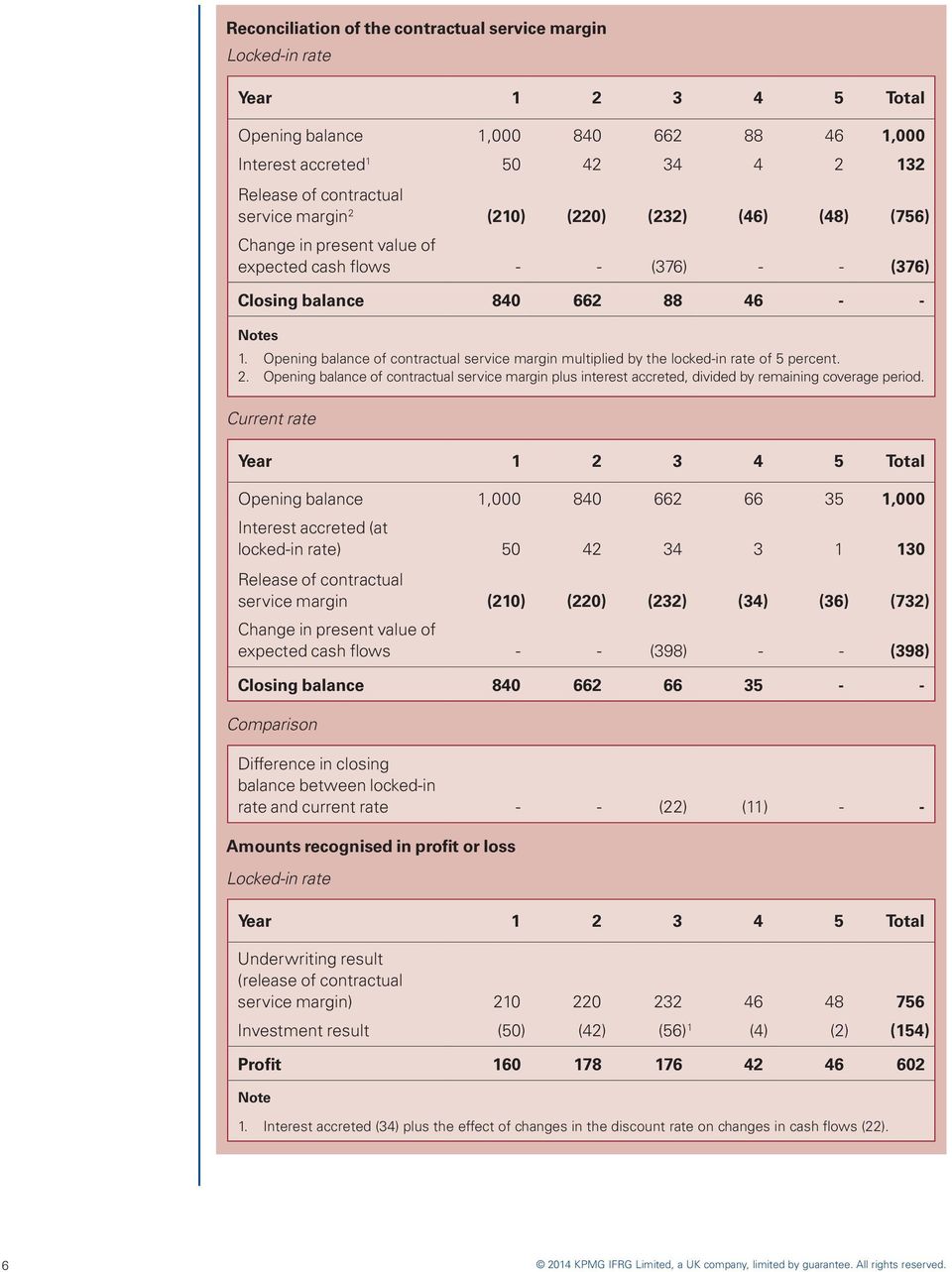
7 Current rate Year Total Underwriting result (release of contractual service margin) Investment result (50) (42) (34) (3) (1) (130) Profit Comparison Year Total Underwriting result (release of contractual service margin) Investment result - - (22) (1) (1) (24) Profit - - (22) When the locked-in rate is used to calculate the present value of cash flows that adjust the contractual service margin, the effect of changes in the discount rate on changes in cash flows i.e. 22 is recognised in the investment result. The underwriting result is not affected by the discount rate changes but only by the change in expected cash flows since inception. However, when the current rate is used the effect of changes in the discount rate on those cash flows is recognised in the underwriting result through the release of the contractual service margin. The staff also believed that additional complexities may arise when the current rate is used for calculating the change in the present value of expected cash flows that adjust the contractual service margin and the entity chooses to present the effects of changes in discount rates in OCI, because the cumulative OCI would be more difficult to explain and calculate. As a result of their analysis, the staff recommended that for non-participating contracts the locked-in rate at inception of the contract be used for calculating the change in the present value of expected cash flows that adjust the contractual service margin. What did the IASB discuss? There was limited discussion of this issue. One Board member believed that the effects of changes in expected cash flows recognised in the financial statements would be difficult for users to understand if a locked-in rate were used to calculate the change in the present value of expected cash flows that adjust the contractual service margin. This is because: the fulfilment cash flows for measuring the insurance liability for balance sheet purposes would be calculated using a current rate; and the change in the present value of expected cash flows that adjust the contractual service margin would be calculated using a locked-in rate. The difference resulting from applying different rates would not adjust the contractual service margin but would be recognised in profit or loss or in OCI, depending on the entity s accounting policy choice for presenting the effects of changes in discount rates. He believed that the effects of changes in expected cash flows recognised in the financial statements would be easier for users to understand if there were no differences in the applied rates. However, it was noted that 7

8 using a current rate to calculate the change in the present value of expected cash flows that adjust the contractual service margin would also introduce complexities when an entity chooses to present the effects of changes in discount rates in OCI because the amounts recognised in OCI would not automatically reverse to zero. What did the IASB decide? The Board agreed with the staff recommendation. KPMG insight Tracking discount rates This month s decision to use locked-in rates to accrete interest on the contractual service margin and to calculate the change in the present value of expected cash flows that adjust the contractual service margin confirms that entities would need to track discount rates. Entities that choose to present the effects of changes in discount rates in profit or loss would not need to track discount rates to present the effects of changes in discount rates in the financial statements. However, they would need to track rates to determine the interest accretion and the change in the present value of cash flows that adjust the contractual service margin. Entities that choose to present the effects of changes in discount rates in OCI would need to track discount rates for presentation purposes. Consequently, for those entities, using lockedin rates to accrete interest on the contractual service margin and to calculate the change in the present value of expected cash flows that adjust the contractual service margin would not result in the same level of additional operational complexities and costs. 8

9 CHANGES IN ACCOUNTING POLICY The requirements in IAS 8 would be applied without modification to changes in accounting policy relating to the presentation of the effects of changes in discount rates. What s the issue? In previous meetings, the Board decided that: an entity could choose as its accounting policy to present the effects of changes in discount rates in profit or loss or in OCI and would apply that accounting policy to all contracts within a portfolio; and application guidance would be added to clarify that, in accordance with IAS 8, an entity would select and apply its accounting policies consistently for similar contracts, considering the portfolio in which the contract is included, the assets that the entity holds and the accounting for those assets. Some Board members were concerned that financial statement information would not be meaningful and comparable if entities changed their accounting policies frequently, or only to achieve a favourable accounting outcome. Consequently, the Board asked the staff to consider whether additional requirements are needed to address these concerns. What did the staff recommend? The staff considered the following questions. Question Are additional requirements needed for changes in accounting policy relating to the presentation of the effects of changes in discount rates on insurance liabilities? Would retrospective application of changes in accounting policy for insurance liabilities be appropriate when changes in the accounting for financial assets are applied prospectively? Staff s views No. The existing requirements in IAS 8 are sufficiently restrictive to prevent misuse. Under IAS 8: a change in accounting policy needs to be justified as providing reliable and more relevant information; and comparability is ensured by retrospective application of the change in accounting policy and disclosure of the amounts of the adjustments for each period presented. It would be difficult to argue that frequent changes in accounting policy would result in reliable and more relevant information. In addition, the costs associated with the retrospective application of an accounting policy are likely to prevent frequent changes to achieve a favourable accounting outcome. The occurrence of mismatches between insurance liabilities and financial assets in comparative periods does not justify an exception from the general requirements in IAS 8 for retrospective application of changes in the accounting policy for insurance liabilities. When the mix of assets backing insurance liabilities changes, entities may change their accounting policy for insurance liabilities to reduce mismatches between the insurance liabilities and related assets. However, before the entity changes its accounting policy for the insurance liabilities, the financial statements for the current and comparative periods are likely to include mismatches as a result of the gradual change in asset mix. A restatement of comparatives when changing the accounting policy for insurance contracts does not necessarily result in additional mismatches. 9
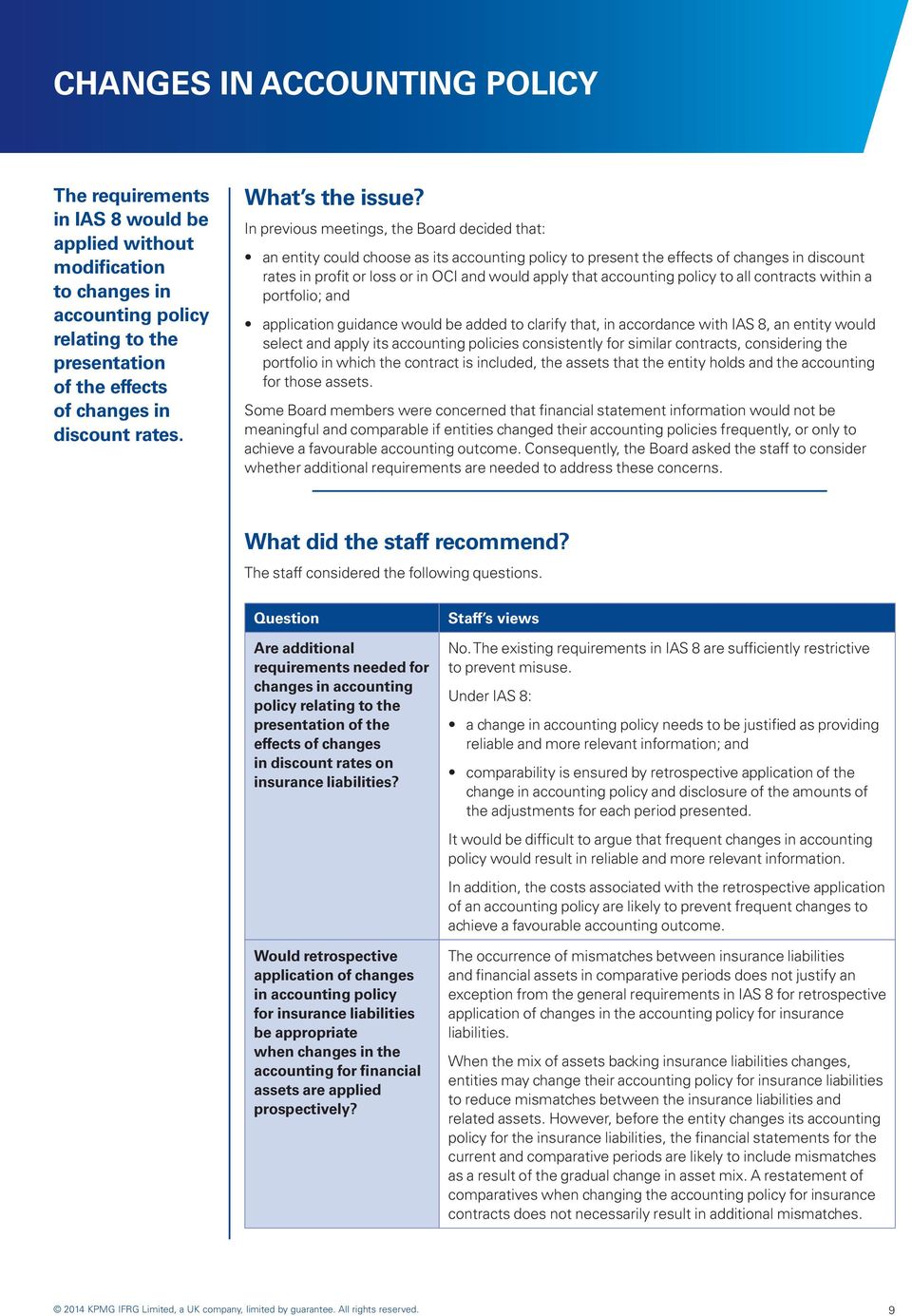
10 Question Staff s views In addition, financial assets accounted for under IFRS 9 are reclassified prospectively only if the business model for managing those financial assets changes. However, such situations are not expected to occur very often. IFRS 9 states that changes in the business model for managing financial assets are expected to be very infrequent and determined as a result of external or internal changes that are significant to the entity s operations and demonstrable to external parties. As a result, the staff recommended that the requirements in IAS 8 be applied without modification to changes in accounting policy relating to the presentation of the effects of changes in discount rates. What did the IASB decide? The Board agreed with the staff recommendation. KPMG insight Under IAS 8, entities may voluntarily change their accounting policy only if doing so results in the financial statements providing reliable and more relevant information. Entities may need to apply judgement in determining whether changing their accounting policy for presenting the effects of changes in discount rates would provide reliable and more relevant financial statement information. The assessment of whether the financial statement information would be more relevant is likely to require: identifying portfolios of assets that back the insurance contracts; and determining how the effects of changes in interest rates on those assets are accounted for. This assessment may change if there is a change in those assets or how they are accounted for. 10

11 APPENDIX: SUMMARY OF IASB S REDELIBERATIONS Decisions reached by the IASB during its redeliberations consider only insurance contracts that have no participating features. Issues specific to participating contracts will be considered at a later stage and, at that stage, the staff will consider whether the tentative decisions reached for non-participating contracts need to be revised. What did the IASB discuss? Targeted issues What did the IASB decide? Unlocking the Favourable changes in estimates that arise after losses have previously been contractual recognised in profit or loss would be recognised in profit or loss to the extent that service margin they reverse losses that relate to coverage and other services in the future. Is there an identified change to the ED? Differences between the current and previous estimates of the risk adjustment that relate to coverage and other services for future periods would be added to, or deducted from, the contractual service margin, subject to the condition that the contractual service margin would not be negative. Consequently, changes in the risk adjustment that relate to coverage and other services provided in the current and past periods would be recognised immediately in profit or loss. For non-participating contracts, the locked-in rate at inception of the contract would be used for: accreting interest on the contractual service margin; and calculating the change in the present value of expected cash flows that adjust the contractual service margin. No Presenting An entity could choose as its accounting policy to present the effects of changes the effects of in discount rates in profit or loss or in OCI, and apply that accounting policy to all changes in the contracts within a portfolio. discount rate in Application guidance would be added to clarify that, in accordance with IAS 8, OCI an entity would select and apply its accounting policies consistently for similar contracts, considering the portfolio in which the contract is included, the assets that the entity holds and how those assets are accounted for. The requirements in IAS 8 would be applied without modification to changes in accounting policy relating to the presentation of the effects of changes in discount rates. If an entity chooses to present the effect of changes in discount rates in OCI, then it would recognise: in profit or loss, the interest expense determined using the discount rates that applied at the date on which the contract was initially recognised; and in OCI, the difference between the carrying amount of the insurance contract measured using the discount rates that applied at the reporting date and the amount of the insurance contract measured using the discount rates that applied at the date on which the contract was initially recognised. An entity would disclose the following information. For all portfolios of insurance contracts: An analysis of total interest expense included in total comprehensive income disaggregated at a minimum into: l the amount of interest accretion determined using current discount rates; l the effects on the measurement of the insurance contract of changes in discount rates in the period; and 11
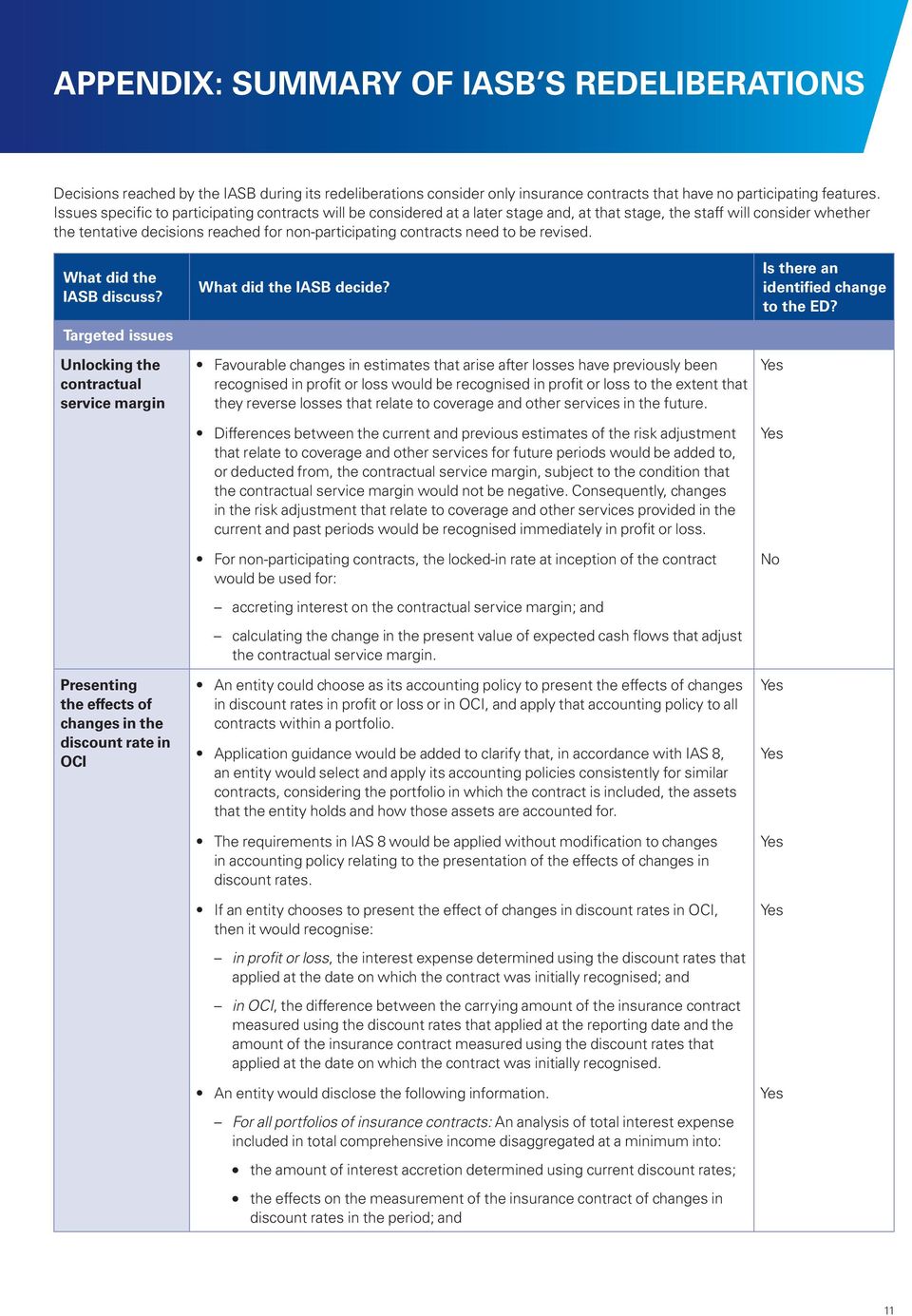
12 What did the IASB discuss? Insurance contract revenue What did the IASB decide? l the difference between the present value of changes in expected cash flows that adjust the contractual service margin in a reporting period measured using the discount rates that applied on initial recognition of insurance contracts and current discount rates. In addition, for portfolios of insurance contracts for which the effects of changes in discount rates are presented in OCI: An analysis of total interest expense included in total comprehensive income disaggregated at a minimum into: l interest accretion at the discount rate that applied at initial recognition of insurance contracts reported in profit or loss for the period; and l the movement in OCI for the period. An entity would be prohibited from presenting premium information in profit or loss if that information is not consistent with commonly understood notions of revenue. An entity would present insurance contract revenue in profit or loss, as proposed in paragraphs and B88 B91 of the ED. Is there an identified change to the ED? No No Non-targeted issues An entity would disclose the following: a reconciliation that separately reconciles the opening and closing balances of the components of the insurance contract asset or liability; a reconciliation from the premiums received in the period to the insurance contract revenue in the period; the inputs used when determining the insurance contract revenue that is recognised in the period; and the effect of the insurance contracts that are initially recognised in the period on the amounts that are recognised in the statement of financial position. No Recognising the contractual service margin in profit or loss Fixed-fee service contracts Significant insurance risk The remaining contractual service margin would be recognised in profit or loss over the coverage period in the systematic way that best reflects the remaining transfer of the services under the insurance contract. For non-participating contracts, the service represented by the contractual service margin would be insurance coverage that: is provided on the basis of the passage of time; and reflects the expected number of contracts in force. Entities would be permitted, but not required, to apply the revenue recognition standard to fixed-fee service contracts that meet the criteria stated in paragraph 7(e) of the ED. The ED s guidance will be adjusted to clarify that significant insurance risk occurs only when there is a possibility that an issuer will incur a loss on a presentvalue basis. No 12

13 What did the IASB discuss? What did the IASB decide? Is there an identified change to the ED? Portfolio Paragraphs of the ED will be amended to clarify that contracts acquired transfers and through a portfolio transfer or a business combination would be accounted for business as if they had been issued by the entity at the date of the portfolio transfer or the combinations business combination. Determining The discount rates used to adjust the cash flows of an insurance contract for the No discount rates time value of money would be consistent with observable current market prices when there for instruments with cash flows whose characteristics are consistent with those is a lack of of the insurance contract. observable data In determining those discount rates, an entity would use judgement to: ensure that appropriate adjustments are made to observable inputs, to accommodate any differences between observed transactions and the insurance contracts being measured; and develop any unobservable inputs using the best information available in the circumstances, while remaining consistent with the objective of reflecting the way market participants assess those inputs accordingly, any unobservable inputs should not contradict any available and relevant market data. Asymmetrical After inception, entities would recognise in profit or loss any changes in treatment of estimates of cash flows for a reinsurance contract that arise as a result of gains from changes in estimates of cash flows that are recognised immediately in profit or reinsurance loss for an underlying insurance contract. contracts Level of The objective of the proposed insurance standard is to provide principles for No 3 aggregation measuring an individual insurance contract; but in applying the standard, an entity could aggregate insurance contracts, provided that the aggregation would meet that objective. 3 The definition of a portfolio of insurance contracts would be amended to insurance contracts that provide coverage for similar risks and are managed together as a single pool. Guidance would be added to explain that, in determining the contractual service margin or loss at initial recognition, an entity would not aggregate onerous contracts with profit-making contracts. An entity would consider the facts and circumstances to determine whether a contract is onerous at initial recognition. Examples would be provided of how an entity could aggregate contracts but nevertheless satisfy the objective of the proposed insurance standard when determining the contractual service margin on subsequent measurement. 3 In the staff s view, this decision represents a clarification of the principle already included in the ED. However, many respondents to the ED noted that they were unsure how to apply the different levels of aggregation. Consequently, this clarification may result in a change to the application of the principle. 13

14 PROJECT MILESTONES AND TIMELINE FOR COMPLETION The IASB re-exposed its insurance contracts proposals and issued ED/2013/7 Insurance Contracts in June A final standard is expected in the first half of IASB exposure draft Deliberations IASB re-exposure draft Redeliberations IASB final standard? Prepare for transition Effective date?* to Q Q Q to late Jan 2018 Potential effective date * The effective date of the final IFRS is expected to be approximately three years after the standard is issued. The IASB staff estimate that the issue date would be in 2015 which would result in an expected effective date of annual reporting periods beginning on or after 1 January 2018, if the final standard is issued in early This appears to be the Board s target, given that the mandatory effective date of IFRS 9 is 1 January Our suite of publications considers the different aspects of the project. KPMG publications IFRS Newsletter: Insurance (monthly) New on the Horizon: Insurance contracts (July 2013) Towards the Final Frontier: Business perspectives on the insurance accounting proposals (January 2014) Evolving Insurance Regulation: The kaleidoscope of change (March 2014) For more information on the project, including our publications on the IASB s insurance proposals, see our website. You can also find, in the same place, information about the FASB s insurance contracts project since February 2014, when this newsletter stopped following that project. For information on the FASB s project subsequent to February 2014, see KPMG s Issues & Trends in Insurance. The IASB s website and the FASB s website contain summaries of the Boards meetings, meeting materials, project summaries and status updates. 14

15 KPMG CONTACTS Global Head of Insurance Gary Reader KPMG in the UK T: E: Global Insurance Accounting Change Leader Danny Clark KPMG in the UK T: E: Global IFRS Insurance Leader Joachim Kölschbach KPMG in Germany T: E: Global IFRS Insurance Deputy Leader Darryl Briley KPMG in the US T: E: Australia Scott A Guse T: E: [email protected] Bermuda Richard Lightowler T: E: [email protected] Brazil Luciene T Magalhaes T: E: [email protected] Canada Neil Parkinson T: E: [email protected] China Walkman Lee T: E: [email protected] Czech Republic Roger Gascoigne CEE Co-ordinating Insurance T: E: [email protected] France Vivian Leflaive T: E: [email protected] Germany Martin Hoser Senior Manager T: E: [email protected] India Akeel Master T: E: [email protected] Ireland Hubert Crehan T: E: [email protected] Italy Giuseppe Rossano Latorre T: E: [email protected] Japan Ikuo Hirakuri T: E: [email protected] Korea Won Duk Cho T: E: [email protected] Kuwait Bhavesh Gandhi Director T: E: [email protected] Luxemburg Geoffroy Gailly Director T: E: [email protected] Netherlands Frank van den Wildenberg T: E: [email protected] South Africa Gerdus Dixon T: E: [email protected] Spain Antonio Lechuga Campillo T: E: [email protected] Switzerland Marc Gössi T: E: [email protected] UK Danny Clark T: E: [email protected] US Mark S McMorrow T: E: [email protected] 15
16 FIND OUT MORE For more information on the insurance project, please speak to your usual KPMG contact or visit the IFRS insurance hot topics page. You can also go to the insurance pages on the IASB website. Visit our Global IFRS Institute to access KPMG s most recent publications on the IASB s major projects and other activities. Our IFRS financial instruments hot topics page brings together our materials on the new financial instruments standard. Our In the Headlines publication summarises the key business impacts; more detailed insights, such as our First Impressions, will follow over the coming weeks. Our IFRS revenue hot topics page brings together our materials on the new revenue standard. Our In the Headlines summarises the key business impacts, while our First Impressions provides more detailed insights. Our IFRS leases hot topics page brings together our materials on the leases project, including our IFRS Newsletter: Leases. Our IFRS Breaking News page brings you the latest need-to-know information on international standards in the accounting, audit and regulatory space. Acknowledgements We would like to acknowledge the effort of the principal authors of this publication: Dana Chaput and Klaus Schultes. We would also like to thank the following reviewers for their input: Darryl Briley, Joachim Kölschbach and Chris Spall. KPMG International Standards Group is part of KPMG IFRG Limited. Publication name: IFRS Newsletter: Insurance Publication number: Issue 42 Publication date: July 2014 The KPMG name, logo and cutting through complexity are registered trademarks or trademarks of KPMG International Cooperative ( KPMG International ), a Swiss entity. Member firms of the KPMG network of independent firms are affiliated with KPMG International. KPMG International provides no client services. No member firm has any authority to obligate or bind KPMG International or any other member firm vis-à-vis third parties, nor does KPMG International have any such authority to obligate or bind any member firm. The information contained herein is of a general nature and is not intended to address the circumstances of any particular individual or entity. Although we endeavour to provide accurate and timely information, there can be no guarantee that such information is accurate as of the date it is received or that it will continue to be accurate in the future. No one should act upon such information without appropriate professional advice after a thorough examination of the particular situation. The IFRS Newsletter: Insurance contains links to third party websites not controlled by KPMG IFRG Limited. KPMG IFRG Limited accepts no responsibility for the content of such sites or that these links will continue to function. The use of third party content is to be governed by the terms of the site on which it is hosted and KPMG IFRG Limited accepts no responsibility for this. Descriptive and summary statements in this newsletter may be based on notes that have been taken in observing various Board meetings. They are not intended to be a substitute for the final texts of the relevant documents or the official summaries of Board decisions which may not be available at the time of publication and which may differ. Companies should consult the texts of any requirements they apply, the official summaries of Board meetings, and seek the advice of their accounting and legal advisors. kpmg.com/ifrs IFRS Newsletter: Insurance is KPMG s update on accounting and reporting developments in the insurance sector. If you would like further information on any of the matters discussed in this Newsletter, please talk to your usual local KPMG contact or call any of KPMG firms offices.

[email protected] [email protected]
 IASB Agenda ref 2 STAFF PAPER REG IASB Meeting Project Paper topic CONTACT(S) Insurance contracts Cover note Andrea Pryde Milena Lacheta [email protected] [email protected] +44 (0)20 7246 6491 +44 (0)20
Insurance Contracts Project Update
 International Financial Reporting Standards Insurance Contracts Project Update March 2015 The views expressed in this presentation are those of the presenter, not necessarily those of the IASB or IFRS
Insurance Accounting AUDIT COMMITTEE NEWS. Financial Reporting. Edition 43 / Q4 2013
 AUDIT COMMITTEE NEWS Edition 43 / Q4 2013 Insurance Accounting Financial Reporting In June 2013 the IASB issued a revised exposure draft (ED) of its proposal for a financial reporting standard on Insurance
Rate used to accrete interest and calculate the present value of cash flows that unlock the contractual service margin
 IASB Agenda ref 2B STAFF PAPER REG IASB Meeting Project Paper topic Insurance contracts July 2014 Rate used to accrete interest and calculate the present value of cash flows that CONTACT(S) Izabela Ruta
Opening the black box
 Demystifying IFRS 4 Phase 2 1 Opening the black box Demystifying IFRS 4 Phase 2 KPMG International kpmg.com Foreword The new accounting standard for insurers will represent a significant change for many
IFRS Project Insights Insurance Contracts
 IFRS Project Insights Insurance Contracts December 2015 The International Accounting Standards Board ( IASB / the Board ) is undertaking a comprehensive project on the accounting for insurance contracts,
New on the Horizon: Revenue recognition for building and construction
 NOVEMBER 2011 Building & Construction New on the Horizon: Revenue recognition for building and construction KPMG s Building & Construction practice KPMG s Building & Construction practice provides integrated
Comment on the Exposure Draft Insurance Contracts
 30 November 2010 International Accounting Standards Board 30 Cannon Street London EC4M 6XH United Kingdom Dear Sir or Madame, Comment on the Exposure Draft Insurance Contracts We appreciate the longstanding
Project to replace IFRS 4 Insurance contracts
 International Financial Reporting Standards Project to replace IFRS 4 Insurance contracts (IFRS x) Executive IFRS workshop for Regulators Diplomatic Academy of Vienna Darrel Scott, IASB member Andrea Pryde,
How To Write A Financial Statement
 March 2015 Project Update Insurance Contracts without Participation Features Insurance contracts without participation features What is the purpose of this document? This document provides an update on
New on the Horizon: Insurance contracts
 IFRS New on the Horizon: Insurance contracts A new world for insurance July 2013 kpmg.com/ifrs Contents A new world for insurance 1 1 The proposals at a glance 2 1.1 Key facts 2 1.2 Key impacts 4 2 Setting
Accounting for Insurance Contracts
 Accounting for Insurance Contracts 2012 ACLI Executive Roundtable Marc Siegel, FASB Board Member This presentation has been prepared by the staff of the FASB to help constituents understand the preliminary
DRAFT COMMENT LETTER Comments should be sent to [email protected] by 6 July 2010
 DRAFT COMMENT LETTER Comments should be sent to [email protected] by 6 July 2010 XX July 2010 International Accounting Standards Board 30 Cannon Street London EC4M 6XH United Kingdom Dear Sir/ Madam
IASB/FASB Meeting February 2011. Locking in the discount rate
 IASB/FASB Meeting February 2011 IASB Agenda reference 3C FASB Agenda Staff Paper reference 58C Contact(s) Matthias Zeitler [email protected] +44 (0)20 7246 6453 Shayne Kuhaneck [email protected] +1 203
Presentation in statement of comprehensive income comparison of methods
 IASB Agenda ref 2A STAFF PAPER 15-18 October 2012 REG FASB IASB Meeting Project Paper topic Insurance contracts Presentation in statement of comprehensive income comparison of methods CONTACT(S) Joan Brown
Accounting proposals for insurance contracts
 International Financial Reporting Standards Accounting proposals for insurance contracts The views expressed in this presentation are those of the presenter, not necessarily those of the IASB or IFRS Foundation.
2. This paper supplements Agenda Paper 2A Outreach and comment letter analysis for this meeting. This paper does not ask any questions.
 IASB Agenda ref 2B STAFF PAPER REG IASB Meeting Project Insurance contracts Paper topic Feedback from users of financial statements January 2014 CONTACT(S) Izabela Ruta [email protected] +44 (0)20 7246 6957
Revenue Recognition for Contractors
 1 New on the Horizon: Revenue recognition for building and construction July 2010 REAL ESTATE & CONSTRUCTION Revenue Recognition for Contractors A perspective on revenue recognition in the future AUDIT
Insurance contracts. International Financial Reporting Standards. Capital Markets Advisory Committee meeting 7 March 2013.
 Capital Markets Advisory Committee meeting 7 March 2013 Agenda paper 5 International Financial Reporting Standards Insurance contracts Project contacts: Izabela Ruta [email protected] +44 20 7246 6957 The
Adopting the consolidation suite of standards
 IFRS PRACTICE ISSUES Adopting the consolidation suite of standards Transition to IFRSs 10, 11 and 12 January 2013 kpmg.com/ifrs Contents Simplifications provide relief 1 1. Extent of relief depends on
08FR-003 Business Combinations IFRS 3 revised 11 January 2008. Key points
 08FR-003 Business Combinations IFRS 3 revised 11 January 2008 Contents Background Overview Revised IFRS 3 Revised IAS 27 Effective date and transition Key points The IASB has issued revisions to IFRS 3
July 2011. IAS 19 - Employee Benefits A closer look at the amendments made by IAS 19R
 July 2011 IAS 19 - Employee Benefits A closer look at the amendments made by IAS 19R 2 Contents 1. Introduction 3 2. Executive summary 4 3. General changes made by IAS 19R 6 4. Changes in IAS 19R with
June 2013. A revision of ED/2010/8 Insurance Contracts. Insurance Contracts. Comments to be received by 25 October 2013
 June 2013 Exposure Draft ED/2013/7 A revision of ED/2010/8 Insurance Contracts Insurance Contracts Comments to be received by 25 October 2013 Insurance Contracts Comments to be received by 25 October 2013
HKFRS / IFRS UPDATE 2016/02
 ISSUE 2016/02 JUNE 2016 WWW.BDO.COM.HK s HKFRS / IFRS UPDATE 2016/02 IFRS INTERPRETATIONS COMMITTEE - AGENDA REJECTIONS (NOVEMBER 2015) Background This Update summarises issues that the IFRS Interpretations
Contracts with Participation Features First set of decisions after extensive preparation and outreach activities
 Contracts with Participation Features First set of decisions after extensive preparation and outreach activities Francesco Nagari Deloitte Global IFRS Insurance Lead Partner 6 July 2015 Agenda Highlights
INSURANCE ACCOUNTING MIND THE UK GAAP
 INSURANCE ACCOUNTING MIND THE UK GAAP This is a paper prepared by the staff of the UK Accounting Standards Board in order to invite comments from constituents on the options for the future of insurance
IASB Agenda Ref 16A. FASB Memo No. 140A. Issue Date September 11, 2015. Meeting Date September 23, 2015. Assistant Director
 Memo IASB Agenda Ref 16A FASB Memo No. 140A Issue Date September 11, 2015 Meeting Date September 23, 2015 Contact(s) Alex Casas Author / Project Lead Peter Proestakes Assistant Director Project Topic Insurance
Constraining the cumulative amount of revenue recognised
 IASB Agenda ref 7A STAFF PAPER Week of 24 September 2012 FASB IASB Meeting Project Revenue Recognition FASB Education Session 19 September, 2012 IASB Education Session 20 September, 2012 Paper topic Constraining
IFRS Practice Issues: Leases of land
 IFRS Practice Issues: Leases of land December 2010 kpmg.com/ifrs Contents 1. Overview of major changes 1 2. Introduction and background 2 3. Why does lease classification matter? 3 3.1 Impacts on lessees
Impacts on the construction industry of the new revenue standard
 IFRS Impacts on the construction industry of the new revenue standard September 2014 kpmg.com/ifrs Contents The devil is in the detail 1 1 Critical judgements at contract inception 2 1.1 Pre-contract costs
Insurance Contracts Overview of FASB DP and IASB ED
 1 Insurance Contracts Overview of FASB DP and IASB ED Moderator: Marc F. Oberholtzer, FCAS, MAAA, PricewaterhouseCoopers Presenter: Akwasi A. Ampofo, FASB Project Manager Disclaimer 2 This document has
In this issue: Presentation and measurement of financial assets carried at fair value. Introducing the series
 IFRS FOR INVESTMENT FUNDS November 2011, Issue 1 Introducing the series Our series of IFRS for Investment Funds publications addresses practical application issues that investment funds may encounter when
IFRS industry insights
 IFRS Global Office April 2012 IFRS industry insights IASB issues revised exposure draft on revenue recognition insights for the insurance industry The revised ED is the next step in developing an entirely
www.pwc.com/ifrs Revised exposure draft will significantly change accounting for insurance contracts
 Revised exposure draft will significantly change accounting for insurance contracts August 2013 Revised exposure draft will significantly change accounting for insurance contracts Contents Introduction
Minutes from GPF meeting November 2014
 Minutes from GPF meeting November 2014 CONTACT(S) Izabela Ruta [email protected] +44 (0)20 7246 6957 Introduction 1. The Global Preparers Forum (GPF) held a meeting in London on 6 November 2014. Martin Edelman
International Financial Reporting for Insurers. August 19-21, 2013. Hong Kong. Session 8: IFRS 4 Phase 2 Insurance Contract Model.
 International Financial Reporting for Insurers August 19-21, 2013 Hong Kong Session 8: IFRS 4 Phase 2 Insurance Contract Model Darryl Wagner Session 8 IFRS 4 Phase 2 Insurance Contract t Model Darryl Wagner,
IFRS 9 FINANCIAL INSTRUMENTS (2014) INTERNATIONAL FINANCIAL REPORTING BULLETIN 2014/12
 IFRS 9 FINANCIAL INSTRUMENTS (2014) INTERNATIONAL FINANCIAL REPORTING BULLETIN 2014/12 Summary On 24 July 2014, the International Accounting Standards Board (IASB) completed its project on financial instruments
Meeting. Project Paper topic. nts from. 1. This is the first. (a) (b) (c) plan. 3. The + +1 203 956 5305. +44 20 7246 6957 Joanna Yeoh
 STAFF PAPER REG FASB IASB Meeting 19 March 21 March 2012 Project Insurance Contracts Paper topic Separation of Investment Componen nts from Insurance Contracts Background CONTACT( (S) Christopher Irwin
A Review of the Conceptual Framework for Financial Reporting
 July 2013 Discussion Paper DP/2013/1 A Review of the Conceptual Framework for Financial Reporting Comments to be received by 14 January 2014 A Review of the Conceptual Framework for Financial Reporting
KPMG NEWS. This newsletter covers matters that are topical and are currently being debated in the medical schemes industry.
 KPMG NEWS This newsletter covers matters that are topical and are currently being debated in the medical schemes industry. Volume 1 August 2013 HOW UNIVERSAL HEALTH COVERAGE HAS BENEFITED OTHER COUNTRIES
IASB meeting. Business combinations (phase II) October 2004
 October 2004 The International Accounting Standards Board met in Norwalk, Connecticut, USA on 18 and 19 October and met the US Financial Accounting Standards Board on 19 and 20 October. The following matters
New items for initial consideration IFRS 9 Financial Instruments Net investment hedges
 STAFF PAPER IFRS Interpretations Committee Meeting November 2015 Project Paper topic New items for initial consideration IFRS 9 Financial Instruments Net investment hedges CONTACT(S) Mariela Isern [email protected]
IASB/FASB Board Meeting Week beginning February 14, 2011. Financial Instruments: Impairment
 Staff Paper Project Topic IASB/FASB Board Meeting Week beginning February 14, 2011 Financial Instruments: Impairment Definition of write-off IASB Agenda reference FASB Agenda reference 9 78 Introduction
FASB Agenda. April 2012. Project. What is. 1. Policy loans. Izabela Ruta Chris Irwin Jennifer Weiner. [email protected]. Page 1 of 17. IFRSs.
 IASB Agenda ref 2H STAFF PAPER REG FASB IASBB Meeting FASB Agenda ref April 2012 Project Insurance contracts Paper topic Riders and Policy Loans CONTACT(S) Izabela Ruta Chris Irwin iruta@ ifrs.org [email protected]
Insurance Contracts. June 2013 Illustrative Examples Exposure Draft ED/2013/7 A revision of ED/2010/8 Insurance Contracts
 June 2013 Illustrative Examples Exposure Draft ED/2013/7 A revision of ED/2010/8 Insurance Contracts Insurance Contracts Comments to be received by 25 October 2013 Illustrative Examples on Exposure Draft
Comment on Exposure Draft 2014-4 Measuring Quoted Investments in Subsidiaries, Joint Ventures and Associates at Fair Value
 International Accounting Standards Board 30 Cannon Street London EC4M 6XH United Kingdom Our ref : IASB 455 C Direct dial : Tel.: (+31) 20 301 0391 / Fax: (+31) 20 301 0302 Date : Amsterdam, December 22
IASB/FASB Meeting Week beginning 11 April 2011. Top down approaches to discount rates
 IASB/FASB Meeting Week beginning 11 April 2011 IASB Agenda reference 5A FASB Agenda Staff Paper reference 63A Contacts Matthias Zeitler [email protected] +44 (0)20 7246 6453 Shayne Kuhaneck [email protected]
Liability Adequacy Test in AASB 1023 General Insurance Contracts
 Invitation to Comment March 2005 Liability Adequacy Test in AASB 1023 General Insurance Contracts Prepared by the Australian Accounting Standards Board Commenting on this Invitation to Comment The AASB
1. The purpose of this paper is to discuss disclosure requirements for a lessor in the final leases standard.
 IASB Agenda ref 3B STAFF PAPER July 2014 REG FASB IASB Meeting Project Paper topic Leases Lessor disclosure requirements CONTACT(S) Roberta Ravelli [email protected] +44 (0) 20 7246 6935 Scott A. Muir
How To Account For Insurance In Frs 103
 March 2014 Financial Reporting Brief Special Edition FRS 103 Insurance Contracts In a nutshell The Financial Reporting Council (FRC) has issued FRS 103 Insurance Contracts. The standard consolidates existing
14A. Project. the definition of. (paragraph 16): Paper topic. [email protected] Joaoo Santos (FI) jsantos@ifrs. org. the IASB.
 IASB Agenda ref STAFF PAPER REG IASB Meeting 27 February 2 March 2012 Project Paper topic Insurance contracts Financial instruments with discretionary participation features background information CONTACTS
IFRS 15 Revenue from Contracts with Customers
 May 2014 Project Summary and Feedback Statement IFRS 15 Revenue from Contracts with Customers At a glance We, the International Accounting Standards Board (IASB), issued IFRS 15 Revenue from Contracts
Applying IFRS 9 Financial Instruments with IFRS 4 Insurance Contracts
 December 2015 Exposure Draft ED/2015/11 Applying IFRS 9 Financial Instruments with IFRS 4 Insurance Contracts Proposed amendments to IFRS 4 Comments to be received by 8 February 2016 Applying IFRS 9 Financial
IASB Staff Paper March 2015
 IASB Staff Paper March 2015 Effect of Board redeliberations on DP A Review of the Conceptual Framework for Financial Reporting About this staff paper This staff paper updates the proposals in the Discussion
An Insurance Contract IFRS Is Coming
 An Insurance Contract IFRS Is Coming Are Your Financial Models Ready? By John Nicholls and Ana Escudero Efforts to develop new international accounting standards are moving apace, as the joint IASB FASB
Reclassification of financial assets
 Issue 34 / March 2009 Supplement to IFRS outlook Reclassification of financial assets This publication summarises all the recent amendments to IAS 39 Financial Instruments: Recognition and Measurement
IASB/FASB Meeting Week beginning 11 April 2011. Financial Instruments: Impairment
 IASB/FASB Meeting Week beginning 11 April 2011 IASB Agenda reference 4C Staff Paper FASB Agenda reference 85 Project Topic Financial Instruments: Impairment Non-accrual principle Introduction and Purpose
IFRS 9 Classification and measurement
 No. US2014-05 August 13, 2014 What s inside: Background... 1 Overview of the model... 2 The model in detail... 4 Transition... 17 Implementation challenges... 19 IFRS 9 Classification and measurement At
Financial Statement Presentation Paper
 Financial Statement Presentation Paper Your input on all or some of the issues covered in the paper is invited by 30 April 2011. This is your opportunity as a European constituent to influence the development
FASB / IASB Insurance Contracts Project Update Webinar
 FASB / IASB Insurance Contracts Project Update Webinar November 1, 2012 International Accounting Standards Task Force Insurance Contracts Project Update 1 Presenters Noel Harewood, MAAA, FSA; Member, International
www.pwc.com Shaping the future of insurance accounting A summary of PwC s views on the recent exposure drafts
 www.pwc.com Shaping the future of insurance accounting A summary of PwC s views on the recent exposure drafts November 2013 Contents Introduction... 2 Our key messages... 3 Summary of our comments on
top issues An annual report
 top issues An annual report Volume 7 2015 Insurance modernization Developments in insurance contracts accounting and reserving The insurance industry in 2015 Developments in insurance contracts accounting
Staff Paper. September 2011. receivable. request to. of IAS 16 is unclear. improvements. This paper: project andd. Date. Contact(s) Project.
 IFRS Interpretationss Committeee Meeting Staff Paper Agenda reference Date 10 September 2011 Contact(s) Denisee Gomez Sotoo dgomez@ @ifrs.org +44 (0)20 7246 64699 Project Topic Annual Improvements 2010-2012
First Impressions: IFRS 9 Financial Instruments
 IFRS First Impressions: IFRS 9 Financial Instruments September 2014 kpmg.com/ifrs Contents Fundamental changes call for careful planning 2 Setting the standard 3 1 Key facts 4 2 How this could impact you
Need to know Financial Reporting Council issues FRS 103 Insurance Contracts
 ukgaap: Beyond the detail Need to know Financial Reporting Council issues FRS 103 Insurance Contracts In a nutshell The Financial Reporting Council (FRC) has issued FRS 103 Insurance Contracts. The standard
Financial Reporting Update
 Financial Reporting Update February 2009 Issue 50 KPMG CHINA PROFESSIONAL PRACTICE HK(IFRIC) 17 Distributions of non-cash assets to owners In this issue: Scope 1 Issues and IFRIC s consensus 2 Amendments
Revenue Recognition (Topic 605)
 Proposed Accounting Standards Update (Revised) Issued: November 14, 2011 and January 4, 2012 Comments Due: March 13, 2012 Revenue Recognition (Topic 605) Revenue from Contracts with Customers (including
New on the Horizon: Revenue recognition for technology companies
 MARCH 2012 Technology New on the Horizon: Revenue recognition for technology companies KPMG s Technology practice KPMG s Technology practice is dedicated to supporting technology companies globally in
IFRS 2 Share-Based Payment Share-based payment transactions where the manner of settlement is contingent on future events
 STAFF PAPER IFRS Interpretations Committee Meeting 10 11 September 2013 Project Paper topic IFRS 2 Share-Based Payment Share-based payment transactions where the manner of settlement is contingent on future
Staff Paper. IASB Meeting Agenda reference 4C. Deposit floor for Insurance Contracts
 IASB Meeting Agenda reference 4C Staff Paper Date October 2009 Contact(s) Hans van der Veen [email protected] +44 (0)20 7246 6464 Project Topic Insurance contracts Deposit floor for Insurance Contracts