
Insurance Contracts Overview of FASB DP and IASB ED
|
|
|
- Jeremy Hoover
- 9 years ago
- Views:
Transcription
1 1 Insurance Contracts Overview of FASB DP and IASB ED Moderator: Marc F. Oberholtzer, FCAS, MAAA, PricewaterhouseCoopers Presenter: Akwasi A. Ampofo, FASB Project Manager

2 Disclaimer 2 This document has been prepared by the staff of the FASB to help constituents understand the IASB s proposals and FASB s preliminary views regarding the accounting for Insurance Contracts. The views expressed are those of the presenter s and do not represent the views of the FASB or IASB. FASB and IASB decisions are reached only after extensive due process and deliberations.
3 Content Outline 3 1. Project objective and background 2. Definition and scope 3. Recognition and measurement 4. Subsequent measurement 5. Alternative approach for short-duration contracts 6. Acquisition costs 7. Reinsurance 8. Financial i statement t t presentation ti 9. Disclosures 10.Transition and effective date 11.Q&A and websites

4 Project objective 4 The objective of the insurance contracts project is to develop a common, high-quality guidance that will address recognition, measurement, presentation, ti and disclosure requirements for insurance contracts. Specifically, this project is intended to: Improve and simplify the financial reporting requirements for insurance contracts. Provide investors with more decision-useful information.
5 Terms 5 IASB, IFRS and IAS IFRS 4 Insurance Contracts Phase II FASB and US GAAP The IASB and FASB Boards IASB and FASB Project Teams Convergence of US GAAP and IFRS Stages of Development of Financial Reporting Standards Discussion Paper Exposure Draft Final Standard

6 Background - evolution 6 FASB joins project We are here Jul 2004 Phase II work begun May 2007 Discussion paper published Nov 2007 Comment period closed July 2010 Phase II Exposure Draft June 2011 IFRS 4 Final standard 2013/14+ Phase II IFRS effective

7 Overview of the proposed p model IASB Preference FASB Preference Residual margin Risk adjustment Time value of money Fulfillment rather than an exit value objective Composite margin Time value of money Current unbiased probability weighted estimates of future cash flows Current unbiased probability weighted estimates of future cash flows One model for all insurance contracts Remeasured each period using current estimates Combination of rights and obligations (inflows and outflows) Potential for day 1 loss in income statement, but no day 1 gain Adjustments/margins are part of liability Discount rate is risk free plus liquidity adjustment PricewaterhouseCoopers 7

8 Next steps 8 FASB and IASB will jointly re-deliberate the IASB ED and FASB DP IASB has published an Exposure Draft (ED) on July 30, 2010 (comment deadline: November 30, 2010) FASB published a Discussion Paper (DP) on September 17, 2010 (comment deadline: December 15, 2010) Roundtables: FASB and IASB have planned roundtables for Europe, Asia and U.S. in December 2010: Tokyo Tuesday December 7, 2010 London Thursday December 16, 2010 Norwalk, CT Monday December 20, 2010

9 Why FASB issued discussion paperp 9 FASB issued a DP rather than ED for the following reasons: Different starting points for FASB and IASB U.S. GAAP comprehensively address insurance accounting FASB has not determined whether one model or two models would result in more decision-useful information about insurance contracts Scope considerations about employer-provided health insurance
10 Background desired improvements 10 Potential improvements to existing U.S. GAAP include: Insurance entity vs. insurance contracts orientation Definition of insurance contracts (indemnification versus compensation) Deferral of acquisition iti costs Lock-in assumptions for long-duration contracts Discount rate assumptions (life versus nonlife) Lack of discounting for most short duration contracts

11 Background desired improvements 11 After considering constituent feedback, FASB may: Pursue an approach based on IASB ED Pursue and approach based on IASB ED with changes Purse an approach based on FASB preliminary views with changes Make targeted changes to address specific concerns on U.S. GAAP

12 Definition and scope of insurance Contracts 12 Definition A contract under which one party (the insurer) accepts significant insurance risks from another party (the policyholder) by agreeing to compensate the policyholder if specified uncertain future events (the insured event) adversely affects the policyholder. Scope All insurance contracts (life and nonlife, and reinsurance) regardless of the type of entity that issued it.

13 Definition and scope of insurance Contracts 13 Scope exclusions: Product warranties issued by manufacturer, dealer or retailer Defined benefit retirement plans Health insurance provided by employer (IASB only; FASB seeking feedback) Fixed-fee for service contracts Leases Residual value guarantees provided by manufacturer, dealer or retailer Contingent consideration payable or receivable Direct insurance contracts with entity as policyholder Participating investment contracts (FASB only)
14 Recognition and measurement - recognition 14 Recognition When insurer becomes party to the insurance contract defined as the earlier of being bound by: o The terms of the contract, or o Initial exposure to risk under the contract Insurer can become party to an insurance contract before the coverage period starts (e.g., due to further underwriting): Before coverage begins, insurer would update the measurement of the insurance contract with cash received and paid, accretion of interest, changes in cash flows estimates and discount rate, but the insurer would not recognize residual or composite margin in earnings until after the coverage period begins.

15 Recognition and measurement - recognition 15 Contract Boundary Boundaries of existing versus new insurance contracts (cash flows) Insurer is no longer required to provide coverage, or Insurer has the right or practical ability to reassess and fully reprice risk

16 Recognition and measurement - measurement 16 Measurement objective Measure rights and obligations created by an insurance contract that results in a series of cash inflows and outflows. Not based on a fair value measurement objective as defined in U.S. GAAP Measurement approaches Two approaches being considered: o Approach 1: Building-block approach Present value of probability-weighted estimate of net cash flows Time value of money (discounting) Risk margins (composite margin or risk adjustment + residual margin) o Approach 2: Modified d approach for certain short-duration contracts See next slide

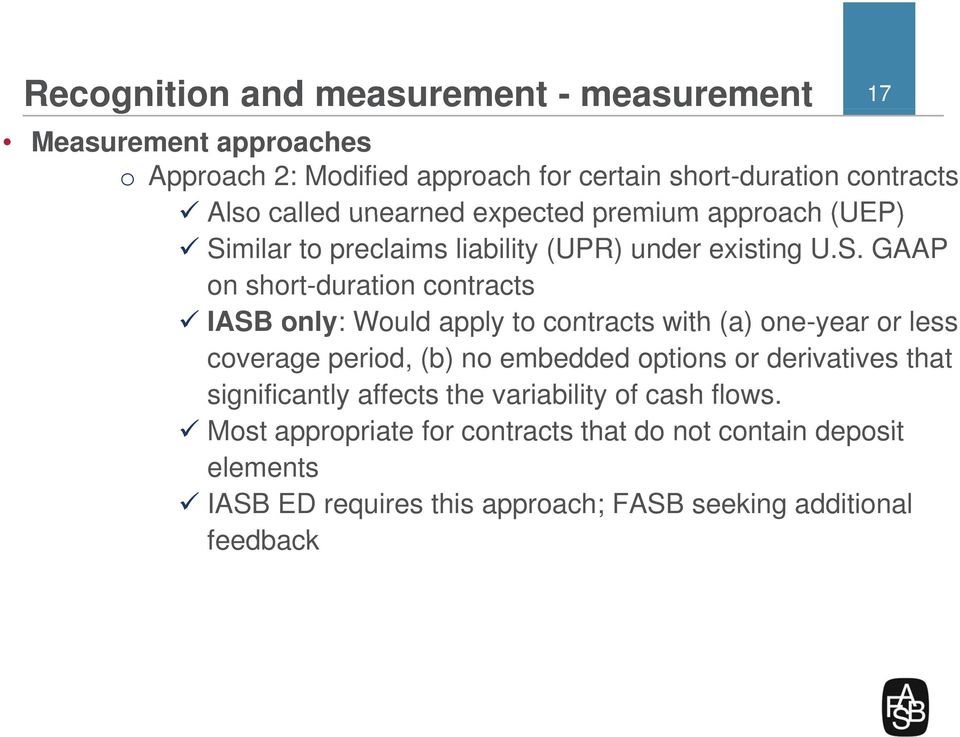
17 Recognition and measurement - measurement 17 Measurement approaches o Approach 2: Modified approach for certain short-duration contracts Also called unearned expected premium approach (UEP) Similar to preclaims liability (UPR) under existing U.S. GAAP on short-duration contracts IASB only: Would apply to contracts with (a) one-year or less coverage period, (b) no embedded options or derivatives that significantly affects the variability of cash flows. Most appropriate for contracts that do not contain deposit elements IASB ED requires this approach; FASB seeking additional feedback
18 Approach 1 initial measurement 18 The Building Blocks of the Proposed Approaches Total Insuran ce Liability (Premiu ums) FASB Approa ach Composite Margin An amount to eliminate any gain at initial contract recognition o that includes an implicit risk adjustment margin and residual margin (recognized in earnings over the coverage and claims handling periods; not remeasured; interest not accreted). ch IASB Approa Residual Margin An amount to eliminate any gain at initial contact recognition (recognized in earnings over the coverage period; not remeasured; accretes interest at the discount rate). Risk Adjustment Margin An explicit assessment of the maximum amount that the insurer rationally would pay to be relieved of the risk that the ultimate fulfillment cash flows exceed those expected (remeasured each reporting period with changes recognized in earnings). Present Value of the Probability-Weighted Estimate of Net Cash Flows The net amount that the insurer expects to collect from premiums and pay out for claims, benefits, and expenses, estimated using current information and discounted to reflect the time value of money (remeasured red each reporting period with changes recognized in earnings). Presen nt Value of Fulfillmen t Cash Flows

19 Initial measurement present value of expected cash flows 19 Expected cash flows Unbiased and probability-weighted estimate of net cash flows related to existing contracts t Incremental contract fulfillment cash flows (net of premiums) Includes, but not limited to: o Expected benefits, claims and claims expenses o Incremental acquisition costs o Premiums cash inflows o Other cash flows Discounting for time value of money Reflects characteristics of liability; i.e., risk free, considering currency and liquidity No reflection ec of own credit standing (or changes in it) No consideration of investment rates (limited exceptions)

20 Measurement risk margins compared 20 FASB composite margin (CM) IASB risk adjustment + residual margin Composite margin is potential profit Risk adjustment is a measure of uncertainty on the contract that implicitly includes about amount and timing of future cash flows risk of uncertainties in the cash flows Residual margin is refers to contract profit CM is measured as the difference Risk adjustment is measured using one of between: three permitted methods (confidence level, (a) Present value of expected conditional tail expectation, cost of capital) premiums, and Residual margin is a plug to get present (b) Present value of claims, benefits value of cash flows and risk adjustment to and expenses equal premiums CM is not remeasured at each Risk adjustment is remeasured at each reporting period reporting period Residual margin is not remeasured at each reporting period CM eliminates a day 1 gain, but day Residual margin eliminates day 1 gain, but 1 loss is immediately reflected in P&L day 1 loss is immediately reflected in P&L

21 Measurement risk margins compared 21 FASB composite margin (CM) CM does not accrete interest over time CM is released over both the coverage and claims handling period using the CM YTD formula Changes in cash flows experience is also reflected separately in P&L No need for complex computational techniques that may yield incomparable results IASB risk adjustment + residual margin Residual margin accretes interest over time Risk adjustment is released over both coverage and claims handling period (remeasurement) Residual margin is released over coverage period only Changes in cash flows experience is also reflected separately in P&L Needs complex computational techniques the outcome of which may not be comparable
22 Measurement FASB composite margin 22 Composite margin (CM) reflects the profit, risks/uncertainty in the present value of the cash flows CM is recognized in earnings over both the coverage and claims handling period using the following ratio: YTD CM ratio = (premiums allocated to date + claims and benefits paid to date)/(total expected premiums + total expected claims and benefits) Current period earnings = [(CM amount *CM YTD ratio) cumulative prior earnings recognized)] CM amount determined at initial recognition does not change. YTD CM ratio changes to reflect changes in numerator and denominator Total expected premiums are allocated over the coverage period in a systematic way to reflect exposure to insurance risk on the basis of: Passage of time, but Expected timing of claims and benefits, if that pattern differs from time passage
23 Measurement FASB composite margin 23 Advantages of CM approach include: Consistent with allocated transaction price in Revenue Recognition proposed ASU Eliminates the use of subjective methods Simpler and more understandable approach to account for risk and profit R fl t h i b bilit i ht d h fl t th Reflects changes in probability-weighted cash flows at the reporting date
24 Measurement IASB Explicit Risk Adjustment 24 Risk adjustment represents the maximum amount that the insurer would rationally pay to be relieved of the risk that the liability cash flows would exceed those expected Risk adjustment is estimated at the portfolio level and reflects diversification within a portfolio but not across different portfolios Advantages include: Reflects uncertainty in possible cash flows outcome, as distinct from profit (residual margin) Reflects changes in uncertainty of possible cash flows outcome through subsequent remeasurement
25 Measurement IASB Explicit Risk Adjustments Methods Building block Explicit Risk Adjustment Comparing the Methods: Confidence level o Loss distribution is estimated o Adjustment results in a stated level of confidence o Express uncertainty in terms of a disclosed amount of confidence; easiest to calculate and understand o Not appropriate for risks that are highly skewed 25
26 Measurement IASB Explicit Risk Adjustments Methods Building block Explicit Risk Adjustment Comparing the Methods: Conditional tail expectation o Loss distribution ib ti is estimated t o Explicit risk adjustment equals average loss among a set of scenarios between an X% level of confidence and the worst case scenario o Better reflects potentially extreme losses; incorporates the expected value of those extreme losses o Not as easy to understand 26
27 Measurement IASB Explicit Risk Adjustments Methods Building block Explicit Risk Adjustment Comparing the Methods: Cost of Capital o Loss distribution ib ti is estimated, t amount of capital required is determined based on the amount of tail risk o Economic capital, reflecting high level of confidence (example given uses 99.5%) that the insurer will be able to fulfill the obligations o Multiplied by annual capital rate (example given uses 8%) o Common in pricing and valuation o Release tends to be faster than the other two methods 27
28 Measurement IASB Residual Margin 28 Per the Exposure Draft: An amount that eliminates a day 1 gain o Day 1 losses are reflected immediately in P/L Allocated over coverage period based on passage of time if reflective of risk exposure Not subsequently remeasured
29 Subsequent measurement 29 Changes in present value of probability weighted cash flows are recognized immediately in earnings under both FASB and IASB proposals FASB Composite margin is not subsequently remeasured No accretion of interest on composite margin Composite margin recognized over both coverage and claims handling periods (exposure periods) IASB Risk adjustment is subsequently remeasured over both coverage and claims handling periods Residual margin is not remeasured red but recognized ed over coverage period on a straight line basis on unless the claims incurred pattern is different Residual margin would accrete interest
30 IASB s Modified approach for short duration contracts 30 Defined as insurance contracts with coverage period of 12 months or less, that do not have embedded options or derivatives containing significant cash flow variability IASB decided to use a modified approach (unearned expected premium approach) for the pre-claim liability (UPR) on short- duration contracts because it provides a reasonable, less costly alternative to building block approach
31 IASB s Modified approach for short-duration contracts 31 Pre-claim period would follow unearned premium approach o Single insurance contract asset or liability presented on balance sheet for pre-claim obligation and present value of future premiums o Interest accretes on insurance contract asset or liability if the effect of time value of money is material (IASB only) o Onerous contract test at portfolio level using present value of fulfillment cash flows o Incremental acquisition cost is not presented as asset, but reduction of UPR Post-claim period would use building block approach FASB seeking feedback on whether or not a different insurance accounting model is needed for short duration contracts
32 Acquisition costs 32 Differentiates between incremental and other acquisition costs (nonincremental); Incremental acquisition expenses are costs that would not have been incurred if the entity had not issued the contract (e.g., external and internal commissions, third party medical inspection fees, premium taxes) Incremental acquisition expenses: Included in the measurement of the liability as cash outflow Reduces composite margin at initial recognition Therefore, affects profit over coverage and claims handling periods Not explicitly amortized or recognized in subsequent periods Other acquisition expenses (non-incremental): Expensed on day 1, and... NO earned premium offset EITF 09-G expected to be published 2Q 2010 Would clarify that direct response advertising costs that meet certain criteria in Topic 340 may be capitalized and included as part of the premium deficiency testing.
33 Reinsurance contracts 33 Summary of key points assumed and ceded: Assumed reinsurance - reinsurance companies would follow the same recognition/measurement approach as insurance companies Ceded reinsurance o Use the building block approach to establish asset using same recognition/measurement approach as for the liabilities No negative residual margins o Consider risk of non-performance o Ceding commissions i are netted against premiums and the net amount is considered the premium under the contract
34 Financial statement presentation 34 Statement of financial position Present single insurance contracts net asset or liability (or single net asset for reinsurance) Consistent with measurement approach for cash inflows and outflows FASB: seeking feedback on level of aggregation (portfolio level) IASB would present each portfolio of insurance contract separately
35 Financial statement presentation 35 Statement of comprehensive income Margin approach (if building-block approach is used) Presents composite margin (FASB) Presents risk adjustment margin and residual margin (IASB) Revenues, claims and benefits are thereby recognized in earnings through the margin approach Also present separately experience adjustments, changes in estimates of future cash flows, accretion of interest, investment income Key merit is that it links measurement of liability to presentation and obviates the need for unbundling Key disadvantage is that it obscures profitability, risk and loss experience because it does not show revenues and expenses directly on the face of the income statement T diff t i h (FASB l ki f db k) Two different premium approaches (FASB only seeking feedback) Written premium approach Premium allocation approach
36 Example 1 Base Case 36 An insurer issues an insurance contract for premium of $1,000. The insurer incurs acquisition costs of $70 of which incremental acquisition costs are $40. The insurer estimates that the present value of future claims is $900. Risk adjustment is estimated to be $50, and a residual margin is $10 giving a composite margin of $60. The two-margin (IASB) and composite margin (FASB) approaches are compared on the next slide
37 Comparison of risk margin approaches 37 Description Present value of future cash inflows (premiums) IASB Twomargin approach 1,000 1,000 Less: Present value of cash outflows (claims and incremental acquisitions costs = ) (940) (940) Net present value of cash flows Composite margin N/A 60 Risk adjustment 50 N/A Residual margin 10 N/A Insurance liability at initial recognition 0 0 FASB Composite margin approach Non-incremental acquisition cost of $30 will be expensed immediately on day 1 under both approaches
38 Financial Statement Presentation Example 2 38 Traditional income statement Summarized margin Inception 1 January Six months to 30 June Six months to 31 December Inception 1 January Six months to 30 June Six months to 31 December Premium revenue Investment income Claims and benefits Change in insurance liability 421 (421) Expenses Acquisition costs Total expenses Profit Balance Sheet 1-Jan 30-Jun 31-Dec Cash 1, Insurance liabilities (1,000) (921) 0 Equity Risk adjustment Residual margin Insurance margin Experience adjustments Changes in estimates Acquisition costs 0 Net gain at inception Investment income Interest on insurance liability Net interest and investment (10) (10) (20) (25) (23) Profit
39 Disclosures 39 Selected disclosure requirements include: Qualitative and quantitative information to help users understand d the amount, nature and extent t of risks arising i from insurance contracts at a reasonable level of aggregation/disaggregation Explanation of recognized amounts including reconciliation of opening and closing balances, and measurement methods and inputs Explanation of risk adjustment method including confidence level used, and how discount rate was determined, measurement uncertainty analysis of key inputs that have significant effect on the measurement Others
40 Transition and effective date 40 IASB ED contains the following transition and effective date information: At the beginning of the earliest period presented, an insurer shall, with a corresponding adjustment to retained earnings: (a) measure each portfolio of insurance contracts at the present value of the fulfillment cash flows. It follows that for insurance contracts to which these transitional provisions are applied, the measurement, both at transition and subsequently, does not include a residual margin. (b) derecognize any existing balances of deferred acquisition costs. (c) derecognize any intangible assets arising from insurance contracts assumed in previously recognized business combinations. That adjustment does not affect intangible assets, such as customer relationships and customer lists, which relate to possible future contracts Effective date to be determined d
41 Q&A 41 Q&A Additional resources: IASB m FASB
International Financial Reporting for Insurers. August 19-21, 2013. Hong Kong. Session 8: IFRS 4 Phase 2 Insurance Contract Model.
 International Financial Reporting for Insurers August 19-21, 2013 Hong Kong Session 8: IFRS 4 Phase 2 Insurance Contract Model Darryl Wagner Session 8 IFRS 4 Phase 2 Insurance Contract t Model Darryl Wagner,
IASB Agenda Ref 16A. FASB Memo No. 140A. Issue Date September 11, 2015. Meeting Date September 23, 2015. Assistant Director
 Memo IASB Agenda Ref 16A FASB Memo No. 140A Issue Date September 11, 2015 Meeting Date September 23, 2015 Contact(s) Alex Casas Author / Project Lead Peter Proestakes Assistant Director Project Topic Insurance
Comment on the Exposure Draft Insurance Contracts
 30 November 2010 International Accounting Standards Board 30 Cannon Street London EC4M 6XH United Kingdom Dear Sir or Madame, Comment on the Exposure Draft Insurance Contracts We appreciate the longstanding
FASB / IASB Insurance Contracts Project Update Webinar
 FASB / IASB Insurance Contracts Project Update Webinar November 1, 2012 International Accounting Standards Task Force Insurance Contracts Project Update 1 Presenters Noel Harewood, MAAA, FSA; Member, International
Insurance Accounting AUDIT COMMITTEE NEWS. Financial Reporting. Edition 43 / Q4 2013
 AUDIT COMMITTEE NEWS Edition 43 / Q4 2013 Insurance Accounting Financial Reporting In June 2013 the IASB issued a revised exposure draft (ED) of its proposal for a financial reporting standard on Insurance
Accounting for Insurance Contracts
 Accounting for Insurance Contracts 2012 ACLI Executive Roundtable Marc Siegel, FASB Board Member This presentation has been prepared by the staff of the FASB to help constituents understand the preliminary
www.pwc.com/ifrs Revised exposure draft will significantly change accounting for insurance contracts
 Revised exposure draft will significantly change accounting for insurance contracts August 2013 Revised exposure draft will significantly change accounting for insurance contracts Contents Introduction
Insurance Contracts Project Update
 International Financial Reporting Standards Insurance Contracts Project Update March 2015 The views expressed in this presentation are those of the presenter, not necessarily those of the IASB or IFRS
Project to replace IFRS 4 Insurance contracts
 International Financial Reporting Standards Project to replace IFRS 4 Insurance contracts (IFRS x) Executive IFRS workshop for Regulators Diplomatic Academy of Vienna Darrel Scott, IASB member Andrea Pryde,
IASB/FASB Meeting Week beginning 16 May 2011. 1. This paper discusses the accounting for reinsurance and asks the boards to decide whether to:
 IASB/FASB Meeting Week beginning 16 May 2011 IASB Agenda reference 3J FASB Agenda Staff Paper reference 68J Contact(s) Jennifer Weiner [email protected] +1 (203) 956-5305 Adam Lindemuth [email protected]
Australian Accounting Standards Board (AASB)
 FACT SHEET September 2011 1023 General Insurance Contracts (This fact sheet is based on the standard as at 1 January 2011.) Important note: This standard is an Australian specific standard with no international
INFORMATION FOR OBSERVERS. IASB Meeting: Insurance Working Group, April 2008 Paper: Non-life insurance contracts (Agenda paper 6)
 30 Cannon Street, London EC4M 6XH, England International Phone: +44 (0)20 7246 6410, Fax: +44 (0)20 7246 6411 Accounting Standards Email: [email protected] Website: http://www.iasb.org Board This document
How To Write A Financial Statement
 March 2015 Project Update Insurance Contracts without Participation Features Insurance contracts without participation features What is the purpose of this document? This document provides an update on
June 2013. A revision of ED/2010/8 Insurance Contracts. Insurance Contracts. Comments to be received by 25 October 2013
 June 2013 Exposure Draft ED/2013/7 A revision of ED/2010/8 Insurance Contracts Insurance Contracts Comments to be received by 25 October 2013 Insurance Contracts Comments to be received by 25 October 2013
New on the Horizon: Insurance contracts
 IFRS New on the Horizon: Insurance contracts A new world for insurance July 2013 kpmg.com/ifrs Contents A new world for insurance 1 1 The proposals at a glance 2 1.1 Key facts 2 1.2 Key impacts 4 2 Setting
(c) Are insurance contracts monetary items? (paragraphs 13-14)
 IASB/FASB Meeting June 2010 week beginning 14 June IASB agenda reference FASB memo reference 2D 50D Project Topic Insurance Contracts Foreign currency cash flows Purpose of this paper 1. This paper deals
Insurance contracts. International Financial Reporting Standards. Capital Markets Advisory Committee meeting 7 March 2013.
 Capital Markets Advisory Committee meeting 7 March 2013 Agenda paper 5 International Financial Reporting Standards Insurance contracts Project contacts: Izabela Ruta [email protected] +44 20 7246 6957 The
International Financial Reporting Standard 4
 International Financial Reporting Standard 4 Insurance Contracts In March 2004 the International Accounting Standards Board (IASB) issued IFRS 4 Insurance Contracts. In August 2005 the IASB amended the
Presentation in statement of comprehensive income comparison of methods
 IASB Agenda ref 2A STAFF PAPER 15-18 October 2012 REG FASB IASB Meeting Project Paper topic Insurance contracts Presentation in statement of comprehensive income comparison of methods CONTACT(S) Joan Brown
An Insurance Contract IFRS Is Coming
 An Insurance Contract IFRS Is Coming Are Your Financial Models Ready? By John Nicholls and Ana Escudero Efforts to develop new international accounting standards are moving apace, as the joint IASB FASB
30 Cannon Street, London EC4M 6XH, England Phone: +44 (0)20 7246 6410, Fax: +44 (0)20 7246 6411 Email: [email protected] Website: http://www.iasb.
 30 Cannon Street, London EC4M 6XH, England Phone: +44 (0)20 7246 6410, Fax: +44 (0)20 7246 6411 Email: [email protected] Website: http://www.iasb.org International Accounting Standards Board This document
IFRS Project Insights Insurance Contracts
 IFRS Project Insights Insurance Contracts December 2015 The International Accounting Standards Board ( IASB / the Board ) is undertaking a comprehensive project on the accounting for insurance contracts,
top issues An annual report
 top issues An annual report Volume 7 2015 Insurance modernization Developments in insurance contracts accounting and reserving The insurance industry in 2015 Developments in insurance contracts accounting
IASB/FASB Meeting Week beginning 14 February 2011. Discounting Non-life Contract Liabilities
 IASB/FASB Meeting Week beginning 14 February 2011 IASB Agenda reference 3E FASB Agenda Staff Paper reference 58E IASB Contact(s) Matthias Zeitler [email protected] +44 (0)20 7246 6453 FASB Contact(s) Shayne
Accounting proposals for insurance contracts
 International Financial Reporting Standards Accounting proposals for insurance contracts The views expressed in this presentation are those of the presenter, not necessarily those of the IASB or IFRS Foundation.
IFRS 4 (Phase II) for Insurance Contracts. Revised exposure draft explained through an illustrative example
 IFRS 4 (Phase II) for Insurance Contracts Revised exposure draft explained through an illustrative example Dirk Vlaminckx Christophe Vandeweghe Bert Lievens 9 October 2013 Agenda 1 2 3 4 IFRS timeline
[email protected] [email protected]
 IASB Agenda ref 2 STAFF PAPER REG IASB Meeting Project Paper topic CONTACT(S) Insurance contracts Cover note Andrea Pryde Milena Lacheta [email protected] [email protected] +44 (0)20 7246 6491 +44 (0)20
Leases (Topic 840) Proposed Accounting Standards Update. Issued: August 17, 2010 Comments Due: December 15, 2010
 Proposed Accounting Standards Update Issued: August 17, 2010 Comments Due: December 15, 2010 Leases (Topic 840) This Exposure Draft of a proposed Accounting Standards Update of Topic 840 is issued by the
Revenue Recognition (Topic 605)
 Proposed Accounting Standards Update (Revised) Issued: November 14, 2011 and January 4, 2012 Comments Due: March 13, 2012 Revenue Recognition (Topic 605) Revenue from Contracts with Customers (including
1. The purpose of this paper is to discuss disclosure requirements for a lessor in the final leases standard.
 IASB Agenda ref 3B STAFF PAPER July 2014 REG FASB IASB Meeting Project Paper topic Leases Lessor disclosure requirements CONTACT(S) Roberta Ravelli [email protected] +44 (0) 20 7246 6935 Scott A. Muir
Opening the black box
 Demystifying IFRS 4 Phase 2 1 Opening the black box Demystifying IFRS 4 Phase 2 KPMG International kpmg.com Foreword The new accounting standard for insurers will represent a significant change for many
2. This paper supplements Agenda Paper 2A Outreach and comment letter analysis for this meeting. This paper does not ask any questions.
 IASB Agenda ref 2B STAFF PAPER REG IASB Meeting Project Insurance contracts Paper topic Feedback from users of financial statements January 2014 CONTACT(S) Izabela Ruta [email protected] +44 (0)20 7246 6957
HKFRS 4 Revised July 2012June 2014. Hong Kong Financial Reporting Standard 4. Insurance Contracts
 HKFRS 4 Revised July 2012June 2014 Hong Kong Financial Reporting Standard 4 Insurance Contracts HKFRS 4 COPYRIGHT Copyright 2014 Hong Kong Institute of Certified Public Accountants This Hong Kong Financial
IFRS industry insights
 IFRS Global Office April 2012 IFRS industry insights IASB issues revised exposure draft on revenue recognition insights for the insurance industry The revised ED is the next step in developing an entirely
Rate used to accrete interest and calculate the present value of cash flows that unlock the contractual service margin
 IASB Agenda ref 2B STAFF PAPER REG IASB Meeting Project Paper topic Insurance contracts July 2014 Rate used to accrete interest and calculate the present value of cash flows that CONTACT(S) Izabela Ruta
International Financial Reporting Standard 4 Insurance Contracts
 International Financial Reporting Standard 4 Insurance Contracts Objective 1 The objective of this IFRS is to specify the financial reporting for insurance contracts by any entity that issues such contracts
Lease accounting update
 Financial Executives International 22 March 2012 Agenda Where are we now? Timing? What are the proposed changes to lease accounting? Overview of implications and considerations What are companies doing
Revenue from contracts with customers The standard is final A comprehensive look at the new revenue model
 Revenue from contracts with customers The standard is final A comprehensive look at the new revenue model No. US2014-01 (supplement) July 7, 2015 What s inside: Overview... 1 Distinct performance obligations...
Australian Accounting Standards Board (AASB)
 Standards Board () FACT SHEET September 2011 1038 Life Insurance Contracts (This fact sheet is based on the standard as at 1 January 2011.) Important note: This standard is an Australian specific standard
INSURANCE ACCOUNTING MIND THE UK GAAP
 INSURANCE ACCOUNTING MIND THE UK GAAP This is a paper prepared by the staff of the UK Accounting Standards Board in order to invite comments from constituents on the options for the future of insurance
IASB/FASB Meeting February 2011. Locking in the discount rate
 IASB/FASB Meeting February 2011 IASB Agenda reference 3C FASB Agenda Staff Paper reference 58C Contact(s) Matthias Zeitler [email protected] +44 (0)20 7246 6453 Shayne Kuhaneck [email protected] +1 203
Meeting. Project Paper topic. nts from. 1. This is the first. (a) (b) (c) plan. 3. The + +1 203 956 5305. +44 20 7246 6957 Joanna Yeoh
 STAFF PAPER REG FASB IASB Meeting 19 March 21 March 2012 Project Insurance Contracts Paper topic Separation of Investment Componen nts from Insurance Contracts Background CONTACT( (S) Christopher Irwin
Session 11: Reinsurance Accounting
 Session : Reinsurance Accounting US GAAP for International Life Insurers Hong Kong August 7 Charles Carroll, Ernst & Young Reinsurance Accounting Common Types of Reinsurance Accounting Guidance Short Duration
July 2011. IAS 19 - Employee Benefits A closer look at the amendments made by IAS 19R
 July 2011 IAS 19 - Employee Benefits A closer look at the amendments made by IAS 19R 2 Contents 1. Introduction 3 2. Executive summary 4 3. General changes made by IAS 19R 6 4. Changes in IAS 19R with
Insurance Contracts 1
 Indian Accounting Standard (Ind AS) 104 Insurance Contracts 1 (This Indian Accounting Standard includes paragraphs set in bold type and plain type, which have equal authority. Paragraphs in bold type indicate
Contact(s) Joanna Yeoh [email protected] +44 (0)20 7246 6481 Brian North [email protected] +1 203 956-5266. Unbundling investment components
 IASB/FASB Meeting 4 May 2011 IASB Agenda reference 1E FASB Agenda Staff Paper reference 66E Contact(s) Joanna Yeoh [email protected] +44 (0)20 7246 6481 Brian North [email protected] +1 203 956-5266 Project
Financial Services Insurance (Topic 944)
 No. 2010-26 October 2010 Financial Services Insurance (Topic 944) Accounting for Costs Associated with Acquiring or Renewing Insurance Contracts a consensus of the FASB Emerging Issues Task Force The FASB
Sri Lanka Accounting Standard-SLFRS 4. Insurance Contracts
 Sri Lanka Accounting Standard-SLFRS 4 Insurance Contracts -175- EFFECTIVE DATE AND TRANSITION 40 45 Disclosure 42 44 Redesignation of financial assets 45 APPENDICES A Defined terms B Definition of an insurance
Indian Accounting Standard (Ind AS) 104 Insurance Contracts
 Indian Accounting Standard (Ind AS) 104 Insurance Contracts Contents OBJECTIVE 1 SCOPE 2 12 Embedded derivatives 7 9 Unbundling of deposit components 10 12 RECOGNITION AND MEASUREMENT 13 35 Temporary exemption
Life Insurance Contracts
 Compiled AASB Standard AASB 1038 Life Insurance Contracts This compiled Standard applies to annual reporting periods beginning on or after 1 January 2011 but before 1 January 2013. Early application is
Dumfries Mutual Insurance Company Financial Statements For the year ended December 31, 2010
 Dumfries Mutual Insurance Company Financial Statements For the year ended December 31, 2010 Contents Independent Auditors' Report 2 Financial Statements Balance Sheet 3 Statement of Operations and Unappropriated
Liability Adequacy Test in AASB 1023 General Insurance Contracts
 Invitation to Comment March 2005 Liability Adequacy Test in AASB 1023 General Insurance Contracts Prepared by the Australian Accounting Standards Board Commenting on this Invitation to Comment The AASB
Insurance Contracts. June 2013 Illustrative Examples Exposure Draft ED/2013/7 A revision of ED/2010/8 Insurance Contracts
 June 2013 Illustrative Examples Exposure Draft ED/2013/7 A revision of ED/2010/8 Insurance Contracts Insurance Contracts Comments to be received by 25 October 2013 Illustrative Examples on Exposure Draft
Need to know Financial Reporting Council issues FRS 103 Insurance Contracts
 ukgaap: Beyond the detail Need to know Financial Reporting Council issues FRS 103 Insurance Contracts In a nutshell The Financial Reporting Council (FRC) has issued FRS 103 Insurance Contracts. The standard
No. 2014-09 May 2014. Revenue from Contracts with Customers (Topic 606) An Amendment of the FASB Accounting Standards Codification
 No. 2014-09 May 2014 Revenue from Contracts with Customers (Topic 606) An Amendment of the FASB Accounting Standards Codification The FASB Accounting Standards Codification is the source of authoritative
Financial Accounting Series
 Financial Accounting Series NO. 299-A DECEMBER 2007 Statement of Financial Accounting Standards No. 141 (revised 2007) Business Combinations Financial Accounting Standards Board of the Financial Accounting
Accounting developments
 Flash Accounting developments New standards for business combinations and non-controlling interests In January 2009, the Accounting Standards Board (AcSB) of the Canadian Institute of Chartered Accountants
International Financial Reporting Standard 4 Insurance Contracts. Objective. Scope IFRS 4
 International Financial Reporting Standard 4 Insurance Contracts Objective 1 The objective of this IFRS is to specify the financial reporting for insurance contracts by any entity that issues such contracts
NEED TO KNOW. Leases The 2013 Exposure Draft
 NEED TO KNOW Leases The 2013 Exposure Draft 2 LEASES - THE 2013 EXPOSURE DRAFT TABLE OF CONTENTS Introduction 3 Existing guidance and the rationale for change 4 The IASB/FASB project to date 5 The main
Short term leases, defined as a lease term of one year or less, are to be accounted for under the same operating lease method that currently exists.
 Lease Accounting Updated January 2014 Page 1 Lease Accounting The pending changes in lease accounting have been a hot topic item since 2009, when the Financial Accounting Standards Board (FASB) and International
IASP 6. Prepared by the Subcommittee on Actuarial Standards of the Committee on Insurance Accounting. Published 16 June 2005
 International Actuarial Association Association Actuarielle Internationale IASP 6 Liability Adequacy Testing, Testing for Recoverability of Deferred Transaction Costs, and under International Financial
International Financial Reporting Standards: Provisions, pensions and share based payments. The Ohio State University Session 6 April 1, 2011
 International Financial Reporting Standards: Provisions, pensions and share based payments The Ohio State University Session 6 April 1, 2011 Topical areas Session Topic 1 Introduction, first time adoption
How To Account For Insurance In Frs 103
 March 2014 Financial Reporting Brief Special Edition FRS 103 Insurance Contracts In a nutshell The Financial Reporting Council (FRC) has issued FRS 103 Insurance Contracts. The standard consolidates existing
Solvency II. SUPERVISORY RePORTING & DISCLOSURE workshop. 15 & 16 May 2012. Lloyd s
 Solvency II SUPERVISORY RePORTING & DISCLOSURE workshop 15 & 16 May 2012 1 Agenda Introduction Solvency II balance sheet Syndicate reporting templates and guidance Reporting Implementation Plan Table Discussion
Educational Note. Premium Liabilities. Committee on Property and Casualty Insurance Financial Reporting. November 2014.
 Educational Note Premium Liabilities Committee on Property and Casualty Insurance Financial Reporting November 2014 Document 214114 Ce document est disponible en français 2014 Canadian Institute of Actuaries
Financial Review. 16 Selected Financial Data 18 Management s Discussion and Analysis of Financial Condition and Results of Operations
 2011 Financial Review 16 Selected Financial Data 18 Management s Discussion and Analysis of Financial Condition and Results of Operations 82 Quantitative and Qualitative Disclosures About Market Risk 90
FASB Technical Bulletin No. 90-1
 FASB Technical Bulletin No. 90-1 FTB 90-1 Status Page Accounting for Separately Priced Extended Warranty and Product Maintenance Contracts December 1990 Financial Accounting Standards Board of the Financial
IFRS Practice Issues for Banks: Loan acquisition accounting
 IFRS Practice Issues for Banks: Loan acquisition accounting August 2011 kpmg.com/ifrs Contents 1. Addressing complexity in loan acquisitions 1 2. When should the acquisition of a loan be recognised in
FINANCIAL REVIEW. 18 Selected Financial Data 20 Management s Discussion and Analysis of Financial Condition and Results of Operations
 2012 FINANCIAL REVIEW 18 Selected Financial Data 20 Management s Discussion and Analysis of Financial Condition and Results of Operations 82 Quantitative and Qualitative Disclosures About Market Risk 88
COACHMAN INSURANCE COMPANY. Annual Report 2013
 COACHMAN INSURANCE COMPANY Annual Report 2013 RESPONSIBILITY FOR FINANCIAL STATEMENTS The financial statements are the responsibility of Management and have been prepared in conformity with International
Staff Paper. IASB Meeting Agenda reference 4C. Deposit floor for Insurance Contracts
 IASB Meeting Agenda reference 4C Staff Paper Date October 2009 Contact(s) Hans van der Veen [email protected] +44 (0)20 7246 6464 Project Topic Insurance contracts Deposit floor for Insurance Contracts
The Kings Mutual Insurance Company Consolidated Financial Statements December 31, 2014
 Consolidated Financial Statements Contents Page Independent Auditor s Report 3 Consolidated Statement of Operations 5 Consolidated Statement of Comprehensive Income and Accumulated Other Comprehensive
IASB meeting. Business combinations (phase II) October 2004
 October 2004 The International Accounting Standards Board met in Norwalk, Connecticut, USA on 18 and 19 October and met the US Financial Accounting Standards Board on 19 and 20 October. The following matters
Revenue from contracts with customers The standard is final A comprehensive look at the new revenue model
 Revenue from contracts with customers The standard is final A comprehensive look at the new revenue model No. US2014-01 (supplement) June 18, 2014 What s inside: Overview... 1 Identifying performance obligations...