
Collective Investment Schemes Regulations in Switzerland
|
|
|
- Katrina Bryan
- 10 years ago
- Views:
Transcription
1

2 Collective Investment Schemes Regulations in Switzerland

3 This publication contains unofficial translations of the official original German texts. KPMG and the SFA cannot be held liable for any misinterpretation which could result from the use of these translations. Bibliografische Information Der Deutschen Bibliothek Die Deutsche Bibliothek verzeichnet diese Publikation in der Deutschen National bibliografie; detaillierte biblio grafische Daten sind im Internet über abrufbar. Alle Rechte, auch die des Nachdrucks von Auszügen, bleiben vorbehalten. Jede Verwertung ist ohne Zustimmung des Verlages unzulässig. Dies gilt insbesondere für Vervielfältigungen, Übersetzungen, Mikroverfilmungen und die Einspeicherung und Verarbeitung in elektronische Systeme. Schulthess Juristische Medien AG, Zürich Basel Genf 008 ISBN

4 Foreword The Federal Act on Collective Investment Schemes (CISA), which replaced the Federal Act on Investment Funds of March 8, 994, entered into force on January, 007. The purpose of this publication is to provide an aide for those in practice. The numerous charts provide a quick overview of the complex nature of the legal framework encompassing Swiss collective investment schemes. The charts are explained briefly to enable quick comprehension. Furthermore, this publication contains a table which provides an overview of the approval, notification and publication obligations which should be a practical tool to help the individual licensees determine the requirements on them for approval, notification and publication. Clearly this tabular format can only provide an overview and cannot replace the need for reference to the basic regulatory texts. The regulatory basis for the individual requirements is described and should enable the corresponding regulations to be quickly found. The texts on the Federal Act on Collective Investment Schemes (CISA), the Collective Investment Schemes Ordinance (CISO) as well as the Ordinance of the Swiss Federal Banking Commission (SFBC) on Collective Investment Schemes (CISO-SFBC) are a major part of this publication. These provisions of the Act and Ordinances occur by topic. In other words, the relevant detailed provisions of the Ordinances directly follow the underlying provisions of CISA. This should eliminate tedious page turning between the individual texts of the Act and Ordinances. The circulars of the SFBC on the collective investment schemes law follow the texts of CISA, CISO and CISO-SFBC. A key word list for CISA, CISO and CISO-SFBC, an index of CISA, CISO and CISO-SFBC provisions as well as references to SFBC guidelines and sample documents from the Swiss Funds Association (SFA) complete the publication. We would like to express our thanks to the Swiss Funds Association for providing us with the unofficial translation of CISA, CISO and CISO-SFBC and the permission to include these translations in our publication. Particular thanks are due to several colleagues: Ralph Gramigna for designing the charts, Helga Schlumpf for preparing the factual input for the tabular overview of the approval, notification and publication obligations. A special thanks is owed to Michael Ganz for his support in editing the documents and preparing the directory, as well as to Heinz Weidmann, Eric Young and Ben Jowett for the En glish translation of the documents. We would also like to thank our colleagues from KPMG for reviewing the manuscript: Christoph Lehmann, Fabio Pelli, Reto Schumacher and Mirjam Eggen. In addition we thank Iren Sticha, Andrea Wallimann and Miriam Habegger for the editing. Zurich, June 008 Markus Schunk Dr. Armin Kühne Astrid Keller V

5

6 Table of contents Foreword... Abbreviations... Index of charts... References to SFBC guidelines and SFA sample documents with link to the website Literature.... V IX XI XIII XV Part : Charts.... CISA scope of application Forms and types Authorization and approval Authorization procedure Exemptions from the authorization requirement Ordinary approval procedure Simplified approval procedure for open-ended collective investment schemes Delegation of tasks Delegation of tasks of the fund management company or SICAV Tasks and their delegation by the fund management company Tasks and their delegation by the self-managed SICAV Tasks and their delegation by the externally managed SICAV Duties of the custodian bank Investors Types of investors Qualified investors Swiss collective investment schemes Basic documents Swiss contractual fund Basic structure Amendments to the fund contract Procedure for the merger of contractual funds and subfunds of contractual funds Swiss SICAV: Basic structure Swiss limited partnership for collective investment: Basic structure Swiss SICAF: Possible structure Foreign collective investment schemes Basic structure Approval obligation and approval qualifications VII

7 Table of contents 9. Structured products Public offers Contents of the simplified prospectus Part : Approval, notification and publication obligations pursuant to collective investment schemes law Part : Act and Ordinances Part 4: Swiss Federal Banking Commission Circulars Key word list for CISA, CISO and CISO-SFBC Index of CISA, CISO and CISO-SFBC provisions... VIII

8 Abbreviations Art. AS ASA BBl CAO Article Amtliche Sammlung (Official Collection of Federal Legislation) Federal Act of December 6, 005 on the Admission and Supervision of Auditors (Audit Supervision Act; SR.0) Bundesblatt (Federal Gazette) Ordinance of September 9, 006 on Qualifying Capital and Risk Diversification for Banks and Securities Dealers (Capital Adequacy Ordinance; SR 95.0) CC Swiss Civil Code of December 0, 907 (SR 0) CDS cf. CHF CISA CISO credit default swaps confer, see Swiss francs Federal Act of June, 006 on Collective Investment Schemes (Collective Investment Schemes Act; SR 95.) Ordinance of November, 006 on Collective Investment Schemes ( Collective Investment Schemes Ordinance; SR 95.) CISO-SFBC Ordinance of the Swiss Federal Banking Commission of December, 006 on Collective Investment Schemes (SR 95.) CO div. EC e.g. etc. ETF et seq. FMSA ICS i.e. IT Federal Act of March 0, 9 regarding the Supplementation of the Swiss Civil Code (Part Five: Code of Obligations; SR 0) diverse European Community exempli gratia (for example) et cetera Exchange Traded Funds et sequens (and the following) Federal Act on Federal Financial Markets Supervision (Financial Market Supervision Act; BBl ) internal control system id est (that means) Information Technology IX
9 Abbreviations KAR lit. m MLA MLO-SFBC mn. NAV NBA NBO OECD OTC key audit risk litera (letter) million p. page Para. PTR REIT revco SFA SFBC SICAF SICAV SNB SPV SR TER UCITS VaR Federal Act of October 0, 997 on the Prevention of Money Laundering in the Financial Sector (Money Laundering Act; SR 955.0) Ordinance of the SFBC of December 8, 00 concerning the Prevention of Money Laundering (SFBC Money Laundering Ordinance; SR 955.0) margin note net asset value Federal Act of October, 00 on the Swiss National Bank (National Bank Act; SR 95.) Ordinance of March 8, 004 to the Federal Act on the Swiss National Bank (National Bank Ordinance; SR 95.) Organization for Economic Co-operation and Development over-the-counter Paragraph portfolio turnover rate real estate investment trust revised Code of Obligations Swiss Funds Association (until 998: Swiss Investment Funds Association) Swiss Federal Banking Commission Société d investissement à capital fixe (Investment company with fixed capital) Société d investissement à capital variable (Investment company with variable capital) Swiss National Bank special purpose vehicle Systematische Rechtssammlung (Classified Compilation of Federal Legislation) total expense ratio undertakings for collective investments in transferable securities value-at-risk X

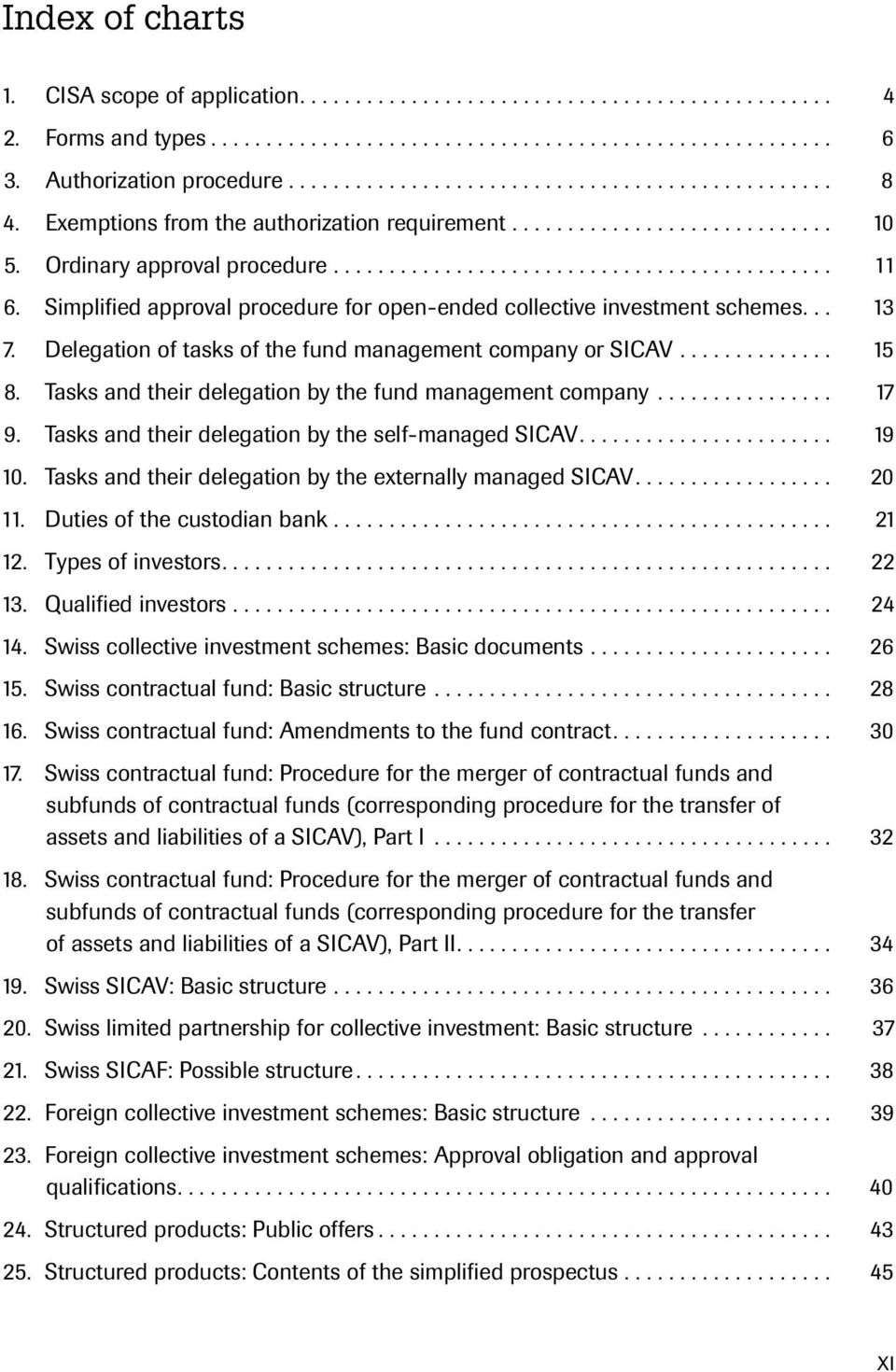
10 Index of charts. CISA scope of application Forms and types Authorization procedure Exemptions from the authorization requirement Ordinary approval procedure Simplified approval procedure for open-ended collective investment schemes Delegation of tasks of the fund management company or SICAV Tasks and their delegation by the fund management company Tasks and their delegation by the self-managed SICAV Tasks and their delegation by the externally managed SICAV Duties of the custodian bank.... Types of investors..... Qualified investors Swiss collective investment schemes: Basic documents Swiss contractual fund: Basic structure Swiss contractual fund: Amendments to the fund contract Swiss contractual fund: Procedure for the merger of contractual funds and subfunds of contractual funds (corresponding procedure for the transfer of assets and liabilities of a SICAV), Part I Swiss contractual fund: Procedure for the merger of contractual funds and subfunds of contractual funds (corresponding procedure for the transfer of assets and liabilities of a SICAV), Part II Swiss SICAV: Basic structure Swiss limited partnership for collective investment: Basic structure Swiss SICAF: Possible structure Foreign collective investment schemes: Basic structure Foreign collective investment schemes: Approval obligation and approval qualifications Structured products: Public offers Structured products: Contents of the simplified prospectus XI
11

12 References to SFBC guidelines and SFA sample documents with link to the website A. SFBC guidelines The supervisory authority has published guidelines for the submission of authorization and approval applications which have proven to be a helpful aide in practice. In particular, the supervisory authority has published the following guidelines: Guideline for applications regarding obtaining authorization as an asset manager in accordance with the Collective Investment Schemes Act, edition of June, 007 Guideline for applications regarding obtaining authorization as a fund management company, amendments within the fund management company, changing the fund management company, edition of September 7, 007 Guideline for applications regarding obtaining authorization as a custodian bank, amendments within the custodian bank, changing the custodian bank, edition of September 7, 007 Guideline for applications regarding obtaining approval of the fund contract of a collective investment scheme, the approval of additional subfunds, the approval of amendments to the fund contract, edition of September 7, 007 Guideline for applications regarding obtaining authorization as a SICAV and the approval of its articles of association and its investment regulations, the approval of additional subfunds, the amendments within the SICAV, edition of September 7, 007 Guideline for applications regarding obtaining authorization as a SICAF and the approval of its articles of association, the investment regulations, the amendments within the SICAF, edition of September 7, 007 Guideline for applications regarding obtaining authorization as a limited partnership for collective investment and the approval of its company agreement, the amendments within the limited partnership for collective investment, edition of September 7, 007 Guideline for applications regarding obtaining authorization as a representative of foreign collective investment schemes, edition of June, 007 Guideline regarding the responsibilities of a representative, edition of June, 007 Guideline for applications regarding approval for public distribution of foreign collective investment schemes in or from Switzerland which conform with both Guidelines 00/07/EC and 00/08/EC which supersede Guideline 85/6/EC (Guideline UCITS III), edition of June, 007 XIII
13 References to SFBC guidelines and SFA sample documents with link to the website Guideline for applications regarding approval of foreign collective investment schemes for public distribution in or from Switzerland which are not EC compatible, edition of June, 007 Guideline for applications regarding obtaining authorization as distributor, edition of June, 007 Guideline for applications regarding audit firms which obtain authorization for simplified recognition of auditors for the audit of asset managers of collective investment schemes, representatives of foreign collective investment schemes, edition of October, 007 Guideline for applications regarding the approval of valuation experts of real estate funds, edition of November 5, 00 The SFBC publications are available at < B. Self-regulation provisions of the Swiss Funds Association (SFA) The Swiss Funds Association (SFA) has published a code of conduct as well as numerous guidelines and sample documents that serve the purpose of self-regulation. The SFA publications are available at < XIV

14 Literature For an in-depth study of the Swiss legislation related to collective investment schemes reference is made to the following publication available in German: Hasenböhler Franz / Kühne Armin / Lengauer Daniel / Amstutz Therese / Imwinkelried Michaela / Dö m e r Philipp, Recht der kollektiven Kapitalanlagen, Unter Berücksichtigung steuerrechtlicher Aspekte, Zürich, Basel, Genf 007 XV

15

16 Part Charts

17

18 Introduction The following charts serve the purpose of presenting complicated procedures and processes in the Swiss collective investment schemes law in a systematic and simplified manner. They should aide the practitioner in finding his way through the individual areas of the legal framework. We have consciously limited ourselves to a few important topics which were suited to presentation in graphic form. The charts, therefore, do not provide a complete picture, but are a tool which aids in the understanding of the complex legal framework of the Swiss collective investment schemes law.

19 Part : Charts. CISA scope of application CISA Scope of Application Table - Collective investment schemes Subject to CISA Swiss collective investment schemes governed by CISA Open-ended collective investment schemes Closed-ended collective investment schemes Contractual fund Investment company with variable capital (SICAV) Limited partnership for collective investment Investment company with fixed capital (SICAF) Foreign collective investment schemes subject to CISA Open-ended collective investment schemes Closed-ended collective investment schemes Contractual fund Company law collective investment scheme Company law collective investment scheme Not subject to CISA, but regulated Structured products In-house funds Not subject to CISA Swiss entities not governed by CISA Specifically not Institutions and ancillary institutions in the occupational pension sector including investment foundations Social security institutions and compensation funds Public authorities and institutions Operating companies which are engaged in business activities Holding companies Investment clubs whose members are in a position to manage their financial interests themselves Associations and foundations as defined in the Civil Code Investment company in the form of a corporation provided that it is listed on a Swiss stock exchange or only qualified investors can participate and shares are registered (confirmed annually by the auditors) Foreign collective investment schemes not subject to CISA Registered office and main administrative office (of the fund management company or the company law collective investment scheme) or the company in a foreign country and no public advertising in or from Switzerland (no duty to obtain approval) Chart : CISA scope of application 4
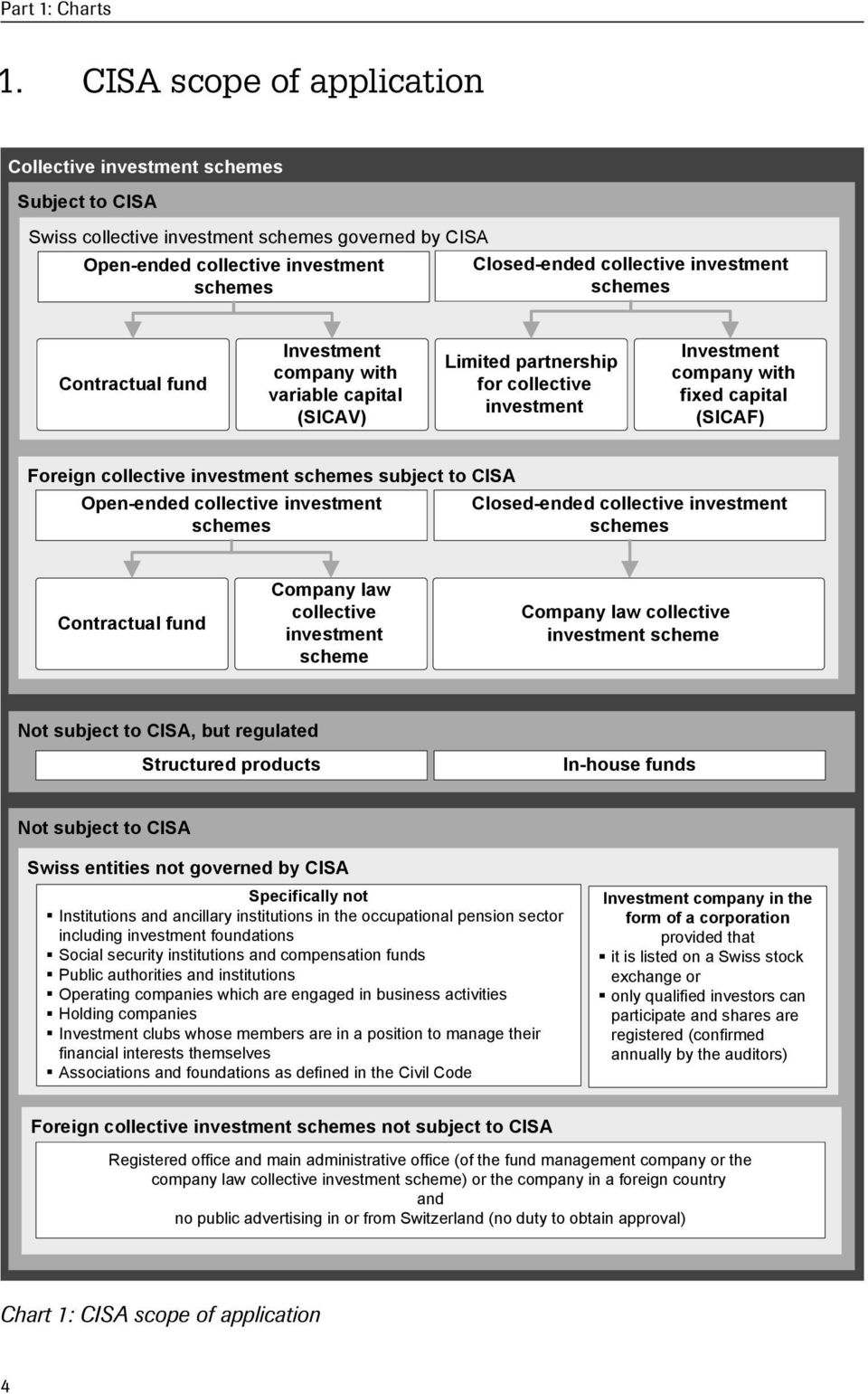
20 . CISA scope of application The law provides four different investment vehicles that are made available for the structuring of a Swiss collective investment scheme. The contractual fund and the investment company with variable capital (SICAV) belong to the open-ended collective investment schemes. The open-ended character of these collective investment schemes results from the investor being able to request redemption of his units and their repayment in cash at any time. The SICAV is the company law equivalent of the open-ended collective investment schemes. With the closed-ended collective investment schemes, Swiss law provides the limited partnership for collective investment following the example of the Anglo-Saxon limited partnership and also the investment company with fixed capital (SICAF). Investment companies with fixed capital are not governed by CISA if their units are listed on a Swiss stock exchange or if only qualified investors can participate in them. If neither of these two requirements are met, then the SICAF falls within the scope of CISA. Foreign collective investment schemes which are the subject of public advertising in or from Switzerland, irrespective of their legal status, are governed by relevant provisions of CISA (Art. Para. 4 CISA). The definition of foreign collective investment schemes encompasses both open-ended as well as closed-ended collective investment schemes (Art. 9 CISA). Both the contractual forms as well as companies with an open-ended structure are deemed to be foreign open-ended collective investment schemes. The contractual forms also include, in addition to assets that were accumulated on the basis of a fund contract and which are managed by a fund management company with its registered office and main administrative office abroad, other agreements with similar effect for the purpose of collective capital investment (Art. 9 Para. lit. a CISA). Furthermore, in addition to companies, schemes with structures similar to companies and with registered office and main administrative office abroad are also included where their object is collective capital investment and their investors have a legal right with regard to the company itself, or with regard to a closely related company, to the redemption of their units at the net asset value (Art. 9 Para. lit. b CISA). A company with a closed-ended structure is deemed to be a foreign closed-ended collective investment scheme. These include companies and schemes with their registered office and main administrative office abroad whose object is collective capital investment and whose investors have no legal right with regard to the company itself, or with regard to a closely related company, to the redemption of their units at the net asset value (Art. 9 Para. CISA). For example, foreign SICAFs and foreign limited partnerships are deemed to be such companies. Principally, structured products are not governed by CISA and therefore are not subject to supervision (Art. 5 Para. 5 CISA). According to Art. 4 CISA, in-house funds are not governed by CISA as long as certain requirements are met (written discretionary management agreement, no issuing of unit certificates and no public advertising). References in this publication to one gender include both genders. 5

21 Part : Charts Art. Para. CISA contains a list of investment vehicles which are not governed by CISA. Exempt from the scope are institutions and ancillary institutions in the occupational pensions sector (including investment foundations), social security institutions and compensation funds, public authorities and institutions, operating companies which are engaged in business activities, holding companies, the associations and foundations as well as investment clubs.. Forms and types Forms and Types Table - Swiss collective investment schemes under CISA Forms Open-ended collective investment schemes Closed-ended collective investment schemes Contractual fund Investment company with variable capital (SICAV) Limited partnership for collective investment Investment company with fixed capital (SICAF) Types Securities funds Real estate funds Other funds for traditional investments Other funds for alternative investments Investments Securities Real estate Traditional investments Alternative investments Investments in risk capital Construction and real estate projects Alternative investments In principle free Chart : Forms and types 6
22 . Forms and types The open-ended collective investment schemes are organized into different types based on the investment provisions. This classification is independent of the legal structuring (contractual fund or SICAV), independent of the group of investors in the collective investment (public investor or qualified investor) and independent of whether it is an Exchange Traded Fund (ETF). The investment provisions regulate the permitted investments, the investment restrictions, the investment techniques, risk diversification as well as other specific areas. CISA provides four types of open-ended collective investment schemes: securities funds (Art. 5 et seq. CISA, Art. 70 et seq. CISO), real estate funds (Art. 58 et seq. CISA, Art. 86 et seq. CISO), other funds for traditional investments (Art. 68 et seq. CISA, Art. 99 et seq. CISO) and other funds for alternative investments (Art. 68 et seq. CISA, Art. 99 et seq. CISO). Principally, the limited partnership for collective investment invests in risk capital (Art. 0 Para. CISA). Based on a related authorization in Art. 0 Para. CISA, the Federal Council has additionally permitted other investments for limited partnerships for collective investment. Examples are investments in construction and real estate projects as well as alternative investments (Art. Para. CISO). These other investments do not need to have the character of risk capital pursuant to Art. 0 CISO. Therefore it is possible to create a hedge fund in Switzerland in the form of a limited partnership for collective investment, which is also common internationally for limited partnerships. The investment company with fixed capital (SICAF) is principally free as regards its investment policy. According to Art. 5 Para. CISA, Art. 69 CISA and correspondingly Art. 64, Art. 70 and Art. 7 CISA apply to investments. The reference to the requirements for other funds (Art. 69 CISA) means that many diverse investment possibilities are open to the SICAF. Should there be a need for additional investment possibilities, the supervisory authority can permit additional investments based on Art. Para. CISO. 7
23 Part : Charts. Authorization and approval. Authorization procedure Authorization procedure Table - Licensee Fund management company of the contractual fund Investment company with variable capital (SICAV) Limited partnership for collective investment Investment company with fixed capital (SICAF) Asset managers of collective investment schemes Representatives of foreign collective investment schemes Distributor Authorization documentation Articles of association Organizational regulations Articles of association Organizational regulations Company agreement Articles of association Organizational regulations Relevant organizational documentation Relevant organizational documentation Relevant organizational documentation Authorization procedure Licensee Authorization conditions SFBC Start of business or change of circumstances Submission of application for approval Application Authorization documentation Evidence that the authorization conditions are fulfilled SFBC receives application SFBC SFBC confirms receipt of application Review of authorization conditions Management and business operations Good reputation Guarantee of proper management Requisite professional qualifications Significant equity holders Good reputation No exertion of their influence to the detriment of prudent and sound business practice Internal regulations and appropriate organizational structure Ensure compliance with legal duties Custodian bank Relevant organizational documentation Sufficient financial guarantees Additional authorization conditions pursuant to CISA SFBC SFBC order Compliance with the code of conduct of a specific industry body (to the extent the SFBC makes this a condition for its granting of authorization) Chart : Authorization procedure 8
24 . Authorization and approval Any party responsible for the management of a collective investment scheme or the safekeeping of the assets held in it is a licensee and needs authorization from the supervisory authority (Art. Para. CISA). Any party applying for authorization must submit the authorization documentation mentioned in Art. 7 CISO to the supervisory authority, showing the organization of the licensee. These documents must also be submitted to the supervisory authority if the underlying circumstances leading to authorization have changed (Art. 6 CISA, Art. 4 CISO). The supervisory authority will only grant authorization to those licensees who meet the general authorization conditions of Art. 4 CISA. The supervisory authority defines which requirements for evidence of authorization conditions must be met to obtain authorization (Art. 0 to Art. CISO). Authorization conditions stipulate that the persons responsible for management and the business operations have a good reputation, guarantee proper management and possess the requisite professional qualifications (Art. 4 Para. lit. a CISA). The fulfillment of requirements for the professional qualifications is assessed taking into consideration the particular activities intended and based on education and training, experience and career history (Art. 0 Para. CISO). Furthermore, persons who own at least 0 percent of the capital or votes in the licensee or whose business activities can have material influence in another way (significant equity holders) must have a good reputation and do not exert their influence to the detriment of prudent and sound business practice (Art. 4 Para. lit. b as well as Art. 4 Para. CISA, Art. CISO). Additionally, it must be ensured through internal regulations and appropriate organizational structure that the licensee can fulfill its legal duties (Art. 4 Para. lit. c CISA). This includes an executive board consisting of at least two persons, joint signatory power of the authorized signatories, organizational regulations, a proper set of regulations in particular in areas of risk management, internal control system (ICS) and compliance, the employment of sufficiently qualified personnel and an internal audit if required by the supervisory authority (Art. CISO). In addition, the authorization is only issued if sufficient financial guarantees exist (Art. 4 Para. lit. d CISA). This shall be deemed to be the case if the licensee meets the relevant provisions regarding the minimum capital or minimum investment amount (Art. CISO). Finally, the supervisory authority may make its granting of authorization dependent on compliance with the code of conduct of a specific industry body (Art. 4 Para. CISA). 9
25 Part : Charts. Exemptions from the authorization requirement System of exemptions from the authorization requirement Authorization for fund management company bank securities dealer insurance institutions Authorization for asset managers Exempts and encompasses Exempts and encompasses Authorization for representatives Exempts and encompasses Authorization for distributors Chart 4: Exemptions from the authorization requirement Institutions which are already subject to governmental supervision, need not apply for a further authorization for activities which are subject to lower authorization conditions (e majore minus). The exemption only applies to the authorization requirement. The legal requirements pertaining to the specific business activities must still be adhered to (e.g. the code of conduct, distribution provisions, responsibilities of a representative). Consequently, fund management companies pursuant to CISA, banks pursuant to the Federal Act on Banks and Savings Institutions, securities dealers pursuant to the Stock Exchange Act and insurance institutions pursuant to the Federal Act on the Supervision of Insurance Companies are exempted from the obligation to obtain authorization as asset manager of collective investment schemes, representative of foreign collective investment schemes and distributor (Art. 8 Para. CISO). Authorized asset managers of collective investment schemes are exempted from the obligation to obtain authorization as representative and distributor (Art. 8 Para. CISO), since an asset manager of collective investment schemes must meet higher requirements when obtaining authorization. The Swiss Post Office and representatives of foreign collective investment schemes are exempt from the obligation to obtain authorization for distributors (Art. 8 Para. CISO). There are no exemptions from the obligation to obtain authorization for the SICAV, the limited partnership for collective investment and for the SICAF, since their objects are limited to the management and distribution of their own collective capital investment. 0
26 4. Authorization and approval. Ordinary approval procedure Ordinary Approval Procedure Table - Products Contractual fund Documentation for approval Fund contract Introduction of product or change in circumstances Approval procedure For subfunds, obligation to obtain approval exists for each subfund Open-ended collective investment scheme Investment company with variable capital (SICAV) Limtied partnership for collective investment Articles of association Investment regulations Company agreement yes yes Is a simplified approval procedure possible? no Investment Company with fixed capital (SICAF) Articles of association Investment regulations Chart 6 no Foreign collective investment scheme Relevant documents Applicant Submission of the application Application Approval documentation Evidence that the approval conditions are fulfilled SFBC receives the application SFBC SFBC confirms receipt of the application SFBC SFBC order Approval conditions SFBC Examines whether the approval conditions are fulfilled Chart 5: Ordinary approval procedure
27 Part : Charts As products, collective investment schemes are subject to obligation to obtain approval from the supervisory authority. The following documents must be approved by the supervisory authority (Art. 5 Para. CISA): Fund contract for a contractual fund (Art. 5 et seq. CISA), articles of association and the investment regulations for a SICAV (Art. 6 et seq. CISA), the company agreement for a limited partnership for collective investment (Art. 98 et seq. CISA), articles of association and investment regulations for the SICAF (Art. 0 et seq. CISA). In the case of foreign collective investment schemes, they must submit the corresponding documents. The supervisory authority reviews the approval conditions and issues the approval by order if the requirements are fulfilled. In the case of contractual funds and SICAVs with subfunds (Art. 9 et seq. CISA), the obligation to obtain approval exists for each individual subfund (Art. 5 Para. CISA). If there is a change in the circumstances underlying the approval, the supervisory authority s approval must be sought prior to the continuation of activity (Art. 6 CISA, Art. 4 et seq. CISO). For Swiss open-ended collective investment schemes (contractual funds and SICAVs), there exists under certain conditions the possibility of a simplified approval procedure (Art. 7 CISA in conjunction with Art. 6 CISO, cf. chart 6 ). See p..
28 . Authorization and approval 5.4 Simplified approval procedure for open-ended collective investment schemes Simplified Approval Procedure for Open-Ended Collective Investment Schemes Tafel - Conditions for the simplified approval procedure Open ended collective investment scheme Fund regulations correspond to or Template which has been recognized by the SFBC as a minimum standard Standard which the SFBC has declared binding for the particular licensee Procedure and time limits for the simplified approval procedure for open-ended collective investment schemes Submission of the application to the SFBC SFBC receives the application Approval period begins one day after receipt If the SFBC requests more information, the approval period is extended until the information is received SFBC SFBC confirms receipt of application Qualified investors Are immediately considered approved (legal fiction) Are considered approved 4 weeks later (legal fiction) Up to months after the simplified approval Securities funds Real estate funds Other funds for traditional investments Other funds for alternative investments The SFBC can request subsequent amendments to the documents Public investors Approval within 4 weeks Approval within 6 weeks Approval within 8 weeks Within the time limits mentioned above Securities funds Real estate funds Other funds for traditional investments Other funds for alternative investments SFBC order Chart 6: Simplified approval procedure for open-ended collective investment schemes
29 Part : Charts For open-ended collective investment schemes (contractual funds and SICAVs) a simplified approval procedure (Art. 7 CISA, Art. 6 et seq. CISO) is possible under certain conditions. An important condition for the simplified approval procedure is that the fund contract (in the case of contractual funds) and the investment regulations (in the case of SICAVs) comply with a format that is recognized by the supervisory authority. At the same time, the format can be derived from a format of an industry body (e.g. the SFA) recognized as a minimum standard or from recognized standards which are binding in relation to the relevant licensee. According to Art. 7 CISO, relatively short time periods apply to the simplified approval procedure for all forms of open-ended collective investment schemes, after which a Swiss collective investment scheme is deemed as approved (legal fiction) or after which the application has to be completed. The simplified approval procedure for collective investment schemes that are limited to qualified investors for securities funds, real estate funds and other funds for traditional investments are deemed to have been approved following receipt of the application (Art. 7 Para. CISO). Other funds for alternative investments are deemed to have been approved four weeks following receipt of the application. As a counterbalance to these short approval periods, the supervisory authority may demand that a subsequent amendment shall be made to the documents for a period of up to three months following the simplified approval (Art. 8 CISO). Subsequent amendments must be published in the media of publication. Since other funds for traditional investments for qualified investors and real estate funds are deemed to have been approved following receipt of the application, the simplified approval procedure for these funds is just a simple notification procedure. Collective investment schemes directed towards public investors shall be approved by the supervisory authority within four to eight weeks following receipt of the application, depending on the type of the collective investment scheme (Art. 7 Para. CISO). Contrary to the collective investment schemes for qualified investors, the simplified procedure for collective investment schemes for public investors thereby ends with an order by the supervisory authority. This is justifiable because it is in accordance with international standards. The supervisory authority can request additional information during the approval period (Art. 6 Para. CISO). Consequently the approval period is postponed until the requested information is received (Art. 7 Para. 4 CISO). For Swiss closed-ended collective investment schemes (limited partnership for collective investment and SICAF), the Federal Council has not made use of its ability (Art. 7 CISA) to allow for a simplified approval process in the CISO. 4
30 4. Delegation of tasks 4. Delegation of tasks 4. Delegation of tasks of the fund management company or SICAV Delegation of Tasks by the Fund Management Company or SICAV Tafel - Delegation of tasks (administration, investment decisions, other specific tasks) Delegation of tasks is in the interest of an efficient management Delegation agreements must be made in writing Agents and the most significant parts of the delegation agreement are to be mentioned in the prospectus A one-time further delegation is possible Fund management company Administration SICAV Investment decisions Asset manager subject to recognized supervision Investment decisions Additional specific tasks Additional specific tasks Third parties Chart 7: Delegation of tasks of the fund management company or SICAV The fund management company may delegate the investment decisions as well as specific tasks provided this is in the interest of efficient management (Art. CISA). However, it shall commission only those persons who are properly qualified to execute the concerned tasks. Furthermore, it must meet the necessary measures for the instruction, monitoring and control of the implementation of the tasks. 5
31 Part : Charts Investment decisions for Swiss collective investment schemes may only be delegated to asset managers who are subject to a recognized supervision (Art. Para. CISA). The delegated tasks must be recorded in written delegation agreements which adequately describe responsibilities, competencies and liability issues. The fund management company must ensure that the delegation agreement provides it with the necessary rights to inspect, instruct and control. The agents and significant parts of the delegation agreements must be mentioned in the prospectus. A one-time further delegation of the delegated tasks by the agents is permissible with the consent of the fund management company. The board of directors of an externally managed SICAV must delegate the administration to an authorized fund management company (Art. 5 Para. 5 CISA, Art. 5 Para. CISO). Furthermore, the provisions for the fund management company in accordance with Art. Para. 4 CISA apply accordingly for the delegation of tasks of the SICAV (Art. 66 CISO). 6
32 4. Delegation of tasks 7 4. Tasks and their delegation by the fund management Tasks and company their Delegation 4 by the Fund Management Company Tafel - Tasks which can be delegated by the fund management company to third parties Calculating the net asset value Determining the issue and redemption prices (Art. 4 lit. b Point 4 CISO) Fund accounting (Art. 4 lit. b Point 7 CISO) Running of IT systems Additional administrative and logistic tasks of the fund management company (tax returns for the funds, source tax refunds etc.) Legal and tax advice Risk management, 4 Compliance Individual management of client assets within the framework of a mandate (Art. 9 sentence lit. a CISA) Investment advisory services Safekeeping and technical administration of the units for collective investment schemes i.e. management of unit accounts (Art. 9 sentence lit. c CISA, Art. 46 Para. lit. c CISO) Distribution of collective investment schemes (Art. 46 Para. lit. d CISO) Rendering of administrative services for collective investment schemes and similar investment vehicles such as inhouse funds, investment foundations and investment companies (Art. 46 Para. lit. e CISO) Tasks which can only be delegated to the executive board of the fund management company Implementation of an internal control system (ICS) within the framework of the board of director s decisions Setting up the accounting for own investment funds and SICAV Valuation of the assets Determining the content of the prospectus, the simplified prospectus, the annual and semi-annual report as well as for additional publications targeted towards investors Decision about the foundation and dissolution of subsidiaries whose sole object is the holding of assets for the collective investment scheme (Art. 68 Para. CISO) Decision about the issue and redemption of units Compliance with notification obligations Conclusion of distribution agreements Appointing of valuation experts Selection, instruction and monitoring of the agents Decision about the creation, dissolution and merger of contractual funds and SICAV within the framework of the principles of investment policies Decision about the creation, dissolution and merger of unit classes Determining the content of the fund contract Determining the profit distributions of the investment funds Representation of foreign collective investment schemes (Art. 46 Para. lit. a CISO) Tasks which cannot be delegated by the board of directors of the fund management company Responsibilities of the board of directors which cannot be transferred in accordance with Art. 76a CO Issuing of organizational regulations (Art. 8 Para. 4 CISA) Ensuring the setting up, implementation and maintenance of an effective internal control system (ICS) Determining business policies and strategies Determining the principles of the investment policy Determining the guidelines for the use of derivatives, securities lending and repurchase agreements (Art. Para., Art. Para. and Art. 7 Para. CISO-SFBC) Decisions about the opening and closing of branches Appointment and removal of special statutory auditors and treatment of their reports (Art. 6 Para. lit. a CISA) Decision about providing ancillary services in accordance with Art. 9 CISA Decision about performing additional tasks in accordance with Art. 46 Para. CISO Decision about taking the responsibility for the administration of SICAVs (Art. 5 Para. 5 CISA) Decision about the foundation of subsidiaries and the participation in companies whose primary object is the collective investment scheme business (Art. 46 Para. lit. b CISO), their dissolution and sale Decision about the purchase and sale of property for the fund management company Chart 8: Tasks and their delegation by the fund management company Delegation only within Switzerland. 4 Delegation only to a group company under the same management. 7
33 Part : Charts The delegable tasks of a fund management company, which can only be delegated to the executive board of the fund management company and the non-delegable tasks of the board of directors of the fund management company are set out in the Circular Delegation of tasks by the fund management company and the SICAV dated August 9, 007 (SFBC- Circular 07/) 5. 5 See p. 9. 8
34 8 4. Delegation of tasks 4. Tasks and Tasks their Delegation and their by delegation the self-managed by the SICAV self-managed SICAV Tafel - 6 Tasks which can be delegated by the SICAV to third parties Calculating the net asset value 6 Determining the issue and redemption prices (Art. 4 lit. b Point 4 CISO) Fund accounting (Art. 4 lit. b Point 7 CISO) 6 Running of IT systems Additional administrative and logical tasks of the fund management company (tax return for the funds, source tax refunds etc.) Legal and tax advice Tasks which can only be delegated to the executive board of the SICAV Implementation of the internal control system (ICS) within the framework of the board of director s decisions Setting up of the accounting Valuation of the assets Determining the content of the prospectus, the simplified prospectus, the annual and semi-annual report and other publications targeted towards investors Decision about the foundation and dissolution of subsidiaries whose sole object is the holding of assets for the collective investment scheme (Art. 68 Para. CISO) Decision about the issue and redemption of shares Compliance with notification obligations Conclusion of distribution agreements Appointing of valuation experts Selection, instruction and monitoring of the agents Risk management Compliance Decision about the creation of new subfunds where provided by the articles of association (Art. 64 Para. lit. d CISO) Decision about the creation, dissolution and merger of unit classes, in as far as the articles of association allow for this (Art. 6 CISO) Creation of investment regulations of new subfunds Amending the investment regulations of existing subfunds, in as far as this is not the responsibility of the general meeting in accordance with Art. 6 Para. CISO Tasks which cannot be delegated by the board of directors of a SICAV Responsibilities of the board of directors which cannot be transferred in accordance with Art. 76a CO Issuing of organizational regulations (Art. 8 Para. 4 CISA) Ensuring the setting up, implementation and maintenance of an effective internal control system (ICS) Determining business policies and strategies Determining the principles of the investment policy Determining the guidelines for the use of derivatives, securities lending and repurchase agreements (Art. Para., Art. Para. and Art. 7 Para. CISO-SFBC) Decisions about the opening and closing of branches Appointment and removal of special statutory auditors and treatment of their reports (Art. 6 Para. lit. a CISA) Appointment and change of the custodian bank (Art. 64 Para. lit. c CISO) Decision about the purchase and sale of non-movable assets which are essential for the direct performance of the SICAV s operations (Art. 68 Para. CISO) Chart 9: Tasks and their delegation by the self-managed SICAV The delegable tasks of a self-managed SICAV, which can only be delegated to the executive board of the self-managed SICAV and the non-delegable tasks of the board of directors of the self-managed SICAV are set out in the Circular Delegation of tasks by the fund management company and the SICAV dated August 9, 007 (SFBC-Circular 07/) 7. 6 Delegation only within Switzerland. 7 See p. 9. 9
35 9 Part : Charts 4.4 Tasks and their delegation by the externally managed Taks and their SICAV Delegation 89 by the externally managed SICAV Tafel - Tasks which a SICAV must delegate to a Swiss fund management company Calculating the net asset value 8 Determining the issue and redemption prices (Art. 4 lit. b Point 4 CISO) 8 Fund accounting (Art. 4 lit. b Point 7 CISO) Running of IT systems Additional adminstrative and logistic tasks of the fund management company (tax return for the funds, source tax refunds etc.) 8, 9 Risk management 8 Compliance Creation of investment regulations of new subfunds Decision about the valuation of assets Decision about the issue and redemption of shares Drawing up the prospectus and the simplified prospectus (Art. 64 Para. lit. e CISO), annual and semi-annual report Accounting Structuring of the internal control system (ICS; Art. 64 Para. CISO) Compliance with notification obligations Supervision of sub-agents, if applicable Further Delegation with Approval of the SICAV Calculating the net asset value 8 Determination of the issue and redemption prices (Art. 4 lit. b Point 4 CISO) 8 Fund accounting (Art. 4 lit. b Point 7 CISO) Running of IT systems Additional adminstrative and logistic tasks of the fund management company (tax return for the funds, source tax refunds etc.) Risk management Compliance Tasks which cannot be delegated by the SICAV s board of directors Responsibilities of the board of directors which cannot be transferred in accordance with Art. 76a CO Issuing of organizational regulations (Art. 8 Para. 4 CISA) Ensuring the setting up, implementation and maintenance of an effective internal control system (ICS) Determining business policies and strategies Determining the principles of the investment policy Determining the guidelines for the use of derivatives, securities lending and repurchase agreements (Art. Para., Art. Para. and Art. 7 Para. CISO-SFBC) Decisions about the opening and closing of branches Appointment and removal of special statutory auditors and treatment of their reports (Art. 6 Para. lit. a CISA) Appointment and change of the custodian bank (Art. 64 Para. lit. c CISO) Decision about the purchase and sale of non-movable assets which are essential for the direct performance of the SICAV s operations (Art. 68 Para. CISO) Decision to delegate the administration of the SICAV to a fund management company (Art. 65 Para. CISO) The rights of the board of directors to control the fund management company (Art. 65 Para. lit. d CISO) Chart 0: Tasks and their delegation by the externally managed SICAV The tasks which must be delegated by an externally managed SICAV to a fund management company, the further delegation of a delegable task of an externally managed SICAV to a 8 Delegation only within Switzerland. 9 Delegation only to a group company under the same management. 0
36 5. Duties of the custodian bank fund management company and non-delegable tasks of the board of directors of an externally managed SICAV are set out in the Circular Delegation of tasks by the fund management company and the SICAV dated August 9, 007 (SFBC-Circular 07/) Duties of the custodian bank Duties of the Custodian Bank Tafel - Custodian bank Third party custodians and collective securities depositories Custodian duties Safekeeping of the fund s assets Payment transfers Monitoring duties Right and obligation to intervene in the fund management company if there are investments which are not permitted Review of compliance with the law and fund regulations regarding calculation of NAV of the units calculation of the issue and redemption prices of each unit investment decisions appropriation of income Other services Issue and redemption of units Chart : Duties of the custodian bank On the one hand, the custodian bank has to fulfill technical responsibilities. This includes safekeeping of the fund s assets, issue and redemption of units as well as payment transfers on behalf of the investment fund (Art. 7 Para. CISA, Art. 04 CISO). On the other hand the custodian bank performs monitoring functions for the collective investment scheme by verifying that the fund management company complies with the law and the fund regulations, in particular with respect to the calculation of the net asset value, the calculation of the issue and redemption prices as well as with regard to the investment decisions and the 0 See p. 9.
37 Part : Charts appropriation of income (Art. 7 Para. CISA). The custodian bank and its agents are also required to act exclusively in the best interests of the investors (Art. 0 Para. lit. a CISA). The safekeeping of the fund s assets and the settlement of payment transfers can be transferred to third-party custodians and collective securities depositories, whereby the custodian bank is liable for due diligence in the selection, instruction and monitoring of the third party. The investors are to be informed in the prospectus about the risks of the transferring of the safekeeping (Art. 7 Para. CISA). 6. Investors 6. Types of investors Swiss Collective Investment Schemes: Types of Investors Tafel - Open-ended collective investment schemes Closed-ended collective investment schemes Contractual fund Investment company with variable capital (SICAV) Limited partnership for collective investment Investment company with fixed capital (SICAF) Possible types of investors Public investors and qualified investors Public investors and qualified investors Public investors and qualified investors Exclusively qualified investors Exclusively qualified investors Exclusively qualified investors Individual exemption from certain CISA provisions (Art. 0 para. 5 CISA) No exemption Chart : Types of investors
38 6. Investors CISA differentiates between the common investor (public investor) and the qualified investor (cf. chart ). If the type of investors is not limited to qualified investors, it is a collective investment scheme that is also open to public investors. The following types of collective investment schemes are exclusively available to qualified investors: collective investment schemes in which the fund regulations of a contractual fund or the articles of association of the SICAV restrict investor eligibility to qualified investors (Art. 0 Para. and CISA); a limited partnership for collective investment (Art. 98 Para. CISA); an investment company with fixed capital in which only qualified investors within the sense of Art. 0 Para. CISA may participate and thus which is not governed by CISA (Art. Para. lit. a CISA, cf. chart ). The supervisory authority may fully or partially exempt a collective investment scheme from certain provisions of CISA if it is restricted exclusively to qualified investors and the protective object of CISA is not impaired (Art. 0 Para. 5 CISA). For this reason, through specification of the differentiated investor protection concept, it is possible to take into account the needs of those qualified investors who do not need as much protection, though special legal requirements must be observed. CISA lists individual provisions from which the supervisory authority can exempt a collective investment scheme (Art. 0 Para. 5 CISA). See p. 4. See p. 4.
39 Part : Charts 6. Qualified Investors investors Tafel - Institutional investors Natural persons Regulated financial intermediaries Regulated insurance institutions Other institutional investors Persons with a written discretionary management agreement High-net-worth individuals Banks Securities dealers Fund management companies Representatives of foreign collective investment schemes Asset managers of collective investment schemes SICAVs Limited partnerships for collective investment SICAFs Public entities Retirement benefits institutions with professional treasury operations Companies with professional treasury operations Discretionary management agreement with a regulated financial intermediary Discretionary management agreement with an independent asset manager as far as asset manager is subject to the MLA, and asset manager is subject to a code of conduct which is recognized as a minimum standard, and discretionary management agreement conforms to recognized standards. Written confirmation that at the time of purchase the individual holds financial investments of at least CHF m Chart : Qualified investors The term qualified investor is a key concept throughout CISA. It namely defines the types of investors that may invest in Qualified Investors Funds (QIF) and limited partnerships for 4
40 6. Investors collective investment (cf. chart ). Furthermore, it defines certain collective investment schemes which are not governed by CISA (investment companies with fixed capital that are directed exclusively towards qualified investors, cf. chart 4 ). Additionally, the term qualified investor is important in determining whether a foreign collective investment scheme is subject to CISA, since it is not public advertising if the advertisement, under application of the customary advertising methods for this market, is directed exclusively towards qualified investors (Art. CISA, Art. Para. CISO). The persons specifically listed in Art. 0 Para. and 4 CISA as well as Art. 6 CISO are deemed to be qualified investors. With the term specifically in Art 0 Para. CISA, the legislator indicates that this list is not exhaustive. In addition to institutional investors (regulated financial intermediaries, regulated insurance institutions and certain other institutional investors) also natural persons are deemed to be qualified investors if certain conditions are met. A high-net-worth individual shall qualify provided that he or she confirms in writing to a regulated financial intermediary or to an independent asset manager in the sense of Art. 6 Para. CISO that he or she either directly or indirectly holds financial investments of at least two million Swiss francs at the time of purchase (Art. 6 Para. CISO). See p.. 4 See p. 4. 5
41 Part : Charts 7. Swiss collective investment schemes 7. Swiss Collective Basic documents Investment Schemes: Basis Documents Tafel - Open-ended collective investment schemes Closed-ended collective investment schemes Contractual fund Investment company with variable capital (SICAV) Limited partnership for collective investment Investment company with fixed capital (SICAF) Basic documents required for approval Articles of association Company agreement Articles of association Fund regulations (= fund contract) Investment regulations Investment regulations Basic documents required for notification Prospectus for securities funds real estate funds other funds for traditional investments Prospectus for securities funds real estate funds other funds for traditional investments Prospectus Prospectus Prospectus for other funds for alternative investments Prospectus for other funds for alternative investments Simplified prospectus for securities funds real estate funds other funds for traditional investments Simplified prospectus for securities funds real estate funds other funds for traditional investments Annual and semiannual report Annual and semiannual report Annual and semiannual report Annual and semiannual report These documents must be made available to interested persons free of charge prior to the conclusion of the contract These documents must be offered to interested persons free of charge prior to conclusion of the contract Chart 4: Swiss collective investment schemes: Basic documents 6
42 7. Swiss collective investment schemes The documents required for obtaining approval for the individual forms of Swiss collective investment schemes are set out in Art. 5 Para. CISA: the fund contract for contractual funds (Art. 5 et seq. CISA), the articles of association and investment regulations for SICAVs (Art. 6 et seq. CISA), the company agreement for limited partnerships for collective investment (Art. 98 et seq. CISA) as well as the articles of association and the investment regulations for SICAFs (Art. 0 et seq. CISA). A prospectus is to be published for every contractual fund and every SICAV (Art. 75 Para. CISA). If requested, the prospectus must be provided free of charge thus not mandatorily offered to interested persons prior to the conclusion of the contract or prior to subscription (Art. 75 Para. CISA). This does not apply to other funds for alternative investments, whose prospectus must be offered free of charge to interested persons prior to the conclusion of the contract or prior to subscription (Art. 7 Para. 4 CISA). The prospectus and each amendment thereto must be submitted to the supervisory authority at the latest by the time of publication (Art. 77 Para. CISA, Art. 06 Para. CISO). However, there is no obligation to publish the prospectus and its amendments in the media of publication. The prospectus must be amended at least once a year and in the event of material changes (Art. 06 Para. CISO). Each advertisement must make reference to the prospectus together with the information that indicates where it can be obtained (Art. 77 Para. CISA). The prospectus does not belong to the documents required for obtaining approval pursuant to Art. 5 Para. CISA. A simplified prospectus containing a summary of the key information from the prospectus must be published for securities funds, real estate funds and other funds for traditional investments, not however for other funds for alternative investments (Art. 76 Para. and CISA). This applies both to contractual funds as well as to the SICAVs. Annex II of the CISO sets out the content of the simplified prospectus (Art. 07 Para. CISO). Collective investment schemes which comprise several subfunds may publish a separate simplified prospectus for each subfund (Art. 80 Para. CISO-SFBC). Contrary to the prospectus, the simplified prospectus must be offered free of charge to any interested person (Art. 76 Para. 4 CISA). Publication in the media of publication is, however, not required. The simplified prospectus and each amendment thereto must be submitted to the supervisory authority at the latest by the time of publication (Art. 77 Para. CISA, Art. 07 Para. CISO). The simplified prospectus must be amended at least once a year and in the event of material changes (Art. 07 Para. CISO). Each advertisement must make reference to the simplified prospectus together with the information that indicates where it can be obtained (Art. 77 Para. CISA). Like the prospectus, the simplified prospectus does not belong to the documents required for obtaining approval pursuant to Art. 5 Para. CISA. As regards limited partnerships for collective investment, Art. 0 Para. CISA stipulates that the information contained in the company agreement must be set out in the prospectus, specifically the information regarding the investment policy. This requirement therefore implies that a limited partnership for collective investment has the obligation to publish a prospectus. The provisions of Art. 75 Para. and Art. 77 CISA as well as Art. 06 Para. and CISO are applicable correspondingly to the prospectus of a limited partnership for collec- 7
43 Part : Charts tive investment. Consequently, the prospectus must be provided free of charge upon request to interested persons before joining the company. In addition, the company must refer to the prospectus in each advertisement, indicating where it can be obtained. The prospectus and each amendment must be dated and submitted without delay to the supervisory authority. Finally, the company is required to amend the prospectus at least once a year and in the event of material changes. A duty to produce a simplified prospectus in accordance with Art. 76 CISA does not exist for the limited partnership for collective investment. A SICAF must produce a prospectus (Art. 6 CISA). For the prospectus, Art. 75 and Art. 77 CISA shall apply accordingly. A simplified prospectus is not required. According to Art. 89 Para. CISA, each open-ended collective investment scheme must publish an annual report within four months of the close of the financial year and, according to Art. 89 Para. CISA, a semi-annual report within two months after the end of the first half of the accounting year. Art. 89 CISA also applies to limited partnerships for collective investment by means of reference in Art. 08 CISA. For SICAFs, Art. 7 CISA refers to the provisions of corporate law and the rules of Art. 89 (with the exception of Art. 89 Para. lit. b) and Art. 90 CISA Swiss contractual fund Swiss 7.. Contractual Basic structure Investment Funds: Basic Structure Tafel - Investor Authorization Approval Authorization Fund contract Fund management company Custodian bank agreement Custodian bank Chart 5: Swiss contractual fund: Basic structure In the case of contractual funds, the legal relationship between the investors on the one hand and the fund management company and the custodian bank on the other hand is set forth in the collective investment contract (fund contract), which must be approved by the supervisory authority (Art 5 Para. lit. a CISA, cf. chart 5 5 ). 5 See p.. 8
44 7. Swiss collective investment schemes The fund management company (Art. 8 et seq. CISA) and the custodian bank (Art. 7 et seq. CISA) are the licensees of contractual funds and require a corresponding authorization from the supervisory authority. The legal relationship between the fund management company and the custodian bank of a contractual fund is governed by the custodian bank agreement. 9
45 5 Part : Charts Amendments 7.. Amendments to the Fund to Contract the fund contract Tafel - Procedure for amending the fund contract Fund management company Application for approval Custodian bank Consent Exemption from the publication obligation Fund management company Request for exemption from the publication obligation Conditions for the exemption from the publication obligation SFBC SFBC can allow for exemption from publication obligation if the amendments or are required by law provided such amendments do not affect the rights of investors are of an exclusively formal nature SFBC SFBC approves yes no SFBC Announcement of decision No exemption from the publication obligation Fund management company Publication in the media of publication of a summary of the most significant amendments with reference to where the full wording of the contractual amendments may be obtained Investors Can lodge objections within 0 days and/or request repayment of their units in cash in accordance with the fund contract no yes SFBC Publication of the decision in the media of publication Procedure in accordance with Art. 4 CISA Appeal Appeal is possible with the Federal Administrative Court Chart 6: Swiss contractual fund: Amendments to the fund contract 0
46 7. Swiss collective investment schemes Consent of the custodian bank and approval of the supervisory authority is required for amendments to the fund contract (Art. 7 Para. CISA). The fund management company must publish a summary of the significant amendments (Art. 7 Para. CISA). The wording of the amendments must be obtainable free of charge. The publication must occur on a one-time basis in advance in the media of publication in which reference is made that objections may be lodged within 0 days after publication (Art. 7 Para. CISA). The investors must furthermore be made aware that they may request the repayment of their units in cash, while observing the regulatory notice period. The supervisory authority publishes its decision in the media of publication (Art. 7 Para. 4 CISA). The supervisory authority shall make a decision in the first instance on any objections. The decisions of the supervisory authority can be appealed directly at the Federal Administrative Court (Art. 4 Para. CISA). The supervisory authority may grant an exemption from the obligation to publish as long as it concerns amendments thereto that are required by law and the rights of the investors are not affected or the amendments concerned are of an exclusively formal nature (Art. 4 Para. CISO).
47 Part : Charts Procedure for for the the Merger merger of Contractual of contractual Funds funds and Subfunds and subfunds of of Contractual Funds Part (Corresponding Procedure of contractual funds the Asset Transfer of a SICAV Fund management company Preliminary application to the SFBC Planned merger Planned amendments to the fund contracts Merger plan Opinion of the auditors pursuant to CISA Custodian bank Approval Auditors pursuant to CISA Opinion The preliminary application is to be submitted at least one month prior to publication Conditions for the merger SFBC SFBC grants its approval for publication Merger is possible in accordance with the fund contracts Investment funds or subfunds are managed by the same fund management company The fund contracts are basically identical in terms of investment policy, risk diversification, risks appropriation of net income and capital gains fees, issue and redemption commissions as well as incidential costs which can be charged to the fund s assets duration and conditions of dissolution Must take place on the same day Asset valuation of the respective investment funds Calculation of the exchange ratio Transfer of the assets and liabilities The investment fund or the subfund and the investors do not incur costs Fund management company Publication in the media of publication Planned merger Planned amendments to the fund contracts How the Time of the merger investors proceed Merger plan within 0 Reference to possible objections days of publication Possibilities for the investors Lodging an objection with the SFBC Request repayment Fund management company SFBC application Merger Planned amendments to the fund contracts Merger plan Opinion of the auditors pursuant to CISA Submission of the publication texts Key date no earlier than two months after publication Key date yes Procedure in accordance with Art. 4 CISA no SFBC By order of the SFBC with approval of amendments to the fund contracts entry into force of the merger Implementation Chart 8 Appeal Appeal is possible with the Federal Administrative Court Chart 7: Swiss contractual fund: Procedure for the merger of contractual funds and subfunds of contractual funds (corresponding procedure for the transfer of assets and liabilities of a SICAV), Part I
48 7. Swiss collective investment schemes With the agreement of the custodian bank, the fund management company can merge contractual funds. In the case of the merging of contractual funds, the assets and liabilities of the transferring investment fund are transferred to the acquiring fund. The investors of the transferring investment fund acquire an equivalent number of units in the acquiring fund. The fund being transferred shall be dissolved without liquidation (Art. 5 Para. CISO). The merger of contractual funds is only possible when specific conditions, which are listed in the fund contracts of the funds to be merged, are met. At least one month prior to publishing, the fund management company must present the intended merger and the intended amendments to the fund contracts, together with the merger plan, to the supervisory authority in a preliminary application for review. Within the framework of the preliminary application, the auditors pursuant to CISA must submit an opinion to the supervisory authority. Mandatory publications are a significant element of the merger of contractual funds. An initial publication must be made at least two months prior to the key date of the merger. The intended merger, the intended amendments to the fund contracts, the key date of the merger, the merger plan as well as reference to possible objections must be published therein. Investors have the possibility to lodge objections within 0 days of the publication, to request repayment of their units in accordance with the fund contract or to sell their units on the stock exchange or over-the-counter. After this publication, the application for the merger and the amendments to the fund contracts are submitted to the supervisory authority together with the publication text.
49 7 Procedure for the Merger of Contractual Funds and Subfunds of Part : Charts Contractual Funds Part (Analogous Procedure of the Asset Transfer of a SICAV) Approval Key date Chart 7 Real estate fund no Fund management company yes Fund management company Preliminary information for the investors in the media of publication Anticipated split ratio Anticipated exchange ratio Exact execution date Execution of the merger Trade stop Calculation of the last net asset values on the key date Calculation of the exchange ratio on the key date Transfer of the assets and liabilities Determination of the split ratio Determination of the distributions Calculation of net asset value after distribution Completion of the annual and interim financial statements Auditors pursuant to CISA Audit that the merger was properly executed and reporting without delay after execution Fund management company Notification to the SFBC Execution of the merger Confirmation of the auditors Draft publication regarding the execution Fund management company Publication in the media of publication Execution of the merger Confirmation of the auditors Split ratio Exchange ratio Distributions Fund management company Submission of the publications to the SFBC Fund management company Audited report for transferring contractual fund Fund management company Mention of the merger in the next annual or semi-annual report of the acquiring investment fund Chart 8: Swiss contractual fund: Procedure for the merger of contractual funds and subfunds of contractual funds (corresponding procedure for the transfer of assets and liabilities of a SICAV), Part II 4
50 7. Swiss collective investment schemes Prior to execution of the merger of contractual funds, trading of the investment funds to be merged must cease. On the key date, the net asset values of the funds to be merged must be simultaneously calculated, the exchange ratio calculated and the assets and liabilities transferred (Art. 4 Para. lit. d CISO). Furthermore, the split ratio and the distribution must be determined, the net asset value after distribution needs to be calculated and the annual or interim financial statements has to be produced. Without delay after the execution of the merger, the auditors in accordance with CISA examine whether the merger was properly performed and submit their opinion to the fund management company and the supervisory authority. The fund management company notifies the completion of the merger to the supervisory authority and publishes the execution of the merger, the auditor s confirmation as well as the split ratio, the exchange ratio and further information in the media of publication of the relevant contractual funds. The fund being transferred must issue an audited final report if the merger does not take place on the ordinary annual financial statements. The fund management company refers to the merger in the next annual report of the acquiring investment fund and in the previous semi-annual report, if applicable. In the case of the merger of real estate funds, preliminary information must additionally be published for the investors immediately after the key date, wherein the estimated split ratio, the estimated exchange ratio and the exact execution date of the merger is made public. For the transfer of the assets and liabilities of a SICAV the procedure for merging contractual funds shall apply accordingly (Art. 5 Para. 5 CISO). 5
51 8 Part : Charts 7. Swiss SICAV: Swiss Basic SICAV: Structure Basic structure Tafel - Authorization Company shareholders Investor shareholders Authorization Fund management company (for externally managed SICAV) Authorization Subfund company shareholders Delegation administration SICAV Custodian bank agreement Custodian bank Subfund investor shareholders *) Creditors of the company shareholders subfund Creditors of the investor shareholders subfund Optional components *) possibly additional subfunds of additional investor shareholder groups Chart 9: Swiss SICAV: Basic structure The investment company with variable capital (Société d investisse ment à capital variable, SICAV) is the company law form of the open-ended collective investment scheme following the example of the Luxembourg SICAV. The exclusive object of a SICAV is collective capital investment (Art. 6 Para. lit. d CISA). Company shareholders and investor shareholders are the participants in a SICAV (Art. 6 Para. lit. b CISA). The former are the promoters or sponsors of the SICAV. They must contribute the minimum investment at the time of formation and are solely responsible for deciding upon the dissolution of the company. Otherwise, their position corresponds principally to that of the investor shareholders (Art. 4 Para. CISA). A SICAV can be self-managed or can delegate the management to a fund management company in accordance with Art. 5 Para. 5 CISA in conjunction with Art. 5 Para. CISO (externally managed SICAV). Independently, each SICAV needs a custodian bank. In the case of a SICAV it consists of at least one subfund which belongs to the investor shareholders and one subfund which belongs to the company shareholders (Art. 65 Para. CISO-SFBC). The shareholders are only entitled to the assets and income of the respective subfund in which they hold shares (Art. 94 Para. CISA, Art. Para. lit. c CISO). In ad- 6
52 7. Swiss collective investment schemes 9 dition, the SICAV, like the contractual fund, can consist of several subfunds for investors ( Umbrella-SICAV ). 7.4 Swiss limited partnership for collective investment: Swiss Limited Partnership for Collective Investment: Basic Structure Basic structure Tafel - Swiss limited partnership for collective investment: Basic structure Limited partner (qualified investor) Limited partner (qualified investor) Limited partner (qualified investor) Authorization Limited partner (qualified investor) Company agreement Limited partnership for collective investment Limited partner (qualified investor) Limited partner (qualified investor) Limited partner (qualified investor) Limited partner (qualified investor) Depository and paying agent Chart 0: Swiss limited partnership for collective investment: Basic structure The limited partnership for collective investment follows the example of the Anglo-Saxon limited partnership. It is a company law form of a closed-ended collective investment scheme whose sole object is collective capital investment (Art. 98 Para. CISA). The members of the limited partnership for collective investment consist of at least one general partner bearing unlimited liability and limited partners who are only liable up to a certain amount (limited partner s contribution; Art. 98 Para. CISA). The limited partnership for collective investment must have at least five limited partners no later than one year after its launch (Art. 7 Para. CISA in conjunction with Art. 5 Para. CISO). The general partners must be Swiss corporations and may only be active as a general partner in one limited partnership for collective investment (Art. 98 Para. CISA). The limited partners must be qualified investors pursuant to Art. 0 Para. CISA (Art. 98 Para. CISA). The limited partnership for collective investment is required to procure a depository and a paying agent (Art. 0 Para. lit. j CISA). Contrary to the custodian bank, the depository and the paying agent do not have controlling responsibilities prescribed by law. They are normally only responsible for the settlement of payment transfers as well as subscriptions and distributions. 7
53 0 Part : Charts Swiss SICAF: Possible Structure Tafel Swiss SICAF: Possible structure Shareholders Authorization SICAF Registered office in Switzerland Depository and paying agent Investment committee Subsidiary Offshore Mandate Administration etc. Investment advisor or asset manager Investments Investments Service company Chart : Swiss SICAF: Possible structure The investment company with fixed capital (SICAF) exhibits the following characteristics in accordance with Art. 0 CISA: It is a corporation pursuant to Art. 60 et seq. CO. The sole object of the company is collective capital investment. The shareholders need not to be qualified investors pursuant to Art. 0 Para. CISA. The shares of the company are not listed on a Swiss stock exchange. In contrast to the SICAV and the limited partnership for collective investment, the principle of transparent taxation has not been applied to the SICAF. To avoid double taxation, the investment companies often exhibit a structure with multiple-stages. A SICAF with registered office in Switzerland typically owns one or more subsidiaries in tax beneficial offshore jurisdictions such as the Cayman Islands or Bermuda, which place the investments. The subsidiaries often delegate the investment advisory services and administration to third parties. 8
54 8. Foreign collective investment schemes 8. Foreign collective investment schemes Foreign Collective Investment Schemes Subject to CISA: Basic Structure 8. Basic structure Tafel - Authorization Investor Distribution approval Representative of foreign collective investment schemes Paying agent Switzerland Foreign countries Representative agreement Paying agency agreement Company law collective investment scheme or fund management company Custodian bank agreement Custodian bank Chart : Foreign collective investment schemes: Basic structure A foreign collective investment scheme that is distributed in or from Switzerland by public advertising requires the approval for the relevant documents of the Swiss supervisory authority (Art. 0 CISA). The approval for distribution is only granted by the supervisory authority if the foreign fund management company (for contractual funds) or the company law collective investment scheme, respectively, has entered into a representative agreement with a representative who is domiciled in Switzerland (Art et seq. CISA). The foreign fund management company or the company law collective investment scheme must additionally appoint a Swiss bank as paying agent and enter into a corresponding paying agency agreement (Art. CISA). 9
55 Part : Charts 8. Approval obligation and approval qualifications Foreign collective investment schemes: Approval obligation and approval qualifications in accordance with Art. 0 CISA Subject to CISA Is it a foreign open-ended collective investment scheme pursuant to Art. 9 Para. CISA or a foreign closed-ended collective investment scheme pursuant to Art. 9 Para. CISA? yes Approval obligation Is there an intention to publicly advertise in or from Switzerland? no Distribution permitted without public advertising no yes Approval qualifications Is the foreign collective investment scheme subject to public supervision protecting the investor in the country of domicile? yes Is the supervision equivalent with respect to organization, investor rights and investment policy? yes no Does the designation provide grounds neither for confusion nor deception? yes Is a representative and paying agent appointed for those units distributed in Switzerland? yes Distribution approval Public advertising not permitted Public advertising permitted Chart : Foreign collective investment schemes: Approval obligation and approval qualifications 40
56 8. Foreign collective investment schemes The basis for determining whether a foreign collective investment scheme is subject to CISA is stated in Art. Para. 4 CISA, whereby foreign collective investment schemes for which public advertising is done in or from Switzerland are subject to the relevant provisions of CISA regardless of their legal status. Two steps are required to determine whether a foreign investment vehicle can be distributed using public advertising in or from Switzerland. The first step is to determine whether the foreign investment vehicle falls within the definition of a foreign collective investment scheme in accordance with Art. 9 CISA. If this is the case, there is the obligation to obtain approval in accordance with CISA. The supervisory authority will only grant approval if the foreign collective investment scheme meets the conditions for approvability. After it has been determined that it is a foreign collective investment scheme in accordance with CISA, it is necessary to determine in a second step whether the investment vehicle can also be approved in Switzerland. Art. 9 CISA sets out which investment vehicles are deemed to be foreign collective investment schemes pursuant to CISA. The definition of foreign collective investment schemes includes both open-ended and closed-ended collective investment schemes. Both the contractual forms as well as companies with an open-ended structure are deemed to be foreign open-ended collective investment schemes. The contractual forms include assets that are accumulated on the basis of a fund contract and are managed by a fund management company with its registered office and main administrative office abroad as well as other agreements with a similar effect for the purpose of collective capital investment (Art. 9 Para. lit. a CISA). Furthermore, along with companies, also included are assets with a nature similar to an entity with registered office and main administrative office abroad whose object is collective capital investment and whose investors have a legal right with regard to the company itself, or with regard to a closely related company, to the redemption of their units at the net asset value (Art. 9 Para. lit. b CISA). Companies with a closed-ended structure are deemed to be foreign closed-ended collective investment schemes. These include companies and schemes with their registered office and main administrative office abroad whose object is collective capital investment and whose investors have no legal right with regard to the company itself, or with regard to a closely related company, to the redemption of their units at the net asset value (Art. 9 Para. CISA). Foreign SICAFs and foreign limited partnerships are deemed to be companies in this sense. All investment vehicles that are to be qualified as foreign collective investment schemes in accordance with Art. 9 CISA are thus subject to the obligation to obtain approval in accordance with CISA if their units are distributed by public advertising in or from Switzerland (Art. 0 Para. CISA). The approval for the distribution of a foreign collective investment scheme is only granted if the collective investment scheme is subject to public supervision intended to protect inves- 4
57 Part : Charts tors in the country of domicile of the fund management company or the investment scheme company (Art. 0 Para. lit. a CISA). The approval is only granted if the fund management company or the company as regards organization, investor rights and investment policy are equivalent to the provisions of CISA (Art. 0 Para. lit. b CISA). The foreign collective investment scheme must carry a designation that does not provide grounds for confusion or deception (Art. 0 Para. lit. c CISA). The designation must be chosen in a manner in which the intended investment policy is consistent with the investment policy actually pursued. Finally, a representative (Art. et seq. CISA) and a paying agent (Art. CISA) in Switzerland must be appointed for units distributed in Switzerland of a foreign collective investment scheme (cf. chart 6 ). 6 See p. 9. 4
58 9. Structured products 9. Structured products 9. Structured Public Products: offers Public Offers Tafel - Conditions for offering structured products to the public in or from Switzerland The structured products are issued guaranteed or distributed by Basic principle: Obligation to offer a simplified prospectus with the following conditions Bank Insurance company Securities dealer Description The key characteristics of the structured product Profit and loss prospects Significant risks for investors based on a standard format or A foreign institution that is subject to equivalent standards of supervision and has a branch in Switzerland or the structured product is listed on a Swiss stock exchange and Can be easily understood by the average investor Mention that the structured product is neither a collective investment scheme nor requires the authorization of the supervisory authority The structured product is not issued by a regulated financial intermediary guaranteed by a regulated financial intermediary Mention that the structured product is not issued by a regulated financial intermediary is not guaranteed by a regulated financial intermediary Exception: No obligation to issue a simplified prospectus if the structured product is listed on a Swiss stock exchange; or is not distributed in Switzerland but from Switzerland and foreign regulations assure transparency Chart 4: Structured products: Public offers 4
59 Part : Charts Basically, structured products are not governed by CISA and are therefore not subject to supervision (Art. 5 Para. 5 CISA). However, structured products can only be publicly offered in and from Switzerland if the following conditions are met. The structured products must be issued, guaranteed or distributed by a bank, an insurance company, a securities dealer or a foreign institution that is subject to equivalent standards of supervision (Art. 5 Para. lit. a CISA). If this condition is met by a foreign institution, then it must have an office (a branch, subsidiary etc.) in Switzerland since transparency requirements necessitate that there be an interface in Switzerland. The requirement to have a branch in Switzerland shall not apply where the structured product is listed on a Swiss stock exchange, which guarantees observance of the necessary transparency (Art. 4 Para. lit. b CISO). In principle, a simplified prospectus is to be published for the structured product (Art. 5 Para. lit. b CISA). The simplified prospectus must describe in accordance with a standard format the key characteristics of the structured product (key data), its profit and loss prospects as well as significant risks for the investor (Art. 5 Para. lit. a CISA). In addition, Art. 5 Para. lit. b CISA requires that the simplified prospectus shall be easily understood by the average investor. Additionally, the simplified prospectus must make reference to the fact that the structured product is neither a collective capital investment nor does it require the authorization of the supervisory authority (Art. 5 Para. lit. c CISA). This labelling requirement is meant to prevent possible deception of the investors. If the structured product is not issued or guaranteed by a regulated financial intermediary in accordance with Art. 5 Para. lit. a CISA, reference must be made to this fact in the simplified prospectus (Art. 4 Para. CISO). The requirement to produce a simplified prospectus shall not apply if the structured product is listed on a Swiss stock exchange which guarantees transparency pursuant to Art. 5 Para. CISA and Art. 4 Para. CISO (Art. 4 Para. 4 lit. a CISO). Additionally, the obligation to publish a prospectus shall not apply if the structured products are not distributed within Switzerland, but from Switzerland and if transparency pursuant to Art. 5 Para. CISA is assured on the basis of foreign regulations (Art. 4 Para. 4 lit. b CISO). 44
60 4 9. Structured products Content 9. Contents of the Simplified of the Prospectus Tafel - simplified prospectus Issuer and its registered office Name Registered office (administrative district or equivalent place designation abroad) Guarantor (if applicable) Valor Brief description of the type of product Swiss security number and ISIN, if any Calculation agent Total amount and minimum investment Currency of the security Issue price Price-setting, payment, expiration and redemption details Trading volume and ratio Rights attached to the security Seniority/subordination, if any Exercise details and style Maturity/point in time Price-setting, payment, expiration and redemption details Paying and exercise agent Clearing Indication that the security is not listed Restriction on transferability, tradeability, trading details Redemption details, with brief explanation in each case of how redemption is calculated on expiration Fees imposed on the purchaser during the term of the investment after issue Reference to tax treatment within Switzerland Reference to significant risks for the investor Product-specific risks Issuer risk Underlying value(s) Description of the underlying value(s) or how they are calculated Identification of the underlying value, e.g. by means of Swiss security number, ISIN, Bloomberg or Reuters symbol Reference to relevant stock exchange or index calculation agent Issue date of the product Reference to a website on which unforeseen changes to the conditions for the structured product which were not agreed contractually but which arise during the product s term will be announced Applicable law and place of jurisdiction The applicable law and place of jurisdiction are to be highlighted in the text, e.g. in bold type, if foreign law applies Indication regarding the structured product Indication that the structured product is neither a collective investment scheme nor subject to authorization by the supervisory authority Further Information Further information may be added, such as information on hedging, details of the workings of the product or terminology Chart 5: Structured products: Contents of the simplified prospectus The contents of the simplified prospectus are contained in the Swiss Banker s Association Guidelines on informing investors about structured products of July 007. According to Art. 4 Para. CISO, the requirements of the simplified prospectus for structured products are to be defined within the framework of self-regulation. This is stipulated in the guidelines of the Swiss Banker s Association. 45
61
62 Part Approval, notification and publication obligations pursuant to collective investment schemes law 78 9
63
64 Approval, notification and publication obligations pursuant to collective investment schemes law This overview table should be a practical resource and is not exhaustive. The overview is divided according to the individual licensees:. Fund management company Contractual fund (performance of obligations by the fund management company) 5. SICAV Limited partnership for collective investment SICAF Custodian bank Asset managers of collective investment schemes Distributor Representative of foreign collective investment schemes Auditors
65 Part : Approval, notification and publication obligations pursuant to collective investment schemes law. Fund management company Subject Obligation Recipient Deadline/Remarks Legislative reference CISA II lit. a and V Activities as fund management company Authorization application SFBC Prior to commencement of the business operations and before registration in the Commercial Register Statistical reports Notification SNB In accordance with guidelines of the SNB CISA 44 III NBA 4 and 5 NBO et seq. Change of the persons responsible for the management and business operations Notification SFBC Without delay CISA 6 CISO 5 I lit. a and V Amendments to the significant equity holders Notification SFBC Without delay CISA 6 CISO 5 I lit. c and V Change of auditors Approval SFBC Prior to change CISA II application Annual report of the fund management company Notification SFBC Within ten days after approval by the general CISO 49 I and II meeting (as an enclose of a breakdown of capital adequacy) Change with regard to the financial guarantees (CISO ) Notification SFBC Without delay CISA 6 CISO 5 I lit. f and V Notification SFBC Without delay CISO 4 Minimum capital of the fund management company is not met CISO 5 I lit. f and V Capital inadequacy of the fund management company Notification SFBC Without delay CISO 48 VII Collection of data on the business activities of the fund management company and the development of the investment funds Facts which might call into question the good reputation or the guaranteeing of proper management by the persons responsible for the management and business operations (specifically the instigation of criminal proceedings against them) Notification SFBC According to the annex of CISO-SFBC If required by the SFBC If need be collection by third parties CISA 44 I CISO 4 CISO-SFBC 0 Notification SFBC Without delay CISA 6 CISO 5 I lit. b and V 50
66 . Fund management company. Fund management company Subject Obligation Recipient Deadline/Remarks Legislative reference Facts which might call into question the good reputation of significant equity holders (specifically the instigation Notification SFBC Without delay CISA 6 CISO 5 I lit. d and V of criminal proceedings against them) Facts which might call into question the prudent and sound business practice of the fund managment company Notification SFBC Without delay CISA 6 CISO 5 I lit. e and V owing to the influence of the significant equity holders Amendments to the organizational structure (articles of association and organizational regulations) Authorization application SFBC Prior to amendment CISA 6 CISO 4 I CISO 7 lit. a SFBC Prior to amendment CISA 6 Amendments to the circumstances underlying the authorization Performance of notification obligations for externally managed SICAV Termination of distribution agreements due to repeated or gross violations of the distributor Authorization application Notification SFBC Contingent upon the notification obligation SFBC-Circular 07/, mn. 4 Notification SFBC Without delay Guidelines on fund distribution, Section III, lit. a, mn. 6 5
67 Part : Approval, notification and publication obligations pursuant to collective investment schemes law. Contractual fund (performance of obligations by the fund management company) Subject Obligation Recipient/Place Deadline/Remarks Legislative reference of publication Fund contract Approval application SFBC Prior to launching Requires consent of the custodian bank CISA 5 I lit. a CISA 6 I Publication Make available Offer free of charge to interested persons CISA 75 I and III upon request prior to agreement Amendments to the fund contract Approval application SFBC Prior to amendment Requires consent of the custodian bank CISA 7 I CISA 5 I lit. a CISO 4 II Publication Media of publication Prior to amendment: summary of the material changes as well as reference to the areas in CISA 7 II and III CISO 4 the text where the amendments occur and reference to the possibility of lodging objections and the possibility to repayment of units Prospectus and amendments to the prospectus Notification SFBC Without delay, no later than publication Amending in the case of material changes, however, at least once a year CISA 77 II CISO 5 III and V CISO 06 II and III Publication Make available to interested Offer free of charge to interested persons upon request prior to agreement CISA 75 I and III CISA 6 persons Simplified prospectus (for securities funds, real estate funds and other funds for traditional investments) and amendments to the simplified prospec- Notification SFBC Without delay, no later than publication however, at least once a year Amending in the case of material changes, CISA 77 II CISO 07 II and III CISO 5 III tus Publication Offer to interested persons prior to agreement Offer free of charge to interested persons CISO-SFBC CISA 76 I and IV 80 Merger of contractual funds See charts 7 and 8, p. and 4 5
68 . Contractual fund. Contractual fund (performance of obligations by the fund management company) Subject Obligation Recipient/Place Deadline/Remarks Legislative reference of publication Creation or dissolution of subfunds (umbrella fund) Approval application SFBC Prior to launching or dissolution Requires consent of the custodian bank CISA 5 II CISA 6 I and III lit. j CISA 7 I CISA 96 IV Publication Media of publication Prior to launching or dissolution CISA 96 IV CISO 4 I Creation or dissolution of unit classes Approval application SFBC Prior to launching or dissolution Requires consent of the custodian bank CISA 6 III lit. k CISO 40 I Publication Media of Prior to launching or dissolution CISO 40 III publication Merger of unit classes (corresponds with changes to the fund contract, CISO 40 III) Approval application SFBC Prior to merger Requires consent of the custodian bank CISA 6 III lit. k CISA 7 CISO 4 II CISO 40 I Publication Media of publication Prior to merger CISA 6 III lit. k CISA 7 CISO 40 III Extension of the time limits on the launching of the investment fund or subfund Approval application SFBC Prior to expiry of the one year deadline (one year as of approval) CISA 5 III CISO 5 I and III SFBC Prior to expiry of the following deadlines: CISO 67 Extension of the time limits on the compliance of the investment restrictions Subsequent amendments of the documents in the case of simplified approval procedure Use of or changing the model for risk assessment process (including backtesting and stress testing) Approval application Publication Media of publication Approval application Securities funds and other funds: six months after launching Real estate funds: two years after launching After request by the SFBC CISA 7 CISO 8 II lit. b SFBC Prior to implementation or change CISO-SFBC 6 II CISO-SFBC 44 III 5
69 Part : Approval, notification and publication obligations pursuant to collective investment schemes law. Contractual fund (performance of obligations by the fund management company) Subject Obligation Recipient/Place of publication Deadline/Remarks Legislative reference Risk assessment model is impracticable as evidenced by backtesting Notification SFBC and auditors Net asset value/issue and redemption prices Publication Print medium or electronic platform Amendments to the circumstances underlying the approval Approval application Change of the fund management company Approval Application Publication Media of publication (twice) Without delay (in addition, detailed examination if more than six anomalies in backtesting) CISO-SFBC 4 IV and V For each issue and redemption of shares Securities funds and other funds: at least CISA 8 IV CISO-SFBC 79 twice a month Real estate funds and funds with limited right to redeem at any time (CISO 09 III): at least once a month SFBC Prior to amendment CISA 6 CISO 7 lit. a CISO 4 I SFBC Approval of the transfer agreement CISA 4 II Requires consent of the custodian bank CISA 4 III and IV Prior to approval of the SFBC with reference to the possibility that the investor may lodge objections. Annual report for the contractual fund Notification SFBC No later than at time of publishing within four months after the end of the financial year Publication Make available free of charge to interested persons No later than four months after the end of the financial year CISA 89 I and IV CISA 89 I and V 54
70 . Contractual fund. Contractual fund (performance of obligations by the fund management company) Subject Obligation Recipient/Place Deadline/Remarks Legislative reference of publication Semi-annual report for the contractual fund Notification SFBC No later than at time of publishing within two months after the end of the first half of the financial year CISA 89 III and IV CISA 89 III and V Publication Make available free of charge to interested persons No later than two months after the end of the first half of the financial year Minimum net assets (investment fund/subfund) CISA 6 II CISO 5 II and III Deadline extension in the case of non-compliance with the deadline Approval application SFBC Application for extension prior to expiry of the one year deadline (as of launching of the investment fund/subfund) Subsequent shortfall Notification SFBC Without delay CISO 5 IV Deferment of the repayment of units CISA 8 In extraordinary cases Approval application In cases provided for in the fund contract Notification SFBC, custodian bank, distributors, auditors SFBC Without delay on occurance of extraordinary cases Publication Media of publication Material errors in valuation of the net asset value Notification SFBC, custodian bank, auditors Release from the obligation to return to status ex tunc in minor cases of incorrectly calculated issue or redemption of units Approval application CISA 8 II Prior to deferment CISA 8 I CISO 0 II After acknowledgement CISO 0 II Without delay after determination of the significance SFBC After determination of the minor case Compensation compulsory Guidelines on the calculation of net asset values, Section III, lit. D, mn. 0 Guidelines on the calculation of net asset values, Section III, lit. D, mn. 55
71 Part : Approval, notification and publication obligations pursuant to collective investment schemes law. Contractual fund (performance of obligations by the fund management company) Subject Obligation Recipient/Place Deadline/Remarks Legislative reference of publication Resolution on dissolution for investment fund and/ Notification SFBC Without delay after resolution CISA 96 IV or subfund Publication Media of publication Without delay after resolution CISA 96 IV SFBC Prior to final payment CISO 6 III Execution of final payment to the investor after liquidation of the investment fund Approval application Extraordinary changes to the net asset value Notification SFBC Prior to publishing Guidelines for real estate funds, Section III, lit. D, mn. 9 Appointment and change of the independent valuation experts in the case of real estate funds Approval application Standardized ratios in the case of real estate funds Publication Annual and semi-annual report Details of the tenant accounting for more than 5 % of the real estate funds entire rental income Method used to value properties in the case of real estate funds Disclosure of price-relevant amendments in the case of real estate funds Publication Annual and semi-annual report Publication Annual and semi-annual report SFBC Prior to appointment or change CISA 64 I Publication For listed real estate funds: in accordance with SFBC For non-listed real estate funds: in accordance with prospectus Four months after the end of the financial year and two months after the end of the first half of the financial year Four months after the end of the financial year and two months after the end of the first half of the financial year Four months after the end of the financial year and two months after the end of the first half of the financial year Guidelines for real estate funds, Section III, lit. D, mn. 7 Guidelines for real estate funds, Section III, lit. D, mn. 5 Guidelines for real estate funds, Section III, lit. D, mn. 6 After acknowledgement of the amendment Guidelines for real estate funds, Section III, lit. D, mn. 8 56
72 . SICAV. SICAV Subject Obligation Recipient/Place of publication License to operate as a SICAV Authorization application Articles of association Approval application Investment regulations Approval application Deadline/Remarks Legislative reference SFBC Prior to commencement of the business operations and before registration in the Commercial Register CISA II lit. b and V SFBC Prior to formation/launching CISA 5 I lit. b CISO 7 lit. a SFBC Prior to formation/launching CISA 5 I lit. b Organizational regulations Notification SFBC Submit with application CISO 7 lit. a Prospectus and amendments to the prospectus Notification SFBC Without delay, no later than publication Amending in the case of material amendments, however, at least once a year CISA 77 II CISO 06 II and III CISO 5 III and V Publication Make available to interested Make available free of charge to interested persons upon request prior to subscription CISA 75 I and III CISA 6 persons Simplified prospectus (for securities funds, real estate funds and other funds for traditional investments) and amendments to the simplified prospecments, Notification SFBC Without delay, no later than publication however, at least once a year Amending in the case of material amend- CISA 77 II CISO 07 II and III CISO 5 III and V tus Publication Offer to interested persons person prior to subscription Offer free of charge to each interested CISO-SFBC 80 CISA 76 I and IV Merger of subfunds See charts 7 and 8, p. and 4 Creation of subfunds (umbrella funds) Approval application SFBC Prior to launching or dissolution Requires consent of the custodian bank CISA 5 II CISA 6 I CISA 40 IV CISA 4 II lit. c CISA 44 I CISO 7 lit. a Publication Media of publication Prior to launching or dissolution CISO 4 I 57
73 Part : Approval, notification and publication obligations pursuant to collective investment schemes law. SICAV Subject Obligation Recipient/Place Deadline/Remarks Legislative reference of publication Dissolution of subfunds Notification SFBC Without delay after resolution CISA 96 IV CISO 57 Publication Media of After resolution to dissolve CISA 96 IV publication Creation or dissolution of unit classes Approval application SFBC Prior to launching or dissolution Requires consent of the custodian bank CISA 6 III lit. k CISO 40 I and IV CISO 6 Publication Media of Prior to launching or dissolution CISO 40 III publication Merger of unit classes (corresponding with amendments to the investment regulations, CISO 40 III) application Approval SFBC Requires consent of the custodian bank Prior to merger CISO 40 I CISO 6 CISO 4 II CISA 5 I lit. b Publication Media of publication Prior to merger CISO 40 III CISO 6 Appointment and change of the self-employed and Approval SFBC Prior to appointment or change CISA 64 I independent valuation expert application Extension on the compliance of the investment Approval SFBC Prior to expiry of the following deadlines: CISO 67 restrictions application Securities funds and other funds: six months after launching Real estate funds: two years after launching Subsequent amendments of the documents in the case of simplified approval procedure Publication Media of publication After request by the SFBC CISA 7 CISO 8 II lit. b Use of or amending the model for risk assessment process (including backtesting and stress testing) Approval application SFBC Prior to implementation or amendment CISO-SFBC 6 II CISO-SFBC 44 III 58
74 . SICAV. SICAV Subject Obligation Recipient/Place of publication Risk assessment model is impracticable as evidenced by backtesting Notification SFBC and auditors Deadline/Remarks Legislative reference CISO-SFBC 4 IV and V Without delay (in addition, detailed examination if more than six anomalies in backtesting) Net asset value/issue and redemption prices Publication Print medium or electronic For each issue and redemption of shares Securities funds and other funds: at least CISA 8 IV CISO-SFBC 79 platform twice a month Real estate funds and funds with limited right to redeem at any time (CISO 09 III): at least once a month Statistical reports Notification SNB In accordance with guidelines of the SNB CISA 44 III NBA 4 NBA 5 NBO et seq. Amendments to the circumstances underlying the authorization and/or approval, respectively Authorization applica- tion SFBC Prior to amendment CISO 4 I CISA 6 CISO 7 lit. a Approval application Change of the persons responsible for the management and business operations Notification SFBC Prior to change CISO 5 I lit. a and V CISA 6 Amendments to the significant company share holders Notification SFBC Prior to amendment Exception: changes in the case of significant CISA 6 CISO 5 I lit. c and V investor shareholders have not to be notified Change of auditors Approval application SFBC Prior to change CISA II 59
75 Part : Approval, notification and publication obligations pursuant to collective investment schemes law. SICAV Subject Obligation Recipient/Place Deadline/Remarks Legislative reference of publication Annual report of the SICAV Notification SFBC No later than at time of publishing within four months after the end of the financial year CISA 89 I and IV Publication Make available free of charge to interested persons No later than four months after the end of the financial year Semi-annual report of the SICAV Notification SFBC No later than at time of publishing within two months after the end of the first half of the financial year Publication Make available free of charge to interested persons No later than two months after the end of the first half of the financial year CISA 89 I and V CISA 89 III and IV CISA 89 III and V Amendments with respect to the financial guarantees (CISO ), in particular if the minimum require- Notification SFBC Without delay CISO 5 I lit. f and V CISA 6 ments are no longer met Minimum net assets (SICAV/subfund) CISA 6 II Deadline extension in the case of non-compliance with the deadline Approval application SFBC Application for extension prior to expiry of the one-year deadline as of launching of the CISO 5 CISO 5 III SICAV or subfund Subsequent shortfall Notification SFBC Without delay CISO 5 CISO 5 IV 60
76 . SICAV. SICAV Subject Obligation Recipient/Place Deadline/Remarks Legislative reference of publication Deferment of the repayment of shares CISA 8 In extraordinary cases Approval application In cases provided for in the investment regulations SFBC Without delay for occurances of extraordinary cases Notification SFBC, custodian bank, distributors, auditors CISA 8 II Prior to deferment CISA 8 I CISO 0 Publication Media of publication Material errors in valuation of the net asset value Notification SFBC, Custodian bank, auditors Release from the obligation to return to status ex tunc in minor cases of incorrectly calculated issue or redemption of shares Collection of data of the business activities and the development of the SICAV Facts which might call into question the good reputation or the guaranteeing of proper management by the persons responsible for the management and business operations (specifically the instigation of criminal proceedings against them) Facts which might call into question the good reputation of significant equity holders (specifically the instigation of criminal proceedings against them) Approval application After acknowledgement CISO 0 II Without delay after determination of the significance SFBC After determination of the minor case Compensation compulsory Guidelines on the calculation of net asset value of the SFA, Section III, lit. D, mn. 0 Guidelines on the calculation of net asset value of the SFA, Section III, lit. D, mn. Notification SFBC According to the annex of CISO-SFBC 7 If required by the SFBC If need be collection by third parties CISA 44 I CISO 4 CISO-SFBC 0 Notification SFBC Without delay CISA 6 CISO 5 I lit. b and V Notification SFBC Without delay CISA 6 CISO 5 I lit. d and V 7 Annex is not yet available. 6
77 Part : Approval, notification and publication obligations pursuant to collective investment schemes law. SICAV Subject Obligation Recipient/Place Deadline/Remarks Legislative reference of publication Facts which might call into question the prudent and sound business practice of the SICAV owing to Notification SFBC Without delay CISA 6 CISO 5 I lit. e and V the influence of the significant equity holders Invitation to the general meeting Publication Media of publication Amendments to the organizational structure (articles of association and organizational regulations) Authorization application Amendments to the investment regulations Approval application Extension of the time limits on the launching of the SICAV or subfund Extension of the time limits on the compliance of the investment restrictions Publication Media of publication Approval application Approval application At least 0 days prior to the general meeting CISA 50 CO 700 CO 696 II SFBC Prior to amendment CISA 6 CISO 4 I CISO 7 lit. a SFBC Prior to amendment CISA 6 CISA 5 I lit. b CISO 4 II CISO 6 IV Prior to amendment: summary of the material changes as well as reference to the areas in the text where the amendments occur SFBC Prior to expiry of the one-year deadline (one year after approval) SFBC Prior to expiry of the following deadlines: Securities funds and other funds: six months after launching Real estate funds: two years after launching CISA 6 II CISO 5 I and III CISO 5 CISO 67 Termination of the custodian bank agreement Notification SFBC, auditors Without delay CISO 6 V Minimum investment of the company shareholder is not met Notification SFBC Without delay CISO 5 I lit. f CISO 54 IV Capital inadequacy (self-managed SICAV) Notification SFBC Without delay CISO 55 VI 6
78 . SICAV. SICAV Subject Obligation Recipient/Place Deadline/Remarks Legislative reference of publication Dissolution of the SICAV by company shareholders Notification SFBC Without delay after resolution CISA 96 IV Publication Media of After resolution CISA 96 IV Final payment to the investor after liquidation of the SICAV Termination of distribution agreements due to repeated or gross violations of the distributor Appointment and change of the independent valuation expert in the case of real estate funds Authorization application publication SFBC Prior to final payment CISO 6 III Notification SFBC Without delay Guidelines on fund distribution, Section III, lit. A, mn. 6 Approval application Standardized ratios in the case of real estate funds Publication Annual and semi-annual report Details of the tenant accounting for more than 5 % of the real estate funds entire rental income Method used to value properties in the case of real estate funds Disclosure of price-relevant changes in the case of real estate funds Publication Annual and SFBC Prior to appointment or change CISA 64 I semi-annual report Publication Annual and semi-annual report Publication For listed real estate funds: in accordance with SFBC For non-listed real estate funds: in accordance with prospectus Four months after the end of the financial year and two months after the end of the first Guidelines for real estate funds, Section III, half of the financial year lit. D, mn. 7 Four months after the end of the financial Guidelines for real estate year and two months after the end of the first funds, Section III, half of the financial year lit. D, mn. 5 Four months after the end of the financial Guidelines for real estate year and two months after the end of the first funds, Section III, half of the financial year lit. D, mn. 6 After acknowledgement of the change Guidelines for real estate funds, Section III, lit. D, mn. 8 6
79 Part : Approval, notification and publication obligations pursuant to collective investment schemes law 4. Limited partnership for collective investment Subject Obligation Recipient Deadline/Remarks Legislative reference CISA II lit. c and V License to operate as a limited partnership for collective investment Authorization application Company agreement Approval application Amendments to the company agreement Exception: Amendments to the amount of the limited partner s contribution Approval application SFBC Prior to commencement of the business operations and before registration in the Commercial Register SFBC Prior to commencement of the business operations CISA 5 I lit. c CISO 7 lit. b SFBC Prior to amendment CISA 5 I lit. c CISA 6 CISO 4 II CISA 0 III CISO 5 III and V Make available free of charge to interested CISA 6 persons upon request prior to subscription CISA 75 III Prospectus and amendments to the prospectus Notification SFBC Without delay, prior to commencement of the business operations or prior to amendment Publication Make available to interested persons Change of the persons responsible for the management and business operations (general partners) Notification SFBC Without delay CISO 5 I lit. a and V CISA 6 CISO 8 III Amendments to the significant equity holders (general partners) Notification SFBC Without delay Exception: change in the case of significant limited partners must not be reported CISA 6 CISO 5 I lit. c and V CISO 8 III Change of auditors Approval application SFBC Prior to change CISA II Annual report of the limited partnership for collective investment Notification SFBC No later than at time of publishing within four months after the end of the financial year Publication Make available free of charge to interested persons No later than four months after the end of the financial year CISA 08 CISA 89 I and IV CISA 08 CISA 89 I and V 64
80 4. Limited partnership for collective investment 4. Limited partnership for collective investment Subject Obligation Recipient Deadline/Remarks Legislative reference Amendments with respect to the financial guarantees (CISO ), in particular if the minimum guarantees are no longer met Notification SFBC Without delay CISA 6 CISO 5 I lit. f and V Minimum capital is not met Notification SFBC Without delay CISO 8 III CISO 5 I lit. f and V Facts which might call into question the good reputation or the guaranteeing of proper management by the persons (general partners) responsible Notification SFBC Without delay after acknowledgement CISA 6 CISO 5 I lit. b and V CISO 8 III for the management and the business operations (specifically the instigation of criminal proceedings against them) Facts which might call into question the good reputation of significant equity holders (general partners) (specifically the instigation of criminal Notification SFBC Without delay after acknowledgement CISA 6 CISO 5 I lit. d and V CISO 8 III proceedings against them) Facts which might call into question the prudent and sound business practice of the limited partnership for collective investment owing to the influence Notification SFBC Without delay after acknowledgement CISA 6 CISO 5 I lit. e and V CISO 8 III of the significant equity holders (general partners) Collection of data of the business activities and the development of the limited partnership for collective investment Notification SFBC According to the annex of CISO-SFBC 8 If required by the SFBC If need be collection by third parties CISA 44 I CISO 4 CISO-SFBC 0 Dissolution Notification SFBC Without delay after resolution CISA 09 CISA 96 IV analogously Publication Communication to limited p artners After resolution to dissolve CISA 09 8 Annex is not yet available. 65
81 Part : Approval, notification and publication obligations pursuant to collective investment schemes law 5. SICAF Subject Obligation Recipient/Place of publication License to operate as a SICAF Authorization application Articles of association and investment regulations Approval application Amendments to the articles of association and investment regulations Deadline/Remarks Legislative reference SFBC Prior to commencement of the business operations and prior to registration in the Commercial Register SFBC Prior to commencement of the business operations and prior to registration in the Commercial Register CISA II lit. d and V CISA 5 I lit. d Approval application SFBC Prior to amendment CISA 6 CISO 4 II CISA 6 CISA 77 II Without delay, no later than at time of CISO 5 III and V publishing CISO 06 II and III Publication Make available Make available free of charge to interested CISA 6 to interested persons upon request prior to subscription CISA 75 III persons CISA 6 Notification SFBC Prior to deadline expiry CISO Prospectus and amendments to the prospectus Notification SFBC Prior to commencement of the business operations or prior to amendment Non-compliance of the listing within one year of foundation Amendments to the organizational structure (articles of association and organizational regulations) Change of the persons responsible for the management and business operations Facts which might call into question the good reputation or the guaranteeing of proper management by the persons responsible for the management and business operations (specifically the instigation of criminal proceedings against them) Authorization applica- tion SFBC Prior to amendment CISO 4 I CISA 6 CISO 7 lit. a Notification SFBC Without delay CISA 6 CISO 5 I lit. a and V Notification SFBC Without delay after acknowledgement CISA 6 CISO 5 I lit. b and V Amendments to the significant equity holders Notification SFBC Without delay after acknowledgement CISA 6 CISO 5 I lit. c and V 66
82 5. SICAF 5. SICAF Subject Obligation Recipient/Place Deadline/Remarks Legislative reference of publication Change of auditors Approval application SFBC Prior to the change CISA II Annual report of the SICAF Notification SFBC No later than at time of publishing within four months after the end of the financial year Facts which might call into question the good reputation of significant equity holders (specifically the instigation of criminal proceedings against them) Facts which might call into question the prudent and sound business practice of the SICAF owing to the influence of the significant equity holders Publication Make available free of charge to interested persons No later than four months after the end of the financial year CISA 7 CISA 89 I and IV CISA 7 CISA 89 I and V Notification SFBC Without delay after acknowledgement CISA 6 CISO 5 I lit. d and V Notification SFBC Without delay after acknowledgement CISA 6 CISO 5 I lit. e and V Collection of data on the business activities and the development of the SICAF Notification SFBC According to the annex of CISO-SFBC If required by the SFBC If need be collection by third parties CISA 44 I CISO 4 CISO-SFBC 0 Dissolution Notification SFBC Without delay after resolution CO 76 et seq. CISA 96 IV analogously Publication Communication After resolution to dissolve CISA 96 IV analogously to shareholders Investment companies that are only open for qualified investors: Evidence of compliance with CISA III Notification SFBC Once a year CISA III lit. a and c 67
83 Part : Approval, notification and publication obligations pursuant to collective investment schemes law 6. Custodian bank Subject Obligation Recipient/Place of publication Activities as custodian bank Authorization application Change of the executive person entrusted with the custodian bank s duties Change of the custodian bank Approval application Announcement of the executive persons entrusted with the custodian bank s duties Deadline/Remarks Legislative reference SFBC Prior to commencement of the business operations as custodian bank CISA II lit. e Notification SFBC Without delay CISA 6 CISO 5 II and V SFBC Prior to change CISA 74 II Publication Media of publication of the contractual fund or the SICAV Twice over publication prior to change CISA 74 CISO 4 CISO 05 Notification Auditors Without delay CISO 0 68
84 7. Asset managers of collective investment schemes 7. Asset managers of collective investment schemes Subject Obligation Recipient Deadline/Remarks Legislative reference CISA II lit. f Activities as asset managers of Swiss collective investment schemes License to operate as an asset manager of foreign collective investment schemes (possibility to obtain authorization) Amendments to the organizational structure and/or the relevant organizational documents, respectively Authorization application Authorization application Authorization application Change of auditors Authorization application Change of the asset manager of collective investment schemes SFBC Prior to commencement of the business operations as asset manager of Swiss collective investment schemes SFBC As needed, in so far as the conditions are fulfilled Appropriate application of the provisions of asset managers of Swiss collective investment schemes CISA IV CISO 9 SFBC Prior to amendment CISA 6 CISO 7 lit. c CISO 4 I SFBC Prior to change CISA II Notification SFBC Prior to change CISA 8 II Capital inadequacy of the asset managers Notification SFBC Without delay CISO V Minimum capital is not met Notification SFBC Without delay after acknowledgement CISA 6 CISO CISO 5 I lit. f and V CISO 9 IV Change of the persons responsible for the management and business operations Notification SFBC Without delay after acknowledgement CISO 5 I lit. a and V CISA 6 Facts which might call into question the good reputation or the guaranteeing of proper management Notification SFBC Without delay after acknowledgement CISO 5 I lit. b and V CISA 6 by the persons responsible for the management and business operations (specifically the instigation of criminal proceedings against them) Amendments to the significant equity holders Notification SFBC Without delay after acknowledgement CISA 6 CISO 5 I lit. c and V 69
85 Part : Approval, notification and publication obligations pursuant to collective investment schemes law 7. Asset managers of collective investment schemes Subject Obligation Recipient Deadline/Remarks Legislative reference Facts which might call into question the good reputation of significant equity holders (specifically the Notification SFBC Without delay after acknowledgement CISO 5 I lit. d and V CISA 6 instigation of criminal proceedings against them) Facts which might call into question the prudent and sound business practice of the asset manager Notification SFBC Without delay after acknowledgement CISA 6 CISO 5 I lit. e and V owing to the influence of the significant equity holders Establishment of respectively material changes to subsidiaries, branches or representative offices abroad Notification SFBC Without delay or prior to appointment CISO 4 II and III 70
86 8. Distributor 8. Distributor Subject Obligation Recipient Deadline/Remarks Legislative reference Activities as distributor Authorization applicaerations SFBC Prior to commencement of the business op- CISA 9 I CISA II lit. g tion Amendments to the organizational structure and/or the relevant organization documents, respectively Authorization applica- tion SFBC Prior to amendment CISO 7 lit. c CISA 6 CISO 4 I Announcement of the company and the address of the auditors Change of the persons responsible for the management and business operations Facts which might call into question the good reputation or the guaranteeing of proper management by the persons responsible for the management and business operations (specifically the instigation of criminal proceedings against them) Notification fund management company or representative In the case of appointment or amendment Provisions for distributors (annex to the guidelines on fund distribution of the SFA), Section IV, lit. A Notification SFBC Prior to change CISA 6 CISO 5 I lit. a and V Notification SFBC Without delay after acknowledgement CISA 6 CISO 5 I lit. b and V Amendments to significant equity holders Notification SFBC Without delay after acknowledgement CISA 6 CISO 5 I lit. c and V Facts which might call into question the good reputation of significant equity holders (specifically the Notification SFBC Without delay after acknowledgement CISO 5 I lit. d and V CISA 6 instigation of criminal proceedings against them) Facts which might call into question the prudent and sound business practice of the distributor owing to the influence of the significant equity holders Notification SFBC Without delay after acknowledgement CISA 6 CISO 5 I lit. e and V Amendments with respect to the financial guarantees, in particular if the minimum guarantees are no longer met Notification SFBC Without delay CISA 6 CISO CISO 5 I lit. f and V 7
87 Part : Approval, notification and publication obligations pursuant to collective investment schemes law 8. Distributor Subject Obligation Recipient Deadline/Remarks Legislative reference Distributor s assessment without violations of the Provisions for distributors of the SFA Notification Fund management company or SICAV or representative Once a year, for banks and securities dealers at least every three years Provisions for distributors (annex to the guidelines on fund distribution of the SFA), Section IV lit. A, Para. and 4 7
88 9. Representative of foreign collective investment schemes 9. Representative of foreign collective investment schemes Subject Obligation Recipient/Place of publication Activities as representative of foreign collective investment schemes Approval to operate for the public advertising of foreign collective investment schemes through approval of the relevant documents like the sales prospectus, articles of association or the fund contract or corresponding documents Amendments to the organizational structure and/or the relevant organization documents, respectively Measures taken by a foreign supervisory authority against the represented foreign collective investment scheme (specifically its withdrawal of approval) Amendments to the binding documents of the represented foreign collective investment schemes Authorization application Approval application Deadline/Remarks Legislative reference SFBC Prior to commencement of the business operations SFBC Prior to commencement of the public advertising CISA II lit. h CISA 5 I lit. e CISA 0 CISO 4 II lit. a Authorization applica- tion SFBC Prior to amendment CISO 7 lit. c CISA 6 CISO 4 I Notification SFBC Without delay CISO 5 IV lit. a and V Publication Media of Subsequent to the notification CISO III publication Notification SFBC No later than one month after effective date of the amendment Publication Media of publication CISO 5 IV lit. b and V Subsequent to the notification CISO III Termination of representative agreements Notification SFBC Without delay CISO 5 IV lit. c and V Publication Media of Without delay CISO III publication Change of auditors Approval SFBC Prior to change CISA II application Change of the persons responsible for the management and business operations Notification SFBC Prior to change CISO 5 I lit. a and CISA 6 V 7
89 Part : Approval, notification and publication obligations pursuant to collective investment schemes law 9. Representative of foreign collective investment schemes Subject Obligation Recipient/Place Deadline/Remarks Legislative reference of publication Facts which might call into question the good reputation or the guaranteeing of proper management by the persons responsible for the management and business operations (specifically the instigation of criminal proceedings against them) Notification SFBC Without delay after acknowledgement CISO 5 I lit. b and V CISA 6 Amendments to the significant equity holders Notification SFBC Without delay after acknowledgement CISA 6 CISO 5 I lit. c and V Facts which might call into question the good reputation of significant equity holders (specifically the Notification SFBC Without delay after acknowledgement CISO 5 I lit. d and V CISA 6 instigation of criminal proceedings against them) Facts which might call into question the prudent and sound business practice of the representative Notification SFBC Without delay after acknowledgement CISA 6 CISO 5 I lit. e and V owing to the influence of the significant equity holders Amendments with respect to the financial guarantees, in particular if the minimum guarantees are no longer met Notification SFBC Without delay CISO CISA 6 CISO 5 I lit. f and V CISO I Annual report of the represented foreign collective investment schemes Notification SFBC Within four months after the end of the financial year No later than at time of publishing Publication Make available free of charge to interested persons No later than four months after the end of the financial year CISA 89 I and IV analogously CISO III CISA 89 I and V analogously 74
90 9. Representative of foreign collective investment schemes 9. Representative of foreign collective investment schemes Subject Obligation Recipient/Place of publication Semi-annual report of the represented foreign collective investment schemes Collection of data on the business activities and the development of the representative Deadline/Remarks Legislative reference Notification SFBC No lather than two months after the end of the first half of the financial year No later than at time of publishing Publication Make available free of charge to interested persons Net asset value/issue and redemption prices Publication Print medium or electronic platform Termination of distribution agreements due to repeated or gross violations of the distributor No later than two months after the end of the first half of the financial year Notification SFBC According to the annex of CISO-SFBC 9 If required by the SFBC If need be collection by third parties For each issue and redemption as well as in regular intervals CISA 89 III and IV analogously CISO III CISA 89 III and V analogously CISA 44 I CISO 4 CISO-SFBC 0 CISA 8 IV analogously CISO IV CISO-SFBC 79 analogously Notification SFBC Without delay Guidelines on fund distribution of the SFA, Section III, lit. A, mn. 6 9 Annex is not yet available. 75
91 Part : Approval, notification and publication obligations pursuant to collective investment schemes law 0. Auditors Subject Obligation Recipient Deadline/Remarks Legislative reference Recognition and organizational structure Recognition SFBC Prior to commencement of the activities CISA 7 CISO 5 Simplified recognition as recognized auditors for asset managers, representatives of foreign collective investment schemes and audit in the sense of CISA III lit. c Recognition SFBC Prior to commencement of the activities CISO 6 Recognition of the leading auditor Recognition SFBC Prior to commencement of the activities SFBC-Circular 05/ Audit companies, mn. 8 et seq., Appendix Simplified recognition as leading auditor Recognition SFBC Prior to commencement of the activities CISO 6 II Approval for exemption for appointment which account for more than 0 % of the annual fee revenue of the auditors Authorization application SFBC Without delay CISO 8 I lit. b Leading auditors Notification SFBC Prior to commencement of the activities CISO 9 I lit. a Amendments to the articles of association or the Notification SFBC Without delay CISO 9 II lit. a organizational regulations Amendments to in the composition of the executive Notification SFBC Without delay CISO 9 II lit. b and governing bodies or the leading auditors Facts which might call into question the good reputation Notification SFBC Without delay CISO 9 II lit. c of leading auditors (specifically the instigation of criminal proceedings against them) Amendments concerning the professional indemnity Notification SFBC Without delay CISO 9 II lit. d insurance Annual business report Notification SFBC Once a year CISO 9 I lit. c 76
92 0. Auditors 0. Auditors Subject Obligation Recipient Deadline/Remarks Legislative reference Audit procedures Audit on fund distribution with infringements against provisions for distributors of the SFA Infringements or irregularities, provided that they are not of minor significance (CISO-SFBC 87 II) Infringements that are found in the interim audit, provided that they are not of minor significance (CISO-SFBC 99 V) Documents and information, which the SFBC requires to carry out its duties on monitoring the licensee Information to the SFBC in connection with clarification on activities requiring authorization Audit reports Notification SFBC Fund management company or SICAV or representative Without delay Provisions for distributors of the SFA (annex to the guidelines on fund distribution of the SFA), Point IV lit. A Para. Notification SFBC Without delay CISA 8 IV CISO-SFBC 87 I Notification SFBC Without delay CISO-SFBC 99 IV Additional report within 0 days Provide information Provide information SFBC Upon request by the SFBC CISA 9 I SFBC Upon request by the SFBC CISA 9 II Detailed audit reports Reporting SFBC Within six months after the end of the financial year Interim audit report (in the case of infringements and irregularities) CISO-SFBC 05 I Reporting SFBC Within 0 days after registering at the SFBC CISO-SFBC 99 IV Report on the follow-up audit Reporting SFBC Without delay, provided that the objections have not been rectified within the deadline Report on the function of the custodian bank Reporting SFBC and auditors of the fund management company or the SICAV Once a year within three months after the end of the financial year of the fund management company or the SICAV CISO-SFBC 00 III CISO-SFBC 0 III 77
93 Part : Approval, notification and publication obligations pursuant to collective investment schemes law 0. Auditors Subject Obligation Recipient Deadline/Remarks Legislative reference Other notifications regarding audited clients Significant findings by the auditor of the custodian bank Objections and reservations in the detailed audit report by the auditors of the fund management company or the SICAV Objections and reservations in the detailed audit report by the auditors of the asset managers Notification SFBC as well as the auditors of the fund management company or the SICAV Notification Executive board and auditors of the custodian bank Notification Executive board and auditors of the collective investment scheme or the fund managment company Without delay CISO-SFBC 0 II No later than at time of submission of the audit report No later than at time of submission of the audit report CISO-SFBC 06 I CISO-SFBC 06 II 78
94 Part Act and Ordinances 0 0 The provisions of CISA, CISO and CISO-SFBC have been translated by SFA. For the sake of consistency certain terms have been modified by the editors of this publication.
95
96 Act and Ordinances CISA: Federal Act of June, 006 on Collective Investment Schemes (Collective Investment Schemes Act) (status at December 9, 006) CISO: Ordinance of November, 006 on Collective Investment Schemes (Collective Investment Schemes Ordinance) (status at March, 008) CISO-SFBC: Ordinance of the Swiss Federal Banking Comission of December, 006 on Collective Investment Schemes (status at February 6, 007) These provisions of the Act and Ordinances occur by topic, i.e. the relevant detailed provisions of the Ordinances directly follow the underlying provisions of CISA. This should eliminate tedious page turning between the individual texts of the Act and Ordinances. 8
97
98 Federal Act 95. on Collective Investment Schemes (Collective Investment Schemes Act, CISA) of June, 006 (status at December 9, 006) The Federal Assembly of the Swiss Confederation, based upon Article 98, Paragraphs and, and Article, Paragraph of the Federal Constitution, after the examination of a report by the Federal Council of September, 005, resolves: Title : General provisions Chapter : Object and scope Art. CISA Object This Act aims to protect investors and to ensure transparency and the proper functioning of the market for collective investment schemes. Art. CISA Scope This Act governs collective investment schemes irrespective of their legal status, and all persons who are responsible for the management of such schemes and the safekeeping of assets held in them. Not governed by this Act are in particular: a. institutions and ancillary institutions in the occupational pensions sector, including investment foundations; b. social security institutions and compensation funds; c. public authorities and institutions; 8
99 Part : Act and Ordinances Titel : General provisions Chapter : Object and scope d. operating companies which are engaged in business activities; e. companies which by way of a majority of the votes or by any another way bring together one or more companies to form a group under single management (holding companies); f. investment clubs whose members are in a position to manage their financial interests themselves; g. associations and foundations as defined in the Swiss Civil Code. Investment companies in the form of corporations are not governed by this Act, provided they are listed on a Swiss stock exchange, or provided that: a. only shareholders as defined in Article 0 Paragraph are entitled to participate in them; b. the shares are registered; and c. auditors recognized by the supervisory authority provide evidence on an annual basis that these requirements have been met. 4 Foreign collective investment schemes which are the subject of public advertising in or from Switzerland, irrespective of their legal status, are governed by the relevant provisions of this Act (Art. 9 et seq.). The supervisory authority may declare that further provisions of this Act have application where this is necessary to achieve the Act s protective purpose. Art. CISO Investment club (Art. Para. lit. f CISA) Irrespective of its legal status, an investment club must meet the following requirements: a. The membership rights are set out in the relevant constitutive document for its chosen legal status. b. The members or a section of the members take the investment decisions. c. The members are informed about the status of the investments on a regular basis. d. The number of members does not exceed twenty. Art. CISO Investment company (Art. Para. CISA) Newly established investment companies whose issue prospectus provides for a listing on a Swiss stock exchange are treated as equivalent to listed companies provided such listing is completed within one year. Art. CISA Public advertising Public advertising pursuant to this Act is defined as any advertising that is directed towards the public. Specifically, the publication of current prices and net asset values by regulated See in this publication SFBC-Circular 0/ Public advertising/collective investment schemes, 84 p..
100 Art. 5 CISA Art. CISO financial intermediaries shall not qualify as advertising. Advertising is not deemed to be public if it is directed exclusively towards qualified investors as defined in Article 0 Paragraph. Art. CISO Public advertising (Art., 5 and 9 CISA) Advertising is not deemed to be public if it is directed exclusively towards qualified investors as defined in Article 0 Paragraphs and 4 of the Act and only the customary advertising methods for this market are used for such purpose. The publication of prices, net asset values and tax data in the media by foreign collective investment schemes not admitted for public sale in Switzerland shall not qualify as public advertising, provided such announcements do not contain any contact information. Article of the Act applies to the public offering of structured products in accordance with Article 5 of the Act and the public offering or distribution of units of collective investment schemes by distributors in accordance with Article 9 of the Act. 4 For structured products Paragraph shall apply only accordingly. Art. 4 CISA In-house funds This Act shall not govern in-house funds of a contractual nature which are created by banks and securities dealers for the purpose of collectively managing the assets of existing clients, provided the following requirements are met: a. Clients participate in such in-house funds exclusively on the basis of a written discretionary management agreement. b. No unit certificates are issued. c. No public advertising is undertaken in respect of such in-house funds. The creation and dissolution of in-house funds must be notified to the auditors appointed under the Banking Act and the Stock Exchange Act. In the event of bankruptcy of the bank or securities dealer, assets and rights that form part of in-house funds shall be segregated in favor of the investors. Art. 5 CISA Structured products Structured products such as capital-protected products, capped return products and certificates may only be offered publicly in Switzerland or from Switzerland if: a. they are issued, guaranteed or distributed by:. a bank as defined in the Federal Act of November 8, 94;. an insurance company as defined in the Federal Act on the Supervision of Insurance Companies of December 7, 004;. a securities dealer as defined in the Stock Exchange Act of March 4, 995; 4. a foreign institution that is subject to equivalent standards of supervision; 85
101 Part : Act and Ordinances Titel : General provisions Chapter : Object and scope b. a simplified prospectus is available for them. The simplified prospectus must comply with the following requirements: a. It must describe, in accordance with a standard format, the key characteristics of the structured product (key data), its profit and loss prospects, together with the significant risks for investors. b. It must be easily understood by the average investor. c. It must make reference to the fact that the structured product is neither a collective investment scheme, nor does it require the authorization of the supervisory authority. The simplified prospectus must be made available free of charge to any interested person at the time the product is issued or a product agreement is signed. 4 The requirement under Article 56 of the Swiss Code of Obligations for a prospectus shall not apply in this case. 5 In all other respects, structured products are not governed by this Act. Art. 4 CISO Structured products (Art. 5 CISA) A structured product may only be offered publicly in Switzerland or from Switzerland if: a. it is issued, guaranteed or distributed by a regulated financial intermediary as defined in Article 5 Paragraph lit. a Points - of the Act; b. it is issued, guaranteed or distributed by a regulated financial intermediary as defined in Article 5 Paragraph lit. a Point 4 of the Act which has an establishment in Switzerland; the requirement to have an establishment domiciled in Switzerland shall not apply where the structured product is listed on a Swiss stock exchange, thereby ensuring transparency pursuant to Paragraph and Article 5 Paragraph of the Act. Where a structured product is not issued or guaranteed by a regulated intermediary in accordance with Article 5 Paragraph lit. a of this Act, attention shall be drawn thereto in the simplified prospectus. The financial intermediaries specified in Article 5 Paragraph lit. a of the Act shall formalize the requirements for the simplified prospectus through a system of self-regulation. This shall be approved by the supervisory authority. 4 The requirement to produce a simplified prospectus shall not apply where the structured product: a. is listed on a Swiss stock exchange, thereby ensuring transparency pursuant to Paragraph and Article 5 Paragraph of the Act or b. is not distributed in Switzerland, but is distributed publicly from Switzerland and transparency pursuant to Article 5 Paragraph of the Act is assured by virtue of foreign regulations. Art. 6 CISA Delegation to the Federal Council Within the framework of the implementing regulations, the Federal Council may fully or partially subject the collective investment schemes, similar schemes or companies to this 86
102 Art. 6 8 CISA Art. 4 5 CISO Act, or fully or partially exempt asset-pooling constructs or companies from being subjected to this Act, provided that the protective purpose of this Act is not impaired. For consultation purposes, it submits the relevant provisions to the committee responsible, in accordance with Article 5 Paragraph of the Parliament Act of December, 00. Chapter : Collective investment schemes Art. 7 CISA Definition Collective investment schemes are assets raised from investors for the purpose of collective investment, and which are managed for the account of such investors. The investment requirements of the investors are met on an equal basis. Collective investment schemes may be open- or closed-ended. The Federal Council may stipulate a minimum number of investors in accordance with the legal status and target group. Art. 5 CISO Minimum number of investors (Art. 7 Para. CISA) Open-ended collective investment schemes are permitted in the case of a single investor if: a. such investor is an institution or ancillary institution in the occupational pensions sector as defined in Article Paragraph lit. a of the Act, is a regulated life insurance institution or a taxexempt domestic social security institution and compensation fund; b. the restriction of investor eligibility to such investor as defined in a. above is disclosed in the relevant documents in accordance with Article 5 Paragraph of the Act. The supervisory authority may: a. extend the scope of qualification given in Paragraph lit. a; b. make its approval or authorization of the collective investment scheme in relation to a single investor dependent on further conditions. In the case of a limited partnership for collective investment, at least five limited partners must be invested at the latest one year after its launch. Art. 8 CISA Open-ended collective investment schemes Open-ended collective investment schemes may be in the form of a contractual fund (Art. 5 et seq.) or an investment company with variable capital (SICAV, Art. 6 et seq.). With open-ended collective investment schemes, investors have either a direct or indirect legal entitlement, at the expense of the collective assets, to redeem their units at the net asset value. 87
103 Part : Act and Ordinances Titel : General provisions Chapter : Collective investment schemes Each open-ended collective investment scheme has its own fund regulations. In the case of contractual funds this is the collective investment contract (fund contract), and in the case of SICAVs it is the articles of association and the investment regulations. Art. 9 CISA Closed-ended collective investment schemes Closed-ended collective investment schemes may be in the form of a limited partnership for collective investment (Art. 98 et seq.) or an investment company with fixed capital ( SICAF, Art. 0 et seq.). In the case of closed-ended collective investment schemes, investors have neither a direct nor an indirect legal entitlement at the expense of the collective assets to the redemption of their units at the net asset value. Limited partnerships for collective investment are based on a company agreement. 4 SICAFs are based on articles of association and issue a set of investment regulations. Art. 0 CISA 88 Investors Investors are natural and legal persons, as well as general and limited partnerships, which hold units in collective investment schemes. Collective investment schemes are open to all investors, except where this Act, the fund regulations or the articles of association restrict investor eligibility to qualified investors. Qualified investors pursuant to this Act specifically include: a. regulated financial intermediaries such as banks, securities dealers and fund management companies; b. regulated insurance institutions; c. public entities and retirement benefits institutions with professional treasury operations; d. companies with professional treasury operations; e. high-net-worth individuals; f. investors who have concluded a written discretionary management agreement with a financial intermediary as defined under a. 4 The Federal Council may deem other categories of investors to be qualified. 5 The supervisory authority may fully or partially exempt collective investment schemes from certain provisions of this Act, provided that they are directed exclusively towards qualified investors and that the protective purpose of this Act is not impaired, specifically from the provisions concerning: a. the issuing of unit certificates; b. the requirement to produce a prospectus; c. the requirement to produce a semi-annual report;
104 Art. 9 CISA Art. 6 CISO d. the requirement to provide investors with the right to terminate their investment at any time; e. the requirement to issue and redeem units in cash; f. the risk diversification. Art. 6 CISO Qualified investors (Art. 0 Para. lit. e and Para. 4 CISA) A high-net-worth individual shall qualify provided that he or she confirms in writing to a regulated financial intermediary in accordance with Article 0 Paragraphs lit. a and b of the Act, or to an independent asset manager in accordance with Paragraph, that he or she either directly or indirectly holds financial investments of at least two million Swiss francs at the time of purchase. Investors who have concluded a written discretionary management agreement with an independent asset manager are deemed to be qualified provided that: a. such asset manager, in its capacity as a financial intermediary, is governed by the Money Laundering Act of October 0, 997 (Art. Para. lit. e MLA); b. such asset manager is governed by the code of conduct employed by a specific industry body, such code of conduct being recognized by the supervisory authority as the minimum standard; and c. such discretionary management agreement complies with the recognized standards of a specific industry body. Art. CISA Units Units are claims against the fund management company conferring entitlement to the assets and income of the investment fund or interests in the investment company. Art. CISA Protection against confusion or deception The designation collective investment scheme must not provide any grounds for confusion or deception, in particular in relation to the investments. Descriptions such as investment fund, investment company with variable capital, SICAV, limited partnership for collective investment, investment company with fixed capital and SICAF may only be used for the relevant collective investment schemes governed by this Act. Chapter : Authorization and approval Section : General Art. CISA Authorization requirement Any party responsible for the management of a collective investment scheme or the safekeeping of the assets held in it must obtain authorization from the supervisory authority. 89
105 Part : Act and Ordinances Titel : General provisions Chapter : Authorization and approval The following are required to obtain authorization: a. fund management companies; b. SICAVs; c. limited partnerships for collective investment; d. SICAFs; e. custodian banks; f. asset managers of Swiss collective investment schemes; g. distributors; h. representatives of foreign collective investment schemes. Asset managers, distributors and representatives who are already subject to other official supervisory control may be granted exemption from the authorization requirements by the Federal Council. 4 Asset managers of foreign collective investment schemes (Art. 9 et seq.) may apply for authorization from the supervisory authority, provided that: a. their registered office or domicile is in Switzerland; b. they are subject to supervision under foreign legislation; c. the foreign collective investment scheme that they manage is subject to supervision of an equivalent standard to that required in Switzerland. 5 The persons cited in Paragraph lit. a-d may only be entered in the Commercial Register once authorization has been granted by the supervisory authority. Art. 7 CISO Authorization documentation (Art. and 4 CISA) Any party applying for authorization in accordance with Article of the Act must submit the following documents to the supervisory authority: a. the articles of association and the organizational regulations in the case of a fund management company, a SICAV and a SICAF; b. the company agreement in the case of a limited partnership for collective investment; c. the relevant organizational documents in the case of an asset manager, a representative of foreign collective investment schemes and a distributor. Art. 8 CISO Exemptions from the authorization requirements (Art. Para. and 9 Para. 4 CISA) Any party authorized as a fund management company, as a bank pursuant to the Federal Act on Banks and Savings Institutions of November 8, 94, as a securities dealer pursuant to the Stock Exchange Act of March 4, 995 or as an insurance institution pursuant to the Federal Act on the Supervision of Insurance Companies of December 7, 004, is exempted from the duty to obtain authorization for asset managers, for representatives of foreign collective investment schemes and for distributors. Any party authorized as an asset manager is exempted from the duty to obtain authorization as representative of foreign collective investment schemes or as distributor. 90
106 Art. 4 CISA Art. 7 0 CISO Swiss Post and representatives of foreign collective investment schemes are exempted from the duty to obtain authorization for distributors. 4 Agents of insurance institutions which are integrated legally and de facto into the organization of the insurance institution on a legal or constructive basis by virtue of the agency agreement shall not be subject to the duty to obtain authorization for distributors. The supervisory authority regulates the details. Art. 9 CISO Asset managers of foreign collective investment schemes (Art. Para. 4 CISA) The provisions of this chapter shall apply accordingly to the asset managers of foreign collective investment schemes which apply to the supervisory authority for authorization. Art. 4 CISA Authorization conditions Authorization is granted if: a. the persons responsible for management and the business operations have a good reputation, guarantee proper management, and possess the requisite professional qualifications; b. the significant equity holders have a good reputation and do not exert their influence to the detriment of prudent and sound business practice; c. compliance with the duties stemming from this Act is assured by internal regulations and an appropriate organizational structure; d. sufficient financial guarantees are available; e. the additional authorization conditions listed in the relevant provisions of the Act are met. Furthermore, the supervisory authority may make its granting of authorization dependent on compliance with the code of conduct of a specific industry body. Significant equity holders are considered to be natural or legal persons as well as general and limited partnerships which directly or indirectly own at least 0 percent of the capital or votes in the persons specified in Article Paragraphs and 4 or whose business activities can have a material influence in another way, in addition to financially related parties whose combined interest reaches this minimum level. Art. 0 CISO Good reputation, guarantees and professional qualifications (Art. 4 Para. lit. a CISA) The persons responsible for the management and business operations shall be suitably qualified for the intended activity on the basis of their education and training, experience and career history. The supervisory authority determines the requirements for furnishing evidence of good reputation, the guaranteeing of proper management and the possession of the requisite professional qualifications. 9
107 Part : Act and Ordinances Titel : General provisions Chapter : Authorization and approval In assessing these requirements it also takes into account the intended activity on behalf of the licensee, together with the nature of the intended investments. 4 In justified individual instances it may grant derogations from these requirements. Art. CISO Significant equity holders (Art. 4 Para. lit. b and Para. CISA) The supervisory authority specifies the requirements for the furnishing of evidence of the good reputation of significant equity holders. Furthermore, it specifies the requirements for the furnishing of evidence that such significant equity holders cannot exert their influence to the detriment of prudent and sound business practice. Art. CISO Organizational structure (Art. 4 Para. lit. c CISA) The executive board must comprise at least two persons. Such persons shall have their domicile at a location which is suitable for the proper managing of the business operations. The authorized signatories of the licensee must sign jointly. The licensee shall ensure it has a proper and appropriate organizational structure, in particular with respect to risk management, the internal control system (ICS) and compliance. It shall define its organizational structure in a set of organizational regulations. 4 It shall employ personnel who are properly and suitably qualified for its activity. 5 The supervisory authority may require that an internal audit be performed if required by the scope and nature of the activity. 6 In justified instances it may grant derogations from these requirements. Art. CISO 9 Financial guarantees (Art. 4 Para. lit. d CISA) The licensee shall be deemed to have sufficient financial guarantees if it meets the relevant provisions regarding the minimum capital or minimum investment amount. Art. 5 CISA Duty to obtain approval The following documents are required for obtaining the approval of the supervisory authority: a. investment funds: the collective investment contract (Art. 5); b. SICAVs: the articles of association and investment regulations; c. limited partnerships for collective investment: the company agreement; d. SICAFs: the articles of association and investment regulations; e. foreign collective investment schemes: the relevant documents. If an investment fund or SICAV is structured as an open-ended collective investment scheme with subfunds (Art. 9 et seq.), each subfund or category of shares requires individual approval.
108 Art. 5 6 CISA Art. 5 CISO Art. 6 CISA Change of circumstances If there is a change in the circumstances underlying the authorization or approval, the supervisory authority s authorization or approval must be sought prior to the continuation of activity. Art. 4 CISO Change of organizational structure and documents (Art. 6 CISA) In the event of changes to the organizational structure, authorization must be obtained from the supervisory authority. The documents defined in Article 7 must be submitted to the supervisory authority for approval. Changes to documents in accordance with Article 5 of the Act must be submitted to the supervisory authority, with the exception of: a. the relevant documents of foreign collective investment schemes; b. any change in the total limited partner s contributions in the company agreement of the limited partnership for collective investment. Art. 5 CISO Duty to report (Art. 6 CISA) The licensees, with the exception of the custodian bank, shall report: a. any change in the persons responsible for the management and the business operations; b. facts which might call into question the good reputation or the guaranteeing of proper management by the persons responsible for the management and the business operations, specifically the instigation of criminal proceedings against them; c. any change in significant equity holders, except for investor shareholders in a SICAV and limited partners in a limited partnership for collective investment; d. facts which might call into question the good reputation of significant equity holders, specifically the instigation of criminal proceedings against them; e. facts which call into question the prudent and sound business practice of the licensees owing to the influence of the significant equity holders; f. any change with respect to the financial guarantees (Art. ), in particular if the minimum requirements are no longer met. The custodian bank shall report any change of executive persons entrusted with the performance of the custodian bank s duties (Art. 7 Para. CISA). Furthermore, amendments to the prospectus and the simplified prospectus of an investment fund, a SICAV, a limited partnership for collective investment and a SICAF shall also be reported. 4 The representatives of foreign collective investment schemes shall in addition report: a. measures taken by a foreign supervisory authority against the collective investment scheme, specifically its withdrawal of approval; b. any amendments to documents of foreign collective investment schemes in accordance with Article 5 Paragraph lit. e of the Act; c. the termination of representative agreements. 5 The supervisory authority shall be notified forthwith. It shall examine any such changes in respect of their compliance with the Act. 9
109 Part : Act and Ordinances Titel : General provisions Chapter : Authorization and approval Art. 7 CISA Simplified authorization and approval procedure The Federal Council may specify a simplified authorization and approval procedure for collective investment schemes. Art. 6 CISO Conditions for the simplified approval procedure (Art. 7 CISA) The simplified approval procedure may only be adopted where the fund regulations: a. comply with a format which the supervisory authority has recognized as being the minimum standard, such as model regulations and prospectuses of a specific industry body; or b. comply with a set of standards which the supervisory authority has recognized as binding in relation to the relevant licensee. The supervisory authority shall give the applicant confirmation of its receipt of the application. Where additional information is required for the purpose of assessing the application, the supervisory authority may instruct the applicant to submit such information at a subsequent time. Art. 7 CISO Time limits for the simplified approval procedure (Art. 7 CISA) Open-ended collective investment schemes for qualified investors are deemed to have been approved after expiration of the following time limits: a. securities funds, real estate funds and other funds for traditional investments: following receipt of the application; b. other funds for alternative investments: four weeks following receipt of the application. The supervisory authority shall approve open-ended collective investment schemes which are directed towards the public at the latest within the following time limits: a. securities funds: four weeks following receipt of the application; b. real estate funds and other funds for traditional investments: six weeks following receipt of the application; c. other funds for alternative investments: eight weeks following receipt of the application. The period shall commence one day following receipt of the application. 4 Where the supervisory authority requires further information, the commencement of the period shall be postponed from the time the request is made until such time as the information is received by the supervisory authority. Art. 8 CISO Subsequent amendment of documents (Art. 7 CISA) The supervisory authority may demand that a subsequent amendment be made to the documents for collective investment schemes for qualified investors for a period of up to three months following simplified approval. The investors: a. shall be made aware of the possibility of an amendment in advance; b. shall be informed of subsequent amendments in the media of publication. 94
110 Art. 7 8 CISA Art. 6 0 CISO Section : Asset managers of Swiss collective investment schemes Art. 8 CISA Asset managers of Swiss collective investment schemes with their registered office or domicile in Switzerland may be: a. natural persons; b. legal persons in the form of corporations, partnerships limited by shares or companies with limited liability; c. general and limited partnerships. Any change in asset manager must be notified to the supervisory authority in advance. The Federal Council may make authorization dependent on additional conditions, specifically the conclusion of professional indemnity insurance. Art. 9 CISO Minimum capital and furnishing of collateral (Art. 4 Para. lit. d and 8 Para. CISA) Asset managers shall have a minimum capital of 00,000 Swiss francs, to be paid up in cash. In place of the minimum capital, the supervisory authority may permit natural persons and partnerships to provide collateral in the form of a bank guarantee or cash deposit on a blocked account held with a bank, for instance, such collateral to amount to at least 00,000 Swiss francs. In justified individual instances it may stipulate a different minimum amount. 4 Such minimum capital shall be maintained at all times. Art. 0 CISO Components of capital (Art. 4 Para. lit. d and 8 Para. CISA) In the case of a corporation and a partnership limited by shares, the capital shall be the share and participation capital, and in the case of a company with limited liability it shall be the issued capital. In the case of natural persons and partnerships, the capital shall be: a. the capital accounts; b. the partnership contributions; and c. the assets of the partners with unlimited liability. The capital accounts and the assets of the partners with unlimited liability may only be ascribed to the capital if an irrevocable written declaration deposited with a firm of auditors provides evidence that: a. in the event of liquidation, bankruptcy or administration proceedings such assets shall be subordinated to the claims of all other creditors; and b. the asset manager commits itself not to:. net such assets with its own claims nor secure them from its own assets, Version according to Section I of CISO dated February, 008 (AS ). 95
111 Part : Act and Ordinances Titel : General provisions Chapter : Authorization and approval. reduce any of the components of the capital as defined in Paragraph lit. a and c to the extent that the minimum capital is no longer maintained, without the prior consent of the auditors. Art. CISO Level of capital adequacy (Art. 4 Para. lit. d CISA) Asset managers shall provide evidence of capital adequacy representing at least one quarter of their fixed costs in accordance with the most recent annual financial statement. The maximum requirement shall be 0 million Swiss francs, however. The following are deemed to be fixed costs: a. personnel expenses; b. operating expenses (overheads); c. depreciation of investment assets; d. expense for allowances, provisions and losses. The portion of personnel expenses which are exclusively dependent on the business result or in relation to which no legal entitlement exists shall be deducted from the relevant item under Paragraph lit. a. 4 The prescribed capital adequacy shall be maintained at all times. 5 Asset managers shall notify the supervisory authority of capital inadequacy forthwith. Art. CISO Qualifying capital (Art. 4 Para. lit. d CISA) Legal persons may include the following in qualifying capital: a. the paid-up share and participation capital in the case of a corporation and partnership limited by shares, and the issued capital in the case of a company with limited liability; b. the general statutory reserve and other reserves; c. retained earnings; d. the net profit for the current financial year after deducting the estimated earnings distribution, provided an audited interim financial statement including full income statement is available; e. hidden reserves, provided they are assigned to a separate account and designated as own funds. Their allowability shall be confirmed in the auditor s report. Natural persons and partnerships may include the following in qualifying capital: a. the capital accounts; b. the partnership contributions; c. the collateral as defined in Article 9 Paragraph ; d. the funds of the partners with unlimited liability, provided the conditions stated in Article 0 Paragraph are met. For asset managers, any loans granted to them including bonds with a maturity of at least five years may be included in qualifying capital if an irrevocable written declaration deposited with auditors provides evidence that: a. in the event of liquidation, bankruptcy or administration proceedings such loans shall be subordinate to the claims of all other creditors; and b. they have committed themselves not to net the loans with their claims nor secure them from their own assets. 96
112 Art. 6 CISO 4 The qualifying capital as defined in Paragraphs and lit. a d shall account for at least 50 percent of the total required. Art. CISO Deductions in relation to the calculation of qualifying capital (Art. 4 Para. lit. d CISA) The following shall be deducted when calculating capital adequacy: a. the loss carried forward and the loss for the current financial year; b. any unsecured allowance and provision for the current financial year; c. in the case of loans, repayment of the original nominal amount of 0 percent per year for the last five years in accordance with Article Paragraph ; d. intangible assets (including start-up and organizational costs as well as goodwill) with the exception of software; e. in the case of a corporation and partnership limited by shares, the shares which they hold in the company at their own risk; f. in the case of a company with limited liability, the capital contribution which it holds in the company at its own risk; g. the carrying amount of investments, unless a consolidation is performed in accordance with Article 9. Art. 4 CISO Description of the area of business (Art. 8 Para. CISA) Asset managers shall describe their area of business in factually and geographically precise terms in the articles of association, the company agreements or the organizational regulations. Where they wish to operate a subsidiary, a branch or a representative office abroad, they shall provide the supervisory authority with all the information which the latter requires for the assessment of the duties, specifically: a. name and address of the subsidiary, branch or representative office; b. the names of the persons entrusted with the management and the business operations; c. the auditors; d. name and address of the supervisory authority in the foreign country of domicile. They shall notify the supervisory authority forthwith of any material change in relation to their subsidiaries, branches or representative offices abroad. Art. 5 CISO Agreement (Art. 8 Para. CISA) Asset managers shall conclude a written agreement with their asset management clients, such agreement to govern the respective rights and obligations as well as other material matters. Art. 6 CISO Delegation of activities (Art. 8 Para. CISA) Asset managers may delegate specific tasks, provided this is in the interests of efficient management. 97
113 Part : Act and Ordinances Titel : General provisions Chapter : Authorization and approval They shall commission only those persons who are properly qualified to execute such task, and ensure the instruction, monitoring and control necessary with respect to implementation of the tasks assigned. Art. 7 CISO Standards of industry bodies (Art. 4 Para. and 8 Para. CISA) The supervisory authority may make its granting of authorization dependent on the asset manager s compliance with the code of conduct of a specific industry body. Art. 8 CISO Accounting (Art. 8 Para. CISA) Irrespective of their legal status, asset managers shall apply the accounting standards of the Code of Obligations (CO) as they relate to the corporation. Where the asset managers are subject to specific, more stringent accounting standards, such regulations shall take precedence. Art. 9 CISO Consolidation (Art. 8 Para. CISA) The supervisory authority may declare that the provisions of the Federal Act on Banks and Savings Institutions regarding financial groups and financial conglomerates shall apply accordingly. Section : Distributors Art. 9 CISA Any party offering or distributing units of a collective investment scheme to the public requires the authorization of the supervisory authority. The Federal Council defines the authorization conditions. In particular, it may make authorization dependent on adequate financial and professional guarantees on the part of the distributors. 4 Distributors who are already subject to another government supervision may be granted exemption from the duty to obtain authorization. Art. 0 CISO 98 Authorization conditions (Art. and 9 Para. CISA) The supervisory authority grants authorization to a natural person who wishes to offer or distribute units of a collective investment scheme to the public where such person can provide evidence of: a. the conclusion of professional indemnity insurance appropriate to his or her business activities amounting to at least 50,000 Swiss francs, such insurance to cover his or her activity as a distributor, or the depositing of an appropriate deposit of the same amount;
114 Art. 9 0 CISA Art. 7 CISO b. permitted procedural details in relation to distribution; and c. a written distribution agreement with the fund management company, the SICAV, the limited partnership for collective investment or the SICAF, or the representative of a foreign collective investment scheme, under which agreement such person is expressly prohibited from receiving payments for the purchase of units. It grants authorization to legal persons and competent partnerships if they or the persons holding executive powers meet the requirements as stated in Paragraph. It may also make its granting of authorization dependent on the distributor s compliance with the relevant standards of a specific industry body. Chapter 4: Code of conduct Art. 0 CISA Principles Licensees (authorized parties) and their agents shall observe the following requirements in particular: a. duty of loyalty: they act independently and exclusively in the interests of the investors; b. due diligence: they implement the organizational measures that are necessary for proper management; c. duty to provide information: They ensure the provision of transparent financial statements and provide appropriate information about the collective investment schemes which they manage. The supervisory authority may specify minimum standards in the form of the codes of conduct of industry bodies. Art. CISO Duty of loyalty (Art. 0 Para. lit. a CISA) The licensees and their agents may only purchase investments from collective investment schemes for their own account at the market price and may only sell such investments from their own portfolios at the market price. In relation to services delegated to third parties they shall waive the compensation owed to them in accordance with the fund regulations, company agreement, investment regulations or discretionary management agreement where such compensation is not used for payment of the services rendered by such third parties. Where investments of a collective investment scheme are transferred to another scheme of the same licensee or a scheme belonging to a closely related licensee, no costs may be levied. 4 The licensees may not levy any issue or redemption fees and may only levy a reduced management fee if they purchase target funds which: a. they manage themselves either directly or indirectly; or b. are managed by a company with which they are related by virtue of:. common management, 99
115 Part : Act and Ordinances Titel : General provisions Chapter 4: Code of conduct. control, or. a direct or indirect interest of more than 0 percent of the capital or the votes. 5 The supervisory authority regulates the details. It may declare that Paragraph 4 shall also apply to other products in addition to the target funds. Art. CISO Special duty of loyalty in relation to real estate investments (Art. 0 Para. lit. a, Para. and 6 CISA) The fees payable to closely related natural or legal persons which participate in the planning, construction, purchasing or sale of a building for the account of the collective investment scheme shall be calculated by the licensees exclusively on the basis of the normal prices prevailing in the sector. The valuation expert shall check the fee invoice prior to settlement thereof and if necessary furnish the licensee and the auditors with a report. Where real estate investments of a collective investment scheme are transferred to another scheme of the same licensee or a closely related licensee, no compensation may be levied for buying and selling work undertaken. 4 Payments by real estate companies to their directors, executive board and personnel shall be included in the compensation to which the fund management company and the SICAV are entitled in accordance with the fund regulations. Art. CISO Due diligence (Art. 0 Para. lit. b CISA) The licensees shall ensure the effective separation of the activities of decision-making (asset management), implementation (trading and settlement) and administration. The supervisory authority may in justified individual instances permit exemptions or order the separation of additional functions. Art. 4 CISO Duty to provide information (Art. 0 Para. lit. c and CISA) The licensees shall draw investors attention to the risks associated with a specific type of investing in particular. They shall disclose all costs incurred upon the issue and redemption of units and in the administration of the collective investment scheme. In addition, they shall disclose the manner in which the management fee is utilized and the levying of any performance fee. They shall ensure a degree of transparency in relation to the exercising of membership and creditors rights such that investors are in a position to comprehend the manner in which such rights are exercised. 00
116 Art. 4 CISA Art. 4 CISO Art. CISA Investments The licensees and their agents pursue an investment policy that at all times corresponds with the investment characteristics of the collective investment scheme as set out in the relevant documents. In respect of the purchase and sale of assets and rights on their own behalf as well as that of third parties, they are only entitled to receive the fees specified in the relevant documents. Commissions and other financial benefits must be credited to the collective investment scheme. Assets acquired for their own account may only be purchased at market price, while any sale of own-account assets must also be at market price. Art. CISA Securities transactions Counterparties for securities trades and other transactions must be carefully selected. They must offer a guarantee of best execution in terms of price, time and quantity. The choice of counterparties must be reviewed at regular intervals. Agreements which curtail the freedom of decision of the licensees or their agents are not permitted. Art. CISA Exercising membership and creditors rights The membership and creditors rights associated with the investments must be exercised independently and exclusively in the interests of the investors. Article 685d Paragraph of the Code of Obligations does not apply to investment funds. If a fund management company manages several investment funds, the level of the participation with respect to the percentage limit set out in Article 685d Paragraph of the Code of Obligations is calculated individually for each investment fund. 4 Paragraph also applies to each subfund of an open-ended collective investment scheme as defined in Article 9 et seq. Art. 4 CISA Distribution The licensees take the measures which are necessary in order to assure the legitimate acquisition of clients and the objective provision of advice to the latter. If they engage the services of third parties in the distribution of units in collective investment schemes, they shall conclude distribution agreements with these third parties. 0
117 Part : Act and Ordinances Title : Open-ended collective investment schemes Chapter : Contractual fund Title : Open-ended collective investment schemes Chapter : Contractual fund Section : Definition Art. 5 CISA The contractual fund (investment fund) is based on a collective investment agreement (fund contract) under which the fund management company commits itself to: a. involving investors in accordance with the number and type of units which they have acquired in the investment fund; b. managing the fund s assets in accordance with the provisions of the fund contract at its own discretion and for its own account. The custodian bank is a party to the contract in accordance with the tasks conferred upon it by the law and by the fund contract. The investment fund must have the stipulated minimum assets. The Federal Council determines the level thereof, and the period in which it must be accumulated. Art. 5 CISO The investment fund or the subfund of an umbrella fund shall be issued for subscription (launch) within one year following approval by the supervisory authority. The investment fund or subfund of an umbrella fund shall have net assets of at least 5 million Swiss francs at the latest one year following its launch. The supervisory authority may extend the time limits for a corresponding application. 4 Following expiration of the time period as defined in Paragraphs and, the fund management company shall notify the supervisory authority of any shortfall forthwith. Section : Fund contract Art. 6 CISA Contents The fund management company draws up the fund contract and, with the consent of the custodian bank, submits it to the supervisory authority for approval. The next CISO provisions refer to the following subheadings of CISO: Title : Open-ended collective investment schemes; Chapter : Contractual fund; Section : Minimum assets (Art. 5 Para. CISA). 0
118 Art. 5 6 CISA Art. 5 7 CISO The fund contract sets out the rights and duties of the investors, the fund management company and the custodian bank. In particular, it contains provisions regarding: a. the name of the investment fund together with the name and registered office of the fund management company and the custodian bank; b. the investment policy, risk diversification as well as the risks associated with the investment; c. the calculation of the net asset value and of the issue and redemption prices; d. the appropriation of net income and capital gains from the sale of assets and rights; e. the type, amount and calculation of all fees, the issue and redemption commission together with the incidental costs for the purchase and sale of the investments (brokerage fees, charges, duties) that may be charged to the fund s assets or to the investors; f. the accounting year; g. the locations at which the fund contract, prospectus and simplified prospectus, together with the annual and semi-annual reports, may be obtained free of charge; h the media of publication; i. the duration of the contract and the conditions of dissolution; j. the subdivision into subfunds; k. the unit classes; l. the unit of account; m. the investors right to cancel; n. the conditions for the deferment of redemption and compulsory redemption; o. the restructuring. Art. 6 CISO Investment policy guidelines (Art. 6 Para. lit. b CISA) The fund contract sets out the permitted investments: a. by type (equity securities, debt securities, derivative instruments, residential property, commercial properties; precious metals; commodities etc.); b. by country, geographical region, sector or currency. For other funds as defined in Article 68 et seq. of the Act, it shall also set out corresponding information on the special features and risks of the respective investments in terms of their characteristics and valuation. The fund contract sets out the permitted investment techniques and instruments. Art. 7 CISO Issue and redemption price; supplementary charges and deductions (Art. 6 Para. lit. c CISA) Supplements to, and deductions from, the net asset value shall be listed individually in the fund contract, specifically: 0
119 Part : Act and Ordinances Title : Open-ended collective investment schemes Chapter : Contractual fund a. fees payable to the fund management company, the custodian bank and third parties for distribution in Switzerland and abroad, such as issue and redemption fees; b. all-in incidental costs incurred by the issue and redemption of units for the purchase and sale of investments (Art. 8 Para. ), where such costs are charged to the investor. The incidental costs may only be charged to the fund assets if such provision is made in the fund contract. Art. 8 CISO Fees and incidental costs (Art. 6 Para. lit. e CISA) Fees include in particular: a. issue and redemption fees; b. management fees including performance fees; c. reimbursement of specific admissible expenses. Incidental costs include in particular: a. brokers fees; b. charges; c. notary expenses; d. real estate transfer tax in the case of real estate funds; e. sales commissions payable to third parties; f. taxes and duties; g. other expenses not incurred by the management of the investments. The fund contract sets out the fees and incidental costs in a single section, and provides a breakdown by type, maximum amount and calculation. 4 Use of the term all-in fee is only permissible if this includes all fees (excluding issue and redemption fees) including incidental costs. If the term flat fee is used, specific information shall be provided in relation to which fees and incidental costs it does not include. 5 The fund contract commits the fund management company to disclosing the intended use of the management fee in the prospectus. 6 Reimbursements and distributor fees may only be paid out of the management fees where specific provision has been made in the fund contract. Art. 9 CISO Media of publication (Art. 6 Para. lit. h CISA) The media of publication of the investment fund are deemed to be the print media specified in the prospectus or those publicly accessible electronic platforms recognized by the supervisory authority by means of which investors may obtain the information which is required under the Act and the present Ordinance. All facts which are subject to the publication requirement, and in relation to which investors are entitled to lodge objections with the supervisory authority, in addition to the dissolution of an investment fund, shall be published in the media of publication intended for such purpose. 04
120 Art. 7 CISA Art. 8 4 CISO Art. 40 CISO Unit classes (Art. 6 Para. lit. k and 78 Para. CISA) The fund management company may create, liquidate or merge unit classes subject to the consent of the custodian bank and the approval of the supervisory authority. In doing so it shall address the following specific criteria: cost structure, reference currency, currency hedging, distribution or reinvestment of income, minimum investment or investor eligibility. The procedural details shall be set out in the prospectus. The risk that a class may be liable for another class must be specifically disclosed in the prospectus. The fund management company announces the creation, dissolution or merging of unit classes in the media of publication. Only a merger is deemed to be an amendment to the fund contract, and is governed by Article 7 of the Act. 4 Article Paragraph lit. a-c shall apply accordingly. Art. 7 CISA Amendments to the fund contract Amendments to the fund contract must be submitted by the fund management company, with the consent of the custodian bank, to the supervisory authority. If the fund management company amends the fund contract, it must publish a summary of the significant amendments in advance, in which reference is made to the locations where the full wording of the contractual amendments may be obtained free of charge. In such publications, the attention of investors must be drawn to the possibility of lodging objections with the supervisory authority within 0 days after the last publication. The procedure is laid down in Article 4. Investors must furthermore be made aware that they may request the repayment of their units in cash, while observing the contractual or regulatory notice period. 4 The supervisory authority publishes its decision in the media of publication. Art. 4 CISO Amendments to the fund contract; duty to publish, time limit for lodging objections, entry into force and cash repayments (Art. 7 Para. and CISA) The fund management company shall publish any amendment to the fund contract in the media of publication of the relevant fund in the form specified by the Act. The supervisory authority may exempt therefrom amendments that are required by law, provided such amendments do not affect the rights of investors or are of an exclusively formal nature. The period in which objections to the amendment of the fund contract may be lodged commences on the day following announcement in the media of publication. In its decision the supervisory authority specifies the date on which the amendment to the fund contract enters into force. 05
121 Part : Act and Ordinances Title : Open-ended collective investment schemes Chapter : Contractual fund Section : The fund management company Art. 8 CISA Organization The fund management company must be a corporation with its registered office and main administrative office in Switzerland. It must have a minimum capital. The Federal Council shall decide such amount. The share capital must be divided into registered shares. 4 The fund management company must have an organizational structure that is appropriate to the tasks conferred upon it. It sets out the duties and responsibilities in the articles of association and in the organizational regulations. 5 The persons holding executive powers at the fund management company and custodian bank must be independent of the other party. Art. 4 CISO Main administrative office in Switzerland (Art. 8 Para. CISA) The main administrative office of the fund management company is located in Switzerland if: a. the inalienable and non-transferable tasks of the board of directors in accordance with Article 76a of the Code of Obligations; and b. in relation to each of the investment funds it manages, at least the following tasks are performed in Switzerland:. deciding on the issue of units;. deciding on the investment policy and valuation of the assets;. 4 valuation of the assets; 4. determining the issue and redemption prices; 5. determining the profit allocation; 6. determining the contents of the prospectus, the simplified prospectus, the annual and semiannual report as well as other publications intended for investors; and 7. fund accounting Art. 4 CISO Minimum capital (Art. 8 Para. CISA) The fund management company shall have share capital of at least one million Swiss francs, to be paid up in cash. Art. 44 CISO Organization (Art. 8 Para. 4 CISA) The board of directors of the fund management company comprises at least three members. The fund management company generally has at least three full-time employees with signatory powers. 4 Version according to Section I of CISO dated February, 008 (AS ). 06
122 Art. 8 0 CISA Art CISO Art. 45 CISO Independence (Art. 8 Para. 5 CISA) Simultaneous membership of the board of directors of the fund management company and board of directors of the custodian bank is permitted. Simultaneous membership of the executive board of the fund management company and executive board of the custodian bank is not permitted. A majority of the members of the board of directors of the fund management company must be independent of those persons entrusted by the custodian bank with tasks in accordance with Article 7 of the Act. The persons entrusted by the custodian bank at executive board level with tasks in accordance with Article 7 of the Act are not deemed to be independent. 4 None of the persons vested with signatory powers on behalf of the fund management company may at the same time be responsible for custodian bank duties as per Article 7 of the Act. Art. 9 CISA Object The primary object of the fund management company is the conduct of fund business. In addition, it may perform the following ancillary services: a. asset management; b. investment advisory services; c. safekeeping and technical administration of collective investment schemes. Art. 46 CISO Conduct of fund business (Art. 9 CISA) In addition to the tasks set out in Article 0 of the Act, the fund business specifically includes: a. the representation of foreign collective investment schemes; b. the acquisition of interests in companies whose primary object is the collective investment scheme business; c. the management of unit accounts; d. the distribution of collective investment schemes; e. the rendering of administrative services for collective investment schemes and similar investment vehicles such as in-house funds, investment foundations and investment companies. Such activities, in addition to the other services set out in Article 9 of the Act may only be performed by the fund management company where provided by the articles of association. The supervisory authority regulates the details. Art. 0 CISA Tasks The fund management company manages the fund at its own discretion and in its own name but for the account of the investors. In particular: a. it shall decide on the issue of units, investments and their valuation; b. it shall calculate the net asset value; c. it shall determine issue and redemption prices in addition to income distributions; d. it shall exercise all rights associated with the investment fund. 07
123 Part : Act and Ordinances Title : Open-ended collective investment schemes Chapter : Contractual fund Art. CISA Delegation of tasks 5 The fund management company may delegate investment decisions as well as specific tasks, provided this is in the interest of efficient management. It shall commission only those persons who are properly qualified to execute the task, and ensure their instruction, monitoring and control necessary with respect to implementation of the assigned tasks. It may only delegate investment decisions to asset managers who are subject to a recognized supervision. The supervisory authority may grant exceptions in justifiable instances. 4 For securities funds (Art. 5 et seq.) subject to simplified distribution in the European Union under a specific treaty, investment decisions may not be delegated to the custodian bank or to other companies whose interests may conflict with those of the fund management company or the investors. 5 The fund management company shall be liable for the actions of its agents as if they were its own. Art. CISA Capital adequacy There must be an appropriate relationship between the equity of the fund management company and the total assets of the collective investment schemes that it manages. The Federal Council regulates this relationship. In special cases, the supervisory authority may grant a relaxation of the requirements or may order a tightening thereof. The fund management company may not invest the prescribed equity in fund units which it itself has issued, nor may it lend the equity to its shareholders or to closely related natural and legal persons. The holding of liquid assets with the custodian bank is not deemed to be lending. Art. 47 CISO Capital adequacy (Art. CISA) In relation to the qualifying capital, Articles and shall apply accordingly. Art. 48 CISO Level of capital adequacy (Art. Para. CISA) The required capital adequacy shall never exceed 0 million Swiss francs. 5 See in this publication SFBC-Circular 07/ Delegation by the fund management company/sicav, 08 p. 9.
124 Art. 4 CISA Art CISO It is calculated as a percentage of the total assets of the collective investment scheme managed by the fund management company in the following manner: a. percent for that portion not exceeding 50 million Swiss francs; b. 4 percent for that portion exceeding 50 million but not exceeding 00 million Swiss francs; c. percent for that portion exceeding 00 million but not exceeding 50 million Swiss francs; d. 4 percent for that portion exceeding 50 million but not exceeding 50 million Swiss francs; e. 8 percent for that portion exceeding 50 million Swiss francs. Where the fund management company renders ancillary services in accordance with Article 9 of the Act, the operational risks arising from such transactions are subject to the basic indicator approach as defined in Article 80 of the Capital Adequacy Ordinance (CAO) of September 9, If the fund management company is entrusted with the administration of the assets of a SICAV pursuant to Article 5 Paragraph 5 of the Act, its total assets must be included in the calculation of its capital adequacy in accordance with Paragraph. 5 The fund management company deducts the carrying amount of its participating interests from the capital adequacy. 6 The prescribed capital adequacy shall be maintained at all times. 7 The fund management company notifies the supervisory authority of capital inadequacy forthwith. Art. 49 CISO Annual business report The fund management company submits its own annual business report to the supervisory authority within ten days following its approval by the general meeting of shareholders. Together with the annual business report it encloses a breakdown of the prescribed and actual capital adequacy as per the balance sheet date. The preparation and format of the annual financial statements are governed by the relevant provisions of the Code of Obligations. Art. CISA Rights The fund management company is entitled to: a. receive the fees stipulated in the fund contract; b. be exempt from any liabilities which may have arisen in the course of the proper execution of its duties; c. receive reimbursement of the expenses incurred in connection with such liabilities. These payments are made from the assets of the investment fund. Investors are not held personally liable. Art. 4 CISA Change of fund management company The rights and duties of the fund management company may be transferred to another fund management company. 09
125 Part : Act and Ordinances Title : Open-ended collective investment schemes Chapter : Investment company with variable capital In order to be effective, the transfer agreement between the outgoing and incoming fund management company must be in writing, have the consent of the custodian bank and be approved by the supervisory authority. Prior to approval by the supervisory authority, the outgoing fund management company publishes the proposed change twice in the media of publication. 4 The investors must be informed in these publications of their right to lodge objections with the supervisory authority within 0 days from the last publication. The procedure is laid down in Article 4. 5 The supervisory authority authorizes the change of fund management company if the legal requirements have been met and the continuation of the investment fund is in the interest of the investors. 6 It publishes its decision in the media of publication. Art. 50 CISO Change of fund management company; time limit for lodging objections, entry into force and cash repayments (Art. 4 Para., 4 and 6 CISA) In relation to a change of fund management company, Article 4 shall apply accordingly. The merging of fund management companies or developments which are tantamount to a merger are deemed to be a change pursuant to Article 4 of the Act. Art. 5 CISA Segregation of fund assets In the case of bankruptcy, assets and rights belonging to the fund management company will be segregated in favor of the investors. The same is true for the schedule of debts, assets and income potential. The fund management s claims are subject to Article. Debts of the fund management company which do not arise under the fund contract may not be set off against claims of the investment fund. Chapter : Investment company with variable capital Section : General provisions Art. 6 CISA Definition An investment company with variable capital (SICAV) is a company: a. whose capital and number of shares are not specified in advance; b. whose capital is divided into company and investor shares; 0
126 Art. 5 7 CISA Art CISO c. for whose liabilities only the company s assets are liable; d. whose sole object is collective capital investment. A SICAV shall have minimum assets. The Federal Council determines the level thereof, and the period within which it must be accumulated. Art. 5 CISO Definition (Art. 6 Para. CISA) The self-managed SICAV performs its own administration. The externally managed SICAV delegates administration in accordance with Article 5 Paragraph 5 of the Act. Subject to the provisions of Article 64. Art. 5 CISO Object (Art. 6 Para. lit. d CISA) A SICAV may only manage its own assets or those of its subfunds. It shall be specifically prohibited from rendering services pursuant to Article 9 of the Act on behalf of third parties. Art. 5 CISO Minimum assets (Art. 6 Para. CISA) In relation to the minimum assets of a SICAV, Article 5 shall apply accordingly. Art. 7 CISA Formation The formation of a SICAV is based on the provisions of the Code of Obligations regarding the formation of corporations, with the exception of the provisions regarding contributions in kind, acquisitions in kind and special benefits. A minimum investment amount of 50,000 Swiss francs must be provided at the time of formation. The Federal Council may specify a higher minimum investment amount depending on the SICAV s proposed business activities, specifically if the board of directors of the SICAV has not appointed a fund management company to execute the duties set out in Article 5 Paragraph 5. Art. 54 CISO Minimum investment amount (Art. 7 Para. and CISA) In respect of a self-managed SICAV, company shareholders must provide a minimum investment amount of 500,000 Swiss francs upon its formation. In respect of an externally managed SICAV, they must provide a minimum investment amount of 50,000 Swiss francs upon its formation.
127 Part : Act and Ordinances Title : Open-ended collective investment schemes Chapter : Investment company with variable capital The minimum investment amount shall be maintained at all times. 4 A SICAV shall notify the supervisory authority of any shortfall forthwith. Art. 8 CISA Company name The company name must contain a description of the legal status or the abbreviation thereof (SICAV). In all other respects, the provisions of the Code of Obligations regarding the name of corporations shall apply. Art. 9 CISA Capital adequacy There must be an appropriate relationship between the holdings of the company shareholders and the total assets of the SICAV. The Federal Council regulates this relationship. In special cases, the supervisory authority may grant a relaxation of the requirements or may order a tightening thereof. Art. 55 CISO Definition and level of capital adequacy (Art. 9 CISA) The holdings provided by the company shareholders are included in the capital. The following shall be deducted from the capital: a. the balance sheet loss attributable to the company shareholders; b. the allowances and provisions attributable to the company shareholders; c. intangible assets (including start-up and organizational costs as well as goodwill) with the exception of software. The self-managed SICAV calculates the requisite level of capital adequacy in accordance with Article The externally managed SICAV may not include its own resources in the assets (Art. 48 Para. 4). 5 The prescribed ratio between the equity and total assets of the self-managed SICAV shall be maintained at all times. 6 A SICAV shall notify the supervisory authority of capital inadequacy forthwith. 7 The supervisory authority regulates the details. Art. 40 CISA Shares The company shares are registered. The company and investor shares have no nominal value and must be fully paid up in cash.
128 Art. 8 4 CISA Art CISO The shares are freely transferable. The articles of association may restrict investor eligibility to qualified investors if the shares of the SICAV are not listed on a stock exchange. If the SICAV withholds its consent to a transfer of the shares, Article 8 shall apply. 4 The articles of association may specify different categories of shares, to which different rights are assigned. 5 The issue of participation certificates, dividend right certificates and preference shares is prohibited. Art. 56 CISO Net issue price at time of initial issue (Art. 40 Para. 4 CISA) All shares have the same net issue price at the time of initial issue of their category, irrespective of whether they belong to different categories. This represents the issue price payable by the investors at the time of issue less any fees and incidental costs. Art. 4 CISA Company shareholders The company shareholders contribute the minimum investment amount necessary for the formation of the SICAV. They resolve the dissolution of the SICAV in accordance with Article 96 Paragraph. In all other respects, the provisions regarding the rights of the shareholders (Art. 46 et seq.) shall apply. 4 The rights and duties of the company shareholders pass to the purchaser on the transfer of the shares. Art. 57 CISO Dissolution of subfunds (Art. 4 Para. CISA) The company shareholders may decide to dissolve subfunds. Art. 4 CISA Issue and redemption of shares Unless the law and articles of association provide otherwise, a SICAV may at any time issue new shares at the net asset value and must, if requested by a shareholder, at any time redeem issued shares at the net asset value. This requires neither an amendment to the articles of association nor an entry in the Commercial Register. A SICAV may not hold treasury shares, neither directly nor indirectly. The shareholders have no entitlement to the portion of newly issued shares corresponding to their previous holding. In the case of real estate funds, this is subject to Article 66 Paragraph.
129 Part : Act and Ordinances Title : Open-ended collective investment schemes Chapter : Investment company with variable capital 4 In all other respects, the issue and redemption of shares is conducted in accordance with Articles Art. 58 CISO Issue and redemption of shares (Art. 4 Para. and CISA) Articles 7 and 8 shall apply accordingly. Company shareholders may redeem their shares if: a. the appropriate ratio between holdings of the company shareholders and total assets of the SI- CAV is maintained even after redemption; and b. the minimum investment amount is maintained. Art. 59 CISO Investment in treasury shares (Art. 4 Para. and 94 CISA) Investments by a subfund in other subfunds of the same SICAV do not constitute an investment in treasury shares. Art. 4 CISA Articles of association The articles of association must contain provisions concerning: a. the company name and its registered office; b. the object; c. the minimum investment amount; d. the convocation of general meetings; e. the executive and governing bodies; f. the media of publication. To be effective, the articles of association must include provisions on the following: a. the term; b. the restriction of shareholder eligibility to qualified investors and associated limitation of the transferability of shares (Art. 40 Para. ); c. the categories of shares and rights associated therewith; d. the delegation of management and representation, and the attendant procedural details (Art. 5); e. the passing of resolutions by means of correspondence. Art. 60 CISO Media of publication (Art. 4 Para. lit. f CISA) Article 9 shall apply accordingly. 4
130 Art CISA Art , 6 CISO Art. 44 CISA Investment regulations A SICAV shall produce a set of investment regulations. Its contents are based on the provisions regarding the fund contract, unless the law and articles of association provide otherwise. Art. 45 CISA Relationship to the Stock Exchange Act The provisions of the Stock Exchange Act concerning public takeover offers (Art. et seq. of the Stock Exchange Act of March 4, 995) shall not apply to SICAVs. Section : Rights of shareholders Art. 46 CISA Membership rights Anyone recognized as a shareholder by the SICAV may exercise membership rights. The shareholders may represent their shares at a general meeting in person or be represented by a third party. Unless the articles of association provide otherwise, the latter are not required to be shareholders. A SICAV shall keep a register of the shares, in which the names and addresses of company shareholders are recorded. Art. 47 CISA Voting rights Each share carries one vote. Art. 6 CISO Voting rights (Art. 40 Para. 4, 47 and 94 CISA) Shareholders have voting rights in respect of: a. the subfund in which they are invested; b. the company if the decision affects the SICAV as a whole. If the share of voting rights assigned to a subfund differs significantly from the share of assets assigned to such subfund, the shareholders may at the general meeting resolve to split or merge the shares of a share category in accordance with Paragraph lit. b. The supervisory authority must give its consent for such decision to be valid. The supervisory authority may order the splitting or merging of shares in a share class. Art. 48 CISA Inspection rights Inspection rights are based on the provisions of the Code of Obligations regarding the shareholders inspection rights unless this Act provides otherwise. 5
131 Part : Act and Ordinances Title : Open-ended collective investment schemes Chapter : Investment company with variable capital Art. 49 CISA Other rights In all other respects, Articles 78 et seq. shall apply. Section : Organization Art. 50 CISA General meeting The supreme governing body of the SICAV is the general meeting of shareholders. The general meeting is held every year within four months of the close of the business year. In all other respects, the provisions of the Code of Obligations regarding the general meetings of corporations shall apply, with the exception of the provision regarding important resolutions (Art. 704 CO). Art. 6 CISO General meeting (Art. 50 and 94 CISA) The articles of association may provide for general meetings in respect of individual subfunds where decisions are involved which affect only such subfunds. Shareholders which together hold at least 0 percent of the votes of all or some subfunds may request that items be included on the agenda for discussion at the general meeting of the SICAV or subfund. The general meeting of the SICAV or subfunds is responsible for amending the investment regulations provided such amendment: a. is not required by law; b. 6 affects the rights of shareholders; or c. is not of an exclusively formal nature. 4 In the media of publication, the SICAV publishes the material amendments to the fund regulations resolved by the general meeting and approved by the supervisory authority, indicating the offices from which the amended wording may be obtained free of charge. Art. 5 CISA Board of directors The board of directors consists of at least three but no more than seven members. The articles of association may authorize the board of directors to transfer management and representation in full or in part to individual members or third parties in accordance with the organizational regulations. The persons holding executive powers at the SICAV and custodian bank must be independent of the other party. 4 The board of directors produces the prospectus and the simplified prospectus. 6 Version according to Section I of CISO dated February, 008 (AS ). 6
132 Art CISA Art CISO 5 The administration of a SICAV may only be delegated to an authorized fund management company in accordance with Article 8 et seq 7. 6 In all other respects, the provisions of the Code of Obligations regarding the board of directors of corporations shall apply, with the exception of the provisions regarding the loss of capital and insolvency. Art. 64 CISO Board of directors (Art. 5 CISA) The board of directors has the following tasks: a. performing the duties required under Article 76a of the Code of Obligations; b. determining the principles of the investment policy; c. appointing the custodian bank; d. creating new subfunds, where provided by the articles of association; e. drawing up the prospectus and the simplified prospectus; f. administration. The tasks laid down in Paragraph lit. a-c may not be delegated. In a self-managed SICAV, the tasks defined in Paragraph lit. d and e, in addition to the administrative sub-tasks defined in Paragraph lit. f, specifically risk management, the structuring of the internal control system (ICS) and compliance, may only be delegated to the executive board. 4 In relation to the organizational structure of a self-managed SICAV, Articles 44 and 45 shall apply accordingly. Art. 65 CISO Delegation of administration (Art. 5 Para. 5 CISA) If the board of directors appoints a fund management company to execute the administration of the SICAV, the rights and responsibilities of the contracting parties must be described in a written contract, to include specifically: a. the tasks conferred; b. any powers for further delegation; c. the accountability of the fund management company; d. the inspection rights of the board of directors. The supervisory authority regulates the details. Art. 66 CISO Delegation of tasks In relation to the delegation of tasks, Article Paragraphs 4 of the Act shall apply accordingly. Art. 5 CISA Auditors A SICAV shall appoint auditors (Art. 6 et seq.). 7 See in this publication SFBC-Circular 07/ Delegation by the fund management company/sicav, p. 9. 7
133 Part : Act and Ordinances Title : Open-ended collective investment schemes Chapter : Types of open-ended collective investment schemes and investment provisions Chapter : Types of open-ended collective investment schemes and investment provisions Art. 67 CISO 8 Compliance with investment provisions (Art. 5 et seq. CISA) Unless specified otherwise, the percentage restrictions given in this chapter relate to the fund assets at market values; they shall be maintained at all times. If the limits are exceeded as a result of market changes, the investments shall be restored to the permitted level within a reasonable period, taking due account of the investors interests. Securities funds and other funds shall comply with the investment restrictions within six months of launch. 4 Real estate funds shall comply with the investment restrictions within two years of launch. 5 The supervisory authority may extend the time limits specified in Paragraphs and 4 upon the request of the fund management company and the SICAV. Art. 68 CISO Subsidiary companies and permitted investments (Art. 5 et seq. CISA) With regard to the administration of collective investment schemes, the fund management company and the SICAV may deploy subsidiaries whose sole object is the holding of assets for collective investment schemes. The supervisory authority regulates the details. A SICAV may acquire movable and non-movable assets which are essential for the direct performance of its operations. The supervisory authority regulates the details. Section : Securities funds Art. 5 CISA Definition Securities funds are open-ended collective investment schemes which invest their assets in securities and comply with the laws of the European Communities. Art. 54 CISA Permitted investments Securities funds may invest in transferable securities issued on a large scale and in nonsecuritized rights having the same function (uncertified securities) and which are traded on a stock exchange or other regulated market open to the public, in addition to other liquid financial assets. 8 The next CISO provisions refer to the following subheadings of CISO: Title : Open-ended collective investment schemes; Chapter : Types of open-ended collective investment schemes and investment provisions; Section : General provisions. 8
134 Art CISA Art , 70 7 CISO The fund management company may also hold a limited volume of other securities and rights, as well as adequate liquidity. Art. 70 CISO Permitted investments (Art. 54 Para. and CISA) The following investments are permitted: a. securities in accordance with Article 7; b. derivative financial instruments in accordance with Article 7; c. units in collective investment schemes which comply with the requirements specified in Article 7; d. money market instruments as specified in Article 74; e. sight and time deposits with a term to maturity not exceeding twelve months held with banks domiciled in Switzerland or in a member state of the European Union or in another country provided that the bank is subject to supervision in that country which is equivalent to the standard of supervision in Switzerland. The following are not permitted: a. investments in precious metals or precious metals certificates, commodities or commodity certificates; b. short selling of investments in accordance with Paragraph lit. a-d. Investments in assets other than those named in Paragraph may not exceed 0 percent of the fund s total assets. 4 A fund management company which also offers personalized asset management in accordance with Article 9 lit. a of the Act may not invest the investor s assets, whether in full or in part, in units of the collective investment scheme that it manages, unless the client has given his or her general consent beforehand. Art. 7 CISO Securities (Art. 54 CISA) Securities are deemed to be equity or debt securities pursuant to Article 54 Paragraph of the Act which embody rights of participation or claim or the right to acquire such securities and rights by way of subscription or exchange, specifically warrants. Investments in securities from new issues are permitted only if the terms of issue provide for their admission to a stock exchange or other regulated market open to the public. If one year following purchase they are not yet admitted on the stock exchange or other market open to the public, such securities shall be sold within one month. Art. 7 CISO Derivative financial instruments (Art. 54 and 56 CISA) Derivative financial instruments are permitted if: a. their underlyings are instruments as defined in Article 70 Paragraph lit. a-d, financial indices, interest rates, exchange rates, loans or currencies; b. the underlyings are instruments permitted by the fund regulations; and c. they are traded on a stock exchange or other regulated market open to the public. 9
135 Part : Act and Ordinances Title : Open-ended collective investment schemes Chapter : Types of open-ended collective investment schemes and investment provisions In the case of transactions involving OTC derivatives, the following conditions shall be complied with in addition: a. The counterparty is a regulated financial intermediary specializing in such transactions. b. The OTC derivatives are traded daily or may be returned to the issuer at any time. In addition, it shall be possible for them to be valued in a reliable and transparent manner. A securities fund s overall exposure associated with derivative financial instruments may not exceed 00 percent of the net assets. The overall exposure may not exceed 00 percent of the fund s total net assets. When taking into account the possibility of temporary borrowing amounting to no more than 0 percent of the net assets (Art. 77 Para ), the overall exposure may not exceed 0 percent of the fund s total net assets. 4 Warrants shall be treated in the same manner as financial instruments. Art. 7 CISO Investments in other collective investment schemes (target funds) (Art. 54 and 57 Para. CISA) The fund management company and the SICAV may only invest in target funds if: a. their documents restrict investments in other target funds for their part to a total of 0 percent; b. these funds are subject to provisions equivalent to those pertaining to securities funds in respect of the object, organization, investment policy, investor protection, risk diversification, asset segregation, borrowing, lending, short selling of securities and money market instruments, issue and redemption of units and contents of the semi-annual and annual reports; c. the target funds are admitted as collective investment schemes in the country of domicile, where they are subject to investor protection which is equivalent to that in Switzerland, and international legal assistance is ensured. They may invest a maximum of: a. 0 percent of the fund s assets in units of the same target fund; and b. 0 percent of the fund s assets in units of target funds which do not meet the relevant directives of the European Union (undertakings for collective investment in transferable securities, UCITS). In relation to investments in target funds, Articles shall not apply. 4 If, in accordance with the fund regulations, a significant portion of the fund assets may be invested in target funds: a. the fund regulations, the prospectus and the simplified prospectus must contain information about the maximum level of management fees that shall be borne by the investing collective investment scheme itself as well as by the target funds; b. the annual report specifies the maximum portion of management fees that the investing collective investment scheme shall bear on the one hand and the target funds shall bear on the other. Art. 74 CISO Money market instruments (Art. 54 Para. CISA) The fund management company and the SICAV may acquire money market instruments if these are liquid and can be valued and are traded on a stock exchange or other regulated market open to the public. 0
136 Art. 55 CISA Art CISO Money market instruments that are not traded on a stock exchange or other regulated market open to the public may only be acquired if the issue or the issuer is subject to provisions regarding creditor or investor protection and if the money market instruments are issued or guaranteed by: a. the Swiss National Bank; b. the central bank of a member state of the European Union; c. the European Central Bank; d. the European Union; e. the European Investment Bank; f. the Organization for Economic Co-operation and Development (OECD); g. another state including its constituent parts; h. a public international body of which Switzerland or at least one member state of the European Union is a member; i. a public body; j. a company whose securities are traded on a stock exchange or other regulated market open to the public; k. a bank, securities dealer or other institution that is subject to supervision equivalent to that in Switzerland. Art. 75 CISO Liquid assets (Art. 54 Para. CISA) Liquid assets comprise bank credit balances and claims arising from repurchase agreements at sight or on demand with maturities of up to twelve months. Art. 55 CISA Investment techniques The fund management company and the SICAV may employ the following investment techniques for the purpose of efficient management: a. securities lending; b. repurchase agreements; c. borrowing of funds, though only on a temporary basis and up to a certain percentage; d. pledging or transferring the ownership of collateral, however, only up to a certain percentage. The Federal Council may permit other investment techniques such as short selling and the granting of loans. It defines the percentage limits. The supervisory authority regulates the details. Art. 76 CISO Securities lending and repurchase agreements (repo, reverse repo) (Art. 55 Para. lit. a and b CISA) Securities lending and repurchase agreements may only be used for the efficient management of the fund s assets. The custodian bank is liable for the proper, efficient settlement of securities lending and repurchase agreements.
137 Part : Act and Ordinances Title : Open-ended collective investment schemes Chapter : Types of open-ended collective investment schemes and investment provisions Banks, brokers, insurance institutions and securities clearing organizations may be used as borrowers in the context of securities lending provided they specialize in securities lending and furnish collateral which corresponds to the scope and risk of the proposed transactions. Repurchase agreements may be conducted under the same conditions with the institutions mentioned. Securities lending and repurchase agreements shall be governed by a standardized framework agreement. Art. 77 CISO Raising and granting of loans; encumbrance of the fund s assets (Art. 55 Para. lit. c and d and Para. CISA) At the expense of a securities fund: a. no loans may be granted, nor may any guarantees be concluded; b. no more than 5 percent of the fund s net assets may be pledged or ownership thereof be transferred as collateral. Securities funds may borrow the equivalent of up to 0 percent of the fund s net assets on a temporary basis. Securities lending and repurchase agreements in the form of reverse repos are not deemed to be lending pursuant to Paragraph lit. a. 4 Repurchase agreements in the form of repos pursuant to Paragraph are deemed to be borrowing unless the funds obtained are used as part of an arbitrage transaction for the acquisition of securities of a similar type in connection with a reverse repo. Art. CISO-SFBC 9 Definition In this section, securities lending shall mean a legally binding transaction whereby the fund management company or investment company with variable capital (SICAV), acting as lender, undertakes to temporarily transfer to the borrower ownership of specific securities, while the borrower is obliged to return to the lender securities of the same type, quantity and quality at the end of the securities lending period and to transfer any income earned during such period to the lender. Art. CISO-SFBC Principles The fund management company or SICAV may lend securities in its own name and for its own account to a borrower ( principal ) or appoint an intermediary to put the securities at the disposal of the borrower either on a fiduciary basis ( agent ) or directly ( finder ), in accordance with the provisions of this section. The fund management company or SICAV shall conclude a standardized framework agreement governing securities lending with each borrower or intermediary. The fund management company or SICAV shall regulate securities lending in a set of internal guidelines. These shall be reviewed at least once a year. 9 The next CISO-SFBC provisions refer to the following subheadings of CISO-SFBC: Title : Investment techniques and derivatives; Chapter : Securities funds; Section : Securities lending (Art. 55 Para. a CISA and Art. 76 Collective Investment Schemes Ordinance of November, 006, CISO).
138 Art. 77 CISO Art. 7 CISO-SFBC Art. CISO-SFBC Authorized borrowers and intermediaries The fund management company or SICAV shall conduct securities lending transactions exclusively with first-class borrowers or intermediaries which are specialized in transactions of this type, such as banks, brokers and insurance companies, as well as recognized securities clearing organizations that guarantee the proper execution of such transactions. The fund management company or SICAV must obtain the custodian bank s written consent should the latter not be participating in the securities lending transaction as either borrower or intermediary. The custodian bank may only deny its consent if there is no guarantee that it can meet its statutory and contractual duties with regard to settlement, safekeeping, information and control. Art. 4 CISO-SFBC Securities eligible for lending The fund management company or SICAV may lend all types of securities that are traded on a stock exchange or other regulated market open to the public. It may not lend securities acquired under a reverse repo transaction. Art. 5 CISO-SFBC Termination dates and notice periods It must be possible to terminate individual transactions as well as the standardized framework agreement for the securities lending transaction at any time. Where the observation of a notice period has been agreed, such period may not exceed ten banking days. Art. 6 CISO-SFBC Scope and duration If the fund management company or SICAV is required to observe a notice period before it may again legally dispose of the loaned securities, it may not lend more than 50 percent of the eligible holding of a particular security. If, however, the borrower or intermediary provides a contractual guarantee to the fund management company or SICAV that the latter may again legally dispose of the loaned securities on the same or following banking day, the fund management company or SICAV may lend the entire eligible holding of a particular security. Art. 7 CISO-SFBC Minimum contents of the standardized framework agreement The standardized framework agreement must meet the relevant international standards. The standardized framework agreement must indicate those securities funds whose securities are in principle eligible for securities lending, in addition to the securities which are excluded from securities lending. The fund management company or SICAV shall stipulate in the standardized framework agreement with the borrower or intermediary that: a. the latter shall pledge or transfer collateral to the fund management company or SICAV for the purposes of guaranteeing reimbursement in accordance with Article 8; b. the value of the collateral shall at all times be at least 05 percent of the market value of the loaned securities or 0 percent if the collateral consists of:. liquid assets or
139 Part : Act and Ordinances Title : Open-ended collective investment schemes Chapter : Types of open-ended collective investment schemes and investment provisions. fixed or variable rate securities which exhibit a current long-term rating from a rating agency recognized by the supervisory authority of at least AAA, Aaa or the equivalent 0 ; c. the latter shall be liable vis-à-vis the fund management company or SICAV for:. the prompt, unconditional payment of any income accruing during the securities lending period,. the assertion of other asset entitlements such as conversion and subscription rights, and. the contractually agreed reimbursement of securities of the same type, quantity and quality; d. the latter shall assign all securities available for the securities lending transaction to the individual lenders on the basis of objective and transparent criteria; e. the risk involved in the netting of the loaned securities with claims of the borrower or intermediary is excluded. Art. 8 CISO-SFBC Collateral The following types of collateral are permitted: a. liquid assets; b. collective investment schemes which invest exclusively in liquid assets or money market instruments and which exhibit a current long-term rating from a rating agency recognized by the supervisory authority of at least AAA, Aaa or the equivalent; c. fixed or variable rate securities issued by the Confederation, cantons and municipalities; d. fixed or variable rate securities which exhibit a current long-term rating from a rating agency recognized by the supervisory authority of at least A-, A or the equivalent; e. irrevocable letters of credit from third-party banks which exhibit a current long-term rating from a rating agency recognized by the supervisory authority of at least A-, A or the equivalent; f. shares which are traded on a stock exchange or other regulated market open to the public in Switzerland, a member state of the European Union, a signatory of the European Economic Area Agreement, or the United States of America (USA), and which were issued by companies included in a representative index of highly capitalized stocks. If the rating of an issuer or the securities assigned as collateral, or of a guarantor or a third-party bank, falls below the minimum rating, new collateral which meets the requirements must be provided within a reasonable period, taking due account of the investors interests. Shares shall only count towards collateral if they can be valued on a daily basis and are highly liquid. They may only be counted at market value less a security margin. The security margin shall reflect the volatility of the shares in question and shall amount to at least 5 percent. 4 The fund management company or SICAV may not lend, repledge or sell the collateral pledged or transferred to its ownership or use it under a repurchase agreement or as collateral to cover obligations arising from derivative financial instruments. 5 In the case of any claims still uncovered following the sale of collateral, the fund management company or SICAV must be in a position to allocate them to those securities funds the securities of which were the subject of the lending transactions. Art. 9 CISO-SFBC Special duties of the custodian bank The custodian bank has the following special duties in connection with the settlement of the securities lending transaction: 0 See in this publication SFBC-Circular 98/ Rating agencies, p. 9. 4
140 Art. 8 CISO-SFBC a. It shall inform the fund management company or SICAV on a regular basis of the lending transactions conducted. b. It shall, at least once a month, produce a commissions statement. c. It shall ensure that the securities lending transactions are settled in a secure manner, in line with the agreements and, in particular, it shall monitor compliance with the requirements relating to collateral. d. In addition, it shall carry out the administrative duties assigned to it under the safe-custody regulations during the term of the lending transaction and assert all rights associated with the loaned securities, unless such duties have been ceded under the terms of the standardized framework agreement. Art. 0 CISO-SFBC Inventory and statement of net assets, or balance sheet, inclusion in investment restrictions Loaned securities shall be denoted as being lent in the securities fund s inventory and shall continue to be included in the statement of net assets, or the balance sheet. Loaned securities shall continue to be taken into account when ensuring compliance with the statutory and regulatory investment restrictions. Art. CISO-SFBC Definition The following meanings shall apply in this section: a. Securities repurchase agreement: repo (or sale and repurchase agreement) and reverse repo (or reverse sale and repurchase agreement); b. Repo: a legally binding transaction whereby one party (the borrower or repo seller) temporarily transfers ownership of specific securities to another party (the lender or repo buyer), while the lender undertakes to return to the borrower securities of the same type, quantity and quality at the end of the repo term together with any income earned during such term. During the term of the repurchase agreement, the price risk associated with the securities shall be borne by the borrower; c. Reverse repo: a repo from the perspective of the lender; d. Repo interest: difference between the selling price and purchase price of the securities. Art. CISO-SFBC Principles The fund management company or SICAV may conclude repurchase agreements in its own name and for its own account with a counterparty ( principal ) or may appoint an intermediary to conclude repurchase agreements with a counterparty either indirectly on a fiduciary basis ( agent ) or directly ( finder ), in accordance with the provisions of this section. The fund management company or SICAV shall conclude a standardized framework agreement governing repurchase agreements with each counterparty or intermediary. The next CISO-SFBC provisions refer to the following subheadings of CISO-SFBC: Title : Investment techniques and derivatives; Chapter : Securities funds; Section : Securities repurchase agreements (repo, reverse repo) (Art. 55 Para. b CISA and Art. 76 CISO). 5
141 Part : Act and Ordinances Title : Open-ended collective investment schemes Chapter : Types of open-ended collective investment schemes and investment provisions The fund management company or SICAV shall regulate repurchase agreements in a set of internal guidelines. These shall be reviewed at least once a year. Art. CISO-SFBC Authorized counterparties and intermediaries The fund management company or SICAV shall conduct repurchase agreements exclusively with first-class counterparties or intermediaries that specialize in these types of transactions, such as banks, brokers and insurance companies, as well as recognized securities clearing organizations that can guarantee the execution of transactions in a due and proper manner. The fund management company or SICAV must obtain the written consent of the custodian bank if the latter is not to be involved in the repurchase agreement as either counterparty or intermediary. The custodian bank may only deny its consent if there is no guarantee that it can meet its statutory and contractual duties with regard to settlement, safekeeping, information and control. Art. 4 CISO-SFBC Securities eligible for repurchase agreements For repo transactions, the fund management company or SICAV may use all types of securities that are traded on a stock exchange or other regulated market open to the public. For repo purposes, it may not use securities acquired under a reverse repo. Art. 5 CISO-SFBC Permissibility of reverse repos The fund management company or SICAV may only acquire the following securities as part of a reverse repo: a. fixed or variable rate securities issued by the Confederation, cantons and municipalities; b. fixed or variable rate securities which exhibit a current long-term rating from a rating agency recognized by the supervisory authority of at least A-, A or the equivalent ; If the rating of an issuer or of the securities acquired or of a guarantor falls below the minimum rating required, the reverse repo shall be cancelled within a reasonable period, taking due account of the investors interests. The fund management company or SICAV may not lend or sell securities acquired in connection with reverse repos, nor may it use them as collateral to cover obligations arising from derivative financial instruments. Art. 6 CISO-SFBC Termination dates and notice periods It must be possible to terminate individual transactions and the standardized framework agreement for the repurchase agreement at any time. Where the observation of a notice period has been agreed, such period may not exceed ten banking days. Art. 7 CISO-SFBC Scope and duration of the repo If the fund management company or SICAV must observe a notice period before it can once again legally dispose of the securities under the repurchase agreement, it may not use more than 50 percent of its holdings of a particular security eligible for repo transactions. See in this publication SFBC-Circular 98/ Rating agencies, p. 9. 6
142 Art. 0 CISO-SFBC If, however, the counterparty or intermediary provides the fund management company or SICAV with a contractual guarantee that the latter may again legally dispose of the securities under the repurchase agreement on the same or following banking day, its entire holding of a particular security eligible for repo transactions may be used. Art. 8 CISO-SFBC Securing claims for money and securities In order to secure claims for money and securities arising from repurchase agreements, the claims and obligations shall be valued daily at the current market price, taking account of accrued interest and the income due to the borrower, and the difference shall be marked to market daily. Compensation shall be in cash or in securities. The latter shall be comparable in type and quality to the securities used for the repurchase agreement. Art. 9 CISO-SFBC Minimum contents of the standardized framework agreement The standardized framework agreement must meet the relevant international standards. The standardized framework agreement shall indicate both the securities funds for which repurchase agreements may in principle be conducted and the securities which are excluded from the repurchase agreement. The fund management company or SICAV shall stipulate in the standardized framework agreement with the counterparty or intermediary that: a. the lender shall be liable vis-à-vis the borrower for:. the prompt, unconditional payment of any income accruing during the repurchase agreement and the compensating payments to be made pursuant to Article 8,. the assertion of other asset entitlements such as conversion and subscription rights, and. the contractually agreed reimbursement of securities of the same type, quantity and quality; b. the borrower shall be liable vis-à-vis the lender for:. the prompt, unconditional payment of any compensating payments to be made during the term of the repurchase agreement pursuant to Article 8, and. the repurchase of the securities under the repo transaction in compliance with the terms of the agreement; c. the risk involved in netting claims for money and securities arising from repurchase agreements with claims of the counterparty or intermediary is excluded. Art. 0 CISO-SFBC Special duties of the custodian bank The custodian bank has the following special duties in relation to the settlement of the repurchase agreement: a. It shall ensure that the repurchase agreement is settled in a secure and contractually agreed manner. b. It shall ensure that fluctuations in the value of the securities used in repo transactions are compensated for in cash or securities (marked to market). c. For the duration of the repurchase agreement it shall, in addition, carry out the administrative duties assigned to it under the safe-custody regulations and assert all rights associated with the securities used in the repo transaction, unless such duties have been ceded under the standardized framework agreement. 7
143 Part : Act and Ordinances Title : Open-ended collective investment schemes Chapter : Types of open-ended collective investment schemes and investment provisions Art. CISO-SFBC Raising loans via repo agreements Pursuant to Article 77 Paragraph CISO, a repurchase agreement represents the raising of a loan by the securities fund. The money obligations arising from repos, together with all other loans taken, must comply with the statutory and regulatory limits on borrowing. If, when conducting a repo transaction, the fund management company or SICAV uses the money received to acquire securities of the same type, quality, credit rating and maturity in conjunction with the conclusion of a reverse repo, this shall not be deemed to be taking a loan. Art. CISO-SFBC Distinction between reverse repos and the granting of loans Pursuant to Article 77 Paragraph lit. a CISO, reverse repos do not represent the granting of a loan. Pursuant to Article 75 CISO, money claims in connection with the conclusion of reverse repos are deemed liquid assets. Art. CISO-SFBC Inclusion in investment limits Securities sold through repos shall continue to be taken into account when ensuring compliance with the statutory and regulatory investment restrictions. Money claims acquired through reverse repos shall be taken into account when ensuring compliance with the statutory and regulatory investment restrictions. Art. 4 CISO-SFBC Inventory, statement of net assets, or balance sheet and income statement Securities sold through repos shall be denoted as being used in repo in the inventory of the securities fund s assets and shall continue to be included in the statement of net assets, or the balance sheet. Money obligations arising from repos shall be disclosed in the statement of net assets, or the balance sheet, under Liabilities from repurchase agreements at the value assigned on the calculation date based on the assumption of a linear development in value. In the case of repos, repo interest shall be disclosed in the income statement under Interest payable. 4 Securities purchased through reverse repos shall not be included in the inventory of the securities fund s assets, nor in the statement of net assets, or the balance sheet. 5 Money claims arising from reverse repos shall be disclosed in the statement of net assets, or the balance sheet, under Claims from repurchase agreements at the value assigned on the calculation date based on the assumption of a linear development in value. 6 In the case of reverse repos, repo interest shall be disclosed in the income statement under Income from reverse repos. 8
144 Art. 56 CISA Art. 5 CISO-SFBC Art. 56 CISA Use of derivatives The fund management company and the SICAV may conduct transactions in derivatives provided: a. such transactions do not result in a change to the investment characteristics of the securities fund; b. they have an appropriate organizational structure and adequate risk management; c. the persons entrusted with processing and monitoring are qualified to do so, and can at all times comprehend and track the effect of the derivatives used. The overall exposure to transactions involving derivatives may not exceed a certain percentage of the fund s net assets. Exposure to transactions involving derivatives must be calculated in relation to the statutory and regulatory limits, specifically with regard to risk diversification. The Federal Council determines the percentage rate. The supervisory authority regulates the details. Art. 5 CISO-SFBC Definition Pursuant to Article 56 of the Act, derivative financial instruments (derivatives) are defined as instruments the value of which is derived from investments defined in Article 70 Paragraph lit. a d CISO or from financial indices, interest rates, loans, exchange rates or currencies. Derivatives may be structured as follows: a. linear or non-linear; b. symmetrical or asymmetrical; c. standardized or non-standardized (customized); d. a security (warrant) or a right. They may be traded on a stock exchange or other regulated market open to the public or over the counter (OTC). 4 The following definitions shall apply in this section: a. underlying: investment, financial index, interest rate, loan, exchange rate or currency on which a derivative is based; b. delta: change in the price of an option when the underlying moves one unit in price (sensitivity); c. basic type of derivative:. call or put option, the expiration value of which is linearly dependent on the positive or negative difference between the market value of the underlying and the strike price and is zero if the difference is preceded by the opposite algebraic sign,. credit default swaps (CDS),. swap, the payments of which are dependent on the value of the underlying or on an absolute amount in both a linear and a path-independent manner, The next CISO-SFBC provisions refer to the following subheadings of CISO-SFBC: Title : Investment techniques and derivatives; Chapter : Securities funds; Section : Derivative financial instruments (Art. 56 Para. CISA and Art. 7 CISO). 9
145 Part : Act and Ordinances Title : Open-ended collective investment schemes Chapter : Types of open-ended collective investment schemes and investment provisions 4. future or forward transactions the value of which is linearly dependent on the value of the underlying; d. exposure-increasing: derivative exposure the financial effect of which is similar to the purchase of an underlying (e.g. the purchase of a call option, purchase of a future, sale of a put option, exchanging of variable for fixed-interest payments or the conclusion of a credit default swap as protection seller); e. exposure-reducing: derivative exposure the financial effect of which is similar to the sale of an underlying (e.g. the sale of a call option, sale of a future, purchase of a put option, exchanging of fixed for variable interest payments or the conclusion of a credit default swap as secured party); f. exotic derivative: derivative with a mode of operation that cannot be described as a basic form of derivative or a combination of basic forms of derivatives (e.g. path-dependent option, option with several factors or option with contract modifications); g. forward: non-standardized forward transaction concluded on an OTC basis, whose price fluctuations can only be offset on closing out or maturity; h. future: standardized forward transaction traded on a stock exchange or other regulated market open to the public, the market value of which is determined daily and the value fluctuations of which are offset daily (marked to market); i. gamma: change in the delta of an option when the underlying moves one unit in price (sensitivity); j. contract value:. in the case of a swap: the product of the nominal value of the underlying and the multiplier,. in the case of all other derivatives: the product of the underlying s market value and the multiplier; k. credit derivative: agreement whereby one party (secured party) transfers credit risks to a counterparty (protection seller); l. multiplier: number of underlyings which are contained in a derivatives contract (contract size); m. OTC (over-the-counter): conclusion of transactions off a stock exchange or other regulated market open to the public; n. path dependence: a derivative s dependence on the overall performance of the underlying (path) during the term of the derivative (e.g. lookback option); o. swap: agreement to exchange payments on specified future dates or if an event occurs. The amount of an individual payment is either fixed or based on the value of one or more underlyings (variable); p. synthetic liquidity: underlyings the market risk and possible credit risk of which are hedged with symmetric derivatives; q. vega: change in the price of an option when the volatility of the underlying moves by one unit (sensitivity); r. interest rate derivative: derivative on a bond, interest rate or index etc. Art. 6 CISO-SFBC Principles Derivatives may be used for the efficient management of the assets of a securities fund. Derivatives may be used only: a. if, even in exceptional market conditions, the effect of using derivatives does not result in a deviation from the investment objectives set out in the fund regulations, prospectus and simplified prospectus or in a change in the investment character of the securities fund; and b. the underlyings of the derivatives are permissible instruments according to the fund regulations governing the securities fund. 0
146 Art. 6 7 CISO-SFBC A securities fund s overall exposure in derivatives may not exceed 00 percent of its net assets and its overall exposure may not exceed a total of 00 percent of its net assets. Taking into account the possibility of a temporary loan amounting to no more than 0 percent of net assets, the overall exposure may not exceed 0 percent of the total net assets of a securities fund. 4 The fund management company or SICAV shall ensure that it can meet the payment and delivery obligations for the derivatives at all times. Art. 7 CISO-SFBC Conditions for the use of derivatives The fund management company or SICAV and its agents may only use derivatives if: a. they have an appropriate organizational structure; b. they have adequate risk controls and an adequate risk management; c. the persons entrusted with processing and monitoring are suitably qualified and understand the effects of the derivatives used; and d. they have the technical tools to ensure the proper use of the derivatives, specifically in terms of risk control, risk management, and valuation. The fund management company or SICAV shall regulate the use of derivatives in a set of internal guidelines. These shall be reviewed at least once a year. In accordance with the structure and risks of the fund management company or SICAV, such internal guidelines shall cover the following: a. organization:. organizational structures and procedures,. internal control system (ICS) and compliance,. instruction, monitoring and control of the agents, 4. approval of the guidelines; b. risk control and management:. measuring, controlling and managing the risks,. authorities and limits,. risk assessment procedures and stress tests, 4. method of verifying risk assessment models (in particular VaR), 5. chain of command in the event of limit overruns and unsatisfactory results of verification tests, 6. composition of benchmark portfolios and changes to the same; c. risk policy:. admissible derivatives,. requirements to be met by counterparties,. market liquidity requirements, 4. requirements in terms of representation and correlation: in relation to the use of index products, in relation to the netting of counter positions and in relation to holding other investments to cover for physical delivery obligations; d. processing and valuation:. documentation of transactions,. valuation models to be used,. data and data suppliers to be used.
147 Part : Act and Ordinances Title : Open-ended collective investment schemes Chapter : Types of open-ended collective investment schemes and investment provisions Art. 8 CISO-SFBC Umbrella funds, structured products and warrants The provisions in this section shall apply to the individual securities funds or, in the case of an umbrella fund, to each individual subfund. In order to comply with the statutory and regulatory provisions for risk diversification, the underlying and the issue of a structured product shall be taken into account. If a structured product has one or more derivative components, these shall be treated in accordance with the provisions of this section and documented clearly. 4 Warrants shall be treated as derivatives in accordance with the provisions of this section. An option belonging to a warrant bond is deemed a warrant. Art. 9 CISO-SFBC Credit derivatives As defined in Article 77 Paragraph lit. a CISO, an exposure-increasing credit derivative is not deemed a guarantee. The debtor of reference of a credit derivative must have outstanding equity or debt securities or rights to equity or debts that are traded on a stock exchange or other regulated market open to the public. Art. 0 CISO-SFBC Exotic derivatives The fund management company or SICAV may only use an exotic derivative if: a. it can calculate the minimum and maximum delta across the entire price spectrum of the underlyings; and b. it understands the derivative s mode of operation as well as the factors that influence its pricing. In the case of simple securities funds, where the commitment approach II is applied, the exotic derivative shall be weighted according to its maximum possible delta (absolute value) when converted to its underlying equivalent pursuant to Article 8 Paragraph. Moreover, it must be covered as follows: a. If the maximum delta is positive, it must, weighted at the maximum delta, be covered at all times by highly liquid assets pursuant to Article 7 Paragraph 5. b. If the minimum delta is negative, it must, weighted at the minimum delta, be covered at all times by corresponding underlyings. In the case of complex securities funds, it must be possible for the risk assessment model used to reflect the exotic derivative in accordance with its risk. 4 If the maximum delta of the exotic derivative is positive, it shall be weighted by such maximum delta in order to comply with the statutory and regulatory maximum limits (Art. 48 Para. ). If the minimum delta is negative, it shall be weighted by this minimum delta in order to comply with the regulatory minimum limits (Art. 48 Para. ). Art. CISO-SFBC Conclusion of the contract The fund management company or SICAV shall conclude derivative transactions on a stock exchange or other regulated market open to the public. OTC transactions are permitted, provided the conditions stipulated in Articles and are met.
148 Art. 8 5 CISO-SFBC Art. CISO-SFBC OTC transactions OTC transactions may only be concluded on the basis of a standardized framework agreement which complies with the pertinent international standards. The counterparty must: a. be a regulated financial intermediary specialized in such types of transactions; b. ensure proper execution of the contract; and c. meet the credit rating requirements stipulated in Article Paragraph. It must be possible to reliably and verifiably value an OTC derivative on a daily basis and to sell or close out the derivative at market value at any time. 4 If the market price for an OTC-traded derivative is not available: a. it must be possible to determine the price at any time using appropriate valuation models that are recognized in practice, based on the market value of the underlyings; b. before concluding such transactions, specific offers must be obtained from at least two potential counterparties and the most favourable offer is to be accepted, under due consideration of price, credit rating, risk distribution and the range of services offered by the counterparties; and c. the conclusion of the transaction and pricing shall be clearly documented. Art. CISO-SFBC Credit rating In the case of OTC transactions, the counterparty or its guarantor shall have at least the following current credit rating from a rating agency recognized by the supervisory authority 4 : a. for commitments of up to one year, the highest short-term rating ( P or the equivalent); b. for commitments of more than one year, a long-term rating of at least A-, A or the equivalent. If the rating of a counterparty or guarantor falls below the required minimum rating, the positions that are still open are to be closed out within a reasonable period in such a way as to ensure that the interests of the investors are safeguarded. The requirements stipulated in Paragraph shall not apply to the custodian bank of the securities fund. Art. 4 CISO-SFBC Valuation Derivatives for which market prices are available shall be valued at the current prices paid on the main market. Prices are to be obtained from an external source specializing in this type of transaction and which operates independently of the fund management company or SICAV and its agents. If no current market price is available for derivatives, it must be possible to determine the price at any time using appropriate valuation models that are recognized in practice, based on the market value of the underlyings. Valuations are to be documented clearly. Art. 5 CISO-SFBC Risk control Risk controls permit the fund management company or SICAV to assess and monitor on an adequate basis the risk of each individual position of the securities fund as well as its overall risk. 4 See in this publication SFBC-Circular 98/ Rating agencies, p. 9.
149 Part : Act and Ordinances Title : Open-ended collective investment schemes Chapter : Types of open-ended collective investment schemes and investment provisions The duties of the risk control function and the units entrusted with the investment decisions shall be segregated functionally. Art. 6 CISO-SFBC Risk assessment process In the case of simple securities funds, the fund management company or SICAV shall apply commitment approach I or II. In the case of complex securities funds, it shall apply the model approach and conduct stress tests. This requires the approval of the supervisory authority. It shall align the risk assessment process used with the investment objectives, the investment policy as well as the risk profile of the securities fund in question. Art. 7 CISO-SFBC Commitment approach I For a simple securities fund applying the commitment approach I, only basic derivative types shall be permitted. Exposure-reducing derivatives shall at all times be covered by the relevant underlyings. If the delta has been calculated, it may be taken into account when calculating the necessary underlyings. The provision pursuant to Article 45 Paragraph shall also apply. Covering with other investments is permitted if the exposure-reducing derivative is indexed by an independent external office. The index shall be representative of the underlyings and there shall be an adequate correlation between the index and such investments. 4 The underlying equivalents (Art. 8 Para. ) of exposure-increasing derivatives shall at all times be covered by highly liquid assets. 5 The following assets are considered highly liquid: a. liquid assets as defined in Article 75 CISO; b. money market instruments as defined in Article 74 CISO; c. collective investment schemes which invest exclusively in liquid assets or money market instruments; d. debt securities and rights with a time remaining till maturity of maximum twelve months and the issuer or guarantor of which meets the credit rating requirements stipulated in Article Paragraph ; e. synthetic liquidity; f. credit limits accorded to, but not used by, the securities fund, in line with the statutory and regulatory maximum investment limits; g. withholding tax credits as confirmed by the Swiss Federal Tax Administration. Art. 8 CISO-SFBC Commitment approach II The derivative positions of a simple securities fund applying commitment approach II shall be converted to their underlying equivalents as follows: a. futures, forwards and swaps: using the product of the number of contracts and the contract value; b. options: taking the product of the number of contracts, the contract value and the delta. Where no delta has been calculated, a delta of one shall be applied. 4
150 Art CISO-SFBC Counterpositions in derivatives with the same underlying and in investments in such underlying may be netted with one another. Counterpositions of different underlyings may only be netted with one another if they are similar in terms of market, credit and currency risk and are highly correlative. Call options sold and put options purchased may only be included in the netting process if their delta has been calculated. 4 The derivatives shall be broken down into the three risk categories of market, credit and currency risk. Derivatives entailing risks in more than one category shall be included in each of these risk categories with their underlying equivalent. 5 For each risk category, the absolute amounts of the underlying equivalents of the derivatives of a securities fund shall be added together, subject to any netting in accordance with Paragraph. None of the three risk categories may exhibit a sum of the underlying equivalents exceeding the net asset value of a securities fund. 6 All calculations shall be clearly documented. Art. 9 CISO-SFBC Model approach a. Principles of value-at-risk (VaR) Applying the model approach, the fund management company or SICAV shall estimate the risks for a complex securities fund as value-at-risk (VaR). The model must be fully documented. The documentation shall in particular provide information about the specification of the risk assessment model, backtesting and stress tests. The fund management company or SICAV is to verify the suitability of the model on a periodic basis, but at least once a year. The results shall be clearly documented. 4 The VaR of a securities fund may at no time exceed twice the VaR of the benchmark portfolio of such securities fund. Art. 40 CISO-SFBC b. Calculation of value-at-risk (VaR) The VaR may be determined using variance/covariance models, historical simulations and Monte- Carlo simulations. The VaR shall be calculated daily on the basis of the previous day s positions using the following parameters: a. a 99th percentile, one-tailed confidence interval; b. a holding period of 0 trading days. The observation period for forecasting future changes, or the volatility of risk factors (including the correlations between them), which forms the basis for the VaR calculation, must be at least one year. 4 The VaR factors in interest rate risk, currency risk, share price risk and commodity risks. The following shall also be taken into account: a. gamma and vega risks in the case of option positions; b. specific risks in the form of residual risks and event and default risks in the case of equity and interest rate instruments. 5 The calculations shall be clearly documented. 5
151 Part : Act and Ordinances Title : Open-ended collective investment schemes Chapter : Types of open-ended collective investment schemes and investment provisions Art. 4 CISO-SFBC c. Benchmark portfolio The benchmark portfolio of a securities fund is a portfolio without derivatives. The composition of the benchmark portfolio corresponds to the information in the fund regulations, prospectus and simplified prospectus of the securities fund, specifically concerning its investment objectives, investment policy and limits. It shall be reviewed periodically, but at least once a quarter. The respective composition and any changes thereto shall be documented clearly. 4 Where a benchmark, such as an equity index, is defined in the fund regulations or in the prospectus and simplified prospectus, it may be used for calculating the VaR. Such a benchmark must be: a. derivative-free; b. calculated by an independent, external office; and c. representative of the investment objectives, investment policy and limits of the securities fund. 5 If it is not possible to construct a representative benchmark portfolio on the basis of the specific investment objectives and investment policy of a securities fund, a VaR limit may be agreed upon with the supervisory authority. Such a limit shall be stated in the prospectus and simplified prospectus. Art. 4 CISO-SFBC d. Reviewing the risk assessment model In the case of a complex securities fund, the forecast quality of the risk assessment model must be examined by comparing the actual changes in the value of its net assets during the course of a trading day with the relevant one-day VaR (backtesting). The comparison shall be documented clearly. The sample to be used is to be compiled of the previous 50 observations. 4 If backtesting shows the risk assessment model to be impracticable, the auditors and supervisory authority shall be notified forthwith. 5 If backtesting produces more than six anomalies, the practicability of the risk assessment model shall be examined in depth and the auditors and the supervisory authority notified forthwith. 6 If the model is impracticable, the supervisory authority may demand a swift rectification of any shortcomings of the model and order tighter restrictions on the risk. Art. 4 CISO-SFBC e. Stress tests In the case of complex securities funds, extreme market circumstances must be simulated periodically, but at least monthly (stress tests). The stress tests must include all risk factors which may have a material influence on the market value of the securities fund. Special attention shall be paid to risk factors which are not or only insufficiently taken into account by the risk assessment model. The results of the conducted stress tests must be clearly documented. Art. 44 CISO-SFBC f. Changes under the model approach The supervisory authority may allow variances from the requirements stipulated in Articles
152 Art CISO-SFBC It may permit the use of other risk assessment models, provided they afford an appropriate degree of protection. If changes are made to the risk assessment model, backtesting or stress tests, such changes must be submitted to the supervisory authority for approval in advance. Art. 45 CISO-SFBC Cover for a physical delivery obligation If the fund management company or SICAV enters into a physical delivery obligation in respect of a derivative, such derivative must be covered by the corresponding underlyings. Covering the physical delivery obligation with other investments is permitted if: a. the associated risks, such as market, currency and interest risks, are similar to those of the underlyings being delivered; b. the investments and the underlyings are highly correlative; and c. the investments and the underlyings are highly liquid and, should delivery be requested, they may be purchased or sold at any time. The fund management company or SICAV must have unrestricted access to these underlyings or investments at all times. 4 Underlyings may be used to cover several derivative positions simultaneously if these are exposed to a market risk, credit risk or currency risk and are based on the same underlyings. Art. 46 CISO-SFBC Covering a payment obligation If the fund management company or SICAV enters into a payment obligation in respect of a derivative, such payment obligation shall at all times be covered by highly liquid assets as defined in Article 7 Paragraph 5. In the case of securities funds applying commitment approach II or the model approach, the following shall additionally be recognized as cover: a. debt securities and rights the remaining time to maturity of which is more than twelve months and whose issuer or guarantor meets the credit rating requirements pursuant to Article Paragraph ; b. shares traded on an exchange or another regulated market open to the public. It shall be possible at all times to turn collateral as defined in Paragraph into liquid assets within seven banking days. 4 Shares may only be included at market value less a security margin. Such a security margin shall take into account the volatility of the corresponding share and shall amount to at least 5 percent. 5 Highly liquid assets and investments may be used to cover several derivative positions simultaneously if these are exposed to a market or credit risk and relate to the same underlyings. 6 Should an investment require an additional payment, it shall be deemed an obligation to pay. Art. 47 CISO-SFBC General inclusion rules With regard to compliance with statutory and regulatory investment restrictions (maximum and minimum limits), the following must be taken into account: a. investments, including derivatives, in accordance with Article 70 CISO; 7
153 Part : Act and Ordinances Title : Open-ended collective investment schemes Chapter : Types of open-ended collective investment schemes and investment provisions b. liquid assets as defined in Article 75 CISO; c. claims against counterparties arising from OTC transactions. Pursuant to Article 8 CISO, exceptions may be made for index funds. By way of derogation from Article 67 Paragraph CISO, any overrun of an investment restriction due to a change in the delta shall be rectified within three banking days; the rectification must ensure that the investors interests remain safeguarded. Art. 48 CISO-SFBC Inclusion of derivatives In respect of complying with the statutory and regulatory maximum limits, specifically the provisions on risk diversification, derivatives shall be factored in as follows: a. purchased futures and forwards or the exposure-increasing side of swaps: taking the product of the number of contracts and the contract value; b. sold futures and forwards or the exposure-reducing side of swaps: using the product of the number of contracts (negative) and the contract value; c. purchased call options: using the product of the number of contracts, the contract value and the delta. Where no delta is calculated, a delta of one shall be taken; d. sold call options shall not be included; e. purchased put options: taking the product of the number of contracts, the contract value and the delta (negative). If no delta is calculated, no delta shall be included; f. sold put options: taking the product of the number of contracts and the contract value. Derivatives shall be factored in as follows in respect of complying with the regulatory minimum limits: a. purchased futures and forwards or the exposure-increasing side of swaps: using the product of the number of contracts and the contract value; b. sold futures and forwards or the exposure-reducing side of swaps: taking the product of the number of contracts (negative) and the contract value; c. purchased call options: using the product of the number of contracts, the contract value and the delta. If no delta is calculated, no delta shall be included; d. sold call options: using the product of the number of contracts, the contract value and minus one; e. purchased put options: using the product of the number of contracts, the contract value and the delta (negative). If no delta is calculated, a delta of minus one shall be used; f. sold put options shall not be included. A minimum limit may be temporarily undercut with exposure-reducing derivatives purchased as part of a hedging strategy if the interests of investors remain safeguarded. Art. 49 CISO-SFBC Inclusion of claims against counterparties Claims against counterparties arising from derivative transactions shall be calculated on the basis of the current positive replacement values and a security margin of 5 percent on the latter. Positive and negative replacement values (including security margin) arising from transactions in derivatives with the same counterparty may be netted if a netting agreement complying with Article f of the Banking Ordinance of May 7, 97 exists with such counterparty. Claims arising from derivative transactions against a central clearing unit of a stock exchange or other regulated market open to the public shall not be taken into account if: 8
154 Art. 57 CISA Art. 78 CISO Art CISO-SFBC a. such a unit is subject to an appropriate supervision; and b. the contracts and collateral are subject to daily marking to market and daily margining. Art. 50 CISO-SFBC Disclosure If the use of derivatives is permitted for the management of a securities fund, such derivatives must be described in the fund regulations, prospectus and simplified prospectus. The prospectus and simplified prospectus must indicate whether the derivatives are used as part of the investment strategy or solely to hedge investment positions. In addition, the prospectus shall explain how the use of derivatives affects the risk profile of the securities fund. The fund regulations, prospectus and simplified prospectus shall state whether the securities fund is simple or complex, and which risk assessment process is applied. The risk assessment process must also be described in the prospectus and simplified prospectus. 4 Should a securities fund exhibit increased volatility or leverage due to the use of derivatives, special reference shall be made to such fact in the prospectus, simplified prospectus and advertising material. 5 Reference shall be made to the counterparty risks of derivatives in the prospectus and simplified prospectus. Art. 57 CISA Risk diversification In relation to their investments, the fund management company and SICAV must comply with the principles of risk diversification. As a rule, they may invest only a certain percentage of the fund s assets in the same debt issuer or company. The voting rights acquired through the purchase of securities or rights in a single debt issuer or company may not exceed a certain percentage. The Federal Council decides the percentage rates. The supervisory authority regulates the details. Art. 78 CISO Risk diversification in relation to securities and money market instruments (Art. 57 CISA) Including the derivative financial instruments, the fund management company and the SICAV may invest up to 0 percent of the fund s assets in securities or money market instruments of the same issuer. The total value of the securities and money market instruments of the issuers in which more than 5 percent of the fund s assets are invested may not exceed 40 percent of the fund s assets. This limit shall not apply to sight and time deposits as defined in Article 79 or to transactions in OTC derivatives as defined in Article 80, to which the counterparty is a bank as defined in Article 70 Paragraph lit. e. 9
155 Part : Act and Ordinances Title : Open-ended collective investment schemes Chapter : Types of open-ended collective investment schemes and investment provisions Art. 79 CISO Risk diversification in relation to sight and time deposits (Art. 57 CISA) The fund management company and the SICAV may invest up to 0 percent of the fund s assets in sight and time deposits held with the same bank. Investments in bank deposits (Art. 70 Para. lit. e) in addition to liquid assets (Art. 75) shall both be included in this limit. Art. 80 CISO Risk diversification in relation to OTC transactions and derivatives (Art. 57 CISA) The fund management company and the SICAV may invest up to 5 percent of the fund s assets in OTC transactions with the same counterparty. Where the counterparty is a bank as defined in Article 70 Paragraph lit. e, this limit is raised to 0 percent of the fund s assets. The derivative financial instruments and claims against counterparties arising from OTC transactions shall be included in the provisions on risk diversification as defined in Articles 7 and This shall not apply to derivatives on indices which comply with the conditions defined in Article 8 Paragraph lit. b. Art. 8 CISO Overall limits (Art. 57 CISA) Investments, deposits and claims in accordance with Articles of the same issuer may not exceed 0 percent of the fund s overall assets. Investments and money market instruments in accordance with Article 78 of the same group of companies may not exceed 0 percent of the fund s overall assets. The limits defined in Articles and 8 Paragraph may not be accumulated. 4 In the case of umbrella funds, these restrictions shall apply to each individual subfund. 5 Companies which form a group in accordance with international accounting standards are deemed to be a single issuer. Art. 8 CISO Exceptions for index funds (Art. 57 CISA) The fund management company and the SICAV may invest up to 0 percent of the fund s assets in securities or money market instruments of the same issuer if: a. the fund regulations provide for the tracking of an index of equity or debt securities which is recognized by the supervisory authority (index funds); and b. the index is sufficiently diversified, representative of the market to which it relates, and is published in an appropriate manner. The limit shall be increased to 5 percent for any securities or money market instruments of the same issuer where such instruments strongly dominate regulated markets. This exemption shall only apply in relation to a single issuer. The investments as defined in this article shall not be considered when observing the limit of 40 percent as defined in Article 78 Paragraph. 40
156 Art CISO Art. 8 CISO Exeptions for publicly guaranteed or issued investments (Art. 57 Para. CISA) The fund management company and the SICAV may invest up to 5 percent of the fund s assets in securities or money market instruments of the same issuer provided such instruments are issued or guaranteed by: a. an OECD member country; b. a public body from the OECD; c. a public international body of which Switzerland or a member state of the European Union is a member. Subject to the approval of the supervisory authority, they may invest up to 00 percent of the fund s assets in securities or money market instruments of the same issuer. In such event the following rules must be observed: a. the investments shall be spread across securities or money market instruments from at least six different issues. b. up to 0 percent of the fund s assets shall be invested in securities and money market instruments of the same issue. c. reference shall be made in the prospectus and in the advertising material to the specific approval of the supervisory authority; the issuers in which more than 5 percent of the fund s assets are invested shall also be listed therein. d. the fund regulations shall include a listing of the issuers in which more than 5 percent of the fund s assets may be invested, together with the corresponding guarantors. Provided the protection of investors is not endangered, the supervisory authority grants authorization. 4 The investments as defined in this article shall not be considered when observing the limit of 40 percent as defined in Article 78 Paragraph. Art. 84 CISO Restriction of the participation in a single issuer (Art. 57 Para. CISA) Neither the fund management company nor the SICAV may acquire equity securities representing more than 0 percent of the overall voting rights in a company or which would enable it to exert a material influence on the executive board of an issuing company. The supervisory authority may grant an exception provided the fund management company or the SICAV provides evidence that it does not exert a material influence. The fund management company and the SICAV may acquire the following on behalf of the fund assets: a. up to 0 percent of the non-voting equity paper, debt instruments or money market instruments of the same issuer; b. up to 5 percent of the units in other collective investment schemes which meet the requirements specified in Article 7. 4 The limit defined in Paragraph shall not apply if, at the time of acquisition, the gross amount of the debt instruments, the money market instruments or the units in other collective investment schemes cannot be calculated. 4
157 Part : Act and Ordinances Title : Open-ended collective investment schemes Chapter : Types of open-ended collective investment schemes and investment provisions 5 The limits defined in Paragraphs and shall not apply to securities and money market instruments which are issued or guaranteed by a country or public body belonging to the OECD or by international public bodies of which Switzerland or a member state of the European Union is a member. Art. 85 CISO Specific obligation to inform in the prospectus (Art. 75 CISA) The prospectus shall provide information about the categories of investment instruments in which the fund is invested and whether transactions involving derivative financial instruments are conducted. Where transactions involving derivative financial instruments are conducted, an explanation shall be given as to whether such transactions are conducted as part of the investment strategy or for the hedging of investment positions, and how the use of such instruments affects the risk profile of the securities fund. Where the fund management company or the SICAV are permitted to invest the fund s assets primarily in investments other than those defined in Article 70 Paragraph lit. a and e, or where they constitute an index fund (Art. 8), specific reference shall be made to such fact in the prospectus and in the advertising material. Where the fund s net assets of a securities fund exhibit high volatility or a high leverage effect owing to the composition of the investments or the investment techniques applied, specific reference shall be made to such fact in the prospectus and in the advertising material. Section : Real estate funds Art. 58 CISA Definition Real estate funds are open-ended collective investment schemes which invest their assets in real estate. Art. 59 CISA Permitted investments Real estate funds may invest their assets in: a. property, including fixtures and fittings; b. investments in and claims on real estate companies whose sole object is the purchase and sale and/or the rental and lease of their own property, provided that at least two thirds of their capital and voting rights are incorporated in the investment fund; c. units in other real estate investment funds and listed real estate investment companies amounting to no more than 5 percent of the fund s total assets; d. foreign real estate securities whose value can be adequately valued. Co-ownership of property is permitted only if the fund management company or the SICAV can exert a dominant influence. 4
158 Art CISA Art , 88 CISO Art. 86 CISO Permitted investments (Art. 59 Para. and 6 CISA) The investments of real estate funds shall be specifically named in the fund regulations. The following are deemed to be real estate pursuant to Article 59 Paragraph lit. a of the Act, which real estate is entered in the Public Land Register, on the basis of the application filed by the fund management company, either under the latter s name with a remark to the effect that the real estate belongs to the real estate fund or in the name of the SICAV: 5 a. residential buildings; b. properties which are used exclusively or mainly for commercial purposes; mainly shall mean where the income from the commercial element accounts for at least 60 percent of the total income from real estate (commercially used properties); c. mixed-use buildings, which are used for residential as well as commercial purposes; mixed shall mean where the income from the commercial element accounts for more than 0 percent but less than 60 percent of the income from real estate; d. condominiums; e. building land (including properties for demolition) and buildings under construction; f. leasehold land. The following investments are also permitted: a. mortgage notes or other contractual rights of lien on real estate; b. participations in and claims against real estate companies as defined in Article 59 Paragraph lit. b of the Act; c. units in other real estate funds (including real estate investment trusts or REITs) and real estate investment companies and certificates which are traded on a stock exchange or other regulated market open to the public, as defined in Article 59 Paragraph lit. c of the Act; d. foreign real estate securities as defined in Article 59 Paragraph lit. d of the Act. 4 Undeveloped land belonging to a real estate fund shall be connected to the infrastructure network and suitable for immediate development. Art. 88 CISO Dominant influence of the fund management company and the SICAV in the case of ordinary co-ownership (Art. 59 Para. CISA) The fund management company and the SICAV are deemed to exert a dominant influence if they have a majority of the co-ownership shares and votes. In a set of rules governing use and management as defined in Article 647 Paragraph of the Civil Code (CC) they shall retain all rights, measures and actions provided for in Articles 647a 65 CC. The right of pre-emption pursuant to Article 68 CC may not be suspended under contract. 4 Co-ownership of common complexes associated with properties held by the collective investment scheme which are part of a more extensive development shall not grant a controlling influence. In such cases, the right of pre-emption pursuant to Paragraph may be suspended under contract. 5 Version according to Section I of CISO dated February, 008 (AS ). 4
159 Part : Act and Ordinances Title : Open-ended collective investment schemes Chapter : Types of open-ended collective investment schemes and investment provisions Art. 60 CISA Securing of liabilities In order to secure their liabilities, the fund management company and SICAV must maintain an adequate proportion of the fund s assets in short-term fixed-interest securities or in funds available at short notice. Art. 89 CISO Liabilities; short-term fixed-interest securities and funds available at short notice (Art. 60 CISA) Liabilities are deemed to be borrowings, obligations from business activities, in addition to all claims arising from units on which notice has been given. Short-term fixed-interest securities are deemed to be debt securities with a term or residual term to maturity of up to twelve months. Funds available at short notice are deemed to be cash on hand, postal check and bank account deposits at sight and on demand with maturities of up to twelve months, as well as guaranteed credit facilities with a bank for up to 0 percent of the fund s net assets. The credit facilities must be included in the maximum level of pledging permitted pursuant to Article 96 Paragraph. Art. 6 CISA Use of derivatives The fund management company and SICAV may conduct derivative transactions provided they comply with the investment policy. The provisions concerning the use of derivatives for securities funds (Art. 56) shall apply accordingly. Art. 9 CISO Derivative financial instruments (Art. 6 CISA) Derivative financial instruments are permitted for the hedging of interest rate, currency and market risk. The provisions applicable to securities funds (Art. 7) shall apply accordingly. Art. 6 CISA Risk diversification Investments must be diversified by type of property, purpose of use, age, building fabric and location. Art. 87 CISO Risk diversification and limits (Art. 6 CISA) Real estate funds shall spread their investments over at least ten properties. Residential estates which have been built using the same principles of construction, in addition to neighboring plots of land, are deemed to be a single property. The market value of a single property may not exceed 5 percent of the fund s assets. The following limits expressed as a percentage of the fund s assets shall apply to the investments defined in lit. a d: 44
160 Art CISA Art. 87, 89, 9 CISO a. up to 0 percent of the fund s assets may be invested in building land, including properties for demolition, and buildings under construction; b. up to 0 percent of the fund s assets may be invested in leasehold land; c. up to 0 percent of the fund s assets may be invested in mortgage notes and other rights of lien on real estate; d. up to 5 percent of the fund s assets may be invested in other real estate funds and real estate investment companies as defined in Article 86 Paragraph lit. c. 4 The investments defined in Paragraph lit. a and b may together account for up to 0 percent of the fund s assets. 5 The supervisory authority may grant exemptions in justified individual instances. Art. 6 CISA Special duties The fund management company shall bear responsibility with regard to the investors for ensuring that the real estate companies belonging to the real estate fund comply with the present Act and with the fund regulations. The fund management company, custodian bank and its agents, as well as closely related natural and legal persons, may not acquire real estate assets from real estate funds or assign any such assets to them. A SICAV may not acquire any real estate assets from the company shareholders, their agents, or closely related natural or legal persons, nor may it assign such assets to them. Art. 64 CISA Valuation experts The fund management company and the SICAV shall appoint at least two natural persons or one legal person as valuation experts. Appointments require the approval of the supervisory authority. Approval is granted if the valuation experts: a. possess the necessary qualifications; b. are independent; c. are recognized by the supervisory authority. The valuation experts must conduct their valuations with the due diligence and expertise required of a valuation expert. 4 The supervisory authority may make recognition dependent on the conclusion of professional indemnity insurance. 5 It may stipulate additional requirements for the valuation experts and describe the methods of valuation to be adopted. 45
161 Part : Act and Ordinances Title : Open-ended collective investment schemes Chapter : Types of open-ended collective investment schemes and investment provisions Art. 9 CISO Valuation of real estate upon purchase or sale (Art. 64 CISA) Real estate which the fund management company or the SICAV wishes to purchase or sell shall be valued by at least one valuation expert. The valuation expert shall physically inspect the property when performing such valuation. Upon the sale of real estate, the supervisory authority may grant an exemption from the duty to obtain a valuation pursuant to Paragraph. 4 The fund management company and the SICAV shall explain to the auditors the reason for any sale price which is below the estimated valuation or purchase price which is above such valuation. Art. 9 CISO Valuation of properties belonging to the collective investment scheme The market value of the properties belonging to the real estate fund shall be reappraised by the valuation experts at the end of each accounting year. The properties shall be physically inspected by the valuation experts at least every three years. The valuation experts shall explain their valuation method to the auditors. 4 Where the fund management company and the SICAV do not adopt the revised valuation figure in their accounts, they shall explain such action to the auditors. Art. 94 CISO Assessment and valuation in relation to construction projects In relation to construction projects, the fund management company and the SICAV shall instruct at least one valuation expert to examine whether or not the probable costs are reasonable and in accordance with the prevailing market situation. Following the completion of the building, the fund management company and the SICAV shall instruct at least one valuation expert to assess the market value. Art. 95 CISO Duty to publish The fund management company and the SICAV shall publish in the media of publication the market value of the fund s assets and resulting net asset value of the fund units simultaneously with the announcement to the bank or securities dealer entrusted with the regular on- and off-exchange trading of the units of the real estate fund. In relation to real estate funds which are traded on a stock exchange or other regulated market open to the public, the relevant provisions governing stock trading shall also be observed. Art. 65 CISA Special powers The fund management company and the SICAV may commission the construction of buildings provided the fund regulations explicitly permit the purchase of building land and the execution of construction projects. 46
162 Art CISA Art. 90, 9 97 CISO They may pledge land and cede the rights of lien as collateral; however, the encumbrance may not exceed on average a certain percentage of the market value of all real estate assets. The Federal Council defines the percentage rate. The supervisory authority regulates the details. Art. 90 CISO Collateral for construction projects (Art. 65 CISA) Fixed-interest securities with a term or residual term to maturity of up to 4 months may be held as collateral for impending construction projects. Art. 96 CISO Special powers (Art. 65 CISA) In relation to pledging land and ceding the rights of lien as collateral pursuant to Article 65 Paragraph of the Act, the encumbrance may not exceed on average half the market value of all real estate assets. Where the fund management company and the SICAV commission the construction of buildings or carry out the refurbishment of buildings, they may during the period of preparation, construction or refurbishment credit the income statement of the real estate fund for building land and buildings under construction at the prevailing market rate, provided the costs do not exceed the estimated market value as a result. Art. 66 CISA Issue and redemption of units The fund management company and the SICAV must offer new units first to existing investors. The investors may request the redemption of their units at the end of a financial year provided they give twelve months prior notice. Art. 97 CISO Issuing of units in real estate funds (Art. 66 CISA) Units may be issued at any time. This may only be effected in tranches. The fund management company and SICAV shall specify at least: a. the planned number of new units to be issued; b. the planned subscription ratio for the existing investors; c. the issuing method for the subscription rights. The valuation experts shall review the market value of each property in order to calculate the net asset value and determine the issue price. 47
163 Part : Act and Ordinances Title : Open-ended collective investment schemes Chapter : Types of open-ended collective investment schemes and investment provisions Art. 98 CISO Early redemption of units in real estate funds (Art. 66 CISA) Units on which notice has been given in the course of an accounting year may be redeemed early by the fund management company and the SICAV at the close of said accounting year, providing: a. the investor has stated this wish in writing at the time of serving notice; b. the wishes of all investors who have requested early redemption can be met. Art. 67 CISA Trading The fund management company and the SICAV ensure that real estate fund units are regularly traded via a bank or a securities dealer on a stock exchange or over the counter. Section : Other funds for traditional and alternative investments Art. 68 CISA 48 Definition Other funds for traditional and alternative investments are open-ended collective investment schemes that are neither securities funds nor real estate funds. Art. 69 CISA Permitted investments In particular, investments in securities, precious metals, real estate, commodities, derivatives, units of other collective investment schemes as well as other assets and rights, are permitted for other funds for traditional and alternative investments. The following investments in particular may be conducted for these funds: a. those that have only limited marketability; b. those that are subject to strong price fluctuations; c. those that exhibit limited risk diversification; d. those that are difficult to value. Art. 99 CISO Permitted investments (Art. 69 CISA) The following investments are specifically admitted for other funds: a. securities; b. units in collective investment schemes; c. money market instruments; d. sight and time deposits with a maturity up to twelve months; e. precious metals; f. derivative financial instruments whose underlyings are securities, collective investment schemes, money market instruments, derivative financial instruments, indices, interest rates, exchange rates, loans, currencies, precious metals, commodities or similar instruments; g. structured products relating to securities, collective investment schemes, money market instruments, derivative financial instruments, indices, interest rates, exchange rates, currencies, precious metals, commodities or similar instruments.
164 Art CISA Art CISO Art. 5 CISO-SFBC In the case of other funds for alternative investments, the supervisory authority may admit other investments such as commodities and commodity certificates. Investments as defined in Article 69 Paragraph of the Act must be explicitly named in the fund regulations. 4 In the case of investments in units of collective investment schemes, Article 7 Paragraph 4 shall apply accordingly. Art. 70 CISA Other funds for traditional investments Other funds for traditional investments include open-ended collective investment schemes which in terms of their investments, investment techniques and investment restrictions exhibit a risk profile that is typical for traditional investments. Other funds for traditional investments are subject to the provisions concerning the use of investment techniques and derivatives for securities funds. Art. 5 CISO-SFBC The provisions for securities funds regarding securities lending (Art. et seq.), repurchase agreements (Art. et seq.) and derivatives (Art. 5 et seq.) shall also apply to other funds for traditional investments. This is subject to Article 00 CISO. The supervisory authority may grant derogations from these requirements (Art. 0 CISO). Art. 7 CISA Other funds for alternative investments Other funds for alternative investments include open-ended collective investment schemes whose investments, structure, investment techniques (short selling, borrowing of funds etc.) and investment restrictions exhibit a risk profile that is typical for alternative investments. Leverage is permitted only up to a certain percentage of the fund s net assets. The Federal Council determines the percentage rate. The supervisory authority regulates the details. Reference must be made in the fund name, as well as in the prospectus and advertising material, to the special risks involved in alternative investments. 4 The prospectus must be offered free of charge to interested persons prior to an agreement being concluded or prior to subscription. 5 The supervisory authority may allow the transaction-related settlement services of a directly investing other fund for alternative investments to be provided by a regulated institution specializing in such transactions (prime broker). It may specify which monitoring functions must be undertaken by the fund management company and the SICAV. 49
165 Part : Act and Ordinances Title : Open-ended collective investment schemes Chapter 4: General provisions Art. 00 CISO Investment techniques and restrictions (Art. 70 Para. and 7 Para. CISA) Other funds for traditional investments may: a. raise loans for an amount not exceeding 5 percent of the fund s net assets; b. 6 pledge or cede as collateral no more than 60 percent of the fund s net assets; c. commit to an overall exposure of up to 5 percent of the fund s net assets; d. engage in short selling. Other funds for alternative investments may: a. raise loans for an amount not exceeding 50 percent of the fund s net assets; b. 7 pledge or cede as collateral no more than 00 percent of the fund s net assets; c. commit to an overall exposure of up to 600 percent of the fund s net assets; d. engage in short selling. The investment restrictions shall be set out explicitly in the fund regulations. Such regulations shall also govern the nature and scale of short selling permitted. Art. 0 CISO Derogations (Art CISA) The supervisory authority may in individual cases grant a derogation from the provisions pertaining to: a. the permitted investments; b. the investment techniques; c. the restrictions; d. the risk diversification. Art. 0 CISO Risk notice (Art. 7 Para. CISA) The notice regarding special risks (warning clause) requires the approval of the supervisory authority. The warning clause shall be placed on the first page of the fund regulations and the prospectus, and in all cases in the form in which it was approved by the supervisory authority. Chapter 4: General provisions Section : Custodian bank Art. 7 CISA Organization The custodian bank must be a bank pursuant to the Federal Act on Banks and Savings Institutions of November 8, Version according to Section I of CISO dated February, 008 (AS ). 7 Version according to Section I of CISO dated February, 008 (AS ). 50
166 Art CISA Art CISO In addition to the persons entrusted with the management of the business operations, the persons entrusted with the tasks of custodian bank activity must also comply with the requirements laid down in Article 4 Paragraph lit. a. Art. 0 CISO Duty to provide information (Art. 7 Para. CISA) The custodian bank shall notify the auditors of the executive persons entrusted with the tasks of custodian bank activity. Art. 7 CISA Duties The custodian bank is responsible for the safekeeping of the fund s assets, the issue and redemption of units as well as payment transfers on behalf of the investment fund. It may transfer responsibility for the safekeeping of the fund s assets to third-party custodians and collective securities depositories in Switzerland or abroad. It is liable for applying due diligence when choosing and instructing the third party as well as for monitoring that it constantly complies with the selection criteria. Investors must be informed in the prospectus about the risks associated with such transfers. It ensures that the fund management company or the SICAV is in compliance with this Act and with the fund regulations. It verifies whether: a. the calculation of the net asset value and of the issue and redemption prices of the units is in compliance with this Act and with the fund regulations; b. the investment decisions are in compliance with this Act and with the fund regulations; c. the income is appropriated in accordance with the fund regulations. Art. 04 CISO Duties (Art. 7 CISA) The custodian bank shall be responsible for account and safekeeping account management on behalf of the collective investment scheme. It shall not have independent access to the assets of the collective investment scheme. In the case of real estate funds, it shall be responsible for the safekeeping of mortgage notes against which no loans have been raised, in addition to the shares of real estate companies. It may hold accounts with third parties for the purpose of the ongoing management of real estate assets. In the case of collective investment schemes comprising subfunds, all duties shall be performed by the same custodian bank. Art. 74 CISA Change of custodian bank In the case of investment funds, the provisions concerning a change of fund management company (Art. 4) shall also apply accordingly to a change of custodian bank. 5
167 Part : Act and Ordinances Title : Open-ended collective investment schemes Chapter 4: General provisions In the case of a SICAV, a change of custodian bank requires written agreement and must be approved in advance by the supervisory authority. The supervisory authority shall publish its decision in the media of publication. Art. 05 CISO Change of custodian bank, time limit for lodging objections, entry into force and cash repayments (Art. 74 CISA) Article 4 shall apply accordingly for the change in custodian bank of a contractual fund. The decision to change custodian bank shall be published forthwith in the media of publication of the SICAV. Section : Prospectus and simplified prospectus Art. 75 CISA Prospectus The fund management company and the SICAV shall publish a prospectus for each openended collective investment scheme. The prospectus shall include the fund regulations in cases where interested persons are not notified as to where such regulations may be separately obtained prior to an agreement being concluded or prior to subscription. The Federal Council determines which other information must be contained in the prospectus. If requested, the prospectus must be provided free of charge to interested persons prior to an agreement being concluded or prior to subscription. Art. 06 CISO Prospectus (Art. 75 and 77 CISA) The fund management company and the SICAV shall set out in the prospectus (Annex I) all material information required for the evaluation of the collective investment scheme by prospective investors. The prospectus shall in addition contain the fund regulations where interested parties are not notified as to where such regulations may be separately obtained prior to subscription of the units. The fund management company and the SICAV shall date the prospectus and submit it and any amendment thereto to the supervisory authority at the latest by the time of publication. They shall amend such prospectus in the event of material changes, but at least once a year. Art. 76 CISA Simplified prospectus A simplified prospectus must be published for securities funds, real estate funds and other funds for traditional investments. 5
168 Art CISA Art CISO It contains a summary of the key information provided in the prospectus. The Federal Council determines the key information. The simplified prospectus must be easily understood by the average investor. 4 It must be offered free of charge to any interested person prior to an agreement being concluded or prior to subscription. Art. 07 CISO Simplified prospectus (Art. 76 and 77 CISA) The simplified prospectus contains the information required pursuant to Annex II of the present Ordinance. The supervisory authority specifically sets out these requirements and in the case of securities funds may amend them to comply with the laws currently in force in the European Communities. The fund management company and the SICAV shall date the simplified prospectus and submit it and any amendment thereto to the supervisory authority at the latest by the time of publication. They shall amend the simplified prospectus in the event of material changes, but at least once a year. Art. 77 CISA General provisions Reference must be made to the prospectus and simplified prospectus in all advertising material, citing where such documents may be obtained. The prospectus, simplified prospectus and any amendment thereto must be submitted to the supervisory authority forthwith. Section : Position of investors Art. 78 CISA Purchase and redemption Upon concluding a contract, or subscribing and paying in cash, investors acquire: a. in the case of an investment fund, a claim against the fund management company to participate in the assets and income of the investment fund in accordance with the fund units they acquire; b. in the case of a SICAV, an interest in the company and its unappropriated net earnings in accordance with the shares they acquire. They are, in principle, entitled at all times to request the redemption of their units and payment of the redemption amount in cash. Unit certificates must be returned for cancellation purposes. In the case of collective investment schemes with various unit classes, the Federal Council regulates the details. 5
169 Part : Act and Ordinances Title : Open-ended collective investment schemes Chapter 4: General provisions 4 The supervisory authority may allow a derogation from the duty to make payments in and out of the fund in cash. 5 In the case of collective investment schemes with subfunds, the asset entitlements are based on Article 9 Paragraph and Article 94 Paragraph. Art. 6 CISO SICAV with unit classes (Art. 40 Para. 4 and 78 Para. CISA) Where provided by the articles of association, a SICAV may create, dissolve or merge unit classes with the approval of the supervisory authority. Article 40 shall appliy accordingly. The merger requires the approval of the general meeting of shareholders. The risk that a unit class may be liable for another class must be disclosed in the prospectus. Art. 08 CISO Payment; certification of units (Art. 78 Para. and CISA) The paying agent shall be a bank pursuant to the Federal Act on Banks and Savings Institutions or Swiss Post. Where the fund regulations provide for the delivery of unit certificates, the custodian bank shall, at the investor s request, certify his or her rights in securities (Art. 965 CO) without nominal value. Such securities may be in registered or bearer form. Registered unit certificates shall be structured as order instruments (Art. 967 and Art. 45 CO). Unit certificates may only be issued after payment of the issue price. 4 The issuing of fractions of units shall only be permitted in the case of investment funds. Art. 79 CISA Exceptions from the right to redeem at any time In accordance with the investment provisions (Art. 54 et seq., Art. 59 et seq. and Art. 69 et seq.), the Federal Council may in the case of collective investment schemes whose value is difficult to ascertain, or which have limited marketability, specify exceptions from the right to redeem at any time. However, it may only suspend the right to redeem at any time for a maximum period of five years. Art. 09 CISO 54 Exceptions from the right to redeem at any time (Art. 79 CISA) The fund regulations of a collective investment scheme whose value is difficult to ascertain, or which has limited marketability, may provide for notice to be served only on specific dates, subject to a minimum of four times a year. The supervisory authority may in the event of a justified request restrict the right to redeem at any time depending on the investments and investment policy. This shall apply specifically in the case of:
170 Art CISA Art. 6, 08 0 CISO a. investments which are not listed and not traded on another regulated market open to the public; b. mortgages; c. private equity investments. Where the right to redeem at any time is restricted, such fact must be stated explicitly in the fund regulations, in the prospectus and in the simplified prospectus. 4 The right to redeem at any time may be suspended for a maximum period of five years. Art. 80 CISA Issue and redemption price The issue and redemption prices of the units are based on the net asset value per unit on the day of valuation, plus or minus any fees and expenses. Art. 8 CISA Deferred repayment The Federal Council determines in which instances the fund regulations can specify a limited deferment for the repayment of the units in the interest of all investors. The supervisory authority may in exceptional instances grant limited deferment for the repayment of the units in the interest of all investors. Art. 0 CISO Deferred repayment (Art. 8 CISA) The fund regulations may provide for repayment to be deferred temporarily in the following exceptional cases: a. where a market which serves as the basis for the valuation of a significant proportion of the fund s assets is closed, or if trading on such market is restricted or suspended; b. in the event of political, economic, military, monetary or other emergencies; c. if, owing to exchange controls or restrictions on other asset transfers, the collective investment scheme can no longer transact its business; d. in the event of large-scale withdrawals of units which may significantly endanger the interests of the other investors. The auditors and the supervisory authority shall be informed forthwith of any decision to defer redemptions. Such decision shall also be communicated to the investors in a suitable manner. Art. 8 CISA Compulsory redemption The Federal Council enforces compulsory redemption if: a. this is necessary to safeguard the reputation of the financial market, specifically to combat money laundering; b. the investor no longer meets the statutory, regulatory or contractual requirements, or the requirements set out in the articles of association, for participation in a collective investment scheme. 55
171 Part : Act and Ordinances Title : Open-ended collective investment schemes Chapter 4: General provisions Art. CISO Compulsory redemption (Art. 8 CISA) Compulsory redemption pursuant to Article 8 of the Act is permitted only in exceptional circumstances. The reasons for compulsory redemption shall be set out in the fund regulations. Art. 8 CISA Calculation and publication of the net asset value The net asset value of an open-ended collective investment scheme is calculated at the market value as of the end of the financial year, and on each day on which units are issued or redeemed. The net asset value per unit represents the market value of the investments, less all the fund s liabilities, divided by the number of units in circulation. The supervisory authority may permit a method of calculating the net asset value(s) that differs from that specified in Paragraph, provided such method meets international standards and the protective purpose of this Act is not impaired as a result. 4 The fund management company and the SICAV publish the net asset values at regular intervals. Art. 84 CISA Right to information The fund management company and the SICAV shall on request supply investors with information concerning the basis for the calculation of the net asset value per unit. If investors express an interest in more detailed information on specific business transactions effected by the fund management company or the SICAV, such as the exercising of membership and creditors rights, they must be given such information at any time. The investors may request at the courts of the registered office of the fund management company or the SICAV that the auditors or another expert investigate the matter which requires clarification and furnish the investors with a report. Art. 85 CISA Claim for reimbursement If the open-ended collective investment scheme is unlawfully denied asset entitlements or benefits are withheld from it, the investors may claim compensation from the open-ended collective investment scheme concerned. Art. 86 CISA Representative of the investors The investors may request that the courts appoint a representative if they wish to pursue a claim for damages in favor of the open-ended collective investment scheme. 56
172 Art CISA Art. CISO The court publishes such appointment in the media of publication of the open-ended collective investment scheme. The representative has the same rights as the investors. 4 If the representative files a suit for compensation in favor of the open-ended collective investment scheme, the investors may no longer exercise their individual right to file such suit. 5 Unless the court decides otherwise, the expenses incurred by the representative are paid by the fund s assets. Section 4: Accounting, valuation and financial statements Art. 87 CISA Accounting obligation Separate books of account must be kept for each open-ended collective investment scheme. Unless this Act or the implementing regulations provide otherwise, Article 66 et seq. of the Code of Obligations shall apply. Art. 88 CISA Valuation at market value Investments which are listed on a stock exchange or other regulated market open to the public shall be valued at the prices paid on the main market. Other investments for which no current price is available must be valued at the price that would probably be obtained in a diligent sale at the time of valuation. Art. 89 CISA Annual and semi-annual report An annual report shall be published for each open-ended collective investment scheme within four months of the close of the financial year; it shall contain the following data in particular: a. the annual financial statements, consisting of a statement of net assets or the balance sheet and the income statement, together with information concerning the appropriation of net income and the disclosure of expenses; b. the number of units redeemed and newly issued during the financial year as well as the final balance of the issued units; c. the inventory of the fund s assets at market value and the resulting value (net asset value) of a fund unit as of the last day of the financial year; d. the valuation principles as well as the principles used for the calculation of the net asset value; e. a breakdown of the buy and sell transactions; f. the names of persons and companies to which duties have been entrusted; 57
173 Part : Act and Ordinances Title : Open-ended collective investment schemes Chapter 4: General provisions g. information relating to matters of particular economic or legal significance, specifically:. amendments to the fund regulations,. material questions concerning interpretation of this Act and the fund regulations,. a change of fund management company and custodian bank, 4. changes concerning the persons holding executive powers at the fund management company, SICAV or asset manager, 5. legal disputes; h. the performance of the open-ended collective investment scheme, possibly benchmarking it with comparable investments; i. a short-form report by the auditors regarding the information mentioned above as well as the items set out in Article 90 in the case of real estate funds. The statement of net assets of the investment fund and the balance sheet of the SICAV must be prepared on the basis of market values. A semi-annual report must be issued within two months after the end of the first half of the financial year. The report contains an unaudited statement of net assets or unaudited balance sheet and income statement as well as information as per Paragraph lit. b, c and e. 4 The annual and semi-annual reports shall be filed with the supervisory authority at the latest at the time of publication. 5 These are made available for inspection free of charge to interested parties for ten years. Art. 90 CISA Annual financial statements and annual report of real estate funds The annual financial statements of a real estate fund consist of a consolidated statement of net assets or balance sheet and income statement of the real estate fund and the associated real estate companies. Article 89 shall apply accordingly. The statement of net assets must show property assets at market value. The inventory of the fund s assets must state the purchase price and estimated market values of the individual property assets. 4 In addition to the information required as per Article 89, the annual report and the annual financial statements contain the particulars of the valuation expert, the valuation methods and the capitalization and discounting rates applied. Art. 9 CISA Regulations of the supervisory authority The supervisory authority issues additional regulations concerning the accounting obligation, valuation, financial statements and publication requirements. 58
174 Art CISA Art CISO-SFBC Art. 5 CISO-SFBC 8 Principles (Art. 87 and 9 CISA) Unless the CISA and this Ordinance provide otherwise, the following shall apply in respect of accounting: a. the provisions regarding commercial bookkeeping (Art of the Code of Obligations, CO); b. the principles of proper accounting (Art. 66a CO). Accounting must comply with the statutory requirements for annual and semi-annual reports (Art. 89 et seq. CISA) and be conducted in such a way that the accounts provide a true and fair view of the financial situation and income. Transactions, including off-balance-sheet transactions, must be recognized immediately after conclusion of the contract. 4 They must be recorded in such a way that they can be comprehended and verified by the audit firm and supervisory authority. 5 Underlyings relating to derivative financial instruments, securities lending and repurchase agreements must be denoted as such in the inventory. 6 The accounting must take into consideration the tax law requirements. Art. 5 CISO-SFBC Unit of account (Art. 6 Para. lit. l, 44 and 08 CISA) A foreign currency may be designated as the unit of account for: a. an investment fund or its subfunds in the fund regulations; b. the subfunds of a SICAV in the investment regulations; c. a limited partnership for collective investment in the company agreement. In its investment regulations, a SICAV shall also specify the currency which will serve as the unit of account for the overall financial statements pursuant to Article 7 as well as the conversion process. Art. 54 CISO-SFBC 9 Subfunds and unit classes (Art CISA, Art. and CISO) In the case of collective investment schemes which include subfunds, the provisions of this title shall apply to each individual subfund. The subfunds shall be presented separately in the annual and semi-annual reports. The accounting year shall end on the same date for all subfunds. 4 In the case of unit classes, the net asset value must be disclosed for each class. 8 The next CISO-SFBC provisions refer to the following subheadings of CISO-SFBC: Title : Accounting, valuation, financial statements and duty to publish; Chapter : Accounting; Section : General provisions. 9 The next CISO-SFBC provisions refer to the following subheadings of CISO-SFBC: Title : Accounting, valuation, financial statements and duty to publish; Chapter : Accounting; Section : Open-ended collective investment schemes. 59
175 Part : Act and Ordinances Title : Open-ended collective investment schemes Chapter 4: General provisions Art. 55 CISO-SFBC Control of units and unit certificates (Art. and 7 Para. CISA) The custodian bank shall record the issue and redemption of units, including fractions thereof, on a continuous basis. It shall record the following details: a. the date of issue or redemption; b. the number of units issued or redeemed; c. the gross amount paid by the investor or net payment made to the investor; d. the fees and incidental costs in relation to the issue or redemption; e. the amount credited or debited to the collective investment scheme; f. the net asset value of the unit. In the case of registered units, the identity of the investor must be recorded in addition. The custodian bank shall record the issue and redemption of unit certificates separately. Art. 56 CISO-SFBC Real estate funds (Art. 59 Para. lit. b and 8 CISA, Art. 86 Para. lit. b and 9 CISO) The real estate fund and real estate companies owned by it must close their accounts on the same day. The supervisory authority may grant exceptions provided consolidated financial statements are produced. The calculation of the net asset value must take into account taxes (real estate tax and, if applicable, real estate transfer tax) incurred in connection with any liquidation of the real estate fund. Depreciation of real estate, including fixtures, may be charged to the income statement provided it is economically reasonable. Art. 57 CISO-SFBC 40 Investments (Art. 88 and 89 Para. CISA) Investments are valued at market value (Art. 88 CISA). Art. 58 CISO-SFBC Private equity (Art. 88 Para. and 08 CISA) Private equity investments are valued in accordance with recognized international standards or other standards permitted by the supervisory authority, provided the valuation is not governed by this Ordinance. The standards applied must be described in detail in the prospectus or regulations. Deviations must be disclosed in the annual report. 40 The next CISO-SFBC provisions refer to the following subheadings of CISO-SFBC: Title : Accounting, valuation, financial statements and duty to publish; Chapter : Valuation; Section : General provisions. 60
176 Art CISO-SFBC Art. 59 CISO-SFBC 4 The tangible and intangible investment assets of the company shareholders of a SICAV must be valued at acquisition or production cost less any economically necessary depreciation. Incorporation and organizational expenses of a SICAV may be capitalized. They must be written off on a straight-line basis over five years. The valuation principles for the tangible and intangible investment assets must be disclosed under additional information. If these are amended, the restated data for the previous year must also be disclosed for information purposes. 4 The other assets of a SICAV shall be valued in accordance with Articles 57 and 58. Art. 60 CISO-SFBC 4 Limited partnership for collective investment (Art. 88 Para. and 08 CISA) Articles shall apply accordingly to the valuation process. Art. 6 CISO-SFBC Investment company with fixed capital (SICAF) (Art. 7 CISA) The valuation methods applied to prepare the individual financial statements (Art. 8 Para. ) shall be in accordance with the provisions of corporate law. In addition, the market values of the investments must be indicated for information purposes. The valuation methods applied to prepare the consolidated financial statements (Art. 8 Para. ) may be in accordance with internationally recognized standards. Art. 6 CISO-SFBC 4 Principles (Art. 9 CISA) The principle of trade date accounting shall be applied to financial statements. Assets and liabilities, or income and expense items, may not be netted, unless they are subject to special provisions. 4 The next CISO-SFBC provisions refer to the following subheadings of CISO-SFBC: Title : Accounting, valuation, financial statements and duty to publish; Chapter : Valuation; Section : Open-ended collective investment schemes (Art. 88 Para. CISA). 4 The next CISO-SFBC provisions refer to the following subheadings of CISO-SFBC: Title : Accounting, valuation, financial statements and duty to publish; Chapter : Valuation; Section : Closed-ended collective investment schemes. 4 The next CISO-SFBC provisions refer to the following subheadings of CISO-SFBC: Title : Accounting, valuation, financial statements and duty to publish; Chapter : General provisions on financial statements. 6
177 Part : Act and Ordinances Title : Open-ended collective investment schemes Chapter 4: General provisions Art. 6 CISO-SFBC Private equity (Art. 88 and 08 CISA) The valuation methods applied (Art. 58) must be disclosed in the annual report. Individual deviations from the applicable standards stated in the prospectus or regulations must be justified. Should an investment be utilized below cost, such fact must be disclosed. 4 In the case of collective investment schemes which can invest more than 0 percent of their assets in private equity, the following minimum information on the individual private equity investments, classified by type and phase of development, must be provided if they account for more than percent of the assets of the collective investment scheme: a. description of the investment (name, registered office, purpose, capital stock and equity stake (voting rights/capital)); b. description of the business activity and any milestones in development; c. information on the board of directors and executive board; d. categorization by development phase (such as seed, early stage or buyout); e. scope of commitments entered into. Art. 64 CISO-SFBC Subsidiary companies (Art. 90 Para. CISA and Art. 68 CISO) If subsidiary companies are used to implement the investment policy, a transparent substance-overform approach must be applied to the accounts (such as statement of net assets, or the balance sheet and income statement, inventory, buy and sell transactions). The companies must be consolidated in accordance with recognized principles. Therefore, the accounting principles applied to them must be for consolidation purposes. Art. 65 CISO-SFBC 44 SICAV (Art. 6 Para. lit. b CISA, Art. 68, 70, 86 and 99 CISO) The annual financial statements of a SICAV comprise the annual financial statements relating to the individual pools of investor shareholders assets (subfunds) as well as the annual financial statements relating to the shareholders assets, and the overall financial statements of the SICAV. The annual financial statements disclose the admissible investments pursuant to Articles 70, 86 and 99 CISO in respect of the investor shareholders assets. In respect of the shareholders assets, the annual financial statements disclose the admissible investments according to Paragraph and the movable, immovable and intangible assets essential for immediate business operations of the SICAV and the capitalized incorporation and organizational costs (business assets). 44 The next CISO-SFBC provisions refer to the following subheadings of CISO-SFBC: Title : Accounting, valuation, financial statements and duty to publish; Chapter 4: Financial statements for open-ended collective investment schemes; Section : Annual financial statements. 6
178 Art CISO-SFBC 4 Furthermore, the annual financial statements disclose the admissible liabilities in respect of the company shareholders assets. Short-term liabilities and liabilities secured by mortgage, entered into in connection with the SICAV s immediate business operations, are permitted. 5 The annual financial statements relating to one or more selected pools of investor shareholders assets may only be published together with the overall financial statements of the SICAV. 6 The annual financial statements form part of the annual business report, which replaces the business report under the Code of Obligations. Art. 66 CISO-SFBC Minimum breakdown of statement of net assets, or the balance sheet and income statement (Art. 9 CISA) The statement of net assets, or the balance sheet and income statement for investment funds and subfunds of the investor sharehoders must be published in the annual and semi-annual report, whereby a minimum breakdown pursuant to Articles 67-7 must be ensured. Art. 67 CISO-SFBC Securities funds (Art and 89 CISA and Art CISO) The statement of net assets, or the balance sheet and income statement, shall at least be broken down as follows:. Statement of net assets and balance sheet. Due from banks, including fiduciary deposits with third-party banks, broken down into:.. Call deposits.. Time deposits. Money market instruments. Claims from repurchase agreements.4 Securities, including those on loan and under repurchase agreements, broken down into:.4. Bonds, convertible bonds, warrant bonds and other debt securities and rights.4. Structured products.4. Shares and other equity securities and rights.4.4 Units of other collective investment schemes.5 Other investments.6 Derivative financial instruments.7 Other assets.8 Fund s total assets less:.9 Liabilities from repurchase agreements.0 Loans. Other liabilities. Fund s net assets. Number of units in circulation.4 Net asset value per unit 6
179 Part : Act and Ordinances Title : Open-ended collective investment schemes Chapter 4: General provisions. Further information. Derivatives:.. If applying commitment approach I: as amount, as a percentage of the fund s net assets, and broken down by market risks (share price risk, interest rate risk), credit risk and currency risk a. total exposure-increasing positions (underlying equivalent) b. total exposure-reducing positions (underlying equivalent).. If applying commitment approach II: by amount and as a percentage of the fund s net assets a. total derivatives positions including market risks (gross and net) broken down by: share price risk interest rate risk b. total derivatives positions including credit risk (gross and net) c. total derivatives positions including currency risk (gross and net).. If applying the model approach: a. value-at-risk limit on key date as a percentage of the fund s net assets b. value-at-risk on key date as a percentage of the fund s net assets c. value-at-risk (average as a percentage of the fund s net assets) d. backtesting: number of anomalies. Security, issuer, number of units/nominal value of the securities lent as at the balance sheet date. Security, issuer, number of units/nominal value of the securities under repurchase agreement as at the balance sheet date.4 Amount of the account for income retained for reinvestment.5 Information on expenses:.5. Information on actual rates of remuneration if maximum rates are indicated in the fund regulations.5. Indication and explanation of performance in accordance with industry standards.5. Total expense ratio (TER) in accordance with industry standards.5.4 Portfolio turnover rate (PTR) in accordance with industry standards.6 Information concerning soft commission agreements.7 Principles applied to value and calculate the net asset value. Income statement. Income from bank assets. Income from money market instruments. Income from reverse repos.4 Income from securities, broken down by:.4. Bonds, convertible bonds, warrant bonds and other debt securities and rights.4. Structured products.4. Shares and other equity securities and rights, including income from bonus shares.4.4 Units of other collective investment schemes.5 Income from other investments 64
180 Art. 68 CISO-SFBC.6 Other income.7 Current net income received on issued units.8 Total income less:.9 Interest payable.0 Auditing expenses. Remunerations to the following in accordance with the fund regulations:.. The fund management company.. The company shareholders.. The custodian bank..4 The asset manager..5 Other third parties. Other expenses. Current net income disbursed on redeemed units.4 Net income.5 Realized capital gains and losses.6 Realized net income.7 Unrealized capital gains and losses.8 Overall net income Art. 68 CISO-SFBC Real estate funds (Art and 89 CISA and Art CISO) The statement of net assets, the balance sheet and income statement, shall at least be broken down as follows:. Statement of net assets and balance sheet. Cash on hand, postal check and bank account deposits at sight, including fiduciary deposits with third-party banks. Bank deposits on time, including fiduciary investments with third-party banks. Short-term fixed-interest securities, broken down into:.. Collateral for construction projects (Art. 90 CISO).. Other (Art. 89 CISO).4 Real estate, broken down into:.4. Residential property with development rights.4. Commercial property with development rights.4. Mixed-use property with development rights.4.4 Condominiums with development rights.4.5 Building land, including properties for demolition, and buildings under construction for which development rights are held.4.6 Mortgages and other advances secured by mortgage.4.7 Units in other real estate funds and real estate investment companies.5 Derivative financial instruments.6 Other assets.7 Fund s total assets less: 65
181 Part : Act and Ordinances Title : Open-ended collective investment schemes Chapter 4: General provisions.8 Liabilities, broken down into:.8. Mortgages and other liabilities secured by mortgage.8. Loans and advances.8. Other liabilities.9 Units of minority shareholders in real estate companies.0 Net fund assets before estimated liquidation taxes. Estimated liquidation taxes. Fund s net assets. Number of units in circulation.4 Net asset value per unit. Further information. Balance of depreciation account for land and buildings. Balance of provisions account for future repairs. Balance of account for income retained for reinvestment.4 Number of units to be called at the end of the next accounting year.5 Overall insurance value of the assets.6 Ratios in accordance with industry standards:.6. Rent default rate.6. Borrowing ratio.6. Dividend yield.6.4 Payout ratio.6.5 Operating profit margin.6.6 Fund operating expense ratio.6.7 Return on equity.6.8 Premium or discount.6.9 Performance.6.0 Investment return.7 Information on derivatives (Art. 67 shall apply accordingly).8 Principles for the valuation and calculation of the net asset value (method of estimation, capitalization and discounting rates).9 Information about actual rates of remuneration if maximum rates are indicated in the fund regulations. Income statement. Income from bank and postal accounts. Income from short-term fixed-interest securities. Rental income (gross income generated).4 Capitalized interests on building loans.5 Other income.6 Current net income paid in on issued units.7 Total income less:.8 Mortgage interest and interest from liabilities secured by mortgage 66
182 Art CISO-SFBC.9 Other interest payable.0 Repairs and maintenance. Property management, broken down into:.. Property expenses.. General and administrative expenses. Appraisals and auditing expenses. Depreciation of land and buildings.4 Provisions for future repairs.5 Remunerations to the following in accordance with the fund regulations:.5. The fund management company.5. The company shareholders.5. The custodian bank.5.4 The real estate manager.5.5 Other third parties.6 Other expenses.7 Current net income paid out on redeemed units.8 Units of minority shareholders in real estate companies.9 Net income.0 Realized capital gains and losses. Realized net income. Unrealized capital gains and losses. Overall net income Art. 69 CISO-SFBC Other funds (Art and 89 CISA and Art CISO) The provisions on the minimum breakdown for securities funds (Art. 67) shall apply accordingly to other funds. They also include the investments permitted for other funds. Art. 70 CISO-SFBC Minimum breakdown of balance sheet and income statement relating to the shareholders assets (Art. 5 et seq. CISA and Art. 68 CISO) The shareholders assets must be broken down into: a. investments; b. business assets. For the breakdown of investments, Articles shall apply. For the breakdown of the business assets, Articles 66 and 66a CO shall apply accordingly. The incorporation and organizational costs must be disclosed separately. 4 For further information, Article 66b CO shall apply accordingly. In addition, the valuation principles for the tangible and intangible investment assets of the company shareholders must be disclosed. 5 Company shareholders and shareholder associations with aligned voting rights holding 5 percent or more of the shares must be listed in the annual report as follows: a. name or company name; 67
183 Part : Act and Ordinances Title : Open-ended collective investment schemes Chapter 4: General provisions b. domicile or registered office; c. percentage of shares held. Art. 7 CISO-SFBC Overall financial statements of a SICAV (Art. 9 CISA) The overall financial statements of a SICAV consist of the balance sheet, income statement and additional information or notes pursuant to the CO and include the investor sharehoders assets and the company shareholders assets. For the purpose of preparing the balance sheet and income statement, the positions constituting the investors assets must be aggregated. Classification is in accordance with Articles The company shareholders assets must be disclosed separately in the balance sheet and income statement. Items are broken down analogously in accordance with Articles in the case of investments, and Article 66 and 66a CO in the case of business assets. 4 The overall financial statements of a SICAV must be structured into investors assets, the company shareholders assets and the overall assets of the SICAV. 5 The information stated in Article 70 Paragraph 5 must also be disclosed in the overall financial statements. Art. 7 CISO-SFBC 45 Inventory of the collective investment scheme (Art. 89 Para. lit. c CISA) As a minimum, the inventory must be broken down by type of investment (securities, bank credit balances, money market instruments, derivative financial instruments, precious metals, commodities etc.) and, within such types of investment, in accordance with the investment policy by industry, geographical location, type of security (Art. 67 Point.4) and currencies. The total amount and the percentage of the overall assets of the collective investment scheme must be indicated for each group or subgroup. The share in the overall assets of the collective investment scheme must be indicated for each individual value disclosed in the inventory. 4 Securities must also be broken down into the following categories: a. traded on an official stock exchange; b. traded on another regulated market open to the public; c. as defined in Article 70 Paragraph CISO; d. as defined in Article 7 Paragraph CISO; e. securities that do not correspond to categories a d above. 5 In relation to the securities listed in Paragraph, only the subtotal per category need be indicated and each item denoted accordingly. 45 The next CISO-SFBC provisions refer to the following subheadings of CISO-SFBC: Title : Accounting, valuation, financial statements and duty to publish; Chapter 4: Financial statements for open-ended collective investment schemes; Section : Further information. 68
184 Art CISO-SFBC Art. 7 CISO-SFBC Inventory of real estate funds (Art. 89 Para. lit. c and 90 CISA) As a minimum, the inventory must be broken down into: a. residential buildings; b. commercially used properties; c. mixed-use properties; d. condominiums; e. building land, including properties for demolition, and buildings under construction; f. buildings with development rights; g. building land with development rights; h. units in other real estate funds and real estate investment companies; i. mortgages and other advances secured by mortgage. The following information on each item of land and buildings must be included: a. address; b. purchase price; c. estimated market value; d. gross income generated. Any investments in short-term fixed-interest securities, real estate certificates or derivatives must also be disclosed. 4 Any mortgages and other liabilities secured by mortgage outstanding at the end of the year as well as loans and advances must be listed stating their interest terms and maturity periods. 5 A list of the real estate companies owned must be published for each real estate fund, including an indication of the equity stake (voting rights/capital). Art. 74 CISO-SFBC Itemization of buy, sell and other transactions (Art. 89 Para. lit. e CISA) All changes in the composition of the collective investment scheme (buy, sell, off-balance-sheet exposures, bonus shares, subscription rights, splits etc.) must be disclosed in the annual report. The individual assets must be described in precise terms. In the case of real estate funds, each property acquired or sold must be listed individually. The agreed-upon price must be disclosed at the request of any investor. In the case of real estate funds, transactions between collective investment schemes which are managed by the same or an associated fund management company or SICAV must be disclosed separately. 4 Mortgages and advances secured by mortgage which have been granted over the course of the financial year and redeemed prior to the end of that financial year, must be listed, including interest terms and maturity periods. 5 Mortgages and other liabilities secured by mortgage as well as loans and advances, which have been taken up and repaid within the financial year, must be listed, including interest terms and maturity periods. 69
185 Part : Act and Ordinances Title : Open-ended collective investment schemes Chapter 4: General provisions Art. 75 CISO-SFBC Changes in the fund s net assets (Art. 89 CISA) For each collective investment scheme, any changes in the fund s net assets must be itemized and contain at least: a. the fund s net assets at the beginning of the reporting year; b. distributions; c. balance from unit transactions; d. overall net income; e. the fund s net assets at the end of the reporting year. The unit statistics for the reporting year must also be disclosed (Art. 89 Para. lit. b CISA). Art. 76 CISO-SFBC Figures of previous years (Art. 9 CISA) In the annual and semi-annual reports, the previous year s figures must also be disclosed in the statement of net assets, or the balance sheet and income statement. The fund s net assets and the net asset value per unit for the past three reporting years must also be itemized in the annual report. The key date shall be the last day of the reporting year. Art. 77 CISO-SFBC 46 Appropriation of net income (Art. 89 Para. lit. a CISA) The appropriation of net income shall be at least broken down into: a. net income for the accounting year; b. capital gains generated during the accounting year intended for distribution; c. capital gains from previous accounting years earmarked for distribution; d. balance brought forward from the previous year; e. net income available for distribution; f. net income earmarked for distribution to investors; g. net income retained for reinvestment; h. balance brought forward to new account. No reserves may be created. Art. 78 CISO-SFBC Distributions (Art. 9 CISA) Interim distributions of net income are only permitted if specified in the fund regulations. Capital gains may only be distributed if the following conditions are met: a. the fund regulations must provide for the distribution. b. the capital gains must be realized. c. they do not constitute interim distributions. 46 The next CISO-SFBC provisions refer to the following subheadings of CISO-SFBC: Title : Accounting, valuation, financial statements and duty to publish; Chapter 4: Financial statements for open-ended collective investment schemes; Section : Appropriation of net income and distributions. 70
186 Art CISO-SFBC The distribution of capital gains is also permitted if there are capital losses from previous years. 4 No share in profit may be disbursed. Art. 79 CISO-SFBC 47 Publication of issue and redemption prices or of net asset value (Art. 6 Para. lit. h, 79, 80, 8 Para. 4 CISA and Art. 9 CISO) The issue and redemption price, or net asset value, must be published in the print media or electronic platforms cited in the prospectus each time units are issued and redeemed. Prices for securities funds and other funds must also be published at least twice a month. Prices of the following collective investment schemes, must be published at least once a month: a. real estate funds; b. collective investment schemes for which the right to redeem at any time is restricted pursuant to Article 09 Paragraph CISO. 4 The weeks and weekdays on which publication takes place pursuant to Paragraphs and must be stated in the prospectus. 5 If the net asset value is published, it must be flagged exclusive of commission. Art. 80 CISO-SFBC Simplified prospectus (Art. 76 CISA and Art. 07 CISO) Collective investment schemes, or subfunds thereof, which comprise several unit classes, must disclose the information pursuant to Annex II Point. CISO for each unit class. Collective investment schemes which comprise several subfunds may publish a separate simplified prospectus for each subfund. If all subfunds are listed in one simplified prospectus, the information pursuant to Annex II of the Collective Investment Schemes Ordinance (Point.) shall be disclosed individually for each subfund. Collective investment schemes or subfunds comprising several unit classes shall publish the information for all unit classes in the same simplified prospectus. Art. 8 CISO-SFBC 48 Limited partnership for collective investment (Art. 08 CISA) Accounting shall in principle be based on the provisions relating to open-ended collective investment schemes. Participations which are held purely for investment purposes may not be consolidated, irrespective of the percentage of votes and capital held in such company. 47 The next CISO-SFBC provisions refer to the following subheadings of CISO-SFBC: Title : Accounting, valuation, financial statements and duty to publish; Chapter 4: Financial statements for open-ended collective investment schemes; Section 4: Duty to publish. 48 The next CISO-SFBC provisions refer to the following subheadings of CISO-SFBC: Title : Accounting, valuation, financial statements and duty to publish; Chapter 5: Financial statements for closed-ended collective investment schemes. 7
187 Part : Act and Ordinances Title : Open-ended collective investment schemes Chapter 4: General provisions Art. 8 CISO-SFBC SICAF (Art. 7 CISA) The accounting methods applied to individual financial statements shall in principle be based on the provisions of the open-ended collective investment schemes. The duty to consolidate is based on the CO. Consolidation may be effected in accordance with internationally recognized standards. Section 5: Open-ended collective investment schemes with subfunds Art. 9 CISA Definition In the case of an open-ended collective investment scheme with subfunds (umbrella fund), each subfund constitutes a collective investment scheme in its own right and has its own net asset value. Art. 9 CISA Umbrella funds In the case of an umbrella fund, investors are only entitled to the income and assets of the respective subfund in which they are participating. Each subfund is liable only for its own liabilities. Art. 94 CISA SICAV with subfunds Investors are only entitled to participate in the assets and income of the respective subfund in accordance with the number of shares they hold. Each subfund is liable only for its own liabilities. In contracts with third parties, a SICAV must disclose the fact that liability is restricted to a single subfund. If the restriction is not disclosed, a SICAV shall be liable with its entire assets, subject to Article 55 and Article 00 Paragraph of the Code of Obligations. Art. 69 CISO Umbrella funds (Art. 9 et seq. CISA) Umbrella funds may only comprise subfunds of the same type. The following types of fund qualify: a. securities funds; b. real estate funds; c. other funds for traditional investments; d. other funds for alternative investments. 7
188 Art CISA Art. 69, 4 CISO Art. 8 CISO-SFBC In the case of collective investment schemes which include subfunds, the investment restrictions and techniques for each individual subfund shall apply. Art. CISO Subfunds (Art CISA) The fund management company and the SICAV shall prepare a single set of fund regulations for a collective investment scheme. Such regulations shall include the designation of the scheme and the additional designations of the individual subfunds. Where the fund management company or the SICAV has the right to create additional subfunds, or dissolve or merge existing subfunds, specific reference shall be made thereto in the fund regulations. The fund management company and the SICAV shall also set out in the fund regulations that: a. fees may be debited only to that subfund for which a specific service is rendered; b. costs which cannot be clearly assigned to a particular subfund shall be charged to the individual subfunds in proportion to their assets; c. investors shall only be entitled to the assets and income of the particular subfund in which they are invested or whose shares they hold; d. only the subfund concerned is liable for the liabilities of that individual subfund. 4 The fees charged when investors convert from one subfund to another are cited explicitly in the fund regulations. 5 In relation to the merging of subfunds, Article 5 shall apply accordingly. Art. CISO SICAV with subfunds (Art. 94 CISA) The risk that a subfund is in certain circumstances liable for another subfund shall be disclosed in the prospectus. Section 6: Restructuring and dissolution Art. 95 CISA Restructuring The following restructurings are permitted: a. in the case of investment funds: a merger through the transfer of assets and liabilities; b. in the case of SICAVs: the transfer of assets and liabilities in accordance with the Merger Act of October, 00 (Art. 70 et seq.). The transfer of assets and liabilities in accordance with Paragraph lit. b may only be entered in the Commercial Register following approval (Art. 5) by the supervisory authority. Art. 4 CISO Conditions relating to restructurings (Art. 9 and 95 Para. CISA) Investment funds or subfunds may be merged by the fund management company if: a. provision therefore is made in the relevant fund contracts; 7
189 Part : Act and Ordinances Title : Open-ended collective investment schemes Chapter 4: General provisions b. they are managed by the same fund management company; c. the relevant fund contracts are basically identical in terms of the provisions pursuant to Article 6 Paragraph lit. b, d, e and i of the Act; d. the assets of the funds concerned are valued, the exchange ratio is calculated, and the assets and liabilities are acquired on the same day; e. no costs shall arise as a result for either the investment fund or subfunds, or the investors. In the case of a transfer of assets and liabilities of a SICAV, Paragraph shall apply accordingly. The supervisory authority may make the merging of investment funds and the transfer of assets and liabilities of a SICAV dependent on additional conditions, especially in the case of real estate funds. Art. 5 CISO Procedure for the merging of collective investment schemes (Art. 95 Para. lit. a and b CISA) In the case of the merging of two investment funds, the investors of the fund being transferred shall receive an equivalent number of units in the acquiring fund. The fund being transferred shall be terminated without liquidation. The fund contract governs the merging procedure. In particular, it contains provisions regarding: a. the information to be given to the investors; b. the auditors duty to inspect the accounts at the time of the merger. The supervisory authority may grant limited deferment of repayment if the merger is likely to take more than one day. 4 The fund management company shall notify the supervisory authority that the merger has been completed. 5 In the case of the transfer of assets and liabilities of a SICAV, Paragraphs 4 shall apply accordingly. Art. 96 CISA Dissolution An investment fund is dissolved: a. if it was formed for an unlimited period: upon notice by the fund management company or the custodian bank; b. if it was formed for a fixed period: upon expiration of such period; c. by order of the supervisory authority:. if it was formed for a fixed period: based upon reasonable cause, at the request of the fund management company or the custodian bank,. if the minimum assets fall below the required amount,. in the cases specified in Article et seq. A SICAV is dissolved: a. if it was formed for an unlimited period: by resolution of the company shareholders, provided such resolution is carried by at least two thirds of the company shares; b. if it was formed for a fixed period: upon expiration of such period; c. by order of the supervisory authority: 74
190 Art CISA Art. 5 6 CISO. if it was formed for a fixed period: based upon reasonable cause, by resolution of the company shareholders, provided such resolution is carried by at least two thirds of the company shares,. if the minimum assets fall below the stipulated amount,. in the cases specified in Article et seq.; d. in the other cases specified by the Act. For the dissolution of subfunds, Paragraphs and shall apply accordingly. 4 The fund management company and the SICAV shall notify the supervisory authority of the dissolution forthwith, and shall announce the dissolution in the media of publication. Art. 97 CISA Consequences of dissolution Following its dissolution, an investment fund or SICAV may neither issue nor redeem any units. In the case of an investment fund, investors have a claim to a proportionate share of the proceeds of liquidation. In the case of a SICAV, investor shareholders have the right to a proportionate share of the proceeds of liquidation. The rights of company shareholders are subordinate. In all other respects, Articles 77 et seq. of the Code of Obligations shall apply. Art. 6 CISO Dissolution of a collective investment scheme (Art. 96 and 97 CISA) The collective investment scheme shall be dissolved and may be liquidated forthwith provided: a. the fund management company or the custodian bank has served notice; b. the company shareholders of a SICAV have resolved the dissolution. Where the supervisory authority orders the dissolution of the collective investment scheme, such scheme shall be liquidated forthwith. Prior to the final payment, the fund management company or the SICAV shall obtain authorization from the supervisory authority. 4 The trading of units on the stock exchange shall cease at the time of dissolution. 5 The termination of the custodian bank agreement between the SICAV and the custodian bank shall be notified to the supervisory authority and the auditors forthwith. 75
191 Part : Act and Ordinances Title : Open-ended collective investment schemes Chapter 4: General provisions Art. 4 CISO 49 Continuation of the collective investment scheme (Art. 96 CISA) Where the continuation of the investment fund is in the interests of the investors and a suitable new fund management company or custodian bank can be found, the supervisory authority may order the transfer of the fund contract thereto including rights and obligations. Where the new fund management company enters into the fund contract, the liabilities and ownership of the assets and rights belonging to the investment fund are required by law to be passed to the new fund management company. Where the continuation of the SICAV is in the interests of the investors and a suitable new SICAV can be found, the supervisory authority may order the transfer of the assets thereto. 49 The next CISO provisions refer to the following subheadings of CISO: Title 5: Audit and supervision; Chapter : Supervision. 76
192 Art CISA Art. 7 8, 4 CISO Title : Closed-ended collective investment schemes Chapter : Limited partnership for collective investment Art. 98 CISA Definition A limited partnership for collective investment is a company whose sole object is collective capital investment. At least one member bears unlimited liability (general partner), while the other members (limited partners) are liable only up to a specified amount (limited partner s contribution). General partners must be corporations with their registered office in Switzerland. They may only be active as a general partner in one limited partnership for collective investment. Limited partners must be qualified investors as defined in Article 0 Paragraph. Art. 7 CISO Object (Art. 98 Para. CISA) The limited partnership for collective investment may only manage its own investments. It shall be specifically prohibited from rendering services pursuant to Article 9 of the Act on behalf of third parties. Art. 8 CISO General partners (Art. 98 Para. CISA) In relation to the general partners, the conditions of authorization as defined in Article 4 of the Act shall apply accordingly. Where the company has a general partner, such general partner shall have a minimum paid-up share capital of 00,000 Swiss francs. Where it has several general partners, they shall together have a minimum paid-up share capital of 00,000 Swiss francs. In relation to the general partners, the authorization and reporting duties as defined in Articles 4 Paragraph and 5 Paragraph shall apply accordingly. Art. 99 CISA Relationship to the Code of Obligations Unless this Act provides otherwise, the provisions of the Code of Obligations concerning limited partnerships shall apply. Art. 00 CISA Commercial Register The company shall exist upon being entered in the Commercial Register. Notification of the facts to be entered or any amendments thereto must be signed by all general partners in the Commercial Register or submitted in writing together with notarized signatures. 77
193 Part : Act and Ordinances Title : Closed-ended collective investment schemes Chapter : Limited partnership for collective investment Art. 0 CISA Company name The name of the company must include designation of its legal status. Art. 0 CISA Company agreement and prospectus The company agreement must contain provisions regarding: a. the company name and its registered office; b. the object; c. the company name and the registered office of the general partners; d. total limited partner s contributions; e. the duration; f. the conditions of the limited partners joining and departing; g. the maintenance of a register of limited partners; h. the investments, investment policy, investment restrictions, risk diversification, the risks associated with investment, and the investment techniques; i. the delegation of management and representation; j. the appointment of a custodian bank and a paying agent. The company agreement must be in writing. The prospectus specifically sets out the information contained in the company agreement in accordance with Paragraph lit. h. Art. 9 CISO Company agreement (Art. 9 Para. and 0 CISA) The general partners may delegate investment decisions in addition to other activities, provided this is in the interests of efficient management. They shall exclusively commission persons who are properly qualified to execute such activities, and shall ensure the instruction, monitoring and control necessary with respect to implementation of the tasks assigned. The persons holding executive powers with the general partners may participate in the company as limited partners, if: a. this is provided for in the company agreement; b. the participating interest stems from their private assets; and c. the participating interest is subscribed at the time of launch. 4 The company agreement regulates the details. Art. 0 CISA Investments The company conducts investments in risk capital. The Federal Council may also permit other investments. 78
194 Art CISA Art. 9 CISO Art. 0 CISO Risk capital (Art. 0 Para. CISA) Risk capital is generally used for the direct or indirect financing of companies and projects in the basic expectation of generating above-average added value, coupled with the above-average probability of making a loss. Financing may take the following specific forms: a. equity capital; b. borrowed capital; c. mixed forms of equity and borrowed capital such as mezzanine financing. Art. CISO Other investments (Art. 0 Para. CISA) The following are specifically permitted: a. construction and real estate projects; b. alternative investments. The company agreement regulates the details. Art. 04 CISA Non-competition clause The limited partners are entitled without the consent of the general partners to conduct other business transactions for their own account and on behalf of third parties and to participate in other companies. Unless the company agreement provides otherwise, the general partners may without the consent of the limited partners conduct other business transactions for their own account and on behalf of third parties and participate in other companies, provided this is disclosed and the interests of the limited partnership for collective investment are not impaired as a consequence. Art. 05 CISA Joining and departure of limited partners Where specified by the company agreement, the general partner may decide on the joining and departure of limited partners. This is subject to the provisions of the Code of Obligations regarding the exclusion of owners of the limited partnership. The Federal Council may prescribe compulsory exclusion. This shall be based on Article 8. Art. 06 CISA Inspection and information The limited partners are entitled to inspect the business accounts of the company at any time. Business confidentiality with regard to the companies in which the limited partnership invests shall be assured. 79
195 Part : Act and Ordinances Title : Closed-ended collective investment schemes Chapter : Investment company with fixed capital The limited partners are entitled to obtain information about the business performance of the company at least once every quarter. Art. 07 CISA Auditors The company shall appoint auditors (Art. 6 et seq.). Art. 08 CISA Financial statements With respect to the financial statements of the company and the valuation of the assets, Article 88 et seq. shall apply accordingly. Internationally recognized standards must be observed. Art. 09 CISA Dissolution The company is dissolved: a. by resolution of the owners; b. for the reasons set forth in this Act and in the company agreement; c. by order of the supervisory authority in the cases specified in Article et seq. Chapter : Investment company with fixed capital Art. 0 CISA Definition An investment company with fixed capital (SICAF) is a corporation pursuant to the Code of Obligations (Art. 60 et seq. CO): a. the sole object of which is the collective capital investment; b. the shareholders of which are not required to be qualified pursuant to Article 0 Paragraph ; and c. which is not listed on a Swiss stock exchange. Art. CISO Object (Art. 0 CISA) The investment company with fixed capital may only manage its own assets. Its primary object is to generate income and/or capital gains, whereby it does not pursue any entrepreneurial activities in the true sense. It shall be specifically prohibited from rendering services pursuant to Article 9 of the Act on behalf of third parties. It may delegate investment decisions as well as specific tasks, provided this is in the interests of efficient management. 80
196 Art CISA Art. 5 CISO Art. CISO Permitted investments (Art. 0 CISA) The provisions concerning permitted investments for other funds shall apply accordingly. The supervisory authority may authorize other investments. Art. CISA Company name The company name must contain the designation of its legal status or the abbreviation thereof (SICAF). In all other respects, the provisions of the Code of Obligations regarding the name of corporations shall apply. Art. CISA Relationship to the Code of Obligations Unless this Act provides otherwise, the provisions of the Code of Obligations concerning corporations shall apply. Art. 4 CISO Media of publication (Art. CISA) Article 9 shall apply accordingly. Art. CISA Shares The share capital is fully paid up. The issuing of voting shares, participation certificates, dividend right certificates and preference shares is prohibited. The Federal Council may stipulate compulsory redemption. This is laid down in Article 8. Art. 5 CISO Compulsory redemption (Art. Para. CISA) Article shall apply accordingly. Art. 4 CISA Custodian bank and paying agent A SICAF must have a custodian bank and a paying agent. Art. 5 CISA Investment policy and investment restrictions A SICAF defines the investments, investment policy, investment restrictions, risk diversification, together with the risks associated with the investments, in the articles of association and in the investment regulations. 8
197 Part : Act and Ordinances Title : Closed-ended collective investment schemes Chapter : Investment company with fixed capital The investments are subject to Article 69; Articles 64, 70 and 7 shall apply accordingly. Resolutions to amend the investment regulations must be passed by a majority of votes at the general meeting. Art. 6 CISO Amendments to the articles of association and investment regulations (Art. 5 Para. CISA) In the media of publication, the SICAF publishes the significant amendments to the articles of association and the investment regulations resolved by the general meeting and approved by the supervisory authority, indicating the locations where the full wording of the amendments may be obtained free of charge. Art. 6 CISA Prospectus A SICAF shall produce a prospectus. In this respect Articles 75 and 77 shall apply accordingly. Art. 7 CISA Financial statements With respect to the financial statements, Article 89 Paragraph lit. a and c-i, Paragraphs -4 and Article 90 shall apply accordingly in addition to the corporate law provisions concerning accounting standards. Art. 8 CISA Auditors A SICAF shall appoint auditors (Art. 6 et seq.). 8
198 Art. 6 0 CISA Art. 6 CISO Title 4: Foreign collective investment schemes Chapter : Definition and approval Art. 9 CISA Definition The following are considered foreign open-ended collective investment schemes: a. assets that were accumulated on the basis of a fund contract or another agreement with similar effect for the purpose of collective capital investment and are managed by a fund management company with its registered office and main administrative office abroad; b. companies and schemes with their registered office and main administrative office abroad whose purpose is collective capital investment and whose investors have a legal right with regard to the company itself, or with regard to a closely related company, to the redemption of their units at the net asset value. Closed-ended collective investment schemes are deemed to be companies and schemes with their registered office and main administrative office abroad whose purpose is collective capital investment and whose investors have no legal right with regard to the company itself, or with regard to a closely related company, to the redemption of their units at the net asset value. Art. 0 CISA Duty to obtain approval If foreign collective investment schemes are distributed publicly in or from Switzerland, relevant documents such as their sales prospectus, articles of association or fund contract require the approval of the Swiss supervisory authority. Approval is granted if: a. the collective investment scheme is subject to public supervision intended to protect investors in the country of domicile of the fund management company or the investment scheme company; b. the organization, investor rights and investment policy of the fund management company or the investment scheme company are equivalent to the provisions of this Act; c. the designation collective investment scheme does not provide grounds for confusion or deception; d. a representative and a paying agent are appointed for the distribution of units in Switzerland. The Federal Council may specify a simplified, fast-track approval procedure for foreign collective investment schemes provided such investments have already been approved by a foreign supervisory authority, such arrangement being reciprocal. 8
199 Part : Act and Ordinances Title 4: Foreign collective investment schemes Chapter : Definition and approval Art. 7 CISO Designation of the foreign collective investment scheme (Art. 0 Para. lit. c and CISA) 50 If the designation of a foreign collective investment scheme provides grounds or might provide grounds for confusion or deception, the supervisory authority may require a supplementary explanation. Art. 8 CISO Written representative and paying agent agreement (Art. 0 Para. lit. d CISA) The foreign fund management company shall provide evidence that a written representative agreement has been concluded between itself and the representative. The foreign fund management company and the custodian bank shall provide evidence that a written paying agency agreement has been concluded between themselves and the paying agent. Art. 9 CISO Simplified, fast-track approval procedure (Art. 0 Para. CISA) The supervisory authority may in individual cases specify a simplified, fast-track approval procedure for foreign collective investment schemes provided such investments have already been approved by a foreign supervisory authority, such arrangement being reciprocal. Art. 0 CISO Lapse of approval (Art. 5 and 0 CISA) The approval for foreign collective investment schemes pursuant to Articles 5 and 0 of the Act shall lapse if the supervisory authority in the country of origin of the collective investment scheme withdraws its approval. Art. CISA Paying agent The paying agent must be a bank pursuant to the Federal Act on Banks and Savings Institutions of November 8, 94. The investors may request the issue and redemption of the units from the paying agent. Art. CISA International treaties Assuming the mutual recognition of regulations and measures of an equivalent standard, the Federal Council may conclude international treaties which specify that collective investment schemes from the signatory countries merely have a duty to register rather than the duty to obtain approval. 50 Version according to Section I of CISO dated February, 008 (AS ). 84
200 Art. 5 CISA Art. 7 CISO Chapter : Representatives of foreign collective investment schemes Art. CISA Appointment Prior to publicly distributing foreign collective investment schemes in or from Switzerland, the fund management company and the investment scheme company must appoint a representative to undertake the duties specified in Article 4, subject to the provisions of Article. The fund management company and the investment scheme company undertake to provide the representative with the information the latter may require for the performance of its tasks. Art. 4 CISA Duties The representative represents the foreign collective investment scheme with regard to investors and the supervisory authority. The representative s powers of representation may not be restricted. The representative observes the statutory obligations to report, publish and inform as well as the codes of conduct of industry bodies which have been declared to be the minimum standard by the supervisory authority. The representative s identity must be disclosed in every publication. Art. 5 CISA Place of performance The place of performance for units of the foreign collective investment schemes distri buted in Switzerland is the registered office of the representative. It shall continue to be the registered office of the representative after the revocation of authorization or following the dissolution of the foreign collective investment scheme. Art. CISO Minimum capital and furnishing of collateral (Art. 4 Para. lit. d CISA) The representative of foreign collective investment schemes shall have a minimum capital of 00,000 Swiss francs. This shall be paid up in cash. In all other respects, Articles 9 and 0 shall apply accordingly. Art. CISO Professional indemnity insurance (Art. 4 Para. lit. d CISA) The representative shall conclude professional indemnity insurance appropriate to its business activities of at least one million Swiss francs, less the minimum capital or effective collateral furnished in accordance with Article. 85
201 Part : Act and Ordinances Title 4: Foreign collective investment schemes Chapter : Representatives of foreign collective investment schemes Art. CISO Publication and reporting regulations (Art , 8 Para. 4, 4 Para. and 56 Para. CISA) The representative of a foreign collective investment scheme shall publish the relevant documents, such as the prospectus and simplified prospectus, articles of association or fund contract, together with the annual and semi-annual report, in an official language. The supervisory authority may authorize publication in another language, provided such publication is directed only towards a specific investor eligibility. The following shall be indicated in the publications and advertising material: a. the country of origin of the collective investment scheme; b. the representative; c. the paying agent; d. the location where the relevant documents such as the prospectus and simplified prospectus, articles of association or fund contract, together with the annual and semi-annual report, may be obtained. The representative shall submit the annual and semi-annual reports to the supervisory authority without delay, notify it of amendments to the relevant documents forthwith and publishes such amendments in the media of publication. 5 Articles 9 Paragraph and 4 Paragraph, second sentence, shall apply accordingly. 4 It shall publish the net asset values of units at regular intervals. 5 Version according to Section I of CISO dated February, 008 (AS ). 86
202 Art. 6 CISA Art. 4, 7 CISO Title 5: Audit and supervision Chapter : Audit 5 Art. 6 CISA Appointment The following persons must appoint auditors that are recognized by the supervisory authority: a. fund management companies for themselves and for the investment funds they manage; b. SICAVs; c. limited partnerships for collective investment; d. SICAFs; e. asset managers of collective investment schemes; f. representatives of foreign collective investment schemes. Such appointments require the prior approval of the supervisory authority. The same auditors must examine the following: a. the fund management company and the investment funds it manages; b. the SICAV and any fund management company that it appoints pursuant to Article 5 Paragraph 5. 4 The supervisory authority may grant exceptions in the cases given in Paragraph lit. b. Art. 4 CISO Organization (Art. 6 CISA) Pursuant to the Act, auditors may be fiduciary and auditing firms domiciled in Switzerland: a. and which are legal persons; and b. which can provide evidence of paid-up share capital of at least one million Swiss francs. Companies with limited liability shall, moreover, have at least four shareholders. Art. 7 CISO Designation of auditors (Art. 6 CISA) At the commencement of the accounting year at the latest, the licensees shall appoint a recognized auditor to perform the audit. This obligation shall also apply to fund management companies in relation to the collective investment schemes that they manage. The supervisory authority may itself designate a recognized auditor to conduct an additional audit in accordance with Article 9 Paragraph of the Act; in such case the licensee shall provide advance payment of costs on the orders of the supervisory authority. 5 See in this publication SFBC-Circular 07/ Audit in accordance with CISA, p
203 Part : Act and Ordinances Title 5: Audit and supervision Chapter : Audit Art. 7 CISA Recognition of auditors The supervisory authority recognizes auditors if they are independent and meet the authorization conditions set out in Article 4 Paragraph. The Federal Council may determine additional qualifications for recognition. Art. 5 CISO Conditions for recognition (Art. 7 CISA) The supervisory authority recognizes an auditor if: a. the organization of its operations ensures the proper and permanent performance of audit orders and is precisely described in the articles of association, company agreement or a set of regulations; b. the members of the executive board have a good reputation and a majority of them have a thorough knowledge of the auditing, banking or financial sector, or of the legal system; c. the lead auditors have a good reputation and can prove by being a Swiss Federally Certified Public Accountant, possessing an equivalent foreign qualification or in another way that they have a thorough knowledge of auditing and relevant specialist expertise in the investment fund sector; d. it commits to restricting itself to services for third parties and not to enter into transactions for its own account and at its own risk, unless such transactions are necessary for the operations of an auditing or fiduciary firm (e.g. investment of own equity); e. it proves that auditing orders have been obtained from at least five collective investment schemes. The supervisory authority sets an appropriate time limit for compliance with this requirement; f. it possesses a professional indemnity insurance policy that is appropriate to its business activities; g. it devotes itself to auditing and directly associated activities such as inspections, liquidations and rehabilitations, and neither conducts actual banking or securities trading transactions nor manages assets. Companies which are recognized on the basis of the Federal Act on Banks and Savings Institutions as auditors to banks do not require special authorization for the auditing of licensees and collective investment schemes. In the case of auditors of collective investment schemes for alternative investments, the supervisory authority may impose additional requirements. Art. 6 CISO 5 Simplified recognition requirements (Art. 7 CISA) In relation to the auditing of asset managers (Art. 6 Para. lit. e CISA) and representatives of foreign collective investment schemes (Art. 6 Para. lit. f CISA) audit firms will also be permitted which: a. are recognized as audit experts in accordance with the Federal Act on Audit Supervision of December 6, 005; b. are sufficiently organized for the auditing of asset managers; and c. have at least two lead auditors. 5 Version according to Annex Section II Point 0 of the Audit Supervision Ordinance dated August, (SR.0.).
204 Art. 7 8 CISA Art. 5 6, 8 CISO Natural persons may be recognized as lead auditors if they: a. are recognized as audit experts in accordance with the Federal Act on Audit Supervision of December 6, 005; and b. have specialist practical experience of at least five years in the auditing of financial intermediaries in accordance with Article Paragraph of the Federal Act on the Prevention of Money Laundering in the field of asset management or investment advisory services or possess verifiable equivalent expertise. The evidence required under Article Paragraph lit. c CISA must be provided by an audit firm which is recognized in accordance with the Federal Act on Audit Supervision of December 6, 005. Art. 8 CISO Independence (Art. 7 CISA) The auditor may only accept or retain an auditing order provided the following conditions are met: a. it itself, together with its closely related companies, the members of the board of directors and the executive board and its employees, is independent of the licensee which is the subject of the audit, the collective investment scheme which is the subject of the audit, in addition to the companies and persons related thereto. The supervisory authority regulates the details. b. the expected annual fee income received in respect of the mandate to audit a licensee and the companies and persons related thereto does not account for more than 0 percent of the total annual fee income; the supervisory authority may grant exceptions. The auditor may not perform administrative and accounting tasks on behalf of the licensee or the collective investment scheme which is the subject of the audit, nor any other tasks that are incompatible with the auditing mandate. The auditor is prohibited from agreeing to an all-in fee or specific time to be spent in relation to the performance of the audit. Art. 8 CISA Duties of the auditors The auditors examine whether the licensees comply with the statutory, contractual and regulatory provisions as well as the provisions of the articles of association, and conduct interim audits on a spot-check basis. Specifically, they examine the following on an annual basis: a. the annual financial statements of the investment fund, the SICAV, the limited partnership for collective investment and the SICAF; b. the annual financial statements of each real estate company belonging to the real estate fund or real estate investment company; c. the prospectus and the simplified prospectus; d. the annual financial statements of the fund management company, the asset manager of the Swiss collective investment schemes and the representative of foreign collective investment schemes. The auditors perform their tasks with the due diligence and expertise required of auditors. 89
205 Part : Act and Ordinances Title 5: Audit and supervision Chapter : Audit The auditors prepare a comprehensive report on their audit and a short-form report; they submit the detailed audit report to the licensees and the supervisory authority If the auditors identify infringements of the Act or the fund regulations or any other irregularities, they shall notify the supervisory authority forthwith. 5 The supervisory authority sets out regulations for the audit and the preparation of the audit report. Art. 9 CISO Duties (Art. 8 CISA) The recognized auditors are required: a. to entrust the lead audit role only to those auditors who were notified to the supervisory authority and who meet the necessary requirements; b. in addition, to submit the audit report to the licensee s statutory auditors as appointed under the provisions of the Code of Obligations where such licensee is a legal person; c. to submit its annual business report to the supervisory authority every year. They shall notify the supervisory authority of the following facts forthwith: a. amendments to the articles of association or organizational regulations; b. any personnel-related change in the composition of their executive and governing bodies and lead auditors department; c. facts which might call into question the good reputation of the lead auditors, specifically the instigation of criminal proceedings against them; d. changes with respect to their professional indemnity insurance. The supervisory authority may request information about the reasons for the departure of members of the executive board and of lead auditors. Art. 8 CISO-SFBC 55 Separation of financial and regulatory audits and scope of audits (Art. 8 Para. 5 CISA) Pursuant to Article 8 Paragraph CISA, annual audits shall be separated into a financial audit and a regulatory audit. This separation is based on the reporting procedure pursuant to Article 04 Paragraph lit. a. In the case of real estate funds, audits shall also comprise the real estate companies which they control. In the case of licensees which use subsidiary companies pursuant to Article 64, such companies shall be included in the audits. 54 See in this publication SFBC-Circular 07/ Audit report in accordance with CISA, p The next CISO-SFBC provisions refer to the following subheadings of CISO-SFBC: 90 Title : Audits and audit reports; Chapter : Audits; Section : Principles.
206 Art. 9 CISO Art CISO-SFBC Art. 84 CISO-SFBC Auditing standards (Art. 8 Para. 5 CISA) Financial audits are to be carried out according to the applicable auditing standards, widely recognized throughout the profession and reflecting the accounting principles used by the audited licensee. In particular, regulatory audits shall be performed in accordance with the provisions of this Ordinance. Both financial and the regulatory audits are to be performed according to recognized standards and customary practices to ensure audit quality (audit methodology, quality controls, second partner review etc.). Art. 85 CISO-SFBC General audit approach (Art. 8 Para. 5 CISA) Audits are to be conducted on a risk-oriented approach. The risk assessment must include a systematic recording and analysis of the risks considered to be material for the formation of the audit firm s opinion. Art. 86 CISO-SFBC Detailed regulations (Art. 8 Para. 5 CISA) The audits are regulated by a circular issued by the supervisory authority 56. Art. 87 CISO-SFBC 57 Reporting to the supervisory authority (Art. 8 Para. 4 CISA) If the auditors identify violations of the provisions of Article 8 Paragraph CISA, irregularities, or criminal acts, it shall notify the supervisory authority forthwith. In the case of violations or irregularities of minor importance, specifically those which in no way pose a threat to the assets of the collective investment scheme, it may set an appropriate deadline for the licensee to rectify the situation rather than notifying the supervisory authority forthwith pursuant to Article 8 Paragraph 4 CISA. Rectification of such minor violations or irregularities must be listed in the detailed audit report. If the deadline is not observed, the audit firm shall notify the supervisory authority forthwith. 56 See in this publication SFBC-Circular 07/ Audit in accordance with CISA, p The next CISO-SFBC provisions refer to the following subheadings of CISO-SFBC: Title : Audits and audit reports; Chapter : Audits; Section : Duty to report. 9
207 Part : Act and Ordinances Title 5: Audit and supervision Chapter : Audit Art. 88 CISO-SFBC 58 Financial audit (Art. 8 Para. and 5 CISA) The annual financial statements, in the broad sense of the term, constitute the subject matter of the financial audit. The audit firm also expresses an opinion on the adequacy of the organization and the internal controls in regard to preparing the annual and interim financial statements and on the valuation policy for assets and liabilities as well as off-balance-sheet exposures. The objective of the financial audit is to issue an audit opinion concerning the degree to which the annual financial statements correspond to the accounting standards applied. The audit opinion is based on the applicable auditing standards. Art. 89 CISO-SFBC Regulatory audit (Art. 4 et seq., 0 et seq., 54 et seq., 8 Para. and 5 CISA) The subject matter of the regulatory audit is the company s adherence to the statutory, contractual and regulatory provisions as well as the provisions defined in the articles of association (Art. 8 Para. CISA), specifically the authorization conditions (Art. 4 et seq. CISA), code of conduct (Art. 0 et seq. CISA) and investment provisions (Art. 54 et seq. CISA). The objective of the regulatory audit is to issue an audit opinion concerning adherence to the provisions of Paragraph. Art. 90 CISO-SFBC 59 In the case of investment funds, SICAVs, limited partnerships for collective investment and SICAFs, the financial audit includes the information defined in Article 89 Paragraph lit. a e and h as well as Article 90 CISA. In the case of fund management companies, asset managers and representatives, the financial audit is based on Article 78 CO. The supervisory authority may grant derogations in the case of representatives. In the case of custodian banks and other entities exempted from the obligation to obtain authorization pursuant to Article 8 CISO, no financial audit or reporting is performed in accordance with this Ordinance. 58 The next CISO-SFBC provisions refer to the following subheadings of CISO-SFBC: Title : Audits and audit reports; Chapter : Audits; Section : Subject matter and objective of audits. 59 The next CISO-SFBC provisions refer to the following subheadings of CISO-SFBC: Title : Audits and audit reports; Chapter : Audits; Section 4: Audit concept for the financial audit (Art. 8 Para. and 5 CISA). 9
208 Art CISO-SFBC Art. 9 CISO-SFBC 60 Type of audits (Art. 8 Para. and 5 CISA) The tests to be performed as part of the regulatory audit include: a. risk-oriented audits to cover key audit risks; b. mandatory audits; c. additional audit areas determined by the supervisory authority; d. in-depth audits. Art. 9 CISO-SFBC Auditing key audit risks (Art. 8 Para. and 5 CISA) Key audit risks are circumstances which may have a material influence on the audit firm s opinions on the results of the regulatory audit. The audit firm shall identify the key audit risks by obtaining comprehensive information on the activities and business environment of the licensee, analysing the latter s material business, and identifying the inherent risks. It calculates the control risk by subjecting the internal control system, risk management and compliance to process-oriented audits. 4 It calculates the combined risk by weighting the inherent risk by the control risk. Based on the combined risk, it determines the audit strategy for each audit area. Art. 9 CISO-SFBC Mandatory audits (Art. 8 Para. and 5 CISA) The mandatory audits ensure that the material audit areas are audited each year and corresponding confirmations can be issued. The audit strategy must be determined for each audit area, and at least one review pursuant to Article 96 Paragraph lit. b must be performed. The mandatory audits of the individual licensees are regulated in the circular issued by the supervisory authority (Art. 86). Art. 94 CISO-SFBC Additional audit areas determined by the supervisory authority (Art. 8 Para. and 5 CISA) Each year, the supervisory authority may specify additional audit areas for one or more licensees or categories of licensees. The audit strategy shall be based on the supervisory authority s parameters. Art. 95 CISO-SFBC In-depth audits (Art. 8 Para. and 5 CISA) The audit firm shall conduct an in-depth audit each year. The supervisory authority may grant exceptions. 60 The next CISO-SFBC provisions refer to the following subheadings of CISO-SFBC: Title : Audits and audit reports; Chapter : Audits; Section 5: Audit concept for the regulatory audit. 9
209 Part : Act and Ordinances Title 5: Audit and supervision Chapter : Audit In-depth audits performed over a cycle spanning several years enable the audit firm to obtain an accurate picture of the quality and functional effectiveness of the internal controls which are required for the adherence to the authorization conditions, code of conduct and investment provisions. In-depth audit may cover the audit area specified by the supervisory authority or another audit area, as a rule one which in recent years has not been subjected to an audit pursuant to Article 96 Paragraph lit. a. Art. 96 CISO-SFBC Degree of reliability and audit depth (Art. 8 Para. and 5 CISA) The degree of reliability of the audit firm s statements is determined by the nature of the audit procedures (audit depth). The degree of reliability is defined as follows: a. high assurance, which is based on an audit and opinion in a positively formulated audit opinion; b. moderate assurance, which is based on a review and results in a negatively formulated audit opinion; c. low assurance, which is based on a plausibility check and results in a negatively formulated audit opinion with the additional indication of a plausibility check as audit depth; d. no assurance, where no investigations have been performed. Art. 97 CISO-SFBC 6 Audit planning (Art. 8 Para. and 5 CISA) The audit firm plans its audit activities in accordance with generally recognized and applicable professional standards. Art. 98 CISO-SFBC Ensuring the comprehensiveness of audits over a period of time (Art. 8 Para. and 5 CISA) As part of its multi-year audit planning, the audit firm ensures that periodic audits are performed for a licensee in all key areas not covered by the annual audit obligations. Art. 99 CISO-SFBC Interim audit (Art. 8 Para. and 5 CISA) Audit firms shall perform unannounced interim audits of licensees, excepting representatives, at least once a year (Art. 8 Para. CISA). Specifically, it shall verify whether: a. mortgage notes against which no loans have been raised are retained unencumbered; b. the retained assets are available. Furthermore, when performing an interim audit, the audit firm shall also apply a risk-oriented approach to the following: 6 The next CISO-SFBC provisions refer to the following subheadings of CISO-SFBC: 94 Title : Audits and audit reports; Chapter : Audits; Section 6: Audit procedure.
210 Art CISO-SFBC a. adherence to the authorization or approval conditions; b. risk management; c. the internal control system; d. compliance; e. the proper functioning of the information flow between the licensees and their agents. 4 If the interim audit reveals that the process is being duly upheld, this shall be stated in the detailed audit report. The audit firm shall otherwise notify the supervisory authority forthwith, submitting to it a report on the interim audit within 0 days. 5 In the case of infringements or irregularities of minor significance, specifically those which do not pose any threat to the assets of the collective investment scheme, the audit firm may proceed in accordance with Article 87 Paragraphs and. Art. 00 CISO-SFBC Follow-up audits (Art. 8 Para. 5 CISA) If the audit firm sets a deadline for rectifying the situation, it shall conduct a follow-up audit after the expiry of such period. If the follow-up audit shows the situation to have been rectified, a report to that effect shall be included in the detailed audit report. If the measures necessary to rectify the situation have not been taken by the deadline, a report on the results of the follow-up audit must be sent to the supervisory authority forthwith. Art. 0 CISO-SFBC Relationship to the licensee s internal audit function (Art. 8 Para. 5 CISA) If the licensee has an internal audit function, the audit firm and internal audit function shall coordinate their individual audit strategies. Responsibility for performing the audits remains with the audit firm. The reports of the internal audit function must be submitted to the audit firm. The audit firm shall take into account the results of these reports when preparing its own audits. 4 It may request additional information necessary to perform its duties from the licensee s internal audit function. Art. 0 CISO-SFBC 6 Cooperation with the audit firm of the custodian bank (Art. 8 Para. 5 CISA) The custodian bank s audit firm verifies whether the custodian bank is adhering to its duties pursuant to the CISA, Ordinances and contract. 6 The next CISO-SFBC provisions refer to the following subheadings of CISO-SFBC: Title : Audits and audit reports; Chapter : Audits; Section 7: Cooperation with audit firms. 95
211 Part : Act and Ordinances Title 5: Audit and supervision Chapter : Audit If the custodian bank s audit firm identifies shortcomings in the organization or control of the custodian bank, violations of the CISA, ordinances, articles of association or fund regulations by the custodian bank, fund management company or SICAV or its agents, or if it receives indications that their governing bodies, agents or related persons have breached their duties, specifically their duty of loyalty, it shall inform the supervisory authority and the audit firm of the fund management company or SICAV forthwith. At the latest three months after the close of the financial year of the fund management company or SICAV, the custodian bank s audit firm shall submit to the supervisory authority and the audit firm of the fund management company or SICAV a report on the regulatory audit relating to the collective investment schemes; it must address any objections in the report on the regulatory audit of the custodian bank. 4 The audit firm of the fund management company or SICAV shall take into account the results of this report when preparing its own audits. 5 It may request additional information from the custodian bank s audit firm which it may need in order to perform its duties. Art. 0 CISO-SFBC Cooperation with the audit firm of other agents (Art. 6 Para. and 4 and 8 Para. 5 CISA) Should a SICAV delegate administration to a fund management company which is audited by a different audit firm, the two audit firms shall cooperate closely. If the fund management company, SICAV, limited partnership for collective investment or SICAF appoints an asset manager, their two audit firms shall cooperate. In the case of in-depth audits pursuant to Article 95, the audit firm of an externally managed SICAV shall use the audit reports generated by the audit firm of the appointed fund management company as a basis. Art. 04 CISO-SFBC 6 Type of reports (Art. 8 Para. CISA) The audit firm shall produce: a. detailed reports on its audits of the licensees and investment funds as well as the representatives not requiring authorization; b. short-form reports on the audits of collective investment schemes. In the case of collective investment schemes with subfunds, a separate report must be produced for each. Reporting pursuant to Paragraph lit. a combines the financial audit and regulatory audit in a single report. 6 The next CISO-SFBC provisions refer to the following subheadings of CISO-SFBC: 96 Title : Audits and audit reports; Chapter : Audit reports; Section : Reports.
212 Art CISO-SFBC Art. 05 CISO-SFBC Detailed audit report (Art. 8 Para. and 5 CISA) The audit firm produces the detailed audit reports within six months of the close of the accounting year. The supervisory authority may curtail or extend this period for exceptional reasons. The detailed audit reports on the fund management company include the investment funds which it manages. If the fund management company s accounting year does not run concurrently with that of the investment funds, the funds audit reports must be produced on a quarterly basis in accordance with the deadlines pursuant to Paragraph in addition to the audit report on the fund management company. They must be compiled in a concise, clear and critical manner, and include all key issues for the recipients of the reports. 4 They shall also include the important findings and recommendations in the complementary written report (management letters etc.). 5 They must be signed by: a. the lead auditor; b. one other employee of the audit firm with signing authority. 6 The audit firm submits the detailed audit reports directly to the governing body of the licensee which is responsible under the statutory provisions, articles of association or company agreement for governance, supervision and control, as well as to the supervisory authority. 7 The body responsible for governance, supervision and control must circulate the detailed audit reports of the licensees and investment funds among its members. All members of such governing body must confirm in writing that they have inspected the reports. The audit reports must be discussed at a meeting of such governing body, and minutes thereof shall be taken. Art. 06 CISO-SFBC Notifications (Art. 8 Para. 5 CISA) If the detailed audit reports of the fund management company or SICAV contain objections with regard to the management of open-ended collective investment schemes, the audit firm shall bring this to the attention of the executive board and audit firm of the custodian bank concerned. If the detailed audit reports of the asset manager contain objections with regard to the management of collective investment schemes, the audit firm shall bring this to the attention of the executive board and audit firm of the collective investment scheme or fund management company concerned. Art. 07 CISO-SFBC Short-form report (Art. 89 Para. lit. i and 8 Para. and 5 CISA) The audit firm produces short-form reports on a timely basis prior to the publication of the annual reports. The short-form reports must be included in the annual reports (Art. 89 Para. lit. i. CISA). The short-form reports must be signed by: a. the lead auditor; b. one other employee of the audit firm with signing authority. 97
213 Part : Act and Ordinances Title 5: Audit and supervision Chapter : Audit Art. 08 CISO-SFBC 64 Detailed audit report (Art. 8 Para. and 5 CISA) The form and content of the detailed audit reports are regulated in detail in a circular issued by the supervisory authority 65. Art. 09 CISO-SFBC Short-form report (Art. 89 Para. and 8 Para., and 5 CISA) The short-form report expresses an opinion on the adherence to the statutory, contractual and regulatory provisions as well as the provisions of the articles of association, and on the audits of the information required by Article 89 Paragraph CISA, and additionally in the case of real estate funds on those audits pursuant to Article 90 CISA. In relation to a SICAV or SICAF, the short-form report may also include the reports of the audit firm according to corporate law pursuant to Article 78 CO. The supervisory authority may declare a standard confirmation of the audit industry body to be generally binding. Art. 9 CISA Confidentiality of auditing The auditors are prohibited from disclosing to investors or third parties any information which they received or learned of in the course of their work. This confidentiality is subject to the federal and cantonal provisions concerning the duty to supply authorities with evidence and information. Art. 0 CISA Duty to provide information The licensees, valuation experts and real estate companies belonging to the collective investment scheme shall provide the auditors with complete access to the books of account and documentation as well as reports of the valuation experts, and supply them with all the information needed to perform the audit function. The auditors of the custodian bank, appointed in accordance with the Banking Act, and the licensees auditors cooperate with each other. Art. CISA Change of auditors In the event of a change of auditors, the supervisory authority must be notified of the reasons. The change must be approved by the supervisory authority in advance. 64 The next CISO-SFBC provisions refer to the following subheadings of CISO-SFBC: Title : Audits and audit reports; Chapter : Audit reports; Section : Form and content of the reports. 65 See in this publication SFBC-Circular 07/ Audit report in accordance with CISA, p
214 Art. 9 4 CISA Art CISO-SFBC Chapter : Supervision Art. CISA Supervisory authority The supervisory authority is the Swiss Federal Banking Commission. It issues the necessary authorizations and approvals pursuant to this Act and supervises compliance with the statutory, contractual and regulatory provisions as well as the provisions of the articles of association. It does not supervise the expediency of the business decisions taken by the licensees. 4 The supervisory authority publishes its interpretations of the Act by way of circulars 66. Art. CISA Restoration of the proper state of affairs If the supervisory authority learns of infringements of the statutory, contractual or regulatory provisions or of the provisions of the articles of association, or any other irregularities, it provides for the measures necessary to restore the proper state of affairs, and sets an appropriate deadline for such. If the investors rights appear to be endangered, the supervisory authority may order the licensees to provide the necessary security. If an enforceable order issued by the supervisory authority is not complied with after prior demand within the set deadline, the supervisory authority may itself carry out the required actions at the expense of the negligent party. Art. 4 CISA Withdrawal of authorization or approval The supervisory authority shall withdraw granted authorizations from a licensee if the conditions of authorization are no longer complied with or if the licensee is in gross breach of the statutory, regulatory or contractual duties or the duties of the articles of association. The supervisory authority shall withdraw granted approvals from a collective investment scheme if the conditions of approval are no longer complied with or if there is a gross breach of the statutory, regulatory or contractual duties or the duties of the articles of association. Licencees from whom authorization was withdrawn or collective investment schemes from whom approval was withdrawn, may be liquidated by the supervisory authority. The Federal Council regulates the details. 66 See in this publication SFBC-Circular 0/ Public advertising/collective investment schemes, p. ; SFBC-Circular 07/ Delegation by the funol management company/sicav, p. 9; SFBC- Circular 07/ Audit in accordance with CISA, p. 9; SFBC-Circular 07/ Audit report in accordance with CISA, p. 7 as well as SFBC-Circular 98/ Rating agencies, p
215 Part : Act and Ordinances Title 5: Audit and supervision Chapter : Supervision Art. 5 CISA Measures in the case of non-authorized or non-approved activity Against persons who operate without any authorization or approval the supervisory authority may order to dissolve the collective investment scheme. To safeguard the interests of investors, the supervisory authority may order the collective investment scheme to be changed to another legal status. Art. 6 CISA Other measures In justified cases, the supervisory authority may, in accordance with Article 64, appoint valuation experts to value the assets of real estate funds or real estate investment companies. It may dismiss the valuation experts appointed by the real estate fund or by the real estate investment company. Art. 7 CISA Appointment of an investigating officer In the event the investors rights appear to be seriously endangered, or if it is necessary to clarify a matter or in order to implement a supervisory measure which it has decreed, the supervisory authority may appoint an independent specialist (investigating officer) to investigate the licensee. It describes the tasks of the investigating officer in the implementation order. It determines the extent to which the investigating officer can act in place of the executive or governing bodies of the licensee. The licensee must provide the investigating officer with access to its premises, supply all documents and disclose all information required by the officer for the latter to perform his/ her function. 4 The costs of the investigating officer is borne by the licensee. It shall provide advance payment of costs on the orders of the supervisory authority. Art. 8 CISA Appointment of an administrative receiver The supervisory authority may appoint an administrative receiver for licensees which are no longer able to operate. It announces the appointment in the media of publication. Within six months the administrative receiver shall propose to the supervisory authority measures to restore the proper state of affairs or dissolve the licensee. The supervisory authority shall set the administrative receiver s charges and determine whether and to what extent the licensee which is no longer able to operate must reimburse the collective investment scheme for such charges. 00
216 Art. 5 4 CISA Art. 40 CISO Art. 40 CISO Appointment of an administrative receiver (Art. 8 CISA) The administrative receiver appointed for a licensee no longer able to operate is required in particular: a. to manage the licensee and its collective investment scheme; b. to determine the portfolio and extent of the collective investment scheme s assets; c. to request segregation of fund assets in accordance with Article 5 of the Act in the case of the fund management company s bankruptcy; d. to submit an application to the supervisory authority for the continuation of the collective investment scheme or its liquidation; e. to liquidate the collective investment scheme if necessary. Paragraph lit. a shall not apply to the custodian bank, the representative of foreign investment schemes and the distributor. The administrative receiver shall assert all legal rights of the investors and identify the facts which justify any liability under Article 45 of the Act in relation to the investors; it shall inform the investors of its findings. 4 The supervisory authority may issue any necessary instructions to the administrative receiver to safeguard the rights of the investors. 5 An appeal may be lodged with the supervisory authority against orders taken by the administrative receiver within ten days of the appellant becoming aware thereof, provided no other legal redress is available. Art. 9 CISA Duty to provide information The licensees and the persons who perform a role in the context of this Act must provide the supervisory authority with all the information and documents that it requires to carry out its duties. The supervisory authority may order additional audits. If there is reason to believe that an activity subject to this Act is being carried out by a person without permission, the supervisory authority may: a. request from the person concerned and from their auditors the information and documents that it needs to clarify the matter; b. appoint an investigating officer at the expense of the person concerned. Art. 40 CISA Delivery of verdicts The cantonal civil courts and the Federal Court inform the supervisory authority of their verdict in civil disputes between a person or company subject to this Act and an investor, in their entirety and free of charge. Art. 4 CISA Appeals procedure The Federal Act of December 0, 968 on Administrative Procedure is applicable to the procedure with the supervisory authority. 0
217 Part : Act and Ordinances Title 5: Audit and supervision Chapter : Supervision An appeal may be lodged with the Federal Administrative Court against orders decreed by the supervisory authority. The appeals procedure is based on the general provisions of the Federal Act on the Administration of Justice. The supervisory authority is entitled to appeal against decisions of the Federal Administrative Court. Art. 4 CISA Exchange of information with foreign supervisory authorities The supervisory authority may, for the purpose of implementing this Act, seek information and documentation from foreign supervisory authorities regarding licensees and collective investment schemes. It may transmit to foreign supervisory authorities information and documentation concerning licensees and collective investment schemes which is not in the public domain, provided that these supervisory authorities: a. are subject to official or professional confidentiality; b. use the data solely for the purpose of direct supervision of the licensees and the collective investment schemes; c. only pass on this information on the basis of a general authorization by virtue of an international treaty, or with the consent of the supervisory authority, to the authorities and bodies charged with supervisory functions in the public interest. The transmission of information to law enforcement authorities is prohibited in cases where legal aid in criminal matters is excluded. The supervisory authority reaches its decision in consultation with the Federal Department of Justice. 4 To the extent that the information transmitted by the supervisory authority concerns individual investors, the Federal Act on Administrative Procedure of December 0, 968 is applicable. 5 Within the context of Paragraph, the Federal Council is authorized to regulate cooperation with foreign supervisory authorities in international treaties. Art. 4 CISA On-site inspections For the purpose of applying this Act, the supervisory authority may itself conduct direct audits at foreign branches of Swiss licensees which are subject to its consolidated supervision in the context of inspections in the country of origin, or it may arrange to have such audits conducted by third-party auditors. If requested by foreign supervisory authorities, it may authorize them in the case of foreign controlled licensees which are subject to its consolidated supervision in the context of inspections in the country of origin to conduct direct audits or arrange to have such audits 0
218 Art CISA Art. 4 CISO Art. 0 CISO-SFBC conducted by third-party auditors. Such audits may be subject to specific conditions. The licensee may request that such audits be supervised. If, in the case of direct audits in Switzerland, the foreign supervisory authorities wish to receive information which directly or indirectly concerns individual investors, the Swiss supervisory authority collects such information itself and transmits it to the supervisory authorities which have made the request. The procedure is based on the Federal Act on Administrative Procedure of December 0, 968. Art. 44 CISA Collection of data To ensure transparency on the market for collective investment schemes or to execute its supervisory function, the supervisory authority is authorized to collect from the licensees the data it requires concerning their business activities and the development of the collective investment schemes which they manage or represent; it may also arrange for this data to be collected by third parties. Appointed third parties must observe confidentiality in relation to the data collected. This is subject to the statistical reporting duties in respect of the Swiss National Bank, as specified in the National Bank Act of October, 00, together with the entitlement of the supervisory authority and Swiss National Bank to exchange data. Art. 4 CISO Form of documents to be submitted (Art. and 44 CISA) The supervisory authority may determine the form for submission, specifically: a. of the prospectuses and simplified prospectuses; b. of the documents specified in Article 5 Paragraph lit. a-e of the Act; c. of the annual and semi-annual reports. It may designate a third party as the recipient of the submission. Art. 0 CISO-SFBC Master and transaction data, documentation (Art. 44 Para. CISA and Art. 4 CISO) In accordance with the Annex to this Ordinance, fund management companies, SICAVs, limited partnerships for collective investment, SICAFs and representatives of foreign collective investment schemes shall report master and transaction data for the collective investment schemes which they manage or represent. The form of notification and recipient of such reports are supplied in the Annex to this Ordinance. The form of certain documents to be submitted and the recipient of the submission are supplied in the Annex to this Ordinance. 0
219 Part : Act and Ordinances Title 6: Liability and sanctions Chapter : Liability Title 6: Liability and sanctions Chapter : Liability Art. 45 CISA Principle Anybody who breaches their duties is liable to the company, the individual investors and the company s creditors for the damage resulting therefrom, unless they prove that the fault does not lie with them. All persons involved in the establishment or management of the company, asset management, distribution, auditing or liquidation may be held liable: a. the fund management company, b. the SICAV, c. the limited partnership for collective investment, d. the SICAF, e. the custodian bank, f. the distributor, g. the representative of foreign collective investment schemes, h. the auditors, i. the liquidator. Liability as defined in Paragraph also applies to the valuation expert, the representative of the investors, the investigating officer and the administrative receiver. Anyone who assigns the fulfillment of a task to a third party is liable for the damage caused by such person if they cannot prove that they applied the degree of due diligence with regard to the selection, instruction and monitoring required in the given circumstances, subject to Article Paragraph 5 and Article 7 Paragraph. 4 The liability of the executive and governing bodies of the fund management company, SICAV and SICAF is based on the provisions of the Code of Obligations governing corporations. 5 The liability of a limited partnership for collective investment is based on the provisions of the Code of Obligations governing limited partnerships. Art. 46 CISA Joint and several liability and recourse If more than one person is liable to pay compensation, each of them is liable jointly and severally to the extent that the damage is attributable directly to them by reason of their fault and the circumstances. 04
220 Art CISA The claimant may file a claim for the overall damage against more than one party jointly, and may request that in the same proceedings the court determine each individual defendant s liability to pay compensation. The court, taking all circumstances into consideration, determines recourse among the parties. Art. 47 CISA Statutory limitation The right to claim damages expires five years after the day on which the person affected became aware of the damage and of the person liable to pay compensation, but not later than one year after redemption of a unit and in all cases not later than ten years after the harmful act. If the proceedings relate to a punishable act for which criminal law prescribes a lengthier statutory limitation, this shall also apply to the civil right of action. Chapter : Sanctions Art. 48 CISA Offences Anyone who willfully does any of the following shall be liable to imprisonment of up to three years or to a financial penalty: a. acts without authorization as fund management company, SICAV, custodian bank, limited partnership for collective investment, SICAF, asset manager of Swiss collective investment schemes, distributor or representative of foreign collective investment schemes; b. establishes a collective investment scheme without approval or authorization; c. establishes an in-house fund without being an authorized bank or securities dealer; d. publicly advertises for domestic and foreign collective investment schemes without approval or authorization; e. fails to maintain the books of account in an orderly manner or does not archive company books of account records and documents as prescribed; f. in the annual financial statements, annual report, semi-annual report, prospectus and simplified prospectus, or in other communications:. provides false information or withholds material facts,. does not provide all the mandatory information; g. with respect to the annual financial statements, annual report, semi-annual report, prospectus or simplified prospectus:. fails to produce them or fails to produce them in an orderly manner,. fails to publish them or fails to publish them by the specified deadline, 05
221 Part : Act and Ordinances Title 6: Liability and sanctions Chapter : Sanctions. fails to submit them to the supervisory authority or fails to submit them to the supervisory authority by the specified deadline, 4. fails to have them audited by recognized auditors; h. provides false information to the auditors, the investigating officer, the administrative receiver, the liquidator or the supervisory authority or refuses to provide the requested information; i. as recognized auditors, commit a gross breach of the duties assigned to them, specifically providing false information in the audit report, withholding material facts, failing to file a mandatory notification with the supervisory authority, or disclosing confidential information regarding audits; j. as valuation experts, commit a gross breach of the duties assigned to them; k. discloses confidential client information that has been entrusted to a person in their capacity as a member of an executive or governing body, employee, agent or liquidator of a fund management company, or that such person has become party to in the course of their duties, even after termination of the official or contractual relationship or the professional activity. Anyone acting in a negligent manner shall be liable to a fine of up to 50,000 Swiss francs. In the case of a repeat offence within five years of a legally-binding conviction, the fine shall amount to at least 50,000 Swiss francs. Art. 49 CISA Breaches Anyone who willfully does any of the following shall be liable to a fine of up to 500,000 Swiss francs: a. commits a breach of the provision concerning the protection against confusion or deception (Art. ); b. provides non-permissible, false or misleading information in advertising material for a collective investment scheme; c. publicly advertises an in-house fund; d. fails to file the required notification with the supervisory authority, the Swiss National Bank or investors, or provides false information therein; e. publicly advertises a structured product without:. complying with the conditions of Article 5 Paragraph lit. a,. a simplified prospectus being available,. the simplified prospectus being in compliance with the conditions of Article 5 Paragraph. 06
222 Art CISA Anyone acting in a negligent manner shall be liable to a fine of up to 50,000 Swiss francs. In the case of a repeat offence within five years of a valid conviction, the fine shall amount to at least 5,000 Swiss francs. 4 Anyone who deliberately fails to comply with a binding decision issued by the supervisory authority, in which warning was given of the criminal proceedings specified in this Article, or who fails to comply with a decision of the courts of appeal, shall be liable to a fine of up to 00,000 Swiss francs. Art. 50 CISA Prosecution and statutory limitation with regard to breach Responsibility for the prosecution and judgment of infringements of client confidentiality (Art. 48 Para. lit. k) rests with the cantons. In all other respects, the Federal Department of Finance shall be responsible for the prosecution and judgment of breaches as defined in Articles 48 and 49, by applying the Federal Act on Administrative Penal Act of March, 974. Breaches are subject to a statutory limitation of seven years. Art. 5 CISA Obligation to notify Should the supervisory authority become aware of an offence which is punishable under this Act, it shall notify the Federal Department of Finance to that effect. Where it becomes aware of other criminal offences, it shall inform the relevant prosecuting authorities. 07
223 Part : Act and Ordinances Title 7: Final and transitional provisions Title 7: Final and transitional provisions Art. 5 CISA Implementation The Federal Council issues the implementing provisions. It may authorize the supervisory authority to issue administrative and technical implementing provisions. When issuing subordinate legislation, it observes the key requirements of the law of the European Communities. Art. 5 CISA Repeal and amendment of previous legislation The repeal and amendment of the previous legislation are set out in the Annex. Art. 4 CISO Repeal and amendment of previous legislation The repeal and amendment of the previous legislation are governed in Annex III. Art. CISO-SFBC Repeal of previous legislation The SFBC Investment Fund Ordinance of January 4, 00 is repealed. Art. 54 CISA Transitional provisions for Swiss investment funds Upon entry into force of this Act, pending proceedings concerning amendments to the investment regulations as well as a change in fund management company or custodian bank are assessed on the basis of previous procedural legislation. Within one year of this Act s entry into force, fund management companies must: a. publish a simplified prospectus for each real estate fund and for all other funds for traditional investments; b. provide evidence to the supervisory authority that the asset managers of Swiss collective investment schemes which it appoints are subject to government supervision. Within one year of this Act s entry into force, fund management companies must submit the amended fund regulations to the supervisory authority for approval. 4 In special cases, the supervisory authority may extend the time limits given in this Article. Art. 55 CISA 08 Transitional provisions for foreign collective investment schemes Within six months of this Act s entry into force, foreign collective investment schemes which are newly subject to this Act must report to the supervisory authority and file an application for approval. They may continue their activities until a decision regarding approval is reached.
224 Art CISA Art. 4 CISO Art. CISO-SFBC The supervisory authority shall decide whether to grant approval within two years following the Act s entry into force. In special cases, the supervisory authority may extend the time limits given in this Article. Art. 56 CISA Transitional provisions for representatives of foreign collective investment schemes Within one year of this Act s entry into force, representatives of foreign collective investment schemes must publish a simplified prospectus and submit it to the supervisory authority in respect of each foreign collective investment scheme which they represent in Switzerland and which is comparable in Switzerland to a real estate fund or other fund for traditional investments. Within one year of this Act s entry into force, representatives of foreign collective investment schemes must provide the supervisory authority with evidence that they have appointed auditors (Art. 6 et seq.). Art. 57 CISA Transitional provisions for licensees and Swiss collective investment schemes Within six months of this Act s entry into force, the following persons must register with the supervisory authority: a. SICAF; b. asset managers of collective investment schemes. Within one year of this Act s entry into force, they must satisfy the requirements of the Act and file an application for approval or authorization. They may continue their activity until a decision regarding authorization is reached. The supervisory authority decides whether to grant approval or authorization within two years following the Act s entry into force. 4 In special cases, the supervisory authority may extend the time limits given in this Article. Art. 58 CISA Transitional provisions for legal entities which use a designation pursuant to Article Within one year of this Act s entry into force, legal entities whose designation breaches Article must amend such designation. If the necessary amendment of the designation is not completed within the given period, the supervisory authority shall grant the legal entity a period of grace. If such period of grace expires with no action being taken, the supervisory authority shall dissolve the legal entity for the purpose of liquidation and appoint the liquidators. 09
225 Part : Act and Ordinances Title 7: Final and transitional provisions Art. 44 CISO Transitional provisions With the exception of the following provisions, this Ordinance shall apply to the following as of entry into force: a. new collective investment schemes and existing investment funds; b. all persons subject to the duty to obtain authorization in accordance with Article of the Act; c. auditors pursuant to Article 6 et seq. of the Act. Within one year following the entry into force of this Ordinance, investment clubs shall comply with the provisions set out in Article. Within six months following the entry into force of this Ordinance, regulated financial intermediaries as defined in Article 5 Paragraph lit. a of the Act must issue simplified prospectuses which satisfy the requirements of Article 4 Paragraph. 4 Within one year following the entry into force of this Ordinance, existing investment funds and subfunds of an umbrella fund shall comply with the provision concerning minimum assets (Art. 5 Para. ). 5 After the expiration of one year following the entry into force of this Ordinance, joint and several guarantees in accordance Article 5 Paragraph lit. e of the Investment Fund Ordinance of October 9, 994 shall no longer be recognized as qualifying capital. 6 Within one year following the entry into force of this Ordinance, existing representatives of foreign collective investment schemes shall comply with the provisions concerning minimum capital (Art. ) and professional indemnity insurance (Art. ). 7 Exceptions which the supervisory authority has granted on a case-by-case basis to fund management companies of investment funds for institutional investors with professional treasury operations in accordance with Article Paragraph of the Investment Fund Ordinance (Art. 0 Para. 5 CISA) shall continue to apply. 8 Within one year following the entry into force of this Ordinance, the auditors of asset managers and of representatives of foreign collective investment schemes shall at least comply with the recognition requirements specified in Article 6. 9 In special cases, the supervisory authority may extend the time limits cited in this Article. Art. CISO-SFBC Transitional provisions The use of derivatives is governed by the fund contract in the case of investment funds set up under the previous Act, with the exception of other funds involving special risks and real estate funds. From February, 008, commitment approach I shall be applied to such investment funds unless the fund contract has been amended to reflect commitment approach II or the model approach. The provisions of this Ordinance in relation to accounting, valuation, auditing and financial statements as well as the audit and the auditors report shall apply for the financial or accounting years of licensees and investment funds commencing January, 007 or later. Pursuant to Article 08, the duty to submit data and documentation commences with the entry into force of the Annex to this Ordinance. 0
226 Art. 59 CISA Art CISO Art. CISO-SFBC Art. 59 CISA Referendum and entry into force This Act is subject to an optional referendum. The Federal Council determines its entry into force. Date of entry into force: January, Art. 45 CISO Entry into force This Ordinance enters into force on January, 007. Art. CISO-SFBC Entry into force This Ordinance enters into force on February 5, BRB November, 006 (AS ).
227 Part : Act and Ordinances Annex I CISO Annex I CISO (Art. 06) Minimum contents of the prospectus In addition to the contents prescribed in the Act and in the Ordinance, the prospectus shall contain the following: Information concerning the collective investment scheme. Date of formation and indication of the country in which the collective investment scheme was established;. The duration in the case of collective investment schemes with a fixed term (Art. 6 Para. lit. i and 4 CISA);. Information concerning the relevant tax provisions (including deductions of withholding tax) for the collective investment scheme;.4 Key date for the annual financial statements and frequency of the distributions;.5 Name of the auditors;.6 Information concerning the units (e.g. nature of the rights represented by the unit and description of the voting rights of the investors where applicable; available documents or certificates; qualification and denomination of any securities; conditions and effects of the dissolution of the collective investment scheme);.7 Where applicable, information about stock exchanges and markets on which the units are listed or traded;.8 Procedural details and conditions for the issuing and/or sale, redemption and/or repayment of units (e.g. method, frequency of price calculation and publication; in the latter case together with the location; information about the costs associated with the sale, issuing, redemption or repayment of units) and conditions under which such actions may be suspended;.9 Information concerning the calculation and appropriation of the net income;.0 Description of the investment objectives, investment policy and its restrictions, the permitted investment techniques and instruments, together with their scope;. Information concerning the valuation of the assets;. Information concerning the amount and calculation of the fees payable at the expense of the collective investment scheme to the fund management company, SICAV and custodian bank as well as third parties; furthermore, information about the intended appropriation of the management fee, any performance fee, the coefficient of the total expense ratio (TER) and portfolio turnover rate (PTR); finally, information about commissions and other financial benefits where applicable;. Information concerning the location where the fund regulations, if not attached, and periodic reports are available;
228 Annex I CISO.4 Information concerning the legal status (contractual fund or SICAV) and nature of the collective investment scheme (securities fund, real estate fund, other fund for traditional or alternative investments);.5 Information concerning the specific risks and high volatility where applicable;.6 In the case of funds for alternative investments a glossary explaining the most important terminology. Information concerning the licensee (fund management company, SICAV). Date of formation, legal status, registred office and main administrative office;. Information concerning other collective investment schemes managed by the fund management company and, where applicable, about its rendering of other services;. Names and functions of members of the governing and executive bodies in addition to any relevant activities not performed on behalf of the licensee (fund management company, SICAV);.4 Amount of subscribed and paid-up capital;.5 Persons to whom investment decisions and other specific tasks have been delegated;.6 Information concerning the exercising of membership and creditors rights. Information concerning the custodian bank. Legal status, registered office and main administrative office;. Primary activity. 4 Information concerning third parties whose fees are charged to the collective investment scheme 4. Name/company; 4. Elements of the contract between the licensee (fund management company, SICAV) and third parties which are significant for the investors, except for fee arrangements; 4. Other significant activities of the third parties; 4.4 Specialist knowledge of third parties entrusted with management and decision-making powers. 5 Further information Information concerning payments to the investors, the redemption of units and information and notices published about the collective investment scheme both in relation to the country of domicile and any third countries in which the units are distributed. 6 Further investment information 6. Where applicable, the historical results of the collective investment scheme; such information may be contained either in the prospectus or attached thereto; 6. Profile of the typical investor for whom the collective investment scheme has been conceived.
229 Part : Act and Ordinances Annex I CISO 7 Financial information Any costs or charges, with the exception of the costs cited in Point.8, by way of a breakdown showing those charged to the investor and those deducted from the assets of the collective investment scheme. 4
230 Annex II CISO Annex II CISO (Art. 07) Contents of the simplified prospectus The simplified prospectus shall contain the following information: Brief profile of the collective investment scheme. Date of formation and indication of the country in which the collective investment scheme was established;. Information concerning different subfunds where applicable;. Name of fund management company where applicable;.4 The duration in the case of collective investment schemes with a fixed term;.5 Name of the custodian bank;.6 Name of the auditors;.7 Names of the persons to whom investment decisions and other specific tasks are delegated;.8 Name of the financial group offering the collective investment scheme (e.g. a bank). Investment information. Brief definition of the investment objective;. Investment strategy and brief assessment of the risk profile of the collective investment scheme (including the information required pursuant to Art. 5 et seq., Art. 58 et seq. and Art. 68 et seq. CISA where applicable);. The past performance of the collective investment scheme where applicable, and a warning notice that past performance provides no indication as to future performance;.4 Profile of the typical investor for whom the collective investment scheme has been conceived. Financial information. Information concerning the relevant tax provisions (including deductions of withholding tax) for the collective investment scheme;. Information concerning the fees charged in relation to the issue and redemption of units;. Information concerning the fees and costs charged to the investors and to the fund s assets; furthermore, information about the intended appropriation of the management fee, any performance fee, the coefficient of the total expense ratio (TER) and portfolio turnover rate (PTR). 4 Information concerning trading 4. The manner in which units may be purchased; 5
231 Part : Act and Ordinances Annex II CISO 4. The manner in which units may be sold; 4. Where applicable in the case of collective investment schemes with different subfunds, information concerning the manner in which investors may convert from one subfund to another and information concerning the attendant costs; 4.4 The date and manner in which income is distributed where applicable; 4.5 Frequency and location/manner of publication or disclosure of the net asset values. 5 Further information 5. Information concerning the location where the prospectus and the annual and semi-annual reports may be obtained free of charge upon request; 5. The relevant supervisory authority; 5. Information concerning a contact point where further information may be obtained where applicable; 5.4 Date of publication of the simplified prospectus. 6
232 Part 4 Swiss Federal Banking Commission Circulars
233
234 Swiss Federal Banking Commission Circulars SFBC-Circular 0/: Public advertising within the meaning of the collective investment schemes legislation (Public advertising/collective investment schem es) dated May 8, 00 (last amendment: August 9, 007).... SFBC-Circular 07/: Delegation of tasks by the fund management company/ SICAV (Delegation by the fund management company/sicav) dated August 9, SFBC-Circular 07/: Audit in accordance with CISA dated June 7, SFBC-Circular 07/: Submission of audit report in accordance with CISA (Audit report in accordance with CISA) dated June 7, SFBC-Circular 98/: Recognized rating agencies collective investment schem es regulations (Rating agencies collective investment schemes) dated July, 998 (last amendment: March 6, 007)... 9 In addition, the rules under Section III to VI of the Swiss Federal Banking Commission Circular on Supervisory regulations for market conduct in securities trading (market code of conduct) of March 9, 008 (SFBC-Circular 08/) apply to fund management companies, SICAVs, limited partnerships for collective investment, SICAFs and asset managers of Swiss collective investment schemes where they transact securities business on their own or another s account. 9
235
236 SFBC-Circular 0/ Swiss Federal Banking Commission Circular: Public advertising within the meaning of the collective investment schemes legislation (Public advertising/collective investment schemes) dated Mai 8, 00 (last amendment: August 9, 007) Table of contents mn. I. Object of the circular II. Principles A. Definition of the term advertising B. Definition of the term public a) No public advertising to qualified investors b) Definition of a high-net-worth individual III. Approval requirements for foreign collective investment schemes... 0 IV. In-house funds.... V. Authorization requirements for distributors... - VI. Internet A. Public advertising on the internet B. Disclaimer (exemption clause) C. Access restrictions to the website... - D. Discussion sites... 4 VII. Transitional provisions VIII. Entry into force
237 Part 4: Swiss Federal Banking Commission Circulars I. Object of the circular 4 5 The object of this circular is to define the term public advertising and to determine what qualifies as public advertising when offering or distributing collective investment schemes in or from Switzerland. This circular is addressed to banks, securities dealers, fund management companies, SICAV, limited partnerships for collective investment, SICAF, asset managers of collective investment schemes, representatives of foreign collective investment schemes, distributors and all other persons who offer or distribute collective investment schemes. The term public advertising is used in various provisions of the legislation for collective investment schemes (in various linguistic versions), in particular in Art., Art. 4 Para. lit. c and Art. 5 Para., Art. 9 Para., Art. 0 Para., Art. Para., Art. 48 Para. lit. d and Art. 49 Para. lit. c and e of the Federal Act on Collective Investment Schemes of June, 006 (CISA; SR 95.) as well as in Art., Art. 4 and Art. 0 of the Ordinance on Collective Investment Schemes of November 006 (CISO; SR 95.). Within the context of Art. CISA, any advertising addressed to the public is considered public advertising. It is understood that publicly advertised foreign collective investment schemes that are distributed in or from Switzerland have the approval of the supervisory authority (Art. 0 CISA) as well as a authorization (Art. 9 CISA) for conducting business as a distributor of collective investment schemes. For collective investment schemes under Swiss law, the concept of public advertising has no significance since these schemes must always obtain an approval regardless of whether the respective collective investment schemes publicly advertise or not. The interpretation of the concept public advertising according to this circular also applies to special in-house funds (Art. 4 CISA) as well as to structured products (Art. 5 CISA and Art. Para. as well as Art. 4 CISO), even though these are not subject to the legislation on collective investment schemes. II. Principles A. Definition of the term advertising 6 Advertising within the context of this circular is considered to be the utilization of any type of advertising media that serves the purpose of directly or indirectly offering or distributing specific collective investment schemes. It is not considered advertising if a customer requests subscription for units of the collective investment scheme on his own initiative or requests information about a specific collective investment scheme. Furthermore, it is not considered advertising if a subscription order is placed which will be charged to the
238 SFBC-Circular 0/: Public advertising/collective investment schemes customer based upon a written asset management agreement, as long as this contract was entered into with a financial intermediary subject to supervision according to Art. 0 Para. lit. a CISA or an independent asset manager according to Art. 6 Para. CISO. The type and form of advertisement are basically irrelevant. This is considered to be print and electronic media of any kind, such as newspapers and magazines, direct mail, prospectuses, fact sheets, recommendation lists and client information handouts addressed to clients of a bank or a finan cial intermediary or offers to these institutions intended to be forwarded to their clients, information about the possibility to issue collective investment schemes (e.g. security number, issuing office), press conferences, telemarketing, cold calling, road shows, financial trade shows, sponsored reports about collective investment schemes, house calls of financial intermediaries of any kind, internet sites and other forms of e-commerce, issue certificates and online issue possibilities as well as s. Alternatively, the publication in the media of prices, rates and asset values of foreign collective investment schemes from financial intermediaries subject to supervision (including banks, securities dealers, fund management companies, representatives of foreign collective investment schemes as well as asset managers of collective investment schemes) as well as publication of the corresponding tax information does not constitute advertising as long as these publications do not contain any names of people to contact (Art. CISA and Art. Para. CISO). The publication of such data on electronic information systems (e.g. Bloomberg, Reuters) is not considered public advertising regardless of whether the publication contains the names of people to contact as long as it is only addressed to qualified investors. 7 8 The internet as an electronic medium is described in mn. 4 et seq. B. Definition of the term public Advertising of any kind (cf. mn. 6 et seq.) not exclusively addressed to qualified investors in accordance with Art. 0 Para. and 4 CISA as well as Art. 6 Para. CISO, is considered public. 9 a) No public advertising to qualified investors Public advertising is not considered such if it is exclusively: a. addressed to qualified investors and b. advertising media commonly used for only this market sector is used (e.g. personal contact, road shows). 0
239 Part 4: Swiss Federal Banking Commission Circulars According to Art. 0 Para. CISA, qualified investors are considered: a. regulated financial intermediaries such as banks, securities dealers, fund management companies as well as asset managers of collective investment schemes, b. regulated insurance companies, c. public entities and retire benefit institutions with professional treasury operations, d. companies with professional treasury departments, e. high-net-worth individuals, f. investors who have entered into a written asset management agreement with a supervised financial intermediary (such as banks, securities dealers, fund management companies as well as asset managers of collective investment schemes). According to Art. 6 Para. CISO, in particular Art. 0 Para. 4 CISA, qualified investors are also considered: Independent asset managers and investors who have entered into a written asset management agreement with independent asset managers to the extent that: a. the asset manager as financial intermediary is subject to the Money Laundering Act (MLA) of October 0, 997 (Art. Para. lit. e MLA); b. the asset manager is subject to a professional code of conduct which is recognized as a minimum standard by the supervisory authority; and c. the asset management contract contains the recognized guidelines of a professional organization. b) Definition of a high-net-worth individual A high-net-worth individual is someone who can confirm in writing that they directly or indirectly have net financial investments of at least two million Swiss francs. Financial investments are bank assets (sight or time deposits), fiduciary assets, securities (including collective investment schemes and structured products), derivatives, precious metals as well as life insurances with a replacement value. Direct investments in real estate and claims from social insurances (including claims from the second and third pillar), are specifically not considered financial investments. The confirmation of financial investments must be submitted no later than the time the collective investment scheme is offered or distributed. The advertiser or provider of the collective investment scheme must review the existence of the required financial investments if there are doubts as to whether the person qualifies as a high-net-worth individual. A written confirmation is not necessary if the required financial investments are deposited at the bank or the securities dealer who is also offering or distributing the collective investment scheme. 4
240 SFBC-Circular 0/: Public advertising/collective investment schemes Private investment vehicles which have been set up for private persons can be treated like high-net-worth individuals as long as they hold net investments of over two million Swiss francs. 9 III. Approval requirements for foreign collective investment schemes If a foreign collective investment scheme is publicly advertised in or from Switzerland, the relevant documents such as sales prospectus, articles of association or fund contract need to be approved by the supervisory authority (Art. 0 Para. CISA). 0 IV. In-house funds According to Art. 4 Para. lit. c CISA, it is not permitted to publicly advertise for in-house funds of banks or securities dealers. Consequently, banks and securities dealers are prohibited from publicly advertising (cf. mn. 6 et seq.) for in-house funds. Customers can participate in an in-house fund exclusively on the basis of a written asset management agreement (Art. 4 Para. lit. a CISA). V. Authorization requirements for distributors Within the context of Art. 9 CISA, a distributor requires authorization when indirectly publicly offering or distributing collective investment schemes. Therefore, offering or distributing managed fund accounts is considered indirect distribution of collective investment schemes which requires authorization. Administered fund accounts characteristically use a collective investment scheme within the framework of a defined concept and their economic effect is comparable to a fund of funds or an investment strategy fund. Art. 9 CISA does not require an authorization for distributors when distributing a. fund based life insurances, b. collective investment schemes to qualified investors within the meaning of Art. 0 Para. CISA and Art. 6 CISO. 5
241 Part 4: Swiss Federal Banking Commission Circulars VI. Internet A. Public advertising on the internet The content of a website is considered to be public advertising in Switzerland for collective investment schemes or for acting as a representative and/or distributor of collective investment schemes, if in addition to fulfill the criteria in mn. 6 et seq., it is addressed to investors with a registered office or domicile in Switzerland. Whether or not fund shares can be subscribed online is irrelevant. In light of the cross border effect of the internet, possible relevant foreign regulations shall also be taken into account. If the overall effect of indicators demonstrates a relationship to Switzerland, then it is assumed that a website addresses investors in Switzerland. When assessing this overall effect, specifically the following points shall be considered: a. the website explicitly addresses investors with a registered office or domicile in Switzerland, b. reference is made to a Swiss contact address or to representatives, distributors, paying agents or other financial intermediaries with a registered office or domicile in Switzerland, c. publication of net asset values or issue and redemption prices denominated in Swiss francs, d. use of one of the Swiss national languages (only to be considered in conjunction with one or more other indicators), e. reference to Swiss or foreign legal provisions which are of interest to persons with a registered office or domicile in Switzerland (e.g. presenting the tax advantages of the fund s domicile), f. cross-references (hyperlinks) to other websites or other media (newspapers, radio, TV etc.) related to Switzerland. A website is not considered to be public advertising in Switzerland if it explicitly excludes an offer to investors in Switzerland ( disclaimer ) or if it contains an access limitation which meets the following requirements. B. Disclaimer (exemption clause) 8 The disclaimer may not be bypassed by the visitor of a website. Specifically, this can be ensured by having the disclaimer automatically displayed on the screen and requiring the investor to confirm his/her awareness thereof. Either it has to appear before the visitor gains access to the content of the website, or before the visitor clicks on to the links that contain 6
242 SFBC-Circular 0/: Public advertising/collective investment schemes information about collective investment schemes which are not approved for distribution in Switzerland. As soon as it is possible to subscribe online to units of the collective investment schemes, the disclaimer must also appear and be confirmed by the investor at the time the investor contacts the fund provider online in order to subscribe. If no approval exists for distribution in or from Switzerland, the disclaimer must explicitly mention that the corresponding collective investment scheme may not be offered or publicly distributed in Switzerland. If only some individual collective capital investments are approved in Switzerland, then these have to be specified. A general disclaimer which states that the website is not considered public advertising in those countries in which no approval for distribution exists is not sufficient. 9 0 C. Access restrictions of the website The access restrictions must grant information about the registered office or domicile of the interested investors. Should they have a registered office or domicile in Switzerland, access is only to be granted to websites that contain information about collective investment schemes and/or providers of collective investment schemes that are authorized in Switzerland. Basically, the providers of collective investment schemes are free to choose access restrictions they deem to be appropriate (questionnaires, passwords etc.), as long as the criteria for the access restrictions are clearly understandable to the visitor. An online questionnaire is only considered to be adequate if the visitor to a website is required to confirm his registered office or domicile. The providers of collective investment schemes are permitted to rely on the declarations of the visitors. If the access to the website is limited to certain categories of investors (cf. mn. 0 et seq.), the control procedures must ascertain that the interested investors answer all control questions before they are granted access. D. Discussion sites Registration at a so-called discussion site (such as news groups, bulletin boards, chat rooms etc.) is generally considered the person s own initiative within the context of mn. 6. However, such sites may, if publicly accessible and used by providers of collective investment schemes, represent public advertising within the context of mn. 4 as soon as the overall effect of the indicators suggest a relation to Switzerland (cf. mn. 4 et seq.). 4 7
243 Part 4: Swiss Federal Banking Commission Circulars VII. Transitional provisions 5 Within two years of the entry into force of the changes in this circular of August 9, 007, the independent asset managers mentioned in mn. 6 and must adhere to the requirements of Art. 6 Para. CISO in order to ensure that public advertising is not taking place. VIII. Entry into force 6 7 This circular enters into force on July, 00. The amendments of August 9, 007 enter into force on October, 007. Legislative references: CISA: Art.,, 4, 5, 9, 0,, Para. 4, 48, 49 CISO: Art., 4, 0 8
244 SFBC-Circular 07/ Swiss Federal Banking Commission Circular: Delegation of tasks by the fund management company/sicav (Delegation by the fund management company/sicav) dated August 9, 007 Table of contents mn. I. Legal basis and object of the circular II. Duties of the fund management company/sicav and custodian bank 5- A. Duties of the fund management company and the custodian bank B. Duties of the SICAV and the custodian bank III. Principles of delegating tasks... - A. General B. Delegation of investment decisions... 8 C. Further delegation of delegated tasks D. Delegation to the custodian bank... IV. Tasks delegated by the fund management company... - A. Tasks of the fund management company which cannot be delegated B. Tasks that can be delegated V. Delegation of tasks by the SICAV A. Tasks that cannot be delegated B. Delegation of administration and additional tasks by the externally managed SICAV C. Delegation of tasks by the self-managed SICAV VI. Auditors in accordance with Art. 6 et seq. CISA VII. Entry into force
245 Part 4: Swiss Federal Banking Commission Circulars I. Legal basis and object of the circular 4 The Collective Investment Schemes Act of June, 006 (CISA) is designed for two kinds of public collective investment schemes: the contractual investment fund (investment fund) as well as the investment company with variable capital (SICAV; Art. 8 CISA). According to CISA, the fund management company as well as the SICAV and the custodian banks must be legally segregated (Art. 8 and Art. 6 CISA) whereby the custodian bank is considered a contractual party for an investment fund. The custodian bank is only a client of the SICAV acting as an agent. The management of the fund management company and the custodian bank must be independent of each other (personnel and functional separation; Art. 8 Para. 5 CISA). The same holds true for the management of the SICAV and the custodian bank (Art. 5 Para. CISA). The fund management company may delegate investment decisions as well as specific tasks, provided that this is in the interest of proper management (Art. Para. CISA). According to the new law, investment decisions can basically only be delegated to asset managers who are subject to recognized supervision (Art. Para. CISA). The primary object of the fund management company is to conduct the fund business (Art. 9 Para. CISA). Under the new law, the fund management company can provide additional services (Art. 9 sentence CISA) in addition to the tasks described in Art. 0 CISA. The SICAV is a company whose sole object lies in the collective capital investment (Art. 6 Para. lit. d CISA). In particular it is not allowed to provide additional services for third parties within the meaning of Art. 9 CISA sentence (Art. 5 Collective Investment Scheme Ordinance from November, 006, CISO). The possibilities for delegation with the SICAV are greater than with the fund management company; the SICAV may delegate the administration to an authorized fund management company (Art. 5 Para. 5 CISA). The meaning of Art. Para. -4 CISA is also applicable to the delegation of tasks (Art. 66 CISO). The object of this circular is to provide an overview of the new applicable provisions pertaining to the legal environment of collective investment schemes as well as to provide information on the supervisory authority s practical experience with CISA s extended scope of applicability as compared to the repealed investment fund law. It stipulates which tasks must be performed by the fund management company and the SICAV and which tasks can be delegated and under which conditions. 0
246 SFBC-Circular 07/: Delegation by the fund management company/sicav II. Duties of the fund management company/sicav and custodian bank A. Duties of the fund management company and the custodian bank The primary object of the fund management company is the conduct of fund business (Art. 9 sentence CISA). The fund management company is responsible for managing the investment fund for the account of the investors, at its own discretion and in its own name (Art. 0 sentence CISA). The fund management company and its agents act independently and safeguard the interests of the investors exclusively (Art. 0 Para. lit. a CISA). Examples of the tasks that the fund management company is responsible for are explained in Art. 0 sentence CISA. Under the new law the valuation of the investments and the calculation of the net asset value are explicitly mentioned. In addition to these tasks, the tasks mentioned in Art. 46 Para. CISO are also a part of the fund business. The fund management company must have its main administrative office in Switzerland (Art. 8 Para. CISA, Art. 4 CISO). In particular, the fund management company can also provide the following ancillary services (Art. 9 sentence CISA): a. individual management of client assets within the framework of a contract 68, b. investment advisory services, c. safekeeping and technical administration relating to units of collective investment schemes. The legal duties of the custodian bank as a contractual partner are divided into safekeeping (Art. 7 Para. CISA) and controlling functions (Art. 7 Para. CISA). In addition, the custodian bank performs other services such as the issue and redemption of units and payment transfers (Art. 7 Para. CISA). It must also approve the fund contract drawn up by the fund management company before it is submitted for approval to the supervisory authority (Art. 6 Para. CISA). The same holds true for amendments to the fund contract (Art. 7 Para. CISA). At the same time the custodian bank and its agents ensure that they act explicitly in the investors best interests (Art. 0 Para. lit. a CISA) In particular, the custodian bank ensures that the fund management company adheres to the law and the fund contract and that investments are in compliance with the law and fund contract. If the custodian bank becomes aware of investments that violate the law or fund contract, it has the right and obligation towards the fund management company to intervene and reverse investment decisions so that proper state of affairs is met (Art. 7 Para. CISA) It can only invest the client s assets in units of collective investment schemes it manages if the client has granted permission beforehand (Art. 70 Para. 4 CISO).
247 Part 4: Swiss Federal Banking Commission Circulars B. Duties of the SICAV and the custodian bank 9 0 A SICAV may only manage its own assets or those of its subfunds (Art. 6 Para. lit. d CISA, mn. ). Thereby the SICAV and its delegates act independently and explicitly in the investors best interests (Art. 0 Para. lit. a CISA). The SICAV s main administrative office must be in Switzerland (Art CISO). The SICAV does its own administration (self-managed SICAV) or it delegates this to an authorized fund management company (externally managed SICAV, Art. 5 CISO). The duties of the custodian bank as an agent are basically the same as those for an investment fund (Art. 7 CISA; cf. mn. 7 and 8). According to the law, the custodian bank neither needs to participate in the formation (and amendment) of the articles of association nor in the formation (and amendment) of the investment regulations (Art. 7 and Art. 44 CISA). The board of directors of the SICAV appoints the custodian bank (Art. 64 Para. lit. c CISO). III. Principles of delegating tasks A. General 4 The delegation of the administration of a SICAV and of tasks (investment decisions, specific tasks) is permissible provided this is in the interest of efficient management (Art. Para. CISA, Art CISO). The following requirements must be met. The fund management company and the SICAV must document the tasks delegated to third parties (including the custodian bank) in written contracts. The respective contract must contain detailed explanations in particular of the delegated tasks, as well as the competencies and responsibilities, possible permission to further delegation, the accountability of a third party and the controlling rights of the fund management company and the SICAV. In addition, the prospectus must contain information about the persons to whom the investment decisions, the administration and (additional) specific tasks have been delegated to, as well as the significant contractual elements between the fund management company and the SICAV and third parties as well as additional significant tasks of third parties (Annex I to Art. 06 CISO, Point.5 and 4; Annex II to Art. 07 CISO, Point.7). If the delegation of tasks involves client data (e.g. the delegation of individual management of client assets; mn. lit. a), then attention must be given to the applicable provisions of the SFBC-Circular 99/ Outsourcing.
248 SFBC-Circular 07/: Delegation by the fund management company/sicav The fund management company and the SICAV shall commission only those persons who are properly qualified to execute the task and ensure their instruction, monitoring and control necessary with respect to implementation of the assigned tasks (Art. Para. CISA, Art. 66 CISO). Those persons in charge of the instruction, monitoring and control must possess adequate qualifications. The prospectus must also contain information about the professional qualifications of third parties entrusted with the management and decisionmaking powers (Annex I to Art. 06 CISO, Point 4.4). The fund management company and the SICAV continue to be liable to the supervisory authority for the delegated tasks as if they themselves had performed them (Art. Para. 5 CISA, Art CISO). The fund management company and the SICAV must ensure that the agents and sub-agents adhere to the code of conduct in accordance with Art. 0-4 CISA and Art. -4 CISO B. Delegation of investment decisions The fund management company and the SICAV may only delegate investment decisions to domestic or foreign asset managers who are governed by a recognized supervisory body. The same holds true for a further delegation according to mn. 9. The supervisory authority may grant exceptions in justifiable instances (Art. Para. CISA). 8 C. Further delegation of delegated tasks With the approval of the fund management company or the SICAV, it is permissible for the agents to delegate further the delegated tasks on a one-time basis (e.g. further delegation of the delegated investment decisions to a specialized foreign subsidiary of the asset manager), with the exception of the point mentioned subsequently. The monitoring of the further delegation can be assigned to the agent. Additionally, providing of regular and detailed information by the agent to the appointer is to be ensured (cf. mn. ). 9 0 The restriction on further delegation mentioned in mn. 9 does not apply to a further delegation within a financial group or a financial conglomerate provided it is subject to appropriate consolidated supervision by the financial market authorities.
249 Part 4: Swiss Federal Banking Commission Circulars D. Delegation to the custodian bank In the case of a delegation to the custodian bank is to be insured that no conflict of interests between the fund management company or the SICAV and the custodian bank results from the delegation. The mutual independence of the instructions is not to be ensured in order to protect the interests of the investors. In particular, segregation of duties must be guaranteed, i.e. employees of the custodian bank who fulfill assigned safekeeping and control tasks in accordance with the law (including additional services; mn. 7), cannot fulfill tasks that have simultaneously been delegated to the custodian bank (Art. 7 CISA). IV. Tasks delegated by the fund management company A. Tasks of the fund management company which cannot be delegated 4 5 The fund management company must be a corporation with registered office and main administrative office in Switzerland. The board of directors is responsible for the company s business in as far as it has not delegated the management (Art. 76 Para. CO, Art. 8 Para. 4 and 5 CISA). The following tasks cannot be delegated and are, therefore, the responsibility of the board of directors: a. the responsibilities of the board of directors in accordance with Art. 76a CO which cannot be transferred or denied, b. issue of organizational regulations (Art. 8 Para. 4 CISA), c. ensuring the set up, implementation and maintenance of an effective internal control system, d. determining business policies and strategies, e. determining the principles of the investment policies, f. determining the guidelines for the use of derivatives, securities lending and repurchase agreements (Art. Para., Art. Para. and Art. 7 Para. CISO-SFBC), g. decisions about the opening and closing of branches, h. the appointment and removal of special statutory auditors and treatment of their reports (Art. 6 Para. lit. a CISA). In addition, the board of directors is responsible for the following decisions: a. offering ancillary services in accordance with Art. 9 CISA, b. performing additional tasks in accordance with Art. 46 Para. CISO, c. the administration of the SICAV (Art. 5 Para. 5 CISA), 4
250 SFBC-Circular 07/: Delegation by the fund management company/sicav d. foundation of subsidiaries and acquisition of interests in companies whose primary object is the collective investment scheme business (Art. 46 Para. lit. b CISO) and their dissolution and/or sale, e. purchase and sale of property for the fund management company. B. Tasks that can be delegated The board of directors may only delegate the following tasks to the executive board, if it exists, of the fund management company: a. implementation of an internal control system (ICS) within the framework of the decisions made by the board of directors, b. setting up the accounting for their own investment funds and SICAVs, c. valuation of the investments, d. determining the content of the prospectus, the simplified prospectus, the annual and semi-annual report as well as additional publications targeted towards the investors, e. decisions about the foundation of subsidiaries whose sole object is the holding of assets for the collective investment scheme (Art. 68 Para. CISO) and their dissolution, f. decisions about the issue and redemption of units, g. compliance with notification obligations, h. conclusion of distribution agreements, i. appointing of valuation experts, j. selection, instruction and monitoring of the agents. 6 Additional tasks that can be delegated to the executive board of the fund management company include: a. decision about the creation, dissolution and merger of investment funds and SICAVs within the framework of the principles set forth in the investment policies, b. decision about the creation, dissolution and merger of unit classes, c. determining the content of the fund contract, d. determining the profit allocation of the investment funds, e. the representation of foreign collective investment schemes (Art. 46 Para. lit. a CISO). 7 Tasks which can also be delegated to third parties specifically include: a. calculation of the net asset value, b. determining the issue and redemption prices (Art. 4 lit. b Point 4 CISO), c. accounting (Art. 4 lit. b Point 7 CISO), d. running of IT systems, e. additional administrative and logistic tasks of the fund management company (tax return for the fund, source tax refunds etc.). Legal and tax advisory can also be delegated to third parties
251 Part 4: Swiss Federal Banking Commission Circulars 0 In addition, the following tasks can be delegated to third parties: a. risk management b. compliance. Also, the following tasks can be delegated to third parties: a. individual management of client assets within the framework of a mandate (Art. 9 sentence lit. a CISA), b. investment advisory services (Art. 9 sentence lit. b CISA), c. safekeeping and technical administration of units of collective investment schemes, i.e. the management of unit accounts (Art. 9 sentence lit. c CISA, Art. 46 Para. lit. c CISO), d. distribution of collective investment schemes (Art. 46 Para. lit. d CISO), e. rendering of administrative services for collective investment schemes and similar investment vehicles such as in-house funds, investment foundations and investment companies (Art. 46 Para. lit. e CISO). The tasks in mn. 8 can also be delegated to foreign countries with the exception of: a. determining of the issue and redemption prices (Art. 4 lit. b Point 4 CISO), b. accounting (Art. 4 lit. b Point 7 CISO), c. risk management, d. compliance. The risk management may only be delegated within a group under single management. V. Delegation of tasks by the SICAV A. Tasks that cannot be delegated According to Art. 5 Para. CISA, the articles of association may authorize the board of directors to transfer management and representation in full or in part to individual members or third parties in accordance with the organizational regulations. The following tasks of a self-managed or externally managed SICAV cannot be delegated and are, therefore, the responsibility of the board of directors: a. tasks in mn. 4 (with the necessary changes), b. appointment and change of the custodian bank (Art. 64 Para. lit. c CISO), c. decision about the acquisition and sale of non-movable assets which are essential for the direct performance of the operations of a SICAV (Art. 68 Para. CISO). In addition, the following tasks of an externally managed SICAV cannot be delegated and are, therefore, the responsibility of the board of directors: 6
252 SFBC-Circular 07/: Delegation by the fund management company/sicav a. decision about the delegating the administration of the SICAV to a fund management company (Art. 65 Para. CISO), b. the right of the board of directors to inspect the fund management company (Art. 65 Para. lit. d CISO). B. Delegation of administration and additional tasks by the externally managed SICAV An externally managed SICAV may only delegate the administration to an authorized fund management company (Art. 5 Para. 5 CISA). The written contract must contain details about the rights and responsibilities of the contracting partner (Art. 65 Para. CISO), in particular: a. the tasks conferred, b. any powers for further delegation, c. the accountability of the fund management company, d. the control rights of the board of directors. 7 When the externally managed SICAV delegates the administration to a fund management company, it must ensure that the fund management company possesses sufficient inspection rights in order to flawlessly perform its task as administrator of the SICAV, in particular with tasks that have not been delegated to the fund management company (e.g. the investment decisions). 8 Within the framework of delegating the administration, the tasks in mn. 8 and 0 (with the necessary changes) must be delegated to a fund management company. The fund management company may delegate the tasks in mn. 9 with the approval of the SICAV as if they were its own tasks (mn. et seq.) With the approval of the SICAV and the fund management company, agents can delegate tasks on a one-time basis (mn. 9 et seq.). Mn. and are valid with the necessary changes. The following additional tasks must also be delegated to the fund management company: a. formation of investment regulations for new subfunds, b. decision about the valuation of the assets, c. decision about the issue and redemption of units, d. drafting of all required publications like the prospectus, the simplified prospectus (Art. 64 Para. lit. e CISO), annual and semi-annual report, e. the financial statements, f. structuring of the internal control system (ICS; Art. 64 Para. CISO), g. compliance with notification obligations, h. monitoring of sub-agents, if applicable. The fund management company may not delegate the tasks in mn. 4 any further
253 Part 4: Swiss Federal Banking Commission Circulars C. Delegation of tasks by the self-managed SICAV 4 44 The following tasks on the self-managed SICAV may only be delegated by the board of directors to a possible executive board: a. tasks in mn. 6 and 0 (with the necessary changes), b. decision about the creation of new subfunds, where provided by the articles of association allow for this (Art. 64 Para. lit. d CISO), c. decision about the creation, dissolution, and merger of unit classes, where provided by the articles of association allow for this (Art. 6 CISO), d. creation of the investment regulations of new subfunds, e. amending the investment regulation of existing subfunds, in as far as this is not the responsibility of the general meeting according to Art. 6 Para. CISO. The self-managed SICAV may only delegate parts of the administration to third parties on a limited basis (Art. 64 Para. CISO, e contrario). Tasks which can be delegated are those mentioned in mn. 8 and 9 (with the necessary amendments). Mn. applies with the necessary amendments. VI. Auditors in accordance with Art. 6 et seq. CISA 45 The auditors of the fund management company and the SICAV must check compliance with this circular and document the results in the audit report of the fund management company and the SICAV. VII. Entry into force Entry into force: October, 007. On the same date, Circular 96/5 Segregation of Fund Management Company and Custodian Bank will be repealed. Legislative references: CISA: Art. 4, 0, 8-, 6, 5, 7, 6 et seq., Para. 4 CISO: Art., 4, 44-46, 5, 5, 6-66, 06, 07 CO: Art. 76a 8
254 SFBC-Circular 07/ Swiss Federal Banking Commission Circular: Audit in accordance with CISA dated June 7, 007 Table of contents mn. I. Introduction A. Scope of application and definitions a) General information b) Custodian banks c) Representatives of foreign collective investment schemes B. Subdivision into financial audit and regulatory audit C. Audit approach II. Audit subject matter A. Financial audit a) Subject matter of the financial audit... 0 b) Objective of the financial audit... c) Applicable auditing standards... B. Regulatory audit a) Subject matter of the regulatory audit... b) Objective of the regulatory audit... 4 c) Applicable auditing standards... 5 d) Mandatory audits aa) Audit of adherence to authorization and approval conditions 9-0 bb) Audit of adherence to the code of conduct... cc) Audit of adherence to investment provisions... dd) Audit of adherence to minimum capital and capital adequacy provisions... ee) Other mandatory audits e) Additional audit areas specified by the Swiss Federal Banking Commission f) In-depth audit III. Audit procedures A. Audit planning a) Understanding the licensee s activities and environment b) Risk analysis and the derived audit strategy
255 Part 4: Swiss Federal Banking Commission Circulars c) Standard report form Risk Analysis/Audit Strategy aa) Risk analysis bb) Regulatory audit audit strategy cc) Financial audit B. Follow-up audits C. Cooperation with internal audit and other auditors D. Reporting a) Audit report b) Notifying the supervisory authority IV. Audit of financial services groups and financial conglomerates V. Entry into force... 8 VI. Transitional provision... 8 Appendices: Appendix : Standard report form Risk Analysis/Audit Strategy Appendix : Overview of the most common business lines of the individual types of licensees Appendix : Glossary 40
256 SFBC-Circular 07/: Audit in accordance with CISA I. Introduction A. Scope of application and definitions a) General information This circular 69 applies to external auditors as defined in Art. 6 Para. CISA which will subsequently be referred to as audit firms. In addition to Articles 8-0 CISO-SFBC, this circular governs the audit of entities as defined in Art. 6 Para. CISA. This circular applies to asset managers only if they are not subject to other regulatory supervision as a bank, security dealer or insurance company. This circular explains the subject matter (mn. 0-50) and the procedures (mn. 5-80) for the annual audit. The detailed audit report will subsequently be referred to as the audit report. This circular will collectively use the term licensee in reference to fund management companies subject to supervision by the SFBC and the investment fund they manage, SICAV, limited partnerships for collective investment, SICAF, custodian banks, asset managers of collective investment schemes and representatives of foreign collective investment schemes. Terms in italics are explained in the glossary (Appendix ). 4 b) Custodian bank In their function as custodian, the custodian banks are subject only to an audit of the areas mentioned in mn. 6. As stipulated in Art. 90 Para. CISO-SFBC, custodian banks are not subject to a financial audit. The regulations of this circular pertaining to the subject matter (mn. 0-50) and audit planning (mn. 5-74) are not applicable for the regulatory audit. The following audit areas are to be audited on an annual basis subject to the audit depth as stipulated for mandatory audits (cf. mn. 7): a. those persons entrusted with the tasks of custodian bank activity (Art. 7 Para. CISA) must also comply with the requirements laid down in Art. 4 Para. lit. a CISA; b. safekeeping of the collective investment scheme s assets (including compliance with due diligence requirements in the selection and instruction of third party or collective custodians and monitoring of constant compliance with selection criteria); c. settlement of the issue and redemption of units; Additional amendments of this circular to the Audit Supervision Act (ASA) will follow when the Financial Market Supervision Act (FMSA) and the corresponding subordinating ordinances are enacted. After a pilot phase of one year, i.e. after the first audits and audit reports subject to the newly enacted CISA are evaluated, the circular will be critically assessed and possible amendments made. 4
257 Part 4: Swiss Federal Banking Commission Circulars d. settlement of payment transfers; e. verification that the calculation of the net asset value and the issue and redemption prices are in compliance with law and the fund regulations; f. verification that investment decisions are in compliance with law and the fund regulations; g. verification that the income is appropriated in compliance with law and the fund regulations; h. safekeeping of unused mortgage bonds and the investment company shares (for real estate funds). It must be ensured that each of these areas is periodically subject to the audit depth of an audit. c) Representatives of foreign collective investment schemes 7 8 Based on Art. 90 Para. CISO-SFBC, the representatives of foreign collective investment schemes are subject only to an audit of the audit areas mentioned in mn. 8. Provisions of this circular pertaining to the subject matter (mn. 0-50) and the audit planning (mn. 5-74) are not applicable. The following audit areas are to be audited on an annual basis subject to the audit depth as stipulated for mandatory audits (cf. mn. 7): a. the persons responsible for the management and business operations have a good reputation, professional qualifications and guaranteeing of proper management; b. minimum capital and furnishing of collateral; c. professional indemnity insurance; d. code of conduct (Art. 0 and Art. 4 CISA); e. publication and notification provisions. It must be ensured that each of these audit areas is periodically subject to the audit depth of an audit. B. Subdivision into financial audit and regulatory audit 9 0 Annual audits pursuant to Art. 8 Para. CISA are subdivided into a financial audit (mn. 0-) and a regulatory audit (mn. -50) (Art. 8 Para. CISO-SFBC). The audits are performed in accordance with standards set forth in Art. 84 CISO-SFBC. To ensure a high degree of audit efficiency and to avoid omissions, the financial audit and the regulatory audit are to be carried out by the same audit firm. 4
258 SFBC-Circular 07/: Audit in accordance with CISA C. Audit approach The audit is a regular audit within the meaning of Art. 78 et seq. of the revised Code of Obligations (Art. 78 et seq. revco) and is performed using a risk-oriented approach related to the size and business activities of the licensee. The risk analysis contains systematic documentation and analysis of risks which are material in the formation of an audit opinion (materiality principle) (Art. 85 CISO-SFBC). It is the auditor s responsibility to evaluate the risk situation reliably. The risk analysis and the derived audit strategy (mn ) are key elements of audit planning (mn. 5-74). The risk assessment determines audit procedures with regard to the selection of audit areas and the audit dept. The risk assessment considers the institution as a whole. The subdivision into regulatory audit and financial audit becomes important only in the derived audit strategy. The audit firm must perform appropriate tests of controls to ascertain the adequacy and effectiveness of the institution s internal control system and risk management. Auditing the internal control system is an important element of both the financial and the regulatory audit. The results of the tests of controls of the internal control system influence the audit firm s choice of the type and scope of the tests of details. The audit work to be performed as part of the regulatory audit include (Art. 9 CISO- SFBC): a. risk-oriented audits to cover key audit risks (mn ); b. mandatory audits (mn. 6-46); c. additional audit areas determined by the SFBC (mn ); d. an in-depth audit (mn. 50). 4 5 Depending on the audit area concerned, key audit risks can also be covered by mandatory audits or the in-depth audit. Mandatory audits ensure that the audit activities cover all the material areas relevant to supervision each year (Art. 9 CISO-SFBC). The audit firm must express an opinion on the results of the mandatory audits in each case. The audit depth of the mandatory audits is, in turn, determined by the risk assessment. In any case, the minimum audit depth of a review must be performed (Art. 9 Para. CISO-SFBC). The SFBC can specify additional audit areas at its own discretion based on specific circumstances or market developments. The objective of the annual in-depth audit is to enable the audit firm to get a reliable impression (high level assurance) through an auditing cycle covering several years (-5 years) of the quality and effectiveness of the organizational measures included in internal controls to assure adherence to authorization conditions and other applicable provisions (Art. 95 Para. CISO-SFBC)
259 Part 4: Swiss Federal Banking Commission Circulars 8 9 In addition, the audit firm gets within an auditing cycle covering several years (-5 years) a reliable impression (high assurance) of all areas relevant to supervision. Within this sense, the audit firm establishes the plausibility of the audit depth, derived from the risk analysis and, where necessary, adjusts it to the audit depth audit to give a higher level of assurance (Appendix ). Furthermore, the audit firm s multi-year audit planning considers the fact that audit activities must be performed periodically in all other major areas of an institution that are not covered by the annual mandatory audits (Art. 98 CISO-SFBC), thereby ensuring that no important area remains unaudited for several years. II. Audit subject matter A. Financial audit a) Subject matter of the financial audit 0 The subject matter of the financial audit are the annual financial statements in a broad sense (individual accounts, and as far as applicable consolidated group accounts). Furthermore, Art. 88 CISO-SFBC is applicable. b) Objective of the financial audit The objective of the financial audit is to issue an audit opinion on the annual financial statements and their adherence to the applicable accounting standards, and to verify the accuracy of the details contained in the short-form report in accordance with Art. 89 Para. lit. a-c, e and h and Art. 90 CISA. The audit opinion is based on the applied auditing standards as per mn. (Art. 88 Para. CISO-SFBC). c) Applicable auditing standards The annual financial statements are audited using the standards issued by the Swiss Institute of Certified Accountants and Tax Advisors (including any applicable interpretations issued by this institution). Licensees subject to a group audit as described in mn. 8 are to use the applicable internationally recognized standards. In addition, regulatory practice regarding the diligence and professionalism of an auditor as described in Art. 8 Para. CISA must be followed. 44
260 SFBC-Circular 07/: Audit in accordance with CISA B. Regulatory audit a) Subject matter of the regulatory audit Subject matter of the regulatory audit is compliance with the statutory, contractual and regulatory provisions as well as the provisions of the articles of association (Art. 8 Para. CISA), in particular with authorization and approval conditions (Art. 4 et seq. CISA) and additional applicable provisions, namely the code of conduct (Art. 0 et seq. CISA). The scope also includes the investment provisions (Art. 54 et seq. CISA), and additional audit areas stipulated by the SFBC as described in mn b) Objective of the regulatory audit The objective of the regulatory audit is to issue an audit opinion in the audit report about adherence to authorization and approval conditions as well as additional applicable provisions of the audited licensees. The audit opinion is based on the applicable auditing standards (mn. 5). In order for the audit firm to form an opinion about adherence to authorization conditions, the code of conduct, investment regulations as well as additional applicable provisions, it must perform risk-oriented audits to cover key audit risks (mn ), mandatory audits (mn. 6-46) as well as the in-depth audit (mn. 50). The SFBC can define additional audit areas (mn ). 4 c) Applicable auditing standards The regulatory audit is carried out in accordance with the Swiss auditing standards of the Swiss Institute of Certified Accountants and Tax Advisors and generally accepted principles of the profession as well as the requirements of this circular. If the licensees are subject to a group audit as described in mn. 8, then the respective internationally recognized standards are equally applicable. As far as possible and reasonable, the principles of the profession designed for the financial audit shall be used for the regulatory audit. In addition, regulatory practice regarding the diligence and professionalism of an auditor as described in Art. 8 Para. CISA must be followed as well as the relevant requirements of the CISO-SFBC and this circular. 5 d) Mandatory audits Mandatory audits cover those audit areas for which the audit firm has to issue an annual confirmation or opinion in its report section on the regulatory audit (mn. 9 46) (Art. 9 Para. CISO-SFBC). The results of the mandatory audits together with the results of the risk-oriented audits to cover the key audit risks (mn ) and the results of the in-depth audit (mn. 50) form the basis for the audit firm s assessment of adherence to the authoriza- 6 45
261 Part 4: Swiss Federal Banking Commission Circulars tion conditions, the code of conduct and investment provisions as well as additional applicable provisions. 7 8 Mandatory audit can take the form of an audit or a review. The standard report form Risk Analysis/Audit Strategy (mn and Appendix ) submitted to the SFBC and the body responsible for governance, supervision and control indicates the planned audit depth. The audit firm verifies adherence to the applicable provisions concerning mandatory audits applying the audit depth it deems suitable. However, the applicable provisions do not prescribe a target standard for every conceivable business line in every conceivable situation. Instead, the auditor must exercise his or her own professional judgement in line with published SFBC practice. aa) Audit of adherence to authorization and approval conditions 9 0 The objective of an audit of the adherence to the authorization and approval conditions respectively is a statement by the audit firm on whether it has reason to conclude that the authorization and approval conditions respectively have not been observed. This statement is normally worded in the form of negative assurance. If the audit firm identifies circumstances that constitute breaches of legal provisions or other irregularities, it must assess whether or not the authorization and approval conditions are still adhered to or not. If the audit firm has identified such circumstances where adherence to the authorization and approval conditions is not given, then this must be reported in accordance with Art. 8 Para. 4 CISA in conjunction with Art. 87 Para. CISO-SFBC. Otherwise the circumstances must be explained in the audit report. bb) Audit of adherence to the code of conduct Confirmation that these provisions have been adhered to as a whole is an important part of the mandatory audit. The audit depth in these areas is based on the risk that the licensee does not adhere to provisions regarding the duty of loyalty, due diligence and duty to provide information, specifically the provisions regarded as minimum standards recognized by the SFBC and professional organizations. Examination is to be performed so that the mandatory audit covers only some of the code of conduct provisions during an auditing period. The code of conduct provisions are not explicitly subject to mandatory audits and are to be tested in connection with the risk-oriented tests, which cover key audit risks. An auditing cycle that covers several years must ensure that all material code of conduct provisions have been subject to a mandatory audit. 46
262 SFBC-Circular 07/: Audit in accordance with CISA cc) Audit of adherence to investment provisions Confirmation of adherence to these provisions is another important part of the mandatory audit. The audit depth in these areas is based on the risk that the licensee is not in compliance with investment provisions for collective investment schemes. In the case of fund management companies that provide asset management for other clients and generally for asset managers, the audit encompasses the investment policy stipulated in the contract. dd) Audit of adherence to minimum capital and capital adequacy provisions The audit firm confirms compliance with the applicable provisions pertaining to each licensee. ee) Other mandatory audits In order to express an opinion on adherence to authorization conditions, the audit firm must assess the appropriateness of significant business lines as well as significant organizational structures (how the organization is set up and how it functions). 4 The following areas qualify as mandatory audit areas on which the audit firm must form and express an opinion in the audit report every year: adequacy of corporate governance, including independence of the fund management company or the SICAV from the custodian bank (Art. 8 Para. 4 and 5 and Art. 5 Para. CISA in conjunction with Art. 45 and Art. 64 Para. 4 CISO); a good reputation and the inability of those with a qualified participation to have a negative influence on prudent and sound business practice (Art. 4 Para. lit. b CISA); good reputation, professional qualifications and the guaranteeing of proper management from persons responsible for the management and business operations (Art. 4 Para. lit. a CISA); adequacy of the organization and the internal control system (including IT); adequacy of the selection, instruction and monitoring of the agents (delegation of tasks); adequacy of the valuation of the collective investment schemes and the respective organization; adequacy of risk management; adequacy of the compliance function; adequacy of the internal audit function; adherence to money laundering provisions The audit firm decides which audit depth (audit or review) to apply in the individual audit areas, on the basis of its risk analysis and in accordance with mn
263 Part 4: Swiss Federal Banking Commission Circulars e) Additional audit areas specified by the Swiss Federal Banking Commission The SFBC can specify additional audit areas. It can specify these audit areas annually for one or more licensees or categories of licensees (Art. 94 CISO-SFBC). The SFBC specifies additional audit areas for individual licensees largely on the basis of the risk analysis by the audit firm and/or specific circumstances. Where necessary, it discusses the objectives of these audits with the audit firm. The audit firm performs these audits according to the SFBC s requirements. The SFBC specifies additional audit areas for several licensees or categories of licensees together in response to market developments or on the basis of newly applicable provisions. Where necessary, it discusses the objective of these audits with the audit firm. The audit firms perform these audits according to the SFBC s requirements. f) In-depth audit 50 The audit firm performs an in-depth audit annually in accordance with Art. 95 CISO-SFBC. III. Audit procedures A. Audit planning 5 The audit firm plans its audit in accordance with the applicable and generally recognized standards of the profession (mn. and 5), taking the provisions of this circular into consideration (Art. 97 CISO-SFBC). Important elements of the audit planning (mn. 5-57) as well as reporting on audit planning (mn ) are discussed below. a) Understanding the licensee s activities and environment 5 The auditor must have a sufficient understanding of the business activities, internal controls and the environment of the licensee to ensure that the audit can be planned and that an effective audit strategy can be developed. To this end, the auditor must, in particular, become familiar with a. the products and services and organizational structure of the institution s business lines; 48
264 SFBC-Circular 07/: Audit in accordance with CISA b. the macroeconomic and sector-specific factors influencing the activities of the licensee (sector, markets, customers, other environmental factors) as well as key stakeholders and their influence on the licensee; c. the licensee s risk exposure; d. the control environment (business processes, company-wide internal control and compliance elements, risk management, IT environment, level of skills and integrity of management); e. the critical success factors for implementing core business objectives and strategies. The auditor consults any useful documents (organization charts; articles of association, company agreements; regulations; prospectuses; instructions; authority policies; limit systems; principles of risk identification, assessment and monitoring; management and performance reporting; compliance programs etc.) and holds discussions with the institution s executive and/or business line management. Where the auditor deems it suitable, he may base his investigations on the results of the previous year s audit and on other useful studies (e.g. financial research material or risk analyses by internal auditors). 5 b) Risk analysis and the derived audit strategy As part of its annual audit planning, the audit firm carries out a risk analysis of the institution to be audited, taking account of the understanding gained from the investigations and assessments as per mn. 5. The audit firm analyses the main factors in terms of circumstances, events, developments and trends that might have a material influence on its audit opinion with regard to a. the annual financial statements to be audited (financial audit) and/or b. the institution s adherence to authorization conditions, the code of conduct and investment provisions as well as other applicable provisions by the licensee (regulatory audit). 54 In its risk analysis, the audit firm also uses existing information concerning the risk management and the internal control system of the licensee provided by the body responsible for governance, supervision and control and by executive management. The audit firm documents its risk analysis in its working papers and records the material results and the conclusions drawn from them with regard to its audit strategy in the standard report form Risk Analysis/Audit Strategy (mn and Appendix ) The audit firm discusses the risk analysis and resulting audit strategy with reference to, among other things, the standard report form Risk Analysis/Audit Strategy (mn and Appendix ) with the executive management, internal auditors or the body responsible for governance, supervision and control of the licensee to be audited before commencing material audit activities. The governing body can delegate this discussion to an audit committee. Nonetheless, the audit firm remains responsible for the risk analysis and the derived audit strategy
265 Part 4: Swiss Federal Banking Commission Circulars c) Standard report form Risk Analysis/Audit Strategy The audit firm summarizes the material findings of the risk analysis and the conclusions drawn from these for its audit strategy in a standard form provided by the SFBC (standard report form Risk Analysis/Audit Strategy, Appendix ). The audit firm encloses the form as an appendix to the regulatory audit report. In addition, it indicates and explains in the report any subsequent changes to the chosen audit strategy. The SFBC may request this form before the beginning of the audit and may suggest amendments or demand additional audit activities. Instructions concerning the form are provided in Appendix. The information listed in mn must be included in the form. aa) Risk analysis 6 6 The audit firm documents the material results of its risk analysis in the form of a risk profile of the licensee and a list of the key audit risks it has identified. Risk profile of the licensee (Appendix, Section.) The risk profile outlines the material business risks for the licensee as identified by the audit firm s risk analysis and breaks them down into risk categories and, where appropriate, risk subcategories. With the exception of the main risk categories typical in banking and securities trading as listed in the form, the degree of detail can be adjusted to the institution s business activities and risk situation. The auditor assesses the risk exposure ( high, medium or low ) for each risk category and subcategory. Risk exposure is assessed grossly, i.e. without taking risk-mitigating measures into account. The audit firm includes a brief explanation of its assessment of the institution s risk exposure and, in the case of medium and high risk exposures, also makes reference to the corporate objectives defined by the licensee. In its regulatory part of the audit report, the audit firm expresses its opinion on the risk management applied to the risk categories identified here as material (cf. SFBC-Circular 07/ Audit report in accordance with CISA ). 6 Identifying key audit risks (Appendix, Section.) The audit of key audit risks is based on Art. 9 CISO-SFBC. Key audit risks are factors identified by the audit firm in its risk analysis that might have a material influence on the audit firm s opinion with regard to a. the annual financial statements to be audited (financial audit) and/or b. the licensee s adherence to authorization conditions, the code of conduct and investment provisions as well as other applicable provisions (regulatory audit). 50
266 SFBC-Circular 07/: Audit in accordance with CISA Each key audit risk is analyzed to assess its influence on the financial and the regulatory audit. Specific audit steps are derived from key audit risks. Key audit risks can elicit a report to the supervisory authority within the meaning of Art. 8 Para. 4 CISA and a notice of reservation. A simple minor breach as described in Art. 87 Para. CISO-SFBC will be mentioned in the audit report. When identifying key audit risks, the auditor bases the assessment on specific information and indications that come to light in view of the understanding of the institution s business activities and environment as well as its risk analysis. Acknowledging that the audit approach (mn. -9) provides mandatory yearly audits, this focus on specific information and indications results in the mandatory audit being supplemented or in a risk-oriented manner particular to each licensee. The audit firm can also declare a key audit risk to be the scope of an in-depth audit. bb) Regulatory audit audit strategy Based on the procedures described in mn. 5-57, the audit firm carries out a provisional assessment of the adequacy of the licensee s organization. For each key audit risk and each area of mandatory audits, risk is assessed on the basis of inherent risk and control risk and the audit strategy is systematically derived from this analysis. 64 Inherent risk is the risk that a specific audit area contains material errors, material defective transactions or material irregularities, irrespective of the existence of internal controls designed to prevent these. The inherent risk can be assessed as higher or lower. 65 Control risk is the risk that internal controls fail to prevent or identify and promptly rectify material errors, material defective transactions or material irregularities. It corresponds to the audit firm s provisional assessment of the adequacy and effectiveness of the measures taken by the licensee to minimize and mitigate risk. The control risk can be categorized as lower, medium or higher. If there are indications that the internal control system in a given business line is incomplete and/or ineffective, the control risk is to be rated as higher. If there are good reasons to believe that the organizational internal control measures in a given business line are adequate and effective, the control risk is to be rated as lower. In all other cases, the control risk shall be rated as medium. 66 Risk-oriented audits to cover key audit risks (Appendix, Section.) In this part of the form the previously identified key audit risks are assessed by combining the inherent risk and the control risk. The combined risk is rated as minimum, moderate, medium or maximum. The audit strategy (i.e. audit depth) is systematically derived from the combined risk. 67 The predefined audit depths are as follows: audit for a maximum combined risk, review for a medium combined risk, plausibility check for a moderate combined risk and no investigations for a minimum combined risk (Appendix ). In each case, the audit firm es- 68 5
267 Part 4: Swiss Federal Banking Commission Circulars tablishes the plausibility of the audit depth derived from the systematic approach and, where necessary, adjusts it to give a higher level of assurance. 69 The key audit risks are shown in the table under the business lines in which effective monitoring and control might potentially be adversely affected if the key audit risk were to occur. Mandatory audit (Appendix, Section.) 70 The risk assessment for mandatory audit areas and the way the respective audit strategy is derived follow a similar procedure. However, the minimum audit depth in this case is a review. In-depth audit (Appendix Section.) 7 The audit area selected for the in-depth audit (mn. 50) shall be shown for the reporting year and the three previous years. cc) Financial audit The procedure to be followed for financial audits is established on the basis of the general understanding of the institution s business activities, internal controls and business environment as well as the insights gained from the risk analysis carried out as part of audit planning and the derived audit strategy. The planning stages required for financial audits are conducted according to industry standards (mn. ) and the financial audit methodology developed by the audit firm. The audit firms summarize their findings that are material to the financial audit in the standard report form Risk Analysis/Audit Strategy. B. Follow-up audits 75 If the audit firm identifies breaches of legal provisions or other irregularities of minor importance pursuant to Art. 87 Para. CISO-SFBC, it sets an appropriate deadline for rectifying them. Once this deadline has expired, the audit firm performs a follow-up audit (Art. 00 Para. CISO-SFBC), the objective of which is to establish whether the institution has initiated and implemented the measures necessary to rectify the situation. If the follow-up audit shows that the situation prompting the notice of reservation has been rectified, a report to that effect shall be included in the detailed audit report (Art. 00 Para. CISO-SFBC). If the measures necessary to rectify the situation have not been implemented by the deadline, a report on the results of the follow-up audit is to be submitted to the SFBC without delay (Art. 00 Para. CISO-SFBC). 5
268 SFBC-Circular 07/: Audit in accordance with CISA C. Cooperation with internal audit and other auditors If an internal audit is required in accordance with Art. Para. 5 CISO, then the provisions pertaining to internal audit, specifically the coordination between the external auditors and internal audit described in Art. 0 CISO-SFBC as well as the corresponding SFBC-Circular 06/6 Supervision and internal control apply. Due account shall also be taken of the auditing standards applicable in this area (mn. and 5). 76 The audit firm and the institution s internal auditors shall coordinate their respective audit strategies. Each side continues to represent its own perspective; based on these, a joint approach can then be established. Responsibility for performing the financial audit and the regulatory audit remains with the audit firm. Cooperation with other external auditors is based on Art. 0 et seq. CISO-SFBC D. Reporting a) Audit report Rules governing reporting are set out in Art. 04 et seq. CISO-SFBC and in the SFBC- Circular 07/ Audit report in accordance with CISA. 79 b) Notifying the supervisory authority If the audit firm identifies infringements and irregularities pursuant to Art. 8 Para. 4 CISA or criminal acts, then it must proceed in accordance with Art. 87 and Art. 99 Para. 4 et seq. CISO-SFBC. 80 IV. Audits of financial services groups or financial conglomerates Asset managers to whom the provisions within the meaning of Art. 9 CISO of the Banking Act concerning Financial Services Groups and Conglomerates apply, are subject to a group audit analogous to the respective provisions of the SFBC-Circular 05/ Audit. 8 5
269 Part 4: Swiss Federal Banking Commission Circulars V. Entry into force 8 Entry into force: July, 007. VI. Transitional provision 8 This circular applies for the financial year of the licensees beginning January, 007 or later. Appendices: Appendix : Standard report form Risk Analysis/Audit Strategy Appendix : Overview of the most common business lines of the individual types of licensees Appendix : Glossary Legislative references: CISA: Art. 8 CISO-SFBC: Art
270 SFBC-Circular 07/: Appendix Appendix : Standard report form Risk analysis/audit strategy Audit firms use this form to submit their Risk Analysis/Audit Strategy report in accordance with the SFBC-Circular 07/ Audit in accordance with CISA, mn Contents Risk analysis Risk profile of the licensee Key audit risks Regulatory audit audit strategy Risk-oriented audits to cover key audit risks Mandatory audits In-depth audit... 6 Financial audit indications for the audit strategy Concluding remarks Discussing the document with the licensee Useful references Final comments Note: When submitting standard reports and other forms of reporting to the SFBC, audit firms must take note of the technical terms and definitions used in the SFBC-Circulars: Audit in accordance with CISA, Audit Report in accordance with CISA, and terms used by the audit firms as well as Swiss Auditing Standards. 55
271 Part 4: Swiss Federal Banking Commission Circulars Standard report form Risk Analysis/Audit Strategy Page: Category of the licensee: Licensee, domicile: Audit firm: Audit year:. Risk analysis. Risk profile of the licensee The risk categories for the licensee consist of operational risks, market and credit risks and other risks (column ). Within these categories, the auditor defines the main subcategories (column ). The auditor can add additional significant risk categories and subcategories pertaining to the licensee for each individual case. The degree of detail of the risk categories and subcategories must correspond to the licensee s business activities and risk situation. For each risk category and subcategory, the auditor defines the licensee s risk exposure (column ). The risk exposure is defined as high, medium or low. Risk exposure is always assessed grossly, i.e. without taking risk-mitigating circumstances into account. Under comments (column 4), the auditor briefly explains the risk assessment and makes reference to the institution s relevant corporate objectives if the risk exposure is assessed as medium or high. Risk categories Risk profile from business activities Risk subcategories Risk exposure ( = high risk; = medium risk; = low risk) Comments (). Operational risks () () (4). Market and credit risks (at the licensee s own risk). Other risks 56
272 SFBC-Circular 07/: Appendix Standard report form Risk Analysis/Audit Strategy Page: Category of the licensee: Licensee, domicile: Audit firm: Audit year:. Key audit risks In the table below, the auditor records the key audit risks (columns and ) as identified in the risk analysis. These are broken down into the risk categories and subcategories as defined in Section.. If the auditor does not define a key audit risk in a predefined risk category, then he must state this in the form of a negative confirmation. The predefined risk categories cannot be changed, but information can be added to them. The same key audit risk can be reported under different risk categories and subcategories at the same time. For greater clarity, the key audit risks shall be numbered (e.g. KAR, KAR etc.). Using a checkmark, the auditor must indicate whether the key audit risk was covered by the risk-oriented audit, the mandatory audits and/or the in-depth audit (column ). The audit strategy for key audit risks which are covered by the risk-oriented audit is described in Section.. The audit strategy for key audit risks which are covered by the mandatory audits is described in Section.. If a key audit risk is covered by the in-depth audit, then this is explained in Section.. In addition, the auditor indicates with a yes or no whether the key audit risk has a material influence on the financial audit (column 4). Risk categories/subcategories () (). Operational risks Key audit risks (number and description) Regulatory audit elements () Risk-oriented audit Mandatory audits In-depth audit Material influence on financial audit (4). Market and credit risks (at the licensee s own risk). Other risks 57
273 Part 4: Swiss Federal Banking Commission Circulars Standard report form Risk Analysis/Audit Strategy Page: Category of the licensee: Licensee, domicile: Audit firm: Audit year:. Regulatory audit audit strategy. Risk-oriented audits to cover key audit risks In the table below, the auditor determines the strategy for the risk-oriented audit based on the key audit risks. Depending on the licensee s category (fund management company, SICAV, limited partnership for collective investment, SICAF and asset manager), column lists the business lines (cf. also the summary of the most common business lines of the individual categories of licensees in Appendix ). The auditor can add additional significant business lines pertaining to the licensee for each individual case. Instead of the predefined business lines, the processes defined by the licensee subject to audit can be listed. In any case, the degree of detail has to correspond to the licensee s risk situation and business activities. The auditor first ascertains the inherent risk (column ) as well as the control risk (column ) for each key audit risk. The auditor can assess the inherent risk as higher or lower. The control risk can be assessed as higher, medium, or lower. If the auditor assesses the control risk as higher or lower, he briefly explains this (column ). The combination of inherent risk and control risk results in what is known as the combined risk (column 4). The combined risk determines the audit depth (audit, review, plausibility check, no investigations) that the auditor will use within the framework of his investigations and final assessment of the key audit risk (column 5; cf. Combined risk audit depth matrix in Appendix ). Reasons must be given for any deviations from the Combined risk audit depth specified in the matrix. The strategy s main area of audit focus (audit areas as well as type of audit) are summarized using key words for each business line and key audit risk (column 6). Finally, the auditor states whether the audit in question will be performed by itself or whether it will be based on the work done by any internal auditors (column 7). 58
274 SFBC-Circular 07/: Appendix Standard report form Risk Analysis/Audit Strategy Page: Category of the licensee: Licensee, domicile: Audit firm: Audit year: Business line/ key audit risks Inherent risk (higher, lower, possible reasons) Control risk (higher, medium, lower, possible reasons) Combined risk (maximum, medium, moderate, minimum) Audit strategy Performed by (7) Audit depth (audit, review, plausibility checks, no investigations) Main areas of audit focus Audit firm Internal Audit () (). XX (as per Appendix ) (the various key audit risks are listed here). YY (as per Appendix ) () (4) (5) (6).. Mandatory audits In the table below, the auditor determines the strategy for performing the mandatory audits. The auditor first defines the inherent risk (column ) and the control risk (column ) for each mandatory audit area. The auditor assesses the inherent risk as higher or lower. The control risk is categorized as higher, medium or lower. If the auditor assesses the control risk as higher or lower, brief reasons for doing so must be given (column ). The combination of inherent risk and control risk results in the combined risk (column 4). The combined risk determines the audit depth (audit, review) to be applied in the investigations leading to a definitive assessment of the mandatory audit area (column 5; cf. Combined risk audit depth matrix in Appendix ). The minimum audit depth for mandatory audits is a review. The main area of audit focus in the strategy (audit areas as well as type of audit) are summarized using key words for each mandatory audit area (column 6). Finally, the auditor states whether the audit in question will be performed by itself or wether it will be based on the work done by any internal auditors (column 7). 59
275 Part 4: Swiss Federal Banking Commission Circulars Standard report form Risk Analysis/Audit Strategy Page: Category of the licensee: Licensee, domicile: Audit firm: Audit year: Mandatory Audit Inherent risk (higher, lower, possible reasons) Control risk (higher, medium, lower, possible reasons) Combined risk (maximum, medium, moderate, minimum) Audit strategy Audit depth (Audit, review) Main areas of audit focus Performed by (7) Audit firm Internal audit () () () (4) (5) (6) Authorization and approval conditions 70 n/a n/a n/a n/a n/a Assurance of proper conduct of business operations n/a n/a n/a n/a n/a Code of conduct provisions (so far as they are required for mandatory audits) 7 Investment provisions The audit strategy does not have to be documented for the authorization conditions and the assurance of proper conduct of business operations. The audit opinion on these two areas is derived from the results of the planned audits as a whole. 7 cf. SFBC-Circular 07/ Audit in accordance with CISA, mn.. 60
276 SFBC-Circular 07/: Appendix Standard report form Risk Analysis/Audit Strategy Page: Category of the licensee: Licensee, domicile: Audit firm: Audit year: Mandatory Audit () Minimum capital and capital adequacy requirements (including investment funds) Corporate governance, in particular independence of the fund management company, SICAV and the custodian bank respectively Organization and internal control system (including IT) Selection, instruction and monitoring of the agents Valuation of the collective investment scheme Risk management Compliance function Internal audit Anti-money laundering regulations 7 Audit areas specified by the SFBC 7 Inherent risk (higher, lower, possible reasons) () Control risk (higher, medium, lower, possible reasons) () Combined risk (maximum, medium, moderate, minimum) (4) Audit strategy Audit depth (Audit, review) (5) Main areas of audit focus (6) Performed by (7) Audit firm Internal audit n/a 7 Audits pursuant to Art. Para. MLO-SFBC shall be mentioned here. For these audits, the audit depth audit is to be used. 6
277 Part 4: Swiss Federal Banking Commission Circulars Standard report form Risk Analysis/Audit Strategy Page: Category of the licensee: Licensee, domicile: Audit firm: Audit year:. In-depth audit The tables below list in-depth audits planned for the reporting year and performed in the previous three years. The results of the in-depth audits performed in the previous years and of any follow-up audits (Art. 00 Para. and CISO-SFBC) are to be summarized using key words. Reporting year Business line Audit area Key audit risks Main areas of audit focus Previous years Reporting year Business line Audit area Results of in-depth audit/ follow-up audits 6
278 SFBC-Circular 07/: Appendix Standard report form Risk Analysis/Audit Strategy Page: Category of the licensee: Licensee, domicile: Audit firm: Audit year:. Financial audit indications for the audit strategy The findings of the risk analysis are also mentioned in the financial audit planning. However, the individual planning is carried out in compliance with industry standards and the methodologies developed for the financial audit by the audit firm. They are therefore not subject of this report. Nevertheless, the auditor must summarize below the material findings of the risk analysis for the financial audit as well as the audit steps defined to address the key audit risks. Key audit risk (cf. Section.) Possible impact on the annual financial statements (especially on the valuation, going concern and disclosure) Annual financial statement positions Audit steps defined to address the key audit risks 6
279 Part 4: Swiss Federal Banking Commission Circulars Standard report form Risk Analysis/Audit Strategy Page: Category of the licensee: Licensee, domicile: Audit firm: Audit year: 4. Concluding remarks 4. Discussing the document with the licensee Check the boxes as appropriate and add the date of the discussion. The audit firm has discussed this document with the body responsible for governance, supervision and control on the audit committee on the executive management on the internal auditors on 4. Useful references References to additional audits (e.g. upon instructions of the board of directors). 4. Final comments The audit firm drew up the risk analysis presented in this on the following basis (check boxes where appropriate): Results of it s audits in the previous year Planning discussion at which, among other things, the material result and developments for the licensee since the completion of the previous year s audit were presented and discussed with the body responsible for governance, supervision and control with the audit committee with the internal auditors with the executive management with the heads of material business lines, Previous year s audit report in accordance with CISA and the relevant working papers which the new audit firm reviewed on Other investigations and/or documentation (please list): Place/date Company name/signature Status at September 8,
280 SFBC-Circular 07/: Appendix Appendix : Summary of the most common business lines of the individual categories of licensees Licensee/ important business lines Technical administration of own collective investment schemes Fund management company SICAV Limited partnership for collective investment SICAF X X X X 0 Asset manager Accounting Valuation and calculation of NAV Issue/redemption Asset management of own collective investment schemes X X X X 0 Investing the assets of the collective investment scheme Execution of security transactions Avoiding conflicts of interests Distribution of collective investment schemes Administration of fund accounts Technical administration of external collective investment schemes (e.g. SICAV) X X X X X X X X Accounting Valuation and calculation of NAV Issue/redemption Asset management of external collective investment schemes Asset management/investment advisory services for others X X X X 65
281 Part 4: Swiss Federal Banking Commission Circulars Appendix : Glossary Licensee Within the framework of the circular a licensee is considered: fund management companies and the collective investment schemes they manage, SICAV, limited partnerships for collective investment, SICAF, custodian banks, asset managers of collective investment schemes and representatives of foreign collective investment schemes. Tests of details Test of details involve auditing specific business transactions (balances, valuation or transaction) and their presentation in the accounts and compliance with applicable provisions. They are distinct from the tests of controls. Anti-money laundering regulations The anti-money laundering regulations apply specifically to the provisions of the Money Laundering Act as well as the implementing Ordinances, specifically the SFBC s Money Laundering Ordinance and the due diligence agreement of the Swiss Bankers Association. Inherent risk In the context of the risk analysis and the ensuing audit strategy, inherent risk is the risk that a specific audit area contains material errors, transactions with material errors or material irregularities in spite of the existence of internal controls designed to prevent them. The degree of inherent risk is based on the significance of the occurrence of such an event for the licensee as well as the probability of such an event occurring. The inherent risk can be assessed as higher or lower. Combined risk, combined risk assessment The combined risk is equal to inherent risk multiplied by the control risk. The combined risk (maximum, medium, moderate, minimum) is correlated with the audit procedure and the planned audit depth (audit, review, plausibility check, no investigations). Therefore, a maximum combined risk requires an audit whereas a minimum combined risk does not require any investigations (cf. Combined risk audit depth matrix below). Once the investigations (audit, review, plausibility check) have been performed, the residual risk corresponds to the audit risk in the conventional sense of the term (combined risk multiplied by detection risk). The residual risk includes the risk that the auditor s statement is inaccurate and, despite expectations to the contrary, the key audit risk will materialize. 66
282 SFBC-Circular 07/: Appendix Combined risk audit depth (matrix) Inherent risk Lower Control risk Lower Medium Higher Minimum Moderate Medium No investigations Moderate Plausibility check Medium Review Maximum Higher Plausibility check Review Audit Control risk In the context of the risk analysis and the audit strategy derived therefrom, the control risk is the risk that internal controls fail to prevent or identify and promptly rectify material errors, transactions with material errors, or material irregularities. The degree of control risk is based on the probability of such events occurring. The control risk can be assessed as higher, medium or lower. The auditor classifies the control risk as higher if there are any indications that the licensee s measures to mitigate risks are not adequate, ineffective or only partially effective. If the auditor finds no such indications, then the control risk is classified as medium. If the auditor has concrete evidence (e.g. results of the previous year s audit and in the meantime no material changes in the internal control system) that the measures to reduce risks (controls) are with all probability adequate and effective, then he can rate the control risk as lower. Applicable provisions For the purposes of this circular, applicable provisions are the rules and regulations relevant to supervisory matters as prescribed by Federal Decrees as well as the rules and regulations issued by the SFBC and the self-regulation recognized as the minimum standard by the SFBC (SFBC-Circular 04/ Self-regulation as minimum standard ). Rules and regulations relevant to supervisory matters enacted by Federal Decrees specifically include the Collective Investment Schemes Act, Banking Act, the Money Laundering Act as well as the related implementing provisions. If the auditors identify breaches of other legal provisions, Art. 8 Para. 4 CISA shall apply. During the mandatory audit, the audit firm checks adherence to the applicable provisions with the audit depth which is derived from its risk analysis (audit or review). If the audit strategy derived from the risk analysis requires such action, adherence to applicable provisions in other areas is verified during an audit, a review or a plausibility check. In addition, adherence to the applicable provisions is checked during the in-depth audit of the specific area. Review A review consists primarily of interviews and analytical audit procedures. It results in moderate assurance (a lesser degree of assurance) in which material misstatements or material 67
283 Part 4: Swiss Federal Banking Commission Circulars shortcomings should be detected, but with less assurance than would be obtained from a full audit. Audit depth The risk-oriented audit approach does not require the same degree of detail for individual audit procedures. The selection of audit areas and the corresponding audit depth is derived from the risk assessment. Based on the details in the circular and in Appendix, the audit strategy is divided into four audit depths: audit; review; plausibility check; no investigations. See also combined risk audit depth (matrix). Audit This circular uses the term audit in different ways:. The audit is described as the general business of the audit firm.. The audit depth with the highest degree of detail is defined as an audit. In this context the audit depth is divided into four categories: audit, review, plausibility check and no investigations. The specific meaning of the term audit can be inferred from the context of the circular s text. Audit within the meaning of Point is italicized in the circular. For an audit within the meaning of Point, emphasis must be given to the fact that the audit firm adopts a risk-oriented approach. This means that the audit firm first obtains a general impression of the quality and reliability of the internal control system using tests of controls (system audits). The assessment of the internal control system (ICS) is substantiated using tests of details. The selection of random samples used in tests of details depends on the assessment of the internal control system and the risk situation. In all cases, the principle of materiality shall be taken into account. See also the reference to assurance. Key audit risk Key audit risks are factors identified by the audit firm in its risk analysis that might have a material influence on the audit firm s opinion with regard to the annual financial statements to be audited (financial audit) and/or the institution s adherence to authorization conditions and other applicable provisions (regulatory audit). 68
284 SFBC-Circular 07/: Appendix Key audit risks may give rise to notifying the supervisory authority within the meaning of Art. 8 Para. 4 CISA and a notice of reservation, or in the case of a simple misstatement within the meaning of Art. 87 Para. CISO-SFBC, a mention in the audit report (SFBC- Circular 07/ Audit report in accordance with CISA ). Specific audit steps are derived from key audit risks. Examples of key audit risks: Weaknesses and shortcomings which led to notices of reservation in the previous year s audit report (SFBC-Circular 07/ Audit report in accordance with CISA ). It is obvious that the implementation of new legal provisions which recently came into force is insufficient. A higher risk in certain areas can result from an outsourcing arrangement introduced during the reporting year, if the responsibilities and competencies are not sufficiently documented in the written service agreement. Incomplete agreements may ultimately have a negative effect on the internal control system assessment. The institute has introduced a new IT platform. There is the risk that a timely and continuous monitoring of compliance with investment limitations can no longer be guaranteed by the system. The management of the compliance department has changed. There is a risk that measures designed to ensure the processing of pending items completely and on a timely basis are not effective. An investment which value is difficult to determine (e.g. private equity or hedge funds); there is the risk that investors subscribe or redeem their units at the "wrong" net asset value. The asset management is delegated to a group company. There is the risk that the best execution policy, which mandates that transactions with counterparties must be performed in the best interest of the investor, is not followed. The initiative is taken to have documentation for the fund produced by a private label partner; this incorporates the risk that the fund documentation may possibly be misleading and does not comply with self-regulatory standards. Associated audit firm An association of audit firms includes: the audit firm itself; companies in which the audit firm directly or indirectly holds more than half of the voting rights or exercises a controlling interest in some other manner; any other company that is connected or associated with the audit firm by means of common control, common ownership, common executive board, a common name or by means of significant common professional resources. 69
285 Part 4: Swiss Federal Banking Commission Circulars Tests of controls This audit method allows the auditor to gain an impression of the quality and reliability of the internal controls as well as the control environment, thereby obtaining audit evidence about the reliability of the system and the built in controls (organization, information flow, processes). See also tests of details for a more detailed description. Materiality A recognized principle of an audit performed in accordance with standard auditing procedures, whereby the type and extent of the audit procedures are based on the assessment of how a negative result would have a negative influence on the auditor s judgement or that of a third party. The materiality principle must be given due consideration when planning and performing the audit as well as forming the audit opinion and preparing the audit report. Assurance/levels of assurance The reliability of audit opinions is separated into different levels of assurance: high assurance; moderate assurance; no assurance. The degree of reliability of the audit firm s opinion and hence the level of assurance depends on the results of the audit procedures: In an audit, the auditor gives a high level of assurance. The audit opinion is positively formulated. For example: The audit firm confirms adherence to certain provisions. In a review, the auditor gives a moderate level of assurance. The lesser degree of certainty is negatively formulated in the report (negative assurance). For example: The audit firm confirms that during the course of their review they have not come across any circumstances which would lead them to believe that the authorization conditions were not adhered to. In a plausibility check the auditor gives a low level of assurance. This low degree of certainty is negatively formulated in the report. The low level of assurance is revealed by indicating that the audit depth is a plausibility check. If no investigations are carried out, the auditor does not offer any assurance. In this case, the risk analysis takes on greater importance, since the decision to not carry out investigations in a specific area is based on the results of the risk analysis. 70
286 SFBC-Circular 07/ Swiss Federal Banking Commission Circular: Submission of audit reports in accordance with CISA (Audit report in accordance with CISA) dated June 7, 007 Table of contents mn. I. Introduction A. Scope of application B. Reporting principles a) Objective b) Principle elements c) Treatment of audit report by the governing bodies of the licensee -6 d) Form and content e) Language... f) Audit result and audit opinion aa) Notices of reservation, deadlines, and notification bb) Important information g) Reporting period h) Submission date II. Summary of audit results A. Notices of reservation with their set deadlines... - a) Notices of reservation with their set deadlines relating to the reporting year b) Notices of reservation with their set deadlines relating to the previous year.... B. Confirmations relating to the SFBC s recommendations and orders C. Important information... 6 III. Financial audit report A. Audit firm s confirmation on the annual financial statements B. Audit firm s opinions a) Opinion on the organization and the internal control in the preparation of the annual and interim financial statements b) Valuation of investments, other assets, long-term debt and off-balance sheet positions C. Net assets, financial position and results of operations
287 Part 4: Swiss Federal Banking Commission Circulars IV. Regulatory audit report A. Audit firm s confirmations a) Confirmation of adherence to authorization and approval conditions b) Confirmation of adherence to the code of conduct c) Confirmation of adherence to investment provisions (licensees and investment funds) d) Confirmation of adherence to minimum capital and capital adequacy provisions (licensees and investment funds) B. Audit firm s opinion a) Adequacy of corporate governance, specifically independence of the fund management company or SICAV and the custodian bank (Art. 8 Para. 4 and 5 and Art. 5 Para. CISA in conjunction with Art. 45 and Art. 64 Para. 4 CISO)... 5 b) Good reputation and influence of significant equity holders... 5 c) Good reputation, professional qualifications and guaranteeing of proper business conduct by the persons entrusted with the management and business operations d) Adequacy of the organization and the internal control system (including IT) e) Adequacy of the selection, instruction and monitoring of the agents (delegation of tasks) f) Adequacy of the valuation of the collective investment scheme g) Adequacy of risk management h) Adequacy of the compliance function i) Adequacy of the internal audit function j) Adherence to money laundering provisions... 6 k) Audit opinion on the additional audit areas determined by the SFBC... 6 l) Audit opinion on the in-depth audit... 6 m) Treatment of the previous year s audit report by the governing bodies of the licensee C. Additional Information D. Comments on significant findings in the audit of contractual funds E. Enclosures V. Financial services groups and financial conglomerates VI. Entry into force VII. Transitional provision
288 SFBC-Circular 07/: Audit report in accordance with CISA Appendices: Appendix a Minimum structure of the audit report (general) Appendix b Minimum structure of the audit report (asset managers) Appendix c Minimum structure of the audit report (custodian bank) Appendix d Minimum structure of the audit report (representatives) I. Introduction A. Scope of application and definitions This circular 7 applies to external auditors as defined in Art. 6 Para. CISA. They will subsequently be referred to as audit firms. In addition to Art CISO-SFBC, the circular governs the reports prepared by audit firms on the audit. This circular only includes asset managers insofar as they are not subject to other official supervision as a bank, security dealer or insurance company. The circular governs the form and content of annual reports prepared by audit firms in accordance with Art. 8 CISA and Art. 8 et seq. CISO-SFBC on the results of the audit. The detailed audit report (Art. 04 and Art. 05 CISO-SFBC) will subsequently be referred to as the audit report. In addition to the audit report (detailed audit report) for collective investment schemes, a short-form report must be issued (Art. 04, Art. 07 and Art. 09 CISO-SFBC). Based on Art. 09 Para. CISO-SFBC, the supervisory authority has stipulated that the present standard text of the Swiss Institute of Certified Accountants and Tax Advisors is generally applicable. The term licensee is subsequently used to mean fund management companies and the collective investment schemes they manage, SICAV, limited partnerships for collective investment, SICAF, custodian banks, asset managers of collective investment schemes and representatives of foreign collective investment schemes in accordance with Art. Para. CISA. All terms in italics are explained in: SFBC-Circular 07/ Audit in accordance with CISA (Appendix ) Additional amendments of this circular to the Audit Supervision Act (ASA) will follow when the Financial Market Supervision Act (FMSA) and the corresponding subordinating ordinances are enacted. After a pilot phase of one year, i.e. after the first audits and audit reports subject to the newly enacted CISA are evaluated, the circular will be critically assessed and possible amendments made. 7
289 Part 4: Swiss Federal Banking Commission Circulars 6 For auditing and reporting purposes, representatives of foreign collective investment schemes and custodian banks with this function are only subject to the provisions of SFBC- Circular 07/ Audit in accordance with CISA (mn. 5-8). The provisions of this circular pertaining to the reporting section about the financial audit (mn. 7-46) and the reporting section about the regulatory audit (mn ) are not applicable. The report must contain an opinion about the required audit areas. B. Reporting principles a) Objective Audit reports are a key source of information for the SFBC. They are an indispensable means of acquiring information needed for supervision and of identifying licensees for which supervisory measures are required, specifically in accordance with Art. -8 CISA. For the governing bodies of the audited licensees, the audit report is an essential tool to help them exercise their duties. Audit reports present the results of the financial audit and regulatory audit performed in accordance with the applicable Swiss professional standards. It is tailored to each specific case. The audits mentioned above can also be performed in accordance with international standards if the licensee is subject to a group audit within the meaning of SFBC-Circular 07/ Audit in accordance with CISA, mn. 8. The applicable Swiss industry standards are the Audit Standards of the Swiss Institute of Certified Accountants and Tax Advisors. The SFBC provisions on auditing licensees (SFBC- Circular 07/ Audit in accordance with CISA ) are also applicable. b) Principle elements 0 The audit report combines the two sections on the financial audit and the regulatory audit into one report. The details of the form and content of these two parts are set out in mn. 7-. Repetition and duplications shall be avoided. The audit report for the fund management company includes the investment fund it manages. At the fund management company level, procedures and processes (tests of controls) of the investment funds are to be audited. At the investment fund level, tests of details which include the valuation of the investments, risk management, compliance with investment provisions and minimum asset requirements are to be performed. For those investment funds for which the accounting year is not identical with that of the fund management company, a corresponding supplement to the audit report of the fund management company must be made on a quarterly basis, taking into consideration that the report must be submitted six months after completion of the financial year (Art. 05 Para. CISO-SFBC). 74
290 SFBC-Circular 07/: Audit report in accordance with CISA c) Treatment of audit report by the governing bodies of the licensee The body responsible for governance, supervision and control in accordance with the law, articles of association, company agreement or regulation must discuss the audit report and minutes must be taken of their discussion. Knowledge of the audit report is to be confirmed by signature (Art. 05 Para. 7 CISO-SFBC). If there have been notices of reservation, the responsible lead auditor of the mandate attends these meetings. The lead auditor explains the notices of reservation as well as any action that is required. The body responsible for governance, supervision and control can delegate the in-depth discussion of the audit report to an audit committee. However, such delegation does not discharge the named governing body from its duty to acknowledge and record its acknowledgement of the audit report and to discuss the material contents. The audit committee will inform the body responsible for governance, supervision and control of the material findings of its in-depth discussion on the audit report. The body responsible for governance, supervision and control and executive board are responsible for ordering any action required to rectify irregularities. The body responsible for governance, supervision and control is responsible for forwarding the audit report to any other parties as appropriate. In doing so, it must ensure that customer confidentiality is maintained in accordance with Art. 48 Para. lit. k CISA d) Form and content In principle, the minimum structure described in mn. -67 and in the appendices is mandatory. In specific cases, the minimum structure can be upgraded at the lead auditor s discretion, in particular with further subdivisions or additional chapters, though this must be appropriate with respect to the relevance of the facts being presented. The content of the audit report is also defined in mn. -67 of this circular. The audit report takes account of the particular characteristics of the licensee being audited. Any additions to the minimum content are made at the lead auditor s discretion and must be appropriate to the relevance of the facts being presented. Any points not applicable to the licensee being audited shall be mentioned accordingly. 7 8 Any supplementary written reports (e.g. management letter) must be consistent with the audit reports. The audit firm keeps an appropriate record, in particular of any material shortcomings and important statements, not only in the supplementary written reports, but also in the audit reports. Reference must be made in the audit report to the supplementary written report (cf. mn. 6 as well as Art. 05 Para. 4 CISO-SFBC). 9 The audit firm sends the audit report (including the standard report form Risk Analysis/ Audit Strategy ) to the SFBC as a hard copy. 0 75
291 Part 4: Swiss Federal Banking Commission Circulars On request, the SFBC may allow deviations in terms of the form and content of audit reports to take into consideration special circumstances. e) Language Reports are written in German, French or Italian. f) Audit result and audit opinion aa) Notices of reservation, deadlines, and notification 4 5 If the audit firm discovers infringements of provisions in Art. 8 Para. CISA or irregularities (Art. 87 Para. CISO-SFBC) or criminal acts, it must notify the SFBC immediately, rather than wait until it submits the audit report. They shall not wait until the audit report is issued. It sets out the actions taken to rectify the irregularities since they were reported as well as details of the current situation in the audit report. If the audit firm discovers insignificant breaches or irregularities within the meaning of Art. 87 Para. CISO-SFBC, it writes a notice of reservation and sets an appropriate deadline for the irregularities to be rectified (Art. 87 Para. CISO-SFBC). In the audit report, the audit firm explains the materiality and scope of the notice of reservation. Any notices of reservation must be listed in the audit report (mn. -). When setting the deadline, the audit firm takes into account the materiality of the notice of reservation. When the deadline has expired, the audit firm performs a follow-up audit. If the actions required to resolve the notice of reservation are not taken within the deadline, a report on the results of the follow-up audit must be submitted to the SFBC without delay (Art. 00 CISO-SFBC). bb) Important information 6 This section includes matters that are material to the better understanding and clearer interpretation of the audit results as well as recommendations by the audit firm. g) Reporting period 7 8 The reporting period is the financial year (reporting year) that ends on the closing date for the annual financial statements (balance sheet date). Should the audit firm become aware of matters described in mn. -5 after the balance sheet date but before submitting its report or of matters that are particularly important to the assessment of the institution s financial situation and/or adherence to authorization conditions, it includes these in the audit report. 76
292 SFBC-Circular 07/: Audit report in accordance with CISA h) Submission date The audit report must be submitted to the recipients within six months of the balance sheet date (Art. 05 Para. CISO-SFBC). Audit firms will submit an overview of the licensees subject to an audit in the following year by the end of December at the latest. For each licensee this includes: a. the name of the lead auditor; b. the date on which the lead auditor assumed responsibility for the licensee; c. the planned submission date for the report. 9 0 II. Summary of audit results A. Notices of reservation with their set deadlines On the occasion of the financial audits and regulatory audits, the audit firm notes any identified breaches of applicable provisions, statutory and regulatory provisions and instructions as well as any material deficiencies. The financial audit focuses namely on the annual and semi-annual financial statements and the adequacy of the organization used in their preparation. a) Notices of reservation with their set deadlines relating to the reporting year Under this item, the audit firm summarizes its notices of reservation with their set deadlines relating to the reporting year, referring to the page numbers of the report where each notice of reservation is discussed in detail. In the absence of notices of reservation, a statement to this effect must be made. b) Notices of reservation with their set deadlines relating to the previous year Under this item, the audit firm lists its notices of reservation with their deadlines from the previous year with a report on the results of the follow-up audit and its opinion on how well the deadlines have been adhered to. In the absence of any notices of reservation with their set deadlines in the previous year, a statement to this effect must be made by the audit firm. 77
293 Part 4: Swiss Federal Banking Commission Circulars B. Confirmations relating to the SFBC s recommendations and formal decisions 4 5 Indicating the audit depth, the audit firm expresses its audit opinion regarding adherence to the SFBC s recommendations and legally binding formal decisions applicable in the reporting period. The audit firm only addresses legally binding formal decisions relating to the approval of collective investment schemes if they contain provisions that require review of their adherence. If no recommendations or legally binding formal decisions were issued in the reporting period, the audit firm records this accordingly. C. Important information 6 The important information includes the following in particular: a. matters that occurred and came to the auditor s attention after the balance sheet date and are particularly important for assessing the institution s net assets, financial situation and results of its operations; b. a summary of the audit results relating to the key audit risks mentioned in the standard report form Risk Analysis/Audit Strategy insofar as these have not already been recorded under Notices of reservation with their set deadlines relating to the reporting year (mn. ; if necessary, details can be explained in an appropriate section of the report); c. material statements and recommendations in the supplementary reports (e.g. management letter); d. areas where the applicable accounting standards leave room for discretion and which could have a material impact on the financial statements depending on the precise interpretation used; e. material changes in the governing bodies of the audited licensee; f. material relationships to other companies (economically meaningful agreements of a business political nature, intercompany cooperation, outsourcing etc.); g. material dependencies of investors, shareholders, closely related persons, employees etc. which could have a significant influence on the business activities or could affect compliance with the authorization conditions; h. material dependencies with implications for the annual financial statements; i. references to specific risks if these have a material influence on the audit; j. material pending changes (e.g. mergers, reorganizations, restructurings); k. references to any difficulties in the audit (e.g. with regard to the audited licensee s cooperation, availability of documentation). In the absence of any important information, a statement to this effect must be made by the audit firm. 78
294 SFBC-Circular 07/: Audit report in accordance with CISA III. Financial audit report A. Audit firm s confirmation on the annual financial statements Confirmations on the annual financial statement are contained in the short-form report for collective investment schemes within the sense of Art. 04 Para. lit. b in conjunction with Art. 09 CISO-SFBC. Confirmations on the annual financial statements of the fund management company are contained in the corporate law auditor s report within the sense of Art. 79 Para. CO. Confirmations on the annual financial statements of asset managers, regardless of their legal form, are to be made analogously to mn. 8. An opinion must be made on the treatment of subsidiaries (SPV etc.) in accordance with Art. 64 CISO-SFBC. There is no need to reproduce the entire wording of the short-form report. A simple reference to the annual report or annual business report, respectively, will suffice. If the short-form report deviates from the industry s standard wording, the audit firm must describe the nature of the modification here and give relevant explanations. If the audit firm issues a modified short-form report, it must inform the SFBC immediately, and in any case before submitting it. The SFBC will then instruct the licensee that it can only publish its annual financial statements after the SFBC approves them. The SFBC can demand a second publication if the licensee has already published the annual financial statements B. Audit firm s opinions a) Opinion on the organization and the internal control in the preparation of the annual and interim financial statements In this section, the audit firm expresses its opinion on the adequacy of the organization and internal control when preparing the annual and interim financial statements (account closing process), thereby indicating the audit depth. It also notes any material changes compared with the previous year
295 Part 4: Swiss Federal Banking Commission Circulars b) Valuation of investments, other assets, long-term debt and off-balance sheet positions 45 The audit firm presents the detailed valuation principles applied to material balance sheet and off-balance sheet items of the licensee in this section. If it refers to the disclosures in the annual financial statements, the audit firm can restrict itself to additional explanations and appraisals. The audit firm also notes any material changes compared with the previous year and explains their implications. At this point, reference is also made to special risks. C. Net assets, financial position and results of operations 46 The audit firm analyses the balance sheet and income statement. It expresses an opinion on the net assets, results of operations and financial position, focusing on key figures that are material to the licensees (fund management company, company shareholder s subfund of the self-managed SICAV and asset managers). The audit firm comments on and appraises the trends in these key figures over a period normally covering at least three years. IV. Regulatory audit report A. Audit firm s confirmations a) Confirmation of adherence to authorization and approval conditions 47 The audit firm expresses its audit opinion on the adherence to authorization and approval conditions. In particular, the audit firm states to what degree the notices of reservation with their set deadlines relating to the reporting year will affect adherence to authorization and approval conditions. The audit firm expresses whether or not, in its opinion, intervention by the SFBC is necessary. b) Confirmation of adherence to the code of conduct 48 The audit firm confirms adherence to duty of loyalty, due diligence and duty to provide information. c) Confirmation of adherence to investment provisions (licensees and investment funds) 49 The audit firm confirms adherence to the investment provisions applicable to collective investment schemes. For contractual funds, this includes primarily auditing the relevant pro- 80
296 SFBC-Circular 07/: Audit report in accordance with CISA cedures and processes at the fund management company level (tests of controls) and tests of results at the investment fund level (tests of details). In the case of fund management companies that provide asset management services for other mandates, and generally for asset managers, the audit firm additionally expresses an opinion on compliance with the investment policy stipulated in the contract. d) Confirmation of adherence to minimum capital and capital adequacy provisions (licensees and investment funds) The audit firm confirms adherence to the applicable provisions pertaining to the respective licensee. If the licensee is not subject to these provisions, a statement to this effect must be made by the audit firm. 50 B. Audit firm s opinion For each category listed in mn , the audit firm expresses its opinion whether the institution adheres to the applicable provisions, statutes and regulations (which must also be listed), indicating the audit depth. 5 The audit firm expresses its opinions as described in mn for the licensee. a) Adequacy of corporate governance, specifically independence of the fund management company or SICAV and the custodian bank (Art. 8 Para. 4 and 5 and Art. 5 Para. CISA in conjunction with Art. 45 and Art. 64 Para. 4 CISO) The audit firm expresses an opinion on the licensee s corporate governance. It describes the organization of the body responsible for governance, supervision and control (commissions, committees, possibly an audit committee) and gives its view of whether these meet the specific requirements of the audited licensee. The audit firm also expresses its opinion as to whether the fund management company and SICAV adhere to the prescribed independence of the custodian bank. 5 b) Good reputation and influence of significant equity holders The audit firm expresses an opinion on the influence of the significant equity holders with regard to prudent and sound business practice. 5 The audit firm documents lending to shareholders or other licensee equity holders or closely related natural or legal persons. It expresses an opinion on compliance with Art. Para. CISA. If the audit firm did not uncover such transactions, then it must state this also. Liquid assets held by the custodian bank are not considered lending. 8
297 Part 4: Swiss Federal Banking Commission Circulars c) Good reputation, professional qualifications and guaranteeing of proper business conduct by the persons entrusted with the management and business operations 54 The audit firm expresses its opinion on the guaranteeing of proper business conduct given by members of the governing bodies. If the audit firm finds that such guarantee is lacking, it must provide detailed reasons for this opinion. If the audit firm finds that such a guarantee exists, the opinion is normally based on the auditor s overall opinion, wherein is a confirmation that no matters have been identified that would cast doubt on the guaranteeing of proper business conduct. d) Adequacy of the organization and the internal control system (including IT) 55 The audit firm expresses its opinion regarding the adequacy of the organization and internal control system in the material business units as well as regarding the adequacy of information technology. e) Adequacy of the selection, instruction and monitoring of the agents (delegation of tasks) 56 Within the framework of delegating tasks, the auditors express their opinion on the adequacy of the selection, instruction and monitoring of the agents. In particular, the auditors review whether written contracts exist with the agents and whether the licensee s duty of loyalty, due diligence, and duty to provide information are contractually alienated and are adhered to. f) Adequacy of the valuation of the collective investment scheme 57 The auditors express an opinion on the adequacy of the valuation of the collective investment scheme, taking into consideration adherence to the relevant regulations, documentation and internal guidelines. g) Adequacy of risk management 58 In the event of complex circumstances (e.g. complex investment strategies or other strategies with special risks), the audit firm expresses an opinion on the adequacy of risk management with regard to the identification, quantification, management and monitoring of risks as well as adherence to the relevant regulations. The audit firm assesses the organization, the resources as well as the quality of the work. 8
298 SFBC-Circular 07/: Audit report in accordance with CISA h) Adequacy of the compliance function The audit firm states whether the compliance function is adequate with regard to its organization, resources and quality of work (compliance monitoring). 59 i) Adequacy of the internal audit function The audit firm reports on the audits performed by the internal auditors and expresses its opinion on the material results of these audits, as well as on the measures taken by the licensee as a result of these audits. It also comments on the quality of the work done by the internal auditors and on whether the organization and resources of the internal audit function are appropriate to the specific requirements of the audited licensee. In doing so, it briefly explains the integration in the institution s organization and staffing of the internal audit function and the form of cooperation with external auditors. If the licensee does not have internal auditors, a statement to this effect must be made by the audit firm. 60 The audit firm must receive copies of all the reports of the internal audit in due time. The audit firm records matters identified by the internal auditors in terms of mn. (breaches of legal provisions or other irregularities) in the report on the regulatory audit and/or the financial audit, in the form of notices of reservation. j) Adherence to money laundering provisions The audit firm expresses its opinion on adherence to the money laundering provisions by the licensee and on that of its Swiss group companies (Art. Para. of the SFBC s Money Laundering Ordinance) if this is not already included under mn. 68. If the licensee has no business relationships with third parties that are relevant in terms of the money laundering provisions, the audit firm forms an opinion on this fact. 6 k) Audit opinion on the additional audit areas specified by the SFBC The additional audit areas specified by the SFBC are governed by SFBC-Circular 07/ Audit in accordance with CISA. In the absence of any additional audit area specified by the SFBC for the reporting period with the licensee, a statement to this effect must be made by the audit firm. 6 l) Audit opinion regarding the in-depth audit The audit firm sets out the subject matter of the in-depth audit and the material audit results. If the supervisory authority has exempted the licensee from an in-depth audit within the sense of Art. 95 Para. CISO-SFBC, then this must be stated. 6 8
299 Part 4: Swiss Federal Banking Commission Circulars m) Treatment of the previous year s audit report by the governing bodies of the licensee 64 The audit firm expresses its opinion on the adherence to Art. 05 Para. 7 CISO-SFBC and confirms in particular that the requirements set out in mn. -6 are met. C. Additional information 65 a. Confirmation that the audit was performed in accordance to the standard report form Risk Analysis/Audit Strategy (SFBC-Circular 07/ Audit in accordance with CISA, Appendix ) submitted to the licensee in advance and on request to the SFBC; deviations from the original audit strategy must be explained and justified; b. details of the periods in which the audit activities were performed; c. confirmation that the audit firm has received all the information requested from the licensee (Art. 0 CISA); d. details of any third parties work relied upon (namely the audit firm of the custodian bank, work done by another external auditor, the internal auditors or an expert of any other kind); e. details of mandates of the audit firm with the audited licensee:. services related to the audit: fees and a short description of these services;. general advisory activities (including tax advisory): fees and a short description of these advisory services. D. Comments on material findings in the audit of contractual funds 66 The findings about the contractual funds are a part of the audit of the fund management companies that manages them (mn. 0 ) and must be included in the relevant categories as far as they are not included in the additional reports (mn ). Material findings resulting from the audit of contractual funds are to be summarized in this section. If no significant findings were uncovered, then this must also be stated. E. Enclosures 67 a. Annual business report, if it has not already been separately submitted in accordance with legal requirements; b. group structure; c. standard report form Risk Analysis/Audit Strategy (SFBC-Circular 07/ Audit in accordance with CISA, Appendix ); 84
300 SFBC-Circular 07/: Audit report in accordance with CISA d. organization chart(s); e. overview of the funds and subfunds managed by the fund management company, the asset shares of the SICAV, the collective investment schemes represented by the distributor and managed by the asset manager; f. overview of the delegated tasks; g. overview of subsidiaries within the sense of Art. 64 CISO-SFBC; h. additional documents and details which the audit firm deems relevant. V. Financial services groups and financial conglomerates Asset managers to whom the requirements of the Banking Act on Financial Services Groups and Conglomerates apply in accordance with Art. 9 CISO, are subject to a group audit analogously to the relevant requirements of SFBC-Circular 05/ Audit. 68 VI. Entry into force This circular enters into force on July, VII. Transitional provision The circular applies to the licensee s financial year beginning on January, 007 or later. 70 Appendices: Appendix a Minimum structure of the audit report (general) Appendix b Minimum structure of the audit report (asset managers) Appendix c Minimum structure of the audit report (custodian bank) Appendix d Minimum structure of the audit report (representatives) Legislative references: CISA: Art. 8 CISO-SFBC: Art
301 Part 4: Swiss Federal Banking Commission Circulars Appendix a: Minimum structure of the audit report (general). Summary of audit results.. Notices of reservation with their set deadlines... Notices of reservation with their set deadlines relating to the reporting year... Notices of reservation with their set deadlines relating to the previous year.. Confirmations relating to the SFBC s recommendations and formal decisions.. Important information. Financial audit.. Auditor s confirmation on the annual financial statements.. Auditor s opinion... Opinion on the organization and the internal control in the preparation of the annual and interim financial statements... Valuation of investments, other assets, long-term debt and off-balance sheet positions.. Net assets, financial position and results of operations. Regulatory audit report.. Auditor s confirmation... Confirmation of adherence to authorization and approval conditions... Confirmation of adherence to the code of conduct... Confirmation of adherence to investment provisions..4. Confirmation of adherence to minimum capital and capital adequacy provisions.. Auditor s opinion... Adequacy of corporate governance... Good reputation and influence of significant equity holders... Good reputation, professional qualifications and guaranteeing of proper business conduct..4. Adequacy of the organization and the internal control system..5. Adequacy of the selection, instruction and monitoring of the agents..6. Adequacy of the valuation of the collective investment scheme..7. Adequacy of risk management..8. Adequacy of the compliance function..9. Adequacy of the internal audit function..0. Adherence to money laundering provisions... Audit opinion regarding the additional audit areas specified by the SFBC... Audit opinion regarding the in-depth audit 86
302 SFBC-Circular 07/: Appendix a... Treatment of the previous year s audit report by the governing bodies of the licensee 4. Additional information 5. Comments on material findings during the audit of contractual investment funds 6. Enclosures 87
303 Part 4: Swiss Federal Banking Commission Circulars Appendix b: Minimum structure of the audit report (asset managers). Summary of audit results.. Notices of reservation with their set deadlines... Notices of reservation with their set deadlines relating to the reporting year... Notices of reservation with their set deadlines relating to the previous year.. Confirmations relating to the SFBC s recommendations and formal decisions.. Important information. Financial audit.. Auditor s confirmation on the annual financial statements.. Auditor s opinion... Opinion on the organization and the internal control in the preparation of the annual and interim financial statements... Valuation of investments, other assets, long-term debt and off-balance sheet positions.. Net assets, financial position and results of operations. Regulatory audit report.. Auditor s confirmation... Confirmation of adherence to authorization and approval conditions... Confirmation of adherence to the code of conduct... Confirmation of adherence to investment provisions for collective investment schemes..4. Confirmation of adherence to investment policy agreed with the other clients..5. Confirmation of adherence to minimum capital and capital adequacy provisions.. Auditor s opinion... Adequacy of corporate governance... Good reputation and influence of significant equity holders... Good reputation, professional qualifications and guaranteeing of proper business conduct..4. Adequacy of the organization and the internal control system..5. Adequacy of the selection, instruction and monitoring of the agents..6. Adequacy of the valuation of the collective investment scheme..7. Adequacy of risk management..8. Adequacy of the compliance funktion..9. Adequacy of the internal audit function..0. Adherence to money laundering provisions 88
304 SFBC-Circular 07/: Appendix b... Audit opinion regarding the additional audit areas specified by the SFBC... Audit opinion regarding the in-depth audit... Treatment of the previous year s audit report by the governing bodies of the licensee 4. Additional information 5. Enclosures 89
305 Part 4: Swiss Federal Banking Commission Circulars Appendix c: Minimum structure of the audit report (custodian bank). Summary of audit results.. Notices of reservation with their set deadlines... Notices of reservation with their set deadlines relating to the reporting year... Notices of reservation with their set deadlines relating to the previous year.. Confirmations relating to the SFBC s recommendations and formal decisions.. Important information. Compliance with the requirements of Art. 4 Para. lit. a CISA by the persons entrusted with the duties of the custodian bank. Safekeeping of the collective investment scheme s assets 4. Settlement of issue and redemption of units 5. Settlement of payment transfers 6. The net asset value and the issue and redemption price is calculated in accordance with the law and fund regulations 7. Investment decisions are in compliance with law and the fund regulations 8. Compliance of the appropriation of income with law and fund regulations 9. Safekeeping of the unused mortgage bonds and shares of the real estate companies (for real estate funds) 0. Additional information. Enclosures 90
306 SFBC-Circular 07/: Appendix c+d Appendix d: Minimum structure of the audit report (representatives). Summary of audit results.. Notices of reservation with their set deadlines... Notices of reservation with their set deadlines relating to the reporting year... Notices of reservation with their set deadlines relating to the previous year.. Confirmations relating to the SFBC s recommendations and formal decisions.. Important information. Good reputation, professional qualifications and guaranteeing of proper business conduct by the persons entrusted with the management and business operations. Minimum capital and furnishing of collateral 4. Professional indemnity insurance 5. Code of conduct 6. Publication and notification obligations 7. Additional information 8. Enclosures 9
307 Part 4: Swiss Federal Banking Commission Circulars SFBC-Circular 98/ Swiss Federal Banking Commission Circular: Recognized rating agencies collective investment schemes regulations (Rating agencies collective investment schemes) dated July, 998 (last amendment: March 6, 007) I. Recognized rating agencies In accordance with Art. 7, Art. 8, Art. 5 and Art. of the Ordinance of the SFBC on Collective Investment Schemes (CISO-SFBC) of December, 006, a minimum rating from a rating agency recognized by the SFBC is required. Rating agencies recognized by the Banking Commission are: DBRS Fitch Ratings Mikuni & Co. Moody s Investors Service Standard & Poor s Rating Services II. Entry into force 4 This circular enters into force on August, 998. The additional provisions (mn. ) will enter into force on April, 007. Legislative references: CISO-SFBC: Art. 7, 8, 5 and 9
308 Key word list for CISA, CISO and CISO-SFBC and Index of CISA, CISO and CISO-SFBC provisions
309 Key word list for CISA, CISO and CISO-SFBC Key word list for CISA, CISO and CISO-SFBC CISA (Art.) CISO (Art.) CISO-SFBC (Art.) A accounting 87 et seq. 8 5 et. seq., 84 accrued interest 8 accounting standards 7 8, 8 88 administration 5, 48, 5, 64 et seq. administrative receiver 8, 45, advertising,, 4, 7, 77,, 50, 8, advertising material 7, 77, , 8, 85 public advertising,, 4 agent 0 et seq.,, 6, 48 all-in fee 8, 8 amendments to the fund contract 7 40 et seq. amendments to the fund regulations 89 6 amendments to the investment regulations 5, ,,, 7, 4, 9, 0, 0 annual business report 49, 9 65 annual financial statements 89, 90, 8, 48, 49 65, 88 annual report appeals procedure 4 6, 89 et seq., 48 appeals procedure at the Federal Court 4 appointment, 6 4, 7,, 4, Annex II 5, 54, 58, 6, 66, 70, 74, 76, 07 approval 5 et seq., 6 et seq., 4, 64, 74, 95, 0, 6,, 4 et seq., 48, 54 et seq., 57 4 et seq., 4 et seq., 5, 40, 49, 6, 0, 7 et seq. approval procedure, simplified 7, 0 6 et seq., 9 6, 99 conditions 6 time limits 7 94
310 Key word list for CISA, CISO and CISO-SFBC CISA (Art.) CISO (Art.) CISO-SFBC (Art.) area of business 4 articles of association 4, 44, 46 7, 4, 46, 6, 6, 64, 6,, 5, 9 asset entitlements 78, 85 7, 9 8 et seq., 5, 8, 40, 4, 4, 44, 46, 5, 8, 5, 0, 8, et seq. asset managers of collective investment schemes assets, 8,, 89, 6, 8, 48, 54, 57 67, 90, 0, 06 6 et seq., 9 et seq., 6, 44 collective assets 8, 9 fixed assets 59, 70 fund s assets 5 et seq., 5, 57, 59 et seq., 7, 86, 89, 90 7, 67, 70, 7, 76 et seq., 95, 00, 0,, 40, Annex I fund s net assets 56, 7 7, 77, 85, 89, 00 in-house funds 4, 48, et seq., 75, 76 tangible and intangible assets 59, 70 audit 6 et seq. 4 et seq. 8 et seq. appointment 6 audit procedure 97 et seq. audit reports 04 et seq. change of auditors confidentiality of auditing 9 designation of the auditors 7 detailed audit report 05, 08 duties 9 duties of the auditors 8 duty to provide information 0 duty to report 87 financial audit 8 et seq., 88, 90, 04 independence 8 notifications 06 organization 4 95
311 Key word list for CISA, CISO and CISO-SFBC CISA (Art.) CISO (Art.) CISO-SFBC (Art.) principles 8 et seq. recognition of auditors 7 5 et seq., 44 regulatory audits 8, 84, 89, 9, 9, 0, 04 reports 8, 90, 00, 04 et seq. short-form report 07, 09 auditors/audit firm, 4, 5, 84, 89, 07, 8, 6 et seq.,, 9, 4, 45, 48, 56 change of auditors 0,, 4,, 9 et seq., 0, 0, 5 et seq., 4 et seq., 44, Annex I, II 4, 5, 85, 87, 88, 9, 95 et seq., 0 et seq., 09 confidentiality of auditing 9 designation 7 duties 8 9 duty to provide information 0 independence 8 organization 4 recognition 7 5 et seq. authorization et seq. 7 et seq. appropriate organizational structure authorization conditions 4 authorization documentation 7 change of circumstances 6 change of organizational structure 4 change of documents 4 duty of report 6 5 financial guarantees good reputation 4 0 guaranteeing of proper management 4 0 qualifications 4 0 significant equity holders 4 simplified procedure 7 supervisory authority et seq. 7 et seq. 96
312 Key word list for CISA, CISO and CISO-SFBC CISA (Art.) CISO (Art.) CISO-SFBC (Art.) authorization conditions 4 authorization requirement, 9 8 B backtesting 4 balance sheet 89 et seq. 0, 4, 64, 66 et seq., 70, 7, 76 balance sheet date bank 4, 5, 0, 67, 7,, 44 8, 9, 70, 74, 76, 78, 89, 95, 08, 5, 8, benchmark portfolio 7, 9, 4 board of directors 7, 5 4, 44, 45, 64, 6 65, 8 borrower 76 et seq., 6, 7,, 8 et seq. branch 4 4 breaches 49, 50 C calculation of net asset value 6, 7, 8 et seq., 89 capital adequacy, 9, 47, 55 56, 67 et seq. Capital Adequacy Ordinance 48 category of shares 5 6 change of auditors change of custodian bank change of fund management company 4 50 claim for reimbursement 85 claims according to civil law 85, 86, 45 et seq. claim for reimbursement 85, 86 liability claim 45 et seq. closed-ended collective investment schemes Code of conduct 9, 98 et seq. 7 et seq. 60 et seq., 8 et seq. 4, 0 et seq., 4 6, 7, et seq. 89, 96 97
313 Key word list for CISA, CISO and CISO-SFBC CISA (Art.) CISO (Art.) CISO-SFBC (Art.) due diligence 0 distribution 4 duty of disclosure 0 4 duty of loyalty 0, exercising membership and creditors rights investments principles 0 securities transactions collateral for construction projects collective investment schemes 7 et seq. 5, 6 closed-ended collective investment schemes 9 definition 7 investors 0 5, 6 open-ended collective investment schemes 8 protection against confusion or deception units commitment approach I 7 commitment approach II 8 commodities company agreement 9, 5, 0, 04 et seq., 09 7, 4, 4,, 9,, 5 5, 05 company name 6, 8, 4, 89, 0 et seq., company shareholders 9, 4, 46, 6, 96 company shares 40, 96 54, 55, 57, 58 59, 65, 68 compliance, 64 7, 9, 99 components of capital 0 compulsory exclusion 05 compulsory redemption 6, 8,, 5 confidential client information 48, 50 confidentiality of auditing 9, 48 consolidation, 9 64, 8 98
314 Key word list for CISA, CISO and CISO-SFBC contents CISA (Art.) CISO (Art.) CISO-SFBC (Art.) of the articles of association 4 of the company agreement 0 of the detailed audit report 08 of the fund contract 6 of the investment regulations 44 of the prospectus Annex I of the short-form report 09 of the simplified prospectus Annex II of the standardized framework agreement 7, 9 contractual fund/investment fund 8, 5, 5 et seq. 7, 5, 5 et seq. auditors 6 et seq. 4 et seq. capital adequacy 47 company name 6 custodian bank 5 et seq., et seq., 4, 7 et seq. definition 5 0 et seq. dissolution of the investment fund 96, 97 6 duty to publish 4, 95 79, 80 fund contract 6, 7 6 et seq., 4 fund management company 8 et seq. et seq. 4 et seq. investment policy 6, 6 6, 4, 64 6, 4 investment provisions 67 issue and redemption price 7 media of publication 7, 4, 96 9 et seq., 95 minimum assets 5 5, 44 organization 44 prospectus 75 et seq. 06 et seq. restructuring 95 4, 5 simplified prospectus 76, subfunds 5,, 9 5, 69, 8, 04, unit classes 40 8, 5, 54, 80, 04 99
315 Key word list for CISA, CISO and CISO-SFBC CISA (Art.) CISO (Art.) CISO-SFBC (Art.) contributions in kind 7 correspondence means 4 country of origin 4 0, creating new subfunds 64 credit derivatives 5, 9 creditors of the company 45 creditors rights, 84 4 custodian bank 7 et seq. 0 et seq. 9, 0, 0 change of custodian bank duties 7 04 duty of disclosure 0 organization 7 paying agent 4, 08, 8 special duties 9, 0 D damage 45 et seq. deadline, 48 87, 00, 05 definition of collective investment schemes closed-ended collective investment schemes 7 et seq. 5 et seq. 9, 98 et seq., 9 investors 0 5 et seq. 7 et seq. 60 et seq. open-ended collective investment schemes 8, 5 et seq., 9, 9 protection against confusion or deception 5 et seq., 54 et seq., 59 units 55 delegation to the Federal Council 6 delegation of tasks 66 deposit 0 derivative financial instruments (derivatives) 56, 6, 69 et seq. 7, 80, 9 5 et seq. benchmark portfolio 4 commitment approach I 7 00
316 Key word list for CISA, CISO and CISO-SFBC CISA (Art.) CISO (Art.) CISO-SFBC (Art.) commitment approach II 8 conclusion of the contract credit derivatives 9 credit rating definition 5 delivery obligation 45 disclosure 50 exotic derivatives 0 inclusion rules 47 et seq. model approach 9, 44 OTC transaction payment obligation 46 principles 6 risk assessment model 4 risk assessment process 6 risk control 5 stress tests 4 use of derivatives 56, 6 6 et seq., 50 valuation 4 value-at-risk (VaR) 40 designation, 6, 0,, 0, 58 company name 8, 0,, 7 detailed audit report 05, 08 discount 68 discretionary management agreement 4, 0 6, dissolution 4, 6, 4, 96, 97, 09, 5, 5, 8 5, 9, 57, 6, Annex I distributor, 9, 45, 48, 7 et seq., 0, 40 distribution agreements 4 0 documents 5, 7, 4, 8, 4 0, relevant documents 0 5,, 4 due diligence 0 0
317 Key word list for CISA, CISO and CISO-SFBC CISA (Art.) CISO (Art.) CISO-SFBC (Art.) duty of loyalty 0 et seq. 0 duty to obtain approval 5, 0, duty to provide information 0, 0, 9 4, 85, 0 duty to publish 9 9, 4, duty to report 44 5, 8 87 et seq. E efficient management, 55 6, 76, 9, 6 entry in the Commercial Register 4 executive board,, 45, 64, 84, 5, 8, 9 6, 06 F false information Federal Department of Finance 48 et seq. 50 et seq. final and transitional provisions 4 financial audit 8, 84, 88, 90, 04 financial intermediaries, 0 4, 6, 7, 6, 44 financial guarantees 4, 5 financial statements 0, 87 et seq., 6 et seq., 8 08, 7 finder, fixed assets 59, 70 foreign collective investment schemes 9 et seq. 7 et seq. approval 0 7 et seq. definition 9 designation 7 international treaties paying agent representatives et seq. et seq. transitional provisions 55 0
318 Key word list for CISA, CISO and CISO-SFBC fund contract 8, 5, 6, 7,, 5, 44, 9 et seq. amendments to the fund contract 7 4 contents of the fund contract 6 fund business 9 46 CISA (Art.) CISO (Art.) CISO-SFBC (Art.) 6, 7, 4 et seq.,, 4 fund management company 8 et seq., div. 4 et seq., div. et seq., div. annual business report 49 asset management 9 authorization conditions 4 capital adequacy of the fund management 47, 48 company change of the fund management company 4 50 conduct of fund business 9 custodian bank 5 et seq. delegation of tasks duties 0 independence 45 investment advisory services 9 main administrative office 8 4 minimum capital 8 4 object 9 organization 8 44 rights safekeeping and technical administration of collective investment schemes 9 segregation of fund assets 5 fund regulations 8, 0, 6, 65, 7, 75, 8, 89, 54 6, et seq., 6, 7 et seq., 8, 8, 86, 87, 99 et seq., 06, 08 et seq., Annex I furnishing of collateral 9,, further delegation 65 future or forward transactions 5 6, 4, 50, 5, 67 et seq., 78, 0 0
319 Key word list for CISA, CISO and CISO-SFBC CISA (Art.) CISO (Art.) CISO-SFBC (Art.) G general meeting 4, 46, 50, 5 49, 6 et seq., 6, 6 general partner 98, 00, 04, 05 8 good reputation 4 0 et seq., 5, 5, 9 guarantee 9 guaranteeing of proper management 4 0, 5 guidelines 6,, 7 H high-net-worth individual 0 6 holding companies I income statement 89 et seq. 4, 56, 64, 66 et seq., 70 et seq., 76 index funds 8, industry body 4, 0, 4 6, 6, 7, 0 09 information 0, et seq., 9, 4 et seq., 48 6 et seq., 4, 9, 85, 07, 5,, 67 et seq., 70 et seq. infringements of provisions 0 et seq. infringements or irregularities 8 87, 99 in-house funds 4, 48 et seq. 46 institutions in the occupational pensions sector intermediary,, 6, 7,,, 7, 9 international legal assistance 7 internal control system (ICS), 64 7, 9, 99 inventory 89 et seq. 0, 4, 5, 64, 7 et seq. 04
320 Key word list for CISA, CISO and CISO-SFBC CISA (Art.) CISO (Art.) CISO-SFBC (Art.) investigating officer 7, 9, 45, 48 investment advisory services 9 6 investment club, 44 investment company, 8,, 9, real estate investment company 59, 8, 6 86 et seq. 68, 7 with fixed capital 0 et seq. et seq. with variable capital 6 et seq. 5 et seq. investment decisions, 7, 9, 5 investment foundation 46 investment funds see contractual fund investment policy, 6, 6, 0, 5, 0 6, 4, 64, 7, 09 6, 4, 64, 7 investment provisions 5 et seq., , 95 compliance with investment provisions 67 index funds 8, other funds for traditional investments 68 et seq., 76 7, 69, 00 5 other funds for alternative investments 7 7, 69, 99 et seq. permitted investments 54, 59, 69 6, 68, 70, 86, 99, 0, real estate funds 4, 58 et seq., 6, 67 et seq., 76, 89 et seq., 8, 6, 54, 56 securities funds, 5 et seq., 56, 6, 68, 70, 76 7, 8, 67, 69, 86 et seq., 9, 95 et seq., 04, 4 7, 67, 69 et seq., 77, 85, 9, 07 investment regulations 8 et seq., 5,, 6, , 55 SICAF 9, 5, 5, 6 SICAV 8, 5, 44, 6 5 investment shareholders see shareholders investments 56, 68, 7 et seq., 79, 8, 09, 7 et seq., 0, 9,, 4, 6, 8, 0,, 5 et seq., 4 et seq., 45, 50 et seq., 67, 69, 79 05
321 Key word list for CISA, CISO and CISO-SFBC investors CISA (Art.) CISO (Art.) CISO-SFBC (Art.) investor rights 0 investor protection, 0 7, 74, 8 investor shareholders , 66, 7 limited partners 98, 0, 04 et 5, 5, 9 seq. qualified investors, 0, 40, 4, 98, 6, 7 et seq. representative of the investors 86 investor eligibility 0, 40 5, 40, investor position 78 et seq. 08 et seq. calculation and publication of the net asset 8 value claim for reimbursement 85 compulsory redemption 8,, 5 deferred repayment 8 0, 5 exceptions from the right to redeem at any time issue and redemption price 6, 0, 7, 80 7, 4 79 payment 08 purchase and redemption 78 right to information 84 representative of the investors 86 investor protection 0 7, 74, 8 investor rights 0 claim for reimbursement 85 in and out payments 78 right to information 84 issuer 7, 74, 78, 8 et seq. 8, 5, 8, 7, 46, 67 J joint and several liability 46 06
322 Key word list for CISA, CISO and CISO-SFBC CISA (Art.) CISO (Art.) CISO-SFBC (Art.) L legal person 0, 4, 8,, 6 et seq. legal status, 7, 8, 0,, 5, 0,, 4, 9, 8, Annex I lender, 7,, 9 liability,, 6, 6, 7, 9 et seq., 98, 45 et seq. liability 45 liability claim damages 45 joint and several liability 46 liability for assigned third parties 45 liability of the executive and governing 45 bodies principle 45 recourse 46 statutory limitation 47, 50 40, 6, 76, et seq., 40 7, 9 licensees (authorized parties) 0 et seq., 8 et seq., 7 et seq., 4 et seq., 57 limited marketability , et seq., et seq., 7 et seq. 8 et seq., 87, 9 et seq., 98 et seq., 0 limited partners 98, 0, 04 5, 5, 9 et seq. limited partner s contribution 98, 0 4 limited partnership for collective investment auditors 07 9,,, 5, 98 et seq., 6, 45, 48 5, 7, 4 et seq., 0, 7 et seq. 60, 8 company agreement 0 9 company name 0 definition 98 departure of limited partners 05 dissolution 09 07
323 Key word list for CISA, CISO and CISO-SFBC CISA (Art.) CISO (Art.) CISO-SFBC (Art.) financial statements 08 8 formation 00 inspection and information 06 investments 0 joining of limited partners 05 non-competition clause 04 object 7 other investments prospectus 0 relationship to the Code of Obligations 99 risk capital 0 valuation process 60 liquid assets 75, 79 7, 8,, 7, 46 liquidation 97, 45, 58 0,, 5, 5, M main administrative office 8, 9 4, Annex I management 4, 5, 7, 0, 4 45 management letter 05 market price 8,, 4 market value 65, 8, 88 et seq. 67, 87, 9 et seq. 7 et seq., 5,, 4, 4, 46, 57, 6, 7 measures 0,,, 5, 88 84, 00 5, 6 media of publication 6 et seq., 4, 4, 74, 86, 96, 8 8, 9 et seq., 60, 6, 95, 05, 4, 6, membership rights, 46, 84, 4 minimum assets 5, 6, 96 5, 5, 44 SICAV 6, 96 5, 44 contractual fund 5 5, 44 minimum breakdown 66 et seq. 08
324 Key word list for CISA, CISO and CISO-SFBC CISA (Art.) CISO (Art.) CISO-SFBC (Art.) minimum capital 8, 9, 0, 4,,, 44 minimum contents of the prospectus/simplified Annex I prospectus minimum contents of the standardized 7, 9 framework agreement minimum investment amount 7, 4, 4, 54, 58 minimum number 7 5 minimum standards 0, 4 6, 6 model approach 6, 9, 44, 67, monitoring functions 7, N natural persons 8, 64 9, 0,, 0, 6 net assets of the fund 56, 7 7, 77, 85, 89, 67, 68, 75, net asset value 8 et seq., 6, 4, 54, 56, 67, 68 0, 4, 74, 80, 8, 84, 89, 9, 9 nominal value , 67 non-competition clause 04 non transferable tasks 4 notice period 7 5, 6, 6, 7 O object offences 48 official language on-site inspections 4 open-ended collective investment schemes operating companies 8, 5 et seq., 5, 58, 68, 70, 7, 9, 9 5, 7, 5 et seq.,, 09
325 Key word list for CISA, CISO and CISO-SFBC CISA (Art.) CISO (Art.) CISO-SFBC (Art.) organizational regulations 8, 5 7,, 4, 9 organizational structure 4 OTC transactions, other funds for traditional and alternative 68 et seq. 99 et seq. 5 investments definition 68 derogations from regulations 0 investment restrictions 00 investment techniques 00 other funds for alternative investments 7 other funds for traditional investments 70 5 permitted investments 99 risk notice (risk warning clause) 7 0 overall financial statements 5, 65, 7 owners 05, 09 0, P paying agent 0, 4, 0, performance fee place of performance 5 08, 8, 4, 8, Annex I, II portfolio turnover rate (PTR) Annex I, II 67 premium 68 price issue price 56, 97, 08 market price 8,, 4 net issue price 56 redemption price 6, 0, 7, 80 7, 4 79 selling price prime broker 7 principal, private equity investments 09 58, 6 procedure 0
326 Key word list for CISA, CISO and CISO-SFBC CISA (Art.) CISO (Art.) CISO-SFBC (Art.) fast-track approval procedure 0 9 simplified approval procedure 7, 0 7, 9 professional indemnity insurance 8, 64 proper functioning of the market proper management 4, 0 0,, 5 prospectus 5, 0, 6, 5, 7, 7, 75 et seq., 0, 6, 8, 48 et seq. 5 et seq., 8 et seq., 6, 64, 7, 8, 85, 0, 06,,, 4, 44, Annex I contractual fund 75 et seq. 7, 85, 06, Limited partnership for collective investment 0 minimum contents Annex I SICAF 6 SICAV 75 et seq. 6, 64, 7, 85, 06 et seq., simplified prospectus 5, 76, 77 07, Annex II 80 structured products 5 4 public advertising,, 4 public offering/public distribution 5, 9, 4, 0 6, 4, 50, 58, 6, 79, 80 public takeover offers 45 publication, 7, 4, 8,, 4, Annex I 79, 07 06, 07, 4 purchase price 90, 7 Q qualified investors, 0, 40, 4, 98, 6, 7, 8 qualifying capital R real estate funds 4, 58 et seq., 6, 67, 68, 76, 89 et seq., 8, 6, 54, 56 7, 8, 67, 69, 86 et seq., 9, 95 et seq., 04, 4, Annex I 56, 68, 7 et seq., 79, 8, 09,
327 Key word list for CISA, CISO and CISO-SFBC CISA (Art.) CISO (Art.) CISO-SFBC (Art.) definition 58 duty to publish 95 immovable property transfer tax 8 56 investment limits 87 issue and redemption of units 66 permitted investments real estate fund units 97 et seq. risk diversification 6 87 securing of liabilities 60 special duties 6 special powers subscription rights trading 67 use of derivatives 6 valuation experts 64, 90, 0, 9 et seq., 97 6, 45 valuation of real estate 9 et seq. real estate investments real estate transfer tax 8 56 realized capital gains 67, 68 recognized auditors see auditors recourse 46 reimbursement 7, 9 registered office/domicile, 8, 6, 8, 4, 84, 98, 0, 9, 0, 5 registered office and main administrative office, 4, 70, 7, 4, Annex I 8, 9 4, Annex I 6, 70 regulatory audit 8 et seq., 89, 9 et seq., 0, 04 reimbursement claim 85 reinvestment related natural or legal persons, 6 0 relationship to the Code of Obligations 99,
328 Key word list for CISA, CISO and CISO-SFBC CISA (Art.) CISO (Art.) CISO-SFBC (Art.) relationship to the Stock Exchange Act 45 repo 76 et seq., 7, et seq. reporting duties 44 5, 8 87 et seq. representative of the investors 86 representative of foreign collective investment schemes repurchase agreements (repo, reverse repo) et seq. et seq et seq. 4, 8, et seq., 6 et seq., 4, 5, 5, 67 balance sheet and income statement 4 definition duties of the custodian bank 0 framework agreement 9 granting of loans inclusion in investment limits principles raising loans securing claims 8 restructuring 95 et seq. 4 reverse repo 76 et seq. 4,, 4 et seq., et seq. right to segregation 5 right to information 84 risk assessment model/risk assessment procedure risk capital 0 0 risk diversification 0, 6, 56, 57, 6, 69, 0, 5 risk notice (risk warning clause) 7 0 7, 78 et seq., 87, 0 7, 0, 6, 9, 4 et seq., 50, 85 8,, 48 risk management 56, 64 7, 9, 99 risk profile 70 et seq. 85, Annex II 6, 50 risks 5, 6, 7, 7, 0, 5 4, 6, 48, 9, 0 7, 8 et seq., 45, 50, 67, 85, 9 et seq.
329 Key word list for CISA, CISO and CISO-SFBC CISA (Art.) CISO (Art.) CISO-SFBC (Art.) S sanctions 48 et seq. breaches 49 et seq. obligation to notify 5 offences 48 proceedings 54 prosecution 50 et seq. statutory limitation 50 scope securing of liabilities 60 securities 60 7, 78, 8 et seq., 89 et seq., 99 securities dealers 4, 5, 0, 67, 48 8, 74, 95 et seq., 4, 4 et seq., div. securities funds, 5 et seq., 6, 70, 76 7, 67, 70 et seq., 77 index funds 8, et seq., div. prospectus 85 6, 4, 50 use of derivatives 56, 6 6 et seq., 50 definition 5 derivative financial instruments (derivatives) 56, 6, 69 et seq. 7, 80, 9, 5 et seq. investment techniques 55 et seq. liquid assets 75, 79 7 et seq.,, 7, 46 et seq. money market instruments 74 permitted investments 70 raising of loans (borrowing of funds) 55, 7 7 et seq., 77, 6 repurchase agreements et seq. et seq. risk diversification et seq. 8, securities 60 7, 78, 8 et seq., 89 et seq., 99 et seq., 4, 4 et seq., div. securities lending et seq. et seq. 4
330 Key word list for CISA, CISO and CISO-SFBC CISA (Art.) CISO (Art.) CISO-SFBC (Art.) short selling 55, 7 70, 7, 00 target funds 7 transferring the ownership of collateral 55 securities lending et seq. et seq., 5, 7, 9, 5 et seq. collateral 7, 8 et seq. definition duties of the custodian bank 9, 0 principles securities transactions semi-annual report 0, 6, 89, 48 4,, 4, Annex II SFBC see supervisory authority 5, 54, 66, 76 shareholders,, 9, 4 et seq., 46, 48, 50, 6, 96, 97, 0 company shareholders 9, 4, 46, 6, 96 et seq. 5, 54, 55, 57, 58, 6, 6, 6, 4 54 et seq., 57 et seq., 6 59, 65 et seq., 70, 7 59, 65, 67 et seq., 70 et seq. investor shareholders et seq., 7 short-form report 89, 8 04, 07, 09 short selling 55, 7 70, 7, 00 SICAF 9, et seq., 5, 0 et seq., 6, 8, 45, 48, 57 articles of association 9, 5 6 7, 5, et seq. 6, 8, 90, 0, 09 et seq. auditors 8 company name compulsory redemption 5 custodian bank and paying agent 4 definition 0 distinction to investment companies listed on the stock exchange duty to consolidate 8 financial statements 7 8 general meeting 5 5
331 Key word list for CISA, CISO and CISO-SFBC investment policy and investment restricitons investment regulations 9, 5, 5 6 media of publication 4 object 0 permitted investments prospectus 6 relationship to the Code of Obligations shares CISA (Art.) CISO (Art.) CISO-SFBC (Art.) 5 valuation methods 6 SICAV 8,,, 5, 6 et seq. 7, 5, 5 et seq. administration 5 5, 64, 65 0 articles of association 8, 40, 4, 44, 7, 6, 6, 64 46, 5 auditors 5, 6 et seq. 4 et seq. board of directors 5 64 capital adequacy 9 55 company name 8 et seq., div. company shares/company shareholders 9 et seq., 4, 46, 6, 96 et seq. 54 et seq., 57 et seq., 6 custodian bank 7 et seq. 0 et seq. 59, 65, 67 et seq., 70 et seq. definition 6 5 delegation of administration/tasks 65, 66 dissolution of SICAV 96, 97 6 duty to publish 95 79, 80 externally managed SICAV 5, 54, 55 financial statements 87 et seq. 65 et seq. formation 7 general meeting 50 6 investment provisions 5 et seq investment regulations 8, 9, 5, investor shares/investor shareholders 6, 40, issue of shares
332 Key word list for CISA, CISO and CISO-SFBC CISA (Art.) CISO (Art.) CISO-SFBC (Art.) liquidation 96, 97 media of publication 60, 6, 95 membership rights 46 minimum assets 6 5 minimum investment amount 7, 4 54, 58 net issue price 56 object 6 5 organization 50 et seq. 6 et seq. prospectus 75 et seq. 06, 07 redemption of shares 4 58 relationship to the Stock Exchange Act 45 restructuring 95 4 et seq. self-managed SICAV 5, 54, 55 shareholders rights 46 et seq. shares 40 simplified prospectus 76 et seq subfunds 5,, 74, 94 5, 57, 59, 6 et seq., 69, 8, 04,, unit classes 6 8, 5 et seq., 65 et seq., 70 et seq., 80, 04 significant equity holders 4, 5 similar schemes 6, 9 46 simplified approval procedure 7, 0 6, 7, 9 simplified prospectus 5, 6, 76, 77, 4, 07, specified investment amount (limited partner s 98, 0 4 contribution) standards of supervision 5 statement of net assets 89, 90 0, 4, 64, 66 et seq., 76 statutory limitation 47, 50 stock exchange, 4 et seq., 40, 45, 54, 59, 88, 0, 4, 8, 7, 7, 74, 86, 95, 6, Annex I 4, 8, 4, 5, 9,, 46, 49, 7 stress tests 7, 6, 9, 4, 44 7
333 Key word list for CISA, CISO and CISO-SFBC CISA (Art.) CISO (Art.) CISO-SFBC (Art.) structured products 5, 49, 4, 99 8, 67 subdelegation see further delegation subfunds 5,, 6, 78, 9 et seq., 96 5, 5, 57, 59, 6 et seq., 69, 8, 04, et seq., 44, Annex 8, 5 et seq., 65 et seq., 70 et seq., 80, 04 II subscription rights , 9, 74 subsidiary companies 4, 68 64, 8 supervision et seq. 40 et seq. administrative receiver 8 40 appeals procedure 4 circulars 86, 9, 08 collection of data 44 0, delivery of verdicts 40 duty to provide information 0, 9 exchange of information 4 international legal assistance 7 investigating officer 7 measures 5 et seq. on-site inspections 4 regulatory audit 8, 84, 89, 9, 9, 0, 04 restoration of the proper state of affairs standards of supervision 5 supervisory authority et seq., div. div. div. withdrawal of approval 4 5 withdrawal of authorization or approval 4 supervisory authority et seq., div. div. div. supreme governing body 50 swaps 5, 8, 48 8
334 Key word list for CISA, CISO and CISO-SFBC CISA (Art.) CISO (Art.) CISO-SFBC (Art.) T target funds, 7 technical administration of collective investment 9 schemes time limit 54, 55, 57 7, 5, 4, 50, 67, 05, 5, 44 trading 67, 95, 0, 6, Annex II transfer of assets and liabilities 95 et seq. transitional provisions 5 et seq. 44 et seq. foreign collective investment schemes 55 implementation 5 legal entities which use a designation 58 pursuant to Article CISA licensees 57 repeal and amendment of previous legislation 5 4 representatives of foreign collective investment 56 schemes Swiss collective investment schemes 57 Swiss investment funds 54 transparency, 44 4, 4 treasury operations 0 44 treasury shares 4 59 U umbrella funds 9, 9 5, 69, 8, 44 8 contractual fund 9, 9 5, 69, 8, 44 SICAV 9, 94 69, 8, 44 unit classes 6, 78 40, 6 54, 80 units 55 9
335 Key word list for CISA, CISO and CISO-SFBC CISA (Art.) CISO (Art.) CISO-SFBC (Art.) V valuation 88 9 et seq. 4, 57 et seq. valuation experts 64, 90, 0, 6, 45, 48, 9 et seq., 97 value-at-risk (VaR) 9, 40, 67 W withdrawal of approval 4 5 withdrawal of authorization 4 withholding tax 7 0
336 Index of CISA, CISO and CISO-SFBC provisions Index of CISA, CISO and CISO-SFBC provisions Federal Act on Collective Investment Schemes (Collective Investment Schemes Act, CISA) Ordinance on Collective Investment Schemes (Collective Investment Schemes Ordinance, CISO) Ordinance of the SFBC on Collective Investment Schemes (CISO-SFBC) CISA (Page) CISO (Page) CISO-SFBC (Page) Art Art Art Art Art Art Art Art Art Art Art Art Art Art Art Art Art Art Art Art Art Art Art Art Art Art Art Art Art Art Art Art Art
337 Index of CISA, CISO and CISO-SFBC Provisions CISA (Page) CISO (Page) CISO-SFBC (Page) Art Art Art Art Art Art Art Art Art Art Art Art Art Art Art Art Art Art Art Art Art Art Art Art Art Art Art Art Art Art Art Art Art Art Art Art Art Art Art Art Art
338 Index of CISA, CISO and CISO-SFBC provisions CISA (Page) CISO (Page) CISO-SFBC (Page) Art Art Art Art Art Art Art Art Art Art Art Art Art Art Art Art Art Art Art Art Art Art Art Art Art Art Art Art Art Art Art Art Art Art Art Art Art Art Art. 8 7
339 Index of CISA, CISO and CISO-SFBC Provisions CISA (Page) CISO (Page) Art Art Art Art Art Art Art Art Art Art Art Art Art Art Art Art Art Art Art Art Art Art Art Art Art Art Art Art Art Art Art Art
340 Index of CISA, CISO and CISO-SFBC provisions CISA (Page) Art Art Art Art Art Art Art Art Art Art Art Art Art Art. 59 5
Federal Act on Collective Investment Schemes
 English is not an official language of the Swiss Confederation. This translation is provided for information purposes only and has no legal force. Federal Act on Collective Investment Schemes (Collective
Federal Act on Collective Investment Schemes
 Federal Act on Collective Investment Schemes (Collective Investment Schemes Act, CISA) of June, 006 As the pertaining Ordinances have not been published yet, SFA reserves the right to amend any terms used
Ordinance on Collective Investment Schemes
 English is not an official language of the Swiss Confederation. This translation is provided for information purposes only and has no legal force. Ordinance on Collective Investment Schemes (Collective
CODE OF ETHICS FOR THE MANAGEMENT OF COLLECTIVE INVESTMENT SCHEMES
 CODE OF ETHICS FOR THE MANAGEMENT OF COLLECTIVE INVESTMENT SCHEMES Table of Contents I Objectives 2 II Scope, binding force 2 III Code of Ethics for the Asset Manager of Collective Investment Schemes 2
FINMA Circular 08/5. Securities Dealers
 AUDIT FINANCIAL SERVICES FINMA Circular 08/5 Securities Dealers 1 Summary Circular 08/5 defines the term securities dealer in accordance with Art. 2 lit. d SESTA and Art. 2 and 3 SESTO as well as the subordination
Daniel Haeberli, Eduard De Zordi, Stefan Oesterhelt, Ansgar Schott and Anh Huynh, Homburger AG
 Investment Funds 2007/08 Switzerland Switzerland Daniel Haeberli, Eduard De Zordi, Stefan Oesterhelt, Ansgar Schott and Anh Huynh, Homburger AG www.practicallaw.com/6-379-8832 Retail funds 1. Please give
Switzerland. Country Q&A Switzerland. Daniel Haeberli, Eduard De Zordi, Stefan Oesterhelt, Ansgar Schott and Luzius Staehelin, Homburger AG
 Investment Funds 2010 Switzerland Switzerland Daniel Haeberli, Eduard De Zordi, Stefan Oesterhelt, Ansgar Schott and Luzius Staehelin, Homburger AG www.practicallaw.com/1-501-3469 Retail funds 1. Please
FINMA Circular 2008/23 Risk Diversification Banks
 FINANCIAL SERVICES FINMA Circular 2008/23 Risk Diversification Banks 1 Summary Circular 08/23 regulates procedures for taking account of credit derivatives in the trading book and bank book and short-
Swiss Federal Banking Commission Circular: Audit Reports of Banks and Securities Firms. 29 June 2005 (Latest amendment: 24 November 2005)
 SFBC Circular 05/2 Audit Reports Page 1 Swiss Federal Banking Commission Circular: Audit Reports of Banks and Securities Firms (Audit Reports) 29 June 2005 (Latest amendment: 24 November 2005) Contents
Ordinance of the Swiss Financial Market Supervisory Authority on Collective Investment Schemes
 951.312 English is not an official language of the Swiss Confederation. This translation is provided for information purposes only and has no legal force. Ordinance of the Swiss Financial Market Supervisory
Global Trade Law. von Ulrich Magnus. 1. Auflage. Global Trade Law Magnus schnell und portofrei erhältlich bei beck-shop.de DIE FACHBUCHHANDLUNG
 Global Trade Law International Business Law of the United Nations and UNIDROIT. Collection of UNCITRAL's and UNIDROIT's Conventions, Model Acts, Guides and Principles von Ulrich Magnus 1. Auflage Global
Services supply chain management and organisational performance
 Services supply chain management and organisational performance Irène Kilubi Services supply chain management and organisational performance An exploratory mixed-method investigation of service and manufacturing
EXECUTIVE MASTER IN INTERNATIONAL TAXATION (LL.M.) OF THE UNIVERSITY OF NEUCHÂTEL, SWITZERLAND
 EXECUTIVE MASTER IN INTERNATIONAL TAXATION (LL.M.) OF THE UNIVERSITY OF NEUCHÂTEL, SWITZERLAND SWITZERLAND S DOMESTIC TAXATION OF COLLECTIVE INVESTMENT SCHEMES 2011 COURSE CONTENT Collective Investment
Act on Investment Firms 26.7.1996/579
 Please note: This is an unofficial translation. Amendments up to 135/2007 included, May 2007. Act on Investment Firms 26.7.1996/579 CHAPTER 1 General provisions Section 1 Scope of application This Act
DWS (CH) Money Market Umbrella Fund
 DWS (CH) Money Market Umbrella Fund Simplified Prospectus Umbrella fund under Swiss law (Type Other funds for traditional investments ) June 2012 Simplified prospectus as of June 2012 Simplified prospectus
Ministry of Labour and Social Policy LAW ON VOLUNTARY FULLY FUNDED PENSION INSURANCE (189347.11)
 Ministry of Labour and Social Policy LAW ON VOLUNTARY FULLY FUNDED PENSION INSURANCE 1 Table of Contents CHAPTER 1 GENERAL PROVISIONS... 3 CHAPTER 2 VOLUNTARY PENSION FUNDS... 7 CHAPTER 3 PENSION COMPANIES
THE CROATIAN PARLIAMENT DECISION PROMULGATING THE ACT ON INVESTMENT FUNDS WITH A PUBLIC OFFERING
 THE CROATIAN PARLIAMENT Pursuant to Article 89 of the Constitution of the Republic of Croatia, I hereby pass the DECISION PROMULGATING THE ACT ON INVESTMENT FUNDS WITH A PUBLIC OFFERING I hereby promulgate
Cross-border distribution of collective investment schemes
 Cross-border distribution of collective investment schemes www.practicallaw.com/8-525-9194 Christophe Rapin, Alexander Vogel, Christophe Pétermann and Reto Luthiger In February 2012 there were 1,388 Swiss
December 2013 Portfolio Management Guidelines
 December 2013 Portfolio Management Guidelines Preamble 1. The Board of Directors of the Swiss Bankers Association has adopted these Guidelines in order to maintain and enhance the reputation and high quality
AIFMD means Directive 2011/61/EU of the European Parliament and of the Council of 8 June 2011 on Alternative Investment Fund Managers, as amended.
 Glossary Accounting Period means the annual accounting period for the Company ending on 31 December in each calendar year. The first annual accounting period will end on 31 December 2015. Acts means the
GUIDELINES ON COMPLIANCE FUNCTION FOR FUND MANAGEMENT COMPANIES
 GUIDELINES ON COMPLIANCE FUNCTION FOR FUND MANAGEMENT COMPANIES Issued: 15 March 2005 Revised: 25 April 2014 1 P a g e List of Revision Revision Effective Date 1 st Revision 23 May 2011 2 nd Revision 16
Private Equity funds. Venture Capital funds. Hedge funds. Other structures. 2.2 Laws. Retail funds UCITS; non-ucits;
 Luxembourg Regulation FUNDS AND FUND MANAGEMENT 2010 2.1 Type of funds UCITS funds Three classes of funds comply with the definition of UCITS as set out in the EU UCITS Directive 85/611/EEC that was transposed
Bank- und finanzwirtschaftliche Forschungen Band 395
 Bank- und finanzwirtschaftliche Forschungen Band 395 Institut für schweizerisches Bankwesen der Universität Zürich Schweizerisches Institut für Banken und Finanzen an der Universität St. Gallen Florentina
Hong Kong is increasingly seen as a necessary operations
 1 TIMOTHY LOH Financial Services & Law Review Setting Up In Hong Kong: A Guide for the Finance Industry Hong Kong is increasingly seen as a necessary operations center for the financial industry. It is
(Consolidated version with amendments as at 05 October 2013)
 The text below is an internet version of the Regulations made by the Minister under section 154 of the Securities Act 2005 and is for information purposes only. Whilst reasonable care has been taken to
2010 Portfolio Management Guidelines
 2010 Portfolio Management Guidelines Preamble The Board of Directors of the Swiss Bankers Association has adopted these Guidelines in order to maintain and enhance the reputation and high quality of Swiss
Act on Undertakings for Collective Investment in Transferable Securities (UCITS), Investment Funds and Professional Investment funds
 This is an English translation. The original Icelandic text, as published in the Law Gazette (Stjórnartíðindi), is the authoritative text. Should there be discrepancy between this translation and the authoritative
Corporate Finance Adviser. Code of Conduct
 Corporate Finance Adviser Code of Conduct Securities and Futures Commission Hong Kong December 2001 TABLE OF CONTENTS Page 1. Introduction 1 2. Conduct of business 4 3. Competence 6 4. Conflicts of interest
How To Manage A Subfund
 Dexia Equities L Luxembourg Open-ended Investment Company (SICAV) Simplified prospectus September 2005 Dexia Equities L Luxembourg Open-ended Investment Company (SICAV ) 69, route d Esch L-1470 Luxembourg
Law on Investment Management Companies
 (Unofficial translation) Published in the newspaper Latvijas Vēstnesis1 No. 342/346 on 30 December 1997, taking effect on 1 July 1998. As amended by: Law of 01.06.2000 (L.V., 20 June, No. 230/232; Ziņotājs,
Federal Act on Combating Money Laundering and Terrorist Financing in the Financial Sector 1
 English is not an official language of the Swiss Confederation. This translation is provided for information purposes only and has no legal force. Federal Act on Combating Money Laundering and Terrorist
Regulation for Establishing the Internal Control System of an Investment Management Company
 Unofficial translation Riga, 11 November 2011 Regulation No. 246 (Minutes No. 43 of the meeting of the Board of the Financial and Capital Market Commission, item 8) Regulation for Establishing the Internal
Corporate Governance Code for Collective Investment Schemes and Management Companies
 Corporate Governance Code for Collective Investment Schemes and Management Companies Corporate Governance Code Page 1 Transitional Arrangements Whilst this Code is voluntary in nature, its adoption is
EXCHANGE RULES, SECTION XII. Conditions for Admission of Collective Investment Securities to Trading on the Regulated Market of the Exchange
 EXCHANGE RULES, SECTION XII. Conditions for Admission of Collective Investment Securities to Trading on the Regulated Market of the Exchange PART I. GENERAL Article 1 Subject Matter and Definitions (1)
Act on the Management of Alternative Investment Funds
 FINANSTILSYNET Norway Translation March 2015 This translation is for information purposes only. Legal authenticity remains with the official Norwegian version as published in Norsk Lovtidend. Act on the
LONDON STOCK EXCHANGE HIGH GROWTH SEGMENT RULEBOOK 27 March 2013
 LONDON STOCK EXCHANGE HIGH GROWTH SEGMENT RULEBOOK 27 March 2013 Contents INTRODUCTION... 2 SECTION A ADMISSION... 3 A1: Eligibility for admission... 3 A2: Procedure for admission... 4 SECTION B CONTINUING
LISTING RULES. Listing Rules
 LISTING RULES Listing Rules Admission of Securities SIX Exchange Regulation 04/6 Table of contents Listing Rules Table of contents I. GENERAL PROVISIONS... A. PURPOSE AND APPLICABILITY... Art. Purpose...
PART I GENERAL. Chapter 1. General provisions. Section 1. General scope of application of the Act
 1(49) Unofficial translation Amendments up to 258/2013 included 746/2012 Issued in Helsinki on 14 December 2012 Securities Markets Act Pursuant to the decision of Parliament, the following is enacted:
GUIDE TO INVESTMENT FUNDS IN BERMUDA
 GUIDE TO INVESTMENT FUNDS IN BERMUDA CONTENTS PREFACE 1 1. Introduction 2 2. Principal Regulatory Framework 2 3. Investment Fund Structures and Forms 4 4. Segregated Accounts Companies and the Segregation
Partners. In collaboration with: With the financial support of: European Union ESCEM
 Partners In collaboration with: With the financial support of: Freie Universität Berlin Sciences Po Paris Université Libre de Bruxelles ESC Dijon, Burgundy School of Business University of Bergamo European
Privacy Statement Relating to the Collection, Use and Disclosure of Personal Data & Customer Information
 Privacy Statement Relating to the Collection, Use and Disclosure of Personal Data & Customer Information Safeguarding personal data and customer information and using it in a lawful manner, consistent
Mauritius Investment Funds
 Mauritius Investment Funds Foreword This memorandum has been prepared for the assistance of those who are considering the formation and regulation of Mauritius investment funds. It deals in broad terms
Collective investment schemes regulations
 УДК 336.761 Collective investment schemes regulations I.G. Sergeeva Saint-Petersburg state university of refrigeration and food engineering, the department of economics and business This publication contains
Authorised Persons Regulations
 Authorised Persons Regulations Contents Part 1: General Provisions Article 1: Preliminary... Article 2: Definitions... Article 3: Compliance with the Regulations and Rules... Article 4: Waivers... Part
Reporting Office Rules for the Fulfilment of the Legal Reporting Requirements for Securities Dealers
 SIX Swiss Exchange Ltd Reporting Office Rules for the Fulfilment of the Legal Reporting Requirements for Securities Dealers of 3/03/04 Effective from: 06/0/04 Reporting Rules 06/0/04 Table of contents.
How To Decide If A Bank Can Be A Successful Bank
 Legal notice All effort has been made to ensure the accuracy of this translation, which is based on the original Slovenian text. All translations of this kind may, nevertheless, be subject to a certain
JULIUS BAER PRECIOUS METALS
 Non-official translation from the German original text. The latter shall prevail. JULIUS BAER PRECIOUS METALS Umbrella fund under Swiss law in the category Other funds for traditional investments ( the
ACT of 27 May 2004 on Investment Funds 1. Part I General Provisions
 The present English text is furnished for information purposes only. The original Polish text published in the Journal of Laws is binding in all respects. ACT of 27 May 2004 on Investment Funds 1 Part
CHAPTER 16 INVESTMENT ENTITIES
 CHAPTER 16 INVESTMENT ENTITIES Introduction 16.1 This Chapter sets out the requirements for the listing of the securities of investment entities, which include investment companies, unit trusts, closed-end
Financial Report Annual Financial Report 2015
 Deutsche Postbank Funding Trust IV (a statutory trust formed under the Delaware Statutory Trust Act with its principal place of business in New York, NY, U.S.A.) Financial Report Annual Financial Report
Investment Funds in Luxembourg
 SEPTEMBER 2007!@# Investment Funds in Luxembourg A TECHNICAL GUIDE Investment Funds in Luxembourg A Technical Guide September 2007!@# Contents Foreword 4 Preface 5 Overview of the Guide 7 1. Regulations
Foreign investment funds distributed to Swiss qualified investors need to. Financial Services News No. March 2015
 March 2015 Financial Services News No. 1 Foreign investment funds distributed to Swiss qualified investors need to appoint a Swiss representative and a Swiss paying agent prior to initiate distribution
UNOFFICIAL TRANSLATION. Explanatory Memorandum
 UNOFFICIAL TRANSLATION Explanatory Memorandum Article 1, paragraphs 491 to 500, of Law No 228 of 24 December 2012, hereinafter referred to the Law, has introduced a tax on financial transactions applying
Limited Liability Companies Act Finland
 [UNOFFICIAL TRANSLATION Ministry of Justice, Finland 2012] Limited Liability Companies Act Finland (624/2006; amendments up to 981/2011 included; osakeyhtiölaki) PART I GENERAL PRINCIPLES, INCORPORATION
GUTZWILLER ONE. Simplified Prospectus
 GUTZWILLER ONE Contractual Investment Fund Under Swiss Law (Securities Fund) Simplified Prospectus 30.09.2013 www.swissfunddata.ch: spd-2830_00-20130930-en Fund Manager: Custodian Bank: E. Gutzwiller &
THE INVESTMENT FUNDS AND MANAGEMENT COMPANIES ACT - 1. Ljubljana, 2003
 THE INVESTMENT FUNDS AND MANAGEMENT COMPANIES ACT - 1 (published in the Official Gazette of the Republic of Slovenia - no. 110 on December 2002) Ljubljana, 2003 The original text of this act is written
Articles of Association. SQS Software Quality Systems AG
 Status: 10 November 2015 Articles of Association of SQS Software Quality Systems AG III. General Provisions 1 Name, Registered Office, Fiscal Year 1. The name of the company is SQS Software Quality Systems
UCITS NOTICES UCITS NOTICES
 2013 UCITS NOTICES UCITS NOTICES Undertakings for Collective Investment in Transferable Securities authorised under European Communities (Undertakings for Collective Investment in Transferable Securities)
EVLI SWEDEN EQUITY INDEX FUND
 EVLI SWEDEN EQUITY INDEX FUND FUND-SPECIFIC RULES The fund rules consist of fund-specific rules and common rules based on the UCITS IV Directive. 1 The Fund The name of the mutual fund will be Sijoitusrahasto
Börse Frankfurt Zertifikate AG
 General Terms and Conditions for the Agreement on the Utilization of the Exchange EDP of the Frankfurt Stock Exchange and of the EDP Xontro for Trading in Structured Products A. General Conditions for
ARTICLES OF ASSOCIATION
 ARTICLES OF ASSOCIATION OF STRÖER MEDIA SE I. GENERAL CONDITIONS ARTICLE 1 COMPANY, REGISTERED OFFICE AND TERM (1) The Company has the name Ströer Media SE. (2) The Company s registered office is in Cologne.
Licensing Information Booklet
 SECURITIES AND FUTURES COMMISSION Licensing Information Booklet 發 牌 資 料 冊 Hong Kong August 2003 香 港 2003 年 8 月 Table of Contents Important note 1 Part 1 Introduction 3 Part 2 Types of regulated activity
The Business Enterprise Registration Act
 Please note: The text below is a translation of the original Norwegian Act. Should any doubt arise, the Norwegian text of the Act is valid and binding. The Business Enterprise Registration Act Latest update:
OPEN ENDED FUND COMPANIES CONSULTATION PAPER. Financial Services and the Treasury Bureau
 OPEN ENDED FUND COMPANIES CONSULTATION PAPER Financial Services and the Treasury Bureau March 2014 ABOUT THIS DOCUMENT 1. This consultation paper is published by the Financial Services and the Treasury
Republic of Macedonia LAW ON MANDATORY FULLY FUNDED PENSION INSURANCE
 Republic of Macedonia LAW ON MANDATORY FULLY FUNDED PENSION INSURANCE Table of Contents CHAPTER 1 GENERAL PROVISIONS... 1 CHAPTER 2 PENSION COMPANIES FOR MANAGING PENSION FUNDS... 5 CHAPTER 3 ESTABLISHMENT
Real Estate Investment Funds Regulations
 Real Estate Investment Funds Regulations Contents Part 1 : Preliminary Provisions Article 1 : Preliminary... 5 Article 2 : Definitions... 5 Part 2 : Authorization Article 3 : Authorization Requirements...
The GmbH A Guide to the German Limited Liability Company
 The GmbH A Guide to the German Limited Liability Company by Klaus J. Müller Verlag C.H.Beck Kluwer Law International 2006 Preface Overview of Contents Table of Contents Abbreviations Table of Contents
Collective Investment Undertakings of the Closed-Ended Type
 P a g e 1 Listing Conditions Chapter 14 Collective Investment Undertakings of the Closed-Ended Type 1 P a g e 2 14.1 APPLICATION This chapter applies to securities issued by collective investment undertakings
A Guide to the QFC. Collective Investment Schemes Regime
 A Guide to the QFC Collective Investment Schemes Regime Disclaimer The goal of the Qatar Financial Centre Regulatory Authority (Regulatory Authority) in producing this document is to provide a guide to
Legislative Council Panel on Financial Affairs. Proposal for open-ended fund companies: initiatives to develop the asset management industry
 CB(1)1180/13-14(05) For discussion on 7 April 2014 Legislative Council Panel on Financial Affairs Proposal for open-ended fund companies: initiatives to develop the asset management industry Purpose This
MALTA TYPES OF COLLECTIVE INVESTMENT SCHEMES
 MALTA TYPES OF COLLECTIVE INVESTMENT SCHEMES The Investment Services Act (Chapter 370 of the Laws of Malta) ( ISA ) defines the term collective investment scheme as follows: "collective investment scheme"
ACT ON COLLECTIVE INVESTMENT
 ACT ON COLLECTIVE INVESTMENT The full wording of Act No. 594/2003 Coll. on collective investment, as amended by Act No. 635/2003 Coll., Act No. 747/2004 Coll., Act No. 213/2006 Coll., Act No. 209/2007
db x-trackers S&P 500 UCITS ETF (DR) Supplement to the Prospectus
 db x-trackers S&P 500 UCITS ETF (DR) Supplement to the Prospectus This Supplement contains information in relation to db x-trackers S&P 500 UCITS ETF (DR) (the Fund ), a sub-fund of Concept Fund Solutions
EASTERN CARIBBEAN CENTRAL BANK
 EASTERN CARIBBEAN CENTRAL BANK GUIDELINES ON CREDIT RISK MANAGEMENT FOR INSTITUTIONS LICENSED TO CONDUCT BANKING BUSINESS UNDER THE BANKING ACT Prepared by the BANK SUPERVISION DEPARTMENT May 2009 TABLE
Rules for the Operation of the Third Market
 Rules for the Operation of the Third Market 5.1 Rules for the Operation of the Third Market 15 May 2015 Page 1 of 7 The Ministry of Finance in agreement with the Ministry for Economic Affairs has granted
Proceedings of the 8 th Euro-Asia Conference on Environment and CSR: Tourism, MICE, Hospitality Management and Education Session (Part II)
 Proceedings of the 8 th Euro-Asia Conference on Environment and CSR: Tourism, MICE, Hospitality Management and Education Session (Part II) Yanling Zhang (Ed.) Proceedings of the 8 th Euro-Asia Conference
Code of Conduct for Securities Dealers. governing securities transactions
 Code of Conduct for Securities Dealers 008 governing securities transactions Contents Preamble... 3 A General guidelines to the Code of Conduct... 4 Art. Legal basis... 4 Art. Scope... 5 B Duty of disclosure...
THE CROATIAN PARLIAMENT DECISION PROMULGATING THE ALTERNATIVE INVESTMENT FUNDS ACT
 THE CROATIAN PARLIAMENT Pursuant to Article 89 of the Constitution of the Republic of Croatia, I hereby pass the DECISION PROMULGATING THE ALTERNATIVE INVESTMENT FUNDS ACT I hereby promulgate the Alternative
Guidance Note 4/07. Undertakings for Collective Investment in Transferable Securities (UCITS) Organisation of Management Companies.
 2013 Guidance Note 4/07 Guidance Note 4/07 Undertakings for Collective Investment in Transferable Securities (UCITS) Organisation of Management Companies February 2013 1 Contents A. Introduction 3 B. Information
AIFMD implementation in Germany: Draft Capital Investment Act revised Government draft addresses industry criticism
 December 2012 AIFMD implementation in Germany: Draft Capital Investment Act revised Government draft addresses industry criticism Government draft of Capital Investment Act published On 12 December 2012,
ishares IV Public Limited Company
 ishares IV Public Limited Company (An umbrella investment company with variable capital and having segregated liability between its Funds incorporated with limited liability in Ireland under registration
CREDIT SUISSE (Incorporated in Switzerland)
 CREDIT SUISSE (Incorporated in Switzerland) Registration Document This Registration Document comprises: Table of Contents (page 3); Information Incorporated by Reference (pages 4-9); Risk Factors (page
AMF Instruction Authorisation procedure for investment management companies, disclosure obligations and passporting DOC-2008-03
 AMF Instruction Authorisation procedure for investment management companies, disclosure obligations and passporting DOC-2008-03 References: Articles 311-1 to 311-3, 311-7, 311-7-1, 313-53-1, 316-3 to 316-5,
STATUTE CENTRAL SECURITIES DEPOSITORY AND CLEARING HOUSE. ("RS Official Gazette", No. 113/2006) I BASIC PROVISIONS. Article 1
 STATUTE of CENTRAL SECURITIES DEPOSITORY AND CLEARING HOUSE ("RS Official Gazette", No. 113/2006) I BASIC PROVISIONS Article 1 This Statute shall govern, in accordance with law, the issues relating to
- Compulsory buildings insurance:
 Information on legal provisions governing the insurance business in the Principality of Liechtenstein within the framework of the free movement of services and/or by way of a branch establishment Information
Funds in the Cayman Islands Investment Fund Regulation
 Funds in the Cayman Islands Investment Fund Regulation The law is simple and straightforward. Not all investment funds are regulated under the law. Not required to be registered are close ended funds (i.e.
October 2014. Guide to the Financial Market Infrastructure Act
 October 2014 Guide to the Financial Market Infrastructure Act 1. Executive Summary The Financial Market Infrastructure Act (FMIA) (Bundesgesetz über die Finanzmarktinfrastrukturen und das Marktverhalten
DIVISION 3 STRUCTURED WARRANT
 DIVISION 3 Contents STRUCTURED WARRANT C O N T E N T S Page Chapter 1 1-1 GENERAL Chapter 2 2-1 FRONT COVER Chapter 3 3-1 INSIDE COVER/FIRST PAGE Chapter 4 4-1 TIME TABLE/DEFINITIONS/TABLE OF CONTENTS/CORPORATE
KAZAKHSTAN LAW ON JOINT STOCK COMPANIES
 KAZAKHSTAN LAW ON JOINT STOCK COMPANIES Important Disclaimer This does not constitute an official translation and the translator and the EBRD cannot be held responsible for any inaccuracy or omission in