
EARLY IDENTIFICATION OF NOISE INDUCED HEARING LOSS
|
|
|
- Barbra Baker
- 10 years ago
- Views:
Transcription
1 EARLY IDENTIFICATION OF NOISE INDUCED HEARING LOSS Dr. Robert A. Bertrand, M.D. Emeritus member, University of Montreal, Medical Health Center

2 Aim of a Hearing Conservation 2 Program (HCP) To prevent the acquisition of noise induced hearing loss (NIHL) To prevent worsening of NIHL Improve quality of life of subjects exposed to noise Reduce costs related to NIHL

3 3 Histopathology Normal hearing Occupational hearing loss NIHL results from the destruction of cochlear hair cells in the basal turn of the cochlea Ref.: Schuknecht, H (1993) Pathology of the Ear, 2nd ed. Philadelphia: Lea & Febiger

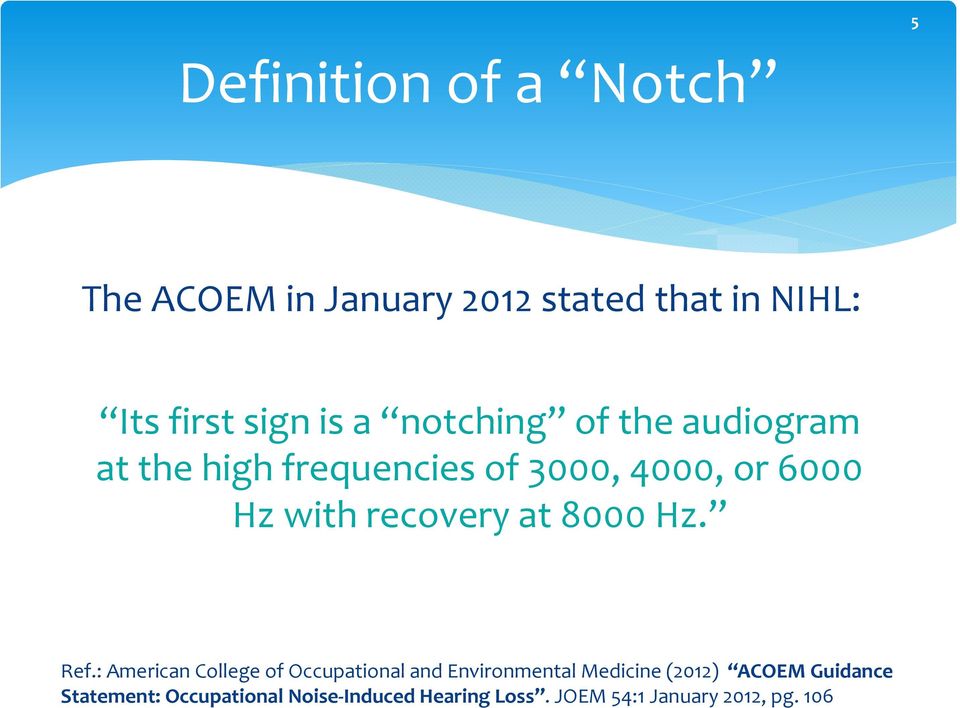
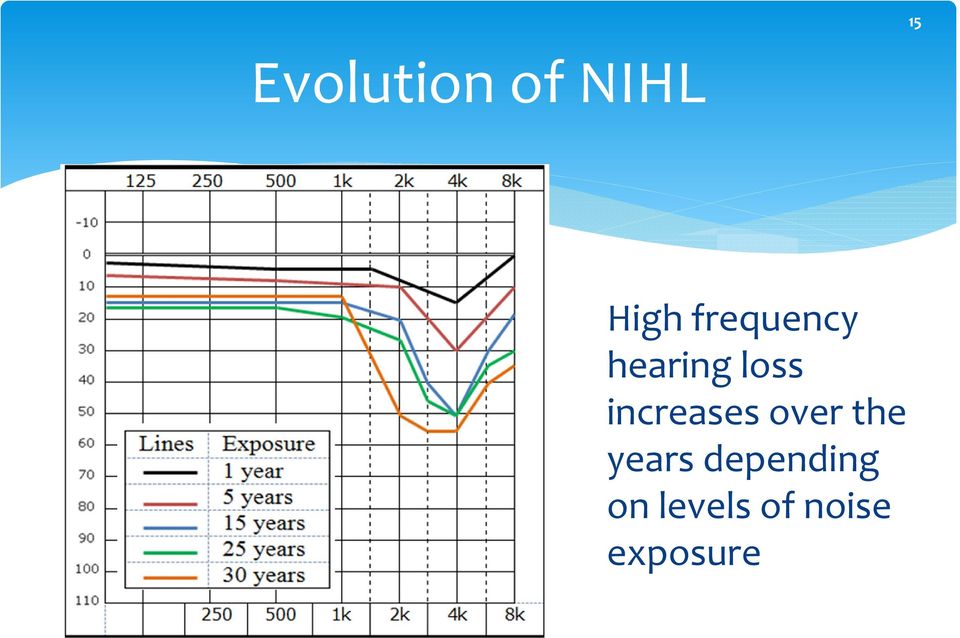
4 4 Audiometric Pattern Destruction of hair cells in the basal turn of the cochlea produces a high frequency hearing loss that increases gradually over time There is a characteristic notch at either 3, 4 or 6 khz

5 5 Definition of a Notch The ACOEM in January 2012 stated that in NIHL: Its first sign is a notching of the audiogram at the high frequencies of 3000, 4000, or 6000 Hz with recovery at 8000 Hz. Ref.: American College of Occupational and Environmental Medicine (2012) ACOEM Guidance Statement: Occupational Noise Induced Hearing Loss. JOEM 54:1 January 2012, pg. 106
6 6 Audiometric Pattern Regarding the distinctive audiometric pattern, the ACOEM also states: In early NIHL, the average hearing thresholds at the lower frequencies of 500, 1000, and 2000 Hz are better than the average thresholds at 3000, 4000, and 6000 Hz, and the hearing level at 8000 Hz is usually better than the deepest part of the notch. Ref.: American College of Occupational and Environmental Medicine (2012) ACOEM Guidance Statement: Occupational Noise Induced Hearing Loss. JOEM 54:1 January 2012, pg. 106

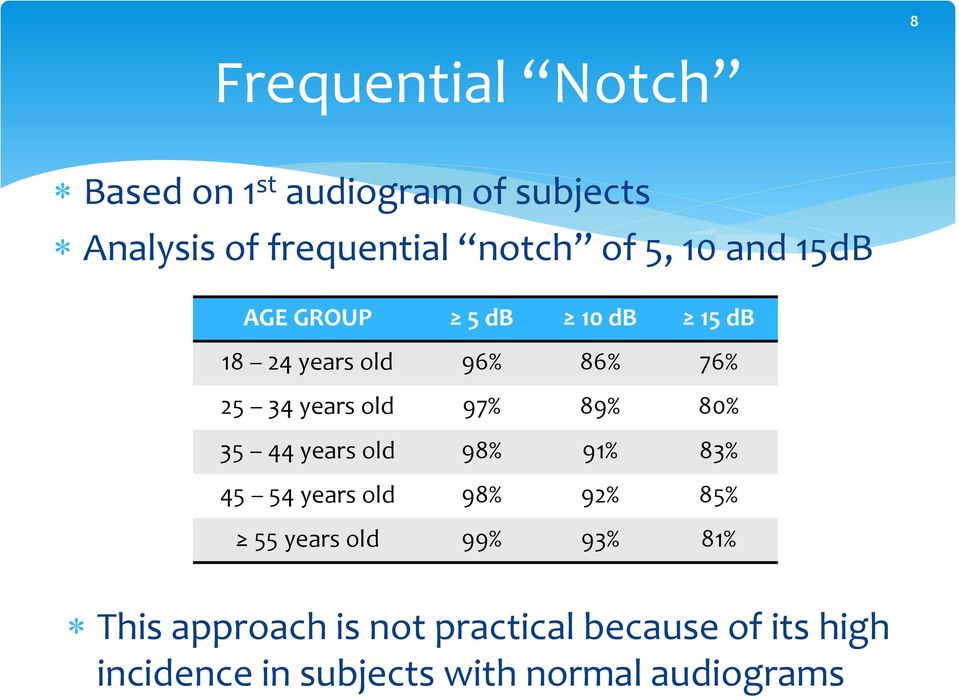
7 Definitions 7 of a Notch Not quantified by ACOEM Should we determine 5, 10 and 15 db differences for a positive notch Ref.: American College of Occupational and Environmental Medicine (2012) ACOEM Guidance Statement: Occupational Noise Induced Hearing Loss. JOEM 54:1 January 2012, pg. 106

8 8 Frequential Notch Based on 1 st audiogram of subjects Analysis of frequential notch of 5, 10 and 15dB AGE GROUP 5 db 10 db 15 db years old 96% 86% 76% years old 97% 89% 80% years old 98% 91% 83% years old 98% 92% 85% 55 years old 99% 93% 81% This approach is not practical because of its high incidence in subjects with normal audiograms
9 9 High Frequency Hearing Loss (HFHL) 1 st Analysis Performed HFHL is based on the following approach: All audiograms meeting this criteria are classified in the high frequency hearing loss category Ref.: American College of Occupational and Environmental Medicine (ACOEM), Occupational Noise Induced Hearing Loss, JOEM, Volume 54, Number 1, January 2012.
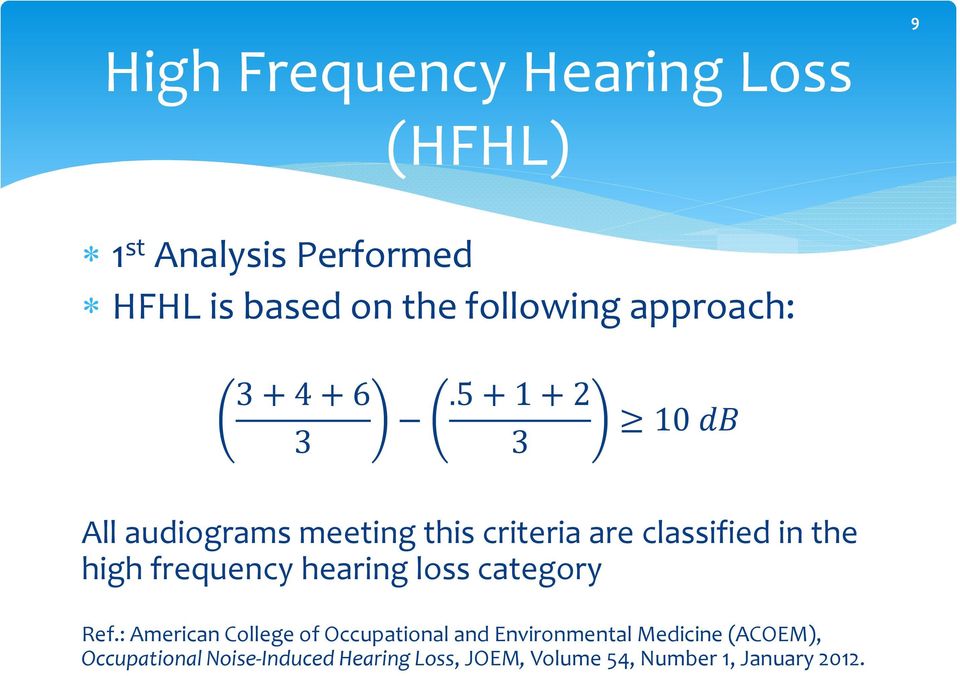
10 High Frequency Hearing Loss 10 (HFHL) 3 categories: db (proactive) 2. >15 25 db (identification of worsening) 3. >25 db (level of compensation) Average based on frequencies used for compensation in particular jurisdiction

11 11 Miscellaneous Patterns All subjects not included in the HFHL or Normal groups Includes: Flat audiograms ( 15 db) Cookie Bite Ski Slope Patterns Reversed Slope Asymmetric: Exclusion worse ear Most of these subjects present a pathology causing the miscellaneous hearing losses

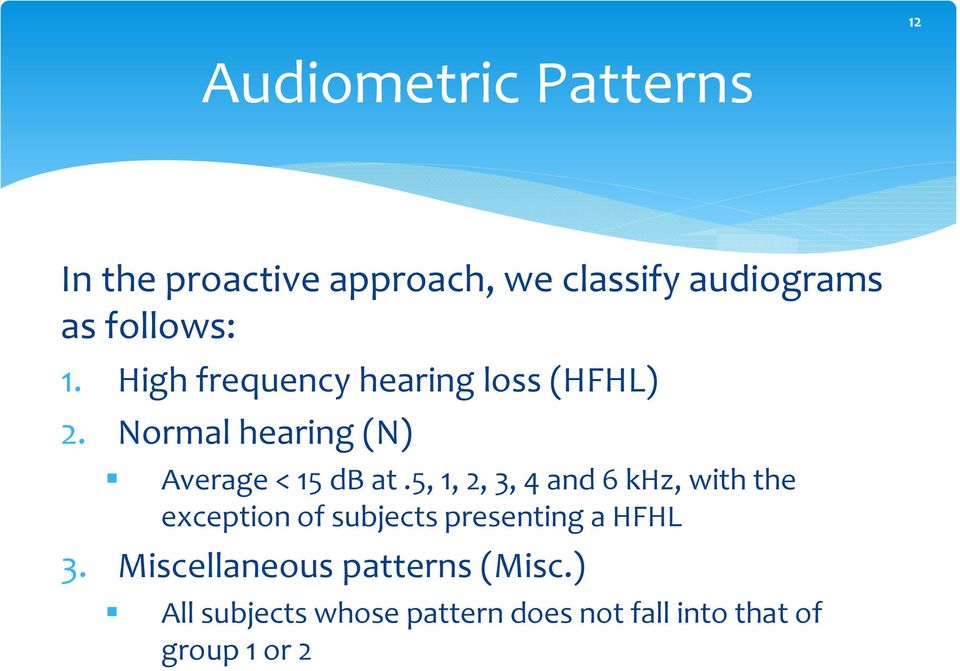
12 12 Audiometric Patterns In the proactive approach, we classify audiograms as follows: 1. High frequency hearing loss (HFHL) 2. Normal hearing (N) Average < 15 db at.5, 1, 2, 3, 4 and 6 khz, with the exception of subjects presenting a HFHL 3. Miscellaneous patterns (Misc.) All subjects whose pattern does not fall into that of group 1 or 2
13 13 Audiometric Profile Early manifestation can occur in the 1 st year of exposure Age at 1 st Audiogram Total Number Classification Normal HFHL Miscellaneous Number % Number % Number % years old % % 106 2% years old % % 269 3% years old % % 241 5% years old % % 167 7% 55 years old % % 31 7% Subtotal

14 14 Evolution of Frequencies Evolution of average of.5, 1 and 2 khz (bottom) with average of 3, 4 and 6 khz

15 15 Evolution of NIHL High frequency hearing loss increases over the years depending on levels of noise exposure
16 16 Evolution of Audiometric Patterns Percentage of subjects according to age, based on 1 st audiogram

17 17 Early Identification Identification of early high frequency hearing loss Detected with audiogram that can be considered normal Identifies subjects before they are aware of hearing loss

18 18 Normal Pattern All audiograms which have 15 db or less at.5, 1, 2, 3, 4 and 6 khz frequencies However, subjects meeting the criteria of the HFHL formula are considered to be in the HFHL category even if all frequencies are 15 db or less

19 19 Legal Considerations In the United States, OSHA has enacted a procedure to identify NIHL In the presence of a positive STS OSHA, the employee must be informed The STS OSHA procedure identifies subjects with a confirmed NIHL
20 20 HFHL vs. STS OSHA Incidence of HFHL compared to positive STS OSHA

21 21 HFHL vs. STS OSHA Incidence of HFHL (category 1) compared to positive STS OSHA
22 22 Follow Up As NIHL occurs mainly in the first 10 to 15 years of exposure to noise, more attention is focused on younger subjects Change from a category of normal to a HFHL category identifies problem cases
23 23 Quebec Mining Association (QMA) EXPÉRIENCE QUÉBECOISE Année Nombre de réclamations pour surdité HCP established in 1978 In 1980, following NHCA presentation by Cohen et al., NITTS procedures were used for problem cases with HFHL
24 QMA 24 Beginning Economic Impact Rising medical costs from 1970 to 1976
25 QMA 25 Compensation Cases (%) Percentage of employees potentially subject to compensation based on the standards used in the Province of Quebec (Canada)
26 QMA 26 Compensation Costs (%) Using 1977 as a reference: The cost of compensation is evaluated using the same data base and the standards of the Province of Quebec (Canada)
27 27 QMA Age Group 20 to 30 In 4205 subjects employed after introduction of program, no subjects had compensable NIHL
28 Proactive Approach: 28 Early Identification of NIHL Allows for the following: Identification of potential problem cases Introduction of appropriate methods to prevent worsening of hearing loss Motivational education regarding the effects of noise on hearing Motivational education regarding the effects of hearing loss on quality of life Education in the proper use of hearing protection devices (HPDs) NITTS testing to evaluate effectiveness and appropriate usage of HPDs used
29 29 Conclusions HFHL occurs at an earlier stage than STS OSHA Taking a proactive approach allows: The introduction of appropriate measures earlier than STS OSHA A reduction in the degree of hearing loss and number of compensation claims filed An important reduction in the cost of the compensation claims that are filed
Occupational Noise Induced Hearing Loss: Final Program Policy Decision and Supporting Rationale
 Occupational Noise Induced Hearing Loss: Final Program Policy Decision and Supporting Rationale October 2014 1 I Introduction: In September 2012, the WCB Board of Directors added Noise Induced Hearing
Noise Exposure: Explanation of OSHA and NIOSH Safe Exposure Limits and the Importance of Noise Dosimetry. by Patricia T.
 Noise Exposure: Explanation of OSHA and NIOSH Safe Exposure Limits and the Importance of Noise Dosimetry by Patricia T. Johnson, AuD INTRODUCTION It s a noisy world, and hearing damage from loud sound
CHAPTER 11 NOISE AND HEARING CONSERVATION PROGRAM
 CHAPTER 11 NOISE AND HEARING CONSERVATION PROGRAM INTRODUCTION This program contains information on the effects, evaluation, and control of noise. For assistance in evaluating a noise problem, contact
Audiometry and Hearing Loss Examples
 Audiometry and Hearing Loss Examples An audiogram shows the quietest sounds you can just hear. The red circles represent the right ear and the blue crosses represent the left ear. Across the top, there
Who are you? Six Components of Hearing Conservation Program. Hearing is Precious!
 Six Components of Hearing Conservation Program Helene R. Freed, Ed.M Public Relations Specialist Industrial Hearing Testing Who are you? Are you a student? Do you work in industry in H&S? Do you work in
Table of Contents. 1. Applicability. No. T-O&M X115 Title: Hearing Conservation Revised: 11-30-2011 TERMINALS O&M PROCEDURE
 Table of Contents Table of Contents... 1 1. Applicability... 1 2. Scope... 2 3. Core Information and Requirements... 2 3.1. Hearing Conservation Program Description... 2 3.2. Action Level... 2 3.3. Occupational
COMPENSATION FOR NOISE INDUCED HEARING LOSS
 - COMPENSATION FOR NOISE INDUCED HEARING LOSS Of the lesser known health hazards in the mines, noise and resulting noise-induced hearing loss (NIHL) have received little attention in the media, despite
Stanford University. Hearing Conservation Program
 Stanford University Hearing Conservation Program April 2006 Stanford University HEARING CONSERVATION PROGRAM CONTENTS PAGE 1.0 INTRODUCTION...1 1.1 Program Description...1 1.2 Scope...1 2.0 DEFINITIONS
The Accuracy of 0 db HL as an Assumption of Normal Hearing
 The Accuracy of 0 db HL as an Assumption of Normal Hearing Introduction An operating assumption of diagnostic audiology is that hearing level of a young adult with no known hearing loss or history of noise
Noise Induced Hearing Loss
 Noise Induced Hearing Loss Parkes v Meridian Ltd [2007] EWHC B1 (QB) 14 th Feb 2007. The case examined whether or not there was a duty of care to protect employees from exposure to noise of less than 90
Noise Induced Hearing Loss and Hearing Conservation in 8 Primary Iron and Steel Companies in South Africa
 Noise Induced Hearing Loss and Hearing Conservation in 8 Primary Iron and Steel Companies in South Africa Presenters: Dr Odette Abrahams Gabriel Mizan Background Noise: Sound that is undesirable, either
Hearing Protection Standard OSHA Standard 29 CFR 1910.95
 Hearing Protection Standard OSHA Standard 29 CFR 1910.95 The purpose of this standard is protect employees over exposure to noise and to prevent hearing loss. This standard also states that employees must
Western University. Hearing Protection Program. Prepared by: Occupational Health and Safety
 Western University Hearing Protection Program Prepared by: Occupational Health and Safety June 1, 2014 1 Table of Content Page 1.0 Purpose 3 2.0 Definitions / Abbreviations 3 3.0 Application 4 3.1 Scope
NHCA Guidelines for Recording Hearing Loss On the OSHA 300 Log
 NHCA Guidelines for Recording Hearing Loss On the OSHA 300 Log Background The Need for Guidance For several years audiologists and other professionals who review audiograms have reported resistance from
The NAL Percentage Loss of Hearing Scale
 The NAL Percentage Loss of Hearing Scale Anne Greville Audiology Adviser, ACC February, 2010 The NAL Percentage Loss of Hearing (PLH) Scale was developed by John Macrae of the Australian National Acoustic
Workplace Health, Safety & Compensation Review Division
 Workplace Health, Safety & Compensation Review Division WHSCRD Case No: 13111-04 WHSCC Claim No: 832088 Decision Number: 14017 Margaret Blackmore Review Commissioner The Review Proceedings 1. The hearing
POLICY NUMBER: POL-09
 Chapter: CLAIMS Subject: HEARING LOSS Effective Date: April 28, 1994 Last Updated: November 28, 2013 REFERENCE: Occupational Health And Safety Act R.S.P.E.I. 1988, Cap. 0-1.1, General Regulations, Section
Best Practices in Implementing a Successful Hearing Conservation Program
 in Implementing a Successful Hearing Conservation Program OSHA 29 CFR 1910.95 Though the language of OSHA s Occupational Noise Standard (29 CFR 1910.95) may appear convoluted, its dictates are rather straightforward:
What causes noise induced hearing loss (NIHL)?
 Hearing Safety What causes noise induced hearing loss (NIHL)? ʺNoise exposure, whether occupational or recreational, is the leading preventable cause of hearing loss.ʺ Peter M. Rabinowitz, M.D., M.P.H.,
noise induced Working Together to Prevent Hearing Loss
 noise induced hearing loss (NIHL) Working Together to Prevent Hearing Loss NOISE INDUCED HEARING LOSS Noise and its Effects Noise is a serious and widespread problem in many New Brunswick workplaces. Over
HEARING CONSERVATION PROGRAMS
 HEARING CONSERVATION PROGRAMS Presented By: Roberto Sgrosso Occupational Hygienist WorkSafeNB October 8, 2015 OBJECTIVES At the end of this presentation, participants will be able to: Recognize the required
SAMPSON COMMUNITY COLLEGE
 1. PURPOSE SAMPSON COMMUNITY COLLEGE HEARING CONSERVATION PROGRAM 1.1 The purpose of this program is to provide guidelines for employees exposed to occupational noise and to comply with the OSHA Occupational
Noise: Impact on Hearing; Regulation
 Noise: Impact on Hearing; Regulation EOH 466A Fall 2008 Mechanism of Hearing Sound waves collected, focused by the outer ear. Humans have little control over muscles in outer ear. Many animals have the
Hearing Test Results from 2009 Audio Engineering Society Convention Testing funded by Shure
 Page 1 of 8 Hearing Test Results from 29 Audio Engineering Society Convention Testing funded by Shure SUMMARY The 127 th Audio Engineering Society (AES) convention was held in New York, New York from October
S-822. Noise and Hearing Conservation RISK MANAGEMENT
 RISK MANAGEMENT Noise and Hearing Conservation Resources and information for developing Patient handling programs in health care Employers with workplaces that have excessive levels of noise need to implement
Guideline for Hearing Conservation and Noise Control
 EVERYONE'S RESPONSIBILITY Guideline for Hearing Conservation and Noise Control February 2007 Guideline for Hearing Conservation and Noise Control Workplace Safety & Health Division 200 401 York Avenue
UC Santa Barbara Hearing Conservation Program Manual
 UCSB Hearing Conservation Program Manual Page 1 of 15 UC Santa Barbara Hearing Conservation Program Manual Rev. August 2014 Program Manager: Nick Nieberding Title: Industrial Hygiene Specialist Email:
Occupational Noise Induced Hearing Loss
 Occupational Noise Induced Hearing Loss M Baxter FRACS SISA Adelaide June 2014 ENT in Personal Injury Claims EAR Hearing Loss -main, Dizziness Nose Injuries ->cosmesis,breathing: Loss of sense of smell:
5th Congress of Alps-Adria Acoustics Association NOISE-INDUCED HEARING LOSS
 5th Congress of Alps-Adria Acoustics Association 12-14 September 2012, Petrčane, Croatia NOISE-INDUCED HEARING LOSS Davor Šušković, mag. ing. el. techn. inf. [email protected] Abstract: One of
UCSC HEARING CONSERVATION PROGRAM Environment, Health & Safety (EH&S) August 2007
 UCSC HEARING CONSERVATION PROGRAM Environment, Health & Safety (EH&S) August 2007 Table of Contents Purpose Applicable Regulations and Standards Responsibilities Deans and Directors Department Heads, Managers,
OAK GROVE SCHOOL DISTRICT. Hearing Conservation Program
 OAK GROVE SCHOOL DISTRICT Hearing Conservation Program CONTENTS PAGE 1.0 INTRODUCTION...1 1.1 Program Description...1 1.2 Scope...1 2.0 DEFINITIONS AND ACRONYMS...2 3.0 RESPONSIBILITIES...3 3.1 Supervisor/Department...3
THE NOISE-INDUCED HEARING LOSS MILESTONES: PAST AND FUTURE
 THE NOISE-INDUCED HEARING LOSS MILESTONES: PAST AND FUTURE 1 A L Edwards and 2 D Kritzinger 1 CSIR, Centre for Mining Innovation, Johannesburg, South Africa 2 Rand Mutual Assurance, Johannesburg, South
Sample Written Program. For HEARING CONSERVATION
 Sample Written Program For HEARING CONSERVATION 1 HEARING CONSERVATION PROGRAM Co Name Prepared by Date I. PURPOSE This purpose of this hearing conservation program is to prevent occupational hearing loss
OSHA Recordkeeping Policy #: OGP 600
 OSHA Recordkeeping Policy #: OGP 600 APPROVED BY: Anthony Dallas, MD, CMO SUPERCEDES POLICY: 03/2006 ADOPTED: 03/2006 REVISED: 09/09/2015 REVIEWED: OBJECTIVE: To recognize, report, and record work-related
Program No. 7.2.1. Section Heading Page # 6.0 Monitoring 4. 7.0 Training 5. 8.0 Audiometric Testing 5. 9.0 Noise Exposure Control 6
 ENVIRONMENTAL HEALTH AND SAFETY PROGRAM MANUAL Title 1.0 INTRODUCTION As part of the Weill Cornell Medical College (WCMC) Environmental Health and Safety (EHS) Manual, this recognizes the existence of
Introduction Noise and Occupational Hearing Loss
 Introduction Noise and Occupational Hearing Loss Dr Steven Sadhra Senior Lecturer & Director of Education for Occupational Medicine PhD, MIOSH, MFOM, FFOM (Hon.) Institute of Occupational and Environmental
Noise. Patrick N. Breysse, PhD, CIH Peter S.J. Lees, PhD, CIH. Johns Hopkins University
 This work is licensed under a Creative Commons Attribution-NonCommercial-ShareAlike License. Your use of this material constitutes acceptance of that license and the conditions of use of materials on this
Veterans UK Leaflet 10. Notes about War Pension claims for deafness
 Veterans UK Leaflet 10 Notes about War Pension claims for deafness 1 About this leaflet About this leaflet This leaflet tells you how claims for deafness are decided and gives you some information about
29 CFR 1910 OSHA GENERAL INDUSTRY REGULATIONS
 29 CFR 1910 OSHA GENERAL INDUSTRY REGULATIONS Subpart G Occupational Health & Environmental Control 1910.95 Occupational Noise Exposure 1910.95(c) Hearing Conservation Programs I Still Can t Hear You Experience
If you do not use the calculator-generated text, you MUST notify the Rating Job Aids mailbox. Please describe the error in detail.
 HEARING LOSS CALCULATOR USER GUIDE HL Calculator v4.7 Index Hearing Loss Calculator.....3 How to Navigate the Hearing Loss Calculator User Guide.4 Hearing Loss Calculator - Starting the Program..5 New
NOISE CONTROL AND HEARING CONSERVATION PROGRAM. University of Toronto
 NOISE CONTROL AND HEARING CONSERVATION PROGRAM 1.0 INTRODUCTION AND SCOPE... 1 2.0 DEFINITIONS... 1 3.0 CRITERIA FOR NOISE EXPOSURE... 2 3.1 Individual Exposure... 2 3.2 Area Noise Levels... 3 4.0 RESPONSIBILITIES...
Management Essentials for an Effective Hearing Conservation Program
 Management Essentials for an Effective Hearing Conservation Program Table of Contents Executive Summary... 2 Background... 3 The Cost of Loss... 3 Quality of Life... 4 Dealing with Noise in the Workplace...
Environmental Health and Safety* 2809 Daley Drive * Ames, Iowa 50011-3660 * (515) 294-5359 * www.ehs.iastate.edu
 Environmental Health and Safety* 2809 Daley Drive * Ames, Iowa 50011-3660 * (515) 294-5359 * www.ehs.iastate.edu Revision 2 October 2008 University Nondiscrimination Statement Iowa State University does
Noise and Hearing Protection
 Noise and Hearing Protection Noise and Hearing Safety Training This training module is designed to teach you about the purpose and benefits of a hearing conservation program. After completing the training,
Audiometric (Hearing) Screening September November 2013
 Audiometric (Hearing) Screening September November 2013 Sample Report QLD Prepared by: Name of Technician Qualified Audiometric Technicians INTRODUCTION Australasian Safety Services provided on-site audiometric
Workplace hearing loss is preventable.
 Workplace hearing loss is preventable. 97 db 88 db 91 db 109 db 90 db 105 db 100 db 118 db 103 db 85 db 119 db 83 db All you have to do is listen. 82 db 84 db Know precisely. Protect personally. The new
PREVALENCE OF HEARING LOSS IN MILITARY AVIATORS: THE AUDIOMETRY AND RISK FACTORS ANALYSIS
 Original Paper PREVALENCE OF HEARING LOSS IN MILITARY AVIATORS: THE AUDIOMETRY AND RISK FACTORS ANALYSIS Alam MR 1, Wahab MA 2, Rahman MM 3, Asaduzzaman AKM 4, Al-Azad MAS 5, Karim MI 6, Sultana S 7 Abstract
MINISTER PORTFOLIO DEADLINE. Hon Dr Nick Smith Minister for ACC 19 January 2010
 BRIEFING MINISTER PORTFOLIO DEADLINE Hon Dr Nick Smith Minister for ACC 19 January 2010 Action sought Title For your information PROVIDING HEARING LOSS ENTITLEMENTS, ACC AND VETERANS' AFFAIRS NEW ZEALAND
Your Hearing ILLUMINATED
 Your Hearing ILLUMINATED INFORMATION FROM YOUR HEARING CARE PROFESSIONAL REDISCOVER your hearing and reconnect 1 with the important things you might have been missing. Your sense of hearing is a vital
ADMINISTRATIVE INSTRUCTION
 EFFECTIVE DATE: January 2, 2007 PAGE: 1 of 10 I. Purpose The purpose of the hearing conservation program is to protect City employees from occupational exposure to excessive noise levels while at work
SAMPLE ACCEPTABLE PETITIONER'S OPENING BRIEF WORKERS' COMPENSATION CASE
 SAMPLE ACCEPTABLE PETITIONER'S OPENING BRIEF WORKERS' COMPENSATION CASE (updated January 1, 2011) Disclaimer: This sample brief is adapted from a real brief filed in a real case. Identifying information,
Hearing Conservation Procedures
 Hearing Conservation Procedures Purpose The University of Regina is committed to providing a safe and healthy work and educational environment for all members of the University community by ensuring that
A Client s Guide: Noise Induced Hearing Loss
 A Client s Guide: Noise Induced Hearing Loss Petherbridge Bassra Solicitors Vintry House 18-24 Piccadilly Bradford BD1 3LS Tel: 01274 724114 Fax: 01274 724161 [email protected] www.petherbridgebassra.com
E-A-R/Aearo Technologies E-A-RCAL SM Laboratory 7911 Zionsville Road Indianapolis, IN 46268-1657 [email protected]
 Original April 24, 2007 Revised June 21, 2007 E-A-R/Aearo Technologies E-A-RCAL SM Laboratory 7911 Zionsville Road Indianapolis, IN 46268-1657 [email protected] INTRODUCTION The E-A-RFit TM Validation
Guidelines on Hearing Checks and Audiometry Under the Safety, Health and Welfare at Work (General Application) Regulations 2007, Control of Noise at
 Guidelines on Hearing Checks and Audiometry Under the Safety, Health and Welfare at Work (General Application) Regulations 2007, Control of Noise at Work CONTENTS 1. Hearing Checks and Screening Audiometry
Safety Issue: OSHA requires most employers to maintain. Recording and Reporting Occupational Injuries and Illnesses
 Overview Safety Issue: Is your organization currently in compliance with OSHA s occupational injury and illness recording and reporting requirements? OSHA requires most employers to maintain occupational
Medicolegal Audiology
 Medicolegal Audiology Mark E Lutman Clinical Director, Audiological Support Services Ltd, Falcon House, Eagle Road, Plymouth PL7 5JY Emeritus Professor of Audiology, University of Southampton Noise-induced
Hearing Safety Glossary
 A-Weighting A filter applied to noise measurements, intended to replicate the frequency sensitivity of the human ear. The A-weighting is the most commonly-used weighting scale in hearing conservation programs,
Department of Defense INSTRUCTION
 Department of Defense INSTRUCTION NUMBER 6055.12 December 3, 2010 USD(AT&L) SUBJECT: Hearing Conservation Program (HCP) References: See Enclosure 1 1. PURPOSE. This Instruction reissues DoD Instruction
Hearing Conservation Program
 Hearing Conservation Program Document Number: Effective Date: 2/2012 Revision Date: 4/2013 1.0 Purpose and Applicability 1.1 The purpose of this Hearing Conservation Program is to provide for the protection
CSA Z94.2 Hearing Protection Devices
 THE NEW CANADIAN STANDARD ASSOCIATION STANDARD ON HEARING PROTECTORS: CSA Z94.2 Hearing Protection Devices Alberto Behar, Peng. C.I.H. Ryerson University Fall Symposium October 24, 2013 1 Prepared by the
Part 801 Recording and Reporting Public Employees' Occupational Injuries and Illnesses (Statutory authority: Labor Law 27-a)
 Part 801 Recording and Reporting Public Employees' Occupational Injuries and Illnesses (Statutory authority: Labor Law 27-a) Sec. 801.0 Purpose 801.1 Reserved 801.2 Reserved 801.3 Reserved 801.4 Recording
REPORTED NOISE-INDUCED HEARING LOSS AMONG MINERS. Michael P. Valoski, M.S. (Hygiene) U. S. Department of Labor. Mine Safety and Health Administration
 REPORTED NOISE-INDUCED HEARING LOSS AMONG MINERS Michael P. Valoski, M.S. (Hygiene) U. S. Department of Labor Mine Safety and Health Administration PO Box 18233, Cochrans Mill Road Pittsburgh, Pennsylvania
Pure Tone Hearing Screening in Schools: Revised Notes on Main Video. IMPORTANT: A hearing screening does not diagnose a hearing loss.
 Pure Tone Hearing Screening in Schools: Revised Notes on Main Video (Notes are also available for Video segments: Common Mistakes and FAQs) IMPORTANT: A hearing screening does not diagnose a hearing loss.
The Disability Tax Credit Certificate Tip sheet for Audiologists
 The Disability Tax Credit Certificate Tip sheet for Audiologists Developed by: The Canadian Academy of Audiology (CAA) & Speech- Language and Audiology Canada (SAC) Purpose of This Document The Canada
Early vs. Late Onset Hearing Loss: How Children Differ from Adults. Andrea Pittman, PhD Arizona State University
 Early vs. Late Onset Hearing Loss: How Children Differ from Adults Andrea Pittman, PhD Arizona State University Heterogeneity of Children with Hearing Loss Chronological age Age at onset Age at identification
National Institutes of Health
 National Institutes of Health Hearing Conservation Program Division of Occupational Health & Safety May 2013 In compliance with 29CFR1910.95, this document provides information and services for the effective
Note you MUST be certified at the time of the class to attend the recertification
 Council for Accreditation in Occupational Hearing Conservation Sandra MacLean Uberuaga, MA, CCC-A, F-AAA, CPS-A CAOHC Certified Course Director www.alaskaoccupationalaudiology.com OCCUPATIONAL HEARING
Ototoxicity Monitoring
 Ototoxicity Monitoring Aaron Jones, Au.D., M.S. Doctor of Audiology May 12, 2011 Agenda Background Antineoplastic ototoxicity monitoring Case study Company overview Gross Anatomy of the Ear Image: http://en.wikipedia.org/wiki/file:anatomy_of_the_human_ear.svg
More information >>> HERE <<<
 More information >>> HERE http://urlzz.org/hearloss/pdx/dcli864/ Tags: ## best way to get cheapest natural methods to
HEARING CONSERVATION PROGRAM. 1.0 Introduction
 HEARING CONSERVATION PROGRAM Section: Hazard Assessment and Control Date of Issue: 2007.04.02 Issued By: Environmental Health &Safety Part: Hearing Conservation Program Revision #: -- Revision Date: --
KUMC. Medical Surveillance Program
 KUMC Medical Surveillance Program INTRODUCTION Employees at KUMC could potentially be exposed to safety hazards such as chemical, biological, and physical hazards. These hazards are most likely to occur
3. Damage risk and impairment criteria
 Chapter three LITERATURE REVIEW 3. Damage risk and impairment criteria 3.1.1.Historical overview of noise definitions and measurements 3.1.Defining noise hazard 3.1.2.Noise measurement scales 3.2.1.Level
Noise Induced Hearing Loss
 FINAL REPORT Prepared for Noise Induced Hearing Loss Report prepared by Professor Peter R Thorne On behalf of: For: Auckland UniServices Ltd ACC Private Bag 92019 P O Box 242 Auckland WELLINGTON New Zealand
GUIDELINE FOR DIAGNOSING OCCUPATIONAL NOISE-INDUCED HEARING LOSS PART 2
 GUIDELINE FOR DIAGNOSING OCCUPATIONAL NOISE-INDUCED HEARING LOSS PART 2 Epidemiological review: some risk factors of hearing loss Zhi-ling Zhang September 2010 Research Unit Governance, Policy and Research
Tonal Detection in Noise: An Auditory Neuroscience Insight
 Image: http://physics.ust.hk/dusw/ Tonal Detection in Noise: An Auditory Neuroscience Insight Buddhika Karunarathne 1 and Richard H.Y. So 1,2 1 Dept. of IELM, Hong Kong University of Science & Technology,
Hearing Loss in Geriatric Primary Care Mary Ann Forciea MD Josh Uy MD
 Hearing Loss in Geriatric Primary Care Mary Ann Forciea MD Josh Uy MD Q: In my office practice, I screen for hearing loss with A Level of difficulty in office conversation Questionnaire Hand held hldaudiometer