
Strategic Planning and Small Firm Growth: An Empirical Examination
|
|
|
- Patricia Chambers
- 10 years ago
- Views:
Transcription
1 Strategic Planning and Small Firm Growth: An Empirical Examination Branka Skrt Boštjan Antončič Strategic thinking is important for small firms in the time of global competition, technological change and increased dynamics in markets. Even if many entrepreneurs do not formulate business plans, the strategic planning and systematic decision-making can be considered a key determinant of survival and success of small firms. The paper examines the relationship between strategic planning and small firm growth in terms of empirical analyses that include various strategic planning elements, which have not been given enough attention in past research. Seven hypotheses on the relationship between strategic planning and growth are developed and empirically tested by using data collected via questionnaire from 114 Slovenian smaller firms. The study has practical implications. Entrepreneurs need to be aware that strategic planning practices, processes and techniques can be beneficial for growth of the firm. In order to enable their firms to grow, entrepreneurs may like to consider exactly formulating vision and strategy, incorporating the elements of internationalization and networking in the firm vision, focusing on growth, profit, and market, among strategic analysis techniques paying special attention to analysis of market and competition, and exactly formulating generic business strategies. All these strategic planning efforts need to be reinforced by practices that follow the key growth and market orientations, and have company-wide support. The key implication of this study for research is that the assessment of the relationship between strategic planning and small firm growth needs to be done across various elements or dimensions. Introduction Strategic thinking has become a must for entrepreneurs in the time of global competition, technological change and increased dynamics in markets. As propagated by leading entrepreneurships textbooks (for example, Stevenson et al. 1998; Hisrich and Peters 2001; Timmons and Branka Skrt is a Consultant at the Chamber of Craft of Slovenia. Dr Boštjan Antončič is Assistant Professor of Entrepreneurship at the Faculty of Economics, University of Ljubljana, Slovenia. Managing Global Transitions 2 (2):
2 108 Branka Skrt and Boštjan Antončič Spinelli 2003), the development of a business plan is an important element in the success of the entrepreneurial venture. However, most entrepreneurs and small businesses do not base their success on business plans, because they tend, to a large extent, not to formulate them (Bhide 1994). Despite these business plan formulation practices, strategic planning and systematic decision-making can be considered a key determinant of the survival and success of small firms (Zimmerer and Scarborough 1996). Yet, the relationship between strategic planning and small firm growth in terms of empirical analyses that would include various strategic planning elements has not been given enough attention in past research. In this paper, we propose that strategic planning can be considered an important predictor of small firm growth. In what follows, hypotheses on the relationship between strategic planning elements and small firm growth are developed, and the findings of empirical analyses are presented and discussed. Theory and Hypotheses Strategy can be defined as an action performed by the firm in order to achieve its business objectives (Wickham 1998). Strategy can be seen as a pathway to move a concept or an idea from the inventive state to the actual positioning in a competitive environment (Ireland 2001) or as a roadmap to the planned result (Thompson and Strickland 2001). Large and small firms act on the basis of a business theory, which is formed from a group of assumptions on what business the firm is in, what its objectives are, how it defines business results, which its customers are, what they value, and for what they are willing to pay (Drucker 2001). The role of strategy is to put the business theory in action and help the firm to achieve desired results despite the environmental unpredictability. Strategy helps the firm in the purposeful search for opportunities (Drucker 2001). Overall, strategy forms a basis for success of the firm (Baker, Addams, and Davis1993; White1998; Besanko, Dranove, and Shanley 2000). Growth is an important performance element and success measure in entrepreneurship. Our main thesis is that strategy is central and beneficial for business success of the firm in general, and for firm growth in particular. In past research, Miller and Cardinal (1994) found a positive relationship between strategic planning and firm profitability and growth. In the following paragraphs we develop specific hypotheses on the relationship between strategic planning and small firm growth. Managing Global Transitions

3 Strategic Planning and Small Firm Growth 109 MISSION, VISION, AND OBJECTIVES Mission and vision are crucial elements of strategic management. The difference between vision and mission is in its time component; mission determines what the company does, whereas vision shows what the company will become and do in the future (Thompson and Strickland 2001). Visions can be considered sources of energy for achievement of formulated objectives (Thompson and Strickland 2001). Vision, mission and strategies are interconnected elements of entrepreneurial perspective; together they turn the entrepreneur s wish for a positive change into a managerial tool for achievement of that change (Wickham 1998). Ambitious entrepreneurs who manage growth firms form an intensive and strong vision about the value they can create (Ireland 2001). Even if in a small firm the entrepreneur usually acts as a strategic manager taking all strategic and operative decisions (Hunger and Wheelen 1996), strategic vision forms a basis for strategy development and strategic planning. In order for the firm to grow, the entrepreneur needs to formulate an exact, clear mission and vision for his or her firm (Wickham 1998). On the basis of this research we propose the first hypothesis: Hypothesis 1: Growth firms will have more exact mission and vision statements than non-growth firms. In addition to the company s vision, growth will be reinforced by a strategic focus on market, growth and profits. Indeed, planning of corporate or business strategy needs to be centered around the market, product and service (Hunger and Wheelen 2001). Therefore, we propose the following hypothesis: Hypothesis 2: Growth firms will be more driven by vision (2a), growth and profit focus (2b),and marketfocus (2c) than non-growth firms. Vision and objectives are the bases of strategies and strategic planning. For an entrepreneur it is beneficial to have a clear vision, high and growth-oriented objectives, and a belief that he or she can achieve the objectives (Baum, Locke, and Smith 2001). In order to be successful and to grow, the firm needs to formulate high, optimistic, growthoriented objectives (Wickham 1998). In addition to growth objectives, other objectives (financial or non-financial, personal or non-personal) may play important roles in actual achievement of small firm growth. Among multiple objectives, two objectives can be particularly important for firm growth: internationalization, and innovation/quality. The importance of internationalization for growth has been discussed, for Volume 2 Number 2 Fall 2004
4 110 Branka Skrt and Boštjan Antončič example, in the international entrepreneurhip literature (for example, see reviews by McDougall and Oviat 1997; Antoncic and Hisrich 2000a; Zahra and George 2002), whereas the importance of innovation and quality for growth has been given a lot of attention in the strategic innovation (for example, Tushman and Anderson 1997) and corporate entrepreneurship research (for example, Covin and Slevin 1986; Zahra1991; 1993; Antoncic and Hisrich 2000b;2001). Thus, we propose a positive relationship between growth, internationalization and innovation/quality objectives and actual firm growth: Hypothesis 3: Growth firms will place higher emphasis on objectives of growth (3a), internationalization (3b), and innovation and quality (3c) than non-growth firms. STRATEGIES Successful small firms tend to a large extent to use advanced planning and activity analysis (Zimmerer and Scarborough, 1996). Strategic orientation can be considered a driver of strategy formulation; a strategically oriented entrepreneur will pursue opportunities regardless of resources under his or her control, whereas a strategically not-oriented entrepreneur will limit his or her activities by the resources that are currently under control (Sahlman et al. 1999). Therefore, we expect a positive relationship between strategy formulation and firm growth, and propose the following hypothesis: Hypothesis 4: Growth firms will place more emphasis on strategy formulation than non-growth firms. Effective strategies are usually based on strategic analyses of the external and internal environment of the firm (Thompson and Strickland 2001). Entrepreneurs can benefit by using strategic management tools and techniques, such as: market analysis, SWOT analysis, strategy development, resource allocation plans, development of business, action, and financial plans, and in addition, a crisis plan (Sahlman et al. 1999). Thus, we expect a positive relationship between the use of strategic analysis techniques and firm growth: Hypothesis 5: Growth firms will use strategic analysis techniques to a higher extent than non-growth firms. The value of strategic planning for firm performance may lie more in the future orientation and planning practices than in the formal form Managing Global Transitions

5 Strategic Planning and Small Firm Growth 111 of a strategic plan (Hunger and Wheelen 2001). Small firms in particular tend to plan informally and not on a regular basis. Strategic planning can be beneficial for small firm performance, because it forces the entrepreneur to think about open business questions and search for solutions, and also encourages the entrepreneur s learning and making improvements (Wickham 1998). Strategic planning is a process that helps to forecast the future and prepare for the future, and can be beneficial for firm growth (Zimmerer and Scarborough 1996). The use of strategic planning practices can be beneficial for growth, so we propose the following hypothesis: Hypothesis 6: Growth firms will use strategic planning practices to a higher extent than non-growth firms. Porter s (1980) generic competitive strategies (price leadership, differentiation, focus/niche strategy) are often considered the basis for growth strategies of firms in general (Zimmerer and Scarborough 1996;Hunger and Wheelen 2001), and of small firms in particular, because small firms tend to be less diversified than larger firms, and many small firms are likely to be in the single business firm form. We expect that also at the level of business strategy formulation growth firms will tend to be more specific than non-growth firms: Hypothesis 7: Growth firms will have more specified generic business strategies than non-growth firms. Methods Methodology will be discussed in terms of the measurement instrument, sampling, and data analysis. MEASUREMENTINSTRUMENT A questionnaire was designed on the basis of theory in order to acquire data for hypotheses testing. The respondents (managers) were asked to write the vision, long-term objectives, and mission for their firm. They were asked to choose up to three factors that had the strongest impact on the strategy formulation of their firm from a list composed of eight items (1 Vision and objectives of the entrepreneur or the entrepreneurial team, 2 The entrepreneur s wish for achievement of planned growth and higher profits, 3 Opportunities in the market, 4 Imitation of other firms and competitors, 5 Advice and initiative of outside consultants, 6 Requirements of financial institutions, 7 Education of the Volume 2 Number 2 Fall 2004

6 112 Branka Skrt and Boštjan Antončič entrepreneur, 8 Other). In order to acquire information on the strategy formulation emphasis, the respondents were given the choice of three possible answers (1 veryprecisely,2 approximately, 3 no) to the question whether their firm has a formulated long-term way strategy on how to achieve the objectives, vision, and mission. The question on strategic analysis techniques was phrased in a way that the respondents answered a question about the basis of the decision for the strategy their firm follows; they were given a possibility to select among five answers (1 Analysis of market and competition, 2 Analysis of internal capabilities of the firm, 3 Analysis of the overall business of the firm (internal and external factors), 4 Feeling-based (intuition of the entrepreneur), 5 Other). Questions on strategic planning practices of the firm included thirteen Likert-type items with scales from 1 (totally disagree) to 5 (totally agree); the item contents are: 1. knowledge about customers and their needs, 2. orientation to grow and increase profitability, 3. knowledge about own strengths and weaknesses, 4. awareness of own competitive advantages, 5. knowledge about opportunities and threats in the market, 6. non-utilized resources and capabilities, 7. achievability of long term objectives of the firm, 8. planning of business operations for the future, 9. all employees oriented towards the common goal, 10. strategic planning key for the company success, 11. clear vision about the future, known to all people in the firm, 12. actual formal business plan, as a basis for business operations, 13. prepared strategic plan. Specification of a business strategy of the firm was assessed by asking a question based on Porter s (1980) generic strategy typology (cost leadership, differentiation, and focus/niche strategy). The respondents were asked to check the items which were characteristic for their firm (1 provides on the market products/services with lower prices than competitors, 2 provides on the market products/services that are different, better than the competitive ones, 3 sells products/services to a specific group (segment) of customers). Control varaiables were also collected (industry, firm size, growth, profitability). Managing Global Transitions

7 Strategic Planning and Small Firm Growth 113 SAMPLING AND DATA ANALYSIS The data were collected on the basis of stratified sampling using two groups of smaller firms (up to 250 employees) in Slovenia. The first group (stratum) were 300 growing firms, which were randomly selected from the list of the 500 fastest growing firms in Slovenia published annually by the Slovenian business journal Gospodarski vestnik. The second group (non-growth) included firms with annual growth from 5% to +5%, from which 300 firms were randomly selected. Various industries were included in the two samples, with the exception of non-profit firms. The questionnaire was forwarded by to the selected 600 firms. The response rate was 19% (114 firms provided answers, of which 52 growth-firms and 62 non-growth firms). Growth firms of the sample were in comparison to the non-growth firms somewhat bigger, more involved in production and trade industries, similar in profitability, and faster in growth (see sample characteristics in Table 1). Answers on the open-ended questions about vision, objectives, and mission were content analyzed, resulting in nine key categories: 1. fast growth (in this category were grouped firms that forecasted aggressive, fast growth, or substantial increase in market share and profits); 2. moderate limited growth (expressed sales or market growth orientations, but expected moderate, stable growth or geographically limited growth to a region or a small economy of Slovenia); 3. internationalization (orientation to expand to foreign markets); 4. innovation and quality (improvements in quality and innovation of products or processes); 5. networking (orientation into connections, contact relations, and business collaboration); 6. e-business (orientation into electronic commerce); 7. retention of size or survival (orientation into retainment of status quo and survival, 8. no vision/objectives, and 9. other (not classified in the first eight categories). Thehypothesesweretestedbycomparingthemeansofthevariables between the growth group and the non-growth group by using univariate and bivariate data analysis in the SPSS statistical package. Volume 2 Number 2 Fall 2004

8 114 Branka Skrt and Boštjan Antončič Table 1:Sample characteristics Growth Firms (n = 52) Non-GrowthFirms(n = 62) Firm Size (no. of employees) 9 or less 29% 73% 10 to 19 18% 12% 20 to 49 41% 12% 50 or more 12% 3% Industry Production 36% 27% Trade 25% 15% Business Services 19% 37% Financial Services 2% 8% Information Technology 6% 3% Transportation 2% 5% Other 10% 5% Profitability (average ROS in last three years) Mode 6 19% (42.3%offirms) Mode 6 19% (51.6%offirms) Growth (average growth in no. of employees) 0%orless 11.5% 37.1% 1 to 10% 65.4% 56.5% 11%ormore 16.2% 0.0% Findings Hypothesis 1 stated that growth firms would have more exact vision and mission statements than non-growth firms. On the one hand, 84.6% of entrepreneurs of growth firms actually wrote down their company vision, whereas in the non-growth firms group this percentage was lower (69.4%). This is in line with Hypothesis 1. On the other hand, contrary to the hypothesis, mission statements were reported by 61.5% growth firms and 71.0% non-growth firms (very exact mission statements were given by 21.2% growth firms and 32.3% non-growth firms). Thus, for Hypothesis 1 we attained mixed results. This may be due to the fact that growth firms may be more inclined to express their vision instead of their mission because they can be more future oriented, whereas non-growth firms may be more focused on what they are actually doing. Hypothesis 2 stated that growth firms would be more driven in their strategy formulation by vision (2a), growth and profit focus (2b), and Managing Global Transitions

9 Table 2: Strategy formulation drivers Strategic Planning and Small Firm Growth 115 Strategy Formulation Drivers 1 2 Vision and objectives of the entrepreneur or 70.2% 66.7% the entrepreneurial team The entrepreneur s wish for achievement of planned growth 74.5% 58.3% and higher profits Opportunities in the market 55.3% 41.7% Imitation of other firms and competitors 17.0% 25.0% Advice and initiative from outside consultants 4.3% 8.3% Requirements of financial institutions 4.3% 2.1% Education of the entrepreneur 2.1% 20.8% Other 0.0% 4.2% 1 Growthfirms 2 Non-growthfirms market focus (2c) than non-growth firms. A comparison of drivers of strategy formulation between growth and non-growth firms is displayed in Table 2. Some differences became visible. Growth firms had, in comparison to non/growth firms in strategy drivers, a slightly higher percentage of vision of the entrepreneur or entrepreneurial team (70.2%vs. 66.7%), more importance given to the entrepreneur s wish for achievement of planned growth and higher profits (74.5%vs.58.3%) and to market opportunities (55.3% vs.41.7%), and less emphasis on imitation and education. These results are in support of Hypotheses 2b (growth and profit focus) and Hypothesis 2c (market focus), and in weak support of Hypothesis 2a (vision). Hypothesis 3 stated that growth firms would place higher emphasis on objectives of growth (3a), internationalization (3b), and innovation and quality (3c) than non-growth firms. When visions of firms were analyzed, interesting differences between growth and non-growth firms were discovered (see the first three columns in Table 3). Growth firms were found to express in their visions more than non-growth firms elements of growth (fast growth: 5.8% growthfirmsvs.1.6% non/growth firms; moderate growth: 21.2% vs. 14.5%; retention of size: 11.5% vs. 16.1%) and internationalization (19.2% vs. 11.3%), but not innovation and quality (15.4% vs. 19.4%). In addition, the two groups differed in terms of networking (9.6% vs. 0.0%), but not in terms of e-business. When objectives were compared (see the last three columns in Table 1), some difference was found for the growth element (fast growth 7.7%vs. Volume 2 Number 2 Fall 2004
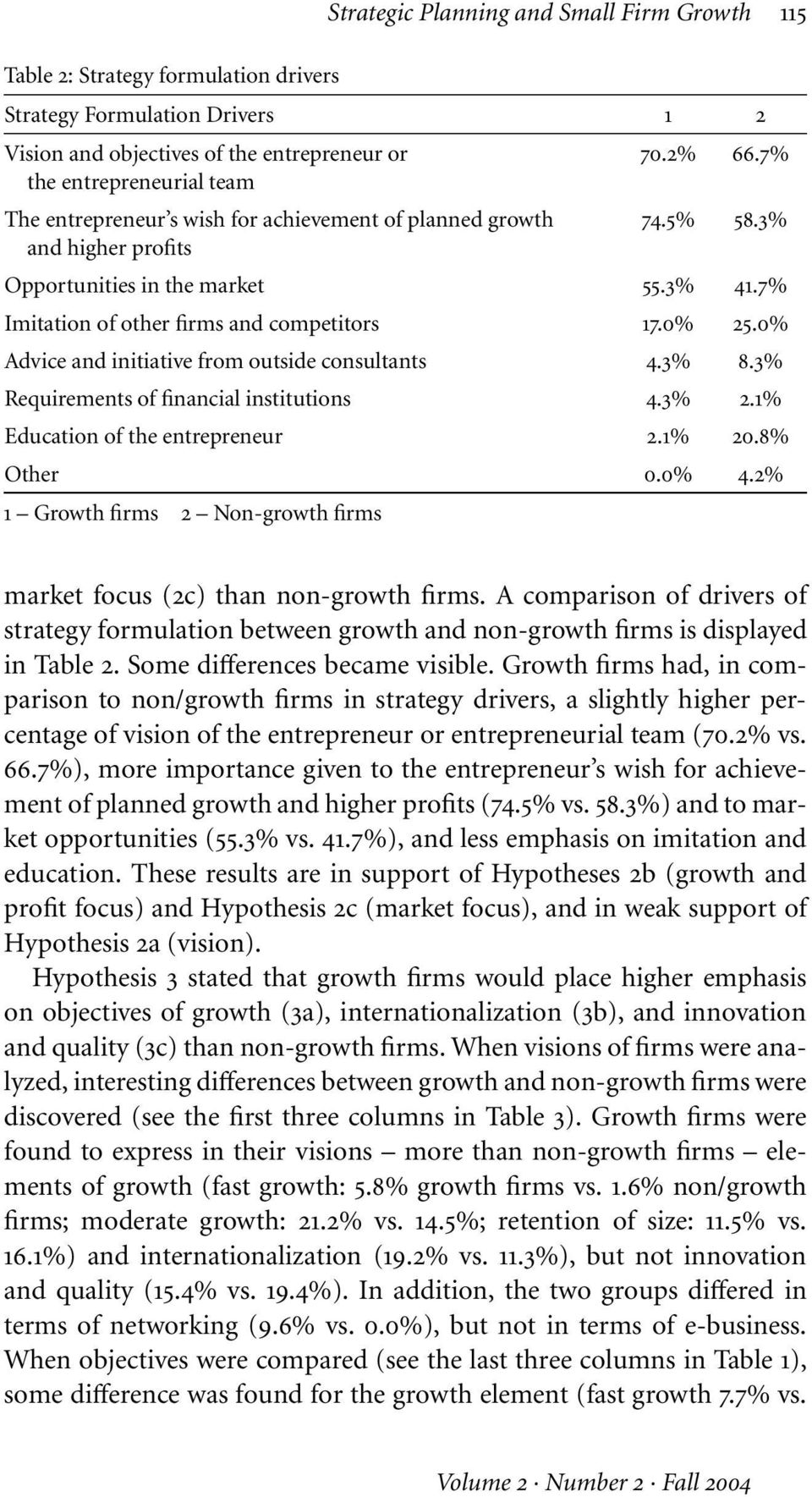
10 116 Branka Skrt and Boštjan Antončič Table 3: Elementsofvisionsandobjectives ofgrowth andnon-growthfirms Vision 1 2 Objectives 1 2 Fast growth 5.8% 1.6% Fast growth 7.7% 1.6% Moderate growth 21.2% 14.5% Moderate growth 26.9% 25.8% Retention of size 11.5% 16.1% Survival 1.9% 3.2% Internationalization 19.2% 11.3% Internationalization 11.5% 9.7% Innovation and quality 15.4% 19.4% Innovation and quality 23.1% 19.4% Networking 9.6% 0.0% E-business% 1.9% 1.6% Undecided 3.8% 11.3% No vision 0.0% 4.8% No objectives 0.0% 3.2% No answer 15.4% 30.6% No answer 25.0% 25.8% 1 Growthfirms 2 Non-growthfirms 1.6%, moderate growth 26.9% vs. 25.8%), and very small differences for internationalization (11.5% vs. 9.7%) and innovation and quality (23.1 vs. 19.4). In sum, these results are in some support of Hypotheses 3a (growth) and 3b (internationalization), but much less of Hypothesis 3c (innovation and quality). Hypothesis 4 stated that growth firms would place more emphasis on strategy formulation than non-growth firms. In our sample 90.4% of growth firms reported to have a formulated strategy for attainment of their objectives, vision, and mission (13.5% very precisely and 76.9%approximately). In contrast, the percentage of non-growth firms that have a formulated strategy was lower 79.1%(9.7%veryprecisely,69.4%approximately). These results are in support of Hypothesis 4. Hypothesis 5 stated that growth firms would use strategic analysis techniques to a higher extent than non-growth firms. Percentages of strategic analysis techniques that were used by firms in our sample for use in strategic planning are displayed in Table 4. The most used technique in growth firms was found the analysis of market and competition (36.2%), whereas non-growth firms relied more on the analysis of internal capabilities (37.5%). The firms somewhat differed also in the use of the analysis of the overall business (internal plus external factors): 21.3% of growth firms and 27.1% of non-growth firms. In addition, about 30% of all firms based their strategic planning on the intuition of the entrepreneur. Findings concerning Hypothesis 5 are mixed at best, but they indicate that particularly analysis of market and competition can be beneficial for small firm growth. Managing Global Transitions
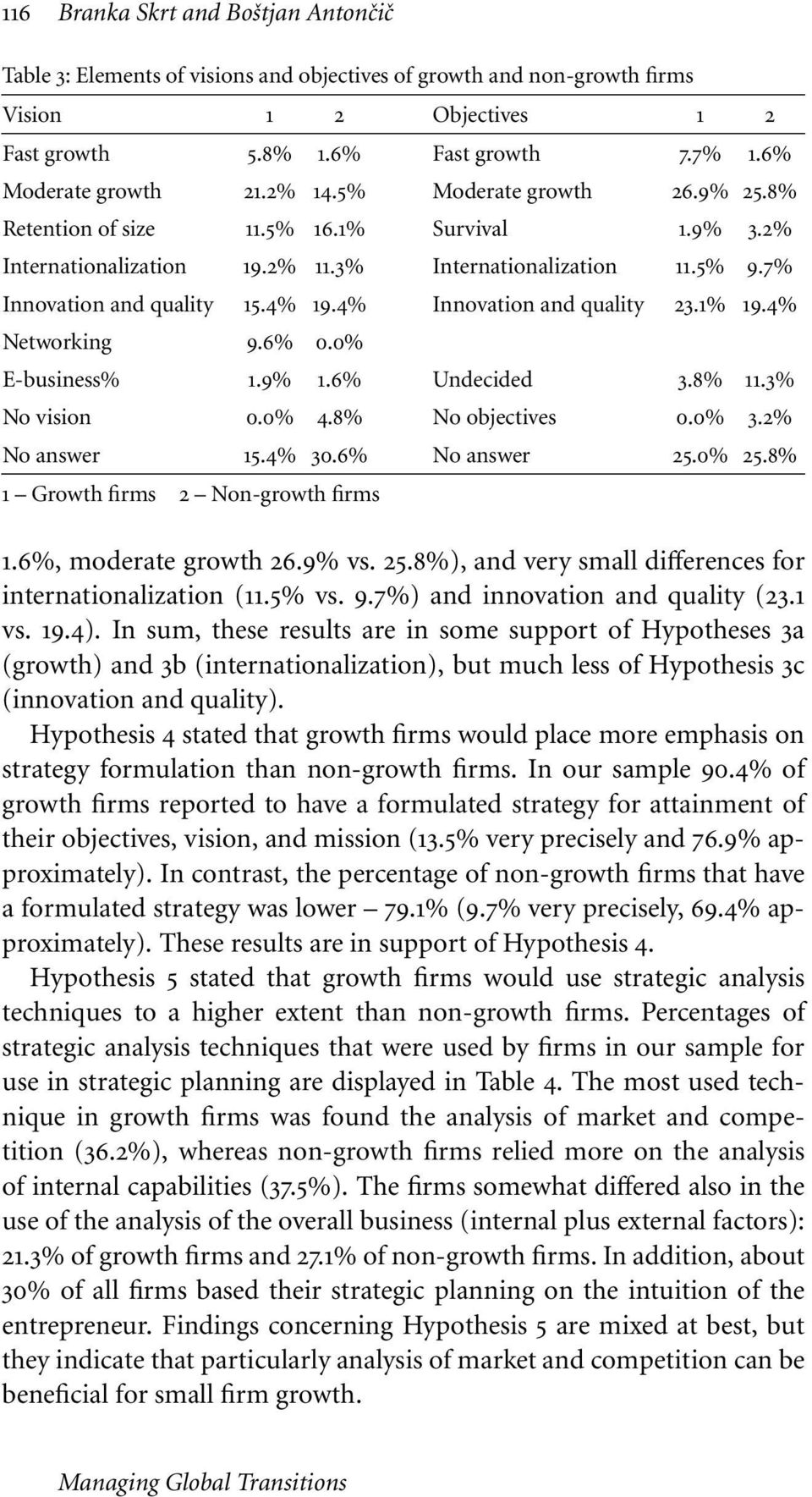
11 Table 4: Strategicanalysistechniques* Strategic Planning and Small Firm Growth 117 Strategic analysis techniques 1 2 Analysis of market and competition 36.2% 27.1% Analysis of internal capabilities of the firm 29.8% 37.5% Analysis of the overall business of the firm (internal 21.3% 27.1% and external factors) Feeling-based (intuition of the entrepreneur) 29.8% 31.3% Other 0.0% 0.0% * Multiple answers were allowed the percentages do not sum up to Growthfirms 2 Non-growthfirms Hypothesis 6 stated that growth firms would use strategic planning practices to a higher extent than non-growth firms. As shown in Table 5, growth firms placed on average more emphasis on all analyzed strategic planning practices than non-growth firms, with the exception of one item (awareness about strategic planning being key for the company s success). However, statistical comparisons of means indicated only some differences to be statistically significant. Significant differences were found for: orientation to grow and increase profitability (χ 2 = 5.56, sig ). knowledge about opportunities and threats in the market (χ 2 = 4.53, sig.0.016), and all employees oriented towards the common goal (χ 2 = 6.20; sig.0.044). Thus, support for Hypothesis 6 can be considered mixed. Hypothesis 7 stated that growth firms would have more specified generic business strategies than non-growth firms. As indicated in Table 6, all three generic business strategies (differentiation, cost leadership, and focus/niche) got somewhat higher percentages of answers as being characteristic for growth firms than for non-growth firms. These findings are in support of Hypothesis 7. Discussion This paper provides evidence that strategic planning does matter in firm growth. Vision is an important element of strategic management, and as shown in this paper exact formulation of the vision statement and strategy formulation can be beneficial for small firm growth. Interestingly, our findings also indicate that the formulation of vision (future orientation) can be more important than formulation of mission (current orientation) for firm growth; we also found evidence that growth Volume 2 Number 2 Fall 2004

12 118 Branka Skrt and Boštjan Antončič Table 5: Strategicplanningpractices (average values*) Strategic planning practices items 1 2 Knowledge about customers and their needs Orientation to grow and increase profitability Knowledge about own strengths and weaknesses Awareness of own competitive advantages Knowledge about opportunities and threats in the market Non-utilized resources and capabilities Achievability of long term objectives of the firm Planning of business operations for the future All employees oriented towards the common goal Strategic planning key for the company success Clear vision about the future, known to all people in the firm Actual formal business plan, as a basis for business operations Prepared strategic plan *Answerrange1 (totally disagree) to 5 (totally agree) 1 Growthfirms 2 Non-growthfirms Table 6: Genericstrategies* Generic strategy 1 2 Differentiation strategy (different, better products/services) 73.1% 64.5% Cost leadership strategy (lower price) 26.9% 21.0% Focus/niche strategy (focus on a specific customer segment) 59.6% 56.5% * Multiple answers were allowed the percentages do not sum up to Growthfirms 2 Non-growthfirms firms expressed in their visions all elements, except one learning organization, which is more difficult to define, of the winning strategies for the 21st Century as defined by Hitt et al. (2001). These elements are: internationalization, innovation and quality, networking, and to some extent also e-business. Contrary to the expectation of a difference, the innovation/quality element was found important for both growth and non-growth firms. In addition to vision, growth and profit focus and market focus have also been shown to be crucial strategy formulation drivers of small firm growth. We obtained also one puzzling result: about one fifth of nongrowth entrepreneurs reported education of the entrepreneur as a strat- Managing Global Transitions

13 Strategic Planning and Small Firm Growth 119 egy formulation driver. This may mean that non-growth entrepreneurs recognize the importance of education for the development of their companies, but that the efficiency of management and entrepreneurship education may be very low, or it may mean that non-growth entrepreneurs simply lack fresh ideas and rely too much on the information obtained in different educational contexts. We did not provide enough evidence to say that growth firms use strategic analysis techniques to a higher extent than non-growth firms, but our findings suggest that analysis of the market and competition can be particularly beneficial for small firm growth. We discovered that about 30% of entrepreneurs of our sample base their decision on intuition; this finding is in line with the findings of Bhide (1994) fortheus entrepreneurs. Finally, we provided some empirical evidence that the extent of use of strategic planning practices (such as orientation to grow and increase profitability, knowledge about opportunities and threats in the market, and the orientation of all employees towards the common goal) and generic strategies (differentiation, cost leadership, and focus/niche strategy) can be predictive of small firm growth. Our findings which are that small firms tend to rely on differentiation and focus/niche business strategy more than on cost leadership strategy seem to be the result of a common characteristic of small firms, which in comparison to large firms have lesser resources and lesser opportunity and capability to compete on the basis of economies of scale. A key implication of this study for research is that the assessment of the relationship between strategic planning and firm growth needs to be conducted across various elements or dimensions. The study has practical implications. Entrepreneurs need to be aware that strategic planning practices, processes and techniques can be beneficial for growth of the firm. In order to enable their firms to grow, entrepreneurs may like to consider exactly formulating vision and strategy, incorporating the elements of internationalization and networking in the firm vision, focus on growth, profit, and market; among strategic analysis techniques pay special attention to analysis of market and competition, and exactly formulate generic business strategies. All these strategic planning efforts need to be reinforced by practices that follow the key growth and market orientations, and have company-wide support. The study may have some limitations, and might suggest some future research opportunities. First, the data were collected with percep- Volume 2 Number 2 Fall 2004

14 120 Branka Skrt and Boštjan Antončič tual and predominantly single-item measures from one respondent per firm. Since the focus was on small firms, the respondent usually the owner-manager can be considered a key person for providing strategic planning information. Using multiple respondents and constructs of the elements of small business strategic planning, and combining perceptual measures with behavioral and secondary/financial data, may increase reliability in future research. Second, the generalizability of the findings may be limited because data collection was conducted within one economy Slovenia. However, even if the Slovenian economy is smaller and lagging in development in comparison to the US and economies of Western Europe, the findings on the basis of Slovenian data may be generalizable, as indicated by previous cross-national comparative studies, for example, in corporate entrepreneurship (Antoncic and Hisrich 2000; 2001) and in business ethics (Bucar, Hisrich, and Glas 2003). Of course, crosscultural comparisons can reinforce current findings and bring new insights to future research. Third, the focus of the study was predominantly on strategic planning, and did not include other strategic management elements, such as implementation and control issues, which would be of interest for future research. Conclusion Strategic planning can be considered important in driving small firm growth. This study has added to the knowledge about the relationship between strategic planning and growth with insights on the importance of strategic planning elements, and has given recommendations for strategic planning-induced growth. Precisely formulating vision and strategy, incorporating the elements of internationalization and networking in the firm vision, focusing on growth, profit, and market, performing analyses of market and competition, precisely formulating generic business strategies, and achieving company-wide support for strategies can all be beneficial for the growth of smaller firms. References Antoncic,B.,andR.D.Hisrich.2000a. An integrative conceptual model. Journal of Euromarketing 9 (2): Antoncic,B.,andR.D.Hisrich.2000b. Intrapreneurship modeling in transition economies: A comparison of Slovenia and the United States. Journal of Developmental Entrepreneurship 5 (1): Managing Global Transitions

15 Strategic Planning and Small Firm Growth 121 Antoncic,B.,andR.D.Hisrich Intrapreneurship: Construct refinement and cross-cultural validation. Journal of Business Venturing 16 (5): Baker, W. H., H. L. Addams, and B. Davis. Business planning in successful small firms. Long Range Planning 26 (6): Baum,R.J.,E.A.Locke,andK.G.Smith A multidimensional model of venture growth. Academy of Management Journal 44 (2): Besanko, D., D. Dranove, and M. Shanley Economics of strategy. 2nd ed. New York: Wiley. Bhide, A How entrepreneurs craft strategies that work. Harvard Business Review 72 (2): Bucar,B.,M.Glas,andR.D.Hisrich Ethics and entrepreneurs: An international comparative study. Journal of Business Venturing 18 (2): Drucker, P. F Management challenges for the 21st century. New York: HarperBusiness. Covin, J. G., and D. P. Slevin The development and testing of an organizational-level entrepreneurship scale. In Frontiers of entrepreneurship research, eds. R. Ronstadt, J. A. Hornaday and K. H. Vesper, Wellesley, MA: Babson College. Hisrich, R. D., and M. P. Peters Entrepreneurship: Starting, developing, and managing a new enterprise. 5th ed. New York: McGraw-Hill. Hitt,M.A.,R.D.Ireland,S.M.Camp,andD.L.Sexton Strategic entrepreneurship: Entrepreneurial strategies for wealth creation. Strategic Management Journal 22 (6 7): Hunger, D., and T. Wheelen Strategic management. 5th ed. New York: Addison-Wesley. Ireland,D.R.,M.A.Hitt,S.M.Camp,andD.L.Sexton Integrating entrepreneurship and strategic management actions to create firm wealth. Academy of Management Executive 15 (1): McDougall, P. P., and B. M. Oviatt International entrepreneurship literature in the 1990s and directions for future research. In Entrepreneurship 2000, ed D. L. Sexton and R. W. Smilor, Chicago: Upstart. Miller,C.C.,andL.B.Cardinal Strategic planning and firm performance. Management Review 43 (Winter): Porter, M. E Competitive Strategy. NewYork:TheFreePress. Sahlman,A.W.,H.H.Stevenson,M.J.Roberts,andA.Bhide The entrepreneurial venture. 2nd ed. Boston: Harvard Business School Press. Stevenson,H.H.,M.J.Roberts,H.I.Grousbeck,andA.Bhide New business ventures and the entrepreneur. 5th ed. New York: McGraw-Hill. Volume 2 Number 2 Fall 2004

16 122 Branka Skrt and Boštjan Antončič Timmons,J., and S. Spinelli New venture creation: Entrepreneurship for the 21st century. 6th ed. New York: McGraw-Hill / Irwin. Thompson, A. A., and A. J. Strickland Strategic Management: Concepts and cases. 12th ed. Boston, MA:McGraw-Hill/Irwin. Tushman, M. L., and P. Anderson, eds Managing strategic innovation and change: A collection of readings. New York: Oxford University Press. White, J Small and medium enterprise strategy a small business necessity,not a large firm luxury.long Range Planning 31 (6): Wickham, P. A Strategic entrepreneurship. London:Pitman. Zahra, S. A Predictors and financial outcomes of corporate entrepreneurship: An exploratory study. Journal of Business Venturing 6 (4): Zahra, S. A Environment, corporate entrepreneurship, and financial performance: A taxonomic approach. Journal of Business Venturing 8 (4): Zahra, S. A., and G. George International entrepreneurship. In Strategic Entrepreneurship, ed.m.a.hitt,r.d.ireland,s.m.camp, and D. L. Sexton, Oxford: Blackwell. Zimmerer, T. W., and N. N. Scarborough Entrepreneurship and new venture formation. Upper Saddle River, NJ:Prentice-Hall. Managing Global Transitions
The Mediating Role of Corporate Entrepreneurship in the Organizational Support Performance Relationship: An Empirical Examination
 The Mediating Role of Corporate Entrepreneurship in the Organizational Support Performance Relationship: An Empirical Examination Boštjan Antončič Otmar Zorn Corporate entrepreneurship has been recognized
The Impact of Strategic Planning on Small Business Growth in Kosovo
 Journal of Business and Economics, ISSN 2155-7950, USA January 2011, Volume 2, No. 1, pp. 66-72 Academic Star Publishing Company, 2011 http://www.academicstar.us The Impact of Strategic Planning on Small
INNOVATION AND STRATEGIC PLANNING AS KEY ELEMENTS TO ENTREPRENEURIAL SUCCESS
 INNOVATION AND STRATEGIC PLANNING AS KEY ELEMENTS TO ENTREPRENEURIAL SUCCESS JOY JOLLY MUTAGA IENMJOURNAL DEPARTMENT OF BUSINESS MANAGEMENT UNIVERSITY OF PRETORIA Abstract: This study investigates the
THE ENTREPRENEUR AND EXTERNAL ENVIRONMENT ROLE IN SME S COMPETITIVENESS NICOLAE BIBU, DIANA SALA
 THE ENTREPRENEUR AND EXTERNAL ENVIRONMENT ROLE IN SME S COMPETITIVENESS NICOLAE BIBU, DIANA SALA Nicolae BIBU, Professor, PhD Western University of Timisoara, The Economics Faculty Diana SALA, Prof. Assistant,
Course Outline. BUSN 6080/1-3 Strategic Management (3,0,0)
 Course Outline Department of Management School of Business and Economics BUSN 6080/1-3 Strategic Management (3,0,0) Calendar Description Students examine the role of senior management in developing and
Assesing the Implication of Strategic Planning On Performance Of Small Sized Organizations: A Case Study Of Small Enterprises in Thika Town
 Quest Journals Journal of Research in Business and Management Volume 2 ~ Issue 3 (2014) pp: 01-13 ISSN(Online) : 2347-3002 www.questjournals.org Research Paper Assesing the Implication of Strategic Planning
International Journal of Computer Networks and Communications Security
 International Journal of Computer Networks and Communications Security VOL. 2, NO. 11, NOVEMBER 2014, 374 378 Available online at: www.ijcncs.org ISSN 2308-9830 The Role of Contingency Factors in the Implementation
Internationalization Process of Buying Houses in Bangladesh: An Evaluation
 ASA University Review, Vol. 6 No. 2, July December, 2012 Internationalization Process of Buying Houses in Bangladesh: An Evaluation Mohibul Islam Masum * Abstract The article focuses on the internationalization
Upgraded Process of Strategy Modeling for Technology New Ventures
 Upgraded Process of Strategy Modeling for Technology New Ventures SIA TSOLOVA Faculty of Mathematics and Informatics Sofia University St. Kliment Ohridski 125 Tsarigradsko shose Blvd. BULGARIA [email protected]
THE OPEN UNIVERSITY OF TANZANIA FACULTY OF BUSINESS MANAGEMENT MBA COURSE OUTLINE
 THE OPEN UNIVERSITY OF TANZANIA FACULTY OF BUSINESS MANAGEMENT MBA COURSE OUTLINE OME 611- STRATEGIC MARKETING INTRODUCTION: As a result of accelerating technological change and the growth of international
Entrepreneurship in a Transition Economy: The Impact of Environment on Entrepreneurial Orientation
 140 Entrepreneurship in a Transition Economy: The Impact of Environment on Entrepreneurial Orientation Abstract Matilda Alexandrova 1 The paper intends to shed some light on the impact of business environment
THE IMPORTANCE OF KNOWLEDGE MANAGEMENT IN ORGANIZATIONS WITH EMPHASIS ON THE BALANCED SCORECARD LEARNING AND GROWTH PERSPECTIVE
 THE IMPORTANCE OF KNOWLEDGE MANAGEMENT IN ORGANIZATIONS WITH EMPHASIS ON THE BALANCED SCORECARD LEARNING AND GROWTH PERSPECTIVE Danijela Jelenic Faculty of Economics, University of Nis, Republic of Serbia
Roles of Practitioners and Strategic Planning Practices
 Roles of Practitioners and Strategic Planning Practices *** Associate Professor Dr. Kanya Sirisagul Department of Advertising and Public Relations Business Administration Faculty Ramkhamhaeng University
GUIDE TO BUSINESS REPORT WRITING
 F - PURPOSE OF BUSINESS REPORTS A business report conveys information to assist in business decision-making. The business report is the medium in which to present this information. Some reports might present
Analysis of Entrepreneurial traits of the Small Business owners in Sri Lanka
 International Journal of Scientific and Research Publications, Volume 4, Issue 10, October 2014 1 Analysis of Entrepreneurial traits of the Small Business owners in Sri Lanka H.M. Nishanthi Department
Entrepreneurship from a Diverse University Base Course Outline for Hebrew University
 Page 1 of 6 Course Objective Entrepreneurship from a Diverse University Base Course Outline for Hebrew University Entrepreneurship is a heterogeneous phenomenon. It involved people with a wide range of
30113 Course Description Entrepreneurship M1 Strategic Management
 30113 Course Description Entrepreneurship M1 Strategic Management TEACHING LANGUAGE: SEMESTER: English Winter Term 2013-14, 2 nd year students TOTAL LECTURE HOURS: 36 TOTAL OFFICE HOURS: 24 CREDIT POINTS:
Ranking Barriers to Implementing Marketing Plans in the Food Industry
 Ranking Barriers to Implementing Marketing Plans in the Food Industry Shahram Gilaninia 1, Seyed Yahya Seyed Danesh 2, Mina Abroofarakh 3* 1 Department of Industrial Management, Rasht Branch, Islamic Azad
The role of strategic management on small business growth in Kosova
 The role of strategic management on small business growth in Kosova Enver Kutllovci, Ph.D Faculty of Economics, University of Prishtina E-mail: [email protected] Venet Shala, Ph.D Faculty of Economics,
Strategy Formulation in Japanese Management
 Strategy Formulation in Japanese Management Copyright 2007 Keio University Quote of the Day Cheshire Puss, she (Alice) began would you tell me, please, which way to got from there? That depends a good
Information Systems & Small Business: Research Issues
 i Editorial Preface Information Systems & Small Business: Research Issues M. Gordon Hunter The University of Lethbridge, Canada INTRODUCTION Small Business forms a major component of a country s economy
The influence of entrepreneurship education on entrepreneurial attitudes and intentions of university students in Bulgaria
 NETT CONFERENCE November 20-22, 2014 The influence of entrepreneurship education on entrepreneurial attitudes and intentions of university students in Bulgaria Assoc. Prof. Desislava Yordanova, Phd Department
BABES-BOLYAI UNIVERSITY CLUJ-NAPOCA Faculty of Economics and Business Administration DOCTORAL THESIS SUMMARY
 BABES-BOLYAI UNIVERSITY CLUJ-NAPOCA Faculty of Economics and Business Administration DOCTORAL THESIS SUMMARY STRATEGIC MANAGEMENT PROCESS IN SMALL AND MEDIUM SEIZED ENTERPRISES PhD Advisor: Professor Mihai
The Influence of Working Capital and Organization on the Financial Performance of Small-Sized Enterprises in Jayapura City
 Journal of Economics and Behavioral Studies Vol. 7, No. 3, pp. 104-109, June 2015 (ISSN: 2220-6140) The Influence of Working Capital and Organization on the Financial Performance of Small-Sized Enterprises
BUSINESS ADMINISTRATION (Non-EMBA) COURSES Student Learning Outcomes 1
 BUSINESS ADMINISTRATION (Non-EMBA) COURSES Student Learning Outcomes 1 BA 100: Exploration of Business 1. Explain the culture of higher education. 2. Undertake critical examination and self-reflection
Since the 1990s, accountability in higher education has
 The Balanced Scorecard Beyond Reports and Rankings More commonly used in the commercial sector, this approach to strategic assessment can be adapted to higher education. by Alice C. Stewart and Julie Carpenter-Hubin
MASTER OF BUSINESS ADMINISTRATION
 B U S I N E S S MASTER OF BUSINESS ADMINISTRATION GRADUATE DIPLOMA IN BUSINESS I N S P I R E A C H I E V E E N G A G E WELCOME Holmes Institute is proud to welcome students to its newest accredited programme
CURRICULUM INFORMATION BABSON MBA TWO-YEAR PROGRAM
 CURRICULUM INFORMATION BABSON MBA TWO-YEAR PROGRAM MODULE I (8 credits) Entrepreneurial Thought and Action: Creating and Scaling Effective Businesses Module 1 sets the stage for Babson s focus on entrepreneurial
Balanced Scorecard; a Tool for Measuring and Modifying IT Governance in Healthcare Organizations
 Balanced Scorecard; a Tool for Measuring and Modifying IT Governance in Healthcare Organizations Ehsan Borousan, Roozbeh Hojabri, Mahmoud Manafi and Aliread Hooman Abstract Nowadays healthcare organizations
An Evaluation of Entrepreneurship Education Programme in Kenya
 An Evaluation of Entrepreneurship Education Programme in Kenya Gichana James Ongwae E-mail: [email protected] Telephone Number: 0735244986 Postal Address: P.O. Box 1241-00200 City Square, Nairobi
The Entrepreneurial Way
 The Entrepreneurial Way Workshop Wednesday 30 January The Essentials of Marketing Fiona Mulliner Today s Session What marketing is Where marketing fits into a business How to develop a robust marketing
Soft Skills Requirements in Software Architecture s Job: An Exploratory Study
 Soft Skills Requirements in Software Architecture s Job: An Exploratory Study 1 Faheem Ahmed, 1 Piers Campbell, 1 Azam Beg, 2 Luiz Fernando Capretz 1 Faculty of Information Technology, United Arab Emirates
Benefits of Using Balanced Scorecard in Strategic and Operational Planning
 Universal Journal of Management 2(4): 165-171, 2014 DOI: 10.13189/ ujm.2014.020404 http://www.hrpub.org Benefits of Using Balanced Scorecard in Strategic and Operational Planning Lidija Stefanovska 1,*,
CERTIFICATE IN ENTREPRENEURSHIP PROGRAM JUNE 16 AUGUST 8, 2014
 CERTIFICATE IN ENTREPRENEURSHIP PROGRAM JUNE 16 AUGUST 8, 2014 PROGRAM DETAILS DATE: June 16 August 8, 2014 LOCATION: Babson College, Wellesley, MA ABOUT BABSON GLOBAL Babson Global is a wholly owned subsidiary
BENCHMARKING OF BUSINESS INCUBATORS. in the Republic of Moldova. Aurelia Braguta
 BENCHMARKING OF BUSINESS INCUBATORS in the Republic of Moldova by Aurelia Braguta BENCHMARKING OF BUSINESS INCUBATORS in the Republic of Moldova 1. Does a business incubator need to have a business plan
Marketing Plan Development 101: The Importance of Developing a Marketing Plan for Public Transit Agencies & Commuter Assistance Programs
 Marketing Plan Development 101: The Importance of Developing a Marketing Plan for Public Transit Agencies & Commuter Assistance Programs Mark Glein, PhD, Marketing Florida State University Marketing Plan
ACCOUNTING MODERNIZATION PREMISE OF AN EFFECTIVE GOVERNANCE SYSTEM OF ENTERPRISE
 ACCOUNTING MODERNIZATION PREMISE OF AN EFFECTIVE GOVERNANCE SYSTEM OF ENTERPRISE MIHAELA UNGUREANU ALEXANDRU IOAN CUZA UNIVERSITY OF IASI [email protected] Abstract: Value of company is maximizing insofar
COURSE DESCPRIPTIONS. ZSEM international summer school 2016. June 27-July 15 2016. Zagreb School of Economics and Management, Zagreb, Croatia
 COURSE DESCPRIPTIONS ZSEM international summer school 2016 June 27-July 15 2016 Zagreb School of Economics and Management, Zagreb, Croatia Corporate Finance: Mergers & Acquisitions Mergers and acquisitions
AFFECT OF INDIVIDUAL FACTORS ON YOUTH ENTREPRENEURSHIP A STUDY OF UTTARAKHAND STATE, INDIA
 Romanian Economic and Business Review Vol. 8, No. 2 131 AFFECT OF INDIVIDUAL FACTORS ON YOUTH ENTREPRENEURSHIP A STUDY OF UTTARAKHAND STATE, INDIA Lalit Sharma, Pankaj Madan Abstract In this study we have
Accelerated Learning Course Catalogue
 Accelerated Learning Course Catalogue Graduate Program Course Requirements and Descriptions Graduate courses meet one night per week from 6 p.m. to 10 p.m. in six-week terms. The programs are typically
The investigation of the relationship between the learning of environment to entrepreneurship foster
 International Journal of Management and Humanity Sciences. Vol., 3 (11), 3555-3560, 2014 Available online at http://www.ijmhsjournal.com ISSN 2322-424X 2014 The investigation of the relationship between
Vision: The relationship between a firm s strategy and business model
 ABSTRACT Vision: The relationship between a firm s strategy and business model Boniface C. Madu Grand Canyon University Leadership and management in all organizations face the problem of choosing among
Marketing Plan. Contents. Introduction: Using the Marketing Planning Framework. The Elements of the Marketing Planning Framework
 Marketing Plan Contents Introduction: Using the Marketing Planning Framework The Elements of the Marketing Planning Framework Terms of Reference Executive Summary 1. Business Mission 2. External Marketing
Impact of Strategic Orientation on Business Performance: Evidence from Ukrainian software development industry
 Impact of Strategic Orientation on Business Performance: Evidence from Ukrainian software development industry Anastasiia O. Lutsenko, UGSM-Monarch Business School, Switzerland Dr. Kayhan Tajeddini, Lund
IMPLEMENTING A CUSTOMER RELATIONSHIP MANAGEMENT PROGRAMME IN AN EMERGING MARKET
 IMPLEMENTING A CUSTOMER RELATIONSHIP MANAGEMENT PROGRAMME IN AN EMERGING MARKET Adele Berndt, Frikkie Herbst, and Lindie Roux 1 ABSTRACT Retail financial services in all markets, including emerging markets,
General Management and Business Strategy AIBA, Koji
 General Management and Business Strategy AIBA, Koji This seminar (namely Zemi) has a number of peculiar characteristics. Aiba holds Zemi in three modes. One in English only (English Zemi) and another is
ijcrb.webs.com INTERDISCIPLINARY JOURNAL OF CONTEMPORARY RESEARCH IN BUSINESS OCTOBER 2013 VOL 5, NO 6 Abstract 1. Introduction:
 Impact of Management Information Systems to Improve Performance in Municipalities in North of Jordan Fawzi Hasan Altaany Management Information Systems Department, Faculty of Administrative Sciences, Irbid
Exploring the directions and methods of business development. A comparative multiple-case study on Ikea and Vodafone
 Exploring the directions and methods of business development A comparative multiple-case study on Ikea and Vodafone Michal Štefan Aalborg University Master thesis for MSc. in International Business Economics
A COMPARATIVE STUDY OF IMPORTANT KNOWLEDGE AND SKILLS OF MARKETING PROFESSIONALS
 A COMPARATIVE STUDY OF IMPORTANT KNOWLEDGE AND SKILLS OF MARKETING PROFESSIONALS Tina Vukasovič International School for Social and Business Studies, Slovenia [email protected] Abstract: The marketing
Technology Complexity, Personal Innovativeness And Intention To Use Wireless Internet Using Mobile Devices In Malaysia
 International Review of Business Research Papers Vol.4 No.5. October-November 2008. PP.1-10 Technology Complexity, Personal Innovativeness And Intention To Use Wireless Internet Using Mobile Devices In
CHAPTER 10 E-COMMERCE ENTREPRENEURSHIP: EMERGING PRACTICES, KEY CHALLENGES AND FUTURE DIRECTIONS
 CHAPTER 10 E-COMMERCE ENTREPRENEURSHIP: EMERGING PRACTICES, KEY CHALLENGES AND FUTURE DIRECTIONS Lisa K. Gundry Professor DePaul University Department of Management 1 E. Jackson Blvd. Chicago, IL 60604
SMEs marketing skills challenges in South Africa
 African Journal of Business Management Vol. 5(13), pp. 5048-5056, 4 July, 2011 Available online at http://www.academicjournals.org/ajbm DOI: 10.5897/AJBM10.007 ISSN 1993-8233 2011 Academic Journals Full
The Transnationality Index: Measuring the diversity advantage of transnational entrepreneurial organizations
 The Transnationality Index: Measuring the diversity advantage of transnational entrepreneurial organizations By David H. Tobey, Doctoral Student Department of Management College of Business & Economics
Fred R. David. twelfth edition Strategic Management CONCEPTS AND CASES. Prentice Hall PEARSON FRANCIS MARION UNIVERSITY FLORENCE, SOUTH CAROLINA
 twelfth edition Strategic Management CONCEPTS AND CASES Fred R. David FRANCIS MARION UNIVERSITY FLORENCE, SOUTH CAROLINA PEARSON Prentice Hall PEARSON EDUCATION INTERNATIONAL Contents Preface 12 Acknowledgments
Syllabus V.4 MANAGING THE GROWING COMPANY. Course Number: B8530-001 FALL TERM 2013
 Syllabus V.4 MANAGING THE GROWING COMPANY Course Number: B8530-001 FALL TERM 2013 PROFESSOR NAME: Professor Office Location: Michael Preston Uris 218F Office Phone: (Cell) 631 903-9318 E-mail: Office Hours:
MBAProgramme. The College of The Bahamas
 c o u r s e o u t l i n e MBAProgramme The College of The Bahamas Year 1 Fall Financial/Managerial Accounting (3 credits) Introduces students to the financial and managerial accounting disciplines; develops
The Effect of Leadership and Entrepreneurial Orientation of Small and Medium Enterprises on Business Performance in Taiwan
 The Effect of Leadership and Entrepreneurial Orientation of Small and Medium Enterprises on Business Performance in Taiwan Dr. Chung-Wen Yang, ChengShiu University, Taiwan ABSTRACT Leadership and entrepreneurship
GENERAL GUIDELINES FOR DEVELOPING A BUSINESS PLAN
 GENERAL GUIDELINES FOR DEVELOPING A BUSINESS PLAN August 2012 Table of contents Introduction... 3 1. Executive Summary... 3 2. Business Summary... 3 2.1 Company Summary... 3 2.2 Management Summary... 3
The role of strategic leadership in effective strategy implementation: Perceptions of South African strategic leaders
 The role of strategic leadership in effective strategy implementation: Perceptions of South African strategic leaders C. Jooste & B. Fourie A B S T R A C T A review of the literature reveals that strategy
ACHIEVING COMPETITIVE ADVANTAGE BY PRIVATE MANAGEMENT COLLEGES OR PRIVATE UNIVERSITIES
 ACHIEVING COMPETITIVE ADVANTAGE BY PRIVATE MANAGEMENT COLLEGES OR PRIVATE UNIVERSITIES DR. GAURAV BISARIA ASSISTANT PROFESSOR, FACULTY OF MANAGEMENT & RESEARCH, INTEGRAL UNIVERSITY, LUCKNOW. U.P. ABSTRACT
ENTREPRENEURIAL ORIENTATION, STRATEGY,
 International Business: Research Teaching and Practice 2008 2(1) ENTREPRENEURIAL ORIENTATION, STRATEGY, AND MARKETING CAPABILITIES IN THE PERFORMANCE OF BORN GLOBAL FIRMS Samantha Hartsfield Florida State
Management 491 International Business School of Management, NJIT
 Management 491 International Business School of Management, NJIT Tuesdays/Thursdays 4:00 5:30, Fall, 2006 David Hawk, Professor - Phone: (973) 596-3019 office [email protected] INTRODUCTION The course is designed
School of Advanced Studies Doctor Of Management In Organizational Leadership. DM 004 Requirements
 School of Advanced Studies Doctor Of Management In Organizational Leadership The mission of the Doctor of Management in Organizational Leadership degree program is to develop the critical and creative
ROBERT P. GARRETT, JR.
 ROBERT P. GARRETT, JR. Department of Entrepreneurship College of Business University of Louisville Louisville, KY 40292 Phone: (541) 737-6049 Fax: (541) 737-4890 Email: [email protected] ACADEMIC
Entrepreneurial Marketing in Small Software Technology Firms: Use of Networks and Relationships
 Entrepreneurial Marketing in Small Software Technology Firms: Use of Networks and Relationships Keywords marketing, entrepreneurship, networks, relationships, technology, SMEs. Introduction This paper
International Tourism Market Segmentation Based on Consumer Behavior
 International Tourism Market Segmentation Based on Consumer Behavior Luigi DUMITRESCU Lucian Blaga University, Faculty of Economics, Sibiu, Romania E-mail: [email protected] Telephone: +40 0724
Faculty Development in International Entrepreneurship (FDIE) June 2-5, 2008 Denver, Colorado
 Faculty Development in International Entrepreneurship (FDIE) June 2-5, 2008 Denver, Colorado Sponsored by the U.S. Department of Education and the Center for International Business Education and Research
Stepping Up: a Study of CEO Succession and Strategy Formation in the Nonprofit Sector a quantitative study
 Stepping Up: a Study of CEO Succession and Strategy Formation in the Nonprofit Sector a quantitative study, MPPM Doctoral Candidate, Teachers College, Columbia University EXECUTIVE SUMMARY A study was
THE ROLE OF MARKETING IN MULTINATIONAL SUBSIDIARIES: STANDARDIZATION VERSUS LOCALIZATION
 THE ROLE OF MARKETING IN MULTINATIONAL SUBSIDIARIES: STANDARDIZATION VERSUS LOCALIZATION Miroslav Karlíãek, Zuzana Chytková, Nikola Hofiej, Hana Mohelská, Jakub Fischer Introduction In the international
Hansani Chathurika Dassanayake a a University of Peradeniya, Sri Lanka. [email protected]. Abstract
 Reshaping Management and Economic Thinking through Integrating Eco-Friendly and Ethical Practices Proceedings of the 3 rd International Conference on Management and Economics 26-27 February 2014 Faculty
K-12 Entrepreneurship Standards
 competitiveness. The focus will be on business innovation, change and issues related to the United States, which has achieved its highest economic performance during the last 10 years by fostering and
Students Attitudes about Online Master s Degree Programs versus Traditional Programs
 Aberasturi, S., & Kongrith, K. (2006). Students attitudes about online master s degree programs versus traditional programs. International Journal of Technology in Teaching and Learning, 2(1), 50-57. Students
Which B2B E-Business Model: The Case of Australian Agribusiness Organisations. Eric Ng University of Southern Queensland
 Which B2B E-Business Model: The Case of Australian Agribusiness Organisations Eric Ng University of Southern Queensland Meredith Lawley University of the Sunshine Coast Jane Summers University of Southern
Accounting. Management. Environment of Business. Business Law for Accountants. Stats Business & Econ I. Management
 Undergraduate Courses: Course # Course Title Course Description BUS201 Financial An introduction to basic accounting principles for measuring and Accounting communicating financial data about a business
Small Business Entrepreneurship Lesson Objectives
 Small Business Entrepreneurship Lesson Unit 1: OVERVIEW OF SMALL BUSINESS ENTREPRENEURSHIP What Is Entrepreneurship? Define and list examples of entrepreneurs. Explain the difference between a product-based
PROPOSED DOCTORATE RESEARCH
 PROPOSED DOCTORATE RESEARCH Socialization Tactics and Newcomer Adjustment: The Role of Organizational Culture, Team Dynamics, and Personality Dimensions PURPOSE Socialization Tactics and Newcomer Adjustment:
Management Control Systems, Strategy and Performance: An Exploratory Analysis of Family and Non-family Firms in Chile.
 Management Control Systems, Strategy and Performance: An Exploratory Analysis of Family and Non-family Firms in Chile. Moses Acquaah. Bryan School of Business and Economics, University of North Carolina-Greensboro.
Founder human capital and small firm performance: an empirical study of founder-managed natural food stores
 Founder human capital and small firm performance: an empirical study of founder-managed natural food stores ABSTRACT Gerry Segal Florida Gulf Coast University Dan Borgia Florida Gulf Coast University Jerry
Interdisciplinary Management Research V. HOW DIFFERS OUTSOURCING OF CORE AND SUPPORTIVE ACTIVITIES IN SLOVENIAN SMEs
 HOW DIFFERS OUTSOURCING OF CORE AND SUPPORTIVE ACTIVITIES IN SLOVENIAN SMEs Barbara Bradač 1, Karin Širec 2 1 University of Maribor - Faculty of Economics and Business - Institute for Entrepreneurship
High-Impact Succession Management
 High-Impact Succession Management Executive Summary Kim Lamoureux Principal Analyst Michael Campbell Senior Research Analyst Center for Creative Leadership Roland Smith Senior Research Faculty Center for
Organizational Design Dr. Marco Weiß [email protected] Winter 2007/08
 Organizational Design Dr. Marco Weiß [email protected] Winter 2007/08 Content and structure of the course This course provides an overview of the theory and practice of organizational design.
Business Management. Master s Program Campus Querétaro. Discover this new program for graduate students
 Business Management Master s Program Campus Querétaro The Tec de Monterrey is a private university institution, which states that part of their mission is to, widely be recognized as an educational institution
USE OF ICT IN SMES MANAGEMENT WITHIN THE SECTOR OF SERVICES
 USE OF ICT IN SMES MANAGEMENT WITHIN THE SECTOR OF SERVICES Plumb Ion Academy of Economic Studies Bucharest, Faculty of Management, 6 th Piata Romana RO 030173 Bucharest Romania, [email protected], +4021.319.19.00/287
Master's Degree Program in Marketing (English Language)
 Master's Degree Program in Marketing (English Language) 1) Name of Curriculum: Master's Degree Program in Marketing (English Language) 2) Name of Degree: Master of Science in Marketing or M.S. (Marketing)
Course Descriptions for the Business Essentials Program
 Course Descriptions for the Business Essentials Program Upon completion of one, two, three or four quarters, students will earn Certificates of Completion. All courses listed are required in order to earn
IMPLEMENTATION OF INTEGRATED MARKETING COMMUNICATION ON MARKET PERFORMANCE OF BRANDS IN THE FIELD OF OTC PRODUCTS
 Bruno Završnik University of Maribor, Faculty of Economics & Business, Maribor, Slovenia Damjana Jerman University of Primorska, Faculty of Tourism Studies Turistica, Portorož, Slovenia IMPLEMENTATION
INTERNAL ENVIRONMENT ANALYSIS TECHNIQUES (1)
 INTERNAL ENVIRONMENT ANALYSIS TECHNIQUES (1) Caescu Stefan Claudiu The Academy of Economic Studies Bucharest, The Marketing Faculty Popescu Andrei The Academy of Economic Studies Bucharest, The Marketing
Corporate Finance: Mergers & Acquisitions
 COURSE DESCPRIPTIONS ZSEM international summer school 2015 June 29-July 17 2015 Zagreb School of Economics and Management, Zagreb, Croatia Corporate Finance: Mergers & Acquisitions Mergers and acquisitions
MANT 427 TOPIC IN OPERATIONS MANAGEMENT 1 (SMALL BUSINESS MANAGEMENT) Semester 1
 MANT 427 TOPIC IN OPERATIONS MANAGEMENT 1 (SMALL BUSINESS MANAGEMENT) 2011 Semester 1 Course Coordinator: Dr Jodyanne Kirkwood Room 8.22 Phone 479 8523 Email: [email protected] Office Hours:
Effect of some important factors on management of customer relationship with an emphasis on comprehensive banking
 Effect of some important factors on management of customer relationship with an emphasis on comprehensive banking Department of management, Science and research branch, Islamic Azad University, Shahroud,