
A Generic Database Schema for CIDOC-CRM Data Management
|
|
|
- Matthew Tate
- 10 years ago
- Views:
Transcription
1 A Generic Database Schema for CIDOC-CRM Data Management Kai Jannaschk 1, Claas Anders Rathje 1, Bernhard Thalheim 1 and Frank Förster 2 1 Christian-Albrechts-University at Kiel, Information Systems Engineering {kaja,car,thalheim}@is.informatik.uni-kiel.de 2 Christian-Albrechts-University at Kiel, Institute of Classics [email protected] Kiel, Germany Abstract. Database management currently assumes a relative stability of database structures and supports user viewpoints through a number of views. New users must either adopt their data demand to existing views or issue a request for support of their demands. The support for the second option is not feasible whenever user communities often change or users agile change their viewpoints. Further applications continuously evolve. This evolution also results in change requests to database structures, to database views and to database features. We support evolution of databases and changes of user viewpoints by a generic database system, and automatic generation of generation of views. This approach supports modification of the database according to the special viewpoint of users. Queries issued by the user are transformed to generic database queries. Results that are computed for these queries are translated back to user-specific answers. Key words: knowledge model, semantic data analytics, exploratory semantic searching and browsing, database modeling, scientific data management 1 Motivating Applications 1.1 CIDOC-CRM The International Committee on Documentation of the International Council of Museums(ICOM-CIDOC) focuses on the documentation requirements and standards of museums, archives, and similar organisations. The CIDOC Conceptual Reference Model (CRM) [4] provides an extensible ontology for concepts and information in cultural heritage and museum documentation. It became an international standard (ISO 21127:2006) for the controlled exchange of cultural heritage information. The goal of CIDOC-CRM is to provide the semantic definitions and clarifications needed to transform disparate, localized information sources into a coherent global resource, be it within an institution, an intranet, or on the Internet. In
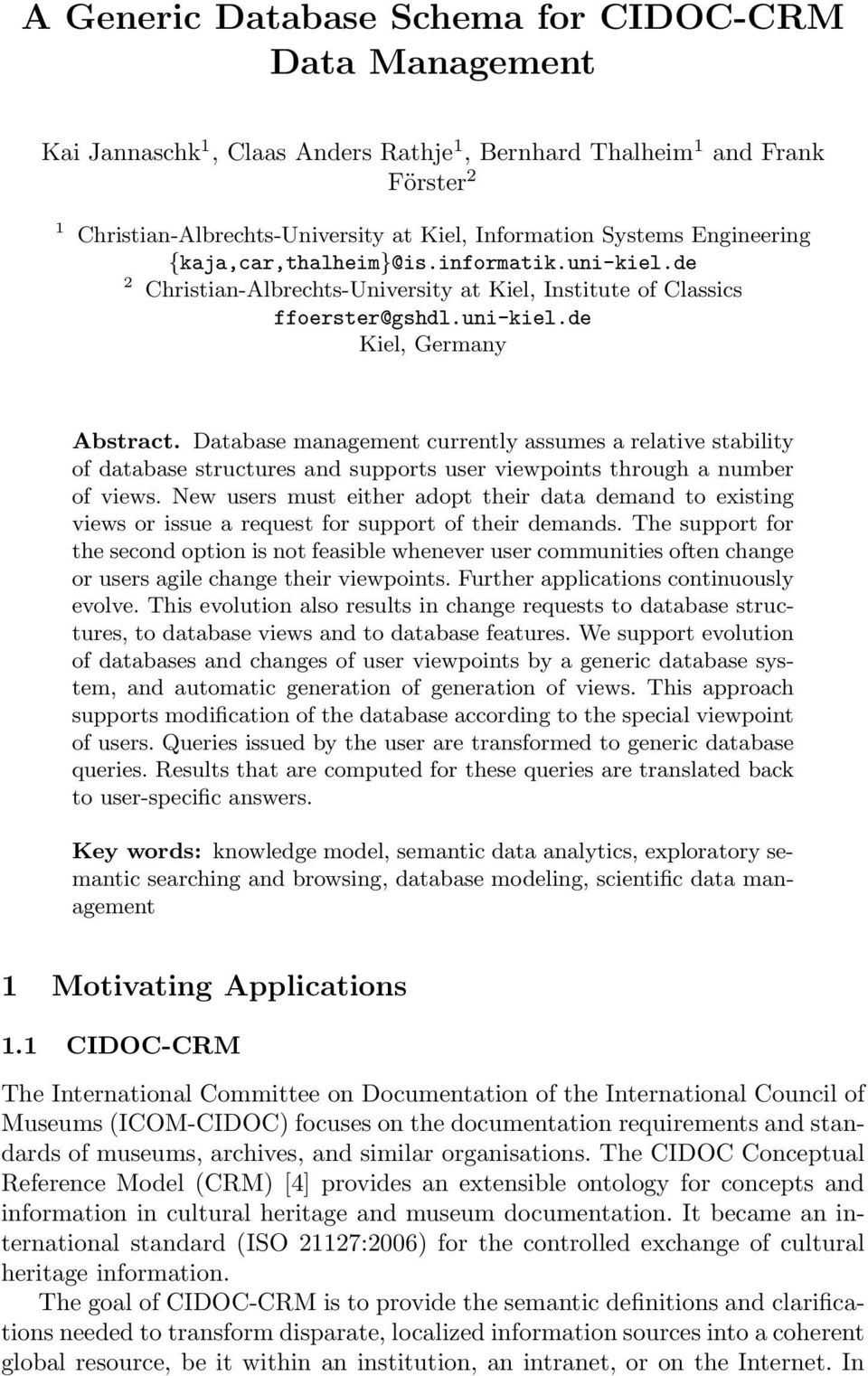
2 2 Kai Jannaschk, Claas Anders Rathje, Bernhard Thalheim and Frank Förster order to achieve this, the CRM adopts a supra-institutional perspective, abstracted from any particular local context. This abstraction is derived from the underlying semantics of the database schemata and document structures found in museum and cultural heritage documentation. The CRM is descriptive rather than prescriptive: it explains the logic of what cultural heritage institutions do in fact document rather than telling them what they should document. Thus it enables semantic interoperability. This CIDOC-CRM model is a typical example of a pixel schema. Pixel schemata are simple typed, heterogeneous, agile evolving and large schemata with relatively small populations. A diagram [3] displays one approach of its main structure without providing an insight into the structure of each of more than 240 entity and relationship types. Its printout in the A0 format results in a pixel picture that is not surveyable. An example for a CIDOC-CRM conform description of an object is given at a work [7] by Doerr. In these example the subject is an Epitaphios shown in the Museum Benaki. In Figure 1 we give an overview about the (shortened) main structure of that object Epitaphios. Each node containing E[0-9]* in the label like E19.Physical Object defines a type in the CIDOC-CRM standard. The labels on the edges define relationships between entities. Fig. 1. Main structure of CIDOC-CRM structure for Epitaphios 1.2 Related Work Approaches for storage, retrieval, and description of data with heterogeneous and evolving types exist, e.g. Amazon s SimpleDB. The data of different users are wrapped and stored in an on-line database. A user of Amazon s SimpleDB can define his/her own data structure. Access to the data is given by predefined APIs. The Resource Description Framework (RDF) from W3C is described e.g. by Klyne s work [9]. An RDF expression typically connects two resources by a predicate. Each subject or object can be a RDF expression by itself, and a resource is a link for a source or a literal, that contains a value. The relationships between a subject and an object are limited to binary relationships. But it is not possible to decompose all relationships into binary relationships without the loss of information as shown in [5] by Date et al. West gives some hints for a good modelling of a stable, but flexible to changing business practices, database
3 A Generic Database Schema 3 schema, that can be shared by different software products in his work [14]. But these principles are based on the knowledge, which data types are needed by the user within the model for all cooperating software products at the time of developing the database schema. Different normal forms are defined for the developing of database structures. Fagin defined in his work [8] a domain/key normal form (DK/NF). A relation schema in first normal form is in the DK/NF, if each constraint can be inferred from key and domain. Date presents in his work [6] a definition for the 6th normal form (6NF). A relation type fulfills the 6NF, if it consists of a single key, plus at least one additional attribute. A normalisation of a relational database model to the 6NF results in a huge set of entities with lots of different relationships between them. We call such a model in the graphical representation a pixel schema. 1.3 Outline of the Paper In this paper we define a generic database schema for CIDOC-CRM data management. We start in Section 2 by describing the theoretical background for our generic databases. We characterise the binarisation of entity and relationship types and the generic functions. Furthermore, we present the bulk composition type as a data exchange format between a database and an application and we definegenericviewsforimportandexport.insection3wepresentapracticalsolution for our ideas. This includes an architecture for a system, the presentation of our generic database schema in the (H)ERM notation and the depending relational realisation, and the explanation of user query transformation on a generic database. At last, we summarise in Section 4 the work and give an outlook for future research. 2 Generic Database Modelling In following subsections we define the background of our approach towards a generic database for CIDOC-CRM conform data management. We specify the restrictions and the challenges of the application domain, define the generic functions and the bulk type for the communication between a database and an application. At last we present the views for the im- and export of data. 2.1 Problems to be Solved for Pixel Schemata Pixel schemata are challenging current technology due to their evolution. At the same time they can be handled by everybody who knows basics of database technology. However, they are a nightmare for everybody who wants to share or integrate data or who strives for developing interfaces for data import or export. We need a sophisticated programming support for such agile evolution. A rather simple but heterogeneous type structure is used by pixel schemata. Each type typically has less than four attributes. We may combine these types by horizontal denormalisation as given by Thalheim in his work [13].
![Different normal forms are defined for the developing of database structures. Fagin defined in his work [8] a domain/key normal form (DK/NF).](/docs-images/45/11700903/images/page_3.jpg "A relation schema in first normal form is in the DK/NF, if each constraint can be inferred from key and domain. Date presents in his work [6] a definition for the 6th normal form (6NF).")
4 4 Kai Jannaschk, Claas Anders Rathje, Bernhard Thalheim and Frank Förster Pixel schemata contain their own metadata within the naming structure and thus hint to its developers and the kind of types used. Thus, we need an explicit reference to the source and to the kind of type. Databases for pixel schemata are populated at different periods of time in a different form. The quality of the data depends on the import of the data to the database. Data may be cleansed by other people. Therefore, we should use temporal data for explicit time reference. The following restrictions observed for the application domain are essential for our approach. Simple heterogeneous application types: There are a lot of different entity and relationship types in the application domain, that are defined with a relatively small set of attributes. Evolving application types: The practical sciences produce a rapidly evolving amount of different application types. New types are created, older types are changed or will be never used again. Simple relationship constraints: The cardinality constraints between two or more entities are (0,m) or (1,n). Simple functional dependencies: The functional dependencies in the entity and relationship types are simple. That means, entity types fulfill the DK/NF. Form-oriented input and output: The input data for the database and the output data requested by users is gathered in defined XML or HTML forms. Small query result sets: A result set for a user query is very small. 2.2 Binarisation of Relations. It is well known in mathematics that the language of binary predicates will be universal if identifiers are permitted. Binarisation is also the basis for the triple format (Type, Attribute, Value) that is widely used in Computer Engineering. For instance, the job control language JCL uses such triples for universal commands. In a similar form, RDF is based on such triples. Consider a predicate in the topic of the storage of an archaeological find Storage(Place,Building,Room). This can be enhanced to a predicate with an identifier-backed predicate Storage(ID, P lace, Building, Room). The ID-enhanced predicate can be replaced by a set of three predicates Storage Place(ID,Place), Storage Building(ID, Building), and Storage Room(ID, Room). These predicates carry the same information if additional integrity constraints are applied: Storage P lace[id] Storage Building[ID] Storage Room[ID] If this set of paired inclusion constraints is maintained in the database then the two databases become equivalent. We call this set of constraints for a decomposed type unit constraints. A second kind of constraints is necessary for maintenance of identifiers for enhanced types. We may require that identifier sets of enhanced predicates are disjoint. We call these constraints exclusivity constraints.

5 A Generic Database Schema 5 Therefore, we may use binary predicates as long as we are able to maintain unit and exclusivity constraints. This integrity constraint enforcement may be transferred to database functions that offer the unique opportunity for database changes. 2.3 Generic Functions. Bienemann et al. introduce in their work [1] the conception of generic functions and generic workflows. Similar to situations in applications, tasks may be specified on the basis of a general description of a possible way for satisfaction and completion. In traditional function and workflow development approaches, a task is supported by its own workflow and functions. The traditional approach will lead to a huge number of processes that have a similar behaviour. Instead of these classical approaches we use a different way. We associate a task with a generic workflow and generic functions that accommodate all possible different ways of completing the task. The generic workflow may be unfolded to a workflow suite by consideration of the context. The formal definition of generic functions uses function applications and functionalisations. Consider types t 1,...,t k,t 1,...,t n for k,n N. Consider Dom := Col t1... Col t k and Rng := Col t 1... Col t n to be sets of tuples of collections of objects of the corresponding types, for k,n N. Consider a function f : Dom Rng mapping a tuple of collections of types t 1,...,t k into a tuple of collections of types t 1,...,t n. Consider two formulae φ,ψ defined over the domain and the co-domain of f, respectively. The quintuple (Dom,φ,f,ψ,Rng) is called a function application with precondition φ and postcondition ψ [2]. Function applications can be defined recursively by means of operators of the function algebra of choice, i.e., (Dom,φ,θ(F 1,...,F m ),ψ,rng) is a function application, if θ is a corresponding operator of the function algebra, and F 1,...,F m are function applications. A functionalisation is a quadruple (S,F,Σ,s 0 ) with 1. a specification of structuring denoted by S = (S,V) and consisting of a database schema S = (T S,Σ S ) with T S being a set of types according to the type system as stated above, and Σ S being a set of static integrity constraints, and a set of views V upon schema S defining collections in domains, and co-domains of function applications, 2. a function application F, 3. a set of dynamic integrity constraints Σ on S, 4. a distinguished initial state s 0. Dimensions of functionalisation are refinement of structuring, context embedding, and instantiation. Any function may be adapted to the specific needs by application of one of these refinement strategies. 2.4 The Bulk Composition. A bulk composition builds a unified container for instantiations of different types and is used as a transfer type between different schemes or applications. A de-
![introduce in their work [1] the conception of generic functions and generic workflows.](/docs-images/45/11700903/images/page_5.jpg "Similar to situations in applications, tasks may be specified on the basis of a general description of a possible way for satisfaction and completion.")
6 6 Kai Jannaschk, Claas Anders Rathje, Bernhard Thalheim and Frank Förster scription of a bulk composition is given in a work [10] from Ma et al.. The bulk composition type BC is a triple (t,id,l) with 1. t as a name of a type, 2. an identifier ID for a type instantiation, 3. and a set of attributes l = {A 1,A 2,...}. Look at the given example Storage(ID, P lace, Building, Room). We identify thetypet : Storage,withthegivenidentifierid : ID andthesetofattributesl = {Place,Building,Room}. A tuple bc = (Storage,ID,{Place,Building,Room}) is the result. The bulk composition type is used as a uniform type and can contain any instantiation of different types. Each type has its own attribute list. 2.5 Generic Views for Import and Export of Data. In database design one has to specify the requirements for data. The result is a conceptual data model with entities, attributes, relationships, and integrity constraints. This conceptual model is the basis for a logical data model with tables, columns, keys, and triggers of a database. Refinement of the conceptual model results in a refinement of the logical model. We can use views to define entities and relationships based on a static relational database model. Terwilliger describes in his thesis [12] a set of transformations for the transformation process from one database schema S to another database schema S. In our case the two transformations UNPIVOT and PIVOT are of special interest. The transformation UNPIVOT translates instances of a type T into a key-attribute-value set, and the transformation P IV OT translates a keyattribute-value set into instances of a type T. We adopt these transformations and define a set of generic views for import of CIDOC-CRM conform data VI. The views are based on a static relation schema of the database. We distinguish between views for importing entities and views for importing relationships. A view for importing entities VI e is defined as a triple (type(vi e ),id(vi e ), attr(vi e )), where VI e is a view name for importing entities, type(vi e ) means the type of an entity, attr(vi e ) is a set of attributes and id(vi e ) is a non-empty subset of attr(vi e ) called identifier of the entity. We define a view for importing relationships VI r as a triple (type(vi r ),ent(vi r ),attr(vi r )), where VI r is a view name for importing relationships, type(vi r ) means the type of a relationship type, attr(vi r ) is a set of attributes and ent(vi r ) is a non-empty sequence of entity types. Each entity type plays its own defined role in a relationship type. Similar to the definition of a generic view for import VI we specify a generic view for export of CIDOC-CRM conform data VE. 3 Realisation of Generic Databases In this section we present the architecture of an actual implementation. Furthermore, we show our generic database schema in the (H)ERM notation and the resulting relational realisation and query translations for searching the database.

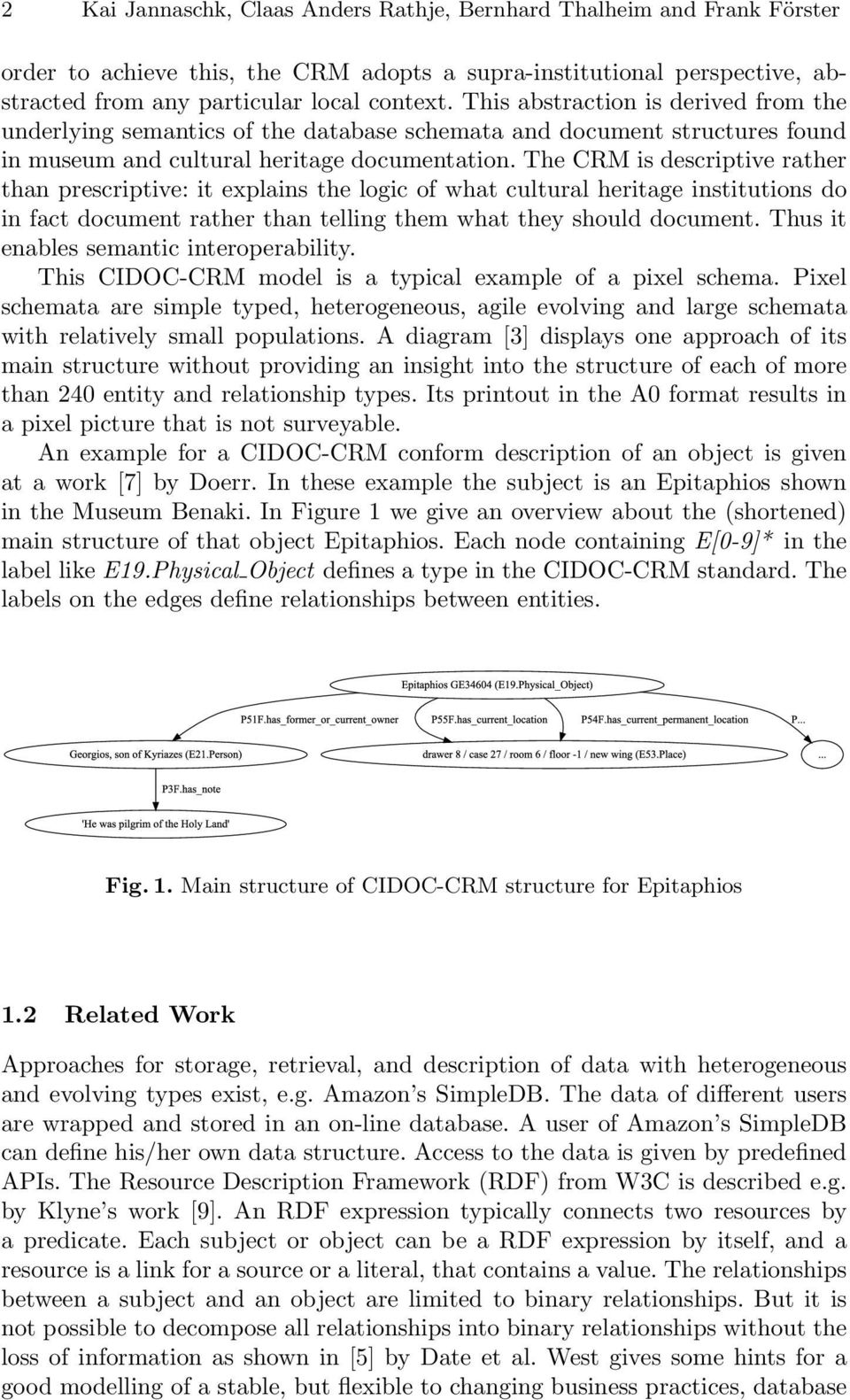
7 A Generic Database Schema The V-Architecture Model To handle objects described by the CIDOC-CRM standard, we developed a system, which is based on a generic relational database schema. This architecture is given in Figure 2. We use one function as an interface for data import, and one function as an interface to receive a user query and build an answering result set. Each interface has access to the set of views for import or export, which capsule the relations of the database. The function scans the given request and chooses the right views for answering. These views are not physically implemented in the database. The view for import is generated by a generic function, that also implements the UNPIVOT transformation. The simple views for export are generated by a generic function. Furthermore, we can specify more complex views for export by a physical definition in the DBMS. Such physical views are needed in order to map different type hierarchies, and they are only readable. The structure of attributes of these views is the same as in the underlying physical relations. The physical views are listed in the system tables of a DBMS. Both export views capsule the transformation P IV OT. Fig. 2. The V-architecture for the generic database system This architecture for the storing and searching of CIDOC-CRM conform data can be enhanced by a system for the type definition and the type management as shown by Rathje in his thesis [11]. 3.2 Generic ER-Schemata and Relational Realisation The generic views for import and export of CIDOC-CRM conform data and the generic functions are based on a generic entity-relationship schema for CIDOC- CRM conform data. The (H)ER schema is given in Figure 3 in the (H)ERM notion. We give an explanation of the schema after that. The Generic Entity Type (GET) is used for the storage of the instantiations of types. The attribute Entity Type (E Type) stores the given view type type(vi e ) for entities. The Generic Entity Type Attribute (GETA) is used for
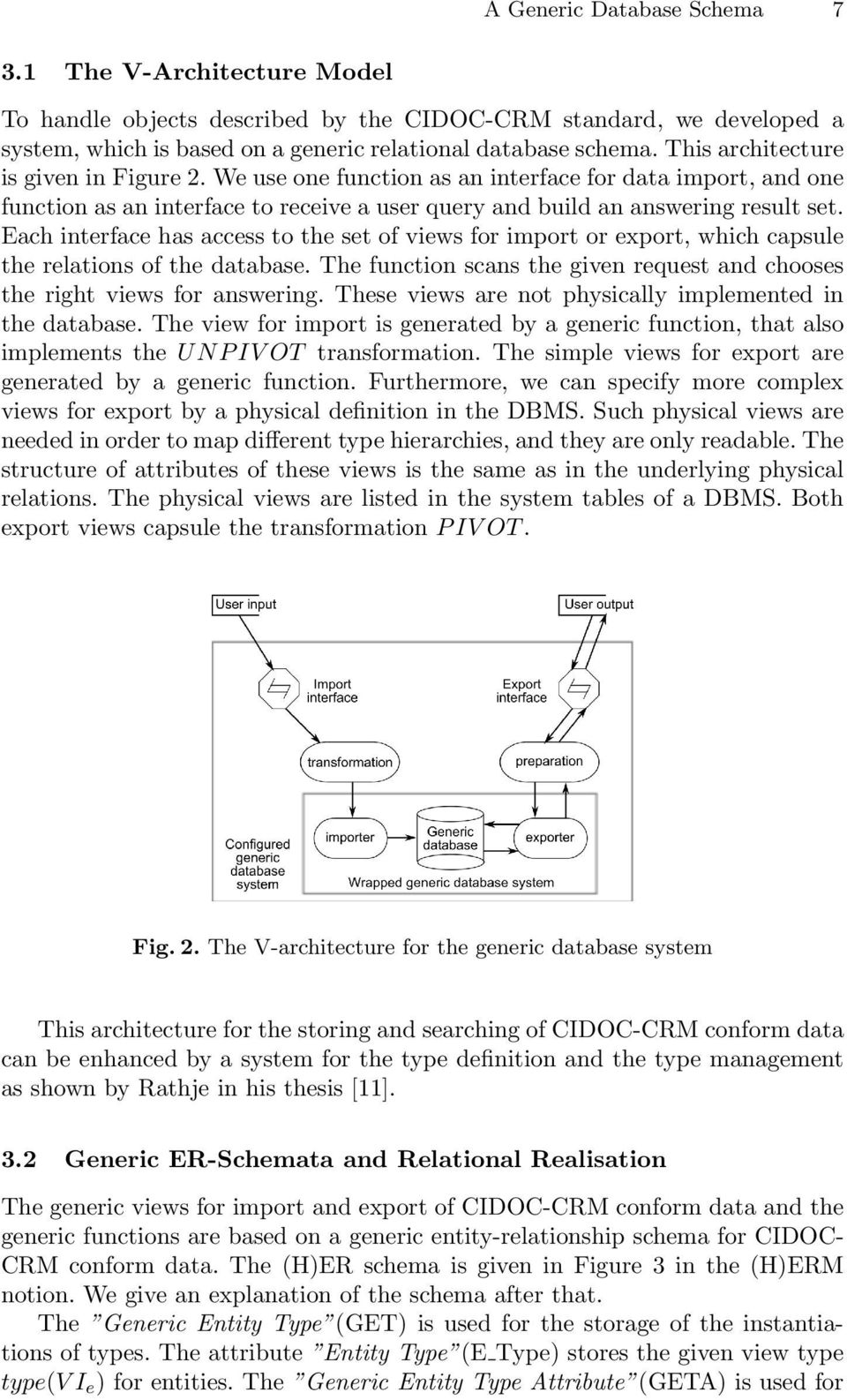
8 8 Kai Jannaschk, Claas Anders Rathje, Bernhard Thalheim and Frank Förster A Name Role ID R Name A Name Source Kind Time GETA Bulk Value Role (1, 1) Bulk Value GRTA Source Kind Time (1,n) GET (0,n) related Source Time GET ID E Type Kind (1,n) GRT (0,n) GRT ID R Type Source Kind Time Fig. 3. Generic database schema in (H)ERM notion the storage of the attribute values of instantiations of types. The attribute Attribute Name (A Name) marks one of the attributes of the view type for the entities attr(v I). The attribute Bulk Value (Bulk Value) stores the value of the attribute. Each instantiation of a generic entity type needs minimum one instantiation of a generic entity type attribute, the identifier of an entity. The Generic Relationship Type (GRT) is used for the storage of the instantiations of relationships. The attribute Relationship Type (R Type) stores the given view type type(vi r ) for relationships. Similar to the generic entity type attribute, there is a Generic Relationship Type Attribute (GRTA) for storing possible attributes of the view for the relationships attr(v I). In a relationship, entities are referenced by a Role (Role). The attribute Role Name (R Name) characterises the role of an instantiation of an entity in an instantiation of a relationship. The role, an entity and a relationship are related in the relationship type related. In each instantiation of the type related, a role identifies the instantiation of an entity in an instantiation of an relationship. The three meta attributes Source, Time, and Kind are used to store the source information, a timestamp of the creation or update of an information, and a state of completion. We use for declaration of the relational schema a table representation where columns are given by the name and the value domain. We assume the existence of a most general value domain, e.g., varchar. The relational type for the Generic Entity Type is stores tuples of entities of an (H)ER model. Generic GET ID E Type Entity Type ID Type varchar The relational type for the Generic Entity Type Attribute stores tuples of entity attributes of an (H)ER model. Generic Entity GET ID A Name Bulk Value Kind Time Source Type Attribute ID Type varchar varchar Ref Type timestamp Ref Type In the relational type Generic Relationship Type the relationship types of an (H)ER model are mapped.

9 A Generic Database Schema 9 Generic GRT ID R Type Kind Time Source Relationship Type ID Type varchar Ref Type timestamp Ref Type In the case of attributes on a relationship type of an (H)ER model we introduce the relational type for the Generic Relationship Type Attributes. Generic Relationship GRT ID A Name Bulk Value Kind Time Source Type Attribute ID Type varchar varchar Ref Type timestamp Ref Type The relationship between entities of Generic Entity Type and Generic Relationship Type are mapped to the relational type of Related By Role. Related Role ID GET ID GRT ID R Name Kind Time Source By Role ID Type ID Type ID Type varchar Ref Type timestamp Ref Type Query Transformation Users create queries about the conceptual model. These queries have to be transformed into queries about the relational model. In our case we have a simple relational model, so the query has to be transformed into a query for the view model. The views transform a query into a query on the underlying relational model. The result of a query will be transformed into a tuple of the bulk composition. Queries on the presented generic database schema are possible on the elements of the bulk composition type. The following search conditions are possible: t: search for instantiations of entities or relationships by a given type ID: search for instantiations of entities by a given set of identifiers, or for instantiations of relationships by a given sequence of identifying entities l: search for instantiations of entities or relationships by defining a set of attributes A combination of the three elements as a search condition is achievable. 4 Conclusion 4.1 Achievements of our Approach The main trick of this approach is the direct data storage of means used in the data dictionary instead of maintaining a data dictionary. This approach is somehow similar to the approach used for Amazon s Simple DB and generalizes the RDF approach in a way that is easier to maintain. Our approach is not useful for data-intensive science, but for easily manageable research projects with mostly stringent scientific objectives represented by the self-defined single views. Therefore, it supports clearly outlined, agile evolving, and even large schemata while storing heterogeneous data. The integration of new simple entity and relationship types is very easy because no new relations are needed in the DBMS. The requirements for entity and relationship types are a small amount of attributes, the functional dependencies in the types are reduced to the DK/NF. Furthermore, we can not specify complex cardinality constraints, and we do not expect mass updates or huge user queries. Only very complex views require a physical redefinition in the database at the moment.

10 10 Kai Jannaschk, Claas Anders Rathje, Bernhard Thalheim and Frank Förster 4.2 Research Agenda One open aspect in this paper is the definition of functions for updating or deleting entities and relationships. Furthermore, the CIDOC-CRM ontology contains a hierarchy of entity types. The views for export need an explicit definition to consider these hierarchies in user queries because the generic database is used for the storage of instantiations of entities and relationships. Otherwise, we have a system for the definition of forms for data input and output. We are working on integrating these hierarchy definitions and user queries. Furthermore, we will expand the query transformation to answer logical connections in the search condition. At last, we need performance measures to avoid bottlenecks in the usage of the system, if the amount of data is increasing. References 1. A. Bienemann, K.-D. Schewe, and B. Thalheim: Towards a theory of genericity based on government and binding. In Proc. ER 06, LNCS 4215, pages Springer (2006) 2. A. Bienemann: A generative approach to functionality of interactive information systems. PhD thesis, CAU Kiel, Dept. of Computer Science (2008) 3. CIDOC CRM Special Interest Group: DiagramV9.pdf (2004) 4. N. Crofts, M. Doerr, T. Gill, S. Stead, and M. Stiff: Definition of the CIDOC Conceptual Reference Model. ICOM/CIDOC CRM Special Interest Group (2010) 5. C. J. Date, H. Darwen, and N.A. Lorentzos: Temporal Data and the Relational Model. Morgan Kaufmann Publishers, USA (2003) 6. C. J. Date: Database in Depth: Relational Theory for Practitioners. O Reilly Media, Inc. (2005) 7. M. Doerr and I. Dionissiadou: Data Example of the CIDOC Reference Model - Epitaphios GE ICOM/CIDOC CRM Special Interest Group (1998) 8. R. Fagin: A normal form for relational databases that is based on domains and keys. ACM Trans. Database Syst., New York, NY, USA (1981) 9. G. Klyne and J. J. Carroll: Resource Description Framework (RDF): Concepts and Abstract Syntax. W3C (2004) 10. Hiu Ma, R. Noack, K.-D. Schewe, and B. Thalheim: Using meta-structures in database design. Informatica, 34: (2010) 11. C.A. Rathje: Kompakte Datenbankschemata mit Sichtensuits. Bachelor Thesis, CAU Kiel, Kiel (2010) 12. J. F. Terwilliger: Graphical User Interfaces As Updatable Views. Dissertation, Portland State University (2009) 13. B. Thalheim: Entity-relationship modeling Foundations of database technology. Springer, Berlin (2000) 14. M. West: Developing High Quality Data Models. The European Process Industries STEP Technical Liaison Executive (EPISTLE), London (1999)

6NF CONCEPTUAL MODELS AND DATA WAREHOUSING 2.0
 ABSTRACT 6NF CONCEPTUAL MODELS AND DATA WAREHOUSING 2.0 Curtis Knowles Georgia Southern University [email protected] Sixth Normal Form (6NF) is a term used in relational database theory by Christopher
Big Data Analytics. Rasoul Karimi
 Big Data Analytics Rasoul Karimi Information Systems and Machine Learning Lab (ISMLL) Institute of Computer Science University of Hildesheim, Germany Big Data Analytics Big Data Analytics 1 / 1 Introduction
SQLMutation: A tool to generate mutants of SQL database queries
 SQLMutation: A tool to generate mutants of SQL database queries Javier Tuya, Mª José Suárez-Cabal, Claudio de la Riva University of Oviedo (SPAIN) {tuya cabal claudio} @ uniovi.es Abstract We present a
The Import & Export of Data from a Database
 The Import & Export of Data from a Database Introduction The aim of these notes is to investigate a conceptually simple model for importing and exporting data into and out of an object-relational database,
Data Modeling Basics
 Information Technology Standard Commonwealth of Pennsylvania Governor's Office of Administration/Office for Information Technology STD Number: STD-INF003B STD Title: Data Modeling Basics Issued by: Deputy
Reverse Engineering of Relational Databases to Ontologies: An Approach Based on an Analysis of HTML Forms
 Reverse Engineering of Relational Databases to Ontologies: An Approach Based on an Analysis of HTML Forms Irina Astrova 1, Bela Stantic 2 1 Tallinn University of Technology, Ehitajate tee 5, 19086 Tallinn,
Some Methodological Clues for Defining a Unified Enterprise Modelling Language
 Some Methodological Clues for Defining a Unified Enterprise Modelling Language Michaël Petit University of Namur, Belgium, [email protected] Abstract The need for a Unified Enterprise Modelling Language
The Entity-Relationship Model
 The Entity-Relationship Model 221 After completing this chapter, you should be able to explain the three phases of database design, Why are multiple phases useful? evaluate the significance of the Entity-Relationship
Security Issues for the Semantic Web
 Security Issues for the Semantic Web Dr. Bhavani Thuraisingham Program Director Data and Applications Security The National Science Foundation Arlington, VA On leave from The MITRE Corporation Bedford,
Bridge from Entity Relationship modeling to creating SQL databases, tables, & relations
 1 Topics for this week: 1. Good Design 2. Functional Dependencies 3. Normalization Readings for this week: 1. E&N, Ch. 10.1-10.6; 12.2 2. Quickstart, Ch. 3 3. Complete the tutorial at http://sqlcourse2.com/
IT2304: Database Systems 1 (DBS 1)
 : Database Systems 1 (DBS 1) (Compulsory) 1. OUTLINE OF SYLLABUS Topic Minimum number of hours Introduction to DBMS 07 Relational Data Model 03 Data manipulation using Relational Algebra 06 Data manipulation
IT2305 Database Systems I (Compulsory)
 Database Systems I (Compulsory) INTRODUCTION This is one of the 4 modules designed for Semester 2 of Bachelor of Information Technology Degree program. CREDITS: 04 LEARNING OUTCOMES On completion of this
www.gr8ambitionz.com
 Data Base Management Systems (DBMS) Study Material (Objective Type questions with Answers) Shared by Akhil Arora Powered by www. your A to Z competitive exam guide Database Objective type questions Q.1
On the general structure of ontologies of instructional models
 On the general structure of ontologies of instructional models Miguel-Angel Sicilia Information Engineering Research Unit Computer Science Dept., University of Alcalá Ctra. Barcelona km. 33.6 28871 Alcalá
Lightweight Data Integration using the WebComposition Data Grid Service
 Lightweight Data Integration using the WebComposition Data Grid Service Ralph Sommermeier 1, Andreas Heil 2, Martin Gaedke 1 1 Chemnitz University of Technology, Faculty of Computer Science, Distributed
How To Write A Diagram
 Data Model ing Essentials Third Edition Graeme C. Simsion and Graham C. Witt MORGAN KAUFMANN PUBLISHERS AN IMPRINT OF ELSEVIER AMSTERDAM BOSTON LONDON NEW YORK OXFORD PARIS SAN DIEGO SAN FRANCISCO SINGAPORE
2 AIMS: an Agent-based Intelligent Tool for Informational Support
 Aroyo, L. & Dicheva, D. (2000). Domain and user knowledge in a web-based courseware engineering course, knowledge-based software engineering. In T. Hruska, M. Hashimoto (Eds.) Joint Conference knowledge-based
Lesson 8: Introduction to Databases E-R Data Modeling
 Lesson 8: Introduction to Databases E-R Data Modeling Contents Introduction to Databases Abstraction, Schemas, and Views Data Models Database Management System (DBMS) Components Entity Relationship Data
14 Databases. Source: Foundations of Computer Science Cengage Learning. Objectives After studying this chapter, the student should be able to:
 14 Databases 14.1 Source: Foundations of Computer Science Cengage Learning Objectives After studying this chapter, the student should be able to: Define a database and a database management system (DBMS)
Databases in Organizations
 The following is an excerpt from a draft chapter of a new enterprise architecture text book that is currently under development entitled Enterprise Architecture: Principles and Practice by Brian Cameron
CRM dig : A generic digital provenance model for scientific observation
 CRM dig : A generic digital provenance model for scientific observation Martin Doerr, Maria Theodoridou Institute of Computer Science, FORTH-ICS, Crete, Greece Abstract The systematic large-scale production
A Methodology for the Development of New Telecommunications Services
 A Methodology for the Development of New Telecommunications Services DIONISIS X. ADAMOPOULOS Centre for Communication Systems Research School of Elec. Eng., IT and Mathematics University of Surrey Guildford
Chapter 1: Introduction. Database Management System (DBMS) University Database Example
 This image cannot currently be displayed. Chapter 1: Introduction Database System Concepts, 6 th Ed. See www.db-book.com for conditions on re-use Database Management System (DBMS) DBMS contains information
A Multidatabase System as 4-Tiered Client-Server Distributed Heterogeneous Database System
 A Multidatabase System as 4-Tiered Client-Server Distributed Heterogeneous Database System Mohammad Ghulam Ali Academic Post Graduate Studies and Research Indian Institute of Technology, Kharagpur Kharagpur,
Definition of the CIDOC Conceptual Reference Model
 Definition of the CIDOC Conceptual Reference Model Produced by the ICOM/CIDOC Documentation Standards Group, continued by the CIDOC CRM Special Interest Group Version 4.2.4 January 2008 Editors: Nick Crofts,
THE OPEN UNIVERSITY OF TANZANIA FACULTY OF SCIENCE TECHNOLOGY AND ENVIRONMENTAL STUDIES BACHELOR OF SIENCE IN DATA MANAGEMENT
 THE OPEN UNIVERSITY OF TANZANIA FACULTY OF SCIENCE TECHNOLOGY AND ENVIRONMENTAL STUDIES BACHELOR OF SIENCE IN DATA MANAGEMENT ODM 106.DATABASE CONCEPTS COURSE OUTLINE 1.0 Introduction This introductory
Query Processing in Data Integration Systems
 Query Processing in Data Integration Systems Diego Calvanese Free University of Bozen-Bolzano BIT PhD Summer School Bressanone July 3 7, 2006 D. Calvanese Data Integration BIT PhD Summer School 1 / 152
Application of XML Tools for Enterprise-Wide RBAC Implementation Tasks
 Application of XML Tools for Enterprise-Wide RBAC Implementation Tasks Ramaswamy Chandramouli National Institute of Standards and Technology Gaithersburg, MD 20899,USA 001-301-975-5013 [email protected]
Definition of the CIDOC Conceptual Reference Model
 Definition of the CIDOC Conceptual Reference Model Produced by the ICOM/CIDOC Documentation Standards Group, Continued by the CIDOC CRM Special Interest Group Version 5.1(draft) November 2012 Current Main
æ A collection of interrelated and persistent data èusually referred to as the database èdbèè.
 CMPT-354-Han-95.3 Lecture Notes September 10, 1995 Chapter 1 Introduction 1.0 Database Management Systems 1. A database management system èdbmsè, or simply a database system èdbsè, consists of æ A collection
Complex Information Management Using a Framework Supported by ECA Rules in XML
 Complex Information Management Using a Framework Supported by ECA Rules in XML Bing Wu, Essam Mansour and Kudakwashe Dube School of Computing, Dublin Institute of Technology Kevin Street, Dublin 8, Ireland
2. Basic Relational Data Model
 2. Basic Relational Data Model 2.1 Introduction Basic concepts of information models, their realisation in databases comprising data objects and object relationships, and their management by DBMS s that
Configuration Management Models in Commercial Environments
 Technical Report CMU/SEI-91-TR-7 ESD-9-TR-7 Configuration Management Models in Commercial Environments Peter H. Feiler March 1991 Technical Report CMU/SEI-91-TR-7 ESD-91-TR-7 March 1991 Configuration Management
3. Relational Model and Relational Algebra
 ECS-165A WQ 11 36 3. Relational Model and Relational Algebra Contents Fundamental Concepts of the Relational Model Integrity Constraints Translation ER schema Relational Database Schema Relational Algebra
2 Associating Facts with Time
 TEMPORAL DATABASES Richard Thomas Snodgrass A temporal database (see Temporal Database) contains time-varying data. Time is an important aspect of all real-world phenomena. Events occur at specific points
ARIADNE CONSERVATION DOCUMENTATION SYSTEM: CONCEPTUAL DESIGN AND PROJECTION ON THE CIDOC CRM. FRAMEWORK AND LIMITS
 ARIADNE CONSERVATION DOCUMENTATION SYSTEM: CONCEPTUAL DESIGN AND PROJECTION ON THE CIDOC CRM. FRAMEWORK AND LIMITS Department of Conservation of Antiquities & Works of Art, TEI Athens Ag Spiridonos 12210
Business-Driven Software Engineering Lecture 3 Foundations of Processes
 Business-Driven Software Engineering Lecture 3 Foundations of Processes Jochen Küster [email protected] Agenda Introduction and Background Process Modeling Foundations Activities and Process Models Summary
BCA. Database Management System
 BCA IV Sem Database Management System Multiple choice questions 1. A Database Management System (DBMS) is A. Collection of interrelated data B. Collection of programs to access data C. Collection of data
City Data Pipeline. A System for Making Open Data Useful for Cities. [email protected]
 City Data Pipeline A System for Making Open Data Useful for Cities Stefan Bischof 1,2, Axel Polleres 1, and Simon Sperl 1 1 Siemens AG Österreich, Siemensstraße 90, 1211 Vienna, Austria {bischof.stefan,axel.polleres,simon.sperl}@siemens.com
Table of Contents. CHAPTER 1 Web-Based Systems 1. CHAPTER 2 Web Engineering 12. CHAPTER 3 A Web Engineering Process 24
 Table of Contents CHAPTER 1 Web-Based Systems 1 The Web 1 Web Applications 2 Let s Introduce a Case Study 3 Are WebApps Really Computer Software? 4 Are the Attributes of WebApps Different from the Attributes
A Pattern-based Framework of Change Operators for Ontology Evolution
 A Pattern-based Framework of Change Operators for Ontology Evolution Muhammad Javed 1, Yalemisew M. Abgaz 2, Claus Pahl 3 Centre for Next Generation Localization (CNGL), School of Computing, Dublin City
CHAPTER 5: BUSINESS ANALYTICS
 Chapter 5: Business Analytics CHAPTER 5: BUSINESS ANALYTICS Objectives The objectives are: Describe Business Analytics. Explain the terminology associated with Business Analytics. Describe the data warehouse
Model Driven Interoperability through Semantic Annotations using SoaML and ODM
 Model Driven Interoperability through Semantic Annotations using SoaML and ODM JiuCheng Xu*, ZhaoYang Bai*, Arne J.Berre*, Odd Christer Brovig** *SINTEF, Pb. 124 Blindern, NO-0314 Oslo, Norway (e-mail:
technische universiteit eindhoven WIS & Engineering Geert-Jan Houben
 WIS & Engineering Geert-Jan Houben Contents Web Information System (WIS) Evolution in Web data WIS Engineering Languages for Web data XML (context only!) RDF XML Querying: XQuery (context only!) RDFS SPARQL
Schema Evolution in SQL-99 and Commercial (Object-)Relational DBMS
 Schema Evolution in SQL-99 and Commercial (Object-)Relational DBMS Can Türker Swiss Federal Institute of Technology (ETH) Zurich Institute of Information Systems, ETH Zentrum CH 8092 Zurich, Switzerland
Modeling BPMN Diagrams within XTT2 Framework. A Critical Analysis**
 AUTOMATYKA 2011 Tom 15 Zeszyt 2 Antoni Ligêza*, Tomasz Maœlanka*, Krzysztof Kluza*, Grzegorz Jacek Nalepa* Modeling BPMN Diagrams within XTT2 Framework. A Critical Analysis** 1. Introduction Design, analysis
Chapter 1: Introduction
 Chapter 1: Introduction Database System Concepts, 5th Ed. See www.db book.com for conditions on re use Chapter 1: Introduction Purpose of Database Systems View of Data Database Languages Relational Databases
Following a guiding STAR? Latest EH work with, and plans for, Semantic Technologies
 Following a guiding STAR? Latest EH work with, and plans for, Semantic Technologies Presented by Keith May Based on research work of English Heritage staff especially Paul Cripps & Phil Carlisle (NMR DSU)
II. PREVIOUS RELATED WORK
 An extended rule framework for web forms: adding to metadata with custom rules to control appearance Atia M. Albhbah and Mick J. Ridley Abstract This paper proposes the use of rules that involve code to
CSC 742 Database Management Systems
 CSC 742 Database Management Systems Topic #4: Data Modeling Spring 2002 CSC 742: DBMS by Dr. Peng Ning 1 Phases of Database Design Requirement Collection/Analysis Functional Requirements Functional Analysis
Report on the Dagstuhl Seminar Data Quality on the Web
 Report on the Dagstuhl Seminar Data Quality on the Web Michael Gertz M. Tamer Özsu Gunter Saake Kai-Uwe Sattler U of California at Davis, U.S.A. U of Waterloo, Canada U of Magdeburg, Germany TU Ilmenau,
Chapter 8 The Enhanced Entity- Relationship (EER) Model
 Chapter 8 The Enhanced Entity- Relationship (EER) Model Copyright 2011 Pearson Education, Inc. Publishing as Pearson Addison-Wesley Chapter 8 Outline Subclasses, Superclasses, and Inheritance Specialization
From Object Oriented Conceptual Modeling to Automated Programming in Java
 From Object Oriented Conceptual Modeling to Automated Programming in Java Oscar Pastor, Vicente Pelechano, Emilio Insfrán, Jaime Gómez Department of Information Systems and Computation Valencia University
Modern Systems Analysis and Design
 Modern Systems Analysis and Design Prof. David Gadish Structuring System Data Requirements Learning Objectives Concisely define each of the following key data modeling terms: entity type, attribute, multivalued
Chapter 7 Data Modeling Using the Entity- Relationship (ER) Model
 Chapter 7 Data Modeling Using the Entity- Relationship (ER) Model Copyright 2011 Pearson Education, Inc. Publishing as Pearson Addison-Wesley Chapter 7 Outline Using High-Level Conceptual Data Models for
Chapter 2 Database System Concepts and Architecture
 Chapter 2 Database System Concepts and Architecture Copyright 2011 Pearson Education, Inc. Publishing as Pearson Addison-Wesley Chapter 2 Outline Data Models, Schemas, and Instances Three-Schema Architecture
An Ontological Approach to Oracle BPM
 An Ontological Approach to Oracle BPM Jean Prater, Ralf Mueller, Bill Beauregard Oracle Corporation, 500 Oracle Parkway, Redwood City, CA 94065, USA [email protected], [email protected], [email protected]
Instant SQL Programming
 Instant SQL Programming Joe Celko Wrox Press Ltd. INSTANT Table of Contents Introduction 1 What Can SQL Do for Me? 2 Who Should Use This Book? 2 How To Use This Book 3 What You Should Know 3 Conventions
A Data Browsing from Various Sources Driven by the User s Data Models
 A Data Browsing from Various Sources Driven by the User s Data Models Guntis Arnicans, Girts Karnitis University of Latvia, Raina blvd. 9, Riga, Latvia {Guntis.Arnicans, Girts.Karnitis}@lu.lv Abstract.
A Workbench for Prototyping XML Data Exchange (extended abstract)
 A Workbench for Prototyping XML Data Exchange (extended abstract) Renzo Orsini and Augusto Celentano Università Ca Foscari di Venezia, Dipartimento di Informatica via Torino 155, 30172 Mestre (VE), Italy
OWL based XML Data Integration
 OWL based XML Data Integration Manjula Shenoy K Manipal University CSE MIT Manipal, India K.C.Shet, PhD. N.I.T.K. CSE, Suratkal Karnataka, India U. Dinesh Acharya, PhD. ManipalUniversity CSE MIT, Manipal,
ProGUM-Web: Tool Support for Model-Based Development of Web Applications
 ProGUM-Web: Tool Support for Model-Based Development of Web Applications Marc Lohmann 1, Stefan Sauer 1, and Tim Schattkowsky 2 1 University of Paderborn, Computer Science, D 33095 Paderborn, Germany {mlohmann,sauer}@upb.de
Requirements Ontology and Multi representation Strategy for Database Schema Evolution 1
 Requirements Ontology and Multi representation Strategy for Database Schema Evolution 1 Hassina Bounif, Stefano Spaccapietra, Rachel Pottinger Database Laboratory, EPFL, School of Computer and Communication
Mapping between Levels in the Metamodel Architecture
 Mapping between Levels in the Metamodel Architecture José Álvarez, Andy Evans 2, Paul Sammut 2 Dpto. de Lenguajes y Ciencias de la Computación, University Málaga, Málaga, 2907, Spain [email protected]
An Ontology-based e-learning System for Network Security
 An Ontology-based e-learning System for Network Security Yoshihito Takahashi, Tomomi Abiko, Eriko Negishi Sendai National College of Technology [email protected] Goichi Itabashi Graduate School
Annotea and Semantic Web Supported Collaboration
 Annotea and Semantic Web Supported Collaboration Marja-Riitta Koivunen, Ph.D. Annotea project Abstract Like any other technology, the Semantic Web cannot succeed if the applications using it do not serve
A generic approach for data integration using RDF, OWL and XML
 A generic approach for data integration using RDF, OWL and XML Miguel A. Macias-Garcia, Victor J. Sosa-Sosa, and Ivan Lopez-Arevalo Laboratory of Information Technology (LTI) CINVESTAV-TAMAULIPAS Km 6
1 File Processing Systems
 COMP 378 Database Systems Notes for Chapter 1 of Database System Concepts Introduction A database management system (DBMS) is a collection of data and an integrated set of programs that access that data.
Semantic Interoperability
 Ivan Herman Semantic Interoperability Olle Olsson Swedish W3C Office Swedish Institute of Computer Science (SICS) Stockholm Apr 27 2011 (2) Background Stockholm Apr 27, 2011 (2) Trends: from
It s all around the domain ontologies - Ten benefits of a Subject-centric Information Architecture for the future of Social Networking
 It s all around the domain ontologies - Ten benefits of a Subject-centric Information Architecture for the future of Social Networking Lutz Maicher and Benjamin Bock, Topic Maps Lab at University of Leipzig,
CS2Bh: Current Technologies. Introduction to XML and Relational Databases. Introduction to Databases. Why databases? Why not use XML?
 CS2Bh: Current Technologies Introduction to XML and Relational Databases Spring 2005 Introduction to Databases CS2 Spring 2005 (LN5) 1 Why databases? Why not use XML? What is missing from XML: Consistency
STAR Semantic Technologies for Archaeological Resources. http://hypermedia.research.glam.ac.uk/kos/star/
 STAR Semantic Technologies for Archaeological Resources http://hypermedia.research.glam.ac.uk/kos/star/ Project Outline 3 year AHRC funded project Started January 2007, finish December 2009 Collaborators
Training Management System for Aircraft Engineering: indexing and retrieval of Corporate Learning Object
 Training Management System for Aircraft Engineering: indexing and retrieval of Corporate Learning Object Anne Monceaux 1, Joanna Guss 1 1 EADS-CCR, Centreda 1, 4 Avenue Didier Daurat 31700 Blagnac France
THE ENTITY- RELATIONSHIP (ER) MODEL CHAPTER 7 (6/E) CHAPTER 3 (5/E)
 THE ENTITY- RELATIONSHIP (ER) MODEL CHAPTER 7 (6/E) CHAPTER 3 (5/E) 2 LECTURE OUTLINE Using High-Level, Conceptual Data Models for Database Design Entity-Relationship (ER) model Popular high-level conceptual
The Relational Model. Ramakrishnan&Gehrke, Chapter 3 CS4320 1
 The Relational Model Ramakrishnan&Gehrke, Chapter 3 CS4320 1 Why Study the Relational Model? Most widely used model. Vendors: IBM, Informix, Microsoft, Oracle, Sybase, etc. Legacy systems in older models
A terminology model approach for defining and managing statistical metadata
 A terminology model approach for defining and managing statistical metadata Comments to : R. Karge (49) 30-6576 2791 mail [email protected] Content 1 Introduction... 4 2 Knowledge presentation...
XML-based Web Service for Collaborative Product Data Management
 XML-based Web Service for Collaborative Product Data Management Mario Štorga 1, Dorian Marjanovic 1, Nenad Bojcetic 1 1 Faculty of Mechanical Engineering and Naval Architecture, Ivana Lucica 5, 10000 Zagreb,
Oracle Data Integrator: Administration and Development
 Oracle Data Integrator: Administration and Development What you will learn: In this course you will get an overview of the Active Integration Platform Architecture, and a complete-walk through of the steps
Towards a reference architecture for Semantic Web applications
 Towards a reference architecture for Semantic Web applications Benjamin Heitmann 1, Conor Hayes 1, and Eyal Oren 2 1 [email protected] Digital Enterprise Research Institute National University
Demonstrating WSMX: Least Cost Supply Management
 Demonstrating WSMX: Least Cost Supply Management Eyal Oren 2, Alexander Wahler 1, Bernhard Schreder 1, Aleksandar Balaban 1, Michal Zaremba 2, and Maciej Zaremba 2 1 NIWA Web Solutions, Vienna, Austria
Semantic Search in Portals using Ontologies
 Semantic Search in Portals using Ontologies Wallace Anacleto Pinheiro Ana Maria de C. Moura Military Institute of Engineering - IME/RJ Department of Computer Engineering - Rio de Janeiro - Brazil [awallace,anamoura]@de9.ime.eb.br
Integrating data from The Perseus Project and Arachne using the CIDOC CRM An Examination from a Software Developer s Perspective
 Integrating data from The Perseus Project and Arachne using the CIDOC CRM An Examination from a Software Developer s Perspective Robert Kummer, Perseus Project at Tufts University and Research Archive
A Review of Database Schemas
 A Review of Database Schemas Introduction The purpose of this note is to review the traditional set of schemas used in databases, particularly as regards how the conceptual schemas affect the design of
MPD Technical Webinar Transcript
 MPD Technical Webinar Transcript Mark Kindl: On a previous Webinar, the NTAC Coordinator and one of the Co-Chairs of the NTAC introduced the NIEM MPD specification, which defines releases and IEPDs. In
Mapping VRA Core 4.0 to the CIDOC/CRM ontology
 1 st Workshop on Digital Information Management March 30-31, 2011 Mapping VRA Core 4.0 to the CIDOC/CRM ontology Panorea Gaitanou, Manolis Gergatsoulis Database and Information Systems Group (DBIS) Laboratory
Concept for an Ontology Based Web GIS Information System for HiMAT
 Concept for an Ontology Based Web GIS Information System for HiMAT Gerald Hiebel Klaus Hanke University of Innsbruck Surveying and Geoinformation Unit {gerald.hiebel; klaus.hanke}@uibk.ac.at Abstract The