
DEPARTMENT OF POLITICAL SCIENCE, AMU
|
|
|
- Joan Pope
- 10 years ago
- Views:
Transcription
1 M.A. (Political Science) I Semester, Compulsory PLM 7001/HRM 7006: INTERNATIONAL RELATIONS UNIT 1: STATE SYSTEM AND THEORIES a) International Relations : A Historical Perspective; IR and the State System b) Realism and Neo-realism, Liberalism and Neo-Liberalism c) Approaches: Marxism, Feminism, Constructivism UNIT II: INTERNATIONAL POLITICAL PROCESSES a) International Society: Order and Justice; Statecraft and Responsibility b) Diplomacy and World Politics; Diplomacy and Foreign Policy c) National and Global Security : Cooperation and Tensions UNIT III: ARMS AND WARS a) Nature, Causes and Types of Wars/Conflicts b) Conventional, Nuclear, Bio-Chemical Wars c) Arms Race, Arms Control and Disarmament 1. John Baylis and Steve Smith, The Globalisation of World Politics: An Introduction to International Relations (latest edition) 2. Robert Jackson and George Sorensen, Introduction to International Relations 3. Karl W. Deutsch, The Analysis of International Relations 4. Hans J. Morgenthau, Politics Among Nations 5. John Spanier, Games Nations Play 6. Joshua S. Goldstein, International Relations 7. Paul R. Viotti and Mark V. Kauppi, International Relations and World Politics: Security, Economy, Identity 8. Keith L. Shimko, International Relation: Perspectives and Controversies

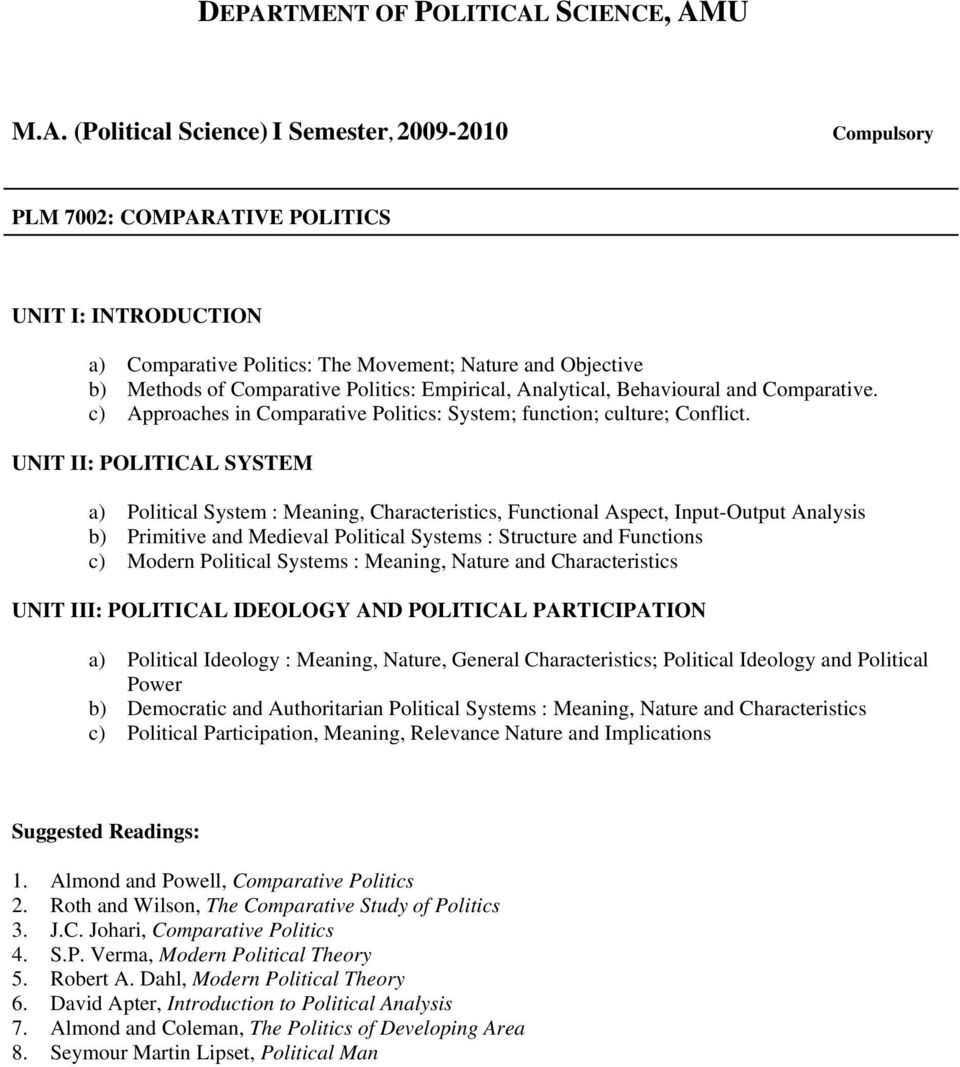
2 M.A. (Political Science) I Semester, Compulsory PLM 7002: COMPARATIVE POLITICS UNIT I: INTRODUCTION a) Comparative Politics: The Movement; Nature and Objective b) Methods of Comparative Politics: Empirical, Analytical, Behavioural and Comparative. c) Approaches in Comparative Politics: System; function; culture; Conflict. UNIT II: POLITICAL SYSTEM a) Political System : Meaning, Characteristics, Functional Aspect, Input-Output Analysis b) Primitive and Medieval Political Systems : Structure and Functions c) Modern Political Systems : Meaning, Nature and Characteristics UNIT III: POLITICAL IDEOLOGY AND POLITICAL PARTICIPATION a) Political Ideology : Meaning, Nature, General Characteristics; Political Ideology and Political Power b) Democratic and Authoritarian Political Systems : Meaning, Nature and Characteristics c) Political Participation, Meaning, Relevance Nature and Implications 1. Almond and Powell, Comparative Politics 2. Roth and Wilson, The Comparative Study of Politics 3. J.C. Johari, Comparative Politics 4. S.P. Verma, Modern Political Theory 5. Robert A. Dahl, Modern Political Theory 6. David Apter, Introduction to Political Analysis 7. Almond and Coleman, The Politics of Developing Area 8. Seymour Martin Lipset, Political Man
3 M.A. (Political Science) I Semester, Compulsory PLM 7003: PRINCIPLES OF PUBLIC ADMINISTRATION: THEORY UNIT I: INTRODUCTION a) Meaning, Nature and Scope of Public Administration b) Importance of Public Administration, Public and Private Administation c) Study of Public Administration : Methods UNIT II: ADMINISTRATIVE THEORY a) The Theory of Scientific Management : F.W. Taylor b) The Theory of Bureacracy : Max Weber c) The Theory of Human Relations : George Elton Mayo UNIT III: ORGANISATION a) Organisation : Meaning, importance; Bases; Formal and Informal Organisation b) Organisation : Hierachy, Span of Control and Unity of Command c) Principles of Organisation : Communication, Co-ordination 1. Marx Fritz Morstein (ed.), Elements of Public Administration 2. Dimock Marshall E. and Glazda Dimock, Public Administration 3. Appleby, Paul H.L., Policy and Administration 4. Stahl, O. Glem, Public Personnel Administration 5. Piffner, John L. and Frank P. Sherwood, Administrative Organisation 6. Walso, O., The Study of Public Administration 7. Gaus and Others, The Frontiers of Public Administration 8. Taylor, F.W., The Principles of Scientific Management 9. White, L.D., An Introduction to the Study of Public Administration 10. Willoughby F.W., Principles of Public Administration 11. M.P. Sharma, Public Administration in Theory and Practice 12. Avasthi and Maheshwari, Public Administration 13. R.K. Sapru, Administrative Thinkers

4 M.A. (Political Science) I Semester, Compulsory PLM 7004: POLITICAL THOUGHT (ANCIENT AND MEDIEVAL) UNIT I: INTRODUCING POLITICAL THOUGHT a) Political Thought : Meaning & Importance b) Features of Greek Political Thought c) Plato and his times : Theory of Justice, Ideal State, Communism of Wives and Property, Education: A Comparison of the Republic and the Laws UNIT II: EARLY POLITICAL THOUGHT a) Aristotle (I) : Origin of State, Nature of State, The Best Practicable State b) Aristotle (II) : Classification of Governments : Revolutions; Causes and Remedies c) Cicero Origin and Basis of State, Theory of Natural Law & Natural Equality UNIT III: ROMAN AND MEDIEVAL POLITICAL THOUGHT a) Seneca: Theory of Wiseman s Social Service, Theory of Primitive Innocence and State Formation b) Salient Features of Medieval Political Thought c) St. Thomas Aquinas : Law and its Classification; State and Church 1. Arnold Brecht, Political Theory 2. G. Sabine, History of Political Theory 3. Ebenstein, Great Political Thinkers 4. Ebenstein, Political Thought in Perspective 5. Ebenstein, Modern Political Thought 6. C.L. Wayper, Political Thought 7. Chester C. Maxey, Political Philosophies 8. Lare C. Lancaster, Masters of Political Thought (Vols. I,II,III) 9. S. Mukherjee and S. Ramaswamy, A History of Political Thought Pluto to Marx 10. J.A. Dunning, History and Political Theories 11. W. Durant, Story of Philosophy 12. N.P. Barry, Introduction to Modern Political Theory

5 Department of Political Science, AMU M.A. (Political Science) I Semester, Compulsory PLM 7005: INTERNATIONAL LAW (PEACE) UNIT I: NATURE OF INTERNATIONAL LAW a) Definition and Nature of International Law, Problem of Sanctions b) Sources of International Law : Positivism and Naturalism, Material Source of International Law c) Relation between International Law and Municipal Law : Theories and Practices (particularly of the USA, the UK and India) UNIT II: EXTRADITION AND RECOGNITION a) Definition of Extradition, Conditions of Extradition, Extradition of Nationals b) Definition of Recognition, Recognition of States, Recognition of Governments. Defacto & De Jure Recognition c) Diplomatic Envoys : Categories, Functions, Privileges and Immunities, Right to Innocent Passage UNIT III: INTERNATIONAL SANCTIONS AND INTERNATIONAL ACTIONS a) Intervention : Definition and Grounds of Intervention, Monroe Doctrine, Drago Doctrine b) Treaty Making Process : Definition, Stages of the Treaty Making Process, Termination of Treaties, the Principle of Pacta Sunt Servanda and Rebus Siestatibus c) Air Law (Including Air Craft-Hijacking) 1. L. Oppenheim, International Law, Vol. I &II 2. Sir Robert Jennings O.C., Oppenheim s International Law 3. Sir Arthur Watts K.C.M.C., Introduction and Part I Vol. I (Peace), Parts 2 to 4 4. J.G. Strake, Introduction to International Law 5. Max Sorensen, Manual of Public International Law 6. Charles G. Fenwink, International Law 7. G.V. Glahn, Law Among Nations 8. Urban G. Whitaker (JR), Politics and Power : A Text in International Law 9. S.W. Grieg, International Law 10. A.D. Michael, A Modern Introduction to International Law 11. R.W. Bridge, The Law of Nations : Cases, Documents and Notes 12. D.P.O. Connell, International Law, Vols. I and II 13. I. Brownlie, Principles of Public International Law 14. L.C. Green, International Law Through the Cases 15. William W. Bishop, International Law : Cases and Materials 16. Waner Levi, Contemporary International Law 17. Richard N. Swift, International Law 18. Rebecca M. Wallace, International Law, Second Ed. 1995

6 M.A. (Public Administration) I Semester, Compulsory PAM 7003: PERSONNEL ADMINISTRATION UNIT I: PERSONNEL ADMINISTRATION UNIT II: UNIT III: a) Public Services in Modern States : Significance, Meaning and Functions b) Salient Features of Public Personnel Administration in India c) Salient Features of Public Personnel Administration in USA a) Public Service Commission b) Recruitment : Importance, Methods and Problems c) Position Classification a) Training : Objectives and Types of Training; training of civil servants in India and U.K. b) Promotion : Significance and Principles; Merits and Demerits of Seniority and Merit basis of Promotion c) Civil Service Associations : Legal Rights of Employees 1. O. Glenn Stahl, Public Personnel Administration 2. Felix Pannaudikar, Public Personnel Administration 3. Pai Panaudikar, Personnel System for Development 4. B.B. Misra, Bureaucracy in India 5. Paul Pigers and Chalres A., Personnel Administration : Point of View and a Method 6. Dwarakadas R., Role of Higher Civil Services in India 7. Ghosh P., Personnel Administration India 8. Administrative Reforms Commission, Report on Personnel Administration 9. Avasthi and Maheshwari, Public Administration 10. M.P. Sharma, Public Administration in Theory and Practice

7 M.A. (Public Administration) I Semester, Compulsory PAM 7004: ADMINISTRATIVE THINKERS UNIT I: UNIT II: UNIT III: a) Kautilya : Principles of Public Administration Machinery of Administration b) Woodrow Wilson : Politics - Administration Dichotomy, Comparative Method c) Henry Fayol : Principles of Administration, A Critical Appraisal a) F.W. Taylor : Principles of Scientific Management, Mental Revolution b) Luther Gulick : Functions of Administration - POSDCORB, Principles of Organisation c) Lyndall Urwick : Administrative Management, Structure of Organisation a) Mary Parker Follett : Constructive Conflict, Conflict Resolving and Bases of Integration b) George Elton Mayo : The Hawthorne Studies and the Behaviour of Workers c) Chris Argyris : The Formal Organisation, Individual and Group Adaptation 1. M.E. Dimock, A Philosophy of Administration 2. Prasad and Prasad (eds.), Administrative Thinkers 3. Ali Shamsunnisa, Eminent Administrative Thinkers 4. F. Marini, Towards New Public Administration 5. R.N. Singh, Management Thought and Thinkers 6. D.A. Wren, The Evaluation of Management Thought

8 M.A. (Public Administration) I Semester, Compulsory PAM 7005: DEVELOPMENT ADMINISTRATION WITH SPECIAL REFERENCE TO INDIA UNIT I: DEVELOPMENT ADMINISTRATION CONCEPT a) Nature Scope and Significance of Development Administration b) Dimensions and Characteristics of Development c) Concept of Development and Underdevelopment Meaning, Factors and Reasons for Underdevelopment UNIT II: PUBLIC ADMINISTRATION - AN INSTRUMENT FOR DEVELOPMENT ADMINISTRATION a) Public Administration in Social and Economic Development b) Role of Public Administration in National Development c) Bureaucracy and Development : Role in Modern Context UNIT III: ADMINISTRATION OF DEVELOPMENT a) Development and Human Environment : Concept and Issues of Environment and Sustainable Development b) Voluntary Associations and Development c) Participatory Development 1. Mohit Bhattacharya, Development Administration : 2. R.K. Sapru, Development Administration 3. S.K. Chatterjee, Development Administration 4. R.K. Sapru, Indian Administration 5. R.D. Sharma, Development Administration : Theory and Practice 6. V.A. Pai Panandikar, Development Administration : Theory and Practice 7. P.R. Dubashi, Essays in Development Administration 8. F.W. Riggs, Administration in Developing Countries

9 M.A. (Human Rights) I Semester, Compulsory HRM 7001/HR 701: INTRODUCTION TO HUMAN RIGHTS UNIT I: UNDERSTANDING THE CONCEPT OF RIGHTS AND DUTIES a) Meaning, Nature and Significance of the Concept of Human Rights; Classification of Human Rights b) Evolution of the Concept of Rights - From Magna Carta to the International Bill of Rights c) The Concept of Duties; Classification of Duties; Relationship between Rights and Duties; Duties in the Afro-Asian and Latin American Traditions UNIT II: THEORIES OF RIGHTS a) Theory of Natural Rights b) The Socialist and Marxist Theory of Rights c) Legal/Positive Theory of Rights UNIT III: NON-WESTERN PERSPECTIVES OF HUMAN RIGHTS a) Cultural Relativism and Human Rights b) Islamic and Hindu-Buddhist Traditions of Human Rights c) Chinese and African Perspectives of Human Rights 1. Buergenthal, Thomas, International Human Rights in Nutshell, 2 nd ed., West Publishing Co., Cranston, Maurice, What are Human Rights? (London, 1973) 3. Davidson, Scott, Human Rights (Buckingham, 1993) 4. Donnelly, Jack, The Concept of Human Rights (London, 1985) 5. Donnelly, Universal Human Rights in Theory and Practice, 3 rd ed., (Ithaca, 2003) 6. Lawson, Edward, Encyclopaedia of Human Rights (Washington, 1996) 7. Mahmood, Tahir (ed.), Human Rights in Islamic Law (New Delhi, 1993) 8. Mayer, A.E., Islam and Human Rights : Tradition and Politics (Boulder, 1995) 9. Rai, Lal Deosa, Human Rights in the Hindu-Buddhist Tradition (New Delhi, 1996) 10. Robertson, A.H., J.G. Merrills, Human Rights in the World : An Introduction to the Study of the International Protection of Human Rights, 4 th ed., Manchester, 1996) 11. UNESCO, Philosophical Foundations of Human Rights (Paris; UNESCO, 1986) 12. Vijapur, Abdulrahim P., UN at Fifty--Studies in Human Rights (New Delhi, 1996) 13. Waldron, Jeremy, Theories of Rights (Oxford, 1990)

10 M.A. (Human Rights) I Semester, Compulsory HRM 7002: HUMAN RIGHTS IN INDIA UNIT I: EVOLUTION OF HUMAN RIGHTS a) Historical and Philosophical Foundations of Human Rights in India b) Human Rights and Social Movements of the 19 th and Early 20 th Centuries : Reformist and Revivalist c) Struggle for Human Rights during the British Rule; Opposition to Colonialism, Racialism; Human Rights in Free India UNIT II: HUMAN RIGHTS AND THE INDIAN STATE a) Fundamental Rights and Fundamental Duties in the Constitution of India; Nature and Implementation b) Directive Principles of State Policy and the Protection of Human Rights : The Indian Experience c) The Supreme Court and the Fundamental Rights An Analysis of Major Cases on Article 21 and 25 UNIT III: NATIONAL COMMISSIONS TO PROTECT HUMAN RIGHTS a) NHRC : Composition, Powers, Functions and Role b) National Commission on the Scheduled Castes and Scheduled Tribes : Composition, Powers/Functions and Role c) National Commission on Minorities : Composition, Powers, Functions and Role. 1. Sankar Sen, Human Rights in a Developing Society 2. Vijay K. Gupta, Perspectives on Human Rights 3. Air Commdr R.V. Kumar, Human Rights and the Indian Armed Forces 4. S. Subrahmanyam, Human Rights, 5. D.D. Basu, Human Rights in Constitutional Law 6. Lal Deosa Rai, Human Rights in the Hindu-Buddhist Tradition 7. Romila Thapar, The Problem of Human Rights in the Hindu and Buddhist Tradition 8. Justice V.R. Krishna Iyar, Human Rights A Judge s Miscellany 9. Iqbal A. Ansari, Readings on Minorities 10. Rajendra Pandey, Minorities in India 11. K.C. Yadav, India s Unequal Citizens

11 M.A. (Human Rights) I Semester, Compulsory HRM 7003: INTERNATIONAL HUMANITARIAN LAW UNIT I: GENERAL INTRODUCTION a) Inter-State Resort to Force and International Law Prohibition of Use of Force and its Exceptions; Use of Force and International Humanitarian Law Relationship Between Jus ad bellum and Jus in bello. b) International Humanitarian Law (IHL) Origin, Historical Development and Sources. c) Relationship Between IHL & Human Rights Law Similarities, Differences and Mutual Influence; The Problem of Applicability of Human Rights Law in Situations of Armed Conflict. UNIT II: PROTECTED PERSONS a) Protection of the Wounded, Sick and Shipwrecked; Protection of Medical Personnel Establishment and Transport; Protection of Religious Personnel. b) Protection of Prisoners of War (POWs) Combatant and POW Status; Treatment of POWs, Release and Repatriation of POWs. c) Protection of Civilians Definition of Protected Civilians; General Protection of Civilians in Times of Armed Conflict; Protection of Civilians in Occupied Territory. UNIT III: CONDUCT OF HOSTILITIES a) Means and Methods of Warfare Prohibited Weapons Conventional Weapons, Biological & Chemical Weapons; Status of Nuclear Weapons; Prohibited Methods Perfidy and other Prohibited Methods of Warfare. b) Implementation of IHL State Obligation in Times of Peace and Armed Conflict; Scrutiny by Protecting Power and the ICRC. c) Repression of Violations The Concept of Grave Breaches and the Concept of War Crimes; War Crimes Trial from Nuremberg to Rome. 1. Dieter Fleck, The Handbook of Humanitarian Law in Armed Conflicts (Oxford: OUP, 1995) 2. Marco Sassoli and Antoine A. Bouvier, How Does Law Protect in War? (Geneva : ICRC, 1995) 3. L.C. Green, The Contemporary Law of Armed Conflict (Manchester : Manchester University Press, 2000) 4. Yoram Dinstein, The Conduct of Hostilities Under the Law of International Armed Conflict (Cambridge : CUP, 2004) 5. A.P.V. Rogers, Law on the Battlefield (Manchester : MUP, 2004) 6. Ingrid Detter, The Law of War (Cambridge : CUP, 2000) 7. Jean-Marie Henckaerts and Louise Doswald-Beck, Customary International Humanitarian Law (Cambridge : CUP, 2005) 8. Geoffrey Best, Humanity in Warfare (London : Weidenfeld and Nicolson, 1980) 9. Geoffrey Best, War and Law Since 1945 (Oxford : OUP, 1994) 10. Hilaire McCoubrey, International Humanitarian Law (Aldershot : Dartmouth, 1990) 11. Edward K. Kwaka, The International Law of Armed Conflict (Dordrecht : Kluwur, 1992) 12. UK Ministry of Defence, Manual of the Law of Armed Conflict (Oxford : OUP, 2004) 13. Kalshoven and Zegveld, Constraints on the Waging of War (Geneva : ICRC, 2001) 14. Roberts & Guelff, Documents on the Laws of War (Oxford : OUP, 2000)

12 Department of Political Science, AMU M.A. (Human Rights) I Semester, Compulsory HRM 7004: INTERNATIONAL HUMAN RIGHTS UNIT I: MODERN AGENDA OF HUMAN RIGHTS AND THE STATE a) Sociological and Cultural Theories of Rights b) Establishment of Human Rights Standards and Protection Measures at The International Level c) Human Rights and the Issue of Domestic Jurisdiction in Contemporary International Law UNIT II: UN BODIES CONCERNED WITH HUMAN RIGHTS a) UN Commission on Human Rights : Functions and Role b) UN High Commissioner for Human Rights : Functions and Effectiveness c) UN Children s Fund (UNICEF) Role and Functions UNIT III: SELF-DETERMINATION OF PEOPLES a) The Right to Self-determination : Definition, History and Characteristics b) UN Declaration on the Granting of Independence to Colonial Countries & Peoples, 1960: Provisions & Legal Impact. c) Economic Self-determination : Declaration on Permanent Sovereignty Over Natural Resources; Declaration of NIEO, 1974 and the Charter & Economic Rights and Duties of States, Steiner and Alston, International Human Rights in Context, Clarendon Press, S. Subrahmanyam, Human Rights : International Challenges 3. R.P. Anand, Sovereign Equality of States in International Law 4. A. Cassase, The Rome Statue of the International Criminal Court, Oxford, H. Tolley, Jr., The UN Commission of Human Rights 6. Mortimer Sellers ed., New World Order, Sovereignty, Human Rights and the Self- Determination of Peoples, OUP, John Baylis and Steve Smith, The Globalisation of World Politics : An Introduction 8. Abdulrahim P. Vijapur, Human Rights in International Relations, D.P. Kumar, Kashmir : Pakistan s Proxy War, New Delhi, Pradeep Sahni and Uma Medury ed., Governance for Development: Issues and Strategies, Prentice Hall, New Delhi Thomas Homer Dixon, On the Threshold: Environmental Charges or Causes of Acute Conflict, International Security, Fall, Vijoy Chitnis and C.M. Modan ed., Human Rights and the Law 13. R.S. Verma, Human Rights : Burning Issues of the World 14. Jagan Nath Mohanti, Human Rights Education, Sage, R.M. Pal ed., Human Rights Education, PUDR, David P. Forsythe, Human Rights and Development : International Views 17. Vijapur and Kumar Suresh, Perspectives on Human Rights, 2003

13 M.A. (Political Science) II Semester, Compulsory PLM 8001: INTERNATIONAL POLITICS UNIT I: INTERNATIONAL POLITICAL ECONOMY a) International Political Economy in the Study of IR. Approaches : Traditional and Modern b) WTO, Neo-colonialism and Dependency c) Globalisation of World Politics; Aspects of Globalisation; The North South Divide UNIT II: POLITICS OF INTERDEPENDENCE a) Global Rise of Regionalism: European Integration and European Union b) Transnational Actors in World Politics. New Issues of Environment and Gender c) Humanitarian Intervention and World Politics UNIT III: POLITICS AFTER THE COLD WAR a) End of Cold War; The Collapse of Communism b) UN and International Order : Issues of Peace and Development c) Culture in World Affairs : Multiculturalism and Clash of Civilisation Debate 1. John Baylis and Steve Smith, The Globalisation of World Politics: An Introduction to International Relations 2. Robert Jackson and George Sorensen, Introduction to International Relations 3. Karl W. Deutsch, The Analysis of International Relations 4. Hans J. Morgenthan, Politics Among Nations 5. Mahendra Kumar, Theoretical Aspects of International Politics 6. John Spanier, Games Nations Play 7. Joshua S. Goldstein, International Relations 8. Paul R. Viotti and Mark V. Kauppi, International Relations and World Politics: Security, Economy, Identity 9. Keith L. Shimko, International Relation: Perspectives and Controversies

14 M.A. (Political Science) II Semester, Compulsory PLM 8002: POLITICAL SOCIOLOGY UNIT I: POLITICAL STABILITY AND POLITICAL SOCIALISATION a) Political Stability : Meaning Component and Sources of Political Stability b) Determinants of Political Behaviour c) Political Socialisation : Nature and Essential Implications, Determinants and Role UNIT II: POLITICAL LEADERSHIP AND CULTURE a) Political Leadership : Characteristics, Styles and Skills b) Political Culture, Meaning and Components, Relationship between Political System and Political Culture c) Political Communication : Meaning, Nature and Structure UNIT III: POLITICAL DEVELOPMENT AND POLITICAL MODERNISATION a) Political Development : Meaning, Constituents and Characteristics b) Development and Stability : Western and Non-Western Model c) Political Modernisation : Features; Basic Characteristics, Agents and Significance 1. Almond and Powell, Comparative Politics 2. Roth and Wilson, The Comparative Study of Politics 3. J.C. Johari, Comparative Politics 4. S.P. Verma, Modern Political Theory 5. Robert A. Dahl, Modern Political Theory 6. David Apter, Introduction to Political Analysis 7. Almond and Coleman, The Politics of Developing Area 8. Simour Martin Lipset, Political Man

15 M.A. (Political Science/Public Administration) II Semester, Compulsory PLM 8003: PUBLIC ADMINISTRATION WITH SPECIAL REFERENCE TO INDIA UNIT I: ORGANISATION STRUCTURE a) Line, Staff and Auxiliary Agencies : Definition and Distinction b) The Chief Executive : Parliamentary and Presidential types; Functions and role c) Field Agencies : Headquarter Field Relationship; Centralisation and Decentralisaton UNIT II: LINE UNITS a) Departments : Fundamental Unit of Administration; Integrated Vs. Disintegrated Organisation b) Public Corporations : Features and Importance, Problem of Autonomy and Accountability c) Independent Regulatory Commissions: Meaning and Features. UNIT III: ADMINISTRATION AND PLANNING a) Meaning and Kinds of Planning b) Policy Formation: Meaning, Bases; Organs of Policy Formulation in India. c) Delegated Legislation: Meaning; Advantages and Disadvantages. 1. Marx Fritz Morstein (ed.), Elements of Public Administration 2. Dimock Marshall E. and Glazda Dimock, Public Administration 3. Appleby, Paul H.L., Policy and Administration 4. Stahl, O. Glem, Public Personnel Administration 5. Piffner, John L. and Frank P. Sherwood, Administrative Organisation 6. Walso, O., The Study of Public Administration 7. Gaus and Others, The Frontiers of Public Administration 8. Taylor, F.W., The Principles of Scientific Management 9. White, L.D., An Introduction to the Study of Public Administration 10. Willoughby F.W., Principles of Public Administration 11. M.P. Sharma, Public Administration in Theory and Practice 12. Avasthi and Maheshwari, Public Administration 13. Basu, Rumki, Public Administration; Concepts and Theories 14. R.K. Sapru, Administrative Thinkers

16 M.A. (Political Science/Public Administration) II Semester, Compulsory PLM 8004: POLITICAL THOUGHT (MODERN) UNIT I: POLITICAL THOUGHT a) Niccolo Machiavelli and his time, Sovereignty of the State, Statecraft and Aggrandisement b) A Comparative Study of J. Hobbes, John Locke and J.J. Rousseau on Origin of State, Sovereignty and Rights c) Bodin : Origin and Maintenance of State, Theory of Sovereignty UNIT II: MODERN POLITICAL THOUGHT a) Jeremy Bentham : Utilitarianism, Social Political and Legal Reforms b) J.S. Mill : On Utilitarianism, Liberty, Representative Government, Political Reform c) T.H. Green Theory of State, Views on Political Obligation UNIT III: MODERN POLITICAL THOUGHT a) Immanuel Kant : Theory of Moral Freedom, The Civil State b) George Wilhelm Fredrick Hegel and his time : Dialectics, Theory of State, Rights c) Karl Marx : Dialectical Materialism, Class-Struggle, Socialism and Withering Away of State 1. Arnold Brecht, Political Theory 2. G. Sabine, History of Political Theory 3. Ebenstein, Great Political Thinkers 4. Ebenstein, Political Thought in Perspective 5. Ebenstein, Modern Political Thought 6. C.L. Wayper, Political Thought 7. Chester C. Maxey, Political Philosophies 8. Lare C. Lancaster, Masters of Political Thought (Vols. I, II, III)

17 M.A. (Human Rights) II Semester, Compulsory PLM 8005: INTERNATIONAL LAW (WAR) UNIT I: WAR a) War: Definition, Legal Character, War and Armed Conflict b) Civil War, Guerilla War and Total War c) Effects of War UNIT II: WAR CRIMES AND NEUTRALITY a) War Crimes and Nuremberg Trials b) Neutrality and Neutralisation : Rights and Duties of Neutral States, Present Position of Neutrality c) Belligerent Occupation (Rights and Duties of Occupying Power) UNIT III: WAR CRIMES a) War Crimes and Crimes against Humanity b) Blockade and Prize Court and International Criminal Court (ICC) c) International Court of Justice (ICJ) 1. L. Oppenheim, International Law, Vol. I and II 2. Sir Robert Jennings O.C., Oppenheim s International Law 3. Sir Arthur Watts K.C.M.C., Introduction and Part I Vol. I (Peace), Parts 2 to 4 4. J.G. Strake, Introduction to International Law 5. Max Sorensen, Manual of Public International Law 6. Charles G. Fenwink, International Law 7. G.V. Glahn, Law Among Nations 8. Urban G. Whitaker (JR), Politics and Power : A Text in International Law 9. S.W. Grieg, International Law 10. A.D. Michael, A Modern Introduction to International Law 11. R.W. Bridge, The Law of Nations : Cases, Documents and Notes 12. D.P.O. Connell, International Law, Vols. I and II 13. I. Brownlie, Principles of Public International Law 14. L.C. Green, International Law Through the Cases 15. William W. Bishop, International Law : Cases and Materials 16. Waner Levi, Contemporary International Law 17. Richard N. Swift, International Law 18. Rebecca M. Wallace, International Law, Second Ed. 1995

18 M.A. (Public Administration) II Semester, Compulsory PAM 8003: ADMINISTRATION AND GOVERNANCE UNIT I: UNIT II: UNIT III: a) Bureaucracy : Types, Maladies and Merits b) Role of Bureaucracy in Administration c) Generalist Vs. Specialist Controversy a) Civil Services : Neutrality and Anonymity, Right to Strike in India and USA b) Code of Conduct of Civil Servants in India and USA c) Political Rights and Status of Civil Servant in India and France a) Employer - Employee Relations: Whitleyism in U.K. b) Political Executive - Civil Servants Relationship c) Integrity in Administration : Lok Pal and Lok Ayukta 1. O. Glenn Stahl, Public Personnel Administration 2. Felix Pannaudikar, Public Personnel Administration 3. Pai Panaudikar, Personnel System for Development 4. B.B. Misra, Bureaucracy in India 5. Paul Pigers and Chalres A., Personnel Administration : Point of View and a Method 6. Dwarakadas R., Role of Higher Civil Services in India 7. Ghosh P., Personnel Administration India 8. Administrative Reforms Commission, Report on Personnel Administration 9. Avasthi and Maheshwari, Public Administration 10. M.P. Sharma, Public Administration in Theory and Practice

19 Department of Political Science, AMU M.A. (Public Administration) II Semester, Compulsory PAM 8004: ADMINISTRATIVE THINKERS UNIT I: UNIT II: a) Fredrick Herzberg : Two-Factor Theory, Job Enrichment b) Rensis Likert : Principles of Effective Supervision, Management System c) Chester I Barnard : The Concept of Organisation as a Cooperative System, The Theory of Authority a) Herbert A. Simon : Decision Making; Rationality in Decision Making b) Douglas McGregor : The Coercive Compulsions; The Alternate Assumptions of Integration and Self Control c) Abraham Maslow : Need Hierarchy; Basic Needs and their Characteristics UNIT III: a) Max Weber : Model of Bureaucracy, Authority, Organisation and Legitimacy b) Fred W. Riggs : Structural Functional Approach, Ideal Models, Sala Model, Bazar-Canteen Model c) Karl Marx : Bureaucracy; Critique of Western Approach 1. M.E. Dimock, A Philosophy of Administration 2. Prasad and Prasad (eds.), Administrative Thinkers 3. Ali Shamsunnisa, Eminent Administrative Thinkers 4. F. Marini, Towards New Public Administration 5. R.N. Singh, Management Thought and Thinkers 6. D.A. Wren, The Evaluation of Management Thought

20 M.A. (Public Administration) II Semester, Compulsory PAM 8005: DEVELOPMENT ADMINISTRATION WITH SPECIAL REFERENCE TO INDIA UNIT I: DEVELOPMENT AND PLANNING a) Development Planning : Centralisation and Decentralisation b) Policy Making and Planning : Nature and Elements in the Policy-Making Process c) Planning Commission and NDC : Process and Objectives UNIT II: DEVELOPMENT PLANNING a) Public Sector and Economic Development : Role and Contributions b) Privatisation and Development : Rationale and Objectives c) Public Sector : Problems and Reforms UNIT III: REGULATORY ADMINISTRATION AND DEVELOPMENT a) Regulatory Administration : Meaning and Objectives b) Disinvestments and Development : Trends and Problems c) New Public Management (NPM) and Policy Process 1. Mohit Bhattacharya, Development Administration 2. R.K. Sapru, Development Administration 3. S.K. Chatterjee, Development Administration 4. R.K. Sapru, Indian Administration 5. R.D. Sharma, Development Administration : Theory and Practice 6. V.A. Pai Panandikar, Development Administration : Theory and Practice 7. P.R. Dubashi, Essays in Development Administration 8. F.W. Riggs, Administration in Developing Countries

21 M.A. (Human Rights) II Semester, Compulsory HRM 8001: INTRODUCTION TO HUMAN RIGHTS (B) UNIT I: HUMAN RIGHTS AND HUMAN VALUES a) Liberty : Meaning and Dimensions of Liberty; Rights, Liberty and Duties b) Equality : Perspectives on Equality; Relationship between Equality and Liberty c) Justice : Meaning and Dimensions; Justice as a Pre-requisite for Rights UNIT II: INTERNATIONAL STANDARDS AND NORMS a) The UN Charter and Human Rights; The Universal Declaration of Human Rights (UDHR) b) The International Covenant on Economic, Social and Cultural Rights : Provisions and Implementation Mechanisms c) The International Covenant on Civil and Political Rights : Provisions and Implementation Mechanisms UNIT III: REGIONAL MACHANISMS a) The European Convention on Human Rights : The Role of European Commission and the European Court of Human Rights b) The American Convention on Human Rights; The Inter-American Commission and the Court c) The African Charter on Human and People s Rights : Main Provisions, Implementation Mechanisms and Recent Developments 1. Buergenthal, Thomas, International Human Rights in Nutshell, 2 nd ed., West Publishing Co., Cranston, Maurice, What are Human Rights? (London, 1973) 3. Davidson, Scott, Human Rights (Buckingham, 1993) 4. Donnelly, Jack, The Concept of Human Rights (London, 1985) 5. Donnelly, Universal Human Rights in Theory and Practice, 3 rd ed., (Ithaca, 2003) 6. Lawson, Edward, Encyclopaedia of Human Rights (Washington, 1996) 7. Mahmood, Tahir (ed.), Human Rights in Islamic Law (New Delhi, 1993) 8. Mayer, A.E., Islam and Human Rights, Tradition and Politics (Boulder, 1995) 9. Rai, Lal Deosa, Human Rights in the Hindu-Buddhist Tradition (New Delhi, 1996) 10. Robertson, A.H., J.G. Merrills, Human Rights in the World : An Introduction to the Study of the International Protection of Human Rights, 4 th ed., Manchester, 1996) 11. UNESCO, Philosophical Foundations of Human Rights (Paris; UNESCO, 1986) 12. Waldron, Jeremy, Theories of Rights (Oxford, 1990)
22 M.A. (Human Rights) II Semester, Compulsory HRM 8002: HUMAN RIGHTS IN INDIA (B) UNIT I: SOCIAL DIMENSIONS OF HUMAN RIGHTS a) Caste and Communal Conflicts in India and Violation of Human Rights b) The Problem of Gender Discrimination and Violence Against Women c) Exploitation of Children; Child Labour; Child Abuse; and the Issue of Girl Child UNIT II: CONTEMPORARY ISSUES a) Human Rights and the Role of Police; Custodial Violence, and Fake encounters b) Terrorism and Violations of Human Rights: Forms & Manifestations of Terrorism and Remedial Measures. c) Right to Development in India : Poverty, Illiteracy, Food Security, and the Issue of Substainable Development UNIT III: HUMAN RIGHTS AND GOVERNANCE a) The Issue of Governance and Human Security b) Violation of Civil Rights and Restrictive Acts : PDA, MISA, NSA, and POTA c) Indian State, Human Rights, and the Role of Judiciary 1. Sankar Sen, Human Rights in a Developing Society 2. Vijay K. Gupta, Perspectives on Human Rights 3. Air Commdr R.V. Kumar, Human Rights and the Indian Armed Forces 4. S. Subrahmanyam, Human Rights, Two Vols. 5. D.D. Basu, Human Rights in Constitutional Law 6. Lal Deosa Rai, Human Rights in the Hindu-Buddhist Tradition 7. Romila Thapar, The Problem of Human Rights in the Hindu and Buddhist Tradition 8. Justice V.R. Krishna Iyar, Human Rights A Judge s Miscellany 9. Iqbal A. Ansari, Readings on Minorities 10. Rajendra Pandey, Minorities in India 11. A.R. Vijapur and others, Pluralism and Minorities and National Integration 12. K.C. Yadav, India s Unequal Citizens
23 M.A. (Human Rights) II Semester, Compulsory HRM 8003: INTERNATIONAL REFUGEE LAW UNIT I: DEFINITION AND DETERMINATION OF REFUGEE STATUS a) Definition Refugees Defined in International and Regional Instruments; Determination of Refugee Status b) Loss and Denial of Refugee Status Cessation of Refugee Protection; Exclusion from Refugee Status c) Refugee Women Problem of Determination of Refugee Status; Problems in Protection UNIT II: THE PROTECTION OF REFUGEES IN INTERNATIONAL LAW a) Non-Refoulement Meaning and Evolution of the Principle of Non-Refoulement; Scope and Content of the Principle of Non-Refoulement b) Rights and Duties Criteria of Entitlement; General Contents of Refugee Rights and Standard of Treatment; Duties of Refugees c) Durable Solutions Resettlement, Local Integration and Voluntary Repatriation UNIT III: UNHCR, IDPs AND REFUGEES IN INDIA a) The Office of the United Nations High Commissioner for Refugees (UNHCR) Structure, Mandate and Role b) Internally Displaced Persons (IDPs) Definition, Refugees and IDPs Distinguished; Need for a Separate Instrument; The Guiding Principles on Internal Displacements c) Refugee Protection in India : Law and Practice 1. Guy S. Goodwin-Gill, The Refugee in International Law (Oxford : Claredon Press, 1996) 2. James C. Hathaway, The Rights of Refugees under International Law (Cambridge : CUP, 2005) 3. B.S. Chinni, International Refugee Law (New Delhi : Sage, 2000) 4. Erika Feller et.al., Refugee Protection in International Law (Cambridge : CUP, 2003) 5. Edward Newman and Joanne van Selm, Refugees and Forced Displacement (New Delhi : UN University Press, 2004) 6. Manik Chakraborty, Human Rights and Refugees (New Delhi : Deep & Deep, 1998) 7. Ranbir Samaddar, Refugees and the State Practices of Asylum & Care in India (New Delhi: Sage, 2003) 8. M. Barutciski, A Critical View on UNHCR s Mandate Dilemmas, (2002), 14(2/3), International Journal of Refugee Law UNHCR, Handbook on Procedurer and Criteria for Determining Refugee Status (Geneva : UNHCR) 10. Edward Arboleda, Refugee Definition in Africa and Latin America, (1991), Vol.3, No.2, International Journal of Refugee Law 11. David Kennedy, International Refugee Protection (1986), Vol.8, No.1, Human Rights Quarterly 12. UNHCR, Guidelines on the Protection of Refugee Women (Geneva : UNHCR) 13. Anders B. Johnsson, The Duties of Refugees, (1991), Vol.3, No.3, International Journal of Refugee Law.
24 M.A. (Political Science) III Semester, PLM 9001: MODERN INDIAN SOCIAL AND POLITICAL THOUGHT UNIT I: THE RESURGING INDIA a) The Indian Renaissance b) The Impact of British Rule on India c) Raja Rammohan Roy the Pioneer of Modern India UNIT II: SOCIO-RELIGIOUS REFORM a) Social and Religious Reforms in the Early Nineteenth Century b) The Influence of Swamy Dayananda Saraswati and his Mission to Reform Indian Society c) Swami Vivekanand - Concept of Freedom, Nationalism and Politics UNIT III: POLITICO-SOCIAL REFORM a) Dadabhai Nouroji - Economic and Political Views b) Gopalakrishna Ghokle - Social and Political Views c) Bala Gangadhara Tilak - Views on Social Reform, Militant Nationalism 1. V.P. Verma, Modern Indian Political Thought 2. K.P. Karunakaran, Modern Indian Political Tradition 3. K.P. Karunakaran, Continuity and Change in Indian Politics 4. Appadorai, Indian Political Thinking in Twentieth Century from Nouroji to Nehru 5. J.L. Nehru, Discovery of India 6. D. Mackenzie, Indian Political Thought 7. D. Mackenzie, White Umbrella 8. M.K. Gandhi, Hind Swaraj 9. Thomas Pantham and Kenneth L. Deutsch, Political Thought in Modern India 10. R.P. Masani, Dadabhai Nouroji: The Grand Old Man of India 11. H.K. Sherwani, Studies in Muslim Political Thought 12. V.N. Dutt, Maulana Azad
25 M.A. (Political Science) III Semester, PLM 9002: CONTEMPORARY PROBLEMS OF INDIAN DEMOCRACY UNIT I: SOCIO-ECONOMIC AND POLITICAL STRUCTURE a) Socio-Economic Justice and the Constitution of India b) The Party System and Democracy in India c) Politics of Defections and the Anti-Defection Act. UNIT II: GOVERNMENTAL STRUCTURES a) The Presidency : Nature of the Office, Power, Role and Emerging Trends b) The Prime Minister : Nature of the Office, Power and Prime Minister as National Leader, Prime Minister President Relationship c) Supreme Court : Jurisdiction and Judicial Activism UNIT III: THE FEDERAL SYSTEM a) Nature of Federalism b) Federalism in Action, Extra-Constitutional Factors Influencing Federalism c) Role of Governor 1. C.P. Bhambri, Politics in India 2. N.S. Gehlot, Trends in Indian Politics 3. A.S. Narang, Indian Government 4. Virender Grover, Essays on Indian Govt. and Politics 5. Pylee, Crisis Conscience and the Constitution 6. D.D. Basu, Introduction to the Constitution of India 7. Mohd. Ghouse, Law Politics and Secularism 8. T.C. Doso Ed., Indian Federalism, K. Seshadri, Indian Politics 10. K. Seshadri, Studies in Indian Politics 11. J.R. Siwach, Indian Govt. and Politics 12. Rajni Kothari, Caste in Indian Politics
26 M.A. (Political Science) III Semester, Paper PLM 9003/HRM 9006: INTERNATIONAL ORGANISATION UNIT I: ORIGIN AND HISTORICAL DEVELOPMENT a) Historical Development : From Greek Times to Present b) International Organisations : Meaning, Characteristics and Classification c) International Organisations in Global Politics UNIT II: INTERNATIONAL ORGANISATIONS : THEIR FUNCTIONS AND ROLE a) International Organisations: Labour and Scientific-ILO and UNESCO b) International Organisations: Economic-IMF and WTO c) International Organisations: Legal-ICJ and ICC UNIT III: REGIONAL ORGANISATIONS: THEIR FUNCTIONS AND ROLE a) Regional Organisations: Political-OAU and OAS b) Regional Organisations : Economic-EU and SAARC c) Regional Organisations : Security-NATO and OSCE 1. Claude, Inis, L. Jr, Swords into Plowshares; The Problems and Progress of International Organisation 2. Singh Nagendra, Recent Trends in the Development of International LawOrganisation Promotion Inter- State Cooperation and World Peace 3. UN Publication, Every Ones United Nations, 9 th ed. 4. UN Publication, Every Man s United Nations, 8 th ed. 5. Bowett, D.W., The Law of International Institutions 6. Bonnet, A.L., International Organisation Principles and Issues 7. Prof. B.S. Murthy, International Relations and Organisations 8. L.N. Srivastava, International Organisation 9. John Baylis, The Globalisation of World Politics 10. Mary Hawkeshworth, Encyclopaedia of Government and Politics 11. Internet Surfing
27 M.A. (Political Science) III Semester, PLM 9004: INTERNATIONAL POLITICS IN WEST ASIA (A) UNIT I: THE REGION AND ITS SIGNIFICANCE a) The Region: Its Geo-Strategic Importance b) World War II and its Impact on the Region c) Oil and its Significance UNIT II: IDEOLOGIES IN WEST ASIA a) Arab Nationalism: Nasserism and Baathist Idealogy b) Islamic Revivalism: Wahabism, Muslim Brotherhood and Islamic Revolution in Iran c) Zionism: Development and its Impact UNIT II: ARAB-ISRAEL CONFLICTS a) Arab- Israeli Conflicts: 1948, 1956 and 1967 Wars and their Implications b) 1973 War and its Regional Impact c) Israeli-Lebanon Conflict and its Consequences 1. N.A. Faris (ed.), The Arab Heritage 2. G.E. Kirk, The Short History of the Middle East 3. J.S. Badian, The American Approach to the Arab World 4. H. Kere, The Arab Cold War 5. J. Lenczowski, The Middle East in World Politics 6. S.A. Qayyum, The Arab-Israel Conflict 7. Michael Curtis (ed.), Religion and Politics in the Middle East 8. Sheel K. Asopa, Oil, Arms & Islam in the Gulf 9. M.S. Agwani (ed.), The Gulf in Transition 10. M.S. Agwani, Politics in the Gulf 11. M.S. Agwani, West Asian Crisis 1967
28 M.A. (Political Science) III Semester, PLM 9005: FOREIGN POLICY OF INDIA UNIT I: FOREIGN POLICY OF INDIA a) Basic Determinants and Principles of India s Foreign Policy b) Non-Alignment : Goals and Relevance of Non-Alignment c) Indian Foreign Policy and the Membership of Commonwealth UNIT II: SECURITY THREAT PERCEPTION AND INDIA S RESPONSE a) Cold War and Military Alliances and Non-alignment b) India s Policy Towards US/Russia c) Chinese Threat, Aggression 1962 and its Impact on National Security, Sino-Pak Strategic Collaboration and Sino-India Peace Process UNIT III: INDIAN OCEAN, N.P.T. AND POST COLD WAR DEVELOPMENT a) India s Policy Regarding the Indian Ocean as a Zone of Peace b) India s Attitude Towards N.P.T. and C.T.B.T. c) India and Post Cold War Developments : A Brief Outline 1. A. Appadorai, Domestic Roots of India Foreign Policy V.P. Dutta, India s Foreign Policy 3. Yuri Nasenko, Jawaharlal Nehru and India s Foreign Policy 4. A.P. Rana, The Imperative of Non-Alignment 5. V.D. Chopra, Studies in Indo-Pak Relations 6. J. Bandopadhyaya, The Making of India s Foreign Policy Institution Processes and Personalities 7. K.P. Misra, Studies in Indian Foreign Policy 8. Bimal Prasad, Indian Foreign Policy 9. Bimal Prasad, Origins of Indian Foreign Policy 10. D.N. Malik, The Development of Non-Alignments in India s Foreign Policy 11. Bisheswar Prasad, Foundations of India s Foreign Policy 12. A. Appadorai and M.S. Rajan, India s Foreign Policy and Relations 13. M.S. Rajan, Non-Alignment and the Non-Alignment Movement Retrospect and Prospects 14. M.S. Rajan, India s Foreign Policy during Nehru Era 15. Patharyan, India : The Critical Decade after Nehru 16. Jagdish Vibhakar, Afro-Asian Security and the Indian Ocean
29 M.A. (Political Science) III Semester, PLM 9006: FEDERALISM AND UNION-STATE RELATIONS IN INDIA UNIT I: HISTORICAL BACKGROUND OF INDIAN FEDERALISM a) The Government of India Act 1858; The Indian Councils Acts 1861 and 1892; and the Government of India Act, 1919 b) The Nehru Committee and Simon Commission Reports c) The Government of India Act, 1935 UNIT II: THE LEGAL STRUCTURE OF INDIAN FEDERALSIM a) The Nature of the Indian Union and the Position of States b) The Scheme of Division of Powers c) The Amending Procedure and Judicial Review UNIT III: UNION-STATE RELATIONS IN INDIA a) Legislative and Administrative Relations b) Union-State Financial Relations with Reference to the Report of the Twelfth Finance Commission c) Union-State Relations in the Field of Planning and Development 1. Carl J. Friedrich, Constitutional Government and Democracy (Chapter I) 2. Asok Chanda, Federalism in India 3. K. Santhanam, Centre-state Relations in India 4. D.T. Lakdawala, Union-state Financial Relations
30 M.A. (Political Science) III Semester, PLM 9007: RESEARCH METHODOLOGY UNIT I: INTRODUCTION TO RESEARCH METHODS a) Meaning and Objective of Research and its Motivation b) Types of Research and Research Approaches c) Methods of Social Research: Empirical Method; Sample Survey, Interview Method, Questionnaire Method, Scheduled Method, Analytical Method UNIT II: RESEARCH PROBLEM AND PROCESS a) Research Problem: Meaning, Selection of Problem b) Techniques and Necessity of Defining Research Problem c) Research Process; Criteria of Good Research and Problems faced by Researchers UNIT III: RESEARCH DESIGN a) Hypothesis: Formulation and Types b) Concept: Meaning, Concept and Phenomena, Features of Good Concept c) Research Design; Need and Features 1. Krishna Swami, O.R., Methodology of Research in Social Sciences 2. Kothari C.R., Research Methodology: Methods and Techniques 3. Hans Raj, Theory and Practice in Social Research 4. Thakur D., Research Methodology in Social Sciences 5. Kerlinger F.N., Foundations of Behavioral Research 6. Singh A.K., Test Measurements and Research Methods in Behavioral Sciences 7. Tyagi A.R., Scientific Methods in Public Administration 8. Young P.V., Scientific Social Surveys and Researches 9. Gupta S.P., Statistical Methods 10. Arora S.P., Elementary Statistics 11. Bajaj C.P. and Gupta P.N., Elements of Statistics 12. R.P. Misra, Research Methodology
31 M.A. (Political Science) III Semester, PLM 9008: MUSLIM POLITICAL THINKERS UNIT I: POLITICAL THOUGHT IN EARLY MUSLIM PERIOD a) Sources and Development of Muslim Political Thought b) Theoretical Foundations of Islamic State : Its Characteristics c) The Early Islamic State : The Period of the Prophet UNIT II: POLITICAL THOUGHT OF THE SCHOLASTICS a) Al Mawardi : Concept of Good Government, Theory of Justice b) Al Ghazali : Theory of State, Composition & Functions of the Executive c) Ibn Timiya : Responsibilities of the Rulers, Right to Property UNIT III: POLITICO PHILOSOPHICAL THOUGHT a) Al Farabi (Alfarabius) : Theory of Mutual Renunciation of Rights and Formation of the State, Concept of Ideal State b) Ibn-Sina (Avicenna) : Theory of State, Theory of the Leadership c) Ibn Tiqtaqa : Utilitarian-Moralist View of the State, Theory of Government 1. H.K. Sherwani, Studies in Muslim Political Thought and Administration 2. E.I.J. Rosenthal, Political Thought in Medieval Islam 3. W.M. Watt, Islamic Political Thought 4. W.M. Watt, The Formative Period of Islamic Thought 5. Hamid Enayat, Modern Islamic Political Thought 6. G. Allana, Muslim Political Thought Through the Ages ( ) 7. M.M. Sharif (Ed.), A History of Muslim Philosophy Vol. I 8. M.M. Shareef (Ed.), A History of Muslim Philosophy Vol. II 9. Tareq Y. Ismael and Jacqueline S. Ismael, Government and Politics in Islam 10. Anthony Black, The History of Islamic Political Thought from the Prophet to the Present 11. John, L. Esposito (Ed.), Voices of Resurgent Islam
32 M.A. (Political Science) III Semester, Paper PLM 9009: GOVERNMENT AND POLITICS IN SOUTH ASIA UNIT I: HISTORICAL BACKGROUND a) The History of Democratic Experience in South Asia b) Constitutional Framework; Nature and Structure c) Working of Political Systems; Authoritarian and Democratic Trends UNIT II: PROBLEMS OF STABILITY I a) Post-Colonial Nation-Building Process b) Role of Political Parties c) Role of Pressure Groups UNIT III: PROBLEMS OF STABILITY II a) Role of Major Powers, USA and China b) Role of Army c) Role of Ethnic Groups 1. Maya Chadda, Building Democracy in South Asia, Vistar Publications, New Delhi, Urmila Phadnis and Rajat Ganguly, Ethnicity and Nation-Building in South Asia, Sage Publications, New Delhi, S.P. Cohen, The Idea of Pakistan, Brookings Institution, Washing D.C., S.P. Cohen, The Pakistan Army, OUP, Karachi, Joannapfaff-Czarnecka et. al. (ed)., Ethnic Futures : The State and Identity Politics in Asia, Sage, New Delhi, 1999.
33 M.A. (Political Science) III Semester, PLM 9010: GLOBAL SECURITY ENVIRONMENT UNIT I: GLOBAL ENVIRONMENT a) Global Order or Empire Building : Discussion on Pax-Americana b) Unipolarity, Bipolarity and Multipolarity : Their Impact on Global Politics c) Terrorism as Threat to International Security : Historical Background, Definitional Characteristics and War Against Terrorism UNIT II: MODELS OF SECURITY a) Self Defence and use of Force : Analysing Preventive and Pre-emptive Use of Force b) Collective Defence : NATO and its Changing Role c) Nuclear Deterrence : Theory, Practice and Relevance UNIT III: GLOBALISATION AND SECURITY a) Globalisation : Nature and Impact on Security Discourse b) Regional Cooperation and Global Security : Issues and Challenges c) Neo-Colonialism : Meaning, Nature and Features 1. N. Chomsky, World Order 2. John Newhouse, Imperial America : The Bush Assault on the World Order 3. Jermy Black, World in the Twentieth Century 4. William K. R., World of Nation : The International Order Since Robert Rayon, Of Paradise and Power : America and Europe in the New World Order 6. Bruce Yardulli, Global War on Terrorism : An Early Look at Implications for the Army 7. Arnold Howitt and Robyn Pengi L (ed.), Countering Terrorism, Dimensions of Preparedness 8. Richard A. Falk, Declining World Order : America s Geopolitics 9. Peter Hough, Understanding Global Security 10. Rahul Mahajan, New Crusade : America s War on Terrorism 11. Anne Marie Slaughter, New World Order 12. V.K. Sharma, War Against Terrorism 13. Buzan Barry & Richard Little, International System in World History : Remaking the Study of International Relations 14. David J. Whittaker, Terrorist and Terrorism in the Contemporary World 15. Fahmida Ashraf and Najam Rafique (ed.), Unilateralism Vs. Multilateralism, Global and Regional Security Trends After the Iraq War 16. Michael Huson, Super Imperialism, The Origin and Fundamentals of US World Dominance 17. P.R. Chari et. al. (ed.), Terrorism and its Repercussions on International Politics 18. Morgan Patrick M., Deterrence Now 19. Bottame, Edgar, Balance of Terror 20. Zoltan Barany, Future of NATO Expansion : Four Case Studies 21. Ian Clark, Globalization and Fragmentation 22. John Baylis, Globalization of World Politics 23. Booth K., New Thinking About Strategy and International Security 24. Fawcett L, Regionalism in World Politics : Regional Organization and International Order 25. Gamble A. and Rayne A., Regionalism and World Order
34 M.A. (Political Science) III Semester, PLM 9011: AMERICAN GOVERNMENT UNIT I: HISTORY AND FRAMEWORK a) Background to the Constitution; The Federalist Papers b) The Framers; Ratification and Bill of Rights c) Major Constitutional Principles; Amendment Process UNIT II: THE PRESIDENCY a) Presidential Campaign and Elections : Nomination Process, National Conventions b) The General Election : Campaign, Finance and Reforms c) Powers and Role of the President UNIT III: THE CONGRESS a) Makeup of Congress and its Operation b) Congressional Elections c) The Legislative Process, Committee System 1. Steffen W. Schmidt, Mach C. Shelley and Barbara A Bardes, American Government and Politics Today edition (West/Wardsworth, 1999). 2. Steffen W. Schmidt and Mack C. Shelley, Readings in American Government, (West/Wardsword 1997). 3. John S. Jackson III and William Crotty, The Politics of Presidential Selection. (Harper Collins, 1996). 4. Lance T. Lehoup, Politics in America, (West Publishing Company, 1986). 5. Robert D. Holsworth and J. Harry Wray, American Politics and Everyday Life (Second Edition) (Macmillan, New York, 1987). 6. Garry Wasserman with Edmund Beard and Marsha Hurst, American Politics. (Little Brown and Company, Boston 1976).
35 M.A. (Political Science) III Semester, PLM 9013/PAM 9001: ADMINISTRATIVE SET UP OF INDIA UNIT I: UNIT II: UNIT III: a) Main Features of Indian Administration : Parliamentary System, Federal Structure, Commitment of Bureaucracy, Neutrality and Anonymity b) Organisation of the Government of India : The Central Secretariat, Ministries/Departments, Attached and Subordinate Offices c) The Prime Minister and his Cabinet as the Real Executive ; the Cabinet Secretariat a) Centre State Relations : Legislative and Administrative b) Relationship between Political and Permanent Executive, Recent Trends; Causes of Conflicts and their Remedies c) Financial Administration in India : The Budget : Its Preparation and Enactment a) State Administration : Role of Governor; Chief Minister as the Real Executive b) State Secretariat : Structure, Organisation and Functions; Role of the Chief Secretary c) District Administration : Functions and Role of the District Collector 1. Ashok Chanda, Indian Administration 2. Vidya Bhushan,V.Bhagwan, Indian Administration 3. S.R. Mahashwari, Indian Administration 4. IIPA, Organisation of the Govt. of India 5. S.K. Chatterjee, Indian Administration 6. K.N. Baisya, Financial Administration in India 7. Sapru, Development Administration 8. S.K. Chatterjee, Development Administration 9. ARC Report on Centre State Relations/District Administration & Machinery of the Government of India; Its Procedure of Work
36 M.A. (Public Administration) III Semester, PAM 9002: PRINCIPLES OF MANAGEMENT UNIT I: BASICS OF MANAGEMENT a) Meaning and Elements of Management b) Management and Administration c) The Management Process, The Impact of Socio-Economic Factors on Management UNIT II: MANAGEMENT THEORIES a) Social Management Theory b) System Management Theory c) Behavioural Theory, Contingency Management Theory, Relative Importance of Various Theories UNIT III: PLANNING, STRATEGY AND DESIGN-MAKING a) The Concept of Strategy, Kinds of Strategy and Requirements for Effective Strategy b) Planning; Nature and Types, Advantages and Disadvantages c) Decision-Making; Meaning, Nature, Importance and Limitations 1. Robert M. Fulmer, The New Management 2. George Terry and Stephen Franklin, Principles of Management, AITBS, New Delhi, Harold Koontz, Cyril O Donnell and Heinz Weihrich, Essentials of Management, McGrew-Hill Book, New Delhi, Shyamal Banerjee, Principles and Practice of Management, Oxford Univ. Press, S. Chatterjee, Introduction to Management
37 M.A. (Public Administration) III Semester, PAM 9003: FINANCIAL ADMINISTRATION IN INDIA UNIT I: INTRODUCTION: a) Meaning and Scope of Financial Administration b) Evolution of Financial Administration c) Agencies of Financial Administration UNIT II: BUDGETING AND BUDGETARY SYSTEM I a) Budget : Meaning, Principles and Implications b) Budget and Kinds : Zero based, Performance, PPBS c) Budget Cycle : Formulation; Enactment and Execution UNIT III: BUDGETING AND BUDGETORY SYSTEM II a) Fiscal Policy, Equity and Social Justice b) Direct and Indirect Taxes : Reforms and Rationalisation c) Public Expenditure : Theories and Growth 1. M.J.K. Thavaraj, Financial Administration 2. S.L. Goel, Financial Administration and Management 3. Hoshiar Sing & Mohinder Singh, Public Administration in India 4. P.K. Arora, Indian Public Administration (Institution and Issues) 5. K.N. Baisya, Financial Administration in India 6. Sudha Bhatnagar, Union-State and Finance Commissions 7. G.S. Lal, Financial Administration in India 8. S.S. Mokharjee, Indian Public Finance and Financial Administration 9. Alternative Economic Survey ( , )
38 M.A. (Public Administration) III Semester, PAM 9004: COMPARATIVE LOCAL ADMINISTRATION: INDIA AND FRANCE This course will comprise the study of Local Government in India and France. UNIT I: LOCAL GOVERNMENT IN INDIA a) Historical Background of Local Government in India b) Concept, Meaning and Importance of Local Government c) Municipal Corporation : Composition, Powers and Functions UNIT II: LOCAL GOVERNMENT IN INDIA a) Zilla Panchayat : Composition, Powers and Functions b) Village Panchayat : Composition, Powers and Functions c) Central Control Over Local Bodies UNIT III: LOCAL GOVERNMENT IN FRANCE a) The Department : Composition, Powers and Function b) The Prefect : Composition, Powers and Functions c) Central Control Over Local Bodies 1. Manoj Sharma, Local Government 2. Raimann Pattanayaic, Local Government Administration Reform 3. Brain Chaman, French Local Government 4. Russel W. Waduoy etc., Issue in State and Local Government 5. Benjamin Bake, Urban Government 6. Magguerite J. Fisher, Municipal and other Local Government 7. Herrington J. Bryce (ed.), Urban Government and Minorities 8. M.A. Mutalib and Mohd. Akhtar Ali Khan, The Theory of Local Government 9. S.N. Mishra, Politics and Society in Rural India 10. Bhupinder Singh and Neeti Mahanti, Role of Democratic Decentralisation (Panchayati Raj) 11. Vishnoo Bhagwan and Vidya Bhushan,: Public Administration
39 M.A. (Public Administration) III Semester, PAM 9008: PUBLIC POLICY UNIT I: INTRODUCTION OF PUBLIC POLICY a) Public Policy : Meaning and Nature b) Discipline of Policy Sciences : Emergence and Importance c) Policy Cycle : Constraints in Policy Making UNIT II: POLICY-MAKING a) Policy Making Process in India b) Policy Making and Inter-Governmental Relations c) Policy Making and Interaction Amongst Various Organisations UNIT III: PUBLIC POLICY a) Public Policy and Role of Political Executive b) Public Policy and Role of Bureaucracy c) Public Policy and Role of Judiciary Suggested Reading: 1. Dye, Thomas, Understanding Public Policy 2. Koenig, Louis, An Introduction to Public Policy 3. Dayal Ishwar (et. al), Dynamics of Formulating Policy in Government of India 4. Saigal Krishan, Policy Making in India : An Approach to Optimisation 5. Rourke, Francis, Bureaucracy, Politics and Public Policy 6. Lindblom Charles, The Policy Making Process 7. Sondhi Krishan, Communication Growth and Public Policy 8. Hasan Zoya (et. al), The State Political Process and Identity 9. Sahin Pardeep, Public Policy, Conceptual Dimensions 10. Chand Phul, Indian Parliament (The Institute of Constitutional and Parliamentary Studies)
40 M.A. (Public Administration) III Semester, PAM 9009/HRM 9001: HUMAN RIGHTS AND THE LAW UNIT I: ENFORCEMENT OF HUMAN RIGHTS AND THE LAW a) State and Human Rights: Nature and Functions of State Liberal and Marxist Perspectives; Implications for Human Rights b) Role of Police in Enforcement of Human Rights; UN Code of Conduct for Law Enforcement Officials; Police and Human Rights in India. c) Prison Justice and Human Rights: Rights of Prisoners and their Plight in India UNIT II: ARREST, DETENTION AND EMERGENCY LAWS a) Rights of Accused in Indian Legal System: Right Against Arbitrary Arrest; Reasonable Grounds for Preventive Detention. b) Declaration on the Protection of All Persons from Enforced Disappearance; Working Group on Enforced or Involuntary Disappearances and its Methods of Work. c) Human Rights During Emergency; Position in India UNIT III: HUMAN RIGHTS AND CRIMINAL JUSTICE ADMINISTRATION a) Criminal Justice System in India and its Instruments b) Remedial Fundamental Rights (Article 32); Breach of Fundamental Rights; The Writs c) Legal Aid : The Concept, its Origin and Importance; Existing Provisions of Legal Aid in India 1. P.N. Bhagwati, Legal Aid as Human Rights, Paras Diwan, Human Rights and the Law : Universal and Indian Deep and Deep, V.R. Krishna Iyer, Human Rights and the Law, K.P. Saxena, Human Rights : Perspectives and, Challenges, Lancer R.N. Sharma, Personal Liberty Under the Indian Constitution, Deep and Deep, Omprakash Aggarwal, Fundamental Rights and Constitutional Remedies 7. S.K. Agarwala, Public Interest Litigation : A Critique, Amnesty International, Human Rights in India, Sage, V.K. Bansal, Right to Life and Personal Liberty, Deep & Deep, M.P. Dube and Neeta Bora, Ed, Perspectives on Human Rights Anamika Publishers, N. Delhi, S.K. Ghosh, Torture and Rape in Police Custody, Ashish, Uma Gupta, Supreme Court and Civil Liberties, Mittal,N.Delhi, B.L. Hansaria, Right to Life and Liberty Under the Constitution : A Critical Analysis of Art-21,NM Tripathi,Bombay, Naresh Kumar, Constitutional Rights of the Prisoners, Mittal Pub, Delhi, K.M. Mathur, Crime, Human Rights and National Security,Gyan, P.L. Mehta and Neena Verma, Human Rights Under the Indian Constitution, Deep & Deep, Shailendra Misra, Policy Brutality : An Analysis of Police Behaviour,Vikas, Nagendra Singh, Enforcement of Human Rights, EL House, Cal, C.J. Nirmal, Human Rights in India, Oxford, New Delhi, 1999
41 M.A. (Human Rights) III Semester, HRM 9003: HUMAN RIGHTS OF WOMEN UNIT I: INTRODUCTION a) Gender Discrimination as a Universal Phenomenon : Position of Women in Different Cultures b) Status of Women in India : Vedic Period to Contemporary Times c) Gender Equality in Islam: Precepts & Practices UNIT II: INTERNATIONAL NORMS ON THE RIGHTS OF WOMEN a) Gender Equality in the International Human Rights Instruments; Case Law on Women s Rights under ICCPR b) CEDAW: Provisions, Implementation Mechanisms & Impact on Domestic Law c) ILO Conventions for Protection of Female Labour UNIT III: INTERNATIONAL WOMEN S MOVEMENT a) Four World Conferences on Women: Mexico, 1975, Copenhagen, 1980, Nairobi, 1985, Beijing, 1995 b) Violence against Women Domestic Violence c) Violence against Women in War Time 1. Duncan M. Derrett J., Religion, Law and the State in India (London, 1968) 2., A Critique of Modern Hindu Law (Bombay: NM Tripathi,1970) 3. Government of India Ministry of Education, Towards Equality Report of the Committee on the Status of and Social Welfare, Women in India (New Delhi, 1974) 4. Tahir Mahmood, A Study of the Hindu Marriage Act, 1955, (Allahabad: Law Book Co., 1980) 5. B.R.Nanda (ed.), Indian Women: From Purdah to Modernity (New Delhi: Vikas, 1976) 6. M.N.Srinivas, Changing Position of Indian Women (New Delhi: OUP, 1978) 7. Flavia Agnes, Law and Gender Inequality the Polities and Women s Rights in India (OUP, 2004) 8. Geraldine Forbes, Women in Modern India (CUP, 1996)
42 M.A. (Human Rights) III Semester, HRM 9012: INTERNATIONAL PERSPECTIVES ON MINORITY RIGHTS UNIT I: THE CONCEPT AND HISTORY OF MINORITY RIGHTS a) Problem of Defining the Term Minority in International Law; Meaning of Ethnicity, Religion, and Language in the Context of Minority Rights b) The Problem of Individual Vs. Collective Rights; Justifications for Minority Rights c) Protection of Minorities under the League of Nations : Characteristics, Weaknesses and Achievements UNIT II: PROTECTION UNDER THE UN a) Minorities and the Right to Physical Existence in International Law Main Features of the Convention on the Prevention and Punishment of Crime Genocide, 1948 b) The UN Sub-Commission on the Prevention of Discrimination and the Protection of Minorities : An Evaluation of its Working c) Minority Rights under UN Evolution of Minority Rights under UN; Protection under the ICCPR Nature and Scope of Article 27 UNIT III: MAJOR INSTRUMENTS a) The UN Declaration on Rights of Persons Belonging to Minorities 1992 : Background, Analysis and Observations b) Protection of Minorities in Europe The Council of Europe s Framework Convention for the Protection of National Minorities, 1994 : Provisions and Implementation Mechanism; OSCE s High Commissioner on National Minorities c) The UN and the Rights of Indigenous Peoples : The 1994 Draft Declaration : History, Provisions, and Prospects 1. Kevin Boyle and Juliet Sheen, Eds., Freedom of Religion or Belief : A World Report, London/N. York : Routledge, Iqbal A. Ansari, Ed., Readings on Minorities : Documents and Perspectives, 3 Vols., IOS,New, Delhi, Javaid Rehman, The Weaknesses in the International Protection of Minority Rights, The Hague : Kluwer Law International, Patrick Thornberry, International Law and the Rights of Minorities, Oxford : Clarendon Press, Patrick Thornberry, Is There a Phoenix in the Ashes? International Law and Minority Rights, Texas International Law Journal, Vol. 15, Phillips, A. & A. Roses (eds.), The UN Minority Rights Declaration, London, United Nations, Study on the Rights of Persons Belonging to Ethnic, Religious and Linguistic Minorities, New York, UN Centre for Human Rights, Minority Rights, UN Centre for Human Rights, The Rights of Indigenous Peoples, Geneva, Abdulrahim P. Vijapur, Approaching Minority Rights, Alpjan, Vol. 1, No.1, Abdulrahim P. Vijapur (ed.), Essays on International Human Rights, New Delhi, Marc Weller, The Rights of Minorities, Oxford University Press, April 2005
43 M.A. (Political Science) IV Semester, PLMX001: SOCIAL AND POLITICAL THINKERS OF MODERN INDIA UNIT I: POLITICAL COHESIVE AND SEPARATIST THOUGHT a) Sir Syed Ahmad Khan - Muslim Upliftment and Political Views b) Genesis of Muslim League and Separatism c) Mohammad Ali Jinnah - Political Views and Role in Indian National Movement UNIT II: SOCIO-ECONOMIC AND POLITICAL THOUGHT a) Mahatma Gandhi - Social, Economic and Political Thought b) Jawahar Lal Nehru - Economic and Political Ideas c) B.R. Ambedkar - Social and Political Ideas UNIT III: SOCIAL REFORM AND THOUGHT a) Aurobindo Ghosh Social And Political Ideas b) Ranade Political Ideas, Theory of Social Reforms c) Jay Prakash Narayan The Concept of Sarvodaya, Total Revolution and Social Thought 1. V.P. Verma, Modern Indian Political Thought 2. K.P. Karunakaran, Modern Indian Political Tradition 3. K.P. Karunakaran, Continuity and Change in Indian Politics 4. Appadorai, Indian Political Thinking in Twentieth Century from Nouroji to Nehru 5. J.L. Nehru, Discovery of India 6. D. Mackenzie, Indian Political Thought 7. D. Mackenzie, White Umbrella 8. M.K. Gandhi, Hind Swaraj 9. Thomas Pantham and Kenneth L. Deutsch, Political Thought in Modern India 10. R.P. Masani Dadabhai Nouroji, The Grand Old Man of India 11. H.K. Sherwani, Studies in Muslim Political Thought 12. V.N. Dutt, Maulana Azad
44 M.A. (Political Science) IV Semester, PLMX002: ISSUES IN INDIAN POLITICS UNIT I: THE SOCIAL PROCESS I a) Planning Commission, National Development Council b) Politics and Society in India, Role of Caste c) The Problem of Regionalism UNIT II: THE SOCIAL PROCESS II a) Communalism in India : Causes and Manifestations b) Secularism in India c) Electoral Malpractices and Electoral Reforms UNIT III: THE POLITICAL PROCESS a) The Bureaucracy : Role, Problems and Emerging Trends b) Panchayati Raj : An Over View c) The Problem of Corruption : Causes and Remedies 1. C.P. Bhambri, Politics in India 2. N.S. Gehlot, Trends in Indian Politics 3. A.S. Narang, Indian Government 4. Virender Grover, Essays on Indian Govt. and Politics 5. Pylee, Crisis Conscience and the Constitution 6. D.D. Basu, Introduction to the Constitution of India 7. Mohd. Ghouse, Law Politics and Secularism 8. T.C. Doso, Ed., Indian Federalism, K. Seshadri, Indian Politics 10. K. Seshadri, Studies in Indian Politics 11. J.R. Siwach, Indian Govt. and Politics 12. Rajni Kothari, Caste in Indian Politics
45 M.A. (Political Science) IV Semester, PLMX003: THE UNITED NATIONS AND WORLD PEACE UNIT I: UN AND ITS EVOLUTION a) Founding of the UN: Purposes and Principles b) UN & the Use of Force: Self-Defence & Collective Security c) UN & International Politics: The Issue of Terrorism UNIT II: UN AND INTERNATIONAL PEACE a) UNSC: Peace Keeping Functions, New Concerns and Changing Character b) UNGA: Peace Keeping Functions, Uniting for Peace Resolution and its Utility c) UNSG: Peace Keeping Role UNIT III: UN AND ITS ASSESSMENTS a) UN and Human Welfare: Social & Humanitarian Activities b) UN and Neo-Colonialism: Role of TNCs and Multilateral Agencies. c) Reforming the UN: Experience and Challenges Ahead 1. Godrich Lelard N., The United Nations in the Changing World 2. United Nations, The Basic Facts of the United Nations 3. UN Publication, Every Ones United Nations, 9 th ed. 4. UN Publication, Every Man s United Nations, 8 th ed. 5. UN Publication, The Blue Helmet 6. Luard Even, The United Nations : How it Works and What is Woes 7. David M. Malone, The UN Security Council 8. Peter R. Baehr, The United Nations: Reality and Ideal 9. Jean E. Krasno, The United Nations 10. Jon Mandle, Global Justice 11. Internet Surfing
46 M.A. (Political Science) IV Semester, PLMX004: INTERNATIONAL POLITICS IN WEST ASIA (B) UNIT I: WEST ASIA AND MAJOR POWERS a) US Policy towards West Asia b) Soviet/Russian Policy towards West Asia c) India and West Asia UNIT II: CRISES AND ISSUES IN WEST ASIA a) Iran-Iraq War b) Gulf War and Aftermath c) The Recent Iraq Crisis 2003 UNIT III: PEACE PROCESS IN WEST ASIA a) Camp David Accord b) Oslo Accord c) Israel-Palestine Peace Negotiation after Oslo 1. C.H. Dodd, Israel and the Arab World 2. Alan S. Harry, Israel in the Middle East & U.S. Interests 3. Mohammad Ayoob (ed.), Regional Security in the Third World 4. R.D. Mac Laurin, The Middle East in Soviet Policy 5. Hossein Amersadeghi, The Security of the Persian Gulf 6. Paul Marants, Bulma and Steinberg, Superpowers Involvement in the Middle East (eds.) 7. Aurel Broun (ed.), Middle East in Global Strategy 8. Thomas L. Menaghaer, Arms and Oil: US Military Strategy in the Persian Gulf 9. R.M. Burrel, The Persian Gulf 10. Edger O Balance, The Gulf War 11. Sreedhar, Iran-Iraq War 12. R.C. Sharma, Perspective on Iran- Iraq Conflict 13. Mark Heller, The Iran-Iraq War : Implication for Third Parties 14. Gazi Ibdevi Abdul Ghafour, United Nations Role in the Gulf Crisis 15. S. Fisher, Securing Peace in the Middle East
47 M.A. (Political Science) IV Semester, PLMX005/PAMX008: RESEARCH AND DESIGN IN SOCIAL SCIENCES UNIT I: MEASUREMENTS AND SCALES a) Measurement and Measurement Scales b) Test of Sound Measurement: Validity, Reliability and Practicality c) Techniques of Developing Measurement Tests UNIT II: DATA COLLECTION a) Meaning, Importance and Types of Data. Sources of Data Collection b) Primary Data; Method of Primary Data Collection, Choice and Evaluation c) Secondary Data; Use, Advantages and Evaluation UNIT III: THESIS WRITING a) Interpretation of Data, Process and Precautions b) Writing Research Report c) Format of Scientific Reporting 1. Krishna Swami, O.R., Methodology of Research in Social Sciences 2. Kothari C.R., Research Methodology: Methods and Techniques 3. Hans Raj, Theory and Practice in Social Research 4. Thakur D., Research Methodology in Social Sciences 5. Kerlinger F.N., Foundations of Behavioral Research 6. Singh A.K., Test Measurements and Research Methods in Behavioral Sciences 7. Tyagi A.R., Scientific Methods in Public Administration 8. Young P.V., Scientific Social Surveys and Researches 9. Gupta S.P., Statistical Methods 10. Arora S.P., Elementary Statistics 11. Bajaj C.P. and Gupta P.N., Elements of Statistics 12. R.P. Misra, Research Methodology
48 M.A. (Political Science) IV Semester, PLMX006: MUSLIM POLITICAL THOUGHT OF THE ORIENT UNIT I: POLITICAL THEORISTS a) Nizamul Mulk Tusi : Theory of Sovereignty, Concept of Administration b) Ibn Rushd (Averros) : His Influences on Europe, Concept of the State c) Ibn Khaldun : Scientific Approach, Concept of Power-State, Theory of Group Mind UNIT II: MUSLIM THINKERS OF INDIA a) Shah Waliullah : Theory of Social Development, Theory of a Just State b) Allama Iqbal : Concept of Nationalism and Pan-Islamism. His Reformist Thinking c) Molana Abul Ala Maududi : Concept of State, Theory of Government UNIT III: MODERN THINKERS a) Mohd. Ali Jauhar : Pan-Islamism and Khilafat Movement, Views on Minority Representations b) Hussain Ahmad Madani : Role in the National Movement, Opposition to the Creation of Pakistan c) Maulana Azad : Nationalism, View on Partition 1. H.K. Sherwani, Studies in Muslim Political Thought and Administration 2. E.I.J. Rosenthal, Political Thought in Medieval Islam 3. W.M. Watt, Islamic Political Thought 4. W.M. Watt, The Formative Period of Islamic Thought 5. A.A. Maududi, Islamic Law and Constitution 6. Hamid Enayat, Modern Islamic Political Thought 7. G. Allana, Muslim Political Thought Through the Ages ( ) 8. M.M. Sharif (Ed.), A History of Muslim Philosophy Vol. I 9. M.M. Shareef (Ed.), A History of Muslim Philosophy Vol. II 10. Tareq Y. Ismael and Jacqueline S. Ismael, Government and Politics in Islam
49 M.A. (Political Science) IV Semester, PLMX007: INTERNATIONAL POLITICS IN SOUTH ASIA UNIT I: THE SOUTH ASIA AS A REGION a) Geo-strategic Significance of South Asia in International Politics b) India s Policy Towards South Asia : China, US and USSR/Russia Factors. c) Indo-Pak Rivalry, Kashmir Issue, US Military Aid, UN Factor and Peace Process UNIT II: NEPAL, BHUTAN AND MALDIVES a) Nepal: Foreign Policy Main Features, Chinese Threat Perception, Indo-Nepalese Relations b) Bhutan: Foreign Policy, Relations with India c) Maldives: Background Link with India, Problem & Prospects UNIT III: THE PERIPHERIES AND INSTITUTIONAL DEVICE a) Bangladesh Foreign Policy; Main Features, Relations with India : Bilateral Issues, Chakma Refugee, Ganga Water b) Sri Lanka Foreign Policy: Main Features, Relations with India. Ethnic Conflict and the Problem of Migration of Sri Lanka Tamil to India c) SAARC: Organisation and Working 1. J.N. Dixit, Assignment Colombo 2. Ramakant (ed.), China and South Asia 3. Hamid H. Kizil Bash, Pakistan s Security and Foreign Policy 4. V.S. Bajpai, India and its Neighbourhood 5. Shelton U. Kodikara, Foreign Policy of Sri Lanka : A Third World Perspective 6. Partha S. Ghosh, Ethnicity Versus Nationalism : The Devolution Discourse in Sri Lanka 7. P.K. Mishra, India, Pakistan, Nepal and Bangladesh 8. L.R. Reddy, Sri Lanka : Past and Present 9. Lalit Mansing (ed.), Indian Foreign Policy : An Agenda for 21 st Century Vol. 1,2 10. Nagendra Singh, Bhutan : A Kingdom in the Himalayas (Pages ) 11. G.N. Mehra, Bhutan : Land of the Peaceful Dragon (Page ) 12. Avtar Singh Bharim, India-Sri Lanka : Relations Sri Lanka s Ethnic Conflict Documents , Vol.1
50 M.A. (Political Science) IV Semester, PLMX008: THE BRITISH SYSTEM OF GOVERNMENT UNIT I: Nature of the Constitution a) An Unwritten and Evolutionary Constitution; the Law and the Conventions of the Constitution; Unbroken Continuity; Flexibility; Unreality; Rule of Law and Parliamentary Sovereignty b) Fusion of Powers; Responsible Government and its Implications c) Unitary State; Regional Devolution; and Local Self-government UNIT II: Political Institutions a) The Crown as an Institution; the Sovereign and the Crown; the Powers of the Crown; Royal Prerogative and Royal Influence. The Constitutional Functions and Utility of the British Monarchy b) The Cabinet: Composition; Working Principles and Functions. The Role of the Prime Minister; and Sources of Prime Ministerial Power c) The House of Commons and the House of Lords: Composition, Functions and Role; Relationship between two Houses. UNIT III: Political Parties and Pressure Groups a) Characteristics of the British Party System b) Structure and Ideology of Conservative, Labour and Liberal - Democratic Parties c) Pressure Groups in British Politics 1. A.H. Birch, British System of Government (latest edition) 2. R.M. Punnett, British Government And Politics (latest edition) 3. Ivor Jennings, Cabinet Government 4. Karl Lowenstein, The British Cabinet 5. B. Jones; D. Kavanagh M. Moran and P. Norton, Politics UK, 6 th edition, 2006 (Harlow: Pearson/Longman)
51 M.A. (Political Science) IV Semester, PLMX009: POLITICS IN THE USA UNIT I: THE JUDICIAL SYSTEM a) The Federal Court System; U.S. Supreme Court b) Federal Courts and State Courts c) Policy Making Functions of Courts; Checks on Courts UNIT II: PEOPLE AND THE GOVERNMENT a) Political Parties : Organisation and Functions b) Interest Groups : Roles, Benefits and Strategies c) Bureaucracy in the U.S. UNIT III: PEOPLE AND POLITICS a) Public Opinion and Political Participation b) Civil Liberties and Civil Rights c) Media, Society and Political Culture 1. Lance T. LeLoup, Politics in America, West Publishing Co., Welch, Gruhl, Steinman, Comer, American Government, (2 nd edition), West Publishing Co., Steffen W. Schmidt, Mach C. Shelley and Barbara A Bardes, American Government and Politics Today ( edition) West/Wardsworth, Steffen W. Schmidt and Mack C. Shelley, Readings in American Government, West/Wardsword John S. Jackson III and William Crotty, The Politics of Presidential Selection. Harper Collins, Robert D. Holsworth and J. Harry Wray, American Politics and Everyday Life (Second Edition) Macmillan, New York, Garry Wasserman with Edmund Beard and Marsha Hurst, American Politics. Little Brown and Company, Boston 1976
52 M.A. (Political Science) IV Semester, PLMX010: INDIA S DEFENCE AND SECURITY UNIT I: NATIONAL SECURITY a) Defining National Security : Nature and Characteristics b) Indian Security and the Role of National Security Council c) Indian Defence Potential : Assessing India As An Emerging Power UNIT II: INTERNAL SECURITY PROBLEMS a) Assessing Internal Security Threats : Communalism, Terrorism and Maoism b) Internal Threats and External Linkages : Role of Bangladesh, Pakistan & China c) Internal Security Management : A Critical Assessment of Indian Approach and Responses UNIT III: INDIAN SECURITY AND NUCLEAR WEAPONS a) Indian Nuclear Programme & Doctrine : A Critical Evolution b) Nuclear Neighbours : Assessing Nuclear Threats to Indian Security c) Nuclear Deterrence in South Asia : Applicability of Cold War Experience in the Region 1. S. Bajpai (ed.), India s Security 2. Ravi Kant, Indian Strategic Spectrum 3. S.S. Khera, India s Defence Problems 4. V. Longer, The Defence of India 5. K.N. Panikar, The Problems of Indian Defence 6. Bisheshwar Prasad, Defence of India : Policy and Plan 7. K. Subrahmanyam, India s Security Perspective 8. Raju G.C. Thomas, India s Security Policy; The Defence of India 9. Stephen D. Cohen, India : Emerging Power 10. Sidhu K.S., Studies in Indian Defence 11. Chibber Aditya, National Security Doctrine 12. Sumit Ganguly, India as an Emerging Power 13. P.C. Dogra (ed.), Changing Perspectives on National Security 14. Satish Kumar, India s National Security 15. Jasbir R.K. Singh (ed.), Indian Defence Year Book Dipankar Sengupta and Sushir Kumar Singh, Insurgency in North East India : The Role of Bangladesh
53 M.A. (Public Administration) IV Semester, PAMX008/PLMX005: RESEARCH AND DESIGN IN SOCIAL SCIENCES UNIT I: MEASUREMENTS AND SCALES a) Measurement and Measurement Scales b) Test of Sound Measurement: Validity, Reliability and Practicality c) Techniques of Developing Measurement Tests UNIT II: DATA COLLECTION a) Meaning, Importance and Types of Data. Sources of Data Collection b) Primary Data; Method of Primary Data Collection, Choice and Evaluation c) Secondary Data; Use, Advantages and Evaluation UNIT III: THESIS WRITING a) Interpretation of Data, Process and Precautions b) Writing Research Report c) Format of Scientific Reporting 1. Krishna Swami, O.R., Methodology of Research in Social Sciences 2. Kothari C.R., Research Methodology: Methods and Techniques 3. Hans Raj, Theory and Practice in Social Research 4. Thakur D., Research Methodology in Social Sciences 5. Kerlinger F.N., Foundations of Behavioral Research 6. Singh A.K., Test Measurements and Research Methods in Behavioral Sciences 7. Tyagi A.R., Scientific Methods in Public Administration 8. Young P.V., Scientific Social Surveys and Researches 9. Gupta S.P., Statistical Methods 10. Arora S.P., Elementary Statistics 11. Bajaj C.P. and Gupta P.N., Elements of Statistics 12. R.P. Misra, Research Methodology
54 M.A. (Public Administration) IV Semester, PAMX010/PLMX012: PARLIAMENTARY PRACTICES AND PROCEDURE IN INDIA UNIT I: UNIT II: UNIT III: a) Significance of Parliament in a Democratic Political System; Importance of Parliamentary Procedures and Practices b) Distinctive Features of Parliamentary Procedure in India c) Address of the President to Joint Session of two Houses Issues for Deliberations by the Parliament; Debate on Address; Motion of Thanks its Meaning and Importance a) Privileges of Members Nature, Importance and Implications, Codification of Privileges, Jurisdiction of Courts in Matters of Privileges b) Method and Order in the Transaction of Business in the Parliament : Questions, Supplementary Questions Procedure and Importance c) Motions : Various Types, Importance and Implications; Procedure for Moving Motions a) Bills : Procedure, Readings and Rules of Debates; Division b) Budget Session Vote on Accounts a) Parliament and Judiciary : Parliament and Executive 1. May, Sir T. Erskine, A Treatise on the Law, Privilege, Proceedings and Usage of Parliament 2. Rules of Procedure and Conduct of Business in Lok (Latest Edition) 3. Shakdhar, S.L., Glimpses of the Working of Parliament 4. Roy Prititosh, Parliamentary Privilege in India 5. Kashyap S., Practice and Procedure of Parliament
55 M.A. (Political Science) IV Semester, PLMX013/PAMX001 : ISSUES AND AREAS OF INDIAN ADMINISTRATION UNIT I: UNIT II: UNIT III: a) Central Political Executive The President : Position and Role : Relationship with the Prime Minister b) Administration of Law and Order : The Role of the Central Agencies c) Administration for Welfare : Central Social Welfare Board a) Ministry of Home Affairs : Organization and Functions : Attached Offices of the Ministry b) Administration of Defence of the Country : Ministry of Defence; Organization and Structure of the Army c) Administration of Justice in India : Hierarchy of Courts : Structure and Jurisdiction of Lower Courts a) Corruption in Public Services : Central Vigilance Commission; The Role of Central Vigilance Commissioner b) Administrative Reforms in India : Important Committees and Commissions : Major Concerns c) Emerging Challenges to Indian Administration : Administrative Inefficiency and Demotivation : Judicial Activism and Human Rights 1. S.R. Maheshwari, Indian Administration 2. S.K. Chatterjee, Indian Administration 3. IIPA, Organization of the Government of India 4. A. Avasthi and S.R. Maheshwari, Indian Administration 5. Ramesh K. Arora and Rajni Goyal, Indian Public Administration; Institutions and Issues 6. Vidya Bhushan and Vishnoo Bhagwan, Indian Administration
56 M.A. (Political Science) IV Semester PLMX014: GOVERNMENT AND POLITICS IN SOUTH ASIA UNIT I: INDIA (a) Good Governance : Meaning, Characteristics and Problem of Good Governance (b) Economic Liberalisation : Meaning and Impact on India s Democracy (c) Terrorism : Meaning, Recent Trends and Implications for Governance and Development UNIT II: PAKISTAN (a) Political Culture : Meaning, Features and Recent Trends (b) Subversion of Democratic Institutions : History and Current Scenario (c) Pakistan : The Gap between Idea and Reality UNIT III: BANGLADESH AND SRI LANKA (a) Political Culture of Bangladesh : Meaning, Features and Recent Trends (b) Political Violence in Bangladesh & Sri Lanka : A Comparison (c) Future of Democracy in Bangladesh & Sri Lanka 1. Craig Baxter et. Al, Government and Politics in South Asia, Vanguard Books, Lahore, Pradeep Sahani ed., Governance for Development : Issues and Strategies, Prentice Hall, New Delhi, S.P. Cohen, The Idea of Pakistan, Brookings Institution, Washington D.C., Maya Chadda, Building Democracy in South Asia, Vistar Publications, New Delhi, Rounaq Johan, Bangladesh Politics : Problems and Issues, University Press, Dhaka, 1980
57 M.A. (Public Administration) IV Semester, PAMX002: ADMINISTRATIVE LAW UNIT I: UNIT II: UNIT III: a) Meaning Importance and Growth of Administrative Law, Administrative Law and Rule of Law b) Natural Justice-Principles c) Doctrine of Separation of Powers a) Delegated Legislation : Need, Types and Limitations b) Judicial Review Conditions, Grounds and Limitations c) Public Interest Litigation a) Writs: Habeas Corpus; Mandamus; Prohibition; Certiorari and Quo Warranto. b) Administrative Tribunals: Origin and Significance. c) Public Corporations: Features, Disabilities and Rights; Parliamentary Control Over Public Corporations. 1. Roson, W.A., Justice and Administrative Law 2. Nado and Jain, Administrative Law 3. Jain and Jain, Administrative Law 4. Kagnazi, M.D., Indian Administrative Law 5. Griffith and Street, Principles of Administrative Law 6. Devis, K.C., Administrative Law 7. Sathe, S.P., Administrative Law in India 8. Basu, D.D., Comparative Administrative Law 9. Vishnu Prasad, Principles of Administrative Law
58 M.A. (Public Administration) IV Semester, PAMX003: ADMINISTRATION AND MANAGEMENT UNIT I: THE PROBLEM OF ORGANISATION a) Nature, Importance and Types of Organisation b) Principles of Organisations c) Line and Staff Relationships UNIT II: MANAGEMENT PRINCIPLES a) Motivation : Meaning and Characteristics. Its Relationship with Efficiency b) Communication : Meaning, Types and Importance c) Leadership, Meaning and Characteristics, Trait Approaches to Leadership UNIT III: PERSONNEL MANAGEMENT a) Meaning, Characteristics and Scope of Personnel Management b) Reasons for Growth and Development of Personnel Management in India c) Management Ethics and Social Responsibility : Recent Trends 1. Robert M. Fulmer, The New Management 2. George Terry and Stephen Franklin, Principles of Management, AITBS, New Delhi, Harold Koontz, Cyril O Donnell and Heinz Weihrich, Essentials of Management, McGrew-Hill Book, New Delhi, Shyamal Banerjee, Principles and Practice of Management, Oxford Univ. Press, S. Chatterjee, Introduction to Management
59 M.A. (Public Administration) IV Semester, PAMX004: FINANCIAL ADMINISTRATION AND MANAGEMENT UNIT I: RESOURCE MOBILISATION a) Sources of Revenue : Tax and Non Tax b) Deficit Financing c) Public Debt Management and Role of RBI UNIT II: ACCOUNTS AND AUDIT a) Accounting System in India b) Auditing System in India c) Role of the Controller and Auditor General (CAG) UNIT III: PARLIAMENTARY FINANCIAL CONTROL a) Estimates Committee; Public Accounts Committee; Committee on Public Undertakings b) Ministry of Finance, Department of Expenditure, Economic Affairs and Revenue c) Legislative Control Over Taxation and Public Expenditure 1. M.J.K. Thavaraj, Financial Administration 2. S.L. Goel, Financial Administration and Management 3. Hoshiar Sing & Mohinder Singh, Public Administration in India 4. P.K. Arora, Indian Public Administration (Institution and Issues) 5. K.N. Baisya, Financial Administration in India 6. Sudha Bhatnagar, Union-State and Finance Commissions 7. G.S. Lal, Financial Administration in India 8. S.S. Mokharjee, Indian Public Finance and Financial Administration 9. Alternative Economic Survey ( , )
60 M.A. (Public Administration) IV Semester, PAMX005: COMPARATIVE LOCAL ADMINISTRATION: USA AND UK UNIT I: LOCAL GOVERNMENT IN U.S.A. a) Composition, Powers and Functions of Urban Local Bodies b) Composition, Powers and Functions of Rural Local Bodies c) Central Control Over Local Bodies UNIT II: LOCAL GOVERNMENT IN U.S.A. a) The Mayor Council Plan : Organisation, Powers and Functions b) The Commission Plan : Organisation, Powers and Functions c) The City Manager Plan : Organisation, Powers and Functions UNIT III: LOCAL GOVERNMENT IN U.K. a) The Administrative County : Organisation, Powers and Functions b) The Borough : Organisation, Powers and Functions c) The District : Organisation, Powers and Functions 1. W.E. Jackson, The Structure of Local Govt. in England and Wales 2. J.H. Wane, English Local Government 3. Herman Finer, English Local Government 4. Russel W. Waduoy etc., States and Local Government 5. Russel W. Waduoy etc., Issue in State and Local Government 6. Benjamin Bake, Urban Government 7. Jewell Case Philips, Municipal Government and Administration of America 8. Magguerite J. Fisher, Municipal and other Local Government 9. Herrington J. Bryce (ed), Urban Government and Minorities
61 M.A. (Public Administration) IV Semester, PAMX007: ISSUES IN PUBLIC POLICY IMPLEMENTATION UNIT I: PUBLIC POLICY MAKING: MAJOR DETERMINANTS a) Political Parties and Policy Making b) Interest Groups and Policy Making c) International Agencies and Policy Making UNIT II: POLICY IMPLEMENTATION a) Role of Governmental Agencies in Policy Implementation b) Role of Non-Governmental Agencies in Policy Implementation c) Policy Implementation Problems UNIT III: POLICY INTERVENTIONS: CASE STUDIES a) Land Reforms b) Industrial Policy c) Panchayati Raj (Rural Development) Suggested Reading: 1. Dye, Thomas, Understanding Public Policy 2. Koenig, Louis, An Introduction to Public Policy 3. Dayal Ishwar (et. al), Dynamics of Formulating Policy in Government of India 4. Saigal Krishan, Policy Making in India : An Approach to Optimisation 5. Rourke, Francis, Bureaucracy, Politics and Public Policy 6. Lindblom Charles, The Policy Making Process 7. Sondhi Krishan, Communication Growth and Public Policy 8. Hasan Zoya (et. al), The State Political Process and Identity 9. Sahin Pardeep, Public Policy : Conceptual Dimensions 10. Phul Chand, Indian Parliament: (The Institute of Constitutional and Parliamentary Studies).
62 M.A. (Human Rights/Public Administration) IV Semester, PAMX009: ISSUES IN HUMAN RIGHTS AND JUDICIAL ACTIVISM UNIT I: JUDICIAL ACTIVISM, CONSUMERS, AND ENVIRONMENT a) Judicial Activism and Protection of Human Rights; The Concept of PIL and its positive Impact in India b) Consumer Rights : Nature and Importance; Provisions and Objectives of COPRA 1986 and the Redressal Mechanism c) Environmental Degradation and Human Rights: National and International Laws: Recent Trends UNIT II: MAJOR HUMAN RIGHTS CONCERNS AND ISSUES a) The Right to Information Act-2005, Provisions and Significance b) White Collar Crimes: Definition; Corruption; The Role of CBI and CVC c) Terrorist and Disruptive Activities (Prevention) Act (TADA) and Prevention of Terrorist Activities Act (POTA) An Assessment UNIT III: MAJOR ISSUES a) The Politics of Human Rights; The Boomerang Theory; Role of NGOs b) Role of Media in Promotion of Human Rights c) Transnational Corporation and Human Rights 1. P.N. Bhagwati, Legal Aid as Human Rights, Paras Diwan, Human Rights and the Law : Universal and Indian Deep and Deep, V.R. Krishna Iyer, Human Rights and the Law, K.P. Saxena, Human Rights: Perspectives and, Challenges, Lancer R.N. Sharma, Personal Liberty Under the Indian Constitution, Deep and Deep, Omprakash Aggarwal, Fundamental Rights and Constitutional Remedies 7. S.K. Agarwala, Public Interest Litigation : A Critique, Amnesty International, Human Rights in India, Sage, V.K. Bansal, Right to Life and Personal Liberty, Deep and Deep, M.P. Dube and Neeta Bora, Ed, Perspectives on Human Rights Anamika Publishers, N. Delhi, S.K. Ghosh, Torture and Rape in Police Custody, Ashish, Uma Gupta, Supreme Court and Civil Liberties, Mittal, N.Delhi, B.L. Hansaria, Right to Life and Liberty Under the Constitution : A Critical Analysis of Art-21, NM Tripathi, Bombay, Naresh Kumar, Constitutional Rights of the Prisoners, Mittal Pub, Delhi, 1986
63 M.A. (Human Rights) IV Semester, HRM X001: ISSUES IN HUMAN RIGHTS AND JUDICIAL ACTIVISM UNIT I: JUDICIAL ACTIVISM, CONSUMERS, AND ENVIRONMENT a) Judicial Activism and Protection of Human Rights; The Concept of PIL and its positive Impact in India b) Consumer Rights : Nature and Importance; Provisions and Objectives of COPRA 1986 and the Redressal Mechanism c) Environmental Degradation and Human Rights: National and International Laws: Recent Trends UNIT II: MAJOR HUMAN RIGHTS CONCERNS AND ISSUES a) The Right to Information Act-2005, Provisions and Significance b) White Collar Crimes: Definition; Corruption; The Role of CBI and CVC c) Terrorist and Disruptive Activities (Prevention) Act (TADA) and Prevention of Terrorist Activities Act (POTA) An Assessment UNIT III: MAJOR ISSUES a) The Politics of Human Rights; The Boomerang Theory; Role of NGOs b) Role of Media in Promotion of Human Rights c) Transnational Corporation and Human Rights 1. P.N. Bhagwati, Legal Aid as Human Rights, Paras Diwan, Human Rights and the Law : Universal and Indian Deep and Deep, V.R. Krishna Iyer, Human Rights and the Law, K.P. Saxena, Human Rights: Perspectives and, Challenges, Lancer R.N. Sharma, Personal Liberty Under the Indian Constitution, Deep and Deep, Omprakash Aggarwal, Fundamental Rights and Constitutional Remedies 7. S.K. Agarwala, Public Interest Litigation : A Critique, Amnesty International, Human Rights in India, Sage, V.K. Bansal, Right to Life and Personal Liberty, Deep and Deep, M.P. Dube and Neeta Bora, Ed, Perspectives on Human Rights Anamika Publishers, N. Delhi, S.K. Ghosh, Torture and Rape in Police Custody, Ashish, Uma Gupta, Supreme Court and Civil Liberties, Mittal, N.Delhi, B.L. Hansaria, Right to Life and Liberty Under the Constitution : A Critical Analysis of Art-21, NM Tripathi, Bombay, Naresh Kumar, Constitutional Rights of the Prisoners, Mittal Pub, Delhi, 1986
64 M.A. (Human Rights) IV Semester, HRM X002: ISSUES IN INDIAN POLITICS UNIT I: THE SOCIAL PROCESS I a) Planning Commission, National Development Council b) Politics and Society in India, Role of Caste c) The Problem of Regionalism UNIT II: THE SOCIAL PROCESS II a) Communalism in India : Causes and Manifestations b) Secularism in India c) Electoral Malpractices and Electoral Reforms UNIT III: THE POLITICAL PROCESS a) The Bureaucracy : Role, Problems and Emerging Trends b) Panchayati Raj : An Over View c) The Problem of Corruption : Causes and Remedies 1. C.P. Bhambri, Politics in India 2. N.S. Gehlot, Trends in Indian Politics 3. A.S. Narang, Indian Government 4. Virender Grover, Essays on Indian Govt. and Politics 5. Pylee, Crisis Conscience and the Constitution 6. D.D. Basu, Introduction to the Constitution of India 7. Mohd. Ghouse, Law Politics and Secularism 8. T.C. Doso, Ed., Indian Federalism, K. Seshadri, Indian Politics 10. K. Seshadri, Studies in Indian Politics 11. J.R. Siwach, Indian Govt. and Politics 12. Rajni Kothari, Caste in Indian Politics
65 M.A. (Human Rights) IV Semester, HRMX003: GENDER JUSTICE IN INDIA AND SOCIAL CHANGE UNIT I: CRIMES AND VIOLENCE AGAINST WOMEN IN INDIA a) Crimes Against Women b) Devdasi System Origin & Practice in India; Govt. Initiatives to Eradicate the Practice c) Domestic Violence against Women in India UNIT II: PERSONAL LAWS AND GENDER JUSTICE IN INDIA a) Gender Justice in Hindu Society : Hindu Code Bill and its Implications b) Muslim Personal Law and the Rights of Muslim Women; The Issue of Uniform Civil Code c) Rights of Christian Women in the Indian Society UNIT III: INTERNATIONAL AND DOMESTIC PROVISIONS a) Impact of CEDAW on India India s Two Reports to CEDAW (1999 & 2006) b) Role and Functioning of NCW c) The Empowerment Debate in India : Issue and Reality 1. Duncan M. Derrett J., Religion, Law and the State in India (London, 1968) 2., A Critique of Modern Hindu Law (Bombay: NM Tripathi,1970) 3. Government of India, Ministry of Education and Social Welfare, Towards Equality Report of the Committee on the Status of Women in India (New Delhi, 1974) 4. Tahir Mahmood, A Study of the Hindu Marriage Act, 1955, (Allahabad: Law Book Co., 1980) 5. B.R.Nanda (ed.), Indian Women: From Purdah to Modernity (New Delhi: Vikas, 1976) 6. M.N.Srinivas, Changing Position of Indian Women (New Delhi: OUP, 1978) 7. Flavia Agnes, Law and Gender Inequality the Polities and Women s Rights in India (OUP, 2004) 8. Geraldine Forbes, Women in Modern India (CUP, 1996) 9. Devaki Jain (ed.), Indian Women (New Delhi, 1975) 10. Mira Seth, Women and Development The Indian Experience (Sage,2001) 11. Archana Parashar, Women and Family Law Reform in India (Sage, 1992) 12. Knop Karen (ed.), Gender and Human Rights (OUP, 2003)
66 M.A. (Human Rights) IV Semester, HRM X006: ADMINISTRATIVE LAW UNIT I: UNIT II: UNIT III: a) Meaning Importance and Growth of Administrative Law, Administrative Law and Rule of Law b) Natural Justice-Principles c) Doctrine of Separation of Powers a) Delegated Legislation : Need, Types and Limitations b) Judicial Review Conditions, Grounds and Limitations c) Public Interest Litigation a) Writs: Habeas Corpus; Mandamus; Prohibition; Certiorari and Quo Warranto. b) Administrative Tribunals: Origin and Significance. c) Public Corporations: Features, Disabilities and Rights; Parliamentary Control Over Public Corporations. 1. Roson, W.A., Justice and Administrative Law 2. Nado and Jain, Administrative Law 3. Jain and Jain, Administrative Law 4. Kagnazi, M.D., Indian Administrative Law 5. Griffith and Street, Principles of Administrative Law 6. Devis, K.C., Administrative Law 7. Sathe, S.P., Administrative Law in India 8. Basu, D.D., Comparative Administrative Law 9. Vishnu Prasad, Principles of Administrative Law
67 M.A. (Human Rights) IV Semester, HRMX012: RIGHTS OF MINORITIES IN INDIA AND SOUTH ASIA UNIT I: MINORITY RIGHTS IN INDIA a) The Constituent Assembly of India and the Rights of Minorities : Debates on Drafting Minority Rights in the Constitution b) Freedom of Religion and Cultural Rights of Minorities : Constitutional Precepts, Legal Provisions and the Realities c) Linguistic Minorities : Place of Minority Languages in Education; Language and Politics : Status of Urdu in India UNIT II: MAJOR ISSUES CONCERNING MINORITIES AND THE NCM a) The Educational Rights of Minorities; The Plight of Education Among Indian Muslims : Problems and Prospects b) Communal Violence in India: The Role of Police and Paramilitary Forces; Ways to Combat Communalism: Implementing Recommendations of Inquiry Commissions on Major Communal Riots. c) National Commission on Minorities : Powers, Functions and Role; Working of NCM UNIT III: MINORITY RIGHTS IN SOUTH ASIA a) Minority Rights in Pakistan: Constitutional Precepts and Practices; Genocide in the Former East Pakistan; Ahmadiyas and other Linguistic Minorities. b) Minorities in Bangladesh: Constitutional Provisions and Practices. c) Minorities in Sri Lanka : Ethnic Conflict Violence of Minority Rights 1. Neena Chandhoke, Beyond Secularism The Rights of Religious Minorities, OUP, Kevin Boyle and Juliet Sheen, eds., Freedom of Religion or Belief: A World Report, London/N. York: Routledge, Asghar Ali Engineer, Lifting the Veil Communal Violence and Communal Harmony in India (Hyderabad : Sangam Books, 1995) 4. Ashutosh Varshney, Ethnic Conflict and Civil Life Hindus and Muslim in India, OUP, Abdulrahim P. Vijapur, Human Rights in International Relations, New Delhi, Sumanta Banerjee, ed., Shrinking Space : Minorities in South Asia, Kathmandu : South Asia Forum for Human Rights, James Massey, Minorities in a Democracy : The Indian Experience, Manohar, New Delhi, James Massey, Minorities and Religious Freedom in a Democracy (New Delhi : Manohar, 2003) 9. Iqbal A. Ansari, ed., Readings on Minorities : Documents and Perspectives, 2 Vols., IOS, New, Delhi, 1999, Vol. III, D.L. Sheth and Gurpreet Mahajan, eds., Minority Identities and the Nations State, OUP, R.A. Schermerhorn, Ethnic Pluralities in India, Tucson, K.L. Wadhwa, Minority Safeguards in India, New Delhi, Tahir Mahmood, Minorities Commission of India Minor Role on Major Affairs, New Delhi, Ross Mallick, Development, Ethnicity and Human Rights in South Asia, Sage, Gurpreet Mahajan, The Multicultural Path (New Delhi : Sage, 2002) 16. Omar Khalidi, Khaki and the Ethnic Violence in India Army, Police and Paramilitary Forces During Communal Riots (New Delhi : Three Essay Collective, 2003) 17. M.J. Akbar, Riot After Riot (New Delhi : Penguin, 1988)
BACHELOR OF ARTS (B.A.)
 BACHELOR OF ARTS (B.A.) (THREE YEAR DEGREE COURSE) SUBJECT POLITICAL SCIENCE PAGE 1 COURSE STRUCTURE FIRST YEAR PAPER 101 : POLITICAL THEORY 50 MARKS PAPER 102 : NATIONAL MOVEMNT and CONSTITUTION OF INDIA
M.A. POLITICAL SCIENCE (SEMESTER-I)
 From July to September 2014 P.G. DEPARTMENT OF POLITICAL SCIENCE PAPER-I WESTERN POLITICAL THOUGHT-1 Plato: 1. Social and Political Conditions of Greek City States. 2. Theory of Ideas 3. Theory of Justice
DEPARTMENT OF POLITICAL SCIENCE, AMU
 M.A. (Public Administration) II Semester, 2015-2016 Compulsory PAM 2001: ADMINISTRATION AND GOVERNANCE The course is designed to give a broad outline of the operations of government related to implementation
INTERNATIONAL COLLEGE OF CAMBRIDGE
 INTERNATIONAL COLLEGE OF CAMBRIDGE DISTANCE EDUCATION SYLLABUS (Effective from the Calendar Year 2015 and Thereafter) www.icccampussrilanka.com SCHEME OF EXAMINATIONS Year Subject Duration (Hrs) Max Marks
Maharashtra State Eligibility Test for Lectureship SYLLABUS AND SAMPLE QUESTIONS. Conducted by University of Pune
 Maharashtra State Eligibility Test for Lectureship _hmamô > am ` Ï`mª`mVm[XmgmR>r am `ÒVar` [mãvm MmMUr (g{q>) [arjm Conducted by University of Pune (AS THE STATE AGENCY) SYLLABUS AND SAMPLE QUESTIONS
How To Understand Political Science
 B. A. I Paper I POLITICAL THEORY Definition, Nature and Scope of Political Science; Relation with other Social Science; Methods of Study; Approaches to the study of Political Science : The Behavioural
SCHEME OF EXAMINATION MASTER OF ARTS (POLITICAL SCIENCE) TWO YEAR PROGRAMME (ANNUAL) 2011
 40 SCHEME OF EXAMINATION MASTER OF ARTS (POLITICAL SCIENCE) TWO YEAR PROGRAMME (ANNUAL) 2011 M.A. (Previous) Paper Nomenclature External Internal DEMPS-101 Indian Govt & Politics 70 30 DEMPS-102 International
Bachelor's Degree in Political Science
 Description for all courses in Political Sciences for Bachelor's Degree in Political Sciences. Bachelor's Degree in Political Science Department s Compulsory & Elective Requirements Course Descriptions
P.G. DEPARTMENT OF PUBLIC ADMINISTRATION UTKAL UNIVERSITY, Vanivihar, Bhubaneswar
 P.G. DEPARTMENT OF PUBLIC ADMINISTRATION UTKAL UNIVERSITY, Vanivihar, Bhubaneswar Let. No. Pub. Adm./ 41/20 15 Date-13.02.2015 From, Dr. Padmalaya Mahapatra HOD, P.G. Dept. of Public Admn. Utkal University
Political Science. 222 2014-2016 Haigazian University
 Political Science Coordinator: Maximilian Felsch, Ph.D. The Faculty of Social and Behavioral Sciences offers the Bachelor of Arts (B.A.) degree in Political Science. On completion of the degree in Political
UNIVERSITY OF CALCUTTA
 UNIVERSITY OF CALCUTTA SYLLABUS F O R THREE-YEAR HONOURS DEGREE COURSE OF STUDIES POLITICAL SCIENCE 2010 1 w.e.f. 2010-11 Syllabus for Three-Year B.A. (Honours) Course in POLITICAL SCIENCE Part I F.M.
First Semester Compulsory Courses
 First Semester Compulsory Courses CODE TITLE UNITS POL 101 Introduction to Pol Sci. 3 POL 102 Nigerian Constitutional Development 3 SOC 111 Introduction to Sociology 4 PSY 100 Introduction to Psychology
VEER NARMAD SOUTH GUJARAT UNIVERSITY, SURAT Faculty of Arts- M.A. (POLITICAL SCIENCE) EXTERNAL
 VEER NARMAD SOUTH GUJARAT UNIVERSITY, SURAT Faculty of Arts- M.A. (POLITICAL SCIENCE) EXTERNAL With Effect From 2014-15 Academic Year: Annual Examination Mode: For External Students Papers for MA Political
UNIVERSITY OF CALICUT M.A.POLITICAL SCIENCE (CUCSS) 1 st SEMESTER Model Question Paper COURSE: PS1C01: MODERN WESTERN POLITICAL THOUGHT
 COURSE: PS1C01: MODERN WESTERN POLITICAL THOUGHT 1. What was Thomas Hobbes greatest contribution to Political Philosophy? 2. How is Locke s idea of State of Nature fundamentally different that of Hobbes?
DE 2178. Sub. Code 13 DISTANCE EDUCATION B.A. (PA) DEGREE EXAMINATION, DECEMBER 2015. BUSINESS COMMUNICATIONS. SECTION A (5 8 = 40 marks)
 Admin DE 2178 Sub. Code 13 DISTANCE EDUCATION B.A. (PA) DEGREE EXAMINATION, DECEMBER 2015. BUSINESS COMMUNICATIONS Time : Three hours Maximum : 100 marks 1. Define Communication. SECTION A (5 8 = 40 marks)
How To Learn About Politics At Sacred Heart University
 SACRED HEART UNIVERSITY UNDERGRADUATE CATALOG 2012-2013 POLITICAL SCIENCE The Political Science major seeks to awaken in students an appreciation and an understanding of politics and government in the
DE 088 DISTANCE EDUCATION B.A.(PA) DEGREE EXAMINATION, DECEMBER 2014. BUSINESS COMMUNICATIONS. PART A (5 8 = 40 marks) Answer any FIVE questions.
 ws 7 DE 088 13 DISTANCE EDUCATION B.A.(PA) DEGREE EXAMINATION, DECEMBER 2014. BUSINESS COMMUNICATIONS Time : Three hours Maximum : 100 marks PART A (5 8 = 40 marks) Answer any FIVE questions. 1. What is
DE 3450 DISTANCE EDUCATION B.A. (PA) DEGREE EXAMINATION, MAY 2012. BUSINESS COMMUNICATIONS. SECTION A (5 8 = 40 marks) Answer any FIVE questions.
 DE 3450 13 DISTANCE EDUCATION B.A. (PA) DEGREE EXAMINATION, MAY 2012. BUSINESS COMMUNICATIONS Time : Three hours Maximum : 100 marks SECTION A (5 8 = 40 marks) Answer any FIVE questions. 1. Discuss the
B.A. III Yr. sem.v & VI Syllabus of Political Science.doc - 1 - Syllabus of B.A. III YEAR. Semester V & VI. [ Effective from 2011-12 & onwards ]
![B.A. III Yr. sem.v & VI Syllabus of Political Science.doc - 1 - Syllabus of B.A. III YEAR. Semester V & VI. [ Effective from 2011-12 & onwards ]](/thumbs/27/12094877.jpg "B.A. III Yr. sem.v & VI Syllabus of Political Science.doc - 1 - Syllabus of B.A. III YEAR. Semester V & VI. [ Effective from 2011-12 & onwards ]") B.A. III Yr. sem.v & VI Syllabus of Political Science.doc - 1 - Syllabus of B.A. III YEAR Political Science Semester V & VI [ Effective from 2011-12 & onwards ] 1 B.A. III Yr. sem.v & VI Syllabus of Political
B.A. III Yr. sem.v & VI Syllabus of Political Science.doc - 1 - Syllabus of B.A. III YEAR Political Science Semester V & VI [ Effective from 2011-12 & onwards ] 1 B.A. III Yr. sem.v & VI Syllabus of Political
May 2009 syllabus. Syllabus revised October 2009. For first examinations in May 2011
 This is an edited version of the subject guide, for use with extended essay candidates. Assessment details for the subject are not included: please refer to the assessment criteria in the Extended Essay
POL 140-A INTERNATIONAL RELATIONS. Fall 2009. Instructor: Dr. Gilbert Gagné Office: N 102 Tel: 822-9600, ext. 2439
 POL 140-A INTERNATIONAL RELATIONS Fall 2009 Tuesday - Thursday 8:30-10:00 Bishop Williams Hall Instructor: Dr. Gilbert Gagné Office: N 102 Tel: 822-9600, ext. 2439 Office Hours: Tuesday 14:30-17:00 E-mail:
How To Study Political Science At Pcj.Edu
 Political Science Courses-1 American Politics POL 110/American Government Examines the strengths and weaknesses, problems and promise of representative democracy in the United States. Surveys the relationships
Political Science Courses
 Political Science Courses CPO 2002 INTRODUCTION TO COMPARATIVE POLITICS (3) Introduction to politics in different states; comparison and analysis of representative European and non-western political systems.
M.A POLITICAL SCINECE AND PUBLIC ADMINISTRATION - (SDE) SCHEME OF EXAMINATION. 3 100 (Eastern & Western) First IV Principles of Public
 MA POLITICAL SCIENCE AND PUBLIC ADMINISTRATION (SDE) 2007-08 Page 1 of 12 M.A POLITICAL SCINECE AND PUBLIC ADMINISTRATION - (SDE) SCHEME OF EXAMINATION Year Part Subject and Paper Instructio University
How To Understand And Understand The History Of India
 B.A. PUBLIC ADMINISTRATION (All Compulsory Papers) SYLLABUS Duration : 3 Years Containing 15 Compulsory Papers Paper B.A. PUBLIC ADMINISTRATION (All Compulsory Papers) Duration: 3 Years Subject 1 ST YEAR
Department of Political Science, BBAU. M.A Second Semester. Course Name: Public Administration. Course Code: PS 204
 Department of Political Science, BBAU M.A Second Semester Course Name: Public Administration Course Code: PS 204 Course Teacher: Mr. Siddhartha Mukerji e.mail: [email protected] Course description Public
POLITICAL SCIENCE. Department of Law and Politics. BACHELOR OF ARTS (General) POLITICAL SCIENCE. Please refer to the general regulations
 FACULTY PROFESSOR(S) R. M. Myers, B.A. (Hons), M. A., Ph.D. (Toronto) ASSOCIATE PROFESSOR(S) D. A. Jackson, B.A. (Hons), M.A. (Toronto) ASSISTANT PROFESSOR(S) N. Cruickshank, B.A. (Hons), M.A. (Wilfrid
SCHOOL OF POLITICS AND INTERNATIONAL RELATIONS QUAID-I-AZAM UNIVERSITY
 SCHOOL OF POLITICS AND INTERNATIONAL RELATIONS QUAID-I-AZAM UNIVERSITY INTRODUCTION The School of Politics and International Relations (SPIR) at Quaid-i-Azam University is Pakistan s premier institution
POLITICAL SCIENCE CLASS XI
 422 CURRICULUM AND SYLLABUS for Classes XI & XII POLITICAL SCIENCE CLASS XI One Paper 3 Hours 100 Marks Unit Unitwise Weightage Marks 1. Introduction to Political Theory 06 2 Fundamental Rights and Fundamental
M.A. PUBLIC ADMINISTRATION
 M.A. PUBLIC ADMINISTRATION FIRST YEAR PAPERS Subject Max. Marks Exam Hrs 1 Organizational Behavior 100 3 2 Administrative Theories 100 3 3 Principles of Organization and Management 100 3 4 Administrative
Course I State, Society and Public Administration
 M.A. I YEAR - SYLLABUS Course I State, Society and Public Administration BLOCK I Nature of State Unit 1 : Nature of State Unit 2 : Changing nature of Indian State Unit 3 : Relationship among the State,
The Study of Conflict in Political Science and International Relations. Stefan Wolff
 The Study of Conflict in Political Science and International Relations Stefan Wolff The Study of Conflict in the Social Sciences Conflict as a social phenomenon of competition between actors with incompatible
World History Course Summary Department: Social Studies. Semester 1
 World History Course Summary Department: Social Studies All World History courses (Honors or otherwise) utilize the same targets and indicators for student performance. However, students enrolled in Honors
How To Pass A Public Administration Course
 BA PUBLIC ADMINISTRATION (SDE) 2007-08 Page 1 of 16 BHARATHAIR UNIVERSITY : COIMBATORE 641 046. B.A PUBLIC ADMINISTRATION - (SDE) WITH EFFECT FROM 2007-08 SCHEME OF EXAMINATION Year Part Subject and Paper
Major in Political Science, Field I: United States National Politics Major in Political Science, Field II: International Relations
 FACULTY: Angela Bos, Chair Kent Kille Matthew Krain Jeffrey Lantis Michele Leiby Eric Moskowitz Boubacar N Diaye Bas van Doorn (on leave Spring 2016) Mark Weaver POLITICAL SCIENCE Political Science is
SCHEME OF EXAMINATION MASTER OF ARTS (PUBLIC ADMINISTRATION) TWO YEAR PROGRAMME (ANNUAL) 2011
 43 SCHEME OF EXAMINATION MASTER OF ARTS (PUBLIC ADMINISTRATION) TWO YEAR PROGRAMME (ANNUAL) 2011 M.A. (Previous) Paper Nomenclature External Internal DEMPA-101 Administrative Theory and Thought 70 30 DEMPA-102
VBS Purvanchal University Jaunpur
 Sociology M.A. Previous There shall be Five papers, each of three hours duration carrying, viz.- History of Social Thought Methods of Social Research Sociology of Development Indian Society in Continuity
Kansas Board of Regents Precollege Curriculum Courses Approved for University Admissions
 Kansas Board of Regents Precollege Curriculum Courses Approved for University Admissions Original Publication April 6, 2011 Revision Dates June 13, 2011 May 23, 2012 Kansas Board of Regents Precollege
Professor W B Walker. *Defence Studies (distance-learning course) International Political Thought International Security Studies
 School of International Relations Head of School Degree Programmes Graduate Diploma: M.Litt.: M.Phil.: Professor W B Walker *Defence Studies (distance-learning course) International Political Thought International
m a s t e r o f s c i e n c e i n
 m a s t e r o f s c i e n c e i n Global affairs The M.S. in Global Affairs is the flagship graduate program of the Center for Global Affairs (CGA), ranked by the Foreign Policy Association in 2010 and
Course Description BA Program Political Science Department
 Course Description BA Program Political Science Department Principles of Political Science 2308101 This course discuss the different definitions of the political science, also it discuss the different
Masters in Middle East, Caucasus and Central Asian Security Studies
 International Relations - MECCASS - MLitt & MPhil - 2015/6 - November 2015 Masters in Middle East, Caucasus and Central Asian Security Studies Also Postgraduate Diploma and MPhil Taught Element, and PG
MA PROGRAM IN MILITARY STRATEGIC STUDIES INTRODUCTION
 MA PROGRAM IN MILITARY STRATEGIC STUDIES INTRODUCTION WHAT IS MSS The interdisciplinary Military Strategic Studies program is concerned with understanding, analyzing and explaining the military dimension
COURSE DESCRIPTION FOR THE BACHELOR DEGREE IN INTERNATIONAL RELATIONS
 COURSE DESCRIPTION FOR THE BACHELOR DEGREE IN INTERNATIONAL RELATIONS Course Code 2507205 Course Name International Relations of the Middle East In this course the student will learn an historical and
POLITICAL SCIENCE Chair: Kevin S. Freeman
 Political Science 243 POLITICAL SCIENCE Chair: Kevin S. Freeman Nicholas A. Giannatasio Carole Graham Emily A. Neff-Sharum Elizabeth L. Normandy Martin Slann Junfeng Wang Political Science is the systematic
RESOLUTIONS ADOPTED BY THE GENERAL ASSEMBLY. [without reference to a Main Committee (A/53/L.79)]
![RESOLUTIONS ADOPTED BY THE GENERAL ASSEMBLY. [without reference to a Main Committee (A/53/L.79)]](/thumbs/40/21788104.jpg "RESOLUTIONS ADOPTED BY THE GENERAL ASSEMBLY. [without reference to a Main Committee (A/53/L.79)]") UNITED NATIONS A General Assembly Distr. GENERAL A/RES/53/243 6 October 1999 Fifty-third session Agenda item 31 The General Assembly, RESOLUTIONS ADOPTED BY THE GENERAL ASSEMBLY [without reference to a
UNITED NATIONS A General Assembly Distr. GENERAL A/RES/53/243 6 October 1999 Fifty-third session Agenda item 31 The General Assembly, RESOLUTIONS ADOPTED BY THE GENERAL ASSEMBLY [without reference to a
University of Kota, Kota M.Phil.- Public Administration 2014
 1 University of Kota, Kota M.Phil.- Public Administration 2014 The M.Phil programme in Public Administration will prepare students for advanced research in the discipline. It will be research based course
International Relations
 International Relations The major in international relations is administered by the International Relations Committee: Professors Ferraro (politics), Hashmi (international relations), Jones (Russian and
Contents. Tables of Cases Table of Treaties and Other International and Regional Instruments Selected Abbreviations Online Resource Centre
 Tables of Cases Table of Treaties and Other International and Regional Instruments Selected Abbreviations Online Resource Centre xxv xliii xlix lv Chapter 1 The Refugee in International Law 1 1. Introduction
B.A. POLITICAL SCIENCE. BPS 11 - Political Theory BPS 12 - Organs of Government BPSAL 11 - Human Rights Administration
 I Year BPS 11 - Political Theory BPS 12 - Organs of Government BPSAL 11 - Human Rights Administration II Year BPS 21 - Modern Governments BPS 22 - Western Political Thought BPSAL 21 - Principles of Public
Double Master s Degree Program in International Relations between The University of Haifa and The University of Warsaw
 Double Master s Degree Program in International Relations between The University of Haifa and The University of Warsaw Beginning in October 2015, students at the University of Haifa will have an opportunity
Honours Political Science, Law and Politics Specialization
 Department of Political Science Honours Political Science, Law and Politics Specialization This program offers a specialized concentration of learning within the four-year Honours Political Science degree.
The Globalization of World Politics
 The Globalization of World Politics An introduction to international relations Second Edition Edited by John Baylis and Steve Smith OXFORD UNIVERSITY PRESS Detailed contents Introduction i From international
Contending Theories of International Relations
 A 362352 Contending Theories of International Relations A Comprehensive Survey Fifth Edition James E. Dougherty St. Joseph's University Robert L. Pfaltzgraff, Jr. The Fletcher School of Law and Diplomacy,
history (his) History
 history (his) Mark R. Correll, Chair Mark T. Edwards David Rawson Charles E. White The fundamental purpose of the department of history, politics, and geography is to aid the student in gaining an understanding
MA PUBLIC ADMINISTRATION
 AGARWAL COLLEGE & WEB SERVICES TRUST In Collaboration with KARANATAKA STATE OPEN UNIVERSITY MA PUBLIC ADMINISTRATION ANNUAL SYSTEM SYLLABUS MA PUBLIC ADMINISTRATION 1 Year Subject Code Subject Title IA
CHAPTER 13: International Law, Norms, and Human Rights
 CHAPTER 13: International Law, Norms, and Human Rights MULTIPLE CHOICE 1. Why did the former Secretary General of the United Nations, Kofi Annan, state that the US invasion of Iraq in 2003 was illegal?
FACULTY OF ARTS & SOCIAL SCIENCES
 Scheme of Examination and Course of Study FACULTY OF ARTS & SOCIAL SCIENCES 2007-2008 B.A. (PUBLIC ADMINISTRATION) Part I (10+2+3 Pattern) Page 1 of 5 Scheme : Two Papers Max. Marks 200 Min. Pass Marks
Contemporary Security Studies
 SUB Hamburg B/120487 Contemporary Security Studies THIRD EDITION Edited by Alan Collins OXFORD UNIVERSITY PRESS Notes on Contributors List of Figures List of Tables List of Boxes Guided Tour of Learning
ACADEMIC APPOINTMENTS 2014-16 Visiting Assistant Professor, Department of Political Science, College of the Holy Cross.
 Aaron L. Herold, Ph.D. Department of Political Science College of the Holy Cross P.O. Box 49A 1 College Street Worcester, MA 01610 508-793-2598 (office) [email protected] ACADEMIC APPOINTMENTS 2014-16
Ouagadougou Action Plan to Combat Trafficking In Human Beings, Especially Women and Children
 Ouagadougou Action Plan to Combat Trafficking In Human Beings, Especially Women and Children Introduction This booklet contains the Ouagadougou Action Plan to Combat Trafficking in Human Beings, Especially
Advanced Placement (AP ) Social Studies Courses
 Advanced Placement (AP ) Social Studies Courses The AP social studies courses are intended to provide a rigorous college level introduction to the social sciences for high school students. While no official
: INTRODUCTION TO EUROPEAN HISTORY
 Course Title Course Code : INTRODUCTION TO EUROPEAN HISTORY : HST114 Recommended Study Year* : Year 1 No. of Credits/Term : 3 Mode of Tuition Class Contact Hours Category in Major Prog. Prerequisites Co-requisites
STUDY PLAN Master in Political Science (None Thesis Track)
 Plan Number 2014 A- General Rules and Conditions: STUDY PLAN Master in Political Science (None Thesis Track) 1. This plan conforms to the valid regulations of the programs of graduate studies. 2. Areas
Political Theories of International Relations
 A Political Theories of International Relations From Thucydides to the Present DAVID BOUCHER Oxford University Press 1998 DETAILED CONTENTS INTRODUCTION 1. The Character of the Political Theory of International
Soci250 Sociological Theory
 Soci250 Sociological Theory Module 1 Overview of Classical Sociological Theory François Nielsen University of North Carolina Chapel Hill Spring 2007 Outline Main Themes Social & historical forces Intellectual
B.A.PUBLIC ADMINISTRATION
 B.A.PUBLIC ADMINISTRATION I-Year BPA 11 - Principles of Public Administration BPA 12 - Modern Administrative Systems BPAAL 11 - Human Rights Administration. II Year BPA 21 - Indian Administration BPA 22
GRADE 7 SOCIAL STUDIES. History
 GRADE 7 SOCIAL STUDIES History Standard 1 Historical Thinking Skills Students use information and concepts to interpret, analyze, and draw conclusions about United States history from 1763 1877. 7.1.1
Human Rights Council. Human rights and transitional justice
 Human Rights Council Resolution 9/10. Human rights and transitional justice The Human Rights Council, Guided by the Charter of the United Nations, the Universal Declaration of Human Rights, the International
SCHOOL OF GLOBAL STUDIES DEPARTMENT OF INTERNATIONAL RELATIONS. Taught Masters programmes
 SCHOOL OF GLOBAL STUDIES DEPARTMENT OF INTERNATIONAL RELATIONS Taught Masters programmes What s special about studying in the Department of International Relations at Sussex? With a history that spans
POLITICAL SCIENCE, BACHELOR OF ARTS (B.A.) WITH A CONCENTRATION IN INTERNATIONAL RELATIONS
 VCU 1 POLITICAL SCIENCE, BACHELOR OF ARTS (B.A.) WITH A CONCENTRATION IN INTERNATIONAL RELATIONS The political science program offers a Bachelor of Arts in Political Science as well as elective courses
Security concerns and the desire to reduce fossil fuel emissions have led the United Nations to take up the topic of nuclear power.
 Topic 1: Nuclear Power Security concerns and the desire to reduce fossil fuel emissions have led the United Nations to take up the topic of nuclear power. The United Nations is concerned with the spread
Public Administration IGNOU BA/MA, Toppers Notes and 34 Years Paper (1979-2012)
 Public Administration IGNOU BA/MA, Toppers Notes and 34 Years Paper (1979-2012) If you are preparing for public administration as mains subjects for CSE exams then these notes would surely boost up your
Certificate Course in Human Rights and Duties
 Certificate Course in Human Rights and Duties To disseminate the human rights awareness in the society, the Central University of Punjab has started a Certificate Course in Human Rights and Duties under
Adopted by the Security Council at its 5430th meeting, on 28 April 2006
 United Nations S/RES/1674 (2006) Security Council Distr.: General 28 April 2006 Resolution 1674 (2006) Adopted by the Security Council at its 5430th meeting, on 28 April 2006 The Security Council, Reaffirming
Department of Political Science
 Colorado State University 1 Department of Political Science Office in Clark Building, Room C346 (970) 491-5156 polisci.colostate.edu (http://polisci.colostate.edu) Professor Michele Betsill, Chair Undergraduate
Introduction to the International Humanitarian Law of Armed Conflicts
 Introduction to the International Humanitarian Law of Armed Conflicts Natolin, 23-25 March 2015 Seminar organized by the International Committee of the Red Cross and the College of Europe Natolin Campus
History. Bachelor of Arts Major in History. Objectives. Degree Offered. Major Offered. Minor Offered. International Studies.
 History 123 History Thomas W. Taylor, PhD, Chair Objectives Defying classification as either humanity or social science, history functions as both. It focuses on the values, as well as the ideas, personalities,
The School of Policy, Government, and International Affairs (SPGIA) GOVT 322 002 CRN 75997 International Relations Theory. Overview.
 The School of Policy, Government, and International Affairs (SPGIA) GOVT 322 002 CRN 75997 International Relations Theory Fall 2014 Wednesday 7:20 pm 10:00 pm in Planetary Hall room 206 Instructor: Prof.
Department of Political Science
 California State University, San Bernardino 1 Department of Political Science Department of Political Science Social and Behavioral Sciences Building, Room 112 (909) 537-5535 Department of Political Science
UNITED NATIONS DECLARATION ON THE RIGHT TO DEVELOPMENT
 1 "We, heads of State and Government,... are committed to making the right to development a reality for everyone and to freeing the entire human race from want." United Nations Millennium Declaration (General
LLB (Hons) Law with Criminology Module Information
 LLB (Hons) Law with Criminology Module Information Year 1 Law of Contract and Problem Solving This module develops students knowledge and understanding of the law of contract. You will study the underlying
FACULTY OF ARTS SYLLABUS
 FACULTY OF ARTS SYLLABUS MASTER OF ARTS (POLITICAL SCIENCE) JODHPUR NATIONAL UNIVERSITY JODHPUR MA POLITICAL SCIENCE PREVIOUS Paper I Paper II Paper III Paper IV Political Thought from Plato to Marx Indian
M.A. (Composite History)
 M.A. (Composite History) Semester I History of Europe, Renaissance to 1789 1. Renaissance 2. Reformation and Counter Reformation I 1. The Thirty Years war 2. Age of Louis XIV II 1. Conflict between King
DRAFT SOCIAL STUDIES Georgia Standards of Excellence (GSE) American Government/Civics
 DRAFT SOCIAL STUDIES American Government/Civics American Government/Civics The government course provides students with a background in the philosophy, functions, and structure of the United States government.
Tennessee Curriculum Standards for High School World History Correlations to Wright Group/McGraw-Hill s World History
 Tennessee Curriculum Standards for High School World History Correlations to Wright Group/McGraw-Hill s World History Course Description: In World History High School, students study the history of humankind
Organisation and Management Theories: An African Focus
 Organisation and Management Theories: An African Focus Integrating structure, people, Processes and the environment for human happiness Lewis B. Dzimbiri Chancellor College University of Malawi Table of
Addendum: American History II:
 Addendum: American History II: On June 23, 2011, the North Carolina General Assembly passed The Founding Principles Act (SL 2011-273). This act calls for local boards of education to require, as a condition
SYG 2000 Course. 1. Define Sociology and explain the insights and benefits of the sociological imagination/perspective.
 SYG 2000 Course Introduction to Sociology Learning Objectives In General, always be able to present a review of the key insights from any classroom video or activity connected to each chapter. Also, know
Unit 01 - Study Questions 1. In what ways did geography and climate affect the development of human society? 2. What were the economic and social
 Unit 01 - Study Questions 1. In what ways did geography and climate affect the development of human society? 2. What were the economic and social results of the agricultural revolution? 3. What are the
BORDER SECURITY AND MANAGEMENT CONCEPT
 MC.DOC/2/05 Organization for Security and Co-operation in Europe Ministerial Council Ljubljana 2005 Original: ENGLISH Second day of the Thirteenth Meeting MC(13) Journal No. 2, Agenda item 8 BORDER SECURITY
LLB (Hons) International Law Module Information
 LLB (Hons) International Law Module Information Year 1 Law of Contract and Problem Solving This module develops students knowledge and understanding of the law of contract. You will study the underlying
OFFICE OF THE HIGH COMMISSIONER FOR HUMAN RIGHTS. Assistance to Somalia in the field of human rights
 OFFICE OF THE HIGH COMMISSIONER FOR HUMAN RIGHTS Assistance to Somalia in the field of human rights Commission on Human Rights Resolution: 2004/80 The Commission on Human Rights, Guided by the Charter
Political Science/Public Administration
 166 College of Arts and Sciences Political Science/Public Administration James B. Hogan, PhD, Chair Objectives Politics is essential to the human condition. It is expressed in patterns of influence among
Benin, Bosnia and Herzegovina, Chile, Costa Rica, Georgia, Guatemala, Jordan, Nicaragua, Norway, Portugal and Qatar: draft resolution
 United Nations A/64/L.58 General Assembly Distr.: Limited 30 June 2010 Original: English Sixty-fourth session Agenda item 114 Follow-up to the Outcome of the Millennium Summit Benin, Bosnia and Herzegovina,
DAPTO HIGH SCHOOL. YEAR 11 LEGAL STUDIES Preliminary Mid-Course Examination 2009
 DAPTO HIGH SCHOOL YEAR 11 LEGAL STUDIES Preliminary Mid-Course Examination 2009 General Instructions: Reading time 5 minutes Working time 1 ½ hours Write using blue or black pen Write your Student Number/Name
CRIMINAL JUSTICE. CJ 0002 CRIME, LAW, AND PUBLIC POLICY 3 cr. CJ 0110 CRIMINOLOGY 3 cr. CJ 0130 CORRECTIONAL PHILOSOPHY: THEORY AND PRACTICE 3 cr.
 CRIMINAL JUSTICE CJ 0002 CRIME, LAW, AND PUBLIC POLICY 3 cr. Introduction to crime, criminal law, and public policy as it pertains to crime and justice. Prerequisite for all required criminal justice courses,
Description of the program
 Study program Faculty Cycle Public Administration Public Administration and Political Sciences Undergraduate ECTS 180 Offered in Tetovo and Skopje Description of the program The program for Public Administration
Vision IAS www.visionias.cfsites.org www.visionias.wordpress.com PAPER II A: INTRODUCING INDIAN SOCIETY
 Vision IAS www.visionias.cfsites.org www.visionias.wordpress.com IAS SOCIOLOGY (MAINS) Questions Pattern & Trends Analysis PAPER II A: INTRODUCING INDIAN SOCIETY 1. Explain the significance of empirical
CURRICULUM VITAE. LL.M., Tulane Law School, New Orleans, USA, as a Fulbright Fellow (1968)
 CURRICULUM VITAE Judge SANG-HYUN SONG PERSONAL INFORMATION Date of Birth: 21 December 1941 Nationality: Republic of Korea Languages: Korean, English (fluent), French (good) ACADEMIC BACKGROUND LL.B., Seoul