
UnitedHealthcare Group Medicare Advantage (PPO)
|
|
|
- Winfred Horton
- 10 years ago
- Views:
Transcription
1 UnitedHealthcare Group Medicare Advantage (PPO) Evidence of Coverage Effective January 1, 2016 Contracted by the CalPERS Board of Administration Under the Public Employees Medical & Hospital Care Act (PEMHCA) H2001_150728_ UHEX16HM _000

2 January 1, 2016 to December 31, 2016 Evidence of Coverage: Your Medicare Health Benefits and Services and Prescription Drug Coverage as a Member of our plan This booklet gives you the details about your Medicare health care and prescription drug coverage from January 1, 2016 December 31, It explains how to get coverage for the health care services and prescription drugs you need. This is an important legal document. Please keep it in a safe place. This plan, UnitedHealthcare Group Medicare Advantage (PPO), is offered by UnitedHealthcare Insurance Company or one of its affiliates. (When this Evidence of Coverage says we, us, or our, it means UnitedHealthcare. When it says plan or our plan, it means UnitedHealthcare Group Medicare Advantage (PPO).) Plans are insured through UnitedHealthcare Insurance Company or one of its affiliated companies, a Medicare Advantage organization with a Medicare contract. Enrollment in the plan depends on the plan s contract renewal with Medicare. (TTY users should call 711). Hours are 7 a.m. to 8 p.m. local time, 7 days a week. Customer Service has free language interpreter services available for non-english speakers (phone numbers are printed on the back cover of this booklet). This document may be available in an alternate format such as Braille, large print or audio. Please contact our Customer Service number at , TTY: 711, 7 a.m. to 8 p.m. local time, 7 days a week, for additional information. Benefits, formulary, pharmacy network, and/or copayments/coinsurance may change on January 1, Y0066_H2001_816_2016 Form CMS ANOC/EOC (Approved 03/2014) OMB Approval

3 Multi-language Interpreter Services English: We have free interpreter services to answer any questions you may have about our health or drug plan. To get an interpreter, just call us at Someone who speaks English/ Language can help you. This is a free service. Spanish: Tenemos servicios de intérprete sin costo alguno para responder cualquier pregunta que pueda tener sobre nuestro plan de salud o medicamentos. Para hablar con un intérprete, por favor llame al Alguien que hable español le podrá ayudar. Este es un servicio gratuito. Chinese Mandarin: ܡ៥Ӏᦤկ 䌍 ⱘ 㗏 䆥 ˈᐂᙼ 㾷 ㄨ Ѣعᒋ 㥃 䰽 ⱘӏ 㟈 DŽ៥ӀⱘЁ ᎹҎਬᕜФᛣᐂ 䇋 ˈ䆥 䯂 DŽབᵰᙼ 䳔 㽕 ℸ 㗏 ᙼDŽ 䖭 ᰃϔ ܡ乍 䌍 DŽ Chinese Cantonese: ב೯ਊʰᮆ ய ᣕʕ ӯ খᄾ 㘼 ᐔʰ ɮΐ ᮆ⅙ ᅁ ѝķ ⅙ ᅁѝ 㘼 Ķʰ Ƙ၄ᮆǗ ጱഹ ೯ ɮчĶ ႶƁふΐ ᅁѝĶ Tagalog: Mayroon kaming libreng serbisyo sa pagsasaling-wika upang masagot ang anumang mga katanungan ninyo hinggil sa aming planong pangkalusugan o panggamot. Upang makakuha ng tagasaling-wika, tawagan lamang kami sa Maaari kayong tulungan ng isang nakakapagsalita ng Tagalog. Ito ay libreng serbisyo. French: Nous proposons des services gratuits d interprétation pour répondre à toutes vos questions relatives à notre régime de santé ou d assurance-médicaments. Pour accéder au service d interprétation, il vous suffit de nous appeler au Un interlocuteur parlant Français pourra vous aider. Ce service est gratuit. Vietnamese:ŚƷŶŐƚƀŝĐſĚҷĐŚǀӅƚŚƀŶŐĚҷĐŚŵŝҴŶƉŚşĜҳƚƌңůӁŝĐĄĐĐąƵŚҹŝǀҲĐŚӇҿŶŐƐӈĐŬŚҹĞ ǀăĐŚӇҿŶŐƚƌŞŶŚƚŚƵҺĐŵĞŶ EұƵƋƵşǀҷĐҥŶƚŚƀŶŐĚҷĐŚǀŝġŶdžŝŶŐҸŝ ƐҰĐſŶŚąŶ ǀŝġŶŶſŝƚŝұŶŐsŝҵƚŐŝƷƉĜӃƋƵşǀҷ ąljůăěҷđśǀӆŵŝҵŷɖśş German: Unser kostenloser Dolmetscherservice beantwortet Ihren Fragen zu unserem Gesundheits- und Arzneimittelplan. Unsere Dolmetscher erreichen Sie unter Man wird Ihnen dort auf Deutsch weiterhelfen. Dieser Service ist kostenlos. Korean: ፱ ጁ# #Ậ 㪦 # ጁ# 㤫 #Ậ 㪦 #ಽ 㨚 #ⴗ #፭ 㨶 #ᖒಙ # # 㗿 # ಯ 㨖 ಙ# ጽ1# 㗿 # # 㨖 ᯛ# 㬳 40;33078:0;839ḳ ᦂ 㨶 #ⰲ 1# 㨚 ഷ # 㨖 ጁ#፫፱ ஜ#ᑘ #ᖒ #ర ጽ1# # ጁ# ᦂ ᓇጽ1 Russian:ʫ ˋ ʦ ͲƉ ʪ

4 Italian: È disponibile un servizio di interpretariato gratuito per rispondere a eventuali domande sul nostro piano sanitario e farmaceutico. Per un interprete, contattare il numero Un nostro incaricato che parla Italianovi fornirà l assistenza necessaria. È un servizio gratuito. Hindi: ȡȯ Qȡ QQȡȡȢȪȡȯȡȯȯȲ]ȯǔ ȢȢQQȯȡȯȯȯ ǔf ȡȯȡ ǕQǕȡǔȡ ȯȡfȱ`q ȰȲfǕȡǔȡQȡQȯȯǔf ȯȳ ȪȯȲȪ_QQǔȪ ǔqȣȫȡ Ȱ]Ȣ ȡ Ȱ fǖq ȯȡ Ȱ Portugués: Dispomos de serviços de interpretação gratuitos para responder a qualquer questão que tenha acerca do nosso plano de saúde ou de medicação. Para obter um intérprete, contacte-nos através do número Irá encontrar alguém que fale o idioma Português para o ajudar. Este serviço é gratuito. French Creole: Nou genyen sèvis entèprèt gratis pou reponn tout kesyon ou ta genyen konsènan plan medikal oswa dwòg nou an. Pou jwenn yon entèprèt, jis rele nou nan Yon moun ki pale Kreyòl kapab ede w. Sa a se yon sèvis ki gratis. Polish: hŵžǐůŝǁŝăŵljďğnjɖųăƚŷğɛŭžƌnjljɛƚăŷŝğnjƶɛųƶőƚųƶŵăđnjăƶɛƚŷğőž ŬƚſƌLJƉŽŵŽǏĞǁ ƵnjLJƐŬĂŶŝƵŽĚƉŽǁŝĞĚnjŝŶĂƚĞŵĂƚƉůĂŶƵnjĚƌŽǁŽƚŶĞŐŽůƵďĚĂǁŬŽǁĂŶŝĂůĞŬſǁ ďljɛŭžƌnjljɛƚăđnj ƉŽŵŽĐLJƚųƵŵĂĐnjĂnjŶĂũČĐĞŐŽũħnjLJŬƉŽůƐŬŝ ŶĂůĞǏLJnjĂĚnjǁŽŶŝđƉŽĚŶƵŵĞƌ Ta ƵƐųƵŐĂũĞƐƚďĞnjƉųĂƚŶĂ ࡓࡍ ၥࡈࡍ㛵 ရฎ᪉ 㝤 ᙜ ᗣᗣಖ Japanese: ࠊ ࡈ ヂࠋࡍ ࡊࡈࡍ ࡀࢫ ࢧ ヂ ࠊ ࡇࠋࡍࡋࡓ ᨭࡀ ࡍヰ ᮏㄒࠋ ࡉࡔࡃ㟁ヰ ࠋࡍ ࢫ ࢧ
![Hindi: ȡȯ Qȡ QQȡȡȢȪȡȯȡȯȯȲ]ȯǔ ȢȢQQȯȡȯȯȯ ǔf ȡȯȡ ǕQǕȡǔȡ ȯȡfȱ`q ȰȲfǕȡǔȡQȡQȯȯǔf ȯȳ 1-800-457-8506ȪȯȲȪ_QQǔȪ ǔqȣȫȡ Ȱ]Ȣ 1-888-867-5581 ȡ Ȱ fǖq ȯȡ Ȱ Portugués: Dispomos de serviços de interpretação gratuitos](/docs-images/41/11625436/images/page_4.jpg "para responder a qualquer questão que tenha acerca do nosso plano de saúde ou de medicação. Para obter um intérprete, contacte-nos através do número 1-800-457-8506.")
5 Table of Contents 2016 Evidence of Coverage Table of Contents This list of chapters and page numbers is your starting point. For more help in finding information you need, go to the first page of a chapter. You will find a detailed list of topics at the beginning of each chapter. Chapter 1 Getting started as a member Explains what it means to be in a Medicare health plan and how to use this booklet. Tells about materials we will send you, your plan premium, your plan member ID card, and keeping your membership record up to date. Chapter 2 Important phone numbers and resources Tells you how to get in touch with our plan (UnitedHealthcare Group Medicare Advantage (PPO)) and with other organizations including Medicare, the State Health Insurance Assistance Program (SHIP), the Quality Improvement Organization, Social Security, Medicaid (the state health insurance program for people with low incomes), programs that help people pay for their prescription drugs, and the Railroad Retirement Board. Chapter 3 Using the plan s coverage for your medical services Explains important things you need to know about getting your medical care as a member of our plan. Topics include using the providers in the plan s network and how to get care when you have an emergency. Chapter 4 Medical Benefits Chart (what is covered and what you pay) Gives the details about which types of medical care are covered and not covered for you as a member of our plan. Explains how much you will pay as your share of the cost for your covered medical care. Chapter 5 Using the plan s coverage for your Part D prescription drugs Explains rules you need to follow when you get your Part D drugs. Tells how to use the plan s List of Covered Drugs (Formulary) to find out which drugs are covered. Tells which kinds of drugs are not covered. Explains several kinds of restrictions that apply to coverage for certain drugs. Explains where to get your prescriptions filled. Tells about the plan s programs for drug safety and managing medications.

6 Table of Contents Chapter 6 What you pay for your Part D prescription drugs Tells about the four stages of drug coverage (Deductible Stage, Initial Coverage Stage, Coverage Gap Stage, Catastrophic Coverage Stage) and how these stages affect what you pay for your drugs. Explains the four cost-sharing tiers for your Part D drugs and tells what you must pay for a drug in each cost-sharing tier. Tells about the late enrollment penalty. Chapter 7 Asking us to pay our share of a bill you have received for covered medical services or drugs Explains when and how to send a bill to us when you want to ask us to pay you back for our share of the cost for your covered services or drugs. Chapter 8 Your rights and responsibilities Explains the rights and responsibilities you have as a member of our plan. Tells what you can do if you think your rights are not being respected. Chapter 9 What to do if you have a problem or complaint (coverage decisions, appeals, complaints) Tells you step-by-step what to do if you are having problems or concerns as a member of our plan. Explains how to ask for coverage decisions and make appeals if you are having trouble getting the medical care or prescription drugs you think are covered by our plan. This includes asking us to make exceptions to the rules or extra restrictions on your coverage for prescription drugs, and asking us to keep covering hospital care and certain types of medical services if you think your coverage is ending too soon. Explains how to make complaints about quality of care, waiting times, customer service, and other concerns. Chapter 10 Ending your membership in the plan Explains when and how you can end your membership in the plan. Explains situations in which our plan is required to end your membership. Chapter 11 Legal notices Includes notices about governing law and about nondiscrimination. Chapter 12 Definitions of important words Explains key terms used in this booklet.

7 Chapter 1: Getting started as a member 1-1 CHAPTER 1: Getting started as a member SECTION 1 Introduction...2 Section 1.1 You are enrolled in UnitedHealthcare Group Medicare Advantage (PPO), which is a Medicare PPO...2 Section 1.2 What is the Evidence of Coverage booklet about?...2 Section 1.3 Legal information about the Evidence of Coverage...2 SECTION 2 What makes you eligible to be a plan member?...3 Section 2.1 Your eligibility requirements...3 Section 2.2 What are Medicare Part A and Medicare Part B?... 3 Section 2.3 Here is the plan service area for UnitedHealthcare Group Medicare Advantage (PPO)...3 SECTION 3 What other materials will you get from us?... 4 Section 3.1 Your plan member ID card Use it to get all covered care and prescription drugs... 4 Section 3.2 The Provider Directory: Your guide to all providers in the plan s network...4 Section 3.3 The Pharmacy Directory: Your guide to pharmacies in our network...5 Section 3.4 The plan s List of Covered Drugs (Formulary)...5 Section 3.5 The Part D Explanation of Benefits (the Part D EOB ): Reports with a summary of payments made for your Part D prescription drugs...6 SECTION 4 Your monthly premium for the plan... 6 Section 4.1 How much is your plan premium?... 6 Section 4.2 Can we change your monthly plan premium during the year?... 7 SECTION 5 Please keep your plan membership record up to date... 8 Section 5.1 How to help make sure that we have accurate information about you... 8 SECTION 6 We protect the privacy of your personal health information...9 Section 6.1 We make sure that your health information is protected... 9 SECTION 7 How other insurance works with our plan...9 Section 7.1 Which plan pays first when you have other insurance?... 9

8 Section 1.1 You are enrolled in UnitedHealthcare Group Medicare Advantage (PPO), which is a Medicare PPO 2016 Evidence of Coverage for UnitedHealthcare Group Medicare Advantage (PPO) Chapter 1: Getting started as a member 1-2 SECTION 1 Introduction Section 1.1 You are enrolled in UnitedHealthcare Group Medicare Advantage (PPO), which is a Medicare PPO You are covered by Medicare, and you have chosen to get your Medicare health care and your prescription drug coverage through our plan, UnitedHealthcare Group Medicare Advantage (PPO). There are different types of Medicare health plans. Our plan is a Medicare Advantage PPO Plan (PPO stands for Preferred Provider Organization). Like all Medicare health plans, this Medicare PPO is approved by Medicare and run by a private company. Section 1.2 What is the Evidence of Coverage booklet about? This Evidence of Coverage booklet tells you how to get your Medicare medical care and prescription drugs covered through our plan. This booklet explains your rights and responsibilities, what is covered, and what you pay as a member of the plan. When the Agreement is purchased by the Group to provide benefits under a welfare plan governed by the Employee Retirement Income Security Act (ERISA), 29 U.S.C et seq., we are not the plan administrator or named fiduciary of the welfare plan, as those terms are used in ERISA. The word coverage and covered services refers to the medical care and services and the prescription drugs available to you as a member of the plan. It s important for you to learn what the plan s rules are and what services are available to you. We encourage you to set aside some time to look through this Evidence of Coverage booklet. If you are confused or concerned or just have a question, please contact our plan s Customer Service (phone numbers are printed on the back cover of this booklet). Section 1.3 Legal information about the Evidence of Coverage It s part of our contract with you This Evidence of Coverage is part of our contract with you about how the plan covers your care. Other parts of this contract include your enrollment form or your verbal or electronic election of our plan, the List of Covered Drugs (Formulary), and any notices you receive from us about changes to your coverage or conditions that affect your coverage. These notices are sometimes called riders or amendments. The contract is in effect for months in which you are enrolled in the plan between January 1, 2016 and December 31, Each plan year, Medicare allows us to make changes to the plans that we offer. This means we can change the costs and benefits of the plan after December 31, We can also choose to stop offering the plan, or to offer it in a different service area, after December 31, 2016.

9 Section 2.3 Here is the plan service area for UnitedHealthcare Group Medicare Advantage (PPO) 2016 Evidence of Coverage for UnitedHealthcare Group Medicare Advantage (PPO) Chapter 1: Getting started as a member 1-3 Medicare must approve our plan each year Medicare (the Centers for Medicare & Medicaid Services) must approve our plan each year. You can continue to get Medicare coverage as a member of our plan as long as we choose to continue to offer the plan and Medicare renews its approval of the plan. SECTION 2 Section 2.1 What makes you eligible to be a plan member? Your eligibility requirements You are eligible for membership in our plan as long as: You meet the eligibility requirements of your former employer, union group or trust administrator (plan sponsor) You have both Medicare Part A and Medicare Part B (section 2.2 tells you about Medicare Part A and Medicare Part B) -- and -- you live in our geographic service area (Section 2.3 below describes our service area) -- and -- you do not have End-Stage Renal Disease (ESRD), with limited exceptions, such as if you develop ESRD when you are already a member of a plan that we offer, or you were a member of a different plan that was terminated, or in some cases if you are enrolling in a former employer, union group, or trust administrator sponsored plan. Section 2.2 What are Medicare Part A and Medicare Part B? When you first signed up for Medicare, you received information about what services are covered under Medicare Part A and Medicare Part B. Remember: Medicare Part A generally helps cover services provided by hospitals (for inpatient services), skilled nursing facilities, or home health agencies. Medicare Part B is for most other medical services (such as physician s services and other outpatient services) and certain items (such as durable medical equipment and supplies). If you are not entitled to Medicare Part A, please refer to your plan sponsor s enrollment materials, or contact your plan sponsor directly to determine if you are eligible to enroll in our plan. Some plan sponsors have made arrangements with us to offer a Medicare Advantage plan even though you aren t entitled to Part A based on former employment. Section 2.3 Here is the plan service area for UnitedHealthcare Group Medicare Advantage (PPO) Our plan is available only to individuals who live in our plan service area. To remain a member of our plan, you must continue to reside in the plan service area. The service area is described below. Our service area includes the 50 United States and the District of Columbia, Puerto Rico, the United States Virgin Islands, Guam, American Samoa, and the Northern Mariana Islands.

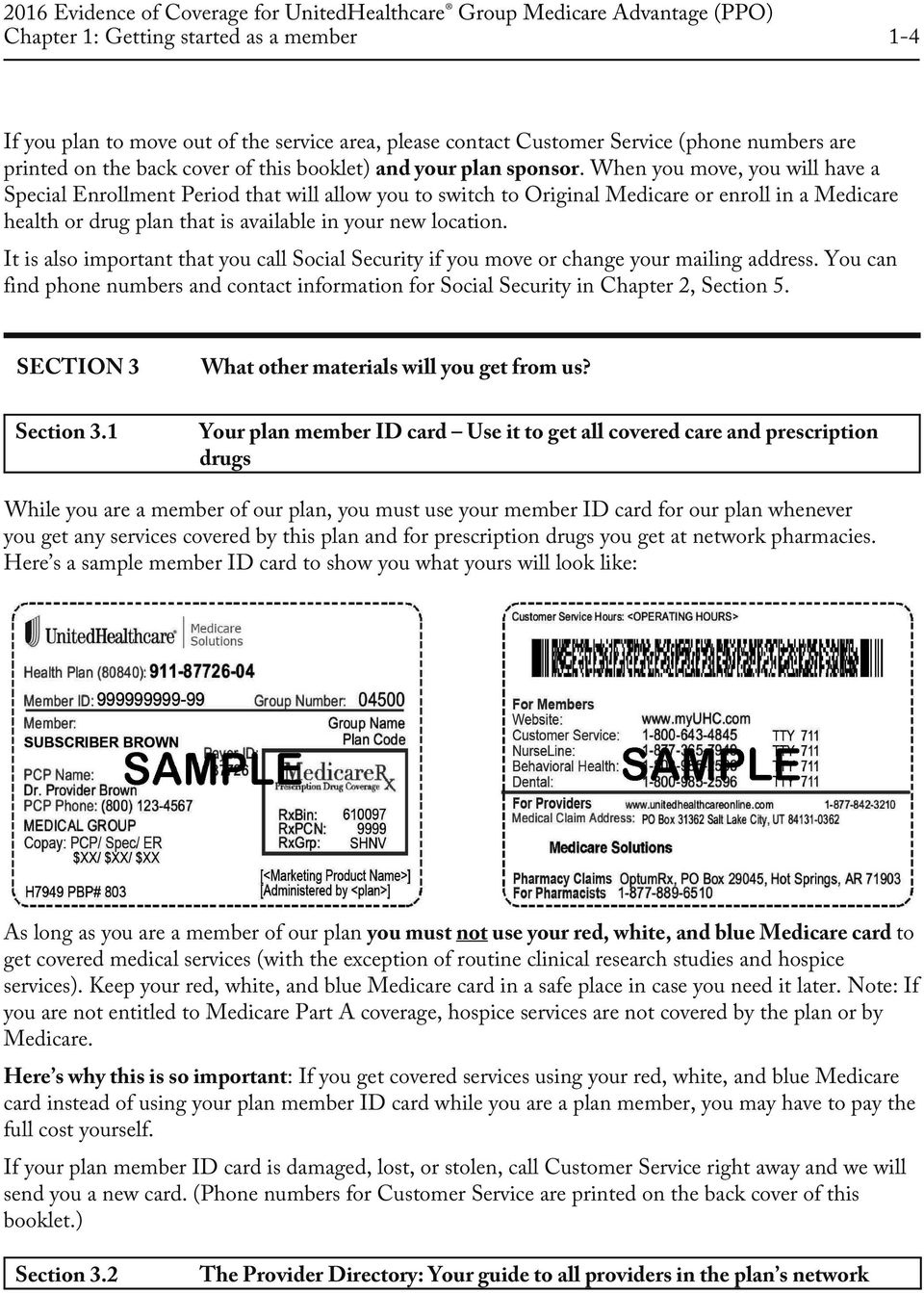
10 Chapter 1: Getting started as a member 1-4 If you plan to move out of the service area, please contact Customer Service (phone numbers are printed on the back cover of this booklet) and your plan sponsor. When you move, you will have a Special Enrollment Period that will allow you to switch to Original Medicare or enroll in a Medicare health or drug plan that is available in your new location. It is also important that you call Social Security if you move or change your mailing address. You can find phone numbers and contact information for Social Security in Chapter 2, Section 5. SECTION 3 What other materials will you get from us? Section 3.1 Your plan member ID card Use it to get all covered care and prescription drugs While you are a member of our plan, you must use your member ID card for our plan whenever you get any services covered by this plan and for prescription drugs you get at network pharmacies. Here s a sample member ID card to show you what yours will look like: As long as you are a member of our plan you must not use your red, white, and blue Medicare card to get covered medical services (with the exception of routine clinical research studies and hospice services). Keep your red, white, and blue Medicare card in a safe place in case you need it later. Note: If you are not entitled to Medicare Part A coverage, hospice services are not covered by the plan or by Medicare. Here s why this is so important: If you get covered services using your red, white, and blue Medicare card instead of using your plan member ID card while you are a plan member, you may have to pay the full cost yourself. If your plan member ID card is damaged, lost, or stolen, call Customer Service right away and we will send you a new card. (Phone numbers for Customer Service are printed on the back cover of this booklet.) Section 3.2 The Provider Directory: Your guide to all providers in the plan s network
11 Chapter 1: Getting started as a member 1-5 The Provider Directory lists our network providers and durable medical equipment suppliers. What are network providers? Network providers are the doctors and other health care professionals, medical groups, hospitals, and other health care facilities that have an agreement with us to accept our payment and any plan costsharing as payment in full. We have arranged for these providers to deliver covered services to members in our plan. Why do you need to know which providers are part of our network? As a member of our plan, you can choose to receive care from out-of-network providers. Our plan will cover services from either in-network or out-of-network providers, as long as the services are covered benefits and medically necessary. See Chapter 3 (Using the plan s coverage for your medical services) for more specific information. If you don t have your copy of the Provider Directory, you can request a copy from Customer Service (phone numbers are printed on the back cover of this booklet). You may ask Customer Service for more information about our network providers, including their qualifications. You can also search for provider information on our website. Both Customer Service and the website can give you the most up-to-date information about changes in our network providers. (You can find our website and phone information in Chapter 2 of this booklet.) Section 3.3 The Pharmacy Directory: Your guide to pharmacies in our network What are network pharmacies? Network pharmacies are all of the pharmacies that have agreed to fill covered prescriptions for our plan members. Why do you need to know about network pharmacies? You can use the Pharmacy Directory to find the network pharmacy you want to use. There are changes to our network of pharmacies for next year. An updated Pharmacy Directory is located on our website at You may also call Customer Service for updated provider information or to ask us to mail you a Pharmacy Directory. Please review the 2016 Pharmacy Directory to see which pharmacies are in our network. If you don t have the Pharmacy Directory, you can get a copy from Customer Service (phone numbers are printed on the back cover of this booklet). At any time, you can call Customer Service to get up-todate information about changes in the pharmacy network. You can also find this information on our website at Section 3.4 The plan s List of Covered Drugs (Formulary) The plan has a List of Covered Drugs (Formulary). We call it the Drug List for short. It tells which Part D prescription drugs are covered under the Part D benefit included in our plan. The drugs on this list are selected by the plan with the help of a team of doctors and pharmacists. The list must meet

12 Chapter 1: Getting started as a member 1-6 requirements set by Medicare. Medicare has approved the plan s Drug List. The Drug List also tells you if there are any rules that restrict coverage for your drugs. We will send you a copy of the Drug List. The Drug List we send to you includes information for the covered drugs that are most commonly used by our members. However, we cover additional drugs that are not included in the printed Drug List. If one of your drugs is not listed in the Drug List, you should visit our website or contact Customer Service to find out if we cover it. To get the most complete and current information about which drugs are covered, you can visit the plan s website ( or call Customer Service (phone numbers are printed on the back cover of this booklet). Section 3.5 The Part D Explanation of Benefits (the Part D EOB ): Reports with a summary of payments made for your Part D prescription drugs When you use your Part D prescription drug benefits, we will send you a summary report to help you understand and keep track of payments for your Part D prescription drugs. This summary report is called the Part D Explanation of Benefits (or the Part D EOB ). The Part D Explanation of Benefits tells you the total amount you, or others on your behalf, have spent on your Part D prescription drugs and the total amount we have paid for each of your Part D prescription drugs during the month. Chapter 6 (What you pay for your Part D prescription drugs) gives more information about the Part D Explanation of Benefits and how it can help you keep track of your drug coverage. A Part D Explanation of Benefits summary is also available upon request. To get a copy, please contact Customer Service (phone numbers are printed on the back cover of this booklet). SECTION 4 Your monthly premium for the plan Section 4.1 How much is your plan premium? Your former employer, union group or trust administrator (plan sponsor) is responsible for paying your monthly plan premium to UnitedHealthcare on your behalf. Your plan sponsor determines the amount of any retiree contribution toward the monthly premium for our plan. Your plan sponsor will notify you if you must pay any portion of your monthly premium for our plan. In addition, you must continue to pay your Medicare Part B premium (unless your Part B premium is paid for you by Medicaid or another third party). In some situations, your plan premium could be more In some situations, your plan premium could be more than the amount listed above in Section 4.1. These situations are described below. Some members are required to pay a late enrollment penalty because they did not join a Medicare drug plan when they first became eligible or because they had a continuous period of 63 days or more when they didn t have creditable prescription drug coverage. ( Creditable

13 Chapter 1: Getting started as a member 1-7 means the drug coverage is at least as good as Medicare s standard drug coverage.) For these members, the late enrollment penalty is added to the plan s monthly premium. Their premium amount will be the monthly plan premium the plan sponsor pays each month plus the amount of their late enrollment penalty. ż If you are required to pay the late enrollment penalty, the amount of your penalty depends on how long you waited before you enrolled in drug coverage or how many months you were without drug coverage after you became eligible. Chapter 6, Section 10 explains the late enrollment penalty. Many members are required to pay other Medicare premiums Many members are required to pay other Medicare premiums. As explained in Section 2 above, in order to be eligible for our plan, you must be entitled to Medicare Part A and enrolled in Medicare Part B. For that reason, some plan members (those who aren t eligible for premium-free Part A) pay a premium for Medicare Part A. And most plan members pay a premium for Medicare Part B. You must continue paying your Medicare premiums to remain a member of the plan. Some people pay an extra amount for Part D because of their yearly income. This is known as Income Related Monthly Adjustment Amounts, also known as IRMAA. If your income is greater than $85,000 for an individual (or married individuals filing separately) or greater than $170,000 for married couples, you must pay an extra amount directly to the government (not the Medicare plan) for your Medicare Part D coverage. If you are required to pay the extra amount and you do not pay it, you will be disenrolled from the plan and lose prescription drug coverage. If you have to pay an extra amount, Social Security, not your Medicare plan, will send you a letter telling you what that extra amount will be. For more information about Part D premiums based on income, go to Chapter 6, Section 11 of this booklet. You can also visit on the web or call MEDICARE ( ), 24 hours a day, 7 days a week. TTY users should call Or you may call Social Security at TTY users should call Your copy of Medicare & You 2016 gives information about the Medicare premiums in the section called 2016 Medicare Costs. This explains how the Medicare Part B and Part D premiums differ for people with different incomes. Everyone with Medicare receives a copy of Medicare & You each year in the fall. Those new to Medicare receive it within a month after first signing up. You can also download a copy of Medicare & You 2016 from the Medicare website ( Or, you can order a printed copy by phone at MEDICARE ( ), 24 hours a day, 7 days a week. TTY users call Section 4.2 Can we change your monthly plan premium during the year? Monthly plan premium changes and employer-sponsored benefit changes are subject to contractual arrangements between your plan sponsor and us, and as a result, monthly plan premiums generally do not change during the plan year. Your plan sponsor is responsible for notifying you of any monthly plan premium changes or retiree contribution changes (the portion of your monthly plan premium your

14 Chapter 1: Getting started as a member 1-8 plan sponsor requires you to pay) prior to the date when the change becomes effective. However, in some cases, your plan sponsor may need to start paying or may be able to stop paying a Late Enrollment Penalty. (The Late Enrollment Penalty may apply if you had a continuous period of 63 days or more when you didn t have creditable prescription drug coverage.) This could happen if you become eligible for the Extra Help program or if you lose your eligibility for the Extra Help program during the year: If your plan sponsor currently pays the penalty and you become eligible for Extra Help during the year, your plan sponsor would no longer pay your penalty. If you ever lose Extra Help, you must maintain your Part D coverage or you could be subject to a late enrollment penalty. You can find out more about the Extra Help program in Chapter 2, Section 7. SECTION 5 Please keep your plan membership record up to date Section 5.1 How to help make sure that we have accurate information about you Your membership record has information from your enrollment form, including your address and telephone number. It shows your specific plan coverage. Let us know about these changes: Changes to your name, your address, or your phone number. Changes in any other health insurance coverage you have (such as from your employer, your spouse s employer, workers compensation, or Medicaid). If you have any liability claims, such as claims from an automobile accident. If you have been admitted to a nursing home. If you receive care in an out-of-area or out-of-network hospital or emergency room. If your designated responsible party (such as a caregiver) changes. If you are participating in a clinical research study. If any of this information changes, please let us know by calling Customer Service (phone numbers are printed on the back cover of this booklet). It is also important to contact Social Security if you move or change your mailing address. You can find phone numbers and contact information for Social Security in Chapter 2, Section 5. Read over the information we send you about any other insurance coverage you have Medicare requires that we collect information from you about any other medical or drug insurance coverage that you have. That s because we must coordinate any other coverage you have with your benefits under our plan. (For more information about how our coverage works when you have other insurance, see Section 7 in this chapter.) Once each year, we will send you a letter that lists any other medical or drug insurance coverage that we know about. Please read over this information carefully. If it is correct, you don t need to do anything. If the information is incorrect, or if you have other coverage that is not listed, please call

15 Chapter 1: Getting started as a member 1-9 Customer Service (phone numbers are printed on the back cover of this booklet). SECTION 6 We protect the privacy of your personal health information Section 6.1 We make sure that your health information is protected Federal and state laws protect the privacy of your medical records and personal health information. We protect your personal health information as required by these laws. For more information about how we protect your personal health information, please go to Chapter 8, Section 1.4 of this booklet. SECTION 7 How other insurance works with our plan Section 7.1 Which plan pays first when you have other insurance? When you have other insurance (like employer group health coverage), there are rules set by Medicare that decide whether our plan or your other insurance pays first. The insurance that pays first is called the primary payer and pays up to the limits of its coverage. The one that pays second, called the secondary payer, only pays if there are costs left uncovered by the primary coverage. The secondary payer may not pay all of the uncovered costs. These rules apply for employer or union group health plan coverage: If you have retiree coverage, Medicare pays first. If your group health plan coverage is based on your or a family member s current employment, who pays first depends on your age, the number of people employed by your employer, and whether you have Medicare based on age, disability, or End-stage Renal Disease (ESRD): ż If you re under 65 and disabled and you or your family member is still working, your group health plan pays first if the employer has 100 or more employees or at least one employer in a multiple employer plan that has more than 100 employees. ż If you re over 65 and you or your spouse is still working, your group health plan pays first if the employer has 20 or more employees or at least one employer in a multiple employer plan that has more than 20 employees. If you have Medicare because of ESRD, your group health plan will pay first for the first 30 months after you become eligible for Medicare. These types of coverage usually pay first for services related to each type: No-fault insurance (including automobile insurance) Liability (including automobile insurance) Black lung benefits Workers compensation Medicaid and TRICARE never pay first for Medicare-covered services. They only pay after Medicare, employer group health plans, and/or Medigap have paid.

16 Chapter 1: Getting started as a member 1-10 If you have other insurance, tell your doctor, hospital, and pharmacy. If you have questions about who pays first, or you need to update your other insurance information, call Customer Service (phone numbers are printed on the back cover of this booklet). You may need to give your plan member ID number to your other insurers (once you have confirmed their identity) so your bills are paid correctly and on time.

17 Chapter 2: Important phone numbers and resources 2-1 CHAPTER 2: Important phone numbers and resources SECTION 1 UnitedHealthcare Group Medicare Advantage (PPO) Contacts (how to contact us, including how to reach Customer Service at the plan)... 2 SECTION 2 Medicare (how to get help and information directly from the Federal Medicare program)...8 SECTION 3 State Health Insurance Assistance Program (free help, information, and answers to your questions about Medicare)...9 SECTION 4 Quality Improvement Organization (paid by Medicare to check on the quality of care for people with Medicare)...18 SECTION 5 Social Security SECTION 6 Medicaid (a joint Federal and state program that helps with medical costs for some people with limited income and resources) SECTION 7 Information about programs to help people pay for their prescription drugs SECTION 8 How to contact the Railroad Retirement Board SECTION 9 Do you have group insurance or other health insurance from an employer?... 50

18 SECTION 1 UnitedHealthcare Group Medicare Advantage (PPO) Contacts (how to contact us, including how to reach Customer Service at the plan) 2016 Evidence of Coverage for UnitedHealthcare Group Medicare Advantage (PPO) Chapter 2: Important phone numbers and resources 2-2 SECTION 1 UnitedHealthcare Group Medicare Advantage (PPO) Contacts (how to contact us, including how to reach Customer Service at the plan) How to contact our plan s Customer Service For assistance with claims, billing or member ID card questions, please call or write to our plan Customer Service. We will be happy to help you. Method Customer Service - Contact Information CALL Calls to this number are free. Hours of Operation: 7 a.m. to 8 p.m. local time, 7 days a week. Customer Service also has free language interpreter services available for non-english speakers. TTY 711 This number requires special telephone equipment and is only for people who have difficulties with hearing or speaking. Calls to this number are free. Hours of Operation: 7 a.m. to 8 p.m. local time, 7 days a week WRITE UnitedHealthcare Customer Service Department PO Box 29675, Hot Springs, AR WEBSITE How to contact us when you are asking for a coverage decision about your medical care A coverage decision is a decision we make about your benefits and coverage or about the amount we will pay for your medical services. For more information on asking for coverage decisions about your medical care, see Chapter 9 (What to do if you have a problem or complaint (coverage decisions, appeals, complaints)). You may call us if you have questions about our coverage decision process. Method Coverage Decisions for Medical Care Contact Information CALL Calls to this number are free. Hours of Operation: 7 a.m. to 8 p.m. local time, 7 days a week

19 Chapter 2: Important phone numbers and resources 2-3 Method Coverage Decisions for Medical Care Contact Information TTY 711 This number requires special telephone equipment and is only for people who have difficulties with hearing or speaking. Calls to this number are free. Hours of Operation: 7 a.m. to 8 p.m. local time, 7 days a week WRITE WEBSITE UnitedHealthcare PO Box 29675, Hot Springs, AR How to contact us when you are making an appeal about your medical care An appeal is a formal way of asking us to review and change a coverage decision we have made. For more information on making an appeal about your medical care, see Chapter 9 (What to do if you have a problem or complaint (coverage decisions, appeals, complaints)). Method Appeals for Medical Care Contact Information CALL Calls to this number are free. Hours of Operation: 7 a.m. to 8 p.m. local time, 7 days a week For fast/expedited appeals for medical care: Hours of Operation: 7 a.m. to 8 p.m. local time, 7 days a week TTY 711 This number requires special telephone equipment and is only for people who have difficulties with hearing or speaking. Calls to this number are free. Hours of Operation: 7 a.m. to 8 p.m. local time, 7 days a week FAX For fast/expedited appeals for medical care only: WRITE UnitedHealthcare Appeals and Grievances Department PO Box 6106, MS CA , Cypress, CA 90630

20 Chapter 2: Important phone numbers and resources 2-4 Method WEBSITE Appeals for Medical Care Contact Information How to contact us when you are making a complaint about your medical care You can make a complaint about us or one of our network providers, including a complaint about the quality of your care. This type of complaint does not involve coverage or payment disputes. (If your problem is about the plan s coverage or payment, you should look at the section above about making an appeal.) For more information on making a complaint about your medical care, see Chapter 9 (What to do if you have a problem or complaint (coverage decisions, appeals, complaints)). Method Complaints about Medical Care Contact Information CALL Calls to this number are free. Hours of Operation: 7 a.m. to 8 p.m. local time, 7 days a week For fast/expedited complaints about medical care: Hours of Operation: 7 a.m. to 8 p.m. local time, 7 days a week TTY 711 This number requires special telephone equipment and is only for people who have difficulties with hearing or speaking. Calls to this number are free. Hours of Operation: 7 a.m. to 8 p.m. local time, 7 days a week FAX For fast/expedited complaints about medical care only: WRITE MEDICARE WEBSITE UnitedHealthcare Appeals and Grievances Department PO Box 6106, MS CA , Cypress, CA You can submit a complaint about UnitedHealthcare Group Medicare Advantage (PPO) directly to Medicare. To submit an online complaint to Medicare go to How to contact us when you are asking for a coverage decision about your Part D prescription drugs A coverage decision is a decision we make about your benefits and coverage or about the amount we will pay for your prescription drugs covered under the Part D benefit included in your plan. For more

21 Chapter 2: Important phone numbers and resources 2-5 information on asking for coverage decisions about your Part D prescription drugs, see Chapter 9 (What to do if you have a problem or complaint (coverage decisions, appeals, complaints)). Method Coverage Decisions for Part D Prescription Drugs Contact Information CALL Calls to this number are free. Hours of Operation: 7 a.m. to 8 p.m. local time, 7 days a week For expedited coverage decisions for Part D prescription drugs only: TTY 711 This number requires special telephone equipment and is only for people who have difficulties with hearing or speaking. Calls to this number are free. Hours of Operation: 7 a.m. to 8 p.m. local time, 7 days a week WRITE WEBSITE UnitedHealthcare PO Box 29675, Hot Springs, AR How to contact us when you are making an appeal about your Part D prescription drugs An appeal is a formal way of asking us to review and change a coverage decision we have made. For more information on making an appeal about your Part D prescription drugs, see Chapter 9 (What to do if you have a problem or complaint (coverage decisions, appeals, complaints)). Method Appeals for Part D Prescription Drugs Contact Information CALL Calls to this number are free. Hours of Operation: 7 a.m. to 8 p.m. local time, 7 days a week For fast/expedited appeals for Part D prescription drugs: Hours of Operation: 7 a.m. to 8 p.m. local time, 7 days a week TTY 711 This number requires special telephone equipment and is only for people who have difficulties with hearing or speaking.
22 Chapter 2: Important phone numbers and resources 2-6 Method Appeals for Part D Prescription Drugs Contact Information Calls to this number are free. Hours of Operation: 7 a.m. to 8 p.m. local time, 7 days a week FAX WRITE WEBSITE For standard Part D prescription drug appeals: For fast/expedited Part D prescription drug appeals: UnitedHealthcare Part D Appeal and Grievance Department PO Box 6106, MS CA , Cypress, CA How to contact us when you are making a complaint about your Part D prescription drugs You can make a complaint about us or one of our network pharmacies, including a complaint about the quality of your care. This type of complaint does not involve coverage or payment disputes. (If your problem is about the plan s coverage or payment, you should look at the section above about making an appeal.) For more information on making a complaint about your Part D prescription drugs, see Chapter 9 (What to do if you have a problem or complaint (coverage decisions, appeals, complaints)). Method Complaints about Part D Prescription Drugs Contact Information CALL Calls to this number are free. Hours of Operation: 7 a.m. to 8 p.m. local time, 7 days a week For fast/expedited complaints about Part D prescription drugs: Hours of Operation: 7 a.m. to 8 p.m. local time, 7 days a week TTY 711 This number requires special telephone equipment and is only for people who have difficulties with hearing or speaking. Calls to this number are free. Hours of Operation: 7 a.m. to 8 p.m. local time, 7 days a week FAX For standard Part D prescription drug complaints:
23 Chapter 2: Important phone numbers and resources 2-7 Method Complaints about Part D Prescription Drugs Contact Information For fast/expedited Part D prescription drug complaints: WRITE MEDICARE WEBSITE UnitedHealthcare Part D Appeal and Grievance Department PO Box 6106, MS CA , Cypress, CA You can submit a complaint about UnitedHealthcare Group Medicare Advantage (PPO) directly to Medicare. To submit an online complaint to Medicare go to Where to send a request asking us to pay for our share of the cost for medical care or a drug you have received For more information on situations in which you may need to ask us for reimbursement or to pay a bill you have received from a provider, see Chapter 7 (Asking us to pay our share of a bill you have received for covered medical services or drugs). Please note: If you send us a payment request and we deny any part of your request, you can appeal our decision. See Chapter 9 (What to do if you have a problem or complaint (coverage decisions, appeals, complaints)) for more information. Method Payment Requests Contact Information CALL Part D prescription drug payment requests: TTY 711 Calls to this number are free. Hours of Operation: 7 a.m. to 8 p.m. local time, 7 days a week Medical claims requests: Calls to this number are free. Hours of Operation: 7 a.m. to 8 p.m. local time, 7 days a week This number requires special telephone equipment and is only for people who have difficulties with hearing or speaking. Calls to this number are free. Hours of Operation: 7 a.m. to 8 p.m. local time, 7 days a week WRITE Medical claims payment requests: UnitedHealthcare PO Box 31362, Salt Lake City, UT
24 SECTION 2 Medicare (how to get help and information directly from the Federal Medicare program) 2016 Evidence of Coverage for UnitedHealthcare Group Medicare Advantage (PPO) Chapter 2: Important phone numbers and resources 2-8 Method Payment Requests Contact Information Part D prescription drug payment requests: OptumRx PO Box 29045, Hot Springs, AR WEBSITE SECTION 2 Medicare (how to get help and information directly from the Federal Medicare program) Medicare is the Federal health insurance program for people 65 years of age or older, some people under age 65 with disabilities, and people with End-Stage Renal Disease (permanent kidney failure requiring dialysis or a kidney transplant). The Federal agency in charge of Medicare is the Centers for Medicare & Medicaid Services (sometimes called CMS ). This agency contracts with Medicare Advantage organizations, including us. Method Medicare Contact Information CALL MEDICARE, or Calls to this number are free. 24 hours a day, 7 days a week. TTY This number requires special telephone equipment and is only for people who have difficulties with hearing or speaking. Calls to this number are free. WEBSITE This is the official government website for Medicare. It gives you up-to-date information about Medicare and current Medicare issues. It also has information about hospitals, nursing homes, physicians, home health agencies, and dialysis facilities. It includes booklets you can print directly from your computer. You can also find Medicare contacts in your state. The Medicare website also has detailed information about your Medicare
25 SECTION 3 State Health Insurance Assistance Program (free help, information, and answers to your questions about Medicare) 2016 Evidence of Coverage for UnitedHealthcare Group Medicare Advantage (PPO) Chapter 2: Important phone numbers and resources 2-9 Method Medicare Contact Information eligibility and enrollment options with the following tools: Medicare Eligibility Tool: Provides Medicare eligibility status information. Medicare Plan Finder: Provides personalized information about available Medicare prescription drug plans, Medicare health plans, and Medigap (Medicare Supplement Insurance) policies in your area. Because you are covered by an Employer Sponsored plan, you will not find UnitedHealthcare Group Medicare Advantage plans listed on These tools provide an estimate of what your out-of-pocket costs might be in different Medicare plans. You can also use the website to tell Medicare about any complaints you have about UnitedHealthcare Group Medicare Advantage (PPO): Tell Medicare about your complaint: You can submit a complaint about UnitedHealthcare Group Medicare Advantage (PPO) directly to Medicare. To submit a complaint to Medicare, go to MedicareComplaintForm/home.aspx. Medicare takes your complaints seriously and will use this information to help improve the quality of the Medicare program. If you don t have a computer, your local library or senior center may be able to help you visit this website using its computer. Or, you can call Medicare and tell them what information you are looking for. They will find the information on the website, print it out, and send it to you. (You can call Medicare at MEDICARE ( ), 24 hours a day, 7 days a week. TTY users should call ) Minimum essential coverage (MEC): Coverage under this Plan qualifies as minimum essential coverage (MEC) and satisfies the Patient Protection and Affordable Care Act s (ACA) individual shared responsibility requirement. Please visit the Internal Revenue Service (IRS) website at Shared-Responsibility-Provision for more information on the individual requirement for MEC. SECTION 3 State Health Insurance Assistance Program (free help, information, and answers to your questions about Medicare) The State Health Insurance Assistance Program (SHIP) is a government program with trained
26 Chapter 2: Important phone numbers and resources 2-10 counselors in every state. Here is a list of the State Health Insurance Assistance Programs in each state we serve: Alaska - Senior and Disabilities Services Alabama - Alabama Department of Senior Services Arkansas - Senior Health Insurance Information Program American Samoa - Office of the Governor, American Samoa Government Arizona - Arizona Department of Economic Security Division of Aging and Adult Services California - California s Health Insurance Counseling and Advocacy Program (HICAP) Colorado - Dora - Division of Insurance - State of Colorado Connecticut - State Department on Aging District of Columbia - Health Insurance Counseling Project (HICAP) Delaware - State of Delaware - ELDERinfo Florida - SHINE Program Department of Elder Affairs Georgia - DHS Division of Aging Services - GeorgiaCares Program Guam - Division of Senior Citizens Guam Hawaii - Sage PLUS Program, Executive Office on Aging Iowa - Senior Health Insurance Information Program Idaho - Department of Insurance Illinois - Senior Health Insurance Program Indiana - Indiana Department of Insurance - State Health Insurance Program Kansas - Kansas Department for Aging and Disability Services Kentucky - Kentucky State Health Insurance Assistance Program (SHIP) Louisiana - Louisiana Department of Insurance, Senior Health Insurance Information Program Massachusetts - Executive Office of Elder Affairs Maryland - The Maryland Department of Aging Maine - Maine Department of Health and Human Services Michigan - Michigan Medicare Assistance Program (MMAP) Minnesota - Minnesota Board on Aging - Senior LinkAge Line Missouri - Missouri CLAIM Northern Mariana Islands - Commonwealth of The Northern Mariana Islands SHIP Program Mississippi - Mississippi Department of Human Services, MS State Health Insurance Assistance Program (SHIP) Montana - Montana State Health Insurance Assistance Program (SHIP) North Carolina - Seniors Health Insurance Information Program North Dakota - State Health Insurance Counseling Program (SHIC) Nebraska - Nebraska Senior Health Insurance Information Program (SHIIP) New Hampshire - NH SHIP - ServiceLink Aging and Disability Resource Center New Jersey - Division of Aging and Community Services Department of Health (SHIP) New Mexico - New Mexico Aging & Long-Term Services (ADRC) Nevada - Nevada State Health Insurance Assistance Program
27 Chapter 2: Important phone numbers and resources 2-11 New York - Health Insurance Information Counseling and Assistance Program (HIICAP) Ohio - Ohio Department of Insurance Oklahoma - Senior Health Insurance Counseling Program (SHIP) Oregon - Senior Health Insurance Benefits Assistance Program Pennsylvania - Apprise Health Insurance Counseling Program Puerto Rico - State Health Insurance Assistance Program Rhode Island - Rhode Island Department of Human Services, Division of Elderly Affairs South Carolina - South Carolina Lieutenant Governor's Office on Aging South Dakota - South Dakota Department of Social Services - Adult Services and Aging Tennessee - Tennessee Commission on Aging and Disability Texas - Texas Department of Aging and Disability Services Utah - Aging Services Administrative Office Virginia - Virginia Department for the Aging Virgin Islands of the U.S. - VI SHIP/Medicare Vermont - Department of Disabilities, Aging and Independent Living Washington - Consumer Advocacy/SHIBA Wisconsin - State of Wisconsin - Board on Aging & Long Term Care West Virginia - West Virginia SHIP Wyoming - Wyoming Senior Citizens Inc. Your SHIP is independent (not connected with any insurance company or health plan). It is a state program that gets money from the Federal government to give free local health insurance counseling to people with Medicare. SHIP counselors can help you with your Medicare questions or problems. They can help you understand your Medicare rights, help you make complaints about your medical care or treatment, and help you straighten out problems with your Medicare bills. SHIP counselors can also help you understand your Medicare plan choices and answer questions about switching plans.
28 Chapter 2: Important phone numbers and resources 2-12 State Health Insurance Assistance Programs (SHIP) - Contact Information Alaska Senior and Disabilities Services TTY Main ST STE 601 Juneau, AK Pages/medicare/default.aspx Alabama Alabama Department of Senior Services TTY Monroe ST, STE 350 Montgomery, AL Arkansas Senior Health Insurance Information Program TTY West Third ST Little Rock, AR shiip.htm American Samoa Office of the Governor, American Samoa Government TTY 711 A. P. Lutali Executive Office Building Pago Pago, AS Arizona Arizona Department of Economic Security Division of Aging and Adult Services TTY West Jefferson ST, ATTN: SHIP 950A Phoenix, AZ ship California California s Health Insurance Counseling and Advocacy Program (HICAP) TTY National Drive, STE 200 Sacramento, CA countylist.aspx Colorado Dora - Division of Insurance - State of Colorado TTY Broadway, STE 850 Denver, CO Satellite/DORA-DI/CBON/ DORA/ Connecticut State Department on Aging TTY Sigourney ST, FL 10 Hartford, CT District of Columbia Health Insurance Counseling Project (HICAP) TTY Pennsylvania AVE Northwest Washington, DC el/clinics/insurance/pages/ About.aspx
29 Chapter 2: Important phone numbers and resources 2-13 State Health Insurance Assistance Programs (SHIP) - Contact Information Delaware State of Delaware - ELDERinfo TTY Silver LK BLVD Dover, DE DMAB/ Florida SHINE Program Department of Elder Affairs TTY Esplanade Way, STE 270 Tallahassee, FL Georgia DHS Division of Aging Services - GeorgiaCares Program TTY Peachtree St NW, 33rd FL Atlanta, GA Guam Division of Senior Citizens Guam TTY University Drive, STE 8, University Castle Mall Mangilao, GU dphss.guam.gov Hawaii Sage PLUS Program, Executive Office on Aging TTY No. 1 Capitol District, 250 South Hotel ST, STE 406 Honolulu, HI Iowa Senior Health Insurance Information Program TTY Locust ST, 4th FL Des Moines, IA Idaho Department of Insurance TTY West State ST PO Box Boise, ID Illinois Senior Health Insurance Program TTY One Natural Resources Way, STE 100 Springfield, IL SHIP/default.htm Indiana Indiana Department of Insurance - State Health Insurance Program TTY W 53rd ST Anderson, IN htm
30 Chapter 2: Important phone numbers and resources 2-14 State Health Insurance Assistance Programs (SHIP) - Contact Information Kansas Kansas Department for Aging and Disability Services TTY New England Building 503 S. Kansas AVE Topeka, KS SHICK/shick_index.html Kentucky Kentucky State Health Insurance Assistance Program (SHIP) TTY E. Main ST, 1E-B Frankfort, KY ship.htm Louisiana Louisiana Department of Insurance, Senior Health Insurance Information Program TTY N 3rd ST Baton Rouge, LA Massachusetts Executive Office of Elder Affairs TTY One Ashburton Place, Fifth FL Boston, MA Maryland The Maryland Department of Aging TTY West Preston ST, STE 1007 Baltimore, MD Maine Maine Department of Health and Human Services TTY State House Station, 32 Blossom Lane Augusta, ME oads/aging/community/ medicare-assist.shtml Michigan Michigan Medicare Assistance Program (MMAP) TTY W. Saint Joseph HWY, STE 204 Lansing, MI Minnesota Minnesota Board on Aging - Senior LinkAge Line TTY PO Box St. Paul, MN Missouri Missouri CLAIM TTY N. Keene ST STE 101 Columbia, MO
31 Chapter 2: Important phone numbers and resources 2-15 State Health Insurance Assistance Programs (SHIP) - Contact Information Northern Mariana Islands Commonwealth of The Northern Mariana Islands SHIP Program TTY 711 Caller Box Saipan, MP Mississippi Mississippi Department of Human Services, MS State Health Insurance Assistance Program (SHIP) TTY North State ST Jackson, MS programs-and-services-forseniors/ Montana Montana State Health Insurance Assistance Program (SHIP) TTY th AVE Helena, MT services/aging/ship/ship.shtml North Carolina Seniors Health Insurance Information Program TTY South Boylan AVE Raleigh, NC Default.aspx North Dakota State Health Insurance Counseling Program (SHIC) TTY E. BLVD AVE Bismarck, ND Nebraska Nebraska Senior Health Insurance Information Program (SHIIP) TTY O ST, STE 400 Lincoln, NE shiip/ New Hampshire NH SHIP - ServiceLink Aging and Disability Resource Center TTY 711 STE 105, 129 Pleasant ST Claremont, NH New Jersey Division of Aging and Community Services Department of Health (SHIP) TTY 711 PO Box 807 Trenton, NJ humanservices/doas/services/ ship/index.html New Mexico New Mexico Aging & Long- Term Services (ADRC) TTY PO Box Santa Fe, NM
32 Chapter 2: Important phone numbers and resources 2-16 State Health Insurance Assistance Programs (SHIP) - Contact Information Nevada Nevada State Health Insurance Assistance Program TTY Goni RD STE D-132 Carson City, NV ship_main.htm New York Health Insurance Information Counseling and Assistance Program (HIICAP) TTY Empire State Plaza Albany, NY HealthBenefits/Index.cfm Ohio Ohio Department of Insurance TTY W. Town ST, Third FL - STE 300 Columbus, OH Pages/default.aspx Oklahoma Senior Health Insurance Counseling Program (SHIP) TTY Corporate Plaza, 3625 NW 56th ST, STE 100 Oklahoma City, OK Consumers/ Information_for_Seniors/ index.html Puerto Rico State Health Insurance Assistance Program TTY 711 PO Box San Juan, PR Directorios/Pages/ InfoAgencia.aspx?PRIFA=152 Oregon Senior Health Insurance Benefits Assistance Program TTY Winter ST NE, STE 330 PO Box Salem, OR DCBS/SHIBA/Pages/ index.aspx Rhode Island Rhode Island Department of Human Services, Division of Elderly Affairs TTY West RD, Hazard BLDG, FL 2 Cranston, RI insurance/ Pennsylvania Apprise Health Insurance Counseling Program TTY Walnut ST, FL 5 Harrisburg, PA portal/server.pt/community/ department_of_aging_home/ South Carolina South Carolina Lieutenant Governor's Office on Aging TTY Gervais ST, STE 350 Columbia, SC medicare/pages/default.aspx
33 Chapter 2: Important phone numbers and resources 2-17 State Health Insurance Assistance Programs (SHIP) - Contact Information South Dakota South Dakota Department of Social Services - Adult Services and Aging TTY Governors DR Pierre, SD Tennessee Tennessee Commission on Aging and Disability TTY Deaderick ST, FL 9 Nashville, TN ship.html Texas Texas Department of Aging and Disability Services TTY 711 PO Box Austin, TX Utah Aging Services Administrative Office TTY North 1950 West Salt Lake City, UT Virginia Virginia Department for the Aging TTY 711 STE 100, 1610 Forest AVE Henrico, VA Virgin Islands of the U.S. VI SHIP/Medicare TTY 711 Schneider Regional Medical CTR 9048 Sugar Estate St. Thomas, VI Vermont Department of Disabilities, Aging and Independent Living TTY South Main ST, Weeks Building Waterbury, VT Washington Consumer Advocacy/SHIBA TTY 711 PO Box Olympia, WA Wisconsin State of Wisconsin - Board on Aging & Long Term Care TTY Pankratz ST, STE 111 Madison, WI
34 SECTION 4 Quality Improvement Organization (paid by Medicare to check on the quality of care for people with Medicare) 2016 Evidence of Coverage for UnitedHealthcare Group Medicare Advantage (PPO) Chapter 2: Important phone numbers and resources 2-18 State Health Insurance Assistance Programs (SHIP) - Contact Information West Virginia West Virginia SHIP TTY Kanawha BLVD East Charleston, WV Wyoming Wyoming Senior Citizens Inc TTY W. Adams PO Box BD Riverton, WY SECTION 4 Quality Improvement Organization (paid by Medicare to check on the quality of care for people with Medicare) There is a designated Quality Improvement Organization for serving Medicare beneficiaries in each state. Here is a list of the Quality Improvement Organizations in each state we serve: Alaska - Livanta BFCC-QIO Program Alabama - KEPRO Arkansas - KEPRO American Samoa - Livanta BFCC-QIO Program Arizona - Livanta BFCC-QIO Program California - Livanta BFCC-QIO Program Colorado - KEPRO Connecticut - Livanta BFCC-QIO Program District of Columbia - KEPRO Delaware - KEPRO Florida - KEPRO Georgia - KEPRO Guam - Livanta BFCC-QIO Program Hawaii - Livanta BFCC-QIO Program Iowa - KEPRO Idaho - Livanta BFCC-QIO Program Illinois - KEPRO Indiana - KEPRO
35 Chapter 2: Important phone numbers and resources 2-19 Kansas - KEPRO Kentucky - KEPRO Louisiana - KEPRO Massachusetts - Livanta BFCC-QIO Program Maryland - KEPRO Maine - Livanta BFCC-QIO Program Michigan - KEPRO Minnesota - KEPRO Missouri - KEPRO Northern Mariana Islands - Livanta BFCC-QIO Program Mississippi - KEPRO Montana - KEPRO North Carolina - KEPRO North Dakota - KEPRO Nebraska - KEPRO New Hampshire - Livanta BFCC-QIO Program New Jersey - Livanta BFCC-QIO Program New Mexico - KEPRO Nevada - Livanta BFCC-QIO Program New York - Livanta BFCC-QIO Program Ohio - KEPRO Oklahoma - KEPRO Oregon - Livanta BFCC-QIO Program Pennsylvania - Livanta BFCC-QIO Program Puerto Rico - Livanta BFCC-QIO Program Rhode Island - Livanta BFCC-QIO Program South Carolina - KEPRO South Dakota - KEPRO Tennessee - KEPRO Texas - KEPRO Utah - KEPRO Virginia - KEPRO Virgin Islands of the U.S. - Livanta BFCC-QIO Program Vermont - Livanta BFCC-QIO Program Washington - Livanta BFCC-QIO Program Wisconsin - KEPRO West Virginia - KEPRO Wyoming - KEPRO Your state s Quality Improvement Organization has a group of doctors and other health care professionals who are paid by the Federal government. This organization is paid by Medicare to check on and help improve the quality of care for people with Medicare. The state s Quality Improvement
36 Chapter 2: Important phone numbers and resources 2-20 Organization is an independent organization. It is not connected with our plan. You should contact your state s Quality Improvement Organization in any of these situations: You have a complaint about the quality of care you have received. You think coverage for your hospital stay is ending too soon. You think coverage for your home health care, skilled nursing facility care, or Comprehensive Outpatient Rehabilitation Facility (CORF) services are ending too soon. Quality Improvement Organization (QIO) Contact Information Alaska Livanta BFCC-QIO Program TTY Junction DR, STE 10 Annapolis Junction, MD M Alabama KEPRO TTY Lombardo CTR Drive, STE 100 Seven Hills, OH Arkansas KEPRO TTY Lombardo CTR Drive, STE 100 Seven Hills, OH American Samoa Livanta BFCC-QIO Program TTY Junction DR, STE 10 Annapolis Junction, MD M Arizona Livanta BFCC-QIO Program TTY Junction DR, STE 10 Annapolis Junction, MD M California Livanta BFCC-QIO Program TTY Junction DR, STE 10 Annapolis Junction, MD M
37 Chapter 2: Important phone numbers and resources 2-21 Quality Improvement Organization (QIO) Contact Information Colorado KEPRO TTY Lombardo CTR Drive, STE 100 Seven Hills, OH Connecticut Livanta BFCC-QIO Program TTY Junction DR, STE 10 Annapolis Junction, MD M District of Columbia KEPRO TTY W. Kennedy BLVD, STE 900 Tampa, FL Delaware KEPRO TTY W. Kennedy BLVD, STE 900 Tampa, FL Florida KEPRO TTY W. Kennedy BLVD, STE 900 Tampa, FL Georgia KEPRO TTY W. Kennedy BLVD, STE 900 Tampa, FL Guam Livanta BFCC-QIO Program TTY Junction DR, STE 10 Annapolis Junction, MD M Hawaii Livanta BFCC-QIO Program TTY Junction DR, STE 10 Annapolis Junction, MD M Iowa KEPRO TTY W. Kennedy BLVD, STE 900 Tampa, FL
38 Chapter 2: Important phone numbers and resources 2-22 Quality Improvement Organization (QIO) Contact Information Idaho Livanta BFCC-QIO Program TTY Junction DR, STE 10 Annapolis Junction, MD M Illinois KEPRO TTY W. Kennedy BLVD, STE 900 Tampa, FL Indiana KEPRO TTY W. Kennedy BLVD, STE 900 Tampa, FL Kansas KEPRO TTY W. Kennedy BLVD, STE 900 Tampa, FL Kentucky KEPRO TTY Lombardo CTR Drive, STE 100 Seven Hills, OH Louisiana KEPRO TTY Lombardo CTR Drive, STE 100 Seven Hills, OH Massachusetts Livanta BFCC-QIO Program TTY Junction DR, STE 10 Annapolis Junction, MD M Maryland KEPRO TTY W. Kennedy BLVD, STE 900 Tampa, FL Maine Livanta BFCC-QIO Program TTY Junction DR, STE 10 Annapolis Junction, MD M
39 Chapter 2: Important phone numbers and resources 2-23 Quality Improvement Organization (QIO) Contact Information Michigan KEPRO TTY W. Kennedy BLVD, STE 900 Tampa, FL Minnesota KEPRO TTY W. Kennedy BLVD, STE 900 Tampa, FL Missouri KEPRO TTY W. Kennedy BLVD, STE 900 Tampa, FL Northern Mariana Islands Livanta BFCC-QIO Program TTY Junction DR, STE 10 Annapolis Junction, MD M Mississippi KEPRO TTY Lombardo CTR Drive, STE 100 Seven Hills, OH Montana KEPRO TTY Lombardo CTR Drive, STE 100 Seven Hills, OH North Carolina KEPRO TTY W. Kennedy BLVD, STE 900 Tampa, FL North Dakota KEPRO TTY Lombardo CTR Drive, STE 100 Seven Hills, OH Nebraska KEPRO TTY W. Kennedy BLVD, STE 900 Tampa, FL
40 Chapter 2: Important phone numbers and resources 2-24 Quality Improvement Organization (QIO) Contact Information New Hampshire Livanta BFCC-QIO Program TTY Junction DR, STE 10 Annapolis Junction, MD M New Jersey Livanta BFCC-QIO Program TTY Junction DR, STE 10 Annapolis Junction, MD M New Mexico KEPRO TTY Lombardo CTR Drive, STE 100 Seven Hills, OH Nevada Livanta BFCC-QIO Program TTY Junction DR, STE 10 Annapolis Junction, MD M New York Livanta BFCC-QIO Program TTY Junction DR, STE 10 Annapolis Junction, MD M Ohio KEPRO TTY W. Kennedy BLVD, STE 900 Tampa, FL Oklahoma KEPRO TTY Lombardo CTR Drive, STE 100 Seven Hills, OH Oregon Livanta BFCC-QIO Program TTY Junction DR, STE 10 Annapolis Junction, MD M Pennsylvania Livanta BFCC-QIO Program TTY Junction DR, STE 10 Annapolis Junction, MD M
41 Chapter 2: Important phone numbers and resources 2-25 Quality Improvement Organization (QIO) Contact Information Puerto Rico Livanta BFCC-QIO Program TTY Junction DR, STE 10 Annapolis Junction, MD M Rhode Island Livanta BFCC-QIO Program TTY Junction DR, STE 10 Annapolis Junction, MD M South Carolina KEPRO TTY W. Kennedy BLVD, STE 900 Tampa, FL South Dakota KEPRO TTY Lombardo CTR Drive, STE 100 Seven Hills, OH Tennessee KEPRO TTY Lombardo CTR Drive, STE 100 Seven Hills, OH Texas KEPRO TTY Lombardo CTR Drive, STE 100 Seven Hills, OH Utah KEPRO TTY Lombardo CTR Drive, STE 100 Seven Hills, OH Virginia KEPRO TTY W. Kennedy BLVD, STE 900 Tampa, FL Virgin Islands of the U.S. Livanta BFCC-QIO Program TTY Junction DR, STE 10 Annapolis Junction, MD M
42 Chapter 2: Important phone numbers and resources 2-26 Quality Improvement Organization (QIO) Contact Information Vermont Livanta BFCC-QIO Program TTY Junction DR, STE 10 Annapolis Junction, MD M Washington Livanta BFCC-QIO Program TTY Junction DR, STE 10 Annapolis Junction, MD M Wisconsin KEPRO TTY W. Kennedy BLVD, STE 900 Tampa, FL West Virginia KEPRO TTY W. Kennedy BLVD, STE 900 Tampa, FL Wyoming KEPRO TTY Lombardo CTR Drive, STE 100 Seven Hills, OH SECTION 5 Social Security Social Security is responsible for determining eligibility and handling enrollment for Medicare. U.S. citizens who are 65 or older, or who have a disability or End-Stage Renal Disease and meet certain conditions, are eligible for Medicare. If you are already getting Social Security checks, enrollment into Medicare is automatic. If you are not getting Social Security checks, you have to enroll in Medicare. Social Security handles the enrollment process for Medicare. To apply for Medicare, you can call Social Security or visit your local Social Security office. Social Security is also responsible for determining who has to pay an extra amount for their Part D drug coverage because they have a higher income. If you got a letter from Social Security telling you that you have to pay the extra amount and have questions about the amount or if your income went down because of a life-changing event, you can call Social Security to ask for a reconsideration. If you move or change your mailing address, it is important that you contact Social Security to let them
43 SECTION 6 Medicaid (a joint Federal and state program that helps with medical costs for some people with limited income and resources) 2016 Evidence of Coverage for UnitedHealthcare Group Medicare Advantage (PPO) Chapter 2: Important phone numbers and resources 2-27 know. Method Social Security Contact Information CALL Calls to this number are free. Available 7:00 am to 7:00 pm, Monday through Friday. You can use Social Security s automated telephone services to get recorded information and conduct some business 24 hours a day. TTY This number requires special telephone equipment and is only for people who have difficulties with hearing or speaking. Calls to this number are free. Available 7:00 am to 7:00 pm, Monday through Friday. WEBSITE SECTION 6 Medicaid (a joint Federal and state program that helps with medical costs for some people with limited income and resources) Medicaid is a joint Federal and state government program that helps with medical costs for certain people with limited incomes and resources. Some people with Medicare are also eligible for Medicaid. In addition, there are programs offered through Medicaid that help people with Medicare pay their Medicare costs, such as their Medicare premiums. These Medicare Savings Programs help people with limited income and resources save money each year: Qualified Medicare Beneficiary (QMB): Helps pay Medicare Part A and Part B premiums, and other cost sharing (like deductibles, coinsurance, and copayments). (Some people with QMB are also eligible for full Medicaid benefits (QMB+).) Specified Low-Income Medicare Beneficiary (SLMB): Helps pay Part B premiums. (Some people with SLMB are also eligible for full Medicaid benefits (SLMB+).) Qualified Individual (QI): Helps pay Part B premiums. Qualified Disabled & Working Individuals (QDWI): Helps pay Part A premiums. To find out more about Medicaid and its programs, contact your state Medicaid agency.
44 Chapter 2: Important phone numbers and resources 2-28 Alaska State of Alaska Health & Social Services TTY Main ST, Room 404, PO Box Juneau, AK State Medicaid Programs Contact Information Alabama Alabama Medicaid TTY Dexter AVE Montgomery, AL Arkansas Department of Human Services TTY Donaghey Plaza South, PO Box 1437 Little Rock, AR American Samoa Department of Health TTY 711 L.B.J. Tropical Medical Center Pago Pago, AS Arizona Arizona Health Care Cost Containment System (AHCCCS) TTY East Jefferson Phoenix, AZ Arizona Division of Developmental Disabilities TTY N. Central Ave, STE 600 Phoenix, AZ developmental_disabilities/
45 Chapter 2: Important phone numbers and resources 2-29 California Medi-Cal TTY Capitol AVE, MS 4400, Sacramento, CA State Medicaid Programs Contact Information Colorado Senior Health Insurance Assistance Program TTY Grant ST Denver, CO index.shtml Connecticut Department of Social Services TTY Department of Social Services 25 Sigourney ST Hartford, CT District of Columbia Department of Human Services TTY New York AVE NE # 6 Washington, DC Delaware Delaware Health and Social Services TTY 711 Division of Social Services 1901 North Du Pont Highway Lewis Building New Castle, DE Florida Florida Medicaid Agency for Health Care Administration (AHCA) TTY Mahan DR, Mail Stop 6 Tallahassee, FL
46 Chapter 2: Important phone numbers and resources 2-30 Georgia Department of Community Health TTY Peachtree ST NW Atlanta, GA State Medicaid Programs Contact Information Guam Department of Public Health and Social Services Bureau of Healthcare Financing TTY Chalan Kareta Mangilao, GU Hawaii Department of Human Services TTY Miller ST Room 209 Honolulu, HI Iowa Iowa Department of Human Services TTY Army Post Road Des Moines, IA Idaho Department of Health and Welfare Division of Medicaid TTY 711 PO Box Boise, ID ov Illinois Illinois Department of Healthcare and Family Services TTY South Grand AVE East Springfield, IL
47 Chapter 2: Important phone numbers and resources 2-31 Indiana Medicaid Policy and Planning Family and Social Services Administration TTY W. Washington ST Room W382 Indianapolis, IN State Medicaid Programs Contact Information Kansas Kansas Department of Health and Environment TTY SW Jackson, STE 900 N Topeka, KS Kentucky Cabinet for Health and Family Services Department for Medicaid Services TTY East Main ST Frankfort, KY Louisiana Bureau of Health Services Financing Department of Health and Hospitals TTY N. 4th ST Baton Rouge, LA index.cfm/subhome/1/n/10 Massachusetts Office of Health and Human Services MassHealth TTY Hancock ST Quincy, MA gov/departments/masshealth/ Maryland Department of Health and Mental Hygiene TTY West Preston ST Baltimore, MD
48 Chapter 2: Important phone numbers and resources 2-32 Maine Department of Health & Human Services Office of MaineCare Services TTY State House Station Augusta, ME State Medicaid Programs Contact Information Michigan Department of Community Health TTY Capitol View BLDG, 201 Townsend ST Lansing, MI mdch/ Minnesota Department of Human Services TTY PO Box St. Paul, MN Missouri MO HealthNet Division Department of Social Services TTY Howerton CT, PO Box 6500 Jefferson City, MO Northern Mariana Islands State Medicaid Office TTY 711 PO Box 409CK Saipan, MP Mississippi State of Mississippi Division of Medicaid TTY High ST STE 1000 Sillers BLDG Jackson, MS
49 Chapter 2: Important phone numbers and resources 2-33 Montana Department of Public Health & Human Services TTY PO Box Helena, MT State Medicaid Programs Contact Information North Carolina Division of Medical Assistance TTY Mail Service CTR Raleigh, NC medicaid/contacts.htm North Dakota Department of Human Services TTY E. BLVD AVE Dept. 325 Bismarck, ND medicalserv/medicaid/ Nebraska NE Medicaid Department of Health and Human Services Division of Medicaid & Long-Term Care TTY Centennial Mall South Lincoln, NE default.aspx New Hampshire NH DHHS Office of Medicaid Business & Policy Medicaid Program TTY Pleasant ST Concord, NH medicaid/ New Jersey Division of Medical Assistance & Health Services Department of Human Services TTY 711 PO Box 712 Trenton, NJ dmahs/
50 Chapter 2: Important phone numbers and resources 2-34 New Mexico NM Human Services Department Medical Assistance Division TTY 711 PO Box 2348 Santa Fe, NM State Medicaid Programs Contact Information Nevada Division of Health Care Financing and Policy TTY E. Williams ST STE 101 Carson City, NV New York Office of Medicaid Management Department of Health TTY 711 Corning Tower, Empire State Plaza Albany, NY health_care/medicaid/ index.htm Ohio Ohio Department of Medicaid TTY East Broad ST 32nd Floor Columbus, OH Oklahoma SoonerCare Oklahoma Health Care Authority TTY N. Lincoln BLVD, STE 124 Oklahoma City, OK Oregon Division of Medical Assistance Programs TTY Summer ST NE Salem, OR healthplan/pages/app_benefits/ main.aspx
51 Chapter 2: Important phone numbers and resources 2-35 Pennsylvania Medical Assistance Programs Department of Public Welfare TTY 711 PO Box 2675 Harrisburg, PA State Medicaid Programs Contact Information Puerto Rico Department of Health Office of Economic Assistance to the Medically Indigent TTY 711 PO Box San Juan, PR Programas/ProgramaMedicaid/ Pages/default.aspx Rhode Island Executive Office of Health and Human Services (EOHHS) TTY Howard AVE Cranston, RI South Carolina Health and Human Services TTY 711 PO Box 8206 Columbia, SC South Dakota Department of Social Services Division of Medical Services TTY Governors DR Pierre, SD medicalservices/ Tennessee TennCare TTY Great Circle RD Nashville, TN
52 Chapter 2: Important phone numbers and resources 2-36 Texas Texas Medicaid Health and Human Services Commission TTY N. Lamar BLVD Austin, TX State Medicaid Programs Contact Information Utah Department of Health Division Of Health Care Financing TTY 711 PO Box Salt Lake City, UT healthandss.html Virginia Department of Medical Assistance Services TTY East Broad ST Richmond, VA Virgin Islands of the U.S. Bureau of Health Insurance & Medical Assistance TTY 711 Frostco Center, A Altona, STE 302 Charlotte Amalie, St. Thomas, VI Vermont Green Mountain Care Health Access Eligibility Unit TTY South Main ST Waterbury, VT Washington Washington State Health Care Authority TTY 711 PO Box Olympia, WA
53 Chapter 2: Important phone numbers and resources 2-37 Wisconsin Wisconsin Department of Health Services TTY West Wilson ST Madison, WI MEDICAID/ State Medicaid Programs Contact Information West Virginia Bureau for Medical Services TTY 711 Room 251, 350 Capitol ST Charleston, WV Pages/default.aspx Wyoming EqualityCare Office of Healthcare Financing TTY Yellowstone RD, STE 210 Cheyenne, WY healthcarefin/equalitycare/ index.html SECTION 7 Information about programs to help people pay for their prescription drugs Medicare s Extra Help Program Medicare provides Extra Help to pay prescription drug costs for people who have limited income and resources. Resources include your savings and stocks, but not your home or car. If you qualify, you get help paying for any Medicare drug plan s monthly premium, yearly deductible, and prescription copayments. This Extra Help also counts toward your out-of-pocket costs. People with limited income and resources may qualify for Extra Help. Some people automatically qualify for Extra Help and don t need to apply. Medicare mails a letter to people who automatically qualify for Extra Help. You may be able to get Extra Help to pay for your prescription drug premiums and costs. To see if you qualify for getting Extra Help, call: MEDICARE ( ). TTY users should call (applications), 24 hours a day, 7 days a week; The Social Security Office at , between 7 am to 7 pm, Monday through Friday. TTY users should call (applications); or Your State Medicaid Office (applications). (See Section 6 of this chapter for contact information.) If you believe you have qualified for Extra Help and you believe that you are paying an incorrect costsharing amount when you get your prescription at a pharmacy, our plan has established a process that allows you to either request assistance in obtaining evidence of your proper copayment level, or, if you already have the evidence, to provide this evidence to us.
54 Chapter 2: Important phone numbers and resources 2-38 Please call the customer service number in Chapter 2 Section 1. Our Customer Service representatives can help get your copayment amount corrected. When we receive the evidence showing your copayment level, we will update our system so that you can pay the correct copayment when you get your next prescription at the pharmacy. If you overpay your copayment, we will reimburse you. Either we will forward a check to you in the amount of your overpayment or we will offset future copayments. If the pharmacy hasn t collected a copayment from you and is carrying your copayment as a debt owed by you, we may make the payment directly to the pharmacy. If a state paid on your behalf, we may make payment directly to the state. Please contact Customer Service if you have questions (phone numbers are printed on the back cover of this booklet). There are programs in Puerto Rico, the Virgin Islands, Guam, the Northern Mariana Islands, and American Samoa to help people with limited income and resources pay their Medicare costs. Programs vary in these areas. Call your local Medical Assistance (Medicaid) office to find out more about their rules (phone numbers are in Section 6 of this chapter). Or call MEDICARE ( ) 24 hours a day, 7 days a week and say Medicaid for more information. TTY users should call You can also visit for more information. Medicare Coverage Gap Discount Program The Medicare Coverage Gap Discount Program provides manufacturer discounts on brand name drugs to Part D enrollees who have reached the coverage gap and are not receiving Extra Help. A 50% discount on the negotiated price (excluding the dispensing fee) is available for those brand name drugs from manufacturers. The plan pays an additional 5% and you pay the remaining 45% for your brand name drugs. If you reach the coverage gap, we will automatically apply the discount when your pharmacy bills you for your prescription and your Part D Explanation of Benefits (Part D EOB) will show any discount provided. Both the amount you pay and the amount discounted by the manufacturer count toward your out-of-pocket costs as if you had paid them and moves you through the coverage gap. The amount paid by the plan (5%) does not count toward your out-of-pocket costs. You also receive some coverage for generic drugs. If you reach the coverage gap, the plan pays 42% of the price for generic drugs and you pay the remaining 58% of the price. For generic drugs, the amount paid by the plan (42%) does not count toward your out-of-pocket costs. Only the amount you pay counts and moves you through the coverage gap. Also, the dispensing fee is included as part of the cost of the drug. The Medicare Coverage Gap Discount Program is available nationwide. Because your plan sponsor offers additional gap coverage during the Coverage Gap Stage, your out-of-pocket costs will sometimes be lower than the costs described here. Please go to Chapter 6, Section 6 for more information about the amount of your copayment or coinsurance during the Coverage Gap Stage.
55 Chapter 2: Important phone numbers and resources 2-39 If you have any questions about the availability of discounts for the drugs you are taking or about the Medicare Coverage Gap Discount Program in general, please contact Customer Service (phone numbers are printed on the back cover of this booklet). What if you have coverage from a State Pharmaceutical Assistance Program (SPAP)? If you are enrolled in a State Pharmaceutical Assistance Program (SPAP), or any other program that provides coverage for Part D drugs (other than Extra Help ), you still get the 50% discount on covered brand name drugs. Also, the plan pays 5% of the costs of brand name drugs in the coverage gap. The 50% discount and the 5% paid by the plan are both applied to the price of the drug before any SPAP or other coverage. What if you have coverage from an AIDS Drug Assistance Program (ADAP)? What is the AIDS Drug Assistance Program (ADAP)? The AIDS Drug Assistance Program (ADAP) helps ADAP-eligible individuals living with HIV/ AIDS have access to life-saving HIV medications. Medicare Part D prescription drugs that are also covered by ADAP qualify for prescription cost-sharing assistance. Note: To be eligible for the ADAP operating in your State, individuals must meet certain criteria, including proof of State residence and HIV status, low income as defined by the State, and uninsured/under-insured status. If you are currently enrolled in an ADAP, it can continue to provide you with Medicare Part D prescription cost-sharing assistance for drugs on the ADAP formulary. In order to be sure you continue receiving this assistance, please notify your local ADAP enrollment worker of any changes in your Medicare Part D plan name or policy number. For information on eligibility criteria, covered drugs, or how to enroll in the program, please call your state ADAP office listed below. Alabama Alabama ADAP AIDS Drug Assistance Program (ADAP) Contact Information Alaska Alaskan AIDS Assistance Association (Four A s) hiv.stm American Samoa American Samoa ADAP
56 Chapter 2: Important phone numbers and resources 2-40 AIDS Drug Assistance Program (ADAP) Contact Information Arizona Arizona ADAP Arkansas Arkansas ADAP programsservices/ infectiousdisease/ hivstdhepatitisc/pages/ ADAP.aspx California California ADAP aids/ Colorado Bridging the Gap CO Satellite/CDPHE-DCEED/ CBON/ Connecticut Connecticut ADAP view.asp?a=2353&q=305218#c ADAP Delaware Ryan White Program dph/dpc/hivtreatment.html District of Columbia District of Columbia ADAP Florida The Florida ADAP diseases-and-conditions/aids/ ADAP Georgia Georgia ADAP dph.georgia.gov
57 Chapter 2: Important phone numbers and resources 2-41 Guam Guam ADAP AIDS Drug Assistance Program (ADAP) Contact Information Hawaii HIV Drug Assistance Program (HDAP) health.hawaii.gov/std-aids/ Idaho Ryan White Part B AIDS Drug Assistance Program Illinois Illinois ADAP id_ Indiana Indiana State Department of Health HIV Medical Services Program , option 1 Iowa Iowa ADAP HivStdHep/HIV- AIDS.aspx?prog=Hiv&pg=Hiv Home Kansas Kansas ADAP ryan_white_care.htm Kentucky Kentucky ADAP ext chfs.ky.gov/dph/epi/ hivaids.htm Louisiana Louisiana Health Access Program (LA HAP) lahap.org/
58 Chapter 2: Important phone numbers and resources 2-42 AIDS Drug Assistance Program (ADAP) Contact Information Maine Maine ADAP infectious-disease/hiv-std/ Maryland Maryland ADAP phpa.dhmh.maryland.gov/ OIDPCS/CHCS/SitePages/ madap.aspx Massachusetts Massachusetts HIV Drug Assistance Program (HDAP) Michigan Michigan Drug Assistance Program (MIDAP) Minnesota Minnesota Department of Health Services - Program HH/ADAP idcplg?idcservice=get_dyn AMIC_CONVERSION&Rev isionselectionmethod=latestr eleased&ddocname=id_ Mississippi Mississippi ADAP msdh.ms.gov/msdhsite/_static/ 14,13047,150.html Missouri Missouri ADAP health.mo.gov/living/ healthcondiseases/ communicable/hivaids/ Montana Montana ADAP publichealth/hivstd/ Nebraska NE Ryan White HIV/AIDS Program dhhs.ne.gov/publichealth/ Pages/dpc_ryan_white.aspx
59 Chapter 2: Important phone numbers and resources 2-43 AIDS Drug Assistance Program (ADAP) Contact Information Northern Mariana Islands Northern Mariana Islands ADAP Nevada Ryan White Part B Assistance HIVCarePrevention.htm New Hampshire New Hampshire APAP , ext bchs/std/care.htm New Jersey ADDP NJ index.shtml New Mexico New Mexico ADAP New York New York ADAP aids/ North Carolina North Carolina Aids Drugs Assistance Program and HIV Specific State Pharmaceutical Assistance Program epi.publichealth.nc.gov/cd/hiv/ adap.html North Dakota North Dakota Ryan White Part B Program Ohio Ohio ADAP odhprograms/hastpac/hivcare/ aids1.aspx
60 Chapter 2: Important phone numbers and resources 2-44 AIDS Drug Assistance Program (ADAP) Contact Information Oklahoma HDAP (HIV Drug Assistance Program) Disease,_Prevention,_Prepared ness/hiv_std_service/ Ryan_White_Programs/ index.html Oregon CAREAssist pharmacy/careassist Pennsylvania Special Pharmaceutical Benefits Program server.pt?open=514&objid= &mode=2 Puerto Rico Puerto Rico ADAP ext ryanwhiteparteb/pages/ Queeselprogramaryanwhitepart ebdeldepartamentodesaluddepr. aspx Rhode Island Rhode Island ADAP ConsumerInformation/ Healthcare/Adults/ RyanWhiteHIVCareProgram.a spx South Carolina South Carolina Drug Assistance Program South Dakota South Dakota Ryan White Part B/ADAP program doh.sd.gov/diseases/infectious/ ryanwhite/ Tennessee Tennessee ADAP health.state.tn.us/std/ ryanwhite.shtml Texas Texas HIV Medication Program (THMP) meds/
61 Chapter 2: Important phone numbers and resources 2-45 AIDS Drug Assistance Program (ADAP) Contact Information Virgin Islands of the U.S. Virgin Islands ADAP treatment/index.html Utah Utah ADAP treatment/index.html Vermont Vermont Medication Assistance Program (VMAP) healthvermont.gov/prevent/ aids/aids_index.aspx Virginia Virginia ADAP Washington Early Intervention Program (EIP) West Virginia West Virginia ADAP Wisconsin Wisconsin ADAP Wyoming Wyoming ADAP
62 Chapter 2: Important phone numbers and resources 2-46 What if you get Extra Help from Medicare to help pay your prescription drug costs? Can you get the discounts? No. If you get Extra Help, you already get coverage for your prescription drug costs during the coverage gap. What if you don t get a discount, and you think you should have? If you think that you have reached the coverage gap and did not get a discount when you paid for your brand name drug, you should review your next Part D Explanation of Benefits (Part D EOB) notice. If the discount doesn t appear on your Part D Explanation of Benefits, you should contact us to make sure that your prescription records are correct and up-to-date. If we don t agree that you are owed a discount, you can appeal. You can get help filing an appeal from your State Health Insurance Assistance Program (SHIP) (telephone numbers are in Section 3 of this Chapter) or by calling MEDICARE ( ), 24 hours a day, 7 days a week. TTY users should call State Pharmaceutical Assistance Programs Many states have State Pharmaceutical Assistance Programs that help some people pay for prescription drugs based on financial need, age, medical condition or disabilities. Each state has different rules to provide drug coverage to its members. Here is a list of the State Pharmaceutical Assistance Programs in each state we serve: California - Department of Health Services - ADAP Colorado - Colorado ADAP Department of Public Health and Environment Connecticut - Connecticut Department of Social Services Medical Operations Unit #4 Delaware - DPAP - Delaware Pharmaceutical Assistance Program Idaho - Idaho AIDS Drug Assistance Program (IDAGAP) Indiana - HoosierRx Massachusetts - Prescription Advantage Executive Office of Elder Affairs Maryland - Maryland Senior Prescription Drug Assistance Program (SPDAP) Maine - Office of MaineCare Services Missouri - MORx Montana - Montana Big Sky Rx Program New Jersey - New Jersey Department of Human Services Nevada - Nevada Senior Rx New York - New York Elderly Pharmaceutical Insurance Coverage (EPIC) Oregon - CAREAssist - Oregon ADAP Pennsylvania - Pennsylvania PACE Rhode Island - Rhode Island Pharmaceutical Assistance to the Elderly (RIPAE) Texas - Texas Kidney Health Care Virginia - Virginia Medication Prescription Assistance Program (MPAP) Virgin Islands of the U.S. - US Virgin Islands Department of Human Services Vermont - Office of Vermont Health Access
63 Chapter 2: Important phone numbers and resources 2-47 Wisconsin - Wisconsin SeniorCare Pharmaceutical Assistance Program State Pharmaceutical Assistance Programs Contact Information California Department of Health Services - ADAP TTY 711 PO Box Sacramento, CA programs/aids/pages/ toaadap.aspx Colorado Colorado ADAP Department of Public Health and Environment TTY 711 DCEED-A, 4300 Cherry CRK DR South D Denver, CO Satellite/CDPHE-DCEED/ CBON/ Connecticut Connecticut Department of Social Services Medical Operations Unit # TTY Sigourney ST Hartford, CT Delaware DPAP - Delaware Pharmaceutical Assistance Program TTY 711 EDS DPAP PO Box 950 New Castle, DE dmma/dpap.html Idaho Idaho AIDS Drug Assistance Program (IDAGAP) TTY PO Box Boise, ID daho.gov/health/ FamilyPlanning,STDHIV/ HIVCareandTreatment Indiana HoosierRx TTY 711 PO Box 6224 Indianapolis, IN htm
64 Chapter 2: Important phone numbers and resources 2-48 State Pharmaceutical Assistance Programs Contact Information Massachusetts Prescription Advantage Executive Office of Elder Affairs TTY One Ashburton Place, Fifth FL Boston, MA org Maryland Maryland Senior Prescription Drug Assistance Program (SPDAP) TTY c/o Pool Administrators, 628 Hebron Ave STE 212 Glastonbury, CT Maine Office of MaineCare Services TTY State House Station, 32 Blossom Lane Augusta, ME oms/member/index.shtml Missouri MORx TTY Howerton CT, PO Box 6500 Jefferson City, MO Montana Montana Big Sky Rx Program TTY 711 PO Box Helena, MT prescriptiondrug/ prescriptiondrugassistance.shtm l New Jersey New Jersey Department of Human Services TTY Quakerbridge Plaza, PO Box 715 Mercerville, NJ humanservices/doas/paad/ Nevada Nevada Senior Rx TTY Goni RD, STE B-113 Carson City, NV Find_Assistance/ Medical_Assistance/ New York New York Elderly Pharmaceutical Insurance Coverage (EPIC) TTY PO Box Albany, NY health_care/epic/index Oregon CAREAssist - Oregon ADAP TTY NE Oregon ST, STE 1105 Portland, OR pharmacy/careassist/pages/ index.aspx
65 Chapter 2: Important phone numbers and resources 2-49 State Pharmaceutical Assistance Programs Contact Information Pennsylvania Pennsylvania PACE TTY PO Box 8806 Harrisburg, PA h.com Rhode Island Rhode Island Pharmaceutical Assistance to the Elderly (RIPAE) TTY West Road, Hazard BLDG, 2nd FL Cranston, RI programs/ prescription_assist.php Texas Texas Kidney Health Care TTY Department of State Health Services, MC 1938, PO Box Austin, TX kidney Virginia Virginia Medication Prescription Assistance Program (MPAP) TTY 711 HCS Unit, 1st FL, James Madison BLDG, 109 Governor Street Richmond, VA Virgin Islands of the U.S. US Virgin Islands Department of Human Services TTY Hospital Ground, Knud Hansen Complex, BLDG A St. Thomas, VI pharmaceutical.html Vermont Office of Vermont Health Access TTY South Main ST Waterbury, VT Wisconsin Wisconsin SeniorCare Pharmaceutical Assistance Program TTY 711 PO Box 6710 Madison, WI seniorcare
66 Chapter 2: Important phone numbers and resources 2-50 SECTION 8 How to contact the Railroad Retirement Board The Railroad Retirement Board is an independent Federal agency that administers comprehensive benefit programs for the nation s railroad workers and their families. If you have questions regarding your benefits from the Railroad Retirement Board, contact the agency. If you receive your Medicare through the Railroad Retirement Board, it is important that you let them know if you move or change your mailing address. Method Railroad Retirement Board Contact Information CALL Calls to this number are free. Available 9:00 am to 3:30 pm, Monday through Friday If you have a touch-tone telephone, recorded information and automated services are available 24 hours a day, including weekends and holidays. TTY This number requires special telephone equipment and is only for people who have difficulties with hearing or speaking. Calls to this number are not free. WEBSITE SECTION 9 Do you have group insurance or other health insurance from an employer? If you (or your spouse) have medical or prescription drug coverage through another employer or retiree group, please contact that group s benefits administrator. The benefits administrator can help you determine how your current coverage will work with our plan. You can also call Customer Service if you have any questions. You can ask about your (or your spouse s) employer or retiree health benefits, premiums, or the enrollment period.
67 Chapter 3: Using the plan s coverage for your medical services 3-1 CHAPTER 3: Using the plan s coverage for your medical services SECTION 1 Things to know about getting your medical care covered as a member of our plan... 2 Section 1.1 What are network providers and covered services?...2 Section 1.2 Basic rules for getting your medical care covered by the plan...2 SECTION 2 Using network and out-of-network providers to get your medical care. You reside in a plan service area with a limited number of network providers. Your in-network costsharing and out of network cost-sharing for medical benefits will be the same. If you move, you may pay higher out of network cost-sharing. If this occurs we will send you new plan materials... 3 Section 2.1 You may choose a Primary Care Provider (PCP) to provide and oversee your medical care... 3 Section 2.2 How to get care from specialists and other network providers...4 Section 2.3 How to get care from out-of-network providers... 5 SECTION 3 How to get covered services when you have an emergency or urgent need for care or during a disaster... 5 Section 3.1 Getting care if you have a medical emergency...5 Section 3.2 Getting care when you have an urgent need for services... 6 Section 3.3 Getting care during a disaster... 6 SECTION 4 What if you are billed directly for the full cost of your covered services?... 7 Section 4.1 You can ask us to pay our share of the cost of covered services... 7 Section 4.2 If services are not covered by our plan, you must pay the full cost... 7 SECTION 5 How are your medical services covered when you are in a clinical research study?... 8 Section 5.1 What is a clinical research study?... 8 Section 5.2 When you participate in a clinical research study, who pays for what?... 8 SECTION 6 Rules for getting care covered in a religious non-medical health care institution... 9 Section 6.1 What is a religious non-medical health care institution?... 9 Section 6.2 What care from a religious non-medical health care institution is covered by our plan? SECTION 7 Rules for ownership of durable medical equipment...10 Section 7.1 Will you own the durable medical equipment after making a certain number of payments under our plan?...10
68 Chapter 3: Using the plan s coverage for your medical services 3-2 SECTION 1 Things to know about getting your medical care covered as a member of our plan This chapter explains what you need to know about using the plan to get your medical care covered. It gives definitions of terms and explains the rules you will need to follow to get the medical treatments, services, and other medical care that are covered by the plan. Because you are a member of the UnitedHealthcare Group Medicare Advantage (PPO) plan, you can see any provider (in-network or out-of-network) that participates in Medicare and accepts the plan at the same cost share. Your copayments or coinsurance stay the same. For the details on what medical care is covered by our plan and how much you pay when you get this care, use the benefits chart in the next chapter, Chapter 4 (Medical Benefits Chart, what is covered and what you pay). Section 1.1 What are network providers and covered services? Here are some definitions that can help you understand how you get the care and services that are covered for you as a member of our plan: Providers are doctors and other health care professionals licensed by the state to provide medical services and care. The term providers also includes hospitals and other health care facilities. Network providers are the doctors and other health care professionals, medical groups, hospitals, and other health care facilities that have an agreement with us to accept our payment and your cost-sharing amount as payment in full. We have arranged for these providers to deliver covered services to members in our plan. The providers in our network bill us directly for care they give you. When you see a network provider, you pay only your share of the cost for their services. Covered services include all the medical care, health care services, supplies, and equipment that are covered by our plan. Your covered services for medical care are listed in the benefits chart in Chapter 4. Section 1.2 Basic rules for getting your medical care covered by the plan As a Medicare health plan, UnitedHealthcare Group Medicare Advantage (PPO) must cover all services covered by Original Medicare and must follow Original Medicare s coverage rules. The plan will generally cover your medical care as long as: The care you receive is included in the plan s Medical Benefits Chart (this chart is in Chapter 4 of this booklet). The care you receive is considered medically necessary. Medically necessary means that the services, supplies, or drugs are needed for the prevention, diagnosis, or treatment of your medical condition and meet accepted standards of medical practice.
69 Chapter 3: Using the plan s coverage for your medical services 3-3 You receive your care from a provider who is eligible to provide services under Original Medicare. As a member of our plan, you can receive your care from either a network provider or an out-of-network provider (for more about this, see Section 2 in this chapter). ż ż The providers in our network are listed in the Provider Directory. Please note: While you can get your care from an out-of-network provider, the provider must be eligible to participate in Medicare. Except for emergency care, we cannot pay a provider who is not eligible to participate in Medicare. If you go to a provider who is not eligible to participate in Medicare, you will be responsible for the full cost of the services you receive. Check with your provider before receiving services to confirm that they are eligible to participate in Medicare. SECTION 2 Using network and out-of-network providers to get your medical care. You reside in a plan service area with a limited number of network providers. Your in-network cost-sharing and out of network cost-sharing for medical benefits will be the same. If you move, you may pay higher out of network costsharing. If this occurs we will send you new plan materials. As a member of the UnitedHealthcare Group Medicare Advantage (PPO) plan, you may see doctors and other health care professionals, medical groups, hospitals, and other health care facilities that are not contracted with UnitedHealthcare, but participate in Medicare, as long as the services are covered benefits and are medically necessary. Unlike most PPO plans, with this plan you pay the same copays or coinsurance in-network and out-of-network. Section 2.1 You may choose a Primary Care Provider (PCP) to provide and oversee your medical care What is a PCP and what does the PCP do for you? What is a PCP? A Primary Care Provider (PCP) is a network physician who is selected by you to provide and coordinate your covered services. What types of providers may act as a PCP? PCPs are generally physicians specializing in Internal Medicine, Family Practice or General Practice. What is the role of my PCP? Your relationship with your PCP is an important one because your PCP is responsible for the coordination of your health care and is also responsible for your routine health care needs. You may want to ask your PCP for assistance in selecting a network specialist and follow-up with your PCP after any specialist visits. It is important for you to develop and maintain a relationship with your PCP.
70 Chapter 3: Using the plan s coverage for your medical services 3-4 Section 2.2 How to get care from specialists and other network providers A specialist is a doctor who provides health care services for a specific disease or part of the body. There are many kinds of specialists. Here are a few examples: Oncologists care for patients with cancer. Cardiologists care for patients with heart conditions. Orthopedists care for patients with certain bone, joint, or muscle conditions. How to access your behavioral/mental health benefit To directly access your behavioral/mental health benefits, please call the behavioral health number on the back of your member ID card 24 hours a day, 7 days a week. When you call, you will speak with a representative who will check your eligibility and gather basic information about you and your situation. Depending on the help you need, a clinician may then talk with you about the problem you are experiencing and assess which provider and treatment would be appropriate for your situation. You may also ask your PCP to call the number on the back of your member ID card and arrange a referral on your behalf. You may also call to receive information about in-network practitioners, subspecialty care and obtaining care after normal office hours. Confidentiality is maintained, so please be assured that personal information you discuss with their staff will be kept strictly confidential. What if a specialist or another network provider leaves our plan? It is important that you know that we may make changes to the hospitals, doctors, and specialists (providers) that are part of your plan during the year. If this happens, you may continue to see the provider as long as he/she continues to participate in Medicare and the care you receive is a covered service and is medically necessary. Even though our network of providers may change during the year, Medicare requires that we furnish you with uninterrupted access to qualified doctors and specialists. When possible, we will provide you with at least 30 days notice that your network provider is leaving our plan. You may call Customer Service for assistance at the number listed in Chapter 2 of this booklet.
71 Chapter 3: Using the plan s coverage for your medical services 3-5 Section 2.3 How to get care from out-of-network providers As a member of our plan, you can choose to receive care from out-of-network providers. Our plan will cover services from either network or out-of-network providers, as long as the services are covered benefits and are medically necessary. Because you are a member of the UnitedHealthcare Group Medicare Advantage (PPO) plan, you can see any provider (in-network or out-of-network) that participates in Medicare and accepts the plan at the same cost share. Your copayments or coinsurance stay the same. Here are other important things to know about using out-of-network providers: You can get your care from an out-of-network provider, however, in most cases that provider must be eligible to participate in Medicare. Except for emergency care, we cannot pay a provider who is not eligible to participate in Medicare. If you receive care from a provider who is not eligible to participate in Medicare, you will be responsible for the full cost of the services you receive. Check with your provider before receiving services to confirm that they are eligible to participate in Medicare. You don t need to get a referral or prior authorization when you get care from out-of-network providers. However, before getting services from out-of-network providers you may want to ask for a pre-visit coverage decision to confirm that the services you are getting are covered and are medically necessary. (See Chapter 9, Section 4 for information about asking for coverage decisions.) This is important because: ż Without a pre-visit coverage decision, if we later determine that the services are not covered or were not medically necessary, we may deny coverage and you will be responsible for the entire cost. If we say we will not cover your services, you have the right to appeal our decision not to cover your care. See Chapter 9 (What to do if you have a problem or complaint) to learn how to make an appeal. It is best to ask an out-of-network provider to bill the plan first. But, if you have already paid for the covered services, we will reimburse you for our share of the cost for covered services. Or if an out-of-network provider sends you a bill that you think we should pay, you can send it to us for payment. See Chapter 7 (Asking us to pay our share of a bill you have received for covered medical services or drugs) for information about what to do if you receive a bill or if you need to ask for reimbursement. SECTION 3 Section 3.1 How to get covered services when you have an emergency or urgent need for care or during a disaster Getting care if you have a medical emergency What is a medical emergency and what should you do if you have one? A medical emergency is when you, or any other prudent layperson with an average knowledge of health and medicine, believe that you have medical symptoms that require immediate medical attention to prevent loss of life, loss of a limb, or loss of function of a limb. The medical symptoms may be an illness, injury, severe pain, or a medical condition that is quickly getting worse.
72 Chapter 3: Using the plan s coverage for your medical services 3-6 If you have a medical emergency: Get help as quickly as possible. Call 911 for help or go to the nearest emergency room or hospital. Call for an ambulance if you need it. You do not need to get approval or a referral first from your PCP. What is covered if you have a medical emergency? You may get covered emergency medical care whenever you need it, anywhere in the world. Our plan covers ambulance services in situations where getting to the emergency room in any other way could endanger your health. For more information, see the Medical Benefits Chart in Chapter 4 of this booklet. If you have an emergency, we will talk with the doctors who are giving you emergency care to help manage and follow up on your care. The doctors who are giving you emergency care will decide when your condition is stable and the medical emergency is over. After the emergency is over you are entitled to follow-up care to be sure your condition continues to be stable. Your follow-up care will be covered by our plan. What if it wasn t a medical emergency? Sometimes it can be hard to know if you have a medical emergency. For example, you might go in for emergency care thinking that your health is in serious danger and the doctor may say that it wasn t a medical emergency after all. If it turns out that it was not an emergency, as long as you reasonably thought your health was in serious danger, we will cover your care. Section 3.2 Getting care when you have an urgent need for services What are urgently needed services? Urgently needed services are non-emergency, unforeseen medical illness, injury, or condition that requires immediate medical care. Urgently needed services may be furnished by network providers or by out-of-network providers. The unforeseen condition could, for example, be an unforeseen flare-up of a known condition that you have. Section 3.3 Getting care during a disaster If the Governor of your state, the U.S. Secretary of Health and Human Services, or the President of the United States declares a state of disaster or emergency in your geographic area, you are still entitled to care from your plan. Please visit the following website: for information on how to obtain needed care during a disaster. If you cannot use a network pharmacy during a disaster, you may be able to fill your prescription drugs at an out-of-network pharmacy. Please see Chapter 5, Section 2.5 for more information.
73 Chapter 3: Using the plan s coverage for your medical services 3-7 SECTION 4 What if you are billed directly for the full cost of your covered services? Section 4.1 You can ask us to pay our share of the cost of covered services If you have paid more than your share for covered services, or if you have received a bill for the full cost of covered medical services, go to Chapter 7 (Asking us to pay our share of a bill you have received for covered medical services or drugs) for information about what to do. Section 4.2 If services are not covered by our plan, you must pay the full cost Our plan covers all medical services that are medically necessary, are listed in the plan s Medical Benefits Chart (this chart is in Chapter 4 of this booklet), and are obtained consistent with plan rules. You are responsible for paying the full cost of services that aren t covered by our plan, either because they are not plan covered services, or plan rules were not followed. If you have any questions about whether we will pay for any medical service or care that you are considering, you have the right to ask us whether we will cover it before you get it. You also have the right to ask for this in writing. If we say we will not cover your services, you have the right to appeal our decision not to cover your care. Chapter 9 (What to do if you have a problem or complaint (coverage decisions, appeals, complaints)) has more information about what to do if you want a coverage decision from us or want to appeal a decision we have already made. You may also call Customer Service to get more information (phone numbers are printed on the back cover of this booklet). For covered services that have a benefit limitation, you pay the full cost of any services you get after you have used up your benefit for that type of covered service. For example, if your plan covers one routine physical exam per year and you receive that routine physical but choose to have a second routine physical within the same year, you pay the full cost of the second routine physical. Any amounts that you pay after you have reached the benefit limitation do not count toward your annual out-of-pocket maximum. (See Chapter 4 for more information on your plan s out-of-pocket maximum.) You can call Customer Service when you want to know how much of your benefit limit you have already used.
74 Chapter 3: Using the plan s coverage for your medical services 3-8 SECTION 5 Section 5.1 How are your medical services covered when you are in a clinical research study? What is a clinical research study? A clinical research study (also called a clinical trial ) is a way that doctors and scientists test new types of medical care, like how well a new cancer drug works. They test new medical care procedures or drugs by asking for volunteers to help with the study. This kind of study is one of the final stages of a research process that helps doctors and scientists see if a new approach works and if it is safe. Not all clinical research studies are open to members of our plan. Note: If you are not entitled to Medicare Part A coverage, neither Medicare nor the plan will cover the Part A related costs of your participation in a research study. (Medicare Part A generally covers services furnished by institutional providers such as hospitals, skilled nursing facilities or home health agencies.) Medicare first needs to approve the research study. If you participate in a study that Medicare has not approved, you will be responsible for paying all costs for your participation in the study. Once Medicare approves the study, someone who works on the study will contact you to explain more about the study and see if you meet the requirements set by the scientists who are running the study. You can participate in the study as long as you meet the requirements for the study and you have a full understanding and acceptance of what is involved if you participate in the study. If you participate in a Medicare-approved study, Original Medicare pays most of the costs for the covered services you receive as part of the study. When you are in a clinical research study, you may stay enrolled in our plan and continue to get the rest of your care (the care that is not related to the study) through our plan. Note: If you are not entitled to Medicare Part A coverage, neither Medicare nor the plan will pay the Part A costs related to a Medicare-covered clinical research study. If you want to participate in a Medicare-approved clinical research study, you do not need to get approval from us. The providers that deliver your care as part of the clinical research study do not need to be part of our plan s network of providers. Although you do not need to get our plan s permission to be in a clinical research study, you do need to tell us before you start participating in a clinical research study. Here is why you need to tell us: 1. We can let you know whether the clinical research study is Medicare-approved. 2. We can tell you what services you will get from clinical research study providers instead of from our plan. If you plan on participating in a clinical research study, contact Customer Service (phone numbers are printed on the back cover of this booklet). Section 5.2 When you participate in a clinical research study, who pays for what? Once you join a Medicare-approved clinical research study, you are covered for routine items and services you receive as part of the study, including: Room and board for a hospital stay that Medicare would pay for even if you weren t in a study.
75 Chapter 3: Using the plan s coverage for your medical services 3-9 An operation or other medical procedure if it is part of the research study. Treatment of side effects and complications of the new care. Note: If you are not entitled to Medicare Part A coverage, neither Medicare nor the plan will pay the Part A related costs related to a Medicare-covered clinical research study. Original Medicare pays most of the cost of the covered services you receive as part of the study. After Medicare has paid its share of the cost for these services, our plan will also pay for part of the costs. We will pay the difference between the cost-sharing in Original Medicare and your cost-sharing as a member of our plan. This means you will pay the same amount for the services you receive as part of the study as you would if you received these services from our plan. Here s an example of how the cost-sharing works: Let s say that you have a lab test that costs $100 as part of the research study. Let s also say that your share of the costs for this test is $20 under Original Medicare, but the test would be $10 under our plan s benefits. In this case, Original Medicare would pay $80 for the test and we would pay another $10. This means that you would pay $10, which is the same amount you would pay under our plan s benefits. In order for us to pay for our share of the costs, you will need to submit a request for payment. With your request, you will need to send us a copy of your Medicare Summary Notices or other documentation that shows what services you received as part of the study and how much you owe. Please see Chapter 7 for more information about submitting requests for payment. When you are part of a clinical research study, neither Medicare nor our plan will pay for any of the following: Generally, Medicare will not pay for the new item or service that the study is testing unless Medicare would cover the item or service even if you were not in a study. Items and services the study gives you or any participant for free. Items or services provided only to collect data, and not used in your direct health care. For example, Medicare would not pay for monthly CT scans done as part of the study if your medical condition would normally require only one CT scan. Do you want to know more? You can get more information about joining a clinical research study by reading the publication Medicare and Clinical Research Studies on the Medicare website ( You can also call MEDICARE ( ), 24 hours a day, 7 days a week. TTY users should call SECTION 6 Section 6.1 Rules for getting care covered in a religious non-medical health care institution What is a religious non-medical health care institution? A religious non-medical health care institution is a facility that provides care for a condition that would ordinarily be treated in a hospital or skilled nursing facility care. If getting care in a hospital or a skilled nursing facility is against a member s religious beliefs, we will instead provide coverage for care in a religious non-medical health care institution. You may choose to pursue medical care at any time
76 Chapter 3: Using the plan s coverage for your medical services 3-10 for any reason. This benefit is provided only for Part A inpatient services (non-medical health care services). Medicare will only pay for non-medical health care services provided by religious nonmedical health care institutions. Section 6.2 What care from a religious non-medical health care institution is covered by our plan? To get care from a religious non-medical health care institution, you must sign a legal document that says you are conscientiously opposed to getting medical treatment that is non-excepted. Non-excepted medical care or treatment is any medical care or treatment that is voluntary and not required by any federal, state, or local law. Excepted medical treatment is medical care or treatment that you get that is not voluntary or is required under federal, state, or local law. To be covered by our plan, the care you get from a religious non-medical health care institution must meet the following conditions: The facility providing the care must be certified by Medicare. Our plan s coverage of services you receive is limited to non-religious aspects of care. If you get services from this institution that are provided to you in your home, our plan will cover these services only if your condition would ordinarily meet the conditions for coverage of services given by home health agencies that are not religious non-medical health care institutions. If you get services from this institution that are provided to you in a facility, the following conditions apply: ż You must have a medical condition that would allow you to receive covered services for inpatient hospital care or skilled nursing facility care. ż and you must get approval in advance from our plan before you are admitted to the facility or your stay will not be covered. You are covered for unlimited days in the hospital, as long as your stay meets Medicare coverage guidelines. The coverage limits are described under Inpatient Hospital Care in the Medical Benefits Chart in Chapter 4. SECTION 7 Rules for ownership of durable medical equipment Section 7.1 Will you own the durable medical equipment after making a certain number of payments under our plan? Durable medical equipment includes items such as oxygen equipment and supplies, wheelchairs, walkers, and hospital beds ordered by a provider for use in the home. Certain items, such as prosthetics, are always owned by the member. In this section, we discuss other types of durable medical equipment that must be rented. In Original Medicare, people who rent certain types of durable medical equipment own the equipment
77 Chapter 3: Using the plan s coverage for your medical services 3-11 after paying copayments for the item for 13 months. As a member of our plan, however, you usually will not acquire ownership of rented durable medical equipment items no matter how many copayments you make for the item while a member of our plan. Under certain limited circumstances we will transfer ownership of the durable medical equipment item. Call Customer Service (phone numbers are printed on the back cover of this booklet) to find out about the requirements you must meet and the documentation you need to provide. What happens to payments you have made for durable medical equipment if you switch to Original Medicare? If you switch to Original Medicare after being a member of our plan: If you did not acquire ownership of the durable medical equipment item while in our plan, you will have to make 13 new consecutive payments for the item while in Original Medicare in order to acquire ownership of the item. Your previous payments while in our plan do not count toward these 13 consecutive payments. If you made payments for the durable medical equipment item under Original Medicare before you joined our plan, these previous Original Medicare payments also do not count toward the 13 consecutive payments. You will have to make 13 consecutive payments for the item under Original Medicare in order to acquire ownership. There are no exceptions to this case when you return to Original Medicare.
78 Chapter 4: Medical Benefits Chart (what is covered and what you pay) 4-1 CHAPTER 4: Medical Benefits Chart (what is covered and what you pay) SECTION 1 Understanding your out-of-pocket costs for covered services... 2 Section 1.1 Types of out-of-pocket costs you may pay for your covered services...2 Section 1.2 What is the most you will pay for Medicare Part A and Part B covered medical services?... 2 Section 1.3 Our plan does not allow providers to balance bill you... 3 SECTION 2 Use the Medical Benefits Chart to find out what is covered for you and how much you will pay... 3 Section 2.1 Your medical benefits and costs as a member of the plan... 3 SECTION 3 What Medical services are not covered by the plan? Section 3.1 Medical services we do not cover (exclusions)...49 SECTION 4 Other additional benefits (not covered under Original Medicare) Routine Hearing Services...57 Routine Vision Care... 59
79 Chapter 4: Medical Benefits Chart (what is covered and what you pay) 4-2 SECTION 1 Understanding your out-of-pocket costs for covered services This chapter focuses on your covered services and what you pay for your medical benefits. It includes a Medical Benefits Chart that lists your covered services and shows how much you will pay for each covered service as a member of UnitedHealthcare Group Medicare Advantage (PPO). Later in this chapter, you can find information about medical services that are not covered. It also explains limits on certain services. Section 1.1 Types of out-of-pocket costs you may pay for your covered services To understand the payment information we give you in this chapter, you need to know about the types of out-of-pocket costs you may pay for your covered services. A copayment is the fixed amount you pay each time you receive certain medical services. You pay a copayment at the time you get the medical service. (The Medical Benefits Chart in Section 2 tells you more about your copayments.) Coinsurance is the percentage you pay of the total cost of certain medical services. You pay a coinsurance at the time you get the medical service. (The Medical Benefits Chart in Section 2 tells you more about your coinsurance.) Some people qualify for State Medicaid programs to help them pay their out-of-pocket costs for Medicare. (These Medicare Savings Programs include the Qualified Medicare Beneficiary (QMB), Specified Low-Income Medicare Beneficiary (SLMB), Qualifying Individual (QI), and Qualified Disabled & Working Individuals (QDWI) programs.) If you are enrolled in one of these programs, you may still have to pay a copayment for the service, depending on the rules in your state. Section 1.2 What is the most you will pay for Medicare Part A and Part B covered medical services? Your combined maximum out-of-pocket amount is $1,500. This is the most you pay during the plan year for covered Medicare Part A and Part B services received from both in-network and out-of-network providers. The amounts you pay for copayments and coinsurance for covered services count toward this combined maximum out-of-pocket amount. (The amounts your plan sponsor pays for your plan premiums and the amounts you pay for your Part D prescription drugs do not count toward your combined maximum out-of-pocket amount. In addition, amounts you pay for some services do not count toward your combined maximum out-of-pocket amount. These services are marked with an asterisk in the Medical Benefits Chart.) If you have paid $1,500 for covered services, you will have 100% coverage and will not have any out-of-pocket costs for the rest of the plan year for Part A and Part B services. However, you must continue to pay the Medicare Part B premium (unless your Part B premium is paid for you by Medicaid or another third party).
80 Chapter 4: Medical Benefits Chart (what is covered and what you pay) 4-3 Section 1.3 Our plan does not allow providers to balance bill you As a member of UnitedHealthcare Group Medicare Advantage (PPO), an important protection for you is that you only have to pay your cost-sharing amount when you get services covered by our plan. We do not allow providers to add additional separate charges, called balance billing. This protection (that you never pay more than your cost-sharing amount) applies even if we pay the provider less than the provider charges for a service and even if there is a dispute and we don t pay certain provider charges. Here is how this protection works. If your cost-sharing is a copayment (a set amount of dollars, for example, $15.00), then you pay only that amount for any covered services from a network provider. If your cost-sharing is a coinsurance (a percentage of the total charges), then you never pay more than that percentage. However, your cost depends on which type of provider you see: ż If you receive the covered services from a network provider, you pay the coinsurance percentage multiplied by the plan s reimbursement rate (as determined in the contract between the provider and the plan). ż If you receive the covered services from an out-of-network provider who participates with Medicare, you pay the coinsurance percentage multiplied by the Medicare payment rate for participating providers. ż If you receive the covered services from an out-of-network provider who does not participate with Medicare, then you pay the coinsurance percentage multiplied by the Medicare payment rate for non-participating providers. SECTION 2 Section 2.1 Use the Medical Benefits Chart to find out what is covered for you and how much you will pay Your medical benefits and costs as a member of the plan The Medical Benefits Chart on the following pages lists the services UnitedHealthcare Group Medicare Advantage (PPO) covers and what you pay out-of-pocket for each service. The services listed in the Medical Benefits Chart are covered only when the following coverage requirements are met: Your Medicare covered services must be provided according to the coverage guidelines established by Medicare. Your services (including medical care, services, supplies, and equipment) must be medically necessary. Medically necessary means that the services, supplies, or drugs are needed for the prevention, diagnosis, or treatment of your medical condition and meet accepted standards of medical practice. You never need approval in advance for out-of-network services from out-of-network providers. While you don t need approval in advance for out-of-network services, you or your doctor can ask us to make a coverage decision in advance.
81 Chapter 4: Medical Benefits Chart (what is covered and what you pay) 4-4 Other important things to know about our coverage: For benefits where your cost-sharing is a coinsurance percentage, the amount you pay depends on what type of provider you receive the services from: ż If you receive the covered services from a network provider, you pay the coinsurance percentage multiplied by the plan s reimbursement rate (as determined in the contract between the provider and the plan). ż If you receive the covered services from an out-of-network provider who participates with Medicare, you pay the coinsurance percentage multiplied by the Medicare payment rate for participating providers. ż If you receive the covered services from an out-of-network provider who does not participate with Medicare, you pay the coinsurance percentage multiplied by the Original Medicare Limiting Charge. Like all Medicare health plans, we cover everything that Original Medicare covers. For some of these benefits, you pay more in our plan than you would in Original Medicare. For others, you pay less. (If you want to know more about the coverage and costs of Original Medicare, look in your Medicare & You 2016 Handbook. View it online at or ask for a copy by calling MEDICARE ( ), 24 hours a day, 7 days a week. TTY users should call ). For all preventive services that are covered at no cost under Original Medicare, we also cover the services at no cost to you. However, if you also are treated or monitored for an existing medical condition during the visit when you receive the preventive service, a copayment will apply for the care received for the existing medical condition. See the Medical Benefits Chart for information about your share of the out-of-network costs for these services. Sometimes, Medicare adds coverage under Original Medicare for new services during the year. If Medicare adds coverage for any services during 2016, either Medicare or our plan will cover those services. You reside in a plan service area with a limited number of network providers. Your in-network cost-sharing and out of network cost-sharing for medical benefits will be the same. If you move, you may pay higher out of network cost-sharing. If this occurs we will send you new plan materials. You will see this apple next to the preventive services in the benefits chart. Medically Necessary - means health care services, supplies, or drugs needed for the prevention, diagnosis, or treatment of your sickness, injury or illness that are all of the following as determined by us or our designee, within our sole discretion: In accordance with Generally Accepted Standards of Medical Practice. Most appropriate, in terms of type, frequency, extent, site and duration, and considered effective for your sickness, injury, or illness. Not mainly for your convenience or that of your doctor or other health care provider. Meet, but do not exceed your medical need, are at least as beneficial as an existing and available medically appropriate alternative, and are furnished in the most cost-effective manner that may be provided safely and effectively.
82 Chapter 4: Medical Benefits Chart (what is covered and what you pay) 4-5 Generally Accepted Standards of Medical Practice are standards that are based on credible scientific evidence published in peer-reviewed medical literature generally recognized by the relevant medical community, relying primarily on controlled clinical trials, or, if not available, observational studies from more than one institution that suggest a causal relationship between the service or treatment and health outcomes. If no credible scientific evidence is available, then standards that are based on Physician specialty society recommendations or professional standards of care may be considered. We reserve the right to consult expert opinion in determining whether health care services are Medically Necessary. The decision to apply Physician specialty society recommendations, the choice of expert and the determination of when to use any such expert opinion, shall be within our sole discretion.
83 Chapter 4: Medical Benefits Chart (what is covered and what you pay) 4-6 Medical Benefits Chart Services that are covered for you What you must pay when you get these services In- Network What you must pay when you get these services Out-of-Network Providers may ask you for more than one cost share payment if you get more than one service at an appointment. For example: Your doctor will ask for a copayment for the office visit and additional copayments for each x-ray that is performed while you are there. Your hospital will ask for separate cost sharing for outpatient hospital medical services and any radiological tests or Medicare Part B drugs administered while you are there. Your pharmacist will ask for a separate copayment for each prescription he or she fills. The specific cost sharing that will apply depends on which services you receive. The Medical Benefits Chart below lists the cost sharing that applies for each specific service. Abdominal Aortic Aneurysm Screening A one-time screening ultrasound for people at risk. The plan only covers this screening if you have certain risk factors and if you get a referral for it from your physician, physician assistant, nurse practitioner, or clinical nurse specialist. Ambulance Services Covered ambulance services include fixed wing, rotary wing, and ground ambulance services, to the nearest appropriate facility that can provide care only if they are furnished to a member whose medical condition is such that other means of transportation could endanger the person s health or if authorized by the plan. Non-emergency transportation by ambulance is appropriate if it is There is no coinsurance, copayment, or deductible for beneficiaries eligible for this preventive screening. $0 copayment for each Medicare-covered screening. $0 copayment for each one-way Medicare-covered trip. You pay these amounts until you reach the out-ofpocket maximum.
84 Chapter 4: Medical Benefits Chart (what is covered and what you pay) 4-7 Services that are covered for you documented that the member s condition is such that other means of transportation could endanger the person s health and that transportation by ambulance is medically required. Annual Routine Physical Exam Includes comprehensive physical examination and evaluation of status of chronic diseases. Doesn t include lab tests, radiological diagnostic tests or nonradiological diagnostic tests or diagnostic tests. Additional cost share may apply to any lab or diagnostic testing performed during your visit, as described for each separate service in this Medical Benefits Chart. Benefit is combined in and out-ofnetwork. Annual Wellness Visit If you ve had Part B for longer than 12 months, you can get an annual wellness visit to develop or update a personalized prevention plan based on your current health and risk factors. This is covered once every 12 months. Doesn t include lab tests, radiological diagnostic tests or non-radiological diagnostic tests or diagnostic tests. Additional cost share may apply to any lab or diagnostic testing What you must pay when you get these services In- Network $0 copayment for a routine physical exam each year. There is no coinsurance, copayment, or deductible for the annual wellness visit. What you must pay when you get these services Out-of-Network $0 copayment for a routine physical exam each year. $0 copayment for each Medicare-covered exam.
85 Chapter 4: Medical Benefits Chart (what is covered and what you pay) 4-8 Services that are covered for you performed during your visit, as described for each separate service in this Medical Benefits Chart. Note: Your first annual wellness visit can t take place within 12 months of your Welcome to Medicare preventive visit. However, you don t need to have had a Welcome to Medicare visit to be covered for annual wellness visits after you ve had Part B for 12 months. What you must pay when you get these services In- Network What you must pay when you get these services Out-of-Network Bone Mass Measurement For qualified individuals (generally, this means people at risk of losing bone mass or at risk of osteoporosis), the following services are covered every 24 months or more frequently if medically necessary: procedures to identify bone mass, detect bone loss, or determine bone quality, including a physician s interpretation of the results. There is no coinsurance, copayment, or deductible for Medicare-covered bone mass measurement. $0 copayment for each Medicare-covered screening. Breast Cancer Screening (Mammograms) Covered services include: One baseline mammogram between the ages of 35 and 39 One screening mammogram every 12 months for women age 40 and older Clinical breast exams once every 24 months There is no coinsurance, copayment, or deductible for covered screening mammograms. $0 copayment for each Medicare-covered screening.
86 Chapter 4: Medical Benefits Chart (what is covered and what you pay) 4-9 Services that are covered for you What you must pay when you get these services In- Network What you must pay when you get these services Out-of-Network A screening mammography is used for the early detection of breast cancer in women who have no signs or symptoms of the disease. Once a history of breast cancer has been established, and until there are no longer any signs or symptoms of breast cancer, ongoing mammograms are considered diagnostic and are subject to cost sharing as described under Outpatient Diagnostic Tests and Therapeutic Services and Supplies in this chart. Therefore, the screening mammography annual benefit is not available for members who have signs or symptoms of breast cancer. Cardiac Rehabilitation Services Comprehensive programs of cardiac rehabilitation services that include exercise, education, and counseling are covered for members who meet certain conditions with a doctor s order. The plan also covers intensive cardiac rehabilitation programs that are typically more rigorous or more intense than cardiac rehabilitation programs. Cardiovascular disease risk reduction visit (therapy for cardiovascular disease) We cover one visit per year with your primary care doctor to help lower your risk for cardiovascular disease. During $10 copayment for each Medicare-covered cardiac rehabilitative visit. You pay these amounts until you reach the out-ofpocket maximum. There is no coinsurance, copayment, or deductible for the intensive behavioral therapy cardiovascular disease preventive benefit. $10 copayment for each Medicare-covered cardiac rehabilitative visit. You pay these amounts until you reach the out-ofpocket maximum. $0 copayment for Medicare-covered benefits.
87 Chapter 4: Medical Benefits Chart (what is covered and what you pay) 4-10 Services that are covered for you this visit, your doctor may discuss aspirin use (if appropriate), check your blood pressure, and give you tips to make sure you re eating well. Cardiovascular Disease Testing Blood tests for the detection of cardiovascular disease (or abnormalities associated with an elevated risk of cardiovascular disease) covered once every five years (60 months). Cervical and Vaginal Cancer Screening Covered services include: For all women: Pap tests and pelvic exams are covered once every 24 months If you are at high risk of cervical cancer or have had an abnormal Pap test and are of childbearing age: one Pap test every 12 months Chiropractic Services Covered services include: We cover only manual manipulation of the spine to correct subluxation What you must pay when you get these services In- Network There is no coinsurance, copayment, or deductible for cardiovascular disease testing that is covered once every 5 years. There is no coinsurance, copayment, or deductible for Medicare-covered preventive Pap and pelvic exams. $10 copayment for each Medicare-covered visit. You pay these amounts until you reach the out-ofpocket maximum. What you must pay when you get these services Out-of-Network $0 copayment for each Medicare-covered test. $0 copayment for each Medicare-covered test or exam. $10 copayment for each Medicare-covered visit. You pay these amounts until you reach the out-ofpocket maximum. Chiropractic (additional routine) and Acupuncture Services You are covered for a combination of 20 routine chiropractic and acupuncture visits every plan year. $15 copayment* $15 copayment* Benefit is combined in-network and out-ofnetwork.
88 Chapter 4: Medical Benefits Chart (what is covered and what you pay) 4-11 Services that are covered for you Flexible sigmoidoscopy (or screening barium enema as an alternative) every 48 months Fecal occult blood test, every 12 months For people at high risk of colorectal cancer, we cover: Screening colonoscopy (or screening barium enema as an alternative) every 24 months For people not at high risk of colorectal cancer, we cover: Screening colonoscopy every 10 years (120 months), but not within 48 months of a screening sigmoidoscopy What you must pay when you get these services In- Network What you must pay when you get these services Out-of-Network Colorectal Cancer Screening There is no coinsurance, $0 copayment for each copayment, or deductible Medicare-covered For people 50 and older, the following for a Medicare-covered screening. are covered: colorectal cancer screening exam. A colonoscopy or sigmoidoscopy conducted for polyp removal or biopsy is a surgical procedure subject to the Outpatient Surgery cost sharing described later in this chart. A colonoscopy or sigmoidoscopy conducted for polyp removal or biopsy is a surgical procedure subject to the Outpatient Surgery cost sharing described later in this chart.
89 Chapter 4: Medical Benefits Chart (what is covered and what you pay) 4-12 Services that are covered for you Depression screening We cover one screening for depression per year. The screening must be done in a primary care setting that can provide follow-up treatment and referrals. What you must pay when you get these services In- Network There is no coinsurance, copayment, or deductible for an annual depression screening visit. What you must pay when you get these services Out-of-Network $0 copayment for Medicare-covered benefits. Diabetes Screening We cover this screening (includes fasting glucose tests) if you have any of the following risk factors: high blood pressure (hypertension), history of abnormal cholesterol and triglyceride levels (dyslipidemia), obesity, or a history of high blood sugar (glucose). Tests may also be covered if you meet other requirements, like being overweight and having a family history of diabetes. Based on the results of these tests, you may be eligible for up to two diabetes screenings every 12 months. There is no coinsurance, copayment, or deductible for the Medicare covered diabetes screening tests. $0 copayment for each Medicare-covered screening.
90 2016 Evidence of Coverage for UnitedHealthcare Group Medicare Advantage (PPO) Chapter 4: Medical Benefits Chart (what is covered and what you pay) Services that are covered for you 4-1 What you must pay when you get these services InNetwork What you must pay when you get these services Out-of-Network for each Medicare-covered diabetes monitoring supply. for each Medicare-covered diabetes monitoring supply. glucose monitors and test glucose monitors and test Diabetes Self-Management Training, Diabetic Services and Supplies For all people who have diabetes (insulin and non-insulin users). Covered services include: Supplies to monitor your blood glucose: Blood glucose monitor, blood glucose test strips, lancet devices and lancets, and glucosecontrol solutions for checking the accuracy of test strips and monitors glucose monitors and test strips specified or other provider tells us that the use of SM that is not on our list, you may contact us SM
91 Chapter 4: Medical Benefits Chart (what is covered and what you pay) 4-14 Services that are covered for you any of the preferred brands are medically appropriate for you. If you or your doctor believe it is medically necessary for you to maintain use of an alternate brand, you may request a coverage exception to have UnitedHealthcare Group Medicare Advantage (PPO) maintain coverage of a non-preferred product through the end of the benefit year. Non-preferred products will not be covered following the initial 90 days of the benefit year without an approved coverage exception. If you (or your provider) don't agree with the plan's coverage decision, you or your provider may file an appeal. You can also file an appeal if you don't agree with your provider's decision about what product or brand is appropriate for your medical condition. (For more information about appeals, see Chapter 9, What to do if you have a problem or complaint (coverage decisions, appeals, complaints).) For people with diabetes who have severe diabetic foot disease: One pair per plan year of therapeutic custom-molded shoes (including inserts provided with such shoes) and two additional pairs of inserts, or one pair of depth shoes and three pairs of inserts (not including the noncustomized removable inserts provided with such shoes). Coverage includes fitting. Diabetes self-management training is covered under certain conditions What you must pay when you get these services In- Network You pay these amounts until you reach the out-ofpocket maximum. For cost sharing applicable to insulin and syringes, see Chapter 6 - What you pay for your Part D prescription drugs. $0 copayment for each pair of Medicare-covered therapeutic shoes. You pay these amounts until you reach the out-ofpocket maximum. $0 copayment for Medicare-covered benefits. What you must pay when you get these services Out-of-Network You pay these amounts until you reach the out-ofpocket maximum. For cost sharing applicable to insulin and syringes, see Chapter 6 - What you pay for your Part D prescription drugs. $0 copayment for each pair of Medicare-covered therapeutic shoes. You pay these amounts until you reach the out-ofpocket maximum. $0 copayment for Medicare-covered benefits.
92 Chapter 4: Medical Benefits Chart (what is covered and what you pay) 4-15 Services that are covered for you Durable Medical Equipment and Related Supplies (For a definition of durable medical equipment, see Chapter 12 of this booklet.) Covered items include, but are not limited to: wheelchairs, crutches, hospital bed, IV infusion pump, oxygen equipment, nebulizer, and walker. We cover all medically necessary durable medical equipment covered by Original Medicare. If our supplier in your area does not carry a particular brand or manufacturer, you may ask them if they can special order it for you. The most recent list of suppliers is available on our website at calpers. What you must pay when you get these services In- Network $0 copayment for Medicare-covered benefits. You pay these amounts until you reach the out-ofpocket maximum. What you must pay when you get these services Out-of-Network $0 copayment for Medicare-covered benefits. You pay these amounts until you reach the out-ofpocket maximum.
93 Chapter 4: Medical Benefits Chart (what is covered and what you pay) 4-16 Services that are covered for you Emergency Care Emergency care refers to services that are: Furnished by a provider qualified to furnish emergency services, and Needed to evaluate or stabilize an emergency medical condition. What you must pay when you get these services In- Network What you must pay when you get these services Out-of-Network $50 copayment for each emergency room visit. You do not pay this amount if you are admitted to the hospital within 24 hours for the same condition. You pay these amounts until you reach the out-ofpocket maximum. A medical emergency is when you, or any other prudent layperson with an average knowledge of health and medicine, believe that you have medical symptoms that require immediate medical attention to prevent loss of life, loss of a limb, or loss of function of a limb. The medical symptoms may be an illness, injury, severe pain, or a medical condition that is quickly getting worse. Worldwide coverage for emergency department services. Fitness Program $0 membership fee. Monthly basic membership for SilverSneakers Fitness program through network fitness centers. If you live 15 miles or more from a SilverSneakers fitness center you may particpate in the SilverSneakers Steps Program and select one of four kits that best fits your lifestyle and fitness level - general fitness, strength, walking or yoga. Hearing Services $10 copayment for each Medicare-covered exam. $10 copayment for each Medicare-covered exam.
94 4-1 Services that are covered for you Diagnostic hearing and balance evaluations performed by your provider to determine if you need medical treatment are covered as outpatient care when furnished by a physician, audiologist, or What you must pay when you get these services In- Network You pay these amounts until you reach the out-ofpocket maximum. What you must pay when you get these services Out-of-Network You pay these amounts until you reach the out-ofpocket maximum. Routine Hearing Services Please turn to Section 4 Hearing Services of this chapter for more detailed information about this hearing services Routine Hearing Exam $0 copayment for each routine hearing exam, limited to one exam every 12 months. Hearing Aids (Includes digital hearing aids) Up to a $1,000 allowance for hearing aids every 3 years.* Routine Hearing Exam $0 copayment for each routine hearing exam, limited to one exam every 12 months. and out-of-network. Hearing Aids (Includes digital hearing aids) Up to a $1,000 allowance for hearing aids every 3 years.* and out-of-network. HIV Screening For people who ask for an HIV screening test or who are at increased risk for HIV infection, we cover: One screening exam every 12 months copayment, or deductible for beneficiaries eligible for Medicare-covered preventive HIV screening. $0 copayment for each Medicare-covered screening.
95 Chapter 4: Medical Benefits Chart (what is covered and what you pay) 4-18 Services that are covered for you For women who are pregnant, we cover: Up to three screening exams during a pregnancy What you must pay when you get these services In- Network What you must pay when you get these services Out-of-Network Home Health Agency Care Prior to receiving home health services, a doctor must certify that you need home health services and will order home health services to be provided by a home health agency. You must be homebound, which means leaving home is a major effort. Covered services include, but are not limited to: Part-time or intermittent skilled nursing and home health aide services (To be covered under the home health care benefit, your skilled nursing and home health aide services combined must total fewer than 8 hours per day and 35 hours per week) Physical therapy, occupational therapy, and speech therapy Medical and social services Medical equipment and supplies $0 copayment for all home health visits provided by a network home health agency when Medicare criteria are met. Other copayments or coinsurance may apply (Please see Durable Medical Equipment and Related Supplies for applicable copayments or coinsurance). $0 copayment for all home health visits provided by a home health agency when Medicare criteria are met. Other copayments or coinsurance may apply (Please see Durable Medical Equipment and Related Supplies for applicable copayments or coinsurance). Hospice Care You may receive care from any Medicarecertified hospice program. You are eligible for the hospice benefit when your doctor and the hospice medical director When you enroll in a Medicare-certified hospice program, your hospice services and your Part A and Part B services related to your terminal prognosis are paid for by Original Medicare, not UnitedHealthcare Group Medicare Advantage (PPO).
96 Chapter 4: Medical Benefits Chart (what is covered and what you pay) 4-19 Services that are covered for you What you must pay when you get these services In- Network What you must pay when you get these services Out-of-Network have given you a terminal prognosis certifying that you re terminally ill and have 6 months or less to live if your illness runs its normal course. Your hospice doctor can be a network provider or an out-of-network provider. Note: If you are not entitled to Medicare Part A coverage, hospice services are not covered by the plan or by Medicare. Covered services include: Drugs for symptom control and pain relief Short-term respite care Home care For hospice services and for services that are covered by Medicare Part A or B and are related to your terminal prognosis: Original Medicare (rather than our plan) will pay for your hospice services and any Part A and Part B services related to your terminal prognosis. While you are in the hospice program, your hospice provider will bill Original Medicare for the services that Original Medicare pays for. For services that are covered by Medicare Part A or B and are not related to your terminal prognosis: If you need nonemergency, non-urgently needed services that are covered under Medicare Part A or B and that are not related to your terminal prognosis, your cost for these services depends on whether you use a provider in our plan s network: If you obtain the covered services from a network provider, you only pay the plan cost-sharing amount
97 Chapter 4: Medical Benefits Chart (what is covered and what you pay) 4-20 Services that are covered for you What you must pay when you get these services In- Network What you must pay when you get these services Out-of-Network for in-network services If you obtain the covered services from an out-of-network provider, you pay the plan cost-sharing for out-of-network services For services that are covered by UnitedHealthcare Group Medicare Advantage (PPO) but are not covered by Medicare Part A or B: UnitedHealthcare Group Medicare Advantage (PPO) will continue to cover plan-covered services that are not covered under Part A or B whether or not they are related to your terminal prognosis. You pay your plan cost-sharing amount for these services. For drugs that may be covered by the plan s Part D benefit: Drugs are never covered by both hospice and our plan at the same time. For more information, please see Chapter 5, Section 9.4 (What if you re in Medicarecertified hospice). Note: If you need non-hospice care (care that is not related to your terminal prognosis), you should contact us to arrange the services. Getting your nonhospice care through our network providers will lower your share of the costs for the services. Our plan covers hospice consultation services (one time only) for a terminally ill person who hasn t elected the hospice
98 Chapter 4: Medical Benefits Chart (what is covered and what you pay) 4-21 Services that are covered for you benefit. Immunizations Covered Medicare Part B services include: Pneumonia vaccine Flu shots, once a year in the fall or winter Hepatitis B vaccine if you are at high or intermediate risk of getting Hepatitis B Other vaccines if you are at risk and they meet Medicare Part B coverage rules We also cover some vaccines under our Part D prescription drug benefit. See Chapter 6 for more information about coverage and applicable cost sharing. What you must pay when you get these services In- Network There is no coinsurance, copayment, or deductible for the pneumonia, influenza, and Hepatitis B vaccines. $0 copayment for all other Medicare-covered Immunizations. What you must pay when you get these services Out-of-Network $0 copayment for each Medicare-covered pneumonia vaccine and flu vaccine. $0 copayment for Medicare-covered Hepatitis B vaccine. $0 copayment for all other Medicare-covered Immunizations. Inpatient Hospital Care Includes inpatient acute, inpatient rehabilitation, long-term care hospitals and other types of inpatient hospital services. Inpatient hospital care starts the day you are formally admitted to the hospital with a doctor s order. The day before you are discharged is your last inpatient day. Covered services include but are not limited to: Semi-private room (or a private $0 copayment for each Medicare-covered hospital stay. You pay these amounts until you reach the out-ofpocket maximum. Medicare hospital benefit periods do not apply. (See definition of benefit periods in the chapter titled Definitions of important words.) For $0 copayment for each Medicare-covered hospital stay. You pay these amounts until you reach the out-ofpocket maximum. Medicare hospital benefit periods do not apply. (See definition of benefit periods in the chapter titled Definitions of important words.) For
99 Chapter 4: Medical Benefits Chart (what is covered and what you pay) 4-22 Services that are covered for you What you must pay when you get these services In- Network What you must pay when you get these services Out-of-Network room if medically necessary) Meals including special diets Regular nursing services Costs of special care units (such as intensive care or coronary care units) Drugs and medications Lab tests X-rays and other radiology services Necessary surgical and medical supplies Use of appliances, such as wheelchairs Operating and recovery room costs Physical therapy, speech language therapy, and occupational therapy Under certain conditions, the following types of transplants are covered: corneal, kidney, kidneypancreatic, heart, liver, lung, heart/lung, bone marrow, stem cell, and intestinal/multivisceral. If you need a transplant, we will arrange to have your case reviewed by a Medicare-approved transplant center that will decide whether you are a candidate for a transplant. If our in-network transplant services are at a distant location, you may choose to go locally or distant as long as the local transplant providers are willing to accept the Original Medicare rate. If inpatient hospital care, the cost-sharing described above applies each time you are admitted to the hospital. A transfer to a separate facility type (such as an Acute Inpatient Rehabilitation Hospital or Long Term Care Hospital) is considered a new admission. For each inpatient hospital stay, you are covered for unlimited days as long as the hospital stay is covered in accordance with plan rules. inpatient hospital care, the cost-sharing described above applies each time you are admitted to the hospital. A transfer to a separate facility type (such as an Acute Inpatient Rehabilitation Hospital or Long Term Care Hospital) is considered a new admission. For each inpatient hospital stay, you are covered for unlimited days as long as the hospital stay is covered in accordance with plan rules.
100 Chapter 4: Medical Benefits Chart (what is covered and what you pay) 4-23 Services that are covered for you What you must pay when you get these services In- Network What you must pay when you get these services Out-of-Network UnitedHealthcare Group Medicare Advantage (PPO) provides transplant services at a distant location and you chose to obtain transplants at this distant location, we will arrange or pay for appropriate lodging and transportation costs for you and a companion. Blood - including storage and administration. Coverage begins with the first pint of blood that you need. Physician services Note: To be an inpatient, your provider must write an order to admit you formally as an inpatient of the hospital. Even if you stay in the hospital overnight, you might still be considered an outpatient. This is called an Outpatient Observation stay. If you are not sure if you are an inpatient or an outpatient, you should ask your doctor or the hospital staff. You can also find more information in a Medicare fact sheet called Are You a Hospital Inpatient or Outpatient? If You Have Medicare Ask! This fact sheet is available on the Web at Pubs/pdf/11435.pdf or by calling MEDICARE ( ). TTY users call You can call these numbers for free, 24 hours a Outpatient observation cost-sharing is explained in Outpatient Surgery Provided at Hospital Outpatient Facilities and Ambulatory Surgical Centers Outpatient observation cost-sharing is explained in Outpatient Surgery Provided at Hospital Outpatient Facilities and Ambulatory Surgical Centers
101 Chapter 4: Medical Benefits Chart (what is covered and what you pay) 4-24 Services that are covered for you day, 7 days a week. What you must pay when you get these services In- Network What you must pay when you get these services Out-of-Network Inpatient Mental Health Care Covered services include: $0 copayment for each Medicare-covered hospital stay, up to 190 days. $0 copayment for each Medicare-covered hospital stay, up to 190 days. Mental health care services that require a hospital stay. There is a 190-day lifetime limit for inpatient services in a psychiatric hospital. The 190-day limit does not apply to Mental Health services provided in a psychiatric unit of a general hospital. Inpatient substance abuse services You pay these amounts until you reach the out-ofpocket maximum. Medicare hospital benefit periods are used to determine the total number of days covered for inpatient mental health care. (See definition of benefit periods in the chapter titled Definitions of important words.) However, the cost-sharing described above applies each time you are admitted to the hospital, even if you are admitted multiple times within a benefit period. You pay these amounts until you reach the out-ofpocket maximum. Medicare hospital benefit periods are used to determine the total number of days covered for inpatient mental health care. (See definition of benefit periods in the chapter titled Definitions of important words.) However, the cost-sharing described above applies each time you are admitted to the hospital, even if you are admitted multiple times within a benefit period. Inpatient Services Covered During a Non-Covered Inpatient Stay If you have exhausted your inpatient benefits or if the inpatient stay is not reasonable and necessary, we will not cover your inpatient stay. However, in some cases, we will cover certain services When your stay is no longer covered, these services will be covered as described in the following sections: When your stay is no longer covered, these services will be covered as described in the following sections:
102 Chapter 4: Medical Benefits Chart (what is covered and what you pay) 4-25 Services that are covered for you What you must pay when you get these services In- Network What you must pay when you get these services Out-of-Network you receive while you are in the hospital or the skilled nursing facility (SNF). Covered services include but are not limited to: Physician services Please refer below to Physician/Practitioner Services, Including Doctor s Office Visits Diagnostic tests (like lab tests) Please refer below to Outpatient Diagnostic Tests and Therapeutic Services and Supplies. Please refer below to Physician/Practitioner Services, Including Doctor s Office Visits Please refer below to Outpatient Diagnostic Tests and Therapeutic Services and Supplies. X-ray, radium, and isotope therapy including technician materials and services Please refer below to Outpatient Diagnostic Tests and Therapeutic Services and Supplies. Please refer below to Outpatient Diagnostic Tests and Therapeutic Services and Supplies. Surgical dressings Splints, casts and other devices used to reduce fractures and dislocations Please refer below to Outpatient Diagnostic Tests and Therapeutic Services and Supplies. Please refer below to Outpatient Diagnostic Tests and Therapeutic Services and Supplies. Prosthetics and orthotics devices (other than dental) that replace all or part of an internal body organ (including contiguous tissue), or all or part of the function of a permanently inoperative or malfunctioning internal body organ, including replacement or repairs of such devices Please refer below to Prosthetic Devices and Related Supplies. Please refer below to Prosthetic Devices and Related Supplies. Leg, arm, back, and neck braces; Please refer below to Please refer below to
103 Chapter 4: Medical Benefits Chart (what is covered and what you pay) 4-2 Services that are covered for you trusses, and artificial legs, arms, and eyes including adjustments, repairs, and replacements required because of breakage, wear, loss, or a change in the patient s physical condition Physical therapy, speech language therapy, and occupational therapy Medical Nutrition Therapy This benefit is for people with diabetes, renal (kidney) disease (but not on dialysis), or after a kidney transplant when ordered by your doctor. We cover three hours of one-on-one counseling services during your first year that you receive medical nutrition therapy services under Medicare (this includes our plan, any other Medicare Advantage plan, or Original Medicare), and two hours each year after that. If your condition, treatment, or diagnosis changes, you may be able to receive more hours of treatment with a physician s order. A physician must prescribe these services and renew their order yearly if your treatment is needed into the next plan year. What you must pay when you get these services In- Network Prosthetic Devices and Related Supplies. Please refer below to Outpatient Rehabilitation Services There is no coinsurance, copayment, or deductible for beneficiaries eligible for Medicare-covered medical nutrition therapy services. What you must pay when you get these services Out-of-Network Prosthetic Devices and Related Supplies. Please refer below to Outpatient Rehabilitation Services $0 copayment for Medicare-covered benefits. Medicare Part B Prescription Drugs $0 copayment for each Medicare-covered Part B $0 copayment for each Medicare-covered Part B
104 Chapter 4: Medical Benefits Chart (what is covered and what you pay) 4-27 Services that are covered for you These drugs are covered under Part B of Original Medicare. Members of our plan receive coverage for these drugs through our plan. Covered drugs include: Drugs that usually aren t selfadministered by the patient and are injected or infused while you are getting physician, hospital outpatient, or ambulatory surgical center services Drugs you take using durable medical equipment (such as nebulizers) that were authorized by the plan Clotting factors you give yourself by injection if you have hemophilia Immunosuppressive drugs, if you were enrolled in Medicare Part A at the time of the organ transplant Injectable osteoporosis drugs, if you are homebound, have a bone fracture that a doctor certifies was related to post-menopausal osteoporosis, and cannot selfadminister the drug Antigens Certain oral anti-cancer drugs and anti-nausea drugs Certain drugs for home dialysis, including heparin, the antidote for heparin when medically necessary, topical anesthetics, and erythropoiesis-stimulating agents (such as Epogen, Procrit, Epoetin Alfa, Aranesp, or What you must pay when you get these services In- Network drug. You pay these amounts until you reach the out-ofpocket maximum. $0 copayment for each Medicare-covered chemotherapy drug and the administration of that drug. You pay these amounts until you reach the out-ofpocket maximum. Additionally, for the administration of that drug, you will pay the cost-sharing that applies to primary care physician services, specialist services, or outpatient hospital services (as described under Physician/ Practitioner Services, Including Doctor s Office Visits or Outpatient Hospital Services in this benefit chart) depending on where you received drug administration or infusion services. What you must pay when you get these services Out-of-Network drug. You pay these amounts until you reach the out-ofpocket maximum. $0 copayment for each Medicare-covered chemotherapy drugs and the administration of that drug. You pay these amounts until you reach the out-ofpocket maximum. Additionally, for the administration of that drug, you will pay the cost-sharing that applies to primary care physician services, specialist services, or outpatient hospital services (as described under Physician/ Practitioner Services, Including Doctor s Office Visits or Outpatient Hospital Services in this benefit chart) depending on where you received drug administration or infusion services.
105 Chapter 4: Medical Benefits Chart (what is covered and what you pay) 4-28 Services that are covered for you What you must pay when you get these services In- Network What you must pay when you get these services Out-of-Network Darbepoetin Alfa) Intravenous Immune Globulin for the home treatment of primary immune deficiency diseases Chemotherapy Drugs, and the Administration of chemotherapy drugs You or your doctor may need to provide more information about how a Medicare Part B prescription drug is used in order to determine coverage. (For more information, see Chapter 9, What to do if you have a problem or complaint (coverage decisions, appeals, complaints).) Chapter 5 explains the Part D prescription drug benefit, including rules you must follow to have prescriptions covered. What you pay for your Part D prescription drugs through our plan is explained in Chapter 6. NurseLine SM You may call the NurseLine, 24 hours a day, seven days a week and speak to a registered nurse (RN) about your medical concerns and questions. Obesity screening and therapy to promote sustained weight loss If you have a body mass index of 30 or more, we cover intensive counseling to help you lose weight. This counseling is covered if you get it in a primary care setting, where it can be coordinated with your comprehensive prevention plan. There is no coinsurance, copayment, or deductible for preventive obesity screening and therapy. $0 copayment for Medicare-covered benefits.
106 Chapter 4: Medical Benefits Chart (what is covered and what you pay) 4-29 Services that are covered for you Talk to your primary care doctor or practitioner to find out more. What you must pay when you get these services In- Network What you must pay when you get these services Out-of-Network Outpatient Diagnostic Tests and Therapeutic Services and Supplies Covered services include, but are not limited to: X-rays $0 copayment for each Medicare-covered standard X-ray service. $0 copayment for each Medicare-covered standard X-ray service. Radiation (radium and isotope) therapy including technician materials and supplies $0 copayment for each Medicare-covered radiation therapy service. $0 copayment for each Medicare-covered radiation therapy service. You pay these amounts until you reach the out-ofpocket maximum. You pay these amounts until you reach the out-ofpocket maximum. Surgical supplies, such as dressings Splints, casts and other devices used to reduce fractures and dislocations Note: There is no separate charge for medical supplies routinely used in the course of an office visit and included in the provider s charges for that visit (such as bandages, cotton swabs, and other routine supplies.) However, supplies for which an appropriate separate charge is made by providers (such as, chemical agents used in certain diagnostic $0 copayment for each Medicare-covered medical supply. You pay these amounts until you reach the out-ofpocket maximum. $0 copayment for each Medicare-covered medical supply. You pay these amounts until you reach the out-ofpocket maximum.
107 Chapter 4: Medical Benefits Chart (what is covered and what you pay) 4-30 Services that are covered for you procedures) are subject to cost-sharing as shown. What you must pay when you get these services In- Network What you must pay when you get these services Out-of-Network Laboratory tests $0 copayment for Medicare-covered lab services. $0 copayment for Medicare-covered lab services. Blood - including storage and administration. Coverage begins with the first pint of blood that you need. $0 copayment for Medicare-covered blood services. $0 copayment for Medicare-covered blood services. Other outpatient diagnostic tests - Non-radiological diagnostic services $0 copayment for Medicare-covered nonradiological diagnostic services. $0 copayment for Medicare-covered nonradiological diagnostic services. Examples include, but are not limited to EKG s, pulmonary function tests, sleep studies and treadmill stress tests. Examples include, but are not limited to EKG s, pulmonary function tests, sleep studies and treadmill stress tests. You pay these amounts until you reach the out-ofpocket maximum. You pay these amounts until you reach the out-ofpocket maximum. Other outpatient diagnostic tests - Radiological diagnostic services, not including x-rays. $0 copayment for each Medicare-covered radiological diagnostic service, not including X-rays. $0 copayment for each Medicare-covered radiological diagnostic service, not including X-rays. You pay these amounts until you reach the out-of- You pay these amounts until you reach the out-of-
108 Chapter 4: Medical Benefits Chart (what is covered and what you pay) 4-31 Services that are covered for you What you must pay when you get these services In- Network pocket maximum. The diagnostic radiology services require specialized equipment beyond standard X-ray equipment and must be performed by specially trained or certified personnel. Examples include, but are not limited to, specialized scans, CT, SPECT, PET, MRI, MRA, nuclear studies, ultrasounds, diagnostic mammograms and interventional radiological procedures (myelogram, cystogram, angiogram, and barium studies). What you must pay when you get these services Out-of-Network pocket maximum. The diagnostic radiology services require specialized equipment beyond standard X-ray equipment and must be performed by specially trained or certified personnel. Examples include, but are not limited to, specialized scans, CT, SPECT, PET, MRI, MRA, nuclear studies, ultrasounds, diagnostic mammograms and interventional radiological procedures (myelogram, cystogram, angiogram, and barium studies). Outpatient Hospital Services We cover medically-necessary services you get in the outpatient department of a hospital for diagnosis or treatment of an illness or injury. Covered services include, but are not limited to: Services in an emergency department Please refer to Emergency Care Please refer to Emergency Care Laboratory and diagnostic tests billed by the hospital Please refer to Outpatient Diagnostic Tests and Therapeutic Services and Please refer to Outpatient Diagnostic Tests and Therapeutic Services and
109 Chapter 4: Medical Benefits Chart (what is covered and what you pay) 4-32 Services that are covered for you What you must pay when you get these services In- Network Supplies What you must pay when you get these services Out-of-Network Supplies Mental health care, including care in a partial-hospitalization program, if a doctor certifies that inpatient treatment would be required without it Please refer to Outpatient Mental Health Care Please refer to Outpatient Mental Health Care X-rays and other radiology services billed by the hospital Please refer to Outpatient Diagnostic Tests and Therapeutic Services and Supplies Please refer to Outpatient Diagnostic Tests and Therapeutic Services and Supplies Medical supplies such as splints and casts Please refer to Outpatient Diagnostic Tests and Therapeutic Services and Supplies Please refer to Outpatient Diagnostic Tests and Therapeutic Services and Supplies Certain screenings and preventive services Please refer to the benefits preceded by the Apple icon. Please refer to the benefits preceded by the Apple icon. Certain drugs and biologicals that you can t give yourself Please refer to Medicare Part B Prescription Drugs Please refer to Medicare Part B Prescription Drugs Services performed at an outpatient clinic Please refer to Physician/ Practitioner Services, Including Doctor s Office Visits Please refer to Physician/ Practitioner Services, Including Doctor s Office Visits Outpatient surgery or observation Please refer to Outpatient Surgery Provided at Hospital Outpatient Facilities and Ambulatory Surgical Centers Please refer to Outpatient Surgery Provided at Hospital Outpatient Facilities and Ambulatory Surgical Centers
110 Chapter 4: Medical Benefits Chart (what is covered and what you pay) 4-33 Services that are covered for you What you must pay when you get these services In- Network What you must pay when you get these services Out-of-Network Note: Unless the provider has written an order to admit you as an inpatient to the hospital, you are an outpatient and pay the cost-sharing amounts for outpatient hospital services. Even if you stay in the hospital overnight, you might still be considered an outpatient. This is called an Outpatient Observation stay. If you are not sure if you are an outpatient, you should ask the hospital staff. You can also find more information in a Medicare fact sheet called Are You a Hospital Inpatient or Outpatient? If You Have Medicare Ask! This fact sheet is available on the Web at Pubs/pdf/11435.pdf or by calling MEDICARE ( ). TTY users call You can call these numbers for free, 24 hours a day, 7 days a week. Outpatient observation cost-sharing is explained in Outpatient Surgery Provided at Hospital Outpatient Facilities and Ambulatory Surgical Centers Outpatient observation cost-sharing is explained in Outpatient Surgery Provided at Hospital Outpatient Facilities and Ambulatory Surgical Centers Outpatient Injectable Medications (Self-administered outpatient injectable medications not covered under Part B of Original Medicare) These medications may be covered under Medicare Part D. The List of Covered Drugs (Formulary) includes a list of the Part D prescription drugs that are covered by our plan. The chapter in the Evidence of Coverage titled: Using your plan s coverage for Part D prescription drugs These medications may be covered under Medicare Part D. The List of Covered Drugs (Formulary) includes a list of the Part D prescription drugs that are covered by our plan. The chapter in the Evidence of Coverage titled: Using your plan s coverage for Part D prescription drugs
111 Chapter 4: Medical Benefits Chart (what is covered and what you pay) 4-34 Services that are covered for you Outpatient Mental Health Care Covered services include: Mental health services provided by a state-licensed psychiatrist or doctor, clinical psychologist, clinical social worker, clinical nurse specialist, nurse practitioner, physician assistant, or other Medicare-qualified mental health care professional as allowed under applicable state laws. Outpatient Rehabilitation Services Covered services include: physical therapy, occupational therapy, and speech language therapy. Outpatient rehabilitation services are provided in various outpatient settings, such as hospital outpatient departments, What you must pay when you get these services In- Network explains the Part D prescription drug benefit, including rules you must follow to have prescriptions covered. What you pay for your Part D prescription drugs through our plan is listed in the chapter of the Evidence of Coverage titled: What you pay for your Part D prescription drugs. $10 copayment for each Medicare-covered individual therapy session. $10 copayment for each Medicare-covered group therapy session. You pay these amounts until you reach the out-ofpocket maximum. $10 copayment for each Medicare-covered physical therapy and speechlanguage therapy visit. You pay these amounts until you reach the out-ofpocket maximum. What you must pay when you get these services Out-of-Network explains the Part D prescription drug benefit, including rules you must follow to have prescriptions covered. What you pay for your Part D prescription drugs through our plan is listed in the chapter of the Evidence of Coverage titled: What you pay for your Part D prescription drugs. $10 copayment for each Medicare-covered individual therapy session. $10 copayment for each Medicare-covered group therapy session. You pay these amounts until you reach the out-ofpocket maximum. $10 copayment for each Medicare-covered physical therapy and speechlanguage therapy visit. You pay these amounts until you reach the out-ofpocket maximum.
112 Chapter 4: Medical Benefits Chart (what is covered and what you pay) 4-35 Services that are covered for you independent therapist offices, and Comprehensive Outpatient Rehabilitation Facilities (CORFs). What you must pay when you get these services In- Network $10 copayment for each Medicare-covered occupational therapy visit. You pay these amounts until you reach the out-ofpocket maximum. $10 copayment for each Medicare-covered comprehensive outpatient rehabilitation facility (CORF) visit. You pay these amounts until you reach the out-ofpocket maximum. What you must pay when you get these services Out-of-Network $10 copayment for each Medicare-covered occupational therapy visit. You pay these amounts until you reach the out-ofpocket maximum. $10 copayment for each Medicare-covered comprehensive outpatient rehabilitation facility (CORF) visit. You pay these amounts until you reach the out-ofpocket maximum. Outpatient Substance Abuse Services Outpatient treatment and counseling for substance abuse. Outpatient Surgery Provided at Hospital Outpatient Facilities and Ambulatory Surgical Centers Note: If you are having surgery in a $10 copayment for each Medicare-covered individual therapy session. $10 copayment for each Medicare-covered group therapy session. You pay these amounts until you reach the out-ofpocket maximum. $0 copayment for Medicare-covered surgery or each day of observation provided to you at an outpatient hospital, $10 copayment for each Medicare-covered individual therapy session. $10 copayment for each Medicare-covered group therapy session. You pay these amounts until you reach the out-ofpocket maximum. $0 copayment for Medicare-covered surgery or each day of observation provided to you at an outpatient hospital,
113 Chapter 4: Medical Benefits Chart (what is covered and what you pay) 4-36 Services that are covered for you hospital facility, you should check with your provider about whether you will be an inpatient or outpatient. Unless the provider writes an order to admit you as an inpatient to the hospital, you are an outpatient and pay the cost-sharing amounts for outpatient surgery. Even if you stay in the hospital overnight, you might still be considered an outpatient. This is called an Outpatient Observation stay. If you are not sure if you are an outpatient, you should ask your doctor or the hospital staff. What you must pay when you get these services In- Network including but not limited to hospital or other facility charges and physician or surgical charges. For other services provided in an outpatient hospital, please refer to Outpatient Hospital Services. You pay these amounts until you reach the out-ofpocket maximum. $0 copayment for Medicare-covered surgery or each day of observation provided to you at an ambulatory surgical center, including but not limited to hospital or other facility charges and physician or surgical charges. For other services provided in an ambulatory surgical center, please refer to Outpatient Hospital Services. You pay these amounts until you reach the out-ofpocket maximum. What you must pay when you get these services Out-of-Network including but not limited to hospital or other facility charges and physician or surgical charges. For other services provided in an outpatient hospital, please refer to Outpatient Hospital Services. You pay these amounts until you reach the out-ofpocket maximum. $0 copayment for Medicare-covered surgery or each day of observation provided to you at an ambulatory surgical center, including but not limited to hospital or other facility charges and physician or surgical charges. For other services provided in an ambulatory surgical center, please refer to Outpatient Hospital Services. You pay these amounts until you reach the out-ofpocket maximum.
114 Chapter 4: Medical Benefits Chart (what is covered and what you pay) 4-37 Services that are covered for you What you must pay when you get these services In- Network What you must pay when you get these services Out-of-Network Partial Hospitalization Services Partial hospitalization is a structured program of active psychiatric treatment provided in a hospital outpatient setting or by a community mental health center, that is more intense than the care received in your doctor s or therapist s office and is an alternative to inpatient hospitalization. $0 copayment each day for Medicare-covered benefits. You pay these amounts until you reach the out-ofpocket maximum. $0 copayment each day for Medicare-covered benefits. You pay these amounts until you reach the out-ofpocket maximum. Physician/Practitioner Services, Including Doctor s Office Visits Covered services include: Medically-necessary medical or surgical services furnished in a physician s office $10 copayment for services obtained from a primary care provider or under certain circumstances, treatment by a nurse practitioner or physician s assistant or other non-physician health care professionals in a primary care provider s office (as permitted under Medicare rules). You pay these amounts until you reach the out-ofpocket maximum. $10 copayment for services obtained from a primary care provider or under certain circumstances, treatment by a nurse practitioner or physician s assistant or other non-physician health care professionals in a primary care provider s office (as permitted under Medicare rules). You pay these amounts until you reach the out-ofpocket maximum. Medically-necessary medical or surgical services furnished in a See Outpatient Surgery earlier in this chart for any See Outpatient Surgery earlier in this chart for any
115 Chapter 4: Medical Benefits Chart (what is covered and what you pay) 4-38 Services that are covered for you certified ambulatory surgical center or hospital outpatient department What you must pay when you get these services In- Network applicable copayments or coinsurance amounts for ambulatory surgical center visits or in a hospital outpatient setting. What you must pay when you get these services Out-of-Network applicable copayments or coinsurance amounts for ambulatory surgical center visits or in a hospital outpatient setting. Consultation, diagnosis, and treatment by a specialist Other health care professionals $10 copayment for services obtained from a specialist, or under certain circumstances, treatment by a nurse practitioner or physician s assistant or other non-physician health care professionals in a specialist s office (as permitted under Medicare rules). $10 copayment for services obtained from a specialist, or under certain circumstances, treatment by a nurse practitioner or physician s assistant or other non-physician health care professionals in a specialist s office (as permitted under Medicare rules). You pay these amounts until you reach the out-ofpocket maximum. You pay these amounts until you reach the out-ofpocket maximum. Basic hearing and balance exams performed by your specialist, if your doctor orders it to see if you need medical treatment $10 copayment for each Medicare-covered exam. You pay these amounts until you reach the out-ofpocket maximum. $10 copayment for each Medicare-covered exam. You pay these amounts until you reach the out-ofpocket maximum. Certain telehealth services including consultation, monitoring, diagnosis, and treatment by a physician or practitioner for patients in certain rural areas or other locations approved by Medicare $10 copayment for each visit. You pay these amounts until you reach the out-ofpocket maximum. $10 copayment for each visit. You pay these amounts until you reach the out-ofpocket maximum.
116 Chapter 4: Medical Benefits Chart (what is covered and what you pay) 4-39 Services that are covered for you What you must pay when you get these services In- Network What you must pay when you get these services Out-of-Network Second opinion prior to surgery Non-routine dental care (covered services are limited to surgery of the jaw or related structures, setting fractures of the jaw or facial bones, extraction of teeth to prepare the jaw for radiation treatments of neoplastic cancer disease, or services that would be covered when provided by a physician) $10 copayment for each Medicare-covered visit. You pay these amounts until you reach the out-ofpocket maximum. $10 copayment for each Medicare-covered visit. You pay these amounts until you reach the out-ofpocket maximum. Monitoring services in a physician s office or outpatient hospital setting if you are taking anticoagulation medications, such as Coumadin, Heparin or Warfarin (these services may also be referred to as Coumadin Clinic services) You will pay the costsharing that applies to primary care provider services, specialist services, or outpatient hospital services (as described under Physician/ Practitioner Services, Including Doctor s Office Visits or Outpatient Hospital Services in this benefit chart) depending on where you receive services. You will pay the costsharing that applies to primary care provider services, specialist services, or outpatient hospital services (as described under Physician/ Practitioner Services, Including Doctor s Office Visits or Outpatient Hospital Services in this benefit chart) depending on where you receive services. You pay these amounts until you reach the out-ofpocket maximum. You pay these amounts until you reach the out-ofpocket maximum. Medically-necessary medical or surgical services that are covered benefits and are furnished by a You will pay the cost sharing that applies to primary care provider You will pay the cost sharing that applies to primary care provider
117 Chapter 4: Medical Benefits Chart (what is covered and what you pay) 4-40 Services that are covered for you physician in your home What you must pay when you get these services In- Network services or specialist physician services (as applied in an office setting, described above in this section of the benefit chart) depending on the type of physician that provides the services. You pay these amounts until you reach the out-ofpocket maximum. What you must pay when you get these services Out-of-Network services or specialist physician services (as applied in an office setting, described above in this section of the benefit chart) depending on the type of physician that provides the services. You pay these amounts until you reach the out-ofpocket maximum. Podiatry Services Covered services include: Diagnosis and the medical or surgical treatment of injuries and diseases of the feet (such as hammer toe or heel spurs). Routine foot care for members with certain medical conditions affecting the lower limbs. Additional Routine Podiatry Treatment of the foot which is generally considered preventive, i.e., cutting or removal of corns, warts, calluses or nails. Prostate Cancer Screening Exams For men age 50 and older, covered $10 copayment for each Medicare-covered visit. You pay these amounts until you reach the out-ofpocket maximum. $10 copayment per visit for routine podiatry visits up to 6 visits per plan year.* $0 copayment for each Medicare-covered screening exam. $10 copayment for each Medicare-covered visit. You pay these amounts until you reach the out-ofpocket maximum. $10 copayment per visit for routine podiatry visits up to 6 visits per plan year.* Benefit is combined in and out-of-network. $0 copayment for each Medicare-covered screening exam.
118 Chapter 4: Medical Benefits Chart (what is covered and what you pay) 4-41 Services that are covered for you services include the following - once every 12 months: Digital rectal exam Prostate Specific Antigen (PSA) test What you must pay when you get these services In- Network What you must pay when you get these services Out-of-Network Prosthetic Devices and Related Supplies Devices (other than dental) that replace all or part of a body part or function. These include, but are not limited to: colostomy bags and supplies directly related to colostomy care, pacemakers, braces, prosthetic shoes, artificial limbs, and breast prostheses (including a surgical brassiere after a mastectomy). Includes certain supplies related to prosthetic devices, and repair and/or replacement of prosthetic devices. Also includes some coverage following cataract removal or cataract surgery see Vision Care later in this section for more detail. Pulmonary Rehabilitation Services Comprehensive programs of pulmonary rehabilitation are covered for members who have moderate to very severe chronic obstructive pulmonary disease (COPD) and an order for pulmonary rehabilitation from the doctor treating the chronic respiratory disease. Medicare covers up to two (2) one-hour sessions per day, for up $0 copayment for each Medicare-covered prosthetic device, including replacement or repairs of such devices. $0 copayment for each Medicare-covered orthotic device, including replacement or repairs of such devices. $0 copayment for Medicare-covered supplies. You pay these amounts until you reach the out-ofpocket maximum. $10 copayment for each Medicare-covered pulmonary rehabilitative visit. You pay these amounts until you reach the out-ofpocket maximum. $0 copayment for each Medicare-covered prosthetic device, including replacement or repairs of such devices. $0 copayment for each Medicare-covered orthotic device, including replacement or repairs of such devices. $0 copayment for Medicare-covered supplies. You pay these amounts until you reach the out-ofpocket maximum. $10 copayment for each Medicare-covered pulmonary rehabilitative visit. You pay these amounts until you reach the out-ofpocket maximum.
119 Chapter 4: Medical Benefits Chart (what is covered and what you pay) 4-42 Services that are covered for you to 36 lifetime sessions (in some cases, up to 72 lifetime sessions) of pulmonary rehabilitation services. Screening and Counseling to Reduce Alcohol Misuse We cover one alcohol misuse screening for adults with Medicare (including pregnant women) who misuse alcohol, but aren t alcohol dependent. If you screen positive for alcohol misuse, you can get up to four brief face-to-face counseling sessions per year (if you re competent and alert during counseling) provided by a qualified primary care doctor or practitioner in a primary care setting. What you must pay when you get these services In- Network There is no coinsurance, copayment, or deductible for the Medicare-covered screening and counseling to reduce alcohol misuse preventive benefit. What you must pay when you get these services Out-of-Network $0 copayment for Medicare-covered benefits. Screening for Sexually Transmitted Infections (STIs) and Counseling to Prevent STIs We cover sexually transmitted infection (STI) screenings for chlamydia, gonorrhea, syphilis, and Hepatitis B. These screenings are covered for pregnant women and for certain people who are at increased risk for an STI when the tests are ordered by a primary care provider. We cover these tests once every 12 months or at certain times during pregnancy. We also cover up to two individual 20 to There is no coinsurance, copayment, or deductible for the Medicare-covered screening for STIs and counseling to prevent STIs preventive benefit. $0 copayment for Medicare-covered benefits.
120 Chapter 4: Medical Benefits Chart (what is covered and what you pay) 4-43 Services that are covered for you 30 minute, face-to-face high-intensity behavioral counseling sessions each year for sexually active adults at increased risk for STIs. We will only cover these counseling sessions as a preventive service if they are provided by a primary care provider and take place in a primary care setting, such as a doctor s office. What you must pay when you get these services In- Network What you must pay when you get these services Out-of-Network Services to Treat Kidney Disease and Conditions Covered services include: Kidney disease education services to teach kidney care and help members make informed decisions about their care. For members with stage IV chronic kidney disease when referred by their doctor, we cover up to six sessions of kidney disease education services per lifetime. Outpatient dialysis treatments (including dialysis treatments when temporarily out of the service area, as explained in Chapter 3) $0 copayment for Medicare-covered benefits. $0 copayment for Medicare-covered benefits. You pay these amounts until you reach the out-ofpocket maximum. $0 copayment for Medicare-covered benefits. $0 copayment for Medicare-covered benefits. You pay these amounts until you reach the out-ofpocket maximum. Self-dialysis training (includes training for you and anyone helping you with your home dialysis treatments) $0 copayment for Medicare-covered benefits. $0 copayment for Medicare-covered benefits.
121 Chapter 4: Medical Benefits Chart (what is covered and what you pay) 4-44 Services that are covered for you Inpatient dialysis treatments (if you are admitted as an inpatient to a hospital for special care) What you must pay when you get these services In- Network These services will be covered as described in the following sections: Please refer to Inpatient Hospital Care. What you must pay when you get these services Out-of-Network These services will be covered as described in the following sections: Please refer to Inpatient Hospital Care. Home dialysis equipment and supplies Please refer to Durable Medical Equipment and Related Supplies Please refer to Durable Medical Equipment and Related Supplies Certain home support services (such as, when necessary, visits by trained dialysis workers to check on your home dialysis, to help in emergencies, and check your dialysis equipment and water supply) Please refer to Home Health Agency Care. Please refer to Home Health Agency Care. Certain drugs for dialysis are covered under your Medicare Part B drug benefit. For information about coverage for Part B Drugs, please go to the section, Medicare Part B Prescription Drugs. Skilled Nursing Facility (SNF) Care (For a definition of skilled nursing facility care, see Chapter 12 of this booklet. Skilled nursing facilities are sometimes called SNFs. ) Covered services include, but are not limited to: Semiprivate room (or a private room if medically necessary) $0 copayment each day up to 100 days. You pay these amounts until you reach the out-ofpocket maximum. You are covered for up to $0 copayment each day up to 100 days. You pay these amounts until you reach the out-ofpocket maximum. You are covered for up to
122 Chapter 4: Medical Benefits Chart (what is covered and what you pay) 4-45 Services that are covered for you What you must pay when you get these services In- Network What you must pay when you get these services Out-of-Network Meals, including special diets Skilled nursing services Physical therapy, occupational therapy, and speech language therapy Drugs administered to you as part of your plan of care (This includes substances that are naturally present in the body, such as blood clotting factors.) Blood - including storage and administration. Coverage begins with the first pint of blood that you need. Medical and surgical supplies ordinarily provided by SNFs Laboratory tests ordinarily provided by SNFs X-rays and other radiology services ordinarily provided by SNFs Use of appliances such as wheelchairs ordinarily provided by SNFs Physician/Practitioner services 100 days each benefit period for inpatient services in a SNF, in accordance with Medicare guidelines. A benefit period begins on the first day you go to a Medicare-covered inpatient hospital or a skilled nursing facility. The benefit period ends when you haven t been an inpatient at any hospital or SNF for 60 days in a row. If you go to the hospital (or SNF) after one benefit period has ended, a new benefit period begins. There is no limit to the number of benefit periods you can have. 100 days each benefit period for inpatient services in a SNF, in accordance with Medicare guidelines. A benefit period begins on the first day you go to a Medicare-covered inpatient hospital or a skilled nursing facility. The benefit period ends when you haven t been an inpatient at any hospital or SNF for 60 days in a row. If you go to the hospital (or SNF) after one benefit period has ended, a new benefit period begins. There is no limit to the number of benefit periods you can have. A 3-day prior hospital stay is not required. Smoking and Tobacco Use Cessation (Counseling to Stop Smoking or Tobacco Use) If you use tobacco, we cover two counseling quit attempts within a 12- There is no coinsurance, copayment, or deductible for the Medicare-covered smoking and tobacco use cessation preventive benefits. $0 copayment for two Medicare-covered counseling quit attempts.
123 Chapter 4: Medical Benefits Chart (what is covered and what you pay) 4-46 Services that are covered for you month period as a preventive service with no cost to you. Each counseling attempt includes up to four face-to-face visits. What you must pay when you get these services In- Network What you must pay when you get these services Out-of-Network Urgently Needed Services Urgently needed services are provided to treat a non-emergency, unforeseen medical illness, injury, or condition that requires immediate medical care. Worldwide coverage for urgently needed services when medical services are needed right away because of an illness, injury, or condition that you did not expect or anticipate, and you can t wait until you are back in our plan s service area to obtain services. $25 copayment for each visit. You do not pay this amount if you are admitted to the hospital within 24 hours for the same condition. You pay these amounts until you reach the out-ofpocket maximum. Vision Care Covered services include: Outpatient physician services for the diagnosis and treatment of diseases and injuries of the eye, including treatment for agerelated macular degeneration. Original Medicare doesn t cover routine eye exams (eye refractions) for eyeglasses/ contacts. For people who are at high risk of glaucoma, such as people with a family history of glaucoma, people with diabetes, and African- Americans who are age 50 and $10 copayment for each Medicare-covered visit. $0 copayment for Medicare-covered glaucoma screening. You pay these amounts until you reach the out-ofpocket maximum. $10 copayment for each Medicare-covered visit. $0 copayment for Medicare-covered glaucoma screening. You pay these amounts until you reach the out-ofpocket maximum.
124 Chapter 4: Medical Benefits Chart (what is covered and what you pay) 4-47 Services that are covered for you What you must pay when you get these services In- Network What you must pay when you get these services Out-of-Network older: glaucoma screening once per year. One pair of eyeglasses or contact lenses after each cataract surgery that includes insertion of an intraocular lens. (If you have two separate cataract operations, you cannot reserve the benefit after the first surgery and purchase two eyeglasses after the second surgery.) $0 copayment for one pair of Medicare-covered standard glasses or contact lenses after cataract surgery. $0 copayment for one pair of Medicare-covered standard glasses or contact lenses after cataract surgery. Routine Vision Care Please turn to Section 4 Vision Care of this chapter for more detailed information about this vision care benefit. Routine Eye Exam $10 copayment for a routine eye exam, limited to one exam every 12 months.* Routine Eye Exam $10 copayment for a routine eye exam, limited to one exam every 12 months.* Benefit is combined in and out-of-network.
125 Chapter 4: Medical Benefits Chart (what is covered and what you pay) 4-48 Services that are covered for you Welcome to Medicare Preventive Visit The plan covers the one-time Welcome to Medicare preventive visit. The visit includes a review of your health, as well as education and counseling about the preventive services you need (including certain screenings and shots), and referrals for other care if needed. Doesn t include lab tests, radiological diagnostic tests or non-radiological diagnostic tests or diagnostic tests. Additional cost share may apply to any lab or diagnostic testing performed during your visit, as described for each separate service in this Medical Benefits Chart. Important: We cover the Welcome to Medicare preventive visit only within the first 12 months you have Medicare Part B. When you make your appointment, let your doctor s office know you would like to schedule your Welcome to Medicare preventive visit. What you must pay when you get these services In- Network There is no coinsurance, copayment, or deductible for the Welcome to Medicare preventive visit. What you must pay when you get these services Out-of-Network $0 copayment for each Medicare-covered exam. * Covered services that do not count toward your maximum out-of-pocket amount.
126 Chapter 4: Medical Benefits Chart (what is covered and what you pay) 4-49 SECTION 3 Section 3.1 What Medical services are not covered by the plan? Medical services we do not cover (exclusions) This section tells you what services are excluded from Medicare coverage and therefore, are not covered by this plan. If a service is excluded, it means that this plan doesn t cover the service. The chart below lists services and items that either are not covered under any condition or are covered only under specific conditions. If you get services that are excluded (not covered), you must pay for them yourself. We won t pay for the excluded medical services listed in the chart below except under the specific conditions listed. The only exception: we will pay if a service in the chart below is found upon appeal to be a medical service that we should have paid for or covered because of your specific situation. (For information about appealing a decision we have made to not cover a medical service, go to Chapter 9, Section 5.3 in this booklet.) All exclusions or limitations on services are described in the Medical Benefits Chart or in the chart below. Even if you receive the excluded services at an emergency facility, the excluded services are still not covered and our plan will not pay for them. Services not covered by Medicare Services considered not reasonable and necessary, according to the standards of Original Medicare. Experimental medical and surgical procedures, equipment and medications. Experimental procedures and items are those items and procedures determined by our plan and Original Medicare to not be generally accepted by the medical community. Private room in a hospital. Not covered under any condition P Covered only under specific conditions P May be covered by Original Medicare under a Medicareapproved clinical research study or by our plan. (See Chapter 3, Section 5 for more information on clinical research studies.) P Covered only when medically necessary.
127 Chapter 4: Medical Benefits Chart (what is covered and what you pay) 4-50 Services not covered by Medicare Personal items in your room at a hospital or a skilled nursing facility, such as a telephone or a television. Full-time nursing care in your home. *Custodial care is care provided in a nursing home, hospice, or other facility setting when you do not require skilled medical care or skilled nursing care. Homemaker services include basic household assistance, including light housekeeping or light meal preparation. Fees charged for care by your immediate relatives or members of your household. Cosmetic surgery or procedures. Routine dental care, such as cleanings, fillings or dentures. Not covered under any condition P P P P P Covered only under specific conditions P P Covered in cases of an accidental injury or for improvement of the functioning of a malformed body member. Covered for all stages of reconstruction for a breast after a mastectomy, as well as for the unaffected breast to produce a symmetrical appearance. Non-routine dental care. P Dental care required to treat illness or injury may be covered as inpatient or outpatient care.
128 Chapter 4: Medical Benefits Chart (what is covered and what you pay) 4-51 Services not covered by Medicare Routine chiropractic care Routine foot care Orthopedic shoes Not covered under any condition Covered only under specific conditions P Manual manipulation of the spine to correct a subluxation is covered. (As specifically described in the Medical Benefits Chart in this chapter.) P Some limited coverage provided according to Medicare guidelines, e.g., if you have diabetes. (As specifically described in the Medical Benefits Chart in this chapter.) P If shoes are part of a leg brace and are included in the cost of the brace, or the shoes are for a person with diabetic foot disease. Supportive devices for the feet Routine hearing exams, hearing aids, or exams to fit hearing aids. (As specifically described as a covered service in the Medical Benefits Chart in this chapter.) P Orthopedic or therapeutic shoes for people with diabetic foot disease. P
129 Chapter 4: Medical Benefits Chart (what is covered and what you pay) 4- Services not covered by Medicare Routine eye examinations, eyeglasses, radial keratotomy, LASIK surgery, vision therapy and other low vision aids. Not covered under any condition conditions P Eye exam and one pair of eyeglasses (or contact lenses) are covered for people after cataract surgery. Outpatient prescription drugs Reversal of sterilization procedures and or non-prescription contraceptive supplies. Acupuncture P P Some coverage provided according to Medicare guidelines. (As specifically described in the Medical Benefits Chart in this chapter or as outlined in Chapter 6.) P Naturopath services (uses natural or alternative treatments). Medical treatment or any services provided in a local, state or federal government facility or agency. All services, procedures, treatments, medications and supplies related to workers' compensation claims. P P (As specifically described in the Medical Benefits Chart in this chapter.) P (As specifically described in the Medical Benefits Chart in this chapter.) P When payment under the plan is expressly required by federal or state law.
130 Chapter 4: Medical Benefits Chart (what is covered and what you pay) 4-53 Services not covered by Medicare Physical examinations for the purpose of maintaining or obtaining employment, licenses, insurance, court hearings, travel, dietary counseling, weight reduction programs or for premarital and pre-adoption purposes and/or other non-preventive reasons. Abortion. Smoking cessation products and treatments. Routine transportation Not covered under any condition P Covered only under specific conditions P Cases resulting in pregnancies from rape or incest or that endanger the life of the mother. P (As covered in accordance with Medicare guidelines or as specifically described as a covered service in the Medical Benefits Chart in this chapter.) P Health services received as a result of war or any act of war that occurs during the member's term of coverage under the Evidence of Coverage. Health services for treatment of military service related disabilities provided by the Military Health Services System (including CHAMPUS or TRICARE) under which the federal government agrees to pay for the services and supplies. Paramedic intercept service (advanced life support provided by an emergency service entity, such as a paramedic services unit, which do not provide ambulance transport) P P P When Medicare criteria are met.
131 4- Services not covered by Medicare Optional, additional, or deluxe features or accessories to durable medical equipment, corrective appliances or prosthetics which are primarily for the comfort or convenience of the member, or for ambulation primarily in the community, including but not limited to home and car rehabilitation. Proton beam therapy tion and Not covered under any condition P P conditions P As covered in accordance with Medicare guidelines. P Proton beam therapy for the medically appropriate treatment of prostate cancer is a covered service. Prior for all in-network treatment in order for the proton beam therapy to be considered a covered service. Coverage for proton beam therapy for the treatment of prostate cancer is limited to a Original Medicare allowable amount for photon beam therapy treatments for prostate subject to coinsurance, including but not limited to, coinsurance for radiation therapy. Members are responsible for any amounts in allowable amounts, and for any travel or other costs associated with obtaining proton beam therapy treatment of prostate cancer.
132 4-55 Services not covered by Medicare The following services and items are excluded from coverage under the transplant program: Not covered under any condition P Transplants performed in a non-medicarecertified transplant facility. Non- Medicarecovered organ transplants. Transplant services, including donor costs, when the transplant recipient is not a member. Artificial or non-human organs. Transportation of any potential donor for typing and matching. Services for which government funding or other insurance coverage is available. conditions P Transportation services, except as covered in accordance with Medicare guidelines. Food and housing costs, except as covered in accordance with Medicare guidelines. Storage costs for any organ or bone marrow. Bone marrow transplants or stem cell transplantation, except as a treatment for an appropriate diagnosis as specifically stated in the Medicare coverage guidelines or in the Evidence of Coverage.
133 Chapter 4: Medical Benefits Chart (what is covered and what you pay) 4-56 *Custodial care is personal care that does not require the continuing attention of trained medical or paramedical personnel, such as care that helps you with activities of daily living, such as bathing or dressing. We regularly review new procedures, devices and drugs to determine whether or not they are safe and effective for members. New procedures and technology that are safe and effective are eligible to become covered services. If the technology becomes a covered service, it will be subject to all other terms and conditions of the plan, including medical necessity and any applicable member copayments, coinsurance, deductibles or other payment contributions. In determining whether to cover a service, we use proprietary technology guidelines to review new devices, procedures and drugs, including those related to behavioral/mental health. When clinical necessity requires a rapid determination of the safe and effective use of a new technology or new application of an existing technology for an individual member, one of our medical directors makes a medical necessity determination based on individual member medical documentation, review of published scientific evidence, and, when appropriate, relevant specialty or professional opinion from an individual who has expertise in the technology. SECTION 4 Other additional benefits (not covered under Original Medicare) Introduction Your health and well-being are important to us, which is why we ve developed the additional benefit(s) detailed in this section: Routine Hearing Services Routine Vision Care The benefit(s) described on the following pages are designed to help you stay healthy and provide wellrounded health coverage. Please read this section carefully, and reference it later if need be, to help you know what services are covered under your plan. If you ever have questions about what is covered, how to make a claim or about any other issue, please call Customer Service (phone numbers for Customer Service are on the back cover of this booklet). We are always happy to provide answers to any questions you may have. We re here to serve you. The information in this section describes the following benefits: Routine hearing exam and hearing aids Routine eye exam These are covered health services when you follow the coverage rules in the Evidence of Coverage. These services are in addition to Medicare-covered benefits outlined in the Evidence of Coverage. The provisions of this section are incorporated into and made a part of your Evidence of Coverage. The covered health services described in this section are not covered when you are in the service area of an affiliated organization, as defined in the Passport Program Section of your Evidence of Coverage, if applicable. Copayments or coinsurance for these covered health services do not apply toward the annual out-of-pocket maximum (if applicable to your plan) described earlier in this chapter. Further details on the benefits available as part of your additional benefit(s) (if applicable) are detailed in the section titled: Covered services.
134 Chapter 4: Medical Benefits Chart (what is covered and what you pay) 4-57 Submit a claim or request reimbursement When you obtain services, the service provider normally submits a claim on your behalf. If the service provider is unwilling to do so, you can request reimbursement from us. To receive reimbursement, please take the following steps: Obtain a copy of your itemized receipt(s) from the provider. Make sure the itemized receipt includes the following: ż The service provider s name, address and phone number ż Your name ż The date the service was completed ż The amount you paid (or paid in full if the total amount has been paid) Mail the itemized receipt(s) to: UnitedHealthcare Claims Department P.O. Box Salt Lake City, UT We should receive an itemized receipt from you or the provider within ninety (90) days after the date of service, or as soon thereafter as reasonably possible. We will process your reimbursement based on your benefits. Upon completion of the reimbursement process, an Explanation of Benefits (EOB) will be sent to your mailing address. Limitation of liability We will not reduce or deny a claim for failure to furnish such proof within the time required, provided a claim is furnished as soon as reasonably possible. Except in the absence of legal capacity, we will not accept a claim more than one (1) year from the date of service. Access your benefits You may receive covered services from a provider anywhere in the United States by taking the following steps: Locate a provider of your choice. Call your selected provider s office to schedule your services. Pay the appropriate cost shares at the time of your service, if applicable. When you go to the provider s office for services, you may be asked to show your member ID card. It is important to note that the provider has the right to decide whether or not he or she will agree to submit the bill for covered services directly to us for payment at the time he or she furnishes covered services to you. If the provider does not wish to submit the bill directly to us please follow the instructions under Submit a Claim or Request Reimbursement. Out-of-network benefits You can choose to use your in-network benefits with a network provider or use your out-of-network benefits with an out-of-network provider. Routine Hearing Services
135 Chapter 4: Medical Benefits Chart (what is covered and what you pay) 4-58 Hearing Service Providers You may visit any hearing service provider for routine hearing services. For more information please see: Access Your Benefits earlier in this section. Covered services The following services are covered under your additional hearing benefit: Routine Hearing Exam You can receive a complete hearing exam, every 12 months, through a hearing service provider No authorization needed Please see the Medical Benefits Chart above for any copayment or coinsurance that may be due at the time of your exam. Hearing Aids (Includes digital hearing aids) Hearing aid units are medical devices that fit in or near the ear. The hearing aid benefit includes an allowance toward the purchase, fitting and professional maintenance or repair as required by the manufacturer of the device, of the most basic hearing aid(s) that will compensate for the loss of function. This benefit may cover more than one year, but it may be changed or terminated at the end of the plan year. If the benefit is not offered in the following year, you will be notified in advance of this change. All benefits will end if the benefit is no longer offered. Limitations and exclusions The limitations and exclusions below apply to your additional hearing aid benefit: Government treatment for any services provided in a local, state or federal government facility or agency except when payment under the plan is expressly required by federal or state law. Any treatment or services caused by or arising out of the course of employment or covered under any public liability insurance, including, but not limited to, Worker s Compensation programs. Covered expenses related to hearing aids are limited to plan Usual and Customary (U&C) charge of a basic hearing aid to provide functional improvement. Certain hearing aid items and services are not covered. Items and services that are not covered include, but are not limited to, the following: Replacement of a hearing aid that is lost, broken or stolen if occurrence exceeds covered rate of occurrence Repair of the hearing aid and related services Surgically implanted hearing devices An eyeglass-type hearing aid or additional charges for a hearing aid designed specifically for cosmetic purposes Services or supplies rendered to a member after cessation of coverage, except, if a hearing aid is ordered while coverage is in force and such hearing aid is delivered within 60 days after the date of cessation, the hearing aid will be considered a covered hearing aid expense Services or supplies that are not necessary according to professionally accepted standards of practice
136 Chapter 4: Medical Benefits Chart (what is covered and what you pay) 4-59 Routine Vision Care Vision Service Providers You may visit any vision service provider for routine vision care. For more information please see: Access Your Benefits earlier in this section. Covered services The following services are covered under your vision benefit: Routine Eye Exam (refraction) A complete vision exam every 12 months, through a vision service provider or an out-ofnetwork vision provider No authorization needed Limitations and exclusions The limitations and exclusions below apply to your additional vision benefit: Government treatment for any services provided in a local, state or federal government facility or agency except when payment under the plan is expressly required by federal or state law. Any treatment or services caused by or arising out of the course of employment or covered under any public liability insurance, including, but not limited to, Worker s Compensation programs. Orthoptics or vision training and any associated supplemental testing. LASIK, surgeries or other laser procedures for refractive error. Any eye examination required by an employer as a condition of employment.
137 Chapter 5: Using the plan s coverage for your Part D prescription drugs 5-1 CHAPTER 5: Using the plan s coverage for your Part D prescription drugs SECTION 1 Introduction... 3 Section 1.1 This chapter describes your coverage for Part D drugs...3 Section 1.2 Basic rules for the plan s Part D drug coverage...4 SECTION 2 Fill your prescription at a network pharmacy or through the plan s preferred mail-order service... 4 Section 2.1 To have your prescription covered, use a network pharmacy...4 Section 2.2 Finding network pharmacies... 4 Section 2.3 Using the plan s preferred mail-order services... 5 Section 2.4 How can you get a long-term supply of drugs?... 6 Section 2.5 When can you use a pharmacy that is not in the plan s network?...7 SECTION 3 Your drugs need to be on the plan s Drug List...7 Section 3.1 The Drug List tells which Part D drugs are covered... 7 Section 3.2 There are 4 cost-sharing tiers for drugs on the Drug List... 8 Section 3.3 How can you find out if a specific drug is on the Drug List?... 9 SECTION 4 There are restrictions on coverage for some drugs...9 Section 4.1 Why do some drugs have restrictions?...9 Section 4.2 What kinds of restrictions?...9 Section 4.3 Do any of these restrictions apply to your drugs? SECTION 5 What if one of your drugs is not covered in the way you d like it to be covered?...11 Section 5.1 There are things you can do if your drug is not covered in the way you d like it to be covered...11 Section 5.2 What can you do if your drug is not on the Drug List or if the drug is restricted in some way?...11 Section 5.3 What can you do if your drug is in a cost-sharing tier you think is too high? SECTION 6 What if your coverage changes for one of your drugs?...13 Section 6.1 The Drug List can change during the year...13 Section 6.2 What happens if coverage changes for a drug you are taking?...14 SECTION 7 What types of drugs are not covered by the plan?...15 Section 7.1 Types of drugs we do not cover SECTION 8 Show your plan member ID card when you fill a prescription...16 Section 8.1 Show your member ID card Section 8.2 What if you don t have your member ID card with you?...16 SECTION 9 Part D drug coverage in special situations Section 9.1 What if you re in a hospital or a skilled nursing facility for a stay that is covered by the plan?...16 Section 9.2 What if you re a resident in a long-term care (LTC) facility? Section 9.3 What if you re also getting drug coverage from an employer or another retiree group plan? Section 9.4 What if you re in Medicare-certified hospice?...17 SECTION 10 Programs on drug safety and managing medications... 18
138 Chapter 5: Using the plan s coverage for your Part D prescription drugs 5-2 Section 10.1 Programs to help members use drugs safely...18 Section 10.2 Medication Therapy Management (MTM) programs to help members manage their medications... 18
139 Chapter 5: Using the plan s coverage for your Part D prescription drugs 5-3 Did you know there are programs to help people pay for their drugs? There are programs to help people with limited resources pay for their drugs. These include Extra Help and State Pharmaceutical Assistance Programs. For more information, see Chapter 2, Section 7. Are you currently getting help to pay for your drugs? If you are in a program that helps pay for your drugs, some information in this Evidence of Coverage about the costs for Part D prescription drugs may not apply to you. We will send you a separate insert, called the Evidence of Coverage Rider for People Who Get Extra Help Paying for Prescription Drugs (also known as the Low Income Subsidy Rider or the LIS Rider ), which tells you about your drug coverage. If you don t have this insert, please call Customer Service and ask for the LIS Rider. (Phone numbers for Customer Service are printed on the back cover of this booklet.) SECTION 1 Introduction Section 1.1 This chapter describes your coverage for Part D drugs This chapter explains rules for using your coverage for Part D drugs. The next chapter tells what you pay for Part D drugs (Chapter 6, What you pay for your Part D prescription drugs). In addition to your coverage for Part D drugs, the plan also covers some drugs under the plan s medical benefits. Through its coverage of Medicare A benefits, our plan generally covers drugs you are given during covered stays in the hospital or in a skilled nursing facility. Through its coverage of Medicare Part B benefits, our plan covers drugs including certain chemotherapy drugs, certain drug injections you are given during an office visit, and drugs you are given at a dialysis facility. Chapter 4 (Medical Benefits Chart, what is covered and what you pay) tells about the benefits and costs for drugs during a covered hospital or skilled nursing facility stay, as well as your benefits and costs for Part B drugs. Your drugs may be covered by Original Medicare if you are in Medicare hospice. Our plan only covers Medicare Parts A, B, and D services and drugs that are unrelated to your terminal prognosis and related conditions and therefore not covered under the Medicare hospice benefit. For more information, please see Section 9.4 (What if you re in Medicare-certified hospice). For information on hospice coverage, see the hospice section of Chapter 4 (Medical Benefits Chart, what is covered and what you pay). The following sections discuss coverage of your drugs under the plan s Part D benefit rules. Section 9, Part D drug coverage in special situations includes more information on your Part D coverage and Original Medicare.
140 Chapter 5: Using the plan s coverage for your Part D prescription drugs 5-4 Section 1.2 Basic rules for the plan s Part D drug coverage The plan will generally cover your drugs as long as you follow these basic rules: You must have a provider (a doctor, dentist or other prescriber) write your prescription. Your prescriber must either accept Medicare or file documentation with CMS showing that he or she is qualified to write prescriptions, or your Part D claim will be denied. You should ask your prescribers the next time you call or visit if they meet this condition. If not, please be aware it takes time for your prescriber to submit the necessary paperwork to be processed. You generally must use a network pharmacy to fill your prescription. (See Section 2, Fill your prescriptions at a network pharmacy or through the plan s preferred mail-order service.) Your drug must be on the plan s List of Covered Drugs (Formulary) (we call it the Drug List for short). (See Section 3, Your drugs need to be on the plan s Drug List.) Your drug must be used for a medically accepted indication. A medically accepted indication is a use of the drug that is either approved by the Food and Drug Administration or supported by certain reference books. (See Section 3 for more information about a medically accepted indication.) SECTION 2 Section 2.1 Fill your prescription at a network pharmacy or through the plan s preferred mail-order service To have your prescription covered, use a network pharmacy In most cases, your prescriptions are covered only if they are filled at the plan s network pharmacies. (See Section 2.5 for information about when we would cover prescriptions filled at out-of-network pharmacies.) A network pharmacy is a pharmacy that has a contract with the plan to provide your covered prescription drugs. The term covered drugs means all of the Part D prescription drugs that are covered on the plan s Drug List. Section 2.2 Finding network pharmacies How do you find a network pharmacy in your area? To find a network pharmacy, you can look in your Pharmacy Directory, visit our website ( or call Customer Service (phone numbers are printed on the back cover of this booklet). You may go to any of our network pharmacies. If you switch from one network pharmacy to another, and you need a refill of a drug you have been taking, you can ask either to have a new prescription written by a provider or to have your prescription transferred to your new network pharmacy.
141 Chapter 5: Using the plan s coverage for your Part D prescription drugs 5-5 What if the pharmacy you have been using leaves the network? If the pharmacy you have been using leaves the plan s network, you will have to find a new pharmacy that is in the network. To find another network pharmacy in your area, you can get help from Customer Service (phone numbers are printed on the back cover of this booklet) or use the Pharmacy Directory. You can also find information on our website at What if you need a specialized pharmacy? Sometimes prescriptions must be filled at a specialized pharmacy. Specialized pharmacies include: Pharmacies that supply drugs for home infusion therapy. Pharmacies that supply drugs for residents of a long-term care (LTC) facility. Usually, a longterm care facility (such as a nursing home) has its own pharmacy. If you are in an LTC facility, we must ensure that you are able to routinely receive your Part D benefits through our network of LTC pharmacies, which is typically the pharmacy that the LTC facility uses. If you have any difficulty accessing your Part D benefits in an LTC facility, please contact Customer Service. Pharmacies that serve the Indian Health Service / Tribal / Urban Indian Health Program (not available in Puerto Rico). Except in emergencies, only Native Americans or Alaska Natives have access to these pharmacies in our network. Pharmacies that dispense drugs that are restricted by the FDA to certain locations or that require special handling, provider coordination, or education on their use. (Note: This scenario should happen rarely.) To locate a specialized pharmacy, look in your Pharmacy Directory or call Customer Service (phone numbers are printed on the back cover of this booklet). Section 2.3 Using the plan s preferred mail-order services Our plan s preferred mail-order service allows you to order up to a 90-day supply. To get order forms and information about filling your prescriptions by mail you may contact our preferred network mail service pharmacy, OptumRx. OptumRx can be reached at , or for the hearing impaired, (TTY) , 24 hours a day, 7 days a week. If you use a standard mail-order pharmacy your cost-share will be at the same rate as the retail cost-share for the same days supply. Please reference your Pharmacy Directory to find the mail service pharmacies in our network. If you use a mail-order pharmacy not in the plan s network, your prescription will not be covered. Usually a mail-order pharmacy order will get to you in no more than 10 business days. However, sometimes your mail-order may be delayed. If your mail-order is delayed, please follow these steps: If your prescription is on file at your local pharmacy, go to your pharmacy to fill the prescription. If your delayed prescription is not on file at your local pharmacy, then please ask your doctor to call in a new prescription to your pharmacist. Or, your pharmacist can call the doctor s office for you to request the prescription. Your pharmacist can call the Pharmacy help desk at , (TTY) 711, 24 hours a day, 7 days a week if he/she has any problems, questions, concerns, or needs a claim override for a delayed prescription.
142 Chapter 5: Using the plan s coverage for your Part D prescription drugs 5-6 New prescriptions the pharmacy receives directly from your doctor s office. The pharmacy will automatically fill and deliver new prescriptions it receives from health care providers, without checking with you first, if either: You used mail order services with this plan in the past, or You sign up for automatic delivery of all new prescriptions received directly from health care providers. You may request automatic delivery of all new prescriptions now or at any time by phone or mail. If you receive a prescription automatically by mail that you do not want, and you were not contacted to see if you wanted it before it shipped, you may be eligible for a refund. If you used mail order in the past and do not want the pharmacy to automatically fill and ship each new prescription, please contact us by phone or mail. If you have never used our mail order delivery and/or decide to stop automatic fills of new prescriptions, the pharmacy will contact you each time it gets a new prescription from a health care provider to see if you want the medication filled and shipped immediately. This will give you an opportunity to make sure that the pharmacy is delivering the correct drug (including strength, amount, and form) and, if necessary, allow you to cancel or delay the order before you are billed and it is shipped. It is important that you respond each time you are contacted by the pharmacy, to let them know what to do with the new prescription and to prevent any delays in shipping. To opt out of automatic deliveries of new prescriptions received directly from your health care provider s office, please contact us by phone or mail. Refills on mail order prescriptions. For refills, please contact your pharmacy at least 10 business days before you think the drugs you have on hand will run out to make sure your next order is shipped to you in time. Section 2.4 How can you get a long-term supply of drugs? When you get a long-term supply of drugs, your cost-sharing may be lower. The plan offers two ways to get a long-term supply (also called an extended supply ) of maintenance drugs on our plan s Drug List. (Maintenance drugs are drugs that you take on a regular basis, for a chronic or long-term medical condition.) You may order this supply through mail order (see Section 2.3) or you may go to a retail pharmacy. 1. Some retail pharmacies in our network allow you to get a long-term supply of maintenance drugs. Some of these retail pharmacies may agree to accept the mail-order cost-sharing amount for a long-term supply of maintenance drugs. Other retail pharmacies may not agree to accept the mail-order cost-sharing amounts for a long-term supply of maintenance drugs. In this case you will be responsible for the difference in price. Your Pharmacy Directory tells you which pharmacies in our network can give you a long-term supply of maintenance drugs. You can also call Customer Service for more information (phone numbers are printed on the back cover of this booklet). 2. For certain kinds of drugs, you can use the plan s preferred network mail-order services. Our plan s preferred mail-order service allows you to order up to a 90-day supply. See Section 2.3
143 Chapter 5: Using the plan s coverage for your Part D prescription drugs 5-7 for more information about using our mail-order services. Section 2.5 When can you use a pharmacy that is not in the plan s network? Your prescription may be covered in certain situations Generally, we cover drugs filled at an out-of-network pharmacy only when you are not able to use a network pharmacy. To help you, we have network pharmacies outside of our service area where you can get your prescriptions filled as a member of our plan. If you cannot use a network pharmacy, here are the circumstances when we would cover prescriptions filled at an out-of-network pharmacy: Prescriptions for a Medical Emergency We will cover prescriptions that are filled at an out-of-network pharmacy if the prescriptions are related to care for a medical emergency or urgently needed care, are included in our Formulary without restrictions, and are not excluded from Medicare Part D coverage. Coverage when traveling or out of the service area When traveling within the US you have access to network pharmacies nationwide. Bring your prescriptions and medication with you and be sure to check the pharmacy directory for your travel plans to locate a network pharmacy while traveling. If you are leaving the country, you may be able to obtain a greater day supply to take with you before leaving the country where there are no network pharmacies available. If you are unable to obtain a covered drug in a timely manner within the service area because a network pharmacy is not within reasonable driving distance that provides 24-hour service. If you are trying to fill a prescription drug not regularly stocked at an accessible network retail or preferred mail-order pharmacy (including high cost and unique drugs). If you need a prescription while a patient in an emergency department, provider based clinic, outpatient surgery, or other outpatient setting. In these situations, please check first with Customer Service to see if there is a network pharmacy nearby. (Phone numbers for Customer Service are printed on the back cover of this booklet.) You may be required to pay the difference between what you pay for the drug at the out-of-network pharmacy and the cost that we would cover at an in-network pharmacy. How do you ask for reimbursement from the plan? If you must use an out-of-network pharmacy, you will generally have to pay the full cost (rather than your normal share of the cost) at the time you fill your prescription. You can ask us to reimburse you for our share of the cost. (Chapter 7, Section 2.1 explains how to ask the plan to pay you back.) SECTION 3 Your drugs need to be on the plan s Drug List Section 3.1 The Drug List tells which Part D drugs are covered The plan has a List of Covered Drugs (Formulary). In this Evidence of Coverage, we call it the Drug List for short.
144 Chapter 5: Using the plan s coverage for your Part D prescription drugs 5-8 The drugs on this list are selected by the plan with the help of a team of doctors and pharmacists. The list must meet requirements set by Medicare. Medicare has approved the plan s Drug List. The drugs on the Drug List are only those covered under Medicare Part D (earlier in this chapter, Section 1.1 explains about Part D drugs). We will generally cover a drug on the plan s Drug List as long as you follow the other coverage rules explained in this chapter and the use of the drug is a medically accepted indication. A medically accepted indication is a use of the drug that is either: approved by the Food and Drug Administration. (That is, the Food and Drug Administration has approved the drug for the diagnosis or condition for which it is being prescribed.) -- or -- supported by certain reference books. (These reference books are the American Hospital Formulary Service Drug Information; the DRUGDEX Information System; and the USPDI or its successor; and, for cancer, the National Comprehensive Cancer Network and Clinical Pharmacology or their successors.) The Drug List includes both brand name and generic drugs A generic drug is a prescription drug that has the same active ingredients as the brand name drug. Generally, it works just as well as the brand name drug and usually costs less. There are generic drug substitutes available for many brand name drugs. What is not on the Drug List? The plan does not cover all prescription drugs. In some cases, the law does not allow any Medicare plan to cover certain types of drugs (for more information about this, see Section 7.1 in this chapter). In other cases, we have decided not to include a particular drug on our Drug List. Section 3.2 There are 4 cost-sharing tiers for drugs on the Drug List Every drug on the plan s Drug List is in one of 4 cost-sharing tiers. In general, the higher the costsharing tier, the higher your cost for the drug: Tier 1 Preferred Generic Drugs (includes most generic and some lower-cost brand name prescription drugs) Tier 2 Preferred Brand Drugs (includes many common brand name and some higher-cost generic drugs) Tier 3 Non-Preferred Brand Drugs (includes non-preferred brand name drugs and non-preferred generic drugs. In addition, Part D eligible Compounded Medications are covered in Tier 3). Tier 4 Specialty Tier Drugs (includes unique or very high-cost drugs) To find out which cost-sharing tier your drug is in, look it up in the plan s Drug List. The amount you pay for drugs in each cost-sharing tier is shown in Chapter 6 (What you pay for your Part D prescription drugs).
145 Chapter 5: Using the plan s coverage for your Part D prescription drugs 5-9 Section 3.3 How can you find out if a specific drug is on the Drug List? You have three ways to find out: 1. Check the most recent Drug List we sent you in the mail. (Please note: The Drug List we send includes information for the covered drugs that are most commonly used by our members. However, we cover additional drugs that are not included in the printed Drug List. If one of your drugs is not listed in the Drug List, you should visit our website or contact Customer Service to find out if we cover it.) 2. Visit the plan s website ( The Drug List on the website is always the most current. 3. Call Customer Service to find out if a particular drug is on the plan s Drug List or to ask for a copy of the list. (Phone numbers for Customer Service are printed on the back cover of this booklet.) SECTION 4 Section 4.1 There are restrictions on coverage for some drugs Why do some drugs have restrictions? For certain prescription drugs, special rules restrict how and when the plan covers them. A team of doctors and pharmacists developed these rules to help our members use drugs in the most effective ways. These special rules also help control overall drug costs, which keeps your drug coverage more affordable. In general, our rules encourage you to get a drug that works for your medical condition and is safe and effective. Whenever a safe, lower-cost drug will work just as well medically as a higher-cost drug, the plan s rules are designed to encourage you and your provider to use that lower-cost option. We also need to comply with Medicare s rules and regulations for drug coverage and cost-sharing. If there is a restriction for your drug, it usually means that you or your provider will have to take extra steps in order for us to cover the drug. If you want us to waive the restriction for you, you will need to use the coverage decision process and ask us to make an exception. We may or may not agree to waive the restriction for you. (See Chapter 9, Section 6.2 for information about asking for exceptions.) Please note that sometimes a drug may appear more than once in our drug list. This is because different restrictions or cost-sharing may apply based on factors such as the strength, amount, or form of the drug prescribed by your health care provider (for instance, 10 mg versus 100 mg; one per day versus two per day; tablet versus liquid). Section 4.2 What kinds of restrictions? Our plan uses different types of restrictions to help our members use drugs in the most effective ways. The sections below tell you more about the types of restrictions we use for certain drugs. Restricting brand name drugs when a generic version is available
146 Chapter 5: Using the plan s coverage for your Part D prescription drugs 5-10 Generally, a generic drug works the same as a brand name drug and usually costs less. In most cases, when a generic version of a brand name drug is available, our network pharmacies will provide you the generic version. We usually will not cover the brand name drug when a generic version is available. However, if your provider has told us the medical reason that the generic drug will not work for you OR has written No substitutions on your prescription for a brand name drug OR has told us the medical reason that neither the generic drug nor other covered drugs that treat the same condition will work for you, then we will cover the brand name drug. (Your share of the cost may be greater for the brand name drug than for the generic drug.) Getting plan approval in advance For certain drugs, you or your provider need to get approval from the plan before we will agree to cover the drug for you. This is called prior authorization. Sometimes the requirement for getting approval in advance helps guide appropriate use of certain drugs. If you do not get this approval, your drug might not be covered by the plan. Trying a different drug first This requirement encourages you to try less costly but just as effective drugs before the plan covers another drug. For example, if Drug A and Drug B treat the same medical condition, the plan may require you to try Drug A first. If Drug A does not work for you, the plan will then cover Drug B. This requirement to try a different drug first is called step therapy. Quantity limits For certain drugs, we limit the amount of the drug that you can have by limiting how much of a drug you can get each time you fill your prescription. For example, if it is normally considered safe to take only one pill per day for a certain drug, we may limit coverage for your prescription to no more than one pill per day. Section 4.3 Do any of these restrictions apply to your drugs? The plan s Drug List includes information about the restrictions described above. To find out if any of these restrictions apply to a drug you take or want to take, check the Drug List. For the most up-todate information, call Customer Service (phone numbers are printed on the back cover of this booklet) or check our website ( If there is a restriction for your drug, it usually means that you or your provider will have to take extra steps in order for us to cover the drug. If there is a restriction on the drug you want to take, you should contact Customer Service to learn what you or your provider would need to do to get coverage for the drug. If you want us to waive the restriction for you, you will need to use the coverage decision process and ask us to make an exception. We may or may not agree to waive the restriction for you. (See Chapter 9, Section 6.2 for information about asking for exceptions.)
147 Chapter 5: Using the plan s coverage for your Part D prescription drugs 5-11 SECTION 5 What if one of your drugs is not covered in the way you d like it to be covered? Section 5.1 There are things you can do if your drug is not covered in the way you d like it to be covered We hope that your drug coverage will work well for you. But it s possible that there could be a prescription drug you are currently taking, or one that you and your provider think you should be taking that is not on our formulary or is on our formulary with restrictions. For example: The drug might not be covered at all. Or maybe a generic version of the drug is covered but the brand name version you want to take is not covered. The drug is covered, but there are extra rules or restrictions on coverage for that drug. As explained in Section 4, some of the drugs covered by the plan have extra rules to restrict their use. For example, you might be required to try a different drug first, to see if it will work, before the drug you want to take will be covered for you. Or there might be limits on what amount of the drug (number of pills, etc.) is covered during a particular time period. In some cases, you may want us to waive the restriction for you. The drug is covered, but it is in a cost-sharing tier that makes your cost-sharing more expensive than you think it should be. The plan puts each covered drug into one of 4 different costsharing tiers. How much you pay for your prescription depends in part on which cost-sharing tier your drug is in. There are things you can do if your drug is not covered in the way that you d like it to be covered. Your options depend on what type of problem you have: If your drug is not on the Drug List or if your drug is restricted, go to Section 5.2 to learn what you can do. If your drug is in a cost-sharing tier that makes your cost more expensive than you think it should be, go to Section 5.3 to learn what you can do. Section 5.2 What can you do if your drug is not on the Drug List or if the drug is restricted in some way? If your drug is not on the Drug List or is restricted, here are things you can do: You may be able to get a temporary supply of the drug (only members in certain situations can get a temporary supply). This will give you and your provider time to change to another drug or to file a request to have the drug covered. You can change to another drug. You can request an exception and ask the plan to cover the drug or remove restrictions from the drug. You may be able to get a temporary supply Under certain circumstances, the plan can offer a temporary supply of a drug to you when your drug is not on the Drug List or when it is restricted in some way. Doing this gives you time to talk with your provider about the change in coverage and figure out what to do.
148 Chapter 5: Using the plan s coverage for your Part D prescription drugs 5-12 To be eligible for a temporary supply, you must meet the two requirements below: 1. The change to your drug coverage must be one of the following types of changes: The drug you have been taking is no longer on the plan s Drug List. -- or -- the drug you have been taking is now restricted in some way (Section 4 in this chapter tells about restrictions). 2. You must be in one of the situations described below: For those members who are new or who were in the plan last year and aren t in a long-term care (LTC) facility: We will cover a temporary supply of your drug during the first 90 days of your membership in the plan if you were new and during the first 90 days of the plan year if you were in the plan last year. This temporary supply will be for a maximum of 31 days. If your prescription is written for fewer days, we will allow multiple fills to provide up to a maximum of 31-day supply of medication. The prescription must be filled at a network pharmacy. For those members who are new or who were in the plan last year and reside in a long-term care (LTC) facility: We will cover a temporary supply of your drug during the first 90 days of your membership in the plan if you are new and during the first 90 days of the plan year if you were in the plan last year. The total supply will be for a maximum of a 98-day supply. If your prescription is written for fewer days, we will allow multiple fills to provide up to a maximum of a 98-day supply of medication. (Please note that the long-term care pharmacy may provide the drug in smaller amounts at a time to prevent waste.) For those members who have been in the plan for more than 90 days and reside in a longterm care (LTC) facility and need a supply right away: We will cover one 31-day supply of a particular drug, or less if your prescription is written for fewer days. This is in addition to the above long-term care transition supply. For those current members with level of care changes: There may be unplanned transitions such as hospital discharges or level of care changes that occur while you are enrolled as a member in our plan. If you are prescribed a drug that is not on our formulary or your ability to get your drugs is limited, you are required to use the plan s exception process. You may request a one-time emergency supply of up to 31 days to allow you time to discuss alternative treatment with your doctor or to pursue a formulary exception. To ask for a temporary supply, call Customer Service (phone numbers are printed on the back cover of this booklet). During the time when you are getting a temporary supply of a drug, you should talk with your provider to decide what to do when your temporary supply runs out. You can either switch to a different drug covered by the plan or ask the plan to make an exception for you and cover your current drug. The sections below tell you more about these options. You can change to another drug Start by talking with your provider. Perhaps there is a different drug covered by the plan that might work just as well for you. You can call Customer Service to ask for a list of covered drugs that treat the same medical condition. This list can help your provider find a covered drug that might work for you. (Phone numbers for Customer Service are printed on the back cover of this booklet.)
149 Chapter 5: Using the plan s coverage for your Part D prescription drugs 5-13 You can ask for an exception You and your provider can ask the plan to make an exception for you and cover the drug in the way you would like it to be covered. If your provider says that you have medical reasons that justify asking us for an exception, your provider can help you request an exception to the rule. For example, you can ask the plan to cover a drug even though it is not on the plan s Drug List. Or you can ask the plan to make an exception and cover the drug without restrictions. If you and your provider want to ask for an exception, Chapter 9, Section 6.4 tells what to do. It explains the procedures and deadlines that have been set by Medicare to make sure your request is handled promptly and fairly. Section 5.3 What can you do if your drug is in a cost-sharing tier you think is too high? If your drug is in a cost-sharing tier you think is too high, here are things you can do: You can change to another drug If your drug is in a cost-sharing tier you think is too high, start by talking with your provider. Perhaps there is a different drug in a lower cost-sharing tier that might work just as well for you. You can call Customer Service to ask for a list of covered drugs that treat the same medical condition. This list can help your provider to find a covered drug that might work for you. (Phone numbers for Customer Service are printed on the back cover of this booklet.) You can ask for an exception For drugs in Tiers 2 and 3, you and your provider can ask the plan to make an exception in the costsharing tier for the drug so that you pay less for it. If your provider says that you have medical reasons that justify asking us for an exception, your provider can help you request an exception to the rule. If you and your provider want to ask for an exception, Chapter 9, Section 6.4 tells what to do. It explains the procedures and deadlines that have been set by Medicare to make sure your request is handled promptly and fairly. Drugs in our Specialty Tier are not eligible for this type of exception. We do not lower the costsharing amount for drugs in this tier. SECTION 6 Section 6.1 What if your coverage changes for one of your drugs? The Drug List can change during the year Most of the changes in drug coverage happen at the beginning of each plan year. However, during the year, the plan might make changes to the Drug List. For example, the plan might: Add or remove drugs from the Drug List. New drugs become available, including new generic drugs. Perhaps the government has given approval to a new use for an existing drug. Sometimes, a drug gets recalled and we decide not to cover it. Or we might remove a drug from the list because it has been found to be ineffective.
150 Chapter 5: Using the plan s coverage for your Part D prescription drugs 5-14 Move a drug to a higher or lower cost-sharing tier. Add or remove a restriction on coverage for a drug (for more information about restrictions to coverage, see Section 4 in this chapter). Replace a brand name drug with a generic drug. In almost all cases, we must get approval from Medicare for changes we make to the plan s Drug List. Section 6.2 What happens if coverage changes for a drug you are taking? How will you find out if your drug s coverage has been changed? If there is a change to coverage for a drug you are taking, the plan will send you a notice to tell you. Normally, we will let you know at least 60 days ahead of time. Once in a while, a drug is suddenly recalled because it s been found to be unsafe or for other reasons. If this happens, the plan will immediately remove the drug from the Drug List. We will let you know of this change right away. Your provider will also know about this change, and can work with you to find another drug for your condition. Do changes to your drug coverage affect you right away? If any of the following types of changes affect a drug you are taking, the change will not affect you until the next plan year if you stay in the plan: If we move your drug into a higher cost-sharing tier. If we put a new restriction on your use of the drug. If we remove your drug from the Drug List, but not because of a sudden recall or because a new generic drug has replaced it. If any of these changes happens for a drug you are taking, then the change won t affect your use or what you pay as your share of the cost until the next plan year. Until that date, you probably won t see any increase in your payments or any added restriction to your use of the drug. However, on the first day of the next plan year, the changes will affect you. In some cases, you will be affected by the coverage change before the next plan year: If a brand name drug you are taking is replaced by a new generic drug, the plan must give you at least 60 days notice or give you a 60-day refill of your brand name drug at a network pharmacy. ż During this 60-day period, you should be working with your provider to switch to the generic or to a different drug that we cover. ż Or you and your provider can ask the plan to make an exception and continue to cover the brand name drug for you. For information on how to ask for an exception, see Chapter 9 (What to do if you have a problem or complaint (coverage decisions, appeals, complaints)). Again, if a drug is suddenly recalled because it s been found to be unsafe or for other reasons, the plan will immediately remove the drug from the Drug List. We will let you know of this change right away. ż Your provider will also know about this change, and can work with you to find another
151 Chapter 5: Using the plan s coverage for your Part D prescription drugs 5-15 drug for your condition. SECTION 7 Section 7.1 What types of drugs are not covered by the plan? Types of drugs we do not cover This section tells you what kinds of prescription drugs are excluded. This means Medicare does not pay for these drugs. If you get drugs that are excluded, you must pay for them yourself. We won t pay for the drugs that are listed in this section. The only exception: If the requested drug is found upon appeal to be a drug that is not excluded under Part D and we should have paid for or covered it because of your specific situation. (For information about appealing a decision we have made to not cover a drug, go to Chapter 9, Section 6.5 in this booklet.) Here are three general rules about drugs that Medicare drug plans will not cover under Part D: Our plan s Part D drug coverage cannot cover a drug that would be covered under Medicare Part A or Part B. Our plan cannot cover a drug purchased outside the United States and its territories. Our plan usually cannot cover off-label use. Off-label use is any use of the drug other than those indicated on a drug s label as approved by the Food and Drug Administration. ż Generally, coverage for off-label use is allowed only when the use is supported by certain reference books. These reference books are the American Hospital Formulary Service Drug Information, the DRUGDEX Information System, for cancer, the National Comprehensive Cancer Network and Clinical Pharmacology, or their successors. If the use is not supported by any of these reference books, then our plan cannot cover its off-label use. Also, by law, these categories of drugs are not covered by Medicare drug plans: Non-prescription drugs (also called over-the-counter drugs) Drugs when used to promote fertility Drugs when used for the relief of cough or cold symptoms Drugs when used for cosmetic purposes or to promote hair growth Prescription vitamins and mineral products, except prenatal vitamins and fluoride preparations Drugs when used for the treatment of sexual or erectile dysfunction, such as Viagra, Cialis, Levitra, and Caverject Drugs when used for treatment of anorexia, weight loss, or weight gain Outpatient drugs for which the manufacturer seeks to require that associated tests or monitoring services be purchased exclusively from the manufacturer as a condition of sale Please note: Your plan sponsor may have elected to offer some of the drugs listed above to you as an additional benefit. If so, you will receive additional information about the drugs they have chosen to offer to you separately, in your plan materials. If you receive Extra Help paying for your drugs, your state Medicaid program may cover some
152 Chapter 5: Using the plan s coverage for your Part D prescription drugs 5-16 prescription drugs not normally covered in a Medicare drug plan. Please contact your state Medicaid program to determine what drug coverage may be available to you. (You can find phone numbers and contact information for Medicaid in Chapter 2, Section 6.) SECTION 8 Section 8.1 Show your plan member ID card when you fill a prescription Show your member ID card To fill your prescription, show your plan member ID card at the network pharmacy you choose. When you show your plan member ID card, the network pharmacy will automatically bill the plan for our share of your covered prescription drug cost. You will need to pay the pharmacy your share of the cost when you pick up your prescription. Section 8.2 What if you don t have your member ID card with you? If you don t have your plan member ID card with you when you fill your prescription, ask the pharmacy to call the plan to get the necessary information. If the pharmacy is not able to get the necessary information, you may have to pay the full cost of the prescription when you pick it up. (You can then ask us to reimburse you for our share. See Chapter 7, Section 2.1 for information about how to ask the plan for reimbursement.) SECTION 9 Section 9.1 Part D drug coverage in special situations What if you re in a hospital or a skilled nursing facility for a stay that is covered by the plan? If you are admitted to a hospital or to a skilled nursing facility for a stay covered by the plan, we will generally cover the cost of your prescription drugs during your stay. Once you leave the hospital or skilled nursing facility, the plan will cover your drugs as long as the drugs meet all of our rules for coverage. See the previous parts of this section that tell about the rules for getting drug coverage. Chapter 6 (What you pay for your Part D prescription drugs) gives more information about drug coverage and what you pay. Please Note: When you enter, live in, or leave a skilled nursing facility, you are entitled to a Special Enrollment Period. During this time period, you can switch plans or change your coverage. (Chapter 10, Ending your membership in the plan, tells when you can leave our plan and join a different Medicare plan.) Section 9.2 What if you re a resident in a long-term care (LTC) facility? Usually, a long-term care (LTC) facility (such as a nursing home) has its own pharmacy, or a pharmacy that supplies drugs for all of its residents. If you are a resident of a long-term care facility,
153 Chapter 5: Using the plan s coverage for your Part D prescription drugs 5-17 you may get your prescription drugs through the facility s pharmacy as long as it is part of our network. Check your Pharmacy Directory to find out if your long-term care facility s pharmacy is part of our network. If it isn t, or if you need more information, please contact Customer Service (phone numbers are printed on the back cover of this booklet). What if you re a resident in a long-term care (LTC) facility and become a new member of the plan? If you need a drug that is not on our Drug List or is restricted in some way, the plan will cover a temporary supply of your drug during the first 90 days of your membership. The total supply will be for a maximum of a 98-day supply, or less if your prescription is written for fewer days. (Please note that the long-term care (LTC) pharmacy may provide the drug in smaller amounts at a time to prevent waste.) If you have been a member of the plan for more than 90 days and need a drug that is not on our Drug List or if the plan has any restriction on the drug s coverage, we will cover one 31-day supply, or less if your prescription is written for fewer days. During the time when you are getting a temporary supply of a drug, you should talk with your provider to decide what to do when your temporary supply runs out. Perhaps there is a different drug covered by the plan that might work just as well for you. Or you and your provider can ask the plan to make an exception for you and cover the drug in the way you would like it to be covered. If you and your provider want to ask for an exception, Chapter 9, Section 6.4 tells what to do. Section 9.3 What if you re also getting drug coverage from an employer or another retiree group plan? Do you currently have other prescription drug coverage through your (or your spouse s) employer or another retiree group? If so, please contact that group s benefits administrator. He or she can help you determine how your current prescription drug coverage will work with our plan. In general, if you are currently employed, the retiree group prescription drug coverage you get from us through your plan sponsor will be secondary to coverage through your current employer. Special note about creditable coverage : Each year your plan Sponsor should send you a notice that tells if your prescription drug coverage for the next plan year is creditable and the choices you have for drug coverage. If the coverage from the group plan is creditable, it means that the plan has drug coverage that is expected to pay, on average, at least as much as Medicare s standard prescription drug coverage. Keep these notices about creditable coverage, because you may need them later. If you enroll in a Medicare plan that includes Part D drug coverage, you may need these notices to show that you have maintained creditable coverage. If you didn t get a notice about creditable coverage from your plan sponsor, you can get a copy from the former employer or retiree plan s benefits administrator or your former employer or union. Section 9.4 What if you re in Medicare-certified hospice?
154 Chapter 5: Using the plan s coverage for your Part D prescription drugs 5-18 Drugs are never covered by both hospice and our plan at the same time. If you are enrolled in Medicare hospice and require an anti-nausea, laxative, pain medication or antianxiety drug that is not covered by your hospice because it is unrelated to your terminal illness and related conditions, our plan must receive notification from either the prescriber or your hospice provider that the drug is unrelated before our plan can cover the drug. To prevent delays in receiving any unrelated drugs that should be covered by our plan, you can ask your hospice provider or prescriber to make sure we have the notification that the drug is unrelated before you ask a pharmacy to fill your prescription. In the event you either revoke your hospice election or are discharged from hospice, our plan should cover all your drugs. To prevent any delays at a pharmacy when your Medicare hospice benefit ends, you should bring documentation to the pharmacy to verify your revocation or discharge. See the previous parts of this section that tell about the rules for getting drug coverage under Part D. Chapter 6 (What you pay for your Part D prescription drugs) gives more information about drug coverage and what you pay. SECTION 10 Section 10.1 Programs on drug safety and managing medications Programs to help members use drugs safely We conduct drug use reviews for our members to help make sure that they are getting safe and appropriate care. These reviews are especially important for members who have more than one provider who prescribes their drugs. We do a review each time you fill a prescription. We also review our records on a regular basis. During these reviews, we look for potential problems such as: Possible medication errors Drugs that may not be necessary because you are taking another drug to treat the same medical condition Drugs that may not be safe or appropriate because of your age or gender Certain combinations of drugs that could harm you if taken at the same time Prescriptions written for drugs that have ingredients you are allergic to Possible errors in the amount (dosage) of a drug you are taking If we see a possible problem in your use of medications, we will work with your provider to correct the problem. Section 10.2 Medication Therapy Management (MTM) programs to help members manage their medications We have programs that can help our members with complex health needs. For example, some members have several medical conditions, take different drugs at the same time, and have high drug costs. These programs are voluntary and free to members. A team of pharmacists and doctors developed the programs for us. The programs can help make sure that our members get the most benefit from the
155 Chapter 5: Using the plan s coverage for your Part D prescription drugs 5-19 drugs they take. One program is called a Medication Therapy Management (MTM) program. Some members who take medications for different medical conditions may be able to get services through a MTM program. A pharmacist or other health professional will give you a comprehensive review of all your medications. You can talk about how best to take your medications, your costs, and any problems or questions you have about your prescription and over-the-counter medications. You ll get a written summary of this discussion. The summary has a medication action plan that recommends what you can do to make the best use of your medications, with space for you to take notes or write down any follow-up questions. You ll also get a personal medication list that will include all the medications you re taking and why you take them. It s a good idea to have your medication review before your yearly Wellness visit, so you can talk to your doctor about your action plan and medication list. Bring your action plan and medication list with you to your visit or anytime you talk with your doctors, pharmacists, and other health care providers. Also, keep your medication list with you (for example, with your ID) in case you go to the hospital or emergency room. If we have a program that fits your needs, we will automatically enroll you in the program and send you information. If you decide not to participate, please notify us and we will withdraw you from the program. If you have any questions about these programs, please contact Customer Service (phone numbers are printed on the back cover of this booklet).
156 Chapter 6: What you pay for your Part D prescription drugs 6-1 CHAPTER 6: What you pay for your Part D prescription drugs SECTION 1 Introduction... 3 Section 1.1 Use this chapter together with other materials that explain your drug coverage...3 Section 1.2 Types of out-of-pocket costs you may pay for covered drugs... 4 SECTION 2 What you pay for a drug depends on which drug payment stage you are in when you get the drug... 4 Section 2.1 What are the drug payment stages for our plan members?...4 SECTION 3 We send you reports that explain payments for your drugs and which payment stage you are in... 5 Section 3.1 We send you a monthly report called the Part D Explanation of Benefits (the Part D EOB )... 6 Section 3.2 Help us keep our information about your drug payments up to date...6 SECTION 4 There is no deductible for the plan... 7 Section 4.1 You do not pay a deductible for your Part D drugs... 7 SECTION 5 During the Initial Coverage Stage, the plan pays its share of your drug costs and you pay your share... 7 Section 5.1 What you pay for a drug depends on the drug and where you fill your prescription... 7 Section 5.2 A table that shows your costs for a covered drug...8 Section 5.3 If your doctor prescribes less than a full month s supply, you may not have to pay the cost of the entire month s supply Section 5.4 You stay in the Initial Coverage Stage until your total drug costs for the year reach $3, SECTION 6 During the Coverage Gap Stage, the plan continues to pay its share of the cost of your drugs and you pay your share of the cost...12 Section 6.1 You stay in the Coverage Gap Stage until your out-of-pocket costs reach $4, Section 6.2 How Medicare calculates your out-of-pocket costs for prescription drugs...12 SECTION 7 During the Catastrophic Coverage Stage, the plan pays most of the cost for your drugs Section 7.1 Once you are in the Catastrophic Coverage Stage, you will stay in this stage for the rest of the year SECTION 8 Additional benefits information...15 Section 8.1 Our plan has benefit limitations SECTION 9 What you pay for vaccinations covered by Part D depends on how and where you get them...15 Section 9.1 Our plan may have separate coverage for the Part D vaccine medication itself and for the cost of giving you the vaccine Section 9.2 You may want to call us at Customer Service before you get a vaccination... 17
157 Chapter 6: What you pay for your Part D prescription drugs 6-2 SECTION 10 Do you have to pay the Part D late enrollment penalty?...17 Section 10.1 What is the Part D late enrollment penalty? Section 10.2 How much is the Part D late enrollment penalty?...18 Section 10.3 In some situations, you can enroll late and not have to pay the penalty...18 Section 10.4 What can you do if you disagree about your late enrollment penalty?...19 SECTION 11 Do you have to pay an extra Part D amount because of your income? Section 11.1 Who pays an extra Part D amount because of income?...19 Section 11.2 How much is the extra Part D amount? Section 11.3 What can you do if you disagree about paying an extra Part D amount? Section 11.4 What happens if you do not pay the extra Part D amount?...20
158 Chapter 6: What you pay for your Part D prescription drugs 6-3 Did you know there are programs to help people pay for their drugs? There are programs to help people with limited resources pay for their drugs. These include Extra Help and State Pharmaceutical Assistance Programs. For more information, see Chapter 2, Section 7. Are you currently getting help to pay for your drugs? If you are in a program that helps pay for your drugs, some information in this Evidence of Coverage about the costs for Part D prescription drugs may not apply to you. We will send you a separate insert, called the Evidence of Coverage Rider for People Who Get Extra Help Paying for Prescription Drugs (also known as the Low Income Subsidy Rider or the LIS Rider ), which tells you about your drug coverage. If you don t have this insert, please call Customer Service and ask for the LIS Rider. (Phone numbers for Customer Service are printed on the back cover of this booklet.) SECTION 1 Introduction Section 1.1 Use this chapter together with other materials that explain your drug coverage This chapter focuses on what you pay for your Part D prescription drugs. Your Plan Sponsor has chosen to make supplemental drug coverage available to you. This coverage is in addition to your Part D prescription drug benefit. Section 5.2 of this chapter contains a table that shows your costs for a drug that is covered by both your Part D prescription drug benefit and your supplemental drug coverage. Please review the separate document included with this Evidence of Coverage, called the Certificate of Coverage, for more information about this supplemental drug coverage. To keep things simple, we use drug in this chapter to mean a Part D prescription drug. As explained in Chapter 5, not all drugs are Part D drugs some drugs are covered under Medicare Part A or Part B and other drugs are excluded from Medicare coverage by law. To understand the payment information we give you in this chapter, you need to know the basics of what drugs are covered, where to fill your prescriptions, and what rules to follow when you get your covered drugs. Here are materials that explain these basics: The plan s List of Covered Drugs (Formulary). To keep things simple, we call this the Drug List. ż This Drug List tells which drugs are covered for you. ż It also tells which of the 4 cost-sharing tiers the drug is in and whether there are any restrictions on your coverage for the drug. ż If you need a copy of the Drug List, call Customer Service (phone numbers are printed on
159 Chapter 6: What you pay for your Part D prescription drugs 6-4 the back cover of this booklet). You can also find the Drug List on our website at The Drug List on the website is always the most current. Chapter 5 of this booklet. Chapter 5 gives the details about your prescription drug coverage, including rules you need to follow when you get your covered drugs. Chapter 5 also tells which types of prescription drugs are not covered by our plan. The plan s Pharmacy Directory. In most situations you must use a network pharmacy to get your covered drugs (see Chapter 5 for the details). The Pharmacy Directory has a list of pharmacies in the plan s network. It also tells you which pharmacies in our network can give you a long-term supply of a drug (such as filling a prescription for a three-month s supply). Section 1.2 Types of out-of-pocket costs you may pay for covered drugs To understand the payment information we give you in this chapter, you need to know about the types of out-of-pocket costs you may pay for your covered services. The amount that you pay for a drug is called cost-sharing, and there are three ways you may be asked to pay. The deductible is the amount you must pay for drugs before our plan begins to pay its share. Copayment means that you pay a fixed amount each time you fill a prescription. Coinsurance means that you pay a percent of the total cost of the drug each time you fill a prescription. SECTION 2 Section 2.1 What you pay for a drug depends on which drug payment stage you are in when you get the drug What are the drug payment stages for our plan members? As shown in the table below, there are drug payment stages for your Medicare Part D prescription drug coverage under our plan. How much you pay for a drug depends on which of these stages you are in at the time you get a prescription filled or refilled.
160 Chapter 6: What you pay for your Part D prescription drugs 6-5 Stage 1 Stage 2 Stage 3 Stage 4 Yearly Deductible Stage Initial Coverage Stage Coverage Gap Stage Catastrophic Coverage Stage Because there is no deductible for the plan, this payment stage does not apply to you. You begin in this stage when you fill your first prescription of the year. During this stage, the plan pays its share of the cost of your drugs and you pay your share of the cost. You stay in this stage until your year-to-date total drug costs (your payments plus any Part D plan s payments) total $3,310. The plan continues to pay its share of the cost of your drugs and you pay your share of the cost. For generic drugs in all Tiers you pay your share of the cost or 58% of the costs whichever is lower. For brand name drugs in all Tiers you pay your share of the cost or 45% of the price (plus a portion of the dispensing fee) whichever is lower. During this stage, the plan will pay most of the cost of your drugs for the rest of the plan year. (Details are in Section 7 of this chapter.) (Details are in Section 5 of this chapter.) You stay in this stage until your year-to-date out-of-pocket costs (your payments) reach a total of $4,850. This amount and rules for counting costs toward this amount have been set by Medicare. (Details are in Section 6 of this chapter.) SECTION 3 We send you reports that explain payments for your drugs and which payment stage you are in
161 Chapter 6: What you pay for your Part D prescription drugs 6-6 Section 3.1 We send you a monthly report called the Part D Explanation of Benefits (the Part D EOB ) Our plan keeps track of the costs of your prescription drugs and the payments you have made when you get your prescriptions filled or refilled at the pharmacy. This way, we can tell you when you have moved from one drug payment stage to the next. In particular, there are two types of costs we keep track of: We keep track of how much you have paid. This is called your out-of-pocket cost. We keep track of your total drug costs. This is the amount you pay out-of-pocket or others pay on your behalf plus the amount paid by the plan. Our plan will prepare a written report called the Part D Explanation of Benefits (it is sometimes called the Part D EOB ) when you have had one or more prescriptions filled through the plan during the previous month. It includes: Information for that month. This report gives the payment details about the prescriptions you have filled during the previous month. It shows the total drug costs, what the plan paid, and what you and others on your behalf paid. Totals for the year since January 1. This is called year-to-date information. It shows you the total drug costs and total payments for your drugs since the year began. Section 3.2 Help us keep our information about your drug payments up to date To keep track of your drug costs and the payments you make for drugs, we use records we get from pharmacies. Here is how you can help us keep your information correct and up to date: Show your member ID card when you get a prescription filled. To make sure we know about the prescriptions you are filling and what you are paying, show your plan member ID card every time you get a prescription filled. Make sure we have the information we need. There are times you may pay for prescription drugs when we will not automatically get the information we need to keep track of your out-ofpocket costs. To help us keep track of your out-of-pocket costs, you may give us copies of receipts for drugs that you have purchased. (If you are billed for a covered drug, you can ask our plan to pay our share of the cost. For instructions on how to do this, go to Chapter 7, Section 2 of this booklet.) Here are some types of situations when you may want to give us copies of your drug receipts to be sure we have a complete record of what you have spent for your drugs: ż When you purchase a covered drug at a network pharmacy at a special price or using a discount card that is not part of our plan s benefit. ż When you made a copayment for drugs that are provided under a drug manufacturer patient assistance program. ż Any time you have purchased covered drugs at out-of-network pharmacies or other times you have paid the full price for a covered drug under special circumstances. Send us information about the payments others have made for you. Payments made by certain other individuals and organizations also count toward your out-of-pocket costs and help qualify you for catastrophic coverage. For example, payments made by a State Pharmaceutical
162 Chapter 6: What you pay for your Part D prescription drugs 6-7 Assistance Program, an AIDS drug assistance program (ADAP), the Indian Health Service, and most charities count toward your out-of-pocket costs. You should keep a record of these payments and send them to us so we can track your costs. Check the written report we send you. When you receive a Part D Explanation of Benefits (a Part D EOB) in the mail, please look it over to be sure the information is complete and correct. If you think something is missing from the report, or you have any questions, please call us at Customer Service (phone numbers are printed on the back cover of this booklet). Be sure to keep these reports. They are an important record of your drug expenses. SECTION 4 There is no deductible for the plan Section 4.1 You do not pay a deductible for your Part D drugs There is no deductible for your plan. You begin in the Initial Coverage Stage when you fill your first prescription of the year. See Section 5 for information about your coverage in the Initial Coverage Stage. SECTION 5 Section 5.1 During the Initial Coverage Stage, the plan pays its share of your drug costs and you pay your share What you pay for a drug depends on the drug and where you fill your prescription During the Initial Coverage Stage, the plan pays its share of the cost of your covered prescription drugs, and you pay your share (your copayment or coinsurance amount). Your share of the cost will vary depending on the drug and where you fill your prescription. The plan has 4 cost-sharing tiers Every drug on the plan s Drug List is in one of 4 cost-sharing tiers. In general, the higher the costsharing tier number, the higher your cost for the drug: Tier 1 Preferred Generic Drugs (includes most generic and some lower-cost brand name prescription drugs) Tier 2 Preferred Brand Drugs (includes many common brand name and some higher-cost generic drugs) Tier 3 Non-Preferred Brand Drugs (includes non-preferred brand name drugs and non-preferred generic drugs. In addition, Part D eligible Compounded Medications are covered in Tier 3) Tier 4 Specialty Tier Drugs (includes unique or very high-cost drugs) To find out which cost-sharing tier your drug is in, look it up in the plan s Drug List. Your pharmacy choices
163 Chapter 6: What you pay for your Part D prescription drugs 6-8 How much you pay for a drug depends on whether you get the drug from: A retail pharmacy that is in our plan s network A pharmacy that is not in the plan s network The plan s mail-order pharmacy For more information about these pharmacy choices and filling your prescriptions, see Chapter 5 in this booklet and the plan s Pharmacy Directory. Section 5.2 A table that shows your costs for a covered drug During the Initial Coverage Stage, your share of the cost of a covered drug will be either a copayment or coinsurance. Copayment means that you pay a fixed amount each time you fill a prescription. Coinsurance means that you pay a percent of the total cost of the drug each time you fill a prescription. As shown in the table below, the amount of the copayment or coinsurance depends on which costsharing tier your drug is in. Please note: If your covered drug costs less than the copayment amount listed in the chart, you will pay that lower price for the drug. You pay either the full price of the drug or the copayment amount, whichever is lower. We cover prescriptions filled at out-of-network pharmacies in only limited situations. Please see Chapter 5, Section 2.5 for information about when we will cover a prescription filled at an out-of-network pharmacy. For some drugs, you can get a long-term supply (also called an extended supply ) when you fill your prescription. A long-term supply is up to a 90-day supply. (For details on where and how to get a longterm supply of a drug, see Chapter 5.) The table below shows what you pay when you get a 30-day supply and a long-term up to a 90-day supply of a drug.
164 Chapter 6: What you pay for your Part D prescription drugs 6-9 Your share of the cost when you get a covered Part D prescription drug: Tier Cost-Sharing Tier 1 Preferred Generic Drugs Cost-Sharing Tier 2 Preferred Brand Drugs Cost-Sharing Tier 3 Non- Preferred Brand Drugs Cost-Sharing Tier 4 Specialty Tier Drugs Standard retail costsharing (in-network) (up to a 30-day supply) Preferred Mail-order and Retail cost-sharing (up to a 90-day supply) Out-of-network costsharing (Coverage is limited to certain situations; see Chapter 5 for details)(up to a 30-day supply) $5 copayment $10 copayment $5 copayment* $20 copayment $40 copayment $20 copayment* $50 copayment $100 copayment $50 copayment* $20 copayment $40 copayment $20 copayment* *You will not be reimbursed for the difference between the Out-of-Network Pharmacy charge and the plan s In-Network allowable amount. Your annual mail order drug out-of-pocket maximum Once you ve paid $1,000 in a plan year for Tier 1, Tier 2 and Tier 4 formulary drugs through the plan s mail service pharmacy, you will pay $0 for Tier 1, Tier 2 and Tier 4 formulary mail order drugs. Once your yearly out-of-pocket drug costs for retail and mail order drugs reach $4,850, you pay the copayments listed in Section 7.1 until the end of the calendar year.
165 Chapter 6: What you pay for your Part D prescription drugs 6-10 Section 5.3 If your doctor prescribes less than a full month s supply, you may not have to pay the cost of the entire month s supply Typically, the amount you pay for a prescription drug covers you a full month s supply of a covered drug. However your doctor can prescribe less than a month s supply of drugs. There may be times when you want to ask your doctor about prescribing less than a month s supply of a drug (for example, when you are trying a medication for the first time that is known to have serious side effects). If your doctor prescribes less than a full month s supply, you will not have to pay for the full month s supply for certain drugs. The amount you pay when you get less than a full month s supply will depend on whether you are responsible for paying coinsurance (a percentage of the total cost) or a copayment (a flat dollar amount). If you are responsible for coinsurance, you pay a percentage of the total cost of the drug. You pay the same percentage regardless of whether the prescription is for a full month s supply or for fewer days. However, because the entire drug cost will be lower if you get less than a full month s supply, the amount you pay will be less. If you are responsible for a copayment for the drug, your copay will be based on the number of days of the drug that you receive. We will calculate the amount you pay per day for your drug (the daily cost-sharing rate ) and multiply it by the number of days of the drug you receive. ż Here s an example: Let s say the copay for your drug for a full month s supply (a 30-day supply) is $30. This means that the amount you pay per day for your drug is $1. If you receive a 7 days supply of the drug, your payment will be $1 per day multiplied by 7 days, for a total payment of $7. Daily cost-sharing allows you to make sure a drug works for you before you have to pay for an entire month s supply. You can also ask your doctor to prescribe, and your pharmacist to dispense, less than a full month s supply of a drug or drugs, if this will help you better plan refill date for different prescriptions so that you can take fewer trips to the pharmacy. The amount you pay will depend upon the days supply you receive.
166 Chapter 6: What you pay for your Part D prescription drugs 6-11 Section 5.4 You stay in the Initial Coverage Stage until your total drug costs for the year reach $3,310 You stay in the Initial Coverage Stage until the total amount for the prescription drugs you have filled and refilled reaches the $3,310 limit for the Initial Coverage Stage. Your total drug cost is based on adding together what you have paid and what any Part D plan has paid: What you have paid for all the covered drugs you have gotten since you started with your first drug purchase of the year. (See Section 6.2 for more information about how Medicare calculates your out-of-pocket costs.) This includes: ż The total you paid as your share of the cost for your drugs during the Initial Coverage Stage. What the plan has paid as its share of the cost for your drugs during the Initial Coverage Stage. (If you were enrolled in a different Part D plan at any time during 2016, the amount that plan paid during the Initial Coverage Stage also counts toward your total drug costs.) The Part D Explanation of Benefits (Part D EOB) that we send to you will help you keep track of how much you and the plan, as well as any third parties, have spent on your behalf for your drugs during the year. Many people do not reach the $3,310 limit in a year. We will let you know if you reach this $3,310 amount. If you do reach this amount, you will leave the Initial Coverage Stage and move on to the Coverage Gap Stage.
167 Chapter 6: What you pay for your Part D prescription drugs 6-12 SECTION 6 Section 6.1 During the Coverage Gap Stage, the plan continues to pay its share of the cost of your drugs and you pay your share of the cost You stay in the Coverage Gap Stage until your out-of-pocket costs reach $4,850 If you have any questions about the availability of discounts for the drugs you are taking or about the Medicare Coverage Gap Discount Program in general, please contact Customer Service (phone numbers are on the back cover of this booklet). After you leave the Initial Coverage Stage, we will continue to pay our share of the cost of your drugs and you pay your share of the cost. For generic drugs in all Tiers you pay your share of the cost or 58% of the costs whichever is lower. For brand name drugs in all Tiers you pay your share of the cost or 45% of the price (plus a portion of the dispensing fee) whichever is lower. You pay these amounts until your yearly out-of-pocket costs reach a maximum amount that Medicare has set. In 2016, that amount is $4,850. Medicare has rules about what counts and what does not count as your out-of-pocket costs. When you reach an out-of-pocket limit of $4,850, you leave the Coverage Gap Stage and move on to the Catastrophic Coverage Stage. Section 6.2 How Medicare calculates your out-of-pocket costs for prescription drugs Here are Medicare s rules that we must follow when we keep track of your out-of-pocket costs for your drugs.
168 Chapter 6: What you pay for your Part D prescription drugs 6-13 These payments are included in your out-of-pocket costs When you add up your out-of-pocket costs, you can include the payments listed below (as long as they are for Part D covered drugs and you followed the rules for drug coverage that are explained in Chapter 5 of this booklet): The amount you pay for drugs when you are in any of the following drug payment stages: ż The Initial Coverage Stage. ż The Coverage Gap Stage. Any payments you made during this calendar year as a member of a different Medicare prescription drug plan before you joined our plan. It matters who pays: If you make these payments yourself, they are included in your out-of-pocket costs. These payments are also included if they are made on your behalf by certain other individuals or organizations. This includes payments for your drugs made by a friend or relative, by most charities, by AIDS drug assistance programs, by a State Pharmaceutical Assistance Program that is qualified by Medicare, or by the Indian Health Service. Payments made by Medicare s Extra Help Program are also included. Some of the payments made by the Medicare Coverage Gap Discount Program are included. The amount the manufacturer pays for your brand name drugs is included. But the amount the plan pays for your generic drugs is not included. Moving on to the Catastrophic Coverage Stage: When you (or those paying on your behalf) have spent a total of $4,850 in out-of-pocket costs within the plan year, you will move from the Coverage Gap Stage to the Catastrophic Coverage Stage.
169 Chapter 6: What you pay for your Part D prescription drugs 6-14 These payments are not included in your out-of-pocket costs When you add up your out-of-pocket costs, you are not allowed to include any of these types of payments for prescription drugs: Drugs you buy outside the United States and its territories. Drugs that are not covered by our plan. Drugs you get at an out-of-network pharmacy that do not meet the plan s requirements for out-of-network coverage. Non-Part D drugs, including prescription drugs covered by Part A or Part B and other drugs excluded from coverage by Medicare. Payments you make toward prescription drugs not normally covered in a Medicare Prescription Drug Plan. Payments made by the plan for your brand or generic drugs while in the Coverage Gap. Payments for your drugs that are made by group health plans including employer health plans. Payments for your drugs that are made by certain insurance plans and government-funded health programs such as TRICARE and the Veteran s Administration. Payments for your drugs made by a third-party with a legal obligation to pay for prescription costs (for example, Workers Compensation). Reminder: If any other organization such as the ones listed above pays part or all of your out-ofpocket costs for drugs, you are required to tell our plan. Call Customer Service to let us know (phone numbers are printed on the back cover of this booklet). How can you keep track of your out-of-pocket total? We will help you. The Part D Explanation of Benefits (Part D EOB) report we send to you includes the current amount of your out-of-pocket costs (Section 3 in this chapter tells about this report). When you reach a total of $4,850 in out-of-pocket costs for the year, this report will tell you that you have left the Coverage Gap Stage and have moved on to the Catastrophic Coverage Stage. Make sure we have the information we need. Section 3.2 tells what you can do to help make sure that our records of what you have spent are complete and up to date. SECTION 7 During the Catastrophic Coverage Stage, the plan pays most of the cost for your drugs
170 Chapter 6: What you pay for your Part D prescription drugs 6-15 Section 7.1 Once you are in the Catastrophic Coverage Stage, you will stay in this stage for the rest of the year You qualify for the Catastrophic Coverage Stage when your out-of-pocket costs have reached the $4,850 limit for the plan year. Once you are in the Catastrophic Coverage Stage, you will stay in this payment stage until the end of the plan year. During this stage, the plan will pay most of the cost for your drugs. Your share of the cost for a covered drug will be either coinsurance or a copayment, whichever is the lesser amount: ż either coinsurance of 5% of the cost of the drug ż or $2.95 for a generic drug or a drug that is treated like a generic and $7.40 for all other drugs. Our plan pays the rest of the cost. SECTION 8 Additional benefits information Section 8.1 Our plan has benefit limitations This part of Chapter 6 talks about limitations of our plan. 1. Early refills for lost, stolen or destroyed drugs are not covered except during a declared National Emergency. 2. Early refills for vacation supplies are limited to a one-time fill of up to 30 days per calendar year. 3. Medications will not be covered if prescribed by physicians or other providers who are excluded from Medicare program participation. 4. You may refill a prescription when a minimum of seventy-five percent (75%) of the quantity is consumed based on the days supply. SECTION 9 Section 9.1 What you pay for vaccinations covered by Part D depends on how and where you get them Our plan may have separate coverage for the Part D vaccine medication itself and for the cost of giving you the vaccine Our plan provides coverage of a number of Part D vaccines. We also cover vaccines that are considered medical benefits. You can find out about coverage of these vaccines by going to the Medical Benefits Chart in Chapter 4, Section 2.1. There are two parts to our coverage of Part D vaccinations: The first part of coverage is the cost of the vaccine medication itself. The vaccine is a
171 Chapter 6: What you pay for your Part D prescription drugs 6-16 prescription medication. The second part of coverage is for the cost of giving you the vaccine. (This is sometimes called the administration of the vaccine.) What do you pay for a Part D vaccination? What you pay for a Part D vaccination depends on three things: 1. The type of vaccine (what you are being vaccinated for). ż Some vaccines are considered medical benefits. You can find out about your coverage of these vaccines by going to Chapter 4, Medical Benefits Chart (what is covered and what you pay). ż Other vaccines are considered Part D drugs. You can find these vaccines listed in the plan s List of Covered Drugs (Formulary). 2. Where you get the vaccine medication. 3. Who gives you the vaccine. What you pay at the time you get the Part D vaccination can vary depending on the circumstances. For example: Sometimes when you get your vaccine, you will have to pay the entire cost for both the vaccine medication and for getting the vaccine. You can ask our plan to pay you back for our share of the cost. Other times, when you get the vaccine medication or the vaccine, you will pay only your share of the cost. To show how this works, here are three common ways you might get a Part D vaccine. Remember you are responsible for all of the costs associated with vaccines (including their administration) during the Coverage Gap Stage of your benefit. Situation 1: Situation 2: Situation 3: You buy the Part D vaccine at the pharmacy and you get your vaccine at the network pharmacy. (Whether you have this choice depends on where you live. Some states do not allow pharmacies to administer a vaccination.) You will have to pay the pharmacy the amount of your copayment and/or coinsurance for the vaccine and the cost of giving you the vaccine. Our plan will pay the remainder of the costs. You get the Part D vaccination at your doctor s office. When you get the vaccination, you will pay for the entire cost of the vaccine and its administration. You can then ask our plan to pay our share of the cost by using the procedures that are described in Chapter 7 of this booklet (Asking us to pay our share of a bill you have received for covered medical services or drugs). You will be reimbursed the amount you paid less your normal copayment and/ or coinsurance for the vaccine (including administration) less any difference between the amount the doctor charges and what we normally pay. (If you get Extra Help, we will reimburse you for this difference.) You buy the Part D vaccine at your pharmacy, and then take it to your doctor s
172 Chapter 6: What you pay for your Part D prescription drugs 6-17 office where they give you the vaccine. You will have to pay the pharmacy the amount of your copayment and/or coinsurance for the vaccine itself. When your doctor gives you the vaccine, you will pay the entire cost for this service. You can then ask our plan to pay our share of the cost by using the procedures described in Chapter 7 of this booklet. You will be reimbursed the amount charged by the doctor for administering the vaccine less any difference between the amount the doctor charges and what we normally pay. (If you get Extra Help, we will reimburse you for this difference.) Section 9.2 You may want to call us at Customer Service before you get a vaccination The rules for coverage of vaccinations are complicated. We are here to help. We recommend that you call us first at Customer Service whenever you are planning to get a vaccination. (Phone numbers for Customer Service are printed on the back cover of this booklet). We can tell you about how your vaccination is covered by our plan and explain your share of the cost. We can tell you how to keep your own cost down by using providers and pharmacies in our network. If you are not able to use a network provider and pharmacy, we can tell you what you need to do to get payment from us for our share of the cost. SECTION 10 Do you have to pay the Part D late enrollment penalty? Section 10.1 What is the Part D late enrollment penalty? Note: If you receive Extra Help from Medicare to pay for your prescription drugs, you will not pay a late enrollment penalty. The late enrollment penalty is an amount that is added to your Part D premium. You may owe a late enrollment penalty if at any time after your initial enrollment period is over, there is a period of 63 days or more in a row when you did not have Part D or other creditable prescription drug coverage. ( Creditable prescription drug coverage is coverage that meets Medicare s minimum standards since it is expected to pay, on average, at least as much as Medicare s standard prescription drug coverage.) The amount of the penalty depends on how long you waited to enroll in a creditable prescription drug coverage plan any time after the end of your initial enrollment period or how many full calendar months you went without creditable prescription drug coverage. You will have to pay this penalty for as long as you have Part D coverage. The late enrollment penalty is added to your monthly premium. (For members who must pay a late enrollment penalty, the amount of the penalty will be added to the bill we send to your plan sponsor.) When you first enroll in our plan, we let you know the amount of the penalty.
173 Chapter 6: What you pay for your Part D prescription drugs 6-18 Your late enrollment penalty is considered part of your plan premium. Section 10.2 How much is the Part D late enrollment penalty? Medicare determines the amount of the penalty. Here is how it works: First count the number of full months that you delayed enrolling in a Medicare drug plan, after you were eligible to enroll. Or count the number of full months in which you did not have creditable prescription drug coverage, if the break in coverage was 63 days or more. The penalty is 1% for every month that you didn t have creditable coverage. For example, if you go 14 months without coverage, the penalty will be 14%. Then Medicare determines the amount of the average monthly premium for Medicare drug plans in the nation from the previous year. For 2015, this average premium amount is $ To calculate your monthly penalty, you multiply the penalty percentage and the average monthly premium and then round it to the nearest 10 cents. In the example here it would be 14% times $33.13, which equals $4.64. This rounds to $4.70. This amount would be added to the plan sponsor s monthly premium for someone with a late enrollment penalty. There are three important things to note about this monthly late enrollment penalty: First, the penalty may change each year, because the average monthly premium can change each year. If the national average premium (as determined by Medicare) increases, your penalty will increase. Second, you will continue to pay a penalty every month for as long as you are enrolled in a plan that has Medicare Part D drug benefits. Third, if you are under 65 and currently receiving Medicare benefits, the late enrollment penalty will reset when you turn 65. After age 65, your late enrollment penalty will be based only on the months that you don t have coverage after your initial enrollment period for aging into Medicare. Section 10.3 In some situations, you can enroll late and not have to pay the penalty Even if you have delayed enrolling in a plan offering Medicare Part D coverage when you were first eligible, sometimes you do not have to pay the late enrollment penalty. You will not have to pay a penalty for late enrollment if you are in any of these situations: If you already have prescription drug coverage that is expected to pay, on average, at least as much as Medicare s standard prescription drug coverage. Medicare calls this creditable drug coverage. Please note: ż Creditable coverage could include drug coverage from a former employer or union, TRICARE, or the Department of Veterans Affairs. Your insurer or your human resources department will tell you each year if your drug coverage is creditable coverage. This information may be sent to you in a letter or included in a newsletter from the plan. Keep this information, because you may need it if you join a Medicare drug plan later. Please note: If you receive a certificate of creditable coverage when your health coverage ends, it may not mean your prescription drug coverage was creditable. The
174 Chapter 6: What you pay for your Part D prescription drugs 6-19 notice must state that you had creditable prescription drug coverage that expected to pay as much as Medicare s standard prescription drug plan pays. ż The following are not creditable prescription drug coverage: prescription drug discount cards, free clinics, and drug discount websites. ż For additional information about creditable coverage, please look in your Medicare & You 2016 Handbook or call Medicare at MEDICARE ( ). TTY users call You can call these numbers for free, 24 hours a day, 7 days a week. If you were without creditable coverage, but you were without it for less than 63 days in a row. If you are receiving Extra Help from Medicare. Section 10.4 What can you do if you disagree about your late enrollment penalty? If you disagree about your late enrollment penalty, you or your representative can ask for a review of the decision about your late enrollment penalty. Generally, you must request this review within 60 days from the date on the letter you receive stating you have to pay a late enrollment penalty. Call Customer Service to find out more about how to do this (phone numbers are printed on the back cover of this booklet). SECTION 11 Do you have to pay an extra Part D amount because of your income? Section 11.1 Who pays an extra Part D amount because of income? Most people pay a standard monthly Part D premium. However, some people pay an extra amount because of their yearly income. If your income is $85,000 or above for an individual (or married individuals filing separately) or $170,000 or above for married couples, you must pay an extra amount directly to the government for your Medicare Part D coverage. If you have to pay an extra amount, Social Security, not your Medicare plan, will send you a letter telling you what that extra amount will be and how to pay it. The extra amount will be withheld from your Social Security, Railroad Retirement Board, or Office of Personnel Management benefit check, no matter how you usually pay your plan premium, unless your monthly benefit isn t enough to cover the extra amount owed. If your benefit check isn t enough to cover the extra amount, you will get a bill from Medicare. You must pay the extra amount to the government. It cannot be paid with your monthly plan premium. Section 11.2 How much is the extra Part D amount? If your modified adjusted gross income (MAGI) as reported on your IRS tax return is above a certain amount, you will pay an extra amount in addition to your monthly plan premium. The chart below shows the extra amount based on your income.
175 Chapter 6: What you pay for your Part D prescription drugs 6-20 If you filed an individual tax return and your income in 2013 was: Equal to or less than $85,000 Greater than $85,000 and less than or equal to $107,000 Greater than $107,000 and less than or equal to $160,000 Greater than $160,000 and less than or equal to $214,000 If you were married but filed a separate tax return and your income in 2013 was: Equal to or less than $85,000 Greater than $85,000 and less than or equal to $129,000 If you filed a joint tax return and your income in 2013 was: Equal to or less than $170,000 Greater than $170,000 and less than or equal to $214,000 Greater than $214,000 and less than or equal to $320,000 Greater than $320,000 and less than or equal to $428,000 This is the monthly cost of your extra Part D amount (to be paid in addition to your plan premium) $0 $12.30 $31.80 $51.30 Greater than $214,000 Greater than $129,000 Greater than $428,000 $70.80 Section 11.3 What can you do if you disagree about paying an extra Part D amount? If you disagree about paying an extra amount because of your income, you can ask Social Security to review the decision. To find out more about how to do this, contact Social Security at (TTY ). Section 11.4 What happens if you do not pay the extra Part D amount? The extra amount is paid directly to the government (not your Medicare plan) for your Medicare Part D coverage. If you are required to pay the extra amount and you do not pay it, you will be disenrolled from the plan and lose prescription drug coverage.
176 Chapter 7: Asking us to pay our share of a bill you have received for covered medical services or drugs 7-1 CHAPTER 7: Asking us to pay our share of a bill you have received for covered medical services or drugs SECTION 1 Situations in which you should ask us to pay our share of the cost of your covered services or drugs...2 Section 1.1 If you pay our plan s share of the cost of your covered services or drugs, or if you receive a bill, you can ask us for payment... 2 SECTION 2 How to ask us to pay you back or to pay a bill you have received...4 Section 2.1 How and where to send us your request for payment... 4 SECTION 3 We will consider your request for payment and say yes or no... 4 Section 3.1 We check to see whether we should cover the service or drug and how much we owe...4 Section 3.2 If we tell you that we will not pay for all or part of the medical care or drug, you can make an appeal...5 SECTION 4 Other situations in which you should save your receipts and send copies to us... 5 Section 4.1 In some cases, you should send copies of your receipts to us to help us track your out-of-pocket drug costs... 5
177 Chapter 7: Asking us to pay our share of a bill you have received for covered medical services or drugs 7-2 SECTION 1 Section 1.1 Situations in which you should ask us to pay our share of the cost of your covered services or drugs If you pay our plan s share of the cost of your covered services or drugs, or if you receive a bill, you can ask us for payment Sometimes when you get medical care or a prescription drug, you may need to pay the full cost right away. Other times, you may find that you have paid more than you expected under the coverage rules of the plan. In either case, you can ask our plan to pay you back (paying you back is often called reimbursing you). It is your right to be paid back by our plan whenever you ve paid more than your share of the cost for medical services or drugs that are covered by our plan. There may also be times when you get a bill from a provider for the full cost of medical care you have received. In many cases, you should send this bill to us instead of paying it. We will look at the bill and decide whether the services should be covered. If we decide they should be covered, we will pay the provider directly. Here are examples of situations in which you may need to ask our plan to pay you back or to pay a bill you have received: 1. When you ve received medical care from a provider who is not in our plan s network When you received services from a provider who is not part of our network, you are only responsible for paying your share of the cost, not for the entire cost. You should ask the provider to bill the plan for our share of the cost. If you pay the entire amount yourself at the time you receive the care, you need to ask us to pay you back for our share of the cost. Send us the bill, along with documentation of any payments you have made. At times you may get a bill from the provider asking for payment that you think you do not owe. Send us this bill, along with documentation of any payments you have already made. ż If the provider is owed anything, we will pay the provider directly. ż If you have already paid more than your share of the cost of the service, we will determine how much you owed and pay you back for our share of the cost. Please note: While you can get your care from an out-of-network provider, the provider must be eligible to participate in Medicare. Except for emergency care, we cannot pay a provider who is not eligible to participate in Medicare. If the provider is not eligible to participate in Medicare, you will be responsible for the full cost of the services you receive. 2. When a network provider sends you a bill you think you should not pay Network providers should always bill the plan directly, and ask you only for your share of the cost. But sometimes they make mistakes, and ask you to pay more than your share. You only have to pay your cost-sharing amount when you get services covered by our plan. We do not allow network providers to add additional separate charges, called balance billing. This protection (that you never pay more than your cost-sharing amount) applies even if we pay the
178 Chapter 7: Asking us to pay our share of a bill you have received for covered medical services or drugs 7-3 provider less than the provider charges for a service and even if there is a dispute and we don t pay certain provider charges. For more information about balance billing, go to Chapter 4, Section 1.3. Whenever you get a bill from a network provider that you think is more than you should pay, send us the bill. We will contact the provider directly and resolve the billing problem. If you have already paid a bill to a network provider, but you feel that you paid too much, send us the bill along with documentation of any payment you have made and ask us to pay you back the difference between the amount you paid and the amount you owed under the plan. 3. If you are retroactively enrolled in our plan. Sometimes a person s enrollment in the plan is retroactive. (Retroactive means that the first day of their enrollment has already passed. The enrollment date may even have occurred last year.) If you were retroactively enrolled in our plan and you paid out-of-pocket for any of your covered services or drugs after your enrollment date, you can ask us to pay you back for our share of the costs. You will need to submit paperwork for us to handle the reimbursement. Please call Customer Service for additional information about how to ask us to pay you back and deadlines for making your request. (Phone numbers for Customer Service are printed on the back cover of this booklet.) 4. When you use an out-of-network pharmacy to get a prescription filled If you go to an out-of-network pharmacy and try to use your member ID card to fill a prescription, the pharmacy may not be able to submit the claim directly to us. When that happens, you will have to pay the full cost of your prescription. (We cover prescriptions filled at out-of-network pharmacies only in a few special situations. Please go to Chapter 5, Section 2.5 to learn more.) Save your receipt and send a copy to us when you ask us to pay you back for our share of the cost. 5. When you pay the full cost for a prescription because you don t have your plan member ID card with you If you do not have your plan member ID card with you, you can ask the pharmacy to call the plan or to look up your plan enrollment information. However, if the pharmacy cannot get the enrollment information they need right away, you may need to pay the full cost of the prescription yourself. Save your receipt and send a copy to us when you ask us to pay you back for our share of the cost. 6. When you pay the full cost for a prescription in other situations You may pay the full cost of the prescription because you find that the drug is not covered for some reason. For example, the drug may not be on the plan s List of Covered Drugs (Formulary); or it could have a requirement or restriction that you didn t know about or don t think should apply to you. If you decide to get the drug immediately, you may need to pay the full cost for it. Save your receipt and send a copy to us when you ask us to pay you back. In some situations, we
179 Chapter 7: Asking us to pay our share of a bill you have received for covered medical services or drugs 7-4 may need to get more information from your doctor in order to pay you back for our share of the cost. All of the examples above are types of coverage decisions. This means that if we deny your request for payment, you can appeal our decision. Chapter 9 of this booklet (What to do if you have a problem or complaint (coverage decisions, appeals, complaints)) has information about how to make an appeal. SECTION 2 Section 2.1 How to ask us to pay you back or to pay a bill you have received How and where to send us your request for payment Mail your request for payment together with any bills or receipts to us at this address: Part D Prescription drug payment requests UnitedHealthcare PO Box Hot Springs, AR Medical Claims payment requests UnitedHealthcare PO Box Hot Springs, AR You must submit your Part C (medical) claim to us within 12 months of the date you received the service, item, or Part B drug. You must submit your Part D (prescription drug) claim to us within 36 months of the date you received the service, item, or drug. Contact Customer Service if you have any questions (phone numbers are printed on the back cover of this booklet). If you don t know what you should have paid, or you receive bills and you don t know what to do about those bills, we can help. You can also call if you want to give us more information about a request for payment you have already sent to us. SECTION 3 Section 3.1 We will consider your request for payment and say yes or no We check to see whether we should cover the service or drug and how much we owe When we receive your request for payment, we will let you know if we need any additional information from you. Otherwise, we will consider your request and make a coverage decision. If we decide that the medical care or drug is covered and you followed all the rules for getting the care or drug, we will pay for our share of the cost. If you have already paid for the service or drug, we will mail your reimbursement of our share of the cost to you. If you have not paid for
180 Chapter 7: Asking us to pay our share of a bill you have received for covered medical services or drugs 7-5 the service or drug yet, we will mail the payment directly to the provider. (Chapter 3 explains the rules you need to follow for getting your medical services covered. Chapter 5 explains the rules you need to follow for getting your Part D prescription drugs covered.) If we decide that the medical care or drug is not covered, or you did not follow all the rules, we will not pay for our share of the cost. Instead, we will send you a letter that explains the reasons why we are not sending the payment you have requested and your rights to appeal that decision. Section 3.2 If we tell you that we will not pay for all or part of the medical care or drug, you can make an appeal If you think we have made a mistake in turning down your request for payment or you don t agree with the amount we are paying, you can make an appeal. If you make an appeal, it means you are asking us to change the decision we made when we turned down your request for payment. For the details on how to make this appeal, go to Chapter 9 of this booklet (What to do if you have a problem or complaint (coverage decisions, appeals, complaints)). The appeals process is a formal process with detailed procedures and important deadlines. If making an appeal is new to you, you will find it helpful to start by reading Section 4 of Chapter 9. Section 4 is an introductory section that explains the process for coverage decisions and appeals and gives definitions of terms such as appeal. Then after you have read Section 4, you can go to the section in Chapter 9 that tells what to do for your situation: If you want to make an appeal about getting paid back for a medical service, go to Section 5.3 in Chapter 9. If you want to make an appeal about getting paid back for a drug, go to Section 6.5 of Chapter 9. SECTION 4 Section 4.1 Other situations in which you should save your receipts and send copies to us In some cases, you should send copies of your receipts to us to help us track your out-of-pocket drug costs There are some situations when you should let us know about payments you have made for your drugs. In these cases, you are not asking us for payment. Instead, you are telling us about your payments so that we can calculate your out-of-pocket costs correctly. This may help you to qualify for the Catastrophic Coverage Stage more quickly. Here are two situations when you should send us copies of receipts to let us know about payments you have made for your drugs: 1. When you buy the drug for a price that is lower than our price Sometimes when you are in the Coverage Gap Stage you can buy your drug at a network
181 Chapter 7: Asking us to pay our share of a bill you have received for covered medical services or drugs 7-6 pharmacy for a price that is lower than our price. For example, a pharmacy might offer a special price on the drug. Or you may have a discount card that is outside our benefit that offers a lower price. Unless special conditions apply, you must use a network pharmacy in these situations and your drug must be on our Drug List. Save your receipt and send a copy to us so that we can have your out-of-pocket expenses count toward qualifying you for the Catastrophic Coverage Stage. Please note: If you are in the Coverage Gap Stage, we will not pay for any share of these drug costs. But sending a copy of the receipt allows us to calculate your out-of-pocket costs correctly and may help you qualify for the Catastrophic Coverage Stage more quickly. 2. When you get a drug through a patient assistance program offered by a drug manufacturer Some members are enrolled in a patient assistance program offered by a drug manufacturer that is outside the plan benefits. If you get any drugs through a program offered by a drug manufacturer, you may pay a copayment to the patient assistance program. Save your receipt and send a copy to us so that we can have your out-of-pocket expenses count toward qualifying you for the Catastrophic Coverage Stage. Please note: Because you are getting your drug through the patient assistance program and not through the plan s benefits, we will not pay for any share of these drug costs. But sending a copy of the receipt allows us to calculate your out-of-pocket costs correctly and may help you qualify for the Catastrophic Coverage Stage more quickly. Since you are not asking for payment in the two cases described above, these situations are not considered coverage decisions. Therefore, you cannot make an appeal if you disagree with our decision. Below is an example of a situation when you should send us copies of receipts to let us know about payments you have made for your drugs:
182 Chapter 8: Your rights and responsibilities 8-1 CHAPTER 8: Your rights and responsibilities SECTION 1 Our plan must honor your rights as a member of the plan... 2 Section 1.1 You have a right to receive information about the organization, its services, its practitioners and providers and member rights and responsibilities. We must provide information in a way that works for you (in languages other than English, in Braille, in large print, or other alternate formats)... 2 Section 1.2 You have a right to be treated with respect and recognition of your dignity and right to privacy. We must treat you with fairness and respect at all times...2 Section 1.3 We must ensure that you get timely access to your covered services and drugs... 2 Section 1.4 We must protect the privacy of your personal health information...3 Section 1.5 We must give you information about the plan, its network of providers, and your covered services Section 1.6 You have a right to participate with practitioners in making decisions about your health care. We must support your right to make decisions about your care and a candid discussion of appropriate or medically necessary treatment options for your conditions, regardless of cost or benefit coverage Section 1.7 You have a right to voice complaints or appeals about the organization or the care it provides. You have the right to make complaints and to ask us to reconsider decisions we have made...16 Section 1.8 What can you do if you believe you are being treated unfairly or your rights are not being respected? Section 1.9 You have a right to make recommendations regarding the organization s member rights and responsibilities policy. How to get more information about your rights...17 SECTION 2 You have some responsibilities as a member of the plan Section 2.1 What are your responsibilities?... 17
183 Chapter 8: Your rights and responsibilities 8-2 SECTION 1 Section 1.1 Our plan must honor your rights as a member of the plan You have a right to receive information about the organization, its services, its practitioners and providers and member rights and responsibilities. We must provide information in a way that works for you (in languages other than English, in Braille, in large print, or other alternate formats) Our plan has people and free language interpreter services available to answer questions from non- English speaking members. This information is available for free in other languages. We can also give you information in Braille, in large print, or other alternate formats if you need it. If you are eligible for Medicare because of a disability, we are required to give you information about the plan s benefits that is accessible and appropriate for you. To get information from us in a way that works for you, please call Customer Service (phone numbers are printed on the back cover of this booklet). If you have any trouble getting information from our plan because of problems related to language or a disability, please call Medicare at MEDICARE ( ), 24 hours a day, 7 days a week, and tell them that you want to file a complaint. TTY users call Section 1.2 You have a right to be treated with respect and recognition of your dignity and right to privacy. We must treat you with fairness and respect at all times Our plan must obey laws that protect you from discrimination or unfair treatment. We do not discriminate based on a person s race, ethnicity, national origin, religion, gender, age, mental or physical disability, health status, claims experience, medical history, genetic information, evidence of insurability, or geographic location within the service area. If you want more information or have concerns about discrimination or unfair treatment, please call the Department of Health and Human Services Office for Civil Rights (TTY ) or your local Office for Civil Rights. If you have a disability and need help with access to care, please call us at Customer Service (phone numbers are printed on the back cover of this booklet). If you have a complaint, such as a problem with wheelchair access, Customer Service can help. Section 1.3 We must ensure that you get timely access to your covered services and drugs You have the right to choose a provider for your care. You also have the right to choose an out-of-network provider that participates in Medicare. Call the Customer Service number listed on the back cover of this booklet for more information. As a plan member, you have the right to get appointments and covered services from your providers, within a reasonable amount of time. This includes the right to get timely services from specialists when you need that care. You also have the right to get your prescriptions filled or refilled at any of our
184 Chapter 8: Your rights and responsibilities 8-3 network pharmacies without long delays. How to Receive Care After Hours If you need to talk or see your Primary Care Provider after the office has closed for the day, call your Primary Care Provider s office. When the on call physician returns your call he or she will advise you on how to proceed. If you think that you are not getting your medical care or Part D drugs within a reasonable amount of time, Chapter 9, Section 10, of this booklet tells what you can do. (If we have denied coverage for your medical care or drugs and you don t agree with our decision, Chapter 9, Section 4 tells what you can do.) Section 1.4 We must protect the privacy of your personal health information Federal and state laws protect the privacy of your medical records and personal health information. We protect your personal health information as required by these laws. Your personal health information includes the personal information you gave us when you enrolled in this plan as well as your medical records and other medical and health information. The laws that protect your privacy give you rights related to getting information and controlling how your health information is used. We give you a written notice, called a Notice of Privacy Practice, that tells about these rights and explains how we protect the privacy of your health information. How do we protect the privacy of your health information? We make sure that unauthorized people don t see or change your records. In most situations, if we give your health information to anyone who isn t providing your care or paying for your care, we are required to get written permission from you first. Written permission can be given by you or by someone you have given legal power to make decisions for you. There are certain exceptions that do not require us to get your written permission first. These exceptions are allowed or required by law. ż For example, we are required to release health information to government agencies that are checking on quality of care. ż Because you are a member of our plan through Medicare, we are required to give Medicare your health information including information about your Part D prescription drugs. If Medicare releases your information for research or other uses, this will be done according to Federal statutes and regulations. You can see the information in your records and know how it has been shared with others You have the right to look at your medical records held at the plan, and to get a copy of your records. We are allowed to charge you a fee for making copies. You also have the right to ask us to make additions or corrections to your medical records. If you ask us to do this, we will work with your health care provider to decide whether the changes should be made. You have the right to know how your health information has been shared with others for any purposes that are not routine.
185 Chapter 8: Your rights and responsibilities 8-4 If you have questions or concerns about the privacy of your personal health information, please call Customer Service (phone numbers are printed on the back cover of this booklet). HEALTH PLAN NOTICES OF PRIVACY PRACTICES MEDICAL INFORMATION PRIVACY NOTICE THIS NOTICE DESCRIBES HOW MEDICAL INFORMATION ABOUT YOU MAY BE USED AND DISCLOSED AND HOW YOU CAN GET ACCESS TO THIS INFORMATION. PLEASE REVIEW IT CAREFULLY. Effective January 1, 2015
186 Chapter 8: Your rights and responsibilities 8-5 We 1 are required by law to protect the privacy of your health information. We are also required to send you this notice, which explains how we may use information about you and when we can give out or disclose that information to others. You also have rights regarding your health information that are described in this notice. We are required by law to abide by the terms of this notice. 1 This Medical Information Notice of Privacy Practices applies to the following health plans that are affiliated with UnitedHealth Group: ACN Group of California, Inc.; All Savers Insurance Company; All Savers Life Insurance Company of California; AmeriChoice of Connecticut, Inc.; AmeriChoice of Georgia, Inc.; AmeriChoice of New Jersey, Inc.; Arizona Physicians IPA, Inc.; Care Improvement Plus of Maryland, Inc.; Care Improvement Plus of Texas Insurance Company; Care Improvement Plus South Central Insurance Company; Care Improvement Plus Wisconsin Insurance Company; Citrus Health Care, Inc.; Dental Benefit Providers of California, Inc.; Dental Benefit Providers of Illinois, Inc.; Evercare of Arizona, Inc.; Golden Rule Insurance Company; Health Plan of Nevada, Inc.; MAMSI Life and Health Insurance Company; MD - Individual Practice Association, Inc.; Medical Health Plans of Florida, Inc.; Medica HealthCare Plans, Inc.; Midwest Security Life Insurance Company; National Pacific Dental, Inc.; Neighborhood Health Partnership, Inc.; Nevada Pacific Dental; Optimum Choice, Inc.; Oxford Health Insurance, Inc.; Oxford Health Plans (CT), Inc.; Oxford Health Plans (NJ), Inc.; Oxford Health Plans (NY), Inc.; PacifiCare Life and Health Insurance Company; PacifiCare Life Assurance Company; PacifiCare of Arizona, Inc.; PacifiCare of Colorado, Inc.; PacifiCare of Nevada, Inc.; Physicians Health Choice of Texas, LLC; Preferred Partners, Inc.; Sierra Health and Life Insurance Company, Inc.; UHC of California; U.S. Behavioral Health Plan, California; Unimerica Insurance Company; Unimerica Life Insurance Company of New York; Unison Health Plan of Delaware, Inc.; Unison Health Plan of the Capital Area, Inc.; UnitedHealthcare Benefits of Texas, Inc.; UnitedHealthcare Community Plan, Inc.; UnitedHealthcare Community Plan of Texas, L.L.C.; UnitedHealthcare Insurance Company; UnitedHealthcare Insurance Company of Illinois; UnitedHealthcare Insurance Company of New York; UnitedHealthcare Insurance Company of the River Valley; UnitedHealthcare Life Insurance Company; UnitedHealthcare of Alabama, Inc.; UnitedHealthcare of Arizona, Inc.; UnitedHealthcare of Arkansas, Inc.; UnitedHealthcare of Colorado, Inc.; UnitedHealthcare of Florida, Inc.; UnitedHealthcare of Georgia, Inc.; UnitedHealthcare of Illinois, Inc.; UnitedHealthcare of Kentucky, Ltd.; UnitedHealthcare of Louisiana, Inc.; UnitedHealthcare of Mid-Atlantic, Inc.; UnitedHealthcare of the Midlands, Inc.; UnitedHealthcare of the Midwest, Inc.; United HealthCare of Mississippi, Inc.; UnitedHealthcare of New England, Inc.; UnitedHealthcare of New Mexico, Inc.; UnitedHealthcare of New York, Inc.; UnitedHealthcare of North Carolina, Inc.; UnitedHealthcare of Ohio, Inc.; UnitedHealthcare of Oklahoma, Inc.; UnitedHealthcare of Oregon, Inc.; UnitedHealthcare of Pennsylvania, Inc.; UnitedHealthcare of Texas, Inc.; UnitedHealthcare of Utah, Inc.; UnitedHealthcare of Washington, Inc.; UnitedHealthcare of Wisconsin, Inc.; UnitedHealthcare Plan of the River Valley, Inc.
187 Chapter 8: Your rights and responsibilities 8-6 The terms information or health information in this notice include any information we maintain that reasonably can be used to identify you and that relates to your physical or mental health condition, the provision of health care to you, or the payment for such health care. We will comply with the requirements of applicable privacy laws related to notifying you in the event of a breach of your health information. We have the right to change our privacy practices and the terms of this notice. If we make a material change to our privacy practices, we will provide to you, in our next annual distribution, either a revised notice or information about the material change and how to obtain a revised notice. We will provide you with this information either by direct mail or electronically, in accordance with applicable law. In all cases, we will post the revised notice on your health plan website, such as calpers. We reserve the right to make any revised or changed notice effective for information we already have and for information that we receive in the future. UnitedHealth Group collects and maintains oral, written and electronic information to administer our business and to provide products, services and information of importance to our enrollees. We maintain physical, electronic and procedural security safeguards in the handling and maintenance of our enrollees information, in accordance with applicable state and federal standards, to protect against risks such as loss, destruction or misuse. How We Use or Disclose Information We must use and disclose your health information to provide that information: To you or someone who has the legal right to act for you (your personal representative) in order to administer your rights as described in this notice; and To the Secretary of the Department of Health and Human Services, if necessary, to make sure your privacy is protected. We have the right to use and disclose health information for your treatment, to pay for your health care and to operate our business. For example, we may use or disclose your health information: For Payment of premiums due us, to determine your coverage, and to process claims for health care services you receive, including for subrogation or coordination of other benefits you may have. For example, we may tell a doctor whether you are eligible for coverage and what percentage of the bill may be covered. For Treatment. We may use or disclose health information to aid in your treatment or the coordination of your care. For example, we may disclose information to your physicians or hospitals to help them provide medical care to you. For Health Care Operations. We may use or disclose health information as necessary to operate and manage our business activities related to providing and managing your health care coverage. For example, we might talk to your physician to suggest a disease management or wellness program that could help improve your health or we may analyze data to determine how we can improve our services. To Provide You Information on Health Related Programs or Products such as alternative medical treatments and programs or about health-related products and services, subject to limits imposed by law. For Plan Sponsors. If your coverage is through an employer sponsored group health plan, we may share summary health information and enrollment and disenrollment information with the
188 Chapter 8: Your rights and responsibilities 8-7 plan sponsor. In addition, we may share other health information with the plan sponsor for plan administration purposes if the plan sponsor agrees to special restrictions on its use and disclosure of the information in accordance with federal law. For Underwriting Purposes.We may use or disclose your health information for underwriting purposes; however, we will not use or disclose your genetic information for such purposes. For Reminders. We may use or disclose health information to send you reminders about your benefits or care, such as appointment reminders with providers who provide medical care to you. We may use or disclose your health information for the following purposes under limited circumstances: As Required by Law. We may disclose information when required to do so by law. To Persons Involved With Your Care. We may use or disclose your health information to a person involved in your care or who helps pay for your care, such as a family member, when you are incapacitated or in an emergency, or when you agree or fail to object when given the opportunity. If you are unavailable or unable to object, we will use our best judgment to decide if the disclosure is in your best interests. Special rules apply regarding when we may disclose health information to family members and others involved in a deceased individual s care. We may disclose health information to any persons involved, prior to the death, in the care or payment for care of a deceased individual, unless we are aware that doing so would be inconsistent with a preference previously expressed by the deceased. For Public Health Activities such as reporting or preventing disease outbreaks to a public health authority. For Reporting Victims of Abuse, Neglect or Domestic Violence to government authorities that are authorized by law to receive such information, including a social service or protective service agency. For Health Oversight Activities to a health oversight agency for activities authorized by law,such as licensure, governmental audits and fraud and abuse investigations. For Judicial or Administrative Proceedings such as in response to a court order, search warrant or subpoena. For Law Enforcement Purposes. We may disclose your health information to a law enforcement official for purposes such as providing limited information to locate a missing person or report a crime. To Avoid a Serious Threat to Health or Safety to you, another person, or the public, by, for example, disclosing information to public health agencies or law enforcement authorities, or in the event of an emergency or natural disaster. For Specialized Government Functions such as military and veteran activities, national security and intelligence activities, and the protective services for the President and others. For Workers Compensation as authorized by, or to the extent necessary to comply with, state workers compensation laws that govern job-related injuries or illness. For Research Purposes such as research related to the evaluation of certain treatments or the prevention of disease or disability, if the research study meets federal privacy law requirements. To Provide Information Regarding Decedents. We may disclose information to a coroner or medical examiner to identify a deceased person, determine a cause of death, or as authorized by law. We may also disclose information to funeral directors as necessary to carry out their duties.
189 Chapter 8: Your rights and responsibilities 8-8 For Organ Procurement Purposes. We may use or disclose information to entities that handle procurement, banking or transplantation of organs, eyes or tissue to facilitate donation and transplantation. To Correctional Institutions or Law Enforcement Officials if you are an inmate of a correctional institution or under the custody of a law enforcement official, but only if necessary (1) for the institution to provide you with health care; (2) to protect your health and safety or the health and safety of others; or (3) for the safety and security of the correctional institution. To Business Associates that perform functions on our behalf or provide us with services if the information is necessary for such functions or services. Our business associates are required, under contract with us and pursuant to federal law, to protect the privacy of your information and are not allowed to use or disclose any information other than as specified in our contract and as permitted by federal law. Additional Restrictions on Use and Disclosure. Certain federal and state laws may require special privacy protections that restrict the use and disclosure of certain health information, including highly confidential information about you. Highly confidential information may include confidential information under Federal laws governing alcohol and drug abuse information and genetic information as well as state laws that often protect the following types of information: 1. HIV/AIDS; 2. Mental health; 3. Genetic tests; 4. Alcohol and drug abuse; 5. Sexually transmitted diseases and reproductive health information; and 6. Child or adult abuse or neglect, including sexual assault. If a use or disclosure of health information described above in this notice is prohibited or materially limited by other laws that apply to us, it is our intent to meet the requirements of the more stringent law. Attached to this notice is a Federal and State Amendments document. Except for uses and disclosures described and limited as set forth in this notice, we will use and disclose your health information only with a written authorization from you. This includes, except for limited circumstances allowed by federal privacy law, not using or disclosing psychotherapy notes about you, selling your health information to others, or using or disclosing your health information for certain promotional communications that are prohibited marketing communications under federal law, without your written authorization. Once you give us authorization to release your health information, we cannot guarantee that the recipient to whom the information is provided will not disclose the information. You may take back or revoke your written authorization at any time in writing, except if we have already acted based on your authorization. To find out where to mail your written authorization and how to revoke an authorization, contact the phone number listed on the back of your ID card. What Are Your Rights The following are your rights with respect to your health information: You have the right to ask to restrict uses or disclosures of your information for treatment, payment, or health care operations. You also have the right to ask to restrict disclosures to
190 Chapter 8: Your rights and responsibilities 8-9 family members or to others who are involved in your health care or payment for your health care. We may also have policies on dependent access that authorize your dependents to request certain restrictions. Please note that while we will try to honor your request and will permit requests consistent with our policies, we are not required to agree to any restriction. You have the right to ask to receive confidential communications of information in a different manner or at a different place (for example, by sending information to a P.O. Box instead of your home address). We will accommodate reasonable requests where a disclosure of all or part of your health information otherwise could endanger you. In certain circumstances, we will accept your verbal request to receive confidential communications, however, we may also require you confirm your request in writing. In addition, any requests to modify or cancel a previous confidential communication request must be made in writing. Mail your request to the address listed below. You have the right to see and obtain a copy of certain health information we maintain about you such as claims and case or medical management records. If we maintain your health information electronically, you will have the right to request that we send a copy of your health information in an electronic format to you. You can also request that we provide a copy of your information to a third party that you identify. In some cases you may receive a summary of this health information. You must make a written request to inspect and copy your health information or have your information sent to a third party. Mail your request to the address listed below. In certain limited circumstances, we may deny your request to inspect and copy your health information. If we deny your request, you may have the right to have the denial reviewed. We may charge a reasonable fee for any copies. You have the right to ask to amend certain health information we maintain about you such as claims and case or medical management records, if you believe the health information about you is wrong or incomplete. Your request must be in writing and provide the reasons for the requested amendment. Mail your request to the address listed below. If we deny your request, you may have a statement of your disagreement added to your health information. You have the right to receive an accounting of certain disclosures of your information made by us during the six years prior to your request. This accounting will not include disclosures of information made: (i) for treatment, payment, and health care operations purposes; (ii) to you or pursuant to your authorization; and (iii) to correctional institutions or law enforcement officials; and (iv) other disclosures for which federal law does not require us to provide an accounting. You have the right to a paper copy of this notice. You may ask for a copy of this notice at any time. Even if you have agreed to receive this notice electronically, you are still entitled to a paper copy of this notice. You also may also obtain a copy of this notice on your health plan website, such as Exercising Your Rights Contacting your Health Plan. If you have any questions about this notice or want information about exercising your rights, please call the toll-free member phone number on the back of your health plan ID card or you may contact a UnitedHealth Group Customer Call Center Representative at Submitting a Written Request. Mail to us your written requests to exercise any of your rights,
191 Chapter 8: Your rights and responsibilities 8-10 including modifying or cancelling a confidential communication, requesting copies of your records, or requesting amendments to your record, at the following address: UnitedHealthcare Privacy Office PO Box 1459 Minneapolis, MN Filing a Complaint. If you believe your privacy rights have been violated, you may file a complaint with us at the address listed above. You may also notify the Secretary of the U.S. Department of Health and Human Services of your complaint. We will not take any action against you for filing a complaint. FINANCIAL INFORMATION PRIVACY NOTICE THIS NOTICE DESCRIBES HOW FINANCIAL INFORMATION ABOUT YOU MAY BE USED AND DISCLOSED AND HOW YOU CAN GET ACCESS TO THIS INFORMATION. PLEASE REVIEW IT CAREFULLY. Effective January 1, 2015 We 2 are committed to maintaining the confidentiality of your personal financial information. For the purposes of this notice, personal financial information means information about an enrollee or an applicant for health care coverage that identifies the individual, is not generally publicly available, and is collected from the individual or is obtained in connection with providing health care coverage to the individual. 2 For purposes of this Financial Information Privacy Notice, we or us refers to the entities listed in footnote 1, beginning on the first page of the Health Plan Notices of Privacy Practices, plus the following UnitedHealthcare affiliates: AmeriChoice Health Services, Inc.; Dental Benefit Providers, Inc.; HealthAllies, Inc.; MAMSI Insurance Resources, LLC; Managed Physical Network, Inc.; OneNet PPO, LLC; OptumHealth Care Solutions, Inc.; Oxford Benefit Management, Inc.; Oxford Health Plans LLC; ProcessWorks, Inc.; Spectera, Inc.; UMR, Inc.; Unison Administrative Services, LLC; United Behavioral Health of New York I.P.A., Inc.; United HealthCare Services, Inc.; UnitedHealth Advisors, LLC; UnitedHealthcare Service LLC; UnitedHealthcare Services Company of the River Valley, Inc.; UnitedHealthOne Agency, Inc. This Financial Information Privacy Notice only applies where required by law. Specifically, it does not apply to (1) health care insurance products offered in Nevada by Health Plan of Nevada, Inc. and Sierra Health and Life Insurance Company, Inc.; or (2) other UnitedHealth Group health plans in states that provide exceptions for HIPAA covered entities or health insurance products.
192 Chapter 8: Your rights and responsibilities 8-11 Information We Collect Depending upon the product or service you have with us we may collect personal financial information about you from the following sources: Information we receive from you on applications or other forms, such as name, address, age, medical information and Social Security number; Information about your transactions with us, our affiliates or others, such as premium payment and claims history; and Information from a consumer reporting agency. Disclosure of Information We do not disclose personal financial information about our enrollees or former enrollees to any third party, except as required or permitted by law. For example, in the course of our general business practices, we may, as permitted by law, disclose any of the personal financial information that we collect about you, without your authorization, to the following types of institutions: To our corporate affiliates, which include financial service providers, such as other insurers, and non-financial companies, such as data processors; To nonaffiliated companies for our everyday business purposes, such as to process your transactions, maintain your account(s), or respond to court orders and legal investigations; and To nonaffiliated companies that perform services for us, including sending promotional communications on our behalf. Confidentiality and Security We maintain physical, electronic and procedural safeguards, in accordance with applicable state and federal standards, to protect your personal financial information against risks such as loss, destruction or misuse. These measures include computer safeguards, secured files and buildings, and restrictions on who may access your personal financial information. Questions About this Notice If you have any questions about this notice, please call the toll-free member phone number on the back of your health plan ID card or contact the UnitedHealth Group Customer Call Center at Revised: January 1, 2015 UNITEDHEALTH GROUP HEALTH PLAN NOTICE OF PRIVACY PRACTICES: FEDERAL AND STATE AMENDMENTS The first part of this Notice, which provides our privacy practices for Medical Information, describes how we may use and disclose your health information under federal privacy rules. There are other laws that may limit our rights to use and disclose your health information beyond what we are allowed to do under the federal privacy rules. The purpose of the charts below is to: 1. show the categories of health information that are subject to these more restrictive laws; and 2. give you a general summary of when we can use and disclose your health information without your consent.
193 Chapter 8: Your rights and responsibilities 8-12 If your written consent is required under the more restrictive laws, the consent must meet the particular rules of the applicable federal or state law. Summary of Federal Laws Alcohol & Drug Abuse Information We are allowed to use and disclose alcohol and drug abuse information that is protected by federal law only (1) in certain limited circumstances, and/or disclose only (2) to specific recipients. Genetic Information We are not allowed to use genetic information for underwriting purposes. Summary of State Laws General Health Information We are allowed to disclose general health information only (1) under certain limited circumstances, and /or (2) to specific recipients. HMOs must give enrollees an opportunity to approve or refuse disclosures, subject to certain exceptions. You may be able to restrict certain electronic disclosures of health information. We are not allowed to use health information for certain purposes. We will not use and/or disclosure information regarding certain public assistance programs except for certain purposes We must comply with additional restrictions prior to using or disclosing your health information for certain purposes Prescriptions We are allowed to disclose prescription-related information only (1) under certain limited circumstances, and /or (2) to specific recipients. Communicable Diseases We are allowed to disclose communicable disease information only (1) under certain limited circumstances, and /or (2) to specific recipients. Sexually Transmitted Diseases and Reproductive Health We are allowed to disclose sexually transmitted disease and/ or reproductive health information only (1) under certain limited circumstances and/or (2) to specific recipients. Alcohol and Drug Abuse CA, NE, PR, RI, VT, WA, WI KY NC, NV CA, IA KY, MO, NJ, SD KS ID, NH, NV AZ, IN, KS, MI, NV, OK CA, FL, IN, KS, MI, MT, NJ, NV, PR, WA, WY
194 Chapter 8: Your rights and responsibilities 8-13 Summary of State Laws We are allowed to use and disclose alcohol and drug abuse information (1) under certain limited circumstances, and/or disclose only (2) to specific recipients. Disclosures of alcohol and drug abuse information may be restricted by the individual who is the subject of the information. Genetic Information We are not allowed to disclose genetic information without your written consent. We are allowed to disclose genetic information only (1) under certain limited circumstances and/or (2) to specific recipients. Restrictions apply to (1) the use, and/or (2) the retention of genetic information. HIV / AIDS We are allowed to disclose HIV/AIDS-related information only (1) under certain limited circumstances and/or (2) to specific recipients. Certain restrictions apply to oral disclosures of HIV/AIDSrelated information. We will collect certain HIV/AIDS-related information only with your written consent Mental Health We are allowed to disclose mental health information only (1) under certain limited circumstances and/or (2) to specific recipients. Disclosures may be restricted by the individual who is the subject of the information. Certain restrictions apply to oral disclosures of mental health information. Certain restrictions apply to the use of mental health information. Child or Adult Abuse We are allowed to use and disclose child and/or adult abuse information only (1) under certain limited circumstances, and/or disclose only (2) to specific recipients. AR, CT, GA, KY, IL, IN, IA, LA, MN, NC, NH, OH, WA, WI WA CA, CO, IL, KS, KY, LA, NY, RI, TN, WY AK, AZ, FL, GA, IA, MD, MA, MO, NJ, NV, NH, NM, OR, RI, TX, UT, VT FL, GA, IA, LA, MD, NM, OH, UT, VA, VT AZ, AR, CA, CT, DE, FL, GA, IA, IL, IN, KS, KY, ME, MI, MO, MT, NY, NC, NH, NM, NV, OR, PA, PR, RI, TX, VT, WV, WA, WI, WY CT, FL OR CA, CT, DC, IA, IL, IN, KY, MA, MI, NC, NM, PR, TN, WA, WI WA CT ME Copyright 2014 United HealthCare Services, Inc. AL, CO, IL, LA, MD, NE, NJ, NM, RI, TN, TX, UT, WI
195 Chapter 8: Your rights and responsibilities 8-14 Section 1.5 We must give you information about the plan, its network of providers, and your covered services As a member of our plan, you have the right to get several kinds of information from us. (As explained above in Section 1.1, you have the right to get information from us in a way that works for you. This includes getting the information in languages other than English and in large print or other alternate formats.) If you want any of the following kinds of information, please call Customer Service (phone numbers are printed on the back cover of this booklet): Information about our plan. This includes, for example, information about the plan s financial condition. It also includes information about the number of appeals made by members and the plan s performance ratings, including how it has been rated by plan members and how UnitedHealthcare plans compare to other Medicare health plans. Information about our network providers including our network pharmacies. ż For example, you have the right to get information from us about the qualifications of the providers and pharmacies in our network and how we pay the providers in our network. ż For a list of the providers in the plan s network, see the Provider Directory. ż For a list of the pharmacies in the plan s network, see the Pharmacy Directory. ż For more detailed information about our providers or pharmacies, you can call Customer Service (phone numbers are printed on the back cover of this booklet) or visit our website at Information about your coverage and the rules you must follow when using your coverage. ż In Chapters 3 and 4 of this booklet, we explain what medical services are covered for you, any restrictions to your coverage, and what rules you must follow to get your covered medical services. ż To get the details on your Part D prescription drug coverage, see Chapters 5 and 6 of this booklet plus the plan s List of Covered Drugs (Formulary). These chapters, together with the List of Covered Drugs (Formulary), tell you what drugs are covered and explain the rules you must follow and the restrictions to your coverage for certain drugs. ż If you have questions about the rules or restrictions, please call Customer Service (phone numbers are printed on the back cover of this booklet). Information about why something is not covered and what you can do about it. ż If a medical service or Part D drug is not covered for you, or if your coverage is restricted in some way, you can ask us for a written explanation. You have the right to this explanation even if you received the medical service or drug from an out-of-network provider or pharmacy. ż If you are not happy or if you disagree with a decision we make about what medical care or Part D drug is covered for you, you have the right to ask us to change the decision. You can ask us to change the decision by making an appeal. For details on what to do if something is not covered for you in the way you think it should be covered, see Chapter 9 of this booklet. It gives you the details about how to make an appeal if you want us to change our decision. (Chapter 9 also tells about how to make a complaint about quality of care, waiting times, and other concerns.)
196 Chapter 8: Your rights and responsibilities 8-15 ż If you want to ask our plan to pay our share of a bill you have received for medical care or a Part D prescription drug, see Chapter 7 of this booklet. Section 1.6 You have a right to participate with practitioners in making decisions about your health care. We must support your right to make decisions about your care and a candid discussion of appropriate or medically necessary treatment options for your conditions, regardless of cost or benefit coverage. You have the right to know your treatment options and participate in decisions about your health care You have the right to get full information from your doctors and other health care providers when you go for medical care. Your providers must explain your medical condition and your treatment choices in a way that you can understand. You also have the right to participate fully in decisions about your health care. To help you make decisions with your doctors about what treatment is best for you, your rights include the following: To know about all of your choices. This means that you have the right to be told about all of the treatment options that are recommended for your condition, no matter what they cost or whether they are covered by our plan. It also includes being told about programs our plan offers to help members manage their medications and use drugs safely. To know about the risks. You have the right to be told about any risks involved in your care. You must be told in advance if any proposed medical care or treatment is part of a research experiment. You always have the choice to refuse any experimental treatments. The right to say no. You have the right to refuse any recommended treatment. This includes the right to leave a hospital or other medical facility, even if your doctor advises you not to leave. You also have the right to stop taking your medication. Of course, if you refuse treatment or stop taking medication, you accept full responsibility for what happens to your body as a result. To receive an explanation if you are denied coverage for care. You have the right to receive an explanation from us if a provider has denied care that you believe you should receive. To receive this explanation, you will need to ask us for a coverage decision. Chapter 9 of this booklet tells how to ask the plan for a coverage decision. You have the right to give instructions about what is to be done if you are not able to make medical decisions for yourself Sometimes people become unable to make health care decisions for themselves due to accidents or serious illness. You have the right to say what you want to happen if you are in this situation. This means that, if you want to, you can: Fill out a written form to give someone the legal authority to make medical decisions for you if you ever become unable to make decisions for yourself. Give your doctors written instructions about how you want them to handle your medical care if you become unable to make decisions for yourself. The legal documents that you can use to give your directions in advance in these situations are called
197 Chapter 8: Your rights and responsibilities 8-16 advance directives. There are different types of advance directives and different names for them. Documents called living will and power of attorney for health care are examples of advance directives. If you want to use an advance directive to give your instructions, here is what to do: Get the form. If you want to have an advance directive, you can get a form from your lawyer, from a social worker, or from some office supply stores. You can sometimes get advance directive forms from organizations that give people information about Medicare. You can also contact Customer Service to ask for the forms (phone numbers are printed on the back cover of this booklet). Fill it out and sign it. Regardless of where you get this form, keep in mind that it is a legal document. You should consider having a lawyer help you prepare it. Give copies to appropriate people. You should give a copy of the form to your doctor and to the person you name on the form as the one to make decisions for you if you can t. You may want to give copies to close friends or family members as well. Be sure to keep a copy at home. If you know ahead of time that you are going to be hospitalized, and you have signed an advance directive, take a copy with you to the hospital. If you are admitted to the hospital, they will ask you whether you have signed an advance directive form and whether you have it with you. If you have not signed an advance directive form, the hospital has forms available and will ask if you want to sign one. Remember, it is your choice whether you want to fill out an advance directive (including whether you want to sign one if you are in the hospital). According to law, no one can deny you care or discriminate against you based on whether or not you have signed an advance directive. What if your instructions are not followed? If you have signed an advance directive, and you believe that a doctor or hospital did not follow the instructions in it, you may file a complaint with the appropriate state-specific agency, for example, your State Department of Health. See Chapter 2, Section 3 for contact information regarding your statespecific agency. Section 1.7 You have a right to voice complaints or appeals about the organization or the care it provides. You have the right to make complaints and to ask us to reconsider decisions we have made If you have any problems or concerns about your covered services or care, Chapter 9 of this booklet tells what you can do. It gives the details about how to deal with all types of problems and complaints. What you need to do to follow up on a problem or concern depends on the situation. You might need to ask our plan to make a coverage decision for you, make an appeal to us to change a coverage decision, or make a complaint. Whatever you do ask for a coverage decision, make an appeal, or make a complaint we are required to treat you fairly. You have the right to get a summary of information about the appeals and complaints that other members have filed against our plan in the past. To get this information, please call Customer Service
198 Chapter 8: Your rights and responsibilities 8-17 (phone numbers are printed on the back cover of this booklet). Section 1.8 What can you do if you believe you are being treated unfairly or your rights are not being respected? If it is about discrimination, call the Office for Civil Rights If you believe you have been treated unfairly or your rights have not been respected due to your race, disability, religion, sex, health, ethnicity, creed (beliefs), age, or national origin, you should call the Department of Health and Human Services Office for Civil Rights at or TTY , or call your local Office for Civil Rights. Is it about something else? If you believe you have been treated unfairly or your rights have not been respected, and it s not about discrimination, you can get help dealing with the problem you are having: You can call Customer Service (phone numbers are printed on the back cover of this booklet). You can call the State Health Insurance Assistance Program. For details about this organization and how to contact it, go to Chapter 2, Section 3. Or, you can call Medicare at MEDICARE ( ), 24 hours a day, 7 days a week. TTY users should call Section 1.9 You have a right to make recommendations regarding the organization s member rights and responsibilities policy. How to get more information about your rights There are several places where you can get more information about your rights: You can call Customer Service (phone numbers are printed on the back cover of this booklet). You can call the State Health Insurance Assistance Program. For details about this organization and how to contact it, go to Chapter 2, Section 3. You can contact Medicare. ż You can visit the Medicare website to read or download the publication Your Medicare Rights & Protections. (The publication is available at: pdf.) ż Or, you can call MEDICARE ( ), 24 hours a day, 7 days a week. TTY users should call SECTION 2 Section 2.1 You have some responsibilities as a member of the plan What are your responsibilities? Things you need to do as a member of the plan are listed below. If you have any questions, please call Customer Service (phone numbers are printed on the back cover of this booklet). We re here to help.
199 Chapter 8: Your rights and responsibilities 8-18 Get familiar with your covered services and the rules you must follow to get these covered services. Use this Evidence of Coverage booklet to learn what is covered for you and the rules you need to follow to get your covered services. ż Chapters 3 and 4 give the details about your medical services, including what is covered, what is not covered, rules to follow, and what you pay. ż Chapters 5 and 6 give the details about your coverage for Part D prescription drugs. If you have any other health insurance coverage or prescription drug coverage in addition to our plan, you are required to tell us. Please call Customer Service to let us know (phone numbers are printed on the back cover of this booklet). ż We are required to follow rules set by Medicare to make sure that you are using all of your coverage in combination when you get your covered services from our plan. This is called coordination of benefits because it involves coordinating the health and drug benefits you get from our plan with any other health and drug benefits available to you. We ll help you coordinate your benefits. (For more information about coordination of benefits, go to Chapter 1, Section 7.) Tell your doctor and other health care providers that you are enrolled in our plan. Show your plan member ID card whenever you get your medical care or Part D prescription drugs. Help your doctors and other providers help you by giving them information, asking questions, and following through on your care. ż To help your doctors and other health providers give you the best care, learn as much as you are able to about your health problems and give them the information they need about you and your health. Follow the treatment plans and instructions that you and your doctors agree upon. ż Make sure your doctors know all of the drugs you are taking, including over-the-counter ż drugs, vitamins, and supplements. If you have any questions, be sure to ask. Your doctors and other health care providers are supposed to explain things in a way you can understand. If you ask a question and you don t understand the answer you are given, ask again. Be considerate. We expect all our members to respect the rights of other patients. We also expect you to act in a way that helps the smooth running of your doctor s office, hospitals, and other offices. Pay what you owe. As a plan member, you are responsible for these payments: ż In order to be eligible for our plan, you must have Medicare Part A and Medicare Part B. For that reason, some plan members (or their plan sponsor) must pay a premium for Medicare Part A and most plan members must pay a premium for Medicare Part B to remain a member of the plan. ż ż For most of your medical services or drugs covered by the plan, you must pay your share of the cost when you get the service or drug. This will be a copayment (a fixed amount) or coinsurance (a percentage of the total cost). Chapter 4 tells what you must pay for your medical services. Chapter 6 tells what you must pay for your Part D prescription drugs. If you get any medical services or drugs that are not covered by our plan or by other insurance you may have, you must pay the full cost. If you disagree with our decision to deny coverage for a service or drug, you can make an appeal. Please see Chapter 9 of this booklet for information about how to make an
200 Chapter 8: Your rights and responsibilities 8-19 appeal. ż If you are required to pay a late enrollment penalty, you must pay the penalty to keep your prescription drug coverage. ż If you are required to pay the extra amount for Part D because of your yearly income, you must pay the extra amount directly to the government to remain a member of the plan. Tell us if you move. If you are going to move, it s important to tell us right away. Call Customer Service (phone numbers are printed on the back cover of this booklet). ż If you move outside of our plan service area, you cannot remain a member of our plan. (Chapter 1 tells about our service area.) We can help you figure out whether you are moving outside our service area. If you are leaving our service area, you will have a Special Enrollment Period when you can join any Medicare plan available in your new area. We can let you know if we have a plan in your new area. ż If you move within our service area, we still need to know so we can keep your membership record up to date and know how to contact you. ż If you move, it is also important to tell Social Security (or the Railroad Retirement Board). You can find phone numbers and contact information for these organizations in Chapter 2. ż You reside in a plan service area with a limited number of network providers. Your innetwork cost-sharing and out of network cost-sharing for medical benefits will be the same. If you move, you may pay higher out of network cost-sharing. If this occurs we will send you new plan materials. Call Customer Service for help if you have questions or concerns. We also welcome any suggestions you may have for improving our plan. ż Phone numbers and calling hours for Customer Service are printed on the back cover of this booklet. ż For more information on how to reach us, including our mailing address, please see Chapter 2.
201 Chapter 9: What to do if you have a problem or complaint (coverage decisions, appeals, complaints) 9-1 CHAPTER 9: What to do if you have a problem or complaint (coverage decisions, appeals, complaints) BACKGROUND SECTION 1 Introduction...3 Section 1.1 Section 1.2 SECTION 2 Section 2.1 What to do if you have a problem or concern...3 What about the legal terms?...3 You can get help from government organizations that are not connected with us... 3 Where to get more information and personalized assistance...3 SECTION 3 To deal with your problem, which process should you use?... 4 Section 3.1 Should you use the process for coverage decisions and appeals? Or should you use the process for making complaints?... 4 COVERAGE DECISIONS AND APPEALS SECTION 4 A guide to the basics of coverage decisions and appeals... 5 Section 4.1 Asking for coverage decisions and making appeals: the big picture...5 Section 4.2 How to get help when you are asking for a coverage decision or making an appeal...6 Section 4.3 Which section of this chapter gives the details for your situation?... 6 SECTION 5 Your medical care: How to ask for a coverage decision or make an appeal... 7 Section 5.1 This section tells what to do if you have problems getting coverage for medical care or if you want us to pay you back for our share of the cost of your care... 7 Section 5.2 Step-by-step: How to ask for a coverage decision (how to ask our plan to authorize or provide the medical care coverage you want)...8 Section 5.3 Step-by-step: How to make a Level 1 Appeal (how to ask for a review of a medical care coverage decision made by our plan) Section 5.4 Step-by-step: How a Level 2 Appeal is done Section 5.5 What if you are asking us to pay you for our share of a bill you have received for medical care?...15 SECTION 6 Section 6.1 Section 6.2 Section 6.3 Section 6.4 Section 6.5 Your Part D prescription drugs: How to ask for a coverage decision or make an appeal This section tells you what to do if you have problems getting a Part D drug or you want us to pay you back for a Part D drug...16 What is an exception?...18 Important things to know about asking for exceptions...19 Step-by-step: How to ask for a coverage decision, including an exception...20 Step-by-step: How to make a Level 1 Appeal
202 Chapter 9: What to do if you have a problem or complaint (coverage decisions, appeals, complaints) 9-2 Section 6.6 SECTION 7 (how to ask for a review of a coverage decision made by our plan) Step-by-step: How to make a Level 2 Appeal...24 How to ask us to cover a longer inpatient hospital stay if you think the doctor is discharging you too soon...26 Section 7.1 During your inpatient hospital stay, you will get a written notice from Medicare that tells about your rights Section 7.2 Step-by-step: How to make a Level 1 Appeal to change your hospital discharge date Section 7.3 Step-by-step: How to make a Level 2 Appeal to change your hospital discharge date Section 7.4 What if you miss the deadline for making your Level 1 Appeal? SECTION 8 How to ask us to keep covering certain medical services if you think your coverage is ending too soon Section 8.1 This section is about three services only: Home health care, skilled nursing facility care, and Comprehensive Outpatient Rehabilitation Facility (CORF) services Section 8.2 We will tell you in advance when your coverage will be ending Section 8.3 Step-by-step: How to make a Level 1 Appeal to have our plan cover your care for a longer time Section 8.4 Step-by-step: How to make a Level 2 Appeal to have our plan cover your care for a longer time Section 8.5 What if you miss the deadline for making your Level 1 Appeal? SECTION 9 Taking your appeal to Level 3 and beyond Section 9.1 Section 9.2 MAKING COMPLAINTS Levels of Appeal 3, 4, and 5 for Medical Service Appeals...40 Levels of Appeal 3, 4, and 5 for Part D Drug Appeals...41 SECTION 10 How to make a complaint about quality of care, waiting times, customer service, or other concerns Section 10.1 What kinds of problems are handled by the complaint process? Section 10.2 The formal name for making a complaint is filing a grievance Section 10.3 Step-by-step: Making a complaint Section 10.4 You can also make complaints about quality of care to the Quality Improvement Organization...45 Section 10.5 You can also tell Medicare about your complaint...46
203 Chapter 9: What to do if you have a problem or complaint (coverage decisions, appeals, complaints) 9-3 BACKGROUND SECTION 1 Section 1.1 Introduction What to do if you have a problem or concern This chapter explains two types of processes for handling problems and concerns: For some types of problems, you need to use the process for coverage decisions and appeals. For other types of problems, you need to use the process for making complaints. Both of these processes have been approved by Medicare. To ensure fairness and prompt handling of your problems, each process has a set of rules, procedures, and deadlines that must be followed by us and by you. Which one do you use? That depends on the type of problem you are having. The guide in Section 3 will help you identify the right process to use. Section 1.2 What about the legal terms? There are technical legal terms for some of the rules, procedures, and types of deadlines explained in this chapter. Many of these terms are unfamiliar to most people and can be hard to understand. To keep things simple, this chapter explains the legal rules and procedures using simpler words in place of certain legal terms. For example, this chapter generally says making a complaint rather than filing a grievance, coverage decision rather than organization determination, or coverage determination, and Independent Review Organization instead of Independent Review Entity. It also uses abbreviations as little as possible. However, it can be helpful and sometimes quite important for you to know the correct legal terms for the situation you are in. Knowing which terms to use will help you communicate more clearly and accurately when you are dealing with your problem and get the right help or information for your situation. To help you know which terms to use, we include legal terms when we give the details for handling specific types of situations. SECTION 2 Section 2.1 You can get help from government organizations that are not connected with us Where to get more information and personalized assistance Sometimes it can be confusing to start or follow through the process for dealing with a problem. This can be especially true if you do not feel well or have limited energy. Other times, you may not have the
204 Chapter 9: What to do if you have a problem or complaint (coverage decisions, appeals, complaints) 9-4 knowledge you need to take the next step. Get help from an independent government organization We are always available to help you. But in some situations you may also want help or guidance from someone who is not connected with us. You can always contact your State Health Insurance Assistance Program (SHIP). This government program has trained counselors in every state. The program is not connected with our plan or with any insurance company or health plan. The counselors at this program can help you understand which process you should use to handle a problem you are having. They can also answer your questions, give you more information, and offer guidance on what to do. The services of SHIP counselors are free. You will find phone numbers in Chapter 2, Section 3 of this booklet. You can also get help and information from Medicare For more information and help in handling a problem, you can also contact Medicare. Here are two ways to get information directly from Medicare: You can call MEDICARE ( ), 24 hours a day, 7 days a week. TTY users should call You can visit the Medicare website ( SECTION 3 Section 3.1 To deal with your problem, which process should you use? Should you use the process for coverage decisions and appeals? Or should you use the process for making complaints? If you have a problem or concern, you only need to read the parts of this chapter that apply to your situation. The guide that follows will help. To figure out which part of this chapter will help with your specific problem or concern, START HERE Is your problem or concern about your benefits or coverage? (This includes problems about whether particular medical care or prescription drugs are covered or not, the way in which they are covered, and problems related to payment for medical care or prescription drugs.) Yes. My problem is about benefits or coverage. Go on to the next section of this chapter, Section 4, A guide to the basics of coverage decisions and appeals.
205 Chapter 9: What to do if you have a problem or complaint (coverage decisions, appeals, complaints) 9-5 No. My problem is not about benefits or coverage. Skip ahead to Section 10 at the end of this chapter: How to make a complaint about quality of care, waiting times, customer service or other concerns. COVERAGE DECISIONS AND APPEALS SECTION 4 Section 4.1 A guide to the basics of coverage decisions and appeals Asking for coverage decisions and making appeals: the big picture The process for coverage decisions and appeals deals with problems related to your benefits and coverage for medical services and prescription drugs, including problems related to payment. This is the process you use for issues such as whether something is covered or not and the way in which something is covered. Asking for coverage decisions A coverage decision is a decision we make about your benefits and coverage or about the amount we will pay for your medical services or drugs. For example, your plan network doctor makes a (favorable) coverage decision for you whenever you receive medical care from him or her or if your network doctor refers you to a medical specialist. You or your doctor can also contact us and ask for a coverage decision if your doctor is unsure whether we will cover a particular medical service or refuses to provide medical care you think that you need. In other words, if you want to know if we will cover a medical service before you receive it, you can ask us to make a coverage decision for you. We are making a coverage decision for you whenever we decide what is covered for you and how much we pay. In some cases we might decide a service or drug is not covered or is no longer covered by Medicare for you. If you disagree with this coverage decision, you can make an appeal. Making an appeal If we make a coverage decision and you are not satisfied with this decision, you can appeal the decision. An appeal is a formal way of asking us to review and change a coverage decision we have made. When you appeal a decision for the first time, this is called a Level 1 Appeal. In this appeal, we review the coverage decision we made to check to see if we were following all of the rules properly. Your appeal is handled by different reviewers than those who made the original unfavorable decision. When we have completed the review, we give you our decision. Under certain circumstances, which we discuss later, you can request an expedited or fast coverage decision or fast appeal of a coverage decision. If we say no to all or part of your Level 1 Appeal, you can go on to a Level 2 Appeal. The Level 2
206 Chapter 9: What to do if you have a problem or complaint (coverage decisions, appeals, complaints) 9-6 Appeal is conducted by an independent organization that is not connected to us. (In some situations, your case will be automatically sent to the independent organization for a Level 2 Appeal. If this happens, we will let you know. In other situations, you will need to ask for a Level 2 Appeal.) If you are not satisfied with the decision at the Level 2 Appeal, you may be able to continue through additional levels of appeal. Section 4.2 How to get help when you are asking for a coverage decision or making an appeal Would you like some help? Here are resources you may wish to use if you decide to ask for any kind of coverage decision or appeal a decision: You can call us at Customer Service (phone numbers are printed on the back cover of this booklet). To get free help from an independent organization that is not connected with our plan, contact your State Health Insurance Assistance Program (see Section 2 of this chapter). Your doctor can make a request for you. ż For medical care, your doctor can request a coverage decision or a Level 1 Appeal on your behalf. If your appeal is denied at Level 1, it will be automatically forwarded to Level 2. To request any appeal after Level 2, your doctor must be appointed as your representative. ż For Part D prescription drugs, your doctor or other prescriber can request a coverage decision or a Level 1 or Level 2 Appeal on your behalf. To request any appeal after Level 2, your doctor or other prescriber must be appointed as your representative. You can ask someone to act on your behalf. If you want to, you can name another person to act for you as your representative to ask for a coverage decision or make an appeal. ż There may be someone who is already legally authorized to act as your representative under State law. ż If you want a friend, relative, your doctor or other provider, or other person to be your representative, call Customer Service (phone numbers are printed on the back cover of this booklet) and ask for the Appointment of Representative form. (The form is also available on Medicare s website at The form gives that person permission to act on your behalf. It must be signed by you and by the person who you would like to act on your behalf. You must give our plan a copy of the signed form. You also have the right to hire a lawyer to act for you. You may contact your own lawyer, or get the name of a lawyer from your local bar association or other referral service. There are also groups that will give you free legal services if you qualify. However, you are not required to hire a lawyer to ask for any kind of coverage decision or appeal a decision. Section 4.3 Which section of this chapter gives the details for your situation? There are four different types of situations that involve coverage decisions and appeals. Since each situation has different rules and deadlines, we give the details for each one in a separate section:
207 Chapter 9: What to do if you have a problem or complaint (coverage decisions, appeals, complaints) 9-7 Section 5 of this chapter: Your medical care: How to ask for a coverage decision or make an appeal Section 6 of this chapter: Your Part D prescription drugs: How to ask for a coverage decision or make an appeal Section 7 of this chapter: How to ask us to cover a longer inpatient hospital stay if you think the doctor is discharging you too soon Section 8 of this chapter: How to ask us to keep covering certain medical services if you think your coverage is ending too soon (Applies to these services only: home health care, skilled nursing facility care, and Comprehensive Outpatient Rehabilitation Facility (CORF) services) If you re not sure which section you should be using, please call Customer Service (phone numbers are printed on the back cover of this booklet). You can also get help or information from government organizations such as your State Health Insurance Assistance Program (Chapter 2, Section 3, of this booklet has the phone numbers for this program). SECTION 5 Your medical care: How to ask for a coverage decision or make an appeal Have you read Section 4 of this chapter (A guide to the basics of coverage decisions and appeals)? If not, you may want to read it before you start this section. Section 5.1 This section tells what to do if you have problems getting coverage for medical care or if you want us to pay you back for our share of the cost of your care This section is about your benefits for medical care and services. These benefits are described in Chapter 4 of this booklet: Benefits Chart (what is covered and what you pay). To keep things simple, we generally refer to medical care coverage or medical care in the rest of this section, instead of repeating medical care or treatment or services every time. This section tells what you can do if you are in any of the five following situations: 1. You are not getting certain medical care you want, and you believe that this care is covered by our plan. 2. Our plan will not approve the medical care your doctor or other medical provider wants to give you, and you believe that this care is covered by the plan. 3. You have received medical care or services that you believe should be covered by the plan, but we have said we will not pay for this care. 4. You have received and paid for medical care or services that you believe should be covered by the plan, and you want to ask our plan to reimburse you for this care. 5. You are being told that coverage for certain medical care you have been getting that we previously approved will be reduced or stopped, and you believe that reducing or stopping this care could
208 Chapter 9: What to do if you have a problem or complaint (coverage decisions, appeals, complaints) 9-8 harm your health. NOTE: If the coverage that will be stopped is for hospital care, home health care, skilled nursing facility care, or Comprehensive Outpatient Rehabilitation Facility (CORF) services, you need to read a separate section of this chapter because special rules apply to these types of care. Here s what to read in those situations: ż Chapter 9, Section 7: How to ask us to cover a longer inpatient hospital stay if you think the doctor is discharging you too soon. ż Chapter 9, Section 8: How to ask us to keep covering certain medical services if you think your coverage is ending too soon. This section is about three services only: home health care, skilled nursing facility care, and Comprehensive Outpatient Rehabilitation Facility (CORF) services. For all other situations that involve being told that medical care you have been getting will be stopped, use this section (Section 5) as your guide for what to do. Which of these situations are you in? If you are in this situation: Do you want to find out whether we will cover the medical care or services you want? Have we already told you that we will not cover or pay for a medical service in the way that you want it to be covered or paid for? Do you want to ask us to pay you back for medical care or services you have already received and paid for? This is what you can do: You can ask us to make a coverage decision for you. Go to the next section of this chapter, Section 5.2. You can make an appeal. (This means you are asking us to reconsider.) Skip ahead to Section 5.3 of this chapter. You can send us the bill. Skip ahead to Section 5.5 of this chapter. Section 5.2 Step-by-step: How to ask for a coverage decision (how to ask our plan to authorize or provide the medical care coverage you want) Legal Terms When a coverage decision involves your medical care, it is called an organization determination.
209 Chapter 9: What to do if you have a problem or complaint (coverage decisions, appeals, complaints) 9-9 Step 1: You ask our plan to make a coverage decision on the medical care you are requesting. If your health requires a quick response, you should ask us to make a fast coverage decision. Legal Terms A fast coverage decision is called an expedited determination. How to request coverage for the medical care you want Start by calling or writing our plan to make your request for us to authorize or provide coverage for the medical care you want. You, your doctor, or your representative can do this. For the details on how to contact us, go to Chapter 2, Section 1 and look for the section called, How to contact us when you are asking for a coverage decision about your medical care. Generally we use the standard deadlines for giving you our decision When we give you our decision, we will use the standard deadlines unless we have agreed to use the fast deadlines. A standard coverage decision means we will give you an answer within 14 calendar days after we receive your request. However, we can take up to 14 more calendar days if you ask for more time, or if we need information (such as medical records from out-of-network providers) that may benefit you. If we decide to take extra days to make the decision, we will tell you in writing. If you believe we should not take extra days, you can file a fast complaint about our decision to take extra days. When you file a fast complaint, we will give you an answer to your complaint within 24 hours. (The process for making a complaint is different from the process for coverage decisions and appeals. For more information about the process for making complaints, including fast complaints, see Section 10 of this chapter.) If your health requires it, ask us to give you a fast coverage decision A fast coverage decision means we will answer within 72 hours. ż However, we can take up to 14 more calendar days if we find that some information that may benefit you is missing (such as medical records from out-of-network providers), or if you need time to get information to us for the review. If we decide to take extra days, we will tell you in writing. ż If you believe we should not take extra days, you can file a fast complaint about our decision to take extra days. (For more information about the process for making complaints, including fast complaints, see Section 10 of this chapter.) We will call you as soon as we make the decision. To get a fast coverage decision, you must meet two requirements: ż You can get a fast coverage decision only if you are asking for coverage for medical care you have not yet received. (You cannot get a fast coverage decision if your request is about payment for medical care you have already received.) ż You can get a fast coverage decision only if using the standard deadlines could cause serious harm to your health or hurt your ability to function. If your doctor tells us that your health requires a fast coverage decision, we will
210 Chapter 9: What to do if you have a problem or complaint (coverage decisions, appeals, complaints) 9-10 automatically agree to give you a fast coverage decision. If you ask for a fast coverage decision on your own, without your doctor s support, we will decide whether your health requires that we give you a fast coverage decision. ż If we decide that your medical condition does not meet the requirements for a fast coverage decision, we will send you a letter that says so (and we will use the standard deadlines instead). ż This letter will tell you that if your doctor asks for the fast coverage decision, we will automatically give a fast coverage decision. ż The letter will also tell how you can file a fast complaint about our decision to give you a standard coverage decision instead of the fast coverage decision you requested. (For more information about the process for making complaints, including fast complaints, see Section 10 of this chapter.) Step 2: We consider your request for medical care coverage and give you our answer. Deadlines for a fast coverage decision Generally, for a fast coverage decision, we will give you our answer within 72 hours. ż As explained above, we can take up to 14 more calendar days under certain circumstances. If we decide to take extra days to make the coverage decision, we will tell you in writing. ż If you believe we should not take extra days, you can file a fast complaint about our decision to take extra days. When you file a fast complaint, we will give you an answer to your complaint within 24 hours. (For more information about the process for making complaints, including fast complaints, see Section 10 of this chapter.) ż If we do not give you our answer within 72 hours (or if there is an extended time period, by the end of that period), you have the right to appeal. Section 5.3 below tells how to make an appeal. If our answer is yes to part or all of what you requested, we must authorize or provide the medical care coverage we have agreed to provide within 72 hours after we received your request. If we extended the time needed to make our coverage decision, we will authorize or provide the coverage by the end of that extended period. If our answer is no to part or all of what you requested, we will send you a detailed written explanation as to why we said no. Deadlines for a standard coverage decision Generally, for a standard coverage decision, we will give you our answer within 14 calendar days of receiving your request. ż We can take up to 14 more calendar days ( an extended time period ) under certain circumstances. If we decide to take extra days to make the coverage decision, we will tell you in writing. ż If you believe we should not take extra days, you can file a fast complaint about our decision to take extra days. When you file a fast complaint, we will give you an answer to your complaint within 24 hours. (For more information about the process for making complaints, including fast complaints, see Section 10 of this chapter.)
211 Chapter 9: What to do if you have a problem or complaint (coverage decisions, appeals, complaints) 9-11 ż If we do not give you our answer within 14 calendar days (or if there is an extended time period, by the end of that period), you have the right to appeal. Section 5.3 below tells how to make an appeal. If our answer is yes to part or all of what you requested, we must authorize or provide the coverage we have agreed to provide within 14 calendar days after we received your request. If we extended the time needed to make our coverage decision, we will authorize or provide the coverage by the end of that extended period. If our answer is no to part or all of what you requested, we will send you a written statement that explains why we said no. Step 3: If we say no to your request for coverage for medical care, you decide if you want to make an appeal. If we say no, you have the right to ask us to reconsider and perhaps change this decision by making an appeal. Making an appeal means making another try to get the medical care coverage you want. If you decide to make an appeal, it means you are going on to Level 1 of the appeals process (see Section 5.3 below). Section 5.3 Step-by-step: How to make a Level 1 Appeal (how to ask for a review of a medical care coverage decision made by our plan) Legal Terms An appeal to the plan about a medical care coverage decision is called a plan reconsideration. Step 1: What to do You contact our plan and make your appeal. If your health requires a quick response, you must ask for a fast appeal. To start an appeal, you, your doctor, or your representative, must contact us. For details on how to reach us for any purpose related to your appeal, go to Chapter 2, Section 1 and look for section called, How to contact us when you are making an appeal about your medical care. If you are asking for a standard appeal, make your standard appeal in writing by submitting a request. ż If you have someone appealing our decision for you other than your doctor, your appeal must include an Appointment of Representative form authorizing this person to represent you. (To get the form, call Customer Service (phone numbers are printed on the back cover of this booklet) and ask for the Appointment of Representative form. It is also available on Medicare s website at While we can accept an appeal request without the form, we cannot begin or complete our review until we receive it. If we do not receive the form within 44 calendar days after receiving your appeal request (our deadline for making a decision on your appeal), your appeal request will be dismissed. If this happens we will send you a written notice
212 Chapter 9: What to do if you have a problem or complaint (coverage decisions, appeals, complaints) 9-12 explaining your right to ask the Independent Review Organization to review our decision. If you are asking for a fast appeal, make your appeal in writing or call us at the phone number shown in Chapter 2, Section 1 (How to contact us when you are making an appeal about your medical care). You must make your appeal request within 60 calendar days from the date on the written notice we sent to tell you our answer to your request for a coverage decision. If you miss this deadline and have a good reason for missing it, we may give you more time to make your appeal. Examples of good cause for missing the deadline may include if you had a serious illness that prevented you from contacting us or if we provided you with incorrect or incomplete information about the deadline for requesting an appeal. You can ask for a copy of the information regarding your medical decision and add more information to support your appeal. ż You have the right to ask us for a copy of the information free of charge regarding your appeal. ż If you wish, you and your doctor may give us additional information to support your appeal. If your health requires it, ask for a fast appeal (you can make a request by calling us) Legal Terms A fast appeal is also called an expedited reconsideration. If you are appealing a decision our plan made about coverage for care you have not yet received, you and/or your doctor will need to decide if you need a fast appeal. The requirements and procedures for getting a fast appeal are the same as those for getting a fast coverage decision. To ask for a fast appeal, follow the instructions for asking for a fast coverage decision. (These instructions are given earlier in this section.) If your doctor tells us that your health requires a fast appeal, we will give you a fast appeal. Step 2: We consider your appeal and we give you our answer. When our plan is reviewing your appeal, we take another careful look at all of the information about your request for coverage of medical care. We check to see if we were following all the rules when we said no to your request. We will gather more information if we need it. We may contact you or your doctor to get more information. Deadlines for a fast appeal When we are using the fast deadlines, we must give you our answer within 72 hours after we receive your appeal. We will give you our answer sooner if your health requires us to do so. ż However, if you ask for more time, or if we need to gather more information that may benefit you, we can take up to 14 more calendar days. If we decide to take extra days to make the decision, we will tell you in writing. ż If we do not give you an answer within 72 hours (or by the end of the extended time period if we took extra days), we are required to automatically send your request on to Level 2 of the appeals process, where it will be reviewed by an independent organization. Later in this section, we tell you about this organization and explain what happens at Level 2 of the
213 Chapter 9: What to do if you have a problem or complaint (coverage decisions, appeals, complaints) 9-13 appeals process. If our answer is yes to part or all of what you requested, we must authorize or provide the coverage we have agreed to provide within 72 hours after we receive your appeal. If our answer is no to part or all of what you requested, we will send you a written denial notice informing you that we have automatically sent your appeal to the Independent Review Organization for a Level 2 Appeal. Deadlines for a standard appeal Step 3: If we are using the standard deadlines, we must give you our answer within 30 calendar days after we receive your appeal if your appeal is about coverage for services you have not yet received. We will give you our decision sooner if your health condition requires us to. ż However, if you ask for more time, or if we need to gather more information that may benefit you, we can take up to 14 more calendar days. ż If you believe we should not take extra days, you can file a fast complaint about our decision to take extra days. When you file a fast complaint, we will give you an answer to your complaint within 24 hours. (For more information about the process for making complaints, including fast complaints, see Section 10 of this chapter.) ż If we do not give you an answer by the deadline above (or by the end of the extended time period if we took extra days), we are required to send your request on to Level 2 of the appeals process, where it will be reviewed by an independent outside organization. Later in this section, we talk about this review organization and explain what happens at Level 2 of the appeals process. If our answer is yes to part or all of what you requested, we must authorize or provide the coverage we have agreed to provide within 30 calendar days after we receive your appeal. If our answer is no to part or all of what you requested, we will send you a written denial notice informing you that we have automatically sent your appeal to the Independent Review Organization for a Level 2 Appeal. If our plan says no to part or all of your appeal, your case will automatically be sent on to the next level of the appeals process. To make sure we were following all the rules when we said no to your appeal, our plan is required to send your appeal to the Independent Review Organization. When we do this, it means that your appeal is going on to the next level of the appeals process, which is Level 2. Section 5.4 Step-by-step: How a Level 2 Appeal is done
214 Chapter 9: What to do if you have a problem or complaint (coverage decisions, appeals, complaints) 9-14 If our plan says no to your Level 1 Appeal, your case will automatically be sent on to the next level of the appeals process. During the Level 2 Appeal, the Independent Review Organization reviews our decision for your first appeal. This organization decides whether the decision we made should be changed. Step 1: Legal Terms The formal name for the Independent Review Organization is the Independent Review Entity. It is sometimes called the IRE. The Independent Review Organization reviews your appeal. The Independent Review Organization is an independent organization that is hired by Medicare. This organization is not connected with our plan and it is not a government agency. This organization is a company chosen by Medicare to handle the job of being the Independent Review Organization. Medicare oversees its work. We will send the information about your appeal to this organization. This information is called your case file. You have the right to ask us for a copy of your case file free of charge. You have a right to give the Independent Review Organization additional information to support your appeal. Reviewers at the Independent Review Organization will take a careful look at all of the information related to your appeal. If you had a fast appeal at Level 1, you will also have a fast appeal at Level 2 If you had a fast appeal to our plan at Level 1, you will automatically receive a fast appeal at Level 2. The review organization must give you an answer to your Level 2 Appeal within 72 hours of when it receives your appeal. However, if the Independent Review Organization needs to gather more information that may benefit you, it can take up to 14 more calendar days. If you had a standard appeal at Level 1, you will also have a standard appeal at Level 2 Step 2: If you had a standard appeal to our plan at Level 1, you will automatically receive a standard appeal at Level 2. The review organization must give you an answer to your Level 2 Appeal within 30 calendar days of when it receives your appeal. However, if the Independent Review Organization needs to gather more information that may benefit you, it can take up to 14 more calendar days. The Independent Review Organization gives you their answer. The Independent Review Organization will tell you its decision in writing and explain the reasons for it. If the review organization says yes to part or all of what you requested, we must authorize the medical care coverage within 72 hours or provide the service within 14 calendar days after we receive the decision from the review organization. If this organization says no to part or all of your appeal, it means they agree with our plan that your request (or part of your request) for coverage for medical care should not be approved.
215 Chapter 9: What to do if you have a problem or complaint (coverage decisions, appeals, complaints) 9-15 Step 3: (This is called upholding the decision. It is also called turning down your appeal. ) ż If the Independent Review Organization upholds the decision you have the right to a Level 3 appeal. However, to make another appeal at Level 3, the dollar value of the medical care coverage you are requesting must meet a certain minimum. If the dollar value of the coverage you are requesting is too low, you cannot make another appeal, which means that the decision at Level 2 is final. The written notice you get from the Independent Review Organization will tell you how to find out the dollar amount to continue the appeals process. If your case meets the requirements, you choose whether you want to take your appeal further. There are three additional levels in the appeals process after Level 2 (for a total of five levels of appeal). If your Level 2 Appeal is turned down and you meet the requirements to continue with the appeals process, you must decide whether you want to go on to Level 3 and make a third appeal. The details on how to do this are in the written notice you got after your Level 2 Appeal. The Level 3 Appeal is handled by an administrative law judge. Section 9 in this chapter tells more about Levels 3, 4, and 5 of the appeals process. Section 5.5 What if you are asking us to pay you for our share of a bill you have received for medical care? If you want to ask us for payment for medical care, start by reading Chapter 7 of this booklet: Asking us to pay our share of a bill you have received for covered medical services or drugs. Chapter 7 describes the situations in which you may need to ask for reimbursement or to pay a bill you have received from a provider. It also tells how to send us the paperwork that asks us for payment. Asking for reimbursement is asking for a coverage decision from our plan If you send us the paperwork that asks for reimbursement, you are asking us to make a coverage decision (for more information about coverage decisions, see Section 4.1 of this chapter). To make this coverage decision, we will check to see if the medical care you paid for is a covered service (see Chapter 4: Benefits Chart (what is covered and what you pay)). We will also check to see if you followed all the rules for using your coverage for medical care (these rules are given in Chapter 3 of this booklet: Using the plan s coverage for your medical services). We will say yes or no to your request If the medical care you paid for is covered and you followed all the rules, we will send you the payment for our share of the cost of your medical care within 60 calendar days after we receive your request. Or, if you haven t paid for the services, we will send the payment directly to the provider. (When we send the payment, it s the same as saying yes to your request for a coverage decision.) If the medical care is not covered, or you did not follow all the rules, we will not send payment.
216 Chapter 9: What to do if you have a problem or complaint (coverage decisions, appeals, complaints) 9-16 Instead, we will send you a letter that says we will not pay for the services and the reasons why in detail. (When we turn down your request for payment, it s the same as saying no to your request for a coverage decision.) What if you ask for payment and we say that we will not pay? If you do not agree with our decision to turn you down, you can make an appeal. If you make an appeal, it means you are asking us to change the coverage decision we made when we turned down your request for payment. To make this appeal, follow the process for appeals that we describe in part 5.3 of this section. Go to this part for step-by-step instructions. When you are following these instructions, please note: If you make an appeal for reimbursement, we must give you our answer within 60 calendar days after we receive your appeal. (If you are asking us to pay you back for medical care you have already received and paid for yourself, you are not allowed to ask for a fast appeal.) If the Independent Review Organization reverses our decision to deny payment, we must send the payment you have requested to you or to the provider within 30 calendar days. If the answer to your appeal is yes at any stage of the appeals process after Level 2, we must send the payment you requested to you or to the provider within 60 calendar days. SECTION 6 Your Part D prescription drugs: How to ask for a coverage decision or make an appeal Have you read Section 4 of this chapter (A guide to the basics of coverage decisions and appeals)? If not, you may want to read it before you start this section. Section 6.1 This section tells you what to do if you have problems getting a Part D drug or you want us to pay you back for a Part D drug Your benefits as a member of our plan include coverage for many prescription drugs. Please refer to our plan s List of Covered Drugs (Formulary). To be covered, the drug must be used for a medically accepted indication. (A medically accepted indication is a use of the drug that is either approved by the Food and Drug Administration or supported by certain reference books. See Chapter 5, Section 3 for more information about a medically accepted indication.) This section is about your Part D drugs only. To keep things simple, we generally say drug in the rest of this section, instead of repeating covered outpatient prescription drug or Part D drug every time. For details about what we mean by Part D drugs, the List of Covered Drugs (Formulary), rules and restrictions on coverage, and cost information, see Chapter 5 (Using our Plan s coverage for your Part D prescription drugs) and Chapter 6 (What you pay for your Part D
217 Chapter 9: What to do if you have a problem or complaint (coverage decisions, appeals, complaints) 9-17 prescription drugs). Part D coverage decisions and appeals As discussed in Section 4 of this chapter, a coverage decision is a decision we make about your benefits and coverage or about the amount we will pay for your drugs. Legal Terms An initial coverage decision about your Part D drugs is called a coverage determination. Here are examples of coverage decisions you ask us to make about your Part D drugs: You ask us to make an exception, including: ż Asking us to cover a Part D drug that is not on the plan s List of Covered Drugs (Formulary) ż Asking us to waive a restriction on the plan s coverage for a drug (such as limits on the amount of the drug you can get) ż Asking to pay a lower cost-sharing amount for a covered non-preferred drug You ask us whether a drug is covered for you and whether you satisfy any applicable coverage rules. (For example, when your drug is on the plan s List of Covered Drugs (Formulary) but we require you to get approval from us before we will cover it for you.) ż Please note: If your pharmacy tells you that your prescription cannot be filled as written, you will get a written notice explaining how to contact us to ask for a coverage decision. You ask us to pay for a prescription drug you already bought. This is a request for a coverage decision about payment. If you disagree with a coverage decision we have made, you can appeal our decision. This section tells you both how to ask for coverage decisions and how to request an appeal. Use the chart below to help you determine which part has information for your situation: Which of these situations are you in?
218 Chapter 9: What to do if you have a problem or complaint (coverage decisions, appeals, complaints) 9-18 If you are in this situation: Do you need a drug that isn t on our Drug List or need us to waive a rule or restriction on a drug we cover? Do you want us to cover a drug on our Drug List and you believe you meet any plan rules or restrictions (such as getting approval in advance) for the drug you need? Do you want to ask us to pay you back for a drug you have already received and paid for? Have we already told you that we will not cover or pay for a drug in the way that you want it to be covered or paid for? This is what you can do: You can ask us to make an exception. (This is a type of coverage decision.) Start with Section 6.2 of this chapter. You can ask us for a coverage decision. Skip ahead to Section 6.4 of this chapter. You can ask us to pay you back. (This is a type of coverage decision.) Skip ahead to Section 6.4 of this chapter. You can make an appeal. (This means you are asking us to reconsider.) Skip ahead to Section 6.5 of this chapter. Section 6.2 What is an exception? If a drug is not covered in the way you would like it to be covered, you can ask us to make an exception. An exception is a type of coverage decision. Similar to other types of coverage decisions, if we turn down your request for an exception, you can appeal our decision. When you ask for an exception, your doctor or other prescriber will need to explain the medical reasons why you need the exception approved. We will then consider your request. Here are three examples of exceptions that you or your doctor or other prescriber can ask us to make: 1. Covering a Part D drug for you that is not on our plan s List of Covered Drugs (Formulary). (We call it the Drug List for short.) Legal Terms Asking for coverage of a drug that is not on the Drug List is sometimes called asking for a formulary exception. If we agree to make an exception and cover a drug that is not on the Drug List, you will need to pay the cost-sharing amount that applies to drugs in Tier Three. You cannot ask for an exception to the copayment or coinsurance amount we require you to pay for the drug.
219 Chapter 9: What to do if you have a problem or complaint (coverage decisions, appeals, complaints) Removing a restriction on our plan s coverage for a covered drug. There are extra rules or restrictions that apply to certain drugs on our plan s List of Covered Drugs (Formulary) (for more information, go to Chapter 5 and look for Section 4). Legal Terms Asking for removal of a restriction on coverage for a drug is sometimes called asking for a formulary exception. The extra rules and restrictions on coverage for certain drugs include: ż Being required to use the generic version of a drug instead of the brand name drug. ż Getting plan approval in advance before we will agree to cover the drug for you. (This is sometimes called prior authorization. ) ż Quantity limits. For some drugs, there are restrictions on the amount of the drug you can have. If we agree to make an exception and waive a restriction for you, you can ask for an exception to the copayment or coinsurance amount we require you to pay for the drug. 3. Changing coverage of a drug to a lower cost-sharing tier. Every drug on our plan s Drug List is in one of 4 cost-sharing tiers. In general, the lower the cost-sharing tier number, the less you will pay as your share of the cost of the drug. Legal Terms Asking to pay a lower price for a covered nonpreferred drug is sometimes called asking for a tiering exception. If your drug is in Tier 3 Non-Preferred Brand you can ask us to cover it at the cost-sharing amount that applies to drugs in Tier 2 Preferred Brand. This would lower your share of the cost for the drug. You cannot ask us to change the cost-sharing tier for any drug in Tier 4 Specialty Tier. Section 6.3 Important things to know about asking for exceptions Your doctor must tell us the medical reasons Your doctor or other prescriber must give us a statement that explains the medical reasons for requesting an exception. For a faster decision, include this medical information from your doctor or other prescriber when you ask for the exception. Typically, our Drug List includes more than one drug for treating a particular condition. These different possibilities are called alternative drugs. If an alternative drug would be just as effective as the drug you are requesting and would not cause more side effects or other health problems, we will generally not approve your request for an exception. Our plan can say yes or no to your request If we approve your request for an exception, our approval usually is valid until the end of the plan year. This is true as long as your doctor continues to prescribe the drug for you and that drug continues to be safe and effective for treating your condition.
220 Chapter 9: What to do if you have a problem or complaint (coverage decisions, appeals, complaints) 9-20 If we say no to your request for an exception, you can ask for a review of our decision by making an appeal. Section 6.5 tells how to make an appeal if we say no. The next section tells you how to ask for a coverage decision, including an exception. Section 6.4 Step-by-step: How to ask for a coverage decision, including an exception Step 1: What to do You ask our plan to make a coverage decision about the drug(s) or payment you need. If your health requires a quick response, you must ask us to make a fast coverage decision. You cannot ask for a fast coverage decision if you are asking us to pay you back for a drug you already bought. Request the type of coverage decision you want. Start by calling or writing our plan to make your request. You, your representative, or your doctor (or other prescriber) can do this. You can also access the coverage decision process through our website. For the details, go to Chapter 2, Section 1 and look for the section called, How to contact us when you are asking for a coverage decision about your Part D prescription drugs. Or if you are asking us to pay you back for a drug, go to the section called, Where to send a request that asks us to pay for our share of the cost for medical care or a drug you have received. You or your doctor or someone else who is acting on your behalf can ask for a coverage decision. Section 4 of this chapter tells how you can give written permission to someone else to act as your representative. You can also have a lawyer act on your behalf. If you want to ask our plan to pay you back for a drug, start by reading Chapter 7 of this booklet: Asking us to pay our share of a bill you have received for covered medical services or drugs. Chapter 7 describes the situations in which you may need to ask for reimbursement. It also tells how to send us the paperwork that asks us to pay you back for our share of the cost of a drug you have paid for. If you are requesting an exception, provide the supporting statement. Your doctor or other prescriber must give us the medical reasons for the drug exception you are requesting. (We call this the supporting statement. ) Your doctor or other prescriber can mail the statement to our plan. Or your doctor or other prescriber can tell us on the phone and follow up by mailing a written statement if necessary. See Sections 6.2 and 6.3 for more information about exception requests. We must accept any written request, including a request submitted on the CMS Model Coverage Determination Request Form or on our plan s form, which are available on our website. If your health requires it, ask us to give you a fast coverage decision Legal Terms A fast coverage decision is called an expedited coverage determination.
221 Chapter 9: What to do if you have a problem or complaint (coverage decisions, appeals, complaints) 9-21 When we give you our decision, we will use the standard deadlines unless we have agreed to use the fast deadlines. A standard coverage decision means we will give you an answer within 72 hours after we receive your doctor s statement. A fast coverage decision means we will answer within 24 hours after we receive your doctor s statement. To get a fast coverage decision, you must meet two requirements: ż You can get a fast coverage decision only if you are asking for a drug you have not yet received. (You cannot get a fast coverage decision if you are asking us to pay you back for a drug you have already bought.) ż You can get a fast coverage decision only if using the standard deadlines could cause serious harm to your health or hurt your ability to function. If your doctor or other prescriber tells us that your health requires a fast coverage decision, we will automatically agree to give you a fast coverage decision. If you ask for a fast coverage decision on your own (without your doctor s or other prescriber s support), our plan will decide whether your health requires that we give you a fast coverage decision. ż If we decide that your medical condition does not meet the requirements for a fast coverage decision, we will send you a letter that says so (and we will use the standard deadlines instead). ż This letter will tell you that if your doctor or other prescriber asks for the fast coverage ż decision, we will automatically give a fast coverage decision. The letter will also tell how you can file a complaint about our decision to give you a standard coverage decision instead of the fast coverage decision you requested. It tells how to file a fast complaint, which means you would get our answer to your complaint within 24 hours of receiving the complaint. (The process for making a complaint is different from the process for coverage decisions and appeals. For more information about the process for making complaints, see Section 10 of this chapter.) Step 2: We consider your request and we give you our answer. Deadlines for a fast coverage decision If we are using the fast deadlines, we must give you our answer within 24 hours. ż Generally, this means within 24 hours after we receive your request. If you are requesting an exception, we will give you our answer within 24 hours after we receive your doctor s statement supporting your request. We will give you our answer sooner if your health requires us to. ż If we do not meet this deadline, we are required to send your request on to Level 2 of the appeals process, where it will be reviewed by an independent outside organization. Later in this section, we talk about this review organization and explain what happens at Appeal Level 2. If our answer is yes to part or all of what you requested, we must provide the coverage we have agreed to provide within 24 hours after we receive your request or doctor s statement supporting your request. If our answer is no to part or all of what you requested, we will send you a written statement
222 Chapter 9: What to do if you have a problem or complaint (coverage decisions, appeals, complaints) 9-22 that explains why we said no. We will also tell you how to appeal. Deadlines for a standard coverage decision about a drug you have not yet received If we are using the standard deadlines, we must give you our answer within 72 hours. ż Generally, this means within 72 hours after we receive your request. If you are requesting an exception, we will give you our answer within 72 hours after we receive your doctor s statement supporting your request. We will give you our answer sooner if your health requires us to. ż If we do not meet this deadline, we are required to send your request on to Level 2 of the appeals process, where it will be reviewed by an independent organization. Later in this section, we talk about this review organization and explain what happens at Appeal Level 2. If our answer is yes to part or all of what you requested ż If we approve your request for coverage, we must provide the coverage we have agreed to provide within 72 hours after we receive your request or doctor s statement supporting your request. If our answer is no to part or all of what you requested, we will send you a written statement that explains why we said no. We will also tell you how to appeal. Deadlines for a standard coverage decision about payment for a drug you have already bought Step 3: We must give you our answer within 14 calendar days after we receive your request. ż If we do not meet this deadline, we are required to send your request on to Level 2 of the appeals process, where it will be reviewed by an independent organization. Later in this section, we talk about this review organization and explain what happens at Appeal Level 2. If our answer is yes to part or all of what you requested, we are also required to make payment to you within 14 calendar days after we receive your request. If our answer is no to part or all of what you requested, we will send you a written statement that explains why we said no. We will also tell you how to appeal. If we say no to your coverage request, you decide if you want to make an appeal. If we say no, you have the right to request an appeal. Requesting an appeal means asking us to reconsider and possibly change the decision we made. Section 6.5 Step-by-step: How to make a Level 1 Appeal (how to ask for a review of a coverage decision made by our plan) Legal Terms An appeal to the plan about a Part D drug coverage decision is called a plan redetermination. Step 1: What to do You contact us and make your Level 1 Appeal. If your health requires a quick response, you must ask for a fast appeal.
223 Chapter 9: What to do if you have a problem or complaint (coverage decisions, appeals, complaints) 9-23 To start your appeal, you (or your representative or your doctor or other prescriber) must contact us. ż For details on how to reach us by phone, fax, or mail, or on our website, for any purpose related to your appeal, go to Chapter 2, Section 1, and look for the section called, How to contact us when you are making an appeal about your Part D prescription drugs. If you are asking for a standard appeal, make your appeal by submitting a written request. If you are asking for a fast appeal, you may make your appeal in writing or you may call us at the phone number shown in Chapter 2, Section 1 (How to contact us when you are making an appeal about your Part D prescription drugs). We must accept any written request, including a request submitted on the CMS Model Coverage Determination Request Form, which is available on our website. You must make your appeal request within 60 calendar days from the date on the written notice we sent to tell you our answer to your request for a coverage decision. If you miss this deadline and have a good reason for missing it, we may give you more time to make your appeal. Examples of good cause for missing the deadline may include if you had a serious illness that prevented you from contacting us or if we provided you with incorrect or incomplete information about the deadline for requesting an appeal. You can ask for a copy of the information in your appeal and add more information. ż You have the right to ask us for a copy of the information regarding your appeal. ż If you wish, you and your doctor or other prescriber may give us additional information to support your appeal. If your health requires it, ask for a fast appeal Legal Terms A fast appeal is also called an expedited redetermination. If you are appealing a decision we made about a drug you have not yet received, you and your doctor or other prescriber will need to decide if you need a fast appeal. The requirements for getting a fast appeal are the same as those for getting a fast coverage decision in Section 6.4 of this chapter. Step 2: We consider your appeal and we give you our answer. When we are reviewing your appeal, we take another careful look at all of the information about your coverage request. We check to see if we were following all the rules when we said no to your request. We may contact you or your doctor or other prescriber to get more information. Deadlines for a fast appeal If we are using the fast deadlines, we must give you our answer within 72 hours after we receive your appeal. We will give you our answer sooner if your health requires it. ż If we do not give you an answer within 72 hours, we are required to send your request on to Level 2 of the appeals process, where it will be reviewed by an Independent Review Organization. Later in this section, we talk about this review organization and explain what
224 Chapter 9: What to do if you have a problem or complaint (coverage decisions, appeals, complaints) 9-24 happens at Level 2 of the appeals process. If our answer is yes to part or all of what you requested, we must provide the coverage we have agreed to provide within 72 hours after we receive your appeal. If our answer is no to part or all of what you requested, we will send you a written statement that explains why we said no and how to appeal our decision. Deadlines for a standard appeal If we are using the standard deadlines, we must give you our answer within 7 calendar days after we receive your appeal. We will give you our decision sooner if you have not received the drug yet and your health condition requires us to do so. If you believe your health requires it, you should ask for fast appeal. ż If we do not give you a decision within 7 calendar days, we are required to send your request on to Level 2 of the appeals process, where it will be reviewed by an Independent Review Organization. Later in this section, we talk about this review organization and explain what happens at Level 2 of the appeals process. If our answer is yes to part or all of what you requested ż If we approve a request for coverage, we must provide the coverage we have agreed to provide as quickly as your health requires, but no later than 7 calendar days after we receive your appeal. ż If we approve a request to pay you back for a drug you already bought, we are required to send payment to you within 30 calendar days after we receive your appeal request. If our answer is no to part or all of what you requested, we will send you a written statement that explains why we said no and how to appeal our decision. Step 3: If we say no to your appeal, you decide if you want to continue with the appeals process and make another appeal. If our plan says no to your appeal, you then choose whether to accept this decision or continue by making another appeal. If you decide to make another appeal, it means your appeal is going on to Level 2 of the appeals process (see below). Section 6.6 Step-by-step: How to make a Level 2 Appeal If our plan says no to your appeal, you then choose whether to accept this decision or continue by making another appeal. If you decide to go on to a Level 2 Appeal, the Independent Review Organization reviews the decision our plan made when we said no to your first appeal. This organization decides whether the decision we made should be changed. Legal Terms The formal name for the Independent Review Organization is the Independent Review Entity. It is sometimes called the IRE.
225 Chapter 9: What to do if you have a problem or complaint (coverage decisions, appeals, complaints) 9-25 Step 1: Step 2: To make a Level 2 Appeal, you (or your representative or your doctor or other prescriber) must contact the Independent Review Organization and ask for a review of your case. If our plan says no to your Level 1 Appeal, the written notice we send you will include instructions on how to make a Level 2 Appeal with the Independent Review Organization. These instructions will tell who can make this Level 2 Appeal, what deadlines you must follow, and how to reach the review organization. When you make an appeal to the Independent Review Organization, we will send the information we have about your appeal to this organization. This information is called your case file. You have the right to ask us for a copy of your case. You have a right to give the Independent Review Organization additional information to support your appeal. The Independent Review Organization does a review of your appeal and gives you an answer. The Independent Review Organization is an independent organization that is hired by Medicare. This organization is not connected with our plan and it is not a government agency. This organization is a company chosen by Medicare to review our decisions about your Part D benefits with our plan. Reviewers at the Independent Review Organization will take a careful look at all of the information related to your appeal. The organization will tell you its decision in writing and explain the reasons for it. Deadlines for a fast appeal at Level 2 If your health requires it, ask the Independent Review Organization for a fast appeal. If the review organization agrees to give you a fast appeal, the review organization must give you an answer to your Level 2 Appeal within 72 hours after it receives your appeal request. If the Independent Review Organization says yes to part or all of what you requested, we must provide the drug coverage that was approved by the review organization within 24 hours after we receive the decision from the review organization. Deadlines for a standard appeal at Level 2 If you have a standard appeal at Level 2, the review organization must give you an answer to your Level 2 Appeal within 7 calendar days after it receives your appeal. If the Independent Review Organization says yes to part or all of what you requested ż If the Independent Review Organization approves a request for coverage, we must provide the drug coverage that was approved by the review organization within 72 hours after we receive the decision from the review organization. ż If the Independent Review Organization approves a request to pay you back for a drug you already bought, we are required to send payment to you within 30 calendar days after we receive the decision from the review organization. What if the review organization says no to your appeal?
226 Chapter 9: What to do if you have a problem or complaint (coverage decisions, appeals, complaints) 9-26 If this organization says no to your appeal, it means the organization agrees with our decision not to approve your request. (This is called upholding the decision. It is also called turning down your appeal. ) If the Independent Review Organization upholds the decision you have the right to a Level 3 appeal. However, to make another appeal at Level 3, the dollar value of the drug coverage you are requesting must meet a minimum amount. If the dollar value of the drug coverage you are requesting is too low, you cannot make another appeal and the decision at Level 2 is final. The notice you get from the Independent Review Organization will tell you the dollar value that must be in dispute to continue with the appeals process. Step 3: If the dollar value of the coverage you are requesting meets the requirement, you choose whether you want to take your appeal further. There are three additional levels in the appeals process after Level 2 (for a total of five levels of appeal). If your Level 2 Appeal is turned down and you meet the requirements to continue with the appeals process, you must decide whether you want to go on to Level 3 and make a third appeal. If you decide to make a third appeal, the details on how to do this are in the written notice you got after your second appeal. The Level 3 Appeal is handled by an administrative law judge. Section 9 in this chapter tells more about Levels 3, 4, and 5 of the appeals process. SECTION 7 How to ask us to cover a longer inpatient hospital stay if you think the doctor is discharging you too soon When you are admitted to a hospital, you have the right to get all of your covered hospital services that are necessary to diagnose and treat your illness or injury. For more information about our coverage for your hospital care, including any limitations on this coverage, see Chapter 4 of this booklet: Medical Benefits Chart (what is covered and what you pay). During your covered hospital stay, your doctor and the hospital staff will be working with you to prepare for the day when you will leave the hospital. They will also help arrange for care you may need after you leave. The day you leave the hospital is called your discharge date. When your discharge date has been decided, your doctor or the hospital staff will let you know. If you think you are being asked to leave the hospital too soon, you can ask for a longer hospital stay and your request will be considered. This section tells you how to ask. Section 7.1 During your inpatient hospital stay, you will get a written notice from Medicare that tells about your rights
227 Chapter 9: What to do if you have a problem or complaint (coverage decisions, appeals, complaints) 9-27 During your covered hospital stay, you will be given a written notice called An Important Message from Medicare about Your Rights. Everyone with Medicare gets a copy of this notice whenever they are admitted to a hospital. Someone at the hospital (for example, a caseworker or nurse) must give it to you within two days after you are admitted. If you do not get the notice, ask any hospital employee for it. If you need help, please call Customer Service (phone numbers are printed on the back cover of this booklet). You can also call MEDICARE ( ), 24 hours a day, 7 days a week. TTY users should call Read this notice carefully and ask questions if you don t understand it. It tells you about your rights as a hospital patient, including: Your right to receive Medicare-covered services during and after your hospital stay, as ordered by your doctor. This includes the right to know what these services are, who will pay for them, and where you can get them. Your right to be involved in any decisions about your hospital stay, and know who will pay for it. Where to report any concerns you have about quality of your hospital care. Your right to appeal your discharge decision if you think you are being discharged from the hospital too soon. Legal Terms The written notice from Medicare tells you how you can request an immediate review. Requesting an immediate review is a formal, legal way to ask for a delay in your discharge date so that we will cover your hospital care for a longer time. (Section 7.2 below tells you how you can request an immediate review.) 2. You must sign the written notice to show that you received it and understand your rights. You or someone who is acting on your behalf must sign the notice. (Section 4 of this chapter tells how you can give written permission to someone else to act as your representative.) Signing the notice shows only that you have received the information about your rights. The notice does not give your discharge date (your doctor or hospital staff will tell you your discharge date). Signing the notice does not mean you are agreeing on a discharge date. 3. Keep your copy of the signed notice so you will have the information about making an appeal (or reporting a concern about quality of care) handy if you need it. If you sign the notice more than 2 days before the day you leave the hospital, you will get another copy before you are scheduled to be discharged. To look at a copy of this notice in advance, you can call Customer Service (phone numbers are printed on the back cover of this booklet) or MEDICARE ( ), 24 hours a day, 7 days a week. TTY users should call You can also see it online at HospitalDischargeAppealNotices.html.
228 Chapter 9: What to do if you have a problem or complaint (coverage decisions, appeals, complaints) 9-28 Section 7.2 Step-by-step: How to make a Level 1 Appeal to change your hospital discharge date If you want to ask for your inpatient hospital services to be covered by our plan for a longer time, you will need to use the appeals process to make this request. Before you start, understand what you need to do and what the deadlines are. Follow the process. Each step in the first two levels of the appeals process is explained below. Meet the deadlines. The deadlines are important. Be sure that you understand and follow the deadlines that apply to things you must do. Ask for help if you need it. If you have questions or need help at any time, please call Customer Service (phone numbers are printed on the back cover of this booklet). Or call your State Health Insurance Assistance Program, a government organization that provides personalized assistance (see Section 2, of this chapter). During a Level 1 Appeal, the Quality Improvement Organization reviews your appeal. It checks to see if your planned discharge date is medically appropriate for you. Step 1: Contact the Quality Improvement Organization for your state and ask for a fast review of your hospital discharge. You must act quickly. What is the Quality Improvement Organization? This organization is a group of doctors and other health care professionals who are paid by the Federal government. These experts are not part of our plan. This organization is paid by Medicare to check on and help improve the quality of care for people with Medicare. This includes reviewing hospital discharge dates for people with Medicare. How can you contact this organization? The written notice you received (An Important Message from Medicare About Your Rights) tells you how to reach this organization. (Or find the name, address, and phone number of the Quality Improvement Organization for your state in Chapter 2, Section 4, of this booklet.) Act quickly: To make your appeal, you must contact the Quality Improvement Organization before you leave the hospital and no later than your planned discharge date. (Your planned discharge date is the date that has been set for you to leave the hospital.) ż If you meet this deadline, you are allowed to stay in the hospital after your discharge date without paying for it while you wait to get the decision on your appeal from the Quality Improvement Organization. ż If you do not meet this deadline, and you decide to stay in the hospital after your planned discharge date, you may have to pay all of the costs for hospital care you receive after your planned discharge date. If you miss the deadline for contacting the Quality Improvement Organization about your appeal, you can make your appeal directly to our plan instead. For details about this other way to make your appeal, see Section 7.4.
229 Chapter 9: What to do if you have a problem or complaint (coverage decisions, appeals, complaints) 9-29 Ask for a fast review : Step 2: You must ask the Quality Improvement Organization for a fast review of your discharge. Asking for a fast review means you are asking for the organization to use the fast deadlines for an appeal instead of using the standard deadlines. Legal Terms What happens during this review? Step 3: A fast review is also called an immediate review or an expedited review. The Quality Improvement Organization conducts an independent review of your case. Health professionals at the Quality Improvement Organization (we will call them the reviewers for short) will ask you (or your representative) why you believe coverage for the services should continue. You don t have to prepare anything in writing, but you may do so if you wish. The reviewers will also look at your medical information, talk with your doctor, and review information that the hospital and our plan has given to them. By noon of the day after the reviewers informed our plan of your appeal, you will also get a written notice that gives your planned discharge date and explains in detail the reasons why your doctor, the hospital, and our plan think it is right (medically appropriate) for you to be discharged on that date. Legal Terms This written explanation is called the Detailed Notice of Discharge. You can get a sample of this notice by calling Customer Service (phone numbers are printed on the back cover of this booklet) or MEDICARE ( ), 24 hours a day, 7 days a week. (TTY users should call ) Or you can see a sample notice online at Within one full day after it has all the needed information, the Quality Improvement Organization will give you its answer to your appeal. What happens if the answer is yes? If the review organization says yes to your appeal, our plan must keep providing your covered inpatient hospital services for as long as these services are medically necessary. You will have to keep paying your share of the costs (such as deductibles or copayments, if these apply). In addition, there may be limitations on your covered hospital services. (See Chapter 4 of this booklet). What happens if the answer is no?
230 Chapter 9: What to do if you have a problem or complaint (coverage decisions, appeals, complaints) 9-30 If the review organization says no to your appeal, they are saying that your planned discharge date is medically appropriate. If this happens, our coverage for your inpatient hospital services will end at noon on the day after the Quality Improvement Organization gives you its answer to your appeal. If the review organization says no to your appeal and you decide to stay in the hospital, then you may have to pay the full cost of hospital care you receive after noon on the day after the Quality Improvement Organization gives you its answer to your appeal. Step 4: If the answer to your Level 1 Appeal is no, you decide if you want to make another appeal. If the Quality Improvement Organization has turned down your appeal, and you stay in the hospital after your planned discharge date, then you can make another appeal. Making another appeal means you are going on to Level 2 of the appeals process. Section 7.3 Step-by-step: How to make a Level 2 Appeal to change your hospital discharge date If the Quality Improvement Organization has turned down your appeal, and you stay in the hospital after your planned discharge date, then you can make a Level 2 Appeal. During a Level 2 Appeal, you ask the Quality Improvement Organization to take another look at the decision they made on your first appeal. If the Quality Improvement Organization turns down your Level 2 Appeal, you may have to pay the full cost for your stay after your planned discharge date. Here are the steps for Level 2 of the appeal process: Step 1: Step 2: Step 3: You contact the Quality Improvement Organization again and ask for another review. You must ask for this review within 60 calendar days after the day the Quality Improvement Organization said no to your Level 1 Appeal. You can ask for this review only if you stayed in the hospital after the date that your coverage for the care ended. The Quality Improvement Organization does a second review of your situation. Reviewers at the Quality Improvement Organization will take another careful look at all of the information related to your appeal. Within 14 calendar days of receipt of your request for a second review, the Quality Improvement Organization reviewers will decide on your appeal and tell you their decision. If the review organization says yes: We must reimburse you for our share of the costs of hospital care you have received since noon on the day after the date your first appeal was turned down by the Quality Improvement
231 Chapter 9: What to do if you have a problem or complaint (coverage decisions, appeals, complaints) 9-31 Organization. We must continue providing coverage for your inpatient hospital care for as long as it is medically necessary. You must continue to pay your share of the costs and coverage limitations may apply. If the review organization says no: Step 4: It means they agree with the decision they made on your Level 1 Appeal and will not change it. The notice you get will tell you in writing what you can do if you wish to continue with the review process. It will give you the details about how to go on to the next level of appeal, which is handled by a judge. If the answer is no, you will need to decide whether you want to take your appeal further by going on to Level 3. There are three additional levels in the appeals process after Level 2 (for a total of five levels of appeal). If the review organization turns down your Level 2 Appeal, you can choose whether to accept that decision or whether to go on to Level 3 and make another appeal. At Level 3, your appeal is reviewed by a judge. Section 9 in this chapter tells more about Levels 3, 4, and 5 of the appeals process. Section 7.4 What if you miss the deadline for making your Level 1 Appeal? You can appeal to us instead As explained above in Section 7.2, you must act quickly to contact the Quality Improvement Organization to start your first appeal of your hospital discharge. ( Quickly means before you leave the hospital and no later than your planned discharge date). If you miss the deadline for contacting this organization, there is another way to make your appeal. If you use this other way of making your appeal, the first two levels of appeal are different. Step-by-Step: How to make a Level 1 Alternate Appeal If you miss the deadline for contacting the Quality Improvement Organization, you can make an appeal to our plan, asking for a fast review. A fast review is an appeal that uses the fast deadlines instead of the standard deadlines. Step 1: Legal Terms A fast review (or fast appeal ) is also called an expedited appeal. Contact our plan and ask for a fast review. For details on how to contact us, go to Chapter 2, Section 1 and look for the section called, How to contact us when you are making an appeal about your medical care. Be sure to ask for a fast review. This means you are asking us to give you an answer using the fast deadlines rather than the standard deadlines.
232 Chapter 9: What to do if you have a problem or complaint (coverage decisions, appeals, complaints) 9-32 Step 2: Step 3: Step 4: We do a fast review of your planned discharge date, checking to see if it was medically appropriate. During this review, our plan takes a look at all of the information about your hospital stay. We check to see if your planned discharge date was medically appropriate. We will check to see if the decision about when you should leave the hospital was fair and followed all the rules. In this situation, we will use the fast deadlines rather than the standard deadlines for giving you the answer to this review. Our plan gives you our decision within 72 hours after you ask for a fast review ( fast appeal ). If our plan says yes to your fast appeal, it means we have agreed with you that you still need to be in the hospital after the discharge date, and will keep providing your covered inpatient hospital services for as long as it is medically necessary. It also means that we have agreed to reimburse you for our share of the costs of care you have received since the date when we said your coverage would end. (You must pay your share of the costs and there may be coverage limitations that apply.) If our plan says no to your fast appeal, we are saying that your planned discharge date was medically appropriate. Our coverage for your inpatient hospital services ends as of the day we said coverage would end. ż If you stayed in the hospital after your planned discharge date, then you may have to pay the full cost of hospital care you received after the planned discharge date. If our plan says no to your fast appeal, your case will automatically be sent on to the next level of the appeals process. To make sure we were following all the rules when we said no to your fast appeal, our plan is required to send your appeal to the Independent Review Organization. When we do this, it means that you are automatically going on to Level 2 of the appeals process. Step-by-Step: Level 2 Alternate Appeal Process If our plan says no to your Level 1 Appeal, your case will automatically be sent on to the next level of the appeals process. During the Level 2 Appeal, an Independent Review Organization reviews the decision our plan made when we said no to your fast appeal. This organization decides whether the decision we made should be changed. Step 1: Legal Terms The formal name for the Independent Review Organization is the Independent Review Entity. It is sometimes called the IRE. We will automatically forward your case to the Independent Review Organization. We are required to send the information for your Level 2 Appeal to the Independent Review
233 Chapter 9: What to do if you have a problem or complaint (coverage decisions, appeals, complaints) 9-33 Step 2: Step 3: Organization within 24 hours of when we tell you that we are saying no to your first appeal. (If you think we are not meeting this deadline or other deadlines, you can make a complaint. The complaint process is different from the appeal process. Section 10 of this chapter tells how to make a complaint.) The Independent Review Organization does a fast review of your appeal. The reviewers give you an answer within 72 hours. The Independent Review Organization is an independent organization that is hired by Medicare. This organization is not connected with our plan and it is not a government agency. This organization is a company chosen by Medicare to handle the job of being the Independent Review Organization. Medicare oversees its work. Reviewers at the Independent Review Organization will take a careful look at all of the information related to your appeal of your hospital discharge. If this organization says yes to your appeal, then our plan must reimburse you (pay you back) for our share of the costs of hospital care you have received since the date of your planned discharge. We must also continue the plan s coverage of your inpatient hospital services for as long as it is medically necessary. You must continue to pay your share of the costs. If there are coverage limitations, these could limit how much we would reimburse or how long we would continue to cover your services. If this organization says no to your appeal, it means they agree with our plan that your planned hospital discharge date was medically appropriate. ż The notice you get from the Independent Review Organization will tell you in writing what you can do if you wish to continue with the review process. It will give you the details about how to go on to a Level 3 Appeal, which is handled by a judge. If the Independent Review Organization turns down your appeal, you choose whether you want to take your appeal further. There are three additional levels in the appeals process after Level 2 (for a total of five levels of appeal). If reviewers say no to your Level 2 Appeal, you decide whether to accept their decision or go on to Level 3 and make a third appeal. Section 9 in this chapter tells more about Levels 3, 4, and 5 of the appeals process. SECTION 8 Section 8.1 How to ask us to keep covering certain medical services if you think your coverage is ending too soon This section is about three services only: Home health care, skilled nursing facility care, and Comprehensive Outpatient Rehabilitation Facility (CORF) services This section is about the following types of care only: Home health care services you are getting.
234 Chapter 9: What to do if you have a problem or complaint (coverage decisions, appeals, complaints) 9-34 Skilled nursing care you are getting as a patient in a skilled nursing facility. (To learn about requirements for being considered a skilled nursing facility, see Chapter 12, Definitions of important words.) Rehabilitation care you are getting as an outpatient at a Medicare-approved Comprehensive Outpatient Rehabilitation Facility (CORF). Usually, this means you are getting treatment for an illness or accident, or you are recovering from a major operation. (For more information about this type of facility, see Chapter 12, Definitions of important words.) When you are getting any of these types of care, you have the right to keep getting your covered services for that type of care for as long as the care is needed to diagnose and treat your illness or injury. For more information on your covered services, including your share of the cost and any limitations to coverage that may apply, see Chapter 4 of this booklet: Medical Benefits Chart (what is covered and what you pay). When our plan decides it is time to stop covering any of the three types of care for you, we are required to tell you in advance. When your coverage for that care ends, our plan will stop paying our share of the cost for your care. If you think we are ending the coverage of your care too soon, you can appeal our decision. This section tells you how to ask for an appeal. Section 8.2 We will tell you in advance when your coverage will be ending 1. You receive a notice in writing. At least two days before our plan is going to stop covering your care, you will receive a notice. The written notice tells you the date when our plan will stop covering the care for you. The written notice also tells what you can do if you want to ask our plan to change this decision about when to end your care, and keep covering it for a longer period of time. Legal Terms In telling you what you can do, the written notice is telling how you can request a fast-track appeal. Requesting a fast-track appeal is a formal, legal way to request a change to our coverage decision about when to stop your care. (Section 8.3 below tells how you can request a fast-track appeal.) The written notice is called the Notice of Medicare Non-Coverage. To get a sample copy, call Customer Service (phone numbers are printed on the back cover of this booklet) or MEDICARE ( , 24 hours a day, 7 days a week. TTY users should call ) Or see a copy online at 2. You must sign the written notice to show that you received it. You or someone who is acting on your behalf must sign the notice. (Section 4 tells how you can
235 Chapter 9: What to do if you have a problem or complaint (coverage decisions, appeals, complaints) 9-35 give written permission to someone else to act as your representative.) Signing the notice shows only that you have received the information about when your coverage will stop. Signing it does not mean you agree with the plan that it s time to stop getting the care. Section 8.3 Step-by-step: How to make a Level 1 Appeal to have our plan cover your care for a longer time If you want to ask us to cover your care for a longer period of time, you will need to use the appeals process to make this request. Before you start, understand what you need to do and what the deadlines are. Follow the process. Each step in the first two levels of the appeals process is explained below. Meet the deadlines. The deadlines are important. Be sure that you understand and follow the deadlines that apply to things you must do. There are also deadlines our plan must follow. (If you think we are not meeting our deadlines, you can file a complaint. Section 10 of this chapter tells you how to file a complaint.) Ask for help if you need it. If you have questions or need help at any time, please call Customer Service (phone numbers are printed on the back cover of this booklet). Or call your State Health Insurance Assistance Program, a government organization that provides personalized assistance (see Section 2 of this chapter). During a Level 1 Appeal, the Quality Improvement Organization reviews your appeal and decides whether to change the decision made by our plan. Step 1: Make your Level 1 Appeal: contact the Quality Improvement Organization for your state and ask for a review. You must act quickly. What is the Quality Improvement Organization? This organization is a group of doctors and other health care experts who are paid by the Federal government. These experts are not part of our plan. They check on the quality of care received by people with Medicare and review plan decisions about when it s time to stop covering certain kinds of medical care. How can you contact this organization? The written notice you received tells you how to reach this organization. (Or find the name, address, and phone number of the Quality Improvement Organization for your state in Chapter 2, Section 4, of this booklet.) What should you ask for? Ask this organization for a fast-track appeal (to do an independent review) of whether it is medically appropriate for our plan to end coverage for your medical services. Your deadline for contacting this organization. You must contact the Quality Improvement Organization to start your appeal no later than
236 Chapter 9: What to do if you have a problem or complaint (coverage decisions, appeals, complaints) 9-36 noon of the day after you receive the written notice telling you when we will stop covering your care. If you miss the deadline for contacting the Quality Improvement Organization about your appeal, you can make your appeal directly to our plan instead. For details about this other way to make your appeal, see Section 8.5. Step 2: What happens during this review? Step 3: The Quality Improvement Organization conducts an independent review of your case. Health professionals at the Quality Improvement Organization (we will call them the reviewers for short) will ask you (or your representative) why you believe coverage for the services should continue. You don t have to prepare anything in writing, but you may do so if you wish. The review organization will also look at your medical information, talk with your doctor, and review information that our plan has given to them. By the end of the day the reviewers informed our plan of your appeal, and you will also get a written notice from the plan that explains in detail our reasons for ending the plan s coverage for your services. Legal Terms This notice of explanation is called the Detailed Explanation of Non-Coverage. Within one full day after they have all the information they need, the reviewers will tell you their decision. What happens if the reviewers say yes to your appeal? If the reviewers say yes to your appeal, then our plan must keep providing your covered services for as long as it is medically necessary. You will have to keep paying your share of the costs (such as deductibles or copayments, if these apply). In addition, there may be limitations on your covered services (see Chapter 4 of this booklet). What happens if the reviewers say no to your appeal? Step 4: If the reviewers say no to your appeal, then your coverage will end on the date we have told you. Our plan will stop paying our share of the costs of this care on the date listed on the notice. If you decide to keep getting the home health care, or skilled nursing facility care, or Comprehensive Outpatient Rehabilitation Facility (CORF) services after this date when your coverage ends, then you will have to pay the full cost of this care yourself. If the answer to your Level 1 Appeal is no, you decide if you want to make another appeal. This first appeal you make is Level 1 of the appeals process. If reviewers say no to your Level 1 Appeal and you choose to continue getting care after your coverage for the care has ended
237 Chapter 9: What to do if you have a problem or complaint (coverage decisions, appeals, complaints) 9-37 then you can make another appeal. Making another appeal means you are going on to Level 2 of the appeals process. Section 8.4 Step-by-step: How to make a Level 2 Appeal to have our plan cover your care for a longer time If the Quality Improvement Organization has turned down your appeal and you choose to continue getting care after your coverage for the care has ended, then you can make a Level 2 Appeal. During a Level 2 Appeal, you ask the Quality Improvement Organization to take another look at the decision they made on your first appeal. If the Quality Improvement Organization turns down your Level 2 Appeal, you may have to pay the full cost for your home health care, or skilled nursing facility care, or Comprehensive Outpatient Rehabilitation Facility (CORF) services after the date when we said your coverage would end. Here are the steps for Level 2 of the appeal process: Step 1: Step 2: Step 3: You contact the Quality Improvement Organization again and ask for another review. You must ask for this review within 60 days after the day when the Quality Improvement Organization said no to your Level 1 Appeal. You can ask for this review only if you continued getting care after the date that your coverage for the care ended. The Quality Improvement Organization does a second review of your situation. Reviewers at the Quality Improvement Organization will take another careful look at all of the information related to your appeal. Within 14 days of receipt of your appeal request, reviewers will decide on your appeal and tell you their decision. What happens if the review organization says yes to your appeal? Our plan must reimburse you for our share of the costs of care you have received since the date when we said your coverage would end. Our plan must continue providing coverage for the care for as long as it is medically necessary. You must continue to pay your share of the costs and there may be coverage limitations that apply. What happens if the review organization says no? It means they agree with the decision we made to your Level 1 Appeal and will not change it. The notice you get will tell you in writing what you can do if you wish to continue with the review process. It will give you the details about how to go on to the next level of appeal, which is handled by a judge.
238 Chapter 9: What to do if you have a problem or complaint (coverage decisions, appeals, complaints) 9-38 Step 4: If the answer is no, you will need to decide whether you want to take your appeal further. There are three additional levels of appeal after Level 2, for a total of five levels of appeal. If reviewers turn down your Level 2 Appeal, you can choose whether to accept that decision or to go on to Level 3 and make another appeal. At Level 3, your appeal is reviewed by a judge. Section 9 in this chapter tells more about Levels 3, 4, and 5 of the appeals process. Section 8.5 What if you miss the deadline for making your Level 1 Appeal? You can appeal to our plan instead As explained above in Section 8.3, you must act quickly to contact the Quality Improvement Organization to start your first appeal (within a day or two, at the most). If you miss the deadline for contacting this organization, there is another way to make your appeal. If you use this other way of making your appeal, the first two levels of appeal are different. Step-by-Step: How to make a Level 1 Alternate Appeal If you miss the deadline for contacting the Quality Improvement Organization, you can make an appeal to our plan, asking for a fast review. A fast review is an appeal that uses the fast deadlines instead of the standard deadlines. Here are the steps for a Level 1 Alternate Appeal: Step 1: Step 2: Step 3: Legal Terms A fast review (or fast appeal ) is also called an expedited appeal. Contact us and ask for a fast review. For details on how to contact us, go to Chapter 2, Section 1 and look for the section called, How to contact us when you are making an appeal about your medical care. Be sure to ask for a fast review. This means you are asking us to give you an answer using the fast deadlines rather than the standard deadlines. Our plan does a fast review of the decision we made about when to end coverage for your services. During this review, our plan takes another look at all of the information about your case. We check to see if we were following all the rules when we set the date for ending the plan s coverage for services you were receiving. We will use the fast deadlines rather than the standard deadlines for giving you the answer to this review. Our plan gives you our decision within 72 hours after you ask for a fast review ( fast appeal ). If our plan says yes to your fast appeal, it means we have agreed with you that you need
239 Chapter 9: What to do if you have a problem or complaint (coverage decisions, appeals, complaints) 9-39 services longer, and will keep providing your covered services for as long as it is medically necessary. It also means that we have agreed to reimburse you for our share of the costs of care you have received since the date when we said your coverage would end. (You must pay your share of the costs and there may be coverage limitations that apply.) If we say no to your fast appeal, then your coverage will end on the date we told you and we will not pay any share of the costs after this date. If you continued to get home health care, or skilled nursing facility care, or Comprehensive Outpatient Rehabilitation Facility (CORF) services after the date when we said your coverage would end, then you will have to pay the full cost of this care yourself. Step 4: If our plan says no to your fast appeal, your case will automatically go on to the next level of the appeals process. To make sure we were following all the rules when we said no to your fast appeal, our plan is required to send your appeal to the Independent Review Organization. When we do this, it means that you are automatically going on to Level 2 of the appeals process. Step-by-Step: Level 2 Alternate Appeal Process If our plan says no to your Level 1 Appeal, your case will automatically be sent on to the next level of the appeals process. During the Level 2 Appeal, the Independent Review Organization reviews the decision our plan made when we said no to your fast appeal. This organization decides whether the decision we made should be changed. Step 1: Legal Terms The formal name for the Independent Review Organization is the Independent Review Entity. It is sometimes called the IRE. We will automatically forward your case to the Independent Review Organization. We are required to send the information for your Level 2 Appeal to the Independent Review Organization within 24 hours of when we tell you that we are saying no to your first appeal. (If you think we are not meeting this deadline or other deadlines, you can make a complaint. The complaint process is different from the appeal process. Section 10 of this chapter tells how to make a complaint.) Step 2: The Independent Review Organization does a fast review of your appeal. The reviewers give you an answer within 72 hours. The Independent Review Organization is an independent organization that is hired by Medicare. This organization is not connected with our plan and it is not a government agency. This organization is a company chosen by Medicare to handle the job of being the Independent Review Organization. Medicare oversees its work. Reviewers at the Independent Review Organization will take a careful look at all of the information related to your appeal.
240 Chapter 9: What to do if you have a problem or complaint (coverage decisions, appeals, complaints) 9-40 If this organization says yes to your appeal, then our plan must reimburse you (pay you back) for our share of the costs of care you have received since the date when we said your coverage would end. We must also continue to cover the care for as long as it is medically necessary. You must continue to pay your share of the costs. If there are coverage limitations, these could limit how much we would reimburse or how long we would continue to cover your services. If this organization says no to your appeal, it means they agree with the decision our plan made to your first appeal and will not change it. ż The notice you get from the Independent Review Organization will tell you in writing what you can do if you wish to continue with the review process. It will give you the details about how to go on to a Level 3 Appeal. Step 3: If the Independent Review Organization turns down your appeal, you choose whether you want to take your appeal further. There are three additional levels of appeal after Level 2, for a total of five levels of appeal. If reviewers say no to your Level 2 Appeal, you can choose whether to accept that decision or whether to go on to Level 3 and make another appeal. At Level 3, your appeal is reviewed by a judge. Section 9 in this chapter tells more about Levels 3, 4, and 5 of the appeals process. SECTION 9 Section 9.1 Taking your appeal to Level 3 and beyond Levels of Appeal 3, 4, and 5 for Medical Service Appeals This section may be appropriate for you if you have made a Level 1 Appeal and a Level 2 Appeal, and both of your appeals have been turned down. If the dollar value of the item or medical service you have appealed meets certain minimum levels, you may be able to go on to additional levels of appeal. If the dollar value is less than the minimum level, you cannot appeal any further. If the dollar value is high enough, the written response you receive to your Level 2 Appeal will explain who to contact and what to do to ask for a Level 3 Appeal. For most situations that involve appeals, the last three levels of appeal work in much the same way. Here is who handles the review of your appeal at each of these levels. Level 3 Appeal A judge who works for the Federal government will review your appeal and give you an answer. This judge is called an Administrative Law Judge. If the Administrative Law Judge says yes to your appeal, the appeals process may or may not be over - We will decide whether to appeal this decision to Level 4. Unlike a decision at Level 2 (Independent Review Organization), we have the right to appeal a Level 3 decision that is favorable to you. ż If we decide not to appeal the decision, we must authorize or provide you with the service
241 Chapter 9: What to do if you have a problem or complaint (coverage decisions, appeals, complaints) 9-41 within 60 calendar days after receiving the judge s decision. ż If we decide to appeal the decision, we will send you a copy of the Level 4 Appeal request with any accompanying documents. We may wait for the Level 4 Appeal decision before authorizing or providing the service in dispute. If the Administrative Law Judge says no to your appeal, the appeals process may or may not be over. ż If you decide to accept this decision that turns down your appeal, the appeals process is over. ż If you do not want to accept the decision, you can continue to the next level of the review process. If the administrative law judge says no to your appeal, the notice you get will tell you what to do next if you choose to continue with your appeal. Level 4 Appeal: The Appeals Council will review your appeal and give you an answer. The Appeals Council works for the Federal government. If the answer is yes, or if the Appeals Council denies our request to review a favorable Level 3 Appeal decision, the appeals process may or may not be over - We will decide whether to appeal this decision to Level 5. Unlike a decision at Level 2 (Independent Review Organization), we have the right to appeal a Level 4 decision that is favorable to you. ż If we decide not to appeal the decision, we must authorize or provide you with the service within 60 calendar days after receiving the Appeals Council s decision. ż If we decide to appeal the decision, we will let you know in writing. If the answer is no or if the Appeals Council denies the review request, the appeals process may or may not be over. ż If you decide to accept this decision that turns down your appeal, the appeals process is over. ż If you do not want to accept the decision, you might be able to continue to the next level of the review process. If the Appeals Council says no to your appeal, the notice you get will tell you whether the rules allow you to go on to a Level 5 Appeal. If the rules allow you to go on, the written notice will also tell you who to contact and what to do next if you choose to continue with your appeal. Level 5 Appeal A judge at the Federal District Court will review your appeal. This is the last step of the administrative appeals process. Section 9.2 Levels of Appeal 3, 4, and 5 for Part D Drug Appeals This section may be appropriate for you if you have made a Level 1 Appeal and a Level 2 Appeal, and both of your appeals have been turned down. If the value of the drug you have appealed meets a certain dollar amount, you may be able to go on to additional levels of appeal. If the dollar amount is less, you cannot appeal any further. The written
242 Chapter 9: What to do if you have a problem or complaint (coverage decisions, appeals, complaints) 9-42 response you receive to your Level 2 Appeal will explain who to contact and what to do to ask for a Level 3 Appeal. For most situations that involve appeals, the last three levels of appeal work in much the same way. Here is who handles the review of your appeal at each of these levels. Level 3 Appeal A judge who works for the Federal government will review your appeal and give you an answer. This judge is called an Administrative Law Judge. If the answer is yes, the appeals process is over. What you asked for in the appeal has been approved. We must authorize or provide the drug coverage that was approved by the Administrative Law Judge within 72 hours (24 hours for expedited appeals) or make payment no later than 30 calendar days after we receive the decision. If the answer is no, the appeals process may or may not be over. ż If you decide to accept this decision that turns down your appeal, the appeals process is over. ż If you do not want to accept the decision, you can continue to the next level of the review process. If the administrative law judge says no to your appeal, the notice you get will tell you what to do next if you choose to continue with your appeal. Level 4 Appeal The Appeals Council will review your appeal and give you an answer. The Appeals Council works for the Federal government. If the answer is yes, the appeals process is over. What you asked for in the appeal has been approved. We must authorize or provide the drug coverage that was approved by the Appeals Council within 72 hours (24 hours for expedited appeals) or make payment no later than 30 calendar days after we receive the decision. If the answer is no, the appeals process may or may not be over. ż If you decide to accept this decision that turns down your appeal, the appeals process is over. ż If you do not want to accept the decision, you might be able to continue to the next level of the review process. If the Appeals Council says no to your appeal or denies your request to review the appeal, the notice you get will tell you whether the rules allow you to go on to a Level 5 Appeal. If the rules allow you to go on, the written notice will also tell you who to contact and what to do next if you choose to continue with your appeal. Level 5 Appeal: This is the last step of the appeals process. A judge at the Federal District Court will review your appeal. MAKING COMPLAINTS
243 Chapter 9: What to do if you have a problem or complaint (coverage decisions, appeals, complaints) 9-43 SECTION 10 How to make a complaint about quality of care, waiting times, customer service, or other concerns If your problem is about decisions related to benefits, coverage, or payment, then this section is not for you. Instead, you need to use the process for coverage decisions and appeals. Go to Section 4 of this chapter. Section 10.1 What kinds of problems are handled by the complaint process? This section explains how to use the process for making complaints. The complaint process is used for certain types of problems only. This includes problems related to quality of care, waiting times, and the customer service you receive. Here are examples of the kinds of problems handled by the complaint process. If you have any of these kinds of problems, you can make a complaint Complaint Example Quality of your medical care Respecting your privacy Disrespect, poor customer service, or other negative behaviors Are you unhappy with the quality of the care you have received (including care in the hospital)? Do you believe that someone did not respect your right to privacy or shared information about you that you feel should be confidential? Has someone been rude or disrespectful to you? Are you unhappy with how our Customer Service has treated you? Do you feel you are being encouraged to leave the plan? Waiting times Are you having trouble getting an appointment, or waiting too long to get it? Have you been kept waiting too long by doctors, pharmacists, or other health professionals? Or by Customer Service or other staff at our plan? ż Examples include waiting too long on the phone, in the waiting room, when getting a prescription, or in the exam room. Cleanliness Are you unhappy with the cleanliness or condition of a clinic, hospital, or doctor s office?
244 Chapter 9: What to do if you have a problem or complaint (coverage decisions, appeals, complaints) 9-44 Information you get from us Do you believe we have not given you a notice that we are required to give? Do you think written information we have given you is hard to understand? Timeliness (These types of complaints are all related to the timeliness of our actions related to coverage decisions and appeals) The process of asking for a coverage decision and making appeals is explained in sections 4-9 of this chapter. If you are asking for a decision or making an appeal, you use that process, not the complaint process. However, if you have already asked us for a coverage decision or made an appeal, and you think that we are not responding quickly enough, you can also make a complaint about our slowness. Here are examples: If you have asked us to give you a fast coverage decision or a fast appeal, and we have said we will not, you can make a complaint. If you believe we are not meeting the deadlines for giving you a coverage decision or an answer to an appeal you have made, you can make a complaint. When a coverage decision we made is reviewed and we are told that we must cover or reimburse you for certain medical services or drugs, there are deadlines that apply. If you think we are not meeting these deadlines, you can make a complaint. When we do not give you a decision on time, we are required to forward your case to the Independent Review Organization. If we do not do that within the required deadline, you can make a complaint. Section 10.2 The formal name for making a complaint is filing a grievance Legal Terms What this section calls a complaint is also called a grievance. Another term for making a complaint is filing a grievance. Another way to say using the process for complaints is using the process for filing a grievance. Section 10.3 Step-by-step: Making a complaint Step 1: Contact us promptly either by phone or in writing. Usually, calling Customer Service is the first step. If there is anything else you need to do,
245 Chapter 9: What to do if you have a problem or complaint (coverage decisions, appeals, complaints) 9-45 Customer Service will let you know , 711, 7 a.m. to 8 p.m. local time, 7 days a week. If you do not wish to call (or you called and were not satisfied), you can put your complaint in writing and send it to us. If you put your complaint in writing, we will respond to your complaint in writing. The complaint must be submitted within 60 days of the event or incident. The address for filing complaints is located in Chapter 2 under How to contact us when you are making a complaint about your medical care or Part D complaints How to contact us when you are making a complaint about your Part D prescription drugs. We must address your grievance as quickly as your case requires based on your health status, but no later than 30 days after receiving your complaint. We may extend the time frame by up to 14 days if you ask for the extension, or if we justify a need for additional information and the delay is in your best interest. If we do not accept your grievance in the whole or in part, our written decision will explain why it was not accepted, and will tell you about any dispute resolution options you may have. Whether you call or write, you should contact Customer Service right away. The complaint must be made within 60 calendar days after you had the problem you want to complain about. If you are making a complaint because we denied your request for a fast coverage decision or a fast appeal, we will automatically give you a fast complaint. If you have a fast complaint, it means we will give you an answer within 24 hours. Step 2: Legal Terms What this section calls a fast complaint is also called an expedited grievance. We look into your complaint and give you our answer. If possible, we will answer you right away. If you call us with a complaint, we may be able to give you an answer on the same phone call. If your health condition requires us to answer quickly, we will do that. Most complaints are answered in 30 calendar days. If we need more information and the delay is in your best interest or if you ask for more time, we can take up to 14 more calendar days (44 calendar days total) to answer your complaint. If we do not agree with some or all of your complaint or don t take responsibility for the problem you are complaining about, we will let you know. Our response will include our reasons for this answer. We must respond whether we agree with the complaint or not. Section 10.4 You can also make complaints about quality of care to the Quality Improvement Organization You can make your complaint about the quality of care you received to our plan by using the step-bystep process outlined above. When your complaint is about quality of care, you also have two extra options: You can make your complaint to the Quality Improvement Organization. If you prefer, you
246 Chapter 9: What to do if you have a problem or complaint (coverage decisions, appeals, complaints) 9-46 can make your complaint about the quality of care you received directly to this organization (without making the complaint to our plan). ż The Quality Improvement Organization is a group of practicing doctors and other health care experts paid by the Federal government to check and improve the care given to Medicare patients. ż To find the name, address, and phone number of the Quality Improvement Organization for your state, look in Chapter 2, Section 4, of this booklet. If you make a complaint to this organization, we will work with them to resolve your complaint. Or you can make your complaint to both at the same time. If you wish, you can make your complaint about quality of care to our plan and also to the Quality Improvement Organization. Section 10.5 You can also tell Medicare about your complaint You can submit a complaint about UnitedHealthcare Group Medicare Advantage (PPO) directly to Medicare. To submit a complaint to Medicare, go to home.aspx. Medicare takes your complaints seriously and will use this information to help improve the quality of the Medicare program. If you have any other feedback or concerns, or if you feel the plan is not addressing your issue, please call MEDICARE ( ). TTY users can call
247 Chapter 10: Ending your membership in the plan 10-1 CHAPTER 10: Ending your membership in the plan SECTION 1 Introduction... 2 Section 1.1 This chapter focuses on ending your membership in our plan... 2 SECTION 2 When can you end your membership in our plan?...2 Section 2.1 Where can you get more information about when you can end your membership?... 2 SECTION 3 Until your membership ends, you must keep getting your medical services and drugs through our plan...3 Section 3.1 Until your membership ends, you are still a member of our plan...3 SECTION 4 We must end your membership in the plan in certain situations...3 Section 4.1 When must we end your membership in the plan?... 3 Section 4.2 We cannot ask you to leave our plan for any reason related to your health... 4 Section 4.3 You have the right to make a complaint if we end your membership in our plan... 4
248 Chapter 10: Ending your membership in the plan 10-2 SECTION 1 Introduction Section 1.1 This chapter focuses on ending your membership in our plan Ending your membership in the plan may be voluntary (your own choice) or involuntary (not your own choice): You might leave our plan because you have decided that you want to leave. There are also limited situations where you do not choose to leave, but we are required to end your membership. Section 4 tells you about situations when we must end your membership. If you are leaving our plan, you must continue to get your medical care and prescription drugs through our plan until your membership ends. In the event you choose to end your membership in our plan, re-enrollment may not be permitted, or you may have to wait until your plan sponsor s next Open Enrollment Period. You should consult with your plan sponsor regarding the availability of other employer-sponsored coverage prior to ending your plan membership outside of your plan sponsor s Open Enrollment Period. It is important to understand your plan sponsor s eligibility policies, and the possible impact to your retiree health care coverage options and other retirement benefits before submitting your request to end your membership in our plan. SECTION 2 When can you end your membership in our plan? You may end your membership in our plan only during certain times of the year, known as enrollment periods. Please contact your plan sponsor for more information on ending your membership in our plan. Section 2.1 Where can you get more information about when you can end your membership? If you have any questions or would like more information on when you can end your membership: Call your plan sponsor You can call Customer Service (phone numbers are printed on the back cover of this booklet). You can find the information in the Medicare & You 2016 Handbook. ż Everyone with Medicare receives a copy of Medicare & You each fall. Those new to Medicare receive it within a month after first signing up. ż You can also download a copy from the Medicare website ( Or, you can order a printed copy by calling Medicare at the number below. You can contact Medicare at MEDICARE ( ), 24 hours a day, 7 days a week. TTY users should call
249 Chapter 10: Ending your membership in the plan 10-3 SECTION 3 Section 3.1 Until your membership ends, you must keep getting your medical services and drugs through our plan Until your membership ends, you are still a member of our plan If you leave our plan, it may take time before your membership ends and your new Medicare coverage goes into effect. During this time, you must continue to get your medical care and prescription drugs through our plan. You should continue to use our network pharmacies to get your prescriptions filled until your membership in our plan ends. Usually, your prescription drugs are only covered if they are filled at a network pharmacy including through our mail-order pharmacy services. If you are hospitalized on the day that your membership ends, your hospital stay will usually be covered by our plan until you are discharged (even if you are discharged after your new health coverage begins). SECTION 4 Section 4.1 We must end your membership in the plan in certain situations When must we end your membership in the plan? We must end your membership in the plan if any of the following happen: We are notified that you no longer meet the eligibility requirements of your former employer, union group or trust administrator (plan sponsor). Your former employer, union group or trust administrator s (plan sponsor s) contract with us is terminated. If you do not stay continuously enrolled in Medicare Part A and Part B. If you move out of our service area. If you are away from our service area for more than six months. ż If you move or take a long trip, you need to call Customer Service to find out if the place you are moving or traveling to is in our plan s area. (Phone numbers for Customer Service are printed on the back cover of this booklet.) If you become incarcerated (go to prison). If you lie about or withhold information about other insurance you have that provides prescription drug coverage. If you intentionally give us incorrect information when you are enrolling in our plan and that information affects your eligibility for our plan. (We cannot make you leave our plan for this reason unless we get permission from Medicare first.) If you continuously behave in a way that is disruptive and makes it difficult for us to provide medical care for you and other members of our plan. (We cannot make you leave our plan for this reason unless we get permission from Medicare first.)
250 Chapter 10: Ending your membership in the plan 10-4 If you let someone else use your member ID card to get medical care. (We cannot make you leave our plan for this reason unless we get permission from Medicare first.) ż If we end your membership because of this reason, Medicare may have your case investigated by the Inspector General. If you are required to pay the extra Part D amount because of your income and you do not pay it, Medicare will disenroll you from our plan and you will lose prescription drug coverage. Where can you get more information? If you have questions or would like more information on when we can end your membership: You can call Customer Service for more information (phone numbers are printed on the back cover of this booklet). Section 4.2 We cannot ask you to leave our plan for any reason related to your health. Our plan is not allowed to ask you to leave our plan for any reason related to your health. What should you do if this happens? If you feel that you are being asked to leave our plan because of a health-related reason, you should call Medicare at MEDICARE ( ). TTY users should call You may call 24 hours a day, 7 days a week. Section 4.3 You have the right to make a complaint if we end your membership in our plan If we end your membership in our plan, we must tell you our reasons in writing for ending your membership. We must also explain how you can make a complaint about our decision to end your membership. You can also look in Chapter 9, Section 10 for information about how to make a complaint.
251 Chapter 11: Legal notices 11-1 CHAPTER 11: Legal notices SECTION 1 Notice about governing law... 2 SECTION 2 Notice about nondiscrimination... 2 SECTION 3 Notice about Medicare Secondary Payer subrogation rights... 2 SECTION 4 Third party liability and subrogation... 2 SECTION 5 Member liability... 3 SECTION 6 Medicare-covered services must meet requirement of reasonable and necessary...4 SECTION 7 Non duplication of benefits with automobile, accident or liability coverage... 4 SECTION 8 Acts beyond our control...4 SECTION 9 Contracting medical providers and network hospitals are independent contractors...5 SECTION 10 Our contracting arrangements... 5 SECTION 11 How our network providers are generally compensated...5 SECTION 12 Technology assessment... 6 SECTION 13 Member statements...7 SECTION 14 Information upon request...7 SECTION Enrollee Fraud & Abuse Communication... 7
252 Chapter 11: Legal notices 11-2 SECTION 1 Notice about governing law Many laws apply to this Evidence of Coverage and some additional provisions may apply because they are required by law. This may affect your rights and responsibilities even if the laws are not included or explained in this document. The principal law that applies to this document is Title XVIII of the Social Security Act and the regulations created under the Social Security Act by the Centers for Medicare & Medicaid Services, or CMS. In addition, other Federal laws may apply and, under certain circumstances, the laws of the state you live in. SECTION 2 Notice about nondiscrimination We don t discriminate based on a person s race, disability, religion, sex, health, ethnicity, creed, age, or national origin. All organizations that provide Medicare Advantage Plans, like our plan, must obey Federal laws against discrimination, including Title VI of the Civil Rights Act of 1964, the Rehabilitation Act of 1973, the Age Discrimination Act of 1975, the Americans with Disabilities Act, all other laws that apply to organizations that get Federal funding, and any other laws and rules that apply for any other reason. SECTION 3 Notice about Medicare Secondary Payer subrogation rights We have the right and responsibility to collect for covered Medicare services for which Medicare is not the primary payer. According to CMS regulations at 42 CFR sections and , our plan, as a Medicare Advantage Organization, will exercise the same rights of recovery that the Secretary exercises under CMS regulations in subparts B through D of part 411 of 42 CFR and the rules established in this section supersede any State laws. SECTION 4 Third party liability and subrogation If you suffer an illness or injury for which any third party is alleged to be liable or responsible due to any negligent or intentional act or omission causing illness or injury to you, you must promptly notify us of the illness or injury. We will send you a statement of the amounts we paid for services provided in connection with the illness or injury. If you recover any sums from any third party, we shall be reimbursed out of any such recovery from any third party for the payments we made on your behalf, subject to the limitations in the following paragraphs. 1) Our payments are less than the recovery amount. If our payments are less than the total recovery amount from any third party (the recovery amount ), then our reimbursement is
253 Chapter 11: Legal notices 11-3 computed as follows: a) First: Determine the ratio of the procurement costs to the recovery amount (the term procurement costs means the attorney fees and expenses incurred in obtaining a settlement or judgment). b) Second: Apply the ratio calculated above to our payment. The result is our share of procurement costs. c) Third: Subtract our share of procurement costs from our payments. The remainder is our reimbursement amount. 2) Our payments equal or exceed the recovery amount. If our payments equal or exceed the recovery amount, our reimbursement amount is the total recovery amount minus the total procurement costs. 3) We incur procurement costs because of opposition to our reimbursement. If we must bring suit against the party that received the recovery amount because that party opposes our reimbursement, our reimbursement amount is the lower of the following: a) our payments made on your behalf for services; or b) the recovery amount, minus the party s total procurement cost. Subject to the limitations stated above, you agree to grant us an assignment of, and a claim and a lien against, any amounts recovered through settlement, judgment or verdict. You may be required by us and you agree to execute documents and to provide information necessary to establish the assignment, claim, or lien to ascertain our right to reimbursement. SECTION 5 Member liability Note: This section only applies to you if you are required by your plan rules to obtain a referral before seeing non-network providers. Please see the chapter entitled Using the plan s coverage for your medical services to see if your plan requires referrals to non-network providers. You will be liable if you receive services from non-network providers without authorization or a referral. In the event we fail to reimburse provider s charges for covered services, you will not be liable for any sums owed by us. Neither the plan nor Medicare will pay for non-covered services except for the following eligible expenses: Emergency services Urgently needed services Out-of-area and routine travel dialysis (must be received in a Medicare Certified Dialysis Facility within the United States) Post-stabilization services If you enter into a private contract with a provider, neither the plan nor Medicare will pay for those services.
254 Chapter 11: Legal notices 11-4 SECTION 6 Medicare-covered services must meet requirement of reasonable and necessary In determining coverage, services must meet the reasonable and necessary requirements under Medicare in order to be covered under your plan, unless otherwise listed as a covered service. A service is reasonable and necessary if the service is: Safe and effective; Not experimental or investigational; and Appropriate, including the duration and frequency that is considered appropriate for the service, in terms of whether it is: 1. Furnished in accordance with accepted standards of medical practice for the diagnosis or treatment of the patient s condition or to improve the function of a malformed body member; 2. Furnished in a setting appropriate to the patient s medical needs and condition; 3. Ordered and furnished by qualified personnel; 4. One that meets, but does not exceed, the patient s medical need; and 5. At least as beneficial as an existing and available medically appropriate alternative. SECTION 7 Non duplication of benefits with automobile, accident or liability coverage If you are receiving benefits as a result of other automobile, accident or liability coverage, we will not duplicate those benefits. It is your responsibility to take whatever action is necessary to receive payment under automobile, accident, or liability coverage when such payments may reasonably be expected, and to notify us of such coverage when available. If we happen to duplicate benefits to which you are entitled under other automobile, accident or liability coverage, we may seek reimbursement of the reasonable value of those benefits from you, your insurance carrier, or your health care provider to the extent permitted under State and/or federal law. We will provide benefits over and above your other automobile, accident or liability coverage, if the cost of your health care services exceeds such coverage. You are required to cooperate with us in obtaining payment from your automobile, accident or liability coverage carrier. Your failure to do so may result in termination of your plan membership. SECTION 8 Acts beyond our control If, due to a natural disaster, war, riot, civil insurrection, complete or partial destruction of a facility, ordinance, law or decree of any government or quasi-governmental agency, labor dispute (when said dispute is not within our control), or any other emergency or similar event not within the control of us, providers may become unavailable to arrange or provide health services pursuant to this Evidence of Coverage and Disclosure Information, then we shall attempt to arrange for covered services insofar as practical and according to our best judgment. Neither we nor any provider shall have any liability or
255 Chapter 11: Legal notices 11-5 obligation for delay or failure to provide or arrange for covered services if such delay is the result of any of the circumstances described above. SECTION 9 Contracting medical providers and network hospitals are independent contractors The relationships between us and our network providers and network hospitals are independent contractor relationships. None of the network providers or network hospitals or their physicians or employees are employees or agents of UnitedHealthcare Insurance Company or one of its affiliates. An agent would be anyone authorized to act on our behalf. Neither we nor any employee of UnitedHealthcare Insurance Company or one of its affiliates is an employee or agent of the network providers or network hospitals. SECTION 10 Our contracting arrangements We pay providers using various payment methods, including capitation, per diem, incentive and discounted Fee-for-Service arrangements. Capitation means paying an agreed upon dollar amount per month for each member assigned to the provider. Per diem means paying a fixed dollar amount per day for all services rendered, such as inpatient hospital and skilled nursing facility stays. Incentive means a payment that is based on appropriate medical management by the provider. Discounted Fee-for- Service means paying an agreed upon fee schedule which is a reduction from their usual and customary charges. You are entitled to ask if we have special financial arrangements with the network providers that may affect the use of referrals and other services that you might need. SECTION 11 How our network providers are generally compensated The following is a brief description of how we pay our network providers: We typically contract with individual physicians and medical groups, often referred to as Independent Practitioner Associations ( IPAs ), to provide medical services and with hospitals to provide services to members. The contracting medical groups/ipas in turn, employ or contract with individual physicians. Most of the individual physicians are paid on a Fee-for-Service arrangement. In addition, some physicians receive an agreed-upon monthly payment from us to provide services to members. The monthly payment may be either a fixed dollar amount for each member, or a percentage of the monthly plan premium received by us. The monthly payment typically covers professional services directly provided by individual physicians and may also cover certain referral services. Commitment of Coverage Decisions
256 Chapter 11: Legal notices 11-6 UnitedHealthcare s Clinical Services Staff and Physicians make decisions on the health care services you receive based on the appropriateness of care and service and existence of coverage. Clinical Staff and Physicians making these decisions: Do not specifically receive reward for issuing non-coverage (denial) decisions; Do not offer incentives to physicians or other health care professionals to encourage inappropriate underutilization of care or services; and Do not hire, promote, or terminate physicians or other individuals based upon the likelihood or the perceived likelihood that the individual will support or tend to support the denial of benefits. Most of the contracted medical groups/ipas receive an agreed upon monthly payment from us to provide services to members. The monthly payment may be either a fixed dollar amount for each member or a percentage of the monthly plan premium received by us. The monthly payment typically covers professional services directly provided by the contracted medical group/ipa, and may also cover certain referral services. Some of our network hospitals receive similar monthly payments in return for arranging hospital services for members. Other hospitals are paid on a discounted Fee-for-Service or fixed charge per day of hospitalization. Each year, we and the contracted medical group/ipa agree on a budget for the cost of services covered under the program for all plan members treated by the contracted medical group/ipa. At the end of the year, the actual cost of services for the year is compared to the agreed-upon budget. If the actual cost of services is less than the agreed-upon budget, the contracted medical group/ipa shares in the savings. The network hospital and the contracted medical group/ipa typically participate in programs for hospital services similar to that described above. Stop-loss insurance protects the contracted medical groups/ipas and network hospitals from large financial losses and helps the providers with resources to cover necessary treatment. We offer stop-loss protection to the contracted medical groups/ipas and network hospitals that receive capitation payments. If any capitated providers do not obtain stop-loss protection from us, they must obtain stoploss insurance from an insurance carrier acceptable to us. You may obtain additional information on compensation arrangements by contacting your contracted medical group/ipa, however, specific compensation terms and rates are confidential and will not be disclosed. SECTION 12 Technology assessment We regularly review new procedures, devices and drugs to determine whether or not they are safe and efficacious for Members. New procedures and technology that are safe and efficacious are eligible to become Covered Services. If the technology becomes a Covered Service, it will be subject to all other terms and conditions of the plan, including medical necessity and any applicable Member copayments, coinsurance, deductibles or other payment contributions. In determining whether to cover a service, we use proprietary technology guidelines to review new devices, procedures and drugs, including those related to behavioral/mental health. When clinical necessity requires a rapid determination of the safety and efficacy of a new technology or new
257 Chapter 11: Legal notices 11-7 application of an existing technology for an individual Member, one of our Medical Directors makes a medical necessity determination based on individual Member medical documentation, review of published scientific evidence, and, when appropriate, relevant specialty or professional opinion from an individual who has expertise in the technology. SECTION 13 Member statements In the absence of fraud, all statements made by you will be deemed representations and not warranties. No such representation will void coverage or reduce covered services under this Evidence of Coverage or be used in defense of a legal action unless it is contained in a written application. SECTION 14 Information upon request As a plan member, you have the right to request information on the following: General coverage and comparative plan information Utilization control procedures Quality improvement programs Statistical data on grievances and appeals The financial condition of UnitedHealthcare Insurance Company or one of its affiliates SECTION Enrollee Fraud & Abuse Communication 2016 Enrollee Fraud & Abuse Communication How you can fight healthcare fraud Our company is committed to preventing fraud, waste, and abuse in Medicare benefit programs and we re asking for your help. If you identify a potential case of fraud, please report it to us immediately. Here are some examples of potential Medicare fraud cases: A health care provider such as a physician, pharmacy, or medical device company bills for services you never got; A supplier bills for equipment different from what you got; Someone uses another person s Medicare card to get medical care, prescriptions, supplies or equipment; Someone bills for home medical equipment after it has been returned; A company offers a Medicare drug or health plan that hasn t been approved by Medicare; or A company uses false information to mislead you into joining a Medicare drug or health plan. To report a potential case of fraud in a Medicare benefit program, call UnitedHealthcare Group Medicare Advantage (PPO) Customer Service at (TTY 711), 7 a.m. to 8 p.m. local
258 Chapter 11: Legal notices 11-8 time, 7 days a week. This hotline allows you to report cases anonymously and confidentially. We will make every effort to maintain your confidentiality. However, if law enforcement needs to get involved, we may not be able to guarantee your confidentiality. Please know that our organization will not take any action against you for reporting a potential fraud case in good faith. You may also report potential medical or prescription drug fraud cases to the Medicare Drug Integrity Contractor (MEDIC) at SafeRx ( ) or to the Medicare program directly at ( ). The Medicare fax number is and the website is For more information on protecting yourself from Medicare fraud and tips for spotting and reporting fraud, visit You can also request the guide titled, Protecting Medicare and You from Fraud by calling the number above or by visiting the Fraud and Abuse section of the website TTY users should call A customer service representative can answer your questions 24 hours a day, 7 days a week.
259 Chapter 12: Definitions of important words 12-1 CHAPTER 12: Definitions of important words Accepting Assignment In Original Medicare, a doctor or supplier accepts assignment when he or she agrees to accept the Medicare-approved amount as full payment. Depending on your plan, it can save you money if your doctor or supplier accepts assignment. If a doctor or supplier accepts assignment, your cost-sharing is limited to your copayment or coinsurance amount for the covered service. Ambulatory Surgical Center An Ambulatory Surgical Center is an entity that operates exclusively for the purpose of furnishing outpatient surgical services to patients not requiring hospitalization and whose expected stay in the center does not exceed 24 hours. Annual Enrollment Period A set time each fall when members can change their health or drugs plans or switch to Original Medicare. The Annual Enrollment Period is from October 15 until December 7. Appeal An appeal is something you do if you disagree with our decision to deny a request for coverage of health care services or prescription drugs or payment for services or drugs you already received. You may also make an appeal if you disagree with our decision to stop services that you are receiving. For example, you may ask for an appeal if we don t pay for a drug, item, or service you think you should be able to receive. Chapter 9 explains appeals, including the process involved in making an appeal. Balance Billing When a provider (such as a doctor or hospital) bills a patient more than the plan s allowed cost-sharing amount. As a member of UnitedHealthcare Group Medicare Advantage (PPO), you only have to pay the plan s allowed cost-sharing amounts when you get services covered by our plan. We do not allow providers to balance bill or otherwise charge you more than the amount of cost-sharing your plan says you must pay. Benefit period The way that Original Medicare measures your use of hospital and skilled nursing facility (SNF) services. A benefit period begins the day you go into a hospital or skilled nursing facility. The benefit period ends when you haven t received any inpatient hospital care (or skilled care in a SNF) for 60 days in a row. If you go into a hospital or a skilled nursing facility after one benefit period has ended, a new benefit period begins. You must pay the inpatient hospital deductible for each benefit period. There is no limit to the number of benefit periods. For Inpatient Hospital Care, Medicaredefined hospital benefit periods do not apply. For inpatient hospital care, the cost-sharing described in the Medical Benefits Chart in Chapter 4 applies each time you are admitted to the hospital. For each inpatient hospital stay, you are covered for unlimited days as long as the hospital stay is covered in accordance with plan rules. Brand Name Drug A prescription drug that is manufactured and sold by the pharmaceutical company that originally researched and developed the drug. Brand name drugs have the same activeingredient formula as the generic version of the drug. However, generic drugs are manufactured and sold by other drug manufacturers and are generally not available until after the patent on the brand name drug has expired. Catastrophic Coverage Stage The stage in the Part D Drug Benefit where you pay a low copayment
260 Chapter 12: Definitions of important words 12-2 or coinsurance for your drugs after you or other qualified parties on your behalf have spent $4,850 in covered drugs during the covered year. Centers for Medicare & Medicaid Services (CMS) The Federal agency that administers Medicare. Chapter 2 explains how to contact CMS. Clinical Research Study A clinical research study is a way that doctors and scientists test new types of medical care, like how well a new cancer drug works. They test new medical care procedures or drugs by asking for volunteers to help with the study. This kind of study is one of the final stages of a research process that helps doctors and scientists see if a new approach works and if it is safe. Coinsurance An amount you may be required to pay as your share of the cost for services or prescription drugs. Coinsurance is usually a percentage (for example, 20%). Combined Maximum Out-of-Pocket Amount This is the most you will pay in a year for all Part A and Part B services from both network (preferred) providers and out-of-network (non-preferred) providers. See Chapter 4, Section 1.2 for information about your combined maximum out-of-pocket amount. Complaint The formal name for making a complaint is filing a grievance. The complaint process is used for certain types of problems only. This includes problems related to quality of care, waiting times, and the customer service you receive. See also Grievance, in this list of definitions. Comprehensive Outpatient Rehabilitation Facility (CORF) A facility that mainly provides rehabilitation services after an illness or injury, and provides a variety of services including physical therapy, social or psychological services, respiratory therapy, occupational therapy and speech-language pathology services, and home environment evaluation services. Co-Payment, Copayment, Copay An amount you may be required to pay as your share of the cost for a medical service or supply, like a doctor s visit, hospital outpatient visit, or a prescription drug. A copayment is a set amount, rather than a percentage. For example, you might pay $10 or $20 for a doctor s visit or prescription drug. Cost-Sharing Cost-sharing refers to amounts that a member has to pay when services or drugs are received. Cost-sharing includes any combination of the following three types of payments: (1) any deductible amount a plan may impose before services or drugs are covered; (2) any fixed copayment amount that a plan requires when a specific service or drug is received; or (3) any coinsurance amount, a percentage of the total amount paid for a service or drug, that a plan requires when a specific service or drug is received. A daily cost-sharing rate may apply when your doctor prescribes less than a full month s supply of certain drugs for you and you are required to pay a copayment. Cost-Sharing Tier Every drug on the list of covered drugs is in one of 4 cost-sharing tiers. In general, the higher the cost-sharing tier, the higher your cost for the drug. Coverage Determination A decision about whether a drug prescribed for you is covered by the plan and the amount, if any, you are required to pay for the prescription. In general, if you bring your prescription to a pharmacy and the pharmacy tells you the prescription isn t covered under your plan, that isn t a coverage determination. You need to call or write to your plan to ask for a formal decision about the coverage. Coverage determinations are called coverage decisions in this booklet. Chapter 9 explains how to ask us for a coverage decision.
261 Chapter 12: Definitions of important words 12-3 Covered Drugs The term we use to mean all of the prescription drugs covered by our plan. Covered Services The general term we use in this EOC to mean all of the health care services and supplies that are covered by our plan. Creditable Prescription Drug Coverage Prescription drug coverage (for example, from an employer or union) that is expected to pay, on average, at least as much as Medicare s standard prescription drug coverage. People who have this kind of coverage when they become eligible for Medicare can generally keep that coverage without paying a penalty, if they decide to enroll in Medicare prescription drug coverage later. Custodial Care Custodial care is personal care provided in a nursing home, hospice, or other facility setting when you do not need skilled medical care or skilled nursing care. Custodial care is personal care that can be provided by people who don t have professional skills or training, such as help with activities of daily living like bathing, dressing, eating, getting in or out of a bed or chair, moving around, and using the bathroom. It may also include the kind of health-related care that most people do themselves, like using eye drops. Medicare doesn t pay for custodial care. Customer Service A department within our plan responsible for answering your questions about your membership, benefits, grievances, and appeals. See Chapter 2 for information about how to contact Customer Service. Daily cost-sharing rate A daily cost-sharing rate may apply when your doctor prescribes less than a full month s supply of certain drugs for you and you are required to pay a copayment. A daily costsharing rate is the copayment divided by the number of days in a month s supply. Here is an example: If your copayment for a one-month supply of a drug is $30, and a one-month s supply in your plan is 30 days, then your daily cost-sharing rate is $1 per day. This means you pay $1 for each day s supply when you fill your prescription. Daily Cost Share applies only if the drug is in the form of a solid oral dose (e.g., tablet or capsule) when dispensed for a supply less than 30 days under applicable law. The Daily Cost Share requirements do not apply to either of the following: 1. Solid oral doses of antibiotics. 2. Solid oral doses that are dispensed in their original container or are usually dispensed in their original packaging to assist patients with compliance. Deductible The amount you must pay for health care or prescriptions before our plan begins to pay. Disenroll or Disenrollment The process of ending your membership in our plan. Disenrollment may be voluntary (your own choice) or involuntary (not your own choice). Dispensing Fee A fee charged each time a covered drug is dispensed to pay for the cost of filling a prescription. The dispensing fee covers costs such as the pharmacist s time to prepare and package the prescription. Durable Medical Equipment Certain medical equipment that is ordered by your doctor for medical reasons. Examples are walkers, wheelchairs, or hospital beds. Emergency A medical emergency is when you, or any other prudent layperson with an average knowledge of health and medicine, believe that you have medical symptoms that require immediate medical attention to prevent loss of life, loss of a limb, or loss of function of a limb. The medical
262 Chapter 12: Definitions of important words 12-4 symptoms may be an illness, injury, severe pain, or a medical condition that is quickly getting worse. Emergency Care Covered services that are: 1) rendered by a provider qualified to furnish emergency services; and 2) needed to treat, evaluate, or stabilize an emergency medical condition. Evidence of Coverage (EOC) and Disclosure Information This document, along with your enrollment form and any other attachments, riders, or other optional coverage selected, which explains your coverage, what we must do, your rights, and what you have to do as a member of our plan. Exception A type of coverage determination that, if approved, allows you to get a drug that is not on your plan sponsor s formulary (a formulary exception), or get a non-preferred drug at preferred lower cost-sharing level (a tiering exception). You may also request an exception if your plan sponsor requires you to try another drug before receiving the drug you are requesting, or the plan limits the quantity or dosage of the drug you are requesting (a formulary exception). Extra Help A Medicare program to help people with limited income and resources pay Medicare prescription drug program costs, such as premiums, deductibles, and coinsurance. Generic Drug A prescription drug that is approved by the Food and Drug Administration (FDA) as having the same active ingredient(s) as the brand name drug. Generally, a generic drug works the same as a brand name drug and usually costs less. Grievance A type of complaint you make about us or one of our network providers or pharmacies, including a complaint concerning the quality of your care. This type of complaint does not involve coverage or payment disputes. Home Health Aide A home health aide provides services that don t need the skills of a licensed nurse or therapist, such as help with personal care (e.g., bathing, using the toilet, dressing, or carrying out the prescribed exercises). Home health aides do not have a nursing license or provide therapy. Home Health Care Skilled nursing care and certain other health care services that you get in your home for the treatment of an illness or injury. Covered services are listed in the Benefits Chart in Chapter 4, Section 2.1 under the heading Home health care. If you need home health care services, our plan will cover these services for you provided the Medicare coverage requirements are met. Home health care can include services from a home health aide if the services are part of the home health plan of care for your illness or injury. They aren t covered unless you are also getting a covered skilled service. Home health services don t include the services of housekeepers, food service arrangements, or full-time nursing care at home. Hospice An enrollee who has 6 months or less to live has the right to elect hospice. We, your plan, must provide you with a list of hospices in your geographic area. If you elect hospice and continue to pay premiums you are still a member of our plan. You can still obtain all medically necessary services as well as the supplemental benefits we offer. The hospice will provide special treatment for your state. Hospice Care A special way of caring for people who are terminally ill and providing counseling for their families. Hospice care is physical care and counseling that is given by a team of people who are part of a Medicare-certified public agency or private company. Depending on the situation, this care may be given in the home, a hospice facility, a hospital, or a nursing home. Care from a hospice is meant to help patients in the last months of life by giving comfort and relief from pain. The focus is on care, not cure. For more information on hospice care visit and under Search
263 Chapter 12: Definitions of important words 12-5 Tools choose Find a Medicare Publication to view or download the publication Medicare Hospice Benefits. Or, call ( ). TTY users should call You may call 24 hours a day/7 days a week. Note: If you are not entitled to Medicare Part A coverage, hospice services are not covered by Medicare or the plan. Hospital Inpatient Stay A hospital stay when you have been formally admitted to the hospital for skilled medical services. Even if you stay in the hospital overnight, you might still be considered an outpatient. Income Related Monthly Adjustment Amount (IRMAA) If your income is above a certain limit, you will pay an income-related monthly adjustment amount in addition to your plan premium. For example, individuals with income greater than $85, and married couples with income greater than $170, must pay a higher Medicare Part B (medical insurance) and Medicare prescription drug coverage premium amount. This additional amount is called the income-related monthly adjustment amount. Less than 5% of people with Medicare are affected, so most people will not pay a higher premium. Independent Practitioner Associations (IPAs) Individual physicians and medical groups contracted by the plan to provide medical services and with hospitals to provide services to members. The contracting medical groups/ipas in turn, employ or contract with individual physicians. (See Chapter 11, Section 10) Initial Coverage Limit The maximum limit of coverage under the Initial Coverage Stage. Initial Coverage Stage This is the stage before your total drug costs including amounts you have paid and what your plan has paid on your behalf for the year have reached $3,310. Initial Enrollment Period When you are first eligible for Medicare, the period of time when you can sign up for Medicare Part A and Part B. For example, if you re eligible for Medicare when you turn 65, your Initial Enrollment Period is the 7-month period that begins 3 months before the month you turn 65, includes the month you turn 65, and ends 3 months after the month you turn 65. In-Network Maximum Out-of-Pocket Amount The most you will pay for covered Part A and Part B services received from network (preferred) providers. After you have reached this limit, you will not have to pay anything when you get covered services from network providers for the rest of the contract year. However, until you reach your combined out-of-pocket amount, you must continue to pay your share of the costs when you seek care from an out-of-network (non-preferred) provider. See Chapter 4, Section 1.2 for information about your in-network maximum out-of-pocket amount. Institutional Special Needs Plan (SNP) A Special Needs Plan that enrolls eligible individuals who continuously reside or are expected to continuously reside for 90 days or longer in a long-term care (LTC) facility. These LTC facilities may include a skilled nursing facility (SNF); nursing facility (NF); (SNF/NF); an intermediate care facility for the mentally retarded (ICF/MR); and/or an inpatient psychiatric facility. An institutional Special Needs Plan to serve Medicare residents of LTC facilities must have a contractual arrangement with (or own and operate) the specific LTC facility(ies). Institutional Equivalent Special Needs Plan (SNP) An institutional Special Needs Plan that enrolls eligible individuals living in the community but requiring an institutional level of care based on the State assessment. The assessment must be performed using the same respective State level of care
264 Chapter 12: Definitions of important words 12-6 assessment tool and administered by an entity other than the organization offering the plan. This type of Special Needs Plan may restrict enrollment to individuals that reside in a contracted assisted living facility (ALF) if necessary to ensure uniform delivery of specialized care. Late Enrollment Penalty An amount added to your monthly premium for Medicare drug coverage if you go without creditable coverage (coverage that is expected to pay, on average, at least as much as standard Medicare prescription drug coverage) for a continuous period of 63 days or more. You pay this higher amount as long as you have a Medicare drug plan. There are some exceptions. For example, if you receive Extra Help from Medicare to pay your prescription drug plan costs, you will not pay a late enrollment penalty. List of Covered Drugs (Formulary or Drug List ) A list of prescription drugs covered by the plan. The drugs on this list are selected by the plan with the help of doctors and pharmacists. The list includes both brand name and generic drugs. Low Income Subsidy (LIS) See Extra Help. Medicaid (or Medical Assistance) A joint Federal and state program that helps with medical costs for some people with low incomes and limited resources. Medicaid programs vary from state to state, but most health care costs are covered if you qualify for both Medicare and Medicaid. See Chapter 2, Section 6 for information about how to contact Medicaid in your state. Medically Accepted Indication A use of a drug that is either approved by the Food and Drug Administration or supported by certain reference books. See Chapter 5, Section 3 for more information about a medically accepted indication. Medically Necessary Services, supplies, or drugs that are needed for the prevention, diagnosis, or treatment of your medical condition and meet accepted standards of medical practice. Medicare The Federal health insurance program for people 65 years of age or older, some people under age 65 with certain disabilities, and people with End-Stage Renal Disease (generally those with permanent kidney failure who need dialysis or a kidney transplant). People with Medicare can get their Medicare health coverage through Original Medicare, a Programs of All-inclusive Care for the Elderly (PACE) plan, or a Medicare Advantage Plan. Medicare Advantage Disenrollment Period A set time each year when members in a Medicare Advantage plan can cancel their plan enrollment and switch to Original Medicare. The Medicare Advantage Disenrollment Period is from January 1 until February 14, Medicare Advantage (MA) Plan Sometimes called Medicare Part C. A plan offered by a private company that contracts with Medicare to provide you with all your Medicare Part A and Part B benefits. A Medicare Advantage Plan can be an HMO, PPO, a Private Fee-for-Service (PFFS) plan, or a Medicare Medical Savings Account (MSA) plan. When you are enrolled in a Medicare Advantage Plan, Medicare services are covered through the plan, and are not paid for under Original Medicare. In most cases, Medicare Advantage Plans also offer Medicare Part D (prescription drug coverage). These plans are called Medicare Advantage Plans with Prescription Drug Coverage. Everyone who has Medicare Part A and Part B is eligible to join any Medicare health plan that is offered in their area, except people with End-Stage Renal Disease (unless certain exceptions apply). Medicare Allowable Cost The maximum price of a service for reimbursement purposes under
265 Chapter 12: Definitions of important words 12-7 Original Medicare. Medicare Assignment When doctors agree to take Medicare s payment of the Medicare-Approved Amount as full payment. This is called accepting assignment. Medicare Coverage Gap Discount Program A program that provides discounts on most covered Part D brand name drugs to Part D enrollees who have reached the Coverage Gap Stage and who are not already receiving Extra Help. Discounts are based on agreements between the Federal government and certain drug manufacturers. For this reason, most, but not all, brand name drugs are discounted. Medicare-Covered Services Services covered by Medicare Part A and Part B. All Medicare health plans, including our plan, must cover all of the services that are covered by Medicare Part A and B. Medicare Health Plan A Medicare health plan is offered by a private company that contracts with Medicare to provide Part A and Part B benefits to people with Medicare who enroll in the plan. This term includes all Medicare Advantage Plans, Medicare Cost Plans, Demonstration/Pilot Programs, and Programs of All-inclusive Care for the Elderly (PACE). Medicare Prescription Drug Coverage (Medicare Part D) Insurance to help pay for outpatient prescription drugs, vaccines, biologicals, and some supplies not covered by Medicare Part A or Part B. Medigap (Medicare Supplement Insurance) Policy Medicare supplement insurance sold by private insurance companies to fill gaps in Original Medicare. Medigap policies only work with Original Medicare. (A Medicare Advantage Plan is not a Medigap policy.) Member (Member of our plan, or Plan Member ) A person with Medicare who is eligible to get covered services, who has enrolled in our plan, and whose enrollment has been confirmed by the Centers for Medicare & Medicaid Services (CMS). Network The doctors and other health care professionals, medical groups, hospitals, and other health care facilities or providers that have an agreement with us to provide covered services to our members and to accept our payment and any plan cost-sharing as payment in full. (See Chapter 1, Section 3.2) Network Pharmacy A network pharmacy is a pharmacy where members of our plan can get their prescription drug benefits. We call them network pharmacies because they contract with our plan. In most cases, your prescriptions are covered only if they are filled at one of our network pharmacies. Network Provider Provider is the general term we use for doctors, other health care professionals, hospitals, and other health care facilities that are licensed or certified by Medicare and by the State to provide health care services. We call them network providers when they have an agreement with our plan to accept our payment as payment in full, and in some cases to coordinate as well as provide covered services to members of our plan. Our plan pays network providers based on the agreements it has with the providers or if the providers agree to provide you with plan-covered services. Network providers may also be referred to as plan providers. Non-Preferred Network Mail-order Pharmacy A network mail-order pharmacy that generally offers Medicare Part D covered drugs to members of our plan at higher cost-sharing levels than apply at a preferred network mail-order pharmacy.
266 Chapter 12: Definitions of important words 12-8 Organization Determination The Medicare Advantage plan has made an organization determination when it makes a decision about whether items or services are covered or how much you have to pay for covered items or services. The Medicare Advantage plan s network provider or facility has also made an organization determination when it provides you with an item or service, or refers you to an out-of-network provider for an item or service. Organization determinations are called coverage decisions in this booklet. Chapter 9 explains how to ask us for a coverage decision. Original Medicare ( Traditional Medicare or Fee-for-service Medicare) Original Medicare is offered by the government, and not a private health plan such as Medicare Advantage Plans and prescription drug plans. Under Original Medicare, Medicare services are covered by paying doctors, hospitals, and other health care providers payment amounts established by Congress. You can see any doctor, hospital, or other health care provider that accepts Medicare. You must pay the deductible. Medicare pays its share of the Medicare-approved amount, and you pay your share. Original Medicare has two parts: Part A (Hospital Insurance) and Part B (Medical Insurance) and is available everywhere in the United States. Out-of-Network Pharmacy A pharmacy that doesn t have a contract with our plan to coordinate or provide covered drugs to members of our plan. As explained in this Evidence of Coverage, most drugs you get from out-of-network pharmacies are not covered by our plan unless certain conditions apply. Out-of-Network Provider or Out-of-Network Facility A provider or facility with which we have not arranged to coordinate or provide covered services to members of our plan. Out-of-network providers are providers that are not employed, owned, or operated by our plan or are not under contract to deliver covered services to you. Using out-of-network providers or facilities is explained in this booklet in Chapter 3. Out-of-Pocket Costs See the definition for cost-sharing above. A member s cost-sharing requirement to pay for a portion of services or drugs received is also referred to as the member s outof-pocket cost requirement. PACE plan A PACE (Program of All-Inclusive Care for the Elderly) plan combines medical, social, and long-term care services for frail people to help people stay independent and living in their community (instead of moving to a nursing home) as long as possible, while getting the high-quality care they need. People enrolled in PACE plans receive both their Medicare and Medicaid benefits through the plan. PACE is not available in all states. If you would like to know if PACE is available in your state, please contact Customer Service (phone numbers are printed on the back cover of this booklet). Part C see Medicare Advantage (MA) Plan. Part D The voluntary Medicare Prescription Drug Benefit Program. (For ease of reference, we will refer to the prescription drug benefit program as Part D.) Part D Drugs Drugs that can be covered under Part D. We may or may not offer all Part D drugs. (See your formulary for a specific list of covered drugs.) Certain categories of drugs were specifically excluded by Congress from being covered as Part D drugs. Plan Sponsor Your former employer, union group or trust administrator. Plan Year The period of time your plan sponsor has contracted with us to provide covered services
267 Chapter 12: Definitions of important words 12-9 and covered drugs to you through the plan. Your plan sponsor s plan year is listed inside the front cover of the Evidence of Coverage. Preferred Cost-Sharing Preferred cost-sharing means lower cost-sharing for certain covered Part D drugs at certain network pharmacies. Preferred Network Mail-order Pharmacy A network mail-order pharmacy that generally offers Medicare Part D covered drugs to members of our plan that may have lower cost-sharing levels than at other network pharmacies mail-order pharmacy. Preferred Provider Organization (PPO Plan) - A Preferred Provider Organization plan is a Medicare Advantage Plan that has a network of contracted providers that have agreed to treat plan members for a specified payment amount. A PPO plan must cover all plan benefits whether they are received from network or out-of-network providers. Premium The periodic payment to Medicare, an insurance company, or a health care plan for health or prescription drug coverage. Prior Authorization Approval in advance to get certain drugs that may or may not be on our formulary. Some drugs are covered only if your doctor or other network provider gets prior authorization from us. Covered drugs that need prior authorization are marked in the formulary. Prosthetics and Orthotics These are medical devices ordered by your doctor or other health care provider. Covered items include, but are not limited to, arm, back and neck braces; artificial limbs; artificial eyes; and devices needed to replace an internal body part or function, including ostomy supplies and enteral and parenteral nutrition therapy. Providers Doctors and other health care professionals that the state licenses to provide medical services and care. The term providers also includes hospitals and other health care facilities. Quality Improvement Organization (QIO) A group of practicing doctors and other health care experts paid by the Federal government to check and improve the care given to Medicare patients. See Chapter 2, Section 4 for information about how to contact the QIO for your state. Quantity Limits A management tool that is designed to limit the use of selected drugs for quality, safety, or utilization reasons. Limits may be on the amount of the drug that we cover per prescription or for a defined period of time. Rehabilitation Services These services include physical therapy, speech and language therapy, and occupational therapy. Service Area A geographic area where a health plan accepts members if it limits membership based on where people live. For plans that limit which doctors and hospitals you may use, it s also generally the area where you can get routine (non-emergency) services. The plan may disenroll you if you permanently move out of the plan s service area. Skilled Nursing Facility (SNF) Care Skilled nursing care and rehabilitation services provided on a continuous, daily basis, in a skilled nursing facility. Examples of skilled nursing facility care include physical therapy or intravenous injections that can only be given by a registered nurse or doctor. Special Enrollment Period A set time when members can change their health or drugs plans or
268 Chapter 12: Definitions of important words return to Original Medicare. Situations in which you may be eligible for a Special Enrollment Period include: if you move outside the service area, if you are getting Extra Help with your prescription drug costs, if you move into a nursing home, or if we violate our contract with you. Step Therapy A utilization tool that requires you to first try another drug to treat your medical condition before we will cover the drug your physician may have initially prescribed. Supplemental Security Income (SSI) A monthly benefit paid by Social Security to people with limited income and resources who are disabled, blind, or age 65 and older. SSI benefits are not the same as Social Security benefits. Urgently Needed Services Urgently needed services are provided to treat a non-emergency, unforeseen medical illness, injury, or condition that requires immediate medical care. Urgently needed services may be furnished by network providers or by out-of-network providers when network providers are temporarily unavailable or inaccessible.
269 UnitedHealthcare Group Medicare Advantage (PPO) Customer Service: Call Calls to this number are free. 7 a.m. to 8 p.m. local time, Customer Service also has free language interpreter services available for non-english speakers. TTY 711 Calls to this number are free. 7 a.m. to 8 p.m. local time, 7 days a week Write PO Box Hot Springs, AR Website State Health Insurance Assistance Program State Health Insurance Assistance Program is a state program that gets money from the Federal government to give free local health insurance counseling to people with Medicare. You can call the SHIP in your state at the number listed in Chapter 2 Section 3 of the Evidence of Coverage. 3
evidence of coverage
 evidence of coverage Your Medicare Health Benefits and Services and Prescription Drug Coverage as a Member of Blue Shield 65 Plus Choice Plan (HMO) Los Angeles (partial) and Orange counties January 1 December
COVERAGE. 2015 Evidence of. Toll-Free 1-800-457-8506, TTY 711 8 a.m. to 8 p.m. local time, Monday - Friday. www.uhcretiree.com
 2015 Evidence of COVERAGE UnitedHealthcare Group Medicare Advantage (HMO) Group Name (Plan Sponsor): Wake Forest University Group Number: 71514 Toll-Free 1-800-457-8506, TTY 711 8 a.m. to 8 p.m. local
Evidence of Coverage:
 January 1 December 31, 2016 Evidence of Coverage: Your Medicare Health Benefits and Services and Prescription Drug Coverage as a Member of Advantra Silver (HMO) This booklet gives you the details about
COVERAGE. Evidence of. Senior Dimensions Greater Nevada (HMO)
 2014 Evidence of COVERAGE Senior Dimensions Greater Nevada (HMO) 1-800-650-6232, TTY 711 October 1 through February 14: 8 a.m. to 8 p.m. local time, 7 days a week. February 15 through September 30: 8 a.m.
Your Medicare Health Benefits and Services and Prescription Drug Coverage as a Member of Molina Medicare Options Plus HMO SNP
 January 1 December 31, 2015 Evidence of Coverage: Your Medicare Health Benefits and Services and Prescription Drug Coverage as a Member of Molina Medicare Options Plus HMO SNP This booklet gives you the
2015 Evidence of Coverage
 2015 Evidence of Coverage Akamai Advantage Complete Plus (PPO) HMSA Akamai Advantage An Independent Licensee of the Blue Cross and Blue Shield Association H3832_1127_15_AA_Complete_Plus Accepted January
Scripps Classic offered by SCAN Health Plan (HMO) Scripps Signature offered by SCAN Health Plan (HMO)
 Scripps Classic offered by (HMO) Scripps Signature offered by (HMO) Evidence of Coverage for 2015 San Diego County Y0057_SCAN_8642_2014F File & Use Accepted 08272014 G8659 09/14 January 1 December 31,
EVIDENCE OF COVERAGE Molina Medicare Options Plus HMO SNP
 Molina Medicare Options Plus HMO SNP Member Services CALL (866) 440-0012 Calls to this number are free. 7 days a week, 8 a.m. to 8 p.m., local time. Member Services also has free language interpreter services
Prescription Drug Plan (PDP)
 Prescription Drug Plan (PDP) Blue Shield of California Medicare Rx Plan (PDP) Evidence of Coverage Effective January 1, 2015 Blue Shield of California is a PDP with a Medicare contract. Enrollment in Blue
How To Contact Us
 Molina Medicare Options Plus HMO SNP Member Services Method Member Services Contact Information CALL (800) 665-1029 Calls to this number are free. 7 days a week, 8 a.m. to 8 p.m., local time. Member Services
2016 Evidence of Coverage for Passport Advantage
 2016 Evidence of Coverage for Passport Advantage EVIDENCE OF COVERAGE January 1, 2016 - December 31, 2016 Your Medicare Health Benefits and Services and Prescription Drug Coverage as a Member of Passport
SBOSB015. Summary of Benefits. Humana Preferred Rx Plan (PDP) States of IA, MN, MT, ND, NE, SD, WY. Other pharmacies are available in our network.
 SBOSB015 2015 Summary of Benefits Humana Preferred Rx Plan (PDP) States of IA, MN, MT, ND, NE, SD, WY Other pharmacies are available in our network. Y0040_GNHH4HIHH_15 Accepted S5884145000SB15 2015 Summary
BENEFITS. 2016 Summary of. UnitedHealthcare Group Medicare Advantage (PPO) Group Name (plan sponsor): CalPERS LPM010A Group Number: 13610 H2001-816
 2016 Summary of BENEFITS UnitedHealthcare Group Medicare Advantage (PPO) Group Name (plan sponsor): CalPERS LPM010A Group Number: 13610 H2001-816 Y0066_150629_152255 Summary of Benefits January 1, 2016
Evidence of Coverage:
 January 1 December 31, 2015 Evidence of Coverage: Your Medicare Health Benefits and Services and Prescription Drug Coverage as a Member of Health Net Violet Option 1 (PPO) This booklet gives you the details
Evidence of Coverage:
 January 1 December 31, 2014 Evidence of Coverage: Your Medicare Health Benefits and Services and Prescription Drug Coverage as a Member of First Choice VIP Care (HMO-SNP) This booklet gives you the details
San Diego County. SCAN Health Plan. Evidence of Coverage. Scripps Signature offered by SCAN Health Plan (HMO)
 San Diego County 2016 SCAN Health Plan Evidence of Coverage Scripps Signature offered by SCAN Health Plan (HMO) Y0057_SCAN_9180_2015F File & Use Accepted G9308 09/15 16C-EOC701 January 1 December 31,
Evidence of Coverage
 January 1 December 31, 2016 Evidence of Coverage Your Medicare Health Benefits and Services and Prescription Drug Coverage as a Member of Kaiser Permanente Senior Advantage Medicare Medicaid (HMO SNP)
EVIDENCE OF COVERAGE Your Medicare Benefits and Services as a Member of EmblemHealth MLTC Plus (HMO SNP) January 1 December 31, 2015 H3330_124504
 EVIDENCE OF COVERAGE Your Medicare Benefits and Services as a Member of EmblemHealth MLTC Plus (HMO SNP) January 1 December 31, 2015 H3330_124504 January 1 December 31, 2015 Evidence of Coverage: Your
DeanCare Gold Basic (Cost) offered by Dean Health Plan
 DeanCare Gold Basic (Cost) offered by Dean Health Plan Annual Notice of Changes for 2016 You are currently enrolled as a member of DeanCare Gold Basic (Cost). Next year, there will be some changes to the
Annual Notice of Changes for 2015
 SeniorHealth Basic and Plus Plans Combined Annual Notice of Change and Evidence of Coverage Contract Year 2015 Contra Costa Health Plan s SeniorHealth Plan, a Medicare Cost Plan offered by Contra Costa
Evidence of Coverage
 January 1 December 31, 2014 Evidence of Coverage Your Medicare Health Benefits and Services and Prescription Drug Coverage as a Member of Kaiser Permanente Senior Advantage (HMO) This booklet gives you
Evidence of Coverage:
 January 1 December 31, 2015 Evidence of Coverage: Your Medicare Health Benefits and Services and Prescription Drug Coverage as a Member of Memorial Hermann Advantage PPO This booklet gives you the details
Evidence of Coverage:
 January 1 December 31, 2015 Evidence of Coverage: Your Medicare Health Benefits and Services and Prescription Drug Coverage as a Member of Health Net Ruby (HMO) This booklet gives you the details about
Your Medicare Health Benefits and Services and Prescription Drug Coverage as a Member of Aetna Medicare SM Plan (PPO).
 January 1, 2014 December 31, 2014 Evidence of Coverage: Your Medicare Health Benefits and Services and Prescription Drug Coverage as a Member of Aetna Medicare SM Plan (PPO). This booklet gives you the
EVIDENCE OF COVERAGE. Your Medicare Benefits and Services as a Member of EmblemHealth VIP Premier (HMO) Group January 1 December 31, 2014 H3330_123548
 EVIDENCE OF COVERAGE Your Medicare Benefits and Services as a Member of EmblemHealth VIP Premier (HMO) Group January 1 December 31, 2014 H3330_123548 January 1 December 31, 2014 Evidence of Coverage: Your
Evidence of Coverage
 Blue Cross Medicare Advantage Basic (HMO) SM Blue Cross Medicare Advantage Basic Plus (HMO-POS) SM and Blue Cross Medicare Advantage Premier Plus (HMO-POS) SM Evidence of Coverage January 1, 2015 December
Evidence. of Coverage. ATRIO Gold Rx (Rogue) (PPO) Member Handbook. Serving Medicare Beneficiaries in Josephine and Jackson Counties
 2016 Evidence of Coverage ATRIO Gold Rx (Rogue) (PPO) Member Handbook Serving Medicare Beneficiaries in Josephine and Jackson Counties H6743_017_EOC_16 CMS Accepted January 1 December 31, 2016 Evidence
Evidence of Coverage
 January 1 December 31, 2015 Evidence of Coverage Your Medicare Health Benefits and Services and Prescription Drug Coverage as a Member of Kaiser Permanente Senior Advantage (HMO) This booklet gives you
Evidence of Coverage:
 January 1 December 31, 2015 Evidence of Coverage: Your Medicare Health Benefits and Services and Prescription Drug Coverage as a Member of HealthSpan Medicare Standard (HMO) This booklet gives you the
Evidence of Coverage
 January 1 December 31, 2016 Evidence of Coverage Your Medicare Health Benefits and Services and Prescription Drug Coverage as a Member of Kaiser Permanente Medicare Plus (Cost) This booklet gives you the
Evidence of Coverage:
 Table of Contents January 1 December 31, 2015 Evidence of Coverage: Your Medicare Health Benefits and Services and Prescription Drug Coverage as a Member of Mercy Care Advantage (HMO SNP) This booklet
Piedmont WellStar Medicare Choice (HMO) offered by Piedmont WellStar HealthPlans, Inc.
 Piedmont WellStar Medicare Choice (HMO) offered by Piedmont WellStar HealthPlans, Inc. Annual Notice of Changes for 2015 You are currently enrolled as a member of Piedmont WellStar Medicare Choice HMO.
Evidence of Coverage. Anthem MediBlue Access Core (Regional PPO)
 Evidence of Coverage Anthem MediBlue Access Core (Regional PPO) This booklet gives you the details about your Medicare health coverage from January 1 December 31, 2016. Customer Service: 1-800-467-1199
EVIDENCE OF COVERAGE
 Samaritan Advantage Health Plan (HMO) EVIDENCE OF COVERAGE Conventional Plan 2016 H3811_MM170_2016B Form CMS 10260-ANOC/EOC OMB Approval 0938-1051 (Approved 03/2014) January 1 December 31, 2016 Evidence
CCPOA Medical Plan Prescription Drug Plan (PDP)
 CCPOA Medical Plan Prescription Drug Plan (PDP) Blue Shield of California Medicare Rx Plan (PDP) Evidence of Coverage Effective January 1, 2016 Sponsored by California Correctional Peace Officers Association
SBOSB019. Summary of Benefits. Humana Gold Plus H1036-233 (HMO) Raleigh Raleigh Metro Area
 SBOSB019 2016 Summary of Benefits Humana Gold Plus H1036-233 (HMO) Raleigh Raleigh Metro Area GNHH4HIEN_16 H1036233000SB16 2016 Summary of Benefits Humana Gold Plus H1036-233 (HMO) Raleigh Raleigh Metro
Your Guide to Medicare Private Fee-for-Service Plans. Heading CENTERS FOR MEDICARE & MEDICAID SERVICES
 Heading CENTERS FOR MEDICARE & MEDICAID SERVICES Your Guide to Medicare Private Fee-for-Service Plans This official government booklet has important information about Medicare Private Fee-for-Service Plans
SBOSB017. Summary of Benefits. Humana Gold Plus H1036-233 (HMO) Raleigh Raleigh Metro Area
 SBOSB017 2015 Summary of Benefits Humana Gold Plus H1036-233 (HMO) Raleigh Raleigh Metro Area Y0040_GNHH4HIHH_15 Accepted H1036233000SB15 2015 Summary of Benefits Humana Gold Plus H1036-233 (HMO) Raleigh
(HMO SNP) Affinity Medicare Ultimate (HMO SNP) Evidence of Coverage 2013
 (HMO SNP) Affinity Medicare Ultimate (HMO SNP) Evidence of Coverage 2013 1 January 1 December 31, 2013 Evidence of Coverage: Your Medicare Health Benefits and Services and Prescription Drug Coverage as
SCAN Classic (HMO) offered by SCAN Health Plan Evidence of Coverage for 2015 Los Angeles, Orange, Riverside and San Bernardino Counties
 SCAN Classic (HMO) offered by SCAN Health Plan Evidence of Coverage for 2015 Los Angeles, Orange, Riverside and San Bernardino Counties Y0057_SCAN_8636_2014F File & Use Accepted 08262014 G8653 09/14 January
Preferred Provider Organization (PPO) Plans
 CENTERS FOR MEDICARE & MEDICAID SERVICES Your Guide to Medicare s Preferred Provider Organization (PPO) Plans This official government booklet has important information about the following: Understanding
Evidence of Coverage
 January 1 December 31, 2015 Evidence of Coverage Your Medicare Health Benefits and Services and Prescription Drug Coverage as a Member of Kaiser Permanente Senior Advantage Medicare Medi-Cal Plan North
Medicare Part D Prescription Drug Coverage
 Medicare Part D Prescription Drug Coverage Preferred Provider Organization Evidence of Coverage Medicare Prescription Drug Plan (PDP) Effective January 1, 2016 December 31, 2016 A Self-Funded Medicare
SBOSB016. Summary of Benefits. Humana Gold Plus H1036-138 (HMO) Greensboro/Winston Salem Greensboro / Winston-Salem Metro Area
 SBOSB016 2016 Summary of Benefits Humana Gold Plus H1036-138 (HMO) Greensboro/Winston Salem Greensboro / Winston-Salem Metro Area GNHH4HIEN_16 H1036138000SB16 2016 Summary of Benefits Humana Gold Plus
Evidence of Coverage:
 EVIDENCE OF COVERAGE Your Medicare Benefits and Services as a Member of EmblemHealth Medicare Prescription Drug Plan (PDP) January 1 December 31, 2014 S5966_123559 January 1 December 31, 2014 Evidence
Evidence of Coverage
 January 1 December 31, 2016 Evidence of Coverage Your Medicare Health Benefits and Services and Prescription Drug Coverage as a Member of Kaiser Permanente Senior Advantage (HMO) This booklet gives you
Coverage as a Member of Kaiser Permanente Senior Advantage Medicare Medi-Cal Plan North (HMO SNP)
 January 1 December 31, 2016 0BEvidence of Coverage 1BYour Medicare Health Benefits and Services and Prescription Drug Coverage as a Member of Kaiser Permanente Senior Advantage Medicare Medi-Cal Plan North
January 1 December 31, 2016 This is an important legal document. Please keep it in a safe place. Express Scripts Medicare Customer Service:
 The Centers for Medicare & Medicaid Services (CMS) requires that Express Scripts Medicare send you certain plan materials upon your enrollment in a Medicare Part D plan. The enclosed Evidence of Coverage
Evidence of Coverage:
 January 1 December 31, 2010 Evidence of Coverage: Your Medicare Prescription Drug Coverage as a Member of First Health Part D Secure (PDP) This booklet gives you the details about your Medicare prescription
Annual Notice of Changes for 2015
 Kaiser Permanente Senior Advantage Essential Plus plan (HMO) offered by Kaiser Foundation Health Plan, Inc., Hawaii Region Annual Notice of Changes for 2015 You are currently enrolled as a member of Kaiser
Annual Notice of Changes for 2016
 Kaiser Permanente Senior Advantage Core (HMO) offered by Kaiser Foundation Health Plan of Colorado Annual Notice of Changes for 2016 You are currently enrolled as a member of Kaiser Permanente Senior Advantage
PROVIDENCE MEDICARE CHOICE (HMO-POS) MEMBER HANDBOOK EVIDENCE OF COVERAGE JAN. 1 DEC. 31, 2016
 PROVIDENCE MEDICARE CHOICE (HMO-POS) MEMBER HANDBOOK EVIDENCE OF COVERAGE JAN. 1 DEC. 31, 2016 January 1 December 31, 2016 Evidence of Coverage: Your Medicare Health Benefits and Services as a Member of
EVIDENCE OF COVERAGE. Blue Medicare Advantage Premier (HMO)
 2015 EVIDENCE OF COVERAGE Blue Medicare Advantage Premier (HMO) January 1 December 31, 2015 Evidence of Coverage: Your Medicare Health Benefits and Services and Prescription Drug Coverage as a Member of
Evidence of Coverage:
 January 1 December 31, 2015 Evidence of Coverage: Your Medicare Health Benefits and Services and Prescription Drug Coverage as a Member of UPMC for Life HMO Rx (HMO) This booklet gives you the details
Summary of Benefits Medicare Advantage Plans
 Summary of Benefits Medicare Advantage Plans South Carolina Abbeville, Cherokee, Greenville, Greenwood, McCormick, Newberry, Pickens, Saluda, Spartanburg and Union Counties H5698 0/0/5-2/3/5 WellCare Emerald
Florida Hospital Employer Group POS B Plan (HMO-POS)
 Florida Hospital Employer Group POS B Plan (HMO-POS) January 1 December 31, 2015 Evidence of Coverage: Your Medicare Health Benefits and Services and Prescription Drug Coverage as a Member of the Florida
Annual Notice of Changes for 2014 (This 2014 Annual Notice of Changes is effective October 1, 2013 December 31, 2014.)
 Blue Shield 65 Plus (HMO) offered by Blue Shield of California Annual Notice of Changes for 2014 (This 2014 Annual Notice of Changes is effective October 1, 2013 December 31, 2014.) You are currently enrolled
[2015] CHRISTUS HEALTH PLAN GENERATIONS. Evidence of Coverage
![[2015] CHRISTUS HEALTH PLAN GENERATIONS. Evidence of Coverage](/thumbs/18/841359.jpg "[2015] CHRISTUS HEALTH PLAN GENERATIONS. Evidence of Coverage") [2015] CHRISTUS HEALTH PLAN GENERATIONS Evidence of Coverage CHRISTUS Health Plan Generations covers members in the following counties Santa Fe. Los Alamos. San Miguel H1189_CHPEOC2015_081214 January 1
[2015] CHRISTUS HEALTH PLAN GENERATIONS Evidence of Coverage CHRISTUS Health Plan Generations covers members in the following counties Santa Fe. Los Alamos. San Miguel H1189_CHPEOC2015_081214 January 1
How To Change Your Health Insurance Coverage For Next Year
 P.O. Box 52424, Phoenix, AZ 85072-2424 SilverScript Plus (PDP) offered by SilverScript Insurance Company Annual Notice of Changes for 2016 You are currently enrolled as a member of SilverScript Plus (PDP).
SUMMARY OF BENEFITS. Paramount Elite Enhanced Medical Only (HMO) (H3653-018) January 1, 2016 December 31, 2016
 January 1, 2016 December 31, 2016 SUMMARY OF S Paramount Elite Enhanced Medical Only (HMO) (H3653-018) PARAMOUNT ELITE IS AN HMO PLAN WITH A MEDICARE CONTRACT. Enrollment in Paramount Elite depends on
Evidence of Coverage 2016
 Geisinger Gold Classic (HMO) Retired Employees Health Program (REHP) Employer Group Medicare Advantage Plan Evidence of Coverage 2016 Geisinger Gold Member Services 1-800-498-9731 Toll-Free October 1 -
EVIDENCE OF COVERAGE (EOC)
 UA Medicare Group Part D (PDP) January 1 December 31 2016 EVIDENCE OF COVERAGE (EOC) Your Medicare Prescription Drug Coverage as a Member of UA Medicare Group Part D NEA Group Part D Program This booklet
Evidence of Coverage
 January 1 December 31, 2014 Evidence of Coverage Your Medicare Health Benefits and Services as a Member of Kaiser Permanente Medicare Plus (Cost) This booklet gives you the details about your Medicare
Your Medicare Health Benefits and Services as a Member of Humana Medicare Employer PPO
 Evidence of Coverage: Your Medicare Health Benefits and Services as a Member of Humana Medicare Employer PPO This booklet gives you the details about your Medicare health coverage. It explains how to get
NETWORK HEALTH MEDICARE ADVANTAGE PLANS EVIDENCE OF COVERAGE NETWORK PLATINUMPLUS (PPO) 800-378-5234 \ TTY 800-947-3529 \ NetworkHealthMedicare.
 2016 NETWORK HEALTH MEDICARE ADVANTAGE PLANS EVIDENCE OF COVERAGE NETWORK PLATINUMPLUS (PPO) 001 800-378-5234 \ TTY 800-947-3529 \ NetworkHealthMedicare.com January 1 December 31, 2016 EvidenceofCoverage:
EVIDENCE OF COVERAGE. A complete explanation of your plan. Health Net Green (HMO) January 1, 2010 December 31, 2010
 EVIDENCE OF COVERAGE A complete explanation of your plan Health Net Green (HMO) January 1, 2010 December 31, 2010 Important benefit information please read H0755_2010_0389 10/2009 January 1 December 31,
CA Seniority Plus (Employer HMO) Plan
 CA Seniority Plus (Employer HMO) Plan Evidence of Coverage and Plan Document Effective January 1, 2015 Contracted by the CalPERS Board of Administration Under the Public Employees Medical & Hospital Care
Medicare and Other Health Benefits: Your Guide to Who Pays First
 Medicare and Other Health Benefits: Your Guide to Who Pays First This booklet explains: How Medicare works with other types of insurance Who should pay your bills first Where to get more help Subject Section
Evidence of Coverage:
 January 1 December 31, 2016 Evidence of Coverage: Your Medicare Health Benefits and Services as a Member of SmartFund (MSA) This booklet gives you the details about your Medicare health care coverage from
Your Medicare Prescription Drug Coverage as a Member of First UA Medicare Part D Silver EVIDENCE OF COVERAGE (EOC)
 January 1 December 31 2010 Your Medicare Prescription Drug Coverage as a Member of EVIDENCE OF COVERAGE (EOC) This booklet gives you the details about your Medicare prescription drug coverage from January
EVIDENCE OF COVERAGE CLASSIC ADVANTAGE (HMO) GEISINGER GOLD. Geisinger Gold Member Services 1-800-498-9731
 Geisinger Gold Member Services 1-800-498-9731 Toll-Free October 1 - February 14 8am - 8pm 7 days a Week February 15 - September 30 8am - 8pm Monday - Friday GEISINGER GOLD CLASSIC ADVANTAGE (HMO) EVIDENCE
SUPERIOR HEALTHPLAN ADVANTAGE 2015 Summary of Benefits
 SUPERIOR HEALTHPLAN ADVANTAGE 2015 Summary of Benefits Superior HealthPlan Advantage is an HMO SNP plan with a Medicare contract and a contract with the Texas Medicaid program. Enrollment in Superior HealthPlan
CENTERS FOR MEDICARE & MEDICAID SERVICES. Enrolling in Medicare Part A & Part B
 CENTERS FOR MEDICARE & MEDICAID SERVICES Enrolling in Medicare Part A & Part B The information in this booklet was correct when it was printed. Changes may occur after printing. Visit www.medicare.gov
Annual Notice of Changes for 2015
 Freedom Basic (PPO) Plan offered by Senior Care Plus Annual Notice of Changes for 2015 You are currently enrolled as a member of the Freedom Basic. Next year, there will be some changes to the plan s costs
UPREHS PRIME MEDICARE PART D PRESCRIPTION DRUG PLAN (EMPLOYER PDP) BENEFIT GUIDE
 UPREHS PRIME MEDICARE PART D PRESCRIPTION DRUG PLAN (EMPLOYER PDP) BENEFIT GUIDE Your Medicare Prescription Drug coverage as a Member of the UPREHS Prime Medicare Part D Plan 2015 A $9 copayment gets you
Your Medicare Health Benefits as a Member of Humana Medicare Employer Regional PPO
 Evidence of Coverage: Your Medicare Health Benefits as a Member of Humana Medicare Employer Regional PPO This booklet gives you the details about your Medicare health coverage. It explains how to get the
Annual Notice of Changes for 2016
 Care N Care Health Plan I MA-Only (PPO) offered by Care N Care Insurance Company, Inc. Annual Notice of Changes for 2016 You are currently enrolled as a member of Care N Care Health Plan I MA-Only. Next
Medicare Basics: Frequently Asked Questions
 TIP SHEET Information Partners Can Use on: Medicare Basics: Frequently Asked Questions As of October 2006 What is Medicare? Medicare is health insurance for people age 65 or older, under age 65 with certain
ANNUAL NOTICE OF CHANGES FOR 2016
 Cigna-HealthSpring Preferred Plus (HMO) offered by Cigna-HealthSpring ANNUAL NOTICE OF CHANGES FOR 2016 You are currently enrolled as a member of Cigna-HealthSpring Preferred Plus (HMO). Next year, there
Senior Dimensions Medicare Advantage Plan Information
 Senior Dimensions Medicare Advantage Plan Information Thank you for your interest in applying for the Senior Dimensions Medicare Advantage plan. Below are links to the items which are part of the Enrollment
ANNUAL NOTICE OF CHANGES FOR 2016
 Cigna-HealthSpring Preferred (HMO) offered by Cigna-HealthSpring ANNUAL NOTICE OF CHANGES FOR 2016 You are currently enrolled as a member of Cigna-HealthSpring Preferred (HMO). Next year, there will be
Medicare Hospice Benefits
 CENTERS for MEDICARE & MEDICAID SERVICES Medicare Hospice Benefits This official government booklet includes information about Medicare hospice benefits: Who s eligible for hospice care What services are