
Evidence of Coverage:
|
|
|
- Jacob McDowell
- 10 years ago
- Views:
Transcription
1 EVIDENCE OF COVERAGE Your Medicare Benefits and Services as a Member of EmblemHealth Medicare Prescription Drug Plan (PDP) January 1 December 31, 2014 S5966_123559

2 January 1 December 31, 2014 Evidence of Coverage: Your Medicare Prescription Drug Coverage as a Member of This booklet gives you the details about your Medicare prescription drug coverage from January 1 December 31, It explains how to get coverage for the prescription drugs you need. This is an important legal document. Please keep it in a safe place. This plan,, is offered by Group Health Incorporated (GHI)/EmblemHealth. (When this Evidence of Coverage says we, us, or our, it means GHI/EmblemHealth. When it says plan or our plan, it means EmblemHealth Medicare Prescription Drug Plan (PDP).) Group Health Incorporated (GHI) is a standalone PDP with a Medicare contract. Enrollment in GHI depends on contract renewal. GHI is an EmblemHealth company. This information is available for free in other languages. Please contact our Customer Service number at for additional information. (TTY users should call 711). Hours are Monday to Sunday, 8:00am to 8:00 pm. Customer Service also has free language interpreter services available for non-english speakers. Esta información está disponible gratis en otros idiomas. Por favor comuníquese con nuestro número de Servicio al cliente llamando al para información adicional. (Los usuarios de TTY deben llamar al 711). Las horas son de lunes a domingo, entre 8:00 am y 8:00 pm. Servicio al cliente también ofrece servicios de intérpretes de idiomas gratis para los que no hablan inglés. This information is also available in alternate formats such as large print and Braille. Please call Customer Service at the above numbers for more information. Benefits, formulary, pharmacy network, premium, deductible, and/or copayments/coinsurance may change on January 1, S5966_ Accepted
3

4 2014 Evidence of Coverage for Table of Contents iii 2014 Evidence of Coverage Table of Contents This list of chapters and page numbers is your starting point. For more help in finding information you need, go to the first page of a chapter. You will find a detailed list of topics at the beginning of each chapter. Chapter 1. Getting started as a member... 1 Explains what it means to be in a Medicare prescription drug plan and how to use this booklet. Tells about materials we will send you, your plan premium, your plan membership card, and keeping your membership record up to date. Chapter 2. Important phone numbers and resources...13 Tells you how to get in touch with our plan (EmblemHealth Medicare Prescription Drug Plan (PDP) ) and with other organizations including Medicare, the State Health Insurance Assistance Program (SHIP), the Quality Improvement Organization, Social Security, Medicaid (the state health insurance program for people with low incomes), programs that help people pay for their prescription drugs, and the Railroad Retirement Board. Chapter 3. Using the plan s coverage for your Part D prescription drugs Explains rules you need to follow when you get your Part D drugs. Tells how to use the plan s List of Covered Drugs (Formulary) to find out which drugs are covered. Tells which kinds of drugs are not covered. Explains several kinds of restrictions that apply to coverage for certain drugs. Explains where to get your prescriptions filled. Tells about the plan s programs for drug safety and managing medications. Chapter 4. What you pay for your Part D prescription drugs...49 Tells about the four stages of drug coverage (Deductible Stage, Initial Coverage Period, Coverage Gap Stage, Catastrophic Coverage Stage) and how these stages affect what you pay for your drugs. Explains the four cost-sharing tiers for your Part D drugs and tells what you must pay for a drug in each cost-sharing tier. Tells about the late enrollment penalty. Chapter 5. Asking us to pay our share of the costs for covered drugs Explains when and how to send a bill to us when you want to ask us to pay you back for our share of the cost for your covered drugs. Chapter 6. Your rights and responsibilities Explains the rights and responsibilities you have as a member of our plan. Tells what you can do if you think your rights are not being respected.
5 iv 2014 Evidence of Coverage for Table of Contents Chapter 7. What to do if you have a problem or complaint (coverage decisions, appeals, complaints) Tells you step-by-step what to do if you are having problems or concerns as a member of our plan. Explains how to ask for coverage decisions and make appeals if you are having trouble getting the prescription drugs you think are covered by our plan. This includes asking us to make exceptions to the rules and/or extra restrictions on your coverage. Explains how to make complaints about quality of care, waiting times, customer service, and other concerns. Chapter 8. Ending your membership in the plan Explains when and how you can end your membership in the plan. Explains situations in which our plan is required to end your membership. Chapter 9. Legal notices Includes notices about governing law and about nondiscrimination. Chapter 10. Definitions of important words Explains key terms used in this booklet.

6 2014 Evidence of Coverage for Chapter 1: Getting started as a member 1 Chapter 1. Getting started as a member SECTION 1 Introduction... 3 Section 1.1 You are enrolled in, which is a Medicare Prescription Drug Plan...3 Section 1.2 What is the Evidence of Coverage booklet about?...3 Section 1.3 What does this Chapter tell you?...3 Section 1.4 What if you are new to our plan?...3 Section 1.5 Legal information about the Evidence of Coverage...4 SECTION 2 What makes you eligible to be a plan member?... 4 Section 2.1 Your eligibility requirements...4 Section 2.2 What are Medicare Part A and Medicare Part B?...4 Section 2.3 Here is the plan service area for our plan...4 SECTION 3 What other materials will you get from us?... 5 Section 3.1 Your plan membership card Use it to get all covered prescription drugs...5 Section 3.2 The Pharmacy Directory: Your guide to pharmacies in our network...5 Section 3.3 The plan s List of Covered Drugs (Formulary)...6 Section 3.4 The Explanation of Benefits (the EOB ): Reports with a summary of payments made for your Part D prescription drugs...6 SECTION 4 Your monthly premium for our plan... 7 Section 4.1 How much is your plan premium?...7 Section 4.2 There are several ways you can pay your plan premium...8 Section 4.3 Can we change your monthly plan premium during the year?...9 SECTION 5 Please keep your plan membership record up to date...10 Section 5.1 How to help make sure that we have accurate information about you...10 SECTION 6 We protect the privacy of your personal health information...11 Section 6.1 We make sure that your health information is protected...11 SECTION 7 How other insurance works with our plan...11 Section 7.1 Which plan pays first when you have other insurance?...11

7

8 2014 Evidence of Coverage for Chapter 1: Getting started as a member 3 SECTION 1 INTRODUCTION Section 1.1 You are enrolled in EmblemHealth Medicare Prescription Drug Plan (PDP), which is a Medicare Prescription Drug Plan You are covered by Original Medicare for your health care coverage, and you have chosen to get your Medicare prescription drug coverage through our plan, EmblemHealth Medicare Prescription Drug Plan (PDP). There are different types of Medicare plans. is a Medicare prescription drug plan (PDP). Like all Medicare plans, this Medicare prescription drug plan is approved by Medicare and run by a private company. Section 1.2 What is the Evidence of Coverage booklet about? This Evidence of Coverage booklet tells you how to get your Medicare prescription drug coverage through our plan. This booklet explains your rights and responsibilities, what is covered, and what you pay as a member of the plan. This plan,, is offered by Group Health Incorporated (GHI)/EmblemHealth. (When this Evidence of Coverage says we, us, or our, it means GHI/EmblemHealth. When it says plan or our plan, it means EmblemHealth Medicare Prescription Drug Plan (PDP).) The word coverage and covered drugs refers to the prescription drug coverage available to you as a member of our plan. Section 1.3 What does this Chapter tell you? Look through Chapter 1 of this Evidence of Coverage to learn: What makes you eligible to be a plan member? What is your plan s service area? What materials will you get from us? What is your plan premium and how can you pay it? How do you keep the information in your membership record up to date? Section 1.4 What if you are new to our plan? If you are a new member, then it s important for you to learn what the plan s rules are and what coverage is available to you. We encourage you to set aside some time to look through this Evidence of Coverage booklet. If you are confused or concerned or just have a question, please contact our plan s Customer Service (phone numbers are printed on the back cover of this booklet).
9 Evidence of Coverage for Chapter 1: Getting started as a member Section 1.5 Legal information about the Evidence of Coverage It s part of our contract with you This Evidence of Coverage is part of our contract with you about how our plan covers your care. Other parts of this contract include your enrollment form, the List of Covered Drugs (Formulary), and any notices you receive from us about changes to your coverage or conditions that affect your coverage. These notices are sometimes called riders or amendments. The contract is in effect for months in which you are enrolled in our plan between January 1, 2014 and December 31, Each calendar year, Medicare allows us to make changes to the plans that we offer. This means we can change the costs and benefits of our plan after December 31, We can also choose to stop offering the plan, or to offer it in a different service area, after December 31, Medicare must approve our plan each year Medicare (the Centers for Medicare & Medicaid Services) must approve our plan each year. You can continue to get Medicare coverage as a member of our plan as long as we choose to continue to offer the plan and Medicare renews its approval of the plan. SECTION 2 WHAT MAKES YOU ELIGIBLE TO BE A PLAN MEMBER? Section 2.1 Your eligibility requirements You are eligible for membership in our plan as long as: You live in our geographic service area (section 2.3 below describes our service area) -- and -- you have Medicare Part A or Medicare Part B (or you have both Part A and Part B) Section 2.2 What are Medicare Part A and Medicare Part B? When you first signed up for Medicare, you received information about what services are covered under Medicare Part A and Medicare Part B. Remember: Medicare Part A generally helps cover services furnished by institutional providers such as hospitals (for inpatient services), skilled nursing facilities, or home health agencies. Medicare Part B is for most other medical services (such as physician s services and other outpatient services) and certain items (such as durable medical equipment and supplies). Section 2.3 Here is the plan service area for our plan Although Medicare is a Federal program, our plan is available only to individuals who live in our plan service area. To remain a member of our plan, you must keep living in this service area. The service area is described below.
10 2014 Evidence of Coverage for Chapter 1: Getting started as a member 5 Our service area includes these states: New York State If you plan to move out of the service area, please contact Customer Service (phone numbers are printed on the back cover of this booklet). When you move, you will have a Special Enrollment Period that will allow you to enroll in a Medicare health or drug plan that is available in your new location. It is also important that you call Social Security if you move or change your mailing address. You can find phone numbers and contact information for Social Security in Chapter 2, Section 5. SECTION 3 WHAT OTHER MATERIALS WILL YOU GET FROM US? Section 3.1 Your plan membership card Use it to get all covered prescription drugs While you are a member of our plan, you must use your membership card for our plan for prescription drugs you get at network pharmacies. Here s a sample membership card to show you what yours will look like: SAMPLE SAMPLE Please carry your card with you at all times and remember to show your card when you get covered drugs. If your plan membership card is damaged, lost, or stolen, call Customer Service right away and we will send you a new card. (Phone numbers for Customer Service are printed on the back cover of this booklet.) You may need to use your red, white, and blue Medicare card to get covered medical care and services under Original Medicare. Section 3.2 The Pharmacy Directory: Your guide to pharmacies in our network What are network pharmacies? Our Pharmacy Directory gives you a complete list of our network pharmacies that means all of the pharmacies that have agreed to fill covered prescriptions for our plan members. Why do you need to know about network pharmacies? You can use the Pharmacy Directory to find the network pharmacy you want to use. This is important because, with few exceptions, you must get your prescriptions filled at one of our network pharmacies if you want our plan to cover (help you pay for) them.

11 Evidence of Coverage for Chapter 1: Getting started as a member If you don t have the Pharmacy Directory, you can get a copy from Customer Service (phone numbers are printed on the back cover of this booklet). At any time, you can call Customer Service to get up-to-date information about changes in the pharmacy network. You can also find this information on our Web site at Section 3.3 The plan s List of Covered Drugs (Formulary) The plan has a List of Covered Drugs (Formulary). We call it the Drug List for short. It tells which Part D prescription drugs are covered by our plan. The drugs on this list are selected by the plan with the help of a team of doctors and pharmacists. The list must meet requirements set by Medicare. Medicare has approved the plan s Drug List. The Drug List also tells you if there are any rules that restrict coverage for your drugs. We will send you a copy of the Drug List. To get the most complete and current information about which drugs are covered, you can visit the plan s Web site ( or call Customer Service (phone numbers are printed on the back cover of this booklet). Section 3.4 The Explanation of Benefits (the EOB ): Reports with a summary of payments made for your Part D prescription drugs When you use your Part D prescription drug benefits, we will send you a summary report to help you understand and keep track of payments for your Part D prescription drugs. This summary report is called the Explanation of Benefits (or the EOB ). The Explanation of Benefits tells you the total amount you have spent on your Part D prescription drugs and the total amount we have paid for each of your Part D prescription drugs during the month. Chapter 4 (What you pay for your Part D prescription drugs) gives more information about the Explanation of Benefits and how it can help you keep track of your drug coverage. An Explanation of Benefits summary is also available upon request. To get a copy, please contact Customer Service (phone numbers are printed on the back cover of this booklet).

12 2014 Evidence of Coverage for Chapter 1: Getting started as a member 7 SECTION 4 YOUR MONTHLY PREMIUM FOR OUR PLAN Section 4.1 How much is your plan premium? As a member of our plan, you pay a monthly plan premium. For 2014, the monthly premium for our plan is $ In addition, you must continue to pay your Medicare Part B premium (unless your Part B premium is paid for you by Medicaid or another third party). In some situations, your plan premium could be less There are programs to help people with limited resources pay for their drugs. These include Extra Help and State Pharmaceutical Assistance Programs. Chapter 2, Section 7 tells more these programs. If you qualify, enrolling in the program might lower your monthly plan premium. If you are already enrolled and getting help from one of these programs, the information about premiums in this Evidence of Coverage may not apply to you. We send you a separate insert, called the Evidence of Coverage Rider for People Who Get Extra Help Paying for Prescription Drugs (also known as the Low Income Subsidy Rider or the LIS Rider ), which tells you about your drug coverage. If you don t have this insert, please call Customer Service and ask for the LIS Rider. (Phone numbers for Customer Service are printed on the back cover of this booklet.) In some situations, your plan premium could be more In some situations, your plan premium could be more than the amount listed above in Section 4.1. Some members are required to pay a late enrollment penalty because they did not join a Medicare drug plan when they first became eligible or because they had a continuous period of 63 days or more when they didn t have creditable prescription drug coverage. ( Creditable means the drug coverage is expected to pay, on average, at least as much as Medicare s standard prescription drug coverage.) For these members, the late enrollment penalty is added to the plan s monthly premium. Their premium amount will be the monthly plan premium plus the amount of their late enrollment penalty. If you are required to pay the late enrollment penalty, the amount of your penalty depends on how long you waited before you enrolled in drug coverage or how many months you were without drug coverage after you became eligible. Chapter 4, Section 10 explains the late enrollment penalty. If you have a late enrollment penalty and do not pay it, you could be disenrolled from the plan. Many members are required to pay other Medicare premiums In addition to paying the monthly plan premium, many members are required to pay other Medicare premiums. Some plan members (those who aren t eligible for premium-free Part A) pay a premium for Medicare Part A. And most plan members pay a premium for Medicare Part B. Some people pay an extra amount for Part D because of their yearly income. If your income is $85,000 or above for an individual (or married individuals filing separately) or $170,000 or above for married couples, you must pay an extra amount directly to the government (not the Medicare plan) for your Medicare Part D coverage.
13 Evidence of Coverage for Chapter 1: Getting started as a member If you are required to pay the extra amount and you do not pay it, you will be disenrolled from the plan and lose prescription drug coverage. If you have to pay an extra amount, Social Security, not your Medicare plan, will send you a letter telling you what that extra amount will be. For more information about Part D premiums based on income, go to Chapter 4, Section 11 of this booklet. You can also visit on the web or call MEDICARE ( ), 24 hours a day, 7 days a week. TTY users should call Or you may call Social Security at TTY users should call Your copy of Medicare & You 2014 gives information about the Medicare premiums in the section called 2014 Medicare Costs. This explains how the Medicare Part B and Part D premiums differ for people with different incomes. Everyone with Medicare receives a copy of Medicare & You each year in the fall. Those new to Medicare receive it within a month after first signing up. You can also download a copy of Medicare & You 2014 from the Medicare Web site ( Or, you can order a printed copy by phone at MEDICARE ( ), 24 hours a day, 7 days a week. TTY users call Section 4.2 There are several ways you can pay your plan premium There are four ways you can pay your plan premium. Contact Customer Service (numbers are on the back of this booklet) to change your premium payment option. If you do not make a selection you will be sent a monthly premium invoice. If you decide to change the way you pay your premium, it can take up to three months for your new payment method to take effect. While we are processing your request for a new payment method, you are responsible for making sure that your plan premium is paid on time. Option 1: You can pay by check You will receive a monthly bill from us approximately two weeks before the month the premium is due. Your premium is due the first of the month. Checks should be made payable to the plan, not CMS. You can arrange to be billed monthly, quarterly or annually. Option 2: Web Pay You can pay your premium by the web using EmblemHealth s secure online payment system. To do so, sign into your EmblemHealth website account and select Pay My Bill. You will be transferred to our banking partner payment system, where you can make one-time or recurring payments utilizing options for e-check, Visa, MasterCard or debit card at your convenience. Online access is available 24 hours a day, 7 days a week. Option 3: You can have the plan premium taken out of your monthly Social Security check You can have the plan premium taken out of your monthly Social Security check. Contact Customer Service for more information on how to pay your monthly plan premium this way. We will be happy to help you set this up. (Phone numbers for Customer Service are printed on the back cover of this booklet.)
14 2014 Evidence of Coverage for Chapter 1: Getting started as a member 9 Option 4: Direct Debit from your checking account You can elect to have your premiums automatically deducted from your checking account. Contact Customer Service or visit our website at for a direct debit form. What to do if you are having trouble paying your plan premium Your plan premium is due in our office by the first day of the month. If we have not received your premium by the 15th day of the month, we will send you a notice telling you that your plan membership will end if we do not receive your premium payment within timeframe mentioned in the letter. If you are having trouble paying your premium on time, please contact Customer Service to see if we can direct you to programs that will help with your plan premium. (Phone numbers for Customer Service are printed on the back cover of this booklet.) If we end your membership with the plan because you did not pay your premiums, and you don t currently have prescription drug coverage then you may not be able to receive Part D coverage until the following year if you enroll in a new plan during the annual enrollment period. During the annual enrollment period, you may either join a stand-alone prescription drug plan or a health plan that also provides drug coverage. (If you go without creditable drug coverage for more than 63 days, you may have to pay a late enrollment penalty for as long as you have Part D coverage.) If we end your membership because you did not pay your premiums, you will still have health coverage under Original Medicare. At the time we end your membership, you may still owe us for premiums you have not paid. We have the right to pursue collection of the premiums you owe. In the future, if you want to enroll again in our plan (or another plan that we offer), you will need to pay the amount you owe before you can enroll. If you think we have wrongfully ended your membership, you have a right to ask us to reconsider this decision by making a complaint. Chapter 7, Section 7 of this booklet tells how to make a complaint. If you had an emergency circumstance that was out of your control and it caused you to not be able to pay your premiums within our grace period, you can ask Medicare to reconsider this decision by calling MEDICARE ( ), 24 hours a day, 7 days a week. TTY users should call Section 4.3 Can we change your monthly plan premium during the year? No. We are not allowed to change the amount we charge for the plan s monthly plan premium during the year. If the monthly plan premium changes for next year we will tell you in September and the change will take effect on January 1. However, in some cases the part of the premium that you have to pay can change during the year. This happens if you become eligible for the Extra Help program or if you lose your eligibility for the Extra Help program during the year. If a member qualifies for Extra Help with their prescription drug costs, the Extra Help program will pay part of the member s monthly plan premium. So a member who becomes eligible for Extra Help during the year would begin to pay less towards their monthly premium. And a member who loses their eligibility during the year will need to start paying their full monthly premium. You can find out more about the Extra Help program in Chapter 2, Section 7.
15 Evidence of Coverage for Chapter 1: Getting started as a member SECTION 5 PLEASE KEEP YOUR PLAN MEMBERSHIP RECORD UP TO DATE Section 5.1 How to help make sure that we have accurate information about you Your membership record has information from your enrollment form, including your address and telephone number. It shows your specific plan coverage. The pharmacists in the plan s network need to have correct information about you. These network providers use your membership record to know what drugs are covered and the cost-sharing amounts for you. Because of this, it is very important that you help us keep your information up to date. Let us know about these changes: Changes to your name, your address, or your phone number Changes in any other medical or drug insurance coverage you have (such as from your employer, your spouse s employer, workers compensation, or Medicaid) If you have any liability claims, such as claims from an automobile accident If you have been admitted to a nursing home If your designated responsible party (such as a caregiver) changes If any of this information changes, please let us know by calling Customer Service (phone numbers are printed on the back cover of this booklet). It is also important to contact Social Security if you move or change your mailing address. You can find phone numbers and contact information for Social Security in Chapter 2, Section 5. Read over the information we send you about any other insurance coverage you have That s because we must coordinate any other coverage you have with your benefits under our plan. (For more information about how our coverage works when you have other insurance, see Section 7 in this chapter.) Once each year, we will send you a letter that lists any other medical or drug insurance coverage that we know about. Please read over this information carefully. If it is correct, you don t need to do anything. If the information is incorrect, or if you have other coverage that is not listed, please call Customer Service (phone numbers are printed on the back cover of this booklet).
16 2014 Evidence of Coverage for Chapter 1: Getting started as a member 11 SECTION 6 WE PROTECT THE PRIVACY OF YOUR PERSONAL HEALTH INFORMATION Section 6.1 We make sure that your health information is protected Federal and state laws protect the privacy of your medical records and personal health information. We protect your personal health information as required by these laws. For more information about how we protect your personal health information, please go to Chapter 6, Section 1.4 of this booklet. SECTION 7 HOW OTHER INSURANCE WORKS WITH OUR PLAN Section 7.1 Which plan pays first when you have other insurance? When you have other insurance (like employer group health coverage), there are rules set by Medicare that decide whether our plan or your other insurance pays first. The insurance that pays first is called the primary payer and pays up to the limits of its coverage. The one that pays second, called the secondary payer, only pays if there are costs left uncovered by the primary coverage. The secondary payer may not pay all of the uncovered costs. These rules apply for employer or union group health plan coverage: If you have retiree coverage, Medicare pays first. If your group health plan coverage is based on your or a family member s current employment, who pays first depends on your age, the size of the employer, and whether you have Medicare based on age, disability, or End-stage Renal Disease (ESRD): If you re under 65 and disabled and you or your family member is still working, your plan pays first if the employer has 100 or more employees or at least one employer in a multiple employer plan has more than 100 employees. If you re over 65 and you or your spouse is still working, the plan pays first if the employer has 20 or more employees or at least one employer in a multiple employer plan has more than 20 employees. If you have Medicare because of ESRD, your group health plan will pay first for the first 30 months after you become eligible for Medicare. These types of coverage usually pay first for services related to each type: No-fault insurance (including automobile insurance) Liability (including automobile insurance) Black lung benefits Workers compensation
17 Evidence of Coverage for Chapter 1: Getting started as a member Medicaid and TRICARE never pay first for Medicare-covered services. They only pay after Medicare, employer group health plans, and/or Medigap have paid. If you have other insurance, tell your doctor, hospital, and pharmacy. If you have questions about who pays first, or you need to update your other insurance information, call Customer Service (phone numbers are printed on the back cover of this booklet). You may need to give your plan member ID number to your other insurers (once you have confirmed their identity) so your bills are paid correctly and on time.

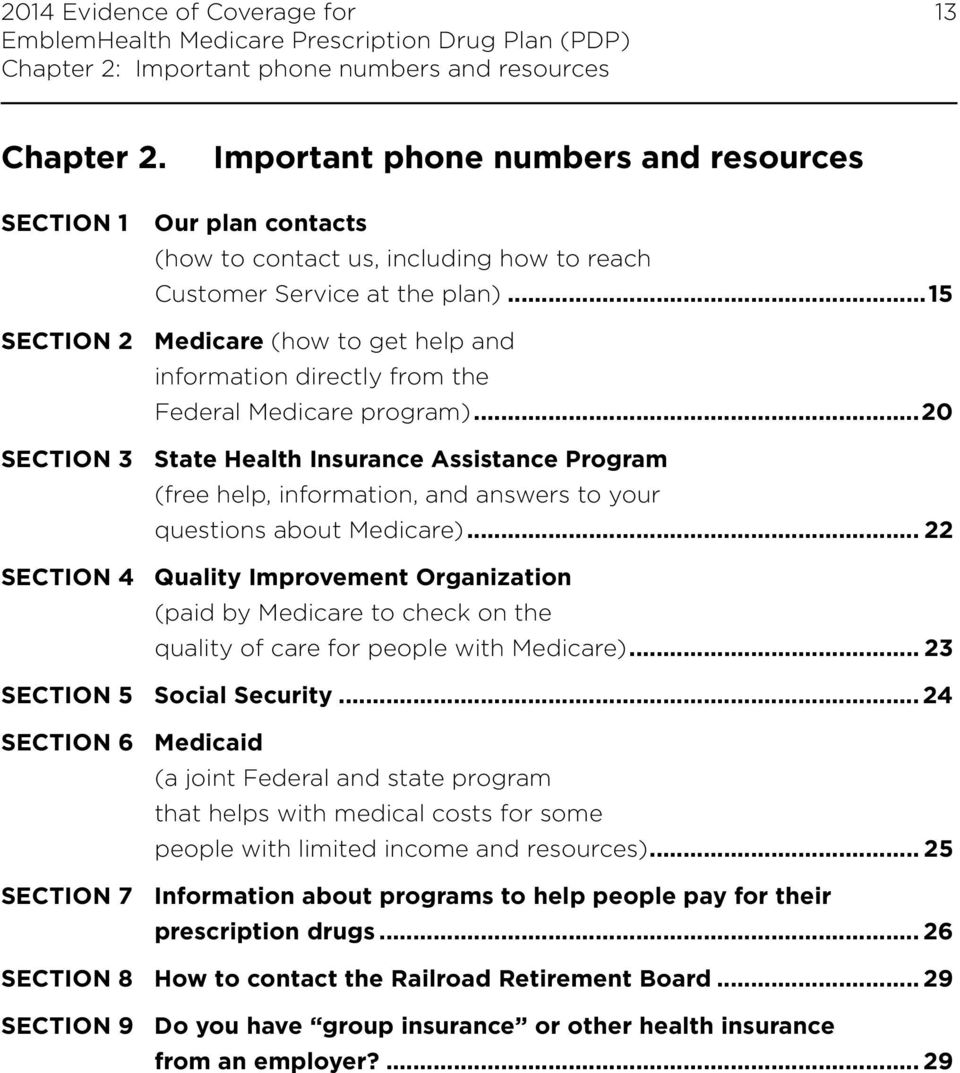
18 2014 Evidence of Coverage for Chapter 2: Important phone numbers and resources 13 Chapter 2. Important phone numbers and resources SECTION 1 Our plan contacts (how to contact us, including how to reach Customer Service at the plan)...15 SECTION 2 Medicare (how to get help and information directly from the Federal Medicare program)...20 SECTION 3 State Health Insurance Assistance Program (free help, information, and answers to your questions about Medicare) SECTION 4 Quality Improvement Organization (paid by Medicare to check on the quality of care for people with Medicare) SECTION 5 Social Security SECTION 6 Medicaid (a joint Federal and state program that helps with medical costs for some people with limited income and resources) SECTION 7 Information about programs to help people pay for their prescription drugs SECTION 8 How to contact the Railroad Retirement Board SECTION 9 Do you have group insurance or other health insurance from an employer?... 29
19

20 2014 Evidence of Coverage for Chapter 2: Important phone numbers and resources 15 SECTION 1 OUR PLAN CONTACTS (HOW TO CONTACT US, INCLUDING HOW TO REACH CUSTOMER SERVICE AT THE PLAN) How to contact our plan s Customer Service For assistance with claims, billing or member card questions, please call or write to our plan s Customer Service. We will be happy to help you. Customer Service CALL Calls to this number are free. Monday to Sunday, 8:00 am to 8:00 pm Customer Service also has free language interpreter services available for non-english speakers. TTY 711 (New York State Relay Service) Calls to this number are free. Monday to Sunday, 8:00 am to 8:00 pm FAX WRITE WEB SITE EmblemHealth Medicare PDP ATTN: Customer Service 55 Water Street New York, NY

21 Evidence of Coverage for Chapter 2: Important phone numbers and resources How to contact us when you are asking for a coverage decision about your Part D prescription drugs A coverage decision is a decision we make about your benefits and coverage or about the amount we will pay for your Part D prescription drugs. For more information on asking for coverage decisions about your Part D prescription drugs, see Chapter 7 (What to do if you have a problem or complaint (coverage decisions, appeals, complaints)). You may call us if you have questions about our coverage decision process. Coverage Decisions for Part D Prescription Drugs CALL Calls to this number are free. Monday to Sunday, 8:00 am to 8:00 pm TTY 711 (New York State Relay Service) Calls to this number are free Monday to Sunday, 8:00 am to 8:00 pm FAX WRITE WEB SITE EmblemHealth Medicare PDP Pharmacy Services 441 9th Ave New York, NY
22 2014 Evidence of Coverage for Chapter 2: Important phone numbers and resources 17 How to contact us when you are making an appeal about your Part D prescription drugs An appeal is a formal way of asking us to review and change a coverage decision we have made. For more information on making an appeal about your Part D prescription drugs, see Chapter 7 (What to do if you have a problem or complaint (coverage decisions, appeals, complaints)). Appeals for Part D Prescription Drugs CALL Calls to this number are free. Monday to Sunday, 8:00 am to 8:00 pm For expedited appeals: TTY 711 (New York State Relay Service) Calls to this number are free. Monday to Sunday, 8:00 am to 8:00 pm For expedited appeals: 711 FAX For expedited appeals: WRITE WEB SITE EmblemHealth Grievance and Appeal Department P.O. Box 2807 New York, NY
23 Evidence of Coverage for Chapter 2: Important phone numbers and resources How to contact us when you are making a complaint about your Part D prescription drugs You can make a complaint about us or one of our network pharmacies, including a complaint about the quality of your care. This type of complaint does not involve coverage or payment disputes. (If your problem is about the plan s coverage or payment, you should look at the section above about making an appeal.) For more information on making a complaint about your Part D prescription drugs, see Chapter 7 (What to do if you have a problem or complaint (coverage decisions, appeals, complaints)). Complaints about Part D prescription drugs CALL Calls to this number are free. Monday to Sunday, 8:00 am to 8:00 pm TTY 711 (New York State Relay Service) Calls to this number are free. Monday to Sunday, 8:00 am to 8:00 pm FAX WRITE MEDICARE WEB SITE EmblemHealth Grievance and Appeal Department P.O. Box 2807 New York, NY You can submit a complaint about our plan directly to Medicare. To submit an online complaint to Medicare go to
24 2014 Evidence of Coverage for Chapter 2: Important phone numbers and resources 19 Where to send a request asking us to pay for our share of the cost of a drug you have received The coverage determination process includes determining requests to pay for our share of the costs of a drug that you have received. For more information on situations in which you may need to ask the plan for reimbursement or to pay a bill you have received from a provider, see Chapter 5 (Asking us to pay our share of the costs for covered drugs). Please note: If you send us a payment request and we deny any part of your request, you can appeal our decision. See Chapter 7 (What to do if you have a problem or complaint (coverage decisions, appeals, complaints)) for more information. Payment Requests CALL Calls to this number are free. Monday to Sunday, 8:00 am to 8:00 pm TTY WRITE WEB SITE 711 (New York State Relay Service) Calls to this number are free Monday to Sunday, 8:00 am to 8:00 pm EmblemHealth Medicare PDP PO Box 1520 JAF Station New York, NY
25 Evidence of Coverage for Chapter 2: Important phone numbers and resources SECTION 2 MEDICARE (HOW TO GET HELP AND INFORMATION DIRECTLY FROM THE FEDERAL MEDICARE PROGRAM) Medicare is the Federal health insurance program for people 65 years of age or older, some people under age 65 with disabilities, and people with End-Stage Renal Disease (permanent kidney failure requiring dialysis or a kidney transplant). The Federal agency in charge of Medicare is the Centers for Medicare & Medicaid Services (sometimes called CMS ). This agency contracts with Medicare Prescription Drug Plans, including us. Medicare CALL TTY WEB SITE MEDICARE, or Calls to this number are free. 24 hours a day, 7 days a week This number requires special telephone equipment and is only for people who have difficulties with hearing or speaking. Calls to this number are free. This is the official government Web site for Medicare. It gives you up-to-date information about Medicare and current Medicare issues. It also has information about hospitals, nursing homes, physicians, home health agencies, and dialysis facilities. It includes booklets you can print directly from your computer. You can also find Medicare contacts in your state. The Medicare Web site also has detailed information about your Medicare eligibility and enrollment options with the following tools: Medicare Eligibility Tool: Provides Medicare eligibility status information. Medicare Plan Finder: Provides personalized information about available Medicare prescription drug plans, Medicare health plans, and Medigap (Medicare Supplement Insurance) policies in your area. These tools provide an estimate of what your out-of-pocket costs might be in different Medicare plans. continued on next page
26 2014 Evidence of Coverage for Chapter 2: Important phone numbers and resources 21 Medicare (continued) WEB SITE You can also use the Web site to tell Medicare about any complaints you have about our plan: Tell Medicare about your complaint: You can submit a complaint about our plan directly to Medicare. To submit a complaint to Medicare, go to Medicare takes your complaints seriously and will use this information to help improve the quality of the Medicare program. If you don t have a computer, your local library or senior center may be able to help you visit this Web site using its computer. Or, you can call Medicare and tell them what information you are looking for. They will find the information on the Web site, print it out, and send it to you. (You can call Medicare at MEDICARE ( ), 24 hours a day, 7 days a week. TTY users should call )
27 Evidence of Coverage for Chapter 2: Important phone numbers and resources SECTION 3 STATE HEALTH INSURANCE ASSISTANCE PROGRAM (FREE HELP, INFORMATION, AND ANSWERS TO YOUR QUESTIONS ABOUT MEDICARE) The State Health Insurance Assistance Program (SHIP) is a government program with trained counselors in every state. In New York State, the SHIP is called the Health Insurance Information Counseling and Assistance Program (HIICAP). HIICAP is independent (not connected with any insurance company or health plan). It is a state program that gets money from the Federal government to give free local health insurance counseling to people with Medicare. HIICAP counselors can help you with your Medicare questions or problems. They can help you understand your Medicare rights, help you make complaints about your medical care or treatment, and help you straighten out problems with your Medicare bills. HIICAP counselors can also help you understand your Medicare plan choices and answer questions about switching plans. Health Insurance Information Counseling and Assistance Program (HIICAP) (New York s SHIP) CALL TTY WRITE WEB SITE 711 (New York State Relay Service) New York State Office for the Aging 2 Empire State Plaza Albany, New York
28 2014 Evidence of Coverage for Chapter 2: Important phone numbers and resources 23 SECTION 4 QUALITY IMPROVEMENT ORGANIZATION (PAID BY MEDICARE TO CHECK ON THE QUALITY OF CARE FOR PEOPLE WITH MEDICARE) There is a Quality Improvement Organization for each state. For New York State, the Quality Improvement Organization is called Livanta. Livanta has a group of doctors and other health care professionals who are paid by the Federal government. This organization is paid by Medicare to check on and help improve the quality of care for people with Medicare. Livanta is an independent organization. It is not connected with our plan. You should contact Livanta in any of these situations: You have a complaint about the quality of care you have received. You think coverage for your hospital stay is ending too soon. You think coverage for your home health care, skilled nursing facility care, or Comprehensive Outpatient Rehabilitation Facility (CORF) services are ending too soon. Method LIVANTA (New York State s Quality Improvement Organization) Contact Information CALL TTY This number requires special telephone equipment and is only for people who have difficulties with hearing or speaking. FAX WRITE (for appeals) (for all other reviews) Livanta BFCC-QIO Program 9090 Junction Drive, Suite 10 Annapolis Junction, MD 20701
29 Evidence of Coverage for Chapter 2: Important phone numbers and resources SECTION 5 SOCIAL SECURITY Social Security is responsible for determining eligibility and handling enrollment for Medicare. U.S. citizens who are 65 or older, or who have a disability or End-Stage Renal Disease and meet certain conditions, are eligible for Medicare. If you are already getting Social Security checks, enrollment into Medicare is automatic. If you are not getting Social Security checks, you have to enroll in Medicare. Social Security handles the enrollment process for Medicare. To apply for Medicare, you can call Social Security or visit your local Social Security office. Social Security is also responsible for determining who has to pay an extra amount for their Part D drug coverage because they have a higher income. If you got a letter from Social Security telling you that you have to pay the extra amount and have questions about the amount or if your income went down because of a life-changing event, you can call Social Security to ask for a reconsideration. If you move or change your mailing address, it is important that you contact Social Security to let them know. Social Security CALL Calls to this number are free. Available 7:00 am to 7:00 pm, Monday through Friday. You can use Social Security s automated telephone services to get recorded information and conduct some business 24 hours a day. TTY This number requires special telephone equipment and is only for people who have difficulties with hearing or speaking. Calls to this number are free. Available 7:00 am ET to 7:00 pm, Monday through Friday. WEB SITE
30 2014 Evidence of Coverage for Chapter 2: Important phone numbers and resources 25 SECTION 6 MEDICAID (A JOINT FEDERAL AND STATE PROGRAM THAT HELPS WITH MEDICAL COSTS FOR SOME PEOPLE WITH LIMITED INCOME AND RESOURCES) Medicaid is a joint Federal and state government program that helps with medical costs for certain people with limited incomes and resources. Some people with Medicare are also eligible for Medicaid. In addition, there are programs offered through Medicaid that help people with Medicare pay their Medicare costs, such as their Medicare premiums. These Medicare Savings Programs help people with limited income and resources save money each year: Qualified Medicare Beneficiary (QMB): Helps pay Medicare Part A and Part B premiums, and other cost sharing (like deductibles, coinsurance, and copayments). (Some people with QMB are also eligible for full Medicaid benefits (QMB+).) Specified Low-Income Medicare Beneficiary (SLMB): Helps pay Part B premiums. (Some people with SLMB are also eligible for full Medicaid benefits (SLMB+).) Qualified Individual (QI): Helps pay Part B premiums. Qualified Disabled & Working Individuals (QDWI): Helps pay Part A premiums. To find out more about Medicaid and its programs, contact the New York State Department of Health. New York State Department of Health CALL TTY WRITE WEB SITE 711 (New York State Relay Service) New York State Department of Health Corning Tower Empire State Plaza, Albany, NY
31 Evidence of Coverage for Chapter 2: Important phone numbers and resources SECTION 7 INFORMATION ABOUT PROGRAMS TO HELP PEOPLE PAY FOR THEIR PRESCRIPTION DRUGS Medicare s Extra Help Program Medicare provides Extra Help to pay prescription drug costs for people who have limited income and resources. Resources include your savings and stocks, but not your home or car. If you qualify, you get help paying for any Medicare drug plan s monthly premium, yearly deductible and prescription copayments or coinsurance. This Extra Help also counts toward your out-of-pocket costs. People with limited income and resources may qualify for Extra Help. Some people automatically qualify for Extra Help and don t need to apply. Medicare mails a letter to people who automatically qualify for Extra Help. You may be able to get Extra Help to pay for your prescription drug premiums and costs. To see if you qualify for getting Extra Help, call: MEDICARE ( ). TTY users should call , 24 hours a day, 7 days a week; The Social Security Office at , between 7 am to 7 pm, Monday through Friday. TTY users should call ; or Your State Medicaid Office. (See Section 6 of this chapter for contact information.) If you believe you have qualified for Extra Help and you believe that you are paying an incorrect cost-sharing amount when you get your prescription at a pharmacy, our plan has established a process that allows you to either request assistance in obtaining evidence of your proper copayment level, or, if you already have the evidence, to provide this evidence to us. If you are unable to locate the documentation needed for best available evidence, or you are unsure what documentation is needed, contact Customer Service for assistance at Monday to Sunday, 8:00 am to 8:00 pm, TTY users call: 711. Customer Service can tell you what documents are acceptable by Medicare for best available evidence and where to send the information in order for us to update your records with the correct cost-sharing amounts. The type of documents that are acceptable by Medicare for Best Available Evidence are: A copy of the beneficiary s Medicaid card that includes the beneficiary s name and an eligibility date during a month after June of the previous calendar year; A copy of a state document that confirms active Medicaid status during a month after June of the previous calendar year; A print out from the State electronic enrollment file showing Medicaid status during a month after June of the previous calendar year; A screen print from the State s Medicaid systems showing Medicaid status during a month after June of the previous calendar year; Other documentation provided by the State showing Medicaid status during a month after June of the previous calendar year;
32 2014 Evidence of Coverage for Chapter 2: Important phone numbers and resources 27 For individuals who are not deemed eligible but who apply and are found LIS eligible, a copy of the SSA award letter; A remittance from the facility showing Medicaid payment for a full calendar month for that individual during a month after June of the previous calendar year; A copy of a state document that confirms Medicaid payment on behalf of the individual to the facility for a full calendar month after June of the previous calendar year; or A screen print from the State s Medicaid systems showing that individual s institutional status based on at least a full calendar month stay for Medicaid payment purposes during a month after June of the previous calendar year. When we receive the evidence showing your copayment level, we will update our system so that you can pay the correct copayment when you get your next prescription at the pharmacy. If you overpay your copayment, we will reimburse you. Either we will forward a check to you in the amount of your overpayment or we will offset future copayments. If the pharmacy hasn t collected a copayment from you and is carrying your copayment as a debt owed by you, we may make the payment directly to the pharmacy. If a state paid on your behalf, we may make payment directly to the state. Please contact Customer Service if you have questions (phone numbers are printed on the back cover of this booklet). Medicare Coverage Gap Discount Program The Medicare Coverage Gap Discount Program provides manufacturer discounts on brand name drugs to Part D enrollees who have reached the coverage gap and are not already receiving Extra Help. A 50% discount on the negotiated price (excluding the dispensing fee and vaccine administration fee, if any) is available for those brand name drugs from manufacturers that have agreed to pay the discount. The plan pays an additional 2.5% and you pay the remaining 47.5% for your brand drugs. If you reach the coverage gap, we will automatically apply the discount when your pharmacy bills you for your prescription and your Explanation of Benefits (EOB) will show any discount provided. Both the amount you pay and the amount discounted by the manufacturer count toward your out-of-pocket costs as if you had paid them and moves you through the coverage gap. You also receive some coverage for generic drugs. If you reach the coverage gap, the plan pays 28% of the price for generic drugs and you pay the remaining 72% of the price. The coverage for generic drugs works differently than the coverage for brand name drugs. For generic drugs, the amount paid by the plan (28%) does not count toward your out-of-pocket costs. Only the amount you pay counts and moves you through the coverage gap. Also, the dispensing fee is included as part of the cost of the drug. If you have any questions about the availability of discounts for the drugs you are taking or about the Medicare Coverage Gap Discount Program in general, please contact Customer Service (phone numbers are printed on the back cover of this booklet). What if you have coverage from a State Pharmaceutical Assistance Program (SPAP)? If you are enrolled in a State Pharmaceutical Assistance Program (SPAP), or any other program that provides coverage for Part D drugs (other than Extra Help ), you still get the 50% discount on covered brand name drugs. Also, the plan pays 2.5% of the costs of brand drugs in the coverage gap. The 50% discount and the 2.5% paid by the plan is applied to the price of the drug before any SPAP or other coverage.
33 Evidence of Coverage for Chapter 2: Important phone numbers and resources What if you get Extra Help from Medicare to help pay your prescription drug costs? Can you get the discounts? No. If you get Extra Help, you already get coverage for your prescription drug costs during the coverage gap. What if you don t get a discount, and you think you should have? If you think that you have reached the coverage gap and did not get a discount when you paid for your brand name drug, you should review your next Explanation of Benefits (EOB) notice. If the discount doesn t appear on your Explanation of Benefits, you should contact us to make sure that your prescription records are correct and up-to-date. If we don t agree that you are owed a discount, you can appeal. You can get help filing an appeal from your State Health Insurance Assistance Program (SHIP) (telephone numbers are in Section 3 of this Chapter) or by calling MEDICARE ( ), 24 hours a day, 7 days a week. TTY users should call State Pharmaceutical Assistance Programs Many states have State Pharmaceutical Assistance Programs that help some people pay for prescription drugs based on financial need, age, or medical condition. Each state has different rules to provide drug coverage to its members. These programs provide limited income and medically needy seniors and individuals with disabilities financial help for prescription drugs. In New York State, the State Pharmaceutical Assistance Program is the Elderly Pharmaceutical Insurance Coverage (EPIC) Program. Elderly Pharmaceutical Insurance Coverage (EPIC) Program (New York s State Pharmaceutical Assistance Program) CALL TTY WRITE WEB SITE This number requires special telephone equipment and is only for people who have difficulties with hearing or speaking. EPIC P.O. Box Albany, NY
34 2014 Evidence of Coverage for Chapter 2: Important phone numbers and resources 29 SECTION 8 HOW TO CONTACT THE RAILROAD RETIREMENT BOARD The Railroad Retirement Board is an independent Federal agency that administers comprehensive benefit programs for the nation s railroad workers and their families. If you have questions regarding your benefits from the Railroad Retirement Board, contact the agency. If you receive your Medicare through the Railroad Retirement Board, it is important that you let them know if you move or change your mailing address Railroad Retirement Board CALL Calls to this number are free. Available 9:00 am to 3:30 pm, Monday through Friday If you have a touch-tone telephone, recorded information and automated services are available 24 hours a day, including weekends and holidays. TTY This number requires special telephone equipment and is only for people who have difficulties with hearing or speaking. Calls to this number are not free. WEB SITE SECTION 9 DO YOU HAVE GROUP INSURANCE OR OTHER HEALTH INSURANCE FROM AN EMPLOYER? If you (or your spouse) get benefits from your (or your spouse s) employer or retiree group, call the employer/union benefits administrator or Customer Service if you have any questions. You can ask about your (or your spouse s) employer or retiree health or drug benefits, premiums, or enrollment period. (Phone numbers for Customer Service are printed on the back cover of this booklet.) If you have other prescription drug coverage through your (or your spouse s) employer or retiree group, please contact that group s benefits administrator. The benefits administrator can help you determine how your current prescription drug coverage will work with our plan.
35
36 2014 Evidence of Coverage for Chapter 3: Using the plan s coverage for your Part D prescription drugs 31 Chapter 3. Using the plan s coverage for your Part D prescription drugs SECTION 1 Introduction Section 1.1 This chapter describes your coverage for Part D drugs...33 Section 1.2 Basic rules for the plan s Part D drug coverage...33 SECTION 2 Fill your prescription at a network pharmacy or through the plan s mail-order service Section 2.1 To have your prescription covered, use a network pharmacy...34 Section 2.2 Finding network pharmacies...34 Section 2.3 Using the plan s mail-order services...35 Section 2.4 How can you get a long-term supply of drugs?...35 Section 2.5 When can you use a pharmacy that is not in the plan s network?...36 SECTION 3 Your drugs need to be on the plan s Drug List Section 3.1 The Drug List tells which Part D drugs are covered...36 Section 3.2 There are four cost-sharing tiers for drugs on the Drug List...37 Section 3.3 How can you find out if a specific drug is on the Drug List?...37 SECTION 4 There are restrictions on coverage for some drugs Section 4.1 Why do some drugs have restrictions?...38 Section 4.2 What kinds of restrictions?...38 Section 4.3 Do any of these restrictions apply to your drugs?...39 SECTION 5 What if one of your drugs is not covered in the way you d like it to be covered? Section 5.1 Section 5.2 There are things you can do if your drug is not covered in the way you d like it to be covered...39 What can you do if your drug is not on the Drug List or if the drug is restricted in some way?...40 Section 5.3 What can you do if your drug is in a cost-sharing tier you think is too high?...42
37 Evidence of Coverage for Chapter 3: Using the plan s coverage for your Part D prescription drugs SECTION 6 What if your coverage changes for one of your drugs? Section 6.1 The Drug List can change during the year...42 Section 6.2 What happens if coverage changes for a drug you are taking?...43 SECTION 7 What types of drugs are not covered by the plan?...44 Section 7.1 Types of drugs we do not cover...44 SECTION 8 Show your plan membership card when you fill a prescription...45 Section 8.1 Show your membership card...45 Section 8.2 What if you don t have your membership card with you?...45 SECTION 9 Part D drug coverage in special situations...45 Section 9.1 What if you re in a hospital or a skilled nursing facility for a stay that is covered by Original Medicare?...45 Section 9.2 What if you re a resident in a long-term care facility?...45 Section 9.3 What if you are taking drugs covered by Original Medicare?...46 Section 9.4 What if you have a Medigap (Medicare Supplement Insurance) policy with prescription drug coverage?...46 Section 9.5 What if you re also getting drug coverage from an employer or retiree group plan?...47 SECTION 10 Programs on drug safety and managing medications Section 10.1 Programs to help members use drugs safely...47 Section 10.2 Programs to help members manage their medications...48
38 2014 Evidence of Coverage for Chapter 3: Using the plan s coverage for your Part D prescription drugs 33? Did you know there are programs to help people pay for their drugs? There are programs to help people with limited resources pay for their drugs. These include Extra Help and State Pharmaceutical Assistance Programs. For more information, see Chapter 2, Section 7. Are you currently getting help to pay for your drugs? If you are in a program that helps pay for your drugs, some information in this Evidence of Coverage about the costs for Part D prescription drugs may not apply to you. We send you a separate insert, called the Evidence of Coverage Rider for People Who Get Extra Help Paying for Prescription Drugs (also known as the Low Income Subsidy Rider or the LIS Rider ), which tells you about your drug coverage. If you don t have this insert, please call Member Services and ask for the LIS Rider. (Phone numbers for Member Services are printed on the back cover of this booklet.) SECTION 1 INTRODUCTION Section 1.1 This chapter describes your coverage for Part D drugs This chapter explains rules for using your coverage for Part D drugs. The next chapter tells what you pay for Part D drugs (Chapter 4, What you pay for your Part D prescription drugs). In addition to your coverage for Part D drugs through our plan, Original Medicare (Medicare Part A and Part B) also covers some drugs: Medicare Part A covers drugs you are given during Medicare-covered stays in the hospital or in a skilled nursing facility. Medicare Part B also provides benefits for some drugs. Part B drugs include certain chemotherapy drugs, certain drug injections you are given during an office visit, and drugs you are given at a dialysis facility. The two examples of drugs described above are covered by Original Medicare. (To find out more about this coverage, see your Medicare & You Handbook.) Your Part D prescription drugs are covered under our plan. Section 1.2 Basic rules for the plan s Part D drug coverage The plan will generally cover your drugs as long as you follow these basic rules: You must have a provider (a doctor or other prescriber) write your prescription. You must use a network pharmacy to fill your prescription. (See Section 2, Fill your prescriptions at a network pharmacy or through the plan s mail-order service.) Your drug must be on the plan s List of Covered Drugs (Formulary) (we call it the Drug List for short). (See Section 3, Your drugs need to be on the plan s Drug List. ) Your drug must be used for a medically accepted indication. A medically accepted indication is a use of the drug that is either approved by the Food and Drug Administration or supported by certain reference books. (See Section 3 for more information about a medically accepted indication.)
39 Evidence of Coverage for Chapter 3: Using the plan s coverage for your Part D prescription drugs SECTION 2 FILL YOUR PRESCRIPTION AT A NETWORK PHARMACY OR THROUGH THE PLAN S MAIL-ORDER SERVICE Section 2.1 To have your prescription covered, use a network pharmacy In most cases, your prescriptions are covered only if they are filled at the plan s network pharmacies. (See Section 2.5 for information about when we would cover prescriptions filled at out-of-network pharmacies.) A network pharmacy is a pharmacy that has a contract with the plan to provide your covered prescription drugs. The term covered drugs means all of the Part D prescription drugs that are covered on the plan s Drug List. Section 2.2 Finding network pharmacies How do you find a network pharmacy in your area? To find a network pharmacy, you can look in your Pharmacy Directory, visit our Web site ( or call Customer Service (phone numbers are printed on the back cover of this booklet). Choose whatever is easiest for you. You may go to any of our network pharmacies. If you switch from one network pharmacy to another, and you need a refill of a drug you have been taking, you can ask either to have a new prescription written by a provider or to have your prescription transferred to your new network pharmacy. What if the pharmacy you have been using leaves the network? If the pharmacy you have been using leaves the plan s network, you will have to find a new pharmacy that is in the network. To find another network pharmacy in your area, you can get help from Customer Service (phone numbers are printed on the back cover of this booklet) or use the Pharmacy Directory. You can also find information on our Web site at What if you need a specialized pharmacy? Sometimes prescriptions must be filled at a specialized pharmacy. Specialized pharmacies include: Pharmacies that supply drugs for home infusion therapy. Pharmacies that supply drugs for residents of a long-term care facility. Usually, a long-term care facility (such as a nursing home) has its own pharmacy. Residents may get prescription drugs through the facility s pharmacy as long as it is part of our network. If your long-term care pharmacy is not in our network, please contact Customer Service. Pharmacies that serve the Indian Health Service / Tribal / Urban Indian Health Program (not available in Puerto Rico). Except in emergencies, only Native Americans or Alaska Natives have access to these pharmacies in our network. Pharmacies that dispense drugs that are restricted by the FDA to certain locations or that require special handling, provider coordination, or education on their use. (Note: This scenario should happen rarely.)
40 2014 Evidence of Coverage for Chapter 3: Using the plan s coverage for your Part D prescription drugs 35 To locate a specialized pharmacy, look in your Pharmacy Directory or call Customer Service (phone numbers are printed on the back cover of this booklet). Section 2.3 Using the plan s mail-order services For certain kinds of drugs, you can use the plan s network mail-order services. Generally, the drugs available through mail order are drugs that you take on a regular basis, for a chronic or long-term medical condition. The drugs available through our plan s mail-order service are marked as MO ( mail-order drugs) in our Drug List. Our plan s mail-order service requires you to order at least a 30-day supply of the drug and no more than a 90-day supply. To get order forms and information about filling your prescriptions by mail you can: Download the form by going to our website at Contact our Customer Service (phone numbers are on the back cover of this booklet) If you use a mail-order pharmacy not in the plan s network, your prescription will not be covered. Usually a mail-order pharmacy order will get to you in no more than 14 days. To ensure that you always have a supply of medications, you can ask your doctor to write a one month prescription which can be filled at a retail pharmacy right away and a second prescription for up to 90 days that you can send with your mail order form. Section 2.4 How can you get a long-term supply of drugs? When you get a long-term supply of drugs, your cost sharing may be lower. The plan offers two ways to get a long-term supply of maintenance drugs on our plan s Drug List. (Maintenance drugs are drugs that you take on a regular basis, for a chronic or long-term medical condition.) 1. Some retail pharmacies in our network allow you to get a long-term supply of maintenance drugs. Some of these retail pharmacies may agree to accept a lower cost-sharing amount for a long-term supply of maintenance drugs. Other retail pharmacies may not agree to accept the lower cost-sharing amounts for a long-term supply of maintenance drugs. In this case you will be responsible for the difference in price. Your Pharmacy Directory tells you which pharmacies in our network can give you a long-term supply of maintenance drugs. You can also call Customer Service for more information (phone numbers are printed on the back cover of this booklet). 2. For certain kinds of drugs, you can use the plan s network mail-order services. The drugs available through our plan s mail-order service are marked as MO ( mail-order drugs) in our Drug List. Our plan s mail-order service requires you to order at least a 30-day supply of the drug and no more than a 90-day supply. See Section 2.3 for more information about using our mail-order services.
41 Evidence of Coverage for Chapter 3: Using the plan s coverage for your Part D prescription drugs Section 2.5 When can you use a pharmacy that is not in the plan s network? Your prescription may be covered in certain situations We have network pharmacies outside of our service area where you can get your prescriptions filled as a member of our plan. Generally, we cover drugs filled at an out-of-network pharmacy only when you are not able to use a network pharmacy. Here are the circumstances when we would cover prescriptions filled at an out-of-network pharmacy: If you are unable to obtain a covered drug in a timely manner within our service area because there are no network pharmacies within a reasonable driving distance that provide 24-hour service. If you are trying to fill a prescription drug that is not regularly stocked at an accessible network, retail or mail-order pharmacy (including high-cost and unique drugs). If you are getting a vaccine that is medically necessary but not covered by Medicare Part B or some covered drugs that are administered in your doctor s office. In these situations, please check first with Customer Service to see if there is a network pharmacy nearby. (Phone numbers for Customer Service are printed on the back cover of this booklet.) How do you ask for reimbursement from the plan? If you must use an out-of-network pharmacy, you will generally have to pay the full cost (rather than your normal share of the cost) when you fill your prescription. You can ask us to reimburse you for our share of the cost. (Chapter 5, Section 2.1 explains how to ask the plan to pay you back.) SECTION 3 YOUR DRUGS NEED TO BE ON THE PLAN S DRUG LIST Section 3.1 The Drug List tells which Part D drugs are covered The plan has a List of Covered Drugs (Formulary). In this Evidence of Coverage, we call it the Drug List for short. The drugs on this list are selected by the plan with the help of a team of doctors and pharmacists. The list must meet requirements set by Medicare. Medicare has approved the plan s Drug List. The drugs on the Drug List are only those covered under Medicare Part D (earlier in this chapter, Section 1.1 explains about Part D drugs). We will generally cover a drug on the plan s Drug List as long as you follow the other coverage rules explained in this chapter and the use of the drug is a medically accepted indication. A medically accepted indication is a use of the drug that is either: approved by the Food and Drug Administration. (That is, the Food and Drug Administration has approved the drug for the diagnosis or condition for which it is being prescribed.) -- or -- supported by certain reference books. (These reference books are the American Hospital Formulary Service Drug Information, the DRUGDEX Information System, and the USPDI or its successor.)
42 2014 Evidence of Coverage for Chapter 3: Using the plan s coverage for your Part D prescription drugs 37 The Drug List includes both brand name and generic drugs A generic drug is a prescription drug that has the same active ingredients as the brand name drug. Generally, it works just as well as the brand name drug and usually costs less. There are generic drug substitutes available for many brand name drugs. What is not on the Drug List? The plan does not cover all prescription drugs. In some cases, the law does not allow any Medicare plan to cover certain types of drugs (for more about this, see Section 7.1 in this chapter). In other cases, we have decided not to include a particular drug on our Drug List. Section 3.2 There are four cost-sharing tiers for drugs on the Drug List Every drug on the plan s Drug List is in one of four cost-sharing tiers. In general, the higher the costsharing tier, the higher your cost for the drug: Tier 1- Preferred Generic Drugs Tier 2- Non-Preferred Generic Drugs Tier 3- Preferred Brand Drugs Tier 4- Specialty Drugs To find out which cost-sharing tier your drug is in, look it up in the plan s Drug List. The amount you pay for drugs in each cost-sharing tier is shown in Chapter 4 (What you pay for your Part D prescription drugs). Section 3.3 How can you find out if a specific drug is on the Drug List? You have three ways to find out: 1. Check the most recent Drug List we sent you in the mail. 2. Visit the plan s Web site ( The Drug List on the Web site is always the most current. 3. Call Customer Service to find out if a particular drug is on the plan s Drug List or to ask for a copy of the list. (Phone numbers for Customer Service are printed on the back cover of this booklet.)
43 Evidence of Coverage for Chapter 3: Using the plan s coverage for your Part D prescription drugs SECTION 4 THERE ARE RESTRICTIONS ON COVERAGE FOR SOME DRUGS Section 4.1 Why do some drugs have restrictions? For certain prescription drugs, special rules restrict how and when the plan covers them. A team of doctors and pharmacists developed these rules to help our members use drugs in the most effective ways. These special rules also help control overall drug costs, which keeps your drug coverage more affordable. In general, our rules encourage you to get a drug that works for your medical condition and is safe and effective. Whenever a safe, lower-cost drug will work just as well medically as a higher-cost drug, the plan s rules are designed to encourage you and your provider to use that lower-cost option. We also need to comply with Medicare s rules and regulations for drug coverage and cost sharing. If there is a restriction for your drug, it usually means that you or your provider will have to take extra steps in order for us to cover the drug. If you want us to waive the restriction for you, you will need to use the coverage decision process and ask us to make an exception. We may or may not agree to waive the restriction for you. (See Chapter 7, Section 5.2 for information about asking for exceptions.) Section 4.2 What kinds of restrictions? Our plan uses different types of restrictions to help our members use drugs in the most effective ways. The sections below tell you more about the types of restrictions we use for certain drugs. Restricting brand name drugs when a generic version is available Generally, a generic drug works the same as a brand name drug and usually costs less. In most cases, when a generic version of a brand name drug is available, our network pharmacies will provide you the generic version. We usually will not cover the brand name drug when a generic version is available. However, if your provider has told us the medical reason that the generic drug will not work for you, then we will cover the brand name drug. (Your share of the cost may be greater for the brand name drug than for the generic drug.) Getting plan approval in advance For certain drugs, you or your provider need to get approval from the plan before we will agree to cover the drug for you. This is called prior authorization. Sometimes the requirement for getting approval in advance helps guide appropriate use of certain drugs. If you do not get this approval, your drug might not be covered by the plan. Trying a different drug first This requirement encourages you to try less costly but just as effective drugs before the plan covers another drug. For example, if Drug A and Drug B treat the same medical condition, the plan may require you to try Drug A first. If Drug A does not work for you, the plan will then cover Drug B. This requirement to try a different drug first is called step therapy.
44 2014 Evidence of Coverage for Chapter 3: Using the plan s coverage for your Part D prescription drugs 39 Quantity limits For certain drugs, we limit the amount of the drug that you can have. For example, the plan might limit how many refills you can get, or how much of a drug you can get each time you fill your prescription. For example, if it is normally considered safe to take only one pill per day for a certain drug, we may limit coverage for your prescription to no more than one pill per day. Section 4.3 Do any of these restrictions apply to your drugs? The plan s Drug List includes information about the restrictions described above. To find out if any of these restrictions apply to a drug you take or want to take, check the Drug List. For the most up-to-date information, call Customer Service (phone numbers are printed on the back cover of this booklet) or check our Web site ( If there is a restriction for your drug, it usually means that you or your provider will have to take extra steps in order for us to cover the drug. If there is a restriction on the drug you want to take, you should contact Customer Service to learn what you or your provider would need to do to get coverage for the drug. If you want us to waive the restriction for you, you will need to use the coverage decision process and ask us to make an exception. We may or may not agree to waive the restriction for you. (See Chapter 7, Section 5.2 for information about asking for exceptions.) SECTION 5 WHAT IF ONE OF YOUR DRUGS IS NOT COVERED IN THE WAY YOU D LIKE IT TO BE COVERED? Section 5.1 There are things you can do if your drug is not covered in the way you d like it to be covered Suppose there is a prescription drug you are currently taking, or one that you and your provider think you should be taking. We hope that your drug coverage will work well for you, but it s possible that you might have a problem. For example: What if the drug you want to take is not covered by the plan? For example, the drug might not be covered at all. Or maybe a generic version of the drug is covered but the brand name version you want to take is not covered. What if the drug is covered, but there are extra rules or restrictions on coverage for that drug? As explained in Section 4, some of the drugs covered by the plan have extra rules to restrict their use. For example, you might be required to try a different drug first, to see if it will work, before the drug you want to take will be covered for you. Or there might be limits on what amount of the drug (number of pills, etc.) is covered during a particular time period. In some cases, you may want us to waive the restriction for you. For example, you might want us to cover a certain drug for you without having to try other drugs first. Or you may want us to cover more of a drug (number of pills, etc.) than we normally will cover.
45 Evidence of Coverage for Chapter 3: Using the plan s coverage for your Part D prescription drugs What if the drug is covered, but it is in a cost-sharing tier that makes your cost sharing more expensive than you think it should be? The plan puts each covered drug into one of four different cost-sharing tiers. How much you pay for your prescription depends in part on which cost-sharing tier your drug is in. There are things you can do if your drug is not covered in the way that you d like it to be covered. Your options depend on what type of problem you have: If your drug is not on the Drug List or if your drug is restricted, go to Section 5.2 to learn what you can do. If your drug is in a cost-sharing tier that makes your cost more expensive than you think it should be, go to Section 5.3 to learn what you can do. Section 5.2 What can you do if your drug is not on the Drug List or if the drug is restricted in some way? If your drug is not on the Drug List or is restricted, here are things you can do: You may be able to get a temporary supply of the drug (only members in certain situations can get a temporary supply). This will give you and your provider time to change to another drug or to file a request to have the drug covered. You can change to another drug. You can request an exception and ask the plan to cover the drug or remove restrictions from the drug. You may be able to get a temporary supply Under certain circumstances, the plan can offer a temporary supply of a drug to you when your drug is not on the Drug List or when it is restricted in some way. Doing this gives you time to talk with your provider about the change in coverage and figure out what to do. To be eligible for a temporary supply, you must meet the two requirements below: 1. The change to your drug coverage must be one of the following types of changes: The drug you have been taking is no longer on the plan s Drug List. -- or -- the drug you have been taking is now restricted in some way (Section 4 in this chapter tells about restrictions). 2. You must be in one of the situations described below: For those members who were in the plan last year and aren t in a long-term care facility: We will cover a temporary supply of your drug one time only during the first 90 days of the calendar year. This temporary supply will be for a maximum of a 30-day supply, or less if your prescription is written for fewer days. The prescription must be filled at a network pharmacy. For those members who are new to the plan and aren t in a long-term care facility: We will cover a temporary supply of your drug one time only during the first 90 days of your membership in the plan. This temporary supply will be for a maximum of a 30-day supply, or less if your prescription is written for fewer days. The prescription must be filled at a network pharmacy.
46 2014 Evidence of Coverage for Chapter 3: Using the plan s coverage for your Part D prescription drugs 41 For those members who are new to the plan and reside in a long-term care facility: We will cover a temporary supply of your drug during the first 90 days of your membership in the plan. The first supply will be for a maximum of a 98-day supply, or less if your prescription is written for fewer days. (Please note that the long-term care pharmacy may provide the drug in smaller amounts at a time to prevent waste.) If needed, we will cover additional refills during your first 90 days in the plan. For those members who have been in the plan for more than 90 days and reside in a longterm care facility and need a supply right away: We will cover one 31-day supply, or less if your prescription is written for fewer days. This is in addition to the above long-term care transition supply. To ask for a temporary supply, call Customer Service (phone numbers are printed on the back cover of this booklet). During the time when you are getting a temporary supply of a drug, you should talk with your provider to decide what to do when your temporary supply runs out. You can either switch to a different drug covered by the plan or ask the plan to make an exception for you and cover your current drug. The sections below tell you more about these options. You can change to another drug Start by talking with your provider. Perhaps there is a different drug covered by the plan that might work just as well for you. You can call Customer Service to ask for a list of covered drugs that treat the same medical condition. This list can help your provider find a covered drug that might work for you. (Phone numbers for Customer Service are printed on the back cover of this booklet.) You can ask for an exception You and your provider can ask the plan to make an exception for you and cover the drug in the way you would like it to be covered. If your provider says that you have medical reasons that justify asking us for an exception, your provider can help you request an exception to the rule. For example, you can ask the plan to cover a drug even though it is not on the plan s Drug List. Or you can ask the plan to make an exception and cover the drug without restrictions. If you are a current member and a drug you are taking will be removed from the formulary or restricted in some way for next year, we will allow you to request a formulary exception in advance for next year. We will tell you about any change in the coverage for your drug for next year. You can ask for an exception before next year and we will give you an answer within 72 hours after we receive your request (or your prescriber s supporting statement). If we approve your request, we will authorize the coverage before the change takes effect. If you and your provider want to ask for an exception, Chapter 7, Section 5.4 tells what to do. It explains the procedures and deadlines that have been set by Medicare to make sure your request is handled promptly and fairly.
47 Evidence of Coverage for Chapter 3: Using the plan s coverage for your Part D prescription drugs Section 5.3 What can you do if your drug is in a cost-sharing tier you think is too high? If your drug is in a cost-sharing tier you think is too high, here are things you can do: You can change to another drug If your drug is in a cost-sharing tier you think is too high, start by talking with your provider. Perhaps there is a different drug in a lower cost-sharing tier that might work just as well for you. You can call Customer Service to ask for a list of covered drugs that treat the same medical condition. This list can help your provider find a covered drug that might work for you. (Phone numbers for Customer Service are printed on the back cover of this booklet.) You can ask for an exception For drugs in Tier 2, you and your provider can ask the plan to make an exception in the cost-sharing tier for the drug so that you pay less for it. If your provider says that you have medical reasons that justify asking us for an exception, your provider can help you request an exception to the rule. If you and your provider want to ask for an exception, Chapter 7, Section 5.4 tells what to do. It explains the procedures and deadlines that have been set by Medicare to make sure your request is handled promptly and fairly. Drugs in some of our cost-sharing tiers are not eligible for this type of exception. We do not lower the cost-sharing amount for drugs in Tier 4 Specialty Drugs. SECTION 6 WHAT IF YOUR COVERAGE CHANGES FOR ONE OF YOUR DRUGS? Section 6.1 The Drug List can change during the year Most of the changes in drug coverage happen at the beginning of each year (January 1). However, during the year, the plan might make many kinds of changes to the Drug List. For example, the plan might: Add or remove drugs from the Drug List. New drugs become available, including new generic drugs. Perhaps the government has given approval to a new use for an existing drug. Sometimes, a drug gets recalled and we decide not to cover it. Or we might remove a drug from the list because it has been found to be ineffective. Move a drug to a higher or lower cost-sharing tier. Add or remove a restriction on coverage for a drug (for more information about restrictions to coverage, see Section 4 in this chapter). Replace a brand name drug with a generic drug. In almost all cases, we must get approval from Medicare for changes we make to the plan s Drug List.
48 2014 Evidence of Coverage for Chapter 3: Using the plan s coverage for your Part D prescription drugs 43 Section 6.2 What happens if coverage changes for a drug you are taking? How will you find out if your drug s coverage has been changed? If there is a change to coverage for a drug you are taking, the plan will send you a notice to tell you. Normally, we will let you know at least 60 days ahead of time. Once in a while, a drug is suddenly recalled because it s been found to be unsafe or for other reasons. If this happens, the plan will immediately remove the drug from the Drug List. We will let you know of this change right away. Your provider will also know about this change, and can work with you to find another drug for your condition. Do changes to your drug coverage affect you right away? If any of the following types of changes affect a drug you are taking, the change will not affect you until January 1 of the next year if you stay in the plan: If we move your drug into a higher cost-sharing tier. If we put a new restriction on your use of the drug. If we remove your drug from the Drug List, but not because of a sudden recall or because a new generic drug has replaced it. If any of these changes happens for a drug you are taking, then the change won t affect your use or what you pay as your share of the cost until January 1 of the next year. Until that date, you probably won t see any increase in your payments or any added restriction to your use of the drug. However, on January 1 of the next year, the changes will affect you. In some cases, you will be affected by the coverage change before January 1: If a brand name drug you are taking is replaced by a new generic drug, the plan must give you at least 60 days notice or give you a 60-day refill of your brand name drug at a network pharmacy. During this 60-day period, you should be working with your provider to switch to the generic or to a different drug that we cover. Or you and your provider can ask the plan to make an exception and continue to cover the brand name drug for you. For information on how to ask for an exception, see Chapter 7 (What to do if you have a problem or complaint (coverage decisions, appeals, complaints)). Again, if a drug is suddenly recalled because it s been found to be unsafe or for other reasons, the plan will immediately remove the drug from the Drug List. We will let you know of this change right away. Your provider will also know about this change, and can work with you to find another drug for your condition.
49 Evidence of Coverage for Chapter 3: Using the plan s coverage for your Part D prescription drugs SECTION 7 WHAT TYPES OF DRUGS ARE NOT COVERED BY THE PLAN? Section 7.1 Types of drugs we do not cover This section tells you what kinds of prescription drugs are excluded. This means Medicare does not pay for these drugs. If you get drugs that are excluded, you must pay for them yourself. We won t pay for the drugs that are listed in this section. The only exception: If the requested drug is found upon appeal to be a drug that is not excluded under Part D and we should have paid for or covered it because of your specific situation. (For information about appealing a decision we have made to not cover a drug, go to Chapter 7, Section 5.5 in this booklet.) Here are three general rules about drugs that Medicare drug plans will not cover under Part D: Our plan s Part D drug coverage cannot cover a drug that would be covered under Medicare Part A or Part B. Our plan cannot cover a drug purchased outside the United States and its territories. Our plan usually cannot cover off-label use. Off-label use is any use of the drug other than those indicated on a drug s label as approved by the Food and Drug Administration. Generally, coverage for off-label use is allowed only when the use is supported by certain reference books. These reference books are the American Hospital Formulary Service Drug Information, the DRUGDEX Information System, and the USPDI or its successor. If the use is not supported by any of these reference books, then our plan cannot cover its off-label use. Also, by law, these categories of drugs are not covered by Medicare drug plans: Non-prescription drugs (also called over-the-counter drugs) Drugs when used to promote fertility Drugs when used for the relief of cough or cold symptoms Drugs when used for cosmetic purposes or to promote hair growth Prescription vitamins and mineral products, except prenatal vitamins and fluoride preparations Drugs when used for the treatment of sexual or erectile dysfunction, such as Viagra, Cialis, Levitra, and Caverject Drugs when used for treatment of anorexia, weight loss, or weight gain Outpatient drugs for which the manufacturer seeks to require that associated tests or monitoring services be purchased exclusively from the manufacturer as a condition of sale. If you receive Extra Help paying for your drugs, your state Medicaid program may cover some prescription drugs not normally covered in a Medicare drug plan. Please contact your state Medicaid program to determine what drug coverage may be available to you. (You can find phone numbers and contact information for Medicaid in Chapter 2, Section 6.)
50 2014 Evidence of Coverage for Chapter 3: Using the plan s coverage for your Part D prescription drugs 45 SECTION 8 SHOW YOUR PLAN MEMBERSHIP CARD WHEN YOU FILL A PRESCRIPTION Section 8.1 Show your membership card To fill your prescription, show your plan membership card at the network pharmacy you choose. When you show your plan membership card, the network pharmacy will automatically bill the plan for our share of your covered prescription drug cost. You will need to pay the pharmacy your share of the cost when you pick up your prescription. Section 8.2 What if you don t have your membership card with you? If you don t have your plan membership card with you when you fill your prescription, ask the pharmacy to call the plan to get the necessary information. If the pharmacy is not able to get the necessary information, you may have to pay the full cost of the prescription when you pick it up. (You can then ask us to reimburse you for our share. See Chapter 5, Section 2.1 for information about how to ask the plan for reimbursement.) SECTION 9 PART D DRUG COVERAGE IN SPECIAL SITUATIONS Section 9.1 What if you re in a hospital or a skilled nursing facility for a stay that is covered by Original Medicare? If you are admitted to a hospital for a stay covered by Original Medicare, Medicare Part A will generally cover the cost of your prescription drugs during your stay. Once you leave the hospital, our plan will cover your drugs as long as the drugs meet all of our rules for coverage. See the previous parts of this chapter that tell about the rules for getting drug coverage. If you are admitted to a skilled nursing facility for a stay covered by Original Medicare, Medicare Part A will generally cover your prescription drugs during all or part of your stay. If you are still in the skilled nursing facility, and Part A is no longer covering your drugs, our plan will cover your drugs as long as the drugs meet all of our rules for coverage. See the previous parts of this chapter that tell about the rules for getting drug coverage. Please Note: When you enter, live in, or leave a skilled nursing facility, you are entitled to a Special Enrollment Period. During this time period, you can switch plans or change your coverage. (Chapter 8, Ending your membership in the plan, tells when you can leave our plan and join a different Medicare plan.) Section 9.2 What if you re a resident in a long-term care facility? Usually, a long-term care facility (such as a nursing home) has its own pharmacy, or a pharmacy that supplies drugs for all of its residents. If you are a resident of a long-term care facility, you may get your prescription drugs through the facility s pharmacy as long as it is part of our network.
51 Evidence of Coverage for Chapter 3: Using the plan s coverage for your Part D prescription drugs Check your Pharmacy Directory to find out if your long-term care facility s pharmacy is part of our network. If it isn t, or if you need more information, please contact Customer Service (phone numbers are printed on the back cover of this booklet). What if you re a resident in a long-term care facility and become a new member of the plan? If you need a drug that is not on our Drug List or is restricted in some way, the plan will cover a temporary supply of your drug during the first 90 days of your membership. The first supply will be for a maximum of a 98-day supply, or less if your prescription is written for fewer days. (Please note that the long-term care pharmacy may provide the drug in smaller amounts at a time to prevent waste.) If needed, we will cover additional refills during your first 90 days in the plan. If you have been a member of the plan for more than 90 days and need a drug that is not on our Drug List or if the plan has any restriction on the drug s coverage, we will cover one 31-day supply, or less if your prescription is written for fewer days. During the time when you are getting a temporary supply of a drug, you should talk with your provider to decide what to do when your temporary supply runs out. Perhaps there is a different drug covered by the plan that might work just as well for you. Or you and your provider can ask the plan to make an exception for you and cover the drug in the way you would like it to be covered. If you and your provider want to ask for an exception, Chapter 7, Section 5.4 tells what to do. Section 9.3 What if you are taking drugs covered by Original Medicare? Your enrollment in our plan doesn t affect your coverage for drugs covered under Medicare Part A or Part B. If you meet Medicare s coverage requirements, your drug will still be covered under Medicare Part A or Part B, even though you are enrolled in this plan. In addition, if your drug would be covered by Medicare Part A or Part B, our plan can t cover it, even if you choose not to enroll in Part A or Part B. Some drugs may be covered under Medicare Part B in some situations and through our plan in other situations. But drugs are never covered by both Part B and our plan at the same time. In general, your pharmacist or provider will determine whether to bill Medicare Part B or our plan for the drug. Section 9.4 What if you have a Medigap (Medicare Supplement Insurance) policy with prescription drug coverage? If you currently have a Medigap policy that includes coverage for prescription drugs, you must contact your Medigap issuer and tell them you have enrolled in our plan. If you decide to keep your current Medigap policy, your Medigap issuer will remove the prescription drug coverage portion of your Medigap policy and lower your premium. Each year your Medigap insurance company should send you a notice that tells if your prescription drug coverage is creditable, and the choices you have for drug coverage. (If the coverage from the Medigap policy is creditable, it means that it is expected to pay, on average, at least as much as Medicare s standard prescription drug coverage.) The notice will also explain how much your premium would be lowered if you remove the prescription drug coverage portion of your Medigap policy. If you didn t get this notice, or if you can t find it, contact your Medigap insurance company and ask for another copy.
52 2014 Evidence of Coverage for Chapter 3: Using the plan s coverage for your Part D prescription drugs 47 Section 9.5 What if you re also getting drug coverage from an employer or retiree group plan? Do you currently have other prescription drug coverage through your (or your spouse s) employer or retiree group? If so, please contact that group s benefits administrator. He or she can help you determine how your current prescription drug coverage will work with our plan. In general, if you are currently employed, the prescription drug coverage you get from us will be secondary to your employer or retiree group coverage. That means your group coverage would pay first. Special note about creditable coverage : Each year your employer or retiree group should send you a notice that tells if your prescription drug coverage for the next calendar year is creditable and the choices you have for drug coverage. If the coverage from the group plan is creditable, it means that the plan has drug coverage that is expected to pay, on average, at least as much as Medicare s standard prescription drug coverage. Keep these notices about creditable coverage, because you may need them later. If you enroll in a Medicare plan that includes Part D drug coverage, you may need these notices to show that you have maintained creditable coverage. If you didn t get a notice about creditable coverage from your employer or retiree group plan, you can get a copy from the employer or retiree group s benefits administrator or the employer or union. SECTION 10 PROGRAMS ON DRUG SAFETY AND MANAGING MEDICATIONS Section 10.1 Programs to help members use drugs safely We conduct drug use reviews for our members to help make sure that they are getting safe and appropriate care. These reviews are especially important for members who have more than one provider who prescribes their drugs. We do a review each time you fill a prescription. We also review our records on a regular basis. During these reviews, we look for potential problems such as: Possible medication errors Drugs that may not be necessary because you are taking another drug to treat the same medical condition Drugs that may not be safe or appropriate because of your age or gender Certain combinations of drugs that could harm you if taken at the same time Prescriptions written for drugs that have ingredients you are allergic to Possible errors in the amount (dosage) of a drug you are taking. If we see a possible problem in your use of medications, we will work with your provider to correct the problem.
53 Evidence of Coverage for Chapter 3: Using the plan s coverage for your Part D prescription drugs Section 10.2 Programs to help members manage their medications We have programs that can help our members with special situations. For example, some members have several complex medical conditions or they may need to take many drugs at the same time, or they could have very high drug costs. These programs are voluntary and free to members. A team of pharmacists and doctors developed the programs for us. The programs can help make sure that our members are using the drugs that work best to treat their medical conditions and help us identify possible medication errors. One program is called a Medication Therapy Management (MTM) program. Some members who take several medications for different medical conditions may qualify. A pharmacist or other health professional will give you a comprehensive review of all your medications. You can talk about how best to take your medications, your costs, or any problems you re having. You ll get a written summary of this discussion. The summary has a medication action plan that recommends what you can do to make the best use of your medications, with space for you to take notes or write down any follow-up questions. You ll also get a personal medication list that will include all the medications you re taking and why you take them. If we have a program that fits your needs, we will automatically enroll you in the program and send you information. If you decide not to participate, please notify us and we will withdraw you from the program. If you have any questions about these programs, please contact Customer Service (phone numbers are printed on the back cover of this booklet.
54 2014 Evidence of Coverage for Chapter 4: What you pay for your Part D prescription drugs 49 Chapter 4. What you pay for your Part D prescription drugs SECTION 1 Introduction...51 Section 1.1 Use this chapter together with other materials that explain your drug coverage...51 Section 1.2 Types of out-of-pocket costs you may pay for covered drugs...52 SECTION 2 What you pay for a drug depends on which drug payment stage you are in when you get the drug Section 2.1 What are the drug payment stages for our plan members?...52 SECTION 3 We send you reports that explain payments for your drugs and which payment stage you are in Section 3.1 We send you a monthly report called the Explanation of Benefits (the EOB )...53 Section 3.2 Help us keep our information about your drug payments up to date...53 SECTION 4 During the Deductible Stage, you pay the full cost of your drugs...54 Section 4.1 You stay in the Deductible Stage until you have paid $310 for your drugs...54 SECTION 5 During the Initial Coverage Stage, the plan pays its share of your drug costs and you pay your share Section 5.1 What you pay for a drug depends on the drug and where you fill your prescription...55 Section 5.2 A table that shows your costs for a one-month supply of a drug...55 Section 5.3 If your doctor prescribes less than a full month s supply, you may not have to pay the cost of the entire month s supply...57 Section 5.4 A table that shows your costs for a long-term (90-day) supply of a drug...57 Section 5.5 You stay in the Initial Coverage Stage until your total drug costs for the year reach $2, SECTION 6 During the Coverage Gap Stage, you receive a discount on brand name drugs and pay no more than 72% of the costs for generic drugs Section 6.1 You stay in the Coverage Gap Stage until your out-of-pocket costs reach $4, Section 6.2 How Medicare calculates your out-of-pocket costs for prescription drugs...59
55 Evidence of Coverage for Chapter 4: What you pay for your Part D prescription drugs SECTION 7 During the Catastrophic Coverage Stage, the plan pays most of the cost for your drugs...61 Section 7.1 Once you are in the Catastrophic Coverage Stage, you will stay in this stage for the rest of the year...61 SECTION 8 What you pay for vaccinations covered by Part D depends on how and where you get them...61 Section 8.1 Our plan has separate coverage for the Part D vaccine medication itself and for the cost of giving you the vaccination shot...61 Section 8.2 You may want to call us at Customer Service before you get a vaccination...63 SECTION 9 Do you have to pay the Part D late enrollment penalty? Section 9.1 What is the Part D late enrollment penalty?...63 Section 9.2 How much is the Part D late enrollment penalty?...64 Section 9.3 In some situations, you can enroll late and not have to pay the penalty...64 Section 9.4 What can you do if you disagree about your late enrollment penalty?...65 SECTION 10 Do you have to pay an extra Part D amount because of your income? Section 10.1 Who pays an extra Part D amount because of income?...65 Section 11.2 How much is the extra Part D amount?...66 Section 10.3 What can you do if you disagree about paying an extra Part D amount?...66 Section 10.4 What happens if you do not pay the extra Part D amount?...66
56 2014 Evidence of Coverage for Chapter 4: What you pay for your Part D prescription drugs 51? Did you know there are programs to help people pay for their drugs? There are programs to help people with limited resources pay for their drugs. These include Extra Help and State Pharmaceutical Assistance Programs. For more information, see Chapter 2, Section 7. Are you currently getting help to pay for your drugs? If you are in a program that helps pay for your drugs, some information in this Evidence of Coverage about the costs for Part D prescription drugs may not apply to you. We send you a separate insert, called the Evidence of Coverage Rider for People Who Get Extra Help Paying for Prescription Drugs (also known as the Low Income Subsidy Rider or the LIS Rider ), which tells you about your drug coverage. If you don t have this insert, please call Customer Service and ask for the LIS Rider. (Phone numbers for Customer Service are printed on the back cover of this booklet.) SECTION 1 INTRODUCTION Section 1.1 Use this chapter together with other materials that explain your drug coverage This chapter focuses on what you pay for your Part D prescription drugs. To keep things simple, we use drug in this chapter to mean a Part D prescription drug. As explained in Chapter 3, not all drugs are Part D drugs some drugs are covered under Medicare Part A or Part B and other drugs are excluded from Medicare coverage by law. To understand the payment information we give you in this chapter, you need to know the basics of what drugs are covered, where to fill your prescriptions, and what rules to follow when you get your covered drugs. Here are materials that explain these basics: The plan s List of Covered Drugs (Formulary). To keep things simple, we call this the Drug List. This Drug List tells which drugs are covered for you. It also tells which of the four cost-sharing tiers the drug is in and whether there are any restrictions on your coverage for the drug. If you need a copy of the Drug List, call Customer Service (phone numbers are printed on the back cover of this booklet). You can also find the Drug List on our Web site at The Drug List on the Web site is always the most current. Chapter 3 of this booklet. Chapter 3 gives the details about your prescription drug coverage, including rules you need to follow when you get your covered drugs. Chapter 3 also tells which types of prescription drugs are not covered by our plan. The plan s Pharmacy Directory. In most situations you must use a network pharmacy to get your covered drugs (see Chapter 3 for the details). The Pharmacy Directory has a list of pharmacies in the plan s network. It also tells you which pharmacies in our network can give you a long-term supply of a drug (such as filling a prescription for a three-month s supply).
57 Evidence of Coverage for Chapter 4: What you pay for your Part D prescription drugs Section 1.2 Types of out-of-pocket costs you may pay for covered drugs To understand the payment information we give you in this chapter, you need to know about the types of out-of-pocket costs you may pay for your covered services. The amount that you pay for a drug is called cost-sharing, and there are three ways you may be asked to pay. The deductible is the amount you must pay for drugs before our plan begins to pay its share. Copayment means that you pay a fixed amount each time you fill a prescription. Coinsurance means that you pay a percent of the total cost of the drug each time you fill a prescription. SECTION 2 WHAT YOU PAY FOR A DRUG DEPENDS ON WHICH DRUG PAYMENT STAGE YOU ARE IN WHEN YOU GET THE DRUG Section 2.1 What are the drug payment stages for our plan members? As shown in the table below, there are drug payment stages for your prescription drug coverage under our plan. How much you pay for a drug depends on which of these stages you are in at the time you get a prescription filled or refilled. Keep in mind you are always responsible for the plan s monthly premium regardless of the drug payment stage. Stage 1 Yearly Deductible Stage Stage 2 Initial Coverage Stage Stage 3 Coverage Gap Stage Stage 4 Catastrophic Coverage Stage You begin in this payment stage when you fill your first prescription of the year. During this stage, you pay the full cost of your drugs. You stay in this stage until you have paid $310 for your drugs ($310 is the amount of your deductible). (Details are in Section 4 of this chapter.) After you (or others on your behalf) have met your deductible, the plan pays its share of the costs of your drugs and you pay your share. You stay in this stage until your year-to-date total drug costs (your payments plus any Part D plan s payments) total $2,850 (Details are in Section 5 of this chapter.) During this stage, you pay 47.5% of the price for brand name drugs (plus a portion of the dispensing fee) and 72% of the price for generic drugs. You stay in this stage until your year-to-date out-of-pocket costs (your payments) reach a total of $4,550. This amount and rules for counting costs toward this amount have been set by Medicare. (Details are in Section 6 of this chapter.) During this stage, the plan will pay most of the cost of your drugs for the rest of the calendar year (through December 31, 2014). (Details are in Section 7 of this chapter.)
58 2014 Evidence of Coverage for Chapter 4: What you pay for your Part D prescription drugs 53 SECTION 3 WE SEND YOU REPORTS THAT EXPLAIN PAYMENTS FOR YOUR DRUGS AND WHICH PAYMENT STAGE YOU ARE IN Section 3.1 We send you a monthly report called the Explanation of Benefits (the EOB ) Our plan keeps track of the costs of your prescription drugs and the payments you have made when you get your prescriptions filled or refilled at the pharmacy. This way, we can tell you when you have moved from one drug payment stage to the next. In particular, there are two types of costs we keep track of: We keep track of how much you have paid. This is called your out-of-pocket cost. We keep track of your total drug costs. This is the amount you pay out-of-pocket or others pay on your behalf plus the amount paid by the plan. Our plan will prepare a written report called the Explanation of Benefits (it is sometimes called the EOB ) when you have had one or more prescriptions filled through the plan during the previous month. It includes: Information for that month. This report gives the payment details about the prescriptions you have filled during the previous month. It shows the total drugs costs, what the plan paid, and what you and others on your behalf paid. Totals for the year since January 1. This is called year-to-date information. It shows you the total drug costs and total payments for your drugs since the year began. Section 3.2 Help us keep our information about your drug payments up to date To keep track of your drug costs and the payments you make for drugs, we use records we get from pharmacies. Here is how you can help us keep your information correct and up to date: Show your membership card when you get a prescription filled. To make sure we know about the prescriptions you are filling and what you are paying, show your plan membership card every time you get a prescription filled. Make sure we have the information we need. There are times you may pay for prescription drugs when we will not automatically get the information we need to keep track of your out-ofpocket costs. To help us keep track of your out-of-pocket costs, you may give us copies of receipts for drugs that you have purchased. (If you are billed for a covered drug, you can ask our plan to pay our share of the cost. For instructions on how to do this, go to Chapter 5, Section 2 of this booklet.) Here are some types of situations when you may want to give us copies of your drug receipts to be sure we have a complete record of what you have spent for your drugs: When you purchase a covered drug at a network pharmacy at a special price or using a discount card that is not part of our plan s benefit. When you made a copayment for drugs that are provided under a drug manufacturer patient assistance program.
59 Evidence of Coverage for Chapter 4: What you pay for your Part D prescription drugs Any time you have purchased covered drugs at out-of-network pharmacies or other times you have paid the full price for a covered drug under special circumstances. Send us information about the payments others have made for you. Payments made by certain other individuals and organizations also count toward your out-of-pocket costs and help qualify you for catastrophic coverage. For example, payments made by a State Pharmaceutical Assistance Program, an AIDS drug assistance program, the Indian Health Service, and most charities count toward your out-of-pocket costs. You should keep a record of these payments and send them to us so we can track your costs. Check the written report we send you. When you receive an Explanation of Benefits (an EOB) in the mail, please look it over to be sure the information is complete and correct. If you think something is missing from the report, or you have any questions, please call us at Customer Service (phone numbers are printed on the back cover of this booklet). Be sure to keep these reports. They are an important record of your drug expenses. SECTION 4 DURING THE DEDUCTIBLE STAGE, YOU PAY THE FULL COST OF YOUR DRUGS Section 4.1 You stay in the Deductible Stage until you have paid $310 for your drugs The Deductible Stage is the first payment stage for your drug coverage. This stage begins when you fill your first prescription in the year. When you are in this payment stage, you must pay the full cost of your drugs until you reach the plan s deductible amount, which is $310 for You must pay the full cost of your drugs until you reach the plan s deductible amount. For all other drugs you will not have to pay any deductible and will start receiving coverage immediately. Your full cost is usually lower than the normal full price of the drug, since our plan has negotiated lower costs for most drugs. The deductible is the amount you must pay for your Part D prescription drugs before the plan begins to pay its share. Once you have paid $310 for your drugs, you leave the Deductible Stage and move on to the next drug payment stage, which is the Initial Coverage Stage.
60 2014 Evidence of Coverage for Chapter 4: What you pay for your Part D prescription drugs 55 SECTION 5 DURING THE INITIAL COVERAGE STAGE, THE PLAN PAYS ITS SHARE OF YOUR DRUG COSTS AND YOU PAY YOUR SHARE Section 5.1 What you pay for a drug depends on the drug and where you fill your prescription During the Initial Coverage Stage, the plan pays its share of the cost of your covered prescription drugs, and you pay your share (your copayment/coinsurance amount). Your share of the cost will vary depending on the drug and where you fill your prescription. The plan has four Cost-Sharing Tiers Every drug on the plan s Drug List is in one of four cost-sharing tiers. In general, the higher the costsharing tier number, the higher your cost for the drug: Tier 1 - Preferred Generic Drugs Tier 2 - Non-Preferred Generic Drugs Tier 3 - Preferred Brand Drugs Tier 4 - Specialty Drugs To find out which cost-sharing tier your drug is in, look it up in the plan s Drug List. Your pharmacy choices How much you pay for a drug depends on whether you get the drug from: A retail pharmacy that is in our plan s network A pharmacy that is not in the plan s network The plan s mail-order pharmacy For more information about these pharmacy choices and filling your prescriptions, see Chapter 3 in this booklet and the plan s Pharmacy Directory. Section 5.2 A table that shows your costs for a one-month supply of a drug During the Initial Coverage Stage, your share of the cost of a covered drug will be either a copayment or coinsurance. Copayment means that you pay a fixed amount each time you fill a prescription. Coinsurance means that you pay a percent of the total cost of the drug each time you fill a prescription.
61 Evidence of Coverage for Chapter 4: What you pay for your Part D prescription drugs As shown in the table below, the amount of the copayment or coinsurance depends on which tier your drug is in. Please note: If your covered drug costs less than the copayment amount listed in the chart, you will pay that lower price for the drug. You pay either the full price of the drug or the copayment amount, whichever is lower. We cover prescriptions filled at out-of-network pharmacies in only limited situations. Please see Chapter 3, Section 2.5 for information about when we will cover a prescription filled at an out-of-network pharmacy. Your share of the cost when you get a one-month supply of a covered Part D prescription drug from: Cost-Sharing Tier 1 (Preferred Generic Drugs) Network pharmacy (up to a 30-day supply) $4 copayment The plan s mail-order service (up to a 30-day supply) $4 copayment Network long-term care pharmacy (up to a 31-day supply) $4 copayment Out-of-network pharmacy (coverage is limited to certain situations; see Chapter 3 for details.) (up to a 30-day supply) $4 copayment Cost-Sharing Tier 2 (Non-Preferred Generic Drugs) 25% coinsurance 25% coinsurance 25% coinsurance 25% coinsurance Cost-Sharing Tier 3 (Preferred Brand Drugs) 25% coinsurance 25% coinsurance 25% coinsurance 25% coinsurance Cost-Sharing Tier 4 (Specialty Drugs) 25% coinsurance 25% coinsurance 25% coinsurance 25% coinsurance
62 2014 Evidence of Coverage for Chapter 4: What you pay for your Part D prescription drugs 57 Section 5.3 If your doctor prescribes less than a full month s supply, you may not have to pay the cost of the entire month s supply Typically, you pay a copay to cover a full month s supply of a covered drug. However your doctor can prescribe less than a month s supply of drugs. There may be times when you want to ask your doctor about prescribing less than a month s supply of a drug (for example, when you are trying a medication for the first time that is known to have serious side effects). If you doctor agrees, you will not have to pay for the full month s supply for certain drugs. The amount you pay when you get less than a full month s supply will depend on whether you are responsible for paying coinsurance (a percentage of the total cost) or a copayment (a flat dollar amount). If you are responsible for coinsurance, you pay a percentage of the total cost of the drug. You pay the same percentage regardless of whether the prescription is for a full month s supply or for fewer days. However, because the entire drug cost will be lower if you get less than a full month s supply, the amount you pay will be less. If you are responsible for a copayment for the drug, your copay will be based on the number of days of the drug that you receive. We will calculate the amount you pay per day for your drug (the daily cost-sharing rate ) and multiply it by the number of days of the drug you receive. Here s an example: Let s say the copay for your drug for a full month s supply (a 30-day supply) is $30. This means that the amount you pay per day for your drug is $1. If you receive a 7 days supply of the drug, your payment will be $1 per day multiplied by 7 days, for a total payment of $7. You should not have to pay more per day just because you begin with less than a month s supply. Let s go back to the example above. Let s say you and your doctor agree that the drug is working well and that you should continue taking the drug after your 7 days supply runs out. If you receive a second prescription for the rest of the month, or 23 days more of the drug, you will still pay $1 per day, or $23. Your total cost for the month will be $7 for your first prescription and $23 for your second prescription, for a total of $30 the same as your copay would be for a full month s supply. Daily cost-sharing allows you to make sure a drug works for you before you have to pay for an entire month s supply. Section 5.4 A table that shows your costs for a long-term (90-day) supply of a drug For some drugs, you can get a long-term supply (also called an extended supply ) when you fill your prescription. A long-term supply is up to a 90-day supply. (For details on where and how to get a longterm supply of a drug, see Chapter 3, Section 2.4.)
63 Evidence of Coverage for Chapter 4: What you pay for your Part D prescription drugs The table below shows what you pay when you get a long-term (up to a 90-day) supply of a drug. Please note: If your covered drug costs less than the copayment amount listed in the chart, you will pay that lower price for the drug. You pay either the full price of the drug or the copayment amount, whichever is lower. Your share of the cost when you get a long-term supply of a covered Part D prescription drug from: Cost-Sharing Tier 1 (Preferred Generic Drugs) Cost-Sharing Tier 2 (Non-Preferred Generic Drugs) Cost-Sharing Tier 3 (Preferred Brand Drugs) Cost-Sharing Tier 4 (Specialty Drugs) Network pharmacy (90-day supply) $12 copayment 25% coinsurance 25% coinsurance 25% coinsurance The plan s mail-order service (90-day supply) $12 copayment 25% coinsurance 25% coinsurance 25% coinsurance Section 5.5 You stay in the Initial Coverage Stage until your total drug costs for the year reach $2,850 You stay in the Initial Coverage Stage until the total amount for the prescription drugs you have filled and refilled reaches the $2,850 limit for the Initial Coverage Stage. Your total drug cost is based on adding together what you have paid and what any Part D plan has paid: What you have paid for all the covered drugs you have gotten since you started with your first drug purchase of the year. (See Section 6.2 for more information about how Medicare calculates your out-of-pocket costs.) This includes: The $310 you paid when you were in the Deductible Stage. The total you paid as your share of the cost for your drugs during the Initial Coverage Stage. What the plan has paid as its share of the cost for your drugs during the Initial Coverage Stage. (If you were enrolled in a different Part D plan at any time during 2014, the amount that plan paid during the Initial Coverage Stage also counts toward your total drug costs.) The Explanation of Benefits (EOB) that we send to you will help you keep track of how much you and the plan have spent for your drugs during the year. Many people do not reach the $2,850 limit in a year. We will let you know if you reach this $2,850 amount. If you do reach this amount, you will leave the Initial Coverage Stage and move on to the Coverage Gap Stage.
64 2014 Evidence of Coverage for Chapter 4: What you pay for your Part D prescription drugs 59 SECTION 6 DURING THE COVERAGE GAP STAGE, YOU RECEIVE A DISCOUNT ON BRAND NAME DRUGS AND PAY NO MORE THAN 72% OF THE COSTS FOR GENERIC DRUGS Section 6.1 You stay in the Coverage Gap Stage until your out-of-pocket costs reach $4,550 When you are in the Coverage Gap Stage, the Medicare Coverage Gap Discount Program provides manufacturer discounts on brand name drugs. You pay 47.5% of the negotiated price (excluding the dispensing fee and vaccine administration fee, if any) for brand name drugs. Both the amount you pay and the amount discounted by the manufacturer count toward your out-of-pocket costs as if you had paid them and moves you through the coverage gap. You also receive some coverage for generic drugs. You pay no more than 72% of the cost for generic drugs and the plan pays the rest. For generic drugs, the amount paid by the plan (28%) does not count toward your out-of-pocket costs. Only the amount you pay counts and moves you through the coverage gap. You continue paying the discounted price for brand name drugs and no more than 72% of the costs of generic drugs until your yearly out-of-pocket payments reach a maximum amount that Medicare has set. In 2014, that amount is $4,550. Medicare has rules about what counts and what does not count as your out-of-pocket costs. When you reach an out-of-pocket limit of $4,550, you leave the Coverage Gap Stage and move on to the Catastrophic Coverage Stage. Section 6.2 How Medicare calculates your out-of-pocket costs for prescription drugs Here are Medicare s rules that we must follow when we keep track of your out-of-pocket costs for your drugs. These payments are included in your out-of-pocket costs When you add up your out-of-pocket costs, you can include the payments listed below (as long as they are for Part D covered drugs and you followed the rules for drug coverage that are explained in Chapter 5 of this booklet): The Deductible Stage. The Initial Coverage Stage. The Coverage Gap Stage. prescription drug plan before you joined our plan. It matters who pays: yourself, they are included in your out-of-pocket costs. also included if they are made on your behalf by certain other individuals or organizations. This includes payments for your drugs made by a friend or relative, by most (continued on next page)
65 Evidence of Coverage for Chapter 4: Benefits Chart (what is covered and what you pay) These payments are included in your out-of-pocket costs (continued) charities, by AIDS drug assistance programs, by a State Pharmaceutical Assistance Program that is qualified by Medicare, or by the Indian Health Service. Payments made by Medicare s Extra Help Program are also included. The amount the manufacturer pays for your brand name drugs is included. But the amount the plan pays for your generic drugs is not included. Moving on to the Catastrophic Coverage Stage: When you (or those paying on your behalf) have spent a total of $4,550 in out-of-pocket costs within the calendar year, you will move from the Coverage Gap Stage to the Catastrophic Coverage Stage. These payments are not included in your out-of-pocket costs When you add up your out-of-pocket costs, you are not allowed to include any of these types of payments for prescription drugs: for out-of-network coverage. drugs excluded from coverage by Medicare. Prescription Drug Plan. health programs such as TRICARE and the Veteran s Administration. prescription costs (for example, Worker s Compensation). Reminder: If any other organization such as the ones listed above pays part or all of your out-of-pocket costs for drugs, you are required to tell our plan. Call Customer Service to let us know (phone numbers are printed on the back cover of this booklet).
66 2014 Evidence of Coverage for Chapter 4: What you pay for your Part D prescription drugs 61 How can you keep track of your out-of-pocket total? We will help you. The Explanation of Benefits (EOB) report we send to you includes the current amount of your out-of-pocket costs (Section 3 in this chapter tells about this report). When you reach a total of $4,550 in out-of-pocket costs for the year, this report will tell you that you have left the Coverage Gap Stage and have moved on to the Catastrophic Coverage Stage. Make sure we have the information we need. Section 3.2 tells what you can do to help make sure that our records of what you have spent are complete and up to date. SECTION 7 DURING THE CATASTROPHIC COVERAGE STAGE, THE PLAN PAYS MOST OF THE COST FOR YOUR DRUGS Section 7.1 Once you are in the Catastrophic Coverage Stage, you will stay in this stage for the rest of the year You qualify for the Catastrophic Coverage Stage when your out-of-pocket costs have reached the $4,550 limit for the calendar year. Once you are in the Catastrophic Coverage Stage, you will stay in this payment stage until the end of the calendar year. During this stage, the plan will pay most of the cost for your drugs. Your share of the cost for a covered drug will be either coinsurance or a copayment, whichever is the larger amount: either coinsurance of 5% of the cost of the drug or $2.55 copayment for a generic drug or a drug that is treated like a generic and $6.35 copayment for all other drugs. Our plan pays the rest of the cost. SECTION 8 WHAT YOU PAY FOR VACCINATIONS COVERED BY PART D DEPENDS ON HOW AND WHERE YOU GET THEM Section 8.1 Our plan has separate coverage for the Part D vaccine medication itself and for the cost of giving you the vaccination shot Our plan provides coverage of a number of Part D vaccines. There are two parts to our coverage of vaccinations: The first part of coverage is the cost of the vaccine medication itself. The vaccine is a prescription medication. The second part of coverage is for the cost of giving you the vaccination shot. (This is sometimes called the administration of the vaccine.)
67 Evidence of Coverage for Chapter 4: What you pay for your Part D prescription drugs What do you pay for a Part D vaccination? What you pay for a Part D vaccination depends on three things: 1. The type of vaccine (what you are being vaccinated for). Some vaccines are considered Part D drugs. You can find these vaccines listed in the plan s List of Covered Drugs (Formulary). Other vaccines are considered medical benefits. They are covered under Original Medicare. 2. Where you get the vaccine medication. 3. Who gives you the vaccination shot. What you pay at the time you get the Part D vaccination can vary depending on the circumstances. For example: Sometimes when you get your vaccination shot, you will have to pay the entire cost for both the vaccine medication and for getting the vaccination shot. You can ask our plan to pay you back for our share of the cost. Other times, when you get the vaccine medication or the vaccination shot, you will pay only your share of the cost. To show how this works, here are three common ways you might get a Part D vaccination shot. Remember you are responsible for all of the costs associated with vaccines (including their administration) during the Deductible and Coverage Gap Stage of your benefit. Situation 1: Situation 2: Situation 3: You buy the Part D vaccine at the pharmacy and you get your vaccination shot at the network pharmacy. (Whether you have this choice depends on where you live. Some states do not allow pharmacies to administer a vaccination.) You will have to pay the pharmacy the amount of your copayment/coinsurance for the vaccine and administration of the vaccine. You get the Part D vaccination at your doctor s office. When you get the vaccination, you will pay for the entire cost of the vaccine and its administration. You can then ask our plan to pay our share of the cost by using the procedures that are described in Chapter 5 of this booklet (Asking us to pay our share of the costs for covered drugs). You will be reimbursed the amount you paid less your normal coinsurance/ copayment for the vaccine (including administration) less any difference between the amount the doctor charges and what we normally pay. (If you get Extra Help, we will reimburse you for this difference.) You buy the Part D vaccine at your pharmacy, and then take it to your doctor s office where they give you the vaccination shot. You will have to pay the pharmacy the amount of your coinsurance/copayment for the vaccine itself.
68 2014 Evidence of Coverage for Chapter 4: What you pay for your Part D prescription drugs 63 When your doctor gives you the vaccination shot, you will pay the entire cost for this service. You can then ask our plan to pay our share of the cost by using the procedures described in Chapter 5 of this booklet. You will be reimbursed the amount charged by the doctor for administering the vaccine less any difference between the amount the doctor charges and what we normally pay. (If you get Extra Help, we will reimburse you for this difference.) Section 8.2 You may want to call us at Customer Service before you get a vaccination The rules for coverage of vaccinations are complicated. We are here to help. We recommend that you call us first at Customer Service whenever you are planning to get a vaccination. (Phone numbers for Customer Service are printed on the back cover of this booklet.) We can tell you about how your vaccination is covered by our plan and explain your share of the cost. We can tell you how to keep your own cost down by using providers and pharmacies in our network. If you are not able to use a network provider and pharmacy, we can tell you what you need to do to get payment from us for our share of the cost. SECTION 9 DO YOU HAVE TO PAY THE PART D LATE ENROLLMENT PENALTY? Section 9.1 What is the Part D late enrollment penalty? Note: If you receive Extra Help from Medicare to pay for your prescription drugs, the late enrollment penalty rules do not apply to you. You will not pay a late enrollment penalty, even if you go without creditable prescription drug coverage. You may pay a financial penalty if you did not enroll in a plan offering Medicare Part D drug coverage when you first became eligible for this drug coverage or you experienced a continuous period of 63 days or more when you didn t have creditable prescription drug coverage. ( Creditable prescription drug coverage is coverage that meets Medicare s minimum standards since it is expected to pay, on average, at least as much as Medicare s standard prescription drug coverage.) The amount of the penalty depends on how long you waited to enroll in a creditable prescription drug coverage plan any time after the end of your initial enrollment period or how many full calendar months you went without creditable prescription drug coverage. You will have to pay this penalty for as long as you have Part D coverage. The penalty is added to your monthly premium. (Members who choose to pay their premium every three months will have the penalty added to their three-month premium.) When you first enroll in our plan, we let you know the amount of the penalty. Your late enrollment penalty is considered part of your plan premium. If you do not pay your late enrollment penalty, you could be disenrolled for failure to pay your plan premium.
69 Evidence of Coverage for Chapter 4: What you pay for your Part D prescription drugs Section 9.2 How much is the Part D late enrollment penalty? Medicare determines the amount of the penalty. Here is how it works: First count the number of full months that you delayed enrolling in a Medicare drug plan, after you were eligible to enroll. Or count the number of full months in which you did not have creditable prescription drug coverage, if the break in coverage was 63 days or more. The penalty is 1% for every month that you didn t have creditable coverage. For example, if you go 14 months without coverage, the penalty will be 14%. Then Medicare determines the amount of the average monthly premium for Medicare drug plans in the nation from the previous year. For 2014, this average premium amount is $ To calculate your monthly penalty, you multiply the penalty percentage and the average monthly premium and then round it to the nearest 10 cents. In the example here it would be 14% times $32.42, which equals $4.54. This rounds to $4.50. This amount would be added to the monthly premium for someone with a late enrollment penalty. There are three important things to note about this monthly late enrollment penalty: First, the penalty may change each year, because the average monthly premium can change each year. If the national average premium (as determined by Medicare) increases, your penalty will increase. Second, you will continue to pay a penalty every month for as long as you are enrolled in a plan that has Medicare Part D drug benefits. Third, if you are under 65 and currently receiving Medicare benefits, the late enrollment penalty will reset when you turn 65. After age 65, your late enrollment penalty will be based only on the months that you don t have coverage after your initial enrollment period for aging into Medicare. Section 9.3 In some situations, you can enroll late and not have to pay the penalty Even if you have delayed enrolling in a plan offering Medicare Part D coverage when you were first eligible, sometimes you do not have to pay the late enrollment penalty. You will not have to pay a penalty for late enrollment if you are in any of these situations: If you already have prescription drug coverage that is expected to pay, on average, at least as much as Medicare s standard prescription drug coverage. Medicare calls this creditable drug coverage. Please note: Creditable coverage could include drug coverage from a former employer or union, TRICARE, or the Department of Veterans Affairs. Your insurer or your human resources department will tell you each year if your drug coverage is creditable coverage. This information may be sent to you in a letter or included in a newsletter from the plan. Keep this information, because you may need it if you join a Medicare drug plan later.
70 2014 Evidence of Coverage for Chapter 4: What you pay for your Part D prescription drugs 65 Please note: If you receive a certificate of creditable coverage when your health coverage ends, it may not mean your prescription drug coverage was creditable. The notice must state that you had creditable prescription drug coverage that expected to pay as much as Medicare s standard prescription drug plan pays. The following are not creditable prescription drug coverage: prescription drug discount cards, free clinics, and drug discount Web sites. For additional information about creditable coverage, please look in your Medicare & You 2014 Handbook or call Medicare at MEDICARE ( ). TTY users call You can call these numbers for free, 24 hours a day, 7 days a week. If you were without creditable coverage, but you were without it for less than 63 days in a row. If you are receiving Extra Help from Medicare. Section 9.4 What can you do if you disagree about your late enrollment penalty? If you disagree about your late enrollment penalty, you or your representative can ask for a review of the decision about your late enrollment penalty. Generally, you must request this review within 60 days from the date on the letter you receive stating you have to pay a late enrollment penalty. Call Customer Service to find out more about how to do this (phone numbers are printed on the back cover of this booklet). Important: Do not stop paying your late enrollment penalty while you re waiting for a review of the decision about your late enrollment penalty. If you do, you could be disenrolled for failure to pay your plan premiums. SECTION 10 DO YOU HAVE TO PAY AN EXTRA PART D AMOUNT BECAUSE OF YOUR INCOME? Section 10.1 Who pays an extra Part D amount because of income? Most people pay a standard monthly Part D premium. However, some people pay an extra amount because of their yearly income. If your income is $85,000 or above for an individual (or married individuals filing separately) or $170,000 or above for married couples, you must pay an extra amount directly to the government for your Medicare Part D coverage. If you have to pay an extra amount, Social Security, not your Medicare plan, will send you a letter telling you what that extra amount will be and how to pay it. The extra amount will be withheld from your Social Security, Railroad Retirement Board, or Office of Personnel Management benefit check, no matter how you usually pay your plan premium, unless your monthly benefit isn t enough to cover the extra amount owed. If your benefit check isn t enough to cover the extra amount, you will get a bill from Medicare. You must pay the extra amount to the government. It cannot be paid with your monthly plan premium.
71 Evidence of Coverage for Chapter 4: What you pay for your Part D prescription drugs Section 10.2 How much is the extra Part D amount? If your modified adjusted gross income (MAGI) as reported on your IRS tax return is above a certain amount, you will pay an extra amount in addition to your monthly plan premium. The chart below shows the extra amount based on your income. If you filed an individual tax return and your income in 2012 was: If you were married but filed a separate tax return and your income in 2012 was: If you filed a joint tax return and your income in 2012 was: This is the monthly cost of your extra Part D amount (to be paid in addition to your plan premium Equal to or less than $85,000 Greater than $85,000 and less than or equal to $107,000 Greater than $107,000 and less than or equal to $160,000 Greater than $160,000 and less than or equal to $214,000 Greater than $214,000 Equal to or less than $85,000 Equal to or less than $170,000 Greater than $170,000 and less than or equal to $214,000 Greater than $214,000 and less than or equal to $320,000 Greater than $320,000 and less than or equal to $428,000 Greater than $428,000 $0 $12.10 Greater than $85,000 and less than or equal to $129,000 Greater than $129,000 $31.10 $50.20 $69.30 Section 10.3 What can you do if you disagree about paying an extra Part D amount? If you disagree about paying an extra amount because of your income, you can ask Social Security to review the decision. To find out more about how to do this, contact Social Security at (TTY ). Section 10.4 What happens if you do not pay the extra Part D amount? The extra amount is paid directly to the government (not your Medicare plan) for your Medicare Part D coverage. If you are required to pay the extra amount and you do not pay it, you will be disenrolled from the plan and lose prescription drug coverage.
72 2014 Evidence of Coverage for Chapter 5: Asking us to pay our share of the costs for covered drugs 67 Chapter 5. Asking us to pay our share of the costs for covered drugs SECTION 1 Section 1.1 Situations in which you should ask us to pay our share of the cost of your covered drugs...69 If you pay our plan s share of the cost of your covered drugs, you can ask us for payment...69 SECTION 2 How to ask us to pay you back...70 Section 2.1 How and where to send us your request for payment...70 SECTION 3 We will consider your request for payment and say yes or no...70 Section 3.1 We check to see whether we should cover the drug and how much we owe...70 Section 3.2 If we tell you that we will not pay for all or part of the drug, you can make an appeal...71 SECTION 4 Other situations in which you should save your receipts and send copies to us...71 Section 4.1 In some cases, you should send copies of your receipts to us to help us track your out-of-pocket drug costs...71
73
74 2014 Evidence of Coverage for Chapter 5: Asking us to pay our share of the costs for covered drugs 69 SECTION 1 SITUATIONS IN WHICH YOU SHOULD ASK US TO PAY OUR SHARE OF THE COST OF YOUR COVERED DRUGS Section 1.1 If you pay our plan s share of the cost of your covered drugs, you can ask us for payment Sometimes when you get a prescription drug, you may need to pay the full cost right away. Other times, you may find that you have paid more than you expected under the coverage rules of the plan. In either case, you can ask our plan to pay you back (paying you back is often called reimbursing you). Here are examples of situations in which you may need to ask our plan to pay you back. All of these examples are types of coverage decisions (for more information about coverage decisions, go to Chapter 7 of this booklet). 1. When you use an out-of-network pharmacy to get a prescription filled If you go to an out-of-network pharmacy and try to use your membership card to fill a prescription, the pharmacy may not be able to submit the claim directly to us. When that happens, you will have to pay the full cost of your prescription. (We cover prescriptions filled at out-of-network pharmacies only in a few special situations. Please go to Chapter 3, Section 2.5 to learn more.) Save your receipt and send a copy to us when you ask us to pay you back for our share of the cost. 2. When you pay the full cost for a prescription because you don t have your plan membership card with you If you do not have your plan membership card with you, you can ask the pharmacy to call the plan or look up your enrollment information. However, if the pharmacy cannot get the enrollment information they need right away, you may need to pay the full cost of the prescription yourself. Save your receipt and send a copy to us when you ask us to pay you back for our share of the cost. 3. When you pay the full cost for a prescription in other situations You may pay the full cost of the prescription because you find that the drug is not covered for some reason. For example, the drug may not be on the plan s List of Covered Drugs (Formulary); or it could have a requirement or restriction that you didn t know about or don t think should apply to you. If you decide to get the drug immediately, you may need to pay the full cost for it. Save your receipt and send a copy to us when you ask us to pay you back. In some situations, we may need to get more information from your doctor in order to pay you back for our share of the cost. 4. If you are retroactively enrolled in our plan. Sometimes a person s enrollment in the plan is retroactive. (Retroactive means that the first day of their enrollment has already passed. The enrollment date may even have occurred last year.) If you were retroactively enrolled in our plan and you paid out-of-pocket for any of your drugs after your enrollment date, you can ask us to pay you back for our share of the costs. You will need to submit paperwork for us to handle the reimbursement.
75 Evidence of Coverage for Chapter 5: Asking us to pay our share of the costs for covered drugs Please call Customer Service for additional information about how to ask us to pay you back and deadlines for making your request. (Phone numbers for Customer Service are printed on the back cover of this booklet.) All of the examples above are types of coverage decisions. This means that if we deny your request for payment, you can appeal our decision. Chapter 7 of this booklet (What to do if you have a problem or complaint (coverage decisions, appeals, complaints)) has information about how to make an appeal. SECTION 2 HOW TO ASK US TO PAY YOU BACK Section 2.1 How and where to send us your request for payment Send us your request for payment, along with your receipt documenting the payment you have made. It s a good idea to make a copy of your receipts for your records. To make sure you are giving us all the information we need to make a decision, you can fill out our claim form to make your request for payment. You don t have to use the form, but it will help us process the information faster. Either download a copy of the form from our Web site ( or call Customer Service and ask for the form. (Phone numbers for Customer Service are printed on the back cover of this booklet.) Mail your request for payment together with any receipts to us at this address: EmblemHealth Medicare PDP PO Box 1520 JAF Station New York, New York Contact Customer Service if you have any questions (phone numbers are printed on the back cover of this booklet). If you don t know what you should have paid, we can help. You can also call if you want to give us more information about a request for payment you have already sent to us. SECTION 3 WE WILL CONSIDER YOUR REQUEST FOR PAYMENT AND SAY YES OR NO Section 3.1 We check to see whether we should cover the drug and how much we owe When we receive your request for payment, we will let you know if we need any additional information from you. Otherwise, we will consider your request and make a coverage decision. If we decide that the drug is covered and you followed all the rules for getting the drug, we will pay for our share of the cost. We will mail your reimbursement of our share of the cost to you.
76 2014 Evidence of Coverage for Chapter 5: Asking us to pay our share of the costs for covered drugs 71 (Chapter 3 explains the rules you need to follow for getting your Part D prescription drugs covered.) We will send payment within 30 days after your request was received. If we decide that the drug is not covered, or you did not follow all the rules, we will not pay for our share of the cost. Instead, we will send you a letter that explains the reasons why we are not sending the payment you have requested and your rights to appeal that decision. Section 3.2 If we tell you that we will not pay for all or part of the drug, you can make an appeal If you think we have made a mistake in turning down your request for payment or you don t agree with the amount we are paying, you can make an appeal. If you make an appeal, it means you are asking us to change the decision we made when we turned down your request for payment. For the details on how to make this appeal, go to Chapter 7 of this booklet (What to do if you have a problem or complaint (coverage decisions, appeals, complaints)). The appeals process is a formal process with detailed procedures and important deadlines. If making an appeal is new to you, you will find it helpful to start by reading Section 4 of Chapter 7. Section 4 is an introductory section that explains the process for coverage decisions and appeals and gives definitions of terms such as appeal. Then after you have read Section 4, you can go to Section 5.5 in Chapter 7 for a step-by-step explanation of how to file an appeal. SECTION 4 OTHER SITUATIONS IN WHICH YOU SHOULD SAVE YOUR RECEIPTS AND SEND COPIES TO US Section 4.1 In some cases, you should send copies of your receipts to us to help us track your out-of-pocket drug costs There are some situations when you should let us know about payments you have made for your drugs. In these cases, you are not asking us for payment. Instead, you are telling us about your payments so that we can calculate your out-of-pocket costs correctly. This may help you to qualify for the Catastrophic Coverage Stage more quickly. Here are two situations when you should send us copies of receipts to let us know about payments you have made for your drugs: 1. When you buy the drug for a price that is lower than our price Sometimes when you are in the Deductible Stage and Coverage Gap Stage you can buy your drug at a network pharmacy for a price that is lower than our price. For example, a pharmacy might offer a special price on the drug. Or you may have a discount card that is outside our benefit that offers a lower price. Unless special conditions apply, you must use a network pharmacy in these situations and your drug must be on our Drug List. Save your receipt and send a copy to us so that we can have your out-of-pocket expenses count toward qualifying you for the Catastrophic Coverage Stage.
77 Evidence of Coverage for Chapter 5: Asking us to pay our share of the costs for covered drugs Please note: If you are in the Deductible Stage and Coverage Gap Stage, we will not pay for any share of these drug costs. But sending a copy of the receipt allows us to calculate your out-of-pocket costs correctly and may help you qualify for the Catastrophic Coverage Stage more quickly. 2. When you get a drug through a patient assistance program offered by a drug manufacturer Some members are enrolled in a patient assistance program offered by a drug manufacturer that is outside the plan benefits. If you get any drugs through a program offered by a drug manufacturer, you may pay a copayment to the patient assistance program. Save your receipt and send a copy to us so that we can have your out-of-pocket expenses count toward qualifying you for the Catastrophic Coverage Stage. Please note: Because you are getting your drug through the patient assistance program and not through the plan s benefits, we will not pay for any share of these drug costs. But sending a copy of the receipt allows us to calculate your out-of-pocket costs correctly and may help you qualify for the Catastrophic Coverage Stage more quickly. Since you are not asking for payment in the two cases described above, these situations are not considered coverage decisions. Therefore, you cannot make an appeal if you disagree with our decision.
78 2014 Evidence of Coverage for Chapter 6: Your rights and responsibilities 73 Chapter 6. Your rights and responsibilities SECTION 1 Our plan must honor your rights as a member of the plan Section 1.1 Sección 1.1 We must provide information in a way that works for you (in languages other than English, in Braille, in large print, or other alternate formats, etc.)...75 Nosotros debemos proporcionar información en una forma conveniente para usted (en idiomas aparte del inglés, en sistema Braille, en letras grandes u otros formatos alternativos, etc.)...75 Section 1.2 We must treat you with fairness and respect at all times...75 Section 1.3 We must ensure that you get timely access to your covered drugs...76 Section 1.4 We must protect the privacy of your personal health information...76 Section 1.5 We must give you information about the plan, its network of pharmacies, and your covered drugs...77 Section 1.6 We must support your right to make decisions about your care...78 Section 1.7 Section 1.8 You have the right to make complaints and to ask us to reconsider decisions we have made...79 What can you do if you believe you are being treated unfairly or your rights are not being respected?...79 Section 1.9 How to get more information about your rights...79 SECTION 2 You have some responsibilities as a member of the plan...80 Section 2.1 What are your responsibilities?...80
79
80 2014 Evidence of Coverage for Chapter 6: Your rights and responsibilities 75 SECTION 1 OUR PLAN MUST HONOR YOUR RIGHTS AS A MEMBER OF THE PLAN Section 1.1 We must provide information in a way that works for you (in languages other than English, in Braille, in large print, or other alternate formats, etc.) To get information from us in a way that works for you, please call Customer Service (phone numbers are printed on the back cover of this booklet). Our plan has people and free language interpreter services available to answer questions from non-english speaking members. This information is available for free in other languages. We can also give you information in Braille, in large print, or other alternate formats if you need it. If you are eligible for Medicare because of a disability, we are required to give you information about the plan s benefits that is accessible and appropriate for you. If you have any trouble getting information from our plan because of problems related to language or a disability, please call Medicare at MEDICARE ( ), 24 hours a day, 7 days a week, and tell them that you want to file a complaint. TTY users call Sección 1.1 Nosotros debemos proporcionar información en una forma conveniente para usted (en idiomas aparte del inglés, en sistema Braille, en letras grandes u otros formatos alternativos, etc.) Para obtener información de nosotros en una forma conveniente para usted, por favor llame a Servicio al Cliente (los números de teléfono están impresos en la contraportada de este folleto). Nuestro plan tiene representantes y servicios de intérpretes de idiomas gratis para contestar preguntas de miembros que no hablan inglés. La información está disponible gratis en otros idiomas. También podemos darle información en sistema Braille, en letras grandes u otros formatos alternativos si usted lo necesita. Si usted es elegible para Medicare debido a una discapacidad, tenemos la obligación de darle información sobre los beneficios del plan de una forma accesible y apropiada para usted. Si usted tiene cualquier dificultad en obtener información de nuestro plan debido a problemas relacionados con el idioma o una discapacidad, puede llamar a Medicare al MEDICARE ( ), las 24 horas del día, los 7 días de la semana y decirles que usted desea presentar una queja. Los usuarios de TTY deben llamar al Section 1.2 We must treat you with fairness and respect at all times Our plan must obey laws that protect you from discrimination or unfair treatment. We do not discriminate based on a person s race, ethnicity, national origin, religion, gender, age, mental or physical disability, health status, claims experience, medical history, genetic information, evidence of insurability, or geographic location within the service area. If you want more information or have concerns about discrimination or unfair treatment, please call the Department of Health and Human Services Office for Civil Rights (TTY ) or your local Office for Civil Rights.
81 Evidence of Coverage for Chapter 6: Your rights and responsibilities If you have a disability and need help with access to care, please call us at Customer Service (phone numbers are printed on the back cover of this booklet). If you have a complaint, such as a problem with wheelchair access, Customer Service can help. Section 1.3 We must ensure that you get timely access to your covered drugs As a member of our plan, you have the right to get your prescriptions filled or refilled at any of our network pharmacies without long delays. If you think that you are not getting your Part D drugs within a reasonable amount of time, Chapter 7, Section 7 of this booklet tells what you can do. (If we have denied coverage for your prescription drugs and you don t agree with our decision, Chapter 7, Section 4 tells what you can do.) Section 1.4 We must protect the privacy of your personal health information Federal and state laws protect the privacy of your medical records and personal health information. We protect your personal health information as required by these laws. Your personal health information includes the personal information you gave us when you enrolled in this plan as well as your medical records and other medical and health information. The laws that protect your privacy give you rights related to getting information and controlling how your health information is used. We give you a written notice, called a Notice of Privacy Practice, that tells about these rights and explains how we protect the privacy of your health information. How do we protect the privacy of your health information? We make sure that unauthorized people don t see or change your records. In most situations, if we give your health information to anyone who isn t providing your care or paying for your care, we are required to get written permission from you first. Written permission can be given by you or by someone you have given legal power to make decisions for you. There are certain exceptions that do not require us to get your written permission first. These exceptions are allowed or required by law. For example, we are required to release health information to government agencies that are checking on quality of care. Because you are a member of our plan through Medicare, we are required to give Medicare your health information including information about your Part D prescription drugs. If Medicare releases your information for research or other uses, this will be done according to Federal statutes and regulations. You can see the information in your records and know how it has been shared with others You have the right to look at your medical records held at the plan, and to get a copy of your records. We are allowed to charge you a fee for making copies. You also have the right to ask us to make additions or corrections to your medical records. If you ask us to do this, we will work with your healthcare provider to decide whether the changes should be made.
82 2014 Evidence of Coverage for Chapter 6: Your rights and responsibilities 77 You have the right to know how your health information has been shared with others for any purposes that are not routine. If you have questions or concerns about the privacy of your personal health information, please call Customer Service (phone numbers are printed on the back cover of this booklet). Section 1.5 We must give you information about the plan, its network of pharmacies, and your covered drugs As a member of our plan, you have the right to get several kinds of information from us. (As explained above in Section 1.1, you have the right to get information from us in a way that works for you. This includes getting the information in languages other than English and in large print or other alternate formats.) If you want any of the following kinds of information, please call Customer Service (phone numbers are printed on the back cover of this booklet): Information about our plan. This includes, for example, information about the plan s financial condition. It also includes information about the number of appeals made by members and the plan s performance ratings, including how it has been rated by plan members and how it compares to other Medicare prescription drug plans. Information about our network pharmacies. For example, you have the right to get information from us about the pharmacies in our network. For a list of the pharmacies in the plan s network, see the Pharmacy Directory. For more detailed information about our pharmacies, you can call Customer Service (phone numbers are printed on the back cover of this booklet) or visit our Web site at Information about your coverage and the rules you must follow when using your coverage. To get the details on your Part D prescription drug coverage, see Chapters 3 and 4 of this booklet plus the plan s List of Covered Drugs (Formulary). These chapters, together with the List of Covered Drugs (Formulary), tell you what drugs are covered and explain the rules you must follow and the restrictions to your coverage for certain drugs. If you have questions about the rules or restrictions, please call Customer Service (phone numbers are printed on the back cover of this booklet). Information about why something is not covered and what you can do about it. If a Part D drug is not covered for you, or if your coverage is restricted in some way, you can ask us for a written explanation. You have the right to this explanation even if you received the drug from an out-of-network pharmacy. If you are not happy or if you disagree with a decision we make about what Part D drug is covered for you, you have the right to ask us to change the decision. You can ask us to change the decision by making an appeal. For details on what to do if something is not covered for you in the way you think it should be covered, see Chapter 7 of this booklet. It gives you the details about how to make an appeal if you want us to change our
83 Evidence of Coverage for Chapter 6: Your rights and responsibilities Section 1.6 decision. (Chapter 7 also tells about how to make a complaint about quality of care, waiting times, and other concerns.) If you want to ask our plan to pay our share of the cost for a Part D prescription drug, see Chapter 5 of this booklet. We must support your right to make decisions about your care You have the right to give instructions about what is to be done if you are not able to make medical decisions for yourself Sometimes people become unable to make health care decisions for themselves due to accidents or serious illness. You have the right to say what you want to happen if you are in this situation. This means that, if you want to, you can: Fill out a written form to give someone the legal authority to make medical decisions for you if you ever become unable to make decisions for yourself. Give your doctors written instructions about how you want them to handle your medical care if you become unable to make decisions for yourself. The legal documents that you can use to give your directions in advance in these situations are called advance directives. There are different types of advance directives and different names for them. Documents called living will and power of attorney for health care are examples of advance directives. If you want to use an advance directive to give your instructions, here is what to do: Get the form. If you want to have an advance directive, you can get a form from your lawyer, from a social worker, or from some office supply stores. You can sometimes get advance directive forms from organizations that give people information about Medicare. You can also contact Customer Service to ask for the forms (phone numbers are printed on the back cover of this booklet). Fill it out and sign it. Regardless of where you get this form, keep in mind that it is a legal document. You should consider having a lawyer help you prepare it. Give copies to appropriate people. You should give a copy of the form to your doctor and to the person you name on the form as the one to make decisions for you if you can t. You may want to give copies to close friends or family members as well. Be sure to keep a copy at home. If you know ahead of time that you are going to be hospitalized, and you have signed an advance directive, take a copy with you to the hospital. If you are admitted to the hospital, they will ask you whether you have signed an advance directive form and whether you have it with you. If you have not signed an advance directive form, the hospital has forms available and will ask if you want to sign one. Remember, it is your choice whether you want to fill out an advance directive (including whether you want to sign one if you are in the hospital). According to law, no one can deny you care or discriminate against you based on whether or not you have signed an advance directive.
84 2014 Evidence of Coverage for Chapter 6: Your rights and responsibilities 79 What if your instructions are not followed? If you have signed an advance directive, and you believe that a doctor or hospital did not follow the instructions in it, you may file a complaint with the New York State Department of Health. If you wish to file a complaint about a hospital, you should call If you wish to file a complaint about a doctor, you should call Section 1.7 You have the right to make complaints and to ask us to reconsider decisions we have made If you have any problems or concerns about your covered services or care, Chapter 7 of this booklet tells what you can do. It gives the details about how to deal with all types of problems and complaints. As explained in Chapter 7, what you need to do to follow up on a problem or concern depends on the situation. You might need to ask our plan to make a coverage decision for you, make an appeal to us to change a coverage decision, or make a complaint. Whatever you do ask for a coverage decision, make an appeal, or make a complaint we are required to treat you fairly. You have the right to get a summary of information about the appeals and complaints that other members have filed against our plan in the past. To get this information, please call Customer Service (phone numbers are printed on the back cover of this booklet). Section 1.8 What can you do if you believe you are being treated unfairly or your rights are not being respected? If it is about discrimination, call the Office for Civil Rights If you believe you have been treated unfairly or your rights have not been respected due to your race, disability, religion, sex, health, ethnicity, creed (beliefs), age, or national origin, you should call the Department of Health and Human Services Office for Civil Rights at or TTY , or call your local Office for Civil Rights. Is it about something else? If you believe you have been treated unfairly or your rights have not been respected, and it s not about discrimination, you can get help dealing with the problem you are having: You can call Customer Service (phone numbers are printed on the back cover of this booklet). You can call the State Health Insurance Assistance Program. For details about this organization and how to contact it, go to Chapter 2, Section 3. Or, you can call Medicare at MEDICARE ( ), 24 hours a day, 7 days a week. TTY users should call Section 1.9 How to get more information about your rights There are several places where you can get more information about your rights: You can call Customer Service (phone numbers are printed on the back cover of this booklet).
85 Evidence of Coverage for Chapter 6: Your rights and responsibilities You can call the State Health Insurance Assistance Program. For details about this organization and how to contact it, go to Chapter 2, Section 3. You can contact Medicare. You can visit the Medicare Web site to read or download the publication Your Medicare Rights & Protections. (The publication is available at: Or, you can call MEDICARE ( ), 24 hours a day, 7 days a week. TTY users should call SECTION 2 YOU HAVE SOME RESPONSIBILITIES AS A MEMBER OF THE PLAN Section 2.1 What are your responsibilities? Things you need to do as a member of the plan are listed below. If you have any questions, please call Customer Service (phone numbers are printed on the back cover of this booklet). We re here to help. Get familiar with your covered drugs and the rules you must follow to get these covered drugs. Use this Evidence of Coverage booklet to learn what is covered for you and the rules you need to follow to get your covered drugs. Chapters 3 and 4 give the details about your coverage for Part D prescription drugs. If you have any other prescription drug coverage in addition to our plan, you are required to tell us. Please call Customer Service to let us know (phone numbers are printed on the back cover of this booklet). We are required to follow rules set by Medicare to make sure that you are using all of your coverage in combination when you get your covered drugs from our plan. This is called coordination of benefits because it involves coordinating the drug benefits you get from our plan with any other drug benefits available to you. We ll help you coordinate your benefits. (For more information about coordination of benefits, go to Chapter 1, Section 7.) Tell your doctor and pharmacist that you are enrolled in our plan. Show your plan membership card whenever you get your Part D prescription drugs. Help your doctors and other providers help you by giving them information, asking questions, and following through on your care. To help your doctors and other health providers give you the best care, learn as much as you are able to about your health problems and give them the information they need about you and your health. Follow the treatment plans and instructions that you and your doctors agree upon.
86 2014 Evidence of Coverage for Chapter 6: Your rights and responsibilities 81 Make sure your doctors know all of the drugs you are taking, including over-the-counter drugs, vitamins, and supplements. If you have any questions, be sure to ask. Your doctors and other health care providers are supposed to explain things in a way you can understand. If you ask a question and you don t understand the answer you are given, ask again. Pay what you owe. As a plan member, you are responsible for these payments: You must pay your plan premiums to continue being a member of our plan. For most of your drugs covered by the plan, you must pay your share of the cost when you get the drug. This will be a copayment (a fixed amount) or coinsurance (a percentage of the total cost) Chapter 4 tells what you must pay for your Part D prescription drugs. If you get any drugs that are not covered by our plan or by other insurance you may have, you must pay the full cost. If you disagree with our decision to deny coverage for a drug, you can make an appeal. Please see Chapter 7 of this booklet for information about how to make an appeal. If you are required to pay a late enrollment penalty, you must pay the penalty to remain a member of the plan. If you are required to pay the extra amount for Part D because of your yearly income, you must pay the extra amount directly to the government to remain a member of the plan. Tell us if you move. If you are going to move, it s important to tell us right away. Call Customer Service (phone numbers are printed on the back cover of this booklet). If you move outside of our plan service area, you cannot remain a member of our plan. (Chapter 1 tells about our service area.) We can help you figure out whether you are moving outside our service area. If you are leaving our service area, you will have a Special Enrollment Period when you can join any Medicare plan available in your new area. We can let you know if we have a plan in your new area. If you move within our service area, we still need to know so we can keep your membership record up to date and know how to contact you. If you move, it is also important to tell Social Security (or the Railroad Retirement Board). You can find phone numbers and contact information for these organizations in Chapter 2. Call Customer Service for help if you have questions or concerns. We also welcome any suggestions you may have for improving our plan. Phone numbers and calling hours for Customer Service are printed on the back cover of this booklet. For more information on how to reach us, including our mailing address, please see Chapter 2.
87
88 2014 Evidence of Coverage for Chapter 7: What to do if you have a problem or complaint (coverage decisions, appeals, complaints) 83 Chapter 7. What to do if you have a problem or complaint (coverage decisions, appeals, complaints) BACKGROUND SECTION 1 Introduction Section 1.1 What to do if you have a problem or concern...85 Section 1.2 What about the legal terms?...85 SECTION 2 You can get help from government organizations that are not connected with us Section 2.1 Where to get more information and personalized assistance...85 SECTION 3 To deal with your problem, which process should you use? Section 3.1 Should you use the process for coverage decisions and appeals? Or should you use the process for making complaints?...86 COVERAGE DECISIONS AND APPEALS SECTION 4 A guide to the basics of coverage decisions and appeals Section 4.1 Asking for coverage decisions and making appeals: the big picture...87 Section 4.2 How to get help when you are asking for a coverage decision or making an appeal...87 SECTION 5 Your Part D prescription drugs: How to ask for a coverage decision or make an appeal Section 5.1 This section tells you what to do if you have problems getting a Part D drug or you want us to pay you back for a Part D drug...88 Section 5.2 What is an exception?...90 Section 5.3 Important things to know about asking for exceptions...91 Section 5.4 Step-by-step: How to ask for a coverage decision, including an exception...91 Section 5.5 Step-by-step: How to make a Level 1 Appeal (how to ask for a review of a coverage decision made by our plan)...94 Section 5.6 Step-by-step: How to make a Level 2 Appeal...96
89 Evidence of Coverage for Chapter 7: What to do if you have a problem or complaint (coverage decisions, appeals, complaints) SECTION 6 Taking your appeal to Level 3 and beyond Section 6.1 Levels of Appeal 3, 4, and 5 for Part D Drug Appeals...98 MAKING COMPLAINTS SECTION 7 How to make a complaint about quality of care, waiting times, customer service, or other concerns Section 7.1 What kinds of problems are handled by the complaint process? Section 7.2 The formal name for making a complaint is filing a grievance Section 7.3 Step-by-step: Making a complaint Section 7.4 You can also make complaints about quality of care to the Quality Improvement Organization Section 7.5 You can also tell Medicare about your complaint...104
90 2014 Evidence of Coverage for Chapter 7: What to do if you have a problem or complaint (coverage decisions, appeals, complaints) 85 BACKGROUND SECTION 1 INTRODUCTION Section 1.1 What to do if you have a problem or concern This chapter explains two types of processes for handling problems and concerns: For some types of problems, you need to use the process for coverage decisions and appeals. For other types of problems, you need to use the process for making complaints. Both of these processes have been approved by Medicare. To ensure fairness and prompt handling of your problems, each process has a set of rules, procedures, and deadlines that must be followed by us and by you. Which one do you use? That depends on the type of problem you are having. The guide in Section 3 will help you identify the right process to use. Section 1.2 What about the legal terms? There are technical legal terms for some of the rules, procedures, and types of deadlines explained in this chapter. Many of these terms are unfamiliar to most people and can be hard to understand. To keep things simple, this chapter explains the legal rules and procedures using simpler words in place of certain legal terms. For example, this chapter generally says making a complaint rather than filing a grievance, coverage decision rather than coverage determination, and Independent Review Organization instead of Independent Review Entity. It also uses abbreviations as little as possible. However, it can be helpful and sometimes quite important for you to know the correct legal terms for the situation you are in. Knowing which terms to use will help you communicate more clearly and accurately when you are dealing with your problem and get the right help or information for your situation. To help you know which terms to use, we include legal terms when we give the details for handling specific types of situations. SECTION 2 YOU CAN GET HELP FROM GOVERNMENT ORGANIZATIONS THAT ARE NOT CONNECTED WITH US Section 2.1 Where to get more information and personalized assistance Sometimes it can be confusing to start or follow through the process for dealing with a problem. This can be especially true if you do not feel well or have limited energy. Other times, you may not have the knowledge you need to take the next step. Get help from an independent government organization We are always available to help you. But in some situations you may also want help or guidance from someone who is not connected us. You can always contact your State Health Insurance Assistance Program (SHIP). This government program has trained counselors in every state. The program is not
91 Evidence of Coverage for Chapter 7: What to do if you have a problem or complaint (coverage decisions, appeals, complaints) connected with us or with any insurance company or health plan. The counselors at this program can help you understand which process you should use to handle a problem you are having. They can also answer your questions, give you more information, and offer guidance on what to do. The services of SHIP counselors are free. You will find phone numbers in Chapter 2, Section 3 of this booklet. You can also get help and information from Medicare For more information and help in handling a problem, you can also contact Medicare. Here are two ways to get information directly from Medicare: You can call MEDICARE ( ), 24 hours a day, 7 days a week. TTY users should call You can visit the Medicare Web site ( SECTION 3 TO DEAL WITH YOUR PROBLEM, WHICH PROCESS SHOULD YOU USE? Section 3.1 Should you use the process for coverage decisions and appeals? Or should you use the process for making complaints? If you have a problem or concern, you only need to read the parts of this chapter that apply to your situation. The guide that follows will help. To figure out which part of this chapter will help with your problem or concern, START HERE Is your problem or concern about your benefits and coverage? (This includes problems about whether particular medical care or prescription drugs are covered or not, the way in which they are covered, and problems related to payment for medical care or prescription drugs.) Yes No My problem is about benefits or coverage Go on to the next section of this chapter, Section 4, A guide to the basics of coverage decisions and appeals. My problem is not about benefits or coverage Skip ahead to Section 7 at the end of this chapter, How to make a complaint about quality of care, waiting times, customer service or other concerns.
92 2014 Evidence of Coverage for Chapter 7: What to do if you have a problem or complaint (coverage decisions, appeals, complaints) 87 COVERAGE DECISIONS AND APPEALS SECTION 4 A GUIDE TO THE BASICS OF COVERAGE DECISIONS AND APPEALS Section 4.1 Asking for coverage decisions and making appeals: the big picture The process for coverage decisions and appeals deals with problems related to your benefits and coverage for prescription drugs, including problems related to payment. This is the process you use for issues such as whether a drug is covered or not and the way in which the drug is covered. Asking for coverage decisions A coverage decision is a decision we make about your benefits and coverage or about the amount we will pay for your prescription drugs. We are making a coverage decision for you whenever we decide what is covered for you and how much we pay. In some cases we might decide a drug is not covered or is no longer covered by Medicare for you. If you disagree with this coverage decision, you can make an appeal. Making an appeal If we make a coverage decision and you are not satisfied with this decision, you can appeal the decision. An appeal is a formal way of asking us to review and change a coverage decision we have made. When you make an appeal, we review the coverage decision we have made to check to see if we were following all of the rules properly. Your appeal is handled by different reviewers than those who made the original unfavorable decision. When we have completed the review we give you our decision. If we say no to all or part of your Level 1 Appeal, you can ask for a Level 2 Appeal. The Level 2 Appeal is conducted by an independent organization that is not connected to us. If you are not satisfied with the decision at the Level 2 Appeal, you may be able to continue through additional levels of appeal. Section 4.2 How to get help when you are asking for a coverage decision or making an appeal Would you like some help? Here are resources you may wish to use if you decide to ask for any kind of coverage decision or appeal a decision: You can call us at Customer Service (phone numbers are printed on the back cover of this booklet). To get free help from an independent organization that is not connected with our plan, contact your State Health Insurance Assistance Program (see Section 2 of this chapter). Your doctor or other prescriber can make a request for you. For Part D prescription drugs, your doctor or other prescriber can request a coverage decision or a Level 1 or Level 2 Appeal on your behalf. To request any appeal after Level 2, your doctor or other prescriber must be appointed as your representative.
93 Evidence of Coverage for Chapter 7: What to do if you have a problem or complaint (coverage decisions, appeals, complaints) You can ask someone to act on your behalf. If you want to, you can name another person to act for you as your representative to ask for a coverage decision or make an appeal. There may be someone who is already legally authorized to act as your representative under State law. If you want a friend, relative, your doctor or other prescriber, or other person to be your representative, call Customer Service (phone numbers are printed on the back cover of this booklet) and ask for the Appointment of Representative form. (The form is also available on Medicare s Web site at or on our Web site at The form gives that person permission to act on your behalf. It must be signed by you and by the person who you would like to act on your behalf. You must give us a copy of the signed form. You also have the right to hire a lawyer to act for you. You may contact your own lawyer, or get the name of a lawyer from your local bar association or other referral service. There are also groups that will give you free legal services if you qualify. However, you are not required to hire a lawyer to ask for any kind of coverage decision or appeal a decision. SECTION 5 YOUR PART D PRESCRIPTION DRUGS: HOW TO ASK FOR A COVERAGE DECISION OR MAKE AN APPEAL? Have you read Section 4 of this chapter (A guide to the basics of coverage decisions and appeals)? If not, you may want to read it before you start this section. Section 5.1 This section tells you what to do if you have problems getting a Part D drug or you want us to pay you back for a Part D drug Your benefits as a member of our plan include coverage for many prescription drugs. Please refer to our plan s List of Covered Drugs (Formulary). To be covered, the drug must be used for a medically accepted indication. (A medically accepted indication is a use of the drug that is either approved by the Food and Drug Administration or supported by certain reference books. See Chapter 3, Section 3 for more information about a medically accepted indication.) This section is about your Part D drugs only. To keep things simple, we generally say drug in the rest of this section, instead of repeating covered outpatient prescription drug or Part D drug every time. For details about what we mean by Part D drugs, the List of Covered Drugs (Formulary), rules and restrictions on coverage, and cost information, see Chapter 3 (Using our plan s coverage for your Part D prescription drugs) and Chapter 4 (What you pay for your Part D prescription drugs). Part D coverage decisions and appeals As discussed in Section 4 of this chapter, a coverage decision is a decision we make about your benefits and coverage or about the amount we will pay for your drugs.
94 2014 Evidence of Coverage for Chapter 7: What to do if you have a problem or complaint (coverage decisions, appeals, complaints) 89 Legal Terms An initial coverage decision about your Part D drugs is called a coverage determination. Here are examples of coverage decisions you ask us to make about your Part D drugs: You ask us to make an exception, including: Asking us to cover a Part D drug that is not on the plan s List of Covered Drugs (Formulary) Asking us to waive a restriction on the plan s coverage for a drug (such as limits on the amount of the drug you can get) Asking to pay a lower cost-sharing amount for a covered non-preferred drug You ask us whether a drug is covered for you and whether you satisfy any applicable coverage rules. (For example, when your drug is on the plan s List of Covered Drugs (Formulary) but we require you to get approval from us before we will cover it for you.) Please note: If your pharmacy tells you that your prescription cannot be filled as written, you will get a written notice explaining how to contact us to ask for a coverage decision. You ask us to pay for a prescription drug you already bought. This is a request for a coverage decision about payment. If you disagree with a coverage decision we have made, you can appeal our decision. This section tells you both how to ask for coverage decisions and how to request an appeal. Use the chart below to help you determine which part has information for your situation: Which of these situations are you in? Request a Coverage Decision: Make an Appeal: Do you need a drug that isn t on our Drug List or need us to waive a rule or restriction on a drug we cover? Do you want us to cover a drug on our Drug List and you believe you meet any plan rules or restrictions (such as getting approval in advance) for the drug you need? Do you want to ask us to pay you back for a drug you have already received and paid for? Have we already told you that we will not cover or pay for a drug in the way that you want it to be covered or paid for? You can ask us to make an exception. (This is a type of coverage decision.) Start with Section 5.2 of this chapter You can ask us for a coverage decision. Skip ahead to Section 5.4 of this chapter. You can ask us to pay you back. (This is a type of coverage decision.) Skip ahead to Section 6.4 of this chapter. You can make an appeal. (This means you are asking us to reconsider.) Skip ahead to Section 5.5 of this chapter.
95 90 Section Evidence of Coverage for Chapter 7: What to do if you have a problem or complaint (coverage decisions, appeals, complaints) What is an exception? If a drug is not covered in the way you would like it to be covered, you can ask us to make an exception. An exception is a type of coverage decision. Similar to other types of coverage decisions, if we turn down your request for an exception, you can appeal our decision. When you ask for an exception, your doctor or other prescriber will need to explain the medical reasons why you need the exception approved. We will then consider your request. Here are three examples of exceptions that you or your doctor or other prescriber can ask us to make: 1. Covering a Part D drug for you that is not on our List of Covered Drugs (Formulary). (We call it the Drug List for short.) Legal Terms Asking for coverage of a drug that is not on the Drug List is sometimes called asking for a formulary exception. If we agree to make an exception and cover a drug that is not on the Drug List, you will need to pay the cost-sharing amount that applies to drugs in Tier 3. You cannot ask for an exception to the copayment or coinsurance amount we require you to pay for the drug. 2. Removing a restriction on our coverage for a covered drug. There are extra rules or restrictions that apply to certain drugs on our List of Covered Drugs (Formulary) (for more information, go to Chapter 3). Legal Terms Asking for removal of a restriction on coverage for a drug is sometimes called asking for a formulary exception. The extra rules and restrictions on coverage for certain drugs include: Being required to use the generic version of a drug instead of the brand name drug. Getting plan approval in advance before we will agree to cover the drug for you. (This is sometimes called prior authorization. ) Being required to try a different drug first before we will agree to cover the drug you are asking for. (This is sometimes called step therapy. ) Quantity limits. For some drugs, there are restrictions on the amount of the drug you can have. If we agree to make an exception and waive a restriction for you, you can ask for an exception to the copayment or coinsurance amount we require you to pay for the drug. 3. Changing coverage of a drug to a lower cost-sharing tier. Every drug on our Drug List is in one of four cost-sharing tiers. In general, the lower the cost-sharing tier number, the less you will pay as your share of the cost of the drug.
96 2014 Evidence of Coverage for Chapter 7: What to do if you have a problem or complaint (coverage decisions, appeals, complaints) 91 Legal Terms Asking to pay a lower preferred price for a covered non-preferred drug is sometimes called asking for a tiering exception. If your drug is in Tier 2 you can ask us to cover it at the cost-sharing amount that applies to drugs in Tier 1. This would lower your share of the cost for the drug. You cannot ask us to change the cost-sharing tier for any drug in Tier 4 - Specialty. Section 5.3 Important things to know about asking for exceptions Your doctor must tell us the medical reasons Your doctor or other prescriber must give us a statement that explains the medical reasons for requesting an exception. For a faster decision, include this medical information from your doctor or other prescriber when you ask for the exception. Typically, our Drug List includes more than one drug for treating a particular condition. These different possibilities are called alternative drugs. If an alternative drug would be just as effective as the drug you are requesting and would not cause more side effects or other health problems, we will generally not approve your request for an exception. We can say yes or no to your request If we approve your request for an exception, our approval usually is valid until the end of the plan year. This is true as long as your doctor continues to prescribe the drug for you and that drug continues to be safe and effective for treating your condition. If we say no to your request for an exception, you can ask for a review of our decision by making an appeal. Section 5.5 tells you how to make an appeal if we say no. The next section tells you how to ask for a coverage decision, including an exception. Section 5.4 Step-by-step: How to ask for a coverage decision, including an exception Step 1: You ask us to make a coverage decision about the drug(s) or payment you need. If your health requires a quick response, you must ask us to make a fast coverage decision. You cannot ask for a fast coverage decision if you are asking us to pay you back for a drug you already bought. What to do Request the type of coverage decision you want. Start by calling, writing, or faxing us to make your request. You, your representative, or your doctor (or other prescriber) can do this. You can also access the coverage decision process through our Web site. For the details, go to Chapter 2, Section 1 and look for the section called, How to contact us when you are asking for a coverage decision about your Part D prescription drugs. Or if you are asking us to pay you back for a drug,
97 Evidence of Coverage for Chapter 7: What to do if you have a problem or complaint (coverage decisions, appeals, complaints) go to the section called, Where to send a request that asks us to pay for our share of the cost for a drug you have received. You or your doctor or someone else who is acting on your behalf can ask for a coverage decision. Section 4 of this chapter tells how you can give written permission to someone else to act as your representative. You can also have a lawyer act on your behalf. If you want to ask us to pay you back for a drug, start by reading Chapter 5 of this booklet: Asking us to pay our share of the costs for covered drugs. Chapter 5 describes the situations in which you may need to ask for reimbursement. It also tells how to send us the paperwork that asks us to pay you back for our share of the cost of a drug you have paid for. If you are requesting an exception, provide the supporting statement. Your doctor or other prescriber must give us the medical reasons for the drug exception you are requesting. (We call this the supporting statement. ) Your doctor or other prescriber can fax or mail the statement to us. Or your doctor or other prescriber can tell us on the phone and follow up by faxing or mailing a written statement if necessary. See Sections 5.2 and 5.3 for more information about exception requests. We must accept any written request, including a request submitted on the CMS Model Coverage Determination Request Form, which is available on our Web site. If your health requires it, ask us to give you a fast coverage decision Legal Terms A fast coverage decision is called an expedited coverage determination. When we give you our decision, we will use the standard deadlines unless we have agreed to use the fast deadlines. A standard coverage decision means we will give you an answer within 72 hours after we receive your doctor s statement. A fast coverage decision means we will answer within 24 hours. To get a fast coverage decision, you must meet two requirements: You can get a fast coverage decision only if you are asking for a drug you have not yet received. (You cannot get a fast coverage decision if you are asking us to pay you back for a drug you have already bought.) You can get a fast coverage decision only if using the standard deadlines could cause serious harm to your health or hurt your ability to function. If your doctor or other prescriber tells us that your health requires a fast coverage decision, we will automatically agree to give you a fast coverage decision. If you ask for a fast coverage decision on your own (without your doctor s or other prescriber s support), we will decide whether your health requires that we give you a fast coverage decision.
98 2014 Evidence of Coverage for Chapter 7: What to do if you have a problem or complaint (coverage decisions, appeals, complaints) 93 If we decide that your medical condition does not meet the requirements for a fast coverage decision, we will send you a letter that says so (and we will use the standard deadlines instead). This letter will tell you that if your doctor or other prescriber asks for the fast coverage decision, we will automatically give a fast coverage decision. The letter will also tell how you can file a complaint about our decision to give you a standard coverage decision instead of the fast coverage decision you requested. It tells how to file a fast complaint, which means you would get our answer to your complaint within 24 hours. (The process for making a complaint is different from the process for coverage decisions and appeals. For more information about the process for making complaints, see Section 7 of this chapter.) Step 2: We consider your request and we give you our answer. Deadlines for a fast coverage decision If we are using the fast deadlines, we must give you our answer within 24 hours. Generally, this means within 24 hours after we receive your request. If you are requesting an exception, we will give you our answer within 24 hours after we receive your doctor s statement supporting your request. We will give you our answer sooner if your health requires us to. If we do not meet this deadline, we are required to send your request on to Level 2 of the appeals process, where it will be reviewed by an independent outside organization. Later in this section, we talk about this review organization and explain what happens at Appeal Level 2. If our answer is yes to part or all of what you requested, we must provide the coverage we have agreed to provide within 24 hours after we receive your request or doctor s statement supporting your request. If our answer is no to part or all of what you requested, we will send you a written statement that explains why we said no. We will also tell you how to appeal. Deadlines for a standard coverage decision about a drug you have not yet received If we are using the standard deadlines, we must give you our answer within 72 hours. Generally, this means within 72 hours after we receive your request. If you are requesting an exception, we will give you our answer within 72 hours after we receive your doctor s statement supporting your request. We will give you our answer sooner if your health requires us to. If we do not meet this deadline, we are required to send your request on to Level 2 of the appeals process, where it will be reviewed by an independent organization. Later in this section, we talk about this review organization and explain what happens at Appeal Level 2.
99 Evidence of Coverage for Chapter 7: What to do if you have a problem or complaint (coverage decisions, appeals, complaints) If our answer is yes to part or all of what you requested If we approve your request for coverage, we must provide the coverage we have agreed to provide within 72 hours after we receive your request or doctor s statement supporting your request. If our answer is no to part or all of what you requested, we will send you a written statement that explains why we said no. We will also tell you how to appeal. Deadlines for a standard coverage decision about payment for a drug you have already bought We must give you our answer within 14 calendar days after we receive your request. If we do not meet this deadline, we are required to send your request on to Level 2 of the appeals process, where it will be reviewed by an independent organization. Later in this section, we talk about this review organization and explain what happens at Appeal Level 2. If our answer is yes to part or all of what you requested, we are also required to make payment to you within 14 calendar days after we receive your request. If our answer is no to part or all of what you requested, we will send you a written statement that explains why we said no. We will also tell you how to appeal. Step 3: If we say no to your coverage request, you decide if you want to make an appeal. If we say no, you have the right to request an appeal. Requesting an appeal means asking us to reconsider and possibly change the decision we made. Section 5.5 Step-by-step: How to make a Level 1 Appeal (how to ask for a review of a coverage decision made by our plan) Legal Terms An appeal to the plan about a Part D drug coverage decision is called a plan redetermination. Step 1: You contact us and make your Level 1 Appeal. If your health requires a quick response, you must ask for a fast appeal. What to do To start your appeal, you (or your representative or your doctor or other prescriber) must contact us. For details on how to reach us by phone, fax, or mail, or on our Web site, for any purpose related to your appeal, go to Chapter 2, Section 1, and look for the section called, How to contact us when you are making an appeal about your Part D prescription drugs. If you are asking for a standard appeal, make your appeal by submitting a written request. You may also ask for an appeal by calling us at the phone number shown in Chapter 2, Section 1 (How to contact our plan when you are making an appeal about your Part D prescription drugs).
100 2014 Evidence of Coverage for Chapter 7: What to do if you have a problem or complaint (coverage decisions, appeals, complaints) 95 If you are asking for a fast appeal, you may make your appeal in writing or you may call us at the phone number shown in Chapter 2, Section 1 (How to contact our plan when you are making an appeal about your Part D prescription drugs). We must accept any written request, including a request submitted on the CMS Model Coverage Determination Request Form, which is available on our Web site. You must make your appeal request within 60 calendar days from the date on the written notice we sent to tell you our answer to your request for a coverage decision. If you miss this deadline and have a good reason for missing it, we may give you more time to make your appeal. Examples of good cause for missing the deadline may include if you had a serious illness that prevented you from contacting us or if we provided you with incorrect or incomplete information about the deadline for requesting an appeal. You can ask for a copy of the information in your appeal and add more information. You have the right to ask us for a copy of the information regarding your appeal. We are allowed to charge a fee for copying and sending this information to you. If you wish, you and your doctor or other prescriber may give us additional information to support your appeal. If your health requires it, ask for a fast appeal Legal Terms A fast appeal is also called an expedited redetermination. If you are appealing a decision we made about a drug you have not yet received, you and your doctor or other prescriber will need to decide if you need a fast appeal. The requirements for getting a fast appeal are the same as those for getting a fast coverage decision in Section 5.4 of this chapter. Step 2: We consider your appeal and we give you our answer. When we are reviewing your appeal, we take another careful look at all of the information about your coverage request. We check to see if we were following all the rules when we said no to your request. We may contact you or your doctor or other prescriber to get more information. Deadlines for a fast appeal If we are using the fast deadlines, we must give you our answer within 72 hours after we receive your appeal. We will give you our answer sooner if your health requires it. If we do not give you an answer within 72 hours, we are required to send your request on to Level 2 of the appeals process, where it will be reviewed by an Independent Review Organization. (Later in this section, we talk about this review organization and explain what happens at Level 2 of the appeals process.)
101 Evidence of Coverage for Chapter 7: What to do if you have a problem or complaint (coverage decisions, appeals, complaints) If our answer is yes to part or all of what you requested, we must provide the coverage we have agreed to provide within 72 hours after we receive your appeal. If our answer is no to part or all of what you requested, we will send you a written statement that explains why we said no and how to appeal our decision. Deadlines for a standard appeal If we are using the standard deadlines, we must give you our answer within 7 calendar days after we receive your appeal. We will give you our decision sooner if you have not received the drug yet and your health condition requires us to do so. If you believe your health requires it, you should ask for fast appeal. If we do not give you a decision within 7 calendar days, we are required to send your request on to Level 2 of the appeals process, where it will be reviewed by an Independent Review Organization. Later in this section, we tell about this review organization and explain what happens at Level 2 of the appeals process. If our answer is yes to part or all of what you requested If we approve a request for coverage, we must provide the coverage we have agreed to provide as quickly as your health requires, but no later than 7 calendar days after we receive your appeal. If we approve a request to pay you back for a drug you already bought, we are required to send payment to you within 30 calendar days after we receive your appeal request. If our answer is no to part or all of what you requested, we will send you a written statement that explains why we said no and how to appeal our decision. Step 3: If we say no to your appeal, you decide if you want to continue with the appeals process and make another appeal. If we say no to your appeal, you then choose whether to accept this decision or continue by making another appeal. If you decide to make another appeal, it means your appeal is going on to Level 2 of the appeals process (see below). Section 5.6 Step-by-step: How to make a Level 2 Appeal If we say no to your appeal, you then choose whether to accept this decision or continue by making another appeal. If you decide to go on to a Level 2 Appeal, the Independent Review Organization reviews the decision we made when we said no to your first appeal. This organization decides whether the decision we made should be changed. Legal Terms The formal name for the Independent Review Organization is the Independent Review Entity. It is sometimes called the IRE.
102 2014 Evidence of Coverage for Chapter 7: What to do if you have a problem or complaint (coverage decisions, appeals, complaints) 97 Step 1: To make a Level 2 Appeal, you (or your representative or your doctor or other prescriber) must contact the Independent Review Organization and ask for a review of your case. If we say no to your Level 1 Appeal, the written notice we send you will include instructions on how to make a Level 2 Appeal with the Independent Review Organization. These instructions will tell who can make this Level 2 Appeal, what deadlines you must follow, and how to reach the review organization. When you make an appeal to the Independent Review Organization, we will send the information we have about your appeal to this organization. This information is called your case file. You have the right to ask us for a copy of your case file. We are allowed to charge you a fee for copying and sending this information to you. You have a right to give the Independent Review Organization additional information to support your appeal. Step 2: The Independent Review Organization does a review of your appeal and gives you an answer. The Independent Review Organization is an independent organization that is hired by Medicare. This organization is not connected with us and it is not a government agency. This organization is a company chosen by Medicare to review our decisions about your Part D benefits with us. Reviewers at the Independent Review Organization will take a careful look at all of the information related to your appeal. The organization will tell you its decision in writing and explain the reasons for it. Deadlines for fast appeal at Level 2 If your health requires it, ask the Independent Review Organization for a fast appeal. If the review organization agrees to give you a fast appeal, the review organization must give you an answer to your Level 2 Appeal within 72 hours after it receives your appeal request. If the Independent Review Organization says yes to part or all of what you requested, we must provide the drug coverage that was approved by the review organization within 24 hours after we receive the decision from the review organization. Deadlines for standard appeal at Level 2 If you have a standard appeal at Level 2, the review organization must give you an answer to your Level 2 Appeal within 7 calendar days after it receives your appeal. If the Independent Review Organization says yes to part or all of what you requested If the Independent Review Organization approves a request for coverage, we must provide the drug coverage that was approved by the review organization within 72 hours after we receive the decision from the review organization.
103 Evidence of Coverage for Chapter 7: What to do if you have a problem or complaint (coverage decisions, appeals, complaints) If the Independent Review Organization approves a request to pay you back for a drug you already bought, we are required to send payment to you within 30 calendar days after we receive the decision from the review organization. What if the review organization says no to your appeal? If this organization says no to your appeal, it means the organization agrees with our decision not to approve your request. (This is called upholding the decision. It is also called turning down your appeal. ) To continue and make another appeal at Level 3, the dollar value of the drug coverage you are requesting must meet a minimum amount. If the dollar value of the coverage you are requesting is too low, you cannot make another appeal and the decision at Level 2 is final. The notice you get from the Independent Review Organization will tell you the dollar value that must be in dispute to continue with the appeals process. Step 3: If the dollar value of the coverage you are requesting meets the requirement, you choose whether you want to take your appeal further. There are three additional levels in the appeals process after Level 2 (for a total of five levels of appeal). If your Level 2 Appeal is turned down and you meet the requirements to continue with the appeals process, you must decide whether you want to go on to Level 3 and make a third appeal. If you decide to make a third appeal, the details on how to do this are in the written notice you got after your second appeal. The Level 3 Appeal is handled by an administrative law judge. Section 6 in this chapter tells more about Levels 3, 4, and 5 of the appeals process. SECTION 6 TAKING YOUR APPEAL TO LEVEL 3 AND BEYOND Section 6.1 Levels of Appeal 3, 4, and 5 for Part D Drug Appeals This section may be appropriate for you if you have made a Level 1 Appeal and a Level 2 Appeal, and both of your appeals have been turned down. If the value of the drug you have appealed meets a certain dollar amount, you may be able to go on to additional levels of appeal. If the dollar amount is less, you cannot appeal any further. The written response you receive to your Level 2 Appeal will explain who to contact and what to do to ask for a Level 3 Appeal. For most situations that involve appeals, the last three levels of appeal work in much the same way. Here is who handles the review of your appeal at each of these levels. Level 3 Appeal A judge who works for the Federal government will review your appeal and give you an answer. This judge is called an Administrative Law Judge.
104 2014 Evidence of Coverage for Chapter 7: What to do if you have a problem or complaint (coverage decisions, appeals, complaints) 99 If the answer is yes, the appeals process is over. What you asked for in the appeal has been approved. We must authorize or provide the drug coverage that was approved by the Administrative Law Judge within 72 hours (24 hours for expedited appeals) or make payment no later than 30 calendar days after we receive the decision. If the Administrative Law Judge says no to your appeal, the appeals process may or may not be over. If you decide to accept this decision that turns down your appeal, the appeals process is over. If you do not want to accept the decision, you can continue to the next level of the review process. If the administrative law judge says no to your appeal, the notice you get will tell you what to do next if you choose to continue with your appeal. Level 4 Appeal The Appeals Council will review your appeal and give you an answer. The Appeals Council works for the Federal government. If the answer is yes, the appeals process is over. What you asked for in the appeal has been approved. We must authorize or provide the drug coverage that was approved by the Appeals Council within 72 hours (24 hours for expedited appeals) or make payment no later than 30 calendar days after we receive the decision. If the answer is no, the appeals process may or may not be over. If you decide to accept this decision that turns down your appeal, the appeals process is over. If you do not want to accept the decision, you might be able to continue to the next level of the review process. If the Appeals Council says no to your appeal or denies your request to review the appeal, the notice you get will tell you whether the rules allow you to go on to a Level 5 Appeal. If the rules allow you to go on, the written notice will also tell you who to contact and what to do next if you choose to continue with your appeal. Level 5 Appeal A judge at the Federal District Court will review your appeal. This is the last step of the appeals process.
105 Evidence of Coverage for Chapter 7: What to do if you have a problem or complaint (coverage decisions, appeals, complaints) MAKING COMPLAINTS SECTION 7 HOW TO MAKE A COMPLAINT ABOUT QUALITY OF CARE, WAITING TIMES, CUSTOMER SERVICE, OR OTHER CONCERNS? If your problem is about decisions related to benefits, coverage, or payment, then this section is not for you. Instead, you need to use the process for coverage decisions and appeals. Go to Section 4 of this chapter. Section 7.1 What kinds of problems are handled by the complaint process? This section explains how to use the process for making complaints. The complaint process is used for certain types of problems only. This includes problems related to quality of care, waiting times, and the customer service you receive. Here are examples of the kinds of problems handled by the complaint process. If you have any of these kinds of problems, you can make a complaint Quality of your medical care Respecting your privacy information about you that you feel should be confidential? Disrespect, poor customer service, or other negative behaviors The next page has more examples of possible reasons for making a complaint
106 2014 Evidence of Coverage for Chapter 7: What to do if you have a problem or complaint (coverage decisions, appeals, complaints) 101 Possible complaints (continued) Waiting times or other staff at the plan? Cleanliness Examples include waiting too long on the phone or when getting a prescription. Information you get from us These types of complaints are all related to the timeliness of our actions related to coverage decisions and appeals The process of asking for a coverage decision and making appeals is explained in sections 4-9 of this chapter. If asking for a decision or making an appeal, you use that process, not the complaint process. However, if you have already asked us for a coverage decision or made an appeal, and you think that we are not responding quickly enough, you can also make a complaint about our slowness. Here are examples: and we have said we will not, you can make a complaint. or an answer to an appeal you have made, you can make a complaint. or reimburse you for certain drugs, there are deadlines that apply. If you think we are not meeting these deadlines, you can make a complaint. to the Independent Review Organization. If we do not do that within the required deadline, you can make a complaint.
107 102 Section Evidence of Coverage for Chapter 7: What to do if you have a problem or complaint (coverage decisions, appeals, complaints) The formal name for making a complaint is filing a grievance Legal Terms What this section calls a complaint is also called a grievance. Another term for making a complaint is filing a grievance. Another way to say using the process for complaints is using the process for filing a grievance. Section 7.3 Step-by-step: Making a complaint Step 1: Contact us promptly either by phone or in writing. Usually, calling Customer Service is the first step. If there is anything else you need to do, Customer Service will let you know. If there is anything else you need to do, Member Services will let you know. Our phone number and hours of operation are , Monday to Sunday, 8:00 am to 8:00 pm (TTY: 711). If you do not wish to call (or you called and were not satisfied), you can put your complaint in writing and send it to us. If you put your complaint in writing, we will respond to your complaint in writing. A member grievance (complaint) must be filed within 60 days of the date of the incident causing the complaint by writing to: EmblemHealth Medicare PDP ATTN: Grievance and Appeals PO Box 2807 New York, NY Or in person at: EmblemHealth Medicare PDP 55 Water Street New York, NY The hours of operation are Monday to Friday, 8:30 am to 5:00 pm. No appointment is necessary. Or by calling Customer Service at: TDD/TTY users may call 711 The hours of operation are Monday to Sunday, 8:00 am to 8:00 pm. If you have someone filing a grievance for you, your grievance must include an Appointment of Representative Form authorizing the person to represent you. To get the form, call Customer Service (phone numbers are listed above) and ask for the Appointment of Representative Form. It is also available on Medicare s website at or on our website at While we can accept a grievance without the form, we cannot complete our review until we receive it. If we do not receive the form within 44 days after receiving your grievance request (our deadline for responding to your grievance), your grievance request will be closed.
108 2014 Evidence of Coverage for Chapter 7: What to do if you have a problem or complaint (coverage decisions, appeals, complaints) 103 A written acknowledgement will be sent to you within 15 days after the date the grievance was received by EmblemHealth Medicare. It will include a request for any additional information needed to resolve the grievance and will identify the name, address and phone number of the department which has been designated to respond to it. We will investigate your grievance, and notify you of our decision as quickly as your case requires based on your health status, but no later than 30 calendar days after receiving your grievance. We may extend the time frame by up to 14 calendar days if you request an extension, or if we justify a need for additional information and the delay is in your best interest. We will notify you if an extension is needed. If you request an expedited organization determination, expedited coverage determination, expedited reconsideration or expedited redetermination, we may decide your request does not meet the criteria to expedite, and therefore will process your request using the timeframes for a standard request. If we decide not to expedite your request, or decide to take an extension on your request, you may request an expedited grievance. EmblemHealth must respond to your expedited grievance within 24 hours of the request. Whether you call or write, you should contact Customer Service right away. The complaint must be made within 60 calendar days after you had the problem you want to complain about. If you are making a complaint because we denied your request for a fast coverage decision or a fast appeal, we will automatically give you a fast complaint. If you have a fast complaint, it means we will give you an answer within 24 hours. Legal Terms What this section calls a fast complaint is also called an expedited grievance. Step 2: We look into your complaint and give you our answer. If possible, we will answer you right away. If you call us with a complaint, we may be able to give you an answer on the same phone call. If your health condition requires us to answer quickly, we will do that. Most complaints are answered in 30 calendar days. If we need more information and the delay is in your best interest or if you ask for more time, we can take up to 14 more calendar days (44 calendar days total) to answer your complaint. If we do not agree with some or all of your complaint or don t take responsibility for the problem you are complaining about, we will let you know. Our response will include our reasons for this answer. We must respond whether we agree with the complaint or not.
109 Evidence of Coverage for Chapter 7: What to do if you have a problem or complaint (coverage decisions, appeals, complaints) Section 7.4 You can also make complaints about quality of care to the Quality Improvement Organization You can make your complaint about the quality of care you received to us by using the step-by-step process outlined above. When your complaint is about quality of care, you also have two extra options: You can make your complaint to the Quality Improvement Organization. If you prefer, you can make your complaint about the quality of care you received directly to this organization (without making the complaint to us). The Quality Improvement Organization is a group of practicing doctors and other health care experts paid by the Federal government to check and improve the care given to Medicare patients. To find the name, address, and phone number of the Quality Improvement Organization for your state, look in Chapter 2, Section 4, of this booklet. If you make a complaint to this organization, we will work with them to resolve your complaint. Or you can make your complaint to both at the same time. If you wish, you can make your complaint about quality of care to us and also to the Quality Improvement Organization. Section 7.5 You can also tell Medicare about your complaint You can submit a complaint about our plan directly to Medicare. To submit a complaint to Medicare, go to Medicare takes your complaints seriously and will use this information to help improve the quality of the Medicare program. If you have any other feedback or concerns, or if you feel the plan is not addressing your issue, please call MEDICARE ( ). TTY/TDD users can call
110 2014 Evidence of Coverage for Chapter 8: Ending your membership in the plan 105 Chapter 8. Ending your membership in the plan SECTION 1 Introduction Section 1.1 This chapter focuses on ending your membership in our plan SECTION 2 When can you end your membership in our plan? Section 2.1 Usually, you can end your membership during the Annual Enrollment Period Section 2.2 Section 2.3 In certain situations, you can end your membership during a Special Enrollment Period Where can you get more information about when you can end your membership? SECTION 3 How do you end your membership in our plan? Section 3.1 Usually, you end your membership by enrolling in another plan SECTION 4 Until your membership ends, you must keep getting your drugs through our plan Section 4.1 Until your membership ends, you are still a member of our plan SECTION 5 our plan must end your membership in the plan in certain situations Section 5.1 When must we end your membership in the plan? Section 5.2 We cannot ask you to leave our plan for any reason related to your health Section 5.3 You have the right to make a complaint if we end your membership in our plan...113
111
112 2014 Evidence of Coverage for Chapter 8: Ending your membership in the plan 107 SECTION 1 INTRODUCTION Section 1.1 This chapter focuses on ending your membership in our plan Ending your membership in our plan may be voluntary (your own choice) or involuntary (not your own choice You might leave our plan because you have decided that you want to leave. There are only certain times during the year, or certain situations, when you may voluntarily end your membership in the plan. Section 2 tells you when you can end your membership in the plan. The process for voluntarily ending your membership varies depending on what type of new coverage you are choosing. Section 3 tells you how to end your membership in each situation. There are also limited situations where you do not choose to leave, but we are required to end your membership. Section 5 tells you about situations when we must end your membership. If you are leaving our plan, you must continue to get your Part D prescription drugs through our plan until your membership ends. SECTION 2 WHEN CAN YOU END YOUR MEMBERSHIP IN OUR PLAN? You may end your membership in our plan only during certain times of the year, known as enrollment periods. All members have the opportunity to leave the plan during the Annual Enrollment Period. In certain situations, you may also be eligible to leave the plan at other times of the year. Section 2.1 Usually, you can end your membership during the Annual Enrollment Period You can end your membership during the Annual Enrollment Period (also known as the Annual Coordinated Election Period ). This is the time when you should review your health and drug coverage and make a decision about your coverage for the upcoming year. When is the Annual Enrollment Period? This happens from October 15 to December 7. What type of plan can you switch to during the Annual Enrollment Period? During this time, you can review your health coverage and your prescription drug coverage. You can choose to keep your current coverage or make changes to your coverage for the upcoming year. If you decide to change to a new plan, you can choose any of the following types of plans: Another Medicare prescription drug plan. Original Medicare without a separate Medicare prescription drug plan.
113 Evidence of Coverage for Chapter 8: Ending your membership in the plan If you receive Extra Help from Medicare to pay for your prescription drugs: If you do not enroll in a separate Medicare prescription drug plan, Medicare may enroll you in a drug plan, unless you have opted out of automatic enrollment. or A Medicare health plan. A Medicare health plan is a plan offered by a private company that contracts with Medicare to provide all of the Medicare Part A (Hospital) and Part B (Medical) benefits. Some Medicare health plans also include Part D prescription drug coverage. If you enroll in most Medicare health plans, you will be disenrolled from our plan when your new plan s coverage begins. However, if you choose a Private Fee-for-Service plan without Part D drug coverage, a Medicare Medical Savings Account plan, or a Medicare Cost Plan, you can enroll in that plan and keep our plan for your drug coverage. If you do not want to keep our plan, you can choose to enroll in another Medicare prescription drug plan or drop Medicare prescription drug coverage. Note: If you disenroll from Medicare prescription drug coverage and go without creditable prescription drug coverage, you may need to pay a late enrollment penalty if you join a Medicare drug plan later. ( Creditable coverage means the coverage is expected to pay, on average, at least as much as Medicare s standard prescription drug coverage.) See Chapter 4, Section 9 for more information about the late enrollment penalty. When will your membership end? Your membership will end when your new plan s coverage begins on January 1. Section 2.2 In certain situations, you can end your membership during a Special Enrollment Period In certain situations, members of our plan may be eligible to end their membership at other times of the year. This is known as a Special Enrollment Period. Who is eligible for a Special Enrollment Period? If any of the following situations apply to you, you are eligible to end your membership during a Special Enrollment Period. These are just examples, for the full list you can contact the plan, call Medicare, or visit the Medicare Web site ( If you have moved out of your plan s service area. If you have Medicaid. If you are eligible for Extra Help with paying for your Medicare prescriptions. If we violate our contract with you. If you are getting care in an institution, such as a nursing home or long-term care hospital. If you enroll in the Program of All-inclusive Care for the Elderly (PACE). When are Special Enrollment Periods? The enrollment periods vary depending on your situation.
114 2014 Evidence of Coverage for Chapter 8: Ending your membership in the plan 109 What can you do? To find out if you are eligible for a Special Enrollment Period, please call Medicare at MEDICARE ( ), 24 hours a day, 7 days a week. TTY users call If you are eligible to end your membership because of a special situation, you can choose to change both your Medicare health coverage and prescription drug coverage. This means you can choose any of the following types of plans: Another Medicare prescription drug plan. Original Medicare without a separate Medicare prescription drug plan. If you receive Extra Help from Medicare to pay for your prescription drugs: If you switch to Original Medicare and do not enroll in a separate Medicare prescription drug plan, Medicare may enroll you in a drug plan, unless you have opted out of automatic enrollment. or A Medicare health plan. A Medicare health plan is a plan offered by a private company that contracts with Medicare to provide all of the Medicare Part A (Hospital) and Part B (Medical) benefits. Some Medicare health plans also include Part D prescription drug coverage. If you enroll in most Medicare health plans, you will automatically be disenrolled from our plan when your new plan s coverage begins. However, if you choose a Private Fee-for-Service plan without Part D drug coverage, a Medicare Medical Savings Account plan, or a Medicare Cost Plan, you can enroll in that plan and keep our plan for your drug coverage. If you do not want to keep our plan, you can choose to enroll in another Medicare prescription drug plan or to drop Medicare prescription drug coverage. Note: If you disenroll from Medicare prescription drug coverage and go without creditable prescription drug coverage, you may need to pay a late enrollment penalty if you join a Medicare drug plan later. ( Creditable coverage means the coverage is expected to pay, on average, at least as much as Medicare s standard prescription drug coverage.) See Chapter 4, Section 9 for more information about the late enrollment penalty. When will your membership end? Your membership will usually end on the first day of the month after we receive your request to change your plan. Section 2.3 Where can you get more information about when you can end your membership? If you have any questions or would like more information on when you can end your membership: You can call Customer Service (phone numbers are printed on the back cover of this booklet). You can find the information in the Medicare & You 2014 Handbook. Everyone with Medicare receives a copy of Medicare & You each fall. Those new to Medicare receive it within a month after first signing up. You can also download a copy from the Medicare Web site ( Or, you can order a printed copy by calling Medicare at the number below. You can contact Medicare at MEDICARE ( ), 24 hours a day, 7 days a week. TTY users should call
115 Evidence of Coverage for Chapter 8: Ending your membership in the plan SECTION 3 HOW DO YOU END YOUR MEMBERSHIP IN OUR PLAN? Section 3.1 Usually, you end your membership by enrolling in another plan Usually, to end your membership in our plan, you simply enroll in another Medicare plan during one of the enrollment periods (see Section 2 in this chapter for information about the enrollment periods). However, there are two situations in which you will need to end your membership in a different way: If you want to switch from our plan to Original Medicare without a Medicare prescription drug plan, you must ask to be disenrolled from our plan. If you join a Private Fee-for-Service plan without prescription drug coverage, a Medicare Medical Savings Account Plan, or a Medicare Cost Plan, enrollment in the new plan will not end your membership in our plan. In this case, you can enroll in that plan and keep our plan for your drug coverage. If you do not want to keep our plan, you can choose to enroll in another Medicare prescription drug plan or ask to be disenrolled from our plan. If you are in one of these two situations and want to leave our plan, there are two ways you can ask to be disenrolled: You can make a request in writing to us. Contact Customer Service if you need more information on how to do this (phone numbers are printed on the back cover of this booklet). --or--you can contact Medicare at MEDICARE ( ), 24 hours a day, 7 days a week. TTY users should call Note: If you disenroll from Medicare prescription drug coverage and go without creditable prescription drug coverage, you may need to pay a late enrollment penalty if you join a Medicare drug plan later. ( Creditable coverage means the coverage is expected to pay, on average, at least as much as Medicare s standard prescription drug coverage.) See Chapter 4, Section 10 for more information about the late enrollment penalty.
116 2014 Evidence of Coverage for Chapter 8: Ending your membership in the plan 111 The table below explains how you should end your membership in our plan. If you would like to switch from our plan to: This is what you should do: without a separate Medicare prescription drug plan. Note: If you disenroll from a Medicare prescription drug plan and go without creditable prescription drug coverage, you may need to pay a late enrollment penalty if you join a Medicare drug plan later. See Chapter 4, Section 10 for more information about the late enrollment penalty. drug plan. You will automatically be disenrolled from our plan when your new plan s coverage begins. With most Medicare health plans, you will automatically be disenrolled from our plan when your new plan s coverage begins. However, if you choose a Private Fee-For-Service plan without Part D drug coverage, a Medicare Medical Savings Account plan, or a Medicare Cost Plan, you can enroll in that new plan and keep our plan for your drug coverage. If you want to leave our plan, you must either enroll in another Medicare prescription drug plan or ask to be disenrolled. To ask to be disenrolled, you must send us a written request (contact Customer Service (phone numbers are printed on the back cover of this booklet) if you need more information on how to do this) or contact Medicare at MEDICARE ( ), 24 hours a day, 7 days a week (TTY users should call ). Send us a written request to disenroll. Contact Customer Service if you need more information on how to do this (phone numbers are printed on the back cover of this booklet). Medicare, at MEDICARE ( ), 24 hours a day, 7 days a week, and ask to be disenrolled. TTY users should call
117 Evidence of Coverage for Chapter 8: Ending your membership in the plan SECTION 4 UNTIL YOUR MEMBERSHIP ENDS, YOU MUST KEEP GETTING YOUR DRUGS THROUGH OUR PLAN Section 4.1 Until your membership ends, you are still a member of our plan If you leave our plan, it may take time before your membership ends and your new Medicare coverage goes into effect. (See Section 2 for information on when your new coverage begins.) During this time, you must continue to get your prescription drugs through our plan. You should continue to use our network pharmacies to get your prescriptions filled until your membership in our plan ends. Usually, your prescription drugs are only covered if they are filled at a network pharmacy including through our mail-order pharmacy services. SECTION 5 OUR PLAN MUST END YOUR MEMBERSHIP IN THE PLAN IN CERTAIN SITUATIONS Section 5.1 When must we end your membership in the plan? Our plan must end your membership in the plan if any of the following happen: If you do not stay continuously enrolled in Medicare Part A or Part B (or both). If you move out of our service area. If you are away from our service area for more than 12 months. If you move or take a long trip, you need to call Customer Service to find out if the place you are moving or traveling to is in our plan s area. (Phone numbers for Customer Service are printed on the back cover of this booklet.) If you become incarcerated (go to prison). If you lie about or withhold information about other insurance you have that provides prescription drug coverage. If you intentionally give us incorrect information when you are enrolling in our plan and that information affects your eligibility for our plan. (We cannot make you leave our plan for this reason unless we get permission from Medicare first.) If you continuously behave in a way that is disruptive and makes it difficult for us to provide care for you and other members of our plan. (We cannot make you leave our plan for this reason unless we get permission from Medicare first.) If you let someone else use your membership card to get prescription drugs. (We cannot make you leave our plan for this reason unless we get permission from Medicare first.) If we end your membership because of this reason, Medicare may have your case investigated by the Inspector General. If you do not pay the plan premiums for 90 days.
118 2014 Evidence of Coverage for Chapter 8: Ending your membership in the plan 113 We must notify you in writing that you have 90 days to pay the plan premium before we end your membership. If you are required to pay the extra Part D amount because of your income and you do not pay it, Medicare will disenroll you from our plan and you will lose prescription drug coverage. Where can you get more information? If you have questions or would like more information on when we can end your membership: You can call Customer Service for more information (phone numbers are printed on the back cover of this booklet). Section 5.2 We cannot ask you to leave our plan for any reason related to your health Our plan is not allowed to ask you to leave our plan for any reason related to your health. What should you do if this happens? If you feel that you are being asked to leave our plan because of a health-related reason, you should call Medicare at MEDICARE ( ). TTY users should call You may call 24 hours a day, 7 days a week. Section 5.3 You have the right to make a complaint if we end your membership in our plan If we end your membership in our plan, we must tell you our reasons in writing for ending your membership. We must also explain how you can make a complaint about our decision to end your membership. You can also look in Chapter 7, Section 7 for information about how to make a complaint.
119
120 2014 Evidence of Coverage for Chapter 9: Legal notices 115 Chapter 9. Legal notices SECTION 1 Notice about governing law SECTION 2 Notice about nondiscrimination SECTION 3 Notice about Medicare Secondary Payer subrogation rights
121
122 2014 Evidence of Coverage for Chapter 9: Legal notices 117 SECTION 1 NOTICE ABOUT GOVERNING LAW Many laws apply to this Evidence of Coverage and some additional provisions may apply because they are required by law. This may affect your rights and responsibilities even if the laws are not included or explained in this document. The principal law that applies to this document is Title XVIII of the Social Security Act and the regulations created under the Social Security Act by the Centers for Medicare & Medicaid Services, or CMS. In addition, other Federal laws may apply and, under certain circumstances, the laws of the state you live in. SECTION 2 NOTICE ABOUT NONDISCRIMINATION We don t discriminate based on a person s race, disability, religion, sex, health, ethnicity, creed, age, or national origin. All organizations that provide Medicare prescription drug plans, like our plan, must obey Federal laws against discrimination, including Title VI of the Civil Rights Act of 1964, the Rehabilitation Act of 1973, the Age Discrimination Act of 1975, the Americans with Disabilities Act, all other laws that apply to organizations that get Federal funding, and any other laws and rules that apply for any other reason. SECTION 3 NOTICE ABOUT MEDICARE SECONDARY PAYER SUBROGATION RIGHTS We have the right and responsibility to collect for covered Medicare prescription drugs for which Medicare is not the primary payer. According to CMS regulations at 42 CFR sections and , EmblemHealth, as a Medicare prescription drug plan sponsor, will exercise the same rights of recovery that the Secretary exercises under CMS regulations in subparts B through D of part 411 of 42 CFR and the rules established in this section supersede any State laws. In some situations, other parties should pay for your medical care before your Medicare Advantage (MA) health plan. In those situations, your Medicare Advantage plan may pay, but have the right to get the payments back from these other parties. Medicare Advantage plans may not be the primary payer for medical care you receive. These situations include those in which the Federal Medicare Program is considered a secondary payer under the Medicare Secondary Payer laws. For information on the Federal Medicare Secondary Payer program, Medicare has written a booklet with general information about what happens when people with Medicare have additional insurance. It s called Medicare and Other Health Benefits: Your Guide to Who Pays First (publication number 02179). You can get a copy by calling MEDICARE, 24 hours a day, 7 days a week, or by visiting the web site. The plan s rights to recover in these situations are based on the terms of this health plan contract, as well as the provisions of the Federal statutes governing the Medicare Program. Your MA plan coverage is always secondary to any payment made or reasonably expected to be made under: A workers compensation law or plan of the United States or a State,
123 Evidence of Coverage for Chapter 9: Legal notices Any non-fault based insurance, including automobile and non-automobile no-fault and medical payments insurance, Any liability insurance policy or plan (including a self-insured plan) issued under an automobile or other type of policy or coverage, and Any automobile insurance policy or plan (including a self-insured plan), including, but not limited to, uninsured and underinsured motorist coverages. Since your MA plan is always secondary to any automobile no-fault (Personal Injury Protection) or medical payments coverage, you should review your automobile insurance policies to ensure that appropriate policy provisions have been selected to make your automobile coverage primary for your medical treatment arising from an automobile accident. As outlined herein, in these situations, your MA plan may make payments on your behalf for this medical care, subject to the conditions set forth in this provision for the plan to recover these payments from you or from other parties. Immediately upon making any conditional payment, your MA plan shall be subrogated to (stand in the place of) all rights of recovery you have against any person, entity or insurer responsible for causing your injury, illness or condition or against any person, entity or insurer listed as a primary payer above. In addition, if you receive payment from any person, entity or insurer responsible for causing your injury, illness or condition or you receive payment from any person, entity or insurer listed as a primary payer above, your MA plan has the right to recover from, and be reimbursed by you for all conditional payments the plan has made or will make as a result of that injury, illness or condition. Your MA plan will automatically have a lien, to the extent of benefits it paid for the treatment of the injury, illness or condition, upon any recovery whether by settlement, judgment or otherwise. The lien may be enforced against any party who possesses funds or proceeds representing the amount of benefits paid by the Plan including, but not limited to, you, your representatives or agents, any person, entity or insurer responsible for causing your injury, illness or condition or any person, entity or insurer listed as a primary payer above. By accepting benefits (whether the payment of such benefits is made to you or made on your behalf to any health care provider) from your MA plan, you acknowledge that the plan s recovery rights are a first priority claim and are to be paid to the plan before any other claim for your damages. The plan shall be entitled to full reimbursement on a first-dollar basis from any payments, even if such payment to the plan will result in a recovery to you which is insufficient to make you whole or to compensate you in part or in whole for the damages you sustained. Your MA plan is not required to participate in or pay court costs or attorney fees to any attorney hired by you to pursue your damage claims. Your MA plan is entitled to full recovery regardless of whether any liability for payment is admitted by any person, entity or insurer responsible for causing your injury, illness or condition or by any person, entity or insurer listed as a primary payer above. The plan is entitled to full recovery regardless of whether the settlement or judgment received by you identifies the medical benefits the plan provided or purports to allocate any portion of such settlement or judgment to payment of expenses other than medical expenses. The MA plan is entitled to recover from any and all settlements or judgments, even those designated as for pain and suffering, non-economic damages and/or general damages only.
124 2014 Evidence of Coverage for Chapter 9: Legal notices 119 You, and your legal representatives, shall fully cooperate with the plan s efforts to recover its benefits paid. It is your duty to notify the plan within 30 days of the date when notice is given to any party, including an insurance company or attorney, of your intention to pursue or investigate a claim to recover damages or obtain compensation due to your injury, illness or condition. You and your agents or representatives shall provide all information requested by the plan or its representatives. You shall do nothing to prejudice your MA plan s subrogation or recovery interest or to prejudice the plan s ability to enforce the terms of this provision. This includes, but is not limited to, refraining from making any settlement or recovery that attempts to reduce or exclude the full cost of all benefits provided by the plan. Failure to provide requested information or failure to assist your MA plan in pursuit of its subrogation or recovery rights may result in you being personally responsible for reimbursing the plan for benefits paid relating to the injury, illness or condition as well as for the plan s reasonable attorney fees and costs incurred in obtaining reimbursement from you.
125
126 2014 Evidence of Coverage for Chapter 10: Definitions of important words 121 Chapter 10. Definitions of important words Appeal An appeal is something you do if you disagree with our decision to deny a request for coverage of prescription drugs or payment for drugs you already received. For example, you may ask for an appeal if we don t pay for a drug you think you should be able to receive. Chapter 7 explains appeals, including the process involved in making an appeal. Annual Enrollment Period A set time each fall when members can change their health or drugs plans or switch to Original Medicare. The Annual Enrollment Period is from October 15 until December 7. Brand Name Drug A prescription drug that is manufactured and sold by the pharmaceutical company that originally researched and developed the drug. Brand name drugs have the same active-ingredient formula as the generic version of the drug. However, generic drugs are manufactured and sold by other drug manufacturers and are generally not available until after the patent on the brand name drug has expired. Catastrophic Coverage Stage The stage in the Part D Drug Benefit where you pay a low copayment or coinsurance for your drugs after you or other qualified parties on your behalf have spent $4,550 in covered drugs during the covered year. Centers for Medicare & Medicaid Services (CMS) The Federal agency that administers Medicare. Chapter 2 explains how to contact CMS. Coinsurance An amount you may be required to pay as your share of the cost for prescription drugs after you pay any deductibles. Coinsurance is usually a percentage (for example, 20%). Copayment An amount you may be required to pay as your share of the cost for a prescription drug. A copayment is usually a set amount, rather than a percentage. For example, you might pay $10 or $20 for a prescription drug. Cost Sharing Cost sharing refers to amounts that a member has to pay when drugs are received. (This is in addition to the plan s monthly premium.) Cost sharing includes any combination of the following three types of payments: (1) any deductible amount a plan may impose before drugs are covered; (2) any fixed copayment amount that a plan requires when a specific drug is received; or (3) any coinsurance amount, a percentage of the total amount paid for a drug, that a plan requires when a specific drug is received. A daily cost sharing rate may apply when your doctor prescribes less than a full month s supply of certain drugs for you and you are required to pay a copay. Cost-Sharing Tier Every drug on the list of covered drugs is in one of four cost-sharing tiers. In general, the higher the cost-sharing tier, the higher your cost for the drug. Coverage Determination A decision about whether a drug prescribed for you is covered by the plan and the amount, if any, you are required to pay for the prescription. In general, if you bring your prescription to a pharmacy and the pharmacy tells you the prescription isn t covered under your plan, that isn t a coverage determination. You need to call or write to your plan to ask for a formal decision about the coverage. Coverage determinations are called coverage decisions in this booklet. Chapter 7 explains how to ask us for a coverage decision. Covered Drugs The term we use to mean all of the prescription drugs covered by our plan.
127 Evidence of Coverage for Chapter 10: Definitions of important words Creditable Prescription Drug Coverage Prescription drug coverage (for example, from an employer or union) that is expected to pay, on average, at least as much as Medicare s standard prescription drug coverage. People who have this kind of coverage when they become eligible for Medicare can generally keep that coverage without paying a penalty, if they decide to enroll in Medicare prescription drug coverage later. Customer Service A department within our plan responsible for answering your questions about your membership, benefits, grievances, and appeals. See Chapter 2 for information about how to contact Customer Service. Daily cost-sharing rate A daily cost-sharing rate may apply when your doctor prescribes less than a full month s supply of certain drugs for you and you are required to pay a copay. A daily cost sharing rate is the copay divided by the number of days in a month s supply. Here is an example: If your copay for a one-month supply of a drug is $30, and a one-month s supply in your plan is 30 days, then your daily cost-sharing rate is $1 per day. This means you pay $1 for each day s supply when you fill your prescription. Deductible The amount you must pay for prescriptions before our plan begins to pay. Disenroll or Disenrollment The process of ending your membership in our plan. Disenrollment may be voluntary (your own choice) or involuntary (not your own choice). Dispensing Fee A fee charged each time a covered drug is dispensed to pay for the cost of filling a prescription. The dispensing fee covers costs such as the pharmacist s time to prepare and package the prescription. Emergency A medical emergency is when you, or any other prudent layperson with an average knowledge of health and medicine, believe that you have medical symptoms that require immediate medical attention to prevent loss of life, loss of a limb, or loss of function of a limb. The medical symptoms may be an illness, injury, severe pain, or a medical condition that is quickly getting worse. Evidence of Coverage (EOC) and Disclosure Information This document, along with your enrollment form and any other attachments, riders, or other optional coverage selected, which explains your coverage, what we must do, your rights, and what you have to do as a member of our plan. Exception A type of coverage determination that, if approved, allows you to get a drug that is not on your plan sponsor s formulary (a formulary exception), or get a non-preferred drug at the preferred cost-sharing level (a tiering exception). You may also request an exception if your plan sponsor requires you to try another drug before receiving the drug you are requesting, or the plan limits the quantity or dosage of the drug you are requesting (a formulary exception). Extra Help A Medicare program to help people with limited income and resources pay Medicare prescription drug program costs, such as premiums, deductibles, and coinsurance. Generic Drug A prescription drug that is approved by the Food and Drug Administration (FDA) as having the same active ingredient(s) as the brand name drug. Generally, a generic drug works the same as a brand name drug and usually costs less. Grievance A type of complaint you make about us or one of our network pharmacies, including a complaint concerning the quality of your care. This type of complaint does not involve coverage or payment disputes.
128 2014 Evidence of Coverage for Chapter 10: Definitions of important words 123 Initial Coverage Limit The maximum limit of coverage under the Initial Coverage Stage. Initial Coverage Stage This is the stage after you have met your deductible and before your total drug expenses have reached $2,850, including amounts you ve paid and what our plan has paid on your behalf. Initial Enrollment Period When you are first eligible for Medicare, the period of time when you can sign up for Medicare Part A and Part B. For example, if you re eligible for Medicare when you turn 65, your Initial Enrollment Period is the 7-month period that begins 3 months before the month you turn 65, includes the month you turn 65, and ends 3 months after the month you turn 65. Late Enrollment Penalty An amount added to your monthly premium for Medicare drug coverage if you go without creditable coverage (coverage that is expected to pay, on average, at least as much as standard Medicare prescription drug coverage) for a continuous period of 63 days or more. You pay this higher amount as long as you have a Medicare drug plan. There are some exceptions. For example, if you receive Extra Help from Medicare to pay your prescription drug plan costs, the late enrollment penalty rules do not apply to you. If you receive Extra Help, you do not pay a penalty, even if you go without creditable prescription drug coverage. List of Covered Drugs (Formulary or Drug List ) A list of prescription drugs covered by the plan. The drugs on this list are selected by the plan with the help of doctors and pharmacists. The list includes both brand name and generic drugs. Low Income Subsidy (LIS) See Extra Help. Medicaid (or Medical Assistance) A joint Federal and state program that helps with medical costs for some people with low incomes and limited resources. Medicaid programs vary from state to state, but most health care costs are covered if you qualify for both Medicare and Medicaid. See Chapter 2, Section 6 for information about how to contact Medicaid in your state. Medically Accepted Indication A use of a drug that is either approved by the Food and Drug Administration or supported by certain reference books. See Chapter 3, Section 3 for more information about a medically accepted indication. Medicare The Federal health insurance program for people 65 years of age or older, some people under age 65 with certain disabilities, and people with End-Stage Renal Disease (generally those with permanent kidney failure who need dialysis or a kidney transplant). People with Medicare can get their Medicare health coverage through Original Medicare a Medicare Cost Plan, a PACE plan, or a Medicare Advantage Plan. Medicare Advantage (MA) Plan Sometimes called Medicare Part C. A plan offered by a private company that contracts with Medicare to provide you with all your Medicare Part A and Part B benefits. A Medicare Advantage Plan can be an HMO, PPO, a Private Fee-for-Service (PFFS) plan, or a Medicare Medical Savings Account (MSA) plan. If you are enrolled in a Medicare Advantage Plan, Medicare services are covered through the plan, and are not paid for under Original Medicare. In most cases, Medicare Advantage Plans also offer Medicare Part D (prescription drug coverage). These plans are called Medicare Advantage Plans with Prescription Drug Coverage. Everyone who has Medicare Part A and Part B is eligible to join any Medicare health plan that is offered in their area, except people with End-Stage Renal Disease (unless certain exceptions apply). Medicare Cost Plan A Medicare Cost Plan is a plan operated by a Health Maintenance Organization (HMO) or Competitive Medical Plan (CMP) in accordance with a cost-reimbursed contract under
129 Evidence of Coverage for Chapter 10: Definitions of important words section 1876(h) of the Act. Medicare Coverage Gap Discount Program A program that provides discounts on most covered Part D brand name drugs to Part D enrollees who have reached the Coverage Gap Stage and who are not already receiving Extra Help. Discounts are based on agreements between the Federal government and certain drug manufacturers. For this reason, most, but not all, brand name drugs are discounted. Medicare-Covered Services Services covered by Medicare Part A and Part B. Medicare Health Plan A Medicare health plan is offered by a private company that contracts with Medicare to provide Part A and Part B benefits to people with Medicare who enroll in the plan. This term includes all Medicare Advantage Plans, Medicare Cost Plans, Demonstration/Pilot Programs, and Programs of All-inclusive Care for the Elderly (PACE). Medicare Prescription Drug Coverage (Medicare Part D) Insurance to help pay for outpatient prescription drugs, vaccines, biologicals, and some supplies not covered by Medicare Part A or Part B. Medigap (Medicare Supplement Insurance) Policy Medicare supplement insurance sold by private insurance companies to fill gaps in Original Medicare. Medigap policies only work with Original Medicare. (A Medicare Advantage Plan is not a Medigap policy.) Member (Member of our Plan, or Plan Member ) A person with Medicare who is eligible to get covered services, who has enrolled in our plan and whose enrollment has been confirmed by the Centers for Medicare & Medicaid Services (CMS). Network Pharmacy A network pharmacy is a pharmacy where members of our plan can get their prescription drug benefits. We call them network pharmacies because they contract with our plan. In most cases, your prescriptions are covered only if they are filled at one of our network pharmacies. Original Medicare ( Traditional Medicare or Fee-for-service Medicare) Original Medicare is offered by the government, and not a private health plan like Medicare Advantage Plans and prescription drug plans. Under Original Medicare, Medicare services are covered by paying doctors, hospitals, and other health care providers payment amounts established by Congress. You can see any doctor, hospital, or other health care provider that accepts Medicare. You must pay the deductible. Medicare pays its share of the Medicare-approved amount, and you pay your share. Original Medicare has two parts: Part A (Hospital Insurance) and Part B (Medical Insurance) and is available everywhere in the United States. Out-of-Network Pharmacy A pharmacy that doesn t have a contract with our plan to coordinate or provide covered drugs to members of our plan. As explained in this Evidence of Coverage, most drugs you get from out-of-network pharmacies are not covered by our plan unless certain conditions apply. Out-of-Pocket Costs See the definition for cost sharing above. A member s cost-sharing requirement to pay for a portion of drugs received is also referred to as the member s out-of-pocket cost requirement. PACE plan A PACE (Program of All-Inclusive Care for the Elderly) plan combines medical, social, and long-term care services for frail people to help people stay independent and living in their community (instead of moving to a nursing home) as long as possible, while getting the high-quality care they need. People enrolled in PACE plans receive both their Medicare and Medicaid benefits through the plan. Part C see Medicare Advantage (MA) Plan.
130 2014 Evidence of Coverage for Chapter 10: Definitions of important words 125 Part D The voluntary Medicare Prescription Drug Benefit Program. (For ease of reference, we will refer to the prescription drug benefit program as Part D.) Part D Drugs Drugs that can be covered under Part D. We may or may not offer all Part D drugs. (See your formulary for a specific list of covered drugs.) Certain categories of drugs were specifically excluded by Congress from being covered as Part D drugs. Premium The periodic payment to Medicare, an insurance company, or a health care plan for health or prescription drug coverage. Prior Authorization Approval in advance to get certain drugs that may or may not be on our formulary. Some drugs are covered only if your doctor or other network provider gets prior authorization from us. Covered drugs that need prior authorization are marked in the formulary. Quality Improvement Organization (QIO) A group of practicing doctors and other health care experts paid by the Federal government to check and improve the care given to Medicare patients. See Chapter 2, Section 4 for information about how to contact the QIO for your state. Quantity Limits A management tool that is designed to limit the use of selected drugs for quality, safety, or utilization reasons. Limits may be on the amount of the drug that we cover per prescription or for a defined period of time. Service Area A geographic area where a prescription drug plan accepts members if it limits membership based on where people live. The plan may disenroll you if you permanently move out of the plan s service area. Special Enrollment Period A set time when members can change their health or drugs plans or return to Original Medicare. Situations in which you may be eligible for a Special Enrollment Period include: if you move outside the service area, if you are getting Extra Help with your prescription drug costs, if you move into a nursing home, or if we violate our contract with you. Step Therapy A utilization tool that requires you to first try another drug to treat your medical condition before we will cover the drug your physician may have initially prescribed. Supplemental Security Income (SSI) A monthly benefit paid by Social Security to people with limited income and resources who are disabled, blind, or age 65 and older. SSI benefits are not the same as Social Security benefits.
131 55 Water Street, New York, New York OUR PLAN S CUSTOMER SERVICE Call Monday Sunday, 8:00 am to 8:00 pm TDD/TTY 711 (New York State Relay Service) Monday Sunday, 8:00 am to 8:00 pm Fax Write Website EmblemHealth Medicare PDP ATTN: Customer Service, 55 Water Street, New York, NY HEALTH INSURANCE INFORMATION COUNSELING AND ASSISTANCE PROGRAM (HIICAP) HIICAP is a state program that gets money from the Federal government to give free local health insurance counseling to people with Medicare. Call TDD/TTY Write Website 711 (New York State Relay Service) New York State Office for the Aging 2 Empire State Plaza, Albany, NY EmblemHealth insurance plans are underwritten by Group Health Incorporated (GHI), HIP Health Plan of New York (HIP) and HIP Insurance Company of New York. S5966_ /13
EVIDENCE OF COVERAGE Your Medicare Benefits and Services as a Member of EmblemHealth MLTC Plus (HMO SNP) January 1 December 31, 2015 H3330_124504
 EVIDENCE OF COVERAGE Your Medicare Benefits and Services as a Member of EmblemHealth MLTC Plus (HMO SNP) January 1 December 31, 2015 H3330_124504 January 1 December 31, 2015 Evidence of Coverage: Your
EVIDENCE OF COVERAGE. Your Medicare Benefits and Services as a Member of EmblemHealth VIP Premier (HMO) Group January 1 December 31, 2014 H3330_123548
 EVIDENCE OF COVERAGE Your Medicare Benefits and Services as a Member of EmblemHealth VIP Premier (HMO) Group January 1 December 31, 2014 H3330_123548 January 1 December 31, 2014 Evidence of Coverage: Your
Prescription Drug Plan (PDP)
 Prescription Drug Plan (PDP) Blue Shield of California Medicare Rx Plan (PDP) Evidence of Coverage Effective January 1, 2015 Blue Shield of California is a PDP with a Medicare contract. Enrollment in Blue
EVIDENCE OF COVERAGE Molina Medicare Options Plus HMO SNP
 Molina Medicare Options Plus HMO SNP Member Services CALL (866) 440-0012 Calls to this number are free. 7 days a week, 8 a.m. to 8 p.m., local time. Member Services also has free language interpreter services
Evidence of Coverage:
 January 1 December 31, 2016 Evidence of Coverage: Your Medicare Health Benefits and Services and Prescription Drug Coverage as a Member of Advantra Silver (HMO) This booklet gives you the details about
Scripps Classic offered by SCAN Health Plan (HMO) Scripps Signature offered by SCAN Health Plan (HMO)
 Scripps Classic offered by (HMO) Scripps Signature offered by (HMO) Evidence of Coverage for 2015 San Diego County Y0057_SCAN_8642_2014F File & Use Accepted 08272014 G8659 09/14 January 1 December 31,
How To Contact Us
 Molina Medicare Options Plus HMO SNP Member Services Method Member Services Contact Information CALL (800) 665-1029 Calls to this number are free. 7 days a week, 8 a.m. to 8 p.m., local time. Member Services
Your Medicare Health Benefits and Services and Prescription Drug Coverage as a Member of Aetna Medicare SM Plan (PPO).
 January 1, 2014 December 31, 2014 Evidence of Coverage: Your Medicare Health Benefits and Services and Prescription Drug Coverage as a Member of Aetna Medicare SM Plan (PPO). This booklet gives you the
Your Medicare Health Benefits and Services and Prescription Drug Coverage as a Member of Molina Medicare Options Plus HMO SNP
 January 1 December 31, 2015 Evidence of Coverage: Your Medicare Health Benefits and Services and Prescription Drug Coverage as a Member of Molina Medicare Options Plus HMO SNP This booklet gives you the
(HMO SNP) Affinity Medicare Ultimate (HMO SNP) Evidence of Coverage 2013
 (HMO SNP) Affinity Medicare Ultimate (HMO SNP) Evidence of Coverage 2013 1 January 1 December 31, 2013 Evidence of Coverage: Your Medicare Health Benefits and Services and Prescription Drug Coverage as
evidence of coverage
 evidence of coverage Your Medicare Health Benefits and Services and Prescription Drug Coverage as a Member of Blue Shield 65 Plus Choice Plan (HMO) Los Angeles (partial) and Orange counties January 1 December
Evidence of Coverage:
 January 1 December 31, 2014 Evidence of Coverage: Your Medicare Health Benefits and Services and Prescription Drug Coverage as a Member of First Choice VIP Care (HMO-SNP) This booklet gives you the details
January 1 December 31, 2016 This is an important legal document. Please keep it in a safe place. Express Scripts Medicare Customer Service:
 The Centers for Medicare & Medicaid Services (CMS) requires that Express Scripts Medicare send you certain plan materials upon your enrollment in a Medicare Part D plan. The enclosed Evidence of Coverage
2015 Evidence of Coverage
 2015 Evidence of Coverage Akamai Advantage Complete Plus (PPO) HMSA Akamai Advantage An Independent Licensee of the Blue Cross and Blue Shield Association H3832_1127_15_AA_Complete_Plus Accepted January
Evidence of Coverage
 January 1 December 31, 2014 Evidence of Coverage Your Medicare Health Benefits and Services and Prescription Drug Coverage as a Member of Kaiser Permanente Senior Advantage (HMO) This booklet gives you
San Diego County. SCAN Health Plan. Evidence of Coverage. Scripps Signature offered by SCAN Health Plan (HMO)
 San Diego County 2016 SCAN Health Plan Evidence of Coverage Scripps Signature offered by SCAN Health Plan (HMO) Y0057_SCAN_9180_2015F File & Use Accepted G9308 09/15 16C-EOC701 January 1 December 31,
2016 Evidence of Coverage for Passport Advantage
 2016 Evidence of Coverage for Passport Advantage EVIDENCE OF COVERAGE January 1, 2016 - December 31, 2016 Your Medicare Health Benefits and Services and Prescription Drug Coverage as a Member of Passport
Evidence of Coverage:
 January 1 December 31, 2015 Evidence of Coverage: Your Medicare Health Benefits and Services and Prescription Drug Coverage as a Member of Memorial Hermann Advantage PPO This booklet gives you the details
Evidence of Coverage
 January 1 December 31, 2016 Evidence of Coverage Your Medicare Health Benefits and Services and Prescription Drug Coverage as a Member of Kaiser Permanente Senior Advantage Medicare Medicaid (HMO SNP)
Medicare Part D Prescription Drug Coverage
 Medicare Part D Prescription Drug Coverage Preferred Provider Organization Evidence of Coverage Medicare Prescription Drug Plan (PDP) Effective January 1, 2016 December 31, 2016 A Self-Funded Medicare
Annual Notice of Changes for 2015
 SeniorHealth Basic and Plus Plans Combined Annual Notice of Change and Evidence of Coverage Contract Year 2015 Contra Costa Health Plan s SeniorHealth Plan, a Medicare Cost Plan offered by Contra Costa
DeanCare Gold Basic (Cost) offered by Dean Health Plan
 DeanCare Gold Basic (Cost) offered by Dean Health Plan Annual Notice of Changes for 2016 You are currently enrolled as a member of DeanCare Gold Basic (Cost). Next year, there will be some changes to the
CCPOA Medical Plan Prescription Drug Plan (PDP)
 CCPOA Medical Plan Prescription Drug Plan (PDP) Blue Shield of California Medicare Rx Plan (PDP) Evidence of Coverage Effective January 1, 2016 Sponsored by California Correctional Peace Officers Association
EVIDENCE OF COVERAGE (EOC)
 UA Medicare Group Part D (PDP) January 1 December 31 2016 EVIDENCE OF COVERAGE (EOC) Your Medicare Prescription Drug Coverage as a Member of UA Medicare Group Part D NEA Group Part D Program This booklet
Evidence of Coverage:
 Table of Contents January 1 December 31, 2015 Evidence of Coverage: Your Medicare Health Benefits and Services and Prescription Drug Coverage as a Member of Mercy Care Advantage (HMO SNP) This booklet
Evidence of Coverage
 January 1 December 31, 2016 Evidence of Coverage Your Medicare Health Benefits and Services and Prescription Drug Coverage as a Member of Kaiser Permanente Medicare Plus (Cost) This booklet gives you the
EVIDENCE OF COVERAGE
 Samaritan Advantage Health Plan (HMO) EVIDENCE OF COVERAGE Conventional Plan 2016 H3811_MM170_2016B Form CMS 10260-ANOC/EOC OMB Approval 0938-1051 (Approved 03/2014) January 1 December 31, 2016 Evidence
SCAN Classic (HMO) offered by SCAN Health Plan Evidence of Coverage for 2015 Los Angeles, Orange, Riverside and San Bernardino Counties
 SCAN Classic (HMO) offered by SCAN Health Plan Evidence of Coverage for 2015 Los Angeles, Orange, Riverside and San Bernardino Counties Y0057_SCAN_8636_2014F File & Use Accepted 08262014 G8653 09/14 January
Evidence of Coverage:
 January 1 December 31, 2015 Evidence of Coverage: Your Medicare Health Benefits and Services and Prescription Drug Coverage as a Member of Health Net Violet Option 1 (PPO) This booklet gives you the details
[2015] CHRISTUS HEALTH PLAN GENERATIONS. Evidence of Coverage
![[2015] CHRISTUS HEALTH PLAN GENERATIONS. Evidence of Coverage](/thumbs/18/841359.jpg "[2015] CHRISTUS HEALTH PLAN GENERATIONS. Evidence of Coverage") [2015] CHRISTUS HEALTH PLAN GENERATIONS Evidence of Coverage CHRISTUS Health Plan Generations covers members in the following counties Santa Fe. Los Alamos. San Miguel H1189_CHPEOC2015_081214 January 1
[2015] CHRISTUS HEALTH PLAN GENERATIONS Evidence of Coverage CHRISTUS Health Plan Generations covers members in the following counties Santa Fe. Los Alamos. San Miguel H1189_CHPEOC2015_081214 January 1
Evidence of Coverage:
 January 1 December 31, 2015 Evidence of Coverage: Your Medicare Health Benefits and Services and Prescription Drug Coverage as a Member of UPMC for Life HMO Rx (HMO) This booklet gives you the details
Evidence. of Coverage. ATRIO Gold Rx (Rogue) (PPO) Member Handbook. Serving Medicare Beneficiaries in Josephine and Jackson Counties
 2016 Evidence of Coverage ATRIO Gold Rx (Rogue) (PPO) Member Handbook Serving Medicare Beneficiaries in Josephine and Jackson Counties H6743_017_EOC_16 CMS Accepted January 1 December 31, 2016 Evidence
EVIDENCE OF COVERAGE. Blue Medicare Advantage Premier (HMO)
 2015 EVIDENCE OF COVERAGE Blue Medicare Advantage Premier (HMO) January 1 December 31, 2015 Evidence of Coverage: Your Medicare Health Benefits and Services and Prescription Drug Coverage as a Member of
Florida Hospital Employer Group POS B Plan (HMO-POS)
 Florida Hospital Employer Group POS B Plan (HMO-POS) January 1 December 31, 2015 Evidence of Coverage: Your Medicare Health Benefits and Services and Prescription Drug Coverage as a Member of the Florida
Evidence of Coverage
 Blue Cross Medicare Advantage Basic (HMO) SM Blue Cross Medicare Advantage Basic Plus (HMO-POS) SM and Blue Cross Medicare Advantage Premier Plus (HMO-POS) SM Evidence of Coverage January 1, 2015 December
Evidence of Coverage:
 January 1 December 31, 2015 Evidence of Coverage: Your Medicare Health Benefits and Services and Prescription Drug Coverage as a Member of HealthSpan Medicare Standard (HMO) This booklet gives you the
Evidence of Coverage:
 January 1 December 31, 2015 Evidence of Coverage: Your Medicare Health Benefits and Services and Prescription Drug Coverage as a Member of Health Net Ruby (HMO) This booklet gives you the details about
PROVIDENCE MEDICARE CHOICE (HMO-POS) MEMBER HANDBOOK EVIDENCE OF COVERAGE JAN. 1 DEC. 31, 2016
 PROVIDENCE MEDICARE CHOICE (HMO-POS) MEMBER HANDBOOK EVIDENCE OF COVERAGE JAN. 1 DEC. 31, 2016 January 1 December 31, 2016 Evidence of Coverage: Your Medicare Health Benefits and Services as a Member of
Evidence of Coverage
 January 1 December 31, 2015 Evidence of Coverage Your Medicare Health Benefits and Services and Prescription Drug Coverage as a Member of Kaiser Permanente Senior Advantage (HMO) This booklet gives you
Evidence of Coverage
 January 1 December 31, 2015 Evidence of Coverage Your Medicare Health Benefits and Services and Prescription Drug Coverage as a Member of Kaiser Permanente Senior Advantage Medicare Medi-Cal Plan North
Piedmont WellStar Medicare Choice (HMO) offered by Piedmont WellStar HealthPlans, Inc.
 Piedmont WellStar Medicare Choice (HMO) offered by Piedmont WellStar HealthPlans, Inc. Annual Notice of Changes for 2015 You are currently enrolled as a member of Piedmont WellStar Medicare Choice HMO.
Coverage as a Member of Kaiser Permanente Senior Advantage Medicare Medi-Cal Plan North (HMO SNP)
 January 1 December 31, 2016 0BEvidence of Coverage 1BYour Medicare Health Benefits and Services and Prescription Drug Coverage as a Member of Kaiser Permanente Senior Advantage Medicare Medi-Cal Plan North
Evidence of Coverage
 January 1 December 31, 2016 Evidence of Coverage Your Medicare Health Benefits and Services and Prescription Drug Coverage as a Member of Kaiser Permanente Senior Advantage (HMO) This booklet gives you
Your Medicare Prescription Drug Coverage as a Member of First UA Medicare Part D Silver EVIDENCE OF COVERAGE (EOC)
 January 1 December 31 2010 Your Medicare Prescription Drug Coverage as a Member of EVIDENCE OF COVERAGE (EOC) This booklet gives you the details about your Medicare prescription drug coverage from January
EVIDENCE OF COVERAGE CLASSIC ADVANTAGE (HMO) GEISINGER GOLD. Geisinger Gold Member Services 1-800-498-9731
 Geisinger Gold Member Services 1-800-498-9731 Toll-Free October 1 - February 14 8am - 8pm 7 days a Week February 15 - September 30 8am - 8pm Monday - Friday GEISINGER GOLD CLASSIC ADVANTAGE (HMO) EVIDENCE
UPREHS PRIME MEDICARE PART D PRESCRIPTION DRUG PLAN (EMPLOYER PDP) BENEFIT GUIDE
 UPREHS PRIME MEDICARE PART D PRESCRIPTION DRUG PLAN (EMPLOYER PDP) BENEFIT GUIDE Your Medicare Prescription Drug coverage as a Member of the UPREHS Prime Medicare Part D Plan 2015 A $9 copayment gets you
Annual Notice of Changes for 2015
 Kaiser Permanente Senior Advantage Essential Plus plan (HMO) offered by Kaiser Foundation Health Plan, Inc., Hawaii Region Annual Notice of Changes for 2015 You are currently enrolled as a member of Kaiser
Evidence of Coverage
 January 1 December 31, 2014 Evidence of Coverage Your Medicare Health Benefits and Services as a Member of Kaiser Permanente Medicare Plus (Cost) This booklet gives you the details about your Medicare
Annual Notice of Changes for 2016
 Kaiser Permanente Senior Advantage Core (HMO) offered by Kaiser Foundation Health Plan of Colorado Annual Notice of Changes for 2016 You are currently enrolled as a member of Kaiser Permanente Senior Advantage
Evidence of Coverage 2016
 Geisinger Gold Classic (HMO) Retired Employees Health Program (REHP) Employer Group Medicare Advantage Plan Evidence of Coverage 2016 Geisinger Gold Member Services 1-800-498-9731 Toll-Free October 1 -
Evidence of Coverage:
 January 1 December 31, 2016 Evidence of Coverage: Your Medicare Health Benefits and Services as a Member of SmartFund (MSA) This booklet gives you the details about your Medicare health care coverage from
Aetna Medicare Rx (PDP) Offered by Aetna Life Insurance Company
 Aetna Medicare Rx (PDP) Offered by Aetna Life Insurance Company Annual Notice of Changes for 2016 Enclosed are your 2016 Annual Notice of Changes (ANOC), Evidence of Coverage (EOC), and Formulary (list
CA Seniority Plus (Employer HMO) Plan
 CA Seniority Plus (Employer HMO) Plan Evidence of Coverage and Plan Document Effective January 1, 2015 Contracted by the CalPERS Board of Administration Under the Public Employees Medical & Hospital Care
Annual Notice of Changes for 2016
 P.O. Box 52424, Phoenix, AZ 85072-2424 SilverScript Choice (PDP) offered by SilverScript Insurance Company Annual Notice of Changes for 2016 You are currently enrolled as a member of SilverScript Choice
Annual Notice of Changes for 2015
 Freedom Basic (PPO) Plan offered by Senior Care Plus Annual Notice of Changes for 2015 You are currently enrolled as a member of the Freedom Basic. Next year, there will be some changes to the plan s costs
2015 Annual Notice of Change
 2015 Annual Notice of Change Colorado Access Advantage Peak Plan (HMO) COLORADO ACCESS ADVANTAGE PEAK PLAN (HMO) offered by Colorado Access Annual Notice of Changes for 2015 You are currently enrolled
Annual Notice of Changes for 2015
 BlueCHiP for Medicare Plus (HMO) offered by Blue Cross & Blue Shield of Rhode Island Annual Notice of Changes for 2015 You are currently enrolled as a member of BlueCHiP for Medicare Plus. Next year, there
Annual Notice of Changes for 2014
 First Health Part D Premier Plus (PDP) offered by Cambridge Life Insurance Company Annual Notice of Changes for 2014 Dear Member, You are currently enrolled as a member of First Health Part D Premier Plus
Annual Notice of Changes for 2014 (This 2014 Annual Notice of Changes is effective October 1, 2013 December 31, 2014.)
 Blue Shield 65 Plus (HMO) offered by Blue Shield of California Annual Notice of Changes for 2014 (This 2014 Annual Notice of Changes is effective October 1, 2013 December 31, 2014.) You are currently enrolled
Annual Notice of Changes for 2016
 Care N Care Health Plan I MA-Only (PPO) offered by Care N Care Insurance Company, Inc. Annual Notice of Changes for 2016 You are currently enrolled as a member of Care N Care Health Plan I MA-Only. Next
Annual Notice of Changes for 2015
 Aetna Medicare SM Plan (PPO) Offered by Aetna Life Insurance Company Annual Notice of Changes for 2015 You are currently enrolled as a member of Aetna Medicare Plan (PPO). Next year, there will be some
Annual Notice of Changes for 2016
 1 Cigna-HealthSpring Preferred Plus HMO offered by Cigna HealthCare of Arizona, Inc. Annual Notice of Changes for 2016 You are currently enrolled as a member of Cigna-HealthSpring Preferred Plus. Next
Health Net Member Services: For help or information, please call Member Services or go to our Plan website at www.healthnet.com.
 f Your Medicare Health Benefits and Services as a Member of Health Net Value Orange Option 2 This mailing gives you the details about your Medicare health coverage from January 1 December 31, 2009, and
Annual Notice of Changes for 2016
 SCAN Connections at Home (HMO SNP) offered by SCAN Health Plan Annual Notice of Changes for 2016 You are currently enrolled as a member of SCAN Connections at Home. Next year, there will be some changes
Classic Plan (HMO-POS)
 Classic Plan (HMO-POS) Offered by Health First Health Plans You are currently enrolled as a member of the Classic Plan (HMO-POS). Next year, there will be some changes to the plan s costs and benefits.
EVIDENCE OF COVERAGE. A complete explanation of your plan. Health Net Green (HMO) January 1, 2010 December 31, 2010
 EVIDENCE OF COVERAGE A complete explanation of your plan Health Net Green (HMO) January 1, 2010 December 31, 2010 Important benefit information please read H0755_2010_0389 10/2009 January 1 December 31,
Annual Notice of Changes for 2015
 Cigna-HealthSpring Rx Secure-Xtra (PDP) offered by Cigna-HealthSpring Annual Notice of Changes for 2015 You are currently enrolled as a member of Cigna Medicare Rx Secure-Xtra (PDP). Next year, there will
Evidence of Coverage:
 January 1 December 31, 2010 Evidence of Coverage: Your Medicare Prescription Drug Coverage as a Member of First Health Part D Secure (PDP) This booklet gives you the details about your Medicare prescription
Allegian Advantage (HMO) H8554_001-2015 Accepted
 Allegian Advantage (HMO) H8554_001-2015 Accepted IMPORTANT This presentation is for the exclusive use of Allegian Advantage (HMO) Allegian Health Plans is an HMO plan with a Medicare contract. Enrollment
UPMC for Life HMO Deductible with Rx (HMO) offered by UPMC Health Plan
 UPMC for Life HMO Deductible with Rx (HMO) offered by UPMC Health Plan Annual Notice of Changes for 2016 You are currently enrolled as a member of UPMC for Life HMO Deductible with Rx. Next year, there
HARBOR ADVANTAGE (HMO) H7960-002-2015 Accepted
 HARBOR ADVANTAGE (HMO) H7960-002-2015 Accepted IMPORTANT This presentation is for the exclusive use of Authorized Plan Representatives of Harbor Advantage (HMO). Harbor Health Plan is an HMO plan with
First Health Part D Value Plus (PDP) offered by First Health Life & Health Insurance Company
 First Health Part D Value Plus (PDP) offered by First Health Life & Health Insurance Company Annual Notice of Changes for 2016 You are currently enrolled as a member of First Health Part D Value Plus (PDP).
ANNUAL NOTICE OF CHANGES FOR 2016
 Cigna-HealthSpring Preferred Plus (HMO) offered by Cigna-HealthSpring ANNUAL NOTICE OF CHANGES FOR 2016 You are currently enrolled as a member of Cigna-HealthSpring Preferred Plus (HMO). Next year, there
Annual Notice of Changes for 2015
 BlueRx (PDP) Local Government Health Insurance Plan (LGHIP) Prescription Drug Coverage for Medicare Members offered by Blue Cross and Blue Shield of Alabama Annual Notice of Changes for 2015 You are currently
How To Change Your Health Insurance Coverage For Next Year
 P.O. Box 52424, Phoenix, AZ 85072-2424 SilverScript Plus (PDP) offered by SilverScript Insurance Company Annual Notice of Changes for 2016 You are currently enrolled as a member of SilverScript Plus (PDP).
ANNUAL NOTICE OF CHANGES FOR 2016
 Cigna-HealthSpring Preferred (HMO) offered by Cigna-HealthSpring ANNUAL NOTICE OF CHANGES FOR 2016 You are currently enrolled as a member of Cigna-HealthSpring Preferred (HMO). Next year, there will be