
Social Media in the Workplace. Stacey L. Smiricky Partner, Labor & Employment Group
|
|
|
- Muriel Powers
- 10 years ago
- Views:
Transcription
1 Social Media in the Workplace Stacey L. Smiricky Partner, Labor & Employment Group

2 Lessons Learned Employee who called in sick later places a status update on his Facebook page announcing sick day at Wrigley Field 2

3 3

4 Why are we here? 4

5 Topics to be covered: Development of social media Business uses of social media Laws that affect use of social media in the workplace Company legal exposure due to use of social media Protecting the company 5

6 Development of Social Media 6

7 Social Media Timeline Computerized bulletin board system created Blogger launches Students at the University of Illinois create Mosaic; GeoCities created AOL Instant Messenger launches; Google launches Friendster launches Microsoft launches Bing to compete with Google, Yahoo Facebook IPO Apple launches Ping; Google+ launches ipad is released; Google launches Buzz 78 '79 '80 '81 '82 '83 '84 '85 '86 '87 '88 '89 '90 '91 '92 '93 '94 '95 '96 '97 '98 '99 '00 '01 '02 '03 '04 '05 '06 '07 '08 '09 '10 '11 '12 AOL has 34 million users; MySpace launches Facebook launches for Harvard students; LinkedIn launches MySpace is most popular social network; YouTube launches; Facebook launches for high school students Twitter is born Tumblr launches iphone released; Facebook outperforms MySpace 7

8 Today Over 600 million Facebook users Over 300 millions Twitter users More than 150 million LinkedIn users 8

9 Business Uses of Social Media 9

10 SHRM Survey The Society for Human Resource Management (SHRM) recently released the findings of a social media survey they conducted. When asked if any groups or individuals in an organization currently engage in social media activities to reach external audiences, 68% of people surveyed replied with yes. Some other interesting findings from the survey include: 31% of companies track employee use of social media services. 43% block access to social media platforms on company computers and handheld devices. The three most likely groups in an organization to use social media are marketing (67%), HR (44%) and public relations (38%). Only 27% of companies provide social media training to employees who engage in social media activities on behalf of the company. 10
11 How Are Businesses Using Social Media Marketing Public Relations Facebook pages Giveaways Positivity campaigns PR Monitoring Informational blogs Countercampaigns 11

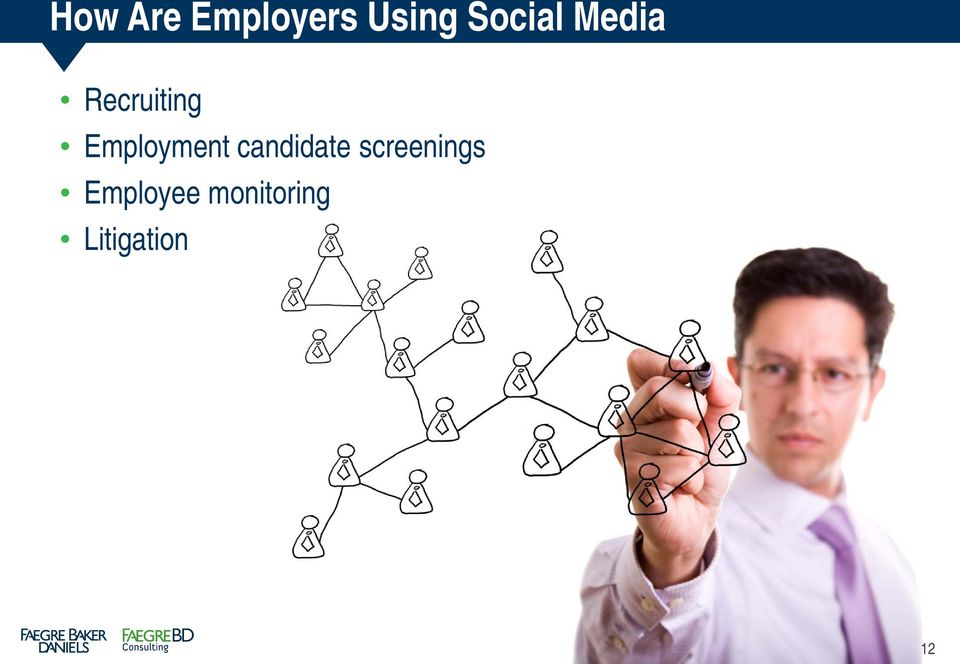
12 How Are Employers Using Social Media Recruiting Employment candidate screenings Employee monitoring Litigation 12
13 Social Media in the Workplace: The Legal Issues 13

14 Potentially hundreds of federal and state laws could affect the use of social media in the workplace. The ones getting the most attention are: The National Labor Relations Act The Fair Credit Reporting Act Anti-discrimination statutes such at Title VII, the Age Discrimination in Employment Act and the Americans with Disabilities Act General privacy rights under the First Amendment, Stored Communications Act or Federal Wiretap Act 14
15 The Big One National Labor Relations Act ( NLRA ): Section 7 of the NLRA prohibits employers from enacting policies that stifle or prevent employees from engaging in concerted activity for mutual aid and protection. According to the NLRB, there are two main points to consider: Employer policies should not be so sweeping that they prohibit the kinds of activity protected by federal labor law, such as the discussion of wages or working conditions among employees. An employee s comments on social media are generally not protected if they are mere gripes not made in relation to group activity among employees. 15

16 Fair Credit Reporting Act The Fair Credit Reporting Act requires a job applicant s or current employee s consent before the employer hires a third party to run background checks. Many background checks and thirdparty investigations now include social media searches. If these searches are performed and the proper consent not obtained, the employer could violate the FCRA and subject itself to civil penalties. 16

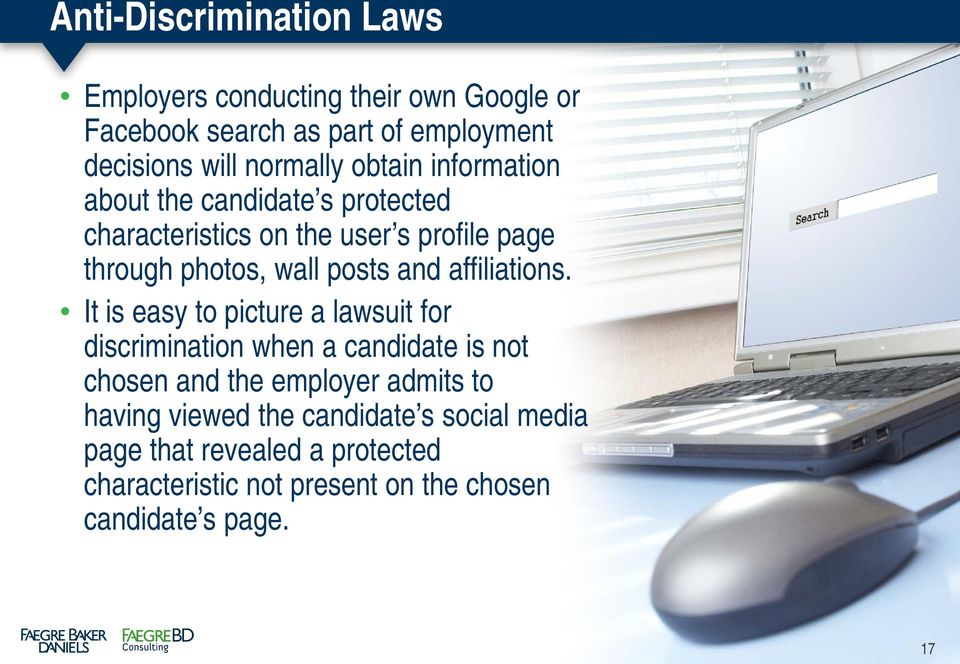
17 Anti-Discrimination Laws Employers conducting their own Google or Facebook search as part of employment decisions will normally obtain information about the candidate s protected characteristics on the user s profile page through photos, wall posts and affiliations. It is easy to picture a lawsuit for discrimination when a candidate is not chosen and the employer admits to having viewed the candidate s social media page that revealed a protected characteristic not present on the chosen candidate s page. 17
18 Privacy Concerns An employer is permitted to monitor work-related use of electronically generated communications when the monitoring serves a legitimate business interest. Employers should be aware of privacy concerns when they monitor employees electronic communications. BUT REMEMBER: The Wiretap Act: Permits an employer to intercept electronic communications where there is a legitimate business reason for the interception. An employee s failure to restrict privacy settings will likely lead to legitimate viewing of his or her social media profile. Stored Communications Act: Congress passed the SCA to prevent communication providers from divulging private communications to certain entities and individuals. How does this affect employers? Pietrylo v. Hillstone Restaurant Group (D.N.J. 2009): employer found liable under the SCA for coercing an employee to give it the password to a private MySpace page used by employees to complain about work conditions and then firing the page s creator. Employers could violate either the Wiretap Act or the Stored Communications Act by accessing private information. Public employers need to be wary of First Amendment concerns when monitoring employees use of government-owned computers. 18

19 Employers Headaches from Social Media Maremont v. Susan Fredman Design Group, Ltd., 2011 U.S. Dist. LEXIS (N.D. Ill. Mar. 15, 2011) (employer allegedly impersonated employee on employee s Facebook and Twitter accounts) Ade v. Kidspeace Corp., 698 F. Supp. 2d 501 (E.D. Pa. 2010) (fired employee sued employer for failing to discipline another employee for sending sexually explicit messages to a co-worker through MySpace) Amira-Jabbar v. Travel Servs., Inc., 2010 U.S. Dist. LEXIS (D.P.R. July 28, 2010) (employee sued former employer based on discriminatory remark that another employee made on his Facebook wall with company computer during work time) Nguyen v. Starbucks Coffee Corp., 2009 U.S. Dist. LEXIS (N.D. Cal. Dec. 7, 2009 (Starbucks employees expressed concern over their safety, based on threats that a co-worker made against them and Starbucks on MySpace) Yath v. Fairview Clinics, 767 N.W. 2d 34 (Minn. Ct. App. 2009) (suggesting that employer could potentially be liable for invasion-of-privacy claim based on an employee s posting of private information on MySpace) 19

20 Other Legal Issues: Misappropriation and Conversion An employee developed and maintained a Twitter account using his own identity in furtherance of his job working for an interactive news web resource. He developed a large Twitter following. When he was terminated, the company asked him to turn over the use of the Twitter account. The employee declined, changed his Twitter password and account name and continued to use the account. The company sued the employee for misappropriation of trade secrets, conversion, and interference with economic advantage. The case will ultimately address whether a Twitter account and its followers are protectable trade secrets. 20

21 Other Legal Issues: Social Media Content May Not Be Private Even With Privacy Settings An individual sued for injuries sustained in a car accident including permanent physical injuries. On her Facebook page the individual posted status updates about exercising at a gym, and later made the page private. The court granted the defendant's motion to compel and required the individual to provide defense counsel with her Facebook password so defense counsel could view her page. The court stated, By definition, there can be little privacy on a social networking website. Facebook s foremost purpose is to help you connect and share with the people in your life. That can only be accomplished by sharing information with others. Only the uninitiated or foolish could believe that Facebook is an online lockbox of secrets. This court s opinion is similar to several other decisions that have held that privacy settings are unlikely to protect social media content from discovery. 21
22 Other Legal Issues: Like button may be enough to trigger NLRA rights Three D LLC d/b/a Triple Play Sports (1/3/12 NLRB ALJ) required the administrative law judge to determine whether the NLRA protected an employee whose only involvement in an online employee discussion of a payroll tax withholding was to click the Like button on a Facebook page. Looking at the Facebook "wall the ALJ found the employee engaged in concerted activity because the employee used the Like button to express approval of other employee complaints concerning payroll tax issues. 22
23 Upcoming Legislation SOPA (Stop Online Piracy Act): expands the ability of U.S. law enforcement to fight online trafficking in copyrighted IP and counterfeit goods. Provisions include the requesting of court orders to prohibit search engines from linking to sites that have infringing material and to prohibit advertising networks and payment facilities from conducting business with infringing websites. The law would expand existing criminal laws to include unauthorized streaming of copyrighted content. PIPA (Protect Intellectual Property Act): Senate version of SOPA. Illinois Legislation: Prohibits employers from using employees personal passwords to access employees personal and social networking accounts. 23
24 The Downside: Legal Exposure from Use of Social Media 24
25 Social Media: Risks Created by Employee Use Disclosure of confidential or proprietary information of the company or customers. Disclosure of material inside information in violation of securities laws. Damage to brand, image or reputation of the company. Statements that are harmful, offensive, or inflammatory. Claims for negligent hiring or retention. Unauthorized statements or endorsements on behalf of the company. Wage/hour claims. 25
26 Social Media: Risks Created by Employer Monitoring Mistakes Bad publicity Violations of law Fair credit reporting statutes Lawful off-duty conduct statutes Non-discrimination statutes Privacy-related claims Labor laws 26
27 How To Protect Your Business From Legal Exposure 27
28 Reducing Risk: Investigating Job Candidates Make a policy decision whether or not to conduct Internet searches of candidates. Establish search protocols and procedures and apply them consistently. Decide whether to use a consumer reporting agency and make appropriate disclosures. Provide EEO training for internal staff. Decide what candidates to search and when during the process. Search only publicly available information that is not password-protected. Consider appropriate, confidential documentation. Insulate the decision maker from impermissible considerations. Check your facts. 28
29 Reducing Risk: Monitoring Employees Apply the same considerations for all candidates and: Seek legal advice regarding information that may be subject to attorney-client privilege. Adopt a social media policy. 29
30 Social Media Policies: A comprehensive social media policy can minimize future costs by placing employees on notice as to what content and behavior is acceptable in using social media. Policy can serve as a foundation for future disciplinary action to be taken. Careful consideration must be given to the contents of a social media policy. It is important for employers to remember that there is no one policy that will work for every employer or avoid all risks. Employers should implement policies that describe social media and its uses and outline which activities are subject to the policy. The policy should outline when it is acceptable to use social media during work, if at all. When employees are allowed to make postings on behalf of the company, mandatory training and prior approval should be implemented. Employees should be advised they must use their real names and the company name when posting on the company s behalf. They should refrain from disparaging the company, its customers and vendors and from divulging any trade secrets or other information protected by the company s confidentiality provisions. The policy should also reference all other relevant policies, including the company s antidiscrimination/harassment policies, computer use policies and confidentiality policies. 30
31 Unlawful Policies The General Counsel of the NLRB found to be unlawful: A social media policy that provided no guidance on what constituted the prohibited inappropriate postings on social media sites. The NLRB felt that this allowed employees to reasonably interpret the rule to prohibit protected concerted activities. A work rule prohibiting inappropriate conversation, whether in person or online, was unlawful when it provided no guidance on what constituted the prohibited "inappropriate conversation. A company policy that prohibited employees from disclosing or communicating information of a confidential, sensitive, or non-public nature using company resources to those outside the company was unlawful when it failed to give examples of such violations. Two policies prohibiting employees from making disparaging comments about the company or from engaging in unprofessional conduct online were found to be unlawful when the NLRB felt such policies would reasonably tend to chill employees in the exercise of their Section 7 rights. 31
32 Lawful Policies The NLRB found lawful a policy that prohibited the use of social media to post or display comments about co-workers, supervisors, or the employer that were vulgar, obscene, threatening, intimidating, harassing, or in violation of the employer s anti-discrimination and anti-harassment policies. The NLRB stated that forbidding statements which are slanderous or detrimental to the company that appeared on a list of prohibited conduct including sexual or racial harassment and sabotage would not be reasonably understood to restrict Section 7 activity. The NLRB also found lawful a policy that required employees to confine their social networking to matters unrelated to the company if necessary to ensure compliance with securities regulations and other laws. The NLRB stated that employees would reasonably interpret the rule to address only those communications that could implicate security regulations. The NLRB also found lawful that company s policy prohibiting employees from using or disclosing confidential and/or proprietary information, including personal health information about customers and patients. The NLRB stated that employees would reasonably understand that this rule was intended to protect the privacy interests of the Employer s customers and not to restrict Section 7 protected communications. 32
33 Implementing the Social Media Policy While developing and drafting a social media policy is a good start, a policy is not complete without adequate training and education of employees. Simply drafting a policy and inserting it into an employee handbook is not enough. To be effective, the policy should be communicated directly to employees. The most effective communication will be through speaking directly with employees. Create an open forum where social media issues are discussed. Educate employees on the fact that content posted on the Internet will remain on the Internet for a long time. While many people may understand the permanency of Internet posts, some employees may not. Taking the time to educate and discuss can go a long way toward protecting the company. 33
34 Enforcement ENFORCE THE POLICY 34
35 Questions? 35
36 Social Media in the Workplace Stacey L. Smiricky Partner, Labor & Employment Group
Social Media In the Workplace
 Social Media In the Workplace By Randy Green and John Michael Ekblad 306 West Church Street, Champaign, IL 61820 (217)352-1800 Overview: Social Media What is it? Risks Presented Properly Regulating Employee
Media Traps. Attorney Nilesh P. Patel
 Workplace Social Media Traps Attorney Nilesh P. Patel Mahadev Law Group, LLC Human Resources & Employment Law Solutions www.mahalawgroup.com [email protected] 877-210-2499 Definition: Online forums
OVERVIEW OF LEGAL ISSUES WITH ELECTRONIC COMMUNICATIONS FOR EMPLOYERS. March 2010
 OVERVIEW OF LEGAL ISSUES WITH ELECTRONIC COMMUNICATIONS FOR EMPLOYERS March 2010 By Anne-Marie L. Storey, Esq. Rudman & Winchell Bangor [email protected] I. USE OF INFORMATION DURING HIRING PROCESS
Social Media in the Workplace: Avoiding Legal Pitfalls
 Social Media in the Workplace: Avoiding Legal Pitfalls Todd F. Palmer & Timothy J. Connors Calfee, Halter & Griswold LLP February 13, 2013 Social Media: The Basics Social Media: The Basics Social Media:
Social Media And the Workplace. Scott Patterson Labor and Employment Attorney Butzel Long
 Social Media And the Workplace Scott Patterson Labor and Employment Attorney Butzel Long POTENTIAL ISSUES Employee productivity Harassment and discrimination Too much information Legal issues POTENTIAL
Human Resources Policies and Procedures
 SUBJECT: Social Media and Internet Policy PURPOSE The AppleOne Group of Companies ( AppleOne ) recognizes the fast-changing landscape of the Internet which has increased the popularity of social media
Internet & Technology Usage in the Networked Workplace: Legal Implications
 Internet & Technology Usage in the Networked Workplace: Legal Implications EDDY D. VENTOSE PROFESSOR OF LAW UNIVERSITY OF THE WEST INDIES, CAVE HILL CAMPUS The Employment Process 2 Recruitment Process
What Managers Need to Know About Social Media: Top 10 Tips for Mitigating the Risks of Social Media in the Workplace FEATURED FACULTY:
 What Managers Need to Know About Social Media: Top 10 Tips for Mitigating the Risks of Social Media in the Workplace FEATURED FACULTY: Spencer Hamer, Partner, Michelman & Robinson 714.557.7990 [email protected]
1. Computer and Technology Use, Cell Phones. 1.1. Information Technology Policy
 1. Computer and Technology Use, Cell Phones 1.1. Information Technology Policy Employees are provided with Internet access and electronic communications services (which may include, but are not limited
Managing Social Media Employment Issues
 Managing Social Media Employment Issues October 1, 2013 Katie Carder McCoy 206.447.2880 [email protected] Presentation Outline: What is social media and who cares? Risks of employer-sponsored social media,
Social Media in the Workplace OMG!
 Social Media in the Workplace OMG! June 28, 2012 Jenna Bedsole and Rachel VanNortwick Baker, Donelson, Bearman, Caldwell & Berkowitz Birmingham, Alabama 205-328-0480 [email protected] [email protected]
University Schools Social Media Guidelines for Employees
 University Schools Social Media Guidelines for Employees Purpose of Social Media Guidelines All University Schools Laboratory Employees are subject to the Ball State University Social Media Policy available
Virginia Commonwealth University Police Department
 Virginia Commonwealth University Police Department NUMBER SECTION CHIEF OF POLICE EFFECTIVE REVIEW DATE 2 9 1/2013 2/2013 SUBJECT SOCIAL MEDIA GENERAL The department endorses the secure use of social media
Student use of the Internet Systems is governed by this Policy, OCS regulations, policies and guidelines, and applicable law.
 OCS Internet Acceptable Use and Safety Policy for Students The Opportunity Charter School ( OCS or the School ) provides access to OCS s Internet Systems for its students for educational purposes, in conformance
Social Media An Employment Nightmare. Presented By: Howard L. Bolter Bolter Law, LLC Cynthia Bremer Ogletree, Deakins, Nash, Smoak & Stewart, P.C.
 Social Media An Employment Nightmare Presented By: Howard L. Bolter Bolter Law, LLC Cynthia Bremer Ogletree, Deakins, Nash, Smoak & Stewart, P.C. Show of hands: Who uses social media to screen job applicants?
Smart Policies for Workplace Technologies Email, Blogs, Cell Phones & More
 Smart Policies for Workplace Technologies Email, Blogs, Cell Phones & More By Lisa Guerin, J.D. Nolo, 2011, ISBN:1-4133-1326-0 Price $26.95, pp. 225 pages Reviewed by Nina T. Dow Journal of High Technology
USE AND ABUSE OF SOCIAL MEDIA IN THE WORKPLACE. Presented by Total Compliance Connection, LLC Vicki Worster Human Resource Consultant
 USE AND ABUSE OF SOCIAL MEDIA IN THE WORKPLACE Presented by Total Compliance Connection, LLC Vicki Worster Human Resource Consultant Employee Misuse of Social Media Employees Misuse Social Media By: Disclosing
ACCEPTABLE USE POLICY
 ACCEPTABLE USE POLICY F. Paul Greene Harter Secrest & Emery LLP 1600 Bausch & Lomb Place Rochester, NY 14604 585-231-1435 [email protected] 2016 HARTER SECREST & EMERY LLP THE FOLLOWING TEMPLATE WAS DESIGNED
U.S. Chemical Safety and Hazard Investigation Board
 BOARD ORDER 035 U.S. Chemical Safety and Hazard Investigation Board SUBJECT: Use of Government Office Equipment CONTENTS 1. Purpose...1 2. Effective Date...1 3. Scope...1 4. References...1 5. Definition...1
Sutter Health and Affiliates Administrative Policies and Procedures SOCIAL MEDIA POLICY
 Sutter Health and Affiliates Administrative Policies and Procedures SOCIAL MEDIA POLICY Communications & Marketing Policy 12-745 Approved by: System Management Team Origination Date: 08/2009 Revised Date:
BRIGHAM AND WOMEN S HOSPITAL
 BRIGHAM AND WOMEN S HOSPITAL HUMAN RESOURCES POLICIES AND PROCEDURES SUBJECT: SOCIAL MEDIA, ELECTRONIC COMMUNICATION and ACCEPTABLE USE POLICY #: HR-503 EFFECTIVE DATE: January 1, 2008 POLICY This policy
Social Media and the Employer-Employee Relationship. Tracy Richelle High, Partner and Christina Andersen, Associate, Sullivan & Cromwell LLP
 Social Media and the Employer-Employee Relationship Tracy Richelle High, Partner and Christina Andersen, Associate, Sullivan & Cromwell LLP The widespread popularity of social media presents novel challenges
Policy 4132/4232 PERSONNEL CERTIFIED/NON-CERTIFIELD. Employee use of the District s Computer Systems
 Policy 4132/4232 PERSONNEL CERTIFIED/NON-CERTIFIELD Employee use of the District s Computer Systems Computers, computer networks, electronic devices, Internet access, and e-mail are effective and important
6.9 Social Media Policy
 Policy Statement It is the policy of the to encourage clear and effective communication with all Nova Scotians using a variety of accepted tools, including social media. Social media is helping government
MINNETONKA PUBLIC SCHOOLS
 MINNETONKA PUBLIC SCHOOLS Policy #470: Employee Use of Social Media I. PURPOSE As a national leader in using technology as an accelerator of learning, the Minnetonka School District recognizes the value
REVIEWED BY Q&S COMMITTEE ON THE 4 TH JUNE 2015. Social Media Policy
 Social Media Policy SOCIAL MEDIA POLICY This Policy applies to all academy staff regardless of their employment status. It is to be read in conjunction with the E Safety and Data Security Policy. This
YWCA Metro St. Louis Social Media Policy
 YWCA Metro St. Louis Social Media Policy I. Purpose Social media encompasses a growing collection of online technologies and tools that allow and encourage users to interact and build relationships by
I. Issues Surrounding Email/Computer Monitoring and Searches of an Employee's Property
 I. Issues Surrounding Email/Computer Monitoring and Searches of an Employee's Property In recent years, employers have had to become concerned with protecting their legitimate business interests while
Communications 01: Social Media
 Communications 01: Social Media Policy: To communicate the Network s mission publicly, to inform and engage the community regarding the Network s activities, and to establish appropriate and professional
INTERNET, EMAIL AND COMPUTER USE POLICY.
 INTERNET, EMAIL AND COMPUTER USE POLICY. CONSIDERATIONS Code of Conduct Discipline and termination policy Privacy Policy Sexual Harassment policy Workplace Health & Safety Policy LEGISLATION Copyright
Computer, Network, Internet and Web Page Acceptable Use Policy for the Students of the Springfield Public Schools
 Computer, Network, Internet and Web Page Acceptable Use Policy for the Students of the The computer and information technology resources, which includes World Wide Web access and electronic mail capability,
How To Use Social Media To Help Your Business
 Ethics of Social Media Marketing for Law Firms Presented by Paul J. Kazaras, Esq. (Philadelphia Bar Association) Gina F. Rubel, Esq., Moderator (Furia Rubel Communications, Inc. ) Apps. Blogs Chat Rooms
How To Protect Your Employees From Being Harassed On Social Media (For Women)
 Surfing, Shopping and Blogging: Regulation of Employee Social Media Use Legal Issues in Higher Education University of Vermont October 17, 2011 Barbara A. Lee Rutgers University and Edwards Angell Palmer
Human Resources Policy and Procedure Manual
 Procedure: maintains a computer network and either purchases software for use in the network or develops proprietary software systems for Company use. Company employees are generally authorized to use
SOCIAL MEDIA AND ELECTRONIC COMMUNICATIONS THE IMPACT OF TECHNOLOGY IN THE WORKPLACE
 New Jersey League of Municipalities SOCIAL MEDIA AND ELECTRONIC COMMUNICATIONS THE IMPACT OF TECHNOLOGY IN THE WORKPLACE Presented by: BRIAN W. KRONICK, ESQ. Genova, Burns & Giantomasi (973) 533-0777 November
YU General Guidelines for Use of Social Media
 INTRODUCTION AND SCOPE General Guidelines for Use of Social Media Social media can be a valuable and powerful means of communication. Yeshiva University and its constituent schools (collectively, the University
Social Media Guidelines
 MARKETING AND MEDIA RELATIONS Social Media Guidelines Emporia State University Last Updated: July 09, 2011 Introduction What is Social Media? Social media consists of web-based tools used to interact with
Model Policy for a Law Enforcement Agency s use of Social Networking
 Model Policy for a Law Enforcement Agency s use of Social Networking Disclaimer: This is a model policy was designed to provide a guide to writing a policy related to social networking use. This model
LINCOLN UNIVERSITY. Approved by President and Active. 1. Purpose of Policy
 LINCOLN UNIVERSITY Policy: Computer and Network Usage by Employees Policy Number: HRM-110 Effective Date: July 1, 2009 Revisions: Replaces, as they relate specifically to employees, IT Policies 517 Internet
WHAT POLICIES SHOULD AN EMPLOYER HAVE IN PLACE TO PREVENT LAWSUITS?
 WHAT POLICIES SHOULD AN EMPLOYER HAVE IN PLACE TO PREVENT LAWSUITS? Many Employers Are Unaware of the Types of Policies Necessary to Limit Lawsuit Risk or of How to Effectively Draft Employment Policies
Susan Childs, RN, BSN, CPHRM Dayton Children s Hospital Liz Stock, Esq. Bricker & Eckler LLP Chris Bennington, Esq. INCompliance Consulting
 Susan Childs, RN, BSN, CPHRM Dayton Children s Hospital Liz Stock, Esq. Bricker & Eckler LLP Chris Bennington, Esq. INCompliance Consulting 7093020v1 2 1 Just performed my first circumcision. I ll be pouring
SOCIAL MEDIA POLICY. Introduction
 Introduction Throughout this Policy, the words Translink Company and/or the Group refer to all corporate entities under the ownership of the Northern Ireland Transport Holding Company (NITHC). This includes
[Example] Social Media Acceptable Use Policy
![[Example] Social Media Acceptable Use Policy](/thumbs/19/220307.jpg "[Example] Social Media Acceptable Use Policy") [Example] Social Media Acceptable Use Policy Overview The [agency] recognises that there are legitimate business and personal reasons for using social media at work or using corporate computing resources.
[Example] Social Media Acceptable Use Policy Overview The [agency] recognises that there are legitimate business and personal reasons for using social media at work or using corporate computing resources.
Pacific Northwest University of Health Sciences
 Effective: 7/01/06 Exec. Lead: Chief Business Officer Revised: 1/11 Approved By: Board of Trustees Expired: n/a Applies To: University-wide Pacific Northwest University of Health Sciences Policy: Computer,
HYATT & WEBER, P.A. LEGAL ASPECTS OF SOCIAL MEDIA
 HYATT & WEBER, P.A. LEGAL ASPECTS OF SOCIAL MEDIA By: Stephen B. Stern (410) 260-6585 (301) 261-8550 [email protected] www.hwlaw.com What is Social Media? Merriam Webster defines social media as: Forms
Policy and Guidelines for Personal Use of Social Media*
 I. Scope: This policy applies to all employees, students, contractors and volunteers as it relates to their employment, academic, or business relationship with the University of Mississippi Medical Center
NYC Department of Education Social Media Guidelines
 Spring 2012 NYC Department of Education Social Media Guidelines A. Introduction/Purpose 1. Social media technology can serve as a powerful tool to enhance education, communication, and learning. This technology
Valmeyer Community Unit School District #3 Acceptable Use Of Computers and Networks
 Valmeyer Community Unit School District #3 Acceptable Use Of Computers and Networks The Valmeyer Community Unit School District #3 Board of Education supports the use of the Internet and other computer
(Internet) for students, staff and, if requested, members of the Board of Education. All computer
 4510 Computer Network (Cf. 4520) 4510 The Board authorizes the Superintendent to develop services linking computers within and between buildings in the District, and to provide access to the international
WHISTLEBLOWING AND CONDUCTING INVESTIGATIONS. Eileen P. Kennedy Berliner Cohen
 WHISTLEBLOWING AND CONDUCTING INVESTIGATIONS Eileen P. Kennedy Berliner Cohen 1 Topics I. New Laws Protecting Whistleblowers. II. III. IV. Other Anti-Retaliation and Whistleblower Protections. Discipline
SEXUAL HARASSMENT. Taylor s Special Care Services, Inc. Simon Pop, MBA Chief Operating Officer 2015-2016
 SEXUAL HARASSMENT Taylor s Special Care Services, Inc. Simon Pop, MBA Chief Operating Officer 2015-2016 1 Agenda Overview-Why talk about sexual harassment? Why get training? Statistics What is sexual harassment?
The responsible use of technology and social media for HCPSS-sanctioned activities.
 BOARD OF EDUCATION POLICY 8080 RESPONSIBLE USE OF TECHNOLOGY AND SOCIAL MEDIA Effective: July 1, 2013 I. Policy Statement The Board of Education of Howard County is committed to providing appropriate access