
Guidance on NHS patients who wish to pay for additional private care
|
|
|
- Aron Gibbs
- 10 years ago
- Views:
Transcription
1 Guidance on NHS patients who wish to pay for additional private care
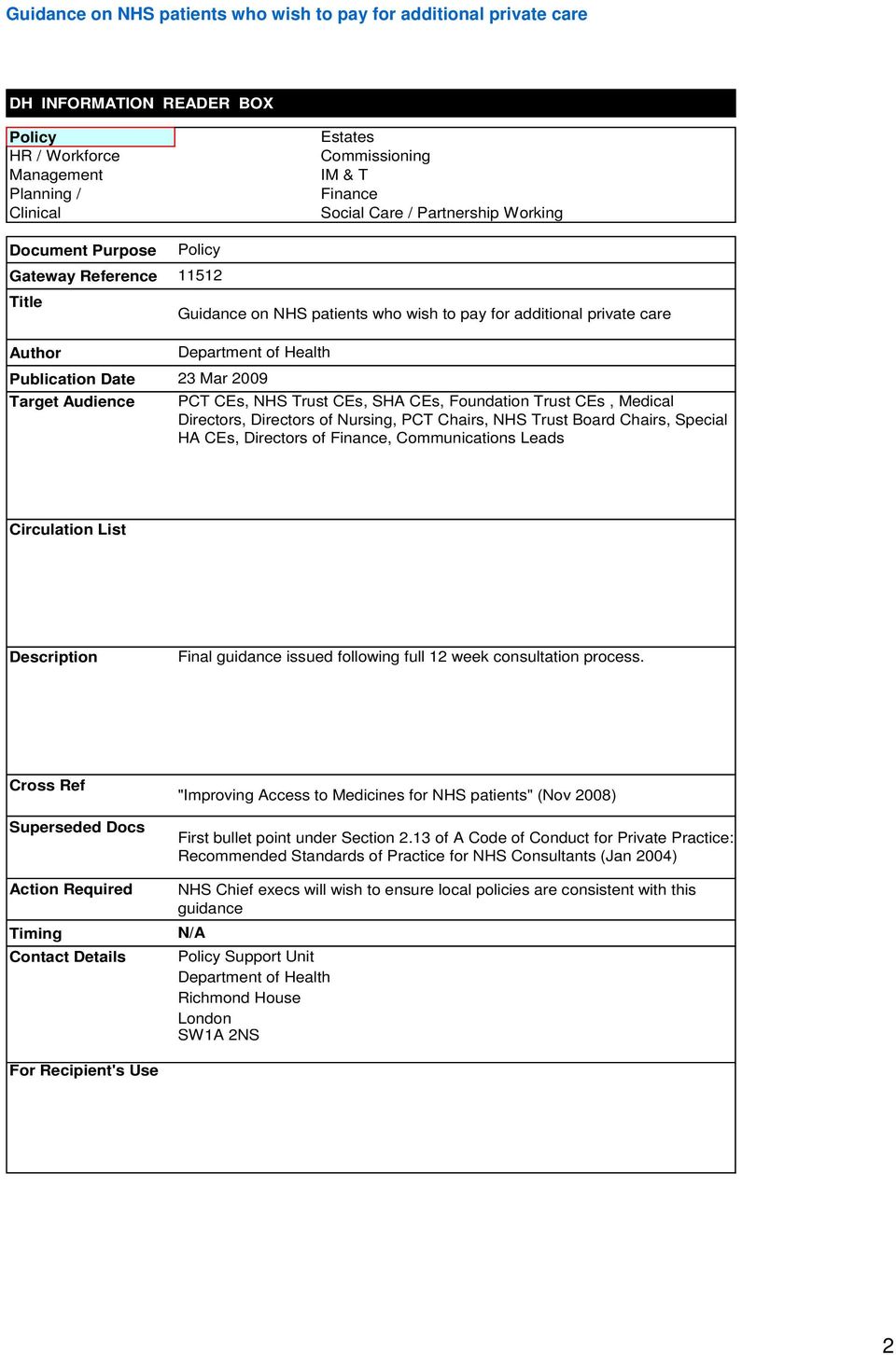
2 DH INFORMATION READER BOX Policy HR / Workforce Management Planning / Clinical Document Purpose Gateway Reference Title Author Publication Date Target Audience Policy Department of Health 23 Mar 2009 Estates Commissioning IM & T Finance Social Care / Partnership Working Guidance on NHS patients who wish to pay for additional private care PCT CEs, NHS Trust CEs, SHA CEs, Foundation Trust CEs, Medical Directors, Directors of Nursing, PCT Chairs, NHS Trust Board Chairs, Special HA CEs, Directors of Finance, Communications Leads Circulation List #VALUE! Description Final guidance issued following full 12 week consultation process. Cross Ref Superseded Docs Action Required Timing Contact Details For Recipient's Use "Improving Access to Medicines for NHS patients" (Nov 2008) First bullet point under Section 2.13 of A Code of Conduct for Private Practice: Recommended Standards of Practice for NHS Consultants (Jan 2004) NHS Chief execs will wish to ensure local policies are consistent with this guidance N/A Policy Support Unit Department of Health Richmond House London SW1A 2NS 0 2
3 Guidance on NHS patients who wish to pay for additional private care Prepared by Department of Health 3

4 Contents Executive summary Introduction... 6 Revised guidance on NHS patients receiving private care Principles Scope Revised guidance Roles and Responsibilities of Doctors in relation to this Guidance Safeguards for the NHS Clinical governance Charges for private care by NHS providers Indemnity arrangements Wider policy on private practice in the NHS

5 Executive summary The key points which NHS organisations should take from this guidance are: NHS organisations should not withdraw NHS care simply because a patient chooses to buy additional private care. Any additional private care must be delivered separately from NHS care. The NHS must never charge for NHS care (except where there is specific legislation in place to allow charges) and the NHS should never subsidise private care. The NHS should continue to provide free of charge all care that the patient would have been entitled to had he or she not chosen to have additional private care. NHS Trusts and Foundation Trusts should have clear policies in place, in line with these principles, to ensure effective implementation of this guidance in their organisations. This includes protocols for working with other NHS or private providers where the NHS Trust or Foundation Trust has chosen not to provide additional private care. Strategic Health Authorities (SHAs) and Primary Care Trusts (PCTs) should work together to ensure that the guidance is being implemented properly in their local areas. 5
6 1. Introduction 1.1 This document provides new guidance on how to proceed in situations where NHS patients want to buy additional secondary care services that the NHS does not fund. It has been published in response to a review commissioned by the Secretary of State for Health and conducted by Professor Mike Richards, the National Cancer Director. Professor Richards report, published on 4 November 2008, showed that there was a great deal of confusion about the rules in this area. Existing guidance was being interpreted differently in different places, and many patients were not clear whether they would still be entitled to NHS care if they purchased additional private drugs. 1.2 Professor Richards recommended that: The Department of Health should make clear that no patients should lose their entitlement to NHS care they would have otherwise received, simply because they opt to purchase additional care for their condition; Revised guidance should be issued as soon as possible to make this clear and to promote greater consistency across the NHS in England; and The guidance should set out mechanisms to ensure that these cases are handled in a way that supports good clinical practice and is fully consistent with the fundamental principles of the NHS. 1.3 This document responds to those recommendations, outlining guidance on NHS patients who receive private care and setting out a series of important safeguards. This document has been issued following full consultation. 1.4 This guidance comes into force on 23 rd March It does not apply retrospectively. Revised guidance on NHS patients receiving private care 2. Principles 2.1 This guidance is grounded in the fundamental principles of the NHS and any decisions about a course of action under this guidance should be taken in accordance with those principles. The fact that some NHS patients also receive private care separately should never be used as a means of downgrading the level of service that the NHS offers. 2.2 As affirmed by the NHS Constitution: the NHS provides a comprehensive service, available to all; access to NHS services is based on clinical need, not an individual's ability to pay; and public funds for healthcare will be devoted solely to the benefit of the people that the NHS serves. 2.3 As overriding rules, it is essential that: 6
7 the NHS should never subsidise private care with public money, which would breach core NHS principles; and patients should never be charged for their NHS care, or be allowed to pay towards an NHS service (except where specific legislation is in place to allow this) as this would contravene the founding principles and legislation of the NHS. 2.4 To avoid these risks, there should be as clear a separation as possible between private and NHS care. 3. Scope 3.1 The general principles set out in Section 2 above apply to all NHS care, wherever it is delivered. 3.2 However, this revised guidance (from Section 4 onwards) applies only to all secondary and specialist healthcare (care normally provided in a hospital setting) in England. It supersedes paragraph 2.13, bullet point 1 of the Code of Conduct for Private Practice (2004) 1, and all other previous guidance on the same subject. 3.3 This guidance also applies to Primary Care Trusts and all providers of services to NHS patients, in so far as they provide or commission the provision of secondary and specialist healthcare. 3.4 The boards of all provider organisations covered by this guidance are responsible for ensuring their organisations comply with it. 3.5 The guidance should be read alongside the legislative framework, including equality duties, and organisations should comply with their legal obligations when making a decision. 4. Revised guidance 4.1 This guidance establishes that, where a patient opts to pay for private care, their entitlement to NHS services remains and may not be withdrawn. 4.2 Patients may pay for additional private healthcare while continuing to receive care from the NHS. However, in order to ensure that there is no risk of the NHS subsidising private care: It should always be clear whether an individual procedure or treatment is privately funded or NHS funded. Private and NHS care should be kept as clearly separate as possible. Private care should be carried out at a different time to the NHS care that a patient is receiving. Private care should be carried out in a different place to NHS care, as separate from other NHS patients as possible. A different place would include the facilities of a private healthcare provider, or part of an NHS organisation which has been permanently or temporarily designated for private care, such a private wing, amenity beds or a private room. Trusts may also want to consider using the services of a 1 7

8 home healthcare provider where this is clinically appropriate. Putting in place arrangements for separation does not necessarily mean running a separate clinic or ward. As is the case now, specialist equipment such as scanners may be temporarily designated for private use as long as there is no detrimental effect to NHS patients. 4.3 Departing from these principles of separation should only be considered where there are overriding concerns of patient safety, rather than on the basis of convenience. Such decisions should usually be agreed in advance with the Medical Director or equivalent. Where a decision has to be made without gaining prior approval from the Medical Director on the grounds of clinical urgency, the Medical Director should be informed as soon as possible afterwards. A record should be kept of all decisions to depart from these principles. Case study for illustrative purposes Patient A is on a bone marrow transplantation unit in specialist isolation care. He wishes to pay for an unfunded drug in addition to his NHS treatment but his doctor judges that it would be clinically unsafe to move him from the specialist unit to receive this private care. His doctor discusses his case with the Trust s Medical Director and they agree that the serious safety risks to the patient in moving him justify departing from the principles of separation in this instance. The Medical Director and the doctor record their discussion and the decision they have reached. Patient A is allowed to have the unfunded drug delivered privately in the specialist unit. Patient A has to pay for the full cost of his private treatment. 4.4 In relation to care which is provided free of charge by the NHS, the patient remains an NHS patient and should be treated in the same way as any other NHS patient. In relation to care which is provided on a private basis, the patient is a private patient. This guidance should therefore be read in conjunction with the Code of Conduct for Private Practice (2004) 2 which sets out how NHS doctors are allowed to provide private care. 4.5 Doctors, working with NHS managers, should exhaust all reasonable avenues for securing NHS funding before suggesting a patient s only option is to pay for care privately. In these situations, which are likely to be exceptional, doctors should consider: Whether NICE has issued a positive technology appraisal for the treatment of the relevant indication. If so, it must be made available on the NHS; If not, whether the relevant Primary Care Trust has a local policy to fund the treatment, perhaps based on collaboration with other PCTs or, in the case of cancer drugs, advice from a cancer network. If so, it should be made available on the NHS; If not, whether there are specific aspects of the patient s case which justify an application to the PCT for exceptional funding. If an application to this process is made and is successful, the treatment will be funded on the NHS. Only once these avenues have been explored should a doctor suggest that the patient s only option is to pay privately for a treatment

9 4.6 As set out in the NHS Constitution, patients have a right to expect local decisions on funding of drugs and treatments to be made rationally following a proper consideration of the evidence. PCTs should ensure that they have robust, transparent processes in place to make such decisions, including decisions on exceptional funding, and in doing so, should have regard to the following guidance: Defining guiding principles for processes supporting local decision-making about medicines 3 Handbook of good practice guidance supporting rational local decision-making about medicines PCTs should particularly bear in mind the need for timely decisions, especially when patients are seeking funding for end of life treatments. In line with the founding principles of an NHS based on clinical need and not ability to pay, PCTs must never take a patient s financial circumstances or willingness to pay into account when making decisions on funding. 4.8 In their system oversight roles, SHAs should ensure that, in any separate provision of private and NHS care, the fundamental principles of the NHS are not undermined. 4.9 Clinical networks, such as those for cancer, can play an important role in ensuring consistency and best practice in relation to issues such as pathways, clinical governance, standards and charging Any complaints that a patient s NHS care has been withdrawn as a result of choosing to have private care separately should be investigated as quickly as possible through the NHS complaints procedure
10 Case studies for illustrative purposes a. Patient B chooses to pay for an unfunded cancer drug in addition to chemotherapy treatment she has been receiving on the NHS. Under agreed clinical governance protocols, she attends an appointment for chemotherapy in the morning in her Trust s chemotherapy suite and attends a separate appointment later that day in the same Trust s private wing, where she is given the unfunded drug. As well as the cost of the drug itself, the charge to Patient B includes the cost of any staff involved in the provision of the drug and any scans or blood tests only needed as a result of taking the unfunded cancer drug. Patient B is allowed to have additional private care because the NHS element of care and the private element of care can be delivered separately. b. Patient C chooses to pay for an unfunded cancer drug which, in order to comply with the licensed dosing schedules for the drug, needs to be given concurrently (at roughly the same time) as NHS chemotherapy. Under agreed clinical governance protocols, he attends an appointment for NHS chemotherapy at 3pm in the Trust s chemotherapy suite and attends a separate private appointment at 3.45pm in a room designated for private care near to the chemotherapy suite in the same Trust, where he is given the unfunded drug. As well as the cost of the drug itself, the charge to Patient C includes the cost of any staff involved in the provision of the drug and any scans or blood tests only needed as a result of taking the unfunded cancer drug. Patient C is allowed to have additional private care because the NHS element of care and the private element of care can be delivered separately. c. Patient D has a hip replacement operation on the NHS, and following the operation, she is offered NHS physiotherapy to help her recover. However, there is a private clinic offering physiotherapy next door to Patient D s place of work. For reasons of convenience, Patient D chooses to have private physiotherapy after her NHS operation whilst still receiving other NHS follow up care. Patient D is allowed to have additional private care because the NHS element of care and the private element of care can be delivered separately. d. Patient E needs a cataract operation. This procedure normally involves removal of the crystalline lens from the eye and replacement with an artificial lens with a single focus. After cataract surgery, patients normally have to wear glasses for some purposes, usually for close work. Patient E asks his NHS Trust to insert a multifocal lens at the time of surgery as this may reduce the need for him to wear glasses. The multifocal lens is not routinely available on the NHS. Patient E is willing to pay for the cost of the multifocal lens but wants the NHS to provide the surgery involved free of charge as part of the cataract operation. The Trust informs him that it is not possible to pay for the multifocal lens while carrying out the surgery on the NHS as it is not possible to separate the private element from the NHS element of care. The Trust informs him that he can have the single focus lens free of charge on the NHS or the multifocal lens as an entirely private operation. Patient E is not allowed to have additional private care because the NHS element of care and the private element of care cannot be delivered separately. 10

11 5. Roles and Responsibilities of Doctors in relation to this Guidance 5.1 Effective communication with patients and patient representatives about treatment options should be maintained at all times. The necessary information should be provided for patients to make an informed decision about their care, including high quality written information. In line with current best practice, doctors should consider signposting patients to other sources of helpful information, such as relevant national or local charities or patient groups. 5.2 NHS doctors who carry out private care should strive to avoid any actual or perceived conflict of interest between their NHS and private work. Where they feel a conflict of interest might exist, doctors should comply with existing GMC guidance (Consent: patients and doctors making decisions together) 5 which states that: You must give patients the information they want or need about any conflicts of interest that you, or your organisation, may have. 5.3 Doctors should comply with existing GMC guidance (Consent: patients and doctors making decisions together) 6 which states that: You must give patients the information they want or need about any treatments that you believe have greater potential benefit for the patient than those you or your organisation can offer. 5.4 This guidance also makes clear that clinicians should not make assumptions about the information a patient may want or need. This includes deciding whether to tell a patient about all available treatment options based on an assumption of their financial circumstances. 5.5 There is a difference between providing information to patients on all of the treatment options available to them, some of which may only be available privately, and advertising private practice to NHS patients. Doctors should continue to comply with paragraph 2.9 of the Code of Conduct for Private Practice 7, which states: In the course of their NHS duties and responsibilities, consultants should not initiate discussions about providing private services for NHS patients, nor should they ask other NHS staff to initiate such discussions on their behalf 5.6 However, if a patient seeks information on how to access a private treatment option, the Code of Conduct for Private Practice makes clear that NHS doctors should provide them with full and accurate information about the private services they or their NHS organisation can provide. 5.7 As good practice, a brief record should be kept of all discussions with patients about care not routinely funded on the NHS in the patient's NHS medical notes. 5 ent_options.asp 6 ent_options.asp
12 5.8 The patient (or, where appropriate, the patient s representative) should be given full information about the potential benefits, risks, burdens and side effects of any treatment before being asked to consent to treatment, in line with the GMC guidance, Consent: Patients and doctors making decisions together, The information provided to the patient should be recorded on the consent form. 5.9 When decisions involve a child or young person, doctors should follow the good practice guidance set out in the GMC guidance, 0-18 years: guidance for all doctors, When advising patients or patients representatives on additional private care, doctors should respect the patient's right to seek a second opinion, as set out in the GMC s Good Medical Practice guidance (2006) NHS doctors who have regular conversations with patients approaching the end of their life should take advantage of the training opportunities available to them on how to handle these conversations in a balanced and sensitive way It would be good practice for the outcomes of cases involving the administration of unfunded treatments to be discussed at multi-disciplinary clinical governance meetings Doctors should contribute information to relevant national audits. 6. Safeguards for the NHS 6.1 To help protect the essential principles of the NHS, the following specific safeguards should also be applied when making decisions: As with any other patient who changes between NHS and private status, patients who pay for private care in these circumstances should not be put at any advantage or disadvantage in relation to the NHS care they receive. They are entitled to NHS services on exactly the same basis of clinical need as any other patient. The patient should bear the full costs of any private services. NHS resources should never be used to subsidise the use of private care. The arrangements put in place to deliver additional private care should be designed to ensure as clear a separation as possible of funding, legal status, liability and accountability between NHS care and any private care that a patient receives. As is the case already, any NHS Trust, NHS Foundation Trust or individual doctor who does not wish to carry out any element of private practice is not compelled to do so. 6.2 NHS consultants must manage any private practice, including private practice described in this guidance, as set out in the Code of Conduct for Private Practice (2004) 11, and in 8 ent_options.asp

13 the Terms and Conditions of the Consultant Contract (2003) 12 or any future versions of these documents. 6.3 In particular, paragraphs 3.7 & 3.8 of the Code of Conduct for Private Practice continue to apply for the provision of any private care in NHS facilities: NHS consultants may not use NHS staff for the provision of private services without the agreement of their NHS employer. The consultant responsible for admitting a private patient to NHS facilities must ensure, in accordance with local procedures, that the responsible manager and any other staff assisting in providing services are aware of the patient s private status. 7. Clinical governance 7.1 Any situations where patients receive additional private care alongside NHS care should be handled with the highest standards of professional practice and clinical governance. 7.2 Transferring between private and NHS care should be carried out in a way which avoids putting patients at any unnecessary risk. The NHS and the private provider (which may be an NHS organisation) should work collaboratively to put in place protocols to ensure effective risk management, timely sharing of information, continuity of care and coordination between NHS and private care at all times. If different clinicians are involved in each element of care, these protocols should include arrangements for the safe and effective handover of the patient between the clinician in charge of the NHS care, and the clinician in charge of the private care. 7.3 As when patients are transferred from one NHS organisation to another, it should always be clear which clinician and which organisation are responsible for the assessment of the patient, the delivery of any care and the delivery of any follow up care. 8. Charges for private care by NHS providers 8.1 Charges for any element of care provided by a consultant acting in a private capacity and using NHS facilities should be set in accordance with paragraph 3.4 of the Code of Conduct for Private Practice (2004) 13, which states: Where the employer has agreed that a consultant may use NHS facilities for the provision of private services: the employer will determine and make such charges for the use of its services, accommodation or facilities as it considers reasonable; any charge will be collected by the employer, either from the patient or a relevant third party; and a charge will take full account of any diagnostic procedures used, the cost of any laboratory staff that have been involved and the cost of any NHS equipment that might have been used

14 8.2 Additional private care may be provided by the NHS Trust or Foundation Trust, as a service provided by their organisation, or by individual consultants who have agreed this with their employer. In either case, in developing charges for NHS patients who are having additional private care, NHS organisations and staff should use the following principles: The NHS should not subsidise the private element of care The patient should meet any additional costs associated with the private element of care, such as additional treatment needed for the management of side effects. Any care which would normally have provided in the course of good NHS practice should continue to be offered free of charge on the NHS. Where the same diagnostic, monitoring or other procedure is needed for both the NHS element of care and the private element, the NHS should provide this free of charge as part of the patient s NHS entitlement and share the results with the private provider if necessary. Patients should not be unnecessarily subjected to two sets of tests or interventions. The private provider should normally deal with non-emergency complications resulting from the private element of care. The NHS should never refuse to treat patients simply because the cause of the complication is unclear. The NHS should continue to treat any patient in an emergency. 8.3 NHS provider organisations continue to be responsible for recovering all appropriate charges from private patients. 8.4 The patient s agreement to the likely costs should be sought in advance of any private care being provided, preferably in writing. 8.5 It is important that the NHS should not be seen to be profiting unreasonably from patients in these circumstances. 8.6 NHS Trusts and Foundation Trusts should ensure they comply with all relevant legislation regarding income generated from providing private healthcare. 9. Indemnity arrangements 9.1 This guidance does not change the current position in relation to indemnity arrangements for NHS organisations and healthcare professionals wishing to provide private care. 9.2 Where healthcare professionals choose to provide additional private care in a private capacity, and agree with their NHS employer that they may use NHS facilities for this purpose, they should continue to have appropriate private indemnity cover in place for themselves. If the agreement to use NHS facilities includes the use of additional NHS staff as part of the facilities provision, those additional NHS staff will be covered by the NHS employer s indemnity. 14

15 9.3 Where the Trust decides to provide additional private care as one of the services it offers as an organisation, healthcare professionals will be covered by their employer's indemnity as they will be providing private care in the course of their NHS employment. 9.4 Doctors having conversations about private treatment options with NHS patients in the course of their NHS duties will be covered by their employer's indemnity. 9.5 For detailed information about NHS indemnity, NHS organisations should contact the NHS Litigation Authority. 10. Wider policy on private practice in the NHS 10.1 Previous guidance on NHS work taking precedence over private work continues to apply. It remains the primary purpose of any NHS organisation to provide NHS care Any income generated under this guidance should be treated in the same way as any other income generated by the NHS acting in a private capacity. Definitions In this guidance: Private care" refers to privately funded care (whether provided as a private service by an NHS body or by the independent sector); NHS patient refers to any person in receipt of services funded by the NHS; Private patient refers to any person in receipt of privately funded services; Patient representative refers to any person legally able to act on the behalf of the patient in question; A NHS consultant is a consultant involved in the provision of NHS care at the time in question; A NHS doctor is a doctor involved in the provision of NHS care at the time in question; and A healthcare professional is a member of a profession concerned with the physical or mental health of individuals. References to any publications also apply to future versions of those publications. 15
Commissioning Policy (EMSCGP005V2) Defining the boundaries between NHS and Private Healthcare
 Commissioning Policy (EMSCGP005V2) Defining the boundaries between NHS and Private Healthcare Although Primary Care Trusts (PCTs) and East Midlands Specialised Commissioning Group (EMSCG) were abolished
Managing the boundaries of NHS and privately funded healthcare Policy on the separation of private and NHS treatments
 South Central Priorities Committees (Oxfordshire PCT) Policy Statement 67a: Managing the boundaries of NHS and privately-funded healthcare Clinical Executive decision: September 2009 Date of Issue: April
Private Patient Policy. Documentation Control
 Documentation Control Reference Date approved Approving Body Trust Board Implementation Date July 2009 NUH Private Patient and Supersedes Overseas Visitor Policy Private Patient Advisory Group, Consultation
POLICY FOR MANAGING THE BOUNDARIES OF NHS AND PRIVATE FUNDED HEALTHCARE DOCUMENT CONTROL
 POLICY FOR MANAGING THE BOUNDARIES OF NHS AND PRIVATE FUNDED HEALTHCARE DOCUMENT CONTROL TITLE Managing the boundaries of NHS and private funded healthcare AUTHOR Head of Medicines Management VERSION NUMBER
Defining the boundaries between NHS and Private Healthcare
 Commissioning Policy (EMSCGP005V2) Defining the boundaries between NHS and Private Healthcare 1. Definitions Private patients are patients who receive private healthcare, funded on a pay-asyou-go basis
Eligibility Criteria for Patient Transport Services (PTS)
 Eligibility Criteria for Patient Transport Services (PTS) Eligibility Criteria for Patient Transport Services (PTS) PTS eligibility criteria document Prepared by DH Ambulance Policy 2 3 DH INFORMATION
Defining the Boundaries Between NHS and Private Healthcare
 Defining the Boundaries Between NHS and Private Healthcare Policy: COM 30 Document Version Control Version 0.1 Draft Pilot version 08/07/09 Version 1.0 Ratified 07/09/09 Version Version Version Version
Defining the boundaries between NHS and Private Healthcare
 West Midlands Strategic Commissioning Group Commissioning Policy (WM/13) Defining the boundaries between NHS and Private Healthcare Version 1 April 2010 1. Definitions Private patients are patients who
Fast Track Pathway Tool for NHS Continuing Healthcare
 Fast Track Pathway Tool for NHS Continuing Healthcare DH INFORMATION READER BOX Policy Clinical Estates HR / Workforce Commissioner Development IM & T Management Provider Development Finance Planning /
Directors of Public Health in Local Government
 Directors of Public Health in Local Government i) Roles, responsibilities and context 1 DH INFORMATION READER BOX Policy Clinical Estates HR / Workforce Commissioner Development IM & T Management Provider
abcdefghijklmnopqrstu
 Chief Medical Officer and Public Health Directorate abcdefghijklmnopqrstu T: 0131-244-2235 F: 0131-244-2989 E: [email protected] Dear Colleague ARRANGEMENTS FOR NHS PATIENTS RECEIVING
The interface between NHS and private treatment: a practical guide for doctors in England, Wales and Northern Ireland
 The interface between NHS and private treatment: a practical guide for doctors in England, Wales and Northern Ireland Guidance from the BMA Medical Ethics Department May 2009 Introduction General principles
GP Patient Survey Your doctor, your experience, your say
 GP Patient Survey Your doctor, your experience, your say Guidance 2007/08 for strategic health authorities, primary care trusts and GP practices Introduction 1. This document provides guidance on this
The interface between the NHS and private treatment: a practical guide for doctors in Scotland
 The interface between the NHS and private treatment: a practical guide for doctors in Scotland Guidance from the BMA Medical Ethics Department September 2009 Introduction General principles Issues for
Decision Support Tool for NHS Continuing Healthcare User Notes
 Decision Support Tool for NHS Continuing Healthcare User Notes July 2009 1 Decision Support Tool for NHS Continuing Healthcare We have developed the Decision Support Tool (DST) to support practitioners
Informatics: The future. An organisational summary
 Informatics: The future An organisational summary DH INFORMATION READER BOX Policy HR/Workforce Management Planning/Performance Clinical Document Purpose Commissioner Development Provider Development Improvement
Patient Access. UCLH policy
 Patient Access UCLH policy Version 3.2 Version Date June 2014 Version Approved By EB Policy Approval Sub-Group Publication Date July 2013 Author Kevin Nicholson Review By Date June 2016 Responsible Director
WSIC Integrated Care Record FAQs
 WSIC Integrated Care Record FAQs How your information is shared now Today, all the places where you receive care keep records about you. They can usually only share information from your records by letter,
Taking Part in Research at University Hospitals Birmingham
 University Hospitals Birmingham NHS Foundation Trust The Trust provides free monthly health talks on a variety of medical conditions and treatments. For more information visit www.uhb.nhs.uk or call 0121
Deprivation of Liberty Safeguards A guide for relevant person s representatives
 OPG609 Deprivation of Liberty Safeguards A guide for relevant person s representatives Mental Capacity Act 2005 DH INFORMATION READER BOX Policy HR/Workforce Management Planning/Performance Clinical Document
Draft guidance for registered pharmacies providing internet and distance sale, supply or service provision
 Draft guidance for registered pharmacies providing internet and distance sale, supply or service provision September 2014 1 The General Pharmaceutical Council is the regulator for pharmacists, pharmacy
A Framework of Quality Assurance for Responsible Officers and Revalidation
 A Framework of Quality Assurance for Responsible Officers and Revalidation Supporting responsible officers and designated bodies in providing assurance that they are discharging their statutory responsibilities.
The National Health Service. Constitution. A draft for consultation, July 2008
 The National Health Service Constitution A draft for consultation, July 2008 NHS Constitution The NHS belongs to the people. It is there to improve our health, supporting us to keep mentally and physically
www.monitor.gov.uk The NHS Foundation Trust Code of Governance
 www.monitor.gov.uk The NHS Foundation Trust Code of Governance About Monitor Monitor is the sector regulator for health services in England. Our job is to protect and promote the interests of patients
National Framework for NHS Continuing Healthcare and NHS-funded Nursing Care
 National Framework for NHS Continuing Healthcare and NHS-funded Nursing Care November 2012 (Revised) Incorporating: NHS Continuing Healthcare Practice Guidance NHS Continuing Healthcare Frequently Asked
Template action plan to improve care for people with dementia in the community
 Template action plan to improve care for people with dementia in the community DH INFORMATION READER BOX Policy HR / Workforce Management Planning / Clinical Document Purpose Gateway Reference Title Author
Commissioning Policy: Defining the boundaries between NHS and Private Healthcare April 2013 Reference : NHSCB/CP/12
 Commissioning Policy: Defining the boundaries between NHS and Private Healthcare April 2013 Reference : NHSCB/CP/12 NHS Commissioning Board Commissioning Policy: Defining the Boundaries between NHS and
Information Governance Policy
 Information Governance Policy Information Governance Policy Issue Date: June 2014 Document Number: POL_1008 Prepared by: Information Governance Senior Manager Insert heading depending on Insert line heading
The End of Life Care Strategy promoting high quality care for all adults at the end of life. Prof Mike Richards July 2008
 The End of Life Care Strategy promoting high quality care for all adults at the end of life Prof Mike Richards July 2008 The End of Life Care Strategy: Rationale (1) Around 500,000 people die in England
NHS Constitution The NHS belongs to the people. This Constitution principles values rights pledges responsibilities
 for England 21 January 2009 2 NHS Constitution The NHS belongs to the people. It is there to improve our health and well-being, supporting us to keep mentally and physically well, to get better when we
Interface between NHS and private treatment Guidance from the Ethics Department February 2004
 Interface between NHS and private treatment Guidance from the Ethics Department February 2004 Summary General principles Issues for consultants Issues for general practitioners Advertising Summary Although
PRESCRIBING OF NHS MEDICATION RECOMMENDED DURING OR AFTER A PRIVATE EPISODE OF CARE
 East Surrey CCG Guildford & Waverley CCG North West Surrey CCG Surrey Downs CCG Surrey Heath CCG PRESCRIBING OF NHS MEDICATION RECOMMENDED DURING OR AFTER A PRIVATE EPISODE OF CARE Version: 2.2 Name of
Department of Health/ Royal College of General Practitioners. Implementing a scheme for General Practitioners with Special Interests
 Department of Health/ Royal College of General Practitioners Implementing a scheme for General Practitioners with Special Interests April 2002 Foreword Improved access and consistently high quality services
Which Providers and What Procedures are covered by the CNST Indemnity?
 18 th June 2012 SHA & PCT Chief Executives Room 229 Richmond House 79 Whitehall London SW1A 2NS Approved for publication under Gateway number: 17781 Dear Colleague Guidance Note for use of the Clinical
UNIVERSITY HOSPITALS OF LEICESTER NHS TRUST
 UNIVERSITY HOSPITALS OF LEICESTER NHS TRUST POLICY FOR TRUST INDEMNITY ARRANGEMENTS (IN RESPECT OF CLINICAL NEGLIGENCE AND OTHER THIRD PARTY LIABILITIES) 21 st November 2003 APPROVED BY: Trust Executive
Liberating the NHS: No decision about me, without me. Further consultation on proposals to secure shared decision-making
 Liberating the NHS: No decision about me, without me Further consultation on proposals to secure shared decision-making DH INFORMATION READER BOX Policy HR / Workforce Management Planning / Clinical Document
Type of change. V02 Review Feb 13. V02.1 Update Jun 14 Section 6 NPSAS Alerts
 Document Title Reference Number Lead Officer Author(s) (name and designation) Ratified By Central Alerting System (CAS) Policy NTW(O)17 Medical Director Tony Gray Head of Safety and Patient Experience
Information Governance and Risk Stratification: Advice and Options for CCGs and GPs
 Information Governance and Risk Stratification: Advice and Options for CCGs and GPs 1 NHS England INFORMATION READER BOX Directorate Medical Operations Patients and Information Nursing Policy Commissioning
Policy Document Control Page
 Policy Document Control Page Title Title: Covert Administration of Medicines Version: Version 6 Reference Number: CL37 Supersedes Supersedes: Version 5 Description of amendment(s): Originator 3.5 Clarification
Patient Access Policy
 Patient Access Policy NON-CLINICAL POLICY ACE 522 Version Number: 2 Policy Owner: Lead Director: Assistant Director of Operations Director of Operations Date Approved: Approved By: Management Executive
PATIENT ACCESS POLICY
 PATIENT ACCESS POLICY Document Type Policy Document Number Version Number 1.0 Approved by NHS Borders Board on 18 October 2012 Issue date Nov 2012 Review date Nov 2013 Distribution Prepared by Developed
Planning and delivering service changes for patients
 Planning and delivering service changes for patients 1 NHS England INFORMATION READER BOX Directorate Medical Operations Patients and Information Nursing Policy Commissioning Development Finance Human
Safer recruitment scheme for the issue of alert notices for healthcare professionals in England
 Safer recruitment scheme for the issue of alert notices for healthcare professionals in England November 2006 The issue of alert notices for healthcare professionals Summary 1. NHS Employers and the Department
Measuring quality along care pathways
 Measuring quality along care pathways Sarah Jonas, Clinical Fellow, The King s Fund Veena Raleigh, Senior Fellow, The King s Fund Catherine Foot, Senior Fellow, The King s Fund James Mountford, Director
NHS England Medical Appraisal Policy. Annex J: References Annex K: Glossary Annex L: Working group
 NHS England Medical Appraisal Policy Annex J: References Annex K: Glossary Annex L: Working group Annexes J, K & L Page 1 NHS England INFORMATION READER BOX Directorate Medical Operations Patients and
RCN policy position. Executive Director of Nursing. RCN survey on PCT Executive Directors of Nursing. Rationale for an Executive Director of Nursing
 RCN Policy Position Executive Director of Nursing Part 1: Part 2: Part 3: Part 4: Part 5: Part 6: Part 7: Part 8: RCN policy position RCN survey on PCT Executive Directors of Nursing Rationale for an Executive
THE FUNCTIONS OF CLINICAL COMMISSIONING GROUPS (UPDATED TO REFLECT THE FINAL HEALTH AND SOCIAL CARE ACT 2012)
 THE FUNCTIONS OF CLINICAL COMMISSIONING GROUPS (UPDATED TO REFLECT THE FINAL HEALTH AND SOCIAL CARE ACT 2012) DH INFORMATION READER BOX Policy Clinical Estates HR / Workforce Commissioner Development IM
High Oak Surgery Complaints Policy Document Description Lead Author(s) Change History Document complies with the Equality Act 2010
 High Oak Surgery Complaints Policy Document Description Document Type CQC Standard 7 Service Application Version 2 Ratification Date Target Group All staff Last Reviewed October 2012 Next Review Date October
Legislation to encourage medical innovation a consultation. British Medical Association response. Executive Summary
 Legislation to encourage medical innovation a consultation British Medical Association response Executive Summary This consultation is about proposed primary legislation to liberate doctors from perceived
BRACKNELL FOREST COUNCIL ADULT SOCIAL CARE & HEALTH DEBT RECOVERY POLICY & PROCEDURES
 BRACKNELL FOREST COUNCIL ADULT SOCIAL CARE & HEALTH DEBT RECOVERY POLICY & PROCEDURES POLICY DOCUMENT Table of Contents 1. Definitions and Abbreviations... 3 2. Legal Status... 4 3. Principles for Debt
Guidance for registered pharmacies providing pharmacy services at a distance, including on the internet
 Guidance for registered pharmacies providing pharmacy services at a distance, including on the internet April 2015 The General Pharmaceutical Council is the regulator for pharmacists, pharmacy technicians
Data Protection Policy
 Issue Date: June 2014 Document Number: POL_1006 Prepared by: Information Governance Senior Manager Insert heading depending on Insert line heading length; please depending delete other on line length;
Code of Conduct. Property of UKAPA 20/11/2009 1
 Code of Conduct A Physician Assistant (now associate) (PA) is defined as someone who is: a new healthcare professional who, while not a doctor, works to the medical model, with the attitudes, skills and
Health and Safety Policy
 Health and Safety Policy Status: Final Next Review Date: Apr 2014 Page 1 of 16 NHS England Health and Safety: Policy & Corporate Procedures Health and Safety Policy Policy & Corporate Procedures Issue
Guidance for Taking Responsibility: Accountable Clinicians and Informed Patients
 June 2014 Guidance for Taking Responsibility: Accountable Clinicians and Informed Patients 01 Background Page 2 The Francis Report made a number of recommendations on the need for there to be a named clinician
National Cancer Peer Review Programme Manual for Cancer Services:
 Intelligence National Cancer Action Team Part of the National Cancer Programme National Cancer Peer Review Programme Manual for Cancer Services: Network Service User Partnership Group Measures Version
Guidance in Relation to Requirements of the Abortion ACT 1967. For all those responsible for commissioning, providing and managing service provision
 Guidance in Relation to Requirements of the Abortion ACT 1967 For all those responsible for commissioning, providing and managing service provision May 2014 Title: Guidance in Relation to Requirements
Leadership and management for all doctors
 Leadership and management for all doctors The duties of a doctor registered with the General Medical Council Patients must be able to trust doctors with their lives and health. To justify that trust you
The importance of nurse leadership in securing quality, safety and patient experience in CCGs
 Briefing note: July 2012 The importance of nurse leadership in securing quality, safety and patient experience in CCGs Introduction For the NHS to meet the challenges ahead, decisions about health services
The Family Nurse Partnership Programme
 The Family Nurse Partnership Programme Information leaflet DH INFORMATION READER BOX Policy Clinical Estates HR / Workforce Commissioner Development IM & T Management Provider Development Finance Planning
Defining the Boundaries between NHS and Private Healthcare (Adapted from NHS Commissioning Board Interim Commissioning Policy: NHSCB cp-12)
 Defining the Boundaries between NHS and Private Healthcare (Adapted from NHS Commissioning Board Interim Commissioning Policy: NHSCB cp-12) Produced by: Trish Campbell Version control: V2 March 2013 v1
PATIENT ACCESS POLICY
 . PATIENT ACCESS POLICY TITLE Patient Access Policy APPLICABLE TO All administrative / clerical / managerial staff involved in the administration of patient pathway. All medical and clinic staff seeing
Annex B: Payment and Expenses for Governors
 A REVIEW OF FURTHER EDUCATION AND SIXTH FORM COLLEGE GOVERNANCE Annex B: Payment and Expenses for Governors JULY 2013 Annex B: Payment and Expenses for Governors Introduction 1. This document has been
ADVISORY GUIDELINES FOR THE HEALTHCARE SECTOR 11 SEPTEMBER 2014
 ADVISORY GUIDELINES FOR THE HEALTHCARE SECTOR 11 SEPTEMBER 2014 1 PART I... 4 1 Introduction... 4 PART II: APPLICATION OF THE DATA PROTECTION PROVISIONS TO SCENARIOS FACED IN THE HEALTHCARE SECTOR... 5
Improving Services for Patients with Learning Difficulties. Jennifer Robinson, Lead Nurse Older People and Vulnerable adults
 ENC 5 Meeting Trust Board Date 18 th December 2014 Title of Paper Lead Director Author Improving Services for Patients with Learning Difficulties Kathryn Halford, Director of Nursing Jennifer Robinson,
Mental Capacity Act Prompt Cards
 England Mental Capacity Act Prompt Cards Mental Capacity Act (MCA) in practice Applying the five principles that underpin the MCA Making capacity assessments Best Interests Decisions MCA Decision-making
CODE OF CONDUCT FOR GOVERNORS 1. INTRODUCTION
 CODE OF CONDUCT FOR GOVERNORS 1. INTRODUCTION 1.1 The University is a higher education corporation governed by a governing body (the Court of Governors), of which each governor is a member. The University
Cafcass and Independent Reviewing Officer. Protocol for Public Law Work. Independent Reviewing Officer
 Cafcass and Independent Reviewing Officer Protocol for Public Law Work The Protocol has been developed in response to the need to agree a clear understanding of the statutory roles and interface between
RECORDS MANAGEMENT POLICY
 RECORDS MANAGEMENT POLICY Version 8.0 Purpose: For use by: This document is compliant with /supports compliance with: To outline the lifecycle of a record and to provide guidance on retention and disposal
clinical negligence claims in the NHS, issued under cover of HSG 96/48.
 Health Committee Inquiry : Independent Sector Treatment Centres: Memorandum by Action against Medical Accidents (AvMA) 1. Action against Medical Accidents (AvMA) was originally established in 1982. It
UK Medical Centre. Building 401, SHAPE, BFPO 26. Civilian Address. UK Medical Centre, Building 401, Ave d Oslo. 7010 SHAPE, Maisières
 UK Medical Centre Building 401, SHAPE, BFPO 26 Civilian Address UK Medical Centre, Building 401, Ave d Oslo 7010 SHAPE, Maisières Reception 0032 65 44 5824 On arrival at SHAPE please register with the
How To Be A Successful Health And Social Care Leader
 Clinical commissioning group governing body members: Role outlines, attributes and skills October 2012 Clinical commissioning group governing body members: Roles outlines, attributes and skills First published
Doing Well, Doing Better. Standards for Health Services in Wales
 Doing Well, Doing Better Standards for Health Services in Wales April 2010 Foreword by the Assembly Minister for Health and Social Services The Healthcare Standards for Wales (2005) framework has been
GP Patient Survey Your Doctor, Your Experience, Your Say
 To: GP Practices Chief Executives of Primary Care Trusts Dear Colleague GP Patient Survey Your Doctor, Your Experience, Your Say This letter confirms arrangements for delivery of the 2008 GP Patient Survey.
How To Ensure Information Security In Nhs.Org.Uk
 Proforma: Information Policy Security & Corporate Policy Procedures Status: Approved Next Review Date: April 2017 Page 1 of 17 Issue Date: June 2014 Prepared by: Information Governance Senior Manager Status:
Information Governance Strategy. Version No 2.0
 Plymouth Community Healthcare CIC Information Governance Strategy Version No 2.0 Notice to staff using a paper copy of this guidance. The policies and procedures page of PCH Intranet holds the most recent
Defining the Boundaries between NHS and Private Healthcare
 Defining the Boundaries between NHS and Private Healthcare June 2015 Author: Jacqueline Clayton, Senior Pharmaceutical Adviser JPC and Commissioning Dr Zoe Aslanpour, Consultant in Public Health Fiona
Recording and reporting referral to treatment (RTT) waiting times for consultant-led elective care: Frequently Asked Questions
 Recording and reporting referral to treatment (RTT) waiting times for consultant-led elective care: Frequently Asked Questions Recording and reporting referral to treatment (RTT) waiting times for consultant-led