
Thorn Group Limited and its Controlled Entities ACN
|
|
|
- Silas Cummings
- 10 years ago
- Views:
Transcription
1 Thorn Group Limited and its Controlled Entities ACN Annual Financial Report 31 March 2015
2 Directors Report Table of Contents Directors' Report... 2 Corporate Governance Statement Lead Auditor's Independence Delcaration Statement of Comprehensive Income Statement of Financial Position Statement of Changes in Equity Statement of Cash Flows Notes to the Consolidated Financial Statements Director s Declaration Independent Auditor s Report

3 Directors Report The Directors present their report together with the financial report of Thorn Group Limited (the Company ) and its controlled entities (together referred to as the consolidated entity ) for the financial year ended 31 March 2015 and the auditor s report thereon. Operating and Financial Review The 2015 Operating and Financial Review is presented by the Board to provide shareholders with an overview of the Company s operations, financial position and potential for future years. Thorn Group is a diversified financial services group providing alternate financial solutions to consumers and businesses. Activities are predominantly in leasing of household products with increasing diversification into consumer loans, commercial finance, invoice discounting and the provision of receivables management services. Apart from the acquisition of invoice discounting business Cash Resources Australia, there were no other significant changes in the nature of the activities of the consolidated entity during the year. Thorn operates through four core segments: Consumer Leasing of household products through Radio Rentals and Rentlo; Consumer Finance provides personal loans through Cash First and Thorn Money; Commercial Finance including equipment financing and invoice discounting for small and medium enterprises through Thorn Equipment Finance and Cash Resources Australia respectively; and Receivables Management, debt recovery, credit information services, debt purchasing and other financial services through NCML. Financial performance Revenue for the 2015 financial year increased 25.1% on the previous corresponding period ( PCP ), growing from $234.9m to $293.8m. Underlying Cash NPAT increased by 13.6% from $30.1m to $34.2m. Reported NPAT increased by 8.5% from $28.2m to $30.6m. There was significant organic growth in both consumer leasing and commercial finance driven by strong originations. Consumer Leasing in particular benefited from the increased mix of finance leases from operating leases. The result also included $0.8m after tax contribution from Cash Resources Australia that was acquired on 1 December The investment in people, processes and systems over the previous three years has supported the increase in current year Underlying Cash NPAT. 2

4 Directors Report Segment performance Consumer Leasing: Revenue for the Consumer Leasing segment grew 25.1%, from $196.8m to $246.2m driven by both record originations during the year and a significant shift in contract mix from operating leases to finance leases. Originations increased 88.7% from $51.5m to $97.2m from PCP. Finance leases represented 88% of leases in 2015 compared to 45% in the PCP. The growth in finance lease revenue was driven by the continued adoption of the Rent Try $1 Buy month contract that was introduced in December Originations of finance lease contracts during the year numbered 112,700 of which 76.3% or 86,000 were 48 month contracts. The introduction of the longer term made larger products and whole room packages more affordable. Customer retention performance remains consistently strong with 48% of customers completing a Rent Try $1 Buy agreement taking a subsequent agreement for another item at a discounted rate. Write-off performance remained consistent with prior year however provisioning increased in-line with receivables growth. Costs increased in the segment in-line with new stores and additional resources required in the store network to support the growth in units on rent. Other operating expenses for the Consumer Leasing segment also increased in-line with the increased level of originations. Reported segment earnings before interest, tax, depreciation and amortisation ( EBITDA ) increased by 13.3% from $49.5m to $56.1m. Consumer Finance: Consumer Finance revenue increased by 48.4% from $9.3m to $13.8m. The revenue increase was driven from interest through a 56.0% growth in receivables, from $28.4m to $44.3m. Originations increase by 69.7% from $18.8m in the PCP to $31.9m. Net bad debts increased from 10.9% to 12.3% as a percentage of average receivables. This increase in bad debts resulted in a revision to the collections strategy of the segment in March Overheads were higher than PCP as a result of business development initiatives and increased volumes. Segment EBITDA increased by 16.7% from $1.2m to $1.4m. Commercial Finance: Commercial Finance consists of both equipment finance through Thorn Equipment Finance (TEF) and invoice discounting through Cash Resources Australia (CRA). Revenue for TEF grew by 30.1% from $8.3m to $10.8m. Originations in TEF increased from $32.3m to $61.5m during the year, an increase of 90.4%. The revenue increase was driven by the growth in gross receivables, which increased from $63.5m to $104.8m, which in turn was driven by strong originations. Originations increased via both direct and strategic partner channels. Expenses increased in line with volumes as TEF continues to achieve scale. CRA contributed $4.3m in revenue and $1.2m EBITDA during the four months it was part of the group. This was in line with acquisition metrics. 3

5 Directors Report Segment performance (continued) Overall like for like segment EBITDA increased by 93.3% from $3.0m to $5.8m. Including CRA segment EBITDA increased 133.3% from $3.0m to $7.0m. Receivables Management: The Receivables Management division revenue decreased by 6.8%, from $20.6m to $19.2m. This decline was driven by a decrease in contingent collections as a result of lower placements due to changing business practises in long standing clients. It was however offset by an increase in Purchased Debt Ledger (PDL) revenue where PDL receivables increased 61.8% from $8.9m to $14.4m. PDL net additions during the year were $12.5m compared to $5.9m in the previous, an increase of 111.9%. Segment EBITDA decreased by 36.6% from $4.1m to $2.6m. The Receivables Management division was also impacted with one off costs incurred as part of an operational restructure that will create Centres of Excellence for contingent collections in Melbourne and PDL collections in Adelaide. This restructure is expected to provide annualised savings of $1.6m, and geographically centralise the divisions functional expertise and infrastructure across two major collection platforms. Corporate expenses: Corporate expenses were up 24.8% from $10.5m to $13.1m primarily increasing in-line with business growth including acquisition costs and recruitment. This included $2.2m relating to the acquisition of CRA. Net borrowing costs increased by 126% from $1.9m to $4.3m driven by borrowings that have increased from $40.4m to $144.0m as at 31 March The increase in borrowings supported the acquisition of CRA and the increased level of equipment finance originations within the Commercial Finance segment. Consolidated: Underlying Cash NPAT increased 13.6%. from $30.1m to $34.2m. Below is a reconciliation of reported to Underlying Cash NPAT. Consolidated profit before income tax increased by 9.0% from $41.0m to $44.7m. Reported net profit after tax increased by 8.5% from $28.2 to $30.6m. The variance between underlying performance of the group and reported was predominantly the costs of acquisition of CRA and the amortisation of intangibles as detailed in the reconciliations below. In thousands of AUD 31-Mar Mar-14 Reported NPAT 30,593 28,151 Acquisition costs CRA 2,235 - Amortisation of intangibles 1,759 1,760 Rent Drive Buy trial (revenue)/costs (363) 239 Debt sale - (810) CEO termination/recruitment costs Software Tax effect (25) (87) Underlying Cash NPAT 34,199 30,111 4

6 Directors Report Financial position and cash flows Summarised financial position ($m) Mar-15 excl. Trust incl. Trust Mar-14 excl. Trust incl. Trust (i) (i) Cash at Bank Receivables Investment in unrated notes Other assets Intangibles Total Assets Borrowings Other liabilities Total Liabilities Total Equity Net Gearing (ii) 38.6% n/a 8.4% n/a Cash flows from operating activities EPS Basic n/a 20.3 n/a 18.9 EPS Diluted n/a 20.3 n/a 18.9 ROE (iii) 16.9% 16.9% 17.2% 17.2% Underlying Cash ROE (iv) 18.9% 18.9% 18.4% 18.4% (i) (ii) (iii) (iv) Excludes the impact of receivables from TEF that are sold down to a warehouse funding facility. Gearing is calculated as net debt (senior borrowings less free cash) divided by closing equity. ROE is calculated as NPAT divided by the average of opening and closing equity. Underlying Cash ROE is calculated as Underlying Cash NPAT divided by the average of opening and closing equity. Receivables: Net receivables increased by 83.3% to $289.6m during the year. Gross consumer lease receivables grew by 75.2% to $219.6m driven by both the movement to finance leases from operating leases and increased originations since the introduction of RTB 48 month contract. Gross consumer finance receivables increased by 56.0% to $44.3m. Gross equipment finance lease receivables within the commercial finance segment increased by 65.0% to $104.8m. Other assets: The decrease in other assets is predominantly from the decrease in rental assets by 36.9% from $52.6m to $33.2m. This decrease has been driven by the move from operating lease to finance lease. Borrowings and gearing: Total borrowings have increased from $40.5m in the PCP to $144.0m. This increase has been driven predominantly by the acquisition of CRA and the increase of TEF lease receivables. Net gearing has increased from 8.4% PCP to 38.6%. This increase is predominantly due to the funding of the CRA acquisition and increase in consumer finance receivables from senior debt. Senior debt increased from $15.5m PCP to $84.0m. The consolidated entity continues to meet all debt covenants. 5

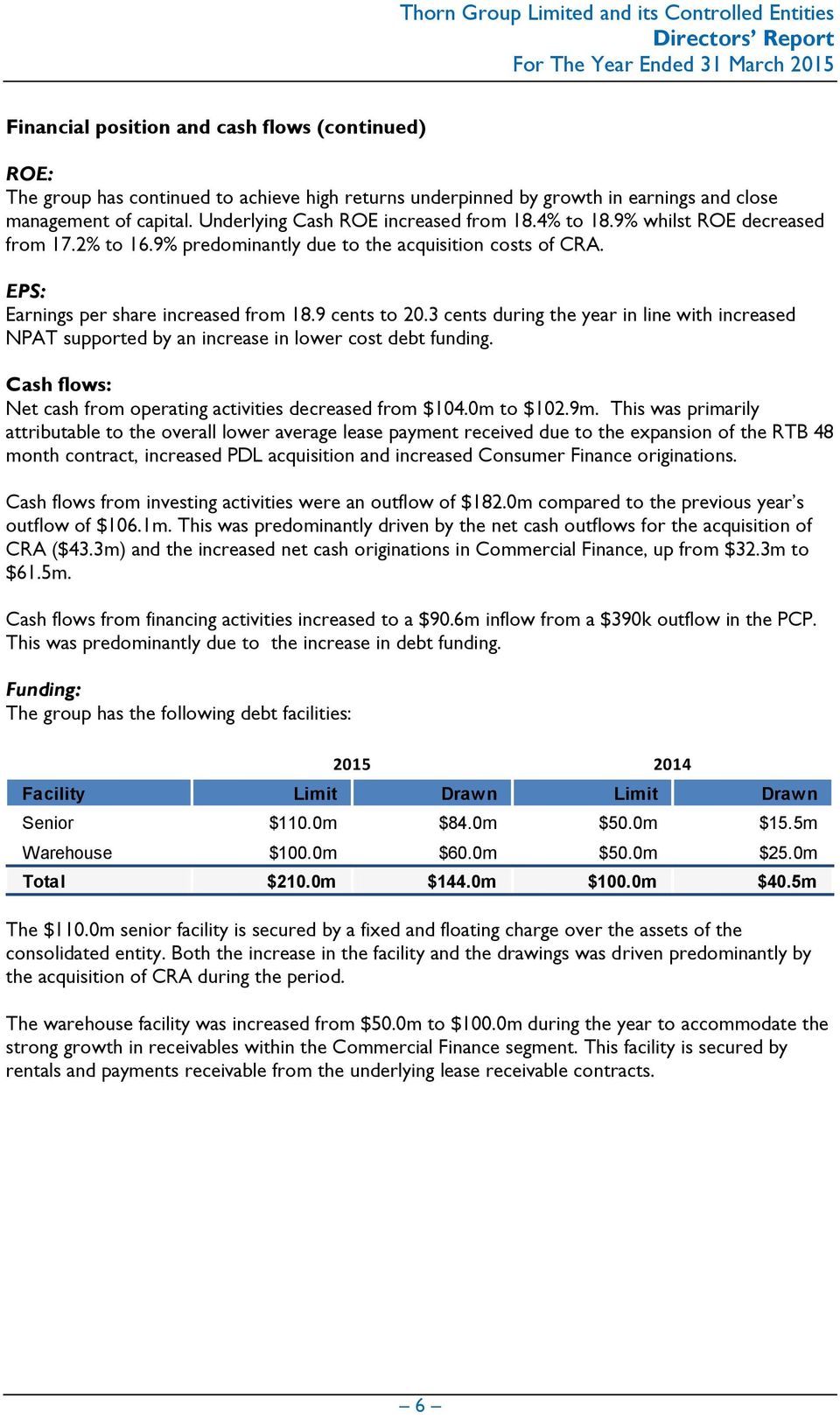
7 Directors Report Financial position and cash flows (continued) ROE: The group has continued to achieve high returns underpinned by growth in earnings and close management of capital. Underlying Cash ROE increased from 18.4% to 18.9% whilst ROE decreased from 17.2% to 16.9% predominantly due to the acquisition costs of CRA. EPS: Earnings per share increased from 18.9 cents to 20.3 cents during the year in line with increased NPAT supported by an increase in lower cost debt funding. Cash flows: Net cash from operating activities decreased from $104.0m to $102.9m. This was primarily attributable to the overall lower average lease payment received due to the expansion of the RTB 48 month contract, increased PDL acquisition and increased Consumer Finance originations. Cash flows from investing activities were an outflow of $182.0m compared to the previous year s outflow of $106.1m. This was predominantly driven by the net cash outflows for the acquisition of CRA ($43.3m) and the increased net cash originations in Commercial Finance, up from $32.3m to $61.5m. Cash flows from financing activities increased to a $90.6m inflow from a $390k outflow in the PCP. This was predominantly due to the increase in debt funding. Funding: The group has the following debt facilities: Facility Limit Drawn Limit Drawn Senior $110.0m $84.0m $50.0m $15.5m Warehouse $100.0m $60.0m $50.0m $25.0m Total $210.0m $144.0m $100.0m $40.5m The $110.0m senior facility is secured by a fixed and floating charge over the assets of the consolidated entity. Both the increase in the facility and the drawings was driven predominantly by the acquisition of CRA during the period. The warehouse facility was increased from $50.0m to $100.0m during the year to accommodate the strong growth in receivables within the Commercial Finance segment. This facility is secured by rentals and payments receivable from the underlying lease receivable contracts. 6
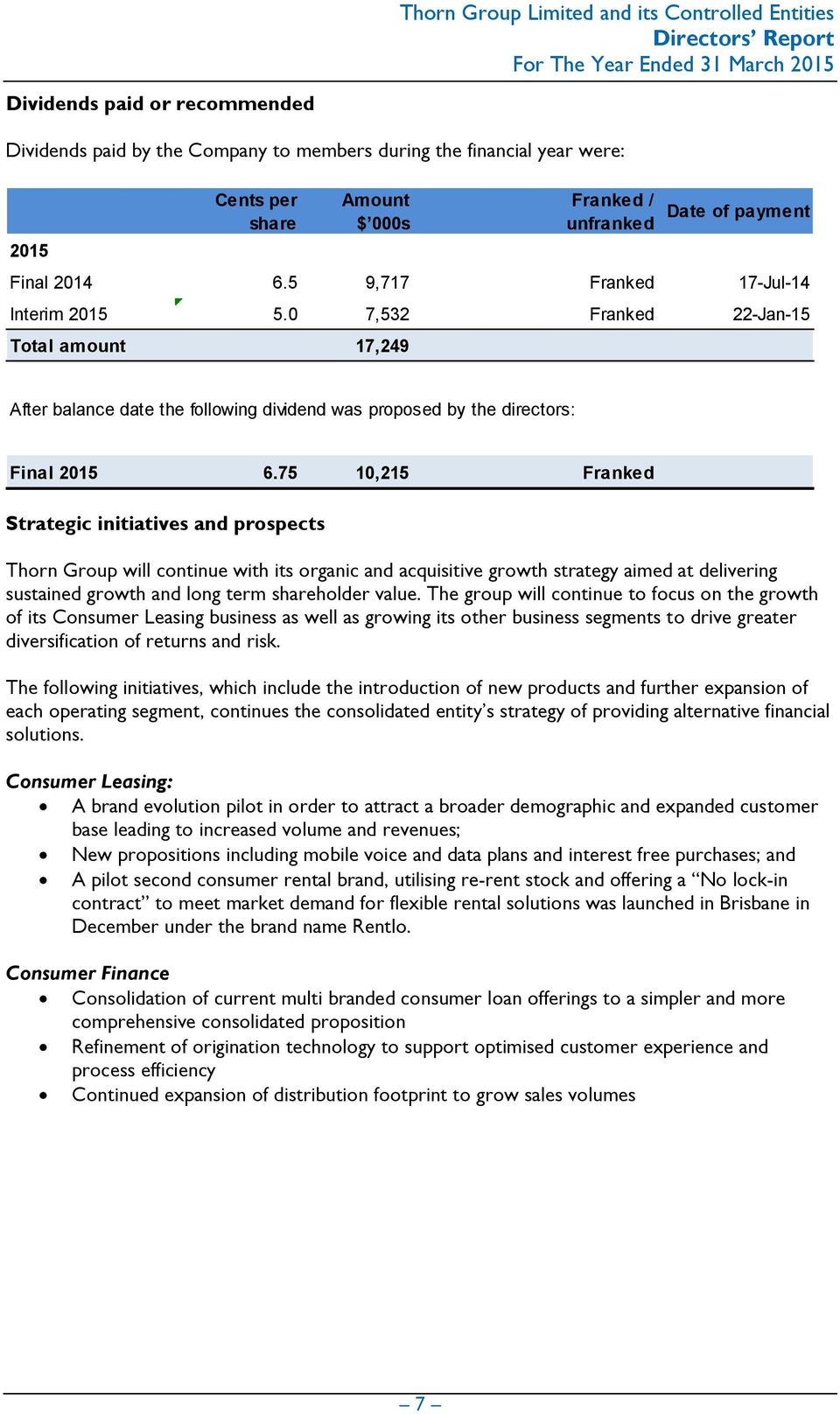
8 Directors Report Dividends paid or recommended Dividends paid by the Company to members during the financial year were: 2015 Cents per share Amount $ 000s Franked / unfranked Date of payment Final ,717 Franked 17-Jul-14 Interim ,532 Franked 22-Jan-15 Total amount 17,249 After balance date the following dividend was proposed by the directors: Final ,215 Franked Strategic initiatives and prospects Thorn Group will continue with its organic and acquisitive growth strategy aimed at delivering sustained growth and long term shareholder value. The group will continue to focus on the growth of its Consumer Leasing business as well as growing its other business segments to drive greater diversification of returns and risk. The following initiatives, which include the introduction of new products and further expansion of each operating segment, continues the consolidated entity s strategy of providing alternative financial solutions. Consumer Leasing: A brand evolution pilot in order to attract a broader demographic and expanded customer base leading to increased volume and revenues; New propositions including mobile voice and data plans and interest free purchases; and A pilot second consumer rental brand, utilising re-rent stock and offering a No lock-in contract to meet market demand for flexible rental solutions was launched in Brisbane in December under the brand name Rentlo. Consumer Finance Consolidation of current multi branded consumer loan offerings to a simpler and more comprehensive consolidated proposition Refinement of origination technology to support optimised customer experience and process efficiency Continued expansion of distribution footprint to grow sales volumes 7
9 Strategic initiatives and prospects (continued) Thorn Group Limited and its Controlled Entities Directors Report Commercial Finance: Expanded product offerings to include residual value for selected assets, vendor finance, trade finance and premium funding; A Commercial Direct pilot was launched in February to improve access to suppliers and SME users of commercial rental; A specialised Franchise Finance strategic alliance has been established to improve access to the franchise sector; and Continue the integration of CRA into the segment and incentivise and promote cross selling opportunities. Receivables Management Continue the momentum in high quality PDL purchases; and Restructure into centres of excellence including contingent collections in Melbourne and PDL collections in Adelaide. Risks Credit risk is the most significant risk to the consolidated entity. Credit risk grew in-line with the growth of the loan and lease receivables in all segments, except TFS where bad debts increased slightly as a percentage of the loan receivables. Regulatory risk in relation to changes of law or regulations that impact the operations or results of the groups activities remains a key focus for the consumer segments. Liquidity risk is managed through the adequate provision of funding and effective capital management policies. Thorn will continue to diversify its funding sources to further mitigate this risk into the future. The group is also subject to currency risk related to the direct acquisition of rental assets from overseas suppliers. To mitigate this risk the group operates a foreign exchange hedging policy. Outlook The strategic initiatives implemented in the current financial year and into the future will ensure Thorn Group continues to maximise shareholder value into the future while diversifying returns and risk. The Group will continue to review acquisition opportunities in all its operating segments that are consistent with our strategy and where we can extract value and add scale to our existing platforms. Thorn expects continued growth in receivables will be the basis for growth of all parts of the business. 8

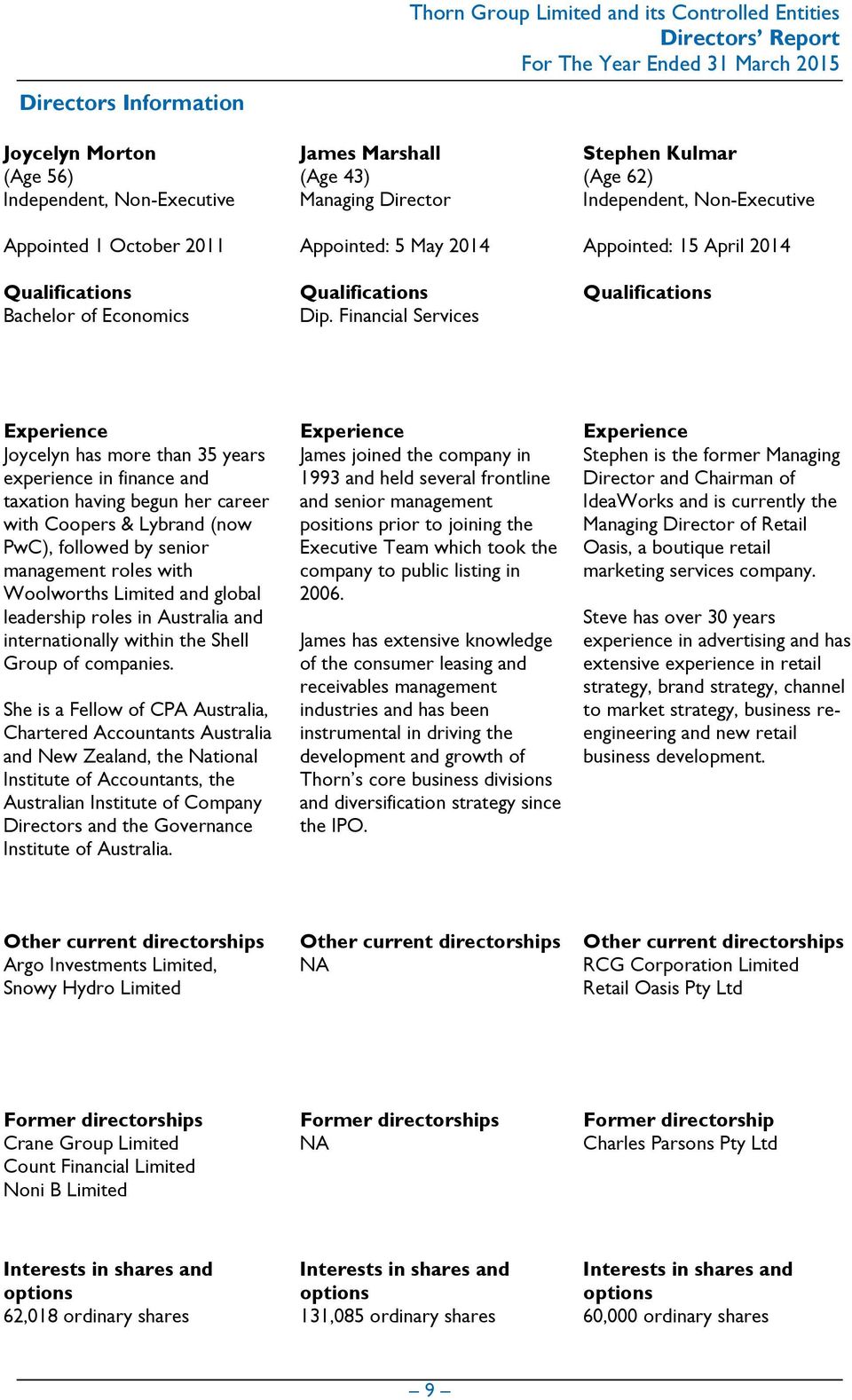
10 Directors Information Thorn Group Limited and its Controlled Entities Directors Report Joycelyn Morton (Age 56) Independent, Non-Executive James Marshall (Age 43) Managing Director Stephen Kulmar (Age 62) Independent, Non-Executive Appointed 1 October 2011 Appointed: 5 May 2014 Appointed: 15 April 2014 Qualifications Bachelor of Economics Qualifications Dip. Financial Services Qualifications Experience Joycelyn has more than 35 years experience in finance and taxation having begun her career with Coopers & Lybrand (now PwC), followed by senior management roles with Woolworths Limited and global leadership roles in Australia and internationally within the Shell Group of companies. She is a Fellow of CPA Australia, Chartered Accountants Australia and New Zealand, the National Institute of Accountants, the Australian Institute of Company Directors and the Governance Institute of Australia. Experience James joined the company in 1993 and held several frontline and senior management positions prior to joining the Executive Team which took the company to public listing in James has extensive knowledge of the consumer leasing and receivables management industries and has been instrumental in driving the development and growth of Thorn s core business divisions and diversification strategy since the IPO. Experience Stephen is the former Managing Director and Chairman of IdeaWorks and is currently the Managing Director of Retail Oasis, a boutique retail marketing services company. Steve has over 30 years experience in advertising and has extensive experience in retail strategy, brand strategy, channel to market strategy, business reengineering and new retail business development. Other current directorships Argo Investments Limited, Snowy Hydro Limited Other current directorships NA Other current directorships RCG Corporation Limited Retail Oasis Pty Ltd Former directorships Crane Group Limited Count Financial Limited Noni B Limited Former directorships NA Former directorship Charles Parsons Pty Ltd Interests in shares and options 62,018 ordinary shares Interests in shares and options 131,085 ordinary shares Interests in shares and options 60,000 ordinary shares 9
11 Directors Report Peter Henley (Age 68) Independent, Non-Executive David Foster (Age 46) Independent, Non-Executive David Carter (Age 61) Independent, Non-Executive Appointed: 21 May 2007 Appointed: 1 December 2014 Appointed 3 November 2006 Retired 17 November 2014 Qualifications Experience Peter has had a long and distinguished career in financial services generally and in consumer and commercial finance in particular, having held Managing Director roles with AGC, Nissan Finance and more recently GE Money. Peter is a Fellow of the Australian Institute of Management and a member of the Australian Institute of Company Directors. Qualifications Bachelor of Applied Science Master of Business Administration Experience David Foster has had an extensive career in Financial Services spanning over 25 years. His most recent executive role until December 2013 was CEO of Suncorp Bank, a role he commenced in September Prior to his role as CEO of Suncorp Bank, David lead Suncorp s strategy function which included numerous merger and acquisition activities including one of Australia s largest Financial Services transactions Promina Limited. Qualifications Bachelor of Economics, Bachelor of Law (Hons), Masters of Law, and a Bachelor of Civil Law Experience David passed away January David was a lawyer and corporate advisor who was previously a partner of a major international law firm. David ran his own legal and corporate advisory practice. David had significant experience in corporate governance, M&A, commercial and international law. David was a Member of the Australian Institute of Company Directors. Other current directorships AP Eagers Limited MTA Insurances Limited until sold to Suncorp Insurances 8/14. Former directorship GE Motor Solutions Australia GE MoneySingapore and Malaysia. United Financial Services Limited Interests in shares and options 71,499 ordinary shares Other current directorships NA Former directorships NA Interests in shares and options 21,490 ordinary shares Other current directorships Former directorships Azure Healthcare Limited Victorian Energy Network Corporation Interests in shares and options N/A 10

12 Directors Report John Hughes (Age 63) Executive Appointed 3 November 2006 Retired 30 June 2014 Qualifications Bachelor of Commerce Experience John has over 35 years experience as a senior executive in a number of leading Australian and international companies including Rural Holding Limited, Thorn EMI Rentals Australasia, Sharp Corporation, Competitive Foods, and Grace Bros. John is a Fellow of the Australian Institute of Company Directors. Other current directorships Former directorships Interests in shares and options N/A 11

13 Directors Report Company Secretary Peter Eaton joined the Company in 1999 and has held the positions of Chief Financial Officer and Company Secretary since August Peter holds a Bachelor of Commerce degree from the University of Western Sydney, is a member of CPA Australia and has undertaken the Senior Executive programme at London Business School. Directors Meetings The number of directors meetings (including meetings of committees of directors) and number of meetings attended by each of the directors of the Company during the financial year are detailed below. Director Board Meetings Audit, Risk and Compliance Committee Meetings Remuneration and Nomination Committee Meetings A B A B A B Joycelyn Morton James Marshall Stephen Kulmar Peter Henley David Foster David Carter John Hughes A Number of meetings attended B Number of meetings held during the time the director held office during the year (a) Mr James Marshall was appointed to the Board on 5 May He was not a member of the Audit Risk and Compliance Committee or the Remuneration and Nomination Committee but attended the meetings by invitation. (b) Mr John Hughes retired from the Board effective 30 June During his term as Chief Executive and Managing Director, he was not a member of the Audit Risk and Compliance Committee or the Remuneration and Nomination Committee but attended the meetings by invitation. (c) Mr Stephen Kulmar was appointed as a non-executive director on 15 April (d) Mr David Foster was appointed as a non-executive director on 1 December (e) Mr David Carter retired from the Board effective 17 November

14 Remuneration Report Audited Thorn Group Limited and its Controlled Entities Directors Report The directors are pleased to present the remuneration report setting out the remuneration information for key management personnel (KMP), for the year ended 31 March 2015 and is prepared in accordance with section 300A of the Corporations Act The KMP of the Company and the consolidated entity for the year ended 31 March 2015 were: Directors Joycelyn Morton Stephen Kulmar (appointed 15 April 2014) Peter Henley David Foster (appointed 1 December 2014) David Carter (retired 17 November 2014) Senior Executives James Marshall Chief Executive Officer (CEO) John Hughes Former Chief Executive Officer (retired 30 June 2014) Peter Eaton Chief Financial Officer (CFO) Derrick Hubble General Manager Consumer Leasing Matt Ingram General Manager Commercial Finance Rob Price General Manager Consumer Finance Sean Jones General Manager Receivables Management Richard Shepherd Former General Manager Consumer Finance (resigned 30 January 2015) 2015 Remuneration highlights Appointment of new CEO Short term incentives (STI) reflect on target performance for 2015 Long term incentives (LTI) Senior Executive retention payments James Marshall, previously Chief Operating Officer was appointed to replace John Hughes as Chief Executive Officer and Managing Director effective 1 June Mr Marshall s annual remuneration was set at the time of his appointment and his current remuneration is detailed on page financial performance was ahead of both the prior comparative period and budget. Performance in the Receivables Management division was below budget and impacted the Group s performance. Consequently the average short term incentive is at the bottom of the range. There were no performance rights due to vest during the 2015 year. LTI were granted to KMP and other Leadership team members during the 2015 year ( 2014 LTI ). The details of the LTI is on pages 16 to 20. A retention payment of $100,000 was paid to James Marshall, CEO and Peter Eaton, CFO. This is explained on page AGM remuneration vote The remuneration report was voted on via a poll % of the votes cast were for the remuneration report. 13

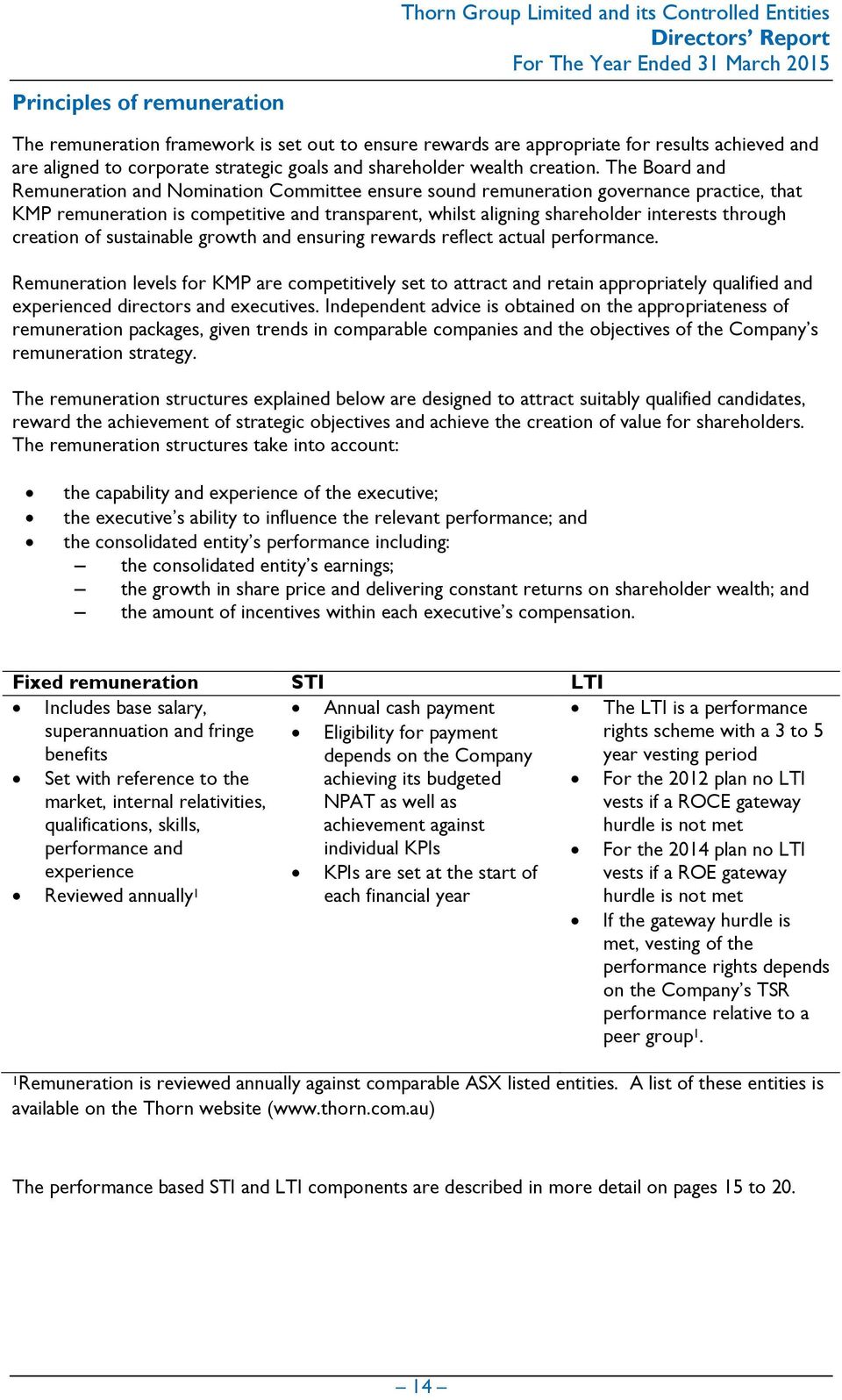
15 Principles of remuneration Thorn Group Limited and its Controlled Entities Directors Report The remuneration framework is set out to ensure rewards are appropriate for results achieved and are aligned to corporate strategic goals and shareholder wealth creation. The Board and Remuneration and Nomination Committee ensure sound remuneration governance practice, that KMP remuneration is competitive and transparent, whilst aligning shareholder interests through creation of sustainable growth and ensuring rewards reflect actual performance. Remuneration levels for KMP are competitively set to attract and retain appropriately qualified and experienced directors and executives. Independent advice is obtained on the appropriateness of remuneration packages, given trends in comparable companies and the objectives of the Company s remuneration strategy. The remuneration structures explained below are designed to attract suitably qualified candidates, reward the achievement of strategic objectives and achieve the creation of value for shareholders. The remuneration structures take into account: the capability and experience of the executive; the executive s ability to influence the relevant performance; and the consolidated entity s performance including: the consolidated entity s earnings; the growth in share price and delivering constant returns on shareholder wealth; and the amount of incentives within each executive s compensation. Fixed remuneration STI LTI Includes base salary, Annual cash payment The LTI is a performance superannuation and fringe benefits Eligibility for payment depends on the Company rights scheme with a 3 to 5 year vesting period Set with reference to the market, internal relativities, qualifications, skills, achieving its budgeted NPAT as well as achievement against For the 2012 plan no LTI vests if a ROCE gateway hurdle is not met performance and individual KPIs For the 2014 plan no LTI experience KPIs are set at the start of vests if a ROE gateway Reviewed annually 1 each financial year hurdle is not met If the gateway hurdle is met, vesting of the performance rights depends on the Company s TSR performance relative to a peer group 1. 1Remuneration is reviewed annually against comparable ASX listed entities. A list of these entities is available on the Thorn website ( The performance based STI and LTI components are described in more detail on pages 15 to
16 Directors Report i) Short Term Incentives The STI is an annual cash incentive reviewed by the Board against operational and financial Key Performance Indicators (KPIs) for the financial year. The following table outlines the major features of the 2015 STI: Features Funding of the STI Minimum requirements STI that can be earned What is target performance? What is stretch performance? KPIs Weighting of KPIs What is the financial KPI? What are the non-financial KPIs? Description The STI pool is funded when the Company achieves 95% of its budgeted NPAT No STI is payable if the Company does not meet 95% of its budgeted NPAT No amount of STI is paid if budgeted NPAT is not met Below 95% of target performance - nil On 95% of target performance 12.5 to 15 per cent of fixed base On target performance 25 to 30 per cent of fixed base Maximum STI for stretch performance 60 to 100 percent of fixed base A sliding scale is applied when performance is between 95% of target and target and again between target and stretch Target performance is budgeted NPAT Stretch performance is when actual NPAT is equal to or greater than 110% of budgeted NPAT Individual KPIs are set at the beginning of each financial year comprising financial and non-financial measures For C-level: 70 per cent relates to Group financial KPIs 30 per cent relates to non-financial KPIs For GMs: 30 per cent relates to Group financial KPIs 30 per cent relates to Divisional financial KPIs 40 per cent relates to non-financial KPIs Budgeted NPAT for the Group and budgeted EBIT for the divisions The non-financial KPIs are agreed with the Board at the start of the financial year Vary with position and responsibility The KPIs relate to people, customer satisfaction, strategy, systems, risk and staff development Performance period 1 April 2014 to 31 March 2015 Assessment & Approval At the end of the financial year, the Remuneration and 15

17 Directors Report Nomination Committee assesses the actual performance of the consolidated entity, and each individual s performance against the KPI s to determine how much of the bonus pool is payable. The Board has the discretion to take into account unbudgeted extraordinary items approved by the Board. The performance evaluation in respect of the year ended 31 March 2015 has taken place in accordance with this process. The Remuneration and Nomination Committee recommends the cash incentive to be paid to the individuals for approval by the Board performance The financial hurdle was met The amounts payable to KMP are detailed on page 26 Deferred component Clawback provisions The Board has determined that it is not appropriate to introduce a deferral due to: - The nature of the business is such that it is very difficult to shift profit between years; - The profit budget is increased annually so that management is highly motivated to achieve those budgets out of annual revenues; and - The quality of earnings is high and the risk of deferral is low While the Board did not move to include a deferral of STI in 2015 and does not expect it will do so in 2016, it has determined to keep the matter under review as it moves forward with an overall review of the remuneration framework. The Board has not yet adopted a clawback policy as the Long Term Incentive, which vests over 3, 4 and 5 years provides the capacity to clawback a component of remuneration in the event of a matter of significant concern. ii) Long Term Incentive (LTI) The Company currently has two LTI schemes in operation. The 2012 plan was granted in December 2012 in the form of performance rights. The 2014 plan was granted in July 2014 in the form of performance rights. The grants are directly linked to the performance of the Company, the returns generated and relative increases in shareholder wealth. This structure is used to ensure appropriate alignment to shareholder value over a specified timeframe. Performance rights provide the right to receive shares only if and when a particular performance based hurdle and vesting condition are met. The holders of the performance rights are entitled to receive one ordinary share per performance right. 16

18 The following table sets out the key features of the 2012 LTI plan. Thorn Group Limited and its Controlled Entities Directors Report Features Instrument Maximum LTI award level Dividend treatment Share dilution limits Gateway Hurdle Why ROCE was chosen Description Performance rights zero exercise price options LTI awards are capped at 50% of fixed remuneration at grant date using the face value of the shares at grant date to calculate the number to be granted. No dividends are paid on unvested awards No share dilution limits are in place given the quantum of the LTI The average Return on Capital Employed (ROCE) for the measurement period must be equal to or greater than 20% If ROCE < 20%: no performance rights vest If ROCE > 20%: performance rights are able to vest subject to the performance hurdles (see below) being met It is a key indicator of the quality and efficiency of the returns the consolidated entity is achieving and is aligned to shareholder wealth Why was ROCE set at 20% While the 20% ROCE hurdle is lower than the ROCE performance in the previous years, it appropriately reflects the change in business model The Company s strategy to be a diversified financial services organisation has seen lease and loan receivables grow substantially but ahead of earnings performance The Company has expanded its services to grow but margins will be lower than when the business was primarily Radio Rentals The Remuneration and Nomination Committee and the Board therefore consider that the 20% ROCE hurdle is appropriate It is important to recognise that 20% ROCE has been set as a gateway. It opens the gate for testing against TSR The ROCE calculation will be audited Performance Hurdles The company s TSR performance is measured against 30 comparable ASX listed securities (available at Where the Company s TSR performance is rated below the 50th percentile, no performance rights vest. Proportionate vesting occurs if the Company is ranked at or above the 50th percentile until the 90th percentile, when 100% of the rights vest. Why TSR was chosen It is widely accepted as an objective indicator of shareholder wealth criterion as it includes share price growth, dividends and other capital adjustments 17

19 Directors Report TSR will be calculated by an independent expert Performance period Vesting Dates Testing Termination Clawback provisions The performance period for the LTI is 5 years 1/3 of the grant vests at 3 years 1/3 of the grant vests at 4 years 1/3 of the grant vests at 5 years The LTI is currently structured to vest over 5 years to align with a shareholder s long term perspective The Board believes it is appropriate to vest the LTI if the gateway hurdle and performance hurdle has been met over the 5 year period notwithstanding that it may not have been met at 3 or 4 year test dates The current structure ensures the executive team remains focussed on improving shareholder returns over a 5 year period In the event that a participant s employment is terminated, any unvested performance rights will lapse There are no clawback provisions The LTI has an extended vesting period, vesting in 3, 4 and 5 years The extended vesting period provides the capacity to clawback a component of remuneration in the event of a matter of significant concern 18

20 The following table sets out the key features of the 2014 LTI plan. Thorn Group Limited and its Controlled Entities Directors Report Features Instrument Maximum LTI award level Dividend treatment Share dilution limits Gateway Hurdle Why ROE was chosen Description Performance rights zero exercise price options LTI awards are capped at a maximum of 50% of fixed remuneration at grant date using the face value of the shares at grant date to calculate the number to be granted. No dividends are paid on unvested awards No share dilution limits are in place given the quantum of the LTI The average Return on Equity (ROE) for the measurement period must be equal to or greater than 18.5% If ROE < 18.5%: no performance rights vest If ROE > 18.5%: performance rights are able to vest subject to the performance hurdles (see below) being met It is a key indicator of the quality and efficiency of the returns the consolidated entity is achieving and is aligned to shareholder wealth Alignment with financial services industry key benchmarks Why was ROE set at 18.5% The change from ROCE to ROE for the 2014 plan was due to the evolution of the Group towards financial services and to better align with organisations within that sector. While the 18.5% ROE hurdle is lower than the ROE performance in the previous years, it appropriately reflects the change in business model The Company s strategy to be a diversified financial services organisation has seen lease and loan receivables grow substantially but ahead of earnings performance The Company has expanded its services to grow but margins will be lower than when the business was primarily Radio Rentals The Remuneration and Nomination Committee and the Board therefore consider that the 18.5% ROE hurdle is appropriate It is important to recognise that 18.5% ROE has been set as a gateway. It opens the gate for testing against TSR The ROE calculation will be audited Performance Hurdles The company s TSR performance is measured against 28 comparable ASX listed securities (available at Where the Company s TSR performance is rated below the 50th percentile, no performance rights vest. Proportionate vesting occurs if the Company is ranked at or above the 50th percentile until the 90th percentile, when 100% of the rights vest. 19

21 Directors Report Why TSR was chosen Performance period It is widely accepted as an objective indicator of shareholder wealth criterion as it includes share price growth, dividends and other capital adjustments TSR will be calculated by an independent expert The performance period for the LTI is 3 years (1 April 2014 to 31 March 2017) Vesting Date 1 June % of the grant vests at 3 years Testing Termination Clawback provisions The LTI is structured to vest over 3 years to align with a shareholder s long term perspective The LTI is not subject to re-testing In the event that a participant s employment is terminated, any unvested performance rights will lapse There are no clawback provisions CEO and CFO retention payments The Board recognised that the continuing arrangement with the former CEO John Hughes may be perceived to impact the career paths of the current CEO James Marshall and CFO, both of whom the Board considered key to the ongoing success of the Company. The Board recognised that the LTI grant in December 2012 did not have a strong retention effect as there were no other LTI amounts vesting before May In order to address this, the current CEO and CFO would receive retention payments. In the 2015 financial year, the current CEO and CFO were paid an additional $100,000 each (2014 $50,000). In the 2016 financial year, the CFO will be paid a further $100,000 should he remain with the Company until 31 May This payment will be made in the form of equity. Services from Remuneration Consultants The Remuneration and Nomination Committee engaged Executive Research Services (ERS) as remuneration consultant to the Board to review the amounts and elements of the KMP remuneration and provide recommendations in relation thereto. ERS provided valuable market analysis in relation to the remuneration of the KMP, non-executive directors and other general managers of the consolidated entity. Consultant fees incurred for the financial year were $21,500. The Board is satisfied that the remuneration recommendations made by ERS are free from undue influence by members of the KMP about whom the recommendations may relate as the consultants were directly engaged by and reported to the Board. 20
22 Consequences of Performance on Shareholder s Wealth Thorn Group Limited and its Controlled Entities Directors Report In considering the consolidated entity s performance and benefits for shareholders wealth, the Board have regard to the following indices in respect of the current financial year and the four previous financial years Profit attributable to owners of the company $30,593,000 $28,151,000 $28,021,000 $27,849,000 $22,038,000 Basic EPS 20.34c 18.94c 19.11c 19.24c 16.84c Dividends paid $17,249,000 $15,563,000 $14,656,000 $12,272,000 $9,464,000 Dividends per share 11.50c 10.50c 10.00c 8.95c 7.30c Change in share price (0.62) 1.07 Return on capital employed (i) 18.48% 21.83% 24.78% 30.34% 35.02% Return on equity (ii) 16.94% 17.22% 18.96% 23.68% 24.93% Return on equity (iii) 18.90% 18.40% 18.96% 23.68% 24.93% (i) (ii) (iii) Calculated as EBIT divided by average capital employed (net debt plus equity) Calculated as NPAT divided by the average equity. Calculated as Underlying Cash NPAT divided by the average equity. Senior Executive Contract details The remuneration details of the key management personnel from 1 April 2015 are: Name Title Term / Notice Details James Marshall Chief Executive Officer and Managing Director Ongoing 6 month notice period Peter Eaton Chief Financial Officer Ongoing 3 month notice period Annual base salary of $550,000 inclusive of superannuation. No termination benefit is payable. Annual base salary of $367,500 inclusive of superannuation. A retention payment of $100,000 is payable at 31 May 2015 in the form of equity. No termination benefit is payable. Derrick Hubble GM Consumer Leasing Ongoing 3 month notice period Annual base salary of $290,286 inclusive of superannuation. No termination benefit is payable. Matt Ingram GM Business Finance Ongoing 3 month notice period Annual base salary of $267,597 inclusive of superannuation. No termination benefit is payable. Rob Price GM Consumer Finance Ongoing 3 month notice period Annual base salary of $256,247 inclusive of superannuation. No termination benefit is payable. Sean Jones GM Credit Management Ongoing 3 month notice period Annual base salary of $230,000 inclusive of superannuation. No termination benefit is payable. 21
23 Directors Report Non-Executive Directors Total remuneration for all non-executive directors, last voted upon by shareholders at the 2013 AGM, is not to exceed $650,000 per annum and is set based on advice from external advisors with reference to fees paid to other non-executive directors of comparable companies. The following fee structure was applicable for the financial years: Base fees per annum Chair of the Board $170,980 $166,000 Directors $85,490 $83,000 Additional fees per annum Chair of Audit, Risk and Compliance Committee $15,000 $15,000 Chair of Remuneration and Nomination Committee $10,000 $10,000 Notes to the Non-Executive Directors fees Non-executive directors do not receive performance-related remuneration and do not participate in employee share based payment schemes. No Committee fees were paid in 2015 as they were incorporated into the base fees. The above fees do not include superannuation. 22
24 Directors Report Directors and Executive Officers Remuneration (Company and Consolidated Audited) Details of the nature and amount of each major element of remuneration of each director of the Company and other KMP of the consolidated entity are: Post- Long-term Shareemployment Short-term benefits based 2015 payments Salary & STI cash Other Super- Long Retention fees bonus benefits annuation Service payment Options benefits Leave and rights Total Name $ $(A) $(B) $ $ $ $(C) $ Non-Executive Directors Joycelyn Morton 140, , ,042 Stephen Kulmar 1 89, , ,434 Peter Henley 84, , ,180 David Foster 2 32, , ,973 David Carter 3 86, , ,984 Subtotal non-executive directors Executive Directors 1 The remuneration for Stephen Kulmar for 2015 reflects remuneration during the period from 15 April 2014, the date of his appointment 2 The remuneration for David Foster for 2015 reflects remuneration during the period from 1 December 2014, the date of his appointment 3 The remuneration of David Carter for 2015 reflects remuneration during the period to 17 November 2014, the date of his resignation 4 The remuneration of John Hughes for 2015 reflects remuneration during the period to 30 June 2014, the date of his retirement and included in other benefits is his termination payment 5 The remuneration of Rob Price for 2015 reflects remuneration during the period from 27 January 2015, the date of his appointment 6 The remuneration of Richard Shepherd for 2015 reflects remuneration during the period to 30 January 2015, the date of his resignation. 434, , ,613 James Marshall 435, ,505 1,439 18,551 93,946 50, , ,606 John Hughes 4 180, ,000 4,824 1,261 37, ,415 Subtotal Executive directors 616, , ,439 23,375 95,207 87, ,369 1,380,021 Total directors remuneration Other Key Management Personnel 1,051, , ,439 64,417 95,207 87, ,369 1,855,634 Peter Eaton 331, ,030-18,551 17, ,333 92, ,233 Derrick Hubble 230,000 65,957 7,213 20, , ,562 Matt Ingram 229,224 63,336 50,000 18, , ,769 Rob Price 5 38,923 8,903 12,500 3, ,505 Sean Jones 182,745 27,607-16, , ,877 Richard Shepherd 6 213, , ,327 Subtotal other Key Management Personnel Total Key Management Personnel compensation 1,225, ,833 69,713 93,520 17, , ,161 1,932,272 (group) 2,276, , , , , , ,530 3,787,906 23
25 Directors Report Post- Long-term Shareemployment Short-term benefits based 2014 payments Salary & STI cash Non- Super- Long Retention fees bonus monetary annuation Service payment Options benefits benefits Leave and rights Total Name $ $(A) $(B) $ $ $ $(C) $ Non-Executive Directors David Carter 166, , ,259 Peter Henley 83, , ,630 Joycelyn Morton 98, , ,008 Paul Lahiff 1 33, , ,223 Subtotal non-executive directors Executive Directors 380, , ,120 John Hughes 590, ,916 3,379 17,474 8, , ,805 Subtotal Executive directors 590, ,916 3,379 17,474 8, , ,805 Total directors remuneration Other Key Management Personnel 970, ,916 3,379 52,394 8, ,000-1,393,925 James Marshall 261, ,627 11,414 17,474 16, ,000 63, ,297 Peter Eaton 275, ,627 8,289 17,474 4, ,000 63, ,789 Subtotal other Key Management Personnel Total Key Management Personnel compensation (group) 537, ,254 19,703 34,948 21, , ,400 1,150,085 1,507, ,170 23,082 87,342 30, , ,400 2,544,010 1 The remuneration for Paul Lahiff for 2014 reflects remuneration during the period to 22 August 2013, the date of his retirement. Notes in relation to the Table of Directors and Executive Remuneration A. The short term incentive bonus for 2015 is for performance during the financial year. B. Other benefits as disclosed in both tables includes cost of providing a motor vehicle, any fringe benefits tax attributable thereto, sign on bonuses and termination payments. C. The fair value of the performance rights is calculated at the date of grant using a Monte Carlo simulation model and allocated to each reporting period evenly over the period from grant date to the expected vesting date. The value disclosed is the portion of the fair value of the performance rights allocated to this reporting period. In valuing the performance rights, market conditions have been taken into account. 24
26 Directors Report The table below outlines the factors and assumptions were used in determining the fair value of performance rights at grant date. Grant date Initial Test date Expiry Date Fair Value Per Performance Right Exercise Price Price of Shares on Grant Date Expected Volatility Risk Free Interest Rate Dividend Yield 7 Dec Jun Dec 2017 $1.40 Nil $ % 2.7% 6.0% 7 Dec Jun Dec 2017 $1.28 Nil $ % 2.7% 6.0% 7 Dec Jun Dec 2017 $1.15 Nil $ % 2.7% 6.0% 1 July Jun Jul 2017 $1.24 Nil $ % 2.7% 5.0% The below table summarise KMP remuneration split by Fixed, Short Term and Long Term. Name Fixed % At Risk STI % At Risk LTI % Total % James Marshall Peter Eaton Derrick Hubble Matt Ingram Rob Price Sean Jones Richard Shepherd
27 2015 STI outcomes - audited Thorn Group Limited and its Controlled Entities Directors Report The STI pool was funded as the Company achieved its NPAT target. KMP achieved their personal KPIs which related to new systems, development of new offerings and further development of Company strategic objectives. No bonus payments were forfeited in the period. Directors Short Term Incentive Salary ($) % Paid Included in Remuneration ($) James Marshall 490, ,505 Executives Peter Eaton 350, ,030 Derrick Hubble 268, ,957 Matt Ingram 247, ,336 Rob Price 1 248, ,903 Sean Jones 200, ,607 1The Short Term Incentive for Rob Price is a pro-rata calculation as he commenced with the Company during the measurement period. 26
28 Equity Instruments Thorn Group Limited and its Controlled Entities Directors Report Performance rights granted as compensation in the year Director Performance Rights Granted Financial Year in Which Grants Vests Values Yet to Vest $ Number Date Min (a) Max (b) James Marshall 66,556 1 July Nil N/A Executive Peter Eaton 34,425 1 July Nil N/A Derrick Hubble 34,425 1 July Nil N/A Matt Ingram 34,150 1 July Nil N/A Sean Jones 27,540 1 July Nil N/A Analysis of performance rights available for vesting Details of the performance rights available for vesting to each director of the Company and other KMP are detailed below: Director Performance Rights Granted Financial Years in Which Grants Vests Values Yet to Vest $ Number Date Min (a) Max (b) James Marshall 63,291 7 Dec Nil N/A Executive 63,291 7 Dec Nil N/A 63,291 7 Dec Nil N/A 66,556 1 July Nil N/A Peter Eaton 63,291 7 Dec Nil N/A 63,291 7 Dec Nil N/A 63,291 7 Dec Nil N/A 34,425 1 July Nil N/A Derrick Hubble 34,425 1 July Nil N/A Matt Ingram 34,150 1 July Nil N/A Sean Jones 27,540 1 July Nil N/A (a) (b) (c) The minimum value of the performance rights to vest is nil as the performance rights criteria may not be met and consequently the performance rights may not vest. The maximum value of the performance rights yet to vest is not determinable as it depends on the market price of shares of the Company on the Australian Securities Exchange at the date the performance rights are exercised. The performance rights that did not vest will be retested at the next vesting date. 27
29 Analysis of Movements in Performance Rights Thorn Group Limited and its Controlled Entities Directors Report The movement during the reporting period, by value, of performance rights over ordinary shares in Thorn Group Limited held by each Company director and KMP are detailed below: Value of Performance Rights Granted in year (a) Exercised in year Forfeited in year $ $ $ James Marshall 82, Peter Eaton 42, Derrick Hubble 42, Matt Ingram 42, Sean Jones 34, , (a) The fair value of the performance rights is calculated at the date of the grant based upon the Monte Carlo simulation model. Performance Rights Over Equity Instruments Granted The movement during the year in the number of performance rights over ordinary shares in Thorn Group Limited held directly, indirectly or beneficially, by each key management person, including their related parties is as follows: Held at 1 April 2014 Granted as Compensation Exercised Lapsed during the year Held at 31 March 2015 Vested during the year James Marshall 189,873 66, ,429 - Peter Eaton 189,873 34, ,298 - Derrick Hubble - 34, ,425 - Matt Ingram - 34, ,150 - Sean Jones - 27, ,540-28
30 Events Subsequent To Reporting Date Thorn Group Limited and its Controlled Entities Directors Report There has not arisen in the interval between the end of the financial year and the date of this report any item, transaction or event of a material and unusual nature likely, in the opinion of the directors of the Company, to affect significantly the operations of the consolidated entity, the results of those operations, or the state of affairs of the consolidated entity, in future financial years. Likely Developments The consolidated entity will continue to pursue its policy of increasing the profitability and market share of its major business sectors during the next financial year. For further information about likely developments in the operations of the consolidated entity and the expected results of those operations in future financial years, refer to the Operating and Financial Review on page 2. Performance rights Performance rights granted to directors and officers of the Company During the financial year, the Company has granted performance rights over unissued ordinary shares in the Company to the key management personnel of the Company. Page provides the details of those performance rights which have not vested at the date of the report. Unissued shares under options At the date of this report there are no unissued ordinary shares of the Company under option. 29
31 Indemnification and Insurance of Officers and Auditors Indemnification Thorn Group Limited and its Controlled Entities Directors Report The Company has agreed to indemnify the current, former and subsequent directors and officers of the Company, against all liabilities to another person (other than the Company or a related body corporate) that may arise from their position as directors or officers of the Company and its controlled entities, except where the liability arises out of conduct involving a lack of good faith. The agreement stipulates that the Company will meet the full amount of any such liabilities, including costs and expenses. Insurance Premiums During the financial year the Company has paid insurance premiums of $44,187 in respect of directors and officers liability and legal expenses insurance contracts, for current and former directors and officers, including senior executives of the Company and directors, senior executives and secretaries of its controlled entities. The insurance premiums relate to: costs and expenses incurred by the relevant officers in defending proceedings, whether civil or criminal and whatever their outcome; and other liabilities that may arise from their position, with the exception of conduct involving misconduct. The insurance policies outlined above do not contain details of the premiums paid in respect of individual officers of the Company. Non-Audit Services During the year KPMG, the Company s auditor, has performed certain other services in addition to their statutory duties. The Board has considered the non-audit services provided during the year by the auditor and is satisfied that the provision of those non-audit services during the year by the auditor is compatible with, and did not compromise, the auditor independence requirements of the Corporations Act 2001 for the following reasons: all non-audit services were subject to the corporate governance procedures adopted by the Company and have been reviewed by the Audit Risk and Compliance Committee to ensure they do not impact the integrity and objectivity of the auditor; the non-audit services provided do not undermine the general principles relating to auditor independence; and as set out in APES110 Code of Ethics for Professional Accountants, as they did not involve reviewing or auditing the auditor s own work, acting in a management or decision making capacity for the Company, acting as an advocate for the Company or jointly sharing risks and rewards. Details of the amounts paid to the auditor of the consolidated entity, KPMG, and its related practices for audit and non-audit services provided during the year are set out in note
32 Rounding Off Thorn Group Limited and its Controlled Entities Directors Report The Company is of a kind referred to in ASIC Class Order 98/100 dated 10 July 1998 and in accordance with that Class Order, amounts in the financial report and directors report have been rounded off to the nearest thousand dollars, unless otherwise stated. Lead Auditor s Independence Declaration The Lead Auditor s independence declaration is set out on page 42 and forms part of the directors report for financial year ended 31 March This report is made in accordance with a resolution of the directors: Joycelyn Morton Chairperson Dated at Sydney 27 May
33 Corporate Governance Statement Thorn Group Limited and its Controlled Entities Corporate Governance Statement This statement outlines the main corporate governance practices in place throughout the financial year, which comply with the ASX Corporate Governance Council recommendations, unless otherwise stated. Board of Directors Role of the Board The Board s primary role is the protection and enhancement of long-term shareholder value. To fulfil this role, the Board is responsible for the overall corporate governance of the Company including formulating its strategic direction, approving and monitoring capital expenditure, setting remuneration, appointing, removing and creating succession policies for directors and senior executives, establishing and monitoring the achievement of management s goals and ensuring the integrity of risk management, internal control, legal compliance and management information systems. It is also responsible for approving and monitoring financial and other reporting. In order to ensure that the Board functions and responsibilities are clearly identified, the Company has adopted a formal Board Charter. A copy of the Board Charter is located on the Company s website ( The Board has delegated responsibility for operation and administration of the Company to the Managing Director and executive management. Responsibilities are delineated by formal authority delegations. Board Processes To assist in the execution of its responsibilities, the Board has established an Audit, Risk and Compliance Committee and a Remuneration and Nomination Committee. These committees have written mandates and operating procedures, which are reviewed on a regular basis. The Board has also established a framework for the management of the Company including a system of internal control, a business risk management process and the establishment of appropriate ethical standards. The full Board currently holds scheduled meetings each year, per annum, plus strategy meetings and any extraordinary meetings at such other times as may be necessary to address any specific significant matters that may arise. The Board Charter requires the full Board to meet at least once per year to review the performance of the directors, committees, and senior executives, as well as, the relationship between the Board and management and matters of general corporate governance. The agenda for Board meetings is prepared in conjunction with the Chairperson, Managing Director and Company Secretary. Standing items include the divisional report, finance report, strategic matters, governance, compliance and continuous disclosure. Submissions are circulated in advance. Executives are regularly involved in Board discussions and directors have other opportunities, including visits to business operations, for contact with a wider group of employees. Director and Executive Education The Company has a formal process to educate new directors about the nature of the business, current issues, the corporate strategy, the culture and values of the Company, and the expectations 32
34 Corporate Governance Statement of the Company concerning performance of directors. In addition, Directors are also educated regarding meeting arrangements and director interaction with each other, senior executives and other stakeholders. Directors also have the opportunity to visit the Company s facilities and meet with management to gain a better understanding of business operations. Directors are given access to continuing education opportunities to update and enhance their skills and knowledge. The Company also has a formal process to educate new senior executives upon taking such positions. The induction program includes reviewing the Company structure, strategy, operations, financial position and risk management policies. It also familiarises the individual with the respective rights, duties, responsibilities and roles of the individual and the Board. Independent Professional Advice and Access to Company Information Each director has the right of access to all relevant Company information and to the Company s executives and, subject to prior consultation with the Chairperson, may seek independent professional advice from a suitably qualified adviser at the Company s expense. The director must consult with an advisor suitably qualified in the relevant field, and obtain the Chairperson s approval of the fee payable for the advice before proceeding with consultation. A copy of the advice received by the director is made available to all other members of the Board. Composition of the Board The names of the directors of the Company in office at the date of this report, specifying which are independent, are set out on pages 9 to 11 of this report. The composition of the Board is determined using the following principles: a minimum of three directors, with a broad range of expertise both nationally and internationally; a majority of independent non-executive directors; a majority of directors having extensive knowledge of the Company s industries, and/or extensive expertise in significant aspects of auditing and financial reporting, or risk management of large companies; a non-executive independent director as Chairperson; and directors are subject to re-election every three years (except for the Managing Director). The Board considers the mix of skills and diversity of Board members when assessing the composition of the Board. The Board assesses existing and potential directors skills to ensure they have appropriate industry expertise in the Company s operating segments. The Board considers the diversity of existing and potential directors to ensure they are in-line with the geographical and operational segments of the Company. The Board s policy is to seek a diverse range of directors who have a range of ages, genders and ethnicity which mirrors the environment in which the Company operates. 33
35 Corporate Governance Statement An independent director is a director who is not a member of management (a non-executive director) and who: 1. holds less than five per cent of the voting shares of the Company and is not an officer of, or otherwise associated, directly or indirectly, with a shareholder of more than five per cent of the voting shares of the Company; 2. has not within the last three years been employed in an executive capacity by the Company or a related body corporate or has become a director within three years of ceasing to hold any such employment; 3. within the last three years has not been a principal of a material professional adviser or a material consultant to the Company or another Company member or an employee materially associated with the service provided; 4. is not a material supplier or customer of the Company or another member of the consolidated entity, or an officer of or otherwise associated, directly or indirectly, with a material supplier or customer; 5. has no material contractual relationship with the Company or a related body corporate other than as a director of the Company; and 6. is free from any interest and any business or other relationship which could, or could reasonably be perceived to, materially interfere with the director s ability to act in the best interests of the Company. The Board considers, material, in this context, to be where any director-related business relationship has represented, or is likely in future to represent the lesser of at least ten per cent of the relevant segment s or the director-related business revenue. The board considered the nature of the relevant industries competition and the size and nature of each director-related business relationship, in arriving at this threshold (refer Note 20). Applying these criteria, the Board is satisfied that Joycelyn Morton, Stephen Kulmar, Peter Henley, and David Foster are independent. In accordance with the ASX Corporate Governance Guidelines, the Chairperson is an independent director, and the positions of Managing Director and Chairperson are held by different directors. Remuneration and Nomination Committee The Remuneration and Nomination Committee has a documented charter, approved by the Board. All members are non-executive directors with a majority being independent. The Remuneration and Nomination Committee assists the Board in its oversight responsibilities by monitoring and advising on: remuneration packages of senior executives, non-executive directors and executive directors; share option schemes and incentive performance packages; executive contracts; recruitment, retention and termination policies relating to the Board and senior executives; and monitoring the size and composition of the Board. 34
36 Corporate Governance Statement The members of the Remuneration and Nomination Committee during the year were: Stephen Kulmar (Chairperson) Independent, Non-Executive (appointed 15 April 2014) Joycelyn Morton Independent, Non-Executive Peter Henley Independent, Non-Executive David Foster Independent, Non-Executive (appointed 1 December 2014) David Carter Independent, Non-Executive (retired 17 November 2014) The Managing Director, James Marshall, is also invited to Remuneration and Nomination Committee meetings, as required, to discuss senior executives performance and remuneration packages but does not attend meetings involving matters pertaining to himself. From time to time, the Committee takes advice from external consultants to identify potential candidates for the Board. The Committee makes recommendations to the Board on the candidates, which votes on them. The Board then appoints the most suitable candidates. Board candidates must stand for election at the general meeting of shareholders immediately following their appointment. Korn Ferry was engaged during the financial year by the Board to assist in the recruitment of a Non- Executive Director. Fees of $80,000 were incurred. The terms and conditions of the appointment and retirement of non-executive directors are set out in a letter of appointment, including expectations of attendance and preparation for all Board meetings, minimum hourly commitment, appointments to other boards, the procedures for dealing with conflicts of interest and the availability of independent professional advice. The Remuneration and Nomination Committee meets at least three times a year and as required. The Committee met four times during the year and Committee members attendance record is disclosed in the table of directors meetings on page
37 Audit, Risk and Compliance Committee Thorn Group Limited and its Controlled Entities Corporate Governance Statement The Audit, Risk and Compliance Committee has a documented charter, approved by the Board. The charter is available on the Company s website. All members are non-executive directors with a majority being independent. The Chairperson may not be the Chairperson of the Board. The Audit, Risk and Compliance Committee advises the Board on the establishment and maintenance of a framework of internal control and appropriate ethical standards for the management of the Company. The members of the Audit, Risk and Compliance Committee during the year were: David Foster (Chairperson) Independent, Non-Executive (appointed 1 December 2014) Joycelyn Morton (Chairperson) Independent, Non-Executive Peter Henley Independent, Non-Executive Stephen Kulmar Independent, Non-Executive (appointed 15 April 2014) David Carter Independent, Non-Executive (retired 17 November 2014) The Company Secretary, Peter Eaton, acts as Secretary to the Committee. The internal and external auditors, the Managing Director and the Chief Financial Officer are invited to Audit, Risk and Compliance Committee meetings at the discretion of the Committee. The Committee is required to meet at least twice during the year and committee members attendance record is disclosed in the table of directors meetings on page 12. The external auditor met with the Audit, Risk and Compliance Committee six times during the year without management being present. The Managing Director and the Chief Financial Officer have declared in writing to the Board that the financial records of the Company and the consolidated entity for the financial year have been properly maintained, the Company s financial reports for the financial year ended 31 March 2015 comply with accounting standards and present a true and fair view of the Company s financial condition and operational results. This statement is required annually. The responsibilities of the Audit, Risk and Compliance Committee include: reviewing the annual and half year financial reports and other financial information distributed externally; assessing management processes supporting external reporting; assessing corporate risk assessment processes; assessing the performance and objectivity of the internal audit function; establishing procedures for selecting, appointing and if necessary, removing the external auditor; assessing whether non-audit services provided by the external auditor are consistent with maintaining the external auditor s independence. Each reporting period the external auditor provides an independence declaration in relation to the audit or review; providing advice to the Board in respect of whether the provision of the non-audit services by the external auditor is compatible with the general standard of independence of auditors imposed by the Corporation Act 2001; assessing the adequacy of the internal control framework and the Company s code of ethical standards; and organising, reviewing and reporting on any special reviews or investigations deemed necessary by the Board. 36
38 Corporate Governance Statement The Audit, Risk and Compliance Committee reviews the performance of the external auditors on an annual basis and meets with them during the year to: discuss the external audit, identifying any significant changes in structure, operations, internal controls or accounting policies likely to impact the financial statements and to review the fees proposed for the audit work to be performed; review the half-year and preliminary final report prior to lodgement with the ASX, and any significant adjustments required as a result of the auditor s findings, and to recommend Board approval of these documents, prior to announcement of results; review the draft annual and half-year financial report, and recommend Board approval of the financial report; and review the results and findings of the external audit, the adequacy of accounting and financial controls, and to monitor the implementation of any recommendations made. Risk Management Oversight of the Risk Management System The Board oversees the establishment, implementation and review of the Company's Risk Management System. Management has established and implemented the Risk Management System for assessing, monitoring and managing all risks, including material business risks, for the consolidated entity (including sustainability risk). The Managing Director and the Chief Financial Officer have provided assurance, in writing to the Board, that the financial reporting, risk management and associated compliance and controls have been assessed and found to be operating effectively. The operational and other risk management compliance and controls have also been assessed and found to be operating effectively. Risk Profile Management provide the risk profile on a six monthly basis to the Audit, Risk and Compliance Committee that outlines the material business risks to the Company. Risk reporting includes the status of risks through integrated risk management programs aimed at ensuring risks are identified, assessed and appropriately managed. The Audit, Risk and Compliance Committee reports the status of material business risks to the Board on a regular basis. Material business risks for the Company may arise from such matters as actions by competitors, government policy changes, the impact of exchange rate movements on the price of products and sales, difficulties in sourcing supply of products, environment, workplace health and safety, property, financial reporting and the purchase, development and use of information systems. 37
39 Risk Management, Compliance and Control Thorn Group Limited and its Controlled Entities Corporate Governance Statement The Company strives to ensure that its products and services are of the highest standard. The Board is responsible for the overall internal control framework, but recognises that no cost-effective internal control system will preclude errors and irregularities. The Board s policy on internal control is comprehensive. Comprehensive practices have been established to ensure: capital expenditure and revenue commitments above a certain size obtain prior Board approval; financial exposures are controlled; workplace health and safety standards and management systems are monitored and reviewed to achieve high standards of performance and compliance with regulations; business transactions are properly authorised and executed; the quality and integrity of personnel; financial reporting accuracy and compliance with the financial reporting regulatory framework; and environmental regulation compliance. Quality and Integrity of Personnel Formal appraisals are conducted at least annually for all employees. Training and development and appropriate remuneration and incentives with regular performance reviews create an environment of cooperation and constructive dialogue with employees and senior management. A formal succession plan is in place to ensure competent and knowledgeable employees fill senior positions when retirements or resignations occur. Financial Reporting The Managing Director and the Chief Financial Officer have provided assurance in writing to the Board that the Company s financial reports are founded on a sound system of risk management and internal compliance and control which implements the policies adopted by the Board. Monthly actual results are reported against budgets approved by the directors and revised forecasts for the year are prepared regularly. Environmental Legislation The consolidated entity s operations are not subject to significant environmental regulations under either Commonwealth or State legislation. The Directors are of the belief that the consolidated entity has adequate systems in place for the management of its environmental requirements and is not aware of any of those environmental requirements as they apply to the consolidated entity. Internal Audit The internal auditors assist the Board in ensuring compliance with internal controls and risk management programs by regularly reviewing the effectiveness of the above mentioned compliance and control systems. The results of internal audits are reported on a monthly basis to the Board. 38
40 Ethical Standards Thorn Group Limited and its Controlled Entities Corporate Governance Statement All directors, managers and employees are expected to act with the utmost integrity and objectivity, striving at all times to enhance the reputation and performance of the Company and consolidated entity. In order to promote ethical and responsible decision making, the Company has implemented a Code of Conduct to guide the directors and senior executives. Further, the Company has implemented a formal Securities Trading policy in order to formalise the Company s position on employees trading in the Company s securities. Every employee has a nominated supervisor to whom they may refer any issues arising from their employment. The Board reviews the Code of Conduct and processes are in place to promote and communicate these policies. Both of these policies are available on the Company s website. Conflict of Interest Directors must keep the Board advised, on an ongoing basis, of any interest that could potentially conflict with those of the Company. The Board has developed procedures to assist directors to disclose potential conflicts of interest. Where the Board believes that a significant conflict exists for a director on a Board matter, the director concerned does not receive the relevant Board papers and is not present at the meeting whilst the item is considered. Details of director-related entity transactions with the Company and the consolidated entity are set out in note 20 to the financial statements. Code of Conduct The Company s Code of Conduct aims to maintain appropriate core Company values and objectives. The Company has advised each director, manager and employee that they must comply with the Code of Conduct. The Company s Code of Conduct covers issues such as delivering shareholder value, managing conflicts of interest, confidentiality, fair and honest dealings, workplace health and safety, equal opportunity and compliance with laws. The Code encourages reporting of unethical behaviour. The Company has a Whistleblower Policy and a confidential whistleblowing service which provides its staff with an avenue to report suspected unethical, illegal or improper behaviour. Securities Trading Policy The Company and the consolidated entity has a Securities Trading policy, which sets out the circumstances under which directors, senior executives, and employees of the Company and the consolidated entity may deal in securities with the objective that no director, senior executive or other employee will contravene the requirements of the Corporations Act 2001 or the ASX Listing Rules. The policy outlines the restricted trading periods for the Company as the month immediately before the release of the Company s half yearly and yearly results. The policy is reproduced in full on the Company s website. Diversity Policy The Board is committed to having an appropriate blend of diversity on the Board and senior executive positions. The Board has established a policy regarding gender, age, ethnic and cultural diversity. 39
41 The policy is reproduced in full on the Company s website. The consolidated entity s diversity performance is as follows: Thorn Group Limited and its Controlled Entities Corporate Governance Statement Gender Representation 2015 Male 2015 Female 2014 Male 2014 Female Board Representation 83% 17% 83% 17% Key Management Personnel Representation 100% - 100% - Group Representation 53% 47% 53% 47% Communication with Shareholders The Board provides shareholders with information using a comprehensive Continuous Disclosure Policy which includes identifying matters that may have a material effect on the price of the Company s securities, notifying them to the ASX, posting them on the Company s website and issuing media releases. The Continuous Disclosure Policy is available on the Company s website. In summary, the Continuous Disclosure policy operates as follows: the policy identifies information that needs to be disclosed; the Managing Director, the Chief Financial Officer and the Company Secretary are responsible for interpreting the Company s policy and where necessary informing the Board. The Company Secretary is responsible for all communications with the ASX; the full annual report provided via the Company s website to all shareholders (unless a shareholder has specifically requested to receive a physical copy or not to receive the document), including relevant information about the operations of the consolidated entity during the year, changes in the state of affairs and details of future developments; the half-yearly report contains summarised financial information and a review of the operations of the consolidated entity during the period. The half-year reviewed financial report is lodged with the Australian Securities and Investments Commission and the ASX; proposed major changes in the consolidated entity which may impact the share ownership rights are submitted to a vote of shareholders; all announcements made to the market, and related information (including information provided to analysts or the media during briefings), are placed on the Company's website after they are released to the ASX; the full texts of notices of meetings and associated explanatory material are placed on the Company s website; and the external auditor attends the Annual General Meetings to answer questions concerning the conduct of the audit, the preparation and content of the auditor s report, accounting policies adopted by the Company and the independence of the auditor in relation to the conduct of the audit. The Company does not have a formal shareholder communication policy, however it provides information to shareholders via the Company s website, which has links to recent Company announcements and past annual reports, results presentations and various ASX pages, including the current share price. The Board supports full participation of shareholders at the Annual General Meeting, to ensure a high level of accountability and identification with the Company s strategy and goals. Important issues are presented to the shareholders as single resolutions. 40
42 Corporate Governance Statement The shareholders are requested to vote on the appointment and aggregate remuneration of directors, the granting of options and shares to directors, the Remuneration Report and changes to the Constitution. Copies of the Constitution are available to any shareholder who requests it. 41
43 Lead Auditor s Independence Declaration 42
44 Statement of Comprehensive Income In thousands of AUD Note Revenue 3 293, ,855 Finance lease cost of sales (71,703) (38,583) Employee benefit expense 19 (53,853) (48,859) Depreciation & amortisation expense (32,481) (36,213) Impairment losses on loans and receivables (27,598) (17,029) Marketing expenses (12,993) (11,358) Property expenses (9,923) (9,345) Transport expenses (6,905) (6,737) Communication & IT expenses (5,372) (4,684) Finance expenses (4,318) (2,073) Travel expenses (1,586) (1,323) Acquisition Costs (2,246) - Other expenses (20,205) (17,619) Profit before income tax 44,663 41,032 Income tax expense 9 (14,070) (12,881) Profit for the period 30,593 28,151 Other comprehensive income - items that may be reclassified subsequently to profit or loss Movement in fair value of cash flow hedge (134) - Total comprehensive income 30,459 28,151 Basic earnings per share (cents) Diluted earnings per share(cents) The statement of comprehensive income is to be read in conjunction with the notes of the financial statements set out on pages 48 to
45 Statement of Financial Position As at 31 March 2015 In thousands of AUD Note Assets Cash and cash equivalents 13,856 2,393 Trade and other receivables 4 129,113 68,981 Income tax receivable 1,379 - Total current assets 144,348 71,374 Trade and other receivables 4 160,518 89,015 Deferred tax assets 10 1,503 3,260 Property, plant and equipment 3,957 4,423 Rental Assets 6 33,215 52,644 Intangible assets 8 32,926 31,734 Total non-current assets 232, ,076 Total assets 376, ,450 Liabilities Trade payables 19,291 16,003 Other payables 14,582 9,900 Loans and borrowings 12 19,778 9,099 Employee benefits 7,058 5,621 Income tax payable - 7,039 Provisions Total current liabilities 61,428 48,160 Loans and borrowings ,195 31,397 Employee benefits Provisions 961 1,025 Total non-current liabilities 125,551 32,670 Total liabilities 186,979 80,830 Net assets 189, ,620 Equity Issued capital 103,446 99,060 Reserves 2,989 2,851 Retained earnings 83,053 69,709 Total equity 189, ,620 The statement of financial position is to be read in conjunction with the notes of the financial statements set out on pages 48 to
46 Statement of Changes in Equity Share Retained Total In thousands of AUD captial Reserves earnings equity Balance at 1 April ,483 2,769 57, ,373 Net profit for the period ,151 28,151 Other comprehensive income Issue of shares under dividend reinvestment plan 3, ,577 Share based payments transactions Dividends to shareholders - - (15,563) (15,563) Balance at 31 March ,060 2,851 69, ,620 Balance at 1 April ,060 2,851 69, ,620 Net profit for the period ,593 30,593 Total comprehensive income - (134) - (134) Issue of shares under dividend reinvestment plan 4, ,386 Share based payments transactions Dividends to shareholders - - (17,249) (17,249) Balance at 31 March ,446 2,989 83, ,488 The statement of changes in equity is to be read in conjunction with the notes of the financial statements set out on pages 48 to
47 Statement of Cash Flows In thousands of AUD Note Cash flows from operating activities Cash receipts from customers 395, ,109 Cash paid to suppliers and employees (267,538) (138,438) Cash generated from operations 127, ,671 Net borrowing costs (4,250) (1,922) Income tax paid (20,730) (10,724) Net cash from operating activities 102, ,025 Cash flows from investing activities Proceeds from sale of assets 3,437 1,655 Acquisition of rental assets (78,550) (70,178) Commercial Finance originations (61,527) (32,325) Acquisition of property, plant and equipment and software (2,132) (5,265) Acquisition of subsidiary 18 (43,272) - Net cash used in investing activities (182,044) (106,113) Cash flows from financing activities Proceeds from borrowings 128,239 24,996 Repayment of borrowings (24,763) (13,400) Dividends paid (12,862) (11,986) Net cash used in financing activities 90,614 (390) Net increase (decrease) in cash and cash equivalents 11,463 (2,478) Cash and cash equivalents at April 1 2,393 4,871 Cash and cash equivalents at 31 March 13,856 2,393 The statement of cash flows is to be read in conjunction with the notes to the financial statements set out on pages 48 to
48 Statement of Cash Flows Statement of Cash Flows (continued) Cash and cash equivalents In thousands of AUD Bank balances 13,746 2,283 Call deposits Cash and cash equivalents 13,856 2,393 Included in cash are amounts of $3,014,000 (2014: $1,340,000) which are held as part of the consolidated entity s funding arrangements that are not available to the consolidated entity. Free cash is $10,842,000 (2014: $1,053,000). Reconciliation of cash flows from operating activities In thousands of AUD Cash flows from operating activities Profit for the period 30,593 28,151 Adjustments for : Depreciation and amortisation 32,481 36,213 Equity settled transactions Acquisition Costs 2,246 - Transfer of rental assets to/from finance leases 67,074 36,759 Commercial Finance originations 61,527 32,325 Operating profit before changes in working capital and provisions 194, ,530 Changes in working capital and provisions, net of the effects of the Purchase of subsidiaries (Increase) in trade and other receivables (90,340) (32,394) Increase / (Decrease) in deferred tax assets 1,757 (362) Increase / (Decrease) in income tax liability (8,418) 2,519 Increase / (Decrease) in trade and other payables 4,785 (214) Increase in provisions and employee benefits Net cash from operating activities 102, ,025 47
49 Notes to the Consolidated Financial Statements 1. Significant Accounting Policies Thorn Group Limited and its Controlled Entities Notes to the Consolidated Financial Statements Thorn Group Limited (the Company ) is a company domiciled in Australia. The address of the Company s registered office is Level 1, 62 Hume Highway, Chullora NSW The consolidated financial statements of the Company as at and for the financial year ended 31 March 2015 comprises the Company and its subsidiaries (together referred to as the consolidated entity ). The principal activities of the consolidated entity were the leasing of household products, the provision of loans, commercial finance and the provision of receivables management services. (a) Statement of Compliance The consolidated financial statements are general purpose financial statements which have been prepared in accordance with Australian Accounting Standards ( AASBs ) adopted by the Australian Accounting Standards Board ( AASB ) and the Corporations Act The consolidated financial statements comply with International Financial Reporting Standards ( IFRSs ) adopted by the International Accounting Standards Board ( IASB ). The consolidated financial statements were approved by the Board of Directors on 27 May (b) Basis of Preparation The consolidated financial statements are presented in Australian dollars, which is the Company s functional currency. The consolidated financial statements have been prepared on the historical cost basis except where assets are carried at fair value. The Company is of a kind referred to in ASIC Class Order 98/100 dated 10 July 1998 and in accordance with that Class Order, amounts in the financial report and directors report have been rounded off to the nearest thousand dollars, unless otherwise stated. The preparation of the consolidated financial statements in conformity with Australian Accounting Standards requires management to make judgements, estimates and assumptions that affect the application of accounting policies and the reported amounts of assets, liabilities, income and expenses. The estimates and associated assumptions are based on historical experience and various other factors that are believed to be reasonable under the circumstances, the results of which form the basis of making the judgements about carrying values of assets and liabilities that are not readily apparent from other sources. Actual results may differ from these estimates. These accounting policies have been consistently applied by each entity in the consolidated entity. The estimates and underlying assumptions are reviewed on an ongoing basis. Revisions to accounting estimates are recognised in the period in which the estimate is revised if the revision affects only that period or in the period of the revision and future periods if the revision affects both current and future periods. 48
50 1. Significant Accounting Policies (continued) Thorn Group Limited and its Controlled Entities Notes to the Consolidated Financial Statements In particular, information about significant areas of estimation, uncertainties and critical judgements in applying accounting policies that have the most significant effect on the amounts recognised in the financial statements include the following: (i) Valuation of goodwill and other intangibles. See note 8. (ii) Impairment of goodwill. See note 8. (iii) Rent Try$1 Buy asset depreciation. See note 6. (iv) Impairment of receivables. See note 11. (v) Purchased debt ledgers (PDL). See note 7. The notes include information which is required to understand the financial statements and is material and relevant to the operations, financial position and performance of the Group. Information is considered material and relevant if: (i) (ii) (iii) The amount is significant because of its size or nature; It is important for understanding the results of the Group or changes in the Group s business; and It relates to an aspect of the Group s operations that is important to its future operations. Accounting policies have been included within the underlying notes with which they relate where possible. The balance of accounting policies are detailed below: (c) Cost of Sales Finance lease costs of sales comprise the cost of the item sold less any accumulated depreciation. (d) Finance expenses Finance expenses comprise interest expense on borrowings, and the unwinding of the discount on provisions. All borrowing costs are recognised in the profit or loss using the effective interest rate method. (e) Impairment Non-Financial Assets The carrying amounts of the consolidated entity s assets, other than deferred tax assets are reviewed at each balance date to determine whether there is any indication of impairment. If any such indication exists, the asset s recoverable amount is estimated. For goodwill the recoverable amount is estimated at each balance date. The recoverable amount of an asset or cash-generating unit is the greater of its value in use and its fair value less costs to sell. In assessing value in use, the estimated future cash flows are discounted to their present value using a pre-tax discount rate that reflects current market assessments of the time value of money and the risks specific to the asset. For the purpose of impairment testing, assets 49
51 1. Significant Accounting Policies (continued) Thorn Group Limited and its Controlled Entities Notes to the Consolidated Financial Statements (e) Impairment (continued) Non-Financial Assets (continued) are grouped together into the smallest group of assets that generates cash inflows from continuing use that are largely independent of the cash inflows of other assets or groups of assets (the cashgenerating units ). The goodwill acquired in a business combination, for the purpose of impairment testing, is allocated to cash-generating units that are expected to benefit from the synergies of the combination. An impairment loss is recognised whenever the carrying amount of an asset or its cash-generating unit exceeds its recoverable amount. Impairment losses are recognised in the profit or loss, unless an asset has previously been re-valued, in which case the impairment loss is recognised as a reversal to the extent of that previous revaluation with any excess recognised through profit or loss. Impairment losses recognised in respect of cash-generating units are allocated first to reduce the carrying amount of any goodwill allocated to cash-generating units (group of units) and then, to reduce the carrying amount of the other assets in the unit (group of units) on a pro rata basis. Financial Assets The recoverable amount of the consolidated entity s receivables carried at amortised cost is calculated as the present value of estimated future cash flows, discounted at the original effective interest rate (i.e. the effective interest rate computed at initial recognition of these financial assets). Impairment of receivables is not recognised until objective evidence is available that a loss event has occurred. Significant receivables are individually assessed for impairment. Impairment testing of receivables that are not assessed as impaired individually is performed by placing them into portfolios with similar risk profiles and undertaking a collective assessment of impairment, based on objective evidence from historical experience adjusted for any effects of conditions existing at each balance date. Reversals of Impairment Impairment losses, other than in respect of goodwill, are reversed when there is an indication that the impairment loss may no longer exist and there has been a change in the estimate used to determine the recoverable amount. An impairment loss in respect of goodwill is not reversed. An impairment loss is reversed only to the extent that the asset s carrying amount does not exceed the carrying amount that would have been determined, net of depreciation or amortisation, if no impairment loss had been recognised. 50
52 1. Significant Accounting Policies (continued) Thorn Group Limited and its Controlled Entities Notes to the Consolidated Financial Statements (f) Goods and Services Tax Revenue, expenses and assets are recognised net of the amount of goods and services tax (GST), except where the amount of GST incurred is not recoverable from the taxation authority. In these circumstances, the GST is recognised as part of the cost of acquisition of the asset or as part of the expense. Receivables and payables are stated with the amount of GST included. The net amount of GST recoverable from, or payable to, the ATO is included as a current asset or liability in the statement of financial position. Cash flows are included in the statement of cash flows on a gross basis. The GST components of cash flows arising from investing and financing activities which are recoverable from, or payable to, the ATO are classified as operating cash flows. (g) Changes in Accounting Policy All new Accounting Standards and Interpretations applicable to annual reporting periods commencing on or before 1 April 2014 have been applied to the consolidated entity effective from their required date of application. The initial application of these Standards and Interpretations has not had a material impact on the financial position or the financial results of the consolidated entity. There has been no other change in accounting policy during the year. (h) New Standards and Interpretations Not Yet Adopted The following standards, amendments to standards and interpretations have been identified as those which may impact the consolidated entity in the period of initial application. The consolidated entity will apply the standard and amendments for the reporting periods beginning on the operative dates set out below. An initial assessment of the financial impact of the standards and amendments has been undertaken and they are not expected to have a material impact on the consolidated entity s financial statements or accounting policies. The consolidated entity does not plan to adopt these standards early. AASB and AASB Amendments to AASB 9 introduce new requirements for the classification and measurement of financial assets. The basis of classification depends on the entity's business model and the contractual cash flow characteristics of the financial asset. AASB 9 introduces additions relating to financial liabilities. The IASB currently has an active project that may result in limited amendments to the classification and measurement requirements of AASB 9 and add new requirements to address the impairment of financial assets and hedge accounting. The amendments, which become mandatory for the consolidated entity s 31 March 2016 financial statements, are not expected to have a significant impact on the financial statements. IFRS 15 Revenue from Contracts with Customers establishes a comprehensive framework for determining whether, how much and when revenue is recognised. It replaces existing revenue recognition guidance, including IAS 18 Revenue, and IFRIC 13 Customer Loyalty Programmes. IFRS 15 is effective for annual reporting periods beginning on or after 1 January 2017, with early adoption permitted. The Group is assessing the potential financial impact resulting from the application of IFRS
53 Notes to the Consolidated Financial Statements 2. Segment Reporting The Board and CEO (the chief operating decision maker) monitor the operating results of four reportable segments, which are the Consumer Leasing division, the Receivable Management division, the Commercial Finance division and the Consumer Finance division for the purpose of making decisions about resource allocation and performance assessment. The Consumer Leasing division conducts the business of leasing of household products. The Receivable Management division is comprised of the NCML business. NCML provides receivables management, debt recovery, credit information services, debt purchasing and other financial services. Commercial Finance division provides financial products to small and medium enterprises including equipment leasing and invoice discounting. The Consumer Finance division provides personal loans. Segment performance is evaluated based on operating profit or loss. Interest and income tax expense are not allocated to operating segments, as this type of activity is managed on a group basis. For the twelve months ended 31 March 2015 (i) 2015 In thousands of AUD Consumer Leasing Receivables Management Commercial Finance Consumer Finance Consolidated External revenues 246,169 18,803 15,046 13, ,778 Inter-segment revenue Segment revenue 246,169 19,228 15,046 13, ,203 Operating expenses (190,091) (16,633) (8,056) (12,388) (227,168) Profit Before interest, tax, depreciation and amortisation Depreciation (1,204) (336) (184) (125) (1,849) Profit Before interest, tax and amortisation 56,078 2,595 6,990 1,372 67,035 54,874 2,259 6,806 1,247 65,186 Capital Expenditure 80, , ,209 Segment Assets 190,954 26, ,122 39, ,467 Segment Liabilities (88,523) (1,951) (96,505) - (186,979) (i) Segment classification has been adjusted from the previous year. Receivables Management was previously classified as Credit Management. Commercial Finance was previously classified as Thorn Equipment Finance. Consumer Finance was previously classified as Thorn Financial Services. Commercial finance also includes the results of CRA since acquisition. 52
54 2. Segment Reporting (continued) Thorn Group Limited and its Controlled Entities Notes to the Consolidated Financial Statements 2014 In thousands of AUD Consumer Leasing Receivables Management Commercial Finance Consumer Finance Consolidated External revenues 196,800 20,241 8,317 9, ,704 Inter-segment revenue Segment revenue 196,800 20,611 8,317 9, ,074 Operating expenses (147,350) (16,560) (5,353) (8,161) (177,424) Profit Before interest, tax, depreciation and 49,450 4,051 2,964 1,185 57,650 amortisation Depreciation (1,363) (247) (50) (71) (1,731) Profit Before interest, tax and amortisation 48,087 3,804 2,914 1,114 55,919 Capital Expenditure 75, , ,768 Segment Assets 151,041 26,427 49,977 25, ,450 Segment Liabilities (53,696) (2,138) (24,996) - (80,830) Reconciliation of reportable segment profit or loss In thousands of AUD Profit before interest, tax and amortisation for reportable segments 65,186 55,919 Unallocated amounts: Other corporate expenses (13,110) (10,532) Amortisation (3,163) (2,433) Net financing costs (4,250) (1,922) Profit before tax 44,663 41,032 Income tax expense (14,070) (12,881) Profit after tax 30,593 28,151 Reconciliation of reportable revenue In thousands of AUD Revenue for reportable segments 294, ,074 Other revenue Elimination of inter-segment revenue (425) (370) Revenue 293, ,855 53
55 3. Revenue Thorn Group Limited and its Controlled Entities Notes to the Consolidated Financial Statements In thousands of AUD Operating leases 95, ,041 Finance lease sales 97,173 51,507 Interest 77,159 54,343 Collection revenue 14,737 17,474 PDL revenue 4,492 3,136 Other commercial revenue 4,289 - Other income , ,855 Revenues are measured at the fair value of the consideration received or receivable net of the amount of goods and services tax (GST) payable to the taxation authority. The major components of revenue are recognised as follows: Operating lease rental revenue is recognised on a straight line basis over the lease term, net of discounts. Revenue also arises from charges such as late fees, termination fees and damage liability reduction fees. These revenues are recognised when due and payable. Finance lease sales revenue is recognised at the time the rental contract is entered into based on the fair value of the leased item, with interest income recognised over the life of the lease. Interest revenue is calculated and charged on the average outstanding loan and lease balance and recognised on an accrual basis using the effective interest method. Revenue from collection services rendered is recognised upon delivery of the services to the customers. Revenue from PDL s represents income derived from the application of the effective interest method net of any changes in fair value. The effective interest rate is the implicit interest rate based on forecast collections derived at the time of acquisition of an individual PDL. Change in fair value is determined based on the present value of expected future cashflows. Adjustments to the carrying amount of PDLs as a result of changes in estimated cash flows were immaterial during the year. These have been included in PDL revenue above. Other commercial revenue represents fees derived from invoice discounting transactions performed by the CRA business and is recognised on an accrual basis. 54
56 Notes to the Consolidated Financial Statements 4. Trade and Other Receivables In thousands of AUD Current Trade receivables 2,985 4,062 Finance lease receivables 45,111 37,316 Other commercial receivables 36,532 - Loan receivables 24,020 15,583 Purchased debt ledgers 8,557 3,581 Lease deposits Other receivables and prepayments 11,354 7, ,113 68,981 Non-current Finance lease receivables 137,630 74,033 Loan receivables 17,036 9,689 Purchased debt ledgers 5,852 5, ,518 89,015 Finance lease receivables are recognised at the present value of the minimum lease payments less impairment losses. The present value is calculated by discounting the minimum lease payments due, at the interest rate implicit in the lease. Trade receivables, other commercial receivables, loan receivables and other receivables and prepayments are stated at their amortised cost less impairment losses, with the exception of PDL s which are designated at fair value. Detailed information on PDL s is disclosed in Note 7. The consolidated entity s exposure to credit risk and impairment losses related to trade and other receivables are disclosed in Note Leases Finance leases as lessor The consolidated entity leases out its rental assets under finance lease, hire purchase and chattel mortgage contracts. The consolidated entity classifies Rent Try $1 Buy contracts as finance leases where the term of the contract is 24 months, 36 months or 48 months. The asset rented has an estimated useful life equal to the contract length. The future minimum lease receipts under noncancellable finance leases are as follows: In thousands of AUD Less than one year 128,015 87,489 Between one and five years 197, , , ,040 Unearned finance income in relation to finance leases as at 31 March 2015 was $123,032,000 (2014: $67,162,000). 55
57 Notes to the Consolidated Financial Statements 5. Leases (continued) Operating leases as lessor The consolidated entity leases out its rental assets under operating leases. The future minimum lease receipts under non-cancellable operating leases are as follows: In thousands of AUD Less than one year 10,789 29,499 Between one and five years 2,741 5,773 13,530 35,272 Operating leases as lessee Non-cancellable operating lease rentals are payable as follows: In thousands of AUD Less than one year 7,658 8,068 Between one and five years 8,296 10,686 15,954 18,754 The consolidated entity leases all store and office premises under operating leases. The leases typically run for a period of 3 years, with an option to renew the lease after that date. The majority of the lease payments are increased every year to reflect market rentals. The consolidated entity also leases vehicles under operating leases. The lease term for these vehicles normally runs for a period of 4 years. The lease payments are set at the commencement of the lease for the term of the lease. The lease agreements for vehicles do not include contingent rentals. Payments made under operating leases are recognised in the profit or loss on a straight-line basis over the term of the lease. Lease incentives received are recognised in the profit or loss as an integral part of the total lease expense and spread over the lease term. 6. Rental Assets In thousands of AUD Opening balance 52,644 52,929 Acquisitions 78,550 70,178 Disposals (4,380) (3,184) Depreciation (27,469) (32,049) Transfers to finance leases (72,330) (36,759) Transfers from finance leases 6,200 1,529 Balance at 31 March 33,215 52,644 Recognition and Measurement Rental assets are stated at cost less accumulated depreciation and accumulated impairment losses. Cost includes expenditure that is directly attributable to the acquisition of the asset. 56
58 Notes to the Consolidated Financial Statements 6. Rental Assets (continued) Depreciation is provided on rental assets and is calculated on a straight line basis so as to write-off the net cost of each asset over its estimated useful life. Where assets are installed on Rent Try $1 Buy operating leases and their estimated useful life is greater than the period at which a similar item can be purchased for $1, an estimate of the number of assets expected to be purchased for $1 is made and additional depreciation expensed based on the average cost of assets installed. The estimated useful lives in the current and comparative periods are 2 to 6 years. The residual value, the useful life and the depreciation method applied to an asset are reassessed at least annually. Gains and losses on disposal of an item of rental assets are determined by comparing the proceeds from disposal with the carrying amount of the asset and recognised net within revenue in the profit or loss. 7. Purchased Debt Ledgers Purchased Debt Ledgers (PDL) are measured at fair value and are classified as level 3 under the hierarchy set out in AASB 7 Financial Instruments: Disclosure. The following table shows a reconciliation of the PDL balances: In thousands of AUD At the beginning of the year 8,874 8,295 Net additions 12,473 5,879 Collections (11,429) (8,436) Revenue 4,491 3,136 Total 14,409 8,874 PDLs are classified as follows:. In thousands of AUD Current 8,557 3,581 Non-current 5,852 5,293 Total 14,409 8,874 Fair values of PDLs are determined using a discounted cash flow valuation technique. Cash flow forecasts are based on the estimated future cash flows of the portfolio based on experience on similar portfolios, observed collections to date, payment arrangements and other known factors. The following summarises the assumptions used in these calculations: Input Assumption and/or basis for assumption Term which collections will be Maximum 72 months from start date of PDL acquisition yielded Effective interest rate Based on the effective interest rate for each PDL recognised at the time of acquisition Forecast collections Forecasts are based on each PDL collections to date, the performance of equivalent PDL and allowances for other known factors A change of five percent in forecast collections at the reporting date would have increased or decreased the consolidated entity s equity and profit or loss by $383,000 (2014: $271,000). 57
59 Notes to the Consolidated Financial Statements 8. Intangible Assets Customer Goodwill In thousands of AUD Relationships Year ended 31 March 2014 Software Total Opening net carrying amount 22,276 5,277 3,848 31,401 Additions - - 2,727 2,727 Amortisation charge for the year - (1,760) (634) (2,394) Closing net book amount 22,276 3,517 5,941 31,734 At 31 March 2014 Cost 29,350 8,797 9,302 47,449 Amortisation and Impairment Losses (7,074) (5,280) (3,361) (15,715) Net book amount 22,276 3,517 5,941 31,734 Year ended 31 March 2015 Opening net book amount 22,276 3,517 5,941 31,734 Additions 3,247-1,108 4,355 Amortisation charge for the year - (1,759) (1,404) (3,163) Closing net book amount 25,523 1,758 5,645 32,926 At 31 March 2015 Cost 32,597 8,797 10,410 51,804 Amortisation and Impairment Losses (7,074) (7,039) (4,765) (18,878) Net book amount 25,523 1,758 5,645 32,926 Goodwill All business combinations are accounted for by applying the purchase method. Goodwill represents the difference between the cost of the acquisition and the fair value of the identifiable assets, liabilities and contingent liabilities of the acquiree. Subsequent measurement Goodwill is measured at cost less any accumulated impairment losses. Goodwill is allocated to cashgenerating units and is tested annually for impairment. Other Intangibles Other intangibles acquired as part of a business combination are recognised separately from goodwill. The assets are measured at fair value at the date of acquisition. 58
60 Notes to the Consolidated Financial Statements 8. Intangible Assets (continued) Amortisation Amortisation is provided on all intangible assets excluding goodwill. Amortisation is calculated on a straight line basis so as to write-off the cost of each intangible asset over its estimated useful life. The estimated useful lives in the current and comparative periods are as follows: Customer relationships 5 years Software 3 10 years The residual value, the useful life and the amortisation method applied to an intangible asset are reassessed at least annually. Impairment tests for Cash Generating Units (CGU) containing goodwill Valuation of goodwill and other intangibles Judgements are made with respect to identifying and valuing intangible assets on acquisition of new businesses. Impairment of goodwill Information about the assumptions and their risk factors relating to goodwill impairment is contained below. The consolidated entity assesses whether goodwill is impaired at least annually. The calculations include an estimation of the recoverable amount of the cash generating unit to which the goodwill is allocated. The following units have significant carrying amounts of goodwill: In thousands of AUD Consumer Leasing 15,604 15,604 Commercial Finance 3,247 - Receivables Management 6,672 6,672 25,523 22,276 The recoverable amount of the above CGU s are determined based on a value-in-use calculation. Value-in-use is calculated based on the present value of cash flow projections over a 5 year period and terminal value. The cash flow projections have been approved by the Board. 59
61 Notes to the Consolidated Financial Statements 8. Intangible Assets (continued) Key assumptions used for value-in-use calculations Consumer Leasing During the forecast period, revenue is assumed to grow at an average of 7% p.a. and the pre-tax discount rate is assumed at 10.54% (2014: 10.54%). A terminal value is calculated using the cash flows for year 5 of the forecast period and a long-term growth rate of 2%. The value in use calculation in 2015 was determined on a similar basis to the 2014 calculation. Receivables Management During the forecast period, revenue is assumed to grow at an average of 8.10% p.a. and the pre-tax discount rate is assumed at 11.66% (2014: 11.66%). A terminal value is calculated using the cash flows for year 5 of the forecast period and a long-term growth rate of 2%. The value in use calculation in 2015 was determined on a similar basis to the 2014 calculation. The recoverable amount of the CGU s exceeds their carrying value at 31 March Management believes that any reasonable change in the key assumptions on which the estimates and/or the discount rate are based would not cause the carrying amount of the CGU to exceed its recoverable amount. 60
62 Notes to the Consolidated Financial Statements 9. Income Tax Expense Recognised in the Income Statement In thousands of AUD Current tax expense Current year 12,334 13,227 Adjustment for prior years (21) 16 Deferred tax expense Origination and reversal of temporary differences 1,757 (362) Total income tax expense in income statement 14,070 12,881 Numerical reconciliation between tax expense and pre-tax accounting profit In thousands of AUD Profit before tax 44,663 41,032 Prima facie income tax using the domestic corporation tax rate of 30% (2013: 30%) 13,399 12,310 Change in income tax expense due to: Non-deductible expenses (Over) / Under provided in prior years (21) 16 Income tax expense on pre-tax accounting profit 14,070 12,881 61
63 10. Deferred Tax Assets and Liabilities Recognised Deferred Tax Assets and Liabilities Deferred Tax Assets and Liabilities are attributable to the following: Thorn Group Limited and its Controlled Entities Notes to the Consolidated Financial Statements Income Tax Assets Liabilities Net In thousands of AUD Rental assets 42,194 26, ,194 26,824 Property, plant and equipment Trade, loan and other receivables 1,721 1, ,721 1,240 Finance lease receivables - - (46,963) (28,648) (46,963) (28,648) Accruals 2,421 1, ,421 1,965 Provisions 1,664 1, ,664 1,241 PDL liability Tax assets / (liabilities) 48,466 31,908 (46,963) (28,648) 1,503 3,260 Income tax expense comprises current and deferred tax. Income tax expense is recognised in the profit or loss except to the extent that it relates to items recognised directly in equity, in which case it is recognised in equity. Current tax is the expected tax payable on the taxable income for the year, using tax rates enacted or substantively enacted at the reporting date, and any adjustment to tax payable in respect of previous years. Deferred tax is recognised in respect of temporary differences between the carrying amounts of assets and liabilities for financial reporting purposes and the amounts used for taxation purposes. Deferred tax is not recognised for the following temporary differences: initial recognition of goodwill, the initial recognition of assets or liabilities in a transaction that is not a business combination and that affects neither accounting nor taxable profit, and differences relating to investments in subsidiaries to the extent that it is probable that they will not reverse in the foreseeable future. Deferred tax is measured at the tax rates that are expected to be applied to the temporary differences when they reverse, based on the laws that have been enacted or substantively enacted by the reporting date. A deferred tax asset is recognised to the extent that it is probable that future taxable profits will be available against which the temporary difference can be utilised. Deferred tax assets are reviewed at each reporting date and are reduced to the extent that it is no longer probable that the related tax benefit will be realised. 62
64 10. Deferred Tax Assets and Liabilities (continued) Tax consolidation Thorn Group Limited and its Controlled Entities Notes to the Consolidated Financial Statements Thorn Group Limited and its wholly-owned Australian resident entities have formed a taxconsolidated group with effect from 1 April 2003 and are therefore taxed as a single entity from that date. The head entity within the tax-consolidated group is Thorn Group Limited. Current tax expense/income, deferred tax liabilities and deferred tax assets arising from temporary differences of the members of the tax consolidated group are recognised in the separate financial statements of the members of the tax consolidated group using the group allocation approach by reference to the carrying amounts of assets and liabilities in the separate financial statements of each entity and the tax values applying under tax consolidation. Any current tax liabilities (or assets) and deferred tax assets arising from unused tax losses of the subsidiaries are assumed by the head entity in the tax-consolidated group and are recognised as amounts payable / (receivable) to / (from) other entities in the tax-consolidated group in conjunction with any tax funding arrangement amounts (refer below). Any difference between these amounts is recognised by the Company as an equity contribution or distribution. Thorn Group Limited recognises deferred tax assets arising from unused tax losses of the taxconsolidated group to the extent that it is probable that future taxable profits of the taxconsolidated group will be available against which the asset can be utilised. Any subsequent period adjustments to deferred tax assets arising from unused tax losses as a result of revised assessments of the probability of recoverability is recognised by the head entity only. Nature of Tax Funding Arrangements and Tax Sharing Arrangements The head entity, in conjunction with other members of the tax-consolidated group, has entered into a tax funding arrangement which sets out the funding obligations of members of the tax-consolidated group in respect of tax amounts. The tax funding arrangements require payments to/from the head entity equal to the current tax liability (asset) assumed by the head entity and any tax-loss deferred tax asset assumed by the head entity, resulting in the head entity recognising an inter-entity receivable (payable) equal in amount to the tax liability (asset) assumed. The inter-entity receivable (payable) are at call. Contributions to fund the current tax liabilities are payable as per the tax funding arrangement and reflect the timing of the head entity s obligation to make payments for tax liabilities to the relevant tax authorities. The head entity in conjunction with other members of the tax-consolidated group has also entered into a tax sharing agreement. The tax sharing agreement provides for the determination of the allocation of income tax liabilities between the entities should the head entity default on its tax payment obligations. During the year the group acquired 100% of both Cash Resources Australia Pty Limited and Cash Resources Trust. These entities have been included within these arrrangements. 63
65 Notes to the Consolidated Financial Statements 11. Financial Risk Management (a) Financial Risk Management Objectives and Policies The consolidated entity is exposed to financial risks through the normal course of its business operations. The key risks arising are credit risk, liquidity risk and market risk. The Board of Directors has overall responsibility for the establishment and oversight of the risk management framework. The Board has established the Audit, Risk and Compliance Committee, which is responsible for developing and monitoring risk management policies. The Committee reports regularly to the Board of Directors on its activities. Risk management policies are established to identify and analyse the risks faced by the consolidated entity, to set appropriate risk limits and controls, and to monitor risks and adherence to limits. Risk management policies and systems are reviewed regularly to reflect changes in market conditions and the consolidated entity s activities. The consolidated entity, through training and management standards and procedures, aims to develop a disciplined and constructive control environment in which all employees understand their roles and obligations. The Audit, Risk and Compliance Committee oversees how management monitors compliance with the consolidated entity s risk management policies and procedures and reviews the adequacy of the risk management framework in relation to the risks faced by the consolidated entity. Credit risk Credit risk is the risk of financial loss to the consolidated entity if a customer fails to meet its contractual obligation, and arises principally from the consolidated entity s trade, loan and finance lease receivables from customers and purchased debt ledgers. To manage credit risk, the consolidated entity has formulated comprehensive credit policies covering credit assessments and compliance with regulatory and statutory requirements. Credit underwriting includes the use of a scorecard system or credit bureau report or a detailed internal risk profile for each application. The scorecard system is revised periodically and adjusted for a number of factors including geographic location and market changes. Credit risk for purchased debt ledgers is managed through a stringent process involving analysis of the target entity and its customer history and with reference to the industry. The carrying amount of the consolidated entity s financial assets represents the maximum credit exposure. The consolidated entity s net exposure to credit risk at the reporting date was: In thousands of AUD Trade receivables 2,985 4,062 Consumer finance lease Commercial finance lease 100,151 61,372 82,590 49,977 Other commercial receivables 36,532 - Loan receivables 41,056 25,272 Purchased debt ledgers 14,409 8, , ,557 64
66 11. Financial Risk Management (continued) Impairment losses Trade receivables Thorn Group Limited and its Controlled Entities Notes to the Consolidated Financial Statements The consolidated entity assesses the impairment of receivables monthly. The calculations include an assessment of the expected rates of loss and for consumer lease receivables, an estimate of collateral. The aging of the consolidated entity s trade receivables at the reporting date was: In thousands of AUD The net value of trade receivables as at 31 March 2015 was $2,985,000 (2014: $4,062,000) The consolidated entity invoices its consumer rental customers in advance of the rental period. The revenue is not recognised in the financial statements until the due date of the invoice. Consumer finance lease receivables Finance lease receivables that are past due are disclosed in the trade receivables above. The provision for impairment losses as at 31 March 2015 is $17,325,000 (2014: $8,961,000). The provision reflects the risk to the consolidated entity of the expected early return or loss of products throughout the life of the contract. Collateral is held against the finance lease receivables in the form of the assets attached to the contract. In the event that the asset is returned due to early termination of the contract, the asset is available for rental on other contracts or disposal via cash sale. The value of this collateral as at 31 March 2015 is $70,359,000 (2014: $39,696,000). Commercial finance lease receivables Gross 2015 Impairment 2015 Gross 2014 Impairment 2014 Not past due 965-1,488 - Past due 0-30 Days 1, , Past due Days 1,457 1,064 1, The ageing of the consolidated entity s commercial finance lease receivables at the reporting date was: In thousands of AUD 4,183 1,198 5, Gross 2015 Impairment 2015 Gross 2014 Impairment The net value of commercial finance lease receivables as at 31 March 2015 was $82,590,000 (2014: $49,977,000) 2014 Not past due 84,363 1,773 49,832 - Past due 0-30 Days , Past due Days ,998 2,408 51,542 1,565 65
67 11. Financial Risk Management (continued) Other commercial receivables Thorn Group Limited and its Controlled Entities Notes to the Consolidated Financial Statements The ageing of the consolidated entity s other commercial receivables at the reporting date was: In thousands of AUD Loan receivables The ageing of the consolidated entity s loan receivables at the reporting date was: The net value of loan receivables as at 31 March 2015 was $41,056,000 (2014: $25,272,000) Liquidity risk Liquidity risk is the risk that the consolidated entity will not be able to meet its financial obligations as they fall due. The consolidated entity s approach to managing liquidity is to ensure, as far as possible, that it will always have sufficient liquidity to meet is liabilities when due, under both normal and stressed conditions, without incurring unacceptable losses or risking damage to the consolidated entity s reputation. The following are the contractual maturities of the consolidated entity s financial liabilities including, where applicable, future interest payments as at 31 March March 2015 Gross 2015 Impairment 2015 Gross 2014 Impairment Not past due 33, Past due 0-30 Days Past due Days 2,394 (500) ,032 (500) - - In thousands of AUD Impairment Impairment Gross Gross Not past due 40,785 1,881 24,924 1,066 Past due 0-30 Days 2, , Past due Days 2,607 2,607 1,936 1,936 45,783 4,727 28,431 3,159 In thousands of AUD Carrying Amount Contractual Cash Flows 1 year or less 2-5 years 5 years or more Secured loan facilities 143, ,612 25, ,252 - Trade and other payables 32,005 32,005 32, , ,617 57, ,252-66
68 11. Financial Risk Management (continued) Liquidity risk (continued) 31 March 2014 In thousands of AUD Thorn Group Limited and its Controlled Entities Notes to the Consolidated Financial Statements The consolidated entity s access to financing arrangements is disclosed in Note 12. Market risk Market risk is the risk that changes in market prices, such as interest rates and foreign currency that will affect the consolidated entity s income. The objective of market risk management is to manage and control market risk exposures within acceptable parameters, while optimising returns. The consolidated entity has foreign currency risk on the purchase of rental assets directly imported that are denominated in USD. The consolidated entity manages its exposure to foreign currency risk by utilising forward exchange contracts where appropriate. Interest Rate Risk At the reporting date the interest rate profile of the consolidated entity s interest bearing financial instruments was: A change of one percent in interest rates at the reporting date would have increased or decreased the consolidated entity s equity and profit or loss by $932,000 (2014: $276,000). Capital management Carrying Amount Contractual Cash Flows 1 year or less 2-5 years 5 years or The Board s policy is to maintain a strong capital base so as to maintain investor, creditor and market confidence and to sustain future development of the business. The Board of Directors monitors the return on equity, which the consolidated entity defines as net profit after tax divided by the average of opening and closing equity. The Board of Directors also monitors the level of dividends to ordinary shareholders. Refer to Note 14 for quantitative data. more Secured loan facilities 40,496 46,966 11,468 35,498 - Trade and other payables 23,390 23,390 23, ,886 70,356 34,858 35,498 - In thousands of AUD Financial assets 10,842 1,136 Financial liabilities (143,973) (40,496) 67
69 11. Financial Risk Management (continued) Financial Instruments Non-derivative financial instruments Thorn Group Limited and its Controlled Entities Notes to the Consolidated Financial Statements Non-derivative financial instruments comprise trade and other receivables, cash and cash equivalents, loans and borrowings, and trade and other payables. Non-derivative financial instruments excluding financial assets at fair value through profit and loss are recognised initially at fair value plus transaction costs. Subsequent to initial recognition nonderivative financial instruments are measured at amortised cost less impairment losses. A financial instrument is recognised if the consolidated entity becomes a party to the contractual provisions of the instrument. Financial assets are derecognised if the consolidated entity s contractual rights to the cash flows from the financial assets expire or if the consolidated entity transfers the financial asset to another party without retaining control or substantially all risks and rewards of the asset. Financial liabilities are derecognised if the consolidated entity s obligation specified in the contract expire or are discharged or cancelled. Financial assets and liabilities are offset and the net amount presented in the statement of financial position when, and only when, the consolidated entity has a legal right to offset the amounts and intends either to settle on a net basis or realise the asset and settle the liability simultaneously. The consolidated entity recognises its financial assets at either amortised cost or fair value, depending on its business model for managing the financial assets and the contractual cash flow characteristics of the financial assets. The classification of financial assets that the consolidated entity held at the date of initial application was based on the facts and circumstances of the business model in which the financial assets were held at that date. Financial assets recognised at amortised cost are measured using the effective interest method, net of any impairment loss. Financial assets other than those classified as financial assets recognised at amortised cost are measured at fair value with any changes in fair value recognised in profit or loss. Financial assets designated at fair value comprise purchased debt ledgers. (b) Fair Values The fair values of the Company s and consolidated entity s financial assets and liabilities as at the reporting date are considered to approximate their carrying amounts. (b) The Fair Value Hierarchy Financial instruments carried at fair value require disclosure of the valuation method according to the following hierarchy: Level 1 Quoted prices (unadjusted) in active markets for identical assets or liabilities. Level 2 Inputs other than quoted prices included within Level 1 that are observable for the asset or liability, either directly (i.e. as prices) or indirectly (i.e. derived from prices) Level 3 Inputs for the asset or liability that are not based on observable market data. 68
70 11. Financial Risk Management (continued) Thorn Group Limited and its Controlled Entities Notes to the Consolidated Financial Statements (c) The Fair Value Hierarchy (continued) The consolidated entity s financial instruments are measured at fair value. The Group s only Level 2 instruments are forward foreign exchange contracts and an interest rate derivative. Other financial instruments including purchase debt ledgers are classified as Level Loans and Borrowings In thousands of AUD Current liabilities Secured loans 19,778 9,099 Non-current liabilities Secured loans 124,195 31, ,973 40,496 Loans and borrowings are recognised initially at fair value less attributable transaction costs. Subsequent to initial recognition, loans and borrowings are stated at amortised cost with any difference between cost and redemption value being recognised in the profit or loss over the period of the borrowings on an effective interest basis. Financing Loan Facilities In thousands of AUD Secured loan facilities available 210, , , ,000 Secured loan facilities utilised at balance date 143,973 40, ,973 40,496 Secured loan facilities not utilised at reporting date 66,027 59,504 66,027 59,504 Thorn Australia Pty Limited has loan facility of $110,000,000 secured by a fixed and floating charge over the assets of the consolidated entity. As at 31 st March 2015 $84,000,000 was drawn. The consolidated entity entered into a warehouse loan facility of $100,000,000 secured by rentals and payments receivable in respect of the underlying lease receivable contracts during the financial year. The amounts due and payable on the warehouse loan facility in the next 12 months are disclosed as current. As at 31 st March 2015 $59,973,000 was drawn. For more information about the consolidated entity s exposure to interest rate risk and liquidity risk see note
71 13. Capital and Reserves Thorn Group Limited and its Controlled Entities Notes to the Consolidated Financial Statements On issue at the beginning of year 149,494, ,584,880 Issue of new shares on vesting of performance rights - 127,919 Issue of shares under dividend investment plan 1,843,026 1,782,014 On issue at the end of year 151,337, ,494,813 Ordinary shares are classified as equity. Incremental costs directly attributable to issue of ordinary shares and performance rights are recognised as a deduction from equity net of any tax effects. Holders of ordinary shares are entitled to receive dividends as declared from time to time and are entitled to one vote per share at shareholder s meetings. In the event of the winding up of the Company ordinary shareholders rank after all other shareholders and creditors and are fully entitled to any proceeds of liquidation. The Company does not have authorised capital or par value in respect of its issued shares. Reserves Equity Remuneration Reserve The equity remuneration reserve represents the value of performance rights issued under the Company s long-term incentive plan. Dividends Dividends are recognised as a liability in the period in which they are declared. Dividends recognised in the current year by the Company are: 2015 Cents per share Amount $ 000s Franked / unfranked Franked dividends declared or paid during the year were franked at the tax rate of 30%. Date of payment Final ,717 Franked 17-Jul-14 Interim ,532 Franked 22-Jan-15 Total amount 17, Final ,863 Franked 18-Jul-13 Interim ,700 Franked 17-Jan-14 Total amount 15,563 70
72 13. Capital and Reserves (continued) Thorn Group Limited and its Controlled Entities Notes to the Consolidated Financial Statements After the balance sheet date, the following dividend was proposed by the directors. Cents per share Total amount Franked/unfranked Expected date of payment Final ordinary ,215,304 Franked 16 July 2015 The financial effect of this dividend has not yet been brought to account in the financial statements for the year ended 31 March 2015 and will be recognised in subsequent financial reports. The impact on the dividend franking account of dividends proposed after the balance date but not recognised as a liability is to reduce franking credits by $4,377,987 (2014: $4,164,498). Dividend franking account In thousands of AUD % franking credits available to shareholders of Thorn Group Limited for subsequent financial years 32,734 30,813 The above available amounts are based on the balance of the dividend franking account at year end adjusted for: franking credits that will arise from the payment of the current tax liabilities franking debits that will arise from the payment of dividends recognised as a liability at the year end; and franking credits that the entity may be prevented from distributing in subsequent years. The ability to utilise the franking credits is dependent upon there being sufficient available profits to declare dividends. Dividend Reinvestment Plan (DRP) The consolidated entity has operated a DRP during the financial year. An issue of shares under the dividend investment plan results in an increase in issued capital. The DRP allows eligible shareholders to elect to invest dividends in ordinary shares which rank equally with the Company s ordinary shares. All holders of the Company ordinary shares are eligible to participate in the plan. The issue price for the shares acquired under the DRP will be a price derived from the arithmetic average of the daily volume weighted average market price per Company shares during the five trading days commencing on the second trading day following the Record Date for the relevant dividend, less any discount the directors may determine from time to time and announce to the Australian Stock Exchange. In accordance with the Company s DRP, 1,843,026 new ordinary shares totalling $4,386,000 were issued. 71
73 Notes to the Consolidated Financial Statements 14. Earnings Per Share The consolidated entity presents basic and diluted earnings per share (EPS) data for its ordinary shares. Basic earnings per share Basic EPS is calculated by dividing the profit or loss attributable to ordinary shareholders of the Company by the weighted average number of ordinary shares outstanding during the period. The calculation of basic earnings per share at 31 March 2015 was based on profit attributable to ordinary shareholders of $30,593,000 (2014: $28,151,000) and a weighted average number of ordinary shares during the year ended 31 March 2015 of 150,430,487 (2014: 148,640,899). Diluted earnings per share Diluted EPS is determined by adjusting the profit or loss attributable to ordinary shareholders and the weighted average number of ordinary shares outstanding for the effects of all dilutive potential ordinary shares, which comprise performance rights granted to employees. The calculation of diluted earnings per share at 31 March 2015 was based on profit attributable to ordinary shareholders of $30,593,000 (2014: $28,151,000) and a weighted average number of ordinary shares during the year ended 31 March 2015 of 150,430,487 (2014: 148,640,899), which includes performance rights granted Profit attributable to ordinary shareholders (basic) In thousands of AUD Profit attributable to ordinary shareholders (basic and diluted) 30,593 28,151 Weighted average number of ordinary shares (basic) In thousands of shares Issued ordinary shares at 1 April 149, ,584 Effect of shares issued 936 1,057 Weighted average number of ordinary shares at 31 March 150, ,641 Weighted average number of ordinary shares (diluted) In thousands of shares Issued ordinary shares at 1 April 149, ,584 Effect of shares issued 936 1,057 Weighted average number of ordinary shares (diluted) at 31 March 150, ,641 Earnings per share Basic earnings per share (cents) Diluted earnings per share (cents)
74 Notes to the Consolidated Financial Statements 15. Consolidated Entities Parent entity Thorn Group Limited Country of Incorporation Australia Ownership interest Subsidiaries Thorn Australia Pty Ltd Australia 100% 100% Eclipse Retail Rental Pty Ltd Australia 100% 100% Rent Try Buy Pty Ltd Australia 100% 100% CashFirst Pty Ltd Australia 100% 100% 1 st Cash Pty Ltd Australia 100% 100% Thorn Equipment Finance Pty Ltd Australia 100% 100% Thorn Finance Pty Ltd Australia 100% 100% Votraint No 1537 Pty Ltd Australia 100% 100% National Credit Management Limited Australia 100% 100% A.C.N Pty Ltd Australia 100% 100% Hudson Legal Pty Ltd Australia 100% 100% Thorn ABS Warehouse Series No. 1 Australia 100% 100% Cash Resources Australia Pty Ltd Australia 100% n/a Cash Resources Australia Trust Australia 100% n/a Basis of Consolidation Subsidiaries Subsidiaries are entities (including special purpose entities) controlled by the consolidated entity. The consolidated entity controls an entity when is exposed to, or has rights to, variable returns from its involvement with the entity and has the ability to affect those returns through its power over the entity. The financial statements of subsidiaries are included in the consolidated financial statements from the date that control commences until the date that control ceases. Intra-group balances, and any unrealised income and expenses arising from intra-group transactions, are eliminated in preparing the consolidated financial statements. The consolidated entity has established a special purpose entity (SPE), Thorn ABS Warehouse Trust No.1, for the purpose of securitising finance lease receivables acquired and other receivables it intends to originate. The SPE entity is wholly owned by the consolidated entity and included in the consolidated financial statements, based on the evaluation of the substance of its relationship with the consolidated entity and the SPE s risks and rewards. The following circumstances indicate a relationship in which the consolidated entity controls and subsequently consolidates the SPE: The activities of the SPE are being conducted on behalf of the consolidated entity according to its specific business needs so that the consolidated entity obtains benefits from the SPE s operation. The consolidated entity has the decision making powers to obtain the majority of the benefits of the activities of the SPE. The consolidated entity retains the majority of the residual of ownership risks of the SPE or its asset in order to obtain benefits from its activities. 73
75 Notes to the Consolidated Financial Statements 16. Deed of Cross Guarantee Pursuant to ASIC Class Order 98/1418 (as amended) dated 13 August 1998 certain wholly owned subsidiaries are relieved from the Corporations Act 2001 requirements for preparation, audit and lodgement of financial reports, and directors reports. It is a condition of the Class Order that the Company and each of the subsidiaries enter into a Deed of Cross Guarantee. The effect of this is that the Company guarantees to each creditor payment in full of any debt in the event of winding up of any of the subsidiaries under certain provisions of the Corporations Act If a winding up occurs under other provisions of the Act, the Company will only be liable in the event that after six months any creditor has not been paid in full. The subsidiaries have also given similar guarantees in the event that the Company is wound up. The subsidiaries subject to the Deed are listed in Note 15 (excluding Thorn ABS Warehouse Series No. 1). The consolidated Statement of Comprehensive Income comprising of entities which are parties to the Deed, after eliminating all transactions between parties to the Deed of Cross Guarantee, at 31 March 2015, is the same as the consolidated Statement of Comprehensive Income in this financial report. The consolidated Statement of Financial Position in this financial report includes the assets and liabilities of Thorn ABS Warehouse Series No. 1. Excluding the Thorn ABS Warehouse Series No. 1, cash and cash equivalents would decrease by $3,014,000 and trade and other payables would decrease by $3,014,000. During the year the group acquired 100% of both Cash Resources Australia Pty Limited and Cash Resources Trust. These entities have been included within the Deed of Cross Guarantee. 17. Parent Entity Disclosures As at, and throughout, the financial year ending 31 March 2015 the parent entity of the consolidated entity was Thorn Group Limited. In thousands of AUD Result of Parent Entity Profit for the period 17,249 15,563 Other comprehensive income - - Total comprehensive income for the period 17,249 15,563 Financial position of the parent entity at year end Current assets 1,379 7,039 Total assets 107, ,950 Current liabilities 1,379 7,039 Total liabilities 1,379 7,039 Total equity of the parent comprising of: Share capital 103,446 99,060 Equity remuneration reserve 2,989 2,851 Total Equity 106, ,911 74
76 17. Parent Entity Disclosures (continued) Thorn Group Limited and its Controlled Entities Notes to the Consolidated Financial Statements The parent entity has entered into a Deed of Cross Guarantee with the subsidiaries. Further details of the Deed of Cross Guarantee and the subsidiaries subject to the deed are disclosed in Note Acquisition of subsidiary The Group acquired the trade and assets of the following entities: Date of acquisition Entity Purchased % Acquired 1 December 2014 Cash Resources Australia Pty Ltd 100% (i) 1 December 2014 Cash Resources Australia Trust 100% (i) (i) Acquisitions of business assets Details of the fair value of the assets and liabilities acquired are as follows: (a) Purchase consideration: $000's Cash paid to date 45,609 Less cash acquired (2,337) Net cash payment 43,272 Less acquisition costs (2,246) Net purchase consideration 41,026 Fair value of net identifiable assets acquired (b) (37,779) Goodwill 3,247 (b) Assets and liabilities acquired The assets and liabilities arising from the acquisition are as follows: Trade and other receivables 41,295 Property, plant and equipment 355 Creditors and employee benefits provision (3,871) Fair value of net identifiable assets and liabilities acquired 37,779 The fair value of identifiable the identifiable assets assets and liabilities and liabilities of CRA of CRA approximated approximated their their carrying carrying values values at the date at the of date acquisition. of acquisition. The accounting for the above acquisition is provisional as at 31 March The Group is working The accounting for the above acquisitions is provisional as at 31 March The Group is through valuations of potential separately identifiable intangibles. working through valuations of potential separately identifiable intangibles. The acquired entity contributed $800,000 profit after tax and $4,300,000 revenue for the Group from The acquired the date of entity acquisition. contributed $800,000 profit after tax and $4,300,000 revenue to the Group from the date of acquisition. It is impractical to report the profit that would have been included within the results if the acquisition It impractical had occurred to report at the the profit beginning that would of the have year due been to included cost and within revenue the synergies, results if the funding and changes acquisition in management had occurred structures at the beginning and operations. of the year due to cost and revenue synergies, funding and management structure changes that would have occurred. 75
77 19. Employment Benefits Expense Thorn Group Limited and its Controlled Entities Notes to the Consolidated Financial Statements In thousands of AUD Wages and salaries 49,679 44,966 Contributions to defined contribution superannuation funds 3,561 3,173 Termination benefits Equity settled share-based payment transactions ,853 48, Related Parties Key management personnel remuneration In AUD Short-term employee benefits 3,070,462 1,949,009 Post-employment benefits 157,937 87,342 Long-term employee benefits 333, ,259 Share based payments 225, ,400 Individual directors and executives compensation disclosures 3,787,906 2,544,010 Information regarding individual director s and executive s compensation and some equity instruments disclosures as required by Corporations Regulation 2M.3.03 is provided in the remuneration report section of the directors report on pages 13 to 28. Stephen Kulmar is a Director of Retail Oasis and Creative Oasis. During the financial year the group retained these entities in relation to brand and advertising work. The total benefit excluding GST was $401,258. This work was undertaken and invoiced on an arms length basis and there were no balances outstanding as at year end. This was reviewed by the Board and determined to be in accordance with the Company s independence policy. No other director has entered into a material contract with the company or the consolidated entity since the end of the previous financial year and there were no material contracts involving directors interests existing at year end. 76
78 Notes to the Consolidated Financial Statements 20. Related Parties (continued) Movements in shares The movement during the reporting period in the number of ordinary shares in Thorn Group Limited held, directly, indirectly, or beneficially, by each key management person, including their related parties, is as follows: Received upon Held at 1 April 2014 Purchases Sales exercise of performance Held at 31 March 2015 Directors rights Joycelyn Morton 39,000 23, ,018 Stephen Kulmar - 60, ,000 Peter Henley 60,278 11, ,499 David Foster - 21, ,490 Executives James Marshall 126,887 4, ,085 Peter Eaton 367, ,435 Received upon Held at 1 April 2013 Purchases Sales exercise of performance Held at 31 March 2014 Directors rights David Carter 241,300 11,429 60, ,729 John Hughes 3,347, ,650 3,429,113 Peter Henley 60, ,278 Joycelyn Morton 34,000 5, ,000 Executives James Marshall 107, , ,887 Peter Eaton 340, , ,435 77
79 Notes to the Consolidated Financial Statements 21. Auditors Remuneration In whole AUD Audit services KPMG Australia: Audit and review of financial reports 368, ,500 Compliance assurance services 31,500 8,500 Acquisition related audit services 45, , ,000 Other services KPMG Australia: Taxation services compliance 100,316 60,000 Taxation services advice 98,035 30,000 Transaction services 60,000 - Other services 79,250 45, , , Contingencies The industry in which the consolidated entity operates is highly regulated. Documentation, marketing and sales activities (both written and verbal) must comply with strict rules provided in the National Consumer Credit Protection Act and other legislation such as the Fair Trading and door to door sales legislation. Breach of these rules can result in fines or civil penalties or damages or compensation or some combination of these. The consolidated entity has no reason to believe that a breach of these rules will occur or is likely to result in a material effect on the profitability of the consolidated entity. No provision exists for any potential exposure in connection with such a breach. The consolidated entity is aware (via the mystery shop process, where a person presents as a customer but is not a real customer) that some verbal statements may have been made to some customers inaccurately describing the customer s rights in relation to the acquisition of similar products to those rented under its Rent Try $1 Buy contracts. Under the National Consumer Credit Protection Act, the amount at risk in relation to any affected contract is part of any deemed interest payable under that contract and/or any penalties which could be imposed. No customer complaints have been received in this regard. The consolidated entity has no reason to believe that this matter is likely to result in a material effect on the profitability of the consolidated entity and no provision exists for any potential exposure in connection with this matter. 78
80 Director s Declaration Thorn Group Limited and its Controlled Entities Director s Declaration 1 In the opinion of the directors of Thorn Group Limited (the Company ): (a) the financial statements and notes that are set out on pages 43 to 78 and the remuneration disclosures that are contained in the Remuneration Report in the Directors' report are in accordance with the Corporations Act 2001, including: (i) giving a true and fair view of the consolidated entity s financial position as at 31 March 2015 and of their performance, for the financial year ended on that date; and (ii) complying with Australian Accounting Standards and the Corporations Regulations 2001; (b) (c) the financial report also complies with International Financial Reporting Standards as disclosed in Note 1(a); and there are reasonable grounds to believe that the Company will be able to pay its debts as and when they become due and payable. 2 There are reasonable grounds to believe that the Company and the consolidated entities identified in Note 15 will be able to meet any obligations or liabilities to which they are or may become subject to by virtue of the Deed of Cross Guarantee between the Company and the consolidated entities pursuant to ASIC Class Order 98/ The directors have been given the declarations required by Section 295A of the Corporations Act 2001 from the Managing Director and Chief Financial Officer for the financial year ended 31 March Signed in accordance with a resolution of the directors: Joycelyn Morton Chairperson James Marshall Managing Director Dated at Sydney 27 May
81
82
APPENDIX 4E ANNUAL REPORT THORN GROUP LIMITED ACN 072 507 147 YEAR ENDED 31 MARCH 2015. Page 1 of 7
 APPENDIX 4E ANNUAL REPORT THORN GROUP LIMITED ACN 072 507 147 YEAR ENDED 31 MARCH 2015 1 Details of the reporting period and the previous corresponding period Current period: 1 April 2014 to 31 March 2015
1. Details of reporting period Half year ended 31 December 2011. 2.1 Revenue from ordinary activities Down 0.15% to $639.5 million
 21 February 2012 The Manager Company Announcements Office 10th Floor 20 Bond Street SYDNEY NSW 2001 Dear Sir, Results for announcement to the market Watpac Limited 31 December 2011 Appendix 4D 1. Details
For personal use only
 General Purpose Financial Statements For the Half-Year Ended 31 December 2013 Financial Statements CONTENTS Pages Directors Report 2 Auditor s Independence Declaration 4 Independent Review Report 5 Directors
Governance. Table 1: Remuneration Policy for Executive Directors. Basic salary. Purpose and how it supports the Group s strategic objectives
 Introduction This section of the report sets out the details of the Remuneration Policy for Executive and Non-Executive Directors of the Company and will be proposed for approval by shareholders at the
Adslot Ltd ABN 70 001 287 510 and controlled entities. Half-Year Financial Report 31 December 2013. Lodged with the ASX under Listing Rule 4.2A.
 Adslot Ltd ABN 70 001 287 510 and controlled entities Half-Year Financial Report 31 December 2013 Lodged with the ASX under Listing Rule 4.2A.3 The half-year financial report does not include full disclosures
MMS Group FY15 Results Presentation. August 2015
 August 2015 Group Overview 2 Overview MMS generated a record financial result in FY15 o EBITDA up 20%, NPAT up 23%, EPS up 18% MMS has entered a new stage in its evolution o Step change in scale, competitiveness
21 August 2007. Company Announcements Office Australian Stock Exchange Limited, Melbourne. By E-lodgement. Preliminary Final Report
 21 August 2007 Company Announcements Office Australian Stock Exchange Limited, Melbourne By E-lodgement Preliminary Final Report This release contains an announcement to the Australian Stock Exchange Limited
Countplus Limited FY2014 Annual Results
 ASX ANNOUNCEMENT CUP 20 August 2014 Countplus Limited FY2014 Annual Results Net Profit before Tax: $15.25m (up 2%) Earnings per Share: $10.14 cents (up 2%) 2c Interim Quarterly Dividend Declared New direct
DIRECTORS REMUNERATION POLICY
 DIRECTORS REMUNERATION POLICY Directors Remuneration Policy PageGroup is a global business that operates in a cyclical industry in which the retention of key executives and management continuity is critical
FOR IMMEDIATE RELEASE 28 September 2015 BOND INTERNATIONAL SOFTWARE PLC UNAUDITED INTERIM RESULTS
 FOR IMMEDIATE RELEASE 28 September 2015 BOND INTERNATIONAL SOFTWARE PLC UNAUDITED INTERIM RESULTS Bond International Software Plc ( the Group ), the specialist provider of software for the international
Dick Smith Holdings Limited ACN 166 237 841
 Appendix 4D Dick Smith Holdings Limited ACN 166 237 841 Half-year financial report For the 26 weeks ended This half-year financial report is provided to the Australian Securities Exchange (ASX) under ASX
Notice of Meetings 2013
 Notice of Meetings 2013 Ingenia Communities Group Annual General Meeting Tuesday 19 November 2013 Ingenia Communities Group (ASX: INA) Ingenia Communities Holdings Limited (ACN 154 444 925) Ingenia Communities
FOR IMMEDIATE RELEASE 17 September 2013 BOND INTERNATIONAL SOFTWARE PLC UNAUDITED INTERIM RESULTS
 FOR IMMEDIATE RELEASE 17 September 2013 BOND INTERNATIONAL SOFTWARE PLC UNAUDITED INTERIM RESULTS Bond International Software Plc ( the Group ), the specialist provider of software for the international
Significantly improved cash flow from operations of 1.3m (2013: outflow 1.3m)
 Thu, 24th Jul 2014 07:00 RNS Number : 1728N RTC Group PLC 24 July 2014 RTC Group Plc ("RTC", "the Company" or "the Group") Interim results for the six months June 2014 RTC Group Plc,the business services
G8 Education Limited ABN: 95 123 828 553. Accounting Policies
 G8 Education Limited ABN: 95 123 828 553 Accounting Policies Table of Contents Note 1: Summary of significant accounting policies... 3 (a) Basis of preparation... 3 (b) Principles of consolidation... 3
CORPORATE GOVERNANCE STATEMENT
 CORPORATE GOVERNANCE STATEMENT CORPORATE GOVERNANCE PRINCIPLES AND RECOMMENDATIONS In determining what those standards should involve, Sundance has considered the 3 rd Edition of ASX Corporate Governance
The ReThink Group plc ( ReThink Group or the Group ) Unaudited Interim Results. Profits double as strategy delivers continued improved performance
 The ReThink Group plc ( ReThink Group or the Group ) Unaudited Interim Results Profits double as strategy delivers continued improved performance The Group (AIM: RTG), one of the UK s leading recruitment
Shine Corporate Limited (SHJ) Annual General Meeting 2014. Chairman s Address and Managing Director s Presentation
 ASX Announcement Shine Corporate Limited (SHJ) Annual General Meeting 2014 Chairman s Address and Managing Director s Presentation Attached are the following documents, which will be presented at the Annual
Sonic Healthcare Limited ABN 24 004 196 909. PRELIMINARY FINAL REPORT FOR YEAR ENDED 30 JUNE 2007 Lodged with the ASX under Listing Rule 4.
 ABN 24 004 196 909 PRELIMINARY FINAL REPORT FOR YEAR ENDED 30 JUNE Lodged with the ASX under Listing Rule 4.3A RESULTS FOR ANNOUNCEMENT TO THE MARKET For the year ended Financial Results Revenue from ordinary
FREIGHTWAYS LIMITED $241,760 11% $26,307 21% $26,307 21% Interim Dividend Gross amount per share Imputed amount per share 16.6667 cents 4.
 FREIGHTWAYS LIMITED Results for announcement to the market Reporting Period 6 months to 31 December 2014 Previous Reporting Period 6 months to 31 December 2013 Revenue from ordinary activities Profit (loss)
Vehicles on hire growth of 2,600 (8.1%) in Spain (2013 reduction of 1,900);
 25 June 2014 NORTHGATE PLC PRELIMINARY RESULTS FOR THE YEAR ENDED 30 APRIL 2014 Results in line with Board s expectations, return to growth in both countries, significant increase in dividend Northgate
D.E MASTER BLENDERS 1753 N.V.
 UNAUDITED CONDENSED CONSOLIDATED INTERIM FINANCIAL STATEMENTS For the six months periods ended 31 December 2012 and 31 December 2011 TABLE OF CONTENTS UNAUDITED CONDENSED CONSOLIDATED INTERIM FINANCIAL
Capcon Holdings plc. Interim Report 2011. Unaudited interim results for the six months ended 31 March 2011
 Capcon Holdings plc Interim Report 2011 Unaudited interim results for the six months ended 31 March 2011 Capcon Holdings plc ("Capcon" or the "Group"), the AIM listed investigations and risk management
12 Directors Remuneration Report
 48 SuperGroup Plc Annual Report and Financial Statements 2012 This report has been prepared on behalf of the board by the remuneration committee. It has been prepared in accordance with the Large and Medium
Reece Australia Limited (ABN 49 004 313 133) and controlled entities Financial Information
 Reece Australia Limited (ABN 49 004 313 133) and controlled entities Financial Information FOR THE YEAR ENDED 30 JUNE PROVIDED TO THE ASX UNDER LISTING RULE 4.3A Reece Australia Limited (ABN 49 004 313
ANNOUNCEMENT TO AUSTRALIAN SECURITIES EXCHANGE LIMITED
 Registered Office: Unit 10, 62A Albert Street Preston VIC 3072 AUSTRALIA Telephone: National (03) 9416 7133 International +61 3 9416 7133 Facsimile: National (03) 9495 1099 International +61 3 9495 1099
Presentation to Analysts 2009 Preliminary Results. 16 March 2010
 Presentation to Analysts 2009 Preliminary Results 16 March 2010 Contents Executive Summary Delivering returns 2009 performance overview Business progress Market place Positive outlook The numbers behind
N Brown Group plc Interim Report 2013
 N Brown Group plc Interim Report 2013 2013 4CUSTOMER CENTRIC SEGMENTS FINANCIAL SUMMARY Financial Highlights 2013 2012 Revenue 409.6m 379.3m Operating profit 48.4m 45.7m Adjusted profit before taxation*
Virgin Australia Holdings Limited
 Virgin Australia Holdings Limited (Formerly Virgin Blue Holdings Limited) APPENDIX 4D HALF YEAR REPORT HALF YEAR ENDED 31 DECEMBER 2011 VIRGIN AUSTRALIA HOLDINGS LIMITED ACN 100 686 226 Virgin Australia
Redflex reports significant profit increase
 Redflex Holdings Limited ACN 069 306 216 31 Market Street, South Melbourne, Victoria, Australia 3205 Tel: +61 3 9674 1888 Fax: +61 3 9699 3566 www.redflex.com Release to Australian Stock Exchange Redflex
Interim Financial Report For the six months ended 30 September 2006
 Interim Financial Report For the six months ended 30 September 2006 Chairman s statement 1 Consolidated profit and loss account 4 Consolidated statement of total recognised gains and losses 5 Consolidated
Directors remuneration report
 Directors remuneration report Gill Rider CB Chairman of the Remuneration Committee Annual statement from the Chairman of the Remuneration Committee Dear Shareholder, On behalf of the Board, I am pleased
MIKOH Corporation Limited. Appendix 4D
 MIKOH Corporation Limited Appendix 4D INTERIM FINANCIAL REPORT FOR THE HALF YEAR ENDED 31 DECEMBER 2008 Period 1 July 2008 to 31 December 2008 (Previous Corresponding Period 1 July 2007 to 31 December
K3 BUSINESS TECHNOLOGY GROUP PLC ( K3 or the Group ) Announces. Unaudited Half Yearly Report For the six months to 30 June 2009.
 KBT 2 September K3 BUSINESS TECHNOLOGY GROUP PLC ( K3 or the Group ) Announces Half Yearly Report For the six months Key Points Encouraging results in more difficult trading environment demonstrate resilience
Investor conferences Asia, United Kingdom and United States September and October 2015
 MARKET ANNOUNCEMENT Computershare Limited ABN 71 005 485 825 Yarra Falls, 452 Johnston Street Abbotsford Victoria 3067 Australia PO Box 103 Abbotsford Victoria 3067 Australia Telephone 61 3 9415 5000 Facsimile
Hydrogen Group Plc UNAUDITED RESULTS FOR THE HALF YEAR ENDED 30 JUNE 2015
 Hydrogen Group Plc 15 September 2015 UNAUDITED RESULTS FOR THE HALF YEAR ENDED 30 JUNE 2015 The Board of Hydrogen Group plc ( Hydrogen or the Group ) (AIM: HYDG) announces its unaudited results for the
For personal use only
 HIRE INTELLIGENCE INTERNATIONAL LIMITED (ABN 79 098 210 121) Appendix 4E Preliminary final report Financial year ended 30 June 2012 Results for announcement to the market In thousands of AUD Revenues from
Lodged with the ASX under Listing Rule 4.2A. Results for announcement to the market 2. Directors report 3. Consolidated interim income statement 6
 TPG Telecom Limited ABN 46 093 058 069 and its controlled entities ASX Appendix 4D and Half Year Financial Report 31 January 2012 Lodged with the ASX under Listing Rule 4.2A Contents Page Results for announcement
VASSETI (UK) PLC CONSOLIDATED FINANCIAL STATEMENTS FOR THE SIX MONTHS ENDED 30 JUNE 2013
 CONSOLIDATED FINANCIAL STATEMENTS FOR THE SIX MONTHS ENDED 30 JUNE 2013 INTERIM MANAGEMENT REPORT (UNAUDITED) FOR THE 6 MONTHS ENDED 30 JUNE 2013 1. Key Risks and uncertainties Risks and uncertainties
Half Year Report For the six months ended 30 September 2011. Dorchester
 Half Year Report For the six months 30 September 2011 Dorchester CONTENTS 01 01 02 03 04 05 06 08 17 17 Summary of activity Financial summary Executive summary - chairman and executive director s report
INTERIM RESULTS. For the six months ended 31 December 2014
 INTERIM RESULTS For the six months ended 31 December 1 CONTENTS Page Six Month Key Highlights 3 Overview 4-6 Consolidated Income Statement 7 Consolidated Statement of Comprehensive Income 8 Consolidated
Reece Australia Limited (ABN 49 004 313 133) and controlled entities
 Reece Australia Limited (ABN 49 004 313 133) and controlled entities Half-year information for the six months ended 31 December 2014 provided to the ASX under listing rule 4.2A.3 This half-year financial
Volex Group plc. Transition to International Financial Reporting Standards Supporting document for 2 October 2005 Interim Statement. 1.
 Volex Group plc Transition to International Financial Reporting Standards Supporting document for 2 October 2005 Interim Statement 1. Introduction The consolidated financial statements of Volex Group plc
Global Value Fund Limited A.B.N. 90 168 653 521. Appendix 4E - Preliminary Financial Report for the year ended 30 June 2015
 A.B.N. 90 168 653 521 Appendix 4E - Preliminary Financial Report for the year ended 30 June 2015 Appendix 4E - Preliminary Financial Report For the year ended 30 June 2015 Preliminary Report This preliminary
H1 2015 RESULTS INVESTOR PRESENTATION
 Transforming MLB into a growing solutions led business with higher quality earnings (ASX : MLB) H1 2015 RESULTS INVESTOR PRESENTATION TABLE OF CONTENTS VISION AND STRATEGY H1 2015 FINANCIALS OPERATIONAL
BetaShares Geared U.S. Equity Fund - Currency Hedged (hedge fund) ASX code: GGUS
 BetaShares Geared U.S. Equity Fund - Currency Hedged (hedge fund) ASX code: GGUS ARSN 602 666 615 Annual Financial Report for the period 10 November 2014 to 30 June 2015 BetaShares Geared U.S. Equity Fund
Big Yellow Group PLC Interim 2003
 Big Yellow Group PLC Interim 2003 CONTENTS ifc Financial Highlights 01 Trading Summary 02 Chairman s Statement 04 Consolidated Profit and Loss Account 05 Consolidated Balance Sheet 06 Reconciliation of
Rubicor Group Limited and Controlled Entities
 Consolidated Statement of Profit or Loss and Other Comprehensive Income For the financial year ended 30 June Note Revenue 2 204,314 198,028 Other gains and losses 2 403 - Gain on debt forgiven 3-88,608
SMITHS CITY GROUP LIMITED HALF YEAR REPORT
 SMITHS CITY GROUP LIMITED REPORT 31 OCTOBER 2009 TABLE OF CONTENTS Contents...1 Company Directory...2 Company Profile...3 Directors Report...4-5 Financial Information...6-8 Income Statement...6 Statement
Nomination, Remuneration and Human Resources Committee Charter
 Nomination, Remuneration and Human Resources Committee Class Limited (ACN 116 802 054) As approved by the Board on 6 October 2015 1. Purpose of this The purpose of this is to specify the authority delegated
IAG delivers sound underlying improvement in first half
 MEDIA RELEASE 26 FEBRUARY 2009 IAG delivers sound underlying improvement in first half Insurance Australia Group Limited (IAG) today announced an insurance profit of $227 million for the six months ended
www.rpdata.com RP Data Limited
 www.rpdata.com RP Data Limited ANNUAL REPORT 30 June 2008 Notice of Annual General Meeting The Annual General Meeting will be held at RP Data Ltd 6 Eagleview Place Eagle Farm Queensland 4009 At 11am 29
Moa Group Limited Chairman s and CEO s Report For the 6 months ended 30 September 2015. Revenue. Dear fellow Shareholder and Moa Hunter.
 Moa Group Limited Chairman s and CEO s Report For the 6 months ended 30 September 2015 Dear fellow Shareholder and Moa Hunter. Welcome to the half year report for the six months to 30 September, 2015.
TCS Financial Solutions Australia (Holdings) Pty Limited. ABN 61 003 653 549 Financial Statements for the year ended 31 March 2015
 TCS Financial Solutions Australia (Holdings) Pty Limited ABN 61 003 653 549 Financial Statements for the year ended 31 March 2015 Contents Page Directors' report 3 Statement of profit or loss and other
For personal use only AMBERTECH LIMITED AND CONTROLLED ENTITIES ACN 079 080 158 FINANCIAL STATEMENTS FOR THE YEAR ENDED 30 JUNE 2012
 AMBERTECH LIMITED AND CONTROLLED ENTITIES FINANCIAL STATEMENTS FOR THE YEAR ENDED 30 JUNE 2012 DIRECTORS' REPORT The directors present their report together with the financial statements of the consolidated
Confirmation Code: 2977298
 DATE: 26 February 2014 Attached is the Presentation regarding Pact s Interim Financial Results for the half-year ended 31 December 2013. The Presentation will occur at 10am (Melbourne time) today. Dial
REPORTING PERIOD HALF-YEAR INFORMATION TO THE ASX UNDER LISITNG RULE 4.2A. Results for announcement to the market
 space BSA LIMITED ABN 50 088 412 748 APPENDIX 4D REPORTING PERIOD PREVIOUS CORRESPONDING PERIOD HALF-YEAR ENDED 31 DECEMBER 2014 HALF-YEAR ENDED 31 DECEMBER 2013 HALF-YEAR INFORMATION TO THE ASX UNDER
Corporate governance BG Group Annual Report and Accounts 2013
 66 Directors remuneration policy The Directors Remuneration Policy described in this section (the Policy) is intended to apply from the conclusion of the 2014 AGM, subject to shareholder approval. The
For personal use only. (formerly Emerald Oil and Gas NL)
 (formerly Emerald Oil and Gas NL) Interim Financial Report for the half year ended 31 December CORPORATE INFORMATION... 1 DIRECTORS REPORT... 2 AUDITOR'S INDEPENDENCE DECLARATION... 5 CONDENSED CONSOLIDATED
COMPUTERSHARE LIMITED (ASX:CPU) FINANCIAL RESULTS FOR THE FULL YEAR ENDED 30 JUNE 2014. 13 August 2014
 COMPUTERSHARE LIMITED (ASX:CPU) FINANCIAL RESULTS FOR THE FULL YEAR ENDED 30 JUNE 2014 13 August 2014 NOTE: All figures (including comparatives) are presented in US Dollars (unless otherwise stated). The
Financial results for the six months ended 30 June 2007
 13 August 2007 Fleet Place House 2 Fleet Place, Holborn Viaduct London EC4M 7RF Tel: +44 (0)20 7710 5000 Fax: +44 (0)20 7710 5001 www.mcgplc.com Financial results for the six months 2007 Management Consulting
Results Presentation. Half-Year Ended 31 December 2011. ASX Code: SAI. Tony Scotton Chief Executive Officer. 15 February 2011
 Our compliance business has driven profit growth across the group despite reduced activity levels in our property business and the currency headwinds Tony Scotton Chief Executive Officer Results Presentation
Corporate Information
 Homeloans Annual Report 2014 Corporate Information 1 Corporate Information This annual report covers both Homeloans Limited as an individual entity and the Group s financial report incorporating Homeloans
SANTOS LTD (INCORPORATED IN SOUTH AUSTRALIA ON 18 MARCH 1954) AND CONTROLLED ENTITIES FINANCIAL REPORT
 Santos Ltd ABN 80 007 550 923 SANTOS LTD (INCORPORATED IN SOUTH AUSTRALIA ON 18 MARCH 1954) AND CONTROLLED ENTITIES FINANCIAL REPORT 1 STATEMENTS OF FINANCIAL PERFORMANCE Note CONSOLIDATED SANTOS LTD Product
Numis Corporation Plc Half Year Results for the six months ended 31 March 2014
 Numis Corporation Plc Half Year Results for the six months ended 31 March 2014 London, 7 May 2014: Numis Corporation Plc ( Numis ) today announces results for the six months ended 31 March 2014. Numis
Corporate Governance Statement 21 October 2015
 Minotaur Exploration Limited (the Group) and its Board adheres to superior standards of corporate governance. The Board reviews the governance framework and practices to ensure they meet the interests
For personal use only
 COMPUMEDICS LIMITED (ACN 006 854 897) ASX final report 30 June 2014 Lodged with the ASX under Listing Rule 4.3A Contents Results for Announcement to the Market (Appendix 4E item 2) Consolidated statement
ROMA GROUP LIMITED. (Incorporated in the Cayman Islands with limited liability) (Stock code: 8072)
 Hong Kong Exchanges and Clearing Limited and The Stock Exchange of Hong Kong Limited take no responsibility for the contents of this announcement, make no representation as to its accuracy or completeness
A B N 4 7 1 1 6 6 4 8 9 5 6 2015 NOTICE OF ANNUAL GENERAL MEETING, EXPLANATORY STATEMENT AND PROXY FORM
 A B N 4 7 1 1 6 6 4 8 9 5 6 2015 NOTICE OF ANNUAL GENERAL MEETING, EXPLANATORY STATEMENT AND PROXY FORM The Annual General Meeting of the Company will be held at the office of Chalice Gold Mines Limited,
Financial information for the 9 days to 30 June 2007 and proforma financial information for the 6 months to 30 June 2007
 Financial information for the 9 days to 30 June 2007 and proforma financial information for the 6 months to 30 June 2007 Highlights Moneysupermarket.com Group PLC ( Moneysupermarket.com ), the UK s leading
CORPORATE GOVERNANCE STATEMENT 2013 14
 CORPORATE GOVERNANCE STATEMENT 2013 14 1 CORPORATE GOVERNANCE STATEMENT Corporate Governance Statement Aurizon Holdings Limited and the entities it controls (Aurizon Holdings or Company) believe corporate
15 September 2011 VOLEX PLC ( Volex or the Group ) Transition to US Dollar reporting Restatement of historical financial information in US Dollars
 15 September VOLEX PLC ( Volex or the Group ) Transition to US Dollar reporting Restatement of historical financial information in US Dollars As communicated in our annual financial statements for the
Reece Australia Limited (ABN 49 004 313 133) and controlled entities
 Reece Australia Limited (ABN 49 004 313 133) and controlled entities Half-year information for the six months ended 31 December 2008 provided to the ASX under listing rule 4.2A. This half-year financial
Remuneration Policy. - relevant market pay levels, - individual experience and pay - increases for employees across the Group.
 Remuneration Policy The main objectives of the remuneration policy are to attract, retain and reward talented staff and management, by offering compensation that is competitive within the industry, motivates
Results in accordance with Australian Accounting Standards $ 000. Revenue from operations up 3.4% to 1,562,534
 A.B.N. 39 125 709 953 Appendix 4D Half year ended 31 December 2013 (previous corresponding period: half year ended 31 December 2012) Results for announcement to the market Results in accordance with Australian
CORPORATE GOVERNANCE TREASURY WINE ESTATES ANNUAL REPORT FY2014 / 33
 CORPORATE GOVERNANCE This corporate governance statement outlines the corporate governance framework that has been established by Treasury Wine Estates Limited (the Company) and its group of companies
Actuarial Report. On the Proposed Transfer of the Life Insurance Business from. Asteron Life Limited. Suncorp Life & Superannuation Limited
 Actuarial Report On the Proposed Transfer of the Life Insurance Business from Asteron Life Limited to Suncorp Life & Superannuation Limited Actuarial Report Page 1 of 47 1. Executive Summary 1.1 Background
FINANCIAL REPORT OF STAPLED COMPANY, ASTRO JAPAN PROPERTY GROUP LIMITED
 ASX/Media Release 26 August 2015 FINANCIAL REPORT OF STAPLED COMPANY, Astro Japan Property Group (ASX: AJA) earlier today announced its full year results to 30 June 2015 and released the Appendix 4E (Preliminary
For personal use only
 AUSTOFIX GROUP LIMITED ABN 16 119 490 238 ANNUAL FINANCIAL REPORT 30 JUNE 2011 Corporate directory Directors Mark Balnaves Chairman Tony Ingman Greg Bittar Chief Executive Officer Mark Szolga Company Secretary
THINKSMART REVENUE UP 30% - ON TRACK TO ACHIEVE FULL YEAR PROSPECTUS FORECASTS
 ANNOUNCEMENT 29 th August, 2007 THINKSMART REVENUE UP 30% - ON TRACK TO ACHIEVE FULL YEAR PROSPECTUS FORECASTS ThinkSmart Limited (ASX:TSM) today reported a half year profit before tax for the six months
Fiscal Responsibilities of a Pharmaceutical Division
 Hong Kong Exchanges and Clearing Limited and The Stock Exchange of Hong Kong Limited take no responsibility for the contents of this announcement, make no representation as to its accuracy or completeness
Appendix 4E - Preliminary Final Report Year ended 30 June 2015
 (ASX: ADA) Adacel Technologies Limited ABN 15 079 672 281 Suite 1, 342 South Road Hampton East, VIC 3188 Australia T. +61 3 8530 7777 F. +61 3 9555 0068 ASX & Media Release Melbourne, 27 August 2015 Appendix
HIGHLIGHTS GROUP SALES (INCLUDING CONCESSION SALES) +17.1% ADJUSTED PROFIT BEFORE TAX +16.5% HEADLINE EARNINGS PER SHARE +30.6%
 Woolworths Holdings Limited (Incorporated in the Republic of South Africa) Registration number 1929/001986/06 Share code: WHL ISIN: ZAE000063863 ("the Group" or "the company") UNAUDITED INTERIM GROUP RESULTS
For personal use only
 nearmap ltd ABN 37 083 702 907 Preliminary Final Report Appendix 4E Year ended 30 June 2015 Lodged with the ASX under Listing Rule 4.3A nearmap ltd Appendix 4E Preliminary Final Report For the financial
PARMELIA RESOURCES LIMITED ABN 48 142 901 353 AND ITS CONTROLLED ENTITIES
 PARMELIA RESOURCES LIMITED AND ITS CONTROLLED ENTITIES ANNUAL REPORT 30 JUNE 2015 CONTENTS Corporate Directory 2 Corporate Governance Statement 3 Directors Report 12 Auditor s Independence Declaration
EXPLANATORY NOTES. 1. Summary of accounting policies
 1. Summary of accounting policies Reporting Entity Taranaki Regional Council is a regional local authority governed by the Local Government Act 2002. The Taranaki Regional Council group (TRC) consists