
New Skills for New Jobs: Action Now
|
|
|
- Tiffany Harmon
- 10 years ago
- Views:
Transcription
1 New Skills for New Jobs: Action Now A report by the Expert Group on New Skills for New Jobs prepared for the European Commission

2 The content of this report was prepared by a group of independent experts and only reflects the point of view of its authors. Neither the European Commission nor any person acting of behalf of the Commission may be held responsible for the use that may be made of the information contained in this publication. This document is available at and at Cover: Istock photos European Union, Reproduction is authorised provided that the source is acknowledged.
3 New Skills for New Jobs: Action Now A report by the Expert Group on New Skills for New Jobs prepared for the European Commission February 2010
4 2 The New Skills for New Jobs expert group (1) New Skills for New Jobs. Anticipating and matching labour market needs, COM (2008) 868 Final Mission statement New Skills for New Jobs is the policy initiative developed at EU level to build stronger bridges between the world of education and training and the world of work. In December 2008, the European Commission proposed a strategy (1) to help ensure a better match between skills and labour market needs and to organise the assessment of the Union s future skills and jobs requirements on a permanent basis. As a result a group of experts was set up in March Their mandate was to provide independent advice on developing the initiative further in the context of the EU s future 2020 strategy for growth and jobs through a series of key recommendations. The expert group met five times from April 2009 to January 2010 when it presented this report to the Commission. Composition of the group The group brought together ten independent experts from the fields of education and training, skills and employment: Professor Mike Campbell, Director of Research and Policy at the UK Commission for Employment and Skills, former advisor in the Leitch review of skills; Jim Devine, expert on e-skills, President of Dun Laoghaire Institute of Art, Design and Technology (Dublin); Professor Julia González, University of Deusto (Bilbao), joint co-ordinator of the Tuning: Educational Structures in Europe project; Professor Gábor Halász, University Eötvös Loránd (Budapest), member, and former Chair, of the Governing Board of the OECD Centre for Educational Research and Innovation; Caroline Jenner, CEO of the NGO Junior Achievement Young Enterprise Europe promoting education in entrepreneurship, skills for employability and financial capability; Arnold Jonk, Director at the Ministry of Education, Culture and Sciences in the Netherlands; Göran Hultin, CEO of Caden Corporation, former Executive Director of the Employment Sector, ILO and former Director of the Confederation of Finnish Industry and employers; Professor Dr Rainer Münz, Hamburg Institute of International Economics, Head of Research & Development Erste Group Bank AG, Member of the EU-Reflection Group; Dr Markus Schmitz, Head of Directorate Basic Security System, Headquarters of the German Public Employment Service (Bundesagentur für Arbeit); Olga Strietska-Ilina, expert on skills policies and forecasting systems, ILO. The expert group benefitted from contributions from Aviana Bulgarelli, Director of the European agency CEDEFOP (European Centre for the Development of Vocational Training) and Jorma Karppinen, Director at EUROFOUND (European Foundation for the Improvement of Living and Working Conditions). The Secretariat of the expert group was ensured by Xavier Prats Monné, Director in DG Employment, Social Affairs and Inclusion, and by Jordi Curell, Director in DG Education and Culture of the European Commission, with the assistance of Gordon Clark, Lucie Davoine, Claire Duchemin, Miranda McIntosh, Sebastian Stetter and Robert Strauss.
5 3 Table of contents Key messages 4 Section 1. Skills for jobs: shaping the present and the future 7 1. Our Ambition 8 2. Skills already make a big difference today and challenges are becoming more urgent Are we prepared for the future? 15 Section 2. Action now: key recommendations 17 The case for skills Provide the right incentives to upgrade and better use skills for individuals and employers 19 Better incentives and services for individuals 19 Better incentives for employers to invest in, and make the best use of people s skills 20 Incentives for education and training institutions Bring the worlds of education, training and work closer together 22 Make education and training more flexible and more open for innovation and enhance relationships between skills providers and employers 22 Establish skills based qualifications 22 From initial education and training to continuing and lifelong learning an opportunity for all Develop the right mix of skills 25 The right skills portfolio 25 Adapt curricula content, teaching, delivery methods and assessment to the intended learning outcomes 26 The learning sector: a provider of skills, but also an employer with its own skills needs Better anticipate future skill needs 29 Better labour market intelligence developing early-warning and matching systems 29 Open up to talent, widening access to skills development for all 31 In conclusion 32 References 32

6 4 Key messages (2) Throughout this report, the term skill subsumes knowledge, skill and competence defined in the European Qualifications Framework, where skills means the ability to apply knowledge and use know-how to complete tasks and solve problems, and competence means the proven ability to use knowledge, skills and personal, social and/or methodological abilities, in work or study situations and in professional and personal development Upgrading, adapting and widening the skills portfolio of individuals to create and fill the jobs of tomorrow is one of the greatest challenges facing Europe today. Everyone needs to step up and be more ambitious for their futures individuals, private and public employers, the education sector and governments at all levels. Improving people s skills (2) is a real win, win for all for the economy, for society, for employers and, of course, for individuals themselves. In every single EU country, unemployment rates systematically vary with qualification levels. The employment rate for those with high skill levels across the EU as a whole is approximately 85 %, for medium skill levels 70 % and for low skill levels it stands at 50 %. And yet, it is an inconvenient truth that, despite progress in recent years, much of Europe is still not sufficiently skilled. Nearly one third of Europe s population aged around 77 million people have no, or low, formal qualifications and only one quarter have high level qualifications. Those with low qualifications are much less likely to upgrade their skills and follow lifelong learning. Another major challenge is to ensure that people have the right skills. This is not just a question of short-term employability, but of our capacity to adapt to and shape the jobs of tomorrow. During the last decade education and training systems in Europe have become more relevant and responsive to the needs of society; but labour market mismatches still exist and create the painful and wasteful situation of both skill shortages and skill gaps co-existing with unemployment: an economic and social exclusion. We can, we must, do better. Increased global competition means that European countries will no longer be able to compete on cost and price, but need to produce higher quality and more innovative products and services, delivered by higher skilled people. Encouraging creativity and entrepreneurship throughout the learning process is fundamental for future growth. The crisis, and the recovery from it, is also accelerating the pace of economic restructuring, with a lasting structural effect on the volume and types of skills needed. Future demographic trends will add further pressure to tackle this challenge. Fewer and fewer young people will graduate from schools and universities, and the only growth of the labour force is likely to be amongst those aged over 50. The numbers of over-65s in relation to those aged will increase from 26 % in 2008 to 38 % by Clearly, with an increasing old-age dependency ratio, those in work also need to become more productive in order to support those outside the labour market. These challenges, and opportunities, come at a time of serious fiscal restraint facing most, if not all, Member States as well as the EU itself. This requires explicit and sensible choices about priorities for public funding of education and training. We must strongly encourage individuals and employers to invest more heavily in their skills development, not only to secure the best value for money but to reap the benefits of people s potential. Our vision for 2020 We want to see a Europe where citizens have more and better skills. Where people as well as organisations are able to make betterinformed choices about which education or training to invest in, depending on which jobs they have, would like to develop in, or apply for. Where education and training systems propose innovative and equitable approaches such as flexible learning pathways, and focus on developing essential skills as well as intellectual and job-specific skills.
7 5 We want to see a Europe where these efforts will have helped the EU not only to recover successfully from the crisis, but also to fundamentally change the way Europeans think about education and training, about work and about the relation between them. Education and training and work will no longer be two separate worlds, but will be much more integrated into a single lifelong learning process, open to innovation and open to all. The foundation stone for success is to ensure that more, many more, people, businesses and public bodies recognise the value of skills. We need to persuade more people and organisations that their future prosperity depends on broadening skills and raising skill levels. Overall investment in education and training must increase, even if fiscal constraints are present, and must be efficient and well targeted. This can be achieved only if Member States promote a stronger, shared responsibility between government, employers and individuals for investing in skills. How can this be achieved? 3. We must develop the right mix of skills. Specific job related competences learned throughout education and training must be underpinned by transversal competences, especially digital and entrepreneurial competences, in order to both encourage initiative rather than simple reproduction of received knowledge and to better adapt to learners and employers needs. 4. We need to better anticipate future skills needs, through improved labour market information, developing early-warning systems and opening up to global talent. These four priorities are detailed in 34 specific recommendations. These will not be achieved without the sustained commitment and engagement of governments, local authorities, employers, education and training providers and individuals. This is both a powerful and a challenging ambition and one which we must achieve if we are to secure prosperity in Europe in the decade ahead. 1. Investment in skills must be massive and smart. It requires the right incentives to upgrade and better use skills for individuals and employers: we need better incentives and services for citizens of all abilities, and better incentives for firms of all types to invest in, and make the best of, people s skills. 2. We need to bring the worlds of education, training and work closer together. We need innovation to make education and training more flexible and open as well as to develop more effective relationships between providers, employers and guidance and placement services. More interaction will promote more skills based qualifications and ensure continuing and lifelong education and training for all. NEW SKILLS FOR NEW JOBS ACTION NOW

8 6

9 7 Section 1. Skills for jobs: shaping the present and the future NEW SKILLS FOR NEW JOBS ACTION NOW

10 8 1. Our Ambition (3) European Commission, Progress towards the Lisbon objectives in Education and Training Indicators and Benchmarks, doc28_en.htm Upgrading, adapting and widening the skills portfolio of individuals to create and fill the jobs of tomorrow is one of the greatest challenges facing Europe today. Everyone needs to step up and be more ambitious for their futures individuals, private and public employers, the education sector and governments at all levels. There are great benefits in stepping-up for ourselves, our communities, our economies and for society as a whole. Our prosperity, today and tomorrow, depends on how many people are in work and how satisfied and productive they are when they are in work. Skills, the right skills, are the key to moving us out of recession into recovery, and the best guarantee of our ability to sustain our growth and secure lasting economic success. Skills also underpin personal development and well being. A more highly skilled workforce is a more employable workforce (e.g. across the EU, those with medium level qualifications are 40 % more likely to be employed than those with low level qualifications). A more highly skilled workforce is also a better paid workforce and a more productive and satisfied workforce. And yet, it is an inconvenient truth that, despite progress in recent years, much of Europe is still not sufficiently skilled. Nearly one third of Europe s population aged 25-64, around 77 million people, have no, or low, formal qualifications and only one quarter have high level qualifications. And those with low qualifications are much less likely to participate in upskilling and lifelong learning. Furthermore, of the five European benchmarks in education and training set for 2010, only one is likely to be reached. Worryingly, the latest figures show that 14.9 % of pupils leave school early with several countries suffering from extremely high drop-out rates; the performance in reading literacy is actually deteriorating. This is not only unacceptable but means that we are way off meeting the 10 % European target of early school leavers (3). We are, indeed standing on a burning platform. Europe aims to be amongst the most highly skilled regions in the world, yet many European countries are not even in the top 20. We can, we must, do better: the countries that succeed in their exit strategies from the current crisis will be those that best educate and train their people for the future. Old certainties are largely gone, many of the jobs in 2020 do not exist today and cannot be foreseen yet; this requires the development of broader and better knowledge, skills and competences. It can mean individuals moving up one step within a formal qualifications framework, it can mean individuals acquiring additional qualifications related to other occupational fields, it can mean better recognition of skills acquired outside formal contexts. Most of the 2020 workforce is already in work, so raising skill levels is not just about our young people in school, college and university, but is about all of us employed and unemployed, young and old, men and women, employees and managers at all levels. Working life for individuals should be an active and continuing process of skills development, where there are high stakes to keep up with the pace of change and to be able to move easily

11 9 from one job to another. Government, employers and individuals should see training and upskilling as an investment in a sustainable future, rather than as a cost to be minimised. People s skills are essential to social and economic success. Employers should encourage their staff to achieve the one step up. More and better jobs will only be possible if we also raise the demand for skills by raising employer ambition and create a virtuous circle where more skills are both available and utilised in the workplace. Working environments need to encourage people to use their potential to the full to the benefit of their work and their own development. Leadership is crucial. We envision a Europe where citizens have more and better skills, where people have shifted from job seekers to job shapers. We want to see a Europe which is known as one of the most highly skilled parts of the world. People will be able to apply their skills in jobs where they are needed. Citizens as well as organisations will be able to make betterinformed choices about which education or training to invest in, depending on which jobs they have, would like to develop in, or apply for. Education and training systems will propose innovative and equitable approaches such as flexible learning pathways, and focus on the development of essential skills (4) as well as job-specific skills. These are needed to help adapt to rapidly changing circumstances, to seize new opportunities, but also to shape the future, to innovate, to turn ideas into actions and to create new jobs. Our schools, universities, training and workplaces will foster equal opportunities, entrepreneurship, trust, co-operation, and a sense of responsibility, creativity and innovation that will contribute to economic prosperity, societal good, engaged citizenship and personal well-being. To achieve this vision, we need to be much more ambitious. Coherent efforts and policies for our education and training systems as well as labour markets are needed, where all stakeholders will raise their game. We want to see a Europe where these efforts will have helped the EU not only to recover successfully from the crisis, but also to fundamentally change the way we think about education and training, about work and about the relation between them. Education and training and work will no longer be two separate worlds, but will be much more integrated into a single lifelong learning process, open to innovation and open to all. Education and training systems will need to take into account people s prior learning as well as their life situations, including gender, educational disadvantage and age, in order to enable education and training to cater to all kinds of learners and to pursue both excellence and inclusion equally important goals for European society. Education and training especially needs to respond to the requirements of the labour market, just as employers should commit to investing in professional and competence development and how skills are best deployed in the workplace. A highly skilled and well organised workforce will certainly contribute to improved business performance. Improving the level, quality and relevance of citizens skills is not an end in itself. It will promote job creation, technological and social innovation, economic growth and greater competitiveness. Our societies will be more cohesive, as everyone will, irrespective of their background, nationality or education, have the chance at every stage of their life to enhance their skills and competencies. So everyone can make better use of their potential, both within and outside work. The best way to include the more vulnerable, including migrants and minorities, is through better skills and employment opportunities. As people s skills will match much better the needs of the labour market, unemployment levels will be lower, skill shortages will be fewer and employees, employers and the self-employed will greatly benefit. This is both a powerful and challenging ambition, and one which we must achieve to secure prosperity in Europe in the decade ahead. (4) These essential, transversal, skills are well summarised in the European framework of eight key competences: mother tongue; foreign language; maths, science and technology; digital competence; learning to learn; social and civic competences; sense of initiative and entrepreneurship; and cultural awareness/ expression NEW SKILLS FOR NEW JOBS ACTION NOW

12 10 2. Skills already make a big difference today Figure 1: The Benefits of Skills Society Health improvements Increased participation Greater social cohesion and mobility Individuals Improved job entry and job sustainability, ability to move between jobs, higher rate of successful start-ups Increased wage return High job quality and satisfaction Skills Development Economy Increased productivity and competitiveness + Increased employment and, entrepreneurship and reduced economic inactivity Employers Enhanced productivity Better business performance Greater profitability (5) Eurostat, LFS, 2008 We have to think about skills in the context of a skills ecosystems in which individuals, employers and the broader economic and social context are in permanent dynamic interaction. Improving people s skills is a real win, win for all for the economy, for society, for employers and, of course, for individuals themselves (Figure 1). Improved skill levels help you get in (to work in the first place, from education or from unemployment), stay in (keep in work after entering the labour market) and get on (progress through the labour market into better jobs). In every single EU country, unemployment rates systematically vary with qualification levels. The more highly qualified you are, the greater the likelihood there is of you being in work. The employment rates, for those with high skill levels across the EU as a whole is 83,9 %, that for medium skill levels is 70,6 % and that for low skill levels is 48,1 % (5). And, in just about every EU country, the more highly qualified you are, the more you earn on average. It is perhaps no surprise that, over the last three years, in the EU the number of jobs employing people with higher level skills has actually increased, while the number of jobs employing people with low level skills has decreased.

13 11 Adequate skills and competences are crucial to participate in working life, but also in social and civic life. They are the basis of community cohesion, based on democracy, mutual understanding, respect for diversity and active citizenship. Creativity, openness and interpersonal competences are also necessary for personal fulfilment and happiness. According to recent research, the reform of an education system providing adequate skills for all citizens could increase GDP by as much as 10 % in the long term (6). A better-trained workforce also benefits the economy as a whole and increases its competitiveness. It makes it easier for enterprises to adopt new technologies, innovate in products and services, processes or work organisation. Companies that train their staff are 2.5 times less likely to go out of business compared to those that do not (7). The lack of foreign language skills, and not just English, in small and medium-sized European enterprises alone results in a loss of more than 100,000 per year for each business on average (8). (6) Bertelsmann Foundation, The economic costs of inadequate education: a macroeconomic calculation of the dynamic growth effects of lacking education competence, 2009 (7) Collier W., Green F. and Young-Bae K. (2007), Training and Establishment Survival. SSDA Research Report 20. Sector Skills Development Agency, Wath-upon-Dearne (8) ELAN: Effects on the European Economy of Shortages of Foreign Language Skills in Enterprise ( eu/education/languages/ Focus/docs/elan-sum_en.pdf) NEW SKILLS FOR NEW JOBS ACTION NOW

14 12 3. and challenges are becoming more urgent (9) OECD. International migration outlook, annual report, Paris 2007; Ward, T Geographical mobility, in Cedefop, Modernising vocational education and training: Fourth report on vocational training research in Europe: Background report, Vol. 1. Luxembourg, Publication Office, pp While upgrading the skill levels of our citizens is a key challenge, ensuring that people have the right skills is just as important to increase employability and help create today s and tomorrow s jobs. It is both lack of knowledge about and visibility of the current and future supply and demand of skills, and the inertia of education and training systems alongside labour market failures, that prevents a better match between supply and demand, i.e. between the skills we have available and those that are required by the labour market. Too many individual education and training decisions are made in the absence of competent career guidance and counselling, with a lack of understanding of people s strengths or of the real dimensions and opportunities of different careers, labour market realities and employment prospects a situation which often leads to inappropriate training and career choices. There are also too many schools, training programmes and tertiary education institutions where the content of the curriculum and teaching methods could do much more to prepare people for the world of work. Too many vocational training programmes focus too much on obsolete skills and knowledge and too little on transversal key competences. During the last decade education and training systems in Europe have become more relevant and responsive to the needs of society, but the extraordinary potential of skills development to contribute to sustainable growth is not yet fully harnessed. Moreover, workers skills are too often underutilised in the workplace. When workers have acquired skills, it is essential that these are effectively put to work in the right jobs which draw on these skills and maximise their impact. Many companies could use their skilled workforce more productively if they moved up the value chain, moved into higher value added products and services or altered work organisation, human resource or management practices to get the best out of people, for example, through greater employee engagement. A lack of equal opportunities also prevents skills from being fully used. For instance, regardless of their educational attainment, migrants especially female are likely to end up in jobs that are well below their educational level (9). In order to rise to these challenges, education and training must be made more relevant to labour market needs, and more responsive to learners needs. This requires more than tinkering with systems and institutions: it compels us to rethink what we want from education, training and employment. Future demographic trends will add further pressure to tackle this challenge. Europe is witnessing a shift to a society in which the older segment of the workforce and the elderly will form a new majority. And, in terms of the labour force, the only expected actual growth is amongst those aged over 50.
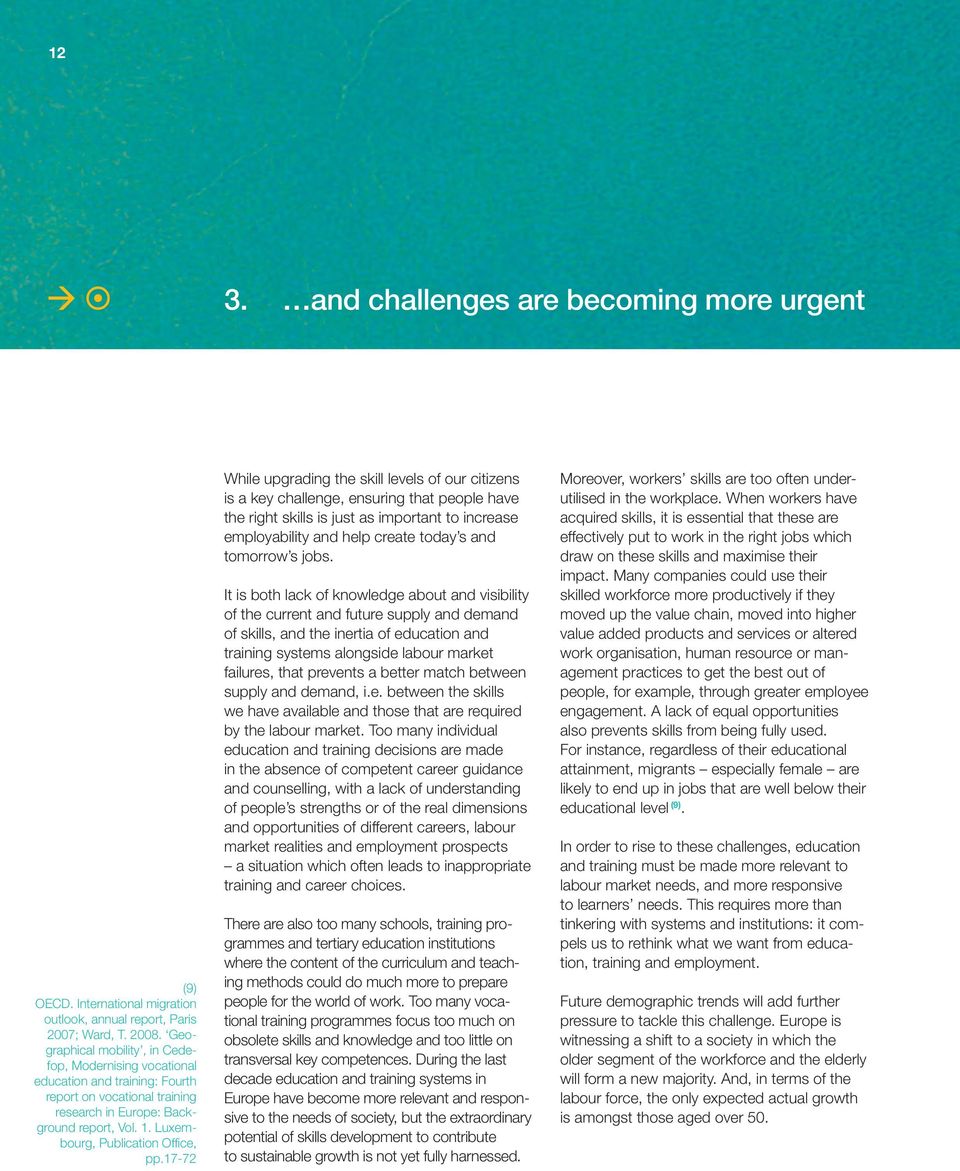
15 13 Millions Labour Force Population Figure 2: Changes in population and workforce size between 2010 and 2020 by age category, (EU 27 + Norway and Switzerland) Source: CEDEFOP, 2010 The numbers of those aged over 65 in relation to those aged will increase from 26 % in 2008 to 38 % by The growing number of older people will require more care and medical support and therapies in their homes or in senior citizen residences. By 2020, the largest number of job vacancies both newly created jobs and vacancies to replace people leaving for retirement is expected to come from this sector, the so-called white jobs. But the biggest impact of demographics is on the supply side: on people and their skills. Fewer and fewer young people will graduate from schools and universities, and the working age population will start to actually decline from 2013 onwards. Between 1985 and 2007, the numbers of people in the EU aged under 30 fell by nearly 30 million (or 14 %): the overall population of working age in the period between 2007 and 2020 is likely to decline by 6 million. Clearly, with an increasing dependency ratio, those in work also need to become more productive in order to support those outside the labour market. To help compensate for this, we need to secure an increase in labour market participation in particular of women and of older workers. Proactive immigration policies, reaching out to talent and skills, will need to be another component of a long-term solution to the threat of labour shortages in Europe. And, critically, it is vital to get the unemployed back to work, not only as an aim in itself but to reduce the waste of talent, skills and human capital that it represents. It will be crucial to make the most of our people s skills, but it will also be necessary to adapt them. People in work will need to be more adaptable and productive, which does not necessarily mean working longer and harder but working better, and this is only possible through increasing skills levels and ensuring that these are appropriate to social and labour market needs. An older workforce also means a growing risk of skills obsolescence. The possibility of renewing and expanding skills throughout careers in order to have the possibility to stay employable, work longer and make career changes, will be crucial. At the same time, an older workforce means that there will be a greater mix of older and younger people in the workplace, and such diversity of experience can have a positive impact on innovation. Similarly, language training and skills adaptation will be necessary to enhance the skills of migrants. Adult education and continuing training will need to seize upon the opportunity to adapt and acquire a greater role. Employment, education and training policies should also think globally and act at all levels. Increased global competition means that European countries will not be able to compete on cost and price, but need to produce higher quality products and services, delivered by higher skilled people. In Europe, as in the rest of the developed world, the widespread penetration of information and communication technologies will also lead to less routine manufacturing and office jobs. This powerful combination of globalisation, increased competition, technological and organisational change substantially increases the need to raise skill levels as consumer expectations rise and require ever more sophisticated and personalised products and services. The world NEW SKILLS FOR NEW JOBS ACTION NOW

16 14 of work requires continual adaptation of competences, especially digital competence, communication skills and adaptability to changes in work organisation. In terms of technology and communication, the spikes of places with skills and talent will increasingly be the key differentiating factor in competitive success, especially in high-wage economies. In the global race for talent Europe is currently losing part of its highly skilled workforce, as many high-skilled individuals migrate to the US, Canada and Australia. This global competition for talent is likely to grow in the future; in spite of the abundance of labour in both countries, Indian and Chinese companies are now reporting a lack of high level skills in, for example, product expertise, R&D and programme management, that they could find in Europe. In the short term, more needs to be done to avoid the coexistence of unemployment and labour shortages and mismatches. With high levels of unemployment, one might expect that companies looking to recruit employees would find appropriate jobseekers to fill their posts: not so when the skills job seekers have are not those that employers seek. With no action taken, the mismatch between skills demand and supply can perpetuate itself even after economic recovery sets in. The crisis is also accelerating the pace of economic restructuring, which will have a lasting structural effect on the volume and pattern of skills demand. Some industries will not bounce back to pre-crisis growth levels and sectors like car manufacturing, steel production, construction and other industries that are experiencing temporary plant closures may eventually face permanent job losses. At the same time, the crisis will breathe new life into other sectors. New investments in job creation, also supported through stimulus packages, will create new jobs, with potentially radically different skill needs, for example, in low carbon sectors, care of the elderly, life/biosciences and some professional/business services. Anticipating future challenges and establishing early warning systems should become a priority as and when labour demand will be revitalised, the composition of jobs and skills needs will have changed, with new drivers of growth in jobs and sectors that do not exist today. These challenges and opportunities need to be addressed in a period of serious fiscal restraint facing most, if not all, Member States as well as the EU itself: explicit and sensible choices about priorities for public funding of education and training are essential: individuals and employers must be encouraged to take greater responsibility for the quality of their skills portfolios.

17 15 4. Are we prepared for the future? There are 22.9 million unemployed people in the EU, including more than 5 million young people (10). This is an economic, social and personal burden which falls particularly heavily on the low skilled. In the current crisis, too many young people leave school too soon, and fall straight into long-term unemployment. Many people lose their jobs through redundancy or remain unemployed for a time as they seek to change their jobs; others finish school, college and university every year and enter the market place, with an uncertain prospect to find work that secures their future. At the same time, many if not most employers are developing their companies, changing their products and services, as well as how they do things, looking for new markets and new sources of competitive edge, all are fighting for people with the right skills to help them get there. The latest projections up to the year 2020 show that due to the crisis we can expect a smaller number of new job opportunities to become available. It is not all doom and gloom: in the next decade, we expect some 80 million job opportunities to arise, including almost 7 million new additional jobs. Most of these jobs will require a more highly skilled workforce. As we can see in Figure 3 and 4, the skill intensity of jobs has been rising in recent years and is expected to continue to do so. Most job creation is projected for higher level occupations but also for occupations involved in service activities. As a result we expect the proportion of jobs employing high qualified people to increase to over a third, the proportion employing those with low qualifications to decrease to 15 %. Those requiring medium level qualification will continue to constitute half of all jobs. (10) Eurostat, November 2009 Net employment change Replacement needs High-skilled non-manual occupations (legislators, managers, professionals) Skilled non-manual occupations (clerks and service/sales workers) Skilled manual occupations (agricultural, craft and trade workers, machine operators) Figure 3: Future job opportunities by occupational groups, (EU-27 + Norway and Switzerland) Source: CEDEFOP, 2010 Elementary occupations (labourers) Millions NEW SKILLS FOR NEW JOBS ACTION NOW

18 16 Figure 4: Employment trends by level of qualification, (EU-27 + Norway and Switzerland) Source: CEDEFOP, 2010 Million jobs High qualifications Medium qualifications Low qualifications 29.2% 34.9% 49.9% 50.1% % 15% Forecast So what needs to be done? The challenges ahead can only be overcome with a much more concerted and dedicated effort by individuals, private and public sector employers, trade unions, education and training providers, public services and governments at all levels, working closely together towards a common agenda. In the second section of the report we therefore suggest a number of urgent areas of action. Some are relatively new; others less so, although their impact so far may have been limited by weak implementation, something with the crisis and the urgency of the challenges we can no longer afford.
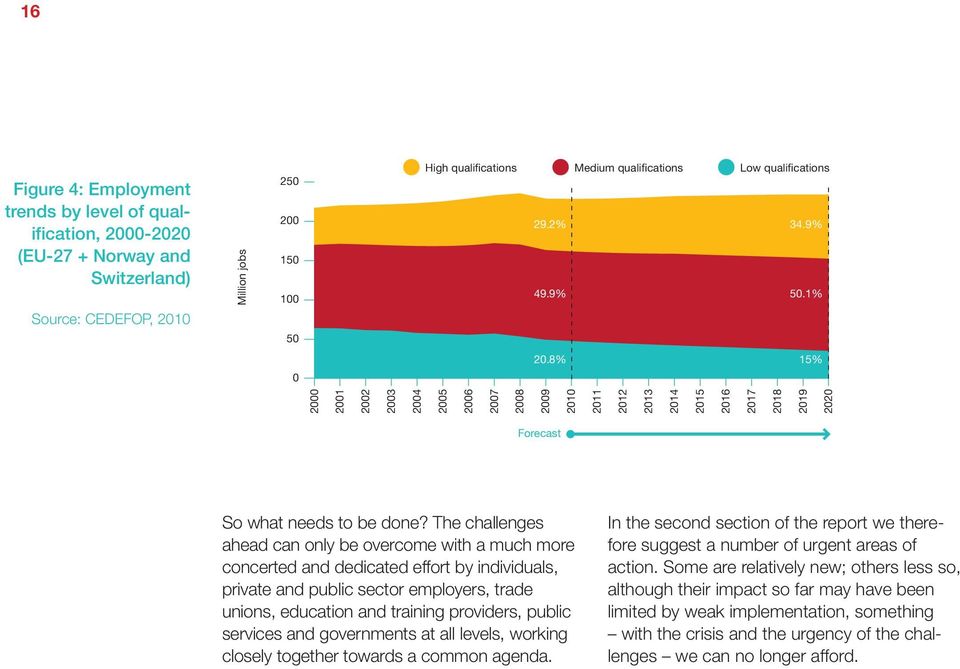
19 17 Section 2. Action now: key recommendations NEW SKILLS FOR NEW JOBS ACTION NOW

20 18 The case for skills Skills matter. The foundation stone for success is to ensure that more and more people, businesses and public bodies recognise the value of skills. We need to persuade more people and organisations that their future prosperity depends on raising skill levels. But, in the end, people and organisations will only prioritise increasing skills if they believe it to be worthwhile to do so. Key actions: It is essential that the European Commission, Member States and employer organisations, in close co-operation with education and training providers and trade unions, make the case for skills and use modern information, communication and marketing techniques to encourage greater commitment to skills upgrading by individuals, employers and public agencies. There has to be a higher scale of effort from all concerned. Now is the time for building and consolidating by integrating on-going efforts. It is essential that investment in skills is seen by all stakeholders as a key part of the solution to overcoming the crisis and sowing the seeds for sustainable recovery; it will help to keep the workforce in work, support strategically important sectors and lay the basis for future sustainable job creation. The crisis has also hit some groups particularly hard, including young people and migrants: ensuring their employability is also a matter of social justice. Prioritisation and effective choices are the key to the targeting of skills development. The pressure on public expenditure and the importance of skills as a means to secure prosperity require rethinking the share of responsibilities between the government and public institutions, employers and individuals. It will be crucial that both employers and individuals raise their game in terms of demand for skills acquisition. Public institutions have a key role to play, not least by acting as enablers in the system and by influencing the attitudes and behaviour of the key players, but also because public institutions are sizeable employers themselves. Measures to increase the benefits or diminish the costs of skills investment in the workforce are likely to increase the volume of skills investment by employers and individuals. National governments have the overall responsibility of improving their employment, education and training systems. The efficiency of funding streams will be especially important in these difficult economic times which put pressure on public expenditures. Governments therefore need to consider the responsiveness of the system to learners and employers needs; the effectiveness and sustainability of integration between employment, education and training; and the potential for achieving greater impact. The performance and responsiveness of our education and training systems will be a decisive factor in helping to overcome the current crisis and creating a solid basis for long-term growth. We have organised our further recommendations into four streams. Each one is necessary, and taken together they make up, we believe, a coherent and balanced action programme to match the urgency of the agenda and the benefits that can be achieved: 1. Provide the right incentives to upgrade and better use skills for individuals and employers. 2. Bring the worlds of education, training and work closer together. 3. Develop the right mix of skills. 4. Better anticipate future skills needs.

21 19 1. Provide the right incentives to upgrade and better use skills for individuals and employers Investment in skills must be massive and smart, so we need the right incentives to encourage governments, local authorities, individuals, employers, and education and training providers to take action. Without the commitment of all players this ambition will fail. Better incentives and services for individuals Incentives need to be designed to attract people into training, and to help individuals complete their learning for life and for work; they also need to be coupled with initial and ongoing advice to encourage non-learners to demand skills development, and to help learners make more informed choices. Individuals need to take over more responsibility for lifelong learning and develop career management skills. They need adequate support including at school to learn how to do so. The aim is to increase individual choice and make education and training providers more responsive to learners needs. Two tools to do this are learning vouchers and learning accounts; in the latter an employee can save and accumulate public and private funding and time off from work in order to undertake periodical training (11). Both have been tried as pilot projects in several countries, with promising results. The systematic recognition of prior learning, as well as knowledge and competences acquired in work and life outside the school system, is still the exception in Europe. Validating this learning experience may help individuals to better understand their own capabilities and encourage further learning, employability and career development. Public institutions, education and training systems and Public Employment Services (PES) should set an example by transforming themselves into modern, flexible and adaptable service providers and establish transparency with respect to their performance in order to help to effectively direct their resources. Public spending on labour market programmes, education and training should not be reduced in times of uncertainty, but rather directed to effective preventive and curative measures. When the number of job seekers greatly exceeds the number of job openings, the two basic functions of Active Labour Market Policies (to match and retrain workers to jobs and to maintain the participation of the unemployed in society) are seriously challenged. The participation of job seekers in successive rounds of programmes which do not lead to a job is as wasteful as long-term unemployment. PES should consistently design their training schemes according to market needs as well as to stimulate entrepreneurship and self-employment. In order to make the most of people s skills, traditional matching processes focusing solely on occupations will no longer be sufficient. A systematic matching of job profiles, breaking down job vacancies to their individual components (both of job specific and generic skill requirements), can serve as the basis for effective and efficient matching. PES should incorporate these techniques into the design of active labour market programmes to increase the employability of members of (11) eu/en/files/5192_en.pdf NEW SKILLS FOR NEW JOBS ACTION NOW
22 20 (12) Europass is a framework to support citizens to communicate in a transparent manner their qualifications and skills, including a CV tool ( cedefop.europa.eu) disadvantaged groups, particularly in the use of individual action plans or employability development plans. Key actions: Develop and implement cost-efficient approaches to identify and validate prior learning and practical experience, and make this an enforceable element of collective agreements and work contracts. Raise awareness about schemes for recognition and certification and guidance and counseling and assist jobseekers with analysing their own skills better including key competences. Improve the integration of existing tools, e.g. develop further Europass (12), by including enhanced self assessments tools, raising awareness and encouraging its broader use and acceptance across multiple sectors and at all levels of education and training to make qualifications, skills and competences visible. Make greater use and better evaluate the impact of learning accounts or learning vouchers, especially for low-skilled workers, based on the principle of co-investment by government, individuals and employers, as appropriate. Use tax relief or lower interest rates on borrowing to provide investment by individuals/employers at preferential rates. Establish co-investment as part of collective agreements and work contracts for people in work, and via counseling/pes for the unemployed. Prioritise guidance and counselling services and motivational support for individuals, improve the quality of these services and ensure that they tackle stereotypes. Publicise in a visible and comparable format on the web the opportunities and offers, as well as the prices and returns, of public and private education and training courses, so that individuals can make informed choices. Further develop in Public Employment Services profiling systems including internet and skill-based matching tools such as the EU tool Match and Map. Better incentives for employers to invest in, and make the best use of people s skills More employers need to act in a more sustainable, non-cyclical way with respect to skills. In an economic downturn there is temptation to reduce investments in training, and more alarmingly risk a drain on skills through lay-offs. It is crucial for companies to maintain their human capital. With the beginning of recovery and employment growth, skill shortages become more acute. Companies that can identify emerging business needs and skill demands at an early stage, should be encouraged to invest in skills in times of crisis. Companies that invest in the skills of their workforce do reap the benefits. And the best way to encourage other companies to invest in their workforce is through peer pressure and peer learning. Collaboration between companies, the use of competitive pressure and the establishment of employer networks, on a sectoral, geographical or supply chain basis, can inform companies not only of the benefits of skills development but of best practices. They can encourage innovation and change. Having better skills is important. But, how these skills are then managed, more effectively mobilised and made use of in the work organisation, is equally important. Even if a person has the best skills possible, it does not guarantee that they will achieve their goal or that the organisation employing them will benefit. Only when the best possible match is made between the skills of an individual and a job vacancy and only when, within an organisation, skills are put to their best use, will skills bring out their full potential. Good management and leadership practices among businesses are particularly important. Improving skills utilisation in the workplace is to a large degree a matter of work management and organisation. Work organisation is often based on fitting an individual and his/ her skills or professional qualifications to a job. New ways of work organisation and management can make better use of people s skills as well as to encourage employees to develop their skills.
23 21 Key actions: Enhance skills development policies through public procurement, and promote tax incentives to stimulate targeted investment in low-skilled and older workers, avoiding redundant spending. Explore further the benefits of treating capital investments and investments in training on an equal basis. Consider knowledge and skills acquired by employees during the course of their duties as adding value to the company, so that part of the expenditure on training and salaries during the training period can be depreciable in tangible fixed assets and transferred accordingly on the balance sheet. Provide incentives for companies to encourage skills upgrading in their suppliers. Communicate the benefits of a skilled, adaptable workforce and on how to improve skills utilisation in the workplace, involving key intermediaries such as education and training providers, social partners or PES, and disseminate the results of successful skills investments by companies, for example through awards schemes or other recognition. Support the further development of employer collaboration networks to share information and good practices in skills development and skill use. Provide better support for SMEs: a) in leadership/strategic planning and training for management including in effective skill utilisation, and b) in training for staff in effective skill development. Support SME by building up regional qualification infrastructure to enable them to pursue skill upgrading. Managing and leading an organisation of skills as opposed to running an organisation of job posts requires a fundamental managerial rethink and new ways of leadership. It is employers who decide how jobs are designed, filled and executed. The skill levels of managers themselves are also a key to success. There is scope therefore, to improve business performance by encouraging the take-up of established good management practices especially in SMEs and owner-managed organisations. They are the backbone of most national economies in Europe, but often lack human resources expertise. Public Employment Services will also have to re-invent their services, building up professional Labour Market Information Services and special counselling services to help SMEs, for instance, to optimise skills utilisation. Incentives for education and training institutions Incentives are also needed to enhance the adaptation of all schools, universities and training places, encourage dialogue with the world of work and make them more effectively concentrate on the development of relevant competences. Although there are many valuable and relevant initiatives this is far from being enough. The accelerating changes in the skill needs of workplaces, especially in the light of the expected post-crisis restructuring processes, require further and more dynamic adaptation. Future efforts should build on the achievements of the last decades and on the results of already existing programmes. All incentives should convey a more coherent and stronger message. Their aim should be to accelerate the shift of education systems towards achieving greater relevance and more openness. Key actions: Provide the right incentives to intensify cooperation between the providers of education, training and businesses. Increase the coherence between instruments and measures such as the definition of curricular standards, including the appropriate formulation of learning outcomes, the mechanisms of assessment, evaluation and managing quality, the training and continuous professional development of educators, and institutional leaders. NEW SKILLS FOR NEW JOBS ACTION NOW
24 22 2. Bring the worlds of education, training and work closer together (13) Includes government, trade unions and employers Make education and training more flexible and more open for innovation and enhance relationships between skills providers and employers Education and training can be effective and innovative if the institutions themselves are innovative, learning organisations open to interactions with the world of business and work. There is a need to make regulatory environments, incentives and support mechanisms more coherent, so that schools, higher education and training institutions can adapt to changing conditions. Priority should be given to the development of institutional leadership, capacity building and quality improvement efforts enhanced including in human resource development. Key actions: Encourage greater collaboration between education and training providers, employers and professional bodies, including through partnerships between their national bodies and through national/ regional tripartite (13) and/or multi-stakeholder arrangements and bodies wherever they are available. Give priority to the development of institutional leadership across the board, and to the enhancement of quality assurance efforts including in human resource development. Ensure the responsiveness of education and training systems at all levels, including through legal frameworks, institutional structures and financing mechanisms which facilitate openness, co-funding and stakeholders involvement. Encourage employers to co-invest and participate in the activities of education and training institutions in professional or governance and advisory board roles. Develop criteria to measure, monitor and evaluate progress. The structural funds and in particular the European Social Fund of the European Union are already widely used to upgrade skills and to enhance the modernisation of education and training systems. There is a need to consider how the structural funds can better support the goal of bringing education, training and work closer together as well as modernising education and training systems overall. Establish skills based qualifications In order to ensure that the qualifications people obtain are actually of value to them on the labour market, and so that employers can employ people who possess the skills they need, cooperation between work and education and training should be much more intensive and more substantial. These two worlds need to address and overcome existing barriers between them and understand that only a joint approach will deliver what people really need and want, be it in transitions from initial education and training to work or in training or education during their careers.
25 23 Learning outcomes : a new way to approach qualifications Qualifications have traditionally been defined in terms of (a) the time spent by an individual to complete them; and (b) the level required to enter the programme (for instance a tertiary education programme requires completion of secondary education and has a duration of 2 years at least). Qualifications can be developed in terms of outcomes: the European Qualifications Framework (EQF) and European tools such as the European Credit Transfer System (ECTS), the European Credit Transfer System for Vocational Education and Training (ECVET), Europass, help to define courses, programmes and qualifications in terms of learning outcomes i.e. what an individual knows, is able to do and/or understands after having completed a learning process. Applying the learning outcomes approach to define, for example, training standards not only broadens the scope of recognised knowledge but also increases the transparency of national systems and makes it easier to judge what is offered by education and training systems and institutions. Standards that clearly state what is expected from the learner at the end of the process, but do not specify a single route to this goal, also offer individuals at different ages and life situations a greater range of options, and make education and training more flexible. The learning outcomes approach can serve best the needs of both the learner and the labour market, provided that employers are involved in defining, designing, certifying and recognising learning outcomes. It can help to develop a common language: instead of classifying jobs by occupational type and required qualification, as has been the case so far, we can now move toward describing both in terms of skills and competences. The consequence is better designed and delivered programmes curricula, teaching, learning and assessment which should lead to better employment, as well as learning, outcomes. Both need to understand that educating and training people is their shared responsibility. A more flexible, responsive education and training system is good for learners, good for employers, good for the economy and good for the community(ies) it serves. It will help balance the labour market and ensure that individuals and employers acquire the skills they need. And, a focus on learning outcomes can encourage this relationship. A focus on learning outcomes is potentially profound in its implications. The rapid development of national qualifications frameworks in all Member States creates bridges between education and training and work, and makes traffic on these bridges permanent and more intensive. The European Union should continue to support these developments and reforms. Communication, trust building and increasing transparency should become key elements of the reforms of qualifications systems. This requires leadership from the highest political level and commitment of all, including trade unions and employers organisations. Consultation must also be reinforced at the local level. Key actions: Develop outcome-based qualifications and a common language between education/training and the world of work, communicate the potential of European Qualifications Framework and national qualification frameworks, and ensure the involvement of all actors, including PES, employers and social partners. Encourage and facilitate the use of learning outcomes in planning and delivering educational and training programmes at all levels, including higher education institutions. Adapt pedagogy and training and assessment methods, to align them more clearly to learning outcomes. Make labour market needs analysis and the definition and implementation of appropriate learning outcomes a priority in institutional leadership and strategy, as well as in institutional level information and quality management. NEW SKILLS FOR NEW JOBS ACTION NOW
26 24 From initial education and training to continuing and lifelong learning an opportunity for all Most education and training systems, and the labour market, are still largely based on the linear assumption that most people will first go to school, then move onto vocational education or university, and then go to work and finally, retire. This reflects neither the needs of employees and employers nor today s reality: formal and informal education and training, taking place in work, at the workplace and, increasingly, in digital environments. This continuing skill acquisition is just as important as initial education and training, especially given both demographic trends and the continuing need to upskill and re-skill throughout working life. Even within the education and training system different parts such as vocational education and training and higher education have too limited links to each other. This makes it difficult to combine courses, programmes and qualifications in the best way and may limit participation and progression. Current reforms across Europe should continue to support more flexible learning paths, foster motivation and value individual learning. Key actions: Break down barriers and widen access to education for a variety of audiences, including adults and vulnerable groups, through accreditation of prior learning and flexible pathways Bridging the worlds of education and work aids the transition of the individual to the labour market, brings innovation and diversity to the two worlds and helps makes the right mix of skills happen.
27 25 3. Develop the right mix of skills The right skills portfolio Job and subject specific competences learned throughout education and training need to be underpinned by transversal competences in order to both encourage initiative rather than a simple reproduction of received knowledge and to better match learners and employers needs. Employers are interested not only in a person s academic or vocational qualification, but also in other competences that would add value to their organisation. Moreover, young people often complain that they feel unprepared for the world of work when they get there. The missing link, in part, lies in a set of desirable skills such as the ability to work quickly, analyse and organise complex information, take responsibility, handle crisis, manage risk and take decisive action. This calls for the development of T-shaped individual skills profiles: individuals should combine such transversal core skills (the horizontal bar) with the specific skills needed for a job (the vertical bar). These competences should be acquired as soon as possible, but they could also be developed throughout life. Digital skills showcase the importance of the right mix of generic competences and technical skills. E-Skills range from the informally acquired functional digital skills to specialist practitioner skills. At one end of the spectrum, it is almost universally true that any job will require some level of e-skills. Digital and media literacy will be crucial both for life and work, and we should tend to the new goal of digital fluency. For an increasing number of jobs, indeed, digital fluency is increasingly required. New jobs in the low-carbon economy will require heterogeneous skills portfolios. Environmental awareness will also need to become a component of core skills the same way as IT skills have become in the past, as every workplace and job has the potential, and the need, to become greener. Other growing areas of jobs will require new curricula, such as in the white economy linked to the ageing of the population. Key actions: Develop the integration of the key enabling competences such as creativity, innovation, entrepreneurship, and citizenship, in schools, in higher education and initial and continuous vocational education and training. Develop and provide tools for individual self-assessment. Embed digital and media literacy at all levels in education and training, and map competences towards a goal of digital fluency for all citizens. Develop Europe-wide indicators to measure levels of transversal key competences. Set quantitative targets (e.g. access to entrepreneurship education; or digital literacy), and provide the metrics to monitor progress. Ensure an adequate flow of qualified workers to facilitate the transition to the low-carbon economy. Include environmental awareness in all curricula irrespective of the level of education or training. NEW SKILLS FOR NEW JOBS ACTION NOW
28 26 Adapt curricula content, teaching, delivery methods and assessment to the intended learning outcomes There is little point in setting relevant learning outcomes and developing innovative qualification frameworks, if education and training institutions lack the capacity to create appropriate learning environments to achieve the intended outcomes. Consistency between the formulation of learning outcomes, assessment, pedagogy and the initial education and continuous professional development of teachers and trainers is required. Schools, universities and training places can more effectively concentrate on the development of the competences that are the most relevant for work, adult life and lifelong learning. Too often, modes of formal assessment and evaluation are too narrowly defined and do not capture the range of outcomes desired; a situation compounded by teaching to the test which results in a narrowing of the taught curriculum. We should develop ways to assess, test and recognise whether people have acquired and improved transversal and key competences and whether our institutions are successfully encouraging them. Key competences require different kinds of teaching and learning methods than those traditionally applied. The skills and competences needed today and in the future cannot only be learned through subject teaching but also require more cross-curricular and innovative approaches, such as, learning-by-doing or project-based learning. Learning through experience is seen as one of the most efficient learning methods for professionalisation and stimulating creativity and innovation. Workplaces could play a more active role in providing real spaces for learning in real life projects, as is already the case for work-based VET systems. All education and training can better promote a culture of receiving students in the workplace for field and project work, internships or apprentices. Building entrepreneurial competence in school It is widely recognised in EU reports that our school systems can do much more to stimulate the entrepreneurial mindsets of young people. Learning-by-doing programmes encourage innovation and foster the changes of attitude and behaviour that this new century is demanding. These programmes can be successfully applied at any level of the curriculum, from pre-school upwards. The mini-company is one best practice in entrepreneurship education that is highly adaptable with proven results in many countries around the world. The method involves a clear set of steps and learning outcomes. Educators guide their students as they set up their enterprise, come up with an idea, raise capital through shares, produce their product and take it to market. The students are mentored by adult volunteers from the local business community. At the end of the exercise, students liquidate the company. Annual competitions reward team success in a variety of areas, but also test individuals knowledge and understanding of the process. The method emphasises experience and interaction with others (teaming) as a way of learning. It favours the application of knowledge in new ways, the improvement of transversal skills such as problem-solving and decision-making together with the development of other aspects of our development such as creativity, innovation and self-confidence. The mini-company approach responds to our need to bring the education and business communities closer together. It exposes young people directly to real world situations, empowering them with the skills to cope with complex problems and allows them to better understand the connection between their studies and the world outside. Studies show that employability and career satisfaction is improved: 15 % of past participants between the age of 21 and 29, and 26.6 % aged 29 or over, have started their own business. The EU average start-up rate is between 6 and 10 %. Mini-companies are globally recognized and running in 125 countries (37 in Europe).
29 27 Key actions: Introduce and mainstream field studies, project-based learning, employee volunteering in cooperation between schools, universities, vocational training and other education bodies and business/ngo/ public institutions ( skills and employment partnership agreements ). Ensure alignment between reforms of national qualifications systems and of assessment/quality assurance systems, linked to the European instruments such as EQF: create, adapt and develop new assessment methods and tools to capture and reflect the complexity of hard and soft skills and competences of learners. Encourage public-private partnerships to map qualification and competence needs for a low-carbon economy and to design relevant qualification profiles and curricula (14). To achieve such ambitious goals, teachers need to develop their competences accordingly and need access to the appropriate training opportunities. Alongside academic training, new creative systems of educating, re-training and encouraging the professional development of teachers must be developed. Key actions: Reinforce in teachers education curricula work-related issues: skills development, entrepreneurship and professional guidance. Ensure that newly qualified teachers come from initial teacher education with the appropriate skills and practical experience in fostering transversal competences; ensure they can engage with digital media across the curriculum and inside and outside of the classroom; re-skill as many existing teachers as possible. Enhance the recognition of more practice-oriented teacher education programmes. Develop a European competence framework for teachers, monitor its implementation and strengthen the exchange of good practice on teachers professional development. Encourage teachers and institutional leaders to spend time in workplaces in industry or other services and apply the experiences made, as it is already the case in vocational education and training. The learning sector: a provider of skills, but also an employer with its own skills needs The learning sector, a major value-producing sector, has become one of the main employers and is expected to expand further in the future. It comprises not only the traditional areas of formal education but also an increasing number of profit and non-profit companies providing or producing various education related services, teaching materials, digital educational resources, educational technologies and other products. It may also include other services related with education and personal development, such as guidance services, company based human resource development and community development. Major upcoming challenges for the sector include making more effective use of on-line learning and teaching increasingly heterogeneous groups of pupils. Teachers will need to take on the role of trainers to serve lifelong learning, while the population of young cohorts will start to shrink. The ageing of the learning sector workforce itself is a major challenge: for instance, 53 % of primary teachers in Germany, and 59 % of lower secondary teachers in Italy are over 50. Unless appropriate action is taken, shortages may increase as more teachers retire. Countries should anticipate by training and recruiting more teachers, and work to improve the teaching profession s attractiveness. Gender imbalances should also be tackled to bring more men into the teaching profession: if 97 % at pre-primary school teachers in OECD countries are women, they are only 39 % in tertiary education (15). Women are under-represented in positions of responsibility and management at many levels in the sector (16). Updating skills, knowledge and motivation among teachers, trainers, other educational (14) Such broad public-private partnerships could be established at EU or even international level, similarly to Career Space which was a consortium established in the 1990s to tackle the skill shortages and gaps in the ICT sector (15) OECD Education at a glance 2009, Indicator D7 (16) ILO, Gender issues in Education and training: A case of unequal access, May 2007 NEW SKILLS FOR NEW JOBS ACTION NOW
30 28 (17) In the OECD Teaching and Learning International Survey (TALIS) Survey on lower secondary school teachers more than half respondents reported that they would like to have access to more regular professional development offer. Three quarters of stated that they currently do not receive rewards or recognition for improving the quality of their work; on the other hand, almost the same share reported that they would not be penalised because of sustained poor performance staff and especially those who have been engaged in teaching or training for a long time should become a priority. Effective and innovative pedagogies can only flourish if teachers and trainers have the incentives and opportunities to develop their own skills. Indeed, teachers call for it (17). Key actions: Strengthen continuing training of teachers, in particular by facilitating placements outside the education and training sector, strengthening communication with enterprises and other users of qualifications. Make similar efforts to develop the skills of other key actors in the learning sector such as specialists in pedagogical support, curriculum development, assessment, career guidance and providers of other education related services. However, all these developments in gaining a better mix of skills amongst learners, occur as it were, from within the education and training sector, albeit with enhanced engagement with the world of work. A further more radical means of aligning the skills that are available and acquired with those required by the labour market is to seek to identify the major imbalances between the skills people have and those needed by the labour market and then find mechanisms to encourage the stakeholders providers of education and training, learners and employers to adapt their behaviour in order to secure a better balance of skills available with skill needs, to the benefit of all. This is in line with encouraging changes in behaviour so as to reduce skill shortages, and skill gaps on the one hand, and unemployment and under-employment on the other. This leads us directly onto the issue of the better anticipation of skill needs as a key means of better aligning skills supply and demand.
31 29 4. Better anticipate future skill needs Better labour market intelligence developing early-warning and matching systems Clarity is vital to better inform individual learners, skills providers, employment services, employers and public policy. A more over-riding message that has emerged from these difficult times is the fact that skills supply and demand need to be closer aligned. Labour Market Information (LMI) can help to create market transparency on skills, raise placement efficiency and support a more balanced market. It provides helpful signals to all stakeholders individuals, employers and education and training providers, as well as government and public agencies of how well the market is working, where the problems are, and what the trends are. And, by informing everyone, LMI itself encourages adaptive behaviour from participants. Most Member States have started to develop and refine the methods for collecting and analysing LMI to effectively direct the efforts of employers, employees, social partners and policy makers on the field of upskilling and prevention of skills and labour market imbalances. The role of LMI is to assess both the existing skills needs and to provide a longer term perspective, so that we not only anticipate future requirements but also actively shape them. Traditionally, the focus has been on Member States for coordinating and gathering their own LMI. But in order to make the most of the free movement of labour within Member States and to inform labour mobility from third countries, we need to develop tools which enable us to make cross-national assessments of sectoral, regional and national progress on these issues. LMI systems should also be developed so that the qualitative information they provide can be easily accessed and used by education and training providers. They should provide better qualitative information about the nature of competences needed, which can be translated into relevant learning outcomes and orientate education and training decision-makers. The simple availability and communication of this intelligence will inform all parties and potentially lead to some changes in decisions and choices, especially if made easily available on a comparable basis e.g. employment outcomes and wage gains associated with the successful completion of programmes and courses. However, Member States could also consider further encouragement in the form of financial incentives/disincentives (e.g. course fees, bursaries or awards) as a means of increasing or decreasing skills availability in key areas of shortage or surplus, respectively. At a more macro level, evidence could be made available of the employment/wage gains associated with different levels of qualification or type of provider. There is a strong need to establish EU-wide, national and local labour market monitoring based on reliable data, in order to assess current and prospective employment opportunities and challenges by sector and region, and be informed about trends regarding skill requirements for different sectors and regions. Data collection needs to done in close NEW SKILLS FOR NEW JOBS ACTION NOW
32 30 (18) See, for example, CEDEFOP (2008, 2010) and UKCES (2009, 2010) cooperation with employers. Top class labour market intelligence should also allow us to identify where upcoming changes in the industrial environment (e.g. technological breakthrough) or the existing labour market (e.g. ageing workforce) will lead to a need for a major change, or where the capability of our economies to sustain a leading position in a sector or enter emerging areas could be undermined by critical shortages, without a major development in skills supply. There is much valuable work underway at both the European and national levels which should be more widely known and used (18). In order to respond to the identified needs, it is necessary to build strong provider/employer partnerships through institutions such as national tripartite bodies and Sector Councils. These institutions, managed by the social partners often in co-operation with, or even led by, governments, are emerging as centres of expertise in labour market and training issues, carrying out activities such as research, consulting and mediation and can help align training to the needs of the economy and labour market. There are some common elements that need to be considered across Europe when using LMI to help shape investment in skills. In the past, a great part of the centrally-directed activity revolved around attempts at planning for different levels and types of education and training provision, often with the aim of getting skills supply to match demand. However, this type of rigid planning approach at a national sectoral or regional level is very complex and deeply problematic and it has to be doubted whether it is possible or even desirable. Instead, the emphasis should be on building an agile system that responds to market signals and where LMI informs consumers, providers and funders, helping them to make more informed decisions, rather than the state planning provisions at a micro level. LMI s primary function is to help independent actors (employers, individuals and education and training providers of all kinds and policy makers) decide on investment in skill formation and career choice. The better informed they are about the labour market, the more effective their decisions will be, allowing European citizens to acquire the right skills sets required by employers, and Member States to develop responsive and strategic policies to encourage/discourage labour market and skill trends through information, incentives or priorities, rather than attempting to centrally plan supply to match demand. In any case, it is dangerous to take demand as given, especially in economic circumstances where it may be desirable to restructure/develop/reposition an economy for the future. The key is therefore excellent information, outstanding intelligence (interpretation and analysis of the information) and accessibility to it. Citizens, employers, and policy makers could all benefit from a re-focusing and opening up access to labour market information. Young people in particular would benefit as students decisions are too often made in the absence of competent career guidance and lack understanding of labour market realities. However, career guidance later in life is also crucial. LMI-supported counselling can help adults in making the choices that allow them to enter into promising fields. Moreover, guidance can break down traditional barriers, like those, for instance, that arise due to gender stereotyping. Wider availability of appropriate LMI would also benefit employers (in their recruitment and human resource development functions); education and training providers (in their strategic and business planning); as well as Government and public agencies (in their policy development and priority setting). Key actions: Improve the capacity to anticipate future skill requirements, using a combination of different methods at European and national level in a coordinated way, combining skill supply and demand forecasts with qualitative information on actual skills needed (e.g. EU-wide employer surveys, sectoral studies and scenarios, advisory sectoral bodies and/or groups of experts analysing emerging, evolving and changing occupations and labour market conditions). Ensure good quality statistical data on jobs and skill/
33 31 competence requirements, especially at EU level. Develop measuring tools of structural imbalance between skills supply and demand (shortages, surpluses, skill gaps, over- and under education, skill obsolescence). Make the resulting information widely available, and establish labour market monitors by exploiting the full potential of digital media, both to link the existing LMI sources and to make the LMI available in targeted, user-friendly and accessible formats. Involve potential contributors, including statistical offices, employment agencies, research organisations, NGOs, sectoral bodies and tripartite employment and skills bodies, in the anticipation of skills needs, and create and disseminate good practices on better production and use of LMI at European, national and regional level, including its policy function and relevance for education and training offer, migration policy and activation measures. Develop comprehensive systems to track and monitor learners success on the labour market, and make this part of quality criteria for education and training institutions. Create EU sectoral councils, bringing together existing national networks at EU level for the analysis of the skills needs and the development of proposals for updated qualifications in each sector. Encourage the emergence of a new and specific body representing all key stakeholders of the learning sector at EU level. Open up to talent, widening access to skills development for all We need to open up to talent, inside and outside. One example made is to high lack of employment of Roma whose talent is clearly wasted and where restricted access to learning is one source of this. There is clear evidence that the potential of migration is not fully valorised. Employment rates of immigrants are not satisfactory particularly for some immigrants with lower skills levels, in particular women and those who have come to the EU most recently. Migrant workers are more likely to work in jobs where their skills and qualifications are under-utilised than citizens of host countries. Taking into account future global competition for talent and likely future labour shortages in some occupations, one of the top priorities will be to effectively manage the human capital represented by migrants not only by recognising and improving their skills but also by managing labour migrant inflows according to the skills needed and encouraging them to become entrepreneurs. Key actions: Share information on surplus and shortages of skills across EU countries, and take it into account in immigration policies, on the basis of the expanding legal framework on admission schemes both at EU and Member State level. Set clear and transparent rules for the recognition of degrees and qualifications to better recognise migrants skills. PES are often the natural moderators of labour market monitors as they have direct access to relevant labour market data on the local and national level and are also able to provide the IT-infrastructure needed. PES and the private sector through Public Private Partnerships (e.g. in the fields of temporary labour, placement services) can share innovative strategies for analysing skill demands and matching workers and vacancies. NEW SKILLS FOR NEW JOBS ACTION NOW
34 32 In conclusion References Skills really can, and do, make a difference to people s lives, to people s futures. Better skills can do much to help the EU become more prosperous and more successful, with more and better jobs, more and new businesses and greater competitiveness. Increasingly, there is nowhere to hide for low skilled communities, low skilled workers or low skills companies. And the EU is not yet highly skilled enough to guarantee its future success. Business as usual is not an option. We need the right skills and we need to skill Europe up on a massive scale and in quick time. We require a step change in our thinking about skills. It is a challenge we can transform into an opportunity. We hope that this report and recommendations will play a part in moving us into an era of common sense informing the skills agenda of the European Commission and Member States as well as that of employers, trade unions and education and training providers. The responsibility for progress on the initiative New Skills for New Jobs initiative lies with each of us as individuals and as stakeholders inside our various organisations. The future is in our hands. Cedefop, The shift to learning outcomes. Policies and practice in Europe, Luxembourg: Office for official publications of the European Communities, 2009 Cedefop, Skill supply and demand in Europe: Medium-term forecast up to 2020, Luxembourg: Office for official publications of the European Communities, 2010 (forthcoming) European Commission, Key competences for lifelong learning. European reference framework, Luxembourg: Office for official publications of the European Communities, 2007 European Commission, New Skills for New Jobs. Anticipating and matching labour market and skills needs, Luxembourg: Office for official publications of the European Communities, 2009 European Commission, Transversal study summarising the result of 16 sectoral studies, forthcoming, 2009, main.jsp?catid=784&langid=en European Commission, Key competences for a changing world, Draft Joint progress report of the Council and the Commission on the implementation of the Education and Training 2010 work programme, and Progress towards the Lisbon objectives in Education and Training - Indicators and Benchmarks, Luxembourg: Office for official publications of the European Communities, Staff Working Document, November 2009
35 33 European Commission, Employment in Europe 2009, Luxembourg: Office for official publications of the European Communities, 2009 International Labour Conference, Conclusions on skills for improved productivity, employment growth and development, 2008 JA-YE Europe, Case Study on Entrepreneurship Education, 2009 OECD, Education at a Glance, Paris, 2009 OECD, Learning for jobs, Paris, 2009 Links Cedefop (European centre for the development of VET) Eurofound (European Foundation for the improvement for Living and Working conditions) European Commission New Skills for New Jobs: jsp?catid=568&langid=en OECD, International migration outlook, Paris, 2008 UK Commission for Employment and Skills, Ambition 2020: World Class Skills and Jobs for the UK, 2009 UK Commission for Employment and Skills, The Strategic Skills Audit for England, 2010 NEW SKILLS FOR NEW JOBS ACTION NOW
36
The Bordeaux Communiqué
 The Bordeaux Communiqué on enhanced European cooperation in vocational education and training Communiqué of the European Ministers for vocational education and training, the European social partners and
Joint conclusions of the Spanish Presidency EU Youth Conference youth employment and social inclusion, Jerez, Spain 13-15 April 2010
 Joint conclusions of the Spanish Presidency EU Youth Conference youth employment and social inclusion, Jerez, Spain 13-15 April 2010 Youth Employment is the common theme of the three EU Youth Conferences
Skills for employability and competitiveness
 EUROPEAN COMMISSION CONTRIBUTION TO MINISTERIAL MEETING IN RIGA ON 22 JUNE 2015 Skills for employability and competitiveness The economic crisis led to a massive destruction of jobs - many of them filled
Delegations will find attached the text of the above conclusions as adopted at the Education, Youth and Culture Council on 21 November 2008.
 COU CIL OF THE EUROPEA U IO Brussels, 5 December 2008 16459/08 EDUC 278 SOC 736 MI 499 OUTCOME OF PROCEEDI GS of : Council (Education, Youth and Culture) No. prev. doc. : 13593/08 EDUC 220 SOC 544 MI 334
LEARNING AND COMPETENCE 2020. Strategy of the Finnish National Board of Education (FNBE)
 LEARNING AND COMPETENCE 2020 Strategy of the Finnish National Board of Education (FNBE) Enhancing studies and provision of education and training Strengthening teaching personnel s competence Leading and
G20 Labour and Employment Ministers Declaration Moscow, 18-19 July 2013
 G20 Labour and Employment Ministers Declaration Moscow, 18-19 July 2013 1. We, the Ministers of Labour and Employment from G20 countries met in Moscow on July 18-19, 2013 to discuss the global labour market
The Helsinki Communiqué
 The Helsinki Communiqué on Enhanced European Cooperation in Vocational Education and Training Communiqué of the European Ministers of Vocational Education and Training 1, the European Social partners 2
G20 LABOUR AND EMPLOYMENT MINISTERIAL DECLARATION MELBOURNE, 10-11 SEPTEMBER 2014
 Introduction G20 LABOUR AND EMPLOYMENT MINISTERIAL DECLARATION MELBOURNE, 10-11 SEPTEMBER 2014 Preventing structural unemployment, creating better jobs and boosting participation 1. We, the Ministers of
EUA Aarhus Declaration 2011. Investing Today in Talent for Tomorrow
 EUA Aarhus Declaration 2011 Investing Today in Talent for Tomorrow European Commission President José Manuel Barroso told conference participants that universities have a key role to play in helping Europe
Maastricht Communiqué. on the Future Priorities of Enhanced European Cooperation in Vocational Education and Training (VET)
 Maastricht Communiqué on the Future Priorities of Enhanced European Cooperation in Vocational Education and Training (VET) 14 December 2004 Maastricht Communiqué on the Future Priorities of Enhanced European
Strategic Guidance for Community Planning Partnerships: Community Learning and Development
 Strategic Guidance for Community Planning Partnerships: Community Learning and Development COMMUNITY LEARNING AND DEVELOPMENT: STRATEGIC GUIDANCE FOR COMMUNITY PLANNING PARTNERSHIPS EXECUTIVE SUMMARY This
IOE PERSPECTIVES ON THE POST 2015 DEVELOPMENT AGENDA JANUARY 2013
 IOE PERSPECTIVES ON THE POST 2015 DEVELOPMENT AGENDA JANUARY 2013 INTERNATIONAL ORGANISATION OF EMPLOYERS Disclaimer Articles posted on the website are made available by the UNCTAD secretariat in the form
Quality in and Equality of Access to Healthcare Services
 Quality in and Equality of Access to Healthcare Services Executive Summary European Commission Directorate-General for Employment, Social Affairs and Equal Opportunities Manuscript completed in March 2008
QUALITY MANAGEMENT RECOMMENDATIONS FOR VOCATIONAL EDUCATION AND TRAINING
 QUALITY MANAGEMENT RECOMMENDATIONS FOR VOCATIONAL EDUCATION AND TRAINING Recommendations Working Group PREFACE Vocational education and training (VET) and those responsible for providing it play more and
EUROPE 2020 TARGET: TERTIARY EDUCATION ATTAINMENT
 EUROPE 2020 TARGET: TERTIARY EDUCATION ATTAINMENT Low tertiary or equivalent education attainment levels create skills bottlenecks in knowledgeintensive economic sectors and hamper productivity, innovation
Having undertaken a general discussion on the basis of Report IV, Small and medium-sized enterprises and decent and productive employment creation,
 International Labour Conference Provisional Record 104th Session, Geneva, June 2015 11-1 Fourth item on the agenda: Small and medium-sized enterprises and decent and productive employment creation Reports
UNITED NATIONS INDEPENDENT EXPERT ON THE QUESTION OF HUMAN RIGHTS AND EXTREME POVERTY
 UNITED NATIONS INDEPENDENT EXPERT ON THE QUESTION OF HUMAN RIGHTS AND EXTREME POVERTY Questionnaire JAN/2011 Post-crisis adjustment and fiscal consolidation processes (2010 onwards) 1. Has your country
How To Manage A Vet
 QUALITY MANAGEMENT RECOMMENDATION FOR VOCATIONAL EDUCATION AND TRAINING QUALITY MANAGEMENT RECOMMENDATION FOR VOCATIONAL EDUCATION AND TRAINING Authors and the Finnish National Board of Education ISBN
City and County of Swansea. Human Resources & Workforce Strategy 2013-2017. Ambition is Critical 1
 City and County of Swansea Human Resources & Workforce Strategy 2013-2017 Ambition is Critical 1 Delivering quality services for a safer, greener, smarter, fairer, healthier, richer Swansea Executive Summary
How To Improve The Quality Of Higher Education In Europe
 The Bologna Process 2020 - The European Higher Education Area in the new decade Communiqué of the Conference of European Ministers Responsible for Higher Education, Leuven and Louvain-la-Neuve, 28-29 April
Council of the European Union Brussels, 21 September 2015 (OR. en)
 Council of the European Union Brussels, 21 September 2015 (OR. en) Interinstitutional File: 2015/0051 (NLE) 11360/15 LEGISLATIVE ACTS AND OTHER INSTRUMTS Subject: SOC 479 EMPL 316 ECOFIN 642 EDUC 236 JEUN
Recommendation 195. Recommendation concerning Human Resources Development: Education, Training and Lifelong Learning
 Recommendation 195 International Labour Office Geneva Recommendation concerning Human Resources Development: Education, Training and Lifelong Learning Recommendation 195 Recommendation concerning Human
AGREEMENT ON PROPOSALS FOR TRIPARTITE NEGOTIATIONS TO STRENGTHEN ECONOMIC GROWTH AND CREATE JOBS
 AGREEMENT ON PROPOSALS FOR TRIPARTITE NEGOTIATIONS TO STRENGTHEN ECONOMIC GROWTH AND CREATE JOBS The Spanish economy has entered a phase of growth. However, the duration and intensity of the crisis and
Tailor-made training programmes in Bulgaria
 MUTUAL LEARNING PROGRAMME: PEER COUNTRY COMMENTS PAPER - BULGARIA Tailor-made training programmes in Bulgaria Peer Review on Tailor-made training programmes Luxembourg, 23-24 April 2009 A paper submitted
1. Key indicators and benchmarks
 1. Key indicators and benchmarks Italy EU average Europe 2020 target / Europe 2020 headline targets 2009 2012 2009 2012 Benchmark 1. Early leavers from education and training (age 18-24) 2. Tertiary educational
THE 2015-2017 WORK PROGRAMME OF THE EUROPEAN SOCIAL PARTNERS. Partnership for inclusive growth and employment
 THE 2015-2017 WORK PROGRAMME OF THE EUROPEAN SOCIAL PARTNERS Partnership for inclusive growth and employment Table of contents Introduction.... 3 1. Fostering active ageing and an inter-generational approach...
CHARLES STURT UNIVERSITY WORKFORCE PLANNING FRAMEWORK 2007 2011
 CHARLES STURT UNIVERSITY WORKFORCE PLANNING FRAMEWORK 2007 2011 1. DEFINITION... 1 2. CONTEXT... 1 3. STRATEGIC ALIGNMENT AND DRIVERS... 1 4. VALUES... 2 5. PRINCIPLES OF PRACTICE... 2 6. PERFORMANCE INDICATORS...
OECD Insights Human Capital: How what you know shapes your life
 OECD Insights Human Capital: How what you know shapes your life Summary in English The world of work has seen enormous change over the past couple of decades. Manufacturing jobs account for an ever smaller
Employment opportunities for older people
 Employment opportunities for older people Response to the Enterprise and Business Committee Contact: Aaron Hill Policy & Public Affairs Officer, NIACE Cymru Tel: +44 (0)29 20370900 Email: [email protected]
Progress The EU programme for employment and social solidarity 2007-2013
 Progress The EU programme for employment and social solidarity 2007-2013 Ensuring the Community can play its part to support Member States commitments to create more and better jobs and offer equal opportunities
CREATING AN INNOVATION AGENDA TO GENERATE SUSTAINABLE GROWTH, ENERGY EFFICIENCY AND JOBS IN EUROPE
 CREATING AN INNOVATION AGENDA TO GENERATE SUSTAINABLE GROWTH, ENERGY EFFICIENCY AND JOBS IN EUROPE BERT COLIJN AND BART VAN ARK NEUJOBS DELIVERABLE NO. 3.9 A discussion brief focusing on: Abstract The
Boosting Entrepreneurship in Adult Education
 European Conference 7 March 2008, Nicosia Key Topics Entrepreneurship as key competence for growth, employment and personal fulfilment Promoting entrepreneurship through education European reality PECAE
Policy Paper on Non-Formal Education: A framework for indicating and assuring quality
 Policy Paper on Non-Formal Education: A framework for indicating and assuring quality Adopted by the Council of Members/ Extraordinary General Assembly 2-3 May 2008 (Castelldefels, Catalonia - Spain) 0.
ROADMAP. Initial IA screening & planning of further work
 ROADMAP Title of the initiative: Youth programme post 2013 Type of initiative (CWP/Catalogue/Comitology): CWP Lead DG: DG EAC/E-2, Youth in Action Unit Expected date of adoption of the initiative (month/year):
RESOLUTION TIME TO ACT: MORE QUALITY EMPLOYMENT! COUNCIL OF MEMBERS/ EXTRAORDINARY GENERAL ASSEMBLY BRUSSELS, BELGIUM, 17-18 APRIL 2015
 RESOLUTION TIME TO ACT: MORE QUALITY EMPLOYMENT! COUNCIL OF MEMBERS/ EXTRAORDINARY GENERAL ASSEMBLY BRUSSELS, BELGIUM, 17-18 APRIL 2015 1 The economic and financial crisis has had a significant negative
Council conclusions on entrepreneurship in education and training. EDUCATION, YOUTH, Culture and Sport Council meeting Brussels, 12 December 2014
 Council of the European Union PRESS EN COUNCIL CONCLUSIONS Brussels, 12 December 2014 Council conclusions on entrepreneurship in education and training EDUCATION, YOUTH, Culture and Sport Council meeting
Leadership in public education
 Leadership in public education Policy direction overview Discussion paper three Great educational leaders transform the lives of young people and enrich our whole community. They are the exceptional men
UITP COMMISSION ON BUSINESS AND HR MANAGEMENT MISSION, ROLE AND ACTIVITIES
 COMMISSION ON BUSINESS AND HR MANAGEMENT MISSION, ROLE AND ACTIVITIES Rio November 2014 Joe Kenny Chair of the Commission on BHRM [email protected] 1 AGENDA 1. Background & Work Framework 2. Observatory
D2N2 Procurement Charter. For Economic, Social & Environmental Impact
 D2N2 Procurement Charter For Economic, Social & Environmental Impact July 2015 D2N2 Procurement Charter For Economic, Social & Environmental Impact Foreword D2N2 is the Local Enterprise Partnership for
Okinawa Charter on Global Information Society
 Okinawa Charter on Global Information Society 1. Information and Communications Technology (IT) is one of the most potent forces in shaping the twenty-first century. Its revolutionary impact affects the
Three tools to facilitate online job matching throughout Europe. ESCO, EURES, Match & Map
 Three tools to facilitate online job matching throughout Europe ESCO, EURES, Match & Map Neither the European Union nor any person acting on behalf of the Commission may be held responsible for the use
European Education, Training and Youth Forum 2014
 Programme "Future Priorities of the ET 2020 Strategic Framework for European Cooperation in Education and Training and Synergies with Youth Policy." Thursday 9 October 08:00 09:30 Registration of the participants
THE GERMAN DUAL TRAINING SYSTEM FROM A FINNISH PERSPECTIVE - DIALOGUE DESPITE DIFFERENCES
 MUTUAL LEARNING PROGRAMME: PEER COUNTRY COMMENTS PAPER FINLAND THE GERMAN DUAL TRAINING SYSTEM FROM A FINNISH PERSPECTIVE - DIALOGUE DESPITE DIFFERENCES Peer Review on The dual training system Integration
EUROPEAN UNIVERSITIES CHARTER ON LIFELONG LEARNING
 EUROPEAN UNIVERSITIES CHARTER ON LIFELONG LEARNING Copyright 2008 by the European University Association All rights reserved. This information may be freely used and copied for non-commercial purposes,
SPANISH SCIENCE, TECHNOLOGY AND INNOVATION STRATEGY 2013-2020
 SPANISH SCIENCE, TECHNOLOGY AND INNOVATION STRATEGY 2013-2020 Executive Summary Science, technology, and innovation elevate the wellbeing of all individuals by promoting social, economic, and business
CONCLUSIONS BY THE COUNCIL (EDUCATION/YOUTH/CULTURE) ON EDUCATION AND TRAINING IN THE FRAMEWORK OF THE MID-TERM REVIEW OF THE LISBON STRATEGY
 CONCLUSIONS BY THE COUNCIL (EDUCATION/YOUTH/CULTURE) ON EDUCATION AND TRAINING IN THE FRAMEWORK OF THE MID-TERM REVIEW OF THE LISBON STRATEGY THE COUNCIL having regard to 1. The new strategic goal set
Professionalisation of management and leadership
 Sheila Gupta Professionalisation of management and leadership Sheila Gupta, Director of Human Resources, Edinburgh University This article shows the importance of appropriate governance and management
YEREVAN COMMUNIQUÉ. A renewed vision: our priorities
 YEREVAN COMMUNIQUÉ We, the Ministers, meeting in Yerevan on 14-15 May 2015, are proud to recognize that the vision which inspired our predecessors in Bologna has given rise to the European Higher Education
It is with great pleasure that I address you here today. I would like to. thank Luis for providing this opportunity. The subject that I will discuss
 Ladies and gentlemen, It is with great pleasure that I address you here today. I would like to thank Luis for providing this opportunity. The subject that I will discuss today, is recovery and reform.
2 nd EUA Funding Forum: Strategies for efficient funding of universities
 2 nd EUA Funding Forum: Strategies for efficient funding of universities Bergamo, 9-10 October 2014 Forum report Liviu Matei, General rapporteur Table of contents I. Executive Summary 3 II. What is the
RCN INTERNATIONAL DEPARTMENT
 RCN INTERNATIONAL DEPARTMENT Royal College of Nursing (UK) consultation response to the European Commission s Green Paper on the European Workforce for Health. With a membership of just under 400,000 registered
Co-operatives for Europe: Moving forward together
 Co-operatives for Europe: Moving forward together 3 In Finland, 75% of the population are members of a co-operative enterprise. In Belgium, when you enter a pharmacy, there is a 1 in 5 chance that you
Research and Innovation Strategy: delivering a flexible workforce receptive to research and innovation
 Research and Innovation Strategy: delivering a flexible workforce receptive to research and innovation Contents List of Abbreviations 3 Executive Summary 4 Introduction 5 Aims of the Strategy 8 Objectives
VET DEVELOPMENT STRATEGY FOR 2013-2020 VOCATIONAL EDUCATION AND TRAINING DEVELOPMENT STRATEGY FOR 2013-2020
 VOCATIONAL EDUCATION AND TRAINING DEVELOPMENT STRATEGY FOR 2013-2020 MINISTRY OF EDUCATION AND SCIENCE GEORGIA, 2013 1 Table of Contents Preamble 3 Chapter 1.Strategy Objectives and strategic framework
Workforce Management Plan 2013-2017
 Workforce Management Plan 2013-2017 Adopted on Wednesday 19 June 2013 Contents Message from the General Manager 5 city Plan: Cascade of Plans 6 our Vision, Mission and Community Outcomes 7 Introduction
Managing Risk and Innovation: the Challenge for Smaller Businesses
 University of Warwick Risk Initiative Briefing Managing Risk and Innovation: the Challenge for Smaller Businesses Successful innovation is in large measure an issue of identifying and controlling risk.
Employment Relations Comment
 Employment Relations Comment The productivity challenge and what the next government should do about it February 2015 Employment Relations Comment will be distributed free of charge via email. Copies can
COUNCIL OF THE EUROPEAN UNION. Brussels, 8 May 2008 9207/08 EDUC 144 SOC 276 CULT 67 COMPET 178 RECH 173. NOTE from: Presidency
 COUNCIL OF THE EUROPEAN UNION Brussels, 8 May 2008 9207/08 EDUC 144 SOC 276 CULT 67 COMPET 178 RECH 173 NOTE from: Presidency to: Council No prev. doc. 8752/08 EDUC 119 SOC 243 CULT 59 COMPET 152 RECH
Funding priorities for 2012 Annual Work Plan European Union Programme for Employment and Social Solidarity PROGRESS
 Funding priorities for 2012 Annual Work Plan European Union Programme for Employment and Social Solidarity PROGRESS Committee for the implementation of Progress 2007-13 Table of Contents Introduction...
STATEMENT OF STRATEGY 2015-2017 AN ROINN OIDEACHAIS AGUS SCILEANNA DEPARTMENT OF EDUCATION AND SKILLS DEPARTMENT OF EDUCATION AND SKILLS 2015-2017
 STATEMENT OF STRATEGY 2015-2017 AN ROINN OIDEACHAIS AGUS SCILEANNA DEPARTMENT OF EDUCATION AND SKILLS Foreword by the Minister I welcome the publication of the Statement of Strategy which sets out the
(OECD, 2012) Equity and Quality in Education: Supporting Disadvantaged Students and Schools
 (OECD, 2012) Equity and Quality in Education: Supporting Disadvantaged Students and Schools SPOTLIGHT REPORT: NETHERLANDS www.oecd.org/edu/equity This spotlight report draws upon the OECD report Equity
2. Policy context, economic circumstances and institutional/legal background
 Good governance of the European Social Fund Statements and Comments Kaia Philips University of Tartu, Institute of Economics 1. Introduction The main motivation of the Portuguese programmes described in
Beyond the Youth Guarantee Lessons learned in the first year of implementation
 Beyond the Youth Guarantee Lessons learned in the first year of implementation Background document prepared by Eurofound as a contribution to the informal EPSCO meeting 16-17 July 2015, Luxembourg Young
Presentation fiche: ESCO, the forthcoming European Skills, Competencies and Occupations taxonomy
 EUROPEAN COMMISSION Employment, Social Affairs and Equal Opportunities DG Employment, Lisbon Strategy, International Affairs Employment Services, Mobility Brussels, 18 January 2010 EMPL D-3/LK D(2009)
The European Qualifications Framework for Lifelong Learning (EQF)
 European Qualifications Framework The European Qualifications Framework for Lifelong Learning (EQF) Europe Direct is a service to help you find answers to your questions about the European Union Freephone
Caritas Europa Shadow Report 2013 Country Summary for Cyprus
 1. POVERTY 1.1. Recent trends Developments of poverty and social exclusion in Cyprus based on Eurostat: While the at-risk-of-poverty rate dropped from 15.9% in 2008 to 14.7% in 2012, severe material deprivation
OECD Informal Meeting of Ministers of Education / 17th OECD/Japan Seminar
 OECD Informal Meeting of Ministers of Education / 17th OECD/Japan Seminar How to Best Shape Teacher Policies? Policy lessons from international comparisons and guidance for future education and schools
Government of India Ministry of Labour and Employment
 Government of India Ministry of Labour and Employment NATIONAL POLICY ON SAFETY, HEALTH AND ENVIRONMENT AT WORK PLACE 1. PREAMBLE 1.1 The Constitution of India provide detailed provisions for the rights
DECENT WORK Ministry of Social Development ACTIVITIES DESCRIPTION LEAD CSF 1 ALLOCATION
 DECENT WORK Ministry of Social Development ACTIVITIES DESCRIPTION LEAD CSF 1 ALLOCATION Monitoring reports to A series of monitoring reports produced to analyse Ministry of Social Development 17, 18 estimate
WORKFORCE AND SUCCESSION PLANNING
 2012 WORKFORCE AND SUCCESSION PLANNING Toolkit to Identify and Address Strategic Talent Gaps Workforce Management Office NOAA 1/1/2012 Table of contents Introduction... 3 Workforce Planning... 3 Step 1:
Recommendation for a COUNCIL RECOMMENDATION. on Poland s 2014 national reform programme
 EUROPEAN COMMISSION Brussels, 2.6.2014 COM(2014) 422 final Recommendation for a COUNCIL RECOMMENDATION on Poland s 2014 national reform programme and delivering a Council opinion on Poland s 2014 convergence
Summary. Developing with Jobs
 Do not publish or DiStribute before 00:01 Gmt on tuesday 27 may 2014 Summary Developing with Jobs World of Work Report 2014 Developing with jobs Executive Summary INTERNATIONAL LABOUR ORGANIZATION RESEARCH
Employment, Social Affairs & Inclusion Programme for Employment and Social Innovation
 European Union (EaSI) Work Programme 2015 Annex 1: Description of the calls for proposals to be launched in 2015 Title 1. Call for Proposals on awareness raising, dissemination and outreach activities
Evolution of informal employment in the Dominican Republic
 NOTES O N FORMALIZATION Evolution of informal employment in the Dominican Republic According to official estimates, between 2005 and 2010, informal employment fell from 58,6% to 47,9% as a proportion of
HOUNSLOW SKILLS AND EMPLOYMENT STRATEGY
 HOUNSLOW SKILLS AND EMPLOYMENT STRATEGY WORK 2 INTRODUCTION FROM COUNCILLOR SUE SAMPSON CABINET MEMBER FOR COMMUNITIES AND ECONOMIC DEVELOPMENT HOUNSLOW COUNCIL Councillor Sue Sampson Responsibilities
Health and Community Services Industry Workforce Action Plan 2010-2014
 Health and Community Services Industry Workforce Action Plan 2010-2014 Together, supporting South Australians health and wellbeing through a skilled and innovative health and community services workforce.
such as loneliness and computer/ict illiteracy. (see also the staff working paper Ageing well in the information Society )
 Contribution of the European Network of Occupational Therapy in Higher Education to the Debate around the Consultation Paper Europe s Social Reality by Roger Liddle and Fréderic Lerais ENOTHE The European
Launch of the Economic Survey of Germany Remarks by Angel Gurría, Secretary-General OECD 13 May 2014 Berlin, Germany
 Launch of the Economic Survey of Germany Remarks by Angel Gurría, Secretary-General OECD 13 May 2014 Berlin, Germany (As prepared for delivery) Minister, Ladies and Gentlemen, It is a great pleasure to
Making the Most of Our Potential: Consolidating the European Higher Education Area Bucharest Communiqué FINAL VERSION
 Making the Most of Our Potential: Consolidating the European Higher Education Area Bucharest Communiqué FINAL VERSION We, the Ministers responsible for higher education in the 47 countries of the European
ETUCE Policy Paper on School Leadership
 ETUCE Policy Paper on School Leadership Submitted for adoption by the ETUCE Committee to the ETUCE Conference, the Regional Conference of Education International, meeting in Budapest on 26-28 November
CAREER AND TRANSITION SERVICES FRAMEWORK: an effective national approach to youth transitions
 CAREER AND TRANSITION SERVICES FRAMEWORK: an effective national approach to youth transitions PREAMBLE The Career and Transition Services (CTS) Framework will help young people to make successful transitions
Middlesbrough Manager Competency Framework. Behaviours Business Skills Middlesbrough Manager
 Middlesbrough Manager Competency Framework + = Behaviours Business Skills Middlesbrough Manager Middlesbrough Manager Competency Framework Background Middlesbrough Council is going through significant
Australian Government Cyber Security Review
 Australian Government Cyber Security Review The Cisco Response Today, governments are almost universally pursuing a development and modernisation agenda to nurture their society into the digital age, and
I. GROWTH, COMPETITIVENESS AND JOBS A. THE EUROPEAN SEMESTER
 17.3 The European economy is recovering, after several years of limited or even negative growth. The recovery is expected to strengthen this year. The European Council had an exchange of views on the economic
The VET Systems of Ukraine, Moldova, Georgia, Turkey, Bulgaria and Romania in the context of the Torino Process
 Project 2.3.1.73963.333 MIS ETC 2674 MANAGE.EDU: Efficient Education Management Network for LLL in the Black Sea Basin The VET Systems of Ukraine, Moldova, Georgia, Turkey, Bulgaria and Romania in the
COMMUNICATION FROM THE COMMISSION TO THE EUROPEAN PARLIAMENT, THE COUNCIL, THE EUROPEAN ECONOMIC AND SOCIAL COMMITTEE AND THE COMMITTEE OF THE REGIONS
 EUROPEAN COMMISSION Brussels, 25.10.2011 COM(2011) 681 final COMMUNICATION FROM THE COMMISSION TO THE EUROPEAN PARLIAMENT, THE COUNCIL, THE EUROPEAN ECONOMIC AND SOCIAL COMMITTEE AND THE COMMITTEE OF THE
The Direct Employers Association
 The Direct Employers Association Membership Educate, Innovate, Cooperate About The Direct Employers Association The Direct Employers Association [DEA] is a not for profit membership organisation specifically
Opportunities for All. Supporting all young people to participate in post-16 learning, training or work
 Opportunities for All Supporting all young people to participate in post-16 learning, training or work SUPPORTING IMPLEMENTATION Context The Scottish Government recognises the disproportionate impact that
How To Promote A Green Economy In The European Constitution
 Informal Meeting of EU Environment Ministers Background document Session Green growth: greening the European Semester and the EU 2020 Strategy 1) Introduction Milan, 16July 2014-15.00-18.00 The European
Corporate Strategy 2015 2020
 168982 Corporate Strategy 2015 2020 Corporate Strategy 2015 2020 Our strategy recognises that better services to learners will benefit higher education providers; and that better services for higher education
From recommendations to actions: impact of the Strategic Policy Forum
 Strategic Policy Forum on Digital Entrepreneurship From recommendations to actions: impact of the Strategic Policy Forum Executive summary: Key actions of the activities of the Strategic Policy Forum on
YOUTH UNEMPLOYMENT ANALYSIS
 1 514.5 511.6 509.2 505.9 507.2 508.4 511.2 513.5 517.3 521.5 523.8 528.8 529.6 525.3 528.8 535.3 539.9 540.4 538.5 538.4 539.8 67.3 67.1 66.7 69.7 69.6 70.0 70.5 71.2 70.5 71.3 11.1 11.4 11.5 72.8 73.4
Human resources development and training
 International Labour Conference 92nd Session 2004 Report IV (1) Human resources development and training Fourth item on the agenda International Labour Office Geneva ISBN 92-2-113036-3 ISSN 0074-6681 First