
CNA/NNU 101. Your Guide to Joining. the RN Movement
|
|
|
- Claude Andrews
- 10 years ago
- Views:
Transcription
1 3_ /28/11 9:33 AM Page 1 CNA/NNU 101 Your Guide to Joining the RN Movement

2 Inside CNA/NNU 101 What Is CNA/NNU? A Movement for RNs More than 100 Years of RN Power 3 4 Why RNs Vote for CNA/NNU Better Salaries and Benefits New Standards for RNs and Patient Protection RN Safe Staffing Ratios A Secure Retirement Voice and Respect A Legally-Binding Contract Organizing with CNA/NNU Newly Organized RNs Speak Organizing: How It Works Your Right to Organize The Organization Legislative Advocacy Nursing Practice What About Strikes? RNs in Motion Get Involved

3 What Is CNA/NNU? A Movement for RNs A Strong Voice for Our Profession and Our Patients On behalf of the elected RN-members of our Board of Directors, welcome to California Nurses Association/National Nurses United. We are proud to be at the helm of our organization in a period marked by unparalleled growth and tremendous change for our profession and for our patients. CNA has grown from 17,000 RNs in 1995 located primarily in Northern California to more than 70,000 RNs in 200 facilities across the state and 16,000 RNs in hospitals throughout Texas, Nevada, Maine, Florida, Kansas, Missouri, and Illinois through the formation of our national arm, the National Nurses Organizing Committee (NNOC), founded in CNA and NNOC was the motivating force to bring state nursing associations across the nation together into one. National Nurses United which stands today at 160,000 RNs from every state in the nation. NNU founded in 2009 pools the collective experiences and might of the most successful RN organizations in the U.S., the California Nurses Association/National Nurses Organizing Committee, United American Nurses, and Massachusetts Nurses Association. From coast to coast, our members have won the best contracts for RNs in the nation. Thirty years ago, RNs were among the lowest-paid professionals, had no retirement, and worked every weekend. Today, through the collective action of our members, nurses at CNA/NNU facilities have safer staffing conditions, a more secure retirement, and salaries commensurate with experience. Our agreements are noted for enhancing the collective voice of RNs in patient care decisions through our Professional Practice Committees and Assignment Despite Objection documentation system. We believe that a strong professional RN union empowers us to take our patient advocacy from the bedside to the statehouse and beyond. We have repeatedly stepped outside the walls of our facilities, whether it is our 13-year fight to win and defend California s safe staffing ratios or forming the Registered Nurse Response Network (RNRN) and sending RNs to New Orleans and Haiti. We invite RNs to join our movement and help us build an even more powerful voice for RNs and patients. CNA/NNOC Board of Directors Our Program Improve RN workplace standards through collective bargaining to assure RNs have compensation that recognizes professional skills and a retirement that provides dignity for our families after a lifetime of caring for others. Secure passage of state and national legislation for RN staffing ratios and other basic protections for RNs and patients, and meaningful healthcare reform based on a single standard of care for all. Make direct-care RNs, not administrators, the voice of nursing in Washington, D.C. and state capitals and the guardians of our practice and profession. Block hospital industry efforts to undermine RN professional practice in legislatures, regulatory agencies, boards of nursing, and at the bedside. Assure full compliance with highest safety standards on limiting spread of pandemics and guaranteeing RN access to proper safety equipment. For more information on how you can join, us at [email protected] or call Please visit our website at 3

4 What Is CNA/NNU? More than 100 Years of RN Power CNA founded: One of the first professional RN organizations in the U.S CNA-sponsored legislation results in the first RN licensure law CNA first in the nation to represent nurses in collective bargaining agreements, negotiating contracts at five Bay Area hospitals that establish the 40-hour work week, vacation and sick leave, health benefits, shift differentials, 15 percent salary increase ,000 CNA RNs stage mass resignation protest and win major gains, including 40 percent pay increase, eight paid holidays, and time-and-a-half for holidays worked CNA contract language requires hospital staffing systems based on patient acuity and nursing care with staff RNs participating in staffing assessments CNA-sponsored regulation establishes mandated RN-to-patient ratios in intensive care units in all California hospitals CNA Convention votes by 92 percent to end ties with the American Nurses Association (ANA). Adopts a program to reallocate resources to organize RNs, strengthen contracts, confront hospital industry attack on RN jobs and practice, and enact legislative and workplace protections CNA wins important changes in state law (Title 22) that licenses and certifies hospitals, strengthening RNs ability to advocate for patients. Provisions include staff RN participation on committee to review patient classification systems, floating protections, and requirement that every patient be assessed by an RN at least once a shift ,500 CNA Kaiser Permanente RNs wage epic battle with HMO giant to reverse unsafe hospital restructuring and RN layoffs, and to secure crucial patient safety protections California enacts first-in-the-nation law, sponsored by CNA, mandating minimum RN-to-patient ratios for all hospital units. CNA wins other major legislation, including whistle-blower protection for healthcare employees CNA negotiates contracts with salaries up to $100,000 per year for thousands of RNs RN Safe Staffing Ratios implemented in all California acute-care hospitals. CNA s dramatic growth continues, especially in Southern California, making it the largest and fastestgrowing professional RN organization in the nation. CNA organizes nurse-to-nurse relief assistance with Sri Lanka s Public Services United Nurses Union to assist with tsunami relief efforts. A delegation of CNA RNs travels to the affected areas in Sri Lanka and work with local nurses to set up local clinics with donated medical supplies.

5 2005 CNA goes national in response to an overwhelming demand by direct-care nurses across the U.S. for a national vehicle to address the crisis faced by RNs. 1,800 Cook County, Illinois RNs vote to join the National Nurses Organizing Committee, a new national affiliate of CNA. CNA embarks on an epic campaign to save RN-to-patient ratios after Gov. Arnold Schwarzenegger attempts to roll back the law. Schwarzenegger withdraws his challenge after tens of thousands of nurses hold 107 protests over one year. CNA organizes Katrina relief effort, sending more than 300 RN volunteers to staff 25 healthcare facilities in Texas, Mississippi, and Louisiana, including a contingent of 50 RNs to Houston Astrodome Maine State Nurses Association (MSNA) votes to join CNA/NNOC. CNA/NNOC forms a direct-care nurse disaster relief group, the Registered Nurse Response Network (RNRN) Saint Mary s RNs in Reno, Nevada vote to join CNA/NNOC, making it the largest RN organization in Catholic hospitals across the U.S. representing 18,000 RNs in 38 Catholic hospitals. CNA/NNOC RNs at nine California Catholic Healthcare West hospitals win enhanced patient care protections and pay gains of 25.5 percent ,000 RNs with the Pennsylvania Association of Staff Nurses and Allied Professionals (PASNAP) join CNA/NNOC. RNs at Cypress Fairbanks Medical Center in Houston vote for CNA/NNOC representation in a dramatic breakthrough, becoming the first nurses in a private-sector hospital in Texas to win union collective bargaining rights First National RN Day of Action unveils the National Nursing Shortage Reform and Patient Advocacy Act, S The bill, based on the success of the California ratio law, includes patient advocacy, whistle-blower protection, education assistance, and a preceptor and mentorship program. Unanimous delegate vote creates the largest RN union in U.S. History; National Nurses United represents 155,000 RNs with contracts covering nurses in 24 states and individual members in all 50 states. 7,000 Veterans Affairs RNs in 22 V.A. hospitals in 11 states affiliate with National Nurses United ,000 HCA RNs in Nevada, Texas, Missouri, and Florida vote to join NNOC/NNU. 14,000 RNs sign up to volunteer for Haiti earthquake relief through RNRN. RNRN sends nurses aboard USNS Comfort and to Sacré Couer Hospital, the largest private hospital in the north of Haiti. CNA/NNU celebrates 90th Anniversary of passage of the 19th Amendment with 2,000 RNs marching in Sacramento. 5

6 Why RNs Vote for CNA/NNU Better Salaries and Benefits 6 CNA/NNU nurses have won collective bargaining agreements that are the model for RNs across the nation. Compensation Salaries: salaries up to $85.15/hr for career RNs New graduate rates up to $51.73/hr for day shift. Shift differential: 12 percent for evenings, 20.5 percent for night shifts. Paid education leave: up to 12 days per year. 13 paid holidays per year. Preceptor pay: $2.50/hr for preceptor assignments. Charge pay: $3.25/hr additional pay. Weekend differentials: 30 percent additional pay. Call back while on-call: double-time. Per diem pay: 25 percent pay differential. Overtime: time-and-a-half after eight hours, double-time after 12 hours. Experience credit: increased pay for years worked as an RN inside or outside the U.S. Defined-Benefit Pension Plan Full and part-time RNs receive definedbenefit plan. Pension credit for per diems who work 1,000 hours per year. RNs who transfer to another CNA/NNUrepresented hospital in a system are able to bring full earned pension credits. Kaiser Permanente Mercy Sacramento HCA, San Jose Salinas Valley Memorial CHW, California Hospital Tenet, San Ramon UCLA Medical Center CNA/NNU Landmark Salaries Top Staff Nurse II Wage Rates. Relief charge is 5% over RN day rate. Rates as of 8/10. Health Benefits Full coverage for the RN and her/his family, including health, dental, and vision, paid by the employer with no co-pays. Scheduling No cancellation: RNs cannot be cancelled from a regularly-assigned shift. Preference over travelers: Regularly-scheduled RNs have preference over travelers in scheduling and cannot be floated from their unit if a traveler is there. Longevity Incentives No mandatory weekends after 20 years of service. Longevity raises at 9, 11, 16, 20, 25, and 30 years. Five weeks of vacation after 10 years. Increased monthly pension. 15 days per year sick leave after five years. Note: Not all contracts have all benefits listed. RN Days RN Nights Charge Days Charge Nights $65.33 $56.09 $62.99 $72.39 $51.48 $61.75 $49.54 $73.92 $60.59 $68.99 $77.39 $55.48 $67.39 $53.54 $68.60 $57.09 $66.99 $80.15 $52.73 $62.74 $51.54 $77.19 $61.59 $72.99 $85.15 $56.73 $68.39 $55.54 Specific language in our contract encourages nurses to make Children s Hospital a long-term career choice. There are 150 RNs at Children s with over 20 years of service each! Nurses have guaranteed access to part-time positions after several years, and there are no mandatory weekends after 20 years of service. Nurses get longevity raises in addition to yearly cost-ofliving raises and five weeks of vacation after 10 years. RNs have the opportunity to transfer to another unit and receive full specialty training before the position is opened up to outside RNs. I transferred from med/surg to oncology several years ago and was fully trained in pediatric oncology, which made me feel renewed in what I was doing. Martha Kuhl, RN, CNA Treasurer Children s Hospital Oakland, California

7 Why RNs Vote for CNA/NNU New Standards for RNs and Patient Protection CNA/NNU contracts have created new standards for RNs and patient protection. A crucial part of quality patient care is ensuring adequate hospital staffing to avoid putting patients at risk and driving nurses out of the profession. CNA/NNU representation provides RNs with the tools to have a real voice in patient care decisions, which we use to create safer healthcare facilities to protect our patients, our licenses, and ourselves. Staffing Ratios Protections Ratios in contract to protect against future attacks: Enforced through the RNs legal contract guarantees, with disputes settled by a neutral third-party arbitrator. Binding arbitration for safe staffing: Disputes between management and the PPC may be submitted to a neutral arbitrator for a binding decision. Professional Practice Committees CNA/NNU contracts negotiate staff RN-controlled committees with the authority to document unsafe practice issues and the power to make real changes. The Professional Practice Committee (PPC) is an elected, staff RN committee with representatives from every major nursing unit. The PPC meets in the hospital on paid time and tracks conditions of concern to RNs through an independent documentation system called the Assignment Despite Objection (ADO). Technology Won t Replace RN Judgment Precedent-setting language that prevents new technology from displacing RNs or RN professional judgment. Floating Policy Improvements Floating not required outside the RN s clinical area. No floating allowed unless RN clinically competent. Ban on Mandatory Overtime Prevents nurses working when they are exhausted, which protects patients. Charge RN Not counted in the staffing matrix. Has the authority to increase staffing as needed. Paid Education Leave Up to 12 days per year. Resource RNs RNs who are not given a patient care assignment or counted in the patient acuity mix available to assist RNs as needed on their units. 7 Safe Lift Policies Contract language to assure safer lift policies, including appropriately trained and designated staff to assist with patient handling, available 24 hours a day. CNA/NNU contracts include patient protection standards that give us the authority to directly improve patient care at our facilities. For example, binding arbitration for safe staffing is a historic contract gain that gives our Professional Practice Committee the power to improve staffing on units, and protect patient safety. Every RN contract should have these kinds of standards and, eventually, they will. Zenei Triunfo-Cortez, RN, CNA Council of Presidents Kaiser Permanente South San Francisco South San Francisco, California

8 Why RNs Vote for CNA/NNU RN Safe Staffing Ratios Saves Lives 8 The CNA/NNU national and state-specific safe staffing bills are all modeled on the standards set by legislation in California. Thanks to CNA/NNU-organized RNs, staffing ratios have been in effect in California since 2004, bringing RNs back to the bedside by the thousands and dramatically improving staffing. It took many years, and nurses had to challenge a very popular governor along the way to defend the ratios, but CNA/NNU prevailed and is now actively working to pass a comprehensive national bill, the National Nursing Shortage Reform and Patient Advocacy Act, S. 1031, sponsored by U.S. Sen. Barbara Boxer (D-CA) and a similar bill in the U.S. House of Representatives, H.R. 2273, sponsored by Rep. Jan Schakowsky. CNA/NNU is also working with RNs in states all across the nation to adopt state-specific legislation entitled Hospital Patient Protection Acts. None of the dire warnings from the hospital industry about the effects of ratios have come to pass. There has been no rise of hospital closures as a result of ratios, California hospitals are financially sound, and in the many years since the law was signed, California has increased the number of actively licensed RNs by more than 120,000 RNs tripling the average annual increase prior to its enactment. Now the scientific evidence is in too. A study led by the nation s most prestigious nurse researcher, Linda Aiken, RN, Ph.D., at the University of Pennsylvania School of Nursing, provides unassailable evidence: The law reduces patient deaths and assures nurses more time to spend with patients. Examining patient outcomes and surveying 22,000 RNs in California, Pennsylvania, and New Jersey, the research found: New Jersey hospitals would have 14 percent fewer patient deaths and Pennsylvania 11 percent fewer deaths if they matched California's ratios in post-surgical units. Fewer California RNs miss changes in patient conditions because of their workload. California RNs are far less likely to report burnout and leave than New Jersey or Pennsylvania nurses. Safe Staffing Ratio Laws More than Just the Numbers Both California s A.B. 394 and the federal bills, S and H.R. 2273, have multiple provisions designed to remedy unsafe staffing in acute-care facilities. Mandates minimum, specific, numerical ratios for each unit to apply at all times including break coverage. Requires a patient classification system: additional RNs added based on patient needs. Assure RNs the legal guarantee to serve as patient advocates. Prohibits use of mandatory overtime. No lay-offs of ancillary staff as a result of the ratios. Regulates use of unlicensed staff. Restricts unsafe floating of nursing staff. Whistle-blowing protection for caregivers who report unsafe practices. LVNs/LPNs are not in the ratio count and are assistive to the RN. Federal assistance for the purchase of safe patient handling equipment.

9 Why RNs Vote for CNA/NNU A Secure Retirement CNA/NNU has won landmark improvements in retirement security for tens of thousands of RNs. More progress is needed but, for the first time, RNs represented by CNA/NNU have the opportunity to retire with dignity after a lifetime of caring for others. We continue to make improved pension coverage and retiree health benefits a major focus. Retiree Health Benefits at Age 55 Nurses who have spent their lives safeguarding the health of their patients should have access to quality healthcare when they retire. CNA/NNU has won retiree health benefits at age 55 for thousands of nurses and will continue to work towards retiree health coverage for all RNs. Guaranteed Defined-Benefit Plans Won for CNA/NNU RNs Most CNA/NNU members are now covered by defined-benefit pension plans, the type of plans that guarantee certain benefits at retirement time. Defined-benefit plans protect nurses pensions from the fluctuations of a volatile and speculative stock market. These plans safeguard retirement savings with far superior security and benefits than are available in typical 401(k)/403(b) plans. Catholic Healthcare West Defined-Benefit Plan Monthly Retirement from Defined-Benefit Plan Exceeds 401(k)-type plan 9 Year Salary Salary CHW 401(k) CHW 401(k) annual monthly monthly monthly % final % final benefit annuity salary salary ,950 6, % 0.5% ,530 7, % 2.6% ,793 9, % 5.5% ,448 11, % 8.9% ,442 14, % 12.9% ,936 17, % 17.4% ,336 20, % 22.6% ,356 25, % 28.7% Assumptions: The chart shows retirement benefits accrued from 2010 forward, and does not include preexisting 401(k)s, Social Security, pension benefits already earned, or other savings. The chart assumes a salary of $80,000 in 2010, and annual wage increases of 4%. The 401(k)-type plan assumes an employer contribution of 5% of salary, a 7% annual investment return, and the purchase of a single-life annuity upon retirement at age 65. When RNs from nine Catholic Healthcare West (CHW) hospitals came together to negotiate a master agreement, we were clear that retirement was our number one issue. We won tremendous systemwide improvements in a defined-benefit plan and historic retiree health benefits so that nurses who spend their healthcare career at a CHW facility will have a rich retirement and it is portable throughout the system. As a result I have been able to make the choice to retire at age 62 and take some time for me, to tend my garden, pursue long-distance bike riding, and even continue to be active in CNA/NNU. Barbara Williams, RN (Retired) Dominican Hospital Santa Cruz, California

10 Why RNs Vote for CNA/NNU Voice and Respect A Stronger Voice to Help Us Advocate for Safe Staffing I have witnessed the amazing results that come with 13,000 RNs bargaining collectively and speaking in one voice. Nurses from 32 Catholic Healthcare West hospitals stood together to protect our communities and our patients. Our unity was essential in creating a new national standard for H1N1 and communicable disease prevention in our hospitals and in our communities. Sandy Reding, RN Bakersfield Memorial Medical Center Bakersfield, California Winning Strong Patient Care Protections Before CNA, we could be floated a second time mid-shift. This magnified all the problems with unsafe floating. With our CNA contract, we put an end to double floating. We also guaranteed that nurses cannot be floated outside their clusters. Myrna Valmeo, RN Glendale Memorial Medical Center Glendale, California 10 Protecting Patients and Nurses Through Unity Before we secured a ban on mandatory overtime in our contract, an RN who had regularly worked nights and days was told at shift s end that she could not leave. The nurse broke into tears and the Human Resources director who had given the order took her into a room for a meeting. As the RN s nurse representative, I went along. When I spoke up the HR person told me I was not allowed to talk and if I continued it would be insubordination. When I continued he took my badge and said I was suspended. When I was called to a meeting, 25 other nurses went along to represent me. I was reinstated. We continued our opposition to mandatory overtime, talking about it in meetings, distributing leaflets about it in front of the hospital, and raising it in negotiations, and eventually we won. Malinda Markowitz, RN, CNA Council of Presidents Good Samaritan Hospital San Jose, California An Independent Voice in Patient Care Decisions Having worked at both union and non-union hospitals, I strongly support MSNA, an affiliate of NNU. The more I see the national climate change regarding healthcare, the less comfortable I am trusting hospitals and management to keep the environment safe. Our MSNA/NNU contract allays my concerns by providing the resources (such as our newly negotiated Professional Practice Committee) and protections that allows me to provide safe care to my patients. RNs now have direct involvement in the working conditions that affect me and my patient. HollySue Dobson, RN The Aroostook Medical Center Presque Isle, Maine

11 Why RNs Vote for CNA/NNU A Legally-Binding Contract CNA/NNU Negotiates the Best Contracts in the Nation Your first CNA/NNU contract will provide you with an opportunity to work with your nurse colleagues to improve conditions for nurses and enhance protections for patients. With a CNA/NNU contract, your employer cannot unilaterally change your working conditions or reduce salaries and benefits. Any changes in the workplace must be negotiated between management and RNs. You will elect your nurse colleagues who will represent you at the bargaining table, and of course vote on your contract. Janice Webb, RN, CNA Board Member UC San Diego Medical Center San Diego, California STEP 1 Facility Bargaining Council (FBC) and RN Negotiating Team Established The FBC is the crucial link between the negotiating team and all nurses in the bargaining unit, with representatives from every shift and unit. The FBC elects the nurse negotiating team. The size of the team is based on the number of RNs in the bargaining unit at your facility. STEP 3 Nurses are Directly Involved in Negotiations The elected nurse negotiating team and a CNA/NNU staff labor representative sit across the table from the management team. CNA/NNU provides orientation and training. The negotiating team keeps nurses informed through the publication of regular bargaining updates. General meetings occur at critical junctures throughout the negotiating process. 11 STEP 2 Nurses Decide What is Important: Bargaining Survey and Development of Proposals The FBC distributes a bargaining survey to every staff RN to get their opinions on a wide array of facility-wide and unit-specific issues from professional education benefits to holidays and floating policies. The results of these surveys help to determine bargaining priorities. STEP 4 Nurses Vote on the Contract When the team reaches a tentative agreement, it is brought back to the nurses for discussion and a vote. Before any contract goes into effect it must be approved by a majority of the RNs at the facility in a secret ballot vote. What s in a Contract? Most CNA/NNU Contracts Include These Major Elements (specifics of a contract vary from facility to facility) Professional Practice Committee Elected staff nurse committee that addresses staffing and practice issues, meeting on paid time in the facility. Protections Against Unsafe Floating Restrictions on Mandatory Overtime Annual Salary Increases and Regular Longevity Step Increases Differentials Weekend, shift, charge, and preceptor. Nurse Representatives Elected staff RN representatives from your unit who can assist you in interpreting your contract, filing a grievance, and organizing and communicating within your facility. Vacation, Sick Leave, and Holidays Paid Educational Leave Retirement Plan Health Benefits Staffing Ratios Technology Protections Ensuring that new technology won t replace RN professional judgment. Grievance and Arbitration Procedure Formal procedures for resolving issues with management. Per Diem Rights

12 Organizing with CNA/NNU Newly Organized RNs Speak An All-RN Union with a Track Record of Success We chose to organize with CNA s affiliate NNOC/NNU because they represent RNs only, which allows them to maintain a focus on RN practice and patient care issues. And we knew that NNOC/NNU aggressively represents its members in collective bargaining and in the legislative arena, such as the patient ratio laws. Nurses have unique, and often conflicting, moral and legal responsibilities to our patients, our employers, and our licensure. Who would better understand that than the working, bedside RNs who exclusively make up their elected board? That is what sets NNU apart. Monica Sanchez, RN Del Sol Medical Center El Paso, Texas 12 Model Patient Care Protections, Secure Retirement, Meal Break Enforcement I made the initial call to CNA s affiliate NNOC/NNU after our hospital was bought by Catholic Healthcare West and patient acuity increased, along with RN and ancillary staff layoffs. There was another union on the ballot that represented non-rns as well, but we overwhelmingly voted for NNOC/NNU because of their great success in winning model patient care protections, meal break enforcement, and secure retirement in their contracts. Amy Barats, RN Saint Mary s Regional Medical Center Reno, Nevada When We Voted in CNA We Immediately Saw the Difference We had been stuck in a contract with a generic union and had to sustain lower standards for pay, benefits, and basically no patient care protections. When we voted in CNA, we immediately saw the difference. I now have 40 hours of paid education leave, fully-paid employer healthcare, and I now look forward to retiring securely at age 65 with a monthly pension of over $7,000, and we have a stronger voice in patient care. I net $24,000 a year extra thanks to our new contract. Our hospital is a better place to work. Dean Lillard, RN Mercy Medical Center Merced Merced, California 90 percent election victory rate 95 percent first contract rate.

13 Organizing with CNA/NNU Organizing: How It Works Every day more nurses organize to join the national nurses movement, meaning that we finally can speak with a unified voice. In the past, RNs were divided and susceptible to intimidation from hospital management. When RNs join together, it gives us protection for our patients and our profession. In just 15 years, CNA/NNU has grown more than 400 percent, and we re just getting started. DeAnn McEwen, RN, CNA Council of Presidents Long Beach Memorial Medical Center Long Beach, California STEP 1 Building a Nurse-to-Nurse Network The first step is to educate yourself and your colleagues about CNA/NNU and develop a network of RNs in every unit and shift who are interested in organizing. Copies of CNA/NNU 101 should be distributed to RNs on non-work time, such as breaks. Identify unit issues and explain how they can be addressed with a CNA/NNU contract. You will also make links with nurses on other units, which is the basis for building a professional organization in your facility. Informational meetings are a vital part of this beginning period. STEP 3 The Election Once a strong majority of RNs has signed cards, they are given to the National Labor Relations Board (NLRB), the federal agency that governs union elections, or other appropriate agency that conducts a formal election by secret ballot. Your employer does not know how you vote. CNA/NNU representation begins once an election has been won by a simple majority. 13 The CNA/NNU Card When there is enough support, nurses will circulate CNA/NNU authorization cards. Nurses should sign a card once they have had all their questions answered and have made a decision that they want CNA/NNU representation. Signing a card does not make you a CNA/NNU member or commit you to pay dues. Your employer is not allowed to see the cards. Bargaining Your First Contract Once you win an election, your employer can no longer change existing practices without bargaining with you first. Nurses win the best contracts when they are well organized, unified, and committed to strong participation in their negotiations. See page 11 for details. STEP 2 STEP 4

14 Organizing with CNA/NNU Your Right to Organize You have a legal right to organize under the National Labor Relations Act (NLRA), a federal labor law. In the case of many public hospitals, state law that is similar to the NLRA governs the process. Your Rights You have the right to: 14 Sign a CNA/NNU card and attend meetings to discuss CNA/NNU. Talk to other nurses about CNA/NNU during work time just as you are allowed to discuss other personal matters such as soccer games or your children. Hand out written materials on non-work time (breaks, etc.) in non-work areas such as the cafeteria, locker rooms, and nurses lounge. Post CNA/NNU materials on general purpose bulletin boards, distribute in mailboxes, etc. Anti-Union Employer Campaigns Most hospitals hire professional consultants to try and stop nurses from organizing. Hospitals typically pay consultants $2,000 $4,000 per RN. Despite these consultants, RNs have won 90 percent of their CNA/NNU elections. When nurses are united in their desire to organize they have had great success in defeating these campaigns. For more information on anti-union campaigns, see the CNA/NNU publication, Pocket Notes: Navigating through an Anti-Union Campaign. It is illegal for your employer to require you to discuss your feelings about CNA/NNU or to discipline you in any way for exercising your rights to join or support CNA/NNU. CNA/NNU has grown by more than 400 percent over the last 15 years. Since 2001 alone, more than 35,000 new RN members, from 98 hospitals, have joined.

15 The Organization Legislative Advocacy A Record of Legislative Achievement Every year, CNA/NNU takes positions on hundreds of pieces of legislation affecting RNs, their workplace, and patients. The Government Relations department consists of regulatory policy specialists and lobbyists. A member-composed Legislative/ Regulatory Committee guides the work of the department. Direct-care RNs want a strong advocate who will fight for patients and nurses in the legislative arena and win. As any direct-care RN knows, safe staffing legally enforced through minimum, specific RN-to-patient ratios is the gold standard for RNs and patient safety. The model, the landmark CNA/NNU-authored safe staffing law that has been in effect in all California hospitals since 2004, has generated national bills, the National Nursing Shortage Reform and Patient Advocacy Act, S and H.R. 2273, which include hospital-wide RN ratios, legal recognition for RN patient advocacy rights, whistle-blower protections, and safe patient handling standards. Universal Healthcare Based on a Single Standard of Quality Care For All RNs from CNA/NNU have played in key role in the debate over the future of healthcare in the United States during the recent debate over universal healthcare. CNA/NNU RNs testified to Congress and nurse leaders protested at a pivotal Senate Finance Committee hearing, demanding that the Senate expand Medicare to cover everyone. Though we did not achieve guaranteed healthcare for all, the significant expansion of public programs, and increased patient protections for those who have private health insurance, bodes well for progress at the state level, where the fight to win improved Medicare for all continues. CNA/NNU Precedent-Setting Legislation California s first-in-the-nation, state-mandated RN-to-patient staffing ratios, which also prohibit the assignment of unlicensed personnel to perform nursing functions in lieu of an RN. Prohibition on phone advice by unlicensed staff to protect patients. Whistle-blower protection for healthcare providers who expose unsafe conditions. Additional $63 million for nurse education programs. Mandatory safety devices on hospital needles. Loan funding for minority student RNs. Requirement that health plans provide medically appropriate care. State health department regulations requiring safe floating practices, competency validation, and patient classification systems. Requirement that caregivers disclose credentials on name tags. Scholarships and loans to RNs seeking a higher degree in nursing and committing to serve as RN educators. Bar on discrimination based on medical conditions or genetic characteristics. Mandated patient advocate role of RNs in California s Nursing Practice Act. The ongoing protection of RN scope of practice for example, CNA/NNU was successful in prohibiting LVNs from administering I.V. medications. Mandated RN ratios for intensive care units in Arizona. 15

16 The Organization Nursing Practice CNA/NNU s Nursing Practice department is responsible for promoting excellence in nursing practice and protecting the RN profession in the workplace. The department conducts an extensive statewide continuing education program. Recent courses include: RN-to-Patient Ratios: Scope of Practice, Staffing Standards, Floating, and Competency. Patient Advocacy: Prevent the Encroachment upon RN Scope of Practice. The Patient Classification System and Staffing Ratios. Computerized Charting Systems: Legal and Ethical Issues. New National Standards CNA/NNU is sponsoring the National Nursing Shortage Reform and Patient Advocacy Act, S that is designed to: Provide patient protection standards such as safe staffing ratios for short-term and long-term acute-care hospitals in the United States. Protect direct-care RNs as patient advocates. Strengthen national emergency preparedness capacity to provide the immediate nursing care required for effective disaster relief. Create registered nurse education, practice, and retention grants, and stipends to recruit and retain direct-care registered nurses. 16 Forces of Magnetism: Their Impact on RN Autonomy, Independent Judgment, and Advocacy. Nursing Ethics: Uniting Caring, Patient Advocacy, and Social Action. Wall Street or Well Street: Patient Advocacy in the New World of Healthcare. The Tools The Professional Practice Committee (PPC): The PPC is an elected, direct-care RN committee, negotiated into every CNA/NNU contract, which addresses staffing and practice issues. The committee meets on paid time in the hospital. The Assignment Despite Objection Form (ADO): The ADO is a CNA/NNU documentation form used by the PPC that gives the RN the ability to report unsafe conditions and formally notify management of problems. ADOs are admissible in court, with regulatory agencies, and are protected under federal labor law. You cannot be disciplined or retaliated against for filing an ADO.

17 The Organization Nursing Practice In Action ADO Campaign Stops Unsafe Floating and Corrects Short Staffing Our manager was regularly floating NICU staff RNs out of the department to pediatric and assigning travelers to work the NICU. We were also out of compliance for staffing ratios at 1:3. The NICU RNs staged an ADO campaign for one week notifying our manager that we objected to the unsafe floating and consistent short staffing. Management backed down and floating out of order has ceased. Additional staff has been procured and NICU staffing is back in compliance with ratios. Lois Sanders, RN St. Mary s Hospital Apple Valley Victorville, California We Won Our Campaign for Appropriate Staffing LVNs were inappropriately being used as a primary license in the nursery and given full patient assignments of six patients on post-partum. We finally resolved the issue after our PPC mobilized a large number of RNs to meet with management. They conceded to all of CNA/NNU s recommendations an RN would be the primary license in the nursery, with a second license assigned at high census, and the unit would be staffed with a unit secretary at all times. The RNs covering the LVNs with patient assignments would be assigned no more than three couplets and cover no more than one couplet assigned to the LVN. Pauline Kiwasz, RN University of California Medical Center, Santa Monica Santa Monica, California 17 Inferior Equipment Replaced A new pump was introduced for use in the bone marrow transplant unit with inadequate orientation for the nurses. Patients were upset because their nurses were not familiar with the new equipment and the pumps had major technical problems. The PPC got all the nurses on the unit together to summarize the problems. A meeting with nursing administration resulted in a return to the former pump, which the nurses thought was a superior product. Kathy Patane, RN City of Hope Medical Center Duarte, California

18 The Organization What About Strikes? Strike Facts With CNA/NNU, strikes are rare and typically last one to three days. A strike is the most drastic tactic used in the negotiation process and, when used, is done with careful preparation. In 95 percent of CNA/NNU s negotiations, RNs have won successful contracts without strikes. 18 RNs Organize to Improve Patient Care and Their Working Lives as Professionals, Not to Strike When RNs do vote to strike, they create mechanisms to ensure the well-being of their patients and the community. These include a Patient Protection Task Force and a 10-day written strike notice to give the hospital time to prepare. Only RNs Themselves Can Decide to Strike CNA/NNU organizers, representatives, or other staff do not call strikes. A strike occurs only after a majority of the represented nurses in your hospital decide to do so in a secret ballot strike vote. How CNA/NNU Nurses Protect Patients in the Event of a Strike When CNA/NNU RNs strike, they create several mechanisms to ensure the well-being of their patients and community. 10-Day Notice: The nurses give the hospital written notice, 10 days in advance, of their intent to strike as required by law. This is to give the hospital time to stop admitting new patients and begin the process of transferring patients who can be safely moved. Patient Protection Task Force: A task force of RNs meets to help make the process of patient transfers and hospital phase-down go as smoothly as possible. Before the strike begins, the task force determines which patients may be safely transferred each day. Nurse-Controlled Emergency Care: The Patient Protection Task Force makes a professional nursing assessment of each situation where emergency assistance is requested after the strike begins and will assign a nurse to stabilize the patient if necessary. Our 1996 Kaiser bargaining began with the hospital s proposal of 26 takeaways, including wage freezes and health benefit cuts. Our strike demonstrated the resolve and power of the RNs. Not only were all 26 takeaways withdrawn and replaced with wage increases, but we won important patient safety improvements and taught a lesson to every other employer that the new CNA would fight concessions and protect RNs/NPs as patient advocates. And to top all of that, every other CNA-represented hospital in bargaining over the next several years settled their contracts with little contention and with better wages than were won even at Kaiser, starting a positive escalation in wages and benefits. Deborah Burger, RN, CNA/NNU Council of Presidents Kaiser Permanente Santa Rosa Santa Rosa, California

19 The Organization RNs in Motion Get Involved As a member of CNA/NNU, there are many exciting opportunities for involvement at the facility level as a member of your nurse negotiating team, in the legislative process as a local spokesperson, in your community as an educator and public speaker, and throughout the nation with our disaster relief efforts and campaign for universal healthcare reform based on a single standard of care for all. Organize Your Facility Organizing your facility is the cornerstone of RN power. A good step is to form a patient advocacy committee. See page 13 for more details. Stay Informed: Sign up for Alerts Stay informed of the latest developments affecting RN practice and patient care and how and when to respond. Our e-alerts were critical in mobilizing thousands of RNs to save California s safe staffing ratios when Governor Schwarzenegger and the hospital industry attempted to roll back the historic law. Nurses marched and rallied throughout the state in protest and, after a year of demonstrations often at a moment s notice, the governor dropped his fight. Sign up at: CE Courses Attend one of CNA/NNU s innovative CE class series taught by our nursing practice and education and research departments, offered in cities throughout the country. Course topics have included: Strategies to Secure Safe Staffing Standards and RN Patient Advocacy Rights. The Impacts of New Technologies in the RN Workplace on Nursing Practice. Computerized Charting Systems: Legal and Ethical Issues. Forces of Magnetism: Their Impact on RN Autonomy, Independent Judgment, and Advocacy. Sign up at: RNRN disaster relief deployment to Haiti, January 2010 Volunteer, Donate to CNA/NNU s RN Relief Network (RNRN) After Hurricane Katrina, CNA/NNU was among the first organizations to take action to cut through the inertia and red tape of government and private relief agencies to send over 300 RNs to staff 25 facilities in Texas, Louisiana, and Mississippi disaster zones. CNA/NNU established the Registered Nurse Response Network (RNRN) in response to the massive showing of RNs wanting to volunteer their help. RNRN now has a national roster of over 14,000 RNs ready to volunteer when disaster strikes again. Sign up at: Influence Public Opinion in Your Community Write a Letter to the Editor For the ninth consecutive year, nurses head the Gallup annual poll as the most honest and ethical profession. The latest poll results found that 84 percent of Americans viewed nurses ethics as very high or high. In contrast to the poll s high ranking of nurses is the dismal showing for HMO managers, whose overall ranking was third from the bottom, above only car salesmen and Congress members. Letters to the editor are among the best-read sections of any newspaper. Letters are a short, effective way for you to directly reach the public. The voices of nurses are especially important and we provide you with all the tools you need. 19

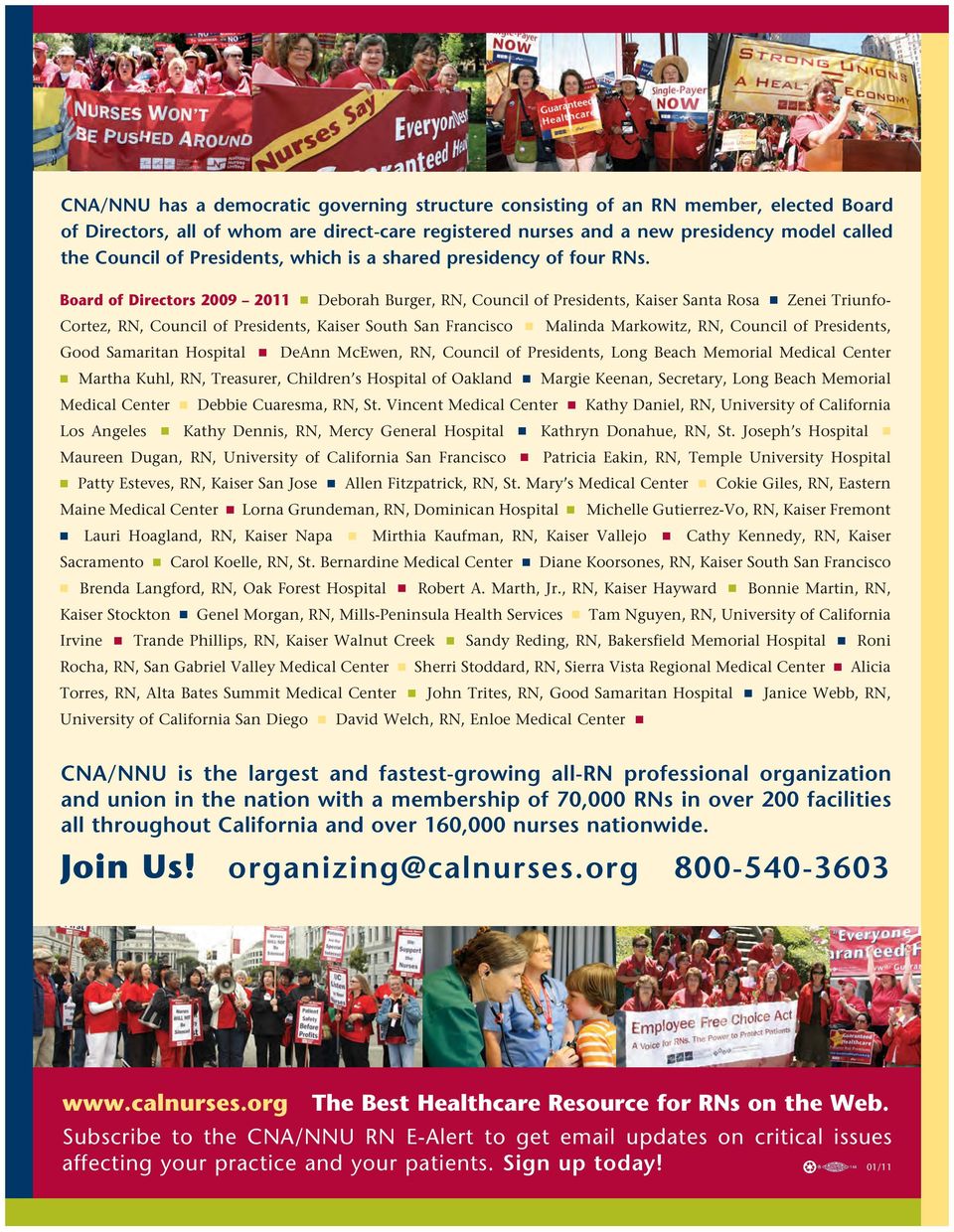
20 CNA/NNU has a democratic governing structure consisting of an RN member, elected Board of Directors, all of whom are direct-care registered nurses and a new presidency model called the Council of Presidents, which is a shared presidency of four RNs. Board of Directors Deborah Burger, RN, Council of Presidents, Kaiser Santa Rosa Zenei Triunfo- Cortez, RN, Council of Presidents, Kaiser South San Francisco Malinda Markowitz, RN, Council of Presidents, Good Samaritan Hospital DeAnn McEwen, RN, Council of Presidents, Long Beach Memorial Medical Center Martha Kuhl, RN, Treasurer, Children s Hospital of Oakland Margie Keenan, Secretary, Long Beach Memorial Medical Center Debbie Cuaresma, RN, St. Vincent Medical Center Kathy Daniel, RN, University of California Los Angeles Kathy Dennis, RN, Mercy General Hospital Kathryn Donahue, RN, St. Joseph s Hospital Maureen Dugan, RN, University of California San Francisco Patricia Eakin, RN, Temple University Hospital Patty Esteves, RN, Kaiser San Jose Allen Fitzpatrick, RN, St. Mary s Medical Center Cokie Giles, RN, Eastern Maine Medical Center Lorna Grundeman, RN, Dominican Hospital Michelle Gutierrez-Vo, RN, Kaiser Fremont Lauri Hoagland, RN, Kaiser Napa Mirthia Kaufman, RN, Kaiser Vallejo Cathy Kennedy, RN, Kaiser Sacramento Carol Koelle, RN, St. Bernardine Medical Center Diane Koorsones, RN, Kaiser South San Francisco Brenda Langford, RN, Oak Forest Hospital Robert A. Marth, Jr., RN, Kaiser Hayward Bonnie Martin, RN, Kaiser Stockton Genel Morgan, RN, Mills-Peninsula Health Services Tam Nguyen, RN, University of California Irvine Trande Phillips, RN, Kaiser Walnut Creek Sandy Reding, RN, Bakersfield Memorial Hospital Roni Rocha, RN, San Gabriel Valley Medical Center Sherri Stoddard, RN, Sierra Vista Regional Medical Center Alicia Torres, RN, Alta Bates Summit Medical Center John Trites, RN, Good Samaritan Hospital Janice Webb, RN, University of California San Diego David Welch, RN, Enloe Medical Center CNA/NNU is the largest and fastest-growing all-rn professional organization and union in the nation with a membership of 70,000 RNs in over 200 facilities all throughout California and over 160,000 nurses nationwide. Join Us! [email protected] The Best Healthcare Resource for RNs on the Web. Subscribe to the CNA/NNU RN E-Alert to get updates on critical issues affecting your practice and your patients. Sign up today! 01/11
Nurse to Patient Ratio Its Impact on Patient Safety. Zenei Cortez RN President California Nurses Association and National Nurses Organizing Committee
 Nurse to Patient Ratio Its Impact on Patient Safety Zenei Cortez RN President California Nurses Association and National Nurses Organizing Committee Background on the 12 year Ratio Fight 1992 and 1993
A MANAGER S GUIDE: HOW BETTER NURSE TO PATIENT RATIOS CAN IMPROVE THE HEALTH OF YOUR PATIENTS & LOWER STAFFING COSTS.
 A MANAGER S GUIDE: HOW BETTER NURSE TO PATIENT RATIOS CAN IMPROVE THE HEALTH OF YOUR PATIENTS & LOWER STAFFING COSTS. RN-TO-PATIENT RATIOS & PATIENT SAFETY RN-to-Patient ratio is another key component
SEIU-UHW Contract Victory What We Won
 SEIU-UHW Contract Victory What We Won Wages Across-the-board increase: 2% for all employees in May 2013. Below scale employees: Employees below the proper place on wage scales for their seniority and classification
How To Get A 1:4 Ratio
 The Ratio Solution CNA/NNOC s RN-to-Patient Ratios Work Better Care, More Nurses RN Staffing Ratios are Saving Lives and Bringing RNs Back to the Bedside CNA/NNOC stands ready to help you bring ratios
PSE Membership. It s about YOU!
 PSE Membership It s about YOU! Welcome to PSE! For us, success means fair wages, good benefits and a strong voice in your workplace. It means paid time off for vacations, holidays and family illnesses.
Recover Your. Unpaid Wages. Commissioner s Office
 Recover Your Unpaid Wages With the California Labor Commissioner s Office The Labor Commissioner s Office, also called the Division of Labor Standards Enforcement (DLSE), is a part of the California Department
Transparency April 2012 Edition. A Message from Angela Gonzalez-Acosta, RN Hospital President
 Transparency April 2012 Edition [email protected] Questions for your officers? [email protected] Need representation? We Respond Within 24 Hours Website: http://www.unacuhcp.org/members/affiliates/south-bay-kaiser/
For Starting Your Career As A Registered Nurse
 For Starting Your Career As A Registered Nurse Printed September 2013 2 President's Message CONGRATULATIONS on choosing a career in registered nursing!! When people think of registered nurses, words like
Patient Safety: Rights of Registered Nurses When Considering a Patient Assignment
 Position Statement Patient Safety: Rights of Registered Nurses When Considering a Patient Assignment Effective Date: March 12, 2009 Status: Revised Position Statement Originated By: Congress on Nursing
Medical/Healthcare Interpreters in California
 RESEARCH BRIEF Medical/Healthcare Interpreters in California MARCH 2012 Table of Contents Introduction... 3 Employment Trends... 3 Job Postings in California... 3 Employment Concentration... 5 Largest
Licensing surgical assistants in Texas. (Health Policy Issues).
 Licensing surgical assistants in Texas. (Health Policy Issues). Franko, Frederick P. "Licensing surgical assistants in Texas. (Health Policy Issues)." AORN Journal. 74.4 (Oct 2001): 545(4). Full Text:COPYRIGHT
REPORT ON THE HOME OFFICE AUDIT CATHOLIC HEALTHCARE WEST WORKERS COMPENSATION TRUST SAN FRANCISCO, CALIFORNIA FISCAL PERIOD ENDED JUNE 30, 2007
 REPORT ON THE HOME OFFICE AUDIT CATHOLIC HEALTHCARE WEST WORKERS COMPENSATION TRUST SAN FRANCISCO, CALIFORNIA FISCAL PERIOD ENDED JUNE 30, 2007 Audits Section - Richmond Financial Audits Branch Audits
NURSES NEEDED SHORT-TERM RELIEF, ONGOING SHORTAGE. Results from the 2010 Nursing Workforce Survey
 NURSES NEEDED SHORT-TERM RELIEF, ONGOING SHORTAGE Results from the 2010 Nursing Workforce Survey JUNE 2010 IN COLLABORATION WITH WNYHA Western New York Healthcare Association Demand for nurses will continue
Principles in Collision: Labor Union rights v. Employee civil Rights
 Principles in Collision: Labor Union rights v. Employee civil Rights Barry Winograd Arbitrator and mediator in Oakland, California Member of the National Academy of Arbitrators Adjunct faculty of the law
Source: Center for Health Workforce Studies. (2006). New York Registered Nursing Graduations, 1996-2004. Rensselaer, NY: CHWS. http://chws.albany.
 Testimony of Jana Stonestreet, Ph.D., RN Chief Nursing Executive, Baptist Health System, Before the House Subcommittee on Immigration, Citizenship, Refugees, Border Security and International Law June
Iowa Legislative Fiscal Bureau. Iowa's Nursing Shortage. This Issue Review provides a comprehensive overview of the current nursing shortage in Iowa.
 Iowa Legislative Fiscal Bureau I S S U E R E V I E W Dennis Prouty State Capitol (515) 281-5279 Des Moines, IA 50319 FAX 281-8451 September 20, 2001 ISSUE Iowa's Nursing Shortage This Issue Review provides
SUMMARY OF THE CONFERENCE COMMITTEE REPORT ON PUBLIC EMPLOYEE PENSIONS
 SUMMARY OF THE CONFERENCE COMMITTEE REPORT ON PUBLIC EMPLOYEE PENSIONS SUMMARY: Implements comprehensive public employee pension reform through enactment of the California Public Employees' Pension Reform
Report from Maine Nursing Summit Maine Health Care: Colleagues in Caring Nursing Workforce Initiative. December 4, 2001 Augusta, Maine
 Report from Maine Nursing Summit Maine Health Care: Colleagues in Caring Nursing Workforce Initiative December 4, 2001 Augusta, Maine Planning Committee: Jane Marie Kirschling, Convener Linda Conover,
CALIFORNIA S PAID SICK LEAVE LAW NO GET WELL CARD FOR EMPLOYERS
 CALIFORNIA S PAID SICK LEAVE LAW NO GET WELL CARD FOR EMPLOYERS BONNIE GLATZER, ESQ. PAUL LYND, ESQ. APRIL 8, 2015 BACKGROUND First paid sick leave mandate with San Francisco s Proposition F in 2006 Other
SAN FRANCISCO RETIREMENT FAQS
 SAN FRANCISCO RETIREMENT FAQS In early March 2011, hundreds of Local 21 San Francisco members attended retirement and healthcare security meetings at worksites across the city. The meetings were designed
California Board of Registered Nursing 2013-2014 Annual School Report
 California Board of Registered Nursing - Annual School Report Data Summary and Historical Trend Analysis A Presentation of Post-Licensure Nursing Education Programs in California April 17, 2015 Prepared
Center for Rural Health North Dakota Center for Health Workforce Data. July 2004
 North Dakota Nursing Needs Study: Licensed Nurse Survey Year 2 Center for Rural Health North Dakota Center for Health Workforce Data July 2004 Carol Bennett, M.A., R.N. Patricia L. Moulton, Ph.D. Mary
2014-2017 EMPLOYMENT AGREEMENT. By and Between GOOD SAMARITAN HOSPITAL. and WASHINGTON STATE NURSES ASSOCIATION
 2014-2017 EMPLOYMENT AGREEMENT By and Between GOOD SAMARITAN HOSPITAL and WASHINGTON STATE NURSES ASSOCIATION TABLE OF CONTENTS ARTICLE 1 - RECOGNITION 5 ARTICLE 2 - ASSOCIATION MEMBERSHIP 2.1 Membership
Employees. Table of Contents
 Table of Contents 1. Introduction 2 2. Recruitment 2 3. Pay and Leave Administration 5 3.1 Pay Administration 5 3.2 Leave Administration 7 4. Benefits 10 5. Employee Assistance Program 12 6. Conflict Resolution
False Claims Laws: What Every Public Contract Manager Needs to Know By Aaron P. Silberman 1
 False Claims Laws: What Every Public Contract Manager Needs to Know By Aaron P. Silberman 1 When Do False Claims Laws Apply? The federal False Claims Act (FCA) applies to any requests for payment from
How Can Employment-Based Benefits Help the Nursing Shortage?
 How Can Employment-Based Benefits Help the Nursing Shortage? Joanne Spetz, Ph.D., Center for the Health Professions and Department of Community Health Systems University of California, San Francisco Sara
Association of University Registered Nurses
 Oregon Nurses Association Bargaining Unit Newsletter March 26, 2015 ONA / AURN Executive Team: President: Clarice Gerlach, RN CMICU Vice President: Elizabeth McPhee, RN MCU Secretary: Cheryl Rice, RN DCH,
State Defined Contribution and Hybrid Pension Plans
 State Defined Contribution and Hybrid Pension Plans Ronald Snell June 2010 The overwhelming majority of statewide retirement plans for public employees and for teachers are traditional defined benefit
THE NURSE SHORTAGE: PERSPECTIVES FROM CURRENT DIRECT CARE NURSES AND FORMER DIRECT CARE NURSES
 THE NURSE SHORTAGE: PERSPECTIVES FROM CURRENT DIRECT CARE NURSES AND FORMER DIRECT CARE NURSES AN OPINION RESEARCH STUDY CONDUCTED BY PETER D. HART RESEARCH ASSOCIATES ON BEHALF OF THE FEDERATION OF NURSES
Development of Health Career Pathway for California. Psychiatric Mental Health Nurse Practitioner/Clinical Nurse Specialist Career Pathway
 Development of Health Career Pathway for California Psychiatric Mental Health Nurse Practitioner/Clinical Nurse Specialist Career Pathway 1 Current State As of February 2011, there were 9,458 psychiatric
Tri-Council for Nursing
 For Immediate Release Tri-Council for Nursing Issues New Consensus Policy Statement on the Educational Advancement of Registered Nurses WASHINGTON, D.C., May 14, 2010 In light of the recent passage of
Survey of Nurse Employers in California 2015
 Gordon and Better Moore Foundation Survey of Nurse Employers in California 2015 Conducted by UCSF Philip R. Lee Institute for Health Policy Studies, HealthImpact (formerly California Institute for Nursing
Client Assistance Program (CAP) Michael Thomas-Region one Leilani Pfeifer-Region two
 Client Assistance Program (CAP) Michael Thomas-Region one Leilani Pfeifer-Region two Agenda Overview of the Client Assistance Program 1 2 3 4 Rehabilitation Act of 1973 Vocational Rehabilitation Process
The McClatchy Company. Retirement Plan. April 1, 2009 SUMMARY PLAN DESCRIPTION. April 1, 2009. Table of Contents. Rev. 08/10
 The McClatchy Company Retirement Plan April 1, 2009 SUMMARY PLAN DESCRIPTION April 1, 2009 Table of Contents Rev. 08/10 Table of Contents I. INTRODUCTION... 4 PLAN HIGHLIGHTS... 5 II. LEGACY MCCLATCHY
Chapter 8a Public Education Human Resource Management Act. Part 1 General Provisions
 Chapter 8a Public Education Human Resource Management Act Part 1 General Provisions 53A-8a-101 Title. This chapter is known as the "Public Education Human Resource Management Act." 53A-8a-102 Definitions.
Nursing Leadership from the Bedside to the Boardroom. Presentation ID: L13
 Nursing Leadership from the Bedside to the Boardroom Presentation ID: L13 Disclosure Today s presenters do not have any relevant financial interests presenting a conflict of interest to disclose. Participants
Saving Lives, Saving Money. A state-by-state report on the health and economic impact of comprehensive smoke-free laws
 Saving Lives, Saving Money A state-by-state report on the health and economic impact of comprehensive smoke-free laws 2011 Table of Contents Executive Summary...............................................................................2
What Sets California Apart From Other States?
 What Sets California Apart From Other States? Unique Employment Labor Laws to be aware of if you have employees located in California. Providing Human Resource Solutions for Employers Since 1937 As California
Health Reform and the AAP: What the New Law Means for Children and Pediatricians
 Health Reform and the AAP: What the New Law Means for Children and Pediatricians Throughout the health reform process, the American Academy of Pediatrics has focused on three fundamental priorities for
Public Law 106-95 106th Congress An Act
 113 STAT. 1312 PUBLIC LAW 106-95 NOV. 12, 1999 Public Law 106-95 106th Congress An Act N 19 iqqq "^^ amend the Immigration and Nationality Act with respect to the requirements ; for the admission of nonimmigrant
Safe Minimum RN Staffing Standards: Improve Quality of Care and Protect Patient Safety
 Safe Minimum RN Staffing Standards: Improve Quality of Care and Protect Patient Safety Current Situation: Its Impact on Patients We have a disturbing crisis in Massachusetts, nurses are being forced to
Staffing Solutions that work for everyone. ADEX Medical Staffing LLC 8 West 40th Street, 12 Floor, New York NY 10018 USA. www.adexmedicalstaffing.
 Staffing Solutions that work for everyone ADEX Medical Staffing LLC 8 West 40th Street, 12 Floor, New York NY 10018 USA Our Mission To empower and enable qualified international nurses to emigrate to the
Subcommittee on Nursing Shortage. Nursing Shortage Statistics. Members of the Nursing Shortage Subcommittee
 Subcommittee on Nursing Shortage Report and Recommendations to the House Health Policy Committee March 12, 2008 Members of the Nursing Shortage Subcommittee Rep. Lisa Wojno Rep. Mary Valentine Rep. Robert
Memo To From Board Meeting Date Subject
 Board Office Use: Legisla ive File Info. File ID Number 1-11'40 Introduction Date Tit a Enactment Number Enactment Date t OAKLAND UNIFIED SCHOOL DISTRICT Community Schools, Thriving Students Memo To From
California Board of Registered Nursing
 California Board of Registered Nursing 2005-2006 Annual School Report Data Summary and Historical Trend Analysis A Presentation of Pre-Licensure Nursing Education Programs in California Prepared by: Renae
MCEA Members -- Leading in Our Schools A Vision for Teacher Leadership
 MCEA Members -- Leading in Our Schools A Vision for Teacher Leadership A Broader Mission for the Union Public support for and expectations of public education continue to change rapidly. Public school
A BILL. To provide a single, universal, comprehensive health insurance benefit for all residents of Illinois, and for other purposes.
 Synopsis: This bill expands comprehensive health coverage to all Illinois residents using a single-payer statewide insurance system. Doctors and hospitals remain private, and patients retain their choice
Your Pension Plan Benefits
 Your Pension Plan Benefits Contents Your Pension Plan Benefits...1 About This SPD... 1 Accessing Your Benefits Information... 2 Changes to the Plan... 2 Participation and Service...4 Eligibility... 4 When
Labor Relations Glossary of Terms
 Labor Relations Glossary of Terms Access The right to come into; approach employees; or use university property. The law seeks to strike a balance between employee rights to form, join, and participate
COLLECTIVE BARGAINING AGREEMENT BY AND BETWEEN BOARD OF REGENTS OF THE UNIVERSITY OF WASHINGTON AND THE WASHINGTON STATE NURSES ASSOCIATION
 UW WSNA 7/1/13 6/30/15 COLLECTIVE BARGAINING AGREEMENT BY AND BETWEEN BOARD OF REGENTS OF THE UNIVERSITY OF WASHINGTON AND THE WASHINGTON STATE NURSES ASSOCIATION (UW Medical Center Registered Nurses)
California Nurse Education Initiative
 California Nurse Education Initiative Annual Report September 2006 i TABLE OF CONTENTS Executive Summary SECTION 1 California Nurse Education Initiative Nursing Shortage in California Nurse Education Initiative
How To Organize A Nursing Organization In California
 CALIFORNIA ORGANIZATION OF ASSOCIATE DEGREE NURSING PROGRAM DIRECTORS BY-LAWS This organization shall be known as the California Organization of Associate Degree Nursing Program Directors. COMPOSITION
HIRING HALL RULES FOR ILA LOCAL 1351
 HIRING HALL RULES FOR ILA LOCAL 1351 These Hiring Hall Rules shall apply to all individuals working through the Hiring Hall Local. The Union shall be the exclusive bargaining representative for all individuals,
Local Government Bankruptcy in California: Questions and Answers
 POLICY BRIEF Local Government Bankruptcy in California: Questions and Answers MAC Taylor Legislative Analyst August 7, 2012 Introduction Unanticipated events or prolonged imbalances between resources and
Waste and inefficiency in the Bush Medicare prescription drug plan: Allowing Medicare to negotiate lower prices could save $30 billion a year
 Waste and inefficiency in the Bush Medicare prescription drug plan: Allowing Medicare to negotiate lower prices could save $30 billion a year By Roger Hickey & Jeff Cruz In cooperation with Dean Baker,
SENIOR MANAGEMENT PERSONNEL POLICY
 SENIOR MANAGEMENT PERSONNEL POLICY A POLICY OF THE CITY OF AUBURN, NEW YORK, TO PROVIDE A COMPENSATION AND BENEFIT PLAN FOR SENIOR MANAGERS AND NON- UNION EMPLOYEES. The Senior Management Policy is designed
CURRENT ISSUES IN NURSING PRACTICE. Terry Throckmorton, PhD, RN
 CURRENT ISSUES IN NURSING PRACTICE Terry Throckmorton, PhD, RN 83 rd Legislative Session: Impact on Nursing The 2013 legislative session saw, with only one exception, all of nursinginitiated legislation
Administrative Policy and Procedure Manual. Code of Conduct Effective Date: 1/2005 Scope: Organizationwide Page 1 of 9
 Scope: Organizationwide Page 1 of 9 I. Purpose The purpose of this policy is to provide direction to staff members to assist in carrying out daily activities within appropriate ethical and legal standards.
Universal Protection Service 2005 Benefit Summary
 Universal Protection Service 2005 Benefit Summary Professional Coverage for Our Security Professionals Medical Dental Vision Whole Life, Short Term Disability, and Accident Insurance 401(k) Employee Assistance
BOARD AND CEO ROLES DIFFERENT JOBS DIFFERENT TASKS
 BOARD AND CEO ROLES DIFFERENT JOBS DIFFERENT TASKS Introduction Local boards of trustees and chief executive officers play different roles and have different responsibilities in leading their districts.
your Benefits in Brief
 your Benefits in Brief Southern California Employees: Non-Union Non-Exempt Salaried Salaried Patient Care Providers For Employees of Kaiser Foundation Hospitals, Kaiser Foundation Health Plan, Inc., KP
Labor Health and Human Services, Education, and Related Agencies Witness Disclosure Form
 Labor Health and Human Services, Education, and Related Agencies Witness Disclosure Form Clause 2(g) of rule XI of the Rules of the House of Representatives requires nongovernmental witnesses to disclose
APRIL 2015 SECTION I - 1. Section I: Introduction and Overview
 Section I: Introduction and Overview About Us... I-2 Resources... I-3 Sharp Health Plan s Responsibilities... I-4 Service Area... I-4 Compliance Program... I-4 Health Care Fraud, Waste, and Abuse Prevention...
$&71R SENATE BILL NO. 1105 (SUBSTITUTE FOR SENATE BILL 812 BY SENATOR SCHEDLER)
 Regular Session, 2001 $&71R SENATE BILL NO. 1105 (SUBSTITUTE FOR SENATE BILL 812 BY SENATOR SCHEDLER) BY SENATOR SCHEDLER AN ACT To enact Part XXV of Chapter 1 of Title 22 of the Louisiana Revised Statutes
Senate Bill No. 2 CHAPTER 673
 Senate Bill No. 2 CHAPTER 673 An act to amend Section 6254 of the Government Code, to add Article 3.11 (commencing with Section 1357.20) to Chapter 2.2 of Division 2 of the Health and Safety Code, to add
COMPLAINT. Now come Plaintiffs, personal care attendants, consumers, surrogates,
 DOCKET NO. SUPERIOR COURT Catherine D. Ludlum, : Amber L. Michaud, : The Connecticut Association of Personal : SUPERIOR COURT Assistance, Inc., : Senator Joseph Markley, : State Representative Robert C.
Working Extra Hours: Guidelines for Regulated Members on Fitness to Practise and the Provision of Safe, Competent, Ethical Nursing Care
 Working Extra Hours: Guidelines for Regulated Members on Fitness to Practise and the Provision of Safe, Competent, Ethical Nursing Care September 2011 Permission to reproduce this document is granted,