
HL7 FHIR for Executives
|
|
|
- Colleen Matthews
- 10 years ago
- Views:
Transcription

1 HL7 FHIR for Executives Summary The FHIR (Fast Healthcare Interoperable Resources, pronounced fire ) standard is created by HL7. It supports the exchange of data between software applications in healthcare, combining the best features of HL7 s existing v2, v3 and CDA product families while leveraging the latest web standards and applying a tight focus on implementability. In summary, FHIR: Is easier and cheaper than other comparable standards: o It is faster to learn, implement and troubleshoot (you should be able to figure it out over a weekend and the standard is shipped with toolkits and examples). o It has a vibrant and open source community and has frequently held connectathons. o It uses modern technologies, the same as used by e.g. Facebook, Twitter and Google. o There are more people familiar with these technologies (thus less expensive consultants). Is being implemented right now: o US: ONC, SMART, Intermountain, CommonWell. UK: NHS. NZ: Orion Health. NO: Helse Vest. o IHE Profiles o 70 implementations, 20 countries (2014) Is likely to significantly impact Health IT: o scales well from simple to complex o flexible o free and fully open Application of FHIR FHIR is suitable for application in a variety of settings: the classic in-institution exchange of data between systems in a regional setting (Regional Health Information Organizations) on a national scale, e.g. in national health hub s or EHRs in social media and mobile applications

2 Why FHIR? There has been a need to share healthcare information electronically since the introduction of mainframe based EMRs in the 1960s. HL7 version 2, aimed at the exchange of data between fixed departmental systems within the context of a hospital organization, has its technical roots in the 1970s. There is increasing pressure to broaden the scope of sharing across organizations and disciplines, mobile and cloud-based applications and to achieve integration in days or weeks instead of months or years. These are the drivers of FHIR: Shift in healthcare The patient is in control and owns his medical data. There is an increasing pressure to broaden the scope of sharing health data and a growing need for exchange of information across organizations, disciplines and (regional) borders. Shift from off-line to on-line Recent years have shown the shift from PC to tablet, from web to app, from electronic health record to personal health record, from desktop to cloud. FHIR is lightweight, is made for mobile and it enables the data to travel with the patient. Shift towards data transparency EHRs and other medical systems tend to behave like black boxes. Data sits in there, you can t get it out - and if you can, the data is useless because it s incompatible. FHIR acts as an Open API to access data in these silo-like EHRs. Different aspects of patient data will end up being hosted in different systems. New healthcare tools should have the ability to reach out to these systems and use that data in a collaborative manner. Shift towards analytics Analytics requires data transparency, but also for the data itself to be in a format which is optimized for analysis. FHIR uses data structures that allow one to easily slice and dice the data for analytics. Unlike CDA, with FHIR there is no need to split documents into more atomic concepts for analytics. Start from scratch The initial FHIR developers posed this question: What would healthcare information exchange look like if we started from scratch? A web search for success markers of modern implementation approaches led to REST-based APIs. FHIR is a healthcare exchange API based on this approach, which provides a simple and efficient way to discover and consume information across distributed systems. HL7, other standards organizations and the United States President's Council of Advisors on Science and Technology (PCAST) came to the conclusion in 2011 that the base unit of exchange when it comes to data should neither be too large (yielding unwieldy and overly complex data structures) nor too small (it should convey meaningful data). FHIR uses small logically discrete units of exchange with a well-defined behavior, meaning and contextual metadata.
3 The design philosophy behind FHIR FHIR doesn t solve the really hard interoperability challenges such as workflow and policy differences between organizations, and variability in the data captured and found in different contexts of use. FHIR aims to make the implementation of the data exchange as simple as possible, to clear the way for solving these hard interoperability issues. The design philosophy of FHIR can be summarized as follows: Focus on Implementers easy to understand for developers, plenty of tools around, APIs and examples available out of the box. Target support for common scenarios but support the concept of extensions. Leverage cross-industry web technologies - use the same cross-industry technologies as Google, Facebook and others (e.g. XML, JSON, HTTPS, OAuth). Require human readability as base level of interoperability as a fall back option for applications unable to interpret structured content a lesson learned from CDA. Make content freely available FHIR has an open source license. Support multiple paradigms & architectures FHIR leverages the same data models and profiles (see details below) everywhere regardless of interoperability approach (REST, Documents, Messages, Services). These are lessons learned from HL7 version 3, where different models are being used depending on the integration approach, leading to additional implementation challenges. Building blocks of FHIR The main building blocks of FHIR are Resources, References and Profiles. Resources Resources are small logically discrete units of exchange with a defined behavior and meaning. They are the smallest unit of transaction. The 150 different resource types cover all of healthcare. Examples include Patient, Practitioner, Allergy Intolerance, Family History and Care Plan.

4 Mindmap of currently defined FHIR resources (2014) A resource consists of three parts: 1. Structured data attributes to support the 80% common use cases. We only include data elements if we are confident that 80% of implementations maintaining that resource will make use of the element. Other content is pushed to extensions. 2. Narrative textual summary of the content of the resource. 3. Extensions attributes to support non-common use cases. References References are links from one resource to another. Using these, the resources combine to create a network (or web) of information that represent a health record (or at least, a useful part of it). Systems can navigate these links to decide what resources they need for a given task. Example of references between FHIR resources

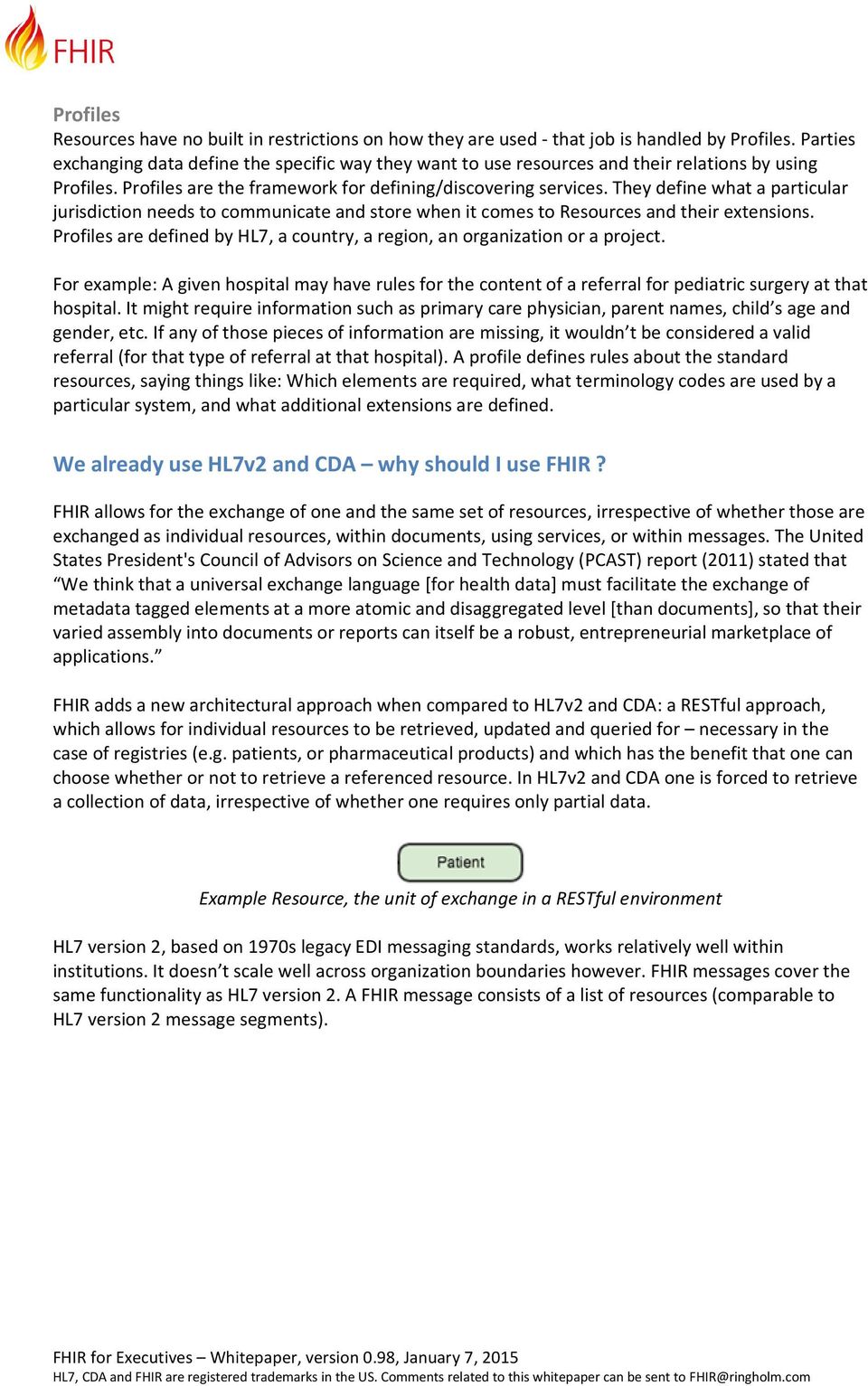
5 Profiles Resources have no built in restrictions on how they are used - that job is handled by Profiles. Parties exchanging data define the specific way they want to use resources and their relations by using Profiles. Profiles are the framework for defining/discovering services. They define what a particular jurisdiction needs to communicate and store when it comes to Resources and their extensions. Profiles are defined by HL7, a country, a region, an organization or a project. For example: A given hospital may have rules for the content of a referral for pediatric surgery at that hospital. It might require information such as primary care physician, parent names, child s age and gender, etc. If any of those pieces of information are missing, it wouldn t be considered a valid referral (for that type of referral at that hospital). A profile defines rules about the standard resources, saying things like: Which elements are required, what terminology codes are used by a particular system, and what additional extensions are defined. We already use HL7v2 and CDA why should I use FHIR? FHIR allows for the exchange of one and the same set of resources, irrespective of whether those are exchanged as individual resources, within documents, using services, or within messages. The United States President's Council of Advisors on Science and Technology (PCAST) report (2011) stated that We think that a universal exchange language [for health data] must facilitate the exchange of metadata tagged elements at a more atomic and disaggregated level [than documents], so that their varied assembly into documents or reports can itself be a robust, entrepreneurial marketplace of applications. FHIR adds a new architectural approach when compared to HL7v2 and CDA: a RESTful approach, which allows for individual resources to be retrieved, updated and queried for necessary in the case of registries (e.g. patients, or pharmaceutical products) and which has the benefit that one can choose whether or not to retrieve a referenced resource. In HL7v2 and CDA one is forced to retrieve a collection of data, irrespective of whether one requires only partial data. Example Resource, the unit of exchange in a RESTful environment HL7 version 2, based on 1970s legacy EDI messaging standards, works relatively well within institutions. It doesn t scale well across organization boundaries however. FHIR messages cover the same functionality as HL7 version 2. A FHIR message consists of a list of resources (comparable to HL7 version 2 message segments).
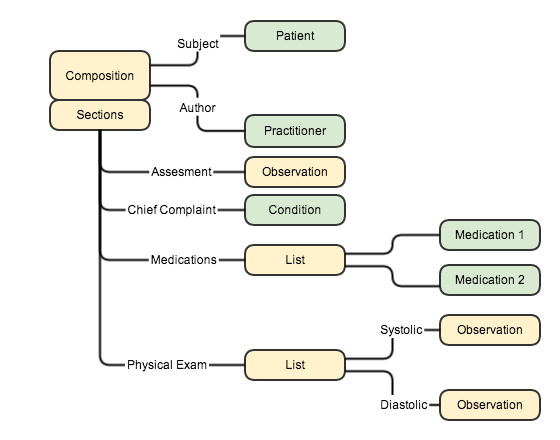
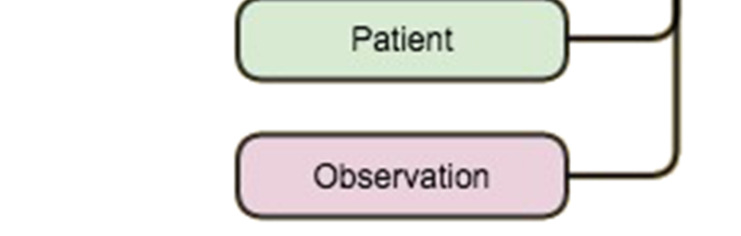
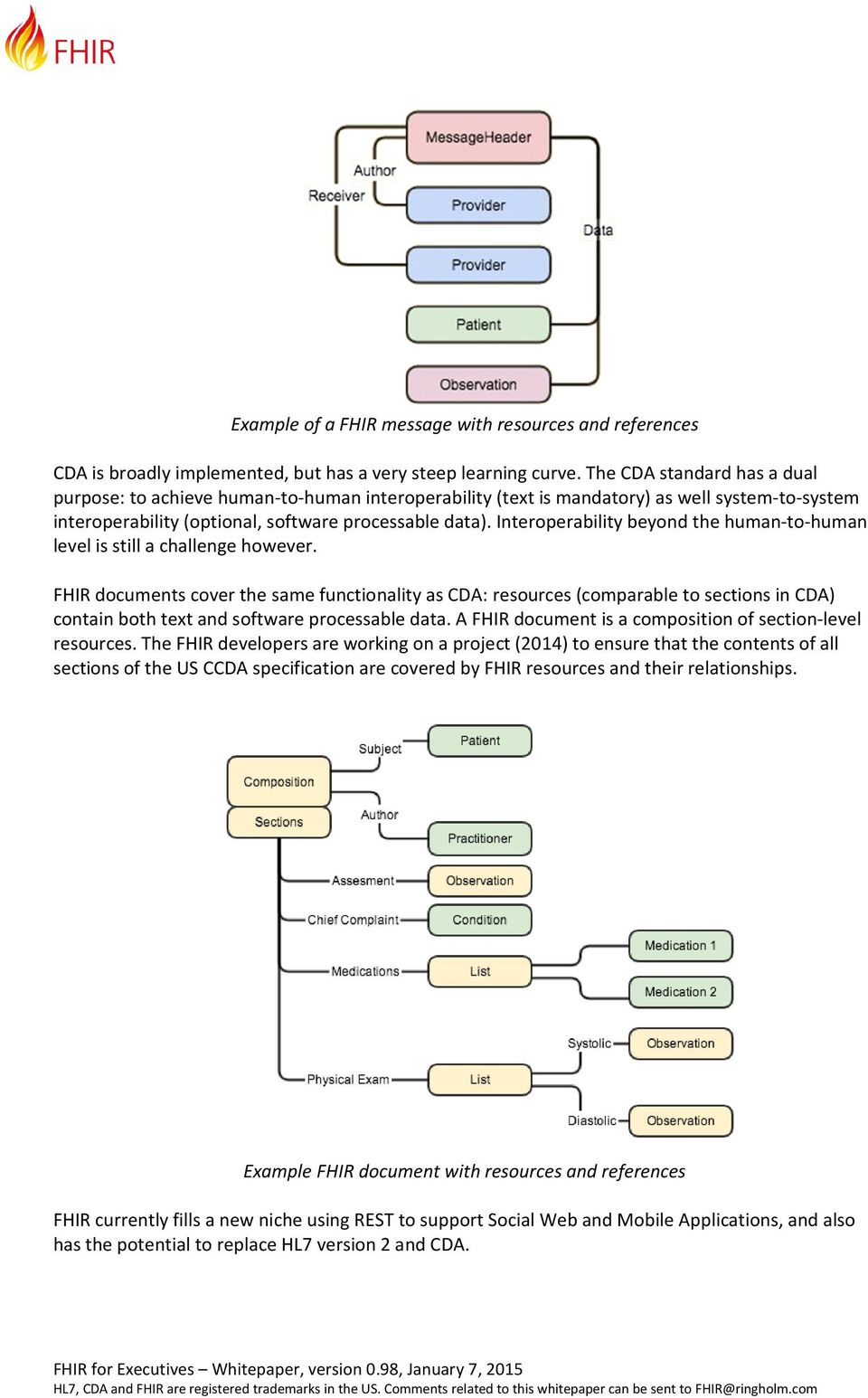
6 Example of a FHIR message with resources and references CDA is broadly implemented, but has a very steep learning curve. The CDA standard has a dual purpose: to achieve human-to-human interoperability (text is mandatory) as well system-to-system interoperability (optional, software processable data). Interoperability beyond the human-to-human level is still a challenge however. FHIR documents cover the same functionality as CDA: resources (comparable to sections in CDA) contain both text and software processable data. A FHIR document is a composition of section-level resources. The FHIR developers are working on a project (2014) to ensure that the contents of all sections of the US CCDA specification are covered by FHIR resources and their relationships. Example FHIR document with resources and references FHIR currently fills a new niche using REST to support Social Web and Mobile Applications, and also has the potential to replace HL7 version 2 and CDA.
7 From v2 and CDA to FHIR Most healthcare provider organizations already have to deal with multiple standards (e.g. HL7 v2, CDA, X12, DICOM) and mappings between them. The issue of having to map between FHIR and these other standards is no different from any the current mappings. Given that FHIR is based on HL7 v2 and CDA, and that there is a conscious effort to align the resource definitions with CDA, the mapping between the various HL7 standards will be relatively straightforward. Any of the existing interface engines should be able to support such mappings. Tooling for mapping of current standards to and from FHIR are expected to become available as the use of FHIR spreads. Additional reading For additional materials related to FHIR, we kindly refer you to: The FHIR standard (document) - Introduction to FHIR for Clinical Users (document) - FHIR for Executives (video) - FHIR elevator pitch for Software Developers (video) - Summary In summary, FHIR: Is easier and cheaper than other comparable standards. Is being implemented right now. Is likely to significantly impact Health IT. Acknowledgements Editor: René Spronk (Ringholm), based on materials created by Lloyd McKenzie (LM&A Consulting), Ewout Kramer (Furore) and Grahame Grieve (Health Intersections). We d like to thank the various reviewers and contributors, notably David Hay (Orion), Rik Smithies (NProgram) and Rien Wertheim (Furore). Please sent any comments and/or suggestions to [email protected].

8 Appendix: Who is already using FHIR? FHIR is still a draft standard, expected to be normative late Nevertheless, we already see a huge interest in FHIR taking place. Vendors are spending R&D money on FHIR and sending their people over to conferences and connectathons. See for a list of organizations that are known to be implementing FHIR. Some example projects can be found below. The CommonWell Health Alliance (U.S.) The CommonWell Health Alliance is an independent, not-for-profit trade organization based in the U.S. The founding membership of the alliance are healthcare IT vendors (e.g., Allscripts, athenahealth, Cerner, CPSI, McKesson). The goal of the alliance is to provide core infrastructure services for enabling healthcare data interoperability. As the service provider for CommonWell, RelayHealth has implemented services focused on 1. Patient identity management: a REST-based patient link and matching API that supports patient matching by local patient identifiers and patient demographic data. 2. Record location and targeted query for clinical data: a REST-based service to locate patient records across the CommonWell network. These services are based on open standards and, with respect to the REST services, utilize FHIR resource definitions. The FHIR standard was extended to provide a service-oriented mechanism for EHR systems to authoritatively "link" patient records across heterogeneous patient identity domains. The pilot launched in early 2014 at hospitals and clinics in three U.S. geographies. The solution is now commercially available, and is expanding to new locations in the U.S. The development of the CommonWell service APIs is ongoing e.g., adding FHIR-based document query and retrieve services. For additional information, see:

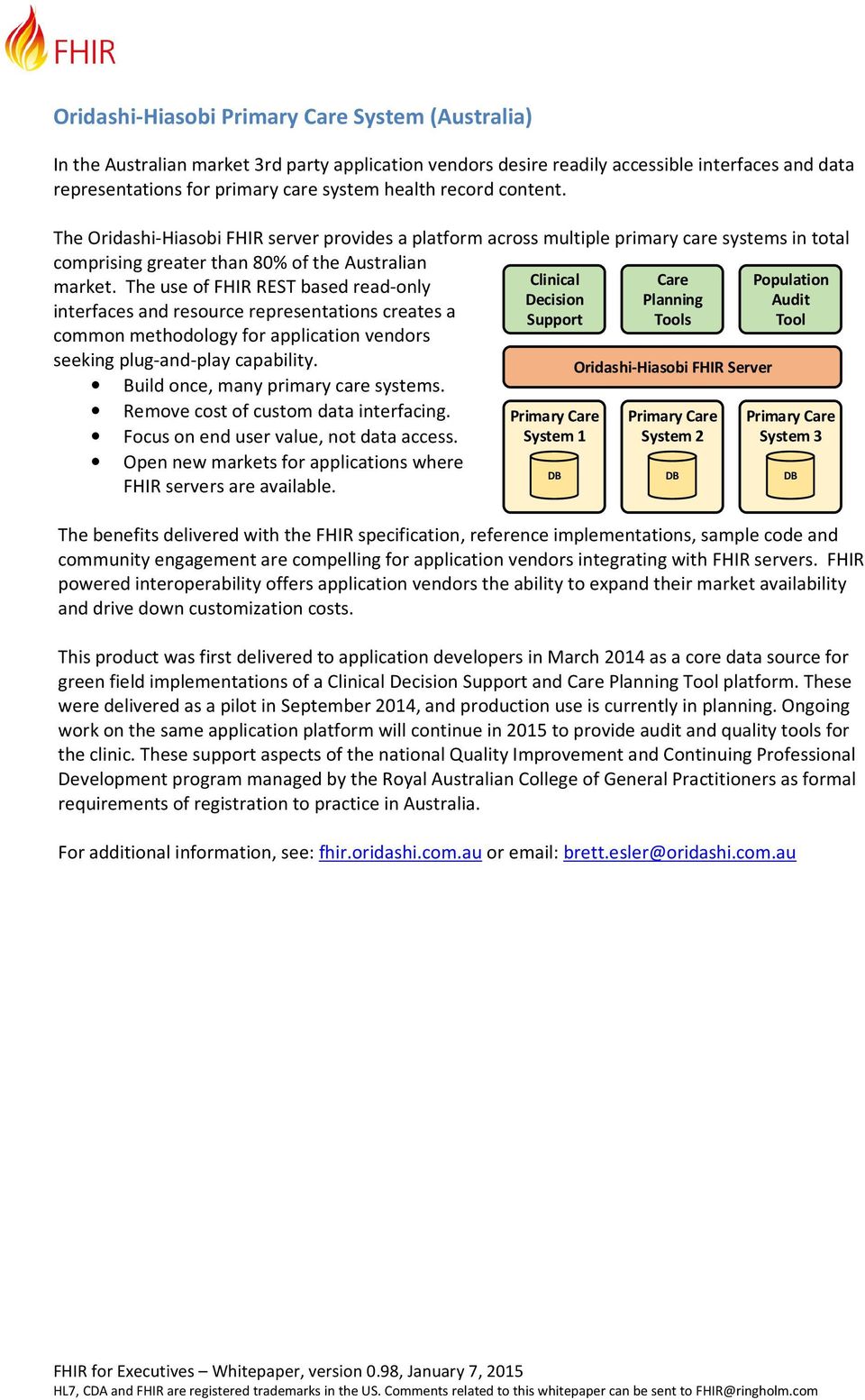
9 Oridashi-Hiasobi Primary Care System (Australia) In the Australian market 3rd party application vendors desire readily accessible interfaces and data representations for primary care system health record content. The Oridashi-Hiasobi FHIR server provides a platform across multiple primary care systems in total comprising greater than 80% of the Australian market. The use of FHIR REST based read-only Clinical Care Population Decision Planning Audit interfaces and resource representations creates a Support Tools Tool common methodology for application vendors seeking plug-and-play capability. Build once, many primary care systems. Oridashi-Hiasobi FHIR Server Remove cost of custom data interfacing. Focus on end user value, not data access. Open new markets for applications where FHIR servers are available. Primary Care System 1 DB Primary Care System 2 DB Primary Care System 3 DB The benefits delivered with the FHIR specification, reference implementations, sample code and community engagement are compelling for application vendors integrating with FHIR servers. FHIR powered interoperability offers application vendors the ability to expand their market availability and drive down customization costs. This product was first delivered to application developers in March 2014 as a core data source for green field implementations of a Clinical Decision Support and Care Planning Tool platform. These were delivered as a pilot in September 2014, and production use is currently in planning. Ongoing work on the same application platform will continue in 2015 to provide audit and quality tools for the clinic. These support aspects of the national Quality Improvement and Continuing Professional Development program managed by the Royal Australian College of General Practitioners as formal requirements of registration to practice in Australia. For additional information, see: fhir.oridashi.com.au or [email protected]
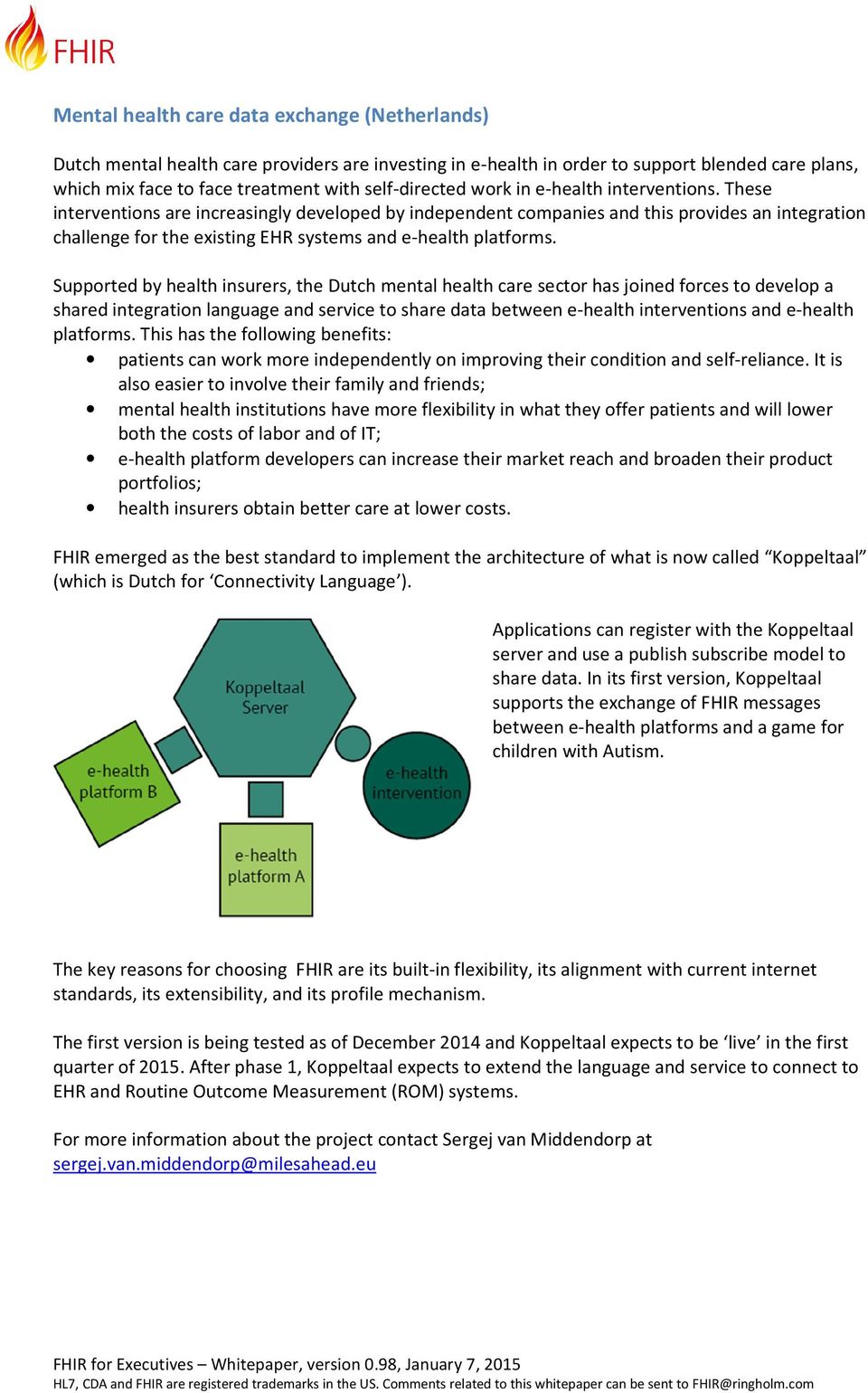
10 Mental health care data exchange (Netherlands) Dutch mental health care providers are investing in e-health in order to support blended care plans, which mix face to face treatment with self-directed work in e-health interventions. These interventions are increasingly developed by independent companies and this provides an integration challenge for the existing EHR systems and e-health platforms. Supported by health insurers, the Dutch mental health care sector has joined forces to develop a shared integration language and service to share data between e-health interventions and e-health platforms. This has the following benefits: patients can work more independently on improving their condition and self-reliance. It is also easier to involve their family and friends; mental health institutions have more flexibility in what they offer patients and will lower both the costs of labor and of IT; e-health platform developers can increase their market reach and broaden their product portfolios; health insurers obtain better care at lower costs. FHIR emerged as the best standard to implement the architecture of what is now called Koppeltaal (which is Dutch for Connectivity Language ). Applications can register with the Koppeltaal server and use a publish subscribe model to share data. In its first version, Koppeltaal supports the exchange of FHIR messages between e-health platforms and a game for children with Autism. The key reasons for choosing FHIR are its built-in flexibility, its alignment with current internet standards, its extensibility, and its profile mechanism. The first version is being tested as of December 2014 and Koppeltaal expects to be live in the first quarter of After phase 1, Koppeltaal expects to extend the language and service to connect to EHR and Routine Outcome Measurement (ROM) systems. For more information about the project contact Sergej van Middendorp at [email protected]
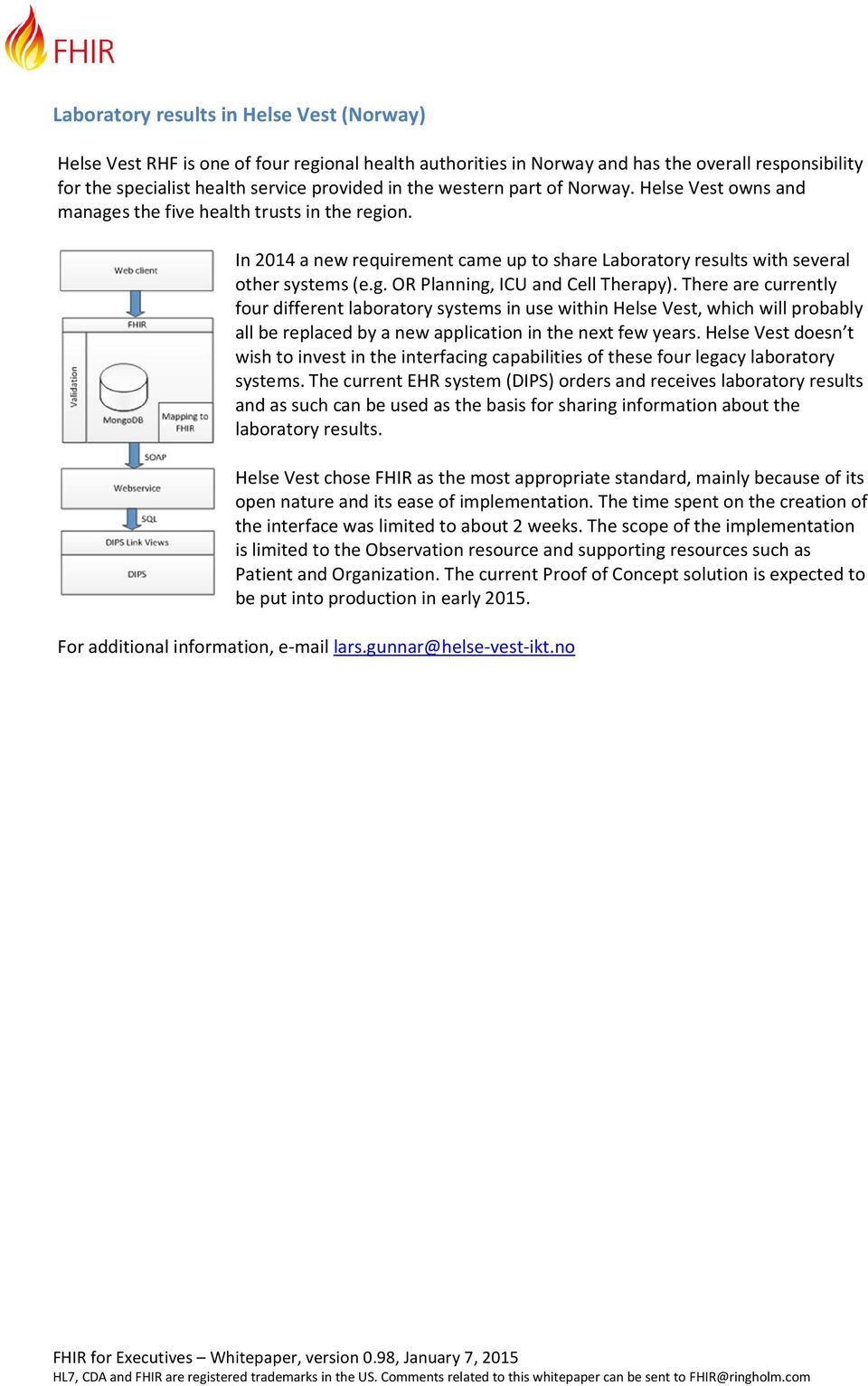
11 Laboratory results in Helse Vest (Norway) Helse Vest RHF is one of four regional health authorities in Norway and has the overall responsibility for the specialist health service provided in the western part of Norway. Helse Vest owns and manages the five health trusts in the region. In 2014 a new requirement came up to share Laboratory results with several other systems (e.g. OR Planning, ICU and Cell Therapy). There are currently four different laboratory systems in use within Helse Vest, which will probably all be replaced by a new application in the next few years. Helse Vest doesn t wish to invest in the interfacing capabilities of these four legacy laboratory systems. The current EHR system (DIPS) orders and receives laboratory results and as such can be used as the basis for sharing information about the laboratory results. Helse Vest chose FHIR as the most appropriate standard, mainly because of its open nature and its ease of implementation. The time spent on the creation of the interface was limited to about 2 weeks. The scope of the implementation is limited to the Observation resource and supporting resources such as Patient and Organization. The current Proof of Concept solution is expected to be put into production in early For additional information, [email protected]
Setting the World on FHIR
 Setting the World on FHIR W. Ed Hammond. Ph.D., FACMI, FAIMBE, FIMIA, FHL7 Director, Duke Center for Health Informatics Director, Applied Informatics Research, DHTS Director of Academic Affairs, MMCi Program
Emerging Technologies That Support Transitions of Care. 8 June 2016 Elaine Remmlinger, Senior Partner, and Robin Settle, Partner
 Emerging Technologies That Support Transitions of Care 8 June 2016 Elaine Remmlinger, Senior Partner, and Robin Settle, Partner Topics of Discussion Drivers of Transitions of Care Technology Perspective:
The Continuity of Care Document. Changing the Landscape of Healthcare Information Exchange
 The Continuity of Care Document Changing the Landscape of Healthcare Information Exchange 1 Electronic Clinical Document Exchange Prior to the approval of the Continuity of Care Document (CCD) as an ANSI
SINTERO SERVER. Simplifying interoperability for distributed collaborative health care
 SINTERO SERVER Simplifying interoperability for distributed collaborative health care Tim Benson, Ed Conley, Andrew Harrison, Ian Taylor COMSCI, Cardiff University What is Sintero? Sintero Server is a
Interoperability for Mobile applications: New IHE profiles
 Interoperability for Mobile applications: New IHE profiles Charles Parisot Member, IHE International Board Chair, IHE European Affairs Committee Manager Standards and Testing, 1 GE Healthcare Deployment
SIF 3: A NEW BEGINNING
 SIF 3: A NEW BEGINNING The SIF Implementation Specification Defines common data formats and rules of interaction and architecture, and is made up of two parts: SIF Infrastructure Implementation Specification
Open Platform. Clinical Portal. Provider Mobile. Orion Health. Rhapsody Integration Engine. RAD LAB PAYER Rx
 Open Platform Provider Mobile Clinical Portal Engage Portal Allegro PRIVACY EMR Connect Amadeus Big Data Engine Data Processing Pipeline PAYER CLINICAL CONSUMER CUSTOM Open APIs EMPI TERMINOLOGY SERVICES
IHE s Contribution to Telecardiology. Nick Gawrit, heartbase Antje Schroeder, Siemens Healthcare Paul Dow, ACC Charles Parisot, GE
 IHE s Contribution to Telecardiology Nick Gawrit, heartbase Antje Schroeder, Siemens Healthcare Paul Dow, ACC Charles Parisot, GE Interoperability: From a problem to a solution Base Standards IETF Profile
EHR Standards Landscape
 EHR Standards Landscape Dr Dipak Kalra Centre for Health Informatics and Multiprofessional Education (CHIME) University College London [email protected] A trans-national ehealth Infostructure Wellness
CommonWell Health Alliance Concepts. Last Modified: October 21, 2014. 2013 2014 CommonWell Health Alliance Inc. All rights reserved.
 CommonWell Health Alliance Concepts Last Modified: October 21, 2014 2013 2014 CommonWell Health Alliance Inc. All rights reserved. 2013 2014 CommonWell Health Alliance Inc. All rights reserved. The CommonWell
New York ehealth Collaborative. Health Information Exchange and Interoperability April 2012
 New York ehealth Collaborative Health Information Exchange and Interoperability April 2012 1 Introductions Information exchange patient, information, care team How is Health information exchanged Value
Data Provenance. Functional Requirements Document: Developed in Response to the Data Provenance Task Force Recommendations. Version 1.
 Data Provenance Functional Requirements Document: Developed in Response to the Data Provenance Task Force Recommendations Version 1.0 May 2015 Version History Version Revision Author Description of Change
The next generation EHR
 The next generation EHR European EHR standard OpenEHR Ocean Informatics Gerard Freriks v1 7-11-2007 Electronic Patient Record What do we expect? We need and expect EHR-systems that: 2 Electronic Patient
EHR Interoperability Framework Overview
 Hospital Health Information System EU HIS Contract No. IPA/2012/283-805 Final version July 2015 Visibility: Public Target Audience: EHR Developers EHR Administrators EPR Systems Developers This document
HL7 FHIR & IHE MHD yet more choices
 HL7 FHIR & IHE MHD yet more choices IHE NL 2012 - Changing the Way Healthcare Connects Presentatie IHE-Jaarcongres Spant!, 9 november 2012 Ewout Kramer Korte Introductie Mijn naam: Ewout Kramer Adviseur
HL7 and Meaningful Use
 HL7 and Meaningful Use Grant M. Wood HL7 Ambassador HIMSS14 2012 Health Level Seven International. All Rights Reserved. HL7 and Health Level Seven are registered trademarks of Health Level Seven International.
Integration Information Model
 Release 1.0.1 The openehr Reference Model a. Ocean Informatics Editors: T Beale a Revision: 0.6 Pages: 15 Date of issue: 22 Jul 2006 Keywords: EHR, reference model, integration, EN13606, openehr EHR Extract
Structured Content: the Key to Agile. Web Experience Management. Introduction
 Structured Content: the Key to Agile CONTENTS Introduction....................... 1 Structured Content Defined...2 Structured Content is Intelligent...2 Structured Content and Customer Experience...3 Structured
An Overview of THINC s Health Information Exchange Initiatives
 An Overview of THINC s Health Information Exchange Initiatives Susan Stuard, Executive Director June 22, 2011 THINC Goals THINC s Goals: 1. HIT Adoption both implementation of EHRs and standing up a health
U.S. Department of Health and Human Services (HHS) The Office of the National Coordinator for Health Information Technology (ONC)
 U.S. Department of Health and Human Services (HHS) The Office of the National Coordinator for Health Information Technology (ONC) econsent Trial Project Architectural Analysis & Technical Standards Produced
I n t e r S y S t e m S W h I t e P a P e r F O R H E A L T H C A R E IT E X E C U T I V E S. In accountable care
 I n t e r S y S t e m S W h I t e P a P e r F O R H E A L T H C A R E IT E X E C U T I V E S The Role of healthcare InfoRmaTIcs In accountable care I n t e r S y S t e m S W h I t e P a P e r F OR H E
Ambulatory Electronic Mental Health Record Solution
 Ambulatory Electronic Mental Health Record Solution with connection to EHR Services, delivers patient centered care model and platform for service delivery June 2014 Partners Mackenzie Health and Southlake
Simplifying the Interface Challenge in Healthcare. Healthcare Software Provider or Medical Device Manufacturer s Approach to Healthcare Integration
 Simplifying the Interface Challenge in Healthcare Healthcare Software Provider or Medical Device Manufacturer s Approach to Healthcare Integration Providers, application software developers, and medical
CommonWell Health Alliance Interoperability for the Common Good. Scott Stuewe - Director, Cerner Network NCHICA Annual Conference
 CommonWell Health Alliance Interoperability for the Common Good Scott Stuewe - Director, Cerner Network NCHICA Annual Conference Imagine the internet without Google Interoperability Interoperability occurs
GE Healthcare. ehealth: Solutions to Transform Care Delivery
 GE Healthcare ehealth: Solutions to Transform Care Delivery This presentation does not constitute a representation or warranty or documentation regarding the product or service featured. All illustrations
BT One. Analyst and consultant update, September 2012. BT One. Communications that unify 1
 BT One Analyst and consultant update, September 2012 BT One. Communications that unify 1 BT One Agenda Introductions Neil Sutton Vice President Global Portfolio BT One Overview Andrew Small Vice President
IBM Software. IBM Initiate: Delivering Accurate Patient and Provider Identification for Canadian Electronic Health Records
 IBM Software IBM Initiate: Delivering Accurate Patient and Provider Identification for Canadian Electronic Health Records IBM Initiate: Delivering Accurate Patient and Provider Identification for Canadian
SavvyDox Publishing Augmenting SharePoint and Office 365 Document Content Management Systems
 SavvyDox Publishing Augmenting SharePoint and Office 365 Document Content Management Systems Executive Summary This white paper examines the challenges of obtaining timely review feedback and managing
IHE Australia Workshops July 2011. Prepared by: Heather Grain Chair: Standards Australia IT14 Health Informatics and Ehealth Education
 IHE Australia Workshops July 2011 Prepared by: Heather Grain Chair: Standards Australia IT14 Health Informatics and Ehealth Education Standards are key to healthcare at all levels service, fiscal, administrative
Implementing Effective Data Exchange with The CommonWell Health Alliance
 Implementing Effective Data Exchange with The CommonWell Health Alliance Ralph Tenney - CIO, St. John Providence Health System, Detroit Rick McCarthy CIO, St. Vincent s Medical Center, Bridgeport. Bobby
Gigya Pricing Proposal
 Gigya Pricing Proposal Gigya provides websites and apps with a complete social infrastructure that creates immersive social experiences for users, and provides unparalleled customer insights for businesses.
There has to be more: iconnect Blends XDS and Image Exchange. A Merge White Paper
 There has to be more: iconnect Blends XDS and Image Exchange A Merge White Paper The Challenge You wouldn t buy a new home without seeing it. A mechanic wouldn t troubleshoot your car without first looking
HL7 and Service-oriented Architecture (SOA) Ambassador Briefing
 HL7 and Service-oriented Architecture (SOA) Ambassador Briefing Topics Understanding Service-oriented Architecture (SOA) The case for Healthcare SOA Standards Introducing HSSP Status of Standards Work
Image Enabled EMR / EHR
 Image Enabled EMR / EHR A strategic approach to EMR integration and interoperability for diagnostic imaging and related reports The Challenge: In healthcare, imaging is routinely used as a tool for patient
BEST PRACTICES FOR MANAGING THE EVOLUTION OF EHRS
 E-Guide BEST PRACTICES FOR MANAGING THE EVOLUTION OF EHRS SearchHealthIT W ith a focus on, the next wave of EHRs will incorporate powers of big data, speech recognition and new database models. This eguide
The Healthcare Services Platform Consortium
 The Healthcare Services Platform Consortium 1 FEBRUARY 24, 2015 STANLEY M. HUFF, MD CHIEF MEDICAL INFORMATICS OFFICER INTERMOUNTAIN HEALTHCARE HSPC Mission Statement 2 Improve health by creating a vibrant,
Regionale uitwisseling van medische gegevens (IHE)
 Regionale uitwisseling van medische gegevens (IHE) Sessie B (10:50-11:50) Nieuwegein, 20 mei 2014 René Spronk Trainer / Senior Consultant Ringholm bv Haarlem, the Netherlands Tel. +31 (0)33 7 630 636 email:
STATE OF CONNECTICUT State Innovation Model Health Information Technology (HIT) Council Answers to Questions for Zato
 STATE OF CONNECTICUT State Innovation Model Health Information Technology (HIT) Council Answers to Questions for Zato The HIT Design Group has identified the set of questions listed below to better understand
SCHIEx: The South Carolina Health Information Exchange Update
 Improving the quality, safety, and efficiency of health care in South Carolina SCHIEx: The South Carolina Health Information Exchange Update May 22, 2012 SCHA HIT Summit Dr. David Patterson Chief, Health
MEDHOST Integration. Improve continuity of care, resulting in more informed care decisions
 Improve continuity of care, resulting in more informed care decisions Integration Data exchange, visibility, timeliness and mobility directly influence patient safety and satisfaction, care transitions,
Top Inpatient Electronic Health Records Vendors
 Part One: Aggregate Black Book EHR Survey Findings 0 Top Inpatient Electronic Health Records Vendors Part One: Aggregate Black Book Survey Findings Part Two: Comparative Performance Result Set of Top EHR
Emerging Technologies Shaping the Future of Data Warehouses & Business Intelligence
 Emerging Technologies Shaping the Future of Data Warehouses & Business Intelligence Service Oriented Architecture SOA and Web Services John O Brien President and Executive Architect Zukeran Technologies
5 Steps to Choosing the Right BPM Suite
 5 Steps to Choosing the Right BPM Suite BPM Suites can deliver significant business benefits and a fast ROI but only if you choose the right one By Laura Mooney, Metastorm Copyright 2009, Metastorm Inc.
The 2015 Cloud Readiness Survey for Australian Accounting Firms
 The 2015 Cloud Readiness Survey for Australian Accounting Firms HOW FAR HAVE ACCOUNTANTS TRAVELLED TOWARDS CLOUD ACCOUNTING? A DIGITAL FIRST REPORT FOR SAGE AUSTRALIA Contents Cloud Readiness Survey 1
What You Need to Know About Transitioning to SOA
 What You Need to Know About Transitioning to SOA written by: David A. Kelly, ebizq Analyst What You Need to Know About Transitioning to SOA Organizations are increasingly turning to service-oriented architectures
7th Annual Ambulatory PM & EHR Study. HIMSS Analytics
 7th Annual Ambulatory PM & EHR Study HIMSS Analytics October 2015 1 Contents Executive Summary 3 Methodology 4 Findings EHR/EMR 5 Definition 5 Market Penetration/Growth 5 Timeframe of Purchase 8 Vendor
White paper Reaping Business Value from a Hybrid Cloud Strategy
 White paper Fujitsu Hybrid Cloud Services White paper Reaping Business Value from a Hybrid Cloud Strategy How to embrace a hybrid cloud model to maximize the benefits of public and private cloud services
Enterprise Mobility Space
 MBaaS How MBaaS is Shaping up the Enterprise Mobility Space A RapidValue Solutions Whitepaper Contents Executive Summary... What is Mobile Backend as a Service (MBaaS)?... Primary Building Blocks of MBaaS...
ELECTRONIC HEALTH RECORDS. Nonfederal Efforts to Help Achieve Health Information Interoperability
 United States Government Accountability Office Report to Congressional Requesters September 2015 ELECTRONIC HEALTH RECORDS Nonfederal Efforts to Help Achieve Health Information Interoperability GAO-15-817
Mitra Innovation Leverages WSO2's Open Source Middleware to Build BIM Exchange Platform
 Mitra Innovation Leverages WSO2's Open Source Middleware to Build BIM Exchange Platform May 2015 Contents 1. Introduction... 3 2. What is BIM... 3 2.1. History of BIM... 3 2.2. Why Implement BIM... 4 2.3.
Cerner s Approach to Interoperability:
 Cerner s Approach to Interoperability: Enterprise Device Communication Health Information Exchange Network TM Introduction The seismic shift taking place in the health care industry has created an environment
The Healthcare Services Platform Consortium
 The Healthcare Services Platform Consortium JULY 31, 2014 STANLEY M. HUFF, MD CHIEF MEDICAL INFORMATICS OFFICER INTERMOUNTAIN HEALTHCARE Suggested National Strategy Develop truly interoperable data services
Building Regional and National Health Information Systems. Mike LaRocca
 Building Regional and National Health Information Systems Mike LaRocca Agenda What are the key use cases driving New York? What is the SHIN-NY NY and its architecture? What standards and protocols were
White Paper. Bridging the essential gap between Mobile Cloud and crowd based testing. 1. Introduction. 2. Testing Lifecycle
 White Paper Bridging the essential gap between Mobile Cloud and crowd based testing 1. Introduction 2. Testing Lifecycle a. Testing typologies (Functional, Usability) b. Functional Testing: Manual
Consolidated Clinical Document Architecture and its Meaningful Use Nick Mahurin, chief executive officer, InfraWare, Terre Haute, Ind.
 Consolidated Clinical Document Architecture and its Meaningful Use Nick Mahurin, chief executive officer, InfraWare, Terre Haute, Ind. Helping Doctors Regain Their Voice SM A Whitepaper for the Healthcare
Oracle WebCenter Sites Mobility Server Enabling exceptional mobile and tablet web applications and web sites without compromise
 Oracle WebCenter Sites Mobility Server Enabling exceptional mobile and tablet web applications and web sites without compromise Mobility Server offers state-of-the-art technology and a comprehensive solution
ISO 18308 INTERNATIONAL STANDARD. Health informatics Requirements for an electronic health record architecture
 INTERNATIONAL STANDARD ISO 18308 First edition 2011-04-15 Health informatics Requirements for an electronic health record architecture Informatique de santé Exigences relatives à une architecture de l'enregistrement
XDS-I - CROSS-ENTERPRISE DOCUMENT SHARING FOR IMAGING
 Technical White Paper XDS-I - CROSS-ENTERPRISE DOCUMENT SHARING FOR IMAGING Physicians, nurses, administrators and other healthcare professionals foresee a day when vital information can flow seamlessly
Big Data: Overview and Roadmap. 2015 eglobaltech. All rights reserved.
 Big Data: Overview and Roadmap 2015 eglobaltech. All rights reserved. What is Big Data? Large volumes of complex and variable data that require advanced techniques and technologies to enable capture, storage,
Getting value Changing the way people communicate and how businesses can take advantage of new opportunities.
 Introduction The social revolution: what s the business opportunity? Getting value Changing the way people communicate and how businesses can take advantage of new opportunities. Roadmap to success Modern
Streamlining Medical Image Access and Sharing: Integrating Image Workflow and Patient Referrals
 Streamlining Medical Image Access and Sharing: Integrating Image Workflow and Patient Referrals By Ken H. Rosenfeld, President, ; January 2014 WHITE PAPER Introduction Managing transitions of care continues
IBM Software Universal Health Identifiers: Issues and Requirements for Successful Patient Information Exchange
 IBM Software Universal Health Identifiers: Issues and Requirements for Successful Patient Information Exchange Lorraine Fernandes, RHIA Scott Schumacher, Ph.D. Universal Health Identifiers: Issues and
Electronic Health Network - Case Study Consent2Share Share with Confidence
 Electronic Health Network - Case Study Consent2Share Share with Confidence Jan 2015 About Consent2Share Complying with privacy regulations in an electronic environment is a very complex process. The Consent2Share
E-HEALTH PLATFORMS AND ARCHITECTURES
 E-HEALTH PLATFORMS AND ARCHITECTURES E-Government Andreas Meier Nicolas Werro University of Fribourg Alfredo Santa Cruz 19.01.2007 Contents 1. Introduction 2. Existing Capabilities and Strategic Approach
Modern App Architecture for the Enterprise Delivering agility, portability and control with Docker Containers as a Service (CaaS)
 Modern App Architecture for the Enterprise Delivering agility, portability and control with Docker Containers as a Service (CaaS) Executive Summary Developers don t adopt locked down platforms. In a tale
How To Understand The Benefits Of Cloud Computing
 Issue in Focus: Assessing the Cloud PLM Opportunity Evaluating Benefits, Requirements, and Considerations Tech-Clarity, Inc. 2012 Table of Contents Introducing the Issue... 3 The Cloud Meets PLM... 3 Evaluating
KMG Healthcare IT Solutions Case Studies
 KMG Healthcare IT Solutions Case Studies Introduction Key Management Group, Inc. is global healthcare IT solutions provider for practices, hospitals and medical centers. Our mission is to help businesses
Cloud-based Identity and Access Control for Diagnostic Imaging Systems
 Cloud-based Identity and Access Control for Diagnostic Imaging Systems Weina Ma and Kamran Sartipi Department of Electrical, Computer and Software Engineering University of Ontario Institute of Technology
Ontario s ehealth Blueprint
 Ontario s ehealth Blueprint Narration The central themes of Ontario s ehealth Blueprint are connectivity, innovation and a commitment to improve patient care and care outcomes. Through these themes and
Clinical Mapping (CMAP) Draft for Public Comment
 Integrating the Healthcare Enterprise 5 IHE Patient Care Coordination Technical Framework Supplement 10 Clinical Mapping (CMAP) 15 Draft for Public Comment 20 Date: June 1, 2015 Author: PCC Technical Committee
Implementation of FHIR at University of Michigan
 Implementation of FHIR at University of Michigan Early forays into one future of interoperability Connecting Michigan for Health 6 5 2015 Andrew Rosenberg MD CMIO University of Michigan Health System The
Billing and Payment with the Elastic Path Ecommerce Platform
 Billing and Payment with the Elastic Path Ecommerce Platform The Elastic Path Ecommerce Platform As the industry s most open and flexible ecommerce platform, Elastic Path is the right solution for large
Post-Implementation EMR Evaluation for the Beta Ambulatory Care Clinic Proposed Plan Jul 6/2012, Version 2.0
 1. Purpose and Scope Post-Implementation EMR Evaluation for the Beta Ambulatory Care Clinic Proposed Plan Jul 6/2012, Version 2.0 This document describes our proposed plan to conduct a formative evaluation
Applicant Guide to EMR Certification
 Applicant Guide to EMR Certification Updated December 2015 Contact us at: Email: [email protected] Phone: (204) 926-3482 Table of Contents Introduction... 2 About this guide Manitoba s agent Certification
From HITSP to HL7 EHR System Function and Information Model (EHR-S FIM) Release 3.0 Interoperability Specifications a Ten Year Journey
 From HITSP to HL7 EHR System Function and Information Model (EHR-S FIM) Release 3.0 Interoperability Specifications a Ten Year Journey [email protected], EHR WG Co-Chair [email protected]
Table of Contents. Preface... 1. 1 CPSA Position... 2. 1.1 How EMRs and Alberta Netcare are Changing Practice... 2. 2 Evolving Standards of Care...
 March 2015 Table of Contents Preface... 1 1 CPSA Position... 2 1.1 How EMRs and Alberta Netcare are Changing Practice... 2 2 Evolving Standards of Care... 4 2.1 The Medical Record... 4 2.2 Shared Medical
NASCIO EA Development Tool-Kit Solution Architecture. Version 3.0
 NASCIO EA Development Tool-Kit Solution Architecture Version 3.0 October 2004 TABLE OF CONTENTS SOLUTION ARCHITECTURE...1 Introduction...1 Benefits...3 Link to Implementation Planning...4 Definitions...5
Electronic Health Records: A Global Perspective. Overview
 Electronic Health Records: A Global Perspective Overview Steve Arnold, MD, MS, MBA, CPE Joseph Wagner, MPA, FHIMSS Susan J Hyatt, BSc (PT), MBA Gary M. Klein, MD, MPH, MBA And the Global EHR Task Force
R e p o r t D e s c r i p t i o n. T a b l e o f C o n t e n t s. L i s t o f T a b l e s. S a m p l e T a b l e s. R e l a t e d R e p o r t s
 PH 1618 $4650 2011 U.S. ELECTRONIC MEDICAL RECORDS (EMR - PHYSICIAN OFFICE & HOSPITAL) MARKET Emerging Trends (Smart Cards, Speech Enabled EMR), Market Share, Winning Strategies, Adoption & Forecasts Till