
Premier s Department of NSW. New South Wales
|
|
|
- Sylvia Underwood
- 10 years ago
- Views:
Transcription
1 Premier s Department of NSW New South Wales
2 workforce planning: a guide Premier s Department of NSW 1
3 Workforce Planning: A Guide NSW Premier s Department Public Employment Office 2003 Level 15 Bligh House 4-6 Bligh Street SYDNEY NSW 2000 Cataloguing-Publication entry Civil Service New South Wales Personnel Management Public Administration New South Wales ISBN Thank you to Kathleen Caden former manager of the Workforce Profile Unit. This guide forms part of the Workforce Planning Project and was written by Cecily McGee and Joanne McGill with assistance from Jane Ford. This document can be accessed from the NSW Premier s Department Internet site at and it is the first in a series of planned resources and reports on workforce planning issues. Please check the website for updates. Enquires regarding this guide can be directed to: Public Employment Office NSW Premier s Department Telephone: Facsimile: [email protected] 2
4 TABLE OF CONTENTS Workforce Planning: A Guide for NSW Public Sector Agencies... 6 Step 1 Scoping the Project Step 2 Identifying Labour Demand Step 3 Identifying Labour Supply Step 4 Analysing Gaps and Issues Step 5 Developing an Action Plan and Strategies Step 6 Implementing Workforce Planning Step 7 Monitoring and Evaluation Conclusion Case Studies Appendices TABLE OF CONTENTS 3

5 FOREWORD Premier s Department New South Wales I am pleased to release Workforce Planning: A Guide as part of the Premier s Department s strategy to assist agencies plan and manage their workforce. The use of workforce planning is a vital management tool and is growing in use across the NSW public sector. Some agencies are quite advanced and have developed sophisticated modelling techniques to plan and predict their workforce needs. Others are just beginning that process. The guide aims to assist agencies start or continue this important process. Of course, these endeavours must fit within the current public sector legislative and policy framework and take account of the changing demographics and needs of the workforce itself. Consultation with staff and their union representatives is also an essential element in the successful development and implementation of workforce plans. The guide is primarily aimed at those responsible for the forward planning of service provision to enable agencies meet future service requirements and improve the delivery of services. I hope that it will also be used to raise awareness and provoke discussion within and between public sector agencies about actively predicting, achieving and maintaining the right workforce. An available, flexible and capable workforce can no longer be assumed. It must be planned. An important underpinning of workforce planning is reliable data on the current workforce. Since 1999, the Review and Reform Division of the Premier s Department has been collecting, collating and analysing workforce data. With the recent restructure within the Premier s Department, responsibility for the collection has now been transferred to the Public Employment Office to ensure a close alignment between the data collection, and public employment and employee relations issues. This data collection is a valuable source of information for the Government and agencies. It provides benchmarking capabilities. It shows us areas of success and concern in the management of our workforces. It shows us trends over time that may prove useful for predictive modelling. 4 FOREWORD

6 The Public Employment Office will keep improving collection mechanisms, data relevance and integrity and associated analytical tools and reporting capacities. The Public Employment Office will also work collaboratively with agencies to provide the information in the most accessible and useful way. This guide has been developed as an additional resource for agencies and is part of an ongoing program of work being undertaken by the Public Employment Office on workforce planning. Future work will include joint projects with agencies and further publications. I recommend all agencies use the guide when embarking on or continuing with workforce planning. I also welcome feedback and suggestions for further work. Col Gellatly Director General FOREWORD 5

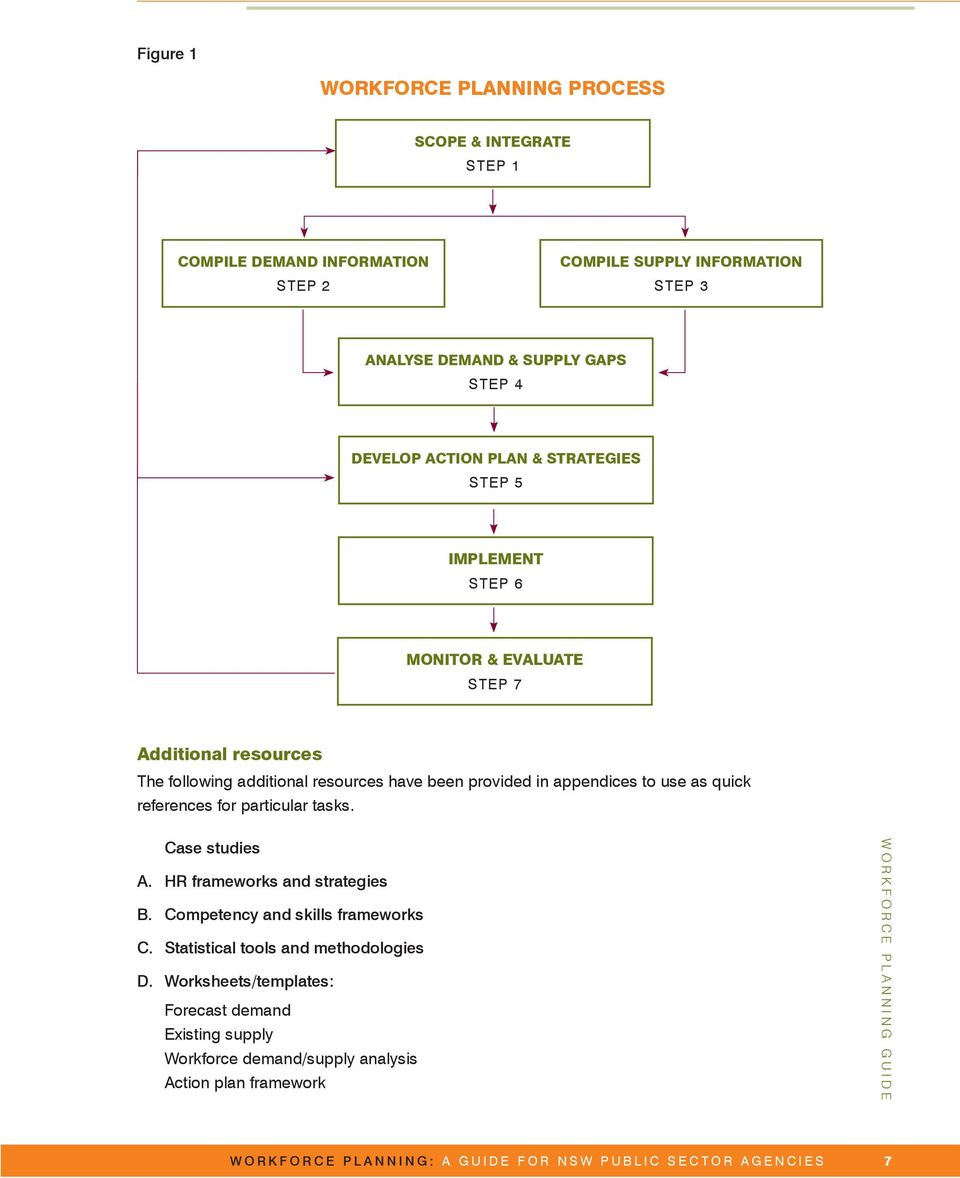
7 WORKFORCE PLANNING: A Guide for NSW Public Sector Agencies Who should use the guide Workforce planning is essential to ensure that the NSW public sector is able to meet future changes and challenges and provide enhanced services to the people of NSW. This guide provides practical assistance to public sector managers for the purposes of planning their workforce. It aims to provide managers with the tools to ensure their workforce is able to meet the current and future service needs of the NSW community in a dynamic economic and social environment. The guide intends to provide a methodology for all NSW Government managers human resource (HR) managers and line managers to enable their agency to have the right people at the right time in the right place. The guide provides a foundation for HR planning, ideas for strategies on recruitment, training, leadership development, succession planning, and mentoring. It also provides a basis for a structured information and evidence based approach to HR planning and workforce development critical for effective long-term planning. There is an increasing need to integrate workforce planning into strategic corporate and business planning, involving all levels of management in the process. Workforce planning also involves adapting and integrating technology, systems and process solutions to use agency resources most effectively. How to use the guide The Workforce Planning Guide outlines why workplace planning is critical to achieving agency outcomes and provides a framework for strategically managing staffing issues. Agencies are encouraged to adapt the framework to their particular service delivery and capability requirements, labour market and regional characteristics. The Workforce Planning framework has seven steps which are discussed in detail and illustrated at Figure Scope the project 2. Compile labour demand information 3. Compile labour supply information 4. Analyse gaps in demand and supply 5. Develop an action plan and strategies 6. Implement the plan 7. Monitor and evaluate the plan 6 WORKFORCE PLANNING: A GUIDE FOR NSW PUBLIC SECTOR AGENCIES

8 Figure 1 WORKFORCE PLANNING PROCESS SCOPE & INTEGRATE STEP 1 COMPILE DEMAND INFORMATION STEP 2 COMPILE SUPPLY INFORMATION STEP 3 ANALYSE DEMAND & SUPPLY GAPS STEP 4 DEVELOP ACTION PLAN & STRATEGIES STEP 5 IMPLEMENT STEP 6 MONITOR & EVALUATE STEP 7 Additional resources The following additional resources have been provided in appendices to use as quick references for particular tasks. Case studies A. HR frameworks and strategies B. Competency and skills frameworks C. Statistical tools and methodologies D. Worksheets/templates: Forecast demand Existing supply Workforce demand/supply analysis Action plan framework WORKFORCE PLANNING: A GUIDE FOR NSW PUBLIC SECTOR AGENCIES 7
9 References Workforce planning guidelines and websites Related NSW public sector guidelines and websites Other references: journal articles and texts Contacts Why do workforce planning? In essence, workforce planning is about predicting future labour market needs. It requires an understanding of the make-up of the current workforce, an investigation into future service needs and an analysis of the type and size of workforce required to meet them. It is becoming increasingly important for agencies as they adopt new ways of operating in order to adapt to changes, such as: a whole of government approach to service delivery new technologies and business systems, including electronic self-service, online transactions and integrated HR data systems a corporate service efficiency emphasis through centralised operations, including shared service delivery an ageing public sector workforce and tighter labour markets in some sectors. Workforce planning will be critical to the NSW public sector as it manages the generational change taking place in the workforce over the next years, labour market supply and demand factors, work and family considerations, and equity and diversity issues. For example, the sector has an older age profile than the private sector labour force. Its workforce is mature aged and significant numbers of senior staff are approaching retirement, which means valuable corporate knowledge could be lost. Figure 2 provides a snapshot of the NSW public sector workforce in WORKFORCE PLANNING: A GUIDE FOR NSW PUBLIC SECTOR AGENCIES

10 Figure 2 From the NSW Public Sector Workforce Profile 2002 Young people aged under 25 accounted for just 4.9% of the public sector workforce, but comprised 17.2% of all employed persons in the State. The separation rate for young people working in the State Government was 22.3% in Employees aged 45 to 54 years constituted 31.8% of the public sector workforce compared to 21.9% of all employed persons in the State. Employees aged over 55 years constituted 12.7% of the NSW public sector workforce. 44.5% of the public sector workforce is aged over 45 and a large proportion of these employees are expected to retire over the next years. The median age of the public sector workforce was 41 years in % of Government employees are based in regional locations, while 32.8% of all employed persons in NSW are regionally based. The challenge will be to ensure that agencies can minimise the costs and seize the opportunities that such generational change brings quicker career progression, effective recruitment, and more flexible job design and workforce deployment. By identifying workforce capabilities on hand now, considering what will be needed in the future and planning systematically, managers can limit the risks associated with unanticipated events. In particular, workforce planning will help agencies to: identify potential problems, manage risk and minimise crisis management cycles contain human resources costs, including the cost of turnover, absenteeism, structural changes and staff movements develop workforce skills that take time to grow make staffing decisions to provide services in regional and rural areas optimise the use of human, financial and other resources integrate human resource management issues into business planning. WORKFORCE PLANNING: A GUIDE FOR NSW PUBLIC SECTOR AGENCIES 9
11 STEP 1 SCOPING THE PROJECT Step 1 is to scope the project, recognising that workforce planning can be done on a range of scales and timeframes. The plan might apply to staffing throughout the agency or on a smaller scale, perhaps on a program basis. Decisions need to be made about what can be achieved with available resources although a tight budget is no reason to postpone workforce planning, as planning programs can be achieved cost effectively. What scale should be used? Workforce analysis can be applied at a range of levels: Full Scale Agency Planning a stand-alone exercise, a sub-set of a corporate plan or part of a broader HR strategy. Single Issue Planning dealing with issues such as losing corporate knowledge when key people retire or introducing a new service area with new skill requirements. This might relate to one group of employees categorised by age or by occupational group, for example. Thumbnail Sketch a scoping exercise using the basic workforce planning steps to determine priority areas for further action or whether to make a more in-depth assessment. How will resourcing affect the project s scale? The scale of an agency s workforce planning exercise depends on the perceived challenges facing the agency and the resources it can allocate to the project. Where budgets are tight agencies might need to further focus their planning project. One option is to introduce workforce planning in a priority work unit or a division and extend this to the whole agency as more resources become available. What timeframe should be used? Ideally workforce planning should adopt a longer term time perspective of 3-5 years into the future, with milestones for reviewing expected outcomes. Longer term projections are particularly important for an agency or clusters of agencies which are newly embarking on this exercise. Integrating workforce & business planning Traditionally, workforce planning has been seen as the domain of HR managers just part of HR planning. Yet increasingly it is recognised that, to be effective, workforce planning needs to be linked to an organisation s corporate or strategic plan. A workforce plan can contribute new information to the strategic and business outlook as it reveals new trends and critical issues. 10 STEP 1 SCOPING THE PROJECT
12 A workforce plan takes into account corporate and business objectives such as financial targets, service delivery objectives and community benefits. It also examines potential external influences over workforce supply and demand. Equally, a good corporate plan integrates human resources and workforce planning goals, ensuring that strategies are visible and measurable in corporate and business plans. Who is responsible? Although an agency head is responsible for the employment of an appropriate workforce, all levels of management have a part to play in the planning and implementation phases. For example, where the plan requires it, line managers will be responsible for facilitating staff development to prepare staff to meet projected needs by assisting with individual personal development plans, career planning, mentoring and staff rotations. Again, the HR team s role will be to support, monitor and oversee the workforce plan and associated strategies as well as to maintain (and adapt where necessary) core HR activities such as recruitment, promotions, training and staff liaison. HR staff will also play an important technical role, providing data, analysing trends and statistics to formulate staff projections. Executive management will be responsible for monitoring at an agency-wide level. Consultation A commitment across all managerial levels is essential for successful workforce planning, to ensure that sufficient resources and time will be allocated to the project. It is important to consult with key stakeholders at an early stage particularly staff and their union representatives. STEP 1 SCOPING THE PROJECT 11

13 Step 1 Checklist Scoping the workforce planning exercise What is the focus of the workforce plan? Why is the agency developing a workforce plan and what does it want to achieve? How much time, how many people, and what budget are available? Is this just for one group of people, a work unit, a division or the whole agency? How will stakeholders (staff and others) views be obtained? Integrating workforce planning Where will the workforce plan fit within the agency s corporate or business planning framework? How will the workforce plan be integrated into the corporate governance framework? Is workforce data incorporated into existing business reporting mechanisms and linked to other management information to help with business planning and day-to-day decision-making? Are human resources policies and strategies aligned with other business activities and directly linked to the overall corporate plan? Are all relevant planning documents integrated and aligned? 12 STEP 1 SCOPING THE PROJECT

14 STEP 2 IDENTIFYING LABOUR DEMAND When you have scoped the project, it is time to consider issues that will affect the agency s demand for staff and skills. This is closely linked to the demand for services by the community, the Government s agenda in relation to service delivery improvement and what current programs and services are delivered. Assessing current requirements means identifying where the organisation is operating effectively to meet service needs and where problems or areas for improvement are already evident. This assessment provides a basis for considering what the organisation might be doing in the future and what skills will be needed. Questions that will help to assess the current situation include the following. Service considerations What services do we currently deliver? What is our core business? How well do we address regional service needs? What do recent client surveys reveal? What are the views of frontline staff on client needs and better ways to provide services? Does the cultural diversity of staff reflect the community it services? Organisational considerations Are there mismatches between the emerging priorities, corporate objectives/strategies and the make-up of the workforce? What structural or other important changes have occurred in other related bodies? What recent regional, economic or social factors should be taken into account? What are the budget or asset parameters? HR and logistical considerations Is the work/service correctly designed? What systems are in place to manage it? Are they effective? What improvements are needed? Are the appropriate numbers of staff employed in the right areas? What skills and attributes (or competencies) are needed to provide the services/do the work? Should job roles and position descriptions be changed? Future demand for labour From here, you can consider what your agency s future labour demands might be. These trigger questions might be used to assess future demand for services: What new or changed services will be needed in the medium-term future? What will good quality service delivery look like? What will be the structure and method of regional service delivery in future years? STEP STEP 2 IDENTIFYING 1 SCOPING LABOUR THE PROJECT DEMAND 13

15 What will be the preferred image of the agency or business unit in 3-5 years? How will the organisation and its business units be structured for tomorrow s business? What segments of the workforce will be crucial to the organisation? Could technology or process re-engineering be used to improve service delivery or use resources more effectively? Analysing potential future demand for labour and skills requires making some predictions about what the agency might look like in the future, what services it might deliver, as well as the environment in which it might operate. This can be done on a large scale or in a targeted fashion. An informed forecast of demand for labour in terms of staff numbers, categories, capabilities and skills, relies on a mixture of quantitative and qualitative data about the future environment and future demand for services. A number of methods for developing assumptions and predictions can be used, including scenarios and business driver analysis. Scenarios Scenarios or stories about possible futures provide an open-ended or blue-sky way of considering alternative workforce situations and they are particularly suited to public sector activities that are wide in scope and subject to discontinuity and surprises. Scenarios can be useful for: canvassing changing community expectations working through implications of possible major changes, such as a change of minister or reallocation of service responsibilities between agencies considering a range of government policies or legislation from different perspectives thinking through technological impacts on service delivery considering external and flow-on factors, particularly where parts of an agency are working in partnership with other agencies or external groups creating shared views about important issues and priorities. One commonly used method of predicting the future environment involves scanning external influences such as political, economic, environmental, social and technological factors. This is a PEEST analysis. 1 External factors that can be taken into consideration include: Demographic, Economic and Social Trends to analyse the need for new staff caused by an ageing population or geographic population shifts. These can be found through the NSW Workforce Profile data and reports, Australian Bureau of Statistics (ABS) surveys and specialist academic research. 1 NSW Council on the Cost and Quality of Government, Provisional Program Review Methodology, Annual Report 2000, p STEP 12 SCOPING IDENTIFYING THE LABOUR PROJECT DEMAND
16 Industry and Professional Trends to identify the need for new processes, materials or information and communications technology (ICT). These can be found via ABS surveys, specialist conferences and the Australian Journal of Public Administration. Technology, Processes and Systems to analyse new staffing requirements following technological and new service delivery methods. These can be found via the media, specialist publications, seminars, conferences, and professional and industry bodies. Government Legislation and Policy to understand the parameters and ensure initiatives comply with Government s policy and legislative framework as well as to assess the impact of the broader public sector on an agency s workforce. This can be found in legislation, Government reports, Green Papers, Parliamentary Inquiry reports, audit reports, annual reports, media releases, speeches, Premier s and Ministerial memoranda, circulars and guidelines. Depending on the reliability of the information available for assumptions and forecasts, a range of predictions, such as best case, no change and worst case scenarios, can be developed. Key business drivers Alternatively, a more focused business driver approach might be used to predict future organisational and staff requirements. Key business drivers will include a list of external and internal factors to be monitored as indicators of the agency s success in meeting its objectives. These indicators might include: New business opportunities Corporate services improvement Service level agreements Electronic commerce Technology (internal) Budget allocations Culture of the organisation Ethical behaviour Risk management Legislation Business process rationalisation Regionalisation 2 Future demand for services You will then be in a position to make assumptions about future demand for services based on information drawn from corporate plans, business plans and demographic, industry, technology and whole of government indicators. A range of quantitative and qualitative methods can be used to predict staff numbers and identify future demand for competencies and skills. Case studies give concrete examples of how different agencies have forecast demand for labour. In addition, a summary of useful statistical and forecasting tools is provided in Appendix C. 2 Examples of business drivers are from the NSW Treasury, Office of State Revenue, Workforce Plan Effectively Planning our Workforce Needs, (unpublished). STEP STEP 2 IDENTIFYING 1 SCOPING LABOUR THE PROJECT DEMAND 15

17 Step 2 Checklist Current demand for staffing resources Does the agency understand its clients and projected changing needs? What do recent client surveys reveal? What do frontline staff think about client needs and better ways to provide services? How does the agency address regional service needs? What work is being done and does it need to be done? Are staff numbers correctly allocated to the right tasks? Does the agency efficiently use its people, skills and attributes? What skills are currently vital to enable the agency to achieve its goals and objectives? What systems does the agency have in place and are they effective? Could technology or process re-engineering improve service delivery or reduce costs? Future demand for staffing resources How is the agency s work expected to change (e.g. through changes in mission/goals, technology, new/terminated programs or functions, and shifts to contracting out)? How will this affect staff? What trends, such as demand for increased accountability or regulatory changes, will have HR implications? How will changes in other related bodies affect the agency? What new or changed services will be needed in the medium term? What will be future best practice for the agency s operations and services? What will be the structure and method of service delivery in future years? Has the agency identified a set of skills/capabilities that are considered to be essential to the delivery of business outcomes in the future? What new skills will the agency need in the next five years and which skills will be less important? 16 STEP 12 SCOPING IDENTIFYING THE LABOUR PROJECT DEMAND

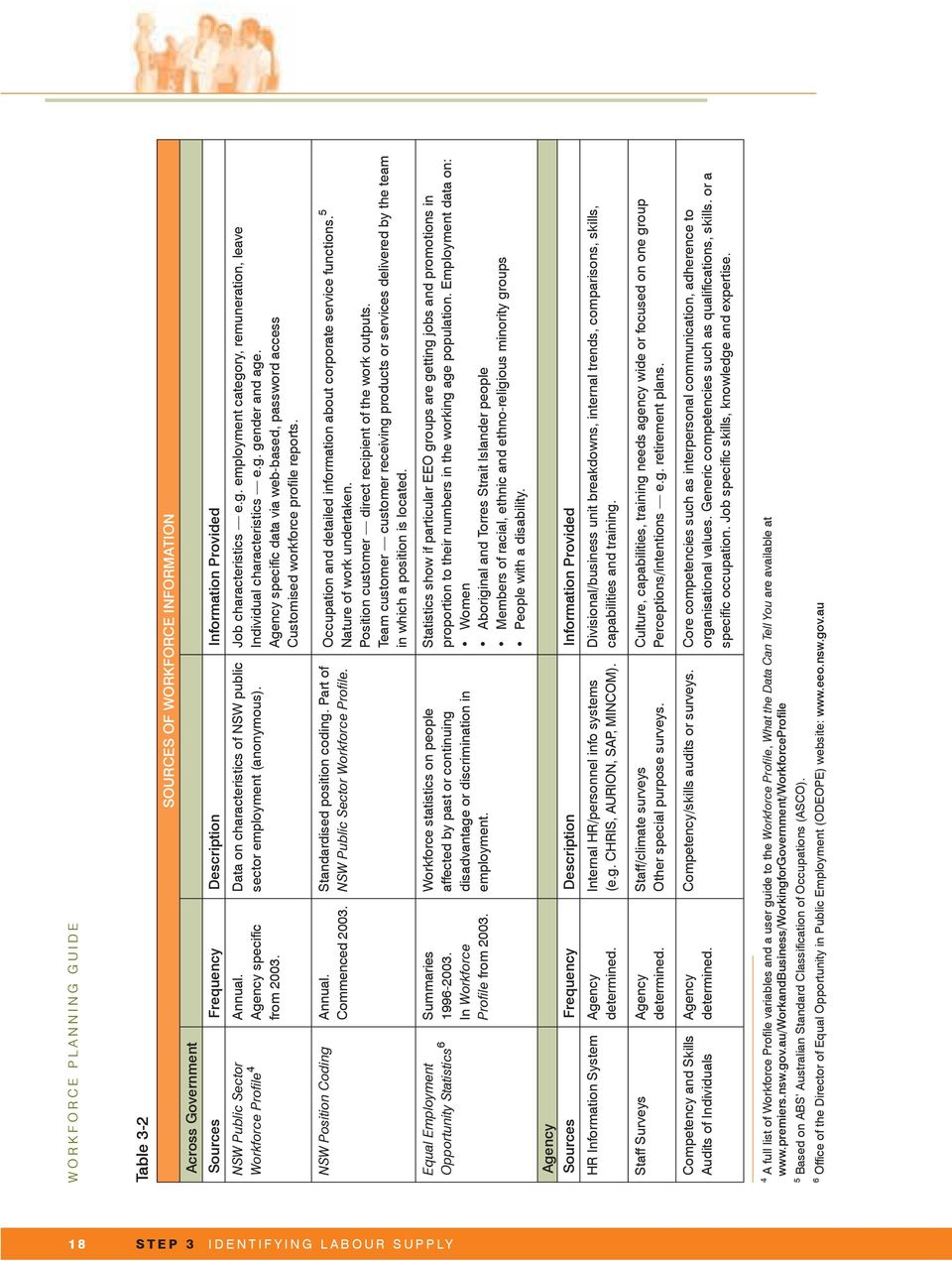
18 STEP 3 IDENTIFYING LABOUR SUPPLY With an understanding of the issues that might affect your agency s demand for labour, you can then assess what staff numbers and capabilities are available now and in the future. Assessing current labour supply An audit of current labour supply will provide a snapshot of the number, characteristics, jobs, skills and abilities of employees in the agency as listed below. 3 Job characteristics (skills & occupation) Salary rates and on-costs Hours of work Overtime hours/flex hours Leave liabilities Awards/agreements Employment mode (full-time, part-time) Employment status (permanent, temporary, casual, contract) Occupations Qualifications Skills/capabilities Training Job location Workforce size and location Number of employees headcount and full-time equivalent (FTE) Number of short-term staff (temporary/casual/contract, etc) Staff location Individual characteristics (demographics) Age profile Gender profile Other EEO factors profile Length of service Grades/classification of employees Recruitment and retention rates Depending on the scale of the planning to be undertaken, some characteristics will be more necessary than others. Sources of workforce information Table 3-2 shows where workforce information for NSW Government agencies can be found, from inside the agency and throughout the NSW public sector. Quantitative research Quantitative HR research incorporates HR data, trends, and forecasts into the workforce analysis to establish an evidence-based approach to planning. This helps to dispel any widely held misconceptions. For example, quantitative data can reveal that issues thought to relate to a large part of the organisation or to all staff, in fact, apply to a relatively small group. This will help to clarify decisions about priorities. Quantitative analysis provides a benchmarking framework, enabling comparisons with other NSW and interstate agencies, private sector organisations and/or professional/industry groups. This analysis can point to best-practice strategies. 3 Lists compiled by HR-Tech Consulting Pty Ltd for NSW Environment Protection Authority, March STEP STEP 3 IDENTIFYING 1 SCOPING LABOUR THE PROJECT SUPPLY 17

19 Table 3-2 SOURCES OF WORKFORCE INFORMATION Across Government Sources Frequency Description Information Provided NSW Public Sector Annual. Workforce Profile 4 Agency specific from Data on characteristics of NSW public sector employment (anonymous). Job characteristics e.g. employment category, remuneration, leave Individual characteristics e.g. gender and age. Agency specific data via web-based, password access Customised workforce profile reports. NSW Position Coding Annual. Commenced Standardised position coding. Part of NSW Public Sector Workforce Profile. Occupation and detailed information about corporate service functions. 5 Nature of work undertaken. Position customer direct recipient of the work outputs. Team customer customer receiving products or services delivered by the team in which a position is located. Equal Employment Opportunity Statistics 6 Summaries In Workforce Profile from Workforce statistics on people affected by past or continuing disadvantage or discrimination in employment. Statistics show if particular EEO groups are getting jobs and promotions in proportion to their numbers in the working age population. Employment data on: Women Aboriginal and Torres Strait Islander people Members of racial, ethnic and ethno-religious minority groups People with a disability. Agency Sources Frequency Description Information Provided HR Information System Agency determined. Internal HR/personnel info systems (e.g. CHRIS, AURION, SAP, MINCOM). Divisional/business unit breakdowns, internal trends, comparisons, skills, capabilities and training. Staff Surveys Agency determined. Staff/climate surveys Other special purpose surveys. Culture, capabilities, training needs agency wide or focused on one group Perceptions/intentions e.g. retirement plans. Competency and Skills Audits of Individuals Agency determined. Competency/skills audits or surveys. Core competencies such as interpersonal communication, adherence to organisational values. Generic competencies such as qualifications, skills. or a specific occupation. Job specific skills, knowledge and expertise. 4 A full list of Workforce Profile variables and a user guide to the Workforce Profile, What the Data Can Tell You are available at 5 Based on ABS Australian Standard Classification of Occupations (ASCO). 6 Office of the Director of Equal Opportunity in Public Employment (ODEOPE) website: 18 STEP 13 SCOPING IDENTIFYING THE LABOUR PROJECT SUPPLY
20 Auditing capability and skills The internal labour supply is best assessed by considering your agency s organisational capability, 7 together with assessments of the competencies of individual employees or positions. Traditionally, human resource planning has focused on individual development, rather than on identifying future workforce needs and developing the capability of the agency as a whole. While an agency needs high-performing people with desirable skills, attributes and behaviours, it is equally important to enhance capabilities that will support broader strategic goals. 8 Organisational or corporate capability involves an organisation s capacity to effectively meet its business objectives. The factors that contribute to corporate capability include culture and values, business processes and management systems (which are demand rather than supply factors), work organisation and the ability of individual employees. Taking an organisational perspective of the workforce can help to ensure that capabilities are embedded in the practices, processes, systems, culture and technologies of the agency. Ideally, these capabilities will remain with the agency despite staff turnover. 9 In this context, agencies can use two methods to assess labour supply: competency frameworks and skills audits. Competency frameworks Competency, capability or skills frameworks identify the right mix of staff in an agency in one matrix. 10 A competency framework might simply list desirable core and job characteristics that employees are expected to possess, or to develop in future. These may be provided in job packages when public sector positions are advertised, or utilised more broadly to inform capability development needs. Competencies can be broken into at least two levels core (or generic) and job specific competencies: Core Competencies apply across the organisation (e.g. adherence to organisational values, ethical behaviour, communication skills, commitment to organisational objectives). Generic Competencies apply to one business unit, division or professional group (e.g. professional qualification, customer relations, policy, analytical or statistical skills). Generic and core competencies may be the same category depending on the type of organisation. Job Specific Criteria are detailed skills, knowledge and expertise required by particular positions. 7 Terms such as capability, competency, competence and skills are used almost interchangeably in this guide. They encompass behavioural characteristics such as initiative and leadership (capabilities), as well as knowledge and technical expertise (skills). 8 Australian National Audit Office, Planning for the Workforce of the Future, March 2001, p Ibid. Also Gary Hamel & CK Pralahad, Competing for the Future, Harvard Business School Press, Boston 1994, Ch.9, 10 Example at Appendix B. See also the Public Sector Management Office, NSW Executive Capabilities, NSW Premier s Department, May 2000 and Public Sector Management Office, Implementation of National Training Packages A Tool Kit for NSW Government Agencies, NSW Premier s Department, June 2000 STEP STEP 3 IDENTIFYING 1 SCOPING LABOUR THE PROJECT SUPPLY 19

21 Skills audits Skills inventories can be built up from existing HR information. To gain a more comprehensive and current picture of staff capabilities, you might need to conduct a staff survey or to add questions on skills to a regular staff or climate survey. In most organisations, a complete audit of all staff skills would be time-consuming, expensive and quickly outdated. Skills audits are therefore commonly targeted towards selected business areas, locations, age groups or to a particular problem or priority. More detail on competency frameworks and skills audits can be found in Appendix B. Assessing external labour supply Once you have considered the skills available within your agency, you might also consider how to secure appropriate skills externally to meet your expected demand. Current external labour market conditions can be considered in terms of: recruits (numbers and skills) to replace staff who leave, or to meet organisational growth contingent/temporary workforce to meet demand for specialist/technical skills, for timelimited project needs, or to cover other staff absences. Sources of this external labour market information include recent recruitment experience of the agency, industry and professional bodies as well as ABS labour force 11 and education and training data. In rural and regional areas an agency may consider surveying the local and potential labour market to assess availability and skills development requirements. Examination of the external labour market might also include consideration (in keeping with the NSW Public Employment and Management Act 2002 and its guidelines) of temporary, casual, contract and consultant employees for short-term assistance. Details of the NSW Government s period and panel contracts for temporary staff are available from NSW State Procurement. 12 Identifying future labour supply Identifying future labour supply issues involves analysing labour force trends inside your agency and in the external labour market. It might also involve some scenario planning. Supply forecasting exercises are intended to: provide an understanding of whether it is safe to assume past trends will continue determine which current staffing trends might continue at the same rate and which might increase or decline provide local knowledge about potential organisational change improve managers understanding of staff intentions (e.g. training, career plans, and retirement). 11 ABS, Labour Force Australia, Cat No ; Education and Training Australia, Cat No , information and user guides 20 STEP 13 SCOPING IDENTIFYING THE LABOUR PROJECT SUPPLY
22 Analysing workforce trends is a useful way of identifying potential labour supply issues, such as skills shortages. Workforce data can be used to examine trends, such as: Separation rates Mobility within the agency Turnover rates Retention rates Vacancy patterns Retirement patterns Promotion patterns Workload patterns Leave patterns sick leave, long service, family, and parental leave Time taken to recruit Skills shortages and oversupply Achievement of EEO targets Wages and salary costs, turnover costs The NSW Workforce Profile gives workforce snapshots that provide a basis from which to identify possible problem areas and to set research priorities. All state governments have standard workforce databases, which means that an agency can benchmark its age profile, staff mobility and absenteeism data against other NSW agencies and with other states. A more detailed model of current and expected agency staff movements can be constructed from internal HR information systems and other sources such as staff records. Data sources might include managers estimates, data analysis tools such as worksheets, matrices, two or three dimensional spreadsheets and standard modelling and statistical procedures. For example, staff models based on Excel software enable what if analysis of the current staff profile, allowing predictions of future supply for periods of 5-10 years. These models can be used to test the impact of various HR strategies, such as targeted recruitment, increasing or decreasing turnover, and restructuring. Many agencies engage external HR consultants to develop a workforce/staffing model if they do not have the in-house resources to create such a tool. STEP STEP 3 IDENTIFYING 1 SCOPING LABOUR THE PROJECT SUPPLY 21
23 Step 3 Checklist Current supply what does the current workforce look like? Are key demographic data available to develop a profile of the current workforce? Is workforce data collected on an ongoing basis? What patterns are evident from the workforce data and are they uniform across the agency? Is the current workforce profile used as a baseline against which future changes in the agency s workforce can be analysed? How does the agency s workforce profile compare with other similar agencies? What causes these differences? Have ways of identifying the skills and capabilities of existing staff been developed? Have key quantitative and qualitative indicators been developed? For example, cost of recruitment (quantitative), retention of new recruits (quantitative), new recruit satisfaction (qualitative), reasons for leaving (qualitative). Is information available about relevant external labour markets about whether experienced recruits are available, whether the agency can recruit competitively, whether temporary and contract labour are available and at what cost? Future supply what will the workforce look like in the future? What will be the workforce profile if no changes are made to current HR and management practices? What trends or patterns are evident from the workforce data? Have future community demographics been considered - particularly their potential effect on the agency s ability to recruit from the external labour market? Will changes in the industrial environment and new Equal Employment Opportunity (EEO) or Occupational Health and Safety (OH&S) requirements affect the external labour market? 22 STEP 13 SCOPING IDENTIFYING THE LABOUR PROJECT SUPPLY
24 STEP 4 ANALYSING GAPS AND ISSUES With a picture of what your agency s workforce looks like, what it does and what it is likely to do in the future, it is possible to see where there might be future issues that is, whether you might face skills gaps, shortages or oversupply. Having this information creates an opportunity to develop plans to meet anticipated challenges and to minimise future costs. Gap analysis can also point to opportunities for particular segments of the workforce and associated management issues. For example, the imminent retirement of a group of senior managers will provide younger employees with the chance to develop skills to fill the vacuum. Yet, to be successful, this transition will need to be supported by appropriate training programs and knowledge management initiatives. The process is summarised in Table 4-1. Table 4-1 Current Position DEMAND/SUPPLY ANALYSIS Supply Demand Comparison Current supply of staff and skills. Adequacy of current supply sources. Demand for staff and skills based on current needs. Current shortfalls that have not been addressed can be included. Future Projections of staff numbers, capabilities and skills likely to be available if no additional action is taken. Consideration of external sources of labour. Future environment scan (scenario). Future demand for services and other organisational drivers. Future demand for staff numbers, capabilities and skills. Organisational capabilities. Difference between what will be demanded in the future and likely staff numbers, capabilities and skills. What needs to be done to achieve desired organisational capability? Comparison Compare supply with demand, now and in future. Define gaps, issues and set priorities. The following steps can be taken to analyse workforce research results. Situation analysis A situation analysis is a series of questions that will stimulate thinking about potential workforce issues and point to strategies, for example: What skills are vital? What skills are no longer needed? What new skills are needed? What recruitment, training and retention strategies are underway? How are skill imbalances (due to attrition, retirement etc.) over the next five years being addressed? STEP STEP 4 ANALYSING 1 SCOPING GAPS THE AND PROJECT ISSUES 23
25 Are people in the right place for the type and volume of work? Is there a proper balance of managerial, professional/technical and support staff in different groups? Will we have the right mix to ensure a diverse workforce to provide services to a diverse community? Is there excessive turnover or too little turnover in any one group and what are the underlying reasons? What business practices or processes do we need to change? How can structural, technology, processing improvements be used to address the skill requirements or to make the organisation more efficient? What barriers (statutory, administrative, physical or cultural) are there to creating the desired workforce profile? What other gaps or issues are there? What other challenges can we foresee? What are our workforce management successes? Gaps or negative findings that represent a potential risk to the organisation can then be highlighted and response strategies explored. 24 STEP 14 SCOPING ANALYSING THE GAPS PROJECT AND ISSUES
26 Step 4 Checklist What are the current gaps between supply and demand? Does the workforce profile vary across the organisation and between definable employee groups? Are these differences acceptable? Are they symptomatic of potential problems in particular areas? Does any particular unit have excessive or too little turnover? Are there sufficient replacement staff numbers to cover separation and growth? Is there a proper balance of managerial, professional, technical and supporting staff in each unit? Are age patterns unbalanced in any unit or employee group, which might suggest high future attrition? Is there the desired staff diversity? Does the agency have the right numbers of people at the right levels for the type and volume of work? Are there any skill shortages? Are there significant performance problems in any area? What are the likely future gaps between supply and demand? Have workforce issues that may affect the delivery of business outputs and outcomes been identified? Does the agency need to alter its workforce practices to meet future operational and other requirements? What skills will the agency need in the future that it doesn t already have? What skills does the agency have now that will not be needed in the future? How will the agency address future skill imbalances due to attrition, including retirement, over the next five years? Will the agency have the right employment mix? What might impede the agency s ability to recruit and retain a high-quality, diverse workforce? STEP STEP 4 ANALYSING 1 SCOPING GAPS THE AND PROJECT ISSUES 25
27 STEP 5 DEVELOPING AN ACTION PLAN AND STRATEGIES An action plan to address gaps in labour demand and supply begins with identifying your agency s workforce goals and milestones, and considering who will be involved in the strategy. This will help to help target spending towards key areas, and to optimise your training and recruitment programs. Ideally, a workforce action plan needs the same care as a business planning exercise. This will ensure that the strategies are realistic, affordable, consistent with the organisation s overall strategic direction, and supported by qualitative and quantitative research. It is important to consider these key questions: What are our goals? What are the actual workforce issues and gaps? What are the priority areas to address? Will this action plan have a strategic fit with other organisational and HR activities? Are the proposed strategies add-ons that may prove difficult to implement or to achieve support from employees? The action plan could include existing activities and programs, and demonstrate how new strategies will fit within the HR, corporate and business plans. Ongoing HR activities such as recruitment, leave management, staff movements, promotion and transfer policies and training and development programs can be integrated strategically to achieve workforce objectives. Some activities might need adjusting to accommodate new objectives or potential conflicts and contradictions. New workforce strategies might also create new logistical requirements such as accommodation, transport or equipment needs. Short term initiatives can be used to address immediate workforce problems while longer term initiatives can provide a foundation for change in culture or current HR practices. Strategies can be grouped according to organisational objectives (e.g. retaining corporate knowledge), service delivery outcomes (e.g. client relationship management) or workforce objectives (e.g. continuous learning). An integrated and strategic workforce plan is one that is compatible with legislation and government policies and related human resources guidelines such as superannuation and equal employment opportunity policy, working conditions, industrial and employment agreements, and health and safety. The action plan will identify what each strategy requires in terms of: Financial and other resources Timeframes Responsibilities Links to other agency strategies Information needs and other assistance Knowledge systems Monitoring, evaluation and benchmarking Organisational capability Information gathered from staff surveys and capability studies can be used to suggest types of actions that could be taken to equip your agency with the necessary skills base. For example, 26 STEP 15 SCOPING DEVELOPING THE AN PROJECT ACTION PLAN AND STRATEGIES
28 a comparison between desirable or expected competencies and actual staff skills and capabilities can inform training and recruitment plans. Non HR solutions Organisational alternatives to HR solutions can also be considered in the quest to find the most effective method for dealing with perceived staffing problems. For example, business process re-engineering might simplify processes and redefine staff roles. IT solutions can free staff from time-consuming technical calculations or paper-based processing to focus on higher level, value-added activities. Another practical approach may be to seek partnerships with other agencies facing similar issues, and to consider joining with them in certain strategies, for example, shared training programs, mentoring, job rotations or secondments. Agencies that are using similar strategies to those you are considering can provide practical advice about the pros and cons of these actions and avoidable mistakes. Business case analysis Early stage business case analysis can rule out some strategies under consideration as their costs may outweigh the benefits. Some strategies might be relatively expensive with only a short term effect. Equally, other legal, logistic or cultural factors might demonstrate that the strategy is unlikely to deliver the desired outcomes. Recruitment and exchange programs consume considerable resources and need careful planning and follow-through. HR strategies If HR strategies are found to be the most effective mechanism for dealing with the workforce issues, a range of measures can be applied. Line managers, HR managers and other relevant stakeholders can jointly consider appropriate strategies to address priority issues. Table 5-1 lists elements of commonly used strategies. Table 5-1 Recruitment and selection Advertising Selection and appointment Induction HR and/or team leader led, first day and/or first months Structures Operating structures Reporting lines Numbers of positions Employment mode Permanent and contract Temporary and casual Remuneration 13 Pay rates and ranges Incentives and allowances Job design and evaluation Workload Variety, complexity, autonomy Evaluation of work value Grading profile Classification levels Broad-banding Work patterns Full-time/part-time Work from home, flexible work Conditions of employment Leave management and flex-time Work/life balance, EAPs 14 Phased retirement, redeployment 13 Remuneration based strategies may not be as flexible in public sector agencies. 14 Employee Assistance Programs external providers offer confidential counselling services to employees and their immediate family members. STEP 5 DEVELOPING AN STEP ACTION 1 SCOPING PLAN AND THE STRATEGIES PROJECT 27
29 Recognition and reward Formal/informal Team/individual Employee development Capability/competency matrix On-line, face-to-face, on-the-job training Further education Acting, secondment, rotation, mentoring Promotions and transfers Equity and diversity Merit-based processes Representation of minority groups Performance development Goals for performance and learning Feedback processes Review and evaluation Organisation development Graduate and leadership development Succession planning Knowledge retention and management Change management Influencing turnover and other workforce patterns Restructuring Occupational health and safety OH&S management system Consultation Risk management HR strategies are best considered holistically. An agency struggling to attract the right candidates may assume that its recruitment strategies need adjustment, but other factors might impinge on its ability to attract candidates. These could include: workplace flexibility (including family-friendly policies) career development opportunities pay and conditions. Six strategies are considered in detail in Appendix A. These have been drawn from other human resources and workforce planning sources. 28 STEP 15 SCOPING DEVELOPING THE AN PROJECT ACTION PLAN AND STRATEGIES
30 Step 5 Checklist Developing an action plan and strategies action plan Who should be included in development of the workforce action plan strategic planning, budgeting and performance measurement HR and line managers? Is a management team needed? What are the measurable goals and critical milestones for each action item? Is specialist or contractor assistance needed to develop or implement aspects of the project plan? Who should be assigned responsibility for each action item? Who will own the project? Who will he/she report to and how often? Have all stakeholders been consulted? Have all stakeholders provided their input to the action plan? How will the action plan be communicated to the current workforce? Strategies What are the actual workforce issues and gaps? Do existing HR and practices address the identified workforce issues? Could these policies and practices be refined? What new or amended strategies or actions could be put in place to address the identified gaps? What strategies are other organisations using to address similar gaps and workforce issues? Have potential strategies been ranked according to business priorities? Have broader management tools been examined as a way of improving organisational performance? Do the strategies fit within budget requirements? Do the strategies sit comfortably with other organisational strategies and imperatives? STEP 5 DEVELOPING AN STEP ACTION 1 SCOPING PLAN AND THE STRATEGIES PROJECT 29
31 STEP 6 IMPLEMENTING WORKFORCE PLANNING Formulating an action plan provides the chance to start a new, better informed workforce planning cycle. By addressing workforce issues as part of a broader planning framework, noting links and areas affected, it is possible to create systems for workforce planning with packaged presentations, monitoring reports and templates. Responsibility for implementing all strategic plans, including the whole of agency workforce plan is generally shared by chief and senior executives, line managers and HR management. However, it is important to outline particular roles and responsibilities in workforce planning early. Line managers are often directly responsible for business plans which incorporate workforce strategies, modifying management frameworks to account for new workforce priorities. For example, individual performance feedback systems are likely to need adjustment to reflect the need for new skills in the agency. Individual feedback systems might also indicate the agency needs to develop more varied roles to enhance its adaptability. Effective oversight and monitoring is an integral part of successful implementation, ensuring that it is balanced, coordinated and flexible. To achieve this, whole-of-agency information systems could be tailored to provide agency-tailored workforce profile data to support monitoring and ongoing management. HR support Executives and managers will expect strong support from the HR team to implement new management systems intended to address workforce planning priorities. HR staff can provide (or access) professional expertise in data analysis, including forecasting, multi-variable analysis, modelling and benchmarking. Given that these skills need to be updated regularly, specialist support might be required to either set up systems or carry out specific tasks or sub-projects. Where corporate functions are outsourced or shared, it helps to have a true partnership between service provider and agency. With the right tools, tasks such as mentoring, performance feedback or job rotations can be usefully integrated into line managers responsibilities. With web-enabled tools such as calculators, three dimensional analyses, or graphics, line managers can build workforce considerations into new policies, programs or strategies. Information and communications systems Information systems are vital to the successful implementation of workforce strategies. Ideally, systems will enable corporate planners, finance and HR managers to share and cross-analyse information and they will facilitate effective partnerships for strategic thinking and problem solving. The best HR information systems are those that are user-friendly, multidimensional and reliable, capable of calculating outcomes without significant disruption to the agency. Equally, a communications strategy will be integral to successful workforce planning. This involves consulting key internal and external stakeholders to check that the action plan and 30 STEP 16 SCOPING IMPLEMENTING THE PROJECT WORKFORCE PLANNING
32 strategies will be accepted and to seek suggestions for improvement. Reasons for changes will need to be explained and benefits promoted. A communications strategy will build on existing consultative frameworks including: Employee representative bodies External stakeholders, such as client groups affected by staff changes or new technology Contractors and suppliers Education and training organisations Other related agencies Communications strategies for new workforce initiatives will show how the workforce plan is linked to corporate and business goals, explaining reasons for change and the expected benefits. It will also incorporate stakeholder views in the critical strategy development stage. STEP 6 IMPLEMENTING STEP 1 SCOPING WORKFORCE THE PLANNING PROJECT 31
33 Step 6 Checklist Implementing strategies and action plan Have each manager s people management and HR roles and responsibilities been clearly defined? Have the HR strategic and operational roles been defined? Is responsibility for workforce planning shared by the agency head, line managers and HR managers? Does the plan clearly outline the steps to be taken in a way that is easily understood? Have the action steps been designed to allow for easy assessment of the successes and/or failures of implementation? 32 STEP 16 SCOPING IMPLEMENTING THE PROJECT WORKFORCE PLANNING
34 STEP 7 MONITORING AND EVALUATION Monitoring and continually refining the workforce planning strategy is the key to securing long term benefits. 15 To do this properly requires a commitment to on-going self-assessment in the agency, as well as resources and a nominated person with responsibility for monitoring. There is no point in having an action plan if there is no one collating milestone information and no apparent senior level interest in checking achievements. Monitoring is more likely to be effective where workforce planning actions and strategies are reflected in business plans and priority elements form part of the corporate plan. A recent Australian National Audit Office (ANAO) report noted that over time, workforce planning becomes a strategic activity that cascades from an organisation s corporate planning process and leads to enhanced and continual operational effectiveness. 16 Define expected outputs and outcomes The corporate information system is crucial to monitoring and evaluation. Key baseline data (workforce profile variables, capabilities, etc) which are needed for monitoring can usefully be identified and recorded at the implementation stage of workforce planning. Corporate or business outcomes targets may then need to be cross-referenced with HR data. Short-term progress reports on action plans Six-monthly or quarterly monitoring of workforce planning indicators is recommended in order to get a feel for the plan s success. All actions and strategies can be routinely checked to ensure they are being implemented and are progressing satisfactorily and according to timeframe and budget. Progress reporting might include reporting on individual actions such as starting a new training program 17 and reports might be incorporated in regular management and staff meetings. Individual staff impacts Workforce planning objectives are ideally reflected in performance management systems, so that impacts on individual learning, progression and capabilities can be assessed and strategies can be adjusted where necessary. The next round of staff surveys might need to include items that help to measure particular workforce planning outcomes. Some objectives might need to be specially measured via a focus group or tailored survey, to gather information about retirement intentions for example. 15 United States General Accounting Office, Office of the Comptroller General, Human Capital a Self-Assessment Checklist for Agency Leaders, September 2000, p Australian National Audit Office, Workforce Planning in the Department of Immigration and Multicultural and Indigenous Affairs, Audit Report No 56, 2002, p See Action Plan Framework (Appendix D-4). STEP STEP 7 MONITORING 1 SCOPING AND THE EVALUATION PROJECT 33
35 Costs Managing and keeping track of the costs of workforce planning activities is very important. Managing workforce planning resources has the following aspects: Establishing the planning framework, particularly information management and extraction. While setting up the system might initially seem resource-intensive, the cost of managing the data and processes should decline over time. Implementing the strategy. Actual costs and benefits need to be monitored to confirm whether business case planning predictions were accurate. The overall corporate cost of workforce planning ideally will be calculated and reported as a whole-agency initiative rather than being subsumed in other HR activities and various business plans. Box 7-1 ACT Department of Urban Services: State of the Organisation Report As part of the monitoring, reporting and feedback loop in relation to workforce issues, the HR team at ACT Urban Services produces an annual State of the Organisation report and presents this to its Board of Management. This report: reviews overall HR performance in line with the business planning cycle recommends corporate HR budget priorities for the coming year includes an evaluation of current initiatives and an assessment of the overall health of the organisation based on quantitative indicators and qualitative information gathered from staff. The State of the Organisation report is also made available to all staff. Source: Case Study Monitoring and Reporting Arrangements, Australian National Audit Office, Planning for the Workforce of the Future, March 2001, p.42. Benchmarking Benchmarking data is very powerful when used in reporting progress and can illustrate ongoing issues. It will look at progress from a point in time and compare the outcomes or indicators of different business units. For example, an agency might compare age profiles, turnover, or capability development. These indicators can also be benchmarked against other NSW agencies and against private sector or interstate agencies where appropriate. Interjurisdictional benchmarking will soon be more easily achieved following the development of the Workforce Analysis Comparative Application by an interjurisdictional public sector working group The Workforce Analysis Comparative Application (WACA) Management Committee is a joint initiative of Commonwealth /State public service commissioners, and has evolved from inter-jurisdictional work on standardised workforce profile collections. The Premier s Department is the NSW Government representative on the WACAMC. 34 STEP 17 SCOPING MONITORING THE AND PROJECT EVALUATION
36 Outcomes Measuring or judging the success of intangible outcomes such as staff acceptance of corporate values, effective communication, or cultural change requires the development of appropriate key performance indicators. Some thinking needs to be done the outset about how to judge progress or success in achieving intangible or broad-based outcomes. Certain outcomes such as, client focus or more responsive customer service, can be measured by client surveys. Existing surveys might need to be amended to reflect changed workforce practices or measure the impact on clients. Evaluation As well as continual monitoring, a formal evaluation (or review) of the workforce planning framework can be undertaken after months or at a suitable point in the overall corporate planning cycle. This is likely to involve consultation with internal and external stakeholders. Good quality monitoring and evaluation will attempt to verify the impact of a more rigorous and analytical approach to workforce planning in an agency. This is usually only possible over a longer term of one year or more. For example, succession plans or leadership development programs usually require a long lead time to see results. Increasing the retention rates for new recruits or graduates will also need at least a year to show up, if only because this is usually an annual measure. STEP 7STEP MONITORING 1 SCOPING AND THE EVALUATION PROJECT 35
37 Step 7 Checklist Monitoring and evaluating strategies and action plan Do information systems need to be upgraded to provide the necessary HR data and trend information? Have tools been developed to monitor and report on the implementation of workforce planning initiatives? How will progress against timelines and milestones be evaluated? How will the agency periodically evaluate whether the desired outcomes from workforce planning have been achieved? Have conditions changed such that strategies need to be revisited? What more could be achieved? Is workforce planning recognised as an ongoing process and have resources been allocated for the continual updating and amending of the plan? 36 STEP 17 SCOPING MONITORING THE AND PROJECT EVALUATION
38 CONCLUSION Establishing a Workforce Planning framework is a major achievement, enabling an organisation to consider how best to use its human resources to achieve outputs and outcomes. Workforce planning is all about good management: good strategic management, good business management and particularly good people management. Let s face it, the outputs and services provided by the public sector would not exist but for its people the development of a strategic people focus through workforce planning can provide further clarification by identifying the skills and experience necessary to deal with the uncertainties of tomorrow. 19 The process itself does not produce right or wrong answers, but a series of alternatives from which the right course of action can be chosen. It is a circular process that requires feedback and ongoing adjustment because: The external environment will continue to change and strategies may not be relevant to new circumstances. The agency s strategic corporate and business plans will change at least annually, having flow on effects for the workforce plan. Change in government policy and different business directions or priorities may require adjustment to assumptions in workforce modelling or forecasts. For example, a policy decision to transfer a key client group to another agency may reduce demand for customer service staff and associated recruitment, training, etc. With ongoing monitoring the agency will be well placed to decide what did and didn t work and to make adjustments and improvements as necessary. While it might be difficult to plan in a constantly changing environment, it is much more difficult if there has been no thinking about planning or little explicit recognition of contingencies and options. Other sources The case studies included in this guide show how different organisations undertake workforce planning. Other Australian state governments and the Commonwealth Government have issued guides or toolkits to promote workforce planning by public sector agencies. These include: Strategic People Planning Western Australia Workforce Planning Toolkit Queensland Planning for the Workforce of the Future Australian National Audit Office The United States Government has a well-structured approach to workforce planning and many US policies and guidelines can be downloaded from the Internet. Further information about these sources can be found in the Reference list. 19 WA Ministry of Premier and Cabinet, Strategic People Planning An Overview of Workforce Planning, 2000, p.2. STEP 1 SCOPING THE CONCLUSION PROJECT 37
39 CASE STUDY 1 Case Study 1: Workforce Planning for Knowledge Retention Attorney General s Department Agency Facts Role: The Attorney General s Department assists the NSW Government, Judiciary, Parliament and the community to promote social harmony through programs that protect human rights and community standards, and reduce crime. It plays a key role in the administration and development of a just and equitable legal system of courts, tribunals, laws and other mechanisms. Workforce: Employs around 3650 staff (headcount) Around 63.5% of the workforce comprised of women Local Courts account for a third of the total workforce, with over 1000 people Workforce planning issue: potential knowledge loss Recognising that it faces significant change with up to 25% Case Study Features of its workforce eligible to retire in the next three years, the Knowledge mapping Attorney General s Department (AGs) has piloted a knowledge perspective mapping project. The aim is to identify where knowledge is Semi-structured held within the organisation. The department based the pilot interviews within its Local Courts division as it is the largest and it has the Thematic analysis greatest impact on the client base. The Local Courts division is Focus groups particularly vulnerable to losing corporate knowledge as many of its staff members have developed their knowledge and skills over years of on the job learning. Workforce data show that, in some courts, as many as five people in the top eight positions are about to retire, taking valuable corporate knowledge with them. Meanwhile case registrations are increasing (registrations grew from to between ) and cases are getting longer (the median delay is up from 90 days in 1997 to 102 days in 2001) 1. Step 1 Gather corporate knowledge AGs decided to take immediate action to understand where knowledge was held within the organisation. It initiated the pilot knowledge mapping project and issued a circular asking people considering retiring over the next 12 months to informally advise their managers as soon as possible to provide advance warning about areas where knowledge might be lost. The pilot project began in March 2003 and was expected to be completed in mid AGs engaged consultants 2 to guide the project team and to develop the knowledge management and facilitation aspects of the project. A three-member pilot project team was formed within corporate human resources (HR), comprising the managers of workplace development and operational training, and a project officer. 1 Data drawn from Attorney General s Department Annual Report, Consultants engaged were Robert Perey from Knowledge.Index and Marcus Hodgson from Broadmark. 38 CASE STUDY 1
40 The initial project team was kept small to ensure that decisions could be made quickly and to keep the pilot project moving. Stage 1 involved collecting and analysing the relevant corporate information. This included: Organisational structures and reporting lines Position descriptions Business plans Strategic plan Results from employee surveys Step 2 Conduct semi-structured interviews Questionnaires were then designed for semi-structured interviews. Three local courts were selected for interviews, including Sutherland, Campbelltown and Newcastle. The interviews were designed to map information on which positions and people held detailed knowledge. The questionnaires asked these questions. What does a person need to do in your job? How long does it take to get to know the job? What blockages exist for information flow and communication? What internal and external networks exist and what contacts are needed? What resources are required to do your job? What works best and what doesn t work? What parts of the job are most time-consuming? What impact do you believe staff leaving will have on your job and this court? Step 3 Analyse themes Themes emerging from the questionnaires include: high and increasing workload relative to staff resources importance of contextual learning (information is mainly gained through experience, on-thejob, and ad hoc learning) difficulty in finding time for formal training. Step 4 Conduct focus groups When the thematic analysis is completed, the project team will check the results with focus groups from each local court in the pilot project. Focus groups will be asked to consider a range of scenarios based on relevant themes and data on the impact of retirements at each level within their court. CASE STUDY 1 39
41 Next steps The project team will draw together the analysis and results from the focus group meetings into a draft report. The report is expected to contain: analysis of risks to knowledge recommendations on long-term and short-term strategies for retaining knowledge options for rolling-out the knowledge mapping methodology to the rest of AGs. Contact Andrew Windever Manager, Workplace Development Corporate Human Resources NSW Attorney General s Department Tel: (02) [email protected] 40 CASE STUDY 1
42 CASE STUDY 2 Case Study 2: Scenario Planning to Assess Staffing Implications Department of Corrective Services Agency Facts Role: The NSW Department of Corrective Services (DCS) protects the community by managing offenders and inmates in full-time custody, on periodic detention and via the probation and parole system. The department oversees 26 correctional centres, 11 periodic detention centres and 69 probation and parole offices. There are close to 8000 inmates in full-time custody. Over 80% of inmates have a history of drug or alcohol-related problems and 33% of all male and 50% of all female inmates have had contact with mental health services in the six months before entering custody 3. The number of inmates is expected to increase to around 9000 by Workforce: Employs around 5200 Full Time Equivalent (FTE) staff Includes around 3000 custodial officers Staff numbers expected to increase by 1000 over the next two years Workforce planning issue: increasing demands on the workforce The growing inmate population and the increasing need for resources to address drug, alcohol and mental health problems, places significant demand on DCS staffing and resources. This is compounded by the fact that around 37% of custodial officers are aged over 50 and 23% are 54 or older. These pressures have brought the need for workforce planning strategies into sharp focus. Case Study Features Futures methodology scenario planning Staffing implications Targeted strategies for training and career development This case study describes how DCS responded to these emerging issues, using scenario planning and workshops which led to a range of new staffing and training strategies, including a new Career Development Program. Scenario planning DCS commissioned the Futures Foundation 4 to conduct two day workshops, selecting staff from a diagonal slice of the organisation to ensure a representative sample. The scenario planning technique took participants out of their usual decision-making modes and into openthinking territory. The group tasks included these steps: 1. Identify the focal issue 2. Identify key factors in the micro and macro environment 3. Show critically uncertain factors as the axes of a matrix 4. Analyse possible scenarios 5. Consider staffing implications 3 NSW Department of Corrective Services Annual Report The Futures Foundation is a not-for-profit organisation that provides a forum for managers and members to engage with critically important emerging issues. Refer to CASE STUDY 2 41
43 Step 1 Identify the focal issue These were the focal issues at the workshop: What workers are required? How should DCS train these workers? Step 2 Identify key factors in the micro and macro environment Workshop participants identified the trends and key factors they believed would be of greatest relevance to DCS in the years The guest futurists were invited to outline trends in the micro and macro environment that might be affecting corrections services in NSW. They covered issues such as population changes, society changes, work and family patterns, technology, and governance, considered at the global, local and industry levels. Changes to inmate profiles, public attitudes towards sentencing and privatisation of correctional facilities were also discussed. Step 3 Show uncertain factors as the axes of a matrix Workshop participants were asked to identify the driving forces that were the most critically uncertain and critically important. Participants identified corrections policy and funding as the most critical driving forces. These were shown as axes of a matrix, reproduced here. Increased Funding A B Rehabilitative Corrective Policy C D Punitive Corrections Policy Decreased Funding Step 4 Analyse possible scenarios Workshops then looked at the dynamics of the opposing Scenarios A and D. While participants recognised that Scenario B or C were possibly more realistic, by exploring Scenarios A and D in detail they were able to consider the full range of possibilities. Participants also considered other critical uncertainties, (such as technology and drugs policy) and the implications for staffing (see below). Ultimately they were keen to support the department s existing philosophy of rehabilitation, which was represented in Scenario A. Step 5 Consider emerging staffing implications The workshop revisited the focal issue by considering the staffing implications of Scenarios A and D. The HR team fed these implications into more detailed analysis and identified strategies. 42 CASE STUDY 2
44 Scenario scanning clarified the desired future for DCS and started to influence the way staff saw their roles, even before specific strategies were put in place. This was seen to be a major benefit. The workshops showed that the department s staffing structure and culture were gearing it towards a security/punitive prison model, which was opposed to the rehabilitative model it wanted to achieve. HR then started to introduce staffing and training strategies to help DCS staff make the desired cultural and behavioural shifts. Targeted strategies for staffing, training and career development In keeping with the desired model, HR began establishing programs to align staffing and training accordingly. This meant that case management and inmate services and probation/ parole were given greater emphasis. Existing staff would need to be retrained and opportunities for mobility between occupational groups should be enhanced. Some of the strategies DCS implemented are summarised in the table below. Selection Criteria Induction Program Occupational Mobility Redesigned Certificate Course Succession Planning Career Development HR Strategies Selection criteria for entry-level staffing were reshaped to increase emphasis on communication skills, alignment with DCS values and life experience. An induction program common across occupational groups was introduced. Specific points of mobility were identified between occupational groups. A redesigned in-house Certificate in Correctional Practice was introduced, containing core components common across occupational groups. This program, which includes a training wage, is run by the Corrective Services Academy. DCS recognised that the required shift in staffing mix and the implications of an ageing workforce meant that it had to focus more closely on succession planning. With more than a third of the overall workforce becoming eligible for retirement in the next 4-5 years, DCS identified a potential risk to corporate knowledge, experience and leadership. It decided that a succession planning strategy, which focused on career development, should be established address many of these issues. A joint executive/union group was formed, highlighting the need for a Career Development Program to focus on developing a pool of staff with leadership skills. CASE STUDY 2 43
45 Practical example: career development strategy The DCS Career Development Program is an example of a workforce development strategy. It is based on a leadership template with four core competencies: Plan for the future Provide leadership and direction Facilitate cooperation and partnerships Achieve results Competencies are broken down into capabilities at three levels those of supervisor, middle manager and executive. The program has the following features: Expressions of interest are widely publicised and applicants undergo a 360-degree 5 assessment of their leadership capabilities. Selection panels include senior management, union and HR representatives who assess applications with advice from a consultant. Successful program applicants are expected to have their leadership skills assessed at the Corrective Services Academy agree on a 3-year development plan with their senior manager and the consultant and, return to the Academy every six months for training and reassessment of the plan. Individual development plans contain a range of options, most of which are costneutral. Participants receive an allowance for personal career and skills purposes, such as accommodation during temporary placements and course fees (e.g. Toastmasters, community colleges and subsidies toward degree courses). Applicants who are not selected for the program are offered support through feedback from the consultant, the option to attend a Career Planning and Review Workshop and, where appropriate, one-on-one mentoring. Temporary professional development placements have emerged as the most effective learning option in the program, with benefits for individuals, as well as adding value across the organisation. The Career Development Program has been particularly useful in encouraging custodial and non-custodial staff to understand the value of each other s work, and in clarifying the functions of different parts of the department. This is building goodwill within DCS and is enhancing its opportunities to improve workforce mobility and cross-skilling. 5 An assessment method that gains feedback from a person s manager, peers, staff and sometimes, other stakeholders, such as customers. 44 CASE STUDY 2
46 Summing up DCS started its workforce planning with scenario planning workshops which were designed to answer: What workers do we need? How do we need to train them? With a clear picture of what the organisation wanted, HR could develop targeted workforce strategies, including redesigned training programs to allow greater mobility between occupational groups, and a new Career Development Program to address succession planning needs. Contact Kay Lord Executive Director, Human Resources Human Resources Department NSW Department of Corrective Services Tel: (02) CASE STUDY 2 45
47 CASE STUDY 3 Case Study 3: Teacher Supply and Demand Projections Department of Education and Training Agency Facts Role: The NSW Department of Education and Training (DET) delivers education and training services from early childhood and compulsory school education, through the public education system, to post-compulsory education and training, through TAFE NSW courses and other programs. DET promotes lifelong learning and aims to smooth the transition for students from school to work or further study, and from post-compulsory education and training to work or further study. DET is the largest single education organisation in Australia. DET has more than students in government schools and more than students in TAFE NSW. Workforce: Over 2200 schools in government schools More than school teachers (Full Time Equivalent) Workforce planning issue: managing teacher supply DET has a comprehensive workforce planning methodology for making teacher supply and demand projections for NSW government schools. Workforce planning is carried out at least annually and projections are made over a seven year period. Projections are used to inform decision-makers of changing needs in teacher demand and supply and to seek input into strategies to address areas of need. Around 48% of DET s teacher workforce is over 45 years. 6 Case Study Features Supply factors Demand factors Assessing net supply Implemented strategies DET believes that by implementing appropriate workforce planning strategies, it can ensure an adequate supply of replacement teachers will be available to replace those who leave or retire. In cases where projections show potential future shortfalls, DET implements a range of strategies to increase teacher supply. Step 1 Assess teacher supply factors DET uses a mathematical model to project teacher supply, based on these factors: New university graduates expected to apply for employment with DET Teachers on DET s employment database Teachers resuming duty after leave. University graduates DET surveys all NSW universities with teacher education programs to obtain data on the number of commencements and the projected number of graduates for primary education and 6 Based on 2001 survey see 46 CASE STUDY 3
48 secondary education. The department also collects data on the subject area specialisations of secondary teaching students, such as mathematics, science, English, and technological and applied studies. Employment database DET maintains a database of people seeking permanent employment as teachers in government schools. Projections from the employment database are designed to provide the optimum number of available teachers. The database includes details of subjects that teachers are accredited and willing to teach and the geographic locations in which they are prepared to work. Where a teacher has more than one accredited subject or more than one location in which they are prepared to work, the workforce planning model allocates them, for statistical purposes, to the subject area and location of highest staffing need. To ensure the integrity of teacher availability projections, the employment database is resurveyed and updated regularly. This is partly because teachers on the employment database may not notify DET of changes in their circumstances and some no longer wish to be listed. Teachers resuming duty after taking long-term leave are counted in the workforce supply analysis. Step 2 Assess teacher demand factors DET s mathematical model is used to project teacher demand, based on these factors: Student enrolments Teacher separations Government policy Teacher mobility Student enrolments Teachers are allocated to schools on the basis of approved staffing formulae and special needs. Student enrolment projections are calculated using actual enrolments for the year, kindergarten projections 7 and grade progression ratios for Years Teacher separations DET makes projections of retirements, resignations, and other separations, such as medical retirements, and compares these with teacher characteristics such as age, gender, school level, and the historical separation rates of each of these groups. This type of network flow analysis 8 enables DET to understand the dynamics of teacher availability within the education system. 7 Based on ABS population series data, data on mortality rates by age, interstate and overseas migration rates and data on the proportion of kindergarten enrolments in government and non-government schools. 8 See Appendix C to this guide, Statistical Tools and Methodologies for Workforce Planning, and WA Ministry of the Premier & Cabinet Strategic People Planning: an overview of workforce planning, 2000, p.24. CASE STUDY 3 47
49 Government policy DET s workforce planning model includes changes to teacher demand that result from government initiatives. For example, reducing class sizes for early schooling years will lead to approximately 1500 additional teaching positions by Teacher mobility Patterns of internal teacher movements (due to transfer or promotion) result in new appointments sometimes being made in different locations to where vacancies originally occurred. DET analyses teacher mobility data to make projections about the demand for particular geographic locations. Step 3 Assess net supply Net supply (supply less demand) is used to indicate potential shortages in teacher supply. DET evaluates and reports on primary and secondary teacher projections, classifying by geographic location and secondary teaching subject specialisation. School districts are grouped into five geographic regions Eastern Sydney, Western Sydney, Coastal NSW, Inland NSW and Isolated NSW. For workforce planning purposes, schools within each location exhibit similar characteristics in terms of teacher supply and demand. The department analyses the net supply of teachers for each location and subject area separately to identify areas of potential shortfall and to develop targeted strategies to address these shortfalls. DET s workforce planning projections indicate that there is an adequate overall supply of teachers in primary schools except for some positions in various geographic locations. There is also an adequate overall supply of secondary teachers except for teachers of technological and applied studies, mathematics, and science, and some positions in particular geographic locations. Step 5 Implement targeted strategies DET has a variety of strategies and incentives to promote teaching as a career. Strategies to attract permanent teachers include: Teach.NSW a comprehensive teacher recruitment campaign. Graduate Recruitment Program to attract the most outstanding graduates to NSW government schools. Permanent Employment Program to provide permanent employment opportunities to casual and temporary teachers. Beyond the (Great Dividing) Line and Beyond the Bridge to promote teaching opportunities in rural NSW and western and south-western Sydney respectively Election Commitment 48 CASE STUDY 3
50 Retention Benefit Pilot to retain quality teachers in difficult-to-staff schools. Incentives Scheme to attract and retain teachers in rural and isolated schools. Pre-service Teacher Education Scholarships in mathematics, science, technological and applied studies, and English, to attract outstanding students to teach in hard-to-staff locations. Graduate Certificate in Science (Physics) Sponsorship Program to upgrade the qualifications of current science teachers in physics. Accelerated Teacher Training to support skilled workers from industry to obtain teacher qualifications through an 18-month university teacher education program that recognises skills and industry experience. Retraining Programs to increase supply by building upon the competencies of existing graduate teachers. Summing up DET has a systematic approach for making teacher supply and demand projections. Overall, there is an adequate supply of teachers. However, there are pockets where potential teacher shortages emerge. By using its workforce planning model to look up to seven years ahead, DET is able to develop and implement effective strategies to address workforce supply issues. Contact Grant Beard Manager of Workforce Planning Workforce Planning Unit NSW Department of Education and Training Tel: (02) [email protected] CASE STUDY 3 49
51 CASE STUDY 4 Case Study 4: Workforce Planning Implementation and Integration Office of State Revenue Agency Facts Role: The Office of State Revenue (OSR) is one of two offices that form the NSW Treasury. 10 OSR administers state taxation, collects revenue, and administers government grants and subsidies. It also develops policy and implements legislation relating to state taxation for the NSW community. Workforce: Almost 700 staff in Parramatta, Sydney CBD and several regional centres Workforce planning issue: strategic HR planning OSR s management identified a need for workforce planning within the corporate planning process as part of its Corporate Action Program. 11 The HR Branch began implementing a workforce planning framework and process in July Workforce supply and demand forecasts were developed and gaps identified. Issues were then set out in Divisional Workforce Plans and, ultimately, in a Corporate Workforce Plan. Step 1 Groundwork for workforce planning OSR established some critical foundations for workforce planning before commencing in July This included publicly stating its strategic intent to effectively plan our workforce needs in corporate planning documents, including OSR 2005 Our Corporate Plan and the People 2005 plan. The diagram below, from OSR 2005, shows skilled and committed people as a central element for success. OSR s People 2005 plan identifies its intent, objectives, activities, timeframes and success signals for skilled and committed people. OSR 2005 To collect all revenue due and administer revenue laws for the benefit of the people of NSW 10 The other office is the Office of Financial Management 11 OSR statement of intended actions for together with key performance indicators. 50 CASE STUDY 4
52 HR embarked on a pre-planning phase, aiming to establish a framework for workforce planning and to raise management awareness of the process. So, in addition to establishing clear organisational commitment to implement workforce planning, HR began a series of management briefings about workforce planning. While this did not gain sufficient momentum, it increased management understanding of the process and its benefits when it was finally implemented. Step 2 Establish workforce planning framework HR was eager to maintain momentum when workforce planning became a management objective in HR used the familiar model as a base to work from, with minor adjustments as shown. Business Analysis Identify key business drivers Forecast Demand What numbers of staff and capabilities will be required to meet future needs Forecast Supply What is our current staff availability numbers & capabilities? What is our capacity to meet future staff requirements? Compare Supply and Demand Forecasts Identify key workforce challenges Develop Strategies Develop OSR Workforce Plan Ongoing Monitoring, Evaluation & Adjustment of Workforce Plans Step 3 Implement workforce planning process The workforce planning project started in July 2002 with preliminary divisional meetings, designed to give HR insight into its workforce planning issues and to provide information on the workforce planning process. CASE STUDY 4 51
53 HR then began an organisation-wide roll-out of workforce planning. Two workshops were held for each division. The first round of workshops (September 2002) identified key business drivers and forecast future demand for staff. OSR used key business drivers rather than scenario planning for two main reasons: OSR could not justify the time it would have needed to do scenario planning Concentrating on key business drivers was considered a better fit with the organisation s culture. Workforce demographics and staff turnover statistics were analysed and fed into a supply forecast, and a gap analysis of demand and supply forecasts was undertaken. HR presented this information in the second round of workshops held in October From this information, participants identified key workforce challenges and highlighted possible strategies. At the conclusion of the workshops HR summarised the results into workforce plans for each division to check, revise and approve. Divisional Workforce Plans were finalised in November/ December Each divisional plan follows this standard format. 1. Key business drivers are detailed. 2. Workforce planning issues are summarised. 3. Workforce demand and supply gap analysis is presented in a table, with predictions covering a 3-year period. 4. Strategies are detailed in a table showing the issues, actions, responsibility and timeframe for implementation. 5. Skills at risk for each division are given in a table, together with planned succession strategies. 6. Corporate skills at risk are given in a table, together with planned succession strategies. Using Divisional Workforce Plans as a base, meetings were held with representatives from each division to identify OSR s overall corporate workforce planning issues and strategies. The Corporate Workforce Plan was finalised in early 2003 and follows a similar format to the divisional plans. Step 4 Analysis of issues and gaps An early observation from implementing workforce planning is that it has provided greater knowledge of the extent of the ageing workforce, impending retirement issues and the impact on corporate knowledge. OSR has found that, while the issue is real, it is not as big as first anticipated. Workforce supply analysis shows that 10.5% of employees are over 55 years and a further 14.2% are aged 50 to 54 years. In addition, 52% of employees have been in the organisation for 10 years or more and turnover is low currently running at 7%. 52 CASE STUDY 4
54 This workforce stability has provided OSR with significant technical expertise and detailed corporate knowledge. Staff expertise is applied in an environment of complex technical issues, such as taxation laws and financial analysis, requiring detailed knowledge and a high level of skills. Yet OSR is mindful that aspects of this knowledge base are at risk given likely retirements over the next few years. It has therefore used the workforce planning process to identify key skills and positions at risk, which has enabled the agency to understand the extent of risk and start taking action. OSR found only a small number of key positions require long-term and specific knowledge transfer strategies. The remaining positions can be managed through more generalised career development and succession planning strategies. Summing up With workforce plans established within the organisation, HR intends to monitor progress across the whole organisation, to keep implementation moving. It is anticipated that, ultimately, workforce planning will be integrated into the business planning cycle, as opposed to being a separate planning process driven by HR. Contact Michael MacLean Manager, Human Resources Office of State Revenue Tel: (02) [email protected] CASE STUDY 4 53
55 CASE STUDY 5 Case Study 5: Workforce Planning Forecasts & Strategies State Rail Authority of NSW Agency Facts Role: The State Rail Authority (StateRail) provides passenger rail transport throughout NSW through its CityRail and CountryLink services and is responsible for the safe operation, crewing and maintenance of passenger trains and stations. It has 306 stations in the CityRail network and 69 stations in the CountryLink network. Workforce: Around 9121 total staff (headcount) About 95% full-time employees About 19% female employees 12 Workforce planning issue: recruiting train drivers Until , StateRail s workforce planning centred on rostering requirements at the divisional level. The absence Case Study Features of a corporate focus meant that staffing strategies were Consultation often developed in isolation and gave little consideration Use of forecasting to the impact of strategies on other operational areas. Over models the last 12 months, StateRail has implemented a corporate Example of a long-term workforce planning process and developed staffing staff attraction and strategies. This has provided a coordinated approach to training strategy resource allocation, particularly for driver traineeships. This innovation has improved StateRail s ability to recruit adequate numbers of drivers and it has reduced the impact of subsequent shortfalls amongst guards and customer service personnel. Step 1 Establish a workforce planning unit StateRail formed a Workforce Planning Unit in HR in 2002 to undertake workforce planning at the corporate level. It recognised early in the process that the workforce planning exercise should: be developed in close consultation with the operational divisions to gain acceptance focus initially on train crews (drivers and guards) and on station staff (customer service attendants). StateRail needed to improve processes for filling driver vacancies from internal sources, which tended to draw from the guard workforce and replace guards from the customer service workforce. This process left both guard and customer service workforces temporarily short of skilled and experienced staff. The unit consulted extensively with operational divisions to understand what they needed to know about their workforce and what variables should be included in forecasting models. It 12 StateRail s Annual Report. 54 CASE STUDY 5
56 used workforce data from the MIMS system 13 to identify trends, such as leave patterns and attrition rates to test assumptions about workforce attendance patterns and turnover. HR established a highly consultative approach to ensure that HR strategies are practical and achievable. Fortnightly meetings were held between the Workforce Planning Unit, the State Rail Training Centre, recruitment, operational and rostering areas to understand what information was required for its programs. The aim was to monitor forecasts, identify issues requiring investigation (such as attrition rates being higher than forecast) and to discuss the impact of strategies being implemented (such as whether training resources were sufficient to cover planned recruitment). Step 2 Forecasting models StateRail established a comprehensive information framework to support the workforce planning process. Databases have been created to be accessible and readily manipulated for different management needs. Two forecasting models using Microsoft Excel were developed in-house: Workforce Model for Stations, Guards and Drivers to forecast staffing gains and losses up to 2010 and to compare the forecast with actual numbers. The model is currently being modified to cover all major frontline operational areas, including signallers, area controllers, transit and senior transit officers. Crew Availability Model for Guards and Drivers to forecast daily staff availability. The Workforce Model outlined in the table below allows StateRail to track staffing at four levels forecast, actual, required and actual plus training. Recording staff in training allows StateRail to forecast when trainee staff will graduate and how this will align with attrition rates. Variable Forecast Detail of Variable Losses due to attrition Gains due to new staff Net gain/loss Actual Required Actual( plus training) Actual losses due to resignation, error in previous month, staff to unattached list, internal movement Actual gains due to graduations, error in previous month, Internal movement, staff from unattached list Resources required for current commitments Resource required for new initiatives Other resources required Commenced training from internal and external recruitment Guards, drivers, drivers in training 13 MIMS is an integrated enterprise resource planning system available through Mincom Ltd. CASE STUDY 5 55
57 Practical example: strategy for attracting and training drivers StateRail has about 1300 drivers across the CityRail and CountryLink networks. Drivers require highly specialised training and they are generally sourced inside StateRail. This places significant pressure on the operational areas that are part of the supply stream, typically from customer service attendant staff (station staff) and guards (crew staff). Analysis of this recruitment process showed: Guards did not necessarily want to extend their careers to driving, which meant an uncertain internal supply of drivers. Shortfalls in guard numbers have the same impact on service delivery as shortfalls in driver numbers as every train must have both a driver and a guard. Yet, previously, recruitment emphasis had focused mainly on driver numbers. Adequate numbers of both drivers and guards are required to ensure continued customer service delivery. The shortfall in customer service positions (station staff) that flowed from promoting this group to guard positions also affected customer service, although this posed the lowest risk to the availability of train services. Having identified the need for an external supply stream, StateRail developed a driver traineeship program to enable external recruitment. Trainees undergo an extensive 26-month traineeship program, developed by Australian Rail Training, with another 10 months of driver support. The Driver Traineeship covers: Customer Service to ensure that trainees understand customer needs Signalling to provide some technical appreciation Guard Duties for 12 months Driving School for six months In its first year of operation, the Driver Traineeship program, has taken on 12 trainees every three months, achieving a total of 48 trainees by May The attrition rate is low only four trainees have left the program. The Driver Traineeship program is also open to internal staff and guards can apply for driver positions after they have completed the compulsory four-month training and 16 months of service as guards. The program is already proving successful as a tool for managing internal transitions. Trainees spend 12 months as guards, which provides StateRail with a relief pool to cover workload peaks and shortfalls from promotions. This has eased the pressure on guards and on customer service attendants. Practical example: HR management reporting tool StateRail is planning to make a HR management reporting tool available to managers via the intranet. A HR Datamart tool, including a management dashboard is being developed to give 56 CASE STUDY 5
58 StateRail managers immediate access to workforce information (such as headcount, gender mix, age profile, overtime and leave taken). 14 StateRail is enthusiastic about the HR management reporting tools contribution to date but is aware that more work is needed to embed the forecasting models and processes into operations. The next step is to assist operational and other divisions to apply the forecasting models and consultative mechanisms at the business process level. Next steps StateRail is developing its second corporate Workforce Plan which will examine: Where StateRail is now What StateRail s current workforce looks like Where StateRail is heading What management capabilities are required Customer service requirements Opportunities for innovation and technology How the workforce plan will be achieved The Workforce Plan has been developed in consultation with other management areas and encompasses StateRail s corporate objectives. Contact George Stojkovski Business Support Manager, HR StateRail Tel: (02) [email protected] Tania Davies Manager, Workforce Planning, HR StateRail Tel: (02) [email protected] 14 Management dashboard is a type of executive information system. CASE STUDY 5 57
59 CASE STUDY 6 Case Study 6: Workforce Planning Framework University of Technology, Sydney Agency Facts Role: The University of Technology, Sydney (UTS) is an Australian university with an international and professional based focus described as a diverse, dynamic, vibrant and stimulating education institution. It has more than students enrolled and is one of the largest universities in NSW. Workforce: More than 2400 staff Workforce planning issue: strategic planning UTS has been building its corporate capability in workforce planning since With 60-65% of its Case Study Features budget spent on staff, UTS recognised workforce Workforce planning planning as a priority issue in strategic planning. The framework UTS HR group has consulted widely with managers Information analysis tool and stakeholders since 1997 when it developed Strategy: attracting expertise an initial framework for workforce planning. 15 The Future directions: template framework assesses the gaps between workforce to access key workforce requirements and workforce supply and identifies variables areas for strategy development. The framework has been augmented by information analysis tools to support workforce planning by managers. More recently, UTS has embarked on a project to make its workforce planning efforts more focused and directive and issued new workforce planning guidelines in Step 1 Establish workforce planning framework Workforce planning at UTS is a continuous process of matching the workforce and the working environment to the university s objectives. In developing and implementing the framework, the HR Unit provided baseline data and benchmarking information in presentations designed to maintain management involvement. The framework encourages managers to: analyse the university s strategic directions and key strategic plans analyse demand for education and research services (e.g. decreased demand for geology, increased demand for business and information technology) analyse workforce requirements (e.g. numbers, profile, roles, skills/competencies) emerging from the strategic planning process 15 Integrating Human Resource Management into Strategic Plans (Human Resources Unit, June 1997) 16 Workforce Planning in Faculties Guidelines (Human Resources Unit, 2003) and Workforce Planning in Faculties Template (Human Resources Unit, 2003) 58 CASE STUDY 6
60 monitor the external labour market (e.g. the ageing population, changing employment patterns, trends in salaries, benefits and education) and current workforce data to assess current and future workforce supply (e.g. age, length of service, gender, level, turnover, promotion rates) match requirements and supply to assess gaps apply analysis at the work unit and individual employee level develop HR strategies to bridge gaps monitor and review outcomes and impacts of strategy implementation feed back into corporate planning and budgeting. UTS identifies broad HR implications flowing from its strategic direction and incorporates these into its key strategic plans and HR support strategy. The university has four key strategic plans, covering teaching and learning, research and development, a student focus, and enterprise development. Step 2 Develop information analysis tools Managers at UTS have a range of tools for workforce planning, including tools to analyse current data and trends, make staff projections and to benchmark the university against others. Managers access these tools and instructions on how to use them via the university s intranet. Tools containing confidential data are password-protected. Aggregated data on workforce size, shape and characteristics are published annually in the HR unit s Workforce Profile Report and updated quarterly on the intranet. Detailed information and analysis at a faculty, unit, department, and cost centre level is available through the InfoHRM data cubes. 17 These cubes are similar to databases, allowing multi-dimensional analysis. Managers have password-controlled access to these cubes to analyse their workforce across a broad range of HR variables, such as employment type, age, length of service, occupational groups, remuneration and turnover. Managers can also perform what if analysis to forecast a work unit s staff profile and salary costs for up to five years in the future, using the HR unit s staff model. The staff model is a spreadsheet that enables managers to manipulate data and to quantify what will happen to the workforce, for example if they cut or add programs. Managers can use variables such as turnover, leave without pay, replacement rates and their knowledge about current trends to make predictions about likely future scenarios. The HR Unit uses the staff model to make university-wide predictions. UTS compares its performance with other universities against a range of HR benchmarks. Data are similar to those required for annual reporting to the Commonwealth Department of Education, Science and Training. In addition, a coalition of five universities (Australian Technology Network), undertakes further benchmarking This is a commercial product that is one of a number available on the market for data manipulation and analysis. 18 Curtin University of Technology, Queensland University of Technology, RMIT University, University of South Australia and University of Technology Sydney. CASE STUDY 6 59
61 Step 3 Develop workforce strategies to meet business goals Changes to Commonwealth Government funding arrangements for universities have encouraged the UTS to aim to be in the top third of Australian research universities within the next three years. The university s vision sets out a plan to ensure that it becomes competitive as a research institute and protects its funding base. The vision sets out a strategy for growth in the university s research profile, numbers of fee-paying students and teaching and learning infrastructure. Through this strategy, academic staff numbers are expected to grow. In order to grow its research profile, UTS recognises that it needs to develop its research capabilities. Assessments of the current workforce have identified that the university has a lower proportion of academic staff at the associate professor/professor level than other prominent Australian universities. Its proportion of lecturer and senior lecturer staff is higher than at other universities. This indicated that there was significant room for career progression a potential strength for retaining and attracting high calibre academics. UTS that a strategy of growing from within was unlikely to achieve the required outcome within the specified timeframe. This meant it needed to combine a strategy for internal staff development with a strategy for attracting recognised expertise. This involved establishing elite research institutes, targeting eminent persons for appointment as professors and establishing performance contracts based on specified outcomes. UTS also had to rethink some common assumptions about how to recognise and reward such academics autonomy, more time allowed for research as opposed to teaching, and access to research laboratories became key considerations. Early measurement of corporate outcomes shows that research grant funding has grown from approximately $18 million in 1999 to in excess of $22.7 million in In addition, UTS s income has risen from $234 million to $265 million over the same period. As predicted, UTS staff levels have grown from 2123 FTE (full-time equivalent) in 1997 to 2385 in Step 4 Integrate workforce planning systems UTS is working to integrate workforce planning into its business systems by establishing a systematic method for assessing key workforce variables. The project will ensure that workforce information is used more effectively, linking to strategic planning, budgeting, reporting, performance review, succession planning and capability building. Through this more focused approach, UTS hopes to improve decision-making and optimise resources. A high level committee has been formed to coordinate the project, comprising the Deputy Vice Chancellor, Chief Finance Officer, Director of Planning and Review and representatives from HR. UTS has developed a template for managers to measure key variables that are integral to the university s strategic plan: workforce size and employment term; turnover; occupational group; 19 From UTS website 60 CASE STUDY 6
62 research activity; teaching area; age; length of service; qualifications of academic staff; equity groups; classification level and staff to student ratios. 20 Faculty trials of the revised framework are planned during 2003 and analysis of key workforce variables will feed into budgeting and planning in August Summing up UTS has a highly developed and maturing approach to workforce planning, which is integrated with other key strategic planning and workforce development components. As Beverley Bosman, Policy and Planning Manager at UTS said: It is the process that is important, not so much the outcomes. Effective strategies will only emerge from effective analysis and problem-solving. Contact Beverley Bosman Policy and Planning Manager Human Resources Unit University of Technology, Sydney Tel: (02) [email protected] 20 Workforce Planning in Faculties Template (Human Resources Unit, 2003) CASE STUDY 6 61
63 CASE STUDY 7 Case Study 7: Workforce Planning Process & Strategies WA Disability Services Commission Agency Facts Role: The Disability Services Commission (DSC) is the Western Australian (WA) State Government agency responsible for advancing the opportunities, community participation and quality of life of people with disabilities. The commission was established in December 1993 under the Disability Services Act (1993). The commission provides a range of direct support and services and also funds more than 140 non-government agencies to provide services to people with disabilities and their families. Workforce: Around 2000 staff (headcount) Workforce planning issue: recruiting DSC began an organisation-wide workforce planning process in 2000 following difficulties in attracting suitably qualified applicants to provide direct care. Systematic analysis, consultation and benchmarking led DSC to develop innovative and effective workforce strategies to recruit direct care staff. These strategies led to an overwhelming improvement in the agency s ability to attract candidates from a diverse cross section of the community. Case Study Features Workforce planning framework Integrated workforce and business planning Scenarios Benchmarking Step 1 Establish workforce planning framework The commission used the WA Government s workforce planning framework 21 which has four main phases: analysing, forecasting, planning and implementation. These are outlined in the diagram below. WA Workforce Planning Framework 21 WA Ministry of the Premier and Cabinet, Strategic People Planning An Overview of Workforce Planning, 2000, p CASE STUDY 7
64 Step 2 Implementing workforce planning With this framework, DSC took a highly consultative approach to implementing workforce planning, leveraging an organisation-wide drive for enhanced consultation through the Labour Relations Strategic Plan. The analysis phase of DSC s workforce planning process involved: 1. Reviewing operational plans (based on strategic and business plans) 2. Developing business unit-specific employee profiles 3. Identifying current and predicted workforce issues for each business unit via meetings and focus groups with each business unit and key stakeholders These common themes for workforce management emerged across the business units: Attraction and retention of staff Career development Knowledge management, in light of the ageing workforce DSC narrowed its analysis to particular areas of interest. Historical data on turnover and recruitment opportunities and outcomes were examined to help predict the likely gaps between workforce characteristics and requirements. This highlighted priority areas for strategy planning. Analysis of DSC s workforce showed: The workforce is relatively stable and ageing. Approximately 70% of the workforce is female, 48% is aged 45 years or over and turnover is low, running at 5%. DSC has difficulty attracting and retaining new recruits in direct care. There is a shortage in recruitment of Aboriginal and Torres Strait Islander people in rural and remote areas. The proportion of older workers in the direct care workforce is higher than for the general workforce 51% of direct care workers are aged 45 years or over. Strategy objectives, such as increasing employment opportunities for Aboriginal and Torres Strait Islander people, particularly in areas where there is a high proportion of Aboriginal clients, were incorporated into the commission s Equity & Diversity Management Plan, and into business unit operational plans. Practical example: benchmarking Benchmarking has been an important tool in planning and monitoring strategies to address identified workforce issues. The commission has been actively involved in a consortium that includes a cross section of public sector agencies, representing about a quarter of the total WA public sector. The consortium uses a range of half-yearly HR indicators. CASE STUDY 7 63
65 Issue Organisational Profile HR Service Delivery Payroll Function Absence Turnover Recruitment Training & Development OH&S HR Benchmark Indicator Overtime factor; male to female staffing ratio; staffing ratio indigenous and other equity groups. HR staffing factor managerial and professional; HR staffing factor clerical & operative; HR staffing mix; HR expense rate outsourcing/agency/consultancies; HR expense per employee excluding payroll; HR training investment per HR employee Payroll expense per employee Unscheduled absence rate sick leave Employee-initiated separation rate; employee-initiated separation rate by length of service tenure; employee-initiated separation rate (agency transfer) by length of service tenure Recruitment cost factor; time to fill; recruitment response rate Training investment per employee excluding trainees remuneration Average time lost rate; frequency rate per 1 million work hours Practical example: implementing direct care recruitment strategies Close to half of the 2000 employees provide direct care for people with disabilities. Workforce planning indicated higher turnover amongst new recruits in direct care services, influenced by: prospective employees not fully understanding the complete scope of their duties before they commenced employment insufficient applicants to fill positions, with applicants frequently lacking the necessary life experience to perform effectively in the job. The commission realised that it had to provide clearer and more helpful information to prospective job applicants. It also needed to promote the jobs in direct care services as attractive employment opportunities. DSC implemented a plan to run regular information sessions for direct care positions and advertise them in WA newspapers. These information sessions explain the job details, recruitment and selection requirements and training provisions and give attendees the opportunity to seek advice at the end of the session about preparing an application and addressing selection criteria. Prospective applicants receive personal assistance and are able to talk about their own work and life history. This is critical for applicants with little or no experience of applying for work in the public sector. People requiring further assistance in completing their applications are referred to appropriate agencies for example, to improve English language literacy. These information sessions are so successful that approximately half of those who attend subsequently submit an application. Applications are drawn from a far more diverse cross section of the community with rich life experience, and the attrition rate for recruits who attended an information session prior to employment is lower than for those who did not 64 CASE STUDY 7
66 attend. There are now enough successful applicants to fill all vacant positions and the commission has a small pool of successful applicants waiting for positions. Summing up The manager of employee relations and planning, Maureen Gerlach has summed up the project s achievements in this way: Working with the WA Ministry of the Premier and Cabinet and other agencies in the benchmarking consortium made me realise that I didn t have to get the process perfect right from the start. I also realised that the Commission was well on its way towards strategic workforce planning at the corporate level. This helped me to keep the project in perspective and not be overwhelmed. She had this advice for agencies commencing workforce planning. Ensure you: Identify and develop links with agency planning cycles to ensure workforce planning is a key area of focus. Benchmark to identify best practice initiatives this helps to facilitate senior management support. Be realistic about what can be achieved and structure your process to align with existing corporate processes and objectives. Think about other ways of maintaining the focus on strategies emerging from workforce planning for example we created an equity and diversity category in our staff awards program. Develop a reporting mechanism for the Executive so that it can monitor progress and maintain momentum for the organisation. Contact Maureen Gerlach Manager, Employee Relations and Planning Human Resources Branch WA Disability Services Commission Tel: (08) [email protected] CASE STUDY 7 65
67 OTHER STRATEGIES NSW public sector leadership development programs The Public Employment Office of the Premier s Department supports a number of training programs for leadership development in the NSW public sector. These initiatives aim to develop managers who have the skills, qualities and experience required to succeed at senior management and executive levels. These include the following: Management Development Program for Aboriginal People in the Public Sector provides Aboriginal staff with the opportunity to develop management skills and experiences and is accredited as a Diploma in Government (Management). Public Sector Management Course offers public sector managers the opportunity to develop management skills in an increasingly competitive environment. This program is accredited as a Certificate of Public Sector Management. Executive Development Program this program runs for 10 months and is aimed at senior managers and executives interested in developing their careers at senior executive levels. The program is based on leadership capabilities, personal development and team projects. Executive capabilities The Premier s Department has developed a set of executive capabilities that reflect the NSW public sector s vision, purpose and values. These capabilities form the foundation of leadership development across the sector. NSW Executive Capabilities was published by Premier s Department in Public sector employment and management act The new Public Sector Employment and Management Act 2002 allows agencies greater flexibility in delivering services. In addition to streamlining a range of employment processes, the new Act facilitates staff movement across the public sector to undertake cross-agency service delivery. This will make it easier to arrange staff rotations for the purpose of career development, succession planning and leadership development. Graduate development Graduate recruitment and development programs offer the opportunity to attract and retain talented young people with broad skills and current knowledge. Graduates often help to revitalise agencies, as future managers, specialists and innovators. Features of NSW graduate recruitment and development programs are listed below. The Audit Office of NSW Trainee auditor program with salary review after 12 months and opportunity for progression after 18 months. Comprehensive professional development and study support to gain professional recognition through the Institute of Chartered Accountants (CPA Australia). Buddy system to pair new graduates with a friendly face during first three months. 22 NSW Executive Capabilities available at: 66 OTHER STRATEGIES
68 Department of Commerce (former DPWS) Environment Protection Authority Office of State Revenue Rail Infrastructure Corporation Roads and Traffic Authority Sydney Water Two-year Graduate Program designed to equip graduates with an overall understanding of the agency s client services and business activities. Comprehensive orientation and induction. Graduates rotated through groups/divisions relevant to the intended end placement. Graduates allocated a mentor and sponsor to assist with support and training. Two-year Graduate Trainee Program with opportunity to progress in the second year based on performance. At least three rotations across the organisation during program, to gain broad understanding of EPA activities. Comprehensive learning and development program of fortnightly seminars, monthly graduate meetings and additional skills-based training tailored to individual needs. Aimed at attracting graduates with qualifications in accounting, commerce and/or business. Intake of approximately six graduates per year. No fixed timetable for individual participants. Internal rotation and training provided. Buddy system with graduate from previous intake and mentoring/coaching roles from more senior staff. Support for ongoing studies, including financial re-imbursement of up to 75% of course fees. Developmental and promotional opportunities available. Three-year Graduate Program to develop and enhance individual skills and increase knowledge of the organisation. Job rotation every six months to expand/enhance knowledge skills and expertise, including one regional placement. On-the-job training and coaching with a customised and structured career development plan. Two and a half-year Graduate Recruitment and Development Program designed to assist graduates to gain experience. Five placements for six months in a regional location and in an area unrelated to the graduate s specialty, to gain a broader perspective on operations. Training in broad range of areas, including project management, technical skills and management skills. Graduates allocated mentor to guide them and help to develop networks. Three-year multi-disciplinary Graduate Program including structured job rotation, training and other developmental activities. Formal five-day induction with briefings from senior management, team building and allocation of a buddy. Job rotations of six-twelve months to gain experience in a variety of areas and short 1-2 week placements to gain specific hands-on experience in business activities and customer service. Continuous development via training programs, active support network of current and past graduates and allocation of a mentor to provide ongoing advice and guidance. OTHER STRATEGIES 67
69 CASE STUDIES CONTACTS Gary Beer Personnel Manager Audit Office of NSW Tel: (02) Paula Dewis Public Sector Management Course Coordinator NSW Premier s Department Tel: (02) [email protected] Roger Habib Organisational Development Manager Human Resources Department of Commerce Tel: (02) [email protected] Kevin McKinlay Director, Human Resources Corporate Services Division Environment Protection Authority Tel. (02) [email protected] Matt Smith HR Consultant Office of State Revenue NSW Treasury Tel: (02) [email protected] Debbie Nelson Team Leader, Aboriginal Programs NSW Premier s Department Tel: (02) [email protected] Brian Goldwater Learning and Development Division Roads and Traffic Authority Tel: (02) [email protected] Nicole Scorse People and Quality Coordinator Sydney Water Tel: (02) [email protected] Elspeth Driscoll Graduate Program Manager Learning and Development Division Rail Infrastructure Corporation Tel: (02) [email protected] 68 CASE STUDIES CONTACTS
70 APPENDIX A: HR Frameworks and Strategies This appendix illustrates an integrated strategic HR planning framework, as well as some of the HR strategies available to address workforce issues. The model below outlines the stages of developing an integrated and forward-looking corporate plan. Integrated Strategic HR Planning Framework 1 Strategic Planning (& Business Planning) Workforce planning process: 1. Assess demand use strategic planning and other internal/external factors influencing demand to create demand forecast. 2. Assess supply use HRIS data and knowledge of internal/external factors influencing demand to create demand forecast. 3. Match demand and supply forecasts - Identify gaps, issues & possible actions; - Non HR gaps & actions are fed into strategic/business planning. HR benchmarking process: 1. Understand current workforce and HR characteristics using HRIS data. 2. Benchmark against other agencies within the NSW public sector, other jurisdictions and with the private sector, as appropriate. 3. Identify better practice for HR strategy (i.e. what HR & managers do) and HR operations (i.e. how HR & managers do it). HR strategy development: 1. Describe HR strategy gaps. 2. Identify better practice HR strategies to fill HR strategy gaps. 3. Determine resource requirements for HR strategy development and implementation. 4. Determine HR strategy priorities, given resource capability and capacity. HR performance development: 1. Identify current HR key performance indicators (KPIs). 2. Identify better practice HR operations and related HR KPIs. 3. Match HR KPIs with HR strategy requirements and priorities. 4. Improve HR KPIs and measures. HR strategy implementation and review: 1. Develop HR action plans. 2. Review effectiveness of HR strategies. 3. Assess impact of HR strategies on planned strategic outcomes. Strategies HR strategies available to address workforce planning issues include: recruitment and selection retention strategies succession planning and leadership development HR performance implementation and review: 1. Develop individual performance plans for HR and managers. 2. Measure actual performance. 3. Assess impact of HR performance on effectiveness of HR strategies. 1 Diagram developed by HR-Tech Consulting Pty Ltd, June Adapted from HRM Consulting, Interpreting Information, APPENDIX A 69
71 APPENDIX A: HR Frameworks and Strategies training and development performance management knowledge management. 2 Recruitment and selection Recruitment and selection processes help agencies to attract and select the best fit people for existing and future organisational needs. To better manage recruitment and selection processes, agencies might: Assess their attractiveness to external candidates and to current staff by comparing work conditions with those of competitors. Investigate the preferences of potential candidates. Analyse their external image (to see what types of candidates are most likely to seek work there) and analyse internal staff attitudes (to see whether current employees see a future for themselves). Establish mechanisms to reduce the number and cost of recruitment actions (e.g. bulk recruitments, succession planning, broad-banding, acting in higher level roles, staff rotation and secondments). Develop selection criteria that address job-specific and other competencies. Ensure HR supports line managers by developing recruitment policies and procedures, training line managers, undertaking recruitment planning and monitoring effectiveness. Retention Retention strategies help agencies to retain people with the skills, capabilities and experience they need to meet the agency s immediate and future needs. Retention strategies are generally drawn from a broad range of HR and non-hr strategies, depending on the particular issue at hand. These are some examples of retention strategies: Structured HR development that supports employees in assessing their career plans and skills needs in conjunction with the agency s strategic direction e.g. graduate development and leadership. This enables employees to see a future for themselves in the organisation. Mobility within and between agencies to support career transition, career planning and to open up development opportunities that benefit both agency and individual. 2 Other examples can be found in: NSW Premier s Department, Shared Corporate Services Strategy, Better Practice Human Resources Management Guides for Implementation, 2002 NSW Office of the Director of Equal Opportunity in Public Employment, Guide to Equitable Succession Planning, (unpublished draft) October 2002 South Australia A Planned Workforce, March 2001; University of Technology Sydney, Integrating Human Resource Management into Strategic Plans, June 1997 D. Fruin, G. McTaggart, D. Michaels and G, Spencer, Agency Capability Planning in NSW Public Sector, project group report for the NSW Premier s Department Executive Development Program APPENDIX A
72 APPENDIX A: HR Frameworks and Strategies Staff exchange programs with targeted organisations to broaden individual experience and enhance relationships with strategic business partners or stakeholders. This enables employees to develop expertise and encourages employees to return to the agency with enhanced future prospects. Emphasis on performance management to enhance individual effectiveness and to influence workplace culture. This clarifies individual areas of responsibility and facilitates individual capacity to act. Mentors who can assist employees with career planning and making contacts across the organisation. Flexible work arrangements, such as work from home and flexible hours to enable employees to better balance work and life. This enables employees to remain with the agency. Business process review in consultation with employees to streamline processes and redesign jobs to be more interesting and challenging. This helps employees to feel valued and to gain more satisfaction from their jobs. Use of technology to release employees from manual, high-volume transaction processing and redesign jobs. This enables employees to develop marketable skills for the future and to gain more satisfaction from their work. Succession planning and leadership development Succession planning is an ongoing process of identifying, developing and assessing talent to ensure continuity for all positions in an organisation, often with a specific emphasis on leadership development. Succession planning helps agencies to capture the corporate knowledge of key staff before they leave an agency and to replace these key staff with capable, competent staff. Better practice succession planning involves these measures: Developing staff for the future organisation by engaging senior management in a review of leadership talent - promoting staff retention through structured career development and reviewing existing training and development programs to ensure they align with future requirements. Ensuring leadership continuity by bringing leadership development, selection and recruitment in line with organisational goals, avoiding transition problems and ensuring staff are prepared for new challenges if promoted. Building competitive advantage by reinforcing behaviours that are recognised in top performance and using future skills and capabilities assessments to drive organisational change. Using an acceleration pool, established at a number of levels within the organisation (such as at the team leader, middle management and senior management level), to develop highpotential people capable of filling future leadership positions. Identifying individual development requirements and aspirations and addressing these through such options as in-house training, formal education, job assignments, project-based work, mentoring/coaching and exposure to senior roles. Giving acceleration pool candidates responsibility for their own development and career progression. APPENDIX A 71
73 APPENDIX A: HR Frameworks and Strategies The impact and effectiveness of succession planning is evaluated by: 1. Consulting with participants, managers and other stakeholders about their perceptions. 2. Assessing how well the program is meeting its stated objectives. 3. Monitoring the number of successful managers promoted from talent pools. 4. Assessing the extent to which the program has contributed to organisational outcomes. Acceleration pools need to be established in an open, transparent and equitable manner. Sometimes these are perceived as fast track or tap on the shoulder methods for favoured individuals. It should be clear that this is a development opportunity available to all staff who are performing well and see a future for themselves in the organisation. Training and development Training and development assists agencies to align workforce capabilities with corporate objectives and individual and team development needs with agency outcomes. This enables agencies to improve retention and build workforce capability to meet future needs. These are features of effective training (or learning) and development: Training needs analysis undertaken at the corporate, group, occupational and individual levels. Identifying gaps between existing skills and capabilities and future requirements. Analysing jobs to determine job content and performance standards and to determine required skills and competencies. Conducting performance reviews to identify individual training and development needs Establishing plans that detail: development needs based on performance reviews learning objectives associated with desired outcomes the range of relevant development activities responsibilities and timeframes a review of outcomes from training Activities, such as training courses, professional seminars, mentoring/coaching, self-paced learning, job rotation and exchange, secondments and acting in higher level positions. Performance management Performance management systems assist agencies to link activities and achievements with corporate objectives. By using a structured approach to performance management, agencies align individual/team activities and development needs with planned agency outcomes. Better practice performance management systems follow the following broad principles: Individual and team performance aligns with corporate objectives, priorities and strategies. Performance that advances corporate priorities is recognised. Performance improvement is the key objective. The performance management system focuses on outcomes, continuous improvement and individual or team development. 72 APPENDIX A
74 APPENDIX A: HR Frameworks and Strategies Managers and employees are trained in how to use the system, ensuring that all participants can effectively contribute to the process. The system is equitable, open and free from gender, race and other bias and applies fairly and consistently to all staff. Review mechanisms are in place to ensure that the system is effective, relevant and that it remains in line with corporate objectives. Knowledge management Knowledge management assists agencies to retain and maintain the knowledge held within the organisation. Unlike retention strategies, knowledge management focuses the processes for sharing, acquiring and creating knowledge, rather than on the people. Standards Australia 3 has published a best practice framework for knowledge management (refer to AS5037(Int)-2003). A range of approaches is used for knowledge management: Creating new vehicles for exchanging knowledge such as knowledge enabled intranet sites, expert systems, communities of practice and networks. Recording information on past experiences through libraries, case studies, precedents, data banks, identified experts. Identifying staff with important corporate knowledge and surveying or interviewing to record information such as contact networks or process steps for particular roles. Phased retirement with a focus on skills, knowledge transfer, mentoring and coaching. Refer to Case Studies for practical examples of the application of HR strategies in various organisations in response to workforce issues. 3 APPENDIX A 73
75 APPENDIX B: Skills, Capabilities and Competencies Skills audits Skills inventories or competency audits can be compiled using an in-house survey. These might initially be strategically focussed on a particular occupational group, business unit or region. 4 A survey could also be developed to focus on organisational priorities or problems. A skills audit might follow these steps: 1. Taking occupational data from the NSW Workforce Profile or internal HR information system 2. Breaking this data down by profession, grades and levels 3. Estimating competencies from existing human resources data or surveys, performance management systems or informal and anecdotal corporate knowledge 4. Conducting a special staff survey using a standard skills assessment/competencies tool. Surveys may be done via a mail-out, or web-enabled questionnaire, together with ongoing training programs, communications (e.g. newsletter inserts), or via regular performance feedback 5. Comparing the audit results with desired workforce characteristics or competency framework (see below), noting skills gaps to be addressed in the agency action plan Table B1 provides an example of possible variables for a skills audit. Table B1 Skills Inventory Example Employee job title Licences, certificates Experience Training courses, studies, seminars, Job history Career paths Skills Job preferences Education Geographic preferences Duties & responsibilities Subordinates Full-time, part-time, temp/casual Projects and work assignments Languages Source: Nankervis, Compton & Baird, Strategic Human Resource Management, Thomson, 2002, p.90. Terminology In this guide capabilities and skills refers to broad ranging staff qualities ranging from desirable behavioural characteristics such as initiative and leadership (capabilities) through to knowledge and technical expertise (skills). 4 Australian National Audit Office, Planning for the Workforce of the Future, p APPENDIX B
76 APPENDIX B: Skills, Capabilities and Competencies Terms such as skills, capabilities, competence and competencies are often used interchangeably in workforce planning references however they do have particular meanings in the HR profession. These are some definitions: 5 Capabilities a term that describes what people have to be able to do and how they have to behave in order to carry out their work successfully. Capable people (like competent people) are those who do their work well, achieving their objectives and meeting the required standards of performance. Capabilities is a term that embraces both competency and competence. Competency this relates to all the work-related personal attributes, knowledge, skills and values that a person draws upon to do their work well. Competencies are the behavioural dimensions that affect job performance and include such characteristics as interpersonal skills, leadership, analytical skills and achievement orientation. Competency and Competence in HR terminology there is a difference between competency and competence. Competency is a person-related concept that refers to the dimensions of behaviour lying behind competent performance. Competence is a workrelated concept that refers to areas of work at which the person is competent. This could be seen as closer to the term, skill. Skills more often used for technical, craft, manual and clerical process jobs. A skills analysis would break the job components into separate tasks and consider exactly how the job and its tasks are done. Competency frameworks The following diagram is an example of an organisation-wide competency framework. This sets out the preferred capabilities and skills required for one particular organisation and its business objectives. 5 Definitions sourced from: Michael Armstrong, Competency-Related Human Resource Management in A Handbook of Human Resource Management Practice, Kogan Page Ltd, UK 2001, Ch 21, p APPENDIX B 75
77 APPENDIX B: Skills, Capabilities and Competencies Competency Framework Example Telemarketer Sales Cadet Continuous Learning Sales Skills Sales Territory Management Resilience Impact Relationship Management Problem Solving Managing Work Applied Learning Resilience Impact Sales Rep Team Leader (Sales) Continuous Learning Sales Skills Sales Territory Management Resilience Impact Relationship Management Customer Care Aligning Performance for Success Coaching Decision Making Planning and Organising Helping others adapt to change Continuous Learning Professional Knowledge and Skills Sales Manager Sales Communication Client Service Sales Strategy Sales Management Continuous Learning Customer Relationship Building Executive Disposition Helping Others Adapt to Change State Manager Customer Orientation Business Knowledge & Analysis Facilitating Change Building a Successful Team Commercial Acumen Executive Disposition Continuous Learning Aligning Performance for Success Ops Leader Building Business Partnerships Customer Focus Operational Decision Making Team Development Change Leadership Delegating Responsibility Commercial Acumen (Operational) Strategic Leader Building Strategic Partnerships Strategic Customer Focus Strategic Decision Making Strategic Change Leadership Leading Through Vision and Values Commercial Acumen (Strategic) Core Communication Collaboration Adaptability Work Excellence Initiative Professional Knowledge & Skills Client Service Source: Competency Framework adapted from a Canon Australia model presented at Australian Human Resources Institute (AHRI) seminar in 25 February APPENDIX B
78 APPENDIX C: Analytical Tools for Workforce Planning This overview of analytical tools is intended only as an introduction. More detailed technical information and guidance can be found in recognised statistical sources. 6 The areas of workforce planning where statistical and other analytical tools are used are: Demand Forecasting future demand for labour, based on workload projections Projections of demand, based on scenarios, e.g. best/worse case, high/medium/low probability Supply Identification of current workforce characteristics Projections of staff numbers and capabilities/skills likely to be available Trend analyses of staff movements such as promotion, mobility and turnover Consideration of external sources of supply, e.g. labour market analysis, students or trainees graduating, jobseekers available Tools for quantitative and qualitative analysis of workforce information are usually: 1. Models and statistical techniques 2. Worksheets or spreadsheets The information below is grouped under quantitative and qualitative methods. The methods are not linked specifically to either demand or supply projections because, in practice they are applicable to both, depending on agency requirements, resources available, technical expertise and personal preferences. The assumptions on which projections are based are extremely important. All forecasting tools require the nomination of key factors such as size of client base, staff numbers, budgets, adoption of technology, productivity, etc. Each key factor will need to be assessed in terms of increase, no change and decrease, through to predictions of likely timeframes, ratios and percentages. The words forecast, prediction and projection are used interchangeably in the guide. However, it might be more realistic to describe expected HR outcomes in terms of projections, or outcomes in the range of, rather than expecting that definite forecasts or predictions can be obtained. Further practical information about the use of analytical tools in workforce planning can be found in the Case Studies included in this guide. 6 Sources for this Appendix include: Bartholomew, D, Forbes, A and McLean, S Statistical Techniques for Manpower Planning, John Wiley and Sons, Chichester, Bramham, J, Practical Manpower Planning, Institute of Personnel Management, UK, 1988, p.64. HRM Consulting Pty Ltd, Human Resources Planning Workshops, (various) Nankervis, Compton & Baird, Strategic Human Resource Management, Thomson, p Reilly, Peter, Human Resource Planning An Introduction, Institute for Employment Studies, Report 312, 1996, p WA Ministry of Premier and Cabinet, Strategic People Planning An Overview of Workforce Planning, 2000, p APPENDIX C 77
79 APPENDIX C: Analytical Tools for Workforce Planning Models and statistical techniques Modelling and other statistical research is often needed to analyse labour demand and supply trends and to develop projections. In practice, this type of (mostly) quantitative analysis is more likely to be used in larger and/or more complex organisations. Models may be used in three inter-related ways: To assess current situation to understand how the present human resources system works, e.g. test the effect of wastage/turnover on promotion opportunities. To predict to find irregularities in past events so that they can provide an indication of what might happen under certain conditions. To plan to specify changing relationships between current employee numbers and flows in and out of that group. This allows investigation of future staff numbers and extrapolation of the consequences of various strategies, e.g. testing the effect of recruitment or promotion strategies before initiating action. Quantitative techniques Quantitative statistical and modelling techniques used for demand/supply and scenario forecasting include the following models: Equilibrium Models simple forecasts that use existing information and assume that over time, no change will occur. e.g. ratio-trend analysis, time series. Deterministic Models represent events in fixed terms. For example, a deterministic model will predict that an organisation will employ 25 engineers in five years time. Change Models mainly use probability and regression analysis or Markov/stochastic processes (see below). Change models look at past practices and predict future likelihood. Succession analysis is an example of a task where changes models could be used. Markov or Push Models a sequence of events in which the probability of each event depends upon the outcome of previous events. In HR planning, a basic Markov model might start with a given group of employees, then look at the flows into the group (e.g. recruitment, promotions), and the flows out (e.g. wastage and external promotions or appointments), resulting in an estimate of the likely future staff numbers. Renewal or Pull Models work with the basic assumption that promotions and recruitments can be adjusted to manage staff numbers. Employees are pulled through the system to meet predetermined requirements. Pull models are useful when future requirements are known and it is possible to control staff movements. A staff freeze is an example of a negative measure within a renewal model. Push/Pull Models allow the simultaneous effects of push and pull factors to be seen together as both usually occur at once. Stochastic Models not concerned with fixed values and events, but with the probability of a particular value or event. They express the future in terms of the likelihood of an event occurring. For example a high probability of employing 25 engineers in five years time, but a lower probability of employing 15 engineers. In a situation of complexity and doubt the stochastic model is likely to give a more realistic assessment of the future. 78 APPENDIX C
80 APPENDIX C: Analytical Tools for Workforce Planning Dynamic Systems or Network Flows enable what if type analysis and try to predict employment outcomes based on links with other variables e.g. retirement/age, gender, location. Optimisation Models use linear, non-linear, dynamic and goal programming statistical techniques. Optimisation models start with and ideal or preferred end point and simulate what needs to be done to get there, i.e. entity simulation. This tool relies on integration of workforce planning with corporate planning and is more complex than other techniques (equilibrium, change, dynamic/network). Qualitative techniques While quantitative techniques rely on HR data and are usually undertaken by statistical experts, qualitative approaches can more easily involve employees, supervisors and managers. It is helpful to involve organisational and strategic planning experts to discuss anticipated developments and consequent future HR requirements. These four types of qualitative methods are used for demand forecasting: Interacting (Basic) Group examples include normal business meetings, focus groups, brainstorm sessions. Nominal Group Technique (NGT) a structured group meeting in which ideas are initially listed without discussion or assessment. Ideas are discussed and independent votes taken for each. Decision Analysis Forecasting (DAF) uses decision analysis theory and decision trees. The DAF method (1) breaks each problem down into factors, (2) quantifies subjective preferences and probability judgements, and (3) combines available data and quantified judgements into a table of predictions. It is suited to micro, rather than macro analysis, short range rather than long range, and significant change rather than relative stability. Delphi Technique seeks expert judgements on particular topics, using a questionnaire. Results are summarised and circulated again with a revised, shorter set of questions. The process can go through several iterations, with independent voting by the experts on the final version or selected priority questions. Decision makers and staff might seek the view of a reference group made up of specialists, client groups, and policy makers. Worksheets Most workforce plans use basic worksheets or templates (often in the form of Excel spreadsheets) such as those developed by the Queensland Department of Industrial Relations. 7 For smaller and less complex organisations, worksheets have sufficient capacity and are flexible enough to generate workforce information about historic trends and for future projections. A selection of templates and worksheets is included at Appendix D to illustrate how labour supply and demand information can be summarised and studied so that conclusions or best estimates can be generated. The following list provides examples. 7 Queensland Government, Workforce Planning Toolkit, Resource Document 6, Templates Sample Forms, July APPENDIX C 79
81 APPENDIX C: Analytical Tools for Workforce Planning Forecast Demand service provided, broad timeframe, budget forecast, timeframe by month or year, capability level required, special skills required. Existing Supply job function, location, existing staff, employment type (permanent, casual, etc) capability level required, qualifications required. Workforce Supply/Demand Analysis activity, location, gaps (e.g. staff numbers, job function, capabilities, timeframe), best/worst case scenario, options, effectiveness of strategy (high, medium, low). Assumptions All forecasts will be underpinned by a range of assumptions, some clearly defined and explicit and others implicit. It is important to try to set out the full range of assumptions so that the final forecasts can be tracked back, justified and modified as situations change. Good, informationbased analysis requires planners to define both qualitative and quantitative source material. Assumptions provide a common framework for planning and explain overall policy direction. 8 They can grouped under these headings: Organisational Direction corporate objectives, budgetary constraints, timeframes, business efficiency targets, e.g. reduction of overheads Environmental Factors political, economic, environmental, social, technological Internal Labour occupation, skills/capacities, work/business processes, salary, staff movements, age profile, location External Labour labour market trends, recruitment sources, temporary/casual labour Conclusion Most workforce planning guides list various cautions and reservations about placing uncritical faith in statistical modelling. Any model is only as good as the information fed into it, and some degree of skill in applying models and interpreting results is necessary. With recent developments in information technology, such as linked databases, web-enabled data access, electronic access for transactional human resource services, and the flexibility offered by Excel spreadsheet tools, it is likely that workforce planning modelling and statistical analysis will increase in user-friendliness, simplicity, cost-effectiveness and time-effectiveness. 8 WA, op cit, p.26, APPENDIX C
82 APPENDIX D: Worksheet Template 1 APPENDIX D-1: Worksheet Template 1 Forecast Demand Business Unit/Centre Forecast Workforce Demand Activity/ Service by Project/ Customer Timeframe Location Budget/ Forecast Revenue Type/ Job Function of staff Time Frame 2002 Minimum Capability Level Required Ranked 1-5 (Where 5 = Advanced & 1 = Beginner) J F M A M J J A S O N D J F Source: Queensland Workforce Planning Toolkit Special/Additional Skills/ Competencies Required/ Comments APPENDIX D 81
83 APPENDIX D: Worksheet Template 2 APPENDIX D-2: Worksheet Template 2 Existing Supply Business Centre/Unit Existing Workforce Supply Location Type/ Job Function of staff Existing Staff Employment Type Current Capability Level Ranked 1-5 (Where 5 = Advanced & 1 = Beginner) Perm. Temp/ Casual. Part time Source: Queensland Workforce Planning Toolkit Competencies/Skill Level (eg: Gr 7/8;, AQF level, ticketed/ certified quals) (Also refer to skills audit/ competency acquisition data) Comments 82 APPENDIX D
84 APPENDIX D: Worksheet Template 3 APPENDIX D-3: Worksheet Template 3 Workforce Supply/Demand Analysis Business Centre/Unit Workforce Supply/Demand Analysis Location Project Activity (where applicable) Gap Identified by Impacts of Best/Worst Case Scenarios on Gap Identified Staffing Number Job Function Capability/Skills/ Competencies Timeframe (if applicable) Source: Queensland Workforce Planning Toolkit Strategy Options Impact of Strategy to Reduce Gap (High/Medium/ Low) APPENDIX D 83
85 APPENDIX D: Worksheet Template 4 APPENDIX D-4: Worksheet Template 4 Action Plan Framework Workforce Planning: Framework of Strategies $ Available Resources Needed (Other, incl external assistance) Coordination of Overall Framework A. Strategy A B. Strategy B C. Strategy C D. Strategy D Source: NSW Premier s Department Responsibility (Who does what, when) Timeframe Linkages Information Sources Monitoring (Evaluation, Benchmarking) 84 APPENDIX D
86 References Workforce planning guidelines and websites Commonwealth Government, Australian National Audit Office (ANAO), Planning For the Workforce of the Future, March 2001, Commonwealth Government, Organisational Renewal, paper by Management Advisory Committee of Australian Public Service Commission, 2003, Queensland Government, Workforce Planning Toolkit, 2001, Process Models; Framework; Sample Project Plan; Consultation; References; Templates Sample Forms, South Australia, A Planned Workforce, March South Australia, Background Briefing Paper: An Overview of Workforce Planning, Nov Victorian Department of Prime Minister and Cabinet provides direct support to Victorian public sector agencies via the Office for Workforce Development and Office of Public Employment, or Western Australia Strategic People Planning An Overview of Workforce Planning, University of Technology Sydney, Workforce Planning in Faculties, Guidelines, US Office of Personnel Management, OPM Workforce Planning, 5-Step Workforce Planning Model, 2002, US Department of the Interior, Office of Personnel Policy, Workforce Planning Instruction Manual, 2001, Related NSW public sector guidelines and websites NSW Department of Commerce. Information on NSW contracts is available from State Procurement. (click on Contract Information and User Guides) NSW Office of the Director of Equal Opportunity in Public Employment A Guide to Equitable Succession Planning (unpublished draft 2003) NSW Office of Information Technology, Business Case Guidelines, NSW Office of Information Technology, Project Management Guideline, 2002 NSW Office of Information Technology, Benefits Realisation Guideline, NSW Office of Information Technology, Change Management Guideline, NSW Premier s Department, Partnering Change: Benchmarking Corporate Services, REFERENCES 85
87 References NSW Premier s Department, Shared Corporate Services Strategy, Better Practice Human Resources Management Guides for Implementation, 2002, NSW Premier s Department, Shared Corporate Services Strategy Business Process Reengineering Guides for Implementation, 2002, NSW Premier s Department, Workforce Profile What the Data Can Tell You NSW Premier s Department Overview Report for the NSW Public Sector Workforce Profile, , NSW Premier s Department, Business Case Guidelines, 2000, NSW Premier s Department, Guidelines for ESS Projects in Personnel and Payroll, NSW Premier s Department, Public Sector Management Office, NSW Executive Capabilities, May 2000, Other references Armstrong, M. Competency-Related Human Resource Management in, A Handbook of Human Resource Management Practice, Kogan Page Ltd, UK 2001, Ch 21 Australian Bureau of Statistics, Australian Standard Classification of Occupations Australian Bureau of Statistics, Labour Force Australia, Cat No ; Education and Training Australia, Cat No Australian National Audit Office, Workforce Planning in the Department of Immigration and Multicultural and Indigenous Affairs, Audit Report No 56, Bartholomew, D, Forbes, A and McLean, S Statistical Techniques for Manpower Planning, John Wiley and Sons, Chichester, Bramham, J, Practical Manpower Planning, Institute of Personnel Management, UK, Commonwealth of Australia, Treasurer, Budget Paper No 5, Intergenerational Report , 14 May Council on the Cost of Government, Reporting on Service Efforts and Accomplishments in the NSW Public Sector, October Council on the Cost and Quality of Government, A Concise Guide to Performance Reviews Process and Methodology, Annual Report 2002, p.13. See also Annual Report 2000, p REFERENCES
88 References Department of Information Technology Management, ICT Skills Action Plan: Skilling People for an Information Society, Hamel, G & Pralahad, CK, Competing for the Future, Harvard Business School Press, Boston 1994, Ch.9,10. HRM Consulting, Interpreting Human Resources Information, HRM Consulting, HR Strategic Planning Best Practice Guidebook, July Kruk, Robyn, Emerging Directions in Public Sector Management in New South Wales, published by National Council of the Institute of Public Administration, June Nankervis, Compton & Baird, Strategic Human Resource Management, Thomson, p NSW Premier s Department, NSW Reforming the Public Sector, August Reilly, Peter, Human Resource Planning An Introduction, Institute for Employment Studies, Report 312, 1996, p United States General Accounting Office, Office of the Comptroller General, Human Capital A Self-Assessment Checklist for Agency Leaders, September 2000, Ward, D, Bechet, Thomas P. and Tripp, Robert (Eds), Human Resource Forecasting and Modelling, published by The Human Resource Planning Society, New York, Contacts ABS (Australian Bureau of Statistics) Provides consultancy services on data management; data analysis and modelling. Consultants will analyse ABS data for any client and analyse agencies ( own ) data where these are public sector bodies. More information is at Phone , [email protected] AHRI Australian Human Resources Institute. Phone ; or ; or HRM Consulting Human Resources Management Consulting. Phone IPAA Institute of Public Administration Australia. Phone KPMG Recruitment Services Phone Mercer Human Resource Consulting Pty Ltd Linked to Mercer Cullen Egan & Dell & William Mercer P/L Phone NSW Department of Commerce Phone REFERENCES 87
89 References Business and Procurement Consulting Central Corporate Services Unit (HR support services) State Procurement (formerly NSW Supply) for NSW Government period contracts For example, the State Procurement contract for Electronic Self- Service (ESS) specialists lists 10 contractors: Accenture; Ajilon Australia; BSR Pacific Consulting Group; Cap Gemini Ernst Young; DA Consulting Group; KPMG Consulting; Mincom; Practical Human Resources; SMS Management Technology; and Votar Partners. Other useful contacts and references are listed at the end of each case study. 88 REFERENCES
90 New South Wales Premier s Department of NSW
A toolkit for Western Australian local governments
 WORKFORCE PLANNING The Essentials A toolkit for Western Australian local governments WORKFORCE PLANNING The Essentials A toolkit for Western Australian local governments Prepared by the Department of Local
Attraction and Retention Series A focus on people and business. Workforce planning toolkit: Models, frameworks and processes Resource document 2
 Attraction and Retention Series A focus on people and business Workforce planning toolkit: Models, frameworks and processes Resource document 2 Issue 3 November 2008 Table of contents Introduction... 3
workforce planning toolkit a guide for workforce planning in small to medium sized victorian public sector organisations
 1 workforce planning toolkit a guide for workforce planning in small to medium sized victorian public sector organisations workforce planning toolkit a guide for workforce planning in small to medium
Workforce Management Plan 2013-2017
 Workforce Management Plan 2013-2017 Adopted on Wednesday 19 June 2013 Contents Message from the General Manager 5 city Plan: Cascade of Plans 6 our Vision, Mission and Community Outcomes 7 Introduction
H:\Public Documents\Workforce Management Plan\2011-2015\Workforce Management Plan 2011-2015 - current version.doc 1 of 32
 H:\Public Documents\Workforce Management Plan\2011-2015\Workforce Management Plan 2011-2015 - current version.doc 1 of 32 Table of Contents Executive Summary... 3 Corporate planning at Woollahra... 4 Analysis
CHARLES STURT UNIVERSITY WORKFORCE PLANNING FRAMEWORK 2007 2011
 CHARLES STURT UNIVERSITY WORKFORCE PLANNING FRAMEWORK 2007 2011 1. DEFINITION... 1 2. CONTEXT... 1 3. STRATEGIC ALIGNMENT AND DRIVERS... 1 4. VALUES... 2 5. PRINCIPLES OF PRACTICE... 2 6. PERFORMANCE INDICATORS...
The Human Capital Management Systems Business Case A Checklist to assist agencies developing a business case
 The Human Capital Management Systems Business Case A Checklist to assist agencies developing a business case Final version for release Human Capital Management See more at psc.nsw.gov.au/hcm Index - Business
Caerphilly County Borough Council. Workforce Planning Guidance. and Template
 APPENDIX 1 Caerphilly County Borough Council Workforce Planning Guidance and Template May 2013 1 Content Description Page Number Part 1 Introduction 1.1 Introduction 1.2 What is Workforce Planning? 1.3
MANAGEMENT PLAN. Equal Employment Opportunity & Workforce Diversity
 MANAGEMENT PLAN Equal Employment Opportunity & Workforce Diversity Final Version: 1.0 Identifier CCS 5.1.7 Policy Section: HR Management Date Adopted: 8 November 2012 Review Date: November 2015 Author:
WORKFORCE AND SUCCESSION PLANNING
 2012 WORKFORCE AND SUCCESSION PLANNING Toolkit to Identify and Address Strategic Talent Gaps Workforce Management Office NOAA 1/1/2012 Table of contents Introduction... 3 Workforce Planning... 3 Step 1:
A guide and tool kit for non-government organisations to plan future workforce needs
 Workforce Planning A guide and tool kit for non-government organisations to plan future workforce needs Table of contents WORKFORCE PLANNING...1 TABLE OF CONTENTS...2 NON-GOVERNMENT ORGANISATIONS...4 INTRODUCTION...4
Workforce Planning & Development Model
 Workforce Planning & Development Model Overview what is workforce planning? Workforce planning is an organised process for: Identifying the number of employees and the types of employee skill sets required
Recognition of Prior Learning (RPL) Kit. BSB50607 Diploma of Human Resources Management
 Recognition of Prior Learning (RPL) Kit BSB50607 Diploma of Human Resources Management Applicant: Date: Diploma of Human Resources Management RPL Kit 1 Applicant declaration: I have completed the following
Revision Number: 3. PSPHR504A Implement workforce planning and succession strategies
 Revision Number: 3 PSPHR504A Implement workforce planning and succession strategies PSPHR504A Implement workforce planning and succession strategies Modification History Release TP Version Comments 3 PSP12V1
State of Louisiana s Workforce Planning Model Right People, Right Skills, Right Jobs, Right Time
 State of Louisiana s Workforce Planning Model Right People, Right Skills, Right Jobs, Right Time Table of Contents Introduction 2 What is Workforce Planning?...3 Why is Workforce Planning Important?.....3
Managing for Performance. Functional Sub group Personnel/Workforce - Conditions of employment Personnel/Workforce - Learning and Development
 Policy Directive Document Number PD2013_034 Publication date 17-Oct-2013 Managing for Performance Functional Sub group Personnel/Workforce - Conditions of employment Personnel/Workforce - Learning and
THE OFFICE OF THE COMMISSIONER FOR PUBLIC EMPLOYMENT. Making Workforce Planning Work in the NT Public Sector It s a complex issue so keep it simple!
 THE OFFICE OF THE COMMISSIONER FOR PUBLIC EMPLOYMENT Making Workforce Planning Work in the NT Public Sector It s a complex issue so keep it simple! Acknowledgements This document was prepared for the Northern
Public Service Commission. Government Sector Employment Act 2013
 Public Service Commission Government Sector Employment Act 2013 Contents Foreword...3 The NSW government sector workforce: what is changing?...4 Key features of the GSE Act 2013...6 The government sector...
State of Washington Supervisors Guide to Developing Operational Workforce Plans. Updated December 2008
 State of Washington Supervisors Guide to Developing Operational Workforce Plans Updated December 2008 Table of Contents Introduction... 3 What Is Workforce Planning?... 3 Workforce Planning Strategy Areas...
How to Guide: Planning and Performance: Strategic Workforce Planning
 How to Guide: Planning and Performance: Strategic Workforce Planning 1 CONTENTS Topic Page 1 Introduction to Strategic Workforce Planning 3 2 Benefits of Strategic Workforce Planning 3 3 Who is responsible
Human Resource Change Management Plan
 Structural Reform in Western Australian Local Governments Human Resource Change Management Plan A resource for the progression of your workforce through the structural reform process Contents Human Resource
City and County of Swansea. Human Resources & Workforce Strategy 2013-2017. Ambition is Critical 1
 City and County of Swansea Human Resources & Workforce Strategy 2013-2017 Ambition is Critical 1 Delivering quality services for a safer, greener, smarter, fairer, healthier, richer Swansea Executive Summary
COURSE INFORMATION BSB61015 Advanced Diploma of Leadership and Management
 COURSE INFORMATION BSB61015 Advanced Diploma of Leadership and Management What is the Australian Qualifications Framework? The Australian Qualifications Framework (AQF) establishes the quality of Australian
Revised Human Resources Strategy
 Background Revised Human Resources Strategy WHO is a knowledge-based organization, and depends on a highly skilled, flexible and motivated workforce 1 1. The HR strategy currently in effect, Build One
Training Management Guidelines
 Training Management Guidelines February 2009 Training Management Guidelines - February 2009 These guidelines provide a strategic approach to training and skills development in the construction industry
WORKFORCE PLAN 2012-2014
 2012-2014 ADOPTED 25 JUNE 2012 Contents Council Vision Statement... 1 A Workforce Plan as an integral component of Integrated Planning and Reporting... 1 Workforce Strategy objectives... 1 Introduction
Teaching the Business Management Study Design 2010 2014
 Teaching the Business Management Study Design 2010 2014 Key Knowledge and Key Skill Changes This document will address some of the key changes to the key knowledge and key skills statements in the 2010
Annual Workforce and Age Profile Report 2005-2006. As at 31 March 2006
 Annual Workforce and Age Profile Report 2005-2006 As at 31 March 2006 Human Resources Unit July 2006 INTRODUCTION The human resource indicators in this report provide broad workforce data and analysis,
State of Washington. Guide to Developing Strategic Workforce Plans. Updated December 2008
 State of Washington Guide to Developing Strategic Workforce Plans Updated December 2008 Table of Contents Introduction... 3 What Is Workforce Planning?... 3 Workforce Planning Strategy Areas... 4 Strategic
Workforce Diversity Plan 2009-2011
 Workforce Diversity Plan 2009-2011 The Department of Education and Training (the department) is committed to diversity and inclusion in providing high quality education and training services to our students
Guide to the National Safety and Quality Health Service Standards for health service organisation boards
 Guide to the National Safety and Quality Health Service Standards for health service organisation boards April 2015 ISBN Print: 978-1-925224-10-8 Electronic: 978-1-925224-11-5 Suggested citation: Australian
Scotland s public sector workforce. Good practice guide
 Scotland s public sector workforce Good practice guide Prepared by Audit Scotland March 2014 Contents Introduction... 4 Purpose of the guide... 4 What s in the guide?... 4 Part 1. Good practice in workforce
Strategic Workforce Plan 2012 2016
 Strategic Workforce Plan 2012 2016 Executive Summary The Treasury Strategic Workforce Plan is a statement of intent for the next four years in relation to the department s people strategies. It is based
U.S. Nuclear Regulatory Commission. Plan of Action Strategic Workforce Planning
 U.S. Nuclear Regulatory Commission Plan of Action Strategic Workforce Planning January 19, 2001 Strategic Workforce Planning Plan of Action January 19, 2001 Content Overview This plan of action outlines
A guide to strategic human resource planning
 A guide to strategic human resource planning By Workinfo.com, www.workinfo.com 1. Introduction A comprehensive Human Resource Strategy plays a vital role in the achievement of an organisation's overall
HR Enabling Strategy 2012-2017
 This document is yet to be put into corporate format but this interim version can be referred to for the time being. Should you have any queries, please refer to Sally Hartley, University Secretary, x
WORKFORCE PLAN Page 1
 2015 2019 WORKFORCE PLAN Page 1 Contents 1. Introduction... 3 2. Developing the Plan... 6 3. Organisational Structure... 9 4. Workforce Profile... 10 5. Workforce Requirements... 11 6. Workforce Strategies...
Nomination, Remuneration and Human Resources Committee Charter
 Nomination, Remuneration and Human Resources Committee Class Limited (ACN 116 802 054) As approved by the Board on 6 October 2015 1. Purpose of this The purpose of this is to specify the authority delegated
Australian National Audit Office. Human Resource Management Performance Audit
 Australian National Audit Office Human Resource Management Performance Audit December 2008 Australian National Audit Office Human Resource Management Performance Audit December 2008 Commonwealth of Australia
POSITION INFORMATION DOCUMENT
 POSITION INFORMATION DOCUMENT Position Title: Senior Manager, ICT Contracts Classification Code: ASO8 Division: ICT Services Directorate: ICT Contracts & Performance Management Type of Appointment: Branch:
NSW SENIOR EXECUTIVE SERVICE
 NSW SENIOR EXECUTIVE SERVICE NSW DEPARTMENT OF EDUCATION AND TRAINING Position Description POSITION DETAILS Position Title: Reports to: Location: Directorate: Chief Financial Officer Deputy Director-General,
BSB60407 Advanced Diploma of Management
 BSB60407 Advanced Diploma of Management Recognition of Prior Learning (RPL) Toolkit Version 1 Sutherland College Gymea TAFE 1 Acknowledgements Sutherland College, Gymea Campus, Business Studies Department,
D 1. Working with people Develop productive working relationships with colleagues. Unit Summary. effective performance.
 1 Develop productive working relationships with colleagues Unit Summary What is the unit about? This unit is about developing working relationships with colleagues, within your own organisation and within
Attraction and Retention Series A focus on people and business. Flexible work practices: Assessment proformas Resource document 5
 Attraction and Retention Series A focus on people and business Flexible work practices: Assessment proformas Resource document 5 Issue 1 February 2009 Initial Checklist CREATING FLEXIBLE WORKPLACES Please
BSB50607 Diploma of Human Resources Management. Course Overview
 BSB50607 Diploma of Human Resources Management Course Overview Table of Contents Table of Contents... 1 1. Welcome... 2 1.1 VECCI Team... 2 2. BSB50607 Diploma of Human Resources Management... 2 2.1 Program
Performance Development Framework. NSW Public Sector
 Performance Development Framework NSW Public Sector Contents Foreword 1 What is the Performance Development Framework? 2 Who does the Framework apply to? 4 What frameworks are available for managing for
The Future of HR in Europe Key Challenges Through 2015
 The Future of HR in Europe Key Challenges Through 2015 The Future of HR in Europe 1 Executive Summary Companies in Europe will face five particularly critical HR challenges in the near future: managing
corporategovernance twothousandfourteen
 corporategovernance twothousandfourteen 2014 1 Corporate governance This Corporate Governance Statement for IOOF Holdings Limited (IOOF) sets out as required by the ASX Listing Rules details of IOOF s
TEC Capital Asset Management Standard January 2011
 TEC Capital Asset Management Standard January 2011 TEC Capital Asset Management Standard Tertiary Education Commission January 2011 0 Table of contents Introduction 2 Capital Asset Management 3 Defining
Corporate Governance Statement
 Corporate Governance Statement The Board of Directors of APN Outdoor Group Limited (APO) is responsible for the overall corporate governance of APO, including establishing the corporate governance framework
Statewide Education and Training Services. Position Paper. Draft for Consultation 1 July 2013
 Statewide Education and Training Services Position Paper Draft for Consultation 1 July 2013 This paper establishes the position for an SA Health Statewide Education and Training Service following the initial
SELECTION PANEL PROCEDURES FOR SCHOOL TEACHERS 2013
 SELECTION PANEL PROCEDURES FOR SCHOOL TEACHERS 2013 Selection Panel Procedures for School Teachers 2013, which is located on the Department s website at http://www.teach.nsw.edu.au/documents/sel_panelproc.pdf,
Telephone Call Centres
 Telephone Call Centres December 1996 CONTENTS Auditor-General's Foreword What is a telephone call centre? What type of organisations have call centres? Why have a call centre? What are the major costs
HR PLANNING STRATEGIC FRAMEWORK PRESENTATION BURGERS PARK - PTA 23 JANUARY 2008
 HR PLANNING STRATEGIC FRAMEWORK PRESENTATION BURGERS PARK - PTA 23 JANUARY 2008 1 OVERVIEW OF THE PRESENTATION Purpose and objectives of the strategic framework HR Planning in the global context HR Planning
Re: Productivity Commission Inquiry into the Economic Implications of an Ageing Australia
 11 February 2005 Chair Productivity Commission Economic Implications of an Ageing Australia PO Box 80 Belconnen ACT 2616 Email: [email protected] Re: Productivity Commission Inquiry into the Economic Implications
Workforce Plan Case Study. City of Melville - Western Australia. Dr Shayne Silcox Chief Executive Officer
 Workforce Plan Case Study City of Melville - Western Australia Dr Shayne Silcox Chief Executive Officer The City has a clear People approach and deployment that is measured and continuously improved. The
People Strategy 2013/17
 D a t a L a b e l : P U B L I C West Lothian Council People Strategy 2013/17 Contents 1 Overview 2 2 Council Priorities 8 3 Strategy Outcomes 10 1 Engaging and motivating our employees 13 2 Recognised
POSITION INFORMATION DOCUMENT
 POSITION INFORMATION DOCUMENT Position Title: ICT Service Desk Manager Classification Code: AS07 Division: ICT Services Directorate: ICT Customer Services Type of Appointment: Branch: ICT Central Ongoing
Framework for Managing Programme Performance Information
 Framework for Managing Programme Performance Information Published by the National Treasury Private Bag X115 Pretoria 0001 South Africa Tel: +27 12 315 5948 Fax: +27 12 315 5126 The Framework for Managing
Workforce Strategic Plan 2011 2014
 Workforce Strategic Plan 2011 2014 Foreword The Department of Education and Training, supported by a workforce of approximately 80,000 people, delivers world class services to Queensland across the education,
NSW Public Service Commissioner NSW Health Good Health Great Jobs Stepping Up Forum 2015
 NSW Public Service Commissioner NSW Health Good Health Great Jobs Stepping Up Forum 2015 Our Aboriginal workforce The Australian Bureau of Statistics figures from 2011 estimate that 2.9% of the NSW population
Employment of Paraprofessionals in NSW Government Schools Guidelines
 This is a joint initiative of the Australian and the NSW Governments Smarter Schools National Partnerships on Improving Teacher Quality and Low Socio-economic Status School Communities Employment of Paraprofessionals
People & Organisational Development Strategy
 2013-2018 People & Organisational Development Strategy Delivering excellent research Delivering an excellent student experience Enhancing global reach and reputation 1. Introduction Glasgow 2020: A global
POSITION DESCRIPTION, PERFORMANCE MEASURES AND TARGETS
 POSITION DESCRIPTION, PERFORMANCE MEASURES AND TARGETS Attachment 1 Position Title: Programs & Client Relations Manager Responsible to: Chief Executive Officer Responsibility: Programs Management and Client
Human Resources Strategy. 2.1 be a great place to work with employees committed to University objectives and valued for their contribution
 Human Resources Strategy 1. Introduction and Background 2. Human Resources Objectives and Strategy 2.1 be a great place to work with employees committed to University objectives and valued for their contribution
Volunteer Managers National Occupational Standards
 Volunteer Managers National Occupational Standards Contents 00 Forward 00 Section 1 Introduction 00 Who are these standards for? 00 Why should you use them? 00 How can you use them? 00 What s in a Standard?
Manager briefing. Gender pay equity guide for managers GENDER P Y EQUITY
 Manager briefing Gender pay equity guide for managers GENDER P Y EQUITY Manager briefing Gender pay equity guide for managers Managers play a vital role in addressing pay equity as they are responsible
Review of the Management of Sickness Absence Conwy County Borough Council
 Audit 2004/2005 Date: December 2005 Authors: Ros Adams and George Jones Ref: 1072A2005 Review of the Management of Sickness Absence Conwy County Borough Council Contents Summary Report Introduction 3 Background
Improving Customer Satisfaction with Government Services
 Performance Improvement Improving Customer Satisfaction with Government Services Customer Service Baseline Report New South Wales Government Department of Premier and Cabinet Department of Premier and
Foreword. Closing the Gap in Indigenous Health Outcomes. Indigenous Early Childhood Development. Indigenous Economic Participation.
 National Aboriginal and Torres Strait Islander Health Workforce Strategic Framework 2011 2015 Prepared for The Australian Health Ministers Advisory Council by the Aboriginal and Torres Strait Islander
POSITION INFORMATION DOCUMENT
 POSITION INFORMATION DOCUMENT Position Title: Manager, ICT Continuity Planning Classification Code: ASO7 Division: ICT Services Directorate: ICT Operations Type of Appointment: Branch: ICT Security Ongoing
Stratford on Avon District Council. The Human Resources Strategy
 Stratford on Avon District Council The Human Resources Strategy Page 1 1 Purpose of The Human Resources (HR) Strategy The purpose of this document is to review the role and effectiveness of human resource
INTERNAL AUDIT FRAMEWORK
 INTERNAL AUDIT FRAMEWORK April 2007 Contents 1. Introduction... 3 2. Internal Audit Definition... 4 3. Structure... 5 3.1. Roles, Responsibilities and Accountabilities... 5 3.2. Authority... 11 3.3. Composition...
Derbyshire Constabulary REORGANISATION, REDUNDANCY AND REDEPLOYMENT POLICY POLICY REFERENCE 05/001. This policy is suitable for Public Disclosure
 Derbyshire Constabulary REORGANISATION, REDUNDANCY AND REDEPLOYMENT POLICY POLICY REFERENCE 05/001 This policy is suitable for Public Disclosure Owner of Doc: Head of Department, Human Resources Date Approved:
Human Resources Report 2014 and People Strategy
 24 February 2015 Council 5 To consider Human Resources Report 2014 and People Strategy Issue 1 The annual report on Human Resources issues and a proposed People Strategy. Recommendations 2 Council is asked
Business Plan-Human Resource Component
 RiskID Phone 0403369295 Fax 08 94466487 [email protected] ABN 256 145 86627 Business Plan-Human Resource Component Mid West Group of Councils August 2010 1.1 People Current State The four Shires are
This page was left intentionally blank.
 This page was left intentionally blank. Workforce Planning Model Steps What This Step Accomplishes 1. Define the Scope Determines our focus could be long or short term could be a specific business unit
Submission by SDN Children s Services Early Childhood Development Workforce Productivity Commission Issues Paper
 Submission by SDN Children s Services Early Childhood Development Workforce Productivity Commission Issues Paper SDN was established in 1905 and is one of Australia s most experienced and trusted leaders
Attachment 20.27 SA Power Networks: Network Program Deliverability Strategy
 Attachment 20.27 SA Power Networks: Network Program Deliverability Strategy Network Program Deliverability Strategy 2015-20 Regulatory Control Period SA Power Networks www.sapowernetworks.com.au Internal
CHANGE MANAGEMENT PLAN
 Appendix 10 Blaby District Council Housing Stock Transfer CHANGE MANAGEMENT PLAN 1 Change Management Plan Introduction As part of the decision making process to pursue transfer, the Blaby District Council
BSB50613 Diploma of Human Resources Management. Course Overview
 BSB50613 Diploma of Human Resources Management Course Overview Table of Contents Table of Contents... 1 1. Welcome... 2 1.1 VECCI Team... 2 2. BSB50613 Diploma of Human Resources Management... 2 2.1 Program
WORKFORCE ENGAGEMENT. Workplace productivity will continue to be an issue for the business and is a key component of the transformation strategy.
 WORKFORCE ENGAGEMENT Toyota Australia is undergoing a whole of business transformation in order to create a sustainable future. The company is working with employees to ensure they understand the vital
Planning for the Workforce of the Future
 Planning for the Workforce of the Future a better practice guide for managers WORKFORCE PLANNING IN THE AUSTRALIAN PUBLIC SERVICE Planning for the Workforce of the Future a better practice guide for managers
Corporate Governance Statement 2015. REA Group Corporate Governance Statement 2015 1
 Corporate Governance Statement 2015 REA Group Corporate Governance Statement 2015 1 2 REA Group Corporate Governance Statement 2015 Corporate Governance Statement 2015 Introduction REA Group is committed
B408 Human Resource Management MTCU code - 70223 Program Learning Outcomes
 B408 Human Resource Management MTCU code - 70223 Program Learning Outcomes Synopsis of the Vocational Learning Outcomes* The graduate has reliably demonstrated the ability to 1. contribute to the development,
Learning & Development Framework for the Civil Service
 Learning & Development Framework for the Civil Service 2011-2014 Table of Contents 1. Introduction & Background... 1 2. Key Objectives and Actions arising... 3 3. Framework Objectives... 4 3.1 Prioritise
PUBLIC SERVICE REGULATIONS REQUIREMENTS (CHAPTER I, PART III B) HUMAN RESOURCES PLAN AND ORGANISATIONAL STRUCTURE
 Part 5 HR Pages 72-82 5/7/03 8:38 AM Page 72 72 PART 5 PUBLIC SERVICE REGULATIONS REQUIREMENTS (CHAPTER I, PART III B) HUMAN RESOURCES PLAN AND ORGANISATIONAL STRUCTURE Part 5 HR Pages 72-82 5/7/03 8:38
LGA (SA) Women in Local Government Strategy
 (SA) Women in Local Government Strategy Introduction and Context Like many other sectors of the workforce, women are under-represented in Local Government, both as Council Members and Senior Staff. Following
HR WSQ Qualifications. Certified HR Professional Programmes
 Human Resource WSQ HR WSQ Qualifications WSQ ADVANCED CERTIFICATE IN HUMAN RESOURCES 4 core + 4 Elective Units CORE UNITS Analyse and present research information (Level 3) Ensure compliance with relevant
Management of Business Support Service Contracts
 The Auditor-General Audit Report No.37 2004 05 Business Support Process Audit Management of Business Support Service Contracts Australian National Audit Office Commonwealth of Australia 2005 ISSN 1036
The NHS Knowledge and Skills Framework (NHS KSF) and the Development Review Process
 The NHS Knowledge and Skills Framework (NHS KSF) and the Development Review Process [This is the final draft of the NHS KSF Handbook that will be used for national roll-out if implementation of Agenda
Workforce management strategy
 Workforce management strategy 2013-2017 The workforce management strategy 2013 2017 has been prepared by MidCoast Water to support the implementation of its strategic objectives. This plan should be read
GUIDANCE MATERIAL GUIDANCE ON THE USE OF POSITIVE PERFORMANCE INDICATORS TO IMPROVE WORKPLACE HEALTH AND SAFETY
 GUIDANCE MATERIAL GUIDANCE ON THE USE OF POSITIVE PERFORMANCE INDICATORS TO IMPROVE WORKPLACE HEALTH AND SAFETY Office of the Australian Safety and Compensation Council NOVEMBER 2005 IMPORTANT NOTICE The
the Disability Career Planner and Capability Framework implementation guide
 the Disability Career Planner and Capability Framework implementation guide Contact details National Disability Services (NDS) Email: [email protected] Web: www.nds.org.au Telephone: 02 9256 3100 Produced