
STRATEGIC WORKFORCE PLANNING
|
|
|
- Stephany Goodman
- 10 years ago
- Views:
Transcription
1 STRATEGIC WORKFORCE PLANNING IF YOU ONLY LOOK AT WHAT IS, YOU MIGHT NEVER ATTAIN WHAT COULD BE. - ANONYMOUS August, 2003
2 TABLE OF CONTENTS INTRODUCTION... 2 WORKFORCE PLANNING WHAT IS IT?... 3 WORKFORCE PLANNING WHY IS IT IMPORTANT?... 6 HOW DOES WORKFORCE PLANNING TIE IN WITH STRATEGIC PLANNING?... 7 WORKFORCE PLANNING AND STRATEGIC PLANNING THE CONNECTION A WORKFORCE PLANNING MODEL CHECKLIST FOR EVALUATING THE WORKFORCE PLANNING EFFORT. 20 THE WORKFORCE ACTION PLAN DEVELOPING A WORKFORCE ACTION PLAN APPENDIX A: WORKFORCE PLANNING IN FAIRFAX COUNTY APPENDIX B: DEPARTMENT MANAGERS, DHR, AND DMB: ROLES AND RESPONSIBILITIES APPENDIX C: SUGGESTIONS FOR SUCCESS! APPENDIX D: FREQUENTLY ASKED QUESTIONS APPENDIX E: ADDITIONAL RESOURCES APPENDIX F: CONTACTS APPENDIX G: REFERENCES APPENDIX H: CASE STUDIES APPENDIX I: TIMELINE APPENDIX J: WORKFORCE PLANNING IMPLEMENTATION SCHEDULE

3 INTRODUCTION IF YOU DON T KNOW WHERE YOU ARE GOING, YOU WILL PROBABLY END UP SOMEWHERE ELSE. - DR. LAURENCE J. PETER, CANADIAN EDUCATOR Since May, 2002, County departments have been participating with the Department of Human Resources (DHR) and the Department of Management and Budget (DMB) in the semi-annual workforce planning process. This semiannual review provides the forum in which departments address staffing-related issues. During the review, departments also introduce and prioritize position change requests, which are then considered for implementation. This manual has been prepared for those who are tasked with developing a workforce plan. It defines fundamental steps to develop and implement a workforce plan, and provides information and processes that can be applied to ensure a systematic approach to workforce planning. The manual also identifies the tools available to help managers and leaders in the overall process. The manual contains information on the purpose of workforce planning, how it is linked to strategic planning, and why it is important. It also provides information on what the workforce planning process looks like for Fairfax County Government. The Department of Human Resources reviewed numerous publications, books, and plans from other organizations and governments in order to provide County departments with this workforce planning tool. Practical and informative materials and text have been incorporated to provide departments with a comprehensive manual that the Workforce Planning Team hopes you find interesting and useful. 2

4 WORKFORCE PLANNING WHAT IS IT? IF YOU FAIL TO PLAN, YOU PLAN TO FAIL. - NORMAN VINCENT PEALE Workforce planning is a process designed to anticipate and integrate the human resources response to an organization s strategic plan. Workforce planning enables one to: Have a strategy for the allocation of resources in a manner that will allow the organization to meet its goals. Prepare for contingencies that could prevent the organization from attaining its goals. Prepare a framework for the organization s orderly growth and progress. Have a strategic basis for making business decisions. Be proactive versus reactive in anticipating workforce needs. Maximize organizational effectiveness by integrating the organization s mission, strategic plan, budget, technology, and human resource needs. Workforce planning is a systematic process for identifying, acquiring, developing, and retaining employees to meet the needs of the organization. It requires leadership; clearly articulated vision, mission, and strategic objectives; and cooperative, supportive efforts of staff in several functional areas. Workforce planning is an inclusive process, drawing together program management, strategic planning, budget, human resources, and program staff. It involves collaboration and information sharing. Strategic planning sets organizational direction and articulates measurable program goals and objectives. The budget operationalizes strategic plans for the budget period. Human resources provides tools for identifying competencies needed in the workforce and for recruiting, developing, and training employees to build the workforce of the future. Workforce planning is an effort to focus on developing information that can help an organization make decisions for both the short and long term, yet allow for flexibility in a changing environment. The plan is intended to help solve staffing problems related to managed position movement into, around, and out of an organization. 3

5 Workforce planning is a management framework that ties human resource decisions to the organization s strategic plan. In this way, human resource decisions move away from piecemeal, individualized decisions and become part of the larger, more strategic goals of the organization. Workforce planning provides managers with a framework for making staffing decisions based on an organization s mission, strategic plan, budgetary resources, and a set of desired workforce competencies. To be useful, a workforce plan must reflect the management environment of the organization for which it is developed. In addition, organization culture is an important factor in workforce planning. Organization culture consists of the patterns of shared values and beliefs that tie members to that organization and also provide rules for behavior. Workforce planning enables managers to develop a better understanding of the areas of the workforce which need to be strengthened. This step is the key element in the workforce planning process. Questions organizations should consider include: Are there certain occupational groups with increasing turnover? Can factors influencing turnover be identified? Has turnover reduced the skill set of a certain occupational group? Answering these questions helps organizations develop plans for stable staffing levels, succession planning, and skill development. Workforce planning requires all parties to step away from preconceived notions and to seriously consider change. It requires a vision of what is to be accomplished. Participants must be able to discard personal considerations and perceive the shape of things to come. Although different workforce planning models exist, all are very much alike. All rely on an identification of staffing levels and competencies needed in the future; an analysis of the present workforce; a comparison of the present workforce to future needs to identify gaps and surpluses; the development of strategies for building the workforce needed in the future; and an evaluation process to assure that the workforce plan remains valid and that objectives are being met. It is important to note that there is no prescribed format for a workforce plan. The model selected by any given organization must meet its needs. The approach is flexible rather than a rigid process. There is no one right way to perform workforce planning. 4

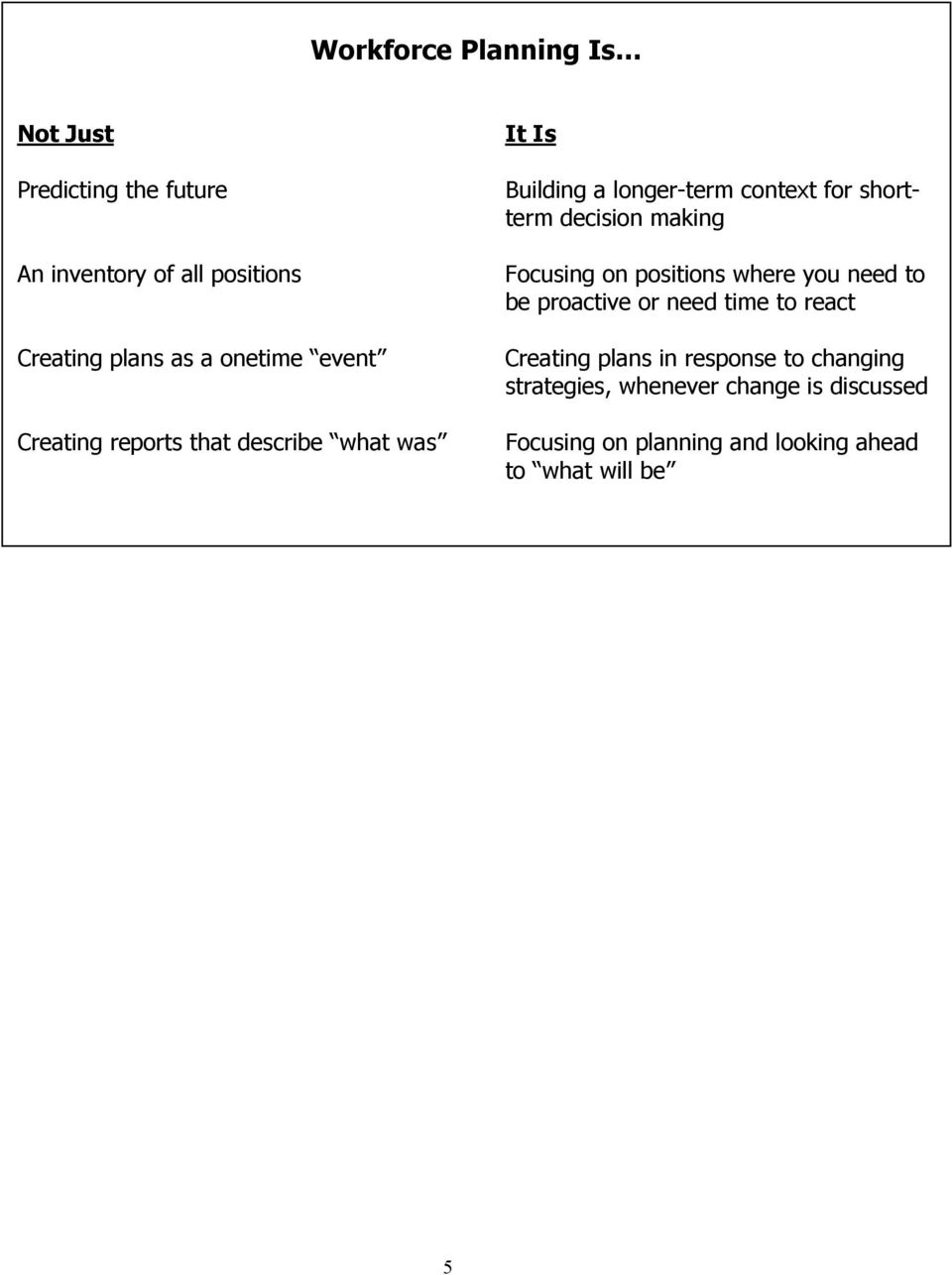
6 Workforce Planning Is Not Just Predicting the future An inventory of all positions Creating plans as a onetime event Creating reports that describe what was It Is Building a longer-term context for shortterm decision making Focusing on positions where you need to be proactive or need time to react Creating plans in response to changing strategies, whenever change is discussed Focusing on planning and looking ahead to what will be 5
7 WORKFORCE PLANNING WHY IS IT IMPORTANT? UNLESS THE RIGHT NUMBER OF SUITABLY QUALIFIED PROFESSIONALS ARE AVAILABLE AT THE RIGHT TIME AND THE RIGHT PLACE, THE ACHIEVEMENT OF ORGANIZATIONAL GOALS AND OBJECTIVES WILL SIMPLY NOT OCCUR. - INTERNATIONAL PERSONNEL MANAGEMENT ASSOCIATION NEWSLETTER An organization needs to ensure it has adequate human resources to accomplish its mission. Because all employers compete for employees from the same labor pool, workforce planning is critical for attracting and retaining the talent needed to serve the public. Workforce planning has become increasingly important to organizations over the last several years, due in large part to increased retirements, as well as retention and restructuring initiatives. Global trends that illustrate the importance of workforce planning include: aging of the population; baby boomers redefining the idea of what retirement is; harnessing of technology to change the human resource function; proliferation of rules and regulations, with new legislation often competing and colliding with existing legislation; and the sheer number of people with advanced educational degrees is advancing human knowledge at an unprecedented rate. Workforce planning is a proactive strategy to project workforce requirements for the future and plan how organizations will meet both global and unique business needs. A key consideration of workforce planning is its benefit to management. It provides managers with a strategic basis for making human resource decisions. It allows managers to anticipate change rather than being surprised by events, and provides strategic methods for addressing present and anticipated workforce issues. In addition, workforce planning allows organizations to systematically address issues that are driving workforce change. It allows organizations to project retirement rates and make plans for replacing lost competencies and institutional knowledge. The overall benefit of workforce planning, then, is its ability to make organizations more effective. 6

8 HOW DOES WORKFORCE PLANNING TIE IN WITH STRATEGIC PLANNING? THE BEST PREPARATION FOR GOOD WORK TOMORROW IS TO DO GOOD WORK TODAY. - ELBERT HUBBARD Planning begins with the organization s strategic plan. At any given time, there may be long-term goals, which may include the opening of a new facility or reduced spending. At other times, the organization may be faced with sudden changes such as increased demand for services or receipt of grant funding. Given these varying situations, the organization s leadership develops goals and strategic objectives. In each instance, the manager envisions the various steps which must take place in order for the goals to become reality. Workforce planning offers a means of systematically aligning organizational and program priorities with the budgetary and human resources needed to accomplish them. By beginning the planning process with identified strategic objectives, managers can develop workforce plans that will help them accomplish those objectives. At the same time, these plans provide a sound basis for justifying budget and staffing requests, since there is a clear connection between objectives, the budget, and the human resources needed to accomplish them. Workforce planning done in a vacuum cannot be successful. It must relate to other planning efforts of the organization. To conduct workforce planning, one must be aware of organizational direction. In turn, achieving organizational goals requires a competent workforce. Workforce planning relates to the employees and employee skill sets needed to accomplish the organization s goals. Effective workforce planning is a necessary component of an organization s strategic plan. It provides for a flexible and proficient workforce able to adapt to the changing needs of the organization. Because workforce planning addresses staffing implications of strategic and operational plans, it affects the full range of human resource activities, including recruitment, hiring, classification, compensation, and retention. Workforce planning should also take into account other human resource processes such as succession planning, employee development, career ladders, and organization development. Each has a part to play in identifying critical skills, forecasting potential vacancies, and preparing employees and the organization to meet future needs. 7

9 As a process, workforce planning includes elements of strategic planning, workload projections, legislative forecasts, turnover analyses, and budget projections. Workforce planning forecasts the numbers of people and type of skills needed to achieve success by comparing the available workforce with future needs to determine needs that may be unmet (gaps). As the value of people increases, so does the performance capacity of the organization, and therefore its value to clients and other stakeholders. As with any investment, the goal is to maximize value while managing risk. Furthermore, an organization s human resource policies must be aligned to support the mission, vision, core values, goals, and strategies by which the organization has defined its direction and its expectations for itself and its people. An organization's human resource policies and practices should be designed, implemented, and assessed by the standard of how well they help the organization pursue these intents. Government entities that expect to make the best use of their human resources will need to build a solid foundation in strategic planning and organizational alignment, leadership and succession planning, recruiting and training the best possible talent, and establishing a performance culture including appropriate performance measures and rewards that steers employees toward the accomplishment of their organizational mission. Strategic planning sets organizational direction and measurable program objectives. These goals and objectives not only provide the basis for determining necessary financial resources, but also provide the basis for workforce needs. If the right people with the right competencies are not in place, it is difficult to effectively achieve the organization s strategic goals and objectives. The workforce plan highlights the people factor in achieving results. Workforce planning naturally complements and is a follow-up to strategic planning. Just as strategic planning helps an organization outline where it is, where it is going, and how it plans to get there, a workforce plan lays out the specific tasks and actions needed to ensure the organization has the necessary human resources to accomplish its mission. A strategic plan charts the future with broad mission-related targets and milestones. An organization s vision, mission, and measurable goals and objectives drive the identification of what type of work needs to be accomplished. A workforce plan translates strategic thinking into concrete actions in the area of workforce staffing and training needs. 8
10 When an organization successfully aligns human resource activities with organizational strategy, activities fit strategically and reinforce one another. This strategic fit produces several advantages. First, it produces consistency. Second, human resource activities will reinforce the organization s business strategy. Third, a good fit facilitates information exchange across activities. Last, strategic fit eliminates redundancy and minimizes wasted effort. Each of these activities reflects a fundamental decision made by the organization to focus not just on living for today, but on preparing for tomorrow by investing in its people. 9

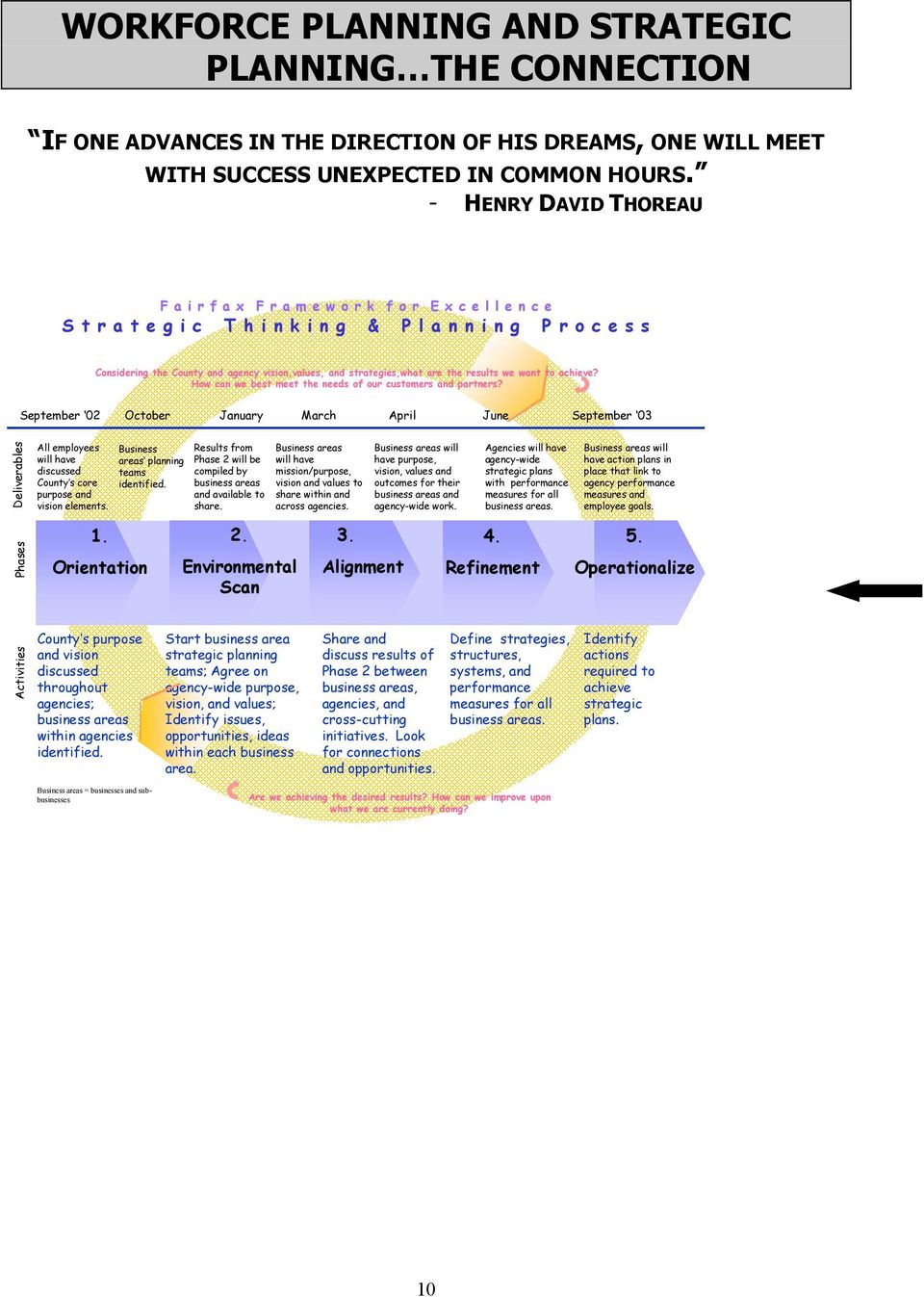
11 Phases WORKFORCE PLANNING AND STRATEGIC PLANNING THE CONNECTION IF ONE ADVANCES IN THE DIRECTION OF HIS DREAMS, ONE WILL MEET WITH SUCCESS UNEXPECTED IN COMMON HOURS. - HENRY DAVID THOREAU F a i r f a x F r a m e w o r k f o r E x c e l l e n c e S t r a t e g i c T h i n k i n g & P l a n n i n g P r o c e s s Considering the County and agency vision,values, and strategies,what are the results we want to achieve? How can we best meet the needs of our customers and partners? September 02 October January March April June September 03 Deliverables All employees will have discussed County s core purpose and vision elements. Business areas planning teams identified. Results from Phase 2 will be compiled by business areas and available to share. Business areas will have mission/purpose, vision and values to share within and across agencies. Business areas will have purpose, vision, values and outcomes for their business areas and agency-wide work. Agencies will have agency-wide strategic plans with performance measures for all business areas. Business areas will have action plans in place that link to agency performance measures and employee goals Orientation Environmental Scan Alignment Refinement Operationalize Activities County s purpose and vision discussed throughout agencies; business areas within agencies identified. Start business area strategic planning teams; Agree on agency-wide purpose, vision, and values; Identify issues, opportunities, ideas within each business area. Share and discuss results of Phase 2 between business areas, agencies, and cross-cutting initiatives. Look for connections and opportunities. Define strategies, structures, systems, and performance measures for all business areas. Identify actions required to achieve strategic plans. Business areas = businesses and subbusinesses Are we achieving the desired results? How can we improve upon what we are currently doing? 10
12 A WORKFORCE PLANNING MODEL IT S NOT THE PLAN THAT IS IMPORTANT, IT S THE PLANNING. - DR. GRAEME EDWARDS SET STRATEGIC DIRECTION This is the process of preparing a model for your organization's long-term success. A strategic plan is a practical, action-oriented guide, based on an examination of internal and external factors, which directs goal setting and resource allocation to achieve meaningful results over time. 11
13 A strategic plan develops a clear statement of the organization s mission and vision, identifies a set of goals and objectives, and formulates key strategies that address factors that are essential to the organization s success. Key strategies also indicate the major undertakings that will reposition the organization for the future. Strategic planning is an essential tool. As organizations are challenged to manage complex and changing problems with limited resources, planning determines the things that an organization can use to address customers expectations. Strategic planning is adaptable. It takes a long-range approach; however, regular reviews and updates to check progress and reassess validity of the plan can be employed. Strategic planning is proactive. It stimulates change rather than simply reacting to it. Strategic planning employs common sense. It is visionary, yet realistic. It anticipates a future that is both desirable and achievable. Strategic planning is part of quality management. It helps management to manage the future, rather than be managed by it. 12

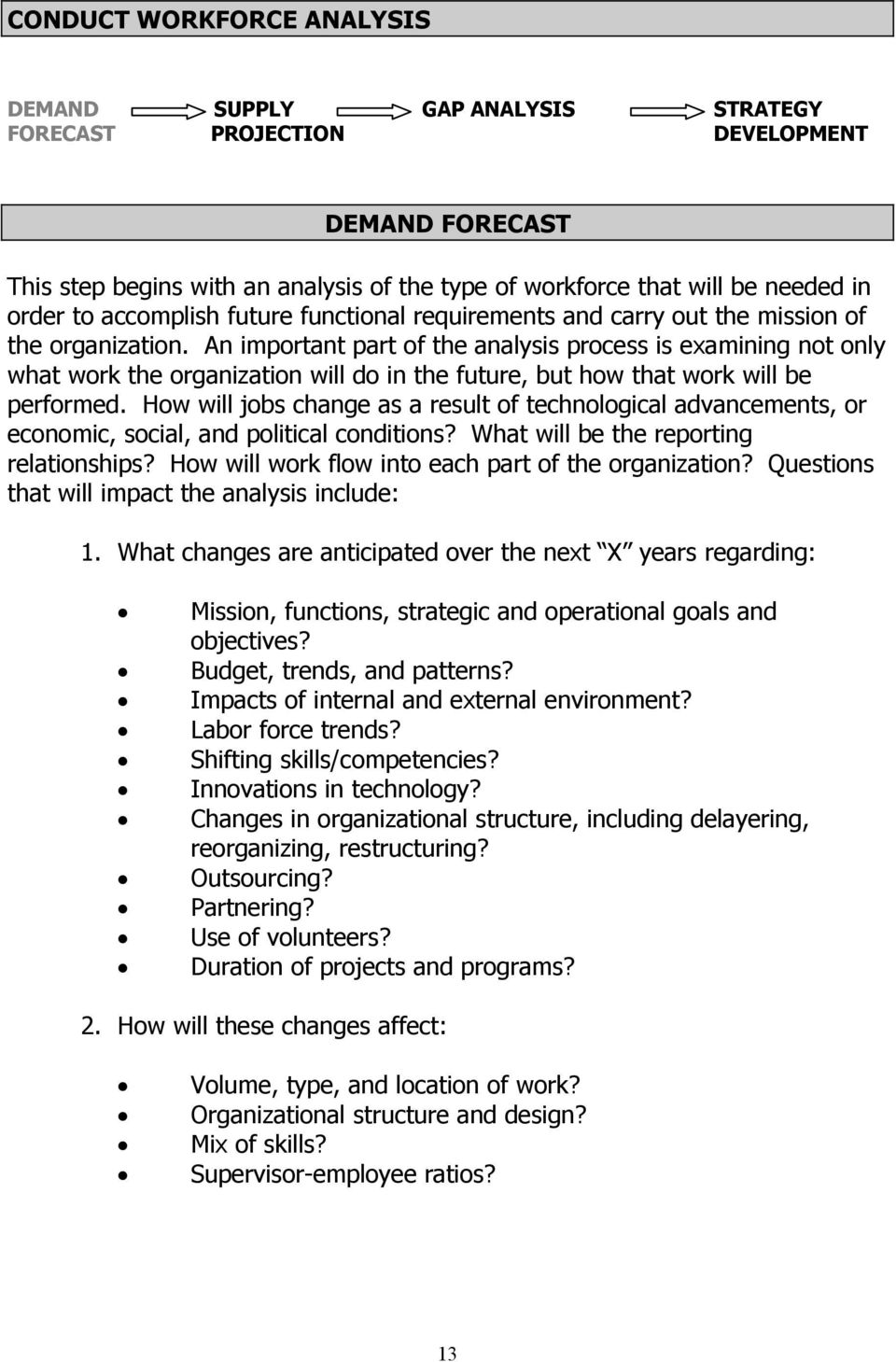
14 CONDUCT WORKFORCE ANALYSIS DEMAND SUPPLY GAP ANALYSIS STRATEGY FORECAST PROJECTION DEVELOPMENT DEMAND FORECAST This step begins with an analysis of the type of workforce that will be needed in order to accomplish future functional requirements and carry out the mission of the organization. An important part of the analysis process is examining not only what work the organization will do in the future, but how that work will be performed. How will jobs change as a result of technological advancements, or economic, social, and political conditions? What will be the reporting relationships? How will work flow into each part of the organization? Questions that will impact the analysis include: 1. What changes are anticipated over the next X years regarding: Mission, functions, strategic and operational goals and objectives? Budget, trends, and patterns? Impacts of internal and external environment? Labor force trends? Shifting skills/competencies? Innovations in technology? Changes in organizational structure, including delayering, reorganizing, restructuring? Outsourcing? Partnering? Use of volunteers? Duration of projects and programs? 2. How will these changes affect: Volume, type, and location of work? Organizational structure and design? Mix of skills? Supervisor-employee ratios? 13
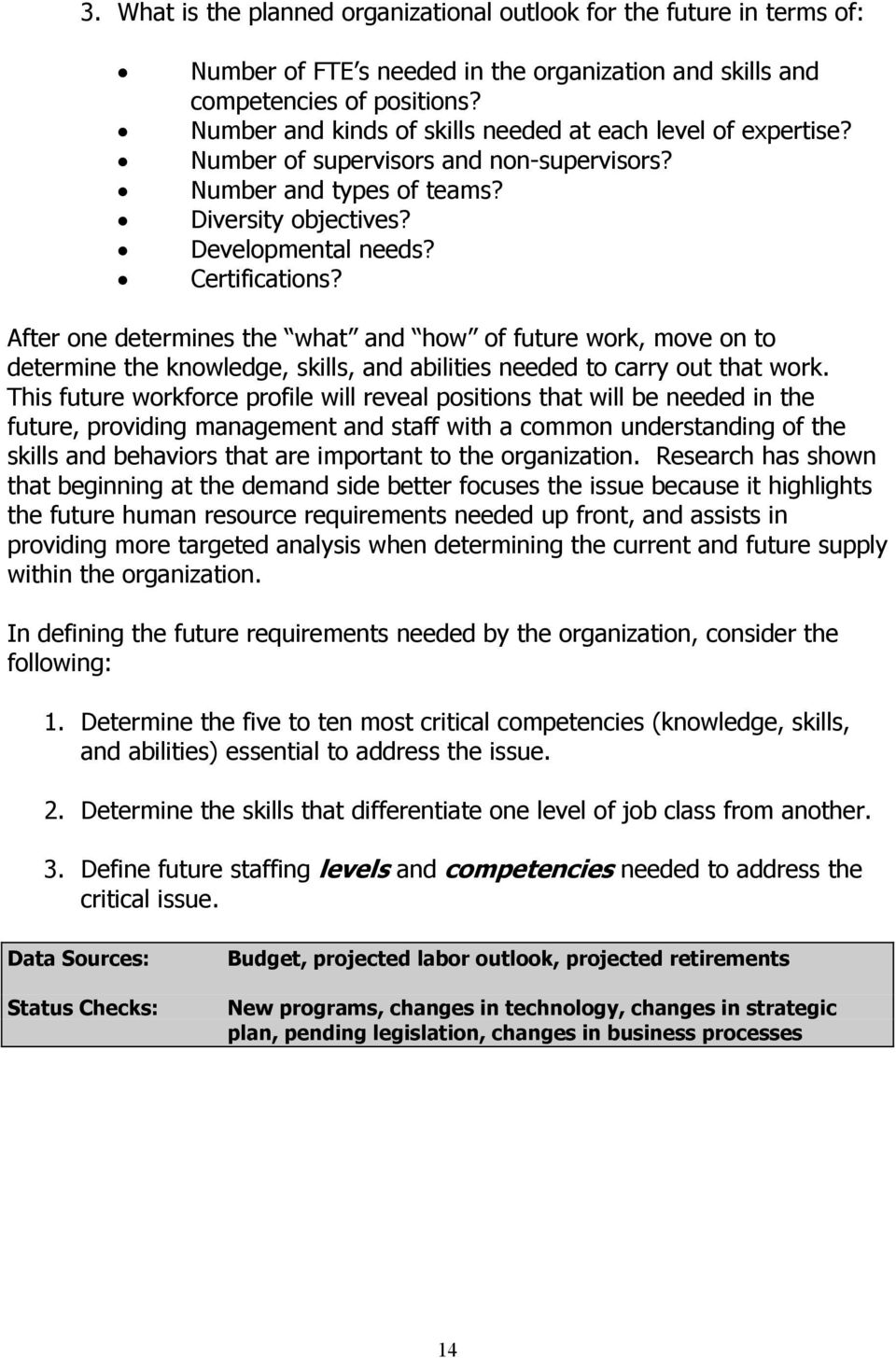
15 3. What is the planned organizational outlook for the future in terms of: Number of FTE s needed in the organization and skills and competencies of positions? Number and kinds of skills needed at each level of expertise? Number of supervisors and non-supervisors? Number and types of teams? Diversity objectives? Developmental needs? Certifications? After one determines the what and how of future work, move on to determine the knowledge, skills, and abilities needed to carry out that work. This future workforce profile will reveal positions that will be needed in the future, providing management and staff with a common understanding of the skills and behaviors that are important to the organization. Research has shown that beginning at the demand side better focuses the issue because it highlights the future human resource requirements needed up front, and assists in providing more targeted analysis when determining the current and future supply within the organization. In defining the future requirements needed by the organization, consider the following: 1. Determine the five to ten most critical competencies (knowledge, skills, and abilities) essential to address the issue. 2. Determine the skills that differentiate one level of job class from another. 3. Define future staffing levels and competencies needed to address the critical issue. Data Sources: Status Checks: Budget, projected labor outlook, projected retirements New programs, changes in technology, changes in strategic plan, pending legislation, changes in business processes 14
16 DEMAND SUPPLY GAP ANALYSIS STRATEGY FORECAST PROJECTION DEVELOPMENT SUPPLY PROJECTION The result of this step should, at a minimum, show the projected workforce supply in terms of staff numbers. There are a host of factors that can be included in the present workforce profile, including: Number of employees Competencies Job classification Salary level Age, gender, race Location Educational level Appointment status (permanent, temporary, etc.) Once the present workforce profile has been prepared, project it out into the future as if no special management action was taken to replace attrition or develop existing staff. Retirement eligibility and other turnover statistics will prove valuable in this exercise. Workforce analysis frequently stops with the consideration of demographic information (occupation, grade level, skills and experience, age, retirement profile, diversity, turnover rates, etc.). Although this information is necessary and pertinent to the process, there is much more that should go into the analysis besides this snapshot information. For instance, trend data is extremely important to the workforce analysis. Is the turnover rate changing over time? Are there specific factors influencing turnover? What types of positions have been filled recently? To define current supply, assess the number of people the organization currently has with the competencies needed to address the critical issue. Forecasting or projecting the future supply projection requires identifying variables and applying assumptions about how these variables will influence the type and level of workforce the organization will have in the future. Data sources: Status Checks: Organization charts, budget Strategic objectives, technology, current skill sets, current job classifications 15

17 DEMAND SUPPLY GAP ANALYSIS STRATEGY FORECAST PROJECTION DEVELOPMENT GAP ANALYSIS This step involves comparing the workforce demand forecast to the workforce supply projection. Gap analysis identifies situations where demand exceeds supply, such as when critical work demand, number of personnel, or competencies will not meet future needs. It also identifies situations when future supply exceeds demand, such as when critical work demands, number of personnel, or competencies exceed needs. In either event, the organization must identify these differences and make plans to address them. It is important to note that calculating gaps and surpluses will simply provide the organization with data in terms of what needs to be done. It is the actions that the organization decides to take to address these gaps and surpluses that results in the workforce plan. Once gaps between the demand (future needs and projected workload) and the supply (workforce and competencies) have been identified, one needs to consult with management to set priorities to fill the gaps that will have a critical impact on the organization s goals. The solution analysis that will close the gaps must be strategic in nature. When doing solution analysis, the organization should be prepared to address ongoing as well as unplanned changes in the workforce. The trends identified in supply and demand analyses can help the organization anticipate these changes. 16

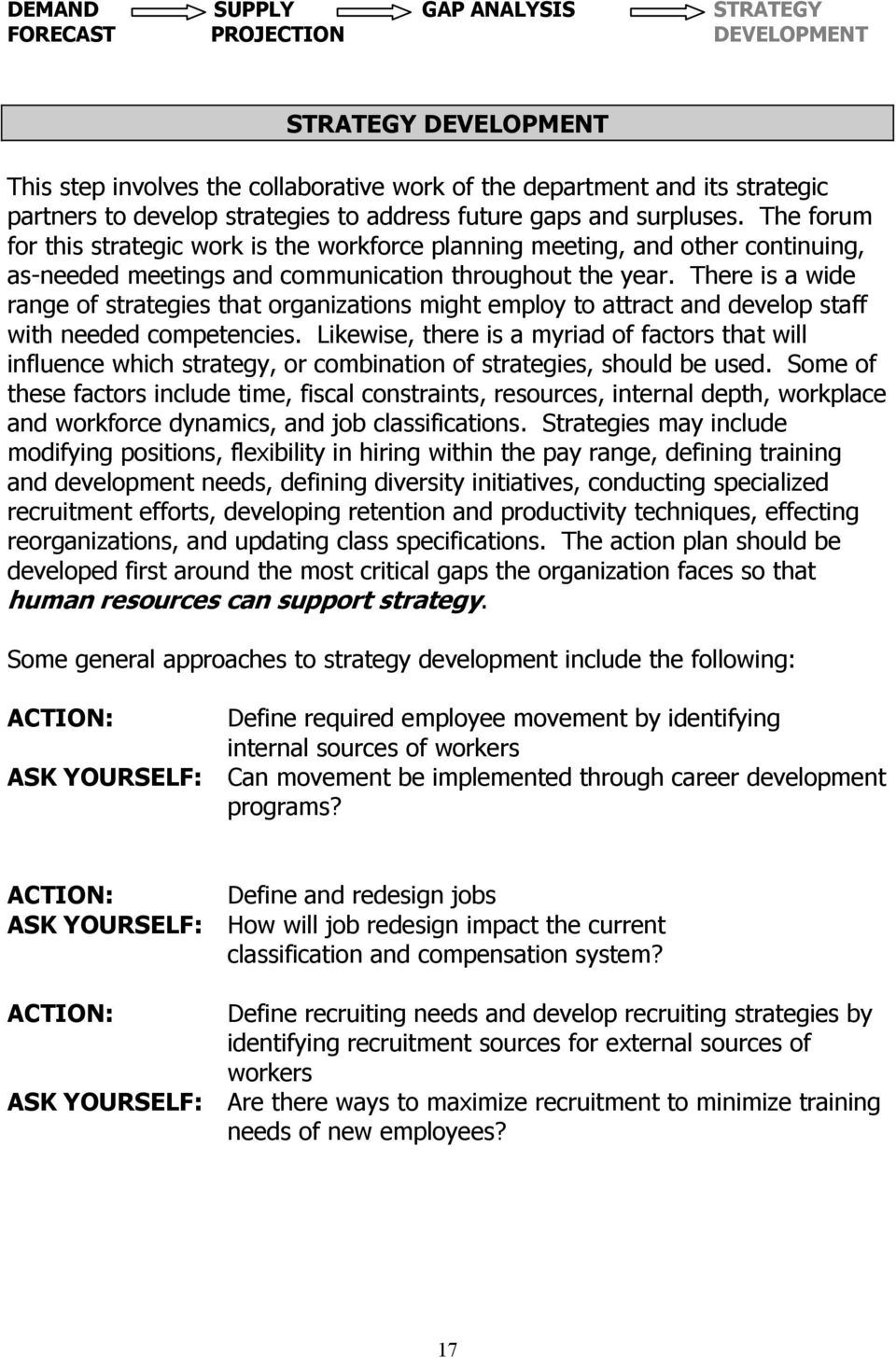
18 DEMAND SUPPLY GAP ANALYSIS STRATEGY FORECAST PROJECTION DEVELOPMENT STRATEGY DEVELOPMENT This step involves the collaborative work of the department and its strategic partners to develop strategies to address future gaps and surpluses. The forum for this strategic work is the workforce planning meeting, and other continuing, as-needed meetings and communication throughout the year. There is a wide range of strategies that organizations might employ to attract and develop staff with needed competencies. Likewise, there is a myriad of factors that will influence which strategy, or combination of strategies, should be used. Some of these factors include time, fiscal constraints, resources, internal depth, workplace and workforce dynamics, and job classifications. Strategies may include modifying positions, flexibility in hiring within the pay range, defining training and development needs, defining diversity initiatives, conducting specialized recruitment efforts, developing retention and productivity techniques, effecting reorganizations, and updating class specifications. The action plan should be developed first around the most critical gaps the organization faces so that human resources can support strategy. Some general approaches to strategy development include the following: ACTION: Define required employee movement by identifying internal sources of workers ASK YOURSELF: Can movement be implemented through career development programs? ACTION: Define and redesign jobs ASK YOURSELF: How will job redesign impact the current classification and compensation system? ACTION: Define recruiting needs and develop recruiting strategies by identifying recruitment sources for external sources of workers ASK YOURSELF: Are there ways to maximize recruitment to minimize training needs of new employees? 17
19 ACTION: Define training and development needs to support planned movement or redeployment ASK YOURSELF: Can we explore retraining or recruiting options for filling competency gaps? ACTION: Define diversity initiatives ASK YOURSELF: Is diversity balanced throughout all levels of the organization? ACTION: Review quality of work life issues to ensure you are an employer of choice ASK YOURSELF: Is your organization healthy enough to retain new talent? ACTION: Track organizational and operational productivity for improvements, goal attainment, and accountability ASK YOURSELF: Are gaps closing? If not, why not? ACTION: Identify restructuring opportunities (organizational, functional, occupational) ASK YOURSELF: Is the organizational structure appropriate for conducting the required work? ACTION: Design a workforce plan to address skills gaps ASK YOURSELF: What is the cost associated with the strategies to address competency or skills gaps? IMPLEMENT THE WORKFORCE PLAN The implementation phase consists of translating the actions into a workable schedule that includes well-defined objectives, specific and measurable workforce goals, and timetables and milestones. It involves dedicating time, energy, and resources to address the critical gaps or surpluses that exist within the organization, as related to the critical business issues identified as part of the strategic planning process. To be successful, workforce planning requires the commitment and leadership of top management. Senior-level managers should lead the planning process, assure that workforce plans are aligned with the strategic direction of the agency, and hold subordinate managers accountable for carrying out workforce planning. 18
20 Similarly, program managers should take responsibility for leading the workforce planning process in their program areas. Managers will gain immediate benefits from workforce planning because the competencies of their own staff will become better aligned with strategic goals and objectives. MONITOR, EVALUATE, AND REVISE The implementation of the workforce plan should result in the desired workforce the organization needs in terms of the number of employees, with the appropriate skills, at the right locations, etc. The workforce plan should be continually measured for its success in meeting both efficiency and effectiveness parameters. While efficiency will measure the time, speed, cost, and volume regarding the plan, effectiveness will measure whether the plan is achieving the desired result of having the right people with the right skills at the right time. In addition to collecting information from program users, the organization should measure the results of the workforce plan, looking for examples of efficiency and effectiveness such as: Do the workload and workforce gaps still exist? Are planning assumptions still valid? Is there an imbalance between workload, workforce, or competencies? Has the overall organization performance increased? Do adequate staffing levels still exist? Successful workforce planning is an active, ongoing, and dynamic process that must be repeated and adjusted. 19

21 CHECKLIST FOR EVALUATING THE WORKFORCE PLANNING EFFORT The workforce plan is based on the organization s strategic plan, and considers the mission, vision, core values, and goals. Data analysis has been conducted to analyze impacts on the workforce plan. The organization has determined the number and type of employees that will be needed to address the challenges of the upcoming years. There are clear indications that the organization has identified the roles and core competencies needed to support its goals and service delivery strategies. Analysis has been performed to assess the gap between current positions and those needed for the future. Strategies have been developed to address gaps between projected supply and demand. The Action Plan has been clearly laid out, including responsible parties, due dates, and resources needed. The plan has been communicated to employees and stakeholders. The workforce plan and strategies are continually monitored and refined to ensure their ongoing effectiveness and continuous improvement, taking into account resource changes and other conditions impacting the organization. 20
22 THE WORKFORCE ACTION PLAN PLANNING WITHOUT ACTION IS FUTILE, ACTION WITHOUT PLANNING IS FATAL. - UNKNOWN The workforce action plan is a natural follow-up to strategic planning. The strategic plan helps you identify where you are, where you are going, and how you are going to get there. Similarly, the workforce action plan lays out specific tasks and actions one needs to take in order to achieve the organization s human resource goals and objectives. A shared responsibility between line supervisors, managers, and HR professionals is important in identifying the critical human resource issues in strategic and operational plans. What is a Workforce Action Plan? A process for defining and addressing the staffing implications of an organization s strategic and operational plans. A long-term context for short-term activities. A focus on critical issues. The Workforce Action Plan answers the following questions: What human resources do I need to have in order to meet the performance objectives of the organization? Once I have the employees on board, how do I develop them? What strategies should be used to retain them? The key benefits of developing a Workforce Action Plan include the following: Recruiting, developing, and retaining talent required to meet future demands. Adjusting overall staffing to meet changing business needs. 21
23 Ensuring that the department has the resources to deliver promised services to its customers in a timely and quality manner. Facilitating the management of change and contributing to better people management. Allowing for smarter decisions and better long-term investments. Addressing critical human resource issues in an organized, integrated manner. Enhancing more efficient use of HR services (training, recruitment, compensation) 22
24 DEVELOPING A WORKFORCE ACTION PLAN 1. Design a workforce plan to meet your organization s needs. What skills are currently vital to the accomplishment of the organization s goals and objectives? What changes are expected in the work of the organization (due to changes in mission/goals, technology, new/terminated programs or functions, and shifts to contracting out)? How will this affect the organization s human resources? What skills will no longer be required, and what new skills will the organization need in the next five years? How is the organization addressing expected skill imbalances due to attrition, including retirement, over the next five years? Where has the organization successfully delegated authority or restructured to reduce the number of layers that a programmatic action passes through before it reaches an authoritative decision point? Where can the organization improve its processes to reduce the number of layers? 2. Identify stakeholders and acknowledge their needs. Who should be included in plan development? Should a management team oversee development of the workforce plan? Who are the organization s strategic partners? 3. Develop ways to address skill gaps. What needs to be done to address skill gaps? What type of career development and retraining does the organization provide to its employees in order to have a highly skilled workforce? Can these programs be improved upon? What strategies and tools are other organizations using to recruit and retain people with the right skills? How would management respond if the organization were to downsize? 4. Develop a project plan to accomplish determined actions. What are the measurable goals and critical milestones for each action item? Who will translate the action strategies into a project plan? 23
25 5. Set specific goals. What timelines and milestones should be established for completion of each item? Who should be assigned responsibility for each action item? Who will monitor completion of each action item? Who will report to senior management on the progress of each action item? 6. Communicate the plan to ensure everyone in the department is aware of it. How will the plan be communicated to the workforce? How will the organization get buy-in? Does management know how the workforce plan is linked to the strategic goals of the organization? 7. Evaluate your progress and make needed changes to improve efficiency. Did the action plan accomplish what was needed? Have conditions changed so that strategies need to be revised? Is another staffing assessment needed? Are assumptions about supply and demand still valid? 24
26 Appendix A WORKFORCE PLANNING IN FAIRFAX COUNTY As implemented in May, 2002, the County is on a semi-annual cycle, with meetings in March and September of each year to allow departments, the Department of Human Resources (DHR), and the Department of Management and Budget (DMB) the opportunity to meet, discuss, and prepare workforce plans for the upcoming six months. In its simplest terms, workforce planning is getting the right number of people with the right set of competencies in the right jobs at the right time. Getting to this point is facilitated by Vision to Performance and Values to Culture work at all levels of the organization. This work helps identify key strategies, goals, processes, and behaviors that affect the kind of jobs and the level and breadth of competencies required to achieve the organization s vision and financial management targets. Departments that have not yet started their vision and values work can begin workforce planning by identifying the key drivers of their business area. Key drivers include those internal and external forces that affect the organization s ability to achieve its goals and/or affect how work needs to be performed. Most departments have some sort of workforce planning effort already taking place. These efforts include the development of plans for staffing and succession, assessments of training needs, strategies and plans for recruitment and retention, and projections for turnover and retirement. The capacity to perform effective workforce planning will take time to develop. Departments may find it helpful to begin planning for a subset of the workforce, and then extend workforce planning through the remainder of the organization. It is important to note that workforce planning is not an activity or document required by DHR or DMB. Nor is it a static document that tries to predict the future or describe the past. Rather, it is an effort to focus on developing information that can help an organization make decisions for the short term and long term, yet allow for flexibility in a changing environment. The plan is intended to help solve staffing problems related to managed position movement into, around, and out of an organization. 25
27 Five steps to workforce planning in Fairfax County 1. DEVELOPMENT OF STRATEGIC PLAN OR KEY DRIVERS Conducted prior to initial meeting with DHR and DMB Where does the department see itself in 1 year, 3 years, etc? Develop list of objectives Relate strategic plan/key drivers to workforce and resources Develop/update organization chart and applicable position descriptions 2. DEPARTMENT COLLABORATES WITH DHR AND DMB IN DEVELOPMENT OF ITS WORKFORCE INITIATIVES Department thinks through strategic initiatives Staff from DHR and DMB are available to provide assistance in succession planning, review of turnover statistics, review of trend data, diversity reports, etc. 3. DEPARTMENT PROPOSES A PRIORITIZED WORKFORCE PLAN What are the priorities that will enable the department to move toward its organizational objectives and strategic plan? What are the objectives/goals/needs for the next six months? Opportunities for review might include new grants, reorganization, obsolete functions, career paths, etc. 4. REVIEW AND ASSESSMENT OF IMPLEMENTATION POSSIBILITIES Departments should bring organizational charts and other business documents that tie requests to strategic direction of department Department, DHR, and DMB meet to review and discuss priorities of department Group reviews organizational structure for options and suggestions 26
28 Group breaks to evaluate and analyze department s requests and determine method for accomplishment During this phase, DHR and DMB will work with departments in order to ensure that all agreed-upon actions are implemented. In turn, the department will communicate within its organization regarding the accomplishment of action items. Fiscal accountability is a component of successful workforce planning. Personnel Services make up a significant portion of the County s budget and, over time, the budget for Personnel Services is impacted by pay for performance/merits, regrades, reclassifications, hiring of staff above the mid point, etc., and continues to rise. Individual department budgets will continue to be adjusted to reflect the aggregate impact of pay for performance/merits and County mandated actions, while department workforce planning actions will need to be absorbed through holding positions vacant, etc.. 5. IMPLEMENT WORKFORCE PLAN DHR records and submits a document outlining actions requested by the Department DHR creates implementation schedule, outlining responsibilities of various parties in accomplishing Department s human resources initiatives On a bi-weekly basis, DHR and DMB submit updates on the status of the workforce plan to departments 27
29 Appendix B DEPARTMENT MANAGERS, DHR, AND DMB: ROLES AND RESPONSIBILITIES Department managers involve DHR and DMB early on in strategic and operational planning, while communicating staffing needs to employees so they can take responsibility to learn new skills whenever possible. DHR and DMB work with departments as strategic partners, assisting in the attainment of a highly competent and skilled workforce. DHR consults with department management, while analyzing the impact of implementing potential strategies on the department s workforce, training programs, and human resource management policies. DHR is available to create and integrate programs and initiatives needed to implement human resources strategies. DMB consults with department management, while analyzing fiscal impacts of potential strategies, providing technical support, and using strategic plans to guide development of annual budgets. 28
30 Appendix C SUGGESTIONS FOR SUCCESS! Recognize that workforce planning focuses on outcomes from the planning process, more so than the process itself. Integrate human resource planning into the department s strategic plan. Appreciate that workforce planning is an inclusive process, drawing together program management, budget, strategic planning, human resources, and program staffing. Departments, responsible for allocation of resources, should drive the workforce planning process. DHR and DMB are available to help to support department managers by acting as a consultant and resource. This assistance is facilitated when all partners understand the business and business context. The capacity to do effective workforce planning will only be developed over time. Sample documents, including real-life case studies, implementation schedules, and a workforce planning calendar have been attached for reference. 29
31 FREQUENTLY ASKED QUESTIONS Appendix D Do I have to meet with DHR and DMB twice per year? What if I don t have any specific requests in mind? The workforce planning system, endorsed by the County Executive, is designed to encourage proactive thinking and planning on behalf of County departments. It also fosters increased collaboration between department managers, DHR, and DMB. As noted within this document, it is not the workforce plan that is as valuable as the planning process itself. The workforce planning meeting is intended as a dialogue, during which time departments share industry trends, external and internal factors which are affecting their business, workforce projections, and other factors that have the potential to influence human resource decisions. The meeting is the forum in which department managers, DHR, and DMB brainstorm solutions to human resource decisions to be made by department management. To that end, there is significant value in the meetings, even absent any specific position change requests. Every so often, I get an implementation schedule update. What is this document, and how should it be used? On a bi-weekly basis, your Compensation and Workforce Analysis representative will send an updated workforce planning implementation schedule for your review. This schedule is maintained by DHR and DMB, and is provided to keep you updated on the progress of items discussed and agreed to as part of the semi-annual review process. Feel free to use this tool within your department in order to keep interested parties apprised of outstanding items or accomplishments to date. What do I need to bring with me to the workforce planning meeting? The most important thing to bring with you to the meeting is the willingness to share information about your department. Remember, the advice and consultation given to you by DHR and DMB is only as good as the insight we have into your department's operations. 30
32 If you are requesting a reorganization, current and proposed organization charts are always helpful. If available, updated position descriptions may be shared with the DHR representative as part of the meeting. Retirement projections, when available, are also a helpful tool. In summary, any documentation which you believe helps to frame your request, and justify the need for proceeding with a review of it, is helpful and welcome at the meeting. My department managers are extremely busy. Is there any help you can give us in putting together our workforce plan? Ideally, departments do not have a formal workforce plan in hand when they meet with the Workforce Planning Team from DHR and DMB. Rather, the meeting is the forum in which to brainstorm and share ideas. As a result of that interaction, a formal workforce plan is developed. At any point in the planning process, whether in advance of the meeting, or during the implementation phase, feel free to call upon the Workforce Planning Team representatives for assistance. What tools are made available as part of this process? Currently, DHR works with the Retirement Administration in order to provide departments with retirement projections 1, 2, and 3 years out. In addition, a variety of PRISM reports can be made available to assist department managers with the planning process. Types of reports include staffing posture, diversity assessments, and positions broken down by grade level, job class, or a host of other criteria. Feel free to contact your Workforce Planning Team representatives for further information on reports which may be made available to you. Is there a tie between workforce planning and strategic planning? It seems like there are a lot of initiatives going on, but I m not really seeing the connection between them. Yes, there is clearly a tie between these two planning efforts. As part of the County Executive's initiative, County departments are in the process of developing strategic plans. Inherent to this effort is the need to consider the human resource implications of your strategic thinking and planning. With any strategic plan or objective, there is typically a human resource component that merits consideration. Departments are likely to achieve the most meaningful results from their planning efforts when there is alignment between their strategic and workforce plans. 31
33 Do I have to wait for a vacancy in order to share a change I m thinking about making to a position in my department? No, you do not have to have a vacancy, or have a certain position identified, in order to request a change to a position at the workforce planning meeting. At the meeting, you are only hypothesizing or assuming what if, and then designing your organization s human resource decisions around that assumption. When the vacancy or opportunity presents itself, then you submit the necessary paperwork to formalize the action. It seems like this is a workload management system for DHR and DMB. What is the value for departments? There is clearly value in the workforce planning process for County departments. Having several members at the table willing to listen to your concerns and strategize about meaningful ways in which to solve them can only benefit your organization. Second, by engaging in up-front thinking, your organization is best prepared when that golden opportunity ultimately presents itself. While the semi-annual process may appear to be a workload management system, it is more about engaging in a formalized, proactive planning dialogue. 32
34 Appendix E ADDITIONAL RESOURCES Although there are many reports on workforce planning, listed here are some self-service web sites where you can see a variety of workforce planning activities ranging from analyses of demographics, to strategic plans, to workforce planning manuals: State: Topic: Web address: State: Topic: Web address: State: Topic: Web address: State: Topic: Web address: Georgia Strategic Planning and Workforce Planning Kansas Workforce Planning Report Minnesota Strategic Staffing Guidebook Washington Workforce Planning Manual 33
35 Appendix F CONTACTS Compensation and Workforce Analysis Deborah Babcock-Daley, Division Manager Sheila Wright Kris Miracle Kristin Resta Amanda May Mike Rumberg Susan Holsneck Organizational Development and Training Kathy Ujakovich, Division Manager Employment Division Manager Department of Management and Budget Joe Mondoro Debra Dunbar Mel Wells Laura Lazo
36 Appendix G REFERENCES California State Department of Finance, Strategic Planning Guidelines, May, County of Los Angeles, Strategic Workforce Planning Guidebook, August, County of Los Angeles, Strategic Workforce Planning Needs Assessment Workbook, August, Guidelines for Georgia s FY 2003 Strategic Planning Process. Horkan, Nancy and Elizabeth Hoefer, Workforce Planning at DOT, The Public Manager, Spring, International Personnel Management Association. International Personnel Management Association, Workforce Planning Resource Guide for Public Sector Human Resource Professionals, National Institutes of Health, Workforce Planning Instructional Guide. Right People, Right Place, Right Time, A Guide to Workforce Planning in the U.S. Department of the Interior. State of Minnesota Strategic Staffing Guidebook. State of Tennessee, Strategic Business Planning: A Guide for Executive Branch Agencies, Prepared by The Center for Effective Government, Department of Finance and Administration, January, State of Texas, Workforce Planning Guide. State of Washington, Workforce Planning Guide. U.S. Department of the Interior, Workforce Planning Instruction Manual. U.S. Office of Personnel Management, The Federal Workforce Planning Model. Walker, David M., Strategic Human Capital Management: The Critical Link, The Public Manager, Spring,
37 Washington State Department of Personnel, Workforce Planning in Washington State Government, October Workforce Planning Resource Guide, Department of Health and Human Services, November,
38 Appendix H CASE STUDY #1 DEPARTMENT OF FINANCE CASE STUDIES In December 2001, the Department of Finance effected a departmental reorganization, which resulted in dismantling two of its divisions, namely Procedures and Controls and Accounting and Reporting. Effective with the reorganization, Central Financial Services, Department of Finance, organized itself into six divisions, namely Accounting Operations, Accounts Payable, Automated Financial Systems, Financial Oversight and Compliance, Financial Reporting, and Special Projects. In continuation of the first phase of the Department of Finance s reorganization, a request was made at the May 2002 workforce planning meeting to review the accounting positions within the Financial Reporting (FR) division. It had been observed by Finance s senior management that the FR division was experiencing difficulties in retaining fund accountants who work in highly specialized positions (Comprehensive Annual Financial Report (CAFR), Auditors Report for Public Accounts (APA), and Bonds Disclosure). Due to the complexity of these positions, it can take up to two years to become proficient and develop the in-house expertise required in these subject areas. Because these positions were at the Accountant II (S-24) level, the incumbents were leaving the department for promotional opportunities at the S-27 level within other County departments. In order to prevent this movement of key positions, the Department of Finance sought an enhanced career ladder, which would serve to facilitate the retention of these key Accountant II (S-24) positions. This career ladder would serve as the tool for enabling the identified Accountant II positions to move noncompetitively from the S-24 to S-27 grade once they met the requirements for the S-27 level. DHR, DMB, and the Department of Finance worked collaboratively to arrive at a career retention tool which, through a phased-in approach, established three Accountant III (S-27) positions with a mandatory underfill at the Accountant II (S-24) level. Concurrent with the above implementation, DHR, DMB, and the Department of Finance worked to further enhance the career ladder for the CAFR, APA, and Bonds Disclosure sections by establishing three Financial Reporting Manager (S-29) positions as managers of these sections. The level of knowledge and expertise required in the Department of Finance is unique due to its centralized 37
39 responsibilities, which results in significant training and development. The Department sought to reap the benefit of this investment by developing a career ladder which improves the prospects of retaining the key accounting positions assigned to the Financial Reporting Division. As a result, three sections which are vital to the success of the Department have career ladders which serve to retain technical expertise at the departmental level, while providing employees with the opportunity for career growth. This workforce planning effort has offered many benefits, including: Benefit to employees in that they have the ability to acquire job-specific skills and expertise, while being able to move noncompetitively to a higher grade. Staff has praised this process and has said that this is definitely an incentive to stay on with the Department and utilize the knowledge gained to better support the mission of the Department of Finance. Benefit to the Department of Finance in that it has increased its ability to retain employees who are critical to its success. Morale has been improved, and the Department s management philosophy is empowering and motivating employees. 38
40 CASE STUDY #2 COMMUNITY SERVICES BOARD, ALCOHOL AND DRUG SERVICES During a recent workforce planning meeting, Alcohol and Drug Services (ADS), an agency of the Fairfax-Falls Church Community Services Board, presented a proposal to consolidate its Supervised Apartment Program and Recovery House. Grant funding for treatment services had remained constant over the past years, while staff salaries and operating costs continued to rise. Until recently, ADS had been able to absorb the cost overruns. However, due to State and County budget cuts, the additional cost could no longer be absorbed without a net decrease in client service. Recovery House is a halfway house model, requiring residential program coverage several days per week, for hours per day; therefore, any elimination of staff positions would render the program ineffective, as criminal clients served by the program would not have adequate supervision or treatment services available to them. ADS proposed a two-step process to address these concerns. First, grant funding and County funding were to be switched, thus allowing for a cost-perbed-day purchase congruent with flatlined grant funding. Second, the Recovery House and Supervised Apartment programs were combined. By combining the two programs, appropriate clinical services and supervision could be provided to the clients. Once the grantor agreed to the transfer of funds to other residential programs, Steps to Recovery, a consolidation of the Supervised Apartment Program and Recovery House, was formed. The process of making these changes was quite complicated and involved multiple steps. DHR and DMB partnered with the Community Services Board to ensure that the process occurred with minimal program or client disruption. DHR and DMB offered step-by-step guidance on the tasks that needed to be completed, and provided recommendations that allowed the program to incorporate the necessary changes, while adhering to County guidelines regarding positions and budgetary resources. Changes were facilitated quickly, which resulted in better quality client services with minimal staff disruption. This new model allowed Alcohol and Drug Services to provide a continuum of services, while absorbing the necessary reductions in positions. 39
41 CASE STUDY #3 RESTON COMMUNITY CENTER As part of its strategic planning efforts, Reston Community Center (RCC) identified the Community Center s main business lines and key factors driving its businesses. The management team determined that its programs should remain the focus in order for RCC to meet the demands of the growing population in the area. In order to continue delivering programs to meet their customers needs, RCC had to align its positions along these business lines, while recruiting and retaining staff with the right skills and competencies in these positions. The Executive Director had eight direct reports including the Deputy Director, Comptroller, and Directors of Media and other programs including Aquatics, Seniors, Teens, Youth, Special Events, Classes/Workshops, and the Performing Arts. While the organization chart appeared flat, there was no definition of RCC s business lines. First, RCC distinguished between its programming function and administrative operations of the Community Center. With regard to the programs area, RCC categorized the different programs under four main areas: General Programs, including Seniors, Youth, Teens, and Classes/Workshops; Performing Arts, including the Technical/Theatre function, Box Office, and Arts education; Aquatics; and Special Events. In the programs area, DMB and DHR met with RCC to align positions and resources along business lines. A decision was reached to create a Director of General Programs to oversee the various programming functions. With regard to administrative operations, there was a Deputy Director who was responsible for oversight of the Center s Customer Service, IT, and Facilities functions, and a Comptroller who was responsible for oversight of the Financial and Human Resources aspects of the Center. RCC s management team evaluated its external environment (the Community Center is located in an area with multiple food venues) and decided that having a snack bar on site no longer added value to the center, as food services was not one of RCC s business lines. Also in the operations section, the Deputy Director analyzed the utilization rate of the RCC facility. Through surveying the needs of the business and residential community, the determination was made that there was sufficient room to increase facility usage; as a result, a Facility Booking Manager position was created. This position would serve to reach out to community businesses and 40
42 groups, sell event space, optimize RCC s revenue stream, and better manage the facility and scheduling system and calendar. The result has been a significant reduction in the cost of processing a room booking coupled with nearly a 100% increase in booking revenue in FY03. Positions with new functions (e.g., a backup Finance and HR Specialist) were established and moved under the appropriate businesses, while positions with obsolete functions and skills were eliminated (e.g., Snack Bar Manager). An existing, vacant Administrative Assistant III position was reclassified to Administrative Assistant V, and a corresponding Customer Service Manager position was established within Operations. The Customer Service Manager supervises Front Desk staff at two separate facilities, among other duties, and provides consistency in service delivery for all patrons throughout the community. The new RCC organizational structure can now capitalize on the Community Center s strengths and help the Department achieve its mission of serving as the Reston community s hub of programs and information, while meeting the needs and demands of the growing community. 41
43 Appendix I TIMELINE January March DHR and DMB available to consult as departments put together Workforce Plan. March Workforce Planning Sessions are conducted with departments. April August Ongoing consultation and development of strategies to implement workforce planning items. July September DHR and DMB available to consult as departments put together Workforce Plan. September Workforce Planning Sessions are conducted with departments. October - February Ongoing consultation and development of strategies to implement workforce planning items. 42
44 Appendix J Workforce Planning Implementation Schedule AGENCY: ABC Program Items In Progress Area Priority Requested Action Action Plan Status XYZ Carryover A/E to ABC to provide DHR with online PD for review ABC to provide DHR with online PD 43
45 Workforce Planning Implementation Schedule AGENCY: ABC Program Actions for Implementation March - August, 2003 Area Priority Requested Action Action Plan Status XYZ 1 A/E to Agency to provide online PD, outlining duties of position, Draft of position duties to be completed to DHR for review by agency by 4/2. 44
46 Workforce Planning Implementation Schedule AGENCY: ABC Program Phased-in Implementation Area Priority Requested Action Action Plan XYZ Carryover Revise/update class specification for classes ABC to provide proposed spec changes to DHR ABC to provide proposed spec to DHR DHR to review proposed spec changes DHR and ABC to discuss issues related to changes DHR to assess impact of changes; consult with DMB if fiscal impact may exist DHR to coordinate draft of specs with other user agencies, as appropriate DHR to finalize draft of specs and facilitate through official approval process May involve market review of assigned pay grades 45
State of Louisiana s Workforce Planning Model Right People, Right Skills, Right Jobs, Right Time
 State of Louisiana s Workforce Planning Model Right People, Right Skills, Right Jobs, Right Time Table of Contents Introduction 2 What is Workforce Planning?...3 Why is Workforce Planning Important?.....3
WORKFORCE AND SUCCESSION PLANNING
 2012 WORKFORCE AND SUCCESSION PLANNING Toolkit to Identify and Address Strategic Talent Gaps Workforce Management Office NOAA 1/1/2012 Table of contents Introduction... 3 Workforce Planning... 3 Step 1:
This page was left intentionally blank.
 This page was left intentionally blank. Workforce Planning Model Steps What This Step Accomplishes 1. Define the Scope Determines our focus could be long or short term could be a specific business unit
Workforce Planning Guide
 John Keel, CPA State Auditor February 2006 Report No. 06-704 Table of Contents Overview... 1 What Is Workforce Planning?... 1 Why Is It Important?... 1 Is a Workforce Plan Required?... 1 The Workforce
State of Alaska. Workforce Planning. Desk Reference and Guide. State of Alaska, Department of Administration, Division of Personnel & Labor Relations
 State of Alaska Right People, Right Place, Right Time, Workforce Planning Desk Reference and Guide State of Alaska, Department of Administration, Division of Personnel & Labor Relations Page Table of Contents
State of Washington. Guide to Developing Strategic Workforce Plans. Updated December 2008
 State of Washington Guide to Developing Strategic Workforce Plans Updated December 2008 Table of Contents Introduction... 3 What Is Workforce Planning?... 3 Workforce Planning Strategy Areas... 4 Strategic
Department of Human Resources
 Workforce Services Workforce Policy and Planning Department Management/ Human Resource Information Systems Employee Relations Employment Compensation and Workforce Analysis Employee Benefits Organizational
HUMAN RESOURCE / WORKFORCE PLANNING AND DEPARTMENTAL PLANNING - SUPPLEMENT. A Guide to Integration and Alignment
 HUMAN RESOURCE / WORKFORCE PLANNING AND DEPARTMENTAL PLANNING - SUPPLEMENT A Guide to Integration and Alignment HR POLICY AND PLANNING DIVISION HUMAN RESOURCE BRANCH Public Service Secretariat April, 2008
Texas Board of Nursing Fiscal Year 2015-2019 Workforce Plan
 Texas Board of Nursing Fiscal Year 2015-2019 Workforce Plan I. AGENCY OVERVIEW The Board of Nursing (BON), has one of the largest licensee database in the State of Texas. We regulate over 360,000 nurses
REE Position Management and Workforce/Succession Planning Checklist
 Appendix A REE Position Management and Workforce/Succession Planning Checklist Agency: Division /Office: Position Number: Date: Supervisor: Vacancy Announcement (if Recruit): Position Title/Series/Grade:
Caerphilly County Borough Council. Workforce Planning Guidance. and Template
 APPENDIX 1 Caerphilly County Borough Council Workforce Planning Guidance and Template May 2013 1 Content Description Page Number Part 1 Introduction 1.1 Introduction 1.2 What is Workforce Planning? 1.3
Leadership Competency Self Assessment
 USDA Virtual University School of Talent Management Leadership Essentials Certificate Program Leadership Competency Self Assessment Building Blocks for Workforce Development Based on OPM Competencies Updated:
Integrated Workforce Planning A Facilitation Guide for Office Directors. Office of the Chief Human Capital Officer
 Integrated Workforce Planning A Facilitation Guide for Office Directors Office of the Chief Human Capital Officer 1 Table of Contents Executive Summary 1 I. Identifying the Strategic Direction 2 II. Aligning
SECTION 1 INTRODUCTION 1.01 PURPOSE AND USE OF MANUAL
 SECTION 1 INTRODUCTION 1.01 PURPOSE AND USE OF MANUAL AUTHORITY: CIVIL SERVICE ACT ADMINISTRATION: P.E.I. PUBLIC SERVICE COMMISSION Sub-Section 1.01 Purpose and Use of Manual 01 October 2002 1 of 3 1.
National Transportation Safety Board Strategic Human Capital Plan FY 2011-2016
 National Transportation Safety Board Strategic Human Capital Plan FY 2011-2016 September 30, 2011 Strategic Human Capital Plan National Transportation Safety Board Fiscal Years 2011 through 2016 Prepared
U.S. Nuclear Regulatory Commission. Plan of Action Strategic Workforce Planning
 U.S. Nuclear Regulatory Commission Plan of Action Strategic Workforce Planning January 19, 2001 Strategic Workforce Planning Plan of Action January 19, 2001 Content Overview This plan of action outlines
Guide on Developing a HRM Plan
 Guide on Developing a HRM Plan Civil Service Branch June 1996 Table of Contents Introduction What is a HRM Plan? Critical Success Factors for Developing the HRM Plan A Shift in Mindset The HRM Plan in
Workforce Planning & Development Model
 Workforce Planning & Development Model Overview what is workforce planning? Workforce planning is an organised process for: Identifying the number of employees and the types of employee skill sets required
Yale University Performance Management Guide
 Yale University Performance Management Guide Table of Contents Section Page Philosophy and Intent 3 FOCUS Annual Performance Management Cycle 4 Expectations 5 Starting With the End in Mind 5 Important
EXECUTIVE BEHAVIORAL INTERVIEW GUIDE
 EXECUTIVE BEHAVIORAL INTERVIEW GUIDE INTERVIEW GUIDE INSTRUCTIONS: This Interview Guide is intended to help hiring executives conduct behavioral interviews for executive classifications covered by the
Human Capital Update
 Finance & Administration Committee Information Item IV-A July 10, 2014 Human Capital Update Washington Metropolitan Area Transit Authority Board Action/Information Summary Action Information MEAD Number:
SUCCESSION PLANNING AND MANAGEMENT GUIDE
 SUCCESSION PLANNING AND MANAGEMENT GUIDE HR POLICY AND PLANNING DIVISION HUMAN RESOURCE BRANCH Public Service Secretariat April, 2008 Government of Newfoundland and Labrador P.O. Box 8700 St. John s Newfoundland
Human Resource Secretariat Business Plan 2011-12 to 2013-14
 Human Resource Secretariat Business Plan 2011-12 to 2013-14 September 2012 I II Message from the Minister As the Minister of Finance, President of Treasury Board and Minister responsible for the newly
Public Service Commission
 Public Service Commission Strategic Plan Part A, 2011-2016 Year 5 2015/16 Promoting and modeling excellent human resource practices Message from the Minister It is my pleasure to update the Public Service
State of Washington Supervisors Guide to Developing Operational Workforce Plans. Updated December 2008
 State of Washington Supervisors Guide to Developing Operational Workforce Plans Updated December 2008 Table of Contents Introduction... 3 What Is Workforce Planning?... 3 Workforce Planning Strategy Areas...
A Best Practices Guide to Workforce Planning For the Canadian Bus Industry
 A Best Practices Guide to Workforce Planning For the Canadian Bus Industry Overview Workforce plans are the foundation upon which other human resources management activities such as: recruitment, selection,
Career Management. Succession Planning. Dr. Oyewole O. Sarumi
 Career Management & Succession Planning Dr. Oyewole O. Sarumi Scope of Discourse Introduction/Background Definitions of Terms: Career, Career Path, Career Planning, Career Management. The Career Development
A guide to strategic human resource planning
 A guide to strategic human resource planning By Workinfo.com, www.workinfo.com 1. Introduction A comprehensive Human Resource Strategy plays a vital role in the achievement of an organisation's overall
The Importance of Succession Planning and Best Practices. Shellie Haroski, SPHR
 The Importance of Succession Planning and Best Practices Shellie Haroski, SPHR Questions to consider What percentage of your employees will retire in the next 5 years? 10 years? What percentage of your
Human Resources Department
 Human Resources Department Mission Hire, develop and retain a competent, committed and diverse workforce to provide high quality and cost-effective services to Scottsdale citizens. Cultivate an environment
HRM. Human Resource Management Rapid Assessment Tool. A Guide for Strengthening HRM Systems. for Health Organizations. 3rd edition
 HRM Human Resource Management Rapid Assessment Tool for Health Organizations A Guide for Strengthening HRM Systems 3rd edition . Human Resource Management Rapid Assessment Tool Copyright 2005, renewed
workforce planning toolkit a guide for workforce planning in small to medium sized victorian public sector organisations
 1 workforce planning toolkit a guide for workforce planning in small to medium sized victorian public sector organisations workforce planning toolkit a guide for workforce planning in small to medium
Iowa State University University Human Resources Classification and Compensation Unit 3810 Beardshear Hall [email protected]
 Iowa State University University Human Resources Classification and Compensation Unit 3810 Beardshear Hall [email protected] Table of Contents INTRODUCTION... - 3 - SECTION I - EXTERNAL COMPETITIVENESS...
Course Author: Dr. Monica Belcourt, School of Human Resource Management, York University; Ron Alexandrowich and Mark Podolsky
 Strategic Human Resources Planning Course Author: Dr. Monica Belcourt, School of Human Resource Management, York University; Ron Alexandrowich and Mark Podolsky Description: The course provides students
Succession Planning. Passing The Torch To Our Future Leaders. Gary Milewski Perkins+Will, Inc
 Succession Planning Passing The Torch To Our Future Leaders Gary Milewski Perkins+Will, Inc There are two kinds of people in organizations: Those with 20 years experience and those with one year experience
HUMAN RESOURCES. Management & Employee Services Organizational Development
 Management & Employee Services Organizational Development Human Resources Department FY 2014-15 BUDGETED POSITIONS DIRECTOR.90 FTE * Human Resources Business Partner 1 FTE Human Resources Business Partner
State of California Workforce Planning Model & Guide Revised December, 2008
 State of California Workforce Planning Model & Guide Revised December, 2008 Review Strategic Plan Analyze Workforce Evaluate the Plan Identify Gaps Implement Solutions Develop Priorities State of California
HRM. Human Resource. Health Organizations. A Guide for Strengthening HRM Systems. Management Rapid Assessment Tool for
 HRM Human Resource Management Rapid Assessment Tool for Public- and Private-Sector Health Organizations A Guide for Strengthening HRM Systems All rights reserved. Management Sciences for Health Telephone:
Department of Human Resources
 Workforce Services Workforce Policy and Planning Department Management/ Human Resource Information Systems Employee Relations Employment Compensation and Workforce Analysis Employee Benefits Organizational
Activity Guide Innovation & Growth Nova Scotia Public Service Commission
 TALENT MANAGEMENT Activity Guide This document is protected by copyright. The consent of the copyright owner must be obtained for reproduction. Innovation & Growth Nova Scotia Public Service Commission
Workforce Planning for Human Resource Professionals
 Workforce Planning for Human Resource Professionals Presented to: Department of the Interior Human Resource Specialists StrategyWorks, Inc. [email protected] www.strategyworksinc.com Learning Outcomes:
OFFICE OF THE PRIVACY COMMISSIONER OF CANADA. Audit of Human Resource Management
 OFFICE OF THE PRIVACY COMMISSIONER OF CANADA Audit of Human Resource Management May 13, 2010 Prepared by the Centre for Public Management Inc. TABLE OF CONTENTS 1.0 Executive Summary... 2 2.0 Background...
Succession Planning Tool Kit
 Succession Planning Tool Kit Succession planning is the process of identifying the key leadership positions within each department and developing employees within state government to assume these positions.
THE UNIVERSITY OF TEXAS AT AUSTIN ANNUAL PERFORMANCE EVALUATION FOR CLASSIFIED PERSONNEL AND NON-TEACHING PROFESSIONAL STAFF
 THE UNIVERSITY OF TEXAS AT AUSTIN ANNUAL PERFORMANCE EVALUATION FOR CLASSIFIED PERSONNEL AND NON-TEACHING PROFESSIONAL STAFF For Evaluation Period Ending: Employee Name: Department: Title: Manager KEY
The relatively recent combination of
 Best practice talent management Bob Little offers a template for successful, systematic implementation The relatively recent combination of major economic, demographic, social and business trends have
A guide and tool kit for non-government organisations to plan future workforce needs
 Workforce Planning A guide and tool kit for non-government organisations to plan future workforce needs Table of contents WORKFORCE PLANNING...1 TABLE OF CONTENTS...2 NON-GOVERNMENT ORGANISATIONS...4 INTRODUCTION...4
Individual Development Planning (IDP)
 Individual Development Planning (IDP) Prepared for Commerce Employees U.S. Department of Commerce Office of Human Resources Management Table of Contents Introduction / Benefits of Career Planning 1 Your
U.S. Department of Justice. Mission First...Linking Strategy to Success
 U.S. Department of Justice Mission First...Linking Strategy to Success Department of Justice Human Capital Strategic Plan 2007-2012 Table of Contents Foreword.......................................................................1
Workforce Planning Toolkit
 Workforce Planning Toolkit A Guide To Developing Your Agency s Succession Plan 2007 NASPE SUCCESSION PLANNING IN A MERIT SYSTEM Introduction The nation s estimated 78 million baby boomers began turning
DIRECTIVE TRANSMITTAL
 U.S. NUCLEAR REGULATORY COMMISSION DIRECTIVE TRANSMITTAL TN: DT-04-10 To: Subject: NRC Management Directives Custodians Transmittal of Management Directive 9.25, Organization and Functions, Purpose: Directive
A Human Resource Capacity Tool for First Nations // planning for treaty
 A Human Resource Capacity Tool for First Nations // planning for treaty table of contents Introduction //...3 Tools //... 9 HR Planning Timeline... 9 Stage 1 Where are we now?...11 Stage 2 Where do we
Human Resource Strategic Plan
 Human Resource Strategic Plan (Condensed Version) A dynamic and diverse workforce of highly skilled people working together to deliver excellent service to the community of Winnipeg Vision A dynamic and
OLD DOMINION UNIVERSITY PAY PRACTICES ADMINISTRATION FOR AP FACULTY
 OLD DOMINION UNIVERSITY PAY PRACTICES ADMINISTRATION FOR AP FACULTY INTRODUCTION The purpose of the pay practices for administrative and professional faculty (AP faculty) is to explain the criteria and
Learning and Development Hiring Manager Guide For Onboarding A New Manager
 Learning and Development Hiring Manager Guide For Onboarding A New Manager www.yorku.ca/hr/hrlearn.html Table of Contents Introduction...1 What is Onboarding?...1 What is the Difference Between Orientation
WHITE PAPER: How to Tackle Industry Challenges?
 WHITE PAPER: How to Tackle Industry Challenges? Introduction Human Resources (HR) teams came into existence, during the industrial revolution, for the purpose of manpower planning. HR professionals have
Roadmap for the Development of a Human Resources Management Information System for the Ukrainian civil service
 1 Roadmap for the Development of a Human Resources Management Information System for the Ukrainian civil service Purpose of Presentation 2 To seek input on the draft document Roadmap for a Human Resources
Workforce Diversity: The Fresh Face of Employment in Canada
 Workforce Diversity: The Fresh Face of Employment in Canada Workforce diversity and you Why a diverse workforce is important Canadian employers are making significant strides in inclusive hiring and improving
HUMAN RESOURCES DEPARTMENT
 HUMAN RESOURCES DEPARTMENT Administration and Support HUMAN RESOURCES DIRECTOR Human Resources - Personnel Services - Employee and Labor Relations - Risk Management - Training and Development - Equal Employment
Department of Human Resource Management
 Department of Human Resource Management I. Internal Scan Introduction The Department of Human Resource Management (DHRM) is the central human resource agency for the executive branch of Utah State government.
Succession Planning: Contingency Planning to Survive Presentation by Richard Kremzier
 Succession Planning: Contingency Planning to Survive Presentation by Richard Kremzier The fundamentals of Workforce Planning will be reviewed, establishing the context of Succession Planning. The principles
TEXAS SOUTHERN UNIVERSITY MANUAL OF ADMINISTRATIVE POLICIES AND PROCEDURES
 TEXAS SOUTHERN UNIVERSITY MANUAL OF ADMINISTRATIVE POLICIES AND PROCEDURES SECTION: Human Resources Number 02.02.01 AREA: Compensation SUBJECT: Pay Guidelines for Staff Employees I. PURPOSE AND SCOPE This
OBJECTIVES. To discuss what succession planning is. To discuss what succession planning is NOT. To discuss why is succession planning needed?
 SUCCESSION PLANNING OBJECTIVES To discuss what succession planning is To discuss what succession planning is NOT To discuss why is succession planning needed? To discuss the basics of succession planning
Revised Human Resources Strategy
 Background Revised Human Resources Strategy WHO is a knowledge-based organization, and depends on a highly skilled, flexible and motivated workforce 1 1. The HR strategy currently in effect, Build One
Corporate Leadership Training and Development Audit September 2011. Leaders in building public trust in civic government.
 Corporate Leadership Training and Development Audit September 2011 Leaders in building public trust in civic government Audit Department Table of Contents Executive Summary... 3 Key Observations and Recommendations...
SUCCESSION PLANNING and LEADERSHIP DEVELOPMENT
 SUCCESSION PLANNING and LEADERSHIP DEVELOPMENT TOOLKIT April 2015 CONTENTS 1 Succession planning 3 What is succession planning? Succession planning process Leadership development 4 What is leadership development?
A Practical Approach to Aligning and Managing Employee Goals
 A Practical Approach to Aligning and Managing Employee Goals By James Harvey A Knowledge Infusion White Paper June 2006 Table of Contents: Executive Summary... 3 Introducing Workforce Alignment... 4 People-Centric
City and County of Swansea. Human Resources & Workforce Strategy 2013-2017. Ambition is Critical 1
 City and County of Swansea Human Resources & Workforce Strategy 2013-2017 Ambition is Critical 1 Delivering quality services for a safer, greener, smarter, fairer, healthier, richer Swansea Executive Summary
Leadership Development Handbook
 Leadership Development Handbook Presented by: Langara College Human Resources Prepared by: Jackson Consulting Group Aim of the Handbook is to provide: Leadership Development Handbook - Introduction help
CHARLES STURT UNIVERSITY WORKFORCE PLANNING FRAMEWORK 2007 2011
 CHARLES STURT UNIVERSITY WORKFORCE PLANNING FRAMEWORK 2007 2011 1. DEFINITION... 1 2. CONTEXT... 1 3. STRATEGIC ALIGNMENT AND DRIVERS... 1 4. VALUES... 2 5. PRINCIPLES OF PRACTICE... 2 6. PERFORMANCE INDICATORS...
UNITED STATES OFFICE OF PERSONNEL MANAGEMENT
 UNITED STATES OFFICE OF PERSONNEL MANAGEMENT STATEMENT OF STEPHEN T. SHIH DEPUTY ASSOCIATE DIRECTOR SENIOR EXECUTIVE SERVICES AND PERFORMANCE MANAGEMENT U.S. OFFICE OF PERSONNEL MANAGEMENT before the SUBCOMMITTEE
RHODE ISLAND DEPARTMENT OF ENVIRONMENTAL MANAGEMENT. Office of Human Resources. 2000-2001 Program Work Plan Draft - August 1999
 RHODE ISLAND DEPARTMENT OF ENVIRONMENTAL MANAGEMENT Office of Human Resources 2000-2001 Program Work Plan Draft - August 1999 I. Program Description: The Office of Human Resources performs all support
Onboarding Program FAQ s For Managers
 Onboarding Program FAQ s For Managers Table of Contents AUTOMATED PRE-EMPLOYMENT ONBOARDING SYSTEM....2 ORIENTATION 4 DEVELOPMENTAL ROADMAP..6 MENTORING...7 SURVEYS..10 1 Automated Pre-Employment Onboarding
Success Through Succession: Implementing Succession Planning at the Texas Department of Insurance. Melissa Whitmore
 Success Through Succession: Implementing Succession Planning at the Texas Department of Insurance By Melissa Whitmore An Applied Research Project (Political Science 5397) Submitted to the Department of
January 2014. City of Brantford Human Resources Master Plan
 January 2014 City of Brantford Human Resources Master Plan The roadmap below represents approximate timing associated with implementation of key initiatives and activities over the life of the plan Time
HIRING GUIDE FOR MANAGERS OF THE STATE OF COLORADO PERSONNEL SYSTEM
 HIRING GUIDE FOR MANAGERS OF THE STATE OF COLORADO PERSONNEL SYSTEM Prepared by the Division of Human Resources in the Department of Personnel & Administration. Revised May 2006. Last reviewed November
Revised Body of Knowledge And Required Professional Capabilities (RPCs)
 Revised Body of Knowledge And Required Professional Capabilities (RPCs) PROFESSIONAL PRACTICE Strategic contribution to organizational success RPC:1 Contributes to the development of the organization s
INTEGRATE CHANGE INTO YOUR WORKFORCE STRATEGIC TALENT MANAGEMENT SOFTWARE SOLUTIONS
 INTEGRATE CHANGE INTO YOUR WORKFORCE STRATEGIC TALENT MANAGEMENT SOFTWARE SOLUTIONS WHY TEDS? Fully Integrated TEDS Talent Management Solutions are fully integrated, allowing information to be shared among
JULY 1, 2010 JUNE 30, 2013 STRATEGIC PLAN
 DEPARTMENT OF HUMAN RESOURCES JULY 1, 2010 JUNE 30, 2013 STRATEGIC PLAN Introduction Human resource strategies are institutional efforts to support people (leaders, faculty and staff) to contribute to
Module 4: A Guide to Succession Planning, What Every Director Needs to Know. May 17-18, 2015
 Module 4: A Guide to Succession Planning, What Every Director Needs to Know May 17-18, 2015 Purpose and agenda The purpose of the training is to provide directors with practical information on the need
Change Management Is A Behavioral Competency You Can Develop
 Change Management Is A Behavioral Competency You Can Develop Hinda K. Sterling Herbert L. Selesnick & Sterling Selesnick, INC Change Management Is A Behavioral Competency You Can Develop This article is
THE CORPORATION OF THE CITY OF WINDSOR POLICY
 THE CORPORATION OF THE CITY OF WINDSOR POLICY Service Area: Office of the City Clerk Policy No.: HRDEV POL - 0001 Department: Human Resources Approval Date: March 23, 2015 Division: Organizational Development
GOVERNMENT OF NEW BRUNSWICK S EXECUTIVE DEVELOPMENT STRATEGY
 GOVERNMENT OF NEW BRUNSWICK S EXECUTIVE DEVELOPMENT STRATEGY DEVELOPING THE RIGHT PEOPLE, IN THE RIGHT POSITION, AT THE RIGHT TIME 2015-2018 Part I New Brunswick Public Service TABLE OF CONTENTS Message
SUCCESSION PLANNING. April 31, 2015
 SUCCESSION PLANNING April 31, 2015 What We ll Cover: Succession Planning Leadership Development Now What Do We Do??? Succession Planning Succession planning ensures that the agency (or a department in
Scenario Planning Worksheets Strengthening Communities Initiative Northland Foundation
 Scenario Planning Worksheets Strengthening Communities Initiative Northland Foundation The Keeley Group, 2011 1 Table of Contents Worksheets 1. Assembling Your Team 2. Sample Agenda 3. Core Values 4. Environmental
How To Manage Performance
 Department of Defense INSTRUCTION NUMBER 1400.25-V2011 August 14, 2009 Incorporating Change 1, January 15, 2010 USD(P&R) SUBJECT: DoD Civilian Personnel Management System: Defense Civilian Intelligence
Strategic human resource management toolkit
 19 205 Strategic human resource management toolkit The purpose of the toolkit is to provide the basis for conducting a strategic review of human resource management practices in order to develop and implement
The Ripple Effect of Baby Boomer Retirements
 The Ripple Effect of Baby Boomer Retirements By Neil E. Reichenberg According to the Pew Research Center, approximately 10,000 Americans per day will turn 65 between 2011 and 2030. These baby boomers comprise
Human Resource Management Report
 Washington State Human Resource Management Report Prepared by: Department of Personnel April 2006 (rev 6/06) Updated through FY 2006 1 st & 2 nd Quarters 1 Human Resource Management Report - Reporting
TEXAS STATE BOARD OF PLUMBING EXAMINERS Workforce Plan Submitted June 23, 2014
 TEXAS STATE BOARD OF PLUMBING EXAMINERS Workforce Plan Submitted June 23, 2014 Agency Mission OVERVIEW The mission of the Texas State Board of Plumbing Examiners is to help protect the health and safety
Business leaders are asking for more from
 HR s Role in Talent Management and Driving Business Results Business leaders are asking for more from everyone in their organizations. They want increased revenue and productivity. They need to reduce
Performance Appraisal Process for the CEO 1
 www.simonejoyaux.com Simone P. Joyaux, ACFRE Performance Appraisal Process for the CEO 1 Note: This process and appraisal tool along with Joyaux CEO job description applies, in general to any organization.
UNIVERSITY OF COLORADO DENVER Job Description
 UNIVERSITY OF COLORADO DENVER Job Description Director of Finance and Administration Linda Crnic Institute for Down Syndrome, School of Medicine, University of Colorado Denver Position Number: 698101 About