
New York State Department of Health Clinical Laboratory Reference System. Guide to Program Requirements and Services
|
|
|
- Myron Bennett
- 10 years ago
- Views:
Transcription
1 New York State Department of Health Clinical Laboratory Reference System Guide to Program Requirements and Services Application Procedures Personnel Requirements Laboratory Surveys Proficiency Testing
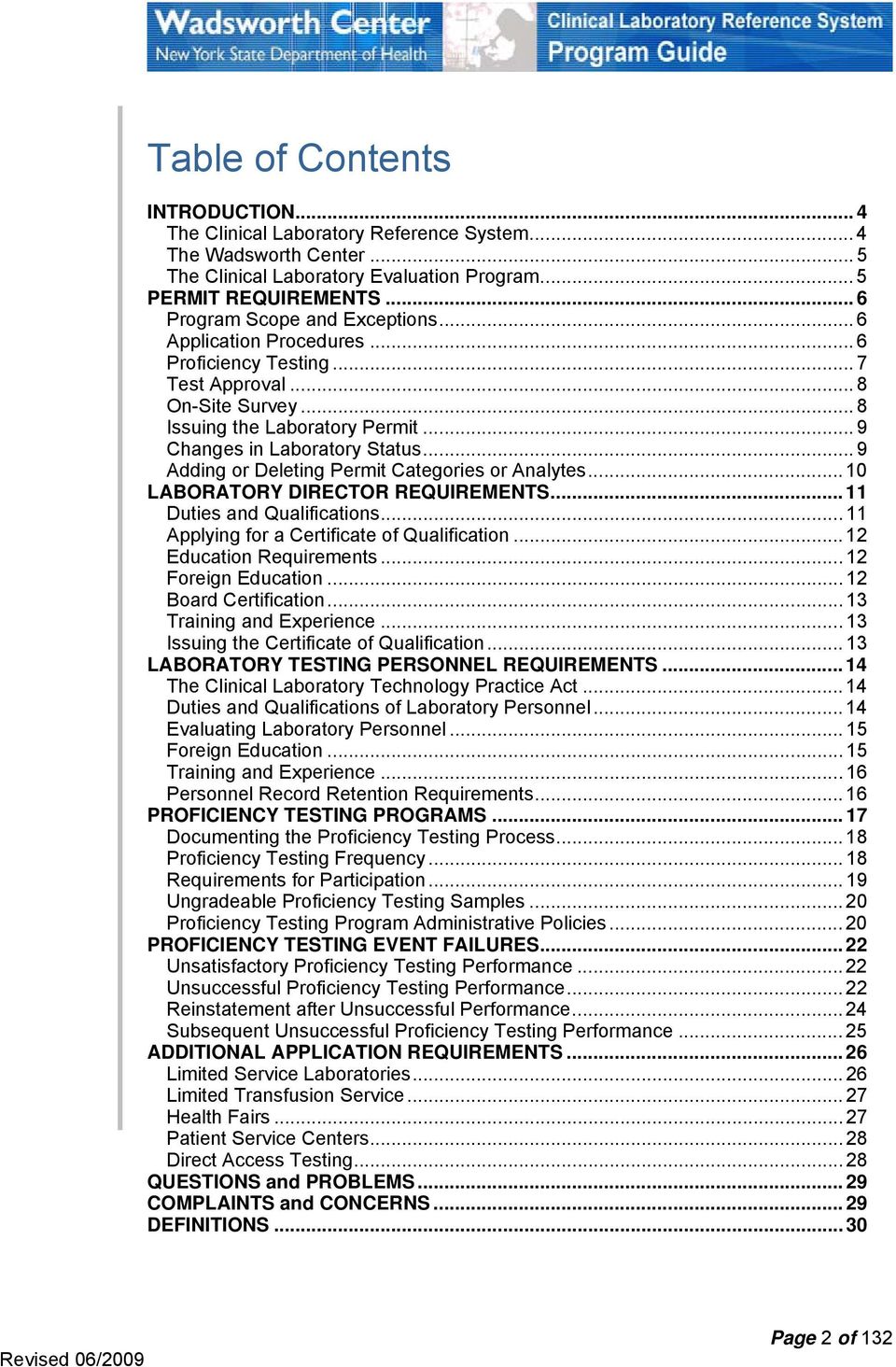
2 Table of Contents INTRODUCTION... 4 The Clinical Laboratory Reference System... 4 The Wadsworth Center... 5 The Clinical Laboratory Evaluation Program... 5 PERMIT REQUIREMENTS... 6 Program Scope and Exceptions... 6 Application Procedures... 6 Proficiency Testing... 7 Test Approval... 8 On-Site Survey... 8 Issuing the Laboratory Permit... 9 Changes in Laboratory Status... 9 Adding or Deleting Permit Categories or Analytes LABORATORY DIRECTOR REQUIREMENTS Duties and Qualifications Applying for a Certificate of Qualification Education Requirements Foreign Education Board Certification Training and Experience Issuing the Certificate of Qualification LABORATORY TESTING PERSONNEL REQUIREMENTS The Clinical Laboratory Technology Practice Act Duties and Qualifications of Laboratory Personnel Evaluating Laboratory Personnel Foreign Education Training and Experience Personnel Record Retention Requirements PROFICIENCY TESTING PROGRAMS Documenting the Proficiency Testing Process Proficiency Testing Frequency Requirements for Participation Ungradeable Proficiency Testing Samples Proficiency Testing Program Administrative Policies PROFICIENCY TESTING EVENT FAILURES Unsatisfactory Proficiency Testing Performance Unsuccessful Proficiency Testing Performance Reinstatement after Unsuccessful Performance Subsequent Unsuccessful Proficiency Testing Performance ADDITIONAL APPLICATION REQUIREMENTS Limited Service Laboratories Limited Transfusion Service Health Fairs Patient Service Centers Direct Access Testing QUESTIONS and PROBLEMS COMPLAINTS and CONCERNS DEFINITIONS Page 2 of 132
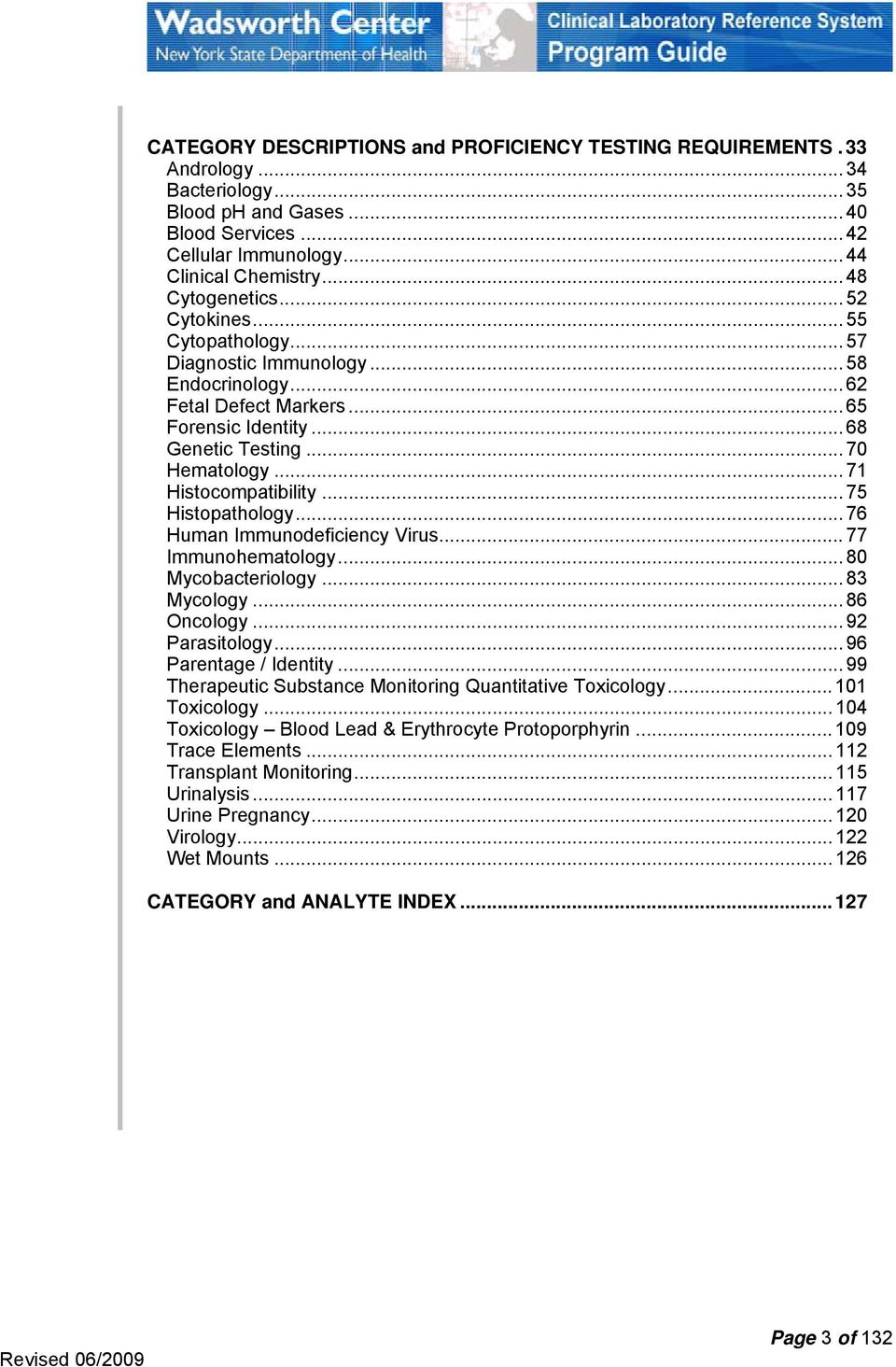
3 CATEGORY DESCRIPTIONS and PROFICIENCY TESTING REQUIREMENTS.33 Andrology Bacteriology Blood ph and Gases Blood Services Cellular Immunology Clinical Chemistry Cytogenetics Cytokines Cytopathology Diagnostic Immunology Endocrinology Fetal Defect Markers Forensic Identity Genetic Testing Hematology Histocompatibility Histopathology Human Immunodeficiency Virus Immunohematology Mycobacteriology Mycology Oncology Parasitology Parentage / Identity Therapeutic Substance Monitoring Quantitative Toxicology Toxicology Toxicology Blood Lead & Erythrocyte Protoporphyrin Trace Elements Transplant Monitoring Urinalysis Urine Pregnancy Virology Wet Mounts CATEGORY and ANALYTE INDEX Page 3 of 132
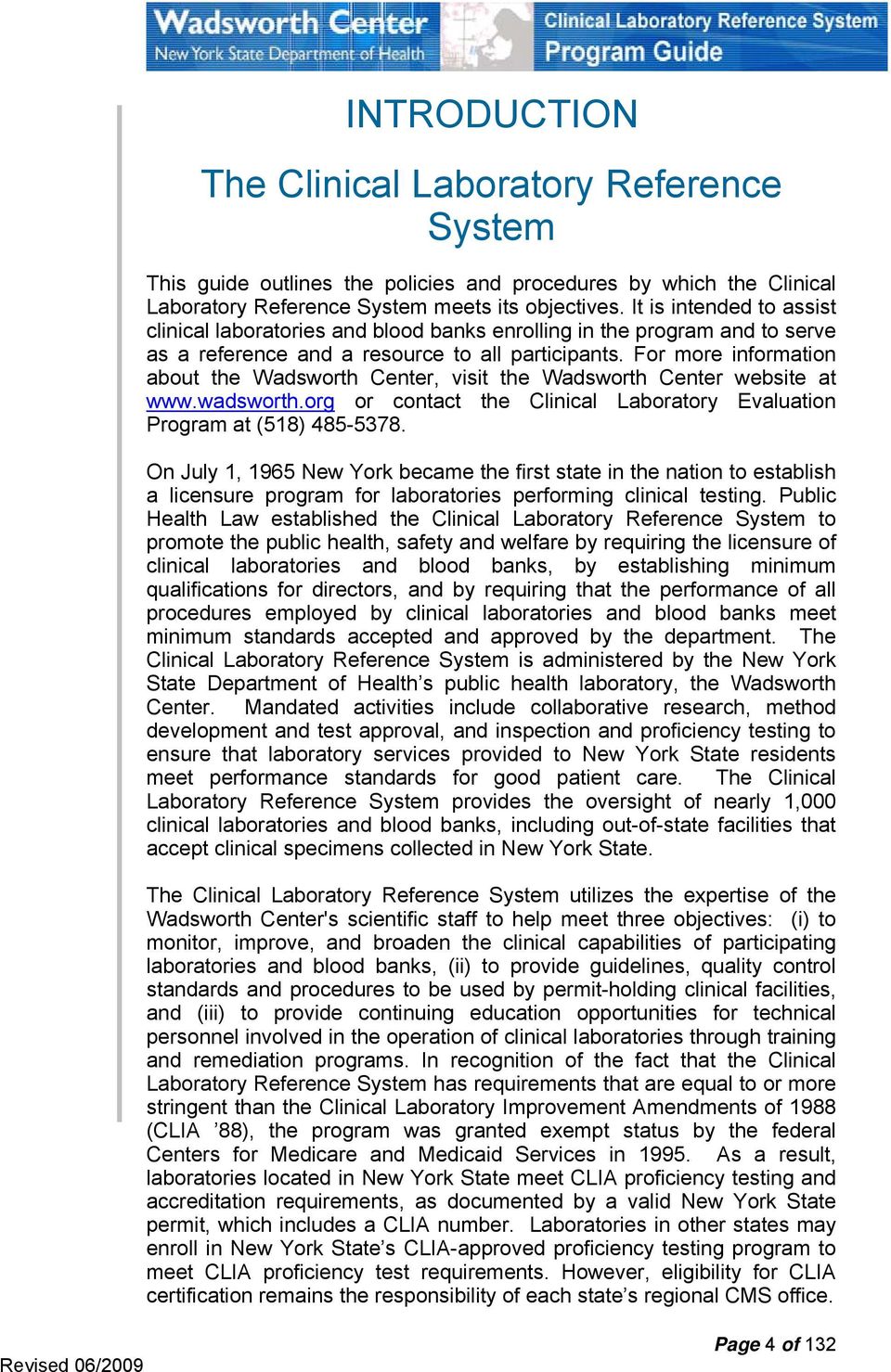
4 INTRODUCTION The Clinical Laboratory Reference System This guide outlines the policies and procedures by which the Clinical Laboratory Reference System meets its objectives. It is intended to assist clinical laboratories and blood banks enrolling in the program and to serve as a reference and a resource to all participants. For more information about the Wadsworth Center, visit the Wadsworth Center website at or contact the Clinical Laboratory Evaluation Program at (518) On July 1, 1965 New York became the first state in the nation to establish a licensure program for laboratories performing clinical testing. Public Health Law established the Clinical Laboratory Reference System to promote the public health, safety and welfare by requiring the licensure of clinical laboratories and blood banks, by establishing minimum qualifications for directors, and by requiring that the performance of all procedures employed by clinical laboratories and blood banks meet minimum standards accepted and approved by the department. The Clinical Laboratory Reference System is administered by the New York State Department of Health s public health laboratory, the Wadsworth Center. Mandated activities include collaborative research, method development and test approval, and inspection and proficiency testing to ensure that laboratory services provided to New York State residents meet performance standards for good patient care. The Clinical Laboratory Reference System provides the oversight of nearly 1,000 clinical laboratories and blood banks, including out-of-state facilities that accept clinical specimens collected in New York State. The Clinical Laboratory Reference System utilizes the expertise of the Wadsworth Center's scientific staff to help meet three objectives: (i) to monitor, improve, and broaden the clinical capabilities of participating laboratories and blood banks, (ii) to provide guidelines, quality control standards and procedures to be used by permit-holding clinical facilities, and (iii) to provide continuing education opportunities for technical personnel involved in the operation of clinical laboratories through training and remediation programs. In recognition of the fact that the Clinical Laboratory Reference System has requirements that are equal to or more stringent than the Clinical Laboratory Improvement Amendments of 1988 (CLIA 88), the program was granted exempt status by the federal Centers for Medicare and Medicaid Services in As a result, laboratories located in New York State meet CLIA proficiency testing and accreditation requirements, as documented by a valid New York State permit, which includes a CLIA number. Laboratories in other states may enroll in New York State s CLIA-approved proficiency testing program to meet CLIA proficiency test requirements. However, eligibility for CLIA certification remains the responsibility of each state s regional CMS office. Page 4 of 132
5 The Wadsworth Center The Wadsworth Center, created in 1914 and originally designated the Division of Laboratories and Research, evolved into an internationally known public health laboratory under its first director, Dr. Augustus B. Wadsworth. Today it is the most comprehensive public health laboratory in the country, occupying over 800,000 square feet of space and employing over 1,000 staff members. More than 100 of these staff members are doctoral level scientists engaged in teaching, research and laboratory service activities, and over 70 of these are Principal Investigators, with significant grant funding and peer-reviewed research activities. The Center provides the scientific basis for New York s public health policies and practices by supplying essential laboratory information; by responding to emerging public health threats; by conducting research into the underlying causes of disease and the impact of environmental pollutants; and by developing and applying the most advanced technologies and methods. The Wadsworth Center s combination of laboratory service, research, teaching and public health activities provides an unparalleled resource for the Clinical Laboratory Reference System. The Clinical Laboratory Evaluation Program The Clinical Laboratory Evaluation Program administers the activities of the Clinical Laboratory Reference System and is one of four regulatory programs within the Division of Laboratory Quality Certification of the Wadsworth Center. The other programs are the Environmental Laboratory Approval Program, the Blood and Tissue Resources Program and the Physician Office Laboratory Evaluation Program. These programs ensure the quality of clinical and environmental laboratory testing, protect the health of donors and recipients of human blood and tissues, and serve as a focus for education, training and communication activities for the laboratory community. The Office of Regulatory Affairs coordinates the promulgation, implementation and enforcement of regulations, supervises the Laboratory Investigative Unit, and reviews all allegations that might result in administrative, civil or criminal prosecution. Page 5 of 132
6 PERMIT REQUIREMENTS Program Scope and Exceptions Laboratories located in New York State, and laboratories conducting forensic or clinical testing on specimens originating in New York State regardless of location, must hold a New York State Department of Health clinical laboratory permit pursuant to Article V, Section 579 of the New York State Public Health Law. Research testing is considered clinical in nature if a patient identified result is generated. Although any examination performed by a state or local government on materials derived from the human body for use in criminal proceedings or for investigative purposes are exempt from permit requirements, in most cases tests for these purposes that are referred must be sent to a laboratory holding a New York State permit in the required category. Physician office laboratories (POLs) owned and/or operated by managed care organizations, hospitals or consulting firms, or POLs that perform testing on individuals other than their own patients must also obtain a clinical laboratory permit. Laboratories operated by physicians, osteopaths, dentists, midwives, nurse practitioners or podiatrists performing testing only for their own patients are exempt from permit requirements; however, these facilities must obtain a CLIA number to operate in New York through the Physician Office Laboratory Evaluation Program (POLEP). Information on the requirements for physician office laboratories can be obtained from POLEP by contacting (518) Facilities performing only those tests classified by federal CLIA regulations as waived and provider-performed microscopy procedures are exempt from permit requirements, but must register with the Department and meet minimum standards to ensure the accuracy, reliability and accessibility of such tests. These requirements are described in the Additional Application Requirements section of this guide. Application Procedures Laboratories applying for a permit may not begin testing until all requirements have been met and a permit is issued. Permit application materials and complete instructions are available at An initial application for a laboratory permit must be submitted with the required application and reference fees of $1,100. Laboratories located out-of-state must also pay any travel costs associated with the on-site inspection. Requirements for a permit include certification of a director and/or assistant directors for each test category, an on-site inspection and correction of any deficiencies identified, successful performance in proficiency testing or alternate requirements for each test category, and departmental review and approval of any in-house developed or non-fda approved methods. Page 6 of 132

7 Clinical laboratory permits are valid for one year, commencing on July 1 of each year (initial permits can be issued at anytime during the permit cycle of July 1 through June 30) and extending through June 30 of the following year. Applications for permit renewal are sent to all laboratories in the spring of each year. The annual fee for the permit renewal includes a $100 application fee plus an inspection and reference fee that is calculated by multiplying the total operating expenses of the Program by a fraction, the numerator of which is the gross annual receipts of the laboratory and the denominator of which is the total gross annual receipts of all laboratories issued permits. Information is collected on the gross annual receipts or GAR for all laboratories each year as part of the annual renewal process and fees are billed and payable quarterly. Proficiency Testing Once all administrative requirements for the completion of the laboratory permit application have been met and certificates of qualification have been issued to the director and any assistant directors (see the section on Laboratory Director/Assistant Director Requirements) the laboratory will be placed in Applied Pending status and will receive regularly scheduled New York State proficiency test samples for all categories and analytes for which proficiency testing is available. Proficiency test requirements are met for the category upon satisfactory performance in all components of the initial proficiency test event. The annual proficiency testing schedule in posted at It is possible to schedule a special test event, if test samples are available, in order to expedite the application process. The laboratory can receive information concerning these special test events from the contact individuals listed in the section of this guide titled Proficiency Testing Section Descriptions. A contact list is also available at Should a laboratory perform unsatisfactorily for the entire category or for an analyte, the laboratory must investigate the cause of unsatisfactory performance and document the corrective action for review by the Program. The corrective action must be acceptable to the Program and performance in the subsequent test event must be satisfactory to meet proficiency requirements for the category. Unsatisfactory performance in two out of three test events will result in unsuccessful performance; the laboratory is then subject to requirements outlined in the section titled Unsuccessful Proficiency Testing Performance and Reinstatement after Unsuccessful Performance. For analytes and areas of laboratory medicine for which New York State proficiency testing is not available the laboratory is required to have an alternate system for verifying the reliability and accuracy of their test results at least twice a year through participation in other external proficiency testing programs or through the implementation of an internal proficiency testing program. Detailed information can be found in the section of this guide titled Proficiency Testing Programs. Page 7 of 132
8 Test Approval Laboratories may be required to submit standard operating procedure manuals (SOPMs) and validation data for review and approval by the Program. This applies to all molecular testing performed under the category of Genetic Testing or Cytogenetics, and to any in-house developed or non-fda approved methods performed under other permit categories, and to FDA approved tests that have been modified by the laboratory. Detailed protocols for preparing method approval packages for review are available under the Test Approval link at On-Site Survey Once the laboratory is placed in Applied Pending status, a clinical laboratory consultant will contact the laboratory to schedule an on-site survey to ensure that the premises, laboratory practices, equipment, personnel, and record-keeping meet State requirements. These requirements are outlined in Parts 19, 58, 63 and 70 of Title 10, New York Code of Rules and Regulations (10NYCRR); Article 5, Title V of the New York State Public Health Law; and in the program s Laboratory Standards. These laws, regulations and standards are available from our website at and also at New York State s Public Health Law requires that out-of-state laboratories seeking or renewing a New York State laboratory permit pay the travel expenses related to the on-site inspection of the laboratory facility. Travel expenses are based on the number of surveyors involved in the inspection, the number of days required for the inspection, and the number of facilities inspected. Laboratories are sent a bill for these expenses after the survey has been completed. The Clinical Laboratory Reference System has adopted a Quality Systems approach to conducting surveys. The consultants conduct direct observations whenever possible; track selected specimens from initial receipt/collection to reported results; direct attention to what actually happens to specimens and laboratory test results; and observe and assess how competently and effectively the staff process specimens, perform test analyses, and report test results (i.e., pre-analytic, analytic and post-analytic phases of testing). Observations focus on specimen integrity and the accuracy, reliability and timeliness of test results, including quality control and calibration data; test performance and patient specific information; skills of supervisory and technical personnel (e.g., training; competency; delegation of responsibilities; evaluation of test results; resolution of problems); and general adequacy of the facilities, equipment and supplies. Page 8 of 132

9 Substandard practices are evaluated for the degree of severity, frequency of occurrence, impact on patient care, and accuracy and reliability of test results. Laboratory practices are considered deficient if they result in a situation that limits or would limit the capacity of a laboratory to provide quality services. When citing deficiencies, the consultant will identify whether the finding is a performance or documentation problem. If deficiencies are identified during the on-site survey, a deficiency statement is generated and sent to the laboratory. The laboratory must submit a plan of correction within ten working days of receiving the deficiency statement, documenting appropriate corrective action for any deficiencies noted. This plan of correction must be reviewed and approved by the Program before the laboratory can be issued a permit. Laboratories are surveyed routinely on a biennial basis or as necessary for on-site monitoring of corrective action. Issuing the Laboratory Permit Once the laboratory director and any assistant directors have been issued certificates of qualification; the facility has been inspected and any deficiencies have been corrected and the laboratory has successfully met method approval and proficiency testing or alternate requirements for all categories for which it has applied, a New York State clinical laboratory permit will be issued. Changes in Laboratory Status Article 5, Title V of the New York State Public Health Law specifies that a laboratory permit is void upon a change in laboratory director, owner, or location. All changes in laboratory name, owner name, director, assistant director, ownership, or location must be submitted to the Program using the appropriate change notification form before the change occurs. Forms are available at An Ownership and Controlling Interest Disclosure form must accompany notification of changes in owner. All changes are subject to Program approval. For example, an on-site survey may be required for changes in location, and approvals for changes in director are subject to review of the proposed director s commitments at other facilities and the performance of other laboratories under his or her direction. An amended laboratory permit will be issued for changes in director, location, owner or name of the laboratory, once requirements have been met. Page 9 of 132

10 Adding or Deleting Permit Categories or Analytes Forms to add or delete permit categories or analytes are available at A list of common test analytes and procedures, cross-referenced with the Program's testing categories, is included in the Category and Analyte Index of this guide. To add or delete a new permit category, the Notification to Add or Delete Category (ies) form must be submitted. To add or delete an analyte, the Notification to Add or Delete Analyte(s) form must be submitted. For new permit categories, an on-site survey and if applicable, successful completion of proficiency testing requirements must occur before testing can begin. In addition, a director must be identified who holds, or can qualify for, a certificate of qualification in the appropriate categories. Laboratories seeking to add new analytes under an existing approved permit category are not required to meet proficiency test requirements or undergo an on-site survey prior to initiating testing, provided the laboratory maintains current, successful participation in the proficiency testing program for other analytes within the category and notifies the Department of the addition. Laboratories seeking to add new analytes under an approved permit category that have not previously participated in proficiency testing in that category must notify the Department of the addition and meet proficiency test requirements, if applicable, prior to initiating testing. In most cases, a laboratory consultant will review validation data for the new category or analyte during the next on-site survey of the laboratory; however, for tests that are in-house developed or not cleared by the FDA for in-vitro diagnostic use, validation data, SOPM s, test reports or package inserts may be requested for review. Detailed requirements for test approval can be found at The Notification to Add or Delete Category (ies) form should be used if all analytes under a category are being deleted. Requests to delete individual analytes under a permit category can be submitted on the Notification to Add or Delete Analytes form. If the category or analyte is subject to proficiency testing, the laboratory must inform the Program no later than two weeks prior to the shipment of the next proficiency test event in the area of testing being deleted, either by submitting the appropriate forms or by written notification. Failure to do so may result in a failing grade for non-participation in the proficiency test event. Page 10 of 132

11 LABORATORY DIRECTOR REQUIREMENTS Duties and Qualifications Information on the duties and qualifications for laboratory directors can be found in Parts 19 and 58 of 10NYCRR, available at our website at A clinical laboratory director is defined in Section 19.1(a), of Part 19, as the individual responsible for administration of the technical and scientific operation of a clinical laboratory or blood bank, including supervision of test procedures, the reporting of results, and the duties and the responsibilities specified in Section 19.3 of this Part. In order to obtain a New York State laboratory permit, a laboratory must name a doctoral-level individual who meets the training and education requirements outlined in Part 19 of 10NYCRR and who qualifies for a New York State certificate of qualification as a laboratory director in each category for which the laboratory seeks a permit. If the individual designated as the laboratory director does not qualify for a certificate of qualification in all testing categories, the director may designate one or more individuals who hold, or can qualify for, a certificate in the appropriate categories to serve as director for the category or categories. Laboratory directors must indicate the actual hours they will serve, and the adequacy of these hours will be evaluated commensurate with the laboratory workload, scope and complexity of test procedures, qualifications of on-site personnel, and availability of alternate monitoring and communication capabilities. An individual may serve as director or sole certificate holder for a category for no more than two clinical laboratories and/or blood banks. If the laboratory and blood bank are located on the same premises, this may be considered as one directorship. Assistant Directorships (provided the individual is not the sole certificate holder for the category) and directorships of Limited Service Laboratories as described in the section of this guide titled Additional Application and Permit Requirements are not included in the two-site limit. An individual may be authorized by the Program to exceed the two-site limit if he or she submits justification of need. For example, if due to the geographic limitations or economic needs of an area it is difficult to obtain the services of a laboratory director, or due to common ownership and oversight arrangements a single directorship would benefit laboratory operations, authorization to serve as director or sole certificate holder for more than two facilities may be granted. Authorizations to exceed the two-site limit are granted for the duration of the permit year, expiring annually on June 30, and will be granted and renewed only if the laboratories under the direction of the individual remain in compliance with New York State requirements. Page 11 of 132
12 Applying for a Certificate of Qualification A certificate of qualification application is included with the initial laboratory permit application, or may be obtained from our website at The initial application fee is $ Applicants must document an acceptable combination of education, training and experience to qualify for a certificate including at least four years of post-doctoral training and/or experience in an acceptable laboratory of which two or more years of training and /or experience must be demonstrated in the methods and techniques currently in use in the certificate category or categories sought and in general laboratory management. Certification or recertification by certain professional boards recognized by the Program may satisfy training and experience requirements. Since a certificate of qualification is issued to an individual independent of laboratory affiliation, the home, rather than work, address of the applicant is used and all correspondence regarding the certificate of qualification is directed to the applicant at the home address. Education Requirements As outlined in Part 19, the minimum education required to obtain a certificate of qualification as a New York State laboratory director is an M.D., D.O., or D.D.S. degree, or an earned doctoral degree from an accredited institution with a relevant chemical, physical, or biological science major. All medical schools, colleges and universities attended must be indicated in the application. Physicians and dentists must be currently registered in New York State and/or the state in which they practice, and must provide a copy of their license and current registration to qualify for a certificate. Foreign Education For individuals educated in a foreign college or university, a credentials equivalency evaluation by an approved agency is required. Currently, the only agency accepted by the Program is the International Education Research Foundation, Inc., Credentials Evaluation Service at P.O. Box 3665, Culver City CA The telephone number for the service is (310) Page 12 of 132

13 Board Certification Certification or recertification by selected professional boards recognized by the program and obtained within the past six years may be substituted for the training and experience requirements described below. Applicants are asked to indicate all appropriate boards for which they are certified (from a list included in the instructions), certification date and specialty, and provide a copy of each certificate and any recertifications. Board certification obtained over six years ago will be considered, but documentation of recent training and/or experience will be required to qualify for a certificate of qualification. Training and Experience Applicants for a certificate of qualification must provide a summary of their postdoctoral training and experience and current employment, including a detailed description of their laboratory duties and the areas of laboratory medicine in which their experience has been gained. All clinical laboratory experience subsequent to receipt of a doctoral degree should be included. A copy of the current curriculum vitae must also be submitted. Applicants who do not hold any of the boards recognized by the Program, those who were certified more than six years ago by a required board, or those who are applying for categories for which education and laboratory experience are the only requirements, must provide documentation of their experience in the form of one or more letters from a current or previous director, supervisor, administrator or other individual. Each letter should be from an individual familiar with the applicant s experience, a portion of which must have been gained within six years of the application, and must indicate the type and volume of testing involved, dates of employment and methods and techniques used. These letters must be included with the application or processing will be delayed. Issuing the Certificate of Qualification A certificate of qualification is valid for two years from the date it is issued and must be renewed every two years. Approximately four months before the certificate of qualification expires, the certificate holder is sent a pre-printed renewal application, which must be completed and returned along with the $40.00 renewal fee. Additional categories of certification may be requested as part of this renewal process, or by letter at any other time. Board certification and/or documentation of experience as described above are required and should be submitted along with the request for the amendment. Page 13 of 132

14 LABORATORY TESTING PERSONNEL REQUIREMENTS The Clinical Laboratory Technology Practice Act The Clinical Laboratory Technology Practice Act was signed into law on January 30, This act established licensure requirements through the New York State Department of Education, Office of the Professions (SED). The act, which was implemented on September 1, 2006, defines the practice of clinical laboratory technology; establishes licensure requirements for clinical laboratory technologists and cytotechnologists; and establishes certification requirements for clinical laboratory technicians. The Clinical Laboratory Technology Practice Act is not applicable to personnel employed in laboratories located outside of New York State; to personnel employed in physician office laboratories or those performing non-medical (forensic and paternity) testing; to those employed in research where no patient identified results are generated; and to those employed by the New York State and New York City Public Health Laboratories. Questions about licensure requirements can be directed to SED at or by telephone at (518) , ext Duties and Qualifications of Laboratory Personnel Information on the requirements for certification through SED as a clinical laboratory technician or histological technician, licensure as a clinical laboratory technologist or cytotechnologist, and restricted licensure in the specialties of Histocompatibility, Cytogenetics, Stem Cell Process, Flow Cytometry/Cellular Immunology, and Molecular Diagnosis are available at Licensure is not required for individuals employed in out-of-state laboratories. The credentials of individuals employed in outof-state laboratories will be evaluated during the on-site survey to ensure they meet the the requirements of 10NYCRR Part 58, which specifies minimum education and experience requirements for technologists, cytotechnologists, and supervisors. Additional duties and qualifications for laboratory supervisors and cytology supervisors are described in regulations at Sections and of Part 58 of 10NYCRR. Individuals employed as supervisors must qualify at the technologist level (in New York State, they must be licensed through SED at the technologist level) and meet these additional requirements in order to qualify as a supervisor or cytology supervisor. Page 14 of 132

15 Evaluating Laboratory Personnel Program review of the credentials and qualifications of laboratory personnel will be performed as part of the on-site survey. It is the responsibility of the laboratory director to employ individuals who meet the requirements of Part 58 and the New York State Education law as applicable and to assign duties appropriate to the individual s experience and qualifications. The laboratory must complete and submit a Facility Personnel Form (DOH 709) with the initial permit application and provide an updated form as part of each biennial survey. Laboratories are encouraged to maintain this information electronically so it can be easily updated. During the initial on-site survey, a clinical laboratory consultant will evaluate the qualifications of all technical personnel. All cytotechnologists must register with Program and maintain a list of current sites of employment for the purposes of workload monitoring, in addition to holding licensure or, for those employed out-of-state, meeting equivalent requirements. If the cytotechnologist is not registered at the time of hiring, the laboratory must submit an application for registration within one week of commencing employment. In addition, cytotechnologists are required to notify the Program within thirty days of any changes to their name, address and/or employers. The laboratory must also notify the Program when a cytotechnologist is hired, resigns or otherwise is separated from the laboratory. A respiratory therapist is considered to be equivalent to a technologist and a respiratory therapist technician is considered to be equivalent to a technician when performing laboratory testing directly related to their job duties. Respiratory therapists may act as supervisors for blood gas and related testing after they have completed two years of experience. Individuals employed as respiratory therapists and respiratory therapy technicians in New York State must be licensed through the New York State Department of Education. Foreign Education For individuals employed in out-of-state laboratories who have been educated in a foreign college or university and do not hold certification or licensure through the New York State Education Department, a credentials equivalency evaluation by an approved agency may be required in order to determine equivalency with New York State licensure or certification requirements. Currently, the only agency recognized by the Program is the International Education Research Foundation, Inc., Credential Evaluation Service (IERF) at P.O. Box 3665, Culver City, CA The contact information for the service is (310) (telephone) and (310) (fax). If an individual with a foreign degree has earned credits that are accepted towards another degree in this country, a credentials equivalency evaluation is not required. Page 15 of 132

16 Individuals with the following degrees do not require an IERF credentials evaluation: BSMT for the Phillippines, Dominican Republic or Columbia; or BS in Pharmacy from the Phillipines. Documentaton of education must be available as described previously. Training and Experience The laboratory must maintain documentation of training and experience for all supervisors and technical personnel. Documentation of previous laboratory experience may be in the form of letters from former employers verifying dates of employment and duties, and must indicate whether the experience was full or part-time. If the laboratory confirms previous experience by contacting references, this should be documented in the personnel files. Part-time experience can be prorated, with 2000 hours equaling one year of full time experience. Pertinent full-time laboratory experience implies that the individual qualifying has knowledge of, exposure to, and experience with the laboratory specialties in which that individual will be functioning. Research experience is acceptable only if it is obtained while performing tests on human specimens. The tests performed should be of the same type as those that will be used in the laboratory. Personnel Record Retention Requirements The laboratory or the human resources office of the institution is responsible for maintaining records that verify certification and licensure through the New York State Education Department, for personnel employed in New York State, and for education, experience, and training in compliance with Part 58 of NYCRR, for individuals employed in out-ofstate laboratories. Generally, diplomas, resumes, transcripts, official letters from an institution of higher education attesting to the highest level of learning achieved, letters from former employers, or other records are sufficient to establish that education and experience requirements equivalent to those for certification or licensure through the New York State Education Department have been met. Documentation required for directors and assistant directors is a copy of their New York State certificate of qualification and a description of their duties (refer to the section of this guide titled Laboratory Director Requirements for information on the certification process for director level personnel). Documentation required for respiratory technologists and technicians is a copy of their license from the New York State Education Department. Page 16 of 132

17 PROFICIENCY TESTING PROGRAMS Formal acknowledgment of the Program's exempt status under the Clinical Laboratory Improvement Amendments of 1988 (CLIA '88) was published in the August 28, 1995, edition of the Federal Register. Participation in the Program's proficiency testing and accreditation programs fulfills all state and federal requirements for permit-holding laboratories and blood banks located in the state. Permit-holding clinical laboratories and blood banks located outside the state may use the Program's proficiency testing program for CLIA '88 regulatory purposes. However, holding a New York State clinical laboratory permit will not, in itself, exempt an out-of-state laboratory from federal certification or accreditation requirements. Proficiency test events in each category are designed and administered by a professional staff member of the Wadsworth Center who holds a New York State certificate of qualification in the corresponding test category. The test samples are verified through stringent in-house quality control testing and when appropriate, analysis by referee laboratories. Detailed information concerning the preparation and grading of each test event is included in the section of this guide titled Proficiency Testing Technical Sections. Distinction is made in the individual technical section descriptions between those analytes and procedures that are proficiency tested by New York State regulations and those that are tested under federal requirements. A list of common test analytes and procedures, cross-referenced with the Program's testing categories, is included in the Category and Analyte Index of this guide. Please note that not all analytes and procedures currently tested or employed by clinical laboratories are proficiency tested by New York State. In those areas of laboratory medicine for which New York State proficiency testing is not available, laboratories are expected to implement alternate monitoring systems for verifying the reliability and accuracy of their test results at least twice a year. This can be accomplished through participation in other external proficiency testing programs or through the implementation of an internal proficiency-testing program. In addition to alternative monitoring, the laboratory may be required to submit procedure manuals or validation data for review and approval by the Program. Page 17 of 132

18 Documenting the Proficiency Testing Process Participating laboratories must maintain the following documentation of the processing of proficiency testing materials for review by Program staff as required. Review of this documentation may occur during the on-site survey. 1. Each step taken in preparing, processing, examining, testing and reporting all results in the proficiency test event; 2. Copies of all records, including copies of the proficiency test report forms, for a minimum of two years from the date of the test event for all categories except Immunohematology which requires retention for five (5) years and Forensic Identity which requires case files documenting the analysis of proficiency test samples be kept for three (3) years. 3. Test attestation statements signed by the director or the authorized assistant director (CQ holder for the category) and the analyst(s) performing the testing. Proficiency Testing Frequency Proficiency tests for each category and analyte required by state and federal regulations are submitted to participating laboratories three times per year, except for testing in Transplant Monitoring, Forensic Identity, Mycobacteriology, Parentage/Identity DNA Testing, Urinalysis, and Urine Pregnancy Testing, which occur twice per year, and the glass-slide component of the Cytohematology and the Blood Alcohol (Vehicle and Traffic) events, which are scheduled annually. Most test events consist of five test samples, for a total of fifteen test samples per year in each category or analyte, unless noted otherwise in the section of this guide titled Proficiency Testing Technical Sections. Laboratories performing gynecologic cytopathology must document enrollment in a federallyapproved proficiency testing program. Page 18 of 132

19 Requirements for Participation All laboratories applying for or holding state clinical laboratory permits must participate in the New York State proficiency testing program and adhere to the following testing procedures. Failure to comply with these procedures may result in sanctions being brought against participating laboratories under state and federal regulations. 1. The laboratory shall participate in the New York State proficiency testing program for each category and analyte for which the laboratory seeks or currently holds a permit, and for which graded as well as educational proficiency testing is offered; 2. A laboratory shall examine, test, or analyze the proficiency samples in the same manner as clinical specimens, consistent with its routine workload; 3. The proficiency samples shall be examined or tested with the laboratory's routine workload by personnel who routinely perform the testing in the laboratory, using the laboratory's routine methods, unless otherwise instructed by the proficiency testing program; 4. Repeated testing or analysis of proficiency samples is not permitted unless the laboratory performs the same repetitive testing or analysis on patient, donor, insurance applicant or other client samples; 5. Laboratories that test proficiency samples shall not engage in any inter-laboratory communication or discussion pertaining to the results of test samples until after the date the laboratories are required to report the results to the Program. Laboratories with multiple testing sites or separate locations cannot participate in any communication or discussion between or among sites/locations concerning test results until after the date the laboratories are required to report the results to the Program; 6. Laboratories shall not send proficiency samples or portions of samples to any other laboratory or location for testing, analysis or review; 7. Any laboratory that has referred its proficiency samples to another laboratory for analysis and/or submitted the other laboratory's results as its own will face administrative sanctions and may have its permit revoked and/or denied for at least one year; and 8. Any laboratory that receives proficiency samples from another laboratory for testing must notify the Program within seventy-two hours of receipt or identification of such samples. Page 19 of 132

20 Ungradeable Proficiency Testing Samples Occasionally a sample is found to be Ungradeable due to the lack of consensus among participating, reference or referee laboratories. In such instances, laboratories will not be penalized. Information concerning Ungradeable samples will be provided as part of the critique and/or report distributed to all participating laboratories at the conclusion of each testing event. Proficiency Testing Program Administrative Policies The following are the Program's policies concerning the reporting and grading of proficiency testing results submitted by laboratories applying for or holding a New York State clinical laboratory permit. Please note that the Program has implemented a web-based Electronic Proficiency Testing Reporting System (EPTRS) and electronic submission is mandatory, for all challenges currently available on-line. Information on enrollment can be obtained at Non-participation - Failure to submit test results will result in a score of zero. Laboratories are responsible for using the Program s proficiency testing schedule to track shipment dates for test events in which they participate. However, the proficiency section may excuse participation in a test event if the laboratory has: 1. Performed successfully in the two previous test events; 2. Patient testing has been suspended over the timeframe for the test event; and 3. The Program has been notified of the temporary suspension of testing prior to the proficiency test event. Notification of Non-Receipt or Damaged Samples - Failure to notify the appropriate section of non-receipt of samples or receipt of damaged samples may result in a grade of zero for the test event. Laboratories are responsible for using the Program s proficiency testing schedule to track shipment dates for test events in which they participate. For all categories, except for Cellular Immunology and Mycobacteriology, if the test samples are not received within five days of the shipment date, or if the samples are received in unsatisfactory condition, laboratories must notify the contact person in the appropriate test section. Replacement samples may be provided if the test section is notified within this time frame. Please refer to the Cellular Immunology and Mycobacteriology proficiency testing section descriptions for their requirements regarding notification of non-receipt or damaged samples. Page 20 of 132
21 Replacement Samples - The laboratory may request replacement samples under circumstances where in routine laboratory practice, the recourse in clinical testing is to collect additional specimens (e.g., laboratory accident or instrument failure). The period to request replacement samples varies among categories depending upon the amount of time required to ensure the integrity of the proficiency test event. Replacement samples are available as specified in the section of this guide titled Proficiency Testing Section Descriptions. Signatures - Reports of proficiency test findings must be signed to attest that the proficiency samples were handled in the same manner as patient specimens. For those laboratories submitting electronically, signed forms must be retained in the laboratory and signatures will be verified during the course of the on-site inspection. The required signatures for all sections, except for Cellular Immunology and Cytogenetics, are: 1. The laboratory director (or the assistant director, as defined below) and 2. The analyst(s) performing the testing. An assistant director is an individual holding a New York State certificate of qualification who the laboratory director has designated in writing to the Department as responsible for any of the director's duties, as specified in Part 19 of Title 10, for any or all permit categories. In order to sign off on proficiency testing, the assistant director must hold a certificate of qualification in that category and be designated as responsible for the category. Laboratories must continue to mail result forms for any category for which electronic proficiency testing is not yet available. If the laboratory director or assistant director is unavailable to review the test results and sign the results prior to the submission deadline, the laboratory should retain a copy of the results report form and transmit the unsigned original, with a note of explanation, to the proficiency test section. The copy of the document should be signed by the director or assistant director and forwarded to the Program within two working days of their return. Laboratories submitting electronically must retain signed forms as indicated above. In the categories of Cellular Immunology and Cytogenetics the certificate holder must sign the proficiency report. Please see the Cellular Immunology and Cytogenetics technical descriptions for signature requirements. Grading Method - The grading method and passing score to be used for each category and/or analyte for which proficiency testing is offered is described in the individual proficiency testing sections of this Guide. Sample Validation - Proficiency testing samples not validated by eighty (80) percent of participating and/or referee laboratories will not be graded, and participating laboratories will be notified of such action at the conclusion of each test event. Page 21 of 132
22 Review - Any request for reconsideration of grading must be submitted to the Program in writing, with supporting documentation, within thirty days of the submission of the graded proficiency test results. An event can be regraded only if it is determined that an error was made on the part of the Program, e.g., data entry error. PROFICIENCY TESTING EVENT FAILURES Unsatisfactory Proficiency Testing Performance Unsatisfactory performance is the failure to attain the minimum satisfactory score for the category or analyte for a testing event, including events that are failed for non-technical reasons such as late submission or failure to participate. The proficiency section notifies laboratories following unsatisfactory performance. Such laboratories are required to investigate the problem(s) that contributed to the unsatisfactory performance and implement corrective action. Laboratories may request additional test samples to use as part of the remediation. The investigation and any subsequent remediation conducted by the laboratory may be reviewed during on-site survey or the proficiency section may request that documentation be submitted for review. Unsuccessful Proficiency Testing Performance Unsuccessful proficiency testing performance is unsatisfactory performance for the category or analyte in two consecutive or two out of three consecutive testing events, including events that are failed for nontechnical reasons such as a late submission or failure to participate. The Program notifies laboratories following unsuccessful performance. Laboratories are required to investigate and document the problem(s) that contributed to the unsuccessful performance and implement corrective action. Laboratories may request additional test samples to use as part of the remediation. The findings of the laboratory investigation and a description of the corrective action that is implemented must be submitted to the proficiency testing section for evaluation. Remediation programs are designed based on the nature of the unsatisfactory performances and the area of clinical laboratory medicine involved. An on-site inspection of the laboratory may be conducted. Once the laboratory s remediation is acceptable to the proficiency testing section, the laboratory must demonstrate satisfactory performance in two consecutive proficiency test events. Page 22 of 132
23 The decision as to whether a laboratory should be ordered to cease testing of clinical specimens upon a first unsuccessful performance in proficiency testing is based on responses to the following questions: 1. Are the analytical errors suggestive of immediate jeopardy to patient care? 2. Has the laboratory demonstrated an inability to make progress toward improvement of previously identified substandard performance following a reasonable opportunity to correct deficiencies? 3. Are the root causes of substandard performance systemic to laboratory practices? 4. Has the laboratory demonstrated a history of non-compliance with standards of good laboratory practice? 5. Have there been other instances of unsuccessful performance in the category within the past two years that reflect a pattern of poor performance relevant to the current event? If the response is yes to any one of the questions 1-5 and the validity of the proficiency event is substantiated, the Program is obligated to instruct the laboratory to cease testing clinical specimens and to require the laboratory to perform the following: Identify the permit laboratory to which it will refer clinical specimens; Investigate the cause(s) of substandard performance in the proficiency program; and Conduct a retrospective review of patient results to ascertain whether similar error(s) existed in reports of test findings and to assess the need for notification of the ordering physician. Laboratories that comply with a directive to cease testing clinical specimens due to a first unsuccessful PT performance will be reinstated once documentation of corrective action has been determined to be acceptable and the laboratory demonstrates satisfactory performance in two consecutive test events. Where performance in proficiency testing provides evidence of risk for patient harm as judged by criteria a-e under Proficiency Testing Sustaining Standard of Practice 11 (PT S11): Unsuccessful Performance Cessation of Patient Testing, and the laboratory does not voluntarily cease testing, the Department will take enforcement action as authorized by Sections 576(3) and 577 of Public Health Law, Article 5, Title V, seeking limitation of the laboratory s permit in the area of failure for a minimum of six months. Page 23 of 132
24 If the response to each of questions 1-5 above is no, the laboratory will be notified of the unsuccessful performance in proficiency and be instructed to perform the following: Investigate immediately the cause(s) of substandard performance in proficiency and report its findings to the proficiency section within two weeks (ten business days) of notification of unsuccessful performance; and Demonstrate the effectiveness of corrective action by successful performance in proficiency testing or by documenting comparable results with an approved laboratory in the analysis of split specimens (interlaboratory comparison). If the director of the proficiency section judges that the cause(s) of substandard performance are not systemic, can be remedied in a timely manner, and the level of performance does not compromise the clinical utility of results, the laboratory is allowed to continue testing of clinical specimens as test performance is investigated and monitored. The documentation of cause(s) of unsuccessful performance and the effectiveness of corrective action must be provided to the proficiency section within two weeks (10 business days) of notification of unsuccessful performance. If effective corrective action is not implemented and documented to the proficiency section, the laboratory will be required to cease testing clinical specimens. Reinstatement after Unsuccessful Performance The laboratory must characterize the cause(s) of substandard performance, develop and implement a plan of corrective action, and substantiate the effectiveness of corrective action by successful performance in two consecutive proficiency test events, one of which may be conducted on-site. In those categories not regulated under CLIA 88, or where validated samples are not available due to the instability of the test material, the documentation of comparable results with an approved laboratory in the analysis of split specimens may be used in addition to successful performance in one event to verify the effectiveness of corrective action. As a CLIA-exempt state, the Program must notify the federal Centers for Medicare and Medicaid Services (CMS) of any sanctions (e.g., orders to cease testing of clinical specimens) brought against laboratories enrolled in the proficiency-testing program. Page 24 of 132
25 Subsequent Unsuccessful Proficiency Testing Performance Laboratories demonstrating a subsequent unsuccessful (three consecutive unsatisfactory performance or three unsatisfactory performances in four or five consecutive test events) will be instructed to cease testing clinical specimens. Laboratories that voluntarily cease testing will be reinstated and patient testing will be allowed to resume once documentation of corrective action has been determined to be acceptable and the laboratory demonstrates satisfactory performance in two consecutive test events. Where performance in proficiency testing provides evidence of risk for patient harm as judged by criteria a-e under Proficiency Testing Sustaining Standard of Practice 11 (PT S11): Unsuccessful Performance Cessation of Patient Testing, and the laboratory does not voluntarily cease testing, the Department will take enforcement action as authorized by Sections 576(3) and 577 of Public Health Law, Article 5, Title V, seeking limitation of the laboratory s permit in the area of failure for a minimum of six months. Page 25 of 132
26 ADDITIONAL APPLICATION REQUIREMENTS Limited Service Laboratories Amendments to New York State Public Health Law (PHL) effective August 8, 2008 authorized the Department s processes for oversight and registration of Limited Service Laboratories. The designation Limited Service Laboratory was established for facilities that perform only tests classified under the Clinical Laboratory Improvement Amendments of 1988 (CLIA) as waived or provider-performed microscopy procedures (PPMP). These facilities include hospital extension clinics, nursing homes, home health care agencies, school/student health services, dialysis facilities, ambulatory surgery centers, county health departments, correctional facilities, ambulance/rescue squads and other direct patient care facilities. Physician offices performing only waived or PPMP tests that are owned and/or operated by managed care organizations, hospitals or consulting firms are also included in this group. Physicians or groups of physicians, midwives or nurse practitioners operating independently owned laboratories solely to perform waived or PPMP tests on their own patients are exempt from PHL registration requirements and may obtain CLIA certification through the Physician Office Laboratory Evaluation Program (POLEP). Information on CLIA certification for physician office laboratories may be obtained by contacting POLEP at (518) The new law authorizes the Department to charge a registration fee of $200 for each biennial (every two years) renewal registration in addition to an initial registration fee of $200. Limited Service Laboratories that are not-for-profit, state or local government -operated or programs engaged in public health testing not to exceed 15 tests per registration may qualify for a multi-site registration, which allows several locations to operate under a single registration; one location must be identified as the parent site. Multi-site registrants would pay a single registration fee of $200 and single renewal fees of $200, without regard to the number of sites covered by one registration. Test kits and devices classified as waived are all clearly labeled. The FDA assumed the responsibility for classifying the complexity status of laboratory tests in January 2000 and information on tests waived after January of 2000 can be obtained from the FDA website at and a list of waived tests by specific kit and manufacturer is available at Page 26 of 132
27 Limited Transfusion Service A hospital s permit in Blood Services-Transfusion covers transfusions performed at any facility that is owned and operated by the hospital and transfusions performed at any facility located on the campus of the hospital. Non-hospital based facilities that do not meet these criteria must apply for designation as a Limited Transfusion Service if transfusions are performed on-site. Information and questions about Limited Transfusion Services should be directed to the Blood and Tissue Resources Program at (518) Health Fairs A Health Fair is defined in Section of Part 58 as a temporary collecting station, which is defined as a one-time, one-site facility, operated with the prior approval of the Department, which collects, draws and/or temporarily stores materials derived from the human body, as part of a health fair, health assessment or health risk reduction program, for the purpose of screening for health risk. To qualify for approval to operate a health fair, a laboratory must hold a New York State clinical laboratory permit and must submit a health fair application. A laboratory procedure manual should be developed for such fairs and must be available for review by the Program upon request. Unless the tests offered are eligible for direct access testing (see Direct Access Testing), a physician-incharge must be named, who will request the tests for fair participants, give permission for results to be given directly to fair participants and be responsible for the referral of any abnormal results. Accession and report records for all fair participants are considered patient records and must be retained as required by Section of Part 58. Tests performed should be those appropriate for a community screening setting, meeting criteria as set forth in Section of Part 58. The laboratory must hold a permit in the appropriate category for tests performed on-site and/or for tests performed on specimens collected and transported back to the laboratory for analysis, or must forward tests to a laboratory holding the appropriate permit. Procedures and documentation of validation and other quality control, as well as justification for offering the test as part of a community screening, may be requested by the Program for review before a decision is made concerning the health fair application. Health fair approvals are valid for one year, commencing on July 1st of each year and extending through June 30th of the following year. Application forms are available at Laboratories may hold multiple health screening events throughout the year for any of the tests approved as part of the initial application. Requests to perform additional tests must be submitted in writing. Health fair approvals must be renewed in conjunction with the annual laboratory permit renewal application in the spring of each year. Facilities registered as Limited Service Laboratories may apply to conduct community screening as part of the registration process. Page 27 of 132
28 Patient Service Centers A patient service center (collecting station) is defined in Section of 10 NYCRR as an off-site facility operated by a clinical laboratory under permit, for the collection, drawing, and/or temporary storage of materials derived from the human body, until forwarded to the clinical laboratory for testing. Laboratories under permit and registered Limited Service Laboratories may collect patient specimens on-site without separate patient service center approval. Approval is not required for patient service centers located outside New York State. To qualify for approval to operate a patient service center, a laboratory must hold a New York State Clinical laboratory permit, and must submit a patient service center application available at The application includes a self-assessment document that will be used to determine whether the facility meets the criteria outlined in Section and Subpart 34-1 of 10NYCRR. If this application is complete and the responses to the self-assessment questions are satisfactory, a letter will be issued granting approval to operate the Patient Service Center for three months. An on-site survey will be conducted during this threemonth period and if the Patient Service Center is found to be in compliance, an approval certificate will be issued. Patient Service Center approvals are valid for one year, commencing on July 1 each year and extending through June 30 the following year. Laboratories must renew patient service center approvals in conjunction with the annual laboratory permit renewal application in the spring of each year. Direct Access Testing On September 24, 2002 legislation was enacted that provides clinical laboratories holding permits the option of offering certain laboratory tests directly to consumers, without written authorization (i.e., an order) from a medical professional, provided the laboratory holds a permit in the appropriate categories. This direct access testing option is available for tests for which a Federal Food and Drug Administration (FDA) approved test kit or collection device is available over-the-counter (OTC) without a prescription, and for tests for the same purpose. Limited Service Laboratories are not eligible to offer direct access testing, and must continue to document authorization of the physician or other health care professional who orders testing ancillary to a medical encounter, or, for public health testing, authorization of the Commissioner or a designee. A list of the tests approved for OTC sale by the FDA s Center for Devices and Radiologic Health (CDRH) is posted at Guidance on direct access testing, including information on test orders, specimen collection, test reports, and special requirements for HIV testing, can be found on our website at Page 28 of 132
29 QUESTIONS and PROBLEMS Clinical Laboratory Evaluation Program personnel in consultation with the Wadsworth Center technical section directors are responsible for issuing certificates of qualification, scheduling and conducting on-site surveys, issuing laboratory permits, and similar administrative activities. For questions related to these functions or to request application materials, you may contact the Program by telephone at (518) , by at or in writing to the address below. Information and application materials may also be obtained at Technical or scientific questions should be directed to the appropriate contact personnel listed in the following section descriptions. The input of permit-holding laboratories is critical to maintaining the quality of our program. Your comments and suggestions and welcome and staff are available to answer your questions and resolve problems. COMPLAINTS and CONCERNS Complaints or concerns about laboratory practices, or about laboratory employee or patient safety, can be directed (anonymously if preferred) to the Laboratory Investigative Unit at , or by to The address for written correspondence is: New York State Department of Health Clinical Laboratory Evaluation Program Wadsworth Center Empire State Plaza PO Box 509 Albany, New York Page 29 of 132
30 DEFINITIONS Analyte is a substance, component, feature, organism or disease entity for which a laboratory conducts testing Applied approved status is the term that is used to indicate that a laboratory applying for a permit has met Program requirements in one or more categories, and may be issued a permit in these categories and commence testing. Applied pending status is the term that is used to indicate that a laboratory applying for a permit has submitted all necessary application materials and has a director who holds a New York State certificate qualification. A laboratory in applied pending status is eligible to receive proficiency test samples, if applicable, and be scheduled for an on-site survey. Assistant Director refers to an individual holding a New York State certificate of qualification whom the laboratory director has designated in writing to the Department as responsible duties specified in Part 19 of Title 10NYCRR for a specific permit category or permit categories. Blood bank is a facility for the collection, processing, storage or distribution of human blood, human blood components or blood derivatives, or the performance of reinfusion procedures. Category refers to an area or specialty of laboratory medicine specified in Part 58 of 10NYCRR or described in the New York State laboratory permit category descriptions included in this guide and distributed annually to all laboratories as part of the renewal application package. Certificate of qualification is a certificate issued by the department to an individual after the applicant has documented that he/she meets the minimum qualifications as a laboratory director set forth in Part 19 of NYCRR. Challenge is, for quantitative tests, an assessment of the amount of substance or analyte present or measured in a proficiency-testing sample. For qualitative tests, a challenge refers to the determination of the presence or the absence of an analyte, organism, or substance in a proficiency-testing sample. CLIA refers to Clinical Laboratory Improvement Amendments of Page 30 of 132
31 Clinical laboratory is a facility for the microbiological, immunological, chemical, hematological, biophysical, cytological, pathological, genetic or other examination of materials derived from the human body, for the purpose of obtaining information for the diagnosis, prevention or treatment of disease, or the assessment of a health condition, or for identification purposes. Such examinations shall include procedures to determine, measure, or otherwise describe the presence or absence of various substances, components or organisms in the human body. Clinical specimen is a specimen obtained from a donor, patient, insurance applicant or other client. Director is an individual who is responsible for the administration of the technical and scientific operation of a clinical laboratory or blood bank, including the supervision of procedures, reporting of results, and other duties and responsibilities specified in Section 19.3 of 10 NYCRR and Article 5 Title V Section 571 of the Public Health Law. Such person shall possess a certificate of qualification issued pursuant to Part 19 of 10 NYCRR. FDA is the Food and Drug Administration of the United States Department of Health and Human Services. Foreign education refers to any higher education obtained outside the United States. Permit refers to a permit issued by the Clinical Laboratory Evaluation Program, as authorized by the Commissioner of the New York State Department of Health, to a clinical laboratory and/or blood bank. Proficiency testing program refers to a component of the laboratory reference system operated by the Wadsworth Center, and administered by the Clinical Laboratory Reference System. As part of this program, clinical laboratories analyze test samples or evaluate test materials prepared by the Program s technical section staff and report the results, which are graded in accord with established criteria. Referee laboratory refers to a laboratory currently in compliance with New York State requirements that has had a record of satisfactory proficiency testing performance for all testing events for at least one year for a specific category or analyte and has been designated by the proficiency testing section as a referee laboratory. Referee laboratories analyze proficiency testing samples for the purpose of determining the correct response in a testing event for specific category or analyte. Remediation refers to the process by which a participating laboratory investigates unsatisfactory or unsuccessful performance in a proficiency test event, implements acceptable corrective action and provides documentation of such actions to the program as required. Page 31 of 132
32 Sample refers to the material contained in a vial, test tube, on a slide, or other storage container that contains material to be tested by the proficiency testing program participants. Standard operating procedure manual (SOPM) is a manual that contains descriptions of all methods and materials and other documentation required for the overall operation of the laboratory, including, but not limited to, procedures necessary to perform all laboratory tests, examinations or analyses for which the laboratory holds a permit. Testing personnel refers to all technical personnel responsible for specimen collection and processing, test performance and/or reporting of test results, including, but not limited to, clinical laboratory supervisors, medical technologists, cytotechnologists, histotechnologists, histotechnicians, respiratory therapy technologists and technicians and medical laboratory technicians, or persons performing such duties. Unsatisfactory proficiency testing performance is failure to attain the minimum satisfactory score for a category or analyte testing event. Unsuccessful proficiency testing performance is unsatisfactory performance for the same category or analyte in two consecutive or two out of three testing events. Page 32 of 132
33 CATEGORY DESCRIPTIONS and PROFICIENCY TESTING REQUIREMENTS Please refer to pages to obtain descriptions about the various categories and proficiency testing materials available from the Department. Categories are based on the purpose of testing and require that the director or assistant director holds a certificate of qualification for each category for which a permit is sought. The individual holding the certificate of qualification for the category is responsible for the administration of the technical and scientific operation of the clinical laboratory or blood bank, including supervision of test procedures, the reporting of test results, providing advice to referring physicians regarding the significance of laboratory findings and interpretive data, and the performing the other duties and responsibilities specified by Part 19.3 (c) of 10NYCRR (New York State Code of Rules and Regulations). Information on the duties and qualifications for laboratory directors can be found in Parts 19 and 58 of 10NYCRR, available at our website at Page 33 of 132
34 Andrology Program Contacts Jeanne V. Linden, M.D., M.P.H. Thomas Favreau, B.S. Telephone: CATEGORY DESCRIPTION This category is required for laboratories that perform andrology tests on patients and/or donors for the assessment of fertility or for the assessment of semen intended for use in artificial insemination or assisted reproductive procedures. These tests include, but are not limited to, sperm concentration/count, sperm motility, sperm morphology, semen biochemical tests, cervical mucus penetration tests, anti-sperm or anti-ovary antibody tests, sperm-egg interaction tests, and post-vasectomy testing. Post vasectomy testing for the presence or absence of viable sperm may also be performed under the category of Hematology. Measurements of hormones, such as FSH or LH activity, are included in the Endocrinology category; molecular tests for Y chromosome genes or other inherited forms of infertility are included in the Genetic Testing category. PROFICIENCY TESTING OFFERED No proficiency testing is offered at this time. For all tests with no available New York State proficiency test (PT) the laboratory shall have a system for verifying the reliability and accuracy of test results and shall perform this verification process at least twice each year. Page 34 of 132
35 Bacteriology Program Contacts Kimberlee Musser, Ph.D. Wendy Archinal, Ph.D. Geetha Nattanmai Telephone: Web: infdis/bacti CATEGORY DESCRIPTION GENERAL. This category is for laboratories that examine any type of clinical specimens for aerobic and/or anaerobic bacteria. These laboratories are expected to identify organisms to the genus and species level and may also perform antimicrobial susceptibility testing, molecular assays and direct detection techniques. This category also includes the testing described under any of the categories listed below. GRAM STAINS. This category is for laboratories that prepare and examine gram-stained smears for the presence of bacterial organisms. RESTRICTED. This category is for laboratories that restrict their testing to one or more of the following: GONORRHEA AND CHLAMYDIA, for laboratories testing specimens for Neisseria gonorrhoeae and/or Chlamydia trachomatis. THROAT CULTURE, for laboratories that perform throat cultures for Group A Streptococcus only. URINE SCREENING, for laboratories performing diagnostic tests for the presence of bacteria in urine. These laboratories may report growth/no growth of bacteria or may report a quantitative result. URINE CULTURE, for laboratories that isolate and identify bacteria from urine by culture. Identification may range from gram stain reactions to full genus and species identification, as well as antimicrobial susceptibility testing. ANTIGEN DETECTION, for laboratories that use antigen detection techniques to examine specimens for Neisseria meningitidis, Streptococcus pneumoniae, Haemophilus influenzae, Group B Streptococcus, and/or Escherichia coli K1. DIRECT DETECTION GROUP A STREPTOCOCCUS, for laboratories using direct detection techniques to examine throat specimens for the presence of Group A Streptococcal antigens. OTHER. This category is for laboratories that perform only specialized tests, including molecular assays. Page 35 of 132
36 Bacteriology PROFICIENCY TESTING OFFERED (CMS regulated analytes or tests are indicated with an asterisk) General o Culture and Identification* o Direct Detection of Group A Streptococcus & Chlamydia o Antigen Detection of Group B Streptococcus o Susceptibility testing* Gram Stains* Throat Culture o Culture and Identification* Urine Culture o Culture and Identification* o Susceptibility testing* Direct Detection - Group A Streptococcus* Gonorrhea and Chlamydia o N. gonorrhoeae and C. trachomatis direct detection* o N. gonorrhoeae culture* Page 36 of 132
37 Bacteriology Proficiency test samples may include, but are not limited to, the following list of organisms: Acinetobacter Actinobacillus Actinomyces Aerococcus Aeromonas Agrobacterium Alcaligenes Alteromonas Arcanobacterium Bacillus (excluding Bacillus anthracis) Bacteroides Bifidobacterium Bordetella Branhamella Campylobacter Capnocytophaga Cardiobacterium Cedecea Citrobacter Clostridium Comamonas Corynebacterium Edwardsiella Eikenella Enterobacter Enterococcus Erysipelothrix Escherichia Eubacterium Flavobacterium Fusobacterium Haemophilus Hafnia Kingella Klebsiella Kluyvera Lactobacillus Legionella Listeria Micrococcus Moraxella Morganella Neisseria Nocardia Ochrobacterium Oerskovia Oligella Pasteurella (excluding Pasteurella multocida type B) Pediococcus Peptococcus Peptostreptococcus Plesiomonas Prevotella Propionibacterium Proteus Providencia Pseudomonas (excluding Burkholderia malllei and Burkholderia pseudomallei) Salmonella Serratia Shigella Staphylococcus aureus Stenotrophomonas Stomatococcus Streptococcus Veillonella Vibrio Yersinia (excluding Yersinia pestis) Other genera of clinically significant bacteria For all tests with no available New York State proficiency test (PT) the laboratory shall have a system for verifying the reliability and accuracy of test results and shall perform this verification process at least twice each year. Page 37 of 132
38 Bacteriology TEST KIT AND FREQUENCY OF MAILING Gram Stain - Proficiency test kits consist of five slides and are mailed three times per year. Bacteriology General - Proficiency test kits consist of at least five to eight samples and are mailed three times per year. Bacteriology Restricted Direct Detection Group A Streptococcus - the proficiency test event consists of five samples and is mailed three times per year. Throat Culture - the proficiency test event consists of five swabs and is mailed three times per year. Urine Culture - the proficiency test event consists of five lyophilized samples and is mailed three times per year. Gonorrhea and Chlamydia - the proficiency test event consists of five samples for gonorrhea direct detection, five samples for chlamydia direct detection, five samples for gonorrhea culture and is mailed three times per year. SOURCE OF SAMPLES The proficiency test samples for gram stains, throat culture, urine culture, and antigen detection - Group A Streptococcus are commercially prepared. All other proficiency testing samples are prepared by Wadsworth Center staff using well characterized strains. SAMPLE VALIDATION Acceptable responses must be authenticated by 80% or more of the referee or participating laboratories. Referee laboratory performance is re-evaluated after each proficiency testing year and a new list of referee laboratories is prepared Page 38 of 132
39 Grades are determined as follows: Bacteriology (a + b) (c + d+ e) X 100 a= number of correct responses b= number of correct antibiotic susceptibility results (if applicable) c= number of possible responses d= number of possible antibiotic susceptibility results (if applicable) e= number of additional incorrect responses reported Grades for each sample are averaged to determine the final grade for each testing event. Failure to attain an overall testing score of at least 80% is unsatisfactory performance. NOTIFICATION The laboratory is required to notify the section within five days of shipment that samples have not arrived or are unacceptable for testing. Proficiency test samples are shipped using Federal Express. REPLACEMENT SAMPLES The laboratory may request replacement samples under circumstances where in routine laboratory practice the recourse in patient testing is to collect additional specimens, e.g., laboratory accident or instrument failure. Replacement samples will be provided up to five business days from the shipment date. Replacement is dependent on circumstances. Page 39 of 132
40 Blood ph and Gases Program Contacts Robert Rej, Ph.D. Michelle Martinez, B.S. Telephone: Web: CATEGORY DESCRIPTION This category is for laboratories performing measurements of blood ph, pco 2 and/or po 2. Blood Gas laboratories may also perform testing for carboxyhemoglobin, oxyhemoglobin, methemoglobin and carbon monoxide under this category or they may be performed by a laboratory holding the category of Clinical Chemistry. PROFICIENCY TESTING OFFERED (CMS regulated analytes or tests are indicated with an asterisk) ph * pco 2 * po 2 * For all tests with no available New York State proficiency test (PT) the laboratory shall have a system for verifying the reliability and accuracy of test results and shall perform this verification process at least twice each year. TEST KIT AND FREQUENCY OF MAILING Proficiency test kits consist of five samples and are mailed three times each year. SOURCE OF SAMPLES The proficiency test samples are commercially prepared. Aqueous based samples are used. SAMPLE VALIDATION Target values for all quantitative tests are calculated by the mean of all participant responses after removal of outliers (those responses > +3 S.D. from the original mean). Comparative method or "peer group" targets are used when it is shown that specific methods demonstrate a bias with proficiency samples not observed with patient specimens. Page 40 of 132
41 Blood ph and Gases CRITERIA FOR ACCEPTABLE PERFORMANCE Analyte Acceptable performance ph Target value ± 0.04 Blood gas Pco 2 Target value ± 5mm Hg or ± 8% (whichever is greater) Blood gas Po 2 Target value ± 3 S.D. GRADING Grades are determined as follows: Analyte Score = Number of acceptable responses for the analyte Total number of challenges for the analyte X 100 Event Score = Number of acceptable responses for all analytes Total number of challenges for all analytes X 100 Failure to attain an overall testing score of at least 80% is unsatisfactory performance. NOTIFICATION The laboratory is required to notify the section within five days of shipment that samples have not arrived or are unacceptable for testing. Proficiency test samples are shipped using United Parcel Service (UPS) and/or Federal Express (FedEx). REPLACEMENT SAMPLES The laboratory may request replacement samples under circumstances where in routine laboratory practice the recourse in patient testing is to collect additional specimens, e.g., laboratory accident or instrument failure. Replacement samples will be provided up to the published submission deadline. Page 41 of 132
42 Blood Services Program Contacts Jeanne V. Linden, M.D., M.P.H. Marcia Kolakoski, M.S. Cynthia Garabedian, MT (ASCP) Maureen Manning, MT (ASCP) Telephone: Web: _tissue CATEGORY DESCRIPTION Blood banks that collect and test blood for transfusion must hold the category below that describes the scope of their services. Blood banks may also need to hold additional categories as follows, if testing is performed on-site: Immunohematology (tests related to blood collection and transfusion, and/or other immunohematologic tests), Diagnostic Immunology-Donor Services Serology (serologic tests for infectious agents), HIV (Screening Tests Only, General or Viral Identification, for donor HIV testing), Clinical Chemistry (ALT or total protein testing), Hematology (donor and unit related hematologic tests), Virology- Molecular Techniques Only (nucleic acid testing for viral agents other than HIV) and Bacteriology-Restricted (bacterial detection). COLLECTION. This category is required for blood banks that collect blood or plasma for transfusion purposes, with or without the collection of autogeneic (autologous) units. If the blood bank performs any testing (blood grouping, hemoglobin, etc.) on blood donors, it must also hold the appropriate categories as described above. COLLECTION - AUTOGENEIC (AUTOLOGOUS) ONLY. This category is required for blood banks that collect only blood for autogeneic (autologous) transfusion and do not cross over these units or their components for allogeneic use. If the blood bank performs any testing (blood grouping, hemoglobin, etc.) on autogeneic blood donors, it must also hold the appropriate categories as described above. TRANSFUSION. This category is required for blood banks that perform pre-transfusion testing and issue blood or blood components for transfusion. Such sites must also hold Immunohematology. A hospital s permit in Blood Services-Transfusion covers transfusions performed at any facility owned and operated by the hospital AND located on the campus of the hospital. Non-hospital based facilities performing transfusions on-site that do not meet these criteria must apply for designation as a LIMITED TRANSFUSION SERVICE. Requests for information about Limited Transfusion Services should be directed to the Blood and Tissue Resources Program at (518) Page 42 of 132
43 Blood Services TRANSFUSION / STORAGE ONLY. This category is required for hospital transfusion services that issue blood or blood components for transfusion, but perform no pre-transfusion testing on-site. If ABO and/or Rh grouping are performed, Immunohematology must also be held. PLASMA PROCESSING. This category is required for facilities that fractionate plasma into infusable derivatives and/or perform viral inactivation/reduction of pooled plasma. PROFICIENCY TESTING OFFERED Proficiency testing requirements are met by successful participation in the categories of Immunohematology, Diagnostic Immunology Donor Services Serology, HIV, Clinical Chemistry and Hematology. Page 43 of 132
44 Cellular Immunology Program Contacts David Lawrence, Ph.D. Steven Rich, Ph.D. Maria Lopez, Ph.D. Beth Stone, B.S. Nancy Andersen, B.A. Telephone: Web: CATEGORY DESCRIPTION Laboratories analyzing the function and/or phenotype of cells in the immune system must hold any or all of the categories below that describe the scope of their services. LYMPHOID FUNCTION - This category includes testing lymphocyte function by in vitro assays (e.g., antigen-induced proliferation, alloantigenstimulated proliferation, mitogen-stimulated proliferation, cytolytic assays, and cytokine or immunoglobulin production). The determination of cytokines in serum, plasma or CSF is included in the Cytokine category. LYMPHOID and T-LYMPHOID IMMUNOPHENOTYPING These categories include identification and enumeration of non-malignant lymphocytes that bear different surface markers for the purpose of assessing the immunological status of an individual (e.g., quantifying CD4 + T-lymphocytes). LYMPHOID IMMUNOPHENOTYPING - This category is for laboratories that perform tests for any markers in addition to CD3/CD4 and CD3/CD8. T-LYMPHOID IMMUNOPHENOTYPING - This category is for laboratories that restrict their testing to the CD3/CD4 and CD3/CD8 markers. Laboratories in this category will take a proficiency test restricted to the quantification of the CD4 + and CD8 + T-Lymphoid populations. NON-LYMPHOID FUNCTION - This category includes testing monocytic and myeloid functions by in vitro assays (e.g., neutrophil generation of reactive oxygen species, monocyte phagocytosis, and production of cytokines.) Analysis of serum, plasma or CSF cytokines is included in the Cytokine category, described below. NON-LYMPHOID IMMUNOPHENOTYPING - This category includes methodologies to quantify the number of non-malignant leukocytes other than lymphocytes (e.g., viable Lin - /CD34 + stem cells; CD55 & CD59 for PNH; CD15s, CD11a, b, c & CD18 for LAD; and TLRs for innate immunity). Page 44 of 132
45 Cellular Immunology MALIGNANT LEUKOCYTE IMMUNOPHENOTYPING. This category includes identification and characterization of leukemias or lymphomas in blood and tissue specimens based on cell phenotype (including cell surface and cytoplasmic antigens) with or without ploidy analysis. PROFICIENCY TESTING OFFERED Lymphoid Function PHA mitogen-stimulated proliferation Lymphoid Immunophenotyping T-Lymphoid Immunophenotyping Non-Lymphoid Immunophenotyping viable CD34 + stem cell quantification Malignant Leukocyte Immunophenotyping For all tests with no available New York State proficiency test (PT) the laboratory shall have a system for verifying the reliability and accuracy of test results and shall perform this verification process at least twice each year. TEST KIT AND FREQUENCY OF MAILING Lymphoid Function - Proficiency test kits for PHA-stimulated proliferation, consisting of two samples (plus a shipping control), are mailed three times per year. Lymphoid and T-Lymphoid Immunophenotyping - Proficiency test kits for lymphoid subset quantification, consisting of five samples, and are mailed three times per year. Non-Lymphoid Immunophenotyping Proficiency test kits for viable CD34 + stem cell quantification, currently consisting of one sample, are mailed three times per year. Malignant Leukocyte Immunophenotyping - Proficiency test kits for assessment of malignant cell types, consisting of three samples, are mailed three times per year. Page 45 of 132
46 Cellular Immunology SOURCE OF SAMPLES The proficiency test samples are prepared by Wadsworth Center staff from fresh whole blood. SAMPLE VALIDATION Acceptable responses must be authenticated by 80% or more of the referee laboratories. GRADING Grades are determined as follows: Lymphoid Function - Accurate assessment of Normal versus Abnormal, including specific values obtained. Sample results must include data interpretation along with normal control results. Lymphoid Immunophenotyping - Acceptable percentages and absolute values for all lymphocyte subsets. T-Lymphoid Immunophenotyping - Acceptable values for CD4 and CD8 T-lymphocytes (percentages and /or absolutes, dependent upon instrumentation). Non-Lymphoid Immunophenotyping - Acceptable absolute value for viable CD34 + stem cells. Malignant Leukocyte Immunophenotyping - Accurate typing of the leukemia (lineage, stage) and appropriate immunophenotype. Failure to attain an overall testing score of at least 80% is unsatisfactory performance for Lymphoid and T-Lymphoid Immunophenotyping. Lymphoid Function, Malignant Leukocyte Immunophenotyping, and quantification of viable CD34 + stem cells are graded as pass/fail. Page 46 of 132
47 Cellular Immunology Reports of proficiency test findings must be signed to attest that the PT samples were handled in the same manner as patient specimens. The required signatures are: 1. the laboratory director; 2. the assistant director; and 3. the analyst(s) performing the testing. Assistant director means a person who has been credentialed by the Program to serve as an assistant director in the category of testing and has been delegated (in writing) by the director the responsibility of releasing reports of proficiency test results. In those categories (Cellular Immunology and Cytogenetics) where the individual holding the certificate of qualification reviews reports and releases patient results, the certificate holder must sign the proficiency report. Failure to submit the required signatures will result in a score of zero. NOTIFICATION The laboratory is required to notify the section by 12:00 pm (EST) the day after the PT is shipped that samples have not arrived or are unacceptable for testing. Failure to notify the section by 12:00 pm (EST) the day after the PT is shipped will result in a score of zero. Proficiency test samples are shipped using United Parcel Service (UPS) next day air service. REPLACEMENT SAMPLES Replacement samples are not available due to the nature of the proficiency testing samples. Page 47 of 132
48 Clinical Chemistry Program Contacts Robert Rej, Ph.D. Carol Wenzel, B.S. MT (ASCP) Telephone: Web: CATEGORY DESCRIPTION CLINICAL CHEMISTRY. This category is for laboratories performing one or more of the analytes available in the New York State proficiency testing program. A list of these analytes is provided below. All diagnostic clinical chemistry tests including substrates, enzymes, electrolytes, and metal analyses are included in this category, and laboratories issued a Clinical Chemistry permit may perform a full scope of clinical chemistry testing except in those areas defined by the Blood ph and Gases, Trace Elements, Therapeutic Substance Monitoring/Quantitative Toxicology, Endocrinology and/or the Genetic Testing-Biochemistry categories. CLINICAL CHEMISTRY - RESTRICTED. This category is for laboratories that only perform tests for substrates, enzymes, and electrolytes that are not included in the New York State proficiency testing program for clinical chemistry, except for tests that are included in the Blood ph and Gases, Trace Elements, Therapeutic Substance Monitoring/Quantitative Toxicology, Endocrinology and/or the Genetic Testing-Biochemistry categories. A list of the tests included in the New York State proficiency testing program for clinical chemistry is included below. PROFICIENCY TESTING OFFERED (CMS regulated analytes or tests are indicated with an asterisk) Alanine aminotransferase * Glucose * Albumin * Homocysteine alkaline phosphatase * Iron * Amylase * Lactate dehydrogenase* Aspartate aminotransferase * Lactate dehydrogenase isoenzyme 1 * Bilirubin, total * Magnesium * Calcium, total * Phosphorus Chloride * Potassium * Cholesterol, Total * Sodium * Cholesterol, HDL * Total protein * Cholesterol, LDL Triglycerides * Creatine kinase * Troponin I Creatine kinase-mb * Troponin T Creatinine * Urea nitrogen * Estimated glomerular filtration rate Uric acid * (EGFR) Gamma glutamyltransferase Page 48 of 132
49 Clinical Chemistry For all tests with no available New York State proficiency test (PT) the laboratory shall have a system for verifying the reliability and accuracy of test results and shall perform this verification process at least twice each year. TEST KIT AND FREQUENCY OF MAILING Proficiency test kits consist of five samples and are mailed three times per year. SOURCE OF SAMPLES The proficiency test samples are prepared by Wadsworth Center staff. The base matrix consists of normal processed human serum supplemented with the test analytes. SAMPLE VALIDATION Target values utilized are derived from all-participant mean values calculated by robust statistical technique. In some cases, however, it is recognized that method, reagent and/or instrument specific targets may be required. All data are reviewed prior to the establishment of acceptable limits and "peer group" specific targets are used where appropriate. Page 49 of 132
50 Clinical Chemistry CRITERIA FOR ACCEPTABLE PERFORMANCE Analyte Acceptable performance Alanine aminotransferase Target value ± 20% Albumin Target value ± 10% Alkaline phosphatase Target value ± 30% Amylase Target value ± 30% Aspartate aminotransferase Target value ± 20% Bilirubin, total Target value ± 0.4 mg/dl or ± 20% ** Calcium, total Target value ± 1.0 mg/dl Chloride Target value ± 5% Cholesterol, total Target value ± 10% Cholesterol, HDL Target value ± 30% Cholesterol, LDL Target value ± 25% Creatine kinase Target value ± 30% Creatine kinase-mb Target value ± 3 S.D. Creatinine Target value ± 0.3 mg/dl or ± 15% ** Estimated glomerular filtration rate (EGFR) Criteria for acceptable performance has not yet been determined. Gamma glutamyltransferase Target value ± 30% Glucose Target value ± 6 mg/dl or ± 10% ** Homocysteine Target value ± 20% or ± 2 µmol/l Iron Target value ± 20% Lactate dehydrogenase Target value ± 20% Lactate dehydrogenase isoenzyme 1 Target value ± 30% Magnesium Target value ± 25% Phosphorus Target value ± 0.45 mg/dl or 13% ** Potassium Target value ± 0.5 mmol/l Sodium Target value ± 4 mmol/l Total protein Target value ± 10% Triglycerides Target value ± 25% Troponin I Criteria for acceptable performance has not yet been determined. Troponin T Criteria for acceptable performance has not yet been determined. Urea nitrogen Target value ± 2 mg/dl or ± 9% ** Uric acid Target value ± 17% ** whichever is greater Page 50 of 132
51 Clinical Chemistry GRADING Grades are determined as follows: Analyte Score = Number of acceptable responses for the analyte Total number of challenges for the analyte X 100 Event Score = Number of acceptable responses for all analytes Total number of challenges for all analytes X 100 Failure to attain an overall testing score of at least 80% is unsatisfactory performance. NOTIFICATION The laboratory is required to notify the section within five days of shipment that samples have not arrived or are unacceptable for testing. Proficiency test samples are shipped using United Parcel Service (UPS) and/or Federal Express (FedEx). REPLACEMENT SAMPLES The laboratory may request replacement samples under circumstances where in routine laboratory practice the recourse in patient testing is to collect additional specimens, e.g., laboratory accident or instrument failure. Replacement samples will be provided up to the published submission deadline. Page 51 of 132
52 Cytogenetics Program Contacts Ann M. Willey, Ph.D., J.D. Nanette Healy, B.S. Telephone: CATEGORY DESCRIPTION Cytogenetics is the analysis of the numerical and structural chromosome complement of human cells. Methods used include metaphase chromosome analysis by G-banding, fluorescence in situ hybridization (FISH), and comparative genomic hybridization (CGH). Please note that FISH to detect structural chromosome aberrations and/or to enumerate chromosome number must be performed as an adjunct method to standard metaphase chromosome analysis. Labs performing CGH must hold permits in both Cytogenetics and Genetic Testing - Molecular. Alternatively, a cytogenetics laboratory may document joint efforts with a genetic testing laboratory to assure appropriate integrated molecular and confirmatory cytogenetics services for CGH. The categories described below are based upon the diagnostic services that are currently performed by the laboratory or that they intend to offer. PRENATAL CYTOGENETICS. Laboratories may perform prenatal and preimplantation cytogenetic diagnosis. Laboratories applying for this category must satisfy reference sample (dual evaluation) requirements for amniotic fluid, chorionic villus and fetal blood specimens, and must submit method validation documentation for approval to offer preimplantation testing. RESTRICTED CYTOGENETICS. Laboratories may perform cytogenetic tests exclusive of prenatal diagnosis and cancer cytogenetics. CANCER CYTOGENETICS. Laboratories may perform diagnostic evaluations of blood dyscrasias and acquired cytogenetic changes of neoplasias. Molecular cytogenetic in situ hybridization procedures that are not FDAapproved may be performed only upon validation and data review and approval by the program. PROFICIENCY TESTING OFFERED Cytogenetics proficiency testing is designed to evaluate competency and to evaluate the reliability and accuracy of test results for the analysis of the numerical and structural chromosome complement of human cells. For all tests with no available New York State proficiency test (PT) the laboratory shall have a system for verifying the reliability and accuracy of test results and shall perform this verification process at least twice each year. Page 52 of 132
53 Cytogenetics TEST KIT AND FREQUENCY OF MAILING Proficiency test kits are mailed three times per year. The test may include: 1. unknown sample(s); 2. essay question(s); 3. retrotesting, (i.e., the submission of an aliquot of a specimen received by the tested laboratory to the reference program); 4. karyotype evaluation; or 5. other challenges designed by the program. SOURCE OF SAMPLES 1. Unknown samples - Whole blood and/or fixed cell pellets from patient material. 2. Essay - Theoretical or medico-legal questions from scientific literature or previous proficiency tests. 3. Retrotesting - The tested laboratory submits an aliquot of a diagnostic sample which they received to the Wadsworth Center. 4. Karyotype evaluation - A set of unmarked karyotypes and/or metaphase cells, usually from previous proficiency test submissions, for diagnosis and/or evaluation. SAMPLE VALIDATION Acceptable responses for the cytogenetics proficiency test are authenticated as appropriate to the individual test format. CRITERIA FOR ACCEPTABLE PERFORMANCE Acceptable responses for the cytogenetics proficiency test are determined by criteria appropriate to the individual test format. Page 53 of 132
54 Cytogenetics GRADING Grading or evaluation of the cytogenetics proficiency test is determined as appropriate for the individual test format. Failure to attain an overall testing score of at least 80% is unsatisfactory performance. Reports of proficiency test findings must be signed to attest that the PT samples were handled in the same manner as patient specimens and to document participation by all appropriate staff whose signatures may appear on diagnostic test result reports. Failure to submit the required signatures will result in a score of zero. The required signatures for the cytogenetics proficiency test are: 1. the laboratory director; 2. each assistant director for the cytogenetics category(ies); and 3. documented consultant director(s) who participated in the proficiency test. Failure to submit the required signatures will result in a score of zero. NOTIFICATION The laboratory is required to notify the section within five days of the scheduled shipping date that samples have not arrived or are unacceptable for testing. Proficiency test samples are shipped using delivery service appropriate to the test format. REPLACEMENT SAMPLES Replacement samples will be provided at the discretion of the program, upon timely and appropriate request if materials are available. If replacement materials are not available, a substitute test format may be provided Page 54 of 132
55 Cytokines Program Contacts David Lawrence, Ph.D. Beth Stone, B.S. Nancy Andersen, B.A. Telephone: CATEGORY DESCRIPTION This category includes the quantification of cytokines in serum, plasma, or CSF, including but not limited to, interleukins, chemokines, or interferons, by methods such as ELISA, FIA, or RIA. Cytokines include both immuneactive molecules as well as molecules that influence the activity of other organ systems. The measurement of cytokines in leukocytes, or the measurement of cytokines in supernatant from in vitro lymphocyte or leukocyte cultures would be included in the appropriate Cellular Immunology category (Lymphoid Function or Non-Lymphoid Function). PROFICIENCY TESTING OFFERED IL-1β IL-6 IL-8 IL-10 IFN-γ TNF-α TEST KIT AND FREQUENCY OF MAILING Proficiency test kits consist of five samples and are mailed three times per year. SAMPLE VALIDATION Acceptable responses must be authenticated by 80% or more of the referee laboratories. Page 55 of 132
56 Cytokines CRITERIA FOR ACCEPTABLE PERFORMANCE Analyte IL-1β IL-6 IL-8 IL-10 IFN- γ TNF-α Acceptable performance Semi-quantitative Semi-quantitative Semi-quantitative Semi-quantitative Semi-quantitative Semi-quantitative GRADING A semi-quantitative/relative grading scheme will be employed. A grade will be based on the relative differences between specimens with consideration of method/reagent used. Grading will also be evaluated on an analyte-specific basis. NOTIFICATION The laboratory is required to notify the section within five days of shipment that samples have not arrived or are unacceptable for testing. Proficiency test samples are shipped using United Parcel Service (UPS) Next Day Air Service. REPLACEMENT SAMPLES The laboratory may request replacement samples under circumstances where in routine laboratory practice the recourse in patient testing is to collect additional specimens, e.g., laboratory accident or instrument failure. Replacement samples will be provided up to five business days from the shipment date. For all tests with no available New York State proficiency test (PT) the laboratory shall have a system for verifying the reliability and accuracy of test results and shall perform this verification process at least twice each year. Page 56 of 132
57 Cytopathology Program Contacts George K. Nagy, M.D. Louise Newton, M.S., SCT (ASCP), CT(IAC) Telephone: CATEGORY DESCRIPTION This category is for laboratories examining cells and tissue fragments that have exfoliated freely from tissue surfaces or that have been collected by brushing, scraping, washing, lavage or needle aspiration. The laboratory must hold each appropriate subcategory for the testing being performed as described below: GYNECOLOGICAL TESTING NOT INCLUDING HPV This category is for laboratories that perform gynecological cytopathology testing on patient specimens for diagnostic or prognostic purposes. All laboratories offering gynecologic cytopathology services are required to enroll in a proficiency testing program approved by the Centers for Medicare and Medicaid Services (CMS). The New York State Department of Health is currently not approved by CMS. NON-GYNECOLOGICAL TESTING This category is for laboratories that perform non-gynecological cytopathology testing on patient specimens for diagnostic or prognostic purposes. HUMAN PAPILLOMAVIRUS (HPV) TESTING This category is for laboratories that perform HPV testing on patient specimens for diagnostic or prognostic purposes regardless of methodology. PROFICIENCY TESTING OFFERED As of March 2008, laboratories performing HPV testing have been participating in a mandatory HPV proficiency testing event. The proficiency test kit includes five specimens containing cell suspensions in 5 ml PreservCyt fixative for high risk HPV determination. Acceptable responses are positive, negative or indeterminate. Test kits are mailed three times per year. Genotype determination is voluntary and educational. For all tests with no available New York State proficiency test (PT) including non-gynecological cytopathology, the laboratory shall have a system for verifying the reliability and accuracy of test results and shall perform this verification process at least twice each year. Page 57 of 132
58 Diagnostic Immunology Program Contacts Susan Wong, Ph.D. Steven Bush Mary Marchewka Telephone: Web: infdis/di_hiv CATEGORY DESCRIPTION The Diagnostic Immunology categories are for laboratories performing the following types of tests: Serologic tests for autoantibodies, excluding tests for antibodies against blood cells performed under the categories of Hematology, Immunohematology, and Histocompatibility; and excluding tests for antibodies against spermatozoa performed under the category of Andrology. Serologic tests for specific markers of infectious diseases or exposure to such diseases (e.g., antibody/antigen), excluding tests for HIV, which are performed under the HIV category. Tests for nonspecific indicators of infectious diseases or exposure to such diseases (e.g., immunoglobulin or complement levels). DIAGNOSTIC SERVICES SEROLOGY This category is for laboratories that perform any diagnostic immunologic test on patient specimens for diagnostic or prognostic purposes. DONOR SERVICES SEROLOGY This category is for donor banks, and laboratories under contract to donor banks, that perform tests on donors of human organs, tissues and/or blood for transfer, transfusion or transplantation. Mandated tests include syphilis-reagin or treponemal antibody, hepatitis B surface antigen (HBsAg), hepatitis B core antibody (anti-hbc), hepatitis C antibody (anti-hcv), and human T lymphotropic virus I/II antibody. However, donor banks that perform any additional serologic tests, e.g., cytomegalovirus (CMV) antibody, must also hold this category. Donor Services laboratories must also hold the category Diagnostic Services Serology if they perform tests on patient specimens for diagnostic or prognostic purposes. Page 58 of 132
59 Diagnostic Immunology PROFICIENCY TESTING OFFERED (CMS regulated analytes or tests are indicated with an asterisk) Alpha-1-antitrypsin* Immunoglobulin A (IgA)* Antinuclear Antibody* Immunoglobulin E (IgE)* Antistreptolysin O* Immunoglobulin G (IgG)* Complement C3* Immunoglobulin M (IgM)* Complement C4* Lyme Disease Anti-CMV Borrelia burgdorferi Antibody Hepatitis Western blot IgG Anti-HBc* Western blot IgM HBsAg* Rheumatoid Factor* HBeAg* Rubella * Anti-HCV Antibody Total IgG Heterophile (Infectious Mononucleosis)* Rubella IgM HTLV Ab Syphilis * Anti-HTLV Reagin Antibody Western blot Treponemal Antibody For all tests with no available New York State proficiency test (PT) the laboratory shall have a system for verifying the reliability and accuracy of test results and shall perform this verification process at least twice each year. TEST KIT AND FREQUENCY OF MAILING Proficiency test kits consist of five samples of each analyte and are mailed three times per year. SOURCE OF SAMPLES The proficiency test samples are commercially prepared. Page 59 of 132
60 Diagnostic Immunology SAMPLE VALIDATION Acceptable responses must be authenticated by 80% or more of the referee or participating laboratories. CRITERIA FOR ACCEPTABLE PERFORMANCE Analyte Acceptable performance Alpha-1-antitrypsin ± 3 S.D. Antinuclear Antibody Positive or Negative or ± 2 dilutions Antistreptolysin O Positive or Negative or ± 2 dilutions Complement C3 ± 3 S.D. Complement C4 ± 3 S.D. Anti-CMV Positive or Negative Hepatitis Anti-HBc HBsAg HBeAg Anti-HCV Heterophile Positive or Negative HTLV Ab Anti-HTLV Western blot IgA ± 3 S.D. IgE ± 3 S.D. IgM ± 3 S.D. IgG ± 25% Lyme Disease Borrelia burgdorferi Total Ab Positive or Negative Western blot IgG Positive or Negative Western blot IgM Positive or Negative Rheumatoid Factor Rubella IgG Antibody Total IgM Antibody Syphilis Reagin Antibody Treponemal Antibody Reactive (Positive) or Nonreactive (Negative) Reactive (Positive) or Nonreactive (Negative) Reactive (Positive) or Nonreactive (Negative) Reactive (Positive) or Nonreactive (Negative) Reactive (Positive) or Nonreactive (Negative) Reactive (Positive) or Nonreactive (Negative) Positive or Negative or ± 2 dilutions Immune or Nonimmune or Positive or Negative Immune or Nonimmune or Positive or Negative Reactive or Nonreactive or ± 1 dilution Reactive or Nonreactive Page 60 of 132
61 Diagnostic Immunology GRADING Grades are determined as follows: Analyte Score = Number of acceptable responses for the analyte Total number of challenges for the analyte X 100 Event Score = Number of acceptable responses for all analytes Total number of challenges for all analytes X 100 Diagnostic Services Serology Failure to attain an overall testing score of at least 80% is unsatisfactory performance. Donor Services Serology Failure to attain an overall testing score of 100% is unsatisfactory performance. NOTIFICATION The laboratory is required to notify the section within five days of shipment that samples have not arrived or are unacceptable for testing. Proficiency test samples are shipped using Federal Express. REPLACEMENT SAMPLES The laboratory may request replacement samples under circumstances where in routine laboratory practice the recourse in patient testing is to collect additional specimens, e.g., laboratory accident or instrument failure. Replacement samples will be provided up to five business days from the shipment date. Page 61 of 132
62 Endocrinology Program Contacts Robert Rej, Ph.D. (Tim) Zhimin Cao, M.D., Ph.D. Telephone: Web: CATEGORY DESCRIPTION This category is for laboratories evaluating endocrine function and vitamin status in the body by measuring hormones, vitamins and related analytes in body fluids. Analytes in this category include: all peptide and steroid hormones, thyroxine (T4), triiodothyronine (T3), T-3 uptake, TSH, LH, FSH, serum hcg (qualitative or quantitative), catecholamines, folic acid, and all vitamins. PROFICIENCY TESTING OFFERED (CMS regulated analytes or tests are indicated with an asterisk) 25-OH Vitamin D2 25-OH Vitamin D3 25-OH Vitamin D, total Cortisol * Dehydroepiandrosterone sulfate (DHEA-S) Estradiol Estriol, Free Folic Acid Follitropin (FSH) Human Chorionic Gonadotropin (hcg), Intact * hcg, Qualitative* hcg, Total Beta * Insulin Intact Parathyrin (PTH) Lutropin (LH) Progesterone Prolactin Testosterone Thyrotropin (TSH) * Thyroxin (T4) * T3, Free T4, Free * Triiodothyronine (T3), Total * T3 Uptake * Vitamin B-12 For all tests with no available New York State proficiency test (PT) the laboratory shall have a system for verifying the reliability and accuracy of test results and shall perform this verification process at least twice each year. TEST KIT AND FREQUENCY OF MAILING Proficiency test kits consist of five samples and are mailed three times each year. Page 62 of 132
63 SOURCE OF SAMPLES Endocrinology The proficiency test samples are prepared by Wadsworth Center staff. The base matrix consists of normal processed human serum supplemented with the test analytes. SAMPLE VALIDATION Target values for quantitative tests are calculated from all-participant mean values by a robust statistical technique. Where available, target values are established or verified by reference methods or weighed-in values. Comparative method or "peer group" targets are used when it is shown that specific methods demonstrate a bias with proficiency samples not observed with patient specimens. For qualitative tests, acceptable responses must be authenticated by 80% or more of the participating laboratories. CRITERIA FOR ACCEPTABLE PERFORMANCE Analyte Acceptable performance 25-OH Vitamin D2 Educational 25-OH Vitamin D3 Educational 25-OH Vitamin D, total Educational Cortisol Target value ± 25% DHEA-S Target value ± 25% or 15 μg/dl** Estradiol Target value ± 25% or ± 30 pg/ml ** Estriol, Free Target value ± 25% or ± 3.0 ng/ml ** Folic Acid Target value ± 30% or ± 2.0 ng/ml ** FSH Target value ± 25% hcg, Intact Target value ± 3 S.D. hcg, Qualitative Positive or Negative hcg, Total Beta Target value ± 3 S.D. Insulin Target value ± 25% or ± 3.0 μu/ml ** Intact PTH Target value ± 30% or 10.0 pg/ml** LH Target value ± 25% or ± 1.5 miu/ml** Progesterone Target value ± 25% or ± 1.0 ng/ml ** Prolactin Target value ± 25% or ± 1.0 μg/l ** Testosterone Target value ± 25% or ± 20.0 ng/dl** TSH Target value ± 3 S.D. T4 Target value ± 20% or ± 1μg/dL ** T3, Free Target value ± 25% T4, Free Target value ± 3 S.D. T3, Total Target value ± 3 S.D. T3 Uptake Target value ± 3 S.D. Vitamin B12 Target value ± 25% ** whichever is greater Page 63 of 132
64 Endocrinology GRADING Grades are determined as follows: Analyte Score = Number of acceptable responses for the analyte Total number of challenges for the analyte X 100 Event Score = Number of acceptable responses for all analytes Total number of challenges for all analytes X 100 Failure to attain an overall testing score of at least 80% is unsatisfactory performance. NOTIFICATION The laboratory is required to notify the section within five days of shipment that samples have not arrived or are unacceptable for testing. Proficiency test samples are shipped using United Parcel Service (UPS) and/or Federal Express (FedEx). REPLACEMENT SAMPLES The laboratory may request replacement samples under circumstances where in routine laboratory practice the recourse in patient testing is to collect additional specimens, e.g., laboratory accident or instrument failure. Replacement samples will be provided up to the published submission deadline. Page 64 of 132
65 Fetal Defect Markers Program Contacts Gerald Mizejewski, Ph.D. Helen Ling, B.S. Telephone: Web: /clep/pt/fedm CATEGORY DESCRIPTION This category is for laboratories performing gestational age-dependent (any trimester or combinations thereof) assays to screen for chromosomal abnormalities or other defects of the fetus (e.g., neural tube defects). The analytes are measured in maternal serum, amniotic fluid, and other bodily fluids. Results from these tests are generally quantitative. Methodologies used include radioimmunoassay (RIA), enzyme immunoassay (EIA) or chemiluminoassay. Results must be compared to the individual laboratory normative data of weekly values. Laboratories that measure gestational age-dependent AFP in amniotic fluid for neural tube defects by quantitative methods and as a statistical comparison to an internal normative curve must also determine contamination with fetal blood. Methods used include counter immunoelectrophoresis, radioimmunodiffusion, isoelectric focusing (centrifuged fluids), and Kleinhauer-Betke elution technique (uncentrifuged fluids). Amniotic fluid screening results for neural tube defects need to be confirmed by electrophoretic identification of acetylcholinesterase. PROFICIENCY TESTING OFFERED Maternal Sera (First and Second Trimesters) alpha-fetoprotein (AFP) unconjugated estriol (ue3) dimeric inhibin A (DIA) human chorionic gonadotropin (hcg-all forms) pregnancy associated plasma protein A (PAPP-A) Amniotic Fluid AFP For all tests with no available New York State proficiency test (PT) the laboratory shall have a system for verifying the reliability and accuracy of test results and shall perform this verification process at least twice each year. TEST KIT AND FREQUENCY OF MAILING Proficiency test kits consist of up to fifteen samples (five second trimester maternal sera, up to five first trimester maternal sera and five amniotic fluids) and are mailed three times per year. Page 65 of 132
66 Fetal Defect Markers SOURCE OF SAMPLES The proficiency test samples are prepared by Wadsworth Center staff. Maternal sera samples are prepared in 6% bovine serum albumin solution in tris buffered saline supplemented with the test analytes. Amniotic fluid is prepared from non-diluted normal or pathologic specimens from known dated pregnancies. SAMPLE VALIDATION Comparative method or "peer group" target values for quantitative tests are calculated by the mean of all participant responses, using the respective method, after the removal of outliers (those responses > +3 S.D. from the original mean). Where available, target values are established or verified by reference methods or weighed-in values. CRITERIA FOR ACCEPTABLE PERFORMANCE Analyte AFP (Maternal Sera) ue3 (Maternal Sera) DIA (Maternal Sera) hcg (Maternal Sera) AFP (Amniotic Fluid) PAPP-A (First Trimester) Acceptable performance + 3 S.D. + 3 S.D. + 3 S.D. + 3 S.D. + 3 S.D. + 3 S.D. GRADING Grades are determined as follows: Analyte Score = Number of acceptable responses for the analyte Total number of challenges for the analyte X 100 Failure to attain an overall testing score of at least 80% is unsatisfactory performance Page 66 of 132
67 Fetal Defect Markers NOTIFICATION The laboratory is required to notify the section within five days of shipment that samples have not arrived or are unacceptable for testing. Proficiency test samples are shipped using Federal Express (Fedex). REPLACEMENT SAMPLES The laboratory may request replacement samples under circumstances where in routine laboratory practice the recourse in patient testing is to collect additional specimens, e.g., laboratory accident or instrument failure. Replacement samples will be provided up to the published submission deadline. Page 67 of 132
68 Forensic Identity Program Contacts Anne Walsh, Ph.D. Beverly Hart, M.S. Lisa Biega, M.S. Telephone: CATEGORY DESCRIPTION This category is for laboratories that perform procedures for the determination of identity, or for the determination of parentage, for forensic purposes. At this time, the standards for this category are those based on the recommendations of the federal DNA Advisory Board and issued by the Director of the Federal Bureau of Investigation as the "Quality Assurance Standards for Forensic DNA Testing Laboratories" issued in October 1998 and the "Quality Assurance Standards for Convicted Offender DNA Databasing Laboratories" issued in April Additional information relating to these standards can be found in the document "Quality Assurance Audit For Forensic DNA and Convicted Offender DNA Databasing Laboratories". The standards and the audit document can be accessed via the FBI's website at PROFICIENCY TESTING OFFERED STR-based nuclear DNA analysis Mitochondrial DNA sequence analysis TEST KIT AND FREQUENCY OF GRADING Test kits will consist of reference samples of dried human blood stains or buccal swabs and unknown evidentiary type samples. Test kits will be mailed twice per year. SOURCE OF SAMPLES Proficiency test samples are prepared by Wadsworth Center staff. SAMPLE VALIDATION Acceptable responses must be authenticated by 80% or more of participating analysts/analytical teams. Page 68 of 132
69 Forensic Identity CRITERIA FOR ACCEPTABLE PERFORMANCE Procedure STR Mitochondrial DNA Acceptable Performance 100% identification of alleles(s) for each sample at the requested STR loci. Correct reporting of reference sample inclusion or exclusion as possible donor for an unknown sample. Determination of mitochondrial DNA haplotype for each sample with less than 1% uncalled bases. Correct reporting of reference sample inclusion or exclusion as possible donor for an unknown sample. Complete case files documenting analysis of proficiency test samples must be generated and maintained for a period of at least three years. These case files will be reviewed during the routine laboratory audit. The Forensic Identity Section reserves the right to request a copy of the case file at any time within three years after completion of the proficiency testing event. GRADING Results of all analysts/analytical teams must be reported correctly for the laboratory to pass the PT. NOTIFICATION The participating laboratory is required to notify the section within seven days of shipment that samples have not arrived or are unacceptable for testing. Proficiency test samples are shipped using United Parcel Service (UPS). For all tests with no available New York State proficiency test (PT) the laboratory shall have a system for verifying the reliability and accuracy of test results and shall perform this verification process at least twice each year. Page 69 of 132
70 Genetic Testing Program Contacts Michele Caggana, Sc.D., FACMG Telephone: CATEGORY DESCRIPTION The Genetic Testing categories are for laboratories performing procedures for the purpose of providing information for the diagnosis of a genetic disease or its carrier state or risk assessment for drug metabolism, disease susceptibility and/or hemostasis. Predisposition testing for inherited cancers; preimplantation diagnosis (including molecular analysis of blastocysts from embryos to detect single gene disorders, haplotype analysis for complex mutations, or HLA haplotyping for a sibling match prior to implantation) and pharmacogenetics applications are all included in the Genetic Testing category. This category includes the use of genetic markers to test for zygosity for pregnancy management and maternal cell contamination in the context of genetic diagnosis and tests using genetic markers to monitor disease progression. Laboratories performing comparative genomic hybridization (CGH) must hold permits in both Cytogenetics and Genetic Testing - Molecular. Alternatively, a genetic testing laboratory may document joint efforts with a cytogenetics laboratory to assure appropriate integrated molecular and confirmatory cytogenetics services for CGH. Some applications of these methodologies are not included in the Genetic Testing categories. Laboratories may also need to hold the additional categories including Forensic Identity, Histocompatibility, Immunohematology, Parentage/Identity, and Oncology Molecular and Cellular Tumor Markers (for somatic changes in tumor tissue) due to the purpose of testing. GENETIC TESTING MOLECULAR: Genetic testing utilizing DNA and/or RNA-based methodologies. GENETIC TESTING BIOCHEMISTRY: Genetic testing utilizing biochemical procedures in laboratories where a specific genetic diagnosis or carrier status is being determined. PROFICIENCY TESTING OFFERED No proficiency testing is offered at this time. For all tests with no available New York State proficiency test (PT) the laboratory shall have a system for verifying the reliability and accuracy of test results and shall perform this verification process at least twice each year. Page 70 of 132
71 Hematology Program Contacts George Nagy, M.D. Robert Rej, Ph.D. Kathleen M. Curran, B.S., M.T. Telephone: Web: CATEGORY DESCRIPTION CELLULAR HEMATOLOGY: Laboratories performing one or more of the following cellular hematology tests: white cell count, red cell count, hemoglobin, hematocrit, automated differentials, and platelet count, with or without other tests such as red cell indices, reticulocyte count, and erythrocyte sedimentation rate must hold this category. Laboratories performing manual differentials, or manual confirmation of abnormal automated differentials, must hold the Cytohematology Diagnostic category described below. COAGULATION: Laboratories performing routine coagulation testing including prothrombin time, activated partial thromboplastin time and quantitative fibrinogen, with or without other tests such as thrombin time, factor assays and bleeding time, must hold this category. CYTOHEMATOLOGY DIAGNOSTIC: Laboratories performing manual differentials, smear examinations, or automated differentials with manual confirmation performed on-site must also hold this category. If blood-borne parasites are observed during the routine smear examination, they may be reported, however the examination of blood smears specifically for parasites, or the identification of parasites beyond the genus level, requires a permit in the Parasitology-Blood Borne Parasites category. Page 71 of 132
72 Hematology PROFICIENCY TESTING OFFERED (CMS regulated analytes or tests are indicated with an asterisk) Leukocyte Count * Erythrocyte Count * Hemoglobin * Hematocrit * Platelet Count * Prothrombin Time * International Normalized Ratio Activated Partial Thromboplastin Time * Fibrinogen * Cytohematology /Cell Identification (Photographic Images) * Cytohematology/Cell Identification (Glass Slide Program) For all tests with no available New York State proficiency test (PT) the laboratory shall have a system for verifying the reliability and accuracy of test results and shall perform this verification process at least twice each year. TEST KIT AND FREQUENCY OF MAILING Proficiency test kits for blood cell counts consist of five blood samples and are mailed three times per year. Proficiency test kits for coagulation tests consist of five lyophilized plasma samples for prothrombin time, APTT and fibrinogen and are mailed three times per year. Proficiency test kits for cytohematology/cell identification consist of five photographic images that are electronically distributed three times per year and five glass slides that are mailed once a year. Page 72 of 132
73 Hematology SOURCE OF SAMPLES The proficiency test samples for blood cell counts and coagulation are commercially prepared. Photographic images and glass slides are prepared by Wadsworth Center staff. SAMPLE VALIDATION When possible, targets utilized are derived from all-participant mean values calculated by a robust statistical technique. However, it is recognized that method, reagent and/or instrument specific targets may be required and "peer group" specific targets are used where appropriate. For qualitative descriptive tests, acceptable responses must be authenticated by 80% or more of the participating laboratories. CRITERIA FOR ACCEPTABLE PERFORMANCE Analyte Acceptable performance Leukocyte Count Target Value ± 15% Erythrocyte Count Target Value ± 6% Hemoglobin Target Value ± 7% Hematocrit Target Value ± 6% Platelet Count Target Value ± 25% Prothrombin Time Target Value ± 15% International Normalized Ratio Educational specimens Activated Partial Thromboplastin Time Target Value ±15% Fibrinogen Target Value ± 20% Cell Identification (Photographic Images) Cell identification Cytohematology (Glass Slide Program) Correct identification Correct identification of cellular elements and morphology; enumeration within 95% confidence limits Page 73 of 132
74 Hematology GRADING Grades are determined as follows: Analyte Score = Event Score = Number of acceptable responses for the analyte Total number of challenges for the analyte Number of acceptable responses for all analytes Total number of challenges for all analytes X 100 X 100 Failure to attain an overall testing score of at least 80% is unsatisfactory performance. For Cytohematology, participant data are analyzed by robust statistical techniques that provide a source for target values and dispersion of results. All test slides, clinical background of each of the five patients, participant responses and their distribution are reviewed by a panel of pathologists and laboratorians within the Wadsworth Center. Error points are assigned based on the clinical significance of any reported result and the overall dispersion of participant data. Failure on two consecutive Cytohematology Diagnostic proficiency tests could result in sanctions being taken against a laboratory. The laboratory may be required to seek more extensive retraining, preferably at a school of medical technology. NOTIFICATION The laboratory is required to notify the section within five days of shipment that samples have not arrived or are unacceptable for testing. Proficiency test samples are shipped using United Parcel Service (UPS) and/or Federal Express (FedEx). REPLACEMENT SAMPLES The laboratory may request replacement samples under circumstances where in routine laboratory practice the recourse in patient testing is to collect additional specimens, e.g., laboratory accident or instrument failure. Replacement samples will be provided up to the published submission deadline. Page 74 of 132
75 Histocompatibility Program Contacts Colleen Stevens, Ph.D. Telephone: CATEGORY DESCRIPTION GENERAL: This category is for laboratories performing all phases of histocompatibility testing for organ/tissue transplantation. Testing should include HLA antigen typing, antibody screening, and when necessary, crossmatching. Please note that HLA testing for pharmacogenetics must be performed under the category of Genetic Testing Molecular. Laboratories performing testing to monitor the status of a patient following an organ or tissue transplant must hold the category of Transplant Monitoring. HLA TYPING ONLY: This category is for laboratories offering only HLA antigen typing. This category would apply to those laboratories performing histocompatibility testing for initial pre-transplant typing, bone marrow donor screenings or for disease associations. PROFICIENCY TESTING OFFERED Currently no proficiency testing is offered in this category. For all tests with no available New York State proficiency test (PT) the laboratory shall have a system for verifying the reliability and accuracy of test results and shall perform this verification process at least twice each year. Page 75 of 132
76 Histopathology Program Contacts George K. Nagy, M.D. Helen Johnson, B.A., CT, HTL (ASCP) Telephone: CATEGORY DESCRIPTION The Histopathology categories are for laboratories performing gross and microscopic examination of tissues, including immunohistochemistry tests. GENERAL: Testing includes all tissue. ORAL PATHOLOGY: Testing is limited to the oral cavity. DERMATOPATHOLOGY: Testing is limited to skin. PROFICIENCY TESTING OFFERED No proficiency testing is offered at this time. For all tests with no available New York State proficiency test (PT) the laboratory shall have a system for verifying the reliability and accuracy of test results and shall perform this verification process at least twice each year. Page 76 of 132
77 Human Immunodeficiency Virus Program Contacts Susan Wong, Ph.D. Steven Bush Mary Marchewka Telephone: Web: infdis/di_hiv CATEGORY DESCRIPTION The Human Immunodeficiency Virus (HIV) categories are for laboratories performing serological or molecular tests for HIV for diagnostic or prognostic purposes; for expedited maternal/newborn testing; for screening potential candidates for donations of gametes, blood, or other body fluids; for testing insurance applicants; and/or for laboratories performing HIV testing as part of a clinical trial. Laboratories applying for the Screening Only, General or Viral Identification categories must have a director or assistant director with a certificate of qualification in Diagnostic Immunology and/or Virology, as appropriate to the testing performed. SCREENING TESTS ONLY: This category is for laboratories performing initial antibody testing for HIV, or p24 antigen tests, but NOT performing any confirmatory tests such as Western Blot or IFA. GENERAL: This category is for laboratories performing any testing included in the Screening Tests Only category and performing confirmatory tests such as Western Blot or IFA, or for laboratories performing only confirmatory testing. VIRAL IDENTIFICATION: This category is for laboratories performing molecular methods for qualitative detection, quantitation, genotyping, phenotyping, or cultivation of the virus. Note that the laboratory shall notify the Department of changes in HIV test kit manufacturer, HIV test procedure, and addition of any new HIV test procedure. If the laboratory changes methodology for HIV testing from any single use device to a more complex, multi-step assay, the laboratory is required to validate the method and successfully participate in one proficiency test event prior to commencing testing clinical specimens. Page 77 of 132
78 Human Immunodeficiency Virus PROFICIENCY TESTING OFFERED (CMS regulated analytes or tests are indicated with an asterisk) Anti-HIV* HIV-1 p24 Antigen HIV-I Confirmatory Testing (IFA and/or Western blot) For all tests with no available New York State proficiency test (PT) the laboratory shall have a system for verifying the reliability and accuracy of test results and shall perform this verification process at least twice each year. TEST KIT AND FREQUENCY OF MAILING Proficiency test kits consist of five samples for each analyte and are mailed three times each year. SOURCE OF SAMPLES The proficiency test samples are commercially prepared or prepared by Wadsworth Center staff. SAMPLE VALIDATION Acceptable responses must be authenticated by 80% or more of the referee or participating laboratories. CRITERIA FOR ACCEPTABLE PERFORMANCE Analyte Anti-HIV HIV-1 p24 Antigen HIV-1 Confirmatory Testing Acceptable performance Reactive or Nonreactive Reactive or Nonreactive Positive, Indeterminate or Negative Page 78 of 132
79 Human Immunodeficiency Virus GRADING Grades are determined as follows: Analyte Score = Number of acceptable responses for the analyte Total number of challenges for the analyte X 100 Event Score = Number of acceptable responses for all analytes Total number of challenges for all analytes X 100 Failure to attain an overall testing score of 100% is unsatisfactory performance. NOTIFICATION The laboratory is required to notify the section within five days of shipment that samples have not arrived or are unacceptable for testing. Proficiency test samples are shipped using Federal Express. REPLACEMENT SAMPLES The laboratory may request replacement samples under circumstances where in routine laboratory practice the recourse in patient testing is to collect additional specimens, e.g., laboratory accident or instrument failure. Replacement samples will be provided up to five business days from the shipment date. Page 79 of 132
80 Immunohematology Program Contacts Jeanne V. Linden, M.D., M.P.H. Cynthia Garabedian, MT (ASCP) Telephone: Web: _tissue CATEGORY DESCRIPTION Laboratories that perform red blood cell, granulocyte or platelet related testing for blood collection, transfusion or pregnancy associated purposes must hold this category. Methodologies include serologic, molecular and flow cytometric techniques for tests such as: Red blood cell antigen and antibody testing Direct antiglobulin testing Compatibility testing Granulocyte antigen and antibody testing Platelet antigen and antibody testing Assessment of fetomaternal hemorrhage PROFICIENCY TESTING OFFERED (CMS regulated analytes or tests are indicated with an asterisk) ABO group * Subgroups of A Rh group * Weak D Rh phenotype (C, E, c and e antigens) Direct antiglobulin test Unexpected antibody detection * Antibody identification * Compatibility testing * For all tests with no available New York State proficiency test (PT) the laboratory shall have a system for verifying the reliability and accuracy of test results and shall perform this verification process at least twice each year. TEST KIT AND FREQUENCY OF MAILING Each proficiency test kit includes five whole blood specimens for ABO, Rh, Rh phenotype, direct antiglobulin test and compatibility testing. Five defibrinated serum specimens are included for laboratories that perform unexpected antibody detection, antibody identification and/or compatibility testing. Test kits are mailed three times per year. Page 80 of 132
81 Immunohematology SOURCE OF SAMPLES The proficiency test samples are prepared by Wadsworth Center staff from whole blood and defibrinated serum. SAMPLE VALIDATION For ABO group, Rh group, and compatibility testing, acceptable responses must be authenticated by 100% of the referee laboratories or 95% or more of all participating laboratories. For all other analytes, acceptable responses must be authenticated by 95% or more of the referee or participating laboratories. CRITERIA FOR ACCEPTABLE PERFORMANCE Analyte Acceptable performance ABO group 100% Rh group 100% Rh phenotype 80% Unexpected antibody detection 90% Antibody identification 90% Compatibility testing 100% Subgroups of A Educational Direct antiglobulin test Educational GRADING Grades are determined as follows: Analyte Score = Number of acceptable responses for each analyte Total number of challenges for the analyte X 100 Page 81 of 132
82 Immunohematology Satisfactory 100% score achieved for ABO/Rh group and compatibility testing, >80% score achieved for unexpected antibody detection and antibody identification, AND > 80% for Rh phenotype, if performed. Unsatisfactory - <100% score achieved for ABO/Rh group and/or compatibility testing, <80% score achieved for unexpected antibody detection and/or antibody identification, AND/OR <80% score achieved for Rh phenotype, if performed. The cumulative overall performance grade is determined by the current and two previous overall performance grades. A laboratory that receives an unsatisfactory overall performance on two of three consecutive testing events is considered to be unsuccessful. NOTIFICATION If samples have not arrived or are unacceptable for testing, the laboratory is required to notify the section within five business days of the announced shipment date. Proficiency test samples are shipped using United Parcel Service (UPS). REPLACEMENT SAMPLES The laboratory may request replacement samples under circumstances in which the routine laboratory practice for patient testing is to collect additional specimens, e.g., laboratory accident or instrument failure. Replacement samples will be provided up to the published submission date. Page 82 of 132
83 Mycobacteriology Program Contacts Vincent E. Escuyer, Ph.D. Jeremy Rivenburg, B.S. Telephone: Web : CATEGORY DESCRIPTION GENERAL: This category is for laboratories that process and examine acid-fast smears for mycobacteria and also isolate and identify any and all mycobacteria. GENERAL S: This category is for laboratories performing testing as outlined in the General category description that also perform susceptibility testing. Laboratories in this category must identify Mycobacterium tuberculosis. RESTRICTED: This category is for laboratories that process and examine smears for acid-fast bacilli, isolate and identify mycobacteria as belonging to Mycobacterium tuberculosis complex and report as such. Laboratories holding this category may also isolate and identify Mycobacterium avium complex organisms and Mycobacterium gordonae and may isolate mycobacteria other than those included in the Mycobacterium tuberculosis complex and submit these to a reference laboratory for identification. RESTRICTED S: This category is for laboratories performing testing as outlined in the Restricted category description that also perform susceptibility testing. Laboratories in this category must identify Mycobacterium tuberculosis. SMEARS ONLY: This category is for laboratories that only examine smears for acid-fast bacilli. Laboratories holding this category must submit all specimens for growth detection and identification to a laboratory holding a New York State permit in the appropriate Mycobacteriology category. PROFICIENCY TESTING OFFERED (CMS regulated analytes or tests are indicated with an asterisk) Acid Fast smears (Microscopy)* Mycobacterium identification* Susceptibility Testing* Page 83 of 132
84 Mycobacteriology Proficiency test samples may include, but are not limited to, the following list of organisms: Mycobacterium abscessus Mycobacterium asiaticum Mycobacterium avium complex Mycobacterium bovis Mycobacterium chelonae Mycobacterium flavescens Mycobacterium fortuitum Mycobacterium gastri Mycobacterium gordonae Mycobacterium intracellulare Mycobacterium kansasii Mycobacterium malmoense Mycobacterium scrofulaceum Mycobacterium shimoidei Mycobacterium szulgai Mycobacterium terrae complex Mycobacterium tuberculosis For all tests with no available New York State proficiency test (PT) the laboratory shall have a system for verifying the reliability and accuracy of test results and shall perform this verification process at least twice each year. TEST KIT AND FREQUENCY OF MAILING Smears Only - Proficiency test kits consist of five slides for microscopy and are mailed overnight delivery twice per year. Restricted /General - Proficiency test kits consist of five slides for microscopy and five samples for identification. These samples are mailed overnight delivery twice per year. Restricted S /General S - Proficiency test kits consist of five slides for microscopy and five samples for identification and susceptibility testing. These samples are mailed overnight delivery twice per year. SOURCE OF SAMPLES Samples are prepared by Wadsworth Center staff from well-characterized strains or from clinical specimens. A suspension of hog gastric mucin is seeded with live strains of Mycobacterium sp. and/or normal flora. Page 84 of 132
85 Mycobacteriology SAMPLE VALIDATION Acceptable responses must be authenticated by 80% or more of the reference laboratories or 90% of the laboratories holding a New York State permit. GRADING Grades are determined as follows: Microscopy 20 points per slide Identification 20 points per sample Susceptibility Testing Each organism found within the Mycobacterium tuberculosis complex will receive an equal number of points for each of the five first line drugs. Final grade is a combination of the grades for microscopy, identification and susceptibility as appropriate for the category. Failure to attain an overall testing score of at least 80% is unsatisfactory performance. NOTIFICATION The laboratory is required to notify the section within three days of shipment that samples have not arrived or are unacceptable for testing. Proficiency test samples are shipped using Federal Express. REPLACEMENT SAMPLES The laboratory may request replacement samples under circumstances where in routine laboratory practice the recourse in patient testing is to collect additional specimens, e.g., laboratory accident or instrument failure. Replacement samples will be provided up to three business days from the shipment date. Page 85 of 132
86 Mycology Program Contacts Vishnu Chaturverdi, Ph.D. Ping Ren, Ph.D. Telephone: Web: CATEGORY DESCRIPTION GENERAL: This category is for laboratories that isolate and identify to genus or, when clinically relevant, to genus and species fungi (yeasts and molds) routinely encountered in a clinical microbiology laboratory. Laboratories that cannot satisfactorily identify molds but can identify yeast-like fungi may hold a permit in Mycology -Yeast only. This category now includes anti-fungal susceptibility testing. YEAST ONLY: This category is for laboratories that isolate and identify to genus and species yeast-like fungi routinely encountered in a clinical microbiology laboratory. Yeasts are defined as, but not limited to, unicellular fungi that may be identified with commercial yeast identification systems. This category now includes anti-fungal susceptibility testing for yeast. DIRECT DETECTION: This category is for laboratories that perform direct antigen detection methods. RESTRICTED: This category is for laboratories that perform only KOH preparations or any mycology test not subject to proficiency test requirements. Page 86 of 132
87 Mycology PROFICIENCY TESTING OFFERED (CMS regulated analytes or tests are indicated with an asterisk) Culture and Identification* Susceptibility testing for yeast Cryptococcus neoformans Antigen Yeast proficiency test samples may include, but are not limited to, the following list of organisms: Blastoschizomyces capitatus Candida albicans Candida ciferrii Candida dubliniensis Candida famata Candida glabrata Candida guilliermondii Candida haemulonii Candida inconspicua Candida kefyr Candida krusei Candida lambica Candida lipolytica Candida lusitaniae Candida norvegenesis Candida parapsilosis Candida pelliculosa Candida pseudotropicalis Candida rugosa Candida sp. Candida tropicalis Candida utilis Candida viswanathii Candida zeylanoides Clavispora lusitaniae Cryptococcus albidus Cryptococcus gattii Cryptococcus humicola Cryptococcus laurentii Cryptococcus neoformans Cryptococcus sp. Cryptococcus terreus Cryptococcus uniguttulatus Geotrichum candidum Geotrichum capitatum Geotrichum klebahnii Geotrichum penicillatum Geotrichum sp. Hansenula anomala Hansenula sp. Kodamaea ohmeri Malassezia furfur complex Malassezia pachydermatis Malassezia sp. Pichia anomala Pichia guilliermondii Pichia ohmeri Pichia sp. Prototheca sp. Prototheca wickerhamii Prototheca zopfii Rhodotorula glutinis Rhodotorula minuta Rhodotorula mucilaginosa Rhodotorula rubra Rhodotorula sp. Saccharomyces cerevisiae Saccharomyces sp. Schizosaccharomyces sp. Sporobolomyces salmonicolor Torulopsis famata Torulopsis glabrata Trichosporon asahii Trichosporon beigelii Trichosporon capitatum Trichosporon cutaneum Trichosporon inkin Trichosporon mucoides Trichosporon sp. Yarrowia lipolytica Page 87 of 132
88 Mycology Mold proficiency test samples may include, but are not limited to, the following list of organisms: Absidia coerulea Absidia corymbifera Absidia sp. Acremonium sp. Alternaria alternata Alternaria sp. Aphanoascus fulvescens Aphanoascus sp. Apophysomyces elegans Apophysomyces sp. Arthrographis kalrae Arthrographis sp. Aspergillus candidus Aspergillus clavatus Aspergillus flavus Aspergillus fumigatus Aspergillus glaucus Aspergillus nidulans Aspergillus niger Aspergillus ochraceus Aspergillus sp. Asperigillus sydowii Aspergillus terreus Aspergillus thermomutatus Aspergillus ustus Aspergillus versicolor Athrinium sp. Aureobasidium pullulans Aureobasidium sp. Basidiobolus ranarum Basidiobolus sp. Beauveria bassiana Beauveria sp. Bipolaris sp. Blastomyces dermatitidis Blastoschizomyces sp. Botrytis sp. Chaetomium globosum Chaetomium sp. Chrysosporium keratinophilum Chrysosporium sp. Cladophialophora carrionii Cladophialophora sp. Cokeromyces recurvatus Cokeromyces sp. Conidiobolus coronatus Conidiobolus sp. Cunninghamella bertholletiae Cunninghamella sp. Curvularia sp. Cylindrocarpon sp. Dactylaria constricta var. gallopava Dactylaria sp. Drechslera biseptata Drechslera sp. Emericella nidulans Emmonsia parva Emmonsia sp. Engyodontium album Epicoccum sp. Epidermophyton floccosum Epidermophyton sp. Eurotium sp. Exophiala dermatitidis Exophiala jeanselmei Exophiala moniliae Exophiala sp. Exophiala spinifera Exserohilum rostratum Exserohilum sp. Fonsecaea compacta Fonsecaea pedrosoi Fonsecaea sp. Fusarium oxysporum Fusarium solani Fusarium sp. Geomyces sp. Gliocladium sp. Helminthosporium sp. Hendersonula toruloidea Hendersonula sp. Histoplasma capsulatum Hormonema sp. Humicola sp. Lecythophora sp. Leptosphaeria sp. Page 88 of 132
89 Mycology Cladosporium sp. Metarrhizium sp. Microsporum audouinii Microsporum canis Microsporum cookei Microsporum gypseum Microsporum nanum Microsporum persicolor Microsporum sp. Mortierella sp. Mucor circinelloides Mucor racemosus Mucor sp. Myceliophthora sp. Nattrassia mangiferae Neosartorya pseudofischeri Neosartorya sp. Nigrospora sp. Oidiodendron sp. Onychocola canadensis Ophiostoma stenoceras Paecilomyces lilacinus Paecilomyces sp. Paecilomyces variotii Penicillium marneffei Penicillium sp. Phaeoannellomyces sp. Phaeoannellomyces werneckii Phialemonium sp. Phialophora richardsiae Phialophora sp. Phialophora verrucosa Phoma sp. Pithomyces sp. Pseudallescheria boydii Pseudallescheria sp. Rhinocladiella sp. Rhizomucor pusillus Rhizomucor sp. Rhizopus oryzae Rhizopus sp. Saksenaea vasiformis Scedosporium apiospermum Scedosporium inflatum Scedosporium prolificans Madurella sp. Scedosporium sp. Schizophyllum commune Schizophyllum sp. Scopulariopsis brevicaulis Scopulariopsis brumptii Scopulariopsis sp. Scytalidium dimidiatum Scytalidium hyalinum Scytalidium lignicola Scytalidium sp. Sepedonium sp. Sporothrix schenckii Sporothrix sp. Sporotrichum sp. Stachybotrys atra Stachybotrys sp. Stemphylium sp. Syncephalastrum racemosum Syncephalastrum sp. Trichoderma sp. Trichophyton ajelloi Trichophyton concentricum Trichophyton equinum Trichophyton erinacei Trichophyton fischeri Trichophyton interdigitale Trichophyton kanei Trichophyton megninii Trichophyton mentagrophytes Trichophyton raubitschekii Trichophyton rubrum Trichophyton schoenleinii Trichophyton soudanense Trichophyton sp. Trichophyton terrestre Trichophyton tonsurans Trichophyton verrucosum Trichophyton violaceum Trichothecium sp. Ulocladium sp. Ustilago sp. Verticillium sp. Wallemia sp. Wangiella dermatitidis Page 89 of 132
90 Mycology For all tests with no available New York State proficiency test (PT) the laboratory shall have a system for verifying the reliability and accuracy of test results and shall perform this verification process at least twice each year. TEST KIT AND FREQUENCY OF MAILING General - Proficiency test kits for the category consist of five mold samples and are mailed three times per year. The second event of the year contains samples for yeast only. One known yeast specimen will be included for laboratories offering antifungal susceptibility testing. Yeast Only - Proficiency test kits for the category consist of five yeast samples and are mailed three times per year. One known yeast specimen will be included for laboratories offering antifungal susceptibility testing. Direct Detection - Proficiency test kits for the category consists of five samples and are mailed two times per year. SOURCE OF SAMPLES The proficiency test samples are prepared by Wadsworth Center staff from clinical and reference fungal strains available in the collection collection. Crytococcus antigen samples are prepared and standardized according to the method described by Evans and Theriault (1953). SAMPLE VALIDATION Acceptable responses must be authenticated by 80% or more of the referee or participating laboratories. Page 90 of 132
91 Mycology GRADING Grades are determined as follows: Identification of Molds and Yeast Event Score = Number of acceptable responses Number of fungi present + Number of Incorrect Responses X 100 Antifungal Susceptibility A maximum score of 100 is equally divided among the drugs selected by the individual laboratory. Acceptable results for antifungal susceptibility testings are MICs with +/- 2 dilutions range and interpretation where applicable as per NCCL/CLSI guidelines. Direct Antigen Detection Presence of Absence of Cryptococcus neoformans antigen Failure to attain an overall testing score of at least 80% is unsatisfactory performance. NOTIFICATION The laboratory is required to notify the section within five days of shipment that samples have not arrived or are unacceptable for testing. Proficiency test samples are shipped using Federal Express. REPLACEMENT SAMPLES The laboratory may request replacement samples under circumstances where in routine laboratory practice the recourse in patient testing is to collect additional specimens, e.g., laboratory accident or instrument failure. Replacement samples for the category Yeast-Only will be provided up to five business days from the shipment date. Replacement samples for the category General will be provided up to ten business days from the shipment date. Page 91 of 132
92 Oncology Program Contacts Erasmus Schneider, Ph.D. Telephone: Soluble Tumor Markers: M. Pat Fox, M.S. Susanne McHale Telephone: Molecular and Cellular Tumor Markers: Rong Yao, Ph.D. Susanne McHale Telephone: Web: clep/pt/oncology CATEGORY DESCRIPTION This category includes tests used in tumor screening, diagnosis, prognosis and management, including the standard serum-based tumor markers, as well as tests for tumor cell specific alterations. Due to the different methodologies used, there are two categories: SOLUBLE TUMOR MARKERS (formerly Sera and Soluble Tumor Markers): This category is for laboratories performing tests for soluble tumor markers found in body fluids such as serum, urine, etc. Results from these tests are generally quantitative. Methodologies used include radioimmunoassay (RIA), enzyme immunoassay (EIA), or chemiluminoassay, as well as mass spectrometry and bead-based assays such as Luminex. MOLECULAR AND CELLULAR TUMOR MARKERS: This category is for laboratories performing tests on cellular material to detect tumorspecific acquired genetic or phenotypic alterations. It includes, but is not limited to, tests that detect gene rearrangements, chromosomal translocations, and/or mutations as well as detection of altered gene/protein expression. Also included in this category are the detection of gene amplifications in interphase cells only (e.g. Her2/neu, UroVysion, TOP2A, etc.) and ex-vivo determination of chemotherapeutic drug sensitivity. Methodologies used are generally, though not exclusively, molecular biology-based, such as those involving an amplification step, hydridization and electrophoresis, and any combination of these. Results can be qualitative or quantitative. Page 92 of 132
93 Oncology PROFICIENCY TESTING OFFERED (CMS regulated analytes or tests are indicated with an asterisk) Soluble Tumor Markers alpha-fetoprotein tumor markers (AFPTM)* CA125 CA15-3 CA19-9 CA27.29 Carcinoembryonic antigen (CEA) Prostate Specific Antigen (PSA) Complexed PSA (cpsa) Free PSA (fpsa) % Free PSA Molecular and Cellular Tumor Markers Gene rearrangements and chromosome translocations, and gene mutations associated with leukemia/lymphoma TEST KIT AND FREQUENCY OF MAILING Soluble Tumor Markers - Proficiency test kits consist of five samples and are mailed three times per year. Molecular and Cellular Tumor Markers - Proficiency test kits consist of three samples and are mailed three times per year. SOURCE OF SAMPLES Soluble Tumor Markers -The proficiency test samples are prepared by Wadsworth Center staff. The base matrix consists of a bovine serum albumin solution in phosphate buffered saline supplemented with the test analytes. Molecular and Cellular Tumor Markers - The proficiency test samples are prepared by Wadsworth Center staff. The base matrix consists of normal donated whole blood supplemented with leukemia or lymphoma cells. Page 93 of 132
94 Oncology SAMPLE VALIDATION Soluble Tumor Markers - Results are quantitative. Determination of the correct result for each test sample will be based on the statistical evaluation of the peer group; that is, results from the laboratories are grouped based on the use of the same method (instrument and reagents). Specifically, where there are at least three participating laboratories or more, the mean, median, standard deviation and range of +/- 3 S.D. are determined from those results. Where available, a target value will be assigned based on International reference standards. Molecular and Cellular Tumor Markers - Results are qualitative for the most part. The correct results will be determined from the consensus of all labs. For quantitative assays, such as Q-RT PCR, the correct result will be determined from the consensus of all labs. CRITERIA FOR ACCEPTABLE PERFORMANCE Soluble Tumor Markers Analyte AFPTM CA125 CA15-3 CA19-9 CA27.29 CEA PSA cpsa fpsa Acceptable performance ± 3 S.D. ± 3 S.D. ± 3 S.D. ± 3 S.D. ± 3 S.D. ± 3 S.D. ± 3 S.D. ± 3 S.D. ± 3 S.D. Molecular and Cellular Tumor Markers Currently educational only; for qualitative tests, does or does not correspond to all lab consensus; for quantitative tests, what constitutes an acceptable performance has not yet been decided. Page 94 of 132
95 Oncology GRADING Grades are determined as follows: Analyte Score = Number of acceptable responses for the analyte Total number of challenges for the analyte X 100 Failure to attain an overall testing score of at least 80% is unsatisfactory performance. NOTIFICATION The laboratory is required to notify the section within five days of shipment that samples have not arrived or are unacceptable for testing. Proficiency test samples are shipped using United Parcel Service (UPS) or FedEx. REPLACEMENT SAMPLES The laboratory may request replacement samples under circumstances where in routine laboratory practice the recourse in patient testing is to collect additional specimens, e.g., laboratory accident or instrument failure. Replacement samples will be provided up to the published submission deadline, subject to availability and/or sample stability. For all tests with no available New York State proficiency test (PT) the laboratory shall have a system for verifying the reliability and accuracy of test results and shall perform this verification process at least twice each year. Page 95 of 132
96 Parasitology Program Contacts Jan Keithly, Ph.D. Susan Madison-Antenucci, Ph.D. Jill Ennis, B.A. Telephone: Web: CATEGORY DESCRIPTION GENERAL: This category is for laboratories that examine patient specimens (feces, blood, urine, tissue biopsies and touch-preps) for parasites. In order to qualify for a permit in Parasitology-General, laboratories will be required to demonstrate proficiency in diagnostic techniques for intestinal and blood parasites. BLOOD-BORNE PARASITES ONLY: This category is for laboratories that only examine blood smears for blood-borne parasites. RESTRICTED (formerly Limited): This category is for laboratories with a restricted test menu, for example, laboratories that perform only specialized tests (including molecular assays) not subject to proficiency testing as outlined below under the heading Proficiency Testing Offered. PROFICIENCY TESTING OFFERED (CMS regulated analytes or tests are indicated with an asterisk) Identification - Malarial Smears * Identification - Ova and Parasites* Proficiency test samples may include, but are not limited to, the following list of organisms: PROTOZOA Sarcodina (Amoebae) Blastocystis hominis Entamoeba histolytica Entamoeba hartmanni Entamoeba coli Endolimax nana Iodamoeba butschlii Mastigophora (Flagellates) Dientamoeba fragilis Giardia duodenalis Chilomastix mesnili Trichomonas sp. Trypanosoma cruzi Trypanosoma b. gambiense Page 96 of 132
97 Parasitology Sporozoa Babesia sp. Cryptosporidium sp. Cyclospora cayetanensis Elimera sp. Isospora belli Neospora caninum Toxoplasma gondii HELMINTHS Nematoda (round worms) Enterobius vermicularis Trichuris trichiura Ascaris lumbricoides Necator americanus Strongyloides stercoralis Anisakis sp. Brugia malayi Loa loa Mansonella species Wuchereria bancrofti Plasmodium vivax Plasmodium falciparum Plasmodium malariae Plasmodium ovale Ciliata Balantidium coli Trematoda (flukes) Schistosoma japonicum Schistosoma mansoni Schistosoma haematobium Fasciola hepatica Fasciolopsis buski Clonorchis sinensis Opisthorchis sp. Paragonimus westermani Cestoda (tapeworms) Taenia sp. Hymenolepis nana Hymenolepis dimunuta Diphyllobothrium latum Echinococcus sp. For all tests with no available New York State proficiency test (PT) the laboratory shall have a system for verifying the reliability and accuracy of test results and shall perform this verification process at least twice each year. TEST KIT AND FREQUENCY OF MAILING General - Proficiency test kits consist of five samples (three emulsions, one blood smear, one fecal smear) and are mailed three times each year. Blood borne parasites - Proficiency test kits consist of five glass slides and are mailed three times each year. Page 97 of 132
98 SOURCE OF SAMPLES Parasitology The proficiency test samples are commercially prepared. SAMPLE VALIDATION Acceptable responses must be authenticated by 80% or more of the referee or participating laboratories. GRADING Grades are determined as follows: Event Score = Number of acceptable responses Number of parasites present + Number of Incorrect Responses X 100 Failure to attain an overall testing score of at least 80% is unsatisfactory performance. NOTIFICATION The laboratory is required to notify the section within five days of shipment that samples have not arrived or are unacceptable for testing. Proficiency test samples are shipped using Federal Express. REPLACEMENT SAMPLES The laboratory may request replacement samples under circumstances where in routine laboratory practice the recourse in patient testing is to collect additional specimens, e.g., laboratory accident or instrument failure. Replacement samples will be provided up to five business days from the shipment date. Page 98 of 132
99 Parentage / Identity Program Contacts Colleen Stevens, Ph.D. Telephone: [email protected] CATEGORY DESCRIPTION The Parentage/Identity testing categories are for laboratories that perform procedures for determination of parentage, including human leukocyte antigen testing and DNA testing. Laboratories performing parentage and/or identity tests for forensic purposes must hold a permit in the Forensic Identity category. Laboratories performing parentage or identity testing for non-forensic purposes must hold this category. PROFICIENCY TESTING OFFERED Short Tandem Repeat Analysis For all tests with no available New York State proficiency test (PT) the laboratory shall have a system for verifying the reliability and accuracy of test results and shall perform this verification process at least twice each year. TEST KIT AND FREQUENCY OF MAILING Proficiency test kits consist of samples from a mother, child and two alleged fathers (total of four samples) and are mailed twice per year. SOURCE OF SAMPLES The proficiency testing samples are prepared by Wadsworth Center staff. SAMPLE VALIDATION Acceptable responses must be authenticated by 80% or more of the participating laboratories. Page 99 of 132
100 Parentage / Identity CRITERIA FOR ACCEPTABLE PERFORMANCE Procedure STR Conclusion of parentage test Acceptable performance Correct identification of alleles Correct determination of probability of paternity for each alleged father GRADING Grades are determined as follows: STR Conclusion of parentage test Laboratories must correctly identify a minimum of 80% of the reported alleles. Laboratories must report the correct conclusion for each alleged father regarding probability of paternity. NOTIFICATION The laboratory is required to notify the section within five days of shipment that samples have not arrived or are unacceptable for testing. Proficiency test samples are shipped using United Parcel Service (UPS). REPLACEMENT SAMPLES The laboratory may request replacement samples under circumstances where in routine laboratory practice the recourse in patient testing is to collect additional specimens, e.g., laboratory accident or instrument failure. Replacement samples will be provided up to the published submission deadline. Page 100 of 132
101 Therapeutic Substance Monitoring Quantitative Toxicology Program Contacts Robert Rej, Ph.D. Carol Wenzel, B.S. MT (ASCP) Erin Baker, B.A.. Telephone: Web: CATEGORY DESCRIPTION This category is for laboratories providing quantitative analysis of drugs (therapeutic or abused) in serum and/or blood. Drugs represented include, but are not limited to, digoxin, procainamide, quinidine, phenobarbital, phenytoin, gentamicin, theophylline, acetaminophen, salicylate, lithium and ethanol PROFICIENCY TESTING OFFERED (CMS regulated analytes or tests are indicated with an asterisk) Alcohol, blood (ethanol)* Phenobarbital * Acetaminophen Phenytoin * Carbamazepine * Primidone * Digoxin* Procainamide * Ethosuximide * Quinidine * Free Phenytoin Salicylate Gentamicin * Theophylline* Lithium * Tobramycin * N-acetyl procainamide * Valproic acid * Vancomycin For all tests with no available New York State proficiency test (PT) the laboratory shall have a system for verifying the reliability and accuracy of test results and shall perform this verification process at least twice each year. TEST KIT AND FREQUENCY OF MAILING Proficiency test kits consist of five serum samples and are mailed three times each year.. Page 101 of 132
102 Therapeutic Substance Monitoring Quantitative Toxicology SOURCE OF SAMPLES The proficiency test samples are prepared by Wadsworth Center staff. The base matrix consists of normal processed serum supplemented with the test analytes SAMPLE VALIDATION Target values for quantitative tests are calculated from all-participant mean values by a robust statistical technique. Where available, target values are established or verified by reference methods or weighed-in values. Comparative method or "peer group" targets are used when it is shown that specific methods demonstrate a bias with proficiency samples not observed with patient specimens. CRITERIA FOR ACCEPTABLE PERFORMANCE Analyte Acceptable performance New York State New York State CLIA 100% 50% Acetaminophen Target value ± 15% or 2.0 mg/l* Target value ± 20% or 3.0 mg/l* Carbamazepine Target value ± 15% ** Target value ± 25% Target value ± 25% Digoxin Target value ± 15% or ± 0.2 μg/l* Target value ± 20% or ± 0.2 μg/l ** Target value ± 20% or ± 0.2 ng/ml * Ethanol Target value ± 10% Target value ± 25% Target value ± 25% Ethosuximide Target value ± 15%** Target value ± 20% Target value ± 20% Gentamicin Target value ± 15%** Target value ± 25% Target value ± 25% Lithium Target value ± 15% or ± 0.2 mmol/l* Target value ± 20% or ± 0.3 mmol/l* Target value ± 20% or ± 0.3 mmol/l * Phenobarbital Target value ± 15%** Target value ± 20% Target value ± 20% Phenytoin Target value ± 15%** Target value ± 25% Target value ± 25% Free Phenytoin Target value ± 20% Target value ± 25% Primidone Target value ± 15%** Target value ± 25% Target value ± 25% Procainamide Target value ± 15%** Target value ± 25% Target value ± 25% NAPA Target value ± 15%** Target value ± 25% Target value ± 25% Quinidine Target value ± 15%** Target value ± 25% Target value ± 25% Salicylate Target value ± 15% or ± 2.0 mg/dl* Target value ± 20% or ± 3.0 mg/dl* Theophylline Target value ± 15%** Target value ± 25% Target value ± 25% Tobramycin Target value ± 15%** Target value ± 25% Target value ± 25% Valproic acid Target value ± 15%** Target value ± 25% Target value ± 25% Vancomycin Target value ± 15% or ± 2.0 mg/l* Target value ± 20% or ± 3.0 mg/l* * whichever is greater ** ± 20% at low/sub-therapeutic concentrations Page 102 of 132
103 Therapeutic Substance Monitoring Quantitative Toxicology GRADING Grades are determined as follows: Analyte Score = Number of acceptable responses for the analyte Total number of challenges for the analyte X 100 Event Score = Number of acceptable responses for all analytes Total number of challenges for all analytes X 100 Failure to attain an overall testing score of at least 80% is unsatisfactory performance. NOTIFICATION The laboratory is required to notify the section within five days of shipment that samples have not arrived or are unacceptable for testing. Proficiency test samples are shipped using United Parcel Service (UPS) and/or Federal Express (FedEx). REPLACEMENT SAMPLES The laboratory may request replacement samples under circumstances where in routine laboratory practice the recourse in patient testing is to collect additional specimens, e.g., laboratory accident or instrument failure. Replacement samples will be provided up to the published submission deadline. Page 103 of 132
104 Toxicology Program Contacts Robert Rej, Ph.D. (Tim) Zhimin Cao, M.D., Ph.D. Telephone: Web: CATEGORY DESCRIPTION Laboratories that provide toxicology testing must hold a permit in one or more of the following categories: FORENSIC TOXICOLOGY: The Forensic Toxicology categories are for laboratories that provide the analysis of urine and alternative specimens. Laboratories that provide toxicology testing must hold a permit in one or more of the following categories: including hair, oral fluid, sweat and breath, for abused substances where the legal defensibility of laboratory services must be established and maintained. Such services include preemployment screening; for cause (i.e., incident/accident-related) and return to work testing, random employment testing; and any testing situation where employment, benefits or services may be terminated or denied as the result of positive finding. Laboratories qualifying for these categories must have protocols for specimen chain-of-custody and laboratory security. FORENSIC TOXICOLOGY - INITIAL TESTING ONLY: This category is appropriate for laboratories that offer forensic drugtesting limited to initial (screening) testing only. Laboratories holding this category must refer presumptive positive specimens to a laboratory holding a Forensic Toxicology- Comprehensive permit for confirmatory testing. (NOTE: Laboratories that qualify for this category also qualify to perform testing allowed under the Clinical Toxicology-Initial Testing Only category). FORENSIC TOXICOLOGY - COMPREHENSIVE: This category is appropriate for laboratories that offer on-site confirmation analysis of presumptive positive drug screens using confirmatory methods acceptable to the Department. (NOTE: Laboratories that qualify for this category also qualify to perform testing under the Forensic Toxicology-Initial Testing category and any of the clinical toxicology categories). Page 104 of 132
105 Toxicology CLINICAL TOXICOLOGY: The Clinical Toxicology categories are for laboratories that offer qualitative toxicology testing, the results of which are intended to assist medical professionals in patient management. CLINICAL TOXICOLOGY - INITIAL TESTING ONLY: This category is appropriate for laboratories that offer a clinical toxicology testing but do not provide on-site confirmation of presumptive positive initial tests. COMPREHENSIVE: This category is appropriate for laboratories that provide clinical toxicology testing, including on-site confirmation of presumptive positive initial tests. PROFICIENCY TESTING OFFERED Amphetamines Barbiturates Benzodiazepine Benzoylecgonine Ethanol Fentanyl Methadone Opiates Phencyclidine Propoxyphene THC-cannabinoids Tricyclic Antidepressants For all tests with no available New York State proficiency test (PT) the laboratory shall have a system for verifying the reliability and accuracy of test results and shall perform this verification process at least twice each year. TEST KIT AND FREQUENCY OF MAILING Proficiency test kits consist of four to six samples and are mailed two times each year. A hand-carried proficiency test event may be required at the time of the onsite survey. Page 105 of 132
106 Toxicology SOURCE OF SAMPLES The proficiency test samples are prepared by Wadsworth Center staff. The base matrix consists of human urine supplemented with the test analytes. SAMPLE VALIDATION Target values for quantitative tests are calculated from all-participant mean values by a robust statistical technique. Where available, target values are established or verified by reference methods or weighed-in values. Comparative method or "peer group" targets are used when it is shown that specific methods demonstrate a bias with proficiency samples not observed with patient specimens. CRITERIA FOR ACCEPTABLE PERFORMANCE Quantitative Analysis (Forensic Toxicology) Analyte Acceptable performance Amphetamines Target Value ± 20 % or ± 2 S.D. ** Barbiturates Target Value ± 20 % or ± 2 S.D. ** Benzodiazepine Target Value ± 20 % or ± 2 S.D. ** Benzoylecgonine Target Value ± 20 % or ± 2 S.D. ** Ethanol Target Value ± 15 % or ± 2 S.D. ** Methadone Target Value ± 20 % or ± 2 S.D. ** Opiates Target Value ± 20 % or ± 2 S.D. ** Phencyclidine Target Value ± 20 % or ± 2 S.D. ** Propoxyphene Target Value ± 20 % or ± 2 S.D. ** THC-cannabinoids Target Value ± 20 % or ± 2 S.D. ** Tricyclic Antidepressants Target Value ± 20 % or ± 2 S.D. ** ** whichever is greater. Results more than 50% removed from the target value are unacceptable. Page 106 of 132
107 Toxicology Qualitative Analysis Analyte Amphetamines Barbiturates Benzodiazepine Benzoylecgonine Ethanol Methadone Opiates Phencyclidine Propoxyphene THC-cannabinoids Tricyclic Antidepressants Acceptable performance (qualitative) Presence or Absence Presence or Absence Presence or Absence Presence or Absence Presence or Absence Presence or Absence Presence or Absence Presence or Absence Presence or Absence Presence or Absence Presence or Absence GRADING Quantitative: Performance is evaluated using the weighed-in target value or the participant mean and the criteria noted above for acceptable performance, i.e. mean +/- (20% or 2SD), whichever is greater. Quantitative bias is calculated as follows: Bias =100 X conc - mean conc mean conc Results more than 50% removed from the target value are unacceptable. Qualitative: Presence or Absence of the drug, relative to reported cutoff concentrations. Page 107 of 132
108 Toxicology NOTIFICATION The laboratory is required to notify the section within five days of shipment that samples have not arrived or are unacceptable for testing. Proficiency test samples are shipped using United Parcel Service (UPS) and/or Federal Express (FedEx). REPLACEMENT SAMPLES The laboratory may request replacement samples under circumstances where in routine laboratory practice the recourse in patient testing is to collect additional specimens, e.g., laboratory accident or instrument failure. Replacement samples will be provided up to the published submission deadline. Page 108 of 132
109 Toxicology Blood Lead & Erythrocyte Protoporphyrin Program Contacts Patrick Parsons, Ph.D Mary Frances Verostek, Ph.D Web: CATEGORY DESCRIPTION Laboratories that provide toxicology testing must hold a permit in one or more of the following categories: BLOOD LEAD: This category is for laboratories that perform blood lead measurements. Electrolytes such as sodium, potassium, magnesium and calcium are included under the Clinical Chemistry category. Trace elements such as arsenic, cadmium, mercury, copper, zinc, selenium and aluminum are included under the Trace Elements category. ERYTHROCYTE PROTOPORPHYRIN: This category is for laboratories that perform erythrocyte protoporphyrin determination using an extraction method with a conventional fluorometer or hematofluorometer. PROFICIENCY TESTING OFFERED (CMS regulated analytes or tests are indicated with an asterisk) Blood Lead (BPb)* Erythrocyte Protoporphyrin (EP) For all tests with no available New York State proficiency test (PT) the laboratory shall have a system for verifying the reliability and accuracy of test results and shall perform this verification process at least twice each year. TEST KIT AND FREQUENCY OF MAILING Proficiency test kits consist of five samples and are mailed three times each year. SOURCE OF SAMPLES The proficiency test samples are prepared by Wadsworth Center staff from whole blood collected from lead-dosed goats. Page 109 of 132
110 Toxicology - Blood Lead & Erythrocyte Protoporphyrin SAMPLE VALIDATION Blood Lead Target values for blood lead are established as the all-method mean by >80% consensus of the referee laboratories. Erythrocyte Protoporphyrin Target values for EP are established by method: (a) EEP, conventional spectrofluorometry after a two-step ethyl acetate-acetic acid extraction; and (b) HEP, front-face fluorometry (Aviv hematofluorometry). Separate arrangements are in place for Helena ProtoFluor-Z (ZPP) users. For the extraction method, target values are calculated using results from all participants (excluding outliers). Target Values for Aviv instruments are calculated using results from all participants (excluding outliers) and reported as µg/dl, assumed hematocrit 35, while target values for Helena ProtoFluor-Z instruments are calculated using results from all participants (excluding outliers) and are reported as µmol ZPP/mol heme. CRITERIA FOR ACCEPTABLE PERFORMANCE Analyte BPb: EP: ZPP: Acceptable performance Target Value ± 4 µg/dl (values 40 µg/dl) or ± 10% (values > 40 µg/dl) Target Value ± 6 µg/dl (values 40 µg/dl) or ± 15% (values > 40 µg/dl) Target Value ± 15% (µmol/mol heme) Page 110 of 132
111 Toxicology - Blood Lead & Erythrocyte Protoporphyrin GRADING Analyte Score = Number of acceptable responses for the analyte Total number of challenges for the analyte X 100 Event Score = Number of acceptable responses for all analytes Total number of challenges for all analytes X 100 Failure to attain an overall testing score of at least 80% is unsatisfactory performance. NOTIFICATION The laboratory is required to notify the section within five days of shipment that samples have not arrived or are unacceptable for testing. Proficiency test samples are shipped using United Parcel Service (UPS) and/or Federal Express (FedEx). REPLACEMENT SAMPLES The laboratory may request replacement samples under circumstances where in routine laboratory practice the recourse in patient testing is to collect additional specimens, e.g., laboratory accident or instrument failure. Replacement samples will be provided up to the published submission deadline. Page 111 of 132
112 Trace Elements Program Contacts Patrick Parsons, Ph.D Mary Frances Verostek, Ph.D Web: CATEGORY DESCRIPTION This category is for laboratories that perform testing for trace elements (e.g., arsenic, cadmium, mercury, copper, zinc, selenium, aluminum) in clinical specimens, including whole blood, serum or urine. Laboratories that perform blood lead testing must apply for the Toxicology - Blood Lead category. Electrolytes such as sodium, potassium, calcium and magnesium are included under the Clinical Chemistry category. PROFICIENCY TESTING OFFERED WHOLE BLOOD Arsenic, cadmium, mercury, (lead) URINE Arsenic, cadmium, mercury, lead plus selected trace elements from the National Health and Nutrition Examination Survey (NHANES). SERUM Aluminum, copper, selenium, zinc For all tests with no available New York State proficiency test (PT) the laboratory shall have a system for verifying the reliability and accuracy of test results and shall perform this verification process at least twice each year. TEST KIT AND FREQUENCY OF MAILING Proficiency test kits consist of five samples and are mailed three times per year. SOURCE OF SAMPLES The proficiency test samples are prepared by Wadsworth Center staff from whole blood, urine and serum. SAMPLE VALIDATION Target values for trace elements are established by >80% consensus of the referee laboratories. Page 112 of 132
113 Trace Elements CRITERIA FOR ACCEPTABLE PERFORMANCE Analyte Whole blood Arsenic Cadmium Mercury Lead Urine Arsenic Cadmium Lead Mercury Serum Aluminum Copper Selenium Zinc Acceptable performance ± 6 µg/l (values 30 µg/l) or ± 20% (values > 30 µg/l) ± 1 µg/l (values 6.6 µg/l) or ± 15% (values > 6.6 µg/l) ± 3 µg/l (values 10 µg/l) or ± 30% (values > 10 µg/l) ± 4 µg/dl (values 40 µg/dl) or ± 10% (values > 40 µg/l) ± 10 µg/l (values 50 µg/l) or ± 20% (values > 50 µg/l) ± 1 µg/l (values 6.6 µg/l) or ± 15% (values > 6.6 µg/l) ± 40 µg/l (values 400 µg/l) or ± 10% (values >400 µg/l) ± 3 µg/l (values 15 µg/l) or ± 20% (values > 15 µg/l) ± 5 µg/l (values 25 µg/l) or ± 20% (values > 25 µg/l) ± 95 µg/l (values 635 µg/l) or ± 15% (values > 635 µg/l) ± 2 µg/l (values 10 µg/l) or ± 20% (values > 10 µg/l) ± 15 µg/l (values 100 µg/l) or ± 15% (values > 100 µg/l) GRADING Analyte Score = Event Score = Number of acceptable responses for the analyte Total number of challenges for the analyte Number of acceptable responses for all analytes Total number of challenges for all analytes X 100 X 100 Failure to attain an overall testing score of at least 80% is unsatisfactory performance. Page 113 of 132
114 Trace Elements NOTIFICATION The laboratory is required to notify the section within five days of shipment that samples have not arrived or are unacceptable for testing. Proficiency test samples are shipped using United Parcel Service (UPS) and/or Federal Express (FedEx). REPLACEMENT SAMPLES The laboratory may request replacement samples under circumstances where in routine laboratory practice the recourse in patient testing is to collect additional specimens, e.g., laboratory accident or instrument failure. Replacement samples will be provided up to the published submission deadline. Page 114 of 132
115 Transplant Monitoring Program Contacts Colleen Stevens, Ph.D. Telephone: CATEGORY DESCRIPTION This category is for laboratories performing testing to monitor the status of a patient following an organ or tissue transplant. This includes engraftment monitoring, molecular assays that monitor for rejection and the Cylex ImmunKnow assay for monitoring immune status following transplant. PROFICIENCY TESTING OFFERED For all tests with no available New York State proficiency test (PT) the laboratory shall have a system for verifying the reliability and accuracy of test results and shall perform this verification process at least twice each year. TEST KIT AND FEQUENCY OF MAILING Proficiency test kits consist of five samples and are mailed twice each year. SOURCE OF SAMPLES The proficiency test samples are prepared by Wadsworth Center staff from whole blood. SAMPLE VALIDATION Acceptable responses must be authenticated by 80% or more of the participating laboratories. Page 115 of 132
116 Transplant Monitoring CRITERIA FOR ACCEPTABLE PERFORMANCE Procedure Engraftment Monitoring Acceptable performance Reported values within 15% of actual values for quantitative assessments of percent donor contribution in all three post-transplant samples. GRADING Grades are determined as follows: Laboratories must report values for post-transplant samples that are within 15% of the actual mixtures. PT results should be submitted on the laboratory report form as if they were actual post-transplant samples. NOTIFICATION The laboratory is required to notify the section within five days of shipment that samples have not arrived or are unacceptable for testing. Proficiency test samples are shipped using United Parcel Service (UPS). REPLACEMENT SAMPLES The laboratory may request replacement samples under circumstances where in routine laboratory practice the recourse in patient testing is to collect additional specimens, e.g., laboratory accident or instrument failure. Replacement samples will be provided up to the published submission. Page 116 of 132
117 Urinalysis Program Contacts Robert Rej, Ph.D. Regina Saulsbery Telephone: Web: CATEGORY DESCRIPTION This category is for laboratories that perform a qualitative or semiquantitative analysis of urinary glucose, protein, ketones, ph, hemoglobin, bilirubin, specific gravity, and a microscopic evaluation of urine for cellular and formed elements such as casts, crystals, white blood cells, and red blood cells. Laboratories holding this category may also report the presence of bacteria, yeast, and Trichomonas, however the culture or identification of these elements may only be performed under the appropriate microbiology category. Quantitative urine testing is performed under appropriate categories of Clinical Chemistry or Toxicology. PROFICIENCY TESTING OFFERED Glucose Protein Ketones ph Hemoglobin Bilirubin Specific Gravity For all tests with no available New York State proficiency test (PT) the laboratory shall have a system for verifying the reliability and accuracy of test results and shall perform this verification process at least twice each year. TEST KIT AND FREQUENCY OF MAILING Proficiency test kits consist of five samples and are mailed two times each year. SOURCE OF SAMPLES The proficiency test samples are prepared by Wadsworth Center staff. The base matrix consists of synthetic urine supplemented with the test analytes. Page 117 of 132
118 Urinalysis SAMPLE VALIDATION Target values for quantitative tests are calculated by the mean of all participant responses after removal of outliers (those responses > +3 S.D. from the original mean). Where available, target values are established or verified by reference methods or weighed-in values. Comparative method or "peer group" targets are used when it is shown that specific methods demonstrate a bias with proficiency samples not observed with patient specimens. CRITERIA FOR ACCEPTABLE PERFORMANCE Analyte Glucose, protein, ketones, hemoglobin, bilirubin ph, specific gravity Acceptable performance The acceptable range is based on the consensus of participating laboratories and comparison to the weighed in target value. Acceptable range is based on participating laboratory means ± 2 S.D. or ± 0.5 (whichever is greater). GRADING Analyte Score = Number of acceptable responses for the analyte Total number of challenges for the analyte X 100 Event Score = Number of acceptable responses for all analytes Total number of challenges for all analytes X 100 Failure to attain an overall testing score of at least 80% is unsatisfactory performance. Page 118 of 132
119 Urinalysis NOTIFICATION The laboratory is required to notify the section within five days of shipment that samples have not arrived or are unacceptable for testing. Proficiency test samples are shipped using United Parcel Service (UPS) and/or Federal Express (FedEx). REPLACEMENT SAMPLES The laboratory may request replacement samples under circumstances where in routine laboratory practice the recourse in patient testing is to collect additional specimens, e.g., laboratory accident or instrument failure. Replacement samples will be provided up to the published submission deadline. Page 119 of 132
120 Urine Pregnancy Program Contacts Robert Rej, Ph.D. Regina Saulsbery Telephone: Web: CATEGORY DESCRIPTION This category is for laboratories performing urine pregnancy tests. Serum pregnancy tests (serum beta-hcg determinations) for the purpose of assessing pregnancy are covered by the category of Endocrinology. PROFICIENCY TESTING OFFERED Human Chorionic Gonadotropin (hcg) For all tests with no available New York State proficiency test (PT) the laboratory shall have a system for verifying the reliability and accuracy of test results and shall perform this verification process at least twice each year. TEST KIT AND FREQUENCY OF MAILING Proficiency test kits consist of five samples and are mailed two times each year. SOURCE OF SAMPLES The proficiency test samples are prepared by Wadsworth Center staff. The base matrix consists of synthetic urine supplemented with the test analyte. SAMPLE VALIDATION Acceptable responses must be authenticated by 80% or more of the participating laboratories. CRITERIA FOR ACCEPTABLE PERFORMANCE Analyte Human Chorionic Gonadotropin (hcg) Acceptable performance Positive or Negative Page 120 of 132
121 Urine Pregnancy GRADING Grades are determined as follows: Analyte Score = Number of acceptable responses for the analyte Total number of challenges for the analyte X 100 Event Score = Number of acceptable responses for all analytes Total number of challenges for all analytes X 100 Failure to attain an overall testing score of at least 80% is unsatisfactory performance. NOTIFICATION The laboratory is required to notify the section within five days of shipment that samples have not arrived or are unacceptable for testing. Proficiency test samples are shipped using United Parcel Service (UPS) and/or Federal Express (FedEx). REPLACEMENT SAMPLES The laboratory may request replacement samples under circumstances where in routine laboratory practice the recourse in patient testing is to collect additional specimens, e.g., laboratory accident or instrument failure. Replacement samples will be provided up to the published submission deadline. Page 121 of 132
122 Virology Program Contacts Kirsten St. George, Ph.D. Deborah Rusinko, B.S. Telephone: Web: divisions/infdis/virologypt CATEGORY DESCRIPTIONS GENERAL: This category is for laboratories that perform virus isolation and identification or molecular techniques for any of the viral agents normally encountered in a clinical virology laboratory. HERPES GROUP VIRUSES ONLY: This category is for laboratories that limit their services to the examination of specimens for either herpes simplex 1 and 2, or all of the following herpes group viruses: herpes simplex type 1, herpes simplex type 2, cytomegalovirus and varicella zoster virus. DIRECT DETECTION: This category is for laboratories that restrict their services to the examination of specimens for one or more of the following viruses by a FDA approved kit (e.g., enzyme linked immunosorbent assay, latex agglutination, etc.): rotovirus, respiratory syncytial virus and influenza. Commercially available reagents must be used. Please note that PT materials are not designed for and should not be used for direct fluorescent antigen detection of these agents. PROFICIENCY TESTING OFFERED (CMS regulated analytes or tests are indicated with an asterisk) Virus isolation and Identification* (all viral agents) Virus isolation and Identification* (herpes simplex only) Direct antigen testing for Influenza A* and B* Direct antigen testing for Rotavirus (ROTA)* Direct antigen testing for Respiratory Syncytial Virus (RSV)* Page 122 of 132
123 Virology Proficiency test samples may include, but are not limited to, the following list of viruses: Adenovirus Measles virus Coxsackievirus A Mumps virus Coxsackievirus B Parainfluenza 1 Cytomegalovirus Parainfluenza 2 Echovirus Parainfluenza 3 Enterovirus Parainfluenza 4 Herpes simplex virus I Respiratory syncytial virus Herpes simplex virus II Rhinovirus Influenza A virus Rotavirus Influenza B virus Varicella zoster Some samples may also be negative (not contain a virus). For all tests with no available New York State proficiency test (PT) the laboratory shall have a system for verifying the reliability and accuracy of test results and shall perform this verification process at least twice each year. TEST KIT AND FREQUENCY OF MAILING Proficiency test kits consist of five samples and are mailed three times per year. SOURCE OF SAMPLES The proficiency test samples are prepared by Wadsworth Center staff. SAMPLE VALIDATION Acceptable responses must be authenticated by 80% or more of the referee or participating laboratories. Page 123 of 132
124 Virology CRITERIA FOR ACCEPTABLE PERFORMANCE Procedure Acceptable performance Virus isolation and Identification 80% Direct Antigen Testing Influenza A and B* 80% Direct Antigen Testing RSV 80% Direct Antigen Testing ROTA 80% *Please note, for laboratories performing influenza rapid testing with kits that only detect influenza virus type A, their results will be scored solely on the basis of their detection of influenza A. GRADING Grades are determined as follows: Isolation/Identification Sample Score = Number of acceptable responses Number of viruses present + Number of Incorrect Responses X 100 Event Score = Sum of sample scores X 100 Total number of sample scores Qualitative Antigen Tests Presence or Absence of the viral antigen Event Score = Number of acceptable responses Total number of samples tested X 100 Failure to attain an overall testing score of at least 80% is unsatisfactory performance. Page 124 of 132
125 Virology NOTIFICATION The laboratory is required to notify the section within five days of shipment that samples have not arrived or are unacceptable for testing. Proficiency test samples are shipped on dry-ice using Federal Express Priority Overnight Service. REPLACEMENT SAMPLES The laboratory may request replacement samples under circumstances where in routine laboratory practice the recourse in patient testing is to collect additional specimens, e.g., laboratory accident or instrument failure. Replacement samples will be provided up to five business days from the shipment date. Page 125 of 132
126 Wet Mounts CATEGORY DESCRIPTION This category is for laboratories that perform a direct, unstained examination of urogenital specimens (vaginal and urethral secretions) for the presence or absence of Trichomonas vaginalis, yeast, or bacteria, or to identify clue cells. It also includes tests for vaginal ph. Laboratories performing Gram stains on urogenital specimens must hold the category of Bacteriology-Gram Stains. PROFICIENCY TESTING OFFERED For all tests with no available New York State proficiency test (PT) the laboratory shall have a system for verifying the reliability and accuracy of test results and shall perform this verification process at least twice each year. Page 126 of 132
127 CATEGORY and ANALYTE INDEX This index includes a list of the more common analytes and procedures offered by most clinical laboratories. The technical section describing the categorization of the analyte or procedure is indicated. Additional information on categorization of analytes not included here can be obtained by calling technical section staff at their respective telephone numbers or the administrative staff of the Clinical Laboratory Evaluation Program at ANALYTE OR PROCEDURE ABO grouping Acetaminophen Acetylcholinesterase (AchE) Acid-fast culture/smears Activated partial thromboplastin time (APTT) Aerobic actinomycetes, culture and identification Alanine aminotransferase (ALT) Albumin Alcohol, blood and breath Alkaline phosphatase Alpha-1 antitrypsin Alpha-fetoprotein (AFP) serum tumor marker Amniotic fluid-chromosomal analysis Amphetamines Amylase Antibody screen and identification Antibody titration Antifungal Susceptibility Testing Antiglobulin test Antinuclear antibody Antistreptolysin O Aspartate aminotransferase (AST) Autohemolysis test Bacteriological cultures and identification Barbiturates Benzodiazepine Benzoylecgonine Bilirubin, total Bleeding time Blood collection/storage Blood gases (ph, Po 2, Pco 2 ) Bone marrow engraftment monitoring Bone marrow examination Borrelia burgdorfei serological tests Borrelia burgdorfei molecular tests BRCA 1&2 CRP hscrp TECHNICAL SECTION Immunohematology Therapeutic Substance Monitoring/ Quantitative Toxicology Fetal Defect Markers Mycobacteriology Hematology Bacteriology Clinical Chemistry Clinical Chemistry Toxicology/Therapeutic Substance Monitoring/Quantitative Toxicology Clinical Chemistry Diagnostic Immunology Oncology - Soluble Tumor Markers Cytogenetics Toxicology Clinical Chemistry Immunohematology Immunohematology Mycology Immunohematology Diagnostic Immunology Diagnostic Immunology Clinical Chemistry Hematology Bacteriology Toxicology Toxicology Toxicology Clinical Chemistry Hematology Blood Services-Collection Blood ph and Gases Transplant Monitoring Hematology Diagnostic Immunology Bacteriology Genetic Testing Diagnostic Immunology Clinical Chemistry Diagnostic Immunology Clinical Chemistry Page 127 of 132
128 ANALYTE OR PROCEDURE C.difficile toxin Cancer antigens Calcium, total Carbamazepine Carcinoembryonic antigen (CEA) Cell count-body fluids Cell markers, cytochemical Cellular Immunology - immunophenotyping Chloride Cholesterol, total Cholesterol, HDL Cholesterol, LDL Chorionic villus sampling Chromosomal analysis Circulating coagulation inhibitors Coagulation studies Compatibility testing Complement C3 Complement C4 Complete blood count Complexed PSA Component preparation Cortisol Creatine kinase (including isoenzymes) Creatinine Cytogenetics Cytokines Cytomegalovirus - culture and molecular Cytomegalovirus - serological tests Cytopathology DHEA-S (dehydroepiandrosterone sulfate) Digoxin Direct antiglobulin test Direct antigen detection Estimated glomerular filtration rate (EGFR) Erythrocyte protoporphyrin Erythrocyte sedimentation (ESR) Estradiol Estriol Ethanol Ethosuximide TECHNICAL SECTION Bacteriology Oncology - Soluble Tumor Markers Clinical Chemistry Therapeutic Substance Monitoring/ Quantitative Toxicology Oncology - Soluble Tumor Markers Hematology Hematology Cellular Immunology Clinical Chemistry Clinical Chemistry Clinical Chemistry Clinical Chemistry Cytogenetics Cytogenetics Hematology Hematology Immunohematology Diagnostic Immunology Diagnostic Immunology Hematology Oncology - Soluble Tumor Markers Blood Services-Collection Endocrinology Clinical Chemistry Clinical Chemistry Cytogenetics Cytokines Virology Diagnostic Immunology Cytopathology Endocrinology Therapeutic Substance Monitoring/ Quantitative Toxicology Immunohematology Bacteriology Virology Clinical Chemistry Toxicology - Blood Lead & Erythrocyte Protoporphyrin Hematology Endocrinology Endocrinology Toxicology Therapeutic Substance Monitoring/ Quantitative Toxicology Page 128 of 132
129 ANALYTE OR PROCEDURE Euglobulin clot lysis Factor assays Factor assays DNA based Fentanyl Ferritin Fetal fibronectin Fibrin Degradation Products Fibrinogen (quantitative, semi-quantitative, or derived) Flow cytometry Folic acid Follitropin (FSH) Free Phenytoin Free PSA Fungal culture and identification Gamma glutamyltransferase G6PD Genetic Testing DNA Genetic Testing Biochemistry Gentamicin Glucose Gram stains HIV serological and molecular tests HLA Testing HTLV antibody Ham Test Haptoglobin Heinz Body test Helicobacter pylori IgG Helicobacter pylori antigen or biochemical reaction Helicobacter pylori - Breath Test Hematocrit Hemoglobin Hemoglobin screen Hemoglobin electrophoresis Hemoglobin A1C (glycosylated hemoglobin) Hemoglobin A2 (quantitative) Hemoglobin F (quantitative) Hemoglobin, unstable Hepatitis B core antibody-igg Hepatitis B core antibody-igm Hepatitis B surface antigen Hepatitis Be Antibody TECHNICAL SECTION Hematology Hematology Genetic Testing Toxicology Clinical Chemistry Clinical Chemistry Hematology Hematology Cellular Immunology Endocrinology Endocrinology Therapeutic Substance Monitoring/ Quantitative Toxicology Oncology - Sera Tumor Markers Mycology Clinical Chemistry Hematology Genetic Testing Genetic Testing Therapeutic Substance Monitoring/ Quantitative Toxicology Clinical Chemistry Bacteriology Human Immunodeficiency Virus Histocompatibility Parentage/Identity Testing Diagnostic Immunology Hematology Hematology Hematology Diagnostic Immunology Bacteriology Clinical Chemistry Hematology Hematology Hematology Hematology Clinical Chemistry Genetic Testing Clinical Chemistry Hematology Hematology Hematology Diagnostic Immunology Diagnostic Immunology Diagnostic Immunology Diagnostic Immunology Page 129 of 132
130 ANALYTE OR PROCEDURE Hepatitis Be Antigen Hepatitis C antibody Herpes viruses-isolation & molecular Heterophile antibody-infectious Mononucleosis Histopathology Histoplasma Homocysteine Human chorionic gonadotropin Intact and total, in serum Human chorionic gonadotropin - In urine Immunoglobulins A,E,G,M Immunophenotyping Influenza A Insulin Iron Karyotyping Lactate dehydrogenase (including isoenzymes) Lamellar Body Counts Lead-Blood Lead-Urine LE cell preparation Leukopheresis Lithium Lutropin (LH) Magnesium Malarial smears Methadone Molds-culture and identification Mumps-IgG Mycobacterium-culture and identification Mycological culture and identification Neisseria gonorrhoeae screening NMP22 Opiates Osmotic fragility Ova and parasites Papilloma virus Intact Parathyrin (PTH) Parentage Testing - Blood Genetic Marker Tests Parentage Testing-DNA Tests Parentage Testing-HLA Tests Phencyclidine Phenobarbital Phenytoin Phosphorus TECHNICAL SECTION Diagnostic Immunology Diagnostic Immunology Virology Diagnostic Immunology Histopathology Mycology Clinical Chemistry Endocrinology Urine Pregnancy Testing Diagnostic Immunology Cellular Immunology Virology Endocrinology Clinical Chemistry Cytogenetics Clinical Chemistry Hematology Toxicology - Blood Lead Trace Elements Hematology Blood Services Therapeutic Substance Monitoring/ Quantitative Toxicology Endocrinology Clinical Chemistry Parasitology Toxicology Mycology Diagnostic Immunology Mycobacteriology Mycology Bacteriology Oncology - Sera Tumor Markers Toxicology Hematology Parasitology Virology Endocrinology Immunohematology Parentage/Identity Testing Parentage/Identity Testing Parentage/Identity Testing Toxicology Therapeutic Substance Monitoring/ Quantitative Toxicology Therapeutic Substance Monitoring/ Quantitative Toxicology Clinical Chemistry Page 130 of 132
131 ANALYTE OR PROCEDURE Plasmapheresis Plateletpheresis Platelet count Platelet aggregation Platelet adhesion/retention Polychlorinated biphenyls Potassium Primidone Procainamide (and metabolite) Prolactin Progesterone Propoxyphene/norpropoxyphene Prostatic acid phosphatase (PAP) Prothrombin time Prostate specific antigen (PSA) Quinidine Red cell count Red cell indices Respiratory syncytial virus (RSV) Reticulocyte count Rho (D) Rh phenotyping Rheumatoid factor Rotavirus Rubella IgG Rubella IgM Rubeola Salicylate Semen analysis Semen analysis limited to post-vasectomy for presence or absence of semen Sodium Sperm antibody testing Sucrose hemolysis Susceptibility testing Syphilis-reagin antibody Syphilis-treponemal antibody Testosterone THC-cannabinoids Theophylline TECHNICAL SECTION Blood Services Blood Services Hematology Hematology Hematology Toxicology Clinical Chemistry Therapeutic Substance Monitoring/ Quantitative Toxicology Therapeutic Substance Monitoring/ Quantitative Toxicology Endocrinology Endocrinology Toxicology Clinical Chemistry Hematology Oncology - Sera Tumor Markers Therapeutic Substance Monitoring/ Quantitative Toxicology Hematology Hematology Virology Hematology Immunohematology Immunohematology Diagnostic Immunology Virology Diagnostic Immunology Diagnostic Immunology Diagnostic Immunology Therapeutic Substance Monitoring/ Quantitative Toxicology Andrology Andrology Clinical Chemistry Andrology Hematology Bacteriology Mycobacteriology Mycology Diagnostic Immunology Diagnostic Immunology Endocrinology Toxicology Therapeutic Substance Monitoring/ Quantitative Toxicology Page 131 of 132
132 ANALYTE OR PROCEDURE TECHNICAL SECTION Triiodothyronine (T3) Endocrinology T3 Uptake Endocrinology T3, Free Endocrinology Thrombin time Hematology Thyrotropin (TSH) Endocrinology Thyroxin (T4) and Free T4 Endocrinology Tobramycin Therapeutic Substance Monitoring/ Quantitative Toxicology Total protein Clinical Chemistry Transferrin Clinical Chemistry Transfusion Blood Services Tricyclic Antidepressants Toxicology Triglycerides Clinical Chemistry Troponin Clinical Chemistry Unconjugated estriol (ue3) Fetal Defect Markers Urea nitrogen Clinical Chemistry Uric acid Clinical Chemistry Urine dipstick and microscopic tests Urinalysis Urine ph Urinalysis Valproic acid Therapeutic Substance Monitoring/ Quantitative Toxicology Vancomycin Therapeutic Substance Monitoring/ Quantitative Toxicology Varicella zoster Virology Varicella zoster-igg Diagnostic Immunology Viral cultures Virology Vitamin B12 Endocrinology Weak D Testing Immunohematology White cell count Hematology White cell differential (Manual and automated) Hematology Yeast-culture and identification Mycology Page 132 of 132
Clinical Laboratory Evaluation Program
 Clinical Laboratory Evaluation Program A Guide to Program Requirements and Services Application Procedures Personnel Requirements Laboratory Surveys Proficiency Testing Revised March 2015 Table of Contents
APPLICATION CHECKLIST
 NEW YORK STATE DEPARTMENT OF HEALTH CERITIFICATE OF QUALIFICATION APPLICATION CHECKLIST All Applicants: Provide a copy of your current curriculum vitae. Include a $40 application fee, payable to New York
JOINT COMMISSION INTERNATIONAL ACCREDITATION STANDARDS FOR. 2nd Edition
 JOINT COMMISSION INTERNATIONAL ACCREDITATION STANDARDS FOR CliniCAl laboratories 2nd Edition Effective 1 April 2010 International Patient Safety Goals (IPSG) Goals The following is a list of all goals.
Laboratory Director Responsibilities
 Clinical Laboratory Improvement Amendments (CLIA) Laboratory Director Responsibilities What Are My Responsibilities As A Laboratory Director NOTE: Congress passed the Clinical Laboratory Improvement Amendments
(1) its director or assistant director holds a certificate of qualification in the category for which the permit is sought;
 PART 58-1 OF 10 NYCRR CLINICAL LABORATORIES Sec. 58-1.1 Permit. 58-1.2 Laboratory director. 58-1.3 Clinical laboratory supervision. 58-1.4 Qualifications of laboratory supervisor. 58-1.5 Duties and qualifications
Standards for Laboratory Accreditation
 Standards for Laboratory Accreditation 2013 Edition cap.org Laboratory Accreditation Program Standards for Accreditation 2013 Edition Preamble Pathology is a medical specialty essential to patient care
IAC 4/18/12 Professional Licensure[645] Ch 280, p.1 CHAPTER 280 LICENSURE OF SOCIAL WORKERS
![IAC 4/18/12 Professional Licensure[645] Ch 280, p.1 CHAPTER 280 LICENSURE OF SOCIAL WORKERS](/thumbs/26/8564883.jpg "IAC 4/18/12 Professional Licensure[645] Ch 280, p.1 CHAPTER 280 LICENSURE OF SOCIAL WORKERS") IAC 4/18/12 Professional Licensure[645] Ch 280, p.1 SOCIAL WORKERS CHAPTER 280 CHAPTER 281 CHAPTER 282 CHAPTER 283 LICENSURE OF SOCIAL WORKERS CONTINUING EDUCATION FOR SOCIAL WORKERS PRACTICE OF SOCIAL
IAC 4/18/12 Professional Licensure[645] Ch 280, p.1 SOCIAL WORKERS CHAPTER 280 CHAPTER 281 CHAPTER 282 CHAPTER 283 LICENSURE OF SOCIAL WORKERS CONTINUING EDUCATION FOR SOCIAL WORKERS PRACTICE OF SOCIAL
INITIAL OR PROVISIONAL CLINICAL LABORATORY TECHNOLOGIST APPLICANTS MUST COMPLETE THIS SECTION MUST CHOOSE ONE 1: I HAVE SUBMITTED WITH MY APPLICATION:
 TECHNOLOGIST BLOOD GAS TECHNOLOGIST CLINICAL LABORATORY TECHNOLOGIST CYTOTECHNOLOGIST HISTOTECHNOLOGIST SPECIALTY TECHNOLOGIST Division of Public and Behavioral Health 727 Fairview Drive, Suite E Carson
VIRGINIA DEPARTMENT OF HEALTH PROFESSIONS
 Commonwealth of Virginia VIRGINIA DEPARTMENT OF HEALTH PROFESSIONS REGULATIONS GOVERNING THE PRACTICE OF PHYSICAL THERAPY Title of Regulations: 18 VAC 112-20-10 et seq. Statutory Authority: Chapter 34.1
Subpart H--Participation in Proficiency Testing for Laboratories Performing Nonwaived Testing
 Subpart H--Participation in Proficiency Testing for Laboratories Performing Nonwaived Testing Subpart H - Guidelines - General By law, proficiency testing (PT) programs are evaluated initially for CMS
IAC 1/21/15 Professional Licensure[645] Ch 240, p.1 CHAPTER 240 LICENSURE OF PSYCHOLOGISTS
![IAC 1/21/15 Professional Licensure[645] Ch 240, p.1 CHAPTER 240 LICENSURE OF PSYCHOLOGISTS](/thumbs/27/11317802.jpg "IAC 1/21/15 Professional Licensure[645] Ch 240, p.1 CHAPTER 240 LICENSURE OF PSYCHOLOGISTS") IAC 1/21/15 Professional Licensure[645] Ch 240, p.1 PSYCHOLOGISTS CHAPTER 240 CHAPTER 241 CHAPTER 242 LICENSURE OF PSYCHOLOGISTS CONTINUING EDUCATION FOR PSYCHOLOGISTS DISCIPLINE FOR PSYCHOLOGISTS CHAPTER
IAC 1/21/15 Professional Licensure[645] Ch 240, p.1 PSYCHOLOGISTS CHAPTER 240 CHAPTER 241 CHAPTER 242 LICENSURE OF PSYCHOLOGISTS CONTINUING EDUCATION FOR PSYCHOLOGISTS DISCIPLINE FOR PSYCHOLOGISTS CHAPTER
STATE OF NEBRASKA STATUTES RELATING TO NURSE PRACTITIONER PRACTICE ACT
 2013 STATE OF NEBRASKA STATUTES RELATING TO NURSE PRACTITIONER PRACTICE ACT Department of Health and Human Services Division of Public Health Licensure Unit 301 Centennial Mall South, Third Floor PO Box
ALABAMA STATE BOARD OF RESPIRATORY THERAPY ADMINISTRATIVE CODE CHAPTER 798-X-5 LICENSURE TABLE OF CONTENTS
 Respiratory Therapy Chapter 798-X-5 ALABAMA STATE BOARD OF RESPIRATORY THERAPY ADMINISTRATIVE CODE CHAPTER 798-X-5 LICENSURE TABLE OF CONTENTS 798-X-5-.01 798-X-5-.02 798-X-5-.03 798-X-5-.04 798-X-5-.05
ALABAMA BOARD OF MEDICAL EXAMINERS ADMINISTRATIVE CODE CHAPTER 540-X-8 ADVANCED PRACTICE NURSES: COLLABORATIVE PRACTICE TABLE OF CONTENTS
 Medical Examiners Chapter 540-X-8 ALABAMA BOARD OF MEDICAL EXAMINERS ADMINISTRATIVE CODE CHAPTER 540-X-8 ADVANCED PRACTICE NURSES: COLLABORATIVE PRACTICE TABLE OF CONTENTS 540-X-8-.01 540-X-8-.02 540-X-8-.03
Title 10 DEPARTMENT OF HEALTH AND MENTAL HYGIENE
 10.57.02.00 Title 10 DEPARTMENT OF HEALTH AND MENTAL HYGIENE Subtitle 57 BOARD FOR CERTIFICATION OF RESIDENTIAL CHILD CARE PROGRAM PROFESSIONALS Chapter 02 Certification Residential Child Care Program
LEGISLATIVE RESEARCH COMMISSION PDF VERSION
 CHAPTER 126 PDF p. 1 of 7 CHAPTER 126 (SB 206) AN ACT relating to relating to health practitioners. Be it enacted by the General Assembly of the Commonwealth of Kentucky: SECTION 1. A NEW SECTION OF KRS
State of Utah Department of Commerce Division of Occupational and Professional Licensing
 State of Utah Department of Commerce Division of Occupational and Professional Licensing Official Use Only Number: Date Approved/Denied: Approved/Denied By: Retired Volunteer Health Care Practitioner APPLICANT
CHAPTER II. To regulate the qualifications of:
 CHAPTER II LICENSURE REQUIREMENTS FOR REGISTERED PROFESSIONAL NURSES and LICENSED PRACTICAL NURSES and CERTIFICATION REQUIREMENTS FOR NURSING ASSISTANTS/NURSE AIDES Section 1. Statement of Purpose. These
ALABAMA BOARD OF NURSING ADMINISTRATIVE CODE CHAPTER 610-X-5 ADVANCED PRACTICE NURSING COLLABORATIVE PRACTICE TABLE OF CONTENTS
 ALABAMA BOARD OF NURSING ADMINISTRATIVE CODE CHAPTER 610-X-5 ADVANCED PRACTICE NURSING COLLABORATIVE PRACTICE TABLE OF CONTENTS 610-X-5-.01 610-X-5-.02 610-X-5-.03 610-X-5-.04 610-X-5-.05 610-X-5-.06 610-X-5-.07
LABORATORY SUPERVISOR JOB CODE: 2701 DATE: 11/8/95
 LABORATORY SUPERVISOR JOB TITLE: Laboratory Supervisor GRADE: 19 JOB CODE: 2701 DATE: 11/8/95 GENERAL FUNCTION: Plans, manages and supervises the activities of a centralized laboratory and performs standard
Subject: Clinical Laboratory Personnel Standards: Draft Proposed Regulations:
 Ronald Chapman, MD, MPH Director, California Department of Public Health and State Health Officer California Department of Public Health Post Office Box 997377, MS-0507 Sacramento, CA 97377 Subject: Clinical
NEW JERSEY ADMINISTRATIVE CODE TITLE 8, CHAPTER 7 LICENSURE OF PERSONS FOR PUBLIC HEALTH POSITIONS. Authority. N.J.S.A. 26:1A-38 et seq.
 NEW JERSEY ADMINISTRATIVE CODE TITLE 8, CHAPTER 7 LICENSURE OF PERSONS FOR PUBLIC HEALTH POSITIONS Authority N.J.S.A. 26:1A-38 et seq. Amendments in bold adopted December 7, 1998 SUBCHAPTER 1. GENERAL
Prepublication Requirements
 Issued Prepublication Requirements The Joint Commission has approved the following revisions for prepublication. While revised requirements are published in the semiannual updates to the print manuals
Flow Cytometry. CLIA Compliance Manual*
 Flow Cytometry CLIA Compliance Manual* Revised for the International Society for Advancement of Cytometry (ISAC) and Clinical Cytometry Society (CCS) By Michael Keeney ART, FIMLS Teri Oldaker B.A., CLS(NCA)QCYM
59-1.2 Purpose and intent of rule. 59-1.3 Scope and application. 59-1.5 Employer's Duties and Responsibilities
 Skip to Content Skip to Navigation Safety and Health New York State Department of Labor(http://www.labor.ny.gov) Worker's Comp - Regulation Part 59 PART 59 WORKPLACE SAFETY AND LOSS PREVENTION PROGRAM
IAC 7/2/08 Nursing Board[655] Ch 5, p.1. CHAPTER 5 CONTINUING EDUCATION [Prior to 8/26/87, Nursing Board[590] Ch 5]
![IAC 7/2/08 Nursing Board[655] Ch 5, p.1. CHAPTER 5 CONTINUING EDUCATION [Prior to 8/26/87, Nursing Board[590] Ch 5]](/thumbs/27/11632863.jpg "IAC 7/2/08 Nursing Board[655] Ch 5, p.1. CHAPTER 5 CONTINUING EDUCATION [Prior to 8/26/87, Nursing Board[590] Ch 5]") IAC 7/2/08 Nursing Board[655] Ch 5, p.1 CHAPTER 5 CONTINUING EDUCATION [Prior to 8/26/87, Nursing Board[590] Ch 5] 655 5.1(152) Definitions. Approved provider means those persons, organizations, or institutions
IAC 7/2/08 Nursing Board[655] Ch 5, p.1 CHAPTER 5 CONTINUING EDUCATION [Prior to 8/26/87, Nursing Board[590] Ch 5] 655 5.1(152) Definitions. Approved provider means those persons, organizations, or institutions
[CHAPTER 466D] RESPIRATORY THERAPISTS
![[CHAPTER 466D] RESPIRATORY THERAPISTS](/thumbs/27/11183213.jpg "[CHAPTER 466D] RESPIRATORY THERAPISTS") [CHAPTER 466D] RESPIRATORY THERAPISTS SECTION 466D-1 466D-2 466D-3 466D-4 466D-5 466D-6 466D-7 466D-8 466D-9 466D-10 466D-11 Definitions Respiratory therapist program License required Physician supervision
[CHAPTER 466D] RESPIRATORY THERAPISTS SECTION 466D-1 466D-2 466D-3 466D-4 466D-5 466D-6 466D-7 466D-8 466D-9 466D-10 466D-11 Definitions Respiratory therapist program License required Physician supervision
RULES OF THE TENNESSEE BOARD OF NURSING CHAPTER 1000-04 ADVANCED PRACTICE NURSES AND CERTIFICATES OF FITNESS TO PRESCRIBE TABLE OF CONTENTS
 RULES OF THE TENNESSEE BOARD OF NURSING R 1000-04 ADVANCED PRACTICE NURSES AND CERTIFICATES TABLE OF CONTENTS 1000-04-.01 Purpose and Scope 1000-04-.07 Processing of Applications 1000-04-.02 Definitions
RULES AND REGULATIONS FOR UTILIZATION REVIEW IN ARKANSAS ARKANSAS DEPARTMENT OF HEALTH
 RULES AND REGULATIONS FOR UTILIZATION REVIEW IN ARKANSAS 2003 ARKANSAS DEPARTMENT OF HEALTH TABLE OF CONTENTS SECTION 1 Authority and Purpose.. 1 SECTION 2 Definitions...2 SECTION 3 Private Review Agents
CHAPTER 43-48 CLINICAL LABORATORY PERSONNEL
 CHAPTER 43-48 CLINICAL LABORATORY PERSONNEL 43-48-01. Definitions. In this chapter, unless the context or subject matter otherwise requires: 1. "Board" means the North Dakota board of clinical laboratory
California Requires Certification for Sleep Technologists
 California Requires Certification for Sleep Technologists SECTION 1. Chapter 7.8 (commencing with Section 3575) is added to Division 2 of the Business and Professions Code, to read: CHAPTER 7.8. POLYSOMNOGRAPHIC
Department of Health
 O FFICE OF THE NEW YORK STATE COMPTROLLER DIVISION OF STATE GOVERNMENT ACCOUNTABILITY Department of Health Clinical Laboratory Evaluation Program Report 2008-S-88 Thomas P. DiNapoli Table Of Contents
DISTRICT OF COLUMBIA MUNICIPAL REGULATIONS for SOCIAL WORK
 DISTRICT OF COLUMBIA MUNICIPAL REGULATIONS for SOCIAL WORK 5/4/12 1 CHAPTER 70 SOCIAL WORK Secs. 7000 General Provisions 7001 Term of License 7002 Educational and Training Requirements 7003 Applicants
RULES AND REGULATIONS FOR LICENSING DOCTORS OF ACUPUNCTURE AND ACUPUNCTURE ASSISTANTS (R5-37.2-ACU)
 RULES AND REGULATIONS FOR LICENSING DOCTORS OF ACUPUNCTURE AND ACUPUNCTURE ASSISTANTS (R5-37.2-ACU) STATE OF RHODE ISLAND AND PROVIDENCE PLANTATIONS Department of Health July 1980 As Amended: March 1988
PROFICIENCY TESTING. Clinical Laboratory Improvement Amendments (CLIA) DOs and DON Ts. Brochure # 8
 Clinical Laboratory Improvement Amendments (CLIA) Brochure # 8 PROFICIENCY TESTING DOs and DON Ts NOTE: Congress passed the Clinical Laboratory Improvement Amendments (CLIA) in 1988 establishing quality
COLA LABORATORY. Accreditation Manual
 COLA LABORATORY Accreditation Manual JANUARY 2016 Fast Answers You can use this Manual to help you find answers quickly. COLA phone number: 800-981-9883, Monday through Friday, 9 a.m. to 5 p.m. EST; Email
Clinical Laboratory Improvement Amendments (CLIA) How to Obtain a CLIA Certificate
 Clinical Laboratory Improvement Amendments (CLIA) How to Obtain a CLIA Certificate When is a CLIA Certificate Required? NOTE: Congress passed the Clinical Laboratory Improvement Amendments (CLIA) in 1988
Sec. 20-90 page 1 (11-04)
 Department of Public Health Sec. 20-90 page 1 (11-04) TABLE OF CONTENTS The Board of Examiners for Nursing and Requirements for Registration of Professional Nurses and Certification of Licensed Practical
EFFECTIVE NEBRASKA HEALTH AND HUMAN SERVICES 172 NAC 100 7/21/04 REGULATION AND LICENSURE PROFESSIONAL AND OCCUPATIONAL LICENSURE TABLE OF CONTENTS
 TITLE 172 CHAPTER 100 PROFESSIONAL AND OCCUPATIONAL LICENSURE ADVANCED PRACTICE REGISTERED NURSE TABLE OF CONTENTS SUBJECT CODE SECTION PAGE Administrative Penalty 010 23 Continuing Competency 004 8 Definitions
IAC 2/11/09 Professional Licensure[645] Ch 141, p.1 CHAPTER 141 LICENSURE OF NURSING HOME ADMINISTRATORS
![IAC 2/11/09 Professional Licensure[645] Ch 141, p.1 CHAPTER 141 LICENSURE OF NURSING HOME ADMINISTRATORS](/thumbs/29/13863239.jpg "IAC 2/11/09 Professional Licensure[645] Ch 141, p.1 CHAPTER 141 LICENSURE OF NURSING HOME ADMINISTRATORS") IAC 2/11/09 Professional Licensure[645] Ch 141, p.1 NURSING HOME ADMINISTRATORS CHAPTER 141 CHAPTER 142 CHAPTER 143 CHAPTER 144 LICENSURE OF NURSING HOME ADMINISTRATORS RESERVED CONTINUING EDUCATION FOR
IAC 2/11/09 Professional Licensure[645] Ch 141, p.1 NURSING HOME ADMINISTRATORS CHAPTER 141 CHAPTER 142 CHAPTER 143 CHAPTER 144 LICENSURE OF NURSING HOME ADMINISTRATORS RESERVED CONTINUING EDUCATION FOR
AMERICAN PSYCHOLOGICAL ASSOCIATION
 A. Definitions AMERICAN PSYCHOLOGICAL ASSOCIATION MODEL LEGISLATION FOR PRESCRIPTIVE AUTHORITY Approved by APA Council of Representatives, 2009 (1) Board means the {state psychology licensing board}. (2)
OHIO STATE DENTAL BOARD 77 SOUTH HIGH STREET, 17TH FLOOR COLUMBUS, OHIO 43215-6135 (614) 466-2580 FAX (614) 752-8995
 OHIO STATE DENTAL BOARD 77 SOUTH HIGH STREET, 17TH FLOOR COLUMBUS, OHIO 43215-6135 (614) 466-2580 FAX (614) 752-8995 INITIAL RADIOLOGY SPONSOR APPLICATION The Ohio State Dental Board (Board) may approve
12 LC 33 4683S. The House Committee on Health and Human Services offers the following substitute to HB 972: A BILL TO BE ENTITLED AN ACT
 The House Committee on Health and Human Services offers the following substitute to HB 972: A BILL TO BE ENTITLED AN ACT 1 2 3 4 5 6 7 8 9 10 11 12 13 To amend Chapter 34 of Title 43 of the Official Code
MUNICIPAL REGULATIONS for CLINICAL NURSE SPECIALISTS
 MUNICIPAL REGULATIONS for CLINICAL NURSE SPECIALISTS CHAPTER 60 CLINICAL NURSE SPECIALIST Secs. 6000 Applicability 6001 General Requirements 6002 Term of Certificate 6003 Renewal of Certificate 6004 Educational
Nursing Education Programs and Licensure Requirements General
 Nursing Education Programs and Licensure Requirements General Nursing Education Programs and Licensure Requirements General General 20-90-45. Definition of terms As used in sections 20-90-45 to sections
DEPARTMENT OF ALCOHOL AND DRUG PROGRAMS
 DEPARTMENT OF ALCOHOL AND DRUG PROGRAMS Adoption of Chapter 8 (commencing with Section 13000), and Amendment of Sections 9846, 10125, and 10564, Division 4, Title 9, California Code of Regulations COUNSELOR
REGULATION NO. 6 REGULATIONS GOVERNING THE LICENSING AND PRACTICE OF OCCUPATIONAL THERAPISTS
 REGULATION NO. 6 REGULATIONS GOVERNING THE LICENSING AND PRACTICE OF OCCUPATIONAL THERAPISTS 1. APPLICATION FOR LICENSURE. Any person who plans to practice as a licensed occupational therapist or occupational
HOUSE OF REPRESENTATIVES STAFF ANALYSIS
 BILL #: HB 375 Physician Assistants SPONSOR(S): Steube TIED BILLS: IDEN./SIM. BILLS: SB 748 HOUSE OF REPRESENTATIVES STAFF ANALYSIS REFERENCE ACTION ANALYST STAFF DIRECTOR or BUDGET/POLICY CHIEF 1) Health
State Board of Respiratory Care Laws
 45:14E-1. Short title This act shall be known and may be cited as the "Respiratory Care Practitioner Licensing Act." L.1991,c.31,s.1. 45:14E-2. Findings, declarations The Legislature finds and declares
ADMINISTRATIVE RULES FOR CLINICAL SOCIAL WORKERS TABLE OF CONTENTS
 ADMINISTRATIVE RULES FOR CLINICAL SOCIAL WORKERS TABLE OF CONTENTS PART 1. GENERAL INFORMATION ON LICENSURE OF CLINICAL SOCIAL WORKERS 1.1 THE PURPOSE OF LICENSURE...1 1.2 BUSINESS LOCATION...1 1.3 ADVISORS
(128th General Assembly) (Amended Substitute Senate Bill Number 89) AN ACT
 (128th General Assembly) (Amended Substitute Senate Bill Number 89) AN ACT To amend sections 4723.01, 4723.06, 4723.48, 4723.482, and 4723.50; to amend, for the purpose of adopting new section numbers
Clinical Laboratory Improvement Amendments (CLIA) How to Obtain a CLIA Certificate of Waiver
 Clinical Laboratory Improvement Amendments (CLIA) How to Obtain a CLIA Certificate of Waiver When is a CLIA Certificate of Waiver Required? NOTE: Congress passed the Clinical Laboratory Improvement Amendments
02- DEPARTMENT OF PROFESSIONAL AND FINANCIAL REGULATION. Chapter 8 REGULATIONS RELATING TO ADVANCED PRACTICE REGISTERED NURSING
 02- DEPARTMENT OF PROFESSIONAL AND FINANCIAL REGULATION 380 BOARD OF NURSING Chapter 8 REGULATIONS RELATING TO ADVANCED PRACTICE REGISTERED NURSING SUMMARY: This chapter identifies the role of a registered
Los Angeles County Department of Mental Health Credentialing Application for Prescribing Practitioners Delivering Services to DCFS Children
 Los Angeles County Department of Mental Health Credentialing Application for Prescribing Practitioners Delivering Services to DCFS Children This application is exclusively for prescribing practitioners
RULES OF DEPARTMENT OF HEALTH DIVISION OF PAIN MANAGEMENT CLINICS CHAPTER 1200-34-01 PAIN MANAGEMENT CLINICS TABLE OF CONTENTS
 RULES OF DEPARTMENT OF HEALTH DIVISION OF PAIN MANAGEMENT CLINICS CHAPTER 1200-34-01 PAIN MANAGEMENT CLINICS TABLE OF CONTENTS 1200-34-01-.01 Purpose 1200-34-01-.06 Notifications 1200-34-01-.02 Definitions
AMERICAN POLYGRAPH ASSOCIATION EDUCATION ACCREDITATION COMMITTEE
 AMERICAN POLYGRAPH ASSOCIATION EDUCATION ACCREDITATION COMMITTEE ACCREDITATION STANDARDS Version 2.02 (Effective January 1, 2015) 1 Table of Contents 1.0 INTRODUCTION 3 1.1 Mission 3 1.2 History 3 1.3
NEW MEXICO NURSING PRACTICE ACT CHAPTER 61 ARTICLE 3. 61-3-1. Short title. Chapter 61, Article 3 NMSA 1978 may be cited as the "Nursing Practice Act".
 NEW MEXICO NURSING PRACTICE ACT CHAPTER 61 ARTICLE 3 61-3-1. Short title. Chapter 61, Article 3 NMSA 1978 may be cited as the "Nursing Practice Act". History: 1953 Comp., 67-2-1, enacted by Laws 1968,
Board of Speech-Language Pathology and Audiology
 Board of Speech-Language Pathology and Audiology Application for Speech-Language Pathology or Audiology Assistant Certification With Instructions Attached Board of Speech-Language Pathology and Audiology
CLIA & Individualized Quality Control Plan (IQCP)
 & Individualized Quality Control Plan (IQCP) Judith Yost, M.A., M.T.(ASCP) Director Division of Laboratory Services Centers for Medicare & Medicaid Services 1 Objectives Provide Background & History of
MUNICIPAL REGULATIONS FOR NURSE- MIDWIVES
 MUNICIPAL REGULATIONS FOR NURSE- MIDWIVES CHAPTER 58 NURSE-MIDWIVES Secs. 5800 Applicability 5801 General Requirement 5802 Term of Certificate 5803 Renewal of Certificate 5804 Educational and Experience
1 MINNESOTA STATUTES 2015 150A.06
 1 MINNESOTA STATUTES 2015 150A.06 150A.06 LICENSURE. Subdivision 1. Dentists. A person of good moral character who has graduated from a dental program accredited by the Commission on Dental Accreditation,
Athletic Trainer License Application Methods
 Athletic Trainer License Application Methods Please read carefully to determine the application method for which you are qualified Indicate the appropriate method on the application and submit the required
MUNICIPAL REGULATIONS for NURSE PRACTITIONERS
 MUNICIPAL REGULATIONS for NURSE PRACTITIONERS CHAPTER 59 NURSE-PRACTITIONERS Secs. 5900 Applicability 5901 General Requirements 5902 Term of Certificate 5903 Renewal of Certificate 5904 Educational Requirements
Information Sheet Guidance for Sponsors, Clinical Investigators, and IRBs
 Information Sheet Guidance for Sponsors, Clinical Investigators, and IRBs Frequently Asked Questions Statement of Investigator (Form FDA 1572) U.S. Department of Health and Human Services Food and Drug
MGHS CREDENTIALS MANUAL
 MGHS CREDENTIALS MANUAL POLICY FOR MEMBERSHIP TO THE MARQUETTE GENERAL HEALTH SYSTEM (MGHS) MEDICAL STAFF Applications for Medical Staff membership to MGHS shall be provided to physicians, dentists, podiatrists,
VENTURA COUNTY HEALTH CARE AGENCY INVITES APPLICATIONS FOR: Microbiologist III 1398HCA-14AB (SM) An Equal Opportunity Employer
 VENTURA COUNTY HEALTH CARE AGENCY INVITES APPLICATIONS FOR: Microbiologist III 1398HCA-14AB (SM) An Equal Opportunity Employer SALARY RANGE (approximate) $24.51 - $34.37 Hour $4,248.44 - $5,957.98 Monthly
NIH POLICY MANUAL. 1340 - NIH Occupational Safety and Health Management Issuing Office: ORS/DOHS 301-496-2960 Release Date: 2/27/06
 NIH POLICY MANUAL 1340 - NIH Occupational Safety and Health Management Issuing Office: ORS/DOHS 301-496-2960 Release Date: 2/27/06 1. Explanation of Material Transmitted: This chapter establishes the scope
D.C. ACT 20-618 FEBRUARY 2, 2015
 AN ACT D.C. ACT 20-618 IN THE COUNCIL OF THE DISTRJCT OF COLUMBIA FEBRUARY 2, 2015 To amend the District of Columbia Health Occupations Revision Act of 1985 to establish an Advisory Committee on Clinical
MEDICAL STAFF BYLAWS FOR CHILDREN'S & WOMEN'S HEALTH CENTRE OF BRITISH COLUMBIA AN AGENCY OF THE PROVINICAL HEALTH SERVICES AUTHORITY
 MEDICAL STAFF BYLAWS FOR CHILDREN'S & WOMEN'S HEALTH CENTRE OF BRITISH COLUMBIA AN AGENCY OF THE PROVINICAL HEALTH SERVICES AUTHORITY SEPTEMBER 1, 2004 Board Approved June 24, 2004 Ministry of Health Approved
New York State Department of Health Wadsworth Center Clinical Laboratory Reference System Clinical Laboratory Evaluation Program
 New York State Department of Health Wadsworth Center Clinical Laboratory Reference System Clinical Laboratory Evaluation Program Guidance for Implementing a Laboratory Quality Management System Version
Guide for Registered: Medical Laboratory Scientists and Medical Laboratory Technicians
 Guide for Registered: Medical Laboratory Scientists and Medical Laboratory Technicians www.mscouncil.org.nz Guide for Registered Medical Laboratory Scientists and Medical Laboratory Technicians This publication
Table of Contents. 24.12.01 - Rules of the Idaho State Board of Psychologist Examiners
 Table of Contents 24.12.01 - Rules of the Idaho State Board 000. Legal Authority (Rule 0)....2 001. Title And Scope (Rule 1)....2 002. Written Interpretations (Rule 2)....2 003. Administrative Appeals
X-Ray Technician Limited Scope Registration Application Packet
 X-Ray Technician Limited Scope Registration Application Packet Contents: 1. 686-046... Contents List/SSN Information/Mailing Information... 1 page 2. 686-027... Application Instructions Checklist...2 pages
CHAPTER 59A-23 WORKERS COMPENSATION MANAGED CARE ARRANGEMENTS 59A-23.001 Scope. 59A-23.002 Definitions. 59A-23.003 Authorization Procedures.
 CHAPTER 59A-23 WORKERS COMPENSATION MANAGED CARE ARRANGEMENTS 59A-23.001 Scope. 59A-23.002 Definitions. 59A-23.003 Authorization Procedures. 59A-23.004 Quality Assurance. 59A-23.005 Medical Records and
DISTRICT OF COLUMBIA MUNICIPAL REGULATIONS for PSYCHOLOGY
 DISTRICT OF COLUMBIA MUNICIPAL REGULATIONS for PSYCHOLOGY Updated May 16, 2014 1 CHAPTER 69 PSYCHOLOGY Secs. 6900 General Provisions 6901 Term of License 6902 Educational and Training Requirements 6903
REQUIREMENTS FOR LICENSURE - SURVEYOR Access this form via website at: www.hawaii.gov/dcca/areas/pvl
 REQUIREMENTS FOR LICENSURE - SURVEYOR Access this form via website at: www.hawaii.gov/dcca/areas/pvl REQUIREMENTS 1. Possess the proper education and/or experience as contained below; AND 2. Pass the NCEES,
IMPORTANT NOTICE REGARDING THE LANDSCAPE ARCHITECTURAL REGISTRATION EXAMINATION ("L.A.R.E.")
 IMPORTANT NOTICE REGARDING THE LANDSCAPE ARCHITECTURAL REGISTRATION EXAMINATION ("L.A.R.E.") This notice supersedes the information on the application form regarding applying for the Landscape Architectural
Notice of Privacy Practices. Introduction
 Notice of Privacy Practices Introduction At Ohio Valley Medical Center and East Ohio Regional Hospital, we are committed to using and disclosing protected health information about you responsibly. This
ARTICLE 7. This article may be cited as the "South Carolina Physician Assistants Practice Act".
 ARTICLE 7. SOUTH CAROLINA PHYSICIAN ASSISTANTS PRACTICE ACT SECTION 40-47-905. Short title. This article may be cited as the "South Carolina Physician Assistants Practice Act". SECTION 40-47-910. Definitions.
PROPOSED REGULATION OF THE STATE BOARD OF NURSING. LCB File No. R114-13
 PROPOSED REGULATION OF THE STATE BOARD OF NURSING LCB File No. R114-13 AUTHORITY: 1-4 and 6-19, NRS 632.120 and 632.237; 5, NRS 632.120 and 632.345. A REGULATION relating to nursing; Section 1. Chapter
12.0 Investigator Responsibilities
 v. 5.13.13 12.0 Investigator Responsibilities 12.1 Policy Investigators are ultimately responsible for the conduct of research. Research must be conducted according to the signed Investigator statement,
1) ELIGIBLE DISCIPLINES
 PRACTITIONER S APPLICABLE TO ALL INDIVIDUAL NETWORK PARTICIPANTS AND APPLICANTS FOR THE PREFERRED PAYMENT PLAN NETWORK, MEDI-PAK ADVANTAGE PFFS NETWORK AND MEDI-PAK ADVANTAGE LPPO NETWORK. 1) ELIGIBLE
EDUCATOR LICENSURE CHAPTER 0520-02-03 RULES OF THE STATE BOARD OF EDUCATION CHAPTER 0520-02-03 EDUCATOR LICENSURE TABLE OF CONTENTS
 RULES OF THE STATE BOARD OF EDUCATION CHAPTER 0520-02-03 EDUCATOR LICENSURE TABLE OF CONTENTS 0520-02-03-.01 General Information and Regulations 0520-02-03-.07 Other Special Cases 0520-02-03-.02 Teacher
20 CSR 2270-2.011 Educational Requirements...3. 20 CSR 2270-2.021 Internship or Veterinary Candidacy Program...3. 20 CSR 2270-2.031 Examinations...
 Rules of Department of Insurance, Financial Institutions and Professional Registration Chapter 2 Licensure Requirements for Veterinarians Title Page 20 CSR 2270-2.011 Educational Requirements...3 20 CSR
Social Worker Associate Advanced or Social Worker Associate Independent Clinical License Application Packet
 Social Worker Associate Advanced or Social Worker Associate Independent Clinical License Application Packet Contents: 1. 670-105...Contents List/SSN Information/Mailing Information...1 page 2. 670-106...Application
INSTRUCTIONS FOR APPLICANTS WHO HOLD NBRC CERTIFICATION
 Email: [email protected] [email protected] Medicine 717-783-1400/717-787-2381 Osteopathic 717-783-4858 APPLICATION FOR LICENSURE AS A RESPIRATORY THERAPIST This application can be used for licensure
Board of Speech-Language Pathology and Audiology
 Board of Speech-Language Pathology and Audiology Application for Speech-Language Pathology or Audiology Provisional Licensure With Instructions Attached Board of Speech-Language Pathology and Audiology
PLEASE ALLOW AT LEAST 60 DAYS FOR PROCESSING INSTRUCTIONS FOR APPLICANTS WHO HOLD NCCPA CERTIFICATION
 Regular Mailing Address P.O. BOX 2649 HARRISBURG, PA 17105-2649 Email: [email protected] Courier Delivery Address 2601 NORTH THIRD STREET HARRISBURG, PA 17110 717-783-1400/717-787-2381 APPLICATION FOR
HOUSE BILL No. 2577 page 2
 HOUSE BILL No. 2577 AN ACT enacting the addictions counselor licensure act; amending K.S.A. 74-7501 and K.S.A. 2009 Supp. 74-7507 and repealing the existing section; also repealing K.S.A. 65-6601, 65-6602,
CLINICAL LABORATORY ACT, THE Act of Sep. 26, 1951, P.L. 1539, No. 389 AN ACT Defining clinical laboratory; regulating the operation of the same;
 CLINICAL LABORATORY ACT, THE Act of Sep. 26, 1951, P.L. 1539, No. 389 AN ACT Cl. 35 Defining clinical laboratory; regulating the operation of the same; requiring such laboratories to obtain permits, and