
Requirements Engineering for Web Applications
|
|
|
- Caroline Phillips
- 10 years ago
- Views:
Transcription
1 Web Engineering Requirements Engineering for Web Applications Copyright 2013 Ioan Toma & Srdjan Komazec 1 What is the course structure? # Date Title 1 5 th March Web Engineering Introduction and Overview 2 12 th March Requirements Engineering for Web Applications 3 19 th March Web Application Modeling 4 9 th April Web Application Architectures 5 16 th April Developing Applications with WebML 6 23 rd April Testing and Usability of Web Applications 7 30 th April Maintenance and Performance of Web Applications 8 7 th May Web Technologies I 9 14 th May Web Technologies II st May Web Application Development Process th May Project Management for Web Applications 12 4 th June Web Application Security th June Mobile Application Development I th June Mobile Application Development II th June Final Exam 2 1

2 Overview Introduction to Requirements Engineering Principles Adapting traditional Requirements Engineering to Web applications Specifics in Web Engineering Elicitation & Negotiation Specification Validation and Management Example 3 Why do we need Requirements Engineering? INTRODUCTION 4 2

3 Introduction Requirements Engineering (RE) the principles, methods and tools for eliciting, describing, validating, and managing project goals and needs. Given the complexity of Web apps, RE is a critical initial stage, but often poorly executed. What are the consequences? Inadequate software architectures Unforeseen problems Budget overruns Production delays That s not what I asked for Low user acceptance 5 What is a Requirement? A requirement describes a property to be met or a service to be provided by a system. IEEE definition of a requirement: 1. Condition needed to solve a problem of a user. 2. Condition to be met or possessed by the system to satisfy a formal agreement (e.g., contract). 3. Documented representation of conditions as in 1 and 2. Stakeholders: persons or organizations that are involved in the Web application and have direct influence on the requirements. 6 3

4 Tasks of requirements Requirements indentification and negotiation Requirements description Requirements validation Requirements management 7 Requirement elicitation Requirements not by simple questionnaires Requirements are a result of a joint learning and consensus finding process Various methods: Creativity techniques Scenario based Multi-criteria decision processes Moderation techniques Interviews Document analysis 8 4

5 Requirement description Requirement analysis document Various forms Informal (e.g. Users stories from extreme programming) Semi-formal (e.g. Use cases) Formal Decision depends on Project risk Stakeholders 9 Validating requirements Validation (Did we specify the right thing?) Verification (Did we specify correctly?) Methods Reviews Inspections Prototyping 10 5

6 Requirements management Changes are natural Requirements are not static but change Requirements management includes Adding new requirements Changing Management of inter-dependencies 11 Stakeholder Customer User Developer For Web apps extremely relevant: Content providers (responsibles) Domain experts Usability experts Responsibles for market and target group analysis Goals: Requirements on a higher level of abstraction. Means to define a shared vision. 12 6

7 Examples stakeholder goals Web app must be available on Sep. 1, (Customer) Web app must be able to handle 2500 concurrent users. (Customer, quality related) J2EE should be used as a development platform. (Developer) Data transactions must be secured. (User, quality-related) The user interface must allow having different layouts for different groups of customers. (Customer) An arbitrary user must be able to find the desired product within 3 minutes Why do we need Requirements? Because: Requirements don t define themselves - Bell & Thayer (1976) Removal of mistakes post hoc is up to 200 times more costly - Boehm (1981) 30% of projects fail before completion & almost half do not meet customer requirements - The Standish Group (1994) Unclear objectives, unrealistic schedules & expectations, poor user participation 14 7

8 Good Requirements Specification I Correct Correspond to actual need Unambiguous Can be interpreted only in one way Complete Any externally imposed requirement should be included Consistent Conflicting requirements should be avoided 15 Good Requirements Specification II Requirements are ranked for importance and/or stability Requirements are not equally important Requirements are not equally stable Verifiable It s possible to use a cost-effective process to check it Modifiable Can be restructured quickly Adopts cross referencing Requirements are clearly separated Traceable Can be tracked from originating design documentation 16 8

9 Types of Requirements Many taxonomies exist to describe requirements, but most divide them into two groups: 1. Functional describes the capability s purpose e.g., the ability to transfer money between user accounts 2. Non-functional describes the capability s properties e.g., the Home Page must load within 5 seconds on a dial-up connection 17 Functional Requirement Types Data Requirements How information is stored and managed Interface Requirements How the user is going to interact with the application Navigational Requirements How the user is going to navigate through the application Personalization Requirements How the application adapts itself according to user or environment profile Transactional Requirements How the application behaves internally 18 9

10 Non-Functional Requirement Types Content Quality Functionality, Usability, Portability, Scalability Reliability, Efficiency, Security, Maintainability System Environment User Interface Self-explanatory & intuitive Usage-centered design Evolution Project Constraints 19 Principles for Requirements Engineering I Understanding the system context Web apps are always a component of a larger entity Why do we need the system? How will people use it? Involving the stakeholders Get all groups involved Balance one group s gain should not come at the expense of another Repeat the process of identifying, understanding and negotiating 20 10

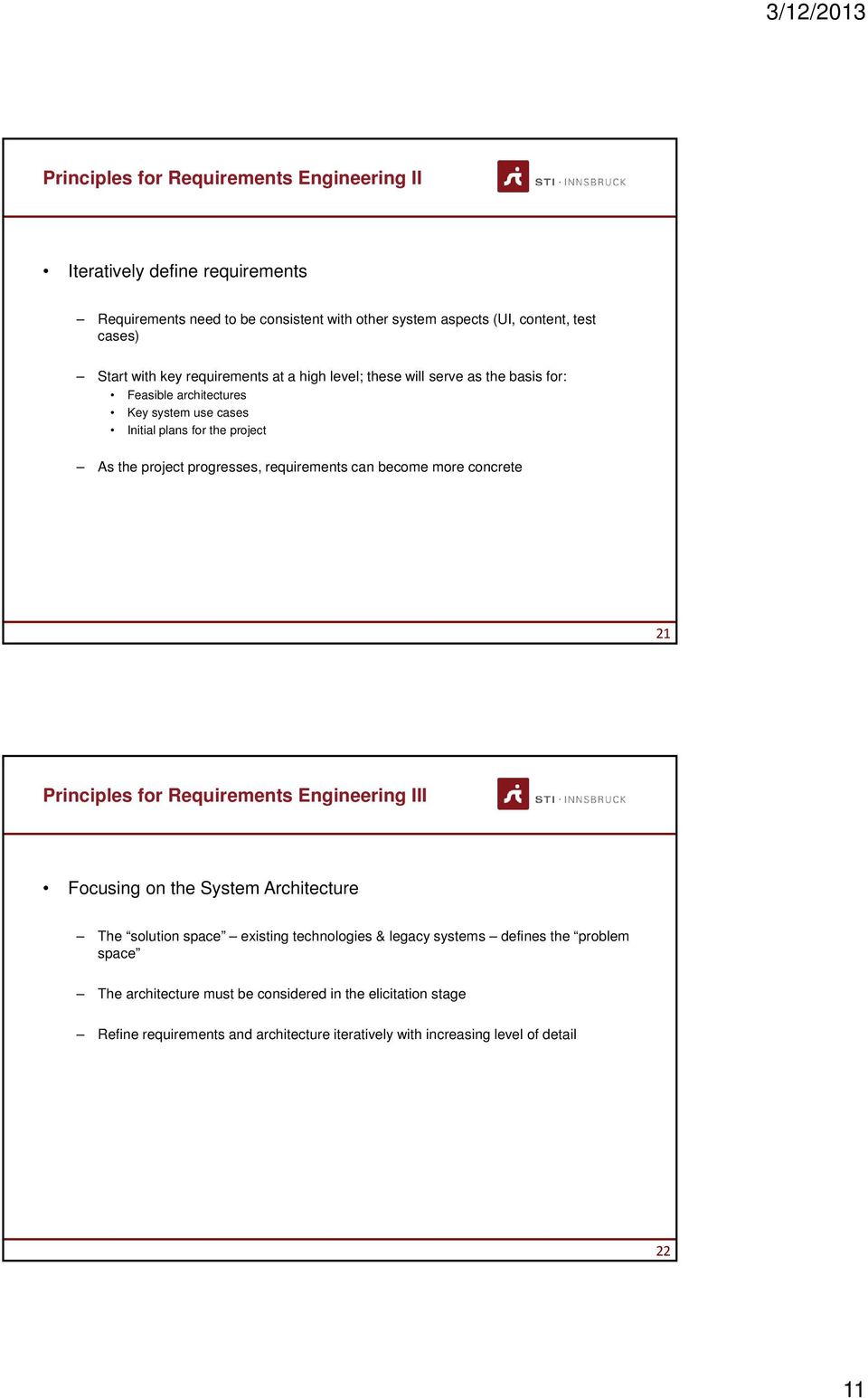
11 Principles for Requirements Engineering II Iteratively define requirements Requirements need to be consistent with other system aspects (UI, content, test cases) Start with key requirements at a high level; these will serve as the basis for: Feasible architectures Key system use cases Initial plans for the project As the project progresses, requirements can become more concrete 21 Principles for Requirements Engineering III Focusing on the System Architecture The solution space existing technologies & legacy systems defines the problem space The architecture must be considered in the elicitation stage Refine requirements and architecture iteratively with increasing level of detail 22 11
12 Principles for Requirements Engineering IV Risk Orientation Risk management is at the heart of the analysis process What are the typical risks? Integration issues w/ legacy systems Expected vs. actual system quality Inexperience of developers How to mitigate risks? Prototyping (avoid IKIWISI) Show changes to customer iteratively Integrate existing systems sooner than later 23 Specifics in Web Engineering Is RE for the Web really that different than RE for conventional software? Top 6 distinguishing characteristics Multidisciplinary teams Experts from various areas (multimedia, authors, software architects, usability experts, database experts, domain experts, ) Unavailability of stakeholders E.g. future users. Challenge is to find suitable representatives. Rapidly changing requirements & constraints Dynamics of Web (technology, devices, etc.) Unpredictable operational environment Web changing constantly, usage is hard to predict, some factors are not under the control of the team. No manual for the user interface I know it when I see it. Content Management Provision and maintenance of content 24 12

13 Specifics in Web Engineering Content Management: provision and maintenance of content. Quality factors: Correctness Detail Objectivity Relevance Up to dateness Completeness Consistency Lack of experience with technology Technologies are new New tools, techniques Wrong estimates 25 Adapting RE to Web Applications There isn t one single right way to do RE among the many methods, techniques, and tools available For your Web application project, ask the following questions: What are the critical requirements? How should requirements be documented? What tools should be used, if any? 26 13

14 The Requirements Collection Process Elicitation & Negotiation Management Specification Validation & Verification 27 How to interact with Stakeholders ELICITATION & NEGOTIATION 28 14

15 Elicitation & Negotiation Identify and involve (if possible) the stakeholders Those that directly influence the requirements Customers, users, developers What are their expectations? May be misaligned or in conflict. May be too narrowly focused or unrealistic. Why is the web application being developed in the first place? 29 Techniques for Elicitation & Negotiation Interviewing Joint Application Design Brainstorming Concept Mapping Storyboard Use Case Modeling Questionnaires Terminology Comparison 30 15

16 Challenges with Stakeholders - McConnell (1996) Users don t know what they want. Lack of commitment. Ever-expanding requirements. Communication delays. Users don t take part in reviews. Users don t understand the technology. Users don t understand the process. 31 Challenges with Developers Users and engineers/developers speak different languages. The tendency to shoe-horn the requirements into an existing model Saves time for developers, but results may not meet user s needs. Engineers & developers are also asked to do RE, but sometimes lack negotiating skills and domain knowledge

17 How to formalize received inputs SPECIFICATION 33 Specification Traditional RE 4 main categories of notation Stories Plain-language scenarios; understandable to non-technical persons. Itemized Requirements Plain-language lists of requirements Formatted Requirements Accurately-defined, but allow for plain-language descriptions Ex. Use case scenarios in UML Formal Specifications Expressed in formal syntax & semantics; rarely used in Web applications

18 Specification RE for Web Apps So, what s best for a Web development project? Formatted requirements (i.e. use cases) and stories are heavily used Low to medium accuracy is suitable for Web apps; formal specifications very rarely required. Keep effort for eliciting and managing requirements low. Scalability is (most likely) important. 35 VALIDATION AND MANAGEMENT 36 18

19 Validation This step is essential to verify that requirements specification corresponds to user s needs and customer s requirements. Iterative feedback from stakeholders is essential Is the requirement feasible? Do the results meet stakeholders expectations? We will discuss testing in greater detail later 37 Validation Techniques Review or walk-through Reading and correcting the requirements definition documentation and models Audit Partial check of the results presented in the review documentation Traceability Matrix Comparison of the application objectives with the requirements of the system Prototyping for Validation Implement a partial set of functional requirements but provide a global vision of the user interface 38 19

20 Management Several tools are available to support requirements management (also Open Source) INCOSE Requirements Management Tools Survey Tool support is crucial for big projects Enable Traceability Modifiability Verifiability 39 Taken from WebML Acer Usecase: News management system EXAMPLE 40 20

21 Requirement analysis Revision and formalization of the collected requirements, producing in output a set of semi-formal specifications, typically in terms of: 1. Group specification 2. Use-case specification 3. Data dictionary specification 4. Site view specification 5. Style guidelines specification 6. Acceptance tests specification 41 Group specification Clustering of users into groups (formally described) Mar-Com manager Group Hierarchy: Corporate Supervisor Admin Group Description: Group name: Description: Profile data: Super-group: Sub-groups: Relevant use cases: Objects - read mode: Objects - content mgmt mode: Mar-Com Manager marketing and communication personnel inserting, modifying, and deleting mkt materials. First name, last name, , office address. Profile data are provided explicitly by the user. Corporate. None. Login, Add a news item, Modify a news item, Delete a news item, Add a news category, Modify a news category, Delete a news category, "Modify profile data". Product and Product News. Product News
22 Use-case specification I Formal description of units of interaction with the application by users of a given group (e.g., through tables or UML diagrams) 1. Use cases list for a user (use case diagram) Add a news item Modify a news item Login Modify a news category Add a news category Remove a news item Remove a news category Mar-Com Manager 43 Use-case specification II Title Purpose Pre-condition Postcondition Workflow 2. Single use case specification (table or activity diagram) Login of user belonging to multiple groups User Application Server Database To express how users with more than one role access the functions of the applications. Initial Request Send Form A user that belongs to multiple groups is registered. For each group, the site view serving the requirements of the group members is defined. Input Credentials Accept Credentials Verify Credentials The user successfully logs into the application and accesses the site view corresponding to one of his groups. Select Home Page Elaborate Page The following steps must be performed: 1.The user receives an input form asking for Index username of Home Pagesand password; 2.The user inputs his credentials; 3.If the credentials are correct, the user is authenticated, Serve therequest list of groups the user belongs to is determined, and the list of names and URLs of the home pages of the site view of such groups is displayed to Receive user; Home Page 4.The user chooses one entry from the list, and enters into the selected site view. Default Home Page List 44 22
23 Data dictionary specification List of the main information objects identified during data requirements collection Each entry can be specified by: Name NewsItem Synonyms Piece of news Description A corporate or product piece of news Sample instances TravelMate 610 launched, 20th June 01 Properties Title, Body, Image, Date, Relationships NewsToProduct Components None Super-concept None Sub-concepts Highlighted news 45 Site Map specification IN: list of user groups, list of use cases, data dictionary OUT: list of needed site maps, specified by: Name Description Target User Groups Implemented use cases Site view map: a table illustrating the different areas that compose the site view. Each area is specified by: Area Name Area Description Accessed/Managed Objects Priority level 46 23
24 Site View News Content Management Description 1.2.d Site Includes view the specification pages through example which the Mar-Com Managers will access content management functions, for inserting or updating content about news categories and news items. User Groups Mar-Com Managers Use Cases Area Name News Content Management Login, Add a news category, Edit a news category, Remove a news category, Add a news item, Edit a news item, Remove a news item. Site View Map Area Description In the default page, the user accesses the list of countries for which he is content manager and selects a country to administer. In the News Category page, the user accesses the list of news categories for the selected country. Here, the user can perform content management functions over news categories, according to the use cases Add a news category, Edit a news category, Remove a news category. Otherwise, he can select one category, and access the list of the available news items in the selected category. In the News page, the user can perform content management functions over a selected news item according to the use cases Add a news item, Edit a news item, Remove a news item. Objects NewsCategory NewsItem Priority High 47 Style guidelines specification Rules for the presentation of pages: Specification of standard page grids: rows, columns and cells arrangement Content positioning specification: banners, logo, menus positioning Graphical guidelines: rules for graphic items like fonts, colors, borders and margins Device-specific and browser-specific guidelines Example: Mock-ups: sample representations of a few typical application pages (for a specific device and presentation language) 48 24
25 Style guidelines specification 1 st Column 800 px Page Area Main Menu Area Main Content Area 2 nd Column 150 px Foot Area 49 That s almost all for day WRAP-UP 50 25
26 Things to keep in mind Know your Audience & Objectives Balancing stakeholder interests Focus on high-level requirements first Elicitation & Negotiation is a learning process Requirements Engineering requires flexibility Iterative changes should be expected Be sure stakeholders understand this! Clear documentation is critical 51 Bibliography Mandatory reading Kappel, G., Proll, B. Reich, S. & Retschitzegger, W. (2006). Web Engineering, Wiley & Sons. 2 nd Chapter M.J. Escalona and N. Koch, Requirements Engineering for Web Applications - A Comparative Study, JWE Vol.2, N. 3 Suggested IEEE Recommended Practice for Software Requirements Specifications IEEE Std Wiki and Web references Requirements Management
27 Next Lecture # Date Title 1 5 th March Web Engineering Introduction and Overview 2 12 th March Requirements Engineering for Web Applications 3 19 th March Web Application Modeling 4 9 th April Web Application Architectures 5 16 th April Developing Applications with WebML 6 23 rd April Testing and Usability of Web Applications 7 30 th April Maintenance and Performance of Web Applications 8 7 th May Web Technologies I 9 14 th May Web Technologies II st May Web Application Development Process th May Project Management for Web Applications 12 4 th June Web Application Security th June Mobile Application Development I th June Mobile Application Development II th June Final Exam 53 Questions? 54 27
Web Application Development Process
 Web Engineering Web Application Development Process Copyright 2013 Ioan Toma & Srdjan Komazec 1 Where we are? # Date Title 1 5 th March Web Engineering Introduction and Overview 2 12 th March Requirements
Web Application Architectures
 Web Engineering Web Application Architectures Copyright 2013 Ioan Toma & Srdjan Komazec 1 Where we are? # Date Title 1 5 th March Web Engineering Introduction and Overview 2 12 th March Requirements Engineering
Phases, Activities, and Work Products. Object-Oriented Software Development. Project Management. Requirements Gathering
 Object-Oriented Software Development What is Object-Oriented Development Object-Oriented vs. Traditional Development An Object-Oriented Development Framework Phases, Activities, and Work Products Phases,
Requirements engineering
 Learning Unit 2 Requirements engineering Contents Introduction............................................... 21 2.1 Important concepts........................................ 21 2.1.1 Stakeholders and
Table of Contents. CHAPTER 1 Web-Based Systems 1. CHAPTER 2 Web Engineering 12. CHAPTER 3 A Web Engineering Process 24
 Table of Contents CHAPTER 1 Web-Based Systems 1 The Web 1 Web Applications 2 Let s Introduce a Case Study 3 Are WebApps Really Computer Software? 4 Are the Attributes of WebApps Different from the Attributes
4.4 What is a Requirement? 4.5 Types of Requirements. Functional Requirements
 4.4 What is a Requirement? It is a statement describing either 1) an aspect of what the proposed system must do, or 2) a constraint on the system s development. In either case it must contribute in some
CS 389 Software Engineering. Lecture 2 Chapter 2 Software Processes. Adapted from: Chap 1. Sommerville 9 th ed. Chap 1. Pressman 6 th ed.
 CS 389 Software Engineering Lecture 2 Chapter 2 Software Processes Adapted from: Chap 1. Sommerville 9 th ed. Chap 1. Pressman 6 th ed. Topics covered Software process models Process activities Coping
Partnering for Project Success: Project Manager and Business Analyst Collaboration
 Partnering for Project Success: Project Manager and Business Analyst Collaboration By Barbara Carkenord, CBAP, Chris Cartwright, PMP, Robin Grace, CBAP, Larry Goldsmith, PMP, Elizabeth Larson, PMP, CBAP,
Software Engineering/Courses Description Introduction to Software Engineering Credit Hours: 3 Prerequisite: 0306211(Computer Programming 2).
 0305203 0305280 0305301 0305302 Software Engineering/Courses Description Introduction to Software Engineering Prerequisite: 0306211(Computer Programming 2). This course introduces students to the problems
SOFTWARE REQUIREMENTS
 SOFTWARE REQUIREMENTS http://www.tutorialspoint.com/software_engineering/software_requirements.htm Copyright tutorialspoint.com The software requirements are description of features and functionalities
Swirl. Multiplayer Gaming Simplified. CS4512 Systems Analysis and Design. Assignment 1 2010. Marque Browne 0814547. Manuel Honegger - 0837997
 1 Swirl Multiplayer Gaming Simplified CS4512 Systems Analysis and Design Assignment 1 2010 Marque Browne 0814547 Manuel Honegger - 0837997 Kieran O' Brien 0866946 2 BLANK MARKING SCHEME 3 TABLE OF CONTENTS
Requirements engineering and quality attributes
 Open Learning Universiteit Unit 2 Learning Unit 2 Requirements engineering and quality attributes Contents Introduction............................................... 21 2.1 Important concepts........................................
Scenario-based Requirements Engineering and User-Interface Design
 Scenario-based Requirements Engineering and User-Interface Institut für Computertechnik ICT Institute of Computer Technology Hermann Kaindl Vienna University of Technology, ICT Austria [email protected]
To introduce software process models To describe three generic process models and when they may be used
 Software Processes Objectives To introduce software process models To describe three generic process models and when they may be used To describe outline process models for requirements engineering, software
TABLE OF CONTENTS ABSTRACT ACKNOWLEDGEMENT LIST OF FIGURES LIST OF TABLES
 TABLE OF CONTENTS ABSTRACT ACKNOWLEDGEMENT LIST OF FIGURES LIST OF TABLES ii iii x xiv CHAPTER 1: INTRODUCTION 1 1.0 Background 1 1.1 Research Motivation 4 1.2 Research Objectives 5 1.3 Project Scope 6
Business Analyst Work Plan. Presented by: Billie Johnson, CBAP CSM
 Business Analyst Work Plan Presented by: Billie Johnson, CBAP CSM Agenda Topic Introduction Overview of a Business Analysis Work Plan Initiating a Business Analysis Effort Components of the Business Analysis
JOURNAL OF OBJECT TECHNOLOGY
 JOURNAL OF OBJECT TECHNOLOGY Online at www.jot.fm. Published by ETH Zurich, Chair of Software Engineering JOT, 2006 Vol. 5. No. 8, November-December 2006 Requirements Engineering Tasks Donald Firesmith,
ADMINISTRATOR GUIDE VERSION
 ADMINISTRATOR GUIDE VERSION 4.0 2014 Copyright 2008 2014. All rights reserved. No part of this document may be reproduced or transmitted in any form or by any means electronic or mechanical, for any purpose
CREDENTIALS & CERTIFICATIONS 2015
 THE COMMUNITY FOR TECHNOLOGY LEADERS www.computer.org CREDENTIALS & CERTIFICATIONS 2015 KEYS TO PROFESSIONAL SUCCESS CONTENTS SWEBOK KNOWLEDGE AREA CERTIFICATES Software Requirements 3 Software Design
Chapter 10 Practical Database Design Methodology and Use of UML Diagrams
 Chapter 10 Practical Database Design Methodology and Use of UML Diagrams Copyright 2011 Pearson Education, Inc. Publishing as Pearson Addison-Wesley Chapter 10 Outline The Role of Information Systems in
Story Card Based Agile Software Development
 Story Card Based Agile Software Development Chetankumar Patel, and Muthu Ramachandran Leeds Metropolitan University, UK [email protected] Abstract The use of story cards for user stories in many Extreme
Do you know? "7 Practices" for a Reliable Requirements Management. by Software Process Engineering Inc. translated by Sparx Systems Japan Co., Ltd.
 Do you know? "7 Practices" for a Reliable Requirements Management by Software Process Engineering Inc. translated by Sparx Systems Japan Co., Ltd. In this white paper, we focus on the "Requirements Management,"
GCE APPLIED ICT A2 COURSEWORK TIPS
 GCE APPLIED ICT A2 COURSEWORK TIPS COURSEWORK TIPS A2 GCE APPLIED ICT If you are studying for the six-unit GCE Single Award or the twelve-unit Double Award, then you may study some of the following coursework
Chap 1. Introduction to Software Architecture
 Chap 1. Introduction to Software Architecture 1. Introduction 2. IEEE Recommended Practice for Architecture Modeling 3. Architecture Description Language: the UML 4. The Rational Unified Process (RUP)
DEVELOPING REQUIREMENTS FOR DATA WAREHOUSE SYSTEMS WITH USE CASES
 DEVELOPING REQUIREMENTS FOR DATA WAREHOUSE SYSTEMS WITH USE CASES Robert M. Bruckner Vienna University of Technology [email protected] Beate List Vienna University of Technology [email protected]
Software Engineering. Software Processes. Based on Software Engineering, 7 th Edition by Ian Sommerville
 Software Engineering Software Processes Based on Software Engineering, 7 th Edition by Ian Sommerville Objectives To introduce software process models To describe three generic process models and when
Requirements Engineering Process
 Software Engineering Requirements Engineering Process Based on Software Engineering, 7 th Edition by Ian Sommerville Objectives To describe the principal requirements engineering activities and d their
UML TUTORIALS THE USE CASE MODEL
 UML TUTORIALS THE USE CASE MODEL www.sparxsystems.com.au Sparx Systems 2004 Page 1/5 describes the proposed functionality of the new system. A Use Case represents a discrete unit of interaction between
Software Requirements, Third Edition
 j Microsoft Software Requirements, Third Edition Karl Wiegers and Joy Beatty Contents Introduction Acknowledgments xxv xxxi PART I SOFTWARE REQUIREMENTS: WHAT, WHY, AND WHO Chapter 1 The essential software
Traceability Patterns: An Approach to Requirement-Component Traceability in Agile Software Development
 Traceability Patterns: An Approach to Requirement-Component Traceability in Agile Software Development ARBI GHAZARIAN University of Toronto Department of Computer Science 10 King s College Road, Toronto,
Sofware Requirements Engineeing
 Sofware Requirements Engineeing Three main tasks in RE: 1 Elicit find out what the customers really want. Identify stakeholders, their goals and viewpoints. 2 Document write it down (). Understandable
Intranet Website Solution Based on Microsoft SharePoint Server Foundation 2010
 December 14, 2012 Authors: Wilmer Entena 128809 Supervisor: Henrik Kronborg Pedersen VIA University College, Horsens Denmark ICT Engineering Department Table of Contents List of Figures and Tables... 3
Software Engineering. Session 3 Main Theme Requirements Definition & Management Processes and Tools Dr. Jean-Claude Franchitti
 Software Engineering Session 3 Main Theme Requirements Definition & Management Processes and Tools Dr. Jean-Claude Franchitti New York University Computer Science Department Courant Institute of Mathematical
VALLIAMMAI ENGINEERING COLLEGE S.R.M. Nagar, Kattankulathur DEPARTMENT OF COMPUTER SCIENCE AND ENGINEERING
 VALLIAMMAI ENGINEERING COLLEGE S.R.M. Nagar, Kattankulathur DEPARTMENT OF COMPUTER SCIENCE AND ENGINEERING Sub Code : CP7007 Sub Name: SOFTWARE REQUIREMENTS ENGINEERING Branch / Year : ME CSE / I Year
Prototyping Techniques for
 Prototyping Techniques for Better Web Design Billie Johnson, CBAP, CSM [email protected] Agenda Overview of Prototyping Technique Prototyping Progression Paper vs. Digital Prototypes Conclusion Seminar
The Role of the Software Architect
 IBM Software Group The Role of the Software Architect Peter Eeles [email protected] 2004 IBM Corporation Agenda Architecture Architect Architecting Requirements Analysis and design Implementation
Software Quality Assurance Plan
 For Database Applications Document ID: Version: 2.1a Planning Installation & Acceptance Integration & Test Requirements Definition Design Development 1 / 54 Copyright 2000-2006 Digital Publications LLC.
Software Development Processes. Software Life-Cycle Models
 1 Software Development Processes Sequential, Prototype-based RAD, Phased, Risk-based Spiral (c) 1998 M Young CIS 422/522 4/3/98 1 Software Life-Cycle Models Breaking projects down into pieces for... Planning
IP Configuration Manual
 IP Configuration Manual Safety precautions and warnings Thank you for deciding to use a Frama Franking System. The information in this guide is intended to support you during the configuration of the franking
A Rational Software & Context Integration white paper
 Building Web Solutions with the Rational Unified Process: Unifying the Creative Design Process and the Software Engineering Process A Rational Software & Context Integration white paper R TABLE OF CONTENTS
How To Use Gps Navigator On A Mobile Phone
 Software Requirements Specification Amazing Lunch Indicator Sarah Geagea 881024-4940 Sheng Zhang 850820-4735 Niclas Sahlin 880314-5658 Faegheh Hasibi 870625-5166 Farhan Hameed 851007-9695 Elmira Rafiyan
Requirements Engineering Processes. Ian Sommerville 2006 Software Engineering, 8th edition. Chapter 7 Slide 1
 Requirements Engineering Processes Ian Sommerville 2006 Software Engineering, 8th edition. Chapter 7 Slide 1 Objectives To describe the principal requirements engineering activities and their relationships
Announcements. Project status demo in class
 Web Design cs465 Announcements Project status demo in class Why? You will likely be involved in Web design You have many of the skills necessary Understand similarities and differences between GUI design
System Requirements Specification (SRS) (Subsystem and Version #)
 of the (Subsystem and Version #) () (Document Revision Number) Contract (No.) Task (No.) GSA Contract (No.) Prepared for: The United States Department of Agriculture Food & Nutrition Service (FNS)/ Information
Evaluation of a Use-Case-Driven Requirements Analysis Tool Employing Web UI Prototype Generation
 Evaluation of a Use-Case-Driven Requirements Analysis Tool Employing Web UI Prototype Generation SHINPEI OGATA Course of Functional Control Systems, Graduate School of Engineering Shibaura Institute of
What is a requirement? Software Requirements. Descriptions and specifications of a system
 What is a requirement? Software Requirements Descriptions and specifications of a system May range from a high-level abstract statement of a service or a statement of a system constraint to a detailed
Software Development Processes. Software Life-Cycle Models. Process Models in Other Fields. CIS 422/522 Spring 1998 1
 1 Software Development Processes Sequential, Prototype-based RAD, Phased, Risk-based Spiral (c) 1998 M Young CIS 422/522 1/10/99 1 Software Life-Cycle Models Breaking projects down into pieces for... Planning
User Management Guide
 AlienVault Unified Security Management (USM) 4.x-5.x User Management Guide USM v4.x-5.x User Management Guide, rev 1 Copyright 2015 AlienVault, Inc. All rights reserved. The AlienVault Logo, AlienVault,
Requirements Definition and Management Processes
 Software Engineering G22.2440-001 Session 1 Sub-Topic 1 Requirements Definition & Management Processes and Tools Dr. Jean-Claude Franchitti New York University Computer Science Department Courant Institute
SCATS SALES AND CUSTOMER TRACKING SYSTEM SOFTWARE REQUIREMENTS SPECIFICATION VERSION: FINAL 1.0
 SCATS SALES AND CUSTOMER TRACKING SYSTEM SOFTWARE REQUIREMENTS SPECIFICATION VERSION: FINAL 1.0 OCTOBER 28, 2001 REVISION CHART Version Primary Author(s) Description of Version Date Completed Draft Johnny
Group18-CUCE2012. Mr. Mobile Project. Software Testing Plan (STP) Version: 4.0. CM Identifier: G18_SE004
 Group18-CUCE2012 Mr. Mobile Project Software Testing Plan (STP) Version: 4.0 CM Identifier: G18_SE004 26 April 2010 Revision History Prepared/ Modified by Ahmed Adel Ahmed Abdullah, Ahmed Hafez and Sheriff
Draft Requirements Management Plan
 BAO111: Core Competencies for the Business Analyst Draft Requirements Management Plan 1.0 INTRODUCTION 1.1 Purpose This document outlines requirements roles and responsibilities, presents a stakeholder
Quantification and Traceability of Requirements
 Quantification and Traceability of Requirements Gyrd Norvoll Master of Science in Computer Science Submission date: May 2007 Supervisor: Tor Stålhane, IDI Norwegian University of Science and Technology
How a Content Management System Can Help
 18 October 2004 How a Content Management System Can Help 1 Introduction to Autoweb 1.1 Autoweb is a robust Website Builder and a Content Management System that speeds up deployment and instantly creates
Levels of Software Testing. Functional Testing
 Levels of Software Testing There are different levels during the process of Testing. In this chapter a brief description is provided about these levels. Levels of testing include the different methodologies
CS 6361, SPRING 2010 Advanced Requirements Engineering Web Based Meeting Scheduler- Project Plan
 1 W E B B A S E D M E E T I N G S C H E D U L E R S Y S T E M Project Plan Version 4.0 CS 6361 ADVANCED REQUIREMENTS ENGINEERING, SPRING 2010 UNIVERSITY OF TEXAS AT DALLAS R E Q U I R E M E N T S E N G
WatchDox Administrator's Guide. Application Version 3.7.5
 Application Version 3.7.5 Confidentiality This document contains confidential material that is proprietary WatchDox. The information and ideas herein may not be disclosed to any unauthorized individuals
Designing and Developing Web Applications by using the Microsoft.NET Framework
 Designing and Developing Web Applications by using the Microsoft.NET Framework Course Number: 70 547 Length: Certification Exam This exam is part of a series of exams in pursuit of the MCPD certification.
Use Cases. Reference: Craig Larman, Applying UML and Patterns, Ch. 6
 Use Cases Reference: Craig Larman, Applying UML and Patterns, Ch. 6 Use Case What it is: Text story Widely used to discover and record (mostly functional) requirements What is it about: Some actor(s) using
Software Engineering I CS524 Professor Dr. Liang Sheldon X. Liang
 Software Requirement Specification Employee Tracking System Software Engineering I CS524 Professor Dr. Liang Sheldon X. Liang Team Members Seung Yang, Nathan Scheck, Ernie Rosales Page 1 Software Requirements
Software Engineering Reference Framework
 Software Engineering Reference Framework Michel Chaudron, Jan Friso Groote, Kees van Hee, Kees Hemerik, Lou Somers, Tom Verhoeff. Department of Mathematics and Computer Science Eindhoven University of
Week 3. COM1030. Requirements Elicitation techniques. 1. Researching the business background
 Aims of the lecture: 1. Introduce the issue of a systems requirements. 2. Discuss problems in establishing requirements of a system. 3. Consider some practical methods of doing this. 4. Relate the material
Ultimus and Microsoft Active Directory
 Ultimus and Microsoft Active Directory May 2004 Ultimus, Incorporated 15200 Weston Parkway, Suite 106 Cary, North Carolina 27513 Phone: (919) 678-0900 Fax: (919) 678-0901 E-mail: [email protected]
Section C. Requirements Elicitation
 This work is licensed under a Creative Commons Attribution-NonCommercial-ShareAlike License. Your use of this material constitutes acceptance of that license and the conditions of use of materials on this
The use of Trade-offs in the development of Web Applications
 The use of Trade-offs in the development of Web Applications Sven Ziemer and Tor Stålhane Department of Computer and Information Science Norwegian University of Technology and Science {svenz, stalhane}@idi.ntnu.no
Software Engineering Question Bank
 Software Engineering Question Bank 1) What is Software Development Life Cycle? (SDLC) System Development Life Cycle (SDLC) is the overall process of developing information systems through a multi-step
Engineering Process Software Qualities Software Architectural Design
 Engineering Process We need to understand the steps that take us from an idea to a product. What do we do? In what order do we do it? How do we know when we re finished each step? Production process Typical
Software Requirements. Objectives
 Software Requirements cmsc435-1 Objectives To introduce the concepts of user and system requirements To describe functional and non-functional requirements To explain how software requirements may be organized
User experience storyboards: Building better UIs with RUP, UML, and use cases
 Copyright Rational Software 2003 http://www.therationaledge.com/content/nov_03/f_usability_jh.jsp User experience storyboards: Building better UIs with RUP, UML, and use cases by Jim Heumann Requirements
The Dentist Online Reservation System Design and Implementation Web Based Application and Database Management System Project
 2012 International Conference on Education Technology and Computer (ICETC2012) IPCSIT vol.43 (2012) (2012) IACSIT Press, Singapore The Dentist Online Reservation System Design and Implementation Web Based
Elicitation and Modeling Non-Functional Requirements A POS Case Study
 Elicitation and Modeling Non-Functional Requirements A POS Case Study Md. Mijanur Rahman and Shamim Ripon, Member IACSIT Abstract Proper management of requirements is crucial to successful development
Contents. Introduction and System Engineering 1. Introduction 2. Software Process and Methodology 16. System Engineering 53
 Preface xvi Part I Introduction and System Engineering 1 Chapter 1 Introduction 2 1.1 What Is Software Engineering? 2 1.2 Why Software Engineering? 3 1.3 Software Life-Cycle Activities 4 1.3.1 Software
Questions? Assignment. Techniques for Gathering Requirements. Gathering and Analysing Requirements
 Questions? Assignment Why is proper project management important? What is goal of domain analysis? What is the difference between functional and non- functional requirements? Why is it important for requirements
EBOX Digital Content Management System (CMS) User Guide For Site Owners & Administrators
 EBOX Digital Content Management System (CMS) User Guide For Site Owners & Administrators Version 1.0 Last Updated on 15 th October 2011 Table of Contents Introduction... 3 File Manager... 5 Site Log...
BCS Certificate in Requirements Engineering Extended Syllabus
 BCS Certificate in Requirements Engineering Extended Syllabus Version 2.3 July 2013 Change History Version Number and Date Version 2.3 July 2013 Changes Made Minor updates made to the commentary Version
LearningServer for.net Implementation Guide
 LearningServer for.net Implementation Guide This document outlines recommended steps for planning and implementing a LearningServer solution. A successful installation and implementation requires the completion
ARIS Design Platform Getting Started with BPM
 Rob Davis and Eric Brabander ARIS Design Platform Getting Started with BPM 4y Springer Contents Acknowledgements Foreword xvii xix Chapter 1 An Introduction to BPM 1 1.1 Brief History of Business Process
Graphical Web based Tool for Generating Query from Star Schema
 Graphical Web based Tool for Generating Query from Star Schema Mohammed Anbar a, Ku Ruhana Ku-Mahamud b a College of Arts and Sciences Universiti Utara Malaysia, 0600 Sintok, Kedah, Malaysia Tel: 604-2449604
SYSTEMS AND SOFTWARE REQUIREMENTS SPECIFICATION (SSRS) TEMPLATE. Version A.4, January 2014 FOREWORD DOCUMENT CONVENTIONS
 SYSTEMS AND SOFTWARE REQUIREMENTS SPECIFICATION (SSRS) TEMPLATE Version A.4, January 2014 FOREWORD This document was written to provide software development projects with a template for generating a System
IT2404 Systems Analysis and Design (Compulsory)
 Systems Analysis and Design (Compulsory) BIT 1 st YEAR SEMESTER 2 INTRODUCTION This is one of the 4 courses designed for Semester 1 of Bachelor of Information Technology Degree program. CREDITS: 04 LEARNING
Chapter 14. Outline. Database Support for Decision Making. Data and Database Administration
 Chapter 14 Data and Database Administration McGraw-Hill/Irwin Copyright 2007 by The McGraw-Hill Companies, Inc. All rights reserved. Outline Organizational context Tools of database administration Processes
Syllabus. REQB Certified Professional for Requirements Engineering. Foundation Level
 Syllabus REQB Certified Professional for Requirements Engineering Version 2.1 2014 The copyright to this edition of the syllabus in all languages is held by the Global Association for Software Quality,
How To Change Your Site On Drupal Cloud On A Pcode On A Microsoft Powerstone On A Macbook Or Ipad (For Free) On A Freebie (For A Free Download) On An Ipad Or Ipa (For
 How-to Guide: MIT DLC Drupal Cloud Theme This guide will show you how to take your initial Drupal Cloud site... and turn it into something more like this, using the MIT DLC Drupal Cloud theme. See this
Develop Project Charter. Develop Project Management Plan
 Develop Charter Develop Charter is the process of developing documentation that formally authorizes a project or a phase. The documentation includes initial requirements that satisfy stakeholder needs
Certified Software Quality Engineer (CSQE) Body of Knowledge
 Certified Software Quality Engineer (CSQE) Body of Knowledge The topics in this Body of Knowledge include additional detail in the form of subtext explanations and the cognitive level at which the questions
Introduction and Overview
 Introduction and Overview Definitions. The general design process. A context for design: the waterfall model; reviews and documents. Some size factors. Quality and productivity factors. Material from:
Lecture 17: Requirements Specifications
 Lecture 17: Requirements Specifications Why we need to write specifications Purpose and audience Choosing an appropriate size and formality Desiderata for Specifications Properties of good specifications
Business Analyst Boot Camp Course BA101; 5 Days, Instructor-led
 Business Analyst Boot Camp Course BA101; 5 Days, Instructor-led Course Description Full-Spectrum Business Analyst Training and Skills Development. Course Objectives Bridge the expectations gap between
Becoming a Business Analyst
 Becoming a Business Analyst What is Business Analysis? The practice of enabling change in an organizational context by defining needs and recommending solutions that delivers value to stakeholders When
Software Requirements Specification. Task Management System. for. Prepared by. Version 1.0. Group Name: Pink and Purple. Date:
 Software Requirements Specification for Task Management System Version 1.0 Prepared by Group Name: Pink and Purple Kathrynn Gonzalez 11387240 [email protected] Tina Roper 11380457 [email protected]
Microsoft Project Server 2010 Project Manager s Guide for Project Web App
 Microsoft Project Server 2010 Project Manager s Guide for Project Web App Copyright This document is provided as-is. Information and views expressed in this document, including URL and other Internet Web
Fahad H.Alshammari, Rami Alnaqeib, M.A.Zaidan, Ali K.Hmood, B.B.Zaidan, A.A.Zaidan
 WWW.JOURNALOFCOMPUTING.ORG 85 New Quantitative Study for Dissertations Repository System Fahad H.Alshammari, Rami Alnaqeib, M.A.Zaidan, Ali K.Hmood, B.B.Zaidan, A.A.Zaidan Abstract In the age of technology,
Kirsten Sinclair SyntheSys Systems Engineers
 Kirsten Sinclair SyntheSys Systems Engineers Kirsten Sinclair SyntheSys Systems Engineers Spicing-up IBM s Enterprise Architecture tools with Petri Nets On Today s Menu Appetiser: Background Starter: Use
Software Requirements Specification
 METU DEPARTMENT OF COMPUTER ENGINEERING Software Requirements Specification SNMP Agent & Network Simulator Mustafa İlhan Osman Tahsin Berktaş Mehmet Elgin Akpınar 05.12.2010 Table of Contents 1. Introduction...
Data Modeling Basics
 Information Technology Standard Commonwealth of Pennsylvania Governor's Office of Administration/Office for Information Technology STD Number: STD-INF003B STD Title: Data Modeling Basics Issued by: Deputy
11 Tips to make the requirements definition process more effective and results more usable
 1 11 Tips to make the s definition process more effective and results more usable This article discusses what I believe are the key techniques for making s definition process repeatable from project to
Checklist for Web Application Testing
 Checklist for Web Application Testing July 27, 2004 Submitted By Infosys Technologies Limited Author Setumadhav Kulkarni ([email protected]) Web Testing Checklist.doc Page 1 of 9 COPYRIGHT