
What is Conservation Agriculture?
|
|
|
- Poppy Park
- 10 years ago
- Views:
Transcription
1 What is Conservation Agriculture? CA is a concept for resource-saving agricultural crop production that strives to achieve acceptable profits together with high and sustained production levels while concurrently conserving the environment. CA is based on enhancing natural biological processes above and below the ground. Interventions such as mechanical soil tillage are reduced to an absolute minimum, and the use of external inputs such as agrochemicals and nutrients of mineral or organic origin are applied at an optimum level and in a way and quantity that does not interfere with, or disrupt, the biological processes. CA is characterized by three principles which are linked to each other, namely: 1. Continuous minimum mechanical soil disturbance. 2. Permanent organic soil cover. 3. Diversified crop rotations in the case of annual crops or plant associations in case of perennial crops. Conventional "arable" agriculture is normally based on soil tillage as the main operation. The most widely known tool for this operation is the plough, which has become a symbol of agriculture. Soil tillage has in the past been associated with increased fertility, which originated from the mineralization of soil nutrients as a consequence of soil tillage. This process leads in the long term to a reduction of soil organic matter. Soil organic matter not only provides nutrients for the crop, but it is also, above all else, a crucial element for the stabilization of soil structure. Therefore, most soils degrade under prolonged intensive arable agriculture. This structural degradation of the soils results in the formation of crusts and compaction and leads in the end to soil erosion. The process is dramatic under tropical climatic situations but can be noticed all over the world. Mechanization of soil tillage, allowing higher working depths and speeds and the use of certain implements like ploughs, disk harrows and rotary cultivators have particularly detrimental effects on soil structure. Excessive tillage of agricultural soils may result in short term increases in fertility, but will degrade soils in the medium term. Structural degradation, loss of organic matter, erosion and falling biodiversity are all to be expected. (T Friedrich). Soil erosion resulting from soil tillage has forced us to look for alternatives and to reverse the process of soil degradation. The logical approach to this has been to reduce tillage. This led finally to movements promoting conservation tillage, and especially zero-tillage, particularly in southern Brazil, North America, New Zealand and Australia. Over the last two decades the technologies have been improved and adapted for nearly all farm sizes; soils; crop types; and climatic zones. Experience is still being gained with this new approach to agriculture and FAO has supported the process for many years. Experience has shown that these techniques, summarized as conservation

2 agriculture (CA) methods, are much more than just reducing the mechanical tillage. In a soil that is not tilled for many years, the crop residues remain on the soil surface and produce a layer of mulch. This layer protects the soil from the physical impact of rain and wind but it also stabilizes the soil moisture and temperature in the surface layers. Thus this zone becomes a habitat for a number of organisms, from larger insects down to soil borne fungi and bacteria. These organisms macerate the mulch, incorporate and mix it with the soil and decompose it so that it becomes humus and contributes to the physical stabilization of the soil structure. At the same time this soil organic matter provides a buffer function for water and nutrients. Larger components of the soil fauna, such as earthworms, provide a soil structuring effect producing very stable soil aggregates as well as uninterrupted macropores leading from the soil surface straight to the subsoil and allowing fast water infiltration in case of heavy rainfall events. Keeping the soil covered and planting through the mulch will protect the soil and improve the growing environment for the crop. This picture shows soya planted into wheat straw (a good rotation; by direct planter (minimal soil disturbance), without removing the previous crop residue (permanent soil cover). Good CA. (J.Benites). This process carried out by the edaphon, the living component of a soil, can be called "biological tillage". However, biological tillage is not compatible with mechanical tillage and with increased mechanical tillage the biological soil structuring processes will disappear. Certain operations such as mouldboard or disc ploughing have a stronger impact on soil life than others as for example chisel ploughs. Most tillage operations are, however, targeted at loosening the soil which inevitably increases its oxygen content leading in turn to the mineralization of the soil organic matter. This inevitably leads to a reduction of soil organic matter which is the substrate for soil life. Thus agriculture with reduced, or zero, mechanical tillage is only possible when soil organisms are taking over the task of tilling the soil. This, however, leads to other implications regarding the use of chemical farm inputs. Synthetic pesticides and mineral fertilizer have to be used in a way that does not harm soil life. As the main objective of agriculture is the production of crops, changes in the pest and weed management become necessary with CA. Burning plant residues and ploughing the soil is mainly considered necessary for phytosanitary reasons: to control pests, diseases and weeds. In a system with reduced mechanical tillage based on mulch cover and biological tillage, alternatives have to be developed to control pests and weeds. Integrated Pest Management becomes mandatory. One important element to achieve this is crop rotation, interrupting the infection chain between subsequent crops and making full use of the physical and chemical interactions between different plant species. Synthetic chemical pesticides, particularly herbicides are, in the first years, inevitable but have to be used with great care to reduce the negative impacts on soil life. To the extent that a new balance between the organisms of the farm-ecosystem, pests and beneficial organisms, crops and weeds, becomes established and the farmer learns to manage the cropping system, the use of synthetic pesticides and mineral fertilizer tends to decline to a level below that of the original "conventional" farming system. Burning crop and weed residues destroys an important source of plant nutrients and soil

3 improvement potential. The phytosanitary motives for burning and ploughing can better be achieved by integrated pest management practices and crop rotations. (FAO). Conservation Agriculture, understood in this way, provides a number of advantages on global, regional, local and farm level: It provides a truly sustainable production system, not only conserving but also enhancing the natural resources and increasing the variety of soil biota, fauna and flora (including wild life) in agricultural production systems without sacrificing yields on high production levels. As CA depends on biological processes to work, it enhances the biodiversity in an agricultural production system on a micro- as well as macro level. No till fields act as a sink for CO 2 and conservation farming applied on a global scale could provide a major contribution to control air pollution in general and global warming in particular. Farmers applying this practice could eventually be rewarded with carbon credits. Soil tillage is among all farming operations the single most energy consuming and thus, in mechanized agriculture, air-polluting, operation. By not tilling the soil, farmers can save between 30 and 40% of time, labour and, in mechanized agriculture, fossil fuels as compared to conventional cropping. Soils under CA have very high water infiltration capacities reducing surface runoff and thus soil erosion significantly. This improves the quality of surface water reducing pollution from soil erosion, and enhances groundwater resources. In many areas it has been observed after some years of conservation farming that natural springs that had dried up many years ago, started to flow again. The potential effect of a massive adoption of conservation farming on global water balances is not yet fully recognized. Conservation agriculture is by no means a low output agriculture and allows yields comparable with modern intensive agriculture but in a sustainable way. Yields tend to increase over the years with yield variations decreasing. For the farmer, conservation farming is mostly attractive because it allows a reduction of the production costs, reduction of time and labour, particularly at times of peak demand such as land preparation and planting and in mechanized systems it reduces the costs of investment and maintenance of machinery in the long term. Disadvantages in the short term might be the high initial costs of specialized planting equipment and the completely new dynamics of a conservation farming system, requiring high management skills and a learning process by the farmer. Long term experience with conservation farming all over the world has shown that conservation farming does not present more or less but different problems to a farmer, all of them capable of being resolved. Particularly in Brazil the area under conservation farming is now growing exponentially having already reached the 10 million hectare mark. Also in North America the concept is widely adopted. The main principles of conservation agriculture Conservation agriculture systems utilize soils for the production of crops with the aim of reducing excessive mixing of the soil and maintaining crop residues on the soil surface in order to minimize damage to the environment. By doing this CA will:
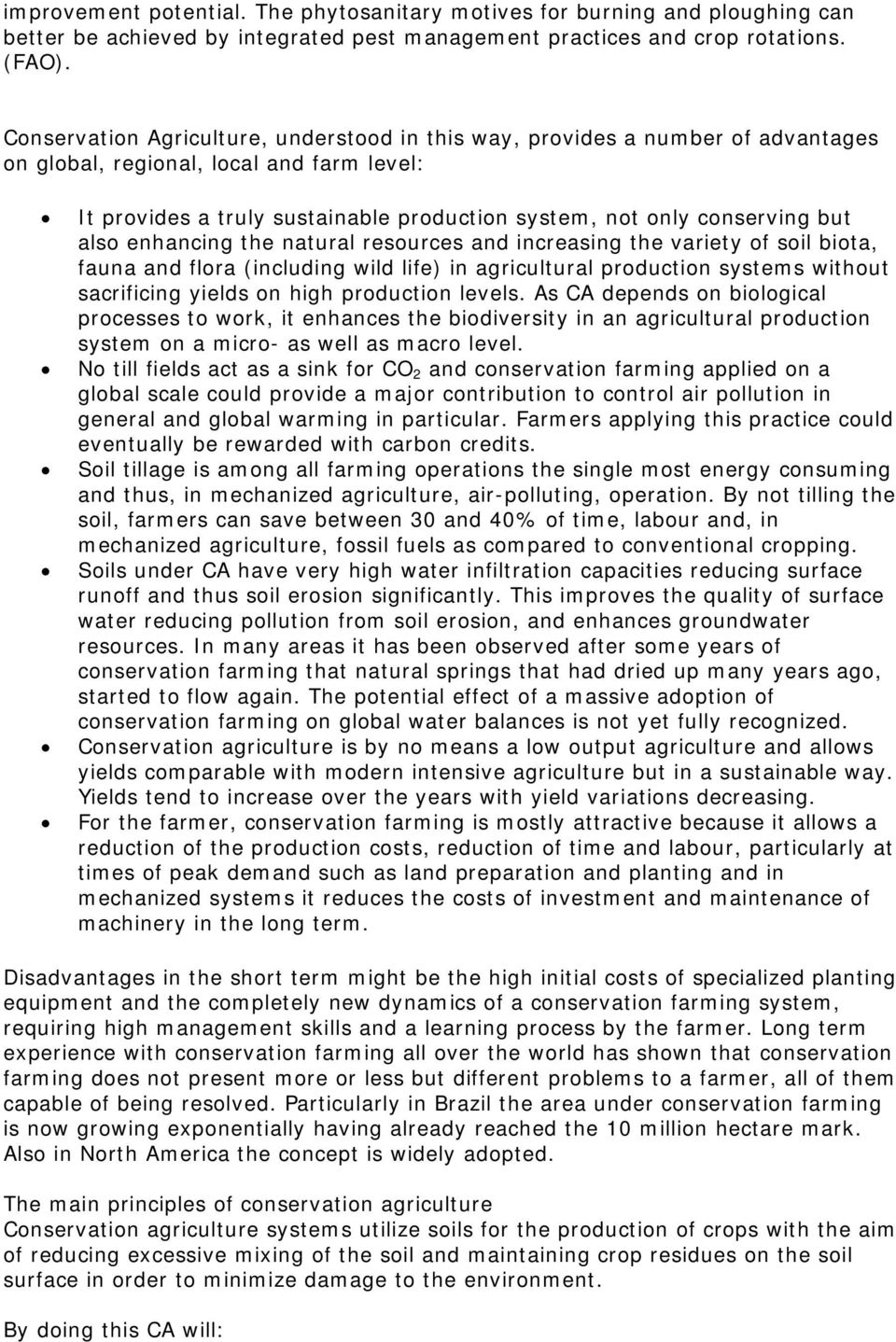
4 Provide and maintain an optimum environment of the root-zone to maximum possible depth. Roots are able to function effectively and without restrictions to capture high amounts of plant nutrients and water. Ensure that water enters the soil so that (a) plants never, or for the shortest time possible, suffer water stress that will limit the expression of their potential growth; and so that (b) residual water passes down to groundwater and stream flow, not over the surface as runoff. Favour beneficial biological activity in the soil in order to (a) maintain and rebuild soil architecture; (b) compete with potential in-soil pathogens; (c) contribute to soil organic matter and various grades of humus; (d) contribute to capture, retention, chelation and slow release of plant nutrients. Avoid physical or chemical damage to roots that disrupts their effective functioning. The three principles of conservation agriculture include: Direct planting of crop seeds Permanent soil cover, especially by crop residues and cover crops Crop rotation Direct seeding or planting Direct seeding involves growing crops without mechanical seedbed preparation and with minimal soil disturbance since the harvest of the previous crop. The term direct seeding is understood in CA systems as synonymous with no-till farming, zero tillage, no-tillage, direct drilling, etc. Planting refers to the precise placing of large seeds (maize and beans for example); whereas seeding usually refers to a continuous flow of seed as in the case of small cereals (wheat and barley for example). The equipment penetrates the soil cover, opens a seeding slot and places the seed into that slot. The size of the seed slot and the associated movement of soil are to be kept at the absolute minimum possible. Ideally the seed slot is completely covered by mulch again after seeding and no loose soil should be visible on the surface. Land preparation for seeding or planting under no-tillage involves slashing or rolling the weeds, previous crop residues or cover crops; or spraying herbicides for weed control, and seeding directly through the mulch. Crop residues are retained either completely or to a suitable amount to guarantee the complete soil cover, and fertilizer and amendments are either broadcast on the soil surface or applied during seeding. A three-row no-till planter planting through a cover crop flattened by a knife roller. (T. Friedrich). More information in Tools, machinery and equipment Permanent soil cover A permanent soil cover is important to: protect the soil against the deleterious effects of exposure to rain and sun; to provide the micro and macro organisms in the

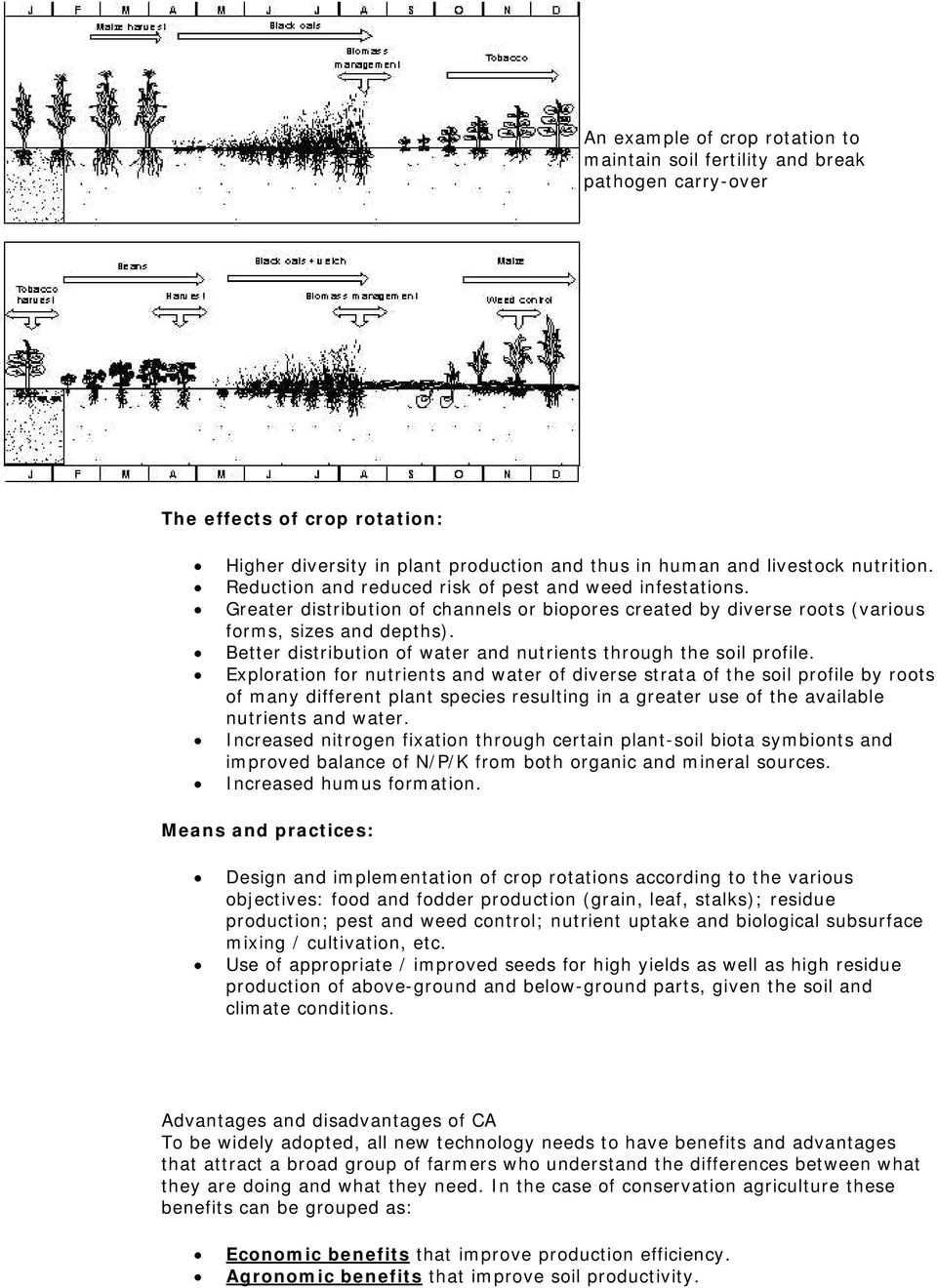
5 soil with a constant supply of "food"; and alter the microclimate in the soil for optimal growth and development of soil organisms, including plant roots. Cover crops need to be managed before planting the main crop. This can be done manually or with animal or tractor power. The important point is that the soil is always kept covered. (FAO). The effects of soil cover: Improved infiltration and retention of soil moisture resulting in less severe, less prolonged crop water stress and increased availability of plant nutrients. Source of food and habitat for diverse soil life: creation of channels for air and water, biological tillage and substrate for biological activity through the recycling of organic matter and plant nutrients. Increased humus formation. Reduction of impact of rain drops on soil surface resulting in reduced crusting and surface sealing. Consequential reduction of runoff and erosion. Soil regeneration is higher than soil degradation. Mitigation of temperature variations on and in the soil. Better conditions for the development of roots and seedling growth. Means and practices: Use of appropriate/improved seeds for high yields as well as high residue production and good root development. Integrated management and reduced competition with livestock or other uses e.g. through increased forage and fodder crops in the rotation. Use of various cover crops, especially multi-purpose crops, like nitrogenfixing, soil-porosity-restoring, pest repellent, etc. Optimization of crop rotations in spatial, timing and economic terms. " Targeted" use of herbicides for controlling cover crop and weed development. Crop rotations The rotation of crops is not only necessary to offer a diverse "diet" to the soil micro organisms, but as they root at different soil depths, they are capable of exploring different soil layers for nutrients. Nutrients that have been leached to deeper layers and that are no longer available for the commercial crop, can be "recycled" by the crops in rotation. This way the rotation crops function as biological pumps. Furthermore, a diversity of crops in rotation leads to a diverse soil flora and fauna, as the roots excrete different organic substances that attract different types of bacteria and fungi, which in turn, play an important role in the transformation of these substances into plant available nutrients. Crop rotation also has an important phytosanitary function as it prevents the carry over of crop-specific pests and diseases from one crop to the next via crop residues

6 An example of crop rotation to maintain soil fertility and break pathogen carry-over The effects of crop rotation: Higher diversity in plant production and thus in human and livestock nutrition. Reduction and reduced risk of pest and weed infestations. Greater distribution of channels or biopores created by diverse roots (various forms, sizes and depths). Better distribution of water and nutrients through the soil profile. Exploration for nutrients and water of diverse strata of the soil profile by roots of many different plant species resulting in a greater use of the available nutrients and water. Increased nitrogen fixation through certain plant-soil biota symbionts and improved balance of N/P/K from both organic and mineral sources. Increased humus formation. Means and practices: Design and implementation of crop rotations according to the various objectives: food and fodder production (grain, leaf, stalks); residue production; pest and weed control; nutrient uptake and biological subsurface mixing / cultivation, etc. Use of appropriate / improved seeds for high yields as well as high residue production of above-ground and below-ground parts, given the soil and climate conditions. Advantages and disadvantages of CA To be widely adopted, all new technology needs to have benefits and advantages that attract a broad group of farmers who understand the differences between what they are doing and what they need. In the case of conservation agriculture these benefits can be grouped as: Economic benefits that improve production efficiency. Agronomic benefits that improve soil productivity.
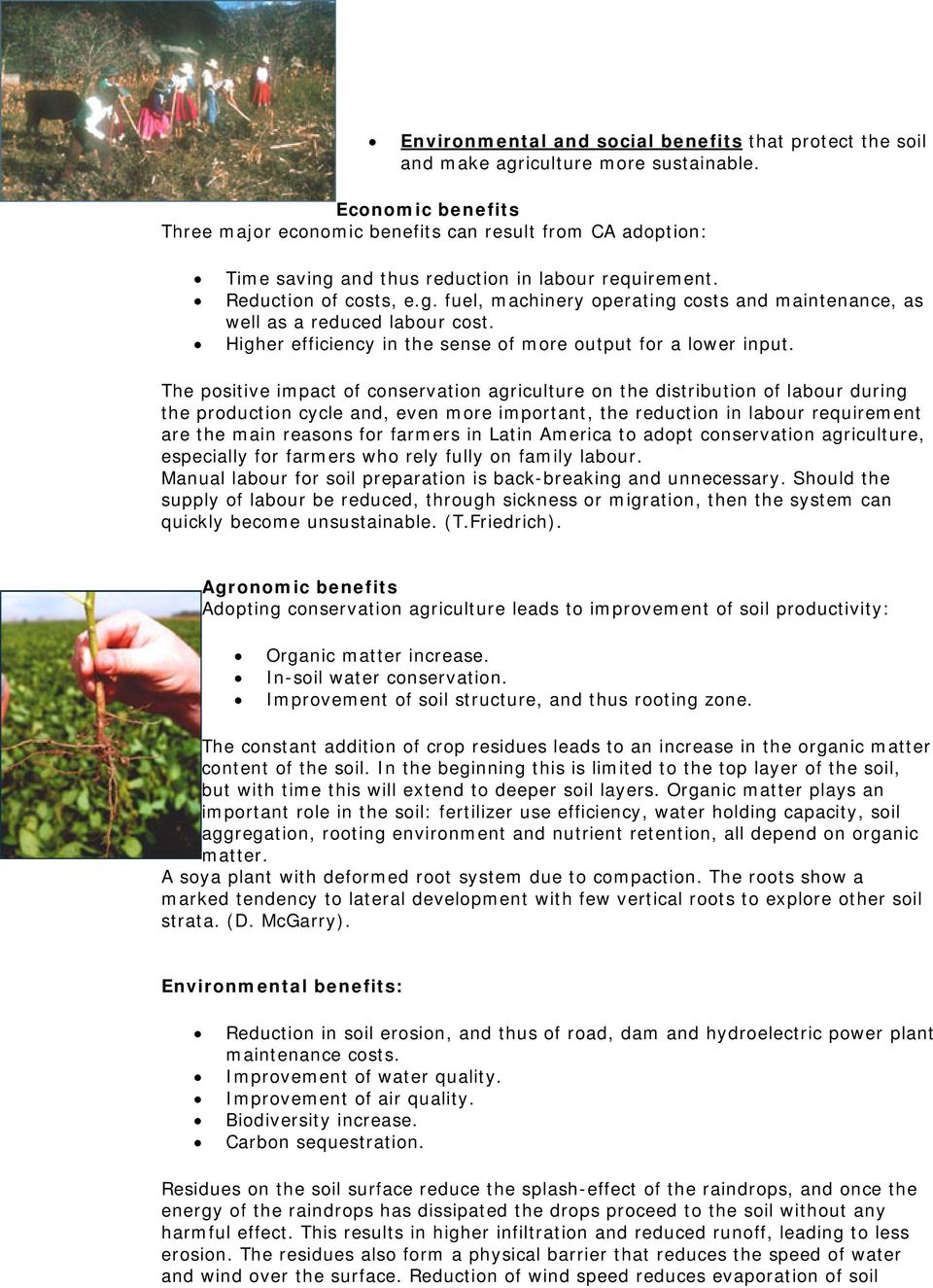
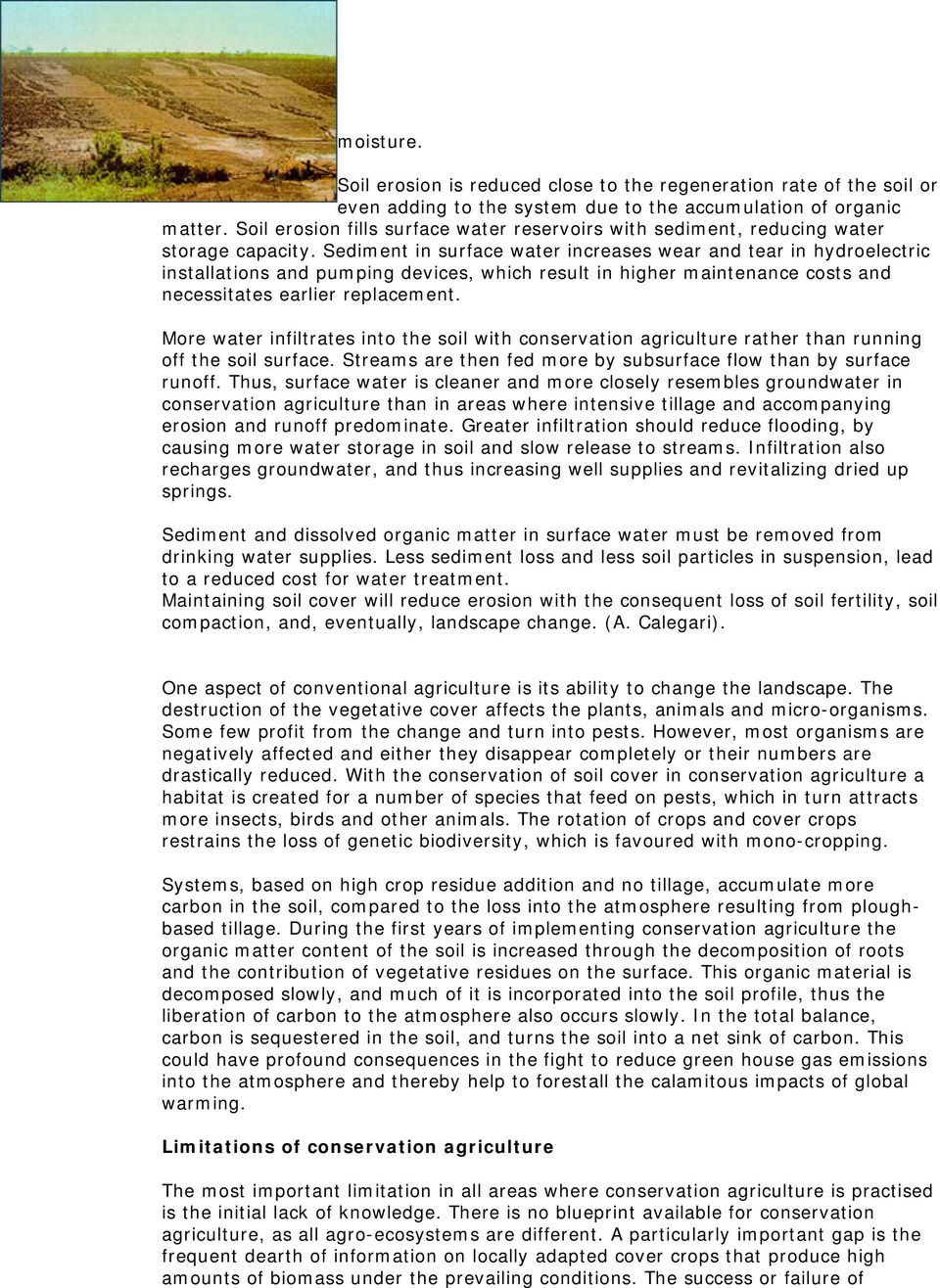
7 Environmental and social benefits that protect the soil and make agriculture more sustainable. Economic benefits Three major economic benefits can result from CA adoption: Time saving and thus reduction in labour requirement. Reduction of costs, e.g. fuel, machinery operating costs and maintenance, as well as a reduced labour cost. Higher efficiency in the sense of more output for a lower input. The positive impact of conservation agriculture on the distribution of labour during the production cycle and, even more important, the reduction in labour requirement are the main reasons for farmers in Latin America to adopt conservation agriculture, especially for farmers who rely fully on family labour. Manual labour for soil preparation is back-breaking and unnecessary. Should the supply of labour be reduced, through sickness or migration, then the system can quickly become unsustainable. (T.Friedrich). Agronomic benefits Adopting conservation agriculture leads to improvement of soil productivity: Organic matter increase. In-soil water conservation. Improvement of soil structure, and thus rooting zone. The constant addition of crop residues leads to an increase in the organic matter content of the soil. In the beginning this is limited to the top layer of the soil, but with time this will extend to deeper soil layers. Organic matter plays an important role in the soil: fertilizer use efficiency, water holding capacity, soil aggregation, rooting environment and nutrient retention, all depend on organic matter. A soya plant with deformed root system due to compaction. The roots show a marked tendency to lateral development with few vertical roots to explore other soil strata. (D. McGarry). Environmental benefits: Reduction in soil erosion, and thus of road, dam and hydroelectric power plant maintenance costs. Improvement of water quality. Improvement of air quality. Biodiversity increase. Carbon sequestration. Residues on the soil surface reduce the splash-effect of the raindrops, and once the energy of the raindrops has dissipated the drops proceed to the soil without any harmful effect. This results in higher infiltration and reduced runoff, leading to less erosion. The residues also form a physical barrier that reduces the speed of water and wind over the surface. Reduction of wind speed reduces evaporation of soil
8 moisture. Soil erosion is reduced close to the regeneration rate of the soil or even adding to the system due to the accumulation of organic matter. Soil erosion fills surface water reservoirs with sediment, reducing water storage capacity. Sediment in surface water increases wear and tear in hydroelectric installations and pumping devices, which result in higher maintenance costs and necessitates earlier replacement. More water infiltrates into the soil with conservation agriculture rather than running off the soil surface. Streams are then fed more by subsurface flow than by surface runoff. Thus, surface water is cleaner and more closely resembles groundwater in conservation agriculture than in areas where intensive tillage and accompanying erosion and runoff predominate. Greater infiltration should reduce flooding, by causing more water storage in soil and slow release to streams. Infiltration also recharges groundwater, and thus increasing well supplies and revitalizing dried up springs. Sediment and dissolved organic matter in surface water must be removed from drinking water supplies. Less sediment loss and less soil particles in suspension, lead to a reduced cost for water treatment. Maintaining soil cover will reduce erosion with the consequent loss of soil fertility, soil compaction, and, eventually, landscape change. (A. Calegari). One aspect of conventional agriculture is its ability to change the landscape. The destruction of the vegetative cover affects the plants, animals and micro-organisms. Some few profit from the change and turn into pests. However, most organisms are negatively affected and either they disappear completely or their numbers are drastically reduced. With the conservation of soil cover in conservation agriculture a habitat is created for a number of species that feed on pests, which in turn attracts more insects, birds and other animals. The rotation of crops and cover crops restrains the loss of genetic biodiversity, which is favoured with mono-cropping. Systems, based on high crop residue addition and no tillage, accumulate more carbon in the soil, compared to the loss into the atmosphere resulting from ploughbased tillage. During the first years of implementing conservation agriculture the organic matter content of the soil is increased through the decomposition of roots and the contribution of vegetative residues on the surface. This organic material is decomposed slowly, and much of it is incorporated into the soil profile, thus the liberation of carbon to the atmosphere also occurs slowly. In the total balance, carbon is sequestered in the soil, and turns the soil into a net sink of carbon. This could have profound consequences in the fight to reduce green house gas emissions into the atmosphere and thereby help to forestall the calamitous impacts of global warming. Limitations of conservation agriculture The most important limitation in all areas where conservation agriculture is practised is the initial lack of knowledge. There is no blueprint available for conservation agriculture, as all agro-ecosystems are different. A particularly important gap is the frequent dearth of information on locally adapted cover crops that produce high amounts of biomass under the prevailing conditions. The success or failure of
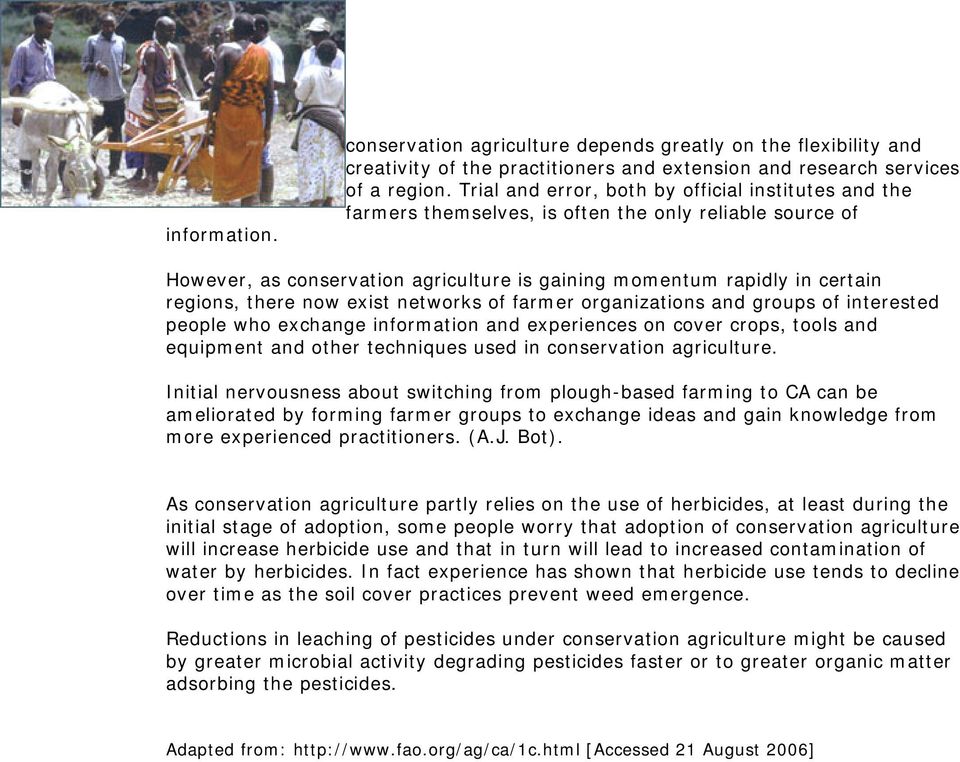
9 information. conservation agriculture depends greatly on the flexibility and creativity of the practitioners and extension and research services of a region. Trial and error, both by official institutes and the farmers themselves, is often the only reliable source of However, as conservation agriculture is gaining momentum rapidly in certain regions, there now exist networks of farmer organizations and groups of interested people who exchange information and experiences on cover crops, tools and equipment and other techniques used in conservation agriculture. Initial nervousness about switching from plough-based farming to CA can be ameliorated by forming farmer groups to exchange ideas and gain knowledge from more experienced practitioners. (A.J. Bot). As conservation agriculture partly relies on the use of herbicides, at least during the initial stage of adoption, some people worry that adoption of conservation agriculture will increase herbicide use and that in turn will lead to increased contamination of water by herbicides. In fact experience has shown that herbicide use tends to decline over time as the soil cover practices prevent weed emergence. Reductions in leaching of pesticides under conservation agriculture might be caused by greater microbial activity degrading pesticides faster or to greater organic matter adsorbing the pesticides. Adapted from: [Accessed 21 August 2006]
FUTURE CHALLENGES OF PROVIDING HIGH-QUALITY WATER - Vol. II - Environmental Impact of Food Production and Consumption - Palaniappa Krishnan
 ENVIRONMENTAL IMPACT OF FOOD PRODUCTION AND CONSUMPTION Palaniappa Krishnan Bioresources Engineering Department, University of Delaware, USA Keywords: Soil organisms, soil fertility, water quality, solar
Crop residue management (CRM), a cultural practice that
 Chapter V Crop Residue Management Practices Crop residue management (CRM), a cultural practice that involves fewer and/or less intensive tillage operations and preserves more residue from the previous
Speaker Summary Note
 2020 CONFERENCE MAY 2014 Session: Speaker: Speaker Summary Note Building Resilience by Innovating and Investing in Agricultural Systems Mark Rosegrant Director, Environment and Production Technology Division
ENERGY IN FERTILIZER AND PESTICIDE PRODUCTION AND USE
 Farm Energy IQ Conserving Energy in Nutrient Use and Pest Control INTRODUCTION Fertilizers and pesticides are the most widely used sources of nutrients and pest control, respectively. Fertilizer and pesticides
SoCo: European Overview on soil degradation processes related to agriculture
 SoCo Policy Seminar, Brussels, 28 May 2009 1 SoCo: European Overview on soil degradation processes related to agriculture by E. Rusco, L. Montanarella, B. Marechal JRC IES Land management and Natural Hazards
What Is Humic Acid? Where Does It Come From?
 What Is Humic Acid? Humic and Fulvic acids are the final break-down constituents of the natural decay of plant and animal materials. These organic acids are found in pre-historic deposits. Humic matter
Which of the following can be determined based on this model? The atmosphere is the only reservoir on Earth that can store carbon in any form. A.
 Earth s Cycles 1. Models are often used to explain scientific knowledge or experimental results. A model of the carbon cycle is shown below. Which of the following can be determined based on this model?
AP ENVIRONMENTAL SCIENCE 2012 SCORING GUIDELINES
 AP ENVIRONMENTAL SCIENCE 2012 SCORING GUIDELINES Question 3 The active ingredients in many pesticides are chemical compounds that kill organisms such as insects, molds, and weeds. Proponents claim that
Status of the World s Soil Resources
 5 December 2015 Status of the World s Soil Resources The Intergovernmental Technical Panel on Soils (ITPS), the main scientific advisory body to the Global Soil Partnership (GSP) hosted by the Food and
FARMING FOR THE FUTURE How mineral fertilizers can feed the world and maintain its resources in an Integrated Farming System
 How mineral fertilizers can feed the world and maintain its resources in an Integrated Farming System european fertilizer manufacturers association Global trends in population growth (Population 1000 million),
How To Plan A Buffer Zone
 Backyard Buffers Protecting Habitat and Water Quality What is a buffer? A buffer (also called a riparian buffer area or zone) is the strip of natural vegetation along the bank of a stream, lake or other
CHALLENGE 7. STRATEGIES AND TOOLS FOR SUSTAINABLE SOIL AND SUBSTRATE MANAGEMENT. Janjo de Haan (Wageningen UR) Alice Abjean-Uguen (CERAFEL)
 CHALLENGE 7. STRATEGIES AND TOOLS FOR SUSTAINABLE SOIL AND SUBSTRATE MANAGEMENT Janjo de Haan (Wageningen UR) Alice Abjean-Uguen (CERAFEL) International year of the soil Soil and substrate crucial role
Integrated Pest Management
 Chapter 2 Integrated Pest Management In This Chapter Keywords After learning the information in this chapter, you will be able to: 1. Define Integrated Pest Management (IPM). 2. List and describe the 5
Sustainability in Agricultural Marketing:
 International Journal of scientific research and management (IJSRM) Special Issue On National Level Conference Business Growth and Social Development Pages 19-24 2014 Website: www.ijsrm.in ISSN (e): 2321-3418
Advanced Soil Organic Matter Management
 Extension Bulletin E-3137 New February 2011 Advanced Soil Organic Matter Management Managing Soils Soil organic matter (SOM) is the foundation for productive soil. It promotes healthy crops, supplies resources
CORN IS GROWN ON MORE ACRES OF IOWA LAND THAN ANY OTHER CROP.
 CORN IS GROWN ON MORE ACRES OF IOWA LAND THAN ANY OTHER CROP. Planted acreage reached a high in 1981 with 14.4 million acres planted for all purposes and has hovered near 12.5 million acres since the early
Conservation agriculture demonstration guide. Prepared for: Agricultural extension staff under Sudan Productive Capacity Recovery Programme (SPCRP)
 Conservation agriculture demonstration guide Prepared for: Agricultural extension staff under Sudan Productive Capacity Recovery Programme (SPCRP) By Eng Tom Apina African Conservation Tillage Network
Section 5.1 Food chains and food webs
 Section 5.1 Food chains and food webs The ultimate source of energy in an ecosystem comes from sunlight This energy is converted to an organic form using photosynthesis which is then passed between organisms
Participants to develop their business without making great efforts; to use modern machinery to be implemented over the years in agriculture.
 TITLE: MODERN MACHINES IN AGRICULTURE INTRODUCTION: Modern agriculture depends heavily on engineering, technology and the biological and physical sciences. Irrigation, drainage, conservation and channelling
AP ENVIRONMENTAL SCIENCE 2012 SCORING GUIDELINES
 AP ENVIRONMENTAL SCIENCE 2012 SCORING GUIDELINES Question 2 The Fremont School District uses oil to heat school buildings. Go Green! is a new project the district will implement. The superintendent has
Nitrogen Fixing Bacteria in Agriculture Now a Real Option Guy Webb B.Sc. REM Agricultural Consultant
 Nitrogen Fixing Bacteria in Agriculture Now a Real Option Guy Webb B.Sc. REM Agricultural Consultant The Pursuit of Protein and Profit All agricultural enterprises, in essence, are based on the pursuit
THE SCIENCE THE FUTURE OF CANADIAN CANOLA: APPLY THE SCIENCE OF AGRONOMICS TO MAXIMIZE GENETIC POTENTIAL.
 THE SCIENCE THE FUTURE OF CANADIAN CANOLA: APPLY THE SCIENCE OF AGRONOMICS TO MAXIMIZE GENETIC POTENTIAL. WHERE WE HAVE BEEN CANOLA PRODUCTION HAS SURPASSED THE INDUSTRY TARGET OF 15 MMT. This was achieved
Create Your Own Soil Profile Ac5vity
 Create Your Own Soil Profile Ac5vity Middle School: 5-8 Task Overview: Soil profile refers to layers of soil. A typical soil profile takes nearly 1,000 to 100,000 years to form. The formation of the soil
I. RECOMMENDED PRACTICES BASED ON GOOD AGRICULTURAL PRACTICES (GAP) AND GOOD MANUFACTURING PRACTICES (GMP)
 CAC/RCP 51-2003 Page 1 of 8 CODE OF PRACTICE FOR THE PREVENTION AND REDUCTION OF MYCOTOXIN CONTAMINATION IN CEREALS, INCLUDING ANNEXES ON OCHRATOXIN A, ZEARALENONE, FUMONISINS AND TRICOTHECENES CAC/RCP
A Developer s Guide: Watershed-Wise Development
 A Developer s Guide: Watershed-Wise Development Environmental Protection What is a watershed? It does not matter how far away you build from a creek, lake, or the ocean, you are in a watershed. Another
Madagascar: Makira REDD+
 project focus Madagascar: Makira REDD+ Madagascar is considered to be one of the top five biodiversity hotspots in the world due to more than 75% of all animal and plant species being endemic while less
Ecosystems. The two main ecosystem processes: Energy flow and Chemical cycling
 Ecosystems THE REALM OF ECOLOGY Biosphere An island ecosystem A desert spring ecosystem Biosphere Ecosystem Ecology: Interactions between the species in a given habitat and their physical environment.
Source control targeting measures for arable tillage in the Wensum Demonstration Test Catchment, Norfolk
 Source control targeting measures for arable tillage in the Wensum Demonstration Test Catchment, Norfolk Kevin Hiscock & Andrew Lovett School of Environmental Sciences, University of East Anglia (E-mail
Outline. What is IPM Principles of IPM Methods of Pest Management Economic Principles The Place of Pesticides in IPM
 Improving Control Systems in Thailand for Plant and Plants Products Intended for Export to the European Union co-funded by the European Union and Thai Department of Agriculture Preharvest Use of Pesticides
Introduction to Integrated Pest Management. John C. Wise, Ph.D. Michigan State University MSU Trevor Nichols Research Complex
 Introduction to Integrated Pest Management John C. Wise, Ph.D. Michigan State University MSU Trevor Nichols Research Complex What is Integrated Pest Management? Integrated Pest Management (IPM) New concept;
WEPP MODEL APPLICATIONS FOR EVALUATIONS OF BEST MANAGEMENT PRACTICES
 WEPP MODEL APPLICATIONS FOR EVALUATIONS OF BEST MANAGEMENT PRACTICES D.C. FLANAGAN 1, W.J. ELLIOT 2, J.R. FRANKENBERGER 3, C. HUANG 4 1 USDA-Agricultural Research Service, National Soil Erosion Research
Birmingham City University / Students Union Aspects and Impacts Register. Waste. Impacts description
 Birmingham City University / Students Union and Impacts Register Waste Production of non - hazardous waste Production of hazardous waste Storage of non - hazardous waste Potential for waste to be disposed
Enhancing Biodiversity. Proactive management of biodiversity in intensive agriculture
 Enhancing Biodiversity Proactive management of biodiversity in intensive agriculture Contents Introduction Increasing food security in a sustainable way 3 The importance of biodiversity The vitality and
NO-TILL AND NITROGEN FIXING INOCULANTS
 NO-TILL AND NITROGEN FIXING INOCULANTS Tom Wacek R & D Director for Urbana Laboratories St. Joseph, Missouri Nitrogen fixation is the utilization of the free gaseous nitrogen in the air by soil bacteria
Harvesting energy with fertilizers
 Harvesting energy with fertilizers Sustainable agriculture in Europe 1 Harvesting energy with fertilizers The reason for agriculture s existence is to supply energy to mankind. Agriculture converts solar
Global Environment Facility GEF OPERATIONAL PROGRAM #13 ON CONSERVATION AND SUSTAINABLE USE OF BIOLOGICAL DIVERSITY IMPORTANT TO AGRICULTURE
 Global Environment Facility GEF OPERATIONAL PROGRAM #13 ON CONSERVATION AND SUSTAINABLE USE OF BIOLOGICAL DIVERSITY IMPORTANT TO AGRICULTURE CONTENTS Introduction..1 Convention Guidance... 2 Agricultural
Culture in field conditions - Challenges A South American point of view Roberto Campos Pura Natura, Argentina
 A South American point of view Roberto Campos Pura Natura, Argentina EUSTAS 6 th Stevia Symposium Leuven, July 3 rd and 4 th I. Area of cultivation II. Environment III. Production of seedlings IV. Planting
FULL COVERAGE IRRIGATION for tree & vine crops the facts.
 Handy Pocket Guide rotator technology save water, save energy and do a better job of irrigating. FULL COVERAGE IRRIGATION for tree & vine crops the facts. Copyright 2008 Nelson Irrigation Corporation 1
U.S. SOYBEAN SUSTAINABILITY ASSURANCE PROTOCOL
 US SOYBEAN SUSTAINABILITY ASSURANCE PROTOCOL A Sustainability System That Delivers MARCH 2013 Since 1980, US farmers increased soy production by 96% while using 8% less energy US SOYBEAN SUSTAINABILITY
African Organic Agriculture Manual Booklet Series No. 4 Soil organic matter management HOW DO I IMPROVE THE SOIL ORGANIC MATTER?
 African Organic Agriculture Manual Booklet Series No. 4 Soil organic matter management HOW DO I IMPROVE THE SOIL ORGANIC MATTER? What do I need to know about soil organic mat Soil organic matter is essential
A SOIL TESTING SERVICE FOR FARMERS IN THAILAND, USING MOBILE LABORATORIES
 A SOIL TESTING SERVICE FOR FARMERS IN THAILAND, USING MOBILE LABORATORIES Narong Chinabut Office of Science for Land Development Land Development Department, Ministry of Agriculture and Cooperatives, Bangkok
Data Mining and Meta-analysis as Tools to Evaluate the Impact of Management Practices on Dynamic Soil Properties
 Data Mining and Meta-analysis as Tools to Evaluate the Impact of Management Practices on Dynamic Soil Properties Carmen Ugarte, Michelle M. Wander University of Illinois at Urbana-Champaign National Cooperative
Research to improve the use and conservation of agricultural biodiversity for smallholder farmers
 Research to improve the use and conservation of agricultural biodiversity for smallholder farmers Agricultural biodiversity the variability of crops and their wild relatives, trees, animals, arthropods,
Organic Gardening Certificate Program Quiz Week 3 Answer Key
 Q uiz for week 3 readings: 1. The database on the Organic Weed management Website contains the following sections except: A. Picture B. Ecology C. Management D. Description 2. The weed quackgrass can reproduce
a. a population. c. an ecosystem. b. a community. d. a species.
 Name: practice test Score: 0 / 35 (0%) [12 subjective questions not graded] The Biosphere Practice Test Multiple Choice Identify the letter of the choice that best completes the statement or answers the
Food Security in a Volatile World
 Issues in Brief Food Security in a Volatile World Developments in agriculture over the last fifty years have increased yields sufficiently to provide on average more than enough food for every person on
Areas of protection and the impact chain
 Areas of protection and the impact chain Bo P. Weidema 2001.01.10 1. Introduction A modified scheme of areas of protection (also known as safeguard subjects) by Udo de Haes & Lindeijer (2000) has opened
From known to unknown
 Risks associated with Chemical and Non-Chemical Pest Control From known to unknown Paul Leonard Nov 2009 Agenda 1. EU non-chemical pest control legislation? 2. What do we know about risks associated with
Ecosystems and Food Webs
 Ecosystems and Food Webs How do AIS affect our lakes? Background Information All things on the planet both living and nonliving interact. An Ecosystem is defined as the set of elements, living and nonliving,
Integrated crop-livestock farming systems
 Livestock Thematic Papers Tools for project design Integrated crop-livestock farming systems Population growth, urbanization and income growth in developing countries are fuelling a substantial global
Use: Cooperative farming as a habitat management tool to enhance and restore refuge grasslands
 Compatibility Determination Use: Cooperative farming as a habitat management tool to enhance and restore refuge grasslands District Name: Minnesota Valley Wetland Management District Establishing and Acquisition
A cool CAP post-2013: What measures could help adapt Cyprus farming and biodiversity to the consequences of climate change?
 A cool CAP post-2013: What measures could help adapt Cyprus farming and biodiversity to the consequences of climate change? 26 September 2012: IFOAM EU Conference Future farming in times of climate change
12.5: Generating Current Electricity pg. 518
 12.5: Generating Current Electricity pg. 518 Key Concepts: 1. Electrical energy is produced by energy transformations. 2. Electrical energy is produced from renewable and non-renewable resources. 4. Electrical
Environmental Outcomes of Conservation Agriculture in North Italy
 Environmental Outcomes of Conservation Agriculture in North Italy Stefano Brenna ERSAF Regional Agency for Agriculture and Forests of Lombardy (Italy) 6th World Congress on Conservation Agriculture Winnipeg,
The farm: Placed in the middle of Sealand 250 hektar 5000 pigs 30-110 kg produced Soiltype: JB 6
 The farm: Placed in the middle of Sealand 250 hektar 5000 pigs 30-110 kg produced Soiltype: JB 6 (app. 14% clay, 14 silt, 45% fine sand, 27% sand) The principles of Conservation Agriculture (CA): - Minimum
PEST MANAGEMENT (CSP Enhancements) January 2006 Enhancement Activity Task Sheet
 Reduced risks to ground and surface water quality Lower costs by limiting chemical applications to only when necessary To learn more about Integrated Pest Management go to the following website: http://extension.usu.edu/files/gardpubs/ipm01.pdf
Biodiversity Concepts
 Biodiversity Concepts WHAT IS BIODIVERSITY? Biodiversity is the variety of life on Earth. For any kind of animal or plant each individual is not exactly the same as any other; nor are species or ecosystems.
Fungal Entomopathogens: An Enigmatic Pest Control Alternative
 Fungal Entomopathogens: An Enigmatic Pest Control Alternative Nicole Rusconi $ and Cerruti R 2 Hooks! $ Student Research Assistant and 1 Associate Professor and Extension Specialist, University of Maryland
Best Management Practices for Colorado Corn
 Best Management Practices for Colorado Corn Primary Authors: Troy Bauder Department of Soil and Crop Sciences Colorado State University Reagan Waskom Department of Soil and Crop Sciences Colorado State
our Commitment to Sustainable Agriculture Practices
 our Commitment to Sustainable Agriculture Practices Good for Business. Good for Society. As one of the world s largest food and beverage companies, we have some distinct challenges. We are committed to
Emerging BioFuel Crops and Technology Kurt Thelen Michigan State University, East Lansing, Michigan ABSTRACT
 Emerging BioFuel Crops and Technology Kurt Thelen Michigan State University, East Lansing, Michigan ABSTRACT United States energy policy requires 36 billion gallons of ethanol by the year 2022, with 21
Virginia Gardener http://www.hort.vt.edu/envirohort
 The Virginia Gardener http://www.hort.vt.edu/envirohort Name Help Sheets: Things Plants Need There are certain things that every living thing needs in order to live and grow. Just like you, plants need
Chapter D9. Irrigation scheduling
 Chapter D9. Irrigation scheduling PURPOSE OF THIS CHAPTER To explain how to plan and schedule your irrigation program CHAPTER CONTENTS factors affecting irrigation intervals influence of soil water using
Open Meeting of the Club of Bologna Farm Machinery to Feed the World. 21 September 2015 Teatro della Terra, Biodiversity Park, EXPO Milano 2015
 Open Meeting of the Club of Bologna 21 September 2015 Teatro della Terra, Biodiversity Park, EXPO Milano 2015 Farm of the Future Giuseppe Gavioli [email protected] Challenges Child and maternal
WATER AND DEVELOPMENT Vol. II - Types Of Environmental Models - R. A. Letcher and A. J. Jakeman
 TYPES OF ENVIRONMENTAL MODELS R. A. Letcher and A. J. Jakeman Centre for Resource and Environmental Studies, The Australian National University, Australia Keywords: environmental models, environmental
The Food-Energy-Water Nexus in Agronomy, Crop and Soil Sciences
 The Food-Energy-Water Nexus in Agronomy, Crop and Soil Sciences February 4, 2016 In the fall of 2015 the Agronomy, Crop Science and Soil Science societies put out a call for white papers to help inform
3. Which relationship can correctly be inferred from the data presented in the graphs below?
 1. Recent evidence indicates that lakes in large areas of New York State are being affected by acid rain. The major effect of acid rain in the lakes is (1) an increase in game fish population levels (3)
Lecture Series in Water, Soil and Atmosphere (315.340) Unit 1: Interaction Soil / Vegetation / Atmosphere
 Dept. Water, Soil & Atmosphere Institute of Hydraulics and Rural Water Management University of Natural Resources and Life Sciences Vienna Lecture Series in Water, Soil and Atmosphere (315.340) Unit 1:
Crop rotation and legumes cultivation: Effective measures to increase the environmental performance and long-term viability of European agriculture.
 Crop rotation and legumes cultivation: Effective measures to increase the environmental performance and long-term viability of European agriculture. Christine Watson (SAC), Donal Murphy-Bokern (DMB), Fred
FACT SHEET. Production Risk
 ALABAMA AGRICULTURAL & MECHANICAL UNIVERSITY SMALL FARMERS RESEARCH CENTER FACT SHEET Production Risk Any production related activity or event that is uncertain is a production risk. Agricultural production
Maize is a major cereal grown and consumed in Uganda and in the countries of Kenya, Sudan, Democratic Republic of Congo and Rwanda
 Maize Production in Uganda Farmers have improved maize yields from 1,000Kg/ha to 3,000-5,000 Kg/ha using the recommended technologies Maize is a major cereal grown and consumed in Uganda and in the countries
Recommended Resources: The following resources may be useful in teaching
 Unit D: Controlling Pests and Diseases in the Orchard Lesson 1: Managing and Controlling Pests of Fruit and Nut Crops Student Learning Objectives: Instruction in this lesson should result in students achieving
2) Relevance for environmental policy... 2. 4) Data sources and reporting... 4 5) References at the international level... 4
 F- 4: Pesticide consumption 1) General description... 2 1.1) Brief definition... 2 1.2) Units of measurement... 2 1.3) Context...2 2) Relevance for environmental policy... 2 2.1) Purpose... 2 2.2) Issue...
COMPREHENSIVE PLAN SECTION B, ELEMENT 4 WATER RESOURCES. April 20, 2010 EXHIBIT 1
 COMPREHENSIVE PLAN SECTION B, ELEMENT 4 WATER RESOURCES April 20, 2010 EXHIBIT 1 ELEMENT 4 WATER RESOURCES TABLE OF CONTENTS 4.1 INTRODUCTION 4.2 GOALS AND POLICIES 4.2.A General Goals and Policies 1 4.2.B
Agriculture, Food Security and Climate Change A Triple Win?
 Agriculture, Food Security and Climate Change A Triple Win? Dr. Andrew Steer Special Envoy for Climate Change The World Bank Group Your Royal Highnesses, Excellencies, Ladies and Gentlemen, Let me begin
Nutrient Stewardship. Reducing the Loss of Crop Nutrients to Waterways
 ETS & PERFORMANCE FOOD ENVIRONMENT PEOPLE COMPANY Nutrient Stewardship Reducing the Loss of Crop Nutrients to Waterways Crop nutrients help plants grow and produce the food, fiber and fuel we all need.
CROPS COSTS AND RETURNS 2014
 Crops, Environment and Land-Use Programme Kildalton CROPS COSTS AND RETURNS 2014 Compiled by: Tim O Donovan, Crops Specialist and Jim O Mahony, Head of Crops - KT Department Crop Margins Awareness of crop
WEED MANAGEMENT LEARNING OBJECTIVES
 C 6 H A P TE R WEED MANAGEMENT LEARNING OBJECTIVES After completely studying this chapter, you should: Be able to define a weed and its four stages of development. Understand the differences between annual,
Physical Environment. There are economic reasons for countries to cut down their rainforests.
 Tropical Rainforests Reasons for their Destruction Tropical Rainforests are found in the Amazon Basin of South America, (e.g. Brazil) Central Africa (e.g. Congo) and South East Asia (e.g. Indonesia). There
Can Grazing Make Organic No-Till Possible?
 Can Grazing Make Organic No-Till Possible? Harun Cicek, Caroline Halde, Kristen Podolsky, Martin Entz, Keith Bamford, Joanne Thiessen Martens and David Feindel WCCA, Winnipeg 2014 ICARDA reduced tillage
Mud in the Water. www.agclassroom.org/ok. Oklahoma Academic Standards. Objective. Background. Resources Needed. Activities
 Mud in the Water Objective Students will learn about soil erosion and water pollution by building a demonstration model from pop bottles and observing the movement of pollutants from soil into water. Background
Bottom-up: Responding to climate change through livestock in integrated agriculture
 Bottom-up: Responding to climate change through livestock in integrated agriculture Katrien van t Hooft, ETC Adviesgroep, Netherlands Personal introduction Veterinary medicine in Utrecht, NL MSc Management
Phosphorus. Phosphorus Lake Whatcom Cooperative Management. www.ecy.wa.gov/programs/wq/nonpoint/phosphorus/phosphorusban.html
 Phosphorus Phosphorus Brochure Lake Whatcom Cooperative Management Reducing Phosphorus Website Washington State Department of Ecology www.ecy.wa.gov/programs/wq/nonpoint/phosphorus/phosphorusban.html Nutrients
SECTION 6. The Codex code of practice on good animal feeding
 SECTION 6 The Codex code of practice on good animal feeding 60 The Codex code of practice on good animal feeding SECTION 6 61 CODE OF PRACTICE ON GOOD ANIMAL FEEDING CAC/RCP 54-2004 SECTION 1. INTRODUCTION
Risø-R-1512(EN) Green Technological Foresight on Environmental Friendly Agriculture: Executive Summary
 Risø-R-1512(EN) Green Technological Foresight on Environmental Friendly Agriculture: Executive Summary Risø National Laboratory Roskilde Denmark December 2004 Authors: Kristian Borch 1, Svend Christensen
Water Footprint Calculations for Pasture Based Beef Production
 Water Footprint Calculations for Pasture Based Beef Production Dr. Horst Jürgen Schwartz Professor (retired), Chair of Livestock Ecology Humboldt University of Berlin Faculty of Agriculture, Institute
National Environment Awareness Campaign(NEAC) 2014-2015. Theme
 National Environment Awareness Campaign(NEAC) 2014-2015. Theme COMBATING DESERTIFICATION, LAND DEGRADATION AND DROUGHT Background Note Desertification is about land degradation: the loss of the land s
DYNAMIX COMPACT DISC HARROWS FOR TRACTORS FROM 100 TO 200 HP
 DYNAMIX COMPACT DISC HARROWS FOR TRACTORS FROM 100 TO 200 HP DYNAMIX DYNAMIX KA RANGE OF COMPACT DISC HARROWS MAIN FEATURES www.rabe-gb.de STUBBLE CULTIVATION Todays farmers are facing new tasks: the ever-changing
FOREST RESTORATION MONITORING TOOL
 FOREST RESTORATION MONITORING TOOL Draft version for field test INTRODUCTION FAO upon recommendation of its members identified the need to initiate a comprehensive analysis, evaluation and documentation
FARM ENVIRONMENT PLAN
 FARM ENVIRONMENT PLAN FOUNDATION FOR ARABLE RESEARCH Farm Environment Plan Template for Arable Enterprises 2015 The Planning Process Before you begin to fill in the template, save it to your computer hard
LOW INTEREST LOANS FOR AGRICULTURAL CONSERVATION
 LOW INTEREST LOANS FOR AGRICULTURAL CONSERVATION LILAC MANUAL LOW INTEREST LOANS FOR AGRICULTURAL CONSERVATION TABLE OF CONTENTS Introduction... 3 General Eligibility... 4 Specific Eligibility Criteria
How can information technology play a role in primary industries climate resilience?
 Manage Data. Harvest Information. How can information technology play a role in primary industries climate resilience? CHALLENGES FOR WORLD AGRICULTURE 9 Billion people on earth by 2040 Up to 40% of food
Integrated Pest Management
 Integrated Pest Management Andrea Veres Junior Technical Officer FAO REU [email protected] Yerevan, Armenia 2013 Why develop IPM? Agriculture was: not sustainable optimized inputs for maximum profit
Long Term Challenges for Tidal Estuaries
 A view from a former tidal river manager expert with experience from 6 decades living at, with and from the Tidal River Elbe chairman of the European Interreg Project TIDE (Tidal River Development) Land
Key Idea 2: Ecosystems
 Key Idea 2: Ecosystems Ecosystems An ecosystem is a living community of plants and animals sharing an environment with non-living elements such as climate and soil. An example of a small scale ecosystem
Waterway Technote Drains
 Waterway Technote Drains Contents Benefits of good drain practice 1 Are your drains healthy? 2 The Sustainable Dairying Water Accord 3 Planning drain maintenance 3 Fencing and clearing 3 Bank shaping (battering)
Essential Standards: Grade 4 Science Unpacked Content
 This document is designed to help North Carolina educators teach the Essential Standards (Standard Course of Study). NCDPI staff are continually updating and improving these tools to better serve teachers.
Bioremediation. Introduction
 Bioremediation Introduction In the twentieth century, the ever increase in the global human population and industrialization led to the exploitation of natural resources. The increased usage of heavy metals